
Version 3 Juin
|
|
|
- Marilyn Snow
- 10 years ago
- Views:
Transcription
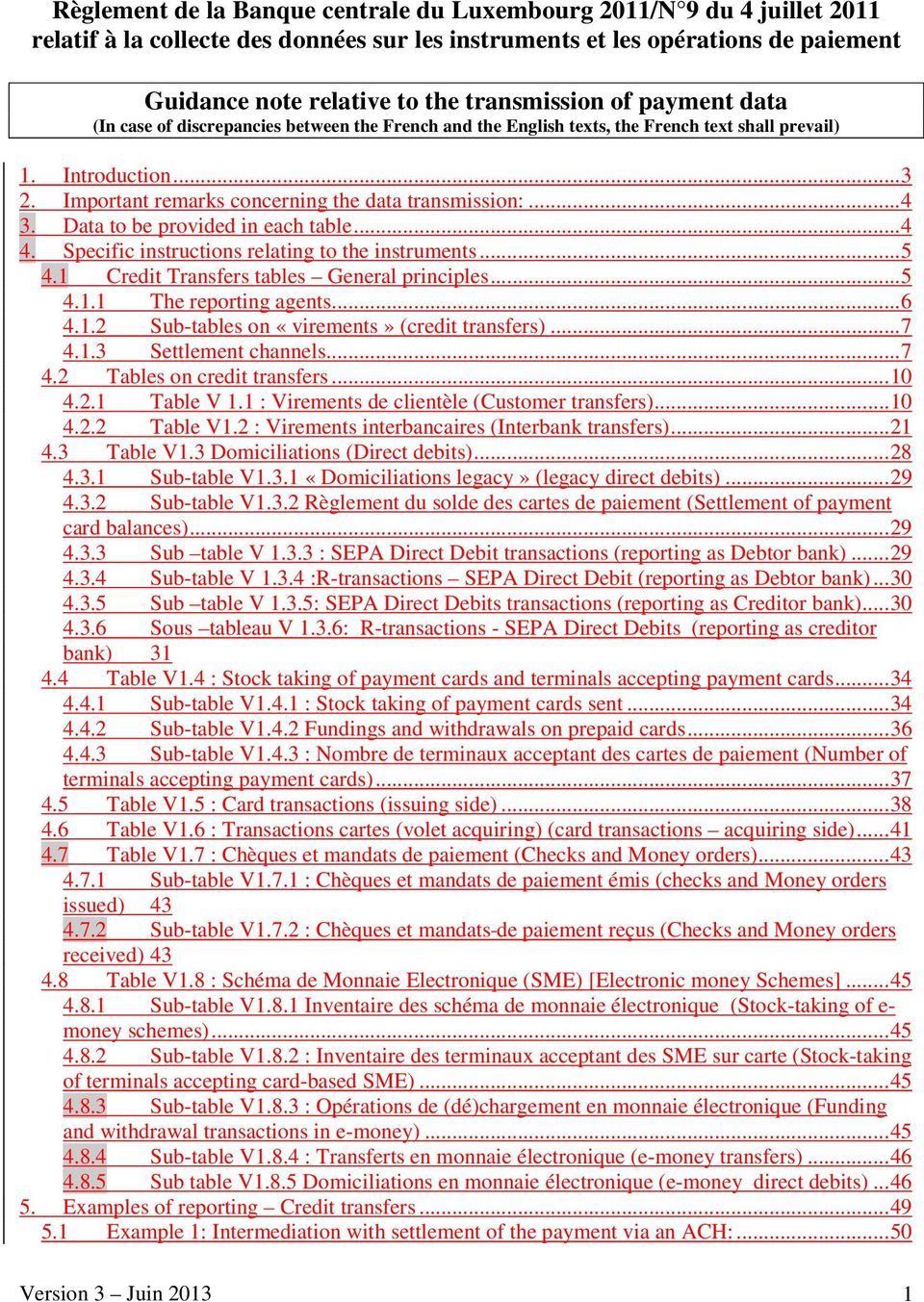
1 Règlement de la Banque centrale du Luxembourg 2011/N 9 du 4 juillet 2011 relatif à la collecte des données sur les instruments et les opérations de paiement Guidance note relative to the transmission of payment data (In case of discrepancies between the French and the English texts, the French text shall prevail) 1. Introduction Important remarks concerning the data transmission: Data to be provided in each table Specific instructions relating to the instruments Credit Transfers tables General principles The reporting agents Sub-tables on «virements» (credit transfers) Settlement channels Tables on credit transfers Table V 1.1 : Virements de clientèle (Customer transfers) Table V1.2 : Virements interbancaires (Interbank transfers) Table V1.3 Domiciliations (Direct debits) Sub-table V1.3.1 «Domiciliations legacy» (legacy direct debits) Sub-table V1.3.2 Règlement du solde des cartes de paiement (Settlement of payment card balances) Sub table V : SEPA Direct Debit transactions (reporting as Debtor bank) Sub-table V :R-transactions SEPA Direct Debit (reporting as Debtor bank) Sub table V 1.3.5: SEPA Direct Debits transactions (reporting as Creditor bank) Sous tableau V 1.3.6: R-transactions - SEPA Direct Debits (reporting as creditor bank) Table V1.4 : Stock taking of payment cards and terminals accepting payment cards Sub-table V1.4.1 : Stock taking of payment cards sent Sub-table V1.4.2 Fundings and withdrawals on prepaid cards Sub-table V1.4.3 : Nombre de terminaux acceptant des cartes de paiement (Number of terminals accepting payment cards) Table V1.5 : Card transactions (issuing side) Table V1.6 : Transactions cartes (volet acquiring) (card transactions acquiring side) Table V1.7 : Chèques et mandats de paiement (Checks and Money orders) Sub-table V1.7.1 : Chèques et mandats de paiement émis (checks and Money orders issued) Sub-table V1.7.2 : Chèques et mandats de paiement reçus (Checks and Money orders received) Table V1.8 : Schéma de Monnaie Electronique (SME) [Electronic money Schemes] Sub-table V1.8.1 Inventaire des schéma de monnaie électronique (Stock-taking of e- money schemes) Sub-table V1.8.2 : Inventaire des terminaux acceptant des SME sur carte (Stock-taking of terminals accepting card-based SME) Sub-table V1.8.3 : Opérations de (dé)chargement en monnaie électronique (Funding and withdrawal transactions in e-money) Sub-table V1.8.4 : Transferts en monnaie électronique (e-money transfers) Sub table V1.8.5 Domiciliations en monnaie électronique (e-money direct debits) Examples of reporting Credit transfers Example 1: Intermediation with settlement of the payment via an ACH:...50 Version 3 Juin
2 5.2 Example 2: Relation Nostro/Loro : In case of intermediation: In the absence of intermediation Example 3: Case of settlement in a foreign currency Case n 1: Connected settlement of the payment via an ACH Case n 2: Connected settlement via relation de compte Nostro/Loro Case n 3: Not connected settlement of the payment via a PSP Case n 4: Not connected Settlement via Relation Nostro/Loro Example 4: Miscellaneous types of payments The item «Catégorie client» [Customer category]...61 Matching table between CDDP requirements & BCL definitions...62 High level view...62 Detailed view R-transactions - Definitions...67 SCT r-transactions:...67 SDD r-transactions: R- transactions Scope of the reporting General principles Out of scope R-Transactions messages at interbank level in the SDD scheme Les messages R-Transactions au niveau interbancaire dans le schema SCT SEPA transactions and R-transactions Description of the payment flows and the message flows List of amendments brought to the different versions of this document...85 Version 3 Juin
![..57 5.4 Example 4: Miscellaneous types of payments...58 6. The item «Catégorie client» [Customer category]...61 Matching table between CDDP requirements & BCL definitions...62 High level view.](/docs-images/45/5242908/images/page_2.jpg "..62 Detailed view...63 7. R-transactions - Definitions...67 SCT r-transactions:...67 SDD r-transactions:...68 8. R- transactions Scope of the reporting...69 8.1 General principles...69 8.2 Out of scope.")
3 1. Introduction - The tables measure the volume and value of payment transactions using the different payment instruments. Tables V 1.4, V1.8.1 and V1.8.2 are exceptions as they list stocks. - Scope of the reporting : The reporting covers : o the payment instruments covered by the PSD 1 o interbank payments 2 o Checks and money orders o On-us transactions 3 The reporting does not cover: o book entries 4 o securities transactions 5 o customer loans operations 6 An annual survey will be conducted to estimate payments not covered by the monthly collection. - A payment transaction is defined as following: an act, initiated by the payer or by the payee (beneficiary), of placing, transferring or withdrawing funds, irrespective of any underlying obligations between the payer and the payee (Source: directive 2007/64/EC of the European Parliament and of the Council on the payment services in the internal market). - The value of payment transactions should be provided in the accounting currency. The principle of the residence of the account will be applied. A current account held in a Luxemburgish bank will be considered as a Luxemburgish account, whichever the account holder s country of residence is. 1 Credit transfers, direct debits, card payments, e-money. 2 In order to have a homogeneous collection, interbank payments (effective payments and not "notes" or "Advice") should be collected on the basis of SWIFT messages MT2xx with the exception of the MT202COV. The interbank payments (foreign-exchange transactions, treasury operations, documentary credits or the other activity of trading room) executed via a message SWIFT MT2xx are so included in the collection. NB: a SWIFT MT2xx message does not necessarily mean that the transfer is interbank (cf. paragraph 4.2.2) 3 An on-us transaction is a payment for which the ordering party and the beneficiary hold their account with the same financial institution (so called "in - house payment "). 4 That is the commissions of interest, the banking charges. 5 That is the coupons, the purchases and the sales of securities for customers. The operations on investment funds (subscriptions or repurchases) are also excluded from the monthly collection. 6 Including the operations of refund of loan 14 Credit institution, payment institution, EPT, e-money institution. Deleted: - Scope of the reporting : <#>The reporting covers : <#>the payment instruments covered by the PSD 7 <#>interbank payments 8 <#>Checks and money orders <#>On-us transactions 9 <#>The reporting does not cover: <#>book entries 10 <#>securities transactions 11 <#>customer loans operations 12 An annual survey will be conducted to estimate payments not covered by the monthly collection. Deleted: 13 Version 3 Juin

4 - Treatment of the netting operations (example: operations sent to CLS, payment of bilateral operations): the net flow (corresponding to the effective payment) will be reported. The payment channel will be the one used for the payment of the net position. Ex: for a payment in euro sent to the CLS system, the payment channel might be Target2 (cf. paragraph 4.2.2). An annual survey may be conducted to estimate the netting activity, particularly on CLS. 2. Important remarks concerning the data transmission: - Separated transmission of tables: the various tables (the tables relative to credit transfers, direct debits ) can be sent separately. However, the sub-tables pertaining to one table have to be sent together (ex: the sub-tables relative to customer transfers and the sub-tables relative to interbank transfers). - For each table, only combinations / lines showing activity will be reported: For every table or sub-table, only the lines for which the volume and the value are not equal to zero have to be reported. There is no need to report a line for every possible combination. Example: if for a given currency there were no transactions, it is not required to send the line indicating a null volume and value. - Reporting of the empty lines: The reporting should include all the tables. If the reporting agent has no activity for one of the payment instruments, the table without any data (i.e.lines) should be sent to the BCL. The file should only contain the "header". - Sending of corrections: it is important to note that when sending back a table for a given period, the new table erases the former one. In particular, if a table contains several sub-tables, when sending corrections all the sub tables need to be sent back. Even if the corrections concern only one sub-table. - Figures have to be reported in their absolute value. Negative values are not accepted by the system. 3. Data to be provided in each table The following information should be included in the header of the tables. o Frequency o Period o Category of institution 14 o Name of the institution o Identification number (NOSIG) 15 We refer to the term bank for any institution active in the field of payments, i.e. it covers not only banking institutions but also payment institutions, e-money institutions as well as the EPT as any active institution in the field of payments. 15 Number provided by the CSSF. Version 3 Juin

5 4. Specific instructions relating to the instruments 4.1 Credit Transfers tables General principles Credit transfers include customer payments and interbank payments in two different tables. Each of these two tables contains three sub-tables, the first one is dedicated to credit transfers on the sending side, the second to credit transfers on the receiving side and the third one to credit transfers executed as an intermediary. Data collection specificities: - Rejected and returned transactions: With concerns to legacy credit transfers, rejected transactions are not included in the collection because they have not been processed. Returned transactions are included in the gross figures. This is widely due to the fact that they cannot be neutralized. Regarding SEPA credit transfers (SCT), R-transactions generated at interbank level between the Originator bank and the Creditor bank have to be reported in the related tables. - The collection relative to credit transfers refers to a processing chain for customer payments and is based on swift instructions (of type 2xx) for interbank transactions. Version 3 Juin

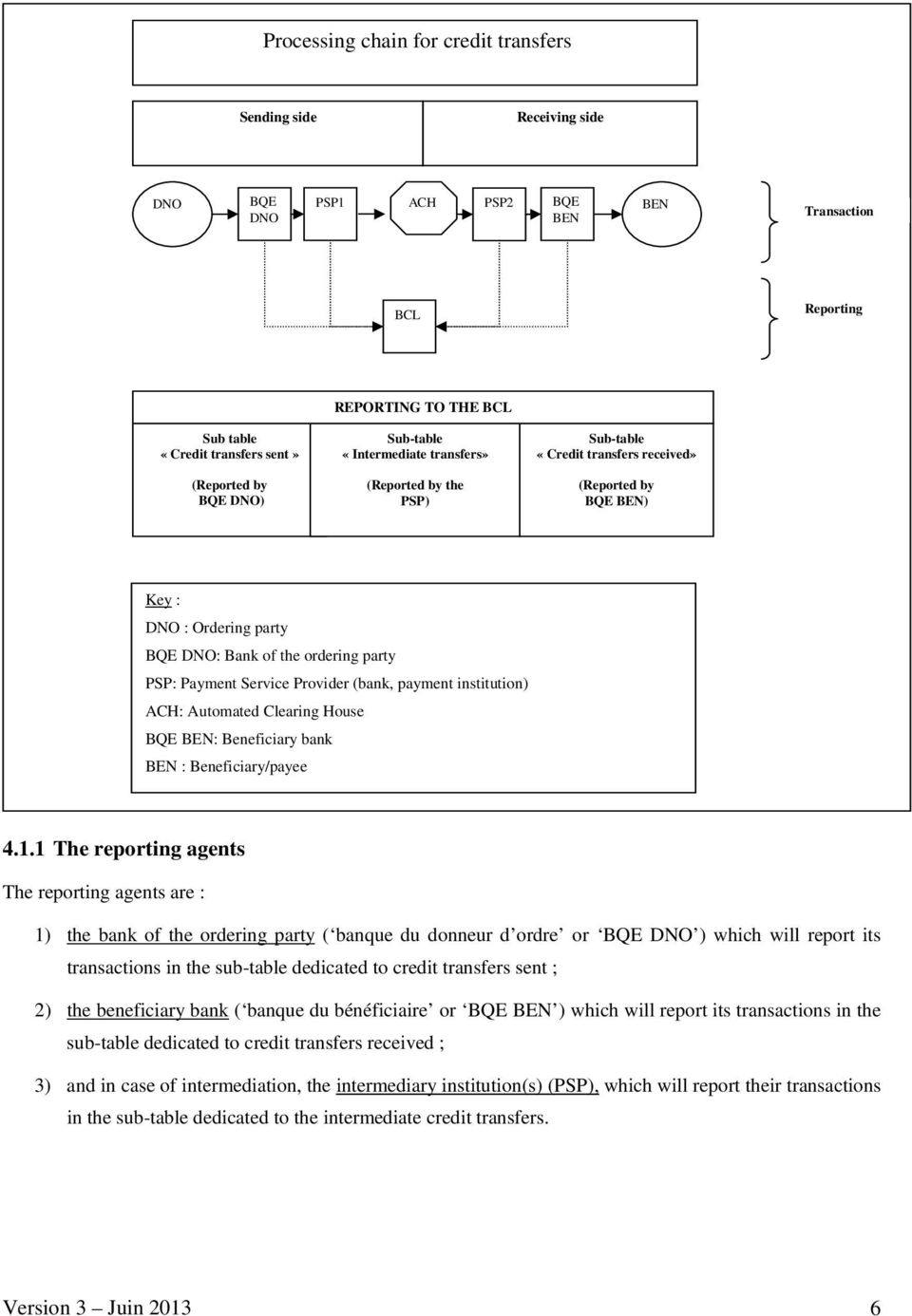
6 Processing chain for credit transfers Sending side Receiving side DNO BQE DNO PSP1 ACH PSP2 BQE BEN BEN Transaction BCL Reporting REPORTING TO THE BCL Sub table «Credit transfers sent» (Reported by BQE DNO) Sub-table «Intermediate transfers» (Reported by the PSP) Sub-table «Credit transfers received» (Reported by BQE BEN) Key : DNO : Ordering party BQE DNO: Bank of the ordering party PSP: Payment Service Provider (bank, payment institution) ACH: Automated Clearing House BQE BEN: Beneficiary bank BEN : Beneficiary/payee The reporting agents The reporting agents are : 1) the bank of the ordering party ( banque du donneur d ordre or BQE DNO ) which will report its transactions in the sub-table dedicated to credit transfers sent ; 2) the beneficiary bank ( banque du bénéficiaire or BQE BEN ) which will report its transactions in the sub-table dedicated to credit transfers received ; 3) and in case of intermediation, the intermediary institution(s) (PSP), which will report their transactions in the sub-table dedicated to the intermediate credit transfers. Version 3 Juin
7 4.1.2 Sub-tables on «virements» (credit transfers) The three sub-tables mentioned above relate to customer transfers and to the interbank transfers, they enable to measure: 1) Sub-table on "Virements émis " («Credit transfers sent»): transfers sent by the bank DNO should be listed. This sub-table measures the volume and value of the credit transfers sent. It allows also measuring the use of the channels by the bank DNO to settle these transfers: Indeed, when the BQE DNO settles its transfers directly in a system, its name will be indicated. When the BQE DNO uses an intermediary for the execution of its transfers, "PSP LU" or "PSP non-lu" will be indicated as settlement channel. The system used in fine to settle these transactions will be reported in the table on «intermediate transfers» («Virements intermédiés»). 2) Sub-table on "Virements reçus" («Credit transfers received»): credit transfers received by the BQE BEN to be indicated. This sub-table allows measuring the volume and value of the transfers received. It allows also measuring the use of the settlement channels by the BQE BEN in order to receive these transfers: Indeed, when the BQE BEN receives its transfers directly in a system, its name will be indicated. When the BQE BEN uses an intermediary to receive transfers, "PSP LU " or " PSP non-lu" will be indicated as channel of settlement. The system in which the PSP received beforehand will be reported in the table on «intermediate transfers» («Virements intermédiés»). 3) Sub-table on "Virements intermédiés" («intermediate transfers»): transfers settled by the PSP for the account of other institutions are indicated here. This sub-table allows on the one hand measuring the use of the settlement channels used to execute these intermediate transfers and on the other hand to measure the financial intermediation for the account of Luxemburgish and non-luxemburgish institutions Settlement channels The Canal de règlement (Settlement channel) informs about the system, respectively the method of execution, used to settle transfers: The indication relative to the channel of settlement, generally the name of the payment system used to settle these transfers measures the use of the various systems or the other methods of settlement. The decision-making tree described below helps to identify the settlement channel that is to be indicated in the table on credit transfers. Version 3 Juin
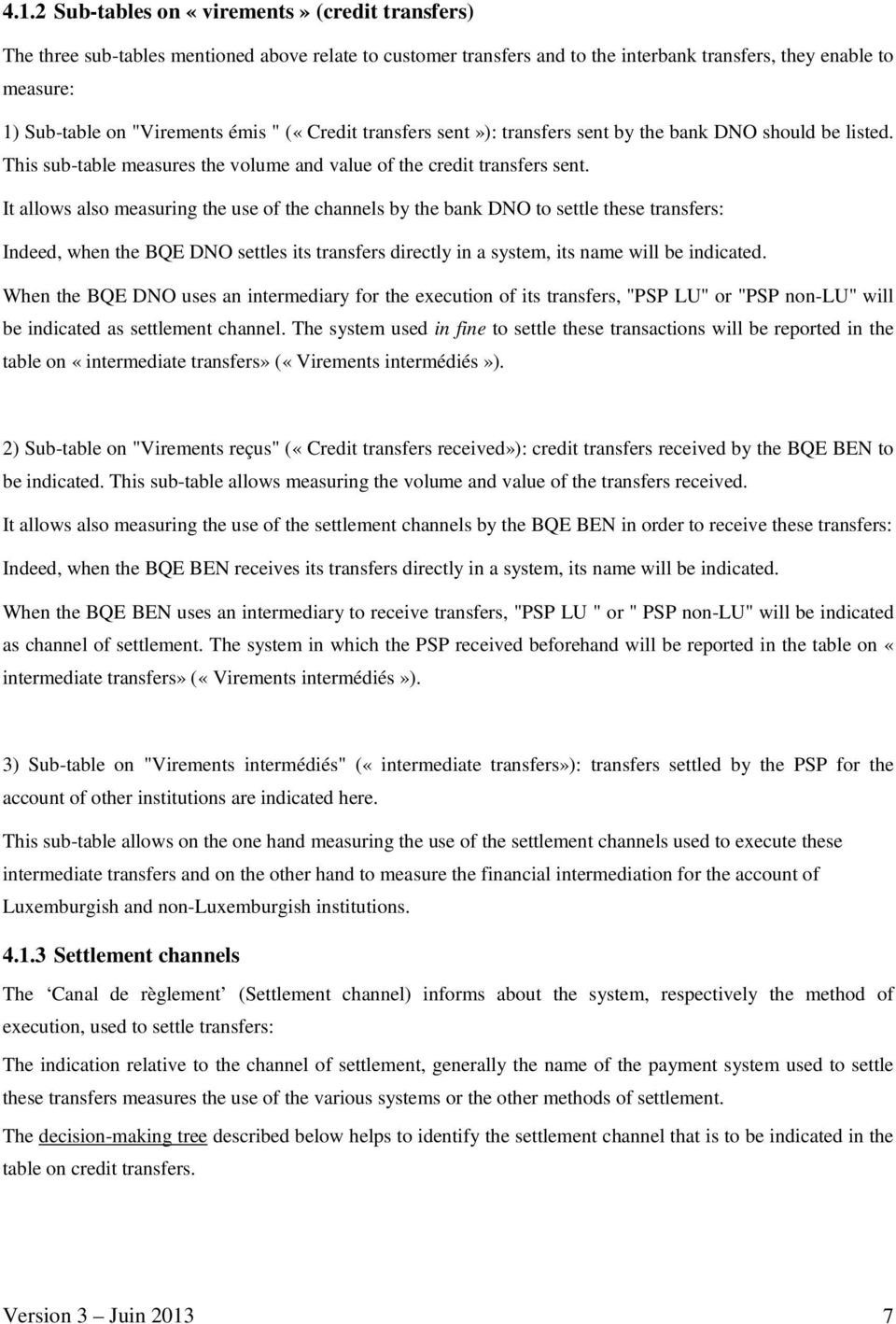
8 Decision-making tree Step n 1 Currency? Step n 2 Connected Not connected Step n 3 Name of the settlement system Relation Nostro/ Loro PSP LU or PSP non- LU The identification process of the settlement channel comprises three steps: Step n 1: Identification of the currency of transaction: The determination of the settlement channel is based on the currency of payment to be executed. Thus, the first step consists in answering the following question: "What is the currency of this transaction?" Step n 2: Identification of the (non-)connection to a settlement system: The second step consists in identifying if the bank is, for the considered currency, "connected" or "not connected" to a payment system: "For the currency of this payment, is my institution connected or not to a payment system? ". Step n 3: Identification of the settlement channel: 1) In case the reporting agent is connected to a payment system for this currency: N.B: we consider here "direct" connections. An indirect participant in a payment system is considered as using a PSP. In that case, the name of the system will be provided. The reporting entity can opt however to settle the payment via a nostro / loro account relation. In that case, "Relation Nostro/ loro" will be mentioned. Version 3 Juin

9 In conclusion, when for a given currency, an institution is connected to a payment system, possible settlement channels are either the payment system (name of the system used) or a relation of account nostro / loro. 2) In case the reporting agent is not connected to a payment system for this currency: In this case, the payment is usually settled via a PSP selected for the execution of its transactions in this currency. The settlement channel to be filled out is "PSP LU" or "PSP non-l " depending on the usual PSP for this currency is Luxemburgish or not. It is however also possible that the "non-connected" institution maintains a relation of account nostro/loro with the counterpart, and settles the payment this way. Nevertheless, it is agreed that these transactions will be indicated as if they had been settled by the usual PSP for this currency. Remark concerning cover payments: The settlement channel is not bound to the flow of the Swift message: when a payment instruction is sent to the beneficiary bank, the settlement channel will be PSP, even when a cover payment (MT202 COV) is sent to the PSP. The reporting is independent of the payment flow (cover payment or serial payments via the PSP). Version 3 Juin

10 4.2 Tables on credit transfers Table V 1.1 : Virements de clientèle (Customer transfers) - A customer transfer is a transfer where one of the counterparts is not a bank (please see below for banks own account transactions) and which is executed in a processing chain for payment transactions. The ordering party respectively the beneficiary can be a private individual, a corporate or a bank. - Customer transfers include standing orders. These will be considered as electronic credit transfers. - Only transactions realised from a payment account 16 or received on a payment account and using a payment instrument (credit transfer) have to be reported in the monthly collection. - Case of multiple transfers with a unique debit or collective transfers (ex: payroll payment): all the transfers sent must be mentioned, disregarding the unique debit. Sub-table V : Customer transfers sent (payments sent by BQE DNO) Type instrument paiement [Payment instrument] credit transfer Catégorie client [Customer category] - Credit institution [MFI] - Money Market Funds [MFI] - Other MFIs [MFI] - Non MFI Funds [non-mfi] - Other non MFIs [non-mfi] - Unknown Canal de règlement [Settlement channel] TARGET Euro1 Step1 Step2 EQUENS On-us Relation Nostro / Loro PSP 17 LU PSP non- LU Autre SEPA capable [SEPA capable ] Oui Non Instruction au format papier [Paper based instruction] Oui Non Pays de destination de la banque bénéficiaire [Country of destination of the beneficiary bank] ISO code of the receiving country Volume [Volume] Valeur [Value] Devise de la transaction [Currency of transaction] currency ISO code 16 Definition of payment account: cf. article 4.14 of the directive 2007/64/CE of the European Parliament and the Council regarding payment services in the internal market. 17 PSP = Payment Service Provider (including payment institutions) Version 3 Juin

11 Definition of the concepts used in Sub-table V : Customer transfers sent (payments sent by BQE DNO) Institutions acting as bank for the DNO report this sub-table: - Definition of the concept of bank DNO: In the present collection, the bank DNO is the institution which receives payment instructions from the DNO and inject these instructions in a system or which sends them to its PSP for execution. O The BQE DNO generally acts on instruction of his customer, the DNO. O Case of own account operations (example: a bank pays out the salary of his employees or his suppliers) (DNO = BQUE DNO): DNO [=BQE DNO] -> BQE DNO -> PSP1 -> Settlement : ACH, Nostro/Loro -> PSP2 -> BQE BEN -> BEN For own account operations, the bank is DNO and BQE DNO (e.g.: the Human Resources department or the Accounting department of a bank). The bank reports in its capacity of BQE DNO. o Specific case of the transmission of the instructions of own account payments via a specific channel (ex: Multiline). The bank giving instruction to another institution to execute payments for his own account using Multiline, as any customer would instruct its bank, is considered as DNO. The other institution, receiving the Multiline instruction has the role of BQE DNO. Example: "bank 1" passes on instructions of own account payments via Multiline to "bank 2 ": DNO [=bank 1] via Multiline -> BQE DNO [=bank 2] -> Settlement : ACH, Nostro/Loro -> PSP2 -> BQE BEN -> BEN Bank 1, the DNO, does not submit any reporting to the BCL. Bank 2 submits a reporting as BQE DNO to the BCL. - Type d instrument de paiement (Payment instrument type) : The type of payment instrument to be indicated in this sub-table is the credit transfer (virement). The only possible value is: Virement. - Catégorie client (Customer category): The customer category informs whether the customer is a Monetary Financial Institution (MFI) or a non- Monetary Financial Institution (non-mfi). The possible values are : Credit Institution, Money Market Funds, Other MFIs, Non-MFI Funds, Other non MFIs, Unknown. Version 3 Juin

12 For more information regarding each customer category, please refer to the list provided to paragraph 6 The item «Catégorie client» [Customer category] at page 61 of the present document. - Canal de règlement (Settlement channel) : The settlement channel informs about the system or the execution method used by the BQE DNO to settle the payment. O In case BQE DNO is connected to a payment system enabling the execution of the payment in the payment currency: 1) If the BQE DNO uses this system to execute the payment, its name will be indicated. The possible values are: TARGET, Euro1, Step1, Step2 18, EQUENS, Autre. 2) If the BQE DNO, although connected to this payment system, rather opts for the execution of the payment in his books using a relation of account with the beneficiary bank of the payment, the settlement channel to be mentioned will be Relation Nostro / Loro. O In case of BQE DNO is not connected to a payment system allowing the execution of the payment in this currency: The possible values are: PSP LU, PSP non-lu, in accordance with the convention clarified in paragraph O Treatment of the on-us transactions: If the bank accounts of the ordering party and the beneficiary are held with the same institution (BQE DNO = BQE BEN), the settlement channel is "On-us". Deleted: Only the sending side reports the «on-us» payments. The value will be: on-us. - SEPA capable: A SEPA capable payment is a payment which can be processed according to the SEPA standards. In the present collection, we consider as SEPA capable any payment in euro sent within the SEPA area 19 that include IBAN + SHARE (when applicable, BQE DNO and BQE BEN levy charges individually and separately) in the payment message 20. The BQE DNO indicates that a payment is SEPA capable if the payment message includes the account number of the BEN in the IBAN format and if the charges are shared. «on-us» payments are considered as SEPA capable if they are based on these same criteria. The possible values are: oui, non. Deleted: BIC + Deleted:, the BIC code of the BQE BEN Deleted: charges 18 Given that XCT is expected to disappear in the short term, no distinction SCT and XCT is requested. 19 List of the countries of the SEPA area : 20 Payment transactions messages including the SEPA standards but that are in fine not setted in a SEPA compliant system will still be considered as SEPA capable. Version 3 Juin

13 - Instruction format papier (Paper-based instruction): This criteria aims at identifying payments submitted by the DNO on paper (which require subsequent encoding or optical recognition of the instruction (OCR) 21 ) from those introduced by other means allowing the automated processing of the instruction (example: webbanking) The possible values are: oui, non. For standing orders, the value will be "non". - Pays de destination de la banque bénéficiaire (Country of destination of the beneficiary bank): For credit transfers sent, the country of destination is the country of the bank of the beneficiary. Intermediary bank(s) are not considered. Possible values: the country of destination, identified by the 2-letter ISO 3166 country code - Volume: Number of transactions. - Valeur (Value): Value corresponding to the volume of transactions (expressed in the accounting currency). - Devise de la transaction (Currency of transaction) : The currency of transaction is identified by the 3-letter ISO 4217 code. All the currencies, in which transactions were settled, are to be reported. Deleted: made Example: when reporting a transaction in USD if the accounting currency of the reporting agent is the euro, the column " Devise de la transaction " will show «USD» and the value of this transaction (column "Valeur") will be converted into euro. 21 Payments are not considered as fully automated when instructions need to be scanned. Version 3 Juin
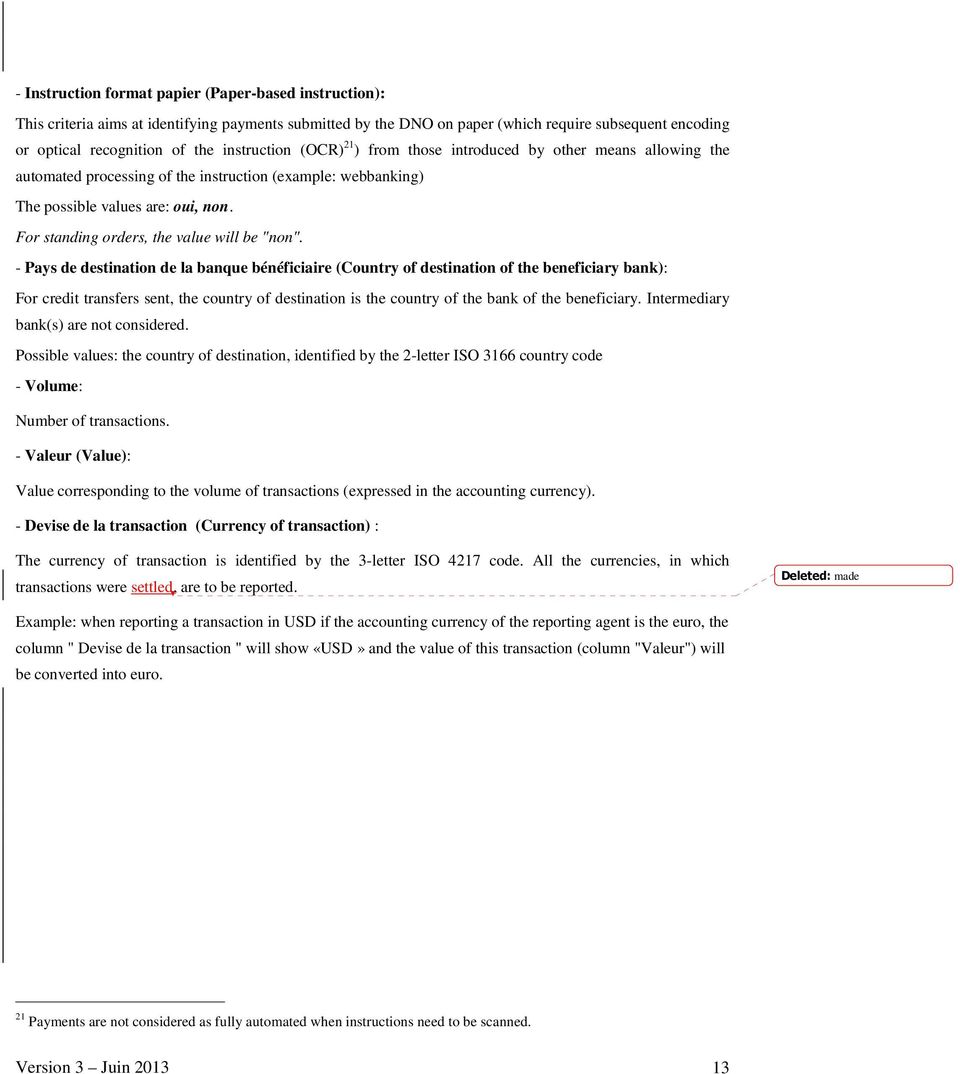
14 Sub-table V : Customer transfers and cash deposits received (payments received by the bank BEN) : Type instrument paiement [Payment instrument type] Customer category [Catégorie client] Canal de règlement [Settlement channel] Pays d émission de la banque donneur d ordre [Sending country of the bank of the ordering party] Volume Valeur Devise de la transaction [Currency of transaction] Virement [credit transfer] Versement [cash deposit] - Credit institution [MFI] - Money Market Funds [MFI] - Other MFIs [MFI] - Non MFI Funds [non-mfi] - Other non MFIs [non-mfi] - Unknown TARGET Euro1 Step1 Step2 EQUENS Cash (pour versements) Relation Nostro / Loro PSP LU Code ISO du pays d émission [ISO code of the sending country] Code ISO devise [currency ISO code] PSP non-lu Autre Definition of the concepts used in the sub-table Sub-table V : Customer transfers and cash deposits received (payments received by the bank BEN): This sub-table is to be reported by institutions acting as BQE BEN. - Definition of the concept of BQE BEN: In the present collection, is considered as BQE BEN the institution which receives a payment, either via a payment system to which it is connected, or via its PSP. O The BQE BEN receives generally a payment for account of his customer, BEN. O In the case of own account operations (example: the bank receives the payment of a rent), the BQE BEN also takes on the BEN's role: DNO-> BQE DNO -> PSP1 -> Règlement : ACH, Nostro/Loro -> PSP2 -> BQE BEN -> [BEN = BQE BEN] The BEN (e.g. the Accounting department of the bank) is a bank which is also the BQE BEN. The bank reports as BQE BEN. - Type d instrument de paiement (Payment instrument type): Possible values for the payment instrument type are «virement» (credit transfer) and «versement» (cash deposit). Version 3 Juin
![[Settlement channel] Pays d émission de la banque donneur d ordre [Sending country of the bank of the ordering party] Volume Valeur Devise de la transaction [Currency of transaction] Virement [credit](/docs-images/45/5242908/images/page_14.jpg "transfer] Versement [cash deposit] - Credit institution [MFI] - Money Market Funds [MFI] - Other MFIs [MFI] - Non MFI Funds [non-mfi] - Other non MFIs [non-mfi] - Unknown TARGET Euro1 Step1 Step2")
15 Cash deposits are customer operations whereby cash is deposited at the counter. Are considered in this collection only : O deposits on accounts of third parties 22 received 23 by the institution (person A makes a deposit on the account of person B) O deposits that are significant for the institution, i.e.value of deposits exceed 5 % of the value of transfers in a regular and long-lasting way. The possible values are : virement, versement. - Catégorie client (Customer category): The customer category informs whether the customer is a Monetary Financial Institution (MFI) or a non- Monetary Financial Institution (non-mfi). The possible values are : Credit Institution, Money Market Funds, Other MFIs, Non-MFI Funds, Other non MFIs, Unknown. For more information regarding each customer category, please refer to the list provided to paragraph 6 The item «Catégorie client» [Customer category] at page 61 of the present document. - Canal de règlement (Settlement channel) BQE BEN indicates the settlement channel, i.e. the system used or the way it received the payment. O For deposits: cash O In case the BQE BEN is connected to a system in the relevant currency: 1. If this settlement system was used to execute the payment, its name will be indicated. The possible values are: TARGET, Euro1, Step1, Step2 24, EQUENS, Autre. 2. If, although the BQE BEN is connected to a settlement system in the considered currency, the execution of the payment was made via a relation of account with the institution sending the payment, the settlement channel to be indicated will be Relation Nostro / Loro. O In case BQE BEN is not connected to a payment system allowing the execution of the payment in this currency: The possible values are: PSP LU, PSP non-lu, according to the convention clarified in the paragraph O Treatment of the on-us transactions: If the bank accounts of the ordering party and the beneficiary are held with the same institution (BQE DNO = BQE BEN), the settlement channel is "On-us". The value will be: on-us. 22 Cash deposits on own account are thus excluded. 23 Cash deposits sent do not exist. 24 Given that XCT is dedicated to disappear in the short term, no distinction SCT and XCT is requested. Version 3 Juin

16 - Le pays d émission de la banque du donneur d ordre (the sending country of the bank of the ordering party): For the transfers it received, the reporting entity provides the identification of the country of the bank of the ordering party. Intermediary bank(s) are not considered. For deposits, the sending country shall be LU Possible value: the sending country, identified by the 2-letter ISO 3166 country code - Volume: Number of transactions. - Valeur (Value): Value corresponding to the volume of transactions (expressed in the accounting currency). - Devise de la transaction (Currency of transaction) : The currency of transaction is identified by the 3-letter ISO 4217 code. All the currencies, in which transactions were settled, are to be reported. Deleted: made Example: when reporting a transaction in USD if the accounting currency of the reporting agent is the euro, the column "Devise de la transaction" will show «USD» and the value of this transaction (column "Valeur") will be converted into euro. Sub-table V 1.1.3: intermediate customer transfers (payments sent and received by the PSP): Type instrument paiement [Payment instrument type] Virement [credit transfer] Type client [Customer type] Banque LU Banque non- LU Canal de règlement [Settlement channel] TARGET Euro1 Step1 Step2 EQUENS Relation Nostro / Loro PSP LU PSP non-lu Autre Sens de l opération [Direction of the operation] Emis Reçu Pays d émission de la banque donneur d ordre [Sending country of the bank of the ordering party] Code ISO du pays d émission [ISO code of the sending country] Pays de destination de la banque bénéficiaire [Country of destination of the beneficiary bank] Code ISO du pays de destination [ISO code of the receiving country] Volume [Volume] Valeur [Value] Devise de la transaction [Currency of transaction] Code ISO devise [currency ISO code] Deleted: N/A Deleted: N/A Definition of the concepts used in Sub-table V 1.1.3: intermediate customer transfers (payments sent and received by the PSP): This sub-table is to be reported by the institution acting as PSP. Version 3 Juin

17 - Definition of the concept of PSP: In the present collection, is considered as PSP an institution acting as intermediary for the BQE DNO or the BQE BEN. The PSP is not necessarily a bank 25 and executes payment instructions in a system for the account either of bank DNO in the case of credit transfers sent or bank BEN in the case of credit transfers received. - Type d instrument de paiement (Payment instrument type): The type of payment instrument to be mentioned in this sub-table is the credit transfer. The only possible value is thus: virement. - Type client (Customer type): The customer type identifies whether intermediation is for the account of Luxemburgish banks and non- Luxemburgish banks. The PSP will thus indicate regarding the "Type de client ": BQE LU or BQE non-lu. N.B.: in case of settlement via relation of account nostro / loro: when the PSP acts at the same time for the sending side and for the receiving side (PSP1 or PSP2), data regarding both transactions need to be sent, that is the transaction sent ( transaction side = émis ) and the transaction received ( transaction side = reçu ) and the type client (customer type) will be specified ( BQE LU or BQE non-lu ). This categorization is different from the catégorie client. The possible values are: Banque LU or Banque non-lu - Canal de règlement (Settlement channel): The settlement channel indicates the system or the method used to settle the payment. O In case the PSP is connected to the payment system enabling the settlement of the payment in this currency: 1) If this settlement system was used to execute the payment, its name will be indicated. The possible values are: TARGET, Euro1, Step1, Step2 26, EQUENS, Autre. Deleted: does not know if it Deleted: or Deleted:. Hence it might be difficult to identify the country of origin of the bank. In conclusion, when intermediate credit transfers are settled via nostro / loro accounts, by convention the "Type client" will be "N/A". Deleted:, Deleted:, N/A. 2) If, although the PSP is connected to a settlement system in the considered currency, the execution of the payment was done via a relation of account, the settlement channel to be mentioned will be Relation Nostro / Loro. O In case the PSP is not connected to a settlement system enabling the execution of the payment in this currency: The possible values are: PSP LU, PSP non-lu. According to the convention clarified in the paragraph The «sens de l opération» (direction of the operation) applies only to sub-tables on intermediate credit transfers. It allows to distinguish credit transfers sent from credit transfers received in systems and to measure the activity of PSPs in these systems. - The pays d émission / de réception (= Sending country / Country of destination) informs about the country of the bank of the ordering party sending the payment instruction in the case of a credit transfer received, 25 Example : payment institution 26 Given that XCT is dedicated to disappear in the short term, no distinction SCT and XCT is requested. Deleted: The possible values are "émis", "reçu" or "N/A". The directions «émis» (sent) and «reçu» (received) are to be only specified when the settlement takes place in a system. In case the payment is settled via Nostro / Loro accounts, the direction of the operation can not be easily determined by the PSP, the value will be N/A. Version 3 Juin

18 respectively about the country of the beneficiary bank in the case of a credit transfer sent. Intermediary bank(s) are not considered. Possible value: the sending country, respectively the receiving country, identified by the 2-letter ISO 3166 code - Volume: Number of transactions. - Valeur (Value): Value corresponding to the volume of transactions (expressed in the accounting currency). - Devise de la transaction (Currency of transaction) : The currency of transaction is identified by the 3-letter ISO 4217 code. All the currencies, in which transactions were settled, are to be reported. Deleted: made Example: when reporting a transaction in USD if the accounting currency of the reporting agent is the euro, the column "Devise de la transaction" will show «USD» and the value of this transaction (column "Valeur") will be converted into euro. Sub table V : R-transactions related to SCT sent (reporting as BQE DNO or Originator bank) : Type R- transaction Return Recall Catégorie client [Customer category] - Credit institution [MFI] - Money Market Funds [MFI] - Other MFIs [MFI] - Non MFI Funds [non-mfi] - Other non MFIs [non-mfi] - Unknown Canal derèglement [Settlement channel] TARGET Euro1 Step1 Step2 EQUENS On-us Relation Nostro / Loro PSP LU PSP non-lu Autre (*) of the initial SCT and not of the R-transaction. Pays de destination de la banque bénéfiiaire [Country of destination of the beneficiary bank] (*) Code ISO du pays de destination [ISO code of the receiving country] Volume Valeur [Value] Devise de la transaction [Currency of transaction] Code ISO devise [Currency ISO code] Remark : reporting agents will send data regarding R-transactions that are settled via the settlement channel «on-us» only if they are able to. Definition of the concepts used in sub-table V1.1.4 R-transactions related to SCT sent: - Type R-transaction: The types of R-transaction to be mentioned in this sub-table are Return as well as Recall transactions. Version 3 Juin

19 The possible values are: return or recall. For further details regarding r-transactions (definitions, scope, messages flows), please refer to the following paragraphs of the present document : 7 R-transactions - Definitions (page 67) 8 R- transactions Scope of the reporting (page 69) 9 SEPA transactions and R-transactions Description of the payment flows and the message flows (page 70) - Catégorie client [Customer category]: The customer category informs whether the customer is a Monetary Financial Institution (MFI) or a non- Monetary Financial Institution (non-mfi). The possible values are : Credit Institution, Money Market Funds, Other MFIs, Non-MFI Funds, Other non MFIs, Unknown. For more information regarding each customer category, please refer to the list provided to paragraph 6 The item «Catégorie client» [Customer category] at page 61 of the present document. - Canal de règlement [Settlement channel]: The settlement channel indicates the system or the mode used for the settlement of the initial credit transfer. - Le pays de destination de la BQE BEN [Country of destination of the beneficiary bank] informs on the country of the beneficiary bank of the initial credit transfer. The possible values are : the receiving country, identified by the 2-letter ISO 3166 country code. - Volume : Nombre of transactions - Valeur [Value] : Value corresponding to the volume of transactions (expressed in the accounting currency). - Devise de la transaction [Currency of transactions]: The currency of transaction is identified by the 3-letter ISO 4217 code. All the currencies, in which transactions were settled, are to be reported. Formatted: norm Version 3 Juin
![transactions Scope of the reporting (page 69) 9 SEPA transactions and R-transactions Description of the payment flows and the message flows (page 70) - Catégorie client [Customer category]: The](/docs-images/45/5242908/images/page_19.jpg "customer category informs whether the customer is a Monetary Financial Institution (MFI) or a non- Monetary Financial Institution (non-mfi).")
20 Sub-table V : R-transactions related to SCT received (reporting as BQE BEN or Beneficiary Bank) : Type R- transaction Catégorie client [Customer category] Canal de règlement [Settlement channel] Pays d émission de la BQE DNO (*) [Sending country of the bank of the ordering country] Volume Valeur [Value] Devise de la transaction [Currency of transaction] Return Recall - Credit institution [MFI] - Money Market Funds [MFI] - Other MFIs [MFI] - Non MFI Funds [non-mfi] TARGET Euro1 Step1 Step2 EQUENS On-us Code ISO du pays d émission [ISO code of the sending country] Code ISO devise [Currency ISO code] - Other non MFIs [non-mfi] - Unknown Relation Nostro / Loro PSP LU PSP non-lu Autre (*) of the initial SCT and not of the R-transaction. Remarks : - Reporting agents will send data regarding R-transactions that are settled via the settlement channel «onus» only if they are able to. - Are excluded of the reporting the camt.029 messages generated in case of a «negative answer to a recall message» - Messages generated by the CSM 27 to the Originator Bank are also excluded (example : pacs.002 mesages). - In the SCT model, there are not any Reject transactions initiated by the Beneficiary Bank to the Originator Bank. Definition of the concepts used in the sub-table V1.1.5 R-transactions related to SCT received: - Type de R-transaction: The types of R-transaction to be mentioned in this sub-table are Return as well as Recall transactions. The possible values are: return or recall. For further details regarding r-transactions (definitions, scope, messages flows), please refer to the following paragraphs of the present document : 7 R-transactions - Definitions (page 67) 8 R- transactions Scope of the reporting (page 69) 9 SEPA transactions and R-transactions Description of the payment flows and the message flows (page 70) - Catégorie client [Customer category]: 27 CSM = Clearing and Settlement Mechanism Version 3 Juin
![émission de la BQE DNO (*) [Sending country of the bank of the ordering country] Volume Valeur [Value] Devise de la transaction [Currency of transaction] Return Recall - Credit institution [MFI] -](/docs-images/45/5242908/images/page_20.jpg "Money Market Funds [MFI] - Other MFIs [MFI] - Non MFI Funds [non-mfi] TARGET Euro1 Step1 Step2 EQUENS On-us Code ISO du pays d émission [ISO code of the sending country] Code ISO devise [Currency ISO")
21 The customer category informs whether the customer is a Monetary Financial Institution (MFI) or a non- Monetary Financial Institution (non-mfi). The possible values are : Credit Institution, Money Market Funds, Other MFIs, Non-MFI Funds, Other non MFIs, Unknown. For more information regarding each customer category, please refer to the list provided to paragraph 6 The item «Catégorie client» [Customer category] at page 61 of the present document. - Canal de règlement [Settlement channel]: The settlement channel indicates the system or the mode used for the settlement of the initial credit transfer. - Le pays d émission de la BQE DNO [Sending country of the BQE DNO] informs on the country of the BQE DNO of the initial credit transfer. The possible values are : the sending country, identified by the 2-letter ISO 3166 country code. - Volume : Nombre of transactions - Valeur [Value] : Value corresponding to the volume of transactions (expressed in the accounting currency). - Devise de la transaction [Currency of transactions]: The currency of transaction is identified by the 3-letter ISO 4217 code. All the currencies, in which transactions were settled, are to be reported Table V1.2 : Virements interbancaires (Interbank transfers) An interbank credit transfer is a credit transfer where the ordering party and the beneficiary are banks. In order to have a homogeneous collection, the collection of the interbank credit transfers is based on messages SWIFT MT2xx 28, with the exception of MT202COV. Interbank payments (foreign-exchange transactions, treasury operations, documentary credits, dealing room operations) executed via SWIFT MT2xx messages are included in the collection. However a SWIFT MT2xx message does not mean de facto that the credit transfer is an interbank transfer. Indeed, a SWIFT MT2xx message where the DNO and\or BEN are not banks must be reported as a customer transfer. Investment funds transfers using SWIFT MT2xx messages are hence to be reported as customer transfers. Transfers corresponding to the netting of the operations realized in CLS are to be to be reported as interbank credit transfers. 28 Institutions not using the messaging system Swift will choose, in coordination with the BCL, an equivalent criterion. Version 3 Juin
22 MT204 (Financial Markets Direct Debit Message) are to be considered as direct debits 29, whatever their nature: foreign-exchange transactions, treasury operations, documentary credits, dealing room operations. Similarly to customer transfers, three perspectives are considered for the interbank credit transfers: BQE DNO, BQE BEN, intermediary bank. In the present collection, for own account operations, we consider that the concerned institution has either both the roles of DNO and BQE DNO or both the roles of BEN and BQE BEN. Sub-table V1.2.1 : Interbank transfers sent payments sent by the bank DNO) Type instrument paiement [Payment instrument type] Canal de règlement [Settlement channel] Pays de destination de la banque bénéficiaire [Country of destination of the beneficiary bank] Volume Valeur Devise de la transaction [Currency of transaction] Virement TARGET Euro1 Step1 Code ISO du pays de destination [ISO code of the receiving country] Code ISO de la devise [currency ISO code] EQUENS Relation Nostro / Loro PSP LU PSP non-lu Autre Definition of the concepts used in Sub-table V1.2.1 : Interbank transfers sent payments sent by the bank DNO) This sub-table is to be reported by the reporting agents acting as «banque DNO». - Definition of the concept of «Banque DNO» (BQE DNO): In the present collection, is considered as BQE DNO the institution which sends payment instructions in a system or which, where necessary, sends them to its PSP for execution. - Type d instrument de paiement (Payment instrument type): The payment instrument type to be mentioned in this sub-table is the credit transfer. The only possible value is thus: virement. - Settlement channel: The settlement channel indicates the system or the mode used by the BQE DNO to settle the payment. O In case of connection to a payment system allowing the execution of the payment in this currency: 1) If the BQE DNO uses this system to execute the payment, its name will be indicated. The possible values are: TARGET, Euro1, Step1, EQUENS, Autre. 29 Interbank direct debits have to be reported in the sub-table V1.3.1 Legacy direct debits Version 3 Juin
23 2) If the BQE DNO, although connected to this settlement system, opts rather for the execution of the payment in his books because of the existence of a relation of account with the institution of the beneficiary of the payment, the settlement channel to be indicated will be Relation Nostro / Loro. O In case of non-connection to a payment system allowing the execution of the payment in this currency: The BQE DNO uses an intermediary for the execution of the payment or the settlement is made in its books via a relation of account nostro / loro with the bank of the beneficiary: the settlement channel to be mentioned will always be "PSP". We differentiate between the transactions processed by correspondents established in Luxembourg (PSP LU) and those established abroad (PSP non-lu). The possible values are thus: PSP LU, PSP non-lu. - Pays de destination de la banque bénéficiaire (Country of destination of the bank of the beneficiary): For credit transfers sent, the country of destination is the country of the bank of the beneficiary. Intermediary bank(s) are not considered. Possible values: the country of destination, identified by the 2-letter ISO 3166 country code - Volume: Number of transactions. - Valeur (Value): Value corresponding to the volume of transactions (expressed in the accounting currency). - Devise de la transaction (Currency of transaction) : The currency of transaction is identified by the 3-letter ISO 4217 code. All the currencies, in which transactions were settled, are to be reported. Deleted: made Example: when reporting a transaction in USD if the accounting currency of the reporting agent is the euro, the column "Devise de la transaction " will show «USD» and the value of this transaction (column "Valeur") will be converted into euro. Sous tableau V : Interbank transfers received (payments received by BQE BEN): Type instrument paiement [Payment instrument type] Canal de règlement [Settlement channel] Pays d émission de la banque donneur d ordre [Sending country of the bank of the ordering party] Volume Valeur Devise de la transaction [Currency of transaction] Deleted: Virement TARGET Euro1 Step1 EQUENS Relation Nostro / Loro Code ISO du pays d émission [ISO code of the sending country] Code ISO de la devise [currency ISO code] PSP LU PSP non-lu Autre Version 3 Juin
24 Definition of the concepts used in Sous tableau V : Interbank transfers received (payments received by BQE BEN): This sub-table is to be reported by the institution acting as «BQE BEN». - Definition of the concept of «BQE BEN»: In the present collection, is considered as BQE BEN the institution which receives a payment, either directly via a payment system in which it is connected, or via its PSP. The type of currency to be mentioned in this sub-table is the credit transfer. The only possible value is thus: virement. - Canal de règlement (Settlement channel): BQE BEN indicates the settlement channel, i.e. the system used or the mode it received the payment. O In case of connection to the payment system used by the issuing bank to execute the payment or (in the nostro / loro) in case of connection to a settlement system allowing the execution of the payment in this currency: 1) When applicable, the name of the settlement system used to execute the payment will be indicated. The possible values are: TARGET, Euro1, Step1, EQUENS, Autre. 2) If, although the BQE BEN is connected to a settlement system in the considered currency, the execution of the payment was made via a relation of account with the institution issuing of the payment, the settlement channel to be mentioned will be Relation Nostro / Loro. O In case of non-connection to a payment system allowing the execution of the payment in this currency: The BQE DNO uses an intermediary for the execution of the payment or the settlement is made in its books via a relation of account nostro / loro with the bank of the beneficiary: the settlement channel to be mentioned will always be "PSP". We differentiate between the transactions processed by correspondents established in Luxembourg (PSP LU) and those established abroad (PSP non-lu). The possible values are thus: PSP LU, PSP non-lu. - Le pays d émission de la banque du donneur d ordre (The sending country of the bank of the ordering party) : For credit transfers received, the sending country is the country of the bank of the ordering party. Intermediary bank(s) are not considered. Possible values: the sending country, identified by the 2-letter ISO 3166 country code - Volume: Number of transactions. Version 3 Juin
25 - Valeur (Value): Value corresponding to the volume of transactions (expressed in the accounting currency). - Devise de la transaction (Currency of transaction) : The currency of transaction is identified by the 3-letter ISO 4217 code. All the currencies, in which transactions were settled, are to be reported. Deleted: made Example: when reporting a transaction in USD if the accounting currency of the reporting agent is the euro, the column "Devise de la transaction " will show «USD» and the value of this transaction (column "Valeur") will be converted into euro. Sub-table V1.2.3 : Intermediated interbank transfers (payments sent and received by the PSP) Type instrument paiement [Payment instrument type] Virement Type client [Customer type] Banque LU Banque non-lu/ Canal de règlement [Settlement channel] TARGET Euro1 Step1 EQUENS Relation Nostro / Loro PSP LU PSP non-lu Autre Sens de l opération [Direction of the operation] Emis Reçu Pays d émission de la banque donneur d ordre [Sending country of the bank of the principle] Code ISO du pays d émission [ISO code of the sending country Pays de destination de la banque bénéficiaire [Country of destination of the beneficiary bank] Code ISO du pays de destination [ISO code of the receiving country] Volume Valeur [value] Devise de la transaction [Currency of transaction] Code ISO devise [currency ISO code] Deleted: N/A Deleted: N/A Definition of the concepts used in Sub-table V1.2.3 : Intermediated interbank transfers (payments sent and received by the PSP) This sub-table is to be mentioned by the institutions acting as PSP. - Definition of the concept of PSP: In the present collection, is considered as PSP an intermediary institution of the BQE DNO or the BQE BEN, which is not necessarily a bank 30 and which executes instructions of payments in a system, this for the account either of a bank DNO in the case of credit transfer sent or of a bank BEN in the case of a transfer received. - Type d instrument de paiement (Type of payment instrument): 30 Example: paiement institution. Version 3 Juin
26 The payment instrument type to be indicated in this sub-table is the credit transfer. The only possible value is thus: virement. - Type client (Customer type): The customer type measures the intermediation for Luxemburgish banks and non-luxemburgish banks. The PSP will thus indicate regarding the "Type de client ": BQE LU or BQE non-lu. N.B.: in case of settlement via relation of nostro / loro account: when the PSP is at the same time on the sending side and on the receiving side (PSP1 or PSP2), both transactions have to be reported, that is the transaction sent ( sens de l opération = émis ) and the transaction reveived ( sens de l opération = reçu ). It will also be précised if the Type client is BQE LU or BQE non-lu. The possible values are: Banque LU or Banque non-lu - Canal de règlement (Settlement channel): The settlement channel indicates the system or the method used to settle the payment. O In case the PSP is connected to a payment system allowing the execution of the payment in this currency: Deleted: does not know if it is the sending side or the receiving side Deleted:. Deleted: There it might be difficult to indicate if the customer type is BQE LU or BQE non-lu. In conclusion, when intermediated credit transfers are settled via relation of account nostro / loro, by convention, the value "N/A" will apply for "Type client ". Deleted:, N/A. 1) If the PSP uses this payment system to execute the payment, its name will be indicated. The possible values are: TARGET, Euro1, Step1, EQUENS, Autre. 2) If, although the PSP is connected to a payment system in the considered currency, the execution of the payment was made via a relation of account, the settlement channel to be mentioned will be Relation Nostro / Loro. O In case the PSP is not connected to a payment system allowing the execution of the payment in this currency: The possible values are: PSP LU or PSP non-lu, according to the convention clarified in paragraph The «sens de l opération» (direction of the operation) applies only to sub-tables on intermediate credit transfers. It allows to distinguish credit transfers sent from credit transfers received in the systems and to measure the activity of PSPs in these systems. The possible values are "émis " or "reçu". - The pays d émission / de réception (= Sending country / Country of destination) informs about the country of the bank of the ordering party sending the payment instruction in the case of a credit transfer received, respectively about the country of the beneficiary bank in the case of a credit transfer sent. Intermediary bank(s) are not considered. Possible value: the sending country, the country of destination, identified by the 2-letter ISO 3166 country code - Volume: Deleted: or "N/A" Deleted: The directions «émis» (sent) and «reçu» (received) are to be only specified when the settlement takes place in a system. In case the payment is settled via Nostro / Loro accounts, the direction of the operation can not be easily determined by the PSP, the value will be N/A. Number of transactions. Version 3 Juin
27 - Valeur (Value): Value corresponding to the volume of transactions (expressed in the accounting currency). - Devise de la transaction (Currency of transaction) : The currency of transaction is identified by the 3-letter ISO 4217 code. All the currencies, in which transactions were settled, are to be reported. Deleted: made Example: when reporting a transaction in USD if the accounting currency of the reporting agent is the euro, the column "Devise de la transaction" will show «USD» and the value of this transaction (column "Valeur") will be converted into euro. Version 3 Juin
28 4.3 Table V1.3 Domiciliations (Direct debits) - A direct debit is a transfer submitted by the creditor to the debtor as a request to debit its account. - Two types of direct debits exist; the legacy direct debit (sub-table V1.3.1) and the SEPA direct debit (subtables V1.3.3 and V1.3.5). The flows of information are different in these two types of direct debits. O In the legacy direct debits, the creditor bank is not involved in the flow of information 31, only the debtor bank reports the direct debit. The reporting of the legacy direct debits does not cover R-type operations 32. Deleted: will In the legacy direct debits, net debit requests will be reported, i.e. the request of debit which the debtor bank can process (collection that could be honored). The refusals are thus not included. O In the SEPA direct debits (SDD), the flow of goes through the creditor bank. In the SDD, both banks submit a reporting (as debtor bank and as creditor bank), respectively in the sub-table Domiciliations SEPA-Banque du débiteur and in the sub-table Domiciliations SEPA-Banque du créditeur. In the SDD, gross debit requests are collected. The reporting of SDD transactions covers R-type operations. - Interbank direct debits also are included in the table of the legacy direct debits and are collected based on SWIFT MT 204 messages. - The settlement of payment card balances: in case the distinction can be made between a traditional debit request and the settlement of payment card balances, the latter is reported separately in the dedicated sub-table V In case this distinction cannot be made, the operation corresponding to the payment of payment card balances is thus included in the sub-table V1.3.1 dedicated to the legacy directs debits or in the sub-table V1.3.3 dedicated to SDD. Deleted: will Deleted: - At present, SDD is not significant enough for inclusion in this monthly collection. An annual survey will be conducted to determine the volume and value of the SEPA direct debits (including R type operations). As soon as SDD volume will be significant enough, meetings will be organized with banks to determine the modalities of reporting of this instrument in the monthly collection. Credit cards for which the settlement is made by a traditional debit request 33 is to be indicated in the sub-table V1.3.1 or in the sub-table V1.3.3 dedicated to SDD 31 For the bank of the creditor, it is an incoming payment, without the possibility to identify that it is a direct debit. 32 Operation of R-type or R-transaction = Refund, Reject etc In the legacy model of direct debits, it is difficult for banks to provide data on operations of R-type. 33 Example: AMEX, Diners. Version 3 Juin
29 4.3.1 Sub-table V1.3.1 «Domiciliations legacy» (legacy direct debits) Type instrument paiement [Payment instrument type] Canal de transmission [Transmission channel] Canal de règlement [Settlement channel] Volume Valeur [Value] Devise de la transaction [Currency of transaction] Demandes de débit (debit request) DOM Bilateral Interbank direct debits TARGET, Euro1, Step1, Step 2, On-us, Relation Nostro/Loro, PSP LU, PSP non- LU, Autre Code ISO de la devise [currency ISO code] Autre Sub-table V1.3.2 Règlement du solde des cartes de paiement (Settlement of payment card balances) Type instrument paiement (Payment instrument type) Canal de transmission (Transmission channel) Canal de règlement (Settlement channel) Volume Valeur (Value) Devise de la transaction (Currency of transaction) Règlement de solde carte N/A On-us Code ISO de la devise (Settlement of payment card balances) Autre [currency ISO code] Sub table V : SEPA Direct Debit transactions (reporting as Debtor bank) Type Instrument de paiement [Payment instrument type] Demande de débit Catégorie client [customer category] - Credit institution [MFI] - Money Market Funds [MFI] - Other MFIs [MFI] - Non MFI Funds [non-mfi] - Other non MFIs [non-mfi] - Unknown Schema SDD [SDD scheme] Core B2B Canal de règlement [Settlement channel] TARGET Euro1 STEP1 STEP2 EQUENS on-us Relation Nostro/ Loro PSP LU PSP non-lu Autre Pays de la banque du créancier [Country of the creditor s bank] Volume Valeur [Value] Devise de la transaction [currency of transaction] Code ISO de la devise [currency ISO code] Remark: debit requests relating to the settlement of credit cards balances for which the reporting agent is not the issuer nor the distributor (ex : AMEX) have to be reported in this sub-table. The reporting agent is indeed not able to identify them as the settlement of credit cards balances. Version 3 Juin
30 4.3.4 Sub-table V :R-transactions SEPA Direct Debit (reporting as Debtor bank) Type R- transaction Reject Return Reversal Refund Request for cancellation Catégorie client [customer category] - Credit institution [MFI] - Money Market Funds [MFI] - Other MFIs [MFI] - Non MFI Funds [non- MFI] - Other non MFIs [non- MFI] - Unknown Schema SDD [SDD scheme] Core B2B Canal de règlement [Settlement channel] TARGET Euro1 STEP1 STEP2 EQUENS on-us Relation Nostro/ Loro PSP LU PSP non-lu Autre Pays de la banque du créancier [Country of the creditor bank] Volume Valeur [Value] Devise de la transaction [currency of transaction] Code ISO de la devise [currency ISO code] Sub table V 1.3.5: SEPA Direct Debits transactions (reporting as Creditor bank) Type Instrument de paiement [Payment instrument type] Debit request Catégorie client [customer category] - Credit institution [MFI] - Money Market Funds [MFI] - Other MFIs [MFI] - Non MFI Funds [non- MFI] - Other non MFIs [non- MFI] - Unknown Schema SDD [SDD scheme] Core B2B Canal de règlement [Settlement channel] TARGET Euro1 STEP1 STEP2 EQUENS on-us Relation Nostro/ Loro PSP LU PSP non-lu Autre Pays de la banque du débiteur [Country of the debitor bank] On-us transactions : reporting agents report on-us transactions only if they are able to do so. Volume Valeur [Value] Devise de la transaction [currency of transaction] Code ISO de la devise [currency ISO code] Version 3 Juin
31 4.3.6 Sous tableau V 1.3.6: R-transactions - SEPA Direct Debits (reporting as creditor bank) Type R- transaction Catégorie client [customer category] Schema SDD [SDD scheme] Canal de règlement [Settlement channel] Pays de la banque du débiteur [Country of the debitor bank] Volume Valeur [Value] Devise de la transaction [currency of transaction] Reject (*), Return Reversal, Refund Request for cancellation - Credit institution [MFI] - Money Market Funds [MFI] - Other MFIs [MFI] - Non MFI Funds [non- MFI] Core B2B TARGET Euro1 STEP1 STEP2 EQUENS on-us Relation Nostro/ Loro Code ISO de la devise [currency ISO code] - Other non MFIs [non- MFI] - Unknown PSP LU PSP non-lu Autre (*) The pacs. 002 messages generated by the CSM to the Creditor Bank are excluded from the reporting. On-us transactions : reporting agents report on-us transactions only if they are able to do so. Definition of the concepts used in the sub-tables relating to direct debits : Le type d instrument de paiement (payment instrument type): Deleted: «Domiciliations legacy» and «Settlement of payment card balances» This column concerns the sub-tables V1.3.1, V1.3.2, V1.3.3 and V1.3.5 only. The possible values : - Sub-table V1.3.1 : (Net) debit request - Sub-table V1.3.2 : Settlement of payment card balances - Sub-table V1.3.3: Debit request - Sub-table V1.3.5: Debit request - Type de R-transaction: This column concerns only the sub-tables V1.3.4 and V The possible values are: Reject, Return, Reversal, Refund or Request for cancellation. For further details regarding r-transactions (definitions, scope, messages flows), please refer to the following paragraphs of the present document : 7 R-transactions - Definitions (page 67) 8 R- transactions Scope of the reporting (page 69) 9 SEPA transactions and R-transactions Description of the payment flows and the message flows (page 70) Version 3 Juin
32 - Catégorie client [Customer category]: The customer category informs whether the customer is a Monetary Financial Institution (MFI) or a non- Monetary Financial Institution (non-mfi). The possible values are : Credit Institution, Money Market Funds, Other MFIs, Non-MFI Funds, Other non MFIs, Unknown. For more information regarding each customer category, please refer to the list provided to paragraph 6 The item «Catégorie client» [Customer category] at page 61 of the present document. - Schéma SDD [SDD scheme]: This column concerns SEPA direct debits only (sub-tables V1.3.3 to V1.3.6). It indicates the SDD scheme, in accordance with EPC rules. - The transmission channel informs on the channel used to send the payment instructions. It is not a settlement system. This column concerns the sub-tables V1.3.1 and V The possible values: - Sub-table V1.3.1: legacy direct debits: the possible values are "DOM" (in case of direct debits managed by the CETREL DOM application), Bilatéral (in case of bilateral relation between the creditor and the the debtor bank), Domiciliation interbancaire (in case of a MT204) or Autre ("Other") (case of on-us transactions or operations of nostro / loro account). Deleted: and as well - Sub-table V1.3.2: settlement of payment card balances: the amount of payment card balances to be settled is supplied by the technical operator to the reporting agent. The value to be mentioned is: N/A. The settlement channel is the system or the execution method the institution uses to settle payments. O If the institution uses a payment system, its name will be indicated (ex: Step2). O If both bank accounts are held within the same institution, the settlement channel to be mentioned is "Onus". Only on-us payments sent are to be reported. In case the BQE DNO and the BQE BEN are different and in the absence of a settlement system or ACH, the settlement channel is «Relation nostro / loro». O Banks using a correspondent bank will indicate "PSP". We differentiate between transactions treated by correspondents established in Luxembourg (PSP LU) and those established abroad (PSP non-lu). The possible values: - Sub-table V1.3.1 "Domiciliations legacy ": the possible values are TARGET, Euro1, Step1, Step2, On-us, PSP LU, PSP non-lu, Autre, Relation Nostro / Loro. Deleted: 2 Deleted: 34 Version 3 Juin
33 - Sub-table V1.3.2 "Règlement du solde des cartes de paiement" (settlement of payment card balances): the collection is made in most cases via an "on-us transaction" from the holder s account with the issuing bank. Value to use: on-us. - Sub-table V1.3.3 à V1.3.6: the possible values are Target, Euro1, Step1, Step2, Equens, on-us, PSP LU, PSP non-lu, Relation Nostro/Loro and Autre. - Country of the creditor bank / Country of the debitor bank: these columns concern the SEPA direct debits only (sub-tables V1.3.3 to VV1.3.6). They indicate the country of the creditor bank that has issued an SDD payment instruction, respectively the country of the debtor bank that has received an SDD payment instruction. - Volume: Number of transactions. - Valeur (Value): Value corresponding to the volume of transactions (expressed in the accounting currency). - Devise de la transaction (Currency of transaction) : The currency of transaction is identified by the 3-letter ISO 4217 code. All the currencies, in which transactions were made, are to be reported. Example: when reporting a transaction in USD if the accounting currency of the reporting agent is the euro, the column "Devise de la transaction " will show «USD» and the value of this transaction (column "Valeur") will be converted into euro. Version 3 Juin
34 4.4 Table V1.4 : Stock taking of payment cards and terminals accepting payment cards Sub-table V1.4.1 : Stock taking of payment cards sent Card issuing activity / Card distribution activity Type of payment instrument Scheme Volume customers 35 Volume third parties 36 Country 37 ISSUING DISTRIBUTION Debit cards Credit cards Mixed cards (debit + credit) Prepayed cards (linked to a card scheme) Debit cards Credit cards Mixed cards (debit + credit) Prepayed cards (linked to a card scheme) Maestro Vpay China UnionPay Autre Visa Mastercard Diner s Club American Express JCB 38 China UnionPay Autre Visa Mastercard Autre Visa Mastercard China UnionPay Autre Maestro Vpay China UnionPay Autre Visa Mastercard Diner s Club American Express JCB China UnionPay Autre Visa Mastercard Autre Visa Mastercard China UnionPay Autre N/A N/A N/A N/A 35 Card issuing activity: the volume refers the number of cards issued to the customers of the issuing entity of these cards. Card distribution activity: The volume refers to the number of cards distributed to the customers of the distributing entity of these cards. 36 Card issuing activity: the volume refers to the number of cards issued to the customers of third parties (ex: distributeurs). Card distribution activity: N/A 37 Card issuing activity: the country refers to the country of the distributor (third parties). Card distribution activity : the country refers to the country of the issuer. 38 JCB = Japan Credit Bureau Version 3 Juin
35 - This table consists of an inventory of the payment cards in circulation: debit cards, credit cards, mixed cards, prepaid cards. A distinction is made between card issuing activity and card distribution activity. - A «carte active» (active card) is a card allowing making payment transactions and respecting the following criteria: the card is not expired, the contract bound to the card was not cancelled and the card was not permanently blocked. - Card issuer / card issuing activity (card issuing bank): We consider as a card issuer the entity that issues payment cards on the basis either of its own license 39 the basis of a co-owned license. or on The issuer provides cards to its direct customers or to customers of other banks (cardholder banks) that outsource their card issuing activity. The column volume client informs on the number of cards issued to the own customers of the reporting agent wherease the column volume parties tierces informs on the number of cards issued to the customers of other banks as well as the country where these banks are located (column country ). The issuer is the entity that covers the financial risk linked to the issued cards. - Card distributor (card distribution activity (cardholder bank): We consider as a card distributor / cardholder bank the entity that provides payment cards to its customers without being the issuer of these cards, this activity being outsourced to an issuing bank. The column volume clients informs on the number of cards distributed to its own customers. The reporting agents indicates in the column country the country of the card issuer. - The «type d instrument de paiement» (payment instrument type) is: debit card, credit card, mixed card or prepaid card (when linked to a card scheme). - The «schéma» (scheme) indicates the card scheme: maestro, Vpay, Visa, Mastercard, Diners Club, American Express, JCB, China UnionPay, Autre - The volume is a quantitative indicator on the number of cards in circulation: O The volume for customers indicates the number of active cards issued or distributed for the customers of the reporting agent. O The volume for third parties indicates the number of active cards issued for the customers of third parties. - The country refers to: o Regarding the card issuing activity (upper part of the table): the country of the third party or distributor o Regarding the card distribution activity (lower part of the table): the country of card issuer. The country is identified by the 2-letter ISO 3166 country code. 39 The present collection concerns the activity relating to all issuing licences including licences that relates to card issuing activity abroad. Deleted: activité relative à toutes les licences d émission doit être renseignée, y compris celles permettant l émission de cartes à l étranger. Version 3 Juin
36 - The float (this column applies to prepaid cards only) indicates the value in circulation, in the accounting currency, at the end of the reporting period. Deleted: ( Deleted: ) - Carte de débit (Debit card): payment card allowing the immediate debit fom the current account of payment transactions or cash withdrawals. - Carte de crédit (credit card): Payment card allowing a postponed debit transactions from the current account. The granted credit can be completely settled at the end of specific period or partially, the balance being considered as an extension of credit, giving rise to debit interest. The distinction between a credit card and a deferred debit card depends on the contractual agreement which grants a credit line and authorizes an extension of credit. - Carte mixte (Mixed card): Card carrying both the features of debit and credit cards. - Carte prépayée (prepaid card): Reloadable payment card. The transactions of payment and the cash withdrawals are debited immeditaley and without delay from the balance on the card. Only prepaid cards affiliated to a card scheme are considered here. Prepaid gift cards that can be used within the issuing company only, are excluded from the collection Sub-table V1.4.2 Fundings and withdrawals on prepaid cards Type d instrument de paiement (Type of payment instrument) Cartes prépayées (affiliées à un schéma de carte) (Prepaid cards affiliated to a card scheme) Schéma ou support (Scheme) Visa / Mastercard / China UnionPay / Autre Type d opération (Operation type) Chargement Déchargement Volume Volume Valeur Value Devise de la transaction (Currency of transaction) - This table lists the operations of funding and withdrawal on prepaid cards affiliated to a card scheme. - The «type d instrument de paiement» (type of payment instrument) is: prepaid cards (affiliated to a card scheme) - The «schéma» (scheme) indicates the name of the card scheme: Visa, Mastercard, China UnionPay, Autre. - The «type d opération» (operation type) for prepaid cards is «chargement» (funding) or «déchargement» (withdrawal). - «Opération de chargement/déchargement» (Funding / withdrawal operation) on a prepaid card: transfer of monetary value which consists in a deposit, respectively in a withdrawal on the prepaid card. - Volume: Number of transactions. - Valeur (Value): Value corresponding to the volume of transactions (expressed in the accounting currency). Version 3 Juin
37 - Devise de la transaction (Currency of transaction) : The currency of transaction is identified by the 3-letter ISO 4217 code. All the currencies, in which transactions were made, are to be reported. Example: when reporting a transaction in USD if the accounting currency of the reporting agent is the euro, the column "Devise de la transaction" will show «USD» and the value of this transaction (column "Valeur") will be converted into euro Sub-table V1.4.3 : Nombre de terminaux acceptant des cartes de paiement (Number of terminals accepting payment cards) Type de terminal [Terminal type] Type instrument de paiement (Payment instrument type) Volume Code pays (ISO) (Country code (ISO)) Terminal de paiement [POS] 40 Carte de paiement (payment card) Code ISO du pays du commerçant (ISO code of merchant s country) Terminal de retrait [ATM/GAB 41 ] Carte de paiement (payment card) Code ISO du pays d installation (ISO code of countries of location) Terminal de chargement [loading terminal] Carte prépayée (prepaid card) Code ISO du pays d installation (ISO code of countries of location) - This table reflects the stock of terminals (POS, ATM, loading terminals) belonging to the reporting agent. - The «type d instrument» (type of instrument) is: «carte de paiement» or «prepaid card». The possible values: O Terminal de paiement (Payment terminal / POS/ withdrawal terminal (ATM): "carte de paiement". Payment cards cover all payment cards types: debit cards, credit cards, prepaid cards, mixed cards. Payment terminals (POS) and withdrawal terminals (ATM) are not specific to the payment card type. They accept effectively all the payment cards mentioned previously. O Loading terminals: "prepaid card": terminals dedicated to the loading of prepaid cards. This line thus is to be indicated only in case the loading terminals are different from withdrawal terminals (ATM), on which the operations of loading of prepaid cards can take place. - The volume concerns the number of terminals (POS, ATM, loading terminals). - The indication of the «code pays» (country code) by the 2-letter ISO 3166 country code informs on the country of location of the various terminals. 40 POS = Point of Sale 41 ATM : Automated Teller Machine ; GAB : Guichet Automatique de Banque Version 3 Juin
38 4.5 Table V1.5 : Card transactions (issuing side) Type instrument paiement (Payment instrument type) Cartes de débit / Cartes de crédit / Cartes mixtes Cartes prépayées (Debit card Credit card Mixed card Prepaid card) Schéma (Scheme) Maestro, Vpay Visa Mastercard Diners Club American Express JCB China UnionPay Autre Type d opération (Operation type) ATM, Cash withdrawal, Sales, Credit, Autre Type de terminal (Terminal type) ATM, ECO, Imprinter, POS, Autre Mode d acceptation (Acceptance mode) Chip online Chip offline Manuel Offline Online, non-connu Stronger customer authentication 43 Autre Pays de transaction 42 (Country of transaction) Code ISO du pays du commerçant où a lieu la transaction (ISO code of transaction country) Volume Valeur (Value) Devise de la transaction (Currency of transaction) Code ISO de la devise [currency ISO code] Definition of the concepts used in Table V1.5 : Card transactions (issuing side) - This table reflects the activity realized by means of payment cards issued by the institution (issuing activity). - The «schéma» concerns the card scheme s brand: maestro, Vpay, Visa, Mastercard, Diners Club, American Express, JCB, China UnionPay, Autre. The item «Autre» (other) includes all other schemes. No further distinction of the various schemes included under this item «Autre». - The «type d opération» (operation type) by means of debit, credit, mixed or prepaid cards can be: O ATM: cash withdrawal at an Automatic Teller Machine (GAB) O Cash withdrawal: cash withdrawal at the physical counter of a bank by means of a payment card O Sales: operation of purchase paid by means of a debit / credit / mixed / prepaid card. O Credit: operation of refund made by the merchant NB: the non-monetary operations realized by means of a payment card, as the request of documents (e.g.: check books, transfer forms) are not included in the present collection, which is restricted to the payment operations realized by means of payment instruments. - The «type de terminal» (terminal type) to make transactions can be: O ATM: Automatic Teller Machine (GAB) O ECO: refers to operations of e-commerce made by means of a debit / credit / mixed / prepaid card. O Imprinter: manual imprinter (or zip zap machine) 42 Country of the merchant and not country of the acquirer. 43 Example : 3DSecure Formatted: French (Luxembourg) Version 3 Juin
39 O POS : electronic payment terminal O Autre: under this item are included all other means which can be used to make a transaction. Example: telephone, . The acceptance mode will be in that case: «manuel». - The «mode d acceptation» (acceptance mode) concerns the transactions authorization process. The various possible values are: O Offline / offline Chip: the payment is not based on a real-time request to the autorisation centre. In the case of "offline Chip ", the transaction is based on the reading of a chip. O On-line / on-line Chip: the authorization of the transaction is based on a real-time request to the authorization center. In the case of "on-line Chip ", the authorization is based on the reading of a chip. O Manuel: an imprint of the credit card is taken manually. This mode of acceptance will be also mentioned in the case of transactions for which the type of terminal is "Autre". O Stronger customer authentication: procedure based on the use of two or more of the following elements categorised as knowledge, ownership and inherence: i) something only the user knows, e.g. static password, code, personal identification number; ii) something only the user possesses, e.g. token, smart card, mobile phone; iii) something the user is, e.g. biometric characteristic, such as a fingerprint. In addition, the elements selected must be mutually independent, i.e. the breach of one does not compromise the other(s). At least one of the elements should be non-reusable and non-replicable (except for inherence), and not capable of being surreptitiously stolen via the internet. The strong authentication procedure is designed in such a way as to protect the confidentiality of the authentication data. Example: 3D Secure. The reporting agent reports the acceptance mode stronger customer authentication only if he has this information. O Autre: for any other acceptance mode than those mentioned in the list. O Non-connu (Not-known): when the reporting agent is not capable of specifying the mode of acceptance which applied to the transaction, he can mention "not-known" as mode of acceptance. - The «pays de transaction» (country of transaction), identified by the 2-letter ISO 3166 country code is the country where the transaction takes place - Volume: Deleted: Number of transactions. - Valeur (Value): Value corresponding to the volume of transactions (expressed in the accounting currency). - Devise de la transaction (Currency of transaction) : Version 3 Juin
40 The currency of transaction is identified by the 3-letter ISO 4217 code. All the currencies, in which transactions were settled, are to be reported. Deleted: made Example: when reporting a transaction in USD if the accounting currency of the reporting agent is the euro, the column "Devise de la transaction " will show «USD» and the value of this transaction (column "Valeur") will be converted into euro. Version 3 Juin
41 4.6 Table V1.6 : Transactions cartes (volet acquiring) (card transactions acquiring side) Type instrument paiement (Payment instruments type) Schéma (Scheme) Type d opération (Operation type) Type de terminal (Terminal type) Mode d acceptation (Acceptance mode) Pays d origine de carte 44 (Country of origin of the card) Pays de la transaction 45 (Country of the transaction) Volume Valeur (Value) Devise de transaction (Currency of transaction) Cartes de débit / Cartes de crédit / cartes mixtes Cartes prépayées (Debit card Credit card Mixed card Prepaid card) Maestro Vpay Visa Mastercard Diners Club American Expres JCB China UnionPay Autre ATM, Cash withdrawal, Sales, Credit, Autre ATM, ECO, Imprinter, POS, Autre Chip online Chip offline Manuel Offline Online Stronger customer authentication Autre Non-connu Code ISO du pays d émission de la carte ou XX [ISO code of the issuing country or XX] Code ISO du pays où a lieu la transaction ou XX [ISO code of the country of transaction or XX] Code ISO de la devise [currency ISO code] Definition of the concepts used in Table V1.6 : Transactions cartes (volet acquiring) (card transactions acquiring side) - This table reflects the payment card acquiring activity. - The «schéma» (scheme) indicates the card scheme brand: maestro, Vpay, Visa, Mastercard, Diners Club, American Express, JCB, China UnionPay, Autre. - The «type d opération» (operation type) by means debit, credit, mixed or prepaid cards can be: O ATM: cash withdrawal with an Automatic Teller Machine (GAB) O Cash withdrawal: cash withdrawal at the physical counter of a bank by means of a payment card O Sales: operation of purchase paid by means of a debit/ credit/ mixed/ prepaid card. O Credit: operation of refund made by the merchant - The terminal type to make a transaction can be: O ATM: Automatic Teller Machine (GAB) O ECO: refers to operations of e-commerce made by means debit/ credit/ mixed/ prepaid cards. 44 Country of the issuing bank (identified by the BIN code of the card). 45 L acquisition se faisant depuis un POS, l information concernant les pays de la transaction permet d identifier l activité acquiring luxembourgeoise de l activité acquiring étrangère. The acquisition being made through a POS, the information concerning the countries of the transaction allows identifying the Luxemburgish acquiring activity of the foreign acquiring activity. Version 3 Juin
42 O Imprinter: manual imprinter (or zip zap machine) O POS: electronic payment terminal. O Autre (other): under this item are included all other means which can be used to make a transaction. Example: telephone, . The mode of acceptance will be in that case: «Autre». - The «mode d acceptation» (acceptance mode) concerns the transactions authorization process. The various possible values are: O Offline / offline Chip: the authorization of the payment is not based on the request to a center of authorization. In the case of "offline Chip ", the transaction is based on the reading of a chip. O On-line / on-line Chip: the authorization of the transaction is based on a live request to a center of authorization. In the case of "on-line Chip ", the authorization is based on the reading of a chip. O Manuel: an imprint of the credit card is manually. This mode of acceptance will be also indicated in the case of transactions for which the type of terminal is "Autre". O Stronger customer authentication: procedure based on the use of two or more of the following elements categorised as knowledge, ownership and inherence: i) something only the user knows, e.g. static password, code, personal identification number; ii) something only the user possesses, e.g. token, smart card, mobile phone; iii) something the user is, e.g. biometric characteristic, such as a fingerprint. In addition, the elements selected must be mutually independent, i.e. the breach of one does not compromise the other(s). At least one of the elements should be non-reusable and non-replicable (except for inherence), and not capable of being surreptitiously stolen via the internet. The strong authentication procedure is designed in such a way as to protect the confidentiality of the authentication data. Example: 3D Secure. The reporting agent reports the acceptance mode stronger customer authentication only if he has this information. O Autre: for any other acceptance mode than those mentioned in the list. O Non-connu (Not-known): when the reporting agent cannot specify the acceptance mode which applies to the transaction, not-known as mode of acceptance must be indicated. Deleted: - The «pays d origine de la carte» (country of origin of the card), identified by the 2-letter ISO 3166 country code relates to the card country of issuing. - The «pays de transaction» (country of transaction), identified by the 2-letter ISO 3166 country code is the country where the transaction takes place Value «XX» is to be strictly used in case the country of origin of the card and\or the country of the transaction is not available to the reporting entity. - Volume: Version 3 Juin
43 Number of transactions. - Valeur (Value): Value corresponding to the volume of transactions (expressed in the accounting currency). - Devise de la transaction (Currency of transaction) : The currency of transaction is identified by the 3-letter ISO 4217 code. All the currencies, in which transactions were settled, are to be reported. Deleted: made Example: when reporting a transaction in USD if the accounting currency of the reporting agent is the euro, the column "Devise de la transaction " will show «USD» and the value of this transaction (column "Valeur") will be converted into euro. 4.7 Table V1.7 : Chèques et mandats de paiement (Checks and Money orders) Sub-table V1.7.1 : Chèques et mandats de paiement émis (checks and Money orders Type instrument paiement (Payment instrument type) issued) Chèque d assignation [Postal order] Chèque (autre) [Check] Mandat de paiement [Money order] Canal de transmission (Transmission channel) Echange bilatéral On-us Western Union Moneygram Autre Pays de réception (Country of reception) Code ISO du pays de réception ou XX (ISO code of the receiving country or XX) Volume Valeur (Value) Devise de la transaction (Currency of transaction) Code ISO de la devise (currency ISO code) Sub-table V1.7.2 : Chèques et mandats de paiement reçus (Checks and Money orders Type instrument paiement (Payment instrument type) Chèque [Checks] received) Mandat de paiement [Money order] Canal de transmission (Transmission channel) Echange bilatéral (bilateral exchange) On-us Western Union Moneygram Autre Pays d émission (Sending country) Code ISO du pays d émission ou XX (ISO code of the sending country or XX) Volume Valeur (Value) Devise de la transaction (Currency of transaction) Code ISO de la devise (currency ISO code) Version 3 Juin
44 Definition of the concepts used in the sub-tables on Checks and money orders - This table reflects the activity realized by means of checks and of money orders. - The type d instrument de paiement (Payment instrument type) is: O Sub-table V1.7.1: postal order, check (other types), money orders O Sub-table V1.7.2: check or money orders - «Mandat de paiement» (Money order): order whereby a payer gives instruction to remit a specified amount (in cash) to the payee. - «Chèque» (Check): scriptural means of payment normalized with which the account holder gives the order to his banker to pay to the beneficiary of the check the sum registered on this one. O «Chèques d assignation» (Postal order): checks in use with the EPT. O «Chèques (autres)» (other checks): all the checks others than the postal orders Deleted: When the same bank issues and receives the check (onus transaction), only the issuing side needs to be reported (Subtable V1.7.1 : Chèques et mandats de paiement émis (checks and Money orders issued)) Are excluded from the reporting on checks: meal vouchers as well as MT103 carrying the mention CHQB, which being customer transfers, are counted in the dedicated tables. - The canal de transmission (transmission channel) is the system by which the institution makes its payment. As regards checks, the channel of transmission can be "Echange bilatéral" or "on-us". As regards money orders, transmission channels are "Western Union ", moneygram or autre (for any other scheme). - The «pays d émission / de réception» (Sending country / Country of destination) : the bank receiving the instrument informs about the country of the institution issuing it (sending country), respectively the bank issuing the instrument provides the country of the institution receiving it (country of destination). The sending country, respectively the country of recept must be identified by the 2-letter ISO 3166 code The mention XX is to be strictly used in case the sending country or the country of destination is not available. - Volume: Number of transactions. - Valeur (Value): Value corresponding to the volume of transactions (expressed in the accounting currency). - Devise de la transaction (Currency of transaction) : The currency of transaction is identified by the 3-letter ISO 4217 code. All the currencies, in which transactions were settled, are to be reported. Deleted: made Example: when reporting a transaction in USD if the accounting currency of the reporting agent is the euro, the column " Devise de la transaction " will show «USD» and the value of this transaction (column "Valeur") will be converted into euro. Version 3 Juin
45 4.8 Table V1.8 : Schéma de Monnaie Electronique (SME) [Electronic money Schemes] ME = Monnaie électronique (electronic money) SME : Schéma de Monnaie électronique (electronic money scheme) Sub-table V1.8.1 Inventaire des schéma de monnaie électronique (Stock-taking of e- money schemes) Type d instrument de paiement [Payment instrument type] Schéma de monnaie électronique (SME) [emoney scheme] Type de support [Support type] Carte (card) Réseau (software) Autre (other) Niveau d activité [Activity Level]) Actif (active) Inactif (not active) Type de compte / cartes [Type of account / card] Professionnel Privé Volume clients [Volume own customer] Nombre de cartes ou de comptes en ME (number of ME cards or accounts) Volume parties tierces [Volume third parties] Nombre de cartes ou de comptes en ME (number of ME cards or accounts) Pays de résidence du détenteur du compte [Country of residenccy of the account holder] Code ISO du pays du détenteur du compte en ME (ISO country code of account holder) Float Devise float [Currency of the float] Deleted: Formatted: Bullets and Numbering Formatted Table Sub-table V1.8.2 : Inventaire des terminaux acceptant des SME sur carte (Stock-taking of terminals accepting card-based SME) Type de terminal [Terminal type] Terminal de paiement (POS) [Payment terminal] Terminal de chargement [Loading terminal] Type instrument de paiement [Payment instrument type] Schéma de monnaie électronique (SME) Schéma de monnaie électronique (SME) Type de support [Support type] Carte (card) Carte(card) Volume Code pays (ISO) [ISO country code] Code ISO du pays du commerçant (ISO code of merchant s country) Code ISO du pays d installation (ISO code of countries of location) Sub-table V1.8.3 : Opérations de (dé)chargement en monnaie électronique (Funding and withdrawal transactions in e-money) Type d instrumen t de paiement [Payment instrument type] Schéma de monnaie électronique (SME) Type de support [Support type] Carte (card) Réseau (software) Autre(other) Type d opération [Operation] Chargement [funding] Déchargemen t [withdrawal] Origine du chargement /Destination du déchargement [funding source / withdrawal destination ] Compte bancaire (bank account) Carte de paiement (payment card) Autre (other) Pays d interaction [Country of interaction] Code ISO du pays d émission ou de réception [ISO code of sending or receiving country] Pays de résidence du détenteur du compte [Country of residence of account holder] Code ISO du pays de résidence du détenteur de du compte [ISO country code of account holder] Volume Valeur (Value) Formatted Devise de Table transaction [Currency of transaction] Formatted: Font: Not Bold Code ISO de la devise [Currency ISO code Version 3 Juin
46 4.8.4 Sub-table V1.8.4 : Transferts en monnaie électronique (e-money transfers) Type d instrume nt de paiement [Payment instrument type] Schéma de monnaie électronique (SME) Type de support [Support type] Carte (card) Réseau (software) Autre(other ) Type d opération [Operation type] Transfert émis 46 (transfer sent) Transfert reçu (transfer received) Type de transfert [Transfer type] Purchase P2P Inconnu Pays d interaction (Country of interaction) Code ISO du pays de réception ou d émission (ISO code of the receiving or issuing country) Pays de résidence du détenteur du compte [Country of residence of account holder] Code ISO du pays de résidence du détenteur du compte [ISO country code of account holder] Volume Valeur (Value) Devise de Formatted Table la transactio n [Currency of transactio n] Code ISO de la devise [currency ISO code] Sub table V1.8.5 Domiciliations en monnaie électronique (e-money direct debits) Type instrument paiement [Payment instrument type] Schéma de monnaie électronique (SME) Type d opération [Operation type] Demande de débit en ME (debit request in ME) Volume Valeur Devise de la transaction [Currency of transaction] Code ISO de la devise [currency ISO code] Definition of the concepts used in the sub-tables relative to e-money schemes - This table reflects the level of e-money (ME) use: O The sub-table V1.8.1 is an inventory of card-based and software based e-money schemes (SME). The type of support «other» concerns any other type of support possibly used. O The sub-table V1.8.2 is an inventory of terminals accepting SME. It concerns SME on cards. O The sub-table V1.8.3 lists the operations of fundings and withdrawals on SME O The sub-table V1.8.4 lists ME transfers realized on SME (transactions of purchase and operations P2P 47 ) O The sub-table V1.8.5 lists the activity of direct debits in e-money (ME) realized on SME - Monnaie électronique (ME) (e-money): monetary value of electronic nature and stored on a support, for example payment card or network (remote server) (see also definition of the Directive 2009 / 110 / CE). - Schéma de monnaie électronique (SME) (e-money scheme): 46 Between an e-money sender and an e-money receiver 47 P2P = Person to Person. Transaction between two persons, as opposed to commercial transactions between a buyer and a merchant. Version 3 Juin
47 Set of technical concepts, rules, protocols, algorithms, functions, legal / contractual agreements, trade agreements and administrative procedures which form the base for the supply of a specific e-money product / device allowing e-money storage and payments, which can be settled without a bank account. The loading of the account / e-money card can be nevertheless realized from a bank account. - The «type d instrument» (Payment instrument type) is: e-money scheme (SME). - The «type de support» (Support type) indicates if the e-money is stored on a card, in a network (" software based ") or on another type of support (example: mobile phone, USB stick or quite other device with an integrated function allowing the storage of a monetary value of electronic nature) N.B: The support type carte refers only to cards on which the electronic money is stored directly (e-money wallet). Are excluded cards that enable to initiate a transaction in electronic money and where the electronic money is stored elsewhere. Example: e-money stored on an e-money account, on a network. - The «niveau d activité» (activity level) distinguishes active accounts / cards from those who are inactive. A card or an e-money account are qualified as active if they are not blocked and if transactions took place during the previous twelve months. - The type de compte / carte (Account / card type) indicates if the account / card is a professional one or not. An account that is hold by a merchant is a professional account. All other accounts are considered as private accounts. - The type d opération (Operation type): O In the sub-table V1.8.3, the operation type distinguishes funding from withdrawal operations. O In the sub-table V1.8.4, the operation type differentiates the issued transfers and received ME transfers. O In the sub-table V1.8.5, the operation type is: request of debit it ME (net). Only settled transactions are included. The refusals are not thus included. Only debit requests are collected in this sub-table whereas the transfers realised after the debit request have to be reported in the sub-table V The «origine du chargement / destination du déchargement» (funding source / withdrawal destination) allows to identify if the funding / withdrawal operation was made from / on a Bank account (transfer or direct debit), by means of a «Carte de paiement» (Payment card) or «Autre» (other). - The float relates to the value (in accounting currency) of e-money outstanding in the SME at the end of the reporting period. It informs more exactly about the value of e-money in circulation: O The float of e-money on card indicates the amount prepaid on the active card. O The float of e-money on network indicates the amount prepaid on the active account of ME. O The float of e-money on "other" support indicates the stored prepaid amount and available on an active device other one than a card or an active account of ME. The devise du float (currency of the float) indicates the currency of the account on which the float is stored. The currency of the float is identified by the 3-letter ISO 4217 currency code. Version 3 Juin
48 - The «pays de résidence du détenteur du compte» (country of residence of the account holder): ISO code of the country of residence of the e-money account holder. This information applies only to software-based schemes. - Le pays d interaction (the country of interaction) : Deleted: O For a funding operation, the country of interaction indicates the country of origin of the funding process. i. Funding from a payment card: country identified by the BIN of the card. ii. Funding from credit transfer or a SDD: country identified by the IBAN. O For withdrawals, the country of interaction indicates the country where the money goes. O In the case of a transfer between two e-money accounts, the country of interaction indicates the country of the beneficiary for transfers sent and the country of the payer for transfers received The country is identified by the 2-letter ISO 3166 country code. - Volume: quantitative indicator : O Sub-table V1.8.1: the volume indicates the number of e-money storages, card-based and sofware-based (emoney accounts). This table lists on one hand the volume of cards / accounts issued for customers' account of the reporting agent and on the other hand the volume issued for customers of a third entity. O Sub-table V1.8.2 to V1.8.4: the volume indicates the number of operations respectively number of fundings / withdrawals, the number of transfers in ME and the number of direct debits in ME. - Valeur (Value): Value corresponding to the volume of transactions (expressed in the accounting currency). - Devise de la transaction (Currency of transaction) : The currency of transaction is identified by the 3-letter ISO 4217 code. All the currencies, in which transactions were made, are to be reported. Example: when reporting a transaction in USD if the accounting currency of the reporting agent is the euro, the column "Devise de la transaction " will show «USD» and the value of this transaction (column "Valeur") will be converted into euro. - The type de transfert (transfer type) indicates if the transaction is a purchase or a P2P (Person to person) transaction. When at least one of the parties to the transaction is professional merchant, the value is purchase2. For a transaction between two private persons, the value is P2P. Reporting agents who are unable to do this distinction will indicate Inconnu (unknown). Version 3 Juin
49 5. Examples of reporting Credit transfers o o The reporting examples focus on the reporting of customer transfers because of the specificities concerning this instrument. The reporting of interbank transfers follows the same logic. In the examples, the tables are not presented entirely. The represented fields of reporting are the following ones: 1. the customer type 2. the settlement channel 3. the direction of the operation 4. the sending country 5. the country of destination o Summary of the generic cases treated in the examples: 1. In the absence of intermediation : DNO -> BQE DNO -> Settlement : ACH, Nostro/Loro On-us -> BQE BEN -> BEN 2. In the case of intermediation : DNO -> BQE DNO -> PSP1 -> Settlement : ACH, Nostro/Loro On-us -> PSP2 -> BQE BEN -> BEN 3. Specific case of operations for own account : Example 1 : Payroll payment by a bank or payment of supplier invoices Settlement : [DNO = BQE DNO] -> BQE DNO -> PSP1-> ACH, Nostro/Loro -> PSP2 -> BQE BEN -> BEN Version 3 Juin
50 The DNO (the Human Resources department or accounting department of the bank) is also the BQE DNO. The bank makes a reporting in its role of BQE DNO. o Exemple 2 : Receptof the payment of a rent by a banking third party BEN. DNO -> BQE DNO -> PSP1 -> Settlement : ACH, Nostro/Loro -> PSP2 -> BQE BEN -> [BEN = BQE BEN] We are thus in the case where the BEN is a bank which is also the BQE BEN. The bank submits a reporting in its BQE BEN's role. o Exemple 3: Transmission of payment instructions for own account via a specific channel Ex : Multiline [DNO = BQE] via Multiline -> BQE DNO -> Settlement : ACH, Nostro/Loro -> PSP2 -> BQE BEN -> BEN The bank, which sends its instructions via Multiline, acts as DNO, therefore it does not send a reporting. 5.1 Example 1: Intermediation with settlement of the payment via an ACH: Assumption: Execution of a payment in euro BQE DNO = indirect participant in STEP2 (thus not connected directly to an ACH in euros) BQE BEN = indirect participant in STEP2 (thus not connected directly to an ACH in euros) PSP1 = for the currency Euro, the PSP1 is connected to the payment system (ACH) Step2 (direct participant) PSP2 = for the currency Euro, the PSP2 is connected to the payment system (ACH) Step2 (direct participant) All entities are Luxemburgish Reporting to do? Formatted: Indent: Left: 1,25 cm, Hanging: 0,63 cm, Bulleted + Level: 1 + Aligned at: 1,25 cm + Tab after: 1,88 cm + Indent at: 1,88 cm DNO BQE DNO PSP1 PSP2 BQE BEN BEN ACH (Step2) Version 3 Juin
51 Agent rapporteur Virement émis / reçu / intermédié Tableau Type client Canal règlement Sens de l opération Pays d émission de la BQE DNO Pays de destination de la BQE BEN BQE DNO Virement émis V1.1.1 PSP LU LU PSP1 Virement intermédié V1.1.3 Banque-LU STEP2 Emis LU LU PSP2 Virement intermédié V1.1.3 Banque-LU STEP2 Reçu LU LU BQE BEN Virement reçu V1.1.2 PSP LU LU Remark concerning the direction of the operation for intermediated credit transferts: Reasoning is based on the ACH, respectively on the place where the settlement takes place in the chain of payments. In the considered example, an ACH, Step2: 1) The PSP1 sends a payment in Step2, the direction of the operation "émis" (sent) 2) The PSP2 receives a payment in Step2, the direction of the operation "received" (reçu) 5.2 Example 2: Relation Nostro/Loro : In case of intermediation: Assumption: Settlement of a payment in Euros BQE DNO = not connected directly to an ACH in euros BQE BEN = not connected directly to an ACH in Euros PSP1 = connected to an ACH in euro but the PSP1 settles the via relation Nostro/Loro PSP2 = connected to an ACH in euros but settlement of the payment via relation Nostro/Loro All entities are Luxemburgish. Reporting to do? Case n 1: Settlement between two different PSPs: Formatted: Indent: Left: 1,25 cm, Hanging: 0,63 cm, Bulleted + Level: 1 + Aligned at: 1,25 cm + Tab after: 1,88 cm + Indent at: 1,88 cm ACH DNO BQE DNO PSP1 PSP2 BQE BEN BEN Relation Nostro/Loro The concept of Relation Nostro / Loro in the collection applies only to this place of the chain, when the counterparts opt not to settle a transaction via an ACH. Agent rapporteur Virement émis / reçu / intermédié Tableau Type client Canal règlement Sens de l opération Pays d émission Pays de destination Version 3 Juin
52 de la BQE DNO de la BQE BEN BQE DNO Virement émis V1.1.1 PSP LU LU PSP1 Virement intermédié V1.1.3 Banque LU R.Nostro/Loro N/A LU LU PSP2 Virement intermédié V1.1.3 Banque-LU R.Nostro/Loro N/A LU LU BQE BEN Virement reçu V1.1.2 PSP LU LU Remark concerning the direction of the transaction for intermediated credit transfers: The PSP cannot identify with certainty the direction of the operation in Nostro / Loro because the place of settlement is not clearly defined as it is the case when the settlement is done via an ACH. The direction of the operation to be mentioned by the PSP1 and PSP2 is thus: "N/A". Remark concerning the settlement channel for intermediated credit transfers: In the case the original assumption of departure for the PSP1 and the PSP2 were: PSP1 = non-connected to an ACH for the euro. To settle this transfer, the PSP1 chooses not to use its usual PSP for this currency but rather to settle it via the relation of account Nostro / Loro which it maintains with the PSP2 ( exceptional case); and PSP2= connected to an ACH in the euro but the settlement of the payment via relation Nostro/loro (the assumption is identical to the original scenario). Then the settlement channel to be indicated would be: 1) PSP1, settlement channel = " PSP LU " (and not " R. Nostro / Loro ") 2) PSP2, settlement channel = " R. Nostro / Loro " Case n 2: Case where the PSP of the BQE DNO and the BQE BEN is the same Assumption (reminder): Settlement of a payment in Euros Formatted: Indent: Left: 1,25 cm, Hanging: 0,63 cm, Bulleted + Level: 1 + Aligned at: 1,25 cm + Tab after: 1,88 cm + Indent at: 1,88 cm BQE DNO = not connected directly to an ACH in Euros BQE BEN = not connected directly to an ACH in Euros PSP1 connected to an ACH for the currency euro but the PSP1 settles the payment via relation Nostro/Loro PSP2 = connected to an ACH for the currency euro but settlement of the payment via relation Nostro/Loro All entities are Luxemburgish. Reporting to do? Formatted: Indent: Left: 1,25 cm, Hanging: 0,63 cm, Bulleted + Level: 1 + Aligned at: 1,25 cm + Tab after: 1,88 cm + Indent at: 1,88 cm DNO BQE DNO PSP BQE BEN BEN Version 3 Juin
53 Relation Nostro/Loro Agent rapporteur Virement émis / reçu / intermédié Tableau Type client Canal règlement Sens de l opération Pays d émission de la BQE DNO Pays de destination de la BQE BEN BQE DNO Virement émis V1.1.1 PSP LU LU PSP Virement intermédié V1.1.3 Banque LU R.Nostro/Loro N/A LU LU BQE BEN Virement reçu V1.1.2 PSP LU LU In the absence of intermediation ( the principle is the same) Case n 1: Settlement between two different banks Assumption: Settlement of a payment in Euros BQE DNO = connected directly to an ACH in Euros but settlement via R.Nostro/Loro BQE BEN = connected directly to an ACH in Euros; settlement via R.Nostro/Loro All entities are Luxemburgish Reporting to do? ACH Formatted: Indent: Left: 1,25 cm, Hanging: 0,63 cm, Bulleted + Level: 1 + Aligned at: 1,25 cm + Tab after: 1,88 cm + Indent at: 1,88 cm DNO BQE DNO BQE BEN BEN Relation Nostro/Loro Agent rapporteur Virement émis / reçu / intermédié Tableau Type client Canal règlement Sens de l opération Pays d émission de la BQE DNO Pays de destination de la BQE BEN BQE DNO Virement émis V1.1.1 R. Nostro/Loro LU BQE BEN Virement reçu V1.1.2 R. Nostro/Loro LU Version 3 Juin
54 Case n 2: Case where BQE DNO= BQE BEN DNO BQE BEN On-us Agent rapporteur Virement émis / reçu / intermédié Tableau Type client Canal règlement Sens de l opération Pays d émission de la BQE DNO Pays de destination de la BQE BEN BQE DNO Virement émis V1.1.1 On-us LU BQE BEN Virement reçu V1.1.2 On-us LU Formatted: Not Strikethrough Formatted: Not Strikethrough On-us transactions: reporting of the sending side AND the receiving side received not collected Formatted: Not Strikethrough Formatted: Not Strikethrough 5.3 Example 3: Case of settlement in a foreign currency Example of settlement of a payment in CHF With reference to the decision-making tree, 4 scenario are possible Case n 1: Connected settlement of the payment via an ACH (unusual case: connected to a system in a foreign currency) Assumption: BQE DNO = BQE LU connected to an ACH in CHF BQE BEN = BQE non-lu connected to an ACH in CHF Settlement of the payment: the payment is settled in this payment system in CHF in which BQE DNO and BQE BEN are direct participants. Reporting to do? DNO BQE DNO BQE BEN BEN ACH Formatted: Indent: Left: 1,25 cm, Hanging: 0,63 cm, Bulleted + Level: 1 + Aligned at: 1,25 cm + Tab after: 1,88 cm + Indent at: 1,88 cm Agent rapporteur Virement émis / reçu / intermédié Tableau Type client Canal règlement Sens de l opération Pays d émission de la BQE Pays de destination de la BQE BEN DNO BQE DNO Virement émis V1.1.1 Autre 48 Code ISO du pays (non-lu) BQE BEN NO REPORTING 48 This ACH in CHF is not included in the list of the proposed settlement channels. Version 3 Juin
55 *In the assumption the BQE BEN was Luxemburgish, the reporting would be: rapporteur Agent Virement émis / reçu / intermédié Tableau Type client Canal règlement Sens de l opération Pays d émission de la BQE BQE DNO Virement émis V1.1.1 Autre 49 LU BQE BEN Virement reçu V1.1.2 Autre 50 LU DNO Pays de destination de la BQE BEN Deleted: Code ISO du pays (Lu) Case n 2: Connected settlement via relation de compte Nostro/Loro The same assumptions as in the case n 1 except that the settlement is made via relation Nostro / Loro. DNO BQE DNO BQE BEN BEN Agent rapporteur Virement émis / reçu / intermédié Tableau Type client Canal règlement Sens de l opération Pays d émission de la BQE DNO Pays de destination de la BQE BQE DNO Virement émis V1.1.1 R.Nostro/Loro Code ISO du BQE BEN Relation Nostro / Loro NO REPORTING BEN pays (non- Lu) * In the assumption where BQE BEN was Luxemburgish, the reporting would be: Agent rapporteur Virement émis / reçu / intermédié Tableau Type client Canal règlement Sens de l opération Pays d émission de la BQE BQE DNO Virement émis V1.1.1 R.Nostro/Loro LU BQE BEN Virement reçu V1.1.2 R.Nostro/Loro LU DNO Pays de destination de la BQE ** In the assumption where BQE BEN was Luxemburgish and not-connected, the reporting would be: Agent rapporteur Virement émis / reçu / intermédié Tableau Type client Canal règlement Sens de l opération Pays d émission de la BQE BQE DNO Virement émis V1.1.1 R.Nostro/Loro LU BQE BEN Virement reçu V1.1.2 PSP LU or PSP non-lu 51 LU DNO BEN Pays de destination de la BQE BEN Deleted: Code ISO du pays (Lu) Deleted: Code ISO du pays (Lu) 49 This ACH in CHF is not included in the list of the proposed settlement channels. 50 This ACH in CHF is not included in the list of the proposed settlement channels. 51 The answer is PSP LU or PSP non-lu according if the usual PSP of the beneficiary bank (BQE BEN) for the CHF currency is LU or non-lu. Formatted: French (Luxembourg) Version 3 Juin
56 5.3.3 Case n 3: Not connected settlement of the payment via a PSP (More frequent case for the settlement in foreign currency: non-connected) Assumption: BQE DNO = BQE LU not connected to an ACH in CHF; goes through a PSP BQE BEN = BQE non-lu (hence no reporting at the BCL) not connected to an ACH in CHF; goes through a PSP PSP1, PSP2 = PSP LU not connected to a payment system in the currency of payment; they thus go through their PSP for the settlement in this currency. PSP3 & PSP4 = PSP non-lu (so no reporting to the BCL) DNO BQE DNO PSP1 PSP2 BQE BEN BEN PSP3 Règlement (1) PSP4 Agent rapporteur Virement émis / reçu / intermédié Tableau Type client Canal règlement Sens de l opération Pays d émission de la BQE Pays de destination de la BQE BEN DNO BQE DNO Virement émis V1.1.1 PSP LU Code ISO du pays (non-lu) PSP1 Virement intermédié V1.1.3 BQE LU PSP non-lu émis LU Code ISO du pays (non-lu) PSP2 Virement intermédié V1.1.3 BQE non- LU PSP non-lu reçu LU Code ISO du pays (non-lu) PSP3 PAS DE REPORTING PSP4 PAS DE REPORTING BQE BEN PAS DE REPORTING Deleted: N/A Deleted: N/A (1) In this example, the way the payment is settled between PSP3 and PSP4 is not significant (ACH, relation Nostro / Loro) * In the assumption BQE BEN wasluxemburgish, the reporting would be: Agent rapporteur Virement émis / reçu / intermédié Tableau Type client Canal règlement Sens de l opération Pays d émission de la BQE Pays de destination de la BQE BEN DNO BQE DNO Virement émis V1.1.1 PSP LU Code ISO du pays (Lu) PSP1 Virement intermédié V1.1.3 BQE LU PSP non-lu émis LU Code ISO du pays (non-lu) PSP2 Virement intermédié V1.1.3 BQE non- LU PSP non-lu reçu LU Code ISO du pays (non-lu) PSP3 PAS DE REPORTING PSP4 PAS DE REPORTING BQE BEN Virement reçu V1.1.2 PSP LU LU Deleted: N/A Deleted: N/A Version 3 Juin
57 5.3.4 Case n 4: Not connected Settlement via Relation Nostro/Loro Assumption: BQE DNO = BQE LU not connected to an ACH in CHF; goes through a PSP for the settlement of payments in this currency BQE BEN = BQE non-lu (so no reporting to the BCL) not connected to an ACH in CHF; goes through its PSP for the settlement of transactions in this currency. PSP1 = PSP LU PSP2 = PSP non-lu (so no reporting to the BCL) PSP1 et PSP2 not connected to a payment system in this currency. Given that they maintain a relation of account nostro / loro, they settle the payment via this way. DNO BQE DNO PSP1 Relation Nostro / Loro PSP2 BQE BEN BEN As in practice, this case is exceptional, it was agreed to treat it in a similar way in the case n 3, i.e. that the settlement channel to be mentioned is "PSP" and not " R. Nostro / Loro " Agent rapporteur Virement émis / reçu / intermédié Tableau Type client Canal règlement Sens de l opération Pays d émission de la BQE DNO Pays de destination de la BQE BEN BQE DNO Virement émis V1.1.1 PSP LU Code ISO du pays (non-lu) PSP1 Virement intermédié V1.1.3 BQE LU PSP LU ou non-lu 52 émis LU Code ISO du pays (non-lu) PSP2 BQE BEN PAS DE REPORTING PAS DE REPORTING * In the assumption BQE BEN was luxemburgish luxembourgeoise, the reporting would be: Agent rapporteur Virement émis / reçu / intermédié Tableau Type client Canal règlement Sens de l opération Pays d émission de la BQE DNO Pays de destination de la BQE BEN BQE DNO Virement émis V1.1.1 PSP LU Code ISO du pays (non-lu) PSP1 Virement intermédié V1.1.3 BQE LU PSP LU ou non-lu 53 émis LU Code ISO du pays (non-lu) PSP2 PAS DE REPORTING BQE BEN Virement reçu V1.1.2 PSP non-lu LU Deleted: PSP non-lu Deleted: N/A Deleted: N/A Deleted: PSP non-lu 52 The answer is PSP LU or PSP non-lu according if the usual PSP of the beneficiary bank (BQE BEN) for the CHF currency is LU or non-lu. 53 The answer is PSP LU or PSP non-lu according if the usual PSP of the beneficiary bank (BQE BEN) for the CHF currency is LU or non-lu. Formatted: French (Luxembourg) Formatted: French (Luxembourg) Version 3 Juin
58 5.4 Example 4: Miscellaneous types of payments This example covers different scenario of payments with the aim of simulating the reporting of the concerned reporting agents. The objective being here to be the most concrete possible, real names of banks were used, however please note that the different scenarios we have developed are fictitious, specifically regarding the relations of intermediation binding the various actors. * List of payments realised: 1) DNO -> Fortuna -> Dexia -> Step2 -> BCEE -> BEN (EUR ) 2) Fortuna (= DNO) via Multiline -> Dexia -> Step2 -> BCEE -> Bqe Forêt noire (DE) -> BEN (EUR ) (No reporting: Bqe Forêt noire) 3) DNO -> Fortuna -> Dexia -> Target -> BGL -> SEB -> BEN (EUR ) 4) DNO -> Fortuna -> Dexia -> City NY ($) -> Nostro/Loro -> Chase NY -> BGL -> SEB -> BEN (Payment in USD for a value of EUR ; Dexia &t BIL not connected to a payment system) (No reporting: City NY, Chase NY) 5) DNO -> Dexia -> Target -> ING -> BEN (EUR ) 6) Dexia (=DNO) -> Dexia -> Target -> BGL -> BEN (EUR ) (Assumption: the department Human Ressources of Dexia (=DNO) pays the salaries of its employees for an amount of EUR )) 7) DNO -> ING (on-us) -> BEN (EUR 83) 8) BGL (=DNO) -> BGL -> Step2 -> BCEE -> BEN (EUR 1 500) (Assumption: the department Accounting of BGL(= DNO) pays a supplier invoice of EUR 1 500) 9) DNO -> EPT -> BCEE -> Step2 -> Deutsche Bank (DE) -> BEN (EUR 3 000) (No reporting: Deutsche Bank (DE)) 10) DNO -> BCEE -> Nostro/loro -> BGL -> BEN (EUR 900) (Assumption: BCEE & BGL have a connection to a payment system en EUR but choose to settle this payment via relation Nostro/Loro) 11) DNO -> PayPal -> ING -> Nostro/loro -> C.Agricole (FR) -> BEN (EUR 1 200) (Assumption: ING is connected to a payment system but prefers to settle the transaction via nostro/loro) (no reporting: C.Agricole (FR)) 12) DNO -> BGL -> Nostro/loro -> Dexia -> BEN (EUR 480) (Assumption: BGL & Dexia are connected to a payment system in EUR but choose to settle this transation via relation Nostro/Loro) 13) DNO -> C.Agricole (FR) -> Nostro/Loro -> ING -> PayPal -> BEN (EUR 1000) Version 3 Juin
59 (no reporting: C.Agricole (FR)) 14) DNO -> BDL -> CIAL (FR) -> Step2 -> ING -> PayPal -> BEN (EUR 1500) (no reporting:: CIAL (FR)) 15) DNO -> Fortuna -> DEXIA -> Nostro/Loro -> DEXIA -> C. Agricole (FR) -> BEN (EUR 250) Or: DNO -> Fortuna -> DEXIA -> C. Agricole (FR) -> BEN (EUR 250) [Dexia = PSP of Fortuna and C. Agricole] * Reporting done by the banks regarding these operations: Fortuna opération Virement émis / reçu / intermédié Tableau Type client Canal règlement Sens de l opération Pays d émission de Pays de destination de la Valeur (EUR) la BQE DNO BQE BEN 1 Virement émis V1.1.1 PSP LU LU NO REPORTING (payment realised via Multiline) 3 Virement émis V1.1.1 PSP LU LU Virement émis V1.1.1 PSP LU LU Virement émis V1.1.1 PSP LU LU 250 Formatted Table Dexia opération Virement émis / reçu / intermédié Tableau Type client Canal règlement Sens de l opération Pays d émission de Pays de destination de la Valeur (EUR) la BQE DNO BQE BEN 1 Virement V1.1.3 BQE Step2 Emis LU LU intermédié LU 2 Virement émis V1.1.1 Step2 DE Virement V1.1.3 BQE Target Emis LU LU intermédié LU 4 Virement V1.1.3 BQE PSP non-lu Emis LU LU intermédié LU 5 Virement émis V1.1.1 Target LU Virement émis V1.1.1 Target LU Virement reçu V1.1.2 R.Nostro/loro LU Virement V1.1.3 BQE R.Nostro/loro Emis LU FR intermédié LU 15 Virement intermédié V1.1.3 BQE non- LU R.Nostro/loro Reçu LU FR BCEE Opération Virement émis / reçu / intermédié Tableau Type client Canal règlement Sens de l opération Pays d émission de Pays de destination de la Valeur (EUR) la BQE DNO BQE BEN 1 Virement reçu V1.1.2 Step2 LU Virement V1.1.3 BQE Step2 Reçu LU DE intermédié non- LU 8 Virement reçu V1.1.2 Step2 LU Virement V1.1.3 BQE Step2 Emis LU DE intermédié LU 10 Virement émis V1.1.1 R. Nostro/loro LU 900 Version 3 Juin
60 BGL Opération Virement émis / reçu / intermédié Tableau Type client Canal règlement Sens de l opération Pays d émission de Pays de destination de la Valeur (EUR) la BQE DNO BQE BEN 3 Virement V1.1.3 BQE Target Reçu LU LU intermédié LU 4 Virement V1.1.3 BQE PSP non-lu Reçu LU LU intermédié LU 6 Virement reçu V1.1.2 Target LU Virement émis V1.1.1 Step2 LU Virement reçu V1.1.2 R. LU 900 Nostro/loro 12 Virement émis V1.1.1 R. LU 480 Nostro/loro SEB Opération Virement émis / reçu / intermédié Tableau Type client Canal règlement Sens de l opération Pays d émission de Pays de destination de la Valeur (EUR) la BQE DNO BQE BEN 3 Virement reçu V1.1.2 PSP LU LU Virement reçu V1.1.2 PSP LU LU ING Opération Virement émis / reçu / intermédié Tableau Type client Canal règlement Sens de l opération Pays d émission de Pays de destination de la Valeur (EUR) la BQE DNO BQE BEN 5 Virement reçu V1.1.2 Target LU Virement émis V1.1.1 On-us LU 83 7 Virement reçu V1.1.2 On-us LU Virement V1.1.3 BQE R. Emis LU FR intermédié LU Nostro/loro 13 Virement V1.1.3 BQE R. Reçu FR LU intermédié LU Nostro/loro 14 Virement intermédié V1.1.3 BQE LU Step2 Reçu LU LU Formatted Table Deleted: N/A Deleted: N/A EPT Opération Virement émis / reçu / intermédié Tableau Type client Canal règlement Sens de l opération Pays d émission de Pays de destination de la Valeur (EUR) la BQE DNO BQE BEN 9 Virement émis V1.1.1 PSP LU DE BDL Opération Virement émis / reçu / intermédié Tableau Type client Canal règlement Sens de l opération Pays d émission de Pays de destination de la Valeur (EUR) la BQE DNO BQE BEN 14 Virement émis V1.1.1 PSP non-lu LU PayPal Opération Virement émis / reçu / intermédié Tableau Type client Canal règlement Sens de l opération Pays d émission de Pays de destination de la Valeur (EUR) la BQE DNO BQE BEN 11 Virement émis V1.1.1 PSP LU FR Virement reçu V1.1.2 PSP LU FR Virement reçu V1.1.2 PSP LU LU Version 3 Juin
61 6. The item «Catégorie client» [Customer category] Definition : MFI and non-mfi Monetary financial institutions (MFI) (code: 10000) [extract Definitions and concepts for the statistical reporting of credit institutions, BCL 54 ) Formatted: Bullets and Numbering Formatted: Font: 14 pt, Bold Formatted: Normal The monetary financial institutions sector consists of all corporations and quasi-corporations 55 which are principally engaged in financial intermediation 56, that consists to receive deposits and/or close substitutes for deposits from entities other than MFIs, and to grant credits and/or make investments in securities on their own account (at least in economic terms). The ECB maintains and publishes on its website ( or a complete list of all monetary financial institutions established in the European Union member countries. Reporting agents should use this list, in order to properly identify their counterparts for the purpose of their statistical reporting. Non MFI (code: 20000) The institutions that are not considered as MFIs are split into two groups: general government (code: 30000) other sectors (code: 40000) Quasi-corporations are economic entities that keep a complete set of accounts but have no independent legal status. 56 The European system of national accounts (ESA) describes financial intermediation as the activity in which an institutional unit acquires financial assets and at the same time incurs liabilities on its own account by engaging in financial transactions on the market. The assets and liabilities of the financial intermediaries have different characteristics, involving that the funds are transformed or repackaged with respect to maturity, scale, risk and the like in the financial intermediation process. Through the financial intermediation process, funds are channelled between third parties with a surplus on one side and those with a lack of funds on the other. A financial intermediary does not simply act as an agent for these other institutional units but places itself at risk by acquiring financial assets and incurring liabilities on its own account (SEC95, EUROSTAT June 1996) Version 3 Juin
62 Matching table between CDDP requirements & BCL definitions 57 High level view REPORTING CDDP «CATÉGORIE CLIENT» BCL DEFINITIONS AND CONCEPTS (APLICABLE FOR OTHER BCL REPORTINGS) Formatted: Normal IFM [MFI] IFM [MFI] (code: 10000) I. Etablissements de crédit [Credit institutions] - Opérations pour compte propre [own account operations] - Banques centrales [central banks] - Autres établissements de crédit [other credits institutions] ; II. Fonds monétaires [Money Market Funds] - OPC monétaires [Money Market Funds] III. Other MFIs (ELMI included) I. Etablissements de crédit [Credit institutions] : (code: 11000) - Banques centrales [central banks] (code: 11100) - Autres établissements de crédit [other credit institutions] (code: 11200) II. Autres IFMs : (code: 12000) - OPC monétaires [Money Market Funds (MMFs)] (code: 12100) - Autres IFM hors OPC monétaires [other MFIs other than MMFs] (ELMI included) (code: 12200) Formatted: Bullets and Numbering Formatted: Bullets and Numbering NON IFM [NON-MFI] NON IFM [NON-MFI] (code: 20000) IV. Fonds non-monétaires [Non MFI funds] Fonds non-monétaires [Funds other than MMFs] III. Administrations publiques [General government] : (code: 30000) - Administrations publiques centrales [central government] (code: 31000) - Autres administrations publiques [other general government] : (code: 32000) administrations d Etats fédérés [state government] (code: 32100) administrations publiques locales [local government.] (code: 32200) administrations de la sécurité sociale [social security funds] (code: 32300) - Institutions supranationales hors BCE [supranational institutions except ECB] (code: 39000) IV. Autres secteurs [other sectors] : (code: 40000) V. Autres non IFM [other non-mfis] (PI included) - Secteur financier [financial sector] : (code: 41000) les autres intermédiaires financiers et les auxiliaires de l'intermédiation financière et de l'assurance [other financial intermediaries & financial & insurance auxiliaries] (code: 41100) + les autres intermédiaires financiers [other financial intermediaries] (code: 41110) les holdings / Sociétés de participations financières (code: 41111) [holdings / Soparfis] les OPC non monétaires [investment funds] (code: 41112) les véhicules de titrisation [securitsation vehicles] (code: 41113) les contreparties centrales [central counterparties] (code: 41114) les autres intermédiaires [other financial intermediairies] (code: 41119) + les auxiliaires de l'intermédiation financière et les auxiliaires de l'assurance (code: 41120) [financial and insurance auxiliaries] les sociétés d'assurance et les fonds de pension [Insurance corporations & pension funds] (code: 41200) + les sociétés d'assurance [insurance Cies] (code: 41210) + les fonds de pension [pension funds] (code: 41220) N.B : EPT and PI included in other financial intermediairies VI. Unknown - Non financial sector [non financial sector] : (code: 42000) les sociétés non financières [non financial corporations] (code: 42100) les ménages et institutions sans but lucratif au service des ménages (code: 42200) [Households & non-profit institutions serving households] + les ménages [households] (code 42210) les ménages entreprises individuelles 58 (code 42211) [households - Sole proprietors] les ménages personnes physiques [households physical persons] (code 42212) + les institutions sans but lucratif au service des ménages (code: 42220) [Non-profit institutions serving households] 57 Cette table est fournie à titre indicatif. La liste exhaustive de référence demeure le document BCL «Définitions et concepts pour le reporting statistique des établissements de crédit» régulièrement mis à jour : 58 Conformément au règlement BCE/2008/32, les entreprises individuelles comprennent également les sociétés de personnes sans personnalité juridique Version 3 Juin
63 Detailed view [IFM/MFI] Etablissement de crédit [Credit institutions] [Definitions and concepts for the statistical reporting of credit institutions, BCL, page 40] Credit institutions (code: 11000) The sector of credit institutions consists of two sub-sectors. 1 Central banks (code: 11100) This sector consists of: the European central bank (ECB) National central banks (NCBs) 2 Other credit institutions (code: 11200) This sector consists in particular of: commercial banks, universal banks as well as all purpose banks savings banks rural credit banks, agricultural credit banks cooperative credit banks, credit unions specialised banks (e.g. merchant banks, banks specialised in issuing covered bonds banques des lettres de gage, private banks). [IFM/MFI] Fonds monétaires [Money Market Funds] [Definitions and concepts for the statistical reporting of credit institutions, BCL, page 41] Money market funds (MMFs) (code: 12100) Money market funds are undertakings for collective investments as reported on the official list of money market funds published by the European central bank on its website. For Monetary Union Members States, this sector only includes money market funds that are reported on the official list of monetary financial institutions published by the European central bank on its website. [IFM/MFI] Autres IFM [Other MFIs] [Definitions and concepts for the statistical reporting of credit institutions, BCL, page 41] Other MFIs other than MMFs (code: 12200) These are other monetary financial institutions that are not reported on the list of money market funds but considered as other monetary financial institutions. The ECB maintains and publishes a list of these institutions on its website. For Monetary Union Members States, this sector only includes institutions that are reported on the official list of monetary financial institutions published by the European central bank on its website. ELMI included [non-ifm/non-mfi] Fonds non-monétaires [Non-monetary Funds] Version 3 Juin
64 [Definitions and concepts for the statistical reporting of credit institutions, BCL, page 45] Investment funds (IFs) (code: 41112) This sub sector consists of all UCIs such as common funds, investment companies with variable capital (SICAV), investment companies with fixed capital (SICAF), specialised investment funds (SIF) that may be take the form of a FCP, SICAV or SICAF, and other investment companies that are not reported under sector «Money market funds». [non-ifm/non-mfi] Autres non-ifm [Other non- MFIs] [Definitions and concepts for the statistical reporting of credit institutions, BCL, page 42-50] 1. General government (code: 30000) 1.1 Central government (code: 31000) The sub sector central government includes all administrative departments of the State and other central agencies whose competence extends normally over the whole economic territory, except for the administration of social security funds. 1.2 Other general government (code: 32000) This category consists of all general governments sectors except central government. State government (code: 32100) The State government sub sector consists of state governments which are separate institutional units exercising some of the functions of government at a level below that of central government and above that of the governmental institutional units existing at local level5, except for the administration of social security funds. Local government (code: 32200) The sub sector local government includes those types of public administration whose competence extends to only a local part of the economic territory, apart from local agencies of social security funds. Social security funds (code: 32300) The sub sector social security funds includes all central, State and local institutional units whose principal activity is to provide social benefits. 1.3 Supranational institutions except ECB (code: 39000) The sector supranational institutions except ECB includes all international institutions such as the European institutions for instance except the ECB. 2. Other sectors (code: 40000) 2.1 The financial sector(code: 41000) Other financial intermediaries / Financial auxiliaries and insurance auxiliaries (code: 41100) This sector is split into the following sectors: Other financial intermediaries (code: 41110) The sub sector other financial intermediaries consists of all financial corporations and quasi-corporations which are principally engaged in financial intermediation by incurring liabilities in forms other than currency, deposits and/or close substitutes for deposits from institutional units other than monetary financial institutions. Version 3 Juin
65 Holdings / Soparfis (code: 41111) This sub sector consists of corporations which only control and direct a group of subsidiaries principally engaged in financial intermediation and/or in auxiliary financial activities. Investment funds (IFs) (code: 41112) This sub sector consists of all UCIs such as common funds, investment companies with variable capital (SICAV), investment companies with fixed capital (SICAF), specialised investment funds (SIF) that may be take the form of a FCP, SICAV or SICAF, and other investment companies that are not reported under sector «Money market funds». Securitisation institution (code: 41113) This sector consists of all institutions that are created in order to undertake securitisation operations. A securitisation operation consists in transferring assets and/or risks associated to these assets towards a securitisation vehicle created to issue securities secured by these assets. Central counterparties (code: 41114) This sector consists of the central clearing and compensation counterparts that are reported on the list published by the Committee of European Supervisors and Regulators (CESR) ( Other financial intermediaries (code: 41119) This sub sector shall consist of all financial intermediaries that are not included in the three previous sub sectors. This sub sector therefore notably consists of the following financial corporations and quasi corporations, provided that they are not monetary financial institutions. corporations engaged in financial leasing corporations engaged in hiring and purchase activities and the provision of personal or commercial finance corporations engaged in factoring security and derivative dealers (working on their own account) specialised financial corporations such as venture and capital development companies, export / import financing companies financial intermediaries which receive deposits and/or close substitutes for deposits from MFIs only SICARs (sociétés d'investissement en capital à risque) private equity vehicles In Luxembourg, the financial department of the Poste et Télécommunications (CCPL, post office) is to be included in this category. PI included Financial auxiliaries and insurance auxiliaries (code: 41120) The sector other financial auxiliaries consists of all financial intermediaries that do not belong to the categories holdings, societies de participation financiers, investments funds, securitisation vehicles and central counterparts. Given that they are not monetary financial institutions, the sector consists in particular of: insurance brokers, rescue organisations and average, insurance and pension consultants, etc. loan brokers, securities brokers, investment advisers, etc. corporations that manage the issue of securities corporations whose principal function is to guarantee, by endorsement, bills and similar instruments corporations which arrange derivative and hedging instruments, such as swaps, options and futures (without issuing them) corporations providing infrastructure for financial markets central supervisory authorities of financial intermediaries and financial markets when they are separate institutional units managers of pension funds, mutual funds, etc. corporations providing stock exchange and insurance exchange non-profit institutions recognized as independent legal entities serving financial corporations, but not engaged in financial intermediation or auxiliary financial activities Version 3 Juin
66 2.1.2 Insurance corporations and pension funds (code: 41200) The insurance corporations and pension funds sector consists of all financial corporations and quasi corporations which are principally engaged in financial intermediation as the consequence of the pooling of risks. This sector includes both captive insurance corporations and reinsurance corporations. The sector of insurance corporations and pension funds is split into the following sectors: Insurance corporations (code: 41210) The sub sector consists of all financial corporations and quasi corporations which are principally engaged in financial intermediation as the consequence of the pooling of risks. This sub sector includes both captive insurance corporations and reinsurance corporations. Pensions funds (code: 41220) This sector includes autonomous pension funds that have autonomy of decision and keep a complete set of accounts. In Luxembourg, these are notably funds established under the form of a pension savings company with variable capital (sepcav) and pension savings association (assep) as defined by the law of 8 June Non autonomous pension funds must not be included in this sector. 2.2 The non financial sector (code: 42000) Non financial corporations (code: 42100) The sector non-financial corporations (and quasi non-financial corporations) consists of institutional units whose distributive and financial transactions are distinct from those of their owners and which are market producers7, whose principal activity is the production of goods and nonfinancial services. This sector consists in particular of: private and public corporations which are market producers principally engaged in the production of goods and non-financial services cooperatives and partnerships recognized as independent legal entities which are market producers principally engaged in the production of goods and nonfinancial services public producers which are by virtue of special legislation, recognized as independent legal entities and which are market producers principally engaged in the production of goods and non-financial services non-profit institutions or associations serving non-financial corporations, which are recognized as independent legal entities and which are market producers principally engaged in the production of goods and non-financial services private and public quasi-corporations which are market producers principally engaged in the production of goods and non-financial services Households and non profit institutions serving households (code: 42200) The sector of households and non profit institutions serving households is split into two sub sectors. Households (code: 42210) The households sector covers individuals or groups of individuals as consumers and possibly also as entrepreneurs producing market goods and non-financial and financial services (market producers) provided that, in the latter case, the corresponding activities are not those of separate entities treated as quasi-corporations. It also includes individuals or groups of individuals as producers of goods and non-financial services for exclusively own final use. The household sector is split into two sub sectors. Households sole proprietors (code: 42211) This sub sector consists of sole proprietors and partnerships without independent legal status (other than those treated as quasicorporations) which are market producers. Version 3 Juin
67 Households physical persons (code: 42212) This sub sector consists of: individuals or groups of individuals whose principal function is consumption individuals or groups of individuals whose principal function is consumption and which produce goods and non-financial services for exclusively own final use non-profit institutions serving households, which do not have independent legal status The sub sector of physical persons consists of: employees recipients of property income recipients of other income and pensions Non profit institutions serving households (code: 42220) The sector non-profit institutions serving households (NPISHs) consists of nonprofit institutions which are separate legal entities, which serve households and which are other private non-market producers. Their principal resources, apart from those derived from occasional sales, are derived from voluntary contributions in cash or in kind from households in their capacity as consumers, from payments made by general governments and from property income. 7. R-transactions - Definitions Formatted: Bullets and Numbering SCT r-transactions: [extract SCT rulebook] 4.4 Exception Processing Flow Credit transfer transactions are handled according to the time frame described in section If, for whatever reason, any party cannot handle the transaction in the normal way, the process of exception handling starts. The different messages resulting from these situations are all handled in a standardised way, at process level as well as at dataset level. A Reject occurs when a credit transfer is not accepted for normal execution before interbank Settlement. If the rejection is at the point at which the Originator instructs the Originator Bank, for the purposes of the Scheme, the Originator Bank need only inform the Originator of the reason. If it occurs in the interbank space the Reject must be sent as specified in DS-03 below. The main characteristics of a reject (DS-03) are: the transferred amount will be the Original Amount of the Credit Transfer Instruction the 'Reject' message is routed through the same path taken by the original credit transfer with no alteration of the data contained in the original credit transfer a record of the relevant data relating to the initial credit transfer, sufficient to provide an audit trail, is included the initial credit transfer is identified by the original reference of the Originator Bank 'Reject' messages contain a reason code (attribute AT-R3, see below) 'Reject' messages should be transmitted on a same day basis and must at the latest be transmitted on the next Banking Business Day. A 'Return' occurs when a credit transfer is diverted from normal execution after interbank Settlement, and is sent by the Beneficiary Bank to the Originator Bank for a credit transfer that cannot be executed for valid reasons such as wrong account number or account closed with the consequence that the Beneficiary account cannot be credited on the basis of the information contained in the original credit transfer message. The Return procedure must not be used in cases where the Beneficiary s account has already been credited and the Beneficiary wishes to return the funds. Instead, the procedure of initiating a new Credit Transfer applies. The main characteristics of a Return (DS-03) are: the transferred amount will be the Original Amount of the Credit Transfer Instruction the Return message is routed through the same path taken by the original credit transfer (unless otherwise agreed between the Beneficiary Bank and the Originator Bank), with no alteration of the data contained in the original credit transfer. In the case of a 'Return' message to be sent to the Originator by the Originator Bank, the parties may agree a specific mechanism which may differ from the original path a record of the relevant data relating to the initial credit transfer, sufficient to provide an audit trail, is included Version 3 Juin
68 the initial credit transfer is identified by the original reference of the Originator Bank 'Return' messages contain a reason code (attribute AT-R3, see below) 'Return' messages initiated by the Beneficiary Bank must be transmitted to the Originator Bank within three Banking Business Days after Settlement Date. A Recall occurs when the Originator Bank requests to cancel a SEPA Credit Transfer. The Recall procedure must be initiated by the Originator Bank within 10 Banking Business Days after execution date of the SCT subject to the Recall. The Recall procedure can be initiated only by the Originator Bank, which may do it on behalf of its customer. Before initiating the Recall procedure, the Originator Bank has to check if the SCT(s) are subject to one of the reasons listed below A bank may initiate a Recall procedure for following reasons only: Duplicate sending Technical problems resulting in erroneous SCT(s) Fraudulent originated Credit Transfer The main characteristics of a Recall (DS-05&DS-06) are: the returned amount can differ from the Original Amount of the Credit Transfer Instruction. The Beneficiary Bank may decide to charge a fee to the Originator Bank. the Recall message is routed through the same path taken by the original credit transfer, with no alteration of the data contained in the original credit transfer. a record of the relevant data relating to the initial credit transfer, sufficient to provide an audit trail, is included Recall messages contain a reason code (attribute AT-48, see below) If initiated before settlement, the recall will lead to a cancellation, according to the CSM s own procedures agreed with its participants. If initiated after settlement, the recall will be forwarded by the CSM. The step by step process flow for a Recall (PR02) is given in a foregoing Section It is the decision of the Beneficiary Bank if it wants to charge a return fee to the Originator Bank.. For this purpose, a field is dedicated in the return message. This practice is limited to the recall procedure only and has under no circumstances effect on the normal return as defined in the SCT rulebook. It is purely limited and restricted for recalls only. SDD r-transactions: [extract SDD rulebook] Rejects are Collections that are diverted from normal execution, prior to inter-bank Settlement, for the following reasons: Technical reasons detected by the Creditor Bank, the CSM, or the Debtor Bank, such as invalid format, wrong IBAN check digit The Debtor Bank is unable to process the Collection for such reasons as are set out in Article 78 of the Payment Services Directive. The Debtor Bank is unable to process the Collection for such reasons as are set out in section 4.2 of the Rulebook (e.g. account closed, Customer deceased, account does not accept direct debits). The Debtor made a Refusal request to the Debtor Bank. The Debtor Bank will generate a Reject of the Collection being refused. Refusals are claims initiated by the Debtor before Settlement, for any reason, requesting the Debtor Bank not to pay a Collection. This Refusal must be ndled by the Debtor Bank in accordance with the conditions agreed with the Debtor. If the Debtor Bank agrees to handle the claim prior to inter-bank settlement, the Refusal results in the Debtor Bank rejecting the associated Collection. (Note: In addition to this ability to refuse individual transactions, the Debtor has the right to instruct the Debtor Bank to prohibit any direct debits from his bank account). When handled after Settlement, this Refusal is referred to as a Refund claim. (See description underneath in the Refund section). Returns are Collections that are diverted from normal execution after inter-bank Settlement and are initiated by the Debtor Bank. Reversals: When the Creditor concludes that a Collection should not have been processed a Reversal may be used after the Clearing and Settlement by the Creditor to reimburse the Debtor with the full amount of the erroneous Collection. The Rulebook does not oblige Creditor Banks to offer the Reversal facility to the Creditors. For Debtor Banks, it is mandatory to handle Reversals initiated by Creditors or Creditor Banks. Creditors are not obliged to use the Reversal facility but if they do so, a Reversal initiated by the Creditor must be handled by the Creditor Bank and the Debtor Bank. Reversals may also be initiated by the Creditor Bank for the same reasons. Debtor Banks do not have to carry out any checks on Reversals received. Revocations are requests by the Creditor to recall the instruction for a Collection until a date agreed with the Creditor Bank. This forms part of the bilateral agreement between Creditor and Creditor Bank and is not covered by the Scheme. Requests for cancellation are requests by the Creditor Bank to recall the instruction for a Collection prior to Settlement. This forms part of the bilateral agreement between Creditor Bank and CSM and is not covered by the Scheme. Refunds are claims by the Debtor for reimbursement of a direct debit. A Refund is available for authorised as well as for unauthorised direct debit payments in accordance with the rules and procedures set out in the Rulebook. A request for a Refund must be sent to the Debtor Bank after Settlement and within the period specified in section 4.3. Version 3 Juin
69 8. R- transactions Scope of the reporting 8.1 General principles The reporting refers to R-transactions initiated and received at interbank level on the basis of XML messages detailed below. 8.2 Out of scope The following R-transactions are excluded of the scope of reporting: R-transactions exchanged (via an XML message ISO XML or via other means) in the area Customer Bank (C2B) respectively Bank - Customer (B2C), that is : o o o o the Revocation (pre-settlement / initiated by the Creditor / based on a agreement with the Creditor Bank) the Refusal (pre-settlement / initiated by the Debtor) the Refund (post-settlement / initiated by the Debtor) the Reversal (pain. 007 / post-settlement / initiated by the Creditor) The "Customer Payment Status Report" to the creditor is also excluded, even in the case this message (pain. 002) indicates only the "negative status" (transactions non-executed/reject). The messages generated by the CSM to the ordering banks (BQE DNO) / Originator bank are excluded. 8.3 R-Transactions messages at interbank level in the SDD scheme Banks only report the following R-transactions : o the Request for cancellation (camt. 056 / pre-settlement / Creditor Bank to Debtor Bank / non-specified in EPC s IGs) o the Reject (pacs. 002 / pre-settlement / Debtor Bank to Creditor Bank) (*) o o o the Refund (pacs. 004 / post-settlement / Debtor Bank to Creditor Bank) the Return (pacs. 004 / post-settlement / Debtor Bank to Creditor Bank) the Reversal (pacs. 007 / post-settlement / Creditor Bank to Debtor Bank) (*) pacs. 002 messages generated by the CSM to the Creditor Bank are excluded. The Refusal of the Debtor is treated at interbank level either as a Reject (if before the settlement), or as a Refund (if after the settlement). Le pacs. 004 Refund (1) se distingue du pacs. 004 Return (2) sur base du "Return Originator" (si "Nom" : (1), si "BIC" : (2)) 8.4 Les messages R-Transactions au niveau interbancaire dans le schema SCT Regarding R-transactions SCT, the above described general les principles are applied. The scope of the reporting is consequently limited to the interbank area and includes : Version 3 Juin
70 the Return (pacs. 004 / post-settlement / Beneficiary Bank to Originator Bank) the Recall (camt. 056 / pre- or post-settlement / Originator Bank to CSM respectively Beneficiary Bank) (**) (**) camt. 029 messages generated in case of a "negative answer to a recall message" are excluded. Pacs. 002 messages generated by the CSM to the Originator Bank are also excluded. N.B. In the SCT scheme, there is no Reject initiated by the Beneficiary Bank to the Originator Bank. 9. SEPA transactions and R-transactions Description of the payment flows and the message flows Version 3 Juin
71 SDD transaction flows Creditor Debtor Out of reporting scope In the reporting scope Creditor bank Debtor bank CSM Message flow Payment flow Version 3 - June Deleted: 1 Deleted: October Deleted: 1
72 Version 3 - June Deleted: 1 Deleted: October Deleted: 1
73 R-transaction message flow (SDD) Reject from the debtor bank Creditor Debtor Out of reporting scope In the reporting scope Creditor bank Debtor bank Reject Pacs. 002 CSM Reject Pacs. 002 CDDP reporting: Creditor bank reports having received a reject (pacs. 002) Debtor bank reports having sent a reject (pacs.002) Version 3 - June Deleted: 1 Deleted: October Deleted: 1
74 R-transaction message flow (SDD) Refund from the debtor Creditor Debtor Refund Out of reporting scope Creditor bank Debtor bank In the reporting scope Refund Pacs. 004 Refund Pacs. 004 CSM CDDP reporting: Creditor bank reports that it has received a refund (pcas. 004) Debtor bank reports that it has sent a refund (pacs. 004) Version 3 - June Deleted: 1 Deleted: October Deleted: 1
75 R-transaction message flow (SDD) Refusal from the debtor (reject / refund) Creditor Debtor Refusal Out of reporting scope In the reporting scope Creditor bank Reject Pacs. 002 Reject Pacs. 002 Debtor bank Refund Pacs. 004 CSM Refund Pacs. 004 CDDP reporting: [Pré-settlement - reject] Creditor bank reports that it has received a reject (pacs. 002) and debtor bank reports that it has sent a reject (pacs.002) [Post-settlement refusal] Creditor bank reports that it has received a refund (pacs.004) and debtor bank reports that sent a refund (pacs. 004) Version 3 - June Deleted: 1 Deleted: October Deleted: 1
76 R-transaction message flow (SDD) Return from the debtor bank Creditor Debtor Out of reporting scope Creditor bank Return Pacs. 004 Return Pacs. 004 Debtor bank In the reporting scope CSM CDDP reporting: Creditor bank reports that it has received a return (pacs. 004) Debtor bank reports that it has sent a return (pacs. 004) Version 3 - June Deleted: 1 Deleted: October Deleted: 1
77 R-transaction message flow (SDD) Reversal from the creditor bank Creditor Debtor Out of reporting scope In the reporting scope Creditor bank Debtor bank Reversal Pacs. 007 Reversal Pacs. 007 CSM CDDP reporting: Creditor bank reports sending a reversal (pacs. 007) Debtor bank reports receiving a reversal (pacs. 007) Version 3 - June Deleted: 1 Deleted: October Deleted: 1
78 R-transaction message flow (SDD) Creditor Debtor Revocation Out of reporting scope Creditor bank Request for cancellation Camt. 056 Request for cancellation Camt. 056 Debtor bank In the reporting scope CSM CDDP reporting: Creditor bank reports that it has sent a request for cancellation (Camt. 056) Debtor bank reports that it has received a request for cancellation (Camt. 056) Version 3 - June Deleted: 1 Deleted: October Deleted: 1
79 R-transaction message flow (SDD) Pacs.002 messages generated by the CSM Creditor Debtor Out of reporting scope! Out of reporting scope! Creditor bank Reject Pacs. 002 generated by the CSM are out of scope CSM Version 3 - June Deleted: 1 Deleted: October Deleted: 1
80 SCT transaction flows Beneficiary (payee) Sender (payer) Out of reporting scope In the reporting scope Beneficiary bank Originator bank CSM Message flow Payment flow Version 3 - June Deleted: 1 Deleted: October Deleted: 1
81 R-transaction message flow (SCT) Return from the beneficiary bank Beneficiary (payee) Sender (payer) Out of reporting scope Beneficiary bank Return Pacs. 004 Return Pacs. 004 Originator bank In the reporting scope CSM CDDP reporting: The beneficiary bank reports that it has sent a return (pacs. 004) The originator bank reports that it has received a return (pacs. 004) Version 3 - June Deleted: 1 Deleted: October Deleted: 1
82 R-transaction message flow (SCT) Recall from the Originator bank Case 1 : post-settlement Beneficiary (payee) Sender (payer) Out of reporting scope Beneficiary bank Recall Camt.056 Recall Camt.056 Originator bank In the reporting scope CSM CDDP reporting: The beneficiary bank reports that it has received a recall (Camt.056) The originator bank reports that it has sent a recall (Camt.056) Version 3 - June Deleted: 1 Deleted: October Deleted: 1
83 R-transaction message flow (SCT) Recall from the Originator bank Case 2 : pré-settlement Beneficiary (payee) Sender (payer) Out of reporting scope Beneficiary bank Originator bank In the reporting scope Recall Camt.056 CSM CDDP reporting: The originator bank reports that it has sent a recall (Camt.056) Version 3 - June Deleted: 1 Deleted: October Deleted: 1
84 R-transaction message flow (SCT) Recall from the Originator bank Beneficiary (payee) Pacs.002 messages generated by the CSM Sender (payer) Out of the reporting scope Beneficiary bank Originator bank! Out of the reporting scope! CSM Recall Pacs. 002 generated by the CSM are out of scope CDDP reporting: No reporting Version 3 - June Deleted: 1 Deleted: October Deleted: 1
85 Formatted: Left: 2 cm, Right: 1,7 cm, Top: 2,2 cm, Bottom: 2,2 cm, Width: 21 cm, Height: 29,7 cm 10. List of amendments brought in the different versions of this document N version Date version Amendments brought in the different versions of this document Version 1 July 2011 Document original annexé au règlement 2011/9 du 4/07/2011 relatif à la collecte des données sur les instruments et les opérations de paiement Version 2 October 2011 Conceptual amendments brought in the 2 nd version : None List of all other amendments brought in the 2 nd version (by page) (ex : typography): Please refer to the French version. Version 3 Juin 2013 Conceptual amendments brought in the 3rd version : Introduction of the «Catégorie client [Customer category]» (concerns the tables relative to credit transfers and direct debits) An additional granularity is necessary concerning customer credit transfers and direct debits. Indeed the distinction needs to be made between transactions whose customer is Monetary & Financial Institution [MFI] or non. - Credit institution [MFI] - Money Market Funds [MFI] - Other MFIs [MFI] - Non MFI Funds [non-mfi] - Other non MFIs [non-mfi] - Unknown The sub-tables concerned by this new customer category are the following: V1.1.1, V1.1.2, V1.1.4, V1.1.5, V1.3.3, V1.3.4, V1.3.5 et V Formatted: Bullets and Numbering Formatted: Bullets and Numbering The concept of payment account (concerns the tables relating to customer credit transfers) As regards the reporting of customer credit transfers, the concept of payment account has been added. Indeed, only transactions realised from a current account or received on a current account and for which a payment instrument is used (credit transfer) will be reported in the monthly collection on payment data (CDDP). As regard the definition of payment account, please refer to the article 4.14 of the Directive 2007/64/CE of the European Parliament and of the Council concerning payment services in the internl market. This rule concerns the following sub-tables : V1.1.1 and V Formatted: Bullets and Numbering Modificationof the SEPA capable criteria (concerns customer credit transfers Formatted: Bullets and Numbering Deleted: 1 Deleted: October Deleted: 1 Version 3 - June
86 sent): In the initial version of the CDDP, is considered as SEPA capable any payment in Euro that has been sent in the SEPA 59 area and that observes the following criteria IBAN + SHARE in replacement of IBAN + SHARE + BIC. With the regulation EC 260/2012, the BIC is not compulsory anymore. From now on the SEPA capable criteria are: IBAN + SHARE. This rule concernes the sub-table V1.1.1 only. Collection of SEPA transactions and r-transactions (new sub tables) : The initial version of the CDDP did not covcer the reporting of SEPA transactions and r-transactions and it was foreseen to add it later. This new reporting that concerns credit transfers and direct debits, has been added in the 3rd version of the guidance note. As a consequence, the new following sub-tables have been added : V1.1.4, V1.1.5, V1.3.3, V1.3.4, V1.3.5 et V Formatted: Bullets and Numbering Versements [cash deposits] : the transactions relating to this payment instrument are note collected anymore Cash deposits are not significant. As a consequence it has been decided not to collect them anymore. In the sub-table V1.1.2, in which cash deposits used to be collected, the «type of instrument = versement» as well as the «settlement channel = cash» have been taken away. Collection of customer credit transfers on-us received The receiving side was initially not collected as it may be easily deducted from the sending side (on-us sent = on-us received). In practice, the extractions of data to put in place are note easy to put in place because the columns of the sub-tables V1.1.1 and V1.1.2 are not exactly the same : in the sub-table V1.1.1, the country refers to the «Country of destination of the beneficiary bank while it refers to the «Sending country of the bank of the ordering party» in the sub-table V This rule concerns only the sub-table V1.1.2 in which the settlement channel «on-us» has been added. Stock taking of cards : distinction between card issuing activity and card distribution activity The stock taking of payment cards concerns the card issuing activity as well as the card distribution activity. In the initial version, no distinction was made between these two activities, which does not enable the BCL to do consistency monitoring. In the 3rd version, a distinctionis made between the the card issuing activity and the card distribution activity in the sub-table V Payment cards : addingg of 4 schemes and 2 acceptance modes: Updates in order to reflect the market situation : The 4 following schems have been added : China UnionPay, Diner s Club, American Express et JCB. The 2 following acceptance modes have been added : Stronger Customer Authentication, Autre [other]. Intermediation + settlement via Relation Nostro/Loro (tables relating to credit transfers): In the intermediation and in the case a transaction is settled via Relation nostro/loro, the PSP can not distinguish the sending side from the receiving side (PSP1 or PSP2). In the initial version of the reporting CDDP, only one transaction was reported representing both the transaction sent and the transaction received. This transaction Deleted: 1 59 List of the SEPA area countries : Deleted: October Deleted: 1 Version 3 - June
87 was reported with «sens de l opération [direction of the operation]= N/A» and «type client [customer type]= N/A». In the new version of the guidance note (version 3) it is asked to report both transaction, the transaction sent and the transaction received. As a consequence, the actual value of the direction of the operation as well as of the customer type may be reported and the value «N/A» may not be used anymore. This rule concerns the following sub-tables : V1.1.3 and V Electronic money : additional information to be reported Sub-table V1.8.1 : - a new column «type de compte/carte [type of account/card]» has been added. The purpose is to report if the account/card is held by a professional or by a private person. - an new column «devise float [currency of the float]» has been added. It the currency of the account on which the float is stocked. Sub-table V1.8.3 : - The title of the column «Origine du chargement [funding source]» is replaced by : «Origine du chargement / Destination du déchargement [funding source / withdrawal destination]». As a consequence, the withdrawal destination (bank account, payment card or other) will be reported. Sub-table V1.8.4 : - a new column «Purchase / P2P» has been added. The purpose is to report if the transaction is a purchase or a private transfer betwen 2 persons. In the case this information is unknown, the value «inconnu [unknown]» will be reported. Formatted: Not Highlight List of all other amendments brought (by page) (ex : typography): Please refer to the French version. Deleted: 1 Deleted: October Deleted: 1 Version 3 - June
Payments Statistics Return (PSA)
 Payments Statistics Return (PSA) Notes on Compilation Incorporating FAQ Version 1.1 4 March 2015 Email: [email protected] Website: http://www.centralbank.ie/ Version Date Comment V1.1 4 March 2015
Form Payments statistics (formerly form-9006)
 Form Payments statistics (formerly form-9006) General The report contains data on payments, specifically payments between consumers, businesses and the government. As of July 2014, this report implements
Guidance on reason codes for SDD R-transactions
 EPC173-14 Version 2.0 Date issued:16 April 2015 Guidance on reason codes for SDD R-transs 1. SDD R-TRANSACTION DEFINITION The content of this document applies to the SEPA Direct Debit Core Scheme Rulebook
Rapport S 1.5 «Interest rates in EUR» Banque centrale du Luxembourg
 In case of discrepancies between the French and the English text, the French text shall prevail Rapport S 1.5 «Interest rates in EUR» Banque centrale du Luxembourg Contents 1 Introduction...4 1.1 Introductory
Clarification Paper SEPA Credit Transfer and SEPA Direct Debit
 EPC348-12 Version 2.0 Date issued: 16 May 2013 EPC Clarification Paper SEPA Credit Transfer and SEPA Direct Debit Abstract This document addresses operational issues arising from implementation of the
in Fr a nce Introduction
 in Fr a nce Introduction This document provides an overview of all the country specific information you need to successfully implement your migration to SEPA in France. Intending to provide a global picture
Legal aspects e-mandates
 Legal aspects e-mandates European Payments Platform 2014 Euroforum Annemieke van der Beek [email protected] Joris van Horzen [email protected] 16 December 2014 SEPA mandates With a
for CONSUMERS Information on the SINGLE EURO PAYMENTS AREA
 Version 5.0 - February 2014 for CONSUMERS Information on the SINGLE EURO PAYMENTS AREA All you need to know about SEPA EPC Shortcut Series* Shortcut to SEPA Shortcut to the SEPA Direct Debit Schemes Shortcut
REVOCABILITY. Contact: Lars MEINHARDT, Telephone:(32-2) 298.45.87, [email protected]
 EUROPEAN COMMISSION Internal Market DG FINANCIAL INSTITUTIONS Retail issues and payment systems Brussels, 24 September 2003 MARKT/4010/2003 Final Draft A POSSIBLE LEGAL FRAMEWORK FOR THE SINGLE PAYMENT
Schedule of fees and charges for business customers
 Schedule of fees and charges for business customers Effective 23 February 2015 Bank of Ireland is regulated by the Central Bank of Ireland. 37-560RU.35(02/15) Schedule of fees and charges Contents Introduction
Minimum / Maximum charge
 TABLE OF COMMISSIONS AND CHARGES CONCERNING PERSONAL AND COMMERCIAL ACCOUNTS CHARGES FOR CREDIT FACILITIES (CURRENT ACCOUNTS / LOANS) Documentation fees 75 80 150 Fixed charge for Individuals / Small Businesses
SEPA - Frequently Asked Questions
 SEPA - Frequently Asked Questions Contents SEPA Overview Questions... 2 What is SEPA?... 2 What is the aim of SEPA?... 3 Where did SEPA come from?... 3 What countries are included in SEPA?... 3 What currencies
Minimum / Maximum charge. Quarterly, on the daily balance of the unutilised balance of the loan.
 TABLE OF COMMISSIONS AND CHARGES CONCERNING PERSONAL AND COMMERCIAL ACCOUNTS CHARGES FOR CREDIT FACILITIES (CURRENT ACCOUNTS / LOANS) Documentation fees 75 80 Fixed charge for Individuals / Small Businesses
Format Description. SWIFT MT103 Single Customer Credit Transfer
 De Format Description SWIFT MT103 Single Customer Credit Transfer COLOPHON Title Format Description SWIFT MT103 Version, date 1.3, June 2015 On behalf of Contact address Corporate Client Channels Rabobank
Single Euro Payments Area SEPA Herman Ciappara Payments & Banking Department Central Bank of Malta
 Single Euro Payments Area SEPA Herman Ciappara Payments & Banking Department Central Bank of Malta 1 1 Outline What is SEPA? Objectives Opportunities Important SEPA Dates Impact of SEPA Challenges 2 2
ERP SEPA readiness checklist
 ERP SEPA readiness checklist version July 2013 www.ingsepa.com Financial Supply Chain SEPA This list contains 11 questions to determine the level of SEPA-readiness of an ERP 1. The first 3 questions deal
SEPA Country-Specific Information Hungary
 SEPA Country-Specific Information Hungary Cash Management & ebanking January 2014 Contents INTRODUCTION 3 END-DATE INFORMATION 3 IBAN CONVERSION SERVICE 3 SEPA PRODUCTS 4 SEPA CREDITOR IDENTIFIER (CI)
TERMS AND CONDITIONS APPLICABLE TO CREDIT INSTITUTIONS
 ERSTE BANK HUNGARY ZRT TERMS AND CONDITIONS APPLICABLE TO CREDIT INSTITUTIONS Effective from: 01 September 2014 1. General Provisions 1.1. These Terms and Conditions (hereinafter TC ) apply to all correspondent
Department Payments and Settlement Systems
 processing of retail payments: Services offered by the Deutsche Bundesbank Department Payments and Settlement Systems Processing of retail payments: Services offered by the Deutsche Bundesbank The Deutsche
Statistical collection. Issuing companies
 In case of discrepancies between the French and the English text, the French version shall prevail Statistical collection Issuing companies Frequently asked questions (FAQ) Banque centrale du Luxembourg
Liquidity management with clockwork precision
 Liquidity management with clockwork precision Cash management and payments Corporate Banking Efficient management of accounts and cash flows Professional management of accounts and cash flows is a key
EUROPEAN DIRECT DEBIT. ING Luxembourg s SEPA Direct Debit. European Direct Debit 1
 EUROPEAN DIRECT DEBIT ING Luxembourg s SEPA Direct Debit European Direct Debit 1 EUROPEAN DIRECT DEBIT OR SEPA DIRECT DEBIT 3 Introduction to the European direct debit 3 Which countries are part of SEPA?
HSBC Your Guide to SEPA. Capitalising on the opportunities
 HSBC Your Guide to SEPA Capitalising on the opportunities Executive Summary Developed by the European Payments Council, the Single Euro Payments Area or SEPA expands on the vision behind the Euro to establish
Single Euro Payments Area
 Single Euro Payments Area Overview SEPA (Single Euro Payments Area) is a European payments initiative which aims to create one single, integrated, standardised payments market in Europe. It is an area
Proposal for a REGULATION OF THE EUROPEAN PARLIAMENT AND OF THE COUNCIL
 EUROPEAN COMMISSION Brussels, 9.1.2014 COM(2013) 937 final 2013/0449 (COD) Proposal for a REGULATION OF THE EUROPEAN PARLIAMENT AND OF THE COUNCIL amending Regulation (EU) N 260/2012 as regards the migration
TARIFF & CUT-OFF TIMES - IRELAND
 TARIFF & CUT-OFF TIMES - IRELAND January 2015 Domestic Outgoing Payments Transfer Type Product at sender Third-party payments Group transfers Account Transfer External Within Danske Bank in Ireland Account
TERMS AND CONDITIONS OF PAYMENT ORDER IN FOREIGN EXCHANGE TRANSACTIONS AT PKO BP SA BANK
 TERMS AND CONDITIONS OF PAYMENT ORDER IN FOREIGN EXCHANGE TRANSACTIONS AT PKO BP SA BANK TABLE OF CONTENTS SECTION 1 General provisions... 1 I. General rules for payment execution in foreign exchange transactions...
Terms and Conditions applicable to Correspondent Banks 1 st November 2015
 Terms and Conditions applicable to Correspondent Banks 1 st November 2015 Important Notice: The Landesbank Berlin Group is currently being extensively reorganised. The strategy setup of our company is
Spanish legacy branch code 4 numbers. Spanish legacy bank code 4 numbers
 SEPA in Spain Useful links Spanish official SEPA website (in Spanish language) http://www.sepaesp.es/ National Central Bank of Spain www.bde.es/bde/en Official Migration Guide for the Spanish market Download
SEPA in Netherlands. Quick facts. International Bank Account Number (IBAN) IBAN structure. 66 SEPA Country Sheets - Netherlands
 SEPA in Netherlands Useful links Information campaign, by National Forum on SEPA migration www.overopiban.nl IBAN-Acceptgiro information www.acceptgiro.nl/ IBAN BIC conversion service www.ibanbicservice.nl
SEPA Reason Codes. Direct Debit Customer to Bank Implementation Guidelines
 SEPA Reason s The SEPA reason codes in this document are sourced from the following European Payments Council Implementation Guideline documentation which detail the customer-to-bank and inter-bank formats
CHARGES CATALOGUE. For Individuals and Small Companies:
 The Charges Catalogue includes the usual charges that are currently valid as well as upcoming charges with their implementation date. The Charges Catalogue is reviewed at fixed intervals and is being also
Table of Fees and Charges of DNB Bank Polska S.A. for corporate customers (handled in the Midas system).
 Table of Fees and Charges of DNB Bank Polska S.A. for corporate customers (handled in the Midas system). Warsaw, 1 st November, 2014 Table of Contents I. Accounts and Account Details... 2 II. Domestic
Intra-day payment Frequently asked questions
 Intra-day payment Frequently asked questions Contents 1. THE MEANING, advantages and scope of intra-day payment... 3 1.1. What does the launch of intra-day payment mean?... 3 1.2. What advantages does
Implementing SEPA in Belgiu m
 SEPA Country Guide Belgium Implementing SEPA in Belgiu m All you need to know for a successful SEPA migration Introduction This document provides an overview of all the country specific information you
SEPA. Frequently Asked Questions
 SEPA Frequently Asked Questions Page 1 of 13 Contents General SEPA Questions... 4 What is SEPA?... 4 What is the aim of SEPA?... 4 What are the benefits of SEPA?... 4 What countries are included in SEPA?...
Schedule of Services. Payment and International Banking Charges
 Schedule of Services Payment and International Banking Charges Contents International Drafts and Payments Euro 3 International Drafts and Payments Non Euro 6 Bureau de Change 7 Collections 8 Bonds, Guarantees
SEPA Country Guide Italy. Introduction
 Introduction This document provides an overview of all the country specific information you need to successfully implement your migration to SEPA in Italy. Intending to provide a global picture of the
White Paper on Dodd Frank Section 1073 Cross-border Remittance Transfers (Version 3.0, September 2013)
 White Paper on Dodd Frank Section 1073 Cross-border Remittance Transfers (Version 3.0, September 2013) A partnership initiative between The Clearing House Association, L.L.C. and the PMPG Note: Relevant
Table of Fees and Charges of Bank DnB NORD Polska S.A. for corporate customers handled in the Midas system
 Table of Fees and Charges of Bank DnB NORD Polska S.A. for corporate customers handled in the Midas system Warsaw, 16 February 2012 Table of Contents I. Accounts and Account Details... 2 II. Domestic Services
SEPA CORE DIRECT DEBIT SCHEME CUSTOMER-TO-BANK IMPLEMENTATION GUIDELINES
 Doc: EPC130-08 30 November 2012 (Version 7.0 Approved) EPC SEPA CORE DIRECT DEBIT SCHEME CUSTOMER-TO-BANK IMPLEMENTATION GUIDELINES Abstract Document Reference Issue This document sets out the rules for
Fees for tax reclaims. Fees for partial / complete exemption from taxes. Legal fees³. Other miscellaneous fees
 Account maintenance, safes, certification and enquiries ANNUAL ACCOUNT MAINTENANCE FEE 1 SAFE DEPOSIT BOXES Including secure e-banking access² 25 EUR Volume (dm 3 ) annual rental fee before tax + 17% VAT
Format description XML SEPA Credit Transfer. Format Description
 Format description XML SEPA Credit Transfer Format Description CONTENTS 1 SEPA CT Import format 3 1.1 SEPA CT import format description 3 1.1.1 Description 3 1.1.2 General characteristics 3 1.1.3 Difference
Table of Fees and Charges of DNB Bank Polska S.A. for corporate customers (handled in the Midas system).
 Table of Fees and Charges of DNB Bank Polska S.A. for corporate customers (handled in the Midas system). Warsaw, 14 th April, 2014 Table of Contents I. Accounts and Account Details... 2 II. Domestic Services
Terms and Conditions for Current Accounts and Demand Deposit Accounts
 Terms and Conditions for Current Accounts and Demand Deposit Accounts This document contains important information. Please read carefully and retain for future reference. 31st January 2014 Definitions
Standard Methodology and Explanatory Notes to Banking Schedule 10 (BS10) Overview
 Standard Methodology and Explanatory Notes to Banking Schedule 10 (BS10) Overview The objective of the BS10 Schedule is to collect data relating to payment system activity and capacity within the Eastern
THE PAYMENT AND SETTLEMENT SYSTEMS 2007
 THE PAYMENT AND SETTLEMENT SYSTEMS 2007 1. INTRODUCTION The payment and settlement system was upgraded in 2007 with the introduction of a Real Time Gross Settlement (RTGS) system known in Israel as Zahav,
Schedule of International Transaction Charges. This document contains important information. Please read carefully and retain for future reference.
 Schedule of International Transaction s This document contains important information. Please read carefully and retain for future reference. June 2014 Contents Bureau de Change page 2 Card Transactions
Microsoft Dynamics NAV. SEPA Credit Transfers and Direct Debits
 Microsoft Dynamics NAV SEPA Credit Transfers and Direct Debits July 2012 EXECUTIVE SUMMARY... 1 SEPA PAYMENT INSTRUMENTS... 2 SEPA CREDIT TRANSFERS... 2 SEPA DIRECT DEBITS... 2 OVERVIEW OF SEPA DIRECT
Launch of the new SENT module based on SEPA standards
 Get ready for SEPA Launch of the new SENT module based on SEPA standards Magdalena Oprea, Project Manager, Marketing, Sales & Development Department e Solutions for perform@nce Agenda SEPA National Program
RULES FOR FOREIGN PAYMENTS
 RULES FOR FOREIGN PAYMENTS The terms used in these Rules have the following meaning: 1. Bank mbank S.A., 2. Client a natural person, legal person or organisational unit without legal personality, provided
SEPA CREDIT TRANSFER SCHEME RULEBOOK
 EPC125-05 Version 7.2 Approved Date issued: 4 March 2015 Date effective: 3 April 2015 SEPA CREDIT TRANSFER SCHEME RULEBOOK Conseil Européen des Paiements AISBL Cours Saint-Michel 30 B 1040 Brussels Tel:
INFO SHEET Effective from 1 January 2012 Applies to individuals
 This Info Sheet from Citibank Europe plc, a company established and existing under the laws of Ireland, with its registered office at North Wall Quay 1, Dublin, Ireland, registered in the Company Register
Terms and Conditions for Direct Debit Collection.
 Terms and Conditions for Direct Debit Collection. Version as of 3 February 2015 Landesbank Baden-Württemberg - 1 - As at 10/13 Contents Terms and Conditions for Direct Debit Collection Collection Authorization
smile current accounts account charges
 smile current accounts account charges 1 Your guide to the charges on smile current accounts The services, charges and rates detailed are effective from 5 July 2015. We can vary or amend these charges
Cross-Border Payment Systems and International Remittances
 Cross-Border Payment Systems and International Remittances Seminar Improving Central Bank Reporting and Procedures on Remittances Mexico City, Mexico, July 11-14, 2006 José Antonio García The World Bank
Processing of retail payments: Services of Deutsche Bundesbank. Department Payments and Settlement System
 : Services of Deutsche Bundesbank Department Payments and System Page 2 Processing of retail payments: Services offered by the Deutsche Bundesbank The Deutsche Bundesbank offers its bank and nonbank customers
International Products & Services. Fees, charges and services explained.
 International Products & Services Fees, charges and services explained. 2 Introduction At Danske Bank, we offer a comprehensive service to our personal and business customers involved in international
Format Description SWIFT MT940 Structured
 Format Description SWIFT MT940 Structured Rabo Cash Management Colophon Title Format Description SWIFT MT940 Structured Version, date 3.331, November 2014 On behalf of Zakelijke Klantkanalen Contact address
Business On Line. The complete online package for your business
 Business On Line The complete online package for your business Manage your cash flow wherever you are Controlling your cash flow is crucial to the success of your business. At Bank of Ireland we understand
PAYMENT SERVICES AND SYSTEMS ACT (ZPlaSS) CHAPTER 1 GENERAL PROVISIONS SUBCHAPTER 1 CONTENT OF THE ACT. Article 1. (scope)
 Legal notice All effort has been made to ensure the accuracy of this translation, which is based on the original Slovenian text. All translations of this kind may, nevertheless, be subject to a certain
Rien que pour vos flux :
 Rien que pour vos flux : La payment factory et les comptes virtuels au service des transferts pour compte de From SEPA compliance to benefits COBO Payment On Behalf Of POBO SEPA benefits Central Payment
March 2014. Euro Payment. Manual
 March 2014 Euro Payment Manual Contents 1 Introduction 2 Euro Payment: characteristic features 2.1 Introduction 2.2 Differences compared to the Dutch credit transfer 2.3 IBAN and BIC 2.4 Timelines and
SEPA Testing Framework. Wat is SEPA? LogicaCMG 2007 1. Rik Marselis. Even voorstellen: Rik Marselis
 Wat is SEPA? Rik Marselis 17 oktober 2007 LogicaCMG 2007. All rights reserved Even voorstellen: Rik Marselis Senior Test Adviseur o.a. bij European Payments Council Penningmeester van Belgium & Netherlands
GENERAL TERMS AND CONDITIONS FOR FOREIGN CORRESPONDENT BANKS
 GENERAL TERMS AND CONDITIONS FOR FOREIGN CORRESPONDENT BANKS July 2013 1 I CURRENT ACCOUNT ACCOUNT OPENING DOCUMENTATION Account opening request (sent through an authenticated SWIFT message or by fax duly
Terms and Conditions Corporate Customers. Industrial and Commercial Bank of China (Europe) S.A. Amsterdam Branch
 Terms and Conditions Corporate Customers Industrial and Commercial Bank of China (Europe) S.A. Amsterdam Branch 1 Table of Contents Payment Service Conditions Corporate Customers 3 Saving Account Conditions
BORDERLINE BETWEEN LOANS AND DEBT SECURITIES
 IMF Committee on Balance of Payments Statistics Balance of Payments Technical Expert Group (BOPTEG) BACKGROUND PAPER BOPTEG ISSUES # 12 and 13 BORDERLINE BETWEEN LOANS AND DEBT SECURITIES Prepared by Pierre
LEAD RETRIEVAL / BADGE SCANNERS Please return this form before April 24 th, 2015 by email
 LEAD RETRIEVAL / BADGE SCANNERS Please return this form before April 24 th, 2015 by email For further information, contact PRO4EVENTS 3 rue René Boulanger 75010 PARIS Tel : + 33 (0) 1 45 08 97 39 Fax :
SEPA Creditors Guide. SEPA Direct Debit Core Scheme. Version 1.3 Final Page 1 of 38
 SEPA Creditors Guide SEPA Direct Debit Core Scheme Version 1.3 Final Page 1 of 38 Log of Revisions to the SDD Creditors Guide Version number Version1.1 Brief description of revision Comprehensive guide
Fees and charges. Account maintenance, safes, certification and enquiries
 Account maintenance, safes, certification and enquiries ANNUAL ACCOUNT MAINTENANCE FEE 1 CERTIFICATION AND ENQUIRIES Including secure e-banking access² 25 EUR Payment enquiries Correspondence sent by post
ISO 20022 in Central Bank Projects: The Deutsche Bundesbank s Interbank SEPA Clearing Services
 ISO 20022 in Central Bank Projects: The Deutsche Bundesbank s Interbank SEPA Clearing Services Dr. Johannes Kaiser Conception of Retail Payment Services Payment Systems Policy Division Moscow, 1 Agenda
Coded statement of account (CODA)
 12/07/2012 Coded statement of account (CODA) This bank standard (also called CODA) specifies the lay-out for the electronic files, by banks to customers, of the account transactions and the information
Questions & Answers on Payment Statistics
 Questions & Answers on Payment Statistics The European Central Bank and the Bank of Finland have compiled statistics on payment transmission before, so what s new? In November 2013, the European Central
SWITCHING BANK ACCOUNTS IN LUXEMBOURG A GUIDE
 SWITCHING BANK ACCOUNTS IN LUXEMBOURG A GUIDE I. Purpose of the guide This guide explains the actions to be taken if you wish to change your current account in Luxembourg. It describes the services provided
SEPA. Changes in the Payment System Implementation of the European SEPA Regulations for Kuna and Euro Payments
 SEPA Changes in the Payment System Implementation of the European SEPA Regulations for Kuna and Euro Payments SEPA The Single Euro Payments Area (SEPA) stands for a European Union (EU) payments integration
SEPA CREDIT TRANSFER SCHEME INTER-BANK IMPLEMENTATION GUIDELINES
 Doc: EPC115-06 30 November 2012 (Version 7.0 Approved) EPC SEPA CREDIT TRANSFER SCHEME INTER-BANK IMPLEMENTATION GUIDELINES Abstract Document Reference Issue This document sets out the rules for implementing
SEPA CREDIT TRANSFER SCHEME INTER-BANK IMPLEMENTATION GUIDELINES
 Doc: EPC115-06 25 November 2014 (Version 8.0 Approved) EPC SEPA CREDIT TRANSFER SCHEME INTER-BANK IMPLEMENTATION GUIDELINES Abstract Document Reference Issue This document sets out the rules for implementing
Definitions and concepts for the statistical reporting of investment funds Banque centrale du Luxembourg
 In case of discrepancies between the French and the English text, the French text shall prevail Definitions and concepts for the statistical reporting of investment funds Banque centrale du Luxembourg
Foreign payment orders
 p. 1 Foreign payment orders The Foreign payment orders bank standard deals with the electronic exchange of payment orders in euro or in foreign currencies transmitted by the customer to his bank. For payments
REPORTING INSTRUCTIONS FOR THE ELECTRONIC TRANSMISSION. version 2.2 DIRECTORATE GENERAL STATISTICS. 29 January 2016
 DIRECTORATE GENERAL STATISTICS ECB-UNRESTRICTED 29 January 2016 REPORTING INSTRUCTIONS FOR THE ELECTRONIC TRANSMISSION OF MONEY MARKET STATISTICAL REPORTING (MMSR) version 2.2 1. INTRODUCTION...4 2. REPORTING
Service Tariffs Guide
 Service Tariffs Guide Subscribe in Al Ahly Murattabat programs & Enjoy numerous benefits and special offers Account Charges Current Accounts Opening an individual / joint account EGP 25 Cash loans Auto
RF Creditor Reference
 RF Creditor Reference Facilitating full end-to-end straight-through payment processing version 1.0, May 2010 RF Expert Group 2 (36) Page RF Creditor Reference... 1 Facilitating full end-to-end straight-through
Account Charges Leaflet
 Account Charges Leaflet Your guide to charges you can expect on your Current Account, Current Account Plus, Student Current Account, Privilege and Privilege Premier Current Account The services, charges
Guide. 1 Dec 2010. Introduction of the global Structured Creditor Reference in Finnish companies. 1 December 2010
 1 Dec 2010 Guide Introduction of the global Structured Creditor Reference in Finnish companies 1 December 2010 Federation of Finnish Financial Services Contents Guide Introduction of the global Structured
Account Charges Leaflet
 Account Charges Leaflet Your guide to charges you can expect on your Co-operative Bank Personal Current Accounts and any savings account linked to a Privilege Account, Privilege Premier Account or Current
GENERAL TERMS AND CONDITIONS FOR EURO-DENOMINATED PAYMENTS WITHIN SEPA
 1 (5) GENERAL TERMS AND CONDITIONS FOR EURO-DENOMINATED PAYMENTS WITHIN SEPA These general terms and conditions are valid from 1.6.2010. If there is any inconsistency between the different language versions,
Customer Statement - MT940 with Structured Information To Account Owner
 General Information The MT940 customer statement message is an electronic message containing financial statement information for customers concerning their accounts. Danske Bank can send a MT940 either