
A RESEARCH ON GEOMETRY PROBLEM SOLVING STRATEGIES USED BY ELEMENTARY MATHEMATICS TEACHER CANDIDATES
|
|
|
- Nathan Henderson
- 10 years ago
- Views:
Transcription
1 A RESEARCH ON GEOMETRY PROBLEM SOLVING STRATEGIES USED BY ELEMENTARY MATHEMATICS TEACHER CANDIDATES Mustafa Zeki Aydoğdu Dokuz Eylül University Faculty of Education İzmir, TURKEY Assist. Prof. Dr. Cenk Keşan Dokuz Eylül University Faculty of Education İzmir, TURKEY Abstract Geometry is one of the most important branches of mathematics education, because the aim of the geometry teaching is to provide students with the ability of critical thinking, problem solving and a better understanding of the other subjects in mathematics by making the students have a high level of geometric thinking skills (Şahin, O.,2008). Research of problem solving, which is located in the centre of education, in this extremely important branch of mathematics education is quite important for mathematics education in our country as in many countries. There is a lot of research on this issue in the literature. Elçin Emre(2008), has searched secondary school students abilities of using problem solving strategies in her master's thesis and reached the conclusion that students are quite willing to use a strategy they have learned. Elçin Emre has also observed that students can use the strategies they have learned appropriately in their homework after the strategy teaching. On another research, İsrael (2003) has examined problem solving strategies used by 8 th grade students in terms of level of success, gender, and socio-economic level variables and reached the conclusion that there is a significant relation between problem solving strategies and the level of success, socio-economic level and gender. This study investigated elementary mathematics teacher candidates' problem solving strategies in geometry classes. The study was carried out with the participation of 20 students attending Buca Faculty of Education Elementary Mathematics Education program in spring semester. In this study, semi-structured interview was used among qualitative research methods. In order to determine teacher candidates problemsolving strategies, semi-structured interview form and the form of determining geometry problem solving strategies consisting of open-ended questions were developed as a means of data collection. In the part of the research findings, there is data including problem solving strategies used by mathematics teacher candidates and the analysis of these strategies according to gender difference. According to the findings, it is determined that teacher candidates benefit from different problem solving strategies existing in the literature. It is thought that investigation of problem solving, which has great importance in the field of mathematics as in many other areas, in geometry classes provides an important contribution to mathematics education by helping students develop their reasoning and problem solving skills, which is one of the aims of mathematics teaching, and providing these skills to be used later in life (Yılmaz, 2007). Key Words: Geometry, problem solving, problem solving strategies. 53

2 INTRODUCTION As the purpose of geometry teaching, which is one of the most important branches of mathematics education, is to provide students with the ability of critical thinking, problem solving, and a better understanding of the other subjects of mathematics by giving students a high level of geometrical thinking skills (Şahin, 2008), the place of geometry is quite large in our education system (Yılmaz & Turgut, 2007). The need for splitting a part of a plane correctly created geometry which is the knowledge of measuring objects and shapes and describing it with numbers. For this reason, the geometry course is quite related to people's daily lives. Therefore, geometry subjects usually attract people's attention and arouse interest in human (Fidan, 1986). Problem is the case which evokes desire to solve in people, solution process does not exist but can be solved by using one s knowledge and experiences (Olkun & Toluk, 2004). According to Baykul (1999), problem is a work, in which an individual who is facing it feel the need for solving or want to solve it, s/he does not have a way how to solve it and s/he tries to solve it. We can usually describe problem solving as to produce simple applications of learned rules in order to formulize a new answer or develop a solution (Kılıç, 2003). However, problem solving should not be oversimplified as to answer a math question. Problem solving is a way of thinking, reasoning and using the things learned in all the math activities (Okur ve diğ., 2006). As understanding the information and establishing a relationship between information occurs in the problem solving process, problem solving is in the centre of education in resent years in our country as in many countries (Şahin, 2007). Problem solving is very important in mathematics classes as it is in many areas, because one of the aims of teaching mathematics is to develop students' thinking, problem solving skills and make these skills be used later in life (Yılmaz, 2007). The developments in the field of mathematics show that students must acquire the ability of problem solving. The students who acquire the ability and habit of problem solving in school years take part as individuals who can take care of the problems in the community life in the future (Şahin, 2007). There are many factors that affect problem solving but one of the most important of these factors is to choose and use the appropriate strategy. Therefore, the strategy for each problem is different. The appropriate strategy makes the problem solvers think about the meanings of both problem sentence and the mathematical equation. Problem solving is the work of establishing a correlation between the things given and requested. Establishing this correlation correctly happens with the help of strategies. According to the researchers, strategies are containable and conscious activities which carry out cognitive objectives (Pressley, 1995). As many strategies can be used for a type of problem, a strategy can also be used for many problems (Şahin, 2007). Some of the strategies that are often used for the solutions of geometry problems and their definitions are like that; Making a Drawing: What is meant by the word drawing here is all the drawings that help the correlation and the data given in the problem become visible. These can be simple lines, geometrical shapes, dots, etc.(arslan, 2002). Intelligent Guessing and Testing Strategy: With this strategy, the answer of the problem is guessed while solving a problem and whether the guess is correct or not is tested. If it is correct, the problem is solved. If it is incorrect, new guesses are made. This process goes on until the correct answer is found(altun, 2002). Simplifying the problem: The problem is divided into sub-problems when encountered with wide complex problems in this strategy. Each sub-problem is any problem that simplifies the solution of the original problem. The successive simplifying process goes on until all the sub-problems are solved easily. Then these separated parts are recombined for the solution of the original problem(dhillon, 1998). 54

3 Using Known Information: When solving a problem, we sometimes use the formula, correlation or relationship we know beforehand. Brainstorming: Brainstorming is a good strategy for raising the quality and the number of the solution. First the problem is defined, and then all the possible solutions are put forward uncritically. Then by making criticism, the most applicable and practical solution is estimated and the best one is chosen (Dhillon, 1998). The issue of problem solving, which is so important as to take place in the center of mathematics education, is fairly investigated by educators. When we look at the literature, Elçin Emre (2008) has investigated secondary school students' skills of using problem solving strategies in her master's thesis and reached the conclusion that students are quite willing to use a strategy they have learned. Elçin Emre has also observed that students can use the strategies they have learned appropriately in their homework after the strategy teaching. In his study, İsrael (2003) has examined problem solving strategies used by 8 th grade students in terms of level of success, gender, and socio-economic level variables and reached the conclusion that there is a significant relation between problem solving strategies and the level of success, socio-economic level and gender. Yazgan (2007) has conducted research on intelligent guessing and testing, making a drawing, finding a correlation, simplifying the problem, making a systematic list and working backwards strategies with 4 th and 5 th grade students who participated in the survey. As a result of this study, it is seen that students can use guessing and testing, making a drawing, making a systematic list and working backwards strategies without difficulty. The ones students had difficulty in while practicing are determined as finding a correlation and simplifying the problem strategies. In the study conducted by Altun and the others (2007), the thoughts of the students in teacher training programs about problem solving strategies were examined besides the effects of the training whose topic is problem solving strategies on the problem solving success. The teaching has been effective for the teaching of all the strategies except for writing equations and reasoning and led to an increase in problem solving success. It is determined that the success of problem solving can be explained by three factors and it is concluded that the strategies that are strong in pointing the problem solving success are as follows respectively; finding a correlation, working backwards, simplifying the problem, making a systematic list, reasoning and drawing a diagram. All the students indicated that teaching of the strategies that are the subject of the study must be included in teacher training. Although there are quite a lot of source on problem solving in the literature, there are limited resources about elementary school mathematics teacher candidates' problem solving skills and strategies. Whereas, the investigation of elementary school mathematics teacher candidates' problem solving skills and strategies, which will be one of the most important factors in the development of problem solving skills that is in the centre of the objectives of elementary school mathematics classes, is very important for mathematics education. Also, the study of the geometry problems, which have always had an important place in our lives and been relevant to our daily lives, will be quite important for mathematics education. For this reason, the investigation of elementary school mathematics teacher candidates' geometry problem solving strategies will provide an important contribution to mathematics education. Aim In this study, the geometry problem solving strategies used by elementary mathematics teacher candidates were tried to determine. METHOD In this study, descriptive research technique was used to examine research problem. This method is used for the research that try to describe and explain the cases forms, actions and changes and their similarities and differences with other cases (Gall, Borg, & Gall, 1996). In this study, semi-structured interview was used among qualitative research methods and open ended questions were asked to determine the students problem solving strategies. 55

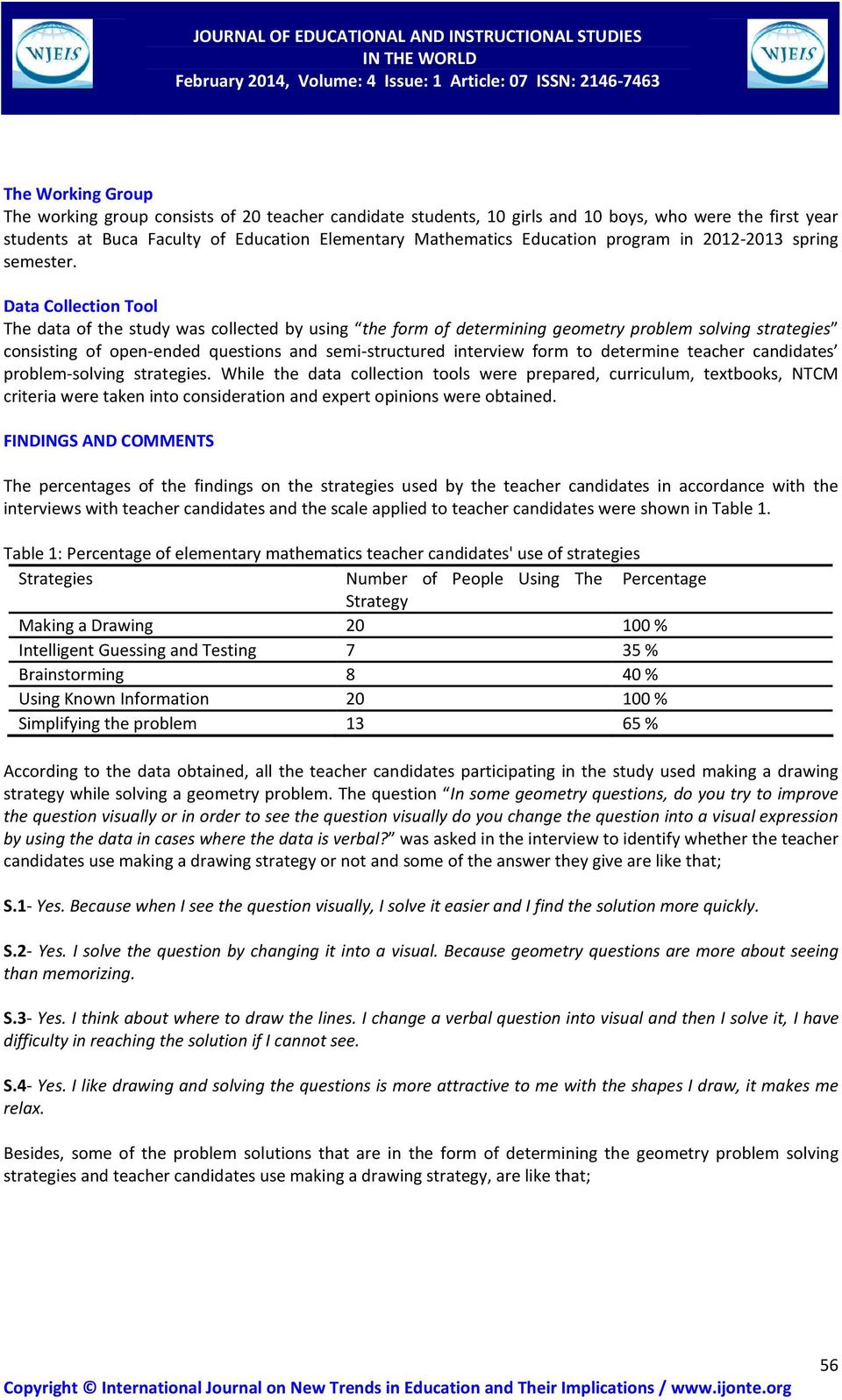
4 The Working Group The working group consists of 20 teacher candidate students, 10 girls and 10 boys, who were the first year students at Buca Faculty of Education Elementary Mathematics Education program in spring semester. Data Collection Tool The data of the study was collected by using the form of determining geometry problem solving strategies consisting of open-ended questions and semi-structured interview form to determine teacher candidates problem-solving strategies. While the data collection tools were prepared, curriculum, textbooks, NTCM criteria were taken into consideration and expert opinions were obtained. FINDINGS AND COMMENTS The percentages of the findings on the strategies used by the teacher candidates in accordance with the interviews with teacher candidates and the scale applied to teacher candidates were shown in Table 1. Table 1: Percentage of elementary mathematics teacher candidates' use of strategies Strategies Number of People Using The Percentage Strategy Making a Drawing % Intelligent Guessing and Testing 7 35 % Brainstorming 8 40 % Using Known Information % Simplifying the problem % According to the data obtained, all the teacher candidates participating in the study used making a drawing strategy while solving a geometry problem. The question In some geometry questions, do you try to improve the question visually or in order to see the question visually do you change the question into a visual expression by using the data in cases where the data is verbal? was asked in the interview to identify whether the teacher candidates use making a drawing strategy or not and some of the answer they give are like that; S.1- Yes. Because when I see the question visually, I solve it easier and I find the solution more quickly. S.2- Yes. I solve the question by changing it into a visual. Because geometry questions are more about seeing than memorizing. S.3- Yes. I think about where to draw the lines. I change a verbal question into visual and then I solve it, I have difficulty in reaching the solution if I cannot see. S.4- Yes. I like drawing and solving the questions is more attractive to me with the shapes I draw, it makes me relax. Besides, some of the problem solutions that are in the form of determining the geometry problem solving strategies and teacher candidates use making a drawing strategy, are like that; 56
5 S.5 S % of the teacher candidates involved in the research used guessing and testing strategy while solving geometry problems. The question In some geometry questions, thinking that the answer of the question should be in a certain interval, do you check whether it is correct or not by putting the values in that interval into the solution without making an operation? was asked in the interview to identify whether the teacher candidates use guessing and testing strategy or not and some of the answers given are like that; S.3- My aim is to solve the question. I cannot find the solution of the question by guessing. S.4- I never do. I try to solve the question directly in order not to waste time. Guessing and testing that value takes too much time. S.6- Yes. First, thinking an interval, I find the value interval for myself, I try to reach the result by checking the values in that interval. S.7- Yes, I sometimes do. For example; thinking that the answer is between 20 and 25, I try each and every value in that interval. 40 % of the teacher candidates involved in the research used brainstorming strategy while solving geometry problems. The question While solving a geometry problem, thinking of several ways to solve the problem, do 57

6 you try to reach the solution by choosing the most applicable and practical one among them? was asked in the interview to identify whether the teacher candidates use brainstorming strategy or not and some of the answers given are like that; S.1- Yes. I generally find several ways for solution but I choose the most practical way. I choose the way that the least likely to make mistakes for me. S.2- No. I choose the first way that comes to my mind when I see the question, I am not much interested in whether the way of solution is long or short.. S.6- No. I apply the first one that comes to my mind. For me, it is the most practical way. I can reach the result easily in that way, so I do not think of several ways for solution. Only if I cannot reach the solution in that way, I think of another way. S.7- Yes. I think of a lot of ways for solution and then I choose the one which will give me the short and certain solution. All the teacher candidates participating in the study used using known information strategy while solving a geometry problem. The question To reach the solutions of geometry questions, do you benefit from the formulas, correlations or relationships you have already known? was asked in the interview to identify whether the teacher candidates use using known information strategy or not and some of the answers they give are like that; S.2- Yes. If I encounter with very complex operations while solving the question, I use the formulas and correlations I previously know and I reach the solution more easily. Rather than making a long operation, I use the formula if I know it to be more practical. S. 6- Yes, I do. I solve the problem and reach the solution more easily by using a formula. S.7- Yes. I generally use the formulas because formulas sound more accurate to me. Also, some of the problem solutions that are in the form of determining the geometry problem solving strategies and teacher candidates use using known information strategy, are like that; S.10 AD=? 58

7 S.12 S % of the teacher candidates involved in the research used simplifying the problem strategy while solving geometry problems. The question Do you try to solve a complex geometry problem by breaking it into simpler parts? was asked in the interview to identify whether the teacher candidates use simplifying the problem strategy or not and some of the answers they give are like that; S. 2- Yes. I break it into small parts if the question is too complex and I try to reach the whole. For example, while finding the area of octagon, I draw a square out of it and I find the whole area based on the small squares. S.5- Yes. I generally solve the complex questions by breaking them into parts. I do like that with polygons or complex triangle questions. S.6- Yes. For example, I can solve a question with hexagon by breaking it into triangles. S.8- Yes. Going from part to whole is more logical. For example, in order to find the area of the trapezoid, it is easier to find the area of the two triangles, drawing a diagonal, than using a formula. The percentages of the findings on the strategies used by the teacher candidates according to the gender are given in Table 2. 59

8 Table 2: The percentages of elementary mathematics teacher candidates use of strategies according to the gender Strategies Female Male Drawing a Shape 100 % 100 % Guessing and Testing 30 % 40 % Brainstorming 20 % 60 % Using Known Information 100 % 100 % Simplifying the problem 70 % 60 % According to the percentages of strategy use, it is observed that all the male and female teacher candidates use making a drawing and using known information strategy. While 40 % of the male teacher candidates use guessing and testing strategy while solving geometry problems, 30 % of the female teacher candidates use this strategy. While 60 % of the male teacher candidates use brainstorming, 20 % of the female teacher candidates benefit from this strategy. It is determined that male teacher candidates use guessing and testing strategy and brainstorming strategy more than female teacher candidates. Besides, while 70 % of the female teacher candidates use simplifying the problem strategy while solving geometry problems, 60 % of the male teacher candidates use this strategy. It is determined that female teacher candidates use simplifying the problem strategy more than male teacher candidates. CONCLUSIONS, DISCUSSION AND SUGGESTIONS According to the findings of the study, it is determined that all the elementary mathematics teacher candidates participated in the research use making a drawing and using known information strategies and 65 % of them use simplifying the problem strategy while solving geometry problems. It is observed that while 20 % of the female teacher candidates participated in the research benefit from brainstorming strategy while solving geometry problem, 60 % of the male teacher candidates benefit from this strategy. It is seen that 40 % of teacher candidates use brainstorming strategy overall. It is also determined that 35 % of the elementary mathematics teacher candidates participated in the study use guessing and testing strategy while solving geometry problems. In accordance with the results obtained in this study, recommendations below are presented. Different studies may also be conducted in order to determine the different strategies (Solving a Simpler Analogous Problem, Cognitive Research, etc..) used by elementary mathematics teacher candidates in geometry problems. Considering the importance of problem solving, it will be useful to give training to teacher candidates because problem solving is an integral part of the mathematics learning process and it is necessary to mention in related classes that problem solving should integrate with the overall mathematics learning process (Kayan & Çakıroğlu, 2008). Teachers should be a model to students by using different problem solving strategies in geometry classes and they should encourage students to use different strategies, so it is thought to be useful to give training to teachers and teacher candidates on teaching problem solving strategies. Research of secondary school students geometry problem solving strategies can also be suggested. The relation between problem solving strategies used by the teacher candidates and students problem solving strategies can be studied. 60

9 REFERENCES Altun, M. (2002). Teaching of Mathematics. Bursa: Alfa Publishing, p Altun, M., Memnun,D.S, & Yazgan,Y. (2007). The Primary School Teacher Trainees Skills and Opinions on Solving Non-Routine Mathematical Problems. Journal of Elementary Education Online, 6(1), p.127. Arslan, Ç. (2002). The Level of problem solving strategies at the seventh and eight grades students. Unpublished Master Thesis, Uludağ University, Institute of Social Sciences, Bursa Baykul,Y. (1999). Teaching of Mathematics at Primary Education 1 and 5. Grade. Ankara: Anı Publishing, p Dhillon, A.S. (1998). Individual differences within problem-solving strategies used in Physics. Science Education, 82(3), p.379. Elçin, E. (2008). The Skills of the Students of Secondary Education to Be Able to Use Appropriate Problem Solving Strategy. Master Thesis, Gazi University, Institute of Educational Sciences, Ankara. Fidan N. (1986). Learning and Teaching at School, Ankara: Kadıoğlu Publishing Gall, M. D., Borg, W. R., & Gall, J. P. (1996). Educational research: An introduction. White Plains NY: Longman Publishers. İsrael, E. (2003). Relations Among Problem Solving Strategies and Achievement. Master Thesis, Dokuz Eylül University, Institute of Educational Sciences, İzmir. Kayan, F. & Çakıroğlu, E. (2008). Preservice Elemantary Mathematics Teachers Mathematical Problem Solving Beliefs. Journal of Hacettepe University Faculty of Education, (35), Kılıç, S.D. (2003). Examining the approach and the ability of solving a problem in mathematics lesson of the students in the last class, second stage of the primary education. Master Thesis, Dokuz Eylül University, Institute of Educational Sciences, İzmir. Olkun, S. & Toluk, Z. (2004). Activity Based Teaching of Mathematics: Teaching for Conception, The Conference of Beneficent Examples, İstanbul. Okur, M., Tatar, E. & İşleyen, T. (2006). Problem Solving Approaches at a Level of Primary Education. Journal of Qafqaz University, (18), Pressley, M. (1995). Cognition, Teaching,Assesment, Harper Collins College Publishers, p.28-30, p Şahin, A. A. (2007). Determining the problem solving strategies for the students aged years. Master Thesis. Balıkesir University, Institute of Natural Sciences, Balıkesir. Şahin, O. (2008). In- & pre - service elementary school teachers? Van Hiele reasoning stages. Master Thesis. Kocatepe University, Institute of Social Sciences, Afyon Yazgan, Y. (2007). Observations about fourth and fifth grade students strategies to solve non-routine problems, Journal of Elementary Education Online, 6(2), p

10 Yılmaz, S. & Turgut, M. (2007). How did we enter Geometry Lessons? View of Traniee Primary Mathematics Teachers. University and Community: Scienece, Education and Apprehension, 7(4) Yılmaz. K. (2007). Survey about affect of epistemological beliefs and beliefs about mathematical problem solving on problem solving process. Master Thesis, Marmara University. Institute of Educational Sciences, İstanbul. 62

Performance Assessment Task Which Shape? Grade 3. Common Core State Standards Math - Content Standards
 Performance Assessment Task Which Shape? Grade 3 This task challenges a student to use knowledge of geometrical attributes (such as angle size, number of angles, number of sides, and parallel sides) to
An evaluation of geography and geography education in Turkey
 Changing Horizons in Geography Education Herodot/Eurogeo Conference 2005 Toruń, Poland 2 nd -5 th September 2005 An evaluation of geography and geography education in Turkey Dr. Salih Şahin University
Fractions In Action! Dawn Jesse
 Fractions In Action! Dawn Jesse Fractions In Action Dawn Jesse Fractions In Action is an interactive activity that consists of direct instruction, cooperative learning and is inquire based. As the students
TOJCE: The Online Journal of Counselling and Education - April 2012, Volume 1, Issue 2
 Level of Reading Strategy Use Among Faculty Of Education Students Nevin AKKAYA 2 Abstract The purpose of this research is to determine the level of using the reading strategies by the students who study
Identifying the Learning Difficulties of Freshmen in Mathematics Teacher Training Department in Function Graphs and Derivatives
 International Journal of Humanities and Social Science Vol. 1 No. 7 [Special Issue June 011] Identifying the Learning Difficulties of Freshmen in Mathematics Teacher Training Department in Function Graphs
METACOGNITIVE AWARENESS OF PRE-SERVICE TEACHERS
 METACOGNITIVE AWARENESS OF PRE-SERVICE TEACHERS Emine ŞENDURUR Kocaeli University, Faculty of Education Kocaeli, TURKEY Polat ŞENDURUR Ondokuz Mayıs University, Faculty of Education Samsun, TURKEY Neşet
PERCEPTIONS OF TURKISH COMPUTER EDUCATION AND INSTRUCTIONAL TECHNOLOGY PROGRAM STUDENTS AND ALUMNI TOWARDS GAME USE IN EDUCATION
 PERCEPTIONS OF TURKISH COMPUTER EDUCATION AND INSTRUCTIONAL TECHNOLOGY PROGRAM STUDENTS AND ALUMNI TOWARDS GAME USE IN EDUCATION Res. Ast.Kadir Yücel Kaya Middle East Technical University, Ankara, TURKEY
Problems with Science and Technology Education in Turkey
 Eurasia Journal of Mathematics, Science & Technology Education, 2007, 3(2), 157-161 Problems with Science and Technology Education in Turkey Mustafa Özden Adıyaman Üniversitesi, Adıyaman, TURKEY Received
Problem of the Month: William s Polygons
 Problem of the Month: William s Polygons The Problems of the Month (POM) are used in a variety of ways to promote problem solving and to foster the first standard of mathematical practice from the Common
A STATISTICS COURSE FOR ELEMENTARY AND MIDDLE SCHOOL TEACHERS. Gary Kader and Mike Perry Appalachian State University USA
 A STATISTICS COURSE FOR ELEMENTARY AND MIDDLE SCHOOL TEACHERS Gary Kader and Mike Perry Appalachian State University USA This paper will describe a content-pedagogy course designed to prepare elementary
The Views Of Primary and Preschool Education Teachers about Home Visiting: A Study in Turkey
 The Views Of Primary and Preschool Education Teachers about Home Visiting: A Study in Turkey Pınar Bahçeli Kahraman 1 Meral Taner Derman 2 Abstract The aim of this study is to investigate the views of
INVESTIGATION OF HIGH SCHOOL STUDENTS COMPUTER ATTITUDES IN TERMS OF CERTAIN VARIABLES
 ISSN 1308 8971 Special Issue: Selected papers presented at WCNTSE INVESTIGATION OF HIGH SCHOOL STUDENTS COMPUTER ATTITUDES IN TERMS OF CERTAIN VARIABLES a Mukadder BARAN, b Medine BARAN & c Hülya ASLAN
The Most Widely Used. Mathematics Textbook Series in Japan is Now in English! Introducing Tokyo Shoseki s. and
 The Most Widely Used Mathematics Textbook Series in Japan is Now in English! Introducing Tokyo Shoseki s Mathematics International (Elementary School, s 1 to 6) and Mathematics International (Lower Secondary
1 ST GRADE COMMON CORE STANDARDS FOR SAXON MATH
 1 ST GRADE COMMON CORE STANDARDS FOR SAXON MATH Calendar The following tables show the CCSS focus of The Meeting activities, which appear at the beginning of each numbered lesson and are taught daily,
Strategies for Teaching Reading Across the Content Areas. NC Teach: UNCW January 2004 Debbie Lemon
 Strategies for Teaching Reading Across the Content Areas NC Teach: UNCW January 2004 Debbie Lemon What do you think? Read each statement on the handout entitled What do you think? and decide on your responses.
EVALUATION OF PROSPECTIVE SCIENCE TEACHERS COMPUTER SELF-EFFICACY
 ISSN 1308 8971 Special Issue: Selected papers presented at WCNTSE EVALUATION OF PROSPECTIVE SCIENCE TEACHERS COMPUTER SELF-EFFICACY a Nurhan ÖZTÜRK, a Esra BOZKURT, b Tezcan KARTAL, c Ramazan DEMİR & d
Jean Chen, Assistant Director, Office of Institutional Research University of North Dakota, Grand Forks, ND 58202-7106
 Educational Technology in Introductory College Physics Teaching and Learning: The Importance of Students Perception and Performance Jean Chen, Assistant Director, Office of Institutional Research University
3. Relationship between this Unit and the Principles and Standards for School Mathematics (NCTM 2000). This Unit
 4 th Grade Mathematics Lesson Plan April 16-18, 2002 Brewer Island School, San Mateo, CA Instructor: Akihiko Takahashi 1. Title of Unit: Finding the Area of Shapes 2. Goal: a. To deepen students understanding
Warm up. Connect these nine dots with only four straight lines without lifting your pencil from the paper.
 Warm up Connect these nine dots with only four straight lines without lifting your pencil from the paper. Sometimes we need to think outside the box! Warm up Solution Warm up Insert the Numbers 1 8 into
Mathematics Cognitive Domains Framework: TIMSS 2003 Developmental Project Fourth and Eighth Grades
 Appendix A Mathematics Cognitive Domains Framework: TIMSS 2003 Developmental Project Fourth and Eighth Grades To respond correctly to TIMSS test items, students need to be familiar with the mathematics
Geometry Solve real life and mathematical problems involving angle measure, area, surface area and volume.
 Performance Assessment Task Pizza Crusts Grade 7 This task challenges a student to calculate area and perimeters of squares and rectangles and find circumference and area of a circle. Students must find
Motivational Orientations of Turkish EFL Students: The Case at a State University 1
 Motivational Orientations of Turkish EFL Students: The Case at a State University 1 Gökhan Öztürk Afyon Kocatepe University, School of Foreign Languages [email protected] Nurdan Gürbüz Middle East
STRAND: Number and Operations Algebra Geometry Measurement Data Analysis and Probability STANDARD:
 how August/September Demonstrate an understanding of the place-value structure of the base-ten number system by; (a) counting with understanding and recognizing how many in sets of objects up to 50, (b)
KEANSBURG SCHOOL DISTRICT KEANSBURG HIGH SCHOOL Mathematics Department. HSPA 10 Curriculum. September 2007
 KEANSBURG HIGH SCHOOL Mathematics Department HSPA 10 Curriculum September 2007 Written by: Karen Egan Mathematics Supervisor: Ann Gagliardi 7 days Sample and Display Data (Chapter 1 pp. 4-47) Surveys and
Functional Math II. Information CourseTitle. Types of Instruction
 Functional Math II Course Outcome Summary Riverdale School District Information CourseTitle Functional Math II Credits 0 Contact Hours 135 Instructional Area Middle School Instructional Level 8th Grade
Natural Disaster Recovery and Quadrilaterals
 Natural Disaster Recovery and Quadrilaterals I. UNIT OVERVIEW & PURPOSE: In this unit, students will apply their knowledge of quadrilaterals to solve mathematics problems concerning a tornado that struck
UNH Graduate Education Department. Quarterly Assessment Report
 First Quarter Assessment Report UNH Graduate Education Department Quarterly Assessment Report First Quarter i First Quarter Assessment Report Table of Contents Introduction... Section - Purpose of the
Problem of the Month: Perfect Pair
 Problem of the Month: The Problems of the Month (POM) are used in a variety of ways to promote problem solving and to foster the first standard of mathematical practice from the Common Core State Standards:
STUDENT LEARNING ASSESSMENT OVERVIEW EARLY CHILDHOOD EDUCATION
 STUDENT LEARNING ASSESSMENT OVERVIEW EARLY CHILDHOOD EDUCATION What early childhood professionals know and can do significantly influence children s development, learning, and success in school. Since
Mathematics Content Courses for Elementary Teachers
 Mathematics Content Courses for Elementary Teachers Sybilla Beckmann Department of Mathematics University of Georgia Massachusetts, March 2008 Sybilla Beckmann (University of Georgia) Mathematics for Elementary
Elementary Gifted and Talented Referral and Assessment
 Elementary Gifted and Talented Referral and Assessment 2012-2013 PACE provides services for academically gifted and/or talented students in grades K-12 who have demonstrated the need for advanced, differentiated
Analysing Technological Pedagogic Content Knowledge of Science Teacher Candidates According to Various Variables
 Analysing Technological Pedagogic Content Knowledge of Science Teacher Candidates According to Various Variables 1 Mehmet Barış Horzum, 2 Murat Demirbaş, 1 Mustafa Bayrakcı 1 Sakarya University Education
High School. High School. Page 1 Columbus Public Schools 8/11/04. Grids and Graphics
 Page Columbus Public Schools 8//04 Table of Contents 0 by 0 Grids p. 3 20 by 20 Grids p. 4 Algebra Tiles Template p. 5 Bingo Card p. 6 Blank Geoboards p. 7 Blank Circle Graph p. 8 Blank Number Lines p.
Grade 6 Mathematics Assessment. Eligible Texas Essential Knowledge and Skills
 Grade 6 Mathematics Assessment Eligible Texas Essential Knowledge and Skills STAAR Grade 6 Mathematics Assessment Mathematical Process Standards These student expectations will not be listed under a separate
LEARNING STYLES OF PROSPECTIVE TEACHERS: KOCAELI UNIVERSITY CASE
 LEARNING STYLES OF PROSPECTIVE TEACHERS: KOCAELI UNIVERSITY CASE Assoc. Prof Dr., Sare Şengül Marmara University [email protected] Research Asst., Yasemin Katranci Kocaeli University [email protected]
High School Algebra Reasoning with Equations and Inequalities Solve equations and inequalities in one variable.
 Performance Assessment Task Quadratic (2009) Grade 9 The task challenges a student to demonstrate an understanding of quadratic functions in various forms. A student must make sense of the meaning of relations
LAGUARDIA COMMUNITY COLLEGE CITY UNIVERSITY OF NEW YORK DEPARTMENT OF MATHEMATICS, ENGINEERING, AND COMPUTER SCIENCE
 LAGUARDIA COMMUNITY COLLEGE CITY UNIVERSITY OF NEW YORK DEPARTMENT OF MATHEMATICS, ENGINEERING, AND COMPUTER SCIENCE MAT 119 STATISTICS AND ELEMENTARY ALGEBRA 5 Lecture Hours, 2 Lab Hours, 3 Credits Pre-
1. I have 4 sides. My opposite sides are equal. I have 4 right angles. Which shape am I?
 Which Shape? This problem gives you the chance to: identify and describe shapes use clues to solve riddles Use shapes A, B, or C to solve the riddles. A B C 1. I have 4 sides. My opposite sides are equal.
STUDENTS REASONING IN QUADRATIC EQUATIONS WITH ONE UNKNOWN
 STUDENTS REASONING IN QUADRATIC EQUATIONS WITH ONE UNKNOWN M. Gözde Didiş, Sinem Baş, A. Kürşat Erbaş Middle East Technical University This study examined 10 th grade students procedures for solving quadratic
The Child s Rights, MediaLiteracy & New Media
 The Child s Rights, MediaLiteracy & New Media Assoc. Prof. Dr. Tuğba ASRAK HASDEMİR Gazi University Faculty of Communication İstanbul-2014 Media literacy: Why and How? The interest in media literacy education
Support Materials for Core Content for Assessment. Mathematics
 Support Materials for Core Content for Assessment Version 4.1 Mathematics August 2007 Kentucky Department of Education Introduction to Depth of Knowledge (DOK) - Based on Norman Webb s Model (Karin Hess,
Few things are more feared than statistical analysis.
 DATA ANALYSIS AND THE PRINCIPALSHIP Data-driven decision making is a hallmark of good instructional leadership. Principals and teachers can learn to maneuver through the statistcal data to help create
Washington Grade Level Content Expectations EALR s Grades K-5
 A Correlation of to the Washington Grade Level Content Expectations EALR s Grades K-5 M/M-112 INTRODUCTION This document demonstrates how well Investigations in Number, Data, and Space integrates with
Minnesota Academic Standards
 A Correlation of to the Minnesota Academic Standards Grades K-6 G/M-204 Introduction This document demonstrates the high degree of success students will achieve when using Scott Foresman Addison Wesley
Volume of Right Prisms Objective To provide experiences with using a formula for the volume of right prisms.
 Volume of Right Prisms Objective To provide experiences with using a formula for the volume of right prisms. www.everydaymathonline.com epresentations etoolkit Algorithms Practice EM Facts Workshop Game
TITLE: Elementary Algebra and Geometry OFFICE LOCATION: M-106 COURSE REFERENCE NUMBER: see Website PHONE NUMBER: (619) 388-3252
 SDCCD ONLINE COURSE: MATH 95 PROFESSOR: David Kater TITLE: Elementary Algebra and Geometry OFFICE LOCATION: M-106 COURSE REFERENCE NUMBER: see Website PHONE NUMBER: (619) 388-3252 OFFICE HOURS: Online.
Pocantico Hills School District Grade 1 Math Curriculum Draft
 Pocantico Hills School District Grade 1 Math Curriculum Draft Patterns /Number Sense/Statistics Content Strands: Performance Indicators 1.A.1 Determine and discuss patterns in arithmetic (what comes next
Problem of the Month: Cutting a Cube
 Problem of the Month: The Problems of the Month (POM) are used in a variety of ways to promote problem solving and to foster the first standard of mathematical practice from the Common Core State Standards:
CPM Educational Program
 CPM Educational Program A California, Non-Profit Corporation Chris Mikles, National Director (888) 808-4276 e-mail: mikles @cpm.org CPM Courses and Their Core Threads Each course is built around a few
G C.3 Construct the inscribed and circumscribed circles of a triangle, and prove properties of angles for a quadrilateral inscribed in a circle.
 Performance Assessment Task Circle and Squares Grade 10 This task challenges a student to analyze characteristics of 2 dimensional shapes to develop mathematical arguments about geometric relationships.
Mathematics Objective 6.) To recognize the limitations of mathematical and statistical models.
 Spring 20 Question Category: 1 Exemplary Educational Objectives Mathematics THECB Mathematics Objective 1.) To apply arithmetic, algebraic, geometric, higher-order thinking, and statistical methods to
E XPLORING QUADRILATERALS
 E XPLORING QUADRILATERALS E 1 Geometry State Goal 9: Use geometric methods to analyze, categorize and draw conclusions about points, lines, planes and space. Statement of Purpose: The activities in this
Math 046 Online Course Syllabus Elementary Algebra and Geometry
 Math 046 Online Course Syllabus Elementary Algebra and Geometry THIS IS AN 8 WEEK CLASS Carol Murphy, Professor CRN # 08391 Online office hours: Tuesdays from 8 9 pm Office Phone: 619-388-7691 Fall Other
PROSPECTIVE MATHEMATICS TEACHERS PEDAGOGICAL CONTENT KNOWLEDGE OF DEFINITE INTEGRAL: THE PROBLEM OF LIMIT PROCESS
 D. Küchemann (Ed.) Proceedings of the British Society for Research into Learning Mathematics, 27, 3, November 2007 PROSPECTIVE MATHEMATICS TEACHERS PEDAGOGICAL CONTENT KNOWLEDGE OF DEFINITE INTEGRAL: THE
Content Mathematics Course for Elementary Teachers
 Content Mathematics Course for Elementary Teachers Paul Hartung Elizabeth Mauch Bloomsburg University of Pennsylvania Abstract Bloomsburg University revised their mathematics for elementary education majors
INTER-OFFICE CORRESPONDENCE LOS ANGELES UNFIED SCHOOL DISTRICT LOCAL DISTRICT EAST
 INTER-OFFICE CORRESPONDENCE LOS ANGELES UNFIED SCHOOL DISTRICT LOCAL DISTRICT EAST TO: Elementary Principals Date: 9/21/15 FROM: SUBJECT: David Baca, EdD, Administrator of Instruction 2015 2016 ELEMENTARY
Measurement with Ratios
 Grade 6 Mathematics, Quarter 2, Unit 2.1 Measurement with Ratios Overview Number of instructional days: 15 (1 day = 45 minutes) Content to be learned Use ratio reasoning to solve real-world and mathematical
Grade 8 Mathematics Geometry: Lesson 2
 Grade 8 Mathematics Geometry: Lesson 2 Read aloud to the students the material that is printed in boldface type inside the boxes. Information in regular type inside the boxes and all information outside
EARLY CHILDHOOD TEACHERS VIEWS ABOUT SCIENCE TEACHING PRACTICES
 ISSN 1308 8971 Special Issue: Selected papers presented at WCNTSE EARLY CHILDHOOD TEACHERS VIEWS ABOUT SCIENCE TEACHING PRACTICES a Elif ÖZTÜRK YILMAZTEKİN & b Feyza TANTEKİN ERDEN a Dr., Izmir University,
The African Symposium: An online journal of the African Educational Research Network
 EFFECT OF COMPUTER SIMULATION INSTRUCTIONAL PACKAGE ON SENIOR SECONDARY SCHOOL MATHEMATICS STUDENTS RETENTION IN ARITHMETIC PROGRESSION IN LAVUN LOCAL GOVERNMENT AREA OF NIGER STATE, NIGERIA Ramatu Wodu
PCHS ALGEBRA PLACEMENT TEST
 MATHEMATICS Students must pass all math courses with a C or better to advance to the next math level. Only classes passed with a C or better will count towards meeting college entrance requirements. If
How To Be A Mathematically Proficient Person
 REPRODUCIBLE Figure 4.4: Evaluation Tool for Assessment Instrument Quality Assessment indicators Description of Level 1 of the Indicator Are Not Present Limited of This Indicator Are Present Substantially
Grades K-6. Correlated to the Common Core State Standards
 Grades K-6 Correlated to the Common Core State Standards Kindergarten Standards for Mathematical Practice Common Core State Standards Standards for Mathematical Practice Kindergarten The Standards for
Balanced Assessment Test Algebra 2008
 Balanced Assessment Test Algebra 2008 Core Idea Task Score Representations Expressions This task asks students find algebraic expressions for area and perimeter of parallelograms and trapezoids. Successful
A Correlation of Pearson Texas Geometry Digital, 2015
 A Correlation of Pearson Texas Geometry Digital, 2015 To the Texas Essential Knowledge and Skills (TEKS) for Geometry, High School, and the Texas English Language Proficiency Standards (ELPS) Correlations
Standards for Mathematical Practice: Commentary and Elaborations for 6 8
 Standards for Mathematical Practice: Commentary and Elaborations for 6 8 c Illustrative Mathematics 6 May 2014 Suggested citation: Illustrative Mathematics. (2014, May 6). Standards for Mathematical Practice:
TECHNICAL DRAWING (67)
 TECHNICAL DRAWING (67) (Candidates offering Technical Drawing Applications are not eligible to offer Technical Drawing.) Aims: 1. To develop competence among the students to pursue technical courses like
Chapter 18 Symmetry. Symmetry of Shapes in a Plane 18.1. then unfold
 Chapter 18 Symmetry Symmetry is of interest in many areas, for example, art, design in general, and even the study of molecules. This chapter begins with a look at two types of symmetry of two-dimensional
Assist. Prof. Dr. Olga Pilli (Curriculum Vitae) Home address : 2 Orhan Gazi Sok, Maraş/Magusa, Mersin 10 Turkey, North Cyprus
 Assist. Prof. Dr. Olga Pilli (Curriculum Vitae) PERSONAL DETAILS Name and surname : Olga Pilli Place and date of birth : Lefkoşa, Cyprus 1976 Nationality : Turkish Cypriot Home address : 2 Orhan Gazi Sok,
EVERY DAY COUNTS CALENDAR MATH 2005 correlated to
 EVERY DAY COUNTS CALENDAR MATH 2005 correlated to Illinois Mathematics Assessment Framework Grades 3-5 E D U C A T I O N G R O U P A Houghton Mifflin Company YOUR ILLINOIS GREAT SOURCE REPRESENTATIVES:
Kindergarten Math Curriculum Course Description and Philosophy Text Reference:
 Kindergarten Math Curriculum Course Description and Philosophy How do numbers and math affect our daily lives? What types of problems can be solved by understanding numbers and math concepts? Through inquiry,
Using 3D Computer Graphics Multimedia to Motivate Teachers Learning of Geometry and Pedagogy
 Using 3D Computer Graphics Multimedia to Motivate Teachers Learning of Geometry and Pedagogy Tracy Goodson-Espy Associate Professor [email protected] Samuel L. Espy Viz Multimedia Boone, NC 28607
Performance Assessment Task Bikes and Trikes Grade 4. Common Core State Standards Math - Content Standards
 Performance Assessment Task Bikes and Trikes Grade 4 The task challenges a student to demonstrate understanding of concepts involved in multiplication. A student must make sense of equal sized groups of
Science Teachers Attitudes towards Aims of the Science Experiments
 Yıldız, Akpınar, Aydoğdu & Ergin / TÜFED-TUSED / 3(2) 2006 2 TÜRK FEN EĞİTİMİ DERGİSİ Yıl 3, Sayı 2, Aralık 2006 Journal of TURKISH SCIENCE EDUCATION Volume 3, Issue 2, December 2006 http://www.tused.org
1st Grade Math Standard I Rubric. Number Sense. Score 4 Students show proficiency with numbers beyond 100.
 1st Grade Math Standard I Rubric Number Sense Students show proficiency with numbers beyond 100. Students will demonstrate an understanding of number sense by: --counting, reading, and writing whole numbers
Building a Bridge to Academic Vocabulary in Mathematics
 Building a Bridge to Academic Vocabulary in Mathematics AISD Elementary Mathematics Department How Students Develop a Repertoire of Academic English in Mathematics Developed and researched by the AISD
The Mathematics Education of Students in Japan: A Comparison with United States Mathematics Programs
 The Mathematics Education of Students in Japan: A Comparison with United States Mathematics Programs Sarah Mastrull May, 2002 Bristol Township School District MIC 8 Training 1 As a mathematics teacher
The Perception of Teaching as a Profession by Turkish Trainee Teachers: Attitudes towards Being a Teacher
 The Perception of Teaching as a Profession by Turkish Trainee Teachers: Attitudes towards Being a Teacher Dr. Nesrin Oruç Assistant Professor School of Foreign Languages, İzmir University of Economics
Heuristic approach experience in solving mathematical problems
 Educational Research (ISSN: 2141-5161) Vol. 4(8) pp. 607-611, August, 2013 DOI: http:/dx.doi.org/10.14303/er.2013.112 Available online@ http://www.interesjournals.org/er Copyright 2013 International Research
Master and PhD Education in Geography: Turkish Perspectives
 Master and PhD Education in Geography: Turkish Perspectives Nuri YAVAN and Erdem BEKAROĞLU Ankara University Department of Geography Academic Competencies Workshop Ankara University, Faculty of Letters,
Chapter 111. Texas Essential Knowledge and Skills for Mathematics. Subchapter A. Elementary
 Elementary 111.A. Chapter 111. Texas Essential Knowledge and Skills for Mathematics Subchapter A. Elementary Statutory Authority: The provisions of this Subchapter A issued under the Texas Education Code,
NOT AN OFFICIAL SCORE REPORT. Summary of Results
 From SAT TEST MARCH 8, 214 Summary of Results Page 1 of 1 Congratulations on taking the SAT Reasoning Test! You re showing colleges that you are serious about getting an education. The SAT is one indicator
ELEMENTARY PRE-SERVICE TEACHERS OPINIONS ON TEACHING SCIENCE
 Bulgarian Journal of Science and Education Policy (BJSEP), Volume 3, Number 2, 2009 ELEMENTARY PRE-SERVICE TEACHERS OPINIONS ON TEACHING SCIENCE N. Remziye ERGÜL Uludağ University, TURKEY Abstract. This
Formulas STEM 11. Two mathematical formulas that students at this level of mathematics are familiar with are:
 Formulas STEM 11 One definition of the word formula is a conventionalized statement expressing some fundamental principle. Adding the word mathematical to formula we can define a mathematical formula as
EFFECTS OF ADVANCE ORGANIZER TEACHING APPROACH ON SECONDARY SCHOOL STUDENTS ACHIEVEMENT IN CHEMISTRY IN MAARA DISTRICT, KENYA
 EFFECTS OF ADVANCE ORGANIZER TEACHING APPROACH ON SECONDARY SCHOOL STUDENTS ACHIEVEMENT IN CHEMISTRY IN MAARA DISTRICT, KENYA PROFESSOR SAMUEL W. WACHANGA*; ANTONY MUGIIRA ARIMBA**; PROF. ZACHARIAH K.
Current Trends in Educational Technology Research in Turkey in the New Millennium
 KARAHAN / The Effects of a Communication and Conflict Resolution Skill Training Program... 961 Current Trends in Educational Technology Research in Turkey in the New Millennium Ali ŞİMŞEK*, Nilgün ÖZDAMAR**,
PRESERVICE SECONDARY MATHEMATICS TEACHERS COMPARATIVE ANALYSES OF TURKISH AND AMERICAN HIGH SCHOOL GEOMETRY TEXTBOOK
 Ekim 2006 Cilt:14 No:2 Kastamonu Eğitim Dergisi 509-516 PRESERVICE SECONDARY MATHEMATICS TEACHERS COMPARATIVE ANALYSES OF TURKISH AND AMERICAN HIGH SCHOOL GEOMETRY TEXTBOOK Hasan ÜNAL Yıldız Technical
Teacher Questionnaire
 PCAP Main Administration (2010) Teacher Questionnaire Council of Ministers of Education, Canada Funds for the Pan Canadian Assessment Program are provided by participating jurisdictions through the Council
PROCESS FOR APPROVING NON- IAI- GENERAL EDUCATION CORE CURRICULUM (GECC) COURSES FOR GENERAL EDUCATION CREDIT
 1 PROCESS FOR APPROVING NON- IAI- GENERAL EDUCATION CORE CURRICULUM (GECC) COURSES FOR GENERAL EDUCATION CREDIT Step 1: Program/course owner reviews non- IAI- GECC course currently accepted for General
How To Get A Master'S Degree In Mathematics In Norway
 Program description for the Master s Degree Program in Mathematics Name English: Master s Degree program in Mathematics Norwegian, bokmål: Masterprogram i matematikk Norwegian, nynorsk: Masterprogram i
Drawing 3-D Objects in Perspective
 Mathematics Instructional Materials SAS#.1 (one per pair of students) SAS#.2 (one per pair of students) TIS#.1 (transparency) TIS#.2 (transparency) TIS#.3 (Journal prompt) Isometric Dot Paper Isometric
Curriculum Map by Block Geometry Mapping for Math Block Testing 2007-2008. August 20 to August 24 Review concepts from previous grades.
 Curriculum Map by Geometry Mapping for Math Testing 2007-2008 Pre- s 1 August 20 to August 24 Review concepts from previous grades. August 27 to September 28 (Assessment to be completed by September 28)
DELAWARE MATHEMATICS CONTENT STANDARDS GRADES 9-10. PAGE(S) WHERE TAUGHT (If submission is not a book, cite appropriate location(s))
 Prentice Hall University of Chicago School Mathematics Project: Advanced Algebra 2002 Delaware Mathematics Content Standards (Grades 9-10) STANDARD #1 Students will develop their ability to SOLVE PROBLEMS