
Comparative Advantage and the Gains from International Trade
|
|
|
- Leonard Bates
- 10 years ago
- Views:
Transcription


1 Chapter 8 Comparative Advantage and the Gains from International Trade Prepared by: Fernando & Yvonn Quijano 2008 Prentice Hall Business Publishing Economics R. Glenn Hubbard, Anthony Patrick O Brien, 2e. Is Using Trade Policy to Help U.S. Industries a Good Idea? Restrictions on trade may preserve jobs in particular industries, but only at the cost of reducing jobs in other industries. Learning Objectives Discuss the role of international trade in the U.S. economy. Understand the difference between comparative advantage and absolute advantage in international trade. Explain how countries gain from international trade. Analyze the economic effects of government policies that restrict international trade. Evaluate the arguments over trade policy and globalization. APPENDIX Understand why firms operate in more than one country Prentice Hall Business Publishing Economics R. Glenn Hubbard, Anthony Patrick O Brien, 2e. 2 of 29 1

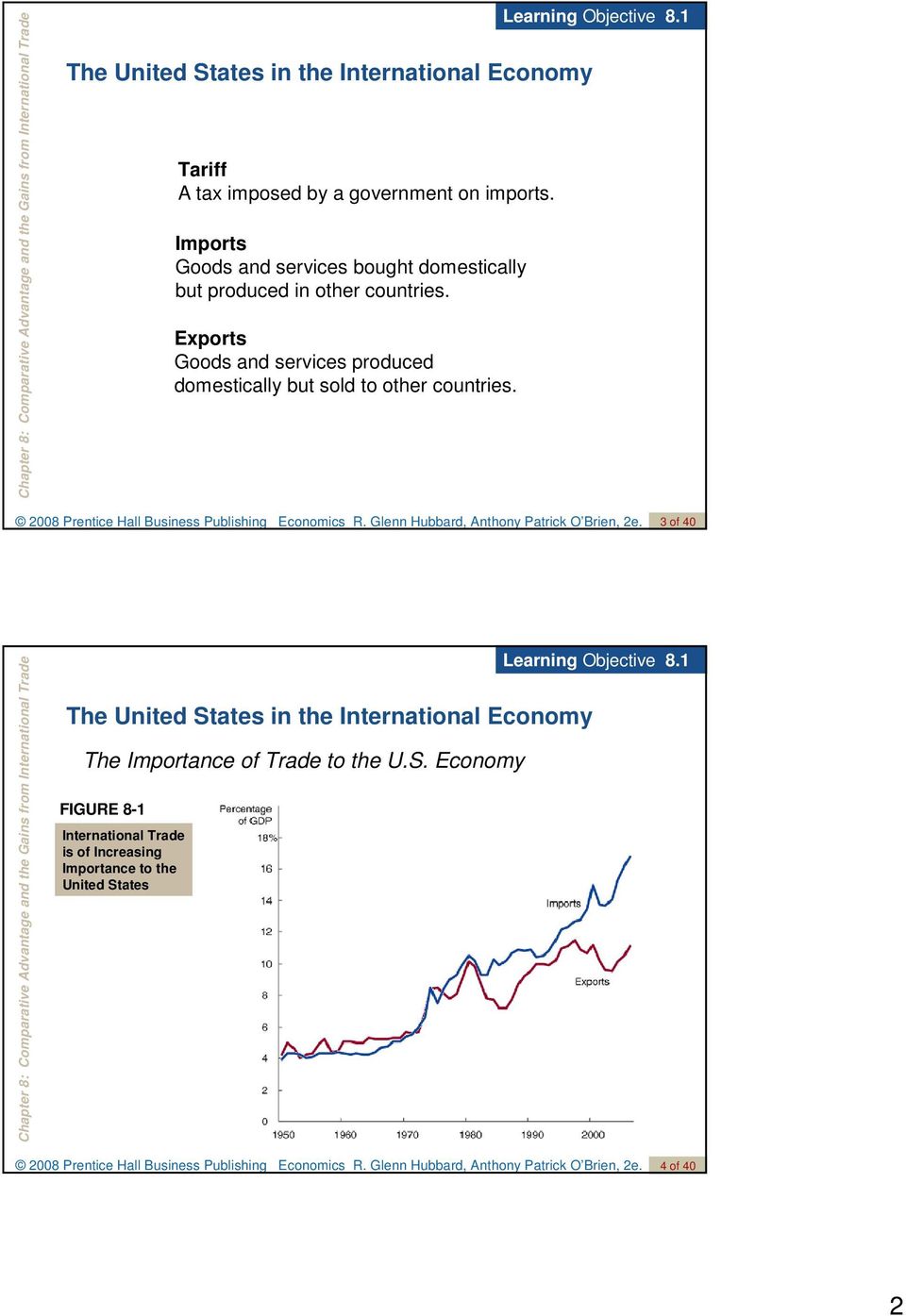
2 The United States in the International Economy Tariff A tax imposed by a government on imports. Imports Goods and services bought domestically but produced in other countries. Exports Goods and services produced domestically but sold to other countries. Learning Objective Prentice Hall Business Publishing Economics R. Glenn Hubbard, Anthony Patrick O Brien, 2e. 3 of 40 The United States in the International Economy The Importance of Trade to the U.S. Economy FIGURE 8-1 International Trade is of Increasing Importance to the United States Learning Objective Prentice Hall Business Publishing Economics R. Glenn Hubbard, Anthony Patrick O Brien, 2e. 4 of 40 2
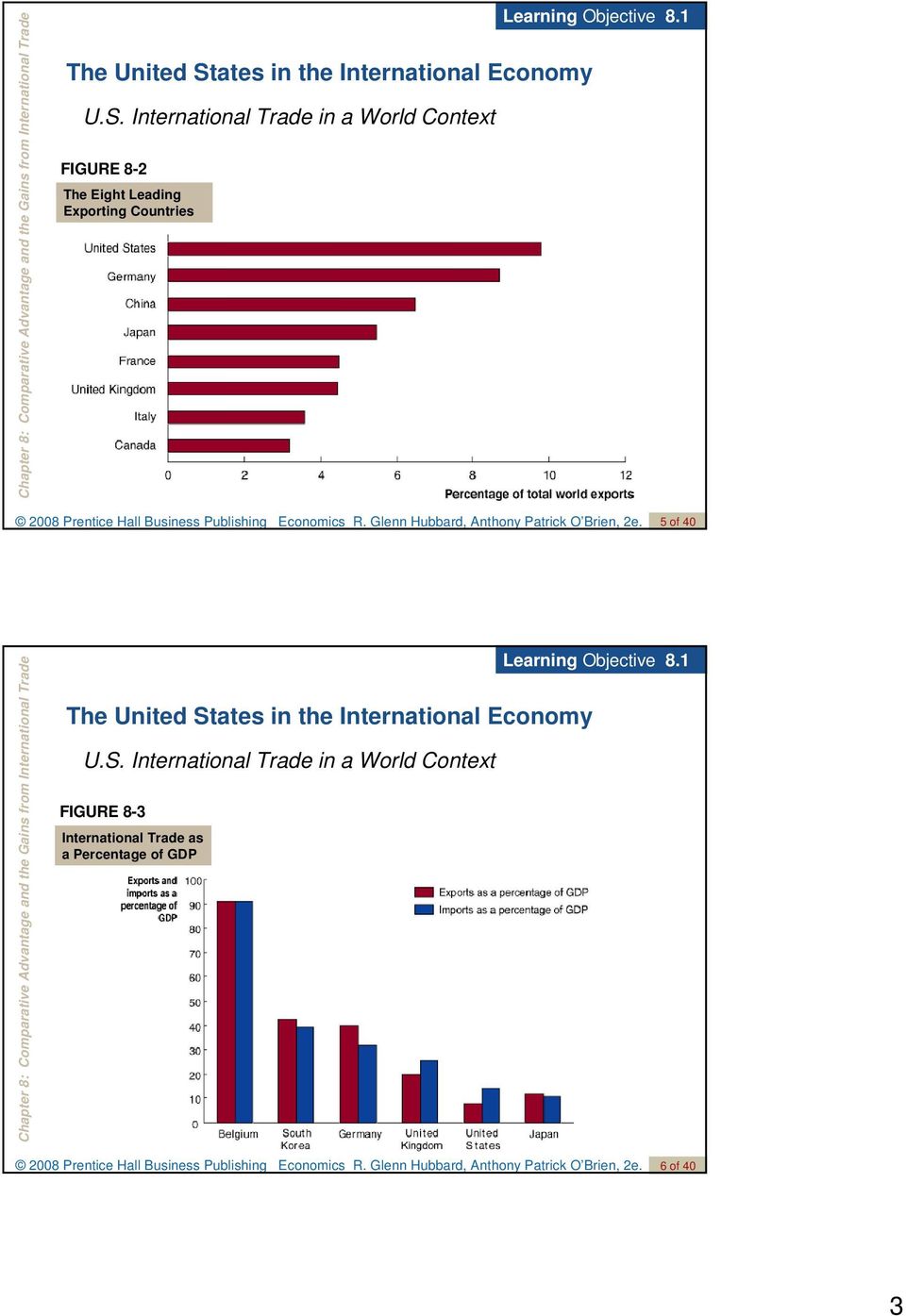
3 The United States in the International Economy U.S. International Trade in a World Context FIGURE 8-2 The Eight Leading Exporting Countries Learning Objective Prentice Hall Business Publishing Economics R. Glenn Hubbard, Anthony Patrick O Brien, 2e. 5 of 40 The United States in the International Economy U.S. International Trade in a World Context FIGURE 8-3 International Trade as a Percentage of GDP Learning Objective Prentice Hall Business Publishing Economics R. Glenn Hubbard, Anthony Patrick O Brien, 2e. 6 of 40 3
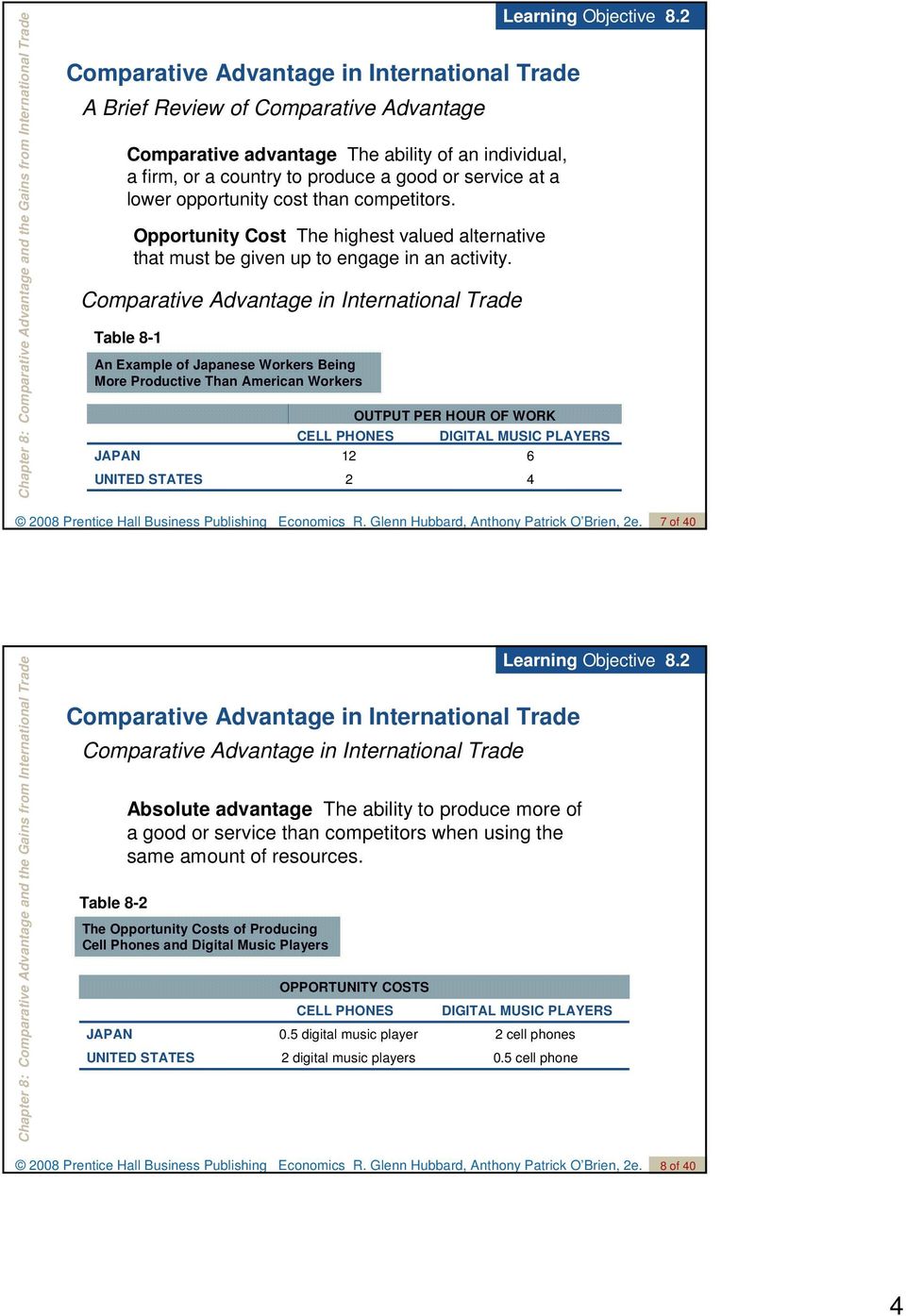
4 Comparative Advantage in International Trade A Brief Review of Comparative Advantage Comparative advantage The ability of an individual, a firm, or a country to produce a good or service at a lower opportunity cost than competitors. Opportunity Cost The highest valued alternative that must be given up to engage in an activity. Comparative Advantage in International Trade Table 8-1 An Example of Japanese Workers Being More Productive Than American Workers JAPAN UNITED STATES Learning Objective 8.2 OUTPUT PER HOUR OF WORK CELL PHONES DIGITAL MUSIC PLAYERS Prentice Hall Business Publishing Economics R. Glenn Hubbard, Anthony Patrick O Brien, 2e. 7 of 40 Comparative Advantage in International Trade Comparative Advantage in International Trade Table 8-2 Absolute advantage The ability to produce more of a good or service than competitors when using the same amount of resources. The Opportunity Costs of Producing Cell Phones and Digital Music Players JAPAN UNITED STATES OPPORTUNITY COSTS CELL PHONES 0.5 digital music player 2 digital music players Learning Objective 8.2 DIGITAL MUSIC PLAYERS 2 cell phones 0.5 cell phone 2008 Prentice Hall Business Publishing Economics R. Glenn Hubbard, Anthony Patrick O Brien, 2e. 8 of 40 4
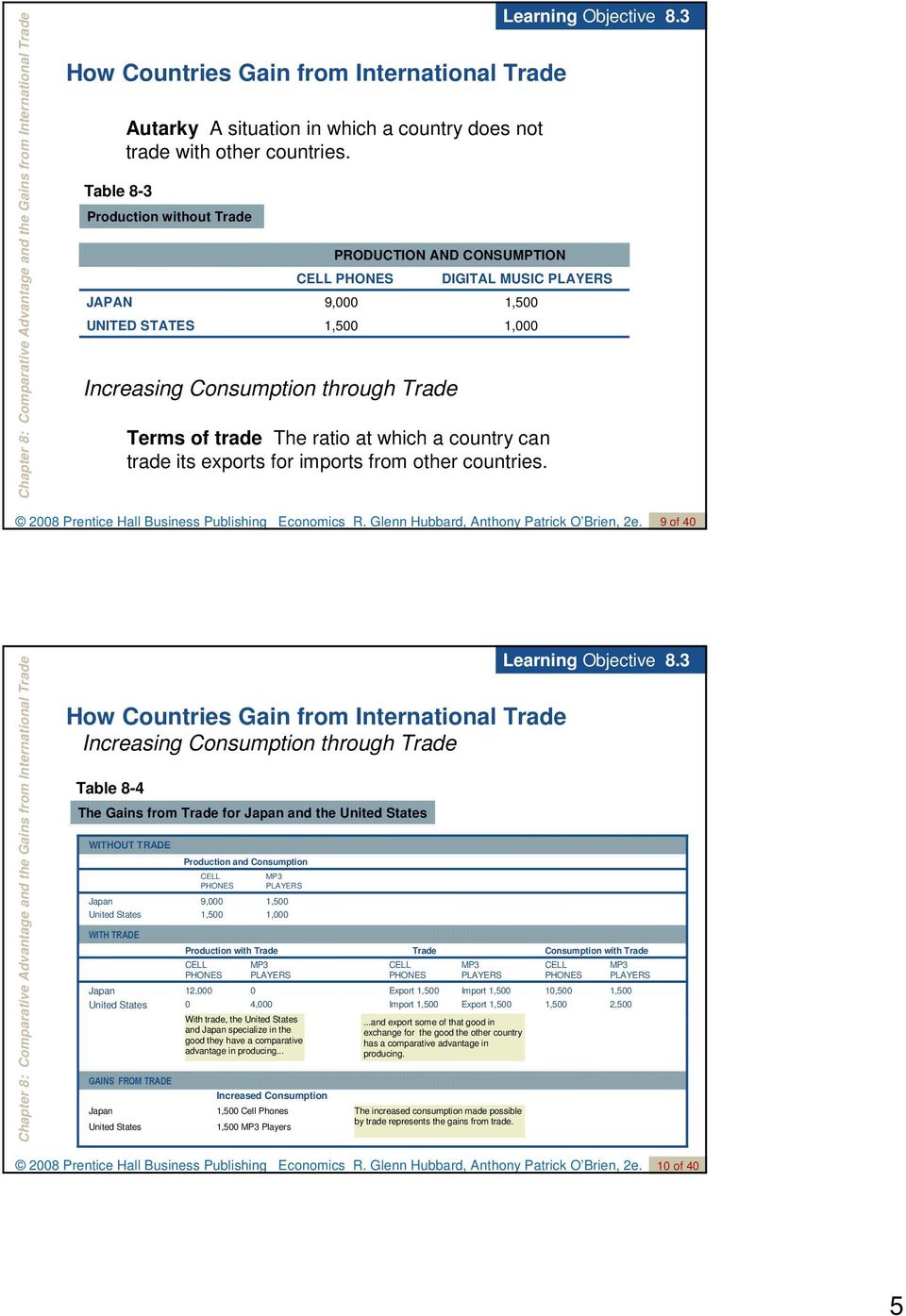
5 How Countries Gain from International Trade Table 8-3 Autarky A situation in which a country does not trade with other countries. Production without Trade JAPAN UNITED STATES PRODUCTION AND CONSUMPTION CELL PHONES 9,000 1,500 Increasing Consumption through Trade Learning Objective 8.3 DIGITAL MUSIC PLAYERS 1,500 1,000 Terms of trade The ratio at which a country can trade its exports for imports from other countries Prentice Hall Business Publishing Economics R. Glenn Hubbard, Anthony Patrick O Brien, 2e. 9 of 40 How Countries Gain from International Trade Increasing Consumption through Trade Table 8-4 The Gains from Trade for Japan and the United States WITHOUT TRADE Japan United States WITH TRADE Japan United States GAINS FROM TRADE Japan United States Production and Consumption 0 CELL PHONES 9,000 1,500 CELL PHONES 12,000 4,000 MP3 PLAYERS With trade, the United States and Japan specialize in the good they have a comparative advantage in producing ,500 1,000 Production with Trade MP3 PLAYERS Increased Consumption 1,500 Cell Phones 1,500 MP3 Players Trade CELL PHONES Export 1,500 Import 1,500 MP3 PLAYERS Import 1,500 Export 1,500...and export some of that good in exchange for the good the other country has a comparative advantage in producing. The increased consumption made possible by trade represents the gains from trade. Learning Objective 8.3 Consumption with Trade CELL PHONES 10,500 1,500 MP3 PLAYERS 1,500 2, Prentice Hall Business Publishing Economics R. Glenn Hubbard, Anthony Patrick O Brien, 2e. 10 of 40 5
6 Solved Problem 8-3 The Gains from Trade WITH TRADE PORTUGAL ENGLAND WITHOUT TRADE CLOTH 0 90,000 Portugal England PRODUCTION WITH TRADE WINE 150,000 0 PRODUCTION AND CONSUMPTION CLOTH 18,000 63,000 GAINS FROM TRADE Portugal England CLOTH Import 18,000 Export 18,000 TRADE 9,000 wine 9,000 cloth WINE 123,000 18,000 WINE Export 18,000 Import 18,000 INCREASED CONSUMPTION Learning Objective 8.3 CONSUMPTION WITH TRADE CLOTH 18,000 72,000 WINE 132,000 18, Prentice Hall Business Publishing Economics R. Glenn Hubbard, Anthony Patrick O Brien, 2e. 11 of 40 How Countries Gain from International Trade Why Don t We See Complete Specialization? Not all goods and services are traded internationally. Production of most goods involves increasing opportunity costs. Tastes for products differ. Does Anyone Lose as a Result of International Trade? Don t Let This Happen to YOU! Remember That Trade Creates Both Winners and Losers Learning Objective Prentice Hall Business Publishing Economics R. Glenn Hubbard, Anthony Patrick O Brien, 2e. 12 of 40 6
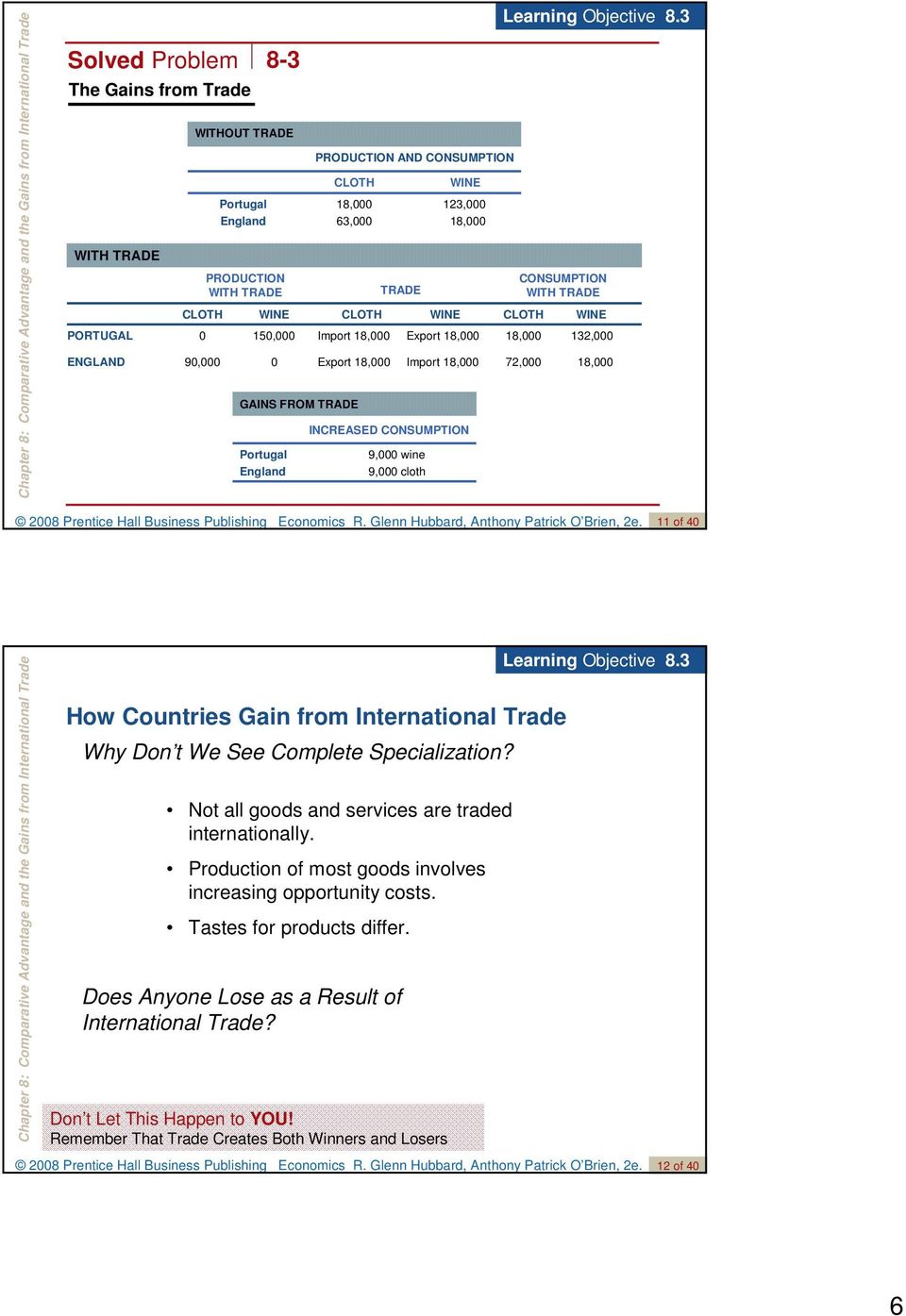
7 Free trade Trade between countries that is without government restrictions. Figure 8-4 The U.S. Market for Ethanol under Autarky 2008 Prentice Hall Business Publishing Economics R. Glenn Hubbard, Anthony Patrick O Brien, 2e. 13 of 40 Figure 8-5 The Effect of Imports on the U.S. Ethanol Market 2008 Prentice Hall Business Publishing Economics R. Glenn Hubbard, Anthony Patrick O Brien, 2e. 14 of 40 7
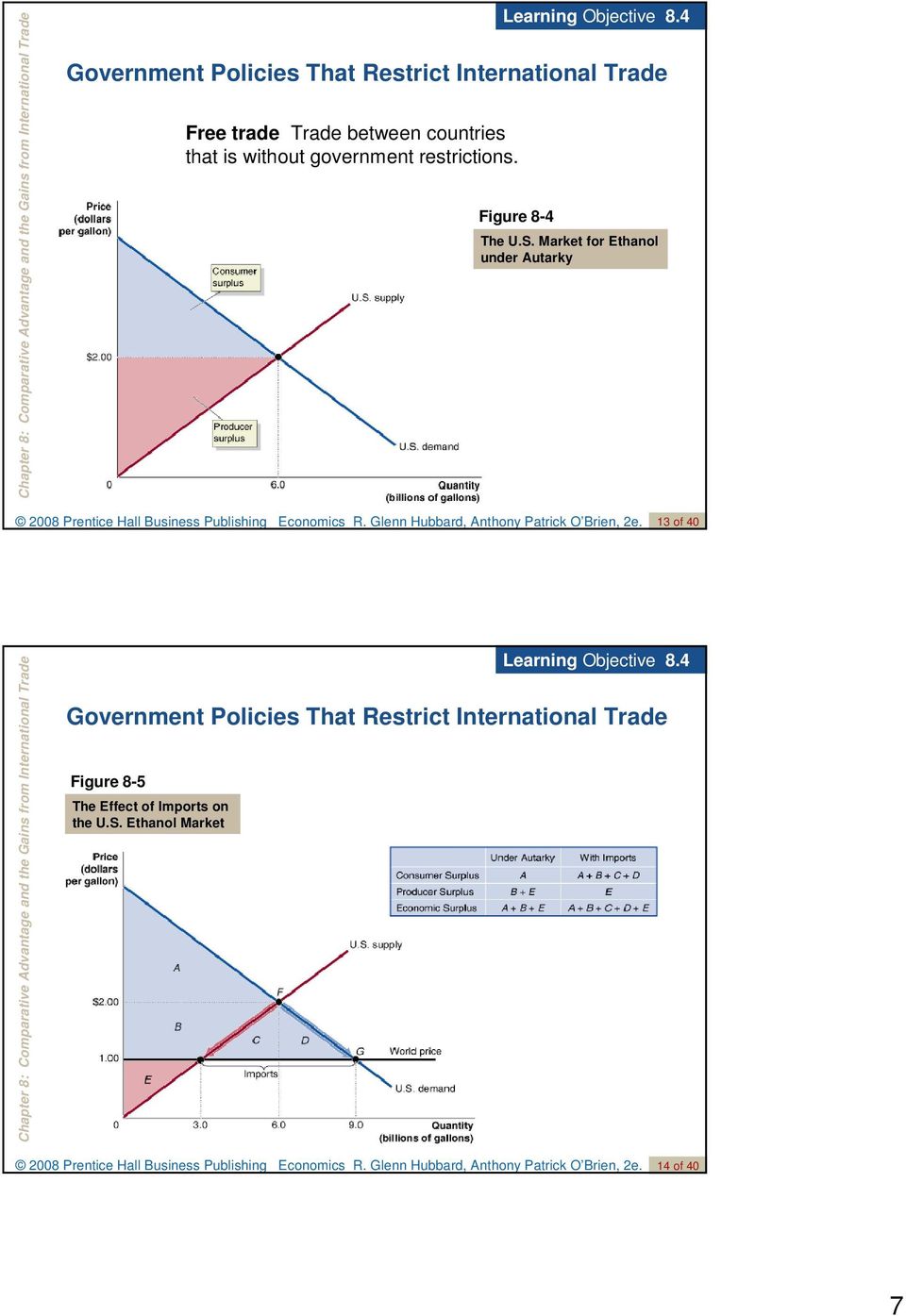
8 Tariffs Figure 8-6 The Effects of a Tariff on Ethanol 2008 Prentice Hall Business Publishing Economics R. Glenn Hubbard, Anthony Patrick O Brien, 2e. 15 of 40 Quotas and Voluntary Export Restraints Quota A numeric limit imposed by a government on the quantity of a good that can be imported into the country. Voluntary export restraint (VER) An agreement negotiated between two countries that places a numeric limit on the quantity of a good that can be imported by one country from the other country Prentice Hall Business Publishing Economics R. Glenn Hubbard, Anthony Patrick O Brien, 2e. 16 of 40 8
9 Quotas and Voluntary Export Restraints Figure 8-7 The Economic Effect of the U.S. Sugar Quota 2008 Prentice Hall Business Publishing Economics R. Glenn Hubbard, Anthony Patrick O Brien, 2e. 17 of 40 Measuring the Economic Effect of the Sugar Quota We can use the concepts of consumer surplus, producer surplus, and deadweight loss to measure the economic impact of the sugar quota Prentice Hall Business Publishing Economics R. Glenn Hubbard, Anthony Patrick O Brien, 2e. 18 of 40 9

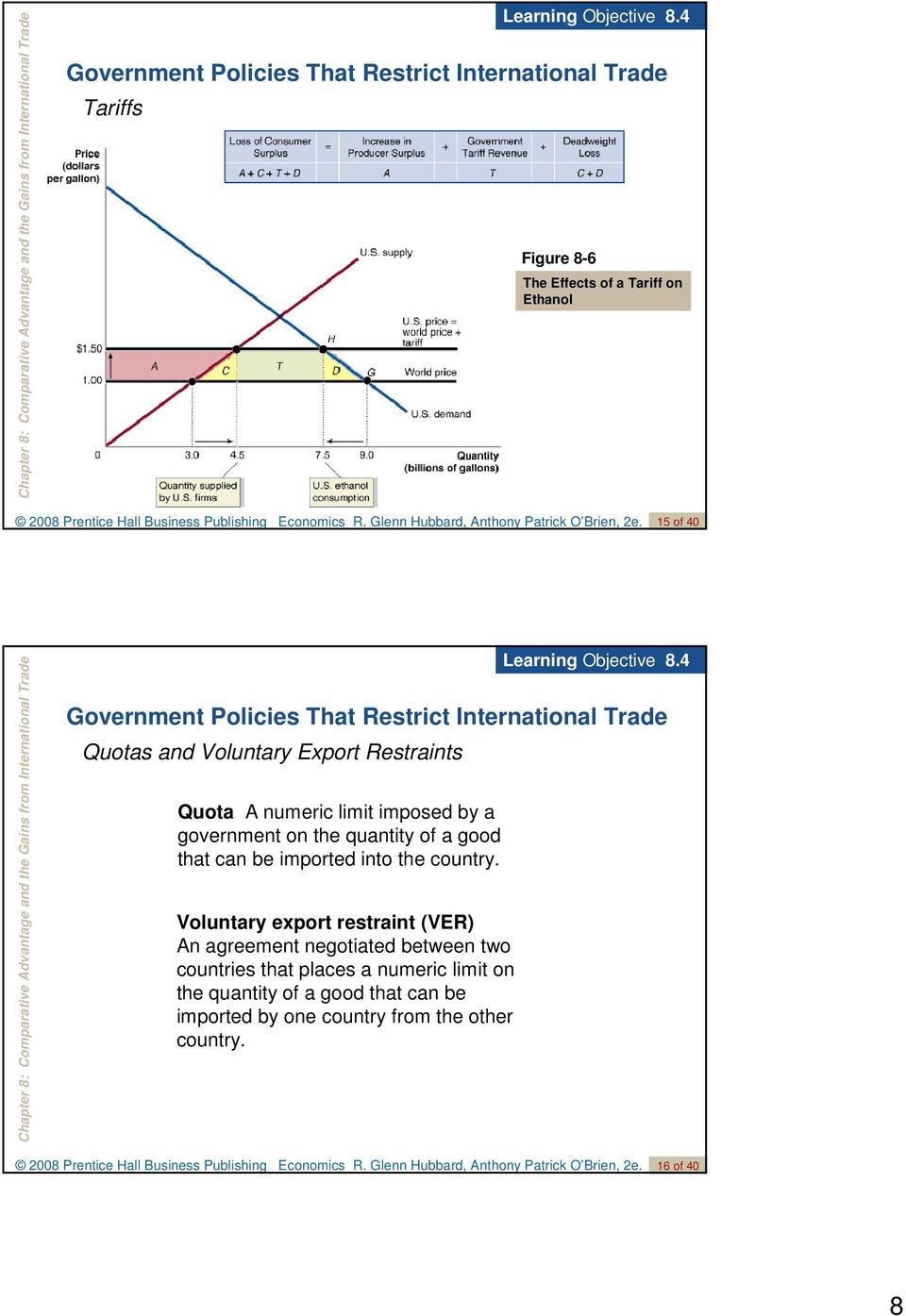
10 Solved Problem 8-4 Measuring the Economic Effect of a Quota World price of apples U.S. price of apples Quantity supplied by U.S. firms Quantity demanded by U.S. consumers Quantity imported Area of consumer surplus Area of domestic producer surplus Area of deadweight loss WITHOUT QUOTA $10 $10 6 million boxes 16 million boxes 10 millions boxes A+B+C+D+E+F G No deadweight loss WITH QUOTA $10 $12 10 million boxes 14 million boxes 4 million boxes A+B G+C D+F 2008 Prentice Hall Business Publishing Economics R. Glenn Hubbard, Anthony Patrick O Brien, 2e. 19 of 40 The High Cost of Preserving Jobs with Tariffs and Quotas Table 8-5 Preserving U.S. Jobs with Tariffs and Quotas Is Expensive PRODUCT Benzenoid chemicals Luggage Softwood lumber Dairy products Frozen orange juice Ball bearings Machine tools Women's handbags Canned tuna NUMBER OF JOBS SAVED , , COST TO CONSUMERS PER YEAR FOR EACH JOB SAVED $1,376,435 1,285,078 1,044, , , , , , , Prentice Hall Business Publishing Economics R. Glenn Hubbard, Anthony Patrick O Brien, 2e. 20 of 40 10
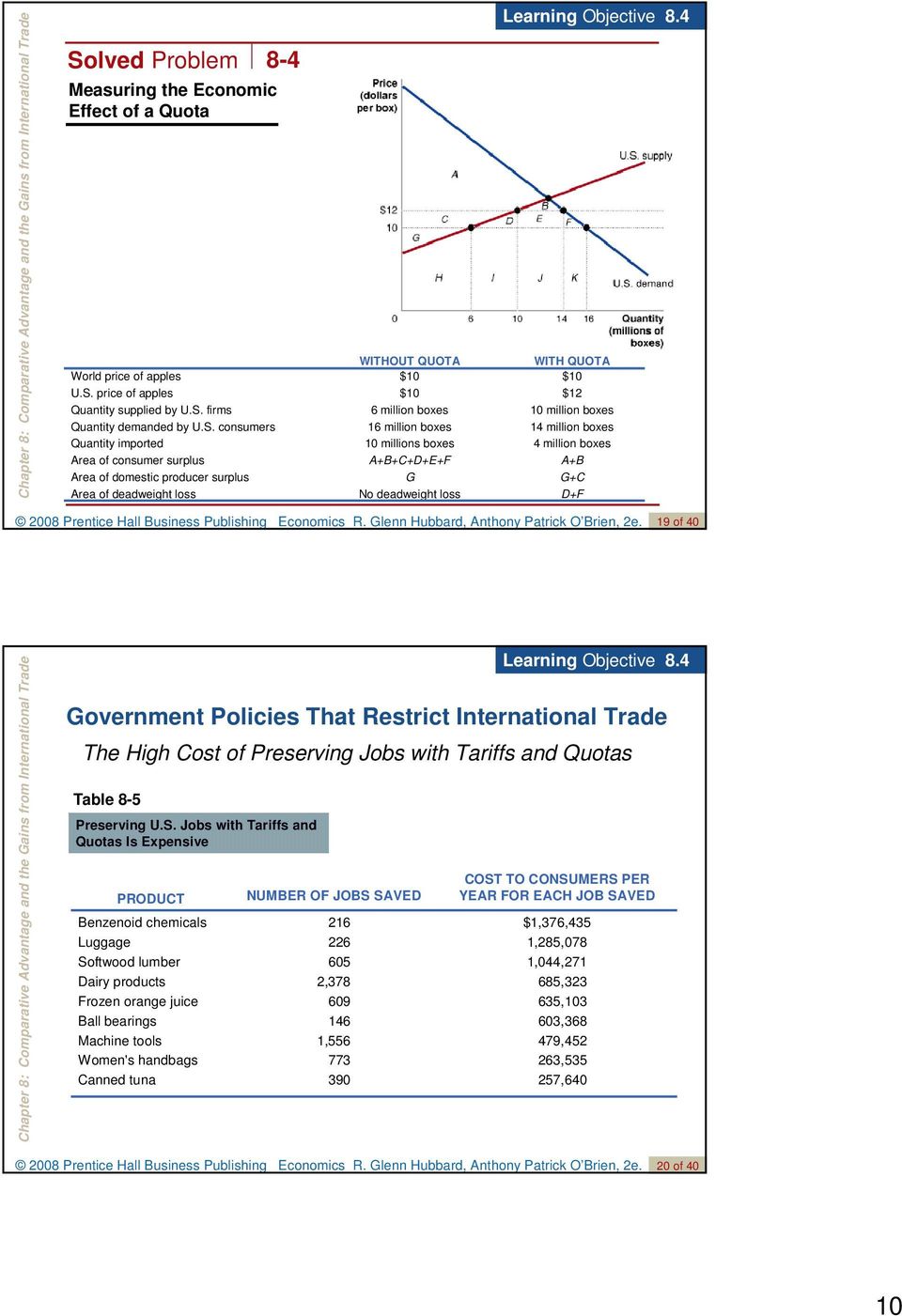
11 The High Cost of Preserving Jobs with Tariffs and Quotas Table 8-6 Preserving Japanese Jobs with Tariffs and Quotas Is Also Expensive PRODUCT Rice Natural gas Gasoline Paper Beef, pork, and poultry Cosmetics Radio and television sets COST TO CONSUMERS PER YEAR FOR EACH JOB SAVED $51,233,000 27,987,000 6,329,000 3,813,000 1,933,000 1,778, , Prentice Hall Business Publishing Economics R. Glenn Hubbard, Anthony Patrick O Brien, 2e. 21 of 40 Learning Objective 8.5 The Argument over Trade Policies and Globalization World Trade Organization (WTO) An international organization that oversees international trade agreements. Why Do Some People Oppose the World Trade Organization? Globalization The process of countries becoming more open to foreign trade and investment. Anti-Globalization Some people believe that free trade and foreign investment destroy the distinctive cultures of many countries. Many governments have resisted globalization proposals Prentice Hall Business Publishing Economics R. Glenn Hubbard, Anthony Patrick O Brien, 2e. 22 of 40 11
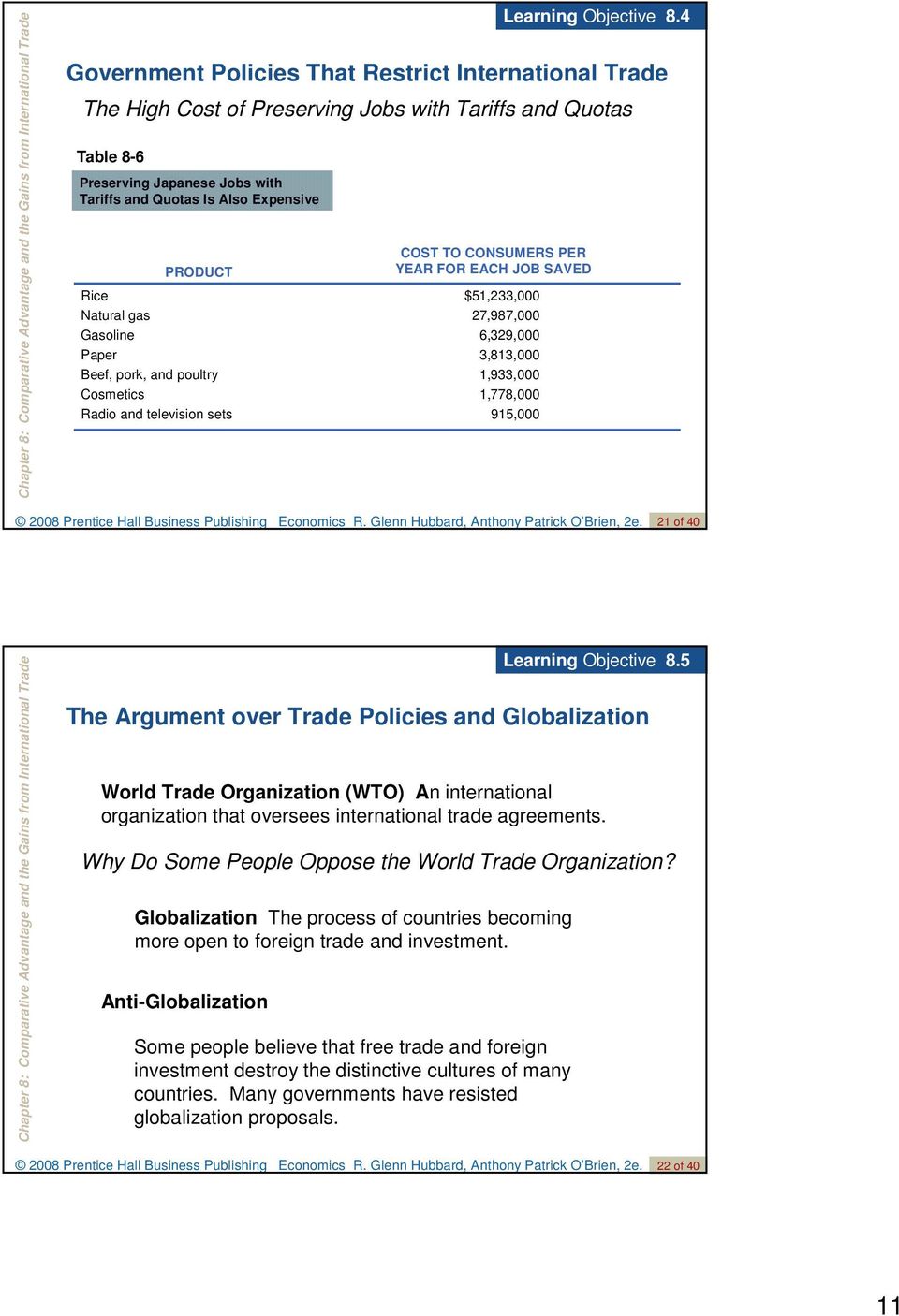
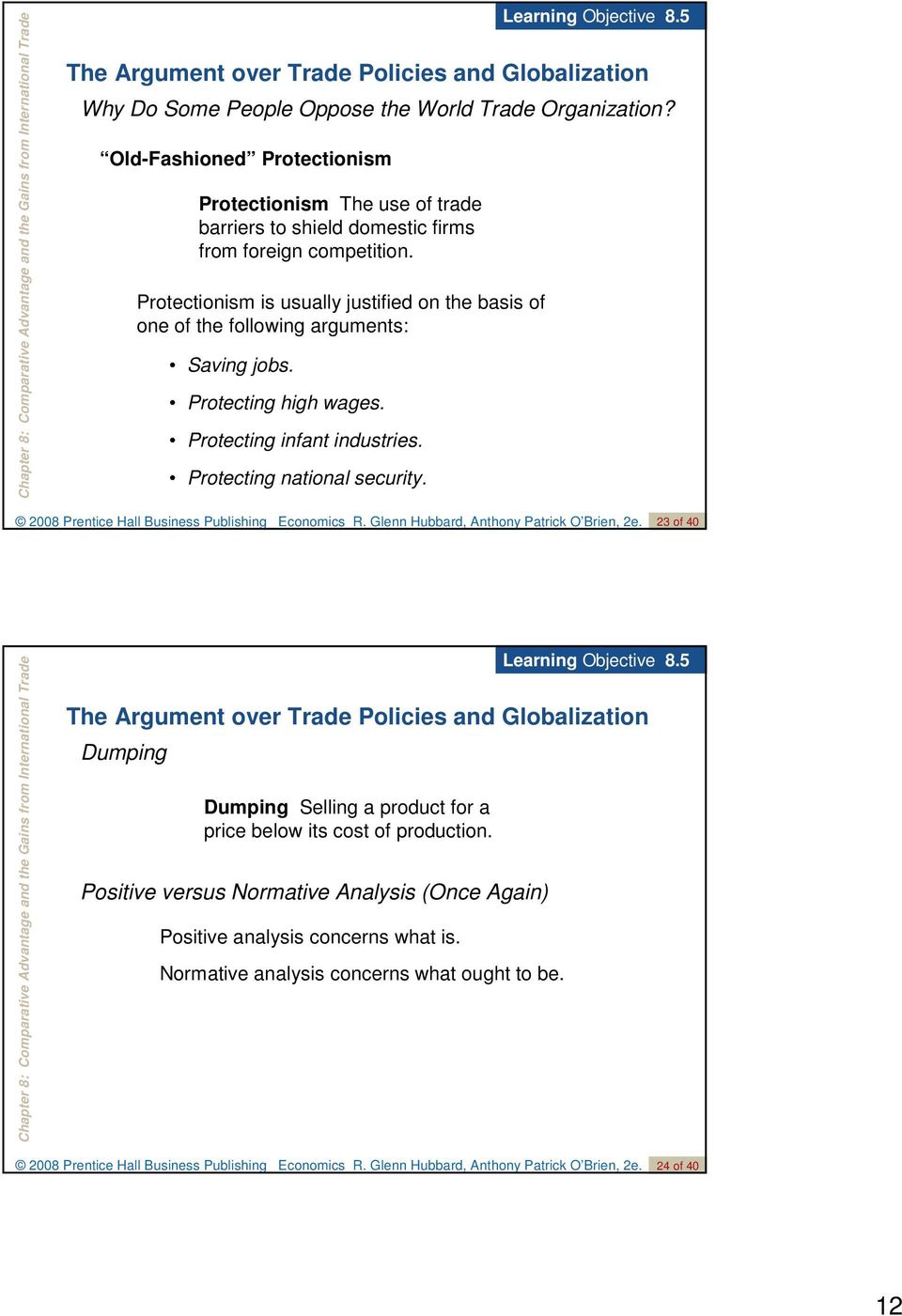
12 Learning Objective 8.5 The Argument over Trade Policies and Globalization Why Do Some People Oppose the World Trade Organization? Old-Fashioned Protectionism Protectionism The use of trade barriers to shield domestic firms from foreign competition. Protectionism is usually justified on the basis of one of the following arguments: Saving jobs. Protecting high wages. Protecting infant industries. Protecting national security Prentice Hall Business Publishing Economics R. Glenn Hubbard, Anthony Patrick O Brien, 2e. 23 of 40 Learning Objective 8.5 The Argument over Trade Policies and Globalization Dumping Dumping Selling a product for a price below its cost of production. Positive versus Normative Analysis (Once Again) Positive analysis concerns what is. Normative analysis concerns what ought to be Prentice Hall Business Publishing Economics R. Glenn Hubbard, Anthony Patrick O Brien, 2e. 24 of 40 12
Chapter 7. Comparative Advantage and the Gains from International Trade
 Chapter 7. Comparative Advantage and the Gains from International Trade Instructor: JINKOOK LEE Department of Economics / Texas A&M University ECON 203 502 Principles of Macroeconomics International Trade
Review Question - Chapter 7. MULTIPLE CHOICE. Choose the one alternative that best completes the statement or answers the question.
 Review Question - Chapter 7 MULTIPLE CHOICE. Choose the one alternative that best completes the statement or answers the question. 1) International trade arises from A) the advantage of execution. B) absolute
Chapter 13 International Trade: Does it Jeopardize American Jobs
 Chapter 13 International Trade: Does it Jeopardize American Jobs Multiple Choice Questions 1. In 2006, trade made up percent of the U.S. economy. a. 1.3 b. 5.0 C. 11.5 d. 22.7 2. In 2005, the U.S. experienced
GEORGIA PERFORMANCE STANDARDS International Domain [Type the author name]
![GEORGIA PERFORMANCE STANDARDS International Domain [Type the author name]](/thumbs/39/18787419.jpg "GEORGIA PERFORMANCE STANDARDS International Domain [Type the author name]") GEORGIA PERFORMANCE STANDARDS International Domain [Type the author name] GEORGIA PERFORMANCE STANDARDS INTERNATIONAL ECONOMICS Fundamental Economic Concepts SSEF3 The student will explain how specialization
GEORGIA PERFORMANCE STANDARDS International Domain [Type the author name] GEORGIA PERFORMANCE STANDARDS INTERNATIONAL ECONOMICS Fundamental Economic Concepts SSEF3 The student will explain how specialization
Chapter 17 review. Multiple Choice Identify the letter of the choice that best completes the statement or answers the question.
 Chapter 17 review Multiple Choice Identify the letter of the choice that best completes the statement or answers the question. 1. Which of the following resulted in a retaliation by the United States of
Oligopoly: Firms in Less Competitive Markets
 Chapter 13 Oligopoly: Firms in Less Competitive Markets Prepared by: Fernando & Yvonn Quijano 2008 Prentice Hall Business Publishing Economics R. Glenn Hubbard, Anthony Patrick O Brien, 2e. Competing with
Knowledge Enrichment Seminar for Senior Secondary Economics Curriculum. Macroeconomics Series (3): Extension of trade theory
 Knowledge Enrichment Seminar for Senior Secondary Economics Curriculum Macroeconomics Series (3): Extension of trade theory by Dr. Charles Kwong School of Arts and Social Sciences The Open University of
Global Economic Issues and Policies
 Global Economic Issues and Policies First edition Chapter 4 Regulating International Trade Trade Policies and Their Effects PowerPoint Presentation by Charlie Cook Copyright 2004 South-Western/Thomson
Chapter 9 1. Use Exhibit 3 to answer the following questions.
 Chapter 9 1. Use Exhibit 3 to answer the following questions. Exhibit 3 a. If trade is not allowed, what is the equilibrium price and quantity in this market? Price = 4, quantity = 40 units. b. If trade
Production Possibilities Curve, Absolute and Comparative Advantage, Opportunity Cost, and Marginal Analysis
 AP Macroeconomics Unit 1 Review Session Production Possibilities Curve, Absolute and Comparative Advantage, Opportunity Cost, and Marginal Analysis 1. Draw a PPC with linear opportunity cost. 2. Draw a
1 Multiple Choice - 50 Points
 Econ 201 Final Winter 2008 SOLUTIONS 1 Multiple Choice - 50 Points (In this section each question is worth 1 point) 1. Suppose a waiter deposits his cash tips into his savings account. As a result of only
MUTUAL GAINS FROM TRADE
 eties. While aid particularly technical assistance can play a constructive role during the transition, trade, not aid, is the most important force for integrating these economies into the world market.
ECO 445/545: International Trade. Jack Rossbach Spring 2016
 ECO 445/545: International Trade Jack Rossbach Spring 2016 Instruments of Trade Policy Many instruments available to affect international trade flows and prices. Non-exhaustive list: Tariffs: Taxes on
The Balance of Payments, the Exchange Rate, and Trade
 Balance of Payments The Balance of Payments, the Exchange Rate, and Trade Policy The balance of payments is a country s record of all transactions between its residents and the residents of all foreign
CHAPTER 19 INTERNATIONAL TRADE
 CHAPTER 19 INTERNATIONAL TRADE Chapter in a Nutshell In the second chapter of the text, you were introduced to the concepts absolute advantage and comparative advantage that are the principles on which
Course Outline SS212 Economy of Micronesia
 Course Outline SS212 Economy of Micronesia Course Description This course is an in-depth exploration of the FSM economy with an emphasis placed on the development of a broad knowledge base as well as the
Tariff and Non-Tariff Barriers to Trade
 Tariff and Non-Tariff Barriers to Trade Daniel A. Sumner, Universtiy of California-Davis Vincent H. Smith, Montana State University C. Parr Rosson, Texas A&M University Introduction Background This paper
Advanced International Economics Prof. Yamin Ahmad ECON 758
 Advanced International Economics Prof. Yamin Ahmad ECON 758 Sample Midterm Exam Name Id # Instructions: There are two parts to this midterm. Part A consists of multiple choice questions. Please mark the
Economics 181: International Trade Homework # 4 Solutions
 Economics 181: International Trade Homework # 4 Solutions Ricardo Cavazos and Robert Santillano University of California, Berkeley Due: November 1, 006 1. The nation of Bermuda is small and assumed to
I n contrast to their divergent opinions on many
 The Controversy Over Free Trade: The Gap Between Economists and the General Public Cletus C. Coughlin I n contrast to their divergent opinions on many public-policy issues, most economists strongly support
3) The excess supply curve of a product we (H) import from foreign countries (F) increases as B) excess demand of country F increases.
 International Economics, 8e (Krugman) Chapter 8 The Instruments of Trade Policy 8.1 Basic Tariff Analysis 1) Specific tariffs are A) import taxes stated in specific legal statutes. B) import taxes calculated
a) Find the equilibrium price and quantity when the economy is closed.
 Economics 102 Fall 2007 Answers to Homework 2 Problem 1: In Schulzland, a small closed economy, the supply and demand for bushels of peanuts are given by D: P = 200 5Q and S: P = 40 + 3Q. The world price
For centuries, people of the world have traded. From the ancient silk routes and spice trade to modern
 International Trade For centuries, people of the world have traded. From the ancient silk routes and spice trade to modern shipping containers and satellite data transfers, nations have tied their economies
TRADE WITH SCALE ECONOMIES AND IMPERFECT COMPETITION (CONT'D)
 ECO 352 Spring 2010 No. 14 Mar. 25 OLIGOPOLY TRADE WITH SCALE ECONOMIES AND IMPERFECT COMPETITION (CONT'D) Example using numbers from Precept Week 7 slides, pp. 2, 3. Ingredients: Industry with inverse
Supply and Demand Fundamental tool of economic analysis Used to discuss unemployment, value of $, protection of the environment, etc.
 Supply and emand Fundamental tool of economic analysis Used to discuss unemployment, value of $, protection of the environment, etc. Chapter Outline: (a) emand is the consumer side of the market. (b) Supply
How To Understand The Law Of One Price
 Economics for Educators Lesson 18 and 5E Model Revised Edition Robert F. Hodgin, Ph.D. ii Economics for Educators, Revised Copyright 2012 All Rights Reserved 99 Economics for Educators, Revised Lesson
CHAPTER 6 BUSINESS-GOVERNMENT TRADE RELATIONS
 CHAPTER 6 BUSINESS-GOVERNMENT TRADE RELATIONS LEARNING OBJECTIVES: 1. Describe the political, economic, and cultural motives behind governmental intervention in trade. 2. List and explain the methods governments
(First 6 problems from Caves, Frankel and Jones, 1990)
 Professor Robert Staiger Economics 39F Problem Set 1 (First 6 problems from Caves, Frankel and Jones, 1990) 1. With reference to the home country s trade triangle illustrated in Figure 2.3, suppose that
Trade Barriers Ing. Mansoor Maitah Ph.D. et Ph.D.
 Trade Barriers Ing. Mansoor Maitah Ph.D. et Ph.D. Economic Basis for Trade Distribution of Economic Resources Different Technologies Goods are Differentiated as to Quality and other Non - price Attributes
Economics 380: International Economics Fall 2000 Exam #2 100 Points
 Economics 380: International Economics Fall 2000 Exam #2 100 Points Name (ID) YOU SHOULD HAVE 7 PAGES FOR THIS EXAM. EXAM WILL END AT 1:50. MAKE SURE YOUR NAME IS ON THE FIRST AND LAST PAGE OF THE EXAM.
CLASSIFICATION OF MARKETS Perfectly competitive, various types of imperfect competition
 ECO 352 Spring 2010 No. 15 Mar. 30 TRADE POLICIES: TARIFFS AND QUOTAS CLASSIFICATION OF POLICIES Price-type: import tariffs, export taxes and subsidies Quantity-type: quotas, voluntary restraint and orderly
III. INTERNATIONAL TRADE
 III. INTERNATIONAL TRADE A. Gains from Trade -- a history of thought approach 1. The idea of mercantilism (15-175) argued that a country s well-being is directly tied to the accumulation of gold and silver.
How To Save Jobs With Tariffs And Quotas
 CH07 p.132-149 3/12/04 3:54 PM Page 132 CHAPTER 7 9 Commercial Policy Introduction: Commercial Policy and Jobs An argument was made in Chapter 6 that tariffs and quotas lower national welfare by creating
International Business Plan A PRACTICAL GUIDE FOR EXPORTERS
 International Business Plan A PRACTICAL GUIDE FOR EXPORTERS ÍNDICE 1 TABLE OF CONTENTS PLAN STRUCTURE 5 SECTIONS 6 EXPLANATORY NOTES 36 CASE STUDY 67 This is a sampble of 18 pages out of 97 of the International
GOVERNMENT ECONOMIC OBJECTIVES AND POLICIES. Textbook, Chapter 26 [pg 317-328]
![GOVERNMENT ECONOMIC OBJECTIVES AND POLICIES. Textbook, Chapter 26 [pg 317-328]](/thumbs/27/11652136.jpg "GOVERNMENT ECONOMIC OBJECTIVES AND POLICIES. Textbook, Chapter 26 [pg 317-328]") GOVERNMENT ECONOMIC OBJECTIVES AND POLICIES Textbook, Chapter 26 [pg 317-328] Name: Class: Learning outcomes: Identify government economic objectives. Explain the main stages of the business cycle. Explain
GOVERNMENT ECONOMIC OBJECTIVES AND POLICIES Textbook, Chapter 26 [pg 317-328] Name: Class: Learning outcomes: Identify government economic objectives. Explain the main stages of the business cycle. Explain
Chapter 3. Labor Productivity and Comparative Advantage: The Ricardian Model
 Chapter 3 Labor Productivity and Comparative Advantage: The Ricardian Model Introduction There are potential gains from trade whenever there are differences in autarky prices across countries. We now explore
Chapter 4 Specific Factors and Income Distribution
 Chapter 4 Specific Factors and Income Distribution Chapter Organization Introduction The Specific Factors Model International Trade in the Specific Factors Model Income Distribution and the Gains from
Trade and Resources: The Heckscher-Ohlin Model. Professor Ralph Ossa 33501 International Commercial Policy
 Trade and Resources: The Heckscher-Ohlin Model Professor Ralph Ossa 33501 International Commercial Policy Introduction Remember that countries trade either because they are different from one another or
AP Microeconomics: International Economics
 AP Microeconomics: International Economics 2008 Curriculum Module 2008 The College Board. All rights reserved. College Board, Advanced Placement Program, AP, SAT, and the acorn logo are registered trademarks
REVIEW ONE. Name: Class: Date: Matching
 Name: Class: Date: ID: A REVIEW ONE Matching Complete the following using these terms. a. outsourcing b. diversity c. entrepreneur d. competitive differentiation e. strategic alliance f. capital g. vision
Business-Government Trade Relations
 6: Business-Government Trade Relations 1 C H A P T E R S I X Business-Government Trade Relations 6 Learning Objectives Describe the political, economic, and cultural motives behind governmental intervention
KOÇ UNIVERSITY ECON 321 - INTERNATIONAL TRADE
 KOÇ UNIVERSITY ECON 321 - INTERNATIONAL TRADE Mid-term Exam (100 points; 90 minutes) Answer all 5 questions. In providing answers to the questions in this section algebra or graphs might be helpful. State
WTO E-Learning. WTO E-Learning Copyright August 2012. The WTO and Trade Economics: Theory and Policy
 WTO E-Learning WTO E-Learning Copyright August 2012 The WTO and Trade Economics: Theory and Policy 1 Introduction This is a multimedia course on The WTO and Trade Economics: Theory and Policy. The course
How To Calculate Profit Maximization In A Competitive Dairy Firm
 Microeconomic FRQ s 2005 1. Bestmilk, a typical profit-maximizing dairy firm, is operating in a constant-cost, perfectly competitive industry that is in long-run equilibrium. a. Draw correctly-labeled
4. According to the graph, assume that Cliff and Paul were both producing wheat and corn, and each were dividing their time equally between the two. T
 1. Your professor loves his work, teaching economics. He has been offered other positions in the corporate world making 25 percent more, but has decided to stay in teaching. His decision would not change
ECON 10020/20020 Principles of Macroeconomics Problem Set 6 Solutions
 ECON 10020/20020 Principles of Macroeconomics Problem Set 6 Solutions Dennis C. Plott University of Notre Dame Department of Economics April 9, 2015 Email: [email protected] 1 Name: Dennis C. Plott
Economics 101 Fall 2011 Homework #3 Due 10/11/11
 Economics 101 Fall 2011 Homework #3 Due 10/11/11 Directions: The homework will be collected in a box before the lecture. Please place your name, TA name and section number on top of the homework (legibly).
Econ 101: Principles of Microeconomics
 Econ 101: Principles of Microeconomics Chapter 7: Taxes Fall 2010 Herriges (ISU) Ch. 7: Taxes Fall 2010 1 / 25 Outline 1 The Excise Tax 2 The Benefits and Costs of Taxation 3 Tax Fairness versus Tax Efficiency
Macroeconomics: GDP, GDP Deflator, CPI, & Inflation
 HOSP 2207 (Economics) Learning Centre Macroeconomics: GDP, GDP Deflator, CPI, & Inflation Macroeconomics is the big picture view of an economy. Microeconomics looks at the market for a specific good, like
UNIVERSITY OF COLORADO BOULDER, COLORADO. Course Outline and Reading List
 UNIVERSITY OF COLORADO BOULDER, COLORADO Economics 4413 International Trade James R. Markusen January 14, 2007 Phone: 492-0748 Office: 216, e-mail: [email protected] Office Hours: Monday, Wednesday,
U.S. Agriculture and International Trade
 Curriculum Guide I. Goals and Objectives A. Understand the importance of exports and imports to agriculture and how risk management is affected. B. Understand factors causing exports to change. C. Understand
MULTIPLE CHOICE. Choose the one alternative that best completes the statement or answers the question.
 Exam Name MULTIPLE CHOICE. Choose the one alternative that best completes the statement or answers the question. Hint: draw graphs in the margins to check your answers. And remember that an increase in
Lecture 10-1. The Twin Deficits
 Lecture 10-1 The Twin Deficits The IS-LM model of the previous lectures endogenised the interest rate while assuming that the portion (NX 0 ) of net exports not dependent on income was exogenously fixed.
Chapter 7. External Economies of Scale and the International Location of Production. Copyright 2012 Pearson Education. All rights reserved.
 Chapter 7 External Economies of Scale and the International Location of Production Preview Types of economies of scale Economies of scale and market structure The theory of external economies External
DEMAND AND SUPPLY CURVES: CONSUMER & PRODUCER SURPLUS by Kenneth Matziorinis
 1 EMAN AN UPPLY CURVE: CONUMER & PROUCER URPLU by Kenneth Matziorinis Price (P / Q) P emand () Pd Po 0 Qo Qd Q Quantity (Q / time) FIGURE 1.1 THE EMAN CURVE The emand Curve and the Law of emand The demand
The level of price and inflation Real GDP: the values of goods and services measured using a constant set of prices
 Chapter 2: Key Macroeconomics Variables ECON2 (Spring 20) 2 & 4.3.20 (Tutorial ) National income accounting Gross domestic product (GDP): The market value of all final goods and services produced within
China and the WTO: Implications for Grain Trade. Dr. Thomas I. Wahl IMPACT Center Washington State University
 China and the WTO: Implications for Grain Trade Dr. Thomas I. Wahl Center Washington State University Overview of Presentation Background Why are we interested in China Current trade situation Demographics
Learning Objectives. Chapter 17. Trading Currencies in Foreign Exchange Markets. Trading Currencies in Foreign Exchange Markets (cont.
 Chapter 17 Financing World Trade Learning Objectives Explain how foreign exchange rates are determined. Differentiate between floating and fixed exchange rate systems. Contrast the balance of trade and
Midterm Exam - Answers. November 3, 2005
 Page 1 of 10 November 3, 2005 Answer in blue book. Use the point values as a guide to how extensively you should answer each question, and budget your time accordingly. 1. (8 points) A friend, upon learning
MULTIPLE CHOICE. Choose the one alternative that best completes the statement or answers the question on the accompanying scantron.
 E203, Principles of Microeconomics Quiz 2 - Demand and Supply Name MULTIPLE CHOICE. Choose the one alternative that best completes the statement or answers the question on the accompanying scantron. 1)
Fifth Edition. Steven Husted University of Pittsburgh. Michael Melvin Arizona State University
 Fifth Edition Steven Husted University of Pittsburgh Michael Melvin Arizona State University Boston San Francisco New York London Toronto Sydney Tokyo Singapore Madrid Mexico City Munich Paris Cape Town
Q D = 100 - (5)(5) = 75 Q S = 50 + (5)(5) = 75.
 4. The rent control agency of New York City has found that aggregate demand is Q D = 100-5P. Quantity is measured in tens of thousands of apartments. Price, the average monthly rental rate, is measured
Principles of Economics
 Principles of Economics LEARNING OBJECTIVES Ohio Wesleyan University Goran Skosples 3. Interdependence and the Gains from Trade Why do people and nations choose to be economically interdependent? How can
ASSIGNMENT 1 ST SEMESTER : MACROECONOMICS (MAC) ECONOMICS 1 (ECO101) STUDY UNITS COVERED : STUDY UNITS 1 AND 2. DUE DATE : 3:00 p.m.
 Page 1 of 13 ASSIGNMENT 1 ST SEMESTER : MACROECONOMICS (MAC) ECONOMICS 1 (ECO101) STUDY UNITS COVERED : STUDY UNITS 1 AND 2 DUE DATE : 3:00 p.m. 19 MARCH 2013 TOTAL MARKS : 100 INSTRUCTIONS TO CANDIDATES
Economic Systems. 1. MARKET ECONOMY in comparison to 2. PLANNED ECONOMY
 Economic Systems The way a country s resources are owned and the way that country takes decisions as to what to produce, how much to produce and how to distribute what has been produced determine the type
Interdependence and the Gains from Trade Why is interdependence the norm?
 In this chapter, look for the answers to these questions: Why do people and nations choose to be economically interdependent? How can trade make everyone better off? What is absolute advantage? What is
Exercises Lecture 8: Trade policies
 Exercises Lecture 8: Trade policies Exercise 1, from KOM 1. Home s demand and supply curves for wheat are: D = 100 0 S = 0 + 0 Derive and graph Home s import demand schedule. What would the price of wheat
University of Lethbridge Department of Economics ECON 1012 Introduction to Microeconomics Instructor: Michael G. Lanyi. Chapter 3 Demand and Supply
 University of Lethbridge Department of Economics ECON 1012 Introduction to Microeconomics Instructor: Michael G. Lanyi Chapter 3 Demand and Supply 1) The relative price of a good is all of the following
Final Exam 15 December 2006
 Eco 301 Name Final Exam 15 December 2006 120 points. Please write all answers in ink. You may use pencil and a straight edge to draw graphs. Allocate your time efficiently. Part 1 (10 points each) 1. As
IMPLICATIONS OF THE NAFTA FOR THE NORTH AMERICAN FOOD INDUSTRY
 Discussion IMPLICATIONS OF THE NAFTA FOR THE NORTH AMERICAN FOOD INDUSTRY John Schildroth This paper provides comments on the implications of the North American Free Trade Agreement (NAFTA) on the North
Agenda. Saving and Investment in the Open Economy, Part 2. Globalization and the U.S. economy. Globalization and the U.S. economy
 Agenda Globalization and the U.S. Economy Saving and Investment in the Open Economy, Part 2 Saving and Investment in Large Open Economies (LOE) The U.S. Current Account Deficit Fiscal Policy and the Current
Chapter 4 Specific Factors and Income Distribution
 Chapter 4 Specific Factors and Income Distribution Chapter Organization Introduction The Specific Factors Model International Trade in the Specific Factors Model Income Distribution and the Gains from
MEASURING GDP AND ECONOMIC GROWTH CHAPTER
 MEASURING GDP AND ECONOMIC GROWTH CHAPTER Objectives After studying this chapter, you will able to Define GDP and use the circular flow model to explain why GDP equals aggregate expenditure and aggregate
(14-3238) Page: 1/7 TRENDS IN DOMESTIC SUPPORT MARKET PRICE SUPPORT COMMUNICATION FROM THE UNITED STATES OF AMERICA
 3 June 2014 (14-3238) Page: 1/7 Committee on Agriculture Original: English TRENDS IN DOMESTIC SUPPORT MARKET PRICE SUPPORT COMMUNICATION FROM THE UNITED STATES OF AMERICA 1 OVERVIEW 1.1. WTO Members have
AGRI- BUSINESS IN ARGENTINA A SEMINAR ON INVESTMENT OPPORTUNITIES
 AGRI- BUSINESS IN ARGENTINA A SEMINAR ON INVESTMENT OPPORTUNITIES Maximiliano Moreno Director of Multilateral Negotiations Ministry of Agriculture, Livestock and Fisheries Argentina NEW INTERNATIONAL ENVIRONMENT
Econ 202 Exam 2 Practice Problems
 Econ 202 Exam 2 Practice Problems Principles of Microeconomics Dr. Phillip Miller Multiple Choice Identify the choice that best completes the statement or answers the question. Chapter 6 1. If a binding
2012 HSC Economics Sample Answers
 2012 HSC Economics Sample Answers When examination committees develop questions for the examination, they may write sample answers or, in the case of some questions, answers could include. The committees
Econ 201 Final Exam. Douglas, Fall 2007 Version A Special Codes 00000. PLEDGE: I have neither given nor received unauthorized help on this exam.
 , Fall 2007 Version A Special Codes 00000 PLEDGE: I have neither given nor received unauthorized help on this exam. SIGNED: PRINT NAME: Econ 201 Final Exam 1. For a profit-maximizing monopolist, a. MR
Economics. Interdependence and the Gains from Trade CHAPTER. N. Gregory Mankiw. Principles of. Seventh Edition. Wojciech Gerson (1831-1901)
 Seventh Edition Principles of Economics N. Gregory Mankiw Wojciech Gerson (1831-1901) CHAPTER 3 Interdependence and the Gains from Trade In this chapter, look for the answers to these questions Why do
What is TPP? Which countries are involved in TPP?
 What is TPP? The Trans-Pacific Partnership Agreement (TPP) is a free trade agreement between 12 Asia-Pacific countries that liberalises trade and sets consistent rules to make it easier to do business
Sensitive Agricultural Products in the EU under the Doha Round
 1 Sensitive Agricultural Products in the EU under the Doha Round Huan-Niemi E. 1 1 MTT Agrifood Research Finland, Economic Research Unit, Helsinki, Finland. Abstract EU agricultural products are examined
Businesses are affected by the economy An economy describes how a country spends its money This is determined by 5 factors
 Economic Factors Businesses are affected by the economy An economy describes how a country spends its money This is determined by 5 factors Economic Growth Exchange Rates Rates Economic Factors Inflation
Agricultural Production and Research in Heilongjiang Province, China. Jiang Enchen. Professor, Department of Agricultural Engineering, Northeast
 1 Agricultural Production and Research in Heilongjiang Province, China Jiang Enchen Professor, Department of Agricultural Engineering, Northeast Agricultural University, Harbin, China. Post code: 150030
Chapter 3 Market Demand, Supply and Elasticity
 Chapter 3 Market Demand, Supply and Elasticity Multiple Choice Questions Choose the one alternative that best completes the statement or answers the question. 1. Ceteris paribus means (a) other things
PUBLIC POLICY IN FOOD AND AGRICULTURE - Food Security and Government Intervention - Samarendu Mohanty, E. Wesley F. Peterson
 FOOD SECURITY AND GOVERNMENT INTERVENTION Samarendu Mohanty Assistant Professor, Department of Agricultural and Applied Economics, Texas Tech University, Lubbock, Texas, USA E. Department of Agricultural
Making Cents of Milk Prices
 Food Researched: United States Dairy Industry Focus of Research: Milk Prices and Government Regulation Name: Courtney Halbach Title Making Cents of Milk Prices Objective(s) The objective of this paper
Interdependence. Interdependence. Production Possibilities in the U.S. Our Example. Interdependence and the Gains from Trade
 3 Interdependence and the Gains from Trade P R I N C I P L E S O F ECONOMICS F O U R T H E D I T I O N N. G R E G O R Y M A N K I W Premium PowerPoint Slides by Ron Cronovich 28 update Modified by Joseph
Determinants of FX Rates: Chapter 2. Chapter Objectives & Lecture Notes FINA 5500
 Determinants of FX Rates: Chapter 2 Chapter Objectives & Lecture Notes FINA 5500 Chapter Objectives: FINA 5500 Chapter 2 / Determinants of Exchange Rates 1. To be able to explain in your own words why
The Fiscal Policy and The Monetary Policy. Ing. Mansoor Maitah Ph.D.
 The Fiscal Policy and The Monetary Policy Ing. Mansoor Maitah Ph.D. Government in the Economy The Government and Fiscal Policy Fiscal Policy changes in taxes and spending that affect the level of GDP to
MULTIPLE CHOICE. Choose the one alternative that best completes the statement or answers the question.
 Chatper 34 International Finance - Test Bank MULTIPLE CHOICE. Choose the one alternative that best completes the statement or answers the question. 1) The currency used to buy imported goods is A) the
Economics. Social Studies Curriculum Framework. Revised 2006 Amended June 2009
 Economics Social Studies Curriculum Framework Revised 2006 Course Title: Economics Course/Unit Credit: 0.5 Course Number: 4743000 Teacher Licensure: Please refer to the Course Code Management System (https://adedata.arkansas.gov/ccms/)
GCSE. Economics. Mark Scheme for June 2013. General Certificate of Secondary Education Unit A593: The UK Economy and Globalisation
 GCSE Economics General Certificate of Secondary Education Unit A593: The UK Economy and Globalisation Mark Scheme for June 2013 Oxford Cambridge and RSA Examinations OCR (Oxford Cambridge and RSA) is a
Economics The Economy Student Activities (Higher)
 Economics The Economy Student Activities (Higher) 5625 August 1999 HIGHER STILL Economics The Economy Student Activities Higher Support Materials *+,-./ HIGHER ECONOMICS: STUDENT ACTIVITIES: THE ECONOMY
International Trade Syllabus
 International Trade Syllabus Instructor: Prof. Dr. Harald Sander Office: CL 301 Telephone: (221) 8275-3419 email: [email protected] Class e-site: Class Hours: see Summer School Schedule Office
How To Lift The Safeguard Tariff On Steel
 Import Tariffs and Quotas under Perfect Competition I take this action to give our domestic steel industry an opportunity to adjust to surges in foreign imports, recognizing the harm from 50 years of foreign
Suppose you are a seller with cost 13 who must pay a sales tax of 15. What is the lowest price you can sell at and not lose money?
 Experiment 3 Suppose that sellers pay a tax of 15. If a seller with cost 5 sells to a buyer with value 45 at a price of 25, the seller earns a profit of and the buyer earns a profit of. Suppose you are