
LUCRĂ RI Ş I RAPOARTE DE CERCETARE VOL. III
|
|
|
- Victoria Bell
- 8 years ago
- Views:
Transcription
1 LUCRĂ RI Ş I RAPOARTE DE CERCETARE VOL. III
2

3 UNIVERSITATEA DIN BUCUREŞ TI FACULTATEA DE GEOGRAFIE CENTRUL DE CERCETARE DEGRADAREA TERENURILOR ŞI DINAMICĂ GEOMORFOLOGICĂ C E N T R U L D E C E R C E TA R E LUCRĂRI ŞI RAPOARTE DE CERCETARE VOL. III WORKSHOP Hydro-Geomorphological Systems Orşova, 8-10 octombrie, 2011 Editor: FLORINA GRECU 2012
4 Referenţi ştiinţifici: Prof. univ. dr. Liliana ZAHARIA Conf. univ. dr. Laura COMĂNESCU Colectivul editorial: Prof. univ. dr. Florina GRECU Dr. Cristina GHIȚĂ Dr. Sorin CARABLAISĂ Drd. Daniel IOSIF Şos. Panduri, 90-92, Bucureşti , România, Telefon/Fax: (0040) , Librărie online: Centru de vânzare: Bd. Regina Elisabeta, nr. 4-12, București tel. (0040) /2125 Web: Tehnoredactare computerizată: Meri Pogonariu ISSN:
5 CUPRINS/CONTENTS FLORINA GRECU The Hydrogeomorphological System in the Concepts of Geomorphometry and of Modern Morphological Theories. Applications to Hazard and Risk Diagnosis in Areas of the Romanian Plain (CNCSIS PROJECT PN II IDEI code 1954/2009).. 7 MARIA ALBU (DINU) The Fluvial Geomorphology of the Călmăţui River in the Teleorman County C. GHIȚĂ, C.-A. GHERGHINA, P. MOLIN, F. GRECU Analiza morfometrică a crovurilor din Câmpia Română de est / Morphometric Analysis of Microdepressions in Areas From Eastern Romanian Plain ABDELLAOUI ABDELKADER Nouveaux schémas de l agriculture saharienne en Algérie : imagerie satellitale et bases de données géographique comme outils d analyse et de suivi DANIELA VLAD The Correlation Between Drainage Density and Relief Energy Within the Eşelniţa Basin DANIEL IOSIF Empirical Study Concerning the Main Danube Defile Geosites: Some Tourists Reflections K. HACHEMI, F. GRECU, A. OZER, M. JURCHESCU, M. VISAN Comparaison entre deux Modèles Numériques d Altitudes (MNA) réalisés par interférométrie radar RSO (INSAR) pour étudier les mouvements de terrain (glissements de terrain et coulées de boue) dans la région de Buzau (Roumanie) ANCA MUNTEANU, LAURA COMĂNESCU, ALEXANDRU NEDELEA Note regarding the factors causing snow avalanches RALUCA ALEXANDRU, MARIUS-MIHAI PAISA, GEORGIAN CĂTESCU Morphometric Aspects in Săsăuș River Basin GEORGIAN CĂTESCU, RALUCA ALEXANDRU, MARIUS PAISA The Influence of Geological Structure and Lithology in the Topography of Mislea Basin MARIUS MIHAI PAISA, RALUCA ALEXANDRU, GEORGIAN CĂTESCU Aspects Regarding to Ecological Reconstruction at Copşa Mică Area MARIA ALBU (DINU), DANIELA VLAD, GEORGIAN CĂTESCU The Geomorphometry Analysis. Case Studies in Drainage Basins Representative as Relief.. 95 REMUS PRĂVĂLIE Amenajările hidrotehnice de pe râul Argeș: între necesitate energetică și impact asupra reliefului WORKSHOP FIELDTRIP DANUBE DEFILE (Sinteză de Carablaisă Sorin, Chiță Cristina)
6
7 T H E R ESEARCH CE N T R E GEOMORPHLOGICAL DYNAM ICS LAND DEGRADATION AND THE HYDROGEOMORPHOLOGICAL SYSTEM IN THE CONCEPTS OF GEOMORPHOMETRY AND OF MODERN MORPHOLOGICAL THEORIES. APPLICATIONS TO HAZARD AND RISK DIAGNOSIS IN AREAS OF THE ROMANIAN PLAIN (CNCSIS PROJECT Code 1954/2009) Florina GRECU Summary. The project aims at identifying factors that cause changes with negative effects on the human habitat, using modern concepts and methods having wide applicability in different konwledge fields, including in the dynamic of hydrogeomorphic systems (riverbeds and interfluves belonging to one drainage basin). Micromorphometry of the different fluvial, slope and drainage basin forms will be used (index of completion of drainage basins, index of riverbed and interfluvial microforms morphometry (e.g. saucers, dunes). From this analysis the present dynamic state and the evolution trend of microforms as effect of hazard phenomena will result. If morphometry has a precise quantitative content, the modern morphological theories have a qualitative content which allows the identification of points and critical values in the development of geomorphic phenomena with hazard effect: catastrophe theory with significance on discontinuities, thresholds; theory of dissipative structures with importance in pointing out the balance-state; chaos theory with significance for evolution and complexity; fractal theory with the help of which fractal dimension is computed. Based on morphological and geomorphometrical theories and concepts, we aim at diagnosing hazards and risks in the romanian plain, considering the national and european scientific and economic importance of this one, an area little studied by means of the presented methodology. In this regard, natural (geomorphic, climatic, hydrologic) and anthropic variables which cause severe unbalances to riverbeds and interfluve dynamics in allohtone (ialomita inluding prahova, vedea including teleorman) or autohton drainage basins (calmatui, neajlov). Depending on the diagnosis, vulnerability maps will be created, especially in areas of big river confluences and great population density, but also on interfluves with high frequency of microforms and settlements. Importance and Relevance of the Scientific Content The complex and interdisciplinary character of research lies in the problematic surrounding the project s title, a title ment to respond to objectives of thesis which have to be elaborated within the doctorate by the PhD students members in the research team. In this respect, the actual presentation refers to: 1. geomorphometry of hidrogeomorphic systems; 2. morphological theories and their application for relief knowledge; 3.river beds dynamic, hazards and risks, general problems and practical aspects related to hydrogeomorphic risks; 4. geographical knowledge of river bed dynamic in the Romanian Plain. In the present context of global climatic changes and extremely active relief dynamics, relations between environmental conditions, relief and human society are given much attention. The notion of hydrogeomorphology (frecquently met at French geomorphologists, particularly at the Aix en Provence groupe J. L. Ballais) includes the complex relief water system, being partially synonime to morphohidrography, which, in our concept, aims only at the 4-5 order systems, as transition systems between unballanced torrential systems and the fluvial ones, with forms and subsystems in a ballanced state (Grecu, 2003, 2004, 2007). The morphohydrographic systems, being open systems respond directly and in a concrete way to the global changes of the environment (Goudie, 2006). Along rivers settlements developed since early times, therefore a research on the living environment aims both at past and at prospective aspects regarding management of rivers and of associated risks. On an international level, the hydrogeomorphic study of rivers and their settling
8 8 Florina GRECU potential is to be found in synthetic studies as well as in regional researches. Within the International Association of Geomorphologists there are Working-Groups specialized on geomorphologic studies of rivers (Large rivers, Hydrology and geomorphology of bedrock rivers), of hazards (IAGGEOMHAZ) and of geoarcheology (Geoarcheology). Concerning hazards, these past years the European Centre on Geomorphological Hazards (CERG) settled, holding every two years symposiums and extensive lectures dedicated to young geographers. Also at European level, within EGU (European Geosciences Union) there is a department located in Vienna that holds sessions on risks (Natural Hazards Division). A conclusive example is the VI-th International Conference of Geomorphology, Zaragoza Spain (September 2005) where five sections dealt with issues on rivers of different dimensions, in different environments and with different risk orders (6th International Conference on Geomorphology, Zaragoza, September 7-11, 2005, Abstracts volume, Planetearth, Deposito legal: Z-2.162/2005, 510 p.). The same thematic will be debated with the occasion of the OL MAN RIVER Geo- Archaeological Aspects Of Rivers And River Plains International Colloquium Ghent, Belgium, September River bed dynamic, and its impact on the environment and different ways of socioeconomic activity in view of their risk assessment and management was little approached in the geographic literature to this extent and complex research. For the theoretical studies on river beds dynamics as well as the practical analysis, on sediments, the School of Stejarul Research Station from Piatra Neamt is acknowledged, especially I.Ichim, Maria Radoane and N.Radoane, Dan Dumitriu (see volumes dedicated to the symposiums Provenienta si efluenta aluviunilor, the work Dinamica sedimentelor, 1998, the paper Dams, sediment sources and reservoir silting in Romania (Geomorphology, 71/2005), Dimitriu s paper The alluvia s system in the Trotuş drainage basin, 2007, Applied Geomorphology (Maria și N. Radoane, 2007). The evidentiation of the relief water synergism and of its effect on riverbed dynamics are reflected in morphometry (Grecu, 1985, 1992, 2003, 2007 etc.) or, more correctly, in geomorphometry (a known notion, introduced by Morisawa) in order to underline precisely the role of the landform morphometry. Vintilă Mihăilescu (1968) pointed out upon the significance of morphometry for geomorphology. Returning to morphometry of drainage basins, it drew specialists attention particularly in the second half of the last century, as a consequence of the application of Horton s laws (1945) to the river network, of the interest in organizing the phenomena in nature, at the same time with the systemic explanations of nature. The laws have been applied, developed and completed in Romania too, both as method (Zavoianu, 1978), and as geomorphic interpretations (Grecu, 1980, 1992, 2003, Ichim, 1988, Ichim et al, 1989, Sandu, 1981, 1998, Bojoi et al, 1998, Armas, 1999, Radoane, 2002, etc.), entering even as laboratory s thematic (Master of Dynamic Geomorfology and terrestrial environmental protection, Faculty of Geography, University of Bucharest). Referring to the international literature, where papers appear making use of the method for geomorphic interpretations (particulary at the school formed by Schumm fluvial geomorphology, by Strahler ierarhization of river network and others) it can be said that the experience obtained by the Romanian geographical school is remarcable (for history Grecu, Zavoianu, 1997, N. Radoane). Although less applied to the river network of plain units, except for some PhD papers, we appreciate that the method will allow the establishing of some correlations between river length and deposits, between river segments and riverbed sizing, and thererefore age of different river sectors etc. These data will be also correlated with the results of other morphometric and morphographic analyses, among which fractal dimension, according to exercises and examples presented by Turcotte, (1992, Fractals and Chaos in Geology and Geophysics) used also in the Romanian literature (Grecu, 1998, 2003, Zavoianu, 2007 etc). Numerous websites exist, much of them extremely mathematicised (for the list of addresses see also Dubois,
9 The Hydrogeomorphological System in the Concepts of Geomorphometry and of Modern Morphological Theories 9 Chaline, 2006, Le monde des fractales). To compute the fractal dimension, Korvin (1992, Fractal Models in the Earth Sciences) uses the existent literature from the beginning of fractals in 1930 until the 9th decade. The modern scientific explanation and argumentation of some notions deriving from the concept of dynamic, as are threshold, limit, complexity, discontinuity, ballance, unballance etc. know an explosive approach in the professional literature, especially after the appearance of the theories of catastrophe, chaos and dissipative structures in the 7 th /8 th decades and the recognition of GST. In this respect, in Romania some PhD thesis are elaborated (Petrea D., Praguri de substanta, energie si informatie in sistemele geomorfologice, 1998, Haidu), lectures (Mac, 1989, 1996, 2000, Josan, 2000, 2004, Grecu, 2000, 2003 Geomorfologie dinamica, Radoane et al., Geomorfologie; Ianos, 2000, Sisteme teritoriale; Petrea, 2005, Obiect, metodă și cunoaștere geografică etc.), papers in professional journals etc. (Revue roumaine de geographie, Studii și cercetări de geografie Ungureanu, Ianos, Ielenicz, Grecu, Groza, Muntele etc.). Concerning risk phenomena in the Romanian Plain, these were extensively studied, especially within studies of climatic phenomena (e.g. Bogdan), sequential studies approaching mostly a certain type of hazard with regional effect (Patroescu et al, numerous studies; Dumitrascu, 2006, Zaharia et al; Diaconu, 2007 etc.). A general synthesis of research is realized in Geografia României, vol. V, The Romanian Plain, 2005, Academy Publishing House. On international level, risk phenomena are also approached in the framework of some interdisciplinary programs of risk assessment and management. The risks are integrated within environmental impact studies of applied relevance. Therefore the characterization of risk in order to diminish its effects and for the society to accurately establish different levels of supportability is an essential step in assessing and risk managing of the phenomenon that produces the risk. This is in fact an applied and integrated geomorphology to achieve society s demands. Dynamic and applied geomorphology coexist in the majority of vast international studies. To this purpose we quote a few volumes: - Applied Geomorphology. Theory and Practice, ed. John Wiley from Great Britain, 2002; - Les cours d eau, Dynamique du système fluvial, Jean Bravard, Fr. Petit, Ed. Armand Colin, 2000 and republished; - Geomorfologia applicata, M. Panizza, Ed. La Nuova Italia Scientifica, Roma, 2000 and republished; - The Human Impact on the Natural Environment, A. Goudie, Ed. Blackwel, Oxford, UK, 1999, 2006; - The VI-th International Conference on Geomorphology, Zaragoza Spain (7-11 september 2005); - Rapid evaluation of sediment budgets, L. Reid, T. Dumme, Catena Verlag, 1996 (a reanl manual for sediment assessment). On international level a special attention is conferred to natural and anthropic hazards and risks, to research methods and means folded on the geographic and geologic particularities of some regions (Dauphine, Risques et catastrophes, 2001; Sellan, Inondations en France: , 2004; Alberto Mariano Caivano, Rischio idrologico e idrogeologico, 2005, etc.). Numerous papers were published in professional journals which treated hazards over entire issues (Geomorphology vol. 10/1994, Géomorphologie relief, processus, environnement, nr. 1, 2/2002, Annales de Geographie 2004, etc.), as well as in magazines dedicated to this phenomena: Natural Hazards Review (vol. 8/may 2007) (edited by American Society of Civil Engineers), Riscuri si catastrofe, editor V. Sorocovschi etc. With this impressive investigation field realized until present, the impact of extreme phenomena on population and the iminent risk to which this one is subject are still disputed research themes, oriented towards present. From here also derives the oportunity for development and application of various concepts, theories and work methods in view of a global synthesis with practical applications. Several sites also host papers on natural risk and hazards ( nasa.gov/ Natural Hazards;
10 10 Florina GRECU ). In Romania: www. inundatii.go.ro Most of them are meant to inform and not for research. They are useful though in establishing the global impact on the population over certain periods in some territories. Faculty of Geography, University of Bucarest
11 T H E R ESEARCH CE N T R E GEOMORPHLOGICAL DYNAM ICS LAND DEGRADATION AND THE FLUVIAL GEOMORPHOLOGY OF THE CĂLMĂŢUI RIVER IN THE TELEORMAN PLAIN MARIA ALBU (DINU) Key words: fluvial geomorphology, meanders, Romanian Plain, Călmăţui River Abstract The purpose of this study consists in describing the minor river bed of Călmăţui River in the Teleorman County, including also a morphometric analysis of meanders. Regarding their morphometry, the meanders have been characterized by parameters such as: length of meander loop, string of loop, height of loop, radius of loop, extension or flattening of loop, sinuous length of meander, sinuosity index, deviation angle, wave length and amplitude of meander. The measurements have been made using 1:25000 scale topographic maps. Subsequent to measuring of meander loops and calculation of indexes, we have performed their statistic analysis and we have noticed that their values vary along the river within rather large limits. The factors causing these variations are: river inclinations, surface deposits the river got deeper into, liquid and solid flow rate, anthropical intervention, etc. Introduction In the current phase, the major role for modelling the relief is played by flowing water (fluviatile erosion) (Coteţ, 1959). The essence of fluviatile processes consists in erosion processes, transport and storage, having as result relief form and river storage (Grecu and Palmentola, 2003). In this study, taking into consideration the morphographical, morphometrical and morphogenetic characteristics of minor river bed, we will establish the river bed types existing along Călmăţui River and we will analyze the morphometry of meandered segments. The basin of Călmăţui River is an autochthon drainage basin located in the Western part of Olt-Argeş segment of Romanian Plain, more precisely in Boianu Plain. It springs from an altitude of only 158 m and it discharges into Suhaia Lake, an old abandoned arm of Danube. Călmăţui River is sculpted in loess and loess deposits of medium-superior Pleistocene age, having as basis Frăteşti Layers gravel of St. Prestian age (Liteanu, 1961; Enciu, 2007). The particularly friable rocks wherein the basin is developed, the lowering of basis level and the positive neo-tectonic movements of the Southern part of the basin have had a major influence in establishing the form of minor river bed. Within this study, we make a research regarding the meandered river segments and the relation between the morphometrical parameters of meanders and the neo-tectonic movements affecting the surface of the basin, as the fluvial geomorphology must emphasize the way the climatic changes and tectonic activity have influenced on a long term the aspect of the valley (Thorndycraft, Benito, Gregory, 2008). Study Area and Work Method Călmăţui River is 139 km long and has a basin with a surface of 1375 km². It is a typical system for plain area, having inside Iminog plain a rather high inclination (1 2 m/km), so that the water is not allowed to stagnate on wider surfaces. On the contrary, along the middle and inferior course the inclination is slightly reduced, reaching values of only 0.6 m/km in the inferior course and along the wide corridor, there are numerous ponds which are
12 12 Maria ALBU (DINU) mainly used as stock ponds. The hydrological regime belongs to Southern Peri-Carpathian type (nivo-pluvial) and is rather uniform. It has been noticed a major supply resulting from snow as well as underground supply (12 18% from the total of the year). The highest volume of drainage is noticed during spring period, then in winter and summer. The maximum discharge is noticed in March and the minimum discharge in September-October (Ujvari, 1972). The most important changes in micro-morphology of minor river bed take place during maximum discharge (February-March) and during occasional floods (Loghin; 2002, Grecu, Săcrieru, 2009), as the ones from: May 1970, October 1972, July 1975, April 2003, August 2005, when the flow reached values of 53.3 m³/s in comparison to average flow of 1.2 m³/s and the level was 103 cm above de flood quota. The measurements for this cartographic analysis based on topographical maps 1:25000, geo-referentiated, using ArcGis-ArcMap software in stereographic projection For characterizing the river bed we have used the proposed typology Birce (1974), quoted by Bravard and Petit (2000), based on sinuosity criterion, which classifies the water courses in three categories: rectilinear channels with sinuosity index Is >1.05. sinuous channels 1.05< Is <1.50. meandered channels Is >1.50. The morphometrical channels are extremely useful regarding the regions that were not yet studied for which the geomorphological proofs supposed to explain the evolution of relief are missing. Through true and correct rendering of the current aspect of Earth s surface, the morphometrical analysis leads us to paleoevolutive or genetic intuitions (Grecu, 1992). Starting from the methodology exposed by Ichim and collab. (1989) and Grecu, Comănescu (1998) concerning the analysis of meanders, we have taken into consideration the following parameters: Sinuous length (L, m) represents the length of meanders measured along the line of thalweg; Wave length (λ, m) represents the distance measured in straight line between the extreme heads of the two loops forming the meander; Sinuosity index (Is) represents the ratio between the sinuous length and the wave length of meander; Amplitude of meander (A, m) represents the distance between the two loops forming the meander, perpendicularly measured on its wave length. Analysis of obtained data and results The minor river bed of Călmăţui River is well developed along its entire course, although presenting certain particularities in the three segments superior, middle and inferior, imposed by the relief characteristics, hydrological regime, presence of neo-tectonic movements and anthropical intervention. The superior segment is the beginning segment, has a length of approximately 65 km and spreads from springs to confluence of Călmăţui River with Călmăţui Sec River; the average inclination of the river is 1.12 m/km and the predominant flowing direction is North- South. In this segment, it predominates the temporary flow, lineal erosion and gully erosion, the banks are m high and the transversal profile of the value is opened V shaped. Within the superior course there have been identified two sinuous segments and two meandered segments. - the first meandered segment runs in N S direction and is 20 km long; within it there has been identified a number of 9 meanders (fig.1). - the second meandered segment runs in NW SE direction, has an inclination of only 0,4m/km and is approximately 18 km long; within it there has been identified a number of 4 meanders (fig. 1). The average value of the sinuous length of meanders belonging to this segment is 2.9 km; The value of the wave length is 1.5 km; The sinuosity index has the average value of 1.90; The average value of the amplitude of meanders belonging to this sector is 0.86 km.
13 The fluvial geomorphology of the Călmăţui river in the Teleorman county 13 Fig. 1 Two meandered sectors in the upper course of Călmăţui
14 14 Maria ALBU (DINU) The middle segment is located between the confluence of Călmăţui River with Călmăţui Sec River and its confluence with Urlui River and is 57 km long. The average inclination of the river within this segment is slightly reduced reaching the value of 0,9 m/km, the flowing direction is NW SE, the meadow is widening reaching a width of 3-4 km, presenting numerous meanders, changes of directions, hills, local terraces and the valley is going deep; the banks are m high. Within the middle course, we have identified a meandered segment and a sinuous segment. The meandered segment is over 44 km long (fig. 2) and consists in a succession of 6 compound meanders, each meander loop having other smaller meanders. In this particularly complex segment, there are both valley type restrained meanders (which are inborn meanders from the genetic point of view) as well as free meanders (Rădoane and collab., 2008). There are also a large number of tracks of changing the position of free meanders abandoned meanders. In this segment, the values of calculated parameters have the highest values, as follows: Average value of sinuous length of meanders belonging to this segments is 7.4 km; The value of the wave length is 4.1 km; The sinuosity index has the average value of 1.84; The amplitude average value of meanders belonging to this segment is 1.5 km. The inferior segment represents the sector located between the confluence of Călmăţui River with Urlui River and the discharge in Suhaia Lake. Below the confluence with Urlui, the river is headed directly towards South. The meadow gets narrows reaching a width of only 1 km, the both series of terraces, kept only on the left side of river, has oblique surfaces offering the impression that during their formation the river was getting down rather fast towards the current base level. In this segment, the river significantly deepened, as the character emphasizing it among all rivers of the plain is the more significant deepening as in case of any other river located on the left side of Olt River. In neither part of this plain, there may not be seen banks of 70 m on both sides of a water course (G. Vâlsan, 1915). Because of the relief it crosses and the very small inclination, the river has currently a reduced power of vertical erosion. The process predominating in this segment beside transport is the depositing, the accumulation in form of isles, causing the multiplication of thalwegs after the confluence with Urlui and the presence of an anastomozed river bed segment. At the discharge point in Suhaia Lake, Călmăţui River forms an major alluvial fan. Besides the above mentioned segment having an anastomozed river bed, within the inferior course of Călmăţui River, there may be identified a meandered segment having a length of only 5 km and two sinuous segments (fig.3). The average inclination of the river within this segment is only 1,12 m/km and the main flow direction is WNW ESE. Within this meandered segment there has been identified a number of 6 simple meanders of small dimensions. The average value of the sinuous length of meanders belonging to this segment is 0.6 km; The value of wave length is 0.4 km; The sinuosity index has the average value of 1.84; The average value of the amplitude of meanders belonging to this segment is 1.5 km. From the point of view of sinuosity (Ichim and collab., 1989), the river bed of Călmăţui River is meandered, as the sinuosity index at the level of the entire river is 1.8. The minor river bed has generally the form of a canyon with vertical walls, m high and 3 10 m wide. It may be stated that the river did not reach yet the equilibrium profile because of neotectonic movements which have had a higher amplitude within the inferior segment and because of reduced flows of river. We may notice a strong correlation between the length and the amplitude of meanders along Călmăţui River (fig. 4).
15 The fluvial geomorphology of the Călmăţui river in the Teleorman county 15 Călmățui Valley morphometry of the meanders in the middle sector Fig. 2 The middle course of Călmăţui, the longest meandered sector
16 16 Maria ALBU (DINU) Călmățui Valley morphometry of the meanders in the lower sector Fig. 3 A little meandered sector on the lower course of the Călmăţui river
17 The fluvial geomorphology of the Călmăţui river in the Teleorman county 17 Fig. 4 Corelation between the length and amplitude of the meanders Conclusion Within the inferior segment, because of positive neo-tectonic movements, the meanders are slightly developed and their parameters (wave length and amplitude) have small values. Within the middle segment, the one located as a continuation of Câlniştea tectonic line, wherein there have been subsidence movements within a certain time of evolution, there are compounded large meanders. Within the superior segment, the sinuous segments alternate with the meandered ones and the morphometric parameters of meanders are average parameters. Acknowledgments. This work was supported by project: POSDRU/88/1.5/S/61150 Doctoral Studies in the field of life and earth sciences, project co-financed through Sectorial Operational Program for the Development of Human Resources from European Social Fund. REFERENCES BRAVARD J. P., PETIT F. (2000), Les cours d eau. Dinamique du systeme fluvial, Armand Colin, Paris. COTEŢ P. (1959), Contribution à l étude morphologique de la Roumanie (L histoire du relief les étapes morphogénétiques), Izdanie na Balgarskata Akademia na Naukite, Sofia p ENCIU P. (2007), Pliocenul şi cuaternarul din vestul Bazinului Dacic. Stratigrafie şi evoluţie paleogeografică, Ed. Academiei, Bucureşti. GRECU FLORINA (1992), Bazinul Hârtibaciului. Elemente de morfohidrografie, Editura Academiei, Bucureşti. GRECU FLORINA, COMĂNESCU LAURA (1998), Studiul reliefului. Îndrumator pentru lucrări practice, Editura Universităţii din Bucureşti. GRECU, FLORINA, PALMENTOLA, G. (2003), Geomorfologie dinamică, Ed. Tehnică, Bucureşti. GRECU F., SĂCRIERU R. (2009), Morphostructure and morphodynamical processes in the Milcov Morphohydrographic Basin, Revista de geomorfologie, vol.11. GRECU F., GHIŢĂ C., SĂCRIERU R. (2010), Relation between tectonics and meandering of river channels in the Romanian Plain. Preliminary observation, Revista de geomorfologie, vol.12. ICHIM I., BĂTUCĂ D. RĂDOANE M. ŞI DUMA D. (1989), Morfologia şi dinamica albiilor de râuiri, Editura Tehnică, Bucureşti. LITEANU E. (1961), Aspecte generale ale stratigrafiei Pleistocenului şi ale geneticei reliefului din Câmpia Română, Studii tehnice şi economice, Seria E, nr.3, Bucureşti. LOGHIN V. (2002), Modelarea actuală a reliefului şi degradarea terenurilor în bazinul Ialomiţei, Ed. Cetatea de Scaun, Târgovişte.
18 18 Maria ALBU (DINU) RĂDOANE M., RĂDOANE N., CRISTEA I., GANCEVICI OPREA DINU (2008), Evaluarea modificărilor contemporane ale albiei râului Prut pe graniţa românescă, Revista de geomorfologie, vol.10. THORNDYCRAFT V.R., BENITO G., GREGORY K.J. (2008), Fluvial geomorphology: A perspective on current status and methods, Geomorphology, Nr.98. UJVARI I. (1972), Geografia apelor României, Ed. Ştiinţifică, Bucureşti. VÂLSAN G. (1915), Câmpia Română: contribuţiuni de geografie fizică, extras din Buletinul Societăţii Regale de Geografie XXXVI, Bucureşti. University of Bucares [email protected]
19 T H E R ESEARCH CE N T R E GEOMORPHLOGICAL DYNAM ICS LAND DEGRADATION AND ANALIZA MORFOMETRICĂ A CROVURILOR DIN CÂMPIA ROMÂNĂ DE EST MORPHOMETRIC ANALYSIS OF MICRODEPRESSIONS IN AREAS FROM EASTERN ROMANIAN PLAIN C. GHIŢĂ (1), C.-A. GHERGHINA (2 ), P. MOLIN (3), F. GRECU (1) Keywords: Mostistea Plain, Central Baragan Plain, loess, microdepressions, morphometry Abstract. In the Eastern part of Romanian Plain, covered with loess or loess deposits, negative microforms (microdepressions) are developing, known in literature as crovuri, but they also have local given names like gavane or padine. From geomorphological point of view, crovurile are depressions (ease subsidences) in loess or loess deposits covered plains, having circular or ellipsoidal shape, with diameters from few meters to 1-2 km, and a depth of 1-3 m. The main objective of the study is to decipher the dynamics of these microdepressions (from Mostistea and Central Baragan Plains) using some morphometric parameters: Surface (S), Perimeter (P), Length (L), Width (l) as well as microdepression`s alignment and different coefficients (indicators of shape). The investigation shown big differences between the microdepressions in the two areas of study and, especially, on desposits type: Holocene sands areas and loess or loess deposits. 1. Introducere Relieful dezvoltat pe loess şi depozite loessoide caracterizează sectoarele central şi oriental ale Câmpiei Române. Depozitele cuaternare loess şi depozite loessoide au favorizat apariţia unor forme de relief specifice de tasare şi sufoziune, la care se adaugă acţiunea vântului şi a apei. Primele referiri la aceste forme de relief în literatura românească aparțin lui Murgoci (1907), Protopopescu-Pache (1923) și Morariu (1946). După aceștia, microdepresiunile ar reprezenta ecoul morfologiei vechilor zone de dune și cursuri de apă, iar Vâlsan ( ) descrie morfologia crovurilor din Câmpia Română ca nişte uşoare denivelări, cu diametre de la câţiva metri la 2-3 km, adâncimi de 5-6 metri, cu originea datorată proceselor de tasare, a căror orientare și formă sunt modificate de directia vântului dominant. Un rol important în studiul crovurilor l-a avut și Morariu (1945), care a susținut că apariţia crovurilor se datorează proceselor de tasare şi eoliene, la care se adaugă existenţa unui relief preloessian şi activităţile antropice ulterioare (Surdeanu, 2003). Florea (1970) afirma că aceste microdepresiuni apar ca nişte usoare denivelări în câmpiile acoperite cu loess, de formă circulară sau ovală, cu diametru de la câţiva metri la 1-2 km şi adâncimi de 1-3 m. Andrei (1971) considera că geneza crovurilor este influențată de caracteristicile depozitelor (natura, grosimea, compoziția granulometrică). Tasarea prin umezire a depozitelor macroporice se produce atunci când presiunea verticală (generată de greutatea specifică sau de o încărcare exterioară) depășește rezistența structurală a depozitului (Ciornei, Răileanu, 2000). În prezent, mai mulţi autori consideră că geneza crovurilor este legată de acumularea şi stagnarea apei din precipitaţii, de dizolvarea sărurilor din loess şi de reaşezarea particulelor, rezultând micşorarea volumului sedimentului şi apariţia unei denivelări perceptibile a suprafeţei. Pe măsură ce denivelarea se accentuează, se infiltrează tot mai multă apă, intensificându-se procesele de solubilizare şi îndepărtare a carbonaţilor şi de îndesare a materialelor, iar crovul se dezvoltă în adâncime şi în suprafaţă.

20 20 C. GHIȚĂ, C.-A. GHERGHINA, P. MOLIN, F. GRECU 2. Arealul de studiu Câmpia Bărăganului Central, denumită şi Câmpia Călmăţuiului sau Bărăganul Ialomiţei, este parte integrantă a Câmpiei Bărăganului, considerată în literatura geografică cea mai tipică câmpie tabulară, de origine lacustră sau lacustro-fluviatilă. Câmpia Bărăganului Central este situată în sud-estul ţării, în partea de est a Câmpiei Române de Est şi se suprapune interfluviului Ialomiţa-Călmăţui ocupând o suprafaţă de 3370 km 2 (fig. 1). Luncile celor două râuri reprezintă limitele de sud şi, respectiv nord, ale câmpiei. Celelalte două limite sunt Valea Săratei, în vest, şi lunca Dunării, în est. Conform datelor existente în literatură (Ana Conea, Nadia Ghitulescu, P. Vasilescu, 1963), în Câmpia Bărăganului Central se succed, de la nord la sud, urmatoarele tipuri de depozite superficiale: nisipuri lutoase în care se intercalează areale de nisipuri fine şi mobile, în partea de nord a interfluviului; depozite lutonisipoase cu diferite procente de nisip grosier, în jumătatea nordică a interfluviului şi în est, pe treapta de terasă; depozite lutoase cu diferite procente de nisip grosier, în jumătatea sudică a câmpului. Bazinul Mostistea are un aspect insular, în sudul ţării, în jumătatea estică a Câmpiei Române, având o poziţie tranzitorie între câmpiile Bărăganului în est şi Vlăsiei spre nord-est cu care se leagă direct pe o mică porţiune şi ocupă suprafaţă de 1780 km 2 (fig. 1). În nordul şi nord-estul bazinului, spre lunca Ialomiţei, pe o linie Bărcăneşti-Vlăiculeşti- Horia-Raşi predomină, pe o suprafaţă de 146 km 2, depozitele eoliene, nisipuri de dune (holocen superior) (nisip şi depozite loessoide) sub forma unei benzi continue tot mai lată către est. Datorită faptului că aceste depozite sunt stabilizate, deflaţia are un caracter secundar. Fig. 1 Poziția geografică a arealelor de studiu în cadrul Câmpiei Române de Est
21 Analiza morfometrică a crovurilor din Câmpia Română de Est Metodologie Pentru analiza detaliată a microformelor de câmp (crovuri, găvane, padine) s-a folosit ca bază topografică harţile la scara 1: din anul şi ortofotoplanurile scara 1:5 000 din anul Acestea au fost georeferenţiate folosind componenta programului ArcGis- ArcMap în proiecţia Stereografică 70, datum S_42 ROMANIA şi digitizate cu ajutorul programului ArcMap. Pentru spaţiile neacoperite de ortofotoplanuri s-a utilizat programul Google Earth, iar pentru unele regiuni au fost folosite observaţiile din teren din perioada Reprezentările grafice au fost realizate în programul Office Excel (Gherghina și colab., 2008). Pentru fiecare microdepresiune au fost măsuraţi următorii parametri: suprafaţa, perimetrul, lungimea, lăţimea au fost calculaţi mai mulţi coeficienţi, indicatori ai formei microdepresiunilor, ale căror formule sunt redate în tabelul nr. 1. Formulele rapoartelor de circularitate şi de alungire, care fac referire la forma cercului, precum şi cea a factorului de formă, raportat la forma pătratului, au fost preluate din analiza morfometrică a bazinelor hidrografice, iar coeficientul de sinuozitate a fost calculat ca raportul dintre perimetrul cercului de aceeaşi suprafaţă cu cea a depresiunii şi perimetrul depresiunii, având valoare de referinţă 1, corespunzătoare formei cercului (Gherghina și colab., 2008, Ghiță, 2010). Coeficient Raportul L/l Raportul de circularitate Raportul de alungire Factorul de formă Coeficientul de sinuozitate Tabelul 1. Coeficienţi calculaţi Formula R = L/l raportul dintre lungimile axei majore şi axei minore ale depresiunii Rc = Sd/Sc, raportul dintre suprafaţa depresiunii şi suprafaţa cercului cu diametrul egal cu lungimea axei majore a depresiunii; se raportează la valoarea 1, corespunzătoare cercului Ra = Dc/Ld, raportul dintre diametrul cercului de aceeaşi suprafaţă cu cea a bazinului şi lungimea axei majore a depresiunii; are valori cuprinse între 0,67 şi 1,27 pentru depresiunile alungite şi peste 1,27 pentru cele rotunde Rf = Sd/L²), raportul dintre suprafaţa depresiunii şi pătratul lungimii axei majore, raportat la forma pătratului; raportaţ la forma pătratului, pentru care valoarea reper este 1 Ks = Pc/Pd, raportul dintre perimetrul cercului cu aceeaşi suprafaţă ca cea a depresiunii şi perimetrul depresiunii; raportaţ la forma cercului, cu valoare de referinţă Rezultate Microdepresiunile din Câmpia Bărăganului Central ocupă o suprafată de cca 170 km 2, respectiv 5% din suprafaţa câmpiei. Au fost cartate 387 microdepresiuni, cu o suprafată medie de 0,43 kmp, rezultând o densitate de 0,11 depr./km 2 (Gherghina și colab., 2008). Microdepresiunile sunt distribuite, marea majoritate, în părțile nordică şi centrală ale câmpiei, şi pe terasa Dunării, şi au frecvenţă mai redusă în extremităţile vestică şi sudică. Densităţile cele mai mari se regăsesc în arealele Ulmu-Zăvoaia şi Pogoanele-Căldărăşti, legate de depunerile de nisip holocene. Se disting mai multe areale în care microdepresiunile au dimensiuni şi orientări asemănătoare: terasa Dunării, Ulmu-Zăvoaia- Însurăţei, Pogoanele-Brădeanu-Scutelnici, Padina- Cocora-Reviga şi Ciocile-Bărăganu-Chioibăşeşti. În bazinul Mostiştei crovurile ocupă o suprafaţă de 22,33 km 2, respectiv 1,23% din suprafaţa bazinului. Au fost cartate 191 de microdepresiuni, cu o suprafată medie de 0,153
22 22 C. GHIȚĂ, C.-A. GHERGHINA, P. MOLIN, F. GRECU km 2 (sau 153 m 2 ), rezultând o densitate de 0,116 depr./km 2 (Ghiță, 2010). Microdepresiunile sunt distribuite marea majoritate pe interfluviul Mostiştea-Argeş şi pe stânga văii principale, până la aliniamentul format de râurile Argova şi Vânăta. Această regiune se suprapune Câmpiei Mostiştei, respectiv Câmpului Ciornuleasa, Câmpului Solacolu şi Câmpiei Argovei. În cadrul Câmpiei Vlăsiei, în partea superioară a bazinului şi pe interfluviul Ialomiţa-Argova- Vânăta (Bărăganul Sudic), frecvenţa crovurilor este mai redusă, în strânsă legătură cu condiţiile hidrogeologice (adâncime mai mică a pânzei freatice şi grosimea redusă a depozitului loessoid). Indicator Tabelul 2. Valori medii, maxime şi minime ale parametriclor analizaţi S (kmp) P (km) L (m) l (m) Rc Ra Ff Ks L/l media Bărăgan 0,34 2,45 935,98 384,32 0,60 0,61 0,31 0,76 2,87 Mostiştea 0,117 1,32 456,85 226,45 0,71 0,73 0,44 0,83 1,99 max Bărăgan 2,82 12, , ,03 0,96 0,95 0,71 0,98 12,95 Mostiştea 2,78 12,1 3339,88 940,6 0,96 2,37 4,41 0,98 5,56 min Bărăgan 0,01 0,38 148,91 67,10 0,01 0,25 0,05 0,1 0,96 Mostiştea 0,0012 0,13 44,29 42,45 0,18 0,39 0,12 0,43 0, Analiza parametrilor Suprafaţa medie a microdepresiunilor din Bărăganul Central este de 0,34 kmp (tabel 2), cu o pondere de 77% sub valoarea medie (microdepresiunile cu suprafaţa mai mică de 0,5 kmp deţin o pondere de 73% (fig. 2)). În bazinul Mostiştei suprafaţa medie este cu mult mai mică - 0,117 kmp (tabel 2), cu o pondere de 74,8% sub valoarea medie (microdepresiunile cu suprafaţa mai mică de 0,5 kmp deţin o pondere de 95,2% (fig. 3-A). În ambele cazuri, microdepresiunile cu suprafeţele cele mai mari s-au dezvoltat pe suprafețele unde apa freatică se găseşte la adâncimi de 3-5 m sau chiar sub 3 m, astfel încât în multe dintre acestea în perioadele ploioase apa stagnează sub formă de lacuri temporare sau bălţi. Astfel, în Bărăganul Central cele mai cunoscute şi mai extinse lacuri sunt situate în partea centrală a câmpiei (Tătaru, Colţea, Plaşcu, Chioibăşeşti), dar şi acestea seacă în lunile de vară, iar in bazinul Mostiștea acestea s-au format la est de comuna Dor Mărunt, în Bărăganul Sudic, apoi în Câmpul Belciugatele şi al Mostiştei Superioare din Câmpia Moviliţei. Valoarea medie a perimetrului (circumferinţei) microdepresiunilor din Bărăganul Central este de 2,45 km, cea mai mare pondere ocupând-o microdepresiunile din intervalul 1-5 km (65%), urmate de cele cu valoarea sub 1 km şi de cele cu perimetrul cuprins între 5 şi 10 km; microdepresiunile cu cele mai mari valori ale circumferinţei, peste 10 km, deţin cea mai mică pondere, respectiv 3%. Perimetrul se corelează direct cu suprafaţa microdepresiunilor, raportul de corelaţie având valoarea 0,86 (fig. 6). Valoarea medie a perimetrului crovurilor este de 1,32 km, cea mai mare pondere ocupând-o crovurile din intervalul 1-5 km (57,06%), urmate de cele cu valoarea sub 1 km (56,02%) şi de cele cu perimetrul cuprins între 5 şi 12,1 km (2,09%). Perimetrul se corelează direct cu suprafaţa microdepresiunilor, raportul de corelaţie având valoare aproape egală cu cea a crovurilor din Bărăgan (0,87) (fig. 5). Lungimea medie a axei majore a microdepresiunilor din Bărăganul Central este de 935,98 m. Valorile extreme, de <500 m şi de >2000 m deţin o pondere de 30%, respectiv 10%, iar valorile intermediare, de m şi m însumează 60% din totalul microdepresiunilor (fig. 10). Valorile lungimii microdepresiunilor se corelează direct atât cu suprafaţa (R = 0,86) cât şi cu lăţimea (R = 0,80) (fig. 4). În cazul bazinului Mostiştea lungimea medie a axei majore a microdepresiunilor este de 466 m. Valorile de <500 m deţin o pondere
23 Analiza morfometrică a crovurilor din Câmpia Română de est 23 de 69,1%, între 500 şi 1000 m 23,03%, iar depresiunile cu diametrul mai mare de 1000 m deţin 7,85%. Există o corelaţie directă mai strânsă între lungimea microdepresiunilor cu suprafaţa (R = 0,76) şi mai redusă cu lăţimea acestora (R = 0,64) (fig. 4). Lăţimea medie a microdepresiunilor (lungimea axei minore) din ambele unități de câmpie prezintă valori de peste 230 m (384,32 m în Bărăganul Central și 234,66 m în Bazinul Mostiștei), intervalul m ocupând cea mai mare pondere (70% în Bărăganul Central și 74,8% în bazinul Mostiștei); valorile extreme de sub 100 m şi de peste 1000 m deţin 6%, respectiv 10% din totalul microdepresiunilor din Bărăgan, iar lăţimea variază direct şi foarte strâns cu suprafaţa, raportul de corelaţie având valoarea 0,90. Pentru Mostiștea se pare că numărul microdepresiunilor cu valori extreme deține un procentaj mult mai mic predominând cele cu valori de sub 100 m (17,27%) în detrimentul celor cu valori maxime, peste 500 m care dețin doar 4,18%. Lăţimea nu se corelează însă foarte strâns cu lungimea şi suprafaţa, raportul de corelaţie având valoarea 0,64, respectiv 0,52 (fig. 3 - B și D). Forma microdepresiunilor (crovurilor) Pentru analiza formei microdepresiunilor din cele două areale s-au calculat indicatorii descrişi în tabelul 1, care se raportează la forma cercului sau cea a pătratului, respectiv la valoarea 1. Astfel, valorile apropiate de 1 indică asemănarea formei unei microdepresiuni cu forma geometrică la care se raportează (cerc sau pătrat), iar valorile apropiate de 0 indică forma alungită. Raportul de circularitate, care face referire la forma cercului arată mari deosebiri între microdepresiunile din cele două areale de studiu. În Bărăganul Central are valori cuprinse în între 0,01 şi 0,96, 69% din microdepresiuni situându-se peste valoarea de 0,5. Valorile cele mai mari ale raportului de circularitate, şi, deci, forme circulare, se înregistrează la microdepresiunile cu suprafeţe mici. De asemenea, valori mici şi forme alungite au microdepresiunile situate în partea de nord a câmpiei. Fig. 2 Principalii parametrii ai microdepresiunilor din Bărăganul Central: a) suprafaţă, b) perimetru; c) lungimea; d) lăţimea
24 24 C. GHIȚĂ, C.-A. GHERGHINA, P. MOLIN, F. GRECU Fig. 3 Principalii parametrii ai microdepresiunilor din bazinul Mostiştea: a) suprafaţă, b) perimetru; c) lungimea; d) lăţimea Fig. 4 Grafice de corelaţie ai unor parametri ai crovurilor din Bărăganul Central: a) corelaţie suprafaţă-perimetru; b) corelaţie lungime-lăţime; c) corelaţie suprafaţă-lungime; d) corelaţie suprafaţă-lăţime
25 Analiza morfometrică a crovurilor din Câmpia Română de est 25 Fig. 5 Grafice de corelaţie ai unor parametri ai crovurilor din bazinul Mostiştea: a) corelaţie suprafaţă-perimetru; b) corelaţie lungime-lăţime; c) corelaţie suprafaţă-lungime; d) corelaţie suprafaţă-lăţime Fig. 6 Reprezentarea grafică a indicatorilor de formă ai crovurilor din Bărăganul Central: a) raportul de circularitate; b) raportul de alungire; c) factorul formă; d) coeficientul de sinuozitate
26 26 C. GHIȚĂ, C.-A. GHERGHINA, P. MOLIN, F. GRECU Fig. 7 Reprezentarea grafică a indicatorilor de formă ai crovurilor din bazinul Mostiştei: a) raportul de circularitate; b) raportul de alungire; c) factorul formă; d) coeficientul de sinuozitate În bazinul Mostiștei, crovurile cu forme circulare, dețin un procentaj mai mare (85,86%) și predomină în Câmpul Ciornuleasa și pe terasele Dunării (T 3 și T 4 ). Forme neregulate au depresiunile din nordul bazinului, în Câmpia Vlăsiei sau cele de pe interfluviul Argova- Vânăta-Ialomiţa. Raportul de alungire (cu valori cuprinse între 0,67-1) caracterizează 55,4% dintre crovurile din Bărăgan (cu valori cuprinse între 0,25 și 0,95) și 65,9% în bazinul Mostiștei (cu valori între 0,39 și 2,37). Factorul de formă, care se raportează la forma pătratului, are valori cuprinse între 0,05 şi 0,71 în Bărăgan și între 0,12 și 4,41 în Mostiștea. Acest indice arată clar că forma microdepresiunilor din Bărăgan este cu mult mai alungită (93,5% din microdepresiuni cu valori sub 0.5) decât a celor din bazinul Mostiștea. Acest fapt se explică și prin orientarea impusă de regimul eolian (dintre NNE spre SSV) în sectorul nordic al Bărăganului, pe depozitele nisipoase și lutonisipoase. Coeficientul de sinuozitate, care se raportează tot la forma cercului, este cuprins între 0,1 şi 0,98, cu un procent de 94% peste valoarea de 0,5 pentru microdepresiunile din Bărăgan și 97,9% pentru cele din bazinul Mostiștei, ceea ce arată că forma microdepresiunilor din ambele regiuni este puţin sinuoasă. În Bărăgan, raportul lungime/laţime se înscrie în intervalul 0,96 şi 12,95, cu o valoare medie de 2,87. Un procent de 65% din cazuri au peste valoarea medie (Fig. 8). Cele mai mari valori corespund, în general, microdepresiunilor interdunare dezvoltate pe nisipurile holocene din partea nordică a câmpiei, care sunt alungite extrem. Pentru crovurile din bazinul Mostiștei acest raport se înscrie în intervalul 0,99 şi 5,56, cu o valoare medie de 1,99. Un procent de 60,74% din cazuri au însă sub valoarea medie, spre deosebire de Bărăganul Central, crovurile uşor alungite fiind in acest caz mai puţin numeroase. (fig. 8).
27 Analiza morfometrică a crovurilor din Câmpia Română de est 27 Concluzii Atât dimensiunile cât și forma microdepresiunilor constituie elemente ce diferențiază crovurile din cele două areale analizate și sunt, în mare măsură, determinate de proprietățile fizico-chimice ale substratului litologic (în special granulometria). Adâncimea, oscilațiile panzei freatice și vântul influențează, de asemenea, distribuția și orientare acestora. Suprafața medie a depresiunilor din Bărăgan este de 0.34 km 2 în timp ce în Bazinul Mostiștei crovurile sunt de trei ori mai mici ca suprafață, acest parametru având valoarea medie de 0.11 km 2 (tabelul 1). Diferențe mai apar si la nivelul lungimii și lățimii medie, reflectate în raportul L/l cu valori de 2,87 în Bărăgan și 1,99 în Mostiștea, microdepresiunile din nordul Bărăganului Central fiind mult mai alungite. Ceilalți parametrii calculați (R c, R a, F f, K s ) reflectă, per ansamblu, o oarecare asemănare între crovurile din cele două areale. În Bărăganul Central, pe nisipurile holocene din sectorul nordic, microdepresiunile au dimensiuni mai reduse, sunt mai alungite și puțin sinuoase, iar cele din partea centrală a câmpiei au dimensiuni mai mari (suprafață, adâncime) și forme rotunjite și sinuoase. De asemenea, în partea nordică numărul și densitatea microdepresiunilor au valori mai mari. În general, microdepresiunile cu suprafețe mici, sub 0,05 km 2 (27%) din Bărăgan au forme aproape circulare și nu sunt sinuoase, iar cele cu suprafețe mari, de peste 1 km 2 (16%) au forme complexe și grad mare de sinuozitate. Forme alungite, dar nesinuoase, au microdepresiunile interdunare dezvoltate în nordul câmpiei, la care raportul lungime/lățime are valori peste 2. În bazinul Mostiștei, cea mai mare densitate a crovurilor apare în Câmpul Ciornuleasa, pe flancul drept al bazinului unde granulometria (textură lutoasă, luto-nisipoasă şi luto-argiloasă, cu conţinut mai mare de 1% nisip grosier), grosimea mare a depozitelor loessoide (10-30 m), gradul ridicat de porozitate (30-50%), conţinutul ridicat în săruri solubile (conţinut de CaCo 3 între 15-22%) și adâncimea mare la care se găsește pânza de apă freatică au determinat apariția microdepresiunilor cu suprafețe mici și cu forme circulare, fără neregularități (coeficient de sinuozitate redus 0,83). în nordul bazinului și pe interfluviul Mostiștea-Ialomița, densitatea crovurilor este mică, însă suprafața lor este mai mare, cu un ridicat coeficient de sinuozitate. Raportul lungime/lățime depășește valoarea 2, iar orientarea generală respectă direcția generală a vântului și direcția izopahitelor. Ţinând cont de caracteristicile morfometrice identificate (în special diametrul și raportul de formă) și de condițiile genetice, se pot defini trei clase de crovuri: - Microdepresiuni cu formă alungită și puțin sinuoase, interdunare, pe depozite nisipoase holocene, în nordul Bărăganului Central; - Microdepresiuni cu dimensiuni mari (suprafață, adâncime), dar cu formă circulare, depozite luto-nisipoase în cadrul suprafeței interfluviale (in partea centrală și estică a Bărăganului Central); - Microdepresiuni cu dimensiuni în general mici, cu forma rotunjită, pe depozite loessoide cu granulometrie lutoasă și lutonisipoasă, în bazinul Mostiștei. Fig. 8 Raportul lungime/lăţime (L/l)
28 28 C. GHIȚĂ, C.-A. GHERGHINA, P. MOLIN, F. GRECU BIBLIOGRAFIE ANDREI, G., (1971), Câteva consideraţii asupra formării şi evoluţiei crovurilor din sudul Câmpiei Române, STE, C, 19. CIORNEI, AL., RĂILEANU, P., (2000), Cum dominăm pământurile macroporice sensibile la umezire. Posibilităţi de fundare a construcţiilor în P. S. U. Editura Junimea, Iaşi. CONEA, ANA, GHIŢULESCU NADIA, VASILESCU P., (1963), Consideraţii asupra depozitelor de suprafaţă din Câmpia Română de Est, STE, C, 11, Bucureşti. FLOREA, N. (1970), Câmpia cu crovuri, un stadiu de evoluţie al câmpiilor loessice, STE, C, 16, Bucureşti. GHERGHINA ALINA, GRECU FLORINA, COTET VALENTINA, (2006), The loess from Romania în the romanian specialists vision, Lucr. Simp. Factori și procese în zona temperata, Ed. Universităţii Al. I. Cuza Iaşi, vol. 5, pp GHERGHINA ALINA, GRECU FLORINA, MOLIN PAOLA, (2008), Morphometrical Analysis of Microdepresions în the Central Baragan Plain (Romania), Revisdta de Geomorfologie, vol. 10, Edit. Universității din București, GHIȚĂ, C., (2010), Geneza, evoluția și dinamica actuală a bazinelor morfohidrografice din Câmpia Română de Est. Aplicații la bazinul Mostiștea, coord. prof. univ. dr. Grecu Florina, Universitatea din Bucuresti. GRECU, FLORINA, PALMENTOLA, G., (2003), Geomorfologie dinamică, Ed. Tehnică, Bucureşti. GRECU, FLORINA CÂRCIUMARU, E., GHERGHINA, ALINA, GHIȚĂ, CRISTINA, (2006), Semnificaţia reliefogenă a depozitelor cuaternare din Câmpia Română la est de Olt, Comunicări de Geografie, Edit. Universităţii din Bucureşti, vol. X,, pp , ISSN GILLIJNS, KATLEEN, POESEN, J., DECKERS J., (2004), On the characteristics and origin of closed depressions în loess-derived soils în Europe a case study from central Belgium, Catena, Volume 60, Issue 1, HYATT, J.A., JACOBS, P.M, (1996), Distribution and morphology of sinkholes triggered gy flooding following Tropical Storm Alberto at Albany, Georgia, USA, Geomorphology 17, M MORARIU, T., (1946), Câteva consideraţiuni geomorfologice asupra crovurilor din Banat, Revista Geografică, anul II, fasc. I-IV, 1945, Bucureşti. MORARIU, T., TUFESCU V. (1964), Procese de modelare în formaţiunile loessoide din sudul Câmpiei Române şi Dobrogea, SUBB-GG, Cluj. MURGOCI, GH., PROTOPOPESCU-PACHE EM., ENCULESCU P., (1908), Raport asupra lucrărilor făcute de secţia agrogeologică în anul , An. Inst. Geol, I, Bucureşti. PROTOPOPESCU-PACHE, E., (1923), Cercetări agrogeologice în Câmpia Română dintre valea Mostiştei şi râul Olt, Dd SIG I, Bucureşti, TUFESCU, V., (1966), Modelarea naturală a reliefului şi eroziunea accelerată, Ed. Academiei RPR, Bucureşti. VÂLSAN, G., (1917), Influenţe climatice în morfologia Câmpiei Române, D.d.S. Inst. Geol., VII ( ), Bucureşti. *** (2005), Geografia României, vol V (Câmpia Română, Dunărea, Podişul Dobrogei, Litoralul românesc al Mării Negre şi Platforma Continentală), Ed. Academiei Române, Bucureşti. *** ( ), Hărţi topografice, 1: *** (2005), Ortofotoplanuri, scara 1:5 000 (1) University of Bucharest, Faculty of Geography (2) National Research & Development Institute for Soil Science, Agrochemistry, and Environmental Protection, Bucharest, Romania (3) Roma Tre University, Department of Geological Sciences, Rome, Italy
29 T H E R ESEARCH CE N T R E GEOMORPHLOGICAL DYNAM ICS LAND DEGRADATION AND NOUVEAUX SCHÉMAS DE L AGRICULTURE SAHARIENNE EN ALGÉRIE : IMAGERIE SATELLITALE ET BASES DE DONNÉES GÉOGRAPHIQUE COMME OUTILS D ANALYSE ET DE SUIVI ABDELLAOUI ABDELKADER Mots clé : agriculture saharienne ; oasis ; images satellitales ; SIG Résumé. L importance de l agriculture dans l économie des populations saharienne est soulignée par de nombreux auteurs (P. Bonte, 1986 ; Messar, 1996 ; Toutain et al, 1988). Il s agit souvent d une agriculture irriguée impliquant divers systèmes techniques hydrauliques (agriculture sous pluie dans les confins sahariens, fouggaras dans les oasis, séguias traditionnelles, eaux de ruissellement s'accumulant après les pluies dans les bas-fonds argileux pour des périodes plus ou moins longues, pivots dans les projets complexes). Cependant, le Sahara est, par définition, un milieu aride où l eau est un élément rare, cher et pouvant mettre en péril l équilibre écologique et social des systèmes physiques. En effet, l eau de surface est à la fois rare et très irrégulière ; les eaux profondes, héritées des derniers épisodes pluvieux du quaternaire, ont un caractère fossile et sont très peu renouvelables (Kassah, 1998). En Algérie, confronté à l insuffisance de la production alimentaire à cause notamment de la minéralisation des sols suite aux extensions urbaines sur les terres arables fertiles du Tell, l Etat a lancé un grand mouvement de colonisation des terres sahariennes dans le cadre d un vaste projet «Projet des Oasis de l an 2000» qui se poursuit d ailleurs dans une certaine confusion (Dubost, 1986, 1992). Le présent travail tente d analyser le développement de l occupation des terres en termes d agriculture saharienne en utilisant quatre images satellitales de 1972, 1987, 2001 et 2005 sur la vallée de l Adrar. Nous nous intéressons de façon particulière aux surfaces irriguées par pivots ; nous examinons également l évolution des oasis traditionnelles le long de cette vallée. Introduction L'oasis, définie de façon très large, est une forme d'occupation de l'espace en milieu désertique ou semi-désertique. Elle est caractérisée par une mobilisation ponctuelle de ressources en eau et par la formation d écosystèmes particuliers, résultant de l'activité humaine. L'oasis est à la fois une implantation ponctuelle d'agriculture irriguée en milieu désertique ou semi-désertique, un écosystème construit autour du palmier dattier principalement, et enfin un système de production associé, de diverses manières, à l économie pastorale. Elle peut également être vue comme un îlot de survie dans un environnement agressif pour les populations (Toutain, 1989). L évolution des systèmes oasiens, en milieu saharien ou présaharien, s est traduite, entre autres marqueurs, par une recomposition profonde du paysage : disparition ou transformation des espaces végétalisés (palmeraie, jardins), apparition de nouveaux espaces urbanisés différemment organisés et construits avec des matériaux et selon des architectures diverses souvent en rapport avec les phases d évolution mais bien différents du traditionnel, structure sociale des populations avec de nouvelles classes et de nouvelles répartitions de la richesse et du travail, évolution des modes de vie et des mœurs (Benblidia, Abdellaoui et al. (2006) ; Abdellaoui, 2007). A titre illustratif, la figure (1) montre l évolution de l oasis de Laghouat (milieu pré saharien) entre 1972 et 2004 ; la population est passée de habitants en 1977 à habitants en 2003 (estimation) soit une variation de 178% (c est-à-dire une multiplication par un facteur de 2,8) en 26 ans ; la végétation très dense en 1972 a progressivement laissé la place au bâti (fig. 2).
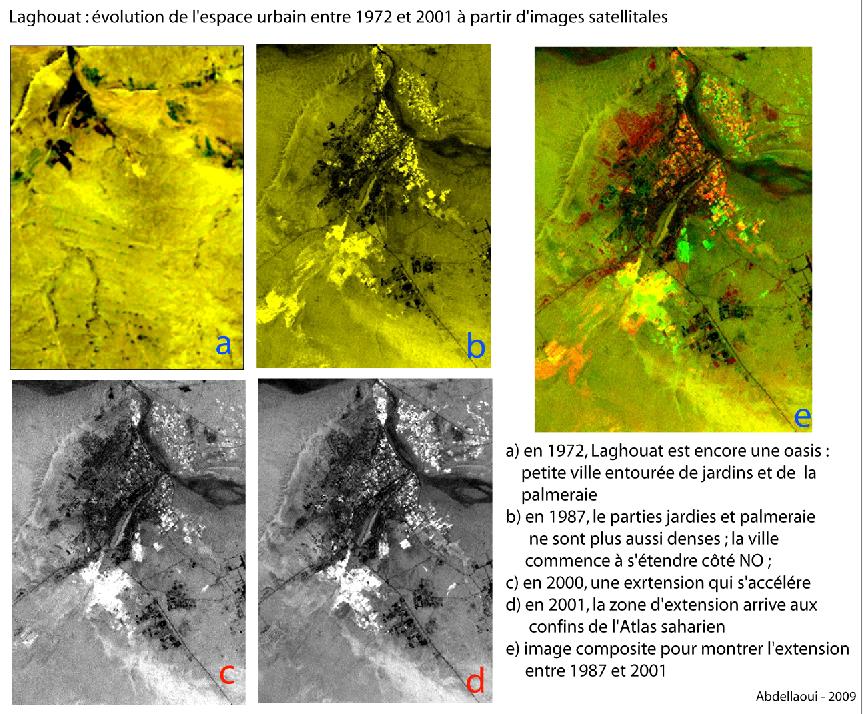

30 30 Abdellaoui ABDELKADER Figure 1 Évolution de l oasis de Laghouat entre 1972 et 2001 Figure 2 localisation de la zone d étude
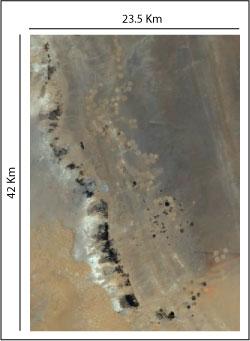
31 Nouveaux schémas de l agriculture saharienne en Algérie 31 Pour parer à la carence de produits agricoles l Etat a mis en place des plans de soutien à mise en valeur des terres pour l activité agricole sur de nouveaux espaces à l extérieur des zones bâties. Parallèlement, l Etat a lancé un grand mouvement de colonisation des terres sahariennes ; c est le «projet des oasis de l an 2000» qui s est poursuivi durant des années dans une certaine confusion car la phase de réalisation n a pas été précédée d une réflexion sur le fond et d une incontournable concertation entre les opérateurs (Dubost D., 1992). Par ailleurs, en milieu aride et semi-aride les territoires sont caractérisés par la fragilité et la vulnérabilité de leurs écosystèmes. Cette situation résulte du rapport précipitations / sécheresse et des actions humaines qui vont influer, selon leur degré d intensité, sur l évolution et la stabilité des territoires. La vulnérabilité se réfère à des données spatiales et temporelles, notamment l affaiblissement d ordre écologique (faune, flore, ressources) et des données sociales (pauvreté, etc.). La faible quantité des précipitations est certes une contrainte climatique, mais elle est généralement source de contraintes pédologiques et hydrologiques variables en fonction du temps et de l espace. Ces contraintes imposent différents degrés de limites au développement des territoires. Si les contraintes dépassent le seuil de tolérance, l écosystème perd sa capacité de résilience, et celui-ci tend vers une transformation environnementale. Celle-ci impose des contraintes au développement de ces territoires. De ce fait, ces territoires sont étroitement associés à la problématique «développement-environnement». Présentation de la zone d étude La zone d étude est délimitée par les latitudes N et N et les longitudes O et E ; soit globalement sur la région comprise entre Adrar au nord et Sali au sud. Cette région est localisée entre les plateaux du Tanezrouft (Sud-Ouest) et du Tademaït (Nord-Est). La concentration des zones de pivots est principalement localisée vers les oasis d El Djedid, Zaouiat Kounta (la plus forte concentration) et Sali. La route nationale 6 passe par les différentes oasis. L eau de surface est à la fois rare et très irrégulière ; les eaux profondes, héritées des derniers épisodes pluvieux du quaternaire, ont un caractère fossile et sont très peu renouvelables (Kassah, 1998). Les précipitations sur Adrar sont extrêmement rares. Méthodes et outils 1. Les images : pour le présent travail, nous avons utilisé quatre images Landsat à plusieurs dates : 14 novembre 1972, 12 janvier 1987, 16 avril 2001 et 11 avril Le projet «oasis 2000» ayant effectivement démarré en , nous avons ainsi un regard suffisamment complet de la période avant et après. La résolution de ces images nous semble largement suffisante pour le thème que nous étudions. Les quatre images ne sont pas acquises à la même saison (automne, hiver et printemps) ; cela n est pas gênant dans le cadre de notre étude. Nous avons également utilisé des aperçus «Google Earth» pour tenter de comprendre un peu plus, de manière locale et ponctuelle, certains aspects de la dynamique du processus de développement des oasis qui ne sont pas visibles sur les images Landsat à cause leur faible résolution spatiale. 2. Le traitement numérique des images: L objectif est ici de mettre en évidence les espaces de culture, plus exactement les oasis traditionnelles avec une agriculture à deux étages (palmiers et maraichers) et les nouvelles zones agricoles avec un système d irrigation en pivot d apparence circulaire à partir d une photographie aérienne ou d une image satellitale. Ces zones de végétation se trouvent dans un contexte de sol désertique (sable ou roche) généralement sans (ou avec très peu de) végétation naturelle. Elles sont donc généralement facilement mises en évidence et ne nécessitent pas de traitement très complexe. La chaine de traitements comporte ainsi : i) une visualisation en composition colorées fausses couleurs pour avoir une idée globale de la zone ; ii) une extraction de fenêtres pour cibler les traitements sur la zone de développement agricole ; iii) une amélioration
32 32 Abdellaoui ABDELKADER d image par étalement de la dynamique ; iv) une analyse par indice de végétation ; nous avons essentiellement utilisé le NDVI qui a donné ici de bons résultats comme on peut le voir sur la figure 3 pour l image de 2001 (fig. 3, 4). Sur cette figure, les différentes zones de culture irriguées par pivots apparaissent sous la forme d un disque ; les disques de couleur verte sont les zones à végétation active ; le jaune indique une végétation encore basse donc à un stade de développement encore primaire, peu développée. On devine par ailleurs des emplacements probablement déjà abandonnés figurés par les couleurs plus rouges ou pales. v) une analyse en composantes principales pour tenter de faire une comparaison entre dates. Nous avons réalisé une combinaison colorée, deux à deux, des composantes 4 des analyses en composantes principales des images de 1987, 2001 et 2005 ; la figure 4 montre, à titre d exemple, la combinaison des dates 2001 et 2005 ; l affichage vert est affecté à l image 2001 et le rouge à 2005 ; le bleu est affecté à une image «zéro». Sur cette figure les cercles verts sont les pivots actifs en 2001 et totalement abandonnés en 2005 ; les cercles noirs concernent les pivots actifs aux deux dates ; les cercles rouges sont les nouvelles exploitations en Notons vers le bas gauche de l image les oasis traditionnelles toujours conservées ; elles apparaissent en noir sur l image. 3. La base d objets géographiques (SIG) : Pour pouvoir analyser à la fois les situations observées à chaque date (calculs de surface, nombre de pivots) et également le changement d une date à l autre, nous avons élaboré une base d objets géographiques (SIG) constituée de couches «pivots» aux différentes dates. Nous avons pour cela opté pour MapInfo qui nous a semblé largement suffisant pour le présent travail. La figure 5 suivante montre à titre d exemple le résultat concernant Les disques de couleur verte concernent les pivots en activité ; ceux en couleur grise sont les pivots inactifs, probablement des emplacements testés puis abandonnés. Avec cette base de données géographiques, il deviendrait alors possible de surveiller l activité agricole de façon permanente, à la condition de disposer des informations pertinentes suffisantes. 4. Les extraits «Google Earth» : L écran «Google Earth» nous a permis: i) de nous localiser globalement sur la zone et d avoir une idée très générale de l ampleur du phénomène d implantation des pivots ; ceci nous a permis de dénombrer environ 200 emplacements de pivots actifs ou abandonnés sur une bande réduite de 36Km x 8Km ; nous avons ainsi une densité de présence de 1.44 pivot au Km² comme on le voit sur la figure 6 ; le diamètre d un pivot étant de m, la surface occupée est de 30 ha environ ; si on retient, comme le cite Dubost (1992), qu un hectare de blé évapore 6000m3 d eau au cours d un cycle de production hivernal (soit 600mm) on peut effectivement imaginer la quantité d eau totale évaporée par la zone et donc consommée à partir de la nappe. ii) de distinguer des «états» d utilisation des pivots ; sur l image, nous pouvons distinguer les zones de couverture de végétation active, les emplacements abandonnés et les déplacements récents comme on le voit sur la figure 7 ; iii) de mesurer la surface couverte par un pivot (rayon) ; nous trouvons ainsi que le diamètre d une surface irriguée par un pivot est un disque de m de diamètre soit une surface d environ 30ha. Résultats et discussion En 1972 la zone ne comporte que les oasis traditionnelles sur le couloir situé entre ; il n y a pas encore d agriculture extensive (pas de pivot ; oasis peu étalée et relativement bien isolée les unes des autres comme on le voit sur la figure 9. La plus grande de ces oasis occupe une superficie d environ 300ha soit une cinquantaine de parcelle de taille moyenne (5ha). Ce qui donne une idée des exploitations. En 2001, une année après la mise en route du projet «oasis 2000», nous trouvons déjà 62 pivots qui nous semblent en activité (très forte valeur du NDVI) ; mais nous constatons par contre 70 pivots paraissant abandonnés, ou tout au moins avec un niveau de NDVI très faible notant l absence de végétation à la date d acquisition de l image.




33 Nouveaux schémas de l agriculture saharienne en Algérie 33 Figure 5 SIG Figure 3 Image NDVI 2001 Figure 6 Concentration des pivots Figure 4 NDVI Figure 7 État des pivots
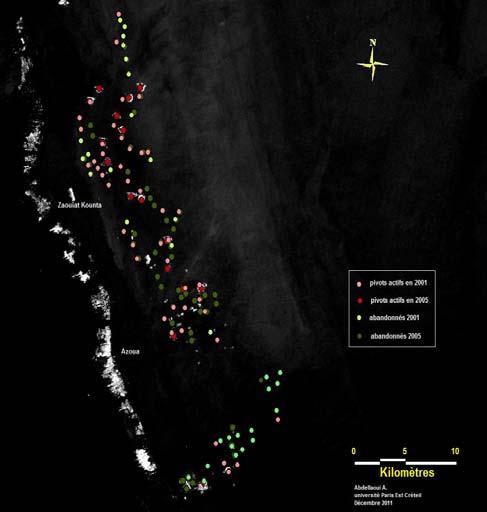


34 34 Abdellaoui ABDELKADER Figure Figure 88 : pivot Il est possible bien évidemment que cette apparence soit uniquement due à la nature de ce qui est planté, ou encore au stade de développement de la végétation. Ne possédant pas d information terrain, il nous est difficile d aller plus loin dans notre investigation. A partir de la figure 10, nous pouvons faire un second constat d ordre général : les emplacements de pivots sont concentrés sur un couloir (naturel) entre Adrar au Nord et Sali au Sud. Les abandons sont plutôt localisés vers le Sud (plus fort taux d abandon) ; alors que du côté d Adrar, nous n observons aucun abandon. Il apparait important de noter ici le déplacement fréquent des pivots dans des emplacements parfois très proches et, surtout, n obéissant pas à des règles de trajectoires facilement appréhendables comme cela est montré sur la figure extraite d une image «Google Earth». Figure 11 Chevauchement et déplacement des pivots Figure 9 La zone en 1972 Figure 10 État de la zone en 2001 Figure 12 Synthèse de l activité entre 1987 et 2005
35 Nouveaux schémas de l agriculture saharienne en Algérie 35 A partir de cette image, qui couvre une superficie d environ 1200 ha, il est possible de faire les remarques suivantes : i) Tous les emplacements en cours ou précédemment occupés sont localisés à proximité de la route, probablement pour la facilité d accès maximale, et donc le coût d exploitation le plus faible ; ii) Sur cette image, seuls quatre pivots semblent en activité (soit 24% des emplacements) ; pour le reste, il s agirait d emplacements abandonnés temporairement ou définitivement, probablement pour des problèmes de salinisation ou d appauvrissement des sols ; iii) Les emplacements se chevauchent ; faute de données terrain, nous ne pouvons pas donner ici d explication ; iv) Enfin la forte concentration des emplacements sur cette image ; nous arrivons ici à un taux d occupation surfacique d environ 43% ; La figure 12 montre une synthèse de l évolution de l activité entre 1987 et 2005, en réalité entre 2001 et Pour cette figure nous avons effectué un zoom sur la partie Sud, la plus perturbée. En 2001, 62 pivots sont actifs au moment de l acquisition de l image ; il n y en avait plus que 28 en Nous avons ainsi 34 abandons de sites, soit plus de 48%. Un examen plus attentif nous montre que certains sites apparaissent abandonnés en 2001 et également sur l image de 2005 ; il s agit très probablement de sites effectivement abandonnés depuis 2001 (après une occupation en 2000). Les sites apparaissant abandonnés en 2005 mais pas en 2001 sont les sites ayant été en activité entre 2002 et 2004 (intervalle entre les deux images). En termes de consommation d eau, si nous admettons qu au cours d un cycle de production hivernal, un hectare de blé évapore 6000 m3 d eau à l hectare, soit 600mm (Dubost D. ; 1986) et qu un pivot irrigue une superficie d environ 30ha, donc une quantité d eau évaporée de m3 (soit mm), on trouve que les 62 pivots actifs en 2001 évaporent environ l équivalent de mm! Conclusion L utilisation de l imagerie satellitale pour la surveillance de l activité agricole extensive dans ces régions reculées et isolées est tout à fait pertinente et peut donner d excellents résultats pour peu qu un minimum de validation terrain est réalisée. Les surfaces irriguées par pivot sont nettement discernables sr des images de moyenne résolution ; il n est pas besoin de recourir à des images de très haute résolution si l objectif se limite à surveiller l activité en termes de localisation des pivots actifs. Si l on doit viser l étude de la productivité ou de l état de santé de la plante, d autres moyens d investigation doivent alors être mis en œuvre. L utilisation d une base de d objets géographiques (solution SIG) permet d archiver un historique, de réaliser des simulations et des tendances de développement ; elle devrait également permettre d analyser d autres facteurs tels que la consommation en eau, le déplacement des pivots, les problèmes incontournables de salinisation, etc. BIBLIOGRAPHIE ABDELLAOUI A., (2007) : Intégration de l imagerie satellitale multi-résolution et de données terrain pour la réhabilitation des quartiers anciens en milieu oasien. Cas de la ville de Laghouat (Algérie) ; Annalele Universitatii Bucurestii, Geografie ; pp BENBLIDIA N., ABDELLAOUI A., GUESSOUM A. ET BENSAID A. (2006) : Utilisation de la morphologie mathématique pour l analyse de l occupation de l espace en zones urbaines et périurbaines présahariennes : cas de Laghouat (Algérie) ; Télédétection, 2006, vol. 6, n 2, pp BONTE PIERRE (1986) : Une agriculture saharienne : les grâyr de l'adrar Mauritanien ; Revue de l'occident musulman et de la Méditerranée, N 41-42, pp
36 36 Abdellaoui ABDELKADER DUBOST DANIEL (1986) : Nouvelles perspectives agricoles du Sahara algérien ; Revue de l'occident musulman et de la Méditerrané ; N ; 1986 ; pp KASSAH ABDELFATTAH (1998) : Eau et développement agricole au Sahara maghrébin : enjeux, conflits et arbitrages. Sécheresse n 2 ; vol. 9 ; juin MESSAR E. M. (1996) : Le secteur phoenicicole algérien : Situation et perspectives à l horizon 201O ; CIHEAM - Options Méditerranéennes. TOUTAIN G., DOLLI V., FERRY M. (1988) : Situation des systèmes oasiens en régions chaudes ; Les Cahiers de la Recherche Développement ; n 22 ; juin Université Paris est Créteil (UPEC) Paris France École Européenne d Études Avancées Paris France [email protected]
37 T H E R ESEARCH CE N T R E GEOMORPHLOGICAL DYNAM ICS LAND DEGRADATION AND THE CORRELATION BETWEEN DRAINAGE DENSITY AND RELIEF ENERGY WITHIN EŞELNIŢA BASIN DANIELA VLAD Key words: correlation, statistical analysis, linear regression, basin, Eşelniţa Abstract: Developed on the south-eastern side of Almãjului Mountains, Eşelniţa drainage basin neighbours upon the following basins: upon S-SV with Mala, upon SV-V with Mraconia, upon V-NV with Berzasca, upon NV-NNE with Nera and on the NNE-SE direction with Cerna. The basin has a surface of 77 km 2 and present a 5 th degree hydrographic network according to Horton-Strahler ranking system, tributary to Danube by means of Eşelniţa main collector. Taking into consideration the geological formation and the external agents, the current modelling of the relief existing within Eşelniţa drainage basin acts by means of physical-chemical, gravitation and erosion processes causing the occurrence of some relief form which are various both as type as well as extension. The values of drainage density which is characteristic for Eşelniţa drainage basin varies between > 1 and < 6 km / kmp and as regards the local relief, these lie between > 150 and < 400 m / kmp. The most reduced values may be noticed upon the extremity of the basin while the highest ones approach the central part of the basin. The highest value in case of drainage density is noticed at 6.8 m / square km, within the inferior course of Frasinului and Cherbelez valleys from the superior segment of the basin and as the local relief regards, it is located within the central segment of the basin along the main course. Located within a mountain area, Eşelniţa drainage basin has in general higher values both for drainage density as well as for local relief. 1. General Considerations Eşelniţa drainage basin collects its water from a reception area of 77 square km by means of omonymous main collector arising from Almãjului Mountains, below Svinecea Mare peak, at an altitude of 1080 m. After the length of a main water course of 26 km, within the inferior course, at the confluence of Eşelniţa river with Danube, formed a bay where accumulation processes act as a result of increasing of basis level. The change of the initial basis level has occurred as a result of forming the Iron Gates storage lake, so that the altitude of the river mouth of Eşelniţa river is 64 m, in accordance with the normal level of lake s retention. As a result of mechanical treatment of water within hydro-electric plant, the altitude from the river mouth of Eşelniţa river, may vary, although generally varies between m. The basin presents a 5 th degree hydrographic network according to Horton-Strahler ranking system, tributary to Danube by means of Eşelniţa main collector. Developed under a mountain relief, the basin presents a multistage arrangement between the maximum altitude of 1107 m and the minimal altitude of 64 m, at the confluence with Danube, therefore having a level difference of 1043 m. The value of the level difference between the spring, located at 1080 m and the river mouth located at 64 m, is 1016 m. The geological components within Eşelniţa basin belong to Danube Field, having a crystalline bed consisting in crystalline schists represented by crystalline of Poiana Mraconiei, crystalline of Neamţu and crystalline of Corbu, eruptive rocks represented by two granitoidic massifs with intrusive character, inferior Paleozoic age: granite body of Cherbelezu having a northern development within the basin and granite body of Ogradena (Mutihac V., Ionesi L. 1974). The sedimentation formations arranged on the crystalline bed do not cover a major surface, as in the north-western area of the basin there may be found formations belonging to inferior Jurassic (conglomerates, sandstones, argillaceous schists and coals) and in southern area of the basin there are major sedimentary deposits belonging to Neogene (marl, gravel, organogene limestone) and Quaternary (gravel and sands).

38 38 Daniela VLAD LEGEND > <6 Permanent hydrographic network Fig. 1. Eșelnița basin. Drainage density map LEGEND > <400 Permanent hydrographic network Fig. 2. Eșelnița basin. Local relief map
39 The Correlation between Drainage Density and Relief Energy within the Eşelniţa Basin Data and methods To obtain the necessary data for establishing this correlation has been made by preparing the maps regarding the drainage density and the local relief by means cartograms method, resulting for each a set of 103 unmediated values. Based on this method, the statistic data was obtained by means of measurements made using the 1:25000 topographic map in the informational geographic program ArcGis 9.3. Upon applying this method, there have been taken into consideration all diamonds, including the partial ones as surface, therefore resulting the total number of 103 values, distributed in 7 classes for both parameters Statistical analysis of drainage density and local relief It was opted for the correlation in linear regression represented by a straight line towards the deviation of all values is minimal. According to Grecu F. and Comănescu L., (1998 ), the regression line is the line of best fit on a points chart. The values of the two sets were further processed by statistical summary tables to classes of values (table 1 and 2) and by graphical representations to present the contact between them and the type of addiction by means of linear regression and comparative on the basis of the polynomial, logarithmic and exponential. Classes m / kmp Tabel 1. Quantitative data rendering the drainage density Surface kmp % Number of values Relative frequency % Cumulative frequency % > < Total Classes Km / kmp Table 2. Quantitative data rendering the energy relief Surface kmp % Number of values Relative frequency % Cumulative frequency % > < Total The histogram of the local relief frequency Fig. 2 and 3. Frequency histograms of drainage density and local relief in Eşelniţa basin

40 40 Daniela VLAD Fig. 4 and 5. Diagrams representing the share of values classes of the two parameters analyzed 2. Results The two sets of values corresponding to drainage density and local relief have been correlated by applying two methods. In case of first method, the values from the 103 cartograms have been mediated using 7 value classes (table 3) and graphically presented by means of linear regression (fig. 6), therefore resulting a correlation coefficient r = The second method deals with the graphical representation in linear regression of the 103 unmediated values using also 7 value classes, therefore resulting a correlation coefficient r = ( fig. 7). To check the meaning of r = 0.978, has been applied the Student (t) and the Fischer (z) verification tests, t =, z = ln, after Grecu F., Comãnescu L., 1998 resulting for Eşelniţa basin the following values: t = and z = 2. Table 3. The mediated values of the drainage and the relief energy Drainage density ( x) Relief energy ( y ) Standard deviation of the amount of z = 0.1 result from the application of the formula: =, after Grecu F., Comãnescu L., 1998 and the random amount u = 2.3 (fig.4), it obtains by using the following formula: u =, after Costea M., Fig. 6 and 7 Linear correlation of mediated and unmediated values of the two parameters
41 The Correlation between Drainage Density and Relief Energy within the Eşelniţa Basin 41 The establishing of the determination coefficient (CD = ), (after Costea M., 2007), indicates the fact that in a proportion of 96% from the values of drainage density, they are caused by the local relief and the remaining values have a variation which cannot be explained by the local relief. So, mainly there is a direct connection between the density of fragmentation and the relief energy, and in case of 4% of cases, the relation between the two parameters isn t in any interdependence state, as it is caused by other factors such as geological formation, climate, hydrological regime and the presence of vegetation. Within the linear correlation of unmediated values between density and the depth of fragmentation, the data of establishing indicate a reduce spreading showing the fact that the factors conditioning the variation of density of fragmentation are the ones with the factors conditioning the depth of fragmentation. By means of graphical representation of the 7 mediated value classes of fragmentation density and depth of fragmentation of relief in polynomial, exponential and logarithmic correlation (fig. 8, 9 and 10), there is noticed the fact that the establishing has values close to the value resulted in case of linear correlation, so there is a strong connection between the drainage density and the relief energy, as the basin has a dense drainage network and mostly well sharp. According to polynomial correlation r = 0.98, exponential correlation r = 0.97 and only for the logarithmic correlation the value is slightly lower than the linear one by r = Table 4. The statistical analysis of the data of drainage density and the energy relief based on their mediated values Size statistic Drainage density Local relief Total number of values Number of classes 7 7 Scale Arithmetic (of the range) Arithmetic (of the range) Sample type Normal Normal Amplitude range Form of repartition Bimodal form Unimodal asymetric form Arithmetic average The median The module The amplitude of values Standard deviation Dispersion Coefficient of variation Pearson coefficient of asymmetry The standard error of the sample The square average error of the z size 0.1 The random amount 2.3 The coefficient of determination 96 Exponential correlation between drainage density and local relief
42 42 Daniela VLAD Fig. 8, 9 and 10. The polynomial, exponential and logarithmic correlation between drainage density and the local relief in Eşelniţa basin 3. Conclusions In Eşelniţa drainage basin, the diverse petrographical formation causes differentiations regarding the territorial distribution of the indicators of drainage density and depth of relief s fragmentation and implicitly in the correlation relation between them. Therefore, the geological components of Eşelniţa drainage basin represented by crystalline series of Poiana Mraconiei, Neamţu and Corbu belonging to Danube Field, the granitoide bodies of Cherbelezu and Ogradena and sedimentary deposits having a significant share within the inferior course of the basin, introduce differentiations in the territorial distribution of morphometric indicators and implicitly in establishing the correlations between them. Consequently, in case of crystalline and magma rocks predominating the superior, central and partially the inferior courses, where in predominate the sedimentary deposits, the intensity of geomorphological processes is differentiated, therefore resulting more or less shaped forms. Density and local relief values are explained by means of presence of erosion processes acting within Eşelniţa basin by means of all characteristic relief forms (channels, gaps, gullies and torrential channels) having a diversified development depending on the geological formation. Invest in human resources! This work was supported by project: POSDRU/88/1.5/S/61150 Doctoral Studies in the field of life and earth sciences, project cofinanced through Sectorial Operational Program for the Development of Human Resources from European Social Fund. REFERENCES BOENGIU S., TÖRÖK OANCE M., 2005, Caracteristici ale fragmentãrii reliefului în bazinul Blahniţei. Sectorul piemontan, Forum Geografic, Nr. 4, Editura Universitaria Craiova. BOENGIU S., MARINESCU E., IONUŢ O., LICURICI M., 2010, The analysis of the relief fragmentation features within the Bălăciţa Piedmont, Forum Geografic, Nr. 9, Editura Universitaria Craiova. COMÃNESCU L., 2000, Bazinul Casimcea. Corelaţia densitatea de drenaj energia de relief, Revista de Geomorfologie, Vol. 2, Editura Universitãţii din Bucureşti. COSTEA M., 2007, Corelaţia dintre energia de relief şi densitatea fragmentării în bazinul Sebeşului, Forum Geografic, Nr. 6, Editura Universitaria Craiova. GRECU F, COMÃNESCU L., 1998, Studiul Reliefului. Îndrumator pentru lucrãri practice, Editura Universitãţii din Bucureşti. MUTIHAC V., IONESI L., 1974, Geologia României, Editura Tehnicã, Bucureşti. MUTIHAC V., STRATULAT M.I., FECHET R.M., 2004, Geologia României, Editura Didacticã şi Pedagogicã, Bucureşti. RÃDOANE M., RÃDOANE N., ICHIM I., DUMITRESCU GH., URSU C., 1996, Analiza cantitativă în geografia fizică, Editura Universitãţii Al. I. Cuza, Iaşi. University of Bucharest, Faculty of Geography Simion Mehedinți Doctoral School [email protected]
43 T H E R ESEARCH CE N T R E GEOMORPHLOGICAL DYNAM ICS LAND DEGRADATION AND EMPIRICAL STUDY CONCERNING THE MAIN DANUBE DEFILE GEOSITES: SOME TOURISTS REFLECTIONS DANIEL IOSIF 1 Key words: geosites, Danube, touristic valorization, questionnaires Abstract. Geosites are relief forms with a scientific, aesthetical, ecological, economical, and cultural value, in respect of human perception, that completes the total heritage of a given territory. In the last decade, those geosites were strongly related with the touristic phenomenon. This paper presents an empirical study about some most important geosites of the Danube defile in Romania. The point of view from which the analyze is concern the opinions of tourists presented here in the summer of Consequently, we have made practically 105 questionnaires and we have extracted same of special questions from them. The results indicate the tourists opinions about the actual touristic phenomenon in the Danube defile. Introduction The Danube Defile on the Romanian side is a valuable natural unit of a character unique along the entire 2,875 km length of the Danube. A lithological and morphological variety in the relief, a climate with sub-mediterranean influences (Grecu et al., 2011), a complex biotic cover, as well as a multitude of historical, cultural and religious remains, lend the landscape an aspect of originality. Historical relics attest to thousands of years of human habitation on this territory. To the West, the boundary of the park coincides with that of Baziaș village, while to the South, the limit follows the Danube watercourse downstream to the dam at Gura Vaii (Figure 1). To the north, the boundary follows the southern flanks of the Locva Mountains, partly includes the Almăj Mountains and almost the entire area of the Mehedinți Mountains (Pătroescu, Vintilă, 1997):35. The Iron Gates are situated in the aria between Baziaș locality and Drobeta Turnu- Severin city (Caraș-Severin and Mehedinți County) for a distance of about 140 km. The name applies to the region where the Danube River cuts through the Carpathian Mountains forming a spectacular defile. The Danube Defile contains some of the best preserved archeological sites from the southeastern Europe. Many were discovered during the surveys undertaken in 1960 before the construction of the two hydropower stations start. The karstic relief and the interesting vegetation which contains southern elements and many rare species of plants are other attractions which recommend visiting these places. Methodology and data In this paper we will analyze the touristic region in a relative new geographical perspective. We will use the new concept of geosite, a concept which has until now a great impact of geographical researchers. Many studies concerning this point of view have applied for the territory of Switzerland (Reynard, 2004b; Monbaron, 2004; Wildberger, Oppliger, 2001; Antonini, 1999; Maur, Maur, 1997; Grandgirard, 1996) or Italy (Aigotti, Renzo, Giardino, Pellegrino, 2004; Aloia, Guida, Ianuzzi, Lazzari, Siervo, 2007; Cannillo, Gregorio, Eltrudis, 2005; Geremia, Massoli- Noveli, 2005). In Romania, this new approach is at his beginning, but we have great potential (Comănescu, Dobre, 2009; Comănescu, Nedelea, 2010; Ilieș, Josan, 2007, 2009; Bâca, Schuster, 2011; Comănescu, Nedelea, Dobre, 2011).

44 44 Daniel IOSIF Figure 1. The map of Iron Gates region. Numbers reprezent our geosites: 1 - Island of Moldova Veche; 2 - Trescovăț Hill; 3 - Șvinița natural amphitheater; 4 -Trikule fortress; 5 - Ponicova Cave; 6 - Cazans gorges; 7 - Decebal sculpture; 8 - Sf. Ana Monastery; 9 - Cerna bay; 10 - VodițaMonastery Geosites (term which include also the geomorphologic sites) are relief forms with a scientific, aesthetical, ecological, economical, and cultural value, in respect of human perception, that complete the total heritage of a given territory, including the biodiversity and human creation (Panizza, 2001; Panizza, Piacente, 1993; Pralong, 2006; Reynard, 2004a; Reynard, 2008; Reynard, Coratza, 2005; Reynard, Fontana, Kozlik, Scapozza, 2007). In the evolution of human society, the relief was not only a support for economic activities, but also fulfilled a strategic role, of defense against invasion and war. Thus, some relief form gained cultural and historical value, as special constructions for observation and defense occurred: citadels, castles, observation towers, etc. Some of these artifacts are functional to the present day, while other resist only as archaeological vestiges, revaluing the comprising relief, providing the latter a cultural and educative value that may be utilized through various touristic activities (Bâca, Schuster, 2011). This also applies to numerous vestiges and artifacts in the Danube gorges, emphasizing the strong relation between human communities living here and its relief. For this empirical study we have used 105 questionnaires made in our study region. Those questionnaires were made in one week of June near the city of Orșova. In this campaign we have the aide of the students in second year of the Touristic Studies program held by the Faculty of Geography, Bucharest University. The questionnaire used was modified and completed after a questionnaire of Comănescu and Nedelea (2010) and it is structured in sixteen questions, with the propose to gain information concerning the actual touristic phenomenon and the tourists perception regarding the main touristic attractions. After the questionnaires were fully completed, we made a database with all the information. For the present paper we have extracted some of the results of the questionnaires, especially those which are directly relating with the touristic perception of geosites and landscape. Results and discussions We start this presentation of results with the profile of the interviewed persons. In the table 1 are the age, the sex, the nationality, the studies end the place of birth of all the people who speak with us. We retain that 96% of respondents were Romanian and only 4% were from one another country (Germany). Almost all of them had the age between 21 and 60.

45 Empirical study concerning the main Danube defile geosites: some tourists reflections 45 Table 1. The profil of the respondents Age of the interviewed The sex The nationality Studies Place of birth < >60 M F Romania Other, which? Lyceum Faculty Urban Rural 3% 51% 46% 0% 61% 39% 96% 4% Germans 42% 58% 70% 30% Firstly, we remark that almost a half of the respondents (47%) love to make walking in this area (Figure 2). The region attracts tourists for his landscape and for his touristic circuits in fresh air. Another half of those tourists (28%) want, in their walking, to visit the region attraction like the monasteries, the caves etc. Only a quarter of respondents came here to make a form of sportive tourism and scientific tourism. The proportion is equal (13% and, respectively, 12%). The pleasure to make walking is directly linked with the next results: 59% of tourists love the most in this area the general landscape (Figure 3). The natural sites came the second in the tourists opinions. Only 11% of tourists came here to enjoy the recreational facilities. Two another questions were related with the most important value from a natural site and, also, for an anthropic site (Figures 4 and 5). The tourists prefer for a natural site the aesthetical value correlated with the literary and artistic value. For them, a natural site must have a special aesthetic and it must be charged with a literary and artistic values. The third option was the scientific value (a fifth). On the other side, for the anthropic sites, the results were very clear. The historical importance is the most important, with 58% of responses. Then are the symbolic and religious importance. Another very relevant question which help us to understand the actual touristic phenomenon and to estimate what are the tourists demands was that who ask the visitors about the most significant characteristic of a site in the perspective of a touristic valorization (Figure 6). The 46% of respondents said that the attractively of a site makes it a visited one. Also, the uniqueness of a touristic point is a characteristic very significant (37%) when we talk about tourism. The same tourists have said that the accessibility is not a problem in a touristic promotion (only 3% have given the accessibility as the main characteristic). In the first figure were represented ten most important geosites from our region concerning the touristic utilization. Answering at the question regarding the attraction which has the bigger impact for them, the tourists have responded, in their great majority (54%) that the Cazans region is the most beautiful from all this area (Figure 7). Figure 2. What the tourists prefer to do the most Figure 3. What the tourists love in this area


46 46 Daniel IOSIF Figure 4. For a natural site, what is the most important value in a touristic valorisation Figure 5. For an anthropic site, what is the most important value in a touristic valorisation Figure 6. To be a real attraction, what is the most important characteristic of a site Figure 7. To be a real attraction, what is the most important characteristic of a site Conclusions Concise, after the analyze of the results we can conclude with those main ideas: The tourists came in this area especially to make promenades in fresh air; The scientific value of a natural sites in more important that the scientific one; The most part of tourists visit this region especially for his landscape potential to the detriment of historical/cultural potential; For a site to have a great number of tourists, it must be attractive and unique; The main touristic objective in this area is the Cazans Region, which can be viewed as a result in the tourists desire for aesthetic values and their wish to make walks. BIBLIOGRAPHY AIGOTTI, D., RENZO, G. D., GIARDINO, M. & PELLEGRINO, P. (2004), I geositi nella provincia di Torino - Una esperienza concreta di divulgazione. Geologia e turismo. Opportunità nell'economia del paesaggio, Secondo Convegno Nazionale dell Associazione Italiana Geologia e Turismo. Associazione Italiana Geologia e Turismo, Bologna. ALOIA, A., GUIDA, D., IANUZZI, A., LAZZARI, M. & SIERVO, V. (2007) Il patrimonio geoambientale del Monte Gelbison nell'ambito del "Geoparco del Cilento. Geologia e turismo. Beni geologici e geodiversità, Terzo Convegno Nazionale dell Associazione Italiana Associazione Italiana Geologia e Turismo, Bologna. ANTONINI, B. (1999), La valorizzazione e la tutela dei geotopi, in teoria e nella pratica. Geologia Insubrica, 4,
47 Empirical study concerning the main Danube defile geosites: some tourists reflections 47 BÂCA, I. & SCHUSTER, E. (2011), Listing, evaluation and touristic utilisation of geosites containing archaeological artefacts. Case study: Ciceu Ridge (Bistrița-Năsăud County, Romania. Revista Geografica Academica, 5, CANNILLO, C., GREGORIO, F. D. & ELTRUDIS, A. (2005), Map of the geological and geomorphological sites of the Malfatano coast in SW Sardinia: a contribution to the knowledge of the island's geodiversity. Il Quaternario, 18, COMĂNESCU, L. & DOBRE, R. (2009), Inventorying, evaluating and tourism evaluating the geomorphosites from the central sector of the Ceahlău National Park. GeoJournal of Tourism and Geosites, 3, COMĂNESCU, L. & NEDELEA, A. (2010), Analysis of some representative geomorphosites in the Bucegi Mountains: between scientific evaluation and tourist perception. Area, 42, COMĂNESCU, L., NEDELEA, A. & DOBRE, R. (2011), Evaluation of geomorphosites in Vistea Valley (Fagaras Mountains Carpathians, Romania). International Journal of the Physical Science, 6, 11, GEREMIA, F. & MASSOLI-NOVELI, R. (2005), Coastal geomorphosites of the Isles of Lipari and Stromboli (Aeolian Islands, Italy): new potential for geo-tourism. Il Quaternario GRAND GIRARD, V. (1996), Gestion du patrimoine naturel. L'inventaire des géotopes géomorphologiques du canton de Fribourg. Colloque commun de la Société Suisse de Géomorphologie (SSGm) et de l'association Française de Karstologie (AFK), Sornetan GRECU, F., CARABLANISA, S., ZAHARIA, L., IOANA-TOROIMAC,G., (2011), Les précipitations facteur de la dynamique des versants dans le défilé du Danube (Roumanie). Les climats régionaux: observations et modélisation, pag ILIEȘ, D. C. & JOSAN, N. (2007), Preliminary contribution to the investigation of the geosites from Apuseni Mountains (Romania). Revista de geomorfologie ILIEȘ, D. C. & JOSAN, N. (2009), Geosites - geomorphosites and relief. GeoJournal of Tourism and Geosites MAUR, F.A.D. & MAUR, B.A.D. (1997), Ein Dutzend Schweizer Geotope zum Anfassen Schzeiz MONBARON, M. (2004), Inventaire des géotopes géomorphologiques du Canton du Jura. Swiss Geoscience Meeting Académie Suisse deas Sciences Naturelles Lausanne. PANIZZA, M. (2001), Geomorphosites: concepts, methods and examples of geomorphological survey. Chinese Science Bulletin PANIZZA, M. & PIACENTE, S. (1993), Geomorphological assets evaluation. Fur Geomorphologie N.F. Suppl.Bd PĂTROESCU, M. & VINTILĂ, G. (1997), Natural, cultural and historical potential for tourism of the Iron Gates National Park. Geographica Pannonica PRALONG, J.-P. (2006), Géotourisme et utilisation de sites naturels d intérêt pour les sciences de la Terre : Les régions de Crans-Montana-Sierre (Valais, Alpes suisses) et Chamonix-Mont-Blanc (Haute-Savoie, Alpes françaises). Université de Lausanne, Lausanne. REYNARD, E. (2004a), Géotopes, géo(morpho)sites et paysages géomorphologiques. in Reynard, E & Pralong, J-P eds Paysages géomorphologiques - Compte-rendu du séminaire de 3ème cycle. Institut de Géographie, Lausanne. REYNARD, E. (2004b), L évaluation des géotopes géomorphologiques en Suisse. in Reynard, E & Pralong, J-P eds Paysages géomorphologiques - Compte-rendu du séminaire de 3ème cycle. Institut de Géographie, Lausanne. REYNARD, E. (2008), Scientific research and tourist promotion of geomorphological heritage. Geogr. Fis. Dinam. Quat REYNARD, E. & CORATZA, P. (2005), Geomorphological sites: research, assessment and improvement. A working group of the International Association of Geomorphologists (IAG). Final Report , Lausanne. REYNARD, E., FONTANA, G., KOZLIK, L. & SCAPOZZA, C. (2007), A method for assessing scientific and additinal values of gemorphosites. Geographica Helvetica 62, WILDBERGER, A. & OPPLIGER, M. (2001), Géotopes, géotopes spéléologiques, géotopes d importance nationale. Stalactite Ph. D student at Faculty of Geography, Bucharest University and Geographical Department of Paris Nanterre University
48
49 T H E R ESEARCH CE N T R E GEOMORPHLOGICAL DYNAM ICS LAND DEGRADATION AND COMPARAISON ENTRE DEUX MODÈLES NUMÉRIQUES D ALTITUDES (MNA) RÉALISÉS PAR INTERFÉROMÉTRIE RADAR RSO (InSAR) POUR ÉTUDIER LES MOUVEMENTS DE TERRAIN (GLISSEMENTS DE TERRAIN ET COULÉES DE BOUE) DANS LA RÉGION DE BUZĂU (ROUMANIE) K. HACHEMI 1, F. GRECU 2, A. OZER 3, M. JURCHESCU 4, M. VISAN 2 Mots clefs : Glissements de terrain, coulées de boue, MNA, SRTM, Buzau, radar, RSO (SAR), ERS-1/2. Résumé : Les Modèles Numériques d Altitude (MNA) représentent des données considérables dans les études géomorphologiques et la gestion des risques naturels. Ils sont importants dans la représentation, l analyse et l interprétation du paysage. Dans la gestion des risques géologiques en particulier, ils ont un rôle clé en apportant l information 3D (tridimensionnelle) qui permet d expliquer de nombreux phénomènes et de prendre en compte des paramètres difficiles à interpréter dans une image à deux dimensions. Pour répondre à la demande croissante des MNT, surtout pour des grandes étendues, de nombreux outils (aéroportés ou spatiaux) et des techniques (Photogrammétrie, Radargrammétrie, Lidar, GPS, etc.) ont été élaborés. L une de ces techniques est l interférométrie radar InSAR considérée comme la meilleure solution en termes de compromis entre couverture globale et précision. Elle exploite la différence de phase de l onde radar directement liée à la distance séparant le radar de la cible imagée entre deux acquisitions de différentes positions. Elle a donné des résultats satisfaisants dans de nombreux sites. L étude des glissements de terrain et des coulées de boue nécessite de disposer d un modèle numérique d altitude très précis et avec la meilleure résolution possible; beaucoup utilisent le DEM- SRTM de 90 m car il est disponible gratuitement alors qu un MNT de 30 m est très cher; la réalisation d un MNT par levé topographique peut également s avérer longue et coûteuse; le recours à l imagerie radar apparaît donc comme une alternative intéressante. Ce MNA est très utile: il permet de montrer les pentes (l un des principaux facteurs déclencheurs des mouvements de terrain en général) et donc de localiser les glissements surtout là où il y a de l humidité. Dans ce travail et à l aide de la technique d interférométrie radar RSO (InSAR), nous avons réalisé un MNA (Modèle Numérique d Altitude) avec une résolution de 20 m à partir des images radar RSO (SAR) du couple tandem des satellites ERS-1/ERS- 2 et nous l avons comparé avec le DEM-SRTM. Le MNA réalisé est fonction de l altitude du terrain, des effets atmosphériques et d une constante (Cts) qui désigne les erreurs susceptibles d être produites dans toutes les étapes de calculs et de réalisation du MNA. Cette fonction est adaptative, ce qui signifie qu on peut l écrire en termes de sommation ou soustraction qui permet d ajouter ou d enlever les altitudes considérées erronées. Pour bien montrer cette comparaison, nous avons pris cinq exemples de mouvements de terrain, trois sur les glissements de terrain et deux sur les coulées de boue. Nous avons procédé à la réalisation des profils et tracé des coupes de ces mouvements de terrain de la région de Buzău (Roumanie) où se localisent des glissements de terrain et des coulées de boue pour les deux MNA (MNA-ERS1/2-95 et DEM-SRTM). L objectif principal de ce travail est de montrer l utilité d effectuer la différence et la comparaison entre deux MNA obtenus à deux dates différentes réalisés à partir des images RSO (SAR) à l aide de la même technique d interférométrie radar (InSAR) dans l étude des glissements de terrain et les coulées de boue dans une zone complexe de la région subcarpatique de Buzău (Roumanie) caractérisée par une humidité importante et une végétation forestière prépondérante. Nous avons effectué la différence entre ces deux MNA, le DEM-SRTM réalisé au mois de février 2000 (11/02/2000) et le MNA-ERS-1/2 réalisé à partir du couple tandem du 28/29 mai 1995 en deux passages (multi-passes). Le DEM-SRTM, étant obtenu à partir d un seul passage, a l avantage de ne pas être affecté par les effets atmosphériques. Mais d autres erreurs peuvent être présentes et il faudrait les prendre en considération dans cette opération de différence. La précision locale sur une surface couverte de [100 km x 100 km] est de l ordre 5-6 m en altitude et 5m en planimétrie. Notons que, grâce à nos opérations de géoréférencement des images, nous avons éliminé les éventuels décalages entre les deux MNA. La comparaison entre les deux MNA montre une différence altimétrique causée par trois paramètres de sources différentes. Elle est la somme des altitudes suivantes : (1) Altitude due aux effets atmosphériques (H atm ); (2) Altitude due aux erreurs commises durant toutes les étapes de réalisation du MNA (H err ), comme les erreurs de déroulement de phase, les erreurs de filtrage etc.; (3) Altitude de déformations produite dans un intervalle de temps de plus de 4 ans et 9 mois (H Def ). On suppose que cette période induit forcement des différences d altitude entre ces deux MNA suite aux caractéristiques des
50 50 K. HACHEMI, F. GRECU, A. OZER, M. JURCHESCU, M. VISAN terrains dans la région de Buzău. Pour estimer cette déformation (différences d altitude due aux changements d origine géologique), il faut estimer et éliminer les autres altitudes dues aux autres origines (allongements effets atmosphériques et les erreurs de calcul de MNA) sans oublier les erreurs dues aux précisions du DEM-SRTM. Le résultat de ce travail se résume au niveau du glissement du Schela, où, des deux profils tracés dans la direction Ouest/Est sur les deux MNA réalisés par InSAR, celui basé sur le DEM-SRTM donne un profil d une pente constante orientée vers l Ouest/Est; par contre, celui du MNA- ERS1/2 présente une pente de même orientation sauf que l on note un genre de palier au milieu de la pente. Cette différence de morphologie peut être interprétée comme un changement de forme de terrain entre les deux périodes (1995 et 2000). On peut avancer que cette différence de morphologie est due à l instabilité du palier (1995) et suite aux constructions, le glissement de terrain s est déclenché, ce qui a donné la morphologie récente (2000). Le profil Sud/Nord du versant de Schela montre bien que les deux MNA ont la même morphologie sauf une différence d altitude au sommet du versant et à la base du versant. Cette différence est estimée à environ 10m pour une période de plus de 4 ans alors que le profil enregistre une même altitude au centre du versant. La présence d une route en béton et de réseaux de communication (poteaux d électricité en béton), ainsi que l existence de pompes d exploitation de pétrole montrent que cette zone a subi beaucoup de travaux. On remarque bien que dans les deux profils tracés, il y a un mouvement de compensation dans les deux directions ce qui confirme que la variation d altitude est due à la déformation du terrain. I. Introduction Les Modèles Numériques de Terrain (MNT) sont très importants dans la représentation, l analyse et l interprétation du paysage. Dans la gestion des risques naturels en particulier, ils ont un rôle clé en apportant l information 3D (tridimensionnelle), qui permet d expliquer de nombreux phénomènes et de prendre en compte des paramètres difficiles à interpréter dans une image à deux dimensions. Pour répondre à la demande croissante des MNT, surtout pour des grandes étendues, de nombreux outils (aéroportés ou spatiaux) et des techniques (Photogarammetrie, Radargrammetrie, Lidar, GPS, etc.) ont été élaborés. L une de ces techniques est l interférométrie radar SAR considérée comme la meilleure solution en termes de compromis entre couverture globale et précision [D. MASSONET et C. ELACHI, 2006]. Elle exploite l information de différence de la phase de l onde radar entre deux acquisitions de différentes positions. Elle a donné des résultats satisfaisants dans de nombreux sites. C est pour la réalisation d un MNA (Model Numérique d Altitude) que l interférométrie radar RSO a été proposée pour la première fois par GRAHAM (1974); elle a été relancée en 1986 par ZEBKER et GOLDSETEIN (1986). C est à partir du lancement du satellite européen ERS-1 (1991) suivi du satellite ERS-2 (1995), et avec la disponibilité des couples tandems d intervalle 24 heures que cette technique a connu un véritable essor. Elle s est couronné en février (2000) par la mission SRTM qui a aboutit à l élaboration d un DEM (Digital Elevation Model) global pour presque 80 % de la surface de la Terre, avec une résolution de 30 m et une précision altimétrique globale moins de 16 m [B. RABUS et al., 2003,]. Elle a cependant des limites et son succès dépend énormément des caractéristiques physiques de la surface des zones imagées en qualité de précision [H.A., ZEBKER et al., 1994], [D. RAUCOULES, 1997] et [K. S. RAO et al., 2006]. L interférométrie radar RSO exploite la différence de phase directement liée à la distance séparant le radar de la cible imagée. Elle a deux applications directes : la première est la réalisation d un MNA et quand elle est utilisée en mode dit différentiel, elle peut aussi fournir des informations sur les changements du relief causés par des phénomènes géologiques comme les séismes, les glissements de terrain, la subsidence [E. RODRIGUEZ et J. M. MARTIN, 1992]. Les produits cartographiques et les images de télédétection nous aident à comprendre plusieurs phénomènes liés à l espace géographique, cependant certaines décisions et conclusions ne peuvent être prises que si ces produits sont combinés avec un MNA. A titre d exemple, les MNA ont une importance capitale dans la gestion des phénomènes hydrologiques (risques d inondation) et
51 Comparaison entre deux Modèles Numériques d Altitudes réalisés par interférométrie radar RSO 51 géomorphologiques (détection des glissements de terrain, etc.), mais aussi dans l'ingénierie civile et le domaine militaire. Dans cet article, grâce à cette technique (InSAR), nous avons pu réaliser un Modèle Numérique d Altitude (MNA) de la région subcarpatique de Buzău (Roumanie) et par la suite nous l avons comparé avec le DEM-SRTM. L objectif principal de ce travail est de montrer l utilité d effectuer la différence et la comparaison entre deux MNA obtenus à deux dates différentes réalisés à partir des images RSO (SAR) à l aide de la même technique d interférométrie radar (InSAR) dans l étude des glissements de terrain et les coulées de boue dans une zone complexe de la région subcarpatique de Buzău, caractérisée par une humidité importante et une végétation forestière prépondérante. Pour bien montrer cette comparaison, nous avons pris cinq exemples de mouvements de terrain, trois sur les glissements de terrain et deux sur les coulées de boue. Nous avons procédé à la réalisation des profils et tracé des coupes de ces mouvements de terrain de la région (Roumanie) où se localisent des glissements de terrain et des coulées de boue pour les deux MNA (MNA-ERS1/2-95 et DEM-SRTM). La méthodologie envisagée consiste à créer un Modèle Numérique d Altitude (MNA), avec une bonne résolution (20 mètres) à partir des images radars RSO à l aide de la technique d interférométrie (InSAR). La soustraction des MNA théoriquement dans ce cas, permet d obtenir une carte d instabilité entre deux périodes. Cette méthode a été utilisée par GENTILI et al. (2002) dans le cas des glissements de terrain de Corniglio en Italie, à l aide de la technique de photogrammétrie aérienne et à partir de la différence entre deux modèles de terrain à différentes dates entre les deux périodes, de décembre 1994 et de juillet Cette différence de MNA a permis d avoir des résultats qui ont permis de cartographier les zones en déplacement vertical à partir des images de résolution 5 m. Ce résultat a abouti à la réalisation d une carte de déformation précise, montrant une érosion de terrain d une épaisseur de 28 m et une accumulation de 17 m sur une période d environ deux ans. La même chose avec la stéréophotogrammétrie et à partir des photographies aériennes de la vallée de Breaza a été essayée par DEWITTE (2005), d où l idée de créer une carte d aléa à la réactivation des glissements de terrain dans cette vallée par une analyse cinématique des MNA de différentes dates. C est presque la même idée qui a été proposée à l université de Sherbrooke par le Professeur Hardy GRANBERG, afin de calculer l épaisseur de la neige de la région de Schefferville, à l est du Canada, sauf que dans ce cas, sont utilisés les produits des MNA réalisés par la technique d interférométrie InSAR. II. Localisation et caractéristiques de la zone d étude et données utilisées II.1. Localisation et caractéristiques de la zone d étude La zone d étude se trouve dans les Carpates Orientales extérieures, précisément dans la Courbure Subcarpatique (voir figure n 1). Cette situation est le siège de fréquents phénomènes comme les coulées de boue, les inondations, les séismes et les glissements de terrain. Coordonnées géographiques de la zone d étude sont : - latitude au sud et au nord : 44,813 / 45,926 ; - longitude à l ouest et à l est : 26,089 / 27,614. Cette zone d étude se caractérise aussi par : 1- une zone plate, qui est représentée par les plaines de Buzau située à l est; altitudes moyennes entre 30 à 80 m; 2- une partie d élévation modérée à haute, représentée par les Subcarpates et les Carpates à l ouest, et qui se caractérise par: i - une partie intermédiaire avec des altitudes allant de 300 à 400 m; ii - une partie haute avec des altitudes supérieures à 1000 m. Les trois types de reliefs de la zone d étude peuvent avoir différentes réponses du signal radar rétrodiffusé vers le capteur: 1- un terrain plat correspond aux plaines de Buzau à l est; 2- une zone intermédiaire aux pentes orientées vers la visée du radar;


52 52 K. HACHEMI, F. GRECU, A. OZER, M. JURCHESCU, M. VISAN 3- une zone très accidentée entre les Subcarpates et les Carpates à l ouest. L image d amplitude suivante montre bien les caractéristiques de la zone d étude, les limites entre les Carpates, les Subcarpates et la plaine de Buzău, les lacs, la rivière de Buzău, les zones urbaines et (voir figure n 2). Légende N Carpates Subcarpates Montre la géomorphologie de la Roumanie et les Carpates et Subcarpates Cadre rouge : Zone d étude Plaines Zone d étude (100 km x 100 km) km Mer noire Figure n 1: Localisation et caractéristiques de la zone d étude Carpates Subcarpates Glacis Plaine Ville de Focşani Volcans de boue Ville de Nihiou Ville de Rimnicu- Sarat Ville de Fundeni Ville de Buzau Ville Calugareni 4 Lacs Ville de Mizil Ville de Panignole Figure n 2: Image radar d amplitude géoréférencée de la zone d étude
53 Comparaison entre deux Modèles Numériques d Altitudes réalisés par interférométrie radar RSO 53 II.2. Données utilisées Les données utilisées sont: - des données Radar à Synthèse d Ouverture, Image RSO (SAR en anglais); - données de type Complexe Mono Vue (SLC: Single Look Complex); - des données des satellites: ERS-1 et ERS-2; - elles ont été traitées par compression d impulsion en direction radiale (en distance) et par la synthèse d ouverture RSO (SAR) en direction azimutale à partir du même centre de traitement et d archivage (UK-PAF); - l acquisition est descendante (acquisition de jour), d une direction azimutale vers le bas; - la scène est illuminée vers la droite en visée latérale avec un angle d incidence de 23, dans la bande «C» de longueur d onde (5,65 cm), et une polarisation verticale (V/V). - ces images couvrent une surface de (100km x 100km) avec une résolution de 4 m (en azimut) et 20m (en distance). - ces images ont été obtenues auprès de l ESA par le Laboratoire de Géomorphologie et Télédétection (Université de Liège), dans le cadre d un programme de recherche partagé entre les universités de Liège, Paris-Est et Bucarest. - DEM-SRTM réalisé au mois de février 2000 (11/02/2000) à partir de la mission SRTM qui a abouti à l élaboration d un DEM (Digital Elevation Model) global pour presque 80 % de la surface de la Terre, avec une résolution de 30 m et une précision altimétrique globale moins de 16 m. III. Modele Numérique d Altitude (MNA) III.1. Réalisation du MNA Dans ce travail et à l aide de la technique d interférométrie radar RSO (InSAR), nous avons réalisé un MNA (Modèle Numérique d Altitude) avec une résolution de 20 m à partir des images radar RSO (SAR) du couple tandem des satellites ERS-1 et ERS-2 (voir figure n 3). Le MNA réalisé à partir du couple tandem est extrait de la différence de phase, cette différence peut être écrite sous la forme suivante : La figure n 3 montre les principaux produits d interférométrie InSAR réalisés. Nous avons en particulier réalisé l interférogramme topographique de la région à partir des images radars SAR du couple tandem des satellites ERS-1 et ERS-2. Nous avons effectué le déroulement et le géocodage dont le résultat correspond à un MNA de Buzău d étendue de 100 km x 100 km avec une résolution de 20 m et de précision verticale globale qui ne dépasse pas les 17m [K. HACHEMI, 2009]. III.2. Cohérence et l incohérence La fiabilité de l interférogramme créé par l interférométrie radar RSO (InSAR) repose sur l image de cohérence ; - un degré maximum signifie une forte corrélation entre les deux phases et représenté dans l image de cohérence par des zones claires (bonne cohérence) ; - un degré de cohérence minimum signifie sur le terrain que la phase est instable et représenté dans l image de cohérence par des zones sombres (mauvaise cohérence). Dans une échelle de gris, le degré de cohérence varie du noir (valeur minimale) au clair (valeur maximale). La figure n 4 montre le résultat final de la réalisation du MNA de Buzău à partir du couple tandem ERS-1/ERS-2 (28/ ) qui sera nommé le MNA de Buzău ERS1/ Elle montre aussi la localisation des points de contrôles de calcul d allongement atmosphérique [ELGERED G., 1993] et [D. MOISSEEV, et R., F.HANSSEN, 2003]. III.3. Éléments du MNA réalisé Le MNA réalisé est fonction de l altitude du terrain, des effets atmosphériques et d une constante (Cts) qui désigne les erreurs susceptibles d être produites dans toutes les étapes de calculs et de réalisation du MNA. Cette fonction est adaptative, ce qui signifie qu on peut l écrire en termes de sommation ou soustraction qui permet d ajouter ou d enlever les altitudes considérées erronées.


54 54 K. HACHEMI, F. GRECU, A. OZER, M. JURCHESCU, M. VISAN Image de magnitude Interférogramme Interférogramme + magnitude Image de cohérence Image déroulée à partir du logiciel Snaphu Image d altitude aux coordonnées radar MNA géocodé résolutions 20 m, interpolation logiciel ENVI Figure n 3: Les principaux produits d interférométrie InSAR réalisés IV. Différence entre les deux MNA RSO (InSAR) IV.1. Réalisation de la différence entre les deux MNA Dans ce travail, nous avons supposé que les deux phases liées aux altitudes des deux MNA sont identiques : Nous avons effectué la différence entre ces deux MNA (voir figures n 5 et 6), c est-a-dire entre le DEM-SRTM réalisé au mois de février 2000 (11/02/2000) et le MNA-ERS-1/2 réalisé à partir du couple tandem du 28/29 mai 1995 en deux passages (multi-passes). Le DEM-SRTM, étant obtenu à partir d un seul passage, a l avantage de ne pas être affecté par les effets atmosphériques. Mais d autres erreurs peuvent être présentes et il faudrait les prendre en considération dans cette opération de

55 Comparaison entre deux Modèles Numériques d Altitudes réalisés par interférométrie radar RSO 55 différence. La précision locale sur une surface couverte de [100 km x 100 km] est de l ordre 5-6 m en altitude et 5m en planimétrie. Notons que, grâce à nos opérations de géoréférencement des images, nous avons éliminé les éventuels décalages entre les deux MNA. La comparaison entre les deux MNA montre une différence altimétrique causée par trois paramètres de sources différentes. Elle est la somme des altitudes suivantes: (1) Altitude de déformations produite dans un intervalle de temps de 4 ans et 9 mois (H def) ; (2) Altitude due aux effets atmosphériques (H atm ) ; (3) Altitude due aux erreurs commises durant toutes les étapes de réalisation du MNA (H err ), comme les erreurs de déroulement de phase, les erreurs de filtrage etc. On peut dire que la différence entre les deux MNA est la somme des altitudes suivantes : DEM SRTM MNA ERS1/2 = H Def + H atm + H err. Avec: H Def : Altitude de déformations produite dans intervalle de temps de plus de 4 ans et 9 mois; H atm : Altitude due aux effets atmosphériques; H err : Altitude due aux erreurs de réalisation du MNA. Cette différence des deux modèles d altitudes montre l influence de l atmosphère (obstacle de la couche atmosphérique) sur le trajet de l onde radar propagée entre le capteur radar et la scène. Cette couche est la cause principale des allongements du trajet allerretour de l onde radar qui dépend de la latitude et de l altitude du point, de la pression et de la température. Nous avons essayé de montrer l utilité d effectuer la différence entre deux MNA obtenus à deux dates différentes, réalisés à partir des images RSO et à l aide de la même technique d interférométrie radar InSAR. L idéal est de procéder à la différence à partir de deux MNA obtenus d un même capteur, mais le manque de données RSO de ce genre nous a obligé à utiliser le DEM-SRTM de résolution de 90 m, c est le seul MNA dont nous disposons sur la région. Le problème qui s est posé est que les deux MNA n ont pas la même résolution, donc nous étions obligés de rééchantillonner le DEM-SRTM pour qu il soit à la même résolution, c'est-à-dire 20 m, tout en sachant que ce ré-échantillonnage induit aussi des erreurs. Figure n 4: MNA de la zone d étude (100 km x 100 km), résolution de 20 m


56 56 K. HACHEMI, F. GRECU, A. OZER, M. JURCHESCU, M. VISAN Figure n 5: Image de différence des deux MNA (1995 et 2000) Figure n 6: Image de différence des deux MNA (1995 et 2000)

57 Comparaison entre deux Modèles Numériques d Altitudes réalisés par interférométrie radar RSO 57 IV.2. Localisation des glissements et des coulées de boue sur le MNA Nous avons pu aussi localiser les glissements de terrain et les coulées de boue sur le MNA (Modèle Numérique d Altitude) réalisé (voir figure n 7). Le tableau suivant montre les coordonnées géographiques de ces trois glissements de terrain et ces deux coulées de boue dans la région. Tableau n 1: Coordonnées géographiques des trois glissements de terrain et des deux coulées de boue dans la région Mouvements de terrain Glissement de terrain Glissement de Berca Glissement de Schela Glissement de Sibiciu (B1) Glissement de Sibiciu (B2) Coulées de boue Coulées de Chirleşti Coulées de Gura Siriului Coordonnées Géographique Cordonnées UTM (m) Latitude Longitude Latitude Longitude X-UTM Y-UTM , ,35 45, , , ,15 45, , , ,24 45, , Altitude (m) 340 m 336 m 293 m , ,88 / / / / 390 m , ,74 45, , , ,75 45, , m 670 m Figure n 7: MNA de la zone d étude réalisé à partir du couple tandem ERS-1/2 (28/29 mai 1995)

58 58 K. HACHEMI, F. GRECU, A. OZER, M. JURCHESCU, M. VISAN V. Comparaison des deux MNA pour les glissements et les coulées de boue V.1. Glissements de terrain V.1.1. Différence des deux MNA du glissement de terrain de Berca Le glissement de terrain de Berca se situe au nord de la ville Berca, à environ 5,5 km à l ouest du volcan sud (Pâclele Mari). Ses coordonnées géographiques sont données dans le tableau n 1. Les dimensions de la zone affectée sont approximativement de 132 m dans la direction Nord-Ouest/Sud-Est et 355 m dans la direction Sud-Ouest/Nord-Est, ce qui correspond à 17 pixels et environ 6-7 pixels dans les images d amplitudes radar réalisées pour les deux directions respectivement. Un objet de cette dimension (17 pixels sur 6 pixels) est difficilement discernable sur une image; il sera mieux visible avec d autres résolutions. On le voit sur l image Google (moins de 5m de résolution) et sur une photographie aérienne (voir figure n 8). Sur ces documents on voit nettement la forme de vallée du glissement ainsi que ses trois directions de mouvements de matériaux: au long de l axe Nord-Ouest/Sud- Est. et sur les flancs de la vallée, de directions respectives Nord-Est/Sud-Ouest et Sud-Ouest/ Nord-Est. Figure n 8: Glissement de Berca à partir de photo aérienne et image Google
59 Comparaison entre deux Modèles Numériques d Altitudes réalisés par interférométrie radar RSO 59 Le graphe n 1 montre la différence en altitude entre les deux MNA (DEM-SRTM et MNAERS-1/2-95. Cette différence est estimée, comme le montre le graphe, par une valeur maximale de 15m dans la partie haute qui se différencie de la partie basse au point de croisement là où les deux MNA ont la même altitude. La partie basse présente une différence qui ne dépasse pas 1m. On voit bien que le MNA-ERS1/2-95 de 1995 dans la partie haute est plus élevé que le DEM-SRTM de l année 2000, par contre dans la partie basse nous notons au contraire une similitude. Les MNA respectent la même morphologie du terrain. Le graphe n 2 montre les profils de ces deux MNA dans la direction Sud-Ouest/Nord-Est. Cette forme de cuvette des deux MNA représente la morphologie du terrain; par contre la différence d altitude est grande et estimée par une valeur maximale de 30m vers le flanc Ouest du glissement. Mais cette différence ne peut pas être interprétée comme une déformation de terrain entre les deux périodes. En analysant les deux graphes précédents (n 1 et 2), nous pouvons dire que la différence entre les MNAs n est pas fiable pour l interpréter comme une déformation du terrain entre les deux périodes (1995 et 2000), mais cette différence permet de conclure que le fait d avoir une variation d altitude totalement différente dans les deux directions (presque le double) peut être expliqué par le bon résultat que peut donner l interférométrie InSAR concernant les pentes en direction de la visée du radar. V.1.2. Différence des deux MNA du glissement Schela Le glissement de terrain de Schela se situe à environ 3 km vers l Ouest de la ville d Aldeni et 4 km de la ville de Berca vers le Nord-Est. Les coordonnées géographiques sont données dans le tableau n 1. Ce glissement s est produit sur une superficie d environ (100m x 100m) ce qui correspond à une vingtaine de pixels dans l image d amplitude radar de 20 m de résolution. Ce glissement de terrain est causé par le facteur industriel. Les constructions de routes en béton, l installation des réseaux électriques et de communications en utilisant des poteaux en béton, et l exploitation pétrolière dans cette zone, jouent un rôle de surcharge, ce qui a provoqué des glissements de terrain suite à la fragilité des terrains. La direction des mouvements de matériaux est vers le Nord un peu opposé de la direction de visée du radar qui est à droite de l Est/Ouest. Ce glissement a détruit la route et des poteaux du réseau électrique près des endroits où il y a des pompes d extraction de pétrole. Ce glissement se situe sur le versant dans la direction du Nord (voir figure n 9). Graphe n 1: Profil Nord-Ouest/Sud-Est du glissement de Berca

60 60 K. HACHEMI, F. GRECU, A. OZER, M. JURCHESCU, M. VISAN Graphe n 2: Profil Sud-Ouest/Nord-Est du glissement de Berca Figure n 9: Glissement de Schela en relief. Source: Google Earth 2008 Le graphe n 3 montre les deux profils des deux MNA réalisés par InSAR, dans la direction Ouest/Est; on voit que le DEM-SRTM donne un profil d une pente constante orientée vers l Ouest/Est, et par contre, le MNA-ERS1/2 présente une pente de la même orientation sauf qu elle a un genre de palier au milieu de la pente. Cette différence de morphologie peut être interprétée comme un changement de forme de terrain entre les deux périodes (1995 et 2000). On peut avancer que cette différence de morphologie est due à l instabilité du palier (1995) et que suite aux constructions s est déclenché le glissement de terrain qui a donné la morphologie récente (2000). Le graphe n 4 du profil Sud/Nord du versant de Schela montre bien que les deux MNA ont la même morphologie sauf une différence d altitude au sommet du versant et à la base du versant. Cette différence est estimée à environ 10m, alors que le profil enregistre une même altitude au centre du versant. Il faut aussi prendre en considération que cette zone a été le champ de construction d une route en béton, et des
61 Comparaison entre deux Modèles Numériques d Altitudes réalisés par interférométrie radar RSO 61 réseaux de communication (poteaux d électricité en béton) ainsi que d exploitation de pétrole, donc du fait qu elle a subi beaucoup de travaux; la différence d altitude est malgré tout grande. Mais il faut noter ici l étude de G. GENTILI et al. (2002) sur les glissements de terrain de Corniglio (Italie), où les auteurs ont abouti à des déformations précises montrant une érosion de terrain d une épaisseur de 28 m et une accumulation de 17 m dans une période d environ deux (2) ans (1994 et 1996) en utilisant la différence entre deux modèles numériques de terrain. On remarque bien que dans les deux graphes suivants (n 3 et 4) il y a un mouvement de compensation dans les deux directions ce qui confirme que la variation d altitude est due à la déformation du terrain. Graphe n 3: Profil Ouest/Est de l emplacement du glissement de Schela Graphe n 4: Profil Sud/Nord de l emplacement du glissement de Schela

62 62 K. HACHEMI, F. GRECU, A. OZER, M. JURCHESCU, M. VISAN Les deux premiers exemples de glissements de terrain choisis correspondent à différents facteurs déclencheurs: (i) le premier est un glissement à cause naturelle (morphologie et nature du terrain); (ii) le deuxième a un facteur déclencheur anthropique (surcharge, construction, exploitation du pétrole, etc.). V.1.3. Différence des deux MNA au niveau du glissement de terrain de Sibiciu (ville de Pătârlagele) Le glissement de terrain de Sibiciu (ville de Pătârlagele) a deux bases (base-1 et base-2); les coordonnées figurent dans le tableau n 1. Il se situe à environ 3 km au Nord-Ouest du village de Pănătău. La direction des mouvements est de Nord-Est/Sud-Ouest presque la même que la direction de la visée du radar (c est-à-dire la pente n est pas orientée vers le radar). La largeur de la base est de 275 m, soit 14 pixels sur l image radar. La longueur de la source est d environ 669 m en direction Sud-Ouest/Nord- Est, soit 33 pixels. Par contre, la largeur de la source est de 616 m, soit 30 pixels. La longueur de la source à la base qui débouche sur le ruisseau de Sibiciu est de 1614 m environ, soit presque 80 pixels. La distance qui sépare la source du village de Pănătău est environ 2,5 km (voir figure n 10). Dans les deux graphes suivants (n 5 et 6 ), on remarque bien que le MNA-ERS1/2 est plus élevée que le DEM-SRTM. Cette différence est de l ordre de 35m ce qui confirme que cette différence est due aux erreurs dans la réalisation du MNA et en même temps confirme que cette zone est très complexe et nécessite un MNA bien précis. Figure n 10: Vue en relief du glissement de Sibiciu et de la carrière d exploitation de diatomées (ville de Pătârlagele). Source: Google Earth 2008 V. 2. Coulées de boue V.2.1. Différence des deux MNAs du coulée de boue de Chirleşti La coulée de boue de Chirleşti se situe à 5,7 km au Sud de la ville de Nehoiu. Les coordonnées géographiques sont données dans le tableau n 1. La direction des mouvements des débris boueux (boue mélangée) est de Sud- Ouest/Nord-Est. La longueur du trajet de la coulée est d environ 1300 m, par contre la largeur de sa base en bas est d environ 151 m, soit presque de 8 pixels dans les images d amplitude (ce qui est encore très peu pour une bonne détection). Il est orienté vers la visée du radar. Les principaux facteurs qui ont produit ce phénomène sont les précipitations et le déboisement (voir figure n 11).
63 Comparaison entre deux Modèles Numériques d Altitudes réalisés par interférométrie radar RSO 63 Graphe n 5: Profil Sud/Nord du glissement de Sibiciu Graphe n 6: Profil Oust/Est du glissement de Sibiciu Les graphes n 7 et 8 de comparaison entre les deux MNA dans la zone de coulée de boue de Chirlesti, montre une différence maximale de 20 m dans la direction Sud-Ouest/Nord-Est et une différence de 30m dans la direction Sud- Est/Nord-Ouest. Cette différence peut être due à la déformation, aussi comme aux erreurs commises dans les parties de réalisation du MNA-ERS1/2, considérant la difficulté de corriger le MNA dans cette région avec de la végétation et des pentes assez raides.

64 64 K. HACHEMI, F. GRECU, A. OZER, M. JURCHESCU, M. VISAN Figure n 11: Coulée de boue de Chirleşti en relief. Source: Google Earth 2008 Graphe n 7: Profil Sud-Ouest/Nord-Est de la coulée de boue de Chirleşti

65 Comparaison entre deux Modèles Numériques d Altitudes réalisés par interférométrie radar RSO 65 Graphe n 8: Profil Sud-Est/Nord-Ouest de la coulée de boue de Chirleşti V.2.2. Différence des deux MNA pour la coulée de boue de Gura-Siriului La coulée de boue de Gura-Siriului se situe à 9,180 km de la ville de Nehoiu au Nord-Ouest. La longueur du trajet de la coulée de boue est de 456,37 m de direction Est-Ouest (403,98 m vol d oiseau). Elle coupe la route et débouche sur un barrage naturel (Lac Gura-Siriului). La source est entourée de végétation d arbres (source déboisée). La largeur Nord-Sud de la base est de 127 m ; la pente est de plus de 55. Elle n est pas orientée vers le radar, elle a le même sens que la visée (Est-Ouest). La direction du sens de la coulée de boue est Est- Ouest. On voit bien dans la photo (voir figure n 12) que cette coulée de boue (entourée par un cercle rouge) déborde sur la route et débouche sur le barrage. Figure n 12: Vue en relief de la coulée de boue Gura-Siriului. Source: Google Earth 2008
66 66 K. HACHEMI, F. GRECU, A. OZER, M. JURCHESCU, M. VISAN Les deux graphes suivants (n 9 et 10) montrent une différence d altitude très importante dans les deux directions, et malgré que la morphologie des deux MNA est toujours respectée, cette différence dépasse les 50m. Cette différence ne peut être interprétée comme une déformation mais nous pensons que c est due aux erreurs commises dans la réalisation et la correction du MNA-ERS1/2 car cette zone a présenté une difficulté dans le calage et la localisation avec des cartes de référence. Graphe n 9: Profil Sud-Ouest/Nord-Est de la coulée de Gura-Siriului Graphe n 10: Profil Sud-Est/Nord-Ouest de la coulée de Gura-Siriului
67 Comparaison entre deux Modèles Numériques d Altitudes réalisés par interférométrie radar RSO 67 VI. Discussion L une des techniques de la réalisation des Modèles Numériques d Altitude (MNA) est l interférométrie radar InSAR considérée comme la meilleure solution en termes de compromis entre couverture globale et précision. Elle exploite la différence de phase de l onde radar directement liée à la distance séparant le radar de la cible imagée entre deux acquisitions de différentes positions. L étude des glissements de terrain et des coulées de boue nécessite de disposer d un modèle numérique d altitude très précis et avec la meilleure résolution possible; beaucoup des gens utilisent le DEM-SRTM de 90 m car il est disponible gratuitement alors qu un MNT de 30 m est très cher; la réalisation d un MNT par levé topographique peut également s avérer longue et coûteuse; le recours à l imagerie radar apparaît donc comme une alternative intéressante. L hypothèse est de considérer que la différence entre deux modèles numériques d altitude (MNA) de dates différentes se traduit par des déplacements (déformations) produits entre ces deux périodes. Le problème est qu il est très difficile d éliminer toutes les autres sources qui influencent les mesures de l interférométrie radar RSO. En estimant par approximation les autres sources comme les franges d artéfacts atmosphériques, qui sont les plus importants et les plus influençant dans la mesure de la phase par interférométrie radar RSO, cette différence entre les MNA peut aboutir à des déplacements entre ces périodes et on peut ainsi calculer leurs vitesses de déformation. Dans ce travail et à l aide de la technique d interférométrie radar RSO (InSAR), nous avons réalisé un MNA avec une résolution de 20 m à partir des images radar RSO (SAR) du couple tandem (28/29 mai 1995) des satellites ERS-1/ERS-2 et nous l avons comparé avec le DEM-SRTM (11 février 2000). Nous avons supposé que cette période induit forcément des différences d altitude entre ces deux MNA suite aux caractéristiques des terrains dans la région de Buzău. Pour estimer ces déformations (différences d altitude dues aux changements d origine géologique), il faut estimer et éliminer les autres altitudes dues aux autres origines (allongements effets atmosphériques et les erreurs de calcul de MNA), sans oublier les erreurs dues aux précisions du DEM-SRTM. Le résultat de ce travail se résume au niveau du glissement du Schela. Ici, des deux profils tracés des deux MNA réalisés par InSAR, dans la direction Ouest/Est, celui basé sur le DEM- SRTM donne un profil d une pente constante orientée vers l Ouest/Est; par contre, celui dérivé du MNA-ERS1/2 présente une pente de même orientation, sauf que l on note un genre de palier au milieu de la pente. Cette différence de morphologie peut être interprétée comme un changement de forme de terrain entre les deux périodes (1995 et 2000). On peut avancer que cette différence de morphologie est due à l instabilité du palier (1995) et suite aux constructions, le glissement de terrain s est déclenché ce qui a donné la morphologie récente (2000). Le profil Sud/Nord du versant de Schela montre bien que les deux MNA ont la même morphologie sauf une différence d altitude au sommet du versant et à la base du versant. Cette différence est estimée à environ 10m pour une période de plus de 4 ans alors que le profil enregistre une même altitude au centre du versant. Il faut noter que cette zone a subi beaucoup de travaux et a été le champ de construction d une route en béton et de réseaux de communication (poteaux d électricité en béton) ainsi que d exploitation de pétrole. Il y a eu un mouvement de compensation dans les deux directions, ce qui confirme que la variation d altitude est due à la déformation du terrain. L image Aster (15/01/2003) montre deux des endroits à glissements de terrain (voir figure n 13). Le cercle rouge montre l existence du glissement de terrain de Berca, par contre le cercle jaune représente l endroit de glissement de terrain de Schela. Cette image Aster est prise en janvier 2003, ce qui prouve que le glissement de Schela a eu lieu avant la date d acquisition de cette image (15 janvier 2003). Ça nous a servi dans la vérification des résultats de la comparaison entre les deux MNA (DEM- SRTM et MNA-ERS1/2-95) et confirmé le résultat obtenu.

68 68 K. HACHEMI, F. GRECU, A. OZER, M. JURCHESCU, M. VISAN Figure n 13: Image Aster de résolution 15 m (15/01/2003) Localisation des glissements de Berca et de Schela VII. Conclusion Cette étude nous a permis de confirmer l intérêt du couple tandem (ERS-1/ERS-2) dans la réalisation d'un MNA et le comparer avec un autre MNA de date différente, comme le DEMSRTM, pour étudier les mouvements de terrain (glissements et coulées de boue) dans la région subcarpatique de Buzău (Roumanie). Nous avons pu calculer avec grande précision le MNA de cette zone très complexe. La différence entre les deux MNA est plus importante dans la zone des coulées de boue que dans la zone des glissements de terrain. Cette différence est due surtout à la géomorphologie du terrain. Le terrain dans la zone des coulées de boue est très accidenté et caractérisé par des pentes de degrés en majorité supérieur à 30 et les reliefs ont des altitudes entre 750 et 1000m. Par contre, dans la zone de glissement de terrain les pentes ont des degrés inférieurs à 30 et les altitudes sont entre 300 et 400 m. Dans ce cas il n y a pas que les effets d atmosphère qui interviennent ou les effets de lissage du au filtrage; il y a aussi l opération de déroulement de phase qui est très délicate, où l existence des gradients forts ainsi que la présence de végétation avec de mauvaises cohérences se traduisent par moins de fiabilité des résultats. VIII. Remerciements Nous remercions l AUF pour le financement du projet de recherche partagée sur l apport de l imagerie satellitale multi résolution dans le suivi des phénomènes de glissements de terrain en Roumanie, qui a permis d acquérir les images utilisées dans le présent travail. Nous remercions aussi le Professeur Gh. VIŞAN pour les sorties sur le terrain et la collecte des points GPS.
69 Comparaison entre deux Modèles Numériques d Altitudes réalisés par interférométrie radar RSO 69 REFERENCES DEWITTE O., 2005, «Centrul de Cercetare Degradarea Terenurilor si Dinamica Geomorfologica, Lucrări şi rapoarte de cercetare», GRECU F. (ed.), Vol. I, DTDG, Facultatea de Geografie, Edit. Universităţii din Bucuresti, ELGERED G., 1993, «Tropospheric radio-path delay from ground-based microwave radiometry, dans: Janssen M. A. (ed.) «Atmospheric Remote Sensing by Microwave Radiometry», John Wiley & Sons, Inc., GENTILI G., GIUSTI E., PIZZAFERRI G., 2002, «Photogrammetric Techniques for the Investigation of Corniglio Landslide», dans: ALLISON R.J. (ed.), «Applied Geomorphology, Theory and Practice», University of Durham, John Wiley & Sons, LTD, England, GRAHAM L.C., 1974, «Synthetic interferometry radar for topographic mapping», Proc. IEEE, 62, HACHEMI K., 2009, «Apport de l interférométrie radar SAR pour la réalisation d un MNA (Modèle Numérique d Altitude) sur la région subcarpatique de Buzau (Roumanie)», Analele Universităţii Bucureşti, LVIII. MASSONNET D., ELACHI C., 2006, «High-resolution land topography», C. R. Geoscience 338, , Internal Geophysics. MOISSEEV D., HANSSEN R., F., 2003, «Influence of hydrometeors on InSAR observations», dans: IGRSS 2003, IEEE, International Geoscience and Remote Sensing Symposium Proc., Toulouse, France, I-D12-08, RABUS B., EINEDER M., ROTH A., BAMLER R., 2003, «The Shuttle Radar Topography Mission - a new class of digital elevation models acquired by spaceborne radar», ISPRS Journal of Photogrammetry & Remote Sensing, 57, RAO K. S., AL-JASSAR H. K., PHALKE S., RAO Y. S., MULLER J.-P., LI Z., 2006, «A study on the applicability of repeat-pass SAR interferometry for generating DEMs over several Indian test sites», International Journal of Remote Sensing, Vol. 27, No. 3, RAUCOULES D., 1997, «Utilisation de l interférométrie ROS (ERS1) pour la construction de MNT en zone montagneuse, application au Grand Caucase», thèse; mémoire Géosciences-Montpellier, n 3, Université Montpellier II, , L3.31-M RODRIGUEZ E., MARTIN J. M., 1992, «Theory and design of interferometric synthetic aperture radars», IEE Proceedings-F, 139(2): ZEBKER H. A., GOLDSTEIN R. M., 1986, «Topographic mapping from interferometric Synthetic Aperture Radar observations», J. Geophysical. Research., 91, ZEBKER H.A., WERNER C.L., ROSEN P.A., HENSLEY S., 1994, «Accuracy of topographic maps derived from ERS-1 interferometric radar», Geoscience and Remote Sensing, IEEE Transactions, Vol.32, (1) LGP, UMR 8591 CNRS, Meudon (Bellevue), (2) Université de Bucarest, (3) Université de Liège, (4) Institut de Géographie, Academie Roumaine (4) Institut de Géographie, Academie Roumaine [email protected] / [email protected].
70
71 T H E R ESEARCH CE N T R E GEOMORPHLOGICAL DYNAM ICS LAND DEGRADATION AND NOTE REGARDING THE FACTORS CAUSING SNOW AVALANCHES ANCA MUNTEANU 1, LAURA COMĂNESCU 1, ALEXANDRU NEDELEA 1 Key words: snow avalanches, release factors, potential factors Abstract: Avalanches are natural phenomena which manifest in tight connection with the characteristics of relief elements. From among these elements, those which may determine avalanches are mainly connected to potential factors (geomorphologic, meteorological, biological, anthropic), as well as release factors (earthquakes, slopes, wind, snow, animal or anthropic trepidation etc). In this respect, the present paper aims at a general presentation of release factors, as well as exemplifications/ illustrations of existent situations. Avalanches are also present in the Carpathian space, as spread phenomena, which affect large areas. Release moments appear when certain conditions are fulfilled by a series of parameters. This paper contributes to the filling in of the database referring to conditions of forming, releasing and presence of avalanches from Meridional Carpathians (the massifs Piatra Craiului and Făgăraș). 1. Introduction Avalanches are normal natural phenomena which manifest in the mountainous space, in winter time (Moynier, 1993). They are determined by the gravitation, the snow and the ice which slip downhill, increasing their volume, weight and speed when falling down/ slipping (Grecu, 2006). They are complex processes of mechanic erosion, resulted from the direct action of the gravitation force upon snow masses, which are in unstable balance and with a weak cohesion in depth, which unfolds extremely rapidly and spectacularly (Iancu, 1978). There are relationships between the slope s inclination, morphology and vegetation, which provide the potential of forming and releasing the avalanches (Barbolini et. al., 2011). A series of conditions must be fulfilled for the avalanches to be formed. These are of two types: potential and release factors. In the first category there are local geologic characteristics (lithology, structural, tectonic), geomorphologic (relief, altitude, morphology, slope, exposure, fragmentation, the rugosity of sublayer), meteorological (meteorological parameters: intensity and duration of precipitation, thickness, structure and snow layers, air temperature, solar radiation, wind), hydrographic (hydrographic network), biological (vegetation, fauna) and anthropic (man and his activities). The second category implies the exceeding of the threshold of potential factors, which may determine unbalances within the snow mass (earthquakes, slopes, exposure, wind, the thickness of the new snow, animal or anthropic trepidations, etc.) (Grecu, 2006). In this material, we present generally and in detail the second category of factors, release factors, as presence, interaction and evolution manner, effects, importance, with the role they have in the dynamic of avalanches. At the base of the accomplishment of this article there are a series of data extracted by the analysis of some studies, done in the specialised literature and the processing, according to what exists at the level of the Meridional Carpathians the massifs Piatra Craiului and Fagaras (Ancey, Charlier, 1996; Barbolini et. al., 2011; Decaulne, Saemundsson, 2006; Engel, 2000; Grecu, 2006; Grecu, Palmentola, 2003; Iancu, 1978; Johnson, Smith, 2010; Keiler et. al., 2006; Luckman, 1977; Maggioni et. al., 2002; McClung, 2001, 2002; McClung, Schaerer, 1993, 2006; Mititeanu, 2012; Moynier, 1993; Moțoiu, 2005, 2008; Munteanu, 2009; Munteanu, et. al.,
72 72 Anca MUNTEANU, Laura COMĂNESCU, Alexandru NEDELEA 2011a; Munteanu et. al., 2011b; Rabofsky, Gabl, 1996; Simenhois, Birkeland, 2010; Sivardiere, 2003; Tremper, 2008; Urdea, 2000; Voiculescu, 2002; Weir, 2002). 2. Discussions In creating the proper conditions, of the way of the avalanches release and manifestation, an essential role is held by the states of moment of the elements components which generate the avalanche. These can be grouped as release factors, which are represented by potential factors in case they exceeded the thresholds, which lead to the unbalance of snow masses (Grecu, 2006). Depending on the typology of the elements which generate them, the release factors can be grouped as: geologic and geomorphologic factors (structural unbalances, earthquakes, slopes values, a certain exposure), meteorological factors (precipitations, temperature, insolation, wind, thickness, structure, the balance of the snow layer), biological factors (noise and trepidations produced by animals, certain characteristics of vegetation), anthropic factors (noise and anthropic trepidations). From among these, the most important parameters are topographic and climatic parameters, which give the periodicity, dimensions, the way of manifestation of the avalanches (Luckman 1977). Hereinafter, we will detail the characteristics of each of them: Geologic release factors may appear occasionally, once some structural unbalances or earthquakes take place (Grecu, 2006). This is in connection with local seismic activity from each mountainous area. Also, indirectly, by structure and lithology, certain morphologic characteristics, of slope, of sublayer, which may determine the release moment, may be recorded. This is the reason why these factors appear in tight connection with geomorphologic factors (Munteanu, 2009). Steepness Tab. 1 Characteristics of the avalanches depending on the slope angle (after Tremper, 2008, simplified) Avalanche activity Frequent sluffs and smaller slabs dramatically reduce the number of large slabs Frequent smaller slabs and sluffs reduce the number of large slabs This is prime avalanche terrain with the bull s-eye around 38. Frequent smaller slabs some large Slabs increasing rapidly in frequency as you approach 35. Usually requires fairly unstable conditions Infrequent slab in unstable conditions. Those that do occur tend to be large Infrequent wet slab avalanche runout. Dry slabs in extremely unusual situation Geomorphologic release factors are extremely important, as they record local morphologic conditions. From among these, exposure, predominantly eastern, south-eastern or southern, is more encouraged by permanent warming; inclination determines the movement of snow masses on the slope, having the main importance, whereas the other factors (gravitation processes, gelifraction) have a complementary role. There isn t an inferior limit of the inclination angle below which there are no conditions of avalanche release (Moţoiu, 2005). The danger in case of an avalanche is generally at 38-40, when the most frequent avalanches with victims take place, but they can be at 60 and at less than 40 (Tremper, 2008, Tab. 1): Meteorological release factors are represented by certain meteorological parameters (precipitations, temperature, insolation, wind, thickness, microscopic structure and the balance of the snow layer), which got to exceed certain thresholds and they can determine unbalances in the snow masses (Grecu, Palmentola, 2003). From among these, each local meteorological characteristic produces certain modifications/ changes upon the components of snow layers, which they permanently transform. Thus, liquid precipitations produce an increase of the

73 Note regarding the factors causing snow avalanches 73 volume for the snow, this becoming heavier. The initial snow partially melts, and the snow which remains may move, causing avalanches (more frequently in the autumn or in the spring) (Mititeanu, 2012). Snow precipitations produce large dimensions avalanches, as they are more abundant and the layer which forms is thicker, over cm (Keiler et. al., 2006). Freshly fallen snow represents the sum of the thickness of the snow layer from the last days, extremely important in the characteristics and maintaining of stability (Rabofsky, Gabl, 1996). The intensity of the snowfall is important in generating avalanches, if it is done in large snow quantities, in a short time and with wind (Moţoiu, 2008; Tremper, 2008). The temperature of the snow layer, as well as the variation of the temperature inside the snow layer influences the physical-mechanical characteristics of the snow layer in its whole (Weir, 2002). The differentiations between the different thermic situations may determine cohesion modifications between the snow flakes and implicitly the encouragement of release conditions (Mititeanu, 2012). Insolation by direct and reflected solar radiation determines different warming of snow. It depends on exposure, leading to the heating, partial melting and re-freezing of the snow layer (Moţoiu, 2008). Fig. 1 Snow stratification situation which generates avalanches 1. The rock on place; 2. cornice; 3. Fresh snow; 4. Stratification crust; 5. Old snow; 6. Compact snow with re-freezing crystals; 7. Snow compacted by refreezing and consolidation; 8. Very compact snow = gliding bad (after "Technique de l'alpinisme" by Bernard Amy et col., Arthaud, 1977, quoted by Mititeanu, 2012 and Urdea, 2000, with modifications, as model for the peak of the Piatra Craiului - Munteanu, 2009) Wind represents a factor of avalanches release, as it may act by several ways: its impact force directly upon the snow layer (by shock waves) or by the overloading of the snow layer with materials or transported snow (the forming of cornices or plates) (McClung, Schaerer, 2006). When it accompanies snow it contributes to unequal deposits (accumulations in depressions, blowing on inter-rivers), continuing the snow transportation to the surface after the snow fall is over, too. Sometimes it is deposited under the form of wind plates and it forms cornices on peaks (which, by rupture, may cause avalanches, by breaking the wind plate under the cornice) (Mititeanu, 2012; Tremper, 2008) (Fig. 1). The typology and the moment of avalanches release are also influenced by the thickness, structure and porosity of the snow layer (there can be layers with smaller density under those with bigger density) (Weir, 2002). The thickness of the snow layer represents the factor which produces a control of avalanches release, being in tight connection with the declivity conditions of the slopes: 50 o for 5 cm thickness of the snow layer; 30 o for 15 cm thickness of the snow layer; 22 o for 50 cm thickness of the snow layer (Pissart, 1987, quoted by Voiculescu, 2002). The microscopic structure has got a determinant role, being given by the forms of crystals, the percentage of water in liquid and gas state, the variation within the same snow blanket. This structure varies depending on the local conditions of the relief, the meteorological parameters during the snowfall, being transformed in time. Those from abundant snowfalls with dry snow ("pulver"), or when the snow is dry and granular can be potential (Mititeanu, 2012; Tremper, 2008). The balance of the snow layer represents a model for the snow stability, where stability is given by the formula: T R limit where: T is the traction exercised upon a snow block; R represents the assembly of resistance forces; G is the snow weight; α is the inclination angle of the relief (Fig. 2). The moment this balance is changed, avalanches appear/ happen. If there is an overburdening on

74 74 Anca MUNTEANU, Laura COMĂNESCU, Alexandru NEDELEA the traction force and the resistance force, it diminishes the stability by internal looseness, and the balance is broken (McClung, Schaerer, 2006; Sivardiere, 2003). Fig. 2 The balance of the snow layer (after Sivardiere, 2003, with modifications) Biological release factors may contribute to the avalanches release, by the noise and trepidations produced by animals, which may cut the snow (especially plates); gravitational falls of the snow accumulations, placed on different types of vegetation (especially on dwarf pine) (Weir, 2002). Anthropic release factors are represented by noise and trepidations produced by the presence of man and its activities. Avalanches may be produced by man involuntarily (the passing by of a tourist or skier etc) or voluntarily and controlled (with explosives, sounds, mechanic shocks etc). It is well known the term of skier avalanche, which designates the avalanches produced by skiers, when they cut the snow plates and cause the avalanches (Engel, 2000; McClung, Schaerer, 2006; Mititeanu, 2012). This aspect is also met in Romanian Carpathians, most part of the avalanches which had victims being caused by these (Mititeanu, 2012; Moţoiu, 2008). All these release factors contribute to creating ideal conditions of provocation, specific for generating avalanches. Each of them have essential roles and act in tight connection with all the other factors. 3. Conclusions Avalanches are complex phenomena, conditioned by a series of factors. From among these, potential and release factors have got a special importance, in the way of occurrence of the avalanches dynamic. These factors establish the parameters of the areas which are vulnerable to avalanches. All the release factors which were presented, by the connections they have, are important in the dynamic of the respective processes and areas. This material shows the extremely important role potential elements have in generating the conditions for the avalanches occurrence. It is an extremely important material for understanding the present dynamic from the mountainous area of Piatra Craiului and Fagaras, coming to complete the data known up to present. 4. Acknowledgement This work was supported by the project: Evaluation and Monitoring of Avalanche Risk in the Context of Mountain Environment Organising and Planning. Case Study Fagaras and Piatra Craiului Mountains, financed by CNSIS, category IDEI, and the strategic grant POSDRU /89/1.5/S/ 58852, Project Program for postdoctoral researchers in science education, co-financed by the European Social Fund within the Sectoral Operational Program Human Resources Development Also, we want to thank those who helped us in the activities of documentation and in the field, the Administration of the National Park Piatra Craiului, the Mountaineers, the chalets owners, those from the NGO Liliecii Brașov. REFERENCES ANCEY C., CHARLIER C. (1996), Quelques reflexions autour d une classification des avalanches, Revue de Geographie Alpine, 1, pp BARBOLINI, M., PAGLIARDI, M., FERRO, F., CORRADEGHINI, P., (2011), Avalanche hazard mapping over large undocumented areas, Natural Hazards, 56, DECAULNE A., SAEMUNDSSON T. (2006), Geomorphic evidence for present-day snow-avalanche and debris-flow impact in the Icelandic Westfjords, Geomorphology 80, pp
75 Note regarding the factors causing snow avalanches 75 ENGEL Z. (2000), Skier Triggered Avalanches, Geographica, XXXV, Supplementum, Acta Universitatis Carolinae, Univerzita Karlova V, Praze, pp GRECU FLORINA (2006), Hazarde şi riscuri naturale, ediţia a III-a, Ed. Universitară Bucureşti, 222 p. GRECU FLORINA, PALMENTOLA G. (2003), Geomorfologie dinamică, Ed. Tehnică, Bucureşti, 392 p. IANCU M. (1978) Universul alb, Ed. Albatros, București, 341 p. JOHNSON A. L. SMITH D. J. (2010), Geomorphology of snow avalanche impact landforms in the southern Canadian Cordillera, The Canadian Geographer / Le G eographe canadien 54, 1, pp KEILER M., SAILER R., JORG P., WEBER C., FUCHS S., ZISCHG A., SAUERMOSER S. (2006), Avalanche risk assessment a multi-temporal approach, results from Galtur, Austria, Nat. Hazards Earth Syst. Sci., 6, LUCKMAN B. H. (1977), The Geographic Activity Of Snow-Avalanches, Geografska Annnder, SQA, pp MAGGIONI M., GRUBER U., STOFFEL, A. (2002), Definition and characterisation of potential avalanche release area, 2002 ESRI International User Conference, San Diego, USA. McCLUNG D. M. (2001), Characteristics of terrain, snow supply and forest cover for avalanche initiation caused by logging, Annals of Glaciology, 32, International Glaciological Society, pp McCLUNG, D.M. (2002), The elements of applied avalanche forecasting Part II: The physical issues and the rules of applied avalanche forecasting, Natural Hazards 26, pp McCLUNG D.M., SCHAERER P. (1993), The Avalanche Handbook, Seattle, WA, The Mountaineers. McCLUNG D.M., SCHAERER P. (2006), The Avalanche Handbook, Seattle, WA, The Mountaineers, 344 p. MITITEANU D. (2011), Îndrumar avalanşe, MOYNIER J. (1993), Avalanche Awareness, Chockstone Press, 33 p. MOŢOIU MARIA DANA (2005), Avalanşe caracteristici, determinare şi consemnare, Administratia Naţionale de Meteorologie, Bucureşti, 84 p. MOŢOIU MARIA DANA (2008), Avalanşe şi impactul lor asupra mediului. Studii de caz în Carpaţii Meridionali, Ed. Proxima, Bucureşti, 280 p. MUNTEANU ANCA (2009), Mofodinamica actuala, riscuri si hazarde naturale în Masivul Piatra Craiului, Teză de doctorat, Universitatea Bucuresti, 282 p.; MUNTEANU ANCA, NEDELEA A., COMĂNESCU LAURA, GHEORGHE CĂTĂLINA (2011), The dynamics of slopes affected by avalanches in Piatra Craiului Massif Southern Carpathians, International Journal of the Physical Sciences, 6 (7), pp ; MUNTEANU ANCA, NEDELEA A., COMĂNESCU LAURA (2011), The dynamics of the snow avalanche affected areas in Piatra Mica mountains (Romania), Comptes Rendus Geoscience, Elsevier, 343, pp RABOFSKY E., GABL P. (1996), Lawinen Handbuch, Tyrolia Verlag, Innsbruck Wien, 89 p. SIMENHOIS R., BIRKELAND K. (2010), Meteorological and Environmental Observations from Three Glide Avalanche Cycles and the Resulting Hazard Management Technique, Proceedings of the 2010 International Snow Science Workshop, Squaw Valley, California, 6 p. SIVARDIERE F. (2003), Dans le secret des avalanches, Glenat, ANENA, 111 p. TREMPER B. (2008), Staying Alive in Avalance Terrain, The Mountanineers Books, 320 p. URDEA P. (2000), Munţii Retezat, Ed. Academiei Române, Bucureşti, 272 p. VOICULESCU M. (2002), Fenomene geografice de risc în Masivul Făgăraş, Ed. Brumar, Timişoara, 231 p. WEIR P. (2002), Snow avalanche Management in forested tarrain, 190 p. 1 Faculty of Geography, University of Bucharest, Romania
76
77 T H E R ESEARCH CE N T R E MORPHOMETRIC ASPECTS IN SĂSĂUȘ RIVER BASIN GEOMORPHLOGICAL DYNAM ICS LAND DEGRADATION AND RALUCA ALEXANDRU *, MARIUS MIHAI PAISA, GEORGIAN CĂTESCU Key words: river morphometry, GIS analysis, drainage basins. Abstract: Săsăuş (Pârâul Nou) river basin is located in the central part of the Transylvanian Depression, in the southern part of Hartibaciu Plateau, having a surface of 232,21 km 2. Drainage basins or basins should be the study area for the better understanding of the hydrologic system. The analysis of drainage system is an important aspect of characterization of watersheds. In this analysis, GIS was used for assessing various terrain and morphometric parameters of the drainage basins and watersheds from the digital data that was manipulated for different calculations and Horton s laws of stream numbers and stream lengths also were used. The influence of drainage morphometry is very significant in understanding the processes that occur within the basin, soil physical properties and erosional characteristics. 1. Introduction Morphometry represents the topographical expression of land by way of area, slope, shape, length, etc. Morphometric analysis of drainage basins thus provides not only an elegant description of the landscape, but also serve as a powerful means of comparing the form and process of drainage basins that may be widely separated in space and time (Easthernbrook, 1993). The basin morphometric characteristics have been studied by using conventional and remote sensing and GIS methods. All these methods were effective tools to overcome most of the problems of land and water resources planning and management on the account of usage of conventional methods of data process. The present study area, Săsăuș river basin, a part of the Olt river system, drains a variety of agricultural fields and is also a source for the water supply to the region. The objective of this study is to offer a classical yet new and improved river basin analysis for a watercourse such as Săsăuș. Figure 1. Location of the Săsăuș river basin within Romania

78 78 Raluca ALEXANDRU, Marius Mihai PAISA, Georgian CĂTESCU Săsăuș river basin is located in the southern part of Hârtibaciu Plateau (Transylvanian Depression) and it is enclosed between latitudes 45 56'50" N and 45 47'48" N and longitudes 24 47'23" E and 24 32'10" E, covering an area of 232,21 km 2. Geologically, the area under study is formed by a package of Neogene sediment rocks, dated from the Sarmatian and Badenian, uncimented rocks such as sands and gravel or loosely cimented such as friable gritstone, thin layers of conglomerate rocks, clay and marl rocks. The area is well represented by structural surfaces, cuests, landslides and torrents. 2. Materials and Methods As reference the Romanian topographic map at scale 1: was used for the study area which was georeferenced to world space coordinate system using digital image processing software (ArcGis ver: 9.3, Global Mapper ver: 11, Surfer ver: 9).This is a large scale map which is highly recommended for a study of this nature. The assigned projection system was Stereo 70, S-42 Romania datum. Digitization work has been carried out for entire analysis of basin morphometry using GIS software (ArcGIS ver: 9.3). The order was given to each stream by following Strahler (1964) stream ordering technique. The attributes were assigned to create the digital data base for drainage layer of the river basin. Hydrological response of a drainage basin is defined by the production of runoff against a given rainfall, which in turn is characterized by basin morphometric properties, soil characteristics and landuse pattern. 3. Results and Discussion In the drainage basin analysis the first step is to determine the stream orders. In the present study, the channel segment of the drainage basin has been ranked according to Horton- Strahler s stream ordering system. According to Strahler (1964), the smallest fingertip tributaries are designated as order 1. Where two first order channels join, a channel segment of order 2 is formed; where two of order 2 join, a segment of order 3 is formed; and so forth. The trunk stream through which all discharge of water and sediment passes is therefore the stream segment of highest order. The study area is a 6 th order drainage basin. The total number of 406 streams were identified of which 312 are 1 st order streams, 73 are 2 nd order, 13 are 3 rd order, 5 in 4 th order, 2 in fifth, 1 in sixth order streams. Figure 2. Drainage pattern and their order identified from the study area
79 Morphometric aspects in Săsăuș river basin 79 Stream length is indicative of chronological developments of the stream segments including interlude tectonic disturbances. Mean stream length reveals the characteristic size of components of a drainage network and its contributing surfaces (Strahler, 1964). Stream length is one of the most significant hydrological features of the basin as it reveals surface runoff characteristics streams of relatively smaller lengths are characteristics of areas with larger slopes and finer textures. Longer lengths of streams are generally indicative of flatter gradients. Generally, the total length of stream segments is maximum in first order streams and decreases as the stream order increases. The number of streams of various orders in the basin are counted and their lengths from mouth to drainage divide are measured with the help of GIS software. From the results it is evident that the length of first order streams constitute 170,69 km of the total stream length with second order (66,937 km), third order (27,26 km), fourth order (27,25 km), fifth order (15,24 km) and the sixth order (4,53 km). The total length of 1st and 2nd order streams constitutes over 246 km of the total stream length. Drainage patterns of stream network from the basin have been observed as mainly dendritic type which indicates the homogeneity in texture and it is characterized by a tree like pattern. While in some parts of the basin represent parallel and radial pattern types indicating that the topographical features are dipping, folded and highly jointed in the hilly terrains. A parallel drainage pattern consists of tributaries that flow nearly parallel to one another and all the tributaries join the main channel at approximately the same angle. Parallel drainage suggest that the area has gentle, uniform slopes and with less resistant bed rock. A radial drainage pattern forms when water flows downward or outward from a hill or dome. The radial drainage pattern of channels produced can be linked to a wheel consisting of a circular network of parallel channels flowing away from a central high point (Jensen, 2006). The properties of the stream networks are very important to study the landform making process (Strahler and Strahler, 2002). Concerning the hypsometric values, about 1,85% is under the 400 m absolute altitude, in the m altitude values there is a percentage of 33,46%. The m altitude range there is 82,5% with the largest developpment within the hypsometric structure of the basin, closely followed by 71,33% of the value range. For the m range the percentage is anout 31,64% where the relief shapes are dominated by hills and with low and medium altitudes and he last altitude step, over 600m has a percentage of 10.42% and includes the high hills within the basin limits. Figure 3. Hypsometric values map


80 80 Raluca ALEXANDRU, Marius Mihai PAISA, Georgian CĂTESCU Figure 4. Slope orientation map Figure 5. Slope map
81 Morphometric aspects in Săsăuș river basin 81 The high altitude relief is found mostly in the North-Eastern part of the basin, represented by a series of hills such as Potter s Hill, New Hill, Goats Hill, Gheleracu Hill. The lower altitudes under 400 m are characteristic for the river meadow following the main river courses. Slope inclination reflects the geological structure, the slope evolution and the past and present relief molding. The medium slope is quite low of 7m/km, which favours a high degree of river curving, enforced by the sinuosity coefficient of In the basin the values of the slope inclinations vary from 0 and maximum 28,7, with a clear distinction between the low areas (under 6 degrees) and the higher hill areas (10-15 and over 15 degrees). The slope orientation in relation with the sun reflexion influences the heat regime, the atmospheric precipitation, the air and soil moisture and humidity, triggering a whole range of morphodynamic processes. The northern orientations are about 12,17%, the north-eastern and north-western have a percentage of 13,93% respectively 11,32% from the total slopes surfaces, meanwhile the southern ones have 12,86%, the south-eastern and south-western have only 10,51% and 13,47%. The eastern orientated slopes have a higher percentage than the western ones (13,59%-12,15%). Conclusions The drainage basin is being frequently selected as an ideal geomorphological unit. Watershed as a basic unit of morphometric analysis has gained importance because of its topographic and hydrological unity. GIS techniques characterized by very high accuracy of mapping and measurement prove to be a competenttool in morphometric analysis. The analysis of morphometric parameters is found to be of immense utility in river basin evaluation, watershed prioritization for soil and water conservation, and natural resources management at micro level. Drainage network of the basin exhibits as mainly dendritic type which indicates the homogenity in texture and lack of structural control. In some parts of the basin, the dipping and jointing of the topography reveals parallel and radial pattern. The linear pattern of the graphical representation indicates the weathering erosional characteristics of the area under study. REFERENCES GRECU, FLORINA (1992), Bazinul Hârtibaciului. Elemente de morfohidrografie, Editura Academiei, Bucureşti. GRECU, FLORINA, MĂRCULEŢ, I., MĂRCULEŢ, CĂTĂLINA, DOBRE, R. (2008), Podişul Transilvaniei de sud şi unităţile limitrofe. Repere geografice, Edit. Universităţii din Bucureşti. GRECU, FLORINA, COMĂNESCU, LAURA, (1998), Studiul reliefului, Îndrumător pentru lucrări practice, Edit. Universității din București, București. GRECU, FLORINA, PALMENTOLA, G., (2003), Geomorfologie dinamică, Edit. Tehnică, București. JENSEN, J.R.,(2006) Remote Sensing of the Environment, Dorling Kindersley (India) Pvt. Ltd., New Delhi, 1 st edition, STRAHLER, A.N., (1964) Quantitative geomorphology of drainage basins and channel networks In. Handbook of Applied Hydrology, McGraw Hill Book Company, New York, Section 4II. STRAHLER, A.N., (2002), A Text Book of physical geography, John Wiley & Sous, New York. EASTHERNBROOK, D.J. (1993), Surface Processes and Landforms, Macmillian Publishing Co., New York, 325pp. * Main Author University of Bucharest, Faculty of Geography, Simion Mehedinți Doctorate School [email protected] Invest in human resources! This work was supported by project: POSDRU/88/1.5/S/611SO Doctoral Studies in the field of life an earth sciences, project co-financed thnough Sectorial operational Program for the Development of Human Resources 2007/2013 from European Social Fond.
82


83 T H E R ESEARCH CE N T R E GEOMORPHLOGICAL DYNAM ICS LAND DEGRADATION AND THE INFLUENCE OF GEOLOGICAL STRUCTURE AND LITHOLOGY IN THE TOPOGRAPHY OF MISLEA BASIN GEORGIAN CĂTESCU, RALUCA ALEXANDRU, MARIUS PAISA Keywords: Mislea basin, geological structure, lithology, differential erosion. Abstract: Mislea River Basin is located on Romanian territory in the south-east and overlaps Prahova Sub-Carpathians. It is part of the river basin and runs Teleajen an area of 175,6 km 2. The limits of basin are given by: Vǎrbilǎu Basin, in the north and east sector, Doftana Basin in the west and Dâmbu Basin in the south. From the geological point of view of the north basin flysch overlapping spurs paleogene represented by the Paleogene Homorâciu-Prǎjani and Buștenari -Vǎleni and central and southern sector of the basin per unit of molasses. In the basin structural and petrographical Mislea relief is the result of geological structure and lithology which have made some specific reliefs some local character. Among these impose the relief on monoclinal structure, the relief on folded structure, the relief moulded on sandstone, clay and marl, the fluviatil relief and the relief developed on salt. Differential erosion is the main process modeling that highlight the main types of relief is determined by the tip of the structure and the nature of the rock. Mislea Basin is located in Romania in the south-east at the intersection of parallel 45 0 degrees N 26 0 degrees meridian of longitude E. The basin has an area of 175 km 2 and is developed in the easthern sector of Prahova Subcarpathians. It is part of Teleajen basin and Horton-Strahler ranking system is the size 6. The basin relief runs from 815 m in the northwest sector in Mǎcesu Hill to 207 m at the junction with Teleajen River. Fig. 1 Mislea basin
84 84 Georgian CĂTESCU, Raluca ALEXANDRU, Marius PAISA Petrographic variety of Subcarpathians, degree of cementation, physical and mechanical properties, alternation and thickness stratification imposed a varied number of petrographic reliefs. Some of them have a local character. The structural relief forms have emerged as interfluves fragmentation by the network valleys. Tectonics and geological structure imposed the major forms of relief which enter in the composition of Mislea Basin. From the geological point of view, Mislea Basin is developed on the following structural units: the Tarcau and the pericarpathian molasses (V. Mutihac, 1990). In the northern part, the external flysch is surrounded in the Tarcau which is formatted by Eocene and Oligocene formations : Tarcau sandstone, Kliwa sandstone (quartzitic) and Fusaru (massive micaceous). In the basin the Tarcau is represented by : The syncline of Slanic (M. G. Filipescu, 1936), is developed from Teleajen valley to Ialomita valley. In this basin come across on Vǎrbilǎu - Mislea watershed and is formed by formations of Helvetian age. Homorâciu Prǎjani spurs is developed south of the syncline of Slǎnic and is formed by Paleogene formations (Fusaru sandstone, breccia, marl). South of the spurs of Homorâciu Prǎjani is developed Drajna syncline which descend to Vǎrbilǎu valley. Between Vǎrbilǎu valley and Prahova valley come across Melicești syncline.this is developed in the basin, in the northern sector between Homorâciu spur and Vǎleni spur. Vǎleni Buștenari spurs come across at the south of Melicești syncline where appears under the form of islands north of Buștenari and Telega, from where at west of Prahova is covered by the pericarpathian molasses. The syncline of Slanic (M. G. Filipescu, 1936), is developed from Teleajen valley to Ialomita valley. In this basin come across on Vǎrbilǎu Mislea watershed and is formed by formations of Helvetian age. Homorâciu Prǎjani spurs is developed south of the syncline of Slǎnic and is formed by Paleogene formations (Fusaru sandstone, breccia, marl). South of the spurs of Homorâciu Prǎjani is developed Drajna syncline which descend to Vǎrbilǎu valley. Between Vǎrbilǎu valley and Prahova valley come across Melicești syncline. This is developed in the basin, in the northern sector between Homorâciu spur and Vǎleni spur. Vǎleni Buștenari spurs come across at the south of Melicești syncline where appears under the form of islands north of Buștenari and Telega, from where at west of Prahova is covered by the pericarpathian molasses. The central and southern sector of the basin is developed on the pericarpathian molasses which is represented by mio Pliocene formations (marls, clay, limestone marl, sandstone, sand). They occupy the center, east and south of the basin. In the south of Mislea basin is distinguished Mǎgureni syncline, formed from sediments which belong to the upper Pliocene and Quaternary that corresponds to Mislea depression. The structural relief of Mislea basin is the result of geological structure and tectonic which has leaded to wrinkle layers in anticline type structure corresponding to the hills and syncline types structure specific to the depressions. Landforms have appeared as the interfluve fragmentation by the hydrographic network. The local appearance of salt formation of Badenian age from Telega Buștenari led to the appearance of diapirs wrinkles. From the tectonical and structural point of view, the Mislea Basin overlaps to the following morphostructural units : - The morphostructural unit of the internal Subcarpathians ovelaps to the Paleocene spurs (Homorâciu-Prăjani and Valeni-Bustenari) and Mio - Pliocene molasses which include : Doftǎnețu Hills, Mǎlurosu region, Mǎgura Trestioarei peak, and the depressions Telega, Cosminele, Bustenari, Vâlcăneşti characteristic being the relief of wrinkle structure (peaks and valleys of anticline and syncline) and relief of the monoclinic structure. - The morphostructural of the external Subcarpathians corresponds to Mislea depression, which is focused on a broad syncline, consisting of Romanian-Pleistocene deposits (Magureni Syncline).

85 The influence of geological structure and lithology in the topography of Mislea basin 85 Fig. 2 The morphostructural map. Mislea Basin The relief of folded structures Peaks and valleys of the anticline come across in the north, north - east and east sector of the basin. In this category are: Mǎluros peak, a peak with altitudes of m, that consists of sandstones, marls and limestones of Paleocene and Miocene age. On the southern flank of this peak is a steep Cuesta with slopes in excess of Mǎgura Trestioarei peak presents a steeper slope to Cosmina valley and a slow version for Vărbilău Basin. Rotundu (572 m) is a peak that is formed on Paleocene formations and consists of Kliwa sandstone layer. The summit takes place on a length of 3 km between Cosmina valley and


86 86 Georgian CĂTESCU, Raluca ALEXANDRU, Marius PAISA Măceşu massive. Presents steep slopes to the north affected by landslide and ravine processes. Peaks and valleys of syncline overlaps to Melicești syncline of Sarmatian age and Vǎrbilǎu Trestioara syncline that consists of Sarmatian Pliocene deposits. Mǎceșu Massif in a whole is a suspended syncline flanked by steep cuesta to west and south fragmented by rainfall erosion, collapses and landslides. The resistant rocks that contributes to the creation of the massif are the Sarmatian limestones from Mǎceșu peak and Kliwa sandstone from Mǎceșu peak. Mǎgura Trestioarei Hill (655 m) is an isolated hill, located in the western sector of the basin, focused on a syncline of Sarmatian age consisting of sandstones and limestones. To the northwest is flanked by a steep which is shaped by landslides, ravines and gullies. Syncline valleys come across in the north west and west of the basin. The upper sector of Lupǎria valley follow the Trestioara syncline axis. The origin of Telega and Poiana Trestia valleys overlaps the Melicești syncline. The anticline valleys represents relief inversions that appears in the folded areas where progress in times led to a strong deepening of the valleys and a fast evolution of the slopes. In this category enters tributary of the left of Cosmina valley in the upper sector. The transversal valleys have a large spreading in the folded areas of Mislea Basin. These valleys are arranged perpendicular to the axis of the syncline and anticline folds. The most sectors of the transversal valleys belongs to Cosmina, Telega, Runcu, Doftǎneț and Mislea valleys in the upper sector. Valleys on the flank develops on anticline and syncline flanks. These valleys come across on the south slope of the Mǎceșu Massif, Mǎluros and Mǎgura peak. Fig. 3 Rotundu peak (left) and Mǎceșu Hill (in the last plan) Fig. 4 Cuesta and structural valleys in the upper sector of Mislea valley Fig. 5 Cuesta front on the right of Cosmina valley Fig. 6 Cosmina valley in the upper sector
87 The influence of geological structure and lithology in the topography of Mislea basin 87 Fig. 7 Longitudinal profile on watershed of Mislea Vǎrbilǎu Fig. 8 Longitudinal profile on the heading Cosmina valley Mislea Depression The monoclinal structure relief is very well developed in the Pliocen and Quaternary area south of the Mǎceșu Hill Rotundu peak. This develops in the conditions of an alternating of layers different hardness (marls, clay, sandstones, gravel, sandy clay). The structural relief is characterized by large and medium inclination slopes corresponding to the fronts of cuesta or less appropriate corresponding to the structural surfaces that corresponds to the monoclinal. Characteristic landforms are structural surfaces, angular and linear cuesta, characteristic of the upper sector of Mislea, Runcu, Telega and Doftǎneț valleys. Typical of monoclical relief are the valleys adapted to this structure : obsequent, subsequent and consequent all this being in the Mislea Basin. The subsequent valleys are the front base of cuesta influencing their evolution of these the most important are: Doftǎneț valley in the upper course and its tributaries Rpa valley, Cosmina in the middle sector. Most of these valleys have torrential character due to marno clay and sandy facies. The obsequent valleys are the most numerous, but with the fastest development characterizing the front of cuesta. Their evolution leads through erosion processes to withdrawal of the front of cuesta. Fig. 9 Representation in block-diagram of hydrographic Mislea basin on base of numerical elevation model (scale 1 : ).
88 88 Georgian CĂTESCU, Raluca ALEXANDRU, Marius PAISA Conclusion The structural relief of Mislea Basin has individualized on Paleocene, Mio Pliocene and Quaternary formations. The relief on folded structure is developed mostly in the northern sector and consists of a series of anticline and syncline. The monoclinal inclination of the layers of central - southern sector of the basin favourized the appearance of monoclinical relief. The evolution of hydrographic network and modeling processes contributed to the emergence derivative relief forms as cuesta, structural surfaces, of obsequent, subsequent and consequent valleys, syncline and anticline valleys, subsequent depressions. References BADEA L., NICULESCU Gh. (1964), Harta morfostructurală dintre Slănicul Buzăului şi Cricovul Sărat. St. şi cerc. geogr., t. 11. DINU Mihaela (1999), Subcarpaţii dintre Topolog şi Bistriţa Vâlcii, Editura Academiei. ENE M., (2004), Bazinul hidrografic Râmnicu Sărat. Dinamica reliefului în sectoarele montan şi subcarpatic, Editura Universitară, Bucureşti. FILIPESCU M. G. (1934), Cercetari geologice între Valea Teleajenului si Valea Doftanei (Jud. Prahova), Tipografia Curtii Regale F. Göbl Fii, Bucuresti. GRECU Florina. (1992), Bazinul Hârtibaciu. Elemente de morfohidrografie, Editura Academiei Române. HANGANU, E., (1966), Studiul stratigrafic al Pliocenului dintre văile Teleajen şi Prahova (regiunea Ploieşti). St.Teh.Ec. Inst Geol., J, 2, 127 p., Bucureşti. IELENICZ M. (1999), Reliefuri petrografice individualizate în regiunile dealurilor şi podişurilor României, Terra, XXIX, IELENICZ M., PĂTRU Ileana, GHINCEA Mioara (2003), Subcarpaţii României, Editura Universitară, Bucureşti. POSEA Gr. (2002), Geomorfologia României, Editura Fundaţiei România de Mâine, Bucureşti. MIHĂILESCU V. (1966), Dealurile şi câmpiile României, Edit. Ştiinţifică, Bucureşti. MUTIHAC V. ( 1990 ), Geologia structurală a României, Edit. Tehnică, Bucureşti. NICULESCU Gh. (1974), Subcarpaţii dintre Prahova şi Buzău. Caracterizare geomorfologică, SCGGG-G, XXI, 1. NICULESCU GH. (2008) Subcarpații dintre Prahova și Buzǎu. Studiu geomorfologic sintetic, Edit. Acad. Române, București. * * * (1992), Geografia României, IV, Regiunile pericarpatice, Edit. Academiei, Bucureşti. * * * ( ), Harta geologică a R.S. România, sc. 1 : , foile Ploieşti (1967), Târgovişte (1968), IG, București. Main Author University of Bucharest Faculty of Geography Simion Mehedinți Doctorate School [email protected] Invest in human resources! This work was supported by project: POSDRU/88/1.5/S/61150 Doctoral Studies in the field of life and earth sciences, project co-financed through Sectorial Operational Program for the Development of Human Resources from European Social Fund.
89 T H E R ESEARCH CE N T R E GEOMORPHLOGICAL DYNAM ICS LAND DEGRADATION AND ASPECTS REGARDING TO ECOLOGICAL RECONSTRUCTION AT COPŞA MICĂ AREA MARIUS MIHAI PAISA *, RALUCA ALEXANDRU, GEORGIAN CĂTESCU Keywords: anthropic changes, renaturation, rehabilitation, ecological reconstruction, hyperaccumulators. Abstract: This paper analyzes an important environmental problem: the heavy metal pollution in Copşa Mică, a small town in Transylvania, which was considered to be one of the five worst polluted industrial sites of the communist world. The main purpose is to present the principles and methods for rehabilitation and ecological reconstruction of anthropogenic altered area. Classical methods cannot be applied because of high cost. Another possibility would be the phytoremediation, especially phytoextraction of these metals, but this requires a very long time and the range of hyperaccumulators existing in Romania is very narrow. In this aspect, there are many researches on finding affordable materials with low price, which are able to immobilize great amounts of heavy metals. How long it will take for the soil to flush out its heavy metals from farmlands is not known. Introduction Human activities have introduced numerous potential hazardous trace elements into the environment since the industrial growth. The intensive use of waste water irrigation, sewage sludge, pesticide and emissions from vehicle exhausts, mining, smelting and the rapid development of industries without effective control has resulted in a large accumulation of heavy metals in soil. Heavy metal pollution of soils is an increasingly urgent problem all over the world. Heavy metals, unlike organic contaminants, are generally immutable, not degradable and persistent in soil. Although soils have a natural capacity to attenuate the bioavailability and the movement of metals through them by means of different mechanisms (precipitation, adsorption process and redox reactions), when the concentrations of heavy metals become too high to allow the soil to limit their potential effects, contaminants can be mobilized, resulting in serious contamination of agricultural products or ground water. It is necessary to take action to remediate polluted soils. Generally, soil remediation are based on two approaches: removal/extraction of the heavy metals from the matrix by electrokinetic and/or washing processes which are characterized by high costs and laborious management or reduction of metal mobility with in situ techniques such as phytoremediation (Lambert, Green, 2004). The town of Copşa Mică is situated in the Northwestern part of Sibiu County, at the crossing of the Târnava Mare and Visa rivers (Fig. 1). The settlement extends on both sides of the valley corridor and it belongs to Dealurile Şoalei region. The Târnava Mare and Visa valleys are creating a large corridor, borderd by Târnava Mare Cuesta. Following this corridor the air masses are channeld, spreading the pollution all over the area including the settlement. This phenomenon occurs mostly along the corridor and less on the adiacent interflows. In the same time the high frecvency air flow along with medium altitudes, slope fragmentation, urban topography and multiple-store buidings are decreasing the speed of air masses and contribuing to the ceasement and accumulation of the pollutans (Grecu, Niţă, Comănescu, 2003).
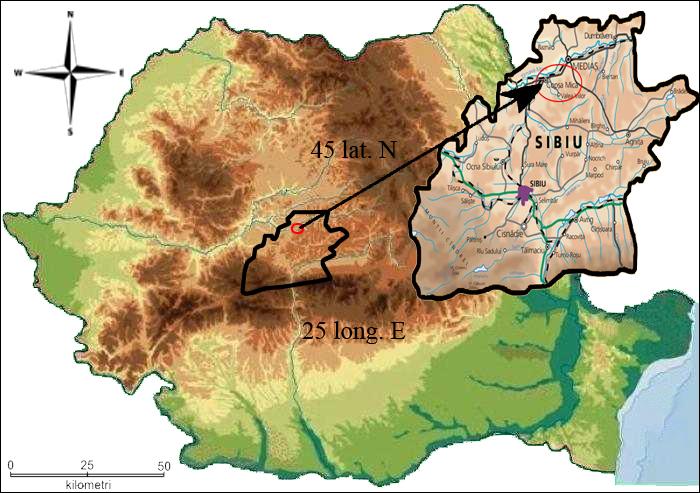

90 90 Marius Mihai PAISA, Raluca ALEXANDRU, Georgian CĂTESCU Fig. 1 Location of the study area within Sibiu County (Romania) Polution in the study area was almost entirely caused by two factories : Carbosin (wich produced carbon black for dies and tires from 1936 until 1993) and Sometra (a nonferrous smelter plant that used ecological hazardous technologies, being officially closed in 2009). The Copşa Mică plant initially produced zinc for industrial purposes and was modernized on various occasions over the years (1950, 1960, 1967, 1975, 1984), including the addition of a lead production unit. From this point forward, the fate of the town was sealed, eventually becoming Europe s most polluted location until the nuclear accident of Chernobyl. SC SOMETRA SA was privatized in 1998 with the majority ownership going to the Greek holding company, MYTILINEOS. Concurrently with the plant s privatization, a Conforming Program was adopted. Article 11 of the Program stipulated that the SOMETRA plant should finance the stabilization of the right branch of the Târnava Mare River through the planting of trees on an area of 40 to 50 hectares and the rehabilitation of the destroyed forest ecosystem. Indeed, between 2002 and 2003, 35 hectares were planted using company funds. The Conforming Program continues through the Integrated Environment Authorization, which covers the period from 2006 through 2011, and which contains an action plan targeting both reduction of pollution and ecological reconstruction. Data analysis and evaluation From a pedological point of view, the area is characterized by acid soils which brings forward the humidity excess and the retention of the pollutans, however the soils in the river meadow area are less acid allowing a more intense vertical movement of water and pollutans. The soil analysis from the Târnava Mare river banks and sorrounding areas of Copşa Mică reveal that the lead and cadmium concentations are exceding by far the admitted limits (Raport Starea Mediului, , ARPM Sibiu) (Fig. 2). Beginning in the 1960 s, as the local government became aware of the effects of industrial pollution on soil and forests, areas containing affected arboricultural zones increased continuously. The rhythmic expansion of polluted areas and associated intensity of the pollution proceeded slowly at first, but then grew more and more aggressive. Beginning in 1961 the pollution phenomenon had barely begun, covering approximately 100 hectares located only in the tree-covered area surrounding the pollution sources. Five years later the affected area had grown to cover over 5000 hectares. The last two inspections of the forest range show that almost the entire forest of the Mediaş Forest Range was affected by pollution. Therefore, the entire forest zone around Copşa Mică exposed to pollution was larger than hectares.


91 Aspects Regarding to Ecological Reconstruction at Copşa Mică Area 91 Fig. 2 Levels of lead and cadmium concentration in Copşa Mică and surrounding villages As far as the effect of heavy soil pollution on plantings is concerned, such endeavors have a very small chance for growth, if any, without the assistance of special measures such as mending, fertilizers, etc., which, in turn, increase costs substantially. One very clear example of the difficulties is reflected in the reforestation efforts of 1994 to Even when all assistance measures were applied, the success percentage varied from 12% and 95% with not one portion resulting in a complete success. The effort, necessary for success, and respectively, the risks of failure, are even larger if soil erosion or landslides are included in the picture. Under the influence of certain factors steep slopes, fragile petrographic under layers, alternating layers of various rock types, a lack of water in the soil etc. strong damage to, or total disappearance of, the forest is the final link in the chain reaction of degradation. In addition to pollution, forest fires and agricultural malpractice have sped up the process of forest degradation. The ecological disaster could be detected as a large black stain on the satellite pictures taken in 1986 (Fig. 3). Today, the Copşa Mică area is presented as a clean area in the UN Atlas of The World Environment Day. This is due to the Romanian foresters efforts, especially those from Sibiu, for the environmental reconstruction of the most damaged areas from the ecological point of view. Ecological reconstruction The ecological reconstruction through reforestation covered an area of intense pollution in the surroundings of Copşa Mică totaling 644 hectares, from which 470 hectares are within the forest range and 174 hectares represent reconstructive efforts outside the forest range (Fig. 4). Ecological reconstruction took place on degraded forested areas as well as areas owned by various landowners where assembled reconstruction occurred in precisely outlined plots according to current legislation in force. Fig. 3 Satellite images of Copşa Mică area within the period


92 92 TYPE OF WORK Integral plantations Mihai Marius PAISA, Raluca ALEXANDRU, Georgian CĂTESCU UM Inside forestry fund Outside forestry fund Total Total Total ha Fig. 4 Ecological reconstruction in the Mediaş Forest Range between Fig. 5 Surface near Sometra in wich vegetation is starting to regenerate The folowing measurements need to be taken for the ecological reconstruction to be succesful: - Undertaking ecological restoration activitie of the polluted areas by controlling erosion and landslides and by planting wodden species resistent to present pollution (willow, accacia, undebrush, silverberry, common hawthron); - Growing pollution resistent species preferably the kind that is capable to perform phytoextraction (corn, cabbage, juniper, poplar etc.); - Rendering impervious the taluses by covering them with clay or fertile soils or by creating a vegetal cover; - Applying well fermented organics fertilizers in order to alleviate soil pollution effects. The Sibiu Forestry Department continues the process of ecological reconstruction of the heavily polluted state-owned forested areas through a project of ecological reconstruction, financed through the state budget, which stipulates reforestation of 30.8 hectares combined with the careful tending of the same land area (Fig. 6). Fig. 6 Different stages of the ecological reconstruction in the area of study (Photos : Sibiu Forestry Department)
93 Aspects Regarding to Ecological Reconstruction at Copşa Mică Area 93 Conclusions Success in the process of ecological reconstruction ultimately depends on the application of all the requirements for environment protection trough rehabilitation of production lines and the installation of nonpolluting equipment at SC Sometra SA in order to reduce the toxic emanations to levels below the imposed limit. The newly created forests will have consideration for the end use of the resultant timber. In order to continue the ecological reconstruction of the affected area it is imperious for everybody involved in this action to collaborate in order to obtain local, national and (most important) international funds. Based on three decades of experience in the fight for reforestation within the industrial pollution zone and the planting of new forests in the Copşa Mică area, we can state that, through constant reduction of toxic emanations from their source, mainly sulfur dioxide, as has occurred since 1990, there are viable solutions for reintroducing vegetation in the majority of the perimeters which, in the past, faced long and intense pollution. It must be kept in mind, however, that the respective solutions result from both high effort and costs. REFERENCES ALEXA B., COTÂRLEA I., BĂRBĂTEI R., (2005), Poluarea pădurilor din Ocolul Silvic Mediaş şi lucrările de recosntrucţie ecologică realizate, Editura Constant, Sibiu; COMANESCU LAURA, NEDELEA A., PAISA M., (2010), Soil pollution with heavy metals in the area of Copşa Mică town-geographical considerations, Metalurgia International, vol.xv, no.4 ; GEANANA M., OPREA R., SĂVULESCU I., (2005), Geografia solurilor, ed. A II-a, Edit. Credis, București. GRECU FLORINA, NIŢĂ SILVIA, COMĂNESCU LAURA, (2003), Semnificaţia geomorfologică a poziţiei geografice a oraşului şi impactul asupra mediului. Studiu de caz: Copşa Mică, Revista de Geomorfologie, nr. 4-5, Editura Universităţii, Bucureşti; LAMBERT M., GREEN R.M., (2004), New methods of cleaning up heavy metal in soil and water, Hazardous substance research centers, New Jersey; PAISA, M., (2008), Poluarea cu metale grele în arealul Copşa Mică, Lucrare de disertație, Universitatea din Bucureşti. ***, (2006), Raport la studiu de impact pentru SCSometra, S.A., Copșa Mică, Institutul Național pentru Securitate și protecție Antiexplozivă. ***, (2008), Raport starea mediului , ARPM, Sibiu. *Main Author University of Bucharest Faculty of Geography Simion Mehedinți Doctorate School [email protected]
94
95 T H E R ESEARCH CE N T R E GEOMORPHLOGICAL DYNAM ICS LAND DEGRADATION AND THE GEOMORPHOMETRIC ANALYSIS. CASE STUDIES IN DRAINAGE BASINS REPRESENTATIVE AS RELIEF MARIA ALBU (DINU), DANIELA VLAD, GEORGIAN CĂTESCU Key words: hydrographic basin, relief, morphometry,hydrographic network hierarchy, evolution. Abstract: This paper has as objective the comparative study of the rivers network belonging to three drainage basins located in partial different morphogenetic conditions: - Eşelniţa drainage basin, located in the mountain area of Banatului Mountains, Danube Defile; - Mislea drainage basin having a Subcarpathian relief and plain relief; - Călmăţuiul deteleorman drainage basin, with plain relief, main drainage in Danube. The analysis is based on morphometric method, the ranking of the drainage network in Horton Strahler system, elaboration of morphometric models, graphic and cartographic representation. The specific targets are: identification of common particularities as well as the particularities of diversification of the drainage network; check of some principles; explaining of the effects in relief dynamics, caused by the morphometric elements expressed by means of certain indexes or parameters which are common to drainage basins. The size orders of the basins are 5 (Călmăţui, Eşelniţa) and 6 (Mislea), drained surfaces are 1375 km 2 Călmăţui, 77 km 2 Eşelniţa and km 2 Mislea). Although under different morphogenetic conditions, the principles of the number of river segments,of summarized lengths, of average lengths as well the ones of surfaces, perimeters and inclines are checked. The performance index (109 % Eşelniţa, 73 % Mislea, 98% Călmăţui) and the confluence ration vary from of one basin to another, being influenced by dynamic factors (geology and tectonics, morphometry, basis level, hydrogeology, climate conditions), proving their significance for the purpose of emphasizing the dynamics and the evolution of the relief of a drainage basin (Grecu, 2004). The plain basins, such as Călmăţuiul, has a performance degree quite high for its size grade, as well as high confluence ratio (6,54), as the cause consists in elements of hydrogeological and geologic nature. Related to relief units, the density of drainage has corresponding values, the highest values for mountain area, average values for hill areas and small areas for plain areas. 1. Introduction The study intends to perform a morphometric analysis of three drainage basins located under different morphogenetic condition. The main objective consists in emphasizing some own characteristics of each basin, resulted from geographical position, geological and geomorphological particularities. 2. Study area The analyzed basins are: a) Eşelniţa located in mountain area of Almăj, having a surface of 77 km 2, b) Mislea located in Subcarpathian area of Teleajen, having a surface of km 2 and c) Călmăţuiul teleormănean located in Boianului plain, having a surface much bigger as the other two basins, km 2 ( fig. 1). Eşelniţa Basin is located on the southeastern side of Almăjului Mountains, presenting a multistage arrangement between the maximum altitude of 1107 m and the minimal altitude of 64 m, at the confluence with Danube, therefore having a level difference of 1043 m. The basin has a surface of 77 km 2 and has a 5 th degree hydrographic network according to Horton-Strahler ranking system, tributary to Danube by means of Eşelniţa main collector (fig. 5).


96 96 Maria ALBU (DINU), Daniela VLAD, Georgian CĂTESCU Dunarea Fig. 1. The position of the analyzed basins in the country


97 The Geomorphometry Analysis. Case Studies in Drainage Basins Representative as Relief 97 Fig. 2. Eşelniţa hydrographic basin in the central course Fig. 3. Mislea hydrographic basin in the lower course Fig. 4. Călmăţui hydrographic basin in the lower course The geological components within Eşelniţa basin belong to Danube Field (Bercia E., Bercia I., 1975), having a crystalline bed consisting in crystalline schist represented by crystalline of Poiana Mraconiei, crystalline of Neamţu and crystalline of Corbu (Gunnesch K., Gunnesch M., 1978), eruptive rocks represented by two granitoidic massifs with intrusive character, inferior Paleozoic age: granite body of Cherbelezu having a northern development within the basin and granite body of Ogradena (Mutihac V., Ionesi L. 1974). The sedimentation formations arranged on the crystalline bed do not cover a major surface, as in the north-western area of the basin there may be found formations belonging to inferior Jurassic (conglomerates, sandstones, argillaceous schist and coals) and in southern area of the basin there are major sedimentary deposits belonging to Neogene (marl, gravel, organogene limestone) and Quaternary (gravel and sands), belonging to Orşova Depression and whose presence is connected to Danube s evolution. Mislea Basin totally overlaps Teleajen Subcarpathians, a sub-unit of Prahovei Subcarpahians, having an area of 175,6 km 2. According to Horton Strahler ranking system, the basin is a 6 th degree basin. The maximum altitude is found in Măceşu Hill (815 m) and the minimum altitude is found at the confluence with Teleajen river (207 m), so that the level difference is 610 m (fig. 6). From the geological point of view, Mislea Basin overlaps the individualized Carpathian sandstone as a result of Moldavian movements in Sarmatian, cropping out between the external tectonic line and the Pericarpathian tectonic line (V. Mutihac, 1990). The bed is mixed consisting in external flysch (marl-sandy Paleogene) at the contact with the mountain and Proterozoic platform crystalline with Neogene sedimentation belonging to lower part of basin. The oldest deposits are found in the basin belonging to Paleogene, in the northern part of the region, consisting in marl-sandy facies. The Miocene aged deposits belong to central and eastern part of the basin and are represented by: clay, marl, sands and sandstones. In the southern sector, along the main valleys (Cosmina, Mislea, Doftăneţ and Telega) are found Pliocene and Quaternary deposits, consisting in sands, marls, gravel and clay.
98 98 Maria ALBU (DINU), Daniela VLAD, Georgian CĂTESCU Fig. 5. Eşelniţa hydrographic basin Călmăţui of Teleorman Basin is developed within a relief of piedmont plain, sculpted in loess deposits of Pleistocene age, consisting in Frăteşti Layers of St. Prestian age (E. Liteanu, 1961, P. Enciu, 2007). The nonconformity between the Romaniene deposits and Frăteşti Layers is caused by the erosion bed of Paleo-Danube, in cone-delta phase, after getting out from defile (E. Liteanu, C. Ghenea, 1967). The altitudes are slightly decreasing on NNW-SSE direction, from 163,5 m, in northern part of the basin to 20 m, at the inflow in Suhaia Lake, presenting therefore a level difference of only 143,5 m, and according to Horton-Strahlerranking system, the basin is a 5 th degree basin (fig. 7).
99 The Geomorphometry Analysis. Case Studies in Drainage Basins Representative as Relief 99 Fig. 6. Mislea hydrographic basin
100 100 Maria ALBU (DINU), Daniela VLAD, Georgian CĂTESCU Fig. 7. Călmăţui hydrographic basin Being located in different relief units, the analyzed drainage basins have different morphometric characteristics and implicitly different morphogenetic conditions:
101 The Geomorphometry Analysis. Case Studies in Drainage Basins Representative as Relief 101 Hydrographic basin Surface Km 2 Table 1. Morphometric characteristics of the three analyzed basins The order size Maximum altitude m Minimum altitude m Average altitude m Average slope % Eşelniţa , 5 35,4 26 Course length km Mislea ,7 29,5 Călmăţui , Data and methods The measurements for this cartographic analysis have been made using topographic maps at 1:25000 scale, georeferentiated, using the ArcGis-ArcMap software in 1970 Stereographic projection. For the purpose of extracting the temporary and permanent hydrographic network, there has been taken into consideration the elimination of errors consisting in including a river segment which is not checked on the field or the omission of external segment from the map. For analysing the three basins, we have used the ranking method of the hydrographic network in a basin, in the form proposed by Horton (1945) and completed by Strahler (1952), (quoted by Grecu, 2003). Subsequently, the data have been processed and analyzed using the Office Excel software and there have been made comparisons. 4. Results and discussion 4.1. Analysis of drainage model for Eşelniţa basin In case of Eşelniţa basin, there has been identified a total number of segments of 919 and as a result of totalizing the number of segments having the same degree (in Horton Strahler ranking). there has been obtained an array of 5 values. These values have been represented in semi-logarithmic coordinates and it has resulted a straight-line. The obtained data observe the principle of number of river segments indicating that: the number of river segments of successively increasing degrees tends to form a decreasing geometric progressing, wherein the first term N1 is the number of 1 st degree rivers and the ratio is the confluence ratio Rc, (I. Zăvoianu, 1978, Fl. Grecu, 1980). The real number of 1 st degree valley segments (736) is exceeded by the ideal one (933.2), therefore favouring the formation of segments of higher degrees. The real number of 2 nd degree segments (142), is lower than the one of calculated segments (172. 8), indicating a sufficient share of segments of this degree, so there is a surplus of 2 nd degree tributaries. The 1 st and 2 nd degree segments are the most numerous ones and the 2 nd degree segments are more uniformly distributed within the entire surface of the basin. The real value of 3 rd degree segments (32) coincides with the ideal value (32), indicating a balance in comparison to the situation of the previous segments. The 4 th degree real segments (8) are slightly over made in comparison to the ideal ones (5.92), the biggest share belongs to Frasinului, Cusa and Criviţa Valleys. As the 5 th degree real segment regards (1) represented by Eşelniţa river, formed at the upper course by uniting two 4 th degree tributaries, one of them resulting from the confluence of Vulpea Mare with Vulpea Micǎ Valleys and the real segment (1.09), there may be stated that there is a balance in case of the highest degree segment providing also the basin degree. Eşelniţa basin is slightly over made from the point of view of number of segments with Ir = 109%, especially caused by the significant branching degree (Rc = 5,4), from superior segment. There is noticed a slight deviation from the number of segments of 4 th degree segments, represented by eight valleys. In case of totalized lengths RL =2.3, there is established a deviation of 5 th degree segment (20,5 km), having a value much higher than the totalized value of 4 th degree segments, so that it
102 102 Maria ALBU (DINU), Daniela VLAD, Georgian CĂTESCU does not observe the decreasing sense of progression and therefore the basin has the performance degree of only 30%. As the average lengths regards, the ratio rl is 5,5 and the performance degree is 147%, indicating that the basin is over made, which is contrary to the situation previously found in case of totalized lengths. The rocks which are more resistant to corrosion, such as the crystalline ones, do not allow an easy erosive action, so that the average lengths of the 1 st degree segments have a totalized length of only 0.3 km Analysis of drainage model for Mislea basin The morphometric analysis indicates that from the 1793 thalwegs existing within Mislea drainage basin, 1395 are 1 st degree thalwegs, 322 segments are 2 nd degree segments, 61 segments are 3 rd degree segments, 11 segments are 4 th degree segments, 3 segments are 5 th degree segments and 1 segment is a 6 th degree segment. As a result of analyzing the map of ranking the hydrographic network, there is established that the highest density of the hydrographic network may be found in the superior and middle basin of Cosmina river and at Doftăneţ - Cosmina Mislea confluence. The decrease of the number of river segments upon passing from the superior and middle sector to the inferior sector (corresponding to Mislea depression) is connected to decrease of relief energy being lower than 50 m. The high number of 3 rd (61), 4 th (11), 5 th (3) degree river segments is explained by the circular form of the basin, allowing the formation of a larger number of segments of inferior degree and because of tectonics and friability of rocks. Mislea drainage basinis under made from the point of view of the number of segments with a performance degree (Ir) of 73%, indicated that the basin is not totally made, as there is the trend to branch without changing its size grade. From the point of view of totalized lengths, the basin is far from being made, its performance degree being 47 %, as the real length of the 6 th degree segment is 7,46 higher than the calculated value. The performance degree of the average lengths is 45 % in case of Mislea basin. Note that the average lengths of segments of 5 th degree segments presents a deviation from the average of the lengths of law,the average length of these being greater than the 6 th degree segment. The ratio rl is only 0,66 and the average length of the 1 st degree segments is 0,31 km Analysis of drainage model for Călmăţui basin The total number of segments belonging to Călmăţuiului basin is Among these, the 1 st and 2 nd degree segments are the most numerous ones (2 nd degree is represented by 258 segments and the 1 st degree is represented by 1426 segments), short and have a torrential character. Their transversal profile is corresponds to a very widely open V profile, presenting versants with soft inclinations. The 3 rd degree is represented by 42 segments, have shorter lengths and are direct tributaries of Călmăţuiului or of other 4 th degree segments and by unifying the two 4 th degree segments (Călmăţuiul and Călmăţuiul Sec), it results the 5 th degree segment. Călmăţuiul telormănean basin is almost made from the point of view of the number of segments, performance degree Ir = 98%. The ratio value Rc = 6,4 is quite high for the plain area, indicating both the presence of positive neotectonic movements in the region as well as the fact that the drainage basin did not reach yet the maturity stage, as the relief is still subject to erosion and fragmentation (G. Desiderio, T. Nanni, S. Rusi, 2003). From the point of view of average lengths, the basin is under made, Ir being 66%, indicating the fact that the basin s evolution did not reach yet the maturity stage. The ratio rl is 3,24 and we have to remark the average length of the 1 st degree segment, reaching the value of 0,7 km, being double in comparison to the other two analyzed basins.


103 The Geomorphometry Analysis. Case Studies in Drainage Basins Representative as Relief 103 Table 2. The data for the morphometric drainage model Hydrographic basin Eşelnița Parameter mm/c The order size Number of mm river segments N cc Totalized mm lengths L (km) cc Average lenthsl (km) mm cc R Ratio The performance index % RRc = RRL = rrl = Number of mm river segments N cc RRc = Mislea Călmăţui Totalized mm lengths L (km) cc Average lenths l (km) mm cc Number of mm river segments N cc Totalized mm lengths L (km) cc Average lenths l (km) mm cc RRL= rrl = RRc = RRL= rrl = Fig. 8. a, b and c. The drainage model for Eşelniţa, Mislea and Călmăţui basins
104 104 Maria ALBU (DINU), Daniela VLAD, Georgian CĂTESCU The preparation of the morphometric model of surfaces for the three analyzed basins was obtained on the basis of the number of river segments or number of basins of different size grades, totalized surfaces and average surfaces. For the purpose of establishing the surfaces of the drainage basins of different size grades within each analyzed basin, there have been delimited the water levels and there has been made the planimetry for each size grade, resulting therefore a 5 values array for Eşelniţa and Cǎlmǎtui basins and a 6 values array for Mislea basin. The values obtained in this way establish the Principle of totalized surfaces: the totalized surfaces of drainage basins of successively increasing degree tend to form a geometric progression, wherein the first term is provided by the totalized surface of 1 st degree basins ( P1 ) and the ratio (R P ) is resulted from the ratio of totalized surfaces, (quoted Zavoianu, 1978). The progression ratio for the three basins was obtained by using the formula: =, after Grecu F., Palmentola G., 2003 Model of perimeters is provided by the principle of number of river segments, by the principle of totalized perimeters and by the principle of average parameters. On the topographical map there have been delimited the water levels of basins of different degree; afterwards, they have been measured for each degree and by totalizing them there was obtained a 5 values array for Eşelniţa and Cǎlmǎtui basins and a 6 values array for Mislea. Principle of perimeters indicates that the sum of perimeters of basins of different successively increasing degrees form a decreasing geometric progression, having as first term the sum of 1 st degree perimeters (P 1 ), and as ratio (R P ), the ratio of the sum of perimeters of two adjacent terms.,(quoted from Grecu F., Palmentola G., 2003): =. By dividing the sum of perimeters to number of basins of each degree, there may be calculated the average perimeter. The values array obtained in this way for each basin confirms the Principle of average perimeters indicating the fact that the average perimeter of successive degree basins form an increasing geometric progression having as first term the average perimeter of 1 st degree basins (p 1 ) and as ratio (r p ), the ratio of these perimeters, (Zavoianu I., 1978, quoted by Grecu F.,1992 ). The ratio of progression representing the ratio of two adjacent terms has been calculated for Eşelniţa, Mislea and Cǎlmǎtui drainage basins using the formula: =. For preparing the model of average level differences, there has been identified the number of river segments of successive degrees, there has been calculated the sum of level differences and the average of level differences for each basin. In case of the model of average level differences, there must be established the maximum and minimum altitudes within the basins of different degrees so that subsequently there is obtained the product of the difference between their values using the formula: ΔH = Principle of average level differences emphasizes that the rivers of successively increasing degrees tend to form an increasing geometric progression, whose first term is the value of average level differences of 1 st degree rivers (quoted from Grecu F., Comanescu L., 1998). The ratio is indicated by the ratio between two adjacent terms and was obtained using the formula (after Grecu F., Comănescu L., 1998): =. Inclinations model results from the ratio between the length or surfaces parameters and the level differences. The average inclination of the surface of each three analyzed basins was obtained using the formula (after Grecu F., 1992): =. As a result of analyzing the values obtained for courses of different degrees, there may be applied the formula of principle of average inclination the average inclinations of the river segments of successively increasing
105 The Geomorphometry Analysis. Case Studies in Drainage Basins Representative as Relief 105 degrees tend to form a decreasing geometric progression, wherein the first term is indicated by the inclinations of the first degree segments, and the ratio ( ) is indicated by the average ratio of inclinations of different degrees or by the proportion of ratios of the two involved arrays ( = ), (after Zavoianu I., 2007). Hydrographic basin Table 3. Parameters calculated on the basis of drainage data for analyzed basins Frequency of elementary thalwegs N1/F Incipient Torrentiality L1/F Total Torrentiality (L1+L2)/F Drainage density L tot./f Eşelniţa Mislea Călmăţui Check of principles of totalized surfaces, perimeters, level differences and average inclinations for analyzed basins The totalized surfaces of Mislea (102 %), Călmăţui (108 %) and Eşelniţa (91 %) basins are made and their ratio (Rs) presents closed values in all three analyzed basin, carrying between 0.77 and In case of Eşelniţa and Mislea basins, there are established small deviations from the semi-logarithmic straightline of totalized 3 rd and 4 th degree surfaces, because there is a large number of 1 st and 2 nd degrees segments directly tributary to 5 th degree segment. Also in case of Călmăţuiului, there are noticed deviations from this straight-line in case of 4 th degree basin, because of their small extension in comparison with the 3 rd degree which are more numerous and are collected in 5 th degree segment, so that the surfaces existing between basins are quite large in case of 4 th degree under-basins. By reporting the measured values of the totalized surfaces to the number of basins of different size grades, it results a new progression, the one of average surfaces. Their ratio has high values, varying between 5.0 and 8.5, and the performance degree is 109 % for Eşelniţa, 110 % for Călmăţui and 141 % for Mislea. Eşelnita and Mislea basins have low values in case of average surfaces because of accentuated fragmentation degree causing their extension in case of each degree, the increasing of totalized surfaces and the diminishing of spaces between basins. Both the principle of totalized perimeters as well as the principle of average perimeters observe without major deviations and the ratio Rp has very closed values in case of the three basins (1.9 Eşelniţa, 1.95 Mislea and 2.11 Călmăţui ). From the principle of average level differences, the greatest deviation is noticed in case of 4 th degree segments belonging to Eşelniţa basin, whose value is lower than the one of 2 nd and 3 rd degrees segments. In case of the three analyzed basins, the principle of average inclinations is observed; only in case of Călmăţui basin, there is noticed a non-significant deviation from the straight-lie defined by calculated values, of 4 th degree segments, for which the measured values of the average inclinations are lower than the calculated ones. In case of analyzed basins, there is established that the principle regarding the density of drainage (Dd) is observed, in the sense that the density of drainage has high values in mountain and hill areas (4,68 km/km² in Eşelniţa basin, respective 4,29 km/km² in Mislea basin) and lower values in case of basin located in plain areas, (1,27 km/km² - Călmăţui). The incipient torrentiality (Grecu, 1997 ) is high and is getting close to the value of 3 km/km² in case of Eşelniţa basin, exceeds the value of 2,5 km/km² in case of Mislea basin and is below 1 km/km² in case of Călmăţui basin. The total torrentiality (Grecu, 1997) is getting close to the value of 4 km/km² in case of Eşelniţa basin, 3,5 km/km² in case of Mislea basin and is 1 km/km² in case of Călmăţui basin. The low values of torrentiality, specific to plain area, is owed both to small inclinations
106 106 Maria ALBU (DINU), Daniela VLAD, Georgian CĂTESCU as well as to high degree of permeability of loess and loess deposits covering the surface of the basin. 5. Conclusions The principle of number of river segments, of totalized lengths, of average lengths, of surfaces, perimeters and inclinations proves to apply in case of three analyzed basins, although they have different morphogenetic conditions. The geology, tectonics, morphometry, basis level, hydrogeology and climate conditions play an essential role regarding the dynamics and evolution of the relief of a drainage basin, this relation being emphasized by the performance index and the confluence ration varying from one basin to another basin (ex. Eşelniţa basin has the highest degree of performance (109 %) and a high confluence ratio (Rc = 5.4), being followed by Călmăţui basin having also a high performance degree (98%), as well as the highest value of the confluence ratio (Rc =6,54), while Mislea basin has the smallest performance degree (73%) and the lowest confluence ratio (Rc = 4,36). As the drainage density regards, it has values corresponding to relief forms. Therefore, the highest value apply for mountains (4,68 km/kmp in Eşelniţa basin ), the average values apply for hill (4,29 km/kmp in Mislea basin) and the smallest values of this parameter apply for plain, (only 1,27 km/kmp in Călmăţui basin), where in because of the drainage insufficiency, there are settling processes in loess, leading to formation of tablelands. Invest in human resources! This work was supported by project: POSDRU/88/1.5/S/61150 Doctoral Studies in the field of life and earth sciences, project cofinanced through Sectorial Operational Program for the Development of Human Resources from European Social Fund. BIBLIOGRAPHY BERCIA E., BERCIA I., (1975), Formațiunile cristaline din sectorul românesc al Dunării (Banat-Carpații Meridionali), Anuarul Instit. de Geologie și Geofizică, vol. XLIII, Bucureşti. COMĂNESCU L., (2004), Bazinul morfohidrografic Casimcea. Studiu geomorfologic, EdituraUniversitatii din Bucureşti. ENCIU P. (2007), Pliocenul şi cuaternarul din vestul Bazinului Dacic. Stratigrafie şi evoluţie paleogeografică, Ed. Academiei, Bucureşti. GRECU FL., (1980), Modelulmorfometric al lungimiireţelei de râuri din bazinul Hârtibaciului, St. cerc. geol., geofiz., geogr., Geografie, t.xxvii, nr. 2, București. GRECU FL., (1992), Bazinul Hârtibaciului. Elemente de morfohidrografie, Editura Academiei, Bucureşti. GRECU FL., (1997), Fenomene naturale de risc (geologice și geomorfologice ), EdituraUniversitatiiBucuresti. GRECU FL., ZĂVOIANU, I., (1997), Bazinulmorfohidrografic, Rev. de geomorfologie, Nr. 1, Bucuresti. GRECU FL., COMANESCU L.,(1998), Studiul reliefului Îndrumător pentru lucrări practice, EdituraUniversitatii din Bucuresti, Bucuresti. GRECU FL., PALMENTOLA, G., (2003), Geomorfologiedinamică, Ed. Tehnică, Bucureşti. GRECU FL., (2004), Quantification of some elements of drainage basins in Romania, GeografiaFisica e Dinamica Quaternaria, vol. 25. GUNNESCH K., GUNNESCH M., (1978), Formatiunile cristalofiliene din sud-estul Muntilor Almajului, St. cerc. geol., geofiz., geogr. Seria Geol, Tom. 23, Ed. Academiei, Bucureşti. LITEANU E., GHENEA C. (1967), Harta neotectonică a României, Studii tehnice şi economice, Seria H, nr. 3, Bucureşti. MUTIHACV., IONESI, L., (1974), Geologia României, Ed.Tehnică, București. MUTIHAC V., ( 1990 ), Geologia structurală a României, Edit. Tehnică, Bucureşti. ZĂVOIANU I., (1978), Morfometria bazinelor hidrografice, Editura Academiei, București. ZAVOIANU I., (2007), Caracteristici morfometrice ale rețelei hidrografice din bazinul Slănicul Buzăului, Analele Universității Spiru Haret, Seria Geografie, nr. 10, București. *** (1976, 1977), Hartile topografice militare, scara 1 : 25000, editia a II-a, Editate de Ministerul Apărării Naționale al Rep. Soc. România, Direcția Topografică Militară, București. *** (1968), Harta geologică, scara 1 : , Comitetul de Stat al Geologiei, Institutul Geologic, București. University of Bucharest, Faculty of Geography [email protected], [email protected], [email protected]
107 T H E R ESEARCH CE N T R E GEOMORPHLOGICAL DYNAM ICS LAND DEGRADATION AND AMENAJĂRILE HIDROTEHNICE DE PE RÂUL ARGEȘ: ÎNTRE NECESITATE ENERGETICĂ ȘI IMPACT ASUPRA RELIEFULUI REMUS PRĂVĂLIE Cuvinte cheie: râul Argeș, relief, impact, amenajare hidroenergetică. Rezumat. În România sursele regenerabile reprezintă un potențial energetic important, acestea oferind diverse posibilități de utiliare pe plan local și național. Astfel hidroenergia, pe lângă rolul de creștere a siguranței naționale în alimentarea cu energie precum și de limitare a importului de resurse energetice, aceasta asigură o energie curată, creând în ansamblu premisele unei dezvoltări economice durabile. La nivelul sistemului energetic național procentul ocupat de aceasta este de aproimativ 30%, perspectivele de viitor fiind promițătoare, întrucât tendința de valorificare a hidroenergiei este în creștere. Totuși, în multe situații, modalităție tehnice de valorificare a aceastei forme de energii precum și amenajările hidrotehnice rezultate periclitează anumite componente ale mediului înconjurător. Scopul acestui studiu este acela de a scoate în evidență ambivalența hidroenergie mediu înconjurător existentă în cazul sistemului hidrologic de pe râul Argeș. Acest râu prezintă un important potențial hidroenergetic în special in sectorul superior, acest lucru datorându-se condițiilor naturale favorabile (debit relativ bogat datorită alimentării mixte și valori mari ale pantelor reliefului în special în sectorul superior). Cantitativ, din totalul național al puterii hidroenergetice instalate de circa 6362 MW în prezent, total deținut de S.C. Hidroectrica S.A., amenajarea hidrotehnică de pe râul Arges pe sectorul analizat (Vidraru-Golesti, inclusiv amenajările Cumpăna și Vâlsan situate în amonte) prezintă un total al puterii instalate de 417 MW, astfel participând cu aprox. 6.5 % la potențialul tehnic al țării de valorificare hidroenergetică. Deși este unul din râurile interioare cele mai valorificate din punct de vedere hidroenergetic, efectele benefice resimțindu-se atât la nivelul sistemului energetic, cât și la nivelul sistemului agricol (irigații ș.a.), social (reducerea inundațiilor catastrofale ș.a.) sau economic (locuri de muncă create etc), amenajarea hidrotehnică concretizată prin apariția hidrocentralelor de-a lungul acestui râu a lăsat importante amprente asupra unor componente de mediu cum este cazul reliefului. Considerații generale Amenajarea hidrotehnică a râului Argeș reprezintă un pilon important în valorificarea hidroenergetică a României, astfel studii importante în vederea cunoașterii potențialului hidroenergetic național fiind realizate cu multe decenii în urmă. Încă din anul 1929 se remarcă lucrarea intitulată Forțele hidraulice ale României, realizată de către inginerul Dorin Pavel, acesta propunând numeroase soluții de amenajare și valorificare hidroenergetică a regiunilor montane, zone considerate cele mai eligibile în acest sens. În 1936 autorul revine asupra problemei cu lucrarea Resursele energetice ale României, această lucrare conținând abordări mai concrete asupra valorificării hidroenergetice ale României, aici fiind vizat și sectorul Argeșului superior. Urmează o relativă stagnare în următoarele decenii, pentru ca după 1970 studiile să se intensifice simultan cu o reală activitate în amenajarea hidroenergetică a bazinelor hidrografice ale țării. Astfel, realizarea galopantă după acest an a multor baraje pe anumite râuri din România cu potențial hidroenergetic ridicat, printre acestea remarcându-se și râul Argeș ca fiind printre cele mai importante, a generat expansiunea rapidă a cercetărilor, principalele abordări fiind legate de teme precum proiectare, exploatare, evoluția morfodinamicii cuvetelor lacustre ș.a., toate aceste studii fiind condiții sine qua non în realizarea oricărei amenajări hidrotehnice. Ca exemplu pot fi menționate lucrări precum Concepția generală de amenajare a bazinelor hidrografice, (1976) de A. Filotti, Lacuri de
108 108 Remus PRĂVĂLIE acumulare, (1976) de V. Chiriac și A. Filotti, Considerații privind colmatarea lacurilor, (1980) de Fl. Ionescu, Efectele barajelor în dinamica reliefului (1986) de I. Ichim și M. Rădoane, Geografie hidroenergetică (1996) de G. Pop etc. Prezentul articol urmărește analiza relației om-mediu (relief) prin intermediul amenajărilor hidrotehnice, realizându-se astfel un fel de analiză swot în ceea ce privește construcția hidrocentralelor de pe râul Argeș. Studiul urmărește ambivalența dintre hidroenergie și impact asupra reliefului pe segmentul Vidraru- Golești, luându-se în considerare și amenajările secundare din amonte Cumpăna și Vâlsan, întrucât acestea se află în strânsă conexiune cu hidrocentrala Vidraru. Lucrarea este structurată pe șase părți, astfel punându-se accent pe aspectele relevante ale cadrului natural, dar mai ales pe analiza importanță economică (energetică) - impactul asupra reliefului, în final concluziile axându-se pe proiectarea măsurilor de ameliorare a impactului amenajărilor asupra reliefului și a mediului în ansamblu. Metodologie În realizarea acestei lucrări, metodologia utilizată constă în prelevarea datelor din diferite surse și prelucrarea acestora cu diferite softuri, observații în teren și utilizarea/consultarea unei bibliografii de specialitate. O mare parte din datele utilizate provin din cadrul Societății Hidroelectrica Curtea de Argeș și Direcției Apelor Argeș-Vedea. Prelucrarea datelor a fost posibilă cu ajutorul anumitor softuri specializate precum cel de analiză spațială ArcGis 9.3 sau cel de calcul tabelar Microsoft Excel, acestea contribuind în mod direct la întregirea grafică a articolului și, indirect, la descifrarea conexiunilor și interrelațiilor dintre elementele naturale și cele antropice, în cazul celor din urmă fiind vorba despre amenajările hidroenergetice. De asemenea, utilizarea bazei de date geospațial a reprezentat o deosebită importanță în realizarea articolului. În ceea ce privește deplasarea în teren, aceasta s-a desfășurat intinerant, astfel urmărindu-se identificarea anumitor particularități în cazul conexiunilor dintre construcțiilor hidrotehnice și mediul înconjurător, aceste conexiuni fiind transpuse în impactul acestor amenajări asupra reliefului. Aspecte ale cadrului natural Sectorul analizat al râului Argeș, cuprins între Carpații Meriodionali și Câmpia Piteștilor, se află în partea central-sudică a României (fig. 1), acest sector fiind încadrat în bazinul hidrografic al Argeșului superior și mijlociu. Acesta corespunde văii Argeșului pe segmentul cuprins între lacul Vidraru și lacul Golești, acest segment desfășurându-se de-a lungul a trei mari unități de relief (Carpații Meridionali, Subcarpații Getici, Podișul Getic), finalizându-se la contactul cu Câmpia Română (Câmpia Înaltă a Piteștilor). Din punct de vedere geografic, unitatea montană se remarcă prin prezența izvoarelor râului Argeș în lacurile glaciare Capra și Buda, dar și a unor afluenți importanți precum Cumpăna, Valea cu Pești, Valea Călugăriței ș.a, întreaga rețea hidrografică din acest sector condiționând regimul hidrologic al râului Argeș. În partea de S a Carpaților Meridionali se remarcă depresiunea Loviștei și Cheile Argeșului, sectoare propice dezvoltării primei și celei mai importante amenajări hidrotehnice de pe cursul râului Argeșului- lacul Vidraru. Subcarpații Getici reprezintă a doua unitate mare de relief a bazinului, constituind o treapta intermediară între zona de munte și cea colinară, aceasta fiind alcătuită dintr-o asociere de depresiuni la contactul cu muntele și muscelele. În acest sector se remarcă amenajări hidrotehnice importante precum Oești, Cerbureni și Curtea de Argeș. Unitatea piemontană se remarcă prin largi platouri interfluviale, prezența rocilor friabile (marne, nisipuri) pe acest sector generând importante probleme de colmatare lacurilor amenajate (Zigoneni, Vâlcele, Budeasa, Bascov, Prundu- Pitești). Ultima amenajare, lacul Golești, se află situată la contactul unității piemontane cu zona de câmpie (fig. 2), astfel condițiile naturale (litologice) determinând una din cele mai mari rate de colmatare.

109 Amenajările hidrotehnice de pe râul Argeș: între necesitate energetică și impact asupra reliefului 109 Fig. 1. Localizarea amenajării râului Argeș (Vidraru-Golești) în cadrul României (prelucrare date geo-spațial.org) Fig. 2. Localizarea lacurilor de acumulare de pe cursul superior al râului Argeș în cadrul unităților de relief din România (prelucrare date geo-spațial.org)

110 110 Remus PRĂVĂLIE Desfășurarea bazinului hidrografic al Argeșului superior și mijlociu pe o suprafață mare (3158 km²) și mai ales întru-un procent ridicat (aprox. 30 %) în cadrul unității montane (Teodor, 1999), reprezintă un aspect extrem de important. Astfel se remarcă un potențial energetic foarte ridicat datorită alimentării mixte bogate și debitelor mari ale râului Argeș în sectorul montan. De asemenea, valorile mari ale pantelor coroborate cu un indice de erodabilitate scăzut datorat prezenței rocilor dure, determină viteze ridicate ale scurgerii apei, acest lucru fiind esențial în viabilitatea oricărei amenajări hidrotehnice. În ansamblu, regimul hidrologic al Argeșului se evidențiază printr-un maxim de primavară şi perioade cu ape mici de iarnă (Gâștescu, 1971), acest lucru datorându-se alimentării mixte din zona montană în timpul primăverii (fig. 3). Cele mai mici debite sunt înregistrate în luna februarie cu un debit de 8,3 m³/s, datorită reținerii apei în cea mai mare parte sub formă solidă, aceasta fiind cantonată în zăpadă, astfel scurgerea lichidă fiind minimă. Situația se prezintă cu totul altfel în timpul primăverii, când în luna mai valorile debitelor sunt cele mai mari (aproape 50 m³/s), acest lucru datorându-se în cea mai mare parte topirii zăpezilor. Este foarte important de corelat regimul hidrologic bogat de primăvară cu producția hidroelectrică mai mare în această perioadă, între cele două componente existând un raport direct proporțional. Fig. 3. Hidrograful debitelor medii lunare în perioada la st. hidrometrică Cumpăna Importanța economică În ansamblu, lacurile de acumulare reprezintă o modalitate de valorifiare a resurselor de apă, jucând un rol important și în gospodărirea și amenajarea bazinelor hidrografice. Realizarea amenajării râului Argeș a reprezentat o oportunitate economică extrem de valoroasă, avantajele economice din acest punct de vedere fiind legate de valorificarea hidroenergetică, regularizarea hidrologică a râului Argeș, constituirea unor bazine de apă utilizate pentru alimentarea unor orașe, irigații sau în scop de agrement, precum și valorificarea potențialului turistic, în special în sectorul superior al raului Argeș (lacul Vidraru). Dintre toate aceste aspecte, unul din cele mai însemnate avantaje socio-economice îl reprezintă hidroenergia. Odată cu elaborarea planului general de electrificare a țării ( ) se remarcă creșterea necesității energetice la nivel național, astfel punându-se bazele dezvoltării moderne a hidroenergie românești. Acest lucru a condus în deceniul următor ( ) la impulsul puternic al dezvoltării hidroenergiei pe anumite sectoare în România, astfel luând naștere uzine hidroelectrice de mare capacitate cum ar fi Porțile de Fier, Stejaru și Vidraru. În cazul râului analizat, punctul de plecare în valorificarea hidroenergetică l-a constituit realizarea primei și celei mai mari amenajări hidrotehnice și anume lacul Vidraru. Lacul reprezintă amenajarea de bază pentru 2 unități hidroelectrice situate în amonte (Vâlsan și Cumpăna) și alte 15 unități situate în aval, astfel în bazinul hidrografic superior și mijlociu al Argeșului remarcându-se un număr total de 18 U.H.E. (Uzine Hidro-Electrice). Din punct de vedere hidroenergetic, acestea se caracterizează printr-o putere totală de 417 MW și o producție electrică de aprox. 810 Gwh/an (Societatea Hidroelectrica Curtea de Argeș). În ceea ce privește amplasamentul, amenajările situate în extremitatea nordică a arealului sunt Cumpăna, Vâlsan și Vidraru, urmând în aval alte 15 acumulări, printre acestea fiind incluse și centrale pe canale de irigație.

111 Amenajările hidrotehnice de pe râul Argeș: între necesitate energetică și impact asupra reliefului 111 În acest sens, din cele 15 U.H.E. (fig. 4). situate în aval de lacul Vidraru, 7 aparțin tipului de centrală-baraj (Oiești, Cerbureni, Curtea de Argeș, Zigoneni, Vâlcele, Budeasa, Bascov, Prundu-Pitești și Golești) și 8 tipului de centrală pe canal de derivație (Albești, Valea Iașului, Noapteș, Băiculești, Mănicești și Merișani) (Teodor, 1999). Aceste construcții hidrotehnice îndeplinesc mai multe funcții importante, dintre acestea remarcându-se funcții multiple sau complexe (rezervoare de irigații, alimentări cu apă, energetice etc) ce caracterizează amenajările Vidraru, Curtea de Argeș, Zigoneni, Vâlcele, Budeasa, Bascov, Prundu-Pitești și Golești, precum și funcții singulare prezente în cazul lacurilor Cumpănița, Vâlsan, Albești, Valea Iașului, Noapteș, Băiculești, Mănicești și Merișani (Teodor, 1999). Construcția barajului Vidraru, cea mai importantă construcție hidrotehnică de pe râul Argeș, a fost începută în 1960 și a fost finalizată în 1966 (foto 1). La vremea respectivă (1967) barajul era, după înaltime, al cincilea baraj în arc din Europa și al nouălea din lume (Pop,1996). Barajul este o construcție din beton în arc dublu cu o lungime de 307 m și cu o înălțime de 166 m, fiind cel mai înalt baraj din România și unul dintre cele mai înalte din Europa. Lacul Vidraru se întinde pe o suprafață de 870 ha și are un volum total de apă de circa 465mil. m 3 (Rădoane Maria și Rădoane N. 2005), volumul lacului reprezentând 78% din stocul anual de apă al Argeşului. Odată cu amenajarea Vidraru are loc și construirea hidrocentralei Cetățuia sau Corbeni-Argeș, prima hidrocentrală subterană din România situată la 104 m adâncime sub albia râului Argeș, aceasta având cea mai mare putere totală instalată de pe râul Argeș și anume de 220 MW (Pop, 1996). Foto. 1 Construcția barajului Vidraru (1964) Fig.4. Amenajarea hidrotehnică a râului Argeș (prelucrare model Berkun, 2010)
112 112 Remus PRĂVĂLIE În ceea ce privește celelalte uzine hidroelectrice situate în amonte și aval de Vidraru acestea prezintă anumite caracteristici hidrologice și geotehnice prezentate în tabel 1: Tab. 1 Caracteristici hidrologice și geotehnice ale amenajării râului Argeș (prelucrare date Societatea Hidroelectrica Curtea de Argeș)
113 Amenajările hidrotehnice de pe râul Argeș: între necesitate energetică și impact asupra reliefului 113 Prin aducțiunile realizate în lacul de acumulare Vidraru, debitul mediu al Argeşului a crescut de la circa 7.5 m³/s la m³/s, acest lucru determinând amplificarea potențialului energetic al râului Arges, de la circa 800 kw/km la circa 1500 kw/km (Dinoiu, 2004). Astfel, dintre toate hidrocentralele anterior amintite, cea mai importantă amenajare de pe râul Argeș din punct de vedere energetic este centrala subterană Cetățuia, în aval de aceasta existând alte 15 hidrocentrale, fiecare cu un debit instalat de 90 m³/s. Toate hidrocentralele situate în aval de uzina hidroelectrică Vidraru sunt prevăzute cu câte 2 turbine Kaplan, puterea fiecărei hidrocentrale fiind cuprinsă între 7.7 şi 15 MW (fig. 5). Puterea lor totală este de circa 187 MW, iar producţia de energie electrică de 377 GWh/an. În ceea ce privește producția de energie/an a centralei subterane Vidraru, aceasta se remarcă prin cele mai mari valori dintre toate amenajările și anume cu o producție totală de 410 Gw/an, această valoare reprezentând peste 50 % din producția energetică realizată pe râul Argeș (fig. 6). Fig. 5. Puterea de instalare a centralelor hidroelectrice de pe râul Argeș Fig. 6. Producția de energie anuală a centralelor hidroelectrice de pe râul Argeș Raportată la nivel național, amenajarea râului Argeș pe sectorul analizat participă cu un procent de 6.5% la potențialul de valorificare hidroenergetică a țării. Mai exact, sistemul hidoenergetic al țării, reprezentat aproape în totalitate de Societatea S.C. Hidroelectrica
114 114 Remus PRĂVĂLIE S.A., deține o putere instalată totală de aprox MW (I.N.G.H.A.), în timp ce amenajarea de pe Argeș deține un total de 417 MW, astfel procentul de participare a amenajării Argeș la sistemul național fiind anterior amintit. Totuși trebuie menționat faptul că puterea de instalare reprezintă o valoare constantă, de aceea e important de luat în considerare energia efectiv realizată, valoarea acesteia fiind dinamică de la un an la altul. Spre exemplu, la nivelul anului 2010 S.C. Hidroelectrica S.A. a înregistrat o producție energetică de circa Gwh/an, în timp ce amenajarea hidrotehnică de pe Argeș a înregistrat o valoare de 1076 Gwh/an (tab. 2), aceasta participând cu aprox. 5.5% la economia hidroenergetică a țării. Acest procent este variabil deoarece anul 2010 a fost unul de vârf înregistrat de S.C. Hidroelectrica S.A., de aceea sunt ani când amenajarea de pe Argeș, raportată la totalul hidroenergetic național obținut, prezintă procente mai mari. În România, conform Administrației Naționale Apele Române, potentialul hidroenergetic al țării este amenajat în proportie de circa 50%. Particular, bazinul hidrografic al râului Argeș prezintă un grad actual de utilizare a potențialului de 58% (I.N.G.H.A.), acest procent datorându-se în cea mai mare parte amenajării râului Argeș pe sectorul analizat, astfel remarcându-se faptul că încă mai există un potențial nevalorificat de peste 40%. Pe lângă beneficiile energetice, amenajarea hidrotehnică de pe Argeș a adus și alte avantaje economice și sociale cum ar fi posibilități de irigații, industriale, agrement, turism (zona lacului de acumulare Vidraru, dar și în amonte de-a lungul șoselei Transfăgărășan), locuri de muncă create, posibilitatea alimentării cu apă a unor orașe printre care și capitala, precum și reducerea debitelor catastrofale. Cele 7 lacuri de acumulare create reprezintă un adevărat rezervor de irigații pentru zonele adiacente, acestea oferind posibilități de irigare pentru mii de hectare în agricultură. De asemenea, alimentarea cu apă a unor orașe reprezintă un alt efect socio-economic pozitiv, orașele cele mai importante alimente cu apă fiind Pitești și București. În cazul capitalei, cerințele de apă după 1930 au fost imposibil de satisfăcut doar din captarea de la Arcuda de pe râul Dâmbovița, astfel pentru rezolvarea problemei fiind prevăzută captarea râului Argeș la Ogrezeni și aducerea apei printr-un canal deschis la o nouă stație de tratare amplasată în comuna Roșu, de aici continuându-se sistemul de alimentare cu apă spre București. Tab. 2 Energia efectiv realizată în 2010 de către amenajările hidroenergetice de pe râul Argeș (prelucrare date Societatea Hidroelectrica Curtea de Argeș) Amenajare hidrotehnică Putere instalată (MW) Energie proiectată (GWh/an) Energie efectiv produsă an 2010 (GWh/an) Vidraru Cumpăna Valsan Oesti Albești Cerbureni Valea Iașului C. de Argeș Noapteș Zigoneni Băiculești Mănicești Vâlcele Merișani Budeasa Bascov Pitești Golești Total
115 Amenajările hidrotehnice de pe râul Argeș: între necesitate energetică și impact asupra reliefului 115 De asemenea, amenajarea de pe Argeș a condus și la reducerea inundațiilor și atenuarea undelor de viitură catastrofale care au avut loc de-a lungul timpului. Un exemplu în acest caz îl reprezintă comunele Aref și Corbeni situate în aval de cheile Argeșului care în 1941 au fost puternic afectate, astfel acestea fiind inundate în cea mai mare parte. Efecte devastatoare au fost resimțite și la nivelul infrastructurii de transport, aceasta pe sectoare de cateva zeci de km fiind puternic periclitată. Impactul asupra reliefului Sectorul analizat al Argeșului superior cuprins între lacurile Vidraru și Golești prezintă un înalt grad de amenajare, lucru care poate reprezenta, pe de o parte suport de bază pentru activități socio-economice, iar pe de altă parte influență nefastă asupra unor componente de mediu cum este cazul reliefului. Deși hidroenergia este considerată ca fiind una curată, regenerabilă, problemele apar în special atunci când infrastructura hidrotehnică necesară obținerii acesteia este proiectată în general într-un mod agresiv asupra mediului, neținându-se cont de unele aspecte de mediu cum ar fi modificările de relief, peisaj ș.a. Deși toate componentele de mediu au suferit un anumit grad de modificare prin amenajarea hidroenergetică a râului Argeș, influența asupra reliefului este una însemnată. În ansamblu, relieful a suferit transformări importante prin modificarea reliefului fluviatil inițial, prin apariția țărmurilor de acumulare, a treptelor de abraziune, a proceselor dinamice de versant ș.a. Prin modificarea reliefului fluviatil inițial se remarcă în prim plan amprenta lăsată la nivelul albiei râului atât în profil longitudinal cât și în plan transversal. În profil lungitudinal amintim dispariția totală a scurgerii naturale a râului din albia minoră pe anumite segmente cum ar fi cazul imediat în aval de barajul Vidraru. Scurgerea naturală a râului se reface în aval, în zona cheilor Argeșului prin alimentarea din subteran și primirea unor mici afluenți. De remarcat faptul că, înainte de amenajarea lacurilor, relieful fluviatil se evidenția prin existența albiilor minoră și a majoră ale râului Argeș precum și a teraselor, toate acestea prezentând anumite particularități. După apariția lacului Vidraru, albia râului (minoră, majoră) a fost inundate pe segmentele lacurilor amenajate respective, intrând astfel în aria submersă a acestora. Astfel are loc o schimbare la nivelul patului albiei, inițial aceasta fiind alcătuit din nisipuri și pietrișuri în special, însă după amenajare, albia râului Argeș fiind acoperită cu sedimente fine pe sectoarele lacurilor existente. Scurgerea naturală a râului este influențată și de ritmul evacuărilor din lac, astfel intervenind schimbări și în dinamica fenomenelor hidro-geomorfologice: eroziune, transportul aluviunilor, acumulare, infiltrația, evaporația, dinamica verticală a albiei ș.a. (Teodor, 1999). Dintre toate aceste modificări, cele mai importante sunt legate de modificarea tranzitul de aluviuni odată cu construirea lacurilor de acumulare, acesta concentrându-se în cadrul lacurilor și diminuându-se în aval. Din punct de vedere al tranzitului de aluviuni, dar și al viabilității acestor amenajări cu implicații economice importante, trebuie menționat un aspect deosebit de relevant și anume starea colmatării lacurilor de acumulare (fig. 7). Colmatarea acestora depinde în cea mai mare parte de caracteristicile bazinului hidrografic (hidrologice, geomorfologice, geologice, litologice), dar și de influența antropică. În acest fel, cu excepția lacului Vidraru, lacurile din aval de acesta se găsesc pe una din zonele din țară cu o scurgere solidă destul de ridicată și anume peste 10t/ha.an (Teodor, 1999), acest lucru datorându-se situării acestora în zonele subcarpatică și piemontană, zone cu un indice de erodabilitate ridicat. Astfel, principalele cauze ale stării avansate de colmatare (fig. 8) sunt legate de litologie (roci friabile aval de cheile Argeșului), acest lucru fiind coroborat cu gradul de împădurire din ce în ce mai redus pe măsura înaintării în aval. Terasele au fost transformate în mare parte fie prin inundare cu apă, fie prin presiune antropică, omul contribuind semnificativ la modificarea acestora în special prin dezvoltarea infrastructurii hidrotehnice sau de transport de la nivelul teraselor.


116 116 Remus PRĂVĂLIE O altă modificare a reliefului o constituie apariția țărmurilor de acumulare, acestea fiind prezente în special la coada lacurilor de pe râul Argeș, acestea datorându-se aluviunilor aduse de râu. Tot la coada lacurilor un alt efect al amenajării râului Argeș este apariția sedimentării. Sedimentarea poate fi tipic lacustră, aceasta datorându-se dinamicii liniei țărmului (oscilațiilor de nivel) și fluviolacustră, aceasta fiind cea mai accentuată. Sedimentarea fluvio-lacustră a condus la formarea unor noi forme de relief, astfel încât în prezent putându-se vorbi de o așa numite mini-delte, un caz concret fiind zona Cumpăna din regiunea lacului Vidraru (Gâştescu şi colab. 1996, 2003). Situații asemănătoare se pot remarca și în aval, un exemplu în acest caz fiind mini-delta de la coada lacului de acumulare Zigoneni (fig. 9). Totodată se remarcă și apariția treptelor (terasetelor) de abraziune, acestea fiind generate de către acțiunea valurilor. Aceste trepte pot avea efecte de subminare asupra versanților, îndeosebi în cazul celor cu valori mari ale pantelor, elementele de risc fiind infrastructura de transport și așezările umane. De asemenea, apariția lacurilor de pe râul Argeș a provocat o discontinuitate în echilibrul versanților, remarcându-se astfel procesele dinamice de versant (alunecări de teren, surpări). Aceste procese dinamice nu sunt de mare amploare, ci au un caracter izolat (sectorul nordic al râului Argeș), ele evidențiindu-se în special primăvara (aprilieiulie) datorită topirii zăpezilor și ploilor îndelungate. Se poate vorbi și de o influență indirectă asupra reliefului prin modificarea componentei hidrografice, spre exemplu variația nivelului râului Argeș fiind influențată de etapele de amenajare a râului Argeș, astfel remarcându-se o amplitudine a nivelului care variază direct proporțional cu volumul de apă al lacurilor în momentul umplerii. Fig. 7. Gradul de colmatare al lacurilor de acumulare de pe râul Argeș (prelucrare date Societatea Hidroelectrica Curtea de Argeș și Teodor, 1999) Fig. 8. Depozite de aluviuni în cadrul lacului de acumulare Curtea de Argeș (Lazăr N., 2009)

117 Amenajările hidrotehnice de pe râul Argeș: între necesitate energetică și impact asupra reliefului 117 Fig. 9. Mini-deltă prezentă la coada lacului de acumulare Zigoneni (Lazăr N., 2010) Pentru a scoate în evidență acest aspect au fost consultate anuarele hidrologice ale stației hidrologice Curtea de Argeș privind nivelul mediu al râului pe o perioadă de 10 ani. Astfel, una din cele mai evidente discontinuități a avut loc în perioada , acest lucru datorându-se inaugurării și punerii în funcțiune a barajului Vidrau în 1966, lucru ce a determinat o scădere a nivelului prin umplerea barajului (fig. 8). Situații similare au avut loc și în cazul umplerii acumulărilor din aval, oscilațiile la nivelul râului având o amplitudine mai mare sau mai mică în funcție de capacitatea amenajărilor respective. Prin construirea barajelor și apariția lacurilor au avut loc schimbări și în cadrul nivelului de bază local, rezultând un nou nivel de bază local în amonte și aval, implicit cu modificarea proceselor de eroziune / acumulare (Nedelea, 2006). Mai exact, modificarea echilibrului natural al regiunii prin ridicarea nivelului de bază local, are ca efect modificarea profilului de echilibru al râurilor, depunerea aluviunilor și chiar declanșarea unor procese dinamice (Prăvălie, 2011). De asemenea are loc și modificarea bilanţului hidric iniţial (fig. 9), acesta reprezentând raportul dintre ceea ce intră la nivelul fiecărui lac de acumulare (privit ca un sistem) și ceea ce iese (Prăvălie, 2011). Astfel, după realizarea amenajărilor, se evidențiază elemente noi atât în cazul input-urilor (aducţiunile) cât şi în cazul output-urilor (creşterea evaporaţiei de la suprafaţa lacurilor, dimensionarea debitului uzinat în cazul centralelor electrice cum este cazul centralei subterane Vidraru). Aceste elemente noi apărute, cum exemplul lacului Vidraru prin apariţia galeriei subterane în cadrul outputurilor, au determinat modificări la nivelul reliefului fluviatil, situaţia dispariţiei totale a albiei râului imediat în aval de Vidraru fiind anterior amintită. Fig. 8. Hidrograful nivelurilor medii ale râului Argeș ( , s.h. Curtea de Arges) WATER BALANCE BEFORE DAM LAKE S CONSTRUCTION WATER BALANCE BEFORE DAM LAKE S CONSTRUCTION Input Output Input Output The river natural s flow The river natural s flow Water adductions Turbine flow rate Direct impact Rainfall Evaporation Rainfall Higher Evaporation Underground water supply Infiltrations Indirect impact Underground Infiltrations Water Supply Fig. 9. Schema privind modificarea bilanţului hidric (L. Vidraru) după apariţia lacurilor de pe râul Argeș
118 118 Remus PRĂVĂLIE Concluzii Deși amenajările hidroenergetice reprezintă o reală oportunitate de valorificare a energiei regenerabile în România, acestea determină diverse impacturi asupra mediului (implicit asupra reliefului) atât în faza de proiectare cât și în faza de exploatare. Problema enviromentală a amenajării râului Argeș s-a evidențiat încă din momentul proiectării cu câteva decenii în urmă, când, datorită împrejurărilor politice, nu a fost luat în calcul modul în care aceste amenajări vor pune presiune asupra mediului, neținându-se cont de caracterul sistemic complex al fenomenelor de impact ale barajelor hidrotehnice asupra mediului. Unul din cele mai semnificative impacturi asupra reliefului se evidențiază în cazul reliefului fluviatil, dinamica fenomenelor hidrogeomorfologice reprezentată prin modificarea tranzitului de aluviuni constituind o reală problemă atât în cazul scurgerii naturale a râului cât și în cazul amenajărilor hidrotehnice. Pentru asigurarea viabilității și funcționării normale a amenajărilor hidroenergetice de pe râul Argeș este absolut necesară intervenția promtă privind diminuarea fenomenelor de colmatare a acestora, acest lucru constituind și un aspect de perspectivă durabilă. Fiind o sursă de energie regenerabilă, valorificarea hidroenergiei este în ansamblu prioritară. Astfel, se poate afirma că amenajarea hidroenergetică a râului Argeș este una rentabilă, cu numeroase implicații socioeconomice, dar aceasta trebuie să țină cont de variabilele de mediu implicate și totodată să pună accent pe deprinderea modalităților de identificare și de evaluare ale posibilelor impacturi. BIBLIOGRAFIE BERKUN, M. (2010) Hydroelectric potential and environmental effects of multidam of dam hydropower projects in Turkey, Energy for Sustainable Development 14, DINOIU, N., (2004), Lacul de acumulare Vidraru şi rolul său în gestionarea apei Bucureştiului, lucrare de dizertație. GÂŞTESCU, P. (1971), Lacurile din România. Limnologie regională, Edit. Academiei Române. GÂŞTESCU, P. și DRIGA, B. (1996), Lacul de baraj antropic-un ecosistem lacustru aparte, Revista Geografică, II-III, Institutul de Geografie, Bucureşti. GÂŞTESCU, P., DRIGA, B., SANDU, MARIA (2003), Lacurile de baraj antropic-între necesitate şi modificări ale mediului, în vol.riscuri şi catastrofe, vol.ii,editor V.Sorocovschi, Edit. Casa Cărţii de Ştiinţă, Cluj-Napoca. NEDELEA, Al., (2006), Valea Argeșului în sectorul montan. Studiu geomorfologic, Edit. Univ. București. POP, G., (1996), România-Geografie hidroenergetică, Editura Universitară Clujeană, Cluj Napoca. PRĂVĂLIE, R. (2011), General considerations regarding the impact of the Vidraru Lake hydro facilities on the environment (in press), Annals of the Academy of Romanian Scientists, Bucharest. PRĂVĂLIE, R. (2011), Environmental Changes due to the Appearance of the Vidraru Hydro Facility, Lucrări științifice studențești, vol. 1/2011, ediţia I, Iași. RĂDOANE MARIA, RĂDOANE N. (2005), Dams, sediment sources and reservoirs silting in Romania, Geomorphology 71, TEODOR, S. (1999), Lacul de baraj și noua morfodinamică. Studii de caz pentru râul Argeș, Editura Vergiliu, București. *** (2011), Sinteza studiilor de fundamentare a schemelor directoare de amenajare și management ale bazinelor hidrografice, Institutul Național de Hidrologie și Gospodărire a Apelor. *** Stația meteorologică Cumpăna, Administrația Națională de Meteorologie. *** Societatea Hidroelectrica Curtea de Argeș. *** geo-spațial.org
119 W O R K S H O P HYDRO-GEOMORPHOLOGICAL SYSTEMS FIELDTRIP DAY 1 Saturday, 8 (Danube Defile: Orsova-Moldova Noua) Cazanele Mici (The Small Boilers) Ciucarul Mic Golubac Fortress Tabula Traiana Monument Dacian king Decebal stone Mraconia Monastery Cazanele Mari (The Big Boilers) Ciucarul Mare Ponicova Cave Veterani Cave Tricule Fortress Drencova Fortress DAY 2 Sunday, 9 (Orșova Băile Herculane) St. Ana Monastery Băile Herculane Tasnei Valley (Gorges)
120

121 R ESEARCH CE N T R E T H E DANUBE DEFILE GEOMORPHLOGICAL DYNAM ICS LAND DEGRADATION AND GENERAL CONSIDERATIONS Danube, the second river from Europe (2 857 km) after Volga, in length as well as in debit, has as source Black Forest Mountains (Germany) and disgorges in Black Sea trough its three channels: Chilia, Sulina si Sf Gheorghe. In its way, passes several mountains, eight countries (Germany, Austria, Czech Republic, Hungary, Serbia, Bulgaria, Ukraine) and three capital cities (Vienna, Budapest and Belgrade). In our country enters from western Buzias and until the disgorging in the Black Sea has a length of km, which means more than a third from the total length. Figure 1 Pozition of the Danube Defile in european mountains sistem Figure 2 Danube Defile. Geomorphological map
122 122 WORKSHOP FIELDTRIP GEOLOGICAL SETTING Between the localities of Bazias and Gura Vaii the Danube flows through one of the regions which, from a geological viewpoint, is highly interesting. Here one can find a wide range of sedimentary, metamorphic and magmatic rocks; of particular interest, however, is the occurrence, throughout the Danube defile, of a magnificent geological phenomenon, namely the abnormal superposition of big geological formations generated by the pushing and sliding of older deposits over newer ones. By these phenomenon's formed two tectonic units big: Danubian Autochthonous and Getic Nappe. The granitoid and basic rock massifs are also connected with the crystalline schists. The area of the Danube Valley comprises three such granitoid intrusive bodies, but only one of them i.e. the Ogradena massif crops out along the Danube proper. The other two, at Cherbelezu and Sfirdinu, stretch out to the north. It is admitted that these massifs represent the sialic magmatism of the Baikalian orogenesis, which led to the formation of most of the crystalline schists in the Danubian Autochthonous. Among the magmatic massifs connected with the crystalline schists of the Danubian Autochthonous there is a massif of basic and ultrabasic rocks represented by the Iuti gabbros and the Tisovita and Plavisevita serpentinites. The picturesqueness of the Danube Valley is due especially to the sedimentary formations crossed by the river in its course downstream Cozla up to the surroundings of Svinita, in the Iuti bending area. The area presents some particularly interesting aspects, such as the fossiliferous Liassic at Munteana, which enabled the detailed stratigraphic horizoning of this level. Facies transformation which started in the Middle Jurassic, viz. the transition from limestones to marllimestones, is also observable here; this transition had been completed to the north where a facies of Posydonia marls is found. Downstream, in the vicinity of the village of Svinita, at Greben in Romania, on the Saraorschi gully, there is one of the richest fossil fauna deposits of a middle Jurassic age, the facies of Klaus strata. Some 50 Ammonoidea species of this deposit are known. The village of Svinita is the only place in the South Carpathians where the Barremian occurs in a marl facies, very rich in ammonitic fauna. It is in these deposits that the richest Barremian ammonitic fauna in Romania has been found. In the Cazane zone, Jurassic and cretaceous sedimentary deposits crop out again. The region is famous for its beauty; it is interesting also for the geologist who investigates the depths. If, dawn to the town of Orsova, the area of the Danube defile is actually a natural geological museum, displaying a wide range of sedimentary, metamorphic and eruptive rocks, hence forward, up to the Iron Gate, the multimillenary erosive activity of the Danube provides the most convincing visible proofs about the great Getic Nappe. Caught in the natural gorges of the Iron Gates, which man has enlarged and diversified, the Danube seems to launch a final attack, then, devoid its millions of horse-power, it leads its waters mildly through monotonous regions, flowing through tablelands where only recent deposits me visible. The area, known as the Wallachian Tableland, covers the whole surface between the Danube and the South Carpathians. Tectonic situation The whole geological structure of the area of the Danube Valley is part of the architectural frame of the South Carpathians. The Danube valley intercepts all the major tectonic units of this mountainous realm. The present tectonic arrangement has been shaped by the alpine orogenesis, more precisely by the folding that took place in the Austrian and Laramic stages and led to the abnormal superposition of some big geological formations in which enormous structures comprising the Danubian Autochthonous, the Getic Nappe and the Severin Nappe have originated. Along the Danube valley this tectonic superposition is most obvious e.g. in the Ivanicici gully adjoining Cazanele Mari and at Virciorova. Behind this facade, there lies hidden a long history stamped by strong disturbances and transformations, the signs of which are masked
123 WORKSHOP FIELDTRIP 123 by the events that took place during the Laramic diastrophism. In the Precambrian, a great many formations that today form the Getic nappe or the Danubian Autochthonous belonged to two distinct realms: the present Getic realm to the west, and the Danubian realm to the east. These two realms evolved differently because an obstacle, in the form of a great dividing threshold, separated them. Both realms had developed for a long time as geosynclines; the Precambrian history of the latter proves that each realm suffered the changes induced by at least two tectomagmatic cycles. In the course of those two cycles, the huge piles of sedimentary and magmatic deposits underwent regional metamorphism with the consequent formation of the widely spread crystalline schists of today. During the evolution of these old geosynclines, simultaneously with the changes suffered by the accumulated deposits, strong magmatic processes took place at the bottom resulting in the formation of granitoid massifs, e.g. at Sichevita, Ogradena, Cherbelezu, etc. The Lower Palaeozoic corresponds to the development of a new tectonomagmatic cycle. In the Upper Palaeozoic and in the Carboniferous, in particular, a Continental c1imate set on over vast emersed areas. The abundant vegetation generated cool deposits, e.g. the deposit of Baia Noua. The end of the Palaeozoic era was characterized by general exondation that continued till the Early Mesozoic, in the Triassic. Starting with the Jurassic, several northsouth elongated fossae occurred in the two Danubian realms, perpendicular on the present direction of the Danube. These were the site of some important accumulations of sedimentary deposits that form the present alpine cover of the South Carpathians. These deposits build the Resita-Moldova Noua zone in the Getic realm and the Svinita-Svinecea Mare and Cerna- Mehedinti zones in the Danubian Autochthonous. All these zones are crossed in the south by the Danube. There were also some other such fossae but their contents were dislocated from their original site and carried by tectonic route eastward, forming the present Severin nappe. The events that generated such tectonic disturbances took place in two stages. In a first stage, during the Middle Cretaceous, the Austrian foldings caused the dislocation and pushing of the Getic realm from the west over the Danubian realm in the east. In a second stage at the end of the Cretaceous, as a consequence of Laramic movements, the Getic Crystalline and its sedimentary cover were again disturbed, involving at their basement a series of Lower Cretaceous sedimentary deposits from the westernmost fossa of the Danubian realm. Thus enlarged, the Getic nappe covered the whole of the Danubian realm in the form of a vast sheet, the Getic sheet which in its turn overlay another sheet made up of Lower Cretaceous deposits. These deposits dislocated from the west and carried eastward generated the Severin nappe or the Paraautochthonous which, preserved over large areas in the Mehedinti Tableland, is intercepted by the Danube at Virciorova. In general, after the tectonic arrangement produced by Laramic diastrophism no essential architectural changes occurred. As a whole, the South Carpathians behave like a rather rigid block. The movements that took place in the Tertiary caused some tectonic sinking on very small areas only, being subsequently covered by Tertiary sediments. We refer to the posttectonic depressions of Sichevita and Bahna through which the Danube flows. More recent movements led to the mass elevation of the mountain structure, shaping out its present aspect. Parautochtonous of Severin They are widespread in the tectonic window of the Cosustea Zone, where Azuga, Sinaia and Comarnic Beds have been distinguished: Azuga Beds. In the base of the Severin deposits, calcareous schists and reddish, greenish or grey phyllitic schists, associated with green rocks of serpentinite, gabbrro diabase spillite and tuffite types associated with jasper have been separated. It is difficult to establish the age of these layers, but since they are overlain by Neocomian, they have been assigned to the Upper Jurassic. Sinaia Beds. This complex is made up of platy calcareous marls, in alternation with calcareous microconglomerates with greenschists
124 124 WORKSHOP FIELDTRIP and argillaceous schist elements. Among the calcareous marly intercalations in this complex are cited species of Calpionella, indicating the Berriasian - Hauterivian (130 millions of years) age of these deposits. Comarnic Beds. In the upper part of the Severin Parautochtonous deposits, in Dalbocita, a complex made up of marls and brown platy, frequently conglomeratic calcareous marls is found. The conglomerates contain Getic Crystalline elements, numerous fragments of Orbitolines (Barremian-Aptian) (120 millions of years). Morphometry and morphology of the Danube channel In the Natural Park area the Danube gets many tributaries that have their sources in the Semenic, Locva, Almaj, Cerna and Mehedinti Mountains. From west to the east, the main tributaries are: Nera, Ribis, Radimna, Moldova, Liborajdea, Camenita, Orevita, Berzasca, Sirinia, Stariste, Tisovita, Liubotina, Plavisevita, Mraconia, Mala, Eselnita, Cerna, Bahna and Jidostita. The defile of the Danube in the Iron Gates area, long of some 130 kilometers between Bazias and Gura Vaii, covers a wide range of petrography elements deeply involved in shaping out the present morphometric aspect of the valley and of its minor channel, in the course of geological times. In the sectors in which the river runs through rocks resistant to erosion, its channel is usually larger, shallower, with many rocks in low waters that impede navigation. In the sectors where rocks less resistant to erosion occur, e.g. limestone's, the channel is very narrow, with impressing depths standing proof to an intense activity of river deepening. Between Bazias and Pescari the river bed is cut into the crystalline schists of the Locvei Mountains. Between Pescari and Liuborajdea, in the calcareous zone, the channel presents quite another picture, substantially changed. The most spectacular sector in the Danube gorges is the calcareous zone of Cazane. Here the channel, compressed between vertical walls, is deepest (approximate 100 m), and only m broad in some places. Lowest depths recorded in the Cazane area: 22 m, in the small basin of Dubova. Downstream Orsova to Gura Vaii, the Danube flows through crystalline schists, limestones and the Sinaia strata. Most impressing is the area between Varciorova and Gura Vaii, where paragneiss rocks and the Sinaia strata on the left bank of the river formed the famous Iron Gate of the Danube. Before the construction of the "Iron Gates I" Hydroelectric Power Plant, in order to facilitate the navigation in this sector, a canal, long of 3 km, was dug on the Yugoslav bank through which ships are dragged upstream with the help of a train engine. Hydrological characteristics After building the Iron Gates Dam and filling the reservoir, all the river mouths of the Danube s tributaries were flooded and transformed into gulfs. The largest gulfs are Cerna, Bahna and Mraconia. In the Bazias Camenita sector raising the water level caused the flooding of the debris fans formed by the tributaries (Liborajdea, Brestelnic, Camenita, Berzasca, Sirinia, Stariste). As a consequence, the aquatic surface increased and new aquatic and wetland habitats appeared. The Iron Gates I Reservoir is the greatest hydro technical achievement from Romania and from the entire Danube s course. It extends behind the 60,6 m high Dam for about 130 km, having an average surface of 700 sqkm and an average volume of 12 ckm. Building the Iron Gates I Hydropower and Navigation System determined the displacement of several localities (Orşova, Svinita, Eselnita) and the disappearance of others (Tisovita, Ogradena, Plavisevita, Ada-Kaleh) because the old hearths were flooded by the reservoir. Presently, the Iron Gates I reservoir is used for different purposes: production of electrical power, regulation of the Danube s flow, fishing, navigation, leisure; in the same time it represents the habitat for numerous aquatic birds.

125 WORKSHOP FIELDTRIP 125 Saturday, 8 October DANUBE DEFILE (Serbian Banatska Klisura, Банатска Клисура) The defile develops on a length of around 144 km from Bazias until Gura Vaii. Between these limits are a series of sectors of narrow valley as the ones from Pescani, Cazanele Mari, Cazanele Mici, Porile de fier, as well as the sectors of large valley (depressions) at Moldova Veche, Dubova, Svanita, Orsova (fig. 3). This territory bordered by mountains is a real open-air show, representing a true harmony between the mountains and the river. The area is declared unique monument of nature in Europe, the climate here being mild and the vegetation is Mediterranean. By Danube s Boilers it is understood the defile s part between the river mouths of the rivers Plavisevita and Ogradena. They consist of two different parts: the large boilers and the small boilers, separated by a semicircular gulf, the Dubova bassinet. This area has been declared natural reservation in 1980 but the importance of this space was acknowledged a long time ago. The region is inhabited by Romanians and Serbs, some settlements having a Serbian majority. It is the case of Socol, Pojejena and Sviniţa. There is also a significant Czech community around Garnic, and especially in Bigăr and Eibental villages. On the other hand, in the city of Orşova, German ethnics are rather numerous. The Danube Defile differs markedly from the rest of the Danube s course, because on this stretch the valley is squeezed between mountains that tower over the river, rising up several hundred meters. In addition, the highly dissected slopes fall in steps towards the river s channel and the base level is very low: 70 m at Baziaş and 43 m at Gura Văii. Figure 3 Danube Defile map Between the previously mentioned settlements, the Danube has carved one of the most spectacular defile in Europe, which is 130 km long; within it, the river s channel is incised into a tectonic and erosion corridor, more than 200 m deep and between 3 and 10 km wide. The left bank, lying on the Romanian territory, is represented by the Locvei Mts. (794 m in the Tâlva Cornului peak), followed by the Almăj Mts., as high as 1226 m (Svinecea Mare peak), the Mehedinţi Tableland, with mean altitudes of 500 m, and the Mehedinţi Mts. (maximum
126 126 WORKSHOP FIELDTRIP elevation 1466 m in the Varful lui Stan peak). The right bank, which is on the Serbian side, is represented by the Debrianske Planina Mts., averaging 800 m altitude, and farther downstream by the Miroci Planina Mts., with mean elevations of m and culminating in the Veliki Strbac peak (768 m). Due to geology and tectonics, the watercourse along the defile is made up of a sequence of stretches that differ in morphology and structure, some being narrow and some others wider and looking like small depressions. The Cazanele (the Boilers), represent the most spectacular part of the Danube Defile. They are composed of two distinct stretches, namely the Cazanele Mari (the Big Boilers), between Plavişeviţa and the Dubova depression, 3.8 km long, and the Cazanele Mici (the Small Boilers), with a length of 3.6 km. The Cazanele are carved into the level of Romanian deposits lying at an elevation of m, which in the area of the Ciucarul Mare peak shows well-developed surface and underground karst topography. As far as the Ciucarul Mic peak is concerned, this is dissected on a northwest-southeast direction by the Mraconia valley, which following the creation of the Iron Gates dam has been turned into a small inlet, 1,5 km long and 250 m wide. The area presently attracts many tourists, especially after the figure of Decebal (a famous ruler of Dacia) has been carved into a calcareous cliff watching the entrance into the Mraconia gorges. The Dubova depression, about 600 m in diameter and lying at m altitude, has become in its turn a semicircular inlet with a diameter of 1.5 km. In the aftermath of the creation of the Iron Gates hydropower station, water level rose and consequently, the whirls and rough waters that menaced the Danube Defile, and especially the Cazanele area, became a thing of the past. In fact, the name Cazanele (the Boilers) was inspired by the dark foamy waters that roared through the corridors and fjord-like inlets. Upstream of Orşova, near the Eşelniţa village, is the entrance into the Cazanele Mici (the Small Boilers) (fig. 3), a stretch flanked by the Ciucarul Mic summit (313 m), on the left, and Mali Strbac (626 m), on the right, both representing Mesozoic calcareous massifs. On this reach, which is about 3.6 km long, the width of the channel is the lowest (150 m). The vertical walls of the Ciucarul Mic exhibit a castellated relief, but bushes of wild lilac (Syringa vulgaris), hornbeam (Carpinus orientalis) and wig trees (Cotinus coggygria) can be seen on their calcareous benches. Farther downstream, the calcareous walls are split by the Mraconia brook. The road accompanying the bank has been cut here and there in the hard rocks. From its height, one can see a rock spur emerging from the water, where sailors used to stop and say their prayers before engaging in the dangerous crossing of the fierce Cazanele stretch. On the other hand, looking up from the bottom of the valley one is impressed by the vertical cliffs, falling in steps to the water surface. The Golubac Fortress (foto 2) was built seven hundred years ago on a strategic position, at the upstream entrance into the Danube s Cazane and the Iron Gates. Presently, they belong to the Djerdap National Park, stretching out on the Serbian territory. The fortress was meant to safeguard the terrestrial and river traffic and at the same time, it served as a tollgate. In order to fulfill its mission, it was equipped with a huge iron chain, which could be lifted whenever necessary in order to stop the boats that might have tried to pass without paying. A similar method was employed by the Byzantines in their endeavor to protect Constantinople from being taken by the Turks. The fortress was erected on the site of a Roman settlement lying not very far away from the Tabula Traiana, a Roman memorial stone plaque dating from the time of Emperor Trajan, and the Bridge of Apolodor. The Romans called the place Columbria and the Serbian name also suggests a place where pigeons used to live. The fortress, surrounded by strong stonewalls, ten towers and a mote was heavily disputed and used in turns by Serbs, Hungarians and Turks, either as a last refuge or as an outpost of the Ottoman Empire. The stronghold, which seems to grow by itself from the mountain rock, was once inhabited. This explains the name Stari Grad (the old city) by which it is designated by the locals, so that to distinguish it from the present Golubac city and resort, lying 4 km downstream, on the Danube bank.


127 WORKSHOP FIELDTRIP 127 Foto 1 The Small Boilers (foto Carablaisa S.) Foto 2 The Golubac Fortress (source, Internet) The most popular landmark from the Boilers is represented by the stone sculpted face of the Dacian king Decebal, situated in the Small Boilers, on the Mracunei Valley at the confluence with the Danube, between the villages Eselnita and Dubova, at about 18 km of Orsova. This stone sculpture is the biggest of Europe, with a height of 55 m and a width of 25 m. It was done after the model of the Rushmore Mountain cliff and has 6 m less than the Statue of Liberty and about 10 m more than the height of the legendary Colossus of Rhodes. Its construction lasted 10 years ( ), the idea belonging to the business man Constantin Dragan, who invested over 1 million dollars in it. Besides, under Decebal s face you can find a latin inscription: Decebal Rex Dragan Fecit ( king Decebal made by Dragan). In the same area you can find also the Tabula Traiana (foto 3, left), a monument of almost 2000 years old, when leaving the Small Boilers, on the Serbian bank, not far from Decebal s statue. The monument was built by the enemy of king Decebal, the Roman emperor Traian in order to mark the triumphal march of the Roman imperial troupes towards Dacia and to commemorate the Roman Empire s victories over the dacian kingdom in the year 105.The most popular landmark from the Boilers is represented by the stone sculpted face of the Dacian king Decebal, situated in the Small Boilers, on the Mracunei Valley at the confluence with the Danube, between the villages Eselnita and Dubova, at about 18 km of Orsova. This stone sculpture is the biggest of Europe, with a height of 55 m and a width of 25 m. It was done after the model of the Rushmore Mountain cliff and has 6 m less than the Statue of Liberty and about 10 m more than the height of the legendary Colossus of Rhodes. Its construction lasted 10 years ( ), the idea belonging to the business man Constantin Dragan, who invested over 1 million dollars in it. Besides, under Decebal s face you can find a latin inscription: Decebal Rex Dragan Fecit ( king Decebal made by Dragan ) (Foto 3, right). Foto 3 Tabula Traiana (left) and Dacian king Decebal stone (right) (foto Carablaisa S., 2011)


128 128 WORKSHOP FIELDTRIP Mraconia Monastery (foto 4). On Mraconia Valley, there was an old monastery called "Mracu-na", flooded by the reservoir lock water. The old halidom was positioned in front of the old Roman road from the Serbian shore, where "Tabula Traiana" still exists. Today, a church was built on the Danube River shore in order to remind to the people about the old halidom and fishermen-monks. From the Dubova inlet and as far as the confluence with the Plavişeviţa brook, the Danube enters the second narrows, the Cazanele Mari (the Big Boilers), flanked by the calcareous cliffs of the Ciucarul Mare peak (318 m) and its Serbian neighbor, Veliki Strbac (786 m). The walls of the Cazanele Mari are more than 200 m high, whereas the channel width is 150 m. Here and there, the cliffs are pierced by caves, of which the most important are Gura Ponicovei and Veterani. The karst topography is well represented by surface forms (dolines, grykes, the short and wild gorges of the Ponicova brook) and endokarst forms (a few avens and several caves). The entire area is part of the Iron Gates Natural Park, created in order to protect the Submediterranean species and the exceptional landscape, which is unique in Europe. which have survived the Ice Age. Here, one can see bushes of wild lilac (Syringa vulgaris), hornbeam (Carpinus orientalis), maple (Acer monspessulanum), flowering ash (Fraxinus ornus) and wig tree (Cotinus coggygria), as well as irides (Iris germanica), bluebells (Hyacinthoide non-scripta), tulips (Tulipa) and ferns (Pteridophyta), which have found shelter among the inhospitable rocks of the defile. Foto 5 The Big Boilers (foto Carablaisa S., 2011) Ponicova Cave (foto 6, fig 4) the largest in the entire Danube Defile (the galleries total 1660 m) can be accessed from land or by boat on the Danube. It is located in Cazanele Mari of the Danube. It's accessible even to less experienced people, the equipment can be one of circumstances. We recommend the active gallery (of the river Ponicova) and the archaic one (Hall of Columns of the Great Snake). Foto 4 Mraconia Monastery (foto Carablaisa S., 2011) The Cazanele Mari (foto 5) area is endowed with a diversified flora, with Central and East-European elements, but also Submediterranean, endemic and relict species, drought tolerant and heat resistant, some of Foto 6 Ponicova cave (foto Carablasia S., 2011)

129 WORKSHOP FIELDTRIP 129 Figure 4 Ponicova cave map Foto 7 The Veterani cave (by Carablaisa S., 2011) Gura Ponicovei Cave presents several levels of galleries, the lower ones being active. From the galleries of fossils, the most spectacular is Concretionara Gallery and the Room of columns. Here, water and time have created the stalactite and stalagmite of different shapes and sizes, domes and columns, floor of white calcite, cave pearls, curtains etc. Also in this cave were found bones of bear and cave hyena. Enthusiasts can visit the Bat gallery with guano. An informed companion is recommended for those that come first. Structure of rock: limestone. Maximum wall height: approx. 80 m. The Veterani cave (foto 7), 87 m long, is known since ancient times. It was worshipped by the Dacians as the sanctuary of the supreme god Zamolxis. The name derives from an aide named Veterani, who served under Ianovici, the commander of the Austrian army, who strengthened the cave at the end of the 17 th century. Due to its strategic position on the Danube Boilers, but also to the generous size of the Great Hall, the cave was used as a military garrison, being disputed by the political powers of those times. At the entrance, as well as inside the cave, fortifications, walls and dwellings were built, and later on maps were drawn, thus making of it the first charted cave in the world. Most of these constructions, the water tank and numerous inscriptions can be seen even today. The access is possible from the Danube. The tourists may step on a small mooring pontoon lying at the base of the access wall, from where must climb a short declivity to reach the cave s entrance. The Tricule fortress (foto 8), or the medieval stronghold Tricule (also Tri Kule or Triculi), which is lying about 4 km downstream of Sviniţa, on the left bank of the Danube, dates from the 15 th century. It was erected with the clear purpose to stop the Ottoman expansion north of the river. Initially, it boasted with three towers, but one of them was subsequently destroyed by the floating ice chunks and what was left of it was covered by the waters. At present, the towers are flooded and the southern one, lying on the right bank of the river, is totally submerged. However, when water level drops during the hot summer days it becomes hardly visible.

130 130 WORKSHOP FIELDTRIP Foto 8 The Tricule fortress (by Carablaisa S., 2011) The Drencova fortress or the Dranko s Tower (Castrum Dranko) (foto 9) is found 2 km downstream of Berzasca, right in the middle of the Danube. Its ruins evoke wonder and curiosity to the travelers, who rightly ask themselves what secrets they hide. The stronghold is a historical monument. It dates also from the 15 th century, when it was built on top of a former fortress in order to protect and control the boat traffic. The information about this place is rather scarce, but it is highly probable that a Roman construction existed here before, between the 1 st and the 3 rd centuries A.D., as part of the Roman fortification system along the Danube. It had its first documentary mention in a court order issued at Timişoara in 1451, by which Iancu of Huedoara reconfirmed the mastery over this territory to Mihai de Horna, the Ban of Severin, to his son Nicolae and to a knight named Nicolae of Byzere. In fact, this was a renewal of the acts issued by King Albert I of Hungary ( ), who had donated the Dranko camp to the three people, in exchange for their contribution to the fight against the Ottomans. Later on, the fortress was destroyed by the Turks and in the modern days, after the creation of the Iron Gates I dam, its ruins were covered by waters. The Gaura cu Musca cave (foto 10) also known as the Columbaca cave, was formed in the left side of the Danube Defile, 3 km downstream of Coronini and 28 m above the water level. It has a dry tunnel, as well as an active one, the latter showing two lakes, 1 and 2 m respectively deep. These are drained by a small stream, the waters of which are collected at the resurgence point located on the side of the road going to Moldova Nouă. The flies that seem to get out of the cave are a species of Chironomidae. As a matter of fact, they do not really get out of the cave, but come here to lay their eggs in the waters that emerge from it and flow away to the Danube. It is worth mentioning that these Chironomidae eat eggs, larvas and Simulidae nimphs. Legend goes that the flies come from the head and blood of the dragon killed a long time ago by Iovan Iorgovan, a local folk hero. In his turn, Abbot Grisselini mentioned a Vlachs legend according to which the flies come also from a dead dragon, but supposedly killed by Saint George. The legend was firstly published at Vienna, in 1867, by A. M. Marinescu, who made reference to the popular ballad Iovan Iorgovan and the Snake, which says that an emperor s son, seeing the effect of the thermal waters on the dragon, took himself a bath and became stronger. The ballad was also resumed by V. Alecsandri in his poetry volume Poezii populare ale românilor (Şelău N). Foto 9 The Drencova fortress or the Dranko s Tower (Castrum Dranko) (by Carablaisa S., 2011) Foto 10 The Gaura cu Musca cave (surce, Internet)
131 WORKSHOP FIELDTRIP 131 Sunday, October 10 (Baile Herculane, Saint Ana Monastery, Tasnei Valley) St. Ana Monastery is situated on the Danube Defile, one of the most beautiful natural places in our country (foto 11). Danube Defile is rich in signs of christendom. The monachal place is a monastery of nuns having a parish life, in Orsova, Mehedinti County, which has the patron St. Ana, celebrated on July 25. Foto 11 Saint Ana Monastery (by Şelau N.) St. Ana Monastery is located on Mosului Hill, a place that offers an unique landscape. The monastery was founded by the journalist Pamfil Seicaru, fighting here as a lieutenant in the First World War; he wanted to express his gratitude to God because he survived after it had been buried here by a bomb explosion. For the facts of his courage, Pamfil Seicaru was granted the title Knight of the Order of "Mihai Viteazul." St. Ana Monastery was built in traditional wooden churches style, between , the church was in the center of the monastery, complex of cells for the nuns was on the sides. The interior paintings were erased during the communist period, keeping only the paintings of the tower. During the communist regime, St. Ana Monastery was a sanatorium for patients suffering from tuberculosis and camp for children, the church being transformed for a while in a bar then in a motel reception. Nearby was built a restaurant, building which passed in management of the monastery in The dedication of the monastery took place on 2 December 1990, and was carried by the bishop Damaschin Severineanu. Between were carried out extensive restoration works, the iconostasis and wall paintings being restored, which have been sanctified by the holiness Nestor Vornicescu in The monastic complex was originally constructed from a wooden church, with elements of traditional Romanian style, and cells on both sides, the essemble forming the letter U. In the last decade the steeple with a summer altar and a former public nutrition block in which currently works Pamfil Seicaru Memorial Museum, the library, the refectory and a sewing workshop were built. Băile Herculane (foto 12). The city and spa of Băile Herculane is situated in the southwestern part of Romania (the Caraş- Severin County), on the Cerna Valley, between the Mehedinţi Mts., to the east, and the Cernei Mts., to the west. The settlement lies at 168 m


132 132 WORKSHOP FIELDTRIP altitude above sea-level and spreads along both sides of the Cerna River, on the bottom of a narrow depression, bordered to the west by the Mehadiei Ridge (with the summits Coronini, Doda and Ciorici) and to the east by the Domogled and Suscului cliffs, which tower over the city by as much as 1000 m. The calcareous mountains shelter the depression and keep it warm during the cold season and consequently the climate is very much alike the Mediterranean one. On both sides of the Cerna River are dwarf tree forests composed especially of lilac (Syringa vulgaris), while the black pine of Banat (Pinus nigra var. banatica), with large umbrella-like canopy, which can be seen on the steep crags, lends the gorges an aspect of Mediterranean valley. According to archeological discoveries, the area of Băile Herculane seems to have been populated since the Primitive Commune. It is one of the oldest spas in Romania, first known and turned to account by the Dacians and subsequently by the Romans. Foto 12 Baile Herculane (left) Țăsna Gorges (right) (by Carablaisa S.) After conquering Dacia, the Romans paid particular attention to the hot springs, building here a large spa, famous throughout the empire, where important officials used to come for healing and recreation. It is believed that the Roman baths were chaining along the river s banks, taking advantage of the manifold sulphurous hot springs, which popped from the mountain rocks on a distance of about 7 km. The presence of the Romans on this territory is testified by the ancient coins discovered here, but especially by the votive inscriptions left as a sign of gratitude by some of those who were healed by the hot springs. From what is known, at that time the spa was called Thermae Herculi ad Mediam. In the aftermath of the Romans retreat from Dacia, the hot springs at Herculane continued to be used by the local people for centuries. All the while, the periods of reconstruction and development alternated with destruction intervals, brought about by the wars. From the point of view of anthropogenic attraction the spa is clearly divided into two distinct parts: the old, Austrian part, with beautiful and stylish buildings, true architecture monuments, and the new area, made up of the big communist hotels, which contrasts sharply with the previous one. Cheile Țăsnei (Ţăsnei Gorges) The Ţăsna gorges (foto 12, right) are carved in the right slope of the Cerna Valley, 12 km upstream of Băile Herculane spa. In order to visit them, from the upper end of the Şapte Izvoare reservoir the traveler needs to go about one kilometer upstream until he finds a sign pole indicating the entrance in the Ţăsna gorges. The itinerary is marked with a blue cross, and the time one needs to reach the gorges is two hours. The Ţăsna gorges are among the most beutiful valley stretches carved in limestones in Romania, especially due to the wilderness of the scenery and the spectacular cliff formations: impressive cliffs, crags, needle-sharp peaks,

133 WORKSHOP FIELDTRIP troughs, screes and rock streams (foto 12, right). The gorges are made of narrow stretches in alternation with larger ones and here and there rapids can be seen. Long ago, the Ţăsna brook formed a part of the border between Wallachia and the Austro-Hungarian Empire, which followed the ridge of the Mehedinţi Mts., climbing then as high as the mouth of the Craiova brook. On its way, the river dissapears at times in the ground, flowing beneath the limestone deposits, but when the valley begins to widen its waters come to light. The trail accompanying the valley is flanked on the right by a steep wall and on the left by a calcareous amphiteather covered by patches of bushes 133 towered over by the black pine of Banat. Gradually, the gradient becomes gentler and the trail approaches the upper end of the gorges. Unexpectedly, a water mill comes in sight, the Devil s Mill, the presence of which in this area amazes and puzzles the traveler. Making a detour to the right the trekker will leave the mill behind and not very far away the gorges will end up in a beautiful glade. Here, a cold water source, the Stiubeiului Spring, may quench the traveler s thirst, and also here one can see a sheepfold, where the shepherds use to wait for the tourists to come in order to sell their traditional products. The maximum elevation of the Ţăsna Glade is 500 m. Figure 5 Cerna Valley. Touristic map REFERENCES ANTONESCU, E., AVRAM, E., (1980), Corrélation des dinofloagellees avec les zones d'ammonites et des calpionelles du Crétacé inférieur de Svinita-Banat. An. Inst. Geol., Geofiz., vol. LVI, Bucuresti, pp AVRAM, E., (1976), La succession des dépôts tithoniques supérieurs et crétacés inférieurs de la région de Svinita (Banat), D. S. Inst. Geol., Geofiz., vol. LXII, Bucuresti, pp AVRAM, E., (1995), Svinita (Banat), regiune de importanta paleontologica si biostratigrafica internationala, in Ocrotirea Naturii si a Mediului Inconjurator, T 39, nr. 1-2, Bucuresti, pp BAICU, S., (2002), Din istoria navigației pe Dunăre la Porțile de Fier, DROBETA XI-XII, Muzeul regiunii Porților de Fier, Drobeta Turnu Severin. BLEAHU M., BRADESCU A L., MARINESCU FL., (1976), Rezervatii naturale geologice din Romania, Ed. Tehnica, Bucuresti, 230 p. COTET, P., (1954), Problema Defileului Dunarii la Portile de Fier si cercetarile geomorfologice din Campia Olteniei, in Probleme de geografie, vol I, Edit. Academiei Romane, Bucuresti, pp CURCAN, GHE., (2001), Dinamica reliefului Defileului Dunării între Orșova și Cazanele Mari dupa construirea lacului de acumulare Porțile de Fier I, Comunicări de Geografie, Vol. V, București.
134 134 WORKSHOP FIELDTRIP GALACZ, A., (1994), The age of the ammonite fauna from the classic Middle Jurassic Locality of Svinitza (Banat, Romania), Palaeopelagos Spec. Publ. 1, Proceedings, 3 rd Pergola Int. Symp., Roma, pp GRIGORE, M., POPESCU, D., POPESCU, N., (1967), Relieful structural structural din zona defileului Dunarii si Muntii Almajului, Rev. Natura, geogr-geol, XIX, 1. IANCU, M., (1972), Valea carpatica a Dunarii, in Atlasul complex "Portile de Fier", Ed. Academica, R.S.R., Bucuresti, pp MACOVEI, Gh., (1909), Basenul tertiar de la Bahna, An. Inst. Geol., Rom., t. III, nr. 1, pp MARINESCU, FL., MARINESCU JOSEFINA, (1962), Contributii la studiul miocenului din Bazinul Bahna - Orsova si culoarul Balta - Baia de Arama, D. S. Comit. Geol., T.XLV ( ). MIHĂILESCU, V., (1963), Carpații Sud Estici, Editura Stințifică, București, 374 p. MURGOCI, G., (1905), Contribution a la tectonique des Carpates meridionales, C. R. Acad. Sc. Paris. MUTIHAC, V., (1972), Structura geologica si Situatia Tectonica, in Atlasul complex "Portile de Fier", Ed. Academica, R.S.R., Bucuresti, pp NASTASESCU, S., AVRAM, E., (1986), Une nouvelle dous-division de la Formation de Svinita: la sous-formation de Paraul Tiganilor, D. S. Inst. Geol., G., vol (4), Bucuresti, pp NECULA, C., (2011), Bazinul hidrografic Mraconia. Studiu geomorfologic, teza de doctorat, (coord. Prof. univ. Dr. Florina Grecu). PATRULIUS, D., POPA, E., (1971), The Lower and Middle Jurasic ammonite zones in the area of the Rumanian Carpathians, Ann. Inst. Geol. Hung., 54 (2), Budapest, pp POPA, M. E., (2003), Geological heritage values in the Iron Gates Natural Park, Romania, Proceeding of the First International Conference on Environmental Research and Assessment, March , Bucharest, pp POSEA, GR., GRIGORE, M., POPESCU, N., (1963), Observatii geomorfologice asupra Defileului Dunarii, Analele Universitatii din Bucuresti, Şt. Nat., ser. Geol. geogr., XII, 37. SENCU, V., ZAVOIANU, I., (1972), Morfometria si morfologia albiei Dunarii, in Atlasul complex "Portile de Fier", Ed. Academica, R.S.R., Bucuresti, pp STEFANESCU, GR., (1876), Nota asupra bazinului tertiar si lignitului de la Bahna (jud. Mehedinti), Bul. Soc. Rom., geogr., nr ŞELAU, N., (2010), Lacul Portile de Fier. Caracterizare fizico-geografica si functionala. Scurt istoric, Comunicari de Geografie, vol XIV, Edit. Universitatii din Bucuresti, pp ZAHARIA LILIANA, (2008), Impactul lacului de acumulare Portile de Fier asupra morfodinamicii malului si a versantului romanesc (sectorul romanesc), Comunicari de Geografie, vol. XII, Editura Universitatii din Bucuresti, pp *** Harta geologica 1: L-34-XXIX, Baia de Arama, *** (1976), Geografia, seria monografica, Grupul de cercetari complexe Portile de Fier, ed. Academiei RSR, Bucuresti. *** (1983), Geografia României Vol. I, Editura Academiei Republicii Socialiste România, București. *** Iron Gates National Park.
135
136 Tiparul s-a executat sub c-da nr. 3049/2012 la Tipografia Editurii Universităţii din Bucureşti
Earth Science. River Systems and Landforms GEOGRAPHY 1710. The Hydrologic Cycle. Introduction. Running Water. Chapter 14.
 Earth Science GEOGRAPHY 1710 River Systems and Landforms DAVID R. SALLEE Robert W. Christopherson Charlie Thomsen Chapter 14 Introduction Rivers and streams are dynamic systems that continually adjust
HYDROLOGICAL HAZARDS IN THE EASTERN PART OF THE GETIC PIEDMONT
 Water resources and wetlands, Editors: Petre Gâştescu, William Lewis Jr., Petre Breţcan Conference Proceedings, 14-16 September 2012, Tulcea - Romania ISBN: 978-606-605-038-8 HYDROLOGICAL HAZARDS IN THE
RESEARCH ON DECREASING THE COST PRICE FOR THE SYNCHRONOUS HYDROGENERATOR
 RESEARCH ON DECREASING THE COST PRICE FOR THE SYNCHRONOUS HYDROGENERATOR RESEARCH ON DECREASING THE COST PRICE FOR THE SYNCHRONOUS HYDROGENERATOR Elisabeta SPUNEI 1, Laurenţiu PĂDEANU 1,3, Florina PIROI
REMOVAL OF PHREATIC WATER EXCESS OF THE BASEMENT CONSTRUCTIONS LOCATED ON SLOPING LANDS
 Lucrări ştiinţifice - vol. 54, Nr. 2/2011, seria Agronomie REMOVAL OF PHREATIC WATER EXCESS OF THE BASEMENT CONSTRUCTIONS LOCATED ON SLOPING LANDS Oprea RADU 1 E-mail: [email protected] Abstract In
STUDY CONCERNING THE DESIGN, THE EXECUTION OF DEMOLITION WORKS AND THE RECOVERY OF MATERIALS FROM THE RESULTING WASTES
 BULETINUL INSTITUTULUI POLITEHNIC DIN IAŞI Publicat de Universitatea Tehnică Gheorghe Asachi din Iaşi Tomul LIX (LXIII), Fasc. 1, 2013 Secţia CONSTRUCŢII. ARHITECTURĂ STUDY CONCERNING THE DESIGN, THE EXECUTION
Landslide Susceptibility, Hazard and Risk Assessment in Romania The State of the Art
 A Scientific Network for Earthquake, Landslide and Flood Hazard Prevention SciNet NatHazPrev Landslide Susceptibility, Hazard and Risk Assessment in Romania The State of the Art Zoia Prefac Presentation
The Flow of Funds Into and Out of Business
 BULETINUL Universităţii Petrol Gaze din Ploieşti Vol. LX No. 2/2008 69-76 Seria Ştiinţe Economice The Flow of Funds Into and Out of Business Mihail Vincenţiu Ivan Petroleum-Gas University of Ploieşti,
Stream Rehabilitation Concepts, Guidelines and Examples. Objectives. Pierre Y. Julien. Three Laws of Stream Restoration
 Stream Rehabilitation Concepts, Guidelines and Examples Pierre Y. Julien Wuhan 2005 Objectives Part I - Stream restoration and rehabilitation: 1. Present and discuss important concepts, laws, criteria
Catchment Scale Processes and River Restoration. Dr Jenny Mant [email protected]. The River Restoration Centre therrc.co.uk
 Catchment Scale Processes and River Restoration Dr Jenny Mant [email protected] The River Restoration Centre therrc.co.uk 3 Main Catchment Elements Hydrology Energy associated with the flow of water affects
WILLOCHRA BASIN GROUNDWATER STATUS REPORT 2009-10
 WILLOCHRA BASIN GROUNDWATER STATUS REPORT 2009-10 SUMMARY 2009-10 The Willochra Basin is situated in the southern Flinders Ranges in the Mid-North of South Australia, approximately 50 km east of Port Augusta
WEATHERING, EROSION, AND DEPOSITION PRACTICE TEST. Which graph best shows the relative stream velocities across the stream from A to B?
 NAME DATE WEATHERING, EROSION, AND DEPOSITION PRACTICE TEST 1. The diagram below shows a meandering stream. Measurements of stream velocity were taken along straight line AB. Which graph best shows the
Course Plan Day 1: Introduction and Overview Hydrology & Fluvial Geomorphology Day 2: Fieldwork on the Braid Burn Alan Jones
 Course Plan Day 1: Introduction and Overview Hydrology & Fluvial Geomorphology Alan Jones E:mail: [email protected] Water cycle Globally & Locally River shapes and forms River behaviour Closer look at
Risk Management Aspects Related to the Current International Financial Crisis
 BULETINUL Universităţii Petrol Gaze din Ploieşti Vol. LXI No. 2/2009 76-81 Seria Ştiinţe Economice Risk Management Aspects Related to the Current International Financial Crisis Silviu-Marius Şeitan Centre
GEOLOGY AND GEOMORPHOLOGY Level. bachelor Semester. winter ECTS 9
 GEOLOGY AND GEOMORPHOLOGY ECTS 9 The subject includes knowledge of the construction of the Earth and the natural processes occurring deeply inside and on the surface of the Earth. It contains characteristics
Romanian entrepreneurial environment, key aspect in investment decision. Mediul intreprenorial în România, aspect cheie în decizia de investiţii
 24 The Ninth International Conference Romanian entrepreneurial, key aspect in investment decision Mediul intreprenorial în România, aspect cheie în decizia de investiţii Ciprian NICOLESCU The Bucharest
DESIGNING A DRIP IRRIGATION SYSTEM USING HYDROCALC IRRIGATION PLANNING PROIECTAREA UNUI SISTEM DE IRIGAŢII PRIN PICURARE UTILIZÂND PROGRAMUL HYDROCALC
 DESIGNING A DRIP IRRIGATION SYSTEM USING HYDROCALC IRRIGATION PLANNING PROIECTAREA UNUI SISTEM DE IRIGAŢII PRIN PICURARE UTILIZÂND PROGRAMUL HYDROCALC Abstract: The competitive demand of available water
Deliverable 2.1: Multi-scale framework and indicators of hydromorphological processes and forms
 4 DELINEATION OF SPATIAL UNITS. 4.1 Regional Context: At this scale, no delineation is strictly necessary, since most catchments will fall within a single biogeographic region (various regionalisations
LANDSLIDE MONITORING IN THE CONTEXT OF SUSTAINABLE DEVELOPMENT
 LANDSLIDE MONITORING IN THE CONTEXT OF SUSTAINABLE DEVELOPMENT S.I. HERBAN1, Clara-Beatrice VÎLCEANU2 1,2 Politehnica University of Timişoara, Faculty of Civil Engineering, Department of Land Measurements
Medical Staff Motivation - Essential Condition for Obtaining a High Level of Performance in Hospitals in Romania
 Medical Staff Motivation - Essential Condition for Obtaining a High Level of Performance in Hospitals in Romania Adriana ZANFIR PhD Student The Bucharest Academy of Economic Studies [email protected]
Highlighting, Rehabilitation and Monitoring of Land Reclamation Works Using Satellite Images and GIS
 Bulletin UASVM, nr. 66 (2)/2009 Print ISSN 1843-5246; Electronic ISSN 1843-5386 Highlighting, Rehabilitation and Monitoring of Land Reclamation Works Using Satellite Images and GIS Doru MIHAI 1), Radu
COMPULSORY HOME INSURANCE: A WAY TO DIMINISH NEGATIVE IMPACT OF NATURAL DISASTERS
 Universitatea de Ştiinţe Agricole şi Medicină Veterinară Iaşi COMPULSORY HOME INSURANCE: A WAY TO DIMINISH NEGATIVE IMPACT OF NATURAL DISASTERS Victoria ŞEULEAN¹, T. MATEOC², Nicoleta MATEOC-SIRB 2 1 West
UNSING GEOGRAPHIC INFORMATION SYSTEM VISUALISATION FOR THE SEISMIC RISK ASSESMENT OF THE ROMANIAN INFRASTRUCTURE
 BULETINUL INSTITUTULUI POLITEHNIC DIN IAŞI Publicat de Universitatea Tehnică Gheorghe Asachi din Iaşi Tomul LVI (LX), Fasc. 3, 2010 Secţia CONSTRUCŢII. ĂRHITECTURĂ UNSING GEOGRAPHIC INFORMATION SYSTEM
The Annual Inflation Rate Analysis Using Data Mining Techniques
 Economic Insights Trends and Challenges Vol. I (LXIV) No. 4/2012 121-128 The Annual Inflation Rate Analysis Using Data Mining Techniques Mădălina Cărbureanu Petroleum-Gas University of Ploiesti, Bd. Bucuresti
Stability Assessment of Chamshir Dam Based on DEM, South West Zagros
 2015 2nd International Conference on Geological and Civil Engineering IPCBEE vol. 80 (2015) (2015) IACSIT Press, Singapore DOI: 10.7763/IPCBEE. 2015. V80. 13 Stability Assessment of Chamshir Dam Based
Experience in Wetlands restoration and conservation concerning natural water retention measures. Ministry of Environment and Water, Bulgaria
 Experience in Wetlands restoration and conservation concerning natural water retention measures Ministry of Environment and Water, Bulgaria Water management in Bulgaria - Water management in Bulgaria national
2.0 BASIC CONCEPTS OF OPEN CHANNEL FLOW MEASUREMENT
 2.0 BASIC CONCEPTS OF OPEN CHANNEL FLOW MEASUREMENT Open channel flow is defined as flow in any channel where the liquid flows with a free surface. Open channel flow is not under pressure; gravity is the
ANALYSIS OF THE ECONOMIC PERFORMANCE OF A ORGANIZATION USING MULTIPLE REGRESSION
 HENRI COANDA AIR FORCE ACADEMY ROMANIA INTERNATIONAL CONFERENCE of SCIENTIFIC PAPER AFASES 2014 Brasov, 22-24 May 2014 GENERAL M.R. STEFANIK ARMED FORCES ACADEMY SLOVAK REPUBLIC ANALYSIS OF THE ECONOMIC
Road Traffic Information and Monitoring System
 Acta Technica Napocensis: Civil Engineering & Architecture Vol. 57, No. 1 (2014) Journal homepage: http://constructii.utcluj.ro/actacivileng Road Traffic Information and Monitoring System Mihai Iliescu
326 H. I. JIMOH. Aims and Objectives of the Study
 Kamla-Raj 2008 J. Hum. Ecol., 23(4): 325-329 (2008) Drainage Problems in a Tropical Environment: Perspectives on Urban Quality Management H. I. Jimoh Department of Geography, University of Ilorin, Ilorin,
Flood Zone Investigation by using Satellite and Aerial Imagery
 Flood Zone Investigation by using Satellite and Aerial Imagery Younes Daneshbod Islamic Azad University-Arsanjan branch Daneshgah Boulevard, Islamid Azad University, Arsnjan, Iran Email: [email protected]
E-mail: [email protected] E-mail: [email protected] E-mail: [email protected] 4) Tecnoservice Bucharest SA, Romania
 Marieta Olaru, Felicia Albescu, Dorel Paraschiv, Ghiorghia Stoleriu and Claudia Adriana Lang ) ) ) The Bucharest Academy of Economic Studies, Romania E-mail: [email protected] E-mail: [email protected]
Money and the Key Aspects of Financial Management
 BULETINUL Universităţii Petrol Gaze din Ploieşti Vol. LX No. 4/2008 15-20 Seria Ştiinţe Economice Money and the Key Aspects of Financial Management Mihail Vincenţiu Ivan*, Ferenc Farkas** * Petroleum-Gas
Applying TwoStep Cluster Analysis for Identifying Bank Customers Profile
 BULETINUL UniversităŃii Petrol Gaze din Ploieşti Vol. LXII No. 3/00 66-75 Seria ŞtiinŃe Economice Applying TwoStep Cluster Analysis for Identifying Bank Customers Profile Daniela Şchiopu Petroleum-Gas
Funds transfer pricing in banking. Transferul intern al fondurilor în mediul bancar
 119 Funds transfer pricing in banking Transferul intern al fondurilor în mediul bancar Professor Maria CARACOTA DIMITRIU, Ph.D. The Bucharest Academy of Economic Studies, Romania e-mail: [email protected]
River Basin Management in Croatia
 River Basin Management in Croatia 2. INTERNATIONAL RIVER BASIN MANAGEMENT HIGH LEVEL SYMPOSIUM Cappadocia/NEVŞEHİR, Turkey 16-18 April 2013 2 Water sector responsibilities are shared among: Croatian Parliament
How To Develop An International Framework For Analysis Of Fluvial Morphological Processes
 ADVANCES IN RIVER SCIENCE CONFERENCE Swansea, 18-21 April 2011 A new methodological framework for stream hydromorphological assessment, analysis and monitoring (IDRAIM) Massimo Rinaldi 1, Nicola Surian
The Analysis of Currency Exchange Rate Evolution using a Data Mining Technique
 Petroleum-Gas University of Ploiesti BULLETIN Vol. LXIII No. 3/2011 105-112 Economic Sciences Series The Analysis of Currency Exchange Rate Evolution using a Data Mining Technique Mădălina Cărbureanu Petroleum-Gas
Relevance of moving window size in landform classification by TPI
 Relevance of moving window size in landform classification by TPI Zbigniew Zwoliński Institute Geoecology and Geoinformation Adam Mickiewicz University in Poznań Dzięgielowa 27, 61-680 Poznań, Poland [email protected]
Chapter 9. Steady Flow in Open channels
 Chapter 9 Steady Flow in Open channels Objectives Be able to define uniform open channel flow Solve uniform open channel flow using the Manning Equation 9.1 Uniform Flow in Open Channel Open-channel flows
DATA VISUALIZATION GABRIEL PARODI STUDY MATERIAL: PRINCIPLES OF GEOGRAPHIC INFORMATION SYSTEMS AN INTRODUCTORY TEXTBOOK CHAPTER 7
 DATA VISUALIZATION GABRIEL PARODI STUDY MATERIAL: PRINCIPLES OF GEOGRAPHIC INFORMATION SYSTEMS AN INTRODUCTORY TEXTBOOK CHAPTER 7 Contents GIS and maps The visualization process Visualization and strategies
Evaluation of Forest Road Network Planning According to Environmental Criteria
 American-Eurasian J. Agric. & Environ. Sci., 9 (1): 91-97, 2010 ISSN 1818-6769 IDOSI Publications, 2010 Evaluation of Forest Road Network Planning According to Environmental Criteria Amir Hosian Firozan,
Environmental Protection - An Integral Part of Sustainable Development
 Scientific Papers (www.scientificpapers.org) Journal of Knowledge Management, Economics and Information Technology Environmental Protection - An Integral Part of Sustainable Development Author: Mădălina
Chapter Overview. Bathymetry. Measuring Bathymetry. Echo Sounding Record. Measuring Bathymetry. CHAPTER 3 Marine Provinces
 Chapter Overview CHAPTER 3 Marine Provinces The study of bathymetry charts ocean depths and ocean floor topography. Echo sounding and satellites are efficient bathymetric tools. Most ocean floor features
LABORATORY TWO GEOLOGIC STRUCTURES
 EARTH AND ENVIRONMENT THROUGH TIME LABORATORY- EES 1005 LABORATORY TWO GEOLOGIC STRUCTURES Introduction Structural geology is the study of the ways in which rocks or sediments are arranged and deformed
14.330 SOIL MECHANICS Assignment #4: Soil Permeability.
 Geotechnical Engineering Research Laboratory One University Avenue Lowell, Massachusetts 01854 Edward L. Hajduk, D.Eng, PE Lecturer PA105D Tel: (978) 94 2621 Fax: (978) 94 052 e mail: [email protected]
LIFE EXPECTANCY IN ROMÂNIA
 JOURNAL OF PREVENTIVE MEDICINE 2008; 16(1-2): 10-23 LIFE EXPECTANCY IN ROMÂNIA Anca Vitcu 1, Luminiţa Vitcu 2, Elena Lungu 3, Adriana Galan 2 1. University Al. I. Cuza, Faculty of Computer Science, Iaşi,
Plan Plus Volume 1 No 1 2002 (117-123)
 Plan Plus Volume 1 No 1 2002 (117-123) APPLICATION OF GIS (GEOGRAPHIC INFORMATION SYSTEM) FOR LANDSLIDE HAZARD ZONATION AND MAPPING DISASTER PRONE AREA: A STUDY OF KULEKHANI WATERSHED, NEPAL Purna Chandra
GLOSSARY OF TERMS CHAPTER 11 WORD DEFINITION SOURCE. Leopold
 CHAPTER 11 GLOSSARY OF TERMS Active Channel The channel that contains the discharge Leopold where channel maintenance is most effective, sediment are actively transported and deposited, and that are capable
Description of Simandou Archaeological Potential Model. 13A.1 Overview
 13A Description of Simandou Archaeological Potential Model 13A.1 Overview The most accurate and reliable way of establishing archaeological baseline conditions in an area is by conventional methods of
SEISMIC DAMAGE ESTIMATION PROCEDURE FOR WATER SUPPLY PIPELINES
 SEISMIC DAMAGE ESTIMATION PROCEDURE FOR WATER SUPPLY PIPELINES Ryoji ISOYAMA 1, Eisuke ISHIDA 2, Kiyoji YUNE 3 And Toru SHIROZU 4 SUMMARY This paper presents a practical procedure for estimating damage
London Borough of Waltham Forest LOCAL FLOOD RISK MANAGEMENT STRATEGY. Summary Document
 LOCAL FLOOD RISK MANAGEMENT STRATEGY Summary Document October 2013 Local Flood Risk Management Strategy Summary 1 Introduction 2 Partner responsibilities 3 What do we know about flooding in the borough?
BRIDGE SCOUR INVESTIGATION: DEVELOPING A SCREENING AND HYDRAULIC VULNERABILITY RATING SYSTEM FOR BRIDGES B.HERON 1 & C.BOWE 2
 BRIDGE SCOUR INVESTIGATION: DEVELOPING A SCREENING AND HYDRAULIC VULNERABILITY RATING SYSTEM FOR BRIDGES B.HERON 1 & C.BOWE 2 1 O Connor Sutton Cronin Consulting Engineers, Dublin, Ireland 2 Iarnród Éireann,
Toma Danila Dragos. National Institute for Earth Physics Romania
 Toma Danila Dragos National Institute for Earth Physics Romania Before: evaluate the hazard and risk, be prepared for worst case scenario Natural or antropic disaster After: quickly evaluate the situation
ASPECTS REGARDING THE HUMAN RESOURCES MANAGEMENT AT S.C. VINIFRUCT COPOU S.A. IAŞI
 ASPECTS REGARDING THE HUMAN RESOURCES MANAGEMENT Cercetări Agronomice în Moldova Vol. XLIII, No. 4 (144) / 2010 ASPECTS REGARDING THE HUMAN RESOURCES MANAGEMENT AT S.C. VINIFRUCT COPOU S.A. IAŞI Carmen
College of Science and Health ENVIRONMENTAL SCIENCE & GEOGRAPHY Course Outline
 College of Science and Health ENVIRONMENTAL SCIENCE & GEOGRAPHY Course Outline 1. TITLE OF COURSE AND COURSE NUMBER: General Geology ENV 115, 4 credits 2. DESCRIPTION OF THE COURSE: Includes the study
DOÑA ANA COUNTY DESIGN STORM CRITERIA GUIDELINES FOR COMMERCIAL AND RESIDENTIAL SITES. Run-off Analysis Methods
 DOÑA ANA COUNTY DESIGN STORM CRITERIA GUIDELINES FOR COMMERCIAL AND RESIDENTIAL SITES Run-off Analysis Methods This document sets forth the minimum design, technical criteria and specifications for the
WEATHERING, EROSION, and DEPOSITION REVIEW
 WEATHERING, EROSION, and DEPOSITION REVIEW Weathering: The breaking up of rock from large particles to smaller particles. a) This Increases surface area of the rock which speeds the rate of chemical weathering.
Georgia Performance Standards Framework for Science Grade 6. Unit Organizer: Water in Earth s Processes. (Approximate Time: 5-6 Weeks)
 The following instructional plan is part of a GaDOE collection of Unit Frameworks, Performance Tasks, examples of Student Work, and Teacher Commentary. Many more GaDOE approved instructional plans are
What is the most obvious difference between pipe flow and open channel flow????????????? (in terms of flow conditions and energy situation)
 OPEN CHANNEL FLOW 1 3 Question What is the most obvious difference between pipe flow and open channel flow????????????? (in terms of flow conditions and energy situation) Typical open channel shapes Figure
The Study of the Land-use Change Factors in Coastal Land Subsidence Area in Taiwan
 2012 International Conference on Environment, Energy and Biotechnology IPCBEE vol.33 (2012) (2012) IACSIT Press, Singapore The Study of the Land-use Change Factors in Coastal Land Subsidence Area in Taiwan
Chapter 5: Working with contours
 Introduction Contoured topographic maps contain a vast amount of information about the three-dimensional geometry of the land surface and the purpose of this chapter is to consider some of the ways in
Determination of Anions and Cations Content in Romanian Drinking Waters by HPIC Method
 Buletinul Ştiinţific al Universităţii Politehnica din Timisoara, ROMÂNIA Seria CHIMIE ŞI INGINERIA MEDIULUI Chem. Bull. "POLITEHNICA" Univ. (Timişoara) Volume 54(68), 1, 2009 Determination of Anions and
Assessment of hydropower resources
 Assessment of hydropower resources Oliver Froend Assessment of hydropower resources Relevance of surveys, data assessment and analyses to the success of the project. Required data and field survey. Key
How To Teach Geology
 A HANDS-ON APPROACH TO UNDERSTANDING TOPOGRAPHIC MAPS AND THEIR CONSTRUCTION Department of Geology and Environmental Science La Salle University Philadelphia, Pennsylvania This article originally appeared
EVALUATION OF SEISMIC RESPONSE - FACULTY OF LAND RECLAMATION AND ENVIRONMENTAL ENGINEERING -BUCHAREST
 EVALUATION OF SEISMIC RESPONSE - FACULTY OF LAND RECLAMATION AND ENVIRONMENTAL ENGINEERING -BUCHAREST Abstract Camelia SLAVE University of Agronomic Sciences and Veterinary Medicine of Bucharest, 59 Marasti
Green Infrastructure Case Study Template
 Green Infrastructure Case Study Template The aim of the exercise is to provide information on how the elements of the Green Infrastructure Strategy are implemented at national level and to provide case
Hydraulics Prof. A. K. Sarma Department of Civil Engineering Indian Institute of Technology, Guwahati. Module No. # 02 Uniform Flow Lecture No.
 Hydraulics Prof. A. K. Sarma Department of Civil Engineering Indian Institute of Technology, Guwahati Module No. # 02 Uniform Flow Lecture No. # 04 Computation of Uniform Flow (Part 02) Welcome to this
LEGAL ISSUES AND ASPECTS RELATED TO THE HUMAN RESOURCES MANAGEMENT REGARDING THE SELECTION OF CIVIL SERVANTS
 Annals of the University of Petroşani, Economics, 12(4), 2012, 33-38 33 LEGAL ISSUES AND ASPECTS RELATED TO THE HUMAN RESOURCES MANAGEMENT REGARDING THE SELECTION OF CIVIL SERVANTS MELINDA CENUŞE, ADRIAN
PREDICTIVE ANALYSIS SOFTWARE FOR MODELING THE ALTMAN Z-SCORE FINANCIAL DISTRESS STATUS OF COMPANIES
 Annals of the University of Petroşani, Economics, 12(3), 2012, 231-240 231 PREDICTIVE ANALYSIS SOFTWARE FOR MODELING THE ALTMAN Z-SCORE FINANCIAL DISTRESS STATUS OF COMPANIES ILIE RĂSCOLEAN, REMUS DOBRA,
CITY UTILITIES DESIGN STANDARDS MANUAL
 CITY UTILITIES DESIGN STANDARDS MANUAL Book 2 (SW) SW9 June 2015 SW9.01 Purpose This Chapter provides information for the design of open channels for the conveyance of stormwater in the City of Fort Wayne.
VIDRARU TOURIST REGION IN THE CONTEXT OF SUSTAINABLE DEVELOPMENT
 Volume 1 / Numéro 3 Hiver 2011 ISSN: 2247-2290 p. 288-299 VIDRARU TOURIST REGION IN THE CONTEXT OF SUSTAINABLE DEVELOPMENT Remus PRĂVĂLIE Master Degree in Hydrology and Climatology Faculty of Geography,
Website for Human Resources Management in a Public Institution Using Caché Object-Oriented Model
 Petroleum-Gas University of Ploiesti BULLETIN Vol. LXII No. 3/2010 85-94 Economic Sciences Series Website for Human Resources Management in a Public Institution Using Caché Object-Oriented Model Aurelia
BULETINUL ŞTIINŢIFIC AL UNIVERSITĂŢII POLITEHNICA TIMIŞOARA. Tom 8 Fascicola 1, 2 Educaţie Fizică şi Sport. 2010
 BULETINUL ŞTIINŢIFIC AL UNIVERSITĂŢII POLITEHNICA TIMIŞOARA Tom 8 Fascicola 1, 2 Educaţie Fizică şi Sport. 2010 Management of athletic training. Contributing factor of performance in athletic training
LEARNING THE LANDFORMS Grade Level: Third Presented by: Elizabeth Turcott, Endeavor Charter Academy, Springfield, Michigan Length of Unit: 14 lessons
 LEARNING THE LANDFORMS Grade Level: Third Presented by: Elizabeth Turcott, Endeavor Charter Academy, Springfield, Michigan Length of Unit: 14 lessons I. ABSTRACT This unit develops an understanding of
How To Map A Lake In The North Of The Holland (Fiji)
 1. Hydrogelogical mapping Jiri Sima Aim of HG map Groundwater and rocks qualitative permeability and quantitative potential of rock units aquifers / aquitards / aquiclides Water points (spatial distribution
UNIVERSITATEA DE VEST DIN TIMISOARA
 UNIVERSITATEA DE VEST DIN TIMISOARA FACULTATEA DE SOCIOLOGIE SI PSIHOLOGIE, Cu suportul Institutului Roman de Educatie a Adultilor Bvd. V. Parvan, 4, Timisoara tel/ fax: 0256-592167, 592320 sau 592658
Emergency Spillways (Sediment basins)
 Emergency Spillways (Sediment basins) DRAINAGE CONTROL TECHNIQUE Low Gradient Velocity Control Short-Term Steep Gradient Channel Lining Medium-Long Term Outlet Control Soil Treatment Permanent [1] [1]
CHAPTER 2 HYDRAULICS OF SEWERS
 CHAPTER 2 HYDRAULICS OF SEWERS SANITARY SEWERS The hydraulic design procedure for sewers requires: 1. Determination of Sewer System Type 2. Determination of Design Flow 3. Selection of Pipe Size 4. Determination
THE DYNAMIC AND IMPORTANCE OF SMES IN ECONOMY
 The USV Annals of Economics and Public Administration Volume 13, Issue 1(17), 2013 THE DYNAMIC AND IMPORTANCE OF SMES IN ECONOMY Ph.D. Student Maximilian ROBU Faculty of Economics and BusinessAdministration,
Considerations on Performance Management in Television Services
 Considerations on Management in Television Services ELISABETA ANDREEA BUDACIA Faculty of Management Marketing Romanian - American University [email protected] http://www.rau.ro MARIAN FLORIN BUSUIOC
HYDROLOGICAL CYCLE Vol. I - Anthropogenic Effects on the Hydrological Cycle - I.A. Shiklomanov ANTHROPOGENIC EFFECTS ON THE HYDROLOGICAL CYCLE
 ANTHROPOGENIC EFFECTS ON THE HYDROLOGICAL CYCLE I.A. Shiklomanov Director, State Hydrological Institute, St. Petersburg, Russia Keywords: hydrological cycle, anthropogenic factors, afforestation, land
INTRODUCING A MODEL FOR SOCIAL IMPACT ASSESSMENT OF PUBLIC ADMINISTRATION REFORM IN ROMANIA * Raluca ANTONIE
 INTRODUCING A MODEL FOR SOCIAL IMPACT ASSESSMENT OF PUBLIC ADMINISTRATION REFORM IN ROMANIA * Raluca ANTONIE Raluca ANTONIE Lecturer, Public Administration Department, Faculty of Political, Administrative
Basic Principles of Channel Design
 United States Department of Agriculture Natural Resources Conservation Service Stream Restoration Design Chapter 7 Basic Principles of Channel Design Issued August 2007 Cover photo: Where modification
Floodplain Connectivity in Restoration Design
 Floodplain Connectivity in Restoration Design 2015 Symposium on Restoration in a Contaminated Environment: Lessons Learned and Challenges in Moving Forward Part II April 2015 Karin Boyd Applied Geomorphology,
SEMANTIC CLASSIFICATION OF VERY HIGH RESOLUTION EARTH OBSERVATION IMAGE CONTENT BASED ON TOPOLOGICAL INFORMATION
 U.P.B. Sci. Bull., Series C, Vol. 74, Iss. 3, 2012. ISSN 1454-234x SEMANTIC CLASSIFICATION OF VERY HIGH RESOLUTION EARTH OBSERVATION IMAGE CONTENT BASED ON TOPOLOGICAL INFORMATION Corina VĂDUVA 1, Inge
Earth Coordinates & Grid Coordinate Systems
 Earth Coordinates & Grid Coordinate Systems How do we model the earth? Datums Datums mathematically describe the surface of the Earth. Accounts for mean sea level, topography, and gravity models. Projections
Effective and Efficient Tools in Human Resources Management Control
 Petroleum-Gas University of Ploiesti BULLETIN Vol. LXIII No. 3/2011 59 66 Economic Sciences Series Effective and Efficient Tools in Human Resources Management Control Mihaela Dumitrana, Gabriel Radu, Mariana
Studiu privind influenţa luminilor stroboscopice asupra percepţiei
 Studiu privind influenţa luminilor stroboscopice asupra percepţiei Autori: Cruceanu Victor-Daniel Florea Raluca-Alexandra Matei Andrei-Daniel Mitroi Cristian-Andrei Stefan Madalin-Catalin Ungureanu Vladimir-Teodor
Origins and causes of river basin sediment degradation and available remediation and mitigation options. Feedback from the Riskbase workshop
 Origins and causes of river basin sediment degradation and available remediation and mitigation options Feedback from the Riskbase workshop Corinne Merly 1, Olivier Cerdan 1, Laurence Gourcy 1 Emmanuelle
Anale. Seria Informatică. Vol. VII fasc. 1 2009 Annals. Computer Science Series. 7 th Tome 1 st Fasc. 2009
 Decision Support Systems Architectures Cristina Ofelia Stanciu Tibiscus University of Timişoara, Romania REZUMAT. Lucrarea prezintă principalele componente ale sistemelor de asistare a deciziei, apoi sunt
5. GIS, Cartography and Visualization of Glacier Terrain
 5. GIS, Cartography and Visualization of Glacier Terrain 5.1. Garhwal Himalayan Glaciers 5.1.1. Introduction GIS is the computer system for capturing, storing, analyzing and visualization of spatial and
Climate change impacts on city of Gdansk and its vicinity (Vistula Delta, Poland)
 Final International ASTRA Conference Espoo, 10-11 December, 2007 Climate change impacts on city of Gdansk and its vicinity (Vistula Delta, Poland) Dorota Kaulbarsz, Zbigniew Kordalski, Wojciech Jeglinski
WHERE DOES THE WATER GO IN THE WATER CYCLE?
 WHERE DOES THE WATER GO IN THE WATER CYCLE? OBJECTIVES Identify the water cycle as a system that is a combination of systems Describe each process in the water cycle, including the changes in state (if