
Standards for Center/School-based Programs
|
|
|
- Dana Summers
- 10 years ago
- Views:
Transcription
1 Standards for Center/School-based Programs Introduction The QUALITYstarsNY standards were developed to provide New York State with a common understanding of the elements of high quality in early learning and development programs. The standards were designed using information from a number of sources including, but not limited to: New York State regulations for child care and prekindergarten, New York City regulations, Head Start Program Performance Standards, the former Programs of Excellence, assessment tools such as the Program Administration Scale (PAS) and the Environment Rating Scales (ERS), and the accreditation standards of the National Association for the Education of Young Children (NAEYC). QUALITYstarsNY uses five star levels based on four categories of standards to rate center-based programs. The four standards categories are: Learning Environment; Family Engagement; Qualifications and Experience; and Management and Leadership. Each category section begins with a rationale statement that briefly details and substantiates the link between the individual standard and both program quality and child outcomes. The statements are paraphrased from Paths to QUALITY A Child Care Quality Rating System for Indiana: What is its Scientific Basis? by James Elicker, Carolyn Clawson Langill, Karen Ruprecht and Kyong-Ah Kwon from the Center for Families and the Department of Child Development & Family Studies at Purdue University. This report is available at: Application Process Any program or provider that is regulated by the State of New York or the City of New York can receive a One Star rating. Programs or providers that wish to advance beyond One Star must submit additional documentation. Rating Process Environment Rating Scales (ERS) The Environment Rating Scales are a set of four program quality assessment tools developed at the Frank Porter Graham Center at the University of North Carolina. The scales are used to evaluate the learning environment. Three of the four scales have been revised; the revised editions of these now serve as the standard. The scales contain multiple items covering several subscales. For example, the Early Childhood Environment Rating Scale-Revised (ECERS-R) contains 43 items organized into the following 7 subscales: 1. Space and Furnishings 2. Personal Care Routines 3. Language-Reasoning 4. Activities 5. Interactions 6. Program Structure 7. Parents and Staff Center/School-based Standards 1

2 Scale Age of Children Program Setting Infant/Toddler Environment Rating Scale (ITERS-R) Early Childhood Environment Rating Scale (ECERS-R) School-Age Care Environment Rating Scale (SACERS) Family Child Care Environment Rating Scale (FCCERS-R) Number of Items Number of Subscales Up to 30 months Center-based ½ 5 years Center-based years Center-based 49 7 Infants school-aged children For more information on these scales, see Home-based 37 7 Programs that desire to earn a star-rating of Three to Five Stars must have Environment Rating Scale assessments conducted by a reliable outside observer. All observers will have experience with the types of settings they will observe. All observers will be trained and required to maintain a high degree of reliability. The ERS observations will be offered, once per rating cycle, free of charge. The Points A program s rating is determined using a point system. Applicants receive points for meeting standards in each of the four categories. All programs provide supporting documentation to verify program policies, practices, and achievements. At least 10% of the total possible points must be earned in each category. There are a total of 360 possible points associated with the standards for centers and schools. All sites can earn up to 290 possible points before receiving points for the ERS observations, up to 50 points based on the ERS observation scores, and up to 20 possible points depending on which of the standards that apply only under certain conditions are applicable to the site, if any. These conditions include: Serving infants and toddlers Serving children with special needs Serving children whose home language is not English Below is a summary of the point structure. Total possible for all sites, without ERS Minimum number required based on total possible for all sites Total possible for all sites, with ERS Total possible under all conditions, with ERS Learning Environment Family Engagement Qualifications & Experience Management & Leadership Centers-Schools Total Possible for All Sites Center/School-based Standards 2

3 The maximum percentages of points that can be earned in each category are: Learning Environment 30% Family Engagement 20% Qualifications and Experience 25% Management and Leadership 25% Total = 100% There are two ratings in QUALITYstarsNY: the provisional rating and the final rating. The provisional rating is used to determine the programs that will receive independent ERS observations. The points earned for the independent ERS observations are then added to the provisional points to determine a program s final rating. To calculate a program s provisional rating, divide the number of points earned, including any conditional points but without ERS points, by the total possible points (without ERS) and multiply that number by 100. Regulated program... 10% 39% points... 40% 59% points... (Provisional) 60% 84% points... (Provisional) 85% 100% points... (Provisional) Programs earning provisional ratings of Three Stars and higher will receive independent ERS observations. Programs earning provisional ratings of Two Stars will not have independent ERS observations and will receive final ratings of Two Stars. Programs that earn less than a Two Star rating will remain in the One Star level or regulated program status. To calculate a program s final rating, add the number of points earned in the independent ERS observation to the provisional points, divide that by the total possible points, now including total possible ERS points, and multiply that number by 100. meeting basic standards 10% 39% points... satisfactory quality 40% 59% points... good quality 60% 84% points... very good quality 85% 100% points... excellent quality Regulated program... The chart below summarizes the provisional and final rating point s structure. Provisional Rating Final Rating % Points Needed # Points Needed % Points Needed # Points Needed Star One n/a n/a n/a n/a Star Two 10% - 39% % - 39% Star Three 40% - 59% % - 59% Star Four 60% - 84% % - 84% Star Five 85% - 100% 244 and above 85% - 100% 286 and above Center/School-based Standards 3

4 The example below illustrates how provisional and final points are calculated. Program A is a preschool program that serves children with special needs. Like all other programs, Program A is eligible for up to 290 points before factoring in the ERS points. Since Program A also serves children with special needs it can earn an additional 3 points. Therefore, Program A s provisional rating is based on the number of points earned out of 293. Program A receives 165 points before factoring in independent ERS observations. 165 is divided by 293 and multiplied by 100 to obtain 56%. Program A therefore receives a provisional rating of Three Stars. Provisional Rating = 165 * 100 = 56% = 293 Three Stars Program A s provisional rating of Three Stars indicates that independent ERS observations should be conducted. Program A receives an average ECERS-R score of 5.25 for a total of 40 additional points. The 40 points are added to the initial 165 points for a total of 205 points. Since all programs can receive up to 50 additional points for the ERS observations, Program A s total possible points is now is divided by 343 and multiplied by 100 to obtain 60%. Program A therefore receives a final rating of Four Stars. Final Rating = 205 * 100 = 60% = 343 Four Stars Documentation Each standard specifies one or more documents for meeting the standard. At least one of the specified documents is required in order to receive credit for meeting a standard. All documentation submitted should be current, having been in practice within the previous 12 months, unless otherwise noted. Copies of materials are acceptable. Please remove parent and/or child identifying information from all documentation. Documentation for the Qualifications and Experience category will be automatically provided to QUALITYstarsNY from the New York Works for Children Registry. Accreditation Programs that have been in operation for at least 5 years and are accredited by the National Association for the Education of Young Children (2006 NAEYC standards) will have a streamlined application process. All programs may be expected to have independent Environment Rating Scale observations. Eventually, other accreditation systems may be recognized in QUALITYstarsNY. Appeals Process Ratings will be able to be appealed through a process to be determined. Supports for Quality Improvement The expectation of the designers of QUALITYstarsNY is that specific training, professional development, technical assistance, and other supports for quality improvement will be available to programs that want to access these supports. These will include introductory trainings on the ERS and introductory workshops on the quality rating system itself, among other offerings. Financial supports for quality improvement for programs at various star ratings will be provided. QUALITYstarsNY will also eventually establish financial incentives for consumers who choose higher rated programs, such as by improving the NYS child and dependent care tax credit to recognize quality. More information will be available in later stages of the system s development. For updates and additional information about QUALITYstarsNY, please visit: Center/School-based Standards 4

5 Standards for Center/School-based Early Learning and Development Programs Revised January 10, 2012 Amended April 30, 2012 Point Assignment April 8, 2012 LEARNING ENVIRONMENT 30% of total possible points = 108 out of 360 Points possible for all sites = 53 points; conditional points = 55 points Research Rationale: There is substantial evidence that classroom environment features are central to program quality and there is limited evidence that varied and appropriate classroom materials support children s development. There is substantial evidence that the quality of teacher-child interactions contributes to quality in early care and education settings and substantial evidence that children with involved and responsive caregivers fare better on a wide variety of child development measures. There is a substantial amount of evidence that developmentally appropriate curriculum is related to other measures of program quality and substantial evidence that a developmentally appropriate curriculum is related to child outcomes. There is a moderate amount of evidence that developmentally-appropriate assessment is associated with improved child development outcomes. Classroom Environment (CE) - 60 points CE 1 CE 2 CE 3 CE 4 CE 5 Program 1 administrative staff attends training on the Environment Rating Scales (ERS) 2. Program completes an ERS self-assessment using the appropriate scale(s) and writes an improvement plan to address subscale scores below Program has an independent ERS assessment and achieves an overall score of Written improvement plan for subscale scores below Program has independent ERS assessment using the appropriate scale(s) and achieves an overall score of Written improvement plan for subscale scores below Program has independent ERS assessment using the appropriate scale(s) and achieves an overall score of 5.50 or higher. Written improvement plan for subscale scores below Training agenda(s) Training attendance sheet(s) Training certificate(s) Training goals or summary statement 8 Completed ERS self-assessment report with overall score, subscale scores, and written improvement plan. 30 Completed ERS report with written improvement plan. 40 Completed ERS report with written improvement plan. 50 Completed ERS report with written improvement plan. 1 Program means all types of early learning and development settings such as child care centers, prekindergarten in public or private schools, nursery schools, Head Start and Early Head Start centers, and special education preschools (4410 schools). 2 The Environment Rating Scales (ERS) are a family of tools to measure program quality. These include the Early Childhood Environment Rating Scale, revised (ECERS-R); the Infant/Toddler Environment Rating Scale, revised (ITERS-R); the Family Child Care Environment Rating Scale, revised (FCCERS-R) and the School Age Care Environment Rating Scale (SACERS). NOTE: no-cost training will be offered on introduction to the ERS and introduction to QUALITYstarsNY. Center/School-based Standards 5

6 Child Observation & Assessment (COA) - 20 points COA 1 COA 2 COA 3 COA 4 COA 5 COA 6 COA 7 COA 8 COA 9 Program has in place a child observation and assessment policy that includes the collection and protection of assessment results and sharing assessment results with families. Program collects information at enrollment on children s development including social emotional concerns, dominant language, preferences and any special needs. Program documents the developmental status of each child within 45 days of entering the program using a child development screening tool. Program uses a developmental screening tool that is valid and reliable. Program documents the developmental progress of each child at least quarterly using a child development assessment tool(s). Program uses a developmental assessment tool(s) that is valid and reliable. Program has a plan to ensure that child screenings and assessments are done in a culturally and linguistically appropriate manner, including in the appropriate language. All teaching staff receives annual training in child observation and assessment that include recognition of developmental milestones and identifying possible developmental delays and linking child observation and assessment to curriculum implementation. Program can document that assessment results are used to inform instruction that addresses the needs of individual children. COA 10 Program can document that aggregated assessment results are used to inform program practice. 2 Policy/practice statement regarding collection, protection and use of assessment data Statement of practice detailing the child assessment system 2 Copies of 3 sample completed forms (with identifying information removed) If information is collected on multiple forms include an example of each completed form. 2 One completed copy of each developmental screening tool used (with identifying information removed) 1 Screening tool 2 One completed copy of each assessment tool used (one per age group with identifying info removed) 1 Assessment tool 2 Statement/Policy/Plan 3 Evidence of staff participation Training agenda(s) with learning outcomes 3 Weekly or daily lesson plans (one per each age group served) Individualized learning goals based on child observations and assessment. Statement of how program monitors children s progress towards learning goals and makes appropriate adaptations. 2 Statement of how program uses assessment data to inform program practices Aggregated data report(s) Improvement plan(s) Center/School-based Standards 6

7 Curriculum Planning & Implementation (CPI) - 20 points CPI 1 Program has a written education philosophy or statement. 2 Education philosophy or philosophy statement CPI 2 Program uses a written curriculum(s) or curriculum framework(s) that is developmentally appropriate and addresses the key domains of child development. 3 Curriculum(s) or curriculum framework Evidence of use such as teacher CPI 3 CPI 4 CPI 5 Program uses a curriculum or curriculum framework that is evidence-based, meaning it is grounded in science and is shown to improve child outcomes. Program uses a curriculum or curriculum framework that aligns with the NYS Early Learning Guidelines and/or the Pre-K Foundation for the Common Core. 3 Program uses a curriculum or curriculum framework that is adapted to be culturally competent by incorporating into the classroom curriculum culturally sensitive, books, themes and projects. All teaching staff receives annual training to implement the curriculum and supervision support is provided to staff to assist with curriculum implementation. plans and lesson plans 3 Curriculum or curriculum framework Statement of how the curriculum is evidence-based 4 Curriculum or curriculum Completed curriculum crosswalk 2 3 sample lesson plans 3 sample activity descriptions CPI 6 3 Training agenda(s) Training attendance sheet(s) Training certificate(s) Training goals or summary statement Program enrolls children with special needs Yes, continue No, go to Physical Well-being & Health CPI 7 Program implements appropriate modifications and provides additional supports to enable children with special needs more effective inclusion in the full range of the program s activities. Physical Well-being and Health (PH) - 8 points 3 Statement describing child(ren) with special needs who are enrolled and how your program implements significant modifications and provides additional supports Program enrolls children under 12 months of age Yes, continue No, go to PH2 PH 1 Program provides infants daily opportunities to move freely under adult supervision to explore indoor and outdoor environments, including tummy time 4 when awake. 1 Parent handbook Curriculum Daily schedule Lesson plans or goal statements Program enrolls children 12 months of age and older Yes, continue No, go to PH3 3 NYS Early Learning Standards for Children from Birth to Five/Kindergarten Entry Age are the: Prekindergarten Foundation for the Common Core (by SED) and Early Learning Guidelines for Children from Birth through Age Five (by the Early Childhood Advisory Council). More information can be found at and 4 The time an infant spends on his stomach (tummy) throughout the day. Tummy time is only for when the infant is awake, alert and being watched. American Academy of Pediatrics. Center/School-based Standards 7

8 PH 2 PH 3 PH 4 Program provides opportunities for toddlers and/or preschoolers to have at least 15 minutes of developmentally appropriate, structured and unstructured, moderate to vigorous physical activity (both inside and outside) for every hour they are in care. For example, in a 3 hour program, children should have at least 45 minutes of physical activity in total, not necessarily continuously. Program has a policy that details the use of TV/video for children, including that TV/video is never used during nap and meal time or for children birth to age 2. For children ages 2 to 5 there is no more than 30 minutes once a week of high quality educational or movement-based commercial-free programming. Program promotes the service or consumption of meals and snacks that meet the Child and Adult Care Food Program (CACFP) meal pattern for the ages served. 1 Parent handbook Evidence of policy Daily schedule or plan 2 Policy statement 2 If program is in CACFP provide: Evidence of CACFP participation such as CACFP billing, CACFP reimbursement checks, correspondence from CACFP Sponsor or CACFP contract if not in CACFP: Copies of menus or meal logs Statement of how menus or meal/snack log meet the equivalent meal patterns 5 PH 5 Program implements an obesity prevention program. 1 Evidence of implementation such as program assessment, action plans, timelines or goal statement PH 6 Staff attends training regarding implementation of the obesity prevention program. 1 Training agenda Training attendance sheet Training certificate(s) 5 The Child and Adult Care Food Program (CACFP) is the U.S. Department of Agriculture s sponsored program whose child care component provides nutritious meals to children enrolled in centers and family child care homes throughout the country. More information can be found at: Center/School-based Standards 8

9 FAMILY ENGAGEMENT 20% of total possible points = 72 out of 360 Points possible for all sites = 57 points; conditional points = 15 points Research Rationale: There is substantial evidence that parent involvement and parent-provider communication is important for high quality early childhood education. There is substantial evidence that parent-involvement is related to child development outcomes. Parent-provider communication in the parent s dominant language is necessary for optimum results. Communication (C) - 25 points Program enrolls children under 12 months of age Yes, continue No, go to C2 C 1 C 2 C 3 C 4 C 5 C 6 C 7 Program communicates with parents of infants in writing on a daily basis about care giving routines such as feeding, sleeping, and diapering/toileting. Program communicates with families in a comprehensive, written format about the program s history, philosophy, admissions policies, other procedures, applicable regulations, and parent involvement opportunities. Program periodically communicates in writing with families about program and child activities and other pertinent information. Program meets one-on-one with parents about their individual child s developments at least twice a year. Program communicates with families in writing about staff member s educational qualifications and professional experience. Program communicates with families about program activities and policies in a group setting. Program provides written information about family resources and supports, such as information on child development, oral health, child health insurance, tax credits, and child care financial assistance. 3 3 completed copies of form used for communication and evidence of use (e.g., referenced in teacher job descriptions or in parent handbook). 3 completed copies of notes or notebook (with identifying information removed) 5 Parent handbook Handouts Website posting(s) 3 3 copies of evidence, such as newsletters, e-newsletters, e- mails, website postings) 3 Invitation Calendar showing schedule of teachers conferences. Conference announcement Parent handbook Conference report Sign in sheet 3 Handbook with staff qualification information Photograph of bulletin board Staff member profiles Website 3 Evidence of program orientation Evidence of open house or back to school day/night 5 Photograph of resource area Resource area reference in program materials Resource handbook or lists Various handouts Center/School-based Standards 9

10 Family Involvement & Support (FIS) - 32 points Program enrolls children under 12 months of age Yes, continue No, go to FIS 2 FIS 1 Program supports breastfeeding. 2 If program is in CACFP provide: CACFP Breastfeeding Friendly Certificate 6 If not participating in CACFP: Completed CACFP Self-Study Checklist and accompanying documentation Policy statement FIS 2 FIS 3 FIS 4 FIS 5 FIS 6 FIS 7 FIS 8 Program offers family social gatherings that intentionally include other family members, in addition to parents. Program provides workshops, training or other events for families on educational topics. Program offers volunteering opportunities for families, such as help with field trips and opportunities to share talents and expertise. Families complete a program evaluation or survey annually and results are used for program improvement. Program provides regular opportunities for parents to participate in program-level decisions. Program completes a program assessment using a tool on family responsive practices 7 such as the Center for the Study of Social Policy s Family Strengthening Self-Assessment tool and results are used for program improvement. Program completes a self-assessment of cultural competence using a tool, such as the National Association for the Education of Young Children Pathways to Cultural Competence Checklist or the Self-Assessment Checklist for Personnel Providing Services and Supports In Early Intervention and Early Childhood Settings 8 from the National Center on Cultural 2 Announcement or invitation Calendar showing gathering(s) Newsletter 2 Announcement or invitation Calendar showing gathering(s) Newsletter 2 Policy Memo Announcement or invitation 4 3 samples of completed surveys or other evaluation tools Implementation plan based on survey responses 4 Parent Advisory Council member list Governing Board member list 3 Completed self-assessment Self-assessment report Program improvement plan 3 Completed self-assessment Self-assessment report Program improvement planning documents. Competence and results are used for program improvement. Program enrolls children whose home language is not English Yes, continue No, go to Transitions FIS 9 Program staff greets children and parents in the home 2 Policies/ philosophy statement 6 The New York State Department of Health's Child and Adult Care Food Program, encourages family day care homes to support breastfeeding families and recognizes these providers with Breastfeeding Friendly certificates. Family day care home staff completes an assessment that shows they support breastfeeding families. More information about the CACFP Breastfeeding Friendly Certificate can be found at: 7 The print and online versions of this tool are available at 8 This tool is available at Center/School-based Standards 10

11 languages of the children and parents. Attestation statement Evidence of training FIS 10 Program staff is trained to address the needs of children whose home language is not English. 4 Training agenda(s) Training attendance sheet(s) Training certificate(s) Training goals or summary statement The home language of 50% or more of the children is a specific language other than English Yes, list language and continue No, go to Transitions FIS 11 Program employs at least one staff member who speaks that language. 4 Resumes of staff showing language fluency Attestation statement from the staff person(s) Evidence of bi-lingual CDA Transcripts Program Information Report (Head Start) Transitions (T) - 15 points T 1 T 2 T 3 T 4 Program has a written policy and procedures for transitioning children into the program, which includes providing information on separation and attachment to families. Program has a written policy and procedures to support children and families during transitions within the program (i.e. moving from the threes class to the fours class or when a teacher leaves and a new one is hired). Program supports children and families transitioning out of the program including when children transition to another educational setting (e.g., other center, kindergarten). If program enrolls infants and toddlers, program has a policy that addresses both daily and annual continuity of care from the child s perspective and ensures no more than one transition within child s first two years. If program does not enroll infants and toddlers, program promotes the quality and continuity of teacher-child relationships through teacher training and scheduling. 3 Policy and procedures 3 Policy and procedures 3 Policies/procedures Information from parent handbook Sample of information given to families (e.g. kindergarten registration) Evidence of meetings or other supports 6 Policy Info from parent handbook Sample written transition plan Staffing schedule Center/School-based Standards 11

12 QUALIFICATIONS AND EXPERIENCE 9 25% of total possible points = 90 out of 360 Points possible for all sites = 90 Research Rationale: There is a substantial amount of evidence that teacher education and training are related to other measures of program quality and to child outcomes. There is substantial evidence that director professional development is related to other measures of program quality and limited evidence that director professional development is related to child outcomes. While there is limited and conflicting evidence that experience of staff is related to other measures of program quality or child development outcomes, consumers value experience Note: A program can earn points in both the administrator and the teaching staff categories. Points are earned for the highest degree completed AND for each of several credentials AND for experience. Teaching staff points are weighted by percent of time worked and averaged (to account for programs with different numbers of staff). Teaching staff and Administrator qualification and experience will be entered into the Workforce Registry. The Registry will verify this information and send it to QUALITYstarsNY. Administrator Qualifications (AQ) - 27 points AQ 1 AQ 2 AQ 3 AQ 4 AQ 5 AQ 6 Associate degree 10 in ECE/CD, or an Associate degree in a related field including at least 9 credits in ECE/CD, or any Associate degree including at least 24 credits in ECE/CD. Bachelor s degree in ECE/CD, or a Bachelor s degree in a related field including at least 9 credits in ECE/CD, or any Bachelor s degree including at least 24 credits in ECE/CD. Master s degree or higher in ECE/CD, or a Master s degree or higher in a related field including at least 9 credits in ECE/CD, or any Master s degree or higher including at least 24 credits in ECE/CD. 3 to 5 college credits 11 in management, supervision, leadership, and/or administration. 6 to 8 college credits in management, supervision, leadership, and/or administration. 9 or more college credits in management, supervision, leadership, and/or administration. 6 Training as indicated by Registry 12 Training as indicated by Registry 16 Training as indicated by Registry 1 Training as indicated by Registry 2 Training as indicated by Registry 3 Training as indicated by Registry 9 NOTE: college credits and CEUs appear throughout this section. Life and work experience can be translated into credit by contacting Empire State College or another institution that offers a way to gain credit through life experience. 10 Degree means from regionally accredited institutions of higher education that may have been earned through online course work, distance learning, degree completion programs or some combination that offer credit as part of a formal assessment of prior learning. Credits in ECE/CD means specialized college-level course work in early childhood education, child development, elementary education, or early childhood special education that encompasses child development and children's learning from birth through kindergarten; family and community relationships; the practices of observing, documenting, and assessing young children; teaching and learning processes; and professional practices and development. 11 Credits in management, supervision, leadership, and/or administration means in school administration, business management, communication, technology, personnel supervision, early childhood management or administration, or some combination of these areas. Center/School-based Standards 12

13 AQ 7 Children s Program Administrator Credential (CPAC) 12 4 Training as indicated by Registry AQ 8 NYS School Administrator certificate 13 4 Training as indicated by Registry Administrator Experience (AE) - 3 points AE 1 At least 3 years of experience in supervision or management in an early care and education program 14 3 Experience as indicated by Registry Teaching Staff Qualifications (TSQ) - 52 points TSQ 1 First Aid/CPR training 2 Training as indicated by Registry TSQ 2 Child Development Associate (CDA) credential with Preschool 20 Training as indicated by Registry specialization 15 Child Development Associate (CDA) credential with Infant- Toddler specialization TSQ 3 American Montessori Society, Infant/Toddler Credential Training as indicated by Registry American Montessori Society, Early Childhood Credential American Montessori Society, International Credential TSQ 4 NYS Infant-Toddler Credential Training as indicated by Registry 12 The Children s Program Administrator Credential of New York State is designed to provide for and be recognized as a standard by which to measure program management, fiscal management, and leadership abilities of early childhood and school-age program administrators. More information can be found at 13 School administrator certificates include the current School Building Leader (SBL), School District Leader (SDL), School District Business Leader (SDBL) or the former School Administration and Supervision (SAS). 14 Early care and education program means ANY center, school or home-based program for children birth to five. 15 The Child Development Associate (CDA) is the most widely recognized credential in early childhood education (ECE) and is a key stepping stone on the path of career advancement in ECE. The CDA credential is based on a core set of competency standards, which guide early care professionals as they work toward becoming qualified teachers of young children. More information can be found at: 16 The Montessori Method of education, developed by Dr. Maria Montessori, is a child-centered educational approach based on scientific observations of children from birth to adulthood. More information can be found at 17 The Infant Toddler Care & Education Credential of New York State is designed to provide for and be recognized as a standard by which to measure an individual's competence in the following topics areas: Infant and Toddler Development; Observation and Recording; Environment and Curriculum; and Family and Culture. More information can be found at: Center/School-based Standards 13

14 TSQ 5 TSQ 6 TSQ 7 TSQ 8 TSQ 9 18 college credits in ECE/CD Associate s degree in ECE/CD, or Associate s degree in a related field and 9 ECE/CD credits, or any Associate s degree including at least 24 credits in ECE/CD. Bachelor s degree in ECE/CD, or Bachelor s degree in a related field and 9 ECE/CD credits, or any Bachelor s degree including at least 24 credits in ECE/CD. Master s degree or higher in ECE/CD, or Master s degree in a related field and 9 ECE/CD credits or any Master s degree or higher including at least 24 credits in ECE/CD. NYS Early Childhood Teacher (Birth-Grade 2) Certificate NYS Early Childhood Special Education Teacher Certificate 32 Training as indicated by Registry 35 Training as indicated by Registry 42 Training as indicated by Registry 45 Training as indicated by Registry 5 Training as indicated by Registry Teaching Staff Experience (TSE) - 4 points TSE 1 At least 3 years of experience teaching in an early care and education program 4 Training as indicated by Registry Retention (R) - 4 points R 1 The overall retention rate for teaching staff 18 is 80% or above. 4 Retention calculation will be done automatically based on staff information in the Registry 18 Teaching staff means all classroom staff including aides and assistants. Retention rate is the percent of current teaching staff in a given position title (e.g., teacher or assistant teacher), who were employed one year ago. Center/School-based Standards 14

15 MANAGEMENT AND LEADERSHIP 19 25% of total possible points = 90 out of 360 Points possible for all sites = 90 points Research Rationale: There is some evidence that implementation of program policies and procedures is related to other measures of quality and child development outcomes. Note: For multi-site organizations, this section may need to be completed by staff in the central office. Documentation must apply to the applicant site. Administrative Self-Assessment (ASA) - 10 points ASA 1 ASA 2 Program conducts a program management self-assessment using a tool, such as the Program Administration Scale (PAS) 20, the National Association for the Education of Young Children 21 (NAEYC) self-study or Head Start Monitoring Protocol or another administrative/management assessment tool. Program demonstrates progress on a plan aligned to the administrative/management self-assessment. 5 Report of self-assessment 5 Plan indicating at least 3 areas of improvement and proof of progress in those areas Financial Accountability & Sustainability (FAS) - 27 points FAS 1 Liability insurance is current to date. 2 Insurance declaration page Proof of payment FAS 2 Payroll and payroll taxes are paid on time. 2 Receipts or other evidence of payments FAS 3 FAS 4 State and federal taxes are paid or IRS Form 990 is filed on time. Program has a current-year operating budget related to the early care and education program showing revenues and expenses. 2 IRS Form 990 Attestation statement from accountant 4 Budget 19 NOTE: For multi-site organizations and for multiple school programs in a single school district, some of these criteria may be met overall by reference to sections of a union contract or the organizational personnel policies. 20 The Program Administration Scale (PAS) to provide a reliable and easy-to-administer tool for measuring the overall quality of administrative practices of early care and education programs. More information can be found at: 21 For more than 80 years, the National Association for the Education of Young Children has worked to raise the quality of programs for all children from birth through age eight. A major part of NAEYC's efforts to improve early childhood education is through different systems of accreditation for programs that are committed to meeting national standards of quality. Some limit on the time that a provider can be in self-study will be defined. For more info on NAEYC accreditation and self-study go to: Center/School-based Standards 15

16 FAS 5 FAS 6 FAS 7 FAS 8 Program generates at least quarterly income and expense statements, comparing actual revenues and expenses to budget. Program has written fiscal policies and procedures that detail the management of funds and payroll. There is an independent review 22 of accounting records (reconciliation of bank statements to the general ledger) by someone with accounting or bookkeeping expertise who is not an employee of the organization. Program has established procedures to market and fill open child care slots/vacancies. 4 Quarterly financial reports for the previous 12 months Attestation statement by on-site administrator and/or board members stating that program has a system to generate income and expense statements 5 Fiscal policies and procedures 5 Evidence of financial review 3 Marketing procedures/statement Policies and Procedures (PP) - 27 points PP 1 Program has written job descriptions for all positions. 1 Job descriptions (one per position) PP 2 Employees are given access to an employee handbook when hired. 2 Employee handbook with signed employee receipts (at least one per job role) PP 3 PP 4 PP 5 Program provides new employees with an orientation that includes: Review of job description Discussion/Review of regulations applicable to the program Review of evacuation and emergency procedures Review of educational plan/curricula Program has a written employee confidentiality policy that dictates how child, family and employee information are kept confidential. All program staff participates in at least 4 staff meetings during operational months. Hiring procedures 2 Staff orientation checklist Description of orientation process 2 Confidentiality policy 2 Staff meeting attendance lists Program calendar indicating staff meetings Meeting notes Meeting agendas 22 Independent review means that the reviewer is not an employee of the organization. A board member or parent can conduct an independent review. Center/School-based Standards 16

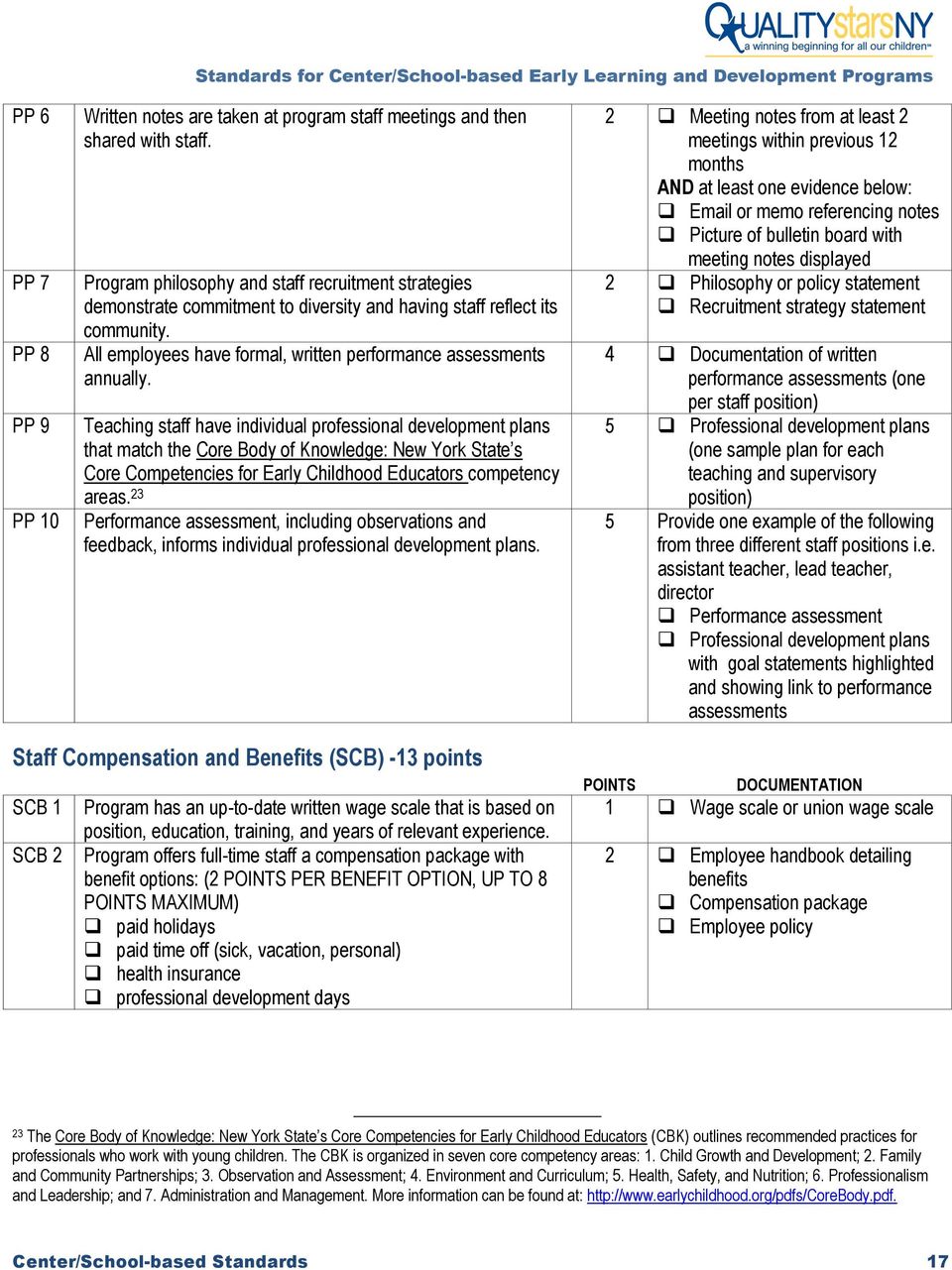
17 PP 6 PP 7 PP 8 PP 9 PP 10 Written notes are taken at program staff meetings and then shared with staff. Program philosophy and staff recruitment strategies demonstrate commitment to diversity and having staff reflect its community. All employees have formal, written performance assessments annually. Teaching staff have individual professional development plans that match the Core Body of Knowledge: New York State s Core Competencies for Early Childhood Educators competency areas. 23 Performance assessment, including observations and feedback, informs individual professional development plans. 2 Meeting notes from at least 2 meetings within previous 12 months AND at least one evidence below: or memo referencing notes Picture of bulletin board with meeting notes displayed 2 Philosophy or policy statement Recruitment strategy statement 4 Documentation of written performance assessments (one per staff position) 5 Professional development plans (one sample plan for each teaching and supervisory position) 5 Provide one example of the following from three different staff positions i.e. assistant teacher, lead teacher, director Performance assessment Professional development plans with goal statements highlighted and showing link to performance assessments Staff Compensation and Benefits (SCB) -13 points SCB 1 SCB 2 Program has an up-to-date written wage scale that is based on position, education, training, and years of relevant experience. Program offers full-time staff a compensation package with benefit options: (2 PER BENEFIT OPTION, UP TO 8 MAXIMUM) paid holidays paid time off (sick, vacation, personal) health insurance professional development days 1 Wage scale or union wage scale 2 Employee handbook detailing benefits Compensation package Employee policy 23 The Core Body of Knowledge: New York State s Core Competencies for Early Childhood Educators (CBK) outlines recommended practices for professionals who work with young children. The CBK is organized in seven core competency areas: 1. Child Growth and Development; 2. Family and Community Partnerships; 3. Observation and Assessment; 4. Environment and Curriculum; 5. Health, Safety, and Nutrition; 6. Professionalism and Leadership; and 7. Administration and Management. More information can be found at: Center/School-based Standards 17
18 SCB 3 SCB 4 Program offers full-time staff a compensation package with at least 3 of the following benefit options: (1 POINT PER BENEFIT OPTION, UP TO 3 MAXIMUM) family and medical leave (beyond what is required by law) flexible scheduling retirement life insurance flexible spending account dependent care assistance plan tuition discounts for employee s children tuition reimbursement for education employee assistance program dental insurance Program offers part-time staff a pro-rated compensation package that includes, at a minimum, paid time off. 1 Employee handbook detailing benefits Compensation package Employee policy 1 Employee handbook detailing benefits Compensation package Employee policy Staff Planning (SP) - 13 points SP 1 SP 2 SP 3 SP 4 Program has a written general plan to cover planned and unplanned absences. Program provides lead teachers with at least 1 hour of paid planning time per week. Program provides at least 1 hour every other week of paid planning time for classroom staff to plan together (away from children). (e.g., team planning) Staff has access to computers and the Internet during planning time. 3 Plan 4 Staffing plan Policy statement 4 Policy statement Staffing plan Evidence of staff meeting Attestation statement 2 Staff handbook Bill to Internet Service Provider Staff s or Internet research sites Center/School-based Standards 18

QUALITYstarsNY/NAEYC: Non-aligned Standards LEARNING ENVIRONMENT
 QUALITYstarsNY/NAEYC: Non-aligned Standards Note: As a program accredited by the National Association for the Education of Young Children (NAEYC), you will receive up to 159 automatic points. This does
Quality Stars NY: Standards for Center-based Programs
 IMPTANT NOTE F PROGRAMS IN NEW YK CITY: These standards will be revised to align with the NYC Early Care and Education Standards and Performance Measurement System, which will apply to all publicly-funded
Rating Readiness Tool (RRT) and Request for On-Site Observation and Rating Review
 Readiness Tool (RRT) and Request On-Site Observation and Review Revised June, 05 Nebraska Step Up to Quality 0 Centennial Mall South, 6th Floor PO Box 94987 Lincoln, NE 68509-4987 Purpose The Step Up to
NAEYC. Infant 0-15 months 1:4. Toddler 12-28 months 1:4 21-36 months 1:6. Preschool 30-48 months 1:9 48-60 months 1:10. Schoolage 5 15 years 1:12
 Ratio and Group Size (Group size twice the ratio) 0-12 months 1:4 or 2:8 or 3:10 12-18 months 1:5 Group size for children 0-18 months not to exceed 10 children 0-15 months 1:4 0-18 months 1:4 18-36 months
After School & Out of School Time Programs QRIS Application & Self Assessment
 After School & Out of School Time Programs For Reference Only: The QRIS Program Manager should be used to officially submit a QRIS Application and Self-Assessment. This document has been developed as a
Child Care Center Standards
 Fully licensed, opened and operating. Licensing and Compliance Fully licensed, open and operating for at least six months. Fully licensed and out of provisional period and/or conditional status. Fully
THE CHILD CARE QUALITY RATING SYSTEM (QRS) ASSESSMENT. Missouri Quality Rating System. QRS Profile
 THE CHILD CARE QUALITY RATING SYSTEM (QRS) ASSESSMENT Missouri Quality Rating System QRS Profile April 2010 THE CHILD CARE QUALITY RATING SYSTEM (QRS) ASSESSMENT Missouri Quality Rating System QRS Profile
THE CHILD CARE QUALITY RATING SYSTEM (QRS) ASSESSMENT. Delaware Stars for Early Success. QRS Profile
 THE CHILD CARE QUALITY RATING SYSTEM (QRS) ASSESSMENT Delaware Stars for Early Success QRS Profile April 2010 THE CHILD CARE QUALITY RATING SYSTEM (QRS) ASSESSMENT Delaware Stars for Early Success QRS
Child Care Center and Preschool Quality Framework. November 2013
 Child Care Center and Preschool Quality Framework November 2013 BrightStars: Rhode Island s Quality Rating and Improvement System for Child Care and Early Learning Programs The latest science tells us
TOTAL POSSIBLE POINTS 50
 Staff Qualifications and Professional Development Family and Community Partnerships Administration and Management Environment Curriculum and Instruction 16 Administrator/Director Qualifications 4 Staff
PROGRAM ADMINISTRATION SCALE
 Dear Director, This documentation list was compiled to help you prepare for your upcoming Program Administration Scale (PAS) visit. The list includes each of the 25 items in the PAS and the indicator strands/rows
Competencies. The Children s Program Administrator Credential of NewYork State. Topic 1: Administering Children s Programs
 In cooperation with: New York State Child Care Coordinating Council and the New York State Association for the Education of Young Children Competencies The Children s Program Administrator Credential of
Working in Child Care in North Carolina
 Working in Child Care in North Carolina The North Carolina Child Care Workforce Survey 2003 NC Early Childhood Needs and Resources Assessment Child Care Services Association FPG Child Development Institute
CHILDREN S PROGRAM ADMINISTRATOR CREDENTIAL
 CHILDREN S PROGRAM ADMINISTRATOR CREDENTIAL The Children s Program Administrator Credential of New York State is designed to provide for and be recognized as a standard by which to measure program management,
Child Development Associate (CDA) Credential and Process
 Facts about the 1 Child Development Associate (CDA) Credential and Process What Is a CDA? CDA stands for Child Development Associate. This is a person who has successfully completed the CDA assessment
South Carolina Early Care and Education Technical Assistance System
 2010 South Carolina Early Care and Education Technical Assistance System South Carolina Early Care and Education Technical Assistance System Table of Contents Acknowledgements 3 Introduction 4 Purpose
PROGRAM PREPAREDNESS CHECKLIST: Serving Dual Language Learners and Their Families
 It is essential that all Head Start and Early Head Start (EHS) programs have systems, policies, and procedures in place to meet the needs of children and families who speak languages other than English.
Better Beginnings Quality Rating Improvement System
 Better Beginnings Quality Rating Improvement System Arkansas Department of Human Services Division of Child Care and Early Childhood Education Licensing and Accreditation Unit Better Beginnings P.O. Box
Application to Become a Mentor
 2009-2010 Application to Become a Mentor Last name First name Home address Home phone ( ) Best time to reach you city and zip code Name of your current work site Email How long have you worked at the above
PRACTITIONER REGISTRY APPLICATION
 Pract Application Rev 06/23/2014 Page 1 PRACTITIONER REGISTRY APPLICATION The Registry verifies trainers, registers training, and tracks the professional development of both practitioners and trainers.
TABLE OF CONTENTS PREFACE. Chapter 1: GETTING STARTED. Overview of Child Care in North Carolina. How to Use this Handbook
 Overview of Child Care in North Carolina TABLE OF CONTENTS PREFACE i How to Use this Handbook Chapter 1: GETTING STARTED Available Resources to Get Started 1.1 Mandatory Prelicensing Workshop 1.2 Application
Prepared by: Kate Tarrant Prepared February 3, 2015
 STATE POLICY TO PROMOTE EFFECTIVE TEACHING AND LEARNING Discussion Guide: In What Ways do Teaching Condition Support Effective Teachers? Prepared by: Kate Tarrant Prepared February 3, 2015 Please note
Mississippi State Child Care Quality Step System Criteria
 Mississippi State Child Care Quality Step System Criteria The criteria for the MCCQSS are developed on a system of upward progression: For example, for a facility to move from a Step 1 to a Step 3 all
Training Requirements For Child Care Personnel
 Training Requirements For Child Care Personnel 2 Table of Contents Introductory Child Care Training... 3 Early Literacy and Language Development Training Requirement... 5 Introductory Training Exemptions...
National Infant & Toddler Child Care Initiative An Overview of Region I Consultants Working with Child Care Settings Serving Infants & Toddlers April
 Consultants Working With Child Care Settings, This document was prepared for the April 15, 2009 Region I ACF/Child Care Bureau and National Infant & Toddler Child Care Webinar on consultants working with
A Guide for. Families. Using NAEYC Standards to Find Quality Programs for Young Children. www.rightchoiceforkids.org
 A Guide for Families Using NAEYC Standards to Find Quality Programs for Young Children www.rightchoiceforkids.org The National Association for the Education of Young Children (NAEYC) has set 10 standards
Program Administrator Definition and Competencies
 I. Program Administrator Definition The program administrator is the individual responsible for planning, implementing, and evaluating a child care, preschool or kindergarten program. The role of the administrator
Preschool Development Grant Planning Meeting
 Preschool Development Grant Planning Meeting Administered by the Arizona Department of Education Early Childhood Education Section Agenda Welcome and Introductions Overview of School Readiness Overview
Strategic Plan 2015-2019. Child Care Resource Center. Quality Care for Every Child. Community Service Council
 Goal 6: CCRC will improve internal and external communications Objective 2: Improve internal communications. Hold monthly CCRC staff meetings. Provide information about early care and learning issues at
Title 22 Teacher/Director Preparation Requirements
 Title 22 Teacher/Director Preparation Requirements 101215 ADMINISTRATOR QUALIFICATIONS AND DUTIES 101215 (a) The administrator must be at least 18 years of age. The licensee, if an individual or any member
Introduction to Child Care Licensing
 Introduction to Child Care Licensing STATE OF ALASKA Department of Health and Social Services Division of Public Assistance Child Care Program Office 3601 C Street, Suite 140 Anchorage, AK 99503 Child
Educational Practices REFERENCE GUIDE. Aligned to the AdvancED Standards for Quality Schools
 Educational Practices REFERENCE GUIDE Aligned to the AdvancED Standards for Quality Schools Table of Contents Introduction... 3 Purpose and Direction... 4 Governance and Leadership... 5 Duties of the Governing
EARLY CHILDHOOD EDUCATION (AS) Associate Degree, Certificate of Achievement & Department Certificate Programs (formerly Child Development)
 A Course of Study for EARLY CHILDHOOD EDUCATION (AS) Associate Degree, Certificate of Achievement & Department Certificate Programs (formerly Child Development) Early Childhood Education majors will be
Personnel Requirements for Day Care and Latchkey Employees and Centers
 Personnel Requirements for Day Care and Latchkey Employees and Centers MEP Services will track these requirements and work with employees to ensure they are all met. Staff Requirements for Latchkey and
Maine Roads Scholarship Program CDA Information 2015-2016
 www.muskie.usm.maine.edu/maineroads PLEASE READ BEFORE COMPLETING APPLICATION FORM Maine Roads Scholarship Program CDA Information 2015-2016 I. DEFINITION ki i The Maine Roads Scholarship Program is a
THE CHILD CARE QUALITY RATING SYSTEM (QRS) ASSESSMENT. Miami-Dade Quality Counts. QRS Profile
 THE CHILD CARE QUALITY RATING SYSTEM (QRS) ASSESSMENT Miami-Dade Quality Counts QRS Profile April 2010 THE CHILD CARE QUALITY RATING SYSTEM (QRS) ASSESSMENT Miami-Dade Quality Counts QRS Profile Prepared
Rules Regulating Child Care Centers
 Rules Regulating Child Care Centers 7.702 RULES REGULATING CHILD CARE CENTERS (LESS THAN 24-HOUR CARE) All child care centers must comply with the "General Rules for Child Care Facilities" as well as the
District of Columbia Career Guide for Early Childhood and Out of School Time Professionals
 District of Columbia Career Guide for Early Childhood and Out of School Time Professionals Pathways to Professional Growth Division of Early Learning Office of the State Superintendent of Education (OSSE)
Child Care Staffing Ratios and Qualifications Current Requirements and History. Title 22
 On The Capitol Doorstep Child Care Staffing Ratios and Qualifications Current Requirements and History Title 5 Child Development Programs California Department of Education, Program Standards The Child
MANITOBA EARLY CHILDHOOD EDUCATION PROFILE NOVEMBER 2011
 MANITOBA EARLY CHILDHOOD EDUCATION PROFILE NOVEMBER 2011 GOVERNANCE Manitoba: Governance structure early childhood education Lead ministry/ Department of Family Services and Consumer Affairs department
Polaris Career Center Course Syllabus
 Polaris Career Center Course Syllabus Early Childhood/CDA Adult Course Information Instructor(s): Phyllis O'Connell Phone: 440-891-7682 Fax: 440-891-7642 Email: [email protected] Room: 306 Meeting Time:
EARLY CHILDHOOD EDUCATION Associate Degree, Certificate of Achievement & Department Certificate Programs (formerly Child Development)
 A Course of Study f EARLY CHILDHOOD EDUCATION Associate Degree, Certificate of Achievement & Department Certificate Programs (fmerly Child Development) Early Childhood Education majs will be trained to
Self-Assessment for Administrators of Child Care Programs
 Self-Assessment for Administrators of Child Care Programs Child Care Director s and Administrator s Self-assessment North Carolina Institute for Early Childhood Professional Development Self-assessment
EARLY CHILDHOOD EDUCATION (AS) Associate Degree, Certificate of Achievement & Department Certificate Programs (formerly Child Development)
 A Course of Study f EARLY CHILDHOOD EDUCATION (AS) Associate Degree, Certificate of Achievement & Department Certificate Programs (fmerly Child Development) Early Childhood Education majs will be trained
Be an Educated Higher Education Consumer Make the Right Choice for You!!!
 Be an Educated Higher Education Consumer Make the Right Choice for You!!! ECE CREDIT PROGRAMS - FREQUENTLY ASKED QUESTIONS Are you thinking about improving your knowledge and competencies in order to better
CHILD CARE PROVIDER INFORMATION FORM
 CHILD CARE PROVIDER INFORMATION FORM Please complete all available fields. We will use this information to refer parents to child care programs that meets their family's specific needs. By providing us
Pennsylvania Early Learning Keys to Quality Facility Professional Development Plan Survey Form
 Pennsylvania Early Learning Keys to Quality Facility Professional Development Plan Survey Form Summary Report by Region Section : Facility Information (Excluded) Section : Core Body of Knowledge and Professional
ECE-INSIDER A DIVISION OF CHILD CARE NEWSLETTER FOR KENTUCKY S EARLY CARE AND EDUCATION CHILD CARE PROVIDERS JULY 2015
 Page 1 ECE-INSIDER A DIVISION OF CHILD CARE NEWSLETTER FOR KENTUCKY S EARLY CARE AND EDUCATION CHILD CARE PROVIDERS JULY 2015 According to the National Center on Quality Teaching, preschool teachers can
THE CHILD CARE QUALITY RATING SYSTEM (QRS) ASSESSMENT. New Hampshire Quality Rating System. QRS Profile
 THE CHILD CARE QUALITY RATING SYSTEM (QRS) ASSESSMENT New Hampshire Quality Rating System QRS Profile April 2010 THE CHILD CARE QUALITY RATING SYSTEM (QRS) ASSESSMENT New Hampshire Quality Rating System
Child Care Licensing and Accreditation
 Matching the needs of your child and your own needs with the childcare available is a time-consuming process. It often takes extra time and effort to find high quality care. This section can help you to
BACHELOR OF EARLY CHILDHOOD LEADERSHIP PROGRAM (C300)
 BACHELOR OF EARLY CHILDHOOD LEADERSHIP PROGRAM (C300) PROGRAM NAME COURSE CODE SCHOOL CENTRE LOCATION DURATION Bachelor of Early Childhood Leadership C300 Community Services and Early Childhood George
LEGISLATIVE EDUCATION STUDY COMMITTEE BILL ANALYSIS. Bill Number: SB 668a 52nd Legislature, 1st Session, 2015
 LEGISLATIVE EDUCATION STUDY COMMITTEE BILL ANALYSIS Bill Number: SB 668a 52nd Legislature, 1st Session, 2015 Tracking Number:.199806.3 Short Title: Child Care Licensure Recognition Sponsor(s): Senator
Worcester Center Based Early Education and Care
 Edward Street Child Services Providing advocacy, resources and support to early childhood educators and the children they serve. Worcester Center Based Early Education and Care Salary and Benefits Survey
LifeCubby Aligns to FLORIDA's Early Learning and Development Standards
 LifeCubby Aligns to FLORIDA's Early Learning and Development Standards www.lifecubby.me 4990 Roberts Road, Hilliard OH 43026 614-432-4917 LifeCubby is a web-hosted software platform, with both Software-as-a-Service
Arkansas Early Childhood Professional Development System
 Arkansas Early Childhood Professional Development System Vision Statement All early s in Arkansas value a coordinated professional development system based upon research and best practice, which contains
Child Care Regulations in Colorado
 Child Care Regulations in Colorado Overview A summary of child care regulations in Colorado. Types of care that must be licensed Types of care that may operate without a license Age-group definitions Subsidized
Here s what you get when you take the CDA course at the Georgia Training Institute at Sheltering Arms:
 CDA benefits to participants Cost $1,200 Here s what you get when you take the CDA course at the Georgia Training Institute at Sheltering Arms: 120 hours of CDA specific training Materials and individualized
Child Development and Educational Studies
 Degree and GAVILAN Certificate COLLEGE CATALOG Programs 2015-2017 Contact (408) 848-4719 [email protected] Degrees and Certificates Oered: Early Childhood Education: Associate in Science for Transfer (A.S.-T.)
SUMMARY OF NAEYC AND NACCP ACCREDITATION
 Overview: SUMMARY OF NAEYC AND ACCREDITATION Overview: NAEYC Accreditation National Association for the Education of Young Children Accreditation National Accreditation Commission NAEYC Purpose The purpose
Rising STARS Tuition Assistance Program Guidelines (Effective July 1, 2014)
 PA Keys to Professional Development c/o BCIU P.O. Box 16050 Reading, PA 19612-6050 Rising STARS Tuition Assistance Program Guidelines (Effective July 1, 2014) What is the Rising STARS Tuition Assistance
CCEI Online College Credit Eligible CDA Certificate Family Child Care Program Syllabus
 CCEI Online College Credit Eligible CDA Certificate Family Child Care Program Syllabus Settings: Family Care Program Code: 1103-CDA Program Length: 151 Hours IACET CEU Value: 15.1 CEUs Program Start Date:
Individual Professional Development Plan for Early Education and Care and Out of School Time Educators and Providers. Guidance and Forms
 2010 Individual Professional Development Plan for Early Education and Care and Out of School Time Educators and Providers Guidance and Forms EEC s Mission The Massachusetts Department of Early Education
OFFICE OF CHILD DEVELOPMENT PA EARLY LEARNING KEYS TO QUALITY: Keystone STARS Program
 OFFICE OF CHILD DEVELOPMENT PA EARLY LEARNING KEYS TO QUALITY: Keystone STARS Program Glossary of Commonly Used Terms Act 48 of 1999 Beginning July 1, 2000, Act 48 of 1999 required persons holding Pennsylvania
Because children ARE our future. [email protected] www.idealearlylearning.com Office: (678) 632-4085 Fax: (678) 228-1912
 Because children ARE our future [email protected] www.idealearlylearning.com Office: (678) 632-4085 Fax: (678) 228-1912 Dr. Bisa Batten Lewis, Founder & CEO Course Information Child Development
Leadership, Governance and Management Systems
 1 Leadership, Governance and Management Systems The Leadership, Governance and Management Systems (LGMS) Protocol is organized to comprehensively assess how Head Start programs: (1) Develop plans to achieve
Child Development and Educational Studies
 Degree and Certificate Programs and Educational Studies A.A. Degree Certificates of Achievement Early Childhood Education Early Intervention Assistant* School Age Child Care Certificate of Proficiency
Western Wayne School District Planned Course. Days-Number 180 Grade(s) 11-12 Or Check One ( ) Quarter Semester XXX Full Year
 Western Wayne School District Planned Course Course Name: Early Childhood Education I Days-Number 180 Grade(s) 11-12 Or Check One ( ) Quarter Semester XXX Full Year Course Description: This course provides
Online Child Care Programs
 Child Care Teacher Requirements: Child Growth and Development (45 hours) Communication Skills for Child Care Professionals (9 hours) Including all Children and the ADA (3 Hours) Breastfeeding Support (3
Crosswalk of Oklahoma s Early Childhood Quality Standards. ~Final Report~ May 1, 2013
 Crosswalk of Oklahoma s Early Childhood Quality Standards ~Final Report~ May 1, 2013 OLDHAM INNOVATIVE RESEARCH 222 ST. JOHN STREET, SUITE 134 207-541-9267 OLDHAMRESEARCH.COM Table of Contents Rationale...
Maine Roads Scholarship Program Degree Information 2015-2016
 www.muskie.usm.maine.edu/maineroads Maine Roads Scholarship Program Degree Information 2015-2016 PLEASE READ BEFORE COMPLETING APPLICATION FORM I. DEFINITION The Maine Roads Scholarship Program is a financial
Early Childhood Educator Certification and Exemption Information
 Early Childhood Educator Certification and Exemption Information Introduction: The Importance of Early Childhood Education Early Childhood Education ensures that individuals who work with young children
EARLY CHILDHOOD EDUCATION
 EARLY CHILDHOOD EDUCATION This program focuses on the theory and practice of learning and teaching children from birth to age eight; the basic principles of education and development psychology; the art