
New directions for alcohol and drug treatment services. A framework for reform
|
|
|
- Gregory Short
- 10 years ago
- Views:
Transcription
1 New directions for alcohol and drug treatment services A framework for reform
2 If you would like to receive this publication in an accessible format, please phone (03) using the National Relay Service if required, or This document is available as a PDF on the internet at < Copyright, State of Victoria, Department of Health, 2013 This publication is copyright, no part may be reproduced by any process except in accordance with the provisions of the Copyright Act Authorised and published by Victorian Government, 50 Lonsdale Street, Melbourne. August 2013 ( )

3 New directions for alcohol and drug treatment services A framework for reform
4

5 Minister s foreword The Victorian Government is taking action to make a real difference in the way people struggling with alcohol and drug dependency are supported on their treatment and recovery journey. People who use alcohol and drug treatment services benefit from the expertise of dedicated alcohol and drug practitioners, but say that the system is hard to access and confusing to navigate. Service providers tell us that program and funding arrangements are complicated and prevent them from responding flexibly to people s needs. Feedback from the community has been backed up by a number of independent, government and agency reviews, including the March 2011 Victorian Auditor-General s report entitled Managing drug and alcohol prevention and treatment services. In June 2012 the government announced its plan to reform alcohol and drug treatment services. New directions for alcohol and drug treatment services: a roadmap (June 2012) sets out the case for change and how to achieve an alcohol and drug system that meets people s needs and the expectations of the community. The future system will make it easier for people to get the services they need, when they need them services that are tailored to people s individual needs and preferences, that are consistently high quality and of the right intensity and duration. Key among the changes are streamlined and centralised access, simplified service delivery underpinned by more flexible funding arrangements and area-based approaches to planning and integration with other health and human services. Each person s recovery journey is different, and the system will have an increased focus on flexible, tailored and recovery-oriented responses that are more culturally sensitive and takes into consideration a person s family and the needs of children in their care. This reform is a key part of Victoria s whole-of-government strategy Reducing the alcohol and drug toll: Victoria s plan , because it will improve how people with drinking and drug problems are assisted with their care, treatment and recovery. People can t address their alcohol and drug use in isolation from the other problems they may have in their lives. Alcohol and drug treatment services will work across the health and human services system to get people the full range of services they need, whether it is treatment for health issues or mental illness, housing or broader family support. Change in the alcohol and drug treatment sector is taking place in step with the broader government reform agenda for Victoria s health and human services. Services Connect, the Victorian Government s new, integrated model of human services provides an exciting opportunity to drive truly integrated, responsive services that are built around people rather than programs. There has already been some great work done as part of Services Connect to test common assessment tools for substance misuse problems. Work has begun on Service Sector Reform, led by Professor Peter Shergold, to improve outcomes for vulnerable Victorians by delivering more efficient, effective and sustainable human services. Planned reforms to the alcohol and drug treatment system are consistent with the early directions of this work. The alcohol and drug reforms also align strongly with the Victorian Health Priorities Framework and its focus on developing a more responsive health system and improving people s experiences of health services.
6 I want to acknowledge the valuable work that is done every day in the alcohol and drug treatment sector by dedicated and professional staff. The reform will build on the many strengths and innovations of the current system. I would also like to thank the many individuals and organisations service users and their families, current providers and other stakeholders who contributed their time, energy and ideas to inform this work. Key among these have been VAADA, APSU, VACCHO, Anex and Harm Reduction Victoria. It is also important to recognise the critical leadership role Eastern Health s Turning Point Alcohol and Drug Centre has played through its delivery of key developmental projects. This is an ambitious reform agenda, and it will take time, energy and commitment to achieve genuine change change that will achieve tangible, positive outcomes for the people who use alcohol and drug treatment services. The Hon. Mary Wooldridge MP Minister for Mental Health
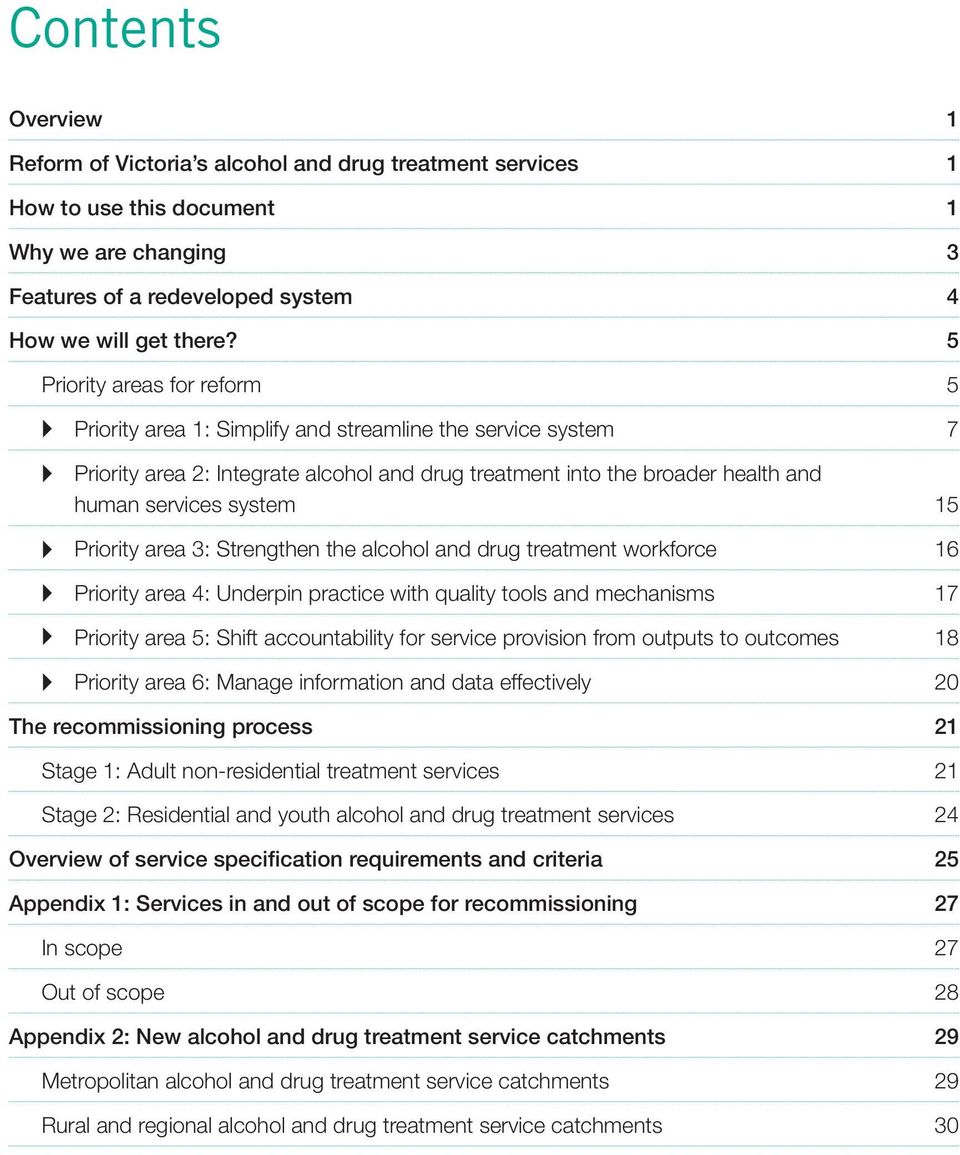
7 Contents Overview 1 Reform of Victoria s alcohol and drug treatment services 1 How to use this document 1 Why we are changing 3 Features of a redeveloped system 4 How we will get there? 5 Priority areas for reform 5 Priority area 1: Simplify and streamline the service system 7 Priority area 2: Integrate alcohol and drug treatment into the broader health and human services system 15 Priority area 3: Strengthen the alcohol and drug treatment workforce 16 Priority area 4: Underpin practice with quality tools and mechanisms 17 Priority area 5: Shift accountability for service provision from outputs to outcomes 18 Priority area 6: Manage information and data effectively 20 The recommissioning process 21 Stage 1: Adult non-residential treatment services 21 Stage 2: Residential and youth alcohol and drug treatment services 24 Overview of service specification requirements and criteria 25 Appendix 1: Services in and out of scope for recommissioning 27 In scope 27 Out of scope 28 Appendix 2: New alcohol and drug treatment service catchments 29 Metropolitan alcohol and drug treatment service catchments 29 Rural and regional alcohol and drug treatment service catchments 30
8

9 Overview Tackling alcohol and drug misuse in the community is a high priority for the Victorian Government. Reform of the alcohol and drug treatment system is a key part of a broader, whole-of-government strategy to decrease Victoria s alcohol and drug toll. Reducing the alcohol and drug toll: Victoria s plan presents a 15-point plan to work together with the whole community to promote the safe, healthy and responsible use of alcohol, tackle the misuse of pharmaceutical drugs, reduce illegal drug use, and assist the care, treatment and recovery of people with drinking and drug problems. Reform of Victoria s alcohol and drug treatment services The Victorian Government s reform agenda for alcohol and drug treatment services is outlined in New directions for alcohol and drug treatment services: a roadmap (June 2012). The roadmap sets out a strategic vision and directions for a treatment service system that is responsive and personcentred, recovery oriented, accessible and high quality, and supported by a capable and qualified workforce. Over the next two years the government is progressively reforming the alcohol and drug treatment service system through the directions set out in the roadmap and in Reducing the alcohol and drug toll. The reform is occurring in successive stages of redevelopment and recommissioning services to ensure a measured and orderly implementation and continuity of service. Reform of Victoria s community-based pharmacotherapy system has already commenced as part of a parallel process to ensure an integrated, area-based, robust and sustainable system complemented by quality specialist care. In the first key phase five pharmacotherapy area-based networks will be established across Victoria. This framework presents the plan for reform of the adult community-based treatment system, with the recommissioning of services to occur in and new arrangements to be in place from 1 July Further work will be done on reform directions for the residential and youth treatment systems during Appendix 1 provides details of which current service types are within scope of both stages of proposed recommissioning, as well as those out of scope. Funded organisations not subject to recommissioning will be required to adjust their service provision to align with reform directions as appropriate. How to use this document This document describes the government s reform priorities for the adult non-residential alcohol and drug system, explains the first-stage recommissioning process and sets out the sequence of activities to be undertaken as part of that process. The framework is primarily directed to professionals and practitioners in the alcohol and drug treatment sector and organisations that currently provide, or may be interested in providing, alcohol and drug treatment services in Victoria. It will assist agencies to prepare their application to a standard that meets the quality and accountability requirements set out below in the section entitled The recommissioning process. 1

10 It will also be useful to other stakeholders who want to understand the key directions for reform of the alcohol and drug treatment system and how a reformed system will enhance the delivery of alcohol and drug treatment services and support improved outcomes for people who use these services. This framework will be complemented by a detailed service specification as well as information for service users and their families and carers. The service specification will be released in the first quarter of It should be noted that for the purposes of this document provider refers to any agency or group of agencies that seek to provide such services. The Department of Health will not specify a particular form or structure for such arrangements although interested providers will be required to meet governance and accountability requirements. Questions about the reform or recommissioning program can be directed to <AODReform@health. vic.gov.au>. Responses to all questions will be made available on the department s website at < to ensure the same information is available to all interested parties. 2
11 Why we are changing Victoria s current alcohol and drug treatment system helps around 40,000 Victorians each year. A broad spectrum of community-based and residential treatment options are provided by a skilled and dedicated workforce that is passionate about providing excellent and effective services to the people who need them. The professionals in the alcohol and drug treatment workforce are the greatest strength of Victoria s treatment system. When people who struggle with alcohol and drug dependency receive quality treatment, and get the right support for their needs, their recovery is assisted by the dedication and commitment of these individuals working within the system. The effectiveness of the system itself, however, is inconsistent. System fragmentation sometimes works against the best outcomes for people. Some service users and their families have told us that the current system is too hard to get into and too difficult to navigate. They say that the system doesn t always take into account the whole family, particularly children, and that they don t always get access to the supports that they need both alcohol and drug treatment services and other important health and human services. The current system was established in 1994 to improve access and outcomes for people through community-based (rather than institutional) services withdrawal, counselling, consultancy and continuing care, residential rehabilitation and specialist methadone services. Since that time the alcohol and drug treatment system has grown in an ad hoc way and the addition of new programs and service streams to respond to evolving need has led to multiple interventions and service types. The alcohol and drug system now comprises over 20 separately funded treatment types delivered through 105 providers across Victoria, which range from generalist or multi-program agencies to single-program or highly specialised providers. A lack of coordination among these services coupled with a lack of flexibility between funding streams can make it difficult for people to move between service providers and treatment types. It can also make it difficult for services to offer person-centred care or to collaborate with other health and human services. A series of reviews over the last 10 years has progressively built the case for significant reform of the Victorian alcohol and drug treatment system, culminating in the March 2011 report of the Victorian Auditor-General Managing drug and alcohol prevention and treatment services. This report identified the negative impact of fragmentation and inconsistency on treatment outcomes and people s experiences of care. In June 2012 the Victorian Government outlined its plan to reform the alcohol and drug treatment system with the release of New directions for alcohol and drug treatment services a roadmap (June 2012). This roadmap sets out the future directions of Victoria s government-funded alcohol and drug treatment services. It presents the case for reform and emphasises the importance of building an accessible system that is person-centred and inclusive of service users families, children and culture. It calls for the delivery of high-quality, evidence-based treatment approaches that help people to achieve their individual treatment and recovery goals. It recognises the need to address the range of interconnected issues that impact on people s ability to address their alcohol and drug issues. 3

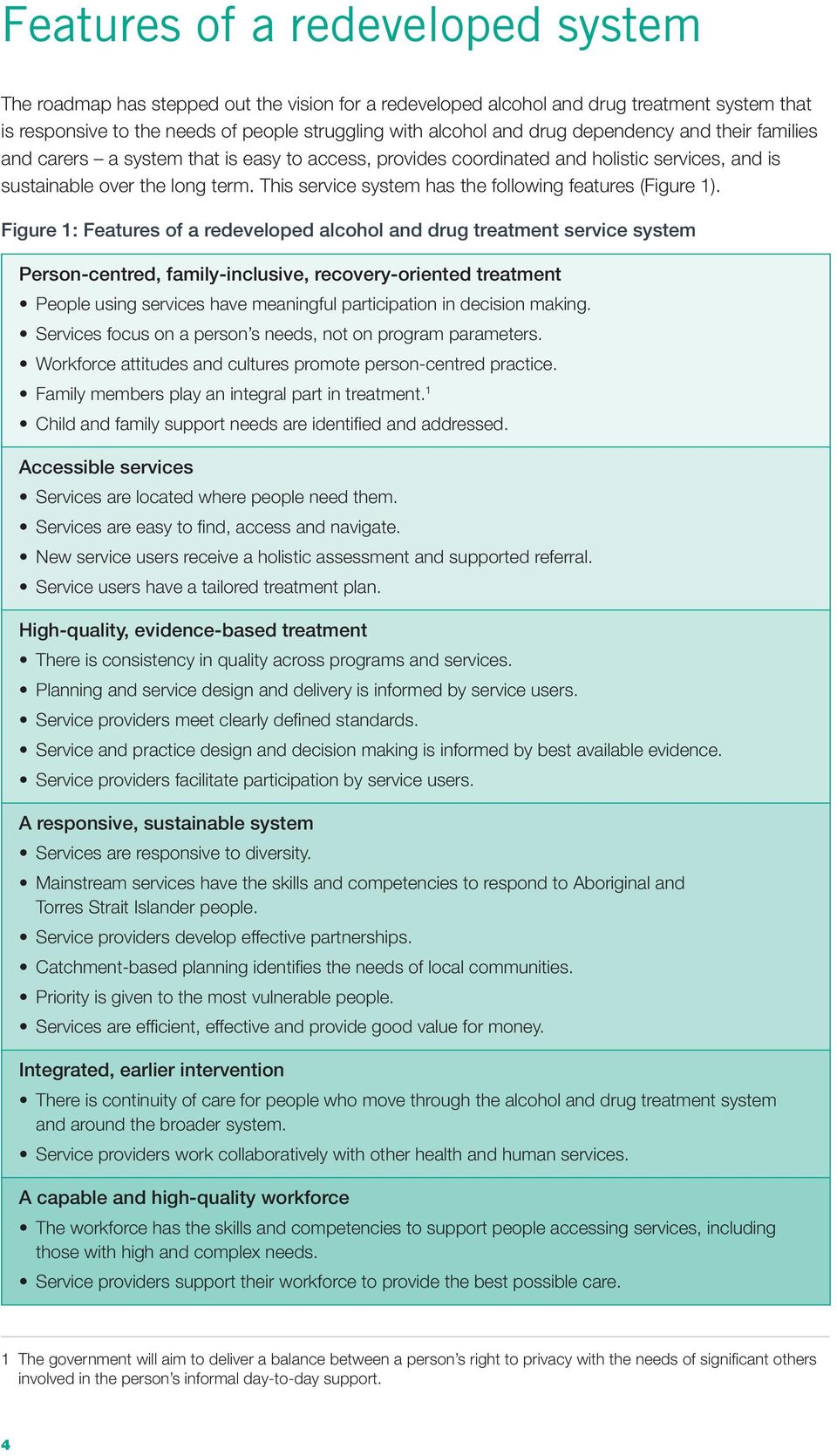
12 Features of a redeveloped system The roadmap has stepped out the vision for a redeveloped alcohol and drug treatment system that is responsive to the needs of people struggling with alcohol and drug dependency and their families and carers a system that is easy to access, provides coordinated and holistic services, and is sustainable over the long term. This service system has the following features (Figure 1). 1 Figure 1: Features of a redeveloped alcohol and drug treatment service system Person-centred, family-inclusive, recovery-oriented treatment People using services have meaningful participation in decision making. Services focus on a person s needs, not on program parameters. Workforce attitudes and cultures promote person-centred practice. Family members play an integral part in treatment. 1 Child and family support needs are identified and addressed. Accessible services Services are located where people need them. Services are easy to find, access and navigate. New service users receive a holistic assessment and supported referral. Service users have a tailored treatment plan. High-quality, evidence-based treatment There is consistency in quality across programs and services. Planning and service design and delivery is informed by service users. Service providers meet clearly defined standards. Service and practice design and decision making is informed by best available evidence. Service providers facilitate participation by service users. A responsive, sustainable system Services are responsive to diversity. Mainstream services have the skills and competencies to respond to Aboriginal and Torres Strait Islander people. Service providers develop effective partnerships. Catchment-based planning identifies the needs of local communities. Priority is given to the most vulnerable people. Services are efficient, effective and provide good value for money. Integrated, earlier intervention There is continuity of care for people who move through the alcohol and drug treatment system and around the broader system. Service providers work collaboratively with other health and human services. A capable and high-quality workforce The workforce has the skills and competencies to support people accessing services, including those with high and complex needs. Service providers support their workforce to provide the best possible care. 1 The government will aim to deliver a balance between a person s right to privacy with the needs of significant others involved in the person s informal day-to-day support. 4
13 How we will get there? The Victorian Government s program of reform will build stronger, high performing alcohol and drug treatment services. These reforms will consider a person s broader health and social needs, involve the person in treatment planning, and provide them with information to make informed decisions that align with their own treatment and recovery goals. It is intended that services operate as an integrated, cohesive part of a broader health and human services system. Services will be coordinated at the local level so that people and their families can more easily access additional supports if they require them. The reconfiguration of service delivery arrangements and responsibilities will provide the structural foundation to support efficient, sustainable alcohol and drug treatment. Priority areas for reform The redevelopment work will focus on six reform priorities (Figure 2) that reflect the directions in the roadmap to progress reform of adult non-residential treatment services. Priority area 1: Simplify and streamline the system Priority area 2: Integrate alcohol and drug treatment into the broader health and human services system Priority area 3: Strengthen the alcohol and drug treatment workforce Priority area 4: Underpin practice with quality tools and mechanisms Priority area 5: Shift accountability for service provision from outputs to outcomes Priority area 6: Manage information and data effectively Developmental projects To support the reform work the department is progressing a set of developmental projects with key sector partners to: explore innovative practice tools and service models to improve access to screening, assessment and treatment and deliver more effective, flexible and personalised care undertake analysis and modelling to inform service planning and service design design a predominantly activity-based funding model to deliver a clearer, simpler approach to funding services and offer greater flexibility in meeting individual and local need enhance the information collection, management and reporting undertaken by providers and the department. Reform strategies and actions for each priority area and details on individual developmental projects (in various stages of development) are described in the following pages. 5

14 Figure 2: Alcohol and drug treatment redevelopment reform priorities The future alcohol and drug treatment system Person-centred, family-inclusive, recovery-oriented Accessible High-quality and evidence-based Responsive and sustainable Integrated Earlier intervention Supported by a capable and high-quality workforce Priority area 1 A simpler system Centralised access Six treatment streams Local area service delivery in 16 catchments Simplified funding model Priority area 4 Quality Quality tools and mechanisms Treatment principles Priority area 2 Integrated services Local area planning Holistic screening and assessment Links with Services Connect Links with primary health services Priority area 5 Accountability for outcomes From outputs to outcomes A new performance framework Priority area 3 A strong, capable workforce A workforce development framework Learning and professional development Risk management Leadership development Priority area 6 Information management Information management capability Long-term information technology solutions 6

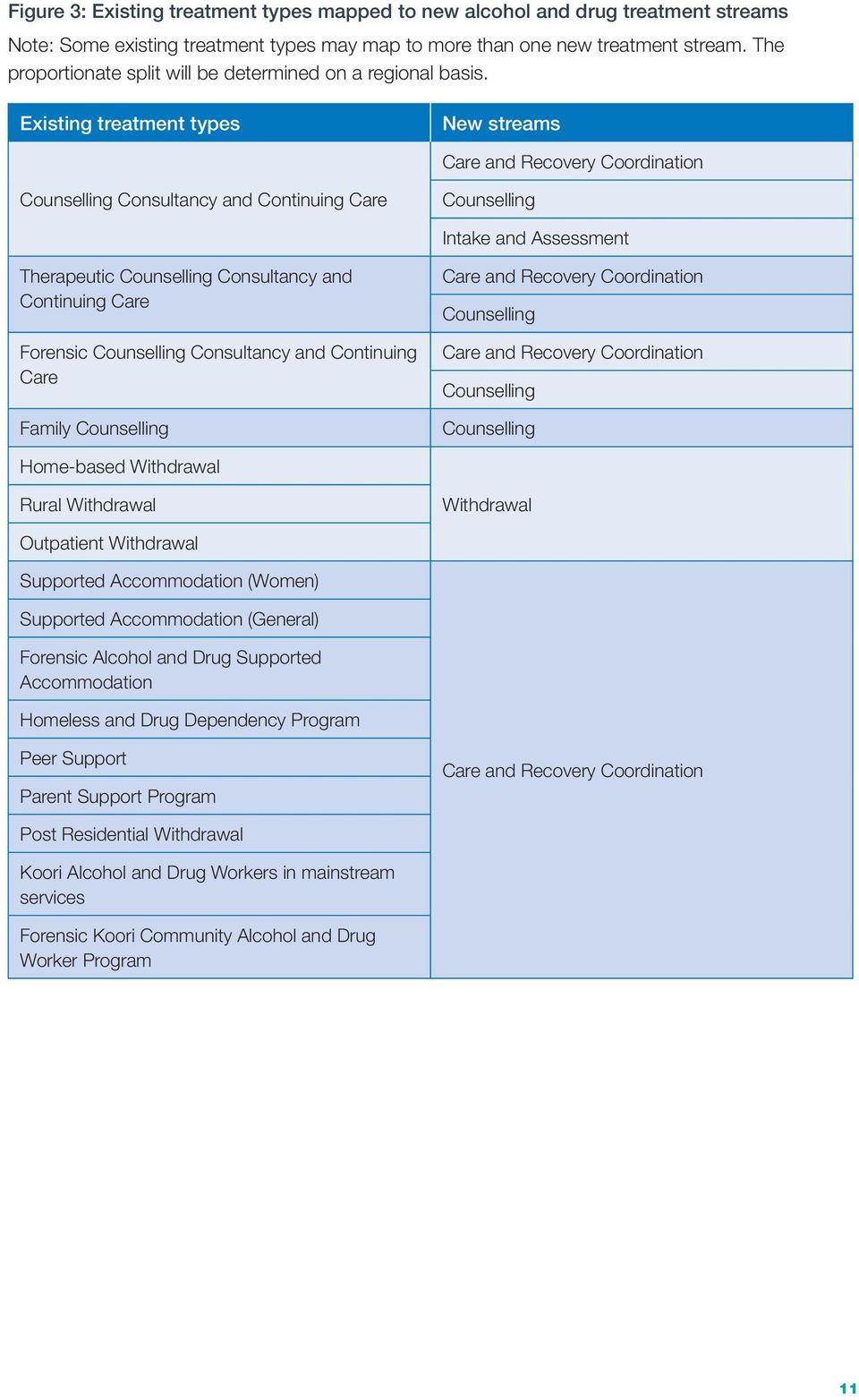
15 Priority area 1: Simplify and streamline the service system Simplified treatment system The existing 20 treatment types will be consolidated and reduced to six broad streams through the recommissioning process and supported by simplified funding arrangements. This will make it easier for providers to respond flexibly to people s needs and preferences with the most appropriate treatment options. The six streams are: Intake and Assessment Care and Recovery Coordination Counselling Withdrawal Residential Rehabilitation Pharmacotherapy. This model draws on the valuable input provided by a range of stakeholders through a series of advisory groups during A short description of each stream is provided below, and Figure 3 shows how the existing treatment types map into the new streams. Intake and Assessment A new, centralised model for screening and referral will simplify access and direct people quickly towards the services that can best meet their needs. The central statewide access point will coordinate with local catchment-based intake and assessment units to provide supported referral for assessment and treatment matching at the local level. The central access point will manage a bed vacancy register and provide a suite of self-directed care options for people who don t want face-toface treatment. The main pathway into localised treatment will be through the intake and assessment unit in each catchment. These units will deliver standardised, good-practice assessments that will accompany the person to their treatment destination(s). This will reduce the need for the person to repeat their story and avoid duplication of effort by staff at treatment services. The end result will be a better experience for people entering the service system and better use of limited resources across the treatment system. A person seeking treatment should be able to make initial contact at any alcohol and drug treatment service they choose to, and they should only have to tell their story once. The centralised intake service, catchment-based intake services and service providers will work together to ensure that a person s treatment journey is seamless (Figure 4). As a person moves through the system, services should work together to progressively build an understanding of their needs and treatment options. Because service providers will continue to be an initial contact point for people, they must coordinate with the catchment level intake and assessment unit to develop an individualised treatment plan using common assessment and catchment-based referral tools and protocols. 7

16 Developmental project Screening and assessment tools A new statewide screening and assessment tool for adult alcohol and drug treatment services will promote consistency for this function. Released in early 2013, the tool represents the latest in evidence-based, locally informed screening and assessment and is the result of two years of research, pilot testing and refinement. Feedback from service users and clinicians has been very positive. A number of other screening and assessment tools are currently being piloted: an alcohol and drug screening tool for use by allied services housing, mental health, community health, and forensic, as well as Services Connect sites a screening and assessment tool for youth alcohol and drug treatment services. An online version is being developed for young people who are unable or reluctant to seek face-to-face treatment a screening and assessment tool to respond more specifically to the complex needs of people who are in the forensic system and have alcohol and drug problems. These new tools will minimise duplication of screening and assessment, streamline intake processes, improve people s experience of intake and inform treatment planning and referral pathways. Care and Recovery Coordination Care and Recovery Coordination will facilitate more seamless and integrated treatment pathways and improve access to other services and support systems in the community. Care and recovery coordinators will operate in each catchment, will be available from intake and assessment, and can assist the person throughout their treatment journey if required. This stream will include coordination of treatment planning and goal setting, supported referral to those services the person is assessed as needing, and ongoing support. The duration and intensity of the service episode will vary with each person depending upon their level of need and the supports they already have in place. This stream incorporates the existing continuing care services, post-residential support services and specialist support programs. Recovery Recovery is about building a meaningful and satisfying life as defined by the person, whether or not they experience any ongoing or recurring symptoms or difficulties. (Adapted from Recovery Concepts and application, Recovery Devon) Recovery sits within a framework of harm minimisation that recognises people come to treatment through many different paths and that their goals and their journey towards recovery and wellbeing are individual and unique. (Department of Health, New directions for alcohol and drug treatment services: a roadmap) 8

17 Counselling Where the catchment-based intake and assessment unit assesses a person as needing counselling, they will be referred for this service. The Counselling stream incorporates face-to-face, online and telephone counselling for individuals and families, as well as group counselling and day programs. Clinical assessment and review is an ongoing process throughout the service period and this information is shared with the catchment-based intake and assessment unit where required. Counselling is classified as standard or complex and duration can range from a single session to extended periods of one-to-one engagement or group work. The Counselling stream comprises the counselling functions that currently sit within Generalist, Forensic, and Therapeutic Counselling, Consultancy and Continuing Care types and Family Counselling. Developmental projects Telephone-based interventions A range of telephone-based interventions (currently being piloted and reviewed) will provide easy and timely access for people who can benefit from brief, low-intensity interventions. The Drug Diversion Appointment Line diverts people arrested on small possession charges into a brief telephone-based counselling intervention. Roadmaps to Recovery comprises a dedicated team of specialist clinicians offering telephone-based services to problem users of alcohol, cannabis and amphetamines as a stand-alone service or as an adjunct to more intensive forms of treatment. An online model is also being examined. Brief, telephone-based support for family members and carers of people with alcohol and drug problems will also be available (currently in development). Withdrawal Withdrawal services currently comprise home-based withdrawal, outpatient withdrawal, rural withdrawal and residential withdrawal. The new Withdrawal stream consolidates these into two subcategories: residential and non-residential withdrawal services. Residential services meet the needs of people with complex needs or those whose family and accommodation circumstances are less stable and consequently unsuited to non-residential withdrawal. Non-residential withdrawal will provide safe and supported management of withdrawal in coordination with medical services such as hospitals and general practitioners. The service model may differ from catchment to catchment and should be developed to be responsive to local need. Residential withdrawal services will be redeveloped in Stage 2 reform. 9

18 Residential Rehabilitation Residential Rehabilitation provides a safe and supported environment for people who are not able to reduce or overcome their drug use problem through other programs to address issues underlying their drug use. It provides a range of interventions, such as individual and group counselling with an emphasis on mutual self-help and peer community, and supported reintegration into the community. Residential rehabilitation services are part of the second stage of reform planned for The government has already begun work with key sector stakeholders to prepare for program redesign and the recommissioning process. The roadmap flags broad directions for redevelopment including a range of flexible models that vary in terms of intensity, service mix and length of stay. Developmental project Bed Vacancy Register Project A statewide online bed vacancy register is being piloted to make it easier and faster for people to access residential treatment options. The register provides centralised, up-to-date information about current and future availability of beds in residential services across the state. A prioritisation tool, currently under development, will match people to appropriate services of their choice and provide priority access to people with particular needs or a high level of need. The register will support centralised intake by facilitating a transparent process for accessing statewide treatment services. It will enable residential treatment providers to coordinate with the centralised access points to proactively manage the residential environment and resident mix. Providers involved in the pilot have recognised the potential of this tool to enhance engagement and support. The bed vacancy register will be implemented from 1 July Pharmacotherapy The Pharmacotherapy stream is the first of the six streams to undergo reform. With over 14,000 people in Victoria currently using pharmacotherapy to address their drug dependence, this service is making a substantial contribution to reducing the harms associated with drug use. Independent review of pharmacotherapy services has provided a basis for reform by providing a better understanding of the impacts, outcomes and processes of the current service model and options for enhancement. The first key phase of the reform involves the establishment of five pharmacotherapy area-based networks across Victoria to connect pharmacotherapy to other alcohol and drug treatment services at the local level, drive best practice and improve outcomes for people using the service. The pharmacotherapy networks are due to become operational by the end of Foundation for the reform has already been laid with the commissioning of new and redeveloped pharmacotherapy training for general practitioners and pharmacists, and updated clinical guidelines. 10

19 Figure 3: Existing treatment types mapped to new alcohol and drug treatment streams Note: Some existing treatment types may map to more than one new treatment stream. The proportionate split will be determined on a regional basis. Existing treatment types New streams Care and Recovery Coordination Counselling Consultancy and Continuing Care Counselling Intake and Assessment Therapeutic Counselling Consultancy and Continuing Care Forensic Counselling Consultancy and Continuing Care Family Counselling Care and Recovery Coordination Counselling Care and Recovery Coordination Counselling Counselling Home-based Withdrawal Rural Withdrawal Withdrawal Outpatient Withdrawal Supported Accommodation (Women) Supported Accommodation (General) Forensic Alcohol and Drug Supported Accommodation Homeless and Drug Dependency Program Peer Support Parent Support Program Care and Recovery Coordination Post Residential Withdrawal Koori Alcohol and Drug Workers in mainstream services Forensic Koori Community Alcohol and Drug Worker Program 11
20 Figure 4: New pathway through the alcohol and drug treatment system Access Treatment Recovery Easy to find and accessible services Initial needs identified and assessed Improved service at first contact Appropriate, meaningful referral Engagement while waiting for services (if required) Individual treatment and recovery plan developed and regularly reviewed One record for each person Treatment type, duration and intensity based on need Coordinated access to treatment and other services Recovery planning begins in treatment Exit from treatment planned for in the person s treatment plan A person s long-term needs accounted for Follow-up check with the person where agreed and required Connections help to link back into treatment in the event of relapse Referrals to other services part of exit planning and recovery Centralised intake points Statewide screening and referral Catchment-based intake units I can be referred by: Myself, my family or carer A treatment agency A health service Services Connect My doctor I only have to tell my story once. I need treatment I will be assessed and referred to treatment. A Care and Recovery Coordinator will help me access services I need, including other health and human services, for example, Services Connect. I need information and advice I will be given the information and advice I require, and help with appropriate referrals if required. I have discussed my needs and aspirations in partnership with a alcohol and drug treatment professional. I receive individualised support based on my needs. My family or carer has been actively involved where appropriate, and my children s needs have been taken into account. I do not need any more treatment right now but I know how to get help if I need to. I have been linked into post-treatment support. Someone contacts me to see how I am going and helps me to return to treatment if I need to. 12

21 Local area responses Alcohol and drug treatment will be transformed into an area-based service delivery model. These structural changes will drive innovation, strengthen accountability, improve service quality and deliver value for money for service users and the Victorian community. There will be 16 service catchments with between one and four catchments in each Department of Health region. There will be nine catchments in metropolitan Melbourne, and seven catchments in rural and regional Victoria. The catchment boundaries align as far as possible with broader health catchments and Department of Human Services areas to facilitate joint local area planning and support coordinated responses to people who need a combination of services. Catchment maps are provided in Appendix 2. Service delivery and resource allocation will be organised along catchments lines, but catchment boundaries will not restrict people s access and choice in service provider. Funded service providers will be responsible for delivering services within one or more clearly delineated geographical catchment(s). One or more providers will be funded in each catchment to achieve optimal service efficiency, streamlined access, and promote workforce sustainability along with strengthened accountability and improved service quality. Providers will be funded at a level that: optimises high-quality services achieves efficiencies enables provision of a full range of core functions supports sustainable services. A provider can apply to deliver services in one or more catchments. While consideration will be given to proposals that prioritise service provision to a specific cohort of service users, submitting providers will need to provide a strong business case including evidence of demand and how such a focus will operate as part of the provider s overall alcohol and drug treatment delivery capacity. Catchment-based planning A plan will be developed in each catchment to help funded providers identify and respond to critical service gaps and pressures, using analysis of met and unmet demand. It will include strategies to improve responsiveness to the needs and diversity of individuals and communities. All funded providers in each catchment area will be required to work collaboratively to develop and implement the plan. Recognising the social, cultural, economic and environmental factors that impact on a person s drug taking behaviours and experience of treatment, the plan will place particular emphasis on vulnerable population groups such as Aboriginal and Torres Strait Islander people, people who are homeless or at risk, people with acquired brain injury or people involved in the criminal justice system. The plan will also support greater integration with other health and human services to identify and address cross-sector issues and achieve a joined-up approach to meeting the needs of individuals, their children, families and carers. 13
22 Developmental project Demand Modelling Project Analysis of current and projected levels of demand for Victorian alcohol and drug treatment services will quantify underlying factors that drive and influence demand, including the treatment needs of older people, migrant communities, Aboriginal and Torres Strait Islander people and people experiencing disadvantage. This analysis will be used to inform both short and long-term planning at the local level to promote treatment planning that responds to people s needs. New funding arrangements A new funding model will enable flexibility in the development and delivery of services, enabling providers to package support for people according to the totality of their alcohol and drug support needs. Providers will be funded at a level that optimises efficiencies, enables provision of a full range of core functions and achieves sustainable services. The department will stipulate prices for each funding stream in the service specification, with pricing taking into account the total efficient cost of service provision (direct costs, fixed costs and overheads) to ensure sustainability of service delivery. The Counselling, Withdrawal and Residential Rehabilitation streams will have separate prices for complex and non-complex service users and pricing structures will also include weightings for services for Aboriginal and Torres Strait Islander people, consistent with other funding models. The new funding model for recommissioned services will come into effect on 1 July Pricing is not negotiable. The department will not invite competition on price through the recommissioning process. 14
23 Priority area 2: Integrate alcohol and drug treatment into the broader health and human services system Providers of alcohol and drug treatment services will be required to work collaboratively with key services that have a shared responsibility for people with an alcohol and drug use issue, such as primary healthcare, child protection, youth and family services, employment, housing, mental health and disability. The following are key government reforms or policies that provide opportunities to improve integration. Services Connect is changing the way human services such as housing, homelessness, disability, child protection and family and youth services are delivered to achieve a more coordinated, person-centred response no matter how complex a person s needs. Services Connect will be a core partner in streamlining access and strengthening care coordination. A new alcohol and drug screening and assessment tool has already been piloted in the Services Connect sites with the aim of intervening sooner in people s alcohol and drug issues. This on-the-ground experience will provide insight into how people s pathways through services can be streamlined by better integration across state-funded alcohol, drug and human services. 2 National health reform provides a timely opportunity to better integrate alcohol and drug treatment services with primary and community health services at the local level. Primary health services play a key coordinating role across the broader health system and the new alcohol and drug treatment delivery catchments take current Medicare Local catchment boundaries into account. Victoria s Vulnerable Children Strategy. In line with the directions of Victoria s Vulnerable Children Strategy, changes in how the alcohol and drug treatment sector delivers its services to families will include an increased emphasis on family-centred practice and better coordination of referral pathways and services. 3 Risk to dependent children will be assessed and people will be provided with opportunities to tailor their treatment plans to include their role and responsibilities as a parent. Development of catchment-based plans, clearly defined referral and service delivery pathways, and a greater emphasis on consistency in assessment and information sharing (where appropriate) will also promote better integration, both between streams of the alcohol and drug treatment system and with other parts of health and human services. Developmental project Integrated Treatment Guidelines Project Work is being progressed to identify supports and barriers to integrated service delivery across health and human services. This will result in a set of guidelines for collaborative work practices between alcohol and drug treatment services and other health and human services. The guidelines will incorporate tools, indicators and recommendations for workforce development. The Services Connect model will be a key part of the integration approach, with the overall aim of enhancing collaboration across sectors. 2 For more information on Services Connect visit < 3 For more information on Victoria s Vulnerable Children Strategy visit < data/assets/pdf_ file/0010/764281/victorias_vulnerable_children_strategy.pdf>. 15
24 Priority area 3: Strengthen the alcohol and drug treatment workforce The Victorian Government, in consultation with key stakeholders, developed a workforce development framework for the alcohol and drug workforce in Victoria, which was launched in late One of the actions in this framework is to develop a set of workforce competencies that articulate the necessary skills, knowledge, and attitudes needed to deliver high-quality services to people and their families seeking assistance. These competencies will inform role design and team structures, staff recruitment and learning and professional development. Over the coming years workforce development activity to support implementation of key aspects of the reform will include: learning and professional development programs to support the systemic use of evidence-based recovery models that deliver proven outcomes for people and their carers and families tailored learning and professional development programs to improve the capability, capacity and confidence of the workforce to work with people who have a range of complex needs, including those who have experienced trauma support for the systematic implementation of comprehensive risk management systems, processes and practices (this will involve skill development for managers, supervisors and direct delivery staff) leadership development, particularly at a middle management level. Developmental project Change Agent Network This network will support practice development across the sector arising from reform by building the capacity of existing and emerging leaders to drive and support culture and practice change. Effective translation of evidence into best practice at the advanced level will be another focus for this network. 4 Victoria s alcohol and drug workforce framework: strategic directions and Victoria s alcohol and drug workforce framework: implementation plan are available from < htm>. 16
25 Priority area 4: Underpin practice with quality tools and mechanisms Quality tools and mechanisms A suite of quality tools and mechanisms will help alcohol and drug practitioners provide high-quality treatment and support. This will include a focus on continual learning and improvement. Work that is already complete, underway or planned includes: the Victorian alcohol and drug treatment principles the Victorian alcohol and other drug client charter continuing development and skills training through the workforce development framework formal policies and procedures to support corporate and clinical governance structures and guide decision making. Our quality approach recognises that many service delivery organisations are already accredited against health or human services service quality standards. The capacity to deliver high-quality treatment is a core consideration in the recommissioning of treatment services. Victorian alcohol and drug treatment principles The department has developed a set of treatment principles for Victorian alcohol and drug treatment services to underpin and inform practice and service delivery. The principles were developed in consultation with users of alcohol and drug treatment services and their families and are consistent with national and international best practice. The principles have as their foundation a philosophy of harm reduction and recovery orientation. The principles have already begun to inform, and will continue to inform, new models of care and performance monitoring systems, and will align with future quality and safety guidelines for the statefunded alcohol and drug treatment sector. Victorian alcohol and drug treatment principles 1. Substance dependence is a complex but treatable condition that affects brain function and influences behaviour. 2. Treatment is accessible. 3. Treatment is person-centred. 4. Treatment involves people who are significant to the consumer. 5. Policy and practice is evidence informed. 6. Treatment involves integrated and holistic care responses. 7. The treatment system provides for continuity of care. 8. Treatment includes a variety of biopsychosocial approaches, interventions and modalities oriented towards people s recovery. 9. The lived experience of alcohol and drug consumers and their families is embedded at all levels of the alcohol and drug treatment system. 10. The treatment system is responsive to diversity. 11. Treatment is delivered by a suitably qualified and experienced workforce. 17
26 Developmental project Outcomes Monitoring Tool An outcomes monitoring tool is currently under development to support improvement and consistency in outcomes-focused practice across the state, by helping people receiving treatment and their workers to track outcomes against their treatment goals. It will link to the existing statewide alcohol and drug screening and assessment tool and will be incorporated into people s treatment and care plans. The tool will be piloted on three different platforms: a standard paper-based tool, on an electronic tablet and an online tool. The information collected through the outcomes monitoring tool may also potentially link to agency outcomes reporting. 18
27 Priority area 5: Shift accountability for service provision from outputs to outcomes The ultimate goal of alcohol and drug treatment services is to improve people s lives through ceasing or reducing their alcohol or drug use. This is not always easy, and some people will need multiple treatments to make an impact on their alcohol or drug use and move forwards in their recovery. In the future system, service providers will be required to demonstrate improvement in the treatment outcomes of people who use alcohol and drug treatment services and in their experience of treatment. Providers will be accountable for achieving outcomes that are meaningful to people using services, their families, carers and significant others. New performance management framework The department will implement a new outcomes-focused performance management framework to manage and monitor provider performance. This framework will: hold funded providers accountable for achieving outcomes through the efficient and effective use of government funding set out the accountability and reporting requirements for funded providers, including how performance will be measured and monitored provide a practical, strategic tool that service providers can use to monitor and improve the quality of their service provision. The performance management framework will measure person-centred outcomes and those processes that are central to safety, quality and people s positive experience of the service system. Key performance measures (including person-centred outcome measures) will be identified for the domains of effectiveness, efficiency, quality, safety, accessibility, responsiveness and service continuity. Performance will be monitored through new reporting mechanisms. To support equitable access to services, the department will negotiate with all providers on the targets for treatment of Aboriginal and Torres Strait Islander people and people with complex needs for applicable activities. The new performance management framework will be developed with input from service users and funded service providers and will come into effect on 1 July
28 Priority area 6: Manage information and data effectively A consistent and effective approach to collecting, sharing and reporting people s information and service delivery data will support the new service delivery arrangements. Providers will be required to collect data on service users, services and outcomes to support case management, coordination of care, service planning and performance monitoring and improvement. The department will not prescribe specific information technology solutions but will describe what capabilities providers should have. These capabilities may be met through existing systems, systems enhancements or supplementary collection tools. Further details of the minimum information and system capabilities required will be described in the service specification. Over the next two to three years the department will be considering longer term integrated information reporting and feedback solutions. All funded providers will be expected to work with the department as they are developed. Opportunities to align with related data collections and systems (such as those associated with Services Connect) are being explored. Developmental project Data Requirements Project The department commissioned a project to assess the alcohol and drug treatment sector s capabilities (systems and people) in data collection, management and reporting, and developed a set of capability requirements for improved agency data collection processes. A range of new data requirements were identified, spanning demographic characteristics, service provision, outcome measurement and performance measurement. Data requirements for future service provision will be released with the service specifications. 20
29 The recommissioning process Redevelopment of the Victorian alcohol and drug treatment system will occur in two stages. The first stage will commence in with the recommissioning of adult non-residential treatment services. The new arrangements will be in place by 1 July The second stage will commence in the first quarter of with the recommissioning of residential and youth services. The new arrangements will be in place by mid Note: The department reserves the right to change all timeframes and processes associated with the recommissioning process. The following information should be treated as a guide only. Stage 1: Adult non-residential treatment services The recommissioning program for core service delivery will be phased over (Figure 5). The process will be open to all interested providers, including non-government organisations, public and private providers. Submitting providers will need to satisfy a range of requirements in areas such as: expertise in high-quality service provision understanding of roles and responsibilities in a reformed system capability to work collaboratively in a local delivery environment participation by service users and their families responsiveness to Aboriginal and Torres Strait Islander service users and other vulnerable population groups governance and accountability operational capability. Figure 5: Stage 1 recommissioning program phases (indicative only) Phase 1 Second quarter Phase 2 Third quarter Phase 3 Fourth quarter * Phase Selection of preferred providers through an open process Determination of service delivery responsibilities Preparation for transition to new service delivery arrangements Consolidation of new arrangements for adult nonresidential services 1 July 2014 New service delivery arrangements begin * Phase 3 may commence earlier in some areas if Phase 2 is completed earlier.
30 Phase 1: Selection of preferred providers Call for submissions Written submissions from eligible and interested providers will be invited through an advertised call for submission process. The advertised call for submission, which includes the service specification, is anticipated to be released in the first quarter of , with a submission period of eight weeks. Lodgement of submissions Interested providers will lodge their written submission detailing their proposal to deliver activities in accordance with the requirements of the service specification. Interested providers will also indicate the service volume they would like to provide in each catchment for which they seek to deliver services. Lodgement will close in November Interested providers will be required to lodge their submission by the date and time specified. Submitting providers will be advised via that their submission has been received. All submissions received after the specified closing date and time will be deemed as noncompliant and will not be evaluated. Providers that submit incomplete submissions will also be deemed as noncompliant and will not be evaluated. Submitting providers will be advised of this outcome as applicable. Providers interested in delivering alcohol and drug treatment services in more than one catchment will only be required to submit one submission. The submission proforma will make provision for this circumstance. The department will, however, address submissions for delivery in each catchment separately. Interested providers may elect to submit multiple submissions if they prefer. Evaluation of submissions All submissions will be evaluated against weighted selection criteria. Short-listed providers will be identified through this process. Short-listed providers will be interviewed in late 2013 and early Evaluation panels will be convened to assess the submissions. The panels will interview all shortlisted providers on a catchment-by-catchment basis and identify recommended preferred providers for each catchment, proposed functions to be delivered by each preferred provider and indicative service volumes. This recommendation will be considered by an overarching coordination panel, which will make final recommendations for consideration by the Minister for Mental Health. Preferred providers identified through this process will be given a without-prejudice service offer. Please note that preferred provider status in this phase does not guarantee a funding outcome. All submitting providers will be notified of the outcomes of this process as early as possible in Please note: The department reserves the right to supplement the field if in the judgement of the department there are limited suitable applicants in a given catchment(s).
31 Phase 2: Determination of service delivery responsibilities As part of Phase 2 preferred providers will be invited to submit a delivery plan based on a withoutprejudice service offer by the department. During this phase the programs and functions, targets, service volumes and related funding will be determined for each preferred provider, drawing on an assessment of the delivery plan. The delivery plans will also be used to confirm or finalise how preferred providers will manage the transition process to new service delivery arrangements and new delivery model(s) and functions; and how they will address any particular concerns of the evaluation panel based on feedback provided. As indicated previously, Phase 2 may not result in every preferred provider achieving a funding outcome. Service delivery arrangements in each catchment will be recommended to the Minister for Mental Health. Both successful and unsuccessful providers will be notified of the Minister s decision. This process is expected to be completed by the end of the third quarter of Phase 3: Transition to new service delivery arrangements and responsibilities Successful service providers will transition to the new delivery arrangements in the fourth quarter of , although it may be possible for some providers to start preparing for this transition earlier where arrangements are finalised early in the year. During the transition time, all contractual arrangements related to new service delivery responsibilities will be finalised. New contractual service delivery arrangements will take effect on 1 July Please note: those costs associated with changes in service delivery responsibilities that arise through the recommissioning process are the responsibility of the provider. Existing and new service providers will be required to work collaboratively to achieve a smooth, planned transfer of responsibilities during the transition to any new service delivery arrangements. It is particularly important that all providers involved in the transition process actively support existing service users and their families throughout this process to minimise disruption as much as possible. Throughout this process the department will work closely with all relevant providers, peak bodies that represent service users and their families and carers and VAADA, as well as other stakeholders, to achieve the smoothest transition possible. Phase 4: Consolidation of new arrangements and the next stage of reform The department will work with successful providers of adult non-residential services to consolidate new service delivery arrangements, introduce new performance management accountabilities and reporting processes, and build workforce capability. 23
32 Stage 2: Residential and youth alcohol and drug treatment services Residential and youth alcohol and drug treatment services will be subject to reform through the second stage of recommissioning planned for , with new service delivery arrangements to be in place in mid Figure 6 shows the process in more detail. Further work will be progressed with experienced practitioners, peak bodies, service users and family and carer representatives to consider good practice examples, future models of care, and potential outcomes and performance indicators for the reformed services. This work will inform redesign of the programs as well as informing the recommissioning process. Figure 6: Stage 2 recommissioning program phases (indicative only) Phase 1 First and second quarter Phase 2 Third quarter Phase 3 Fourth quarter Phase Selection of preferred providers through an open process Determination of service delivery responsibilities Preparation for transition to new service delivery arrangements Consolidation of new arrangements Mid-2015 New service delivery arrangements begin *Phase 3 may commence earlier in some areas if Phase 2 is completed earlier. 24
33 Overview of service specification requirements and criteria Please note this information has been provided as a guide only. The department reserves the right to change any aspect of these requirements and associated criteria. The final requirements and criteria will be stipulated in the service specification. The service specification for the recommissioning process will specify: available funds in each catchment the price offer for each program or function criteria against which all providers will be evaluated. It will also specify minimum requirements in regard to the following areas. Expertise in high-quality service provision Submitting providers will be required to demonstrate they have the capacity and expertise to effectively deliver alcohol and drug treatment services or similar services to adults with alcohol and drug issues. Roles and responsibilities in a reformed system Submitting providers will be required to demonstrate how their proposed services will achieve desired reform outcomes for service users, providers and the system. Capability to work collaboratively in a local delivery environment Submitting providers will be required to demonstrate understanding of local catchment-level needs and the delivery environment in which they are seeking to deliver alcohol and drug treatment services. They will also need to demonstrate they have the capability to work collaboratively with other health services including clinical services, pharmacotherapy networks, primary healthcare and key human services. Service user and carer participation Submitting providers will be required to demonstrate their commitment to meaningful engagement of service users and their families and carers in service planning, design and evaluation and in day-today service delivery, and that they have effective approaches and strategies to achieve this. Governance and accountability Submitting providers will be required to demonstrate how they will: deliver effective, high-quality services including compliance with relevant accreditation and quality requirements create value through innovation, development and exploration using strategic and business planning capability comply with relevant legislative requirements manage risk. Arrangements involving a grouping of two or more agencies will need to explain their financial, legal and decision-making structures. Submitting providers will be required to provide their strategic plan and demonstrate how the provision of alcohol and drug treatment services aligns with their strategic directions and priorities. 25
34 Operational capability Submitting providers will be required to demonstrate they have the organisational capability required to support the efficient and effective provision of alcohol and drug treatment services in a range of areas including: financial management capacity human resource management and workforce development quality and performance management and reporting information management and reporting incident reporting feedback and complaints risk management. Other areas that may be covered relating to government policy Environmental sustainability Occupational health and safety Legal entity Providers interested in delivering alcohol and drug treatment services must be a legal entity that the department can fund under a service agreement or contract. They may submit as single entity or as lead of a consortium. 26
35 Appendix 1: Services in and out of scope for recommissioning In scope Note: Current providers will continue to receive funding for programs and services subject to Stage 1 recommissioning until 30 June Stage 1 Stage 2 Counselling Consultancy and Continuing Care Therapeutic Counselling Consultancy and Continuing Care Forensic Counselling Consultancy and Continuing Care Family Counselling Home-Based Withdrawal Outpatient Withdrawal Rural Withdrawal Post-Residential Withdrawal Supported Accommodation (General) Supported Accommodation (Women s) Forensic Alcohol and Drug Supported Accommodation Forensic Koori Community Alcohol and Drug Worker Program* Homeless and Drug Dependency Program Peer Support Capacity Building (Family) Adult Residential Drug Withdrawal Adult Residential Rehabilitation Youth Capacity Building Forensic Adult Residential Drug Withdrawal Forensic Adult Residential Rehabilitation Forensic Youth Outreach Forensic Youth Residential Drug Withdrawal Forensic Youth Residential Rehabilitation Outdoor Therapy Youth Alcohol and Drug Supported Accommodation Youth Day Program Youth Home-Based Withdrawal Youth Outreach Youth Residential Drug Withdrawal Youth Counselling, Consultancy and Continuing Care Parent Support Program Post-Residential Withdrawal Koori Alcohol and Drug Workers in mainstream services* Targeted interventions (access and intake programs) Please note the department reserves the right to change all timeframes, processes and scope of inclusions and exclusions associated with the recommissioning process. This information should be treated as a guide only. * These programs will be recommissioned but protected for work focusing on Aboriginal and Torres Strait Islander people. 27
36 Out of scope All funded residential rehabilitation and withdrawal services, as well as all youth alcohol and drug treatment types are out of scope of the recommissioning process. These treatment types will be considered in Stage 2 recommissioning, scheduled to commence in Programs and treatment types entirely excluded from the recommissioning process include: Aboriginal community-controlled health organisation services Alcohol Information Advice and Interventions Ante and Postnatal Support Program (The Royal Women s Hospital) Client Information and Support Community Education Community Offender Advice Treatment Service (COATS) Education and Training Intensive Community Rehabilitation Needle and Syringe Program Poisons Information Research, Service Development and Evaluation Targeted Interventions (Youth) Pharmacotherapy Regional Outreach Worker Mobile Overdose Response Service Mobile Drug Safety Worker. Although not subject to recommissioning, these activities must be aligned and integrated to the new system, and may be subject to future review. 28
37 Appendix 2: New alcohol and drug treatment service catchments Metropolitan alcohol and drug treatment service catchments Whittlesea (C) Hume (C) Nillumbik (S) Melton (S) Wyndham (C) Moreland (C) Banyule Brimbank Moonee Darebin (C) (C) Valley (C) (C) Manningham Maribyrnong (C) Yarra (C) (C) Maroondah Melbourne (C) Boroondara (C) (C) Whitehorse (C) Hobsons Bay (C) Port Stonnington (C) Phillip Knox (C) (C) Glen Monash Eira (C) (C) Bayside (C) Kingston (C) Greater Dandenong (C) Yarra Ranges (S) Frankston (C) Casey (C) Cardinia (S) Mornington Peninsula (S) Catchment Eastern Metropolitan Eastern Melbourne Inner East Melbourne North and Western Metropolitan Inner North Melbourne North Melbourne North Western Melbourne South Western Melbourne Southern Metropolitan Bayside Frankston - Mornington Peninsula South-Eastern Melbourne Local government area Department of Health region 29
38 Rural and regional alcohol and drug treatment service catchments Mildura (RC) Swan Hill (RC) West Wimmera (S) Glenelg (S) Hindmarsh (S) Yarriambiack (S) Horsham (RC) Southern Grampians (S) Moyne (S) Warrnambool (C) Buloke (S) Corangamite (S) Gannawarra (S) Colac-Otway (S) Campaspe (S) Greater Geelong (C) Queenscliffe (B) Surf Coast (S) Moira (S) Greater Loddon (S) Shepparton (C) Greater Bendigo Strathbogie (S) (C) Central Mount Goldfields (S) Alexander (S) Mitchell (S) Pyrenees Hepburn Macedon Murrindindi (S) (S) Ranges (S) (S) Ararat (RC) Ballarat (C) Moorabool (S) Golden Plains (S) Benalla (RC) Indigo (S) Wangaratta (RC) Mansfield (S) Baw Baw (S) Latrobe (C) Bass Coast (S) South Gippsland (S) Wodonga (RC) Alpine (S) Wellington (S) Towong (S) East Gippsland (S) Catchment Barwon Great South Coast Gippsland Grampians Hume Goulburn Valley Lodden Mallee Local government area Department of Health region 30
39
School Focused Youth Service Supporting the engagement and re-engagement of at risk young people in learning. Guidelines 2013 2015
 School Focused Youth Service Supporting the engagement and re-engagement of at risk young people in learning Guidelines 2013 2015 Published by the Communications Division for Student Inclusion and Engagement
Department of Human Services Standards
 Department of Human Services Standards Department of Human Service Standards June 2011 Department of Human Services Standards If you would like to receive this publication in an accessible format, please
Senior AOD Clinician - Counselling & Assessment POSCS3029
 POSITION DESCRIPTION Senior AOD Clinician - Counselling & Assessment POSCS3029 ISO9001 Approved by Neos Zavrou Next Revision: 02/09/15 Hours: Location: Classification: Reports To: Reports: 1 EFT Northern
Submission to the Tasmanian Government. Rethink Mental Health Project Discussion Paper
 Submission to the Tasmanian Government Rethink Mental Health Project Discussion Paper February 2015 Alcohol, Tobacco and other Drugs Council of Tas Inc. (ATDC) www.atdc.org.au ABN: 91 912 070 942 Phone:
Investment Domains Guideline
 Investment Domains Guideline Version: 1.0 Date: 2 September 2014 Version Control History This document was approved by: Name: Position: Unit: Date: Author: PCMR Date: 2 September 2014 Page 2 CONTENTS 1.
The National Health Plan for Young Australians An action plan to protect and promote the health of children and young people
 The National Health Plan for Young Australians An action plan to protect and promote the health of children and young people Copyright 1997 ISBN 0 642 27200 X This work is copyright. It may be reproduced
South Australian Women s Health Policy
 South Australian Women s Health Policy 1 2 South Australian Women s Health Policy To order copies of this publication, please contact: Department of Health PO Box 287 Rundle Mall Adelaide SA 5000 Telephone:
Guide to the National Safety and Quality Health Service Standards for health service organisation boards
 Guide to the National Safety and Quality Health Service Standards for health service organisation boards April 2015 ISBN Print: 978-1-925224-10-8 Electronic: 978-1-925224-11-5 Suggested citation: Australian
BUILDING A HIGH PERFORMING SYSTEM. A business improvement plan for the Department for Education and Child Development
 BUILDING A HIGH PERFORMING SYSTEM A business improvement plan for the Department for Education and Child Development BUILDING A HIGH PERFORMING SYSTEM 1 Contents Executive summary 3 Increasing local decision-making
Building a 21st Century Primary Health Care System. A Draft of Australia s First National Primary Health Care Strategy
 Building a 21st Century Primary Health Care System A Draft of Australia s First National Primary Health Care Strategy Building a 21st Century Primary Health Care System A Draft of Australia s First National
Foreword. Closing the Gap in Indigenous Health Outcomes. Indigenous Early Childhood Development. Indigenous Economic Participation.
 National Aboriginal and Torres Strait Islander Health Workforce Strategic Framework 2011 2015 Prepared for The Australian Health Ministers Advisory Council by the Aboriginal and Torres Strait Islander
Queensland Health Policy
 Queensland Health Policy Service delivery for people with dual diagnosis (co-occurring mental health and alcohol and other drug problems) September 2008 Policy statement Individuals experiencing dual diagnosis
Managing Drug and Alcohol Prevention and Treatment Services
 Managing Drug and Alcohol Prevention and Treatment Services Managing Drug and Alcohol Prevention and Treatment Services March 2011 Victorian Auditor-General s Report Telephone 61 3 8601 7000 Facsimile
VICTORIAN STATE DISABILITY PLAN
 VICTORIAN STATE DISABILITY PLAN Page ii Published by the Victorian Government Department of Human Services Melbourne, Victoria Copyright State of Victoria 2012 This publication is copyright, no part may
Framework for Student Support Services in Victorian Government Schools
 Framework for Student Support Services in Victorian Government Schools State of Victoria Department of Education, Victoria, 1998 ISBN 0 7306 9026 1 The Department of Education welcomes any use of this
CHC30112 Certificate III in Community Services Work
 CHC30112 Certificate III in Community Services Work Course information and vocational outcomes This nationally accredited qualification applies to community work that is delivered through a broad range
National Standards for Safer Better Healthcare
 National Standards for Safer Better Healthcare June 2012 About the Health Information and Quality Authority The (HIQA) is the independent Authority established to drive continuous improvement in Ireland
Alcohol and Other Drug Youth Clinician. Fixed Term (until 30 June 2015) Part time (0.6 EFT) Negotiable. From $57,500 $63,400
 Position Details Position Title Mode of Employment Time Fraction Award/EBA Classification Remuneration Salary Packaging Unit Location Reports to Direct Reports Probationary Period Working with Children
Australian Safety and Quality Framework for Health Care
 Activities for MANAGERS Australian Safety and Quality Framework for Health Care Putting the Framework into action: Getting started Contents Principle: Consumer centred Area for action: 1.1 Develop methods
Home and Community Care Aboriginal and Torres Strait Islander Service Development Plan 2009 12
 Home and Community Care Aboriginal and Torres Strait Islander Service Development Plan 2009 12 Contents Setting the scene...3 Aims...3 Key issues from statewide consultation...4 Priority areas, outcomes
Key Priority Area 1: Key Direction for Change
 Key Priority Areas Key Priority Area 1: Improving access and reducing inequity Key Direction for Change Primary health care is delivered through an integrated service system which provides more uniform
Health Consumers Queensland...your voice in health. Consumer and Community Engagement Framework
 Health Consumers Queensland...your voice in health Consumer and Community Engagement Framework February 2012 Definitions In this Framework, Health Consumers Queensland utilises the following definitions
South Eastern Melbourne Partners in Recovery Service System Reform Implementation Plan
 South Eastern Melbourne Partners in Recovery Service System Reform Implementation Plan Introduction Partners in Recovery (PIR) is a national program that aims to support people with enduring mental illness
An outline of National Standards for Out of home Care
 Department of Families, Housing, Community Services and Indigenous Affairs together with the National Framework Implementation Working Group An outline of National Standards for Out of home Care A Priority
An evaluation of the Victorian Secondary School Nursing Program Executive summary
 An evaluation of the Victorian Secondary School Nursing Program Executive summary State Government of Victoria Primary and Community Health Branch An evaluation of the Victorian Secondary School Nursing
A Regional Approach to the Planning and Delivery of the RHOF and MOICDP in Queensland
 CheckUP & QAIHC Working in Partnership A Regional Approach to the Planning and Delivery of the RHOF and MOICDP in Queensland Background CheckUP, in partnership with the Queensland Aboriginal and Islander
Disability Act 2006 A guide for disability service providers
 Disability Act 2006 A guide for disability service providers ii Disabilty Act 2006 A guide for disability service providers Published by the Victorian Government Department of Human Services, Melbourne,
DUAL DIAGNOSIS POLICY
 DUAL DIAGNOSIS POLICY 1. POLICY PURPOSE AND RATIONALE Anglicare Victoria provides services to individuals, young people and families in crisis, including individuals experiencing mental health and alcohol
Victorian Purchasing Guide. for. CHC Community Services Training Package. Release 2.1
 Victorian Purchasing Guide for CHC Community Services Training Package Release 2.1 December 2015 State of Victoria (Department of Education and Training) 2015. Copyright of this material is reserved to
National Standards for Disability Services. DSS 1504.02.15 Version 0.1. December 2013
 National Standards for Disability Services DSS 1504.02.15 Version 0.1. December 2013 National Standards for Disability Services Copyright statement All material is provided under a Creative Commons Attribution-NonCommercial-
Statewide Education and Training Services. Position Paper. Draft for Consultation 1 July 2013
 Statewide Education and Training Services Position Paper Draft for Consultation 1 July 2013 This paper establishes the position for an SA Health Statewide Education and Training Service following the initial
National Standards for Mental Health Services
 National Standards for Mental Health Services 2010 Contents Foreword 2 Standard 1. Rights and responsibilities 7 Standard 2. Safety 9 Standard 3. Consumer and carer participation 11 Standard 4. Diversity
National Disability Insurance Scheme
 A Framework for Information, Linkages and Capacity Building Overview This paper sets out policy parameters for Information, Linkages and Capacity Building (ILC), formerly known as Tier 2, in the National
Section 6. Strategic & Service Planning
 Section 6 Strategic & Service Planning 6 Strategic & Service Planning 6.1 Strategic Planning Responsibilities Section 6 Strategic & Service Planning 6.1.1 Role of Local Health Districts and Specialty
Protecting children and supporting families. A guide to reporting child protection concerns and referring families to support services
 Protecting children and supporting families A guide to reporting child protection concerns and referring families to support services About this guide This guide has been developed for professionals working
INDIGENOUS CHRONIC DISEASE PACKAGE CARE COORDINATION AND SUPPLEMENTARY SERVICES PROGRAM GUIDELINES
 CLOSING THE GAP tackling disease INDIGENOUS CHRONIC DISEASE PACKAGE CARE COORDINATION AND SUPPLEMENTARY SERVICES PROGRAM GUIDELINES November 2012 CONTENTS 1. Introduction... 3 Program Context... 3 Service
Human Services Quality Framework. User Guide
 Human Services Quality Framework User Guide Purpose The purpose of the user guide is to assist in interpreting and applying the Human Services Quality Standards and associated indicators across all service
Scope of Social Work Practice in Health
 in Health Section 1 The unique contribution of social work practice in the health context The social work profession operates at the interface between people and their social, cultural, physical and natural
CAREER AND TRANSITION SERVICES FRAMEWORK: an effective national approach to youth transitions
 CAREER AND TRANSITION SERVICES FRAMEWORK: an effective national approach to youth transitions PREAMBLE The Career and Transition Services (CTS) Framework will help young people to make successful transitions
Human Services Quality Framework. Measuring quality, improving services. Version 3.0
 Human Services Quality Framework Measuring quality, improving services Version 3.0 Table of Contents Introduction... 3 Human Services Quality Standards... 4 Resources and tools... 6 Demonstrating compliance
FREQUENTLY ASKED QUESTIONS: Innovative non-residential rehabilitation Department of Health and Human Services Victoria
 FREQUENTLY ASKED QUESTIONS: Innovative non-residential rehabilitation Department of Health and Human Services Victoria CONTACT: Email: [email protected] CONTENTS 1. CONTEXT... 4 1.1 What
Department of Education, Training and Employment. Community Learning. Inclusive learning for Queenslanders. Guidelines for funding 2014 15
 Community Learning Inclusive learning for Queenslanders Guidelines for funding 2014 15 140107 Community Learning Inclusive learning for Queenslanders Guidelines for funding 2014 15 Introduction Community
Contact for further information: Chris Lee, 07876844078, Adult Services, Health and Wellbeing Directorate, [email protected].
 Report to the Cabinet Member for Health and Wellbeing and the Cabinet Member for Adult and Community Services Report submitted by: Director of Public Health Date: 16 September 2014 Substance Misuse Tier
Maternal and Child Health Service. Program Standards
 Maternal and Child Health Service Maternal and Child Health Service Program Standards Contents Terms and definitions 3 1 Introduction 6 1.1 Maternal and Child Health Service: Vision, mission, goals and
Age-friendly principles and practices
 Age-friendly principles and practices Managing older people in the health service environment Developed on behalf of the Australian Health Ministers Advisory Council (AHMAC) by the AHMAC Care of Older
Looking After Children framework for children and young people living in out-of-home care arrangements. A guide for disability service providers
 Looking After Children framework for children and young people living in out-of-home care arrangements A guide for disability service providers If you would like to receive this publication in an accessible
Health and Community Services Industry Workforce Action Plan 2010-2014
 Health and Community Services Industry Workforce Action Plan 2010-2014 Together, supporting South Australians health and wellbeing through a skilled and innovative health and community services workforce.
Submission to the NSW Ministry of Health on the discussion paper: Towards an Aboriginal Health Plan for NSW
 Submission to the NSW Ministry of Health on the discussion paper: Towards an Aboriginal Health Plan for NSW June 2012 Council of Social Service of NSW (NCOSS) 66 Albion Street, Surry Hills 2010 Ph: 02
The Way Forward: Strategic clinical networks
 The Way Forward: Strategic clinical networks The Way Forward Strategic clinical networks First published: 26 July 2012 Prepared by NHS Commissioning Board, a special health authority Contents Foreword...
The Framework for recovery-oriented rehabilitation in mental health care
 Mental Health & Substance Abuse Division The Framework for recovery-oriented rehabilitation in mental health care 2012 South Australia will have a recovery-oriented mental health system that supports individuals
A Recovery Orientated System of Care for Ayrshire and Arran
 A Recovery Orientated System of Care for Ayrshire and Arran 1. BACKGROUND 1.1 The national alcohol and drug strategies, Changing Scotland Relationship with alcohol and The Road to Recovery signalled a
SA HEALTH EVALUATION OF THE INDIVIDUAL PSYCHOSOCIAL REHABILITATION & SUPPORT SERVICES (IPRSS) PROGRAM
 SA HEALTH EVALUATION OF THE INDIVIDUAL PSYCHOSOCIAL REHABILITATION & SUPPORT SERVICES (IPRSS) PROGRAM FINAL REPORT MAY 2011 Health Outcomes International Suite 4, 51 Stephen Terrace, Kent Town SA 5069
Consultation Paper: Standards for Effectively Managing Mental Health Complaints
 What is the purpose of this paper? The purpose of this paper is to encourage discussion and feedback from people who access, or work in, Western Australia s mental health sector. The paper proposes a draft
Children First Labor s plan to give our children the best start in life
 Children First Labor s plan to give our children the best start in life Authorised and printed by R Lindell, 360 King St, West Melbourne 3003. PUTTING VICTORIA S CHILDREN FIRST Children are our future.
KidsMatter Early Childhood Connecting with the Early Childhood Education and Care National Quality Framework
 KidsMatter Early Childhood Connecting with the Early Childhood Education and Care National Quality Framework KidsMatter Early Childhood KidsMatter Early Childhood Mental Health Initiative has been developed
Integrated Delivery of Rehabilitation Services:
 Integrated Delivery of Rehabilitation Services: Guidelines SPECIAL for NEEDS Children s STRATEGY Community Agencies, Health Guidelines Service for Providers Local Implementation and District School of
Services for children and young people in North Ayrshire 28 October 2013. Report of a pilot joint inspection
 Services for children and young people in North Ayrshire 28 October 2013 Report of a pilot joint inspection Contents 1. Introduction 1 2. Background 1 3. The Community Planning Partnership area 2 4. Particular
Adult prevention and recovery care (PARC) services framework and operational guidelines
 Adult prevention and recovery care (PARC) services framework and operational guidelines 2010 Adult prevention and recovery care (PARC) services framework and operational guidelines 2010 If you would like
Building a 21st Century Primary Health Care System. Australia's First National Primary Health Care Strategy
 Building a 21st Century Primary Health Care System Australia's First National Primary Health Care Strategy Building a 21st Century Primary Health Care System Australia's First National Primary Health
Inquiry into teenage pregnancy. Lanarkshire Sexual Health Strategy Group
 Inquiry into teenage pregnancy Lanarkshire Sexual Health Strategy Group A. Do you have any views on the current policy direction being taken at the national level in Scotland to reduce rates of teenage
Choice, flexibility and control
 Framework: Transitioning NSW to the National Disability Insurance Scheme Choice, flexibility and control There will be expanded opportunities for people to exercise choice, flexibility and control over
Principles and expectations for good adult rehabilitation. Rehabilitation is everyone s business: Rehabilitation Reablement Recovery
 Wessex Strategic Clinical Networks Rehabilitation Reablement Recovery Rehabilitation is everyone s business: Principles and expectations for good adult rehabilitation 2 Principles and expectations for
Submission by the Australian College of Midwives (Inc.) in relation to The Australian Safety and Quality Goals for Health Care
 Submission by the Australian College of Midwives (Inc.) in relation to The Australian Safety and Quality Goals for Health Care The Consultation Paper titled Australian Safety and Quality Goals for Health
Bsafe Blackpool Community Safety and Drugs Partnership. Drug and Alcohol treatment planning in the community for Young People and Adults 2012/13
 Bsafe Blackpool Community Safety and Drugs Partnership Drug and Alcohol treatment planning in the community for Young People and Adults 2012/13 Planning Framework Treatment plan Planning Framework Bsafe
OPERATIONAL GUIDELINES FOR ACCESS TO ALLIED PSYCHOLOGICAL SERVICES (ATAPS) TIER 2 ABORIGINAL AND TORRES STRAIT ISLANDERS MENTAL HEALTH SERVICES
 DRAFT OPERATIONAL GUIDELINES FOR ACCESS TO ALLIED PSYCHOLOGICAL SERVICES (ATAPS) TIER 2 ABORIGINAL AND TORRES STRAIT ISLANDERS MENTAL HEALTH SERVICES APRIL 2012 Mental Health Services Branch Mental Health
Position Description: Services Manager
 Position Description: Services Manager Position Details Position Title: Location: Classification: Time Fraction: Contract Detail: Services Manager Mentis Assist, Mornington (or as directed) SCHCADS Level
Services to Young Offenders
 V I C T O R I A Victorian Auditor-General Services to Young Offenders Ordered to be printed VICTORIAN GOVERNMENT PRINTER June 2008 PP No 108, Session 2006-08 ISBN 1 921 060 73 5 The Hon. Robert Smith MLC
Kindergarten Cluster Management. Policy Framework
 Kindergarten Cluster Management Policy Framework Contents Executive summary 1 Part 1: Background 3 Introduction of kindergarten cluster management 3 Policy and legislative context 3 Review of kindergarten
Indigenous Education Strategies for Government Schools
 Indigenous Education Strategies for Government Schools Indigenous Education Strategies for Government Schools June 2011 Victorian Auditor-General s Report Telephone 61 3 8601 7000 Facsimile 61 3 8601 7010
REVIEW OF DRUG TREATMENT AND REHABILITATION SERVICES: SUMMARY AND ACTIONS
 REVIEW OF DRUG TREATMENT AND REHABILITATION SERVICES: SUMMARY AND ACTIONS 1. INTRODUCTION 1.1 Review Process A Partnership for a Better Scotland committed the Scottish Executive to reviewing and investing
NSW GOVERNMENT RESPONSE
 NSW GOVERNMENT RESPONSE to the REPORT OF THE LEGISLATIVE COUNCIL GENERAL PURPOSE STANDING COMMITTEE NO. 2 INQUIRY INTO THE PROVISION OF EDUCATION TO STUDENTS WITH A DISABILITY OR SPECIAL NEEDS January
Delivering Local Health Care
 Delivering Local Health Care Accelerating the pace of change Delivering Local Integrated Care Accelerating the Pace of Change WG 17711 Digital ISBN 978 1 0496 0 Crown copyright 2013 2 Contents Joint foreword
Specialist mental health service components
 Specialist mental health service components The specialist public mental health system consists of clinical services and psychiatric disability rehabilitation and support services (PDRSS). Clinical mental
Any day is a. good day. to tackle addiction DRUG & ALCOHOL PROGRAMS & SERVICES. Passionate about the possibilities
 Any day is a good day to tackle addiction DRUG & ALCOHOL PROGRAMS & SERVICES Passionate about the possibilities How can we help? We help people who are experiencing problems with alcohol or other drugs
NEW DIRECTIONS. Working Group Report REVIEW OF HSE DAY SERVICES AND IMPLEMENTATION PLAN 2012-2016
 NEW DIRECTIONS REVIEW OF HSE DAY SERVICES AND IMPLEMENTATION PLAN 2012-2016 PERSONAL SUPPORT SERVICES FOR ADULTS WITH DISABILITIES Working Group Report February 2012 This document was produced in consultation
Simon Community Northern Ireland welcomes the opportunity to respond to the Alcohol and Drug Commissioning Framework for Northern Ireland 2013-2016
 Simon Community Northern Ireland welcomes the opportunity to respond to the Alcohol and Drug Commissioning Framework for Northern Ireland 2013-2016 About the Simon Community Simon Community Northern Ireland
10 November 2010. Hon Paul O'Halloran MP Chairperson Select Committee on Child Protection House Of Assembly Tasmania. Dear Mr O Halloran,
 10 November 2010 Hon Paul O'Halloran MP Chairperson Select Committee on Child Protection House Of Assembly Tasmania Dear Mr O Halloran, I appreciate the opportunity to make a submission on the effectiveness
The Government's Drug Strategy
 Report by the Comptroller and Auditor General HC 297 SesSIon 2009 2010 march 2010 Tackling problem drug use Report by the Comptroller and Auditor General Tackling problem drug use HC 297 Session 2009-2010
NATIONAL MEDICAL TRAINING ADVISORY NETWORK CONSULTATION SUBMITTING YOUR FEEDBACK
 NATIONAL MEDICAL TRAINING ADVISORY NETWORK CONSULTATION SUBMITTING YOUR FEEDBACK Please review the discussion paper (available as a pdf on the HWA website www.hwaconnect.net.au/nmtan) and provide your
Australian Safety and Quality Framework for Health Care
 Activities for the HEALTHCARE TEAM Australian Safety and Quality Framework for Health Care Putting the Framework into action: Getting started Contents Principle: Consumer centred Areas for action: 1.2