
Annual Report Raiffeisen BANK Kosovo
|
|
|
- Silvia Holt
- 10 years ago
- Views:
Transcription
1 Annual Report 2005 Raiffeisen Kosovo


2 Key ratios
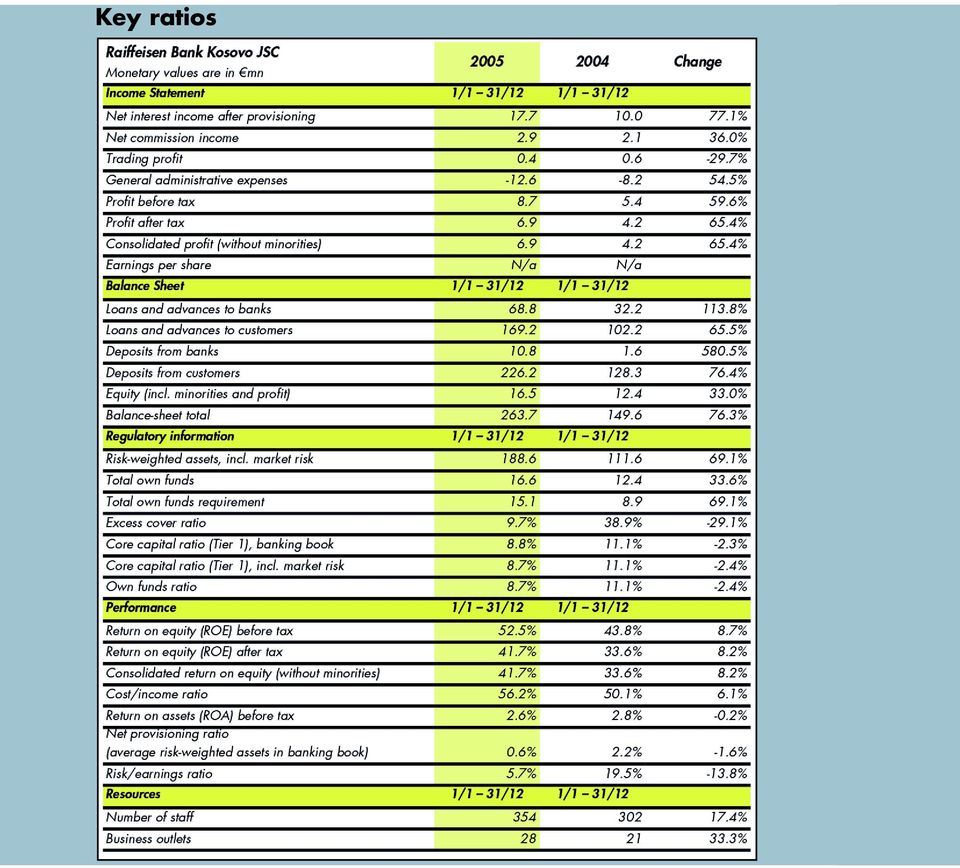
3 Raiffeisen Bank Kosovo J.S.C. Annual Report 2005 Content Introduction by the President of the Supervisory Board Introduction by the Chairman of the Management Board The RZB Group and Raiffeisen International at a glance Raiffeisen Bank Kosovo Mission and Vision Raiffeisen Glossary Organisational Structure of Raiffeisen Bank Kosovo The Macroeconomic Environment Raiffeisen Bank Kosovo - General Introduction Corporate Banking Treasury Trade Finance Retail Banking Private Individual (PI) Segment Small and Medium Enterprises (SMEs) Credit and Risk Management Card Business Distribution Channels Product Management & Development Payment transactions Payroll processing Process Management Personnel Training and Development Addresses Financial statements Independent Auditors Report Balance Sheet as at 31 December 2005 Income Statement for the year ended 31 December 2005 Statement of Changes in Shareholders Equity for the year ended 31 December 2005 Cash Flow Statement for the year ended 31 December 2005 Notes to the Financial Statements 1

4

5 Introduction by the President of the Supervisory Board On behalf of the Supervisory Board of Raiffeisen Bank Kosovo, I am very please d with the outstanding results achieved in Raiffeisen Bank Kosovo maintained its position among the best commercial banks and achieved extraordinary results, remaining again the most profitable bank in the market in 2005 with net profit of 6.9 million. Heinz Hödl Since the very beginning of its operations in Kosovo, Raiffeisen Bank Kosovo has played a dominant role in the local banking market, which is certainly a result of the highly professional attitude of its staff and continual innovations in its banking products. Both factors have led Raiffeisen Bank to the position of being the first choice financial partner in the Kosovo market. Although 2005 saw relatively few political events, these did have an impact on the development of Kosovo s economic situation. The general overview of the Kosovo economy for 2005 was characterised by a decrease in Gross Domestic Product (GDP), a stable inflation rate and a further increase in Registered Unemployment and the Trade Deficit. Raiffeisen Bank Kosovo serves all business segments, including retail and corporate clients. This has led to continuous growth in the market shares in all three segments, with special emphasis on small and medium-sized enterprises (SME), where Raiffeisen Bank Kosovo holds a substantial market share, and the corporate segment where it is a leading bank. Raiffeisen Bank has played a pioneering role in the development of new products and services, and it was the first and only bank in Kosovo to offer payments through Point Of Sale terminals with VISA branded cards. So, the strategic approach of operating as a full service bank was validated. 2 3 In continuing actively to help the process of privatisation, the main objectives of Raiffeisen Bank Kosovo have been to support its corporate clients in the areas of loans and deposits. Raiffeisen Bank Kosovo s corporate portfolio now includes

6 large local and international companies with subsidiaries in Kosovo, governmental and non-governmental organisations and many other institutions, which contributed to an increase of 195% in corporate deposits compared to the previous year. For its outstanding performance Raiffeisen Bank Kosovo was awarded the title of The Best Bank in Kosovo for Return on Assets in 2005 by the international leading industry publication: Finance Central Europe. Such impressive results by Raiffeisen Bank Kosovo have certainly been largely supported by the fact that the bank operates as a valuable member of Raiffeisen International, one of the leading banking groups in Central and Eastern Europe. The group s success is based both on extensive coverage of CEE and the strong position of its ultimate owner Raiffeisen Zentralbank Österreich AG (RZB). RZB is not only a leading commercial bank, but also offers access to world financial centres and growth markets in Asia. The remarkable results of Raiffeisen Bank Kosovo would have been impossible without the devoted efforts, high level of professionalism, expertise and teamwork of all employees and the management of the bank. I take this opportunity to personally thank and congratulate all employees of the bank and its management board for their hard work and commitment on the business results they have achieved. I also thank the Bank s clients for the trust they have placed in Raiffeisen Bank and look forward to continuing the fruitful relationship.

7 Introduction by the Chairman of the Management Board It is a great honour for me, for the second year in a row, to inform the shareholders and business partners of Raiffeisen Bank Kosovo, on behalf of the Management Board, that the Bank has completed the year 2005 with extraordinary results. There is no doubt that this success has been achieved due to the incredible work and determination of Raiffeisen Bank Kosovo to develop long-term relationships with all categories of clients: individual, small and medium enterprises and corporate. The support provided by Raiffeisen International Bank Holding AG (Raiffeisen International) which is a consolidated subsidiary of Raiffeisen Zentralbank Österreich AG (RZB) has greatly contributed to our results during 2005, as has being a member of the Raiffeisen Banking Group, which is present in countries of Central and Eastern Europe. 4 5 Oliver J. Whittle The total assets of Raiffeisen Bank Kosovo in 2005 increased by 76%, from 150 million at the end of 2004 to 264 million at the end of Deposits were also significantly increased by 78%, from 130 million to 231 million, while the loan portfolio showed remarkable progress, with an increase of 66%, from 102 million to 169 million. Net profit after tax increased by 65% and this is a very good achievement as the Bank concluded the year 2004 with Net Profit after tax of million whereas by the end of the year 2005 the Net Profit after tax is 6.9 million. Raiffeisen Bank Kosovo has shown extremely positive results in the Corporate Banking sector and finished the year 2005 with a substancial corporate loan portfolio. The 2005 loans amounted to 29.8 million, which is a growth of 194.4% compared to the end of the previous year. The year 2005 was especially successful for retail banking. By the end of 2005, the total outstanding loans were 139 million, which is substancial growth when compared with 92 million at the end of Raiffeisen Bank Kosovo

8 managed to retain its no. 1 position in the SME market with a 29% share according to estimated figures. By the end of 2005, the total SME loan portfolio was million which represents a growth of 34% compared to the previous year. We have continued to provide attractive offers to our clients by making the year 2005 even more progressive than previous ones in the card business. Raiffeisen Bank Kosovo has increased both the number of its cards and its ATM s. The 20,000 Raiffeisen Bank Cash Cards (proprietary cards) have been replaced with Visa Electron and Visa Classic Cards. On June 2005, Raiffeisen Bank became a MasterCard principal member, and after successful implementation of the project has introduced the VISA Point of Sale merchant acquiring facility for the first time in Kosovo. The operations division also noted a significant increase in its volume of activities. Compared to 2004, the number of domestic payment transactions rose by 28.19% while the number of international payment transactions saw a growth of 81.91%. Special attention was given to increasing the network by developing a presence in more under-banked locations. The number of sub-branches increased by 7 operating units. This increase in the bank s activities and the number of branches / sub-branches created the need for additional staff, which reached 386 employees, representing more than 16% of total banking sector. A major upgrade of the core banking system was implemented in January This has resulted in a significant

9 improvement in the Bank s ability to provide its clients additional and customer-tailored products and services. As part of our constant efforts to meet our clients expectations, this upgrade has made it possible for us to offer very efficient, customer friendly services as well as reduce waiting times. Also, the system is now fully able to meet all current and future reporting requirements by its management, supervisory and regulatory authorities. The important role played by Raiffeisen Bank Kosovo in the local market also influenced the Bank s decision, in the year 2005, to support success in many areas of social interest - education, sports, culture and medicine, as well as making donations to a number of needy causes. I would like to assert, on behalf of the Management Board, that the positive results that Raiffeisen Bank Kosovo has achieved during 2005 would not have been possible without the constant improvement and professionalism of our staff. Through their collective efforts, they bring our Bank closer to becoming the leader in the banking sector, an objective which I am sure will become a reality in the near future. I express my sincere gratitude to all the employees of Raiffeisen Bank Kosovo in the name of the Management Board for their excellent work. 6 7 The current year, 2006, will be one in which the Bank will further strengthen its role and position in the market through increased activities in providing innovative services and key products. Also, the Bank will be active in deposit acquisition, the introduction of new products, attracting new clients, transaction services and the development of its network.

10 Oliver Whittle - Chairman of Management Board Gary Moinette - Member of Management Board Qemajl Lumi - Member of Management Board

11 The RZB Group and Raiffeisen International at a glance Raiffeisen Bank Kosovo is a member of the RZB Group and a subsidiary of Raiffeisen International Bank-Holding AG. Raiffeisen International, in turn, is a fully consolidated subsidiary of Vienna-based Raiffeisen Zentralbank Österreich AG (RZB). RZB is the parent company of the RZB Group and the central institution of the Austrian Raiffeisen Banking Group, the country s most powerful banking group with the largest local distribution network. Founded in 1927, RZB provides the full range of commercial and investment banking services in Austria and is regarded a pioneer in Central and Eastern Europe (CEE). It ranks among the region s leading banks, offering commercial, investment and retail banking services in the following markets: 8 9 Albania Belarus Bosnia and Herzegovina Bulgaria Croatia Czech Republic Hungary Kosovo Poland Romania Russia Serbia and Montenegro Slovakia Slovenia Ukraine Raiffeisen Bank Priorbank, JSC Raiffeisen Bank d.d. Bosna i Hercegovina Raiffeisenbank (Bulgaria) EAD Raiffeisenbank Austria d.d. Raiffeisenbank a.s. Raiffeisen Bank Zrt. Raiffeisen Bank Kosovo J.S.C. Raiffeisen Bank Polska S.A. Raiffeisen Bank S.A. ZAO Raiffeisenbank Austria Raiffeisenbank a.d. Tatra banka, a.s. Raiffeisen Krekova banka d.d. JSCB Raiffeisenbank Ukraine and JSPP Bank Aval Raiffeisen International acts as these banks steering company, owning the majority of shares (in most cases 100% or almost 100 %). Furthermore, numerous finance leasing companies (including one in Kazakhstan) are part of the group. Following the largest Initial Public Offer in Austria s history in April 2005, RZB remains Raiffeisen International s majority shareholder owning 70 percent of the capital stock. The remaining 30 percent is free-float, owned by institutional and retail investors.

12 At year-end 2005, 2,443 business outlets covered the CEEregion and more than 43,600 employees attended to 9.7 million customers. As of year-end 2005, Raiffeisen International s total assets amounted to 40.7 billion, up 41% compared with December Consolidated profit (after minorities) according to IFRS came to million, an increase of 83%. The return on equity before tax reached 21.8% and the cost/income ratio improved to 61.6%. As of 31 December 2005, the RZB Group s balance-sheet total amounted to 93.9 billion, up 38% on the figure for year-end IFRS-compliant profit before tax amounted to million, an increase of 34% compared with the same period of The return on equity before tax was 23.9% and the cost/income ratio improved to 58.9%. In addition to its banking operations which are complemented by representative offices in Lithuania (Vilnius), Moldova (Chisinau) and Russia (Moscow) RZB runs several specialist companies in CEE offering financial solutions, among others, in the areas of M&A, real estate development, fund management, leasing and mortgage banking. In Western Europe and the USA, RZB operates a branch in London and has representative offices in New York, Brussels, Frankfurt, Milan, Paris and Stockholm. A finance company in New York (with representative offices in Chicago and Houston) and a subsidiary bank in Malta complement the scope of these offices. In Asia, RZB runs branches in Beijing (with a representative office in Zhuhai) and Singapore as well as having representative offices in Ho Chi Minh City, Hong Kong, Mumbai, Tehran and Seoul. This international presence clearly underlines the Bank s emerging markets strategy. RZB is rated as follows: Standard & Poor s Short-term A1 Moody s Short-term P-1 Moody s Long-term A1 Moody s Financial Strength C+

13 Raiffeisen Bank Kosovo Mission and Vision Vision To be the leading universal bank in Kosovo. Mission To develop long-term relationships with our clients by providing a range of competitive products and a high standard of service. To develop our staff through on the job training, courses and participation in management development projects.

14 Raiffeisen-Glossary Gable Cross The international Raiffeisen logo is the Gable Cross. It consists of two stylised crossed horses heads and can be traced back hundreds of years to European folk traditions. It is a symbol of defence against evil and life s dangers and can still be found on rural houses in Central Europe. According to their founders objectives, Raiffeisen s members have safeguarded themselves against economic hazards by uniting within the cooperative and therefore chose the Gable Cross as an emblem of protection under a shared roof. The logo has developed into an internationally well-known and very positively associated trademark and is in use around the world. Raiffeisen Banking Group The Raiffeisen Banking Group (RBG) is Austria s largest banking group. According to the latest figures for year-end 2005, RBG s consolidated balance-sheet total amounted to approximately 176 billion. It represents about a quarter of all domestic banking business and comprises the country s largest banking network with nearly 2,300 offices and some 23,000 employees. RBG consists of Raiffeisen Banks at the local level, Regional Raiffeisen Banks at the provincial level and RZB as a central institution. RZB also acts as the link between its international operations and RBG. Raiffeisen Banks are private cooperative credit institutions, operating as general service retail banks. Each province s Raiffeisen Banks are owners of the respective Regional Raiffeisen Bank, which in their entirety own approximately 88% of RZB s ordinary shares. The Raiffeisen Banks go back to an initiative of the German social reformer Friedrich Wilhelm Raiffeisen ( ), who, by founding the first cooperative banking association in 1862 laid the cornerstone of the global organisation of

15 Raiffeisen cooperative societies. Only 10 years after the foundation of the first Austrian Raiffeisen banking cooperative in 1886, 600 savings and loan banks were operating according to the Raiffeisen system throughout the country. According to Raiffeisen s fundamental principle of self-help, the promotion of their members interests is a key objective of their business policies. Raiffeisen International Raiffeisen International Bank-Holding AG is a fully consolidated subsidiary of RZB. It acts as the steering company for the RZB Group s subsidiaries in Central and Eastern Europe, above all the Group s banking and leasing units. RZB is Raiffeisen International s majority shareholder, owning 70% of the capital stock. The remaining 30% is free-float, owned by institutional and private investors. Raiffeisen International s shares are traded on the Vienna Stock Exchange RZB Raiffeisen Zentralbank Österreich AG (RZB) is the central institution of the Austrian Raiffeisen Banking Group. Founded in 1927 and domiciled in Vienna, RZB is the thirdlargest Austrian bank and a specialist in commercial and investment banking. As the parent company of the RZB Group, it ranks among Central and Eastern Europe s leading banking groups, offering the full scope of commercial, investment and retail banking services practically throughout the region. RZB Group The group owned and steered by RZB. Raiffeisen International forms one of the Group s main units, acting as holding and steering company for the network of banks and leasing companies in Central and Eastern Europe.

16 Organization Chart

17 The Macroeconomic Environment The few political events that occurred during 2005 nevertheless had an impact in the Kosovo s economic situation and its development. Kosovo s economy in 2005 was characterised by a Gross Domestic Product (GDP) decrease, further increase in Registered Unemployment and Trade Deficit, and finally with a stable inflation rate. The GDP figures were revised again this year and few changes were noticed in comparison to the prior periods. The Gross Domestic Product (GDP) and GDP per capita represented a decrease of 2.1% and 3.7%, respectively, when compared to the previous year

18 The Consumer Price Index (CPI) shows a slight decrease for 2005, which has a positive effect on the economy considering that the Harmonised Index of Consumer Prices in the eurozone was calculated to be around 2.2% in December Consumer Price Index (in %) Unemployment is one of the key factors in the Kosovo economic situation. Based on the official data, the registered unemployment figure increased by 5.9% or 18,000 thousands during There is no official data on the unemployment rate. According to IMF, unemployment figures are estimated to be 30% of the working age population. The ratio of unemployed people towards total population (population data are projected as no official registration since 1981) is calculated to be 16% at the end of 2005.

19 Kosovo s main commercial activity is related to trading, which explains the continued negative trade balance for Kosovo, exported 47.5 million and imported 1,184.1 million during The main imports were food, mineral products and machinery, while exports were base metals and leather. As of December 2005, the governmental revenues amounted to million, while the respective expenditures million. This shows a shortage of 60.9 million. The surplus has characterised the whole year decreasing in value as the year drew to a close and becoming negative at the year end Certain political developments are expected in 2006, not least of which are the status talks on the future of Kosovo. These might have a significant impact on the business climate. Source: Banking and Payment Authority of Kosovo, Statistical Buletin of December 2005, February 2006 and Annual Report 2005.

20 Raiffeisen Bank Kosovo General Introduction Raiffeisen Bank Kosovo has had an outstanding increase of 76.3% in Total Assets. The market share was calculated to be 29%, which represents an 9% increase when compared with the previous year. (CBP is excluded from the calculations. CBP represents Credit Bank of Pristina) Total Assets Market Share - Total Assets Other banks excluding CBP 71% RAIFFEISEN KOSOVO 29% RAIFFEISEN KOSOVO Other banks excluding CBP

21 The Bank further increased its range of products, which diversified the Loan and Overdraft portfolio, and offered additional choices to our customers. The balance increased by 65.5% in comparison to 2004 and the market share is calculated to be 35%, which is 5% more than in The Credit Bank of Pristina is excluded from the calculations. Loans and Overdrafts portfolio Other banks excluding CBP 65% Market share - Loans and Overdrafts,net RAIFFEISEN KOSOVO 35% RAIFFEISEN KOSOVO Other banks excluding CBP
22 Raiffeisen Bank Kosovo has had three successful deposit campaigns that resulted in a total increase of 78.1% for The market share increased further to 29%, which is 10% more then in The Credit Bank of Pristina is excluded from the calculations. Other banks excluding CBP 71% Market share - Deposits RAIFFEISEN KOSOVO 29% RAIFFEISEN KOSOVO Other banks excluding CBP Raiffeisen Bank Kosovo managed to move from a history of loss into being a success story within two years, during which there have been considerable efforts to gain a position as one of the leading banks in the market. The year 2005 showed that the Bank has consolidated this position and is moving towards new challenges. Market share - Profit and Loss information in Kosovo Commercial Banks Market share - Profit & Loss Other banks excluding CBP 50% RAIFFEISEN KOSOVO 50% RAIFFEISEN KOSOVO Other banks excluding CBP
23 Special attention was given to increasing the network by developing a presence in locations with low bank presence. The number of sub-branches increased by 7 operating units. This increase in the Bank s activities and the number of branches / sub-branches created the need for additional staff, which reached 386 employees, representing more then 16% of the total banking sector. Number of employees - December % Raiffeisen Bank Kosovo Banking Sector 16.5% Number of premises - December % 14.3% RAIFFEISEN KOSOVO Banking Sector excluding CBP
24 Raiffeisen Bank Kosovo versus Market Trends Source: Banking and Payments Authority of Kosovo, Statistical Buletins of December 2005 & February % Total assets increase for was a very successful and dynamic year in terms of market development, especially in respect of total assets, loans/overdrafts and deposits from banks and clients. 62% With reference to the total assets, the Banking Sector in Kosovo increased by 24% during Out of this increase, 15% is the Raiffeisen Bank Kosovo contribution. 38% Total deposits increase for 2005 The Banking Sector increase in terms of deposits, excluding the effect of balances with banks and other borrowings, is calculated to be 24%, out of this percentage the Raiffeisen Bank Kosovo contribution was 15%. 62% 52% Total loans / overdrafts increase for % With reference to the loans/overdrafts provided to our clients, and in terms of the gross balance, in other words excluding the effect of the necessary provision for impairment or losses, the Banking sector increased by 44% during The Raiffeisen Bank Kosovo contribution is calculated to be 21%, which accounts for 48% of the total contribution.
25 Total assets in Kosovo Commercial Banks RAIFFEISEN KOSOVO Other banks excluding CBP Loans and Overdrafts in Kosovo Commercial Banks RAIFFEISEN KOSOVO Other banks excluding CBP
26 Deposits in Kosovo Commercial Banks RAIFFEISEN KOSOVO Other banks excluding CBP Profit and Loss information in Kosovo Commercial Banks RAIFFEISEN KOSOVO Other banks excluding CBP
27 24 25
28
29 Corporate Banking For the Corporate Banking Department of Raiffeisen Bank Kosovo - it is essential to be able to work together effectively to ensure that the right resources, products and services are available everywhere to every customer. The Corporate Department is focused on developing long term relationships with: Our large local companies, foreign companies with subsidiaries in Kosovo, the public sector, governmental and non-governmental organisations, and non-bank financial institutions by offering them a variety of products, including larger loans. Our focus is clearly centred on our customers. We work together to achieve business success, no matter how simple or complex our customer s requirements. The year 2005 in the Corporate Department saw an increase of 70% in the number of corporate customers that continuously use the products and services of our Bank. One of Raiffeisen Bank s key goals in 2005 was to provide fast and flexible support to its corporate clients in the lending and deposit area. As a result Raiffeisen Bank finished the year 2005 with the largest corporate loan portfolio in Kosovo. Total loans for year end 2005 grew 194.4% when compared to the previous year Credit Balances are equally important to the Corporate Department. Relationship Managers do their best to maintain high level relationships with every type of client: large local companies and foreign companies with subsidiaries in Kosovo as well as governmental and non-governmental organisations, non-bank financial institutions by offering them variety of products. Corporate deposits for the year ending 2005 have increased by 195% from 27 million to 80 million, when compared to the previous year. Concurrently, Corporate Banking expects to maintain its excellent management of credit risk, through careful adjudication of credit proposals and broad diversification of its portfolio.
30 The largest loans were granted to manufacturing, trade and construction companies. Indirectly these loans affect the growth of employment in Kosovo since they are offered to newly privatised companies that are going to restart the production of existing companies as well as creating opportunities for other SME companies that will be supplied directly by our corporate clients. Key Issues when Choosing a Financial Partner in Kosovo A combination of size, financial strength and wide ranging capability means we can provide customers with the right solution whatever or wherever their business may be. We understand what is important to our customers and are able to offer: Sound financial guidance backed by quick, proactive and responsive decision making A real focus on building long-term successful relationships. A comprehensive product range with the flexibility to tailor individual solutions The firepower of a large international bank with the personal service ethos of a local bank. Working together, we believe the possibilities are endless. Responding to Clients Needs By taking an innovative approach to how we deliver our expertise to corporate clients, we can greatly enhance each client s experience and deepen each relationship. We collaborate to create access to our capabilities based on our clients financial and strategic needs, rather than their size.
31 Some clients regularly use our array of traditional banking products and services. Others primarily use standard products, with occasional need for more complex investment banking expertise. Medium-sized companies that are beginning to realise their potential through strong revenue growth might need a trusted advisor to serve as a key strategic counsellor and help craft business development plans and financial strategies to support them. By understanding these varying needs, we can match clients to the right team of Corporate Managers to deliver unparalleled service and financial solutions which meet their needs. We can also expand our teams, bringing in experts in additional product and service areas as client needs change. By bringing the right people to the table at the right time, we can quickly and easily use the full breadth of service capabilities, our client and industry knowledge, and our product expertise to provide clients with insightful solutions and seamless access to the financial services they need. We will be enhancing our sales and trading capabilities to provide our large clients with access to the products they need. And we continue to explore ways to expand the use of our expertise to structure and distribute what we originate across the company to an expanding client base Opportunities for Further Growth in the Corporate Department We will continue to face significant transition challenges and opportunities in We will meet those challenges and seize those opportunities with the same energy, enthusiasm and intensity that led to our success in 2005, driving towards ever-higher growth goals in the future, by satisfying so many customers so completely that they will bring us more of their business. To attain that level of satisfaction, and attract, retain and expand our customer relationships, we know we have to focus the energy and resources of the company on the basic work processes that underpin every customer experience. In a business this big and complex, nothing can be left to chance.
32 To be able to offer businesses of all sizes credit, deposit, and other traditional banking products and services, teams of Corporate and Relationship Managers work together to provide all clients, regardless of size, the right combination of products and services to meet their needs. In our banking businesses, corporate managers work together to bring a full range of banking products and services to more of our clients than ever before. While they work within their lines of business to build customer relationships, they also are reaching out to work with counterparts across the company to create new opportunities thereby delivering the full power of Raiffeisen Bank to our customers. Last year, we took a number of steps to strengthen and add to our capabilities, and prepare for future growth. We developed and introduced new products and services, developed a comprehensive branding strategy, and invested in innovative programs to enhance productivity, client service and business continuity. The focus of the Corporate Department is clear: Consistent, enthusiastic execution and teamwork produce customer satisfaction, which drives revenue growth. Treasury Kosovo still remains undeveloped as far as treasury and debt management is concerned. In year 2005 the government did not move forward on developing tools for local or international financing of its budget. The income from collection of customs and tax still remains the main source of financing for the Kosovo budget. Despite the aggressive growth of the loan book in Kosovo in 2005 the liquidity in the market has shifted only slightly from around 50% of 2004 and remained in the area of loan-todeposit ratio of 60% overall for the banks at the 2005 year end.
33 * source Banking and Payments authority of Kosovo Among the main reasons for the low growth in deposits can be considered, the flat growth of Year-on-Year GDP, the downturn in disposable income and the fall in foreign grants and investments Raiffeisen Bank Kosovo Treasury Money Market The year 2005 can be considered successful as far as the collection of deposits is concerned. The low cost of funding growth and capturing more than 70% of the growth in deposits in the congested 2005 Kosovo Money Market is a notable achievement alongside other successes of our bank. The upsurge in deposits shows growth from 130 to 231 million within only one fiscal year. The amount of expansion coming from growth negotiated deposits is noticeable, as is that coming from corporate and from high net worth retail customers.
34 Institutional funding In order to improve the long term liquidity of the Bank, Raiffeisen Bank Kosovo has tapped into the possibilities of obtaining funding from supranational institutions and foreign banks, such as EBRD, KFW. Most of these banks have AAA rating, which grants them access to funding. These institutions have been long term partners of Raiffeisen International. Although the portfolio was very small in 2005, in the year 2006 the long term institutional funding will be an important constituent of the funds in our balance sheet. We believe that long term funding will enable the Bank to enter into longer term projects, and will increase depositor confidence in the diversified structure of the funding of the Bank. Liquidity and Interest Rate Risk Management The overall liquidity and interest risk management of the Bank are the responsibilities of the Treasury Department. The internal controls and additional risk control tools set by Raiffeisen International Risk Management enable the controlled risk management of the overall Treasury. The risk management and risk control tools have been set according to the latest risk management know-how, for which Raiffeisen Zentralbank has won numerous awards. The main Risk Management Tools have been endorsed by Raiffeisen International and are applied for use by the Raiffeisen International Network Banks.
35 Liquidity reporting on a weekly basis at business segment level, monitoring of stickiness ratio separately for all business segments, banking book limits and reports which measure the interest risks and gaps, are currently the tools applied to manage and limit the underlying risk of conducting business. Active interest rate Risk management, for example Interest Rate Swaps, the introduction of variable rate loans, etc, is an area which we are slowly tapping into. This will be done primarely in order to manage risk in the short term and offer hedging instruments for our clients, but also to secure the long term profitability of the Bank in the long term. Foreign Exchange The fact that Kosovo is a EURO currency country, has to a certain extent, limited the potential of the Foreign Exchange business. But we have explored this potential in the USD, GBP and CHF market, and achieved a good market share in the business of oil derivative imports and food imports from South America and Asia. In effect the profitable FOREX business has increased our turnover in the transfer income commission business. To some extent we have also contributed to diminishing the FOREX informal market, which operated until now and had the bulk of the exchange in Kosovo Trade Finance Raiffeisen Bank Kosovo has demonstrated excellent results in providing trade finance products. The volume of all incoming and outgoing TF products within 2005 was 24.3 million. The outstanding of TF products at the end of 2005 reached million which is 1.79 times more than in 2004 when the outstanding figure amounted to 6.85 million.
36
37 Retail Banking Private Individual (PI) Segment In 2005 growth in the number of current accounts continued with an increase of 26% compared to the end of The main impact for our private individual clients has been the improvement of services and the introduction of new products and services, plus the extension of the branch network. Simultaneously the total volume of PI Deposits increased by 47 % during 2005, evidence of the Bank s outstanding position in the market for trust and security. The PI segment continued to produce significant growth in loans. Personal loans had the largest impact in the growth of the segment, with around 97% of the total new volume and a very low level of the default During 2005 Raiffeisen Bank Kosovo introduced home loans as an extension to the personal loans of larger amounts. Terms remained very competitive with simple procedures. Overall the PI qualitative loan portfolio had a growth of 155% compared to the end of The Private Individual segment s strategic goals for the future are: Extending our customer base by introducing innovative new product packages to non-salaried clients. Opening in-store branches at large key retail stores/ shopping centres around Kosovo. Introducing a new Mortgage Loan product with longer maturity for home purchase. Reaching deals with strong strategic companies by offering loans to their employees. Continuously increasing our productivity levels
38 Small and Medium-sized Enterprises (SMEs) The definition of the SME segment in Raiffeisen Bank Kosovo has been harmonised with that of all Raiffeisen network banks. The Bank finances businesses with turnovers of up to 5 million with the services and financial support necessary for growth and success. The SME transactions in 2005 were expanded, with the segment becoming the most successful in the Bank. Raiffeisen Bank Kosovo continues to be a leader in the small and medium enterprise segment, with an estimated 29% of market share as of 2005 year end. In 2005 the segment introduced new products, such as the Revolving Loan, Agro Loan, Auto Loan for Small and Medium Enterprise owners and savings accounts. Compared to the year end 2004, this segment had 33% growth in assets with around 3,500 credit clients, 31% growth in SME deposits and a 40% increase in the number of accounts. Future strategic objectives for the segment in 2006 are: To continue increasing the SME market share by consistently operating within the core strengths. The challenge now is to keep this momentum going with a strategy that incorporates both new and existing initiatives. To focus on diversifying the segment s offerings with a list of innovative products and services. Services such as e- banking and credit cards will challenge the traditional concept of SME banking. The key to these initiatives will be a marketing strategy that caters to client specifications. The Bank must also strike a personal chord with our clients, fostering life-long relationships. With the slow growth in the economy and intense competition, Raiffeisen Bank Kosovo is determined to emerge as the frontrunner in the SME segment. The Bank is intent on
39 reinforcing partnerships with our clients because it believes that it can only grow in step with the clients and it must continue to provide unwavering support to the SME segment
40 Credit and Risk Management During 2005, Credit and Risk Management continued developing its structure by enlarging its department with an Operational Risk Manager and the Basel II project. Furthermore, Credit and Risk Management plans future development by creating attractive and important positions within the department, which will support Bank growth in general. Raiffeisen Bank Kosovo has implemented several new tools to improve its Credit and Risk Management processes and comply with Basel II requirements. These tools include Application Processing System, the TIGER platform for asset class segmentation, such as the Corporate and Small and Medium Enterprise rating tool. The first version of local group data warehouse has been executed as a major element of Basel II project.
41 Credit and Risk Management has been involved in the creation and implementation of all new products launched during 2005 and remains committed to supporting business development in the future. Future projections for 2006 include Credit and Risk Management plans to implement scorecards for Small and Medium Enterprises, Micro and Private Individual Accounts, as a new tool in the overall credit process. Card Business The year 2005 was very progressive for the card business. The number of cards and Automated Teller Machines (ATM) grew, with all proprietary cards replaced with Visa branded cards, including the successful completion of Points of Sale (POS) projects. In March 2005, around 20,000 Raiffeisen Cash Cards were replaced with Visa Electron and Visa Classic cards. In June 2005, Raiffeisen Bank became a MasterCard principal member and also introduced the VISA POS merchant acquiring facility after successful implementation of the project for the first time in Kosovo During the third and the fourth quarter of the year, Raiffeisen Bank Kosovo rapidly enlisted merchants for card acceptance, distributing approximately 300 POS and increasing the number of ATMs to 36. Towards the end of the year Raiffeisen Bank completed the MasterCard POS acquiring project and became the only bank in Kosovo which accepts both internationally branded cards Visa and MasterCard at POS terminals. At the moment we serve more than 70,000 cardholders with the aim of increasing this number as well as products and services offered to them in 2006.
42 Distribution Channels Branch Development Network during 2005 Raiffeisen Bank Kosovo s dynamic expansion of the branch network is an ongoing process with 28 branches and sub branches that has made the Bank network one of the largest in the main market. The Bank s branches give the employees the opportunity to serve clients face-to-face and to help them meet their needs. Raiffeisen Bank Kosovo branch network is rapidly expanding. The Bank already has a presence in all the main regions of Kosovo. The full ranges of services and products are available in the following cities: Pristina, Prizren, Mitrovica South, Mitrovica North, Gjilan, Ferizaj, Gjakova and Peja. In addition to these fully-fledged branches, the Bank has also created a network of new sub-branches. The branch network represents an enormous growth opportunity to up-sell and cross sell products and services to our clients. Apart from our main office in Pristina which serves both as our head office and as our main branch in the city, during 2005 Raiffeisen Bank Kosovo was present in the Pristina region with Lipjan Sub-Branch, Fushe Kosova Sub-Branch, Sunny Hill Sub-Branch and Gllogovc Sub-Branch. The location of branches has been changed in Ferizaj, Prizren and Mitrovica. In Prizren we also opened a new subbranch. During 2005 the existing sub-branches in Vushtrri, Sterpce and Malisheva were relocated to more attractive locations. The Bank also opened new sub-branches in Klina and Istog. Raiffeisen Bank Kosovo introduced a new design for its branches and sub- branches in line with new standards, making our offices more convenient and efficient places for clients to do their banking.
43 A key aspect of the Raiffeisen Bank Kosovo mission is to extend its services to as many clients as possible, which also implies striving for maximum geographical coverage. Raiffeisen Direct / Call Centre Raiffeisen Direct/Call Centre, as one of our alternative distribution channels, has played a crucial role in customer service and sales. During the second part of the year its activities were extended together with the working volume. This had an additional impact on the working hours. Raiffeisen Direct/ Call Centre allows our clients to obtain information about the bank s services and products, such as balance enquiries, loan applications, loan interest rates, term deposits and savings account interest rates, as well as foreign exchange rates, ATM Card Department and POS Support through the help of telebankers, from 08:00 am to 10:00 pm 7 days a week
44 Product Management & Development Since it was established in 2004, Product Development has successfully implemented commercialisation of new products and the developing product assortment as a vital tool in business growth. The major developments related to the product mix dimension took place throughout the 2nd and 3rd quarters of The Product Management and Development department have deepened our lending product assortment in both
45 the SME and PI segments through the introduction first of Agro-Loans and then Home Loans. The Agro Loan program is devised so that each country should specialize in the production and export of goods/services in which it has cost advantage over other countries. Agriculture is an industry in which Kosovo possesses a competitive advantage and therefore it must be considered a primary source for economic development. The key to the programme was to link domestic food processors to the loan process, which could confirm their supply agreements to buy raw material from local farmers. Local processing companies would be able to secure enough supplies locally at any time, at the desired quality, while suppliers (farmers) would be able to increase their production capacity by obtaining funds at competitive rates which would motivate them to cultivate more. The motive for stretching the existing product line was simply a matter of positioning the bank as a full line financial service provider. Moreover, new developments have taken place in the area of cash management. In the fourth quarter of 2005 Raiffeisen Bank Kosovo piloted three e-banking channels for three clients groups. This could be considered as the first e- banking product in Kosovo market that could fully meet the business requirements of all bank business clients and especially those in the corporate segment Additionally, the Bank has improved the features of its depository product line, mainly related to term deposits and savings account for SME clients. The objective of depository product featuring was to stimulate the growth trend in long term deposits and to provide better investment terms to our business clients. Through time deposit plus, the existing depositors will have the opportunity to obtain a higher return on their invested funds if they decide to prolong the maturity term of the contract. On the other hand, SME Savings offers the option of using the account for business purposes, similarly to a current account, including the possibility of gaining competitive interest on investments. Raiffeisen Bank Kosovo will continue to differentiate its market offerings throughout the Financial Year 2006, either through line extension or featuring to keep up with the ongoing changes in client demand.
46 Payment transactions During 2005 the Raiffeisen Bank Kosovo clients made a total of 44,566 international payments with a total value of million and 74,109 national payments with total amount of million. Compared to 2004, the number of international payment transactions showed a growth of 82% while the number of domestic payment transactions showed a growth of 28%. Following the successful Six Sigma project on International Payments, processing of the payments has been decentralized from head office to the branches and sub-branches since June Processing has been improved and it has created a possibility for higher processing volume. From October 2005, decentralization of payment processing has been implemented for domestic payments as well. Western Union Raiffeisen Bank Kosovo has extended its Western Union services in all new opened sub-branches such as Pristina Sunny Hill, Fushe Kosova, Lipjani, Gllogovc, Podujeva, Klina, Istog, Rahovec, Prizren Shadervan and Vitia. The operators have been trained in order to offer better Western Union services. Payroll Processing Payroll processing is one of the products that Raiffeisen Bank Kosovo offers to the business clients. During 2005 this product achieved a growth of 23% with a total of 211 payrolls. Total turnover reached in 2005 was 101,855 million. Collection Accounts are services that Raiffeisen Bank offers to business clients who have accounts with the Bank. The total number of payments in 2005 reached 172,721 with a total turnover of 90.8 million. Compared with 2004 the number of payments showed a growth of 4.21%
47 Process Management Implementation of Business Process Improvement Management System (BPMS) and the Six Sigma project aims to improve our products and services in accordance with client requirements. This approach helps us to identify how our processes are performing and improve them to serve our clients better while achieving lower expenditure for the Bank. This year the Process Management Department is highly focused on monitoring key processes in the bank through BPMS implementation. BPMS is a tool that enables process owners to monitor their process performance and is the right mechanism to identify gaps in our processes. BPMS results can demonstrate that processes are not performing well and can serve as an indicator for improvement. Identifying the root causes of the gaps and improving them brings the Bank closer to cycle completion of the Six Sigma approach During 2005 the department implemented BPMS on 6 key processes, which are SME application and maintenance process, Consumer Loan application and maintenance Process, Current Account maintenance process, and finally Current Account opening process. The Process Management Department is currently in the evaluation phase regarding the majority of BPMS Projects. The department considers these results will help review the processes to make them more efficient. Among other Sigma projects, Process Management would like to highlight International and Domestic Payment Transfers Project. After Sigma implementation transfers are properly executed in the right way in the presence of the client, they receive the SWIFT confirmation within the hour, compared to the 24 hour period previously. By the end of 2005 the number of international transfers had increased by 82% in comparison to the same time in the previous year. Since the Sigma approach is in its initial stage in Raiffeisen Bank, there will be improved initiatives and projects in the
48 upcoming months and years. There are very successful international companies all around the world who implemented Six Sigma and became very efficient. These examples may serve Raiffeisen Bank Kosovo as a success model. Personnel Training and Development Raiffeisen Bank Kosovo has been committed to ensuring that its staff develop their skills and knowledge by providing internal and external training and development opportunities. These projects have resulted in improvements in the areas of products and processes coupled with more efficient service for clients. A preliminary analysis of training needs was followed by identification of sessions and individuals. Subsequently during 2005, around 66% of staff participated in variety of training programmes, workshops and seminars. Various staff members in Customer Service, Retail Banking, Credit and Risk Management, Finance Operations, IT, Corporate Banking and other departments underwent extensive training periods. In addition to internal training, Raiffeisen Bank Kosovo has successfully cooperated with Kosovo partners, including the Kosovo Banking Association, International Consultants and other internally licensed trainers, to provide an opportunities for its staff to increase their scope of their professional abilities. After successfully establishing contact with the American University of Kosovo, Pristina University s Economics Faculty and the University of Business and Technology, Raiffeisen Bank Kosovo introduced an internship program. The purpose of this program was to support staff expansion and the best candidates, following completion of the internship, were selected and appointed to join the appropriate departments and branches. Throughout the internship sessions, students were given the opportunity to consolidate their theoretical foundation through practical experience, during which one of the major components was the formation of a solid professional attitude. The ultimate purpose of the internship program was to
49 offer competent, professional, and dedicated entry-level students the opportunity to successfully complete their internship and gain practical working experience. In addition to the aforementioned activities, Raiffeisen Bank Kosovo has sponsored post-graduate studies, since it regards its staff as its most important resource and encourages them to acquire skills that will develop their ability to progress within our bank. As a result, three of our staff graduated in 2005 from the University of Business and Technology in Pristina, certified by the Technology University in Vienna, in the field of Engineering Management and Total Quality Management. Finally, Raiffeisen Bank Kosovo committed itself to an active engagement in charitable work throughout Kosovo. An example of this was the considerable donation to the National Blood Transfusion Centre in Pristina. In response to the constant demand for blood, our bank organized three separate sessions during 2005 with the above mentioned organisation, during which our staff volunteered to provide the much needed supply. The response in terms of volunteers from our bank was more than satisfying, reflected by the appreciation from the centre, which gave the employees member s booklets in addition to photos from the event and a letter of thanks
50
51 Addresses RAIFFEISEN ADDRESSES IN KOSOVO MAIN BRANCHES Raiffeisen Bank Kosovo J.S.C. HEAD OFFICE UÇK Street, No. 51 Pristina, Kosovo Phone: (0) Fax: +381 (0) [email protected] Ferizaj Branch Dëshmorët e Kombit Street, No. 35, Ferizaj Phone: (0) Fax: (0) [email protected] Gjakova Branch Nënë Tereza Street, No. 468, Gjakova Phone: (0) Fax: (0) [email protected] Gjilan Branch Skenderbeu Street, No. 103, Gjilan Phone: (0) / Fax: (0) [email protected] Mitrovica Branch Ali Pashë Tepelena Street Nr??? Mitrovica Phone: (0) / Fax: (0) [email protected] North Mitrovica Branch Kralja Petra Street, n.n. North Mitrovica Phone: (0) / Fax: (0) [email protected] Peja Branch Sheshi Haxhi Zeka n.n. Peja Phone: (0) / Fax: (0) [email protected] Pristina Branch UÇK Street, No. 51 Pristina Phone: (0) Fax: +381 (0) [email protected] Prizren Branch Nënë Tereza Street n.n Prizren Tel: / Fax: [email protected] SUB-BRANCHES Lipjan Sub-branch Ramiz Sadiku Street n.n. Phone: +381 (0) Fax: +381 (0) [email protected] Fushë Kosovë Sub-branch Nënë Tereza Street, Nr.80 Phone: (0) Fax: (0) [email protected] 48 49
52 Gllogovc Sub-branch Skenderbeu Street n.n. Phone: (0) Fax: (0) [email protected] Pristina Sunny Hill - Sub-branch Gazmend Zajmi n.n. Sunny Hill Phone: (0) Fax: (0) [email protected] Prizren Sub-branch Shadervan Square Phone: +381 (0) Fax: +381 (0) [email protected] Klina Sub-branch Muje Krasniqi Street n.n Phone: +381 (0) Fax: +381 (0) [email protected] Istog Sub-branch Skenderbeu Phone: +381 (0) Fax: +381 (0) [email protected] Gracanica Sub-branch Main Street, n.n. Gracanica Phone: (0) Fax: (0) [email protected] Hani i Elezit Sub-branch Hani i Elezit KAP Sharr Saloniti Phone/Fax: (0) [email protected] Kacanik Sub-branch Ismajl Raka Street, Building p+8 Kaçanik Phone: (0) [email protected] Kamenica Sub-branch Metush Krasniqi Square, n.n., Kamenicë Phone/Fax: (0) [email protected] Malisheva Sub-branch Rilindja Kombëtare Street, n.n. Malishevë Phone: (0) Fax: (0) [email protected] Podujeva Sub-branch Zahir Pajaziti Street, n.n. Podujevë Phone/ Fax: (0) , [email protected] Pristina Bill Clinton Blvd. Sub-branch Bill Clinton Boulevard, Lam. 1, Entrance 1a, Pristina Phone/Fax: (0) [email protected] Rahovec Sub-branch Xhelal Hajda-Toni Mici Street, n.n., Rahovec Phone/Fax: [email protected] Strpce Sub-branch Strpce Main Road Nr , Strpce Phone: (0) , [email protected] Suhareka Sub-branch Brigadat 123 Square, n.n. Suharekë Phone/Fax: (0) [email protected] UNMIK Admin. HQ Sub-branch UNMIK Administration, Pristina - Fushë Kosovo Road Phone: Fax: [email protected] Viti Sub-branch Adem Jashari Street, n.n. Viti Phone: (0) ; Fax: +381 (0) [email protected]
53 Vushtrri Sub-branch Dëshmorët e Kombit Street, n.n. Vushtrri Phone: +381 (0) Fax: (0) [email protected] RAIFFEISEN INTERNATIONAL -HOLDING AG Austria (Head Office) ING NETWORK IN CENTRAL AND EASTERN EUROPE Albania Raiffeisen Bank Sh.a. Belarus Priorbank, JSC Bosnia and Herzegovina Raiffeisen Bank d.d. Bulgaria Raiffeisenbank (Bulgaria) E.A.D. Croatia Raiffeisenbank Austria d.d. Czech Republic Raiffeisenbank a.s. Hungary Raiffeisen Bank Zrt. Kosovo Raiffeisen Bank Kosovo J.S.C. Malta Raiffeisen Malta Bank plc Poland Raiffeisen Bank Polska S.A. Romania Raiffeisen Bank S.A. Russia ZAO Raiffeisenbank Austria Serbia and Montenegro Raiffeisenbank a.d. Slovakia Tatra banka, a.s. Slovenia Raiffeisen Krekova banka d.d. Ukraine JSCB Raiffeisenbank Ukraine JSPP Bank Aval RAIFFEISEN-LEASING INTERNATIONAL Austria Raiffeisen-Leasing International GmbH Belarus SOOO Raiffeisen Leasing Bosnia and Herzegovina Raiffeisen Leasing d.o.o. Bulgaria Raiffeisen Leasing Bulgaria OOD Croatia Raiffeisen Leasing d.o.o. Czech Republic Raiffeisen-Leasing, s.r.o. Hungary Raiffeisen Lízing Rt
54 Kazakhstan Raiffeisen Leasing Kazakhstan LLP Poland Raiffeisen-Leasing Polska S.A. Romania Raiffeisen Leasing SRL Russia OOO Raiffeisen Leasing Serbia and Montenegro Raiffeisen Leasing d.o.o. Slovakia Tatra Leasing s.r.o. Slovenia Raiffeisen Leasing d.o.o. REAL-ESTATE LEASING COMPANIES Czech Republic Raiffeisen Leasing Real Estate s.r.o. Hungary Raiffeisen Inglatan Rt. U.S.A. RZB Finance LLC REPRESENTATIVE OFFICES IN EUROPE Belgium Brussels France Paris Germany Frankfurt am Main Italy Milan Lithuania Vilnius (Raiffeisen Bank Polska S.A.) Moldova Chisinau (Raiffeisen Bank S.A.) Russia Moscow Sweden Stockholm RAIFFEISEN ZENTRAL ÖSTERREICH AG Austria (Head Office) China Beijing Branch Singapore Singapore Branch United Kingdom London Branch REPRESENTATIVE OFFICES IN AMERICA AND ASIA U.S.A. Chicago (RZB Finance LLC) Houston (RZB Finance LLC) New York China Hong Kong Zhuhai
55 India Mumbai Iran Tehran South Korea Seoul Vietnam Ho Chi Minh City Croatia Raiffeisenbank Austria d.d. Czech Republic Raiffeisenbank a.s. Hungary Raiffeisen Bank Rt. Poland Raiffeisen Investment Polska Sp.z.o.o. INVESTMENT ING Austria Raiffeisen Zentralbank Österreich AG Fixed Income Raiffeisen Centrobank AG Equity Raiffeisen Investment AG Advisory Bosnia and Herzegovina Raiffeisen Bank d.d. Bulgaria Raiffeisenbank (Bulgaria) E.A.D. Romania Raiffeisen Capital & Investment S.A. Russia ZAO Raiffeisenbank Austria Serbia and Montenegro Raiffeisen Investment AG Slovakia Tatra banka, a.s. Slovenia Raiffeisen Krekova banka d.d. Ukraine Raiffeisen Investment TOV 52 53
56 RZB Group in Europe
57 RZB Group Worldwide 54 55
58
59 Raiffeisen Bank Kosovo J.S.C. AUDITORS' REPORT AND FINANCIAL STATEMENTS For the year ended 31 December
60 Auditors Report and Financial Statements Contents Auditors' Report 60 Balance Sheets 62 Income Statements 63 Statements of Changes in Shareholders' Equity 64 Statements of Cash Flows 65 Notes to the Financial Statements 1 Principal Activities 66 2 Operating Environment of the Bank 66 3 Basis of Presentation 67 4 Significant Accounting Policies 68 5 Cash and Cash Equivalents and Mandatory Liquidity Reserve 73 6 Due from Other Banks 74 7 Loans and Advances to Customers 75 8 Other Assets 77 9 Leasehold Improvements, Equipment and Intangible Assets Customer Accounts Borrowings Other Liabilities Share Capital Interest Income and Expense Fee and Commission Income and Expense Other Income Staff Costs Other Operating Expenses Income Taxes Financial Risk Management Contingencies and Commitments Fair Value of Financial Instruments Related Party Transactions Events after the Balance Sheet date 97
61 Auditors Report and Financial Statements 58 59
62 Auditors Report and Financial Statements Independent Auditors Report
63 Auditors Report and Financial Statements Independent Auditors Report (Continued) 60 61
64 Raiffeisen Bank Kosovo J.S.C. Balance Sheets as at 31 December 2005 and 2004 (in thousands of Euro unless otherwise stated) The notes set out on pages 66 to 97 form an integral part of these financial statements
65 Raiffeisen Bank Kosovo J.S.C. Income Statements for the Years Ended 31 December 2005 and 2004 (in thousands of Euro unless otherwise stated) Year ended Year ended Note 31 Dec Dec Interest income 14 21,867 13,588 Interest expense 14 (3,055) (1,224) Net interest income 18,812 12,364 Provision for loan impairment 7 (1,620) (2,259) Recoveries from loans written off Release of provision / (provision) for losses on commitments and contingent liabilities (158) Net interest income after provision for loan impairment 17,738 10,018 Foreign exchange gains, net Fee and commission income 15 3,457 2,451 Fee and commission expense 15 (536) (303) Other income Operating income 21,259 13, Staff costs 17 (4,055) (3,099) Other operating expenses 18 (8,542) (5,056) Profit before taxation 8,662 5,427 Income tax expense 19 (1,779) (1,266) Net Profit for the Year 6,883 4,161 The notes set out on pages 66 to 97 form an integral part of these financial statements
66 Raiffeisen Bank Kosovo J.S.C. Statements of Changes in Shareholders Equity for the Years Ended 31 December 2005 and 2004 (in thousands of Euro unless otherwise stated) Share capital Share Premium Additional Capital Accumulated earnings/ (deficit) Total shareholders' equity Balance at 31 Dec , ,500 (5,354) 7,379 Additional capital contribution 5, ,017 Reclassification 2,803 (303) (2,500) - - Net Profit of the year ,161 4,161 Balance at 31 Dec , (1,193) 16,557 Net Profit for the year ,883 6,883 Balance at 31 Dec , ,690 23,440 The notes set out on pages 66 to 97 form an integral part of these financial statements
67 Raiffeisen Bank Kosovo J.S.C. Statements of Cash Flows for the Years Ended 31 December 2005 and 2004 (in thousands of Euro unless otherwise stated) Year ended Year ended 31 Dec Dec Cash flows from operating activities Interest received on loans 20,084 13,154 Interest received on placements Interest paid (2,315) (1,578) Fees and commissions received 3,324 2,490 Fees and commissions paid (536) (244) Other operating income received Staff costs paid (4,055) (3,099) Other operating expenses paid (7,675) (7,143) Income tax paid (1,529) (644) Cash flows from operating activities before changes in operating assets and liabilities 8,459 4,211 Changes in operating assets and liabilities Net increase in mandatory liquidity reserve (10,142) (4,274) Net increase in due from other banks (39,659) (3,040) Net increase in loans and advances to customers (66,664) (46,582) Net increase / (decrease) in other assets 365 (304) Net increase in customer accounts 101,325 42,065 Net increase in other liabilities 276 3, Net cash used in operating activities (6,040) (3,948) Cash flows from investing activities Acquisition of leasehold improvements, equipment and intangible assets (1,835) (987) Disposal of leasehold improvements, equipment and intangible assets - 72 Net cash used in investing activities (1,835) (915) Cash flows from financing activities Net proceeds from borrowings 5,678 - Additional capital contributions in cash - 5,017 Net cash from financing activities 5,678 5,017 Effect of exchange rate changes 358 (137) Net (decrease)/increase in cash and cash equivalents (1,839) 17 Cash and cash equivalents at the beginning of the year 9,666 9,649 Cash and cash equivalents at end of the year (note 5) 7,827 9,666 The notes set out on pages 66 to 97 form an integral part of these financial statements
68 Raiffeisen Bank Kosovo J.S.C. Notes to the Financial Statements for the Years Ended 31 December 2005 and 2004 (in thousands of Euro unless otherwise stated) 1 Principal Activities The current 100% shareholder of the Bank is Raiffeisen International Bank-Holding AG (RI), formerly Raiffeisen International Beteiligungs AG (RIB). The ultimate parent of the Bank is Raiffeisen Zentralbank Osterreich AG (RZB). At the date of foundation of the Bank and up to February 2003 the Bank was called the "American Bank of Kosovo". In February 2003 the shareholders of the Bank decided to change the name of the Bank to Raiffeisen Bank Kosovo J.S.C. The change of the name was approved by the Banking and Payments Authority of Kosovo ("the BPK") on 28 April The Bank operates under a banking licence issued by the BPK on 8 November The Bank's principal business activities are commercial and retail banking operations within Kosovo. As at 31 December 2005 the Bank has 8 branches and 20 sub-branches within Kosovo (31 December 2004: 8 branches and 13 sub-branches). The Bank's registered office is located at the following address: UCK Street No 51, Prishtina, Kosovo - UNMIK. The number of the Bank's employees as at 31 December 2005 was 386 (31 December 2004: 316 employees). 2 Operating Environment of the Bank Under Resolution 1244 (1999) of the United Nations Security Council, Kosovo is administered by the United Nations Interim Administration Mission in Kosovo (UNMIK) headed by the Special Representative of the Secretary-General. Since 1999 legislative and executive authority with respect to Kosovo has been vested in UNMIK. The Constitutional Framework for Provisional Self-Government adopted by UNMIK Regulation 2001/9 of 15 May 2001 provides for division of powers between UNMIK and Provisional Institutions of Self- Government, as well as the transfer of powers and responsibilities to the Provisional Institutions of Self-Government, which is currently underway. The recent economic growth in Kosovo has been mainly driven by large foreign assistance and remittances from Kosovars living abroad. However, the donors' transfers to Kosovo are gradually declining and there is an urgent need for a transformation from an aid-dependent economy. This in turn is dependent on the status of Kosovo as a region and has a long term impact on all aspects of the Bank's operations. The economy of Kosovo represents an emerging market. Political structure and the regulatory and legal framework are currently under development. The volume of activity in financial markets is insignificant. Although the existing regulations provide rules for the registration and enforcement of collateral, extremely long delays in the handling of commercial court cases are hampering the imposition of market discipline. Additionally, the market in Kosovo for assets taken as collateral is underdeveloped. Therefore, it is not possible to estimate the fair value of collateral taken.
69 Raiffeisen Bank Kosovo J.S.C. Notes to the Financial Statements for the Years Ended 31 December 2005 and 2004 (in thousands of Euro unless otherwise stated) 2 Operating Environment of the Bank (Continued) The prospects for future economic stability in Kosovo are largely dependent upon the effectiveness of economic measures undertaken by the authorities, together with legal, regulatory and political developments, which are beyond the Bank's control. Major uncertainties that impact the economic prospects of Kosovo relate to the prospects of remittances, donor support and the resolution of Kosovo's final status. 3 Basis of Presentation Basis of Presentation. The financial statements of the Bank are prepared in accordance with International Financial Reporting Standards ("IFRS"), including International Accounting Standards ("IAS") and Interpretations issued by the International Accounting Standards Board. In the current year, the Bank has adopted all of the new and revised Standards and Interpretations issued by the International Accounting Standards Board (the IASB) and the International Financial Reporting Interpretations Committee (IFRIC) of the IASB that are relevant to its operations and effective for accounting periods beginning on 1 January The adoption of these new and revised Standards and Interpretations has resulted in no significant changes to the Bank's accounting policies. At the date of authorisation of these financial statements, the following Standards and Interpretations were in issue but not yet effective: IFRS 4 Insurance Contracts (amendment for financial guarantee contracts) IFRS 6 Exploration for and Evaluation of Mineral Assets IFRS 7 Financial Instruments: Disclosures IAS 1 Presentation of Financial Statements (added disclosures about an entity's capital) IAS 19 Employee Benefits - revised IAS 39 Financial Instruments: Recognition and Measurement (amendment for hedges of forecast intragroup transactions, amendment for fair value option and amendment for financial guarantee contracts) IFRIC 4 Determining Whether an Arrangement Contains a Lease IFRIC 5 Rights to Interests arising from Decommissioning, Restoration and Environmental Rehabilitation Funds IFRIC 6 Liabilities Arising from Participating in a Specific Market - Waste Electrical and Electronic Equipment IFRIC 8 Scope of IFRS 2 IFRIC 9 Reassessment of Embedded Derivatives The management of the Bank anticipate that the adoption of these Standards and Interpretations in future periods will have no material impact on the financial statements of the Bank. The financial statements are presented in thousands of Euro ("EUR"), the currency designated to be used in Kosovo for all budgets, financial records and accounts and for all payments, including compulsory payments. The financial statements are prepared under the historical cost convention. The presentation of financial statements in conformity with IFRS requires the management of the Bank to make judgement about 66 67
70 Raiffeisen Bank Kosovo J.S.C. Notes to the Financial Statements for the Years Ended 31 December 2005 and 2004 (in thousands of Euro unless otherwise stated) 3 Basis of Presentation (Continued) estimates and assumptions that effect the reported amounts of assets and liabilities and the disclosure of contingent assets and liabilities as at the date of the financial statements and their reported amounts of revenues and expenses during the reporting period. Although these estimates are based on management's best knowledge of current events and actions, actual results may ultimately differ from those estimates. Significant areas of subjective judgement include provisioning for incurred credit losses which involve uncertainties about the outcome of those risks and require the management of the Bank to make subjective judgements in estimating the loss amounts. Change in accounting estimate. During 2005, there has been a change in estimate of useful life for the computer hardware from 5 years to 3 years. Had there been no change in useful life of computer hardware, the depreciation expense for 2005 would have been decreased by EUR 305 thousand. 4 Significant Accounting Policies Cash and cash equivalents. Cash and cash equivalents are items which can be converted into cash at short notice and which are subject to an insignificant risk of changes in value. Amounts which relate to funds that are of a restricted nature are excluded from cash and cash equivalents. Mandatory liquidity reserves. In accordance with the BPK rules, the Bank should meet the minimum average liquidity requirement. The liquidity requirement is calculated on a weekly basis as 10% of the deposit base, defined as the average total deposit liabilities to the non-banking public in EUR and other currencies, over the business days of the maintenance period. The assets with which the Bank may satisfy its liquidity requirement are the EUR deposits with the BPK and 50% of the EUR equivalent of cash denominated in readily convertible currencies. Deposits with the BPK must not be less than 5% of the applicable deposit base. As the respective liquid assets are not available to finance the Bank's day to day operations, they have been excluded from cash and cash equivalents for the purposes of the cash flow statement. Due from other banks. All short term inter-bank placements and escrow accounts other than overnight deposits and placements on call are included in "Due from other banks". Originated loans and advances and provisions for loan impairment. Loans originated by the Bank by providing money directly to the borrower, are categorised as originated loans. Originated loans and advances are recognised when cash is advanced to borrowers. Initially, originated loans and advances are recorded at cost, which is the fair value of the consideration given and subsequently they are carried at amortised cost less provision for loan impairment.
71 Raiffeisen Bank Kosovo J.S.C. 4 Significant Accounting Policies (Continued) Notes to the Financial Statements for the Years Ended 31 December 2005 and 2004 (in thousands of Euro unless otherwise stated) provision for loan impairment in the income statement. A credit risk provision for loan impairment is established if there is objective evidence that the Bank will not be able to collect the amounts due according to original contractual terms. The amount of the provision is the difference between the carrying amount and estimated recoverable amount, calculated as the present value of expected cash flows including amounts recoverable from guarantees and collateral, discounted at the instrument's original effective interest rate. The provision for loan impairment also covers losses where there is objective evidence that probable losses are present in components of the loan portfolio at the balance sheet date. These have been estimated based upon historical patterns of losses in each component and the credit ratings assigned to the borrowers reflect the current economic environment in which the borrowers operate. When a loan is considered to be uncollectible, it is written off against the related provision for loan impairment. Such loans are written off after all the necessary procedures have been completed and the amount of the loss has been determined. Subsequent recoveries of amounts previously written off are credited to the income statement to line item "Provision for loan impairment". If the amount of the provision for loan impairment subsequently decreases due to an event occurring after the write down the release of the provision is credited to the Off-balance sheet commitments and contingent liabilities In the ordinary course of its business, the Bank has entered into off-balance sheet commitments such as guarantees, commitments to extend credit and letters of credit and transactions with financial instruments. The provision for losses on commitments and contingent liabilities is maintained at a level adequate to absorb probable future losses. Management determines the adequacy of the provision based upon reviews of individual items, recent loss experience, current economic conditions, the risk characteristics of the various categories of transactions and other pertinent factors. The Bank recognises a provision when it has a present obligation as a result of a past event; it is probable that an outflow of resources embodying economic benefits will be required to settle the obligation; and a reliable estimate can be made of the obligation. Leasehold improvements, equipment and intangible assets. Capitalised leasehold improvements, equipment and intangible assets are stated at cost less accumulated depreciation/amortisation and provision for impairment where required. Where the carrying amount of an asset exceeds its estimated recoverable amount, it is written down to its recoverable amount and the difference is charged to the income statement. The estimated recoverable amount is the higher of an asset's net selling price and its value-in-use. Gains and losses on disposal of leasehold improve 68 69
72 Raiffeisen Bank Kosovo J.S.C. 4 Significant Accounting Policies (Continued) Notes to the Financial Statements for the Years Ended 31 December 2005 and 2004 (in thousands of Euro unless otherwise stated) Operating leases. Where the Bank is the lessee, the total payments made under operating leases are charged to the income statement on a straight-line basis over the period of the lease. ments, equipment and intangible assets are determined by reference to their carrying amount and are taken into account in determining the operating result for the period. Repairs and maintenance are charged to the income statement when the expenditure is incurred. All premises used by the Bank are under operating lease agreements. Depreciation and amortisation. Depreciation and amortisation is applied on a straight line basis over the estimated useful lives of the assets using the following rates: 31 Dec ATMs, other bank and office equipment 20% Computer hardware 33% Intangible assets 20% The management has reassessed the estimated useful lives of computer hardware, which were depreciated at a rate of 20% per annum until 31 December Assets with a cost of less than EUR 1,000 are expensed. Leasehold improvements are depreciated over the term of the relevant lease. When an operating lease is terminated before the lease period has expired, any payment required to be made to the lessor by way of penalty is recognised as an expense in the period in which termination takes place. Computer software development costs. Costs associated with maintaining computer software programmes are recognised as an expense as incurred. Costs that are directly associated with identifiable and unique software products controlled by the Bank and which are expected to generate economic benefits beyond one year are recognised as intangible assets. Direct costs include external consultancy costs. Internal development costs are not capitalised. Expenditure which enhances or extends the performance of computer software programmes beyond their original specifications is recognised as a capital improvement and added to the original cost of the software. Computer software development costs recognised as assets are amortised using the straight-line method over their useful lives, not exceeding a period of 5 years. Borrowings. Borrowings are interest-bearing borrowed funds. Initially, they are recorded at cost, which is the fair value of the consideration given and subsequently are carried at amortised cost. Any interest or fee related to the borrowed funds is expensed and presented in the income statement for the period.
73 Raiffeisen Bank Kosovo J.S.C. 4 Significant Accounting Policies (Continued) Notes to the Financial Statements for the Years Ended 31 December 2005 and 2004 (in thousands of Euro unless otherwise stated) Income and expense recognition. Interest income and expense are recognised in the income statement for all interest bearing instruments on an accrual basis using the effective yield method based on the actual purchase price. Income taxes. Taxation has been provided for in the financial statements in accordance with Kosovo tax regulations currently in force (UNMIK Regulation no. 2004/51, "On Corporate Income Tax"). The income tax charge in the income statement for the year comprises current tax and changes in deferred tax. Current tax is calculated on the basis of the expected taxable profit for the year using the tax rates in force at the balance sheet date. Taxes other than income taxes are recorded within operating expenses. Deferred income tax is provided using the balance sheet liability method for all temporary differences arising between the tax base of assets and liabilities and their carrying amounts for financial reporting purposes. Deferred tax assets are recognised to the extent that it is probable that future taxable profit will be available against which the temporary differences can be utilised. Deferred tax assets are reduced to the extent that it is no longer probable that the related tax benefit will be realised. Deferred tax assets and liabilities are measured at tax rates that are expected to apply to the period when the asset is realised or the liability is settled based on tax rates that have been enacted or substantively enacted at the balance sheet date. Fees, commissions and other income and expense items are generally recorded on an accrual basis over the period for which the service has been provided. Foreign currency translation. Transactions denominated in currencies other than EUR are recorded at the exchange rate ruling on the transaction date. Exchange differences resulting from the settlement of transactions denominated in currencies other than EUR are included in the income statement using the exchange rate ruling on that date. Monetary assets and liabilities denominated in currencies other than EUR are translated into EUR at the mid market exchange rate at the balance sheet date. Foreign currency gains and losses arising from the translation of assets and liabilities are reflected in the income statement as foreign exchange translation gains less losses. The principal rates of exchange used for translating balances in currencies other than EUR were: 31 Dec. 31 Dec USD CHF GBP
74 Raiffeisen Bank Kosovo J.S.C. Notes to the Financial Statements for the Years Ended 31 December 2005 and 2004 (in thousands of Euro unless otherwise stated) 4 Significant Accounting Policies (Continued) Impairment. The carrying amount of the Bank's assets are reviewed at each balance sheet date to determine whether there is any indication of impairment. If any such indication exists, the asset's recoverable amount is estimated, and impairment loss is recognised in the income statement. Provisions. Provisions are recorded when the Bank has a present legal or constructive obligation as a result of past events and it is probable that an outflow of resources embodying economic benefits will be required to settle the obligation and a reliable estimate of the amount of the obligation can be made. Provisions are measured at the management's best estimate of the expenditure required to settle the obligation at the balance sheet date and are discounted to present value where the effect is material. Pension costs. Under the UNMIK Regulation No 2001/35 "On Pensions in Kosovo" (Section 7), each employer pays 5% of the total wages paid to Kosovars to the pension fund. For all organizations other than "agencies of state" or large employers with 500 or more employees provisions of the Regulation became effective from 1 August 2003 as stated in the UNMIK Administrative Direction No.2003/7. The Bank makes no provision and has no obligation for employees pensions over and above the contributions paid into the pension scheme run under the above-mentioned regulations. Comparatives. Certain comparative amounts have been restated and reclassified to conform to current year presentation. The main reclassifications are: The provision expense is now shown net of recoveries. During the prior year recoveries were disclosed as other income; The provision for losses on commitments and contingent liabilities are presented on the face of the income statement, whereas in the prior year it was disclosed under other operating expenses.
75 Raiffeisen Bank Kosovo J.S.C. Notes to the Financial Statements for the Years Ended 31 December 2005 and 2004 (in thousands of Euro unless otherwise stated) 5 Cash and Cash Equivalents and Mandatory Liquidity Reserve 31 Dec Dec Cash on hand 11,531 4,296 Balances with the BPK 15,179 10,637 Correspondent accounts and placements on call with other banks - OECD countries 4,243 7,718 Total cash, cash equivalents and mandatory liquidity reserve 30,953 22,651 Cash on hand and balances with the BPK include a mandatory liquidity reserve balance of EUR 23,126 thousand (31 December 2004: EUR 12,985 thousand). The liquidity reserve balance is calculated on the basis of a simple average over a week and should be maintained as 10 per cent of certain obligations of the Bank. As such the balance can vary from day-to-day. This balance is excluded from cash and cash equivalents for the purposes of the cash flow statement As at 31 December 2005 and 2004 the Bank's cash and cash equivalents for the purposes of cash flow statement were as follows: 31 Dec Dec Total cash and cash equivalents and mandatory reserve 30,953 22,651 Less: Mandatory liquidity reserve (23,126) (12,985) Cash and cash equivalents for the purposes of cash flow statement 7,827 9,666 The BPK pays interest on the Bank's average assets holdings with the BPK above 5% of the applicable deposit base up to the amount of its average minimum liquidity reserve requirement. As at 31 December 2005 the interest was paid at the rate of 1.25% per annum (31 December 2004: 1% per annum).
76 Raiffeisen Bank Kosovo J.S.C. Notes to the Financial Statements for the Years Ended 31 December 2005 and 2004 (in thousands of Euro unless otherwise stated) 6 Due from Other Banks 31 Dec Dec Term deposits 62,830 23,142 Guarantee deposits 1,752 1,331 Total due from other banks 64,582 24,473 As disclosed in Note 23, the entire balance due from other banks - term deposits is outstanding from a single counterparty, Raiffeisen Zentralbank Oesterreich AG, which is the ultimate parent of the Bank. The balance due from other banks includes accrued interest income in the amount of EUR 124 thousand as at 31 December 2005 (31 December 2004: EUR 62 thousand). Guarantee deposits include an amount of EUR 1,285 thousand as at 31 December 2005 (31 December 2004, EUR 1,331 thousand) which represent restricted deposits with a related party in relation to guarantees issued on the Bank's behalf, for its customers. The Bank does not have the right to use these funds for the purposes of funding its own activities.
77 Raiffeisen Bank Kosovo J.S.C. Notes to the Financial Statements for the Years Ended 31 December 2005 and 2004 (in thousands of Euro unless otherwise stated) 7 Loans and Advances to Customers 31 Dec Dec Legal entities Current and rescheduled loans 97,462 67,388 Purchased loans Current loans containing a portion overdue 4,390 3,021 Overdue loans 2,163 1,189 Overdraft facilities 30,834 16,947 Customer accounts in overdraft ,849 88,740 Individuals Personal loans 32,950 12,087 Payroll overdrafts 1,232 1,332 Customer accounts in overdraft ,347 13,469 Loans and advances to customers 169, , Less: Provision for loan impairment (4,687) (3,632) Loans and advances to customers, net 164,509 98,577 Loans and advances to customers include accrued interest income in the amount of EUR 869 thousand (31 December 2004: EUR 546 thousand). In 2003 the Bank purchased a portfolio of 36 loans from a Kosovo-based credit institution for a total consideration of EUR 905 thousand. In respect of 17 of the purchased loans the Bank did not anticipate any subsequent cash flows and accordingly no financial asset was recognised at the time of the purchase. However, subsequent to the purchase, repayments were received by the Bank in respect of some of the non-performing loans in the total amount of EUR 209 thousand during the year ended 31 December 2005 (year ended 31 December 2004: EUR 429 thousand) which was recorded under other income. Refer to Note 16. As at 31 December 2005, there are no loans remaining from the purchased portfolio.
78 Raiffeisen Bank Kosovo J.S.C. Notes to the Financial Statements for the Years Ended 31 December 2005 and 2004 (in thousands of Euro unless otherwise stated) 7 Loans and Advances to Customers (continued) Movements in the provision for loan impairment are as follows: Year ended Year ended 31 Dec Dec Provision for loan impairment at the beginning of the year 3,632 2,908 Net charge for provision for loan impairment during the year 1,620 2,259 Loans and advances to customers written off during the year as uncollectible (565) (1,535) Provision for loan impairment at the end of the year 4,687 3,632 As at 31 December 2005 the Bank has 244 borrowers (31 December 2004: 158 borrowers) with aggregated loan amounts above EUR 100 thousand. The aggregate amount of these loans is EUR 62,487 thousand or 37% of the gross loan portfolio (31 December 2004: EUR 32,823 thousand or 32% of the gross loan portfolio). Economic sector risk concentrations within the customer loan portfolio are as follows: 31 Dec Dec Amount % Amount % Trade 89, , Manufacturing, chemical and processing 1, ,742 8 Service 7, ,703 6 Construction and construction servicing 10, ,790 6 Food industry and agriculture 16, Individuals 34, , Other 9, ,806 4 Total loans and advances to customers before provision for loan impairment 169, ,
79 Raiffeisen Bank Kosovo J.S.C. Notes to the Financial Statements for the Years Ended 31 December 2005 and 2004 (in thousands of Euro unless otherwise stated) 8 Other Assets 31 Dec Dec Prepayments and advances for services Fees receivable - 54 Other receivables Total other assets
80 Raiffeisen Bank Kosovo J.S.C. Notes to the Financial Statements for the Years Ended 31 December 2005 and 2004 (in thousands of Euro unless otherwise stated) 9 Leasehold Improvements, Equipment and Intangible Assets Leasehold improvements ATM, other bank and office equipment Computer hardware Intangible assets Cost At 1 Jan , ,658 4,767 Additions ,861 Disposals (166) (52) - (29) (247) At 31 Dec ,184 1,182 2,050 6,381 Accumulated depreciation and amortisation At 1 January ,726 Depreciation/amortisation charge for the year (Note 18) ,388 Eliminated on disposals (113) (24) - (18) (155) At 31 Dec ,124 2,959 Net book value at 31 Dec , ,422 Net book value at 31 Dec , ,041 Total Intangible assets comprise computer software licences and software development costs.
81 Raiffeisen Bank Kosovo J.S.C. Notes to the Financial Statements for the Years Ended 31 December 2005 and 2004 (in thousands of Euro unless otherwise stated) 10 Customer Accounts 31 Dec Dec Legal entities Current accounts 53,572 32,518 Term deposits and margin accounts 52,073 12,451 Savings accounts ,545 45,119 Individuals Current accounts 43,283 32,749 Term deposits and margin accounts 67,584 43,440 Savings accounts 13,844 8, ,711 84,722 Total customer accounts 231, ,841 As at 31 December 2005, term deposits and margin accounts include an amount of EUR 5,068 thousand deposit from a local bank (31 December 2004: EUR 1,582 thousand). In addition, customer accounts include accrued interest expense in the amount of EUR 1,297 thousand (31 December 2004: EUR 572 thousand) Economic sector concentrations within the customer accounts are as follows: 31 Dec Dec Amount % Amount % Individuals 125, , Communication 49, , Trade 11, ,884 8 Financial services 9, ,762 5 Construction 3, ,658 2 Administration and services 1, ,683 1 Energy Other 30, ,366 8 Total customer accounts 231, , As at 31 December 2005 the Bank has 160 customers with balances above EUR 100 thousand (31 December 2004: 71 customers). The aggregate balances of these customers are EUR 101,343 thousand or 44% of total customer accounts (31 December 2004: EUR 21,486 thousand or 17% of total customer accounts). Included in customer accounts are deposits of EUR 1,821 thousand as at 31 December 2005, held as collateral for guarantees and letters of credit issued by the Bank to these customers (31 December 2004: EUR 831 thousand). Refer to Note 21.
82 Raiffeisen Bank Kosovo J.S.C. Notes to the Financial Statements for the Years Ended 31 December 2005 and 2004 (in thousands of Euro unless otherwise stated) 11 Borrowings 31 Dec Dec KfW loans 4,692 - Participating Loan - Raiffeisen Bank Albania 1,003 - Total borrowings 5,695 - The Bank signed a framework agreement on 8 February 2005 with the Kreditanstalt fur Wiederaufbau, Frankfurt am Main (KfW) for the purpose of obtaining loans from European Fund for Kosovo (EFK). KfW is managing the EFK which has been funded by the European Agency for Reconstruction (EAR). The purpose of the fund is to refinance sub-loans to borrowers in Kosovo for the purpose of housing activities and small and medium enterprises (SME) and according to the criteria established by EFK. European Fund for Southeast Europe (EFSE) has taken over EFK on 15 December The Bank has received two loans from KfW and has repaid one instalment during The first loan was received during the first part of the year 2005 for the amount of EUR 2 million. The second loan of EUR 2.9 million was received during the second half of the year. Both borrowed funds have a grace period of six months and a five year maturity period. The interest rates are variable based on EURIBOR plus a margin percentage, which is fixed between 2-3%. The third loan is related to a risk share deal with Raiffeisen Bank Albania. The interest rate is fixed at 4.3%, the associated guarantee fee is fixed at 5%, and the repayment is linked to the client repayment schedule. The loan has a grace period of six months and a maturity period of five years. As at 31 December 2005, the Bank had available EUR 3 million (31 December 2004: Nil) of undrawn committed borrowing facilities in respect of which all conditions precedent had been met. In the borrowings amount as at 31 December 2005 is included an accrued interest amount of EUR 18 thousand (31 December 2004: Nil).
83 Raiffeisen Bank Kosovo J.S.C. Notes to the Financial Statements for the Years Ended 31 December 2005 and 2004 (in thousands of Euro unless otherwise stated) 12 Other Liabilities 31 Dec Dec Accrued staff costs Accrued operating expenses Consultancy costs payable Equipment and intangible assets payable Provision for losses on commitments and contingent liabilities Deferred income 1,790 1,209 Tax payable Liabilities on leased assets Other Total other liabilities 3,550 3,273 Geographical, currency and maturity analyses of other liabilities are disclosed in Note Movements in the provision for losses on commitments and contingent liabilities are as follows: Year ended Year ended 31 Dec Dec Provision for losses on commitments and contingent liabilities at the beginning of the year (Release of provision for losses on commitments and contingent liabilities) / Provision for losses on commitments and contingent liabilities (108) 158 Provision for losses on commitments and contingent liabilities at the end of the year
84 Raiffeisen Bank Kosovo J.S.C. Notes to the Financial Statements for the Years Ended 31 December 2005 and 2004 (in thousands of Euro unless otherwise stated) 13 Share Capital Authorised and registered share capital of the Bank comprises 100 shares of common stock of no par value. The structure of the share capital of the Bank as at 31 December 2005 and 2004 is as follows: Amount in Shareholder Number of shares thousands EUR Voting share Raiffeisen International Bank-Holding AG (RI) , % All shares have equal rights to dividends and carry equal voting rights. 14 Interest Income and Expense Year ended Year ended 31 Dec Dec Interest income Loans and advances to customers 20,855 13,069 Due from other banks 1, Total interest income 21,867 13,588 Interest expense Term deposits (2,656) (1,039) Savings accounts (183) (108) Current accounts (145) (76) Borrowings (70) - Other interest expense (1) (1) Total interest expense (3,055) (1,224) Net interest income 18,812 12,364
85 Raiffeisen Bank Kosovo J.S.C. Notes to the Financial Statements for the Years Ended 31 December 2005 and 2004 (in thousands of Euro unless otherwise stated) 15 Fee and Commission Income and Expense Year ended Year ended 31 Dec Dec Commission on settlement transactions 1,808 1,262 Social and corporate payment fees Fees for trade finance services Account service fees Commission on ATM/POS related services Commission on cash withdrawals 4 28 Other Total fee and commission income 3,457 2,451 Correspondent bank charges (536) (303) Total fee and commission expense (536) (303) Net fee and commission income 2,921 2, Other Income Year ended Year ended 31 Dec Dec Recoveries of bad debts acquired as part of the purchased loan portfolio (Note 7) Amortisation of the ICU loan premium Old payable accounts related adjustments Other 2 8 Total other income In 2003 the Bank purchased a portfolio of 36 loans from a Kosovo-based credit institution, Interim Credit Unit of Kosovo (ICU) for a total consideration of EUR 905 thousand. Difference between fair value at the time of transfer and purchase consideration of EUR 310 thousand was amortised over the average maturity period of purchased portfolio.
86 Raiffeisen Bank Kosovo J.S.C. Notes to the Financial Statements for the Years Ended 31 December 2005 and 2004 (in thousands of Euro unless otherwise stated) 17 Staff Costs Year ended Year ended 31 Dec Dec Salaries and wages 3,417 2,659 Bonuses Overtime Mandatory staff pension contributions Other staff costs Total staff cost 4,055 3, Other Operating Expenses Year ended Year ended Note 31 Dec Dec Depreciation and amortisation of leasehold improvements, equipment and intangible assets 9 1, Rent Security IT consulting Professional services - consulting fees 2, Telecommunication expenses ATM expenses Building and equipment maintenance Staff travel, training and residence Marketing, advertising, re-branding and sponsorship Losses on disposal of fixed assets Utilities and related expenses Equipment and computers Stationery Insurance Other Total other operating expenses 8,542 5,056
87 Raiffeisen Bank Kosovo J.S.C. Notes to the Financial Statements for the Years Ended 31 December 2005 and 2004 (in thousands of Euro unless otherwise stated) 19 Income Taxes Year ended Year ended 31 Dec Dec Current profit tax charge 1,735 1,067 Deferred taxation movement due to origination and reversal of temporary differences Income tax expense for the year 1,779 1,266 The income tax rate applicable to the Bank's income is 20% (31 December 2004: 20%). The reconciliation between the expected and the actual taxation charge is provided below. Year ended Year ended 31 Dec Dec Profit before taxation 8,662 5,427 Theoretical tax charge for the year at the applicable statutory rate 1,732 1, Tax effect of items which are not deductible for taxation purposes: Non-recognised net deferred tax asset movement Other 3 (18) Income tax expense for the year 1,779 1,266 Differences between IFRS financial statements and Kosovo statutory taxation regulations give rise to certain temporary differences between the carrying amount of certain assets and liabilities for financial reporting purposes and for profit tax purposes. The tax effect of the movement on these temporary differences is recorded at the rate of 20%.
88 Raiffeisen Bank Kosovo J.S.C. Notes to the Financial Statements for the Years Ended 31 December 2005 and 2004 (in thousands of Euro unless otherwise stated) 19 Income Taxes (Continued) Movement 31 Dec during Dec Tax effect of deductible temporary differences Loan impairment provision 462 (136) 326 Provision for losses on commitments and contingent liabilities 42 (42) - Leasehold improvements, equipment and intangible assets Gross deferred tax asset 504 (122) 382 Less: non-recognised deferred tax asset (235) 44 (191) Net deferred tax asset 269 (78) 191 Tax effect of taxable temporary differences Other liabilities (34) 34 - Gross deferred tax liability (34) 34 - Total net deferred tax asset 235 (44) 191 The net deferred tax asset represents income taxes recoverable through future revenues and is recorded as a deferred tax asset on the balance sheet. Deferred income tax assets are recognised for tax loss carry forwards only to the extent that realisation of the related tax benefit is probable. As at 31 December 2005, a net deferred tax asset in the amount of EUR 191 thousand (31 December 2004: EUR 235 thousand) has not been recorded as the management believes that the related tax benefit might not be realised in full due to the tax related regulatory framework.
89 Raiffeisen Bank Kosovo J.S.C. Notes to the Financial Statements for the Years Ended 31 December 2005 and 2004 (in thousands of Euro unless otherwise stated) 20 Financial Risk Management The risk management function within the Bank is carried out in respect of financial risks (credit, market, geographical, currency, liquidity and interest rate), operational risks and legal risks. The primary objectives of the financial risk management function are to establish risk limits and then to ensure that exposure to risks stays within these limits. The operational and legal risk management functions are intended to ensure proper functioning of internal policies and procedures to minimise operational and legal risks. Credit risk. The Bank takes on exposure to credit risk which is the risk that a counterparty will be unable to pay amounts in full when due. The Bank structures the levels of credit risk it undertakes by placing limits on the amount of risk accepted in relation to one borrower and to geographical and industry segments. Such risks are monitored on a revolving basis and subject to an annual or more frequent review. Limits on the level of credit risk by borrower are approved by Management. Exposure to credit risk is managed through regular analysis of the ability of borrowers and potential borrowers to meet interest and principal repayment obligations and by changing these lending limits where appropriate. Exposure to credit risk is also managed, in part, by obtaining collateral and corporate and personal guarantees. The Bank's maximum exposure to credit risk is primarily reflected in the carrying amounts of financial assets on the balance sheet. The impact of possible netting of assets and liabilities to reduce potential credit exposure is not significant. Credit risk for off-balance sheet financial instruments is defined as the possibility of sustaining a loss as a result of another party to a financial instrument failing to perform in accordance with the terms of the contract. The Bank uses the same credit policies in making conditional obligations as it does for on-balance sheet financial instruments through established credit approvals, risk control limits and monitoring procedures. Market risk. The Bank takes on exposure to market risks. Market risks arise from open positions in interest rate and currency products, all of which are exposed to general and specific market movements. Management sets limits on the value of risk that may be accepted, which is monitored on a daily basis. However, the use of this approach does not prevent losses outside of these limits in the event of more significant market movements
90 Raiffeisen Bank Kosovo J.S.C. Notes to the Financial Statements for the Years Ended 31 December 2005 and 2004 (in thousands of Euro unless otherwise stated) 20 Financial Risk Management (Continued) Geographical risk. The geographical concentration of the Bank's assets and liabilities as at 31 December 2005 and 2004 is set out below: Kosovo EU Other Total Assets Cash and cash equivalents and mandatory liquidity reserve 26,710 3, ,953 Due from other banks - 64,582-64,582 Loans and advances to customers 164, ,509 Other assets Leasehold improvements, equipment and intangible assets 3, ,422 Deferred tax asset Total assets 195,006 68, ,941 Liabilities Customer accounts 221,086 7,678 2, ,256 Borrowings - 4,692 1,003 5,695 Other liabilities 3, ,550 Total liabilities 224,563 12,443 3, ,501 Net balance sheet position at 31 Dec (29,557) 55,883 (2,886) 23,440 Net balance sheet position at 31 Dec (4,931) 22,519 (1,031) 16,557
91 Raiffeisen Bank Kosovo J.S.C. Notes to the Financial Statements for the Years Ended 31 December 2005 and 2004 (in thousands of Euro unless otherwise stated) 20 Financial Risk Management (Continued) Currency risk. The Bank takes on exposure to effects of fluctuations in the prevailing foreign currency exchange rates on its financial position and cash flows. Management sets limits on the level of exposure by currency and in total, which are monitored daily. The table below summarises the Bank's exposure to foreign currency exchange rate risk at 31 December 2005 and Included in the table are the Bank's assets and liabilities at carrying amounts, categorised by currency. EUR USD Other Total Assets Cash and cash equivalents and mandatory liquidity reserve 26,637 3, ,953 Due from other banks 55,372 9,210-64,582 Loans and advances to customers 164, ,509 Other assets Leasehold improvements, equipment and intangible assets 3, ,422 Deferred tax asset Total assets 250,399 12, , Liabilities Customer accounts 217,638 12, ,256 Borrowings 5, ,695 Other liabilities 3, ,550 Total liabilities 226,875 12, ,501 Net balance sheet position at 31 Dec ,524 (171) 87 23,440 Net balance sheet position at 31 Dec ,481 (84) ,557 Liquidity risk. Liquidity risk is defined as the risk when the maturity of assets and liabilities does not match. The Bank is exposed to daily calls on its available cash resources from current accounts, maturing deposits, loan draw downs and guarantees. The liquidity risk is managed by Manage-ment of the Bank. The table below shows assets and liabilities as at 31 December 2005 by their remai-ning contractual maturity. Some of the assets however, may be of a longer term nature; for example loans are frequently renewed and accordingly short term loans can have longer term duration.
92 Raiffeisen Bank Kosovo J.S.C. Notes to the Financial Statements for the Years Ended 31 December 2005 and 2004 (in thousands of Euro unless otherwise stated) 20 Financial Risk Management (Continued) Demand and less then 1 month From 1 to 3 months From 3 to 12 months More then 12 months No maturity Total Assets Cash and cash equivalents and mandatory liquidity reserve 30, ,953 Due from other banks 57,132 5,697 1, ,582 Loans and advances to customers 2,440 10,389 34, , ,509 Other assets Leasehold improvements, equipment and intangible assets ,422 3,422 Deferred tax asset Total assets 90,525 16,260 36, ,162 3, ,941 Liabilities Customer accounts 111,599 51,051 58,789 9, ,256 Borrowings ,174 4,454-5,695 Other liabilities 1, ,550 Total liabilities 113,599 51,445 60,678 14, ,501 Net balance sheet position at 31 Dec (23,074) (35,185) (24,407) 102,493 3,613 23,440 Net balance sheet position at 31 Dec (42,399) (17,503) 7,304 65,879 3,276 16,557 The maturity analysis of loans to customers is based on the final maturity dates of the credit agreements rather than the interim remaining maturity dates, which effects the net liquidity position as it understates the amount to be recovered in the early stages of the loans for the amount of instalments to be received on a monthly basis. This is due to a system limitation, which does not enable the Bank to have maturity information based on the interim remaining maturity dates. The effect on the maturity information can not be measured. Overdue assets are fully provided against, and thus, have no impact on the above
93 Raiffeisen Bank Kosovo J.S.C. Notes to the Financial Statements for the Years Ended 31 December 2005 and 2004 (in thousands of Euro unless otherwise stated) 20 Financial Risk Management (Continued) table. Mandatory liquidity reserves are included within demand and less than one month as the majority of liabilities to which this balance relates to are also included within this category. The matching and/or controlled mismatching of the maturities and interest rates of assets and liabilities is fundamental to the Management of the Bank. It is unusual for banks ever to be completely matched since business transacted is often of an uncertain term and of different types. An unmatched position potentially enhances profitability, but can also increase the risk of losses. The maturities of assets and liabilities and the ability to replace interest-bearing liabilities as they mature at an acceptable cost, are important factors in assessing the liquidity of the Bank and its exposure to changes in interest and exchange rates. The Bank has a significant maturity mismatch of the assets and liabilities maturing within one year. This liquidity mismatch arises due to the fact that the major source of finance for the Bank as at 31 December 2005 was customer accounts being on demand and maturing in less than one month. Management believes that in spite of a substantial portion of customers accounts being on demand diversification of these deposits by number and type of depositors would indicate that these customers' accounts provide a long-term and stable source of funding for the Bank. The Bank has improved the net position though other sources of funding, which provide middle-term finance and intend to continue matching assets vs. liability maturity in the periods to come. In addition, the Bank has an unused Credit Facility Agreement, which will support in case of liquidity needs. The total outstanding contractual amount of commitments to extend credit does not necessarily represent future cash requirements, since many of these commitments will expire or terminate without being funded. Interest rate risk. The Bank takes on exposure to the effects of fluctuations in the prevailing levels of market interest rates on its financial position and cash flows. Interest margins may increase as a result of such changes but may reduce or create losses in the event that unexpected movements arise. The Bank is exposed to interest rate risk, principally as a result of lending at fixed interest rates, in amounts and for periods, which differ from those of term deposits at fixed interest rates. In practice interest rates are generally fixed on a short-term basis. Management sets limits on the level of mismatch of interest rate re-pricing that may be undertaken. Cash in hand and balances with BPK on which no interest is paid are included in the "non-interest bearing" column in the below table as well as non-interest bearing deposits of customers
94 Raiffeisen Bank Kosovo J.S.C. Notes to the Financial Statements for the Years Ended 31 December 2005 and 2004 (in thousands of Euro unless otherwise stated) 20 Financial Risk Management (Continued) The table below summarises the Bank's exposure to interest rate risks. Included in the table are the Bank's assets and liabilities at carrying amounts, categorised by the earlier of contractual re-pricing or maturity dates. Demand and less then 1 month From 1 to 3 months From 3 to 12 months More then 12 months Non-interest bearing Total Assets Cash and cash equivalents and mandatory liquidity reserve 4, ,710 30,953 Due from other banks 57,132 5,697 1, ,582 Loans and advances to customers 1,931 10,389 34, , ,509 Other assets Leasehold improvements, equipment and intangible assets ,422 3,422 Deferred tax asset Total assets 63,306 16,086 36, ,671 30, ,941 Liabilities Customer accounts 14,743 51,051 58,789 9,818 96, ,256 Borrowings ,174 4,454-5,695 Other liabilities ,550 3,550 Total liabilities 14,777 51,084 59,963 14, , ,501 Net balance sheet position at 31 Dec ,529 (34,998) (23,692) 103,399 (69,798) 23,440 Net balance sheet position at 31 Dec ,202 (2,216) 20,759 44,398 (51,586) 16,557
95 Raiffeisen Bank Kosovo J.S.C. Notes to the Financial Statements for the Years Ended 31 December 2005 and 2004 (in thousands of Euro unless otherwise stated) 20 Financial Risk Management (Continued) The table below summarises the effective interest rates by major currencies for major monetary financial instruments. The analysis has been prepared using year end effective rates. 31 Dec Dec EUR USD EUR USD Assets Placements on call with other banks 2.3% 4.3% 2.0% 1.4% Term deposits with other banks 2.4% 4.0% 2.1% 1.6% Loans and advances to customers 15.3% N/a 15.1% N/a Liabilities Customer accounts Term deposits 3.0% 1.3% 3.2% 0.6% Savings accounts 1.7% 1.8% 1.7% 0.3% Contingencies and Commitments Legal proceedings. From time to time and in the normal course of business, claims against the Bank are received. As at 31 December 2005 the Bank had no legal claims against it that were not both minor and in the ordinary course of business. On the basis of internal and external advice, Management is of the opinion that no material losses will be incurred and accordingly no provision has been made in these financial statements. Tax regulations. As disclosed in Note 2, the legal and regulatory framework in Kosovo is currently at an early stage of development. The Regulation on Profit Taxes in Kosovo was passed on 20 February 2002 and an improved version was presented in December 2004, and as such there is no established practice of tax assessments and there is no formal guidance as to how specific rules should be applied in practice. Due to the presence in Kosovo's commercial regulations (and tax regulations in particular), of provisions allowing more than one interpretation, Management's judgement of the Bank's business activities may not coincide with the interpretation of the same activities by tax authorities. Capital commitments. As at 31 December 2005 the Bank has no capital commitments in respect of the purchase of equipment and software (31 December 2004: Nil).
96 Raiffeisen Bank Kosovo J.S.C. Notes to the Financial Statements for the Years Ended 31 December 2005 and 2004 (in thousands of Euro unless otherwise stated) 21 Contingencies and Commitments (Continued) Operating lease commitments. The future minimum lease payments under non cancellable operating leases, where the Bank is the lessee, are as follows: 31 Dec Dec Not more than 1 year More than 1 year and not more than 5 years 1, Total operating lease commitments 1,881 1,128 Credit related commitments. The primary purpose of these instruments is to ensure that funds are available to a customer as required. Guarantees and standby letters of credit, which represent irrevocable assurances that the Bank will make payments in the event that a customer cannot meet its obligations to third parties, carry the same credit risk as loans. Documentary and commercial letters of credit, which are written undertakings by the Bank on behalf of a customer authorising a third party to draw drafts on the Bank up to a stipulated amount under specific terms and conditions, are collateralised by the underlying shipments of goods to which they relate or cash deposits and therefore carry less risk than a direct borrowing. Commitments to make loans at a specific rate of interest during a fixed period of time are accounted for as derivatives. Unless these commitments do not extend beyond the period expected to be needed to perform appropriate underwriting, they are considered to be "regular way" transactions. Outstanding credit related commitments are as follows: 31 Dec Dec Commitments to extend credit 25,645 12,308 Guarantees and similar commitments issued (credit facility) 8,528 4,569 Guarantees and similar commitments issued (cash covered) Letters of credit (credit facility) Letters of credit (cash covered) Letters of credit (advised) TF line of credit Letters of comfort 1, Total credit related commitments 37,905 19,154 Movements in the provision for losses on commitments and contingent liabilities are disclosed in note 12.
97 Raiffeisen Bank Kosovo J.S.C. Notes to the Financial Statements for the Years Ended 31 December 2005 and 2004 (in thousands of Euro unless otherwise stated) 21 Contingencies and Commitments (Continued) Commitments to extend credit represent loan amounts in which the loan documentation has been signed but the money not yet disbursed and unused amounts of overdraft limits in respect of customer accounts. With respect to credit risk on commitments to extend credit, the Bank is potentially exposed to losses in an amount equal to the total unused commitments. However, the likely amount of loss is less than the total unused commitments since most commitments to extend credit are contingent upon customers maintaining specific credit standards. The Bank monitors the term to maturity of credit related commitments because longer-term commitments generally have a greater degree of credit risk than shorterterm commitments. The total outstanding contractual amount of commitments to extend credit and guarantees does not necessarily represent future cash requirements, as these financial instruments may expire or terminate without being funded. 22 Fair Value of Financial Instruments Fair value is the amount at which a financial instrument could be exchanged in a current transaction between willing parties, other than in a forced sale or liquidation, and is best evidenced by a quoted market price. Fair Values of Financial Instruments The estimated fair values of financial instruments have been determined by the Bank using available market information, where it exists, and appropriate valuation methodologies. However judgement is necessarily required to interpret market data to determine the estimated fair value. As described in more detail in Note 2 the economy of Kosovo represents an emerging market. The political structure, regulatory and legal framework is currently under development. The volume of activity in financial markets is insignificant. While Management has used available market information in estimating the fair value of financial instruments, the market information may not be fully reflective of the value that could be realised in the current circumstances Carrying value Fair value Carrying value Fair value Assets Due from other banks 64,582 64,582 24,473 24,473 Loan and advances to customers 164, ,509 98,577 98,577 Liabilities Customer accounts 231, , , ,841 Borrowings 5,695 5,
98 Raiffeisen Bank Kosovo J.S.C. Notes to the Financial Statements for the Years Ended 31 December 2005 and 2004 (in thousands of Euro unless otherwise stated) 23 Related Party Transactions For the purposes of these financial statements, parties are considered to be related if one party has the ability to control the other party or exercise significant influence over the other party in making financial or operational decisions as defined by IAS 24 "Related Party Disclosures". In considering each possible related party relationship, attention is directed to the substance of the relationship, not merely the legal form. Banking transactions are entered into in the normal course of business with significant shareholders, directors, companies with which the Bank has significant shareholders in common and other related parties. These transactions include settlements, placements, deposit taking and foreign currency transactions. These transactions are priced at market rates. The outstanding balances at the year end and related income and expense items during the year with related parties are as follows: 31 Dec Dec Parent Other related party Parent Other related party Balance Sheet Correspondent accounts and placements on call with other banks - OECD countries 3,634-7,433 - Due from other banks 64,115-24,473 - Liabilities Borrowings - 1, Other liabilities Income Statement Interest income Interest expense - (1) - (1) Fee and commission expense (206) (2) (93) - Other operating expenses (2,894) (253) (841) (181) Purchase of intangible assets
99 Raiffeisen Bank Kosovo J.S.C. Notes to the Financial Statements for the Years Ended 31 December 2005 and 2004 (in thousands of Euro unless otherwise stated) 23 Related Party Transactions (Continued) The remuneration of directors and key executives is determined by the Raiffeisen International management having regard to the performance of individuals and market trends. The Managing Board related expense for 2005 amounted to EUR 465 thousand (2004: EUR 356 thousand). 24 Events after the balance sheet date The Bank's Supervisory Board has approved an increase in share capital of EUR 10 million. The first part of EUR 3.5 million has been received on February 15,
100 Kosovo
Raiffeisen Bak Kosovo JSC 2006 2005 Change Income Statement 1/1 31/12 1/1 31/12 Balance Sheet 31/12 31/12 Regulatory information Performance
 Annual Report 2006 Survey of key data Raiffeisen Bak Kosovo JSC 2006 2005 Change Monetary values are in mn Income Statement 1/1 31/12 1/1 31/12 Net interest income after provisioning 22.9 17.7 28.9% Net
Board of Directors Report. Corporate Profile
 Board of Directors Report Corporate Profile Board of Directors Report In 1999, OOO Raiffeisenbank Austria performed impressively in the challenging Russian financial environment. As the Russian economy
Shareholder Structure. Raiffeisen Zentralbank Österreich AG (RZB) 70.00 % Free float 24.00 %
 The RZB Group is owned and steered by Vienna-based, Raiffeisen Zentralbank Österreich AG (RZB), and consists of more than 100 business units. Besides RZB itself, Raiffeisen International forms the most
Raiffeisenlandesbank Niederösterreich-Wien AG Member of Austrian Raiffeisen Banking Group Self Introduction
 Raiffeisenlandesbank Niederösterreich-Wien AG Member of Austrian Raiffeisen Banking Group Self Introduction Correspondent Banks 1 Content Raiffeisenlandesbank Niederösterreich-Wien (RLB NoW) at a first
We also assign a D- bank financial strength rating (BFSR) to the bank. The rationale for this rating mirrors that for the BCA.
 Moody s Investors Service Ltd CREDIT OPINION MORTGAGE AND LAND BANK OF LATVIA Summary Rating Rationale In accordance with Moody s rating methodology for government-related issuers (GRIs), we assign A2/Prime-1
CESEE DELEVERAGING AND CREDIT MONITOR 1
 CESEE DELEVERAGING AND CREDIT MONITOR 1 November 4, 214 Key Developments in BIS Banks External Positions and Domestic Credit In 214:Q2, BIS reporting banks reduced their external positions to CESEE countries
Introduction to mbank Group The most successful organic growth story in Poland
 Introduction to mbank Group The most successful organic growth story in Poland August 2015 mbank Group in a snapshot General description Key financial data (PLN M) Set up in 1986, mbank (originally BRE
RAIFFEISEN BANK INTERNATIONAL. ANNUAL FINANCIAL REPORT 2011.
 RAIFFEISEN BANK INTERNATIONAL. ANNUAL FINANCIAL REPORT 2011. 2 Overview Overview RBI pro Raiffeisen Raiffeisen Raiffeisen Bank International Group forma International International Monetary values in million
Overview Presentation
 213 Overview Presentation OTP Group OTP Bank is the largest retail bank in Hungary and one of the largest financial groups in Central and Eastern Europe OTP Bank provides high quality financial solutions
Commerzbank: Strategy successful net profit of over 1 billion euros and dividend
 IR release 12 February 2016 Commerzbank: Strategy successful net profit of over 1 billion euros and dividend Operating profit in 2015 more than doubled to EUR 1,909 m (2014: EUR 689 m) Operating profit
Corporate Finance. Corporate Finance and Investment Banking. and Investment Banking. USD million equivalent
 Corporate Finance and Investment Banking Corporate Finance and Investment Banking Corporate Finance and Investment Banking Raiffeisenbank s Corporate Finance and Investment Banking division provides Russian
Our Management A Strong Team! (I) Raiffeisen Bank Aval Strategy and Business Development. Volodymyr Lavrenchuk, CEO Raiffeisen Bank Aval
 Raiffeisen Bank Aval Strategy and Business Development Volodymyr Lavrenchuk, CEO Raiffeisen Bank Aval Our Management A Strong Team! (I) Lubomir Pokorny Retail Arthur Iliyav I (Multinationals) Gerhard Boesch
KBC s entry into Russia. KBC acquires majority stake in Absolut Bank
 KBC s entry into Russia KBC acquires majority stake in Absolut Bank 18 April 2007 Table of contents 1. The Transaction 2. The Russian banking environment 3. Absolut bank profile and strategy 2 Majority
REPORT OF THE SUPERVISORY BOARD ON OPERATION IN 2013 AND ORIENTATION FOR 2014
 JSC BANK FOR FOREIGN TRADE OF VIET NAM Address: 198 Tran Quang Khai St, Ha No Business Registration No. 0100112437 (8 th revision dated 1 st August, 2013) SOCIALIST REPUBLIC OF VIETNAM Independence - Freedom
economic development in Central and Eastern Europe and its effects on Austria
 economic development in Central and Eastern Europe and its effects on Austria Brief Analysis June 2010 Austria s highest Triple-A sovereign rating is not at risk even in the face of the exposure of its
Commerzbank: Operating profit more than doubled to EUR 685 m in the first quarter of 2015
 Press release For business desks 7 May 2015 Commerzbank: Operating profit more than doubled to EUR 685 m in the first quarter of 2015 Revenues before loan loss provisions in the Group increased year-on-year
CURRICULUM VITAE. University of British Columbia (UBC), Vancouver, Canada
 Name: Nina DOHRAU Date of birth: 1971-06-24 Nationality: Austrian Marital status: Unmarried CURRICULUM VITAE Adress: Telephone: E-mail: Gebirgsgasse 82, A -1230 Vienna, Austria +43 664 816 31 27 (Mobile)
Commerzbank: Operating profit improved after nine months of 2015 to EUR 1.5 bn CET 1 ratio increased to 10.8%
 IR release 2 November 2015 Commerzbank: Operating profit improved after nine months of 2015 to EUR 1.5 bn CET 1 ratio increased to 10.8% Operating profit in Group in third quarter at EUR 429 m (Q3 2014:
TO OUR SHAREHOLDERS A MESSAGE FROM THE CEO. shareholders equity ratio and ROE both rose to over 10%.
 TO OUR SHAREHOLDERS A MESSAGE FROM THE CEO During the fiscal year ended March 31, 2004, attained record-high total revenues, income before income taxes, and net income. We also made steady progress in
CHINA LIFE INSURANCE COMPANY LIMITED ANNOUNCES 2012 ANNUAL RESULTS (H SHARE)
 Press Release For Immediate Release CHINA LIFE INSURANCE COMPANY LIMITED ANNOUNCES 2012 ANNUAL RESULTS (H SHARE) HONG KONG, 27 March 2013 China Life Insurance Company Limited (SSE: 601628, SEHK: 2628,
First Quarter Report 2015
 First Quarter Report 2015 2 Survey of key data Survey of key data Raiffeisen Bank International Group Monetary values in million 2015 Change 2014 Income statement Net interest income 820 (16.2)% 979 Net
Sberbank of Russia. Interim Condensed Consolidated Financial Statements and Review Report
 Sberbank of Russia Interim Condensed Consolidated Financial Statements and Review Report Interim Condensed Consolidated Financial Statements and Review Report CONTENTS Review Report... 3 Interim Condensed
We endeavor to maximize returns.
 We endeavor to maximize returns. Ayşegül Özel Yapı Kredi Bankası Private Banking Portfolio Manager Erdoğan Yücel Yapı Kredi Emeklilik Sales Manager FInance 4 th largest private bank (asset size) Leader
RZB-Group. RZB-Group. 80 www.raiffeisen.ru. www.raiffeisen.ru
 G r o u p 80 81 Addresses and contacts Chairman of the Supervisory Board Dr. Herbert Stepic Raiffeisen Zentralbank Österreich AG Dr. Herbert Stepic, Chairman of the Supervisory Board, Chairman of the Managing
Running a Business in Georgia
 Enterprise Surveys Country Note Series Georgia World Bank Group Country note no. 6 rev. 1/211 Running a Business in Georgia N ew data from the Enterprise Surveys indicate that senior managers in Georgian
Consolidated Financial Results for the First Two Quarters of the Fiscal Year Ending March 31, 2016 (Japan GAAP)
 Consolidated Financial Results for the First Two Quarters of the Fiscal Year Ending March 31, 2016 (Japan GAAP) Name of Listed Company: Yokogawa Electric Corporation (the Company herein) Stock Exchanges
To Our Shareholders A Message from the CEO
 To Our Shareholders A Message from the CEO Overview of Fiscal 2007 Performance Looking at consolidated performance during fiscal 2007, or the year ended March 31, 2007, ORIX achieved an 18% rise in net
Monetary and Financial Aspects of Issuing Public Debt Instruments in Kuwait (1)
 Monetary and Financial Aspects of Issuing Public Debt Instruments in Kuwait (1) I would like to thank the Faculty of Commerce for arranging this meeting, which I hope will lead to the clarification of
UniCredit Asia Pacific Your bridge between Europe and Asia.
 UniCredit Asia Pacific Your bridge between Europe and Asia. 3 UNICREDIT CORPORATE & INVESTMENT BANKING YOUR ACCESS TO BOUNDLESS OPPORTUNITIES UniCredit Corporate & Investment Banking serves corporate
IN THIS REVIEW, WE HAVE ARRANGED OUR BUSINESSES AROUND OUR TWO DISTINCT CUSTOMER
 Review of TD s businesses REVIEW OF TD S BUSINESSES PROFILES OF TD S BUSINESSES TODAY IN THIS REVIEW, WE HAVE ARRANGED OUR BUSINESSES AROUND OUR TWO DISTINCT CUSTOMER BASES RETAIL AND WHOLESALE TO SHOW
Total Assets 603,905 521,125. Subscribed Capital 47,599 47,599. Reserves 18,003 18,003. Capital (tier 1) before deductions 65,602 65,602
 2003 Annual Report Key Figures 2003 2003 2002 BALANCE SHEET (in TEUR) Total Assets 603,905 521,125 Subscribed Capital 47,599 47,599 Reserves 18,003 18,003 Capital (tier 1) before deductions 65,602 65,602
Financial Services AKBANK
 sabanc hold ng 2007 annual report 32 Financial Services AKBANK As of the end of 2007, Akbank was Turkey's most valuable bank having the most profitable banking operations among privately owned banks in
RAIFFEISEN ZENTRALBANK ÖSTERREICH AKTIENGESELLSCHAFT
 Second Supplement dated 27 April 2015 to the Debt Issuance Programme Prospectus dated 30 September 2014 RAIFFEISEN ZENTRALBANK ÖSTERREICH AKTIENGESELLSCHAFT EUR 5,000,000,000 Debt Issuance Programme (the
Financial Overview INCOME STATEMENT ANALYSIS
 In the first half of 2006, China s economy experienced steady and swift growth as evidenced by a 10.9% surge in GDP. In order to prevent the economy from getting overheated and to curb excess credit extension,
 1 Regional Bank Regional banks specialize in consumer and commercial products within one region of a country, such as a state or within a group of states. A regional bank is smaller than a bank that operates
R A I S I N G F U N D S I N SWEDEN
 R A I S I N G F U N D S I N SWEDEN Raising funds in Sweden Sweden can offer good opportunities and many ways to raise finance for businesses. The costs of establishing a Swedish limited company are low
PRESS RELEASE. Ana Botín: Santander is well positioned to face the challenges. We will lead change GENERAL SHAREHOLDERS MEETING
 PRESS RELEASE GENERAL SHAREHOLDERS MEETING Ana Botín: Santander is well positioned to face the challenges. We will lead change Banco Santander has room for growth within our customer base and in our ten
Press Release Corporate News Vienna, 18 March 2015
 Press Release Corporate News Vienna, 18 March 2015 IMMOFINANZ with stable operating performance in the first three quarters, Net profit reduced New share buyback program resolved KEY FIGURES (in MEUR)
Annual Financial Statement 2009. Raiffeisen International Bank-Holding AG
 Annual Financial Statement 2009 Raiffeisen International Bank-Holding AG Contents Contents Raiffeisen International Bank Holding AG Group Management Report 1 General economic environment 1 Banking sector
Postbank Group Interim Management Statement as of September 30, 2013
 Postbank Group Interim Management Statement as of September 30, 2013 Preliminary Remarks Macroeconomic Development Business Performance Preliminary Remarks This document is an interim management statement
CEE HOUSEHOLDS - NAVIGATING TROUBLED WATERS
 CEE HOUSEHOLDS - NAVIGATING TROUBLED WATERS Federico Ghizzoni Head of CEE Banking Division and Poland s Markets Division Deputy CEO and Management Board Member for CEE-Bank Austria Debora Revoltella Head
How to improve the Banco Santander Brasil business model by analyzing opportunities of Cross Sell
 Case Study - 2012 How to improve the Banco Santander Brasil business model by analyzing opportunities of Cross Sell Is it possible to increase client relationship efficiency and revenue by collect, analyze
Annual Report 2007 COMMERCIAL FINANCE WWW.INGCOMFIN.PL
 2007 Annual Report 2007 COMMERCIAL FINANCE WWW.INGCOMFIN.PL It is with pleasure that I present to you the Annual Report of 2007 which describes the activity of ING Commercial Finance Polska S.A. Last year
BALANCE SHEET AND INCOME STATEMENT
 BANCOLOMBIA S.A. (NYSE: CIB; BVC: BCOLOMBIA, PFBCOLOM) REPORTS CONSOLIDATED NET INCOME OF COP 1,879 BILLION FOR 2014, AN INCREASE OF 24% COMPARED TO 2013. Operating income increased 23.8% during 2014 and
Erste Group Bank Workshop: Structured Trade Finance in CEE
 Erste Group Bank Workshop: Structured Trade Finance in CEE Structured Trade Finance in CEE: Topics to be covered What is Structured Trade Finance Is Structured Trade Finance applicable for the markets
Consolidated Financial Results for the First Three Quarters of the Fiscal Year Ending March 31, 2016 (Japan GAAP)
 Consolidated Financial Results for the First Three Quarters of the Fiscal Year Ending March 31, 2016 (Japan GAAP) Name of Listed Company: Yokogawa Electric Corporation (the Company herein) Stock Exchanges
ATOMEX-Europe 2013. 8-9 October 2013, Brno, Czech Republic
 ATOMEX-Europe 2013 8-9 October 2013, Brno, Czech Republic VTB today VTB is a backbone Russian bank, which has built an international financial group. VTB Group possesses a unique international network
THE EVOLUTION AND THE FUTURE ROLE OF THE BRANCH IN DISTRIBUTION OF THE BANKING PRODUCTS AND SERVICES
 Annals of the University of Petroşani, Economics, 11(3), 2011, 15-22 15 THE EVOLUTION AND THE FUTURE ROLE OF THE BRANCH IN DISTRIBUTION OF THE BANKING PRODUCTS AND SERVICES CĂTĂLIN NICOLAE BULGĂREA * ABSTRACT:
SMEs access to finance survey 2014
 EUROPEAN COMMISSION MEMO Brussels, 12 November 2014 SMEs access to finance survey 2014 This memo outlines the results of a survey undertaken by the European Commission to provide policy makers with evidence
case study... Advanced contact center solutions for Raiffeisen Bank in Serbia
 case study... Advanced contact center solutions for Raiffeisen Bank in Serbia Belgrade Bratislava Bucharest Budapest Prague Warsaw Challenges: Algotech delivered an IP contact center with several telecommunication
DBS BANK (HONG KONG) LIMITED
 DBS BANK (HONG KONG) LIMITED INTERIM FINANCIAL DISCLOSURE STATEMENT FOR THE SIX MONTHS ENDED 30 JUNE 2004 TABLE OF CONTENTS Page Unaudited consolidated profit and loss account 2 Unaudited consolidated
SBERBANK GROUP S IFRS RESULTS. March 2015
 SBERBANK GROUP S IFRS RESULTS 2014 March 2015 SUMMARY OF PERFORMANCE FOR 2014 STATEMENT OF PROFIT OR LOSS Net profit reached RUB 290.3bn (or RUB 13.45 per ordinary share), compared to RUB 362.0bn (or RUB
Highlights. The factoring market and group positioning. Strategies. Consolidated financial and economic data. Attachments
 4 th Q. 2008 Highlights The factoring market and group positioning Strategies Consolidated financial and economic data Attachments The Credit Crunch : impact on Banca IFIS s activity The consequences for
> Erste Bank Croatia Building a retail bank with 15% market share and a meaningful contributor to group profits
 > Erste Bank Croatia Building a retail bank with 15% market share and a meaningful contributor to group profits > 2 nd Capital Markets Day > Budapest > Sava Dalbokov, Member of the EBCR Managing Board
CompuGroup Medical AG Synchronizing Healthcare
 CompuGroup Medical AG Synchronizing Healthcare Vision Frank Gotthardt Founder and CEO CompuGroup Medical AG We enable the best healthcare. Through available, structured medical data. Through optimizing
We continue our consumer finance activities with KoçFinans, Turkey s first consumer finance company.
 BANKING AND INSURANCE As the leading banking and insurance group in Turkey, we are the key thanks to our customer-oriented approach, strong financial structure, and millions of active customers. As Yapı
Consolidated Settlement of Accounts for the First 3 Quarters Ended December 31, 2011 [Japanese Standards]
![Consolidated Settlement of Accounts for the First 3 Quarters Ended December 31, 2011 [Japanese Standards]](/thumbs/37/17704792.jpg "Consolidated Settlement of Accounts for the First 3 Quarters Ended December 31, 2011 [Japanese Standards]") The figures for these Financial Statements are prepared in accordance with the accounting principles based on Japanese law. Accordingly, they do not necessarily match the figures in the Annual Report issued
The figures for these Financial Statements are prepared in accordance with the accounting principles based on Japanese law. Accordingly, they do not necessarily match the figures in the Annual Report issued
How To Understand And Understand The Financial Sector In Turkish Finance Companies
 FEBRUARY 14, 2013 BANKING SECTOR COMMENT Turkish Finance Companies: New legislation on Financial Leasing, Factoring and Financing Institutions Is Credit Positive Table of Contents: SUMMARY OPINION 1 OVERVIEW
Sberbank of Russia and its subsidiaries Interim Condensed Consolidated Financial Statements and Report on Review. 30 June 2015
 Sberbank of Russia and its subsidiaries Interim Condensed Consolidated Financial Statements and Report on Review Interim Condensed Consolidated Financial Statements and Report on Review CONTENTS Report
Further Developments of Hong Kong s Offshore RMB Market: Opportunities and Challenges
 Further Developments of Hong Kong s Offshore RMB Market: Opportunities and Challenges Zhang Ying, Senior Economist In recent years, as the internationalization of the RMB has been steadily carrying out,
Global business needs a global partner
 Global business needs a global partner Bespoke business banking on an international scale Corporate Banking The global business experts Riga Saint Petersburg Moscow London Amsterdam Minsk Warsaw Brussels
Bank of America Merrill Lynch Banking & Insurance CEO Conference Bob Diamond
 4 October 2011 Bank of America Merrill Lynch Banking & Insurance CEO Conference Bob Diamond Thank you and good morning. It s a pleasure to be here and I d like to thank our hosts for the opportunity to
COMMERCIAL INTERNATIONAL BANK ( CIB ) REPORTS RECORD FULL-YEAR 2015 CONSOLIDATED REVENUE OF EGP 10.2 BILLION AND RECORD NET INCOME OF EGP 4
 News Release 10 February 2016 Commercial International Bank (Egypt) SAE Nile Tower, 21/23 Charles de Gaulle Street, Giza 11511, Egypt www.cibeg.com EGX Symbol: COMI COMMERCIAL INTERNATIONAL BANK ( CIB
Foreign Exchange Investments Discover the World of Currencies. Private Banking USA
 Foreign Exchange Investments Discover the World of Currencies Credit Suisse Securities (USA) llc Private Banking USA 2 Foreign exchange: There s no ignoring the largest market in the world. Introduction
THE RETURN OF CAPITAL EXPENDITURE OR CAPEX CYCLE IN MALAYSIA
 PUBLIC BANK BERHAD ECONOMICS DIVISION MENARA PUBLIC BANK 146 JALAN AMPANG 50450 KUALA LUMPUR TEL : 03 2176 6000/666 FAX : 03 2163 9929 Public Bank Economic Review is published bi monthly by Economics Division,
Study on Financing Growth Capital for SMEs
 Study on Financing Growth Capital for SMEs Remarks by Marion G. Wrobel Vice-President, Policy and Operations Canadian Bankers Association for The Standing Senate Committee on Banking Trade and Commerce
Consolidated Earnings Report for the Second Quarter of Fiscal 2011 [Japanese GAAP]
![Consolidated Earnings Report for the Second Quarter of Fiscal 2011 [Japanese GAAP]](/thumbs/39/20260573.jpg "Consolidated Earnings Report for the Second Quarter of Fiscal 2011 [Japanese GAAP]") Consolidated Earnings Report for the Second Quarter of Fiscal 2011 [Japanese GAAP] October 27, 2010 Company Name: KOITO MANUFACTURING CO., LTD. Stock Listing: First Section, Tokyo Stock Exchange Code Number:
Consolidated Earnings Report for the Second Quarter of Fiscal 2011 [Japanese GAAP] October 27, 2010 Company Name: KOITO MANUFACTURING CO., LTD. Stock Listing: First Section, Tokyo Stock Exchange Code Number:
Net income Per share (diluted)
 July 31, 2015 Consolidated Financial Results (Japanese Accounting Standards) for the Three Months Ended June 30, 2015 (Q1 FY2015) (English Translation) Company name: KAMEDA SEIKA CO., LTD. Stock exchange:
T h e G lo b a l D e bi t C ard s I nd ex
 LAFFERTY T h e G lo b a l C re d i t Card s I nd ex A ND T h e G lo b a l D e bi t C ard s I nd ex w w w. laffe rty. com Introduction Lafferty s Best in Class series of reports provides you with everything
Investor Presentation The Helaba Group. Frankfurt / Main, November 2015
 Investor Presentation The Helaba Group Frankfurt / Main, November 2015 Agenda 2 1 Helaba Profile 2 S Group Strategy 3 Business Development & Asset Quality 4 Funding Helaba: Universal bank with strong regional
For personal use only
 17 August 2015 Lodged to the ASX Online The Manager Company Announcements Office ASX Limited Level 6, 20 Bridge Street Sydney NSW 2000 Strategy Update Dear shareholders and investors The mortgage sector
Deutsche Bank UK Banks Conference 07 April 2011 Chris Lucas, Group Finance Director
 Deutsche Bank UK Banks Conference 07 April 2011 Chris Lucas, Group Finance Director Slide: Name Slide Thanks very much, it s a great pleasure to be here today and I d like to thank our hosts Deutsche Bank
1 Copyright Phoenix Marketing International 2012. All rights reserved.
 1 Copyright Phoenix Marketing International 2012. All rights reserved. D A V I D M. T H O M P S O N Managing Director Phoenix Affluent Market +44 (0) 20 3427 6157 / London +011 860 404 5414 / New York
Whether you seek to BROADEN, DEEPEN, OR SIMPLY REFRESH YOUR SKILLS, Consider F nultima
 Whether you seek to BROADEN, DEEPEN, OR SIMPLY REFRESH YOUR SKILLS, Consider F nultima F nultima Our trainers have successfully delivered training programmes for some of the top global organizations (
Medium-term Business Plan
 Mitsubishi UFJ Financial Group, Inc. Medium-term Business Plan Tokyo, May 15, 2015 --- Mitsubishi UFJ Financial Group, Inc. (MUFG) announced today that it has formulated its medium-term business plan for
Summary of Financial Statements (J-GAAP) (Consolidated)
 Summary of Financial Statements (J-GAAP) (Consolidated) February 10, 2016 Company Name: Sodick Co., Ltd. Stock Exchange: Tokyo Stock Exchange, 1st Section Code Number: 6143 URL: http://www.sodick.co.jp
Overview of Business Results for the 2nd Quarter of Fiscal Year Ending March 31, 2012 (2Q FY2011)
 November 8, 2011 Overview of Business Results for the 2nd Quarter of Fiscal Year Ending March 31, 2012 () Name of the company: Iwatani Corporation Share traded: TSE, OSE, and NSE first sections Company
PRESS RELEASE. Loyal customers grew by 1.2 million, to 13.8 million, and digitally active customers by 2.5 million, to 16.6 million.
 2015 RESULTS Banco Santander delivers on its targets and earns EUR 5.966 million (+3%), with strong underlying performance of 13% based on increasing customer satisfaction and loyalty PRESS RELEASE In
Survey on the access to finance of enterprises (SAFE) Analytical Report 2014
 Survey on the access to finance of enterprises (SAFE) Analytical Report 2014 Written by Sophie Doove, Petra Gibcus, Ton Kwaak, Lia Smit, Tommy Span November 2014 LEGAL NOTICE This document has been prepared
METRO GROUP increases sales 2012 in a challenging consumer environment
 METRO GROUP increases sales in a challenging consumer environment Sales rose by 1.2% to 66.7 billion (adjusted for portfolio measures: +2.3%); EBIT before special items reached around 2.0 billion Operating
Web. Chapter FINANCIAL INSTITUTIONS AND MARKETS
 FINANCIAL INSTITUTIONS AND MARKETS T Chapter Summary Chapter Web he Web Chapter provides an overview of the various financial institutions and markets that serve managers of firms and investors who invest