
Usability Testing Jeliot 3- Program Visualization Tool: Evaluation Using Eye-Movement Tracking
|
|
|
- Allyson Carpenter
- 10 years ago
- Views:
Transcription
1 Usability Testing Jeliot 3- Program Visualization Tool: Evaluation Using Eye-Movement Tracking Roman Bednarik University of Joensuu Connet course 281: Usability in Everyday Environment February 2005

2 Contents Contents Introduction Eye-Movement Tracking and Usability Jeliot Experiment...6 Participants...6 Materials and Apparatus...6 Procedure and Design Results and Discussion...8 Fixation behaviour...8 Switching behaviour Conclusion...10 References

3 1. Introduction This paper presents an experiment where sixteen participants eyemovements were tracked while interacting with Jeliot 3 a Javaprogram visualization tool 1. The purpose of the experiment was an attempt to link the patterns of eye-movements during animation to basic usability principles. From the link we could evaluate the usability of the interface, into some extent. Distribution of fixations and transition matrices were computed for the areas of interest. Areas of interest for the usability test were defined to match the main areas in the tool s window. 2. Eye-Movement Tracking and Usability Relating eye-movement patterns to usability issues is still an open and problematic question. In the present usability test, two eye-movement metrics were used. The distribution of fixations is thought to be related to the importance of an element in an interface. As the importance of the element increases, more fixations are expected to be paid on the element. Second measure used in the experiment is the transition matrix. This is a representation of all attention transitions between all elements in an interface during a session. Once a switch in visual attention is registered between two elements, the value in the related cell is increased by one. To provide a relative measure, the values are either divided by a total number of switches, or by the duration of the session. 3. Jeliot 3 1 A part of the experiment was previously reported in Bednarik et al. (2005). 4

4 In the present experiment, we used Jeliot 3, a program visualization system. Jeliot 3 can visualize a large subset of novice-level Java programs (see The user interface of Jeliot 3 is shown in Figure 1. Figure 1: User interface of Jeliot 3. (1) code editor, (2) animation frame, (3) control panel, (4) output console. In a typical session with Jeliot, a user either writes or loads a program. User can compile the program through the user interface of Jeliot. When compiled, an animation frame view is opened, in which the user can animate the programs execution. Jeliot shows the execution either step by step or continuously. User can control the speed of the animation and stop the animation at any point. In the visualization/animation view, user can see the method frame, local variables, expression evaluation, arrays, and objects. Furthermore, there are separate specialized visualizations where only a call tree of the program or a history of execution is shown. It is the goal of the tool to support learning to program. Therefore, any usability problem can be seen as an obstacle. However, the general problem in usability, such as low error-rate, might not always be seen as contradictions to effective learning. Opposite, they might contribute to the learning process. 5

5 4. Experiment Participants Eighteen participants were recruited from high-school students attending a university-level programming course, and from computer science students from a local university. Due to technical problems, data from two participants had to be discarded. Therefore the results are based on the data collected from 16 subjects (13 male, 3 female). The mean age was 22.8 years (range 16-45, SD=7.7). All subjects reported normal or corrected-to-normal vision. The mean programming experience was 46.7 moths (SD=53.3), Java experience 12.7 months (SD=12.4). Six participants had a previous experience with Jeliot, and other two had an industrial programming experience. Materials and Apparatus Three short Java programs, a factorial computation, a naïve string matching, and a recursive binary search, were presented to participants. The lengths of the programs in lines of code were 15, 34, and 38 respectively. The names of methods and variables were altered so that the recognition of a program based on these surface features would be difficult. We used an adapted version of Jeliot 3 in our study. The user interface of Jeliot 3 is shown in the Figure 1. The interface consists of four main areas of interest. A code editor (1) on the left hand side shows the program code, and during program visualization, the currently executed statement or expression is highlighted. There is a control panel (3) at the bottom left corner with which a user can control the animation with VCR-like buttons. On the right hand side of the window there is an animation frame (2) showing the execution state of the program. The frame is divided into four separate areas (from left-to-right and top-todown): method area containing method frames and local variables, expression evaluation area, constant area containing constants and static variables, and objects and arrays area. Finally, an output console 6
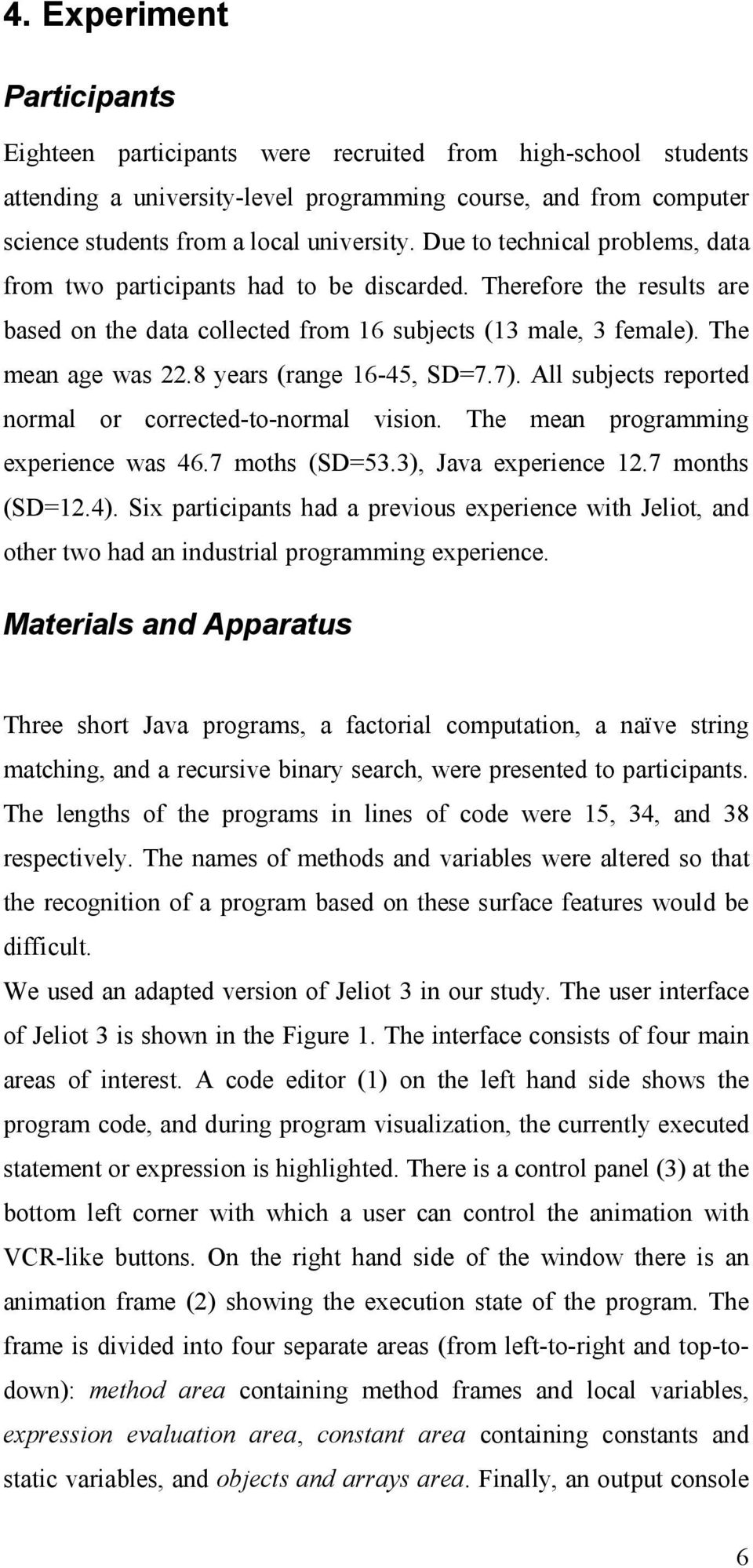
6 (4) at the bottom right corner of Jeliot s window shows the output of the executed program. The Jeliot 3 was modified to collect information about the user actions during the experiment. Furthermore, all the changes in the visualizations of the programs were recorded to be compared with the eye tracking data. That is, for the same timeslot we were able to compare the participant s focus of visual attention to the actual location of current change in animation. The specialized visualization views of Jeliot were disabled during the experiment. The remote Tobii ET-1750 (50Hz) eye-tracker was used to track participants eye movements; the interaction protocols (such as mouse clicks) were collected for all the target programs, and audio and video were recorded for a whole session. Fixations shorter than 100ms were disregarded from analysis. Procedure and Design The experiment was conducted in a quiet usability lab. Participants were seated in an ordinary office chair, near the experimenter, and facing a 17 FT display. Every participant then passed an automatic eye-tracking calibration. After the calibration, participants performed three sessions, each consisting of a comprehension phase using Jeliot 3 and a program summary writing phase. Participants were instructed to comprehend the program as well as possible and they could use Jeliot as they found it necessary. The duration of a session was not limited. The first program was factorial computation and it was used as a warmup and the resulting data were discarded. The order of the two actual comprehension tasks was randomized so that a half of the participants started with the naïve string matching and other half with recursive binary-search program. A pilot test discovered only minor problems in the experiment design. The stimulus window was set to a fixed size; additional views of the visualization were made unavailable. 7

7 5. Results and Discussion Fixation behaviour In terms of fixation count distribution and corresponding areas of highest interest, we could recognize two main areas of interest for our participants (Figure 2, for the string matching program). One area is located at the visualization frame, showing that most of participants paid attention to the expression evaluation. The second most fixated area was found at the source code. The centre of that area collocated with the most important part of the source code which could be linked to the central ideas of programs. The distribution of fixations and corresponding areas of high interest was similar for both of the programs in the experiment. Moreover, the fixation durations at these locations were the longest. Altogether, it is an important evidence of cognitive processing and information search during a task (Goldberg and Kotval, 1999), with the implications to the usability of Jeliot interface. The overall distribution of fixations was 57.1% code, 40.4% visualization, 0.1% output, and 2.3% control. The low number of fixations on the output area is explained by low production of output of the programs. When we decomposed the fixations onto the visualization area, in average 36% of these fixations were onto the method area, 43% onto the expression evaluation area, 17% to instances area, and 4% of fixations laid on the constant area. When taking into the consideration the positions where users fixate at most, it would be obvious to move expression evaluation area closer to source code area, since most of attention switches are between those two areas. When the areas are distant from each other, a usability problem appears: users have to exercise higher efforts to follow the animation. Our goal is, of course, to reduce the workload, and therefore allow users to spend more resources on learning. 8
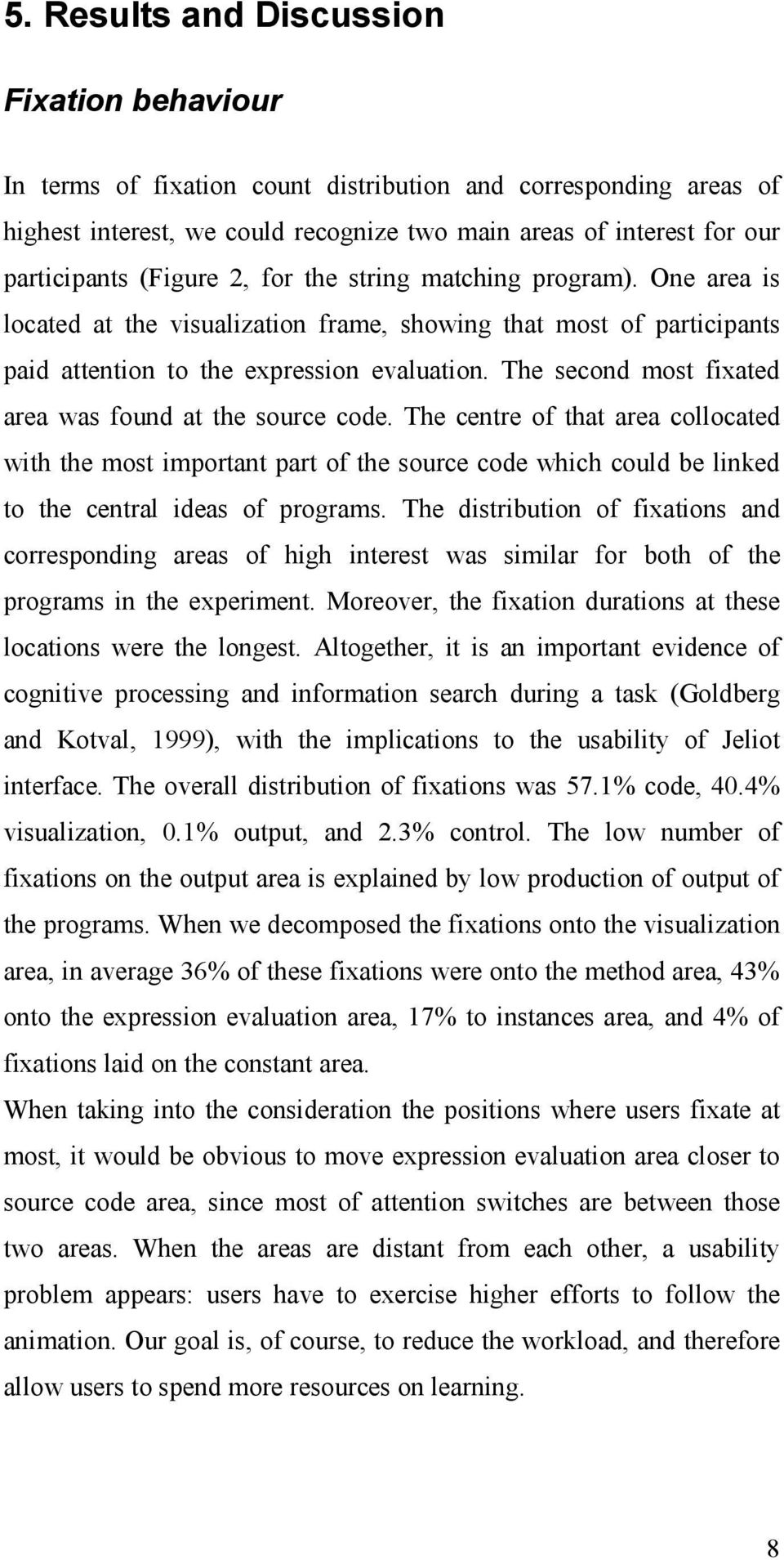
8 Together with the expression area and code area, control panel is in the group of most attended areas during animation. We propose control buttons to be moved closer to the code and expression areas. All the proposed changes could significantly reduce the distance of the fixations and possibly lead to less cognitive load which does not attribute for effective viewing of animation. Moreover, having the gaze available during the animation, it would be possible to employ it also as an interaction modality for controlling the course of animation. Figure 2: Visualization of the fixation distribution for string matching program. Switching behaviour We measured the number of switches per minute as an indication of dynamics of attention allocation. By a term switch, we mean any change of the visual attention focus between two areas of interest, code, visualization, output, and control. In average, participants performed (SD=9.3) attention switches per minute whereas Jeliot promoted (SD=25.42) switches per minute during the animation. We considered that Jeliot promoted a switch every time a part of the source code was highlighted after some animation had happened in the visualization area or vice versa. Figure 3 illustrates the attention switching behaviour in number of switches per minute between the main four areas of interest. 9

9 An apparent conclusion is that there should be fewer switches promoted by Jeliot between source code area and animation. Decreasing the amount of promoted switches is possible, but the problem is that at present we do not know which of the promoted switches are relevant to the user and which ones are not. However, if an eye tracker would be used as a real-time input device for Jeliot, it would be possible to infer which of the promoted switches were consumed and which were not. An adaptive engine of Jeliot could then stop promoting those switches that users did not consume if they are not considered important in order to fully comprehend the animated program. Figure 3. Switches per minute between the main areas of interest. Another explanation could be that because the users could control the speed of the animation, the high number of promoted switches was due to the fact that users played animation faster when they wanted to skip some part of the animation. This indicates that we should consider the possibility to skip over some parts of the animation easily. Again, based on the results related to the overall fixation distributions, we propose to use an eye-tracker in order to estimate the source code locations of highest importance and therefore to increase an awareness of the tool about the actual learning process. 6. Conclusion This study was conducted in order to discover potential usability problems with Jeliot 3, a program visualization tool. Sixteen subjects 10

10 with varying level of experience were interacting with the tool during comprehension of three Java programs. According to distribution of mostly attended areas of interest, namely a central part in the code and the expression evaluation frame, it could be concluded that these areas are located too far from each other. During a comprehension, a user makes a switch between these too areas. While these are in a distance, the switch takes longer than in a case the areas are more close to each other. Consequently, the cognitive efforts are spent more on switching (allocating the attention focus) rather than on comprehension itself. 11

11 References Bednarik, R., Myller, N., Sutinen, E., Tukiainen, M. Applying Eye- Movement Tracking to Program Visualization. Submitted, Goldberg Joseph H., Kotval Xerxes P (1999). Computer interface evaluation using eye movements: methods and constructs. International Journal of Industrial Ergonomics. Vol 24:

Video-Based Eye Tracking
 Video-Based Eye Tracking Our Experience with Advanced Stimuli Design for Eye Tracking Software A. RUFA, a G.L. MARIOTTINI, b D. PRATTICHIZZO, b D. ALESSANDRINI, b A. VICINO, b AND A. FEDERICO a a Department
Program Visualization for Programming Education Case of Jeliot 3
 Program Visualization for Programming Education Case of Jeliot 3 Roman Bednarik, Andrés Moreno, Niko Myller Department of Computer Science University of Joensuu [email protected] Abstract:
Eye Tracking on a Paper Survey: Implications for Design
 Eye Tracking on a Paper Survey: Implications for Design Lauren Walton 1, Jennifer Romano Bergstrom 2, David Charles Hawkins 2, Christine Pierce 1 1 The Nielsen Company, Tampa, Florida {lauren.walton, christine.pierce}@nielsen.com
METHODOLOGIES FOR STUDIES OF PROGRAM VISUALIZATION
 Full paper ABSTRACT METHODOLOGIES FOR STUDIES OF PROGRAM VISUALIZATION Niko Myller & Roman Bednarik Department of Computer Science University of Joensuu PO Box 111, FI-80101 [email protected]
PRODUCING AN EDUCATIONALLY EFFECTIVE AND USABLE TOOL FOR LEARNING, THE CASE OF JELIOT FAMILY
 PRODUCING AN EDUCATIONALLY EFFECTIVE AND USABLE TOOL FOR LEARNING, THE CASE OF JELIOT FAMILY Andrés Moreno and Niko Myller, University of Joensuu Introduction Jeliot Family is a group of program visualization
Guidelines for Using the Retrospective Think Aloud Protocol with Eye Tracking
 Guidelines for Using the Retrospective Think Aloud Protocol with Eye Tracking September, 2009 Short paper by Tobii Technology Not sure of how to design your eye tracking study? This document aims to provide
Improving Government Websites and Surveys With Usability Testing and User Experience Research
 Introduction Improving Government Websites and Surveys With Usability Testing and User Experience Research Jennifer Romano Bergstrom, Jonathan Strohl Fors Marsh Group 1010 N Glebe Rd., Suite 510, Arlington,
Keywords Banner Ad Position; Congruence; Advertising Objective; Banner Ad Fixation; Brand Awareness; Product Knowledge
 Impact of Banner Ad Position, Congruence of Banner Ad Content and Website Content, and Advertising Objective on Banner Ad Fixation, Brand Awareness, and Product Akekanat Saowwapak-adisak, Janjao Mongkolnavin
Looking at Eyes. Eye-Tracking Studies of Reading and Translation Processing. Edited by. Susanne Göpferich Arnt Lykke Jakobsen Inger M.
 Looking at Eyes Looking at Eyes Eye-Tracking Studies of Reading and Translation Processing Edited by Susanne Göpferich Arnt Lykke Jakobsen Inger M. Mees Copenhagen Studies in Language 36 Samfundslitteratur
Eye tracking in usability research: What users really see
 Printed in: Empowering Software Quality: How Can Usability Engineering Reach These Goals? Usability Symposium 2005: pp 141-152, OCG publication vol. 198. Eye tracking in usability research: What users
This tutorial assumes that Visual3D has been installed and that a model has been created as described in Tutorial #1.
 C-Motion Online Documentation Visual3D : Tutorial : Data Visualization Objectives (# 1318) This tutorial assumes that Visual3D has been installed and that a model has been created as described in Tutorial
RESEARCH ON SPOKEN LANGUAGE PROCESSING Progress Report No. 29 (2008) Indiana University
 RESEARCH ON SPOKEN LANGUAGE PROCESSING Progress Report No. 29 (2008) Indiana University A Software-Based System for Synchronizing and Preprocessing Eye Movement Data in Preparation for Analysis 1 Mohammad
Eye-tracking. Benjamin Noël
 Eye-tracking Benjamin Noël Basics Majority of all perceived stimuli through the eyes Only 10% through ears, skin, nose Eye-tracking measuring movements of the eyes Record eye movements to subsequently
Eye-Tracking Methodology and Applications in Consumer Research 1
 FE947 Eye-Tracking Methodology and Applications in Consumer Research 1 Hayk Khachatryan and Alicia L. Rihn 2 Introduction Eye-tracking analysis is a research tool used to measure visual attention. Visual
Tracking translation process: The impact of experience and training
 Tracking translation process: The impact of experience and training PINAR ARTAR Izmir University, Turkey Universitat Rovira i Virgili, Spain The translation process can be described through eye tracking.
USING EYE TRACKING TO EVALUATE ALTERNATIVE SEARCH RESULTS INTERFACES
 USING EYE TRACKING TO EVALUATE ALTERNATIVE SEARCH RESULTS INTERFACES Rachana S. Rele and Andrew T. Duchowski Clemson University Clemson, SC 29634 Surveys have shown that 75% of users get frustrated with
1 FTire/editor s Main Menu 1
 FTire/editor FTire Data File Editor and Analyzer Documentation and User s Guide Contents 1 FTire/editor s Main Menu 1 2 FTire/editor s Data Entry Menus 2 2.1 The Tire Size and Specification Data Menu........................
GAZETRACKERrM: SOFTWARE DESIGNED TO FACILITATE EYE MOVEMENT ANALYSIS
 GAZETRACKERrM: SOFTWARE DESIGNED TO FACILITATE EYE MOVEMENT ANALYSIS Chris kankford Dept. of Systems Engineering Olsson Hall, University of Virginia Charlottesville, VA 22903 804-296-3846 [email protected]
Towards Inferring Web Page Relevance An Eye-Tracking Study
 Towards Inferring Web Page Relevance An Eye-Tracking Study 1, [email protected] Yinglong Zhang 1, [email protected] 1 The University of Texas at Austin Abstract We present initial results from a project,
Learn How to Sail - A Nautical Experience, The Difference Between 1 and 2
 Evaluating sea experience with an eye mark recorder in a ship handling simulator O. Arslan 1, M. Furusho 2, S. Kum 1 1 Istanbul Technical University Maritime Faculty (ITUMF), Turkey 2 Kobe University,
CELL PHONE INDUCED PERCEPTUAL IMPAIRMENTS DURING SIMULATED DRIVING
 CELL PHONE INDUCED PERCEPTUAL IMPAIRMENTS DURING SIMULATED DRIVING David L. Strayer, Frank A. Drews, Robert W. Albert, and William A. Johnston Department of Psychology University of Utah Salt Lake City,
USABILITY TESTING OF DEPARTMENTAL WEB SITES: A CASE STUDY WITH AUTHENTIC USERS AND AUTHENTIC TASKS
 USABILITY TESTING OF DEPARTMENTAL WEB SITES: A CASE STUDY WITH AUTHENTIC USERS AND AUTHENTIC TASKS S. Güzin Mazman, Sedat Akbal, Hakan Tüzün, Mustafa Yeniad Hacettepe University, Department of Computer
Gaze cursor during distant collaborative programming: a preliminary analysis
 Gaze cursor during distant collaborative programming: a preliminary analysis Roman Bednarik 1,2 and Andrey Shipilov 1 1 School of Computing, University of Eastern Finland, Finland 2 School of Information
Designing eye tracking experiments to measure human behavior
 Designing eye tracking experiments to measure human behavior Eindhoven, The Netherlands August, 2010 Ricardo Matos Tobii Technology Steps involved in measuring behaviour 1. Formulate and initial question
Translog-II: A Program for Recording User Activity Data for Empirical Translation Process Research
 IJCLA VOL. 3, NO. 1, JAN-JUN 2012, PP. 153 162 RECEIVED 25/10/11 ACCEPTED 09/12/11 FINAL 25/06/12 Translog-II: A Program for Recording User Activity Data for Empirical Translation Process Research Copenhagen
Effects of Orientation Disparity Between Haptic and Graphic Displays of Objects in Virtual Environments
 Human Computer Interaction INTERACT 99 Angela Sasse and Chris Johnson (Editors) Published by IOS Press, c IFIP TC.13, 1999 1 Effects of Orientation Disparity Between Haptic and Graphic Displays of Objects
SUPERIOR EYE TRACKING TECHNOLOGY. Totally Free Head Motion Unmatched Accuracy State-Of-The-Art Analysis Software. www.eyegaze.com
 SUPERIOR EYE TRACKING TECHNOLOGY Totally Free Head Motion Unmatched Accuracy State-Of-The-Art Analysis Software www.eyegaze.com LC TECHNOLOGIES EYEGAZE EDGE SYSTEMS LC Technologies harnesses the power
Studying Human Face Recognition with the Gaze-Contingent Window Technique
 Studying Human Face Recognition with the Gaze-Contingent Window Technique Naing Naing Maw ([email protected]) University of Massachusetts at Boston, Department of Computer Science 100 Morrissey Boulevard,
Fixplot Instruction Manual. (data plotting program)
 Fixplot Instruction Manual (data plotting program) MANUAL VERSION2 2004 1 1. Introduction The Fixplot program is a component program of Eyenal that allows the user to plot eye position data collected with
Cheap and easy PIN entering using eye gaze
 Cheap and easy PIN entering using eye gaze Pawel Kasprowski, Katarzyna Harężlak Institute of Informatics Silesian University of Technology Gliwice, Poland {pawel.kasprowski,katarzyna.harezlak}@polsl.pl
Voice Driven Animation System
 Voice Driven Animation System Zhijin Wang Department of Computer Science University of British Columbia Abstract The goal of this term project is to develop a voice driven animation system that could take
How To Use Eye Tracking With A Dual Eye Tracking System In A Collaborative Collaborative Eye Tracking (Duet)
 Framework for colocated synchronous dual eye tracking Craig Hennessey Department of Electrical and Computer Engineering University of British Columbia Mirametrix Research [email protected] Abstract Dual
Subjects. Subjects were undergraduates at the University of California, Santa Barbara, with
 Category-specific visual attention 1 SI Appendix 1 Method Subjects. Subjects were undergraduates at the University of California, Santa Barbara, with normal or corrected-to-normal vision. Exp 1: n=30;
AN ERGONOMICS STUDY OF MENU-OPERATION ON MOBILE PHONE INTERFACE
 Workshop on Intelligent Information Technology Application AN ERGONOMICS STUDY OF MENU-OPERATION ON MOBILE PHONE INTERFACE XUE-MIN ZHANG,WEN SHAN,QIN XU,BIN YANG,YUN-FENG ZHANG Beijing Normal University,
WR305, Writing for the Web Usability Test Documents
 WR305, Writing for the Web Usability Test Documents Introduction This documents contains the portfolio usability test informed consent form, participant demographic questionnaire, protocols, and surveys
The service note describes the basic steps to install a ip camera for the DVR670
 Tech note Description Adding IP camera to DVR670 General The service note describes the basic steps to install a ip camera for the DVR670 Steps involved: 1) Configuration Manager application 2) Camera
What a Novice Wants: Students Using Program Visualization in Distance Programming Course
 Third Program Visualization Workshop 1 What a Novice Wants: Students Using Program Visualization in Distance Programming Course Osku Kannusmäki, Andrés Moreno, Niko Myller, and Erkki Sutinen Department
The impact of syntax colouring on program comprehension
 The impact of syntax colouring on program comprehension Advait Sarkar Computer Laboratory, University of Cambridge Cambridge, UK [email protected] Abstract. We present an empirical study investigating
A Guided User Experience Using Subtle Gaze Direction
 A Guided User Experience Using Subtle Gaze Direction Eli Ben-Joseph and Eric Greenstein Stanford University {ebj, ecgreens}@stanford.edu 1 Abstract This paper demonstrates how illumination modulation can
GSPIM: Graphical Visualization Tool for MIPS Assembly
 GSPIM: Graphical Visualization Tool for MIPS Assembly Programming and Simulation Patrick Borunda Science University of Arizona [email protected] Chris Brewer Science University of Arizona [email protected]
Computing Concepts with Java Essentials
 2008 AGI-Information Management Consultants May be used for personal purporses only or by libraries associated to dandelon.com network. Computing Concepts with Java Essentials 3rd Edition Cay Horstmann
Adaptive information source selection during hypothesis testing
 Adaptive information source selection during hypothesis testing Andrew T. Hendrickson ([email protected]) Amy F. Perfors ([email protected]) Daniel J. Navarro ([email protected])
Manual Analysis Software AFD 1201
 AFD 1200 - AcoustiTube Manual Analysis Software AFD 1201 Measurement of Transmission loss acc. to Song and Bolton 1 Table of Contents Introduction - Analysis Software AFD 1201... 3 AFD 1200 - AcoustiTube
Tobii Technology AB. Accuracy and precision Test report. X2-60 fw 1.0.5. Date: 2013-08-16 Methodology/Software version: 2.1.7
 Tobii Technology AB Accuracy and precision Test report X2-60 fw 1.0.5 Date: 2013-08-16 Methodology/Software version: 2.1.7 1. Introduction This document provides an overview of tests in terms of accuracy
Lecture 2, Human cognition
 Human Cognition An important foundation for the design of interfaces is a basic theory of human cognition The information processing paradigm (in its most simple form). Human Information Processing The
CARS Configurable Automotive Research Simulator
 CARS Configurable Automotive Research Simulator Dagmar Kern, Marco Müller, Stefan Schneegaß, Lukasz Wolejko-Wolejszo, Albrecht Schmidt Pervasive Computing University of Duisburg-Essen Schützenbahn 70 45117
Instructions for Creating Silly Survey Database
 Instructions for Creating Silly Survey Database Create a New Database 1. Find the shortcut or the file that starts MS Access and click it to activate the program. 2. In the Create a New Database Using
Compute Cluster Server Lab 3: Debugging the parallel MPI programs in Microsoft Visual Studio 2005
 Compute Cluster Server Lab 3: Debugging the parallel MPI programs in Microsoft Visual Studio 2005 Compute Cluster Server Lab 3: Debugging the parallel MPI programs in Microsoft Visual Studio 2005... 1
AVERSIVE STIMULATION WITH VIDEO MONITORING
 AVERSIVE STIMULATION WITH VIDEO MONITORING USERS MANUAL SOF-732-4 User s Manual DOC-155 Rev. 1.0 Copyright 2007 All Rights Reserved MED Associates, Inc. P.O. Box 319 St. Albans, Vermont 05478 www.med-associates.com
Editors Comparison (NetBeans IDE, Eclipse, IntelliJ IDEA)
 České vysoké učení technické v Praze Fakulta elektrotechnická Návrh Uživatelského Rozhraní X36NUR Editors Comparison (NetBeans IDE, Eclipse, ) May 5, 2008 Goal and purpose of test Purpose of this test
QUICK START GUIDE. Cloud based Web Load, Stress and Functional Testing
 QUICK START GUIDE Cloud based Web Load, Stress and Functional Testing Performance testing for the Web is vital for ensuring commercial success. JAR:Load is a Web Load Testing Solution delivered from the
A tool to facilitate interactive and collaborative learning of execution flow and code for novice computer science students
 Institution of Innovation, Design and Engineering A tool to facilitate interactive and collaborative learning of execution flow and code for novice computer science students Author: Robert Westerlund Examiner:
Lifting the Hood of the Computer: * Program Animation with the Teaching Machine
 Lifting the Hood of the Computer: * Program Animation with the Teaching Machine Michael P. Bruce-Lockhart and Theodore S. Norvell Electrical and Computer Engineering Faculty of Engineering and Applied
Voluntary Product Accessibility Template Blackboard Learn Release 9.1 April 2014 (Published April 30, 2014)
 Voluntary Product Accessibility Template Blackboard Learn Release 9.1 April 2014 (Published April 30, 2014) Contents: Introduction Key Improvements VPAT Section 1194.21: Software Applications and Operating
EFFECTS OF AUDITORY FEEDBACK ON MULTITAP TEXT INPUT USING STANDARD TELEPHONE KEYPAD
 EFFECTS OF AUDITORY FEEDBACK ON MULTITAP TEXT INPUT USING STANDARD TELEPHONE KEYPAD Sami Ronkainen Nokia Mobile Phones User Centric Technologies Laboratory P.O.Box 50, FIN-90571 Oulu, Finland [email protected]
TRIMBLE ATS TOTAL STATION ADVANCED TRACKING SYSTEMS FOR HIGH-PRECISION CONSTRUCTION APPLICATIONS
 TRIMBLE ATS TOTAL STATION ADVANCED TRACKING SYSTEMS FOR HIGH-PRECISION CONSTRUCTION APPLICATIONS BY MARTIN WAGENER APPLICATIONS ENGINEER, TRIMBLE EUROPE OVERVIEW Today s construction industry demands more
Location-Aware Mobile Eye-Tracking for the Explanation of Wayfinding Behavior
 Location-Aware Mobile Eye-Tracking for the Explanation of Wayfinding Behavior Peter Kiefer Florian Straub Martin Raubal Institute of Cartography and Geoinformation ETH Zürich Wolfgang-Pauli-Str. 15, 8093
OPERATION MANUAL. MV-410RGB Layout Editor. Version 2.1- higher
 OPERATION MANUAL MV-410RGB Layout Editor Version 2.1- higher Table of Contents 1. Setup... 1 1-1. Overview... 1 1-2. System Requirements... 1 1-3. Operation Flow... 1 1-4. Installing MV-410RGB Layout
DRAWING ON KNOWLEDGE: AN EXPERIMENTAL COMPARISON OF A 'TALKING HEAD' AND ANIMATION-BASED VIDEO. Professor Richard Wiseman
 DRAWING ON KNOWLEDGE: AN EXPERIMENTAL COMPARISON OF A 'TALKING HEAD' AND ANIMATION-BASED VIDEO Professor Richard Wiseman Psychology Department University of Hertfordshire 1 DESIGN AND MATERIALS RESULTS
Different Users and Intents: An Eye-tracking Analysis of Web Search
 Different Users and Intents: An Eye-tracking Analysis of Web Search ABSTRACT Cristina González-Caro Pompeu Fabra University Roc Boronat 138 Barcelona, Spain [email protected] We present an eye-tracking
Integrated Intelligent Video Surveillance Management System. User's Manual V2.0
 Integrated Intelligent Video Surveillance Management System User's Manual V2.0 1 Contents 1. Product Description... 4 1.1. General Information... 4 1.2. System Topology... 5 1.3. Operating Environment...
DUKANE Intelligent Assembly Solutions
 PC Configuration Requirements: Configuration Requirements for ipc Operation The hardware and operating system of the PC must comply with a list of minimum requirements for proper operation with the ipc
Application Note: Failover with Double- Take Availability and the Scale HC3 Cluster. Version 2.0
 Application Note: Failover with Double- Take Availability and the Scale HC3 Cluster Version 2.0 Table of Contents Introduction... 2 About Double-Take Availability... 2 About Scale Computing s HC3 Cluster...

ImagineWorldClient Client Management Software. User s Manual. (Revision-2)
 ImagineWorldClient Client Management Software User s Manual (Revision-2) (888) 379-2666 US Toll Free (905) 336-9665 Phone (905) 336-9662 Fax www.videotransmitters.com 1 Contents 1. CMS SOFTWARE FEATURES...4
PRIMING OF POP-OUT AND CONSCIOUS PERCEPTION
 PRIMING OF POP-OUT AND CONSCIOUS PERCEPTION Peremen Ziv and Lamy Dominique Department of Psychology, Tel-Aviv University [email protected] [email protected] Abstract Research has demonstrated
Picture Memory Improves with Longer On Time and Off Time
 Journal ol Experimental Psychology: Human Learning and Memory 197S, Vol. 104, No. 2, 114-118 Picture Memory mproves with Longer On Time and Off Time Barbara Tversky and Tracy Sherman The Hebrew University
CS 4620 Practicum Programming Assignment 6 Animation
 CS 4620 Practicum Programming Assignment 6 Animation out: Friday 14th November 2014 due: : Monday 24th November 2014 1 Introduction In this assignment, we will explore a common topic in animation: key
Select Correct USB Driver
 Select Correct USB Driver Windows often installs updated drivers automatically, and defaults to this latest version. Not all of these drivers are compatible with our software. If you are experiencing communications
Thomas Jefferson High School for Science and Technology Program of Studies Foundations of Computer Science. Unit of Study / Textbook Correlation
 Thomas Jefferson High School for Science and Technology Program of Studies Foundations of Computer Science updated 03/08/2012 Unit 1: JKarel 8 weeks http://www.fcps.edu/is/pos/documents/hs/compsci.htm
Excel Companion. (Profit Embedded PHD) User's Guide
 Excel Companion (Profit Embedded PHD) User's Guide Excel Companion (Profit Embedded PHD) User's Guide Copyright, Notices, and Trademarks Copyright, Notices, and Trademarks Honeywell Inc. 1998 2001. All
Eye-contact in Multipoint Videoconferencing
 Eye-contact in Multipoint Videoconferencing Birgit Quante and Lothar Mühlbach Heinrich-Hertz-Institut für Nachrichtentechnik Berlin GmbH (HHI) Einsteinufer 37, D-15087 Berlin, Germany, http://www.hhi.de/
Bachelor of Games and Virtual Worlds (Programming) Subject and Course Summaries
 First Semester Development 1A On completion of this subject students will be able to apply basic programming and problem solving skills in a 3 rd generation object-oriented programming language (such as
Author: Hamid A.E. Al-Jameel (Research Institute: Engineering Research Centre)
 SPARC 2010 Evaluation of Car-following Models Using Field Data Author: Hamid A.E. Al-Jameel (Research Institute: Engineering Research Centre) Abstract Traffic congestion problems have been recognised as
Before you can use the Duke Ambient environment to start working on your projects or
 Using Ambient by Duke Curious 2004 preparing the environment Before you can use the Duke Ambient environment to start working on your projects or labs, you need to make sure that all configuration settings
Video, film, and animation are all moving images that are recorded onto videotape,
 See also Data Display (Part 3) Document Design (Part 3) Instructions (Part 2) Specifications (Part 2) Visual Communication (Part 3) Video and Animation Video, film, and animation are all moving images
VISUALIZATION OF GEOSPATIAL METADATA FOR SELECTING GEOGRAPHIC DATASETS
 Helsinki University of Technology Publications in Cartography and Geoinformatics Teknillisen korkeakoulun kartografian ja geoinformatiikan julkaisuja Espoo 2005 TKK-ICG-6 VISUALIZATION OF GEOSPATIAL METADATA
15.4 Predictive Models
 521 15.4 redictive Models Similar to inspection methods and analytics, predictive models evaluate a system without users being present. Rather than involving expert evaluators role-playing users as in