
Occupational Therapy And Physical Therapy In Louisiana Schools
|
|
|
- Shannon Wiggins
- 10 years ago
- Views:
Transcription
1 Occupational Therapy And Physical Therapy In Louisiana Schools Reference Handbook For Special Education Administrators And Therapists Revised 2015

2 LOUISIANA DEPARTMENT OF EDUCATION State Board of Elementary and Secondary Education Mr. Charles E. Roemer President 6 th BESE District Mr. Jay Guillot 5th BESE District Mr. James D. Garvey, Jr. Vice President 1st BESE District Ms. Carolyn Hill 8th BESE District Ms. Holly Boffy Secretary/Treasurer 7th BESE District Ms. Jane Smith Member-at-Large Ms. Kira Orange Jones 2nd BESE District Dr. Judy Miranti Member-at-Large Dr. Lottie P. Beebe 3rd BESE District Ms. Connie Bradford Member-at-Large Mr. Walter Lee 4th BESE District For further information, contact: Healthy Communities Ms. Heather Cope Executive Director The mission of the Louisiana Department of Education (LDOE) is to ensure equal access to education and to promote equal excellence throughout the state. The LDOE is committed to providing Equal Employment Opportunities and is committed to ensuring that all of its programs and facilities are accessible to all members of the public. The LDOE does not discriminate on the basis of age, color, disability, national origin, race, religion, sex, or genetic information. Inquiries concerning the LDOE s compliance with Title IX and other civil rights laws may be directed to the Attorney, LDOE, Office of the General Counsel, P.O. Box 94064, Baton Rouge, LA ; or [email protected]. Information about the federal civil rights laws that apply to the LDOE and other educational institutions is available on the website for the Office of Civil Rights, USDOE, at
3 TABLE OF CONTENTS Section I: Introduction Introduction...1 General Information for Therapists...2 Federal Statutes and Regulations...2 State Statutes and Regulations...2 Local Policies...3 Definition of Physical Therapy...4 Educational Background of the Physical Therapist...4 Definition of Occupational Therapy...5 Educational Background of the Occupational Therapist...5 Physical Therapist Assistants...5 Certified Occupational Therapy Assistants...6 Credentialing...6 Ancillary Certification...7 Standards of Practice...7 Section II: Procedures Therapists as Members of Pupil Appraisal...9 Indicators for Inclusion of Therapy in Pupil Appraisal...9 Purposes of Occupational and Physical Therapy Assessment...11 Evaluation Methods...11 Therapy Component of the Written Multidisciplinary Evaluation...11 Therapy Assessment for Re-evaluation or Additional Concerns...13 Assessment Areas in Occupational Therapy...14

4 Assessment Areas in Physical Therapy...15 About the Criteria of Eligibility...16 Occupational Therapy Criteria...17 Physical Therapy Criteria...19 Therapists Participation in IEP Process...21 Service Delivery...24 Treatment Areas in Occupational Therapy...25 Treatment Areas in Physical Therapy...26 Continuation or Termination of Therapy Services...27 Due Process...28 Record Keeping...28 Section III: Administration Qualifications for School-Based Therapists...30 Medical Referral...32 Legal considerations Concerning Therapists...32 Employment Arrangements, Budgeting and Funding for Therapy Services...33 Factors Determining Therapist Caseload...35 Equipment and Space...37 Orientation of Therapists to the LEA...37 Internal Monitoring...39 Internal Evaluation...39 Performance Evaluation...39 Medicaid Cost Recovery...40

5 Section IV: References References...42 Section V. Appendices Bibliography of Testing and Assessment Materials A Selected Therapy Bibliography.. B Therapy Resources... C Sample Medical Referral Forms... D Acknowledgments
6 SECTION I INTRODUCTION

7 Introduction Public Law , the Individuals With Disabilities Education Act, and R. S. 17:1941 et seq. insure for all children with disabilities free and appropriate public education, which includes special education and related services designed to meet their unique needs. As a result of the Federal and State legislation, the related services of occupational therapy and physical therapy were integrated into the educational environment in Louisiana s public schools as early as The Reference Handbook for Occupational Therapy and Physical Therapy in Louisiana Schools is designed to provide special education administrators and therapists with guidance in serving children with disabilities and their families within the educational environment. In the delivery of occupational therapy and physical therapy services, systems and therapists must be cognizant that these school-based services are not intended to replace the primary therapy students receive in medical and rehabilitation settings. Therapy is provided by the school system only when the student needs the service to benefit from special education. The direct supportive relationship of the child's therapy needs and education must be clearly evident within the context of the pupil appraisal integrated report and the individual education plan (IEP). Throughout this handbook, the term school-based therapist refers to occupational therapists and physical therapists working in the educational environment. If a subject refers solely to occupational therapists or physical therapists, it will be specifically stated. 1

8 General Information for Therapists School-based therapists should have an understanding of the legal and legislative foundations for therapeutic services in the educational setting. These settings may include early intervention, preschool, and elementary through high school. In Louisiana specific rules and regulations have been adopted with respect to services provided by therapists in the educational setting. The following information provides a general overview of Federal and State laws and regulations that govern related services. Federal Statutes and Regulations The laws referring to special educational and related services are designated as federal statutes. Statutes are passed by Congress and signed by the president into law. Statutes are divided into subparts, each subpart having one or more sections. IDEA (Individuals with Disabilities Education Act) is the federal law that defines the special education and related service requirements for students with disabilities. Part B is the component written for students ages Part C is the component written for early intervention services. Section 504 of the Rehabilitation Act of 1973, PL prohibits discrimination based on a disability. Section 504 defines disability as (i) physical or mental impairment that substantially limits one or more major life activity; (ii) has a record of such impairment; (iii) is regarded as having such impairment. If a student with a disability as defined in Section 504 does not qualify for special instruction under IDEA, appropriate therapeutic accommodations and modifications can be developed as part of the Section 504 plan. It is within the scope of occupational and physical therapy practice to provide guidance in establishing this plan and unless the therapist is funded 100% through IDEA, therapeutic intervention services can also be provided under a Section 504 plan. Because both laws apply to schools, people sometimes mistakenly assume that, with IDEA, the Rehabilitation Act is redundant. Actually, IDEA applies only to subcategory of students who have disabilities those who satisfy its definition for "child with a disability". Many students with disabilities do not meet the definition under IDEA but do meet the definition and are protected by Section 504. Schools comply with Section 504 by identifying and evaluating students, and if eligible, creating a written accommodation plan. Federal regulations are the rules written by the to help states implement the laws. The regulations provide interpretations and outline specific policies and procedures. State Statutes and Regulations The Louisiana law addressing special education and related services is R.S. 17:1941 et seq. The state statute was amended in 1990 to included services for infants and toddlers and again in 1998 to bring it more in line with the newly re-authorized IDEA. Louisiana s regulations are based on the Federal law and regulations. In Louisiana, occupational therapy or physical therapy services provided through early intervention are categorically defined as direct services. Therapeutic services provided school age students (3-21) are defined as related services. 2

9 Local Policies and Procedures Local education agencies (LEAs) are required to provide assurances that the preschool, elementary, and secondary programs operated by the school board are in compliance with State regulations and any applicable Federal regulations. LEAs must identify, locate, and evaluate each student suspected to have disabilities, birth through 21 years of age, residing within its jurisdiction. LEAs must also provide or cause to be provided, a free appropriate public education which meets State Board of Elementary and Secondary Education (SBESE) standards, including State regulations and all applicable bulletins approved by the State Board. 3

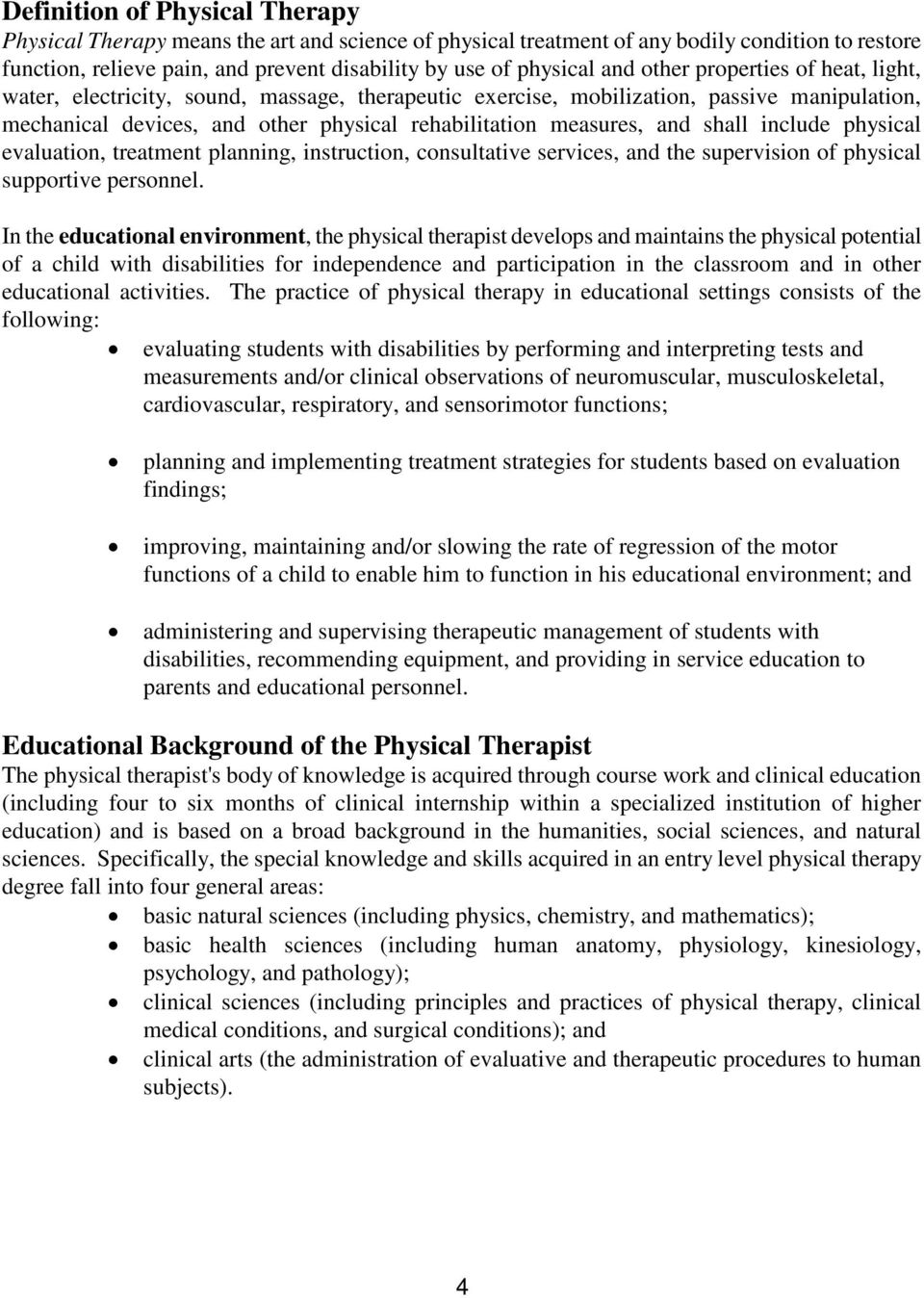
10 Definition of Physical Therapy Physical Therapy means the art and science of physical treatment of any bodily condition to restore function, relieve pain, and prevent disability by use of physical and other properties of heat, light, water, electricity, sound, massage, therapeutic exercise, mobilization, passive manipulation, mechanical devices, and other physical rehabilitation measures, and shall include physical evaluation, treatment planning, instruction, consultative services, and the supervision of physical supportive personnel. In the educational environment, the physical therapist develops and maintains the physical potential of a child with disabilities for independence and participation in the classroom and in other educational activities. The practice of physical therapy in educational settings consists of the following: evaluating students with disabilities by performing and interpreting tests and measurements and/or clinical observations of neuromuscular, musculoskeletal, cardiovascular, respiratory, and sensorimotor functions; planning and implementing treatment strategies for students based on evaluation findings; improving, maintaining and/or slowing the rate of regression of the motor functions of a child to enable him to function in his educational environment; and administering and supervising therapeutic management of students with disabilities, recommending equipment, and providing in service education to parents and educational personnel. Educational Background of the Physical Therapist The physical therapist's body of knowledge is acquired through course work and clinical education (including four to six months of clinical internship within a specialized institution of higher education) and is based on a broad background in the humanities, social sciences, and natural sciences. Specifically, the special knowledge and skills acquired in an entry level physical therapy degree fall into four general areas: basic natural sciences (including physics, chemistry, and mathematics); basic health sciences (including human anatomy, physiology, kinesiology, psychology, and pathology); clinical sciences (including principles and practices of physical therapy, clinical medical conditions, and surgical conditions); and clinical arts (the administration of evaluative and therapeutic procedures to human subjects). 4
11 Definition of Occupational Therapy Occupational therapy means the therapeutic use of everyday life activities (occupations) with individuals or groups for the purpose of participation in roles and situations in home, school, workplace, community and other settings. Occupational therapy services are provided for the purposes of promoting health and wellness and to those who have or area at risk for developing an illness, injury, disease, disorder, condition, impairment, disability, activity limitation or participation restriction. Occupational therapy addresses the physical, cognitive, psychosocial, sensory and other aspects of performance in a variety of contexts to support engagement in everyday life activities that affect health, well-being, and quality of life. In the educational setting, the occupational therapist uses purposeful goal-directed activities and adapted techniques and equipment to improve the child's ability to participate effectively. The practice of Occupational Therapy in the educational setting consists of the following: evaluating students with disabilities by performing and interpreting tests and measurements and/or clinical observations of neurophysiological, musculoskeletal, sensorimotor functions and daily living skills; planning and implementing treatment strategies for students based on evaluation findings; improving, developing, restoring or maintaining functions impaired or lost through illness, injury, or deprivation; improving or maintaining the ability to perform tasks for independent functioning when functions are impaired or lost; and administering and supervising therapeutic management of student with disabilities, recommending equipment, and providing training to parents and educational personnel. Educational Background of the Occupational Therapist The occupational therapist's body of knowledge is acquired through a combination of course work and fieldwork (minimum of six months of practice) based on a broad background of liberal arts, sciences, and humanities. The entry-level occupational therapy degree requirements are in the following areas: biological, behavioral, and health sciences including anatomy, kinesiology, physiology, neuroanatomy, and neurophysiology, human development, and human behavior; occupational therapy theory and practice including human performance and activity processes; and application of occupational therapy theory to practice, including assessment and interpretation, directing planning and implementing intervention, program termination, documentation, and research. Physical Therapist Assistants Physical therapist assistants (PTA) are individuals who have graduated a program accredited by the Commission on Accreditation in Physical Therapy Education (CAPTE). Like Physical Therapists, they sit for a national licensure and maintain a license within the state where they practice. PTAs 5

12 assist in the practice of physical therapy in accordance with the provisions of the Physical Therapy Practice Act and work under the supervision of a physical therapist by performing such patientrelated activities assigned by a physical therapist that are commensurate with the physical therapist assistant s education and training. A physical therapist assistant s work shall not include the interpretation and implementation of referrals or prescription, the performance of evaluations, or the determination or major modification of treatment programs. Certified Occupational Therapy Assistants Occupational therapy assistants (LCOTA) are individuals who have graduated from an accredited school of occupational therapy assisting, who are certified by the American Occupational Therapy Association, Inc. (AOTA), and who are licensed to assist in the practice of occupational therapy under the supervision of a licensed occupational therapist. In the educational setting, the occupational therapy assistant's role is in intervention; and therefore, he/she works only under the supervision of the professional occupational therapist at all critical points in the program. Any OT supervising a COTA must have performed and documented a service competency of the COTA. The OT must have previously evaluated and/or treated any student being seen by a COTA he or she is supervising. The determination of the actual number of supervision hours per week necessary is based on the professional and ethical judgment of the LOT who assumes the responsibility of the actions of the supervisee, taking into consideration the following regarding the individual being supervised: 1) experience, 2) continuing education, 3) population served, 4) requirements of the facility s accrediting agency, and 5) service competency of the individual being supervised. Credentialing Licensure All occupational therapists, and certified occupational therapy assistants practicing in Louisiana must meet the requirements of their licensure board and be re-licensed yearly in Louisiana. Physical therapists and physical therapist assistants are re-licensed for a two year period by their state board. Administrators may obtain further information about licensure or confirm the licensure of any therapist by contacting the following: Louisiana State Board of Medical Examiners P.O. Box New Orleans, Louisiana Louisiana Physical Therapy Board 104 Fairlane Drive Lafayette, Louisiana

13 Ancillary Certification Occupational therapists and physical therapists employed or contracted to provide therapeutic intervention in any school system in Louisiana should apply for and receive an ancillary certificate from the Louisiana Department of Education. This certificate must be renewed every five years. For information about this certification, go to Standards of Practice The Standards of Practice for Occupational Therapy were revised in 2010 by the AOTA Representative Assembly. These standards are intended as recommended guidelines to assist occupational therapy practitioners in the provision of occupational therapy services. These standards serve as a minimum standard for occupational therapy practice and are applicable to all individual populations and the programs in which these individuals are served. In the state of Louisiana, the law governing the licensing and practice of occupational therapists and occupational therapy assistants is contained in Chapter 46 of the Revised Statutes. Specific information can be found at The Standards of Practice for Physical Therapy were amended in 2013 by the House of Delegates and Board of Directors of the American Physical Therapy Association. These standards are the profession s statement of conditions and performances that are essential for provision of high-quality professional service to society, and they provide a foundation for assessment of physical therapist practice. Additionally, physical therapists and physical therapist assistants in Louisiana are governed by the Louisiana Physical Therapy Practice Act. 7

14 SECTION II PROCEDURES

15 Therapists as Members of Pupil Appraisal Pupil appraisal services comprise an integral part of the total instructional program of the LEA. The purpose of pupil appraisal services is to assist students who have academic, behavioral, and/or communication challenges, adjustment difficulties, or other special needs which are adversely impacting the student s educational performance by providing services to students, parents, teachers, and other school personnel. The Response to Intervention (RTI) process is a three-tiered approach to providing services and interventions to struggling learners and/or students with challenging behaviors at increasing levels of intensity. RTI is designed for use when making decisions in both general and special education, creating a well-integrated system of instruction and intervention guided by student outcome data. The School Building Level Committee is a general education, data driven, decision-making committee who have responsibility for reviewing and analyzing all screening data, including RTI results, to determine the most beneficial option for the student. The Committee has several options including; continue additional interventions through the RTI process, refer for support services, or refer for an evaluation if an exceptionality is suspected. Pupil Appraisal personnel (including therapists) are not limited to providing services solely to students referred for an individual evaluation. Many students experiencing academic, behavior and/or communication difficulties may be helped through recommendations made by pupil appraisal personnel for use in the general education classroom, enabling the student to benefit from instruction in the general curriculum and eliminating the need for referral for an individual evaluation. Through the RTI process the school building level committee shall coordinate and document results of all screening activities including hearing, vision, sensory processing, health, speech and language, motor, assistive technology, social/emotional/behavior and educational. The screening of a student by a therapist to determine appropriate instructional strategies for curriculum implementation shall not be considered to be an evaluation eligibility for therapeutic services. Professional members of a pupil appraisal staff include but are not limited to educational diagnosticians, school social workers, school nurses, adapted physical education specialists, school psychologists, speech/hearing/language specialists, audiologists, occupational therapists, and physical therapists. Among other professionals who may be involved are physicians and educational consultants. Indicators for Inclusion of Therapy in Pupil Appraisal The following are some of the indications for inclusion of an occupational and/or physical therapist in the multidisciplinary evaluation by Pupil Appraisal, when necessary for a full and accurate assessment of a child's strengths and weaknesses and to determine eligibility for services. The decision to include a physical therapist and/or occupational therapist is made by the evaluation coordinator, who reviews all screening and other assessment information on the nature and severity of the child's problems. The educational impact of these concerns must be documented in the 9

16 written report. Listed below are examples of such required documentation. Motor and/or perceptual difficulties interfere with the student s performance on standardized and/or perceptual intellectual assessments and educational evaluations. Suspected gross and/or fine motor deficits significantly interfere with the student s functioning in the educational environment. Significant perceptual motor or sensorimotor deficits interfere with the student s educational performance The use of a wheelchair, braces, crutches, prosthetics, or other specially adapted equipment is necessary for the student to function in the educational setting.. Degenerative medical condition requires maintenance of mobility and stamina in order for the student to participate in educational activities. Difficulty in performing self-help tasks such as feeding, toileting, and dressing are present. Difficulty with physical endurance for regular school activities requires cardiovascular and respiratory intervention for the student. 10

17 Purposes of Occupational and Physical Therapy Assessment The purposes of an occupational or physical therapy assessment include determining the abilities and impairment in physical performances and functional skills; extent the impairment affects educational performance; developmental levels in gross motor, fine motor, sensorimotor skills, and self care; strengths and weaknesses in the areas assessed; and student s need for occupational therapy or physical therapy service in order to benefit from special education. Evaluation Methods An occupational therapy or a physical therapy evaluation may include any or all of the following methods: standardized tests (supported by how the results of specific test scores are affecting the child s ability to function in the educational environment); formalized non-standardized assessment; informal evaluation including observation in the classroom, lunchroom, and playground; review of pertinent medical, education, psychological, and speech records; interview(s) with student, parent, and/or teacher(s). Frequently used evaluation tools are listed in Appendix A. The therapist selects the assessment procedures appropriate for each individual child. The following factors are involved in the selection of assessment methods: chronological age, educational functioning, attention to task, and medical condition and contraindications. Therapy Component of the Written Multidisciplinary Evaluation The final written report is a compilation of the data gathered during the individual evaluation. The data collected by all Pupil Appraisal Personnel must be integrated and written in language that is clear to the individuals who will use it. To maintain clear communication, the therapist should omit abbreviations. The therapist's written report should include diagnosis and relevant information; environmental factors, if relevant; test behavior; evaluation results, including a description of the standardized and normative assessments used; scores obtained and the analysis of the results; informal methods used and the analysis of the results; and a description of functional skills 11

18 adaptive equipment or assistive devices; interpretation of results in strengths and needs as they relate to educational functioning; application of eligibility criteria; explanation of educational relevance in terms of these questions: How does this problem interfere with the student s ability to benefit from his/her educational program? Is there a likely potential for a change in the student s educational functioning if he/she receives therapeutic intervention? recommendations on the need for therapy services and any specific recommendations to teachers and parents The following statement shall be included in the integrated summary: "Based on this evaluation, (student) appears/does not appear to demonstrate or exhibit a need for intervention in the area of (therapy) to benefit from his/her special education program.". No reference to levels, frequency or duration of services should be cited in the evaluation report. 12

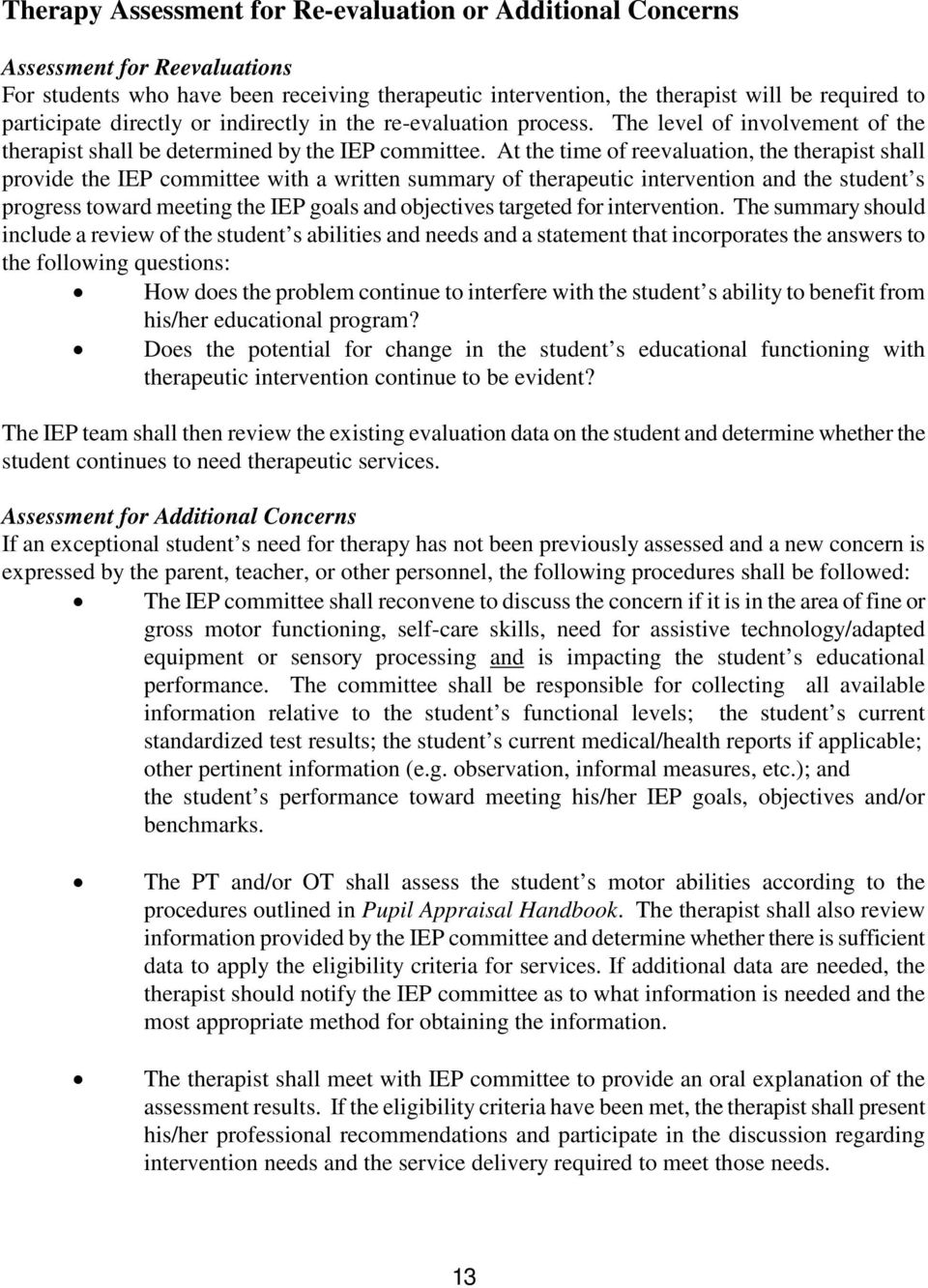
19 Therapy Assessment for Re-evaluation or Additional Concerns Assessment for Reevaluations For students who have been receiving therapeutic intervention, the therapist will be required to participate directly or indirectly in the re-evaluation process. The level of involvement of the therapist shall be determined by the IEP committee. At the time of reevaluation, the therapist shall provide the IEP committee with a written summary of therapeutic intervention and the student s progress toward meeting the IEP goals and objectives targeted for intervention. The summary should include a review of the student s abilities and needs and a statement that incorporates the answers to the following questions: How does the problem continue to interfere with the student s ability to benefit from his/her educational program? Does the potential for change in the student s educational functioning with therapeutic intervention continue to be evident? The IEP team shall then review the existing evaluation data on the student and determine whether the student continues to need therapeutic services. Assessment for Additional Concerns If an exceptional student s need for therapy has not been previously assessed and a new concern is expressed by the parent, teacher, or other personnel, the following procedures shall be followed: The IEP committee shall reconvene to discuss the concern if it is in the area of fine or gross motor functioning, self-care skills, need for assistive technology/adapted equipment or sensory processing and is impacting the student s educational performance. The committee shall be responsible for collecting all available information relative to the student s functional levels; the student s current standardized test results; the student s current medical/health reports if applicable; other pertinent information (e.g. observation, informal measures, etc.); and the student s performance toward meeting his/her IEP goals, objectives and/or benchmarks. The PT and/or OT shall assess the student s motor abilities according to the procedures outlined in Pupil Appraisal Handbook. The therapist shall also review information provided by the IEP committee and determine whether there is sufficient data to apply the eligibility criteria for services. If additional data are needed, the therapist should notify the IEP committee as to what information is needed and the most appropriate method for obtaining the information. The therapist shall meet with IEP committee to provide an oral explanation of the assessment results. If the eligibility criteria have been met, the therapist shall present his/her professional recommendations and participate in the discussion regarding intervention needs and the service delivery required to meet those needs. 13
20 Assessment Areas in Occupational Therapy Developmental level * Fine Motor * Gross motor (when necessary) * Self-Care Motor function * Muscle tone * Strength and endurance * Joint range of motion * Hand preference * Functional grasp and release of objects * Functional manipulation of objects (e.g. writing devices, scissors) * Coordination and motor planning * Balance/postural control * Visual tracking/ability to copy written materials Sensorimotor Skills * Ability to process sensory information (internal/external) * Awareness and responsiveness to sensory input (defensive/avoiding, seeking behaviors) * Body awareness, motor planning, coordination * Balance/postural control * Functional performance of motor tasks/play skills * Impact of the environment on functioning (e.g. noise, visual stimuli, room organization) * General activity level * Frustration tolerance/coping skills * Social responses (e.g. eye contact, engagement with others, motivation) Perceptual Motor Skills * Visual motor integration * Visual perception * Fine motor coordination * Handwriting skills * Cafeteria management * Hygiene/toileting * Wheelchair use and transfers * Functional life skills *Dressing skills Adaptations * Need for individual adaptive equipment, (e.g., writing devices, computer adaptations, switches, eating devices, dressing aids, UE positioning devices) * Need for classroom environmental adaptations (e.g. seating and positioning, bathroom adaptations, cafeteria modifications, stairs, ramps, doors) * Need for sensory environmental adaptations (e.g. alternative seating, lighting) * Functional assessment of upper extremity prosthetics and orthotics Behavioral Observations may include * General activity level * Frustration tolerance/coping skills * Transitions * Problem solving skills * Organizational skills/work habits * Self confidence * Ability to follow instructions * Attention to task * Interaction with peers and adults * Social responses (e.g. eye contact, engagement with others) Note: Not all areas require assessment. Areas to be assessed are dependent on the student s needs. Self Care Skills * Feeding/oral motor skills 14
21 Assessment Areas in Physical Therapy Developmental Level * Fine motor (when necessary) * Gross motor * Self-Help Motor Skills * Muscle tone * Strength, endurance and coordination * Joint stability, safe passive and active range of motion * Eye, hand and foot preference * Balance * Gait and locomotion * Reflex integration * Postural assessment * Oral motor function Perceptual Motor * Body awareness * Spatial orientation * Motor planning * Bilateral movement and laterality * Postural insecurity Self Care Skills * Independent mobility skills * Cafeteria management * Functional positioning * Safe toileting procedure * Wheelchair skills * Ambulation with and without adaptive equipment * Self-help skills Environment Adaptations * Analysis of orthotic and adaptive equipment required for students in educational settings * Analysis of educational environmental needs (e.g. architectural barriers, seating and positioning, functional wheelchair use, sensory concerns) * Functional assessment of equipment for safe classroom participation, such as: Orthotics, walkers, crutches, standers specially adapted tables, chairs, or other positioning equipment Behavioral Observations * General activity level * Motivation * Aversive reactions to movement, touch or equipment usage * Frustration tolerance/coping skills * Ability to follow instructions * Attention to task * Social responses (eye contact, engagement with others) Associated Physiological Conditions * Sensory disturbances * Skin disorders * Respiratory functions * Circulation problems cardiovascular peripheral vascular Note: Not all areas require assessment. Areas to be assessed are dependent on the student s needs. 15
22 ABOUT THE CRITERIA OF ELIGIBILITY The Criteria of Eligibility for Occupational Therapy and the Criteria of Eligibility for Physical Therapy were officially promulgated by the SBESE on December 17, These criteria were used by all therapists throughout the state to assist in determining whether a student needs occupational therapy or physical therapy intervention in the school setting. In 2009 the criteria were revised by a State-appointed task force of occupational and physical therapists. The task force made revisions in the outdated terminology and incorporated a new section to address the needs of students with sensorimotor impairments. The eligibility criteria continue to be required to determine the need for therapeutic services in the educational setting. Use of Criteria Upon completion of an occupational therapy or physical therapy assessment, the therapist uses the criteria to determine whether an exceptional student demonstrates/exhibits a need for occupational therapy or physical therapy in the school setting in order to benefit from his/her special education program. The therapist should keep in mind specific factors when using the criteria. The therapist should use the motor section, not the developmental delay section, with students who have medical diagnoses, such as spina bifida, muscular dystrophy, and cerebral palsy. When using the developmental criteria, the therapist should not average scores to determine the functional educational age; rather he should view the gross or fine motor skill level in comparison to all other scores from other team members. Occupational therapists should use the sensorimotor section with students that exhibit an inability to integrate sensory stimuli effectively and whose capacity to perform functional activities within the educational setting is affected. Students evaluated for occupational therapy under the sensorimotor section should indicate an ability to improve functional activity performance through intervention. The criteria of eligibility initially determine the need for therapeutic intervention. They should not be used in the re-evaluation process. 16
23 OCCUPATIONAL THERAPY A. Definition. Occupational Therapy includes the following services: 1. evaluating students with disabilities by performing and interpreting tests and measurements and/or clinical observations of neurophysiological, musculoskeletal, sensorimotor functions and daily living skills; 2. planning and implementing treatment strategies for students based on evaluation findings; 3. improving, developing, restoring or maintaining functions impaired or lost through illness, injury, or deprivation; 4. improving or maintaining ability to perform tasks for independent functioning when functions are impaired or lost; and 5. administering and supervising therapeutic management of students with disabilities, recommending equipment and providing training to parents and educational personnel. B. Criteria for Eligibility 1. Evidence of criteria listed in Subparagraphs a and b below must be met. a. The student is classified and eligible for special education services. There is documented evidence that occupational therapy is required to assist the student to benefit from the special education services. b. The student demonstrates a motor impairment in one of the following categories: Developmental, Motor Function, or Sensorimotor: i. Developmental. Students (excluding those with neurophysiological impairments) who demonstrate a fine motor, visual motor, oral motor, or self help delay as follows: (a). students with disabilities ages 3 year 0 months-5 years 6 months students who demonstrate a fine motor, visual motor, oral motor, or self help delay greater than 1 standard deviation below functional abilities as measured by an appropriate assessment instrument. Some instruments yield a development age score instead of a standard score. In such cases, a student must demonstrate a delay of at least 6 months below functional abilities. Functional abilities are defined as the student's overall educational performance in the areas of cognition, communication, social, self help, and gross motor; (b). students with disabilities ages 5 years 7 months-9 years 11 months students who demonstrate a fine motor, visual motor, oral motor or self help delay greater than 1 standard deviation below functional abilities as measured by an appropriate assessment instrument. Some instruments yield a developmental age score instead of a standard score. In such cases, a student must demonstrate a delay of at least 12 months below functional abilities. Functional abilities are defined as the student's overall educational performance in the areas of cognition, communication, social, self help, and gross motor; (c). students with disabilities ages 10 years 0 months-21 years students who demonstrate a fine motor, visual motor, oral motor or self help delay greater than 1 standard 17
24 ii. iii. deviation below functional abilities as measured by an appropriate assessment instrument. Some instruments yield a developmental age score instead of a standard score. In such cases, a student must demonstrate a delay of at least 18 months below functional abilities. Functional abilities are defined as the student's overall educational performance in the areas of cognition, communication, social, self help, and gross motor. Motor Function. According to clinical and/or behavioral observations (which may include, but are not limited to available current medical information, medical history and/or progress reports from previous therapeutic intervention), the student exhibits neurophysiological limitations or orthopedic limitations, that affect his or her physical functioning in the educational setting. These limitations might include abnormalities in the area(s) of fine motor, visual motor, oral motor, or self help skills. In addition to OT assessment, current student information must indicate one of the following abilities: (a). an ability to improve motor functioning with occupational therapy intervention; (b). an ability to maintain motor functioning with therapeutic intervention (if the student maintains motor functioning without therapeutic intervention, OT would not be required in the educational setting); or (c). an ability to slow the rate of regression of motor functioning with therapeutic intervention (if the student has a progressive disorder). Sensorimotor. According to clinical behavior observation and/or an appropriate assessment instrument, the student exhibits an inability to integrate sensory stimulus effectively, affecting his or her capacity to perform functional activities within the educational setting. These activities might include abnormalities in the area of fine motor, visual motor, oral motor, self-help or sensory processing (sensory awareness, motor planning and organization of adaptive responses). In addition to OT assessment, current student information must indicate an ability to improve functional activity performance through OT intervention. C. Procedures for Evaluation 1. The assessment shall be conducted by a licensed occupational therapist and shall include at a minimum the following procedures: a. a review of available medical and educational information, environmental concerns, anecdotal records and observation of motor skills which document the specific concerns causing the referral; b. an assessment of motor abilities. 2. For students ages 6 through 21, the assessment should be conducted in the educational environment. 3. The occupational therapist's assessment should be designed to answer the questions listed below. 18
25 a. Does this problem interfere with the student's ability to benefit from his or her educational program? b. Is there a likely potential for change in the student's educational functioning if he/she receives therapeutic intervention? 4. The provision of services shall be determined at the IEP Team meeting, using the input of the occupational therapist and the results and recommendations of the therapy assessment. The continuation of services will be determined at the annual IEP review using input from the therapist. PHYSICAL THERAPY A. Definition. Physical Therapy includes the following services: 1. evaluating students with disabilities by performing and interpreting tests and measurements and/or clinical observations of neurophysiological, musculoskeletal, cardiovascular, respiratory, and sensorimotor functions; 2. planning and implementing treatment strategies for students based on evaluation findings; 3. improving, maintaining and/or slowing the rate of regression of the motor functions of a student to enable him/her to function in his educational environment; and 4. administering and supervising therapeutic management of students with disabilities, recommending equipment and providing training to parents and educational personnel. B. Criteria for Eligibility 1. Evidence of criteria listed in Subparagraphs a and b below must be met. a. The student is classified and eligible for a special education program. There is documented evidence that physical therapy is required to assist the student to benefit from special education. b. The student demonstrates gross motor impairment in either the Developmental or Motor Function category. 2. Developmental Students (excluding those with neurophysiological impairments) who demonstrate a gross motor delay are as follows: a. students with disabilities ages 3 years 0 months-5 years 6 months. Students who demonstrate a gross motor delay of 6 months or more below level of functional abilities as measured by an appropriate assessment instrument. Functional abilities are defined as the student's overall educational performance in the areas of cognition, communication, social, self help, and fine motor. b. Students with disabilities ages 5 years 7 months-9 years 11 months. Students who demonstrate a gross motor delay of 12 months or more below level of functional abilities as measured by an appropriate assessment instrument. Functional abilities are defined as the student's overall educational performance in the areas of cognition, communication, social, self help, and motor. 19
26 c. Students with disabilities ages 10 years 0 months-21 years. Students who demonstrate a gross motor delay of 18 months or more below level of functional abilities as measured by an appropriate assessment instrument. Functional abilities are defined as the student's overall educational performance in the areas of cognition, communication, social, self help, and motor. 3. Motor Function. According to clinical and/or behavioral observations which may include but are not limited to available current medical information, medical history and/or progress reports from previous therapeutic intervention--the student exhibits neurophysiological, orthopedic, cardiovascular, respiratory, or sensorimotor limitation that affect his or her gross motor functioning in the educational setting. a. In addition to PT assessment, current student information must indicate one of the following: i. an ability to improve motor functioning with physical therapy intervention; ii. iii. an ability to maintain motor functioning with therapeutic intervention (if the student maintains motor functioning without therapeutic intervention, PT would not be required in the educational setting); an ability to slow the rate of regression of motor function with therapeutic intervention (if the student has a progressive disorder). C. Procedures for Evaluation 1. The assessment shall be conducted by a licensed physical therapist and shall include at a minimum the following procedures: a. a review of available medical and educational information, environmental concerns, anecdotal records and observation of motor skills that document the specific concerns causing the referral: b. an assessment of gross motor abilities: i. for students ages 6-21, the assessment should be conducted in the educational environment. 2. The physical therapy assessment shall be designed to answer the following questions. a. Does this problem interfere with the student's ability to benefit from his or her educational program? b. Is there a potential for change in the student's educational functioning if he/she receives therapeutic intervention? 3. The provision of services shall be determined at the IEP Team meeting using the input of the therapist and the results and recommendations of the therapy assessment. The continuation of services will be determined at the annual IEP review using input from the therapist. 20
27 Therapists' Participation in IEP Process The written individualized educational program (IEP) documents the approach used to ensure that each child is provided a free appropriate public education. The IEP sets forth in writing a commitment of resources of what special education and related services will be provided to meet each child's needs. Decisions about the individual educational program for a child with disabilities are made jointly by parents, school personnel and student (when appropriate) at the IEP meeting. The information used to reach decisions about the IEP includes the child's current educational performance, information supplied by the parents, and the results of the integrated pupil appraisal report. Occupational and physical therapists play a vital role, with the education team, in developing a student s IEP. This includes identifying the student s present level of performance, strengths and needs, assistive technology use and progress in the general curriculum; identifying educational need areas; developing measurable annual goals (and short term objectives when appropriate); determining appropriate modifications and accommodations; and determining appropriate placement and support services. When making the decision to include therapy, the IEP committee must first design the program for the student in terms of educational annual goals and short term objectives. The annual goals address the curricular areas. Separate therapeutic goals are not necessary; rather they should be integrated into functional educational goals. No decisions concerning therapy can be made until the IEP goals and objectives have been agreed upon by all. Services and placements are the last things for the IEP team to determine, not the first. IEP team members should ensure that the student s long term goals are the first consideration. This strategy sets up a format that forces the team to determine the present levels of functioning first, before choosing a placement and identifying services. Once this step has been completed, the committee (including the occupational therapist and/or physical therapist) must give careful consideration to each objective and ask the following questions in relation to each: Does this goal require occupational therapy or physical therapy intervention in order for the student to achieve success? Must the intervention, in order to be effective, be provided to the student during school hours or within educational settings? If the answers to both of these questions is yes and the IEP Committee agrees the therapy is necessary, the team must then determine the most appropriate way to provide service in the least restrictive environment. Because the environment that is least restrictive differs for each child, the services must be considered individually for each child. 21
28 Frequency of occupational and physical therapy services may be discussed only after the goals and objectives have been agreed upon and the IEP committee has determined the need for therapeutic intervention. As a member of the IEP committee, the therapist participates in the decision-making process and should present his/her professional recommendations regarding frequency at the meeting. The discussion of frequency should not dwell on how many minutes or how many times but rather on what the long term therapy needs are for the student. The priority of the therapist must be to consider the extent to which the deficits identified during assessment interfere with the student s ability to function in his educational program. Therapy services in a school-based setting are not intended to address every identified deficit area. One of the best practices under IDEA is the provision of a continuum of multifaceted services consistent with therapy philosophy. Services should be adjusted to meet the changing developmental needs of the student and family. The dynamic nature of therapy service needs can be met by providing flexibility in promoting access to those services that respond to the changing needs of the student. The follow factors should also be weighed: Student's chronological age: The younger a student's chronological age, the greater the impact a therapist can have on his/her status. However, special consideration should also be given for older students with late onset disabilities or impairments. Extent of previous therapy: If a student has had several years of therapy services, the continued potential for change should be carefully considered. Medical diagnosis: A student's medical diagnosis will indicate a progressive disease process, static disease process, or one that is characterized by remissions and exacerbations. Recommendations must reflect the implications of the student's medical diagnosis as it impacts functional performance within the educational setting. Student s educational environment: Changes in educational placement, school campus and/or community based instruction may warrant flexibility in service delivery and frequency. Student s need for assistive technology: Students needs for assistive technology, including any piece of equipment, product system or item to improve functional capabilities, should be considered. Consideration should be given to training needs, as well as assistive technology uses in the educational environment. Competency of other personnel: Students may greatly benefit from the daily practice with parents, teachers and aides implementing recommended strategies or techniques. However, before this service delivery method can be considered, the therapist should determine 1) whether the student s health and safety will be protected if the program is carried out by other personnel, 2) whether the person trained can correctly demonstrate the activities without assistance, and 3) whether the person trained can independently recognize problems that would warrant making immediate contact with the therapist. 22
29 The focus of all discussion regarding service delivery should be how therapy can help the student to benefit from his/her special education program. Regardless of the frequency selected by the IEP committee, it is important that all of the members recognize that they are participating in a team process and that the common goal is to meet the special educational needs of the student. If the therapist is not present at the IEP conference and there is some disagreement, the IEP committee should be adjourned and reconvened when the therapist can be present. Pre-IEP conferences can assist the team in integrating related services and can prevent any unnecessary conflict during IEP meetings. The participation of therapists in the development of the IEP will assist in concurrence on goals, reinforce parent's efforts, and enable the child to benefit more fully from participation in school. Integrating Educational and Related Services in the IEP Process One of the purposes of the IEP is to serve as a communication vehicle among all participating parties to ensure that they know what the child's strengths, weaknesses, and needs are; what will be provided; and what the anticipated outcomes may be. The role of the therapist in the IEP process is one of communicating with teachers and parents and assisting in determining educational goals and short-term objectives. A word of caution: the IEP is not intended to be a treatment program; rather it reflects what the student will be able to accomplish in the educational setting. The therapist and teacher should always strive to collaborate in writing goals and short-term objectives, when appropriate. Therapeutic intervention should be integrated into the special education program of a child as a support or related service, not as a primary goal. Integrated or collaborative therapy is a way to provide intervention as a student engages in everyday routines. Regardless of the frequency of service, collaborative therapy is a process that infuses disciplinary methods into instruction that occurs in typical home, school, and community environments. Collaborative therapy services are transdisciplinary because methods and skills must be taught to parents, teachers, paraprofessionals, and other related service personnel. With training and support from a therapist, remediation of deficit skill areas can be addressed on a daily basis within the classroom, the community, and at home. Integrated IEP objectives involve student, teacher, and therapist. The primary focus is on education but the therapeutic relationship or need is clearly evident. For additional information on the IEP process and related services, please refer to the IEP Handbook. 23
30 Service Delivery A collaborative service delivery model within in the educational setting is considered best practice. Collaborating with team members is a central component for occupational and physical therapy services under IDEA. Successful implementations of therapy services depend upon the therapist s ability to communicate, cooperate, coordinate and integrate with educational team members. Therapy provided in the educational setting should reflect a collaborative team approach and be delivered in many forms according to the focus of services, the individuals who participate, the competencies of the other team members and the delivery site. The provision of collaborative services may include hands-on student contact and/or services such as consultation with educational staff, family and medical personnel, fabrication of adaptive equipment, and determination of environmental accessibility. One or more service methods may be provided during the school year and changes can be made at any time through the IEP process. The collaborative model allows continued social integration and ongoing instruction in a range of skills and activities. It also promotes acquisition, use, synthesis and generalization of motor, self help, communication, and social skills. Within this approach, activities are integrated into the instructional program on a daily basis. Collaboration is an effective mechanism for providing support, but it requires special skills of all team members. The therapist must have diagnostic skills to identify student needs, program planning skills to design appropriate interventions, and teaching and supervisory skills to assist others in the immediate environment to carry out the procedure with the student. 24
31 Treatment Areas in Occupational Therapy Therapists should consider current evidenced based practices when designing and implementing therapeutic strategies in the educational environment. Data collection and documentation should be in collaboration with educational staff to effectively measure student outcomes. Improved function in the following areas enables students to participate more effectively in classroom, playground and community activities. Developmental * Fine Motor * Gross motor (when necessary) * Self-Care Motor function * Muscle tone * Strength and endurance * Joint range of motion * Hand preference * Functional grasp and release of objects * Functional manipulation of objects (e.g. writing devices, scissors) * Coordination and motor planning * Balance/postural control * Visual tracking/ability to copy written materials Sensorimotor Skills * Ability to process sensory information (internal/external) * Awareness and responsiveness to sensory input (defensive/avoiding, seeking behaviors) * Body awareness, motor planning, coordination * Balance/postural control * Functional performance of motor tasks/play skills * Impact of the environment on functioning (e.g. noise, visual stimuli, room organization) * General activity level * Frustration tolerance/coping skills * Social responses (e.g. eye contact, engagement with others, motivation) * Transitions Perceptual Motor Skills * Visual motor integration * Visual perception * Fine motor coordination * Handwriting skills * Organizational skills/work habits Self Care Skills * Feeding/oral motor skills * Cafeteria management * Hygiene/toileting * Wheelchair use and transfers * Functional life skills Adaptations * Individual adaptive equipment, (e.g., writing devices, computer adaptations, switches, eating devices, dressing aids, UE positioning devices) * Classroom environmental adaptations (e.g. seating and positioning, bathroom adaptations, cafeteria modifications, stairs, ramps, doors) * Sensory environmental adaptations (e.g. alternative seating, lighting) 25
32 Treatment Areas in Physical Therapy Therapists should consider current evidenced based practices when designing and implementing therapeutic strategies in the educational environment. Data collection and documentation should be in collaboration with educational staff to effectively measure student outcomes. Improved function in the following areas enables students to participate more effectively in classroom, playground and community activities. Developmental * Fine motor (when necessary) * Gross motor * Self-Help Motor Skills * Muscle tone * Strength, endurance and coordination * Joint stability, safe passive and active range of motion * Eye, hand and foot preference * Balance * Gait and locomotion * Reflex integration * Postural assessment * Oral motor function Perceptual Motor * Body awareness * Spatial orientation * Motor planning * Bilateral movement and laterality * Postural insecurity educational settings * Analysis of educational environmental needs (e.g. architectural barriers, seating and positioning, functional wheelchair use, sensory concerns) * Equipment for safe classroom participation, such as Orthotics, walkers, crutches, standers, specially adapted tables, chairs, or other positioning equipment Associated Physiological Conditions * Sensory disturbances * Skin disorders * Respiratory functions * Circulation problems (cardiovascular, peripheral vascular) Self Care Skills * Independent mobility skills * Cafeteria management * Functional positioning * Safe toileting procedure * Wheelchair skills * Ambulation with and without adaptive equipment * Self help skills Environment Adaptations * Analysis of orthotic and adaptive equipment required for students in 26
33 Continuation or Termination of Therapy Services The school system is required to conduct an IEP meeting at least annually to review the student's progress toward achieving the annual goals and objectives. At the same time, the committee also renews decisions about the program and related services. In addition to the required annual update, the committee must meet when any changes in the educational program or related services are being proposed. These changes include modifications proposed by occupational therapists, physical therapists, other related service personnel, or parents. Therapy modifications may occur if the student is progressing or regressing. It is not necessary to conduct formal therapy assessments prior to the annual IEP update; however, therapists should provide the IEP committee with all current data relating to student achievement or the lack of success. The committee should carefully consider the professional recommendations of the therapists and the impact on the student each time a change is being proposed. Termination of any stated related service is an IEP committee decision. Unless a termination date is clearly stated on the IEP, the system or one of its employees may not terminate a service. A student who is currently receiving therapy services may be discharged formally through the IEP process when any of the following occurs: a student is reevaluated and found to be ineligible for special education services; the IEP Committee agrees the student has achieved maximum benefit from therapy. the physician terminates the order of service The rationale for termination of educational occupational therapy and physical therapy services is maintained by the Supervisor of Special Education and includes one of the following: documentation by the therapist that maximal benefit from the prescribed therapy to educational programming has been reached; physician's order terminating service; recommendation of Pupil Appraisal/IEP committee following re-evaluation. 27
34 Due Process If an agreement cannot be reached at the IEP meeting concerning disputed therapy as related services, the disagreeing parties should be made aware of procedural safeguards outlined in the federal regulations 1, and corresponding due process procedures within R.S. 17:1941 et seq. It is vital that all parties understand that occupational therapy and physical therapy are related services to the specialized instruction mandated by free appropriate public education. All service delivery models represent occupational and physical therapy. The amount of therapy determined in an IEP for a child addresses only his educational needs; and if the parents wish to seek additional therapy to meet the other needs of the child, such services are available in the community. A physical therapist or a occupational therapist serving an exceptional child whose parents/guardian have initiated a due process hearing should be cognizant of the following: a due process hearing is akin to a court of law with a hearing officer presiding, attorneys, and a court stenographer recording; therapists, if asked to testify, must do so under oath; and the documentation of all services rendered, all progress notes and records, all evaluation and re-evaluation data, and IEP goals and objectives, must be available as evidence to be referred to or used as exhibits. Attending one due process hearing convinces any therapist that recording daily findings following each treatment is a vital part of providing the service. Record Keeping Each therapist should maintain an individual folder on each child seen for therapy. These child specific folders and contents are given to the next school-based therapist if there is a change. The following documents are suggested for inclusion in this folder: copy of current medical referral from a Louisiana licensed physician prescribing physical therapy or occupational therapy services; copy of the IEP; copy of the multidisciplinary evaluation; release of information form; confidentiality form/record of access; progress record that indicates attendance, activity child involved in and response, therapist's plan, data collection and review, and reason if child is not seen; representative sample of child's work when appropriate; if appropriate, copies of communications to parents; LEA documentation required for Medicaid billing; yearly summary of progress; and discharge summary with reason for discharge. 28
35 SECTION III ADMINISTRATION
36 Qualifications and Credentials for School-Based Therapists Recommended: Membership in professional organizations Ability to communicate diplomatically and effectively with educational personnel, parents, and students Possession of supervisory and organizational skills required for delivery of physical and occupational therapy services in educational settings Flexibility to adapt to different settings and routines Interest in helping children acquire skills Ability to function as a member of a multidisciplinary team Required: A therapist must be licensed in the State of Louisiana. Licensure requires successful completion of an accredited program, a passing grade on a national examination, and appropriate annual continuing education units. A therapist must be certified according to the Louisiana State Department of Education standards. (See below.) Occupational Therapy Occupational Therapist (Full Certificate) valid for five years; renewable. Eligibility Requirements. A valid license to practice occupational therapy in Louisiana in compliance with R.S. 37: , as administered by the Board of Medical Examiners Renewal Guidelines. Applicant must present copy of current licensure, and request by the Louisiana employing authority. Occupational Therapist (Provisional Certification) valid for two years. Eligibility Requirements. A temporary license to practice occupational therapy in Louisiana in compliance with R.S. 37: , as administered by the Louisiana State Board of Medical Examiners. Renewal Guidelines nonrenewable. Certified Licensed Occupational Therapist Assistant (COTA) valid for five years; renewable. Eligibility Requirements. A valid COTA license to practice occupational therapy in Louisiana in compliance with R.S. 37: , as administered by the Board of Medical Examiners; COTA must work under the supervision of a Licensed Occupational Therapist; Renewal Guidelines. Applicant must present copy of his/her current licensure, and request by the Louisiana employing authority. 30
37 Physical Therapy Physical Therapist (Full Certificate) valid for five years. Eligibility Requirements: a valid Louisiana license to practice physical therapy in compliance with R.S. 37: , as administered by the Louisiana Physical Therapy Board. Renewal Guidelines: Applicant must present a copy of his/her current licensure, and request of the Louisiana employing authority Physical Therapist (Provisional Certification) valid for two years. Eligibility Requirements. A temporary license to practice physical therapy in compliance with R.S. 37: , as administered by the Louisiana Physical Therapy Board Renewal Guidelines nonrenewable. Physical Therapist Assistant (PTA) valid for five years. Eligibility Requirements. A valid PTA license to assist in the practice of physical therapy in compliance with R.S. 37: , as administered by the Louisiana Physical Therapy Board A PTA must work under the supervision of a licensed physical therapist. Renewal Guidelines. Applicant must present a copy of his/her current licensure, and request of the Louisiana employing authority. 31
38 Medical Referral Despite changes approved in the 2003 legislative session which allow limited direct access for occupational and physical therapy in certain situations, the LDOE continues to require a medical referral for occupational and physical therapy in Louisiana schools. Therapists are able to accept referrals as stipulated by their professional practice acts. Therapists may evaluate within the school system and provide system consultation without such a referral. Referrals for school based therapy are considered current and valid for one calendar year. Surgery or other major interruptions should be followed by a new prescription regardless of time frame. Therapists should maintain communication with the referring practitioner as needed. Therapists and administrators within each LEA should develop procedures to ensure the timely acquisition of initial medical referrals and ensure that services are not interrupted due to a lapsed medical referral. The LEA must begin providing services as stated on the IEP within 10 calendar days (initial IEP). If the referral is not received within 15 school days, the IEP team is reconvened to reconsider the need for therapeutic intervention. Medical referral form, samples of parent follow-up letters and administrative guidance are included in the Appendix of this Reference Handbook. Legal Considerations Concerning Therapists Delegation of Tasks Therapists provide on-site supervision to PTAs, COTAs and educators. Supervision of PTAs and COTAs within school systems involves guidance and oversight related to the delivery of services and the facilitation of professional growth and competence. It is the responsibility of the occupational therapist and the occupational therapy assistant to seek the appropriate quality and frequency of supervision to ensure safe and effective occupational therapy service delivery. The specific frequency, methods and content of supervision may vary by practice setting and are dependent upon the complexity of student needs, number and diversity of students, skills of the OT and COTA, type of practice setting, and other regulatory requirements. Physical therapists must be readily available to by beeper or mobile phone, evaluate and establish a written treatment plan prior to implementation of any treatment program; treat and reassess at least every sixth visit (but not less than once a month); conduct weekly face-to-face conferences with each physical therapist assistant to review progress and modification of treatment program; and assess the final treatment rendered at discharge. Recommendations offered to school personnel or parents to integrate into a special education program should be closely monitored by the therapist. Accurate records of all such recommendations must be maintained in the child's therapy notes, as well as the copy of instructions and to who delegated. Delegated tasks should be those of minimal risk for injury of the child. The specific activities delegated depend upon the therapist's judgment of the child's condition; the expertise, skill, training, and knowledge of those carrying out the activities (tasks); and the nature of 32
39 the particular interventions to be delegated. Liability (Malpractice) Insurance Therapists are encouraged to purchase personal liability insurance (commonly referred to as malpractice insurance). The method of employment (direct vs. contractual) determines the type of liability insurance needed by the therapist. It is the responsibility of therapists to check with the local education agency's personnel office to determine whether the school system s coverage is sufficient. Many therapists choose to buy their own individual liability policies in addition to any furnished by their school system. Employment Arrangements, Budgeting and Funding for Therapy Services Employment Arrangements Therapists are employed on the basis of the number of students whose IEPs indicate the need for occupational therapy or physical therapy as a related service and the type of service needed. The following is a list of alternative employers: Direct LEA employment Individual LEA employs therapist either full or part-time or Consortium of LEAs directly employs therapist Contract for therapy services Contract with an agency Contract with a local rehabilitation facility or hospital Contract with a therapist in private practice Contractual arrangements may include the following: an agreement on who will supervise the therapist; the qualifications of the therapist (licensed and certified); coordination of contracted services with educational programming to promote a multidisciplinary approach (which includes evaluation,; IEP development; collaboration with educational team, administrators and parents; provision of services as documented on IEPs; equipment ordering/fabrication; inservice for educational staff; etc.).; accountability of the therapist to assure his/her input in IEP development and in educational record keeping; an agreement on the responsibility for equipment and space, continuing education, travel expenses, and malpractice insurance. Budgeting The inclusion of occupational and/or physical therapy services in the educational setting requires more than simply budgeting hourly rates. School systems should consider the following: the salary and benefits of the therapist 33
40 appropriate facilities within each school large enough for evaluation and treatment and accessible to all students equipment and supply needs including specialized equipment and assessment tools therapeutic and reference materials continuing education in addition to currently provided educational inservice sessions travel expenses according to local and state rates therapist access to support services including secretarial time, office facilities, office supplies and forms. Funding Funding for occupational therapy and physical therapy services may be provided through the use of the Minimum Foundation Formula (MFP), IDEA discretionary monies, and State and local funds. Local systems may form consortia in order to generate occupational therapy and physical therapy. In addition, therapists may be hired on a half-time basis. The MFP formula determines the cost of a minimum foundation program of education in all public elementary and secondary schools and helps to allocate the funds equitably to parish and city school systems. The MFP formula also recognizes increased costs for providing special education services by placing additional funding weights on special education students. Within the MFP formula, special education teachers, therapists, para-educators, and special education supervisors shall be used to provide services only to those exceptional students needing special education and related services or in a program approved by the State Board of Elementary and Secondary Education. Local Policies and Procedures Each LEA, with input from the occupational and physical therapists serving the district, should develop policies and procedures to ensure compliance and continuity regarding such areas as recordkeeping, medical referral and Medicaid tracking and billing 34
41 Factors Determining Therapist Caseload Caseload maximums are established by the Regulations for Implementation of the Exceptional Children s Act. The number of children serviced by individual therapists will vary according to the level of service rendered, the distance traveled between schools, and other responsibilities. Caseloads must always include scheduling time for paperwork, meetings or staffings, lunch, evaluations/re-evaluations, consultations, and for adapting equipment. The following are some factors determining the number of students a therapist can adequately serve. The occupational therapy and physical therapy evaluation/assessment process is time consuming, and includes testing, observing in current educational setting, scoring, report writing, and staffing, and teacher/parent conferences. The intensity of therapy service necessary to accomplish goals as determined on IEP s: the more frequent services provided, the smaller the therapist's caseload. Greater numbers of students can be served in less intensive models of delivery. IEP participation The travel time necessitated by geographical location of students; The amount of parental/teacher contact and training required for each student served; The availability of aides, assistants, or additional personnel who are needed to assist; The availability of treatment space, equipment, room structure and location; The additional responsibilities of the therapist for nontreatment activities such as inservice training for teachers and other educational personnel, system wide consultation, Early intervening/pre-referral strategies, administrative duties, research efforts and participation in continuing education; The availability of secretarial support; and The experience and training of the therapist. The caseload example on the subsequent page is based on full time employment and represents the average for most of Louisiana's school systems. Contract therapists working fewer hours per week, cannot be expected to provide services based on the examples given. Contracted services are dependent upon the availability of the therapist and the terms of the individual contract. 35
42 When planning a caseload for a therapist, school systems must factor in specific percentages of non treatment time. The following diagram demonstrates an average breakdown of a week for a therapist who is employed or contracted 35 hours per week and whose primary responsibility is service provision, not administration or evaluation. School systems should consider the averages outlined in the diagram to assist in determining staffing needs. Other Services 31% IEP Interventions 46% Travel 16% Lunch 7% On average, full time therapists spend 46% of their time providing intervention as called for by the IEP. This reflects an average of 32 thirty minute slots available for IEP services per 35 hour week. Another 31% of their time goes to participating in initial evaluations, re-evaluations, IEP meetings, constructing specialized equipment for students, consulting with system personnel, and collecting documentation required by the local school system. Most therapists are itinerant and spend 16% of their time traveling between schools for therapy services and/or meetings. Itinerant therapists provide services to children in a wide variety of settings and locations. Students are usually served in the regular classroom or special education classroom and the therapists are required to travel from school to school. Travel time may vary depending on the demographics of the school system. Travel time may restrict itinerant therapists from serving larger numbers of students. 36
43 Itinerant therapists should be allocated time for paper work, evaluation, staffing, and meetings. The variability of the itinerants schedules determines the amount of non-intervention time needed. Equipment and Space Therapists providing physical/occupational therapy services for each LEA should recommend needed equipment before it is ordered. Funding should be available to the therapists for specialized equipment and materials such as adaptive classroom seating, specialized work surfaces, standers, walkers, etc.; positioning materials such as wedges, bolsters, and mats; therapeutic equipment such as balls, vestibular boards, and scooter boards; perceptual/fine motor materials such as developmental and age appropriate toys, games, therapeutic handwriting programs, etc.; self-help devices such as adapted spoons, dishes, and cups; standardized and nonstandardized test manuals, and individual test protocols for each child tested; materials for fabrication of adaptive equipment such as velcro, foam, tri-wall, etc; resource materials. Access to internet resources Office space and access to office personnel and equipment (file cabinets, telephone, desks and chairs) and materials are required to complete communication and recordkeeping duties. Therapists may require access to woodworking or maintenance shops in order to construct and adapt equipment needed for student functioning within the educational environment. Therapists provide most services within the individual child's educational environment. However, the therapists will also need access to adequate, additional space at school sites that is well lit, quiet, and accessible for individual testing. Orientation of Therapists to the LEA New teachers entering an LEA have a supervisor and fellow teachers who are responsible for acquainting the teacher with the organization and administrative procedures of the LEA. The schools are usually not so well prepared to orient a new occupational or physical therapist. In order to provide services which are appropriate and consistent with the educational system, the therapists must understand that system. The following is a list of subjects to be included in the orientation to the local education agency (LEA) of the occupational therapists and physical therapists. Provide on-the-job orientation by an experienced school-based therapist. Provide an opportunity for the therapist to observe in a special/general education classroom. Orient the therapist to community resources relevant to children with disabilities. 37
44 Provide the therapist with continuing education opportunities. Provide the therapist with copies of OT/PT in Louisiana Schools Reference Handbook Bulletin 1508 Pupil Appraisal Handbook IEP Handbook Bulletin 1706: Regulations for the Implementation of the Exceptional Children's Act Job description LEA Personnel Handbook a directory of LEA offices and schools with names of principals, addresses and phone numbers the schedule of inservice education, especially those related to IEP development and evaluation procedures School calendar due process procedures pupil appraisal forms and other relevant forms and schedules Inform the therapist of LEA procedures for daily attendance, itinerant sign-in at schools, request for leave travel reimbursement, fire drill and emergency procedures, accident reports (include copy of form), requisitioning materials and equipment, inventory storage, Medicaid billing, sending Progress Notes to parents, documentation for therapists; and other records and relevant procedures. Introduce the therapist to the school system s special education administrative and support staff, principals of schools served by therapist, special education teachers and paraprofessionals, evaluation coordinator and pupil appraisal staff, related service personnel, maintenance personnel in schools served, and bus drivers involved in the transport of students with disabilities as appropriate. 38
45 Internal Monitoring Occupational therapists and physical therapists should review their own performance each school year by peer review and/or self-evaluation. Peer review provides the opportunity for therapists to collaborate and problem solve with each other regarding evaluation and therapeutic intervention methods; monitor compliance with federal, state and local requirements; and facilitate consistency. Administrators utilizing contractual services should consult with an occupational therapist and/or physical therapist with expertise in educationally relevant therapy to assist in the review of therapy services delivered within their school system. Internal Evaluation The administrator should communicate with occupational and physical therapists on an ongoing basis. The issues listed below should be considered. Therapy staff and resources Appropriate numbers of occupational and physical therapists are available to meet school system s need. Sufficient materials and equipment are available for therapy. Adequate facilities are available for therapy. Therapists have other necessary resources (office secretarial support, continuing education, travel reimbursement). Therapist record keeping Procedures regarding evaluations, IEP s, and confidentiality are being followed. Therapists have appropriate access to records. Therapists document assessments and interventions appropriately. Therapists have appropriate medical information and referral. Therapists maintain appropriate documentation for Medicaid billing. Occupational and physical therapy services An integrated approach is used by therapists. Therapists provide inservice training to family, educators, and other personnel. Therapists have adequate opportunities to communicate effectively with both medical and educational personnel. Performance Evaluation Performance evaluation of school Occupational Therapists and Physical Therapists as related service providers may be required by some school districts. A comprehensive performance evaluation may include supervisor ratings, self-assessment, student growth, peer and team member review, as well as artifacts and evidence from practice that contribute to staff evaluations. The appraisal should consider the therapist s unique contribution and role in the educational process. The diverse ages and needs of the student as well as the number of students with medical conditions known to cause regression should be considered. Therapists can utilize standardized assessments, established rubrics or tools such as the Goal Attainment Scale (GAS) to document student progress towards established targets. Both AOTA and APTA have written guidelines to assist school districts in establishing their performance appraisal system. 39
46 Medicaid Cost Recovery The cost of Occupational Therapy or Physical Therapy as a related service, may be recovered through Medicaid reimbursement if the following conditions are met: 1. The student s IEP requires the service as a medical/health related service need. 2. The student is Medicaid eligible on the date the service is rendered 3. The LEA is an approved Medicaid provider 4. The therapist/therapist assistant is fully licensed by his/her licensing authority 5. Physician referrals for the service have been obtained 6. Parental consent has been provided 7. The therapist salary is funded through state or local dollars 8. The LEA participates in the Random Moment Sampling process and submits an annual cost report to DHH. Occupational Therapists, certified Occupational Therapy Assistants (COTA), Physical Therapists and Physical Therapist Assistants (PTA) must meet all applicable state and federal laws governing Medicaid provider qualifications, licensure and practice standards. Certification required by the Louisiana Department of Education must also be met. For more information/guidance on Medicaid cost recovery in the educational setting, go to 40
47 SECTION IV REFERENCES 41
48 POLICY REFERENCES Individuals with Disabilities Education Improvement Act, IDEA. (2004). Public Law United States 94th Congress. State of Louisiana. Revised Statute 17:1941 et seq. Baton Rouge, LA. Louisiana Department of Education Bulletin 1706 Regulations for Students with Disabilities Bulletin 1508 Pupil Appraisal Handbook Bulletin 1530 LA IEP Handbook for Students with Exceptionalities Bulletin 746 LA Standards for State Certification of School Personnel Bulletin 135 Health and Safety Bulletin 741 LA Handbook for School Administrators American Physical Therapy Association Louisiana Physical Therapy Board American Occupational Therapy Association Louisiana State Board of Medical Examiners 42
49 SECTION V APPENDICES
50 APPENDIX A BIBLIOGRAPHY OF TESTING AND ASSESSMENT MATERIALS Tests, Screening, and Assessment Protocols The following are not mandatory or considered to be inclusive. Adolescent/Adult Sensory Profile, Catana Brown, Winnie Dunn. (2002). Source: Battelle Developmental Inventory (BDI) Battelle Developmental Inventory Screening (BDI) Battelle Developmental Inventory Supplemental Materials. Jean Newborg. Source: Riverside Publishing, Bruininks-Oseretsky Test of Motor Proficiency, Judy K. Werder and Robert H. Bruininks. Source: DeGangi-Berk Test of Sensory Integration, Ronald A. Berk, Georgia De Gangi. (1983). Source: Western Psychological Services; Wilshire Blvd.; Los Angeles, CA Developmental Test of Visual-Motor Integration, Fifth Edition (VMI), Keith E. Beery, Norman A. Buktenica. (Rev. 2004). Source: Developmental Test of Visual Perception, Second Edition (DTVP-2). Donald D. Hammill, Nils A. Pearson, Judith K. Voress. (1993). Source: Early-Lap: Birth to 36 Months, Elayne Glover; Kaplan Press, Source: Early Intervention Developmental Profile (EIDP), D. Sue Schafer, Martha S. Morwich, editors (1993). Source: University of Michigan Press; Ann Arbor, MI. Erhardt Developmental Prehension Assessment (EDPA), Rhoda Priest Erhardt. (1982). Source: Erhardt Products, Minneapolis, MN. Erhardt Development Vision Assessment (EDVA), Rhoda Priest Erhardt. (Rev. 1986). Source: ErhardtProducts, Minneapolis, MN. Evaluation Tool of Children s Handwriting (ETCH), Susan J. Amundson, MS, OTR/L. (1995) Source: Therapro Inc. Hawaii Early Learning Profile (Help) 3 to 6 years, Setsu Furuno, Katherine A. O'Reilly, Carol Hosaka, Takayo T. Inatsuka, Toney A. Allman, Barbara Zeisloft. (2010). Source: VORT
51 Corporation; P.O. Box 60123; Palo Alto, CA Hawaii Early Learning Profile (HELP) Birth to 3 years, Source: VORT Corporation; PO Box 60123; Palo Alto, CA Integrated Motor Activities Screening. Margot Heiniger, MA, OTR. Legendary Publishing Co.; P.O. Box 7706; Boise, ID Infant Toddler Sensory Profile, Winnie Dunn. (2002). Source: Harcourt Assessment, Inc.; Bulverde Road; San Antonio, TX Miller Assessment for Preschoolers, Lucy J. Miller. Source: Miller Function & Participation Scales; Lucy J. Miller, PhD. OTR, FAOTA. Source: Motor-Free Visual Perception Test-3 (MVPT), Ronald P. Colarusso, Donald D. Hammill. Adult version, Mary Jane Bouska, Eugene Kwatny. (2002). Source: Therapro, Inc. Oral-Motor/Feeding Rating Scale, Judy Michels Jelm MS, CCC-SLP, Source: Folio, Rebecca Fewell. (1983). Source: Pediatric Evaluation of Disability Inventory (PEDI), Stephen Haley, Wendy Coster, Larry Ludlow et.al.. (1997). Source: Preschool Developmental Profile (PDP), Diane B.D Eugenio, Martha S. Moersch, editors (1994). Source: University of Michigan Press; Ann Arbor, MI. School Function Assessment (SFA), Wendy Coster, Theresa Deeney, Jane Haltiwanger, Stephen Haley. (1998). Source: Sensory Integration Inventory For Individuals with Developmental Disabilities, Source: Tberapro, Inc. Sensory Profile, Winnie Dunn. (1999). Source: Sensory Profile School Companion, Winnie Dunn. Source: Sensory Processing Measure, L. Diane Parham, PhD, OTR/L, FAOTA, Cheryl Ecker, MA, OTR/L, et al. Source: Test of Visual-Motor Skills (TVMS), Morrison F. Gardner. (1995). Source: and and 45
52 Test of Visual-Perceptual Skills (TVPS-Revised), Morrison F. Gardner. (1997). Source: and and 46
53 APPENDIX B SELECTED THERAPY BIBLIOGRAPHY A Parent s Guide to Understanding Sensory Integration, Sensory Integration International, Torrance, CA. A Treasure Chest of Behavioral Strategies, Beth Fouse, Maria Wheeler. Future Horizons; Arlington, TX, Adaptive Toileting for Children with Cerebral Palsy, Avtar Dunaway, Sharon Snyder, Mary Ellen LaRosa, Therapy Skill Builders; Tucson, AZ. Atypical Infant Development, 2nd Edition, Marci J. Hanson; Pro Ed, Bridging the Gap, Integration of Therapy and Educational Goals Activities, Laura Sabin, Marilyn Click, Phoenix, AZ, EdCorp Book. Building Bridges Through Sensory Integration, Ellen Yack, Paula Aquilla, Shirley Sutton, Sensory Resources; 2500 Chandler Avenue, Suite 3; Las Vegas, NV Classroom Interventions for the School-Based Therapist, Kathy Bryte, Source: Harcourt Assessment, Inc.; Bulverde Road; San Antonio, TX Clinical Pediatric Physical Therapy, Katherine T. Ratliffe, Source: Mosby, Inc.; Westline Industrial Drive; St. Louis, MO Curriculum Based Activities in Occupational Therapy - An Inclusion Resource, Lisa Loiselle, OTR/L and Susan Shea, MA, OTR/L, Source: Therapros, Inc.; 225 Arlington St.; Framingham, MA Developing Integrated Programs: A Transdisciplinary Approach for Early Intervention, Marcia Cain Coling, Therapy Skill Builders; Tucson, AZ, Developmental Motor Activities for Therapy, Instruction Sheets for Children, Constance Sheda, MS, OT and Christine Small, OT, Therapy Skill Builders; 3830 E. Bellevue; P.O. Box 42050; Tucson, AZ Every Move Counts; Sensory Based Communication Techniques, Jane Korsten, Dixie Dunn, et.al; Source: Harcourt Assessment, Inc.; Bulverde Road; San Antonio, TX Esploring the Spectrum of Autism and Pervasive Developmental Disorders Intervention Strategies, Carolyn Murray-Slutsky, Betty Paris, Source: Harcourt Assessment, Inc.; Bulverde 47
54 Road; San Antonio, TX Feeding and Nutrition for the Child With Special Needs, Marsha Dunn Klein, Tracy Delaney, Source: Harcourt Assessment, Inc.; Bulverde Road; San Antonio, TX Fine Motor Dysfunction, Therapeutic Strategies in the Classroom, Kristin Johnson Levine, M.S.Ed., OTR, Source: Goals and Objectives for Developing Normal Movement Patterns, Julie Zimmerman, RPT, Source: Project Ties Special Education Section CDRC-UAP/OHSU; P.O. Box 574; Portland, OR Hand Function in the Child, Anne Henderson, Charleane Pehoski, Mosby Press; St. Louis, MO Handling the Young Cerebral Palsied Child at Home, 2nd Edition; Nancie R. Finnie, New American Library Trade. Handwriting Without Tears; Jan Olsen, 8802 Quiet Stream Court, Potomac, MD How Does Your Engine Run? A Leader s Guide to The Alert Program for Self-Regulation, Mary Sue Williams, Sherry Shellenberger, Source: TherapyWorks, Inc.; 4901 Butte Place; Albuquerque, NM Improving Upper Body Control: An Approach to Assessment and Treatment of Tonal Dysfunction, Regi Boehme Kids Learn from the Inside Out; Shirley Randolph, MA, PT, Margot Heiniger, MA, OTR. Legendary Publishing Co., P.O. Box 7706, Boise, ID. M.O.R.E. Integrating the Mouth with Sensory and Postural Functions, Patricia Oetter, Eileen Richter,et.al; PDP Press, Inc.; Hugo, MN, Movement is Fun, Susan B. Young, Source: Sensory Integration Publishers, 1402 Cravens Avenue, Torrance, CA Occupational Therapy; Making a Difference in School System Practice; AOTA, Rockville, MD, Occupational Therapy Services for Children and Youth Under the Individuals with Disabilities Act; The American Occupational Therapy Association, Inc.; Bethesda, MD
55 Pediatric Occupational Therapy; edited by Winnie Dunn, Ph.D. OTR, FAOTA, 1991: Source SLACK Inc.; 6900 Gove Road; Thorofare, NJ Positioning for Play, Rachel Diamant, Source: Beyond Play, LLC; 1442A Walnut Street, #52; Berkeley, CA PreFeeding Skills, Suzanne Evan Morris, Marsha Dunn Klein, Source: SenseAbilities, Understanding Sensory Integration, Maryann Colby Trout, Marci K. Laurel, Et.al, Source: Sensory Integration and the Child, A.J. Ayres, Los Angeles; Western Psycholocial Services, Sensory Integration Evaluation and Intervention in the School Based Occupational Therapy: American Journal of Occupational Therapy, 51(10), , Sensory Motor Handbook, A Guide for Implementing and Modifying Activities in the Classroom, Julie Bissell, Jean Fisher,et.al; Sensory Motor Integration Activities, Barbara Fink, Therapy Skill Builders, 3830 E. Bellevue/P.O. Box 42050, Tucson, AZ The Out-of-Sync Child: Recognizing and Coping with Sensory Integration Dysfunction, Carol s. Kranowitz, Source: The Vestibular System: An Annotated Bibliography, Editor, Patricia Montgomery. (1981). Sensory Integration International, Publishers, Torrance, CA. 49
56 APPENDIX C THERAPY RESOURCES Abilitations AOTA Products FlagHouse Special Populations Integrations Division of School Specialty Kaye Products Pocket Full of Therapy Pro-Ed Psychological and Educational Publications, Inc. Rifton Southpaw enterprises Therapro VORT Corporation 50
57 APPENDIX D GUIDELINES FOR OBTAINING A MEDICAL REFERRAL FOR OCCUPATIONAL/PHYSICAL THERAPY IN THE EDUCATIONAL SETTING The following administrative guidelines are provided to assist the LEA in securing a medical referral from a licensed physician when the IEP requires the related service of OT or PT. It also offers a process to follow in order to meet compliance with federal and state regulations when the referral cannot be obtained. INSTRUCTIONS FOR SECURING MEDICAL REFERRAL/ORDERS FOR OT OR PT IN THE EDUCATIONAL SETTING Process: 1. Medical Referral Request (A) is signed by the parent at the IEP meeting (unless a referral is provided at the time of the meeting). 2. Referral request (A) is forwarded to the physician s office by the LEA (fax or mail). 3. If the referral request is not signed and returned within 10 school days, a follow up phone call is made to identify reason. 4. Form letter (B) indicating reason is mailed to parent. Another copy of the medical referral request (A) is attached. 5. If the referral request (A) is not returned within 15 school days, the IEP team is re convened as soon as possible to reconsider the need for therapeutic intervention. 51
58 FORM A Louisiana Department of Education MEDICAL REFERRAL REQUEST FOR OCCUPATIONAL/PHYSICAL THERAPY Parish Schools Your child is currently eligible to receive occupational/physical therapy in accordance with his/her IEP. A medical referral/order is required for intervention to begin or continue. Please provide the following information so that we may contact your child s physician to obtain the referral/order. Student s Name Student s DOB Address Physician s Name Telephone Fax Please print Parent Name Please print Parent Telephone Signature Date (This signature grants permission for release of information to/from physician and therapist relevant to my child s needs in the educational setting.) Medical Section: OT PT services have been included in the above named child s individualized education program (IEP). The parent/guardian has given permission for the service and to contact you for the referral. Should you agree with this recommendation, please complete this referral form within 10 working days so that we may begin his/her program of intervention. Diagnosis Diagnosis Code: Medications Diet: Precautions: Seizure Activity Past Surgeries (please describe) Allergies Shunt Other (please describe) The above named student has my permission to participate in the school program of occupational and/or physical therapy. Physician s Name Physician s Signature Date: Please fax this referral to: Name: Fax #: 52
59 FORM B Parish Schools Occupational/Physical Therapy Department Student: Date: Dear Parent: Your child is currently eligible to receive occupational and/or physical therapy services in accordance with his/her IEP. Therapy services cannot begin/continue without the physician s referral/order. We do not have a referral order for the following reason(s): The physician denied the order because your child has not been seen recently. The physician denied the order because your child is no longer a patient. The physician did not return the referral form after repeated requests. other Attached you will find another copy of the medical referral request which must be signed by the physician. Please contact your child s physician at your earliest convenience. If the attached referral is not received in this office by, your child s IEP team will be reconvened to reconsider the need for therapeutic intervention provided by the school district. If you have questions please call at. Thank you. 53
60 54
61 ACKNOWLEDGMENTS The revision of this publication represents the cooperative efforts of personnel in the Louisiana Department of Education and school-based therapists throughout the state. Special thanks are due to the revision team and the members of the original writing team, who served as both contributing authors and technical advisors. Their assistance in the development and revision of this document made it a functional and user friendly tool for all therapists serving students in Louisiana schools Revision Team Elizabeth Duncan, LOTR Cynthia S. Barrios, PT Mary Campagna, LOT Barbara Johnson LOTR Original Writing Team Judeyanne Coudrain, LOTR Ida Richards, LOTR Lisa Veron, PT Carolyn Watson, LOTR Gisa Hill, LOTR Kim Vitrano, LOTR Kathy Rodrique, LOTR Elizabeth Ford, PT Dawn Tregre, PT Connie Keppinger, LOTR Janet Parker, PT Patricia Hooper, PT Janice Fruge Education Consultant Louisiana Department of Education 55
Occupational & Physical Therapy Guidelines for Service Provision within the Schools
 1 Occupational & Physical Therapy Guidelines for Service Provision within the Schools 2012 2 Introduction* Purpose The purpose of this document is to provide guidance regarding school-based Occupational
Registered)Nonpublic)Schools) (Not)Seeking)State)Approval))
 Registered)Nonpublic)Schools) (Not)Seeking)State)Approval)) ) JohnWhite StateSuperintendentofEducation August2014 z LOUISIANA DEPARTMENT OF EDUCATION 1.877.453.2721 www.louisianaschools.net State Board
SPECIAL EDUCATION AND RELATED SERVICES
 i SPECIAL EDUCATION AND RELATED SERVICES Updated May 2008 i It is the policy of the South Dakota Department of Education, Office of Educational Services and Supports to provide services to all persons
FREQUENTLY ASKED QUESTIONS ABOUT PHYSICAL THERAPY, OCCUPATIONAL THERAPY, AND ADAPTED PHYSICAL EDUCATION SERVICES
 FREQUENTLY ASKED QUESTIONS ABOUT PHYSICAL THERAPY, OCCUPATIONAL THERAPY, AND ADAPTED PHYSICAL EDUCATION SERVICES 1. What is adapted physical education? Adapted physical education is a diversified program
GUIDELINES AND SERVICES FOR OCCUPATIONAL THERAPY AND PHYSICAL THERAPY
 GUIDELINES AND SERVICES FOR OCCUPATIONAL THERAPY AND PHYSICAL THERAPY Linda Paule, Coordinator San Bernardino City Unified School District Dr. Patty Imbiorski, Director Special Education TABLE OF CONTENTS
Adaptive Physical Education
 Adaptive Physical Education Adapted Physical Education - APE Adapted physical education is a diverse program of developmental activities, exercises, games, rhythms, and sports designed to meet the unique
OCCUPATIONAL THERAPY AND PHYSICAL THERAPY
 Arizona Department of Education Tom Horne, Superintendent of Public Instruction AZ-TAS OCCUPATIONAL THERAPY AND PHYSICAL THERAPY Processes and Procedures for Services in Public Schools Exceptional Student
School Age Services INTERVENTION SERVICES FOR CHILDREN WITH DEVELOPMENTAL DELAYS
 INTERVENTION SERVICES FOR CHILDREN WITH DEVELOPMENTAL DELAYS Feel Good About Giving School Age Services EASTER SEALS SUPERIOR CALIFORNIA 3205 Hurley Way Sacramento, CA 95864 (916) 679-3155 www.myeasterseals.org
EPPING SCHOOL DISTRICT OCCUPATIONAL THERAPIST JOB DESCRIPTION
 EPPING SCHOOL DISTRICT OCCUPATIONAL THERAPIST JOB DESCRIPTION TITLE: OCCUPATIONAL THERAPIST (OT) GENERAL DESCRIPTION: The Occupational Therapist provides services for the purpose of promoting health and
EARLY CHILDHOOD TRANSITION PROCESS
 FALL 2015 EARLY CHILDHOOD TRANSITION PROCESS A guide for helping families of children with special needs prepare for smooth and effective transitions JOHN WHITE STATE SUPERINTENDENT OF EDUCATION Terms
Related Services: How Do Special Needs Education Relate to Your Child?
 Related Services: How Do Special Needs Education Relate to Your Child? Family Driven Non-Profit 501(c)3 What makes FND unique is that the majority of our Board of Directors, all of our Management Staff
CHAPTER 5 - ADAPTED PHYSICAL EDUCATION, OT, AND PT
 CHAPTER 5 - ADAPTED PHYSICAL EDUCATION, OT, AND PT 5.1 KEY PROVISION: Adapted physical education, occupational therapy and physical therapy are all related services but serve different functions. Legal
IDAPA 2/18/2015. School Based Medicaid Related Services. 16.03.09 School Based Medicaid 24.23.01 - SLP 24.06.01 OT 24.13.01 PT
 School Based Medicaid Related Services Presenters: Shannon Dunstan, Department of Education Frede Trenkle, Department of Health and Welfare What will be presented: Implementation of School Based Medicaid
From the 2011 Accreditation Council for Occupational Therapy Education (ACOTE ) Standards and Interpretive Guide:
 From the 2011 Accreditation Council for Occupational Therapy Education (ACOTE ) Standards and Interpretive Guide: FOUNDATIONAL CONTENT REQUIREMENTS: Program content must be based on a broad foundation
Comprehensive Special Education Plan. Programs and Services for Students with Disabilities
 Comprehensive Special Education Plan Programs and Services for Students with Disabilities The Pupil Personnel Services of the Corning-Painted Post Area School District is dedicated to work collaboratively
Q&A: Related Services
 Q&A: Related Services The (MDE), Division of Compliance and Assistance, has developed this document to assist school districts and parents who have raised questions about related services. The intention
Occupational Therapist Overview The Field - Preparation - Day in the Life - Earnings - Employment - Career Path Forecast - Professional Organizations
 Occupational Therapist Overview The Field - Preparation - Day in the Life - Earnings - Employment - Career Path Forecast - Professional Organizations The Field Occupational therapists help patients improve
CALIFORNIA SPECIAL EDUCATION MANAGEMENT INFORMATION SYSTEM (CASEMIS) SERVICE DESCRIPTIONS. San Diego Unified SELPA
 210 Family training, counseling, and home visits(ages 0-2 only): This service includes: services provided by social workers, psychologists, or other qualified personnel to assist the family in understanding
NEW MEXICO PRIMER ON SPECIAL EDUCATION IN CHARTER SCHOOLS: BACKGROUND SECTION
 NEW MEXICO PRIMER ON SPECIAL EDUCATION IN CHARTER SCHOOLS: BACKGROUND SECTION This section is divided into two parts: a discussion of the legal status of charter schools and their linkage to other local
September 13, 2011 ASSEMBLY BILL 114: NONPUBLIC AGENCY CERTIFICATION
 Page 1 September 13, 2011 Dear County and District Superintendents, Special Education Local Plan Area Directors, Special Education Administrators at County Offices of Education, Charter School Administrators,
PART I DEPARTMENT OF PERSONNEL SERVICES 6.281 STATE OF HAWAII 6.286... 6.287 6.298 Class Specifications for the
 PART I DEPARTMENT OF PERSONNEL SERVICES 6.281 STATE OF HAWAII 6.286................................................................ 6.287 6.298 Class Specifications for the Series Definition: OCCUPATIONAL
PRESCHOOL PLACEMENT CATEGORIES
 PRESCHOOL PLACEMENT CATEGORIES CASEMIS 20 EARLY CHILDHOOD SPECIAL EDUCATION SETTING Early Childhood Special Education Setting: This is a placement setting where children receive all of their special education
Belmont Public Schools Special Education Programs
 Belmont Public Schools Special Education Programs Preschool Program School: Belmont system wide Population Served: Special Education Students Aged 3 5 Grade: Pre K Program Description: This program is
Region 14 - Hopewell Center Consultation/Evaluation Referral Packet For Children 3 to 22 Years Old
 Region 14 - Hopewell Center Consultation/Evaluation Referral Packet For Children 3 to 22 Years Old Please use this packet to request the following Hopewell services: Motor Evaluation (Adapted Physical
A Guide To Special Education for Children Transitioning 1
 A Guide to Special Education for Children Transitioning from Preschool Special Education 2012 The Mid-State Early Childhood Direction Center Syracuse University 805 South Crouse Avenue Syracuse, NY 13244-2280
Eastgate Early Childhood & Family Center
 Eastgate Early Childhood & Family Center A seven member Board governs the Stark County Board of Developmental Disabilities: Robert Milliken, President Richard Hoffman, Vice President Carlene Harmon, Secretary
The Role of Occupational Therapy for Children with ACC
 These articles were originally published in The Callosal Connection, Fall 2007. The Callosal Connection is a publication of the ACC Network The Role of Occupational Therapy for Children with ACC By Erin
School Based. Practice Guide. Fall 2011. Occupational. Therapy. and. Physical. Therapy
 School Based Occupational Therapy and D Physical Therapy Practice Guide Fall 2011 TABLE OF CONTENTS Introduction iii I. School Based Occupational and Physical Therapy 1 General Definitions of Occupational
SCHOOL PSYCHOLOGIST. Reasonable accommodation maybe made to enable a person with a disability to perform the essential functions of the job.
 ORANGE UNIFIED SCHOOL DISTRICT Orange, California CLASSIFICATION SPECIFICATION SCHOOL PSYCHOLOGIST DEFINITION Primary responsibility is to comply with federal, state and local regulations including civil
Behavioral Health Service Definitions and Codes for School-Based Medicaid Services
 Behavioral Health Service Definitions and Codes for School-Based Medicaid Services Revised September, 2014 1 LOUISIANA DEPARTMENT OF EDUCATION 1.877.453.2721 www.louisianaschools.net State Board of Elementary
Annual Public Notice of Special Education Services and Programs for Students with Disabilities
 1 Annual Public Notice of Special Education Services and Programs for Students with Disabilities Mastery Charter School publishes the following Annual Notice in the school s Parent-Student Handbook and
RECOMMENDED PRACTICES FOR OCCUPATIONAL AND PHYSICAL THERAPY SERVICES IN ILLINOIS SCHOOLS
 RECOMMENDED PRACTICES FOR OCCUPATIONAL AND PHYSICAL THERAPY SERVICES IN ILLINOIS SCHOOLS 2003 ILLINOIS STATE BOARD OF EDUCATION TABLE OF CONTENTS Purpose... 1 Section I Overview of Occupational Therapy
Lock in Your Team: The Role of the School Nurse in Special Education
 Lock in Your Team: The Role of the School Nurse in Special Education 2009 National Alliance for Medicaid in Education Thursday, October 15, 10:45 AM 12:15 PM Derby Janet Lowe, LSN, CPN, MA Lock In : To
Occupational Therapy
 Occupational Therapy I. Policy University Health Alliance (UHA) will reimburse for occupational therapy when it is determined to be medically necessary and when it meets the medical criteria guidelines
ARLINGTON PUBLIC SCHOOLS SPECIAL EDUCATION PROGRAMS AND SERVICES
 ARLINGTON PUBLIC SCHOOLS SPECIAL EDUCATION PROGRAMS AND SERVICES Introduction The Arlington Public Schools provides a comprehensive array of programs and services from pre-school through grades 12 designed
Department of Occupational Therapy Doctorate of Occupational Therapy Program
 Occupational Performance Perspectives Department of Occupational Therapy Doctorate of Occupational Therapy Program Curriculum Content Threads Course Credits 600 Occupational Engagement & Participation
NEW YORK STATE MEDICAID PROGRAM REHABILITATION SERVICES POLICY GUIDELINES
 NEW YORK STATE MEDICAID PROGRAM REHABILITATION SERVICES POLICY GUIDELINES Version 2015-1 Page 1 of 11 Table of Contents SECTION I REQUIREMENTS FOR PARTICIPATION IN MEDICAID 3 QUALIFIED PRACTITIONERS. 3
OCCUPATIONAL THERAPY
 OCCUPATIONAL THERAPY This document is subject to change. Please check our web site for updates. This provider manual outlines policy and claims submission guidelines for claims submitted to the North Dakota
Educational Physical Therapy Guidelines and Policies For Educationally Based PT in Glenn County Schools
 Educational Physical Therapy Guidelines and Policies For Educationally Based PT in Glenn County Schools Glenn County SELPA Glenn County Office of Education 311 S. Villa Willows, CA 9588 (530) 934-6575
A GUIDEG EDUCATION FOR CHILDREN SPECIAL PRESCHOOL TRANSITIONING FROM EARLY INTERVENTION
 A GUIDEG TO PRESCHOOL SPECIAL EDUCATION FOR CHILDREN TRANSITIONING FROM EARLY INTERVENTION 2013 1 Early Childhood Direction Center c/o Women & Children s Hospital of Buffalo 219 Bryant Street Buffalo,
GEORGIA DEPARTMENT OF EDUCATION DIVISION FOR SPECIAL EDUCATION SERVICES AND SUPPORTS CONSIDERATIONS FOR EDUCATIONALLY RELEVANT THERAPY
 Therapy Profile Therapy Profile Student Profile GEORGIA DEPARTMENT OF EDUCATION DIVISION FOR SPECIAL EDUCATION SERVICES AND SUPPORTS CONSIDERATIONS FOR EDUCATIONALLY RELEVANT THERAPY Student: D.O.B.: School
NEW HAMPSHIRE CODE OF ADMINISTRATIVE RULES. PART He-M 1301 MEDICAL ASSISTANCE SERVICES PROVIDED BY EDUCATION AGENCIES
 CHAPTER He-M 1300 SPECIALIZED SERVICES PART He-M 1301 MEDICAL ASSISTANCE SERVICES PROVIDED BY EDUCATION AGENCIES Statutory Authority: RSA 186-C:27; I-II He-M 1301.01 Purpose. The purpose of these rules
Riverside County Special Education Local Plan Area (SELPA) GUIDELINES AND TOOLS FOR EDUCATIONALLY NECESSARY OCCUPATIONAL AND/OR PHYSICAL THERAPY
 Riverside County Special Education Local Plan Area (SELPA) GUIDELINES AND TOOLS FOR EDUCATIONALLY NECESSARY OCCUPATIONAL AND/OR PHYSICAL THERAPY Table of Contents Acknowledgements... 2 Introduction...
A Guide to Preschool Special Education
 A Guide to Preschool Special Education The Mid-State Early Childhood Direction Center Syracuse University 805 South Crouse Avenue Syracuse, NY 13244-2280 2280 1-800-962-5488 315-443 443-44444444 http://ecdc.syr.edu
Occupational Therapy Entry-Level Degree Program M.S. Curriculum Guide
 Occupational Therapy Entry-Level Degree Program M.S. Curriculum Guide OCCUPATIONAL THERAPY ENTRY- LEVEL PROGRAM CURRICULUM (Residential) Enrollment in any course will not be permitted until prerequisites
Special Education Program Descriptions 2016-17
 Special Education Student Services Special Education Program Descriptions 2016-17 Bethlehem Central School District 700 Delaware Avenue, Delmar, New York 12054 Introduction This document provides descriptions
Clinical Medical Policy Outpatient Rehab Therapies (PT & OT) for Members With Special Needs
 Benefit Coverage Rehabilitative services, (PT, OT,) are covered for members with neurodevelopmental disorders when recommended by a medical provider to address a specific condition, deficit, or dysfunction,
CHILD FIND POLICY and ANNUAL PUBLIC NOTICE OF SPECIAL EDUCATION STUDENTS AND PROGRAMS FOR STUDENTS WITH DISABILITIES
 CHILD FIND POLICY and ANNUAL PUBLIC NOTICE OF SPECIAL EDUCATION STUDENTS AND PROGRAMS FOR STUDENTS WITH DISABILITIES It is the policy of YouthBuild Philadelphia Charter School that all students with disabilities,
Occupational Therapy
 Occupational Therapy Policy Number: Original Effective Date: MM.09.003 07/15/2003 Line(s) of Business: Current Effective Date: HMO; PPO; EUTF; HSTA; QUEST; Federal Plan 87 02/01/2012 Line(s) of Business
To help improve the educational experience and general wellbeing of those students who are unable to profit from the existing school program.
 LOCATOR: 3.01 TITLE: School Psychologist QUALIFICATIONS: 1. Valid Connecticut certification with endorsement as psychologist. 2. Such alternatives to the above qualifications as the Board may find appropriate
A GUIDE TO PRESCHOOL SPECIAL EDUCATION
 A GUIDE TO PRESCHOOL SPECIAL EDUCATION Early Childhood Direction Center c/o Women & Children s Hospital of Buffalo 219 Bryant Street Buffalo, New York 14222 716-880-3875 Toll Free 1 (800) 462-7653 www.wchob.org/ecdc
Clock Hours I Module I 01-16 224. Term # Module Title Week # II Module II 17-32 368. III Module III 33-48 176. IV Module IV 49-64 304
 ASSOCIATE OF APPLIED SCIENCE IN OCCUPATIONAL THERAPY ASSISTANT (OTA AAS)) 1742 clock hours/ 80 weeks (Total time to complete the program may vary based on school holidays and breaks) 63 weeks Theory/Lab
Early Intervention Service Procedure Codes, Limits and Rates
 BABIES INFORMATION AND BILLING SYSTEM Early Intervention Service Procedure Codes, Limits and Rates Georgia Department of Public Health Office of Maternal and Child Health Children and Youth with Special
IAC 7/25/12 Professional Licensure[645] Ch 206, p.1
![IAC 7/25/12 Professional Licensure[645] Ch 206, p.1](/thumbs/24/3369762.jpg "IAC 7/25/12 Professional Licensure[645] Ch 206, p.1") IAC 7/25/12 Professional Licensure[645] Ch 206, p.1 CHAPTER 206 LICENSURE OF OCCUPATIONAL THERAPISTS AND OCCUPATIONAL THERAPY ASSISTANTS [Prior to 3/6/02, see 645 201.3(147,148B,272C) to 645 201.7(147)
IAC 7/25/12 Professional Licensure[645] Ch 206, p.1 CHAPTER 206 LICENSURE OF OCCUPATIONAL THERAPISTS AND OCCUPATIONAL THERAPY ASSISTANTS [Prior to 3/6/02, see 645 201.3(147,148B,272C) to 645 201.7(147)
Physical Therapy. Physical Therapy Payment Policy Policy number M.RTH.02.120301 effective 10/01/2015. Page 1
 Physical Therapy I. Policy University Health Alliance (UHA) will reimburse for physical therapy when it is determined to be medically necessary and when it meets the medical criteria guidelines (subject
Section 2. Physical Therapy and Occupational Therapy Services
 Division of Medicaid and Health Financing Updated July 2015 Section 2 Table of Contents 1 General Information... 2 1-1 General Policy... 2 1-2 Fee-For-Service or Managed Care... 3 1-3 Definitions... 3
Routes to Attaining Special Education Certification. Overview of Special Education Certification. Traditional Undergraduate Programs
 OCTOBER 2010 L O U I S I A N A D E P A R T M E N T O F E D U C A T I O N Table of Contents Overview of Special Education Certification... 2 Routes to Attaining Special Education Certification... 3 Special
Letter of Intent. AAS Degree in Occupational Therapy Assistant
 Letter of Intent AAS Degree in Occupational Therapy Assistant Office of the Provost and Department of Nursing Table of Contents 1. Purposes and goals 2. Need for the Curriculum 3. Students 4. Curriculum
How To Cover Occupational Therapy
 Guidelines for Medical Necessity Determination for Occupational Therapy These Guidelines for Medical Necessity Determination (Guidelines) identify the clinical information MassHealth needs to determine
INTRODUCTION GENERAL DEFINITIONS OF OCCUPATIONAL AND PHYSICAL THERAPY
 TABLE OF CONTENTS Introduction 3 General Definitions of Occupational and Physical Therapy 3 Roles of School-Based Occupational and Physical Therapists 4 Response to Intervention (RtI) 5 Eligibility for
Glossary of Common Terminology used in Special Education Programming
 Glossary of Common Terminology used in Special Education Programming State Rule: 160-4-7-.21 Definitions Accommodation Changes in instruction that enable children to demonstrate their abilities in the
WHAT IS CEREBRAL PALSY?
 WHAT IS CEREBRAL PALSY? Cerebral Palsy is a dysfunction in movement resulting from injury to or poor development of the brain prior to birth or in early childhood. Generally speaking, any injury or disease
OCCUPATIONAL THERAPY ASSISTANT PROGRAM ADMISSION INFORMATION. EFFECTIVE 2016 2018 Cohort
 OCCUPATIONAL THERAPY ASSISTANT PROGRAM ADMISSION INFORMATION EFFECTIVE 2016 2018 Cohort TABLE OF CONTENTS Abbreviations... 2 Introduction... 3 Contact Information... 3 Occupational Therapy Assistant Program...
Courses in College of Education SPECIAL EDUCATION COURSES (480, 489)
 Courses in College of Education SPECIAL EDUCATION COURSES (480, 489) The expectations for graduate level Special Education enrollment is consistent with UW-Whitewater s guidelines and requires additional
SECTION 504 FREQUENTLY ASKED QUESTIONS
 SECTION 504 FREQUENTLY ASKED QUESTIONS BASIC REQUIREMENTS 1. What is Section 504? Section 504 is that section of the Rehabilitation Act of 1973 which applies to persons with disabilities. Basically, it
Special Education Program Descriptions 2014-2015
 Special Education Program Descriptions 2014-2015 Stillwater Central School District 1068 Hudson Avenue Stillwater, New York 12180 Introduction This document provides descriptions of the special education
Continuum of Special Education Services for School-Age Students with Disabilities. April 2008 (Updated November 2013)
 Continuum of Special Education Services for School-Age Students with Disabilities April 2008 (Updated November 2013) The University of the State of New York The State Education Department Office of P-12
Physical Therapy MM.09.005 07/15/2003
 Physical Therapy Policy Number: Original Effective Date: MM.09.005 07/15/2003 Line(s) of Business: Current Effective Date: HMO; PPO; EUTF; HSTA; QUEST; Federal Plan 87 09/28/2012 Line(s) of Business Excluded:
STATE OF WYOMING BOARD OF OCCUPATIONAL THERAPY WYOMING OCCUPATIONAL THERAPY PRACTICE ACT W.S. 33-40-101 THROUGH 33-40-117
 STATE OF WYOMING BOARD OF OCCUPATIONAL THERAPY WYOMING OCCUPATIONAL THERAPY PRACTICE ACT W.S. 33-40-101 THROUGH 33-40-117 Draft Statutes April 1, 2013 TABLE OF CONTENTS 33-40-101. Short title... 1 33-40-102.
School-based Support Personnel
 L. SUPPORT SERVICES School-based Support Personnel Yukon Education provides both professional and paraprofessional support to schools to address the diverse learning of students. Learning Assistance Program
EHOVE/LCCC Occupational Therapy Assistant Program Level II Fieldwork OCTA 205
 EHOVE/LCCC Occupational Therapy Assistant Program Level II Fieldwork OCTA 205 Instructor & Academic Fieldwork Coordinator: Office Hours: Mondays and Wednesdays Phone: 419-499-5283 (Office) Email: Fax:
SCOPE OF PRACTICE. Statement of Purpose The purpose of this document is to define the scope of practice in occupational therapy in order to
 SCOPE OF PRACTICE Statement of Purpose The purpose of this document is to define the scope of practice in occupational therapy in order to 1. delineate the domain of occupational therapy practice that
EPSDT HEALTH AND IDEA RELATED SERVICES
 EPSDT HEALTH AND IDEA RELATED SERVICES Chapter Twenty of the Medicaid Services Manual Issued March 01, 2013 Claims/authorizations for dates of service on or after October 1, 2015 must use the applicable
FAIRFAX COUNTY PUBLIC SCHOOLS PROCEDURES REQUIRED FOR IMPLEMENTATION OF SPECIAL EDUCATION REGULATIONS IN VIRGINIA S PUBLIC SCHOOLS
 FAIRFAX COUNTY PUBLIC SCHOOLS PROCEDURES REQUIRED FOR IMPLEMENTATION OF SPECIAL EDUCATION REGULATIONS IN VIRGINIA S PUBLIC SCHOOLS Table of Contents Child Find... 2 Screening... 3 General Screening Procedures...
03/02/2012. The Role of the School Nurse in Special Education. Child Find. Verification Process- Identification. Verification Process- Identification
 TESH: TelehealthEducation for School Health presents: The Role of the School Nurse in Special Education Jill Weatherly Kathy Karsting September 7, 2011 Objectives 1. Discuss the basic right and responsibilities
PARENT S GUIDE OCCUPATIONAL AND PHYSICAL THERAPY SERVICES IN MONTANA SCHOOLS
 PARENT S GUIDE TO OCCUPATIONAL AND PHYSICAL THERAPY SERVICES IN MONTANA SCHOOLS 2007 Parents Guide to Occupational and Physical Therapy Services in Montana Schools INTRODUCTION This document provides
Second Year Fall. Spring
 Occupational Therapy Program Curriculum (3+3 Students = OTFY courses; first year only.) Please note, course descriptions are updated periodically. First Year Fall Credits GMOT 6110/OTFY 4110 Functional
Medicaid School Program (MSP) Plan of Care (POC) IEP/ETR Requirements
 Medicaid School Program (MSP) Plan of Care (POC) IEP/ETR Requirements Chapter 5101:3-35 of the Ohio Administrative Code (OAC), effective December 1, 2008, set forth the provisions for claiming Medicaid
Standards for the School Nurse [23.120]
![Standards for the School Nurse [23.120]](/thumbs/25/4559478.jpg "Standards for the School Nurse [23.120]") Standards for the School Nurse [23.120] STANDARD 1 Content Knowledge The certificated school nurse understands and practices within a framework of professional nursing and education to provide a coordinated
Standards for the School Nurse [23.120] STANDARD 1 Content Knowledge The certificated school nurse understands and practices within a framework of professional nursing and education to provide a coordinated
Eligibility / Staffing Determination EMOTIONAL DISTURBANCE. Date of Meeting:
 Eligibility / Staffing Determination EMOTIONAL DISTURBANCE Date of Meeting: Student Name: DOB: Soc. Sec.#: The basis for making the determination of whether the student has a disability which meets the
Special Education Program Descriptions School-Based Program Delivery Model
 Special Education Program Descriptions School-Based Program Delivery Model Resource Room Services Resource Room Services, available in all MCPS schools, provide students with disabilities with the support
Frequently Asked Questions about Making Specific Learning Disability (SLD) Eligibility Decisions
 Frequently Asked Questions about Making Specific Learning Disability (SLD) Eligibility Decisions This document is part of the department s guidance on implementing Wisconsin SLD criteria. It provides answers
DRIVER REHABILITATION OVERVIEW
 DRIVER REHABILITATION OVERVIEW What is included in a Driving Evaluation? The purpose of the evaluation is to determine if the individual s medical condition, medications, functional limitations and/ or
SCHREIBER PEDIATRIC REHAB CENTER OF LANCASTER COUNTY SCOPE OF CARE. Characteristics of Persons Served
 SCHREIBER PEDIATRIC REHAB CENTER OF LANCASTER COUNTY SCOPE OF CARE Ages: Children ages birth to 21 years of age may be served. Characteristics of Persons Served Cultural: Medical Status: Diagnosis(es):
(2) Adult student - A student with a disability, age 18 or older, to whom rights have transferred under the IDEA 2004 and Georgia Rule.
 160-4-7-.21 DEFINITIONS. Code: IDDF (21) (1) Accommodation Changes in instruction that enable children to demonstrate their abilities in the classroom or assessment/test setting. Accommodations are designed
Transition to Early Childhood Special Education A Guide for Parents of Children with Disabilities Who Are Turning Three
 Transition to Early Childhood Special Education A Guide for Parents of Children with Disabilities Who Are Turning Three Originally developed: (1995) Bridging Early Services, Transition Taskforce, Kansas
Occupational and Physical Therapy Policy
 qwertyuiopasdfghjklzxcvbnmqwertyuiopasdfghjklzxcvbnmqwertyuiopasdfghjklzxcvbn mqwertyuiopasdfghjklzxcvbnmqwertyuiopasdfghjklzxcvbnmqwertyuiopasdfghjklzxcv bnmqwertyuiopasdfghjklzxcvbnmqwertyuiopasdfghjklzxcvbnmqwertyuiopasdfghjklzx
3030. Eligibility Criteria.
 3030. Eligibility Criteria. 5 CA ADC 3030BARCLAYS OFFICIAL CALIFORNIA CODE OF REGULATIONS Barclays Official California Code of Regulations Currentness Title 5. Education Division 1. California Department
The Role of the School Nurse in Special Education
 The Role of the School Nurse in Special Education Jessica Gerdes, MS, BSN, BA, RN, NCSN Principal Consultant, ISBE Juanita Gryfinski, MS, MA, BSN, RN, NCSN Department Chair, Health Services, District 303,
Spring School Psychologist. RTI² Training Q &A
 Spring School Psychologist RTI² Training Q &A Clarification on the use of the Gap Analysis Worksheet: As part of the RTI² decision making process, teams meet to review a student s rate of improvement to
Occupational Therapy Guidelines for Determining Evaluation, Eligibility, & Level of Service
 Occupational Therapy Guidelines for Determining Evaluation, Eligibility, & Level of Service Ionia County ISD January 2012 Adapted from various sources (see references) OCCUPATIONAL THERAPY GUIDELINES COMMITTEE
OSPI Special Education Technical Assistance Paper No. 5 (TAP 5) REVISED
 OSPI Special Education Technical Assistance Paper No. 5 (TAP 5) REVISED The Individuals with Disabilities Education Act (IDEA): Evaluation Procedures Under Part B Note: All TAPS are posted on OSPI s Web