
LITERACY COLLABORATIVE
|
|
|
- Jonathan Mathews
- 10 years ago
- Views:
Transcription
1 LITERACY COLLABORATIVE Department of Teaching and Learning A research-based instructional model for literacy teaching & learning.

2 Primary Literacy Framework The Literacy Collaborative framework for literacy lessons consists of a number of elements that provide many opportunities for reading and writing across the curriculum. Instruction moves from demonstration and explicit teaching, to guided practice, to independent problem solving. Letters, Words, & How They Work High Teacher Support Extensions & Themes WRITING Community Writing (Shared & Interactive) Guided Writing & Writing Workshop Aloud Shared Guided READING Independent Writing Independent Documentation of Progress Low Teacher Support Home & Community 1997 The Ohio State University (revised 2011)

3 Intermediate Literacy Framework Workshop Instructional Goals Students read a variety of self-selected and teacher-selected texts for extended periods. Students learn effective comprehension strategies that they apply to fiction and non-fiction texts. Teaching/Learning Components Minilessons Independent Guided Literature Study Conferences Writing Workshop Instructional Goals Students develop writing strategies and skills, learn about the writer s craft, and use writing as a tool for learning and communication. Writing for sustained periods, they explore different genres and formats for a range of purposes and for a variety of audiences. Teaching/Learning Components Minilessons Independent Writing Guided Writing Investigations Writing Conferences Language & Word Study Instructional Goals Students explore language across multiple genres, including literature, informational texts, and poetry. They investigate the meaning and structure of words and the conventions and forms of written language. Teaching/Learning Components Interactive Read Aloud Word Study Conventional Use of Written Language Interactive Edit Interactive Vocabulary Test & Writing Poetry Sharing/Response 2011 The Ohio State University

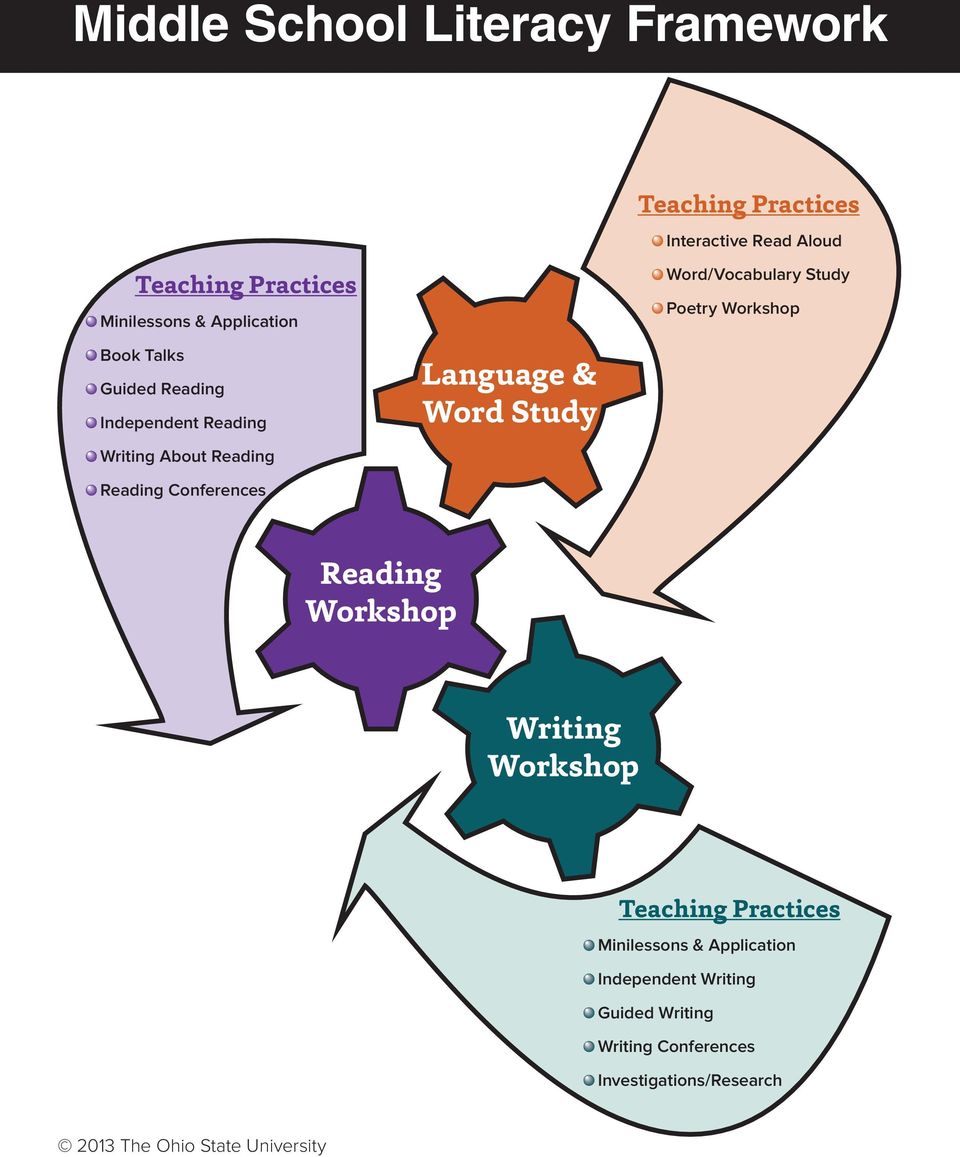
4 Middle School Literacy Framework Teaching Practices Interactive Read Aloud Teaching Practices Minilessons & Application Word/Vocabulary Study Poetry Workshop Book Talks Guided Independent Language & Word Study Writing About Conferences Workshop Writing Workshop Teaching Practices Minilessons & Application Independent Writing Guided Writing Writing Conferences Investigations/Research 2013 The Ohio State University
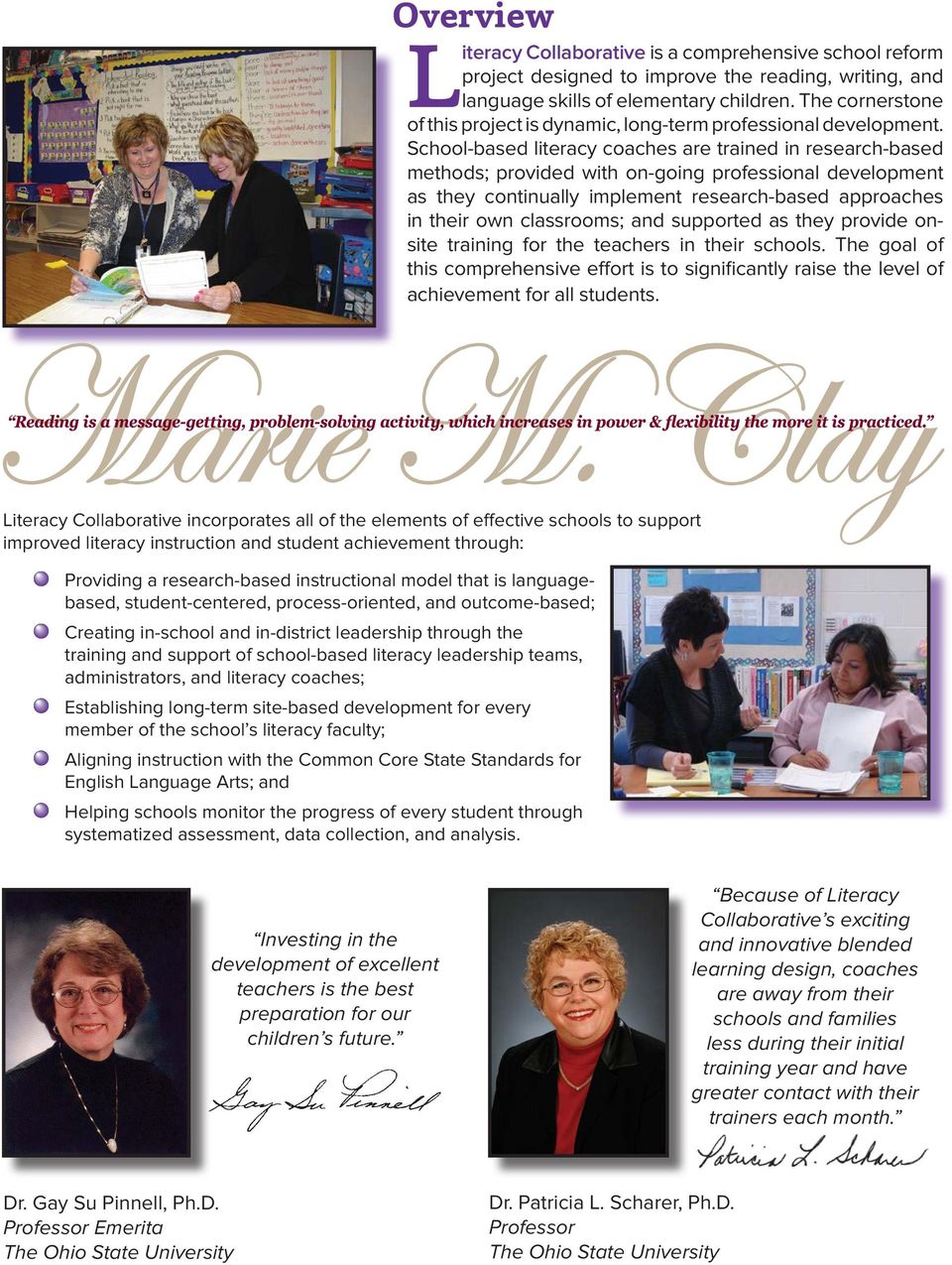
5 Overview Literacy Collaborative is a comprehensive school reform project designed to improve the reading, writing, and language skills of elementary children. The cornerstone of this project is dynamic, long-term professional development. School-based literacy coaches are trained in research-based methods; provided with on-going professional development as they continually implement research-based approaches in their own classrooms; and supported as they provide onsite training for the teachers in their schools. The goal of this comprehensive effort is to significantly raise the level of achievement for all students. Literacy Collaborative incorporates all of the elements of effective schools to support improved literacy instruction and student achievement through: Providing a research-based instructional model that is languagebased, student-centered, process-oriented, and outcome-based; Creating in-school and in-district leadership through the training and support of school-based literacy leadership teams, administrators, and literacy coaches; Establishing long-term site-based development for every member of the school s literacy faculty; Aligning instruction with the Common Core State Standards for English Language Arts; and Helping schools monitor the progress of every student through systematized assessment, data collection, and analysis. Investing in the development of excellent teachers is the best preparation for our children s future. Because of Literacy Collaborative s exciting and innovative blended learning design, coaches are away from their schools and families less during their initial training year and have greater contact with their trainers each month. Dr. Gay Su Pinnell, Ph.D. Professor Emerita The Ohio State University Dr. Patricia L. Scharer, Ph.D. Professor The Ohio State University
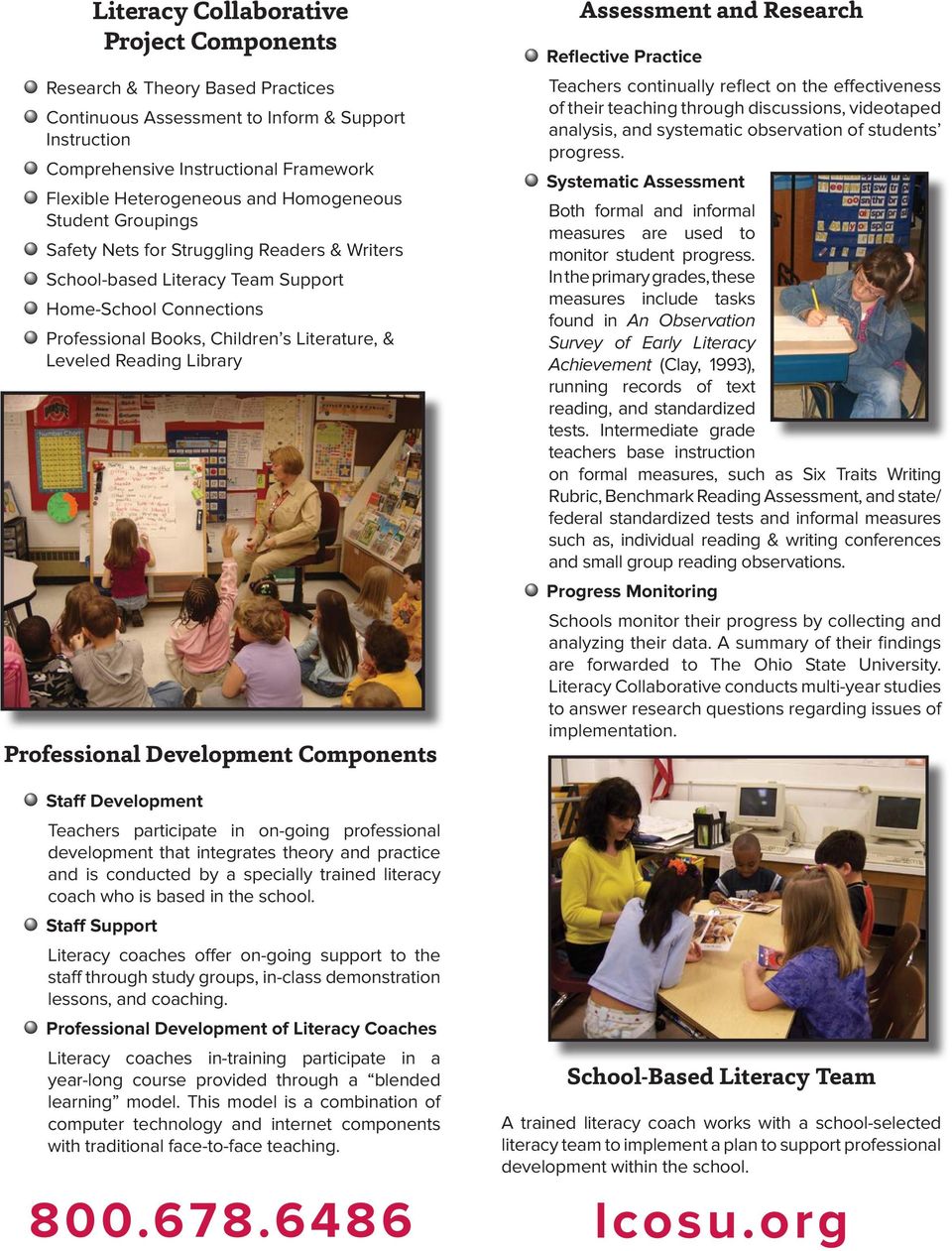
6 Literacy Collaborative Project Components Research & Theory Based Practices Continuous Assessment to Inform & Support Instruction Comprehensive Instructional Framework Flexible Heterogeneous and Homogeneous Student Groupings Safety Nets for Struggling Readers & Writers School-based Literacy Team Support Home-School Connections Professional Books, Children s Literature, & Leveled Library Professional Development Components Staff Development Teachers participate in on-going professional development that integrates theory and practice and is conducted by a specially trained literacy coach who is based in the school. Staff Support Literacy coaches offer on-going support to the staff through study groups, in-class demonstration lessons, and coaching. Professional Development of Literacy Coaches Literacy coaches in-training participate in a year-long course provided through a blended learning model. This model is a combination of computer technology and internet components with traditional face-to-face teaching Assessment and Research Reflective Practice Teachers continually reflect on the effectiveness of their teaching through discussions, videotaped analysis, and systematic observation of students progress. Systematic Assessment Both formal and informal measures are used to monitor student progress. In the primary grades, these measures include tasks found in An Observation Survey of Early Literacy Achievement (Clay, 1993), running records of text reading, and standardized tests. Intermediate grade teachers base instruction on formal measures, such as Six Traits Writing Rubric, Benchmark Assessment, and state/ federal standardized tests and informal measures such as, individual reading & writing conferences and small group reading observations. Progress Monitoring Schools monitor their progress by collecting and analyzing their data. A summary of their findings are forwarded to The Ohio State University. Literacy Collaborative conducts multi-year studies to answer research questions regarding issues of implementation. School-Based Literacy Team A trained literacy coach works with a school-selected literacy team to implement a plan to support professional development within the school. lcosu.org
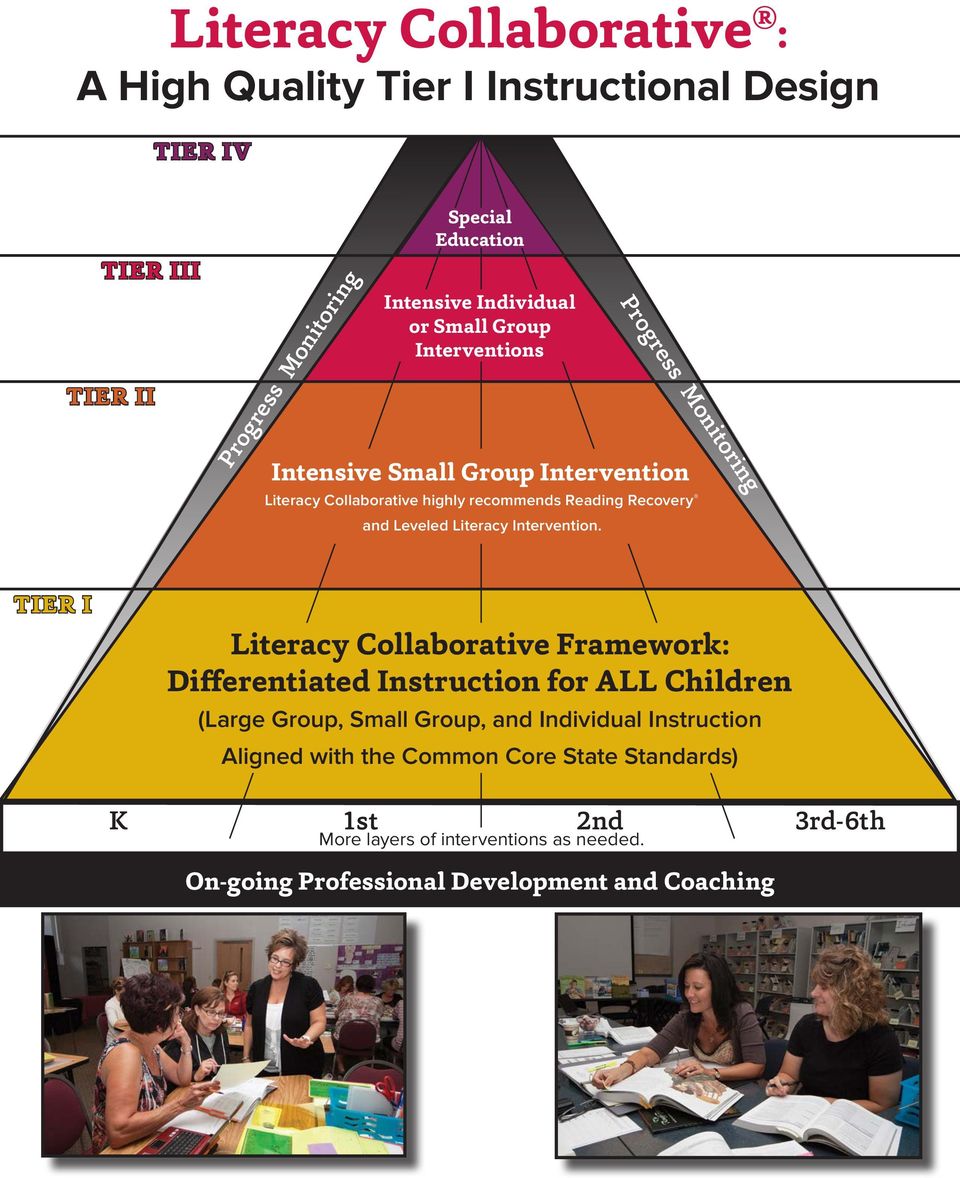
7 Literacy Collaborative : A High Quality Tier I Instructional Design TIER IV TIER III TIER II Progress Monitoring Special Education Intensive Individual or Small Group Interventions Progress Monitoring Intensive Small Group Intervention Literacy Collaborative highly recommends Recovery and Leveled Literacy Intervention. TIER I Literacy Collaborative Framework: Differentiated Instruction for ALL Children (Large Group, Small Group, and Individual Instruction Aligned with the Common Core State Standards) K 1st 2nd 3rd-6th More layers of interventions as needed. On-going Professional Development and Coaching
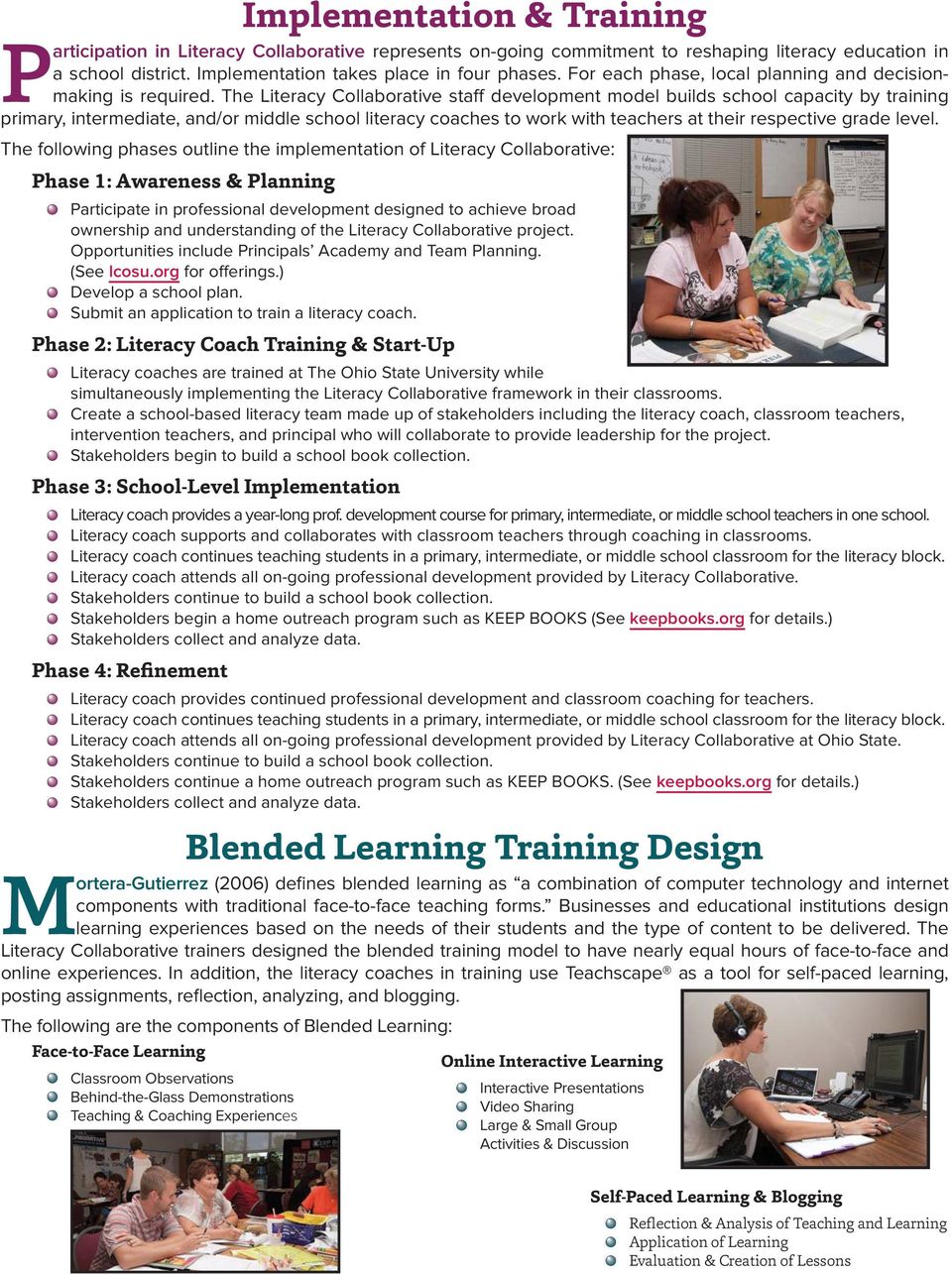
8 Implementation & Training Participation in Literacy Collaborative represents on-going commitment to reshaping literacy education in a school district. Implementation takes place in four phases. For each phase, local planning and decisionmaking is required. The Literacy Collaborative staff development model builds school capacity by training primary, intermediate, and/or middle school literacy coaches to work with teachers at their respective grade level. The following phases outline the implementation of Literacy Collaborative: Phase 1: Awareness & Planning Participate in professional development designed to achieve broad ownership and understanding of the Literacy Collaborative project. Opportunities include Principals Academy and Team Planning. (See lcosu.org for offerings.) Develop a school plan. Submit an application to train a literacy coach. Phase 2: Literacy Coach Training & Start-Up Literacy coaches are trained at The Ohio State University while simultaneously implementing the Literacy Collaborative framework in their classrooms. Create a school-based literacy team made up of stakeholders including the literacy coach, classroom teachers, intervention teachers, and principal who will collaborate to provide leadership for the project. Stakeholders begin to build a school book collection. Phase 3: School-Level Implementation Literacy coach provides a year-long prof. development course for primary, intermediate, or middle school teachers in one school. Literacy coach supports and collaborates with classroom teachers through coaching in classrooms. Literacy coach continues teaching students in a primary, intermediate, or middle school classroom for the literacy block. Literacy coach attends all on-going professional development provided by Literacy Collaborative. Stakeholders continue to build a school book collection. Stakeholders begin a home outreach program such as KEEP BOOKS (See keepbooks.org for details.) Stakeholders collect and analyze data. Phase 4: Refinement Literacy coach provides continued professional development and classroom coaching for teachers. Literacy coach continues teaching students in a primary, intermediate, or middle school classroom for the literacy block. Literacy coach attends all on-going professional development provided by Literacy Collaborative at Ohio State. Stakeholders continue to build a school book collection. Stakeholders continue a home outreach program such as KEEP BOOKS. (See keepbooks.org for details.) Stakeholders collect and analyze data. Blended Learning Training Design Mortera-Gutierrez (2006) defines blended learning as a combination of computer technology and internet components with traditional face-to-face teaching forms. Businesses and educational institutions design learning experiences based on the needs of their students and the type of content to be delivered. The Literacy Collaborative trainers designed the blended training model to have nearly equal hours of face-to-face and online experiences. In addition, the literacy coaches in training use Teachscape as a tool for self-paced learning, posting assignments, reflection, analyzing, and blogging. The following are the components of Blended Learning: Face-to-Face Learning Classroom Observations Behind-the-Glass Demonstrations Teaching & Coaching Experiences Online Interactive Learning Interactive Presentations Video Sharing Large & Small Group Activities & Discussion Self-Paced Learning & Blogging Reflection & Analysis of Teaching and Learning Application of Learning Evaluation & Creation of Lessons
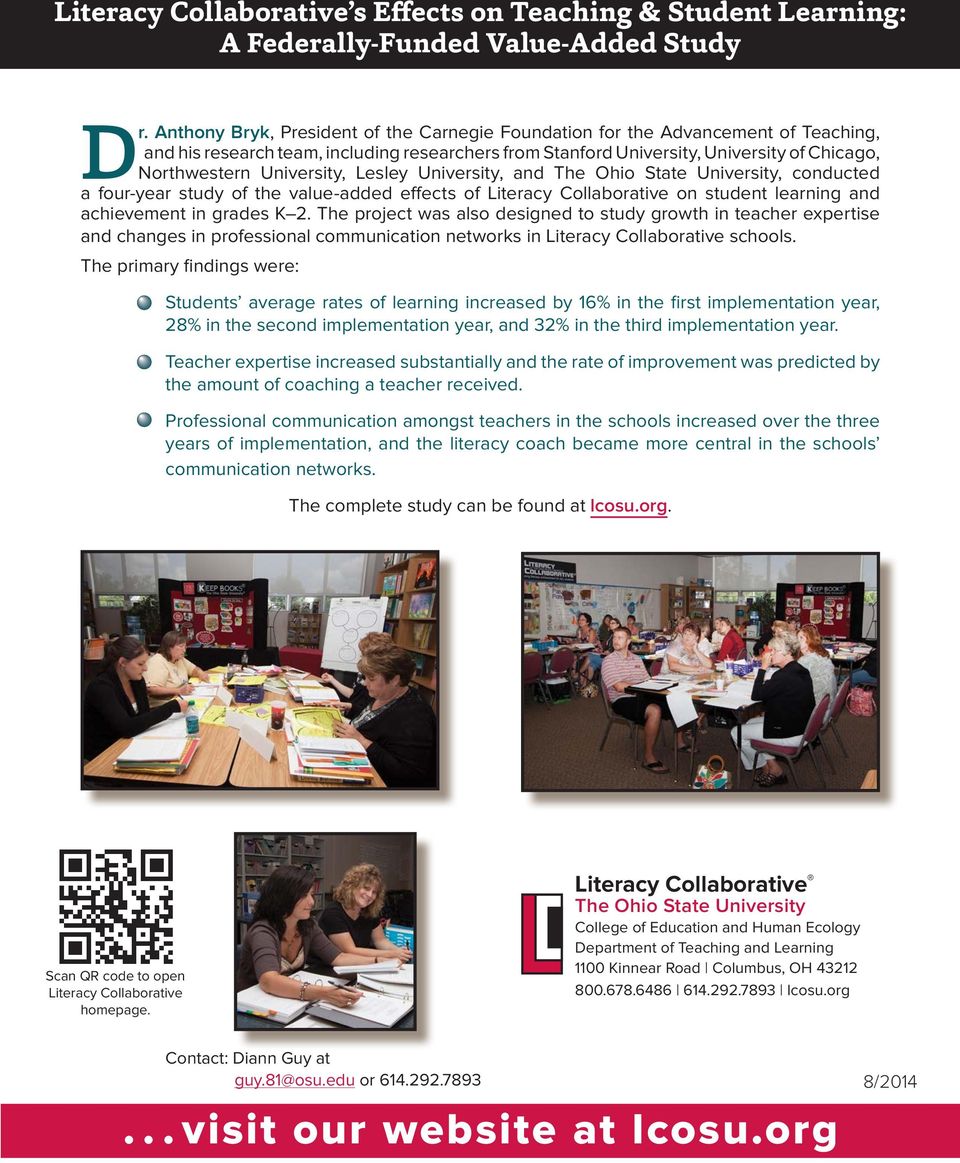
9 Literacy Collaborative s Effects on Teaching & Student Learning: A Federally-Funded Value-Added Study Dr. Anthony Bryk, President of the Carnegie Foundation for the Advancement of Teaching, and his research team, including researchers from Stanford University, University of Chicago, Northwestern University, Lesley University, and The Ohio State University, conducted a four-year study of the value-added effects of Literacy Collaborative on student learning and achievement in grades K 2. The project was also designed to study growth in teacher expertise and changes in professional communication networks in Literacy Collaborative schools. The primary findings were: Students average rates of learning increased by 16% in the first implementation year, 28% in the second implementation year, and 32% in the third implementation year. Teacher expertise increased substantially and the rate of improvement was predicted by the amount of coaching a teacher received. Professional communication amongst teachers in the schools increased over the three years of implementation, and the literacy coach became more central in the schools communication networks. The complete study can be found at lcosu.org. Scan QR code to open Literacy Collaborative homepage. Literacy Collaborative The Ohio State University College of Education and Human Ecology Department of Teaching and Learning 1100 Kinnear Road Columbus, OH lcosu.org Contact: Diann Guy at [email protected] or visit our website at lcosu.org 8/2014
Scholastic Leveled Bookroom, 3rd Edition
 Scholastic Leveled Bookroom 3rd Edition Aligns to Title I, Section 1003(g) SCHOOL IMPROVEMENT GRANTS School Improvement Grants () are intended to help Title I schools, identified for improvement, corrective
EDUC 605 Curriculum Development and Assessment.. 3 cr
 MASTER OF ARTS IN EDUCATION The Master of Arts in Education degree program combines online learning with practical and applied learning in the classroom. The master s candidate must earn and successfully
Q & A: New Writing Program
 Q & A: New Writing Program Why are we purchasing a writing program? Currently (2006-7) there are over twenty different writing programs being used in NC12 elementary schools. The amount of time devoted
REVERE PUBLIC SCHOOLS
 Theme 1 Student Learning/Curriculum and Instruction High expectations are at the heart of the vision for all students in the Revere Public Schools. By embracing the Massachusetts Curriculum Frameworks,
Literacy Coaching/ Reading Specialists
 Literacy Coaching/ Reading Specialists NANCY ROBERTS ~ LOCKPORT CITY SCHOOL DISTRICT STLE LEAD LITERACY CURRICULUM MENTOR 12/4/2013, Nancy Roberts Outline Introduction video What is Literacy Coaching?
Comprehensive Reading Plan K-12 A Supplement to the North Carolina Literacy Plan. North Carolina Department of Public Instruction 2013-2014
 Comprehensive Reading Plan K-12 A Supplement to the North Carolina Literacy Plan North Carolina Department of Public Instruction 2013-2014 1 TABLE OF CONTENTS INTRODUCTION PAGE 3 NCDPI PAGE 4 STANDARDS-BASED
For more information about Reading Recovery teacher certification visit www.rrosu.org.
 A Professional Development Project of The Ohio State University Overview Literacy Lessons TM is university-based professional development for specialist teachers (including for example, special education
Standards and Guidelines of Literacy Lessons in the United States. July 4, 2013 updated June 2015
 Standards and Guidelines of Literacy Lessons in the United States July 4, 2013 updated June 2015 Table of Contents Introduction... 3 Overview... 5 Section I Standards and Guidelines for Selection of Literacy
Position Statement on English Language Arts Education Connecticut State Board of Education December 3, 2008
 Position Statement on English Language Arts Education Connecticut State Board of Education December 3, 2008 The Connecticut State Board of Education believes a high-quality, comprehensive prekindergarten-12
1 REVISOR 8710.4925. C. show verification of completing a Board of Teaching preparation program
 1 REVISOR 8710.4925 8710.4925 READING LEADER. Subpart 1. Scope of practice. A reading leader is authorized to facilitate and provide site-based or districtwide leadership for kindergarten through grade
District 203 K-4 Elementary Summer School 2015
 District 203 K-4 Elementary Summer School 2015 The following Elementary Summer School courses will be conducted from Monday, June 8, 2014, through Friday, June 26, 2015. THE SAME COURSES WILL BE OFFERED
How To Improve Education Planning In Dekalb County Schools
 I. Executive Summary At the request of Superintendent Cheryl Atkinson, Education Planners, LLC (Ed Planners) conducted an evaluation of the curricula-based programs and professional development currently
The Leader in K 12 Professional Development
 The Leader in K 12 Professional Development INTRODUCING... ASCD PROFESSIONAL LEARNING SERVICES ASCD PROFESSIONAL LEARNING SERVICES enable educators to receive customized professional development programs
Pre-Requisites EDAM-5001 Early Literacy Guiding Principles and Language
 . EDAM EDAM-5001. EARLY LITERACY: GUIDING PRINCIPLES AND LANGUAGE DEVELOPMENT This course is the prerequisite for all other courses in the Early Childhood Literacy program. It outlines the philosophical
Standards for Professional Development
 Standards for Professional Development APRIL 2015 Ohio Standards for Professional Development April 2015 Page 1 Introduction All of Ohio s educators and parents share the same goal that Ohio s students
Talent Development Secondary Assessment, Curriculum, and Instruction Blueprint Practices to Support a Culture of Success
 Talent Development Secondary Assessment, Curriculum, and Instruction Blueprint Practices to Support a Culture of Success The Blueprint: The Blueprint targets curriculum, instruction and assessment as key
Tips for Designing a High Quality Professional Development Program
 BUILDING A COMMUNITY OF R E A D I N G E X P E RT S Tips for Designing a High Quality Professional Development Program PROFESSIONAL DEVELOPMENT. A critical component of Reading First is a strategic, systematic
South Carolina Literacy Competencies. for Reading Coaches
 2014 15 South Carolina Literacy Competencies for Reading Coaches Standard 1: Foundational Knowledge Coaches understand the theoretical and evidence-based foundations of reading and writing processes and
StudyGuide. Irene C. Fountas Gay Su Pinnell
 Irene C. Fountas Gay Su Pinnell StudyGuide for The Continuum of Literacy Learning, PreK 8: A Guide to Teaching SECOND EDITION 2011 INTRODUCTION..................................................... 2 Orientation
ACTION 100 and Students Receiving Special Education Services
 ACTION 100 and Students Receiving Special Education Services Approximately 12% of students in grades K-12 currently receive special education services. These students include: those with diagnosed learning
Curriculum Management
 The vision of the Fayetteville Public Schools is to provide an educational system where every student will leave with a full understanding of his or her potential and the skills necessary to be successful
Master of Science in Education Major in Early Childhood Literacy Online Graduate Education for Today s Teacher
 Master of Science in Education Major in Early Childhood Literacy Online Graduate Education for Today s Teacher Build a Foundation. Develop Independent Readers and Writers. Master s Degree: Major in Early
Balanced Literacy in Seattle Public Schools
 Introduction Balanced Literacy in Seattle Public Schools The goal for literacy instruction in Seattle Public Schools is to ensure that all pre- Kindergarten through twelfth grade students become proficient
Instructional Technology Initiative Task Force: Vision, Mission, & Core Values
 Instructional Technology Initiative Task Force: Vision, Mission, & Core Values Our Vision: All schools use technology as a tool to differentiate and personalize instruction, increase academic rigor, and
The Premier On-Demand Professional Learning Video Platform for Educators
 The Premier On-Demand Professional Learning Video Platform for Educators Watch classroom videos of effective teaching practices with insights from the most respected voices in education. www.ascd.org/pdinfocus
Reading K 12 Section 35
 Reading K 12 Section 35 * *Competencies and skills incorporate the scientifically based reading research (SBRR) and the components of Florida's formula for reading success addressing improved reading outcomes
Elementary Writing Project Team Supporting ESL Writers
 Elementary Writing Project Team Supporting ESL Writers BEAVERTON SCHOOL DISTRICT SARAH DUNKIN ELEMENTARY LITERACY TOSA TITLE I FACILITATOR KERRIN MOELLER ESL TEACHER NANCY RYLES ELEMENTARY [email protected]
Effective Early Literacy Support in Philadelphia Promoting Early Literacy Inside and Outside of the Classroom
 Effective Early Literacy Support in Philadelphia Promoting Early Literacy Inside and Outside of the Classroom Rodney Johnson Director of Early Literacy Jill Valunas Children s Literacy Initiative Anchor
How To Integrate And Implement Web 2.0 Tools And Blogging In The Classroom
 Felicia A. Belcher January 2014 Dr. Sherri Booker Summer 2012 Integrating and Implementing Web 2.0 Tools and Blogging in the Classroom CAPSTONE PROPOSAL Master s Degree in Instructional Technology Candidate
The Teaching Gap Best Ideas from the World s Teachers for Improving Education in the Classroom
 The Teaching Gap Best Ideas from the World s Teachers for Improving Education in the Classroom James Stigler and James Hiebert The Free Press, 1999 Improvement Through a Focus on Teaching School learning
How To Write A Curriculum Framework For The Paterson Public School District
 DEPARTMENT OF CURRICULUM & INSTRUCTION FRAMEWORK PROLOGUE Paterson s Department of Curriculum and Instruction was recreated in 2005-2006 to align the preschool through grade 12 program and to standardize
Program Models. proficiency and content skills. After school tutoring and summer school available
 Holyoke English Language Learners Program Opportunities & Services Program Models ELL students ts participate i t in mixed groupings so they can learn with English-speaking peers. Certified ESL, ELL or
Exam papers from RE 5100, Beginning Readers and Writers. Assessment Summary Sheet from RE 5715, Reading Assessment and Correction
 Name: Angela McCrary Steele IRA Standards Artifacts Rationale Standard 1. Foundational Knowledge. 1.1 Candidates understand major theories and empirical research that describe the cognitive, linguistic,
How To Improve The Curriculum At Minnetonka School District
 MINNETONKA PUBLIC SCHOOLS Policy #603: INSTRUCTIONAL AND CURRICULAR PROGRAM REVIEW AND IMPROVEMENT I. PURPOSE The purpose of this policy is to provide direction to parents, students, staff, and interested
Creating a Culture of Literacy. Creating a Culture of Literacy. Goals for the Presentation
 Creating a Culture of Literacy Creating a Culture of Literacy National Reading Recovery Conference February 9, 2015 Goals for the Presentation Share the journey of one school as they incorporate a district
(Advanced Preparation)
 1 NCTM CAEP Standards (2012) Elementary Mathematics Specialist (Advanced Preparation) Standard 1: Content Knowledge Effective elementary mathematics specialists demonstrate and apply knowledge of major
READ 180 Aligns to Enhancing Education Through Technology Criteria (With Professional Development from Scholastic Red )
 READ 180 Aligns to Enhancing Education Through Technology Criteria (With Professional Development from Scholastic Red ) According to the federal Guidance on the Enhancing Education Through Technology (Ed
READING SPECIALIST STANDARDS
 READING SPECIALIST STANDARDS Standard I. Standard II. Standard III. Standard IV. Components of Reading: The Reading Specialist applies knowledge of the interrelated components of reading across all developmental
WiggleWorks Aligns to Title I, Part A
 WiggleWorks Aligns to Title I, Part A The purpose of Title I, Part A Improving Basic Programs is to ensure that children in high-poverty schools meet challenging State academic content and student achievement
Chapter 6: Hiring and placing coaches
 Tool 6.1 Teacher on special assignment/ elementary instructional coach job description 6.2 High school language arts instructional coach job description and responsibilities Purpose Use this sample job
MARZANO SCHOOL LEADERSHIP EVALUATION MODEL
 TEACHER & LEADERSHIP EVALUATION MARZANO SCHOOL LEADERSHIP EVALUATION MODEL Prepared by Learning Sciences Marzano Center Center for Teacher and Leadership Evaluation April 2012 1 TEACHER & LEADERSHIP EVALUATION
FY 2014-2019. Claiborne County Schools Five Year Plan
 FY 2014-2019 Claiborne County Schools Five Year Plan Vision Statement: Academic, social, and emotional growth for every student to be college and/or career ready. VISION for CLAIBORNE COUNTY STUDENTS Academic,
Committee On Public Secondary Schools. Standards for Accreditation
 Committee On Public Secondary Schools Standards for Accreditation Effective 2011 New England Association of Schools & Colleges 3 Burlington Woods Drive, Suite 100 Burlington, MA 01803 Tel. 781-425-7700
8710.4725 TEACHERS OF READING.
 1 REVISOR 8710.4725 8710.4725 TEACHERS OF READING. Subpart 1. Scope of practice. A teacher of reading is authorized to facilitate and provide for kindergarten through grade 12 students instruction that
BUILDING CURRICULUM ACCOMMODATION PLAN
 BUILDING CURRICULUM ACCOMMODATION PLAN 2014-2015 ERIC STARK, PRINCIPAL KATE PERETZ, ASSISTANT PRINCIPAL Alone we can do so little; together we can do so much. Helen Keller FRANKLIN PUBLIC SCHOOLS VISION
EXPERTISE & EXCELLENCE. A Systematic Approach to Transforming Educator Practice
 EXPERTISE & EXCELLENCE A Systematic Approach to Transforming Educator Practice School improvement is most surely and thoroughly achieved when teachers engage in frequent, continuous, and increasingly concrete
Reading Competencies
 Reading Competencies The Third Grade Reading Guarantee legislation within Senate Bill 21 requires reading competencies to be adopted by the State Board no later than January 31, 2014. Reading competencies
Principal Practice Observation Tool
 Principal Performance Review Office of School Quality Division of Teaching and Learning Principal Practice Observation Tool 2014-15 The was created as an evidence gathering tool to be used by evaluators
AND LEARNING 21st Century Teaching and Learning
 21ST CENTURY TEACHING AND LEARNING 21st Century Teaching and Learning Dr. Grace Surdovel, Director of Master's Programs/Faculty of Practice The Master of Science in Education with a major in 21st Century
Writing Worth Doing. Writing for College & Career Success
 Writing Worth Doing Writing for College & Career Success audiencetaskpurposediscipline Writing Worth Doing ISA s four-year portfolio writing program, Writing Worth Doing, supports writing as daily practice
K-12 SCIENCE CURRICULUM
 K-12 SCIENCE CURRICULUM THE LEADER IN PREK-12 STEM EDUCATION. Accelerate Learning did not become the leader in PreK-12 STEM education overnight STEMscopes, our PreK-12 STEM solution, has been teachers
Rubric for Evaluating Colorado s Specialized Service Professionals: School Social Workers
 Rubric for Evaluating Colorado s Specialized Service Professionals: School Social Workers Definition of an Effective School Social Worker Effective school social workers are vital members of the education
UTAH S 3 Tier Model of READING INSTRUCTION
 Tier 3 Tier 2 Tier 1 UTAH S 3 Tier Model of READING INSTRUCTION UTAH STATE OFFICE OF EDUCATION 250 East 500 South P.O. Box 144200 Salt Lake City, UT 84114-4200 Patti Harrington, Ed.D. State Superintendent
College Laboratory Schools Planning Grants
 College Laboratory Schools Planning Grants Lawrence D. Wilder, Jr. Assistant Secretary of Education January 9, 2014 Planning Grant Awards GRANT AMOUNTS George Mason University ($145,500) James Madison
The library media program enhances student achievement through a systematically, collaboratively planned instructional program.
 21 st Century Library Media Programs in Florida's K-12 Schools ExC 3 EL Expectations for Collaboration, Collections, and Connections to Enhance Learning: A Program Evaluation Rubric Mission: The ExC 3
Teaching All Students to Read: With Strong Intervention Outcomes
 Teaching All Students to Read: Practices from Reading First Schools With Strong Intervention Outcomes Summary Document Elizabeth Crawford and Joseph Torgesen Introduction One of the most critical needs
Professionals Responsible for Campus Turnaround Plan Development: Name:
 Date of Board Grades Served: 6 8 Approval: 5/23/2016 Consecutive School Years Rated Academically Unacceptable/Improvement Required: Dr. Terrence Eaton Ron Gonzales Jonathan Smith Dr. Velma Wilson Diane
Partnerships in Comprehensive Literacy Model (PCL)
 Partnerships in Comprehensive Literacy Model (PCL) Literacy Coach Application Application Deadline: June 27, 2015 Submit 2 copies of application to: Tara Haynes, Project Manager University of Arkansas
FY15 DANVERS PUBLIC SCHOOLS DISTRICT GOALS THEME I ACHIEVEMENT
 FY15 DANVERS PUBLIC SCHOOLS DISTRICT GOALS THEME I ACHIEVEMENT Goal: Curriculum, instruction and assessment necessary to support 21 st century learning and effectively meet the needs of all students are
KIMBERLY FERRARIO [email protected]
 KIMBERLY FERRARIO [email protected] EDUCATION RESEARCH Ph.D. Education, June 2009 Emphasis on Language, Literacy and Culture University California, Davis Advisers: Professor Sandra Murphy, School of Education,
Key Principles for ELL Instruction (v6)
 Key Principles for ELL Instruction (v6) The Common Core State Standards (CCSS) in English Language Arts and Mathematics as well as the soon-to-be released Next Generation Science Standards (NGSS) require
THE FRAMEWORK FOR INSTRUCTIONAL COACH ENDORSEMENT GUIDELINES PENNSYLVANIA DEPARTMENT OF EDUCATION
 THE FRAMEWORK FOR INSTRUCTIONAL COACH ENDORSEMENT GUIDELINES PENNSYLVANIA DEPARTMENT OF EDUCATION TABLE OF CONTENTS Definition of an Endorsement Certificate... 3 Introduction to Instructional Coach Endorsement
NCNSP Design Principle 1: Ready for College
 College Credit College Ready Skills (High School) Course of Study NCNSP Design Principle 1: Ready for College Students are tracked according to past performance into regular and honors level courses. All
MASTER S DEGREE IN CURRICULUM & INSTRUCTION
 MASTER S DEGREE IN CURRICULUM & INSTRUCTION with specialization in LANGUAGE & LITERACY EDUCATION and Advanced Certification Programs in: Professional Reading Specialist Master Reading Teacher Developmental
Wappingers Central School District
 Wappingers Central School District Response to Intervention Plan (RTI) February 2012 Tier III Tier II Tier I 1 Introduction to WCSD s 3 Tier RTI Model The 3 Tier Response to Intervention (RTI) Model provides
Pamela A. Mason, Ed.D.
 Pamela A. Mason, Ed.D. Harvard Graduate School of Education Email: [email protected] Larsen Hall 308, 14 Appian Way Telephone: (617) 495-8798 Cambridge, MA 02138 Fax: (617) 495-5771 Education
Domain 1: Strategic/Cultural Leadership
 Framework for Leadership Types of Evidence Supervisor: Curriculum and Instruction Please note: The evidence identified here is provided to stimulate conversations that occur between a supervising authority
Dyslexia Certificate Program Level 1 Winter/Spring 2016
 Dyslexia Certificate Program Level 1 Winter/Spring 2016 BACKGROUND & PHILOSOPHY It is estimated that 10 15 percent of the general population has a reading based learning disability. Of those individuals,
Requirements EDAM-5002. WORD STUDY K-3: PRINT AWARENESS, LETTER KNOWLEDGE, PHONICS, AND HIGH FREQUENCY WORDS
 LETTER OF ENDORSEMENT: TEACHER LEADERSHIP AND INSTRUCTIONAL COACHING Requirements Dr. Grace Surdovel, Director of Master's Programs/Faculty of Practice The Letter of Endorsement in Teacher Leadership and
READING WITH. Reading with Pennsylvania Reading Specialist Certificate
 READING WITH PENNSYLVANIA READING SPECIALIST CERTIFICATE Reading with Pennsylvania Reading Specialist Certificate Program Coordinator: Ms. Anne Butler The Master of Science degree in Education with a concentration
Main Idea in Informational Text Grade Three
 Ohio Standards Connection Informational, Technical and Persuasive Text Benchmark C Identify the central ideas and supporting details of informational text. Indicator 3 Identify and list the important central
Virtual Learning Solutions
 Virtual Learning Solutions Partnering with Districts to Seamlessly Integrate Virtual School Programs High-Quality Curriculum Flexible LMS Effective Instructional Model Comprehensive Services Increase Access
COLLEGE OF EDUCATION DEPARTMENT OF TEACHER EDUCATION [READING EDUCATION] [READ PHD.] ANNUAL ASSESSMENT REPORT SUBMITTED MARCH 2013
![COLLEGE OF EDUCATION DEPARTMENT OF TEACHER EDUCATION [READING EDUCATION] [READ PHD.] ANNUAL ASSESSMENT REPORT SUBMITTED MARCH 2013](/thumbs/25/6457500.jpg "COLLEGE OF EDUCATION DEPARTMENT OF TEACHER EDUCATION [READING EDUCATION] [READ PHD.] ANNUAL ASSESSMENT REPORT SUBMITTED MARCH 2013") COLLEGE OF EDUCATION DEPARTMENT OF TEACHER EDUCATION [READING EDUCATION] [READ PHD.] ANNUAL ASSESSMENT REPORT SUBMITTED MARCH 2013 FOR THE REPORTING PERIOD [JULY 1, 2011 JUNE 30, 2012] FOR QUESTIONS ABOUT
COLLEGE OF EDUCATION DEPARTMENT OF TEACHER EDUCATION [READING EDUCATION] [READ PHD.] ANNUAL ASSESSMENT REPORT SUBMITTED MARCH 2013 FOR THE REPORTING PERIOD [JULY 1, 2011 JUNE 30, 2012] FOR QUESTIONS ABOUT
Achieve your professional goals with customized professional learning.
 Professional Learning Services Achieve your professional goals with customized professional learning. 2014/15 CATALOG Technical Training Online Courses Hybrid Courses Other Professional Learning Services
Instructional Technology Standards Proposed by the GaPSC Instructional Technology Task Force December 2010
 Instructional Technology Standards Proposed by the GaPSC Instructional Technology Task Force December 2010 Introduction Instructional technology can be defined as the effective use of technology to support
Instructional Framework What Do We Mean By Strong Instructional Programs and Supportive School Communities?
 Instructional Framework What Do We Mean By Strong Instructional Programs and Supportive School Communities? Effective Instructional Programs Require a Focus Within and Across Classrooms In urban classrooms,
The Pennsylvania Writing and Literature Project 2016 Summer Graduate Course Brochure
 The Pennsylvania Writing and Literature Project 2016 Summer Graduate Course Brochure There are easier ways to earn graduate credit, but there is no better way. - Diane Dougherty, PAWLP Co-Director PAWLP
SCHOOL IMPROVEMENT GRANT (SIG) PRACTICE:
 SCHOOL IMPROVEMENT GRANT (SIG) PRACTICE: JOB-EMBEDDED PROFESSIONAL DEVELOPMENT CRIM OPEN CAMPUS HIGH SCHOOL ATLANTA PUBLIC SCHOOLS ATLANTA, GEORGIA Crim Open Campus High School (Crim) 1 faced an ongoing
Principal has shared the school vision and goals with the staff. A process for developing a school vision and goals is not evident.
 Ohio Principal Evaluation System Ohio Principal Performance Rating Rubric Principal Performance Rubric The Principal Performance Rating Rubric is intended to be scored holistically. This means that evaluators
West Georgia RESA Catalog of Professional Learning. West Georgia RESA. Your Link to Professional Learning
 West Georgia RESA Catalog of Professional Learning Fall 2012 West Georgia RESA Your Link to Professional Learning What do you need? You can find what you need right here at West Georgia RESA! Can t find
North Carolina New Schools Design Principle 1: Ready for College. Beginning Early Steps Growing Innovations New Paradigms
 North Carolina New Schools Design Principle 1: Ready for College (High School) Course of Study Students are tracked according to past performance into regular and honors level courses. Students are allotted
How To Teach Reading
 Florida Reading Endorsement Alignment Matrix Competency 1 The * designates which of the reading endorsement competencies are specific to the competencies for English to Speakers of Languages (ESOL). The
A Renewed Focus on Educator Quality: Human Capital Management Systems
 A Renewed Focus on Educator Quality: Human Capital Management Systems Presented by: Tammy Kreuz, Ph.D. Executive Director Texas Center for Educator Effectiveness, Region 18 ESC Tony Davis, Ph.D. Consulting
Jericho Elementary School Action Plan 2013 to 2015
 Jericho Elementary School Action Plan 2013 to 2015 Summary of Previous Action Plan: The 2010 2012 action plan was completed in December 2012. This plan focused on reading, mathematics, school climate and
Niskayuna Elementary Program
 Niskayuna Elementary Program B I R C H W O O D C R A I G G L E N C L I F F H I L L S I D E R O S E N D A L E New York State Requirements Total number of students enrolled in our five elementary schools: