
Degree Completion Guide
|
|
|
- Kory Joseph
- 10 years ago
- Views:
Transcription
1 Degree Completion Guide Degree Completion Guide SCIENCE AND TECHNOLOGY JAPAN ADVANCED INSTITUTE OF JAPAN ADVANCED INSTITUTE OF SCIENCE AND TECHNOLOGY
2 The official Degree Completion Guide is in Japanese, of which this is an English translation. Courses for Working Professionals are not conducted in English, so there are no descriptions for them in the guide for each school in this English version. Please refer to the Japanese-language edition for the information.

3 JAIST Founding Principle and Education Policy Japan Advanced Institute of Science and Technology (JAIST) was established in 1990 as the first national university specializing only in graduate studies in Japan. Since then JAIST has been leading the development of graduate education in Japan through positive introduction and continuous improvement of various new education ideas and systems including admissions in Spring and Fall, quarter system, multiple supervisory system, and minor research project. This pioneering education has been recognized by many industries that hire our graduates. Having more than 20 years passed after our establishment, however, means that many other universities have come to introduce the same systems. Today JAIST needs to introduce new innovative and effective ideas of its own. In order to improve our education further, we have decided to set respecting students purposes and intentions as much as possible as a basic principle. Concretely speaking, hopefully we will allow students to design their course selection by themselves based on their career goal. When graduating, students receive a transcript showing the list of the courses they have taken and their grades. By selecting courses voluntarily, students will be able to explain their reason for the selection of courses and their relevance to their career goal to their supervisor at JAIST and future employers. JAIST has recently changed its goal on education. We put more emphasis on what ability students have obtained than on what they have understood. Reflecting this idea, every course evaluates students performance in terms of the level of ability acquisition. This idea is also shared in the supervision of students in every laboratory. We hope every student makes the best use of education opportunities at JAIST through their positive commitment in order to prepare for their bright future. President Tetsuo Asano
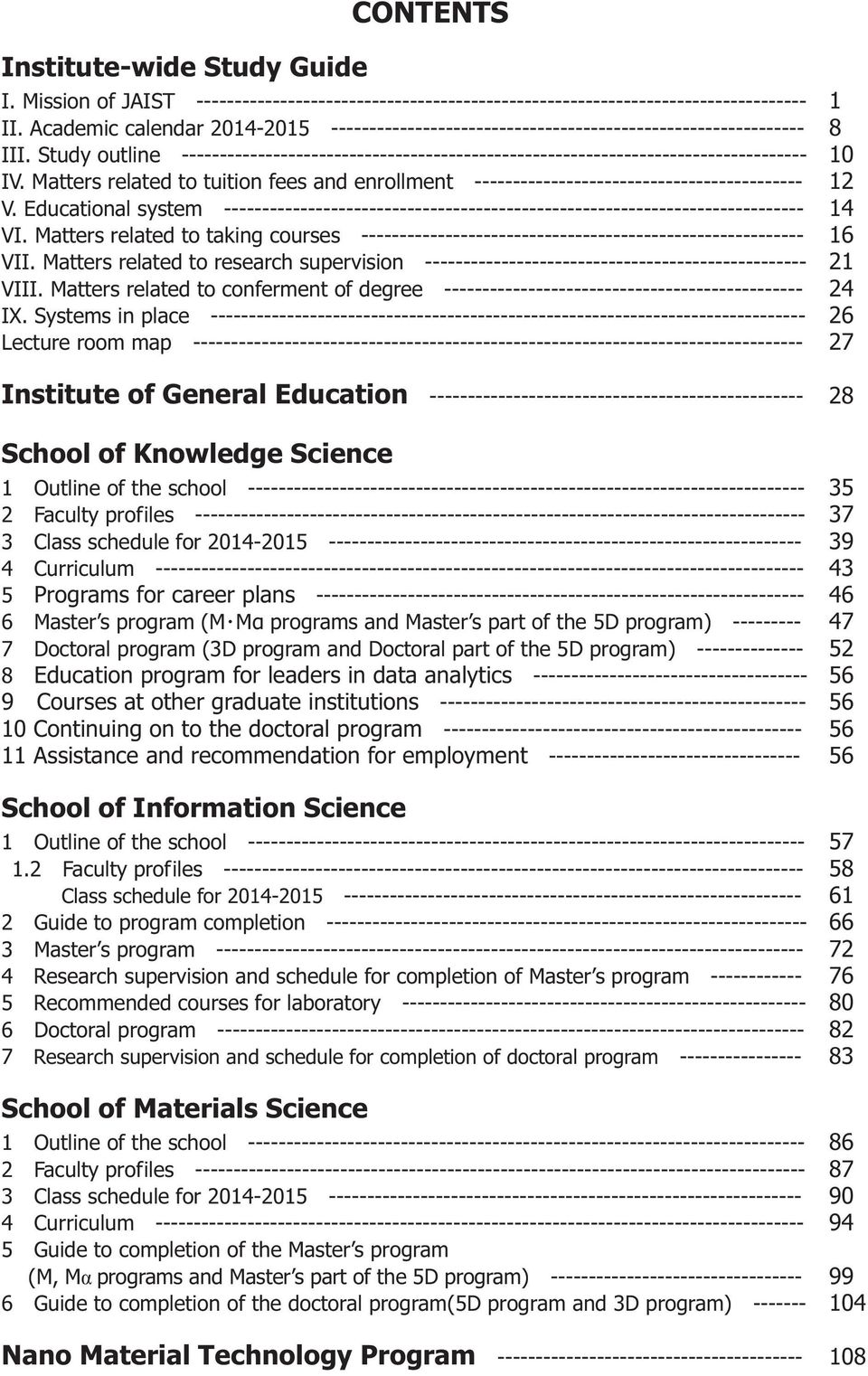
4 CONTENTS Institute-wide Study Guide I. Mission of JAIST II. Academic calendar III. Study outline IV. Matters related to tuition fees and enrollment V. Educational system VI. Matters related to taking courses VII. Matters related to research supervision VIII. Matters related to conferment of degree IX. Systems in place Lecture room map Institute of General Education School of Knowledge Science 1 Outline of the school Faculty profiles Class schedule for Curriculum Programs for career plans Master s program (MM programs and Master s part of the 5D program) Doctoral program (3D program and Doctoral part of the 5D program) Education program for leaders in data analytics Courses at other graduate institutions Continuing on to the doctoral program Assistance and recommendation for employment School of Information Science 1 Outline of the school Faculty profiles Class schedule for Guide to program completion Master s program Research supervision and schedule for completion of Master s program Recommended courses for laboratory Doctoral program Research supervision and schedule for completion of doctoral program School of Materials Science 1 Outline of the school Faculty profiles Class schedule for Curriculum Guide to completion of the Master s program (M, M programs and Master s part of the 5D program) Guide to completion of the doctoral program(5d program and 3D program) Nano Material Technology Program
5 Institute-wide Study Guide

6 Institute-wide Study Guide I. Mission of JAIST Mission JAIST endeavors to foster leaders capable of contributing to the making of a future world by creation of science and technology, through its most advanced education and research in an ideal academic environment. Goals JAIST develops leaders in society or industry who hold credible expertise in the frontier science and technology, broad perspectives, high level of autonomy and communication ability, through its systematic advanced graduate education. JAIST, to contribute to societies with research outcomes, creates a center of excellence for advancement of researches for solving problems of our world and society and develops new fields through a variety of basic researches. JAIST fosters active global human resources by promoting faculty and student exchanges with leading institutes overseas and globalizing its education and research. The ideal person JAIST strives to educate JAIST endeavors to foster leaders in society or industry who have credible expertise in the frontiers of science and technology, broad perspectives, a high level of autonomy and communication ability. In the Master s program, the focus is on fostering students ability to understand and apply a variety of fundamental theories in order to solve problems. In the doctoral program, JAIST focuses on cultivating students who have the ability to think from a variety of perspectives, to discover and solve problems and to exercise world-class leadership in the area of advanced science and technology. Policies JAIST has set the following policies for students educational guidance
7 Curriculum policy We designed our curriculum to be hierarchical and systematic, encompassing several specialties so that we may nurture future researchers and engineers who not only possess specialist knowledge in the area of advanced science and technology, but who also fully understand fundamental concepts, have the capability to identify and solve problems, and have the ability to acquire a wide range of relevant advanced expertise. We adopt a supervisory system in which a student is supervised by three professors. In the master s program, we aim to foster the students ability to understand and apply a variety of fundamental theories in order to solve problems in the area of advanced science and technology without placing undue emphasis on the expertise in their field of specialization. In addition to a particular academic expertise, we also aim to equip students with qualities to be internationally successful such as ethical awareness, global communication skills, and problem-solving skills. In the doctoral program, we aim to foster students ability to understand extensive theories and the framework of the area of advanced science and technology, and apply them to identify and solve problems. In addition, we aim to nurture students who have ethical awareness, global communication skills, the ability to think from a variety of perspectives; to present their research and exchange ideas with researchers overseas; to discover and solve problems; and to exercise leadership in the area of advanced science and technology. [Institute of General Education] The mission of the Institute of General Education (IGE) is to equip students with ethical awareness, understanding and receptiveness toward diversified cultures, and the communication skills necessary to be successful internationally. The IGE also aims to help graduates find positions in society based on their individual specialties and strengths. [School of Knowledge Science] The mission of the School of Knowledge Science is to enable students to systematically understand basic academic matters to advanced academic issues and equip them with a solid foundation to contribute toward the development of creating, sharing, and utilizing knowledge through active learning such as group work. We engage in research into natural, individual, organizational, and societal activities from a viewpoint of knowledge creation. We also conduct education and research to explore the mechanisms of creating, sharing, and utilizing knowledge in an excellent educational and research environment to contribute to the development of the interdisciplinary field of knowledge science. Further, we aim to foster future researchers and technical experts who have a high level of knowledge, applied skills, precise judgment, strong communication skills, the ability to identify and solve problems, and the ability to think from a variety of perspectives in order to lead a knowledge-based society. [School of Information Science] The mission of the School of Information Science is to enable students to systematically understand basic academic matters to advanced academic issues and to equip them with a solid foundation to contribute to the development of cutting-edge technology through active learning. While engaging in advanced research and education, we aim to foster future researchers and technical experts who have a high level of knowledge, applied skills, precise judgment, strong communication skills, the ability to identify and solve problems, and the ability to think from a variety of perspectives. These qualities will prepare our students to play a key role in the information society in response to the development of the wide-ranging research fields of information science
8 [School of Materials Science] The mission of the School of Materials Science is to enable students to systematically understand basic academic matters to advanced academic issues and to equip them with a solid foundation to contribute to the development of cutting-edge technology while learning experimental methodology using the latest laboratory equipment. We engage in advanced education and research in various disciplines integrating physics, chemistry, and biology in a rich academic environment. Furthermore, we aim to foster future researchers and technical experts who have a high level of knowledge, applied skills, precise judgment, strong communication skills, the ability to identify and solve problems, and the ability to think from a variety of perspectives. These qualities will prepare our students to play a key role in supporting the development of materials science
9 Laboratory education policy JAIST policy JAIST considers the research education based in the laboratory as an important element of graduate education, similar to coursework. Laboratories give students a versatile educational environment that can enhance various qualities and develop students potential. This document describes a set of policies pertaining to laboratory education, which has an important role in the process of students degree completion. Master s program JAIST provides students adequate research guidance, which can be one-on-one or in a small group according to individual needs. We take time for students to understand basic theories. We help develop their abilities to apply their knowledge to solve problems. We help students acquire further specialized knowledge and necessary abilities to undertake the whole research process including planning and conducting research with surveys on other related areas, and presenting the research findings. Doctoral program JAIST fosters students abilities to take a macroscopic view, to identify a specific issue in a research field and to discuss the research findings scientifically and logically. We provide students one-on-one research guidance. Students will acquire further specialized knowledge and necessary abilities to undertake the whole research process independently, with a sense of leadership from planning and conducting a research surveys on other related areas, to publicly presenting the research findings. Each school policy In addition to the JAIST policy, each school sets their own policy. These are described below. [School of Knowledge Science] Master s program We develop students ability to solve specific problems in the field of knowledge science, with a wide range of interdisciplinary thinking and specialized technologies of knowledge science. Students will experience their research planning and writing academic papers in the emergent environment in laboratories with a diverse group of people of different nationalities, experiences and goals. We develop students abilities to identify an important topic in the specific knowledge science field, which should be addressed from an interdisciplinary point of view, to theorize it, to solve it using basic and specialized theories and technologies of knowledge science, and to produce results as academic knowledge. Students will experience collaboration work with a variety of local or international organizations based on the work in the emergent environment in laboratories with a diverse group of people of different nationalities, experiences and goals. [School of Information Science] Master s program We produce scientists and engineers with highly advanced technical expertise who are useful to the society by developing students abilities to solve specific issues in the society based on the basic information science theories and to present the findings publicly to the society. Students will get individual guidance considering their various backgrounds and career goals, and they will learn cooperativeness through laboratory seminars as well
10 Doctoral program We produce scientists and engineers with highly advanced technical expertise who are useful to the society by developing students abilities to identify specific problems in the society within the information science field, to solve them based on advanced information science theories, and to present the findings publicly at an international conference or in an international journal. Students will receive individual guidance considering their various backgrounds and career goals. They will learn cooperativeness through laboratory seminars and tutoring master s students. [School of Materials Science] Master s program We produce scientists and engineers with highly advanced technical expertise who are useful to the society by developing students abilities to carry out the whole research process including acquiring specialized knowledge, surveying related researches, planning, experimenting, summarizing and discussing the findings, and presenting the results independently and yet cooperatively with others. Doctoral program We produce scientists and engineers with highly advanced technical expertise who are useful to the society by developing students advanced abilities to be a leader and carry out the whole research process including acquiring specialized knowledge, surveying related researches, planning, experimenting, and discussing the results, and publicly presenting the research findings

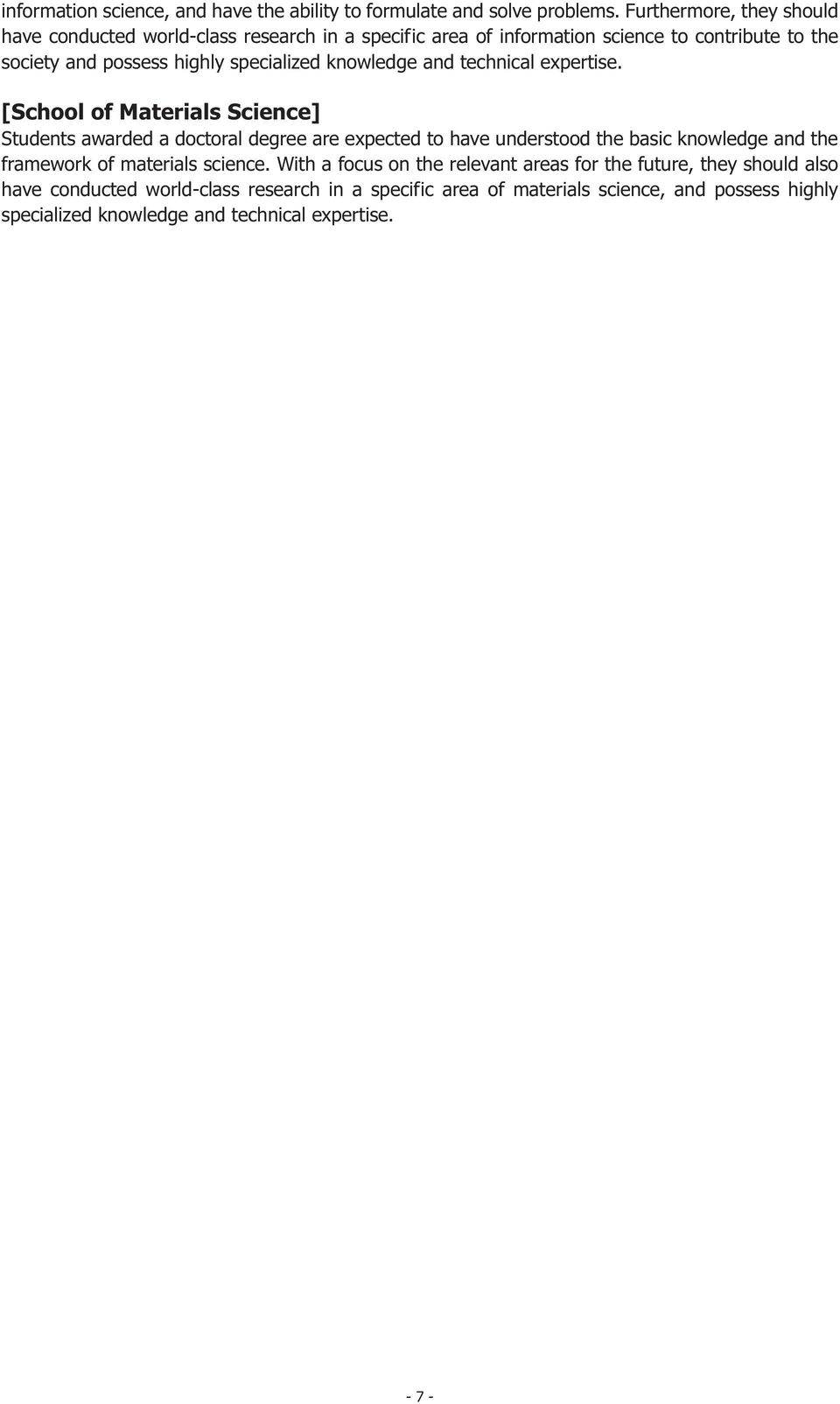
11 Policy for awarding of M.Sc. and Ph.D. degrees Master s program We award the degree of Masters of Science to students who have: acquired the required number of credits completed the master s program within the specified number of years passed their oral defense and final examinations for a master s thesis or a project report global communication skills and ethical awareness an understanding of a wide range of basic theories in the field of advanced science and technology the ability to apply basic theories to solve problems [School of Knowledge Science] Students awarded a master s degree are expected to have acquired the basic theories of the new academic discipline of knowledge science and to understand the mechanisms of creating, sharing, and utilizing knowledge. They should also have the ability to conduct academically and socially meaningful research in a specific area of knowledge science and to have gained substantial specialized knowledge and technical expertise. [School of Information Science] Students awarded a master s degree are expected to have acquired a substantial understanding of a wide range of basic theories of information science and have detailed knowledge of relevant information science techniques. They should also possess the ability to conduct research in a specific area of information science in order to contribute to the academic field and society, and have a high degree of specialized knowledge and technical expertise. [School of Materials Science] Students awarded a master s degree are expected to realize the importance of, and understand the basic theories and framework of materials science. While exploring the latest developments in related research areas, they should also have developed the ability to solve many challenging problems in materials science, and to possess specialized knowledge and technical expertise. Doctoral program We award the degree of Doctor of Philosophy to students who have: acquired the specified number of credits completed the doctoral program in the specified number of years passed their oral dissertation defense and final examinations the ability to think from a variety of perspectives global communication skills and ethical awareness an understanding of the framework and a wide range of theories in the field of advanced science and technology the ability to apply the framework and theories to identify and solve problems the ability to be leaders in the field of advanced science and technology [School of Knowledge Science] Students awarded a doctoral degree are expected to have acquired the framework and command of a wide variety of theories of the new academic discipline of knowledge science and understand the mechanisms of creating, sharing, and utilizing knowledge. They should also have conducted world-class research in a specific area of knowledge science and possess highly specialized knowledge and technical expertise. [School of Information Science] Students awarded a doctoral degree are expected to have acquired the framework and command of a wide range of theories of information science, have detailed knowledge of relevant theories of - 6 -
12 information science, and have the ability to formulate and solve problems. Furthermore, they should have conducted world-class research in a specific area of information science to contribute to the society and possess highly specialized knowledge and technical expertise. [School of Materials Science] Students awarded a doctoral degree are expected to have understood the basic knowledge and the framework of materials science. With a focus on the relevant areas for the future, they should also have conducted world-class research in a specific area of materials science, and possess highly specialized knowledge and technical expertise
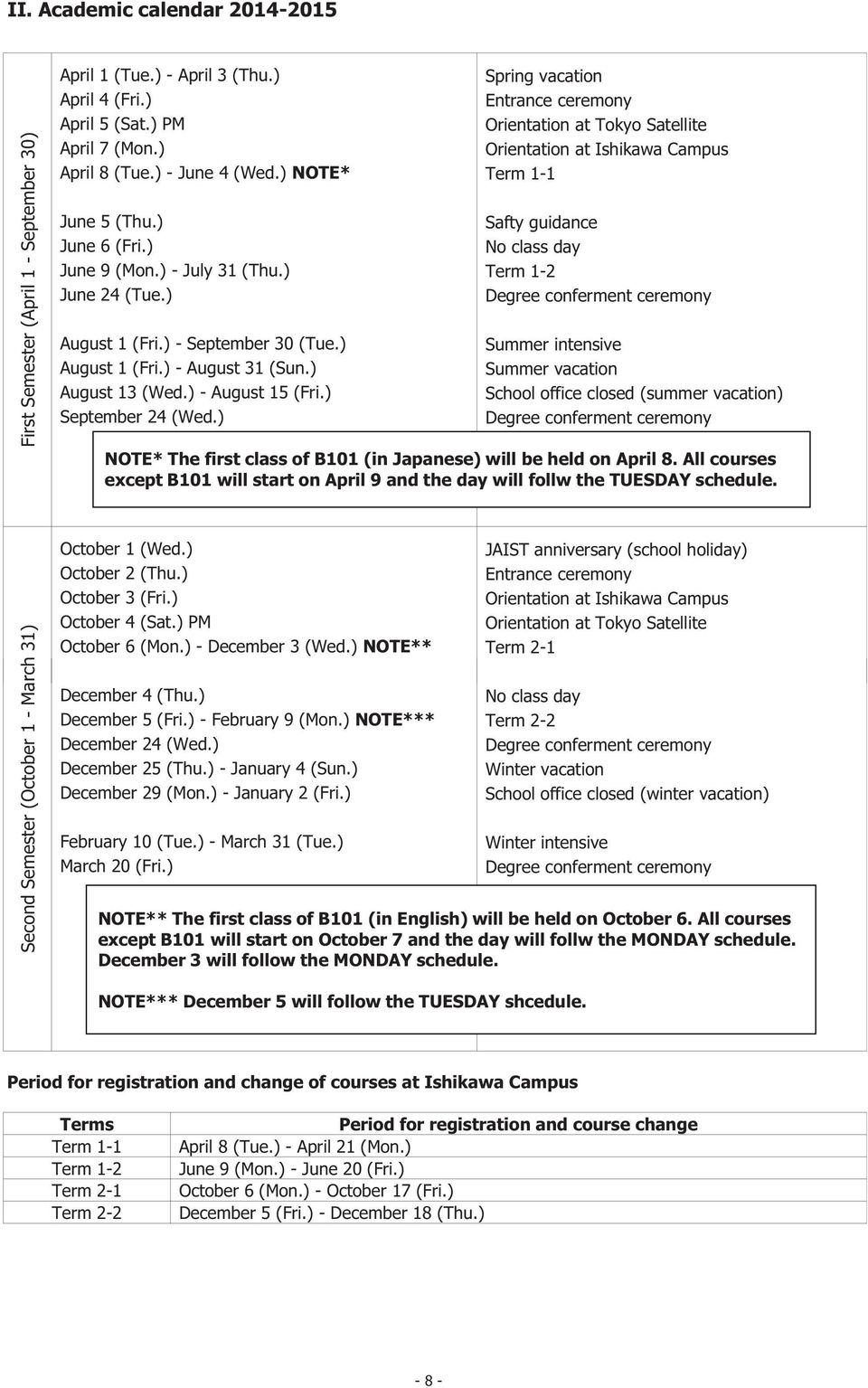
13 II. Academic calendar First Semester (April 1 - September 30) April 1 (Tue.) - April 3 (Thu.) April 4 (Fri.) April 5 (Sat.) PM April 7 (Mon.) April 8 (Tue.) - June 4 (Wed.) NOTE* June 5 (Thu.) June 6 (Fri.) June 9 (Mon.) - July 31 (Thu.) June 24 (Tue.) August 1 (Fri.) - September 30 (Tue.) August 1 (Fri.) - August 31 (Sun.) August 13 (Wed.) - August 15 (Fri.) September 24 (Wed.) Spring vacation Entrance ceremony Orientation at Tokyo Satellite Orientation at Ishikawa Campus Term 1-1 Safty guidance No class day Term 1-2 Degree conferment ceremony Summer intensive Summer vacation School office closed (summer vacation) Degree conferment ceremony NOTE* The first class of B101 (in Japanese) will be held on April 8. All courses except B101 will start on April 9 and the day will follw the TUESDAY schedule. Second Semester (October 1 - Mar rch 31) October 1 (Wed.) October 2 (Thu.) October 3 (Fri.) October 4 (Sat.) PM October 6 (Mon.) - December 3 (Wed.) NOTE** December 4 (Thu.) December 5 (Fri.) - February 9 (Mon.) NOTE*** December 24 (Wed.) December 25 (Thu.) - January 4 (Sun.) December 29 (Mon.) - January 2 (Fri.) February 10 (Tue.) - March 31 (Tue.) March 20 (Fri.) JAIST anniversary (school holiday) Entrance ceremony Orientation at Ishikawa Campus Orientation at Tokyo Satellite Term 2-1 No class day Term 2-2 Degree conferment ceremony Winter vacation School office closed (winter vacation) Winter intensive Degree conferment ceremony NOTE** The first class of B101 (in English) will be held on October 6. All courses except B101 will start on October 7 and the day will follw the MONDAY schedule. December 3 will follow the MONDAY schedule. NOTE*** December 5 will follow the TUESDAY shcedule. Period for registration and change of courses at Ishikawa Campus Terms Period for registration and course change Term 1-1 April 8 (Tue.) - April 21 (Mon.) Term 1-2 June 9 (Mon.) - June 20 (Fri.) Term 2-1 October 6 (Mon.) - October 17 (Fri.) Term 2-2 December 5 (Fri.) - December 18 (Thu.) - 8 -
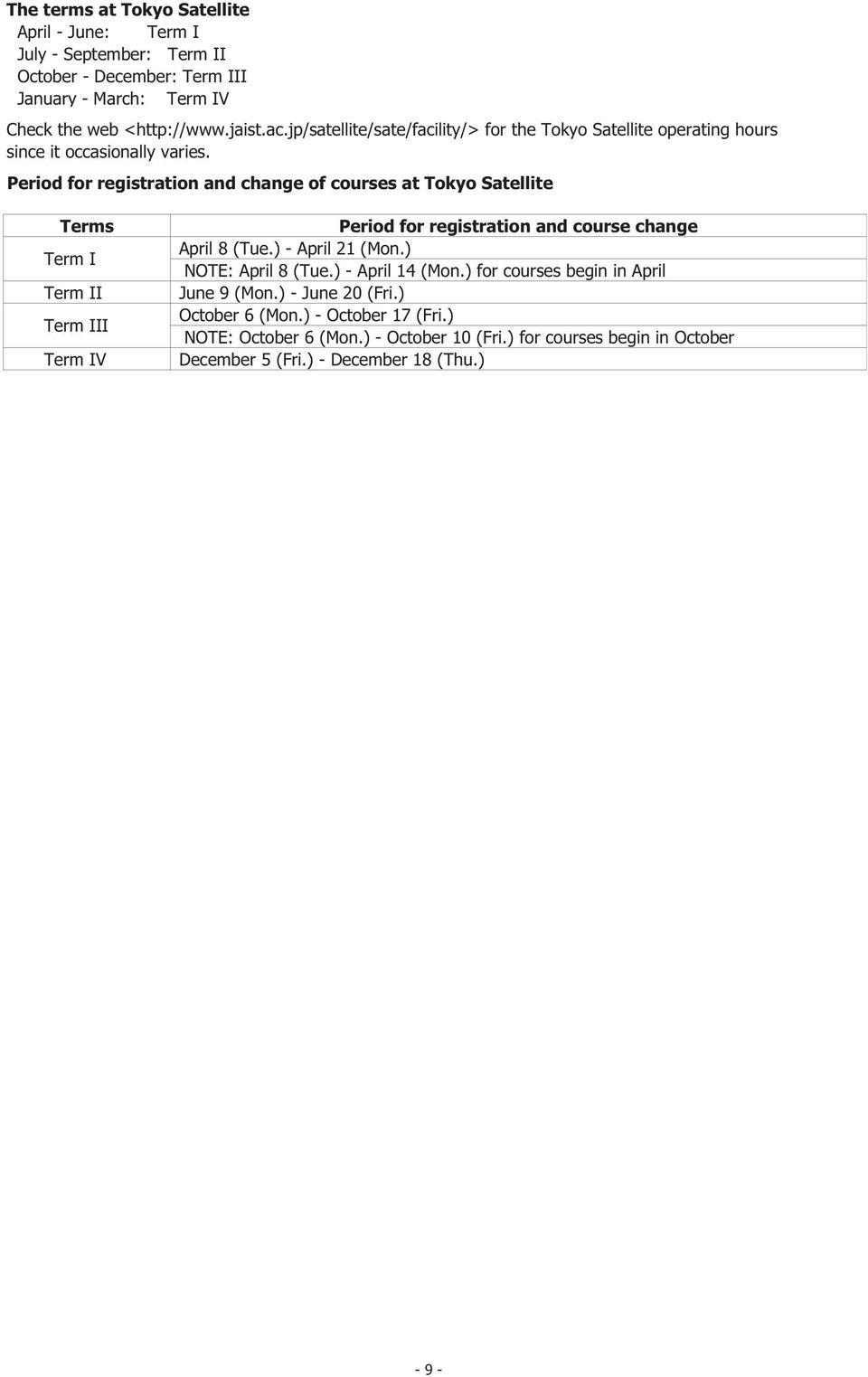
14 The terms at Tokyo Satellite April - June: Term I July - September: Term II October - December: Term III January - March: Term IV Check the web < for the Tokyo Satellite operating hours since it occasionally varies. Period for registration and change of courses at Tokyo Satellite Terms Period for registration and course change Term I April 8 (Tue.) - April 21 (Mon.) NOTE: April 8 (Tue.) - April 14 (Mon.) for courses begin in April Term II June 9 (Mon.) - June 20 (Fri.) Term III October 6 (Mon.) - October 17 (Fri.) NOTE: October 6 (Mon.) - October 10 (Fri.) for courses begin in October Term IV December 5 (Fri.) - December 18 (Thu.) - 9 -
15 III. Study outline 1 Campus JAIST's campus is in Nomi City, Ishikawa Prefecture. Courses for Working Professionals are offered at Tokyo Satellite (Minato-ku, Tokyo). 2 Schools and programs JAIST includes the School of Knowledge Science (KS school), the School of Information Science (IS school), and the School of Materials Science (MS school), each of which has a doctoral program divided into an initial two-year program and a subsequent three-year program. The initial two-year program is called the Master s program and the subsequent three-year program is called the doctoral program. 3 Academic calendar JAIST academic calendar shows the dates of classes, vacations, institute-wide activities, course registration periods, and so on. Students must check the academic calendar which is displayed on the notice board outside the Educational Affairs Department and is published on JAIST s website (Education & Student Life Academic Calendar). 4 Semesters and class periods Semesters and class terms/periods at JAIST are shown in the Table 1 bellow. Each class is 90 minute long, and there will be as a general rule 15 classes for a 2-credit course. Refer to the syllabus for details of each courses. One credit (in a 2-credit course) is awarded for the study amounts of 45 hours in self-study periods in addition to class periods (for Seminar and Research, one credit is awarded for the study amounts in accordance with the necessary workload for appropriate results as defined by the supervisor). Students are expected to keep their study record, receive guidance from their supervisor, and plan their coursework accordingly so that they can have sufficient time for their efficient academic work toward a degree acquisition. At the Ishikawa Campus, 2 classes per week are held for each course, with the exception of intensive courses. The KS/IS/MS school courses are held in the mornings (1st and 2nd periods), with the 3rd period used as the office hour for the class in the 1st period of the day (this is a time for students to ask questions or discuss matters with the class instructor, and can be applied for exercises, exams, and so on as well). The afternoon (4th and 5th periods) is used for classes such as courses in the Institute of General Education (IGE). At the Tokyo Satellite, classes are in the evenings on weekdays and in the weekends (including public holidays) for each course and as a rule office hours are not provided. The class schedule should be checked on each school s page. However, the class schedule that lists the locations of the various courses will be displayed on the notice board in front of the Educational Affairs Department and is published on JAIST website (Education & Student Life Class Schedule) so it should be checked before the start of classes each term. Note that the class information for the KS school courses held at the Tokyo Satellite will be displayed outside the lecture rooms. Location Class Terms Class Periods Ishikawa First Semester: Term 1-1, Term 1-2 (8 weeks each) Summer Intensive (August, September) Second Semester: Term 2-1, Term 2-2 (8 weeks each) Winter Intensive (February, March) Tokyo First Semester: Term I (classes starting in April to June) Term II (classes starting in July to September) st Period 9:20-10:50 2nd Period 11:00-12:30 3rd Period 13:30-15:00 4th Period 15:10-16:40 5th Period 16:50-18:20 6th Period 18:30-20:00 (Tokyo only) 7th Period 20:10-21:40 (Tokyo only)

16 Second Semester: Term III (classes starting in October to December) Term IV (classes starting in January to March) Table 1: Semesters and class periods 5 Class structure 5.1 Courses in the KS/IS/MS schools The KS/IS/MS school courses include the following courses; the Introductory courses (K/I/M1xx) that aim at providing a selected education at the post-graduate level mainly for students who have come into the JAIST from different majors, the Basic courses (K/I/M2xx) that aim at providing a thorough grasp of the basic concepts and methodologies, the Technical courses (K/I/M4xx) that aim at imparting specialist knowledge, and the Advanced courses (K/I/M6xx) that target mainly at students in the doctoral program. JAIST requires students to obtain credits accordingly so as to prevent from focusing on one specific area of study but to gain deeper knowledge from a wide range of research areas. In addition, at the Ishikawa Campus some courses are offered twice a year, once in English and once in Japanese. Courses for Working Professionals at Tokyo Satellite are offered for specialist education aimed at professionals already at the forefront of research or business. Please note that the courses offered in English are shown in the class schedules and syllabi with E after their course number (K/I/MxxxE). 5.2 Courses in the Institute of General Education (IGE) Courses in the IGE are designed to educate people to be able to make full use of their leadership abilities on the international stage, with a wide, birds-eye view of the field. These courses are offered in the following three groups: Liberal Arts courses, to provide a high level of sophistication, high ethical standards, and an understanding of diverse cultures; Communication courses, to improve communication skills, including language abilities; and Career-Enhancing courses, aimed at positioning students specializations as a part of society. Please note that courses in the IGE are not offered at Tokyo Satellite

17 IV. Matters related to tuition fees and enrollment 1 Tuition fees Tuition fees are collected separately for the full amount for each semester (from April 1st to September 30th and from October 1st to March 31st), and as a rule are to be paid by bank transfer. Please note that if the tuition fees are revised during your enrollment, the new fees will be collected from the point at which they were revised. 2 Leaves of absence When students are not able to progress in their study for more than 2 consecutive months due to illness or other special reasons, they may apply for a leave of absence. The maximum period of leave in total for each of the programs, the Master s and the doctoral, is 12 months. Please note that as the leave of absence is not counted in the total period required to complete a degree, study progression including course registration and research mentoring will not be recognized during the leave of absence, but there are no restrictions on use of the JAIST library or intra-school . The first of each month shall be the start date of a leave of absence, and it will not be permitted midway through a month. Students applying for a leave of absence must collect an Application for Leave of Absence from the Educational Service Section (hearafter, Kyoumu) and get approval from the dean of their school and from their supervisor, and submit the application to the president (via Kyoumu) no later than one month before the desired start of the leave of absence. However, if the desired start date is from September, the application must be submitted by the end of June. Please note that if the tuition payment is not completed before the desired leave of absence start date, the application will not be accepted. In addition, if students wish to have a leave of absence partway through either semester, and they submit an application by April 10th (for the first semester) or October 10th (for the second semester), tuition will not be charged for the leave of absence. If the application is made after these dates, the full amount of tuition must be paid before the application is accepted. Check details of tuition fee payment during leaves of absence on the JAIST website (Education & Student Life Absence and Withdrawal Important Notes for Leave of Absence). 3 Returning Students who wish to return to school before their leave of absence is over should submit an Application for Returning at least one month before their desired month of returning. However, if the desired returning date is from September, the application must be submitted by the end of June. Students must promptly report their return to the president by submitting a Notification of Returning to Kyoumu. Returning status starts on the first day of the month. 4 Withdrawal A date for withdrawal shall be the last day of the month, and withdrawal halfway through the month is not permitted. Students who wish to withdraw must collect an Application for Withdrawal from Kyoumu and obtain comments from their supervisor, second supervisor and advisor for Minor Research Project/Internship and approval from the dean of their school, and submit the application to the president (via Kyoumu) no later than one month before the desired start of the withdrawal. If a desired withdrawal date is from August, an application must be submitted by the end of June. Regardless of the date of withdrawal, if the tuition and other fee payments required by JAIST are not completed, the application will not be accepted. 5 Record removal Students falling under any of the following categories will have their name removed from JAIST records. (1) Those who have remained enrolled beyond the permitted maximum periods (4 years for the Master s program, 6 years for the doctoral program) *Students wishing to withdraw must complete the withdrawal procedures
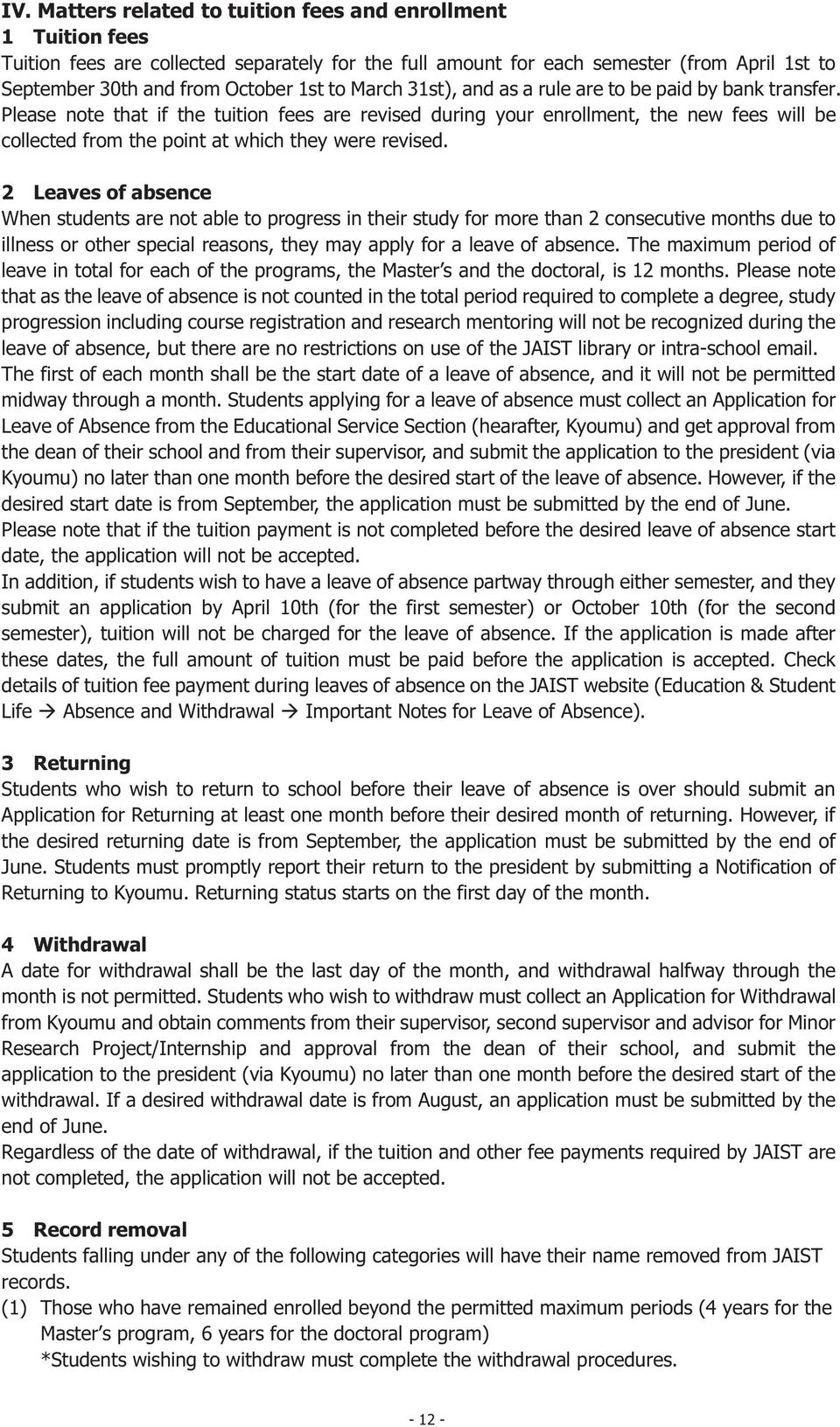
18 (2) Those whose leave of absence exceeds the period specified in Paragraph 4, Article 27, of the JAIST School Regulations (2 years). (3) Those who have not paid their admission fee by the specified date and fall into one of the categories below: - Students who have not been granted an entrance fee reduction or deferment. - Students who have not been granted a half entrance fee reduction or deferment. - Students whose entrance fee reduction or deferment has been revoked. (4) Those who have neglected to pay their tuition fees and have not paid even following demands. Note that if those who fall under either (3) or (4) have credits earned during the period in which the tuition was unpaid, the credits will also be cancelled. 6 Transferring between schools The times when students may transfer to another school from the one they are currently enrolled in are the beginning of April and of October. Students wishing to transfer to another school in April must contact Kyoumu by the end of January, and those wishing to do so in October, by the end of July. The materials to submit and the selection method will be presented separately to applicants. 7 Supplemental student status Doctoral students may be allowed to keep student status after completed all of the academic requirements for their degree except their dissertation for a maximum period of 2 years, if the dean approves that the student will be ready to apply with the help of necessary research guidance from the supervisor for a degree conferment within 2 years. Duration of student status cannot be more than 6 years in total including the period spent in the doctoral program and this additional period. For the reason that this supplemental status does not allow students to conduct any academic work on campus, JAIST does not sponsor students to issue/extend/renew their student visa for the period. Students who wish to obtain this status must contact Kyoumu at a designated time. 8 Name changes If students have changed their name, they will need to submit documents attesting the change (their new Resident s Registration) and a Notification of Change of Name to the president (via Kyoumu). Please note that all certificates and documents issued by JAIST following acceptance of the notification will be based on their new name. Certificates will be issued only with the name registered in JAIST records

19 V. Educational system JAIST provides a detailed, unique educational system that adjusts to students ambitions, experiences, and abilities, with the goal of helping each student realize their career targets. 1 Educational programs We offer five different educational programs to choose for each individual s career goals. Students will choose one of the educational programs below and take courses accordingly. However, students who take courses for Working Professionals in the Master s program will be in the M program and those in the doctoral will be in the 3D. Check the each school page for the treatment of selection periods and degree completion requirements for each educational program. 1.1 Types of educational programs (1) SD program (Master s program, doctoral program) This educational program is designed to identify students with top-level abilities at an early stage and to train scientists who can tackle new research challenges and open up new fields from a global perspective through a consistent doctoral education. Only those who have been admitted through the entrance examination for scholarship students for the SD program can take this program. The SD program students are given guidance by faculty groups organized by specialist area, and aim to complete the Master s program in 1.5 years and the doctoral program in 2.5 years, completing the entire program in 4 years. They may be recommended to change to another educational program if their grades are suffering. Please note that the SD program students may take the Advanced courses from their first year, and are recommended to obtain their course credits as early as possible. (2) 5D program (Master s program, doctoral program) This educational program provides a consistent five-year doctoral education through the Master s program and the doctoral program. (3) 3D program (doctoral program) This educational program provides a three-year doctoral education in the doctoral program. Points common to both the 5D and 3D programs (Only for Ishikawa Campus students): Doctoral students must choose one of two career tracks, type S, for those who wish to become creative scientists who can plan and implement advanced research at education and research institutes, or to become university professors, and type E, for those who wish to become advanced specialist engineers who can lead and manage the latest research and development at companies, in order to provide them with opportunities to consider their future desired careers. See the each school page for the selection timing and other details. Students in any programs have equal opportunities for the Grant System for Off-campus Activity (see the HANDBOOK for Students for details) or for taking courses. JAIST recommends that students in both 5D and 3D programs should take courses Scientific Discussions 2 and Advanced Project Management, research activities in other research institutes in Japan or overseas, and long-term advanced internships in companies in accordance with their choice of career paths. (4) M program (Master s program) This educational program is designed to provide a Master s-level education for 2 years in the Master s program to train practical specialist engineers who can play a leading role in companies or other areas based on specialist knowledge and technology. (5) M program (Master s program) This educational program is designed to provide a Master s-level education in the same way as
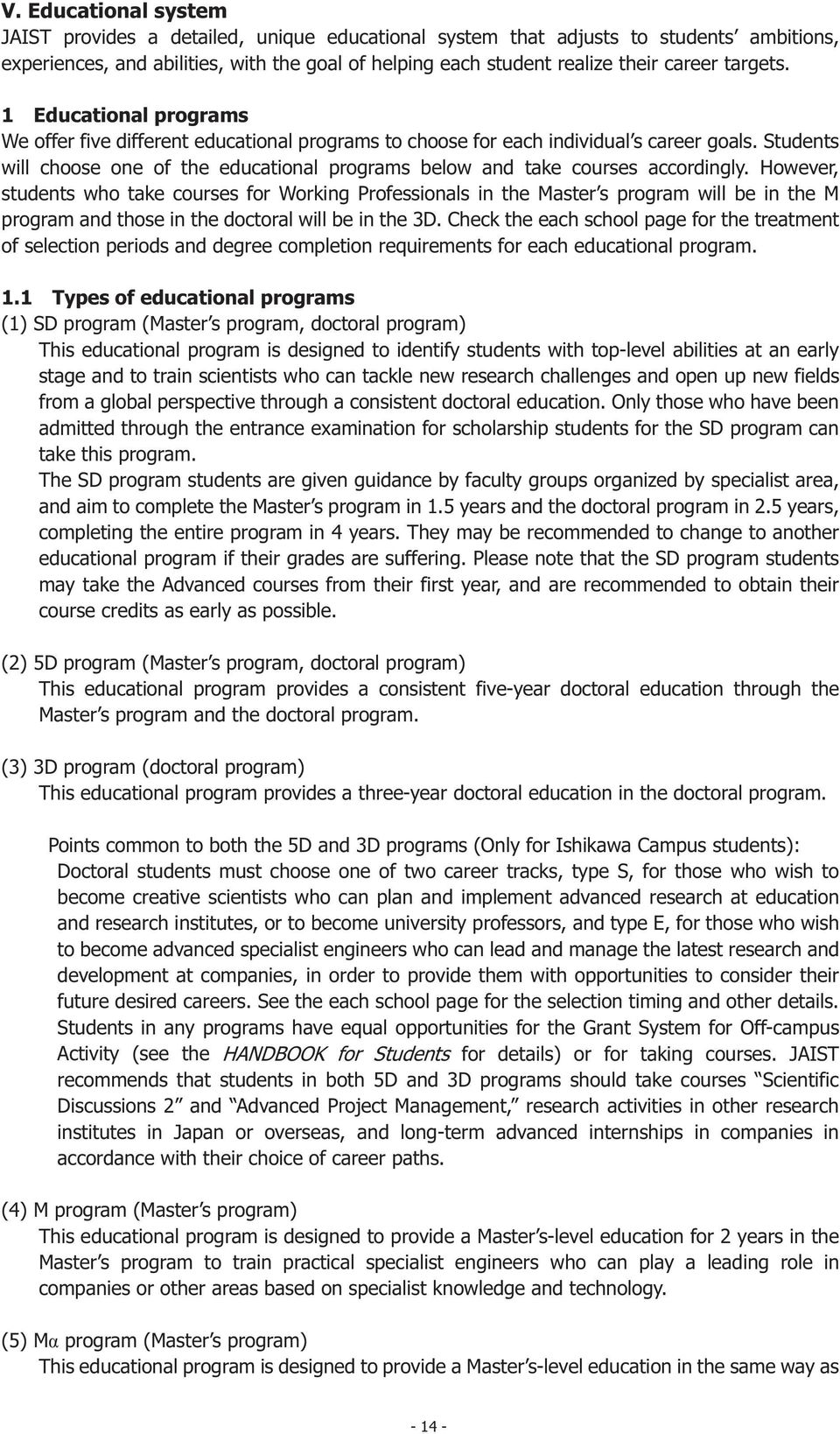
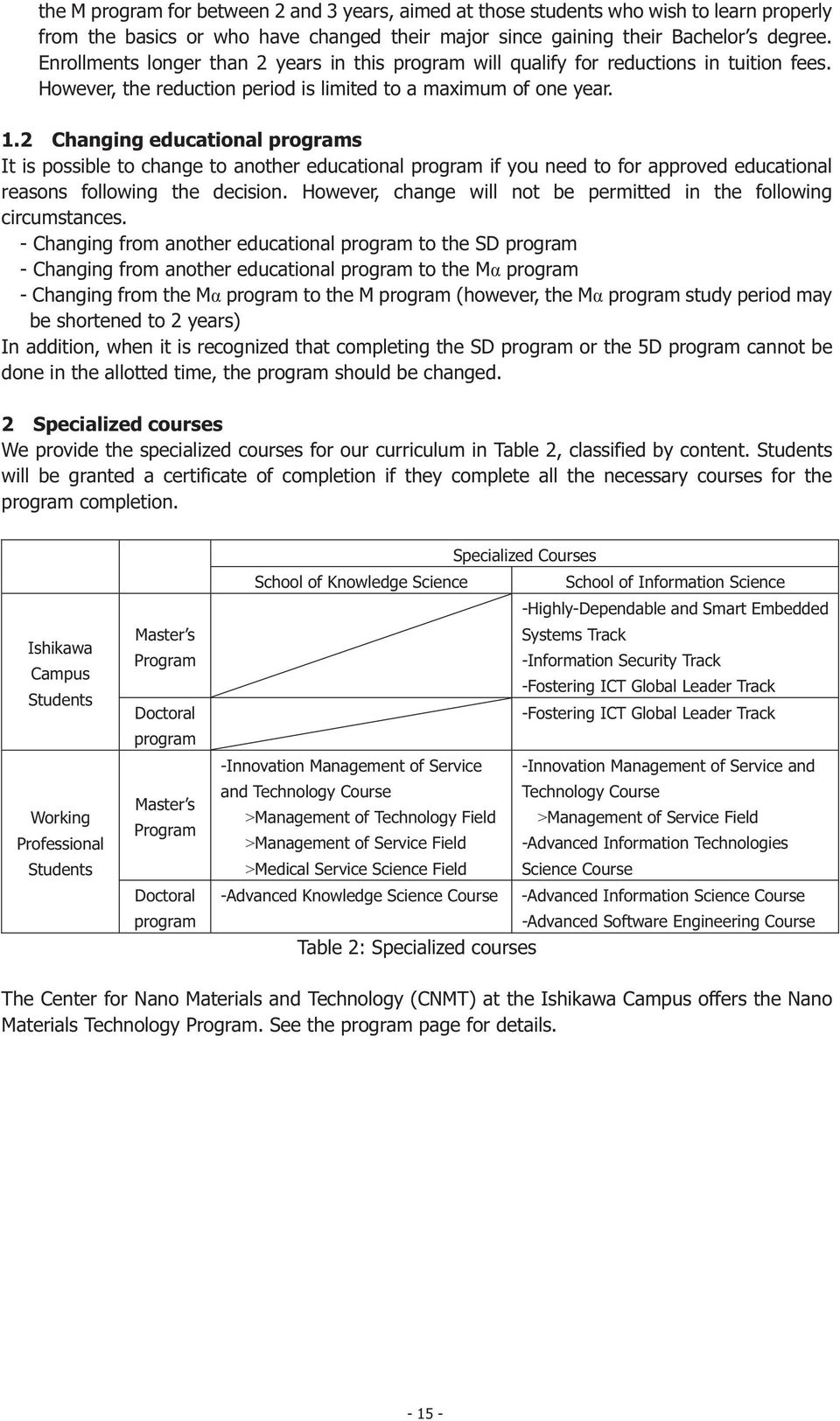
20 the M program for between 2 and 3 years, aimed at those students who wish to learn properly from the basics or who have changed their major since gaining their Bachelor s degree. Enrollments longer than 2 years in this program will qualify for reductions in tuition fees. However, the reduction period is limited to a maximum of one year. 1.2 Changing educational programs It is possible to change to another educational program if you need to for approved educational reasons following the decision. However, change will not be permitted in the following circumstances. - Changing from another educational program to the SD program - Changing from another educational program to the M program - Changing from the M program to the M program (however, the M program study period may be shortened to 2 years) In addition, when it is recognized that completing the SD program or the 5D program cannot be done in the allotted time, the program should be changed. 2 Specialized courses We provide the specialized courses for our curriculum in Table 2, classified by content. Students will be granted a certificate of completion if they complete all the necessary courses for the program completion. Ishikawa Campus Students Working Professional Students Master s Program Doctoral program Master s Program Doctoral program Specialized Courses School of Knowledge Science School of Information Science -Innovation Management of Service and Technology Course >Management of Technology Field >Management of Service Field >Medical Service Science Field -Highly-Dependable and Smart Embedded Systems Track -Information Security Track -Fostering ICT Global Leader Track -Fostering ICT Global Leader Track -Innovation Management of Service and Technology Course >Management of Service Field -Advanced Information Technologies Science Course -Advanced Knowledge Science Course -Advanced Information Science Course -Advanced Software Engineering Course Table 2: Specialized courses The Center for Nano Materials and Technology (CNMT) at the Ishikawa Campus offers the Nano Materials Technology Program. See the program page for details
21 VI. Matters related to taking courses 1 Degree completion requirements In addition to the requirements shown below, requirements for credits obtained and courses taken are set in each school. See the school page for details. 1.1 Degree completion requirements for the Master s program (1) In principle, students are required to spend a minimum of 2 years in the Master s program. However, if a prior application for fast-track degree completion is made, granted and the plan for a degree completion in a shorter period (1 year minimum) is carried out, and the academic grades are deemed to be sufficiently high by faculty, it may be approved to complete in less than 2 years in accordance with Article 36 of the JAIST School Regulations. Information on fast-track degree completion will be provided at enrollment. (2) As JAIST Course Regulations stipulate, students are required to obtain a minimum of 30 course credits. For those who are in the specified courses mentioned in (3) below, 32 credits or more are required. (3) After undergoing the required research supervision, students must submit a Master s thesis or research project report, and pass the defense and the final examination. In addition, courses specified by JAIST may also have a designated exam (Ph.D. qualifying examination) in place of a Master s thesis or research project report Requirements for progression within JAIST to the doctoral program for 5D program students 5D program students who wish to progress to the doctoral program are required to meet the degree completion requirements in the section 1.1 and ones set by each school. In addition, students are required to take more KS/IS/MS school courses and IGE courses, and to have sufficient English proficiency. Check the page for each school for details. 1.2 Degree completion requirements for the doctoral program (1) In principle, students are required to spend a minimum of 5 years in graduate school (including the time spent in the Master s program). However, if a prior application is made by a specified time, granted and the plan for a degree completion in a shorter period (3 years minimum including the time spent in the Master s program) is carried out, and the academic grades are deemed to be sufficiently high by faculty, it may be approved to complete in less than 5 years in accordance with Article 36 of the JAIST School Regulations. See the section VIII.2.1 for details on fast-track degree completion. (2) A minimum of 20 credits are to be obtained from KS/IS/MS school courses. (3) After undergoing the required research supervision, students must submit a doctoral dissertation and pass the defense and the final examination. 1.3 Handling of courses in the Institute of General Education Scientific Discussions 2 and Advanced Project Management in the IGE courses can be counted for the degree completion requirements as the Technical courses without any area assigned for both the Master s and the doctoral programs. In addition, credits from E and J of the Communication courses in the IGE can be included in the degree completion requirements for the Master s program. 2 Course-related procedures 2.1 The Gakumu system (Academic Affairs System) JAIST uses the Gakumu system for all procedures related to course registration, grade checking, viewing lecture syllabi, and so on. Ensure that you fully understand how to use the system, and have no problems with registration or other actions. If there are any points you are unclear about, check with the manual first, and then ask Kyoumu
22 2.2 Study Plan/Record and course registration Study Plan/Record A Study Plan/Record refers the plans and records of student s academic work from enrollment to completion. Students are expected to record the details of supervision from their supervisor for later reviewing their academic work. The entries should be checked carefully and be kept updated. Note that the Study Plan/Record is managed entirely through the Gakumu System. See the section Study Plan/Record in the HANDBOOK for Students Course registration Refer to the class schedule and syllabus to make sure your course registration is properly planned. JAIST does not permit double registration of two courses that have overlapping times, even if only partially, nor will allow repeating courses for credits you have already obtained. Please note that the Ishikawa Campus students must take courses held at the Ishikawa Campus, and the Working Professional students must take courses held at the Tokyo Satellite. (1) Course registration for KS/IS/MS school courses Students must plan their coursework after a consultation with their supervisor. The course registration must be done online in the Gakumu system during the designated period for each term. It is the student s responsibility to check if all the courses they wish to take are successfully registered. Adding, changing, or deleting courses can be done as many times as you wish only during the designated registration period. Check the course registration period for each term on the academic calendar. Students will be notified regarding intensive courses and other irregular courses once the schedules have been set. (2) Course registration for courses in the IGE The registration for the IGE courses should be done in the same way as those for the KS/IS/MS school courses. However, only international students are eligible to take the Japanese language courses in the Communication courses. In addition, if it is determined that inappropriate course registrations have been made, the course registration (and the earned credits) will be removed even if the course has already been completed Method for course registration in the Gakumu system (1) Log into the Gakumu system ( JAIST website top page Education & Student Life Gakumu System (Academic Affairs System) User ID is assigned to you at enrollment. Password is the same as for JAIST Mail. (2) Click Application for Regist. in the Courses Registration/Grades menu to move to the Application for Registration page. (3) Click an unregistered mark for the day and period of the course you wish to take to move to the next page to select the course. (In order to register for intensive courses, click Select Intensive Class at the bottom of the page.) (4) Click the select box to check () for the courses you wish to take, and click Confirm at the bottom. (5) Confirm that the courses you checked "" to choose are shown correctly. (6) Click the Apply button after confirming to complete the course registration. (7) Confirm your registration by clicking on the Show List Format button on the page following your application and complete the process. 2.3 Repeating course in the same year Repeating courses in the same academic year is permitted for students who have spent longer than the standard enrollment period, for both the courses for each school and IGE courses. The following conditions apply for students who have not yet exceeded the standard enrollment period
23 (1) KS/IS/MS school courses: Permitted only when the school approves of an application from students. (2) IGE courses: Permitted only when the school approves of an application from students. There are no restrictions for repeating non-credit courses. Please note that for both (1) and (2), applications for repeating courses will require the seal of approval from both course instructors of the first and second time if the students had received 0 score for the course the first time. Students wishing to repeat courses must submit an Application for Repeating Courses (JAIST website top page Education & Student Life Course Registration) within one week of the start of the course registration period for the term when the course they wish to repeat will be held, and submit it to Kyoumu. Course registration for the course to repeat will be done by Kyoumu. Please note that there is no need to apply to repeat non-credit courses. Students wishing to do so can register in the Gakumu system during the course registration period. 2.4 Taking courses from other schools (Major Crossovers) Credits obtained through a Major Crossover up to 4 credits can be included in the number of credits required for a degree completion. Note that students in the KS school cannot take I112 (Computer Systems) in the IS school and students in the IS cannot take K119 (Introduction to Computer Programming) in the KS. Students who wish to take a course from another school should submit an Application for Taking Courses from Other Schools (JAIST website top page Education & Student Life Course Registration) within one week of the start of the course registration period for the semester when the course they wish to take will be held, and submit it to Kyoumu after obtaining approval of their supervisor. Course registration will be done by Kyoumu. The Ishikawa Campus students are able to count 2 credits (1 course) from the completed courses of any of the Basic, Technical, or Advanced courses through a Major Crossover in the specified credits for the Global Human Resource Development Program. For the Master s program students, 2 credits (1 course) from the finished Major Crossover courses will be recognized as 2 credits (1 course) for the requirement of at least 8 credits (4 courses) from IGE courses. For the doctoral program students, 2 credits (1 course) of the finished Major Crossover courses will be recognized as 2 credits (1 course, 1 department) for the requirement of at least 8 credits (4 courses, 3 departments) from IGE courses. 3 Global Human Resource Development Program In order to educate students to be able to make full use of their leadership abilities on the international stage, with a wide, birds-eye view, students are encouraged to take courses in the IGE. A certificate of completion will be granted to those who obtain the specified number of credits. 3.1 Master s program The Global Human Resource Development Program Completion Certificate (Master s program) will be awarded on completion of the Master s program to those who have obtained at least 8 credits in 4 courses from the Institute of General Education and who have completed Foundations of Technical Communications or higher level courses or are deemed to have the equivalent ability. 3.2 Doctoral program The Global Human Resource Development Program Completion Certificate (doctoral program) will be awarded on completion of the doctoral program to those who have obtained credits indicated below. However, courses in the IGE taken (except for E413 and B411) during the Master s program by those who enrolled in the Master s program at JAIST will need to be retaken because the credits obtained before entering the doctoral program are not recognized
24 IGE courses: At least 8 credits (4 courses) from all 3 departments, and meeting the following requirements. - At least 4 credits (2 courses) from Liberal Arts Education Department - At least 2 credits (1 course) from Global Communication Education Department - At least 2 credits (1 course) from Career Education Department 4 Examinations, grade assessments, etc. (1) A final exam will generally be given to complete a course. When exams are difficult to implement, research reports or similar tasks will be assigned instead. (2) Grades will be assessed by the result of the final examination and student s achievement. Grades are a percentage point scale based on the view point, method, and criteria listed in the syllabus, with 60% being the passing score. Courses which are difficult to score as percentages will be either Pass or Fail. The specified credits will be awarded to those who have been given passing grades. (3) Credits that have already been obtained cannot be deleted or changed. (4) Grades can be checked by each student using the Gakumu System, starting around 2 weeks following each term for the Ishikawa Campus students and once the notification for the grade reports has been received from Kyoumu for the Working Professional students. Please note that any questions regarding the grade assessments should be directed to Kyoumu. (5) If there are any improprieties in taking classes or examinations, all credits for that semester will be withdrawn. (6) JAIST may calculate an academic performance index based on (1) and (2) so that it can be used for certain procedures JAIST approves necessary. 5 Course evaluations To help improve class quality, JAIST asks that students to provide an evaluation for each course through a questionnaire midterm and the following end of courses. The results of the midterm questionnaire will be reported to the course instructors to help improve the second half of the courses. The results from the end-of-term questionnaire will be notified to the instructors after the submission of grade reports. 6 Recognition of credits obtained prior to admission Students who wish to have the credits they obtained before admission recognized must apply to the dean of the school (via Kyoumu) after obtaining the approval of their supervisor within 2 weeks of enrollment. If students apply for credit transfer for courses taken at other graduate schools, the official transcript and a syllabus that show the details of the courses must also be submitted. The assessment for courses that are recognized will be as Transferred. By repeating the courses at JAIST, the transferred status can be renewed by a score as percentages. These recognized courses can be included in the degree completion requirements. Once recognized, courses cannot be changed. Credits for recognized courses are as follows. (1) Credits obtained at other graduate institutes Credits obtained at other graduate institutes before entering JAIST may be recognized by JAIST. A total of 8 credits can be transferred as equivalent to KS/IS/MS school courses taken at JAIST after being reviewed at a faculty meeting. No credits will be recognized for the Introductory courses in the doctoral program. (2) Credits obtained in the Master s program at JAIST Credits up to a maximum of 8 credits of more than 10 credits (except those of Seminar A and Research A) which were obtained from each school courses except for the Introductory courses may be recognized as the Advanced courses in the doctoral program. The IS school has its own requirements, which should be checked on its page. (3) Credits obtained as course-oriented students and other at JAIST Generally, all obtained credits will be counted in accordance with the curriculum after enrollment. However, the Introductory courses will not be recognized in the doctoral program
25 (4) Other Inquire at Kyoumu about transferring credits for transfer students or readmitted students. 7 Taking courses at other graduate institutes through the credit transfer agreement To promote exchanges and cooperation with the graduate institutes listed in Table 3 below and to enhance our educational content, JAIST operates a credit transfer system whereby students can take courses at other graduate institutes. After checking the syllabi of our Partner Institutes, students who wish to take courses there should discuss this with their supervisor and carry out the specified procedures. When applying, they should check the class schedule so that they only select courses they are surely able to attend. (1) Application fee, admission fee, tuition fee Students will be classified as non-degree seeking students from a partner institute and thus will not have to pay any application fees, admission fees, or tuition fees, except the tuition fees will be charged for the School of Graduate Studies at the Open University of Japan. (2) Courses and credits Courses that can be taken at Partner Institutes (except for the Open University of Japan) must be the ones that are effective for research and that do not cover topics already provided by JAIST. See the table below. During their period of enrollment at JAIST, students can take a maximum of 10 credits (a maximum of 5 courses) including the recognized credits that they obtained in their previous graduate institute. Permission for taking the courses, whether the courses taken will be counted as JAIST courses and whether they will be included for the degree completion requirements at JAIST will be determined at a faculty meeting on student s request. Please note that credits for courses obtained at the Open University of Japan will not be recognized as course credits for each school. Note that the IS school does not assign an area to the credits obtained through this agreement. (3) Application procedures Students wishing to take courses at a Partner Institute should consult with their supervisor and then carry out the procedures within the period specified once permission has been granted. Please note that the class schedule, syllabi, and procedures for Partner Institutes will be notified as appropriate. For Master s Program Students For IS students only Partner Institutes Courses available Graduate School of Natural Science and Courses taught by full-time faculty members of Technology, Kanazawa University* the Partner Institutes Graduate School of Engineering, (Laboratory work, practices, exercises, Kanazawa Institute of Technology* research projects are not included.) Graduate School of Arts and Sciences, All courses the Open University of Japan School of Multidisciplinary Sciences, Courses announced by Kyoumu. the Graduate University for Advanced Studies Graduate School of Global Information and Telecommunication Studies, Waseda University Table 3: Partner Institutes *Students are not allowed to take courses at other graduate institutes for the first half year after entering JAIST because JAIST courses are given priority. The School of Information Science does not permit this to students until a minimum of 4 credits (2 IS courses) are completed
26 VII. Matters related to research supervision 1 Laboratory assignment 1.1 Master s program All students are provisionally assigned to a laboratory when they enter JAIST. After inquiry about a laboratory of their choice, the final assignment will be made 3 months after enrollment for the IS and MS students, and 4 months after enrollment for the KS students. Students will be notified regarding applications for final assignment. Please note that the MS school will not make final assignments unless students have obtained the specified credits. Check the school s page for details. 1.2 Doctoral program Students in the 5D and SD programs will be assigned to the same laboratory as the one they were in their Master s program. For the 3D program students, consultation prior to admission with their expected supervisor is necessary. Assignments will be made upon enrollment to a laboratory of their choice accordingly. 1.3 Changing laboratories If for any reason students wish to change to another laboratory once they have been assigned, they must contact Kyoumu. 2 Teaching and research supervision Since its founding, JAIST has used a supervisory system whereby, in addition to a research theme related to their major field of study (Major Research Project), students are required to take on a secondary research theme to give them some fundamental concepts, knowledge, and abilities from different research fields (Minor Research Project). In addition, in the doctoral program, students can choose to study in other educational or research institutes in Japan or overseas as a part of a major research project, and undertake internships in companies in place of a minor research project, helping them create a career that allows their specialist skills to help society. 2.1 Major research project A major research project is called Seminar A (Master s Thesis: 8 credits / Research Project: 2 credits) and a required course for the Master s program. It is called Advanced Seminar B (Doctoral Dissertation: 6 credits) in the doctoral program. For the IS Master s students in the Fostering ICT Global Leader Program, Seminar A (Survey for Doctoral Research Plan: 2 credits) is a required course in place of Seminar A (Master s Thesis: 8 credits / Research Project: 2 credits). Check the school page for details. Once students decide a research theme in their research area, they must submit a research proposal. A start of a research period will be at the point when a research proposal has been accepted after vetting by 3 advisors. However, the IS school has different conditions for a start of a research project, which should be checked on the school s page. Please note that if a submission of a research proposal for the Master s program is late, its completion date will also be delayed. Check the conditions for starting a major research project on the page of each school. Students must also obtain necessary forms from JAIST's website (Education & Student Life Degree Requirements, Timeline and Procedures). 2.2 Minor research project A minor research project is called Research A (worth 2 credits) in the Master s program and Advanced Research B1 (Minor Research Project; worth 4 credits) in the doctoral program which is a required course. A research topic for a minor research project for Master s students should be one from outside of their research area so as to learn the fundamental concepts, knowledge, abilities, etc. outside of their field. For doctoral program students, a research topic should be chosen from a different
27 research area, or a different topic from the same research area of the major research project. Please note that the IS doctoral students must choose a topic from a different field if the topic is from the same as their research area. Check the conditions for starting a minor research project on the page of each school. Students must also obtain necessary documents from JAIST's website (Education & Student Life Minor Research Project). 2.3 Internships for doctoral program An internship is a 4 credit worth course (Advanced Research B2) in the doctoral program which can be substituted for a minor research project by choice. Doctoral students select either a minor research project or an internship within a year of admission. Generally, internships are high-level research and study at a company for more than three months. See each school page for details. For the doctoral Working Professional students Advanced Research B1 (Minor Research Project) is compulsory and Advanced Research B2 (Internship) cannot be selected. 3 Multiple supervisory system JAIST has a multiple supervisory system in which one student has 3 faculty members assigned so that students will receive overall supervision and advice for both academic work and daily life in general with various issues students might face. JAIST faculty members are here to help students to develop characteristics to suit the ideal person JAIST strives to educate. The system uses a supervisor, a second supervisor, and an advisor for Minor Research Project (or an advisor for Internship in the doctoral program). Each faculty member plays the following roles. (1) Supervisor (a) Plays the main role in supervising the students academic work and research. (b) Provides supervision for the research topic (Major Research Project) related to students research field, and for writing a thesis/dissertation. (c) Provides guidance for students student life, career path and formation. (d) Determines how to solve various problems students may face through links with a second supervisor and other related parties. (2) Second supervisor (a) Provides guidance for students academic work and research and advice to students from a different perspective to a supervisor. (b) Provides guidance and advice for students student life, career path and formation from a different perspective to a supervisor. (c) Works to solve various problems students may face through links with a supervisor as required. (3) Advisor for Minor Research Project (Advisor for Internship) (a) In principle, provides supervision for a secondary research topic (Minor Research Project) or an internship as a faculty member from outside students research field. (b) Provides advice for various academic issues students may have from a different perspective to a supervisor and a second supervisor (including liaising with the internship location). 4 Research supervision in other schools or other graduate institutes (1) Major Research Project supervision in other schools or other graduate institutions There is nothing to prevent students from doing a part of their major research project at another school within JAIST or at another graduate institute elsewhere under supervision of their supervisor. (2) Minor Research Project supervision in other schools or other graduate institutes Students may work on their minor research project in another graduate institute outside JAIST or another school at JAIST (including the Institute of General Education; the KS school will specify which faculty members from the IGE may work on the project with) under supervision of a faculty from their school when the dean of the school recognizes that there will be a
28 synergistic effect for human development in the student s research field within the school. For the KS and IS students, if they decide to work on their minor research in another school in JAIST, they can have a faculty member whom they work with as their advisor for Minor Research Project. (3) Research period The research supervision period in other schools or other graduate institutes shall be no longer than 1 year for the Master s program and 18 months for the doctoral program. (4) Procedures Students who wish to have research supervision in another graduate institute outside JAIST must submit a form for Entrustment of Research Guidance outside JAIST at least 2 months prior to the start of supervision to Kyoumu via their supervisor. There are no special procedures required for such entrustment of research guidance in other schools within JAIST
29 VIII. Matters related to conferment of degree The conferment of degree is done on dates specified by JAIST in the months of March, June, September, and December. 1 Degree defense for the Master s program The procedures related to a defense and a final examination are laid out in the Degree Regulations and in the Bylaws Related to the Defense for Granting the Master s Degree, and other arrangements. 1.1 Application for conferment of degree Students who are expected to meet the degree completion requirements (expect for Seminar A) for the Master s program and who wish to apply for a degree conferment must fill out an Application for Conferment of Degree with the thesis title and other required information, get the supervisor s approval and submit it to the president (via Kyoumu). The IS students in the Highly-Dependable and Smart Embedded Systems Track must have completed all the required courses except for Seminar A and one from the Practical Courses and the rest of the IS students must have completed all except for Seminar A before applying for degree conferment. The deadline for applying for a degree will be 2 months before the scheduled completion date, or 3 months for those wishing to graduate in September (the date will be specified by JAIST). 1.2 Submission of Master s thesis or research project Degree applicants must submit their Master s thesis or research project report by the date specified by JAIST to the president (via Kyoumu) after gaining the approval of their supervisor, and then distribute copies to the examination committee, including the supervisor. Please note that names of the examination committee will be announced along with the thesis presentation schedule. 1.3 Conferment of degree Degree applicants will undergo a private thesis defense and final examination once they have publically presented their thesis. The decision of degree conferment will be made after a deliberation at a faculty meeting. The student number of successful candidates will be announced on the notice board outside the Educational Affairs Department (a list of the number of successful candidates sent by to the Working Professional students). 2 Degree defense for the doctoral program The procedures related to a defense and a final examination are laid out in the Degree Regulations and in the Bylaws Related to the Defense for Granting the Doctoral Degree, and other arrangements. 2.1 Dissertation outline A dissertation outline must be submitted to Kyoumu at least 6 months before an application for a degree after gaining the approval of all 3 advisors. The IS students must have obtained all required credits except for Advanced Seminar B before applying. Students wishing for fast-track degree completion should first consult with their supervisor and set the earlier outline submission time. Then report to the dean of the school via their supervisor that they plan to apply for fast-track degree completion. 2.2 Preliminary defense Students who have obtained all the required credits other than Advanced Seminar B must submit their request for a preliminary defense of the doctoral dissertation to the dean of the school (via Kyoumu) at least 3 months before their degree application, with the approval of their supervisor. The supervisor will carry out the procedures for holding the preliminary defense based on this request. The student must provide drafts of the degree dissertation to each prospective
30 examination committee member by 2 weeks before the preliminary defense meeting. Please note that the prospective examination committee will be announced along with the date for the preliminary defense. 2.3 Degree application and conferment of degree Those who pass the preliminary defense should carefully read the Application Guide for the Award of Doctoral Degrees and, after obtaining approval of all 3 advisors, submit an Application for Conferment of Degree and the necessary documents to the president (via Kyoumu). Degree applicants will first present their work at a formal hearing (open to the public) and then be examined by the examination committee at which time they will provide a defense of the dissertation and have their final examination (not open to the public). Please note that the examination committee will be announced along with the date for the formal hearing. The decision of degree conferment will be made after a deliberation at a faculty meeting. The student number of successful candidates will be announced on the notice board outside the Educational Affairs Department (a list of the number of successful candidates sent by to the Working Professional students). Please note that following the announcement the successful candidates must check the necessary procedures to take in the Application Guide for the Award of Doctoral Degrees and must ensure them done by the specified deadline
31 IX. Systems in place 1 Extended study period for completion If students whose study time at JAIST is limited by job conflicts or other issues and finds it difficult to complete the study within the standard enrollment period, they may be allowed to exceed this period and take courses systematically for a set period. Students who wish to extend their study period must check the JAIST website (Education & Student Life Fast-Track Degree Completion / Extended Study period for Completion) and apply before the designated deadline. 2 Progression within JAIST (1) Those students who have completed a Master s program at JAIST and wish to continue onto the doctoral program must apply for the Internal Entrance Examination. 5D program students in the KS school must apply for the second selection examination. (2) The application period for selection, selection date, provisional announcement, selection method, announcement of successful applicants, and other procedures will be in accordance with the separately set Terms and Conditions for Selection of Students for Progression Within JAIST. 3 Finding employments (1) Guidance and supervision for finding employments and other career formation matters will be done at periods set by JAIST-wide and by each school. (2) School recommendations will be made only for students who satisfy the recommendation standards set by the school. Check each school s page for details. 4 Teaching certificate Check the details in the relevant pages with the Japanese-language version of the Degree Completion Guide Study and training benefit plans Check the details in the relevant pages with the Japanese-language version of the Degree Completion Guide
32 Lecture room map School of Information Science, School of Materials Science Ground floor Front Entrance Stairs MS Hall Stairs Stairs 165 people M Lecture Room 1,2 80 people I Lecture Room 2 I Lecture Room 1 40 people 40 people JAIST Gallery First floor Leads to the JAIST cafeteria Refresh Room Stairs IS Lecture Stairs Hall M Lecture M Lecture Room 3 Room 4 40 people 40 people I Lecture Room 3,4 (64 people (130 people) Career Service Department Stairs School of Knowledge Science Ground floor Stairs K Lecture Room people Doorway Leads to the fountain First floor Bulletin board Certificate machine Stairs Student Service Department Leads to the library Doorway KS Lecture Hall 90 people K Lecture Room people Leads to the School of Materials Science Building
33
34 Institute of General Education
35 Institute of General Education 1 Overview of the Institute of General Education The Institute of General Education (IGE) consists of three Departments: Liberal Arts Education, Global Communication Education, and Career Education. It provides a broad range of subjects to cultivate sophistication and knowledge, greater ethical awareness, and excellent communication skills. It also aims at equipping students with language competency, and an understanding and receptiveness toward diversified cultures, and provides career education to help graduates find positions in society based on their individual specialties and strengths. Japan has become increasingly affected by the global environment. Many corporations now focus on overseas operations. The objectives of postgraduate education today should place great emphasis not only on the fostering of researchers in advanced science and engineers in highly specialized technology, but also on the development of individuals who can exercise leadership on the international scene with abilities to think from a variety of perspectives. JAIST has established specialized facilities to adapt postgraduate education to the rapidly globalizing society. The facility, the Global Communication Center has strengthened students international communication abilities, and the facility, the Career Support Center has supported doctoral students in playing an active role in a corporation in the future. Since its establishment, JAIST has also offered cross-departmental courses, mainly in areas concerned with advanced liberal arts. The IGE was established to integrate these centers to have one educational organization responsible for cultivating individuals who can play an important role in the global society. The IGE has the following three departments. Each department aims to foster students ability necessary to be successful internationally. Liberal Arts Education Department This department offers basic liberal arts education to cultivate individuals who will utilize their qualities that are essential for leadership, such as mathematical reasoning, philosophical thinking, and an understanding of the global economy. Global Communication Education Department This department primarily provides the enhanced communication skills essential for use in the international arena through a systematic curriculum. Assistance is provided to all students to master discussion skills in English, and international students are assigned to acquire business communication skills in Japanese. Career Education Department This department offers career education from the viewpoint of providing opportunities for students to find positions in society that match their own expertise. This is achieved through a curriculum that corresponds to this aim. We will foster students ability to contribute to society based on their acquired knowledge and skills. 2 Staff Director: KAWANISHI, Shungo (Professor) [Liberal Arts Education Department] Professor TAKEUCHI, Fumihide Part-time Lecturer NAKAMURA, Masaki Research Professor KUNIFUJI, Susumu Part-time Lecturer HATANAKA, Tetsuo Associate Professor MIZUMOTO, Masaharu Part-time Lecturer HIRATA, Toru Associate Professor PREINING, Norbert Part-time Lecturer KAWAMURA, Takaya Visiting Professor KOBAYASHI, Akiko Part-time Lecturer MERKLEJN, Iwona Regina [Global Communication Education Department] Professor HOLDEN, William Riley Professor HONDA, Hiroyuki
36 Associate Professor TERRILLON, Jean-Christophe Georges Research Lecturer Blake, John Research Lecturer HINCHEY, Dubhgan Kyle-Arleas Research Lecturer Ambassah, Ochieng Nathaniel Part-time Lecturer EDWARDS, Peter Part-time Lecturer ELWELL, Mark Guy Part-time Lecturer COOK, Steven [Career Education Department] Visiting Professor TANAKA, Hiroshi Part-time Lecturer HASHIZUME, Toru Part-time Lecturer SERYO, Koichi Part-time Lecturer TERA, Akemi Part-time Lecturer HORIGUCHI, Etsuko Part-time Lecturer YAMAGUCHI, Michiyo Part-time Lecturer TSUTSUI, Masako Part-time Lecturer OKANO, Kinue Professor KAWANISHI, Shungo Visiting Professor INOUE, Kumi Visiting Professor TSUJI, Toshihide Visiting Professor SHIBUYA, Yoshiho Part-time Lecturer YANAGISHITA, Kazuo Part-time Lecturer MIURA, Susumu 3 Lecture schedule For the class schedule of the Institute of General Education, see the class schedule page of each school. 4 Liberal Arts Education Department While providing major courses by each school at JAIST, the IGE offers courses to equip students with ability to think from a variety of perspectives. The IGE focuses on three abilities: mathematical preparation, philosophical ways of thinking, and global viewpoint. L211 Logic and Mathematics will give mathematical preparation necessary to students in all the schools. L212 History and Philosophy of Science is a course to develop students philosophical ways of thinking in the field of science, and L213 World Economics is a course to cultivate a global viewpoint in the field of economics. L221 Ethical Issues in Science, L222 Introduction to Management of Technology and Intellectual Property Law, and L223 Media Theory are selected carefully that are essential for advanced scientists and highly specialized engineers. All these courses are held twice a year; one is in Japanese, and the other is in English. 4.1 Schedule of courses Course Number Course Title Language * Class Terms Instructor(s) Notes 1 st Semester A Methodology for Innovation (1-1&1-2) L011 J Design 2 nd Kunifuji, etc. Semester (2-1&2-2) Liberal Arts Courses I J 1-1 L211 Logic and Mathematics Preining E 2-1 History and Philosophy of E 1-1 L212 Mizumoto Science J 2-1 E 1-2 L213 World Economics Takeuchi J 2-2 Liberal Arts Courses II J September L221 Ethical Issues in Science Nakamura E February Introduction to Management of J September Hirata, Kobayashi L222 Technology and Intellectual Property Law E February Kawamura, Kobayashi L223 Media Theory * J indicates that the course is offered in Japanese; E in English. E September Merklein J February Hatanaka Noncredit
37 5 Global Communication Education Department (Communication courses) Technical communication skills are indispensable for taking an active role in the global society. To develop such skills, the Global Communication Education Department (GCED) offers the Technical Communication Education and Technical Japanese Education Programs that systematically cover various courses at levels from basic to advanced and courses for intercultural understanding to enhance the language education. The Technical Communication Education Program consists of 14 courses at 4 levels from basic to advanced to provide technical communication skills from basic English to advanced scientific & technical communication. The Technical Japanese Education Program provides international students with 15 courses at 4 levels from basic to advanced in addition to business Japanese and practical Japanese language training at business companies. The courses provide technical Japanese language skills for basic, scientific & technical, and business communications. Moreover, courses on intercultural communication, Japan studies, and paper-writing and presentation in Japanese are offered to enhance global communication education, thereby developing competences to cope with the multi-cultural global society. In principle, students are required to take classes matching their levels of language proficiency in each Program. 5.1 Communication courses (Technical Communication Education Program) System of technical communication courses The Technical Communication Education Program offers systematically courses for students to master English language skills at 4 levels from basic English to advanced technical communication English. Four courses at the basic and introductory levels aim to improve and enhance basic skills for reading, writing, listening, and speaking. Six courses at the foundational and advanced levels aim to develop technical communication skills by mastering critical thinking and such advanced practical skills as paper-writing, presentation, and discussion in the context of science and technology. To further develop English skills, the GCED also offers a seminar for practical English and various seminars. Basic English: These courses aim to rebuild foundations of English language by reviewing basics of English grammar and basic skills for reading, writing, listening, and, speaking, thereby stimulating students motivation to study English further. Introduction to Technical Communication 1, 2: These courses help students master essential skills for reading, writing, listening, and speaking English by applying them in concrete contexts of research and education at JAIST. Foundational Technical Communication 1, 2: These courses develop competences for foundational technical communication in English by learning critical thinking, academic writing & presentation, and discussion skills to be used in science and technology contexts. Advanced Technical Communication 1, 2: These courses aim to develop advanced skills for technical communication in English and critical thinking for scientists and engineers, thereby mastering practical application skills for writing and orally presenting academic papers. Seminars: To enhance the courses above, E021 Interaction Seminar, E022 Presentation Seminar, and E023 Pronunciation Seminar are offered. Seminar for Practical English: This course aims to improve practical communications skills and to enhance adaptability to foreign cultural environments, thereby helping student prepare for international conference presentations and short stays at research laboratories of foreign universities
38 5.1.2 Schedule of courses Course Number Course Title Class Terms E011 Basic English E021 Interaction Seminar Instructor (s) Holden, Ambassah Elwell, Holden, Cook Notes Non-credit Non-credit E022 Presentation Seminar Elwell Non-credit E023 Pronunciation Seminar Elwell Non-credit E111 E112 E113 E211 E212 Introduction to Technical Communication 1 Introduction to Technical Communication 2 Introduction to Technical Communication 3 Foundations of Technical Communication 1 Foundations of Technical Communication Hinchey Blake Mar. Ambassah, Holden Edwards Terrillon E213 Scientific Discussions 1 Aug. Mar. Terrillon E411 E412 Advanced Technical Communication 1 Advanced Technical Communication Terrillon Edwards E413 Scientific Discussions Terrillon E422 Seminar for Practical English Not offered this year. Note 1: Depending on the number of registering students, some courses may be offered in more than one time slot in the same term. Note 2: Courses offered in August and March are intensive courses The goal to be attained by learning technical communication in English All the students are expected to get a TOEIC score of 600 and over by graduation. To that end, students whose TOEIC scores are under 500 are supposed to take E011 Basic English, and students whose TOEIC scores are 500 and over and are under 600 are supposed to take courses of E Introduction to Technical Communication 1, 2, 3. A TOEIC score of 600 and over can be approved as a substitute for getting credits of one course from E211 to E413 as a requirement to get a certificate of the Global Human Resource Development Program TOEIC IP and TOEIC Bridge IP tests The Global Communication Education Department (GCED) offers periodically TOEIC IP tests and TOEIC Bridge IP tests to monitor students improvement in English abilities. All the newly admitted students must take the first TOEIC IP test available. In principle, all the students in English courses must take the TOEIC IP test on the date closest to the final day of the term. Students who do not take English courses are also allowed to take TOEIC IP test. TOEIC Bridge IP test is offered for students whose score of the TOEIC IP test is under 500. Test schedule On the Ishikawa Campus 1. TOEIC IP only for students enrolled in April, Friday, April 4 14:30 ~ 17:00 2. TOEIC Bridge IP only for students enrolled in April, 2014 and whose score of the TOEIC IP test is under 500. Friday, April 11 15:30 ~ 17:
39 3. TOEIC IP Friday, June 13 15: 30 ~ 18:00 4. TOEIC IP Friday, August 1 15: 30 ~ 18:00 5. TOEIC IP Thursday, October 2 14:30 ~ 17:00 6. TOEIC Bridge IP. Friday, October 10 15: 30 ~ 17:00 7. TOEIC IP Friday, November 28 15: 30 ~ 18:00 8. TOEIC IP Friday, February 6, : 30 ~ 18:00 At the Tokyo Satellite 1. TOEIC IP Sunday, August 10 13:30 ~ 16:00 2. TOEIC IP Sunday, March 8, :30 ~ 16: Communication courses (Technical Japanese Education Program) System of technical Japanese courses The Technical Japanese Education Program provides international students with Japanese language courses to systematically master Japanese language skills for communication from basic Japanese to scientific and technical or business contexts. Courses of Introductory Japanese and Technical Japanese courses at basic and intermediate levels are designed to acquire and enhance basic Japanese language skills for reading, writing, listening, and speaking. Advanced technical Japanese and business Japanese courses are designed to master advanced skills for practical applications of Japanese language in document-writing, presentations, and discussions in the context of science and technology or business. To further enhance Japanese language skills, the Program also offers a practical Japanese training course at business companies. Introductory Japanese 1, 2, 3: These courses provide beginners with the foundations of Japanese language through practices in Hiragana and Katakana, basic conversation, listening comprehension, and composition, thereby enhancing their motivation to study Japanese language further. Basic Technical Japanese 1, 2, 3: These courses are designed for students to acquire skills to handle a series of easy conversations, use colloquial expressions, comprehend short readings and write short sentences through practices in essential Chinese characters and introductory level vocabulary, sentence patterns, grammar, and expressions (The goal is the N5/N4 levels of JLPT). Intermediate Technical Japanese 1, 2: These courses provide skills for conversations appropriate for situations and human relations, understanding Japanese sentences on familiar topics, and expressing ideas and opinions actively by making practices of intermediate-level Chinese characters and functional expressions necessary for communication (The goal is the N3/N2 level of JLPT). Advanced Technical Japanese 1, 2: These courses are designed to provide Japanese language skills necessary for academic life by making practices in advanced-level Chinese characters, reading and writing academic papers or reports, and academic discussions and presentations (The goal is the N2/ N1 level of JLPT). Business Japanese 1, 2: These courses provide international students, who have already N1-level Japanese language skills and a desire to work in Japan, with knowledge and skills to properly handle appropriate expressions, document-writing, human relations, and
40 cultural issues in business contexts. Seminar for Technical Japanese 1: This course helps students prepare for and aim to pass the N1 level of JLPT. Seminar for Technical Japanese 2: This seminar provides skills for reading and writing academic Japanese to international students, who graduated from Japanese universities or majored in Japanese language in their mother countries and are planning to write their master s theses in Japanese. The N1 level of JLPT is required to take this course. Practical Japanese Training Course at Business Companies: This course provides international students, who have a desire to work in Japan and have completed business Japanese courses, with opportunities to comprehend realities of Japanese business by visiting local business sites, experiencing business situations, and reporting and discussing experiences. Completion of J413-4 Business Japanese 1,2 is required to take this course Schedule of courses Course Number Course Title Class Terms Instructor (s) Notes J011 Introductory Japanese Tsutsui Non-credit J012 Introductory Japanese Tsutsui Non-credit J013 Introductory Japanese 3 Aug. Mar. Tsutsui Non-credit J111 Basic Technical Japanese Yamaguchi J112 Basic Technical Japanese Yamaguchi J113 Basic Technical Japanese 3 Aug. Mar. Yamaguchi J211 J212 J411 J412 Intermediate Technical Japanese 1 Intermediate Technical Japanese 2 Advanced Technical Japanese 1 Advanced Technical Japanese Horiguchi Horiguchi Tera Honda J413 Business Japanese 1 Aug. Mar. Horiguchi J414 Business Japanese 2 Aug. Mar. Okano J415 J416 J421 Seminar for Technical Japanese 1 Seminar for Technical Japanese 2 Practical Japanese Training at Business Companies Honda Tera Aug. Honda offered once a year Note 1: Depending on the number of registering students, some courses may be offered in more than one time slot in the same term. Note 2: Courses offered in August and March are intensive courses. 5.3 Other communication courses (language and culture) Additional courses G211 Intercultural Communication Studies, G212 Writing and Presentation Skills, and G213 Japan Studies are offered to develop and enhance students knowledge and skills necessary to adapt themselves to the multi-cultural global society. Schedule of courses Course Number G211 Course Title Intercultural Communication Studies Language * E J Class Terms September February Instructor (s) Inoue G212 Writing and Presentation Skills J Tsuji Notes
41 G213 Japan Studies E Kawanishi * J indicates that the course is offered in Japanese; E in English. 6 Career Education Department (career-enhancing courses) The Career Education Department offers career-enhancing courses for students, who are devoting themselves to advanced science and technology to become professionally and socially independent. While we respect students knowledge and skills in their specialized areas, we cultivate their viewpoints and practical ability to utilize the knowledge and skills in human society. We also nurture students to acquire the habit of thinking for the future on the basis of the relationship between themselves and the society while students pursue scientific and technological excellence in their areas. We also develop their abilities to present their research to people in various fields and to understand and discuss issues outside their field in their own ways. Through our courses, we hope that students will rebuild their concept of values for research and development in a social value chain. The targets of career-enhancing courses are to nurture creative technologists, who systematically learned knowledge and skills in their fields, acquired communication ability with people in various fields, and try to open the future by using those abilities. 6.1 Schedule of courses Course Number Course Title Career Development Courses B101 B201 Career Development Basic** Career Development Expansive Career Practical Skill Courses Business Management & B211 Entrepreneurship B212 Basic Project Management Language * B213 Career Awareness Development J B411 Advanced Project Management Class Terms Instructor(s) Notes J 1-2 Director E 2-2 E 1-1 Seryo J 2-1 Hashizume J E J E E J September February September February Offered as necessary September February Yanagishita * J indicates that the course is offered in Japanese; E in English. ** The first class of B101 given in Japanese is held as on Tuesday, April 8. The first class of B101 given in English is held on Monday, October 6. Miura Director Tanaka 1 credit
42
43 School of Knowledge Science
44 School of Knowledge Science 1 Outline of the school The educational and research system of School of Knowledge Science (KS school) has been developed through the restructuring and integration of disciplines in the fields of systems science, natural science, information science, cognitive science, social science, and humanities. The school engages in research into individual, organizational, societal, and natural activities from the perspective of knowledge creation, and explores the issues, What is knowledge? and How is knowledge created? The school also aims to nurture human resources, pioneers of the knowledge society in the 21st century capable of identifying and solving problems, and designing and implementing technological, organizational, and social innovation. The research objectives are as follows: Knowledge Structure; Knowledge Representation; Scientific Knowledge; Social Knowledge; Policy Knowledge; Traditional Knowledge (Wisdom); Tacit Knowledge Knowledge Management in Organization and Society; Knowledge-based Management of Technology; Knowledge-based Project Management; Technological, Organizational, and Social Innovation as Knowledge Creation; Knowledge Economy; Knowledge Society Human Cognition, Intelligence and Creativity; Embodied Knowledge; Individual Knowledge Creation; Knowledge Technology; Knowledge Systems; Data Mining; Knowledge Creative Technologies; Design as Knowledge Creation Complex Phenomena such as Networking and Evolution in Society, Technology and Nature; Systems Methodologies; Modeling and Simulation; Constructive Approach; Systems Analysis for Environmental Issues; Systems Analysis for Regional Issues Service Innovation; Service Management; Service Value Creation; Service Marketing; Medical Service These objectives cover a wide range of academic fields that surpass conventional academic frameworks and enable students to freely set their research themes from any viewpoint of knowledge. We use intellectual techniques and technologies, group creation technology, and modeling & simulation in our research, and place great importance on field work, the gathering and analysis of data and knowledge creation in the field. We conduct both theoretical research to establish theoretical models for the explanation of phenomena, and practical research to resolve real and actual issues. We also encourage collaboration on research activities with regional and overseas organizations. With this type of research as a backdrop, we have integrated various bases of knowledge from systems science, natural science, cognitive science, information science, social science, and humanities. We nurture managers and engineers with advanced expertise, managers with expertise in technology and engineers with expertise in management, and knowledge scientists, scientists with research prowess in the field of knowledge science as a graduate school that develops advanced science and technology in accordance with the needs of a rapidly changing society. Research subjects of the KS school are concentrated mainly in the following four (three fundamental and one applied) areas in accordance with students research interests and the expertise of our faculty members. Social knowledge Within this area, research is conducted on the processes of creating, sharing, and utilizing knowledge in groups, organizations, and society. Also, this area educates knowledge managers who have academic knowledge and practical skill in knowledge management and management
45 of technology (MOT) in business, government, NPOs, and regional communities, thereby producing technological, organizational, and social innovations. Knowledge media Within this area, research is conducted on human capabilities for discovering and representing items of knowledge. This area also allows students to systematically acquire knowledge and skills to develop knowledge-intensive systems with digital media and knowledge-base. Students are expected to play leading roles in creating a knowledge society by applying their knowledge and skills to the advancing frontiers of information and communication technologies. Systems knowledge Within this area, research is conducted on the processes of creating, sharing, and utilizing knowledge in complex phenomena in natural and social systems based on systems science using systems methodologies, modeling and simulation. Research activities in this area nurture knowledge workers capable of contributing to the analysis and solution of problems and issues in these domains. Service knowledge Within this area, research is conducted on the processes of service value creation, the sharing and utilization of service knowledge in enterprise or organizations. This area also allows service knowledge managers to achieve technical, organizational, and social innovation by providing them with practical know-how, skills and techniques for service management in enterprise and organizations. Dean: Professor Yukari Nagai Number of students Master s program Doctoral program Department of Knowledge Science
46 2 Faculty profiles School of Knowledge Science Name Position Specialization Social Knowledge IKAWA, Yasuo Professor Technology Management, R&D Management, Technology Strategy, Electronics and Semiconductor Industry Strategy, Innovation Management UCHIHIRA, Naoshi Professor R&D Management, Service Design Methodology, Software Engineering UMEMOTO, Katsuhiro Professor Knowledge Management OKUWADA, Kumi Visiting Professor Science and Technology Policy, Innovation Policy, Science and Technology Foresight, Nanotechnology and Material Process Technology KONDOU, Shuuji Visiting Professor Management Consulting, Innovation Management, New Industries Creation & Human Development TAKEUCHI, Fumihide *3 Professor International business cycles, Asian economy: The United States and European economies TANAKA, Hiroshi Visiting Professor Project Manegement TOYAMA, Ryoko Visiting Professor Corporate Strategy, Innovation Theory NAGATA, Akiya Visiting Professor Sceience and Technology Policy, Economics of Industrial Innovation ITO, Yasunobu Associate Professor Cultural Anthropology, Sociology of Knowledge, Ethnography PELTOKORPI, Vesa Matti Associate Professor Knowledge Management, International Human Resource Management, Transactive Memory Systems MIZUMOTO, Masaharu *3 Associate Professor Analytic Philosophy, Wittgenstein, Epistemology, Philosophy of Mind Knowledge Media KUNIFUJI, Susumu *4 Research Professor Creativity Support Systems, Groupwares, Knowledge-based Systems NAGAI, Yukari Professor Design Creativity, Design Knowledge, Design Thinking, Communication Design NISHIMOTO, Kazushi *1 Professor Creativity Support, Media Interaction, Informal Communications, Musical Information Processing HO, Bao Tu Professor Machine Learning, Knowledge Discovery and Data Mining, Text Mining, Computational Science MIYATA, Kazunori Professor Computer Graphic, Media Integration, Procedural Modeling, Material Rendering DAM, Hieu Chi Associate Professor Computational Science, Knowledge Discovery and Data Mining FUJINAMI, Tsutomu Professor Skill Science, Embodied Cognitive Science, Information and Communication Technologies (ICT) for Dementia Care YAMASHITA, Kunihiro *1 Associate Professor Software Engineering, Software Development Environment YUIZONO, Takaya Associate Professor Groupware for Knowledge Creation, Computer-Supported Cooperative Work, Cross Cultural Collaboration HIDAKA, Shohei Assistant Professor Cognitive Science, Language Development, Behavioral Time Series Analysis Systems Knowledge NAKAMORI, Yoshiteru Professor Systems Methodology, Decision Analysis, Kansei Engineering HASHIMOTO, Takashi Professor Complex Systems, Evolutionary Linguistics, Evolutionary Economics, Artificial Life YOSHIDA, Taketoshi Professor Systems Methodology, Knowledge Management, Tacit Knowing HAYASHI, Yukio Associate Professor Complex Network Science, Ad Hoc Wireless Communication, Self-organization, Distributed Computing HUYNH, Nam Van Associate Professor Decision Analysis, Computational Intelligence, Knowledge Modelling KOBAYASHI, Shigeto Assistant Professor Institutional Analysis of Financial Market, Evolutionary Economics KONNO, Takeshi Research Assistant Professor Cognitive Science, Cognitive Developmental Robotics, Evolutionary Linguistics YAMASHITA, Yukihiro Research Assistant Professor Theory of Knowledge Construction, Regional Innovation Service Knowledge IKEDA, Mitsuru Professor Knowledge Engineering, Ontology Engneering, Medical Service Science, Educational Technology, e-learning, Knowledge Management System KOHDA, Youji Professor Internet Service, Service Science, Business Innovation KOSAKA, Michitaka Professor Innovation Process, Research and Development Management, Business Information System, Stochastic Control System MIZOGUCHI, Riichiro *2 Research Professor Ontological Engineering, Artificial Inteligence, Intelligent Learning Support System KANAI, Hideaki *1 Associate Professor Social computing, Persuasive technology, Pervasive Healthcare, Semantic Web SHIRAHADA, Kunio Associate Professor Service marketing, Organization management, Technology management OGAWA, Taisuke Research Assistant Professor Ontological Engineering, Knowledge Circulation, Medical Service Science MASUDA, Hisashi Assistant Professor Service Science, Service Marketing, Applied Microeconomics, Knowledge Engineering Developing Management Skills in Engineers and Researchers, Service Business in the Manufacturing SUMI, Tadao Visiting Professor Industry *1 The instructor belongs to the Research Center for Innovative Lifestyle Design and concurrently works as a faculty member for the KS school. *2 The instructor belongs to the Research Center for Service Science and concurrently works as a faculty member for the KS school. *3 The instructor belongs to the Institute of General Education and concurrently works as a faculty member for the KS school. *4 The instructor is a professor for the president and concurrently works as a faculty member for the KS school
47 Chairs operated jointly with research institutes and/or companies Name Position Specialization Industrial Policy Systems (Mitsubishi Research Institute, Inc.) Technology Policy and Technology Strategy, R&D Strategy and Technology Evaluation, Automobile and OKUDA, Akinobu Visiting Professor Aerospace Business Strategy Corporate Strategy Systems (Nomura Research Institute, Ltd.) IKEZAWA, Naoki Visiting Professor Theory of Technology Strategies, Theory of Project Strategies, Knowledge Management TERASAKI, Akira Visiting Professor Information and Communication Policy, International Standardization of Information and Communication Systems NITTO, Hiroyuki Visiting Professor Marketing, Consumer Behavior Analysis, Theory of Project Strategies Knowledge Business Creation (Fujitsu, Ltd.) TAKADA, Yuji Visiting Professor Service Oriented Architecture, Cloud Computing, SaaS/PaaS ARIMA, Jun Visiting Associate Professor Change Manegement, Knowledge Management YAGI, Ryuhei Visiting Associate Professor Social Design, Qualitative Research, Psychometric Intelligent Production Systems (Hitachi, Ltd) AKATSU, Masaharu Visiting Professor Information System, Service Management, R&D Management NAGASAKA, Akio Visiting Associate Professor Intelligent Graphic Handling, Video Image Processing, Multimedia Processing Management of Industry-Academy Collaboration (Ministry ofeconomy, Trade and Industry) Theory of Innovation, Technology Roadmapping, R&D Management, Theory of Semiconductor Business, YASUNAGA, Yuko Visiting Professor Theory of Resource Policy Intelligent Media (Advanced Telecommunications Research Institute International) MIYASHITA, Takahiro Visiting Professor Robotics, Control Engineering, Sensor Network, Human-Robot Interaction, Ambient Intelligence, Tactile Sensing, Tactile Communications KOIZUMI, Satoshi Visiting Associate Professor Intelligent Robot, Human-Robot Interaction, Hyper Omni Vision, Sensor Network Knowledge Science Chair Cooperated with Vietnam FIVE Institutes* CAO, Tru Hoang Visiting Associate Professor Automatic reasoning, Conceptual Graph and Fuzzy Logic, Semantic Web, Text Mining, Machine Learning HUYNH, Quyet Thang Visiting Associate Professor Software Engineering, Cloud Computing, IT-Governance, Project Management Service Technology (Advanced Industrial Science and Technology) IZUMI, Noriaki Visiting Associate Professor Artificial Intelligence, Knowledge Engineering, Service Sysem Development MORI, Akira Visiting Associate Professor Fundamental Software Engineering, Network Security, Ubiquitous Computing, Service Engineering Medical Service Knowledge Science (Miyazaki University, Juntendo University) SATO, Nobuhiro Visiting Professor Internal Medicine, Medical Education, Medical Service Science ARAKI, Kenji Visiting Professor Medical Infomatics, Hospital Management, Artificial Organ, Medical Service Science Visiting SUZUKI, Muneo Medical Infomatics, Hematology, Medical Service Science Associate Professor Technology Management (University of Cambridge) PROBERT, David Rhys Visiting Professor Technology and innovation strategy, Technology management process, Make or Buy strategy, Industrial sustainability PHAAL, Robert Visiting Professor Strategic technology management, Strategic technology roadmapping Thai Knowledge Science (Thammasart University, NECTEC) UDOMVITID, Kalaya Visiting Professor Technology management, Service innovation SUPNITHI, Thepchai Visiting Professor Knowledge engineering, Natural language processing, Educational engineering, Service engineering Visiting KONGPRAWECHNON, Waree Control engineering, Biomedical signal/image processing Associate Professor * FIVE Institutes indicate University of Science, Vietnam National University-Ho Chi Minh City (HCMUS), University of Technology, Vietnam National University-Ho Chi Minh City (HCMUT), Institute of Information Technology, Vietnamese Academy of Science and Technology (IOIT, VAST), Hanoi University of Science and Technology (HUST), Vietnam National University, University of Engineering and Technology (VNU-UET)
48 Mon. Tue. 3 Class schedule for Term 1-1 ( April 8 June 4 ) :20-10:50 11:00-12:30 15:10-16:40 16:50-18:20 K470 Introduction to K228 Introduction to B201E Career Development L211 Logic and Mathematics Knowledge Creation Knowledge Science 1 Expansive (Preining) (KunifujiYamaura) (HashimotoDam, etc.) (Seryo) L212E History and Philosophy K612E Next-Generation K421E Essence of System of Science Knowledge Management Methodologies (Mizumoto) (Peltokorpi) (T.Yoshida) G212 Writing and Presentation Skills (Tsuji) G213E Japan Studies (Kawanishi) K119 Introduction to Computer K213 Methodology for E011A Basic English E011B Basic English Programming Systems Science E021 Interaction Seminar E023 Pronunciation Seminar (Kobayashi) (Nakamori) E111A Introduction to TC 1 E111B Introduction to TC 1 K469 Knowledge Creation K471 Media Creation E112A Introduction to TC 2 E112B Introduction to TC 2 Support Systems (MiyataSiio) E211A Foundations of TC 1 E211B Foundations of TC 1 (Nishimoto) E411A Advanced TC 1 E411B Advanced TC 1 J011A Introductory Japanese 1 J011B Introductory Japanese 1 J111A Basic Technical Japanese 1 J111B Basic Technical Japanese 1 J211A Intermediate Technical Japanese 1 J211B Intermediate Technical Japanese 1 J411A Advanced Technical Japanese 1 J411B Advanced Technical Japanese 1 J415A Seminar for Technical Japanese 1 J415B Seminar for Technical Japanese 1 Thu. Wed. K112EJ Basic Mathematics for K470 Introduction to L211 Logic and Mathematics B201E Career Development Data Analytics Knowledge Creation (Preining) Expansive (HoDam) (KunifujiYamaura) L212E History and Philosophy (Seryo) K211 Methodology for the K612E Next-Generation of Science Social Sciences Knowledge Management (Mizumoto) (Umemoto) (Peltokorpi) G212 Writing and Presentation E413 Scientific Discussions 2 Skills (Tsuji) (Terrillon) G213E Japan Studies (Kawanishi) K228 Introduction to K119 Introduction to Computer E011B Basic English E011A Basic English Office Hours(1330 ~ 1500) Knowledge Science 1 Programming E023 Pronunciation Seminar E021 Interaction Seminar (HashimotoDam, etc.) (Kobayashi) E111B Introduction to TC 1 E111A Introduction to TC 1 K421E Essence of System K469 Knowledge Creation E112B Introduction to TC 2 E112A Introduction to TC 2 Methodologies Support Systems E211B Foundations of TC 1 E211A Foundations of TC 1 (T.Yoshida) (Nishimoto) E411B Advanced TC 1 E411A Advanced TC 1 J011B Introductory Japanese 1 J011A Introductory Japanese 1 J111B Basic Technical Japanese 1 J111A Basic Technical Japanese 1 J211B Intermediate Technical Japanese 1 J211A Intermediate Technical Japanese 1 J411B Advanced Technical Japanese 1 J411A Advanced Technical Japanese 1 J415B Seminar for Technical Japanese 1 J415A Seminar for Technical Japanese 1 Fri. K213 Methodology for K112EJ Basic Mathematics for L011 A Methodology for L011 A Methodology for Systems Science Data Analytics Innovation Design Innovation Design (Nakamori) (HoDam) (Kunifuji, etc.) (Kunifuji, etc.) K471 Media Creation K211 Methodology for the (MiyataSiio) Social Sciences (Umemoto) E413 Scientific Discussions 2 (Terrillon) NOTE: The first class of B101 (in Japanese) will be held on Tuesday, April 8. The second and subsequent classes of B101 will be held in Term 1-2. All lectures except B101 in this term will start on Wednesday, April 9 and the day will follow the TUESDAY schedule. The lectures with EJ indicates they are offered in both English and Japanese
49 Tue. Mon. Thu. Wed :20-10:50 11:00-12:30 15:10-16:40 16:50-18:20 K114 Introduction to Social K111 Introduction to N008 Nano Quantum Device N008 Nano Quantum Device Research Methods Business Management Materials (*) Materials (*) (Masuda) (Shirahada) B101 Career Development B101 Career Development K121 Introduction to K417EJ Data Analytics Basic Basic Cognitive Science (HoDam) L213E World Economics (S.Hidaka) K427 Theory on Creative (Takeuchi) K214 Methodology for Process in Design Knowledge Media (Nagai) (Yuizono) K229 Introduction to K123 A Basic Study on N006 Nano IT Materials (*) N006 Nano IT Materials (*) Knowledge Science 2 RealWorld Oriented Interface E021A Interaction Seminar E021B Interaction Seminar (YuizonoIto, etc.) (K.Yamashita) E023 Pronunciation Seminar E022 Presentation Seminar K236EJ Basis of Data Analytics E111A Introduction to TC 1 E111B Introduction to TC 1 (HoDam) E112A Introduction to TC 2 E112B Introduction to TC 2 K412 The Knowledge Society E113A Introduction to TC 3 E113B Introduction to TC 3 (Ito) E212A Foundations of TC 2 E212B Foundations of TC 2 E412A Advanced TC 2 E412B Advanced TC 2 J012A Introductory Japanese 2 J012B Introductory Japanese 2 J112A Basic Technical Japanese 2 J112B Basic Technical Japanese 2 J212A Intermediate Technical Japanese 2 J212B Intermediate Technical Japanese 2 J412A Advanced Technical Japanese 2 J412B Advanced Technical Japanese 2 J416A Seminar for Technical Japanese 2 J416B Seminar for Technical Japanese 2 K472 Media Interaction K114 Introduction to Social N007 Nano Biodevice Materials (*) N007 Nano Biodevice Materials (*) (Nishimoto) Research Methods L213E World Economics K473 Management of (Masuda) (Takeuchi) Innovation K121 Introduction to (Uchihira) Cognitive Science (S.Hidaka) K214 Methodology for Knowledge Media (Yuizono) Term 1-2 ( June 9 July 31 ) Office Hours(1330 ~ 1500) K111 Introduction to K229 Introduction to E021B Interaction Seminar E021A Interaction Seminar Business Management Knowledge Science 2 E022 Presentation Seminar E023 Pronunciation Seminar (Shirahada) (YuizonoIto, etc.) E111B Introduction to TC 1 E111A Introduction to TC 1 K417EJ Data Analytics E112B Introduction to TC 2 E112A Introduction to TC 2 (HoDam) E113B Introduction to TC 3 E113A Introduction to TC 3 K427 Theory on Creative E212B Foundations of TC 2 E212A Foundations of TC 2 Process in Design E412B Advanced TC 2 E412A Advanced TC 2 (Nagai) J012B Introductory Japanese 2 J012A Introductory Japanese 2 J112B Basic Technical Japanese 2 J112A Basic Technical Japanese 2 J212B Intermediate Technical Japanese 2 J212A Intermediate Technical Japanese 2 J412B Advanced Technical Japanese 2 J412A Advanced Technical Japanese 2 J416B Seminar for Technical Japanese 2 J416A Seminar for Technical Japanese 2 Fri. K123 A Basic Study on K472 Media Interaction L011 A Methodology for L011 A Methodology for RealWorld Oriented Interface (Nishimoto) Innovation Design Innovation Design (K.Yamashita) K473 Management of (Kunifuji, etc.) (Kunifuji, etc.) K236EJ Basis of Data Analytics Innovation (HoDam) (Uchihira) K412 The Knowledge Society (Ito) NOTE: The lectures with EJ indicates they are offered in both English and Japanese. * N00x courses will be offered by the faculty of Center for Nano Materials and Technology and School of Materials Science
50 Mon. Thu. Wed. Tue. Fri. 1 9:20-10:50 Term 2-1 ( October 6 December 3 ) 2 11:00-12: :10-16:40 16:50-18:20 K411 Theory of Knowledge K228E Introduction to N001 Fabrication of Nano-Devices N001 Fabrication of Nano-Devices Management Knowledge Science 1 with Training Course(*) with Training Course(*) (HirataT.Hayashi) (Dam, etc.) B201 Career Development B201 Career Development K411E Theory of Knowledge K421 Essence of System Expansive (Hashizume) Expansive (Hashizume) Management Methodologies L211E Logic and Mathematics (Peltokorpi) (T.Yoshida) (Preining) K418 Representation of L212 History and Philosophy Knowledge (Yuizono) of Science (Mizumoto) G212 Writing and Presentation Skills (Tsuji) G213E Japan Studies (Kawanishi) K119 Introduction to K211E Methodology for the N002 Study on Nanobiotechnology N002 Study on Nanobiotechnology Computer Programming Social Sciences with Training Course(*) with Training Course(*) (TBA) (Umemoto) E011A Basic English E011B Basic English K479 Service Management E021A Interaction Seminar E021B Interaction Seminar (Shirahada) E022 Presentation Seminar E023 Pronunciation Seminar E111A Introduction to TC 1 E111B Introduction to TC 1 E112A Introduction to TC 2 E112B Introduction to TC 2 E113A Introduction to TC 3 E113B Introduction to TC 3 E211A Foundations of TC 1 E211B Foundations of TC 1 E411A Advanced TC 1 E411B Advanced TC 1 J011A Introductory Japanese 1 J011B Introductory Japanese 1 J111A Basic Technical Japanese 1 J111B Basic Technical Japanese 1 J211A Intermediate Technical Japanese 1 J211B Intermediate Technical Japanese 1 J411A Advanced Technical Japanese 1 J411B Advanced Technical Japanese 1 J415A Seminar for Technical Japanese 1 J415B Seminar for Technical Japanese 1 K433 Practice of MOT K411 Theory of Knowledge N003 Analysis of Nano Materials N003 Analysis of Nano Materials Innovations (Kondou) Management with Training Course(*) with Training Course(*) K626E Advanced Topics in (HirataT.Hayashi) L211E Logic and Mathematics Media Design K411E Theory of Knowledge (Preining) (MiyataNagaiKanai Management L212 History and Philosophy MiyashitaKoizumi) (Peltokorpi) of Science (Mizumoto) E413 Scientific Discussions 2 K418 Representation of G212 Writing and Presentation (Terrillon) Knowledge (Yuizono) Skills (Tsuji) Office Hours(1330 ~ 1500) G213E Japan Studies (Kawanishi) K228E Introduction to K119 Introduction to N004 Structural Analysis of Solids on N004 Structural Analysis of Solids on Knowledge Science 1 Computer Programming Nano-Scale with Training Course(*) Nano-Scale with Training Course(*) (Dam, etc.) (TBA) E011B Basic English E011A Basic English K421 Essence of System E021B Interaction Seminar E021A Interaction Seminar Methodologies E023 Pronunciation Seminar E022 Presentation Seminar (T.Yoshida) E111B Introduction to TC 1 E111A Introduction to TC 1 E112B Introduction to TC 2 E112A Introduction to TC 2 E113B Introduction to TC 3 E113A Introduction to TC 3 E211B Foundations of TC 1 E211A Foundations of TC 1 E411B Advanced TC 1 E411A Advanced TC 1 J011B Introductory Japanese 1 J011A Introductory Japanese 1 J111B Basic Technical Japanese 1 J111A Basic Technical Japanese 1 J211B Intermediate Technical Japanese 1 J211A Intermediate Technical Japanese 1 J411B Advanced Technical Japanese 1 J411A Advanced Technical Japanese 1 J415B Seminar for Technical Japanese 1 J415A Seminar for Technical Japanese 1 K211E Methodology for the K433 Practice of MOT L011 A Methodology for L011 A Methodology for Social Sciences Innovations (Kondou) Innovation Design Innovation Design (Umemoto) K626E Advanced Topics in (Kunifuji, etc.) (Kunifuji, etc.) K479 Service Management Media Design (Shirahada) (MiyataNagaiKanai MiyashitaKoizumi) E413 Scientific Discussions 2 (Terrillon) NOTE: The first class of B101 (in English) will be held on Monday, October 6. The second and subsequent classes of B101 will be held in Term All lectures except B101 in this term will start on Tuesday, October 7 and the day will follow the MONDAY schedule. Wednesday, December 3 will follow the MONDAY schedule. The lectures with EJ indicates they are offered in both English and Japanese. * N00x courses will be offered by the faculty of Center for Nano Materials and Technology and School of Materials Science
51 Mon. 1 9:20-10:50 Term 2-2 ( December 5 February 9 ) 2 11:00-12:30 K115 Introduction to Logic K213E Methodology for B101E Career Development B101E Career Development (TBA) Systems Science Basic Basic :10-16:40 16:50-18:20 K619E Advanced Data Analytics (NakamoriHuynh) L213 World Economics (HoDam) (Takeuchi) Tue. Thu. Wed. K214E Methodology for K230E Introduction to E021A Interaction Seminar E021B Interaction Seminar Knowledge Media Knowledge Science 3 E023 Pronunciation Seminar E022 Presentation Seminar (Kanai) (HuynhFujinami, etc.) E111A Introduction to TC 1 E111B Introduction to TC 1 K420 Research & E112A Introduction to TC 2 E112B Introduction to TC 2 Development Management E113A Introduction to TC 3 E113B Introduction to TC 3 (Kosaka) E212A Foundations of TC 2 E212B Foundations of TC 2 E412A Advanced TC 2 E412B Advanced TC 2 J012A Introductory Japanese 2 J012B Introductory Japanese 2 J112A Basic Technical Japanese 2 J112B Basic Technical Japanese 2 J212A Intermediate Technical Japanese 2 J212B Intermediate Technical Japanese 2 J412A Advanced Technical Japanese 2 J412B Advanced Technical Japanese 2 J416A Seminar for Technical Japanese 2 J416B Seminar for Technical Japanese 2 K464EJ Cognitive Science K115 Introduction to Logic L213 World Economics (Fujinami) (TBA) (Takeuchi) K619E Advanced Data Analytics (HoDam) Office Hours(1330 ~ 1500) K213E Methodology for K214E Methodology for E021B Interaction Seminar E021A Interaction Seminar Systems Science Knowledge Media E022 Presentation Seminar E023 Pronunciation Seminar (NakamoriHuynh) (Kanai) E111B Introduction to TC 1 E111A Introduction to TC 1 E112B Introduction to TC 2 E112A Introduction to TC 2 E113B Introduction to TC 3 E113A Introduction to TC 3 E212B Foundations of TC 2 E212A Foundations of TC 2 E412B Advanced TC 2 E412A Advanced TC 2 J012B Introductory Japanese 2 J012A Introductory Japanese 2 J112B Basic Technical Japanese 2 J112A Basic Technical Japanese 2 J212B Intermediate Technical Japanese 2 J212A Intermediate Technical Japanese 2 J412B Advanced Technical Japanese 2 J412A Advanced Technical Japanese 2 J416B Seminar for Technical Japanese 2 J416A Seminar for Technical Japanese 2 Fri. K230E Introduction to K464EJ Cognitive Science L011 A Methodology for L011 A Methodology for Knowledge Science 3 (Fujinami) Innovation Design Innovation Design (HuynhFujinami, etc.) (Kunifuji, etc.) (Kunifuji, etc.) K420 Research & Development Management (Kosaka) NOTE: Friday, December 5 will follow the TUESDAY schedule. The lectures with EJ indicates they are offered in both English and Japanese
52 4 Curriculum Students in the KS school must read both parts of the Institute-wide Study Guide and this guide for the KS students carefully and thoroughly. 4.1 Outline of the curriculum Based on JAIST s mission statement, the curriculum of the KS school is designed to help students systematically progress from the basics of knowledge science to its cutting-edge frontiers while acquiring fundamental academic skills that will enable them to make significant contributions to the development of state-of-the-art technologies and the resolution of current and future problems faced by society. It is insufficient for students merely to take lectures with a passive attitude. To acquire abilities that will benefit them in the future, students are required to actively sow and nurture the seeds of social, organizational, or technical innovation of the next era by themselves toward a thorough understanding of advanced science and technology, and social and organizational problems through their learning process. 4.2 The courses in the school of Knowledge Science (KS school courses/kxxx series) The KS school courses are classified into following 4 groups; Introductory, Basic, Technical, and Advanced Courses. Introductory courses (K1xx): Basic courses (K2xx): Technical courses (K4xx): Advanced courses (K6xx): are designed to provide foundations of knowledge science at a graduate level education mainly for beginners to knowledge science. are designed to provide students with essential knowledge, ways of thinking, research methodologies, and an awareness of the issues related to knowledge science. offer highly specialized content in the various fields of knowledge. offer more highly specialized content to students in the doctoral program and are taught in English. 4.3 KS school courses for students at the Ishikawa campus The tables below list courses, credits, terms, and instructors. (1) The J, E, EJ codes in the language row of the table indicate the language of instruction: J indicates that the course is offered in Japanese; E indicates that the course is offered in English; and EJ indicates that the course is offered both in English and Japanese, making it possible for both Japanese and English speakers to take the course. (2) The KS school courses are classified into 3 broad areas, Social Knowledge (A), Knowledge Media (B) and Systems Knowledge (C). Students must take courses in more than one area in order to acquire the ability to think from a variety of perspectives and multifaceted viewpoints Introductory courses Course number K111 K112 K114 Course title Introduction to Business Management Basic Mathematics for Data Analytics* Introduction to Social Research Methods Language Course term Instructor(s) Note Area(s) J 1-2 Shirahada A EJ 1-1 HoDam A, B, C J 1-2 Masuda A, C K115 Introduction to Logic J 2-2 To be announced A, B, C K119 Introduction to Computer Programming J Kobayashi To be annouced K121 Introduction to Cognitive Science J 1-2 S.Hidaka B, C B, C
53 K123 A Basic Study on RealWorld Oriented Interface * If students have completed K116, they cannot take K112. J 1-2 K.Yamashita B Basic courses Master s students must take at least 1 course in each of the 3 fundamental areas of Social Knowledge (A), Knowledge Media (B) and Systems Knowledge (C) as electives. Course number K211 K213 K214 K228 K229 K230 * If students have completed K225, they cannot take K Technical courses Course number K411 Course title Theory of Knowledge Management Course term J 2-1 HirataT.Hayashi E 2-1 Peltokorpi Instructor(s) Notes Areas K412 The Knowledge Society J 1-2 Ito A K413 Comparative Study of Knowledge Institutions J Nagata Offered in alternate years * K414 Complex Systems Analysis J Hashimoto * C K417 Data Analytics EJ 1-2 HoDam B K418 K420 K421 K427 Course title Methodology for the Social Sciences Methodology for Systems Science Methodology for Knowledge Media* Introduction to Knowledge Science 1 Introduction to Knowledge Science 2 Introduction to Knowledge Science 3 Representation of Knowledge Research & Development Management Essence of System Methodologies Theory on Creative Process in Design Language Language Course term J 1-1 E 2-1 J 2-1 Yuizono B J 2-2 Kosaka A E 1-1 J 2-1 Umemoto J 1-1 Nakamori E 2-2 NakamoriHuynh J 1-2 Yuizono E 2-2 Kanai J 1-1 HashimotoDam, etc. E 2-1 Dam, etc. J 1-2 Nagai Instructor(s) Note Areas T. Yoshida A, C Offered in alternate years K433 Practice of MOT Innovations J 2-1 Kondou A A C B A, B, C J 1-2 YuizonoIto, etc. A, B, C E 2-2 HuynhFujinami, etc. K236 Basis of Data Analytics EJ 1-2 HoDam B A, B, C A A B K444 Design Cognition J Nagai Offered in alternate years* B K464 Cognitive Science EJ 2-2 Fujinami B K469 Knowledge Creation Support Systems J 1-1 Nishimoto B
54 K470 Introduction to Knowledge Creation J 1-1 Kunifuji Yamaura K471 Media Creation J 1-1 MiyataShiio B K472 Media Interaction J 1-2 Nishimoto B K473 Management of Innovation J 1-2 Uchihira A K479 Service Management J 2-1 Shirahada A * The course is not offered in the 2014 academic year Advanced courses Master s students may also take the Advanced Courses, which are treated as the Technical Courses. Credits from these courses can be used to fulfill the requirements for the Master s program. Course number K611 K612 K613 Course title Next-Generation Management of Technology Next-Generation Knowledge Management Social-Technical Complex Systems Language E Course term A, B, C Instructor(s) Notes Areas Kohda E 1-1 Peltokorpi E Huynh Offered in alternate years * Offered in alternate years Offered in alternate years * K619 Advanced Data Analytics E 2-2 HoDam B, C A A C K626 Advanced Topics in Media Design E 2-1 MiyataNagaiKanai MiyashitaKoizumi Offered in alternate years B * The course is not offered in the 2014 academic year. 4.4 Seminar and research Courses for a major research (seminar) and a minor research (research) are below. For doctoral students, a minor research can be substituted for an internship. Master s program Course number K201 K205 K202 Course title Instructor(s) Notes Seminar in Knowledge Science A (Thesis) Seminar in Knowledge Science A (Project Report) Research in Knowledge Science A Supervisor Supervisor Advisor for Minor Research Project Research Guidance, 8 credits, compulsory elective course Research Guidance, 2 credits, same as above Research Guidance, 2 credits, compulsory course Doctoral program Course number K601 K602 K603 Course title Instructor(s) Notes Advanced Seminar in Knowledge Science B Advanced Research in Knowledge Science B1 (Minor Research Project) Advanced Research in Knowledge Science B2(Internship) Supervisor Advisor for Minor Research Project Advisor for Internship 6 credits; compulsory course 4 credits; compulsory elective course Choose either K602 or K
55 5 Programs for career plans There are four educational programs at JAIST. The purpose of offering multiple programs is to help students realize their career goals by fostering a wide range of specialized knowledge and the ability to apply that knowledge while encouraging student ambition and providing useful experience. M program: M program: 3D program: 5D program: Master s program (2 years) Master s program (from 2 years and 3 months to 3 years) for students who have changed their specialty or who wish to study at a slower pace Doctoral program (3 years) for students who have completed the Master s program at JAIST or other universities Doctoral program (5 years) for students who decide to complete the curriculum through an integrated Master s and doctoral program at the beginning of their enrollment. Characteristics of each program are described below. For more information about course enrollment, supervision, and guidance on research in each program, see the sections 6 Master s program (M M programs and Master s part of 5D program) and 7 Doctoral program (3D program and doctoral part of 5D program). 5.1 M program This program is a regular Master s program for students who plan to obtain a Master s degree in Knowledge Science in 2 years (standard period). We advise students who wish to find work after this 2-year program to take the courses in the Institute of General Education. It is possible for the M program graduates to proceed to the doctoral (3D) program. 5.2 M program This program is designed for students who have a background in other disciplines or wish to study at a slower pace from the basic level and obtain a Master s degree in Knowledge Science. These students need to complete more of the Introductory courses and the IGE courses than those for the M program to acquire fundamental knowledge and skills. The students are also required to complete the Technical courses before they begin their research project. Because of this, the standard period of the M program is 3 years. However, it is possible to complete this program in a shorter period, 2 years and 3 months, 2 years and 6 months, or 2 years and 9 months, according to the students plans. JAIST regards the chosen period as a standard program period for the student. As long as students complete the program within their approved terms, the tuition will be charged only for 2 years. Students can also complete the M program in 2 years, if their research progresses faster than their initial plans. The M graduates are also eligible to apply for the 3D program D program The 3D program is designed for students who completed the M or M programs in JAIST, those who completed Master s programs at other universities, or working professionals who possess a Master s degree and who wish to obtain a doctoral degree in Knowledge Science. The purpose of this program is to foster highly professional engineers and advanced scientists capable of contributing to society using their practical skill to identify and solve problems through scientific and technological analysis. The standard period of the 3D program is 3 years. Students must choose one of two tracks; type E for future engineers with doctoral degrees in business and type S for advanced scientists at universities or research institutions, are offered in this program. The education, research, and guidance systems have been organized according to students future career goals D program The 5D program offers educational continuity for 5 years for students who plan to obtain a doctoral
56 degree in the unified Master s and doctoral program at the time of admission. The purpose of this program is to foster highly professional engineers and advanced scientists capable of contributing to society using their practical skills to identify and solve problems through scientific and technological analysis. Students must choose one of two tracks; type E and type S as above. 6 Master s program (MM programs and Master s part of the 5D program) The following sections indicate general requirements and rules common to all programs, if not otherwise specified. The specifics of each program are described separately. 6.1 Guidelines for taking courses See the section VI.2 in the Institute-wide Study Guide for the necessary procedures Course requirements Students must first read the section VI.1.1 for the requirements to complete a program. Regarding the section VI.1.1(2), follow the instructions below. Check the Institute-wide Study Guide for information regarding taking the IGE courses, courses from other schools in JAIST or ones at other institutes. The 5D program students must also see the section A. When students choose a Master s thesis as a major research project (1) 8 credits from Seminar in Knowledge Science A (Thesis) (2) 2 credits from Research in Knowledge Science A (Minor Research Project) (3) 20 credits (10 courses) or more not including (1) and (2) above These 20 credits must contain the following credits and courses. 8 credits (4 courses) or more from the Basic courses, which must contain 4 credits (2 courses) or more from K including K credits (1 course) or more from the Technical courses, which must contain 2 credits (1 course) or more other than E413: Scientific Discussions II and B411: Advanced Project Management. 16 credits (8 courses) or more including those mentioned above from the KS school courses in 3 areas. Note that up to 3 completed courses from the Introductory courses can be counted to fulfill the requirements for the Master s program. B. When students choose a project report as a major research project (1) 2 credits from Seminar in Knowledge Science A (Project Report) (2) 2 credits from Research in Knowledge Science A (Minor Research Project) (3) 26 credits (13 courses) or more not including (1) and (2) above These 26 credits must contain the following credits and courses. 10 credits (5 courses) or more from the Basic courses, which must contain 4 credits (2 courses) or more from K including K credits (2 courses) or more from the Technical courses, which must contain 4 credits (2 courses) or more other than E413 Scientific Discussions II and B411 Advanced Project Management. 22 credits (11 courses) or more from the KS school courses in 3 areas. Note that up to 4 completed courses from the Introductory courses can be counted to fulfill the requirements Requirements for continuing on to the doctoral program as a 5D program student Every 5D program student must satisfy all the requirements for the Master s program completion described in the section and the following:
57 (1) At least 18 credits (9 courses) from the KS school courses. Only 2 credits from the Introductory courses can be included in the 18. When the number of credits from the Basic, Technical and Advanced courses exceed 10 (5 courses), the excess of up to 8 credits (4 courses) can be transferred and recognized as credits earned in the doctoral program. For details concerning the application for transfer of credits, see the Institute-wide Study Guide, the section VI.6. (2) At least 4 credits (2 courses) or more from the IGE courses. (3) One of the following 3 conditions of English proficiency: i) Those who have enrolled in and successfully completed English courses of a level higher than or equal to the intermediate level (E ). ii) Those who have taken the TOEIC within 2 years prior to their application for admission and scored higher than the score required by the school. iii) Those who have submitted a Master s thesis or project report in English and passed the exam. JAIST holds entrance examinations for internal admission twice a year. The 5D program students must apply for the second batch of the examination. 6.2 Research supervision and guidance Laboratory assignment and supervisor See the Institute-wide Study Guide, the section VII.1 for the laboratory assignment. See also the section VII.3 for the multiple supervisory system. In the KS school a temporarily assigned supervisor will generally be assigned as a second supervisor Research project Research projects consist of both major and minor projects. A supervisor will give guidance on a major research project and the advisor for Minor Research Projects will give guidance on a minor research project. A major research project will focus on a subject in which a student and a supervisor share an academic interest. The student writes a Master s thesis or project report on his/her research. Through a minor research project, students broaden their horizons and develop multiple perspectives by acquiring fundamental concepts, knowledge, and abilities or by collaborating on subjects within their advisor s area. 5D program students can conduct a major research project as a part of their research in the doctoral program, and then write a Master s thesis. A project report on reviewing previous research for their doctoral research is acceptable Major research project (for a Master s thesis or project report) (1) Students are required to choose a Master s thesis or a Master s project report after consultation with their supervisor. They then must draw up a research proposal for their Master s thesis or Master s project report and submit it to the dean via the Educational Service Section, Educational Affairs Department (hereinafter Kyoumu ) by the specified deadlines [see (2) below]. Note that if the submission of a research proposal is delayed, the completion will be delayed. (2) Deadline for a research proposal M or 5D program: Last month of their 1 st year (the end of March for April students, or the end of September for October students) M program: 1 year before the planned date of completion (3) Prerequisites for submitting a research proposal The followings are the prerequisites to submit a research proposal. Students must have successfully completed 3 Basic courses, including 1 course from K The contents of the research proposals must be acceptable. (4) Beginning of research
58 Students can formally begin their major research project just after their research proposal is accepted and approved by their 3 advisors and submitted to Kyoumu. (5) Length of a research period 1 year at the earliest is required to complete the project. Therefore, if the research proposal is not accepted by the deadline mentioned above (2), it is not possible to complete the programs within each standard period. (6) Mid-term examination and the final defense Students must present the current progress and results of their major research project at the mid-term examination 6 months before they plan to graduate, which will be examined by 4 faculty members. Students must present their major research project at the final defense 1 month before they plan to graduate. (7) Notes Students have to fulfill the prerequisites to submit the research proposal. Students are responsible for ensuring that they have met all the prerequisites [see the section 6.2.4]. Students should also be aware that their advisor for Minor Research Project must be assigned before submitting the research proposal The form of the research proposal for 5D program students is of the same type as the application form for the program of Research Fellowship for Young Scientists (Doctoral Course Students) by the Japan Society for the Promotion of Science (JSPS), which is different from that in the M and M programs. It is advisable for students to decide a theme as early as possible and to conduct a bibliographic review in consultation with their supervisor. Many reviews on the research theme are indispensable before a good research proposal can be written Minor research project (1) Students must consult with faculty members from an area outside their major area, find one who will assume the role of an advisor for Minor Research Project, and choose a project theme. They must submit the theme and the name of the advisor to Kyoumu by the beginning of December in their 1st year for the April students, or of June for the October students. Then, students can conduct their minor research project under the guidance of their advisor. (2) It is advisable for students to begin the project shortly after submission of the theme. (3) In general, the project should be finished within 2 months. (4) Notes Students should be aware that an advisor for Minor Research Project must be chosen and approved by a faculty meeting before submitting a research proposal. Students can conduct group work as a method of research. They are allowed to conduct group work in the following two cases: When a student recruits several students with the same interests and find an advisor for minor research projects. When an advisor proposes group work for a minor research project and recruits members. Each student must write a report to obtain credit (K202 Research in Knowledge Science A) based on the advisor s evaluation of the individual member reports on group work. They may be asked to write additional reports as a group. 6.3 Degree conferment See the Institute-wide Study Guide, the section VIII.1 for the detailed information
59 6.3.1 Schedule pertaining to conferment of degree and procedures March June September completion completion completion Research proposal (for Master s thesis or project report) Prerequisite Submission period Submission of report on minor research project Application for degree and defense Submission of thesis or project report Oral defense of thesis or project report December completion Students must have completed at least 3 Basic courses (including 1 course from K ). Proposal contents must be acceptable. By the end of March of the previous year By the end of March of the previous year The end of January By the end of June of the previous year By the end of June of the previous year The end of April By the end of September of the previous year By the end of September of the previous year The end of June Early February Early May Early August Mid-February Mid-May Late August By the end of December of the previous year By the end of December of the previous year The end of October Early November Mid- November Conferment of degree March June September December 6.4 Assignment and change of program, and shortening of period Students will be assigned to 1 of the 3 programs, M, M or 5D, in October for the April students or in March for the October students. The assignment is decided according to their career plans, background, academic grades in the 1st term after enrollment (Term 1-1 for April students, or Term 2-1 for October students) and English proficiency (scores of TOEFL or TOEIC, etc.). Students may be approved to change their program from the M program to the 5D program only in their 1st year after having the course grades evaluated by the faculty. Students can apply for program change from 5D to M anytime. Any other program change is not allowed. Contact Kyoumu if they wish to change. The M students are allowed to shorten their approved completion period only at the time of submission of the research proposal without undergoing any interview and examination. In other word, it is only possible when they are admitted to complete the Master s program within 1 year. Note that once the approval to shorten the completion period is granted, the approved program cannot be changed
60 6.5 Master s program schedule The following is a standard schedule for students enrolling in April and intending to complete their program in 2 years. Procedures for assignment to Month a laboratory and a research project 4 5 Temporary assignment to a laboratory Submission of the Study Plan / Record for the 1st year Term1-1 (Mid- April) Submission of an application for laboratory assignment 6 (June) Term1-2 Laboratory assignment 7 (End of July) 1st year 8 Summer Vacation 9 Summer Intensive Course 10 Term Term2-2 Winter Vacation 2 Winter Intensive 3 Course Spring Vacation 4 Term1-1 5 Seminars / Research Assignment to Advisor for Minor Research Project Submission of the theme of a minor research project End of the minor research project Submission of the Study Plan/ Record for the 2nd year Start of a research proposal for Master s thesis or a project report (Must be accepted by the end of March) Submission of a research proposal (after February) 6 7 Term1-2 Submission of an application for continuing to the doctoral program (First submission: Early July) Carrying out the major research Project 2nd year 8 Summer Vacation Summer Intensive Course Term2-1 Term Winter Vacation 1 2 Winter Intensive Course 3 Mid-term examination for Master s thesis and the project report proposal (Mid-September) Submission of an application for continuing to the doctoral program (Second/5D submission: Early January) Application for a Master s degree and defense (End of January) Submission of the Master s thesis or the project report (Early February) Defense of Master s thesis or the project report (Mid-February) Conferment of a degree (March)
61 7 Doctoral program (3D program and Doctoral part of the 5D program) The following sections indicate general requirements and rules common to all programs, if not otherwise specified. The specifics of each program are described separately. 7.1 Guidelines for taking courses See the Institute-wide Study Guide, the section VI.2 for the guidelines and the necessary procedures to take courses Course Requirements Students must first read the section VI.1.2 for the requirements to complete the program. Regarding the section VI.1.2 (2), follow the instructions below. Check the Institute-wide Study Guide for information regarding taking the IGE courses, courses from other schools in JAIST or ones at other institutes. (1) 6 credits from the Advanced Seminar in Knowledge Science B (Major Research Project) (2) 4 credits from Advanced Research in Knowledge Science B1 (Minor Research Project) or Advanced Research in Knowledge Science B2 (Internship) (3) 10 credits (5 courses) or more in 2 of the 3 Advanced course areas The Basic and Technical courses other than courses not completed during the Master s program are considered as the Advanced courses in the same area and can be used to fulfill the requirements for the doctoral program. In such case, students must obtain at least 2 credits (1 course) from the Advanced courses in the doctoral program in addition to the courses regarded as the Advanced courses. (4) If 5D program students have completed 18 credits (9 courses) from the Basic, Technical, and Advanced courses in the Master s program, they can satisfy the degree requirements for the doctoral program by taking 2 more credits (1 course) from the Basic, Technical and Advanced courses in the doctoral program (excluding K601, K602, and K603). In such case students must apply for credit transfer as specified in the section VI.6. Students should be aware, however, that they must meet all of the doctoral degree requirements specified above. 7.2 Research supervision and guidance Laboratory assignment and supervisor See the Institute-wide Study Guide, the section VII.1 for the laboratory assignment. See also the section VII.3 for the multiple supervisory system. In the KS School a second supervisor will be chosen from the same research area as the supervisor Research project and internship Research projects consist of major and minor projects. A supervisor will give guidance on a major research project and an advisor for Minor Research Projects will give guidance on a minor research project. A major research project will focus on a subject in which a student and a supervisor share an academic interest. Students write a doctoral dissertation on their research. Through minor research projects students broaden their horizons and develop multiple perspectives by acquiring fundamental concepts, knowledge, and abilities or by collaborating on subjects within their advisor s area. Students in the 5D program can carry out research at a graduate school or research institute abroad and write a paper or report on a minor research project. Students must be accepted by an outside advisor who has sufficient expertise to give guidance. They must maintain close contact with their supervisors and outside advisors for evaluation. Students who wish to choose an internship instead of working on a minor research project must conduct an internship under their advisor s guidance. The period of an internship should be longer than 3 months
62 7.2.3 Major research project (1) Students must draw up a research proposal for their doctoral dissertation and submit it to Kyoumu after consultation with their supervisor. (2) Deadline for a research proposal A research proposal must be submitted at the latest 1 year after the student s enrollment in the doctoral program. (3) Prerequisite for submitting research proposals The content of research proposals must be acceptable. (4) Beginning of research Students can formally begin their major research project just after their research proposal is accepted and approved by their 3 advisors and submitted to Kyoumu. (5) Dissertation outline After their 3 advisors have reviewed the dissertation outline, students must submit it at least 6 months before submitting application for degree (see the section 7.3.1) to Kyoumu. (6) Fast-track degree After consultation with their supervisor, students who wish to fast-track their studies must apply to the dean, and submit a dissertation outline earlier than the standard submission time. (7) Notes The 3D program students who have not decided a theme for their major research project before enrolling in the doctoral program should choose one as early as possible in consultation with their supervisor, and conduct a bibliographic review while fulfilling course requirements. Many reviews on the research theme are indispensable before a good research proposal can be written Minor research project (1) Students must consult with faculty members in an area outside their major area, find a faculty member who will assume the role of an advisor for Minor Research Projects, and choose a project theme. Students must submit the theme and the name of the advisor to Kyoumu. Then, students can conduct their minor research projects under the guidance of their advisor. If the subject of the minor research project does not overlap with the major research project, students may receive guidance from the advisor for a minor research project in the same area to which their supervisor belongs. (2) Students can receive guidance for minor research projects from outside advisors such as visiting associate or full professors of courses offered jointly with other institutions, or associate or full professors at other universities. In this case, students will be required to do additional paperwork and to maintain close contact with their supervisors. (3) Notes It is advisable for students to begin the project as early as possible and to finish in their 1st year. Doctoral students are required to present their research results at conferences and to publish articles in as many academic journals as possible to accrue research achievements. Minor research project reports should be presented at conferences and submitted as articles for publication in refereed academic journals for excellent research experience. Students can conduct group work as a method of research. Students are allowed to conduct group work in the two cases below. When a student recruits several students with the same interests and find an advisor for minor research projects. When an advisor proposes group work for a minor research project and recruits members. Each student must write a thesis to obtain credits based on the advisor s evaluation of the individual member thesis on group work. They may be asked to write an additional thesis as a group
63 7.2.5 Internship (1) Internships are conducted at companies etc. for a period longer than 3 months. (2) Students who wish to apply for internships must find a faculty member who will assume the role of an advisor for Internship in consultation with their supervisor. Students must submit a document to the Career Service Department. (3) The internship and the submission of a report must be completed before submitting an application for preliminary defense. Students must attach an evaluation from the company with the report and submit them to their advisor for Internship Grant for off-campus research and internship Students are encouraged to carry out advanced research at other research institutions abroad or in Japan, to present their research abroad, or to do an internship at companies to fulfill their career goals. Leading companies, excellent regional companies, public offices, NPOs and NGOs are recommended for an internship venue. Detailed information regarding financial support for this, see the section 1-II-8 in the HANDBOOK for Students. When the off-campus activity is approved as a minor research project, students may earn credits for K602 Advanced Research in Knowledge Science B1. When the off-campus activity is approved as an internship, students may earn credits for K603 Advanced Research in Knowledge Science B2. Other activities are regarded as part of the major research project and students can earn credits of K601 Advanced Seminar in Knowledge Science B. An application form must be submitted at least two months before the start of these activities. See the Institute-wide Study Guide, the section VII.4 for the necessary procedures. 7.3 Degree conferment See the section VIII.2 in the Institute-wide Study Guide Schedule pertaining to conferment of degree and procedures Research proposal March Completion June Completion September Completion December Completion Must be submitted within 1 year after enrolling in the doctoral program Minor research project thesis Dissertation outline Application for preliminary defense Preliminary defense Application for degree Formal hearing, oral defense, final examination Conferment of degree Must be submitted to the advisor for Minor Research Project before submission of the application for preliminary defense Early October of Early July of the the previous Early January Early April previous year year Early October of the previous year Middle of December of the previous year Early January Middle of March Early April Middle of June Early July Middle of September Early January Early April Early July Early October Early February Early May August Early November March June September December 7.4 Career track choice 3D program students must choose one of the two tracks, type E or S, based on their wishes at the time of enrollment. 5D program students can decide their track anytime after their laboratory assignment before the submission of the research proposal in the Master s program
64 7.5 Doctoral program schedule toward degree completion The following table shows a standard schedule for the doctoral students enrolled in April who plan to complete their program in 3 years. Research proposal Category Submitted to / Note Period Advisor for minor research project or internship Completion of minor research project or internship Dissertation outline Application for preliminary defense Dissertation draft Preliminary defense Application for degree, Doctoral dissertation and abstract Formal hearing, oral defense and final examination Submission of dissertation and abstract Conferment of degree The dean via Kyoumu Kyoumu (Title of a minor research project or Application for Internship) Kyoumu Kyoumu (Titles of a dissertation and main publication) Should be distributed to 5 or more members of the Doctoral Dissertation Preliminary Examination Committee Kyoumu (with the dissertation and abstract) After a successful preliminary defense Kyoumu (formatted as instructed by JAIST) After a successful oral defense By the end of March in their 1st year By the end of March in their 1st year Must be completed before the submission of application for preliminary defense By early July in their 3rd year Early October At least 2 weeks before the preliminary defense By Mid-December Early January Early February By the degree conferment day Late March
65 8 Education program for leaders in data analytics Data-driven approach is playing more important role in most sciences and in solving social problems, and educating leaders with more knowledge and skill of data processing is necessary. In order to meet such social needs, the KS school has established a new education program specialized in data analytics based on knowledge science. This program aims at producing excellent industry-ready talents in various organizations, such as business enterprises, think-tanks, public agencies, NPOs, NGOs, and research institutes, through cultivating abilities to comprehend social and business needs, to solve various social problems with making full use of data in collaboration with specialists, and to coordinate such collaborative works. 8.1 Eligible students for the program KS students who enrolled in April, 2014 or later in the Ishikawa campus. 8.2 Application procedures Students who wish to join this program must submit an application form to Kyoumu in June for the April students and in December for the October students. The application will be evaluated at the faculty meeting and the application results will be decided. Students can take the designated courses for this program even if they are not in the program. 8.3 Program completion requirements In order to complete this program, students must satisfy the following requirements. (1) Master s students must finish 6 credits (3 courses) or more from the list below. (2) Doctoral students must finish the following 3 courses, K236, K417 and K619. The Courses designated for this program Course Number Course Title Credit K112 Basic Mathematics for Data Analytics 2 K236 Basis of Data Analytics 2 K417 Data Analytics 2 K619 Advanced Data Analytics Certificate of completion A certificate of completion will be awarded to the students after completion of the Master s/doctoral program. 9 Courses at other graduate institutions See the section VI.7 in the Institute-wide Study Guide. 10 Continuing on to the doctoral program See the section IX.2 in the Institute-wide Study Guide. 11 Assistance and recommendation for employment Recommendation for employment can only be given if students: (1) have completed 12 credits or more from the Introductory, Basic, and Technical courses including compulsory courses. (2) have completed 4 credits or more credits from IGE courses. (3) have had their research proposal on a Master s thesis/project report accepted. (4) have taken the SPI (Synthetic Personality Inventory) examination twice or more at JAIST. Note if students do not meet (2) but have at least 16 course credits in total, they might be considered as satisfying (1) and (2)
66
67 School of Information Science
68 School of Information Science How to use this guidebook Students in the School of Information Science must read both parts of the Institute-wide Study Guide and this guide for the IS students carefully and thoroughly. This guide contains an outline of the school in the section 1. If you are a Master s student, please read the sections 1, 2, 3, 4 and 5. If you are a doctoral student, please read the sections 1, 2, 6 and 7. If anything is not clear, please consult the Educational Service Section, Educational Affairs Department (hereinafter Kyoumu ). 1 Outline of the school 1.1 Outline of the school Today s society is experiencing dramatic change and progress caused by the rapid expansion of information technology, the general principle of which is to represent and transform information and knowledge. This information-oriented society is expected to continue developing, and a new world whose principal activities are the production and processing of information is burgeoning. The mission of the School of Information Science is to provide a superb education and research environment that will promote cutting-edge research while training future scientists and engineers capable of serving as leaders in this new information-oriented society. The school consists of 5 areas and is pursuing research and education as follows: A. Theoretical Information Science Education and research on the theoretical foundations of computer science, including mathematical logic, algorithms, theory of systems, and information security. B. Human Information Processing Education and research on human perception systems, including vision and auditory information processing, robotics, and computer simulation. C. Artificial Intelligence Education and research on computational models of human intelligence, including natural language processing, computational human reasoning, and game informatics. D. Computer Systems and Networks Education and research on computer architecture, LSI, parallel processing, networks, and ubiquitous networks. E. Software Science Education and research on reliable software, including software modeling, software design, and formal methods. Dean: Professor Hiroyuki Iida Number of students Master s program Doctoral program Department of Information Science
69 1.2 Faculty profiles School of Information Science Name Position Area: Theoretical Information Science Field: Mathematical Logic ISHIHARA, Hajime Professor NEMOTO, Takako Assistant Professor Field: Theory of Algorithms UEHARA, Ryuuhei Professor Specialization Mathematical Logic, Constructive Mathematics Mathematical Logic Computational Complexity, Graph Algorithms OTACHI, Yota Field: Systems Science HIRAISHI, Kunihiko OGATA, Kazuhiro Assistant Professor Professor Associate Professor Graph Algorithms, Parameterized Complexity Formal Modeling and Analysis of Concurrent Systems Software Engineering, Formal Methods, Verification KOBAYASHI, Kouichi Assistant Professor Field: Information Security MIYAJI, Atsuko Professor Control Theory, Hybrid Systems Control Information Security, Cryptology, Secure Modeling OMOTE, Kazumasa SU, Chunhua CHEN, Jiageng Associate Professor Assistant Professor Assistant Professor Information Security, Network Security Cryptography, RFID Security & Privacy, Privacy-Preserving Data Mining Information Security SOMEMURA, Yo Research Professor Environmental Management, Environmental Accounting, LSI Lithography FUTA, Yuichi Research Associate Professor Information Security, Cryptographic & Number-theoretic Algorithm TANAKA, Satoru Research Assistant Professor Number theory, Number theoretic algorithms Area: Human Information Processing Field: Biological Information Processing Dang, Jianwu Professor Mechanism of Speech Production, Cognitive Science of Speech, Speech Production and Perception TANAKA, Hirokazu Associate Professor Computational Neuroscience, Biomedical Signal Processing, Psychophysics KAWAMOTO, Shinichi Assistant Professor Speech Information Processing, Lip-synch Animation SUEMITSU, Atsuo Assistant Professor Field: Acoustic Information Processing AKAGI, Masato Professor UNOKI, Masashi Associate Professor MIYAUCHI, Ryota Assistant Professor MORIKAWA, Daisuke Assistant Professor Field: Image Information Processing KOTANI, Kazunori Associate Professor YOSHITAKA, Atsuo Associate Professor CHEN, Fan Assistant Professor Field: Robotics CHONG, Nak-Young Professor Memory Mechanism, Neural Network Modeling of Auditory Mechanisms of Humans, Speech Signal Processing Auditory Scene Analysis, Speech Signal Processing, Speech Intelligibility Improvement Auditory perception, Experimental psychology, Acoustics Acoustic engineering, Psychoacoustics Computer Imaging, Picture Coding, Human Interface Multimedia Retrieval, Image Retrieval, Human-centric Information Processing Pattern Recognition, Image Processing, Video Analysis Human-Friendly Robot Systems, Network Robot, Humanoid Robot ASANO, Fumihiko JEONG, Sungmoon Associate Professor Assistant Professor Control Engineering, Dynamic of Machinary, Legged Robots Bio-inspired Intelligent Systems, Intelligent Signal Processing and Pattern Analysis Field: Computational Engineering and Science MAEZONO, Ryo Associate Professor High Performance Computing on Quantum Many-body systems HONGO, Kenta Assistant Professor Quantum Simulation, Massively Parallel Statistical Processing Area: Artificial Intelligence Field: Natural Language Processing SHIRAI, Kiyoaki Associate Professor Field: Knowledge Engineering TOJO, Satoshi Professor NGUYEN, Minh Le Associate Professor SANO, Katsuhiko Assistant Professor Field: Entertainment Informatics IIDA, Hiroyuki Professor Natural Language Processing, Knowledge Acquisition, Machine Learning Formal Semantics of Natural Language, Logic Programming Satatistical Natural Language Processing, Machine Translation, Language Understanding Logic and its Application to Formal Semantics Game Informatics, Entertainment Science IKEDA, Kokolo Associate Professor Game Informatics, Evolutionary Algorithm, Machine Learning
70 CINCOTTI, Alessandro Assistant Professor Combinatorial Game Theory, Game Informatics VIENNOT, Simon Robert Michel Assistant Professor Game tree search, Combinatorial game theory, Machine learning HASEGAWA, Shinobu *2 Associate Professor Support System for Intellectual Learning, Learning Management System Area: Computer Systems and Networks Field: Computer Architecture INOGUCHI, Yasushi *1 Professor Parallel Processing, Hardware and Algorithm TANAKA, Kiyofumi Associate Professor Processor Architecture, Parallel and Distributed Systems, Embedded Systems UKEZONO, Tomoaki Assistant Professor Computer Architecture, Embedded System SATO, Yukinori *1 Assistant Professor Computer Architecture, Instruction Level Parallelism Field: Integrated Systems KANEKO, Mineo Professor Integrated Circuit Design, Circuit System Theory ZHANG, Renyuan Assistant Professor Circuit system theory, Mixed Analog/Digital LSI Circuits design Field: Information Networks TAN, Yasuo Professor Computer Network, Ubiquitous Computing SHINODA, Yoichi *1 Professor Information Environment, Distributed and Parallel Computing SHIKIDA, Mikifumi *1 Professor Groupwares, Software Development Environmnet LIM, Azman Osman Associate Professor Wireless Communication, Heterogeneous, Power Control, Congestion Control, Experimental Verification CHINEN, Ken-ichi *4 Research Associate Professor Wide-area Information Distribution, Network Topology UDA, Satoshi *1 Assistant Professor Internet, Routing, Traffice Engineering Field: Ubiquitous Communications MATSUMOTO, Tadashi Professor Information Theory, Wireless Communications, Turbo Algorithm KURKOSKI, Brian Michael Associate Professor Information Theory, Coding Theory, Coding for Data Storage KHOIRUL, Anwar Assistant Professor Information Theory, Wireless and Mobile Communication, Turbo Equalization SHIMADA, Junichi *4 Research Professor ICT Policy, Network Architecture OKADA, Takashi Research Associate Professor Multi-Agent Simulation Area: Software Science Field: Software Structure OCHIMIZU, Koichiro *3 Research Professor Software Engineering, Object-Oriented Technology SUZUKI, Masato Associate Professor High-reliability Software Systems, Software Airchitechture Field: Formal Methods for Software Development FUTATSUGI, Kokichi *5 Research Professor Software Engineering, Formal Methods, Language Design AOKI, Toshiaki Associate Professor Software Engineering/Science, Formal Methods, Embedded System Developments CHIBA, Yuki Assistant Professor GAINA, Daniel Mircea *5 Assistant Professor Field: Software Verification OGAWA, Mizuhito Professor HIROKAWA, Nao Associate Professor YOKOYAMA, Keita Assistant Professor Field: Dependable Systems TERAUCHI, Tachio KISHI, Tomoji DEFAGO, Xavier BONNET, Francois Pierre Andre YADAKE, Kenrou *3 PREINING, Norbert *5 Professor Visiting Professor Associate Professor Assistant Professor Assistant Professor Associate Professor Term Rewriting Systems, Automated Theorem Proving Formal Methods and Abstract Model Theory Automatic Deduction, Formal Proof, Program Analysis, Program Verification Computational Model, Term Rewriting Systems Mathematical Logic, Reverse mathematics Programming Languages, Program Verification, Program Analysis, Computer Security Product Line Software Engineering Distributed Systems, Distributed Algorithms, Fault-tolerance Distributed Algorithms, Distributed Computability, Robot Computing Dependable Software, Theorem Proving *1 The menber belongs to the Research Center for Advanced Computing Infrastructure. *2 The menber belongs to the Center for Graduate Education Initiative. *3 The menber belongs to the Center for Highly Dependable Embedded Systems Technology. *4 The menber belongs to the Dependable Network Innovation Center. *5 The menber belongs to the Research Center for Software Verification. Mathematical Logic, Fuzzy Logic, Formal Methods, Verification
71 Visiting chairs Name Position Computational Linguistics HU, Zhenjiang Visiting Professor WATANABE, Osamu Visiting Professor Cognitive Science WAKABAYASHI, Kazutoshi Visiting Professor Parallel and Distributed Systems CHO, Kenjiro Visiting Professor WATANABE, Katsuya Visiting Professor Specialization Chairs operated jointly with research institutes and/or companies Name Position Specialization Information and Knowledge Integrated Processing (Fujitsu) MATSUTSUKA, Takahide YUGAMI, Nobuhiro Visiting Professor Visiting Associate Professor Ultra-High Speed Communication Network Construction (National Institute of Information and Communications Technology) IMASE, Makoto HARAI, Hiroaki Visiting Professor Visiting Associate Professor Distributed Information Processing (National Institute of Advanced Industrial Science and Technology) ONISHI, Masaki YAMASHITA, Tomohisa ISOBE, Yoshinao Visiting Associate Professor Visiting Associate Professor Visiting Associate Professor Advanced Software Engineering (National Institute of Informatics) HONIDEN, Shinichi YOSHIOKA, Nobukazu Visiting Professor Visiting Associate Professor Information Science Chair Cooperated with Vietnam FIVE Institutes* LE, Bac Hoai NGUYEN, Viet-Ha Visiting Associate Professor Visiting Associate Professor Green ICT (NTT Energy and Environment Systems Laboratories) NAKAMURA, Masayuki SUGIYAMA, Yasuyuki Visiting Professor Visiting Professor Thai Information Science (Thammasart University, NECTEC) THEERAMUNKONG, Thanaruk WUTIWIWATCHAI, Chai SUNTISRIVARAPORN, Boontawee Visiting Professor Visiting Associate Professor Visiting Associate Professor Tianjin Information Science (Tianjin University) ZHANG, Jiawan LI, Xiaohong LIU, Baolin Visiting Professor Visiting Professor Visiting Professor * FIVE Institutes indicate University of Science, Vietnam National University-Ho Chi Minh City (HCMUS), University of Technology, Vietnam National University-Ho Chi Minh City (HCMUT), Institute of Information Technology, Vietnamese Academy of Science and Technology (IOIT, VAST), Hanoi University of Science and Technology (HUST), Vietnam National University, University of Engineering and Technology (VNU-UET). Dependable Network Innovation Center Name Position MIYAKAWA, Shin Visiting Professor Specialization
72 Mon. Class schedule for Term 1-1 ( April 8 June 4 ) :20-10:50 11:00-12:30 15:10-16:40 16:50-18:20 (Preining) (Ishihara[Nemoto]) (SanoTojo) (Seryo) (Inoguchi) (Tojo) (Mizumoto) (Shinoda) (Tsuji) (OmoteMiyaji[Su]) (Kawanishi) Tue. Wed. Thu. Fri. (HongoMaezono) (OtachiUehara) (IkedaIida[Viennot]) (Akagi[Morikawa]) (Ishihara[Nemoto]) (Tojo) (KanekoHiraishi) (TanChinen) (Preining) (KanekoK.Tanaka) (Ishihara[Nemoto]) (Seryo) (J.ChenOmote) (Inoguchi) (Mizumoto) (Kotani) (Shinoda) (Tsuji) (H.Tanaka) (Kawanishi) (Terrillon) (HongoMaezono) (SanoTojo) (Tojo) (Akagi[Morikawa]) (Ishihara[Nemoto]) (OmoteMiyaji[Su]) (KanekoHiraishi) (OtachiUehara) (KanekoK.Tanaka) (Kunifuji, etc.) (Kunifuji, etc.) (IkedaIida[Viennot]) (J.ChenOmote) (Tojo) (Kotani) (TanChinen) (H.Tanaka) Irregular class schedule: (Terrillon) Literacy in Information Security Management NOTE: The first class of B101 (in Japanese) will be held on Tuesday, April 8. All lectures except B101 in this term will start on Wednesday, April 9 and the day will follow the TUESDAY schedule. Office Hours(1330 ~ 1500)
73 Mon. 1 9:20-10:50 Term 1-2 ( June 9 July 31 ) 2 11:00-12: :10-16:40 16:50-18:20 (Tan) (Ogata) (T.Okada) (Aoki[Chiba]) (Takeuchi) (Maezono[Hongo]) (Kotani) Wed. Tue. (Ishihara[Nemoto]) (BonnetHirokawa) (MatsumotoKurkoski) (Asano) (Defago) (Kaneko) (Lim) (Tan) (Nguyen) (Takeuchi) (Suzuki) (T.Okada) (Maezono[Hongo]) (Shikida) Office Hours(1330 ~ 1500) Thu. Fri. (Ogata) (Ishihara[Nemoto]) (MatsumotoKurkoski) (Aoki[Chiba]) (Defago) (Kotani) (BonnetHirokawa) (Nguyen) (Kunifuji, etc.) (Kunifuji, etc.) (Asano) (Suzuki) (Kaneko) (Lim) (Shikida) Irregular class schedule: Advanced Information Security Theory and Application Project-based Learning of Information Security Practice NOTE:
74 Mon. Wed. Tue. Thu. Fri. Term 2-1 ( October 6 December 3 ) :20-10:50 11:00-12:30 15:10-16:40 16:50-18:20 (Hirokawa) (Dang) (Shikida) (Hashizume) (Hashizume) (Hiraishi) (UeharaMiyaji[Su]) (Preining) (Omote) (Mizumoto) (Aoki[Chiba]) (Tsuji) (SuzukiYadake) (Kawanishi) (KanekoHiraishi) (K.Tanaka) (Unoki) (Defago) (Inoguchi) (Defago[Viennot]) (Hirokawa) (Shirai) (Shikida) (Preining) (Iida[Viennot]) (Hiraishi) (Mizumoto) (MatsumotoKurkoski) (Tsuji) (Terrillon) (Aoki[Chiba]) (Kawanishi) (KanekoHiraishi) (Dang) (Unoki) (UeharaMiyaji[Su]) (Defago[Viennot]) (Omote) (SuzukiYadake) (K.Tanaka) (Shirai) (Kunifuji, etc.) (Kunifuji, etc.) (Defago) (Iida[Viennot]) (Inoguchi) (MatsumotoKurkoski) (Terrillon) Irregular class schedule: Introduction to International Standardization NOTE: Office Hours(1330 ~ 1500) The first class of B101 (in English) will be held on Monday, October 6. All lectures except B101 in this term will start on Tuesday, October 7 and the day will follow the MONDAY schedule. Wedensday, December 3 will follow the MONDAY schedule
75 Mon. 1 9:20-10:50 Term 2-2 ( December 5 February 9 ) 2 11:00-12: :10-16:40 16:50-18:20 (KurkoskiMatsumoto) (Ogata) (Takeuchi) (Unoki) Tue. (Chong[Jeong]) (Nguyen) (InoguchiK.Tanaka) (SuzukiAokiYadake) Thu. Wed. (Lim) (Takeuchi) (Ogata) (Uehara) (Unoki) Office Hours(1330 ~ 1500) (KurkoskiMatsumoto) (Chong[Jeong]) (InoguchiK.Tanaka) Fri. (Lim) (Nguyen) (Kunifuji, etc.) (Kunifuji, etc.) (Uehara) (SuzukiAokiYadake) Irregular class schedule: Introduction to International Standardization NOTE: Friday, December 5 will follow the TUESDAY schedule
76 1.3 Multiple supervisory system See the Institute-wide Study Guide, the section VII Curriculum structure Overview of curriculum Based on JAIST s mission statement, the curriculum of the IS school is designed to help students systematically progress from the basics of information science to its cutting-edge frontiers while acquiring fundamental academic skills, that will enable them to make significant contributions to the development of state-of-the-art technologies through learning actively. Courses are divided into 3 categories: (1) Courses in the school of Information Science, including Information Science Seminars (lectures and training by external instructors) (2) Courses in the Institute of General Education common to three schools (3) Courses at other graduate institutions Last but not least, it is insufficient for students merely to take lectures with a passive attitude. All the courses in IS school are designed so they require students to work on each course at least 45 hours of independent study per credit. To acquire abilities that will benefit them in the future, students are expected to nurture the seeds of the advanced science and technology in the future Courses in the school of Information Science (IS school courses/ixxx series) The IS school courses (Ixxx series) are divided into groups using 1) the 5 following areas; A. Theoretical Information Science, B. Human Information Processing, C. Artificial Intelligence, D. Computer Systems and Networks, E. Software Science (see the section 1.1) and 2) the following 4 levels; I1xx Introductory courses: are designed mainly for students from outside of the area of information science to acquire foundations necessary for higher level studies. I2xx Basic courses: provide standard master-level knowledge on Information Science required for advanced studies. I4xx Technical courses and Specialized Technical courses: which provide advanced knowledge on Information Science for master s students. These are provided mostly in Japanese. I6xx Advanced courses: which impart advanced knowledge on Information Science for doctoral students. These are provided in English. In order to acquire a wide range of foundations and specialist knowledge, students must take courses from multiple areas. For more information, refer to the corresponding pages Courses at other graduate institutions See the Institute-wide Study Guide, the section VI
77 2 Guide to program completion 2.1 Course charts in the School of Information Science In the charts below, J in the Language column indicates that the course is offered in Japanese; E indicates that the course is offered in English Introductory courses The Introductory courses are mainly offered in Japanese. They are the courses to acquire foundations necessary for higher level studies. In order to take higher level courses, the related introductory course knowledge is required. Course Number Course Title Language Course Term Instructor(s) Notes I111 Algorithms and Data Structures J 1-1 OtachiUehara I112 Computer Systems J 1-1 HongoMaezono I114 Fundamental Mathematics for Information Science J 1-1 SanoTojo I115 Digital Logic and Computer Design J 1-1 KanekoK.Tanaka I116 Programming Laboratory I J 1-1 J.ChenOmote I117 Programming Laboratory II E 1-2 BonnetHirokawa I118 Graphs and Automata J 1-1 Tojo I119 Statistics in Information Science J 1-1 Akagi[Morikawa] I120 Fundamentals of Logic and Mathematics J 1-1 Ishihara[Nemoto] NOTE: Instructors in brackets [ ] are in charge of the office hours Basic courses All Basic courses are offered twice a year, once in Japanese and the other in English. These courses are designed to impart standard graduate-level knowledge on Information Science, which is required for advanced studies. The knowledge units have been carefully organized so that students can understand basic academic matters to advanced academic issues required for their advanced study. It is advisable for students to select courses without concentrating on a particular area in order to acquire well-balanced knowledge. More than one instructor may teach one course. Please check the class schedule regarding instructors for each course for each term. Course Number I211 I212 I213 I214 I216 I217 I218 I219 Course Title Mathematical Logic Analysis for Information Science Discrete Signal Processing System Optimization Computational Complexity and Discrete Mathematics Functional Programming Computer Architecture Software Design Methodology Course Term E 1-1 Language J 1-2 J 1-1 Kotani E 2-1 Dang J 1-2 Asano Instructor(s) Area Notes Ishihara[Nemoto] E 2-2 Chong[Jeong] J 1-1 E 2-1 KanekoHiraishi J 1-1 OmoteMiyaji[Su] E 2-1 UeharaMiyaji[Su] J 1-2 Ogata E 2-1 Hirokawa J 1-1 Inoguchi E 2-1 K.Tanaka J 1-2 Aoki[Chiba] E 2-2 Ogata A B B A A E D E
78 I223 I225 I226 I232 I233 I234 I235 I236 Natural Language Processing I Statistical Signal Processing Computer Networks Information Theory Operating Systems Foundation of Software Environment Game Informatics Logical Inference and Knowledge Representation E 1-2 Nguyen J 2-1 Shirai E 1-1 H.Tanaka J 2-1 Unoki J 1-2 Tan E 2-2 Lim J 1-2 MatsumotoKurkoski E 2-2 KurkoskiMatsumoto J 1-1 Shinoda E 2-1 Defago E 1-2 Suzuk J 2-1 Shikida J 1-1 IkedaIida[Viennot] E 2-1 Iida[Viennot] J 1-1 Tojo E 2-2 Nguyen C B D A D E C * C * NOTE: Instructors in brackets [ ] are in charge of the office hours. Program Basic courses for the Highly-Dependable and Smart Embedded Systems Track. Program Basic courses for the Information Security Track. * If students who enrolled before April 2012 have completed I215, they cannot take I235 nor I Technical courses The Technical courses consist of highly specialized lectures for Master s and doctoral students. The various specializations of our faculty members have been utilized to provide a challenging and rewarding curriculum. These courses are provided biennially (sometimes annually) in Japanese. (Some lectures are offered in English). As there are some prerequisites, please refer to the syllabus for details. Course Number Course Title Language Course Term Instructor(s) year of course offered I411 Pattern Analysis and Recognition J 1-2 Kotani biennially B I413 Theoretical Computer Science J Ishihara biennially A I414 Natural Language Processing II J Shirai biennially C I416 Parallel Processing J 2-1 Inoguchi biennially D I419 Image Information Science J Yoshitaka biennially B I427 System Control Theory J Asano biennially B Area Notes I431 Theory of Algorithms J 2-2 Uehara biennially A I432 Theory of Discrete-State Systems J 2-1 Hiraishi biennially A I435 Software Architecture J Suzuki biennially E I437 Coding Theory J 2-1 Matsumoto Kurkoski biennially A I438 Exercises on Graph Theory J Kaneko biennially A I439 Speech Signal Processing J AkagiDang biennially B I440 Enhanced Operating Systems J K.Tanaka biennially D I441 Advanced Computer Networks J Shinoda biennially D
79 I442 Advanced System Software Laboratory J 1-2 Shikida annually E I443 Foundation of Software Verification J 2-1 Aoki[Chiba] biennially E I444 Embedded Software Intensive J Engineering course Kishi annually E I445 Distributed Systems E 1-2 Defago annually E I446 Computer Systems Defago E 2-1 Performance Analysis [Viennot] biennially D I447 Database Systems J Ogawa Marukawa biennially E I448 Distance Learning System J Hasegawa biennially C I450 Network Design Laboratory J 1-1 TanChinen annually D I455 Information Security Application J 2-1 Omote biennially A I465 Information Security* J MiyajiOmote biennially A * I467 Processor Design Inoguchi J 2-2 Laboratory K.Tanaka biennially D I468 Modeling of Dynamics J 1-2 Maezono [Hongo] biennially B NOTE: Instructors in brackets [ ] are in charge of the office hours. The course is offered in the 2014 academic year. Program Basic courses for the Highly-Dependable and Smart Embedded Systems Track. Program Basic courses for the Information Security Track. * If students who enrolled before April 2012 complete I465, I465 is treated as I461S. If they have already completed I461S, they cannot take I Specialized Technical courses The Specialized Technical courses are designed to impart specialized knowledge in the Fostering Talent Program (Highly-Dependable and Smart Embedded Systems Track, Information Security Track, Fostering ICT Global Leader Track). They are provided annually in Japanese. Since some Specialized Technical courses have exceptional schedules and restrictions, please refer to later sections ( ), syllabus, and the class schedule. Highly-Dependable and Smart Embedded Systems Track Course Number Progressive courses Course Title Language I473 Hardware/Software Codesign J I478 IT Project Management J Practical courses I481 I482 Course Term Intensive course Intensive course Instructor(s) Notes Area Wakabayashi K.Okada Software Development Laboratory for Highly Dependable Embedded J 2-1 SuzukiYadake E Systems* 1 Software Process Design for Highly Dependable Embedded Systems* 2 J 2-2 SuzukiAoki Yadake I483 Smart Embedded System Development J 1-2 T.Okada E *1 If students who enrolled before April 2013 complete I481, it is treated as I480. If they have already completed I480, they cannot take I481. *2 If students who enrolled before April 2013 complete I482, it is treated as I479. If they have already completed I479, they cannot take I482. D E E
80 Information Security Track Course Number Course Title Language Course Term Instructor(s) Notes Area * 1 Progressive courses I465S Literacy in Information Security Management J 1-1* 5 MiyajiFuta D I466S Advanced Information Security J 1-2* 5 MiyajiFuta Theory and Application Omote[Su] A I469S Law and Management of Information Security J * I470S Information Security Technology J * Practical courses I471S I478S I479S I480S I481S I482S I483S I484S I485S MiyajiFuta Project-based Learning of Information Security Practice* 2 J 1-2* 5 [S.Tanaka] [J.Chen] Project-based Learning of Network Security J * Exercise in Security Project-Based Learning A J *1 Credit Exercise in Security Project-Based Learning B J *1 Credit Exercise in Security Project-Based Learning C J *1 Credit Exercise in Security Project-Based Learning D* 2 * 3 J *1 Credit Exercise in Security Project-Based Learning E* 2 J *1 Credit Exercise in Security Project-Based Learning F* 4 J *1 Credit Exercise in Security Project-Based Learning G J *1 Credit NOTE: Instructors in brackets [ ] are in charge of the office hours. Students in the Information Security Track have priority to register for the above courses. Students who are not in the track may not take the courses. * The courses are offered at other graduate schools. *1 Areas are for the students who are not in the Information Security Track. *2 Only students who completed I479S and I480S, and either one of I481S or I471S can take these courses. *3 Students who enrolled before April 2013 and completed I475S cannot take this course. *4 Only students who completed all of I479S, I480S and I481S and either one of I481S or I471S can take this course. *5 The courses have irregular class schedules. See the class schedule for detailed schedule. Fostering ICT Global Leader Track Course Number I466 Course Title Introduction to International Standardization Language Course Term J 2-1&2-2 Somemura, etc. Instructor(s) Notes Area NOTE: The course has an irregular class schedule. See the class schedule for detailed schedule Advanced courses The Advanced courses are highly specialized lectures for students in the Master s and doctoral programs. The various specializations of our faculty members have been utilized to provide a challenging and rewarding curriculum. They are provided biennially in English. As there are some prerequisites (knowledge equivalent to the content of related basic courses) for Master s students to take them; please refer to the syllabus for details. A
81 Course Number Course Title Language Course Term Instructor(s) year of course offered I613 Algebraic Formal Methods E Futatsugi Ogata biennially E I615 Robotics E Chong biennially B I620 Foundation of VLSI Design E 1-2 Kaneko biennially D I631 Foundation of Computational Geometry E Uehara biennially A I645 Human Perceptual Systems and its Models E 2-2 Unoki biennially B I649 Wireless Sensor Networks E 1-2 Lim biennially D I654 Term Rewriting E Hirokawa biennially E I655 Modern Quantum and H.Tanaka E Neural Computation Maezono biennially B The course is offered in the 2014 academic year. There may be changes in the courses offered next year. Area Seminars offered by the IS school (Information Science Seminars) The IS school invites lecturers from other universities, research institutions, and industries and offers practical lectures and exercises as intensive courses, seminars, exercises which can be included in the requirements for completion as the IS courses The school will announce the schedule by and students can register for courses a month before the start of each course. Students who wish to take these courses are advised to pay attention to announcements. I Information Science Seminars I and II are seminars offered by invited lecturers. Students can attend these seminars without any advance notification or registration. Furthermore, students can earn 1 credit as a part of the requirements by attending the seminars 7 times and submitting a report for each seminar to the corresponding host faculty member. (1) Students who wish to earn credits from the seminar must submit a report (1600 characters in Japanese or 1200 words in English) for each seminar within 10 days after the seminar. The report should basically include content of the seminar, and survey related to the topic. The report form is available at the JAIST webpage. Students should submit their reports to the corresponding host faculty members and obtain approval seal, and then keep it until they apply for credits. (2) The deadlines for submitting credit applications are the end of January and the end of July each year. The school also offers I458 Information Science Seminars III supported by the Semiconductor Technology Academic Research Center (STARC). I458 will be biennially offered for 1 week in late August as Program C of the Embedded Software Engineering Exercise Class. In program of the Embedded Software Engineering Exercise Class, students form a team with about 5 members, and simulate software development and gain experience as if in industry. A program completion certificate and 1 credit from the Technical courses (without area assignments) will be awarded. Optional courses Course Number Course Title Course Term Instructor (s) Basic courses I241 Information Technology I 1 credit I242 Information Technology II 1 credit I243 Information Technology III 1 credit Notes
82 I244 Information Technology IV 1 credit Technical courses I456 Information Science Seminars I 1 credit I457 Information Science Seminars II 1 credit I458 Information Science Seminars III Biennially, 1 credit I459 Information Science Seminars IV 1 credit I461 Advanced Technology I I462 Advanced Technology II I463 Advanced Technology III I464 Advanced Technology IV Advanced courses I622 Information Processing Theory I I623 Information System Theory I I624 Information Processing Theory II I625 Information System Theory II I626 Information Processing Theory III I627 Information System Theory III I628 Information Processing Theory IV I629 Information System Theory IV I652 Information Processing Theory V 1 credit I653 Information System Theory V 1 credit 2.2 Seminar and research Courses for a major research (seminar) and a minor research (research) are below. For doctoral students, a minor research can be substituted for an internship. Master s program Course Number I201 I205 Course Title Instructor Notes Seminar in Information Science A (Thesis) Seminar in Information Science A (Project Report) I202 Research in Information Science A Doctoral program Course Supervisor Supervisor Advisor for Minor Research Project 8 credits; compulsory elective course 2 credits; same as above 2 credits; compulsory course Number Course Title Instructor Notes I601 Advanced Seminar in Information 6 credits; compulsory for Supervisor Science B doctoral program I602 Advanced Research in Information Advisor for Minor Science B1(Minor Research Project) Research Project 4 credits; compulsory elective course I603 Advanced Research in Information Science B2(Internship) 2.3 Guidelines for taking courses See the Institute-wide Study Guide, the section VI.2. Advisor for Internship
83 3 Master s program The Master s program in the IS school is mainly aimed at fostering highly advanced engineers. The Master s degree in Information Science will be conferred to students when they complete the program. 3.1 Choices in Master s program There are three categories students must pay attention to: (1) Educational programs: All students must belong to one of the following programs; M, M, 5D, and SD programs. (2) Thesis, Report, Survey: Students must choose to work on writing a thesis (Mater s thesis), or conducting a research project (Project Report) or conducting a survey (Survey for Doctoral Research Plan) to complete the Master s program. In order to choose Survey for Doctoral Research Plan, students must be in the 5D program and choose the Fostering ICT Global Leader Track. (3) Fostering Talent Program: This program requires Japanese language proficiency as courses in the program are only offered in Japanese. Students who wish to participate in the program must choose one of the following three tracks: i) Highly-Dependable and Smart Embedded Systems Track, ii) Information Security Track, and iii) Fostering ICT Global Leader Track. i) and ii) are for M or M students and provide them with highly technical training on specific topics. iii) is specifically for 5D students. They must read this guide carefully before selecting a track since there are differences in employment recommendations, and support after continuing on to the doctoral program (see the section 3.1.3) Educational programs The standard period of study for Master s and doctoral programs is 2 years and 3 years respectively. The standard period of 2 years (called the M program) can be changed by: The M program, which extends the period to the maximum of 3 years (although the tuition is as same as that for the 2-year program). The 5D program, which combines the doctoral program with the Master s program, and the SD program, which combines the doctoral program with the Master s program and shortens the total duration to 4 years. Note that the SD program can only be selected at the entrance examination. Master s students can select any one of these M, M, or 5D program 5 months after enrollment (i.e., the end of August for students enrolled in April or February for students enrolled in October) with the guidance of their supervisors. Students are not allowed to change their program they have enrolled in, except for the 5D/SD programs to the M program and the SD program to the 5D program. It is possible for M or M program graduates to continue on to the doctoral (3D) program (see the section 3.3). M program: This program is mainly aimed at fostering highly advanced engineers. The standard length of study for a Master s degree (in Information Science) is 2 years. Students can complete a Master s program in a shorter time. If a faculty meeting approves their research work is excellent, students may shorten the completion period to a minimum of 1 year, according to JAIST regulations. Advice on this will be offered shortly after enrollment in JAIST. (1) M program students cannot choose Survey for Doctoral Research Plan. (2) M program students can choose either a) Highly-Dependable and Smart Embedded Systems Track or b) Information Security Track but not c) Fostering ICT Global Leader Track. M program: This program is mainly aimed at fostering highly advanced engineers, and has been designed so that students can devote sufficient time to completing their Master s degrees. This program is suitable for students who have a background other than information science or who wish to study at a slower pace from the basic of information science. Students can set their period of this program up to 3 years (either 2 years and 3 months, 2 years and 6 months, 2 years and 9 months, or 3 years, with the same tuition as that of in the 2-year program)
84 Students in good standing can also complete the M program in a shorter period, 2 years in consultation with their supervisor. Note that once students have decided the length of study, they are not allowed to extend the period of study. Please note that the following restrictions: (1) M students cannot choose Survey for Doctoral Research Plan. (2) M students can choose either i) Highly-Dependable and Smart Embedded Systems Track or ii) Information Security Track but not iii) Fostering ICT Global Leader Track. (3) The application to shorten the period is acceptable only when students submit a research proposal (at least 1 year prior to completion of the degree) or apply for conferment of a Master s degree. (4) Employment recommendations and issuing an official letter of confirmation of expected completion of a Master s degree depend on students expected date of completion of the degree. If M program students are able to complete the program in a shorter time than they originally planned as 3 years and plan to be employed after spending 2 years in the Master s program, they must contact Kyoumu. 5D program: This program is a unified program of Master s and doctoral programs. The standard period of this program is 5 years to complete both degrees (2 years for the Master s and 3 years for the doctoral). (1) 5D students can choose Survey for Doctoral Research Plan for Master s degree only if they are in the Fostering ICT Global Leader Track. (2) 5D students can choose the Fostering ICT Global Leader Track if they wish, but not the Highly-Dependable and Smart Embedded Systems Track nor the Information Security Track. (3) In addition to the Master s degree requirements, 5D students must satisfy the requirements for continuing on to the doctoral program (see the section C). (4) There is financial support for students with excellent academic results after enrolling in the doctoral program. (5) 5D students will take an internal entrance examination (for the doctoral program at JAIST) at the time of mid-term defense or final defense. If 5D students failed the examination or cannot complete the Master s program within 2 years (including the case that students cannot satisfy the requirements described in C), their program will automatically shift to the M program. (6) It is possible to change their programs from the 5D to the M program at any time upon the faculty approval. Changing from the M to the 5D program is not allowed. (7) Employment recommendations and issuing an official letter of confirmation of expected completion of a doctoral degree depend on students expected date of completion of the degree. If 5D students decide not to go on to the doctoral program to be employed after obtaining a Master s degree, they must apply for program change from 5D to M beforehand. (8) If 5D students who enrolled as a scholarship student change the program to the M program, they will be disqualified for the scholarship. SD program: Students in this program skip their final undergraduate year and undergo a unified Master s and the doctoral program so that they complete both degrees in 4 years (about 1.5 years for the Master s and 2.5 years for the doctorate). Students can only select the SD program at the time of entrance examination. (1) SD program students cannot choose the Fostering Talent program. (2) If SD program students are unable to complete the Master s program in 1.5 years, their program automatically shifts to either the 5D or the M program (which program is up to the student to choose choice). (3) If SD program students change to another program, they will be disqualified for the scholarship. (4) Employment recommendations are depend on students expected date of completion of the doctoral degree (i.e., the completion of the SD program)
85 3.1.2 Master s thesis research, Project Report and Survey for Doctoral Research Plan Students must choose to work on writing a thesis (Mater s thesis), or conducting a research project (Project Report) or conducting a survey to prepare for the research in the doctoral program (Survey for Doctoral Research Plan) to receive a Master s degree. Students who choose the a project report need to take 6 additional credits (3 courses) from the IS school courses. Typical examples of a project report includes a survey, system construction, and database construction. If students choose to work on a survey, they must conduct a research survey to prepare for doctoral research and take a Ph.D. qualifying examination. The choice must be made under guidance by the student s supervisor and must be submitted with the application for the research proposal (details will be described later). Survey for Doctoral Research Plan is only for the students in the Fostering ICT Global Leader Track Fostering Talent Program For the M/M students, the Forster Talent Program offers following two tracks, a) Highly-Dependable and Smart Embedded Systems Track and b) Information Security Track which provide them with highly technical training on specific topics. For 5D students, the Fostering ICT Global Leader Track will train students to become leaders in the international society in the future. Japanese language proficiency is required for the program since the courses are only offered in Japanese. Please refer to the Japanese-language version of the Degree Completion Guide for specific program details. A. Highly-Dependable and Smart Embedded Systems Track: The importance of technology for modifiability and the reliability of support systems in our increasingly computerized society are growing, as our social activities become more reliant on the electronic world, which has been brought about by progress in computer networking. We offer the Highly-Dependable and Smart Embedded Systems Track to educate and train highly specialized experts who will serve to improve the development capabilities, productivity, and international competitiveness of related industries. We have organized an environment and facilities for practical exercises and training in embedded-systems verification to cultivate students problem-solving capabilities in embedded systems. The PBL (Problem Based Learning) courses are compulsory for the students in this track. The students will acquire cutting-edge knowledge and techniques in order to solve actual system problems in cooperation with companies. The application deadline for this track is mid-april (for students who enrolled in April) and mid-october (for those who enrolled in October). Successful applicants will be selected at a faculty meeting. B. Information Security Track: This track aims to foster advanced engineers and practitioners of information security in network management. It is conducted in collaboration with distinguished universities, research institutes, companies, and non-profit organizations. In our partner universities (Institute of Information Security, Nara Institute of Science and Technology (NAIST), Keio University, and Tohoku University), pioneers of Internet research in Japan, there are many specialists particularly in the field of information security. This track features interchanging advanced knowledge and sharing of know-how related to network management and education. The focus is not only on how to set up and operate network equipment but also understanding the social background and systematic knowledge of information security. Students must apply for this track and take paper examinations and interviews at the beginning of April. Successful applicants will be selected at a faculty meeting. C. Fostering ICT Global Leader Track: This track aims to foster the leaders who can play an active part in international society. The goal of this program is to establish the graduate education which brings up advanced people who can play an active part in an ICT field, in addition to advanced technical knowledge and capability, the degree program which makes a broad view, special application capability, communications skills, internationalism, etc. The
86 purpose is to foster the ICT Global Leader, which raises the talented people who can assert a standard of Japan and play an important role in technical committees, such as ISO, IEC, and ITU, for the international standardization of an ICT field. The application deadline for this track is mid-april (for students who enrolled in April) and mid-october (for those who enrolled in October). Successful applicants will be selected at a faculty meeting. 3.2 Requirements for completion and continuing on to the doctoral program Completion requirements Students must first read the Institute-wide Study Guide, the section VI.1.1 for the requirements to complete the doctoral program. Regarding the section VI.1.1(2), follow the instructions below. Check the Institute-wide Study Guide for information regarding taking the IGE courses, courses from other schools in JAIST or ones at other institutes Course and credit requirements (excluding the Fostering Talent Program) A. When students choose a Master s thesis as a major research project (1) 8 credits from the I201 Seminar in Information Science A (Thesis) (2) 2 credits from the I202 Research in Information Science A (Minor Research Project) (3) 20 credits (10 courses) or more (4) (3) should include 10 credits (5 courses) or more in 4 areas from the Basic courses and 6 credits (3 courses) or more from any of the IS school courses. B. When students choose a project report as a major research project (1) 2 credits from the I205 Seminar in Information Science A (Project Report) (2) 2 credits from the I202 Research in Information Science A (Minor Research Project) (3) 26 credits (13 courses) or more (4) (3) should include 10 credits (5 courses) or more in 4 areas from the Basic courses and 12 credits (6 courses) or more from any of the IS school courses with maximum of 6 credits (3 courses) from the Introductory courses. C. When students will continue on to the doctoral program as a 5D program student Every 5D program student must satisfy the Master s completion requirements described above and all the following requirements. (1) At least 18 credits (9 courses) from the IS school courses. Only 2 credits from the Introductory courses can be included in the 18. When the number of credits from the IS school courses excluding ones from the Introductory courses exceeds 10 (5 courses), the excess of up to 8 credits (4 courses) can be transferred and recognized as credits for the doctoral program completion. For details concerning the application for transfer of credits, see the section 6.2. (2) 4 credits (2 courses) or more from the IGE courses. (3) one of the following 3 conditions of English proficiency: Those who have enrolled in and successfully completed English courses of a level higher than or equal to the Intermediate level (E ). Those who have TOEIC score 590 or TOEFL 500 or higher taken within 2 years prior to their application for admission. Those who have submitted a Master s thesis or project report in English, presented in English at the oral defense, and passed the final examination. 3.3 Continuing on to the doctoral program (1) Students must read the Institute-wide Study Guide, the section IX.2. JAIST Master s students who wish to continue with their study in the doctoral program at JAIST must submit an application for an entrance examination for internal admission. This includes the continuation from the M/M program to the 3D program, or from the Master s part of the 5D program or the SD program to the doctoral part of the 5D program or the SD program
87 (2) Details of the application period, selection period, notification of informally promised admission, selection method, formal announcement of admission, and other procedures are stipulated separately. 3.4 Assistance and recommendation for employment Recommendation for employment can only be given if students: (1) have completed 10 credits (5 courses) in 4 areas of the Basic courses. (2) have completed 16 credits (8 courses) in the IS school courses with up to 6 credits (3 courses) from the Introductory courses. (3) have had their research proposal on a Master s thesis/project report or a survey for the doctoral research plan accepted. (4) have completed their minor research project. (5) have taken the SPI (Synthetic Personality Inventory) examination twice or more at JAIST. Students do not have to meet (5) even if their Japanese is not fluent enough to take the SPI exam but they obtain an approval from a professor in charge of career assessment upon their supervisor's request. 3.5 Teaching certificate See the section IX.4 in the Japanese-language version of the Institute-wide Study Guide. 4 Research supervision and schedule for completion of the Master s program The information given below is primarily intended for students who enrolled in April. Students who enrolled in October should also follow these guide, shifting it by 6 months. We have described the schedule for the M program as standard; for those who are in the M program or intending to complete the program in a shorter time, please calculate the deadlines for each milestone. 4.1 Laboratory assignment See the Institute-wide Study Guide, the section VII.1. Students are to submit their placement preference applications in June after laboratory introduction and laboratory visit in May of their 1st year. Then, they will be formally assigned to their laboratories. First-year students will be informed of the formal assignment procedure at the information session provided shortly after enrolling at JAIST. 4.2 Major research project (Seminar in Information Science A) (1) Students must draw up a research proposal on their Master s thesis or project report and submit it to Kyoumu by the specified deadlines. Usually, 1 year prior to completion of the program; see the table in the section for details. For example, students enrolling in the M program in April must submit their proposals before the end of March in their 1st year. (2) Requirements for submitting a research proposal i) A minor research project must have been completed. ii) 10 credits (5 courses) or more in 4 areas from the Basic courses must have been completed. iii) 12 credits (6 courses) or more from the IS school courses must have been completed. iv) The content of the proposals must be acceptable. v) Students are required to decide whether they will conduct a Master s thesis or a project report in consultation with their supervisor before they submit the research proposal. (3) Beginning of a research i) Master s thesis Students can formally begin their major research project just after their research proposal is accepted and approved by their 3 advisors. ii) Project Report Students can formally begin their major research project after they satisfy the following conditions; a) All 3 advisors accepted and approved their research proposal, b) The student
88 has completed 18 credits (9 courses) from the IS school courses. Note that only up to 6 credits (3 courses) from the Introductory courses can be counted to fulfill the requirements. (4) Students are supposed to take 1 year or more to complete a Master s thesis and 7 months or more to complete a project report. Therefore, if they don t submit their research proposal by the specified deadline, they will not complete the M program in 2 years (see the section 4.4.1). (5) A mid-term examination of Master s thesis and a project report proposal Students must present their latest progress and results of their Master s thesis or project reports at the beginning of September in their 2nd year at the mid-term examination. When they choose a project report, students must have completed 18 credits (9 courses) from the IS school courses by the end of August in their 2nd year before the mid-term examination. Note that only up to 6 credits (3 courses) from the Introductory courses can be counted to fulfill the requirements. (6) Change from Master s thesis to Project Report After submission of a research proposal for Master s thesis, students who wish to change their project from a Master s thesis to a project report can do so if they have completed 18 credits (9 courses) from the IS school courses. Please note that it will take 7 months or more to complete a project report after the change. Students who wish to change must contact Kyoumu. 4.3 Minor research project (Research in Information Science A) (1) A minor research project must be conducted under the supervision of an advisor whose area is outside students major area. The aim to conduct the project is to enable students to acquire fundamental concepts, knowledge, and abilities in an area outside their major area. Students should conduct a minor research project with one or a combination of the following research methods: theory, interpretation or analysis of data, surveys, or experiments. (2) Students enrolled in April must start their minor research project by early December in their 1st year after they have been assigned to their advisor for Minor Research Project around July. The duration of the project is assumed to be approximately 2 months, and must be completed by the end of January in their 1st year. Students enrolled in October operate on a scale of 6 months behind those who entered in April. (3) Students must submit a theme to Kyoumu within 1 month of starting their research after consultation with their advisor for Minor Research Project. Note that students must obtain at least 4 credits (2 courses) from the IS school courses before they begin their minor research project. 4.4 Conferment of degree See the Institute-wide Student Guide, the section VIII.1 for details
89 4.4.1 Schedule toward degree completion March Completion June Completion September Completion December Completion Before starting a project, students must obtain at least 4 credits (2 courses) from IS school courses. Minor Research Project After assigned to the advisor (in July), students must begin by early December in their 1st year. The project should be done in about 2 months, by the end of January in their 1st year. A. Research Proposal on Master s Thesis B. Research Proposal on Project Report Prerequisites for Submission Submission Period Prerequisites for Submission Submission Period Prerequisite to Start Project Completion of a minor research project. At least 12 credits (6 courses). There are different requirements for the students in the Fostering Talent Program. Refer to the degree guide in Japanese for details. The content for the proposal is approved by 3 advisors. By the end of March of the previous year By the end of June of the previous year By the end of September of the previous year By the end of December of the previous year Completion of a minor research project. At least 12 credits (6 courses). There are different requirements for students in Fostering Talent Program. Refer to the degree guide in Japanese for details. The content for the proposal is approved by 3 advisors. By the end of March of the previous year By the end of June of the previous year By the end of September of the previous year By the end of December of the previous year At least 18 credits (9 courses). There are different requirements for students in Fostering Talent Program. Refer to the degree guide in Japanese for details. Application for Degree End of January End of April End of June End of October and Defense Submission of Thesis or Mid- Early February Mid-May Mid-August Report November Thesis or Report Defense Mid-February Late May Late August Late November Conferment of Degree March June September December
90 4.5 Standard schedule for M program students enrolled in April Month Term1-1 Term1-2 Procedures for assignment to laboratories and a research project Temporary assignment to a laboratory Submission of the Study Plan/Record for the 1st year (Mid- April) Submission of an application for laboratory assignment (June) Laboratory assignment 1st year 8 Summer Vacation 9 10 Term2-1 Summer Intensive Course Assignment to an advisor of Minor Research Project (Project should start between August and early December, and must be completed within 2 months from start, by the end of January.) Term2-2 Winter Vacation 2 Winter Intensive 3 Course Spring Vacation 4 Term1-1 5 Submission of a report on a minor research project (By the end of January) Submission of Study Plan/Record for 2nd year (Mid- April) Seminars/Research Submission of a research proposal on Master s thesis or a project report (By the end of March) Major Research Project (After February) 6 7 Term1-2 Carrying out Submission of an application for the the Research doctoral program (Early July: First submission) 2nd year 8 Summer Vacation Summer Intensive Course Term2-1 Term Winter Vacation 1 2 Winter Intensive Course 3 Mid-term examination of Master s theses and the project report proposal (Beginning of September) Submission of an application for the doctoral pogram (Early June: Second Submission) Submission of aan Application For Conferment of Degree (End of January) Submission of Master s theses and the project report (Mid-February) Conferment of a degree (March)
91 5 Recommended courses for laboratory Students should check the table below to prepare for their study and plan their research. After being assigned to a laboratory, students are strongly encouraged to consult with their supervisor and discuss about their study plans. Area Field Instructor Theoretical Information Science Human Information Processing Artificial Intelligence Mathematical Logic Theory of Algorithms Systems Science Information Security Biological Information Processing Acoustic Information Processing Image Information Processing Robotics Computational Engineering and Science Natural Language Processing Knowledge Engineering ISHIHARA, Hajime UEHARA, Ryuuhei HIRAISHI, Kunihiko OGATA, Kazuhiro MIYAJI, Atsuko OMOTE, Kazumasa SOMEMURA, Yo DANG, Jianwu TANAKA, Hirokazu AKAGI, Masato UNOKI, Masashi KOTANI, Kazunori YOSHITAKA, Atsuo CHONG, Nak-Young ASANO, Fumihiko MAEZONO, Ryo SHIRAI, Kiyoaki TOJO, Satoshi NGUYEN, Minh Le Recommended Courses (required knowledge equivalent to) Required Knowledge Equivalent to: I118 and I120 Recommended Courses: I211 and I413 Required Knowledge Equivalent to: I111 and I118 Recommended Course: I431 Required Knowledge Equivalent to: I118 Recommended Courses: I211, I214, and I432 Required Knowledge Equivalent to: I111, I116, and I119 Required Courses: I216, I465, I465S, I466S and I471S Recommended Course:I232 Required Knowledge Equivalent to: I111, I116, and I119 Recommended Courses: I216, I455 or I465 Recommended Course: I466 Required Knowledge Equivalent to: I114, I116, and I119 Recommended Courses: I212 and I213 Required Knowledge Equivalent to: I114 and I119 Strongly Recommended Courses: I212 or I213 Recommended Courses: I225 and I439 Required Knowledge Equivalent to: I114, I116, and I119 Recommended Courses:I212, I213, I225, I439 and I645 Required Knowledge Equivalent to: I114, I116, and I119 Recommended Courses: I212, I213, I225, I411, and I419 Recommended Courses: I212, I213, I411, I419, and I439 Required Knowledge Equivalent to: I114, I116, and I118 Recommended Courses: I212, I213, and I226 Required Knowledge Equivalent to: I114 Recommended Courses: I212, I213 and I427 Required Knowledge Equivalent to: I114 Recommended Courses: I212 Required Knowledge Equivalent to: I118 Recommended Lectures: I223, and I414 Recommended Courses: I
92 Computer Systems and Networks Software Science Entertainment Informatics Computer Architecture Integrated Systems Information Networks Ubiquitous Communications Software Structure Formal Methods for Software Development Software Verification Dependable Systems IIDA, Hiroyuki IKEDA, Kokolo HASEGAWA, Shinobu INOGUCHI, Yasushi TANAKA, Kiyofumi KANEKO, Mineo TAN, Yasuo SHINODA, Yoichi SHIKIDA, Mikifumi LIM, Azman Osman CHINEN, Ken-ichi MATSUMOTO, Tadashi KURKOSKI, Brian Michael SUZUKI, Masato AOKI, Toshiaki OGAWA, Mizuhito HIROKAWA, Nao TERAUCHI, Tachio DEFAGO, Xavier Required Knowledge Equivalent to: I119 Recommended Course: I235 Required Knowledge Equivalent to: I111, I119 and I120 Recommended Courses: I214 and I235 Recommended Courses:I223, I235 or I236, and I448 Required Knowledge Equivalent to: I115 and I116 Recommended Courses: I218 and I111 Required Knowledge Equivalent to: I115 and I116 Required Course: I218 Recommended Courses: I111, I118, and I233 Required Knowledge Equivalent to: I115 Recommended Courses: I214, I438, and I620 Recommended Courses: I226, I233, I218, I214 and I450 Recommended Courses: I232, I214, I212, I213, I226, I233, I217, and I219 Required Knowledge Equivalent to: I115 and I116 Required Course: I218 Recommended Courses: I111, I118, and I233 Recommended Courses (before laboratory assignment): I234 and I219 Recommended Courses (after laboratory assignment): I442 or I435 Required Knowledge Equivalent to: I118 Recommended Courses: I211 Recommended Courses (depending on major research project): I216, I217, I443, I447, I613, and I654 Required Knowledge Equivalent to: I111 and I118 Strongly Recommended Courses: I217 Recommended Courses: I211, I216,I413, and I654 Required Knowledge Equivalent to: Introductory Courses Basic Courses (three or four courses from I233, I219, I226, and I211) Strongly Recommended Technical Courses: in order of I445, I435, and I442 Recommended Courses (depending on major research project): in order of I446, I440, I441, I431, I432, I218, and I
93 6 Doctoral program The doctoral program is aimed at fostering highly advanced engineers and researchers in advanced information science. A Ph.D. in Information Science is conferred on completion. Doctoral students are encouraged to engage in off-campus research activities at other universities, research institutes or corporations either in or outside Japan, and an internship at companies either in or outside Japan. These activities are strongly recommended for students in the 3D/5D programs and necessary for those in the SD program. JAIST will subsidize these activities (see the section 7.5). 6.1 Choices in doctoral programs There are two categories students must pay attention to: (1) Educational programs: Students have a choice between the 5D and the SD programs, which combine the master s and the doctoral programs (the standard total times to complete the programs are 5 years and 4 years, respectively). Another option is the 3D program, which is the standard doctoral program (the standard time to complete this program is 3 years). Scholarship is available for students who have high academic achievement. For more information regarding scholarship, refer to the JAIST webpage. (2) Career track choice: Students must choose one of two tracks; type E (for students who desiring to become professional engineers) or type S (for students who desiring to become researchers in advanced information science). Students must choose one about 3 months after enrollment. Although there is no official difference between Type E and Type S in terms of JAIST degree requirements and supports, students are expected to take this opportunity to consult their supervisors about their future career plan. 6.2 Completion requirements for doctoral degree Completion requirements See the Institute-wide Study Guide, the section VI Course requirements and credit transfer Regarding the section VI.1.2 (2) in the Institute-wide Study Guide, follow the instructions below. Check the Institute-wide Study Guide for information regarding taking the IGE courses, courses from other schools in JAIST or ones at other institutes. (1) 6 credits from I601 Advanced Seminar in Information Science B, and 4 credits from either I602 Advanced Research in Information Science B1 or I603 Advanced Research in Information Science B2 (2) 10 credits (5 courses) or more from the IS school courses in 3 areas excluding the Introductory courses. Except for the cases stated in the next section, students cannot use the credits earned in their Master s program toward those in their doctoral program. Check the Institute-wide Study Guide, the section VI.6 for details. (3) Credit transfer Credits up to a maximum of 8 of the credits earned from the IS school courses except for the Introductory courses besides 10 credits of 5 Basic courses in 4 areas earned in the Master s program can be recognized as credits earned in the doctoral program upon the faculty approval. Students who wish to apply for credit transfer must apply to the dean within 2 weeks after enrollment in the doctoral program at JAIST. The credits obtained at other universities, if the content of courses meets more than 80% in terms of knowledge units, can be treated similarly. Check the Institute-wide Study Guide, the section V.6 for details
94 7 Research supervision and schedule for completion of the doctoral program The information given below is primarily intended for students who enrolled in April. Students who enrolled in October should also follow there guide, shifting it by 6 months. We have described the schedule to complete the doctoral program as in 3 years; for those who are in the 5D or SD programs or who intending to complete the program in a shorter time, please calculate the deadlines for each milestone. 7.1 Laboratory assignment See the Institute-wide Study Guide, the section VII Major research project (Advanced Seminar in Information Science B) (1) Submission of a research proposal A research proposal for a doctoral dissertation must be submitted to Kyoumu within 1 year after enrollment in the doctoral program. It must be approved by their 3 advisors (a supervisor, second supervisor, and an advisor for Minor Research Project/Internship) before submission. (2) Students can formally begin their major research project when their 3 advisors have decided their acceptance of the proposal after careful examination. 7.3 Minor research project (Advanced Research in Information Science B1) (1) A minor research project must be a research selected from a neighboring or related to their major research field. Students must conduct a minor research project that will be useful to their major research project. They must receive guidance from a faculty member outside the field they belong to (including other areas). (2) An advisor for Minor Research Project must be decided when students submit their research proposal for a major research project. (3) A minor research project (approximately 6 months in duration) must be completed before submitting a doctoral dissertation. (4) Each student must submit a title and the name of their advisor for Minor Research Project to Kyoumu before conducting a minor research project. 7.4 Internship (Advanced Research in Information Science B2) (1) Internships are conducted at companies etc. for a period longer than 3 months. (2) Students who wish to apply for an internship must find a faculty member who will assume the role of an advisor for Internship in consultation with their supervisor. (3) The internship and the submission of a report must be completed before submitting a doctoral dissertation outline. Students must attach an evaluation from the company with the report and submit them to their advisor for Internship. (4) Students who wish to apply for an internship must follow prescribed procedures at the Career Service Department when they start their internship. 7.5 Grant for off-campus research and internship Students are encouraged to carry out research at other universities, research institutions and companies in Japan or abroad, or to do an internship at companies. These activities are necessary to complete the SD program. For detailed information regarding financial support for these, see the section 1-II-8 in the HANDBOOK for Students. When an off-campus activity is approved as a minor research project, students may earn credits for I602 Advanced Research in Information Science B1. When an off-campus activity is approved as an internship students earn credits for I603 Advanced Research in Information Science B2. Other activities are regarded as a part of Advanced Seminar in Information Science B. An application form must be submitted at least two months before the start of these activities. See the section VII.4 in the Institute-wide Study Guide for the necessary procedures
95 7.6 Conferment of degree See the Institute-wide Study Guide, the section VIII Schedule by completion time March Completion June Completion September Completion December Completion Research proposal Must be submitted within 1 year after enrolling in the doctoral program (within 6 months for SD program students) Minor research project or internship Must be completed before submission of a dissertation outline Dissertation outline* Application for preliminary defense Preliminary defense By early July of the previous year Early October of the previous year December of the previous year By early October of the previous year By early January By early April Early January Early April Early July March June September Application for degree Early January Early April Early July Early October Formal hearing, oral defense, and fnal examination Early February Early May Early August Early November Conferment of degree March June September December * Students can shorten the program period for completion by submitting an outline earlier than the planned Schedule toward degree conferment The following table is a standard timeline for the doctoral students who enrolled in April intending to complete in 3 years. Research proposal Category Submit to Period Minor research project or internship Dissertation outline Application for preliminary defense Dissertation Draft Preliminary defense Application for conferment of degree, doctoral dissertation and abstract Selection of members for doctoral dissertation examination committee Formal hearing, oral defense, and final examination Kyoumu Their advisor s name and a title of the project must be submitted to Kyoumu. Their advisor s name for Internship to Kyoumu. Kyoumu Kyoumu (dissertation and main publication titles) Should be distributed to 5 or more members of the Doctoral Dissertation Preliminary Examination Committee Kyoumu After a successful preliminary defense By the end of March in the 1st year By the end of March in their 1st year (must be done before the dissertation outline submission) By early July in their 3rd year Early October At least 2 weeks before the preliminary defense December Early January January Early February
96 Decision results on conferment of degree Dissertation abstract Conferment of degree Kyoumu (formatted as instructed by JAIST) After a successful oral defense February By the degree conferment day Late March
97 School of Materials Science
98 School of Materials Science 1 Outline of the school Progress in science and technology requires us to build upon conventional science and technology through new and original research. With this in mind, the school has integrated physics, chemistry, biology, and computer science into the curriculum, and offers comprehensive research and education ranging from basic to applied science. We conduct advanced research to produce new science and technologies that will play leading roles in the coming era by utilizing nanotechnology, which enables us to observe and control materials at the atomic and molecular scales. The school focuses on three areas. Materials Characterization and Devices (Physics-oriented) This area focuses on the characterization of atomic and molecular structures and the electronic state of materials, the analysis of properties created by such structures and states, and the training of individuals capable of contributing to the development of new materials and devices. New Materials Design and Synthesis (Chemistry-oriented) This area focuses on the systematic characterization of chemical compositions and material structures, clarification of the functionality of materials for the rational design of new functions, and the training of individuals capable of contributing to the creation of new functional materials on the basis of design at the atomic and molecular levels. Biofunction and Organization (Biology-oriented) This area focuses on the characterization of the dynamic structure of biomolecules, the systematic understanding of the principles of biological functionality, and the training of individuals capable of contributing to the construction and control of novel functional biomaterials for innovative technological applications through the modulation of function. Dean: Professor Toshifumi Tsukahara Number of students Master s program Doctoral program Department of Materials Science
99 2 Faculty profiles School of Materials Science Name Position Specialization Materials Characterization and Device SHIMODA, Tatsuya Professor Micro-liquid Process, Soft Material Device TOMITORI, Masahiko Professor Surface Science MIZUTANI, Goro Professor Surface Science, Nonlinear Optics MURATA, Hideyuki Professor Organic Optoelectronic Devices MIZUTA, Hiroshi Professor Nanoelectronics, NEMS, Atom-scale devices KOYANO, Mikio Associate Professor Solid State Theory HORITA, Susumu Associate Professor Electron Device, Crystal Growth of Thin Film TAKAMURA, Yukiko Associate Professor Surface/Interface Engineering, Film Growth OSHIMA, Yoshifumi Associate Professor Surface/Interface Physics, Electron Microscopy OZAKI, Taisuke* Associate Professor Computational Solid State Physics, Computational Chemistry FRIEDLEIN, Rainer HIRJIBEHEDIN, Cyrus Farokh Visiting Associate Professor Visiting Associate Professor SASAHARA, Akira Assistant Professor Surface Science Photoelectron Spectroscopy, Supramolecular Science, Interface Physics and Chemistry FLEURENCE, Antoine Assistant Professor Inorganic Thin Film Growth, Surface Science MURUGANATHAN, Manoharan Assistant Professor Nanodevices, NEMS, RF devices HIEN, Khuat Thi Thu Assistant Professor Sum frequency generation, second harmonic generation spectroscopy and microscopy. Surface sciences. New Materials Design and Synthesis EBITANI, Kohki Professor Chemistry of Heterogeneous Catalysts, Design of Functionalized Catalyst Surface, Nano Materials Technology TERANO, Minoru Professor Polymers (Organic Materials), Catalytic Chemistry MIYAKE, Mikio Professor Preparation and Characterization of Functional Cluster Materials YAMAGUCHI, Masayuki Professor Polymer Physics, Rheology MATSUMI, Noriyoshi Professor Polymer Synthesis, Functional Polymers MAENOSONO, Shinya Professor Functional Materials Chemistry, Colloid Chemistry, Chemical Engineering SANKAR, Gopinathan NGUYEN, Thanh Thi Kim Visiting Professor Visiting Professor MIURA, Yoshiko Visiting Professor Biomimetic Chemistry, Biomaterials KANEKO, Tatsuo Associate Professor Polymer Chemistry, Liquid Crystal Science, Eco-materials SHINOHARA, Ken-ichi Associate Professor Polymer Chemistry, Functional Polymer Synthesis, Single-Molecules Imaging MATSUMURA, Kazuaki Associate Professor Polymer science, biomaterial, tissue engineering NAGAO, Yuki Associate Professor Protonics, Solid State Chemistry, Polymer Chemistry, Coordination Chemistry TANIIKE, Toshiaki Associate Professor Computational Science, Catalystic Science, Surface Science MIYABAYASHI, Keiko Visiting Associate Professor Chracterizaion of Nanomaterials, Energy and Environmental Chemistry NISHIMURA, Shun Assistant Professor Catalyst chemistry SHEN, Zhongrong Assistant Professor Nanoparticle Device Chemistry NOBUKAWA, Shogo Assistant Professor Polymer property, Dielectric property, Rheology VEDARAJAN, Raman Assistant Professor ElectrochemistryEnergy DevicesElectrochemical Sensors MOTT, Derrick Michael Assistant Professor Nanotechnology and materials synthesis and characterization TATEYAMA, Seiji Research Assistant Professor Organosilicon ChemistryOrganic Chemistry
100 Biofunction and Organization TAKAGI, Masahiro Professor Protein Engineering, Antibody Engineering, Limiting Environment Biology FUJIMOTO, Kenzo Professor Bioorganic Chemistry HOHSAKA, Takahiro Professor Advanced Genetic Engineering, Biomacromolecular Science TAKAMURA, Yuzuru Professor Microfabrication Process, Integrated Bioscience System TSUKAHARA, Toshifumi Professor Molecular Biology, RNA Analysis, RNA Engineering TSUTSUI, Hidekazu Associate Professor Soft matter physicsbiophysicsphysical chemistry HIRATSUKA, Yuichi Associate Professor Molecular robotics, Nanobiotechnology, Biophysics, MEMS HAMADA, Tsutomu Associate Professor Soft Matter Physics, Biological Physics, Artificial Cell SHIMOKAWA, Naofumi Assistant Professor Soft matter physicsbiophysicsphysical chemistry SAKAMOTO, Takashi Assistant Professor Biochemistry, Nucleic Acid Chemistry, Genome Chemistry ODA, Kazushi Assistant Professor Molecular Biology, Biophysics MIZUKAMI, Taku Assistant Professor Biophysics, Photobiology, Scientific Computation, Data Mining WATANABE, Takayoshi Assistant Professor Chemical Biology, Protein Engineering NAGAI, Ken Assistant Professor nonlinear physics, nonequilibrium physics * The member belongs to the Research Center for Simulation Science. Chairs operated jointly with research institutes and/or companies Name Position Specialization Thermo-electric Conversion (ICU) OKANO, Ken Visiting Professor Electronic Engineering Stress Signal Research (National Institute of Advanced Industrial Science and Technology) YOSHIDA, Yasukazu NAGAI, Hidenori Visiting Professor Visiting Associate Professor Computing in Materials Science (Institute of Science and Engineering, Kanazawa University) NAGAO, Hidemi SAITO, Mineo Visiting Professor Visiting Professor Nanotechnology Chair Cooperated with Vietnam (Vietnam National University, Hanoi) PHAM, Viet Hung NGUYEN, Tuan Anh Visiting Professor Visiting Associate Professor Nanoimaging Physics (Institute of Science and Engineering, Kanazawa University) ARAI, Toyoko Visiting Professor Materials and Devices for Renewable Energy (Research Center for Photovoltaics, National Institute of Advanced Industrial Science and Technology) KONDO, Michio Visiting Professor MASUDA, Atsushi Visiting Professor Environmental Materials Design Chemistry (Research Institute for Innovation in Substainable Chemistry, National Institute of Advanced Industrial Science and Technology) FUJITANI, Tadahiro NAKAMURA, Isao Visiting Professor Visiting Associate Professor Nano-Devices (University of Southampton) CHONG, Harold M. H. Thermoelectronics (KELK Ltd.) Visiting Associate Professor HACHIUMA, Hirokuni Visiting Professor
101 Aroma Science (Takasago International Corporation) TSUJINO, Yoshio HOSHINO, Kunihide Visiting Professor Visiting Associate Professor Ultra-fine patterning by a focused ion beam (Hitachi High-Tech Science Corporation) YASAKA, Anto Visiting Professor Nano-analysis research by synchrotron Japan Synchrotron Radiation Research Institute FUJIWARA, Akihiko KOHARA, Shinji Visiting Professor Visiting Associate Professor A course for solution-based Si nano-device study (Delft University of Technology) ISHIHARA, Ryoichi Visiting Professor Center for Nano Materials and Technology Name Position Specialization YAMADA, Syoji Professor Quantum Electron Property of Compound Semiconductors and Composite Hyperfine Structure OHKI, Shin-ya Professor Protein NMR, Structural Biology, Biophysics IWASAKI, Hideo Professor Low Temperature Physics SUZUKI, Toshikazu Professor Semiconductor Device, Crystal Growth AKABORI, Masashi Associate Professor Semiconductor Nanostructures, Semiconductor Spintronics OSAKA, Issey Lecturer Mass spectrometry, Proteomics, Chromatography SHIMAHARA, Hideto Assistant Professor Biocatalytic Science, NMR Structural Biology, Biomolecular Quantum Chemsitry UMETSU, Yoshitaka Assistant Professor Structural Biology, Biophysics, Protein Science SUZUKI, Hitoshi Assistant Professor Molecular Biology, Biochemistry IWASE, Hiuma Assistant Professor Compound Semiconductor Micro-machine Green Devices Research Center Name Position Specialization TOKUMITSU, Eisuke Professor Solid State Electronics, Semiconductor Devices, Electronic Materials, Green Devices INOUE, Satoshi Research Professor Device Physics, Electronic Devices, Semiconductor Devices, Display Devices OHDAIRA, Keisuke Associate Professor Solar Cells, Semiconductor Engineering, Thin Film Formation LI, Jinwang BIYANI, Manish Research Associate Professor Research Associate Professor Ceramics, Liquid process, Electronic material Biomaterials design, Hybrid Bio-nano devices, Peptasensors
102 Wed. Tue. Mon. 3 Class schedule for Term 1-1 ( April 8 June 4 ) :20-10:50 11:00-12:30 15:10-16:40 16:50-18:20 M221 Organic Chemistry M113 Introduction to Bioscience B201E Career Development L211 Logic and Mathematics (Matsumi) (TakagiShimokawa) Expansive (Preining) M245 Mathematics for Condensed M231 Bioorganic Chemistry (Seryo) L212E History and Philosophy Matter Science and (FujimotoHohsaka) of Science Technology (Mizumoto) (Mizuta) G212 Writing and Presentation M622E Advanced Biomolecular Skills (Tsuji) Science G213E Japan Studies (OhkiOsaka) (Kawanishi) M112 Introduction to Chemistry M211 Quantum Mechanics E011A Basic English E011B Basic English (TaniikeMatsumura) (Iwasaki) E021 Interaction Seminar E023 Pronunciation Seminar M251 Chemistry of Catalyst M223 Properties of E111A Introduction to TC 1 E111B Introduction to TC 1 and Catalysis Organic Materials E112A Introduction to TC 2 E112B Introduction to TC 2 (Ebitani) (MiyakeNagao) E211A Foundations of TC 1 E211B Foundations of TC 1 M612E Optical Properties of E411A Advanced TC 1 E411B Advanced TC 1 Solids J011A Introductory Japanese 1 J011B Introductory Japanese 1 (MizutaniHienMurata J111A Basic Technical Japanese 1 J111B Basic Technical Japanese 1 Koyano) J211A Intermediate Technical Japanese 1 J211B Intermediate Technical Japanese 1 J411A Advanced Technical Japanese 1 J411B Advanced Technical Japanese 1 J415A Seminar for Technical Japanese 1 J415B Seminar for Technical Japanese 1 M111A Introduction to Physics A M221 Organic Chemistry L211 Logic and Mathematics B201E Career Development (Horita) (Matsumi) (Preining) Expansive M111B Introduction to Physics B M245 Mathematics for Condensed L212E History and Philosophy (Seryo) (Mizutani) Matter Science and of Science E413 Scientific Discussions 2 Technology (Mizumoto) (Terrillon) (Mizuta) G212 Writing and Presentation M622E Advanced Biomolecular Skills (Tsuji) Science (OhkiOsaka) Office Hours(1330 ~ 1500) G213E Japan Studies (Kawanishi) Thu. M113 Introduction to Bioscience M112 Introduction to Chemistry E011B Basic English E011A Basic English (TakagiShimokawa) (TaniikeMatsumura) E023 Pronunciation Seminar E021 Interaction Seminar M231 Bioorganic Chemistry M251 Chemistry of Catalyst E111B Introduction to TC 1 E111A Introduction to TC 1 (FujimotoHohsaka) and Catalysis E112B Introduction to TC 2 E112A Introduction to TC 2 (Ebitani) E211B Foundations of TC 1 E211A Foundations of TC 1 M612E Optical Properties of E411B Advanced TC 1 E411A Advanced TC 1 Solids J011B Introductory Japanese 1 J011A Introductory Japanese 1 (MizutaniHienMurata J111B Basic Technical Japanese 1 J111A Basic Technical Japanese 1 Koyano) J211B Intermediate Technical Japanese 1 J211A Intermediate Technical Japanese 1 J411B Advanced Technical Japanese 1 J411A Advanced Technical Japanese 1 J415B Seminar for Technical Japanese 1 J415A Seminar for Technical Japanese 1 Fri. M211 Quantum Mechanics M111A Introduction to Physics A L011 A Methodology for L011 A Methodology for (Iwasaki) (Horita) Innovation Design Innovation Design M223 Properties of M111B Introduction to Physics B (Kunifuji, etc.) (Kunifuji, etc.) Organic Materials (Mizutani) (MiyakeNagao) E413 Scientific Discussions 2 (Terrillon) NOTE: The first class of B101 (in Japanese) will be held on Tuesday, April 8. The second and subsequent classes of B101 will be held in Term 1-2. All lectures except B101 in this term will start on Wednesday, April 9 and the day will follow the TUESDAY schedule
103 Tue. Mon. Fri. Thu. Wed. Term 1-2 ( June 9 July 31 ) :20-10:50 11:00-12:30 15:10-16:40 16:50-18:20 M222 Computational Material M232 Biofunctional Materials N008 Nano Quantum Device N008 Nano Quantum Device Design (Hamada) Materials (*) Materials (*) (ShimodaDam) M619E Materials Morphology B101 Career Development B101 Career Development M254 Synthetic Design of (TeranoTaniikeMatsumi Basic Basic Polymers Vedarajan) L213E World Economics (Kaneko) (Takeuchi) M213 Electromagnetic Theory M243 Solid State Physics I N006 Nano IT Materials (*) N006 Nano IT Materials (*) (Tomitori) (Oshima) E021A Interaction Seminar E021B Interaction Seminar M261 Functional Biomolecules M423 Functional Protein Device E023 Pronunciation Seminar E022 Presentation Seminar (Tsutsui) (Hiratsuka) E111A Introduction to TC 1 E111B Introduction to TC 1 E112A Introduction to TC 2 E112B Introduction to TC 2 E113A Introduction to TC 3 E113B Introduction to TC 3 E212A Foundations of TC 2 E212B Foundations of TC 2 E412A Advanced TC 2 E412B Advanced TC 2 J012A Introductory Japanese 2 J012B Introductory Japanese 2 J112A Basic Technical Japanese 2 J112B Basic Technical Japanese 2 J212A Intermediate Technical Japanese 2 J212B Intermediate Technical Japanese 2 J412A Advanced Technical Japanese 2 J412B Advanced Technical Japanese 2 J416A Seminar for Technical Japanese 2 J416B Seminar for Technical Japanese 2 M421 Electronics M222 Computational Material N007 Nano Biodevice Materials (*) N007 Nano Biodevice Materials (*) (T.Suzuki) Design L213E World Economics M224 Inorganic Materials (ShimodaDam) (Takeuchi) Chemistry M254 Synthetic Design of (Maenosono) Polymers (Kaneko) M232 Biofunctional Materials M213 Electromagnetic Theory E021B Interaction Seminar E021A Interaction Seminar (Hamada) (Tomitori) E022 Presentation Seminar E023 Pronunciation Seminar M619E Materials Morphology M261 Functional Biomolecules E111B Introduction to TC 1 E111A Introduction to TC 1 (TeranoTaniikeMatsumi (Tsutsui) E112B Introduction to TC 2 E112A Introduction to TC 2 Vedarajan) E113B Introduction to TC 3 E113A Introduction to TC 3 E212B Foundations of TC 2 E212A Foundations of TC 2 E412B Advanced TC 2 E412A Advanced TC 2 J012B Introductory Japanese 2 J012A Introductory Japanese 2 J112B Basic Technical Japanese 2 J112A Basic Technical Japanese 2 J212B Intermediate Technical Japanese 2 J212A Intermediate Technical Japanese 2 J412B Advanced Technical Japanese 2 J412A Advanced Technical Japanese 2 J416B Seminar for Technical Japanese 2 J416A Seminar for Technical Japanese 2 M243 Solid State Physics I M421 Electronics L011 A Methodology for L011 A Methodology for (Oshima) (T.Suzuki) Innovation Design Innovation Design Office Hours(1330 ~ 1500) M423 Functional Protein Device M224 Inorganic Materials (Kunifuji, etc.) (Kunifuji, etc.) (Hiratsuka) Chemistry (Maenosono) Irregular class schedule: M617E Molecular and Functionality Design of Polymers (YamaguchiNobukawaShinoharaKaneko): June 30-July 4: 3rd-5th periods NOTE: * N00x courses will be offered by the faculty of Center for Nano Materials and Technology and School of Materials Science
104 Mon. Tue. Fri. Thu. Wed. 3 M422 Advanced Scientific M231 Bioorganic Chemistry N001 Fabrication of Nano-Devices N001 Fabrication of Nano-Devices Computing (FujimotoHohsaka) with Training Course(*) with Training Course(*) (Ozaki) M420 Solid State Physics II B201 Career Development B201 Career Development M211 Quantum Mechanics (YamadaAkabori) Expansive (Hashizume) Expansive (Hashizume) (Murata) L211E Logic and Mathematics (Preining) L212 History and Philosophy of Science (Mizumoto) G212 Writing and Presentation Skills (Tsuji) G213E Japan Studies (Kawanishi) M225 Structure Analysis M212 Statistical Mechanics N002 Study on Nanobiotechnology N002 Study on Nanobiotechnology of Materials (Shimoda) with Training Course(*) with Training Course(*) (Shinohara) M262 Biomaterial Sensing E011A Basic English E011B Basic English M245 Mathematics for Condensed (Yuzuru Takamura) E021A Interaction Seminar E021B Interaction Seminar Matter Science and Technology E022 Presentation Seminar E023 Pronunciation Seminar (Koyano) E111A Introduction to TC 1 E111B Introduction to TC 1 M282E New Materials Design E112A Introduction to TC 2 E112B Introduction to TC 2 and Synthesis E113A Introduction to TC 3 E113B Introduction to TC 3 (YamaguchiMatsumi E211A Foundations of TC 1 E211B Foundations of TC 1 Maenosono) E411A Advanced TC 1 E411B Advanced TC 1 J011A Introductory Japanese 1 J011B Introductory Japanese 1 J111A Basic Technical Japanese 1 J111B Basic Technical Japanese 1 J211A Intermediate Technical Japanese 1 J211B Intermediate Technical Japanese 1 J411A Advanced Technical Japanese 1 J411B Advanced Technical Japanese 1 J415A Seminar for Technical Japanese 1 J415B Seminar for Technical Japanese 1 M252 Polymer Design M422 Advanced Scientific N003 Analysis of Nano Materials N003 Analysis of Nano Materials (Terano) Computing with Training Course(*) with Training Course(*) M414 Device Physics (Ozaki) L211E Logic and Mathematics (Tokumitsu) M211 Quantum Mechanics (Preining) E413 Scientific Discussions 2 (Murata) L212 History and Philosophy (Terrillon) of Science (Mizumoto) G212 Writing and Presentation Skills (Tsuji) G213E Japan Studies (Kawanishi) M231 Bioorganic Chemistry M225 Structure Analysis N004 Structural Analysis of Solids on N004 Structural Analysis of Solids on (FujimotoHohsaka) of Materials Nano-Scale with Training Course(*) Nano-Scale with Training Course(*) M420 Solid State Physics II (Shinohara) E011B Basic English E011A Basic English (YamadaAkabori) M245 Mathematics for Condensed E021B Interaction Seminar E021A Interaction Seminar Matter Science and Technology E023 Pronunciation Seminar E022 Presentation Seminar (Koyano) E111B Introduction to TC 1 E111A Introduction to TC 1 M282E New Materials Design E112B Introduction to TC 2 E112A Introduction to TC 2 and Synthesis E113B Introduction to TC 3 E113A Introduction to TC 3 (YamaguchiMatsumi E211B Foundations of TC 1 E211A Foundations of TC 1 Maenosono) E411B Advanced TC 1 E411A Advanced TC 1 J011B Introductory Japanese 1 J011A Introductory Japanese 1 J111B Basic Technical Japanese 1 J111A Basic Technical Japanese 1 J211B Intermediate Technical Japanese 1 J211A Intermediate Technical Japanese 1 J411B Advanced Technical Japanese 1 J411A Advanced Technical Japanese 1 J415B Seminar for Technical Japanese 1 J415A Seminar for Technical Japanese 1 M212 Statistical Mechanics M252 Polymer Design L011 A Methodology for L011 A Methodology for (Shimoda) (Terano) Innovation Design Innovation Design M262 Biomaterial Sensing M414 Device Physics (Kunifuji, etc.) (Kunifuji, etc.) (Yuzuru Takamura) (Tokumitsu) E413 Scientific Discussions 2 (Terrillon) NOTE: 1 9:20-10:50 Term 2-1 ( October 6 December 3 ) 2 11:00-12: :10-16:40 16:50-18:20 Irregular class schedule: M613E Quantum Phenomena in Condensed Matter (YamadaIwasakiMizuta): October 6-10: 3rd-5th periods The first class of B101 (in English) is held on Monday, October 6. The second and subsequent classes of B101 will be held in Term 2-2 All lectures except B101 and M613E in this term will start on Tuesday, October 7 and the day will follow the MONDAY schedule. Wednesday, December 3 will follow the MONDAY schedule. * N00x courses will be offered by the faculty of Center for Nano Materials and Technology and School of Materials Science. Office Hours(1330 ~ 1500)
105 Fri. Thu. Wed. Tue. Mon. 1 9:20-10:50 Term 2-2 ( December 5 February 9 ) 2 11:00-12: :10-16:40 M281E Quantum Theory and B101E Career Development B101E Career Development its application to Basic Basic Solid State Electronics L213 World Economics (MizutaMurata (Takeuchi) T.Suzuki) E021A Interaction Seminar E021B Interaction Seminar E023 Pronunciation Seminar E022 Presentation Seminar E111A Introduction to TC 1 E111B Introduction to TC 1 E112A Introduction to TC 2 E112B Introduction to TC 2 E113A Introduction to TC 3 E113B Introduction to TC 3 E212A Foundations of TC 2 E212B Foundations of TC 2 E412A Advanced TC 2 E412B Advanced TC 2 J012A Introductory Japanese 2 J012B Introductory Japanese 2 J112A Basic Technical Japanese 2 J112B Basic Technical Japanese 2 J212A Intermediate Technical Japanese 2 J212B Intermediate Technical Japanese 2 J412A Advanced Technical Japanese 2 J412B Advanced Technical Japanese 2 J416A Seminar for Technical Japanese 2 J416B Seminar for Technical Japanese 2 M283E Biofunction and M281E Quantum Theory and L213 World Economics Organization its application to (Takeuchi) (TakagiTsukahara Solid State Electronics Yuzuru Takamura (MizutaMurata Ohki, etc.) T.Suzuki) Office Hours(1330 ~ 1500) 5 16:50-18:20 E021B Interaction Seminar E021A Interaction Seminar E022 Presentation Seminar E023 Pronunciation Seminar E111B Introduction to TC 1 E111A Introduction to TC 1 E112B Introduction to TC 2 E112A Introduction to TC 2 E113B Introduction to TC 3 E113A Introduction to TC 3 E212B Foundations of TC 2 E212A Foundations of TC 2 E412B Advanced TC 2 E412A Advanced TC 2 J012B Introductory Japanese 2 J012A Introductory Japanese 2 J112B Basic Technical Japanese 2 J112A Basic Technical Japanese 2 J212B Intermediate Technical Japanese 2 J212A Intermediate Technical Japanese 2 J412B Advanced Technical Japanese 2 J412A Advanced Technical Japanese 2 J416B Seminar for Technical Japanese 2 J416A Seminar for Technical Japanese 2 M283E Biofunction and L011 A Methodology for L011 A Methodology for Organization Innovation Design Innovation Design (TakagiTsukahara (Kunifuji, etc.) (Kunifuji, etc.) Yuzuru Takamura Ohki, etc.) NOTE: Friday, December 5 will follow the TUESDAY schedule
106 4 Curriculum Students in the School of Materials Science (MS school) must read both parts of the Institute-wide Study Guide and this guide for the MS students carefully and thoroughly. 4.1 Outline of the curriculum Based on JAIST s mission statement, the curriculum of the MS school is designed to help students to systematically progress from the basics of materials science to its advanced frontiers while acquiring fundamental academic skills that will enable them to contribute significantly to the development of cutting-edge science and technology. It is insufficient for students merely to take lectures with a passive attitude. Students are required to keep in mind that the lectures are intended to assist the learning process in understanding advanced science and technology. To acquire abilities that will benefit them in the future, students must work actively and also independently toward their academic goals. Grades are decided strictly on the basis of the results of examinations or the equivalents in each course. Credits for the course will not be granted when the level of performance is below the prescribed standard. The courses in the School of Materials Science (MS school courses/mxxx series) are classified into 4 groups; Area A: Materials Characterization and Devices (physics-oriented area), Area B: New Materials Design and Synthesis (chemistry-oriented area), Area C: Biofunction and Organization (biology-oriented area), and extra-area. Since some courses are offered in different semesters of the same year and some are once every other year, it is advisable for students to make a reasonable study plan while considering their own pace of progress. Students should select courses with the aim of developing a well-balanced all-round academic ability. Further, students must do coursework seriously, because they will be assigned to a laboratory based on their grades, and there are prerequisites of courses to submit a research proposal. 4.2 The courses in the School of Materials Science (MS school courses/mxxx series) Introductory courses The Introductory courses (M1xx series) are designed mainly for students outside of the area of materials science Basic courses The Basic courses (M2xx series) are divided into 3 Areas, namely A, B, and C. Each area is composed of fundamental courses (Group-I: M21x, M22x, M23x series) and higher-level courses (Group-II: M24x, M25x, M26x series). The courses in Group-I are courses geared towards students from the Minor Area. The courses in Group-II are advanced courses for students from the Major Area. Regarding the M281, M282, and M283, courses are offered in English. Therefore, they are recognized as Group-II Technical courses The Technical courses (M4xx series), with their high level of specialization, are appropriate for master s students. These courses are designed based on the specializations of each faculty and cover fundamental to advanced topics Advanced courses The Advanced courses (M6xx series) are highly specialized courses for doctoral students. These are mainly offered in English. Master s students may also take these courses. Students should make their course registration plan on the basis of their future aspirations such as admission to a doctoral program
107 4.3 Seminar and research Courses for a major research (seminar) and a minor research (research) are below. For doctoral students, a minor research can be substituted for an internship. Master s program Course Number M201 M202 Course Title Instructor(s) Notes Seminar in Materials Science A (Thesis) Research in Materials Science A Supervisor Advisor for the Minor Research Project 8credits:compulsory 2 credits: same as above Note: Students may choose Seminar in Materials Science A (Project Report) (2 credits) in lieu of Seminar in Materials Science A (Thesis) (8 credits) as one of the degree requirements. Doctoral program Course Number M601 M602 M Curriculum charts The tables below list course codes, courses, periods, instructors, area and/or credits according to the regulations of our school. J indicates courses offered in Japanese and E in English. Note 1: A comma (,) between the names of instructors indicates that the faculty members conduct lectures in each term, and a middle dot () indicates that 2 or more faculty members hold lectures in turns in the same class and term. Note 2: The M , M , and M courses are not offered on a regular basis. Information on these courses will be available when they are scheduled. Credits may be recognized on a credit-by-credit basis Introductory courses Course Number Course Title Instructor(s) Notes Advanced Seminar in Materials Science B Advanced Research in Materials Science B1 (Minor Research Project) Advanced Research in Materials Science B2(Internship) Course Title Supervisor Advisor for Minor Research Project Advisor for Internship 6 credits: compulsory 4 credits; compulsory elective course Choose between M602 and M603. Language Course Term Instructor(s) Area M111A Introduction to Physics A* J 1-1 Horita A M111B Introduction to Physics B* J 1-1 Mizutani A M112 Introduction to Chemistry J 1-1 TaniikeMatsumura B M113 Introduction to Bioscience J 1-1 TakagiShimokawa C * Credits from one of either, but not both, of the courses M111A or M111B can be used to fulfill the degree requirements
108 4.4.2 Basic courses Course Language Number Course Title Course Term Instructor(s) Area M211 Quantum Mechanics J Iwasaki, Murata AI M212 Statistical Mechanics J 2-1 Shimoda AI M213 Electromagnetic Theory J 1-2 Tomitori AI M221 Organic Chemistry J 1-1 Matsumi BI M222 Computational Material Design J 1-2 ShimodaDam AI M223 Properties of Organic Materials J 1-1 MiyakeNagao BI M224 Inorganic Materials Chemistry J 1-2 Maenosono BI M225 Structure Analysis of Materials J 2-1 Shinohara BI M231 Bioorganic Chemistry J FujimotoHohsaka CI M232 Biofunctional Materials J 1-2 Hamada CI M243 Solid State Physics I J 1-2 Oshima AII M245 Mathematics for Condensed Matter Science and Technology J Mizuta, Koyano AII M251 Chemistry of Catalyst and Catalysis J 1-1 Ebitani BII M252 Polymer Design J 2-1 Terano BII M254 Synthetic Design of Polymers J 1-2 Kaneko BII M261 Functional Biomolecules J 1-2 Tsutsui CII M262 Biomaterial Sensing J 2-1 Yuzuru Takamura CII M281 M282 * M281, M282, and M283 are offered in English. When students wish to complete their degree only with the courses offered in English, these courses can be counted as the Basic courses to satisfy the degree requirements. Sub-table Quantum Theory and its application to Solid State Electronics* New Materials Design and Synthesis* E 2-2 MizutaMurata T.Suzuki E 2-1 M283 Biofunction and Organization* E 2-2 Course number Yamaguchi MatsumiMaenosono TakagiTsukahara Yuzuru Takamura Ohki, etc. Course title Course term Instructor(s) Note M271 Physical Properties of Materials Offered as necessary M272 Chemical Functions of Materials Offered as necessary AII BII CII Technical courses Course Number M411 Course Title Methods of Instrumental Analysis Language J Course Term Instructor(s) Notes Area TomitoriKoyano Offered in alternate years M412 Composite Materials J To be announced To be announced B M413 Extreme Materials E MiyakeMaenosono TaniikeMott Offered in alternate years M414 Device Physics J 2-1 Tokumitsu A M415 Medical Biomaterials J TsukaharaH.Suzuki Offered in alternate years A B C
109 M420 Solid State Physics II J 2-1 YamadaAkabori A M421 Electronics J 1-2 T.Suzuki A M422 M423 The course is offered in the 2014 academic year. There may be changes in the courses offered next academic year. Sub-table Course number Advanced Scientific Computing Functional Protein Device Course title J 2-1 Ozaki Offered in alternate years J 1-2 Hiratsuka C Course term Instructor(s) Notes M431 Evaluation of Properties of Materials I Offered as necessary M432 Evaluation of Functions of Materials I Offered as necessary M433 Evaluation of Properties of Materials II Offered as necessary M434 Evaluation of Functions of Materials II Offered as necessary A Advanced courses Course number M611 M612 M613 M614 Course title Electronic Structures of Solids and Surfaces Optical Properties of Solids Quantum Phenomena in Condensed Matter Advanced Device Physics Language M615 Advanced Biofunctions E E Course term E 1-1 E 2-1* E Instructor(s) Notes Area TomitoriMizutani Yukiko Takamura Fleurence MizutaniHien MurataKoyano YamadaIwasaki Mizuta HoritaOhdaira Takagi Yuzuru Takamura M616 Advanced Biomaterials E Hiratsuka M617 Molecular and Functionality Design of Polymers M618 Materials Design E E 1-2* M619 Materials Morphology E 1-2 M620 M621 M622 Electronic Properties of Condensed Matter Advanced Computational Materials Science Advanced Biomolecular Science E E Yamaguchi Nobukawa ShinoharaKaneko EbitaniMatsumura Maenosono TeranoTaniike MatsumiVedarajan MurataKoyano Ozaki E 1-1 OhkiOsaka Offered in alternate years Offered in alternate years Offered in alternate years Offered in alternate years Offered in alternate years Offered in alternate years Offered in alternate years Offered in alternate years Offered in alternate years Offered in alternate years Offered in alternate years Offered in alternate years The course is offered in the 2014 academic year. There may be changes in the courses offered next academic year. * The courses are offered as intensive courses. See the class schedule for detailed schedule. A A A A C C B B B A A C
110 Sub-table Course number Course title Course term Instructor(s) Notes Area M631 Physics of Materials Offered as necessary M632 Chemistry of Materials Offered as necessary M633 Advanced Materials Physics Offered as necessary A M634 Advanced Materials Chemistry Offered as necessary B M635 Advanced Biotechnology Offered as necessary C :::::::::::::::::::::::::::::::::::::::::::::::::::::::::::::::::::::::::::::::::::::::::::::::::::::::::::::::::::::::: << Important >> Please refer to the corresponding sections for the detailed information on how to complete the program as shown in this table. 5D program Master s program 5 Guide to completion of the Master's program 3D program --- M program M program 5 Guide to completion of the Master's program 5 Guide to completion of the Master's program Doctoral program 6 Guide to completion of the doctoral program 6 Guide to completion of the doctoral program
111 5 Guide to completion of the Master's program (M, M programs and Master s part of the 5D program) The information given below is primarily intended for students admitted to JAIST in April. Students who enrolled in JAIST in October should also follow these guidelines. In case the rules or requirements are not specified in this guide, they will be given out separately according to JAIST regulations or degree completion regulations. 5.1 Master s program schedule toward degree completion (1) When students are admitted to the Master s program at JAIST, they are temporarily assigned to a laboratory until their formal assignment. During this period, students should attend classes, visit the laboratories, and decide which laboratory they wish to belong to. (2) To be assigned to a laboratory formally, students must have finished at least 2 courses from the MS school courses, including a course among the Basic courses, except for the E413 Scientific Discussions II, B411 Advanced Project Management which can be recognized as the Technical courses and Nano Material Technology courses. Students who wish to complete the program by taking courses offered only in English (those with E in the chart in the section 4.4, E413 and B411) are eligible to be assigned to a lab after finishing at least 2 courses from the MS school courses except for the E413 and B411. The first assignment will be decided in June on the basis of the academic grades in Term 1-1. The second assignment will be decided in September on the basis of the academic grades in Term 1-2. The third assignment will be decided in December on the basis of the academic grades in Term 2-1. The assigned laboratory can be adjusted as necessary. (3) Students should select their program from the M, M or 5D programs after they are formally assigned to a laboratory. Students cannot change the program they selected except for the change from M to 5D program. In case M students wish to shorten their extended period, they can do so only when they submit a research proposal or apply for conferment of a degree. (4) i) For each student, an advisor committee consisting of 3 faculty members is organized to examine his/her research proposal. The committee examines their research proposal until the end of the first year of the Master s program (end of March). ii) In principle, it will take 1 year to complete a major research project. (5) An advisor for Minor Research Project joins the committee for each student. Students must complete a minor research project by the end of September in their second year of the Master s program. Students must submit a thesis on their minor research project to the dean. Decisions to pass or fail them are determined by the committee. The minor research thesis must be attached to the Master s thesis as its supplement. 5.2 Program completion requirements for Master s students Students must first read the Institute-wide Study Guide, the section VI.1.1 for the requirements to complete the program. Regarding the section VI.1.1 (2), follow the instructions below. Check the Institute-wide Study Guide for information regarding taking the IGE courses, courses from other schools in JAIST or ones at other institutes. (1) For students in M program and M program 1) 8 credits from Seminar in Materials Science A (Major Research Project) 2) 2 credits from Research in Materials Science A (Minor Research Project) 3) 20 credits (10 courses) or more from the MS school courses, and courses in the IGE. However, these 20 credits (10 courses) must meet the requirements described in the section and the following: i) 16 credits (8 courses) or more from the MS school courses (Mxxx series) ii) 4 credits (2 courses) or more from the Basic courses (M2xx series) including at least 1 course from Group-II (M24x, M25x, M26x) according to a student s Major Area. iii) 2 credits (1 course) or more from the Basic courses (M2xx series) in each Minor Area. Note that in Minor Area ii, a course among the Introductory, Technical or Advanced
112 courses can be substituted for a course from the Basic courses (M2xx series) in the same area. When students wish to satisfy the requirement of the MS school courses (Mxxx series) by taking only the courses given in English (M281, M282, M283, and Advanced courses), one of the Advanced courses can be considered as the Basic courses (M21x, M22x, M23x series) in Group-I of the same area. Because the Basic courses conducted in English and those in Japanese have the same contents, students cannot satisfy the requirements by using both credits from the Basic courses in English and the Basic courses in Japanese. Note that the Nano Material Technology courses can be used to fulfill the requirements without specific areas assigned to them. (2) For students in 5D program 1) The same as 1) - 3) in the M program and M program 2) Additional requirements for students who continue on to the doctoral program (5D Students): i) At least 18 credits (9 courses) from the MS school courses. Only 2 credits from the Introductory courses can be included in the 18. When the number of credits from the Basic, Technical, and Advanced courses exceed 10 (5 courses), the excess of up to 8 credits (4 courses) can be transferred and recognized as credits earned in the doctoral program. See the section VI.6 in the Institute-wide Study Guide. ii) 4 credits (2 courses) or more from the courses in the IGE. iii) One of the following 3 conditions of English proficiency: a. Those who have enrolled in and successfully completed English courses of a level higher than or equal to the Basic level (E ). b. Those who have taken the TOEIC within 2 years prior to their application for admission and scored higher than the score required by each school. c. Those who have submitted a Master s thesis or project report in English and passed the exam Guidelines for courses in the School of Materials Science See the Institute-wide Study Guide, the section VI.2 for the necessary procedures to take courses. The contents and instructions for the MS school courses are below. Very few courses are offered in the MS school in Term 2-2 and students are advised to plan their course registration carefully. (1) Introductory courses (M1xx series) The M111A Introduction to Physics A, M112 Introduction to Chemistry, and M113 Introduction to Bioscience are courses to learn fundamentals to prepare for the higher-level courses in the school of Materials Science. The M111B Introduction to Physics B is designed mainly for students from outside of the area of physics. Either M111A or M111B can be used to fulfill the requirements for a Master s degree. Students who belong to the laboratories of the physics-centered area can take the M111B but cannot use the credits to satisfy the requirements. Course registration guidance will be provided on the basis of the results of an academic ability test which will be held soon after their enrollment. (2) Basic courses (M2xx series) Students must select one as their Major Area out of 3 Areas. They must take at least 4 credits (2 courses), including 2 credits (1 course) from Group-II in their selected Major Area. The other two areas are automatically regarded as their Minor Areas (i and ii). Students must take at least 2 credits (1 course) from each of the two Minor Areas. The Basic courses in Minor Area-ii (the area other than the Major Area and the Minor Area-i) can be replaced with the Introductory courses (M1xx series), Technical courses (M4xx series), or Advanced courses (M6xx series). In addition, M281, M282, and M283 are conducted in English and treated as Group-II courses
113 (3) Technical courses (M4xx series) and Advanced courses (M6xx series) Some Technical courses have an area and some do not. Most of them will be offered in alternate years, but the course schedules may change. The Advanced courses are highly specialized courses for doctoral students, but Master s students may take them and the credits of the Advanced courses can be used to fulfill the Master s requirements. The course schedules may change Seminar (major research project) and Research (minor research project) (compulsory) (1) Required number of courses and credits When a student chooses a Master s thesis as a major research project: 10 credits (2 courses): Seminar in Materials Science A (Thesis) (8 credits) and Research in Materials Science A (2 credits) When a student chooses a Master s research project as a major research project: 4 credits (2 courses): Materials Science A (Project Report) (2 credits) and Research in Materials Science A (2 credits) Master s research project Students who choose to work on a research project instead of a thesis must have an overall grade-point average in the MS school courses in the top third of the students of the same year in the school and have a faculty meeting approval that their project report meets the objectives of the school. They must satisfy the program completion requirements (see the section 5.2) and also acquire additional 6 credits (3 courses) from the MS school courses except for the Introductory courses. (2) Course style The style of instruction for Seminar and Research is done by giving research guidance for a thesis or a project Research supervision and guidance Laboratory assignment See the Institute-wide Study Guide, the section VII.1 for the laboratory assignment and the section 5.1(2) for requirements for assignment. See also the section VII.3 for Multiple Supervisory System Research project (1) Major research project 1) Students must choose a theme for a major research project and submit a research proposal to the dean via the Educational Service Section, Educational Affairs Department (hereinafter Kyoumu ) in their 1st year by the specified deadline. Since the proposal must be approved by the supervisor and the advisors, students must plan time well in advance. 2) Requirements for submitting a research proposals Students must have successfully completed at least 8 credits (4 courses) from the MS school courses, including the Basic courses in 2 Areas (Major Area and Minor Area-i). Note that students who belong to the physics-centered laboratories cannot use the credits from M111B (Introduction to Physics B) to satisfy this requirement. The contents of the research proposals must be acceptable. 3) Beginning of the research Students can formally begin their major research project just after their research proposal is accepted and approved by their 3 advisors
114 4) Length of Research Period One year at the shortest is required to complete a major research project. (2) Minor research project Students are strongly encouraged to choose a research topic for their minor research project from a different area from their main research field. It is acceptable, however, if the topic is from the same area. An advisor for Minor Research Project will be decided in October. Students must begin their minor research project at the end of Term 2-1 (early December) in their 1st year, and must complete it by the end of September of their 2nd year. The thesis must be submitted to the dean before the end of October, and it must be attached to the Master s thesis as its supplement. 5.4 Degree conferment See the Institute-wide Study Guide, the section VIII.1 for the detailed information Schedule pertaining to conferment of degree and procedures Research proposal March Completion Prerequisite See 5.3.2(1)ii). Submission period Submission of thesis of minor research project Application for conferment of degree By the end of March of the previous year By the end of October of the previous year The end of January June Completion By the end of June of the previous year By the end of January The end of April September Completion By the end of September of the previous year By the end of April The end of June December Completion By the end of December of the previous year By the end of July The end of October Submission of thesis Early February Early May Mid-August Early November Thesis defense Mid-February Mid-May Late August Mid-November Conferment of degree March June September December 5.5 Other Assistance and recommendation for employment Recommendation for employment can only be given if students: (1) have a realistic chance of obtaining credits necessary for completion of the program. (2) have consulted with their supervisor and have acquired the approval. (3) have taken the SPI (Synthetic Personality Inventory) Test held in JAIST twice or more. (4) have registered themselves in the Syushoku System and have filled in with all the necessary information, which will be evaluated for the decision for recommendation Teaching certificate See the section IX.4 in the Japanese-language version of the Institute-wide Study Guide Continuing on to the doctoral program See the section IX.2 in the Institute-wide Study Guide
115 Master s program schedule 1st year 2nd year month Summer Vacation 9 Term1-1 Term1-2 Summer Intensive 10 Term Term2-2 Winter Vacation 2 Winter Intensive 3 Spring Vacation 4 Term Summer Vacation Term1-2 Summer Intensive Term2-1 Term Winter Vacation 1 Winter 2 Intensive 3 Temporary assignment to a laboratory Submission of the Study Plan/Record for the 1st year (Mid- April) Submission of an application for laboratory assignment (Early June) Laboratory assignment Procedures for assignment to laboratories and a research project Assignment to an advisor for Minor Research Seminars / Research Start of a minor research project (Early December) Carrying out Minor Research Project Submission of the Study Plan/ Record for the 2nd year (Mid- April) Submission of an application for the doctoral program (First submission: Early July) Degree conferment (March) Research plan presentation Submission of a research proposal Carrying out Major Research Project Completion of the Minor Research Project Submission of an application for the doctoral program (Second submission: Early January) Start of a research proposal Mid-term presentation Submission of an application for degree conferment (End of January) Submission of Master s thesis (Mid-February)
116 6 Guide to completion of the doctoral program (5D program and 3D program) The information given below is primarily prepared for students enrolled in JAIST in April. Students enrolled in July and October should also follow these guidelines. In case that rules or requirements are not specified in this guide, they will be given out separately according to JAIST regulations or degree completion regulations. 6.1 Program completion requirements for doctoral students Students must read the Institute-wide Study Guide, the sections VI.1.2 and VI.2 regarding the program completion requirements Course requirements Regarding the section VI.1.2(2), follow the instructions below. Check the Institute-wide Study Guide for information regarding taking the IGE courses, courses from other schools in JAIST or ones at other institutes. (1) 6 credits from Advanced Seminar in Materials Science B (Major Research Project) (2) 4 credits from Advanced Research in Materials Science B1 (Minor Research Project) or Advanced Research in Materials Science B2 (Internship) (3) 10 credits (5 courses) or more in 2 Areas from the Advanced courses. The Basic courses (except M ) and the Technical courses other than courses not completed during the Master s program are considered Advanced courses in the same area and can be used to fulfill the requirements for the doctoral program. In such a case students must complete at least 4 credits (2 courses) from the Advanced courses (M6xx series) in the above Areas A, B and C in addition to the courses regarded as the Advance courses. The credits of the Advanced courses for Nano Materials (N ) can be used as the Technical courses (M4xx) to fulfill the degree requirements. Note that the credits of the Basic courses for Nano Technology (N ) are regarded as those of the Introductory courses, so they cannot be used to fulfill the degree requirements. (4) When 5D program students have obtained 18 credits (9 courses) from the Basic, Technical, and Advanced courses in the Master s program, taking 1 more course (2 credits) from the Basic, Technical and Advanced courses in the doctoral program (except M601, M602 and M603) will satisfy the degree completion requirements of the doctoral program according to the section VI.6 in the Institute-wide Study Guide. Students must double check the necessary number of credits and if all the requirements mentioned above in this section are met. 6.2 Research supervision and guidance Laboratory assignment and supervisor See the section VII.1 in the Institute-wide Study Guide for the laboratory assignment. See also the section VII.3 for the multiple supervisory system Seminar (major research project) and Research (minor research project) The style of instruction for Seminar and Research is done by giving research guidance for a doctoral dissertation. (1) Major research project (compulsory) A major research project focuses on a subject within student s area of specialization. 1) Research proposal A research proposal must be submitted to the dean via Kyoumu within 1 year after student s enrollment in the doctoral program. A research proposal for a minor research project or a research proposal for an internship must have been approved before this. Student s supervisor, second supervisor and minor research advisor must approve of the proposal before their submission
117 2) Dissertation outline A dissertation outline must be submitted no later than 6 months before the submission of a dissertation to Kyoumu. Students must get approvals from their 3 advisors before submitting it to Kyoumu. (2) Minor research project (compulsory) A minor research project must be in an area outside student s specialty or related area of major research projects. 1) Students who wish to take a minor research project must submit a research proposal for a minor research project to the dean and get an approval from the dean within 1 year after students enrollment in the doctoral program. 2) A minor research project must be conducted under the guidance of an advisor other than the supervisor and the second supervisor. 3) Research on a minor research project (the period should be for approximately 6 months) is a requirement for a doctoral candidate and must be completed before submission of an application for a preliminary defense of a doctoral dissertation. 4) A thesis of a minor research project must be bound and submitted to the dean via Kyoumu. (3) Internship Internships are conducted at companies and other places for a period longer than 3 months. 1) Students who wish to apply for internships must first consult with their supervisor and submit a research proposal for an internship to the dean and get an approval from the dean within 1 year after students enrollment in the doctoral program. 2) Students must go to the Career Service Department and take an appropriate procedure. 3) An internship and the submission of a report must be completed before submitting an application for preliminary defense. Students must attach an evaluation from the company where the internship was conducted with the report and submit them to their advisor for Internship Off-campus research and internship Students in the 5D and 3D programs are encouraged to carry out advanced research at other research institutions in Japan or abroad, or to do an internship at companies. Detailed information regarding financial support, see the section 1-II-8 in the HANDBOOK for Students. When an off-campus activity is approved as a minor research project, students may earn credits for M602 Advanced Research in Materials Science B1. When an off-campus activity is approved as an internship, students earn credits for M603 Advanced Research in Materials Science B2. Other activities are regarded as a part of a major research project and students can earn credits for M601 Advanced Seminar in Materials Science B. See the Institute-wide Study Guide, the section VII.4 for the necessary procedures. 6.3 Degree conferment See the Institute-wide Study Guide, the section VIII
118 6.3.1 Schedule pertaining to conferment of degree and procedures March Completion June Completion September Completion December Completion Research proposal By the end of By the end of By the end of By the end of May for minor research February in their August in their November in their in their 1st year project/internship 1st year 1st year 1st year Research proposal for major research Must be submitted within 1 year after enrolling in the doctoral program project Dissertation outline Early July of the Early October of previous year the previous year Early January Early April Minor research project or internship Must be completed before applying for the preliminary defense Application for preliminary defense Early October of the previous year Early January Early April Early July To be distributed to the members of the preliminary defense committee at least Dissertation draft 2 weeks before the preliminary defense Preliminary defense December March June September Application for degree Formal hearing, oral defense, final examination Conferment of degree Early January Early April Early July Early October Early February Early May August Early November March June September December 6.4 Doctoral program schedule toward degree completion The table below is a standard schedule for doctoral students enrolled in JAIST in April and intending to complete their program in 3 years. Category Submitted to / Note Period Research proposal for minor research project/ internship Research proposal for major research project Minor research project/ internship Dissertation outline Application for preliminary defense Dissertation draft Preliminary defense Application for conferment of degree Selection of members of the doctoral dissertation examination committee The dean The dean via Kyoumu Submission must be after getting an approval from all 3 advisors Kyoumu Kyoumu Thesis (for minor research) should be bound. Kyoumu A title of a dissertation and an outline of main publications must be submitted to the dean via Kyoumu Should be distributed to 5 or more members of the Doctoral Dissertation Preliminary Examination Committee The President via Kyoumu Only after a successful preliminary defense by the end of February in their 1st year by the end of February in their 1st year by the end of March in their 1st year Must be completed before the submission of application for preliminary defense by the early July in their 3rd year Early October at least 2 weeks before the preliminary defense December Early January January
119 Formal hearing, oral defense and final examination Decision results on conferment of degree Submission of dissertation and abstract Conferment of degree To Kyoumu After a successful oral defense Early February February By the degree conferment day Late March
120
121 Nano Material Technology Program
122 Nano Material Technology Program The Center for Nano Materials and Technology (CNMT) strives to support and advance education and research in the fields of nano-materials and nanotechnology in cooperation with the School of Materials Science. Operation and maintenance of research facilities and machines Our center houses highly specialized research facilities and large research instruments. We maintain the facilities and instruments to assist research work at the highest global standards. The special research facilities include a large clean room, machine shop, and helium liquefaction system. The large instruments include an 800 MHz nuclear magnetic resonance spectrometer, FT-ICR mass spectrometers, a superconductive electron interferometer, an X-ray photoelectron spectroscopy system, an X-ray analyzer, an electron probe micro-analyzer, a Rutherford backscattering analysis and high-energy ion implantation system, an electron beam exposure apparatus, a molecular beam epitaxy system, and transmission and scanning electron microscopes. Research assistance to faculty and students We offer guidance on the operation of the center s large instruments and machine tools, collaboration in experiments, the analysis of data, and sample analysis on request to help and advance research being conducted in nanotechnology. We also give guidance sessions on our facilities and instruments, and provide safe training sessions. Support for joint research projects The center has a support system to encourage intramural, interior and joint international research projects and holds regular international conferences and workshops to publicize the results of those projects. Development of researchers and technologists The Nano Material Technology Program aims to create leading researchers and technologists in the field of advanced nanotechnology-based science. The well-organized course curricula together with our state-of-the-art facilities enable students to systematically acquire practical technology skills. Nano Material Technology Program <Goal> The Center for Nano Materials and Technology (CNMT) opened in April 2002 after the reorganization of the former Center for New Materials, which was originally established as one of the facilities for common use at JAIST. The purpose of the Nano Material Technology Program, which is managed by the CNMT, is to help students acquire broad and high-level knowledge and experimental techniques in nanotechnology and play an important role in companies and/or research laboratories. 1 Start time The course starts at the beginning of each term. 2 Course enrolment JAIST students can enroll in these courses through the standard course enrollment procedures. Please contact the Educational Services Section for details concerning the necessary procedures. Since there are some restrictions to take Basic Courses in Nano-Technology, please refer to the section
123 3 Courses Field Basic Courses in Nano- Technology (with training courses of related experiments) Advanced Courses in Nano- Materials 4 Course requirements To satisfy the requirements for the Nano Material Technology Program, students must complete a total of 4 or more courses (more than 8 credits), including at least 1 course (2 credits) from the Basic Courses in Nano-Technology and at least 1 course (2 credits) from the Advanced Courses in Nano-Materials. A certificate of completion for the Nano Material Technology Program will be awarded to students who have acquired the required number of credits. 5 Chart of credit transfer Field Knowledge Science Information Science Materials Science Basic Courses in Nano-Materials Advanced Courses in Nano-Materials Course Title N001 Fabrication of Nano-Devices with Training Course N002 Study on Nanobiotechnology with Training Course N003 Analysis of Nano-Materials with Training Course N004 Structural Analysis of Solids on Nano-Scale with Training Course N005 Material Analysis with Training Course Liberal Arts Course in the IGE * Acquired credits cannot be used to fulfill requirements. Course Term Liberal Arts Course in the IGE Liberal Arts Course in the IGE* Instructor(s) Introductory Courses (M1xx) Technical Courses (M4xx) Credits 2-1 T.SuzukiAkabori 2 6 Course outlines Basic courses in Nano-Technology (N001 - N005) A remarkable feature of the Basic courses in Nano-Technology is training through which students can deepen and exercise knowledge learned in lectures. Therefore, as a general rule, absence from lectures is not permitted. Priority should be given to the main courses of each school held in the morning; therefore, the training is to be taken when students have sufficient time. The number of students is limited to approx. 5. To ensure that these courses are meaningful, students must first complete the courses at each school. Then, as a rule, among those wishing to take the training, students whose schooling is longest have priority. In some cases, students may not be allowed to take more than one course in the same term. The period of training depends on the progress made in the course. N001 Fabrication of Nano-Devices with Training Course Training: Lithography (UV, EB) and Measurement methods for nano-scale semiconductor devices N002 Study on Nanobiotechnology with Training Course Training: Gene amplification, Base-sequence analysis, Electrophoresis, Protein analysis and Nano-biodevices N003 Analysis of Nano-Materials with Training Course Training: NMR and Mass spectrometry 2-1 TsukaharaYuzuru Takamura, & others 2-1 OhkiOsakaUmetsu To be announced N006 Nano IT Materials 1-2 N007 Nano Biodevice Materials 1-2 N008 Nano Quantum Device Materials MaenosonoMottTomitori Sasahara To be announced 2 MizutaniT. SuzukiTokumitsu ShimodaKanekoYamaguchi TsukaharaOhkiFujimoto HohsakaHiratsuka YamadaIwasakiHorita MurataMizutaYuzuru Takamura
124 N004 Structural Analysis of Solids on Nano-Scale with Training Course Training: XRD, TEM and SPM. N005 Material Analysis with Training Course Training: To be announced. Advanced courses in Nano-Materials (N006 - N008) N006 Nano IT Materials Lecture: Optical fibers, Semiconductor communication devices, Photonics materials, and Display devices. N007 Nano Biodevice Materials Lecture: NMR, DNA, Protein, Sugar, and Informatics * The credits of M415 Medical Biomaterials offered in the School of Materials Science can be substituted for the credits of this lecture, N007 Nano Biodevice Materials. N008 Nano Quantum Device Materials Lecture: Semiconductor quantum device, Thermal quantum devices, Inorganic and organic quantum devices, Bio quantum devices, and Advanced nano devices
125
126 Contact: Educational Service Section Educational Affairs Department Japan Advanced Institute of Science and Technology 1-1 Asahidai Nomi Ishikawa TEL: Issue Date: April 1, 2014
2015 Graduate School of Mathematics, Kyushu University Doctoral Course
 This is an English version of the application guideline. If you would like to apply for it, please make contact in advance with a professor of our graduate school whose specialized field matches your research
Tokyo Tech Education Reform
 Tokyo Tech Education Reform For prospective graduate s Program Overview Main points of education reform Q & A 1 Goal of Education Reform 国 立 大 学 法 人 東 京 工 業 大 学 教 育 改 革 のお 知 らせ We will cultivate s with
APPLICATION GUIDELINES FOR ADMISSION TO THE DOCTORAL PROGRAM AT THE GRADUATE SCHOOL OF ENGINEERING. International Students Entrance Examination
 DOCTORAL PROGRAM APPLICATION GUIDELINES FOR ADMISSION TO THE DOCTORAL PROGRAM AT THE GRADUATE SCHOOL OF ENGINEERING Academic Year 2015 (Fall Enrollment) International Students Entrance Examination Application
Regulations of granting a master s degree at the University of Jordan
 Regulations of granting a master s degree at the University of Jordan issued by the Deans Council, according to Article (3/A) of the bylaws of granting scientific degrees, honorary degrees and certificates
FY2016 Graduate Program for Social ICT Global Creative Leaders (GCL) Course Student Recruitment
 FY2016 Graduate Program for Social ICT Global Creative Leaders (GCL) Course Student Recruitment 1. Abstract of the GCL program A series of new problems and possibilities are emerging as information and
Regulations of granting a PhD degree in The University of Jordan
 Regulations of granting a PhD degree in The University of Jordan issued by the deans council in its decision number (1059/2012) dated 29/8/2012, according to article (3/A) of the bylaws of granting scientific
Tokyo Tech Education Reform
 Tokyo Tech Education Reform For current s continuing degree programs in 2016 Program Overview Main points of education reform Q & A 1 Goal of Education Reform 国 立 大 学 法 人 東 京 工 業 大 学 教 育 改 革 のお 知 らせ We
Graduate School of Mathematics, Kyushu University. (Master s Course, Doctoral Course)
 This is an English version of the application guideline. If you would like to apply for it, please make contact in advance with a professor of our graduate school whose specialized field matches your research
Nagoya University International Programs for AY2016 Civil and Environmental Engineering Graduate Program (Doctoral Program)
 Nagoya University International Programs for AY2016 Civil and Environmental Engineering Graduate Program (Doctoral Program) Admission Requirements for International Students (October Admission) Nagoya
M.S. REQUIREMENTS FOR CHEMISTRY GRADUATE STUDENTS. The M.S. Program in Chemistry: From Admission to Graduation
 M.S. REQUIREMENTS FOR CHEMISTRY GRADUATE STUDENTS Department of Chemistry Graduate Education Mission The Department of Chemistry graduate program strives to endow Ph.D. students with a breadth of chemistry
Mechanical Engineering Program. Policies and Procedures
 Mechanical Engineering Program Policies and Procedures For M.S. and Ph.D. Degrees in Mechanical Engineering At the University of California, Merced Submitted by: Ashlie Martini Chair of the Mechanical
Study Regulations for the Master of Science Programs at MODUL University Vienna
 Study Regulations for the Master of Science Programs at MODUL University Vienna 24 June 2015 Due to the accreditation as a private university (decision of the Austrian Accreditation Council on 12 July
2016 Admissions Guide: Doctoral Program in Health Sciences Graduate School of Medicine, the University of Tokyo
 This English version is a courtesy translation. Only the Japanese version is final. 2016 Admissions Guide: Doctoral Program in Health Sciences Graduate School of Medicine, the University of Tokyo 平 成 2
2016 Academic Year. Graduate School of Business Administration Kobe University. Application Procedure (Spring)
 2016 Academic Year Graduate School of Business Administration Kobe University Global Master Program in Management (SESAMI) Strategic Entrepreneurship and Sustainability Alliance Management Initiatives
Syllabus of the Dept. of Applied Statistics EAST West University. Graduate Program
 Syllabus of the Dept. of Applied Statistics EAST West University Graduate Program Introduction Statistics is the study of the collection, organization, analysis, and interpretation of data. It deals with
Nagasaki University. Graduate School of Fisheries and Environmental Sciences 5-year Doctoral Program
 Nagasaki University Graduate School of Fisheries and Environmental Sciences 5-year Doctoral Program Department of Marine Science Guidelines for Applicants Matriculation in April 2016 October 2015 Graduate
Graduate Program Policies and Procedures
 The University of British Columbia Department of Physics & Astronomy Graduate Program Policies and Procedures Sept 2011 Table of Contents 1. Introduction!... 4 2. Programs!... 4 3. Admissions!... 4 3.1.
4. Application Documents. The following documents must be submitted by all applicants:
 2015 Applicant Guidelines for Doctoral Programs (PhD) of Graduate School of Information Science, Nagoya University (October admission) Important Notice: The Japanese version of the Applicant Guidelines
International Program in Agricultural Development Studies (IPADS) Graduate School of Agricultural and Life Sciences. The University of Tokyo
 International Program in Agricultural Development Studies (IPADS) Graduate School of Agricultural and Life Sciences The University of Tokyo Rules of Admission PhD Program, Academic Year 2015-2016 Our educational
Contact Information. 1+3 Combined MA and PhD Program in Japanese and Eurasian Studies. http://www.chiiki.tsukuba.ac.jp/spca
 1+3 Combined MA and PhD Program in Japanese and Eurasian Studies Graduate School of Humanities and Social Sciences Master s Program in International Area Studies Contact Information Special Program in
I. Master s Degree Requirements: A. Completion of appropriate course work as defined by the student s area (Behavioral Neuroscience, Clinical, or
 I. Master s Degree Requirements: A. Completion of appropriate course work as defined by the student s area (Behavioral Neuroscience, Clinical, or Cognitive). Students are to fill out the area course check-list
Graduate School of Medicine, Kyoto University Guide for Applying to Doctoral Program in Medical Sciences for 2015
 Graduate School of Medicine, Kyoto University Guide for Applying to Doctoral Program in Medical Sciences for 2015 Translation Disclaimer Kyoto University strives to achieve the highest possible accuracy
PSCICOLOGIA & BACHELOR OF ARTS IN APPLIED PSYCHOLOGY. Double Degree Program Student Handbook
 PSCICOLOGIA & BACHELOR OF ARTS IN APPLIED PSYCHOLOGY Double Degree Program Student Handbook Updated: 01/23/2012 TABLE OF CONTENTS I. Welcome 3 II. Double Degree Program CETYS University-City University
Application Guidelines for 2016 Admission. Master s Program in Medical Science Graduate School of Medicine Fukushima Medical University
 Application Guidelines for 2016 Admission (This is a translation of the original Japanese version. precedence over this version.) Master s Program in Medical Science Graduate School of Medicine Fukushima
Chemical Science Course (CSC) for both Master s and Doctor s Degrees [Enrollment in October 2015] for Privately Financed International Students
![Chemical Science Course (CSC) for both Master s and Doctor s Degrees [Enrollment in October 2015] for Privately Financed International Students](/thumbs/27/10350504.jpg "Chemical Science Course (CSC) for both Master s and Doctor s Degrees [Enrollment in October 2015] for Privately Financed International Students") Chemical Science Course (CSC) for both Master s and Doctor s Degrees [Enrollment in October 2015] for Privately Financed International Students Graduate School of Engineering, Osaka University 2-1 Yamadaoka,
Chemical Science Course (CSC) for both Master s and Doctor s Degrees [Enrollment in October 2015] for Privately Financed International Students Graduate School of Engineering, Osaka University 2-1 Yamadaoka,
Graduate Program Policies and Procedures
 The University of British Columbia Department of Physics & Astronomy Graduate Program Policies and Procedures May 2007 Table of Contents 1 Introduction 4 2 Programs 4 3 Admissions 4 3.1 Eligibility 4 3.2
The Masters of Arts Program in Politics The Wilf Family Department of Politics Graduate School of Arts & Science New York University.
 The Masters of Arts Program in Politics The Wilf Family Department of Politics Graduate School of Arts & Science New York University Student Handbook Last Revised August 2014 Welcome to the Wilf Family
Academic Adviser: A member of faculty who helps and advises students purely on academic matters.
 GLOSSARY OF TERMS IN HIGHER EDUCATION Academic Adviser: A member of faculty who helps and advises students purely on academic matters. Academic Year: Usually extends from late August/early September through
EARTH & ATMOSPHERIC SCIENCES (EAS) GRADUATE PROGRAM OVERVIEW
 1 Table of Contents EARTH & ATMOSPHERIC SCIENCES (EAS) GRADUATE PROGRAM OVERVIEW 1.0 Application Process 1.1 Admissions Process and Criteria 1.1.1 Masters Degree 1.1.2 Doctoral Degree 1.2 Application Deadlines
April 2016 Enrollment. Application Procedures for International student Doctoral course Graduate School of Dentistry, Osaka University
 April 2016 Enrollment Application Procedures for International student Doctoral course Graduate School of Dentistry, Osaka University The Graduate School of Dentistry at Osaka University seeks independent,
Message from the President 1/8. Prof. Takahito Saiki, President, Kobe Design University
 Kobe Design University Graduate School 2015 Fall Semester Admission Information for International Students from Exchange Partner and Cumulus Member Institutions Message from the President Prof. Takahito
Curriculum for The Master of Science in Economics and Business Administration (cand.merc.)
 Curriculum for The Master of Science in Economics and Business Administration (cand.merc.) Esbjerg, Kolding, Odense, Sønderborg 2009, 1 of 21 This curriculum has been prepared under powers conferred by
Education Policy of the Department of International Development Engineering [Bachelor s Program]
![Education Policy of the Department of International Development Engineering [Bachelor s Program]](/thumbs/33/16279273.jpg "Education Policy of the Department of International Development Engineering [Bachelor s Program]") Education Policy of the Department of International Development Engineering [Bachelor s Program] What is International Development Engineering? International development engineering is an interdisciplinary
Education Policy of the Department of International Development Engineering [Bachelor s Program] What is International Development Engineering? International development engineering is an interdisciplinary
Education Policy of the Department of International Development Engineering [Bachelor s Program]
![Education Policy of the Department of International Development Engineering [Bachelor s Program]](/thumbs/34/17171649.jpg "Education Policy of the Department of International Development Engineering [Bachelor s Program]") Education Policy of the Department of International Development Engineering [Bachelor s Program] What is International Development Engineering? International development engineering is an interdisciplinary
Education Policy of the Department of International Development Engineering [Bachelor s Program] What is International Development Engineering? International development engineering is an interdisciplinary
GUIDELINES FOR HUMAN GENETICS
 1111 111 1 1 GUIDELINES FOR HUMAN GENETICS GRADUATE STUDENTS Carl Thummel, Director of Graduate Studies (EIHG 5200) Natalie Johnson, Human Genetics Program Manager for Grad. Student Affairs (EIHG 2100)
Admission Requirements for International Students (October Admission)
 Nagoya University International Programs for AY2016 Civil and Environmental Engineering Graduate Program (Master's Program) at the Graduate School of Engineering Admission Requirements for International
DOCTORAL DEGREE PROGRAM
 DOCTORAL DEGREE PROGRAM Introduction The Department of Curriculum and Instruction offers the Doctor of Philosophy in Education degree with a Concentration in Curriculum and Instruction. This program is
Guidelines for the Award of Degrees for Master s and PhD s Programs
 Guidelines for the Award of Degrees for Master s and PhD s Programs Approved by the second session of the Academic Affairs Committee in the Academic Year 2008/2009 on January 8, 2009 Approved by the Ministry
COLLEGE OF VISUAL ARTS AND DESIGN Department of Art Education and Art History DOCTORAL PROGRAM IN ART EDUCATION PROCEDURES MANUAL
 COLLEGE OF VISUAL ARTS AND DESIGN Department of Art Education and Art History DOCTORAL PROGRAM IN ART EDUCATION PROCEDURES MANUAL Revised 3/2008 HEJC MANUAL FOR DOCTORAL STUDENTS IN ART EDUCATION The information
MASTER OF SCIENCE IN BIOKINESIOLOGY
 MASTER OF SCIENCE IN BIOKINESIOLOGY STUDENT HANDBOOK Division of Biokinesiology & Physical Therapy University of Southern California Revised 8/27/13 Table of Contents What is Biokinesiology? 3 Master of
Graduate School of Medicine, Kyoto University Guide for Applying to Doctoral Program in Medical Sciences for 2014
 Graduate School of Medicine, Kyoto University Guide for Applying to Doctoral Program in Medical Sciences for 2014 Translation Disclaimer Kyoto University strives to achieve the highest possible accuracy
The Ph.D. program in Computer and Information Sciences
 The Ph.D. program in Computer and Information Sciences The Ph.D. program in Computer and Information Sciences offers an opportunity for exceptional students to pursue research in the computer and information
METU Undergraduate Education Regulation (Northern Cyprus Campus)*
 METU Undergraduate Education Regulation (Northern Cyprus Campus)* Part I Aim, Scope, Basis and Definitions of Terms Aim ARTICLE 1 (1) The aim of this Regulation is to lay out the rules for student admissions
GUIDELINES FOR HUMAN GENETICS
 1111 111 1 1 GUIDELINES FOR HUMAN GENETICS GRADUATE STUDENTS Carl Thummel, Director of Graduate Studies (EIHG 5200) Natalie Johnson, Human Genetics Program Manager for Grad. Student Affairs (EIHG 2100)
Enrollment in April 2016. Doctoral Program
 Enrollment in April 2016 Graduate School of Economics, Osaka University Doctoral Program Application Guidelines August 2015 Graduate School of Economics, Osaka University Address: 1-7 Machikaneyama-cho,
COMPUTER SCIENCE & COMPUTER ENGINEERING GRADUATE STUDENT HANDBOOK Fall 2015
 COMPUTER SCIENCE & COMPUTER ENGINEERING GRADUATE STUDENT HANDBOOK Fall 2015 University of Arkansas JBHT 504 Fayetteville, Arkansas 72701 www.csce.uark.edu telephone 479-575-6197 fax 479-575-5339 Graduate
Graduate Student Handbook
 Graduate Student Handbook Department of Chemistry and Biochemistry Auburn University Revised Apr. 2008 I. INTRODUCTION General regulations for graduate students at Auburn University are covered in the
M.S. DEGREE REQUIREMENTS
 Graduate Group in Biochemistry, Molecular, Cellular & Developmental Biology Ph.D. and M.S. DEGREE REQUIREMENTS Graduate Council Approval: April 15, 2009 MASTER'S PROGRAM 1) Admissions Requirements Applicants
DOCTORAL DEGREES ADMISSION REQUIREMENTS
 DOCTORAL DEGREES Ball State University offers programs leading to the doctor of philosophy degree (PhD), the doctor of education degree (EdD), the doctor of arts degree (DA), and the doctor of audiology
What are the Program and Course Regulations
 What are the Program and Course Regulations (GWC) 2 General Program Time Limits The Offer of Admission will define the program term time limits for the Ph.D. programs. The number of terms specified in
Graduate Studies in Animal Sciences
 Graduate Studies in Animal Sciences January, 2015 Department of Animal Sciences College of Agriculture, Food Systems, and Natural Resources North Dakota State University Fargo, North Dakota 58108 Table
Advanced Medical and Pharmaceutical Sciences (Medical Field), International Frontier Medical and Pharmaceutical Program
 Guidelines for Applying to the Chiba University Graduate School of Medical and Pharmaceutical Sciences Based on the 2014 Chinese Government Graduate Student Overseas Study Program As described below, the
Department of Bioinformatics and Computational Biology College of Science Student Handbook
 Department of Bioinformatics and Computational Biology College of Science Student Handbook Introduction This handbook describes policies and procedures for the Certificate, M.S., and Ph.D. Bioinformatics
Graduate School of Science and Technology Keio University. International Graduate Programs (IGP) on Advanced Science and Technology.
 Graduate School of Science and Technology Keio University International Graduate Programs (IGP) on Advanced Science and Technology Application Guide Master s and Ph.D. Program April 2015 Enrollment September
GEDIZ UNIVERSITY UNDERGRADUATE EDUCATION AND EXAMINATION REGULATIONS PART ONE
 GEDIZ UNIVERSITY UNDERGRADUATE EDUCATION AND EXAMINATION REGULATIONS PART ONE Aim, Scope, Basis and Definitions Aim ARTICLE 1 (1) The aim of these regulations is to stipulate the procedure and principles
DEPARTMENT OF POLITICAL SCIENCE MICHIGAN STATE UNIVERSITY
 DEPARTMENT OF POLITICAL SCIENCE MICHIGAN STATE UNIVERSITY PH.D. HANDBOOK Last Updated, September 2010 1 INTRODUCTION One of the main missions of the Department of Political Science at MSU is the education
Department of Biodiversity, Earth and Environmental Science College of Arts and Sciences Graduate Student Handbook
 Department of Biodiversity, Earth and Environmental Science College of Arts and Sciences Graduate Student Handbook Table of Contents I. Introduction II. Graduate Program and Requirements A. The Doctor
Southwest Baptist University
 Doctoral Program in Educational Leadership Application Packet Southwest Baptist University College of Education and Social Sciences Department of Graduate Studies in Education Page 1 Overview of Program
1. OUR MISSION 2. OUR DEPARTMENTS
 Shizuoka University Graduate School of Integrated Science and Technology Application for Master's Degree Programs in English including Asia Bridge Program (ABP-SU) October 2015 Admissions Shizuoka University
IPEK UNIVERSITY UNDERGRADUATE EDUCATION, TRAINING AND EXAMINATION REGULATIONS SECTION ONE. Purpose, Scope, Basis and Definitions
 From Ipek University IPEK UNIVERSITY UNDERGRADUATE EDUCATION, TRAINING AND EXAMINATION REGULATIONS SECTION ONE Purpose, Scope, Basis and Definitions Purpose ARTICLE 1 (1) The purpose of this Regulation
Application Guide for Master Course Applicants
 Graduate School of Information Science and Technology, Admission in April 2015 Application Guide for Master Course Applicants Information Technology Special Course in English, December This application
Graduate School of medicine, Kyoto University Guide for Applying to Professional Degree Program in Public Health for 2016
 Graduate School of medicine, Kyoto University Guide for Applying to Professional Degree Program in Public Health for 2016 Translation Disclaimer Kyoto University strives to achieve the highest possible
DEPARTMENT OF HEALTH INFORMATICS PROGRAM POLICIES & PROCEDURES
 DEPARTMENT OF HEALTH INFORMATICS PROGRAM POLICIES & PROCEDURES I. PROGRAMMATIC STATEMENT The purpose of this document is to inform the students of the policies and procedures contained in the Biomedical
ENGLISH DEPARTMENT GRADUATE HANDBOOK UNIVERSITY OF TEXAS AT ARLINGTON JANUARY 2015
 ENGLISH DEPARTMENT GRADUATE HANDBOOK UNIVERSITY OF TEXAS AT ARLINGTON JANUARY 2015 2 TABLE OF CONTENTS General Information...3 Academic Calendar...4 Forms...4 Registering for Courses...4 General Courses...4
Department of Psychology
 The University of Texas at San Antonio 1 Department of Psychology The Department of Psychology offers the Master of Science Degree in Psychology and the Doctor of Philosophy Degree in Psychology. Master
Ph.D. in Communication Sciences and Disorders (Audiology or Speech and Language Pathology), including a joint M.S./Ph.D.
 Ph.D. in Communication Sciences and Disorders (Audiology or Speech and Language Pathology), including a joint M.S./Ph.D. option in SLP Introduction The Doctor of Philosophy (Ph.D.) degree in Communication
political Science Degree Requirements and Requirements
 UWM Political Science Department Graduate Program Policies A. Political Science at UWM B. M.A. C. Ph.D. D. Transfer of Credits E. Incompletes F. Scheduling Completion of M.A. and Ph.D. Degrees G. Fellowship
MBA INTERNSHIP COURSE DIRECTIONS
 MBA INTERNSHIP COURSE DIRECTIONS To receive academic credit: 1. Secure an internship which allows for 200 hours of on-the-job experience within the academic semester and pays at least minimum wage* (*only
Admission Policies. For Nagoya University's general admission policy, please see the following website:
 Nagoya University International Programs for AY2015 Graduate Program in Economics and Business Administration (Master's Program) at the Graduate School of Economics Admission Requirements for International
DEPARTMENT OF COMPUTER SCIENCE
 DEPARTMENT OF COMPUTER SCIENCE Faculty of Engineering DEPARTMENT OF COMPUTER SCIENCE MSc REGULATIONS AND PROCEDURES (Revised: September 2013) TABLE OF CONTENTS 1. MSC ADMISSION REQUIREMENTS 1.1 Application
Application Guide for Master Course Applicants
 Graduate School of Information Science and Technology, Admission in October 2015 Application Guide for Master Course Applicants Information Technology Special Course in English,June March 2015 Cautions
NEUROSCIENCE GRADUATE GROUP Ph.D. AND M.S. DEGREE REQUIREMENTS Revised: 2010 Graduate Council Approval: June 3, 2011
 NEUROSCIENCE GRADUATE GROUP Ph.D. AND M.S. DEGREE REQUIREMENTS Revised: 2010 Graduate Council Approval: June 3, 2011 Ph.D. PROGRAM 1) Admissions Requirements Consideration for admission requires a bachelor
Application for Doctoral Program in Transnational Law. and Policy
 Application for Doctoral Program in Transnational Law and Policy For October 2014 Admission Department of International and Business Law Graduate School of International Social Sciences Yokohama National
August 2014. Doctor of Philosophy Counselor Education and Supervision
 August 2014 Doctor of Philosophy Counselor Education and Supervision Doctor of Philosophy in Counselor Education and Supervision Kansas State University College of Education The official title of this
PART FOUR. Requirements for Master s Degrees Requirements for Doctoral Degrees
 PART FOUR Requirements for Master s Degrees Requirements for Doctoral Degrees Requirements for Master s Degrees To receive the master s degree at San Diego State University, the candidate must complete
Degree Requirements for the Graduate Program in Chemistry and Biochemistry 2014-15
 Degree Requirements for the Graduate Program in Chemistry and Biochemistry 2014-15 University of Oregon Contents PH.D. DEGREE REQUIREMENTS... 2 Examination Requirements... 2 Cumulative Examinations...
University of Tampere Regulations on Degrees
 1 (11) NB: This is an unofficial translation. In the event of any discrepancies between the Finnish and English versions, the original Finnish version shall prevail. University of Tampere Regulations on
2016 Admission Guide: Doctoral Program Graduate School of Information Science and Technology The University of Tokyo
 2016 Admission Guide: Doctoral Program Graduate School of Information Science and Technology The University of Tokyo Education and Research Goals The education and research goals at this graduate school
Doctor of Philosophy in Nursing (PhD)
 Doctor of Philosophy in Nursing (PhD) The Research Focused Doctorate The PhD in Nursing program at UAB is designed to prepare nurse scientists for the roles of researchers, scholars and leaders capable
Engage in careful, logical thinking and critical analysis.
 A. Semester System The Ohio State University operates on the Semester System. The academic year is divided into semesters. Autumn and Spring semesters typically have 14 weeks of classes followed by a week
2014-2015; September 2014. University of Pennsylvania School of Nursing DOCTORAL STUDENT HANDBOOK 2014-2015
 University of Pennsylvania School of Nursing DOCTORAL STUDENT HANDBOOK 2014-2015 1 Contents 1. ABOUT THE STUDENT HANDBOOK... 6 2. MISSION AND PHILOSOPHY OF THE SCHOOL OF NURSING... 6 3. MISSION OF THE
Guidelines for Massachusetts Early Educator Preparation Programs Participating in the Early Childhood Educator Scholarships Program.
 Guidelines for Massachusetts Early Educator Preparation Programs Participating in the Early Childhood Educator Scholarships Program Background The Departments of Higher Education and Early Education and
20. APPOINTMENT OF GRADUATE FACULTY AND THESIS AND DISSERTATION CHAIRS
 DEPARTMENT OF ECONOMICS POLICY STATEMENT as approved October 26, 1996, and subsequently amended 11/21/2010 and resubmitted for approval on 4/20/2012. TABLE OF CONTENTS 1. DEFINITIONS 2. RULES 3. DEPARTMENT
College of Engineering and Applied Science Department of Computer Science
 College of Engineering and Applied Science Department of Computer Science Guidelines for Doctor of Philosophy in Engineering Focus Area: Security Last Updated October 2012. I. INTRODUCTION The College
Part-time MBA Program
 Graduate School of Management, GLOBIS University Part-time MBA Program 2015 Admission Guide 1. Admission Policy The Graduate School of Management at GLOBIS University has a mission to develop visionary
Bachelor s/md Early Assurance Program
 Sophomore students who are interested in the medical, dental, veterinary and public health fields have the unique opportunity to enroll in one of Tufts' degree programs through special programs allowing
INFORMATION FOR GRADUATE STUDENTS IN BIOCHEMISTRY. Department of Chemistry and Biochemistry Utah State University, Logan, Utah
 Biochemistry Graduate Program Approved July 2014 INFORMATION FOR GRADUATE STUDENTS IN BIOCHEMISTRY Department of Chemistry and Biochemistry Utah State University, Logan, Utah The Department of Chemistry
University of Freiburg Study and Examination Regulations for the Bachelor of Liberal Arts and Sciences Degree Program
 University of Freiburg Study and Examination Regulations for the Bachelor of Liberal Arts and Sciences Degree Program This is a translation of the Rules and Regulations of the Bachelor program Liberal
Family and Consumer Sciences Education (FCSE) Doctor of Philosophy
 Family and Consumer Sciences Education (FCSE) Doctor of Philosophy The Ph.D. degree program is designed to prepare individuals for faculty positions in higher education and other professional leadership
Non-degree Research Students (Kamokutou Rishusei) 2015 April Entry Application Guide
 Non-degree Research Students (Kamokutou Rishusei) 2015 April Entry Application Guide 1. Application Requirements Graduate School of International Culture and Communication Studies 169-8050 1-6-1, Nishiwaseda,
Entomology Graduate Degree Program Requirements
 Entomology Graduate Degree Program Requirements This document serves as a basic guide for entomology graduate students regarding policies and guidelines. All Entomology graduate students must meet two