
DEPARTMENT OF POLITICAL SCIENCE MICHIGAN STATE UNIVERSITY
|
|
|
- Dennis Wells
- 10 years ago
- Views:
Transcription
1 DEPARTMENT OF POLITICAL SCIENCE MICHIGAN STATE UNIVERSITY PH.D. HANDBOOK Last Updated, September

2 INTRODUCTION One of the main missions of the Department of Political Science at MSU is the education of doctoral students. This educational process is a cooperative effort involving students, faculty, and administrative personnel. This handbook will serve as a guide to that educational process, detailing opportunities available to students and their responsibilities in the program. It spells out current requirements and the steps associated with normal progress in the pursuit of the doctoral degree. The faculty and staff are willing and able to assist you in securing an education. I will be happy to meet with you to discuss any problems you may have or any suggestions you may wish to offer. Richard Hula Professor of Political Science Chair of the Department of Political Science CONTACTS Steven Kautz Telephone: (517) Associate Professor of Political Science FAX (517): and Director of Ph.D. Program [email protected] Karen Battin Telephone: (517) Graduate Programs Assistant FAX: (517) [email protected] Department of Political Science: Telephone: (517) FAX: (517) Web Page: 2

3 TABLE OF CONTENTS Page I Overview of the Doctoral Program in Political Science at Michigan State University... 1 II. Doctoral Program Degree Requirements... 2 A. Coursework Requirements Required Core Courses in Research Methods, Political Thought, and Formal Theory Major and Minor Field Designations and Requirements Elective Course... 4 B. Guidance Committee and Program of Study... 4 C. Evaluation for Continuation in the Ph.D. Program... 5 D. Comprehensive Field Examinations... 5 E. Dissertation Topic, Advisor, Committee, and Proposal... 5 F. Doctoral Dissertation... 5 G. Job Placement... 5 III. Doctoral Program Components... 6 A. Starting the Ph.D. Program... 6 B. Getting Help Along the Way: The Selection of a Faculty Advisor and Guidance Committee... 6 C. Obtaining Formal Approval to Remain in the Ph.D. Program... 8 D. Continuing on in the Ph.D. Program... 9 E. Stopping to obtain an M.A. Degree F. Passing the Comprehensive Field Examinations Eligibility to Take the Comprehensive Field Examinations Administration of the Comprehensive Field Exams Retaking a Comprehensive Field Examination G. Doctoral Dissertation Selection of the Dissertation Committee Dissertation Proposal Dissertation Proposals Involving Human Subjects Writing the Dissertation Mid-Term Defense of Dissertation (Optional) Final Dissertation Defense a. Appointment of a Dean s Representative by the Dean s Office b. Oral Defense Procedures Final Approval of the Dissertation Dissertation Completion Required Dissertation Credits H. Receiving the Ph.D. Degree I. Placement Services for Doctoral Candidates IV. Academic Policies A. Assessments of Academic Performance B. Academic Credits and Grades C. Academic Standing D. Time Limits E. Dismissal From the Ph.D. Program F. Waiver and Transfer Credits G. Residence Requirements H. Departmental Records
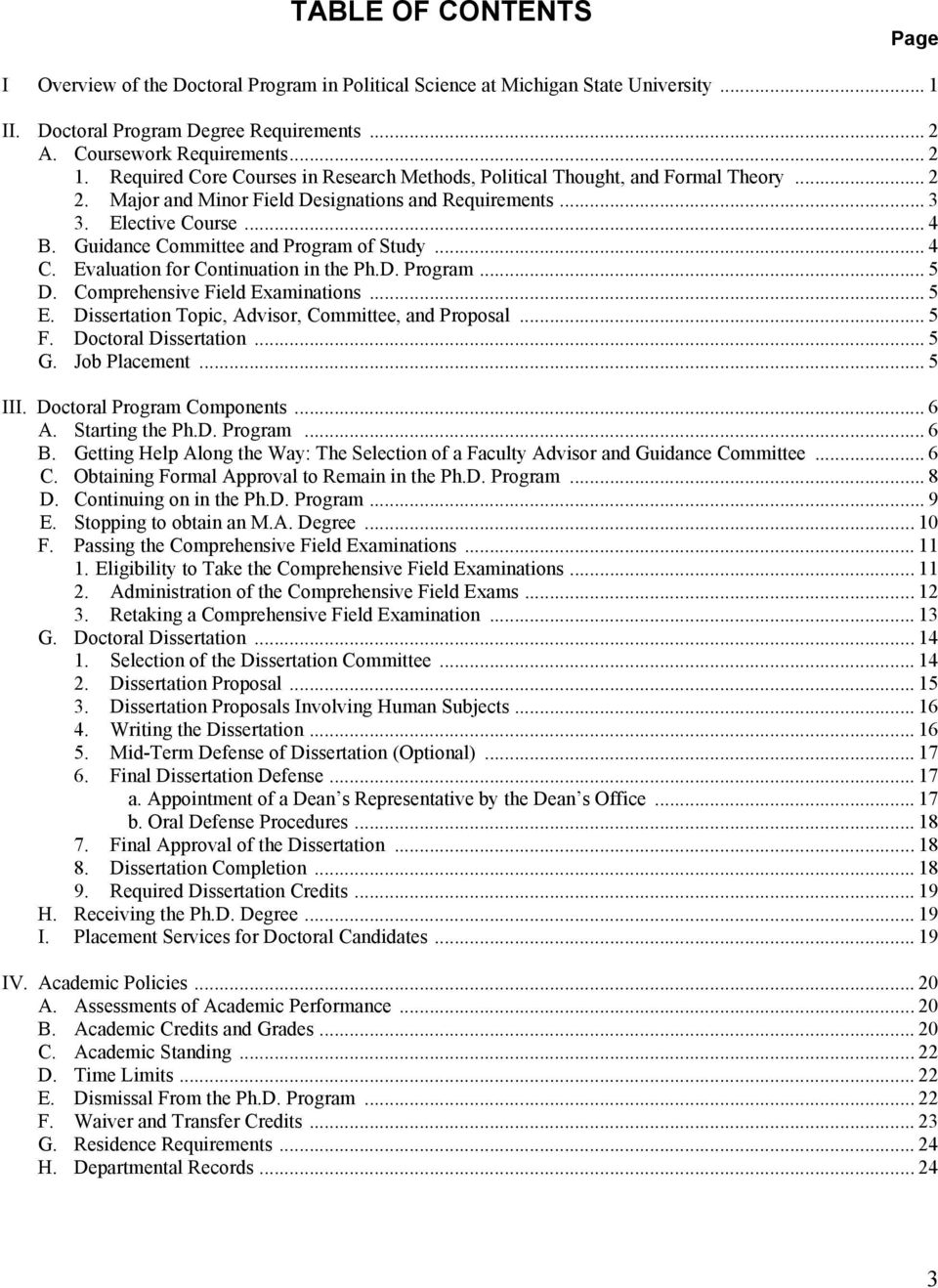
4 V. Professional Development and Professional Standards of Conduct A. Professional Development B. Ethical Standards C. Student Responsibilities D. Use of Human Subjects in Political Science Research VI. Student Conduct and Conflict Resolution A. Asking Questions; Eliminating Confusion B. Resolving Problems and Conflicts C. Program Changes VII. Work-Related Policies A. Graduate Assistants and Teaching Assignments Departmental Assignments and Assistantship Appointments a. Terms of Commitment for Graduate Assistants b. English Proficiency Requirement for International Students c. Work Assignments for Graduate Assistants Expectations and Responsibilities of Graduate Assistants a. Course Registration b. Maintaining Norms of Professional Behavior and Ethical Conduct c. Training of Teaching Assistants d. Faculty Supervision and Evaluation of Graduate Assistant Performance (1) The Supervisory Relationship (2) The End-of-Semester Evaluation The Criteria and Process for Determining Departmental Financial Support a. Termination of Financial Support During the Academic Year b. Reappointment of Graduate Assistants from One Year to the Next c. Termination of Financial Support from One Academic Year to the Next Graduate Assistant Benefits a. Stipends, Stipend Advancement, and Promotion b. Tuition Waivers c. Graduate Assistant Offices d. Health Insurance for Graduate Assistants e. Graduate Assistant Illness/Injury/Pregnancy Leave Policy f. Parking Benefits B. Work-Related Policies for All Graduate Students Pursing Ph.D. Degrees in Political Science Microcomputer Laboratory Facilities Political Science Graduate Student Association Health Services Handicapper Services VIII. University Resources for Graduate Students A. Frequently Contacted Offices B. Campus-wide Services and Support C. Useful Publications and Information Sources Appendix A: Check List of Normal Progress in the Ph.D. Program
5 DEPARTMENT OF POLITICAL SCIENCE MICHIGAN STATE UNIVERSITY PH.D. PROGRAM I. OVERVIEW OF THE DOCTORAL PROGRAM IN POLITICAL SCIENCE The primary goal of the doctoral program of the Department of Political Science is to produce graduates who become scholars and teachers at leading research institutions. To reach this goal several specific objectives must be achieved. First, the doctoral student must develop expertise in the subject matter of one of the major and one of the minor fields of political science covered by the Department. The Department offers a major field of study in American Politics, Comparative Politics, International Relations, and Political Thought, and a minor field of study in American Politics, Comparative Politics, Public Policy, International Relations, Political Thought, Positive Political Theory, and Research Methods. Second, the doctoral student must develop expertise in research design and quantitative methods, as well as exposure to the major themes of political philosophy and formal models of political science. Third, the doctoral student must develop expertise in the research enterprise. While the particular nature of the expertise depends on the student s chosen fields of political science, in general the student is expected to learn how a research program is developed and conducted. The doctoral student must also develop advanced skills in the research tools relevant to the subject of the student s doctoral dissertation. Fourth, the doctoral student must develop expertise in written and oral communication. Expertise in written communication will be developed through writing papers for courses, conferences, and scholarly journals, and through writing the doctoral dissertation. Expertise in oral communication will be developed through participation in classroom discussions and debates, through conference presentations, through involvement in professionalization sessions, seminars, and colloquia, through oral presentations of the dissertation proposal and defense, and (where feasible) through experience as a teaching assistant and graduate instructor. In support of these objectives for the doctoral student, the Department seeks to provide an environment which supports the conduct of high quality scientific and scholarly research and which is responsive to valid academic needs and desires. 1
6 II. DOCTORAL PROGRAM DEGREE REQUIREMENTS A. Coursework Requirements The Ph.D. program requires that students take a minimum of 39 semester credits in coursework (which usually means at least 13 semester courses). The program has the following general course requirements: Research Methods three semester courses (9 credits) Political Philosophy one semester course (3 credits) Formal Theory one semester course (3 credits) Major Field four semester courses (12 credits) Minor Field three semester courses (9 credits) Elective one semester course (3 credits) Note: A student s Guidance Committee may require the student to take additional coursework (in research methodology or a foreign language, for example) if it is necessary for completion of the student s educational program or dissertation research. 1. Required Core Courses in Research Methods, Political Thought, and Formal Theory Students are required to take the following five courses: PLS 800: Proseminar in Research Methods (Fall Semester) PLS 801: Quantitative Techniques in Political Science I (Fall Semester) PLS 802: Quantitative Techniques in Political Science II (Spring Semester) PLS 803: Proseminar in Political Philosophy (Spring Semester) PLS 809: Proseminar in Formal Theory (Spring Semester) These five courses will give students an introduction to the fundamental theories and methods of political science research. They are requirements of the Ph.D. program unless they are waived in advance by the Director of Graduate Studies. The procedure for obtaining a waiver is as follows: (a) Bring to the Director of Graduate Studies all supporting evidence of the course or courses you have taken (e.g., syllabi and other relevant materials) which you think might be equivalent to one or more of the required courses. The Director of Graduate Studies will review these materials and may then request that you consult with the current Chair of the appropriate Field Committee. (b) The Director of Graduate Studies will then consider this evidence, may consult with the Chair of the Field Committee, and may require a written examination. (c) If the Director of Graduate Studies approves a waiver, this should be stated in writing and placed in the student s file. 2
7 This process must be completed before the course enrollment may be dropped. No waiver requests will be considered after the first week of each course. 2. Major and Minor Field Designations and Requirements The Ph.D. curriculum of the Department is divided into seven fields: American Politics, Comparative Politics, Positive Political (Formal) Theory, International Relations, Political Thought, Public Policy and Administration, and Research Methods. Students can choose one of the following four areas for a major field specialization: American Politics Political Philosophy Comparative Politics International Relations In order to satisfy the major field requirements, students must successfully complete at least four courses in the area one of which must be the mandatory proseminar in that field. Students can choose one of the following seven areas for a minor field specialization: American Politics Political Philosophy Comparative Politics International Relations Public Policy Research Methods Formal Theory In order to satisfy the minor field requirement, students must successfully complete at least three courses in the area one of which must be the mandatory proseminar in that field. Students with a Minor Field in Research Methods must take at least two Methods courses (either from inside or outside the Political Science Department) beyond PLS 800, PLS 801, and PLS 802. Students may use summer coursework in quantitative methods at the Inter-university Consortium for Political and Social Research (ICPSR) at the University of Michigan in Ann Arbor to fulfill their Methods field requirement. Minor fields can also be specifically designed by faculty guidance committees to meet the interests and needs of particular students. Any individualized-designed minor fields must be approved by the Department s Graduate Studies Committee. 3

8 Proseminars are specifically designed to give students an introduction to the literature, theoretical problems, and methodological directions of each field. The proseminars within each field are: Research Methods PLS 800 Proseminar in Research Methods PLS 801 Quantitative Techniques in Political Science I PLS 802 Quantitative Techniques in Political Science II Political Philosophy PLS 870 Proseminar in Political Thought Formal Theory PLS 884 Proseminar in Political Institutions and Public Choice Public Policy PLS 811 Proseminar in Public Policy American Politics PLS 820 Proseminar in American Politics Comparative Politics PLS 850 Proseminar in Comparative Politics International Relations PLS 860 Proseminar in International Relations Proseminars are open to all Ph.D. students in the department. But, you must take the designated proseminars in your major and minor fields of specialization. 3. Elective Course The minimum requirements just listed 15 hours of core courses (PLS 800, 801, 802, 803, and 809), 12 hours of major course credits, and 9 hours of minor course credits sum to 36 credits. Since the total number of required hours is 39, this leaves a final 3 credits which a student must accumulate (for a minimum program). These final 3 credits can be earned in any of a number of different ways. For example, the 3 credits could be an additional course in research methods, an additional course in a major, an additional course in minor, or an additional course which is none of these. Elective course requirements can be also be taken in appropriate areas outside of the department (subject to the approval of the student s guidance committee). B. Guidance Committee and Program of Study Students are required to form a Guidance Committee by the end of their first year in the program. The Guidance Committee must consist of four faculty members: A Chair who serves as the student s main academic advisor for program planning, and at least three other faculty members. At least three of the four Guidance Committee Members must be regular members of the political science faculty, and there must be one faculty member representing the student s major field and one faculty member representing the student s minor field. 4

9 C. Evaluation for Continuation in the Ph.D. Program Students are admitted to the doctoral program only on a probationary basis. After the Spring semester of every year, the faculty will conduct an evaluation of every first-year student s overall academic performance. Students must gain the faculty s approval to continue in the doctoral program beyond the first year. D. Comprehensive Field Examinations After completing the required courses and before writing a dissertation, students must pass a Comprehensive Field Examination in both their Major and Minor Fields. Students must successfully pass the Comprehensive Field Examinations by the end of the Fall semester of the third year in which they have been enrolled as a full-time graduate student in the Ph.D. program at MSU, including the first ( probationary ) year before formal admission to the Ph.D. program. E. Dissertation Topic, Advisor, Committee, and Proposal After passing the Major and Minor Comprehensive Field Examinations, students must establish a doctoral dissertation committee. In order to accomplish this, students must identify a suitable dissertation topic, identify a faculty member to supervise the project and serve as the Chair of the Dissertation Committee, establish a full dissertation committee, write a dissertation proposal, and successfully defend the proposal in an oral defense. The Chair of the Dissertation Committee must be selected by the first week of Spring semester of the third year of the program. The dissertation proposal must be defended and approved by the second week of Fall semester of the fourth year of the program. F. Doctoral Dissertation Once the dissertation proposal is approved, students must conduct the research for the dissertation, write up the findings, present written drafts of the proposal to their committees, and successfully defend the completed project. G. Job Placement A complete dossier (including curriculum vita, biosketch, a minimum of three letters of reference, copies of publications, papers, chapters from the dissertation, teaching evaluations, etc.) should be on file with the Graduate Program Secretary. Students should consult frequently with their Dissertation Chair and the Departmental Placement Director about job opportunities and prospects. 5

10 III. DOCTORAL PROGRAM COMPONENTS A. Starting the Ph.D. Program The Department strongly encourages all students to begin taking courses in the Ph.D. program in the Fall semester. Only in rare cases will new students be permitted to enter in the Spring. Prior to going through Fall semester registration, students should arrange a meeting with the Director of Graduate Studies. At this meeting, the Director of Graduate Studies will help students plan their courses and advise them in selecting major and minor fields. The first full year s program can be planned at this time, but it is recommended that students visit the Director of Graduate Studies during the year to discuss their progress, straighten out difficulties in scheduling conflicts, or receive assistance in any other administrative details of the first-year program. A final decision about subject matter concentration for Ph.D. work need not be made immediately, but a choice of fields of specialization will normally be made by the end of the first year of study. You may want to discuss your interests with faculty in your chosen fields, particularly the Field Chairs. The Director of Graduate Studies serves as the main advisor to all first-year students in the Ph.D. program. During the first year of graduate school, the Director of Graduate Studies can be especially helpful in assisting students with the administrative details of the graduate program and providing advice on course offerings. Of course, the Director of Graduate Studies is also available to assist students with academic issues throughout their graduate career. The Graduate Program Secretary will assist students with administrative issues; for example, course registration, student file maintenance, and forms. B. Getting Help Along the Way: The Selection of a Faculty Advisor and Guidance Committee During the second semester of the first year, The Director of Graduate Studies will meet with each incoming student to assist them in selecting a faculty advisor and a Guidance Committee. In order to facilitate this process, students will submit to the Director of Graduate Studies a brief statement of their overall program interests, focus, and objectives. On the basis of this information, the Director of Graduate Studies will suggest appropriate faculty members to serve as the student s main academic advisor and as members of the student s Guidance Committee. It is a University requirement that the Guidance Committee consist of at least four faculty members. (With the approval of the Dean of the Graduate School and the Chair of the Department, a non-tenure-stream faculty member or academic specialist may be substituted for one of these faculty members.) At least three of the members must be regular faculty members of the Department of Political Science at Michigan State University. Both the major and minor fields must be represented: At minimum, there must be at least one political science faculty member from the major field and one political science faculty member from 6

11 the minor field on the committee. One of the political science faculty must be identified as the Chair of the student s Guidance Committee. Students are responsible for obtaining the necessary form ( Establishment of Guidance Committee ), getting the signatures of all committee members, and returning the form to the Graduate Program Secretary for inclusion in their file. Students must meet with their Guidance Committees by the last day of April of their first year to plan the programs for their Ph.D. coursework. It is each student s responsibility to schedule this meeting. Students should have the following items available when their committee meets: a statement of their academic goals a brief vita a suggested course of study for their major and minor fields in preparation for the Comprehensive Field Examinations; a draft copy of the gold-colored Guidance Committee Report, available from the Graduate Program Secretary; and a blank copy of the university s Report of the Guidance Committee Doctoral and Other Programs form, available from the Graduate School website and from the Graduate Program Secretary. The Guidance Committee evaluates the overall focus of the student s proposed program and assists in defining the student s research interests. The Guidance Committee approves the final selection of the fields that a student is proposing for their doctoral coursework. The Committee suggests coursework to aid in the preparation of major and minor fields. The Guidance Committee may require that a student take additional coursework, both within and outside the Department, to supplement the basic requirements for the doctoral program (that is, courses in addition to the core courses, the field proseminars or equivalents, and the Ph.D. major and minor field course requirements). The Guidance Committee evaluates the student s research plans and makes suggestions to facilitate the development of appropriate language and/or analytical skills. The Guidance Committee assists in the preparation of the yellow departmental form and Michigan State University s Report of the Guidance Report of the Guidance Committee-Doctoral and Other Programs form. Both of these forms detail the following information: Identification of both the Major and Minor Fields; courses required or recommended for each field; any specific language requirements; any particular research skill requirements; and any additional training or coursework that may be necessary to augment the student s program of study. All members of the student s Guidance Committee must sign the departmental form and MSU s Report of the Guidance Committee form, indicating their approval of the student s degree program requirements. Students must also sign the departmental and university forms indicating their understanding and acceptance of their Guidance Committees recommendations. They must give both forms to the Graduate Program Secretary. The Director of Graduate Studies will then review each student s degree program. Programs which are inconsistent with departmental or university policy will be returned to the student with specific information on areas of confusion, incompleteness, or incompatibility. The 7
12 Director of Graduate Studies can ask the Graduate Studies Committee to review degree programs and provide advice in this process. It is the student s responsibility to correct any problems, obtain the approval of their Guidance Committee Members, and resubmit the appropriate forms to the Graduate Program Secretary. Degree programs must be approved by the Director of Graduate Studies, the Chair of the Department of Political Science, and the Dean of the College of Social Sciences. Students must have approved degree programs on file with the Graduate Program Secretary by the end of their first year of study in order to be formally admitted into the Ph.D. program in Political Science. Students who are not formally admitted to the Ph.D. program will not have their assistantships or fellowships renewed in the following semester. Students are required to follow the degree plans (as listed on the designated forms) made by their Guidance Committees. Students must notify members of their Guidance Committees and the Director of Graduate Studies of any deviations from their degree plans. C. Obtaining Formal Approval to Remain in the Ph.D. Program When first admitted to the Ph.D. program, students are in a probationary status; continuation in the Ph.D. program beyond the first year is not automatic. All students must gain the faculty s approval to remain in the doctoral program beyond the first year. To assist in this process, individual faculty members are asked to prepare a written report on the performance of all first-year students at the end of the Spring semester (see the form in Appendix F). A copy of each written report will be placed in each student s department records. The individual faculty reports will cover the following items: 1. The student s course grade 2. An evaluation of the student s overall performance in the course 3. If there was a lengthy written assignment, a statement that the student did or did not write a paper that was of the quality expected for a Master of Arts degree in Political Science. 4. One of the following three recommendations : (a) The student should be allowed to continue in the Ph.D. program. (b) The student should not be allowed to continue in the Ph.D. program but should be allowed to continue work toward a terminal M.A. degree. (c) The student should not be allowed to continue work toward a terminal M.A. degree. The Graduate Studies Committee will conduct the initial analysis of each first-year student s record. The Graduate Studies Committee will consider the academic performance of students, the individual faculty reports of students, the assessments of graduate assistantship performances, and the prospects of students successfully completing the Ph.D. program. In order to be approved for continuation in the Ph.D. program, a student must have: (1) completed at least 15 credits in Political Science (including PLS and either 803, 809, or 2 courses from the major/minor fields); (2) maintained an overall grade average of 8
13 3.25; (3) earned no grade lower than a 2.5 in any Political Science course; (4) constituted a Guidance Committee and received the approval of all committee members of the student s proposed program of study; (5) received positive assessments of graduate assistantship performance; and (6) compiled a set of faculty course evaluations which clearly suggest that the student shows sufficient promise of completing the Ph.D. in Political Science at Michigan State University. In addition, first-year students who have two deferred grades remaining on their record shall not be approved for admission into the Ph.D. program. Based on its analysis, the Graduate Studies Committee will make one of the following recommendations to the faculty as a whole: 1. The student should be allowed to continue in the Ph.D. program. 2. The student should not be allowed to continue in the Ph.D. program, but will be permitted to complete a terminal M.A. degree. 3. The student should be denied an M.A. degree and will not be permitted to register for further coursework. The Department faculty shall meet before the end of the Spring semester for the purpose of acting on the recommendations of the Graduate Studies Committee. Students who receive the approval of the faculty of the Department of Political Science can continue in the doctoral program. Students who do not receive the faculty s approval of Ph.D. status are not allowed to continue in the doctoral program beyond the first year and they will not have their assistantships renewed in the following semester. Students who are denied permission to continue in the Ph.D. program but who are allowed to complete the M.A. degree, can appeal to be admitted into the Ph.D. program on the basis of subsequent academic performance. Such appeals must be made to the Graduate Studies Committee after the completion of the M.A. degree. D. Continuing on in the Ph.D. Program During the second and third years in the program, students will continue working toward the completion of the required coursework and degree requirements. During this time, students should maintain close contact with the members of their Guidance Committees in order to obtain informal feedback on an ongoing basis. The Department requires that students arrange a formal meeting of their Guidance Committees at least once per academic year. The Chair of the Guidance Committee is responsible for preparing a short report which indicates the student s progress to date, as well any potential problems in course selections or field designations, as well as recommendations to resolve these issues. A written copy of the committee s feedback must be provided to the student and to the Graduate Program Secretary. 9

14 Guidance Committees play an important role helping student s move along in the program and enabling them to attain their academic goals. So, the membership of a student s Guidance Committee should not be viewed as permanent. It is quite possible that a member of a Guidance Committee may be unavailable to serve in this capacity (e.g., because of sabbatical leave, field research outside of the country, assuming a faculty position at another institution, etc.). In other situations, students student may need to change the composition of their committee because their interests have shifted or because of personality or professional conflicts. Students must notify the Director of Graduate Studies if they want to make any changes in the composition of their Guidance Committees either their Chair or the other members of their Committee. The Director of Graduate Studies will work with students and faculty to make appropriate changes. All changes in the directorship or membership of Guidance Committees must be submitted to the Director of Graduate Studies and all faculty involved must be notified of these changes. If the Report of the Guidance Committee form has been submitted and approved by the Department and the College, a change in Committee membership must also be approved by the Director of Graduate Studies, the Department Chair, the Associate Dean of the College of Social Sciences. Annual reports must be submitted by all students in the program each Spring semester. The Graduate Studies Committee will report at the Spring faculty meeting on any students in the Ph.D. program not making satisfactory progress. The Graduate Studies Committee will conduct a comprehensive review of each third year student s academic record. During the third year review process, each student will submit a paper to the student s major field committee. The third year paper must be submitted prior to Spring break. The field committee will evaluate the paper and submit an evaluation to the Graduate Studies Committee by the third week in April. If the Chair of the student s dissertation committee is not a member of the major field committee, then the Chair will serve on the major field committee for the purpose of evaluating the third-year paper. The third-year paper should be a significant work of scholarship that demonstrates the student s potential to produce research suitable for presentation at professional conferences and for publication. It is appropriate to submit a seminar paper from a class, revised if necessary, or a paper prepared for presentation at a professional conference. If approved by the Chair of the student s dissertation committee, the dissertation proposal itself may be submitted. In cases of failure to make satisfactory progress, the Graduate Studies Committee will consider appropriate measures, including suspension or withdrawal of funding, and removal from the program, and make a recommendation to the full faculty. At its Spring faculty meeting, the full faculty will vote on the recommendations of the Graduate Studies Committee. E. Obtaining an M.A. Degree Along The Way 10
15 By the end of the second year, a student may have accumulated enough credits and met other requirements to apply for an M.A. degree. There are five sets of requirements for the Master of Arts degree in Political Science: 1. Complete 30 semester credits of work in 400-, 800- and 900-level courses. A minimum of 24 semester credits of the 30 required must be in Political Science. Thus, as many as 6 semester credits from other departments may be applied to your program. Special reading courses (PLS 993) will not normally be used to contribute to the M.A. degree requirements. 2. Complete the PLS required course. 3. Among the courses constituting the 30 credits offered for the degree, no grade can be lower than Maintain an overall grade average of at least 3.25 for all coursework. 5. On the faculty course evaluations (Appendix F), gain statements from at least two Political Science faculty members that the papers written for the respective courses were of the quality expected for an M.A. degree in Political Science. Note: If a paper was not of M.A. quality, the student shall have the opportunity to rewrite the paper and resubmit it to the faculty member for a second evaluation. (However, the course grade would not normally be changed.) To receive an M.A. once these requirements are met, the student must apply online for the degree by the first week of the semester in which the degree is to be granted. Application for an M.A. degree is optional, but students may find it advantageous to receive the M.A. when they are eligible. 11
16 F. Passing the Comprehensive Field Examinations After completing the required courses and before writing a dissertation, students must pass a Comprehensive Field Examination in both their Major and Minor Fields. Students must successfully pass the Comprehensive Field Examinations by the end of the Fall semester of the third year in which they have been enrolled as a full-time graduate student in the Ph.D. program at MSU, including the first ( probationary ) year before formal admission to the Ph.D. program. ( Full-time means a semester in which you take at least six credits.) Failure to meet this deadline will result in removal from the program, unless a waiver is endorsed by the student s Guidance Committee and approved by the Graduate Studies Committee. Students must take both their Major and Minor Comprehensive Field Examinations during the same academic semester unless an exception is granted by the Director of Graduate Studies based upon the recommendation of the student s Guidance Committee. 1. Eligibility to Take the Comprehensive Field Examinations Before taking the written Comprehensive Field Examinations, students must have registered for at least 39 credits of coursework approved by their Guidance Committees, and completed at least 33 credits. Up to 12 of these credits may be taken in other departments. PLS 999 credits for dissertation preparation do not count toward this total. Eligibility to take a particular Comprehensive Field Examination depends on meeting the following criteria: (a) Completion of all of the required/core courses (PLS 800, 801, 802, 803, and 809). (b) Completion of the required proseminars and the required minimum number of courses in both the Major and Minor Fields (four courses in the Major Field and three courses in the Minor Field). (c) A minimum of 39 semester credits (with at least 27 of political science credits) of graduate level courses must be completed satisfactorily. Up to two courses for which the student is registered in the semester in which the comprehensive is taken will be counted toward this requirement provided the student has no other incomplete or deferred grades among courses counted toward the required 13. PLS 999 (Dissertation Research) credits may not be used to meet these course requirements. (d) An overall grade point average of 3.25 in political science courses taken at MSU. (e) Complete fulfillment of any other specific course requirements identified by the student s Doctoral Program Guidance Committee. (f) Registered for at least 3 credit hours during the semester(s) in which taking the Comprehensive Field Examinations. (g) Petitioning the Graduate Program Secretary by the end of the final week of the semester prior to the term they wish to take their Comprehensive Field Examinations. For example, students wishing to take the comprehensive exams 12

17 during their fifth semester in the program should petition the Graduate Program Secretary by the final week of their fourth semester in the program. (h) Certification by the Graduate Program Secretary of a student s eligibility to take the examinations. Requests for exceptions, delays, or extensions relating to any of the Comprehensive Field Examination requirements must be made to the Director of Graduate Studies. The Director of Graduate Studies will confer with the Graduate Studies Committee and the student s Guidance Committee concerning such requests. The Director of Graduate Studies will review and rule on student requests for extensions or changes in the comprehensive examination process. All Ph.D. students are required to take their comprehensive examinations in both the Major and Minor fields in the Department of Political Science at Michigan State University. Comprehensive examinations taken at other institutions can not be used in place of those given at MSU. 2. Administration of the Comprehensive Field Examinations The Department will offer Comprehensive Field Examinations during a four-week period of each Fall and Spring term. The Fall Comprehensive Examinations will normally be given during the month of October; the Spring Examinations will normally be administered during the month of February. For each academic year, the specific dates of the Comprehensive Field Examinations will be determined by the Chair of the department in consultation with the Director of Graduate Studies. All faculty and graduate students will be notified of the dates for the Fall and Spring administration of the Comprehensive Examinations at the start of the Fall term. The Graduate Program Secretary is responsible for the actual administration of the examinations i.e., collecting the exams from faculty, distributing exam questions, receiving examination answers from students, distributing student responses to field committee members, collecting faculty evaluations, and maintaining files of all previous examinations. Each field examination will be supervised by a Field Committee. Selection of Field Examination Committees, including the Chair for each of Committee, will be determined by the Chair of the Department of Political Science in consultation with the Director of Graduate Studies. If the Chair of the student s Guidance Committee is not a member of the Field Examination Committee in that student s Major Field, the student s Guidance Committee Chair will automatically serve as an additional member of the Major Field Examination Committee for that student. 13

18 Members of the Field Examination Committee formulate the questions for each Field Examination, and they determine the format and procedures for each Field Exam. Students must be given some choice of the questions they will answer on both the Major and Minor exams. The Chairs of the Field Examination Committees will be responsible for collecting and assembling the questions for the comprehensive exams. The Chairs of the Field Examination Committees will also be responsible for communicating the format and procedures of each examination to the Director of Graduate Studies at least one month prior to the scheduled examination dates. All committee members shall grade all questions regardless of which committee member wrote the question. The Committee as a whole shall determine the student s grade and submit the result of this evaluation to the Graduate Program Secretary on the appropriate departmental form. The grading options available to the Committee are pass with distinction, pass, not pass, and fail. The not pass option indicates that the student provided the Committee with insufficient information to warrant either a pass or a fail, and requires that the student be tested further, either orally or in writing at the Committee s discretion. The not pass option is not a substitute for the retake afforded a student who fails the examination. Because of the difficulties of maintaining anonymity when only a small number of students are taking a Field Examination, Field Examination Committees will be notified of the name of the student writing each Field Examination. If a student turns in a Comprehensive Field Examination, it must be assigned a grade. If a Comprehensive Field Examination is not turned in at the designated time and place, it will be counted as a failure. Changes in the format and procedures of written Comprehensive Field Examinations must be submitted to the Director of Graduate Studies and approved by the Chair of the Department. 3. Retaking a Comprehensive Field Examination If a student fails to pass the Comprehensive Field Examination (which may include any oral examinations) in a field, the student shall be allowed one retake (including any oral examinations) of this Field Examination. This retake (including any oral examinations) shall be completed no later than the end of the student s sixth semester. The Chair of the Field Examination Committee is responsible for making arrangements with the student and Graduate Program Secretary to administer a retake examination. A student who fails a retake may not offer that field for the Ph.D. degree. At any time, a student may petition the Graduate Studies Committee to change one field for examination. But, any student who fails retakes in either a major or minor field will be required to leave the Ph.D. program. If a student petitions the Graduate Studies 14
19 Committee to change one field for examination after failing a retake of a Comprehensive Field Examination, and if the Graduate Studies Committee approves the change in fields, the Graduate Studies Committee shall also specify a semester in which the Comprehensive Field Examination in the new field shall be taken. G. Doctoral Dissertation After passing two Comprehensive Field Examinations, students must write and successfully defend a doctoral dissertation in order to complete their Ph.D. requirements. 1. Selection of the Dissertation Committee By the first week of Spring semester of the third year in the doctoral program, each student should identify a faculty member to serve as the Chair of the Dissertation Committee. Students can ask the Chair of the Guidance Committee to serve as the Chair of the Dissertation Committee, or they can select other faculty members whose research interests and skills are more in line with their intended dissertation projects. Students should select a faculty member who is an active member of the Department of Political Science at Michigan State University to serve as their Dissertation Advisor. Dissertation Advisors must be able and willing to supervise a dissertation research project, as well as assist a student in other professional activities and pursuits. The Director of Graduate Studies will work with students to insure that they select faculty who can provide them with appropriate advising, mentoring, supervision, and guidance. Students must also identify at least three additional faculty to serve as members of their Dissertation Committee. The Composition of the Dissertation committee must be in accordance with University rules (see pp.64 of the University s Academic Programs catalog for ). To summarize briefly: (a) The Dissertation Committee must have at least four tenure stream MSU faculty members. (With the approval of the Dean of the Graduate School and the Chair of the Department, a non-tenure stream faculty member or academic specialist may be substituted for one of these faculty members.) Faculty from outside the Department may serve on a Dissertation Committee, but at least three members of the Dissertation Committee must be regular faculty members of the Department of Political Science. A faculty member from outside the Department of Political Science cannot serve as the Chair of the Dissertation Committee. The members may or may not be the members of a student s Guidance Committee. Normally, however, the Dissertation Committee will contain some of the Guidance Committee members. (b) The University requires that a Dean s Representative a MSU faculty member who is not a member of the Political Science Department be present at the final oral defense of the dissertation. The Dean s Representative votes on the approval of the student s final dissertation project. Students are strongly encouraged to meet this requirement by asking someone from outside the 15
20 Department of Political Science to serve on the Dissertation Committee right from the beginning. The outside representative cannot serve as the Chair of the Dissertation Committee, but outside representations on dissertation committees can come from any unit on campus except the Department of Political Science. (c) Persons who are not regular faculty at Michigan State University, but who can contribute to the student s program, may serve as additional members of the Dissertation Committee and assist in the work of the committee. (d) With the approval of the Department Chair, an exception may be granted to allow an Emeritus faculty member to serve as one of the four required faculty members; in addition, an Emeritus faculty member may continue to serve as the Chair of a Dissertation Committee. (e) Faculty who have left MSU may continue to serve on a Dissertation Committee only if the student is within one semester of completing the dissertation; otherwise, the faculty member must be replaced. (f) Faculty on leave may be replaced if the Dissertation Committee Chair deems it advisable. Students should work with their Dissertation Chairs/Advisors to select committee members who can facilitate their dissertation research. The Director of Graduate Studies can also provide advice and suggestions to students on the membership of Dissertation Committees. Students must obtain the signatures of all members of the Dissertation Committee on the appropriate departmental form, Establishment of Dissertation Committee, and submit it to the Graduate Program Secretary. Students must notify the Director of Graduate Studies if they want to make any changes in the composition of their Dissertation Committees either their Dissertation Chair or the other members of their Committee. The Director of Graduate Studies will work with students and faculty to make appropriate changes. All changes in the directorship or membership of Dissertation Committees must be submitted to the Director of Graduate Studies, and all faculty involved must be notified of these changes. 16

21 2. Dissertation Proposal Students must prepare a written proposal of their dissertation project. They should work closely with their Dissertation Chair, as well as with other committee members, to identify the necessary components of the proposal, as well as the expected time lines for their completion. While the written proposal need not be extensive, it should indicate the following items: (a) The problem under examination; (b) the major variables which will be included; (c) the type of data and methods of data collection that will be used;, (d) the setting or context of the research; (e) the major theoretical relationships which will be considered; and (f) a brief review of major relevant literature. The Dissertation Committee is responsible for reviewing written drafts of the proposal and providing comments. After the proposal has been tentatively approved by each committee, member, a meeting of the whole Dissertation Committee will be held at which the student gives an oral defense of the proposal. The Dissertation Chair will set the general parameters of this defense, and advise the students of these guidelines. If the proposal is acceptable to all members of the Dissertation Committee, final approval is granted and the student should proceed with the project. All of the members of the Dissertation Committee must find the dissertation proposal acceptable and indicate this in writing (via their signatures on the appropriate departmental form) before final approval of the proposal is given. A Dissertation Committee may schedule several oral defense meetings prior to its approval of a dissertation project. If the Committee indicates only provisional approval, signatures from all members of the Dissertation Committee are again required when final approval is granted. A copy of this approved proposal signed by the student and by the committee members must be given to the Graduate Program Secretary to be placed in the student s file. The dissertation proposal should be completed, defended, and approved by the Dissertation Committee by the second week of the first semester of the student s fourth year in the program. The Dissertation Committee then supervises the subsequent dissertation research. 3. Dissertation Proposals Involving Human Subjects University and federal regulations require that all research directly or indirectly involving the gathering of data from human subjects including interviews, and mail or telephone surveys be reviewed and approved before initiation by the University Committee on Research Involving Human Subjects (UCRIHS). Graduate students and the Chairs of their Dissertation Committees are jointly responsible for seeking prior review and approval by UCRIHS of dissertation research before it is initiated. Only in exceptional circumstances will the Graduate School accept a dissertation containing data from human subjects that does not have UCRIHS approval. Graduate students may contact the Graduate School or the UCRIHS office for application forms and detailed instructions. 17
22 4. Writing the Dissertation After a student has obtained approval of the dissertation proposal, work should begin in earnest on the dissertation project. This work is coordinated by the Chair of the Dissertation Committee, but each member of the Dissertation Committee should participate in the process since each must approve the finished draft of each chapter. In fairness to the committee members, students should provide each faculty member with a copy at the time it is written and receives the approval of your Chair: the dissertation is a cooperative effort involving all members of the committee as writing proceeds. 5. Midterm Defense (Optional) For a student s own guidance, the student and/or the Dissertation Committee may choose to hold an optional Midterm Defense of the dissertation. 6. Final Dissertation Defense There must be an Oral Defense of the Dissertation. The Oral Defense should be held after all chapters of the dissertation have been approved by each member of the Dissertation Committee. The University requires that students must be formally enrolled at MSU, for at least 1 credit hour, during the semester in which they defend your dissertation. University regulations also specify that students cannot change the members of their dissertation committees within 60 days before the date of the oral defense. Before that time, the membership of dissertation committees can be changed by filing a change in Dissertation Committee form (with all appropriate faculty names and signatures) with the Graduate Program Secretary. a. Appointment of a Dean s Representative by the Dean s Office On completion of the dissertation, the Associate Dean for Academic and Student Affairs in the College of Social Science appoints a regular MSU faculty member, from a unit outside the Department of Political Science, as Dean s Representative (external examiner) at the oral defense of the dissertation. In order to provide time to appoint a Dean s Representative and give that examiner time to review the dissertation, the dean s copy of the dissertation draft, in final form for the oral defense, must be deposited with the Associate Dean (202 Berkey Hall) no later than three weeks before the date of the oral defense and examination. The Dean s Office welcomes suggestions about appropriate faculty to be asked to serve. If the Dissertation Committee already contains a regular MSU faculty member from another unit at MSU, the dean usually asks that individual to serve. However, formal appointment of the Dean s Representative is done only by the Dean (or Associate Dean) not by the student or the Dissertation Committee. 18
23 A completed form entitled Appointment of Dean s Representative to Guidance Committee for Doctoral Dissertation should accompany the dissertation to the Dean s Office. This form is available from the Graduate Program Secretary. b. Oral Defense Procedures The dissertation must be defended at an Oral Colloquium open to all members of the Department including other graduate students and announced at least three days in advance by a Department memo. The memo will be typed and distributed by the Graduate Program Secretary. The defense must be held during daytime hours, during weekdays, and while classes are in session (including finals week). Students should be aware that any defense during the summer is at the discretion of the faculty members involved. There must be written approval of this presentation from an extraordinary majority of the committee (including the Dean s representative); that is, a student will pass the final dissertation defense if no more than one member of the committee has a dissenting opinion during the oral dissertation defense. If more than one member of the Dissertation Committee fails to approve the dissertation, the defense must be repeated. The dissertation should not be bound before this oral defense is successfully passed, since the Dissertation Committee may still require changes on the basis of this presentation. Members of the Dissertation Committee on campus for that academic year must be present at the dissertation defense. No substitution is permitted at this stage without approval of the Graduate Studies Committee. No more than one member of the committee may be a faculty member who has left the University or retired or a faculty member on leave. S/he may continue on the committee for one academic year but need not attend the final oral defense if this is inconvenient. This is the only exception to the rule that all four members of the committee must be present at the oral defense. Faculty members on leave for more than a year must be replaced as members of the Dissertation Committee. 7. Final Approval of the Dissertation Students must receive final written approval of the complete dissertation from an extraordinary majority of the Dissertation Committee; that is, the dissertation receives final approval if no more than one member of the Dissertation Committee dissents. The Committee has up to five weeks to complete the reading of a dissertation. Final approval occurs only after the extraordinary majority of the committee has approved the written dissertation and the dissertation defense. Note: It is a University rule that all requirements for the doctoral degree must be completed within eight years from the time of a student s first enrollment as a doctoral student. Should the degree requirements not be completed within this eight year period, all of the doctoral comprehensive examinations must be passed again. If absolutely necessary, the student may request a waiver of this eight-year requirement from the Dean of the College of Social Science; see the Dissertation Committee chair and the Director of 19
24 Graduate Studies to initiate this process. If this request for a waiver is approved, it will normally be approved only if Ph.D. completion is likely within the next 12 months. 8. Dissertation Completion Upon final written approval of the dissertation, the dissertation must be prepared and submitted, according to University regulations, to the Graduate School Office. The Office of the Graduate School issues a handbook, The Graduate School Guide to the Preparation of Master s Theses and Doctoral Dissertations, to students working on their dissertations. It outlines the requirements for preparing a dissertation manuscript. 9. Required Dissertation Credits The University requires that students register for at least 24 credits of PLS 999, Dissertation Research, which can be taken in one or more blocks of three hours each per semester while the dissertation is being written. If a student complete the dissertation before this registration is completed, he/she must pay for the remaining hours. These credits are to cover the student s use of University facilities and the cost of faculty consultation while conducting dissertation research and writing. H. Receiving the Ph.D. Degree Students must submit an Application for Graduation to the Office of the Registrar (Room 150 Administration) early in the semester of graduation. After submitting the Application for Graduation, students will receive a Graduate Credit Statement and Final Certification for Degree form. Students must submit a final unbound copy of the dissertation to the Graduate School and a bound copy to the Department of Political Science. Students should check with the Registrar s Office and The Graduate School for the deadline dates for submitting an approved dissertation during a given semester. Students are not required to enroll for classes during the semester in which their degree is actually granted, if this is later than the oral dissertation defense. I. Placement Services for Doctoral Candidates Students should make an appointment with the Placement Director before entering the job market so that they may be advised about placement procedures and become informed about job openings. When students reach the point of seeking a position, they should prepare a vita for their placement file, from which the Placement Secretary will prepare xeroxed copies. In addition, they should ask faculty members to provide letters of recommendation for them and give them to the Placement Secretary. With these letters on file, recommendations can (with the faculty member s permission) be mailed out quickly. The faculty members may wish to make changes and additions to their letters of recommendation to fit each separate job opening. 20
25 No extensive Department placement efforts for Ph.D. candidates will be made until all requirements (with the exception of the dissertation) have been met. IV. ACADEMIC POLICIES A. Assessments of Academic Performance All graduate students in the Department of Political Science have a right to periodic evaluation of their academic progress, performance, and professional potential (GSRR 2.4.8). Therefore, the Department of Political Science has established procedures, designed to facilitate the review of graduate student performance on a regular, ongoing basis. First, students are required to meet with their Guidance Committees at least once each year until they pass their Comprehensive Field Examinations or leave the Ph.D. Program. It is each student s responsibility to initiate, schedule, and arrange the annual meetings of Guidance Committees. It is the responsibility of the Guidance Committee to review the student s progress in research activities, as well as plan for work in the coming year (GSRR 2.4.8). A report on the results of this review should be prepared and signed by all members of the Guidance Committee and by the graduate student. This report, along with any response that the graduate student may attach to it, will be filed with the Director of Graduate Studies. The Graduate Program Secretary will place a copy of this report in the graduate student s file. Second, graduate students are encouraged to meet with the Director of Graduate Studies at least once a year to review all aspects of their academic performance and potential. At this occasion, the graduate student has the opportunity to discuss with the Director of Graduate Studies issues that are relevant for the successful completion of the graduate program. Any recommendations based upon this review will be communicated back to the graduate student and to the student s Guidance Committee. Third, the Graduate Studies Committee will conduct a comprehensive review of each third year student s academic record. B. Academic Credits and Grades Graduate courses in political science are three semester credit hours except for variable credit reading courses (PLS 993) and dissertation research (PLS 999). Students holding graduate assistantships may take three graduate courses per semester, but they must complete at least two courses (6 hours of credit) each semester in order to retain their assistantship. Students holding fellowships should take three courses per semester, prior to writing their proposal and dissertation. MSU is a member of the Committee on Institutional Cooperation (CIC). Through this committee s Traveling Scholar program a doctoral student can take a limited number of courses at any Big Ten University or the University of Chicago. Participants in this program 21
26 normally pay tuition at MSU rates for courses taken at other participating institutions; the course or courses are treated financially as if they were MSU courses, and a tuition waiver covers these courses as well. It is not uncommon for the Department s political science doctoral students to take academic-year courses at the University of Michigan in Ann Arbor. In addition, political science doctoral students regularly take summer school political methodology courses at the Inter-university Consortium on Political and Social Research (ICPSR) and the Institute for Social Research (ISR) at the University of Michigan. A doctoral student interested in this program should contact the Graduate School office for instructions and formal processing. University grades are issued in numerical form, ranging from 0 to 4.0 in steps of.5. (There is, however, no grade of 0.5.) In Political Science, the shared understanding of what these grades mean is as follows: 4.0 indicates superior performance 3.5 indicates satisfactory performance 3.0 is the minimum acceptable grade, but a predominance of such grades suggests inability to complete the graduate program 2.5 or less indicates unsatisfactory performance. Courses may also be taken on a Credit/No-Credit basis. If two or three graduate courses per semester are taken for credit and grades, it is possible to take other non-pls courses of interest on the Credit/No-Credit system. The Credit/No-Credit system is intended to allow students to study in areas outside the major field of study without jeopardizing their grade point averages. An instructor will expect graduate students to perform at or above the 3.0 level in order to earn credit for the course. Students must register for the course in advance on this basis if you choose this option. For incomplete coursework, either an I (Incomplete) or a DF (Deferred) can be given, according to the instructor s announced criteria and discretion and University regulations. Deferred and incomplete grades are strongly discouraged, especially in required courses. Where an instructor must choose between a deferred and an incomplete grade, the latter is to be preferred. A deferred grade should be limited to unforeseen circumstances beyond the student s control. An I automatically converts to a permanent I/0.0 if the work is not completed by the middle of the student s next semester of attendance, if that semester is within one calendar year of receiving the incomplete. If the incomplete work is not made up within one calendar year, the course must be repeated to receive credit for the course. A DF must be removed within the time limit set by the instructor, with a grade reported within two calendar years. After two years, the DF will automatically change to a DF/U (no grade). Ph.D. students who have more than one incomplete or deferred grade at the end of any given semester will be reviewed by the Graduate Studies Committee which will recommend appropriate action up to and including dismissal from the program. 22
27 For students in the Ph.D. program, only those admitted to the Ph.D. program in political science shall be eligible for Departmental readings courses (PLS 993). All such courses shall include either one major research paper or several shorter papers. These papers shall be graded on the same criteria as those written for regularly scheduled seminars. Reading courses must be individually arranged with the instructor, and must not parallel regularly offered courses. There is a form that must be completed before enrollment in PLS 993. The form is available from the Graduate Program Secretary. In the middle of each semester, the Graduate Program Secretary will distribute a list of the graduate courses being offered the next semester. In most terms, the Department will offer courses in each subject field. You should note especially courses offered under Political Science 990 (Seminars) or presented by visiting professors, since these are courses on specialized topics not regularly offered. The Graduate Program Secretary also posts course descriptions, received from professors in other related departments, on the Departmental Web Page and on the bulletin board in the main office to assist students in setting up class schedules. C. Academic Standing The minimum acceptable cumulative grade-point average for a doctoral student in the Department of Political Science is A student who receives two 2.5 grades or one 2.0 grade or less will be reviewed by the Graduate Studies Committee and may be dismissed from the program. A student receiving three 2.5 or two 2.0 grades in Political Science courses or who earns more than 8 credits below the grade of 3.0 will be dismissed from the program. D. Time Limits University rules state that the Comprehensive Field Examinations, including any necessary repeats, must be passed within five years and that all remaining requirements for the degree, including the dissertation, must be completed within eight years from the time when a student begins the first class at MSU that appears on his or her doctoral program of study. Should the degree requirements not be completed within this eight-year period, all of the Comprehensive Field Examinations must be passed again. E. Dismissal from the Ph.D. Program All graduate students pursuing doctoral degrees in the Department of Political Science must meet the requirements and standards identified in this Handbook. Dismissal from the Ph.D. program can occur: 1. If a student does not receive formal approval from the faculty to continue in the Ph.D. program after the first year of study. 23
28 2. If a student is not making satisfactory academic progress in the program as identified by the student s Guidance Committee and confirmed by the Graduate Studies Committee. 3. If a student has more than one incomplete or deferred grade at the end of any given academic semester. 4. If a student has not maintained the minimum acceptable grade point average for doctoral students in the Department (3.25), or has received grades that place their academic standing in jeopardy (as defined in Section IV. C. above). 5. If a student has not completed various phases of graduate work in accordance with the time limits specified by the department and the University. 6. If a student fails to met the specific requirements or stated deadlines of the Guidance Committee or the Dissertation Committee. 7. If the student fails to adhere to responsible and ethical conduct in research, scholarship, or teaching activities (as specified in the University s Guidelines for Integrity in Research and Creative Activities and in Section V of this Handbook). F. Transfer Credits Graduate credits may be transferred from other accredited institutions or international institutions of similar quality if they meet all of the following university and departmental provisions: (1) Only graduate-level courses in which at least a 3.0 (B) grade was received will be considered. (2) Only graduate-level courses from other accredited institutions or international institutions will be accepted. (3) Only graduate-level courses completed within the eight-year time limit approved for earning a doctoral degree at Michigan State University. (4) Only graduate-level courses which are appropriate to a student s program of study will be approved by the Department. In order to obtain departmental approval for transfer credits, students must submit syllabi for all of the courses that they would like to have transferred to the members of their Guidance Committees and the Director of Graduate Studies. It is the responsibility of a student s Guidance Committee to evaluate the desirability of transferring course requirements in terms of the student s particular program of study and career goals. If a student s guidance committee approves a student s request to transfer a course, then it is forwarded to the Director of Graduate Studies for review. The approval for transferring or waiving courses 24
29 must be given by both the student s Guidance Committee and the Director of Graduate Studies. Departmental action on transfer course request will not be taken until a student has been formally admitted into the Ph.D. program (which occurs at the end of the first year of study). Each student must complete all Ph.D. core courses and the proseminar in the major field of study at MSU. Exceptions to this policy will be made only in rare circumstances and must be approved by the Director of Graduate Studies and the student s guidance committee. In no case shall a student transfer more than eighteen hours of course credit into the Ph.D. program at MSU. G. Residence Requirements Students must spend at least a year registered in residence at Michigan State University beyond the awarding of the M.A. degree to be eligible for a Ph.D. A year of residence will be made up of two consecutive semesters, involving the completion of at least six credits of graduate work each semester. The Department does not have the authority to waive these requirements. However, a waiver may be sought from the College of Social Science. H. Departmental Records The Graduate Program Secretary maintains an academic file on each student in the Ph.D. program. Academic files contain the records of each student s progress in the program, including application materials, assistantship letters, Guidance Committee reports, annual review materials, teaching assistant evaluations, grades, results of comprehensive exams, formation of Dissertation Committees, and all documentation pertaining to the preparation and defense of the dissertation. It will be helpful to students later if their files also contain information (i.e., vitas, research agendas, etc.) that faculty may use when asked to write letters of recommendation for them. At minimum, students have the responsibility to see that the following are in their academic files: (1) Recommended Action Form For Admission to Graduate Studies (2) Any correspondence related to assistantship or fellowship support (3) Reports of the Doctoral Program Guidance Committees (4) Any changes in the fields or courses initially agreed upon by a Guidance Committee, and subsequently approved by Guidance Committee members (if applicable) (5) Any Change in Guidance Committee Membership (if applicable) (6) Petition to Take Comprehensive Examinations (7) Report of Comprehensive Examinations and Final Evaluation (8) Dissertation Committee Form (9) Record of Oral Defense of Dissertation Proposal (10) Record of Oral Defense of the Dissertation (11) Approval of Dissertation 25
30 Students have a right to access the materials in their own academic files. In order to do this, they should submit a request to the Graduate Program Secretary. The Department also maintains a second set of Personnel files for graduate students who are employed by the Department. Graduate student personnel files contain appointment forms and evaluations of student performance as teaching or research assistants. Students also have a right to access the materials in their own personnel files. According to the Graduate Employment Union contract these requests must be in writing and each student is limited to three reviews of personnel files a year. In order to access one s personnel file, a student should submit a request to the Assistant to the Chair of the Department of Political Science. V. PROFESSIONAL DEVELOPMENT AND PROFESSIONAL STANDARDS OF CONDUCT A. Professional Development The Ph.D. Program in Political Science is designed to prepare students to become active members of the political science community. In order to facilitate this, it is important that students become broadly educated and versed in academic science research. Therefore, students should attend talks, presentations, and colloquia held on the MSU campus, particularly those which are sponsored by the Department. Students should also attend any job presentations given by candidates who are interviewing for faculty or postdoctoral positions in the Department of Political Science. These presentations provide excellent opportunities for students to see firsthand how others present research. Students should also gain experience in presenting their own research. Such experience can be developed through active participation in course seminars, departmental colloquia, practice job talks, and dissertation defenses. It is also important for students to become involved in the intellectual activities of the discipline of political science by attending professional conferences and meetings. Students should first become familiar with the norms and expectations of research presentations at professional meetings. Then, they should work closely with the faculty members of their Guidance Committees to assume a more active role in this process i.e., presenting papers, preparing poster sessions, etc. The Department of Political Science strongly encourages student participation in professional conferences, and it will work with students to facilitate their involvement. B. Ethical Standards Political scientists share problems in common with practitioners of other scholarly disciplines. They also frequently encounter ethical problems unique to their professional careers. Accordingly, the American Political Science Association has compiled A Guide to Professional Ethics in Political Sciences. The Guide contain a statement on professional ethics, and a list of ethical principles which are relevant for any and all aspects of political science scholarship. The Guide is available on-line on the APSA Web Page, and it should be reviewed by every political science graduate student (apsanet.org/pubs/ethics). 26
31 The Department of Political Science is committed to creating an environment that promotes ethical conduct and intellectual integrity within our graduate student population. All graduate students should practice intellectual honesty in their scholarship and teaching. In accordance with the University s Task Force Report on Research Mentoring (Guidelines for Integrity in Research and Creative Activities), the Department believes that intellectual integrity entails a range of practices. These include: Honesty in proposing and reporting research; recognition and credit to prior research; confidentiality of the peer review process; disclosure of potential conflicts of interest; collegiality in scholarly interactions and sharing of resources; and adherence to fair and open relationships between coworkers. Students can find a complete account of these guidelines on the Graduate School Web site (grad.msu.edu/staff/mentorreport.pdf). C. Student Responsibilities Students are responsible for understanding the policies and procedures on ethical misconduct in research and creative activities (see the University s Guidelines for Integrity in Research and Creative Activities), to report known acts of misconduct of which they have direct knowledge to university officials, and to protect the rights and privacy of individuals making such reports in good faith. In order to reinforce and facilitate these responsibilities, the Department will conduct professionalization sessions which will cover the application of professional norms across a range of research and teaching activities. Students who fail to satisfy the University s and the Department s standards of ethics and intellectual integrity will be dismissed as students from the Ph.D. program. D. Use of Human Subjects in Political Science Research All Ph.D. students in the Department of Political Science must comply with the guidelines and regulations of the University Committee on Research Involving Human Subjects (UCRIHS) in the conduct of their research or in the process of conducting research for other students or faculty. Students must obtain UCRIHS approval for all research which directly or indirectly involves the use of human subjects. This includes data gathered from human subjects through interviews, mail surveys, or telephone surveys. Graduate students must obtain UCRIHS approval before they begin their research projects. Graduate students should contact the UCRIHS office directly to obtain application forms and to receive more detailed information about this process. 27
32 VI. STUDENT CONDUCT AND CONFLICT RESOLUTION A. Asking Questions; Eliminating Confusion Students are required to arrange meetings with their Guidance Committees at least once year in order to inform them of their progress and activities. These meetings can also serve as valuable forums to discuss any problems students might be encountering and to raise issues that need to be addressed. Students should also feel free to consult with the Director of Graduate Studies and the Department Chair in order to obtain additional clarification and advice about course scheduling, degree requirements, program deadlines, etc. B. Resolving Problems and Conflicts Most of the problems that occur within a graduate program are due to miscommunications or conflicts between graduate students and faculty, particularly students and their Guidance/Dissertation Committee Chairs. Such conflicts can arise over a variety of issues, and they can be difficult to resolve. Hence, it is important to find ways of avoiding such conflicts before they develop into intractable situations. Students should try to resolve the problem within the Department. Student should consult with the Director of Graduate Studies regarding those issues that they might find difficult to discuss with their Guidance/Dissertation Committee members. They should also seek the advice of the Chair of the Department who has ultimate responsibility for the successful functioning of the graduate program and the entire department. Matters which can not be handled informally by the Director of the Graduate Studies or the Chair of the Department shall be heard by a departmental Judiciary Committee. As specified in the Departmental Bylaws, the Judiciary Committee shall be composed of the Director of Graduate Studies or designee, three faculty members from the Department of Political Science, and three graduate students who are currently active in the Department of Political Science. If a complaint or grievance is brought by an undergraduate student against a graduate student, three undergraduates who are majors in political science must also be appointed to serve on the Judiciary Committee. If the Director of Graduate Studies is involved in the case, neither the Director of Graduate Studies nor the designee may serve on the Judiciary Committee. The Judiciary Committee in the Department of Political Science can hear and adjudicate cases brought by and against graduate students in the following areas: (a) academic rights and responsibilities; (b) professional rights and duties of graduate assistants not covered by the Graduate Employees Union collective bargaining contract; and (c) university regulations pertaining to the professional rights and duties of other graduate students. Matters relating to the academic performance of graduate students will be handled by the Graduate Studies Committee within the Department. 28
33 Students can also obtain advice and information about conflict resolution from the following university sources, all of which are available on the Graduate School Web site ( Adjudication of Cases Involving Graduate Student Rights and Responsibilities (located in Guidelines for Graduate Student Advising and Mentoring Relationships on the Graduate School The Graduate Student Resource Guide Graduate Student Rights and Responsibilities C. Program Changes At its meeting of May 21, 1973, the Department passed the following motion relevant to implementing changes in the program without causing hardship to students. All new requirements will apply to all students when they first enter the stage of their program concerning the change unless the student can show the Graduate Studies Committee positive harm resulting from the application of the new requirements. The program stages are defined as: 1. First year preparation for evaluation at the end of the first year; 2. Course development if approved by Guidance Committee; 3. Comprehensives, with stage assumed to begin one calendar year prior to date of exam; 4. Dissertation proposal; 5. Dissertation defense. The meaning of this policy is that once students have started a particular stage, no changes in the rules of that stage will be applied to them unless they so desire. For example, if a student is within one calendar year of taking comprehensive exams and the type of exam is changed, that student has the right to use the old type. On the other hand, if it will be another 15 months before the student takes the comprehensive exams, any changes in the exam will be applied and the student will not be exempt from such changes unless petitioning the Graduate Studies Committee. The Graduate Studies Committee must vote to waive the requirements in that particular case. VII. WORK-RELATED POLICIES A. Graduate Assistants And Teaching Assignments All students admitted to the Department s Ph.D. program are eligible for funding regardless of whether or not they were granted such funding when they were admitted to the program. Where possible, the Department attempts to fund students for five years, theoretically the normal length of a doctoral program. 29
34 Once a year the Department will collect information from students about their progress in the Ph.D. program, their financial needs, and their desire for funding for the following year. Students who arrived without financial support will receive priority for funding if they develop exceptionally good records in the department, but such funding generally can occur only when temporary or unexpected funds become available to the Department. This can occur, for example, if other graduate students who are funded receive an external award, a faculty member goes on leave, etc. Graduate students are encouraged to seek extra-departmental funding, either inside or outside the University. Fellowship and grant information is made available for this purpose on a continuing basis. Students are encouraged to review this information and to discuss potential applications with the Director of Graduate Studies or other faculty members. When graduate students who already have departmental funding commitments receive external funding, their departmental funding commitment is extended for a like amount of time, and the departmental funding that had been reserved for them may become available for other graduate students during the period of external funding. Thus, graduate students who receive external funding help both themselves and their fellow graduate students. 1. Departmental Assignments and Assistantship Appointments a. Terms of Commitment for Graduate Assistantships Students who enter the program with an assistantship will be informed of the length of their funding commitment. For students with no prior graduate work, this is generally for five years. The Department considers five years as an appropriate period for funding of students in the Ph.D. program, assuming the candidate is formally admitted to the Ph.D. program at the end of the first year of study, maintains satisfactory progress through the remaining stages of the graduate program, satisfactorily completes the minimum number of credit hours each semester, and receives positive evaluations of assistantship performance. When the department makes a commitment to a student for five years of assistantship support, that generally refers to five years of support from any funds that are part of the Department s normal budgets or are arranged for or secured by the Department rather than the student. This includes all budget accounts administered by the Department or by one of its faculty members through the Department. This includes the general graduate student budget, temporary funding that may be available from other Department accounts (e.g., from the faculty salary budget if a faculty member is on leave), research grant funds secured from external sources by members of the Department, other non-departmental funds secured and generally managed through the Department, or other University funds arranged by the Department (e.g., some TA funding from the Center for Integrative Studies that is arranged for entirely by the department, and does not involve separate application by the student). Funding from any of these sources will be counted as part of the five year funding period, even though students may have made separate application, either in writing or informally, for such funding. 30
35 Students on departmentally-funded graduate assistantships who receive funds from external sources will have the period of the Department s commitment extended by the length of time they are funded from these external sources. For this purpose, external funding is defined as funding that is completely external to the University, e.g., NSF fellowships or research grants, grants from other private or public foundations, or national fellowships from other countries). For example, a funded student with a five-year departmental commitment who applies for and receives an NSF dissertation support grant in his or her fourth year of study will have a one year extension of the Departmental commitment. This can be used in the student s sixth year and provides a measure of security if the dissertation is not completed during the fifth year. The Department recognizes that many students take longer than five years to finish the Ph.D. program. While we may attempt to continue funding of students beyond their fifth years who are working on their dissertations, such funding is given a lower priority than funding for students at earlier stages of the program, and generally is granted only when the Department has teaching needs that cannot be fulfilled by available faculty or graduate students in earlier stages of their programs. Students who enter the program without financial aid but who receive assistantships after they are here will also be informed of the length of commitment included in the new funding. Most often, this will be only for the particular assignment specified and will not include additional commitments for future years. Since it is always the case that the Department seeks to fund as many of its graduate students as possible, we always attempt to continue financial assistance. Nevertheless, unless it is specified, funding is not guaranteed beyond the particular assignment discussed in the funding letter. Occasionally, a multiple-year commitment may be made to a student who entered the program unfunded. In these cases, the length of the commitment will be specified in the first funding letter. When made, a future year commitment will generally be for four years less the number of years the student has already been in the program, i.e., a student first being funded at the beginning of his or her third year might receive a two year commitment. The commitment made in the initial funding letter takes precedence over any other informal expectations. b. English Proficiency Requirement for International Students International students must fulfill the English language proficiency requirement in order to be assigned as teaching assistants in the Department of Political Science. International Students can satisfy this requirement by attaining the minimum score of 50 or higher on the Test of Spoken English (given by the Educational Testing Service), the SPEAK test (given by the English Language Center at MSU), or the ITA Oral interview (also given by the English Language Center at MSU). The Department 31
36 can terminate the financial assistance of any student who does not meet the English language proficiency requirements. c. Work Assignments for Graduate Assistants Wherever possible, students will be assigned as teaching or research assistants in their areas of interest and competence. Most assignments are made by the Director of Graduate Studies and students with any special goals for their assistantships are encouraged to consult with the Director of Graduate Studies about potential assignments. Other assignments may be made by faculty members with research grants or with program initiative funds. Students who have definite arrangements for assignments with anyone other than the Director of Graduate Studies should inform the latter of these commitments, so that duplicate assignments are not made. A half-time appointment is considered to entail twenty hours weekly of departmental work responsibilities. A quarter-time appointment is considered to entail ten hours weekly of work responsibilities. According to university rules, graduate students may not work more than three-quarters (3/4) time. An overload assignment therefore cannot be for more than 3/4 time even when the assignments involved, considered separately, might be the same as two ½ time assignments. In general, 3/4 time assignments are made only when the department has extraordinary teaching obligations that cannot be met by the normal complement of faculty and teaching assistants, and a particular individual is extraordinarily well qualified to take on the additional responsibility. 2. Expectations and Responsibilities of Graduate Assistants a. Course Registration Graduate assistants must be registered for courses each semester in which they hold assistantships. The University has identified the following set of minimum enrollments for doctoral students holding graduate assistants based upon their appointment status: Quarter-time assistants (10 hours per week) Minimum enrollment is 3 credit hours for Ph.D. students (including credits in courses number 899 or 999); Half-time assistants (20 hours per week) Minimum enrollment is 3 credit hours for Ph.D. students (including credits in courses numbered 899 or 999); Three-quarter time assistants (30 hours per week) Minimum enrolment is 3 credit hours (including credits in courses numbered 899 or 999). 32
37 Minimum enrollment for doctoral students who have successfully completed all comprehensive exams is 1 credit hour per semester. Doctoral students must be enrolled in one credit hour during the semester of their oral defense for their doctoral dissertation. Any deviations from the maximum enrollment requirements listed above must be approved in advance (i.e., prior to enrollment) by the Dean of the College of Social Sciences. Graduate assistants should be enrolled in graduate-level courses that have been identified as relevant for their degree programs. Any exceptions must be approved in advance by the student s Guidance Committee and the Director of Graduate Studies. Visitor credits may count as part of a graduate assistant s credit load, if approved in advance by the students Guidance Committee and the Director of Graduate Studies. b. Maintaining Norms of Professional Behavior and Ethical Conduct Graduate Assistants are expected to observe the following norms of professional behavior proposed by an ad hoc committee of faculty and graduate students and adopted by the faculty: (1) The faculty member(s) with whom a graduate assistant is working should clearly specify the assistant s duties and responsibilities at the start of the semester, or at a time sufficiently in advance of the date of expected completion. (2) Assistants should be available for work for the number of hours specified from the start (defined as the first day of classes for the semester) to the end of the semester (being defined as the last day of the final exam week). (3) Assistants should report to the person(s) to whom they are assigned during the week prior to the beginning of the semester. (4) Assistants have the responsibility of reporting to the person(s) to whom they are assigned at least once per week. (5) Inability to perform assigned duties should be communicated immediately to the Director of Graduate Studies. (6) Compliance with the provisions of the University Code of Teaching Responsibilities is necessary. (7) The department strongly encourages graduate assistants to consult informally and frequently with their faculty mentors on an ongoing basis through the course of their assignment. Graduate assistants must also maintain the ethical standards and practices outlined by the Department, the University, and the American Association of Political Science (and referenced in Section V of this Handbook). Violations of the above expectations, norms, and standards will be heard by the Department s Graduate Studies Committee. Cases that can not be resolved by the Graduate Studies Committee shall be heard by a Departmental Judiciary Committee. 33
38 c. Training of Teaching Assistants The University runs a two-day training program for new teaching assistants. It is normally held in the week prior to the beginning of Fall semester classes. Students holding assistantships through the Department of Political Science are required to attend this program. The Graduate Program Secretary is responsible for notifying students about the times and dates of these training sessions. Even for students not on assistantships at the beginning of an academic year, it is advisable for new doctoral students to enroll in this Fall training program. The reason is that, on occasion, unanticipated needs arise for an additional teaching assistant during the school year (or for teaching the next summer s courses). In hiring a new teaching assistant the Director of Graduate Studies will give priority to students who have already had the teaching-assistant training. In addition, the University runs an ongoing Teaching Assistant Program housed in Room 9 in the International Center (msu.edu/user/gradschol/teaching; ). It offers advice and assistance to help teaching assistants upgrade their teaching skills, classroom management, and other aspects of teaching. Free videotaping of a teaching assistant s classroom session can also be arranged, along with an expert evaluation aimed at further improving classroom skills. d. Faculty Supervision and Evaluation of Graduate Assistant Performance The Department wants its teaching assistants and graduate instructors to become effective teachers and effective representatives of the Department as quickly as possible. The teaching assistant training program mentioned above will accomplish part of the necessary training. Another part of the training will be the responsibility of the faculty members who work with, and supervise, the teaching assistants and instructors. New students who are assigned as graders for a particular course will naturally be supervised by the faculty member teaching the course. Similarly, students who are assigned to a course to run a discussion section (or sections) will be supervised by the faculty member teaching the course. Students who are given the full responsibility to teach their own courses will be supervised by faculty who teach courses within that field. For example, a student teaching PLS 100 Introduction to American National Government will be supervised by a faculty member who teaches PLS 100 or another faculty member in the field of American Politics. (1) The Supervisory Relationship 34
39 When a graduate instructor and faculty mentor work together, the supervision should involve the following activities: (a) When a student is assigned responsibility for teaching a course, he/she should meet with the faculty mentor (or designated representative) to discuss matters such as text selection, course structure, syllabus design, examination design, grading practices, and pedagogical approach (e.g., lectures vs. discussions, etc.). This should be done before books are ordered and a syllabus is prepared for the course in question. The intent is to utilize the faculty member s teaching experience so that the graduate instructor can avoid various pitfalls in teaching and course design. (b) At some point in the semester, the faculty mentor should attend at least one class session taught by the graduate instructor. For a new instructor this should be done early in the semester, and it may be helpful to visit again later in the semester. For an experienced instructor a single visit late in the semester may be sufficient. (c) Following the class visit, the faculty mentor should meet with the graduate instructor to discuss any issues involving presentational style and technique which may be appropriate. (d) The graduate instructor should feel free to consult the faculty mentor for advice or assistance regarding any course-related issues which may arise. For new graduate instructors, faculty mentors should exercise relatively close supervision. For experienced graduate instructors, relatively infrequent contact may be acceptable. (2) The End-of-Semester Evaluation Whether the graduate instructor is new or experienced, the faculty mentor has some evaluation responsibilities: (a) At the end of the semester, the graduate instructor shall have the students in his/her class fill out the SIRS forms and have them returned to the Department office. (It is advisable for the graduate instructor to have a student from the class return the completed SIRS forms to the Department office, in order to avoid suspicions on the part of the students who have just filled out the forms.) The faculty mentor shall then review these forms. If it would serve a useful educational purpose, the faculty mentor may wish to meet with the instructor to consider issues raised by students in the SIRS forms. (b) After visiting the class and reviewing the SIRS forms at the end of the semester, the faculty mentor should fill out the evaluation form in Appendix G, give a copy to the graduate instructor, and place a copy in the graduate instructor s file. 35
40 (c) The graduate instructor should either sign the form (signifying that he/she has read the evaluation and has no complaint) or (within 20 days) respond to the evaluation in writing. (d) If the graduate instructor wishes to appeal an evaluation, the appeal shall be considered by the Graduate Studies Committee. (e) The Chair and the Director of Graduate Studies may use the results from this evaluation process in awarding future graduate instructorships. It should be emphasized that the primary intent of both the supervision and the evaluation is to ensure that the education provided by graduates students to our undergraduates is as good as possible. 3. The Criteria and Process for Determining Departmental Financial Support a. Termination of Support During the Academic Year An assistantship may be terminated in less than one academic year if a student fails to meet the grade standards of the department, because of unsatisfactory performance during a previous assistantship assignment, due to violations of professional and/or ethical standards, or because the student has not satisfactorily completed the minimum credit hour semester enrollment requirements. b. Reappointment of Graduate Assistants From One Year to the Next By March 31 of each calendar year, the Department Chair will advise each graduate assistant in writing of one or more of the following: (1) that her/his assistantship will be renewed for the following academic year; (2) that the assistantship will be renewed provided the assistant is able to meet certain specific conditions; (3) that the assistantship will be renewed providing the Department is able to meet certain specified conditions; (4) that the assistantship will not be renewed. If the assistantship is not renewed, the reasons shall be indicated. One condition of renewal is that the student indicate in writing (by April 15) her/his intention to return to accept the assistantship for the next fall. Unfortunately, due to normal University budget procedures it is sometimes impossible for the Department to make a firm commitment to some students for the next academic year until substantially after the March 31 deadline. However, all students interested in financial aid should feel free to personally ask the Director of Graduate Studies what their prospects are for an assistantship for the upcoming academic year. c. Termination of Financial Support from One Academic Year to the Next 36
41 The reappointment of graduate assistants shall be determined by the following criteria: The student must be formally admitted into the Ph.D. program to be reappointed as a graduate assistant in the second year and beyond; the student must be making satisfactory academic progress in the program; the student must maintain the minimum acceptable grade point average for Ph.D. students in the Department of Political Science; the student must complete the minimum number of course enrollments per semester for graduate assistants; the student must receive positive performance assessments of graduate assistant assignments (as determined by the End-of-the Year Evaluations mentioned earlier); and the student must adhere to the professional and ethical standards of the Department, the University, and the Political Science Profession. Reappointment of graduate assistants also depends upon the availability of funds. 4. Graduate Assistant Benefits a. Stipends, Stipend Advancement, and Promotion The Department has three levels Level 1, Level 2, and Level 3 of graduate assistant appointments as determined by the policy and designations of the current MSU/Graduate Employees Union (GEU) Contract. In any one academic semester, the stipend per assistantship unit is the same for all assistantships in a particular level. Actual stipend rates are set in the summer and become effective on August 15. For a Level 1 assistantship the graduate student has a bachelor s degree and less than one year s experience as a graduate assistant. For a Level 2 assistantship appointment the graduate student must possess a master s degree or the equivalent in a field deemed relevant to political science and/or have completed at least one year as a graduate assistantship. After completing two assistantship semesters, the student is automatically transferred to Level 2 for the duration of the appointment. For a Level 3 assistantship appointment, the graduate student must possess a relevant master s degree and at least two year s experience as a graduate assistant. This designation will hold for the remainder of the time that the student is on an assistantship. The pay period begins on August 16, 2004 and the assistant receives a paycheck on the 15th of each month, beginning in September. If the 15th falls on a Saturday or Sunday, checks arrive the Friday before. To have your paycheck directly deposited to the bank of your choice you may contact the Payroll office at 350 Administration Building. Graduate assistantship stipends are not subject to Social Security (FICA) taxes. Stipends are subject to income taxes with few exceptions. The taxability of stipends is 37
42 subject to review by the Internal Revenue Service. For current information contact the MSU Payroll Office. Graduate student assistants are covered by the MSU/Graduate Employees Union (GEU) Contract, which can be accessed under the Resources link on the Graduate School website ( General university policies covering graduate student assistantships are listed in the Graduate Student Rights and Responsibilities pamphlet. This can be also be found on the Graduate School website, under the following link: ( b. Tuition Waivers A waiver of out-of-state tuition is granted to out-of-state students during the semester of their appointments. A waiver of out-of-state tuition is granted for the full academic year, is granted to out-of state students with full academic year appointments, as well as for the summer session that precedes or follows appointments for an entire academic year. A nine credit hour tuition waiver is granted each semester while holding an appointment. For summer session appointments, the waiver is four credits. c. Graduate Assistant Offices Each graduate assistant is assigned an office to share, on the 2 nd floor of South Kedzie Hall. d. Health Insurance for Graduate Assistants Michigan State University and the Council of Graduate Students worked together to offer graduate assistants health insurance coverage beginning Fall Semester Student-only coverage will be automatically provided, at no cost to graduate assistants. Michigan State University will provide a full twelve months of coverage if your appointment is at least nine months. If you wish to enroll your legal spouse and/or dependent children, please contact the MSU Benefits office. Questions regarding enrollment, premium payment and coverage should be directed to the Chickering Group at Questions or issues that cannot be resolved with the Chickering Group may be directed to the MSU Benefits office at 1407 South Harrison Road, Room 140 Nisbet Building at , ext
43 e. Graduate Assistant Illness/Injury/Pregnancy Leave Policy A graduate assistant unable to fulfill the duties of his/her appointment because of illness or injury shall notify the Director of Graduate Studies or Department chair as soon as circumstances permit. Similarly, a graduate assistant unable to fulfill the duties of her appointment because of pregnancy shall notify the administrator of her major unit as soon as circumstances permit. During the illness, injury, or pregnancy the major unit shall adjust (reduce, waive, or reschedule) the graduate assistant s duties as those duties and the assistant s physical circumstances reasonably dictate. If total absence from duties becomes necessary, the major unit shall maintain the stipend of the appointment, provided the graduate assistant is still enrolled, for a period of two months, or to the end of the appointment period or of the semester, whichever should occur first. The graduate assistant shall have the right to return to the assistantship, within the original terms of the appointment, at such time as he/she is able to reassume the duties of the position. f. Parking Benefits Students who own motor vehicles or bicycles and want to use them on campus must register them with the University Vehicle Office. The Vehicle Office is located in the Public Safety Building, 87 S. Red Cedar Road. To register a vehicle, students need the vehicle registration number, proof of insurance, and a copy of their signed appointment form which is given by the Department s Administrative Assistant to the Chair. 39
44 B. Work Related Policies for All Doctoral Students Pursuing Degrees 1. Microcomputer Laboratory Room 219 of South Kedzie Hall contains a number of microcomputers which are available for use by all Political Science students. The computers are all connected to the University network. 2. Facilities Every student enrolled at the University is assigned an address on the MSU computer system. Graduate students can gain access to their through the computers in 219 S. Kedzie Hall or other computers on campus. A dial-up facility is also available to access from home or elsewhere. All graduate students in the department are expected to use as way of communicating on an ongoing basis with faculty, staff, and other students during the course of their studies at MSU. 3. Political Science Graduate Student Association (GSA) The Graduate Student Association (GSA) is represented at faculty meetings by its own elected President and Vice President. Active members of the GSA elect representatives to various departmental committees, and the GSA sponsors a number of social activities for graduate students and faculty each year. The GSA also makes recommendations to the Departmental Chairperson or Department committees on matters of professional importance to graduate students. 4. Health Services All regularly enrolled doctoral students carrying six or more credits are eligible for health services during the semester in which they are enrolled. Other students who have fewer than six credits as well as spouses of students may purchase a Health Service card at Olin Health Center entitling them to Health Center services during the semester in which they or their spouse are enrolled. Unenrolled students and their spouses may purchase a Health Service card for one semester following their eligibility. For complete details see: 5. Special Services Auxiliary aids and services are available to students with special needs and disabilities. Please contact the Department of Political Science office at and the Resource Center for Persons with Disabilities at for more information. 40
45 VIII. UNIVERSITY RESOURCES FOR GRADUATE STUDENTS A. Frequently Contacted Offices Dean s Office, College of Social Science Berkey Hall Enrollment and Degree Certification [email protected] 160 Hannah Administration Building Financial Aid ([email protected]) 252 Student Services Bldg Graduate School grad.msu.edu/ 118 Linton Hall Parking, Department of Police and Public Safety Public Safety Building, 87 S. Red Cedar Road Payroll Office ([email protected]) 350 Hannah Administration Building Registrar s Office ([email protected]) 150 Administration Building Student Accounts and Cashier Services ([email protected]) 1 st Floor Hannah Administration Building Billing and Receivables Cashier Services Fees Sponsored Aid and Fellowships Transcripts 50 Administration Building
46 B. Campus-Wide Services and Support for Graduate Students Student Services ASMSU/COGS Legal Services, 329 Student Services Career Services & Placement Center Student Services Bldg Copy Center Student Services Building Counseling Center, 207 Student Services Bldg Department of Married Student Housing, 1205 S. Harrison Rd Employee Assistance Program, 205 Olds Hall Graduate Record Examination, 207 Student Services Bldg Computer Center cstore.msu.edu/ Computing Information Center Computing Resource Center (ext. 122) Computing Store, 305 Computer Center (ext. 204) Scoring Office Council of Graduate Students (COGS) Student Services Building English Language Center A-714 Wells Hall Graduate Employees Union (GEU) Graduate School Contacts CIC Traveling Scholar Program Office of the Graduate School, 118 Linton Hall Conflict Resolution Intramural Sports Facilities IM_West, IM_East, and IM_Circle Learning Resources Center Bessey Hall MSU Spartan Bookstore Basement, International Center MSU Libraries-- Information Desk Library Hours
47 MSU Student Food Bank Olin Health Center Office for International Students and Scholars International Center Office of International Studies & Programs International Center Office of Study Abroad International Center Ombudsman Resource Center for Persons with Disabilities Bessey Hall Student Health Insurance, MSU Human Resources Nisbet Bldg Student Health Services Olin Health Center Information Desk Olin Health Center Appointments Olin Pharmacy Teaching Assistants Program 9 International Center ([email protected]) Women s Resources Center Union Building ([email protected])
48 E. Useful Publications and Information Sources Graduate School: By Degrees Commencement and Graduate Requirements Current Graduate Student Reference Manual Formatting Guide for Theses/Dissertations Funding Guide for Graduates Students, Graduate Professional Students and Postdoctoral Fellows Graduate Employees Union-Collective Bargaining Agreement Graduate School Forms On-Line Graduate School Handbook for New Teaching Assistants Graduate School Workshops for Students Graduate Student Funding Opportunities Graduate Student Progress Reports Graduate Student Rights and Responsibilities Graduate Student Resource Guide: The Graduate School Guide to the Preparation of Master's Theses And Doctoral Dissertations-- Guidelines for Graduate Student Advising and Mentoring Relationships Important Dates, The Graduate School The Graduate Post Thesis/dissertation Submission Packet Office of the Registrar: Academic Programs Catalog Application for Graduation Course Description and Catalog Search The Schedule of Courses University Calendar University Committee on Research Involving Human Subjects (UCRIHS) Guidelines for Integrity in Research and Creative Activities 44
49 FIRST YEAR APPENDIX A CHECK LIST OF NORMAL PROGRESS IN THE PH.D. PROGRAM 1. Meeting with the Director of Graduate Studies to prepare your first year program. 2. Successful completion of the following sequence: PLS 800: PLS 801: PLS 802: Proseminar in Research Methods (Fall Semester). Quantitative Techniques in Political Science I (Fall Semester). Quantitative Techniques in Political Science II (Spring Semester). 3. Completion of at least three other required courses (either the core courses of PLS 803 and PLS 809 or courses for major/minor fields of concentration). 4. Selection of Guidance Committee (no later than March of the second semester, first year). 5. Approval of program by Guidance Committee by last day of April, and submission of completed forms to the Graduate Program Secretary. 6. Admission to the Ph.D. program by the Department (end of finals week). SECOND YEAR 1. Master s Degree (optional) awarded at completion of 30 semester credits and certification by Department that graduate work has been of Master s Degree quality. 2. Meeting with Guidance Committee to review progress. 3. Completion of required core coursework in political thought and formal theory: PLS 803: PLS 809: Proseminar in Political Thought Proseminar in Formal Theory 4. Completion of required coursework in major and minor fields by end of the Spring Semester of the 2 nd year. 5. Certification by the Graduate Secretary that all requirements have been completed to be eligible to take Comprehensive Field Examinations during the 3 rd year. THIRD YEAR 1. Successful completion of Comprehensive Field Examinations in both major and minor fields (no later than the end of Fall semester of the 3 rd year). 2. Completion of all coursework identified in degree program by the end of the 3 rd year. 3. Submission of materials for third year annual review, including the third-year paper, prior to Spring break. 45
50 4. Selection of Dissertation Chair by the first week of Spring semester of the 3 rd year. Selection of Dissertation Committee by the end of Spring semester. Submission of Dissertation Committee Form with signatures of all committee members to Graduate Programs Secretary. FOURTH & FIFTH YEARS 1. Written Dissertation Proposal and Oral Defense of Proposal. The defense is open to all faculty members. The Dissertation Proposal must be approved by the end of the Fall Semester of the 4 th year by each member of the Dissertation Committee. Submission of completed form with signatures of all committee members submitted to Graduate Secretary. 2. Writing of dissertation. 3. Prepare your dossier for job placement. 4. Midterm defense of dissertation (optional). 5. Tentative dissertation approval by committee. 6. Submit a dissertation draft, in final form for the oral defense, to the Associate Dean of the College of Social Science (at least three weeks prior to the oral defense date). A completed form entitled appointment of Dean s Representative to Guidance Committee for Doctoral Dissertation Should accompany the dissertation to the Dean s Office. 7. Oral dissertation defense (full committee, including Dean s Representative; open to all departmental members). Must receive written approval of this oral presentation from an extraordinary majority of the committee (including the Dean s representative); i.e., no more than one committee member dissents. Submission of completed form with committee members signatures to Graduate Program Secretary. 8. Enrollment in at least one credit hour during the semester of the oral defense. Must register for and complete a total of 24 credits of PLS 999 (Dissertation Credits) before eligible to graduate. 9. Obtain a dissertation submission packet from the Graduate School Final dissertation approval by committee members (including Dean s Representative). Again final approval occurs only after an extraordinary majority of the committee approves the final written dissertation. Submission of completed forms with signatures of all committee members to Graduate Program Secretary. Complete and submit Application for Graduation. Submission of the final unbound copy of the dissertation, required forms, and payment to the Graduate School in accordance with its procedures and deadline dates. Update and complete dossier for placement file. 46
GRADUATE DEGREE REGULATIONS
 Graduate Regulations-Spring 2014 1 GRADUATE DEGREE REGULATIONS DEPARTMENT OF PSYCHOLOGY UNIVERSITY OF FLORIDA GRADUATE DEGREE REGULATIONS 1 I. GENERAL INFORMATION 2 A. Graduate Advisor/Supervisory Committee.
COLLEGE OF WILLIAM AND MARY ANTHROPOLOGY GRADUATE PROGRAM PROCEDURES
 1 COLLEGE OF WILLIAM AND MARY ANTHROPOLOGY GRADUATE PROGRAM PROCEDURES TABLE OF CONTENTS PROGRAM OVERVIEW 2 ADMINISTRATIVE STRUCTURE. 2 ADMISSION TO THE PROGRAM 3 Page MASTER OF ARTS 1. Introduction. 4
DOCTORAL DEGREE PROGRAM GUIDE
 DOCTORAL DEGREE PROGRAM GUIDE Purpose of the Degree The Doctoral degree in Political Science is intended to prepare students for academic careers in research and teaching, and professional careers in public
VANDERBILT UNIVERSITY DEPARTMENT OF POLITICAL SCIENCE GRADUATE PROGRAM REQUIREMENTS Effective January 2014
 VANDERBILT UNIVERSITY DEPARTMENT OF POLITICAL SCIENCE GRADUATE PROGRAM REQUIREMENTS Effective January 2014 This document is designed to provide graduate students in Political Science with a concise list
G E N E R A L I N F O R M A T I O N F O R G R A D U A T E S T U D E N T S
 G E N E R A L I N F O R M A T I O N F O R G R A D U A T E S T U D E N T S This supersedes previous announcements by the Department of Philosophy. All regulations are to be interpreted in conformity with
How To Get A Phd In Engineering
 Department of Electrical and Computer Engineering Boise State University DOCTORAL PROGRAM ACADEMIC POLICIES AND PROCEDURES 1 I. Ph.D. Program Areas of Study The Department of Electrical and Computer Engineering
ENGLISH DEPARTMENT GRADUATE HANDBOOK UNIVERSITY OF TEXAS AT ARLINGTON JANUARY 2015
 ENGLISH DEPARTMENT GRADUATE HANDBOOK UNIVERSITY OF TEXAS AT ARLINGTON JANUARY 2015 2 TABLE OF CONTENTS General Information...3 Academic Calendar...4 Forms...4 Registering for Courses...4 General Courses...4
LLED Doctoral Program Requirements
 LLED Doctoral Program Requirements Students are responsible for information on the Graduate School website. See, especially the Graduate Bulletin and the Graduate School s Academic Regulations & Procedures
Guide to Graduate Studies Department of Political Science University of Colorado REVISED DECEMBER 2015
 Guide to Graduate Studies Department of Political Science University of Colorado REVISED DECEMBER 2015 Applying to the Political Science Department Graduate Program Application Deadline: December 14 th,
I. Master s Degree Requirements: A. Completion of appropriate course work as defined by the student s area (Behavioral Neuroscience, Clinical, or
 I. Master s Degree Requirements: A. Completion of appropriate course work as defined by the student s area (Behavioral Neuroscience, Clinical, or Cognitive). Students are to fill out the area course check-list
All University units Graduate Students. Office of the Provost. Graduate College. This policy describes requirements for Doctoral degrees.
 3341-3-6 Doctoral Requirements- Graduate. Applicability All University units Graduate Students Responsible Unit Policy Administrator Office of the Provost Graduate College (A) Policy Statement and Purpose
political Science Degree Requirements and Requirements
 UWM Political Science Department Graduate Program Policies A. Political Science at UWM B. M.A. C. Ph.D. D. Transfer of Credits E. Incompletes F. Scheduling Completion of M.A. and Ph.D. Degrees G. Fellowship
COMPUTER SCIENCE & COMPUTER ENGINEERING GRADUATE STUDENT HANDBOOK Fall 2015
 COMPUTER SCIENCE & COMPUTER ENGINEERING GRADUATE STUDENT HANDBOOK Fall 2015 University of Arkansas JBHT 504 Fayetteville, Arkansas 72701 www.csce.uark.edu telephone 479-575-6197 fax 479-575-5339 Graduate
Computer Science Graduate Degree Requirements
 Computer Science Graduate Degree Requirements Duke University Department of Computer Science 1 Introduction 2 General Requirements This document defines the requirements set forth by the Department of
DOCTORAL STUDENT HANDBOOK Revised December 2010
 DOCTORAL STUDENT HANDBOOK Revised December 2010 This Doctoral Program Handbook presents the policies of the School of Public Administration at the University of Nebraska at Omaha regarding the Doctor of
DEPARTMENT OF POLITICAL SCIENCE GRADUATE STUDIES MANUAL
 Revised 2014 DEPARTMENT OF POLITICAL SCIENCE GRADUATE STUDIES MANUAL I. Program A. The Department of Political Science offers three programs of graduate study: 1. An Option I or Option III M.A. which consist
DOCTORAL HANDBOOK IN MUSIC EDUCATION
 DOCTORAL HANDBOOK IN MUSIC EDUCATION Admission Standards To be admitted to the doctoral program in music education, an applicant must have a master s degree in music education or a total of 30 credits
Graduate Program Policies and Procedures
 The University of British Columbia Department of Physics & Astronomy Graduate Program Policies and Procedures Sept 2011 Table of Contents 1. Introduction!... 4 2. Programs!... 4 3. Admissions!... 4 3.1.
GRADUATE PROGRAM IN BIOTECHNOLOGY
 GRADUATE PROGRAM IN BIOTECHNOLOGY I. Governance 2 II. Admission....... 3 III. Counseling...... 3 IV. Course of Study...... 3 V. Student Seminars... 4 VI. Teaching... 4 VII. Research...... 4 VIII. Qualifying
Ph.D. PROGRAM GUIDELINES
 Ph.D. PROGRAM GUIDELINES Marketing Department December 8 th, 2014 Kellogg s Marketing Department is regarded as one of the premiere marketing programs in the world and is renowned for its groundbreaking
STATE UNIVERSITY OF NEW YORK AT ALBANY Department of Economics
 STATE UNIVERSITY OF NEW YORK AT ALBANY Department of Economics Doctor of Philosophy Program Guidelines: May 2013 I. Admission Each application is evaluated on its individual merits by the Economics Department.
Purdue University Department of Communication. Graduate Student Manual 2009-2010
 Purdue University Department of Communication Graduate Student Manual 2009-2010 Updated May 2010 1 Table of Contents I. Introduction... 1 II. Admission... 4 III. Major Professor and Committees... 5 IV.
MASTERS HANDBOOK IN MUSIC EDUCATION
 MASTERS HANDBOOK IN MUSIC EDUCATION M.M. IN MUSIC EDUCATION Admission Standards To be admitted to the Master of Music degree program in Music Education on a regular status, an applicant must have a bachelor
DOCTORAL DEGREES ADMISSION REQUIREMENTS
 DOCTORAL DEGREES Ball State University offers programs leading to the doctor of philosophy degree (PhD), the doctor of education degree (EdD), the doctor of arts degree (DA), and the doctor of audiology
Cognitive Psychology Graduate Training Program August 1, 2015 MA/PhD Program Requirements
 Cognitive Psychology Graduate Training Program August 1, 2015 MA/PhD Program Requirements The Training Area in Cognitive Psychology is a program of graduate study leading to the degree of Doctor of Philosophy
COLLEGE OF VISUAL ARTS AND DESIGN Department of Art Education and Art History DOCTORAL PROGRAM IN ART EDUCATION PROCEDURES MANUAL
 COLLEGE OF VISUAL ARTS AND DESIGN Department of Art Education and Art History DOCTORAL PROGRAM IN ART EDUCATION PROCEDURES MANUAL Revised 3/2008 HEJC MANUAL FOR DOCTORAL STUDENTS IN ART EDUCATION The information
DEPARTMENT OF EDUCATIONAL PSYCHOLOGY GRADUATE STUDENT / ADVISOR HANDBOOK DOCTORAL DEGREE PROGRAM. College of Education. University of Arizona
 1 DEPARTMENT OF EDUCATIONAL PSYCHOLOGY GRADUATE STUDENT / ADVISOR HANDBOOK DOCTORAL DEGREE PROGRAM College of Education University of Arizona Revised March 2014 2 DOCTORAL PLAN OF STUDY AND DEGREE FORMS
The Ph.D. program in Computer and Information Sciences
 The Ph.D. program in Computer and Information Sciences The Ph.D. program in Computer and Information Sciences offers an opportunity for exceptional students to pursue research in the computer and information
DOCTORAL DEGREE PROGRAM
 DOCTORAL DEGREE PROGRAM Introduction The Department of Curriculum and Instruction offers the Doctor of Philosophy in Education degree with a Concentration in Curriculum and Instruction. This program is
Tulane University. Graduate Program in. Student Handbook
 Tulane University Graduate Program in Student Handbook Contents Earth and Environmental Sciences Graduate Program Procedures for Graduate Study 3 Admission Requirements 3 Financial Support 3 Categories
GRADUATE PROGRAM IN EXPERIMENTAL PSYCHOLOGY GRADUATE HANDBOOK ACADEMIC YEAR 2014-2015. Approved by Experimental Program Committee 04/29/2014
 GRADUATE PROGRAM IN EXPERIMENTAL PSYCHOLOGY GRADUATE HANDBOOK ACADEMIC YEAR 2014-2015 Approved by Experimental Program Committee 04/29/2014 Contents Contents... 1 Introduction... 4 Section 1: PH.D. Degree
Department of Political Science Kent State University. Graduate Studies Handbook (MA, MPA, PhD programs) 2013-14
 Department of Political Science Kent State University Graduate Studies Handbook (MA, MPA, PhD programs) 2013-14 Table of Contents I. INTRODUCTION 6 II. THE MA AND PHD PROGRAMS 6 A. ADMINISTRATION 6 B.
How To Get A Degree From Fiu
 FLORIDA INTERNATIONAL UNIVERSITY DEPARTMENT OF BIOLOGICAL SCIENCES This graduate manual is intended for the informational use of graduate students in the Department of Biological Sciences only. Its purpose
DEPARTMENT OF POLITICAL SCIENCE
 DEPARTMENT OF POLITICAL SCIENCE HANDBOOK FOR THE GRADUATE PROGRAM Revised Fall 2013 The Department of Political Science at the University of New Mexico is a department of eighteen full-time faculty members.
GRADUATE STUDENT INFORMATION MECHANICAL AND INDUSTRIAL ENGINEERING DEPARTMENT
 GRADUATE STUDENT INFORMATION MECHANICAL AND INDUSTRIAL ENGINEERING DEPARTMENT 2013/2014 September 2013 (This edition supersedes all previous editions) Table of Contents I PURPOSE AND SCOPE... 3 II THE
Department of Family Studies. Graduate Student Handbook Master s Degree in Family Studies 2006-2007
 Department of Family Studies Graduate Student Handbook Master s Degree in Family Studies 2006-2007 School of Human Environmental Sciences College of Agriculture University of Kentucky MASTER S DEGREE STUDENT
graduate academic policies and procedures
 graduate academic policies and procedures These pages contain information on policies, procedures, and regulations that are specific to graduate study at Columbia College Chicago. Students should check
Computer Science Graduate Degree Requirements
 Computer Science Graduate Degree Requirements Duke University Department of Computer Science 1 Introduction This document defines the requirements set forth by the Department of Computer Science for a
Department of Electrical and Computer Engineering. The University of Texas. San Antonio DOCTORAL PROGRAM ACADEMIC POLICIES AND PROCEDURES.
 Department of Electrical and Computer Engineering The University of Texas San Antonio DOCTORAL PROGRAM ACADEMIC POLICIES AND PROCEDURES August 2012 (Date of approval: Aug. 24, 2011) 1 I. Ph.D. Program
Ph.D. Program FINANCE
 Ph.D. Program In FINANCE DEPARTMENT OF FINANCE POLICIES AND PROCEDURES Ph.D. Program Fisher College of Business The Ohio State University 700 Fisher Hall 2100 Neil Avenue Columbus, OH 43210 (Revised July
Interdisciplinary Studies Doctorate. Graduate Student Handbook
 Interdisciplinary Studies Doctorate Graduate Student Handbook Graduate College April 2015 Introduction The Interdisciplinary Studies Doctorate at Western Michigan University is a unique degree that offers
The current (2015-2016) Marketing Ph.D. Committee consists of Greg M. Allenby (Committee Chair), Xiaoyan Deng, Nino Hardt, and Rebecca Walker Reczek.
 Marketing Ph.D. Program Handbook 1. Marketing Ph.D. Program Structure and Committees Graduate Faculty and the Marketing Ph.D. As a doctoral student, you are enrolled in the Graduate School of the Ohio
THE UNIVERSITY OF MICHIGAN LAW SCHOOL DOCTOR OF THE SCIENCE OF LAW (S.J.D.)
 THE UNIVERSITY OF MICHIGAN LAW SCHOOL DOCTOR OF THE SCIENCE OF LAW (S.J.D.) INFORMATION AND REQUIREMENTS (Effective July 1, 2003, revised April 24, 2004, May 3, 2005, and April 11, 2006 and applicable
DEPARTMENT OF CHEMISTRY AND BIOCHEMISTRY
 UNIVERSITY OF NOTRE DAME DEPARTMENT OF CHEMISTRY AND BIOCHEMISTRY GUIDE TO GRADUATE STUDIES 2014 2015 CONTENTS Chapter Page 1. INTRODUCTION 3 2. DEGREE REQUIREMENTS FOR THE DOCTOR OF PHILOSOPHY 3 3. ACADEMIC
KU School of Education Graduate Student Handbook
 KU School of Education Graduate Student Handbook 2011-2012 Graduate Student Responsibility All graduate students are responsible for informing themselves of requirements of the Graduate School as stated
Bioengineering Ph.D. Student Handbook For Entrance in 2015 Fall or Later
 Bioengineering Ph.D. Student Handbook For Entrance in 2015 Fall or Later 1. Introduction The process of receiving a Ph.D. in Bioengineering from the University of Missouri can be divided into several distinct
DEPARTMENT OF BIOLOGICAL SCIENCES GRADUATE POLICIES & PROCEDURES MANUAL
 DEPARTMENT OF BIOLOGICAL SCIENCES GRADUATE POLICIES & PROCEDURES MANUAL This graduate manual is intended for the informational use of graduate students in the Department of Biological Sciences only. Its
NORTHEASTERN UNIVERSITY College of Social Sciences and Humanities Department of History REGULATIONS GOVERNING GRADUATE STUDY IN HISTORY
 NORTHEASTERN UNIVERSITY College of Social Sciences and Humanities Department of History REGULATIONS GOVERNING GRADUATE STUDY IN HISTORY Applicable to Students Matriculating in September 2014 The Department
BİLKENT UNIVERSITY. Department of Industrial Engineering Graduate Handbook 2013-2014
 BİLKENT UNIVERSITY Department of Industrial Engineering Graduate Handbook 2013-2014 Table of Contents Introduction 3 Objective 3 Application and Admission to the Degree Programs 4 Degree Requirements 5
Masters Program in Political Science:
 Masters Program in Political Science: Frequently Asked Questions Division of Political Science Mark O. Hatfield School of Government www.pdx.edu/hatfieldschool/political- science (Updated, September 2011)
Doctoral Program in Biology PROGRAM PROCEDURES AND REQUIREMENTS
 I. Graduate Standards Committee Doctoral Program in Biology PROGRAM PROCEDURES AND REQUIREMENTS The Graduate Standard Committee is responsible for monitoring and advising all graduate students through
Graduate Student Handbook
 Graduate Student Handbook Department of Chemistry and Biochemistry Auburn University Revised Apr. 2008 I. INTRODUCTION General regulations for graduate students at Auburn University are covered in the
Graduate Student Handbook of the Mathematics Department
 Graduate Student Handbook of the Mathematics Department Department of Mathematics North Dakota State University October 7, 2015 1 1 General Information The Department of Mathematics offers graduate study
Graduate Program Policies and Procedures
 The University of British Columbia Department of Physics & Astronomy Graduate Program Policies and Procedures May 2007 Table of Contents 1 Introduction 4 2 Programs 4 3 Admissions 4 3.1 Eligibility 4 3.2
DOCTORAL PROGRAM HANDBOOK * Updated 8/2014
 DOCTORAL PROGRAM HANDBOOK * Updated 8/2014 Welcome to the Graduate Program of the Department of Political Science at the University of Utah! This Graduate Program Handbook is intended to help you better
Mays Business School
 Mays Business School PhD Program Handbook NOTE: Mays Departments may have a Departmental PhD Handbook, set internal PhD Program procedures, requirements, and deadlines in additional to this Handbook. Contact
Department of Geography, University of Florida. Fall 2014
 Department of Geography, University of Florida Fall 2014 Dr. Michael Binford, Chair Dr. Corene Matyas, Graduate Coordinator Ms. Desiree Price, Graduate Secretary 3141 Turlington Hall P.O. Box 117315 Gainesville
GENERAL PROCEDURES AND GUIDELINES
 Graduate Program Electrical and Computer Engineering Wallace H. Coulter School of Engineering GENERAL PROCEDURES AND GUIDELINES Revised: August 18, 2010 Table of Contents I. INTRODUCTION.. 1 II. ADMINISTRATIVE
GRADUATE PROGRAMS AGRICULTURAL AND APPLIED ECONOMICS TEXAS TECH UNIVERSITY. September 2013
 GRADUATE PROGRAMS IN AGRICULTURAL AND APPLIED ECONOMICS AT TEXAS TECH UNIVERSITY September 2013 This handbook contains information about graduate programs in Agricultural and Applied Economics. It supplements
DEPARTMENT OF BIOLOGY GRADUATE HANDBOOK 2009 1
 DEPARTMENT OF BIOLOGY GRADUATE HANDBOOK 2009 1 I. General Requirements for All Entering Graduate Students A. All graduate students (M.S., M.S.T., Ph.D.) must be admitted by the Graduate Committee. All
Materials Science and Engineering
 Materials Science and Engineering Graduate Program Requirements The Department of Materials Science and Engineering at the University of Utah offers three graduate degrees: Master of Science (M.S.) Thesis
Computer Science Graduate Program Rules and Procedures Michigan Technological University. September 17, 2015
 Computer Science Graduate Program Rules and Procedures Michigan Technological University September 17, 2015 Contents 1 Introduction 3 2 PhD Policies and Procedures 3 2.1 Admission Requirements....................................
Students select at time of application the option to which they would like to be admitted.
 German Graduate Program Ph.D. and MA Degree Requirements Revised: Sept 2008; Jan 2009; March 2014 Graduate Council Approved: Feb 18, 2009; Aug 14, 2014 Master s Degree Requirements 1) Admissions requirements
DOCTOR of PHILOSOPHY STUDENT HANDBOOK 2014-2015
 DOCTOR of PHILOSOPHY STUDENT HANDBOOK 2014-2015 School of Criminology and Criminal Justice University of Nebraska Omaha 6001 Dodge Street CPACS Suite 218 Omaha, NE 68182-0149 (402) 554-2610 www.unomaha.edu/criminaljustice
Handbook for Graduate Programs in Environmental Health Science
 University of Georgia Handbook for Graduate Programs in Environmental Health Science A guide for the MS and PhD degrees in Environmental Health Science for the Academic Year 2015 / 2016 1 The information
University of Delaware. Program Policy Document
 University of Delaware Ph.D. in Economic Education A Joint Program of the Department of Economics and the School of Education Program Policy Document Fall 2009 GRADUATE PROGRAM POLICY STATEMENT FOR PH.D
Department of Geography
 Texas State University-San Marcos Department of Geography Master of Applied Geography and Master of Science Policies and Procedures Handbook May 2012 Table of Contents I. Purpose, Objectives, and Administration
ADMISSION REQUIREMENTS PROGRAM REQUIREMENTS. Of interest to PH.D. IN COMPUTER SCIENCE PROGRAM DEGREE PROGRAMS APPLICATIONS REGISTRATION
 PH.D. IN COMPUTER SCIENCE PROGRAM ADMISSION REQUIREMENTS PROGRAM REQUIREMENTS ADMISSION REQUIREMENTS FOR THE PH.D. IN COMPUTER SCIENCE A student can be admitted into one of the following graduate degree
CLINICAL PSYCHOLOGY HANDBOOK
 College of Humanities and Social Sciences Department of Psychology CLINICAL PSYCHOLOGY HANDBOOK 1 Table of Contents Introduction... 3 Training Objectives and Evaluation Tools... 3 General Rules and Guidelines...
Graduate School Policies and Procedures
 Graduate School Policies and Procedures Mission Statement: The mission of the Graduate School is to promote excellence in graduate education and to facilitate educational opportunities for graduate students.
GRADUATE SCHOOL OF OCEANOGRAPHY UNIVERSITY OF RHODE ISLAND
 GRADUATE SCHOOL OF OCEANOGRAPHY UNIVERSITY OF RHODE ISLAND DEGREE REQUIREMENTS 1 DEGREE REQUIREMENTS This manual was approved by the Educational Policy Committee (EPC) on 6 and by the GSO Faculty on 26.
The Masters of Arts Program in Politics The Wilf Family Department of Politics Graduate School of Arts & Science New York University.
 The Masters of Arts Program in Politics The Wilf Family Department of Politics Graduate School of Arts & Science New York University Student Handbook Last Revised August 2014 Welcome to the Wilf Family
HANDBOOK FOR MASTER OF ARTS DEGREE IN POLITICAL SCIENCE
 ACADEMIC YEAR: 2015-2016 HANDBOOK FOR MASTER OF ARTS DEGREE IN POLITICAL SCIENCE EASTERN ILLINOIS UNIVERSITY DEPARTMENT OF POLITICAL SCIENCE REQUIREMENTS FOR THE M.A. DEGREE I. Graduation Requirements.
Graduate Handbook of the Mathematics Department. North Dakota State University May 5, 2015
 Graduate Handbook of the Mathematics Department North Dakota State University May 5, 2015 Graduate Program Policies and Handbook 1 Graduate Committee Voting members of the Graduate Committee are the Graduate
Graduate Handbook EDUCATIONAL PSYCHOLOGY
 Graduate Handbook EDUCATIONAL PSYCHOLOGY IFCE /Simpson Hall Phone 505-277-4535 MSC05 3040 Fax 505-277-8361 1 University of New Mexico E-Mail [email protected] Albuquerque, NM 87131-1246 Program Website: http://coe.unm.edu/departments/ifce/educational-psychology.html
HISTORY DEPARTMENT GRADUATE PROGRAM AND POLICIES
 HISTORY DEPARTMENT GRADUATE PROGRAM AND POLICIES UNIVERSITY AT ALBANY 2014-2015 1 TABLE OF CONTENTS I. Academic Programs and Requirements.. 4 A. The M.A. in History. 4 1. Program Advisement. 4 2. Program
DOCTOR OF PHILOSOPHY in POLITICAL SCIENCE 2013-2014
 DOCTOR OF PHILOSOPHY in POLITICAL SCIENCE 2013-2014 NOTE: THESE RULES ARE IN EFFECT FOR GRADUATE COHORTS STARTING IN THE FALL OF 2013. Department of Political Science Graduate Program 447 Philip G. Hoffman
College of Engineering and Applied Science Department of Computer Science
 College of Engineering and Applied Science Department of Computer Science Guidelines for Doctor of Philosophy in Engineering Focus Area: Computer Science Last Updated: December 2014 I. INTRODUCTION The
Department of Biodiversity, Earth and Environmental Science College of Arts and Sciences Graduate Student Handbook
 Department of Biodiversity, Earth and Environmental Science College of Arts and Sciences Graduate Student Handbook Table of Contents I. Introduction II. Graduate Program and Requirements A. The Doctor
Ph.D. Program Handbook
 Ph.D. Program Handbook School of International Service American University Academic Year 2011-12 Edition Table of Contents Academic Year 2011-12 Edition... i Introduction... ivv Purpose of this Handbook...
MASTER of SCIENCE in Kinesiology (MSc) A handbook for students and supervisors
 MASTER of SCIENCE in Kinesiology (MSc) A handbook for students and supervisors Revised November 2008 2 Preface This handbook is intended as an information guide to the Master of Science in Kinesiology
DEPARTMENT OF GEOGRAPHY AND GRADUATE SCHOOL POLICIES AND PROCEDURES AFFECTING GRADUATE STUDENTS. MA/MS Degree
 DEPARTMENT OF GEOGRAPHY AND GRADUATE SCHOOL POLICIES AND PROCEDURES AFFECTING GRADUATE STUDENTS MA/MS Degree July 2008 University of Georgia Athens, GA 30602-2502 (This document is also available at the
Southwest Baptist University
 Doctoral Program in Educational Leadership Application Packet Southwest Baptist University College of Education and Social Sciences Department of Graduate Studies in Education Page 1 Overview of Program
Drexel University College of Medicine MOLECULAR & CELLULAR BIOLOGY & GENETICS GRADUATE PROGRAM POLICIES AND PROCEDURES
 Drexel University College of Medicine MOLECULAR & CELLULAR BIOLOGY & GENETICS GRADUATE PROGRAM POLICIES AND PROCEDURES Michael J. Bouchard, Ph.D. Associate Professor Dept. of Biochemistry and Molecular
Mays Business School
 Mays Business School PhD Program Handbook NOTE: Mays Departments may have a Departmental PhD Handbook, set internal PhD Program procedures, requirements, and deadlines in additional to this Handbook. Contact
Handbook for Graduate Programs 2015-2016
 Handbook for Graduate Programs 2015-2016 Master of Science in Human Development and Family Studies 4+1 Bachelor of Science and Master of Science Programs Doctor of Philosophy in Human Development and Family
Doctor of Education Higher Education with Concentration in Community College Administration Program Handbook
 Doctor of Education Higher Education with Concentration in Community College Administration Program Handbook College of Education Graduate Education and Research Texas Tech University Box 41071 Lubbock,
DEPARTMENT OF CHEMISTRY AND BIOCHEMISTRY UNIVERSITY OF COLORADO, BOULDER, COLORADO Departmental Rules for Advanced Degrees 1 Revised : March, 2009
 DEPARTMENT OF CHEMISTRY AND BIOCHEMISTRY UNIVERSITY OF COLORADO, BOULDER, COLORADO Departmental Rules for Advanced Degrees 1 Revised : March, 2009 ===========================================================