
Boating Regulations and the Maryland State Boat Act
|
|
|
- Anna Robinson
- 10 years ago
- Views:
Transcription
1 Table of Contents Registration and Numbering Requirements Law Enforcement Boating Safety Education Requirements... 9 Equipment Requirements Operating Procedures Miscellaneous Regulations and Information Safety and Survival Tips Boating Regulations and the Maryland State Boat Act The Maryland State Boating Act was enacted in 1960 to work in harmony with the United States Coast Guard regulatory scheme and provided that revenue generated through regulating boating activity would be earmarked for boating and maritime purposes. Perhaps the most important idea was that in Maryland, boaters would administer boating with the support of the boating community. The Maryland State Boat Act Advisory Committee The Boat Act Advisory Committee (BAAC) is a Governor appointed Committee that makes recommendations to the Secretary of the Department of Natural Resources on proposed regulations concerning boating in the State. The Committee is composed of citizens from various boating user groups throughout the State and provides valuable assistance to the Department with the regulatory process. DNR Boating Services provides staff support to the BAAC. To learn more about the BAAC visit state.md.us/boating/regulations/

2 Registration and Numbering Requirements Vessels Required to be Registered in Maryland Any vessel used principally in Maryland that is equipped with mechanical propulsion must register with the Department of Natural Resources and pay vessel excise tax. Federally documented vessels used principally in Maryland do not need to obtain a Maryland title but are required to purchase and display a Maryland Use sticker and pay Maryland vessel excise tax. What is Principal Use? 8-701(p) of the State Boat Act reads State of principal use means the jurisdiction on whose waters a vessel is used or to be used most during a calendar year, which is the period from January 1 through December 31. Use means to operate, navigate, or employ a vessel. A vessel is in use whenever it is upon the water, whether it is moving, anchored, or tied up to any manner of dock or buoy. A vessel is also in use if it is kept in any structure in readiness for use. There are some exceptions to use in Maryland. For example, a vessel is not in use when held for maintenance, repair or commissioning for 30 consecutive days or more, but must meet all provisions of 8-716(k) of the State Boat Act: A vessel duly registered in another jurisdiction may enjoy Maryland waters for a cumulative total of 90 days in a calendar year without being required to pay vessel excise tax. A vessel may remain longer than 90 days so long as a majority of the year is spent in another jurisdiction (i.e. Florida for 7 months and Maryland for 5 months). Titling No vessel can be registered unless it has been issued a valid Maryland Certificate of Title showing the names of all owners and all security interests. All applications to title previously documented vessels require an Abstract of Title issued by the U.S. Coast Guard. Vessels previously registered in a title state are transferred by assignment of title only. Assignment must be completed in full by seller and signed by all owners. Date of sale and sales price (vessel, motor, accessories) must be entered by the seller. Trailer is registered separately with the MD Motor Vehicle Administration. Applying for a Title Required Documentation New vessel Completed Application for Maryland Certificate (DNR Form B-240) Original Manufacturer s Certificate of Origin (CO) assigned by the dealer or manufacturer to the purchaser(s) New vessel - Internet purchase of vessel 12 and smaller Completed application for Maryland Certificate (DNR Form B-240) * Manufacturers Certificate of Origin * Hull identification number - pencil tracing or photograph * Evidence of payment

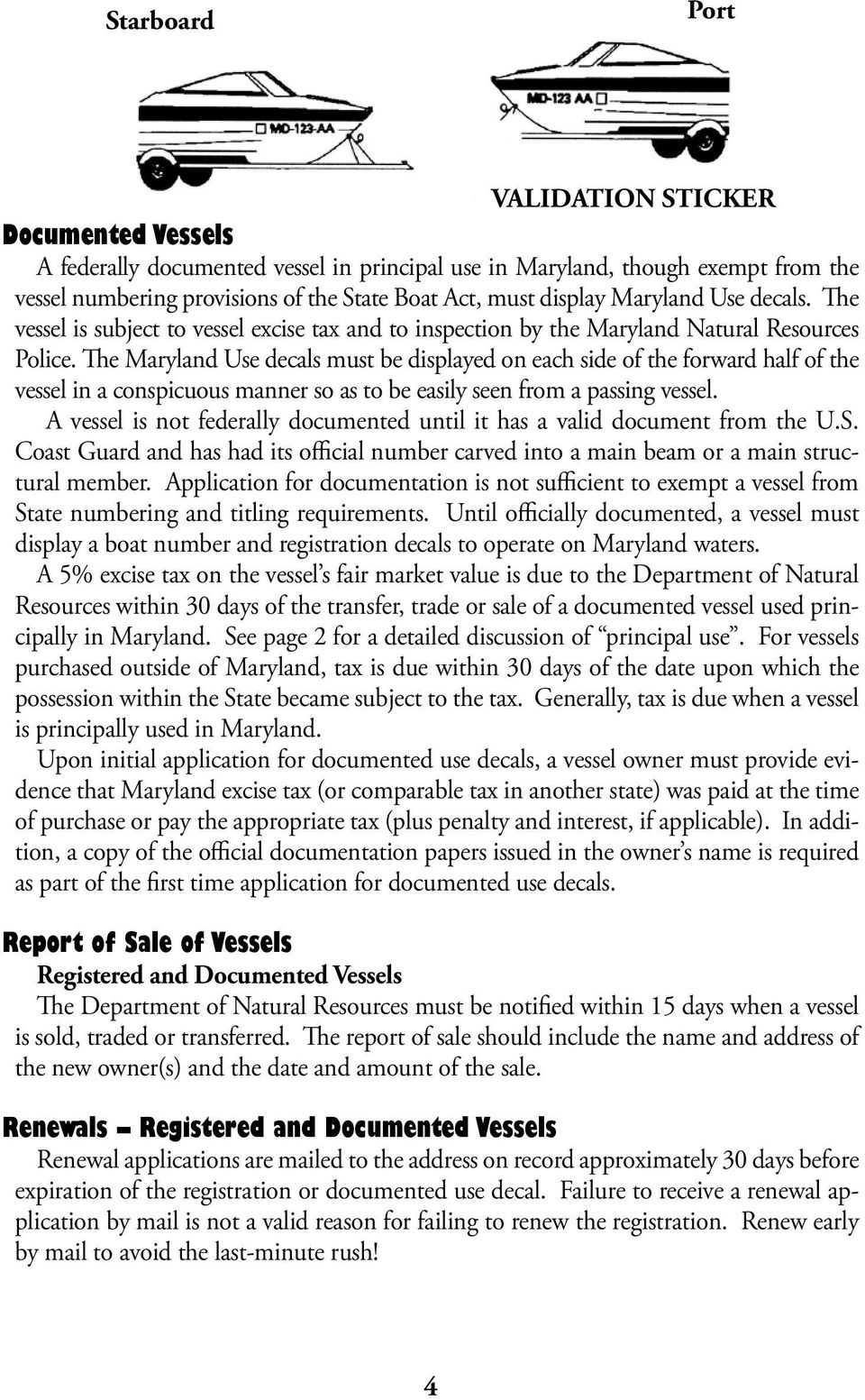
3 Used vessel Original Certificate of Title assigned to the purchaser(s) and signed by all owners shown on the front of the title. If previously registered in a non-title state, submit copy of the state registration card or a true test copy of that state s official vessel record Original certified Bill of Sale if total purchase price is not stated in the assignment Original Notice of Security Interest with a properly executed release if a lien or security interest is recorded on the seller s title Taxes, Titling and Registration Fees 1. 5% vessel excise tax on the total purchase price (vessel, motor and accessories, but not the trailer). If more than 3 years have elapsed since purchase, fair market value will be determined from a national publication of used vessel values adopted by the Department. 2. $2 title fee 3. Biennial registration a. $24 -- Vessel >16 in length, or propulsion > 7.5 hp b. No charge -- Vessel < 16 in length with propulsion < 7.5 hp 4. $15 security interest filing fee Vessel Excise Tax All vessel excise tax is deposited in the Waterway Improvement Fund. These special funds are earmarked for the engineering, construction and maintenance of boating related projects on public lands, including dredging, channel marking, clearing debris, constructing and maintaining marine facilities, and other projects that benefit the boating public. Display of Numbers and Validation Decals The vessel number issued to a MD titled vessel must be painted on or otherwise permanently attached to each side of the forward half of the vessel (the bow). No other number can be displayed near the vessel number. Vessel numbers must be displayed as follows: Reading from left to right Plain vertical block characters 3 high or larger Contrasting color to the boat hull or background Placed as high above the waterline as practical Letters separated from numbers by hyphens or spaces. The registration decal set (two 3 x 3 decals) and the 3 round dealer-issued temporary decals must be displayed within 3 of the vessel number. Vessels must display boat number and current decals, and have the registration card on board and available for inspection whenever the boat is in use.

4 Starboard Port VALIDATION STICKER Documented Vessels A federally documented vessel in principal use in Maryland, though exempt from the vessel numbering provisions of the State Boat Act, must display Maryland Use decals. The vessel is subject to vessel excise tax and to inspection by the Maryland Natural Resources Police. The Maryland Use decals must be displayed on each side of the forward half of the vessel in a conspicuous manner so as to be easily seen from a passing vessel. A vessel is not federally documented until it has a valid document from the U.S. Coast Guard and has had its official number carved into a main beam or a main structural member. Application for documentation is not sufficient to exempt a vessel from State numbering and titling requirements. Until officially documented, a vessel must display a boat number and registration decals to operate on Maryland waters. A 5% excise tax on the vessel s fair market value is due to the Department of Natural Resources within 30 days of the transfer, trade or sale of a documented vessel used principally in Maryland. See page 2 for a detailed discussion of principal use. For vessels purchased outside of Maryland, tax is due within 30 days of the date upon which the possession within the State became subject to the tax. Generally, tax is due when a vessel is principally used in Maryland. Upon initial application for documented use decals, a vessel owner must provide evidence that Maryland excise tax (or comparable tax in another state) was paid at the time of purchase or pay the appropriate tax (plus penalty and interest, if applicable). In addition, a copy of the official documentation papers issued in the owner s name is required as part of the first time application for documented use decals. Report of Sale of Vessels Registered and Documented Vessels The Department of Natural Resources must be notified within 15 days when a vessel is sold, traded or transferred. The report of sale should include the name and address of the new owner(s) and the date and amount of the sale. Renewals Registered and Documented Vessels Renewal applications are mailed to the address on record approximately 30 days before expiration of the registration or documented use decal. Failure to receive a renewal application by mail is not a valid reason for failing to renew the registration. Renew early by mail to avoid the last-minute rush!
5 Licensing & Registration REGIONAL SERVICE CENTERS 8:30 a.m. to 4:30 p.m. Monday through Friday (except Dundalk) Annapolis Service Center Southern Service Center P.O. Box Hallowing Lane 1804 West Street, Suite 300 Prince Frederick MD Annapolis MD (410) (410) Western Service Center Eastern Service Center 3 Pershing Street Rm Baptist Street #22 Cumberland MD Salisbury MD (301) (410) East Central Service Center Central Service Center 120 Broadway Ste #5 2 S. Bond Street, Suite 101 Centreville MD Bel Air MD (410) (410) Dundalk Service Center (open M/W/F only) 7701 Wise Avenue Baltimore MD (410)

6 Law Enforcement Maryland Natural Resources Police The Maryland Natural Resources Police enforce all natural resource laws of the State, including enforcement provisions of the Maryland State Boat Act on all waterways of the State. The Natural Resources Police are also mandated to enforce all other laws of the State. Patrol vessels can be identified by the blue emergency light, the POLICE identification on the side of the vessels, and the uniformed officers on board. Boaters are reminded that on the immediate approach of a Maryland Natural Resources Police patrol vessel using a flashing blue light, the vessel operator, unless otherwise directed by the officer, shall yield the right-of-way, stop the vessel, and stay in that position until the Natural Resources Police vessel has passed. Failure to stop and/or permit boarding or inspection may subject the operator or owner to a penalty of up to $ All vessels, including those documented, are subject to Maryland s rules and regulations. A vessel does not have to be underway to be boarded or inspected. A vessel may be boarded at dockside. The Maryland Natural Resources Police utilize inboard and outboard vessels stationed throughout the state. In addition, Maryland citizens and visitors will soon benefit from the Maritime Law Enforcement Information Network (MLEIN). This new system of radar and camera sites on the Chesapeake Bay region enhances search and rescue, homeland security, and law enforcement operations on Maryland waterways. This new technology along with the training and experience of officers allows the Maryland Natural Resources Police to be more effective in enforcing natural resource law and responding to emergencies. The Maryland Natural Resources Police responds to more than 3,000 maritime calls a year, including vessels in distress, accidents, search and rescue and boating law violations. Emergency telephone numbers to request assistance or report violations are: (410) or (410) Additional numbers can be found at or dial 911 for an emergency. Termination of Use A Natural Resources Police Officer who observes a boat being operated in an unsafe manner and who determines that an especially hazardous condition exists may direct the operator to take immediate steps to correct the condition, including returning to port. Termination for unsafe use may be imposed for, but is not limited to: 1. Insufficient number of USCG approved life jackets. 2. Insufficient fire extinguishers. 3. Overloading beyond manufacturer s recommended safe loading capacity. 4. Improper navigation light display. 5. Insufficient ventilation for tanks and engine spaces. 6. Fuel leakage. 7. Fuel in bilges. 8. Improper backfire flame arrestor. Boating Accident Reports The operator of any boat involved in an accident must stop, render assistance, and offer

7 identification. An accident report must be made to the Department within 48 hours if: 1. A death occurs - no time limit on death; 2. A person loses consciousness or receives medical treatment beyond first aid or is disabled more than 24 hours; 3. A person disappears from the vessel under circumstances that indicate death or injury. Accidents must be reported within 10 days if damage to all vessels and other property totals more than $2,000.00, unless an earlier report is required. Running aground, or hitting a fixed or floating object, is considered a boating accident. Boating accident report forms (DNR-149) are obtainable from the Natural Resources Police. The operator of the vessel or vessels involved must submit them to the Natural Resources Police. Accident reports are required by federal law and furnish information for use in accident prevention. Information from individual reports will not be publicly disclosed and cannot be used in court. Rendering Assistance Federal law requires the operator of a vessel to safely provide assistance to any individual in danger on the water. Reckless and Negligent Operation Law prohibits negligent or grossly negligent operation of a vessel that endangers lives and/ or property. The U.S. Coast Guard for this offense may impose a civil penalty under federal laws. The operator may be subjected to a fine of up to $5,000 and/or imprisonment for up to one year, or both. The Maryland penalty is a fine of up to $500 for the first offense. Some examples of actions that may constitute negligent or grossly negligent operation include but are not limited to: 1. Operating in a swimming area. 2. Operating under the influence of alcohol or drugs. 3. Excessive speed in the vicinity of other boats or in dangerous waters. 4. Hazardous water skiing practices or Personal Watercraft operations (i.e., Jet Ski s, etc.). 5. Bow riding or riding on seatback, gunwale, or transom. Alcohol and Boating Alcohol and boating do not mix. Approximately 50% of all boating accidents are alcohol related. Alcohol is a depressant and affects balance, vision, and coordination. It increases heat loss from the body so hypothermia occurs faster. When combined with engine noise, vibration, sun, and wind, alcohol causes boaters to be fatigued much faster than normal. A person may not operate or attempt to operate a vessel while the person: 1. Is impaired. 2. Is under the influence of alcohol. 3. Is so far under the influence of any drug, combination of drugs, or combination of drugs and alcohol that the person cannot operate a vessel safely, or 4. Is under the influence of any controlled dangerous substance, as defined in the Digest of Criminal Laws, Natural Resources Article Any person who operates or attempts to operate a vessel on the waters of the state is deemed to have consented to take a chemical test for intoxication. In addition to any other penalty, a court may prohibit a person from operating a vessel for up to one year for refusing to submit to a chemical test or having a blood alcohol content of.08 or greater.

8 Natural Resources Police Regional Offices Town Hill Office Mountain Rd. N.E. Flintstone, MD Tel: (301) (800) Allegany and Garrett counties Annapolis Office 1070 East College Parkway Annapolis, MD Tel: (800) Anne Arundel and Prince George s counties Gwynnbrook Office 3738 Gwynnbrook Avenue Owings Mills, MD Tel: (800) Baltimore City, Baltimore, Carroll, Cecil, Harford, Howard, Montgomery counties Hillsboro Office 3001 Star Road Queen Anne, MD Tel: (800) Caroline, Dorchester, Kent, Queen Anne s, and Talbot counties Waldorf Office 2160 Old Washington Road Waldorf, MD Tel: (800) Calvert, Charles, and St. Mary s counties Johnson Office Mt. Olive Road Salisbury, MD Tel: (800) Somerset, Wicomico and Worcester counties Echo Lake Office 2011 Monument Road Myersville, MD Tel: (800) Frederick and Washington counties Emergencies on the Water VHF-FM Mhz or VHF-FM 167 Mhz CH.16. Nearest NRP or Coast Guard boat will assist you. From cell phone (410)

9 Boating Safety Education Requirements Maryland s Boating Safety Education Law is designed to assure that the younger generations of boaters have fundamental knowledge of boating rules and safety and that eventually, all boaters will be operating their boats with a basic level of boating education. The law also imposes the requirement for persons convicted of certain boating violations to successfully complete a boating safety education course regardless of the age of the operator. The Boating Safety Education Law requires that any person born on, or after July 1, 1972, must have in their possession a certificate of boating safety education while operating a numbered or documented vessel on Maryland waters. The certificate may be obtained by completing an approved boating safety course or passing an equivalency examination. The Natural Resources Police offer the Maryland Basic Boating Course through local recreation departments and community colleges or on-line. The classroom course is 8-10 hours in length and covers the basics of boating and water safety. The on-line course is offered by Boat Ed, the official provider of the Maryland Basic Boating Course. This course is user-friendly and self-directed. Study as much as you need to know, as slowly or quickly as you like to learn! The equivalency examination is for those persons who desire not to take a course. It is offered, by appointment, at locations throughout the State. To obtain study materials for the equivalency examination, or course information, contact: Maryland Natural Resources Police Safety Education Division 305 Marine Academy Drive, Suite 1 Stevensville, MD (410) Other approved courses are available from the U.S. Coast Guard Auxiliary and the U.S. Power Squadrons. For further information call BOAT. A certificate of boating safety education is not required if: 1. A vessel is operated for commercial purposes. 2. A person 16 years of age or older is a resident of another state, visiting Maryland for 60 days or less, in a vessel numbered in another state. 3. A person is visiting the State for 90 days or less in a vessel from a foreign country. 4. A person is operating a vessel on a body of water located on private property. A boating safety education certificate issued by another state is valid in Maryland as long as it meets the criteria of the National Association of State Boating Law Administrators. The Certificate of Boating Safety Education is valid for a lifetime and may not be revoked.

10 Equipment Requirements The U.S. Coast Guard sets minimum safety standards for vessels and associated equipment. To meet these standards some of the equipment must be Coast Guard Approved. Coast Guard Approved Equipment has been determined to be in compliance with USCG specifications and regulations related to performance, construction or materials. The class of the boat determines some of the equipment requirements. The class of the boat is determined by the length of the boat as follows: Class A - Boats less than 16 ft. long Class 1 - Boats from 16 ft. to less than 26 ft. Class 2 - Boats from 26 ft. to less than 40 ft. Class 3 - Boats from 40 ft. to not more than 65 ft. Life Jackets (Personal Flotation Device) General Life Jacket (PFD) Information All recreational boats must carry one wearable life jacket (Type I, II, III, or V) for each person on board. Any boat 16 ft. and longer (except canoes & kayaks) must also carry one throwable life jacket (Type IV). Life jackets must be Coast Guard approved, in good and serviceable condition, readily available and of appropriate size for the intended user. If a type V life jacket is to be counted toward minimum carriage requirements, it must be worn and may be carried instead of another type of life jacket only if used according to the approval conditions on the label. Life jackets are required on non-motorized vessels including canoes, kayaks, stand-up paddle boards and any other device capable of being used as a means of transporation on the water or ice. Remember, life jackets will keep you from sinking, but not necessarily from drowning. Extra time should be taken in selecting a properly sized life jacket to insure a safe fit. Testing your life jacket in shallow water or a guarded swimming pool is a good and reassuring practice. Types of Life Jackets Type I Type II Type III Type IV Type V 10

11 Children s Life Jacket Requirements All children under the age of 13 must WEAR a United States Coast Guard approved Life Jacket (Type I, II, III or V) while underway on a recreational vessel under 21 feet in length on Maryland waters. Recreational vessels include: motorboats, sailboats, canoes, kayaks, rowboats, and any other device capable of being used for transportation on the water, when the vessel is being used for other than commercial purposes. The life jacket must be the proper size for the child and must be in serviceable condition. This requirement does not apply when a vessel is moored or anchored or, when a child is below deck or in an enclosed cabin. Also, a child under the age of 4 must wear a life jacket that features additional safety precautions, as appropriate for an infant, toddler, or young child, so as to: Hold the child securely within the life jacket, including a strap that is secured between the child s legs to fasten together the front and back of the life jacket; Maintain the buoyancy of the child, including an inflatable headrest or high collar; and Ensure the ready accessibility of the child from the water, including a web handle. This does not apply to a vessel that is moored or anchored or a child who is below deck or in an enclosed cabin. Types of Life Jackets Type I Life Jacket or OFF-SHORE LIFE JACKET provides the most buoyancy. It is effective for all waters, especially open, rough or remote waters where rescue may be delayed. It is designed to turn most unconscious wearers in the water to a face-up position. Type II Life Jacket or NEAR-SHORE BUOYANCY VEST is intended for calm, inland water or where there is a good chance of quick rescue. This type will turn some unconscious wearers to a face-up position in the water. The turning action is not as pronounced and it will not turn as many persons to a face-up position under the same conditions as a type I. Type III Life Jacket is good for calm, inland water or where there is a good chance of quick rescue. The Type III has the same buoyancy as a Type II life jacket. It comes in many styles, colors and sizes and is generally the most comfortable type for continuous wear. Float coats, fishing vests, and vests designed with features suitable for various sports activities are examples of this type life jacket. Type IV or THROWABLE DEVICE is intended for calm, inland water with heavy boat traffic, where help is always present. It is designed to be thrown to a person in the water and grasped and held by the user until rescued. It is not designed to be worn. Type IV devices include buoyant cushions, ring buoys, and horseshoe buoys. Type V Life Jacket or SPECIAL USE DEVICE is intended for specific activities and may be carried instead of another life jacket only if used according to the approval condition on the label. Some TYPE V devices provide significant hypothermia protection. Varieties include deck suits, work vests, board sailing vests and Hybrid life jackets. Type V HYBRID INFLATABLE LIFE JACKET is the least bulky of all life jacket types. It contains a small amount of inherent buoyancy, and an inflatable chamber. Its performance is equal to a Type I, II, or III LIFE JACKET (as noted on the label) when inflated. Hybrid life jackets must be worn when underway to be acceptable. Water Skiing and Life Jackets A water skier is considered to be on board the vessel and a life jacket is required for the purpose of compliance with the life jacket carriage requirements. Impact Class marking on the label refers to life jacket strength, not personal protection. Maryland 11

12 requires skiers to wear an approved life jacket. It is advisable and recommended for a skier to wear a life jacket designed to withstand the impact of hitting the water at high speed. Life Jacket Requirements for Sailboards Persons operating sailboards may meet the life jacket requirements by using: 1. Neoprene wetsuit or dry suit, or 2. Closed-cell, foam design, padded chest, waist or seat harness, or 3. A combination of 1 and 2. Between October 15 and May 15 inclusive, persons on sailboards must wear a neoprene wet or dry suit that covers the entire torso of the body. Visual Distress Signals All vessels in Maryland waters that are greater than 2 miles wide must be equipped with U.S. Coast Guard Approved visual distress signals. Vessels owned in the United States and operating on the high seas must be equipped with U.S. Coast Guard Approved visual distress signals. The following are not required to carry day signals but must carry night signals when operating from sunset to sunrise: 1. Recreational boats less than 16 feet in length. 2. Boats participating in organized events such as races, regattas, or marine parades. 3. Open sailboats less than 26 feet in length not equipped with propulsion machinery. 4. Manually propelled boats Pyrotechnic Devices Pyrotechnic Visual Distress Signals must be U.S. Coast Guard Approved, in serviceable condition, and readily accessible. They are marked with a date showing the service life, which must not have expired. Launchers manufactured before January 1, 1981, intended for use with approved signals, are not required to be Coast Guard Approved. If pyrotechnic devices are selected, a minimum of three is required. That is, three signals for day use and three signals for night. Some pyrotechnic signals meet both day and night use requirements. Pyrotechnic devices should be stored in a cool, dry location. A watertight container painted red or orange and marked DISTRESS SIGNALS is recommended. U.S. Coast Guard Approved Pyrotechnic Visual Distress Signals and associated devices include: 1. Pyrotechnic red flares, hand-held or aerial. 2. Pyrotechnic orange smoke, hand held or floating. 3. Launchers for aerial red meteors or parachute flares. Non-Pyrotechnic Devices Non-Pyrotechnic Visual Distress Signals must be in serviceable condition, readily accessible, and certified by the manufacturer as complying with U.S. Coast Guard requirements. 12

13 They include: 1. Orange distress flag. 2. Electric distress light. The distress flag is a day signal only. It must be at least 3 x 3 feet with a black square and ball on an orange background. It is most distinctive when attached and waved on a paddle, boathook, or flown from a mast. The electric distress light is acceptable for night use only and must automatically flash the international SOS distress signal ( ). Under Inland Navigation Rules, a high intensity white light flashing at regular intervals from times per minute is considered a distress signal, however, lights of this type do not meet the carriage requirements for visual distress signals. Regulations prohibit the display of visual distress signals on the water under any circumstances except when assistance is required to prevent immediate or potential danger to persons on board a vessel. All distress signals have distinct advantages and disadvantages. No single device is ideal under all conditions or suitable for all purposes. Pyrotechnics are universally recognized as excellent distress signals. However, there is potential for injury and property damage if not properly handled. These devices produce a very hot flame and the residue can cause burns and ignite flammable material. Pistol-launched and hand-held parachute flares and meteors have many characteristics of a firearm and must be handled with extreme caution. Fire Extinguishers U.S. Coast Guard Approved or UL Marine Use fire extinguishers are required on certain boats. A letter and number symbol classify extinguishers. The letter indicates the type fire the unit is designed to extinguish (Type B, for example, are designed to extinguish flammable liquids such as gasoline, oil, and grease fires). The number indicates the relative size of the extinguisher (the higher the number, the longer the extinguisher functions). U.S. Coast Guard approved marine type extinguishers are hand-held, either B-I or B-II classification or have a specific marine type mounting bracket. It is recommended that extinguishers be mounted in a readily accessible position, away from areas where a fire could likely start. Fire extinguishers are required if any one (1) or more of the following conditions exist: 1. Inboard engines 2. Closed compartments and compartments under seats where portable fuel tanks may be stored. 3. Double bottoms not sealed to the hull or which are not completely filled with flotation material. 4. Closed living spaces. 5. Closed stowage compartments in which combustible or flammable materials are stored. 6. Permanently installed fuel tanks. Fuel tanks secured so they cannot be moved in case of fire or other emergency are considered permanently installed. There are no gallon or capacity limits to determine if a fuel tank is portable. If the weight of a fuel tank is such that the persons on board cannot move it, the Coast Guard considers it permanently installed. Inspect extinguishers monthly to make sure that: 1. Seals and tamper indicators are not broken or missing. 2. Pressure gauges or indicators read in the operable range. 3. There is no physical damage, corrosion, leakage or clogged nozzles. 13

14 Ventilation All vessels built after April 25, 1940, which use gasoline for electrical generation, mechanical power, or propulsion are required to be equipped with a ventilation system. A natural ventilation system consists of at least two ventilator ducts, fitted with cowls or their equivalent: 1. A minimum of one exhaust duct installed so as to extend from the open atmosphere to the lower portion of the bilge; and 2. A minimum of one intake duct installed so as to extend to a point at least midway to the bilge or at least below the level of the carburetor air intake. A powered ventilation system consists of one or more exhaust blowers. Each intake duct for an exhaust blower should be in the lower, one-third of the compartment and above the normal accumulation of bilge water. The U.S. Coast Guard Ventilation Standard, a manufacturer requirement, applies to all boats built on or after August 1, Some builders began manufacturing boats in compliance with the Ventilation Standard as early as August If your boat was built on or after August 1, 1978, it might have been equipped with either (1) a natural ventilation system, or (2) both a natural ventilation system and a powered ventilation system. If your boat bears a label containing the words: This boat complies with U.S. Coast Guard Safety standards, etc., you can assume that the design of your boat s ventilation system meets the applicable regulations. Boats built after August 1, 1980 which comply with the Coast Guard Ventilation Standard, must display at each ignition switch, a label which contains the following information: * WARNING: Gasoline vapors can explode. Before starting the engine, operate blower for at least four (4) minutes and check engine compartment bilge for gasoline vapors. All owners are responsible for keeping their boat s ventilation systems in operating condition. This means, making sure openings are free of obstructions, ducts are not blocked or torn, blowers are operating properly, and worn out components are replaced with equivalent marine type equipment. Backfire Flame Arrestor Gasoline engines installed in a vessel after April 25, 1940, except outboard motors, must be equipped with an acceptable means of backfire flame control. This device must be suitably attached to the air intake with a flame tight connection and is required to be U.S. Coast Guard approved or comply with SAE J-1928 or UL 1111 standards. Sound Producing Devices The navigation rules require sound signals to be made under certain circumstances. Meeting, crossing, and overtaking situations described in the Navigation Rules section are examples of when sound signals are required. Vessels 12 meters or more in length are required to carry on board a whistle or horn, and a bell. Any vessel less than 12 meters 14

15 in length (including Personal Watercraft) must carry a whistle or horn, or some means to make an efficient sound to signal your intentions and to signal your position during periods of reduced visibility. Navigation Lights Recreational vessels are required to display navigation lights between sunset, sunrise, and other periods of reduced visibility (fog, rain, haze, etc.). The U.S. Coast Guard Navigation Rules, International-Inland encompasses lighting requirements for every description of watercraft. The information provided here is intended for power-driven and sailing vessels less than 20 meters. Power Driven Vessels Power driven vessels of less than 20 meters, shall exhibit navigation lights as shown in figure 1. Figure 1 B A or Vessels of less than 12 meters in length, including vessels equipped with electric outboard motors, may show the lights in either figure 1 or 2. Figure 2 A or B 15

16 Sailing Vessels and Vessels Under Oars Sailing vessels less that 20 meters may exhibit the navigation lights shown in Figures 3 or 4. Another option for sailboats is to use a combined tricolor light at the top of the mast as shown in figure 5. Figure 3 or A B Figure 4 or Figure 5 A B 16

17 Sailing vessels less than 7 meters may carry an electric torch or lighted lantern showing a white light to be displayed in sufficient time to prevent collision (see figure 6A). If practicable, the lights prescribed for sailing vessels less than 20 meters should be displayed. Vessels under oars may display the lights prescribed for sailing vessels, but if not, one must have an electric torch ready at hand, or lighted lantern showing a white light to be displayed in sufficient time to prevent collision (see figure 6B). Docking lights shall not be used or displayed while a vessel is underway and not actively engaged in docking maneuvers. Figure 6 A B Shapes and Lights To alert other vessels of conditions which may be hazardous, there are requirements to display lights at night and shapes during the day. Sailing vessels under both sail and power must display a day shape consisting of a cone with the apex pointed downward. In inland waters a sailing vessel less than 12 meters need not display the day shape. Anchored Vessels At night, power-driven vessels and sailing vessels at anchor must display anchor lights. An anchor light for a vessel less than 50 meters in length is an all-around white light visible for 2 miles exhibited where it can best be seen. During the day, vessels at anchor shall exhibit forward where best seen, a ball shape. Vessels less than 7 meters are not required to display anchor lights or day shapes unless anchored in or near a narrow channel, fairway or anchorage, or where other vessels normally navigate. At night, sailing vessels operating under machinery, or under sail and machinery, are considered power-driven and must display the lights prescribed for a power-driven vessel. Vessels operating at night must also remember to operate at a safe speed as well as consider factors such as visibility, weather, sea conditions, background lights that may obscure navigation lights, vessel traffic and other possible hazards. 17

18 Diving Activities The Navigation Rules require vessels restricted in their ability to maneuver to display appropriate day shapes or lights. To meet this requirement, recreational vessels engaged in diving activities during the day must exhibit a rigid replica of the international code flag A not less than one meter in height, or at night, display navigation lights 360 degrees red on top, white in middle and red on the bottom. This requirement does not affect the use of a red and white diver flag used to mark a divers location. Capacity Plate The U.S. Coast Guard requires boat manufacturers to install a Capacity Plate in plain sight of the helm on most vessels less than 20 feet in length. The capacity plate provides the operator with information concerning the maximum horsepower of the engine, maximum number of persons on board and total weight the boat can carry which includes persons, equipment, fuel, engine, etc. Always adhere to the information provided on the capacity plate. Do not overload your boat. Pollution Regulations The Refuse Act of 1899 prohibits throwing, discharging or depositing any refuse matter of any kind (including trash, garbage, oil and other liquid pollutants) into the water of the United States. The Federal Water Pollution Control Act prohibits the discharge of oil or hazardous substances that may be harmful into U.S. navigable waters. Vessels 26 feet in length and over must display a placard at least 5 by 8 inches, made of durable material, fixed in a conspicuous place in the machinery spaces, or at the bilge pump control station that states the following: Discharge of Oil Prohibited The Federal Water Pollution Control Act Prohibits the discharge of oil or oily waste into or upon the navigable waters of the United States or the waters of the contiguous zone if such discharge causes a film or sheen upon, or a discoloration of, the surface of the water, or causes sludge or emulsion beneath the surface of the water. Violators are subject to a penalty of $5, The Marine Plastics Pollution Research & Control Act (MARPOL) places limitations on the discharge of garbage from vessels. It is illegal to dump plastic trash anywhere in the ocean or navigable waters of the United States, including the Great Lakes. The discharge of other types of garbage is permitted outside of specific distances offshore as determined by the nature of that garbage. IT IS ILLEGAL TO DUMP: INSIDE 3 MILES (and in U.S. Lakes, Rivers, Bays and Sounds): plastic; dunnage; lining, and packing materials that float, and any garbage except dishwater, gray water and fish parts. 3 TO 12 MILES: plastic, dunnage, lining, and packing materials that float, any garbage not ground to less than one square inch. 12 TO 25 MILES: Plastic, dunnage, lining, and packing materials that float. OUTSIDE 25 MILES: Plastic 18

19 United States vessels of 26 feet or longer must display, in a prominent location, a durable placard at least 4 by 9 inches notifying the crew and passengers of the discharge restrictions Maryland s litter law makes it illegal to throw anything overboard, and in order to preserve the beauty and purity of our waters, the Natural Resources Police will strictly enforce this law. The owner as well as the operator is liable for any trash thrown from a vessel. Marine Sanitation Devices It is illegal to discharge raw sewage from a vessel anywhere in Maryland waters. If a vessel has an installed toilet, it must be equipped with an operable marine sanitation device (MSD). Vessels 65 feet and under must have a Type I, II or III MSD. Vessels over 65 feet must have a type II or III MSD. All Type I and II MSD s (that treat and discharge sewage) must have a certification label affixed by the manufacturer. Although a Y valve is permitted, when operating in Maryland waters, it must be secured to prevent the discharge of raw sewage. The use of a non-reusable wire tie, or padlock, or removing the valve handle are acceptable ways to secure the Y valve. Additionally, all pathways for overboard discharge of vessel sewage from any vessel with a Type III MSD must be blocked or secured in such a way as to prevent any accidental or intentional vessel sewage discharge by disconnecting or physically blocking those onboard sewage lines or hull fittings which would allow for overboard vessel discharge. For any vessel offered as a non-captained charter, the leasing entity must ensure that the vessel is in compliance with the above and must include in the lease agreement, signed by the leasing party, a paragraph outlining the operator s responsibilities. A person that violates any of the above requirements is subject to a fine not to exceed $2,000. Type I and II MSD s do not reduce the amount of nutrients that are in boat sewage. Because reducing nutrient over-enrichment is critically important to the health of Maryland waters, it is highly recommended that vessels with installed toilets be equipped with a holding tank. Marine sewage pumpout facilities (which empty boat holding tanks and portable toilets) are inexpensive to use and are conveniently located at many marinas in Maryland. The Natural Resources Police Reserve Officers periodically conduct voluntary Clean Boat Inspections at various marinas throughout the State. Vessels passing inspection receive a Clean Boat decal to display on their vessel. Boat Owners not meeting the MSD requirements receive information/instruction on how to bring their vessel(s) up to compliance, and are offered a follow-up inspection. Information on how to retrofit a boat with a holding tank, produced by the American Boat and Yacht Council, as well as information on the location of pumpout facilities, is available on-line at To participate in a Clean Boat Inspection, call your local regional office of the Natural Resources Police. No Discharge Zones No Discharge Zones are areas of water that require greater environmental protection and where the discharge of treated sewage could be harmful. When operating in a No Discharge Zone, a Type I or Type II MSD (they both discharge treated sewage) must be secured in some way to prevent discharge. Closing the seacock and padlocking, using a non-releasable wiretie, or removing the seacock handle would be sufficient. Locking the door to the head with a padlock or a door handle key lock is another acceptable method of securing the MSD while 19

20 in a No Discharge Zone. Currently there are two federally designated No Discharge Zones in Maryland. The first is located in Herring Bay on the western shore of the Chesapeake Bay in southern Anne Arundel County. The second is located in the Northern Coastal Bays starting at the Ocean City Inlet and extending north to the Delaware State Line. To report a No Discharge Zone violation, please contact the Maryland Department of the Environment weekdays at (410) and evenings and weekends at MDE-GOTO ( ), violators will be subject to fines up to $1, For more information on No Discharge Zones, please contact the Maryland Department of Natural Resources at (410) or the web site at: Additional Recommended Equipment Besides meeting the legal requirements, prudent boaters carry additional safety equipment. The following items of equipment are suggested depending on the size, location and use of your boat: VHF Radio Fuel tanks Boat Hook Cell Phone Ring Buoy Chart and Compass Food and Water Mooring Line Tool Kit Spare Anchor Binoculars Extra Clothing Spare Fuel Searchlight Sun Screen First Aid Kit Fenders Paddle Satellite EPIRBS Satellite EPIRBS are designed to quickly and reliably alert rescue personnel, indicate an accurate position, and guide rescue units to the distress scene, even when all other communications fail. Satellite EPIRBS operate as part of a worldwide distress system. An international satellite constellation maintains a global listening watch for satellite EPIRB distress signals. The National Oceanic and Atmospheric Administration (NOAA) operates satellites, ground stations and alert distribution systems serving the U.S. and international community. When activated, the satellite EPIRB transmits a distress signal with a beacon-unique identifying code. The system detects the signal, calculates an accurate position, checks the identifying code against the EPIRB registration database and routes the distress alert to the appropriate rescue agency. Vessel Safety Checks The Vessel Safety Check (VSC) is one of the many services provided by the U.S. Coast Guard Auxiliary, a volunteer organization dedicated to assisting the Coast Guard in boating safety. The US Power Squadrons and Maryland Natural Resources Police are now participating in this program. This free examination is a courtesy check of safety equipment carried or installed on a vessel and certain aspects of the vessel s condition. VSC requirements parallel and sometimes exceed Federal requirements with regard to equipment and vessel condition. If the vessel meets or exceeds all VSC requirements, the examiner will award the owner or operator a Vessel Safety Check Decal (Seal of Safety). It must be emphasized, the VSC is NOT a law enforcement action and is not conducted by, or is any information obtained or provided to, any law enforcement organization. It is a FREE public service in the interest of boating safety. 20

21 Maryland Required Equipment Checklist PWC Boats less than Boats 16 Feet to Feet less than 26 Feet Boating Safety Education Certificate a1 a1,2 a1,2 Certificate of Number On Board a a2 a2 Validation Decal Displayed a a2 a2 PFDs: Type I, II, III, or V a3 a4 a4 PFD: Type IV a Type B-I Fire Extinguisher a a2 a2 Ignition Safety Switch a Backfire Flame Arrestor a a5 a5 Ventilation System a a a Muffler a a a Horn, Whistle, or Bell a a a Daytime Visual Distress Signal a6 Night Time Visual Distress Signal 7 a5 a6 Navigation Lights 7 a a 1. Applicable if operator is born on or after July 1, Except all non-motorized vessels 3. Everyone onboard a PWC must wear a personal floatation device (PFD). 4. Children under 13 years of age must wear a PFD while underway on a vessel under 21 feet in length. In addition children under 4 years of age must have a PFD equipped with a grab strap, inflatable headrest and crotch strap. 5. Required on inboard engines. 6. Required when boating on federally controlled waters. Sailboats less than 26 in length that are not equipped with propulsion machinery are not required to carry day signals. 7. Certain items are not applicable to PWC because they are not allowed to operate between sunset and sunrise. 21
22 Operating Procedures Navigation Rules Navigation Rules establish actions to be taken by vessels to avoid collision. The following diagrams describe the signals to be given and actions to be taken in a crossing, meeting or overtaking situation while operating in inland waters. They are basic examples. For further information, consult the NAVIGATION RULES International-Inland that may be purchased from the U.S. Government Printing Office or most marine stores. Crossing Situations Give-way Vessel...give way 1 short blast (1 sec.) Stand-on Vessel...hold course and speed 1 short blast (1 sec.) Meeting Head-On or Neatly So Situations 1 short blast (1 sec.) 1 short blast (1 sec.) Vessels generally pass portside to portside. 22
23 However, vessels may pass starboard to starboard if proper signals are given. 2 short blast (1 sec. each) 2 short blast (1 sec. each) 2 short blast (1 sec. each) Overtaking Situations Stand-on Vsssel Overtaken 1 short blast (1 sec.) 2 short blast (1 sec. each) Give-way Vessel Overtaken (keep clear) short blast (1 sec.) Aids to Navigation Aids to Navigation are placed along coasts and navigable waters as guides to mark safe water and to assist mariners in determining their position in relation to land and hidden dangers. Each aid to navigation is used to provide specific information. Several aids to navigation are usually used together to form a local aid to navigation system that helps the mariner follow natural and improved channels. Such aids to navigation also provide a continuous system of channel marks for coastal piloting. Individual aids to navigation are used to mark landfall from seaward, and to mark isolated dangers. Lateral marks are buoys or beacons that indicate the port and starboard sides of a route to be followed. Virtually all U.S. lateral marks follow the traditional 3R rule of red, right, returning. This means, when returning from sea, keep red marks on the right hand (starboard) side of the vessel. KEEP CLEAR - Big Ships in the Chesapeake Bay Collision Avoidance Checklist Avoid shipping channels when possible or cross them quickly. Be alert! Watch for ship traffic Be seen, especially at night. Use radio channel 13 for navigational communication. Keep in mind that few survive collisions with ships. 23
24 8 7 R 9 FI G 4sec Mariners must NOT rely on buoys alone for determining their positions. Storms and wave actions sometimes cause buoys to move. 8 R 8 FI R 4sec LIGHTED BUOY LIGHTED BUOY 5 Do not tie up to Aids to Navigation. It is dangerous and illegal. 6 R C 7 R N 6 CAN NUN 1 DAYMARK Lateral aids marking the sides of channels, as seen when entering from seaward. 2 DAYMARK R 2 rock Diamond Shape warns of danger 6 KNOTS Circle marks area controlled as indicated Diamond Shape with cross means boats keep out Severn River Magothy River For displaying information such as directions, distances, locations, etc. 24
25 Nautical Charts One of the most important tools used by boaters for planning trips and safely navigating waterways are nautical charts. Nautical charts show the nature and shape of the coast, depth of water, general configuration and character of the bottom and prominent landmarks, port facilities, aids to navigation, marine hazards, and other pertinent information. Changes brought about by nature and man requires that nautical charts be constantly maintained and updated to aid safe navigation. The National Ocean Service (NOS) produces a variety of nautical related charts and chart related products. The date of a nautical chart is important. Only current charts should be used for navigation. Free chart updating information can be obtained from Local Notice to Mariners published by the U.S. Coast Guard and available from: Fifth Coast Guard District, Federal Building, 431 Crawford St., Portsmouth, VA (703) NOS charts are available in most marine stores. Personal Watercraft (PWC, i.e. Jet Ski s, Wave Runners, etc.) The following regulations have been established which govern the use of PWCs on all waters of the State: 1. A person must be at least 16 years of age to operate a PWC. 2. PWC may not be operated between sunset and sunrise. 3. All persons on board a PWC must wear a USCG approved Type I, II, or III life jacket. 4. All PWCs must be equipped with a self-circling device or a lanyard cut off switch. The cut-off switch lanyard must be attached to the operator, or the operator s clothing or life jacket. Self-circling devices and cut off switches may not be altered and must be functioning. 5. A PWC may not be used to tow a person on water skis, aquaplanes or other similar devices unless: a. The PWC has the capacity to carry 3 persons which includes the driver, a rear facing observer and the skier; and b. The PWC is specifically designed for skiing by the manufacturer. 6. On all waters of the State except the Atlantic Ocean, a PWC may not be operated at a speed in excess of 6 knots within 100 feet of any shore, wharf, pier, bridge abutment, another PWC or persons in the water. 7. On Maryland waters of the Atlantic Ocean, a PWC may not be operated within 300 feet of persons in the water or surf fishermen. 8. On Maryland waters of the Atlantic Ocean, a PWC may not be operated at a speed in excess of 6 knots within 100 feet of any wharf, pier or jetty. 9. A PWC may not be operated in excess of 6 knots within 100 feet of another vessel except in a crossing or overtaking situation as described in the Federal Rules of the Road. 10. A PWC may not be operated in a negligent manner. i.e., splashing, playing chicken, intentionally throwing off a passenger, etc.). 11. All PWCs operated in Maryland waters and registered in the State of Maryland must have a DNR approved PWC regulations sticker properly affixed to the PWC. 12. A person may not operate or give permission to operate a PWC in excess of idle speed in any waters of the State less than 18 inches in depth, except when required to maintain speed in a crossing or overtaking situation pursuant to the Federal Inland or International Navigation Rules. It shall be a reputable presumption that the operator is aware that the depth of the water is less than 18 inches if: a. The area is marked as an idle speed limit area; or b. The operator was previously issued a warning or citation for exceeding idle speed in the same area. 25
26 NOTE: PWC operating on Deep Creek Lake are subject to additional restrictions. Personal Watercraft (and hovercrafts) may not be operated on the lake between 11 am and 4 pm on the Saturday, Sunday and holiday of Memorial Day weekend, as well as the Saturdays, Sundays, and holidays from July 1 through Labor Day. For more information, contact Deep Creek Lake Recreation Area at (301) Vessel Operators Under 16 Years of Age As of October 1, 2010, anyone under the age of 16, operating a motorized vessel 11 feet in length or greater without a valid boating safety certificate, must be under the supervision of an individual 18 years of age or older who possesses a valid boating safety certificate or an individual born before July 1, If an individual under the age of 16 is operating a motorized vessel LESS than 11 feet in length, a person of any age possessing a valid certificate of boating safety can provide supervision. Severn, South, Magothy and Middle Rivers Special regulations apply to the Severn, South, Magothy and Middle Rivers and their tributaries. A variety of speed limits and time restrictions are in effect in these river systems, which include maximum daylight speed limits of 35 knots for portions of the Severn, South and Middle Rivers. Contact the Dept. of Natural Resources, Boating Services at (410) for a brochure on the regulations on these rivers. This information is also available on line at Water Skiing In Maryland, water skiing is not allowed between the hours of sunset and sunrise. The towing boat must have at least two persons on board, an observer and an operator, both being at least 12 years of age. In certain marked areas, water skiing is not allowed. Towlines may not be more than 75 feet in length, except when barefoot skiing; in which a towline 100 feet in length may be used. Except for taking off from shore, the towing boat must stay at least 100 feet from shore, piers, bridges, people in the water, and other passing boats. Water skiers must wear a U.S. Coast Guard approved personal flotation device. On the slack water areas above Dams 3, 4, and 5 on the Upper Potomac River, a motorboat may not tow more than two tubes or similar devices when the towline is attached directly to the device. Miscellaneous Regulations and Information Tributyltin Anti-Fouling Paint Federal and State laws have placed severe restrictions on the use of anti-fouling paints that contain tributyltin (TBT) as an active biocide. Except under specific conditions paints containing TBT no longer may be applied to recreational vessels. TBT is an ingredient that has been found to be extremely toxic to fish and oyster larvae. Anyone wishing to apply paints containing TBT must first obtain a permit from the Maryland Department of Agriculture (410) Permits are not required to apply approved paints from spray cans of 16 oz. or less (commonly referred to as lower unit paint). 26
27 Noise Regulations/Mufflers A person may not operate or give permission to operate a vessel on Maryland Waters that emits a maximum noise level that exceeds 90 db(a). On the waters of Deep Creek Lake and from the mouth of the Northeast and Elk rivers to include all tributaries including the Bohemia River and the C&D Canal, a person may not operate a vessel in such a manner to exceed the following vessel noise levels: (a) For engines manufactured before January 1, 1993, the maximum noise level may not exceed 90dB(a) (b) For engines manufactured on or after January 1, 1993, the maximum noise level may not exceed 88dB(a). Maryland s noise regulations do not apply to vessels displaying a valid seafood harvester s license number and engaged in the harvest of seafood for sale. A person may not own, operate, or give permission to operate on the waters of the State a vessel manufactured after January, 1990, that is not equipped with a muffler or system which muffles or suppresses engine noise to the established limits. On the waters of Deep Creek Lake and from the mouth of the Northeast and Elk River to include all tributaries including the Bohemia River and the C&D Canal, a vessel must operate with a continuous muffler or noise suppression system and may not operate a device that bypasses, reduces or eliminates the effectiveness of a muffler or engine noise suppression device or system. Reciprocation Boats with a valid Maryland number are allowed to temporarily use the waters of another state and vessels from another state with a valid number may use our waters. A boat must be numbered in the state of principal use. Boats must adhere to rules, regulations and carriage requirements of the state in which it is being operated. Penalties The penalty for violating most parts of the Maryland Boat Act, or of the regulations made pursuant thereto shall not be more than $ for the first offense. Generally, enforcement personnel must observe a violation before an arrest may be made. However, any citizen may file charges with a court commissioner, against an offender. The Natural Resources Police will aid anyone to do so, when such action is deemed proper. Vessels Carrying Passengers for Hire 1. A vessel is considered to be carrying passengers for hire when something of value is exchanged for carriage of a passenger. 2. Vessels carrying more than six passengers for hire must be inspected and certified by the U.S. Coast Guard. 3. The operator of a passenger-carrying vessel must be in the possession of a license issued by the U. S. Coast Guard. For further information contact Baltimore Licensing Section of the U.S. Coast Guard at (410)
28 Commercial Fishing Guide License Any person who wants to provide services as a fishing guide shall obtain a commercial fishing guide license. For further information contact any DNR Licensing and Registration Service Center. Regulations For Specific Waters Deep Creek Lake 1. Vessels 26 feet in length or larger are prohibited, except pontoon boats, which may not exceed 30 feet. 2. Personal Watercraft and hovercrafts may not be operated on the lake between 11 am and 4 pm on the Saturday, Sunday and holiday of Memorial Day weekend, as well as the Saturdays, Sundays, and holidays from July 1 through Labor Day. 3. No person may operate a vessel in excess of minimum wake speed within 100 feet of the shoreline anywhere on the lake, except to begin towing a skier from a pier or shore directly away from the restricted area. For further information on Deep Creek Lake regulations, contact: Lake Manager, Deep Creek Lake Recreation Area, 898 State Park Road, Swanton, MD (301) Upper Potomac River Any person aboard a vessel, raft, or tube shall wear a U.S. Coast Guard approved Type I, II, III, or V PFD at all times when on the Upper Potomac River and its tributaries between November 15 and the following May 15. This regulation is in addition to class III, IV, V, and VI White Water Stream segment regulations which require PFDs to be worn at all times by persons underway. Minimum wake zones exist around all Maryland public boat launching ramps on the slack water areas. These minimum wake zones encompass an area 200 yards upstream and 100 yards downstream, extending across the river to the opposite shore. Boats may not be operated within an area 200 yards upstream of all dams on the Upper Potomac River with the exception of Dam #1 where the distance restriction is 100 yards On the slack water areas above Dams 3, 4, and 5 on the Upper Potomac River, a motorboat may not tow more than two tubes or similar devices when the towline is attached directly to the device. Please see inside back cover for information on upper Potomac River Advisories. Maryland s Coastal Bays The Coastal Bays, also known as the back bays behind Ocean City and Assateague, are a very popular area for boating, particularly during the summer months. Many of the primary waterways, especially the northern bays, are often congested and require cautious and responsible boating. The bays have very unpredictable boating conditions since they are very shallow with strong currents and tides in many areas. Local knowledge is required to operate outside the main channels. Extra care needs to be taken when boating in coastal areas with sensitive habitat such as submerged aquatic vegetation 28
29 (SAV) beds and water bird nesting locations. Running aground can harm the bay s environment as well as cause expensive damage to a vessel. For more information, contact the Maryland Coastal Bays Program at (410) or the local Natural Resources Police (410) Safety and Survival Tips Vessel Condition The operator should assure that a vessel is in top operating condition and that there are no tripping hazards or sharp edges exposed. The vessel should be free of fire hazards and have clean bilges. Loading Your Vessel Keep the load low and evenly distributed. Do not exceed the capacity label. If there is no capacity label use the following formula to determine the maximum number of persons you can safely carry in calm water. People = (Length of boat X Width) 15 Anchoring To anchor, bring the bow into the wind and/or current and put the engine in neutral. When the vessel comes to a stop, lower, do not throw, the anchor over the bow. The anchor line should be 5 to 7 times the depth of the water. Do not anchor by the stern. Fueling Precautions Fill portable tanks off the vessel. Close all hatches and other openings before fueling. Extinguish smoking materials. Turn off engines and all electrical equipment, radios, stoves and other appliances. Wipe up any spilled fuel immediately. Open all hatches to air out the vessel. Run the blower for at least four minutes, and then check the bilges for fuel vapors before starting the engine. Never start the engine until all traces of fuel vapors are eliminated. Your nose is the best known vapor detector. Fuel Management Practice the One-Third Rule by using one-third of the fuel going out, one-third to get back and one-third in reserve. Marine Rated Parts Do not use automotive parts to replace such items as starters, distributors, alternators, generators, carburetors, fuel pumps, etc. because they are not ignition protected and could cause a fire or explosion. 29
30 Weather Check the weather reports before leaving shore, and remain watchful for signs of bad weather. Listen to National Weather Service Weather Radio. If a Small Craft Advisory is posted, head to safety immediately, as the winds may become too strong to operate your vessel safely. Float Plan Tell a responsible friend or relative where you are going and when you plan to return. Make sure they have a complete description of your vessel and other information that will make identification of your vessel easier should the need arise. Always contact the person you left your float plan with immediately upon your return. Small Boats and Water Activities Many hunters and anglers do not think of themselves as boaters, but use semi-v hull vessels, flat-bottom jon boats or canoes to pursue their sports. These boats tend to be unstable and easily capsized. Capsizing, sinking, and falling overboard account for 70% of boating fatalities and these facts mean you must have a greater awareness of the boat s limitations and the skill and knowledge to overcome them. Standing in a small boat raises the center of gravity, often to the point of capsizing. Standing for any reason or even changing position in a small boat can be dangerous, as is sitting on the gunwales or seat backs. A wave or sudden turn may cause a fall overboard or capsizing because of the raised center of gravity. Staying Afloat It is common belief that someone dressed in heavy clothing or waders will sink immediately if they fall overboard. This is not true. Air trapped in clothing provides considerable flotation, and bending at the knees will trap air in waders, providing additional flotation. To stay afloat, remain calm, do not thrash about or try to remove clothing or footwear. This leads to exhaustion and increases the loss of air that keeps you afloat. Keep your knees bent, float on your back and paddle slowly to safety. Cold Water Survival Sudden immersion in cold water can induce rapid, uncontrolled breathing, cardiac arrest, and other life threatening situations that can result in drowning. Wearing a life jacket will help reduce this condition. If you must enter the water, button up your clothing, wear a life jacket, cover your head if possible and enter the water slowly. Hypothermia is the loss of body heat and immersion in water speeds the loss of heat. If your boat capsizes, it will likely float on or just below the surface. Outboard powered vessels built after 1978 are designed to support you even if full of water or capsized. To reduce the effects of hypothermia get in or on the boat. Try to get as much of your body out of the water as possible. If you can t get in the boat a life jacket will enable you to keep your head out of the water. This is very important because about 50% of body heat is lost from the head. 30
31 It may be possible to revive a drowning victim who has been under water for considerable time and shows no signs of life. Numerous documented cases exist where victims have been resuscitated with no apparent harmful effects after long immersions. Start CPR immediately and get the victim to the hospital as soon as possible. Carbon Monoxide Poisoning Carbon monoxide is a potentially deadly gas produced any time a carbon-based fuel, such as gasoline, propane, charcoal or oil, burns. Sources on your boat include gasoline engines and generators, cooking ranges, space heaters and water heaters. Cold or poorly tuned engines produce more carbon monoxide than warm, properly tuned engines. Carbon monoxide is colorless, odorless and tasteless and mixes evenly with the air. It enters your blood stream through the lungs and displaces the oxygen your body needs. Early symptoms of carbon monxide poisoning - irritated eyes, headache, nausea, weakness and dizziness - are often confused with seasickness. Prolonged exposure can lead to death. Carbon monoxide can collect within a boat in a variety of ways. Exhaust leaks, the leading cause of death by carbon monoxide, can allow carbon monoxide to migrate throughout the boat and into enclosed areas. Even properly vented exhaust can re-enter a boat if it s moored too close to a dock or another boat, or if the exhaust is pushed back by prevailing winds. Exhaust can also re-enter boats when cruising under certain conditions, especially with canvas enclosures in place. Regular maintenance and proper boat operation are the best defenses against injury from carbon monoxide. To find out more about how you can prevent carbon monoxide poisoning on recreational boats, contact the United States Coast Guard at www. uscgboating.org Carbon Monoxide Poisoning Situations Graphics used by permission. Copyright 2006 Boat Ed, 31
32 Secure Your State Lands and Waterways in Maryland by Reporting all Criminal & Suspicious Activity Maryland s Natural Resources Police are actively engaged in preventing criminal and conservation violations and investigating all suspicious activity that may be occurring on State lands and waterways throughout the state of Maryland. Citizens can help by reporting suspicious activity to law enforcement personnel. The following MAY be indicators of suspicious/criminal activities: 1. Suspicious attempts to buy or charter vessels using large cash payments. 2. Asking suspicious questions about marine activity or major facilities. 3. Vessels operating at night without running lights. 4. Loading or unloading vessels at unusual hours or in remote locations. 5. Person(s) returning to the same location engaging in unusual activities at odd hours. 6. Vessels riding excessively low in the water. 7. Vessels with no registration numbers or name displayed. 8. Suspicious activity around large commercial vessels (freighters, tankers, etc.) including off-loading of persons and packages into small boats, or during unusual times. 9. Unusual or suspicious diving activity around marinas, vessels, wharfs, bridges, ports, dams, tunnels, etc. 10. Abandoned/unattended vessels or vehicles in or near unusual locations, major facilities or public areas. 11. Suspicious filming activity near marine critical infrastructure (bridges, power plants, etc.) 12. Subjects wearing unusual clothing for weather conditions. 13. Vessels entering prohibited/restricted areas. 14. Someone bragging or talking about plans to harm citizens in violent attacks or who claims membership in a terrorist organization. 15. Any type of activity or circumstances that seems suspicious or unusual within the normal routines of your neighborhood, community, workplace and recreational areas. Maryland Department of Natural Resources Natural Resources Police 580 Taylor Avenue Annapolis, Maryland Toll free in Maryland: DNR TTY users call via the MD Relay John R. Griffin, Secretary Colonel George F. Johnson, IV, Superintendent printed on recycled paper. 1/2012 The facilities and services of the Maryland Department of Natural Resources are available to all without regard to race, color, religion, sex, sexual orientation, age, national origin or physical or mental disability. 32
33 33
34 Message from the Boating Law Administrator Maryland s beautiful and bountiful waterways offer limitless potential for diverse boating experiences, and it is the intent of the Maryland Natural Resources Police to make your boating experience both safe and enjoyable. Please help us by boating wisely, cleanly, and safely. When you boat on Maryland waters, BOAT SMART FROM THE START! Boating education and awareness are essential to developing safe boating practices. Prepare wisely before you go; be knowledgeable of Maryland s boating laws; and be aware of the weather and sea conditions, the boaters around you, and the safety of your vessel and your passengers. Colonel George F. Johnson, IV Superintendent Maryland Natural Resources Police Report Suspicious Activity Through These Methods Maryland Natural Resources Police VHF-FM Channel 16 Report Suspicious Activity Maryland Coordination & Analysis Center TIPS (8477) Chesapeake Bay Safety and Environmental Hotline
35 Upper Potomac River Safety and Advisories Recreational use of the upper Potomac River, including adjacent creeks and streams can at times be extremely dangerous. When conditions on the upper Potomac River become unsafe for boating and other recreational uses, based on information received from the National Weather Service and the Maryland Emergency Management Agency, the Maryland Natural Resources Police issue an Upper Potomac River Advisory. This is to advise that use of the Upper Potomac River including adjacent creeks and streams should be avoided. These advisories do not apply to professionally guided river trips or teams of experienced white water paddlers. There are always risks involved with river travel at any level. Also, there is no guarantee that any particular rapid or section of river may not be dangerous at lower levels. These advisories are provided to the public by local media and on the DNR Internet site listed below. Further information can also be acquired at the following web address: < The latest information on Potomac River conditions between Cumberland and Little Falls, call the National Weather Service at Maryland Boating Information on the Internet The Department of Natural Resources has developed a site on the Internet especially for boaters. You can access information on boat registration, boating safety, public boating facilities, the Clean Marina Initiative, boating advisories, and much more. Check it out at: NOTE: This publication is intended as a guide only. For State laws and regulations, see the Natural Resources Article of the Annotated Code of Maryland and the Code of Maryland Regulations, Title 08. Maryland laws and regulations can be found at the following web sites: * Laws: * Regulations:
36
BOATING SAFETY EDUCATION REQUIREMENT
 A vessel which is lawfully numbered in another state and which is brought into and kept in North Carolina may be used on the waters of this state during the 90 day period immediately ensuing its introduction
CHARTER CHECK LIST. PART II Passenger Manifest Weather Safety Orientation Emergency Instructions Procedural Demonstration
 CHARTER CHECK LIST PART I License (original copy on board) Vessel Documentation and Registration Markings Communicationso radio telephone required if over 65.6ft. o VHF-FM system and at least 2 VHF-FM
A message from Boating Law Administrators. Table of Contents. Boating Regulations and the Maryland State Boat Act
 Table of Contents Registration and Numbering Requirements...2-5 Law Enforcement...6-8 Boating Safety Education Requirements...9 Equipment Requirements...10-21 Operating rocedures...22-26 Miscellaneous
MASSACHUSETTS BOATING LAW
 MASSACHUSETTS BOATING LAW AUTHORITY AND JURISDICTION Massachusetts General Law, Chapter 90B, Sections 11 and 12 The Commonwealth s authority in the area of boating law can be found in Chapter 90B of Massachusetts
A BOATER S GUIDE TO THE FEDERAL REQUIREMENTS FOR RECREATIONAL BOATS
 A BOATER S GUIDE TO THE FEDERAL REQUIREMENTS FOR RECREATIONAL BOATS AND SAFETY TIPS New in this Edition: Navigation Locks Trailer Safety Digital Selective Calling Rescue 21 Naval Vessel Protection Zones
QUALIFICATION EXAMINATION FOR PROGRAM VISITORS
 Instructions: QUALIFICATION EXAMINATION FOR PROGRAM VISITORS Fill in your personal data o Name: o Certificate Number: o Squadron: o District: o Email address: Re-save and email to National PV Chair ( [email protected]
New Jersey State Police. Boating Safety Manual HONOR FIDELITY DUTY
 New Jersey State Police Boating Safety Manual HONOR DUTY FIDELITY A N S A B L LIGHTS REQUIRED ON BOATS BETWEEN SUNSET AND SUNRISE AND AT ALL TIMES OF RESTRICTED VISIBILITY Figure 1 Figure 2 Figure 3 A
STATE OF NEW YORK State-Specific Boating Requirements
 STATE OF NEW YORK State-Specific Boating Requirements SL 1. Law Enforcement Authority The New York State Office of Parks, Recreation and Historic Preservation is the lead agency for the coordination of
LIGHTS REQUIRED ON BOATS BETWEEN SUNSET AND SUNRISE AND AT ALL TIMES OF RESTRICTED VISIBILITY
 LIGHTS REQUIRED ON BOATS BETWEEN SUNSET AND SUNRISE AND AT ALL TIMES OF RESTRICTED VISIBILITY Figure 1 Figure 2 Figure 3 A or A or B or B A Inland Only B Figure 4 Figure 5 Figure 6 Great Lakes ONLY or
BOATING AND SWIMMING RULES
 BOATING AND SWIMMING RULES Revised by the ALA Board of Directors October 25, 2014 A. GENERAL RULES: 1. All members participating in boating and swimming activities agree to know and follow these rules.
MARINA ENVIRONMENTAL MANAGEMENT POLICY
 MARINA ENVIRONMENTAL MANAGEMENT POLICY Clean Water & A Clean Environment Are Essential To Good Boating The Abbey Marina Is Committed To Being Environmentally Compatible STATEMENT OF PURPOSE: CLEAN & PROTECT
personal watercraft p/u photo from last printing safe boating hints for fpo dbaw seal Gray Davis, Governor State of California
 fpo dbaw seal STATEOFCALIFORNIA AYS WDEPARTMENT OF BOATING AND WATER safe boating hints for personal watercraft p/u photo from last printing Gray Davis, Governor State of California Mary D. Nichols Secretary
Pennsylvania: The Legal Requirements of Boating
 1 Pennsylvania: The Legal Requirements of Boating Your Vessel s Certificate of Boat Registration and Decals Requirements for vessel registration vary from state to state. In Pennsylvania, you must have
STATE OF UTAH. State-Specific Boating Safety Requirements *** NOTICE ***
 STATE OF UTAH State-Specific Boating Safety Requirements *** NOTICE *** The Boater101 course does not meet Utah s education course requirement for PWC operators, ages 12 through 17. In addition to the
Vessel Operator s. Guide
 NORTH CAROLINA Vessel Operator s Guide 0 NC 00 B 0A This Vessel Operator s Guide is produced by the North Carolina Wildlife Resources Commission as a convenient reference to the requirements of North Carolina
the Georgia Boating Laws and Responsibilities the Copyright 2015 Boat Ed, www.boat-ed.com
 the of Georgia Boating Laws and Responsibilities the Now! Boating safety certification is required by law for many Georgia boaters. Even if it s not required for you, becoming certified may save you money
PORT CHESTER YACHT CLUB
 Lat 40 59 24 N NEWSLETTER - MARCH 2009 Long 73 39 33 W MEMBERS BREAKFAST SUNDAY MARCH 29TH 9:00 AM -12:00 PM On Sunday March 29th, the Port Chester Yacht club will be hosting a breakfast for all of our
OHIO BOAT OPERATORS GUIDE. A summary of laws and rules NATURAL RESOURCES. Ohio Department of. DIVISION OF WATERCRAFT watercraft.ohiodnr.
 OHIO BOAT OPERATORS GUIDE A summary of laws and rules Ohio Department of NATURAL RESOURCES DIVISION OF WATERCRAFT watercraft.ohiodnr.gov Photo Courtesy of The U.S. Coast Guard. RECENT LAW UPDATES: Effective
New York: The Legal Requirements of Boating
 1 New York: The Legal Requirements of Boating Your Vessel s Registration Requirements for vessel registration vary from state to state. In New York, all power-driven vessels, including personal watercraft
SAFETY FIRST. California Boating. ABCs of. A Guide to Boating Law and Safety
 A Guide to Boating Law and Safety ABCs of California Boating SAFETY FIRST STATE OF CALIFORNIA California Natural Resources Agency Department of Boating and Waterways OWNER/BOAT INFORMATION Owner/Boat Information
STATE OF MICHIGAN State-Specific Boating Safety Requirements
 STATE OF MICHIGAN State-Specific Boating Safety Requirements SL 1. Law Enforcement Authority The boating laws of Michigan are enforced by officers of the Law Enforcement Division of the Michigan Department
the of Oklahoma Boating Laws and Responsibilities the 2013 Edition Copyright 2014 Boat Ed, www.boat-ed.com
 the of Oklahoma Boating Laws and Responsibilities the 2013 Edition NOW! A Boating Safety Education Certificate is required by law for many Oklahoma boaters. Even if it s not required for you, becoming
The Legal Requirements of Boating
 The Legal Requirements of Boating Chapter Four / Page 1 Your Vessel s Certificate of Boat Registration and Validation Decals Requirements for vessel registration vary from state to state. In Georgia, you
REUNION BOAT & TRAILER REGISTRATION HOMEOWNERS ONLY
 REUNION BOAT & TRAILER REGISTRATION HOMEOWNERS ONLY THERE IS A YEARLY $35.00 REGISTRATION FEE FOR EACH BOAT (LIMIT OF 2). HOW MANY REGISTRATION NUMBERS DO YOU NEED? TOTAL AMOUNT OWED? BOAT REGISTRATION
Tennessee Boating Laws
 of Tennessee Boating Laws and Responsibilities SPONSORED BY 2011 EDITION Published by Boat Ed, a division of Kalkomey Enterprises, Inc., 14086 Proton Road, Dallas, TX 75244, 214-351-0461. Printed in the
South Carolina Boating Laws and
 the of South Carolina Boating Laws and Responsibilities the NOW! Boating safety certification is required by law for many South Carolina boaters. Even if it s not required for you, becoming certified may
Indiana Boating La w s
 of Indiana Boating La w s and Responsibilities IN 8811 BM 2010 Edition NOW! Indiana boaters have two ways to become certified in boating safety. By becoming certified, you will have a safer, more enjoyable
Maine Boating Laws. and Responsibilities. In Effect As Of June 2015
 the to Maine Boating Laws and Responsibilities In Effect As Of June 2015 Simple Steps to Safe Boating Statistics show that drinking alcohol while boating and not wearing a life jacket are major causes
ALCOHOL A DEADLY MIX AND FACTS ABOUT BOATING. STATE OF CALIFORNIA - THE RESOURCES AGENCY Department of Boating and Waterways. Gray Davis Governor
 S ABOUT BOATING AND ALCOHOL A DEADLY MIX STATEOFCALIFORNIA AYS WDEPARTMENT OF BOATING AND WATER STATE OF CALIFORNIA - THE RESOURCES AGENCY Department of Boating and Waterways Gray Davis Governor Mary D.
Report of Accident or Other Occurrence
 Marine Safety Branch GPO Box 2520 Darwin NT 0801 Report of Accident or Other Occurrence Telephone: 08 8924 7100 Facsimile: 08 8924 7009 Email: [email protected] Note: Section 117 of the Marine Act
PART 445 CHARTER AND LIVERY BOAT SAFETY
 PART 445 CHARTER AND LIVERY BOAT SAFETY 324.44501 Definitions. Sec. 44501. As used in this part: a) "Boat livery" means a place of business or any location where a person rents or offers for rent any vessel
Iowa Boating Laws. Responsibilities. and. www.iowadnr.gov Copyright 2013 Boat Ed, www.boat-ed.com. Sponsored by. 2013 Edition
 the of Iowa Boating Laws and Responsibilities Sponsored by 2013 Edition www.iowadnr.gov A Course on Responsible Boating Boater education certification is required by law for some Iowa boaters. Even if
Boating Laws. Responsibilities. Copyright 2014 Boat Ed, www.boat-ed.com
 the of Arkansas Boating Laws and Responsibilities Sponsored by 2014 Edition A Course on Responsible Boating Boater education certification is required by law for many Arkansas boaters. Even if it s not
The Legal Requirements of Boating
 The Legal Requirements of Boating Chapter Four / Page 33 Your Motorboat s Certificate of Number and Decals Requirements for vessel registration vary from state to state. In Arkansas, you must have an Arkansas
ASA 105: Coastal Navigation Curriculum
 (784) 456-9526 www.barefootoffshore.com [email protected] ASA 105: Coastal Navigation Curriculum Prerequisites: None General Description: Able to demonstrate the navigational theory required to
FUELING AND FUEL STORAGE
 FUELING AND FUEL STORAGE BENCHMARK Implement spill prevention measures whenever fuel is handled or stored. Report, minimize, contain and clean up spills that do occur. FUELING BMPS Spills of diesel, oil,
Texas Boating Laws and Responsibilities
 the of Texas Boating Laws and Responsibilities TX 3717 ZW Sponsored by 2013 Edition A Course on Responsible Boating Boater education certification is required by law for many Texas boaters. Even if it
NCYC EMERGENCY MANAGEMENT PLAN
 NCYC EMERGENCY MANAGEMENT PLAN Note: This document must be carried on board all participating yachts. It is the responsibility of each yacht's master and all crew to be conversant with this Emergency Management
National Standard. for. Commercial Vessels PART G. NATIONAL STANDARD for GENERAL SAFETY REQUIREMENTS for VESSELS
 Standing Council on Transport and Infrastructure National Standard for Commercial Vessels PART G NATIONAL STANDARD for GENERAL SAFETY REQUIREMENTS for VESSELS Edition 1.0 Draft for comment issued 20 June
Boater s Guide. New York State. A handbook of registration, operation and safety information for the prudent boater
 New York State Boater s Guide A handbook of registration, operation and safety information for the prudent boater Scan and find a boating safety course For More Information About: New York State Office
The Legal Requirements of Boating
 The Legal Requirements of Boating Chapter Four / Page 1 Your Vessel s Certificate of Number and Decals Requirements for vessel registration vary from state to state. In Texas, you must have a Texas Certificate
Kansas Boating Regulations Summary
 14-2 0 1 5 Kansas Boating Regulations Summary CONTACTS This pamphlet is a summary of Kansas Boating statutes and regulations. It answers some frequently asked questions about boating in Kansas. Maps and
Flood Rescue Emergency Services First Responders Coast Guard Police
 RESCUE RESCUE RESCUE Flood Rescue Emergency Services First Responders Coast Guard Police Sealegs amphibious marine craft give rescue and patrol organizations unique multi-role capabilities which cannot
Marine Order 4 (Transitional modifications) 2013 provides for this Order to have effect and makes modifications for it.
 Marine Order 30 (Prevention of collisions) 2009 in effect under the Navigation Act 2012 This is a compilation of Marine Order 30 (Prevention of collisions) 2009, prepared on 3 June 2013, taking into account
Chairman s Decision No. (37) of 2013 concerning the licensing, hire, and usage of Personal Watercrafts (Jet Ski)
 Date: /7/2013 Chairman s Decision No. (37) of 2013 concerning the licensing, hire, and usage of Personal Watercrafts (Jet Ski) Chairman:- Having reviewed: - law No. (1) of 1974 concerning the reorganization
Winnetka Park District 2015 Personal Watercraft Application
 Winnetka Park District 2015 Personal Watercraft Application PERSONAL WATERCRAFT SEASON PASS LAUNCH FEES RESIDENT NON-RESIDENT $375.00 $750.00 OFFICE USE ONLY PARKING #: NO REFUNDS WILL BE ISSUED FOR ANY
SKIPPER S RESUME It is VERY IMPORTANT that we receive this form from all charterers.
 SKIPPER S RESUME Party Leader s Name Invoice number It is VERY IMPORTANT that we receive this form from all charterers. 1. Year Started Sailing 2. Date of Birth 3. Do you belong to a Yacht Club? YES NO
Code of conduct Safe on-water conduct on the Brisbane River
 Code of conduct Safe on-water conduct on the Brisbane River Introduction The safe operation of passive craft on Queensland s waterways is a priority for state and local government authorities, commercial
How To Prevent Over Water Activities
 Objectives Cover Contain Educate Reduce/Minimize Product Substitution Description Over-water activities occur at boat and ship repair yards, marinas, and yacht clubs. The discharge of pollutants to receiving
Seaborn Marina, Inc. 87 Ocean Ave Bay Shore, NY 11706 (P) 631-665-0037 (F) 631-665-2780 [email protected] www.seabornmarina.
 Summer 2015 January 30, 2015 Dear fellow boaters, Hello and Happy New Year! As we approach the 2015 boating season, we would like to thank all of our customers for another wonderful boating season in 2014.
Bankruptcy: What You Need to Know in Maryland
 Bankruptcy Bankruptcy: What You Need to Know in Maryland MLA :: 1-color logo :: PMS 1807c Advancing Human Rights and Justice for All in Maryland since 1911 Maryland Legal Aid: Who We Are This brochure
Recreational Boating Accident Report
 U.S. Dept. of Homeland Security OMB No: 1625-0003 U.S. Coast Guard CG-3865 (Rev. 07-08) Expires: 7/31/2011 NOTE: each boat operator/owner involved in an accident should submit a separate report. Estimated
Villanova University Van Fleet Policy Effective Date: September 22, 2011 Revision Date: August 22, 2013
 Villanova University Van Fleet Policy Effective Date: September 22, 2011 Revision Date: August 22, 2013 I. PURPOSE: The purpose of this policy is to set forth operating procedures for all drivers of Villanova
Atlanta, Georgia Road Test
 1. When driving your car Into traffic from a parked position, you should: A. Sound your horn and pull Into the other lane. B. Signal and proceed when safe. C. Signal other traffic and pull directly into
310 Seymour Lansing, MI 48933 Telephone: (517) 487-6550 Fax: (517) 487-6977. Lansing Housing Commission. Policy No. 2010-2 Resolution 1098
 310 Seymour Lansing, MI 48933 Telephone: (517) 487-6550 Fax: (517) 487-6977 Lansing Housing Commission Vehicle Standard Operating Procedure Vehicle Standard Operating Procedure The purpose of this Standard
ARIZONA A HANDBOOK OF BOATING LAWS AND RESPONSIBILITIES
 OF ARIZONA A HANDBOOK OF BOATING LAWS AND RESPONSIBILITIES 2003 Edition Arizona Game and Fish Department azgfd.com Dear Arizona Boater: Welcome to Arizona s beautiful waterways. We in Arizona are fortunate
Amended Date of New & Revised Material Updates. How To Reach Us
 Oregon Washington Watercraft Product Guide What s New Amended Date of New & Revised Material Updates How To Reach Us Phone / FAX / Email Home Office Agency Services Claims Customer Service (Billing) Underwriting
OWNER S MANUAL 1900 REGAL 784015 10/2012 REVISION
 OWNER S MANUAL 1900 REGAL 784015 10/2012 REVISION Table Of Contents INTRODUCTION Your Regal Owner s Manual General Information Regal Warranty 1 SAFETY ON BOARD INT-8 INT-9 INT-18 Stern Drive Basics Stern
STATE OF INDIANA. State-Specific Boating Safety Requirements
 STATE OF INDIANA State-Specific Boating Safety Requirements 1. Law Enforcement Authority The boating laws of Indiana are enforced by the Conservation Officers of the Indiana Department of Natural Resources,
Congratulations and Welcome USCG Flotilla 4 76, 5NR
 Congratulations and Welcome USCG Flotilla 4 76, 5NR The United States Coast Guard Auxiliary The civilian volunteer arm of the United States Coast Guard Penn s Landing Philadelphia Safe Boating Education
Harbourmaster s Office Operation of Emergency Response Vessels within the Auckland Region. Navigation Safety Operating Requirements 2014
 Harbourmaster s Office Operation of Emergency Response Vessels within the Auckland Region Navigation Safety Operating Requirements 2014 Auckland Council Harbourmaster s Office Operation of Emergency Response
ARIZONA GAME AND FISH LAWS AND RULES
 ARIZONA GAME AND FISH LAWS AND RULES 2007-2008 EDITION Issued by the ARIZONA GAME AND FISH DEPARTMENT 5000 We s t Ca r e f r e e Hi g h w a y Phoenix, Arizona 85086-5000 Pho n e : (602) 942-3000 Reprinted
Code Compliance Guideline: Swimming Pool Chemicals
 A publication of Fairfax County, Virginia CODE COMPLIANCE GUIDELINE SWIMMING POOL CHEMICALS AND FIRE SAFETY REQUIREMENTS RELATED TO POOL OPERATIONS This publication outlines the Fire Prevention Code requirements
RULES OF THE ROAD BY LWTL Staff Writer
 RULES OF THE ROAD BY LWTL Staff Writer Publisher s Note This is the First of a Three Part Series on Pedestrian and Bicycle Safety. This First Part is made available to all readers. The final two parts
U.S. Department of Transportation United States Coast Guard NAVIGATION RULES COMDTINST M16672.2D NAVIGATION RULES INTERNATIONAL INLAND
 NAVIGATION RULES COMDTINST M16672.2D U.S. Department of Transportation United States Coast Guard NAVIGATION RULES INTERNATIONAL INLAND RECORD OF CHANGES CHANGE NUMBER DATE OF CHANGE DATE ENTERED BY WHOM
Bicycle riding is a great way to get into shape
 Bicycle riding is a great way to get into shape and have fun. To remain safe on Illinois roads, it is important to follow the same traffic safety laws that govern vehicle drivers. No amount of bicycle
WASHINGTON YACHT AND COUNTRY CLUB P.O. Box 1721, Washington, NC 27889 APPLICATION FOR BOAT SLIP
 P.O. Box 1721, Washington, NC 27889 CURRENT BOAT SLIP RATES: Covered Slip $2.43 per foot, Monthly ($58.32 minimum) Uncovered Slip $1.99 per foot, Monthly ($47.76 minimum) Dock Master: Scottie Moore - 252-402-5153
CODES OF CONDUCT FOR VESSELS AND CRAFT USING THE CATTEWATER
 PORT OF PLYMOUTH CATTEWATER HARBOUR COMMISSIONERS 2 The Barbican, Plymouth, PL1 2LR Tel: 01752 665934 Fax: 01752 253624 e-mail: [email protected] PLYMOUTH PILOTAGE SERVICE 2 The Barbican, Plymouth,
Motor Vehicle Operations Program
 Motor Vehicle Operations Program July 31, 2008 Introduction The Texas Transportation Institute (TTI) is committed to providing a safe and healthful environment for its employees and visitors. All activities
Title 36: TAXATION. Chapter 112: WATERCRAFT EXCISE TAX. Table of Contents Part 2. PROPERTY TAXES...
 Title 36: TAXATION Chapter 112: WATERCRAFT EXCISE TAX Table of Contents Part 2. PROPERTY TAXES... Section 1501. PURPOSE... 3 Section 1502. EXCISE TAX IN LIEU OF PROPERTY TAXES... 3 Section 1503. DEFINITIONS...
GUIDELINES FOR MOVEMENT OVER SOUTH CAROLINA HIGHWAYS OF OVERSIZE AND OVERWEIGHT VEHICLES AND LOADS
 GUIDELINES FOR MOVEMENT OVER SOUTH CAROLINA HIGHWAYS OF OVERSIZE AND OVERWEIGHT VEHICLES AND LOADS Statutory Authority: Section 56-5-4010 through 56-5-4230 and 57-3-130 through 57-3-160 A. Implements of
All You Ever Wanted to Know About Fire Extinguishers...
 All You Ever Wanted to Know About Fire Extinguishers... There are basically four different types or classes of fire extinguishers, each of which extinguishes specific types of fire. Newer fire extinguishers
OREGON FIRE CODE Interpretations and Technical Advisories
 OREGON FIRE CODE Interpretations and Technical Advisories A collaborative service by local and state fire professionals, along with our stakeholders and customers, to provide consistent and concise application
Obtaining Protective Orders and Peace Orders
 Domestic Violence Programs in Maryland Allegany County Hotline: 301-759-9244 TTY: 301-759-9244 Family Crisis Resource Center: 301-759-9246 Anne Arundel County Hotline: 410-222-6800 YWCA Domestic Violence
MARYLAND DEPARTMENT OF THE ENVIRONMENT 1800 Washington Boulevard Baltimore MD 21230 410-537-3000 1-800-633-6101 www.mde.state.md.
 MARYLAND DEPARTMENT OF THE ENVIRONMENT 1800 Washington Boulevard Baltimore MD 21230 410-537-3000 1-800-633-6101 www.mde.state.md.us Martin O Malley Governor Robert M. Summers, Ph.D. Secretary Anthony G.
DEPARTMENT OF MARINE SERVICES AND MERCHANT SHIPPING (ADOMS) Boatmaster s Licenses
 CIRCULAR Local 2013-001 DEPARTMENT OF MARINE SERVICES AND MERCHANT SHIPPING (ADOMS) Boatmaster s Licenses Ref SCV Code. Companies operating SCV certificated vessels under the flag of Antigua and Barbuda.
Factory owners must ensure the boiler is:
 Factory owners must ensure the boiler is: * Registered with the Boilers and Pressure Vessels Division, Labour Department * Examined by an appointed examiner and has a valid certificate of fitness * Supervised
General Fire Code Requirements Within Commercial Tenant Spaces
 FIRE DEPARTMENT in cooperation with Scope: General Fire Code Requirements Within Commercial Tenant Spaces This handout is designed to assist owners, architects, contractors and others in understanding
Notes. Material 1. Appropriate Flammable Liquids
 29 CFR 1910.106 Flammable Materials Flammable Liquids Preparation 1. Read Applicable Background information and related Company Policy Chapter. 2. Make Copies of this Lesson Plan for Personnel 3. Make
Backcountry Avalanche Rescue Reference
 1 Backcountry Avalanche Rescue Reference This document is part of Decision Making in Avalanche Terrain: a fieldbook for winter backcountry users by Pascal Haegeli, Roger Atkins and Karl Klassen and provides
PART I TRAFFIC VIOLATIONS
 PART I TRAFFIC VIOLATIONS A. MOTOR VEHICLE STATUTES N.J.S.A. 39:3-4 Driving or parking unregistered motor vehicle 39:3-9a Failure to notify change in name $22 39:3-9a Failure to endorse license $42 39:3-10
Guideline for USCG Approval of SOLAS Pyrotechnic Signals and Line-Throwing Appliances
 Commandant United States Coast Guard U.S. Coast Guard (CG-5214) 2100 Second Street, S.W. Washington, DC 20593-0001 Phone: (202) 372-1395 Fax: (202) 372-1924 Email: [email protected] www.uscg.mil/hq/g-m/mse4/mse4home.htm