
What a difference a year can make:
|
|
|
- Ethel Fowler
- 10 years ago
- Views:
Transcription
1 What a difference a year can make: Early alcohol and marijuana use among 16 to 18 year old BC students A report of the 2008 British Columbia Adolescent Health Survey McCreary Centre Society

2

3 What a difference a year can make: Early alcohol and marijuana use among 16 to 18 year old BC students A report of the 2008 British Columbia Adolescent Health Survey The McCreary Centre Society is a nongovernment not-for-profit organization committed to improving the health of BC youth through research, education and community based projects. Founded in 1977, the Society sponsors and promotes a wide range of activities and research to identify and address the health needs of young people in the province. Copyright: McCreary Centre Society, 2010 ISBN: McCreary Centre Society 3552 Hastings Street East Vancouver, BC V5K 2A7 For enquiries or to order copies of the report, please [email protected]

4 Funding for this report was provided by the Ministry of Healthy Living and Sport. Funding for the BC Adolescent Health Survey was provided by the Province of British Columbia, Ministry of Children and Family Development; Child Health BC; Northern Health Authority; and Centre for Addictions Research BC, University of Victoria. The McCreary Centre Society thanks the Inter-Ministerial Advisory Committee, participants in the AHS Institute advisory meetings, Public Health Nurses who administered the survey and participating school districts, principals and teachers. Special thanks are also due to the youth who completed the survey, and whose participation, honesty and thoughtful insights are greatly appreciated. Project Team Annie Smith Executive Director Elizabeth Saewyc Research Director Duncan Stewart Research Associate Colleen Poon Research Associate Maya Peled Research Associate Chiaki Konishi Research Associate Carly Hoogeveen Research Assistant Stephanie Martin Youth Participation Coordinator Tamar Peled Graphic Designer Suggested citation: Smith, A., Stewart, D., Poon, C., Saewyc, E. and the McCreary Centre Society (2010). What a difference a year can make: Early alcohol and marijuana use among 16 to 18 year old BC students. Vancouver, BC: McCreary Centre Society.

5 Table of contents Key findings 4 Introduction 6 Alcohol & marijuana use 9 Early use & recent use 12 Early use & high risk use 15 Medicinal use of marijuana 17 Early use & other substance use 18 Youth at higher risk for early alcohol & marijuana use 20 Health risks & early use 26 Direct consequences of substance use 34 Early use of both alcohol & marijuana 35 Earliest use 37 Early users who had not used recently 39 Youth who had never used alcohol or marijuana 41 Protective factors associated with delayed use 44 Summary 47 McCreary resources 48

6 Key findings The fourth BC Adolescent Health Survey was completed by over 29,000 youth in 1,760 classrooms across British Columbia between February and June of An in-depth analysis of the data provided by students who were 16 to 18 years old when they took the survey shows the effects of early alcohol and marijuana use on youth health: ŪŪ The use of alcohol and marijuana among BC youth declined substantially over the past decade; however, alcohol remains the most popular substance. Seventy-five percent of 16 to 18 year olds had tried alcohol and 46% had tried marijuana. ŪŪ Youth who had tried alcohol or marijuana waited longer to do so. For example, the percentage of 16 to 18 year olds who first drank at 12 years old or younger declined between 1998 and ŪŪ Male and female students were equally likely to have tried alcohol or marijuana, but males were more likely to have tried these substances before they were 13 years old (24% of males vs. 17% of females had tried alcohol by this age). ŪŪ The older youth were when they started using alcohol or marijuana, the less likely they were to be current users or to engage in risky use, such as mixing different types of alcohol, drinking at high risk levels or using marijuana last Saturday. ŪŪ Youth who first used alcohol or marijuana at age 12 or younger were more likely to engage in a range of other health risk behaviours, such as cigarette smoking, using other substances and driving under the influence. ŪŪ Risk factors for earlier use of alcohol or marijuana included a history of physical or sexual abuse, a limiting physical or mental health condition or disability and a family history of suicide attempts. ŪŪ Youth with higher levels of protective factors, such as meaningful community engagement, family connectedness and friends with healthy attitudes about risky behaviours, were more likely to wait until they were 15 years old to try alcohol and marijuana than youth with lower levels of protective factors. ŪŪ The same protective factors worked for both males and females against early marijuana use but there were gender differences in the protective factors linked to delaying alcohol use. For example, cultural connectedness and involvement in organized sports were only protective for females. ŪŪ BC youth may be using marijuana to manage physical symptoms. Youth with a chronic health condition or disability were not only more likely to be earlier marijuana users but were also more likely to be current heavy users. 4 What a difference a year can make: Early alcohol and marijuana use among 16 to 18 year old BC students

7 ŪŪ Youth who had never tried alcohol or marijuana were less likely than those who had tried them to report risk behaviours such as fighting, gambling and skipping school. Youth who had never tried marijuana also reported better emotional health than those who had tried it at any age. ŪŪ Delaying the use of alcohol and marijuana by even a couple of years improved health outcomes for youth. For example, compared to youth who started drinking at 8 years old or younger, youth who started drinking at 11 or 12 were less likely to have tried other drugs such as amphetamines or crystal meth, or to have injected drugs. ŪŪ Although earlier users of alcohol and marijuana were more likely to ask a variety of professionals for help than those who started using these substances later, they were less likely to find these professionals helpful. This may potentially contribute to why they were also less likely than their peers to get needed medical care. ŪŪ Even among earlier users, avoiding recent alcohol or marijuana use had benefits. These youth reported lower rates of health risk behaviours and higher rates of health promoting behaviours (such as seat belt use) than their peers who started earlier and continued to use. McCreary Centre Society 5

8 Introduction Starting to experiment with alcohol during adolescence is normative among BC youth. Marijuana use is also common. However, the timing of first use can make a difference to current and future health. The use of alcohol and marijuana from an early age has been linked to problematic substance use. For example, there is an increased likelihood of problem drinking (including dependence), alcohol-related violence, and drinking and driving among adults who started using alcohol before they were 12 years of age. Early alcohol and marijuana use has also been associated with a range of other health and social problems. Marijuana use before the age of 16 has been linked to mental health problems, early sexual activity, unemployment and criminal justice involvement. Since early substance use can lead to other problems, it is important for policy makers, educators, youth support workers, health professionals and parents to identify the risk and protective factors for early substance use. This report focuses on BC youth aged 16 to 18, primarily comparing the health profile and risk and protective factors among those who started using alcohol and marijuana at an earlier age, those who waited longer before using these substances, and those who had not yet tried them. About the report The report is based on the responses of over 10,000 youth aged 16 to 18, who were among the 29,440 students in Grades 7 through 12 that completed the McCreary Centre Society 2008 BC Adolescent Health Survey. The survey was delivered in 1,760 classrooms in 50 of BC s 59 school districts between February and June of Only the data provided by those youth who were aged 16 to 18 when they took the survey was used. This allows us to compare the health and experiences of young people who had used alcohol and marijuana from an earlier age, with those who had not yet tried these substances or who had waited until they were older to do so. The AHS was completed by a small number of 19 year olds. The information they provided The typical age of first alcohol use was a year or two earlier than the typical age of first marijuana use. However, for the purpose of this report, younger or earlier substance use refers to youth who drank alcohol or used marijuana before their 13 th birthday, and older or later refers to youth who waited until they were 15 years or older to try these substances. 6 What a difference a year can make: Early alcohol and marijuana use among 16 to 18 year old BC students

9 was excluded from the analysis because of low numbers, and because there are some differences between this age group and other age groups (e.g., 19 year olds are legally allowed to drink alcohol in BC). Any trends which are included in this report are a comparison between 16 to 18 year olds in 2008 and those who completed the AHS in 1998 and Marijuana use in British Columbia is illegal (with some exceptions for specific medical purposes). The legal drinking age is 19 years old, although youth may drink alcohol under parental supervision at home at a younger age. The survey The AHS has been conducted every five years since 1992 and examines a broad range of health behaviours. The survey asks youth a series of questions about actions that promote healthy development and about behaviours that may negatively affect health. Question topics include common health problems, illness, disabilities, nutrition, fitness, body image, injury prevention, sexual behaviour, mental health and experiences of violence and abuse. The survey also asks questions about alcohol, marijuana, tobacco and other drug use. For students who have used these substances, additional questions ask about frequency of use, recent use and related consequences. A detailed methodology fact sheet for the survey is available at that includes the source and rationale for the questions used in the AHS. The analysis Statistics Canada weighted the data from the survey to ensure it was representative of youth in Grades 7 through 12 in every region of the province, and analyses used statistical adjustments for the complex sampling and design of the survey. All comparisons and associations reported in this study have been tested and are statistically significant at p <.05. This means that there is a 5% likelihood that the results presented occurred by chance. Graphs and charts show frequencies that are not necessarily statistically significant at every point. Where this is not obvious, it is indicated in the text below the graph. McCreary Centre Society 7

10 Where an asterisk (*) appears beside a percentage this figure should be interpreted with caution as the margin of error is higher than expected but still within an acceptable range. Limitations As with all surveys, this one had limitations, most notably that youth in public schools who were using substances at the highest and most risky levels may have dropped out of school or may not have been in school on the day the survey was administered. A more detailed look at the trends and consequences of substance use among BC youth in Grades 7-12 can be found in the 8-page bulletin Adolescent Substance Use and Related Harms, and in the provincial highlights report of the AHS: A Picture of Health at Additional reports on the health of youth not captured in a school based survey, such as youth in custody or who are homeless or street involved, are also available on the McCreary Centre Society website. Quotes from youth of all ages who completed the 2008 BC Adolescent Health Survey are included throughout this report. I believe that one s views on marijuana and alcohol would help in your research. 17 year old male 8 What a difference a year can make: Early alcohol and marijuana use among 16 to 18 year old BC students

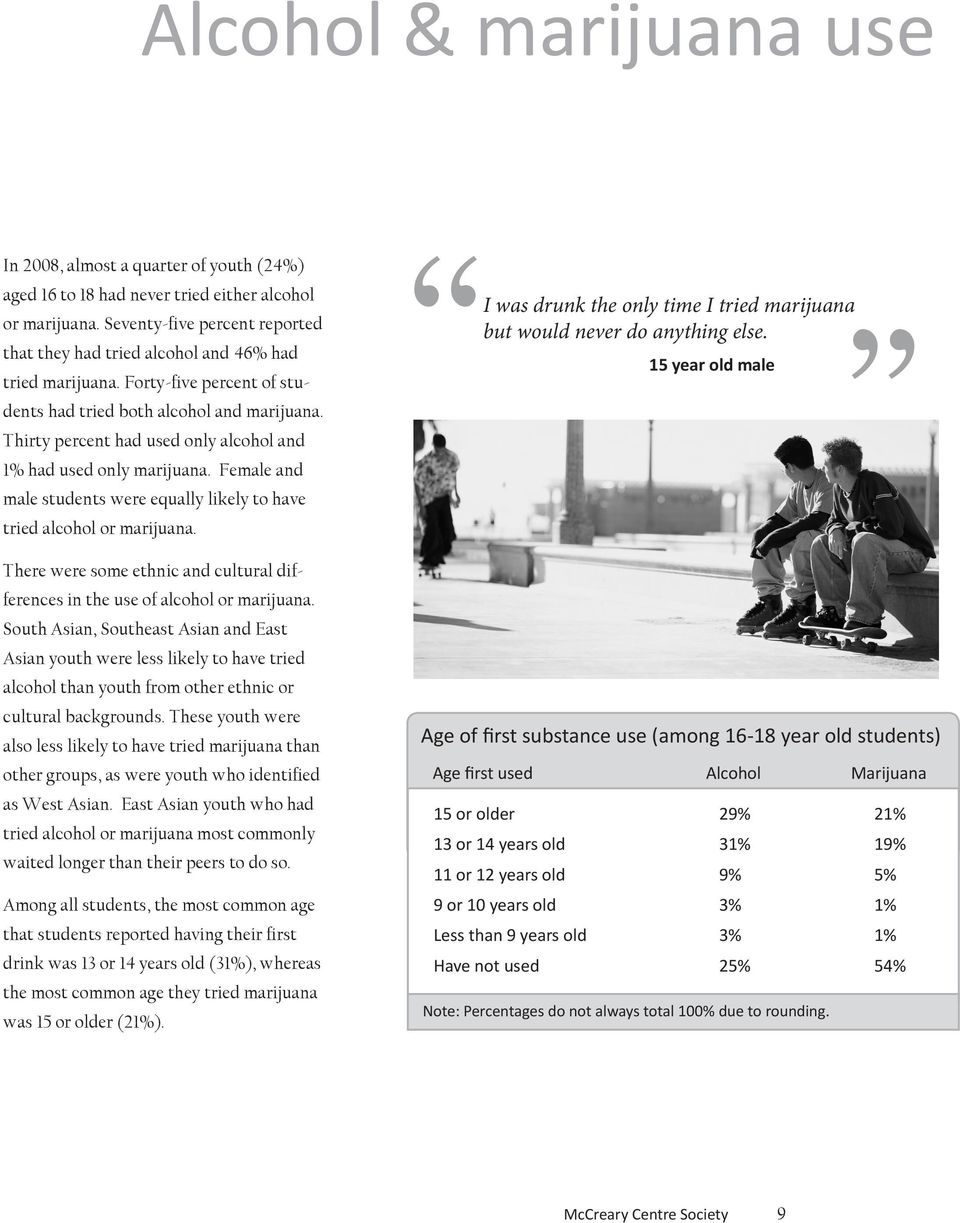
11 Alcohol & marijuana use In 2008, almost a quarter of youth (24%) aged 16 to 18 had never tried either alcohol or marijuana. Seventy-five percent reported that they had tried alcohol and 46% had tried marijuana. Forty-five percent of students had tried both alcohol and marijuana. Thirty percent had used only alcohol and 1% had used only marijuana. Female and male students were equally likely to have tried alcohol or marijuana. There were some ethnic and cultural differences in the use of alcohol or marijuana. South Asian, Southeast Asian and East Asian youth were less likely to have tried alcohol than youth from other ethnic or cultural backgrounds. These youth were also less likely to have tried marijuana than other groups, as were youth who identified as West Asian. East Asian youth who had tried alcohol or marijuana most commonly waited longer than their peers to do so. Among all students, the most common age that students reported having their first drink was 13 or 14 years old (31%), whereas the most common age they tried marijuana was 15 or older (21%). I was drunk the only time I tried marijuana but would never do anything else. 15 year old male Age of first substance use (among year old students) Age first used Alcohol Marijuana 15 or older 29% 21% 13 or 14 years old 31% 19% 11 or 12 years old 9% 5% 9 or 10 years old 3% 1% Less than 9 years old 3% 1% Have not used 25% 54% Note: Percentages do not always total 100% due to rounding. McCreary Centre Society 9
12 Early use Males were more likely to have tried these substances before they were 13 years old. Twenty-four percent of males who had tried alcohol first drank when they were 12 years old or younger, compared to 17% of females. Among those who had tried marijuana, 17% of males did so when they were 12 or younger, in comparison to 12% of females. Four percent of students had used both substances before their 13 th birthday. Age first drank alcohol^ Males Females 24% 17% 44% 38% 38% 38% 12 or younger 13 or or older ^Among year old students who had tried alcohol. Note: Percentages do not always total 100% due to rounding. Age first used marijuana^ Males Females 43% 38% 46% 46% 17% 12% 12 or younger 13 or or older ^Among year old students who had tried marijuana. Note: Percentages do not always total 100% due to rounding. 10 What a difference a year can make: Early alcohol and marijuana use among 16 to 18 year old BC students

13 Trends First drank alcohol at age 12 or younger^ Compared to 1998, youth in 2008 waited longer before trying alcohol or marijuana. For both males and females the percentage of youth who first drank alcohol at 12 years of age or younger steadily declined over this time period. 34% 24% 29% 20% 24% 17% Males Females Although the percentage of youth who first used marijuana before the age of 13 remained stable from 1998 to 2008, there were decreases in the percentages starting marijuana use at 13 or 14 and corresponding increases in starting marijuana use at 15 years of age or older. This meant that in the past decade, the most common age for first trying marijauna rose from 13 or 14 years old to 15 or older. The trend was slightly different for males and females: For males these changes occurred most significantly from 2003 to 2008, whereas for females the changes occurred between 1998 and ^Among year old students who had tried alcohol. Note: The difference for females between 2003 and 2008 was not statistically significant. First used marijuana at age 15 or older^ 35% 45% 39% 46% Males Females Males Females When I was 14 years old I was exposed to marijuana. 17 year old female ^Among year old students who had tried marijuana. Note: The difference between 1998 and 2003 was not statistically significant for males and the difference between 2003 and 2008 was not statistically significant for females. McCreary Centre Society 11

14 Early use & recent use I was always told marijuana isn t addicting and now I use it every day Past month and feel horrible if I don t. 17 year old male Recent alcohol and marijuana use was common. Overall, 55% of BC students aged 16 to 18 had drunk alcohol in the past month, and 26% recently. For example, over half (52%) of those had used marijuana. who had first used alcohol before they were 13 Youth who waited until they were 15 or older years old had used marijuana in the past month, to drink alcohol were less likely to have drunk compared to 19% of those who did not drink recently than their peers who drank before alcohol until they were at least 15 years old. this age (63% vs. 81%). Rates of recent drinking were similar among those who first drank at age 13 or 14 and those who started drinking before they turned 13. Youth who used alcohol at a younger age were also more likely to have used marijuana Last Saturday The younger students were when they first tried alcohol, the more likely they were to have drunk on the Saturday prior to completing the survey. Sixty-six percent of youth who Marijuana use in past month by age first drank alcohol^ 52% 41% 19% 12 or younger 13 or or older ^Among year old students. 12 What a difference a year can make: Early alcohol and marijuana use among 16 to 18 year old BC students

15 started drinking when they were 12 years old or younger drank last Saturday, compared to 59% of those who were 13 or 14 when they first drank and 38% of those who waited until they were 15 years or older. Liquor (distilled spirits) has the highest alcohol content of any of the alcoholic beverages and was the most popular alcohol product consumed by youth regardless of the age they started drinking. Overall 30% of 16 to 18 year olds in BC had drunk liquor last Saturday. Mixing different types of alcohol can be particularly risky, as it can be harder for youth to keep track of what they have consumed and to moderate their intake. Students who started drinking at a younger age were more likely to report mixing different types of alcohol last Saturday (beer, wine, liquor and coolers). Almost a quarter (24%) of those who first drank at age 12 or younger mixed 3 or 4 different types of alcohol, compared to 7% of those who waited until they were 15 to first drink. Among earlier users, males were more likely than females to have mixed two types of alcohol (32% of males who had tried alcohol vs. 24% of females). However, there were no gender differences in having mixed three or four different types of alcohol. Alcohol use last Saturday by age first drank alcohol^ 12 or younger 50% 38% 20% 15% 8% 4% 54% 47% 30% 27% 25% 17% 13 or or older Beer Wine Liquor Coolers ^Among year old students. McCreary Centre Society 13

16 As with alcohol, the younger students were when they first tried marijuana, the more likely they were to have used it on the Saturday prior to completing the survey. For example, over two thirds (67%) of those who used marijuana before they were 13 years old also used it last Saturday, compared to less than a third (29%) of those who first tried it at age 15 or older. Males who used marijuana at 12 or younger were more likely than earlier using females to report last Saturday use. Marijuana use last Saturday by age first used marijuana^ 67% 43% 29% 12 or younger 13 or or older ^Among year old students. 14 What a difference a year can make: Early alcohol and marijuana use among 16 to 18 year old BC students

17 Early use & high risk use The marijuana section (of the survey) didn t have enough boxes. We re in B.C. there was no box for over 10 joints a day. 17 year old male Sixteen to eighteen year olds who reported the earliest alcohol and marijuana use were also the most likely to report heavy use of these substances. For example, youth who first drank alcohol before their thirteenth birthday were more likely to have consumed five or more drinks over the course of last Saturday than their peers who waited longer to try alcohol (54% vs. 21% who waited until they were 15 years or older). Overall, male youth were more likely than females to have drunk at this high risk level. Similarly, the earlier a student first used marijuana, the more likely they were to report heavy marijuana use last Saturday. Thirty percent of students who first used marijuana at the age of 12 or younger smoked five or more joints last Saturday, compared to 2% of students who waited until they were at least 15 years old to use marijuana. More males than females reported this heavy use (39% of males who first used marijuana at 12 or younger vs. 17% of females). High risk drinking last Saturday by age first drank alcohol^ 56% 52% 49% Thirty-nine percent of students (47% of males and 27% of females) who first used marijuana at 12 years old or younger also reported using marijuana on 20 or more days in the past month. Among students who first used marijuana after turning 15 years old, only 4% used it this frequently. 40% 23% 19% 12 or younger 13 or or older ^Among year old students. Males Females Note: The difference between males and females was not statistically significant for students who first drank at 12 or younger and 15 or older. High risk drinking is defined as consuming 5 or more drinks over the course of a day. McCreary Centre Society 15

18 Binge drinking In addition to being asked about their alcohol consumption last Saturday, youth were asked about recent binge drinking. Binge drinking was defined in the AHS as having five or more drinks of alcohol in a row within a couple of hours. Rates of binge drinking among 16 to 18 year olds remained unchanged from Fiftytwo percent of those who had ever drunk alcohol, binge drank in the past month. In 2008, two thirds of those who had first tried alcohol when they were 12 years old or younger binge drank in the past month. This percentage was similar for those who started drinking when they were 13 or 14 years old but was almost double that of youth who did not try alcohol until they were 15 or older. Binge drank in the past month by age first drank alcohol^ 66% 62% 35% 12 or younger 13 or or older ^Among year old students. Note: The difference between males and females was not statistically significant for students who first drank at 12 or younger and 15 or older. 16 What a difference a year can make: Early alcohol and marijuana use among 16 to 18 year old BC students

19 Medicinal use of marijuana Although the AHS did not ask directly about the medicinal use of marijuana, findings suggest that some students may have been using marijuana to cope with health problems. Students were asked whether they had a health condition that limited their activities such as a physical disability (e.g., deafness, cerebral palsy), a long-term illness (e.g., diabetes, asthma), a mental health or emotional condition (e.g., depression, eating disorder) or a weight condition (i.e., overweight or underweight). Students aged 16 to 18 with a mental health or emotional condition or weight condition were more likely than youth without these conditions to have tried marijuana at an earlier age. Youth with these conditions were also more likely than their peers to be heavy users (mental health condition: 27% vs. 18%; weight condition: 39%* vs. 18%). Heavy users were defined as those who used marijuana on 10 or more days in the past month. Among youth with a chronic condition or disability, heavy marijuana users were more likely than lighter users to say they missed a lot of school due to their condition (24% vs. 9%); they were constantly bothered by illness, physical problems, pains or fears about their health during the past month (32% vs. 16%); they suffered from extreme nervousness in the past month (28% vs. 15%); and they felt extreme despair in the past month to the point where they could not do their work or deal with things (36%* vs. 13%). Youth without a chronic condition or disability may also have been using marijuana to cope with health problems. For example, heavy marijuana users in this group were also more likely than less heavy users to say that in the past month they were bothered by illness or other health issues (6% vs. 2%), bothered by extreme nervousness (7% vs. 4%), or felt extreme stress (22% vs. 17%). Habitually smoking marijuana has kept me sane and without it I would have killed myself. 14 year old male *This percentage should be interpreted with caution (see p8 for details). McCreary Centre Society 17

20 Early use & other substance use Most 16 to 18 year olds in BC have not tried any substance other than alcohol or marijuana. However, there is a link between earlier alcohol and marijuana use and the use of other substances. Tobacco Twenty-six percent of 16 to 18 year olds had smoked tobacco (and 12% had smoked in the past month). The older youth were when they first tried alcohol or marijuana, the less likely they were to have smoked cigarettes. For example, 41% of students who started drinking alcohol at age 12 or younger smoked in the past month, compared to only 10% of those who waited until they were 15 or older. I think tobacco should be cut, gone, finito from the world.cigs kill people every minute. 17 year old female Other substances The use of other substances among 16 to 18 year olds was less widespread than the use of alcohol or marijuana. The most commonly used other drugs were prescription pills without a doctor s consent (18%), followed by mushrooms (13%) and ecstasy (12%). Two percent of 16 to 18 year olds had tried crystal meth, heroin or steroids, and 1% had injected a drug. Smoked cigarettes in the past month by age first drank alcohol^ 41% 26% 10% 12 or younger 13 or or older ^Among year old students. 18 What a difference a year can make: Early alcohol and marijuana use among 16 to 18 year old BC students

21 Students who first tried alcohol or marijuana at a younger age were more likely to have tried other substances than their peers who did not have this experience. For example, youth who used alcohol before they turned 13 were almost twice as likely to have tried ecstasy as those who waited until they were 13 or 14 years, and eight times as likely to have tried ecstasy as those who waited until they were 15 or older to try alcohol. Those who had tried both alcohol and marijuana at 12 or younger were even more likely to have used other substances: 67% had used mushrooms, 58% had tried ecstasy and 45% had used cocaine. Although youth who used alcohol and marijuana at an earlier age were more likely to have also tried substances such as ecstasy and crystal meth, most had not done so and those who had, had not become regular users. For example, only 4% or fewer of students who first drank before their 13th birthday had used amphetamines, crystal meth, heroin or steroids more than twice in their lifetime. Use of other substances by age first drank alcohol (among year old students) 12 or younger 13 or or older Prescription pills (without a doctor s consent) 38% 20% 12% Cocaine 22% 8% 1% Hallucinogens (excluding ecstasy and mushrooms) 25% 11% 3% Ecstasy 32% 17% 4% Mushrooms 36% 17% 5% Inhalants 13% 5% 2% Amphetamines (excluding crystal meth) 11% 3% 1% Crystal meth 8% 1% <1% Heroin 7% 1% <1% Injected a drug 5% 1% <1% Steroids 6% 1% <1% When I said I did meth it was because the ecstasy pill I got was laced with it and I did not like it. 14 year old male McCreary Centre Society 19
22 Youth at higher risk for early alcohol & marijuana use Youth who face challenges in their lives are particularly vulnerable to early alcohol and marijuana use. Potential risk factors can be related to physical and mental health, as well as family circumstances, and school and peer relationships. Limiting health condition or disability Youth who had any health condition or disability (physical disability, long-term illness, mental health or emotional condition, or weight condition) that limited their activities were more likely than those who did not have such a condition to have first used alcohol (33% vs. 19%) and marijuana (23% vs. 13%) at 12 years of age or younger. Born in Canada Youth who were born in Canada were just as likely as those born outside Canada to have first tried alcohol at 12 years old or younger. However, Canadian-born youth were more likely than those born elsewhere to have tried marijuana at an earlier age (15% vs. 9%). 20 What a difference a year can make: Early alcohol and marijuana use among 16 to 18 year old BC students
23 A lot of kids in Canada use marijuana. 14 year old male Experience of government care Youth who had been in government care (lived in a foster home, group home, or been on a youth agreement) were more likely than youth who had not been in care to have tried alcohol (42% vs. 20%) as well as marijuana (43% vs. 13%) at the age of 12 years or younger. Poverty Youth who went to bed hungry some or all of the time because their family did not have enough money to buy food were more likely than youth who never went to bed hungry to have first used alcohol (34% vs. 19%) or marijuana (25% vs. 13%) before the age of 13. Lesbian, gay, or bisexual youth Youth who identified as lesbian, gay, or bisexual (LGB) were more likely than heterosexual youth to have tried alcohol (39% vs. 19%) or marijuana (34% vs. 13%) at 12 years old or younger. Earlier alcohol and marijuana use by sexual orientation^ Heterosexual LGB 41%* 38% 39%* 24% 30% 15% 16% 10% Males Females Males Females First drank alcohol at 12 or younger First used marijuana at 12 or younger ^Among year old students. * Interpret with caution (see p8). McCreary Centre Society 21
24 Abuse Nineteen percent of 16 to 18 year olds had been physically abused and 10% had been sexually abused. Youth who reported a history of physical abuse were more likely than youth without this experience to have tried alcohol by the age of 13 (31% vs. 18%), and to have tried marijuana by this age (20% vs. 12%). A similar picture emerged for youth with a history of sexual abuse. Youth who had been sexually abused were more likely than non-abused youth to have tried alcohol (33% vs. 19%) and marijuana (24% vs. 13%) at 12 years or younger. Although more females than males reported experiencing physical and sexual abuse, among abused students, males were more likely to have started using substances at an earlier age. Fifty-five percent of males who had been physically and sexually abused had started drinking at age 12 or younger, compared to 36% of females. Similarly, half of male students who had experienced both types of abuse first used marijuana at an earlier age, which was significantly higher than the 22% rate for females. Earlier alcohol and marijuana use by sexual abuse^ 52% 45%* Not sexually abused Sexually abused 23% 15% 29% 15% 10% 19% Males Females Males Females First drank alcohol at 12 or younger First used marijuana at 12 or younger ^Among year old students. * Interpret with caution (see p8). 22 What a difference a year can make: Early alcohol and marijuana use among 16 to 18 year old BC students
25 Family or friend attempted suicide Youth with a family member or close friend who had attempted or committed suicide were more likely to have started drinking or using marijuana at a younger age. For example, 38% of students who first drank prior to their 13th birthday had a close friend who attempted suicide (compared to 24% of those who first drank at 15 or older). Almost half (46%) of the students who had tried marijuana at 12 or younger had also had a close friend attempt suicide (vs. 28% of students who first used marijuana after turning 15). Looking older than peers Male and female youth who reported that they looked older than other youth their age were more likely to report that they had started drinking alcohol at an earlier age. This pattern was not seen with marijuana. It may be that older-looking students appear legally old enough to purchase and consume alcohol, which is not a factor with purchasing and using marijuana. It may also be that students who look older are able to fit in more easily with an older peer group that has access to alcohol. Family or friend attempted/committed suicide by age first used alcohol or marijuana^ 27% 38% 20% 31% 16% 24% 33% 46% 25% 36% 18% 28% Family member Close friend 12 or younger 13 or or older 12 or younger 13 or or older Age first drank alcohol Age first used marijuana ^Among year old students. McCreary Centre Society 23
26 Perhaps also linked to looking more mature, females who first menstruated at age 10 or younger were nearly twice as likely as those who started menstruating later to first use alcohol at 12 or younger (31% vs. 16%) and nearly three times as likely to first use marijuana at this age (28% vs. 10%). Location matters There were regional differences for early use of marijuana and alcohol. Students who lived in the Northern and Interior Health Authorities were more likely than youth living in the Fraser and Vancouver Coastal areas to have tried alcohol or marijuana before their 13th birthday. Males were more likely than females to have used alcohol at an earlier age in all areas of the province except Vancouver Island where the rates of early use were comparable for males and females. However, the same regional picture did not emerge for early marijuana use. Males were more likely to have used marijuana before turning 13 in Vancouver Coastal and the Interior, but there were no such gender differences in the Northern, Vancouver Island, and Fraser regions. As well as regional differences, there were also differences based on whether youth lived in an urban or rural area of the province. Youth who First tried alcohol before age 13 by age students look compared to their peers^ 26% 18% 18% Look older About the same age Look younger ^Among year old students who had ever used alcohol. 24 What a difference a year can make: Early alcohol and marijuana use among 16 to 18 year old BC students
27 Richmond in general is quite a safe place and alcohol/drug abuse is quite low. 18 year old female lived in rural areas were more likely to have tried both alcohol and marijuana. Eighty-six percent of students who lived in a rural area had tried alcohol, compared to 73% who lived in an urban setting. Over half of rural based youth had used marijuana (58%), and 44% of those in urban areas had done so. among marijuana users, 19% of those living in rural settings had tried it for the first time before turning 13, compared to 13% of their urban peers. Students who lived in rural areas were more likely to try alcohol or marijuana at an earlier age than those living in urban areas. Twentyfour percent of rural based youth who had tried alcohol, first did so at age 12 or younger, compared to 20% of urban students. Similarly, Earlier use of alcohol and marijuana by region^ Northern 10% 22% Interior Vancouver Island Vancouver Coastal 4% 10% 8% 12% 17% 20% Used alcohol at 12 or younger Used marijuana at 12 or younger Fraser 5% 14% ^Among year old students. Note: The difference between Northern and Interior versus Vancouver Coastal and Fraser regions was statistically significant. The difference between Vancouver Island and other regions was not statistically significant. McCreary Centre Society 25
28 Health risks & early use In addition to identifying risk factors for early substance use, the survey also provides valuable information about the effect that using alcohol and marijuana from an early age can have on the health of youth aged 16 to 18. Physical health Students who started drinking or using marijuana at a younger age were more likely to report experiencing a variety of health complaints in the past six months. For example, 22% of students who used marijuana before they turned 13 had experienced dizziness a lot compared to 10% of students who waited until they were 15 or older to try marijuana. After smoking some really potent hash about a month ago I have felt really dizzy, lightheaded and disoriented for most of the time. 15 year old male Emotional health As reported earlier, youth with mental and emotional health problems were more likely to have started alcohol and marijuana use at a younger age. While mental health problems may have initially been a contributing factor in a youth s substance use, the results of the AHS suggest that the reverse may also be true. Experienced ailments a lot in the past six months by age first drank alcohol^ 27% 23% 16% 21% 16% 9% 32% 23% 18% 18% 11% 7% 12 or younger 13 or or older Headache Stomachache Backache Dizziness ^Among year old students. Note: The difference between 12 or younger and 13 or 14 years old was not statistically significant for headache rates. 26 What a difference a year can make: Early alcohol and marijuana use among 16 to 18 year old BC students
29 [I have] psychosis related to marijuana & other drugs. 16 year old male Youth who drank or used marijuana at an earlier age were more likely to report recent mental health problems. For example, youth who started drinking before they turned 13, compared to those who did not try alcohol until they were at least 15 years old, were more likely to report extreme levels of stress (to the point that it was almost more than they could take) in the past month (26% vs. 16%). Furthermore, females who started drinking at a younger age were more likely to report experiencing extreme despair (feeling so sad, discouraged or hopeless that nothing felt worthwhile) in the past month compared to those who waited until they were older (16% vs. 7%). This was not the case for males. However, earlier alcohol using males were more likely than those who started drinking later to report suicidal ideation (13% vs. 8%) and suicide attempts in the past year (8% vs. 2%). Youth were asked if they had ever cut or injured themselves on purpose without the intention of killing themselves. Males who started using alcohol or marijuana before the age of 13 were more likely than those who Emotional health by age first drank alcohol^ 26% 18% 16% 19% 11% 10% 10% 12 or younger 13 or or older Extreme distress Considered suicide 4% 3% Attempted suicide ^Among year old students. Note: The difference between 13 or 14 year olds and those aged 15 or older was not statistically significant for distress or considering suicide. McCreary Centre Society 27
30 waited until they were at least 15 or older to have harmed themselves in this way. Females were more likely than males to have self harmed whatever age they started drinking or using marijuana but the younger they were when they started using, the more likely they were to have deliberately injured themselves. For example, 43% of female marijuana users who used at 12 or younger had self harmed compared to 34% of those who started at 13 or 14, and 23% of those who used marijuana for the first time at 15 or older. Female youth who drank alcohol before they turned 13 were also more likely than those who waited until 15 or older to do so, to report that they had experienced suicidal thoughts (25% vs. 11%) and attempted suicide (13% vs. 4%) in the past 12 months. Gender differences were also seen with marijuana. Female youth who first tried marijuana at 12 or younger were more likely than those who tried at 15 or older to report extreme stress (37% vs. 23%), despair (15% vs. 7%), suicidal ideation (28% vs. 16%) and suicide attempts (16% vs. 6%). For males there was only a relation between age of first marijuana use and suicide attempts (10% vs. 3%). Among youth who attempted suicide in the past year, youth who began drinking or using marijuana earlier were more likely to have made an attempt serious enough to require medical treatment in the past year. Four percent of students who drank at 12 or younger, and 7% of students who first used marijuana by the same age, reported that they had required treatment from a doctor or nurse following a suicide attempt. This compared to 1% of those who started using either substance at 13 or 14 years old and 1% who waited until they were 15 or older. Safety concerns Young people who used alcohol from an earlier age were more likely to experience a number of safety concerns. These included being involved in a fight, being victimized at school, and being discriminated against on the grounds of race, sexual orientation or physical appearance in the past year. Perhaps as a result, they were also more likely to have carried a weapon to school in the past month. Twenty-three percent of males and 8% of females who had used alcohol before the age of 13 reported carrying a weapon to school in the past month. On the other hand, 28 What a difference a year can make: Early alcohol and marijuana use among 16 to 18 year old BC students
31 7% of males and 2% of females who had started using alcohol later had done so. or to have been in government care (6% vs. 1%) in the past year. Similar violence and safety concerns were seen with earlier marijuana use except there was no link between age of first use and being bullied or victimized at school, and for male marijuana users there was no link between age of first use and racial discrimination. However, youth who delayed their first use of alcohol or marijuana by just a couple of years had a reduced likelihood of being involved in a fight in the past year. Unstable home life Help seeking The younger youth were when they started using alcohol or marijuana, the more likely they were to report not accessing medical services in the past year when they felt they needed them. For example, 27% of youth who started drinking at age 12 or younger reported they did not get medical services when they thought they needed them, compared to 18% of those who started drinking at age 13 or 14, and 13% of those who starting drinking at age 15 or older. A recent unstable home life was more common among youth who started drinking or using marijuana earlier. For example, youth My father smokes marijuana. I hate it. who had used marijuana by age 12 were more I want it to stop. Without him smoking likely than those who first used at 15 or older it we would be a lot closer. to have moved multiple times (12% vs. 4%), 14 year old male to have run away from home (24% vs. 10%), Fight Involvement in past year (among year old students) Age first drank alcohol Age first used marijuana 12 or younger 13 or or older 12 or younger 13 or or older Males 51% 40% 26% 66% 48% 36% Females 31% 15% 9% 38% 24% 14% McCreary Centre Society 29
32 I have been heavily addicted to pot. Every time I receive my paycheck I blow it all on weed. And every day it seems, I am just getting stoned. I need help! 15 year old female Students who started using alcohol or marijuana at an earlier age were more likely to report that they felt they needed help for their drug or alcohol use in the past year. For example, 9% of students who first used alcohol at 12 or younger felt they needed help, compared to 2% who waited until they were at least 15 years old to drink. Youth who started using alcohol and marijuana at an earlier age were also generally more likely to ask a variety of professionals for help with their problems (e.g., school counsellor, youth worker, social worker) but less likely to find these professionals helpful. Females who used marijuana before the age of 13 were more likely than those who started using later to report not accessing needed mental health services in the past year (39% vs. 22%). In the past year, most youth had asked their friends for help when they had a problem, and over 90% found them to be helpful, regardless of the age that they started drinking alcohol or using marijuana. Did not get medical help when needed by age first drank alcohol^ 23% 16% Males 11% ^Among year old students. 14% 32% 20% Females 7% 15% 12 or younger 13 or or older Needed help for drug or alcohol use in the past year by age first used marijuana^ 3% 12 or younger 13 or or older ^Among year old students. 30 What a difference a year can make: Early alcohol and marijuana use among 16 to 18 year old BC students
33 Sexual health Youth who used alcohol or marijuana at an earlier age were more likely to have had sexual intercourse, to have had intercourse before the age of 14, and to have been involved in a pregnancy. Furthermore, among females, earlier use of alcohol or marijuana was associated with a lower likelihood of using a condom at last intercourse. Six percent of students who were sexually experienced and first drank at 12 or younger reported that they had been told by a doctor or nurse that they had a sexually transmitted infection, compared to 2% of students who waited until they were at least 15 to start drinking alcohol. This difference was Most friends of mine drink, and they want me to, I refuse always because I know it will lead to something unwanted, my biggest fear is sex then getting someone pregnant. 14 year old male also seen for marijuana (9% of sexually experienced youth who used marijuana at 12 or younger vs. 2% of those who first used marijuana at 15 or older reported a sexually transmitted infection). Among students who had had sexual intercourse, almost half of students (49%) who first used marijuana at 12 or younger had used drugs or alcohol before the last time they had sex, compared to 31% of those who did not use marijuana before turning 15. Drank or used drugs the last time had sex by age first drank alcohol^ 44% 33% 20% 12 or younger 13 or or older ^Among year old students who had sexual intercourse. McCreary Centre Society 31
34 Disordered eating and body image Earlier users of alcohol or marijuana were more likely to be dissatisfied with how their body looked. For example, while 8% of youth who had tried alcohol at age 12 or younger reported being not at all satisfied with their body, the rate was 3% for youth who had tried alcohol at age 15 or older. Earlier alcohol and marijuana use was linked to purging (vomiting on purpose after eating). In addition, earlier alcohol users, but not earlier marijuana users, were more likely than later users to report binge-eating. Driving under the influence of alcohol or marijuana Motor vehicle accidents are one of the leading causes of death among BC youth. The earlier students started to use alcohol or marijuana, the more likely they were to have driven a car or other vehicle while under the influence of these substances. Twenty-eight percent of students who first tried alcohol when they were 12 or younger had driven after drinking, compared to 8% who waited until they were 15 or older. A similar pattern was seen among marijuana users. Vomited on purpose after eating by age first used alcohol or marijuana^ 11% 6% 4% 15% 12 or younger 13 or 14 8% 6% 15 or older Age first drank alcohol ^Among year old students. Age first used marijuana 32 What a difference a year can make: Early alcohol and marijuana use among 16 to 18 year old BC students
35 People drive more carefully when high on weed. You are ignorant if you think anything otherwise. 15 year old male Youth who drank at an earlier age were not only more likely to have driven after drinking alcohol but were also more likely to have done so recently, and to have done so without a license. Sixteen percent of students who first drank at the age of 12 or younger drove after drinking in the past month, compared to 4% of students who waited until they were at least 15 years old. Additionally, over half of the youth (56%) who had driven after using alcohol and did not possess any type of driver s license were those who had begun to use alcohol at the age of 12 or younger. Young people who started drinking alcohol or using marijuana before their 13th birthday were also more likely to ride in a vehicle with a driver who had been drinking. For example, 43% of male and female youth who first drank at an earlier age had taken this risk, compared to 18% of students who waited until they were at least 15 years old. Ever driven after drinking by age first used alcohol or marijuana^ 28% 49% 26% 12 or younger 13 or or older 17% 8% 15% Age first drank alcohol Age first used marijuana ^Among year old students. McCreary Centre Society 33
36 Direct consequences of substance use Students were asked about any consequences they may have experienced as a direct result of their alcohol and other substance use in the past year. The older students were when they had first tried alcohol, the less likely they were to report experiencing any negative consequences. A similar picture emerged among youth who had used marijuana at an earlier age. For example, 29% of youth who had used marijuana by the age of 13 had been injured in the past year as a result of their substance use, compared to 11% of youth who did not try marijuana until they were at least 15 years old. Youth who used marijuana before age 13 were also more likely to have seen an effect on their school work compared to youth who waited until later (25% vs. 12%), to have argued with family members (30% vs. 17%), and to have been in trouble with the police (29% vs. 9%). Consequences of substance use in the past year (among year old students) Age first drank alcohol 12 or younger 13 or or older Did something I couldn t remember 49% 48% 28% Passed out 45% 36% 18% Argued with family members 25% 18% 8% Damaged property 22% 12% 4% Got injured 21% 13% 5% School work changed 20% 12% 6% Got in trouble with police 19% 10% 3% Got in a physical fight 19% 9% 3% Lost friends or broke up 13% 8% 4% Had sex when I didn t want to 12% 8% 2% Overdosed 5% 1% 1% Got into a car accident 5% 1% <1% Got treatment for substance use 3% 1% <1% [There are some] people at my school who are extremely drunk/high at least once a week.resulting in missed classes, failed courses and even in attending classes intoxicated. 18 year old female 34 What a difference a year can make: Early alcohol and marijuana use among 16 to 18 year old BC students
37 Early use of both alcohol & marijuana Among youth aged 16 to 18 years old, using either alcohol or marijuana at 12 years of age or younger was generally associated with negative health. In some cases, this relationship was even stronger when youth had used both of these substances. Youth who had used both substances before they turned 13 years old were more likely than those who had used only alcohol or only marijuana at this age to have moved multiple times or to have run away in the past year. They also reported lower school and family connectedness, and were less likely to enjoy school or to have post-secondary educational I ve smoked at the age of 10 and had beer and coolers at the age of year old male aspirations, than those who had used just alcohol or just marijuana before the age of 13. There were several health risk behaviours that were not significantly different between youth who used both alcohol and marijuana and those who used just marijuana. These included self-harm, suicidal ideation and attempts, and failure to access needed mental health services. Home and school life of youth who tried alcohol or marijuana before age 13^ 15% 6% 7% Moved multiple times past year 29% 16% 14% Ran away past year ^Among year old students. 59% 75%75% 69% Liked school 88% 84% Planned to attend postsecondary Earlier alcohol and marijuana Earlier alcohol only Earlier marijuana only Note: The differences between those who only used alcohol earlier and those who only used marijuana earlier were not statistically significant. McCreary Centre Society 35
38 For most of the health indicators, the associations with using only alcohol earlier were similar to using only marijuana earlier. A few exceptions did occur: Youth who had used only marijuana earlier were less likely than those who had used only alcohol earlier to report being victimized at school (39% vs. 50%) but were more likely to report having sex (76% vs. 55%) and to have been involved in a pregnancy (11% vs. 4%). There were some areas where there were no significant differences between using both substances at an earlier age, using only alcohol earlier, and using only marijuana earlier. This was the case, for example, with extreme stress, extreme despair, discrimination based on physical appearance, self-esteem and weekly participation in organized extracurricular activities. 36 What a difference a year can make: Early alcohol and marijuana use among 16 to 18 year old BC students
39 Earliest use The results presented so far have shown that 16 to 18 year olds who started using alcohol or marijuana at 15 or older had better health than those who started a few years earlier. Delaying alcohol use by a few years was also associated with marked improvements in youth risk behaviours among even the very earliest users. For example, youth who started drinking at age 11 or 12 were about half as likely as those who started at 8 or younger to have skipped 11 or more days of school in the past month (6% vs. 13%), carried a weapon to school in the past month (12% vs. 25%) and attempted suicide in the past year (7% vs. 17%). Students who first drank at age 11 or 12 were also less likely than those who started at 8 years old or younger to have tried other drugs such as inhalants (11% vs. 21%), amphetamines (8% vs. 19%), crystal meth (6% vs. 15%), heroin (4% vs. 15%) and steroids (5% vs. 13%), and to have injected as a method of drug use (2% vs. 13%). Similar patterns were seen among the earliest marijuana users. For example, youth who first used marijuana at 9 or 10 or at 11 or 12 were less likely than those who first tried it at 8 years old or younger to have gambled, been involved in a fight or attempted suicide in the past year. Youth who first tried marijuana at 9 to 12 years of age were also less Ever tried other drugs by age first drank alcohol^ 21% 8 or younger 12% 11% 15% 13% 9 or or 12 7% 4% 5% 5% Inhalants Heroin Steroids ^Among year old students. Note: The differences between 9 or 10 and 11 or 12 were not statistically significant. McCreary Centre Society 37
40 likely than those who first tried it before the age of 9 to have carried a weapon to school in the past month (15-19% vs. 66%*). Furthermore, students who first used marijuana at 9 or 10 or at 11 or 12 were less likely than those who tried it at 8 years old or younger to have tried other drugs such as cocaine, hallucinogens and amphetamines. Differences between those who first used marijuana at age 11 or 12 and those who started using at 8 or younger were also seen in rates of self-harm (29% vs. 47%), considering suicide in the past year (19% vs. 31%), skipping 11 or more days of school in the past month (9% vs. 32%), plans to attend postsecondary school (78% vs. 53%*) and liking school (70% vs. 44%*). *This percentage should be interpreted with caution (see p8 for details). Health risk behaviour in past year by age first used marijuana^ 84% 63% 64% 78% 55% 49% 30%* 8 or younger 9 or or 12 9%10% Gambled Involved in fight Attempted suicide ^Among year old students. Note: The differences between 9 or 10 and 11 or 12 were not statistically significant. 38 What a difference a year can make: Early alcohol and marijuana use among 16 to 18 year old BC students
41 Early users who had not used recently It is evident from this report that youth who used marijuana and/or alcohol at an earlier age were more likely to experience a range of negative health outcomes than their peers who did not use them until they were older. However, it is important to recognize that youth who had drunk alcohol or used marijuana at an earlier age but had not done so recently reported lower rates of health risk behaviours than their peers who continued to use these substances. For example, youth who drank alcohol before age 13 but had not drunk in the past month were less likely to have recently ridden in a vehicle with a driver who was drunk than those who continued to drink. Also, youth who drank alcohol at an earlier age but had not drunk in the past month were less likely than those who continued to drink to be current marijuana users (15% vs. 61%). Youth who used alcohol at an earlier age were at greater risk of skipping school in the past month. However, youth who started drinking at a younger age but had not drunk recently reported similar rates of skipping I was pretty heavy on drugs and alcohol but I ve cleaned up my act and quit. 14 year old female Health risk behaviour in past month by recent alcohol use^ Drank alcohol in the past month Did not drink alcohol in the past month 48% 19% Passenger with a driver who had been drinking school to those who waited until they were at least 15 to drink, and to the overall population of 16 to 18 year olds. 63% 42% Skipped school ^Among year old students who first drank alcohol at 12 years old or younger. McCreary Centre Society 39
42 Earlier drinkers who had not used alcohol in the past month were also more likely than their earlier drinking peers who continued to drink to engage in a range of health promoting behaviours such as always wearing a seatbelt (62% vs. 51%). There were also differences in behaviours among earlier marijuana users who had used marijuana in the past month, and those earlier users who had not used recently. For example, those who abstained in the past month were less likely to have skipped school (50% vs. 75%) and more likely to have engaged in some sport activities. While I did not use drugs in the past 12 months, I was using them frequently and heavily to the point of needing help about 15 months ago. 17 year old female Earlier users of alcohol or marijuana, who had not recently used, also reported lower rates of cigarette smoking. Forty-eight percent of current alcohol users who drank before age 13 had also smoked cigarettes in the past 30 days, compared to 11% of those who had not drunk in the past month. Similarly, 26% of earlier marijuana users who had not used marijuana in the past month smoked a cigarette in the past 30 days, compared to 65% of earlier marijuana users who continued to use. 40 What a difference a year can make: Early alcohol and marijuana use among 16 to 18 year old BC students
43 Youth who had never used alcohol or marijuana In addition to considering the differences Not all teens do drugs, lots of us think it s between youth who started drinking alcohol the stupidest thing in the world. I m one or using marijuana at an earlier age and those of them, I don t do drugs, I am too scared who waited until later, it is also important to from what they have done to people I consider the relation between these groups know and love. and the 24% of 16 to 18 year olds who had 14 year old female never tried these substances. Youth who had never tried alcohol or marijuana were also the least likely to say they gambled for money in the past year. For example, Students who had never tried alcohol or marijuana were the least likely to report a number 66% of youth who first used marijuana before of risk behaviours, such as getting involved in the age of 13 reported gambling, compared to a fight or skipping school. For example, 59% 55% of those who started at 13 or 14, 50% of of students who first drank at 12 or younger those who started at 15 years or older and 34% had cut classes in the past month, compared of those who had never used marijuana. to 33% of students who waited until they were at least 15 to drink, and 19% of those who had never tried alcohol. Students who had not tried alcohol or marijuana reported the lowest pregnancy rate. Less Been in a fight in the past year by age first drank alcohol^ 42% 26% 17% 9% 12 or younger 13 or or older Never drank alcohol ^Among year old students. McCreary Centre Society 41
44 than 1% of youth who had never used marijuana reported that they had been pregnant or caused a pregnancy. On the other hand, 12% of youth who first tried marijuana at 12 years old or younger reported pregnancy involvement. Students who had never drunk reported similar rates of health promoting behaviours as those who waited until later to try alcohol, and better rates than those who started drinking at an earlier age. For example, only 53% of students who first drank alcohol at age 12 or younger always wore a seatbelt, compared to around three quarters of students who had first drunk at 15 or older or who had never drunk alcohol. Similar rates were seen for youth who had never tried marijuana, compared to earlier users (72% vs. 49%). Male and female students who had never tried alcohol reported their health as good or excellent more commonly than those students who had tried alcohol at 12 years old or younger. However, male students who first drank at 15 or older were more likely to report good or excellent health than those who had never had alcohol. This was not the case with females. Youth who had never tried alcohol or marijuana were less likely or as likely as youth who tried these substances at a later age to say that they did not seek medical help or mental health services when they thought they needed them. For example, 31% of youth who first used marijuana before age 13 said they did not seek needed medical help; however, the rate was 17% among youth who waited until they were 15 or older to try marijuana and 13% among abstainers. Emotional health among youth who had not tried alcohol was comparable to that of those who waited until they were 15 or older to try it. The percentage of youth who reported extreme levels of stress in the past month, or suicidal ideation or attempts in the past Ever been pregnant or caused pregnancy by age first used marijuana^ 12% 5% 1% <1% 12 or younger 13 or or older Never used marijuana ^Among year old students. 42 What a difference a year can make: Early alcohol and marijuana use among 16 to 18 year old BC students
45 I will never do drugs. 12 year old male Always wore a seatbelt by age first drank alcohol^ 53% 64% 72% 73% 12 or younger 13 or or older Never drank alcohol ^Among year old students. Note: The difference between those who drank at 15 or older and those who never drank alcohol was not statistically significant. year, was similar between these two groups and lower than for youth who had first tried alcohol before the age of 13. With respect to marijuana, those who had not tried marijuana reported better emotional health than those who first tried it at 15 years old or older. For example, while 5% of youth who first tried marijuana at a later age reported attempting suicide in the past year, 3% of abstainers had done so. These rates, in turn, were lower than those reported by youth who had first tried marijuana before the age of 13 (13%). Did not access mental health services when needed by age first drank alcohol^ 23% 17% 13% 12% 12 or younger 13 or or older Never drank alcohol ^Among year old students. Note: The difference between those who drank at 15 or older and those who never drank alcohol was not statistically significant. McCreary Centre Society 43
46 Protective factors associated with delayed use Understanding what was present in the lives of 16 to 18 year olds who delayed their use of alcohol and marijuana is as important as knowing about factors linked to earlier use. Family, school and peers were all found to be associated with delayed substance use. Family connectedness Family connectedness refers to youths relationships with their parents and family. As might be expected, youth who were most highly connected to their families were more likely to delay alcohol or marijuana use. Additionally, those who had delayed substance use reported higher connectedness scores. Youth who started using alcohol or marijuana at age 15 or older were more likely than those who started at age 12 or younger to report having their parents at home on the past five school days when they woke up, had dinner or went to bed. In addition, later users of alcohol or marijuana were more likely than their peers to report having an adult in their family they could talk to if they were having a serious problem. For example, 74% of youth who began using marijuana at age 15 or older had an adult family member they could confide in, compared to 65% of those who had initiated marijuana use at age 12 or younger. I only drink with my parents permission, usually in their company or in the company of another adult I trust AND only at occasions such as family dinners or special occasions. 16 year old female School connectedness School connectedness measures students relationships with their teachers and their sense of belonging at school. Youth who delayed their first use of alcohol or marijuana until they were at least 15 years old scored higher on school connectedness than those who started at 14 or younger. Compared to earlier users, youth who delayed their alcohol or marijuana use until they were at least 15 years old were more likely to have post-secondary educational aspirations and to like school. For example, 88% of youth who did not try alcohol until they were 15 or older reported liking school, compared to 70% of those who used alcohol at 12 or younger. 44 What a difference a year can make: Early alcohol and marijuana use among 16 to 18 year old BC students
47 Protective factors by age first drank alcohol (among year old students) Age first drank alcohol 12 or younger 13 or or older Family connectedness School connectedness Cultural connectedness Meaningful activities Input into activities Healthy peer attitudes about risk behaviour Note: Scores range from 0 to 10, with higher scores indicating higher levels of the protective factor. Note: For cultural connectedness the difference between 12 or younger and 13 or 14 was not statistically significant. For input into activities, the difference between 13 or 14 and 15 or older was not statistically significant. Cultural connectedness Cultural connectedness measures the extent to which youth made efforts to learn about their ethnic or cultural group and how strongly they belonged or felt attached to their group. Students who delayed their marijuana use until they were at least 15 years old reported higher cultural connectedness than those who started before the age of 13. A similar relationship was seen for females and alcohol use but for males there was no significant difference in cultural connectedness between those who started using alcohol earlier and those who started later. Involvement in extracurricular activities Youth who first used marijuana at 15 years old or older were more likely to be involved in weekly organized sports activities (such as school teams or dance/aerobic classes) than those who started marijuana use at 12 years old or younger. A similar relationship was seen between age of first alcohol use and McCreary Centre Society 45
48 I have a friend that has gotten drunk several times and has been exposed to pot/ marijuana, although I have never tried. I m worried about her health, as she still continues to do so, drinking heavily. 12 year old female involvement in organized sports, but only to have waited until they were at least 15 years among female youth. of age to use alcohol or marijuana. Involvement in weekly volunteer activities and organized non-sports activities (such as art lessons or community clubs and groups) was not associated with age of first alcohol or marijuana use. Youth engagement Youth were asked not only about their involvement in extracurricular activities, but also about how meaningful their activities were to them and how much they felt their ideas were listened to and acted upon in these activities. Youth who were more engaged in their activities were more likely Positive peer relationships Youth were asked whether their friends would be upset if they engaged in a number of behaviours including getting arrested, beating someone up, getting drunk and using marijuana. Youth who started alcohol or marijuana use at 15 or older were more likely to have friends who would disapprove of these types of risky health behaviours. Self esteem Youth who had delayed trying alcohol or marijuana had higher self-esteem than their peers. Self-esteem by age first drank alcohol^ 12 or younger 15 or older ^Among year old students. Males Females Note: Score ranges from 0 to 10 with higher scores indicating higher self esteem. 46 What a difference a year can make: Early alcohol and marijuana use among 16 to 18 year old BC students
49 Summary Seventy-six percent of 16 to 18 year old youth who completed the AHS had tried alcohol or marijuana, yet a very different picture emerged for those who started using these substances at an earlier age compared to those who waited a few years longer to try them. The older youth were when they started using alcohol or marijuana, the less likely they were to be involved in health risk behaviours (such as violence and unprotected sex) and the more likely they were to have positive health experiences and aspirations. Although in many cases we cannot say whether substance use was a trigger for other experiences or vice versa, this report shows that several factors are linked with early substance use and that early substance use is associated with choices, experiences and behaviours later in adolescence. The findings suggest that policies, as well as monitoring, education and intervention efforts, may need to be targeted to children and youth at greater risk of earlier use of alcohol, marijuana and other substances. However, just as importantly, the more positive health picture seen among youth who started using substances at an earlier age but who had not used recently, in comparison to their peers who continued to consume these substances, shows that we should not miss the opportunity to offer education, support and services to older adolescents. An important finding is that youth who started drinking alcohol at age 12 or younger were less likely than their peers who did not drink until they were older to access medical services when they thought they needed help. Females were also less likely to access mental health services. Yet this group was also the most likely to have reached out to a variety of professionals for help (e.g., school counsellor, youth worker, social worker) but less likely to find these professionals helpful. In light of this finding, it is necessary to consider how opportunities for early interventions are currently being lost. All youth benefit from protective factors in their lives. Factors discussed in this report that have been shown to be protective against early alcohol and marijuana use can be inexpensive, simple and easy to develop. For example, youth who feel listened to in the activities they take part in are more likely to report that they have delayed alcohol or marijuana use until later in adolescence. Another clear message from the report is that the risk and protective factors for earlier substance use are sometimes different for male and female youth. This highlights the need for gender specific programs and messaging. Youth, their families, schools and professionals working with youth need accurate and balanced information about the risks of earlier alcohol and marijuana use, how to access interventions when they are needed and how to build protective factors in the lives of all young people. McCreary Centre Society 47
50 McCreary resources For any of these, or other materials by the McCreary Centre Society, visit our website at A Picture of Health: Highlights from the 2008 BC Adolescent Health Survey (2009) The Adolescent Health Survey has been conducted in schools every 5 years since The 2008 survey asks questions about physical and emotional health, and about factors that can influence health during adolescence or in later life. This report highlights trends in the health status and risk behaviours of BC youth. A Picture of Health: Regional reports (2009) Following the release of the provincial results of the BC Adolescent Health Survey, reports have also been published covering 15 of the 16 Health Service Delivery Areas (HSDAs) in BC. A Seat at the Table: A review of youth engagement in Vancouver (2009) This report focuses on youth engagement in civic and community decision-making. The report aims to offer a better understanding of the continuum of youth engagement and to show the different ways that youth can be involved in decisions that affect their lives. Adolescent Substance Use and Related Harms in British Columbia (2009) This 8 page bulletin using data from the 2008 BC Adolescent Health Survey shows that the rates of students using alcohol, marijuana or tobacco have declined over the past decade. The report is a joint publication of McCreary Centre Society and the Centre of Addictions Research of BC. Making the Grade: A review of alternative education programs in BC (2008) A review of alternative education programs in BC, involving youth attending alternative education programs for at-risk and high risk youth across the province, and adult stakeholders. The review documents the positive impact of these programs for youth. Moving Upstream: Aboriginal marginalized and street-involved youth in BC (2008) This report analyzes the experiences in nine BC communities of homeless, inadequately housed, street-involved and marginalized Aboriginal youth. The report is a further analysis of McCreary s Marginalized and Street-Involved Youth Survey. 48 What a difference a year can make: Early alcohol and marijuana use among 16 to 18 year old BC students
51
52 McCreary Centre Society 3552 Hastings Street East, Vancouver, BC V5K 2A7
Not Yet Equal: The Health of Lesbian, Gay, & Bisexual Youth in BC
 Not Yet Equal: The Health of Lesbian, Gay, & Youth in BC The McCreary Centre Society is a nongovernment non-profit organization committed to improving the health of BC youth through research, education
Submitted to: The Cambridge Prevention Coalition The Cambridge Public Schools, and The Cambridge Public Health Department
 Summary of Results from the 2011-2012 Cambridge Teen Health Survey (Grades 9-12) Submitted to: The Cambridge Prevention Coalition The Cambridge Public Schools, and The Cambridge Public Health Department
The McCreary Centre Society
 The McCreary Centre Society 3552 East Hastings St. Vancouver, B.C. V5K 2A7 www.mcs.bc.ca Project Team Aileen Murphy Managing Director Minda Chittenden Research Associate Sarah Haanstra Research Assistant
Lynwood Elementary 2009-2010 Main Report
 Lynwood Elementary 2009-2010 Main Report Sample Characteristics Note: Tables 3.1 through 5.3 include results by gender. Table 1.1 Student Sample Characteristics Student Sample Size Target Sample 75 Final
University of North Carolina Chapel Hill (Online)
 Page 1 of 8 University of North Carolina Chapel Hill (Online) CORE ALCOHOL AND DRUG SURVEY LONG FORM - FORM 194 EXECUTIVE SUMMARY The Core Alcohol and Drug Survey was developed to measure alcohol and other
Tri-Town Youth Substance Abuse Prevention Coalition. 2013 Adult Perception Survey Report
 Tri-Town Youth Substance Abuse Prevention Coalition 2013 Adult Perception Survey Report Executive Summary INTRODUCTION The Tri-Town Youth Substance Abuse Prevention Coalition conducted its second Adult
NLSY79 Young Adult Selected Variables by Survey Year
 I. LABOR MARKET EXPERIENCE VARIABLES A. Current labor force and employment status Survey week labor force and employment status Hours worked in survey week Hours per week usually worked Job search activities
Maternal and Child Health Issue Brief
 Maternal and Child Health Issue Brief Why is substance abuse an issue among youth? December 14 8 Substance Abuse among Youth in Colorado Substance abuse among youth is defined as using alcohol, tobacco,
California Society of Addiction Medicine (CSAM) Consumer Q&As
 C o n s u m e r Q & A 1 California Society of Addiction Medicine (CSAM) Consumer Q&As Q: Is addiction a disease? A: Addiction is a chronic disorder, like heart disease or diabetes. A chronic disorder is
HIV/AIDS: Influence of Alcohol & Other Drugs Grade 7, Lesson #22
 HIV/AIDS: Influence of Alcohol & Other Drugs Grade 7, Lesson #22 Time Needed One class period Student Learning Objectives To be able to 1. Describe the physical and emotional effects of alcohol and other
Statistics on Drug Abuse in Nebraska Youth and ECDHD Youth
 Statistics on Drug Abuse in Nebraska Youth and ECDHD Youth Alcohol and tobacco and marijuana remain the drugs of choice of Nebraska s high school students. Since 2003 the percentage of Nebraska s students
youth ALcohol& HIV/AIDS
 information for young people youth ALcohol& HIV/AIDS Introduction Alcohol abuse is a wide spread problem among young people in Botswana. Alcohol abuse increases the risk of young people contracting HIV
Alcohol Awareness: An Orientation. Serving Durham, Wake, Cumberland and Johnston Counties
 Alcohol Awareness: An Orientation Alcohol Facts The most commonly used addictive substance in the United States o 17.6 million people (1 in 12 adults) suffer from alcohol abuse or dependence o Millions
United Nations Office on Drugs and Crime (UNODC)
 United Nations Office on Drugs and Crime (UNODC) Moderator: Juan Pablo Yga Director: Patricio Williams Secretary: Andrea Cisneros Topic B: Decreasing drug abuse among minors Description of Committee: The
Underage Drinking. Underage Drinking Statistics
 Underage Drinking Underage drinking is a serious public health problem in the United States. Alcohol is the most widely used substance of abuse among America s youth, and drinking by young people poses
REDUCING SEXUAL RISK Lesson 1
 REDUCING SEXUAL RISK Lesson 1 GRADE 9 LEARNER OUTCOME 1 W-9.14: Develop strategies that address factors to prevent or reduce sexual risk; e.g., abstain from drugs and alcohol, date in groups, use assertive
Clarendon Consolidated Independent School District Annual Performance Report (TEC 39.053) School Year 2011/2012
 Clarendon Consolidated Independent School District Annual Performance Report (TEC 39.053) School Year 2011/2012 Part 3: Violent or Criminal incidences occurring on the- Clarendon Elementary Campus: Clarendon
Youth Alcohol, Tobacco and Drug Use
 Attitude and Perception Survey on Youth Alcohol, Tobacco and Drug Use Sponsored by: Northeast Center for Healthy Communities Lawrence, Massachusetts INTRODUCTION TO ATTITUDE AND PRECEPTION SURVEY This
Key trends nationally and locally in relation to alcohol consumption and alcohol-related harm
 Key trends nationally and locally in relation to alcohol consumption and alcohol-related harm November 2013 1 Executive Summary... 3 National trends in alcohol consumption and alcohol-related harm... 5
Source: Minnesota Student Survey, Key Trends Through 2007, Minnesota Departments of Corrections, Education, Health, Human Services and Public Safety.
 Underage Drinking in Minnesota The Consequences of Drinking Outweigh the Experience. What s the Big Deal? Underage alcohol use is a big deal and directly related to criminal behavior and serious social
ADOLESCENT HEALTH AMONG MINNESOTA S RACIAL/ETHNIC GROUPS: PROGRESS AND DISPARITIES
 Community Health Division Center for Health Statistics Population Health Assessment Quarterly Volume 4, Issue 1 Summer 3 ADOLESCENT HEALTH AMONG MINNESOTA S RACIAL/ETHNIC GROUPS: PROGRESS AND DISPARITIES
Special Report Substance Abuse and Treatment, State and Federal Prisoners, 1997
 U.S. Department of Justice Office of Justice Programs Bureau of Justice Statistics Special Report Substance Abuse and Treatment, and Prisoners, 1997 January 1999, NCJ 172871 By Christopher J. Mumola BJS
Give Your Baby a Healthy Start
 The dangers of smoking, drinking, and taking drugs Give Your Baby a Healthy Start Tips for Pregnant Women and New Mothers What you do today can stay with your baby forever Your baby needs your love and
Santa Fe Recovery Center Follow Up Survey Form
 Santa Fe Recovery Center Follow Up Survey Form Clients Name Participant ID / Chart Number Discharge Date / / Date Telephone Survey was Completed / / Month Day Year Survey Type (Check one) 3 month follow
activity guidelines (59.3 versus 25.9 percent, respectively) and four times as likely to meet muscle-strengthening
 18 HEALTH STATUS HEALTH BEHAVIORS WOMEN S HEALTH USA 13 Adequate Physical Activity* Among Women Aged 18 and Older, by Educational Attainment and Activity Type, 09 11 Source II.1: Centers for Disease Control
Vermont PRAMS Data Brief
 Prenatal Counseling part 3 Alcohol, Tobacco & Drugs This is a report on the Pregnancy Risk Assessment Monitoring System (PRAMS), a survey conducted on a sample of Vermont women with live births since 2001.
Teenage Alcohol and Drug Abuse Jesse Bales Theo Edwards Kyle Kiesel Adam Stahl Types of Alcohol
 Teenage Alcohol and Drug Abuse Jesse Bales Theo Edwards Kyle Kiesel Adam Stahl Types of Alcohol Gin: a colorless alcoholic beverage made by distilling or redistilling rye or other grains. Vodka: originally
ARE YOU PREPARED TO HELP YOUR TEEN MAKE GOOD DECISIONS? STATS, FACTS & TALKING POINTS ABOUT ALCOHOL AND OTHER DRUGS PARENT ACTION PACK
 ARE YOU PREPARED TO HELP YOUR TEEN MAKE GOOD DECISIONS? STATS, FACTS & TALKING POINTS ABOUT ALCOHOL AND OTHER DRUGS PARENT ACTION PACK YOU ARE YOUR TEEN S MOST IMPORTANT INFLUENCE! You may feel like your
YOUTH DRUG SURVEY CHARLOTTE-MECKLENBURG PUBLIC SCHOOLS
 YOUTH DRUG SURVEY CHARLOTTE-MECKLENBURG PUBLIC SCHOOLS 2010 Paul C. Friday, Ph.D. Research & Training Specialists, Inc. Concord, NC June, 2011 Special appreciation is extended to Helen Harrill, John Basilice,
General Information. Age: Date of Birth: Gender (circle one) Male Female. Address: City: State: Zip Code: Telephone Numbers: (day) (evening)
 Kelly Bernstein, MS, LCDC, LPC Medical Center Psychological Services 7272 Wurzbach Road, Suite 1504 San Antonio, Texas 78240 Office: (210) 522-1187 Fax: (210) 647-7805 Functional Assessment Tool The purpose
Release of the revised curriculum for Health and Physical Education, Grades 1 to 12
 Myth vs. Fact February 23, 2015 Release of the revised curriculum for Health and Physical Education, Grades 1 to 12 Myth: Students will be learning about having sex in Grade 1. Fact: In Grade 1, students
UWM Counseling and Consultation Services Intake Form
 UWM Counseling and Consultation Services Intake Form Dear Student, Date Affix Label Here (Office Use Only) Thank you for giving us the opportunity to better serve you. Please help us by taking a few minutes
Adolescence Alcohol Drugs
 Adolescence Alcohol Drugs What parents need to know order code DA065 The adolescent years have always been challenging for both parents and youth. This is a time when a young person develops his or her
YOUTH AND ALCOHOL SURVEY
 YOUTH AND ALCOHOL SURVEY OVERVIEW Based on a survey conducted by the Business Research Centre for the Alcohol Advisory Council of New Zealand ALAC Occasional Publication: No. 1 ALCOHOL ADVISORY COUNCIL
Not in Our House. Alcohol & Your Child. www.2young2drink.com. Facts about Underage Drinking Every Parent Should Know
 Not in Our House Report Underage Drinking 1-888-THE-TABC www.2young2drink.com Alcohol & Your Child Facts about Underage Drinking Every Parent Should Know Texas Alcoholic Beverage Commission www.tabc.state.tx.us
Raising Drug-Free Teens
 A Parent s Guide to Raising Drug-Free Teens Dear Parent, You are the single most important influence in keeping your children drug free. In fact, research shows that the number one reason teenagers don
www.cymru.gov.uk GUIDANCE ON THE CONSUMPTION OF ALCOHOL BY CHILDREN AND YOUNG PEOPLE From Dr Tony Jewell Chief Medical Officer for Wales
 www.cymru.gov.uk GUIDANCE ON THE CONSUMPTION OF ALCOHOL BY CHILDREN AND YOUNG PEOPLE From Dr Tony Jewell Chief Medical Officer for Wales GUIDANCE ON THE CONSUMPTION OF ALCOHOL BY CHILDREN AND YOUNG PEOPLE
Learning Outcomes Framework
 Learning Outcomes Framework May 2004 Health/Personal Development and Relationships Grades 7 9 Learning Outcomes Framework Health/Personal Development and Relationships Grades 7 9 Draft DRAFT GRADE 7
Parenting. Coping with A Parent s Problem Drug or Alcohol Use. For children. aged 6 to 12
 Parenting Positively Coping with A Parent s Problem Drug or Alcohol Use For children aged 6 to 12 The information in this booklet is meant to help children who are living with harmful parental drug or
Assessing the Perceptions and Usage of Substance Abuse among Teenagers in a Rural Setting
 Journal of Rural Community Psychology Vol E12 No 2 Assessing the Perceptions and Usage of Substance Abuse among Teenagers in a Rural Setting Regina Fults McMurtery Jackson State University Department of
OK to leave Messages?
 Jami Howell, Psy.D., LLC Licensed Clinical Psychologist 1215 SW 18 th Avenue, Portland OR 97205 p (503) 504-5222 f (503) 224-2134 [email protected] Client Information Name: Preferred Name: Date
Louisiana Caring Communities Youth Survey Results for 2008. Results for Black or African American
 Louisiana Caring Communities Youth Survey Results for 8 Results for Black or African American The Louisiana Caring Communities Youth Survey and this report are sponsored by: Louisiana Department of Health
Alcohol and drug abuse
 Alcohol and drug abuse This chapter explores how alcohol abuse affects our families, relationships, and communities, as well as the health risks associated with drug and alcohol abuse. 1. Alcohol abuse
THE CAUSES OF DRUG ADDICTION
 1 Statistical facts associated with addiction and substance abuse are concerning, but many men and women choose to ignore the dangers. By understanding the main causes of addiction to drugs, it is possible
Facts About Alcohol. Addiction Prevention & Treatment Services
 Facts About Alcohol Addiction Prevention & Treatment Services Table of Contents Facts about alcohol: What is harmful involvement with alcohol?... 2 What is alcohol dependence?... 3 What Is BAC?... 4 What
Behavioral Health Indicators for Tennessee and the United States
 Behavioral Health Indicators for Tennessee and the United States April 2015 Prepared by: Lymari Benitez, Ph.D. and Rachel L. Jones Tennessee Department of Mental Health and Substance Abuse Services Office
Karla Ramirez, LCSW Director, Outpatient Services Laurel Ridge Treatment Center
 Karla Ramirez, LCSW Director, Outpatient Services Laurel Ridge Treatment Center 1 in 4 Americans will have an alcohol or drug problems at some point in their lives. The number of alcohol abusers and addicts
Alcohol Addiction. Introduction. Overview and Facts. Symptoms
 Alcohol Addiction Alcohol Addiction Introduction Alcohol is a drug. It is classed as a depressant, meaning that it slows down vital functions -resulting in slurred speech, unsteady movement, disturbed
Young people and drugs
 Young people and drugs Many parents worry about whether their son or daughter is taking illegal drugs, how they can tell, and what to do about it. While there s a lot of concern about illegal drugs in
2012 PARTNERSHIP ATTITUDE TRACKING STUDY
 2012 PARTNERSHIP ATTITUDE TRACKING STUDY Sponsored by MetLife Foundation Teens and Parents Released: April 23, 2013 1 2012 Partnership Attitude Tracking Study, sponsored by MetLife Foundation TABLE OF
A Parent s Guide. Talking with your child about alcohol and other drugs. Helping our Communities to be Healthier
 A Parent s Guide Talking with your child about alcohol and other drugs Helping our Communities to be Healthier ISBN # 978-1-55471-238-0 CNB - 6569 1. Introduction Most of our children do not end up abusing
Comprehensive Substance Abuse Prevention Program Evaluation
 Comprehensive Substance Abuse Prevention Program Evaluation Annual Report Iowa Consortium for Substance Abuse Research and Evaluation University of Iowa, Iowa City, Iowa 52242-5000 With Funds Provided
TND PRETEST (HIGH SCHOOL) University of Southern California Student Survey SCHOOL NAME: MONTH DAY YEAR THINGS TO REMEMBER:
 Date completed Student ID TND PRETEST (HIGH SCHOOL) University of Southern California Student Survey SCHOOL NAME: BIRTH DATE: AGE: - - MONTH DAY YEAR GENDER: M F THINGS TO REMEMBER: Read each question
Iowa Governor s Office of Drug Control Policy
 Talking to kids about {prescription drug abuse Iowa Governor s Office of Drug Control Policy Talking to kids about {prescription drug abuse As a parent you re concerned about your children s health and
The Partnership Attitude Tracking Study (PATS)
 The Partnership Attitude Tracking Study (PATS) Teens 7 Report Released August 4, 8 Partnership for a Drug-Free America Partnership Attitude Tracking Study Table of Contents Page Mission..........................................3
Now that marijuana is legal in Washington... A parent s guide to preventing underage marijuana use
 Now that marijuana is legal in Washington... A parent s guide to preventing underage marijuana use How does Marijuana Use Effect Adolescent Health? Three reasons why YOU should care: 1. Marijuana is addictive.
information sheet Drug &
 information sheet Drug & Alcohol Use Children and young people s experience of drug and alcohol use, either their own or another s. Substance use is an all-too-common practice among Australians, young
How To Treat A Drug Addiction
 1 About drugs Drugs are substances that change a person s physical or mental state. The vast majority of drugs are used to treat medical conditions, both physical and mental. Some, however, are used outside
NWT Addictions Report Prevalence of alcohol, illicit drug, tobacco use and gambling in the Northwest Territories
 NWT Addictions Report Prevalence of alcohol, illicit drug, tobacco use and gambling in the Northwest Territories December 2010 K spin ki nitawiht n n h yawihk ma cim win, tipw sin n. Cree eriht ö s dëne
National Adolescent Health Information Center NAHIC NAHIC NAHIC NAHIC NAHIC NAHIC NAHIC NAHIC NAHIC NAHIC NAHIC NAHIC NAHIC NAHIC
 National Adolescent Health Information Center N 2007 Fact A H I C Sheet on Substance : Adolescents & Young Adults Highlights: 4 After an increase in the early 1990s, adolescent substance use has decreased
AN ELECTRONIC PULBLICATION OF THE UNBC TASK FORCE ON SUBSTANCE ABUSE, THE CENTRE OF EXCELLENCE FOR CHLDREN AND ADOLESCENTS WITH SPECIAL NEEDS
 FEBRUARY, 2007 AN ELECTRONIC PULBLICATION OF THE UNBC TASK FORCE ON SUBSTANCE ABUSE, THE CENTRE OF EXCELLENCE FOR CHLDREN AND ADOLESCENTS WITH SPECIAL NEEDS. WINTER 2007, VOLUME 1, ISSUE 1 IN THIS ISSUE:
2013 Texas Survey of Substance Use Among College Students
 2013 Texas Survey of Substance Use Among College Students September 4, 2013 1 Introduction Building on similar surveys conducted in 1997 and 2005, PPRI implemented a survey of 11,283 students at institutions
Youth s responses to the data on growing up in British Columbia McCreary Centre Society
 Treat Us Like We Matter Youth s responses to the data on growing up in British Columbia McCreary Centre Society Treat Us Like We Matter Youth s responses to the data on growing up in British Columbia
Alcohol Awareness Month October 2013. Chad Asplund, MD, FACSM Medical Director, Student Health Georgia Regents University
 Alcohol Awareness Month October 2013 Chad Asplund, MD, FACSM Medical Director, Student Health Georgia Regents University Alcohol Statistics According to the Office of Juvenile Justice and Delinquency
1. Your grade level Response Percent
 1. Your grade level 9 29% 74 10 23.9% 61 11 28.2% 72 12 18.8% 48 Respondents 255 (filtered out) 213 (skipped this question) 0 2. Your Gender Female 100% 255 Male 0% 0 Respondents 255 (filtered out) 213
Child s Legal Name: Date of Birth: Age: First, Middle, and Last Name. Nicknames: Social Security #: - - Current address: Apt #:
 Parent Questionnaire Child s Legal Name: Date of Birth: Age: First, Middle, and Last Name Nicknames: Social Security #: - - Current address: Apt #: City: State: Zip Code: Home Phone: Cell/Other #: Parent
This report provides the executive summary for Indicators of School Crime and Safety: 2014.
 1 Liability Report Number: LB-10-66 Release Date: August 6, 2015 Section Title: General Information Abstract School violence not only has a direct impact on students, but also on educators, parents, and
College Alcohol, Tobacco, and Other Drug Use in New Mexico Spring 2013
 College Alcohol, Tobacco, and Other Drug Use in New Mexico Spring The New Mexico Higher Education Prevention Consortium Prepared by The University of New Mexico: Center on Alcoholism, Substance Abuse,
THE LAW AND YOU. What can I do when the School Board and I disagree on discipline? Do I have a choice when Family Court decides who I ll live with?
 THE LAW AND YOU 15-1 Each state has particular laws that deal with acts usually committed by young people. Just because someone is under the age of 17 (considered a juvenile) does not mean that laws do
national institute on drug abuse national institutes of health Revised
 national institute on drug abuse national institutes of health Revised Contents... What is marijuana? 2 How is marijuana used? 4 How long does marijuana stay in the user s body? 5 How many teens smoke
Georgia Performance Standards. Health Education
 HIGH SCHOOL Students in high school demonstrate comprehensive health knowledge and skills. Their behaviors reflect a conceptual understanding of the issues associated with maintaining good personal health.
Alcohol. HP 2010 Objectives:
 Alcohol Alcohol is one of the most commonly used substances during adolescence. Though underage drinking is against the law, alcohol may be easily accessible to many teens. Binge drinking (defined by the
SMOKING TOBACCO: SMOKING
 TOBACCO: SMOKING One in 4 adults in Guam is a smoker. Among youth, 1 in 5 smokes. Guam s smoking rate is higher than most US States and Territories; this has remained unchanged since 2001. T O B A C C
OVERVIEW WHAT IS POLyDRUG USE? Different examples of polydrug use
 Petrol, paint and other Polydrug inhalants use 237 11 Polydrug use Overview What is polydrug use? Reasons for polydrug use What are the harms of polydrug use? How to assess a person who uses several drugs
Important facts to remember
 Important facts to remember If you re pregnant or trying to get pregnant, or if you know someone who is, there are several important points to remember: See a healthcare professional regularly. Get plenty
Morbidity and Mortality among Adolescents and Young Adults in the United States
 Morbidity and Mortality among Adolescents and Young Adults in the United States AstraZeneca Fact Sheet 2011 Authors Robert Wm. Blum MD, MPH, PhD William H. Gates, Sr. Professor and Chair Farah Qureshi,
Food costing in BC 2013. October 2014
 October 2014 Food costing in BC 2013 Sufficient, safe and nutritious food is critical to the health and well-being of the British Columbian population, which is why Provincial Health Services Authority
Alcohol. And Your Health. Psychological Medicine
 Alcohol And Your Health Psychological Medicine Introduction Alcohol, when used in moderation and as part of a healthy lifestyle, can have beneficial effects for some people, particularly in the prevention
Substance-Exposed Newborns
 Substance-Exposed Newborns State of Oklahoma 2013 Substance-Exposed Newborns State of Oklahoma 2013 Legal Background Federal guidelines in the Child Abuse Prevention and Treatment Act (CAPTA) require states
Recovery Center Outcome Study
 Findings from the Recovery Center Outcome Study 2013 Report Page 1 TABLE OF CONTENTS EXECUTIVE SUMMARY...3 INTRODUCTION AND OVERVIEW... 6 SECTION 1: CLIENT SATISFACTION WITH RECOVERY CENTER PROGRAMS...
DRUG & ALCOHOL POLICY
 DRUG & ALCOHOL POLICY Rationale: Koonung Secondary College (KSC) has an interest in the health, personal and legal wellbeing of its students and staff. There is no clear dividing line between the responsibility
ALCOHOL AND DRUG USE ASSESSMENT
 ASSIST (Alcohol, Smoking and Substance Involvement Screening Test) Source: The items are from the ASSIST Scale. Public Domain Reference: WHO ASSIST Working Group (2002). The Alcohol, Smoking and Substance
Maternal and Child Health Issue Brief
 Maternal and Child Health Issue Brief Substance Abuse among Women of Reproductive Age in Colorado September 14 9 Why is substance abuse an issue among women of reproductive age? Substance abuse poses significant
EPI/AAK 032 (1/6) 92 Ver. 1. Project Northland Questionnaire
 EPI/AAK 032 (1/6) 92 Ver. 1 Project Northland Questionnaire Part 1 We would like you to give honest answers to these questions about alcohol and drugs. No one will see your answers with your names. Please
BROADALBIN-PERTH CENTRAL SCHOOL ADOPTED 7/19/04 2 ND READING AND ADOPTION 6/21/10 SUBSTANCE ABUSE
 BOARD OF EDUCATION ADMINISTRATIVE REGULATION 7.6.1A BROADALBIN-PERTH CENTRAL SCHOOL ADOPTED 7/19/04 2 ND READING AND ADOPTION 6/21/10 Primary Prevention SUBSTANCE ABUSE The intent of primary prevention
9. Substance Abuse. pg 166-169: Self-reported alcohol consumption. pg 170-171: Childhood experience of living with someone who used drugs
 9. pg 166-169: Self-reported alcohol consumption pg 170-171: Childhood experience of living with someone who used drugs pg 172-173: Hospitalizations related to alcohol and substance abuse pg 174-179: Accidental