
Northern Kentucky University. Undergraduate Catalog
|
|
|
- Arnold Gibson
- 10 years ago
- Views:
Transcription
1 Northern Kentucky University Undergraduate Catalog

2 NORTHERN KENTUCKY UNIVERSITY The catalog of the University is the document of authority for all students. Any academic unit may issue additional or more specific information that is consistent with approved policy. The information in the catalog supersedes that issued by any other unit if there is a conflict between the two. The University reserves the right to change the requirements published in the catalog at any time. Course descriptions in University catalogs are correct at the time of publication. See the Schedule of Classes for more recent information about courses.. HOW TO USE THIS CATALOG The information in this catalog is current at the time of publication. If you are pursuing a degree, you are required to fulfill the requirements as they are listed in the catalog for the semester in which you enroll in that program. If the requirements change after you have enrolled in the program, you have the option of fulfilling either the old or new requirements. If you elect to fulfill the old requirements and find the necessary courses have been discontinued or substantially changed, you may substitute other courses with the approval of the dean/chair of the college/school. If your enrollment in the program or the University is interrupted for more than two semesters, your college dean/chair will decide which program requirements must be fulfilled. This catalog was developed for you, our students. It provides important information to help you plan your education at NKU. The catalog includes information about courses, campus resources and student services, program descriptions, degree requirements and information about college policies and procedures. Use your catalog to help you with your plans for being a successful college student. For help in achieving success in your education program, contact your advisor. Use the catalog to help you to understand the policies and procedures that may directly affect your life at NKU. A careful reading of the Academic Regulations and Academic Requirements may help you plan ahead and avoid future administrative problems that can have serious ramifications. Use your catalog to learn about courses and degree requirements. First, if you are an undergraduate student, you may want to review the General Education Requirements. Then, for all students we recommend you read the general description and requirements of the College or School you are attending. Next, examine the curriculum outline, including core courses and prerequisites for your specific major. If you have not declared a major or are in the process of choosing one, use the catalog to help you decide what major is most closely aligned with your goals and interests. Lastly, read the course descriptions to learn about the content of each course your are considering, whether it is one required for your major or an elective. Knowing what a course is about and how it will fit into your goal or program will help you choose your courses carefully. Northern Kentucky University will provide each new student with a copy of the Catalog. Northern Kentucky University is accredited by the Commission on Colleges of the Southern Association of Colleges and Schools to award undergraduate, graduate, doctorate, and professional degrees. Contact the Commission on Colleges at 1866 Southern Lane Decauter, Georgia or call for questions about accreditation at Northern Kentucky University

3 STATEMENT OF MISSION, VISION, AND VALUES 3 The Mission of Northern Kentucky University is to educate students to succeed in their chosen life roles; be informed, contributing members of their communities - regionally, nationally and internationally; and pursue satisfying and fulfilling lives. The university will offer a comprehensive array of baccalaureate and master's programs as well as law and other selected doctoral programs that meet regional needs. The university supports multi-dimensional excellence across the full breadth of its work: teaching and learning, research and creative activity, and outreach and public engagement. Northern Kentucky University fosters a community that values openness, inclusion and respect. The university is committed to intellectual and creative freedom and to the open expression of ideas in ways that support scholarship and advance the learning process. The university embraces its regional stewardship role as reflected in its significant contribution to the intellectual, social, economic, cultural and civic vitality of the region and the commonwealth. Northern Kentucky University achieves its mission through outstanding faculty, state-of-the-art programs and community partnerships. The university prides itself on its learner focus, entrepreneurial spirit, global perspective, innovative programs, small classes, technologyenhanced academic programs, co-curricular learning opportunities, and emphasis on active learning, including student research, internships, co-op programs and service learning. Northern Kentucky University is the commonwealth's only regional university located in a major metropolitan area. The university values its role as an integral part of the metropolitan region and recognizes the region as a powerful source of knowledge and experience that can strengthen, enhance and enrich every aspect of the university. Regional stewardship informs every dimension of the university's mission. The Vision Northern Kentucky University will be nationally recognized as the premier comprehensive, metropolitan university that prepares students for life and work in a global society and provides leadership to advance the intellectual, social, economic, cultural, and civic vitality of its region and of the commonwealth. Core Values NKU is committed to: Placing learners and their learning at the center of all that we do.

4 4 NORTHERN KENTUCKY UNIVERSITY The highest standards of excellence in every dimension of our work. Access to education that holds high expectations for all students and provides support for their success. Public engagement that advances the progress of the region and commonwealth. Intellectual and creative freedom and the free expression of ideas. A culture of openness and inclusion that values diversity in people and ideas. A work environment that encourages and rewards innovation and creativity. A campus climate that supports collegiality, collaboration and civility.

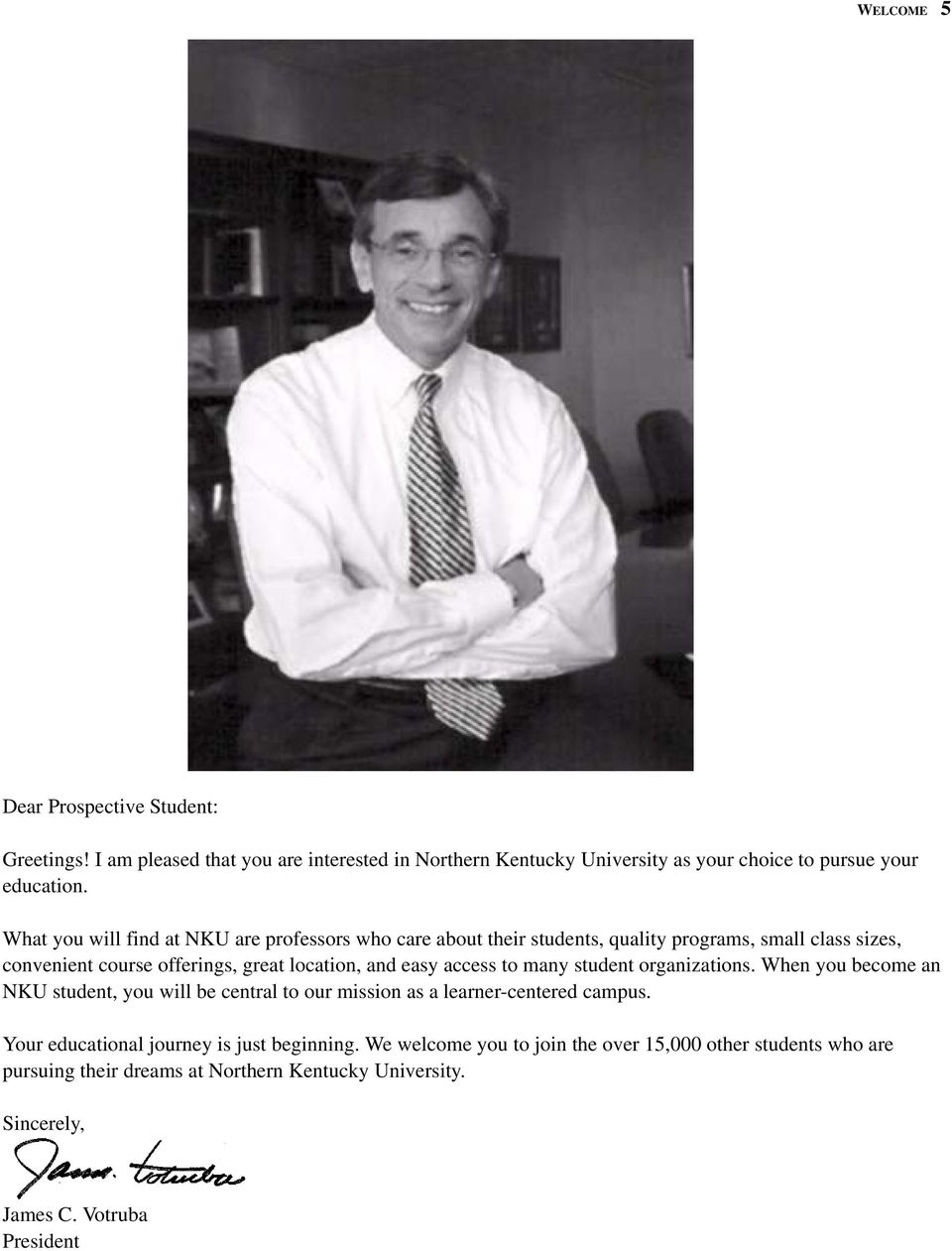
5 WELCOME 5 Dear Prospective Student: Greetings! I am pleased that you are interested in Northern Kentucky University as your choice to pursue your education. What you will find at NKU are professors who care about their students, quality programs, small class sizes, convenient course offerings, great location, and easy access to many student organizations. When you become an NKU student, you will be central to our mission as a learner-centered campus. Your educational journey is just beginning. We welcome you to join the over 15,000 other students who are pursuing their dreams at Northern Kentucky University. Sincerely, James C. Votruba President
6 TABLE OF CONTENTS 6 TABLE OF CONTENTS F For catalog updates, visit the NKU Catalog website at Mission, Vision and Core Values 3 Welcome 5 Academic Calendar 8 Northern Kentucky University 9 History 9 Accreditation 9 Mission 9 Institutional Admissions Standards 9 Service and Research Functions 10 Student Research and Creativity 10 Graduate Programs 10 Doctorate Program 10 Professional Program 10 Academic Programs 11 Admissions and Financial Aid 13 Application Fee Policies 13 Admission Deadlines and Credential Requirements 14 Degree-Seeking Students 14 Non-Degree-Seeking Students 14 International Students 15 Selective Admission Programs 16 Acceptance to the University 16 Kentucky Pre-College Curriculum 16 Status of Admisssion 16 NKU Academy 17 Test Scores and Placement Test Requirements 17 Admissions with Conditions Course Taking Policy 17 Orientation, Northern Exposure 17 Transfer Work Policy 18 mynku Registration 18 Financial Aid and Scholarships 19 Tuition and Fee Schedule 20 Tuition, Fee, and Housing Rates 20 Academic Requirements 21 General Requirements - Bachelor Degree 21 General Requirements - Associate Degree 21 General Education Requirements Bachelor s Degree 22 General Education Program 24 List of General Education Courses 24 General Education Requirements Associate s Degree 28 Kentucky General Education Transfer Policy 28 Undergraduates Taking Graduate Courses 29 Graduation Requirements 26 Non-Traditional Credit 31 Advanced Standing 31 CLEP Credi 31 Advanced Credit (AP) 31 International Baccalaureate (IB) Credit 33 Other Non-Traditional Credit 33 Academic Standing for Undergraduates 34 Academic Bankruptcy for Undergraduates 34 Academic Related Policies 35 Policy on Transfer Credits for Undergraduate Credit 37 Academic Regulations 39 Alcohol and Drug Abuse Policy 39 Adding or Dropping Course 39 Course Withdrawal Grade Policy 39 Academic Appeals 39 Academic Common Market 40 Catalog Applicability 40 Family Education Rights and Privacy Act of Greater Cincinnati Consortium of Colleges and Universities 40 Tuition Reciprocity 41 Articulation Agreements 41 University and Student Affairs 42 African American Student Affairs and Ethnic Services 42 Athletics 42 Bookstore 42 Dean of Students 42 Public Safety 43 Disability Services 43 Early Childhood Center 43 Health Counseling and Prevention Services 44 International Students and Scholars 44 Latino Student Affairs 44 Registrar 44 Testing Services 45 Veterans Services 46 College of Arts and Sciences 47 Biological Sciences Department 48 Chemistry Department 58 English Department 61 History and Geography Department 63 Mathematics Department 65 Music Department 67 Physics and Geology Department 72 Political Science and Criminal Justice Department 74 Psychological Science Department 79 Sociology, Anthropology, and Philosophy Department 80 Theatre and Dance Department 84 Visual Arts Department 89 World Languages and Literatures Department 94 Military Programs 97 Pre-Engineering and Engineering Technology 98 Pre-Professional Programs 102 Interdisciplinary Programs 103 Interdisciplinary Majors 103 Associate Degree in Integrated Studies 103 Bachelors Degree Programs 104 Environmental Science 103 Integrated Studies 104 International Studies 104 Interdisciplinary Minors Black Studies 106 Celtic Studies 107 Chinese Studies 107 Cinema Studies 107 Environmental Studies 108 Health Care 108 International Studies 108 Japanese Studies 108 Latin American and Caribbean Studies 109 Medieval Studies 109 Middle Eastern and North Africian Studies 109 Native American Studies 110 Neuroscience 110 Popular Culture 110 Pre-Law 112 Religious Studies 112 Social Justice Studies 113 Certificate Program in Social Justice 113 Women s and Gender Studies 114

7 7 NORTHERN KENTUCKY UNIVERSITY Centers and Institutes 115 Center for Applied Ecology 115 Center for Integrated Natural Science and Mathematics 115 Institute for Freedom Studies 116 Honors Program 117 College of Business 118 Accountancy Department 121 Construction Management Department 124 Economics and Finance Department 127 Management Department 129 Marketing Department 133 College of Education and Human Services 136 Education Programs 137 Elementary Education 138 Special Education 139 Birth to Kindergarten Early Childhood Education 140 Middle Grades Education 141 Secondary Education 142 Kinesiology, Health, Physical Education, Exercise Science, and Athletic Training Programs 143 Counseling, Social Work and Human Services 148 College of Informatics 152 Business Informatics 153 Communication 155 Computer Science 160 School of Nursing and Health Professions 162 Nursing Programs 162 Health Science Programs 166 Radiologic Technology Program 168 Respiratory Care Program 170 Education Abroad Programs 173 Student Success 174 Academic Advising Resource Center 174 First Year Programs 174 Learning Assistance Programs 175 Educational Outreach Programs 177 Course Descriptions 178 Faculty 258 University Administration 277 Residency Classification 278 Index 279 Responsibility of Student All students are responsible for being thoroughly familiar with the regulations and requirements set forth in this catalog. Ignorance of the rules described will not be accepted as an excuse for failing to act in accord with them. Academic Requirements and Regulations Updates The colleges of the university reserve the right to change requirements. Program changes will become effective at the beginning of the fall semester and are applicable only to new students and to readmitted students as stipulated elsewhere in this catalog under Catalog Applicability. Changes in program requirements with any other effective date require the approval of the Provost; such changes will become effective when posted in the Administrative Center, the University Center, the Office of Graduate Programs, and in each academic building. Students should refer any inquiries to the appropriate dean or the registrar. Visit the University website at for more information. It is the policy of Northern Kentucky University not to discriminate in its educational program, admission policies, financial aid, or other school administered programs on the basis of race, gender, color, age, religion, natural origin, sexual preference, physical or mental handicap, or status as a disabled veteran of the Vietnam Era. The information contained in this catalog is accurate at the time of publication. Northern Kentucky University reserves the right to revise catalog provisions in accordance with official actions of the Board of Regents and other governing bodies. Students are advised to consult the appropriate department, college, or office for current information about specific programs. Every effort has been make to ensure that this catalog is accurate and up-to-date, but it may contain typographical and other errors. Updates to academic procedures, policies, programs, and course descriptions will be posted on the University website at: access.nku.edu/catalog. This publication was prepared by Northern Kentucky University and printed with state funds (KRS ). Northern Kentucky University is an Equal Opportunity/Affirmative Action Institution.

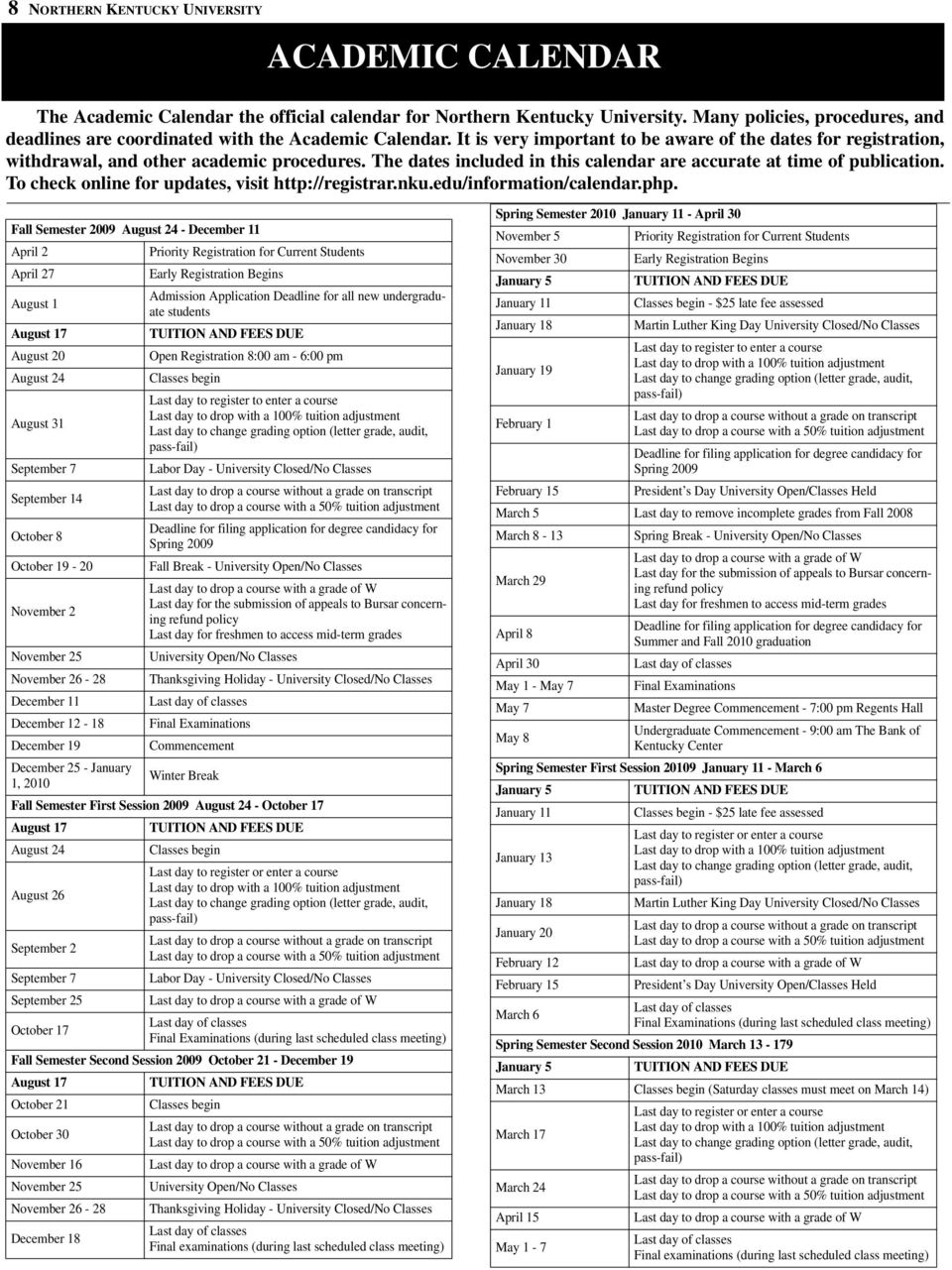
8 8 NORTHERN KENTUCKY UNIVERSITY ACADEMIC CALENDAR The Academic Calendar the official calendar for Northern Kentucky University. Many policies, procedures, and deadlines are coordinated with the Academic Calendar. It is very important to be aware of the dates for registration, withdrawal, and other academic procedures. The dates included in this calendar are accurate at time of publication. To check online for updates, visit Fall Semester 2009 August 24 - December 11 April 2 April 27 August 1 August 17 August 20 August 24 August 31 September 7 September 14 October 8 October November 2 November 25 November December 11 December December 19 December 25 - January 1, 2010 Priority Registration for Current Students Early Registration Begins Admission Application Deadline for all new undergraduate students TUITION AND FEES DUE Open Registration 8:00 am - 6:00 pm Classes begin Last day to register to enter a course Last day to drop with a 100% tuition adjustment Last day to change grading option (letter grade, audit, pass-fail) Labor Day - University Closed/No Classes Last day to drop a course without a grade on transcript Last day to drop a course with a 50% tuition adjustment Deadline for filing application for degree candidacy for Spring 2009 Fall Break - University Open/No Classes Last day to drop a course with a grade of W Last day for the submission of appeals to Bursar concerning refund policy Last day for freshmen to access mid-term grades University Open/No Classes Thanksgiving Holiday - University Closed/No Classes Last day of classes Final Examinations Commencement Winter Break Fall Semester First Session 2009 August 24 - October 17 August 17 TUITION AND FEES DUE August 24 Classes begin August 26 September 2 September 7 September 25 Last day to register or enter a course Last day to drop with a 100% tuition adjustment Last day to change grading option (letter grade, audit, pass-fail) Last day to drop a course without a grade on transcript Last day to drop a course with a 50% tuition adjustment Labor Day - University Closed/No Classes Last day to drop a course with a grade of W October 17 Last day of classes Final Examinations (during last scheduled class meeting) Fall Semester Second Session 2009 October 21 - December 19 August 17 TUITION AND FEES DUE October 21 Classes begin October 30 November 16 November 25 November December 18 Last day to drop a course without a grade on transcript Last day to drop a course with a 50% tuition adjustment Last day to drop a course with a grade of W University Open/No Classes Thanksgiving Holiday - University Closed/No Classes Last day of classes Final examinations (during last scheduled class meeting) Spring Semester 2010 January 11 - April 30 November 5 Priority Registration for Current Students November 30 Early Registration Begins January 5 TUITION AND FEES DUE January 11 Classes begin - $25 late fee assessed January 18 Martin Luther King Day University Closed/No Classes January 19 Last day to register to enter a course Last day to drop with a 100% tuition adjustment Last day to change grading option (letter grade, audit, pass-fail) February 1 Last day to drop a course without a grade on transcript Last day to drop a course with a 50% tuition adjustment Deadline for filing application for degree candidacy for Spring 2009 February 15 President s Day University Open/Classes Held March 5 Last day to remove incomplete grades from Fall 2008 March 8-13 Spring Break - University Open/No Classes March 29 April 8 April 30 May 1 - May 7 May 7 Last day to drop a course with a grade of W Last day for the submission of appeals to Bursar concerning refund policy Last day for freshmen to access mid-term grades Deadline for filing application for degree candidacy for Summer and Fall 2010 graduation Last day of classes Final Examinations Master Degree Commencement - 7:00 pm Regents Hall May 8 Undergraduate Commencement - 9:00 am The Bank of Kentucky Center Spring Semester First Session January 11 - March 6 January 5 TUITION AND FEES DUE January 11 Classes begin - $25 late fee assessed January 13 January 18 January 20 February 12 February 15 Last day to register or enter a course Last day to drop with a 100% tuition adjustment Last day to change grading option (letter grade, audit, pass-fail) Martin Luther King Day University Closed/No Classes Last day to drop a course without a grade on transcript Last day to drop a course with a 50% tuition adjustment Last day to drop a course with a grade of W President s Day University Open/Classes Held March 6 Last day of classes Final Examinations (during last scheduled class meeting) Spring Semester Second Session 2010 March January 5 TUITION AND FEES DUE March 13 Classes begin (Saturday classes must meet on March 14) March 17 March 24 April 15 May 1-7 Last day to register or enter a course Last day to drop with a 100% tuition adjustment Last day to change grading option (letter grade, audit, pass-fail) Last day to drop a course without a grade on transcript Last day to drop a course with a 50% tuition adjustment Last day to drop a course with a grade of W Last day of classes Final examinations (during last scheduled class meeting)
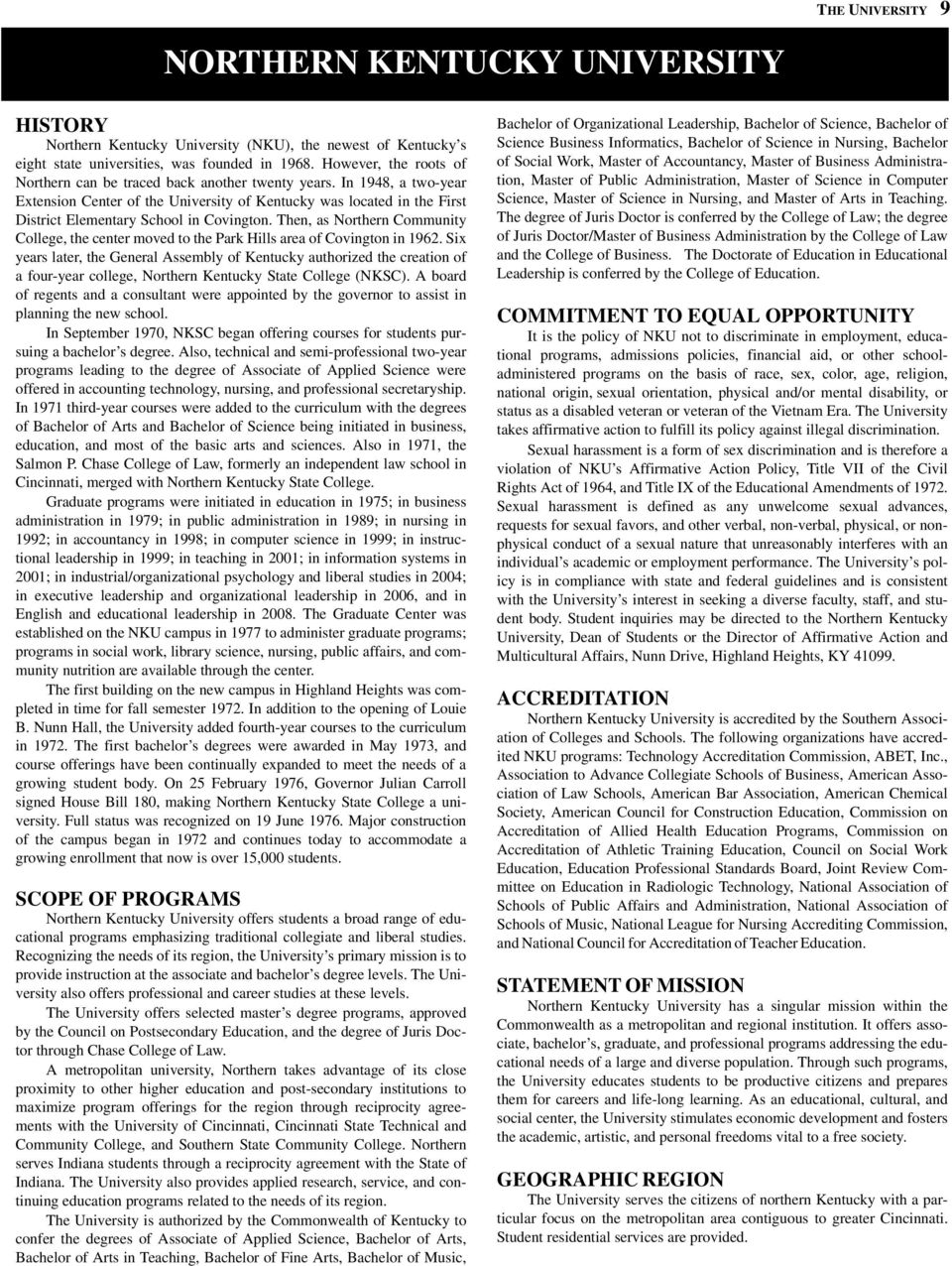
9 THE UNIVERSITY 9 NORTHERN KENTUCKY UNIVERSITY HISTORY Northern Kentucky University (NKU), the newest of Kentucky s eight state universities, was founded in However, the roots of Northern can be traced back another twenty years. In 1948, a two-year Extension Center of the University of Kentucky was located in the First District Elementary School in Covington. Then, as Northern Community College, the center moved to the Park Hills area of Covington in Six years later, the General Assembly of Kentucky authorized the creation of a four-year college, Northern Kentucky State College (NKSC). A board of regents and a consultant were appointed by the governor to assist in planning the new school. In September 1970, NKSC began offering courses for students pursuing a bachelor s degree. Also, technical and semi-professional two-year programs leading to the degree of Associate of Applied Science were offered in accounting technology, nursing, and professional secretaryship. In 1971 third-year courses were added to the curriculum with the degrees of Bachelor of Arts and Bachelor of Science being initiated in business, education, and most of the basic arts and sciences. Also in 1971, the Salmon P. Chase College of Law, formerly an independent law school in Cincinnati, merged with Northern Kentucky State College. Graduate programs were initiated in education in 1975; in business administration in 1979; in public administration in 1989; in nursing in 1992; in accountancy in 1998; in computer science in 1999; in instructional leadership in 1999; in teaching in 2001; in information systems in 2001; in industrial/organizational psychology and liberal studies in 2004; in executive leadership and organizational leadership in 2006, and in English and educational leadership in The Graduate Center was established on the NKU campus in 1977 to administer graduate programs; programs in social work, library science, nursing, public affairs, and community nutrition are available through the center. The first building on the new campus in Highland Heights was completed in time for fall semester In addition to the opening of Louie B. Nunn Hall, the University added fourth-year courses to the curriculum in The first bachelor s degrees were awarded in May 1973, and course offerings have been continually expanded to meet the needs of a growing student body. On 25 February 1976, Governor Julian Carroll signed House Bill 180, making Northern Kentucky State College a university. Full status was recognized on 19 June Major construction of the campus began in 1972 and continues today to accommodate a growing enrollment that now is over 15,000 students. SCOPE OF PROGRAMS Northern Kentucky University offers students a broad range of educational programs emphasizing traditional collegiate and liberal studies. Recognizing the needs of its region, the University s primary mission is to provide instruction at the associate and bachelor s degree levels. The University also offers professional and career studies at these levels. The University offers selected master s degree programs, approved by the Council on Postsecondary Education, and the degree of Juris Doctor through Chase College of Law. A metropolitan university, Northern takes advantage of its close proximity to other higher education and post-secondary institutions to maximize program offerings for the region through reciprocity agreements with the University of Cincinnati, Cincinnati State Technical and Community College, and Southern State Community College. Northern serves Indiana students through a reciprocity agreement with the State of Indiana. The University also provides applied research, service, and continuing education programs related to the needs of its region. The University is authorized by the Commonwealth of Kentucky to confer the degrees of Associate of Applied Science, Bachelor of Arts, Bachelor of Arts in Teaching, Bachelor of Fine Arts, Bachelor of Music, Bachelor of Organizational Leadership, Bachelor of Science, Bachelor of Science Business Informatics, Bachelor of Science in Nursing, Bachelor of Social Work, Master of Accountancy, Master of Business Administration, Master of Public Administration, Master of Science in Computer Science, Master of Science in Nursing, and Master of Arts in Teaching. The degree of Juris Doctor is conferred by the College of Law; the degree of Juris Doctor/Master of Business Administration by the College of Law and the College of Business. The Doctorate of Education in Educational Leadership is conferred by the College of Education. COMMITMENT TO EQUAL OPPORTUNITY It is the policy of NKU not to discriminate in employment, educational programs, admissions policies, financial aid, or other schooladministered programs on the basis of race, sex, color, age, religion, national origin, sexual orientation, physical and/or mental disability, or status as a disabled veteran or veteran of the Vietnam Era. The University takes affirmative action to fulfill its policy against illegal discrimination. Sexual harassment is a form of sex discrimination and is therefore a violation of NKU s Affirmative Action Policy, Title VII of the Civil Rights Act of 1964, and Title IX of the Educational Amendments of Sexual harassment is defined as any unwelcome sexual advances, requests for sexual favors, and other verbal, non-verbal, physical, or nonphysical conduct of a sexual nature that unreasonably interferes with an individual s academic or employment performance. The University s policy is in compliance with state and federal guidelines and is consistent with the University s interest in seeking a diverse faculty, staff, and student body. Student inquiries may be directed to the Northern Kentucky University, Dean of Students or the Director of Affirmative Action and Multicultural Affairs, Nunn Drive, Highland Heights, KY ACCREDITATION Northern Kentucky University is accredited by the Southern Association of Colleges and Schools. The following organizations have accredited NKU programs: Technology Accreditation Commission, ABET, Inc., Association to Advance Collegiate Schools of Business, American Association of Law Schools, American Bar Association, American Chemical Society, American Council for Construction Education, Commission on Accreditation of Allied Health Education Programs, Commission on Accreditation of Athletic Training Education, Council on Social Work Education, Education Professional Standards Board, Joint Review Committee on Education in Radiologic Technology, National Association of Schools of Public Affairs and Administration, National Association of Schools of Music, National League for Nursing Accrediting Commission, and National Council for Accreditation of Teacher Education. STATEMENT OF MISSION Northern Kentucky University has a singular mission within the Commonwealth as a metropolitan and regional institution. It offers associate, bachelor s, graduate, and professional programs addressing the educational needs of a large and diverse population. Through such programs, the University educates students to be productive citizens and prepares them for careers and life-long learning. As an educational, cultural, and social center, the University stimulates economic development and fosters the academic, artistic, and personal freedoms vital to a free society. GEOGRAPHIC REGION The University serves the citizens of northern Kentucky with a particular focus on the metropolitan area contiguous to greater Cincinnati. Student residential services are provided.
10 10 NORTHERN KENTUCKY UNIVERSITY INSTITUTIONAL ADMISSION STANDARDS Northern Kentucky University admits students under selective standards exceeding the minimum admission guidelines established by the Council on Postsecondary Education, with only limited exceptions. The institutional standards are consistent with the system-wide policy for admitting under-prepared students, including removal of academic deficiencies within a specified time frame. Through this approach, the University seeks to provide both broad access and high-quality programs and to pursue a particular commitment to placebound and other learners and to populations traditionally under represented in higher education. DEGREE LEVELS The University offers selected programs leading to associate, bachelor s, master s, doctorate, and professional law degrees to meet specific metropolitan/regional needs. STRATEGIC DIRECTIONS/PROGRAM PRIORITIES Northern Kentucky University s distinctive metropolitan/regional mission requires that it maintain a broad range of offerings: occupational programs, a traditional arts and sciences bachelor s curriculum, legal education through Salmon P. Chase College of Law, and graduate programs to meet specific metropolitan/regional needs. The University s responsibility is to meet the needs of both northern Kentucky and the greater metropolitan area. Academic priorities include occupational programs, liberal arts and sciences, business, education, and law. These strategic priorities translate into a core of liberal arts bachelor s degree programs in addition to degree programs priorities at the associate, bachelor s, master s, and professional levels. ENHANCEMENT OF INSTRUCTION Teaching and learning are the primary focus of the University. The University offers a broad range of instructional and support services to promote the curricular and extracurricular development and success of its students. Developmental programs address the needs of under-prepared students; extensive evening offerings and alternate means of course delivery expand opportunities for students with limited access to the campus. SERVICE AND RESEARCH FUNCTIONS Northern Kentucky University seeks to develop creative and mutually beneficial partnerships with public and private enterprises in the local metropolitan area and the region in support of economic growth and investment. The University is especially committed to offering training, applied research, and other services in support of area businesses, industry, and government. It recognizes a special commitment to research and service in support of local elementary and secondary schools in its primary service area. The University engages in community partnerships coordinated through the Scripps Howard Center for Civic Engagement. The Center was established by NKU to advance public stewardship, citizenship, and engagement through learning, scholarship, and community capacitybuilding. The Center engages students in a variety of community projects, from student philanthropy to service-learning to citizenship skill building. The Center also involves students in a Get Out the Vote for Democracy Initiative. NKU students can be trained as Engagement Specialists and assigned to work with faculty and community leaders on a variety of tasks. For more information on these and other programs, visit the Center s website at or phone the office at STUDENT RESEARCH AND CREATIVITY The University strives to enhance the experiences of students by offering two opportunities that enable students to fund and present research or creative activities on interesting topics. Students can obtain funds to pay for materials, supplies, equipment, software, or project-related travel while they conduct a project under the mentorship of a faculty member. To locate the guidelines for this program, visit: Students can also present their work at the annual Celebration of Student Research and Creativity. This event highlights students achievements in a broad array of scholarly and creative activities. Students display their work through posters, oral presentations, interactive demonstratives, performances, and exhibits of artistic work. Website: For further information on both programs contact the Office of Research, Grants, and Contracts, Administrative Center 616, phone: COLLABORATIVE VENTURES The University establishes and maintains cooperative and mutually beneficial relationships with other public institutions of higher education in Kentucky, with elementary and secondary schools, and with other such institutions in northern Kentucky and the interdependent metropolitan area. Curriculum development emphasizes the transfer of credits from another institution toward degree completion. The University participates in the Kentucky Commonwealth Virtual University (KYVU), a collaboration of Kentucky public and independent universities. KYVU can be found on the Web at KYVU is a public institution which coordinates credit and non-credit student-friendly learning environments that can lead to certificates or degrees. KYVU uses a multi-technology approach including one-way broadcast (KET), interactive television (KTLN), and Web-based course work. The Kentucky Commonwealth Virtual Library (KCVL), found at provides a single web portal to learning materials state-wide and includes cooperation of Kentucky colleges, universities, P- 12 school systems, and local libraries. EFFICIENCY AND EFFECTIVENESS Northern Kentucky University addresses the educational needs of its region and people effectively and efficiently. Planning, evaluation, assessment, and prudent commitment of resources are essential to promote continuous improvement of programs and services. Strategic planning that results in elimination of duplicative or unproductive programs not serving metropolitan/regional needs is essential, while the development of carefully selected new programs compatible with the mission is appropriate. GRADUATE PROGRAMS Northern Kentucky University offers an array of excellent graduate programs. Graduate programs are directed to professionals who would like to earn a degree or certificate to help them in their career paths. For more information on NKU graduate programs call the Office of Graduate Programs at ; [email protected]; or, visit their website at DOCTORATE PROGRAM Northern Kentucky University offers a doctorate program in educational leadership. For information on the program, call the Office of Graduate Programs at ; [email protected]; or, visit their website at PROFESSIONAL PROGRAM The University offers one professional program, the Juris Doctor. For information, contact Salmon P. Chase College of Law,

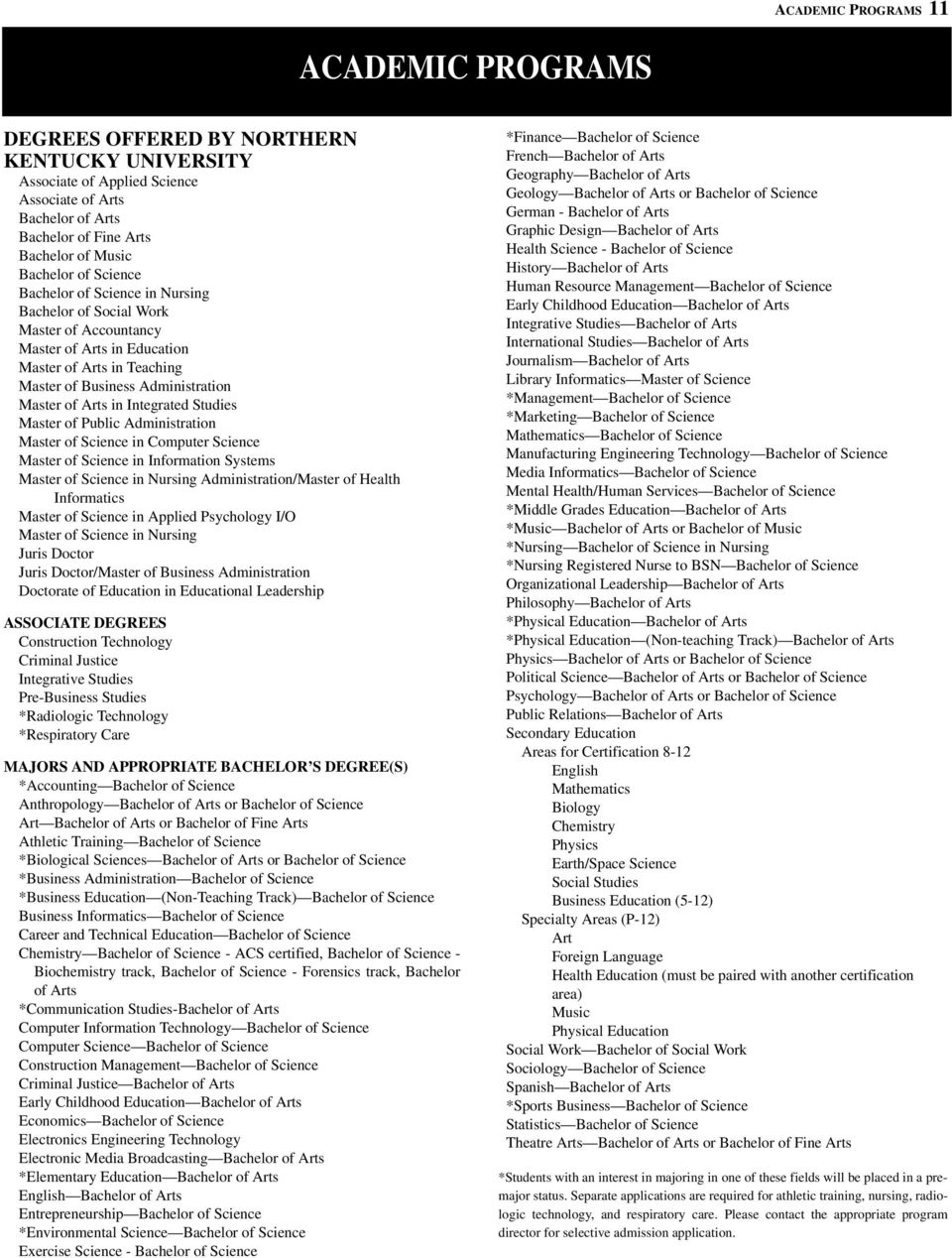
11 ACADEMIC PROGRAMS 11 ACADEMIC PROGRAMS DEGREES OFFERED BY NORTHERN KENTUCKY UNIVERSITY Associate of Applied Science Associate of Arts Bachelor of Arts Bachelor of Fine Arts Bachelor of Music Bachelor of Science Bachelor of Science in Nursing Bachelor of Social Work Master of Accountancy Master of Arts in Education Master of Arts in Teaching Master of Business Administration Master of Arts in Integrated Studies Master of Public Administration Master of Science in Computer Science Master of Science in Information Systems Master of Science in Nursing Administration/Master of Health Informatics Master of Science in Applied Psychology I/O Master of Science in Nursing Juris Doctor Juris Doctor/Master of Business Administration Doctorate of Education in Educational Leadership ASSOCIATE DEGREES Construction Technology Criminal Justice Integrative Studies Pre-Business Studies *Radiologic Technology *Respiratory Care MAJORS AND APPROPRIATE BACHELOR S DEGREE(S) *Accounting Bachelor of Science Anthropology Bachelor of Arts or Bachelor of Science Art Bachelor of Arts or Bachelor of Fine Arts Athletic Training Bachelor of Science *Biological Sciences Bachelor of Arts or Bachelor of Science *Business Administration Bachelor of Science *Business Education (Non-Teaching Track) Bachelor of Science Business Informatics Bachelor of Science Career and Technical Education Bachelor of Science Chemistry Bachelor of Science - ACS certified, Bachelor of Science - Biochemistry track, Bachelor of Science - Forensics track, Bachelor of Arts *Communication Studies-Bachelor of Arts Computer Information Technology Bachelor of Science Computer Science Bachelor of Science Construction Management Bachelor of Science Criminal Justice Bachelor of Arts Early Childhood Education Bachelor of Arts Economics Bachelor of Science Electronics Engineering Technology Electronic Media Broadcasting Bachelor of Arts *Elementary Education Bachelor of Arts English Bachelor of Arts Entrepreneurship Bachelor of Science *Environmental Science Bachelor of Science Exercise Science - Bachelor of Science *Finance Bachelor of Science French Bachelor of Arts Geography Bachelor of Arts Geology Bachelor of Arts or Bachelor of Science German - Bachelor of Arts Graphic Design Bachelor of Arts Health Science - Bachelor of Science History Bachelor of Arts Human Resource Management Bachelor of Science Early Childhood Education Bachelor of Arts Integrative Studies Bachelor of Arts International Studies Bachelor of Arts Journalism Bachelor of Arts Library Informatics Master of Science *Management Bachelor of Science *Marketing Bachelor of Science Mathematics Bachelor of Science Manufacturing Engineering Technology Bachelor of Science Media Informatics Bachelor of Science Mental Health/Human Services Bachelor of Science *Middle Grades Education Bachelor of Arts *Music Bachelor of Arts or Bachelor of Music *Nursing Bachelor of Science in Nursing *Nursing Registered Nurse to BSN Bachelor of Science Organizational Leadership Bachelor of Arts Philosophy Bachelor of Arts *Physical Education Bachelor of Arts *Physical Education (Non-teaching Track) Bachelor of Arts Physics Bachelor of Arts or Bachelor of Science Political Science Bachelor of Arts or Bachelor of Science Psychology Bachelor of Arts or Bachelor of Science Public Relations Bachelor of Arts Secondary Education Areas for Certification 8-12 English Mathematics Biology Chemistry Physics Earth/Space Science Social Studies Business Education (5-12) Specialty Areas (P-12) Art Foreign Language Health Education (must be paired with another certification area) Music Physical Education Social Work Bachelor of Social Work Sociology Bachelor of Science Spanish Bachelor of Arts *Sports Business Bachelor of Science Statistics Bachelor of Science Theatre Arts Bachelor of Arts or Bachelor of Fine Arts *Students with an interest in majoring in one of these fields will be placed in a premajor status. Separate applications are required for athletic training, nursing, radiologic technology, and respiratory care. Please contact the appropriate program director for selective admission application.
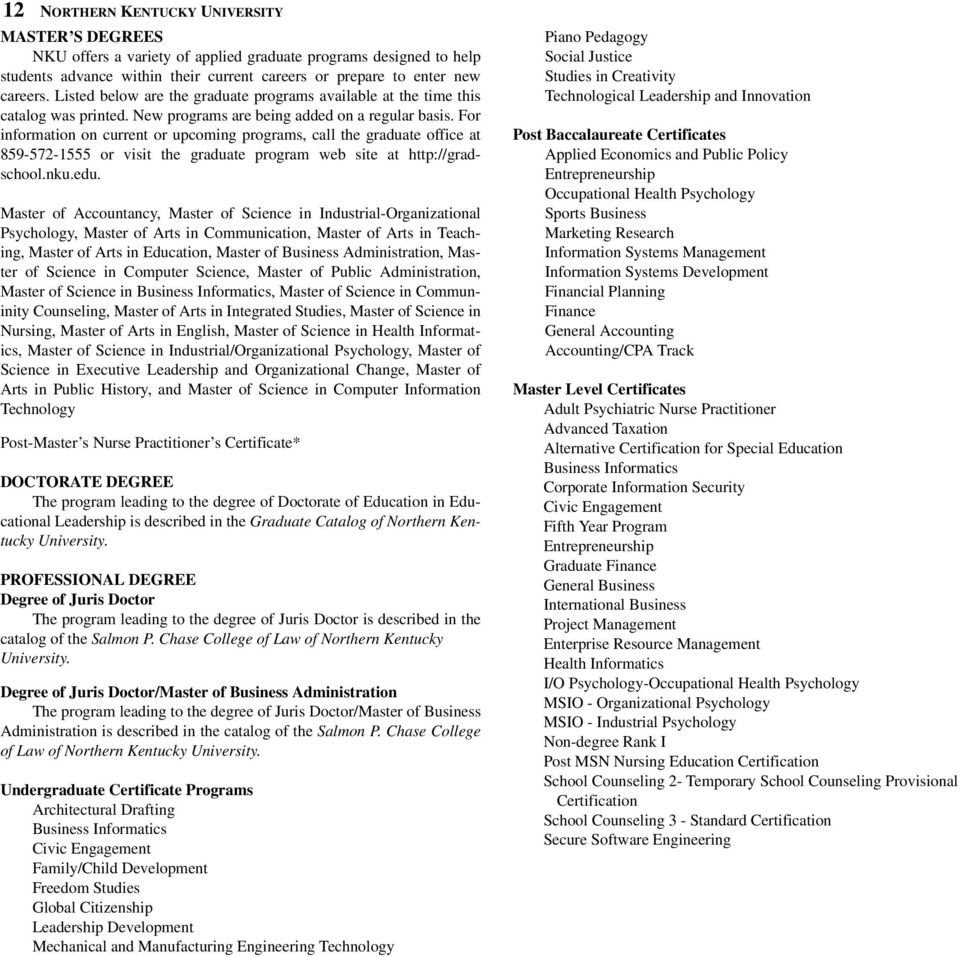
12 12 NORTHERN KENTUCKY UNIVERSITY MASTER S DEGREES NKU offers a variety of applied graduate programs designed to help students advance within their current careers or prepare to enter new careers. Listed below are the graduate programs available at the time this catalog was printed. New programs are being added on a regular basis. For information on current or upcoming programs, call the graduate office at or visit the graduate program web site at Master of Accountancy, Master of Science in Industrial-Organizational Psychology, Master of Arts in Communication, Master of Arts in Teaching, Master of Arts in Education, Master of Business Administration, Master of Science in Computer Science, Master of Public Administration, Master of Science in Business Informatics, Master of Science in Communinity Counseling, Master of Arts in Integrated Studies, Master of Science in Nursing, Master of Arts in English, Master of Science in Health Informatics, Master of Science in Industrial/Organizational Psychology, Master of Science in Executive Leadership and Organizational Change, Master of Arts in Public History, and Master of Science in Computer Information Technology Post-Master s Nurse Practitioner s Certificate* DOCTORATE DEGREE The program leading to the degree of Doctorate of Education in Educational Leadership is described in the Graduate Catalog of Northern Kentucky University. PROFESSIONAL DEGREE Degree of Juris Doctor The program leading to the degree of Juris Doctor is described in the catalog of the Salmon P. Chase College of Law of Northern Kentucky University. Degree of Juris Doctor/Master of Business Administration The program leading to the degree of Juris Doctor/Master of Business Administration is described in the catalog of the Salmon P. Chase College of Law of Northern Kentucky University. Undergraduate Certificate Programs Architectural Drafting Business Informatics Civic Engagement Family/Child Development Freedom Studies Global Citizenship Leadership Development Mechanical and Manufacturing Engineering Technology Piano Pedagogy Social Justice Studies in Creativity Technological Leadership and Innovation Post Baccalaureate Certificates Applied Economics and Public Policy Entrepreneurship Occupational Health Psychology Sports Business Marketing Research Information Systems Management Information Systems Development Financial Planning Finance General Accounting Accounting/CPA Track Master Level Certificates Adult Psychiatric Nurse Practitioner Advanced Taxation Alternative Certification for Special Education Business Informatics Corporate Information Security Civic Engagement Fifth Year Program Entrepreneurship Graduate Finance General Business International Business Project Management Enterprise Resource Management Health Informatics I/O Psychology-Occupational Health Psychology MSIO - Organizational Psychology MSIO - Industrial Psychology Non-degree Rank I Post MSN Nursing Education Certification School Counseling 2- Temporary School Counseling Provisional Certification School Counseling 3 - Standard Certification Secure Software Engineering
13 SSION ADMISSIONS AND FINANCIAL AID ADMISSIONS AND FINANCIAL AID 13 ADMISSIONS APPLICATION FEE POLICIES Paper applications for admission to the University must include a non-refundable $40.00 application fee. Students applying on-line must submit a non-refundable $25.00 application fee. The fee will be assessed for degree-seeking and non-degree-seeking students. An applicant s fee waiver request will be considered by the admissions director in instances of financial hardship if the request is accompanied by a letter from 1. a high school counselor or principal; 2. a Talent Search counselor or Upward Bound official; 3. a member of NKU Student Support Services; 4. the State of Kentucky (Certification of Financial Assistance) 5. ACT/SAT application fee waiver request. The applicant s request for a waiver and letter of recommendation for fee waiver must be submitted with the application for admission. Students from the Greater Cincinnati Consortium of Colleges and Universities and the Southwestern Ohio Council for Higher Education are not charged the application fee. An application for admission will not be processed until NKU receives the application fee or the fee waiver is approved. Correspondence regarding the application fee requirement will be sent to all applicants failing to submit the fee. Alumni who have earned bachelor s degrees from NKU will have the application fee waived for post-bachelor s or graduate applications for admission. The application fee is also waived for spouses, or dependents of NKU faculty or staff who are eligible for a tuition waiver. A student who has previously participated in the Early Enrollment or School Based Scholar program who is applying for admission to NKU immediately following graduation is not required to pay the application fee. CONFIRMATION FEE All first-time degree-seeking freshmen and transfer students who enroll in six or more credit hours must confirm their intention to enroll and pay a nonrefundable $75.00 confirmation fee by May 1st for summer and fall and December 1st for Spring. Students admitted after these deadlines must submit fee within 2 weeks after student is offered admission. ADMISSION DEADLINES Admission deadlines and credential requirements are listed on the following page. To facilitate the admission decision, students are strongly encouraged to apply and supply all credentials by the priority deadline for each semester. All posted deadlines are final. Requests for an exception to the admission deadline will be reviewed by the admission director. All students who want to be considered for scholarship opportunities (for each fall semester) must submit all required admission materials by the scholarship deadline of January 15. Transfer: Students who have attempted coursework for credit at a regionally accredited college or university. Students should be eligible to return to their previous institution(s) at the time of application. See Suspension on page 34 if not eligible to return to previous institution. A transfer student with less than a 2.0 G.P.A.submit all necessary credentials for review of possible acceptance prior to the priority deadline listed on the following page. All necessary credentials for transfer students with a G.P.A. of 2.0 or higher admission must be submitted by August 1 for the fall semester, December 1 for the spring semester and May 1 for the summer semester. Transfers who do not submit all necessary credentials by the final deadlines may register as a non-degree student but will be ineligible to receive federal financial aid. If applicants choose to become degree-seeking during a subsequent semester, they must submit a new application for admission, an additional application fee, all required credentials, and must meet the deadline dates. Readmission: For students who have attempted coursework at NKU but have not been enrolled during the four years preceding the semester in which the application is made to reenter the University. Admission standards in effect at first semester of entry will be applied. Graduation requirements will change to current-year catalog. Students who have been suspended must submit an undergraduate application no later than August 1 for the fall semester, December 1 for the spring semester, or May 1 for summer sessions. Students are required to meet with a dean must have the meeting prior to the admission deadline date. Refer to Suspension on page 34 for complete information. Readmission students with transfer credit must submit an official transcript with their application by August 1 for fall semester and December 1 for spring semester. Post-bachelor: Students who have received a bachelor s degree and intend to enroll for additional undergraduate credit as degree-seeking. All post-bachelor students must submit official transcripts from all instutitions previously attended. Graduate: Students should request information from the Graduate Studies Office at Home School and Independent Study: Students who are home schooled or completing their high school diploma through an independent study program must submit the credentials listed for freshman admission, except for the high school transcript from an accredited high school. Additionally, the student must submit 1. a notarized statement from the home school teacher detailing the content of the student s home school curriculum, letter grades, and the duration of each course; and 2. final home schooled transcript must be submitted upon graduation. The chart on the following page shows the different deadlines and credential requirements for degree-seeking students. ADMISSION CLASSIFICATIONS FOR DEGREE- SEEKING STUDENTS Freshmen: Students who have not attempted coursework at a regionally accredited college or university (other than college courses earned while in high school). Final high school transcripts must be submitted upon graduation.

14 14 NORTHERN KENTUCKY UNIVERSITY ADMISSION DEADLINES AND CREDENTIAL REQUIREMENTS FOR DEGREE-SEEKING STUDENTS DEADLINES FOR ADMISSION FALL SEMESTER SPRING SEMESTER CREDENTIALS REQUIRED Application Fee Official High School Transcript/GED Scores Official American College Test (ACT), Scholastic Achievement Test (SAT), or COMPASS (writing, algebra, and reading scores) Official College Transcript(s) from each institution attended FRESHMEN TRANSFER READMISSION POST-BACHELOR Early Action January 15 Priority May 1 Assured Consideration June 1st Final August 1 Priority November 1 Final Day before classes begin Yes Yes Yes Priority May 1 Assured Consideration June 1 Final August 1 Priority November 1 Final December 1 Yes Yes (less than 24 semester hours transferred) Yes (less than 24 semester hours transferred) Priority May 1 Final August 1 Priority November 1 Final With transfer work December 1: otherwise Open Registration Yes Yes (unless previously sent) Yes (unless previously sent) Assured Consideration June 1 Final August 1 Priority November 1 Final Open Registration see Schedule of Classes Yes, unless NKU graduate No Yes Yes Yes Yes (indicating Bachelor s degree) No ADMISSION CLASSIFICATIONS FOR NON-DEGREE SEEKING STUDENTS Students who initially apply as non-degree and re-apply as degree seeking are held to the current academic policies and admission standards. Early Enrollment: Students in high school who wish to enroll for courses at NKU s Highland Heights campus. A 3.25 (on a 4.0 scale) high school GPA, an ACT composite of 20 or above or SAT composite of 1020 or above and permission from the guidance counselor are required for admission. Interested students should contact the Office of Admissions for additional information and an Early Enrollment application. A student who has attended NKU previously as an early-enrollment student must resubmit a completed and approved Permission to Enroll Form for each subsequent term for which he/she desires to enroll as an early enrollment student. If the student wishes to become degree-seeking, he/she must submit a new application for admission and the required credentials for freshman admission. The application fee is waived for an early enrollment student who applies to NKU immediately following graduation from high school. Note: Enrollment generally is restricted to seniors with exceptions permitted for non-seniors enrolled in advanced high school courses in mathematics (calculus or above), the sciences (second year of physics, chemistry, or biology), or foreign languages (third-year or above). Application available at: earlyenrollment.php.. Non-Degree: Students who do not intend to enter a degree program at the time of application. Student must have a high school diploma or GED. A maximum of 36 semester hours earned as a non-degree seeking student may be applied to a degree earned at NKU. Non-degree students are not eligible to receive federal financial aid or veteran s benefits. Students may request academic advising from the Academic Advising Resource Center. (AARC). Students who choose to become degree-seeking at a later date must submit a new application for admission, pay an additional application fee, submit all required credentials, and must meet the appropriate admission deadline. Admission deadlines and credential requirements are listed below. Students are strongly encouraged to apply and supply all required credentials by the priority deadline for each semester to facilitate the admission process. Requests for an exception to admission deadline will be reviewed by the admissions director. Non-Degree Post-Bachelor: Students who have received a bachelor s degree and intend to enroll for additional undergraduate credit as non-degree seeking. Visiting (Transient): Students who attend another college or university, but wish to enroll at NKU for one semester. Students are responsible for having coursework approved by the institution to which the work will be transferred. Visiting students, except for ones who enroll through the Greater Cincinnati Consortium of Colleges and Universities, may not enroll at NKU for more than one consecutive semester. Summer terms are not considered a consecutive semester. School Based Scholars Program: Students can earn up to 12 college level credit hours taking classes at a high school, the Covington Campus, or the Grant County Center for a reduced rate of $150 per class (does not include the cost of textbooks). Classes are taught by NKU professors. For more information on the program, see: edoutreach.nku.edu/school-based Scholars Program.html. The application fee is waived for a school based scholar student who applies to NKU immediately following graduation from high school.

15 ADMISSIONS AND FINANCIAL AID 15 CREDENTIAL REQUIREMENTS FOR NON-DEGREE-SEEKING STUDENTS Non-degree students are not eligible to receive veteran s benefits or federal financial aid. Non-degree students are eligible for academic advising and may be eligible for alternative forms of financial aid. Contact Financial Assistance at for other options. If these applicants choose to become degree-seeking at a later date, they must submit a new application for admission, an additional application fee, all required credentials, and must meet the appropriate deadline dates. CREDENTIALS REQUIRED EARLY ENROLLMENT/ SCHOOL BASED SCHOLARS NON-DEGREE POST-BACHELOR VISITING Application and Application Fee Yes Yes Yes Yes (No fee if consortium) Early Admit Form Yes* No No No Official High School Transcript Yes No No No Official College Transcripts No No - unless needed for pre-requisite ACT or SAT Official Score Report Yes No - unless needed for pre-requisite Deadline for Admission Fall Final - August 1 Spring Priority - December 1 Winter Priority - December 1 Summer - May 1 * See application fee statement above. Fall Final - August 1 Spring Priority - December 1 Winter Priority - December 1 Summer - May 1 No - unless needed for pre-requisite No - unless needed for pre-requisite Fall Final - August 1 Spring Priority - December 1 Winter Priority - December 1 Summer - May 1 No - unless needed for pre-requisite No - unless needed for pre-requisite Fall Final - August 1 Spring Priority - December 1 Winter Priority - December 1 Summer - May 1 ADMISSION CLASSIFICATIONS FOR INTERNATIONAL STUDENTS International Students (Non-Immigrant F-1 Status): Students should apply with the Office of International Students and Scholars (University Center 366) at least four months before the beginning of the semester for which they wish to enroll. In general, applicants will be admitted only after they have documented that they have acceptable academic credentials. Students may be conditionally admitted to a degree program contingent upon the successful completion of level VI of the American English Language Program (AELP). Certain level VI students may be granted special permission to enroll in a credit-bearing class along with the ESL coursework. The SAT exam may be required from students from certain countries depending on U.S. consulate procedures. In either case, those individuals will be so advised by the University. Specific credentials required: 1. international application for undergraduate admission; 2. declaration and certification of finances; 3. official transcripts of secondary work (or appropriate certificates of examination) AND certified English translations if applicable; 4. an official transcript from each college or university attended AND certified English translations if applicable; 5. all international students must prove English proficiency. Any one of the following will satisfy the English Proficiency requirement for admission: a. submit an official score report of the Test of English as a Foreign Language (TOEFL) taken within the last two years. The minimum TOEFL scores to be considered for admission are: computer based 173 or paper-based 500 or internetbased-61; b. present documentation of having satisfactorily completed Freshman Composition I at an American college in the U.S. and have an overall acceptable grade point average. Nonnative speakers of English may still be asked to take the TOEFL if it has been several years since taking the English courses and/or if the student has returned to his/her home country; c. present documentation of having successfully completed Level 109 at an ELS Language Center in the U.S.; d. submit a score on the verbal portion of the ACT or SAT taken within the last two years. The minimum scores to be considered for admission are: ACT 18 or SAT 480; e. submit an official score from the International English Language Testing Service (IELTS) taken within the last two years. The minimum IELTS scores to be considered for admission are: Band of 5.0; or f. complete level IV of the AELP program. IUndergraduate students who have presented documentation showing that they meet or exceed the graduate level requirement in a. or e. above are not required to take any additional English placement tests prior to registration, but the individual department may request that the student do so. However, any international student who presents documentation below the graduate level requirement in a. or e. above will be placed in ENG 110 and possibly ENG 112, if applicable. International Students (Non-Immigrant, Non F-1 Status): Students should apply with the Office of International Students/Scholars (UC 366) by submitting an international student application (if applicable), transcripts as described in section for Non-Immigrant F-1 Status students, and meet the English proficiency requirements as described above. Students should apply through the International Admissions Office (UC 366) and meet the foreign transcript and English proficiency requirements as set out in Non-Immigrant F-1 Status student section, in addition to all domestic admissions requirements. Undergraduate permanent residents and certain other visa types (H-1, H-4, L-1, L-2, F-2, E1, E2, M-1, J-2 or TN) including U.S. citizens whose primary language is not English should file the standard application for admission and will be required to take the NKU-administered Michigan Test of English Language Proficiency. In this case, unless the student has presented documentation of a., b., c., d., or e. above, the Michigan Test is a requirement in order to be considered for admission. The application for admission must be on file in order to take the Michigan test and have the scores processed. Please note that if admission is denied because the Michigan Test score is too low, the application fee cannot be refunded. Exceptions to the Michigan Test requirement for undergraduate students in this category are the same as those seeking F-1 student status. See above. Exchange Students (Non-Immigrant J-1) The Office of International Programs (OIP) receives the notification of their selection as an NKU exchange student from their home institution. OIP then begins the J-1 visa process and collects all application materials which is then forwarded to the International Admissions Office.

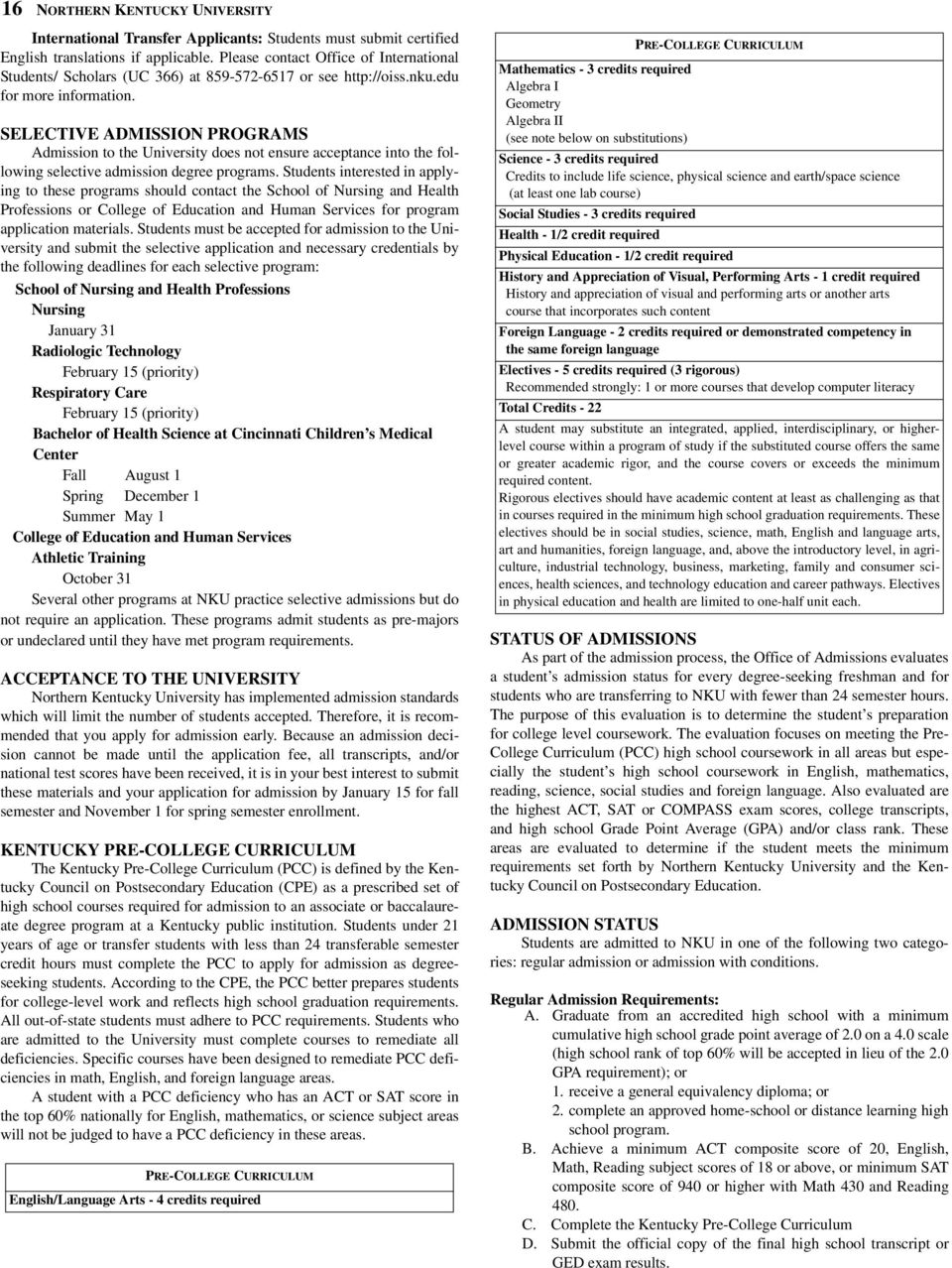
16 16 NORTHERN KENTUCKY UNIVERSITY International Transfer Applicants: Students must submit certified English translations if applicable. Please contact Office of International Students/ Scholars (UC 366) at or see for more information. SELECTIVE ADMISSION PROGRAMS Admission to the University does not ensure acceptance into the following selective admission degree programs. Students interested in applying to these programs should contact the School of Nursing and Health Professions or College of Education and Human Services for program application materials. Students must be accepted for admission to the University and submit the selective application and necessary credentials by the following deadlines for each selective program: School of Nursing and Health Professions Nursing January 31 Radiologic Technology February 15 (priority) Respiratory Care February 15 (priority) Bachelor of Health Science at Cincinnati Children s Medical Center Fall August 1 Spring December 1 Summer May 1 College of Education and Human Services Athletic Training October 31 Several other programs at NKU practice selective admissions but do not require an application. These programs admit students as pre-majors or undeclared until they have met program requirements. ACCEPTANCE TO THE UNIVERSITY Northern Kentucky University has implemented admission standards which will limit the number of students accepted. Therefore, it is recommended that you apply for admission early. Because an admission decision cannot be made until the application fee, all transcripts, and/or national test scores have been received, it is in your best interest to submit these materials and your application for admission by January 15 for fall semester and November 1 for spring semester enrollment. KENTUCKY PRE-COLLEGE CURRICULUM The Kentucky Pre-College Curriculum (PCC) is defined by the Kentucky Council on Postsecondary Education (CPE) as a prescribed set of high school courses required for admission to an associate or baccalaureate degree program at a Kentucky public institution. Students under 21 years of age or transfer students with less than 24 transferable semester credit hours must complete the PCC to apply for admission as degreeseeking students. According to the CPE, the PCC better prepares students for college-level work and reflects high school graduation requirements. All out-of-state students must adhere to PCC requirements. Students who are admitted to the University must complete courses to remediate all deficiencies. Specific courses have been designed to remediate PCC deficiencies in math, English, and foreign language areas. A student with a PCC deficiency who has an ACT or SAT score in the top 60% nationally for English, mathematics, or science subject areas will not be judged to have a PCC deficiency in these areas. PRE-COLLEGE CURRICULUM English/Language Arts - 4 credits required PRE-COLLEGE CURRICULUM Mathematics - 3 credits required Algebra I Geometry Algebra II (see note below on substitutions) Science - 3 credits required Credits to include life science, physical science and earth/space science (at least one lab course) Social Studies - 3 credits required Health - 1/2 credit required Physical Education - 1/2 credit required History and Appreciation of Visual, Performing Arts - 1 credit required History and appreciation of visual and performing arts or another arts course that incorporates such content Foreign Language - 2 credits required or demonstrated competency in the same foreign language Electives - 5 credits required (3 rigorous) Recommended strongly: 1 or more courses that develop computer literacy Total Credits - 22 A student may substitute an integrated, applied, interdisciplinary, or higherlevel course within a program of study if the substituted course offers the same or greater academic rigor, and the course covers or exceeds the minimum required content. Rigorous electives should have academic content at least as challenging as that in courses required in the minimum high school graduation requirements. These electives should be in social studies, science, math, English and language arts, art and humanities, foreign language, and, above the introductory level, in agriculture, industrial technology, business, marketing, family and consumer sciences, health sciences, and technology education and career pathways. Electives in physical education and health are limited to one-half unit each. STATUS OF ADMISSIONS As part of the admission process, the Office of Admissions evaluates a student s admission status for every degree-seeking freshman and for students who are transferring to NKU with fewer than 24 semester hours. The purpose of this evaluation is to determine the student s preparation for college level coursework. The evaluation focuses on meeting the Pre- College Curriculum (PCC) high school coursework in all areas but especially the student s high school coursework in English, mathematics, reading, science, social studies and foreign language. Also evaluated are the highest ACT, SAT or COMPASS exam scores, college transcripts, and high school Grade Point Average (GPA) and/or class rank. These areas are evaluated to determine if the student meets the minimum requirements set forth by Northern Kentucky University and the Kentucky Council on Postsecondary Education. ADMISSION STATUS Students are admitted to NKU in one of the following two categories: regular admission or admission with conditions. Regular Admission Requirements: A. Graduate from an accredited high school with a minimum cumulative high school grade point average of 2.0 on a 4.0 scale (high school rank of top 60% will be accepted in lieu of the 2.0 GPA requirement); or 1. receive a general equivalency diploma; or 2. complete an approved home-school or distance learning high school program. B. Achieve a minimum ACT composite score of 20, English, Math, Reading subject scores of 18 or above, or minimum SAT composite score of 940 or higher with Math 430 and Reading 480. C. Complete the Kentucky Pre-College Curriculum D. Submit the official copy of the final high school transcript or GED exam results.
17 E. Submit official copies of all college transcripts (if applicable). Admission with Conditions: Admission with conditions may be granted to students who do not meet the current criteria for regular admission. Conditionally admitted students may be required to take a limited course load for their first semester, must participate in one academic support program, and achieve academic good standing at completion of their initial semester with no grade below a C. The limited course load and mandatory academic support may be continued if students are not in good standing after their initial semester. Conditionally admitted students may be ineligible to declare a major. Students not Admitted Students who score below 18 on the English, Math and Reading sections of the ACT or have a combination of 3 low ACT scores and PCC deficiencies will not be admitted unless they have a high school grade point average of 3.0 or higher or have a class rank in the top 30 percent. Applicants who do not meet the standards have the opportunity to be admitted with conditions if they apply and successfully complete the NKU academy. NKU ACADEMY The NKU Academy is designed specifically for first-time undergraduate students who would not otherwise be admitted to Northern Kentucky University. NKU Academy scholars will be identified from those applicants who have not met our requirements for admission, yet are deemed capable of developing the knowledge, skills, and habits necessary for success in college. Admitting these students through the NKU Academy enhances access to higher education as well as the likelihood for student success. NKU Academy scholars engage in a rigorous 5-week summer program that includes a choice of two courses from the following: Reading Workshop (LAP 091), Writing Workshop (ENG 090), and either Beginning Algebra (MAHD 095) or Basic Mathematical Skills (MAHD 090) as well as one credit hour of UNV 101 Orientation to College and Beyond. In addition to daily classes, participants will also: Attend daily academic assistance sessions Attend required peer tutoring sessions Develop study habits and interpersonal skills Begin the process of career exploration Have regular contact with caring faculty and staff Meet with academic advisors to plan a course of study Engage in activities designed to familiarize them with campus facilities and resources Have fun and make friends NKU Academy participants who meet all requirements of the program become eligible to continue as degree-seeking students in the fall semester. Students will continue receiving support to facilitate their success in their first college year. To be considered for the program, individuals are encouraged to apply by March 1st. Space in the program is limited. For more information, contact The Office of First-Year Programs, phone PRE-COLLEGE CURRICULUM NECESSARY FOR PLACEMENT FALL 2009 English- 4 credits English I, II, III, and IV or AP English Mathematics - 3 credits Algebra I, II and Geometry * see below for substitutes Foreign Language (2004) - 2 credits 2 credits of same foreign language** see below ADMISSIONS AND FINANCIAL AID 17 Students deficient in Pre-College Curriculum are required to take college-level courses in deficient areas. There are no challenge tests for PCC deficiencies. *A student may substitute an integrated, applied, interdisciplinary, or higher-level course within a program of study if the substituted course offers the same or greater academic rigor and the course covers or exceeds the minimum required content. **All students entering Northern Kentucky University in or after the fall semester of 2004 who graduated from high school in the spring of 2004 or later and whose high school transcripts do not indicate that they either met or were exempted from the pre-college foreign language admission requirement must remove their admissions deficiency by completing one semester of a foreign language sequence offered at NKU. REMEDIATING KENTUCKY PCC AND ACT DEFICIENCIES Students with any academic deficiency, ACT/SAT or Pre-College Curriculum, will be required to enroll each semester in at least one course that fulfills an academic deficiency until all academic deficiencies are successfully completed. Students must successfully complete all academic deficiencies prior to completing 45 earned hours. Should students fail to complete all academic deficiencies by 45 earned hours, they will not be permitted to continue enrollment at NKU. Students may attend another college to take courses which meet their academic deficiencies and then later return to NKU to finish their degree. TEST SCORES AND PLACEMENT TEST REQUIREMENTS FALL 2009 COURSE ACT Score (after 10/89) PLACEMENT English 18 or higher College Reaady 17 or lower Placement Test Required Math 19 or higher College Ready 18 or lower Placement Test Required Reading 20 or higher College Ready 19 or lower Placement Test Required COURSE SAT Scores PLACEMENT English/Writing 430 or higher College Ready English/Verbal (if no 480 or higher College Reading writing, use verbal score to determine English placement) 470 or lower Placement Test Required Math 460 or higher College Ready 450 or lower Placement Test Required Reading 480 or higher College Reading 470 or lower Placement Test Required COURSE Compass Scores PLACEMENT English 74 or higher College Ready 73 or lower Placement Test Required Math 41 or higher College Ready 40 or lower Placement Test Required Reading 84 or higher College Ready 83 or lower Placement Test Required Test Scores Needed for Placement into RDG 110 (Student does NOT pass Reading Placement Test) ACT 18, 19 SAT 450, 460, 470 Compass NORTHERN EXPOSURE: NEW STUDENT ORIENTATION PROGRAM The New Student Orientation Program is mandatory for traditional undergraduate first-time students. The program is designed to initiate an enduring connection between the students, their families, and the NKU

18 18 NORTHERN KENTUCKY UNIVERSITY community. Through interactive experiences, students will become informed and skilled consumers of academic programs and comprehensive services offered by NKU. The two-day, one night, program will allow students to become familiar with academic departments, register for classes, and learn about the variety of services and leadership opportunities available to them as an NKU student. Invitations will be sent to students based on their acceptance date and receipt of confirmation fee. Students are encouraged to attend an early Orientation Program to take advantage of the best selection of available courses. In addition to the two-day, one night, program, transfer and non-traditional students will have the option to attend a half-day Orientation Program which highlights academic and student support services. Advising and course registration takes place directly within the student s major department. It is not included as part of the transfer/non-traditional student orientation program. For more information, dates, and schedules of the programs, please log onto the orientation website at or contact the Assistant Dean of Students for Student Orientation and Parent Programs at NKU S TRANSFER ADMISSION AND CREDIT POLICIES It is the official policy of NKU that transfer students must submit their official transcripts from all regionally accredited institutions they have previously attended. NKU begins the admissions process for transfer students after an application is completed, and application fee is paid, and after transcripts are received from all previously attended institutions. Transfer students currently enrolled in courses at any post-secondary institution (not NKU) will have one semester in which to provide final, official transcript(s) showing all grades/credits earned. What coursework will transfer? Once all official transcripts are received, NKU completes a courseby-course evaluation of a student s transfer coursework. Only coursework from a regionally accredited institution or an institution that has a formal articulation agreement with NKU is evaluated to award transfer credit. Effective fall 2009, coursework completed at a regionally accredited institution with a grade of D- or higher will be evaluated. Students that have never attended NKU will receive credit hours only for courses transferred; grades and grade point averages will not transfer and will not be calculated in the NKU GPA. Courses evaluated as remedial or developmental in content will not be considered for credit. Articulation Agreements Students should note on their admission application if they are following an articulation agreement from any institution with which NKU has a formal articulation agreement. Students should alert their academic advisor if following a formal approved articulation agreement. Suggestions for Transfer Students 1. An official transcript should be sent that includes coursework completed up to application date. Transfer students currently enrolled in courses at any post-secondary institution (not NKU) will have one semester to provide a final, official transcript showing all grades/credits earned. 2. Students who attend a college/university and whose coursework is more than five years old, should also submit course descriptions or a catalog from that year in order to expedite the evaluation process. 3. Only official transcripts from regionally accredited institutions or institutions with approved articulation agreements will be evaluated for transfer credit. 4. It takes time to accurately evaluate transcripts. Allow at least three weeks for the evaluation of credentials. 5. Students should request that the Kentucky Transfer Policy (KTP) certifications be included on official transcript. 6. Students with Military, CLEP or AP credit should submit their official transcripts to the Office of the Registrar. Students with coursework from the Community College of the Air Force should submit official transcripts to the Office of Admissions. 7. Although not required for admission purposes, students are encouraged to submit ACT/SAT scores to meet selective admission requirements and to meet course prerequesites. REGISTRATION VIA mynku Click on Quick Links For additional information contact the Registrar s Office. Lucas Administrative Center Fax: [email protected] Students have remote access to their NKU accounts via mynku, a web-based system. Information/services available include: bursar account summary, grades, class schedules, course descriptions, class section availability, credit card payment, official and unofficial transcripts, degree audits, and course registration/drop/add. Prior to registering for classes, many students are required to consult with an academic advisor. Consult the Schedule of Classes for requirements. Students not in good academic standing will not have access to register through mynku (web). Students on academic probation must first see their academic advisor. After obtaining registration approval from their academic advisor, students on academic probation MUST receive approval from their academic dean s office prior to attempting to register for classes. NO EXCEPTIONS. Students advised by the Academic Advising Resource Center (AARC) obtain their dean s approval from AARC. ADMISSION: STUDENTS OVER 65 (DONOVAN S SCHOLARS) Kentucky residents 65 years of age or older may, without payment of application fees or tuition, pursue credited coursework at Northern Kentucky University for a degree or for personal enrichment. Non-credited courses are not included in this benefit. Upon applying for admission, students must submit proof of age. RESIDENCY Students are notified of their residency status when they are admitted to the University. Residency status is determined in accordance with the Council on Postsecondary Education s Classification of Residency for Admission and Tuition Assessment Purposes. This policy can be found under KENTUCKY RESIDENCY POLICY (excerpts) on page 278 of this catalog. Students who wish to appeal the initial determination of residency for tuition purposes may request a residency affidavit from the Office of the Registrar to initiate this process. ON-CAMPUS HOUSING REQUIREMENT Unless qualifying for an exemption, new freshman students will be required to live on campus. Additional information regarding this requirement may be obtained on the web at or by contacting University Housing at HOUSING Norse Commons Fax: [email protected] nku.edu University Housing provides housing services for single students who live on-campus during the school year. The facilities contain traditional residence hall rooms as well as apartment-style living, lobby areas, information desks, computer lab, televisions, vending areas, loft/study areas, and space for student recreation. The Residential Housing Associa-

19 ADMISSIONS AND FINANCIAL AID 19 tion (RHA) represents resident students to the Office of University Housing and to the Student Government Association. RHA serves as a sponsor of Residential Village events and reviews and recommends University policy changes. To be eligible for student housing, you must be a regularly enrolled student with a minimum of 12 credit hours at Northern Kentucky University or KCTCS Gateway Community and Technical College. Special approval may be granted by the Director of Housing for students who are enrolled in 6 or more credit hours at NKU or Gateway. Consideration will be based on GPA, ACT, and academic progress. FINANCIAL AID AND SCHOLARSHIPS FINANCIAL AID APPLICATION You must complete the Free Application for Federal Student Aid (FAFSA). The Title IV code for NKU is The FAFSA can be completed using the internet at Students who wish to apply for a summer term should contact the NKU Office of Student Financial Assistance for a summer application. E- mail [email protected]. SCHOLARSHIPS Scholarships available at Northern Kentucky University are awarded on the basis of academic excellence and/or artistic talent. For a complete listing of all undergraduate scholarships at Northern Kentucky University, view the scholarship listing at The scholarship application deadline is February 1 of the academic year. Students who wish to be considered for scholarships must also complete the admissions application requirements by February 1. The federal government will send you a Student Aid Report (SAR) informing you of your eligibility for a Pell Grant. KHEAA will send you a notice indicating your eligibility for a KHEAA CAP Grant. Receipt of this notice does not guarantee that you are eligible for the KHEAA CAP Grant to attend NKU. NKU will notify you once your financial aid award has been posted to Norse Express. This will include an estimate of your Pell Grant and KHEAA CAP Grant and any other financial aid for which you are eligible (i.e. student loans, etc.). Some financial aid awards will be made before residence hall assignments; thus, your financial aid award may not reflect true expenses for the academic year. If you feel that you may fall in this category, please contact our office in person (preferable) or in writing after you receive your residence hall assignment. It is important for you to understand that all financial aid awards are dependent upon institutional, private, state, and/or federal funding. Although we fully intend to be able to adequately fund any commitments which are made to you, circumstances can change. Notification of any change to financial aid awards will be sent to the student. Remember, even if you are notified you are ineligible for a Pell Grant or KHEAA CAP Grant, you may be eligible for assistance through other aid programs. Various types of financial aid to NKU students can be found on the financial aid website at If you want additional information concerning the financial aid process, please contact the Office of Student Financial Assistance, AC 416, or visit our web site at or at [email protected]. INTERNATIONAL STUDENTS International students are not eligible for Federal financial aid. International students maybe eligible for University-sponsored scholarships listed on the financial assistance website at Please note any citizenship or residency requirements. COMMUNITY SERVICE Students eligible for the Federal Work-Study program have the opportunity for employment in designated community service positions. The community service positions are both on and off-campus and range from childcare development to tutoring in schools. APPLICATION PRIORITY DATES To be considered for aid for the academic year or for fall semester only, SUBMIT THE REQUIREMENT FORM BY MARCH 1. Applications submitted after the priority date will be considered if funds are available. TERM PRIORITY DATE Fall Semester March 1 Spring Semester November 1 Summer February 1 Complete the application form correctly errors will delay the processing and could affect eligibility for receiving assistance. AWARD NOTIFICATION If you submit your application materials on time and according to the instructions, you will receive notices from three different sources: the federal government, the Kentucky Higher Education Assistance Authority (KHEAA), and NKU.

20 20 NORTHERN KENTUCKY UNIVERSITY TUITION AND FEES BURSAR OPERATIONS Bursar Operations, located on the second floor of the Lucas Administrative Center, is responsible for assessment and collection of student tuition and fees. Hours are subject to change as necessary; see directory the outside the office or website at: http: //bursar.nku.edu. Tuition rates and mandatory fees are approved by Northern Kentucky University s Board of Regents. Tuition rates do not include parking fees or specific course/lab fees. TUITION RATES For Tuition Rates see NKU website: FEES Application Fee Paper applications for admission to the University must include a non-refundable $40.00 application fee. Students applying on-line must submit a non-refundable $25.00 application fee. The fee will be assessed for degree-seeking and non-degree-seeking students. Audit Fee Individuals auditing a course are charged the same tuition and fee assessment as though they were taking the course for credit. Auto Registration Fee An auto registration fee is charged to students who park on campus. Confirmation Fee All first-time degree-seeking students who are offered admission to NKU and enroll in six or more credit hours must confirm their intention to enroll and pay a nonrefundable $75.00 confirmation fee. Course Fees Certain courses as noted in Schedule of Classes have fees attached. Fee depends on course. Late Registration A $25.00 late registration fee will be assessed for all students who register during late registration. Music Fee In addition to the appropriate tuition charge, an additional fee is charged per 1/2 hour lesson each week for a semester. Fee is assessed for private instruction in applied music. HOUSING RATES For housing options and rates, see NKU website: TO BE ELIGIBLE FOR STUDENT HOUSING, YOU MUST BE A REGULARLY ENROLLED FULL-TIME STUDENT. TUITION AND FEES PAYMENT Before a student will be permitted to register, any prior financial obligations to the University must be paid in full. REGISTRATION AND PAYMENT DUE DATES Full payment of tuition and fees is due by the published date of each term. Students not paying in full by the due date will be charged a late fee. To avoid a financial obligation to the University or a grade liability, class withdfrawal must be processed by the end of the 100% adjustment (refund) period for each term or session. If an account remains unpaid and is referred for collection, the student is liable for all attorney s fees and related costs and charges incurred by NKU for collection of the obligation. FINANCIAL AUDIT Fee assessments are subject to audit at any time throughout the academic career of the student. A student who does not pay the additional sum assessed (e.g., a change in residency or addition of courses) after notification of the additional charges will be placed on hold, preventing the student from obtaining transcripts and other services. If a student s account remains unpaid and is referred for collection, the student is liable for all attorney s fees and related costs and charges incurred by the University for collection of the obligation. FINANCIAL AID RECIPIENTS Students receiving financial aid may obtain a temporary deferment of tuition and fees if the financial aid process is complete. At the time financial aid checks are distributed, the bursar will deduct any balance due the University. REFUNDS UNIVERSITY POLICY * Students officially withdrawing from all courses on or before the last day to register are eligible for 100% adjustment of assessed tuition. Students dropping courses on or before the last day to register, reducing their course load from full-time to part-time status, are entitled to a 100% adjustment of tuition for the courses dropped. Students officially withdrawing from all courses after the last day to register but through the last day to drop a course without a grade appearing on the student s record are eligible for a 50% adjustment of assessed tuition. Students dropping courses during this period, reducing their course load from full-time to part-time status, or further reducing their part-time status, are entitled to a 50% adjustment of tuition for the courses dropped. Refund appeals, based on extraordinary circumstances, must be made in writing to the Director of Bursar Operations no later than midpoint of the session. See website for form.to view full description of the refund policy, check the following website:
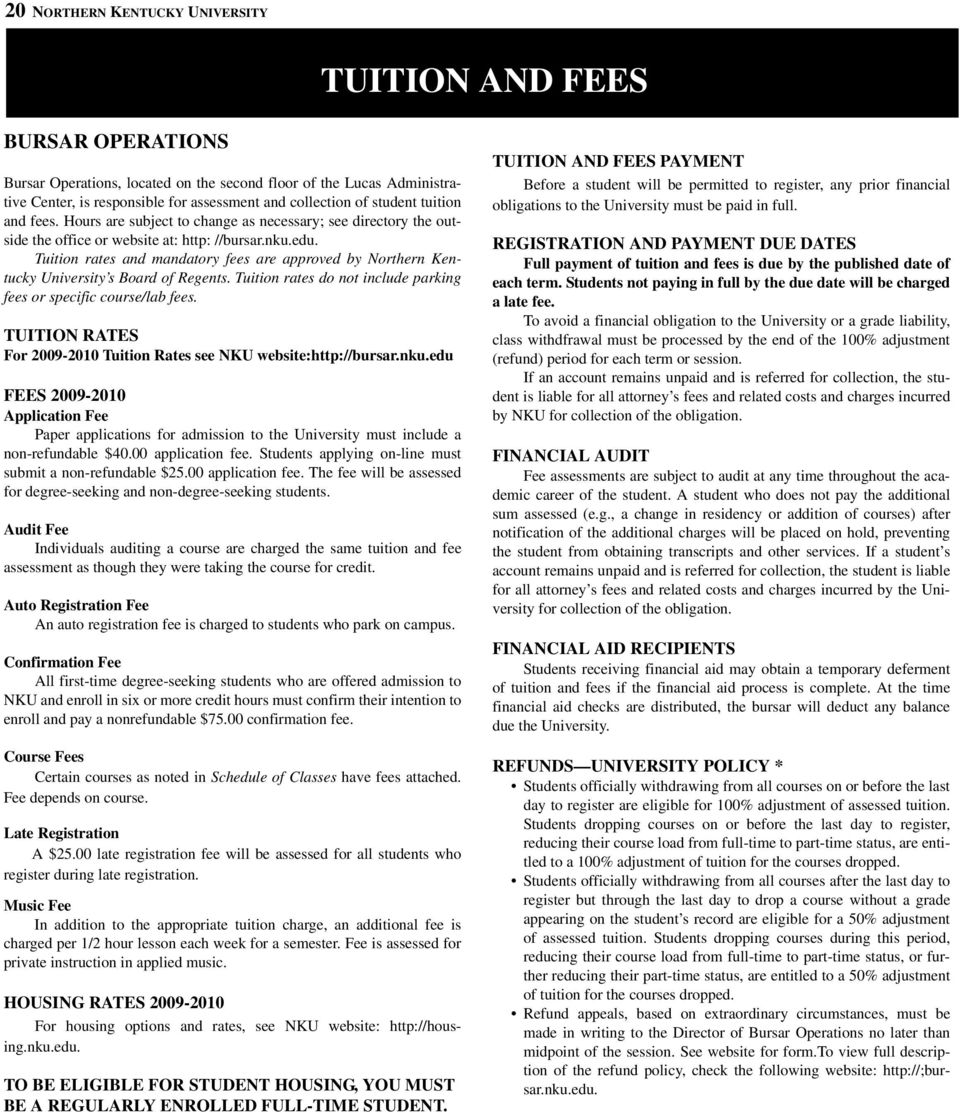
21 ACADEMIC REQUIREMENTS 21 ACADEMIC REQUIREMENTS GENERAL REQUIREMENTS 1. Bachelor s Degree A student working toward a bachelor s degree at Northern Kentucky University must fulfill the following requirements: a. Minimum of 120 semester hours, the last 30 of which must be taken at NKU (i.e., in residence). b. Minimum of 25% of the semester hours required for a degree must be taken at NKU (i.e., in residence) c. Developmental Coursework (if required) must be satisfied. See ADMISSION STATUS on page 16. d. General education requirements (see GENERAL EDUCA- TION REQUIREMENTS: BACHELOR S DEGREE on page 22). Please note that some transfer students may be credited with fulfillment of part or all of these requirements under provisions of the Kentucky General Education Transfer Policy (see KENTUCKY GENERAL EDUCATION TRANSFER POLICY on page 28). e. Major requirements. f. Minor or Area of Concentration (secondary area of study). A student must complete (i) an academic minor in a discipline outside his/her major discipline or in an interdisciplinary program offered by NKU; or (ii) an academic area of concentration consisting of at least 12 upper division semester hours in a discipline that is different from the student s major; or (iii) a second major offered by NKU; or (iv) a minor included within the major where the student is exempted from the minor/area of concentration requirement. Please see appropriate individual program requirements for exempted programs. g. Grade point average (GPA) of at least 2.00 on all work attempted at NKU, at least 2.00 on all college work attempted (excluding developmental coursework), and at least 2.00 in the major and minor unless otherwise specified in the program requirements. h. Forty-five semester hours of successfully completed coursework at the 300-level or above are required of all bachelor s candidates. Even though freshman and sophomore level courses completed at other institutions may have course titles and/or content similar to certain upper division courses at NKU, the Office of the Registrar will make the determination of equivalencies for acceptance toward fulfillment of this requirement. i. During the first 30 college-level hours, a student pursuing a bachelor s degree will demonstrate competency in written and oral communication through successful completion of College Writing (ENG 101) or Honor s English (ENG 151) and Principles of Speech Communication (CMST 101). j. Demonstration of competence in computer use as determined by the student s major department. 2. Associate Degree A student working toward an associate degree at Northern Kentucky University must fulfill the following requirements: a. Minimum of 64 semester hours, the last 20 of which must be taken at NKU. b. Developmental Coursework (if required) must be completed. c. General education requirements (see GENERAL EDUCA- TION REQUIREMENTS: ASSOCIATE DEGREE on page 28. d. Major requirements. e. Grade point average (GPA) of at least 2.00 on all work attempted at NKU, at least 2.00 on all college work attempted (excluding developmental course work), and at least 2.00 in the major unless otherwise specified in program requirements. f. During the first 30 college-level hours, a student pursuing an associate s degree will demonstrate competency in written and oral communication through successful completion of College Writing (ENG 101) or Honor s English (ENG 151) and Principles of Speech Communication (CMST 101). GENERAL EDUCATION PROGRAM RATIONALE At the base of the general education program is a common core of foundation skills in critical thinking, mathematical reasoning, and written and oral communication, which are fundamental to success in further intellectual endeavor. The liberal arts core of the general education program aims to broaden intellectual horizons, deepen understanding of artistic, humanistic, and scientific methods, develop the mental flexibility and openness to change that allow adults to cope with complexity and meet unforeseen challenges in their careers and lives. The diversity core aims to broaden a student s knowledge and understanding of society's diverse social and cultural perspectives that are fundamental for living in a modern society. General education courses seek to further students understanding of the contemporary world, of the ideals and aspirations which have motivated human thought and action throughout history, and of their society s place in a larger human context. At the same time, the general education program encourages students to take personal responsibility for their lives by developing their own sense of values, pursuing their own goals, and developing the habit of lifelong learning, so that they may make valuable individual contributions to the political, social, and cultural enrichment of their society. GENERAL EDUCATION PROGRAM AREAS OF EMPHASIS Writing and Reading Skills: Students will use writing and reading effectively as a means of learning, critical thinking, and communication. Oral Communication: Students will demonstrate effective skills and techniques of public oral communication. Quantitative Skills and Scientific Understanding: Students will apply quantitative skills and scientific understanding toward a range of issues and problems commonly encountered across the curriculum and throughout their lives. Critical Thinking and Problem-Solving Skills: Students will develop a broad range of critical thinking and problem-solving skills in the scientific, mathematical, social, artistic, and personal domains. Collaboration with Others: Students will work effectively and responsibly in collaboration with others. Computer and Information Literacy: Students will employ computer skills that are relevant to their success in college and beyond. Students will gain access to critically evaluate, formulate, and use information effectively and ethically. Diversity: Students will recognize and respect similarities and differences between their own and other peoples cultures, races, genders, abilities, religions, and ethnicities. Historical and Cultural Perspectives: Students will comprehend the variety and interdependence of the world s cultural, economic, political, social, and ecological systems, and their change over time. Values Appreciation: Students will comprehend the variety of situations of ethical import of both a personal and public nature in the contemporary world. Aesthetic Appreciation: Students will demonstrate an understanding and appreciation of the creative process and artistic works. GENERAL EDUCATION REQUIREMENTS: BACHELOR S DEGREE (Please refer to table below.)
22 22 NORTHERN KENTUCKY UNIVERSITY NOTES ON GENERAL EDUCATION REQUIREMENTS a. Enrollment in certain general education courses is limited to students who have met prescribed academic qualifications (such as a level of performance on ACT or placement examinations) and/or who have completed specified prerequisite courses. Students should check their eligibility for particular general education courses by reviewing any PREREQ provisions in the descriptions of those courses. See Course Descriptions beginning on page 178. b. Because certain major programs require specific general education courses, students should review such requirements carefully in planning a general education curriculum. c. Courses listed under more than one general education category may count towards the fulfillment of only one general education category. d. Course Choice Limitation: beyond the Common Core, no more than two courses with the same prefix may be used to satisfy the remaining general education requirements. GENERAL EDUCATION REQUIREMENTS: BACHELOR S DEGREE GENERAL EDUCATION FRAMEWORK AND SEMESTER HOURS NEEDED TO COMPLETE BACHELOR S DEGREE PROGRAM REQUIREMENTS COMMON CORE (9-12 SEMESTER HOURS) WRITTEN COMMUNICATIONS I AND ORAL COMMUNICATIONS 6 semester hours for most students Written Communication I (3 semester hours) Oral Communication (3 semester hours) The first year writing course helps students make the transition to college by guiding them from writing that is based in personal experience and presented to familiar audiences toward writing that is informed by other texts and targeted to wider public audiences. The course instructs students in reading for style as well as content, to identify and assess the effectiveness of a writer s choices. The first year oral communication course provides students with the basic skills and knowledge in oral communication needed for success in college and thereafter as effective citizens and lifelong learners. The course is designed as an introductory course to enhance students critical reading, thinking, interpretation, and speaking skills. Emphasis on techniques, principles, and the practice of oral communication in a variety of formats, including public speaking. MATHEMATICS 3 semester hours for most students In the mathematics course, students will engage in mathematical problemsolving. REQUIREMENTS Students must complete the following written and oral communication requirements within the first 30 hours of college-level (non-remedial) work at NKU. Written - Successfully complete one of the following options: (1) ENG 101 College Writing (2) ENG 151 Honors Freshman Composition (Students successfully completing this course option will satisfy both the Written Communication I and Written Communication II requirement) Oral - Successfully complete CMST 101 Principles of Speech Communications Students not satisfying this requirement within the first 30 hours of collegelevel work at NKU will not be allowed to enroll in any 200-level general education courses. Students must complete the mathematics requirement within the first 45 hours of college-level work at NKU. Successfully complete one course from approved list of general education mathematics courses. Students not satisfying this requirement within the first 45 hours of collegelevel work at NKU will not be allowed to enroll in any 200-level general education courses except courses in the Written Communication II category. WRITTEN COMMUNICATION II 3 semester hours for most students The advanced writing course teaches students to become more independent as writers. This course guides students toward research strategies that are more broad and sophisticated, and stylistic choices that are more varied and creative. Disciplines may require a specific general education course within this category to satisfy major requirements. Students must complete the second level of the written communication requirement before completing the first 60 hours of college-level work at NKU. Student must successfully complete one course from the following: BHS 291W Writing in the Health Sciences, BIO 291W Advanced Writing in Biology, ENG 291 Advanced Writing, EDU 291W Advanced Writing in the Education Profession, ENV 291W Advanced Writing in Environmental Science, HIS 291W Advanced Historical Writing, MUS 291W Advanced Writing in the Music Profession, PSC 291W Advanced Writing in Political Science, CHE 391W Chemical Information and Writing. ENG 151 Honors Freshman Composition also satisfies this requirement. Students not satisfying this requirement within the first 60 hours of collegelevel work at NKU will be required to meet with an academic adviser prior to enrolling in any additional general education courses. LIBERAL ARTS CORE (31-34 SEMESTER HOURS) REQUIREMENTS The emphasis for the Liberal Arts Core is on experiences within the framework of many disciplines. Students will use the following foundational skills: critical thinking, problem solving, and research. Course Choice Limitation: beyond the Common Core, no more than two courses with the same prefix may be used to satisfy the remaining general education requirements. Students must complete the Common Core General Education Requirements prior to enrolling in any upper-level general education courses.
23 ACADEMIC REQUIREMENTS 23 BEHAVIORAL AND SOCIAL SCIENCES 9 semester hours for most students 3 semester hours in behavioral sciences 3 semester hours in social sciences 3 semester hours in an additional behavioral science or social science course Behavioral and Social Science courses address understanding of human behavior, interactions, and environments within established social structures and forums. Successfully complete three courses from approved general education course list for behavioral and social sciences. Students must satisfy the following requirements: Successfully complete one course from approved list of general education behavioral sciences courses; Successfully complete one course from approved list of general education social science courses; and Successfully complete one additional course from approved list of general education social or behavioral sciences courses. GENERAL EDUCATION FRAMEWORK AND SEMESTER HOURS NEEDED TO COMPLETE BACHELOR S DEGREE PROGRAM REQUIREMENTS FINE ARTS 3 semester hours Fine Arts courses include oral, visual, written musical, spatial, or kinesthetic forms of expression and include components that emphasize student creativity, expression, and production. Students will be required to identify and analyze the impact of cultural and historical factors on the creation and reception of artistic works. HISTORY 3 semester hours History is concerned with understanding change and development over space and time. Students in history courses should obtain a fundamental grasp of the major eras, driving forces, formative movements, and ideas in the shaping of nations or regions in a global historical context. HUMANITIES 6 to 8 semester hours for most students Humanities courses are concerned with seeing how we as human beings are connected, and hence the power of literature, history, philosophy, religion, languages, and culture in transcending boundaries and overcoming divisions. Courses taken to fulfill this requirement will be selected from the following content areas: History, Literature, Fine Arts, Philosophy/Religious Studies, or Foreign Languages. LITERATURE 3 semester hours Literature courses are concerned with understanding texts of all forms of written expression. NATURAL SCIENCE 6-8 semester hours for most students The two courses, together, will introduce the methods of inquiry associated with science, the basic principles used to explain natural phenomena and the connection between science and real-world problems. DIVERSITY CORE (6 SEMESTER HOURS) RACE AND GENDER PERSPECTIVE 3 semester hours Explores race, gender, and cultural issues within the framework of a disciplinary perspective. Courses will advance a student s understanding of effective citizenship by addressing issues on a personal, local, national, or global level. Race and Gender courses make race and gender the central focus of the course. The courses concentrate on interrelationships between racial/ethnic groups, on the intersection of race/ethnicity and gender, and on the overlap of race/gender and cultural, political, economic, and social institutions. They incorporate historical understandings and contemporary issues such as the legacy of slavery and the evolution of gender roles, and their impact on current human experiences. The primary focus of the courses is how these issues manifest themselves in the United States. Successfully complete one course from approved general education course list for fine arts. Successfully complete one course from approved general education course list for history. Successfully complete two courses from approved general education course list for humanities with the following exception: only one course from History, Literature, or Fine Arts may be selected to satisfy this requirement. Students taking more than two courses with the same prefix (MUS, HIS, ENG) beyond the common core category will receive credit for only two courses; the additional semester hours will count as electives, not as general education credits. Students who choose Foreign Language courses to fulfill the Humanities category are required to take a two-course sequence. Successfully complete one course from approved general education course list for literature. Successfully complete two courses from approved general education course list for natural sciences; one must be a laboratory course. REQUIREMENTS Course Choice Limitation: beyond the Common Core, no more than two courses with the same prefix may be used to satisfy the remaining general education requirements. Successfully complete one course from approved general education course list for the race and gender perspective (subject to course choice limitation indicated above).
24 24 NORTHERN KENTUCKY UNIVERSITY NON-WESTERN PERSPECTIVE 3 semester hours Explores economic, social/cultural, political, linguistic, ecological, race, gender, or religious issues within the framework of a disciplinary perspective. The major criterion is the type of culture, not the geographic location. Cultures that are significantly different from European and North American cultures fulfill the definition. Courses will advance a student s understanding of effective world citizenship by addressing issues on a personal, local, national, or global level. Course Choice Limitation: beyond the Common Core, no more than two courses with the same prefix may be used to satisfy the remaining general education requirements. Successfully complete one course from approved general education list for the non-western perspective (subject to course choice limitation indicated above). MINIMUM NUMBER OF SEMESTER HOURS REQUIRED TO COMPLETE GENERAL EDUCATION PROGRAM REQUIREMENTS FOR BACHELOR S DEGREE TOTALS 46 GENERAL EDUCATION PROGRAM To satisfy the General Education Program requirements, students are limited to the following Course Choice Limitation: beyond the Common Core, no more than two courses with the same prefix may be used to satisfy the remaining general education requirements. For example: 1. a student taking a TAR course to satisfy the fine arts general education requirement and a TAR course to satisfy the Liberal Arts Core humanities requirement may not take a TAR course to satisfy the Diversity Core requirement; 2. a student taking a TAR course to satisfy the fine arts general education requirement and a TAR course to satisfy one Liberal Arts Core humanities requirement, may not take a TAR course to satisfy the second humanities requirement. Students will receive elective credit for the additional courses with the same prefix. The course will not count toward satisfying general education requirements. LIST OF APPROVED GENERAL EDUCATION COURSES BY CATEGORY a. Behavioral Sciences Anthropology ANT 100 Cultural Anthropology ANT 110 Introduction to Archaeology ANT 201 World Cultures ANT 230 North American Indians ANT 231 Modern American Indians ANT 240 Peoples of Africa ANT 245 Peoples of Latin America ANT 270 Native Australia and Oceania ANT 273 Race, Gender, and Culture ANT 294 Topics: Anthropology ANT 310 African Arts Psychology PSY 100 and PSY 100H Introduction to Psychology PSY 200 Psychology of Personal Adjustment PSY 201 Psychology of Race and Gender PSY 205 Psychology of Human Sexuality PSY 206 Human Sexuality Forum PSY 220 Lifespan Development Sociology SOC 100 Introductory Sociology SOC 205 Current Social Issues SOC 240 Peoples of Africa SOC 245 Latin American Societies b. Fine Arts Art ART 100 Art Appreciation ARTH 101 Survey of Western Art I ARTH 102 Survey of Western Art II ARTH 103 Survey of Western Art III ARTH 104 Survey of Asian Art Music MUS 100 Music Appreciation MUS 106 Music of World Cultures MUS 107 Survey of African American Music MUS 108 History of Rock and Roll MUS 109 History of American Popular Music MUS 110 Appreciation of Jazz MUS 230 History of Music: Antiquity through Baroque MUS 231 History of Music: Classical to the Present Theatre TAR 100 Theatre Appreciation TAR 111 Creative Expression Through Acting TAR 165 Comparative Arts c. History History HIS 100 History of Europe to 1713 HIS 101 History of Europe, 1713 to the Present HIS 102 History of the United States through 1877 HIS 103 History of the United States since 1877 HIS 106 History of African Americans to1877 HIS 107 History of African Americans since 1877 HIS 108 World History to 1500 HIS 109 World History since 1500 HIS 194 Honors Seminar Philosophy PHI 180 History of Classical and Medieval Philosophy PHI 185 History of Modern and Contemporary Philosophy Religious Studies REL 181 Survey of the Hebrew Bible REL 182 Survey of the New Testament REL 185 Survey of Christianity REL 186 Introduction to Judaism d. Humanities Foreign Language Arabic ARI 101 Elementary Arabic I ARI 102 Elementary Arabic II ARI 201 Intermediate Arabic I ARI 202 Intermediate Arabic II Chinese CHI 101 Elementary Chinese I CHI 102 Elementary Chinese II CHI 201 Intermediate Chinese I CHI 202 Intermediate Chinese II French FRE 101 Elementary French I FRE 102 Elementary French II FRE 201 Intermediate French I FRE 202 Intermediate French II FRE 320 Survey of French Literature German GER 101 Elementary German I
25 GER 102 Elementary German II GER 201 Intermediate German I GER 202 Intermediate German II GER 320 Survey of German Literature Italian ITA 101 Elementary Italian I ITA 102 Elementary Italian II ITA 201 Intermediate Italian I ITA 202 Intermediate Italian II Japanese JPN 101 Elementary Japanese I JPN 102 Elementary Japanese II JPN 201 Intermediate Japanese I JPN 202 Intermediate Japanese II Latin LAT 101 Elementary Latin I LAT 102 Elementary Latin II LAT 201 Intermediate Latin I LAT 202 Intermediate Latin II Russian RUS 101 Elementary Russian I RUS 102 Elementary Russian II RUS 201 Intermediate Russian I RUS 202 Intermediate Russian II Spanish SPI 101 Elementary Spanish I SPI 102 Elementary Spanish II SPI 201 Intermediate Spanish I SPI 202 Intermediate Spanish II SPI 320 Surveys of Peninsular Spanish Literature SPI 321 Survey of Spanish American Literature History HIS 100 History of Europe to 1713 HIS 101 History of Europe, 1713 to the Present HIS 102 History of the United States through 1877 HIS 103 History of the United States since 1877 HIS 106 History of African Americans to1877 HIS 107 History of African Americans since 1877 HIS 108 World History to 1500 HIS 109 World History since 1500 HIS 194 Honors Seminar Literature ENG 200 Introduction to Literature ENG 201 Ideas in Literature ENG 202 Survey of British Literature I ENG 203 Survey of British Literature II ENG 206 Western World Literature I ENG 207 Western World Literature II ENG 208 Survey of American Literature I ENG 209 Survey of American Literature II ENG 211 Survey of Women s Literature I ENG 212 Survey of Women s Literature II ENG 217 African American Literature to 1940 ENG 218 African American Literature from 1940-present ENG 265 Literature and the Human Experience ENG 266 Folklore and Literature ENG 300 American Women Poets ENG 301 American Novel ENG 302 Literature and Film ENG 303 British Novel ENG 305 American Women Writers ENG 306 Multicultural American Literature ENG 308 Shakespeare I ENG 309 Shakespeare II ENG 311 Tragedy ENG 312 Comedy ACADEMIC REQUIREMENTS 25 ENG 314 Modern European Literature in Translation ENG 315 The Bible as Literature ENG 318 The Short Story ENG 320 Satire ENG 322 Literature and Sexuality ENG 324 Holocaust Literature Music MUS 100 Music Appreciation MUS 106 Music of World Cultures MUS 107 Survey of African American Music MUS 108 History of Rock and Roll MUS 109 History of American Popular Music MUS 110 Appreciation of Jazz MUS 230 History of Music: Antiquity through Baroque MUS 231 History of Music: Classical to the Present Philosophy PHI 150 Introduction to Philosophy PHI 150 Honors Introduction to Philosophy PHI 155 Introduction to Ethics PHI 160 World Religions PHI 165 Introduction to Logic PHI 170 Philosophy and Sexuality PHI 180 History of Classical and Medieval Philosophy PHI 185 History of Modern and Contemporary Philosophy PHI 201 Ideas in Philosophy PHI 210 Ethics in Information Technology PHI 220 Health Care Ethics PHI 240 Philosophy and the Arts PHI 250 Eastern Philosophy PHI 330 Philosophy and Law PHI 350 Philosophy of Religion Political Science PSC 110 History of Western Political Thought PSC 111 History of American Political Thought Religious Studies REL 181 Survey of the Hebrew Bible REL 182 Survey of the New Testament REL 185 Survey of Christianity REL 186 Introduction to Judaism REL 201 Ideas in Religious Studies REL 370 Religion and Science Theatre TAR 100 Theatre Appreciation TAR 111 Creative Expression Through Acting TAR 165 Comparative Arts Women s and Gender Studies WGS 211 Survey of Women s Literature WGS 212 Survey of Women s Literature II e. Literature Literature ENG 200 Introduction to Literature ENG 201 Ideas in Literature ENG 202 Survey of British Literature I ENG 203 Survey of British Literature II ENG 206 Western World Literature I ENG 207 Western World Literature II ENG 208 Survey of American Literature I ENG 209 Survey of American Literature II ENG 211 Survey of Women s Literature I ENG 212 Survey of Women s Literature II ENG 217 African American Literature to 1940 ENG 218 African American Literature 1940 to present ENG 265 Literature and the Human Experience ENG 266 Folklore and Literature ENG 300 American Women Poets
26 26 NORTHERN KENTUCKY UNIVERSITY ENG 301 American Novel ENG 302 Literature and Film ENG 303 British Novel ENG 305 American Women Writers ENG 306 Multicultural American Literature ENG 308 Shakespeare I ENG 309 Shakespeare II ENG 311 Tragedy ENG 312 Comedy ENG 314 Modern European Literature in Translation ENG 315 The Bible as Literature ENG 318 The Short Story ENG 320 Satire ENG 322 Literature and Sexuality ENG 324 Holocaust Literature French FRE 320 Survey of French Literature German GER 320 Survey of German Literature Spanish SPI 320 Surveys of Peninsular Spanish Literature SPI 321 Survey of Spanish American Literature f. Mathematics MAT 110 Introductory Probability MAT 112 Calculus for Business Applications MAT 114 Finite Mathematics MAT 115 Mathematics for Liberal Arts MAT 115H Mathematics for Liberal Arts MAT 128 Calculus A MAT 129 Calculus I MAT 185 Introductory Discrete Mathematics MAT 227 Calculus B STA 110 Introductory Probability STA 113 Introduction to Probability and Statistics STA 205 Introduction to Statistical Methods STA 212 Statistics for Business Applications g. Natural Sciences Laboratory courses may be paired with a lecture, the two to be taken concurrently (e.g., BIO 150 and 150L), or the laboratory is included in the course (e.g., PHY 211). Astronomy AST 110 Solar System Astronomy with Laboratory AST 115 Stars, Galaxies and Cosmology with Laboratory Biology BIO 120 General Biology Laboratory BIO 120L General Biology with Laboratory BIO 121 Human Systems with Lab BIO 121L Human Systems Laboratory BIO 123 Human Ecology BIO 125 Biological Perspective of Wellness BIO 126 Human Nutrition BIO 150, 150L Introduction to Biology I BIO 151, 151L Introduction to Biology II BIO 160 Plants and Human Culture BIO 208, 208L Human Anatomy and Physiology I BIO 209, 209L Human Anatomy and Physiology II BIO 220 Biological Evolution Chemistry CHE 105, Discovering Chemistry with Laboratory CHE 112 Chemistry and Society with Laboratory CHE 112L Chemistry and Society Laboratory CHE 115 Physiological Chemistry with Laboratory CHE 115L Physiological Chemistry Laboratory CHE 120, General Chemistry I with Laboratory CHE 120L General Chemistry I Laboratory CHE 121 General Chemistry II CHE 121L General Chemistry II Laboratory Engineering Technology EGT 110 Introduction to Engineering/Technology Environmental Science ENV 110 Introduction to Environmental Science ENV 220 Protecting Water Resources ENV 220L Protecting Water Resources Laboratory Geology GLY 110 The Face of the Earth w/laboratory GLY 120 This Dangerous Earth GLY 120L This Dangerous Earth Laboratory GLY 130 Dinosaurs GLY 150 Introduction to Field paleontology GLY 220 History of the Earth GLY 225 Prehistoric Life GLY 230 Geology of National Parks GLY 240 Geology of Natural Resources GLY 250 Geology of Northern Kentucky with Lab Integrated Sciences SCI 110 Integrative Natural Science I with Lab SCI 111 Integrative Natural Science II with Lab Physics PHY 101 Einstein 101 PHY 110 Introduction to Physics w/lab PHY 115 Physics of Music and Sound with Lab PHY 160 Introduction to Meteorology with Laboratory PHY 211 General Physics with Laboratory I PHY 213 General Physics with Laboratory II PHY 220 University Physics with Laboratory I PHY 222 University Physics with Laboratory II h. Non-Western Perspective Black Studies BLS 100 Introduction to Black Studies (will not additionally satisfy Race/Gender Perspective) Anthropology ANT 100 Cultural Anthropology ANT 201 World Cultures ANT 230 North American Indians ANT 231 Modern American Indians ANT 240 Peoples of Africa ANT 245 Peoples of Latin America ANT 270 Native Australia and Oceania ANT 310 African Arts Arabic ARI 101 Elementary Arabic I ARI 102 Elementary Arabic II ARI 201 Intermediate Arabic I ARI 202 Intermediate Arabic II Art ARTH 104 Survey of Asian Art Biology BIO 235 Costa Rican Natural History Foreign Language Chinese CHI 101 Elementary Chinese I CHI 102 Elementary Chinese II CHI 201 Intermediate Chinese I CHI 202 Intermediate Chinese II Japanese JPN 101 Elementary Japanese I JPN 102 Elementary Japanese II JPN 201 Intermediate Japanese I JPN 202 Intermediate Japanese II
27 Geography GEO 101 World Regional Geography GEO 103 Geography of the Third World Literature ENG 216 Studies in Non-Western Literature Music MUS 106 Music of World Cultures Philosophy PHI 160 World Religions PHI 250 Eastern Philosophy Political Science PSC 102 Comparative Politics PSC 103 International Politics Popular Culture Studies POP 345 Japanese Popular Culture Russian RUS 201 Intermediate Russian I RUS 202 Intermediate Russian II Sociology SOC 240 Peoples of Africa SOC 245 Latin American Societies i. Oral Communications CMST 101 Public Speaking CMST 101H Public Speaking j. Race/Gender Perspective Black Studies BLS 100 Introduction to Black Studies (will not additionally satisfy Non-Western Perspective) Anthropology ANT 273 Race, Gender, and Culture Criminal Justice JUS 231 Race, Gender, and the Law Education EDU 316 Racism and Sexism in Educational Institutions Electronic Media Broadcasting EMB 105 Race, Gender, and the Mass Media Geography GEO 107 Diversity Mapped History HIS 431 Historical Themes in African-American History HIS 444 History of Women in the United States to 1900 HIS 445 History of Women in the United States since 1900 Literature ENG 217 African American Literature to 1940 ENG 218 African American Literature from 1940-present ENG 306 Multicultural American Literature ENG 322 Literature and Sexuality Music MUS 107 Survey of African-American Music Philosophy PHI 322 Philosophy of Race PHI 324 Africana Philosophy Political Science PSC 215 Race, Gender, and Politics Psychology PSY 201 Psychology of Race and Gender Religious Studies REL 325 African-American Religious Experiences in America Social Work SWK 106 ACADEMIC REQUIREMENTS 27 Sociology SOC 110 Introduction to Race and Gender SOC 210 Analysis of Racism, Sexism in the U.S. Theatre TAR 102 Survey of Race and Gender in Dramatic Literature Women s and Gender Studies WGS 150 Introduction to Women s Studies WGS 150H Introduction to Women s Studies WGS 250 Introduction to Gender Studies WGS 310 Women, Wages, and Work WGS 444 History of Women in the United States to 1900 WGS 445 History of Women in the United States since 1900 k. Social Sciences Black Studies BLS 100 Introduction to Black Studies Economics ECO 200 Principles of Macroeconomics ECO 201 Principles of Microeconomics ECO 215 Contemporary Economic Issues Electronic Media Broadcasting EMB 100 Media Literacy EMB 105 Race, Gender, and the Mass Media Geography GEO 100 Elements of Geography GEO 101 World Regional Geography GEO 101H World Regional Geography GEO 103 Geography of the Third World GEO 107 Diversity Mapped Journalism JOU 100 Media Literacy Justice Studies JUS 101 Introduction to Criminal Justice JUS 101H Introduction to Criminal Justice Political Science PSC 100 American Politics PSC 100H Honors American Politics PSC 101 State and Local Politics PSC 102 Comparative Politics PSC 103 International Politics PSC 110 History of Western Political Thought PSC 111 History of American Political Though PSC 215 Race, Gender, and Politics Popular Culture Studies POP 205 Introduction to Popular Culture POP 205H Introduction to Popular Culture Social Work SWK 203 Social Welfare in Contemporary Society l. Written Communications ART 291W Writing for Artists CHE 391W Chemical Information and Writing ENG 101 College Writing ENG 151 Honors Freshmen Composition ENG 291 Advanced Writing BIO 291 W Advanced Writing in Biology BHS 291W Writing in the Health Science EDU 291W Advanced Writing in the Education Profession ENV 291W Advanced Writing in Environmental Science HIS 291 W Advanced Historical Writing MUS 291W Advanced Writing in the Music Profession PSC 291W Advanced Writing in Political Science PSY 391W Writing in Psychology
28 28 NORTHERN KENTUCKY UNIVERSITY GENERAL EDUCATION REQUIREMENTS: ASSOCIATE DEGREE GENERAL EDUCATION FRAMEWORK AND SEMESTER HOURS NEEDED TO COMPLETE ASSOCIATE S DEGREE PROGRAM REQUIREMENTS COMMON CORE (9 SEMESTER HOURS) WRITTEN COMMUNICATIONS I AND ORAL COMMUNICATIONS 6 semester hours for most students Written Communication I (3 semester hours) Oral Communication (3 semester hours) The first year writing course helps students make the transition to college by guiding them from writing that is based in personal experience and presented to familiar audiences, toward writing that is informed by other texts and targeted to wider public audiences. The course instructs students in reading for style as well as content, to identify and assess the effectiveness of a writer s choices. The first year oral communication course provides students the basic skills and knowledge in oral communication needed for success in college and thereafter as effective citizens and lifelong learners. Designed as an introductory course to enhance student s critical reading, thinking, interpretation, and speaking skills. Emphasis on techniques, principles, and the practice of oral communication in a variety of formats, including public speaking. MATHEMATICS 3 semester hours for most students In the mathematics course, students will engage in mathematical problem solving. LIBERAL ARTS CORE (9-10 SEMESTER HOURS) REQUIREMENTS Students must complete the following written and oral communication requirements within the first 30 hours of college-level work at NKU. Written - successfully complete the following: (1) ENG 101 College Writing Oral - Successfully complete CMST 101 Principles of Speech Communications Students must complete the mathematics requirement within the first 45 hours of college-level work at NKU. Successfully complete one course from approved general education course list for mathematics. REQUIREMENTS The emphasis for the Liberal Arts Core is on experiences within the framework of many disciplines. Students will use the following foundational skills: critical thinking, problem solving, and research. Course Choice Limitation: beyond the Common Core, no more than two courses with the same prefix may be used to satisfy the remaining general education requirements. BEHAVIORAL AND SOCIAL SCIENCES 3 semester hours for most students Behavioral and Social Science courses address understanding of human behavior, interactions, and environments within established social structures and forums. HUMANITIES 3 semester hours for most students Humanities courses are concerned with seeing how we as human beings are connected, one to the other, and hence the power of literature, arts, history, philosophy, religion, languages, and culture in transcending boundaries and overcoming divisions. Courses taken to fulfill this requirement will be selected from the following content areas: History, Literature, Fine Arts, Philosophy/Religious Studies or Foreign Languages. NATURAL SCIENCE 3-4 semester hours for most students Will introduce the methods of inquiry associated with science, the basic principles used to explain natural phenomena and the connection between science and real-world problems. Successfully complete one course from approved general education course list for behavioral and social sciences. Successfully complete one course from approved general education course list for humanities. Successfully complete one course from approved general education course list for natural sciences with or without laboratory component. See specific degree requirements for additional information on requirements. MINIMUM NUMBER OF SEMESTER HOURS REQUIRED TO COMPLETE GENERAL EDUCATION PROGRAM REQUIREMENTS FOR ASSOCIATE S DEGREE TOTALS 18 KENTUCKY GENERAL EDUCATION TRANSFER POLICY For students who reside in Kentucky, there is a statewide General Education Transfer Policy. The policy defines how public colleges and universities accept each other s general education requirements for transfer students. Courses that meet General Education Transfer Policy requirements are identified by each institution as Category, Core, or Fully Certified. The Kentucky Transfer Policy defines two transfer components: a General Education Component and a Specialty Component. General Education Component (48 semester hour block) The 48 semester hour General Education Component provides a broad background of general education courses. The component is comprised of a 33 semester hour core component and a 15 semester hour block of unspecified general education courses. See following for breakdown on components.
29 General Education Core Transfer Component (33 semester hours) The core component includes the following five categories: 1. Communication (9 semester hours). Written Communication NKU Written Composition I (see WRITTEN COMMUNICATIONS I AND ORAL COMMUNI- CATIONS on page 22). Oral Communication - NKU Oral Communication (see WRIT- TEN COMMUNICATIONS I AND ORAL COMMUNICA- TION on page 19). 2. Humanities (6 semester hours) The disciplines represented in this category must be different from those in Behavioral/Social Sciences. Courses may be chosen from the following: Fine Arts, Literature, Foreign Language, History, or Philosophy/Religion courses in the List of Approved General Education Courses (see HUMANITIES on page 23). 3. Behavioral/Social Sciences (9 semester hours). At least two disciplines must be represented and must be different from those in Humanities. Courses may be chosen from the List of Approved General Education Courses for Behavioral/Social Sciences (see BEHAVIORAL AND SOCIAL SCIENCES on page 23). 4. Natural Sciences (6 semester hours) Courses may be chosen from the List of Approved General Education Courses for Natural Sciences (see NATURAL SCIENCE on page 23). 5. Mathematics (3 semester hours) Courses may be chosen from the List of Approved General Education Courses for Mathematics (see MATHEMATICS on page 22). General Education Transfer Block (15 semester hours) Kentucky transfer students may transfer an unspecified 15 semester hour block of general education courses to satisfy this component. Specialty Component (12 semester hour block) The Specialty Component is comprised of 12 semester hours of discipline specific credits. The Specialty Components have not been completed to date. Check with the NKU Transfer Office for more information. General Education Transfer Certifications Fully General Education Certified A student transferring from a Kentucky public institution will be accepted at NKU as Fully General Education Certified when he/she has completed a general education program at another institution or combination of institutions that includes a 48 semester hour block of general education courses (the 33-semester hour General Education Core Transfer Component and the 15-semester hour General Education Transfer Block). The transcript from sending institution must indicate that the student is Fully General Education Certified to guarantee all credits will be accepted at NKU. Additionally, students completing an approved Associate of Arts or Associate of Science Transfer degree (must include a minimum of 48 semester hours of general education courses) must have a cumulative grade point average of 2.0 or higher to qualify for Kentucky Transfer Policy. Core Component Certified A student transferring from a Kentucky institution will be accepted at NKU as Core Component Certified when he/she completes the 33 semester hour Core Transfer Component. The student must also have a cumulative grade point average of 2.0 or higher and will need to fulfill the remaining NKU general education requirements. The student s transcript must indicate that the student is core certified. ACADEMIC REQUIREMENTS 29 Students completing the core certified component must complete 15 hours of additional general education courses. It is recommended that students complete the history, literature, fine arts, and diversity categories to satisfy general education requirements. Category Certified A student transferring from a Kentucky institution will be accepted at NKU as Category Certified when he/she has completed one or more of the five categories in the Core Transfer Component. The student must hold a cumulative grade point average of 2.0 or higher and will need to fulfill the remaining general education requirements.the student s transcript must indicate each category that the student has completed and be marked as category satisfied. For more information regarding NKU transfer policies, see transfer.nku.edu. Bachelor s Program Specialty Transfer Component Policy The Bachelor s Program Transfer Specialty Component policy allows for the ease of transfer of course work within a student s major and discipline. Students who are General Education Certified under the Kentucky General Education Transfer policy (completed all categories, and have at least 48 semester hours in general education) are eligible for evaluation of credit within bachelor s program specialty transfer frameworks (not completed to date). The Transfer Frameworks will identify at least 12 semester hours in a specific discipline that will transfer as a block to satisfy major requirements. Students who are planning to transfer to another public Kentucky college or university should work closely with their advisor, as well as with the institution to which they plan to transfer, in order to ensure the completion of all necessary requirements. UNDERGRADUATES TAKING GRADUATE COURSES AT NKU In general, no undergraduate student may enroll in a 600 level or above graduate course. The Office of Graduate Programs will notify the student who has done so at the beginning of the semester so the student can drop the course. Any student who does not drop the course will be administratively dropped from the course by the Office of Graduate Programs. EXCEPTION: If you are an undergraduate student who has no more than six credits remaining to complete a bachelor s degree, you may be dually enrolled as a graduate student, provided you have the approval of your undergraduate academic advisor and the relevant graduate program director. Students wishing to do so, must submit a graduate application and meet all admission requirements to the program with the exception of the earned degree. As a dually enrolled student, you may take a maximum of twelve credits, graduate and undergraduate combined, in a single semester. Graduate credit for these courses will not be granted unless all work for the undergraduate degree is completed in the semester in which student is enrolled for graduate credit. Credits earned in a graduate course cannot apply toward both a bachelor s and a graduate degree. GRADUATION REQUIREMENTS CHECKLIST 1. Graduation a. When a student anticipates successful completion of degree requirements, he/she must file an Application for Degree Candidacy in the Office of the Registrar Service Center. The approved Program Certification Form for each undergraduate applicant must be on file in the Office of the Registrar prior to, or submitted with the filing of the Application for Degree Candidacy. The dates by which the Application for Degree Candidacy must be in the Office of the Registrar Service Center are: for fall graduation 8 April for spring graduation 8 October for summer graduation 8 April b. The student pursuing a bachelor s degree who has successfully completed 54 semester hours will file a Program Certification Form for the major and the same form for either an area of con-
30 30 NORTHERN KENTUCKY UNIVERSITY centration or a minor. A student in an associate degree program must file a Program Certification Form after completion of 30 semester hours. The certification form must be completed no later than during the semester preceding the one in which the student plans to graduate. The student will secure the form from the Office of the Registrar Service Center or website and will follow instructions given at that time. In some cases, students may be referred to their academic programs to obtain necessary forms. c. The student will earn at least 120 semester hours for a bachelor s degree and at least 60 semester hours for an associate degree. Also, all grades of I and K must be cleared before graduation requirements are complete. d. The student must fulfill residency requirements: the last 30 semester hours of a bachelor s degree and the last 20 semester hours of an associate degree must be taken at NKU. Also, a minimum of 25% of the semester hours required for a bachelor s degree must be taken at NKU. e. Bachelor s degree seeking students must complete 45 semester hours of course work at the 300-level or above. f. Students must earn at least a 2.00 grade point average (GPA) on all work attempted at NKU, at least 2.00 on all college work attempted (excluding developmental course work) and at least 2.00 in the major-unless otherwise specified in the program requirements. g. In addition to the requirements for the major, bachelor s degree seeking students must complete the requirements for a minor or area of concentration (unless the minor/area of concentration is embedded within the major requirements). See minor/area of concentration. Students completing an associate degree do not need to complete a minor or area of concentration. h. The student will complete general education requirements appropriate for the degree being sought (see Catalog Applicability elsewhere in this catalog). i. All grades of I and K must be cleared before graduation requirements are satisfied. j. The student must be recommended by the faculty. k. The student will satisfy all financial and administrative obligations to the University. l. As part of Northern Kentucky University s on-going efforts to improve its program offerings, a student will be required to participate in assessment activities (see Senior Assessment section). In addition to the senior assessment requirements, a student may be required to complete assessment requirements for a major/ minor. 2. Graduation with Honors a. Bachelor s Degree Cum Laude Magna Cum Laude Summa Cum Laude In order for a student to graduate with bachelor s degree honors, he/she must earn a minimum of 60 semester hours in residence (courses at NKU). b. Associate Degree With Distinction With High Distinction In order for a student to graduate with associate degree honors, he/she must earn a minimum of 30 semester hours in residence (courses at NKU). c. To graduate with honors, a student must have an overall GPA and an NKU GPA of at least The Honors designation awarded will be based on the NKU GPA. d. Honors recognition appears in the Commencement Program based upon the grade point averages (excluding developmental course work) at the conclusion of the previous semester. Honors will appear on the transcript based upon the grade point averages (excluding developmental coursework) at the time of graduation. 3. Minor or Area of Concentration a. A student who wishes to have a minor certified must meet requirements described in the student s catalog of applicability. b. Students earning associate degrees cannot earn a minor; only students at the bachelor s level may earn a minor. c. The minimum number of semester hours required for a minor varies among departments and can be found in individual department descriptions. d. A GPA of at least 2.00 is required in a minor unless otherwise specified in the program requirements. e. An area of concentration consists of at least 12 upper division hours in a discipline that is different from the student s major. 4. Senior Assessment a. As a requirement for graduation with a bachelor s degree, all students who have completed at least 90 semester hours will be required to participate in senior assessment. It is anticipated that most students should satisfy this requirement prior to completing 110 semester hours. b. After completing at least 90 semester hours, students are to meet the senior assessment requirement in the following semester. If a student does not participate in the assessment that semester, then the student is in assessment default. c. A student in default will not be able to receive her or his diploma until the default is remedied. A student can remedy assessment default by participating in the appropriate assessment. d. No student will be expected or required to participate in more than one form of general education assessment. However, students may be required to participate in a separate assessment of their major field. e. See link for senior survey at seniorsurvey. 5. Second Bachelor s Degree a. A student wishing to receive two bachelor s degrees may meet requirements for them simultaneously or successively. b. Requirements for the second major will be those listed under the student s degree catalog. c. A student wishing to receive two degrees on the same date must 1a.complete requirements for both degrees. 2. earn a minimum of 30 semester hours in residence (courses at NKU) beyond requirements for the first degree. 3c. earn a minimum of 60 semester hours in residence at NKU. d. A student wishing to earn a second bachelor s degree after receiving the first must: 1. complete requirements for the second degree; 2. earn at least 12 semester hours in residence (courses at NKU) in addition to those he/she may already have in the major field offering the second degree; 3. earn a minimum of 30 semester hours in residence (courses at NKU) beyond requirements for the first degree; 4. earn a minimum of 64 semester hours in residence (courses at NKU) beyond the requirement for the first degree to be considered for graduation with honors. 6. Second Associate Degree a. A student who has not earned a bachelor s degree and wishes to receive two associate degrees may meet requirements for them simultaneously or successively. b. A student wishing to receive two associate degrees on the same date must 1. complete requirements for both degrees;
31 2. earn a minimum of 20 semester hours in residence (courses at NKU) beyond those required for the first degree; 3. earn a minimum of 40 semester hours in residence at NKU. c. A student who has already earned a bachelor s degree and wishes to receive an associate degree must 1. complete requirements for the degree; 2. earn a minimum of 20 semester hours in residence (courses at NKU) beyond requirements for the first degree; 3. earn at least 12 semester hours in residence (courses at NKU) in addition to courses the student completed in the major; 4. earn a minimum of 32 semester hours in residence (courses at NKU) to be considered for graduation with honors. 7. Second Major a. A student who wishes to be certified in two or more major programs must meet requirements for each simultaneously. b. The degree conferred will be based upon the student s first major; both majors will be indicated on the student s academic transcript. NON-TRADITIONAL CREDIT Credit by Examination 1. Advanced Standing Examination Upon recommendation by the appropriate chairperson and with the approval of the appropriate dean, a currently enrolled student may receive advanced standing credit by passing an examination in a subject in which she/he has demonstrated exceptional ability. A student may obtain an application for the advanced standing examination from the Office of the Registrar, AC 301. He/she must follow the procedures printed on the application. There is an examination fee for each course in which a student takes an advanced standing examination. These examinations may be taken for a letter grade or pass/fail as determined by the department chairperson prior to testing. If a failing grade is earned, the course will not be posted to the student s transcript. The student s NKU transcript will indicate the class as an advanced standing examination. 2. College Level Examination Program (CLEP) CLEP, a national program of credit by examination administered by the College Entrance Examination Board, was established at NKU to provide individuals with an opportunity to earn credit by examination. CLEP tests may be taken at NKU approximately the 3rd week of the month (except December and July) in the testing office. NKU students may earn up to 45 semester hours through (a) General and/or (b) Subject examinations. The University is a recognized CLEP Testing Center, and testing applicable to other institutions is also conducted. A grade of pass (P) will be assigned for CLEP courses successfully completed. a. General Examinations Five tests are within the General Examination portion of CLEP: English composition, humanities, natural science, social science/ history, and mathematics. After submission of an official score report, NKU will award credit in three areas: humanities, natural science, and social science/history; up to 18 semester hours may be earned from the exams in each area. Six semester hours will be awarded for a minimum score of 50. Credit earned through these examinations is elective credit and does not satisfy general education requirements. b. Subject Examinations The following subject examinations equated below with specific courses offered at NKU are accepted by the University. NKU requires submission of an official score report. (The University reserves the right to revise these listings in accord with recommendations from the Educational Testing Service. Check the ACADEMIC REQUIREMENTS 31 Testing Website at for updates.) EXAMINATION MINIMUM SCORE CLEP credit is available in French, German, and Spanish. Policies on CLEP vary depending upon the academic area; students are advised to consult their adviser prior to taking CLEP examinations. The Health, Counseling, and Testing Services administers CLEP and provides data about the program. With approval of the appropriate dean, a student at NKU may take the CLEP subject examination instead of repeating a course in which he/she received a D or F, an option that may be exercised up to four times 3. Advanced Placement (AP) SEMESTER HOURS EQUIVALENT NKU COURSES American History I 50 3 HIS 102 American History II 50 3 HIS 103 American Literature 50 6 ENG Analyzing and Interpreting Literature English Composition with Essay Calculus with Elementary Functions 51 3 ENG ENG MAT 129 MAT 229 English Literature 50 6 ENG General Biology (No lab credit awarded) 50 6 BIO Here s to Your Health 50 3 BIO 125 General Chemistry (No lab credit awarded) 50 6 CHE Introductory Business Law 50 3 BUS 230 Introductory Psychology 50 3 PSY 100 Financial Accounting 50 3 ACC 200 Principles of Management 50 3 MGT 205 Principles of Macroeconomics Principles of Microeconomics 50 3 ECO ECO 201 Principles of Marketing 50 3 MKT 305 Western Civilization I 50 3 HIS 100 Western Civilization II 50 3 HIS 101 High school students may receive credit by earning the required score on an approved AP examination. An appropriate number of semester hours will be awarded, and a grade of pass (P) will be assigned for successful completion of approved courses. Information concerning the AP program may be obtained from high school counselors. Official AP scores should be sent to the University s Office of the Registrar. Additional information on regulations and approved NKU programs for AP credit may be obtained from the Office of the Registrar. Examination scores range from 1-5. Subject areas in which a student may receive credit from Northern Kentucky University by earning acceptable scores are listed below.
32 32 NORTHERN KENTUCKY UNIVERSITY Credit for those areas marked by an asterisk must be coordinated with the chair of the department concerned. DISCIPLINE ACCEPTABLE SCORE COURSE SEMESTER HOURS DISCIPLINE ACCEPTABLE SCORE Art, General 3 4 or more COURSE ART 100 Art Appreciation ART 123 Foundations Art, Drawing 4 or more ARTD 210 Drawing I History of Art 4, 5 ARTH 101 Survey ARTH 102 Survey II Biological Sciences Biological Sciences 3 BIO 120 General Biology 4 or more BIO 150, 150L Intro. to Biology I or BIO 120 General Biology SEMESTER HOURS Calculus AB* 3 MAT Calculus AB* 4 or 5 MAT Calculus BC* 3 MAT Calculus BC* 4 or 5 MAT 129 and MAT 229 Chemistry 3 CHE 120, 120L General Chemistry European History 3 or more HIS 100 History of Europe to 1713 HIS 101 History of Europe, 1713 to the Present French 3 or more FRE 101 Elementary French I German 3 or more GER 101 Elementary German I Government and Politics - U.S. Government and Politics-Comp 3 or more PSC 100 American Politics PSC 101 State and Local Politics 3 or more PSC 102 Comparative Politics European History 3 or more HIS 100 History of Europe to 1713 HIS 101 History of Europe, 1713 to the Present Latin: Virgil 3 or more LAT 101 Elementary Latin I Macroeconomics 3 or more ECO 200 Principles of Macroeconomics Chemistry 4, 5 CHE 120, 120L General Chemistry I, CHE 121, 121L General Chemistry II Computer Science A or AB Computer Science AB English Language/ Composition English* Literature/ Composition 3,4,5 3 INF 260 INF 260L Object Oriented Programming I & Lab I 4, 5 CSC 360 Object Oriented Programming II 3 or more ENG 101 College Writing ENG 291 Advanced College Writing 3 or more ENG 101 College Writing (It is recommended that students receiving credit for ENG 101 take ENG 151; ENG 291 may be substituted) ENG 200 Intro. to Literature Microeconomics 3 or more ECO 201 Principles of Microeconomics Music 3 or more MUS 122 Theory I MUS 124 Aural Skills I Physics B 3 or more PHY 110 Intro. to Physics with lab Physics C- Mechanical Physics C- Electricity/Magnetism 3 or or 4 5 PHY 211 Univ. Physics w/lab I or PHY 220 University Physics w/lab I PHY 213 General Physics w/ Lab II or PHY 222 Univ. Physics w/lab II Psychology 3 PSY 100 Introduction to Psychology Spanish 3 or more SPI 101 Elementary Spanish I
33 ACADEMIC REQUIREMENTS 33 DISCIPLINE Statistics 3 or more STA 212 or 205 or 113 Statistics for Business Application I U.S. History 3 or more HIS 102 History of U.S. through 1877 HIS 103 History of U.S. since 1877 World History 3 or more HIS 108 World History to 1500 HIS 109 World History since 1500 Transfer students who were awarded AP credit by their previous institutions are required to resubmit their original AP score report for evaluation by NKU standards. 4. International Baccalaureate (IB) High school students completing this rigorous program may receive credit by earning the required score in a specific subject. An appropriate number of semester hours will be awarded, and a grade of pass (P) will be assigned for successful completion of approved courses. To earn credit, the student must request an official transcript issued by the New York office of the International Baccalaureate be sent to the University s Office of the Registrar. Additional information on regulations and approved NKU programs for IB credit may be obtained from the Office of the Registrar. Subject areas in which a student may receive credit from Northern Kentucky University by earning acceptable scores are listed below: DISCIPLINE Biology (Subsidiary level) (Higher level) ACCEPTABLE SCORE 4 5 or higher COURSE BIO 120 BIO L Economics (higher level) 4 or higher ECO 200 ECO 201 English (Higher level) French (Subsidiary level) (Higher level) German (Subsidiary level) (Higher level) ACCEPTABLE SCORE 4 or higher 4 or higher 4 or higher 4 or higher 4 or higher COURSE ENG 101 ENG 291 FRE 101 FRE 101, 102 GER 101 GER 101, 102 SEMESTER HOURS SEMESTER HOURS Psychology (Subsidiary level) (Higher level) Mathematics (Higher level) Spanish (Subsidiary level) (Higher level) 4 or higher 4 or higher 4 or higher 4 or higher 4 or higher PSY 100 PSY 100 MAT 129 MAT 229 SPI 101 SPI 101, 102 OTHER NON-TRADITIONAL CREDIT Additional types of nontraditional credit are available: a. Portfolio Development (PD) Portfolio takes the place of a standardized test in evaluating college level learning that students may have acquired through their personal, volunteer or work experience. A portfolio is a set of formal written documents that demonstrate experiential learning equivalent to the learning objectives of a specific course. A 2-semester hour mandatory course (PRL 101) teaches students how to prepare a portfolio. Portfolios are evaluated by faculty who determine whether a portfolio s content and the student s experience meet the learning objectives of a particular course. Credit is granted upon recommendation of the appropriate faculty and with the approval of the appropriate department chair and dean. Students may request up to 32 semester hours toward a bachelor s degree and 16 semester hours toward an associate degree. To learn more about the Portfolio, attend the free workshop Options for Adult Learners offered throughout the year. For a workshop schedule, search on the keyword option at: For more information about the Portfolio program, visit: call the Educational Outreach Office at , or send an to: [email protected]. b. Military and Department of Defense (DOD) Credit may be earned for courses successfully completed by an individual in residence at approved military and DOD schools. Courses approved and recommended by the American Council of Education s publication, Guide to Evaluation of Educational Experiences in the Armed Forces will be considered for credit. A maximum of 32 semester hours may be earned. Students should petition the Office of the Registrar for review of courses and present appropriate documentation of military course work. c.vocational (Articulation) Credit may be awarded to an applicant entering Northern Kentucky University in the program area of specialty upon completion of a postsecondary vocational program in the Northern Kentucky Vocational Region. For more information, contact the Construction Management Department , History (Subsidiary level) (Higher level) History - American (Subsidiary level) (Higher level) Physics (Subsidiary level) (Higher level) 4 or 5 6 or 7 4 or 5 6 or or higher HIS 100 (or HIS 101 if student has already received credit for HIS 100) HIS 100, 101 HIS 102 (or HIS 103 if student has already received credit for HIS 102) HIS 102, 103 PHY 211 PHY 211 and PHY 213, or PHY d. National Occupational Competency Testing Institute (NOCTI) Credit may be earned through standardized tests to assess competency in technical or trade areas of industrial education teachers. Contact the Construction Management Department, e. American Council on Education (ACE) Non-Collegiate Sponsored Instruction Credit may be awarded based on educational programs offered by many large corporations or non academic institutes. Only programs approved and recommended by The American Council on Education will be considered for credit. A maximum of 32 semester hours toward a bachelor s degree and 16 semester hours toward an associate degree may be earned. Students may request evaluation of credit by sending the ACE transcript Registry of Credit Recommendations and appropriate course outline(s) to the Office of the Registrar, AC
34 34 NORTHERN KENTUCKY UNIVERSITY 301, Nunn Drive, Northern Kentucky University, Highland Heights, KY or phone for more information. f. Correspondence Courses 1. No more than 9 semester hours required for a degree may be earned by correspondence. 2. A student desiring to enroll in correspondence courses at another institution while he/she is a student at NKU must obtain prior permission from the appropriate academic dean if he/she wishes to transfer the earned credit to NKU. Correspondence courses in which a grade of C or higher is earned will be transcripted as hours earned or pass (P) credit only up to 9 semester hours. g. World Language Incentive Program Students who enroll at NKU in world language courses at the 102 level or higher and who complete two courses in the same language with a grade of C or better are eligible to receive up to 14 hours of retroactive credit (courses 101, 102, 201, 202). To participate, a student must take the WebCAPE online placement test if available for that world language prior to enrolling in a language course at NKU. Upon completion of two courses in the language with a grade of C or better, the student must submit an application for retroactive credit to the chair of the World Languages and Literatures Department. Application forms are available in the office of World Languages and Literatures, Landrum 501. Additional information regarding world language placement is available online at Students who receive credit through AP or CLEP exams are still eligible for the World Language Incentive Program. Total credit from all sources cannot exceed 14 hours. Requests for credit from students who complete courses in the sequence out of order require the approval of the Dean of the College of Arts and Sciences and the Vice Provost. ACADEMIC STANDING FOR UNDERGRADUATES a. Good Standing A student is in good standing when he/she has more than 16 quality hours with a cumulative grade point average (GPA) that meets or exceeds A student with 0-15 quality hours is in good standing with a cumulative grade point average (GPA) that meets or exceeds b. Academic Probation/Suspension A student who fails to meet the cumulative 2.00 GPA required for good standing is placed on academic probation for the next enrolled semester. A student on academic probation will be suspended unless: 1. The student earns a 2.00 GPA or higher for the probationary semester (semester GPA. or 2. The student meets or exceeds the following cumulative GPA standards at the end of the probationary semester: Cumulative GPA of: 0.00 for 0-15 quality hours 1.25 for quality hours 1.50 for quality hours 1.75 for quality hours 2.00 for 60+ quality hours Quality hours are semester hours attempted in courses numbered 100 or above. A student whose grade-point average is below the cumulative 2.00 GPA required for good standing, but above the cumulative GPA standards for suspension, will be continued on academic probation for the next semester enrolled. A student on academic probation who has been previously suspended and who is suspended a second time will receive the penalty of a second suspension. No student will be suspended prior to accumulating 15 quality hours or without being placed on probation for the preceding semester. Probation A student on academic probation is not allowed 1. to serve as an officer or committee member in any campus organization; 2. to participate in any University extracurricular activity or in the activity of any University organization if the participation involves expenditure of an appreciable amount of time; 3. to carry more than 13 semester hours during any fall or spring semester; 4. to carry more than 6 semester hours at one time during summer sessions or more than one course in intersession. Suspension 1. A student suspended from NKU or another institution for the first time for academic reasons is required to remain out of school for at least two full semesters (the summer sessions taken together being considered as one semester). 2. After serving the period of suspension, a student may be reinstated or admitted to the University. To be reinstated or admitted, the student must meet with the appropriate college s associate dean or school s chair to discuss academic standing and future direction. This meeting must occur by August 1 for fall semester, December 1 for spring semester, and May 1 for summer sessions. If the suspended student has remained out of school for more than four years, the student must complete and submit an application for readmission to the University once reinstatement has been approved. 3. Students transferring to NKU, ineligible to return to their previous institution(s) because of academic deficiencies or if they have a cumulative G.P.A. of less than 2.0, will follow the same process described above in # 2. Second Suspension A student suspended a second time will not be reinstated to NKU except in unusual circumstances and then only on recommendation by the appropriate dean and approval by an ad hoc group, consisting of the appropriate associate/assistant dean from each of the undergraduate colleges plus the Director of the Academic Advising Resource Center. To petition for reinstatement after a second suspension, the student must meet with his/her appropriate associate/assistant dean or the Director of the Academic Advising Resource Center by the dates specified above and then must submit an appeal letter to the above described group. If reinstatement is approved, the student must then complete and submit an application for readmission to the University. ACADEMIC BANKRUPTCY FOR UNDERGRADUATES Prerequisite Conditions A returning student who has not attended NKU for a minimum of two full consecutive academic terms (i.e. fall, spring, summer [excluding winter term]) may petition for academic bankruptcy of NKU coursework on a one-time only basis. Bankruptcy Policy Upon successful completion of the first 12 semester hours of collegelevel coursework attempted at NKU with a grade-point average of 2.0 or higher, the Office of the Registrar will remove the calculation of the petitioning student s grade-point average, all classes in all semester(s) (all summer sessions in one year will be counted as one semester), terms, and sessions identified in the approved Undergraduate Academic Bankruptcy
35 Petition. A student s NKU transcript will indicate the term(s) bankrupted. Although the courses in the terms affected will be removed from the calculation of the grade point average, they will remain a part of the student s transcript at NKU. Failure to earn a grade-point average of 2.0 or higher for the first 12 semester hours of college-level coursework attempted at NKU upon returning to NKU will result in denial of the petition. Academic bankruptcy may be petitioned for only once. An updated copy of the transcript will be furnished to the appropriate dean, advisor and the student. It is the student s responsibility to contact any agency providing financial assistance to determine the effects of the academic bankruptcy on past or future benefits. Any bankrupted courses the student passes at an acceptable level and that are among requirements for general education will be applied, but without awarding of credit, toward those requirements. Such application for major/minor requirements is subject to written approval by the appropriate chair. Bankrupted courses, even though passed, do not apply to the minimum of 120 semester hours required for the bachelor s degree or to the minimum 60 semester hours required for the associate degree. Procedure The student should obtain and complete an Undergraduate Academic Bankruptcy Petition form from the Office of the Registrar, processing area; at this time, policy requirements will be reviewed and explained by a processing specialist. RELATED POLICIES Course Load 1. The following course loads apply for each semester/session: a. The suggested undergraduate course load for fall and spring semesters is 16 semester hours. Except in special circumstances the maximum course load in fall or spring semester at NKU is 18 semester hours (including audit, residence, correspondence, off-campus, and consortium courses) or the amount specified in the curriculum for the particular semester, whichever is larger. Maximum course load for all summer sessions is 15 semester hours. b. A student may take only one intersession or winter term course each year. c. A student may take up to 6 semester hours during each of the five-week summer sessions for a total of 12 semester hours. NOTE: It is normal that students should expect to spend 5-6 hours per week in course-related work outside of class time in a 3 semester hour course. This means that students carrying 15 semester hours may need to spend a minimum of hours per week in outside class work. This must be considered in making out student schedules. 2. A student who has attained a grade-point average of 3.00 or higher for a total of at least 15 semester hours for the preceding semester may be permitted by his/her dean to carry up to 21 semester hours. 3. A student with particular problems concerning course load should see the appropriate dean. 4. The minimum course load for a full-time undergraduate student at NKU is 12 semester hours in a fall or spring semester and 9 semester hours in summer. 5. A student on academic probation may not take more than 13 semester hours in a fall or spring semester or more than 6 semester hours in summer. Grading System The grading system at NKU is based on the following descriptions: A represents exceptionally high achievement as a result of aptitude, effort, and intellectual initiative. B represents high achievement as a result of ability and effort. ACADEMIC REQUIREMENTS 35 C represents average achievement, the minimum expected of a college student. D represents the minimum passing grade except for courses taken on a pass/fail basis. The grade of D may not be awarded in graduate courses. F indicates failure in a course. Credit in a course where an F was earned can be obtained only by repeating the course successfully. I means that part of the work in a course remains incomplete. It is given only at the student s request and where there is reasonable possibility that a passing grade will result from completion of the work. An I must be completed by midterm of the next full semester; otherwise a grade of F is assigned. In unusual circumstances the appropriate dean may grant an extension of time, to a specified date, for removal of an I and will notify the registrar of such action. In no case, however, will more than two extensions be K granted for an I. represents satisfactory progress in courses identified by the department, the dean, and the registrar as developmental and/or remedial, or Music courses indicated by department. Students receiving K will be required to register for that course again the next semester. During the semester in which the student achieves proficiency in the course that was previously assigned the grade of K, the instructor will assign a standard letter grade of A, B, C, etc., or a P if the course is offered only on a pass/fail basis. At that time, semester hours attempted and semester hours earned in the course will appear on the student s permanent record. N represents satisfactory performance in those courses that carry no academic credit but must be taken in conjunction with other courses. P T W represents satisfactory performance, or passing, in those courses graded pass/fail. Only the grade of C or better is considered passing on the pass/fail system. represents an audit (no academic credit awarded). represents an official withdrawal from a course. The W will appear on the permanent academic record but will not be used in computing the student s grade point average. Grading Scale In fall 2009, NKU adopted a plus/minus grading scale for all undergraduate and graduate courses. The previous letter grades of A, B, C, D and F, are expanded to A, A-, B+, B, B-, C+, C, C-, D, and F. The grade points are assigned to each letter grade as follows: A A B B B C C C D D F Auditing a Course 1. A student may enroll for an audit (T) grade when academic credit is not desired. The same registration procedures are followed and the same tuition/fees are charged as for credit courses. Audited courses do not apply to any degree or certificate programs. 2. Class attendance will be consistent with University policy. Other course requirements will vary depending upon the nature of the course and the individual instructor or program. 3. Any change from audit to credit or credit to audit must be done by the last day to register for a class. An Audit form must be completed and filed in the Office of the Registrar, AC 301 by the
36 36 NORTHERN KENTUCKY UNIVERSITY last day to register or enter a class. Refunds for withdrawals from audited courses are calculated according to NKU policy. Grade Change 1. If due to an error a grade change is required, it must be accomplished by midterm of the next full semester after the issuance of the incorrect grade. 2. For I grades being changed to letter grades, the instructor and department chair must approve the change; for letter grade changes to another letter grade, the instructor, the department chairperson, and the appropriate dean must approve. 3. If the time limitation stated above has been exceeded, the instructor must attach a written explanation of the causes for the delay and deliver the change to the chair, who will forward any approved changes to the appropriate dean s office. 4. Changes become official when received and recorded by the Office of the Registrar. Pass/Fail Student-Initiated Option 1. The student-initiated option to take a course pass/fail encourages students to experiment in academic disciplines by enrolling in courses they may not take normally if subjected to the same grading pressures incurred as in their major area of study. For this reason, pass/fail can contribute substantially to a student s breadth of experience at NKU. 2. To exercise the option to enroll in a course on a pass/fail basis, the student must complete a form obtainable at the Office of the Registrar. This can be done at the time of registration but not later than the last day to register or enter a class for that semester/ term as listed in the appropriate online Academic Calendar. 3. Taking courses pass/fail under the student-initiated option is subject to the following restrictions: The individual must be a bachelor s student who has attained junior standing (having earned 60 semester hours or more). Courses taken pass/fail must be elective in nature and cannot be applicable to specific general education, major, or minor/area of concentration requirements. Pass/fail courses may be applied toward upper-division course requirements. No more than 12 semester hours toward graduation may be completed through the student initiated pass/fail. Only the grade of C or above will be considered passing when courses are taken under the pass/fail option; the grades of D and F will be recorded as failing grades. The grade of P will not be computed in the grade-point average but will be credited as semester hours earned and will count toward graduation under the restrictions previously mentioned; the grade of F will be computed in the student s grade-point average as hours attempted. Students must declare their intention to take a course under the pass/fail option no later than the last day to register or enter a course for a specific semester or term as stated in the online Academic Calendar. The choice to receive a traditional letter grade or a pass/fail grade cannot be changed after the last day to register or enter a course except by withdrawal or by repeating the course. 4. Under the student initiated pass/fail policy, the instructor will not know who is taking the course for a traditional letter grade or pass/fail. At semester end, the instructor will submit traditional letter grades for all students. For those students taking the course as pass/fail, grades will be converted by the Registrar. 5. Should a student change major or minor/area of concentration after having taken a course under the student-initiated pass/fail option, any discussion regarding acceptance of the course for major or minor/area of concentration requirements would be made on an individual basis by the appropriate department chair. If needed, and with the student s permission, the instructor s record of the original letter grade could be consulted in such a case. Grade Point Average (GPA) 1. The grade point average (GPA) is the ratio of the number of quality points earned to the number of semester hours attempted in courses numbered 100 and above. 2. An A counts 4 quality points for each semester hour earned; a B, 3 points; a C, 2 points; a D, 1 point; and an F, zero. Thus a student would earn 12 quality points for an A in a 3 semester hour course and 4 quality points for a C in a 2 semester hour course. 3. To compute the GPA, add all quality points and divide this sum by the number of semester hours attempted. The GPA for the courses above would be 16/5 or Grades of I, K, N, P, T, and W do not affect the GPA; a grade of F does affect it. 5. NKU computes both a GPA for work attempted at NKU and a cumulative GPA which includes all coursework attempted at all institutions attended by a student. Honors Lists 1. All undergraduates attempting at least 12 semester hours earning quality points (excluding developmental coursework) who achieve a grade point average of 4.00 at the completion of a semester s work will be appointed to the President s Honors List. 2. All undergraduates attempting at least 8 semester hours earning quality points (excluding developmental coursework) achieving a GPA of 3.60 or greater at completion of a semester s work will be appointed to the Dean s List. 3. All undergraduates attempting at least 3 semester hours earning quality points (excluding developmental coursework) achieving a GPA of 3.60 or greater at completion of a semester s work will be appointed to the Scholar s List. Repeating/Retaking a Course 1. A student wishing to repeat a course must file an Option to Repeat form with the Office of the Registrar, AC 301. Forms available via 2. Only students receiving a grade of D or F are permitted to repeat a course once for each of four courses. It is permissible to repeat a required course a second time, i.e., a major/minor or general education requirement, exercising one of the student s four options. In any event, the last grade prevails and the original grade is removed from the GPA computation. 3. The student must petition his/her dean, in writing, for any exceptions to the repeat policy. If more than four D or F grades are received, the student should always petition for an exception to the repeat policy before retaking courses. 4. If the four repeat options have been exercised, and a student is required to retake a course in which a D or F was received to proceed with her/his academic program, both entries will remain on the permanent record. Both grades will be calculated into the GPA and for fulfilling major requirements, if applicable. However, if the course is passed both times, only the initial passing grade is used to satisfy institutional semester hour requirements for a degree. The student can petition his/her dean for more repeats. 5. Courses in which a C or higher was earned may not be retaken unless it is a course such as an independednt study where the course content is different or is a specifically referred to as a repeatable in the course description. If it is determined in the degree audit process that a student has the same non-repeatable course both with C or better grades on his/her record, the grade for the first time the course was passed will be the course counted
37 toward all institutional and program requirements (e.g., hours earned, GPA, honors, program, etc.). Upon written recommendation by assistant dean, an exception to the repeat policy may be obtained for students who earned C or better grades. This exception applies to coursework which places time restrictions on course applicability in a specific program. An example may be a nursing course taken more than five years ago. Such written requests must be submitted to the Office of the Registrar. 6. The repeat option may not be invoked for any course previously passed on the student s academic record at the time any degree was awarded by NKU. Similarly, if transfer work was included as part of the hours used for an AAS degree and D and F grades were included on the record, the transfer work may not be reevaluated to eliminate these grades in the computation of the GPA even if the student declares a new catalog. 7.The repeat policy is applicable to Northern Kentucky University coursework only. 8.Discontinued courses may not be repeated unless a new course covering the same content has been created to replace the discontinued course. Verification from the department chair is required before such a substitution may be allowed. Under no circumstances may one course of different content substitute for another under the repeat policy. Declaration/Change of Major The University finds it advantageous to permit students to declare a major at the time they register as freshmen. Under no circumstances, however, must this initial declaration be considered as binding. It is quite possible for freshmen students uncertain about their major to declare an undecided major. Students seeking the bachelor s degree will be required to declare a major before completion of 50 semester hours earned. Transfer students entering with more than 50 earned semester hours will be required to declare a major by the end of their first semester of enrollment. Students seeking the associate degree will be required to declare a major before completion of 25 semester hours earned. Transfer students entering with more than 25 earned semester hours will be required to declare a major by the end of their first semester of enrollment. It is very important that the student keep the Office of the Registrar notified of decisions concerning his/her major. It is the student s responsibility to file a Declaration/Change of Major form with the academic department and the Registrar. Tuition Non-Payment Students dropped for non-payment of tuition during the semester are not to attend classes. Student Classification Freshman Sophomore Junior Senior 0-29 semester hours semester hours semester hours 90 or more semester hours POLICY ON TRANSFER OF UNDERGRADUATE CREDIT Transfer of Undergraduate Credit a. Coursework from a regionally accredited institution or institution with approved articulation agreement will be considered for awarding of transfer credits. b. Effective fall 2009, coursework completed at a regionally accredited institution with a grade of D- or higher will be evaluated. Students that have never attended NKU will receive credit hours only for courses transferred; grades and grade point averages will not transfer and will not be calculated in the NKU GPA. Courses evaluated as remedial or developmental in content will not be considered for credit. ACADEMIC REQUIREMENTS 37 c. Transfer policies relative to GPA and course equivalencies of the catalog in effect will not change regardless of the catalog applicability at the time of graduation All coursework transferred fall 2009 or after from another institution will not be included in the cumulative GPA unless the student is under the transfer policy that includes transfer of the GPA. Students transferring to NKU from 2004 to the end of summer 2009 will not have the option to change catalog year for purposes related to the GPA policy or to have their coursework reevaluated to be excluded from their cumulative GPA. d. Students who earn transfer credit (or a combination of transfer credit and NKU credit) within one semester hour of that necessary for completion of a general education course requirement will be considered to have completed that course requirement if all content requirements are fulfilled. e. In addition, a transfer student must: (i) satisfy the requirements of his/her major program. A transfer student may not be awarded credit for all the courses in a major. It is recommended that at least half the work in a major be taken at NKU, but majors may set specific limits on the amount of transfer credit granted. The appropriate chairperson will make final determination requirements of a student s major. (ii) meet the grade-point requirements of NKU for the present semester in college (e.g., a student who has enrolled in her/his first semester at NKU must achieve a minimum cumulative GPA of 2.00 to avoid probation. See Probation and Suspension on page 34. f. Effective fall semester 1991 and for subsequent semesters, NKU will no longer accept coursework from institutions that are not regionally accredited unless a formal articulation agreement has been approved. g. Students from non-regionally accredited institutions have the option to earn prior learning credit through NKU s non-traditional credit opportunities of advance standing examination, and College Level Examination Program (CLEP) testing. Transfer of Credit from Professional or Graduate Schools to NKU s Bachelor s Programs a. A student who receives early admission to certain professional or graduate schools may, under certain conditions, transfer credits back to NKU from that school to meet NKU s requirements for graduation with the bachelor s degree. Such schools are usually medical schools, dental schools, law schools, schools of social work, and schools of veterinary medicine. To be excluded from this group are schools that grant a bachelor s degree to students who transfer credits to them. Also excluded are professional schools not accredited by a regional accrediting association for institutions of higher education. b. To meet minimum conditions, the student must complete at least 90 semester hours of work at NKU, meet general education requirements of the University before he/she leaves, and satisfy requirements of her/his major. c. Courses taken at the graduate or professional school may be used to meet major requirements at the discretion of the student s adviser and department chair with the approval of the Office of the Registrar and appropriate dean. d. Transfer of credit must be effected at the end of a student s initial year of post-bachelor s study. e. A student who receives early admission to a graduate or professional school and who meets the above conditions is urged to discuss with his/her chair the possibility of transferring credit from the school to NKU. Students permitted to transfer such credit must have an appropriate transcripts sent to NKU and must also complete application for the bachelor s degree from NKU.
38 38 NORTHERN KENTUCKY UNIVERSITY f. Students are warned that in a few cases their early admission to graduate or professional school may permanently disbar them from licensure in certain states. It is the responsibility of the student to ascertain requirements of the state in which he/she plans to practice. Academic Advising In recognition of the value of regular consultation with a knowledgeable University official, NKU makes academic advising available to all students through the various academic departments and the Academic Advising Resource Center (see.) These services, highly recommended, are required by specific academic departments. Although the University reserves the right to evaluate the student s course of study, to prescribe requirements as to programs, and to enforce prerequisites, corequisites, and similar course restrictions, responsibility for completing program requirements and selecting courses rests with the student. Experimental Courses Experimental courses in a variety of subjects are offered each semester. All carry regular academic credit. Many are crosslisted by cooperating departments and programs for elective credit toward the major in the respective disciplines. Some courses may receive general education credit. COOPERATIVE EDUCATION Cooperative Education at NKU is an academic option that incorporates related work experience into the student s program of study. This learning experience involves gainful employment, and academic credit is earned and applied toward associate and bachelor s degrees. The employment experience is planned, supervised, and coordinated by employers, faculty coordinators, and the Career Development staff. Requirements To be admitted to the Cooperative Education program, students must have an overall GPA of at least 2.20 (based on a 4.00 scale). This gradepoint average must be retained throughout the student s academic experience involving cooperative education. To qualify as candidates for the program, associate degree students must have completed 15 semester hours; bachelor s degree students, 30 semester hours. Students must apply and be approved prior to registering for co-op credit. Interested students should contact Career Development, Academic Credit Students may work part-time or full-time, earning academic credit based on minimum number of hours they work each semester, earning 1, 2, 3, or 6 academic credits. Students enrolled in 6 academic credits (full-time employment for the entire semester) are considered full-time status for purposes of student benefits and activities. Credit earned in Cooperative Education counts toward NKU graduation requirements for the associate or the bachelor s degree. Credit is not considered as add-on credit. Bachelor s degree students may apply a total of 12 semester hours toward the requirements; associate degree students, 6 semester hours. Cooperative Education is graded pass/fail. Cooperative Education credit does not replace any general education requirements. The application of Cooperative Education credit toward the degree will be determined by the student and the academic advisor. Academic loads may vary depending on special arrangements agreed to by a student s academic unit and the Career Development Center. Cooperative Education courses have the prefix CEP. Tuition Cooperative Education students pay the usual tuition fees (no special fees).
39 ACADEMIC REGULATIONS ACADEMIC REGULATIONS 39 ALCOHOL AND DRUG ABUSE POLICIES AND EDUCATIONAL PROGRAMS NKU respects the integrity and total development of its students and recognizes the educational importance of all co-curricular experiences in which students participate. It also joins with the Drug-Free Schools and Campuses Bill (34 CFR Part 86) in offering programming for students about alcohol and substance abuse. NKU prohibits unlawful possession, use, or distribution of drugs and alcohol on its property or as part of its activities. A clear statement of unacceptable conduct and consequences related to substance abuse is found in NKU s student handbook, Code of Student Rights and Responsibilities, and is restated below. Students may be accountable to civil authorities and the University for acts that constitute violations of law and of this code. Those charged with violations are subject to University disciplinary proceedings pending criminal proceedings and may not challenge University proceedings on grounds that criminal charges for the same incident have been dismissed, reduced, or not yet adjudicated. The following misconduct is subject to disciplinary action: unauthorized distribution, or possession for purposes of distribution, or use of any controlled substance or illegal drug, as defined by Kentucky Revised Statutes, Chapter 218A, on University premises or at University-sponsored activities manifested under influence of a controlled or other intoxicating substance to the degree that there is danger to self, others, or property, or there is unreasonable annoyance to persons in the vicinity; and aiding and abetting any conduct described above. The legal drinking age in Kentucky is twenty-one. Individuals are responsible for knowing the laws applying to substance abuse in the Commonwealth. In particular, individuals should be aware of legal consequences for violation of the legal age, use of false identification, drunk driving, and sale or distribution of illicit drugs. Recognizing that alcohol and drug abuse is a serious problem in our society, NKU offers a variety of educational and assistance programs to the student population. An alcohol/drug abuse awareness week is held twice annually. An Alcoholics Anonymous meeting is held weekly on campus. Residence hall programs on drug and alcohol abuse are held annually. Alcohol/drug training sessions are held annually for residence hall assistants. Information and literature on substance abuse are available in the Student Health Office, University Center 300. Students who may have alcohol or other substance-abuse problems can be assisted for confidential evaluation and referral to appropriate community agencies. Early recognition, intervention, and treatment for substance abuse are necessary to avoid compromises in physical and mental health. Health risks associated with substance abuse include but are not limited to physical dependence, psychological dependence, tolerance, alterations in the immune system, digestive problems, liver complications, neuropsychological complications, nutritional deficiencies, certain cancers, cardiovascular complications, nasal septal deterioration, respiratory complications, an increased risk of contracting sexually transmitted diseases, placenta transfer resulting in low birth weight, mental retardation, congenital malformation, and neonatal addiction. In addition, moral deterioration and deterioration of personal relationships, impaired learning, violence, injuries, accidents, drunk driving, acquaintance rape, and unwanted pregnancies may result. Without early intervention and treatment, death may occur. For further information on substance abuse, phone the Counseling Office, University Center 320, at ADDING OR DROPPING A COURSE The University online Registration Guide and online Academic Calendar lists the dates when a student may add a course or withdraw from a course after completing registration. Drop/add may be accomplished via Norse Express for Students or in person at the Registrar Service Center, AC 301. Drop/add transactions are not official unless processed via one of these methods. The regulations below apply to regular courses in fall and spring semesters. They also apply to all short courses, especially summer and winter offerings, in a time sequence proportional to length of the session. When adding courses, see course-load policy for allowable limits. Course Withdrawal Grade Policy Students may withdraw from one or more courses only during the semester in which the course or courses are taken. The following policies apply: a. During the first three weeks or equivalent of the term, official course withdrawals are not be reflected on the student s transcript. An instructor may initiate a withdrawal for any student who does not attend classes during this three-week period. Instructors check online for non-attendance procedure. b. Students should also consult the online Registration Guide, published each semester, for more restrictive attendance policies that may lead to faculty-initiated withdrawals. Some courses or departments may require a student to attend the first class meeting or to notify the instructor of their expected absence in order to avoid an immediate faculty-initiated withdrawal from course. c. Course withdrawals after the tenth week or equivalent are not usually allowed. In circumstances beyond the student s control, a W may be granted with approval of the instructor, the appropriate chairperson, and the student s dean whose college offers the course. In cases not approved, the student will receive the grade of F (failure). d. Students withdrawing completely after the tenth week need only the approval of the dean of the student s major. e. The instructor may not issue a W as the final grade for students who did not withdraw prior to the tenth week or equivalent who are not covered by exceptions listed above. f. The above procedures apply to all semesters. g. The last dates to add or withdraw from a course are printed in the online Registration Guide and online Academic Calendar. h. A student in the military reserves called into active status on an emergency basis who cannot complete course work for a given semester. 1. will receive a withdrawal in each course with full refund if call-up is within the first 12 weeks of the semester. 2. may elect to receive the grade earned to-date in each course or receive a W in each course with a full refund if call-up is during the 13th or 14th week of the semester, or 3. will receive the grade earned to date in each course if call-up is in the 15th or 16th week of the semester. The student should present his/her orders at the Registrar Service Center or fax them to If the student does not yet have written orders, he or she will have 60 days in which to present the orders. A family member or friend may bring a copy of the orders in the student s absence. If this deadline is not met, the student s grades would revert to F, and he or she will not be eligible to receive a refund. In the situation in which the student has a choice, he or she must take either the grades or drop all courses for a full refund. ACADEMIC APPEALS Appeals to academic regulations are defined in the Code of Student Rights and Responsibilities. See for
40 40 NORTHERN KENTUCKY UNIVERSITY information and procedure. ACADEMIC COMMON MARKET The Academic Common Market allows out-of-state students to pay instate tuition while studying selected academic programs that are not available in their home states. The list of programs included in the Academic Common Market is revised periodically to reflect the changing needs and offerings of participating states. The 15 states that participate in the Academic Common Market are Alabama, Arkansas, Delaware, Florida, Georgia, Kentucky, Louisiana, Maryland, Mississippi, Oklahoma, South Carolina, Tennessee, Texas, Virginia, and West Virginia. For more information, contact the Academic Common Market Institutional Coordinator, Founders Hall 508, Northern Kentucky University, Highland Heights, KY 41099, CATALOG APPLICABILITY Catalog Applicability for Undergraduate Students 1. The curricular requirements stated in the catalog in effect when a student enters the University as a degree-seeking student, or in any subsequent catalog chosen, must be met. If a student chooses a subsequent catalog, this intention must be in writing to the Office of the Registrar, AC 301. The student must satisfy all institutional and program requirements for the desired degree under any subsequent catalog selected. EXCEPTIONS: Transfer policies relative to GPA and course equivalencies of the catalog in effect will not change regardless of the catalog applicability at the time of graduation. All coursework transferred fall 2009 or after from another institution will not be included in the cumulative GPA unless the student is under the transfer policy that includes transfer of the GPA. Students transferring to NKU from 2004 to the end of summer 2009 will not have the option to change catalog year for purposes related to the GPA policy or to have their coursework reevaluated to be excluded from their cumulative GPA. 2. If a student s progress toward a degree is interrupted for four or more academic years from the last time he or she was regularly enrolled, all curricular requirements, both institutional and program, of the catalog in effect upon re-entry to the University must be met. 3. Except in unusual circumstances, the requirements of one catalog may be followed for no more than eight consecutive academic years from the time the student first enrolled. For all institutional and program requirements for a degree, the student will normally follow the catalog succeeding the one just expired unless the student designates in writing, to the Office of the Registrar, AC 301, a more recent catalog. Students should consult their academic adviser to determine their catalog of applicability. 4. Regulation appeals can be made to the appropriate academic dean. CHANGES IN ACADEMIC POLICIES/PROCEDURES The University reserves the right to implement new policies/procedures deemed necessary to ensure compliance with those currently in effect. CLASS ATTENDANCE Classroom participation is essential to the educational process in many disciplines. However, students may not be penalized with a lowered grade merely on the basis of non-attendance unless class participation is clearly essential to the educational goals of the course. If this is the case, students must be informed of the necessity to participate in classroom activities. This information must be given to them no later than the fifth day of the semester. In any case, students are responsible for familiarity with material disseminated in the class and are not released from this responsibility because they cease to attend. It is assumed that students will be aware of the calendar deadlines for officially withdrawing from a course. If students do not officially withdraw prior to this deadline, and fail to successfully complete the required course work, a failing grade will be recorded. COURSE NUMBERING Courses numbered 000 to 099 are orientation or developmental and may not be applied toward a student s classification or toward a degree. Courses numbered 100 to 199 are usually for freshmen; 200 to 299, usually for sophomores; 300 to 499, usually for juniors and seniors; 500 to 599, for juniors, seniors, and graduate students (unless specified elsewhere in this catalog); 600 to 699, for graduate students only, and 800 to 899 for doctorate students only. COURSE PREREQUISITES AND COREQUISITES A prerequisite is a requirement that must be satisfied before enrolling for a specific course. Students should not enroll in courses for which they lack the stated prerequisites. Students lacking the prerequisites may be withdrawn from these courses upon request of the instructor or academic department. A corequisite is a course that must be taken in conjunction with another course. Students must enroll in corequisites during the same semester or summer session. A student enrolled in a course but not its corequisite will be withdrawn from that course upon request of the instructor or academic department. CONDITIONAL ADMISSION STUDENT COURSE TAKING POLICY Students with any academic deficiency, such as a low ACT/SAT or Pre-College Curriculum deficiency, will be required to enroll each semester in at least one course that fulfills an academic deficiency until all academic deficiencies are successfully completed. Students must successfully complete all academic deficiencies prior to completing 45 earned hours. Should students fail to complete all academic deficiencies by 45 earned hours, they will not be permitted to continue enrollment at NKU. Students may attend another college to take courses which meet their academic deficiencies and then later return to NKU to finish their degree. FAMILY EDUCATIONAL RIGHTS AND PRIVACY ACT OF 1974 To the student: In accordance with federal law, you have the right to inspect and review any and all official University records, files, and data incorporated in your cumulative record. You have the opportunity for a hearing to challenge the contents of these records to insure that they are accurate and not in violation of any of your rights. You also have the opportunity to correct, amend, or supplement any such records. The only information that may be given out about you is directory information as defined in the Act unless you have specifically waived your rights within this act. If you have any questions concerning your rights within this act, please contact the Office of the Registrar, Northern Kentucky University at or the registrar at [email protected]. GREATER CINCINNATI CONSORTIUM OF COLLEGES AND UNIVERSITIES (GCCCU) General Information Through an agreement with the Greater Cincinnati Consortium of Colleges and Universities, students at NKU may register for courses offered by other Consortium institutions. Course credit and/or grades will be posted on the transcript. Half-time students at NKU may take up to 6 additional semester hours through the consortium. The cumulative total number of consortium semester hours is limited to 12. Graduate students are allowed 9 semester hours of combined transfer and consortium credits. Each program director has the discretion to accept
41 ACADEMIC REGULATIONS 41 an additional 3 semester hours of consortium-only credit, bringing the maximum possible non-nku semester hours to 12. Any student denied the final consortium courses has the right of appeal through regular program and University channels. Cross registration forms are available in the Office of the Registrar. Courses for credit toward an academic major must be approved by the chairperson of the major department. Courses for general education credit must be approved by the College of Arts and Sciences. Other than regular tuition charges at NKU, students will be required to pay course-related fees at the host institution. Catalogs and schedules of classes are available in the Office of the Registrar. Member Institutions Member institutions of the Greater Cincinnati Consortium of Colleges and Universities include Art Academy of Cincinnati Athenaeum of Ohio Chatfield College Cincinnati Christian University Cincinnati State Technical and Community College College of Mt. St. Joseph Good Samaritan College of Nursing and Health Science Hebrew Union College/Jewish Institute of Religion Miami University Northern Kentucky University Thomas More College Union Institute and University University of Cincinnati Wilmington College Xavier University Through an agreement between the Greater Cincinnati Consortium of Colleges and Universities and Southwestern Ohio Council for Higher Education, NKU students may register for courses offered by the latter in fall and spring semesters if the courses needed are not available at the GCCCU schools. The same regulations apply as for the Greater Cincinnati Consortium. The Southwestern Ohio Council for Higher Education includes AFIT/RRD Antioch College Central State University Clark Technical College Edison State College Kettering Medical College Sinclair Community College Southern State College United Theological Seminary University of Dayton Urbana College Wilberforce University Wittenberg University Wright State University Guidelines: 1. Student enrollment between NKU and the consortium institution must be at least half-time, including both NKU and consortium hours. Undergraduate students must be enrolled for at least six hours with a minimum of three hours at NKU. Graduate students must be enrolled for at least five hours with a minimum of three hours at NKU. Summer students must have been at least half-time during the preceding spring semester. Students must be degree-seeking and may enroll for no more than two courses at the host institution in one semester. 2. The course(s) requested must not be offered at NKU for one academic year, unless the student has officially applied for graduation with the Office of the Registrar. 3. Tuition commitments must have been met in full. Students enrolled less than full-time must pay for the additional credits taken through the consortium at NKU s tuition rate. 4. Students must observe all regulations of the host institution. 5. Credit hours earned under this program are considered as residence credit. 6. Quarter hours are converted into semester hours on a two-thirds basis. 7. Graduate students must obtain permission in advance from their adviser before taking courses at other colleges or universities. Written permission is required before registering for a consortium course. The consortium does not apply to students enrolled in or to courses offered through the Graduate Center. 8. For further information phone the NKU Office of the Registrar, , or refer to the most recent Registration Guide. TUITION RECIPROCITY Undergraduate Northern Kentucky University, the University of Cincinnati, Cincinnati State Technical and Community College, and Southern State Community College have instituted an Undergraduate Reciprocity Agreement. This agreement extends reciprocity tuition rates to those residents of certain Ohio counties who meet program/residency requirements. Since this agreement is subject to change on an annual basis, interested students should request current information from the Office of Admissions. Students must meet the following eligibility criteria: be a resident of Adams, Brown, Butler, Clermont, Clinton, Fayette, Hamilton, Highland, or Warren counties; have earned an associate degree from a University of Cincinnati branch campus, Cincinnati State Technical and Community College, or from Southern State Community College; and must be working toward a first bachelor s degree and not majoring in early childhood education, environmental science, criminal justice, or nursing. Since this agreement is subject to change on an annual basis, interested students should request current information and application forms from Northern Kentucky University Office of Admissions Lucas Administrative Center Nunn Drive Highland Heights, KY Telephone: or ARTICULATION AGREEMENTS Articulation, for the purposes of student transfer between campuses, refers specifically to course articulation, e.g., the process of developing a formal, written agreement that identifies courses (or sequences of courses) on a sending campus that are comparable to, or acceptable in lieu of, specific course requirements at a receiving campus. Successful completion of an articulated course(s) assures the student and the faculty that the student has taken the appropriate course(s), received the necessary instruction and preparation, and that similar outcomes can be assured, enabling progression to the next level of instruction at the receiving institution. The articulation process is intended to ensure problem-free course and program transfer from one institution to another. Students who wish to transfer should become familiar with the articulation agreements. Northern Kentucky University has established articulation agreements with universities and colleges for general education courses and for specific majors. For specific information, contact the Office of Admissions,
42 42 NORTHERN KENTUCKY UNIVERSITY UNIVERSITY AND STUDENT SERVICES AFRICAN AMERICAN STUDENT AFFAIRS AND ETHNIC SERVICES Student Union The Office of African American Student Affairs and Ethnic Services is responsible for designing and implementing services and cultural programs to promote a diverse campus and support the satisfaction and success of African American students and students from other ethnic minorities. The Office works with individual students, student organizations, faculty, and staff to meet the needs of these students. ATHLETICS Albright Health Center Fax: The Intercollegiate Athletics Program provides a natural extension of secondary school programs, offering skilled student-athletes the opportunity to continue their educational and athletic experiences beyond high school. Membership in the National Collegiate Athletic Association Division II and Great Lakes Valley Conference, and adherence to the governing philosophies and regulations of these bodies, provide a framework for implementing this mission of the department. NKU sponsors intercollegiate competition in thirteen varsity sports, six for men (baseball, basketball, cross country, golf, soccer, and tennis) and seven for women (basketball, cross country, golf, soccer, softball, tennis, and volleyball). In addition, the department has a student athletic training program, co-ed cheerleading teams, and offers numerous student employment opportunities. The Bank of Kentucky Center, a 9,000 seat on-campus arena opened in fall 2008, includes an academic center, film viewing/study room, strength and conditioning area and locker rooms for the 250 student athletes. BOOKSTORE University Center Ground Floor Hours: Monday-Thursday 8:30 am-6:30 pm Friday 8:30 am-4:00 pm Saturday 11:00 am-2:00 pm Extended Hours: At the beginning of Fall and Spring Semesters Course Book Refunds: Course materials, new or used, can be returned for a full refund within 7 days of the first day of classes. You must have your original sales receipt to obtain a refund. Refunds will also be granted for a period beyond 7 days, to accommodate schedule changes, if proof of the dropped course is presented with the receipt. Book Buyback: everyday. CAMPUS RECREATION First Floor of the Albright Health Center (HC 104) Fax: Building Hours Monday - Thursday 6:30 a.m - 10:00 p.m. Friday Saturday 6:30 a.m. - 8:00 p.m. 8:00 a.m. - 4:00 p.m. Sunday Noon - 6:00 p.m. Pool Hours Monday - Thursday 11:00 a.m. - 2:00 pm 3:30 pm - 6:30 pm Friday Saturday Sunday Tuesday & Thursday Lap Swim Only 11:00 a.m. - 2:00 pm 3:30 pm - 6:30 pm 11:00 am - 3:00 pm Noon - 4:00 p.m. 6:30 a.m. - 9:00 a.m. The Campus Recreation Center (CRC) is located on the first floor of the Albright Health Center Building. The CRC includes a main activity area with three full-sized basketball courts that can also be utilized for volleyball and/or badminton, a 1/9 mile four-lane indoor track, racquetball/wallball courts, a pool, and a fitness center with free weights, selectorize weight machines, a variety of cardio machines, and a cardio theater system. Lockers and locks are also available for check out or rental. Campus Recreation offers a variety of intramural sports, club sports, fitness classes, aquatic programs and outdoor adventure programs. All registered NKU students are members of the CRC and may purchase supplemental or family CRC memberships. CAREER DEVELOPMENT CENTER University Center Fax: [email protected] The Career Development Center (CDC) offers an integrated program of services that emphasizes the developmental nature of career decisionmaking: self-exploration services, world-of-work preparation, job searching skill development and career transition assistance. These services are available free of charge to students and NKU alumni, and services may include career counseling, resume assistance, job search coaching and interviewing preparation. The CDC is the university s liaison to area corporations and organizations, bringing these groups on campus via on-campus interviewing, job fairs and other events. The CDC also coordinates the Cooperative Education (co-op) program on the NKU campus. Co-op integrates classroom learning with paid, real-life work experience in a related field. Participants get the best of both worlds: a quality academic degree and an impressive resume with practical work experience. COMPUTER LABS WITH ACCESS TO NORSE EXPRESS NS 430 (6 PCs) Residential Village, Kentucky Hall Lobby Loft (8 PCs) Departmental Labs (various): see your chairperson DEAN OF STUDENTS OFFICE Student Union Fax: [email protected] The Student Development unit represents the core student service areas that promote the learning and personal development of students through an array of supportive services, programs, activities, and facilities
43 UNIVERSITY AND STUDENT SERVICES 43 designed to promote active student involvement in the life of the institution, and responsible citizenship on campus and in the surrounding community. The Dean of Students Office provides leadership and supervision of Campus Recreation, African American Student Affairs and Ethnic Services, Latino Student Affairs, Student Life, Student Organizations, Student Media, University Center, Student Union, Student Government Association, University Housing, and New Student Orientation and Parent Programs. In addition, the Dean of Students Office coordinates the resolution of issues that arise between or among faculty/staff and students through the administration of the student discipline system and student grievance processes. This Office is also an Ombudsman Service contact point for students who have problems, issues, or concerns that have not been addressed through other avenues. For information concerning the Code of Students Rights and Responsibilities, please check the Dean of Students web site. DEPARTMENT OF PUBLIC SAFETY The Northern Kentucky University Police Department is a service and safety oriented department with broad enforcement powers and is dedicated to providing an atmosphere in which the mission of the University can be accomplished. Pursuant to KRS and (3): Police Officers of Northern Kentucky University are authorized to carry firearms at all times within the Commonwealth of Kentucky. Crime prevention and student safety are a priority and representatives of this department are actively involved in instructional and educational outreach. University Police has jurisdiction over all university properties. Jurisdiction is extended to off campus locations when requested by other law enforcement agencies. The University Police Department provides a full range of law enforcement services, including criminal investigations, accident investigations, emergency services, and crime prevention education. The department operates 365 days a year, 24 hours a day, 7 days a week. If an arrest is made, the individual will be transported to the Campbell County Jail for booking. Violations of University regulations which are not criminal offenses will be reported to the University's Chief Judicial Officer for further action. The University Police Department reports the numbers and types of crimes monthly to the United States Department of Justice and the Kentucky State Police. During an emergency the University Police can be reached by dialing 911. Visit DISABILITY SERVICES University Center Fax: [email protected] NKU is an area leader in providing comprehensive programming and accommodation services to students with disabilities. Buildings and campus facilities are strategically located in a close geographical area providing accessibility for people with a disability. A wide variety of disability services and support programs are available through the Office of Disability Services including: consultation for disability issues for faculty, staff, and students; individual academic advising; advanced priority registration; interpreter service; liaison with outside agencies; adaptive software programs (Kurzweil 3000/1000, Zoomtext, Dragon Naturally Speaking), and exam proctoring. Students must be registered with the Office of Disability Services to receive reasonable academic accommodations. NKU also provides tutorial services, developmental classes, writing center, math lab, speech lab, and computer labs. EARLY CHILDHOOD CENTER Business-Education-Psychology The NKU Early Childhood Center serves children of NKU students, faculty, and staff as well as members of the community. The Center has a 7:00 a.m. to 5:30 p.m weekday pre-school, pre-kindergarten and child care program which serves children ages 2 through 5, as well as a summer enrichment program for children ages The Early Childhood Center is Accredited by the National Association for the Education of Young Children. EDUCATIONAL OUTREACH Founders Hall Building, Room 305A [email protected] Educational Outreach extends the NKU campus by offering creditbearing programs at the NKU Grant County Center, the Covington Campus, at employer locations, and by using the Internet and other distance learning technologies. The Program for Adult-Centered Education (PACE) is a structured yet flexible curriculum that allows working adult students to complete their degree in a timely manner. This office also assists working adults seek college credit gained through the Prior Learning/Portfolio Program as well as assisting students who wish to prepare for the National Registry-Basic Examination for Emergency Medical Technology (EMT). Additionally, Educational Outreach offers college classes at a variety of area high schools through its School-Based Scholars program, enabling students to complete college credits prior to high school graduation. Visit for further information about how to access your FREE NKU account or to learn how to forward your NKU to your current account. It is extremely important that you check your NKU frequently, as the University relies upon it to communicate with students, faculty, and staff in a timely manner. Concerns about accessing may be addressed by phoning the Information Technology Help Desk at FINANCIAL ASSISTANCE Lucas Administrative Center or Toll Free Fax: [email protected] The Office of Student Financial Assistance is committed to helping the many students who are finding it increasingly difficult to afford a college education without some financial help. Northern Kentucky University participates in a variety of programs designed to assist students in need of financial aid to meet tuition and living expenses. The Office of Student Financial Assistance is responsible for administering and coordinating these assistance programs. GRANT COUNTY CENTER 390 N. Main Street Williamstown, KY [email protected] Students living or working in proximity to Williamstown, Kentucky, may choose to take classes at the NKU Grant County Center. The Center provides access to general education and pre-major programs, as well as a Bachelor of Arts degree in Organizational Leadership through the Program for Adult-Centered Education (PACE), allowing working adult students to complete their degree in a timely manner. In partnership with the Grant County Foundation for Higher Education, classes, services and
44 44 NORTHERN KENTUCKY UNIVERSITY activities are also held year round. To locate classes offered at this location, see the website noted above, or visit the online Schedule of Classes ( and select Campus Code GR for Grant County. HEALTH, COUNSELING AND PREVENTION SERVICES University Center Health, Counseling and Prevention Services provides a variety of preventive and acute care services to promote the physical and mental health of students. Registered nurses and nurse practitioners provide treatment for acute illnesses or injuries. Limited medications are available, as well as free testing for hearing, vision, diabetes, blood pressure, and pregnancy. Bi-monthly reproductive health clinics provide free pap exams, STI and HIV testing, and birth control options to students. Mental health professionals provide assessment, diagnosis and treatment for a variety of crisis, adjustment, relationship, and general mental health issues. Individual, group and couples treatment options are available. Health, Counseling and Prevention Services staff are also available for educational programming addressing mental and physical health needs of students. Faculty and staff are encouraged to consult with the staff regarding specific student needs. Student health insurance may be purchased through Health, Counseling and Prevention Services. IDENTIFICATION (ID) CARD All-Card Administration Student Union Imprinted with your photograph and assigned student ID number, the NKU All-Card is your official University identification. It also grants access to: NKU Account, Health Center, Copies (50% discount), Parking Garage (50% discount), Library Card, and Dining (discounted). All-Cards are automatically activated each semester for the duration of your attendance. If you are a new student, visit the All-Card office after classes begin to receive your ID card. Immediately report a lost or stolen card to the All-Card office; replacement cards may be obtained for a fee. IINTERNATIONAL STUDENTS AND SCHOLARS University Center 3rd Floor Fax: [email protected] The Office of International Student and Scholars (OISS) serves all international attending the University. The OISS handles the admissions and testing of all visa types and permanent residents, and orientation for F1 students. In addition to recruitment and admissions the office staff offers support for international students, and guides them in their relations within and outside the University community so that they can successfully achieve their academic goals. TheOISS is the responsible office for F-1 related immigration advice and procedures and provides academic advising and retention support for new international students. KENTUCKY TRANSITIONAL ASSISTANCE PROGRAM (K-TAP) University Center Fax: This program serves student parents who are receiving government benefits (K-TAP funds). It offers case management services to assist with on-and-off campus resources, student employment opportunities, and communication with Community Based Service staff. Student parents have access to computer lab, lounge, peer support and more. LATINO STUDENT AFFAIRS Student Union Fax: The Office of Latino Student Affairs coordinates academic, cultural and social activities with the Literature and Language Department, African American Student Affairs, Honors Program, International Student Affairs and other organizations. The office also has a Mentor Program and a University 101 section for Latino students. It has developed strong partnerships with Latino organizations in Kentucky and Ohio. The Office of Latino Affairs serves as a consultant to businesses, K-12 educators and public service agencies, as a bilingual resource for NKU, and coordinates the Latino Community Outreach Advisory Council. LEARNING ASSISTANCE PROGRAM See ACADEMIC SUPPORT (TUTORING) PROGRAMS on page 159. LIBRARY Steely Library [email protected] Hours/fall & spring: Monday-Thursday 8:00 am-midnight Friday 8:00 am-4:30 pm Saturday 11:00 am-5:00 pm Sunday 1:00 pm-midnight Study lounge: Sunday-Thursday open until midnight Steely Library's faculty and staff are available to assist students in the use of its collections of books, periodicals, microforms, government documents, and electronic databases, many with full-text access. Services include access to the Internet, campus , research assistance, and interlibrary loan. Students may also use their ID and proof of current registration to borrow materials from area libraries which are members of the Greater Cincinnati Library Consortium (GCLC). Group study rooms and a quiet study area are available. Hours will vary during University holidays and between semesters. OMBUDS SERVICE TEAM Dean of Students Office Student Union 301 Contact: Steve Meier NEW STUDENT ORIENTATION: NORTHERN EXPOSURE Student Union Northern Exposure, the New Student Orientation program, is designed to initiate an enduring connection between the students, their families, and the NKU community. Through interactive experiences, students will become informed and skilled consumers of the academic programs and comprehensive services offered by NKU. The program will allow students to make a connection earlier within their academic departments, register for classes, and learn about the variety of services and leadership opportunities available to them. REGISTRAR Lucas Administrative Center Fax:
45 UNIVERSITY AND STUDENT SERVICES 45 The Registrar s Service Center assists students via registering for and dropping/adding of courses using Norse Express for Students; cross registration through Greater Cincinnati Consortium of Colleges and Universities; and processing requests to audit, pass/fail, or repeat courses, Declaration/Certification of Major, Minor, and Area of Concentration, Applications for Degree, Transcripts, Student Information Changes, and Enrollment Verification and enrollment certification of veterans and dependents of veterans. STUDENT ACHIEVEMENT CENTER University Center Fax: The Student Achievement Center houses the Early Alert Program, KTAP, and Student Support Services. Early Alert is a solution-focused resource and referral service for students experiencing academic, financial, or interpersonal challenges that are interfering with school. Students can be referred by faculty/staff or self-refer and receive one-on-one support from a Student Achievement Specialist. KTAP serves student-parents who are receiving government benefits (KTAP funds). It offers case management services to assist with on-and off-campus resources, student employment opportunities, and communication with Community Based Service staff. Student Support Services is a selective academic support program serving first-generation college students from low and moderate-income families. Each SSS scholar works closely with a professional Support Specialist in developing personal academic, career, and graduation success plans. STUDENT AFFAIRS Office of the Vice President Lucas Administrative Center Fax: The Division of Student Affairs provides an array of programs, services, activities, and facilities that promote academic achievement, student involvement, personal awareness, social and interpersonal development, leadership, and responsible citizenship. The Vice President for Student Affairs provides administrative leadership for the Division. The Division is organized into three units that encompass Intercollegiate Athletics, Student Development, and Student Services. STUDENT INFORMATION Northern Kentucky University, consistent with the Family Educational Rights and Privacy Act of 1974, as amended, designates the following categories of student information as public or Directory Information. This information may be disclosed by the institution for any purpose: 1. Name, address, telephone number, dates of attendance, class. 2. Previous institution(s) attended, major field of study, awards, honors (includes Dean's list), and degree(s) conferred (including dates). 3. Past and present participation in officially recognized sports and activities, physical factors (height, weight of athletes), date and place of birth. Currently enrolled students may request withholding disclosure of any category of information. NKU assumes failure by any student to specifically request the withholding of categories of Directory Information indicate individual approval for disclosure. For further information, write or visit the Office of the Registrar Service Center, Lucas Administrative Center 301, Nunn Drive, Northern Kentucky University, Highland Heights, KY STUDENT LIFE Student Union 3rd Floor Fax: [email protected] The Office of Student Life serves as the coordinating office for the Northern Kentucky Leadership Institute; Activities Programming Board; Student Organizations; Fraternities and Sororities; Norse Leadership Society; and N3 - Norse News Network, a weekly electronic newsletter delivered to all NKU students. Student Life provides a variety of cocurricular events each year, including lectures, concerts, educational programs, and other opportunities for social interaction. STUDENT MEDIA University Center Student Media provides budgetary and advisory support to studentrun media, including Norse Code radio, The Northerner, Licking River Review, Lost Cause Review, and NKU Expressed. Student Media serves the interest of all students by helping ensure the smooth operation of student-run, independent media, consistent with the guidelines established by the Student Media Handbook. STUDENT SUPPORT SERVICES (TRiO)* University Center Fax: [email protected] Student Support Services is a selective academic support program serving first-generation college students from low and moderate-income families. Each SSS scholar works closely with a professional Support Specialist in developing personal academic, career, and graduation success plans. These plans are supported through advising, academic counseling, career/major counseling, personal support, financial aid consultation, mid-term progress reports, super priority registration, and social/cultural activities. SSS Scholars are selected through an application process with 90 students accepted each fall. Applications are available by contacting the office or visiting our website. Funded by a grant from US Department of Education. STUDENT UNION The Student Union is the hub for activity on the Northern Kentucky University campus. Offices and services located in the student union include: African American Student Affairs and Ethnic Services, All Card, Chartwells Food Service, Conference Services, Dean of Students, Lationo Student Affairs, Starbucks, Student Government Association, Student Life, and Student Union Operations. TESTING SERVICES University Center Fax: Testing Services provides academic and admission testing throughout the college experience. Admissions tests include the National and Residual ACT and computerized COMPASS (for non- traditional students). Admitted freshman who do not meet pre-requisite requirements for college-level coursework may be eligible for placement testing in
46 46 NORTHERN KENTUCKY UNIVERSITY English, Mathematics, or Reading. Students must take placement testing prior to attending an Orientation Program or first registration of classes. Other tests offered are computerized CLEP (College Level Exam Placement-college credit by examination), PRAXIS (Professional Assessments for Beginning Teachers), PPST (Pre-Professional Skills Test). Contact the Testing Office to verify your testing needs. Please refer to for a schedule. TRANSCRIPTS-OFFICIAL Registration Service Center Lucas Administrative Center 301 Fax: Transcripts of NKU coursework are available upon request without charge. Transcripts from institutions other than NKU that were submitted for admission purposes or credit evaluation will not be copied or returned to students. They must be obtained from the originating institution. Official transcripts can be requested via Norse Express Student Services or in person in the Office of the Registrar Service Center, AC 301. Official transcripts will not be available from the last day of classes until final grade processing is completed. GRADE REPORTS Grade reports will not be mailed unless requested by the student via Norse Express. If requested, grade reports will be mailed within 7 working days of the grade submission. UNIVERSITY CENTER Information Center UC 100A The University Center houses a variety of support services that are available to students and members of the University community. Offices and services located in the University Center include: Bookstore, Campus Post Office, Career Development Center, Health, Counseling and Prevention Services, International Student Affairs, New Student Orientation and Parent Programs, Student Media, Student Achievement Center, Testing and Disability Services, University Center Information Desk, and US Bank Banking Center. Also included in the facility are several meeting rooms, ballroom, cafeteria, lounge space room, Otto Budig Theater and Student Involvement Center. Room reservations for these areas can be made through Space Scheduler at or calling Additional information concerning the building directory, hours of operation, and links to the offices and services located in the facility can be found on the University Center web site at The University Center Information Desk, located on the 1st floor main plaza level, provides information concerning campus events, building/office locations, campus maps, and also serves as the University lost and found. UNIVERSITY HOUSING NC University Housing provides students with an affordable, safe and supportive environment that promotes success. The University provides a variety of living options including apartments, traditional residence halls and suites. Other amenities include computer labs, recreation and laundry facilities, and study space. One fee covers all housing costs including high-speed Internet and expanded cable. Flexible meal plans and dining options are available to meet everyone s needs. Financial aid and scholarships can be applied toward your housing and dining fees. VETERAN S SERVICES Lucas Administrative Center Fax: [email protected] All degree programs at NKU are approved for students using the G. I. Bill. Students eligible for veterans educational benefits should contact the Veteran s Services Coordinator prior to registration.
47 COLLEGE OF ARTS AND SCIENCES 47 THE COLLEGE OF ARTS AND SCIENCES DEPARTMENTS Biological Sciences; Chemistry; English; History and Geography; Mathematics; Music; Organizational Leadership; Physics and Geology; Political Science and Criminal Justice; Psychology; Sociology, Anthropology, and Philosophy; Theatre and Dance; Visual Arts; World Languages and Literatures CENTERS AND PROGRAMS Burkardt Consulting Center, Center for Integrative Natural Science and Mathematics, and Latino/Multicultural Center for Community Development; Integrative Studies CONTACTING THE COLLEGE OF ARTS AND SCIENCES The College of Arts and Sciences located in Steely Library 410 may be reached during business hours by phone at , or by facsimile at Interested persons are invited to browse the college s website at Dr. Kevin J. Corcoran, dean [email protected] Dr. Samuel J. Zachary, associate dean [email protected] Dr. Debra Meyers, director for integrative studies [email protected] Ms. Janis Cassiere, assistant dean [email protected] Ms. Beth Sweeney, director of administration, planning, and assessment [email protected] Ms. Julie Budden, director of development [email protected] Ms. Amy M. Racke, advising specialist [email protected] Ms. Jennifer H. Webster, advising specialist [email protected] Mr. Josh Neumeyer, assistant to the dean [email protected] Ms. Brenda Faulkner, secretary/receptionist [email protected] PROGRAMS OFFERED BY THE COLLEGE OF ARTS AND SCIENCES ASSOCIATE DEGREES Associate of Arts Integrative Studies Criminal Justice BACHELOR DEGREES Bachelor of Arts Anthropology Biological Sciences Chemistry Criminal Justice English French Geography Geology German History Integrative Studies International Studies Music Organizational Leadership Philosophy Political Science Psychology Physics Spanish Theatre Visual Arts Bachelor of Science Anthropology Manufacturing and Mechanical Biological Sciences Engineering Technology Chemistry Mathematics Electronics Engineering Physics Technology Political Science Environmental Science Psychology Geology Sociology Statistics Bachelor of Fine Arts Dance Theatre Visual Arts Bachelor of Music SECONDARY EDUCATION CERTIFICATION MAJORS Biological Sciences French Physics Chemistry German Social Studies Earth and Space Science Mathematics Spanish English Music Visual Arts MINORS Anthropology Geology Physics Applied Philosophy German Political Science Archaeology Health Care Pre-Law Biological Sciences History Psychology Black Studies International Studies Public Chemistry Japanese Studies Administration Chinese Studies Latin American & Religious Studies Creative Writing Caribbean Studies Social Justice Criminal Justice Mathematics Studies Criminalistics Medieval Studies Sociology Dance Military History Spanish Electronics Technology Music Theatre English Native American Visual Arts Environmental Studies Studies Visual Arts French Neuroscience (Studio) Geography Philosophy Women s and Gender Studies Workplace Writing CERTIFICATES Undergraduate Civic Engagement Manufacturing Processes Organizational Leadership Piano Pedagogy Social Justice Studies Post Baccalaureate Nonprofit Management INTEGRATIVE STUDIES, THEMATIC AREAS OF CONCENTRATION Family/Child Development Freedom Studies Global Citizenship Studies in Creativity GRADUATE PROGRAMS (see graduate catalog for additional information) Masters Master of Arts in English Master of Arts in Integrative Studies Master of Science in Industrial-Organizational Psychology Master of Public Administration Master of Public History
48 48 NORTHERN KENTUCKY UNIVERSITY Certificates Certificate in Civic Engagement Certificate in Industrial Psychology Certificate in Occupational Health Psychology Certificate in Organizational Psychology Nonprofit Management Certificate MISSION AND GOALS FOR THE COLLEGE OF ARTS AND SCIENCES The College of Arts and Sciences is comprised of fourteen academic departments offering instruction in fine arts; humanities; behavioral, social, mathematical, and natural sciences; and organizational leadership. Its focus rests strongly on both disciplinary and interdisciplinary programs at both undergraduate and graduate levels. The faculty and staff are committed to a three-fold role in the University: 1. To provide all students with preparation for engaged citizenship through the University s general education program; 2. To serve the academic needs of students majoring and minoring in Arts and Sciences programs; 3. To collaborate and cooperate with colleagues across the University to provide significant educational experiences which enhance the intellectual and professional growth of students majoring in programs in the College of Business, College of Education and Human Services, College of Informatics, and the School of Nursing and Health Professions. ACCREDITATIONS Accreditation Board for Engineering and Technology/Technology Accreditation Commission American Chemical Society National Association of Schools of Music National Association of Schools of Public Affairs & Administration COLLEGE-WIDE REQUIREMENTS Each new student with a major in the College of Arts and Sciences must meet with an advisor. All students are encouraged to meet regularly with an advisor. COLLEGE-WIDE GRADUATION REQUIREMENTS 1. Satisfactorily complete (GPA of at least 2.00) a minimum of 120 semester hours; 2. Satisfy the requirements of the university s 45 upper-division semester hours; 3. Satisfy the requirements of the student s academic major; 4. Satisfy the requirements of the student s academic minor or area of concentration with exceptions outlined in specific majors; 5. Satisfy the University s general education requirements. COLLEGE OF ARTS AND SCIENCES ADVISING CENTER FH Faculty/Staff Ms. Janis Cassiere, assistant dean, director of A&S advising center Ms. Amy Racke, advising specialist/a&s undeclared majors Ms. Jennifer Webster, advising specialist/integrative studies majors Ms. Aprile Conrad Redden, retention specialist/political science and criminal justice majors Ms. Candice van Loveren Gies, retention specialist/visual arts Ms. Brenda Faulkner, secretary/receptionist Services offered by the advising center include: 1. All student issues needing approval from the assistant dean. These include but are not limited to problems with graduation, withdrawal from classes, registration, general education, probation and suspension. 2. All advising needs for undeclared A&S students. Many students are unsure of the path to take when selecting a major. Some students have many interests which can cause confusion as they begin their academic journey. This is a common problem. Students who are interested in more than one major or who are unsure about how to choose a major might select as a pre-major Undeclared Arts and Sciences. Students who cannot or are not ready to declare in a selective admissions program in the College of Arts and Sciences should also declare Undeclared Arts and Sciences. The undeclared student begins on a broad path and is guided by our helpful staff to a more narrow focus. We will assist with course selection, general education program requirements, transfer credit, personal time management, and varied program possibilities. 3. All advising needs for students majoring in Integrative Studies. 4. All advising needs for students majoring in Political Science or Criminal Justice (FH 449/extension 1541). 5. All advising needs for students majoring in Visual Arts (FA 333/ extension 1521). Biological Sciences Department FACULTY Debra K. Pearce, chair Charles A. Acosta, Hazel A. Barton, Bethany V. Bowling, Richard L. Boyce, Christine Curran, Gregory A. Dahlem, Debby S. Dempsey, Richard D. Durtsche, Rebecca L. Kelley, Larry A. Giesmann, Jon M. Hastings, Miriam Steinitz Kannan, Bernard S. Lohr, Kristi H. Martines, Joseph Mester, Eimear M. Mullen, Denice N. Robertson, Patrick J. Schultheis, Michael P. Scola, E. David Thompson, Mary K. Whitson CONTACTING THE DEPARTMENT The Department of Biological Sciences office is located in SC 204D and may be reached during business hours by phone at Visit the department s website at Debra Pearce, chair [email protected] BIOLOGICAL SCIENCES PROGRAMS Majors A major in the biological sciences can lead to a variety of careers including research, medicine, dentistry, veterinary medicine, pharmacy, teaching, forensics, and many others. To facilitate preparation for these areas the department offers a degree in General Biology with several tracks. While completing a common core of courses that is taken by all majors, students may select from the following tracks: General Biology Track (B.A. or B.S.) Cellular/Molecular/Genetics Track (B.S.) Ecology/Evolution/Organismal Track (B.S.) Forensic Science Track (B.S.) Teacher Education Track (B.A.)
49 Due to the interdisciplinary nature of this program a minor or area of concentration is not required by the University. The department also administers an interdisciplinary degree program in Environmental Science (B.S.) For degree requirements please see catalog section under Interdisciplinary Programs. Minors General Biology Environmental Studies The department provides advising in the following additional areas: pre-dentistry, pre-medicine, pre-veterinary medicine, pre-optometry, pre-pharmacy, pre-physical therapy, pre-physician assistant, pre-forestry, and pre-wildlife management. Since several of these preprofessional areas require a bachelors degree before acceptance into a professional degree program at another institution, all students are encouraged to pursue work in one of the tracks identified above. GENERAL EDUCATION COURSES OFFERED BIO 120 General Biology BIO 121, 121L Systems Biology BIO 123 Human Ecology BIO 125 Biological Perspective of Wellness BIO 126 Human Nutrition BIO 150, 150L Introduction to Biology I BIO 151, 151L Introduction to Biology II BIO 160 Plants and Human Cultures BIO 208, 208L Human Anatomy and Physiology I BIO 209, 209L Human Anatomy and Physiology II BIO 235 Costa Rica Natural History BIO 220 Biological Evolution PRE-MAJOR AND SELECTIVE ADMISSION REQUIREMENTS Pre-Major Freshman students who have been admitted to the University may declare as pre-majors in the Department of Biological Sciences by meeting either of the two following requirements. (1) Students who come with ACT scores (or comparable SAT Scores) that enable them to enter the University without having to take a developmental course or courses and who have a math ACT greater than or equal to 22 may declare as pre-biology majors. A student with one or more identified deficiencies on the ACT may also qualify for pre-biology status after passing the appropriate placement exam(s). (2) Students may qualify for acceptance as a pre-biology major after they complete (with a minimum grade of C) any developmental or math courses required as a result of low ACT scores. Once a student has been accepted as a pre-major in the department, he or she will be assigned a departmental advisor. Prior to that time, she or he will be advised by an academic advisor in the College of Arts and Sciences Advising Center. A student who has been accepted as a pre-major in the Department of Biological Sciences may enroll in courses in introductory biology (BIO 150 and 151) and general chemistry (CHE 120 and 121). Once these courses, along with a course in mathematics (MAT 112, 129 or STA 205), have been completed with a grade of C or higher, a student may be admitted as a biology major. Unless special permission is given by the course instructor and approved by the chair, a pre-biology major who has not been admitted as a biology major will not be allowed to enroll in 200- level or higher level biology courses (with the exception of BIO 202, 208, 209, 313, 235 and 272). The plan stated above applies to those students pursuing degrees in biology (all tracks), environmental science, and to those interested in any of the pre-professional areas offered by the department. Since the core COLLEGE OF ARTS AND SCIENCES 49 curriculum for all of these programs is essentially the same, the requirements for admission stated above apply to all programs in the department. Transfer Students Transfer students who enter NKU with completed coursework in biology, chemistry, and mathematics (minimum grade of C required) that is evaluated as equivalent to that mentioned above may apply for admission as a biology major. Students without equivalent courses in biology, chemistry, and mathematics and with no admission deficiencies may apply for admission as a pre-biology major. Ideally, this determination will be made prior to a student s first semester of enrollment. If this is not accomplished in a timely manner, the student will be admitted as a premajor in biology until an evaluation of transfer work can be completed. This assumes that the transfer student has completed any necessary developmental work as discussed above. Transfer students obtaining a major in biological sciences must complete 20 of the required semester hours in biological sciences at NKU. Transfer students who have completed a year of major-level college prior to arrival at NKU are encouraged to enroll in BIO 155 Orientation to Biology at their earliest opportunity. This is a 1-semester-hour course designed to provide an orientation to the discipline of biology as well as to the department and its faculty. DEPARTMENT POLICIES Students must obtain approval of their curricula in consultation with an adviser in the department. Six semester hours of cooperative education credit may be applied toward requirements for the major in biological sciences. Applicability of cooperative education credit to fulfill area requirements in one of the course groups will be determined on an individual basis. Arrangements to use cooperative education credit for the major must be made among the student, the student s adviser, and the cooperative education coordinator in biological sciences prior to registration for such credit. The degree of Bachelor of Science or Bachelor of Arts major in biological sciences, with emphasis in a specific track, is conferred upon students completing: (a) core requirements for a major in biological sciences, (b) core support courses, (c) requirements of the chosen track, (d) a minor or area of concentration is not required for a degree in biological sciences, and (e) other NKU requirements for the degree. All biology majors are required to take a sequence of two courses in the same foreign language. Undergraduate Research The best way for students to learn about science is by doing science. Therefore, the department strongly encourages all students majoring in biology to participate in research with a faculty member. To prepare for this, students should complete BIO 291W (Advanced Writing in Biology) as soon as possible following the completion of BIO This course helps students develop the skills they will need to effectively research the literature available on a topic. Upon completion of BIO 291W, students are encouraged to enroll in BIO 399 (Techniques of the Biological Sciences). Working with a faculty member in BIO 399, students will learn techniques they can use in BIO 492 Directed Research. In some instances, students may bypass BIO 399 and go directly to BIO 492. Assessment Testing Prior to graduation, all students majoring in biology are required to pass a comprehensive exam. This examination is designed to verify that the graduating student has at least a basic knowledge of the broad area of the biological sciences. This requirement applies to biology majors in all tracks but does not include those majoring in environmental science. Students will complete this requirement by registering for BIO 491 Comprehensive Examination during the senior year. Those who fail the exam will not be allowed to graduate until the exam is passed.
50 50 NORTHERN KENTUCKY UNIVERSITY FACULTY S PRIMARY OBJECTIVES 1. To help students develop exact, critical, and independent thought. 2. To increase students perception, understanding, and appreciation of themselves and of their environment. 3. To create student awareness of and interest in the role of the biological sciences in meeting societal and economic needs. 4. To emphasize to students the importance of interdisciplinary science experiences and proficiency. 5. To provide for students the biological sciences background necessary for entrance into a career or into graduate and professional schools. 6. To make fully available to residents of northern Kentucky and greater Cincinnati the resources of the faculty. 7. To maintain excellence of the faculty through continuing professional activity. BACHELOR S DEGREE PROGRAMS General Biology Students pursuing a degree in the biological sciences may do so by choosing one of six different tracks. These tracks allow the individual student to place an emphasis on areas of biology that he or she finds of interest. However, the faculty of the department feels very strongly that each student completing a degree in biology must have a solid foundation in the discipline. Therefore, we have selected a core of courses that is required of all majors. A grade of C or better must be earned in all biology courses that count toward completion of major requirements. We have also identified a common core of support courses that must be completed with a C or better by all biology majors. Details concerning the biology core, support core, and each of the tracks are posted below. The curriculum plans presented here are designed to give students a strong background in the biological sciences preparatory to a biologically oriented career or graduate work. While we don t offer specific degree programs for students with interest in botany, aquatic biology, microbiology, medical technology, zoology, or other facets of biology, such interest can be met by taking, elective courses in these disciplines. Details of such emphases should be worked out in consultation with an advisor. A semester by semester curriculum plan is viewable below for each track. Core Requirements - All Tracks Biology Core: BIO L Introduction to Biology I with Lab 4 BIO L Introduction to Biology II with Lab 4 BIO 155 Orientation to Biology 1 BIO 348 General/Cell/Molecular Biology I 3 BIO 349, 349L General/Cell/Molecular Biology II 4 BIO 291W Biological Literature and Research 3 BIO 304 General Ecology 3 BIO 491 Comprehensive Examination 0 Total Biology Core Credit Hours 22 Support Core: CHE L, L General Chemistry I and II 8 PHY 211 and 213 General Physics I & II with labs (MAT 119 is a prerequisite) or PHY 220 and 222 University Physics I & II with labs 10 STA 205 Introduction to Statistical Methods 3 Total Support Core Credit Hours 21 Foreign Language Requirement: It is important to note that all biology majors are required to take a two-course sequence in a foreign language. These courses may be used to satisfy the humanities general education requirements. Information concerning each of the tracks follows. BACHELOR S DEGREE PROGRAMS Bachelor of Arts, General Biology Track Not recommended for those who wish to pursue a post-graduate education in the sciences. Biology Core: see requirements presented earlier 22 Additional Biology Courses BIO 304L Ecology Laboratory 1 BIO 358 Evolution of Organism 3 One course from Cellular/Molecular/Genetics Group* 3-4 One course from Ecology/Evolution/Organismal Group* 3-4 One course from Field Biology Group* 3-4 BIO 410 Conservation Biology 3 Biology Elective 4 Total Biology Credit Hours Support Core: see requirements presented earlier 21 Additional Support Courses CHE 310 and CHE 310L Organic Chemistry I 4 Total Required Credit Hours *See list of courses that follow. Although a course may be included in more than one list, no single course may be used to satisfy more than one group requirement. A suggested semester by semester plan for the B.A. General Biology Track follows: Freshman Year Courses 1 st Semester 2 nd Semester BIO L Introduction to Biology I 4 BIO L Introduction to Biology II 4 BIO 155 Orientation to Biology 1 CHE L General Chemistry I 4 CHE L General Chemistry II 4 ENG 101 College Writing 3 Foreign Language* (If starting with 101 level course, the foreign language requirement can be delayed to a later semester) STA 205 Introduction to Statistical 3 Methods CMST 101 Principles of Speech Communication 3 Total Sophomore Year Courses 1 st Semester 2 nd Semester BIO 348 Genetics/Cellular/Molecular 3 Biology I BIO L Genetics/Cellular/ 4 Molecular Biology II BIO 291W Biological Literature and Research 3
51 COLLEGE OF ARTS AND SCIENCES 51 CHE L Organic Chemistry I 4 PHY 211 General Physics I 5 PHY 213 General Physics II 5 General Education 3 3 Total Junior Year Courses 1 st Semester 2 nd Semester BIO 304 General Ecology 3 BIO 304 L Ecology Laboratory 1 BIO 358 Evolution of Organisms 3 Course from Cellular/Molecular/ 3-4 Genetics Group Course from Ecology/Evolution/ 3-4 Organismal Group General Education 9 9 Total Senior Year Courses 1 st Semester 2 nd Semester BIO 410 Conservation Biology 3 BIO 491 Comprehensive Examination 0 Biology Elective 4 4 Course from Field Biology Group 3-4 General Education Total Bachelor of Science, General Biology Track Biology Core: see requirements presented earlier 22 Additional Biology Courses BIO 304L Ecology Lab 1 BIO 358 Evolution of Organism 3 One course from Cellular/Molecular/Genetics Group* 3-4 One course from Ecology/Evolution/Organismal Group* 3-4 One course from Field Biology Group* 3-4 Biology Elective 4 Total Biology Credit Hours Support Core: see requirements presented earlier 21 Additional Support Courses CHE 310 and CHE 310L Organic Chemistry I and 4 CHE 311/311L Organic Chemistry II or 3-4 Another advanced CHE, GLY, PHY or GEO courses see page 53. MAT 112 Applied Calculus or MAT 129 Calculus I 3-4 Total Support Course Credit Hours Total Required Credit Hours *See list of courses that follow. Although a course may be included in more than one list, no single course may be used to satisfy more than one group requirement. A suggested semester by semester plan for the B.S. General Biology Track follows: Freshman Year Courses 1 st Semester 2 nd Semester BIO L Introduction to Biology 4 I BIO L Introduction to Biology 4 II BIO 155 Orientation to Biology 1 CHE L General Chemistry I 4 CHE L General Chemistry II 4 ENG 101 College Writing 3 Foreign Language* (If starting with 101 level course, the foreign language requirement can be delayed to a later semester) MAT 112 Applied Calculus or MAT Calculus I CMST 101 Principles of Speech Communications 3 Total Sophomore Year Courses 1 st Semester 2 nd Semester BIO 348 Genetics/Cellular/Molecular 3 Biology I BIO L Genetics/Cellular/ 4 Molecular Biology II BIO 291W Biological Literature and Research 3 CHE L Organic Chemistry I 4 CHE L Organic Chemistry II 4 STA 205 Introduction to Statistical 3 Methods General Education 3 6 Total Junior Year Courses 1 st Semester 2 nd Semester BIO 304-General Ecology 3 BIO 304L Ecology Lab 1 BIO 358 Evolution of Organisms 3 Course from Cellular/Molecular/ 3-4 Genetics Group Course from Ecology/Evolution/ 3-4 Organismal Group PHY 211 General Physics I 5 PHY 213 General Physics II 5 General Education 3 6 Total Senior Year Courses 1 st Semester 2 nd Semester BIO 491 Comprehensive Examination 0 Biology Elective 4 Course from Field Biology Group 3-4 General Education Total Bachelor of Science, Cellular/Molecular/Genetics Track Biology Core: see requirements presented earlier 22 Additional Biology Courses
52 52 NORTHERN KENTUCKY UNIVERSITY BIO 342 Biometry 3 BIO 302/302L General Microbiology 4 BIO 400/400L Advanced Molecular Biology/Genetics 4 or BIO 360 Advanced Cell Biology 3 Two courses from Cellular/Molecular/Genetics Group* 6-8 Total Biology Credit Hours Support Core: see requirements presented earlier 21 Additional Support Courses CHE 310/310L Organic Chemistry I and CHE 311/311L Organic Chemistry II 8 MAT 112 Applied Calculus or MAT 129 Calculus I 3-4 CHE (BIO) 482 Biochemistry I 3 CHE (BIO) 483 Biochemistry II 3 Total Support Course Credit Hours Total Required Credit Hours A suggested semester by semester plan for the Cellular/ Molecular/Genetics Track follows: *See list of courses that follow. Although a course may be included in more than one list, no single course may be used to satisfy more than one group requirement. Freshman Year Courses 1 st Semester 2 nd Semester BIO L Introduction to Biology I 4 BIO L Introduction to Biology 4 II BIO 155 Orientation to Biology 1 CHE L General Chemistry I 4 CHE L General Chemistry II 4 ENG 101 College Writing 3 Foreign Language* (If starting with 101-level course, the foreign language requirement can be delayed to a later semester) MAT 112 Applied Calculus or MAT Calculus I CMST 101 Principles of Speech Comm 3 Total Sophomore Year Courses 1 st Semester 2 nd Semester BIO 342 Biometry 3 BIO 348 Genetics/Cellular/Molecular 3 Biology I BIO L Genetics/Cellular/ 4 Molecular Biology II BIO 291W Biological Literature and Research 3 CHE L Organic Chemistry I 4 CHE L Organic Chemistry II 4 General Education 3 3 STA 205 Intro to Statistical Methods 3 Total Junior Year Courses 1 st Semester 2 nd Semester BIO L General Microbiology 4 BIO 304 General Ecology 3 Course from Cellular/Molecular/ 3-4 Genetics Group CHE (BIO) 482 Biochemistry I 3 CHE (BIO) 483 Biochemistry II 3 PHY 211 General Physics I 5 PHY 213 General Physics II 5 General Education 3 Total Senior Year Courses 1 st Semester 2 nd Semester BIO 360 Advanced Cell Biology or 3-4 BIO L Advanced Molecular Biology/Genetics BIO 491 Comprehensive Examination 0 Course from Cellular/Molecular 3-4 Genetics Group General Education Total Bachelor of Science, Ecology/Evolution/Organismal Track Biology Core: see requirements presented earlier 22 Additional Biology Courses BIO 342 Biometry 3 BIO 358 Evolution of Organisms 3 BIO 304L Ecology Lab 1 One course from Ecology Group* 3-4 Two courses from Organismal Group* 6-9 One course from Field Group* 3-4 Total Biology Credit Hours Support Core: see requirements presented earlier 21 Additional Support Courses CHE 310/310L Organic Chemistry I and 4 CHE 311/311L Organic Chemistry II or another advanced CHE, GLY, PHY, GEO courses may be substituted for CHE 311) see page 55. MAT 112 Applied Calculus or MAT 129 Calculus I 3-4 Total Support Course Credit Hours Total Required Credit Hours A suggested semester by semester plan for the Ecology/ Evolution/Organismal Track follows: *See list of courses that follow. Although a course may be included in more than one list, no single course may be used to satisfy more than one group requirement. Freshman Year Courses 1 st Semester 2 nd Semester BIO L Introduction to Biology I 4 BIO L Introduction to Biology II 4 BIO 155 Orientation to Biology 1 CHE L General Chemistry I 4 CHE L General Chemistry II 4 ENG 101 College Writing 3
53 Foreign Language* (If starting with 101-level course, the foreign language requirement can be delayed to a later semester) MAT 112 Applied Calculus or MAT Calculus I CMST 101 Principles of Speech Communication 3 Total Sophomore Year Courses 1 st Semester 2 nd Semester STA 205 Intro to Statistical Methods 3 BIO 342 Biometry 3 BIO 348 Genetics/Cellular/Molecular 3 Biology I BIO L Genetics/Cellular/ 4 Molecular Biology II BIO 291W Biological Literature and Research 3 CHE L Organic Chemistry I 4 CHE L Organic Chemistry II 4 General Education 3 3 Total Junior Year Courses 1 st Semester 2 nd Semester BIO 304 General Ecology 3 BIO 304L Ecology Lab 1 BIO 358 Evolution of Organisms 3 Course from Ecology Group 3-4 Course from Organismal Group 3-5 PHY 211 General Physics I 5 PHY 213 General Physics II 5 General Education 3 3 Total Senior Year Courses 1 st Semester 2 nd Semester BIO 491 Comprehensive Examination 0 Course from Field Group 3-4 Course from Organismal Group 4-5 General Education Total Bachelor of Arts, Biology Teacher Education Track The teacher education program in biology is designed to give future biology teachers a broad overview of the biological sciences. This has been assured by the wide range of biological science courses required by the program. The additional requirement of related courses such as chemistry and physics will provide students with the background necessary for teaching in these areas, if the need should arise. The program below meets all requirements of the State Department of Education and NKU for certification in biology. Because of the need to meet both professional and general education requirements, there is little flexibility in this program. Transfer students pursuing a degree in teacher education in biology must meet the minimum transfer requirements stated earlier in this section. Students with a degree in another discipline who wish to become biology teachers may do so by completing only certification requirements. COLLEGE OF ARTS AND SCIENCES 53 Students pursuing a biology/secondary education curriculum should review that portion of this catalog relating to secondary education. Upon deciding to pursue the teacher education program, students must meet with the coordinator of certification and advisement in the College of Education and Human Services. Each student will also be assigned an adviser from the Department of Biological Sciences who will work closely with him or her to make sure all requirements are met in a timely manner and in the proper sequence.. Biology Core: see requirements presented earlier; a cumulative GPA required in all biology courses. 22 Additional Biology Courses BIO 358 Evolution of Organisms 3 BIO 304L Ecology Lab 1 One plant course with a lab 3-4 One animal course with a lab 4 BIO 466/466L Animal Physiology I 4 Total Biology Credit Hours Support Core: see requirements presented earlier 21 Education Courses EDU & EDS Education Courses (see College of Education) 39 Related courses specified by College of Education (12 credits satisfy General Education Requirements) Course in Philosophy (PHI) 3 Course in Fine Arts (ART, MUS, TAR) 3 ENG 101 College Writing 3 BIO 291W Biological Literature and Research 3 CMST 101 Principles of Speech 3 PSY 100 Introduction to Psychology 3 PHE 200 Concepts of Lifetime Fitness 2 PHE XXX (activity course) 1 Total Credit Hours Related Courses 21 A suggested semester by semester plan for the Biology Teacher Education Track follows: Freshman Year Courses 1 st Semester 2 nd Semester BIO L Introduction to Biology I 4 BIO L Introduction to Biology 4 II BIO 155 Orientation to Biology 1 CHE L General Chemistry I 4 CHE L General Chemistry II 4 ENG 101 College Writing 3 Foreign Language* (If starting with level course, the foreign language requirement can be delayed to a later semester) STA 205 Introduction to Statistical 3 Methods CMST 101 Principles of Speech 3 Communication Total First Summer Courses 1 st 5 Weeks 2 nd 5 Weeks General Education 6 3
54 54 NORTHERN KENTUCKY UNIVERSITY Total 6 3 Sophomore Year Courses 1 st Semester 2 nd Semester BIO 348 Genetics/Cellular/Molecular 3 Biology I BIO L Genetics/Cellular/Molecular 4 Biology II BIO 291W Biological Literature and 3 Research One Plant Course with Lab 3-4 One Animal Course with Lab 4 PHE 200 Concepts of Lifetime Fitness 2 One Physical Education Activity (PHE) 1 PSY 100 Introduction to Psychology 3 Course in Philosophy (PHI) 3 Course in Fine Arts (ART, MUS, TAR) 3 Total Junior Year Courses 1 st Semester 2 nd Semester BIO 304 General Ecology 3 BIO 304 General Ecology Lab 1 BIO 358 Evolution of Organisms 3 EDS 322 Planning & Implementing 2 Instruction for Students with Exceptionality EDS 360 Students with Exceptionality in 2 the Schools EDU 300 Human Growth and Development 3 EDU 305 Introduction to Education 2 EDU 311 Admissions Practicum for Secondary 2 Grades EDU 313 Computer Applications for 1 Teachers EDU 318 Classroom Management 1 EDU 324 Fundamentals of Secondary 2 Education EDU 393 Secondary Practicum I 2 PHY 211 General Physics I 5 PHY 213 General Physics II 5 General Education 3 Total Senior Year Courses 1 st Semester 2 nd Semester BIO L Animal Physiology I 4 BIO 491 Comprehensive Exam 0 EDU 315 Educational Assessment 2 EDU 330 Teaching Science in the Secondary 3 School EDU 396 Secondary Practicum II 2 EDU 496 Student Teaching in Secondary 12 School General Education 6 Total Bachelor of Science, Forensic Science Track This track is designed to provide students who wish to pursue a career in forensic science with a solid background in the sciences while giving them the basic knowledge that they will need in order to succeed in the criminal justice system. We strongly recommend that majors in this track complete the minor in criminalistics offered by the Department of Political Science. By doing so they will be much better prepared to work with other law enforcement professionals. This degree track is designed to insure that graduates who later decide to pursue some other area of work in the biological sciences or to go to graduate school can do so with little if any additional course work. Due to the complexity of this program, it is critical that students work closely with their assigned adviser from the very beginning. Biology Core: see requirements presented earlier 22 Additional Biology Courses BIO 342 Biometry 3 BIO 302/302L General Microbiology 4 BIO 320/320L Entomology 4 BIO L Advanced Molecular Biology/Genetics 4 Total Biology Credit Hours 37 Elective Courses BIO 455 Scanning Electron Microscopy or CHE 350/350L Instrumental Analysis 3-4 Support Core: see requirements presented earlier 21 Additional Support Courses CHE 310/310L & CHE 311/311L Organic Chemistry I & 8 II CHE 340/340L Analytical Chemistry 4 CHE 482/482L Biochemistry I 4 JUS 101 Introduction to Criminal Justice* 3 JUS 204 Criminal Investigation 3 MAT 129 Calculus I 4 Total Support Course Credit Hours 48 Total Required Credit Hours * This course may be used to satisfy General Education requirement in Social Sciences A suggested semester by semester plan for the Forensic Science Track follows: Freshman Year Courses 1 st Semester 2 nd Semester BIO L Introduction to Biology I 4 BIO L Introduction to Biology 4 II BIO 155 Orientation to Biology 1 CHE L General Chemistry I 4 CHE L General Chemistry II 4 ENG 101 College Writing 3 Foreign Language* (If starting with level course, the foreign language requirement can be delayed to a later semester) STA 205 Introduction to Statistical 3 Methods CMST 101 Principles of Speech Communication 3 Total
55 Sophomore Year Courses 1 st Semester 2 nd Semester BIO 342 Biometry 3 BIO 348 Genetics/Cellular/Molecular 3 Biology I BIO L Genetics/Cellular/ 4 Molecular Biology II BIO 291W Biological Literature and 3 Research CHE L Organic Chemistry I 4 CHE L Organic Chemistry II 4 MAT 129 Calculus I 4 General Education 3 4 Total Junior Year Courses 1 st Semester 2 nd Semester BIO L General Microbiology 4 BIO 304 General Ecology 3 CHE L Analytical Chemistry 4 JUS 101 Introduction to Criminal Justice 3 PHY 211 General Physics I 5 PHY 213 General Physics II 5 General Education 3 3 Total Senior Year Courses 1 st Semester 2 nd Semester BIO 320 Entomology 4 BIO L Advanced Molecular 4 Biology/Genetics BIO 455 Scanning Electron Microscopy 3-4 or CHE L Instrumental Analysis BIO 491 Comprehensive Examination 0 CHE (BIO) L Biochemistry I 4 JUS 204 Criminal Investigation 3 General Education 3 6 Total Possible course substitutions for CHE 311 that may be applied to the B.S. General Biology Track and the B.S. Ecology/Evolution/Organismal Track are as follow: CHE L Analytical Chemistry GEO 318 Geographic Information Systems GLY L Historical Geology GLY L Structural Geology GLY 330 Geomorphology GLY L Invertebrate Paleontology PHY L Electronics and Circuit Analysis PHY 315 Introduction to Astrophysics Course Groups Cell/Molecular/Genetics Group BIO 245 Neurobiology BIO 302 General Microbiology BIO 360 Advanced Cell Biology BIO 381 Human Nutrition and Metabolism BIO 400 Advanced Molecular Biology/Genetics BIO 402 Advanced Neurobiology BIO 430 Immunology BIO 446 Plant Physiology BIO 466 Animal Physiology II BIO 467 Endocrinology BIO 470 Medical Microbiology BIO 474 Virology BIO 482 Biochemistry Ecology/Evolution/Organismal Group BIO 211 General Botany BIO 300 Comparative Vertebrate Anatomy BIO 301 Invertebrate Zoology BIO 303 Vertebrate Zoology BIO 305 Vertebrate Embryology BIO 308 Plant Systematics BIO 309 Plant Ecology BIO 310 Plant Morphology BIO 311 Mycology BIO 320 Entomology BIO 404 Herpetology BIO 405 Invertebrate Paleontology BIO 407 Ornithology BIO 409 Biogeography BIO 410 Conservation Biology BIO 421 Mammalogy BIO 422 Limnology BIO 440 Animal Behavior BIO 441 Animal Physiological Ecology BIO 445 Anatomy of Vascular Plants BIO 446 Plant Physiology BIO 451 Histology BIO 460 Introduction to Marine Science BIO 465 Regional Biology BIO 466 Animal Physiology II BIO 474 Microbial Ecology ENG 350 Environmental Toxicology Organismal Group BIO 300 Comparative Vertebrate Anatomy BIO 301 Invertebrate Zoology BIO 303 Vertebrate Zoology BIO 305 Vertebrate Embryology BIO 308 Plant Systematics BIO 309 Plant Ecology BIO 310 Plant Morphology BIO 311 Mycology BIO 313 General Botany BIO 320 Entomology BIO 404 Herpetology BIO 407 Ornithology BIO 421 Mammalogy BIO 440 Animal Behavior BIO 441 Animal Physiological Ecology BIO 445 Anatomy of Vascular Plants BIO 451 Histology BIO 466 Animal Physiology Field Group BIO 309 Plant Ecology BIO 312 Dendrology BIO 320 Entomology BIO 330 Field Biology BIO 404 Herpetology BIO 405 Invertebrate Paleontology BIO 407 Ornithology BIO 421 Mammalogy BIO 422 Limnology COLLEGE OF ARTS AND SCIENCES 55
56 56 NORTHERN KENTUCKY UNIVERSITY BIO 460 Introduction to Marine Science BIO 461 Ecology and Geology of Coral Reefs BIO 463 Tropical Ecology Lab BIO 465 Regional Biology ENV 380 Field Methods in Environmental Science Ecology Group BIO 304 General Ecology BIO 309 Plant Ecology BIO 409 Biogeography BIO 410 Conservation Biology BIO 422 Limnology BIO 441 Animal Physiological Ecology BIO 460 Introduction to Marine Science BIO 461 Ecology and Geology of Coral Reefs BIO 462 Tropical Ecology BIO 465 Regional Biology BIO 474 Microbial Ecology ENV 350 Environmental Toxicology Environmental Science The Bachelor of Science in Environmental Science is an interdisciplinary degree offered in collaboration with the Department of Chemistry and the Department of Physics and Geology. It is designed to provide students breadth in the scientific disciplines associated with environmental issues. For program details, please see Interdisciplinary Studies, Bachelor of Science in Environmental Science on page 103 of this catalog. The Minor in Biological Sciences Requirements for a minor in biological sciences are as follows: A. At least semester hours in biological sciences (minimum acceptable grade: C), including: BIO 150/150L Introduction to Biology I with Lab BIO 151/151L Introduction to Biology II with Lab Plus an additional 12 semester hours of biology courses, of which 9 semester hours must be at or above the 300-level. Transfer students must complete the additional 12 hours in residence. B. At least two semesters of college chemistry (CHE 120 & 121) and one semester of college mathematics (MAT 112 or above). Environmental Studies Minor For program details, see page 107 under Interdisciplinary Studies of this catalog. PRE-PROFESSIONAL CURRICULA Pre-Dentistry and Pre-Medicine In preparation for admission to dental or medical schools, it is advisable to obtain a broad background in natural sciences, social sciences, and humanities. Students should consult bulletins from schools of their choice for specific entrance requirements. Dental and medical schools give preference to applicants with the bachelor s degree. In exceptional cases, however, such schools may accept students after completion of the junior year. Under certain conditions, credit earned during the first year at dental or medical school may be accepted by NKU to fulfill its requirements for the fourth year of undergraduate studies leading to the bachelor s degree. Students considering such a three-year program at NKU should, in consultation with an adviser, plan curricula that satisfy the requirements set forth under POL- ICY ON TRANSFER OF UNDERGRADUATE CREDIT on page 37 of this catalog. Since most students will complete a degree in general biology enroute to the completion of requirements for acceptance into medical or dental school, the previously mentioned requirements for a bachelor of science, cellular/molecular/genetics track should be followed. In their junior year, pre-med students must register with NKU s Pre-Medical Review Board to indicate intended application to medical or dental school. Information on the Board may be obtained from students advisers. Pre-Veterinary Medicine Although Kentucky does not have a school of veterinary medicine, a limited number of Kentucky residents are selected to enter training in veterinary medicine at Auburn University (Auburn, Alabama) and Tuskegee Institute (Tuskegee, Alabama). These students are exempt from outof-state tuition. Most students require at least three years to complete the courses required for admission to veterinary schools. Such a three-year curriculum is presented below. Under certain conditions, credit earned during the first year of veterinary school may be transferred back to NKU to meet the University s graduation requirements for the bachelor s degree. Students considering a three-year pre-veterinary program at NKU should, in consultation with an adviser, plan curricula that satisfy the requirements set forth under POLICY ON TRANSFER OF UNDERGRADUATE CREDIT on page 37 of this catalog. Because more students apply to veterinary schools than are accepted, it is strongly recommended that all pre-vet students plan their curricula in such a way that an additional year of coursework will enable them to complete all requirements for the bachelor of science, cellular/ molecular/genetics track in biology. 1 st Semester 2 nd Semester Freshman Year BIO150/150L & BIO 151/151L Introduction to Biology I and II 4 4 BIO 155 Orientation to Biology 1 CHE 120/120L & CHE 121/121L General Chemistry I and II 4 4 ENG 101 College Writing 3 HIS 100 History of Europe to HIS 101 History of Europe, 1713 to the Present 3 ENG 206 Western World Literature I 3 CMST 101 Principles of Speech 3 Communication Total Sophomore Year BIO 291W Biological Literature & 3 Research BIO 272 Medical and Biological Terminology 3 BIO L General Microbiology 4 BIO 348 and BIO 349/349L Genetics/Cellular/Molecular Biology I & II 3 4 CHE L, L Organic Chemistry I and II 4 4 ENG 207 Western World Literature II 3 MAT 119 Pre-Calculus Mathematics 3 Total Junior Year BIO 396 Practicum: Veterinary Medicine 2 2 CHE 482 Biochemistry I 3 PHI 155 Ethics (or PHI 165 Logic) 3 PHY 211, 213 General Physics I and II 5 5 Electives in biological sciences 3-5 Electives in fine arts 3 Electives in social sciences 3 3
57 Total Pre-Optometry Students intending to enter the field of optometry should consult with the pre-optometry adviser in planning their curricula. In general, the bachelor of science, cellular/molecular/genetics track in biology with calculus (MAT 129) is a useful model. Residents of Kentucky are provided spaces at Indiana University School of Optometry (Bloomington), Southern College of Optometry (Memphis, Tennessee), and the University of Alabama at Birmingham School of Optometry. These students are exempt from out-of-state tuition. Pre-Pharmacy Students planning a career in pharmacy may follow a pre-pharmacy curriculum at NKU for two years and then transfer to a school of pharmacy for the four years of professional training. In preparation for admission to pharmacy schools, students should be familiar with specific entrance requirements as outlined in the most recent bulletins from the schools of their choice. The courses listed below can be considered as a core curriculum required by most pharmacy schools. However, individual colleges of pharmacy may require special prerequisite courses. For this reason, students must work closely with their advisers. Since not all students who apply are admitted to a pharmacy school, we recommend that they work toward completion of the bachelor of science, cellular/molecular/genetics track in biology. This will allow them to continue to apply completed course work toward the completion of a degree with little if any loss of credit. Again, it is critical that they work closely with their advisers. 1 st Semester 2 nd Semester Freshman Year BIO150/150L,BIO 151/151L Introduction to Biology I and II 4 4 BIO 155 Orientation to Biology 1 CHE L, L General Chemistry I and II 4 4 ECO 201 Principles of Microeconomics 3 ENG 101 College Writing 3 MAT CMST 101 Principles of Speech 3 Communication General Education 3 Total Sophomore Year BIO L General Microbiology 4 CHE L, L Organic Chemistry I and II 4 4 BIO 291W Biological Literature and 3 Research STA 205 Introduction to Statistical 3 Methods PHY 211, 213 General Physics I and II 5 5 General Education 5 Total Pre-Physical Therapy Students planning a career in physical therapy may complete their pre-professional coursework at NKU. For most physical therapy schools the requirement is a bachelor s degree that includes specified pre-professional coursework. Once this work is completed students may apply for admission to and, if accepted, transfer to an institution offering a degree in physical therapy. At the earliest opportunity, students should schedule an COLLEGE OF ARTS AND SCIENCES 57 appointment with a faculty adviser to discuss minimum requirements for admission to schools of physical therapy. Students are accepted into physical therapy programs at the University of Kentucky (Lexington and Hazard) without a bachelor s degree (see pre-professional requirements below. Those completing these programs are awarded dual degrees: a Bachelor of Health Science and a Master of Science in Physical Therapy. Along with most other schools, starting with the 2005 class, Bellarmine College (Louisville) will require that all accepted students have a baccalaureate degree prior to admission. For upto-date information, students should check current catalogs or web sites of any schools they are interested in. For UK the website is and the website for Bellarmine it is We strongly recommend that pre-physical therapy students pursue a bachelor of science in either the general biology or cellular/molecular/ genetics tracks. By so doing if a student is not accepted into a physical therapy school or decides not to go in that direction, he or she will be able to apply completed work toward a bachelor s degree at NKU with little or no loss of credit. 1 st Semester 2 nd Semester Freshman Year BIO 150/150L and BIO 151/151L Introduction to Biology I and II 4 4 BIO 155 Orientation to Biology 1 CHE L, L General Chemistry I and II 4 4 ENG 101 College Writing 3 MAT STA 205 Introduction to Statistical 3 Methods PSY 100 Introduction to Psychology 3 General education elective in humanities/ 3 fine arts Total Sophomore Year BIO 272 Medical and Biological Terminology 3 BIO L Comparative Vertebrate Anatomy 4 BIO 291W Biological Literature and 3 Research PHY 211, 213 General Physics I and II 5 5 General Education electives in history 3 3 General education elective in humanities/ 3 fine arts Developmental Psychology 3 Total Students must make certain that they complete all required pre-professional courses as well as the general education requirements for any university to which they plan to apply. In addition to the required courses listed here, volunteer work and certification in first aid and in CPR may be required. Students are encouraged to take some coursework in summer to reduce the heavy course load in fall and spring semesters. For some, it may be more realistic to plan on three years at NKU instead of two in preparation for the UK program. Pre-Physician Assistant Students planning a career as a physician assistant may complete pre-professional coursework at Northern while earning a bachelors degree in the biological sciences. Physician assistant programs are generally
58 58 NORTHERN KENTUCKY UNIVERSITY masters degree programs that require a bachelors degree prior to entry. For example, the University of Kentucky offers a Master of Science in Physician Assistant Studies. Admission to the program requires: 1) a bachelors degree from an accredited college with a minimum GPA of 3.0 on a 4.0 scale; 2) a combined score of 1200 on the GRE; and 3) a minimum grade of C on pre-requisite courses. Prerequisite courses include the following BIO 150 & 151 Introduction to Biology I and II BIO 155 Orientation to Biology BIO 272 Medical and Biological Terminology BIO 302 General Microbiology BIO 425 & 426 Mammalian Anatomy & Physiology I & II CHE 120 & 121 General Chemistry I & II CHE 310 & 311 Organic Chemistry I & II PSY 100 Introduction to Psychology PSY 220 Lifespan Development or PSY 320 Psychology of Adult Development ANT 100 Cultural Anthropology or SOC 100 Introductory Sociology Students interested in completing prerequisite requirements for a physician assistant program should follow the plan presented earlier for a bachelor of science, general biology or cellular/molecular/genetics track. Courses listed above that are not a part of the biology degree may be taken as partial fulfillment of general education requirements. At the earliest opportunity, students should schedule an appointment with a faculty adviser to discuss their interest in becoming a physician assistant. For upto-date information about the UK program, you may access their website at Students interested in physician assistant programs at other universities should consult the catalogs or web sites of those institutions. Pre-Forestry Students interested in forestry may take their first two years of coursework at NKU and then finish work for the bachelor s degree in forestry at a forestry school. Realizing that many students do not go on to forestry school for one reason or another, we recommend that they follow one of the bachelor degree tracks presented earlier (B.S. and B.A.). By so doing it is likely that little if any credit will be lost when a change of direction does occur. In addition to pre-professional requirements, students will have to complete general education requirements of the school they attend. Pre-professional requirements for forestry school at the University of Kentucky include the following: MAT 111 Introductory Linear Mathematics MAT 119 Pre-Calculus Mathematics MAT 129 Calculus I STA 205 Introduction to Statistical Methods CHE 120 & 121 Introduction to General Chemistry I & II BIO 150 & 151 Introduction to Biology I & II BIO 155 Orientation to Biology PHY 211 General Physics I ECO 201 Principles of Microeconomics AEC Economics of Food & Agriculture (to be taken at UK) GEO 306 Environmental Resource Management SOC 340 Population or SOC 355 Sociology of the Environment At the earliest opportunity, students should schedule an appointment with an adviser and consult the catalogs or web sites of any forestry schools that they plan to consider. The University of Kentucky website is The curriculum plan for general biology, presented earlier, may be used as a guide for planning the first year of coursework. Pre-Wildlife Management Students interested in wildlife management may complete their first two years of coursework at NKU and then finish work for the bachelor s degree in wildlife management at a university offering such a degree. Realizing that many students do not go on to a wildlife management program for one reason or another, we recommend that they follow one of the bachelor s degree tracks presented earlier (B.S. or B.A.). By so doing it is likely that little if any credit will be lost when a change of direction does occur. At the earliest opportunity, students should consult the catalog or website (Eastern Kentucky University students should refer to http. of the wildlife management program they plan to attend and work with an NKU adviser to make certain that minimum requirements for admission are met. FACULTY Diana McGill, chair Chemistry Department P.J. Ball, Heather Bullen, Grant A. Edwards, Gwen Fields, Patrick Hare, W. Vernon Hicks, Jr., Robert J. Kempton, Isabelle Lagadic, James H. Niewahner, Laura L. Padolik, Stefan Paula, K.C. Russell, Bradley Sieve, Keith Walters CONTACTING THE DEPARTMENT The Department of Chemistry is located in SC 204F and may be reached during business hours by phone at Visit the department s website at Diana McGill, chair [email protected] CHEMISTRY PROGRAMS A major in chemistry can lead to a variety of careers, including chemical research and development, medicine, pharmacy, teaching, law, and business. It can also lead to careers in interdisciplinary sciences such as biochemistry, forensics, molecular biology, pharmacology, toxicology, geochemistry, computer science, chemical physics, and chemical engineering. The department offers a modern curriculum leading to a Bachelor of Science approved by the American Chemical Society. A Bachelor of Arts can also be earned as can a minor in chemistry. Students interested in biochemistry may earn the B.S. (Biochemistry track). Students interested in forensics may earn the B.S. (Forensic Science Track). Pre-professional students (pre-medical, pre-dental, pre-veterinary, and pre-pharmacy) may also choose chemistry as their major. The B.S. (Biochemistry track) is particularly suited for pre-professional students. GENERAL EDUCATION COURSES OFFERED CHE 105 Discovering Chemistry with Laboratory CHE 112, 112L Chemistry and Society CHE 115, 115L Physiological Chemistry CHE 120, 120L General Chemistry I CHE 121, 121L General Chemistry II CHE 391W Chemical Information and Writing (satisfies the second writing requirement in place of ENG 291; primarily for chemistry majors, but other science majors may be permitted to enroll in the course as space allows.) PRE-MAJOR AND SELECTIVE ADMISSION REQUIREMENTS While there are no specific requirements for declaration of a chemistry major, there are some requirements for registering for the first course in the Chemistry major, CHE 120 General Chemistry I. The prerequisite is high school chemistry and a minimum score of 20 on the ACT math
59 section or equivalent, or a C or better in CHE 102, or placement. Students should contact the Department of Chemistry to schedule a Challenge Test if they had high school chemistry, scored less than 20 on the ACT math section and wish to try to test into General Chemistry I. BACHELOR S DEGREE PROGRAMS A major in chemistry may be obtained with either a Bachelor of Science or a Bachelor of Arts. Students who aspire to careers as professional chemists should seek to obtain the Bachelor of Science. Students majoring in chemistry are urged to participate in independent research (CHE 492). Students majoring in chemistry are also encouraged to take at least one year of a foreign language, one course in computer science (e.g., CSC 260 or above) and math beyond calculus II. Bachelor of Science This degree program meets requirements for American Chemical Society certification. This degree is designed to offer students a rigorous background in chemistry that will prepare them for careers in industrial chemistry and for graduate work in chemistry. With the addition of one year of biology, this track is also well suited as a pre-professional degree (pre-medicine, pre-vet, pre-dental). A student completing the Bachelor of Science in Chemistry is not required to complete a minor or an area of concentration. The Bachelor of Science, major in chemistry, requires the following courses. Course CHE L General Chemistry I with Laboratory CHE L General Chemistry II with Laboratory CHE L Organic Chemistry I with Laboratory CHE L Organic Chemistry II with Laboratory CHE L Inorganic Chemistry with Laboratory CHE L Analytical Chemistry with Laboratory CHE L Instrumental Analysis with Laboratory CHE Physical Chemistry I and II CHE 362L Physical Chemistry Laboratory CHE 391W Chemical Information and Writing CHE 400 Chemistry Seminar CHE 482 Biochemistry I MAT 129 and 229 or MAT 128, 227, 228 (Calculus I and II) or equivalent and PHY 220 and 222 (University Physics) are also required. At least 3 additional semester hours of the following advanced content courses. CHE 410 Spectrometric Identification of Compounds CHE 440 Environmental Chemistry CHE 483 Biochemistry II CHE 511 Advanced Organic Synthesis CHE 512 Physical Organic Chemistry CHE 560 Quantum Mechanics At least three additional semester hours of the following advanced research methods courses: CHE 392 Advanced Laboratory Projects CHE 482L Biochemistry I Laboratory CHE 483L Biochemistry II Laboratory CHE 492 Research: Chemistry CHE 505 History of Chemistry Offered Fall and Spring Spring and Summer Fall and Spring Spring and Summer Spring Fall Spring Fall -Spring Spring Spring Fall, occasionally Spring Fall Spring odd years Spring even years Spring Fall odd years Fall even years Occasionally As needed Fall Spring As needed Occasionally COLLEGE OF ARTS AND SCIENCES 59 Total CHE hours: 50 Total hours: 67 Bachelor of Science (Biochemistry Track) This track is designed for students who have interests in both chemistry and biology. In particular, it is designed for those students who are interested in the chemistry of living organisms. It is well suited for those students who wish to pursue careers in biochemistry-related fields or for those students who wish to further their education in graduate school or in professional schools such as medical, dental, veterinary, pharmacy, etc. A student completing this major is not required to complete a minor or an area of concentration. The Bachelor of Science, major in chemistry (biochemistry track), requires the following courses in biology and chemistry. Course Offered CHE L General Chemistry I with Laboratory Fall and Spring CHE L General Chemistry II with Laboratory Spring and Summer CHE L Organic Chemistry I with Laboratory Fall and Spring CHE L Organic Chemistry II with Laboratory Spring and Summer CHE L Analytical Chemistry with Laboratory Fall CHE Physical Chemistry I and II Fall - Spring CHE 362L Physical Chemistry Laboratory Spring CHE 391W Chemical Information & Writing Spring CHE 400 Chemistry Seminar Fall, occasionally Spring CHE/BIO 482/482L Biochemistry I with Laboratory Fall CHE/BIO 483/483L Biochemistry II with Laboratory Spring BIO L, L Introduction to Biology I and II with Laboratories Fall - Spring or Spring - Summer BIO 348 Genetics, Molecular and Cell I Fall MAT 129 and 229 or MAT 128, 227, 228 (Calculus I and II) or equivalent and PHY 211 and 213 (General Physics) or PHY 220 and 222 (University Physic) are also required At least two of the following five courses: BIO L General Microbiology Fall, Spring, Summer BIO 349/349L Genetics, Molecular and Cell II & Lab Spring BIO 360 Biology of the Cell Spring BIO L Molecular Biology of the Gene Fall CHE L Instrumental Analysis with Spring Laboratory Total CHE hours Total Hours Bachelor of Science (Forensics Track) This track is designed to provide students who wish to pursue a career in forensic science with a solid background in chemistry while giving them the basic knowledge that they will need in order to succeed in the criminal justice system. While a student completing this major is not required to complete a minor or an area of concentration, we strongly recommend that majors in this track complete the minor in criminalistics offered by the Department of Political Science. By doing so, they will be much better prepared to work with other law enforcement professionals. Due to the complexity of this program, it is critical that students work closely with their assigned advisor from the very beginning. The Bachelor of Science, major in chemistry (forensics track) requires the following courses.
60 60 NORTHERN KENTUCKY UNIVERSITY Course CHE L General Chemistry I with Laboratory CHE L General Chemistry II with Laboratory CHE L Organic Chemistry I with Laboratory CHE L Organic Chemistry II with Laboratory CHE L Analytical Chemistry with Laboratory CHE Physical Chemistry I and II CHE 362L Physical Chemistry Laboratory CHE 391W Chemical Information & Writing CHE 400 Chemistry Seminar CHE/BIO L Biochemistry I and Lab BIO L, L, Introduction to Biology I and II with Laboratories BIO 348 Genetics/Cell/Molecular Biology I BIO L Genetics/Cell/Molecular Biology I Offered Fall, Spring Spring, Summer Fall, Spring Spring, Summer Fall Fall - Spring Spring BIO L Advanced Molecular Biology with Lab Fall MAT 129 and 229 or MAT 128, 227, 228 (Calculus I and II) or equivalent and STA 205, PHY 211 and 213 (General Physics) or PHY 220 and 222 (University Physics), JUS 101 Introduction to Criminal Justice, JUS 204 Criminal Investigation are also required At least one of the following courses BIO 455 Scanning Electron Microscopy Spring CHE L Instrumental Analysis with Laboratory Spring Total CHE hours Total Hours Spring Fall, occasionally Spring Fall Fall - Spring or Spring - Summer Fall Spring Bachelor of Arts This degree track is designed for those students who are interested in teaching chemistry at the high school level or for those students who will graduate with two majors. A separate minor is required for graduation with this degree for students who have just one major. The Bachelor of Arts, major in chemistry, requires the following courses. Semesters the courses are usually offered are listed above. CHE L General Chemistry I with Laboratory CHE L General Chemistry II with Laboratory CHE 391W Chemical Information and Writing CHE L Organic Chemistry I with Laboratory CHE L Organic Chemistry II with Laboratory CHE L Analytical Chemistry with Laboratory CHE Physical Chemistry I and II CHE 362L Physical Chemistry Laboratory CHE 400 Chemistry Seminar At least three additional hours of 300-level or above Chemistry courses. MAT 129 and 229 or MAT 128, 227, 228 (Calculus I and II) or equivalent and PHY 211 and 213, (General Physics) or PHY 220, and 222 (University Physics) are also required. Total CHE hours: 35 Total hours: The Minor in Chemistry A minor in chemistry requires eight hours of general chemistry (CHE 120, 120L, 121, 121L) plus an additional 12 semester hours of upper-level chemistry courses. Students must take at least 4 of the 12 upper-level hours at NKU. PRE-PROFESSIONAL PROGRAMS The following pre-professional programs are offered by the department: pre-dentistry and pre-medicine, pre-pharmacy, and pre-veterinary medicine. To ensure proper planning, students must obtain approval of their programs through consultation with an adviser (a member of the chemistry faculty). The following sample curricula are offered as guidelines. Pre-Dentistry and Pre-Medicine In preparation for admission to dental or medical schools, it is advisable to obtain a broad background in natural sciences, social studies, and humanities. Students should consult bulletins from dental and medical schools of their choice for specific entrance requirements. The usual minimum requirements for admission to dental or medical schools are listed elsewhere in this catalog. In the fall of their junior year, students must register with NKU s Pre-Medical and Pre-Dental Review Board to indicate intended application to these professional schools. The sample curriculum below lists general requirements and leads to the Bachelor of Science, Biochemistry Track. Please note that any of the four chemistry tracks can apply toward medical or dental school admissions with the addition of Introduction to Biology I and II and other courses that may be required by specific schools. 1st semester 2nd semester Freshman Year CHE L, L, General Chemistry I and II 4 4 BIO L, L Introduction to Biology I and II 4 4 ENG 101 College Writing 3 CMST 101 Public Speaking 3 129, 229 Calculus I and II 4 5 Total Sophomore Year CHE L, L Organic Chemistry I and II 4 4 BIO L or BIO L 4 PHY 211, 213 General Physics I and II 5 5 General education electives 3 3 CHE 391W Chemical Information & 3 Writing Total Junior Year CHE L Analytical Chemistry 4 BIO 360 Advanced Biology of the Cell 3 BIO 348 Genetics, Molecula and Cell I 3 CHE L Biochemistry I and Lab 4 CHE L Biochemistry II and Lab 4 CHE 492 Research: Chemistry 1 1 General Education electives 3 6 Total Senior Year CHE Physical Chemistry I and II 3 3 CHE 362 Physical Chemistry Laboratory 2 CHE 400 Seminar 1 CHE 492 Research Chemistry 1 1 Electives 9 9 Total 14 15
61 Pre-Pharmacy The usual pre-pharmacy curriculum involves two or three years of work at NKU. If students do not gain admission to pharmacy school, they may then graduate with a bachelor s degree at NKU by completing the requirements for a chemistry major. Individual colleges of pharmacy may require different prerequisite courses than those listed in this sample curriculum. Students are responsible for familiarizing themselves with requirements of their schools of interest and should work closely with their advisors. 1st semester 2nd semester Freshman Year CHE L, L, General Chemistry I and II 4 4 BIO L, L: Introduction to Biology I and II 4 4 ENG 101 College Writing 3 CMST 101 Public Speaking 3 MAT 129 Calculus I 4 Electives 6 Total Sophomore Year CHE L, L Organic Chemistry I and II 4 4 PHY 211, 213 General Physics I and II 5 5 BIO L General Microbiology 4 CHE 391W Chemical Information & Writing 3 STA 205 Statistics 3 BIO L 4 ECO Total COLLEGE OF ARTS AND SCIENCES 61 Pre-Veterinary Medicine Although Kentucky does not have a school of veterinary medicine, a limited number of students who are residents of Kentucky are selected to enter training in veterinary medicine at Auburn University, Auburn, Alabama, and Tuskegee Institute, Tuskegee, Alabama. The students are exempt from out-of-state tuition. Students generally need to maintain a grade-point average (GPA) of at least 3.20 to be competitive for admission. It is sometimes possible to enter Veterinary School with three years of study at NKU. However, because many more students apply to veterinary schools than are accepted, it is strongly advised that all pre-vet students plan their curricula in such a way that the addition of a fourth year of coursework will satisfy NKU s requirements for the bachelor s degree in chemistry. To design a four-year curriculum that fulfills the pre-veterinary requirements and the requirements for a bachelor s degree in chemistry, interested students should consult with a chemistry advisor. Students should follow the curriculum set for pre-medicine and pre-dental students, and adapt that curriculum with help from their advisors, to meet the criteria set by the veterinary schools of their choice. Environmental Studies Minor Chemistry majors who are interested in applying their chemistry background to environmental issues should strongly consider a minor in Environmental Studies. Interested students should work closely with Dr. Bullen (the department s environmental chemist) and Dr. Evans (the director of Environmental Studies) to design a minor that focuses on areas the student may be interested in pursuing. TEACHER EDUCATION IN THE PHYSICAL SCIENCES The Bachelor of Arts, major in chemistry, is approved for certification to teach chemistry in Kentucky at the secondary level. Upon deciding to pursue the teacher education program, students must meet with the coordinator of certification and advisement in the College of Education and Human Services. Students pursuing teacher education certification in the physical sciences should review that portion of the undergraduate catalog relating to secondary education program requirements. To complete degree requirements, students must satisfy chemistry, education, and general education requirements. FACULTY Jonathan S. Cullick, chair Roxanne Kent-Drury, graduate program director John Alberti, Janel Bloch, Thomas Bowers, Paige B. Byam, Emily Detmer-Goebel, Donelle Dreese, Steven J. Gores, Barclay Green, Tiffany Hinton, Margaret Jang, Parmita Kapadia, Nancy Kersell, Tonya Krouse, Andrew P. Miller, Tamara F. O Callaghan, L. MacKenzie Osborne, Robert T. Rhode, Danielle Roemer, Peter Schiff, Chenliang Sheng, Frank X. Walker, Robert K. Wallace, Gary Walton, Chris Wilkey, Kristine A. Yohe, Thomas A. Zaniello CONTACTING THE DEPARTMENT The Department of English is located in LA 500 and may be reached during business hours by phone at Visit the department s website at english.nku.edu. Jonathan S. Cullick, chair [email protected] ENGLISH PROGRAMS Majors English English Department English with Secondary Certification Minors English Creative Writing English for Business Students Professional Writing Cinema Studies Masters Master of Arts in English Graduate Certificates Composition and Rhetoric Creative Writing Professional Writing GENERAL EDUCATION COURSES OFFERED Literature ENG 200 Introduction to Literature ENG 201 Ideas in Literature ENG 202 Survey of British Literature I ENG 203 Survey of British Literature II ENG 206 Western World Literature I ENG 207 Western World Literature II ENG 208 Survey of American Literature I ENG 209 Survey of American Literature II
62 62 NORTHERN KENTUCKY UNIVERSITY ENG 211 Survey of Women s Literature I ENG 212 Survey of Women s Literature II ENG 216 Studies in Non-Western Literature ENG 217 African-American Literature to 1940 ENG 218 African-American Literature 1940 to present ENG 265H Literature and the Human Experience ENG 266 Folklore and Literature ENG 300 American Women Poets ENG 301 American Novel ENG 302 Literature and Film ENG 303 British Novel ENG 305 American Women Writers ENG 306 Multicultural American Literature ENG 308 Shakespeare I ENG 309 Shakespeare II ENG 311 Tragedy ENG 312 Comedy ENG 314 Modern European Literature in Translation ENG 315 The Bible as Literature ENG 318 The Short Story ENG 320 Satire ENG 322 Literature and Sexuality ENG 324 Holocaust Literature PRE-MAJOR AND SELECTIVE ADMISSION REQUIREMENTS None Foreign Language Requirement for the English Major All English majors are required to demonstrate (1) intermediatelevel proficiency in a foreign language previously spoken or used to satisfy the NKU entrance requirement or (2) novice-level proficiency in a second foreign language. Students can demonstrate intermediate-level proficiency by either completing a fourth-semester course in the language studied in high school or by attaining an acceptable score in the CLEP test in that language. Students can demonstrate novice-level proficiency by completing two semesters of a language not previously studied or spoken. Writing Instruction Program The Writing Instruction Program offers the first-year writing courses (ENG 101 and 151H) and the advanced writing course (ENG 291). All students at NKU must fulfill the Written Communication General Education requirement by receiving credit for these courses in one of the following three ways: 1. ENG 101 and ENG 291; 2. ENG 151H, or 3. ENG 101 and a writing intensive 291W course in the student s major. Students not yet ready for ENG 101 must successfully complete ENG 090. Upon a student s admission to the university, test scores are used to determine placement into ENG 090 or ENG 101. For information about admissions test scores, writing course placement, and testing options, see the Admissions section in the NKU Undergraduate catalog. Visit the program s website at The Writing Center The Writing Center (FH 209) offers free tutorial assistance in writing to all NKU students. Students enrolled in Writing Workshop (ENG 090) attend the center one hour a week for 10 weeks as a part of their coursework. Other students may come to the center for individual help with writing assignments required in their courses. Students using the Center are assisted by instructors from the Center and by trained student tutors. The center is open from 8:30 a.m. to 6:00 p.m. Monday through Thursday, and 8:30 a.m. to 3:00 p.m. Friday. Assessment All graduating seniors are required to turn in a portfolio at the time their program is certified for graduation. Guidelines for the portfolio can be found in the English Major handbook. Performance on this assessment tool will have no bearing on a student s GPA or ability to graduate but will be used by the department for internal evaluation of programs and services. Students who do not turn in a portfolio will not be allowed to graduate. Grade Policy No course in which a grade below a C is earned can be used to fulfill the major course requirements in English. ENGLISH DEPARTMENT The Department of English promotes critical, creative, and reflective expression among its students. Students engage with diverse literary and cultural texts as well as practice critical reading and effective written communication. The program emphasizes intellectual development and humanistic values that enable students to identify and pursue personal, civic, and career goals. The major in English with emphasis on literature introduces students to texts from all periods of English and American literary history and prepares students to understand the relation of these works to the time in which they were written and to the present day. The major in English with emphasis on literature and writing, though still based on the study of literature, allows students to specialize as well in creative, technical, or business writing. Through training in research, communication, comprehension, and analysis, the major in English helps prepare students for careers in many professional areas, including business, law, government, public relations, and teaching. The major in English with secondary certification is offered for students who wish to be certified for teaching on the high school or junior high school level. In addition to offering its major and minor programs, the faculty of English serves the general student population by teaching how to write effectively and to read critically and by offering elective courses in literature. The skills developed in writing and literature courses aid students in pursuing careers that involve communication, interpretation, and the understanding of human behavior, as well as in developing an appreciation for good writing and literary artistry. ENGLISH BACHELOR DEGREE PROGRAMS The degree of Bachelor of Arts is conferred upon students completing the major in English. Major in English Literature or Literature and Writing The major in English consists of 42 semester hours, including 15 in the core courses, plus completion of one of the two curriculum options and the foreign language requirement. Core Course Component ENG (or ENG , which may be substituted for ENG in Literature and Writing option) 6 ENG 308 or 309 Shakespeare I or II 3 American Literature (3 semester hours must be a survey course [ENG 208, 209, 217, or 218] and 3 semester hours must be a (course at the 300 level or above) 6 Total 15 Literature Option ENG 206 Western World Literature I 3 ENG 350 Literary Criticism 3 British Literature, 400-level courses (at least 3 semester hours must be in British Literature course designated as pre-1800) 9
63 American Literature (at least 3 semester hours must be in pre-1900 literature: e.g., ENG 208 or ENG 461) 6 Electives in English, 300 level or above (may include ENG 207 Western World Literature II) 6 Total 27 One upper-division literature course must be designated as a diversity course. Literature and Writing Option British Literature, 400-level courses (at least 3 semester hours must be a British Literature course designated pre American Literature 3 Writing courses, ENG 231 or above (excluding ENG 291, may include an extensive writing project offered under ENG 497 Special Project in Writing, maximum 6 hours) 12 Electives, 300 level or above 6 Total 27 One upper-division literature course must be designated as a diversity course. Major in English with Secondary Teaching Certification The major in English with secondary teaching certification consists of 45 semester hours, plus completion of the foreign language requirement. Students pursuing a major in English with secondary education certification should review that portion of this catalog relating to education and health/physical education. Upon deciding to pursue the teacher education program, students must schedule an appointment with the coordinator of certification and advisement in the College of Education and Human Services and with a secondary education advisor in English in the Department of English. Students seeking certification to teach English must also take EDU 530 Reading in the Junior and Senior High Schools and complete the requirements for English, education, and general education. ENG 200 Introduction to Literature (or equivalent) 3 ENG ENG 308 or 309 Shakespeare I or II 3 American Literature 6 ENG 381 Introduction to Linguistics or ENG 382 History of the English Language 3 ENG 385 and 387 Teaching of English I and II 6 British Literature designated as pre British Literature designated as post World Literature (ENG 206 or 207 or a course in literature of a non-english-speaking country) 3 Electives in English 9 Total 45 MINORS IN ENGLISH COLLEGE OF ARTS AND SCIENCES 63 English The minor in English consists of at least 21 semester hours, excluding ENG 101 and ENG 291, as follows: ENG Survey of British Literature I and II 6 Electives in English (at least 9 semester hours must be in level courses) 15 Total 21 Creative Writing The minor in Creative Writing consists of at least 21 semester hours, not including ENG 101 or ENG 291, as follows: ENG 231 Introduction to Creative Writing, ENG 332 Fiction Writing, and ENG 334 Poetry Writing. Electives chosen from: ENG 340 Business Writing, ENG 345 Legal Writing, ENG 347 Technical Writing, ENG 355 Women s Autobiographical Writing, ENG 358 Writing in Creative Genres, ENG 331 Persuasive Writing, ENG 431 Screenwriting, ENG 432 Novel Writing, ENG 433 Novel Writing II, ENG 497 Special Project: in Writing, JOU 220 Newswriting I, JOU 340 Feature Writing, ENG 348 Professional Editing for the Workplace, JOU 346 Copy Editing or any other writing courses numbered ENG 300 or above. Professional Writing The Professional Writing minor consists of at least 21 semester hours, not including ENG 101 or ENG 291, as follows: ENG 348 Professional Editing for the Workplace, ENG 349 Web Writing in the Profession, INF 101 Computer Literacy and Informatics or JOU 321 Publication Skills, either ENG 340 Business Writing or ENG 347 Technical Writing, and ENG 497 Special Project in Writing: Portfolio development. Electives chosen from: ENG 371 Traditional Grammar, ENG 231 Introduction to Creative Writing, ENG 345 Legal Writing, ENG 359 Writing in Workplace Genres, ENG 340 Business Writing or ENG 347 Technical Writing (whichever not taken to fulfill the above requirement), ENG 331 Persuasive Writing, ENG 431 Screenwriting, or ENG 497 Special Projects in Writing. English Minor for Business Students One 200-level literature course 3 ENG 340 Business Writing 3 ENG 497 Special Project in Writing or ENG 291 Advanced Writing 3 Electives chosen from either four literature courses ( level) or two literature courses ( level) and two foreign language courses 12 Total 21 History and Geography Department FACULTY Jeffrey C. Williams, chair Rebecca J. Bailey, Tripta Desai, Eric R. Jackson, Amy P. Kardos, William J. Landon, Francois LeRoy, Carol A. Medlicott, John J. Metz, Debra Meyers, Burke R. Miller, James Ramage, Jonathan T. Reynolds, Sharon A. Vance, Michael Washington, Andrea S. Watkins, Robert W. Wilcox CONTACTING THE DEPARTMENT The Department of History and Geography is located in LA 415 and may be reached during business hours by phone at Visit the department s website at Jeffrey C. Williams, chair [email protected] HISTORY PROGRAMS Majors History Geography Social Studies for Secondary Education Certification Minors History
64 64 NORTHERN KENTUCKY UNIVERSITY Military History Geography GENERAL EDUCATION COURSES OFFERED HIS 100 History of Europe to 1713 HIS 101 History of Europe, 1713 to the Present HIS 102 History of the United States through 1877 HIS 103 History of the United States since 1877 HIS 106 History of African Americans to 1877 HIS 107 History of African Americans since 1877 HIS 108 World History to 1500 HIS 109 World History since 1500 HIS 194 Honors Seminar HIS 291W Advanced Historical Writing HIS 431 Historical Themes in African American History HIS 444 History of Women in the United States to 1900 HIS 445 History of Women in the United States since 1900 GEO 100 Elements of Geography GEO 101 World Regional Geography GEO 103 Geography of the Third World GEO 107 Diversity Mapped PRE-MAJOR AND SELECTIVE ADMISSION REQUIREMENTS None HISTORY AND GEOGRAPHY The faculty of History and Geography encompasses two major academic disciplines, each of which is an integral part of the general education curriculum and each of which offers students opportunities for academic specialization. The disciplines also contribute to the following programs within the University: women s studies, international studies, Latin American studies, Afro-American studies, and teacher education. While it is expected that students will acquire the special skills and techniques of each discipline, the basic emphasis should be on a broad, imaginative, humanistic approach to the study of people and their institutions. HISTORY The major in history, leading to the degree of Bachelor of Arts, is 39 semester hours, the minor 21 semester hours. The faculty also offers a minor in military history, details of which are given below. Prerequisites for the major and minor are few, the general requirements broad. The faculty does not necessarily endorse the building-block concept of courses; generally, it embraces the idea of history as a way of thinking and assumes the best prerequisite for any course is the bright, imaginative student. Bachelor s Degree Programs Students must complete (a) survey courses either HIS or HIS and either HIS or HIS ; (b) HIS 385 Art and Method of History; and (c) at least one upper-division course in each of the following areas: United States history, European history, and nonwestern history; and (d) two upper-division courses in race and/or gender history. All remaining history courses (9 semester hours) must be upperdivision. In addition, history majors must take one upper-division geography course. No grade below C may be applied to the major. Students majoring in history must have a grade-point average of at least 2.50 in courses counted towards the major in order to be certified for graduation. Students who successfully complete HIS 194 Honors Seminar need complete only two additional survey courses, but they must take an additional upper-division course to complete the requisite 39 semester hours for the major. The history major of 39 semester hours may also serve as the nucleus for an Area of Concentration leading to teacher certification. Students pursuing teacher certification must schedule an appointment with the coordinator of certification and advisement in the College of Education at the beginning of their sophomore year since requirements vary. See under The Area of Concentration in Social Studies for Secondary Education Students below for specific course requirements. All students majoring in history are required to participate in outcomes assessment. This involves the compulsory submission of a portfolio of written work completed in history courses at NKU, as stipulated in instructions provided to graduating seniors each semester. MINORS IN HISTORY History Requirements for the minor in history are as follows: (a) students must complete one of the survey sequences (HIS , HIS , HIS or ); and (b) complete 15 additional semester hours in history (200-level or above). Only history courses where a student earns a C or better will count toward a history minor. Military History The minor in military history offers a comprehensive range of courses in modern military history to students who are interested in the problem of war. It consists of 21 semester hours taken from the following: Required courses (6 semester hours) Two courses from the following list 6 HIS 323 United States Military History 3 HIS 365 European Military History: Ancient World to Renaissance 3 HIS 366 European Military History: Renaissance to the Modern World 3 Modern Wars (9 semester hours) Three courses from the following list, each of which provides study of a significant modern conflict 9 HIS 311 The War for Independence and the Constitution, HIS 409 The French Revolution 3 HIS 417 The Civil War and Reconstruction, HIS 475 The First World War 3 HIS 476 The Second World War 3 HIS 565 The Vietnam War 3 Thematic courses (6 semester hours) Two courses from the following list, each of which takes a thematic approach to the larger problems of war and human development. 6 HIS 322 History of Naval Warfare 3 HIS 423 Diplomacy and Foreign Policy of the United States 3 HIS 473 Battles and Behavior I 3 HIS 474 Battles and Behavior II 3 Total semester hours 21 NOTE: Students who complete the military history minor will have completed the general education requirement in history and need not take the 100-level survey courses. This provision applies to the minor only. GEOGRAPHY Geography seeks to understand the impact that people have made upon their environment and to provide an explanation for the spatial distribution of phenomena relating to people. Offerings in geography include: (1) systematic courses which examine in some detail spatial characteristics of human society; (2) regional courses, which seek to provide an understanding of characteristics of the world s regions while at the same time introducing basic geographic concepts; and (3) courses in geographic techniques, especially mapping.
65 Faculty s Primary Objectives 1. To contribute courses supporting a major and a minor in geography as well as satisfying part of the general education requirements. 2. To provide a base of support for future professional training, such as a graduate degree in geography or urban and regional planning. 3. To contribute to the undergraduate experience by developing geography as a complement to existing programs in the liberal arts. 4. To support interdisciplinary programs (e.g., International Studies). 5. To contribute to the liberal arts background for students who plan careers in education or business. All students majoring in geography are required to participate in outcomes assessment. Information on the nature of assessment and a calendar of dates for submission of materials are available from the program faculty and from the department chair. Bachelor s Degree Programs The major in geography, leading to the degree of Bachelor of Arts, consists of 37 semester hours in geography including hours in the following courses: GEO 100 Geography Through Contemporary World Issues (3) GEO 108 Physical Geography (3) GEO 385 Transformation of Geography in Modern Times (3) GEO 370 Geography Methods and Applications (1) additional hours, of which 21 must be at the upper division level. Students majoring in geography are encouraged to take courses in other disciplines related to their area of geographic interest (e.g., courses in economics for those interested in economic geography, courses in anthropology for those interested in cultural geography, etc.). Minor in Geography A minor in geography consists of 21 semester hours. 1. GEO Of the required 21 semester hours, at least 12 must be in geography at the 200-level or above. 3. Of the required 21 semester hours, at least 9 must be in systematic (topical) geography courses. Systematic courses are those COLLEGE OF ARTS AND SCIENCES 65 other than GEO 100 and regional courses (GEO 101, 103, 402, 403, 406, 409, 410, 412, 502). SOCIAL STUDIES CERTIFICATION FOR SECONDARY EDUCATION STUDENTS Students pursuing social studies certification should review that portion of the undergraduate catalog relating to secondary education program requirements. Upon deciding to pursue the teacher education program, students must schedule an appointment with the coordinator of certification and advisement in the College of Education and Human Services. To complete degree requirements, students must satisfy social studies, education, and general education requirements. The content course work in Social Studies includes the following 57 hours of classes: 1. History (27 hours) HIS European history sequence 6 HIS U.S. history sequence 6 HIS World history sequence 6 HIS 385 Art and Method of History 3 Two additional upper division history classes 6 2. Other social studies disciplines (30 hours) PSC 100 American Politics 3 PSC 102 Comparative Politics or PSC 103 International Politics 3 ANT 100 Cultural Anthropology or ANT 102 World Cultures 3 GEO 100 Geography Through Contemporary World Issues or GEO 101 World Regional Geography 3 ECO 205 Economics for Teachers 3 PSY 100 Introduction to Psychology 3 SOC 100 Introduction to Sociology 3 Three additional upper division classes in any Social Studies discipline other than history 9 Total 57 An overall GPA of 2.50 is required for admission and retention of students in the Social Studies program. Mathematics and Statistics Department FACULTY Gail Mackin, chair David B. Agard, Brooke Buckley, Chris Christensen, Daniel J. Curtin, Kirsten Fleming, Gina M. Foletta, Theodore R. Hodgson, Lisa J. Holden, Dhanuja Kasturiratna, Michael A. Klembara, Donald K. Krug, Andrew E. Long, Gail Mackin, Philip W. McCartney, Carl E. Miller, Teri J. Murphy, Stephen E. Newman, Bethany A. Noblitt, Joseph R. Nolan, John S. Rankin, Patricia A. Sisson, Michael Waters, Steven V. Wilkinson, Jacqueline Wroughton CONTACTING THE DEPARTMENT The Department of Mathematics is located in AST 305 and may be reached during business hours by phone at Visit the department s website at Gail Mackin, chair [email protected] MATHEMATICS AND STATISTICS PROGRAMS Majors Mathematics Statistics Minor Mathematical Sciences GENERAL EDUCATION COURSES OFFERED MAT/STA 110 Introductory Probability MAT 112 Applied Calculus MAT 114 Finite Mathematics MAT 115 Mathematics for Liberal Arts MAT 128 Calculus A MAT 129 Calculus I MAT 227 Calculus B
66 66 NORTHERN KENTUCKY UNIVERSITY MAT 185 Introductory Discrete Mathematics STA 113 Introduction to Probability and Statistics STA 205 Introduction to Statistical Methods STA 212 Statistics for Business Applications I PRE-MAJOR AND SELECTIVE ADMISSION REQUIREMENTS Students who plan to undertake studies in a mathematical or physical science, engineering, or any program requiring calculus (MAT 129 or MAT 128 and MAT 227) will need a background in mathematics equivalent to four years of high school work: Algebra I and II, geometry, trigonometry, and other fourth-year topics. Mathematics courses for other programs require at least Algebra I and Algebra II. Moreover, high school mathematics grades less than B do not normally indicate mastery adequate for college mathematics courses; as a result, high school courses for which a grade lower than B was received should not be considered part of the student s background. Deficiencies in a student s mathematical background, resulting either from no prior acquaintance with certain subjects or from insufficient mastery of them, can be remedied in MAH 091, MAHD 095, MAHD 099, MAT 109 and MAT 119. MAHD 095 and MAHD 099 correspond to Algebra I and II respectively. MAH 091 corresponds to high school geometry. MAT 109 will prepare students for MAT 112, MAT 114, MAT 185 and MAT 119. MAT 119 is a pre-calculus course. Students should select the appropriate first mathematics course in consultation with an adviser. Placement testing to aid in the decision can be arranged by the Testing and Disability Services. Students who have a Math ACT score of 19, 20, or 21 (or equivalent SAT scores) and who wish to enroll in MAT 109 may contact the department office for placement testing information. Students must be careful to check the prerequisites for MAT and STA courses. In particular, a pre-requisite of MAHD 099 or placement means that mastery of two years of high school algebra will be assumed. The Faculty in the Department of Mathematics offer courses in traditional mathematics and statistics. Students who are interested in taking courses in either of these disciplines should consult a member of the faculty. Transfer Students Transfer students must take at least 9 semester hours toward a major in mathematics or statistics at NKU. A minimum of 6 semester hours toward a minor must be taken at NKU. MATHEMATICS Bachelor s Degree Programs A major in mathematics, leading to the degree of Bachelor of Science, requires the completion of both a common core of courses and one of three possible tracks. The courses required of all mathematics majors is listed below: Common Core MAT 129 and MAT 229 (or MAT 128 and MAT 227 and MAT 228) MAT 329 MAT 194 MAT 234 STA 250 CSC 270 or INF 260 MAT 497 or an approved capstone experience. Tracks The following three tracks are designed to offer a variety of programs for students and allow for depth in particular areas in the mathematical sciences. Pure Mathematics Track The pure mathematics track is designed for students intending to pursue graduate studies in mathematics. MAT 302 MAT 310 or MAT 410 MAT 420 or MAT 430 Nine additional semester hours of MAT/STA courses at the 300- level or above such that the program includes at least two 400-level courses. Applied Mathematics Track The applied mathematics track is designed for students interested in business or interested in the natural, social, behavior, or physical sciences. MAT 325 Two of MAT 330, MAT 360, MAT 375, and SCI 370 Nine additional semester hours of MAT/STA courses at the 300- level or above. General Mathematics Track The general mathematics track is open to all students interested in mathematics. It was designed to give coursework for students pursuing a mathematics/secondary education curriculum certification. Students interested in secondary education should review that part of this catalog relating to education and health/physical education. Upon deciding to pursue the teacher education program, students must schedule an appointment with the coordinator of certification and advisement in the College of Education and Human Services. MAT 302 MAT 345 MAT 310 or MAT 410 STA 341 One of the following pairs of courses: MAT 310 and MAT 410; or MAT 325 and MAT 330; or MAT/STA 340 and STA 341; or any two 400- level courses. Three additional semester hours of MAT/STA courses at the 300- level or above is required if: a student completes the MAT 310 and MAT 410 pair; or a student completes the MAT/STA 340 and STA 341 pair; or a student uses MAT 410 to satisfy the pair of 400-level courses. A grade of D is not applicable to the major. At least nine credit hours towards the major must be completed at NKU. Students majoring in mathematics are strongly urged to obtain a minor (or second major) in a related area. Such a minor enhances career opportunities and furthers understanding of the application of mathematics. The Minor in Mathematical Sciences A minor in Mathematical Sciences consists of 21 semester hours of mathematics and statistics courses (110 or above). The course CSC 270 may also be counted toward the minor in mathematical sciences. A gradepoint average of at least 2.00 in all mathematics and statistics courses is required. The minor in Mathematical Sciences is not open to students majoring in either Mathematics or Statistics. Transfer students must take at least 6 semester hours toward a minor at NKU. Students interested in a mathematical sciences minor should contact a member of the faculty. The following courses are suggested: 1. For students majoring in business or in behavioral or social sciences: MAT/STA 110, STA 205 or STA 212, and STA 314 and courses chosen from MAT 112, MAT 119, MAT 129 (or MAT 128 and MAT 227), STA 213, STA 312, STA 315, MAT 375 and CSC 270. For students with a good mathematics background, a better program would be MAT 129 and MAT 229 or (MAT 128 and 227 and MAT 228), MAT 234, STA 250, MAT/STA 340 and STA 341 and CSC For students majoring in a physical science: MAT 129 and MAT 229 (or MAT 128 and MAT 227 and MAT 228), MAT 234, MAT
67 325, CSC 270, and courses chosen from STA 250, MAT 329, MAT 330, MAT/STA 340, STA 341, MAT 360, and MAT For students majoring in biological sciences: MAT 129 and MAT 229 (or MAT 128 and MAT 227 and MAT 228), and MAT 325 and courses chosen from MAT 119, STA 205, STA 250, STA 312, STA 314, STA 315, MAT/STA 340, STA 341 and MAT 375. Teacher Certification in Mathematics Students pursuing a mathematics/secondary education curriculum should review that part of this catalog relating to education and health/ physical education. Upon deciding to pursue the teacher education program, students must schedule an appointment with the coordinator of certification and advisement in the College of Education and Human Services. Certification to teach mathematics at the secondary level requires the completion of the coursework for the major in mathematics under the General Mathematics Track. Certification to teach mathematics in grades 5-9 requires either 1 or 2 below. 1. The following courses: a. MAT 140 and MAT 141. b. MAT 240. c. One of INF 101, INF 110, INF 120, or INF 260. d. MAT/STA 110 and STA 205. e. Two of MAT 109, MAT 112, MAT 114, MAT 115, MAT 119, MAT 128 or MAT 129, MAT 227, MAT A secondary-level mathematics major and both MAT 140 and MAT 240. Certification for an academic emphasis in mathematics for certification in grades P-5 requires the following courses: 1. MAT 140 and MAT MAT One of INF 101, INF 110, INF 120, or INF MAT/STA 110 and STA One of MAT 109, MAT 112, MAT 114, MAT 115, MAT 119, MAT 128, MAT 129, MAT 227, MAT 185. STATISTICS Bachelor s Degree Programs A major in Statistics, leading to the degree of Bachelor s of Science, requires the completion of a minimum of 40 credit hours consisting of 22 hours of required courses and a minimum of 18 hours of elective courses. The required courses for the degree are MAT 129, MAT 229, (or MAT 128, MAT 227, and MAT 228), MAT 194, STA 250, STA 314, STA 341, and STA 360. COLLEGE OF ARTS AND SCIENCES 67 The elective courses must contain at least 9 credit hours above the 300-level with a STA designator. The remaining electives may be courses with the MAT designator numbered above 300 (or MAT 234), or appropriate quantitative courses from other departments (these must be approved by the chair of the department). Elective courses will depend upon a student s interest, and students should choose their electives after discussion with their advisors. Below are suggestions for what electives should be minimally included for three programs of study. 1. For a program in Applied Statistics which would serve students who plan to seek employment as a practicing statistician in positions such as data analyst or statistical consultant, the electives should be chosen from among STA 312, STA 315, STA 317, STA and STA For a program in Theoretical Statistics which would serve students who plan to attend graduate school electives should include MAT 234, MAT 329, and STA For a program to prepare for a career in Actuarial Sciences, electives should include MAT 234, MAT 329, STA 340, STA 317, and STA 450. Whatever the career objectives of undergraduate statistics students, certain minors or areas of concentration will be more beneficial for students to attain their goals. All students should consult with their advisor to select an appropriate minor or area of concentration. 1 Rather than take STA 370 students could use an approved substitute (such as equivalent work experience, an internship, or a co-op) that involve doing statistics at an appropriate level. Combination of Majors and Area of Concentration A double major in mathematics and statistics consists of satisfying the degree requirements of both majors with a minimum of 58 credit hours of courses applicable to either major. A student majoring in mathematics seeking an area of concentration in statistics must complete 4 additional 300 or 400 level STA courses not used to satisfy the mathematics major. A student majoring in statistics seeking an area of concentration in mathematics must complete 4 additional 300 or 400 level MAT courses not used to satisfy the statistics major. Any substitutions in these programs must be made in consultation with the chair of the Mathematics and Statistics Department. Music Department FACULTY Kurt Sander, chair Diana R. Belland, Eric DeForest, David L. Dunevant, W. Jonathan Gresham, Gayle Sheard Grout, William Brian Hogg,, Gary Johnston, Brant Karrick, Scott Lang, Randy K. Pennington, Toni Sheffer, Vance Wolverton Patricia Corbett String Quartet in Residence Hugo Bollschweiler, Julie Fischer, Christina Merblum, Rebecca Merblum Neyer Professor of Music Sergei Polusmiak CONTACTING THE DEPARTMENT OF MUSIC The Department of Music is located in FA 253 may be reached during business hours by phone at Interested persons are invited to browse the department s website at Kurt Sander, chair [email protected] MUSIC PROGRAMS Bachelor of Music in Performance Instrumental Piano Accompanying Emphasis Jazz Studies Emphasis Piano Pedagogy Emphasis Keyboard Voice
68 68 NORTHERN KENTUCKY UNIVERSITY Bachelor of Music in Music Education Choral/Vocal Instrumental Piano/Choral Bachelor of Arts Certificate Piano Pedagogy GENERAL EDUCATION COURSES OFFERED MUS 100 Music Appreciation MUS 106 Music of World Cultures MUS 107 Survey of African American Music MUS 108 History of Rock and Roll MUS 109 History of American Popular Music MUS 110 Appreciation of Jazz MUS 230 History of Music: Antiquity through Baroque MUS 231 History of Music: Late Baroque to Mid 19 th Century MUS 291W Advanced Writing in the Music Profession PRE-MAJOR AND SELECTIVE ADMISSION REQUIREMENTS Placement Requirements for All Music Degrees Freshmen and transfer students are required to take examinations in music theory, ear training, and piano, for placement purposes. Transfer students must also take a music history examination if deemed appropriate by the department chair. Audition and Admission Requirements for All Music Degrees All students wishing to major in music must complete a successful entrance audition. Upon successful audition and acceptance freshmen at Northern Kentucky University are admitted to the Department of Music simply as students majoring in music; that is, they are not admitted initially as majoring in performance, music education, composition, etc. While it is entirely appropriate for freshmen to have aspirations, hopes, or preferences for one major or another, admission to a specialization is deferred until the following requirements are in place: Time Frame 1. Students may petition to major during the sophomore year. 2. Transfer students have a general deadline of 15 December of the entering year to petition. 3. Transfer students planning to enter with junior standing or above must be admitted to a major prior to admittance. Recommendations 1. Accepted: The student may be admitted to major unconditionally. 2. Provisional: The student may be rejected from the major with the provision that he/she may reapply upon demonstration of improvement in designated areas. 3. Not Accepted: The student may be rejected unconditionally. To apply for admission to any music degree program, the student must have 1. earned a minimum of 24 semester hours; 2. earned a minimum grade-point average of 2.50 in music courses; 3. completed Music Theory I and II with a grade of C or better in each course; 4. completed Aural Skills 1-2 and 3-4 with a grade of C or better in each course; 5. passed the Freshman Proficiency Jury (MUS 197) in applied music. To receive admission to any music degree program, the student must have 1. earned a minimum of 48 semester hours; 2. earned a minimum grade-point average of 2.50 in music courses; 3. completed Music Theory III and IV with a grade of C or better in each course; 4. completed Aural Skills 5-6 and 7-8 with a grade of C or better in each course; 5. passed the Sophomore Comprehensive Jury (MUS 297) in applied music; 6. received a written recommendation from applied music instructor; 7. received approval from an interview with a faculty panel. DEPARTMENT POLICIES 1. Students who have been unsuccessful in their petition for a major are permitted to petition again for a different major or to petition again for the same major at a later time. 2. Students who have been denied a major or have not completed the requirements are permitted to register for basic-studies courses in music and/or general education but not for courses in the major specialization. Academic Standards Candidates for degrees in music are required to receive a grade of C or better in all music courses applied toward certification of the major or minor and to maintain a GPA of 2.50 in music courses. Applied Music Requirements All students majoring or minoring in music, and majoring in musical theatre studying applied voice, must perform a jury before a panel of faculty members at the end of each semester. At this time their grade for that semester and the approval or disapproval to register for the next higher level of study will be decided. All freshmen students majoring in music will be admitted as provisional majors. At the end of the first year (two semesters of applied study) students must pass a Freshman Proficiency Jury as part of the admission process to major declaration. At the end of four semesters of applied study, students must pass the Sophomore Comprehensive Jury to successfully enter a major. If the four semesters are not completed consecutively, students must secure written permission from the appropriate faculty and the music chair to delay the examination. Students not approved in the Sophomore Comprehensive Jury must petition to retake the examination. The Sophomore Comprehensive Jury may be taken three times only and will be heard by at least three music faculty members who, by a majority vote, will grade the performance as pass or fail. A summary of the faculty vote is recorded and filed in students permanent folders. Applied Music Instruction Individual instruction for qualified students is available in wind, brass, percussion, and string instruments, organ, piano, voice, classical guitar, harp, and harpsichord. Private lessons are provided weekly for one-half or for one hour. Students studying privately may earn 1 or 2 semester hours. The number of semester hours is determined by the length of the lesson (1/2 hour = 1 semester hour; 1 hour = 2 semester hours). Students will be assigned to applied-lesson instructors by the music chair or a designee. Students who have not passed their junior standing may not register for 300 or 400-level applied courses. Request for a specific instructor will be honored when possible. Fees: Applied music and composition: 1/2 hr. lesson per week $ hr. lesson per week $300.00
69 COLLEGE OF ARTS AND SCIENCES 69 Performance Organizations Membership in performance organizations is open to all qualified NKU students. Ensembles include Northern Chorale, Chamber Choir, Vocal Jazz, University Concert Band, Symphonic Winds, Brass Choir, Jazz Ensemble, Pep Band, NKU Philharmonic, Chamber Orchestra, Percussion Ensemble and Steel Drum Band. Opportunities for performance in chamber ensembles and Opera Workshop are also available. Interested students should call the music office to arrange audition. Large ensemble requirements pertaining to curricula for music majors are satisfied only by Symphonic Winds, University Concert Band, Northern Chorale, Chamber Choir, Chamber Orchestra, and NKU Philharmonic. Recital Attendance All students majoring in music, unless excused by the chair, must register each semester for MUS 196 Recital Review. Requirements for this course are satisfied by certified attendance at recitals approved and required by the course syllabus; grading is pass/fail. Students must earn no fewer than seven passing Recital Review grades to graduate with a degree in music. MUS 196 may be waived during a semester of a student teaching placement. Recital Performance All students majoring in music must perform on weekly recital programs as directed by their applied music instructor. Students majoring in music performance must perform two major recitals, a junior (half) recital and a senior (full) recital. Students majoring in music education perform a junior recital prior to graduation. Students preparing junior and senior recitals must pass a recital jury audition at least one month prior to public performance. Guidelines for the preparation and scheduling of recitals are available from the music office. Piano Proficiency All students majoring in music must pass a piano proficiency examination (MUS 296). Students found to be deficient through the placement test must enroll in group piano course or private applied piano instruction. Enrollment in these courses will continue until a student is able to pass the proficiency test. Students are expected to take the proficiency examination no later than the end of their sophomore year. Additional piano study beyond that required for the proficiency is highly recommended for music majors in all degree programs. Scholarships Music scholarships are awarded to students who have made outstanding accomplishments or evidence significant potential. Please contact the music office for audition dates. Applied music juries at the end of fall semester serve as an evaluation and re-audition for continuing scholarship students. Advising All students majoring or minoring in music will be assigned to an adviser from the music faculty. Students are urged to work in consultation with the adviser in order to insure proper selection and sequencing of courses. Special Instructional Programs The preparatory division offers private instruction in many instruments and voice to students below college age, university students who are not majoring or minoring in music, and adult students. Interested students should contact the music office prior to the start of each semester or summer school for information. DEPARTMENT S MISSION The mission of the Department of Music is to provide quality instruction to students choosing to pursue a major or minor in music. For those in other disciplines, the department offers courses and performing opportunities that will enhance one s cultural development. In addition, through a variety of musical programs and workshops, the department contributes to the cultural development of the University and the community-at-large. FACULTY S PRIMARY OBJECTIVES 1. To provide quality instruction and training necessary to enable students to achieve artistic skill and understanding. 2. To strive for excellence in performance. 3. To prepare music students for their roles as professionals in the field of music. 4. To provide the academic and performance background necessary for admission to graduate school. 5. To enhance the cultural climate of the academic community, northern Kentucky, and the Commonwealth through the presentation of public music performance and through special instructional programs. 6. To help students acquire an understanding and appreciation of the interaction of music with the various humanistic disciplines. 7. To maintain faculty excellence by continued professional activity and involvement. 8. To provide diverse performing opportunities. BACHELOR S DEGREE PROGRAMS Programs leading to the following degrees are offered: Bachelor of Music and Bachelor of Arts. Bachelor of Music in Performance All degree emphases in Performance are exempt from NKU s minor/area of concentration requirement. Instrumental MUS 122, 123, 222, 223 Theory I, II, III, IV 12 MUS 124, 125, 126, 127, Aural Skills 1, 2, 3, 4 2 MUS 224, 225, 226, 227, Aural Skills 5, 6, 7, 8 2 MUS 130 Introduction to Music Literature 2 MUS 196 Recital Review 0 MUS 197 Freshman Proficiency Jury 0 MUS 230 History of Music I 3 MUS 231 History of Music II 3 MUS 296 Piano Proficiency 0 MUS 297 Sophomore Comprehensive Jury 0 MUS 312 Computer Applications for Musicians 1 MUS 325 Form and Analysis 3 MUS 337 History of Music III 3 MUS 352 Conducting I 2 MUS 397 Junior Recital 0 MUS 399 Independent Study: Repertoire/Pedagogy 3 MUS 497 Senior Recital 0 Applied major instrument (one contact hour per lesson) 16 Large Ensembles 8 Small Ensembles 6 Electives in music 12 Total 78 Jazz Studies Emphasis MUS 122, 123, 222, 223 Theory I, II, III, IV 12 MUS 124, 125, 126, 127 Aural Skills 1, 2, 3, 4 2 MUS 224, 225, 226, 227 Aural Skills 5, 6, 7, 8 2 MUS 130 Introduction to Music Literature 2 MUS 196 Recital Review 0 MUS 197 Freshman Proficiency Jury MUS 231 History of Music II 3 MUS 235, 236 Jazz Harmony/Piano I, II 2
70 70 NORTHERN KENTUCKY UNIVERSITY MUS 237, 238 Jazz Improvisation I, II 4 MUS 296 Piano Proficiency 0 MUS 297 Sophomore Comprehensive Jury 0 MUS 306 or 317 Vocal Jazz or Jazz Ensemble 6 MUS 312 Computer Applications for Musicians 1 MUS 321, 322 Jazz Arranging I, II 4 MUS 337 History of Music III 3 MUS 339 History of Jazz 3 MUS 352 Conducting I 2 MUS 397 Junior Recital 0 MUS 424 Jazz Pedagogy 2 MUS 426 Jazz Styles and Analysis 3 MUS 497 Senior Recital 0 Applied Major Instrument/Voice 16 Jazz Combo 6 Large Ensemble 2 Electives in music 6 Total 83 Keyboard MUS 122, 123, 222, 223 Theory I, II, III, IV 12 MUS 124, 125, 126, 127, Aural Skills 1, 2, 3, 4 2 MUS 224, 225, 226, 227, Aural Skills 5, 6, 7, 8 2 MUS 130 Introduction to Music Literature 2 MUS 196 Recital Review 0 MUS 197 Freshman Proficiency Jury 0 MUS 230 History of Music I 3 MUS 231 History of Music II 3 MUS 296 Piano Proficiency 0 MUS 297 Sophomore Comprehensive Jury 0 MUS 311 Piano Accompanying and Chamber Music 4 MUS 312 Computer Applications for Musicians 1 MUS 325 Form and Analysis 3 MUS 331 Keyboard Literature I 2 MUS 337 History of Music III 3 MUS 352 Conducting I 2 MUS 397 Junior Recital 0 MUS 447 Seminar in Piano Pedagogy 3 MUS 497 Senior Recital 0 Applied Piano (one contact hour per lesson) 16 Ensembles (must have advisor s approval) 4 Electives in music 12 Total 74 Piano Accompanying Emphasis MUS 105, 305 Ensemble Accompanying (1-3 semester hours per semester depending upon ensemble assignment) 13 MUS 122, 123, 222, 223 Theory I, II, III, IV 12 MUS 124, 125, 126, 127, Aural Skills 1, 2, 3, 4 2 MUS 224, 225, 226, 227, Aural Skills 5, 6, 7, 8 2 MUS 130 Introduction to Music Literature 2 MUS 196 Recital Review 0 MUS 197 Freshman Proficiency Jury 0 MUS 230 History of Music I 3 MUS 231 History of Music II 3 MUS 296 Piano Proficiency 0 MUS 297 Sophomore Comprehensive Jury 0 MUS 311 Piano Accompanying and Chamber Music 4 MUS 312 Computer Applications for Musicians 1 MUS 325 Form and Analysis 3 MUS 337 History of Music III 3 MUS 352 Conducting I 2 MUS 397 Junior Recital 0 MUS 497 Senior Recital 0 Applied Piano (one contact hour per lesson) 16 Applied piano accompanying (one half-hour private instruction weekly) 8 Electives in music 8 Total 82 Piano Pedagogy Emphasis MUS 122, 123, 222, 223, Theory I, II, III, IV 12 MUS 124, 125, 126, 127, Aural Skills 1, 2, 3, 4 2 MUS 224, 225, 226, 227, Aural Skills 5, 6, 7, 8 2 MUS 130 Introduction to Music Literature 2 MUS 196 Recital Review 0 MUS 197 Freshman Proficiency Jury 0 MUS 230 History of Music I 3 MUS 231 History of Music II 3 MUS 296 Piano Proficiency 0 MUS 297 Sophomore Comprehensive Jury 0 MUS 312 Computer Applications for Musicians 1 MUS 325 Form and Analysis 3 MUS 331, 332 Keyboard Literature I, II 4 MUS 337 History of Music III 3 MUS 352 Conducting I 2 Applied Piano (MUS 185, 285, 385, 485) 16 Ensembles 7 MUS 311 Piano Accompanying and Chamber Music 2 MUS 348, 349, 448, 449 Piano Pedagogy I, II, III, IV 12 MUS 397 Junior Recital 0 MUS 497 Senior Recital 0 Electives in music 5 Total 79 Voice Two years of foreign language, selected in consultation with an applied voice instructor, are required. One year may be applied toward the general education requirement in humanities/fine arts. MUS 301 or MUS 302 Northern Chorale or Chamber Choir 6 MUS 304 or MUS 310 Opera Workshop or Chamber Vocal 3 MUS 122, 123, 222, 223 Theory I, II, III, IV 12 MUS 124, 125, 126, 127, Aural Skills 1, 2, 3, 4 2 MUS 224, 225, 226, 227, Aural Skills 5, 6, 7, 8 2 MUS 130 Introduction to Music Literature 2 MUS 196 Recital Review 0 MUS 197 Freshman Proficiency Jury 0 MUS 230 History of Music I 3 MUS 231 History of Music II 3 MUS 296 Piano Proficiency 0 MUS 297 Sophomore Comprehensive Jury 0 MUS 312 Computer Applications for Musicians 1 MUS 325 Form and Analysis 3 MUS 333 Vocal Literature 3 MUS 337 History of Music III 3 MUS 352 Conducting I 2 MUS 354, 355 Lyric Diction I and II 6 MUS 397 Junior Recital 0 MUS 446 Vocal Pedagogy 3 MUS 497 Senior Recital 0 Applied Voice (one contact hour per lesson) 16 Applied piano (4 semesters) 4 Electives in music 5 Total 79 Bachelor of Music in Music Education Students pursuing a Bachelor of Music with teacher certification should review that portion of the University catalog relating to education and health/physical education (see listing under College of Education and Human Services). Upon approval to pursue the music teacher education program, students must schedule an appointment with the coordinator of certification and advisement in the College of Education and Human Services. Music students will follow the guidelines for certification listed under Secondary Education 8 12.
71 Candidates for certification must meet Kentucky Department of Education certification requirements in both general and professional education. Students wishing to be certified in a state other than Kentucky are responsible for knowing and meeting certification requirements of that state. Each student should work in close consultation with an adviser in order to meet all non-music requirements. All degree emphases in Music Education are exempt from NKU s minor/area of concentration requirement. Choral/Vocal MUS 122, 123, 222, 223 Theory I, II, III, IV 12 MUS 124, 125, 126, 127, Aural Skills 1, 2, 3, 4 2 MUS 224, 225, 226, 227, Aural Skills 5, 6, 7, 8 2 MUS 130 Introduction to Music Literature 2 MUS 196 Recital Review 0 MUS 197 Freshman Proficiency Jury 0 MUS 230 History of Music I 3 MUS 231 History of Music II 3 MUS 249 Instruments for Singers 1 MUS 296 Piano Proficiency 0 MUS 297 Sophomore Comprehensive Jury 0 MUS 309 Introduction to Music Education 3 MUS 312 Computer Applications for Musicians 1 MUS 325 Form and Analysis 3 MUS 337 History of Music III 3 MUS 340 General and Vocal Music in the Elementary School 3 MUS 342 General and Choral Music in the Secondary School 3 MUS 352 Conducting I 2 MUS 353 Conducting II 3 MUS 354 Lyric Diction I 3 MUS 397 Junior Recital 0 MUS 446 Vocal Pedagogy 3 Applied Voice (two semesters of 300 level or above) 14 Elective in music history or literature (300 level or above, choral or vocal literature recommended). 3 Ensembles 7 Total 76 Instrumental MUS 122, 123, 222, 223, Theory I, II, III, IV 12 MUS 124, 125, 126, 127, Aural Skills 1, 2, 3, 4 2 MUS 224, 225, 226, 227, Aural Skills 5, 6, 7, 8 2 MUS 130 Introduction to Music Literature 2 MUS 196 Recital Review 0 MUS 197 Freshman Proficiency Jury 0 MUS 230 History of Music I 3 MUS 231 History of Music II 3 MUS 296 Piano Proficiency 0 MUS 297 Sophomore Comprehensive Jury 0 MUS 309 Introduction to Music Education 3 MUS 312 Computer Applications for Musicians 1 MUS 325 Form and Analysis 3 MUS 337 History of Music III 3 MUS 340 General and Vocal Music in the Elementary School 3 MUS 341 Instrumental Music in the Public Schools 3 MUS 343 Marching Band Methods 3 MUS 352 Conducting I 2 MUS 353 Conducting II 3 MUS 397 Junior Recital 0 Applied music (major instrument; two semesters of 300 level or above) 14 Applied methods and materials (MUS 146, 241, 243, 245, 247) 5 Large Ensembles 7 Small Ensembles 6 Total 80 COLLEGE OF ARTS AND SCIENCES 71 Piano/Choral MUS 122, 123, 222, 223 Theory I, II, III, IV 12 MUS 124, 125, 126, 127, Aural Skills 1, 2, 3, 4 2 MUS 224, 225, 226, 227, Aural Skills 5, 6, 7, 8 2 MUS 130 Introduction to Music Literature 2 MUS 196 Recital Review 0 MUS 197 Freshman Proficiency Jury 0 MUS 230 History of Music I 3 MUS 231 History of Music II 3 MUS 249 Instruments for Singers 1 MUS 296 Piano Proficiency 0 MUS 297 Sophomore Comprehensive Jury 0 MUS 309 Introduction to Music Education 3 MUS 312 Computer Applications for Musicians 1 MUS 311 Piano Accompanying and Chamber Music 4 MUS 325 Form and Analysis 3 MUS 337 History of Music III 3 MUS 340 General and Vocal Music in the Elementary School 3 MUS 342 General and Choral Music in the Secondary School 3 MUS 352 Conducting I 2 MUS 353 Conducting II 3 MUS 354 Lyric Diction I 3 MUS 397 Junior Recital 0 MUS 446 Vocal Pedagogy 3 Applied Piano (two semesters of 300 level or above) 14 Secondary applied voice (MUS 187, 287) 4 Elective in music literature or piano pedagogy (300 level or above) 3 Ensembles 7 Total 84 Bachelor of Arts in Music MUS 122, 123, 222, 223 Theory I, II, III, IV 12 MUS 124, 125, 126, 127, Aural Skills 1, 2, 3, 4 2 MUS 224, 225, 226, 227, Aural Skills 5, 6, 7, 8 2 MUS 130 Introduction to Music Literature 2 MUS 196 Recital Review 0 MUS 197 Freshman Proficiency Jury 0 MUS 230 History of Music I 3 MUS 231 History of Music II 3 MUS 296 Piano Proficiency 0 MUS 297 Sophomore Comprehensive Jury 0 MUS 312 Computer Applications for Musicians 1 MUS 325 Form and Analysis 3 MUS 337 History of Music III 3 Applied music (major instrument; must pass Junior Standing) 8 Electives in music (must have advisor s approval) 12 Ensembles 6 Total 57 The Minor in Music MUS 122, 123 Theory I and II 6 MUS 124, 125, 126, 127, Aural Skills 1, 2, 3, 4 2 Electives in music history or literature 6 Two semesters of applied music 2 Two semesters of ensembles 2 Electives in music (must have adviser s approval) 8 Total 26 Certificate in Piano Pedagogy The Certificate in Piano Pedagogy is a 34-semester-hour certificate program. It addresses the need of musicians in the northern Kentucky/ greater Cincinnati metropolitan community who are currently involved in teaching piano and who wish to enhance and improve their skills. The purpose of the program is (1) to train pianists who desire further training in piano and related skills but who lack the means for completing a degree
72 72 NORTHERN KENTUCKY UNIVERSITY in piano and (2) to provide training in skills of piano teaching to those who hold degrees in piano or other areas and who wish to raise the quality of their work to a more effective and professional level. Semester hours earned on the certificate may be applied toward a music degree. MUS 122, 123 Theory I, II 6 MUS 124, 125, 126, 127, Aural Skills 1, 2, 3, 4 2 MUS 296 Piano Proficiency 0 MUS 311 Piano Accompanying and Chamber Music 2 MUS 331 or 332 Keyboard Literature I or II 2 MUS 345, 346 Keyboard Skills I, II 2 MUS 348, 349, 448, 449 Piano Pedagogy I-IV 12 Applied piano (one contact hour per week for four semesters) 8 Total 34 Physics and Geology Department FACULTY Charles E. Hawkins, chair C. Dale Elifrits, director of pre-engineering and outreach John D. Rockaway, director of geology Morteza Sadat-Hossieny, coordinator of engineering technology Seyed Allameh, Janet Bertog, Samuel Boateng, Wayne J. Bresser, Sharmanthie Fernando, John E. Filaseta, Sara E. Johnson, Raymond C. McNeil, Scott L. Nutter, Karl J. Vogler, Harold Wiebe, Matthew O. Zacate CONTACTING THE DEPARTMENT The Department of Physics and Geology is located in SC 204H and may be reached during business hours by phone at The Engineering Technology office is located in ST 226; contact Dr. Morteza Sadat-Hossieny at or for information. Visit the department s website at Charles E. Hawkins, chair [email protected] PHYSICS AND GEOLOGY PROGRAMS Majors Electronics Engineering Technology Geology Mechanical and Manufacturing Engineering Technology Physics Dual-Degree Program (Pre-Engineering) Teacher Education Certification in Earth and Space Science Teacher Education Certification in Physics Minors Geology Physics Electronics Technology Certificates Automated Manufacturing Processes and Systems Manufacturing Processes Technological Leadership and Innovation GENERAL EDUCATION COURSES OFFERED AST 110 The Solar System AST 115 Stars, Galaxies, and Cosmology EGT 110 Introduction to Engineering/Technology GLY 110 The Face of the Earth with Lab GLY 120 This Dangerous Earth GLY 130 Dinosaurs GLY 155L Regional Geology Laboratory GLY 220 History of the Earth GLY 230 Geology of the National Parks GLY 240 Geology of Natural Resources GLY 250 Geology of Northern Kentucky PHY 101 Einstein 101 PHY 110 Introduction to Physics with Lab PHY 115 Physics of Music and Sound PHY 160 Introduction to Meteorology with Lab PHY 211 General Physics with Laboratory I PHY 213 General Physics with Laboratory II PHY 220 University Physics with Laboratory I PHY 222 University Physics with Laboratory II PRE-MAJOR AND SELECTIVE ADMISSION REQUIREMENTS None ASTRONOMY, GEOLOGY, PHYSICS, ENGINEERING, AND TECHNOLOGY The Department of Physics and Geology houses the disciplines of Astronomy, Geology, and Physics as well as applied programs in Pre- Engineering and Engineering Technology. The bachelor s degree may be earned with a major in geology, physics, electronics engineering technology, or mechanical and manufacturing engineering technology. Minors are available in geology, physics, or electronics technology. Selected graduate courses, intended primarily for K-12 teachers, are also offered in astronomy, geology, and physics. Courses that satisfy the general education requirement in natural sciences are offered in astronomy, engineering technology, geology, and physics. ASTRONOMY The study of astronomy is an excellent means with which to present scientific procedure to non-science students. As one of the oldest sciences, astronomy has a rich history; yet modern astronomy carries with it the excitement of discovery and confrontation with the unknown. As a discipline, astronomy relies heavily on the contributions of other sciences, especially the physical sciences. Although neither a major nor a minor is currently offered in astronomy, courses in astronomy may be used to satisfy the general education requirement in natural sciences. In addition, astronomy courses numbered 300 and above may be applied toward a major in physics or toward a minor in physics. For information on the Pre-Engineering and Engineering Technology Programs, see page 98 GEOLOGY Bachelor s Degree Programs The degree of Bachelor of Science with a major in geology is designed to give students a strong background in the geological sciences prior to beginning a career in one of the geology-related professions or continuing on to graduate work. The degree of Bachelor of Arts with a major in geology is most appropriate for persons seeking dual majors who wish to have a background in geology to complement another major.
73 Bachelor of Science The Bachelor of Science in geology requires 41 semester hours of geology courses; a grade of C or higher must be earned in all courses counting toward the major. Additional requirements for the major include CHE L, L, PHY 211, 213, MAT 119 and either MAT 128 or MAT 129 or STA 205. Students interested in the application of geology in environmental studies may take courses emphasizing hydrogeology. Upon completion of the requirements for a Bachelor of Science degree, students are eligible to take the Geologist Registrants in Training Exam, which is the first requirement towards professional registration. Due to the interdisciplinary nature of this program, neither a minor nor an area of concentration is required by the university.* The courses necessary for a major in Geology are as follows: A. Required Courses Geology 110 The Face of the Earth with Laboratory Geology 315 Structural Geology with Laboratory Geology 330 Geomorphology Geology 335 Earth Materials Geology 394 Seminar Geology 420 Stratigraphy with Laboratory Geology 435 Sedimentary Petrology and Petrography Geology 450 Hydrogeology B. Two courses from the following six courses Geology 120 This Dangerous Earth Geology 130 Dinosaurs Geology 220 History of the Earth Geology 230 Geology of the National Parks Geology 240 Geology of Natural Resources Geology 250 Geology of the Northern Kentucky Area C. Two courses from the following six courses Geology 340 Environmental Geoscience Geology 341 Soil Science Geology 402 Invertebrate Paleontology with Laboratory Geology 416 Geologic Field Methods Geology 455 Ground Water Resources Geology 496 Externship Bachelor of Arts Geology The Bachelor of Arts in geology requires 30 semester hours of geology courses, of which at least 15 hours must be numbered 300 or higher. The Minor in Geology A minor in geology consists of 21 hours, of which at least 12 must be at the 300 level or above. A minor in geology, emphasizing courses in environmental geology and hydrogeology is particularly appropriate for students majoring in Environmental Science. PHYSICS Bachelor s Degree Programs The degree of Bachelor of Science with a major in physics is designed for those who plan to study physics in graduate school, who wish to pursue another technical field at the graduate level, or who wish to pursue a technical career in industry. The degree of Bachelor of Arts, major in physics, provides a basic core of physics courses and is most appropriate for students pursuing dual majors where the second major may be engineering, mathematics, computer science, or education with an emphasis on physical sciences. Bachelor of Science The Bachelor of Science in physics requires 42 semester hours in physics or astronomy courses. The BS candidate must successfully complete all courses. COLLEGE OF ARTS AND SCIENCES 73 A. Required courses: PHY 220 University Physics with Laboratory I PHY 222 University Physics with Laboratory II PHY 224 University Physics with Laboratory III PHY 300 Intermediate Laboratory PHY 301 Advanced Laboratory PHY 310 Dynamics PHY 360 Thermal Physics PHY 361 Modern Physics I PHY 410 Electromagnetic Theory PHY 460 Quantum Mechanics PHY 494 Physics Seminar B. A minimum of 9 additional hours of physics or astronomy courses numbered above 300. Students majoring in physics are urged to participate in PHY 392 or PHY 492 independent research or PHY 397 Special Projects. Those who are planning to pursue graduate studies are recommended to include PHY 330 Mathematical Physics and PHY 420 Modern Physics II as their electives. Additional Courses Required: MAT 129 and 229 or MAT 128, 227 and 228 and MAT 329 and 325; CHE 120/120L, and CHE 121/121L. At least one year of foreign language is strongly recommended for B.S. candidates. General graduation requirements include 45 hours of 300 or 400 level courses. Students seeking the B.S. in physics need to take at least 8 hours of 300 or 400 level courses in addition to the physics and mathematics courses required for the degree. Students should choose these courses in consultation with their advisor, but additional elective courses in physics, computer science, or mathematics are highly recommended. A minor in mathematics is recommended for students seeking the B.S. in physics. This will require two 3-hour courses beyond those required for the physics degree. Suggested courses include MAT 234, MAT 360, and MAT 430. The computing courses INF 260 or CSC 270 can also be included in a mathematics minor. Bachelor of Arts Physics The degree of Bachelor of Arts in physics requires 33 semester hours of physics or astronomy courses. The BA candidate must successfully complete the following courses. A. Required Courses PHY 220 University Physics with Laboratory I PHY 222 University Physics with Laboratory II PHY 224 University Physics with Laboratory III PHY 300 Intermediate Laboratory PHY 310 Dynamics PHY 360 Thermal Physics PHY 361 Modern Physics I PHY 494 Physics Seminar B. A minimum of 9 additional semester hours of physics or astronomy courses numbered above 300 must be included. Students majoring in physics are urged to participate in PHY 392 or PHY 492 Independent Research or PHY 397 Special Projects. Additional Courses Required: MAT 129 and 229 or MAT 128, 227 and 228 and MAT 329 and 325; CHE 120/120L, CHE 121/121L. At least one year of foreign language is strongly recommended for pre-engineering and BA candidates. General graduation requirements include 45 hours of 300 or 400 level courses. Students seeking the B.A. in physics need to take at least 17 hours of 300 or 400 level courses in addition to the physics and mathematics courses required for the degree. Students should choose in these courses in consultation with their advisor, but taking as many elective
74 74 NORTHERN KENTUCKY UNIVERSITY courses in physics, computer science, or mathematics as possible is highly recommended. A minor in mathematics is recommended for students seeking the B.A. in physics. This will require two 3-hour courses beyond those required for the physics degree. Suggested courses include MAT 234, MAT 360, and MAT 430. The computing course INF 260 or CSC 270 can also be included in a mathematics minor. The Minor in Physics The minor in physics requires 21 semester hours of physics and astronomy. Students minoring in physics must complete one of the following sequences in physics: PHY 211 and PHY 213; or PHY 220, PHY 222 and PHY 224. A minimum of 3 additional semester hours of physics or astronomy courses numbered above 300 must be included. First-Year Courses for Physics Majors and Pre-Engineering Students: After consultation with an academic advisor, a physics or pre-engineering student will select first year courses based on whether course prerequisites have been met and whether a pre-engineering option has been determined. Generally, first year courses for physics majors and pre-engineering students will include the following: 1st Semester Credit Hours PHY 100 Science, Engineering and Design 1 SPE 101 Principles of Speech Communication 3 ENG 101 College Writing 3 MAT 129 Calculus I or MAT 128Calculus A or 4(3) other appropriate math course* PHY 220 University Physics with Laboratory I* 4 * INF 120 Elementary Programming or INF 260/ 260L Object Orientated Programming I or EGT 212 Computer Aided Drafting and Design*** 2nd Semester Credit Hours 3 (4) PHY 224 University Physics with Laboratory 4 II** MAT 229 Calculus 2 or MAT 227 Calculus B or 5(3) other appropriate math course* General Education Elective 3 *Appropriate math course is determined based on the student s ACT MAT score, in consultation with the student s advisor. **Students who cannot take calculus in the fall semester should normally take a general education elective instead of PHY 220 in the fall and PHY 220 instead of PHY 224 in the spring semester. Specific recommendations should be determined in consultation with the student s advisor. ***EGT 212 is recommended for pre-engineers. Consult with an academic advisor to verify transfer equivalency of EGT 212 or to determine the appropriate programming course. A student may elect to take a general education course instead of EGT 212 or a programming course. Physics Research Opportunities and Resources Undergraduate students (physics majors and other related majors) have the opportunity to participate in research with physics faculty in the department. In recent years physics faculty have supervised student research in computational physics, optical sciences, material science, geophysics, gravitation and relativity, astrophysics, and particle physics. The physics program has 2700 square feet of research lab space. This includes a machine shop and six research labs: Computational Research Lab, X-ray Diffraction Lab, Radioisotope Lab, Material Science Lab, Optical Sciences Lab, and Particle/Astrophysics Lab. In support of this research, the physics program is equipped with a super computer (parallel processing), a Mossbauer spectrometer, vacuum systems, a modulated differential calorimeter, wide bandwidth digital and analog oscilloscopes, CAMAC data acquisition equipment, high speed NIM electronics, air supported optics tables, UVNIR Spectroradiometers, laser Raman spectrometer and an x-ray diffractometer. Earth and Space Science for Secondary Education Preparation for certification to teach earth and space science at the secondary level requires completion of the B.A. in Geology plus 11 hours of astronomy courses. Detailed program requirements can be found under Secondary Education 8-12 in the College of Education and Human Services section of this catalog. Students interested in this program should declare a major in geology and consult with the Chair of the Department of Physics and Geology and the Coordinator for Admissions and Advising in the College of Education. Physics for Secondary Education Preparation for certification to teach physics at the secondary level requires completion of the B.A. in physics (degree requirements above). Detailed program requirements can be found under Secondary Education 8-12 in the College of Education and Human Services section of this catalog. Students interested in the program should contact the Chair of the Department of Physics and Geology and the Coordinator for Admissions and Advising in the College of Education. For information on Pre-Engineering and Engineering Technology Programs offered by the Department of Physics and Geology, see page 98. Political Science and Criminal Justice Department FACULTY Julie Kunselman, chair Shamima Ahmed, Michael Baranowski, Liza Benham, Melissa Bledsoe, Frederick Brockmeier, Kent Curtis, Linda Dolive, Tom Edwords, Jayce Farmer, Syl Flores, Clinton Hewan, Julie Kunselman, Edward Kwon, Dixie Leather, Gary Mattson, Bruce McClure, Danielle McDonald, Alexis Miller, Melissa Moon, Julie Olberding, Adalberto Pinelo, Julie Raines, Aprile Redden, Amy Thistlethwaite, Kimberly Weir CONTACTING THE DEPARTMENT The Department of Political Science and Criminal Justice is located in FH 436 and may be reached during business hours by phone at or You can also visit the department s website at Julie Kunselman, chair [email protected]
75 POLITICAL SCIENCE AND CRIMINAL JUSTICE PROGRAMS Associate Degree Criminal Justice Bachelor of Science Political Science Bachelor of Arts Criminal Justice International Studies Political Science Undergraduate Certificate Civic Engagement GENERAL EDUCATION COURSES OFFERED JUS 101 Introduction to Criminal Justice JUS 231 Race, Gender, and Crime PSC 100 American Politics PSC 100H Honors American Politics PSC 101 State and Local Politics PSC 102 Comparative Politics PSC 103 International Politics PSC 110 History of Western Political Thought PSC 111 History of American Political Thought PSC 215 Race, Gender, and Politics PSC 291W Writing in Political Science PRE-MAJOR AND SELECTIVE ADMISSION REQUIREMENTS To declare a major in political science, criminal justice, or international studies, students must have earned a GPA of at least 2.50 in prior college coursework. First-semester students who wish to declare a major in one of the above programs must have an ACT composite score of at least 21 or SAT of 990. Transfer students who wish to declare a major in one of the programs must have earned a GPA of at least 2.50 in prior college coursework. Approval from the chair may substitute in all cases. MISSION Our diverse faculty provide NKU teaching, scholarship, and service through six guiding principles: Provide quality instruction that fosters critical thinking and oral as well as written communication abilities. Develop informed citizens who participate in regional, national and global affairs. Prepare students for a variety of careers through a wide range of academic courses. Promote traditional as well as applied scholarship in a variety of disciplines. Serve NKU through a rich tradition of collegial governance participation and university leadership. Provide meaningful civic engagement to NKU, the local community and constituents well beyond our borders. POLITICAL SCIENCE The faculty of Political Science promote a comprehensive understanding of politics a process by which benefits and burdens are given out through public means. It does so by acquainting students with literature of the discipline in four areas of specialization (American politics, comparative politics, international politics, and theory/practice) and by equipping students with methodological tools necessary for sound and critical analysis of political institutions of behavior and of processes by which public policy is formed. The faculty also seek to engage students in COLLEGE OF ARTS AND SCIENCES 75 a partnership of research and other scholarly endeavors and in service to the community. More specifically, the faculty provide 1. courses to comprise both a major and minor in political science; 2. courses that satisfy part of the general education requirements; 3. preparation for graduate and professional schools, particularly law school; 4. support courses for a variety of interdisciplinary programs such as environmental studies, international studies, Latin American studies, legal studies, and women s studies; 5. courses that provide background for careers in business, public service in government or international agencies, and teaching. BACHELOR S DEGREE PROGRAMS Political Science (Bachelor of Arts) The major in political science (BA) consists of 39 semester hours. There are 15 hours of core required classes and 24 hours of area requirements. 1. PSC 100 or PSC PSC 102, 103, 110, and 315 (PSC 315 must be taken within the first 96 hours). 3. Twenty-four semester hours of upper-division coursework from the areas listed below. A minimum of one course is to be chosen from each area. A minimum of 6 of these 24 hours must be in writing intensive courses, which are designed tin the course schedule by a W following the course number (e.g., writing intensive section of PSC 308 would be PSC 308W). a. American Government (PSC 302, 303, 304, 305, 307, 308, 309, 310, 311, 320, 394, 415**, 430, 496). b. Comparative Politics (PSC 330, 335,355, 366, 362, 382, 394, 485, 496. c. International Politics (PSC 338, 394, 410, 415**, 420, 470, 480, 481, 486, 496). d. Political Theory (PSC 312, 370, 373, 394, 496). e. Public Policy and Analysis (PSC 316, 394, 403; PAD 300, 401, 403, 411, 412, 420, 455, 460, 475, 494, 496). ** Can be used in either American or International category A student may substitute one or two reading courses (PSC 499) for courses required in number 3 above. Reading courses are designed primarily for students who have an interest or academic curiosity not satisfied by the existing curriculum but potentially covered by the expertise of the faculty in the department or for graduating seniors who, for reasons beyond their control, are lacking a requirement. Such courses are normally limited to a maximum of 6 semester hours for each student and require the consent of the instructor, the program coordinator, the department chair. An internship may not count as the only course in an area. Students working toward the Bachelor of Arts in political science are strongly urged to fulfill the general education requirement in mathematics by taking Elementary Statistics (STA 205) and in writing by taking Writing in Political Science (PSC 291W). The degree of Bachelor of Arts is conferred upon those students completing all requirements for the major in political science and other NKU requirements for the degree. Legislative Internship Students majoring in political science or any major at NKU may apply for a legislative internship (PSC 496) in Frankfort, Kentucky, or The Washington Center in Washington, D.C. for one semester. Those accepted may take up to 15 semester hours. Students majoring or minoring in political science must earn at least a C in each course counted as part of the major or minor.
76 76 NORTHERN KENTUCKY UNIVERSITY Anyone pursuing teacher certification must schedule an appointment with the coordinator of certification and advisement in the College of Education at the beginning of the sophomore year. Political Science (Bachelor of Science) The major in political science (BS) consists of 42 semester hours. The program includes more rigorous quantitative skills than the BA program and is recommended for students considering graduate work in any social science. In addition to all the requirements for the Bachelor of Arts, the Bachelor of Science requires Data Analysis (PSC 316) and Elementary Statistics (STA 205). Students working toward the Bachelor of Science may not use PSC 316 to satisfy the political theory/practice area (3.d above). Students working toward the Bachelor of Science in political science are strongly urged to fulfill the general education requirement in writing by taking Writing in Political Science (PSC 291W). The degree of Bachelor of Science is conferred upon those students completing the requirements of the program and other NKU requirements for the degree. CRIMINAL JUSTICE The Major in Criminal Justice The major in criminal justice consists of 45 semester hours. The major in criminal justice is a broad criminal justice program that studies the administration of justice and the resolution of conflict within society. More specifically, the major focuses on the three major aspects of the criminal justice system: police, courts, and corrections. Leading to the degree of Bachelor of Arts, the major consists of a 24- semester hour core and 21 semester hours of secondary requirements. Core courses provide a conceptual understanding of criminal justice institutions and processes, theories of crime and punishment, criminal law, and social science research methods. The program offers a major and minor designed to prepare students for graduate studies and for careers in criminal justice and allied fields. Rather than training individuals for a particular occupation through instruction in specific vocational skills, the program offers a broad, liberal education focused on the cultivation of analytical and creative thought and on the ability to read, write, and speak effectively. Students majoring or minoring in criminal justice must earn at least a C in each course counted as part of the major or minor. Students may not double-dip between major requirements and area of concentration. Core Requirements (24 semester hours) JUS 101 Introduction to Criminal Justice 3 JUS 200 Police in America 3 JUS 201 Corrections in America 3 JUS 203 The Criminal Court System 3 JUS 302 Criminal Law 3 JUS 315 Criminal Justice Research Methods 3 JUS 317 Perspectives on Crime 3 STA 205 Introduction to Statistical Methods 3 Secondary Requirements (21 semester hours) Students must complete a minimum of 12 hours at 300 level or above JUS 204 Criminal Investigation JUS 205 Criminal Evidence JUS 210 Legal Research JUS 215 Private Sector Security JUS 231 Race, Gender and Crime JUS 294 Special Topics JUS 301 Ethics in Criminal Justice JUS 303 Criminal Procedure JUS 310 Police Management JUS 311 Police in the Community JUS 312 Institutional Corrections JUS 313 Rights of the Convicted JUS 318 The African American, the Law and the Courts JUS 319 Criminal Justice in Film JUS 320 Advanced Crime Scene Technology & Criminalistics JUS 321 Black Women, Crime and Politics JUS 333 Careers in Criminal Justice JUS 339 Applied Corrections JUS 351 Financial Investigations JUS 400 Juvenile Justice System JUS 401 Correctional Rehabilitation JUS 402 Alternatives to Incarceration JUS 403 Crime and Public Policy JUS 404 Evidence Preparation and Courtroom Testimony JUS 409 Alternative Dispute Resolution JUS 428 Crime Across the Life Course JUS 429 Women in Criminal Justice JUS 494 Special Topics JUS 496 Criminal Justice Internship PSC 304 Introduction to the Law PSC 305 The Judicial Process PAD 412 Administrative Law SOC 202 Juvenile Delinquency SOC 305 Criminology SOC 350 Women and Crime SOC 357 Sociology of Firearms SOC 488 Sociology of Law SOC 455 Comparative Criminal Justice HSR 212 Crises Intervention PHI 330 Philosophy of Law The Major in International Studies See Interdisciplinary Studies on page 108 of this catalog. ASSOCIATE DEGREE IN CRIMINAL JUSTICE The Associate Degree in criminal justice consists of semester hours. The Associate Degree in criminal justice promotes student understanding of the three major aspects of the criminal justice system: police, courts, and corrections. The program seeks to prepare students for pursuing a bachelor s degree and/or careers in criminal justice and allied fields. Rather than training individuals for a particular occupation through instruction in specific vocational skills, the program offers a broad, liberal education focused on the acquisition of substantive knowledge, the cultivation of analytical and creative thought, and the ability to read, write, and speak effectively. Students in the Associate Degree program in criminal justice must earn at least a C in each course to be counted as part of the program. First Year First semester (15 semester hours) JUS 101 Introduction to Criminal Justice 3 ENG 101 College Writing 3 PSC 100 American Politics (or PSC 101 State and Local Politics) 3 PSY 100 Introduction to Psychology 3 SOC 100 Introduction to Sociology 3 Total 15 Second semester (15-16 semester hours) JUS 200 Police in America 3 JUS 201 Corrections in America 3 JUS 203 The Criminal Court System 3 SPE 101 Principles of Speech Communication 3 General education natural science requirement from approved list 3(4) Second Year First semester (18 semester hours) JUS 231 Race, Gender, and Crime 3 E NG 291 Advanc ed Wr i ti ng 3 Three courses from list of criminal justice electives
77 General education humanities/fine arts requirement from approved list 12 Second semester (18-19 semester hours) One course from list of criminal justice electives 3 General education mathematics requirement from approved list 3(4) Twelve hours of free electives 12 Criminal Justice Electives JUS 204 Criminal Investigation JUS 205 Criminal Evidence JUS 210 Legal Research JUS 215 Private Sector Security JUS 294 Special Topics HSR 212 Crises Intervention SOC 202 Juvenile Delinquency Students may take 300- or 400-level courses with consent of instructor. MINORS The Minor in Criminalistics The minor in Criminalistics is recommended for students majoring in either Biology or Chemistry with a forensic track. This minor is offered by NKU s criminal justice faculty. The program provides students with an understanding of the significant role science is accorded in the criminal justice system especially in criminal investigations and criminal trials. Students minoring in this criminalistics program must earn at least a grade of C in each course counted as part of the minor. Core Requirements (21 hours) JUS 101 Introduction to Criminal Justice JUS 204 Criminal Investigation JUS 205 Criminal Evidence JUS 231 Race, Gender and Crime JUS 303 Criminal Procedure JUS 320 Advanced Crime Science Technology and Criminalistics JUS 404 Evidence Preparation and Courtroom Testimony The Minor in Criminal Justice Students minoring in criminal justice (21 semester hours) complete a 12 semester-hour core and 9 semester hours of secondary requirements. Students minoring in criminal justice must earn at least a C in each course counted as part of the minor. Core Requirements (12 hours) JUS 101 Introduction to Criminal Justice JUS 200 Police in America JUS 201 Corrections in America JUS 203 The Criminal Court System Secondary Requirements (9 hours at the 300-level or above) JUS 301 Ethics in Criminal Justice JUS 302 Criminal Law JUS 303 Criminal Procedure JUS 310 Police Management JUS 311 Police in the Community JUS 312 Institutional Corrections JUS 313 Rights of the Convicted JUS 315 Criminal Justice Research Methods JUS 317 Perspectives on Crime JUS 319 Criminal Justice in Film JUS 320 Advanced Crime Scene Technology & Criminalistics JUS 321 Black Women, Crime and Politics JUS 333 Careers in Criminal Justice JUS 339 Applied Corrections JUS 351 Financial Investigations COLLEGE OF ARTS AND SCIENCES 77 JUS 400 Juvenile Justice System JUS 401 Correctional Rehabilitation JUS 402 Alternatives to Incarceration JUS 403 Crime and Public Policy JUS 404 Evidence Preparation and Courtroom Testimony JUS 409 Alternative Dispute Resolution JUS 428 Crime Across the Life Course JUS 429 Women in Criminal Justice JUS 494 Special Topics JUS 496 Criminal Justice Internship PAD 412 Administrative Law PHI 330 Philosophy and Law PSC 304 Introduction to Law PSC 305 The Judicial Process PSC 315 Scope and Methods SOC 305 Criminology SOC 350 Women and Crime SOC 455 Comparative Criminal Justice SOC 357 Sociology of Firearms SOC 488 Sociology of Law The Minor in International Studies See requirements under International Studies on page 108 of this catalog. The Minor in Latin American Studies See requirements under Latin American and Caribbean Studies on page 108 of this catalog The Minor in Pre Law See requirements under Pre Law on page 112 of this catalog. The Minor in Political Science The minor in political science consists of PSC 100, 102, and 103 and 12 semester hours of upper-level courses in political science. Students minoring in political science must earn at least a C in each course counted as part of the major or minor. The Minor in Public Administration (15 semester hours) PAD 300 Introduction to Public Administration PAD 401 Human Resource Management Any two of the following courses: PAD 403 Public Policy Analysis PAD 412 Administrative Law PAD 420 Managing the Not-for-Profit Organization PAD 455 Urban Administration PAD 460 Planning and Community Development PAD 494 Topics: Public Administration PAD 496 Internship: Public Administration The Certificate in Civic Engagement The Certificate in Civic Engagement offers students an opportunity to intentionally connect their academic learning with service learning in the community. A 16-credit certificate, this undergraduate certificate includes two required courses (4 credits total) and four self-selected service learning courses (12 credits total). The goal of this program is to help students see that regardless of their academic, personal and professional interests, there are services that they can do to help benefit our community. Through this Undergraduate Certificate Program, students will be exposed to and immersed in opportunities to create change through their knowledge and experiences, and which are grounded in their academic program. Completion of this certificate will compliment any degree that students are completing at NKU. This certificate may make them more marketable for work with nonprofit agencies, schools, government agencies, and other organizations that work directly with the community.
78 78 NORTHERN KENTUCKY UNIVERSITY Requirements (16 credits) PSC-CIV 100: A 1-credit introductory course. Any four (4) 3-credit service learning courses assigned as required service learning RSL or optional service learning OSL designator by NKU class registration system as per the following designator checklist: Students (a) participate in an organized service activity that meets a community need and (b) reflect upon their service activity as a means of gaining a deeper understanding of course content; (c) link the service experiences to academic course learning objectives; and (d) are assessed on learning that occurs as a result of the course and service learning experience. PSC-CIV 499: A 3-credit civic engagement capstone course. THE AREA OF CONCENTRATION IN PRE-LAW Students considering law careers may choose a pre-law minor or may simply wish to fulfill their requirement for an Area of Concentration by taking four upper-division political science law courses. Since upperdivision political science courses have a prerequisite of 3 semester hours of lower-division political science work, it is suggested that students taking this concentration satisfy this prerequisite by taking American Politics (PSC100). The suggested course of study is as follows: PSC 304 Introduction to the Law PSC 305 The Judicial Process PSC 307 Constitutional Law PSC 308 Civil Liberties It should be noted that undergraduate law courses should not be taken for the purpose of learning the law and certainly are not necessary for law school admission. Such courses may well be helpful, however, in providing an understanding of the place of the law in society and a better basis for students to estimate their potential interest in law school. ORGANIZATIONAL LEADERSHIP PROGRAM Melissa Bledsoe, Frederick Brockmeier, Kent Curtis, Tom Edwards, Dixie Leather PROGRAM DESCRIPTION The Organizational Leadership degree is a non-business degree which provides knowledge of organizational structures, human behavior, and techniques of effective leadership. The program focuses on four components: 1. Professional environment - human relations, social and organizational psychology; 2. Communications - communication techniques, professional writing, international communications, and Internet concepts and techniques; 3. Leadership - leading in the professional environment and team dynamics; and Hour Area of Concentration - adviser approved theme of courses for each student s personal and professional development. The Organizational Leadership program is designed for students with professional career paths in supervision and leadership with an emphasis on human behavior and interpersonal relationships. Student Advising All students contemplating admission to the program must contact the program advisor for an appointment to discuss admission criteria and to obtain guidance in course selection. Students majoring in Organizational Leadership may not declare an area of concentration in the College of Business. courses) STA 205 Introduction to Statistical Methods. Electives: (35 semester hours) The degree includes 35 semester hours of electives which may be on topics other than the specific requirements for General Education, the Leadership Core, or the Minor/Area of Concentration Leadership Core (33 semester hours) Professional Environment and Communication (12 semester hours) ENG 340 Business Writing PSY 340 Social Psychology PSY 344 Industrial/Organizational Psychology CMST 303 Organizational Communications Leadership Component (21 semester hours) LDR 305 Human Relations in Organizations LDR 308 Leadership in Organizations LDR 315 Personnel Management LDR 381 Organizational Ethics LDR 382 Organizational Change LDR 395 Teamwork in Organizations LDR 480 Organizational Leadership Capstone Minor or Area of Concentration If a minor is selected it must be declared and certified by the department offering the minor and the course requirements are specified in this catalog. If an area of concentration is selected, it must be approved by the major advisor. Course selection may be tailored to each student s educational objectives. Delivery This degree is available in a variety of delivery modes including 1) traditional face to face with classes in the major being offered primarily in the evenings or on weekends, 2) the PACE program which is an adult face-to-face program offered in the evening on the Covington and Grant County campuses, and 3) completely online. For more information on the PACE program, contact the Distance Learning office at or at dl.nku.edu. For information on all other delivery modes, contact department chair. Certificate in Organizational Leadership Studies for the Certificate in Organizational Leadership include learning contemporary techniques of interpersonal relations, human resource management, teamwork, and leadership in organizations. Instructional topics include elements of communication and motivation in organizations, plus classical and contemporary theories of leadership. Individuals who earn this certificate will have a firm understanding of self vs. others in a team-oriented, organizational environment and a firm understanding of the attributes and behavior of successful leaders. The Organizational Leadership certificate will be awarded upon successful completion of the following courses: LDR 117 Introduction to Supervision LDR 305 Human Relations in Organizations LDR 308 Leadership in Organizations LDR 315 Personnel Management LDR 395 Teamwork Program of Study General Education (48 semester hours) All students will be required to complete the general education requirements as outlined in this catalog. Recommended General Education Courses: PSY 100 Introduction to Psychology (prerequisite to major
79 FACULTY Perilou Goddard, chair Bill Attenweiler, Mark E. Bardgett, Robin M. Bartlett, Carole A. Beere, Paul D. Bishop, Kimberly H. Breitenbecher, Mei Mei Burr, Kevin Corcoran, Kathleen Fuegen, Heather Hatchett, David E. Hogan, Douglas S. Krull, Angie Lipsitz, George E. Manning, Cecile Marczinski, Cynthia R. McDaniel, Philip J. Moberg, Jeffrey M. Smith, James H. Thomas, Juliann Young CONTACTING THE DEPARTMENT The Department of Psychological Science is located in BEP 337 and may be reached during business hours by phone at Visit the department s website at Dr. Perilou Goddard, chair [email protected] PSYCHOLOGY PROGRAMS Bachelor of Arts Psychology Bachelor of Science Psychology Minors Psychology Neuroscience Department of Psychological Science Master of Science Industrial/Organizational Psychology Certificates Organizational Psychology Industrial Psychology Occupational Health Psychology GENERAL EDUCATION COURSES OFFERED PSY 100 Introduction to Psychology PSY 100H Honors Introduction to Psychology PSY 200 Psychology of Personal Adjustment PSY 201 Psychology of Race and Gender PSY 205 Psychology of Human Sexuality PSY 206 Human Sexuality Forum PSY 220 Lifespan Development DEPARTMENT POLICIES Grade Requirement Students majoring (or minoring) in psychology must have a grade of C or better in all courses applied toward certification of the major or minor in psychology. Computer Literacy Requirement Students majoring in psychology satisfy the University requirement of competence in computer use by successfully completing PSY 210L Research Tools in Psychology or its equivalent. COLLEGE OF ARTS AND SCIENCES 79 Assessment Testing All students majoring in psychology are required to participate in departmental assessment testing which is conducted in each student s final full semester prior to graduation. Transfer Students Transfer students obtaining a major or minor in psychology must complete at least half of their required coursework in psychology at NKU. FACULTY S PRIMARY OBJECTIVES Our department endeavors to provide rigorous, comprehensive, and science-based undergraduate programs of study that emphasize the acquisition and development of empirical reasoning, critical thinking abilities, and effective communication skills. We are committed to providing the necessary coursework and other academic experiences appropriate for psychology majors, with a strong emphasis on student research experiences. Furthermore, we provide support courses for general education and other academic programs that teach students to apply empirical evidence from psychological science to important real world issues. BACHELOR S DEGREE PROGRAM The major in psychology consists of a minimum of 43 semester hours and requires completion of the following: 1. Five core courses: PSY 100 Introduction to Psychology STA 205 Elementary Statistics PSY 210 Research Methods in Psychology PSY 210L Research Tools in Psychology PSY 210R Career Planning for Psychology Majors 2. Three courses from each of the following course groupings: a. PSY 309 Psychology of Perception PSY 311 Biopsychology PSY 337 Animal Learning PSY 338 Cognitive Processes PSY 340 Social Psychology b.psy 300 Personality Psychology PSY 305 Psychological Testing PSY 319 Child Development PSY 333 Abnormal Psychology PSY 344 Industrial/Organizational Psychology 3. Five additional courses (13-15 semester hours) in psychology with at least three courses at the 300 level or above. The psychology major is designed to provide students with flexibility in the selection of courses to meet their individual interests and career goals. Students must meet with a psychology faculty advisor during the first semester following the declaration of psychology as their major to receive assistance in designing a program of coursework based on their individual needs. All students are encouraged to meet with a faculty advisor in subsequent semesters for assistance in career planning and course selections to meet degree requirements. For students planning to pursue graduate study in psychology, the department strongly recommends a broad and balanced program of applied and theoretical courses with careful planning to meet the requirements for admission to graduate schools in psychology. In addition, such students are encouraged to take more than the minimum number of required courses, including advanced courses that involve the opportunity for independent and/or supervised research. The department offers a variety of Special Topics (PSY 494) classes. Recent topics have included Image of Psychology in Film, Drug Policy, Psychology of Religion, and Neuroscience Seminar. Students should consult the Schedule of Classes each semester for information about available special topics classes. The degree of Bachelor of Science or Bachelor of Arts is conferred upon students completing the major in psychology.
80 80 NORTHERN KENTUCKY UNIVERSITY The degree of Bachelor of Science is conferred upon students completing one of the following options: (1) one college-level mathematics or statistics course (in addition to STA 205) plus two laboratory courses in psychology or (2) two statistics courses (beyond STA 205) from STA 312, STA 314, and STA 315 plus one laboratory course in psychology. The Bachelor of Arts is conferred upon students completing a minimum of 6 semester hours of a foreign language (two or more courses with the same language prefix) or its equivalent or completing a study abroad course (3 credit hour minimum) approved by the NKU Office of Education Abroad. This requirement is in addition to the current NKU general education requirement in the humanities area. Students pursuing a psychology degree in conjunction with a secondary education curriculum should review that portion of this catalog relating to education and health/ physical education. Upon deciding to pursue the teacher education program, students must meet with the coordinator of certification and advisement in the College of Education and Human Services. The Minor in Psychology The minor in psychology consists of 24 semester hours, including Introduction to Psychology (PSY 100 or PSY 100H) and seven additional courses in psychology. The Minor in Neuroscience The minor in neuroscience is interdisciplinary and requires a minimum of 22 semester hours of course work. For program details, see page NEUROSCIENCE on page 110 under Interdisciplinary Minors of this catalog. Sociology, Anthropology, and Philosophy Department FACULTY Dr. Terry Pence, chair Sharlotte Neely, coordinator, anthropology program and director of native american studies Joan Ferrante, coordinator, sociology program Robert Trundle, Jr., coordinator, philosophy and religious studies programs Barbara Thiel, director, archaeology Judy Voelker, director, museum of anthropology Anthropology MaryCarol Hopkins, Douglas W. Hume, Timothy D. Murphy, Sharlotte Neely, Michael Simonton, Barbara Thiel, Judy C. Voelker Philosophy and Religious Studies Janis Cassiere, Augustine Yaw Frimpong-Mansoh, Rudy L. Garns, Nancy S. Hancock, Robert Kenney, Dennis D. Miller, Terry Pence, Robert Trundle, Jr., Sociology Barbara A. Arrighi, Joan Ferrante, Nicole Grant, Yuchi (Boni) Li, J. Robert Lilly, Kristen Yount CONTACTING THE DEPARTMENT The Department of Sociology, Anthropology, and Philosophy is located in LA 217 and may be reached during business hours by phone at Visit the department s web sites: Sociology Anthropology Philosophy and Religious Studies Native American Studies academic_programs/native_american_studies_minor.htm Museum of Anthropology museum Terry Pence, chair [email protected] SOCIOLOGY, ANTHROPOLOGY, AND PHILOSOPHY PROGRAMS Majors Anthropology Philosophy Sociology Minors Anthropology Archaeology Native American Studies Philosophy Applied Philosophy Religious Studies Sociology GENERAL EDUCATION COURSES OFFERED ANT 100 Cultural Anthropology ANT 110 Introduction to Archaeology ANT 201 World Cultures ANT 230 North American Indians ANT 231 Modern American Indians ANT 240 Peoples of Africa ANT 245 Peoples of Latin America ANT 270 Native Australia and Oceania ANT 273 Race, Gender and Culture ANT 294 Topics: Studies in Anthropology ANT 310 African Arts PHI 150 Introduction to Philosophy PHI 155 Introduction to Ethics PHI 160 World Religions PHI 165 Introduction to Logic PHI 170 Philosophy and Sexuality PHI 180 History of Classical and Medieval Philosophy PHI 185 History of Modern and Contemporary Philosophy PHI 201 Ideas in Philosophy PHI 210 Ethics of Information Technology PHI 220 Health Care Ethics PHI 240 Philosophy and the Arts PHI 250 Eastern Philosophy PHI 322 Philosophy of Race PHI 324 Africana Philosophy PHI 330 Philosophy of Law PHI 350 Philosophy of Religion REL 181 Survey of the Hebrew Bible (Old Testament) REL 182 Survey of the New Testament REL 185 Survey of Christianity REL 186 Introduction to Judaism
81 REL 201 Ideas in Religious Studies REL 325 African American Religious Experience in America REL 370 Religion and Science SOC 100 Introductory Sociology SOC 110 Introduction to Race and Gender SOC 205 Current Social Issues SOC 210 Analysis of Racism and Sexism in the United States SOC 240 Peoples of Africa SOC 245 Latin American Societies PRE-MAJOR AND SELECTIVE ADMISSION REQUIREMENTS None DEPARTMENT POLICIES Assessment All graduating seniors in sociology, anthropology, and philosophy are required to take part in their discipline s assessment program during the semester prior to graduation. The results will be used by the department faculty to determine how the department s major programs of study and curricula are serving students and the programs goals. Students who do not participate in the assessment will not be allowed to graduate unless prior approval has been obtained from the department chair. SOCIOLOGY, ANTHROPOLOGY, AND PHILOSOPHY Study in these areas serves a two-fold purpose. First, it contributes to the general education of students by increasing their insight into human institutions, behaviors, and beliefs. Second, it provides students with preparation applicable to a variety of occupations or to graduate work. Specific course requirements for each program are described below. SOCIOLOGY The primary mission of the sociology program is to provide undergraduate students with an understanding of concepts and methods of the scientific study of society and social relations. Sociology is both a perspective, a way of viewing society, and a set of techniques for seeking answers to questions about social behavior; courses are designed to acquaint students with both aspects of the discipline. The program seeks to develop students ability to observe and think critically about their own and other societies and to become more sensitive to behavioral and value differences among peoples. The program offers a major in sociology leading to the degree of Bachelor of Science. A minor in sociology is also offered. SOC 100, 110, 205, 210, and 245 may be used to satisfy the general education requirement in behavioral sciences, and other sociology courses serve as components of interdisciplinary programs and majors in other programs. Sociology courses are core components of the applied program in sociology and anthropology. Bachelor s Degree Program The major in sociology requires the successful completion of 39 semester hours in the discipline, 18 of which must be at the 300 or 400 level. The curriculum consists of five categories of courses. Students majoring in sociology are required to complete all courses in category 1 (core courses) and at least one course from each of the remaining categories. Together, these comprise 24 semester hours; the remaining 15 semester hours are to be chosen as sociology electives. A grade of at least a C must be earned in the core courses, and a grade point average of at least 2.00 must be earned in all courses that comprise the major. 1. Core Courses (12 semester hours) SOC 100 Introductory Sociology SOC 320 Social Research SOC 330 Sociological Theory SOC 494 Senior Seminar 2. Social Institutions (minimum of 3 semester hours) COLLEGE OF ARTS AND SCIENCES 81 SOC 203 Sociology of Corrections SOC 208 Police and Society SOC 308 Social Organization SOC 315 Marriage and the Family SOC 355 Sociology of the Environment SOC 430 Sociology of Religion SOC 450 Medical Sociology SOC 488 Sociology of Law SOC 520 Sociology of Education 3. Power and Inequality (minimum of 3 semester hours) SOC 300 Race and Ethnic Relations SOC 301 World Patterns of Race and Ethnicity SOC 307 Social Stratification SOC 335 Popular Culture SOC 364 Women and Men in Society SOC 425 Political Sociology 4. People, Places, and the Life Cycle (minimum of 3 semester hours) SOC 202 Juvenile Delinquency SOC 213 Sociology of Aging SOC 245 Latin American Societies SOC 303 Social Psychology SOC 318 Sociology of Work and Occupations SOC 340 Population SOC 400 Urban Society 5. Social Issues and Social Change (minimum of 3 semester hours) SOC 205 Current Social Issues SOC 305 Criminology SOC 332 Collective Behavior SOC 350 Women and Crime SOC 357 Guns and Society SOC 360 Technology and Social Change SOC 380 Elite Deviance SOC 381 Deviance and Social Control SOC 420 Community Corrections All students majoring in sociology are required to prepare a portfolio for SOC 494 (Senior Seminar). The table of contents will specify the title of each entry and the course for which the assignment was written. The portfolio must include a letter discussing its contents. The contents must include five assignments that, when taken together, demonstrate that the student has 1. understood the classical theoretical perspectives in sociology; 2. analyzed an issue with a sociological framework (theory, concept, and/or perspective); 3. articulated a meaningful research question, specified a design, and collected relevant data to answer that question; 4. explored an issue related to socio-cultural diversity; 5. understood conceptually the statistical analysis of sociological data. Focus on Criminology The program in sociology offers a variety of courses for students interested in careers as court administrators, criminal justice administrators, criminal justice research administrators, social service professionals, police officers, corrections officers, probation and parole officers, juvenile caseworkers, or substance abuse counselors. Suggested courses for a major in sociology with a criminology focus are the following: SOC 202 Juvenile Delinquency SOC 203 Sociology of Corrections SOC 208 Police and Society SOC 305 Criminology SOC 350 Women and Crime SOC 357 Guns and Society SOC 380 Elite Deviance SOC 381 Deviance and Social Control
82 82 NORTHERN KENTUCKY UNIVERSITY SOC 420 Community Corrections: Probation and Parole SOC 455 Comparative Criminal Justice SOC 488 Sociology of Law Focus on Society, Environment, and Technology The roles of behavior, culture, and social organization are central to the study of human technology and environment and of their interrelationships. Students majoring in sociology who have particular interest in issues and problems of the relationships of socio-cultural factors and technology and environment should consider selecting courses addressing those specific concerns. The focus area, in combining sociology and anthropology, prepares students for close examination of factors associated with issues such as global ecological problems, the role of technology in social and cultural change, and resource utilization and management, among others. Suggested courses are the following: ANT 345 Environmental Anthropology SOC 340 Population SOC 355 Sociology of the Environment SOC 360 Technology and Social Change SOC 340, 355, and 360 may be used to satisfy existing requirements of the major in sociology. With the recommendation of the student s advisor and approval by the department chair, the 3 semester hours in anthropology may be applied to fulfilling the requirements for the bachelor s degree in sociology. The Minor in Sociology The sociology minor is 22 semester hours in the discipline. The core sequence (SOC 100, 320, and 330) is required with minimum grades of C. The remaining 12 semester hours may be taken from any sociology courses. An overall grade point average of at least 2.00 is required in courses comprising the minor. ANTHROPOLOGY Anthropology is the investigation of humankind s past and present. Specifically, it includes the subfields of cultural anthropology (study of the great variety of societies and cultures in the world today); archaeology (study of past societies and cultures); physical anthropology (study of the origin and biological nature of humans); anthropological linguistics (study of language and its relationship to culture); and applied anthropology (the use of anthropological knowledge to help solve practically oriented problems). Through these subfields, anthropology explains differences and similarities among all human groups, at all times, and in all places. Courses in anthropology are designed to provide students with an appreciation and broadened view of the diversity of past and present human cultures and an understanding of the origin and biological nature of people and their near relatives. The anthropology program, through its major and minor options, (1) prepares students for a variety of career opportunities depending on individual student interest and coursework, (2) prepares students to do graduate work in anthropology, and (3) provides a complementary program of study for students majoring or minoring in other social and behavioral sciences or in interdisciplinary programs. To meet these objectives, the program offers a major with the degree of Bachelor of Science or Bachelor of Arts and three minors. We recommend the Bachelor of Arts for students who plan to seek a graduate degree. For more information see the anthropology web site at BACHELOR S DEGREE PROGRAMS Bachelor of Science The major in anthropology leading to the degree of Bachelor of Science, consists of 44 semester hours and requires the completion of the following: 1. Eight core courses: ANT 100 Cultural Anthropology ANT 110 Introductory Archaeology ANT 202 Introduction to Physical Anthropology ANT 202L Introduction to Physical Anthropology Laboratory ANT 210 Introduction to Archaeological Method and Theory ANT 275 Language and Culture ANT 312 Social Organization ANT 480 Advanced Anthropological Concepts A student must earn at least a C in each of these core courses, except ANT 480 in which a student must earn an A. 2. Two topical courses, at least one of which must be at the 300 or 400 level ANT 215 Archaeological Field Methods ANT 231 Modern American Indians ANT 273 Race, Gender and Culture ANT 294 Topics: Studies in Anthropology ANT 301 World Patterns of Race and Ethnicity ANT 307 Museum Methods ANT 308 Cultural Resource Management ANT 310 African Art ANT 317 Ecological Anthropology ANT 318 Prehistoric Ecology ANT 320 Religion and Cultures ANT 325 Applied Anthropology ANT 330 Women, Gender & Culture a Global Perspective ANT 331 Women in Prehistory ANT 335 Advanced Archaeological Field Methods ANT 336 Historical Archaeology ANT 340 Ethnographic Methods ANT 342 Quantitative Methods in Anthropology ANT 345 Environmental Anthropology ANT 350 North American Archaeology ANT 352 Archaeology of Mesoamerica ANT 355 Archaeological Lab Analysis ANT 358 Anthropology and the Arts ANT 363 Language and Thought ANT 371 Psychological Anthropology ANT 372 Peasant Societies ANT 375 Anthropology of Aging ANT 380 Origins of Civilization ANT 392 Research: Archaeology ANT 394 Topics: Anthropology ANT 401 Culture Theory ANT 410 Archeological Theory 3. Two ethnographic area courses ANT 201 World Cultures ANT 230 North American Indians ANT 240 Peoples of Africa ANT 245 Peoples of Latin America ANT 270 Native Australia and Oceania ANT 360 Indians of Mexico and Guatemala ANT 370 Celtic Europe ANT 385 Peoples of East and South Asia 4. One course in methods ANT 215 Archaeological Field Methods ANT 307 Museum Methods ANT 335 Archeological Laboratory Analysis ANT 340 Ethnographic Methods ANT 342 Quantitative Methods in Anthropology ANT 355 Advanced Archeological Field Methods 5. One course in theory ANT 401 Culture Theory
83 ANT 410 Archaeological theory 6. Two elective courses in anthropology, at least one of which must be at the 300 or 400 level. Note: Some courses are listed in more than one category, but a student may not use the same course to fulfill the requirement in more than one category. ANT 294 and ANT 394 may be taken more than once if the topic is different each time. Bachelor of Arts in Anthropology The major in Anthropology leading to the degree of Bachelor of Arts consists of 55 semester hours and requires completion of the following: 1. The above requirements for the Bachelor of Science degree 2. a minimum of 8 semester hours in a modern foreign language (e.g., French, German, Italian, Spanish, Russian, Chinese, Japanese, Arabic, Swahili, etc.) 3. STA 205 Elementary Statistics Computer Competency Requirement Each student must demonstrate competency in the use of computers. This may be done in one of two ways: 1. Complete INF 101 with a grade of C or better 2. Pass a test on computer use given by the anthropology faculty. Areas of Emphasis The major may be completed with emphasis in a subfield of anthropology listed below. This will better prepare students for various careers or for graduate work. Cultural Anthropology Cultural anthropology students take courses covering a variety of world culture areas and on specific aspects of culture such as environmental anthropology, religion, gender, and the arts. These students prepare for careers in multicultural or international fields such as the social and helping services, the travel industry, museum work, health and mental health fields, international affairs and business, or for graduate work in cultural anthropology. Archaeology The major with an emphasis in archaeology prepares students for careers in contract archaeology, museum work, cultural resource management, and public archaeology, or for graduate work in archaeology. Students interested in archaeology should discuss their program of study with the archaeology adviser in the anthropology program. Physical Anthropology An emphasis in physical anthropology may be obtained with anthropology courses in human evolution and primates, and biology courses in genetics, anatomy and physiology, and evolution. Applied Anthropology The anthropology major with a focus on applied courses can be a start towards developing a career in areas relating to the environment, ethnic relations, and community work, among others. Combined with additional coursework in applied sociology, it can lead to employment in a number of fields. Teacher Certification The anthropology major may serve as the nucleus for an area of concentration leading to teacher certification (those pursuing teaching certification must have their program approved by the education chair). Those adding certification to the major must take 6 semester hours of upper-level courses from four of the following: geography, history, economics, political science, sociology, or psychology. (Psychology courses do not fulfill the state s social studies requirements for teacher education). COLLEGE OF ARTS AND SCIENCES 83 Focus in Society, Environment, and Technology The roles of behavior, culture, and social organization are central to the study of human technology and environment and of their interrelationships. Students majoring in anthropology who have particular interests in issues and problems of the relationships of socio-cultural factors and technology and environment should consider selecting courses addressing those specific concerns. The focus area, in combining anthropology and sociology, prepares students for a close examination of factors associated with issues such as global ecological concerns, the role of technology in social and cultural change, and resource utilization and management, among others. Suggested courses are the following: ANT 345 Environmental Anthropology SOC 340 Population SOC 355 Sociology of the Environment SOC 360 Technology and Social Change ANT 345 may be also used to satisfy a topical course requirement in the anthropology major. MINORS Anthropology Minor A minor in anthropology consists of 22 semester hours and requires the completion of the following: 1. Six core courses: Cultural Anthropology (ANT 100), Introduction to Physical Anthropology (ANT 202), Introduction to Physical Anthropology Laboratory (ANT 202L), Introduction to Archaeology (ANT 110), Introduction to Archaeological Method and Theory (ANT 210), and Language and Culture (ANT 275). 2. One topical course (e.g., ANT 231, 273, 294, 301, 307, 308, 310, 312, 317, 318, 320, 325, 330, 342, 345, 358, 363, 371, 372, 375, 394, or 401). 3. One additional course in archaeology (e.g., ANT 215, 331, 335, 336, 350, 352, 355, 374, 380, 392, or 410) or in an ethnographic area (e.g., ANT 201, 230, 240, 245, 270, 360, 370, or 385). Archaeology Minor The minor in archaeology is designed to give students competence in prehistory, archaeological methods, and research procedures. It can be valuable in preparing students for graduate study in history, art history, or other disciplines. In conjunction with a major in history, it prepares students for careers in such agencies as state historic preservation offices or various regional offices, where knowledge of both history and archaeology is desirable. The minor can also help prepare students for careers in contract archaeology or museum work. It can provide a broadening of knowledge to students majoring in various disciplines such as history, literature, or many others. The minor in archaeology, consists of 21 semester hours and requires completion of the following: 1. Three core courses: Cultural Anthropology (ANT 100), Introduction to Archaeology (ANT 110), and Introduction to Archaeological Method and Theory (ANT 210). 2. One of the following methods courses: ANT 215, 307, or Three of the following: ANT 215, 307, 308, 318, 331, 335, 336, 350, 352, 355, 380, 392, 410. (215, 307, 355 may only be used if it was not used as a methods course) The minor is not open to students majoring in anthropology because an archaeology focus is already available within the major in anthropology. Native American Studies The minor in Native American Studies is interdisciplinary and requires a minimum of 21 semester hours of course work. For program details, see the NATIVE AMERICAN STUDIES entry in the Interdisciplinary Minors section of Interdisciplinary Studies on page 103 of this catalog.
84 84 NORTHERN KENTUCKY UNIVERSITY PHILOSOPHY The philosophy program missions: (1) to serve students in the colleges of Arts and Sciences, Business, and Professional Studies and Education with foundation courses and an applied philosophy minor with internship opportunities, (2) to provide all students with courses meeting certain general education requirements, (3) to provide advanced courses, a major, and a minor for those who want to specialize in philosophy, and (4) provide graduate courses for the university graduate programs. Consistent with these missions, courses in philosophy are designed to enable students to increase the scope and depth of their understanding of and sensitivity to basic human beliefs and values, to think creatively and critically about enduring questions of human existence, to integrate the various fields of knowledge into a useful, meaningful whole, to frame their ideas into a justified system of beliefs that provides order and direction in life, to develop basic analytical and logical skills, and to acquaint themselves with the history of philosophy. Bachelor s Degree Program The major in philosophy, leading to the Bachelor of Arts, is designed to meet the needs of students who want to pursue graduate study in philosophy leading to a college teaching career or an applied philosophy position (e.g., biomedical ethical consultant), to enter professional schools where a major in philosophy is suggested as a desirable option (e.g., law or the ministry), or to complement their primary major by adding a major in philosophy. The philosophy major requires a minimum number of courses in order to meet these diverse needs. The courses taken by students majoring in philosophy should be tailored to meet specific needs; close consultation with philosophy faculty can accomplish this purpose. The Major in Philosophy (30 semester hours) PHI 165 Introduction to Logic PHI 180 History of Classical and Medieval Philosophy PHI 185 History of Modern and Contemporary Philosophy One course in ethics from the following: PHI 155 Introduction to Ethics PHI 220 Health Care Ethics PHI 302 Ethics and Science PHI 307 Business Ethics PHI 335 Great Traditions in Ethics At least 12 semester hours in 300- and 400- level courses. No more than 12 semester hours of 100-level courses may be applied toward satisfying requirements for the major. MINORS Philosophy Requirements for a minor in philosophy are 21 semester hours in courses in philosophy including no more than 12 semester hours of 100-level courses. Applied Philosophy Requirements for a minor in applied philosophy are 21 semester hours of courses in philosophy including Introduction to Philosophy (PHI 150); Introduction to Logic (PHI 165); 12 semester hours of relevant course options; and Applied Philosophy Internship (PHI 396). Relevant course options and applied philosophy internships are to be determined in consultation with a philosophy faculty member. RELIGIOUS STUDIES Religious studies is the scholarly examination of the widespread and diverse phenomena of human religious experience, the expression of these experiences in systems of belief and in institutions, and their interaction with culture and society. Religion embodies some of humanity s most profound and enduring attempts to answer perennial questions about the nature of ultimate reality, and about human nature and destiny. An important dimension of religious studies at NKU is its incorporation of cognate courses from other disciplines, including philosophy, anthropology, sociology, history, geography, and literature. Religious studies provides a factual and analytical understanding of religion; sympathetic understanding of a wide range of religious traditions, cultures, and values; and an introduction of the relevant literature, vocabulary, and methods used in the scholarly study of religion. This sort of an appreciation of religion is an important component in an individual s liberal education. It is also relevant to many professions and fields including education, law, medicine, nursing, ministry, and human services, and to students interested in graduate study in religious studies. The Minor in Religious Studies The minor in Religious Studies is interdisciplinary and requires minimum of 21 semester hours of course work. For program details, see RELIGIOUS STUDIES on page 112 of this catalog. FACULTY Theatre and Dance Department Ken Jones, chair Terry D. Powell, assistant chair Mary Jo Beresford, Sandra Forman, Jane E. Green, Mark Hardy, Daryl L. Harris, Michael Hatton, Christine Jones, Robert Kerby, Michael E. King, Brian Robertson, Ronald A. Shaw, Jamey Strawn, Gretchen H. Vaughn, Charles Wells, Samuel J. Zachary CONTACTING THE DEPARTMENT The Department of Theatre and Dance is located in FA 205 and may be reached during business hours by phone at Visit the department s website at Ken Jones, chair [email protected] THEATRE AND DANCE PROGRAMS Bachelor of Arts Theatre Bachelor of Fine Arts Acting Emphasis Dance Emphasis Musical Theatre Emphasis Playwriting Emphasis Design or Technology Stage Management Minors Theatre Dance GENERAL EDUCATION COURSES OFFERED TAR 100 Theatre Appreciation TAR 102 Survey of Race and Gender in Dramatic Literature
85 TAR 111 Creative Expression Through Acting TAR 165 Comparative Arts Note: For students majoring in Theatre, TAR 102 Survey of Race and Gender in Dramatic Literature fulfills Race and Gender General Education requirements but not Arts and Humanities requirements. TAR 100 Theatre Appreciation does not fulfill any Theatre degree requirements. TAR 111 Creative Expression Through Acting fulfills only Theatre minor requirements. PRE-MAJOR OR SELECTIVE ADMISSION REQUIREMENTS A cumulative grade-point average (GPA) of at least 2.50 in the major is required for graduation with a Bachelor of Arts degree. A GPA of at least 2.75 in all coursework attempted is required for admission into the Bachelor of Fine Arts programs. A GPA of at least 2.75 in the major and approval of a faculty review committee are required for graduation with a Bachelor of Fine Arts degree. DEPARTMENT POLICIES Computer Literacy Requirement For students majoring in theatre, TAR 104 Introduction to NKU Theatre and Dance fulfills the NKU requirement for computer literacy. DEPARTMENT MISSION The Department of Theatre and Dance will serve the broader NKU vision by becoming a preeminent metropolitan center for excellence in both theatre arts curriculum and production. As an integral part of a liberal arts university, we will remain learner-centered, helping students to negotiate and successfully interact with an increasingly global society. Programmatic priorities will fall upon process which serves as a necessary pathway to product and thus emphasizes the full integration of educational values and artistic creativity. NKU DEPARTMENT OF THEATRE AND DANCE PROGRAM OUTCOMES To develop and maintain professional quality standards for students training in theatre and dance through coursework, production responsibilities, and performance. To guide students to investigate advanced educational opportunities and teaching possibilities. To broaden and enhance students perception of their world by offering a variety of cultural experiences. To encourage students ability to think critically about theatre and dance by exposing them to a variety of theatrical experiences, theories, and aesthetics. To serve as an outreach to the Commonwealth and local community by presenting theatre and dance to the public. Theatre relies on extensive student participation in and out of the classroom. Preparation comes alive and gains significance through actual production activities. Staff, resources, and facilities exist to serve students in their preparation. History, theory, and criticism must stand the test of relevance, and production activities at NKU will not exist apart from literary background, conceptual understanding, social and cultural content, and philosophy. BACHELOR S DEGREE PROGRAMS Seven programs lead to a degree with major in theatre at NKU: Degree Number of semester hours in theatre BA 39 BFA Dance Emphasis 68 Design and Technology 69 Acting Emphasis 65 COLLEGE OF ARTS AND SCIENCES 85 Musical Theatre Performance Emphasis 67 Stage Management 69 Playwriting Emphasis 65 Students in the BA program must complete a minor or area of concentration. Students in all BFA programs are exempt from the minor or area of concentration requirement but are strongly encouraged to explore relevant coursework in art, music, dance, literature, and/or other disciplines as determined useful through consultation with a faculty advisor. Core Curriculum All BA and BFA theatre majors must take the following core curriculum: TAR 104 Introduction to Theatre and Dance 0 TAR 110 Acting I 3 TAR 118 Stage Appearance 3 TAR 160 Stagecraft 2 TAR 160L Stagecraft Laboratory 1 TAR 340 Playscript Analysis 3 TAR 346 History of the Theatre and Dramatic Literature I 3 TAR 347 History of the Theatre and Dramatic Literature II 3 TAR 446 History of the Theater and Dramatic Literature III 3 Production Credits 3-4 Total In addition, all BFA theatre majors must take the following core curriculum: TAR 477 Business of Theatre 1 TAR 495 Senior Project 1 Total 2 Production credits of 1 semester hour may be taken by any student at the University. However, students majoring or minoring in theatre arts must first complete TAR 160 Stagecraft and TAR 160L Stagecraft Laboratory before enrolling in production credits. Requirements for the number of production credits vary from three to four, depending upon the specific degree undertaken. No more than one production credit per semester may be taken. Remaining requirements are indicated in the chart below. Information concerning admission and performance standards may be obtained in the theatre office. Course Offerings Theatre All TAR (Theatre) courses are grouped and numbered in the following manner: Group I -10 s Acting -20 s Musical theatre Group II -40 s Theatre history/theory and criticism Group III -50 s Theatre literature Group IV -60 s Design and technology Group V. -70 s Directing, management, creative dramatics Group VI -80 s Playwriting Group VII -90 s Production credit and independent study Dance All DAN (Dance) technique classes are grouped and numbered in the following manner: Group I -20 s Dance THEATRE Course Offerings TAR 102 Survey of Race and Gender in Dramatic Literature 3 TAR 104 Introduction to NKU Theatre and Dance 0 TAR 111 Creative Expression Through Acting 3
86 86 NORTHERN KENTUCKY UNIVERSITY TAR 165 Comparative Arts 3 Group I (Performance) TAR 110 Acting I 3 TAR 114 Voice Development for the Actor I 3 TAR 118 Stage Appearance 3 TAR 130 Musical Skills for Musical Theatre Actors I 3 TAR 210 Acting II 3 TAR 211 Special Topics in Theatre 1-3 TAR 213 Stage Combat I 3 TAR 225 Musical Theatre Performance I 3 TAR 230 Musical Skills for Musical Theatre Actors II 3 TAR 235 Vocal Techniques for the Singing Actor I 1 TAR 335 Vocal Techniques for the Singing Actor II 1 TAR 310 Acting III 3 TAR 311 Auditions 3 TAR 313 Stage Combat II 3 TAR 315 Voice Development for the Actor 3 TAR 316 Acting Seminar I 2-6 TAR 325 Musical Theatre Performance II 3 TAR 410 Styles of Acting 3 TAR 411 Special Problems in Theatre (Acting) 3-9 TAR 412 Internships in Professional Theatre 3-6 TAR 414 Tour Troupes 2 TAR 416 Acting Seminar II 2-6 TAR 417 Acting Shakespeare 3 TAR 418 Process and Production 4-8 TAR 425 Musical Theatre Performance III 3 TAR 610 Coaching of Acting for Teachers 3 DAN 120 Ballet I 3 DAN 220 Ballet II 3 DAN 221 Modern Dance I 3 DAN 222 Jazz Dance I 3 DAN 224 Tap Dance I 3 DAN 226 Foundation Seminar 2 DAN 227 Special Topics (Dance) 2-6 DAN 321 Modern Dance II 3 DAN 322 Jazz Dance II 3 DAN 323 Physiology of Dance 3 DAN 324 Tap Dance II 3 DAN 326 Advanced Dance Seminar II 2-6 DAN 375 Choreography 3 DAN 426 Advanced Dance Seminar II 2-6 DAN 428 Special Problems in Theatre (Dance) 3-9 Group II (History, Theory, and Criticism) TAR 340 Playscript Analysis 3 TAR 343 Costume History 3 TAR 346 History of the Theatre and Dramatic Literature I 3 TAR 347 History of the Theatre and Dramatic Literature II 3 TAR 348 Theatre History and Society 3 DAN 427 Dance History 3 TAR 441 Special Problems in Theatre (History, Theory, and Criticism) 1-9 TAR 442 Dramatic Theory and Criticism 3 TAR 443 History of Costume and Decor II 3 TAR 446 History of the Theatre and Dramatic Literature III3 Group III (Theatre Literature) TAR 355 Musical Theatre Literature I 3 TAR 452 Special Problems in Theatre (Literature) 3-9 TAR 455 Musical Theatre Literature II 3 Group IV (Theatre Design and Technology) TAR 211 Special Topics: Theatre 1-3 TAR 160 Stagecraft I 2 TAR 160L Stagecraft Laboratory 1 TAR 211 Special Topics Theatre 1-3 TAR 260 Lighting Fundamentals 3 TAR 262 Costume Construction 2 TAR 262L Costume Construction Laboratory 1 TAR 265 Fundamentals of Theatrical Design 3 TAR 277 Fundamentals of Sound Design 3 TAR 318 Advanced Makeup 3 TAR 343 Costume History 3 TAR 360 Scene Design I 3 TAR 361 Design and Construction of Stage Properties 3 TAR 362 Drafting for the Theatre 3 TAR 363 Lighting Design 3 TAR 364 Computer Graphics for the Stage 3 TAR 365 Costume Crafts 3 TAR 366 Costume Design I 3 TAR 367 Stagecraft II 3 TAR 368 Theatrical Rendering and Model Building 3 TAR 377 Sound Design 3 TAR 460 Scene Design II 3 TAR 461 Scene Painting 3 TAR 462 Costume Design II 3 TAR 464 Special Problems in Theatre (Technology) 3-9 TAR 465 Advanced Lighting and Projections 3 TAR 466 Costume Construction II 3 TAR 468 Advanced Scenic Art 3 TAR 662 Technical Theatre for Teachers 3 Group V (Directing, Management, and Creative Dramatics) TAR 370 Directing I 3 TAR 371 Theatre Management 3 TAR 376 Stage Management 3 TAR 470 Directing II 3 TAR 471 Summer Dinner Theatre 3-6 TAR 473 Creative Dramatics/Children s Theatre 3 TAR 474 Special Problems in Theatre (Directing and Management) 3-9 TAR 477 The Business of Theatre 1 TAR 670 Directing for Teachers 3 TAR 673 Creative Dramatics for Teachers 3 DAN 375 Choreography 3 Group VI (Playwriting and Reviewing) TAR 380 Playwriting 3 TAR 480 Reviewing 3 TAR 481 Special Problems in Theatre (Playwriting and Criticism) 3-9 TAR 482 Screenwriting 3 Group VII (Production Hours and Independent Study) TAR , , , Production Credits (1 semester hour each) 1 TAR 495 Senior Project 1 TAR Independent Studies in Theatre 1-6 TAR 699 Individual Studies in Theatre 3-6 Graduate Courses TAR 610 Coaching for Acting for Teachers TAR 670 Directing for Teachers TAR 673 Creative Dramatics for Teachers TAR 662 Technical Theatre for Teachers REQUIREMENTS FOR SPECIFIC DEGREE PROGRAMS Bachelor of Arts in Theatre TAR 104 Introduction to NKU Theatre and Dance 0 TAR 110 Acting I 3 TAR 118 Stage Appearance 3 TAR 160 Stagecraft I 2 TAR 160L Stagecraft Lab 1 TAR 340 Playscript Analysis 3 TAR 346 History of the Theatre and Dramatic Literature I 3 TAR 347 History of the Theatre and Dramatic Literature II 3 TAR 446 History of the Theatre and Dramatic Literature III 3
87 Production Credits 3 Electives in Groups I, IV, V, VI (performance, theatre design and technology, directing, management, creative dramatics, playwriting and reviewing) 15 Total 39 A minor or an area of concentration is required. Bachelor of Fine Arts Acting Emphasis TAR 104 Introduction to NKU Theatre and Dance 0 TAR 110 Acting I 3 TAR 114 Voice Development for the Actor I 3 TAR 118 Stage Appearance 3 DAN 120 Ballet I (or other dance course with approval) 3 TAR 160 Stagecraft I 2 TAR 160L Stagecraft Laboratory 1 TAR 210 Acting II 3 TAR 225 Musical Theatre Performance I 3 TAR 310 Acting III 3 TAR 311 Auditions 3 TAR 312 Voice Development for the Actor II 3 TAR 314 Stage Dialects 3 TAR 340 Playscript Analysis 3 TAR 346 History of the Theatre and Dramatic Literature I 3 TAR 347 History of the Theatre and Dramatic Literature II 3 TAR 446 History of the Theatre and Dramatic Literature III 3 TAR 370 Directing 3 Choose either TAR 410 or 417 and 1 of: TAR 316 Acting Seminar I 3 TAR 411 Special Problems of Theatre (acting) 3 TAR 415 The One Person Show 3 TAR 416 Acting Seminar II 3 TAR 477 The Business of Theatre 1 TAR 495 Senior Project 1 Production Credits 3 Electives in Groups I, IV, V, VI, VII (performance, theatre design and technology, directing, management, creative dramatics, playwriting and reviewing) 6 Total 65 A minor or an area of concentration is not required. Musical Theatre Emphasis DAN 120 Ballet I (or other dance course with approval) 2 TAR 104 Introduction to NKU Theatre and Dance 0 TAR 110 Acting I 3 TAR 114 Voice Development for the Actor I (with adviser approval, may be waived and substituted with TAR 312 Voice II or other upper-level voice course) 3 TAR 118 Stage Appearance 3 TAR 130 Musical Skills for Musical Theatre Actors I 3 TAR 160 Stagecraft I 2 TAR 160L Stagecraft Laboratory 1 TAR 210 Acting II 3 TAR 225 Musical Theatre Performance I 3 TAR 230 Musical Skills for Musical Theatre Actors II 3 TAR 235 Vocal Techniques for the Singing Actor I 3 TAR 310 Acting III 3 TAR 311 Auditions 3 TAR 325 Musical Theatre Performance II 3 TAR 335 Vocal Techniques for the Singing Actor II 3 TAR 340 Playscript Analysis 3 TAR 346 History of the Theatre and Dramatic Literature I 3 TAR 347 History of the Theatre and Dramatic Literature II 3 TAR 446 History of the Theatre and Dramatic Literature III 3 COLLEGE OF ARTS AND SCIENCES 87 TAR 477 The Business of Theatre 1 TAR 495 Senior Project 1 Production Credits 3 Electives in Groups I, IV, V, VI, VII - at least 9 semester hours must be in dance (performance, theatre design and technology, directing, management, creative dramatics, playwriting and reviewing, production hours, independent study) 9 Total 68 A minor or an area of concentration is not required. Playwriting Emphasis TAR 104 Introduction to NKU Theatre and Dance 0 TAR 110 Acting I 3 TAR 118 Stage Appearance 3 TAR 160 Stagecraft I 2 TAR 160L Stagecraft Laboratory 1 ENG 292 Creative Writing I 3 ENG 308 Shakespeare I 3 ENG 309 Shakespeare II 3 TAR 340 Playscript Analysis 3 TAR 346 History of the Theatre and Dramatic Literature I 3 TAR 347 History of the Theatre and Dramatic Literature II 3 ENG Literature or Writing (not to include ENG 309, ENG 308, or ENG 491) 3 TAR 370 Directing I 3 TAR 380 Playwriting I 3 TAR 442 Dramatic Theory and Criticism 3 TAR 446 History of the Theatre and Dramatic Literature III 3 TAR 477 The Business of Theatre 1 TAR 481 Special Problems in Theatre (Playwriting/Criticism) 6 TAR 482/ENG 491 Screenwriting 3 TAR 495 Senior Project 1 TAR 498 Independent Studies in Theatre 3 Production Credits 9 Electives in Groups I, II, III, IV, V, VI, VII (performance, history, theory, criticism, literature, theatre design and technology, directing, management, creative dramatics, playwriting and reviewing, production hours, independent study 6 Total 65 A minor or an area of concentration is not required. Dance Emphasis TAR 104 Introduction to NKU Theatre and Dance 0 TAR 110 Acting I 3 TAR 118 Stage Appearance 3 TAR 160 Stagecraft 2 TAR 160L Stagecraft Lab 1 TAR 225 Musical Theatre I 3 TAR 340 Playscript Analysis 3 TAR 346 History of Theatre & Drama Literature I 3 TAR 347 History of Theatre & Drama Literature II 3 TAR 446 History of Theatre & Drama Literature III 3 TAR 477 Business of Theatre 1 TAR 495 Senior Project 1 Production Credits 3 DAN 120 Ballet 3 DAN 220 Ballet II 3 Choose one from DAN 222 Jazz I, DAN 221 Modern I, or DAN 224 Tap I 3 DAN 226 Foundations 2 Choose one from DAN 321 Modern II, DAN 322 Jazz II, or DAN 324 Tap II 3 DAN 326 Advanced Dance Seminar I 2
88 88 NORTHERN KENTUCKY UNIVERSITY DAN 375 Choreography 3 DAN 426 Advanced Dance Seminar II 2 DAN 427 Dance History 3 DAN 428 Special Problems in Theatre (Dance 3 DAN 323 Physiology of Dance 3 Electives from Group I, IV, V, VI 9 Total 68 A minor or area of concentration is not required for this degree. Bachelor of Fine Arts in Design or Technology General Education Requirement TAR 165 Comparative Arts 3 Required Courses TAR 104 Introduction to NKU Theatre and Dance 0 TAR 110 Acting I 3 TAR 118 Stage Appearance 3 TAR 160 Stagecraft I 2 TAR 160L Stagecraft Laboratory 1 TAR 260 Lighting Fundamentals 3 TAR 265 Fundamentals of Theatrical Design 3 TAR 340 Playscript Analysis 3 TAR 346 History of the Theatre and Dramatic Literature I 3 TAR 347 History of the Theatre and Dramatic Literature II 3 TAR 360 Scene Design I 3 TAR 363 Lighting Design I 3 TAR 364 Computer Graphics for the State 3 TAR 366 Costume Design I 3 TAR 368 Theatrical Rendering and Model Building 3 TAR 443 History of Costume and Decor II 3 TAR 446 History of the Theatre and Dramatic Literature III 3 TAR 477 Business of Theatre 1 TAR 495 Senior Project 1 Electives in student s area of interest 12 Foundation Series Choose 1 of 3 TAR 343 Costume History TAR 367 Stagecraft II TAR 362 Drafting for Theatre Fundamental Series Choose 3 of 4 TAR 260 Lighting Fundamentals TAR 277 Fundamentals of Sound Design TAR 368 Theatrical Rendering and Model Building TAR 262 Costume Construction Design Series Choose 3 of 4 TAR 363 Lighting Design TAR 377 Sound Design TAR 366 Costume Design I TAR 360 Scene Design I A minor or area of concentration is not required, although students are encouraged to minor in art. Areas of Interests Scene Design TAR 361 Design and Construction of Stage Properties 3 TAR 362 Drafting for the Theatre 3 TAR 460 Scene Design II 3 TAR 461 Scene Painting 3 TAR 468 Advanced Scenic Art 3 Costume Design TAR 262 Costume Construction 2 TAR 262L Costume Construction Laboratory 1 TAR 318 Advanced Makeup 3 TAR 365 Costume Crafts 3 TAR 462 Costume Design II 3 TAR 466 Costume Construction II 3 Lighting Design TAR 318 Advanced Makeup 3 TAR 362 Drafting for the Theatre 3 TAR 461 Scene Painting 3 TAR 465 Advanced Lighting and Projections 3 Sound Design TAR 277 Fundamentals of Sound Technology 3 TAR 377 Sound Design 3 MUS 120 Introduction to Music Theory 3 MUS 130 Introduction to Music Literature 3 MUS 135 Class Piano for Non-Majors 3 MUS 146 Group Voice 3 Technology TAR 262 Costume Construction 2 TAR 262L Costume Construction Laboratory 1 TAR 361 Design and Construction of Stage Properties 3 TAR 362 Drafting for the Theatre 3 TAR 365 Costume Crafts 3 TAR 367 Stagecraft II 3 TAR 376 Stage Management 3 TAR 461 Scene Painting 3 TAR 466 Costume Construction II 3 TAR 468 Advanced Scenic Art 3 Bachelor of Fine Arts in Stage Management General Education Recommendations Behavioral Sciences PSY 100 is strongly recommended Humanities Choose two course sequence in one of the following foreign languages: ITA 101, 102, 201, 202 (strongly encouraged) FRE 101, 102, 201, 202, 320 GER 101, 102, 201, 202, 203 Degree Requirements TAR 104 Introduction to NKU Theatre and Dance 0 DAN 120 Ballet I 3 TAR 110 Acting I 3 TAR 118 Stage Appearance 3 TAR 160 Stagecraft I 2 TAR 160L Stagecraft Laboratory 1 TAR 265 Fundamentals of Theatrical Design 3 TAR 340 Plastering Analysis 3 TAR 346 History of the Theatre and Dramatic Literature I 3 TAR 347 History of Theatre & Dramatic Literature II 3 TAR 370 Directing I 3 TAR 371 Theatre Management 3 TAR 376 Stage Management 2 TAR 376L Stage Management Lab 1 TAR 446 History of the Theatre and Dramatic Literature III 3 TAR 477 The Business of Theatre 1 TAR 495 Senior Project 1 TAR 390/391 Production Credits 3 490/491 HEA 135 Safety and First Aid 3
89 Choose 2 from: TAR 260 Lighting Fundamentals 3 TAR 262/L Costume Construction/Lab 3 TAR 277 Fundamentals of Sound Technology 3 Choose 1 from: TAR 230 Musical Skills for Musical Theatre II 3 MUS 135 Class Piano for Non-Majors 3 Choose 1 from: CSC 130 Intro to Microcomputers 3 ACC 101 Intro to Accounting 3 CMST 220 Interpersonal Communications 3 Recommended Electives(9 hours) TAR Acting II TAR 213 Stage Combat I TAR 225 Musical Theatre Performance I TAR 362 Drafting for Theatre TAR 367 Stagecraft II Total 69 A minor or an area of concentration is not required. The Minors in Theatre and Dance Theatre TAR 111 Creative Expression Through Acting (or TAR 110 Acting I) 3 COLLEGE OF ARTS AND SCIENCES 89 TAR 160 Stagecraft I 2 TAR 160L Stagecraft Laboratory 1 TAR , Production Credits (1 semester hour each) 2 Elective in theatre history, theory/criticism, or literature 3 Elective in theatre performance or design/technology 3 Electives in Groups I, II, III, IV, V, VI, and/or VII 9 Total 23 Dance DAN 120 Ballet I 3 DAN 220 Ballet II 3 DAN 221 Modern Dance I 3 DAN 222 Jazz Dance I (or DAN 224 Tap Dance I) 3 DAN 321 Modern Dance II 3 DAN 323 Physiology of Dance 3 DAN 375 Choreography 3 DAN 427 Dance History 3 Total 24 An area of concentration can be earned in either theatre or dance in lieu of the minor, with approval of the Chair of Theatre. Visual Arts Department Graphic Design New Media Minors Studio Art Art History Sculpture FACULTY Thomas F. McGovern III, chair Matthew Albritton, Kimberly Allen-Kattus, Barry Andersen, Julie Baker, Nicholas Bonner, Tobias Brauer, Heidi Endres, Ana England, Steven Finke, Richard Fruth, Barbara Houghton, Ben Huber sculpture/ceramics technician, Lisa Jameson, Andrea Knarr, David Knight, director of exhibitions, Marc Leone, Julie Mader-Meersman, Martin Meersman, Brad McCombs, Kevin Muente, Hans Schelhas, Chris Smith, Dan Smith, Brad McCombs, Hans Schellhas, Candice van Loveren-Geis, Paige Wideman CONTACTING THE DEPARTMENT The Department of Visual Arts is located in FA 312 and may be reached during business hours by phone at Visit the department s website at Professor Thomas McGovern, chair [email protected] DEGREES AND CONCENTRATIONS Bachelor of Arts Graphic Design Studio Arts Art Education Option Art History Option Applied Photography Option Studio Option Bachelor of Fine Arts Emphases Applied Photography Art History Ceramics Drawing Intermedia Painting Photography Printmaking GENERAL EDUCATION COURSES OFFERED ART 100 Art Appreciation ART 130 Painting for Non-Majors ARTH 101Survey of Western Art I ARTH 102Survey of Western Art II ARTH 103 Survey of Western Art III ARTH 104 Survey of Asian Art SELECTIVE ADMISSION REQUIREMENTS At the time of initial entrance into the department, all students are viewed as candidates for the BA degree. Admission to BFA program candidacy is by portfolio review. Admission to Graphic Design Program: All candidates are required to enroll in ARTG 283 Graphic Design Admittance Review during the same semester as ARTG 225 Introduction to Graphic Design and ARTG 226 Introduction to Typography. Please see policy regarding transfer credits in graphic Design in section Transfer Students. ART BFA MAJOR REQUIREMENTS 1. Portfolio Review: Upon completion of 60 semester hours in the university and 27 semester hours in Art, students majoring in Art who intend to apply for admission to the BFA degree option must register for ART 299: in that minimum 60 semester hours must be the core courses (ART 131, ART 132, ART 133, and ART 134), one art history survey (ART 101, 102, 103, or 104), and two studio art courses. To participate in Portfolio Review students must have an overall GPA of 3.0 in Art and a 2.5 overall university GPA. ART 299 Portfolio Review requires students who wish to apply for admission to the BFA to submit their work for review by the art faculty. Students whose intent is to continue as BA candidates are not required to register for ART 299 Portfolio Review. In the event of unsuccessful appli-
90 90 NORTHERN KENTUCKY UNIVERSITY cation to the BFA, a student may reapply only once and after the completion of 75 semester hours of University study. A student whose second application is not successful may continue on to complete the BA degree. 2. To participate in the Portfolio Review, students must have an overall GPA of at least 2.5 and an overall GPA of 3.0 in Art. Students admitted to the BFA degree program must re-declare their major as BFA with the Office of the Registrar. 3. To graduate with the BFA from the department, students must achieve and maintain a minimum overall GPA of 2.5 and must have a minimum GPA of 3.00 in their major. 4. Senior BFA students who have applied for graduation are required to register for ART 497 Senior Exhibition which requires an exhibition of their work and a formal faculty critique of their work. 5. Students are not permitted to enroll in ART 299 Portfolio Review and ART 497 in the same semester. INTERMEDIA The department offers an Intermedia option for students interested in a cross-disciplinary approach to the studio arts. This option draws upon already existing courses and/or courses that might be taught on an experimental basis in the department. With two advising faculty members from appropriate areas within the department, a student writes a contract to combine studio areas at the 300 level or above to form an Intermedia emphasis. Please note: This area of emphasis is available only after an art major has made successful application to the BFA program. Consult with your advisor regarding this option. TRANSFER STUDENTS Art students transferring to and anticipating graduation from NKU must complete at least 15 semester hours of coursework in the department. Department curriculum requirements will be determined in consultation with such students in the first semester of their transfer. If their intention is to earn the BFA degree, students transferring to NKU who have completed 75 or more semester hours of study, including 21 hours or more in art, must submit their portfolio for review to the art faculty. This should be done during the student s first semester with the department. Graphic Design courses from other institutions will not be accepted as transfer credit toward the Graphic Design major at NKU. The department has policies concerning advanced standing, testing out, and portfolio review. Upon admission to the university, students should contact the art department chair and/or an advisor as soon as possible. Advising sheets are available in the department office. FACULTY S MAIN OBJECTIVES 1. To provide the training necessary to enable students to achieve the level of artist and designer. 2. To prepare students to continue their educational experiences in a graduate institution. 3. To train teachers of the visual arts. 4. To serve the community and the Commonwealth by presenting visual arts to the public. 5. To contribute to the broad educational background that is the mark of the cultured person. 6. To help students at NKU through curriculum, art exhibitions, and hands-on experiences to acquire discriminating taste and soundness of judgment in matters pertaining to the arts. BACHELOR S DEGREE PROGRAMS Graphic Design Program Freshman Year Required Core Courses Fall ART 131 Basic Drawing 3 ART 132 Two-Dimensional Studies in Visual Arts 3 ARTH 103 Survey of Western Art III 3 Spring ART 133 Three-Dimensional Studies in Visual Arts 3 ART 134 Four-Dimensional Studies in Visual Arts 3 ARTG 224 Introduction to Computer Graphics 3 Sophomore Year Fall ARTG 225 Introduction to Graphic Design 3 ARTG 226 Introduction to Typography 3 ARTG 283 Graphic Design Admittance Review 0 Spring ARTD 310 Intermediate Drawing 3 ARTG 321 History of Graphic Design 3 ARTO 210 Basic Photography or ARTO 211 Basic Photography for Graphic Designers 3 Junior Year Fall ARTG 323 Intermediate Graphic Design 3 ARTP 230 Painting I 3 Spring ARTG 325 Production for Graphic Designers 3 ARTG 317 Intermediate Typography 3 Senior Year Fall Studio elective (300-level or above) 3 Total semester hours in program 51 Studio Arts Program Required Core Courses Semester I ART 131 Basic Drawing 3 ART 132 Two-Dimensional Studies in Visual Arts 3 Semester II ART 133 Three-Dimensional Studies in Visual Arts 3 ART 134 Four-Dimensional Studies in Visual Arts 3 Required Art History Courses Choose 3 for a total of 9 semester hours: ARTH 101, 102, 103 Survey of Western Art I, II, III; or ARTH 104 Survey of Asian Art 9 One in upper-division art history course 3 Required Studio Courses Studio concentration (18 credit hours): electives in this area must include at least 3 credits in 2D arts and at least 6 credits in 3D arts 18 Total semester hours in program 42 *BA degree students must have an outside minor or area of concentration. An area of concentration is 12 hours at the 300 or 400 level. Students must also complete the General Education program required by the university. No classes receiving a D or lower can be counted toward a major in Art. Studio Arts Program Studio Arts (Applied Photography Option) Required Core Courses Semester I ART 131 Basic Drawing 3 ART132 Two-Dimensional Studies in Visual Arts 3 Semester II ART 133 Three-Dimensional Studies in Visual Arts 3 ART 134 Four-Dimensional Studies in Visual Arts 3
91 Required Studio Courses ARTO 210 Basic Photography 3 ARTH 358 History of Photography 3 ARTO 310 Photography II 3 ARTO 311 Intermediate Photography 3 ARTO 313 Applied Photography 3 ARTO 314 Applied Photography II 3 ARTO 315 Documentary Photography 3 ARTO 316 Web Design for Artists 3 ARTO 320 Digital Photography 3 ARTO 410 Advanced Photography 3 Elective in art history 3 2D elective (recommended to be taken before end of year II 3 3D elective (recommend to be taken before end of year II 3 Total semester hours in program 54 Studio Arts (Art History Option) Required Core Courses Semester I ART 131 Basic Drawing 3 ART132 Two-Dimensional Studies in Visual Arts 3 Semester II ART 133 Three-Dimensional Studies in Visual Arts 3 ART 134 Four-Dimensional Studies in Visual Arts 3 Required Art History Courses ARTH 101, 102, 103 (Surveys of Western Art I, II, III) 9 ARTH 104 Survey of Asian Art 3 Upper-division art history electives 9 Required Studio Courses 3 ART courses with a minimum of one in 2D studio and one in 3D studio 9 Other Requirements Foreign language: two semesters of high school language (same language) or two semesters of language at the university level. 8 Electives chosen from religion, philosophy, anthropology, or history in consultation with adviser 6 Total semester hours in program 62 *BA degree students must have an outside minor or area of concentration. An area of concentration is 12 hours at the 300 or 400 level. Students must also complete the General Education program required by the university. Studio Arts (Art Education Option) Students pursuing an art education/p-12 curriculum should review that portion of the undergraduate catalog relating to secondary education program requirements. Upon deciding to pursue the teacher education program, students must schedule an appointment with the coordinator of certification and advisement in the College of Education and Human Services. To complete degree requirements, students must satisfy art, education, and general education requirements. Required Core Courses Semester I ART 131 Basic Drawing 3 ART132 Two-Dimensional Studies in Visual Arts 3 Semester II ART 133 Three-Dimensional Studies in Visual Arts 3 ART 134 Four-Dimensional Studies in Visual Arts 3 Required Art History Courses ARTH 101, 102, 103 (Surveys of Western ART I, II, III); ARTH 104 Survey of Asian Art - choose 3 courses for a total of 9 credits) 9 COLLEGE OF ARTS AND SCIENCES 91 One upper-division art history 3 Required Studio Courses ARTD 310 Intermediate Drawing 3 ARTP 230 Painting I 3 (ARTP 230 may be applied to concentration or exploration credits) Studio Concentration: 12 credits (9 credits must be in upper-division courses) 12 Studio Explorations: 12 credits from studio courses not in concentration 12 Required Art Education Courses ARTE 281 Concepts in Art Education 3 ARTE 282 Art Education Content I 3 ARTE 382 Art Education Content II 3 Total semester hours in program 60 Bachelor of Fine Arts (BFA) Programs Students admitted to the BFA programs are not required to fulfill a minor or area of concentration outside the major. Nonetheless, the department strongly encourages students to take elective hours outside of art to create breadth in their body of knowledge. Applied Photography Emphasis Required Core Courses Semester I ART 131 Basic Drawing 3 ART132 Two-Dimensional Studies in Visual Arts 3 ARTH 103 History of Art III 3 Semester II ART 133 Three-Dimensional Studies in Visual Arts 3 ART 134 Four-Dimensional Studies in Visual Arts 3 Required Studio Courses ARTO 210 Basic Photo 3 ART 299 Portfolio Review (2nd semester of sophomore year or 1st semester of junior year at latest) 0 ARTH 358 History of Photography 3 ARTO 310 Photography II 3 ARTO 311 Intermediate Photography 3 ARTO 313 Applied Photography I 3 ARTO 314 Applied Photography II 3 ARTO 315 Documentary Photography 3-6 ARTO 320 Digital Photography 3 ARTO 410 Advanced Photography 3 ART 450 Advanced Studio Seminar 3 ART 497 Senior Exhibition 0 2D elective 200 level or above 3 3D elective 200 level or above 3 One upper-division art history elective 3 Electives chosen from: ARTO 218, ARTO 411, ARTO 417, ARTO 418 or BIO Total semester hours in program Art History Emphasis Required Core Courses Semester I ART 131 Basic Drawing 3 ART 132 Two-Dimensional Studies in Visual Arts 3 ARTH 103 History of Art III 3 Semester II ART 133 Three-Dimensional Studies in Visual Arts 3 ART 134 Four-Dimensional Studies in Visual Arts 3 Required Art History Courses ARTH 101, 102, 103 (Surveys of Western Art I, II, III) 9 ARTH 104 Survey of Asian Art 3 ARTH 458 Art History Methodology and Criticism 3 Electives in upper-division art history 12
92 92 NORTHERN KENTUCKY UNIVERSITY Required Studio Courses ARTP 230 Painting I 3 ARTS 262 Sculpture I 3 Studio electives (Choose two courses for a total of 6 hours) ARTC 240 Ceramics I, ARTR 272 Printmaking I, or ARTO 210 Basic Photography 6 ART 299 Portfolio Review (taken 2nd semester of sophomore year or 1st semester of junior year at the latest) 0 Additional Requirements ART 499 Gallery Internship 3 Foreign language: two semesters of high school language (same language) or two semesters of language at university level. 8 Electives chosen from anthropology, history, philosophy, religion in consultation with adviser 6 ART 497 Senior Project 1 Total semester hours in program 78 Ceramics Emphasis Required Core Courses Semester I ART 131 Basic Drawing 3 ART 132 Two-Dimensional Studies in Visual Arts 3 ART 103 History of Art III 3 Semester II ART 133 Three-Dimensional Studies in Visual Arts 3 ART 134 Four-Dimensional Studies in Visual Arts 3 Required Art History Courses ARTH 101, (Surveys of Western Art I, II, III or ARTH 104 Survey of Asian Art: choose three for a total of 9 credits) 9 Required Studio Courses ARTP 230 Painting I 3 ARTC 240 Ceramics I 3 ARTS 262 Sculpture I 3 ARTR 272 Introduction to Printmaking 3 ARTO 210 Basic Photography 3 ART 299 Portfolio Review (taken 2nd semester of sophomore year or 1st semester of junior year at the latest) 0 ARTC 340 Wheel Throwing 3 ARTC 341 Ceramic Sculpture 3 Additional 300-level ceramics 3 ARTC 440 Advanced Ceramics (repeated for 6-12 hours) 6-12 ARTC 442 Ceramics Materials and Techniques 3 ARTC 450 Advanced Studio Seminar 3 Two upper-division art history courses 6 ART 497 Senior Exhibition 1 Total semester hours in program Drawing Emphasis Required Core Courses Semester I ART 131 Basic Drawing 3 ART 132 Two-Dimensional Studies in Visual Arts 3 Semester II ART 133 Three-Dimensional Studies in Visual Arts 3 ART 134 Four-Dimensional Studies in Visual Arts 3 Required Art History Courses ARTH 101, 102, 103 (Surveys of Western Art I, II, III or ART 104 Survey of Asian Art: any 3 - total of 9 credits) 9 Required Studio Courses ARTP 230 Painting I 3 ARTC 240 Ceramics I 3 ARTC 262 Sculpture I 3 ARTC 272 Introduction to Printmaking 3 ARTO 210 Basic Photography 3 ART 299 Portfolio Review (taken 2nd semester of sophomore year or 1st semester of junior year at the latest) 0 ARTD 310 Intermediate Drawing 3-6 ARTD 410 Advanced Drawing 9-12 ART 450 Advanced Studio Seminar 3 Electives in Art (6 hours) 6 Two additional upper-division art history (6 hours) 6 ART 497 Senior Exhibition 1 Total semester hours in program Graphic Design Emphasis Freshman Year Required Courses Fall ART 131 Basic Drawing 3 ART 132 Two-Dimensional Studies in Visual Arts 3 ARTH Art History Survey Selection (choice #1 of 3) 3 Spring ART 133 Three-Dimensional Studies in Visual Arts 3 ART 134 Four-Dimensional Studies in Visual Arts 3 ARTG 224 Intro to Computer Graphics 3 Sophomore Year Required Courses Fall ARTG 225 Introduction to Graphic Design 3 ARTG 226 Introduction to Typography 3 ARTH- History Survey Selection (choice #2 of 3) 3 ARTG 283 Graphic Design Admittance Review 0 Spring ARTD 310 Intermediate Drawing 3 ARTG 321 History of Graphic Design 3 ARTO 210 Basic Photography OR ARTO 211 Basic Photography for Designers 3 Junior Year Required Courses Fall ARTG 323 Intermediate Graphic Design 3 ARTP 230 Painting I 3 Art History (choice #3 of three) 3 ART 299 BFA Portfolio Review 0 *Must be taken in either fall OR spring of the intermediate-level year. Spring ARTG 325 Production for Graphic Designers 3 ARTG 317 Intermediate Typography 3 3 D Studio elective (can be taken senior year) 3 ART 299 BFA Portfolio Review* 0 * Must be taken in either fall OR spring of the intermediate-level year. Senior Year Required Courses Fall ARTG 417 Advanced Typographyy 3 ARTG 425 Advanced Graphic Design 3 2D Studio elective (can be taken sophomore year) 3 Spring ARTG 421 Special Topics in Graphic design 3 ARTG 425 Advanced Graphic Design (repeated) 3 BFA Year Fall ARTG 428 Senior Project in Graphic Design 3 Studio elective 3 ART 497 Senior Exhibition 1 Spring ARTG 496 Experiential Component OR CEP 300 Cooperative Education 3 Total semester hours in program 79
93 Intermedia Emphasis (by permission only) This area of emphasis is by permission only and is intended for students who wish to work across studio disciplines. Students considering the Intermedia emphasis must have a demonstrated record of interdisciplinary activity in their studio work to be considered for this option. An Intermediate contract is available in the department office and requires signatures from art faculty in the department. New Media Art Required Core Courses Semester I ART 131 Basic Drawing 3 ART 132 Two-Dimensional Studies in Visual Arts 3 ARTH 103 Survey of Western Art III 3 Semester II ART 133 Three-Dimensional Studies in Visual Arts 3 ART 134 Four-Dimensional Studies in Visual Arts 3 ARTH 101, 102, or 104 (Survey of Western Art I, II or Survey of Asian Art) 3 Required Studio Courses INF 186 Elementary Web Programming 3 ARTO 210 Basic Photography 3 ARTS 262 Sculpture I 3 ARTD 310 Intermediate Drawing 3 ART 331 Digital Design 3 ARTM 350 Video, Installation and Sound 3 ARTO 321 Web Design for Artists ARTM 394 Special Topics in New Media Art 3 ARTM 450 Advanced Video, Installation and Sound 3 ART 299 Portfolio Review (2nd semester of sophomore year or 1st semester junior year at the latest) 0 ART 450 Advanced Studio Seminar 3 ARTM 451 Advanced New Media-Integrative Art 3 ART 497 Senior Exhibition 1 Additional Art History Upper-division Art History elective 3 ARTH 454 Art Now 3 Studio Electives (choose two courses) ART 300, 394, ARTC 240, 340, 341, ARTD 410, ARTO 313, 314, 317, 319, ARTP 230, 330, 333, ARTR 272, 372, 374, ARTS 362, Applied Electives (choose one) MIN 240 Introduction to Integrated Media, MIN 340 Advanced Integrated Media or any MIN 3-D animation course 3 Integrative Studio Electives (choose one) ART 300, 380, 394, ARTO 218, 315, 318, Total semester hours in program Painting Emphasis Required Core Courses Semester I ART131 Basic Drawing 3 ART 132 Two-Dimensional Studies in Visual Arts 3 ARTH 103 History of Art III 3 Semester II ART 133 Three-Dimensional Studies in Visual Arts 3 ART 134 Four-Dimensional Studies in Visual Arts 3 Required Art History courses: ARTH 101, 102, 103 (Surveys of Western Art I, II, III or ART 104 Survey of Asian Art: any 3 - total 9 hours )9 Required Studio Courses: ARTP 230 Painting I 3 ARTC 240 Ceramics I 3 ARTS 262 Sculpture I 3 ARTO 290 Basic Photography 3 COLLEGE OF ARTS AND SCIENCES 93 ARTR 272 Introduction to Printmaking 3 ART 299 Portfolio Review (taken 2nd semester of sophomore year or 1st semester of junior year at the latest) 0 ARTD 310 Intermediate Drawing 3 ARTP 330 Painting II 3-6 ARTP 333 Materials and Techniques in Painting 3-6 ARTP 430 Painting III 6-9 ART 450 Advanced Studio seminar 3 Upper-division Studio elective 3 Upper-division Art His tor y 6 ART 497 Senior Exhibition 0 Total semester hours in program Photography Emphasis Required Core Courses Semester I ART 131 Basic Drawing 3 ART 132 Two-Dimensional Studies in Visual Arts 3 Semester II ART 133 Three-Dimensional Studies in Visual Arts 3 ART 134 Four-Dimensional Studies in Visual Arts 3 Required Art History courses: ARTH 101, 102, 103 (Surveys of Western Art I, II, III or ART 104 Survey of Asian Art: any 3 - total of 9 hours) 9 Required Studio courses: ARTP 230 Painting I 3 ARTC 240 Ceramics I 3 ARTS 262 Sculpture I 3 ARTR 272 Introduction to Printmaking 3 ARTO 210 Basic Photography 3 ART 299 Portfolio Review (taken 2nd semester of sophomore year or 1st semester of junior year at the latest) 0 ARTO 310 Photography II 3 ARTO 311 Intermediate Photography 3-6 ARTO 313 Applied Photography I or ARTO 314 Applied Photography II 6 ARTO 315 Documentary Photography 3 ARTO 316 Web Design for Artists 3 ARTO 320 Digital Photography 3 ARTH 358 History of Photography 3 ART 450 Advanced Studio seminar 3 ARTO 410 Advanced Photography 3 Photography electives choose one from: ARTO 218, ARTO 318, ARTO 417 or ARTO Upper-division art history elective 3 ART 497 Senior Exhibition 1 Total semester hours in program Printmaking Emphasis Required Core Courses Semester I ART131 Basic Drawing 3 ART 132 Two-Dimensional Studies in Visual Arts 3 ARTH 103 History of Art III 3 Semester II ART 133 Three-Dimensional Studies in Visual Arts 3 ART 134 Four-Dimensional Studies in Visual Arts 3 Required Art History courses: ARTH 101, 102, 103 (Surveys of Western Art I, II, III or ART 104 Survey of Asian Art: any 3 - total of 9 hours) 9 Required Studio Courses: ARTP 230 Painting I 3 ARTC 240 Ceramics I 3 ARTS 262 Sculpture I 3 ARTR 272 Introduction to Printmaking 3 ARTO 210 Basic Photography 3
94 94 NORTHERN KENTUCKY UNIVERSITY ART 299 Portfolio Review (taken 2nd semester of sophomore year or 1st semester of junior year at the latest) 0 ARTR 373 Intermediate Printmaking 3-6 ARTR 374 Techniques in Printmaking 3-12 ART 473 Advanced Printmaking 6-12 ART 450 Advanced Studio Seminar 3 Two 300-level or above Printmaking Studios 6 Upper-division studio elective 3 Two additional upper-division art history electives 6 Total semester hours in program 67 Sculpture Emphasis Required Core Courses Semester I ART131 Basic Drawing 3 ART 132 Two-Dimensional Studies in Visual Arts 3 Semester II ART 133 Three-Dimensional Studies in Visual Arts 3 ART 134 Four-Dimensional Studies in Visual Arts 3 Required Art History Courses ARTH 101, 102, 103 (Surveys of Western Art I, II, III or ART 104 Survey of Asian Art - any 3 - total of 9 hours) 9 Required Studio Courses: ARTP 230 Painting I 3 ARTC 240 Ceramics l 3 ARTS 262 Sculpture I 3 ARTR 272 Introduction to Printmaking 3 ARTO 210 Basic Photography 3 ART 299 Portfolio Review (taken 2nd semester of sophomore year or 1st semester of junior year at the latest) 0 ARTC 341 Ceramic Sculpture 3 ARTS 360 Techniques in Sculpture 3 ARTS 362 Special Topics in Sculpture: Concepts and Media 9 ART 450 Advanced Studio seminar 3 ARTS 460 Sculpture: Advanced Study 6-12 Two upper-division art history courses 6 ART 497 Senior Exhibition 1 Total semester hours in program The Minor in Art (Art History Option) ARTH 101, 102, 103 (Surveys of Western Art I, II, III; ARTH 104 Survey of Asian Art) 12 Three Art History electives 9 One Studio elective 3 Total semester hours in program 24 The Minor Art (Studio Emphasis) Semester 1 ART131 Basic Drawing 3 ART 132 Two-Dimensional Studies in Visual Arts 3 Semester II ART 133 Three-Dimensional Studies in Visual Arts 3 ART 134 Four-Dimensional Studies in Visual Arts 3 Two Art History courses from the following: ARTH 101, 102, 103, 104, (Survey of Western Art I, II, III: ARTH 104 Survey of Asian Art) 6 Electives chosen from art history, ceramics, new media, sculpture, painting, photography 9 Total semester hours in program 27 World Languages and Literatures Department FACULTY Carol Anne Costabile-Heming, chair Caryn C. Connelly, Lydia F. Coyle, Irene F. Encarnación, Nancy K. Jentsch, Barbara A. Klaw, Katherine C. Kurk, Hilary W. Landwehr, Thomas H. Leech, Gisèle Loriot-Raymer, Tracy M. Muñoz, Blas Puente-Baldoceda CONTACTING THE DEPARTMENT Contact information for the Department of World Languages and Literatures can be found online at PROGRAMS IN WORLD LANGUAGES AND LITERATURES Majors French, German, Spanish French with Teaching Certification German with Teaching Certification Spanish with Teaching Certification Minors French, German, Spanish French with Teaching Certification German with Teaching Certification Spanish with Teaching Certification Interdisciplinary Minors Teaching certification in Arabic, Chinese, and Japanese is available in conjunction with the interdisciplinary minors in Chinese, Japanese, and Middle Eastern and North African Studies. Detailed information is included in the catalog section on interdisciplinary minors. Timely completion of these options may require transfer credit, summer attendance, or participation in an appropriate international study experience. MISSION OF THE DEPARTMENT OF WORLD LANGUAGES AND LITERATURES The faculty of World Languages and Literatures seeks to provide excellence in education through teaching, research, and community involvement. It supports the university s mission to educate students to be informed, contributing members of their communities -- regionally, nationally, and internationally--by preparing them to work and interact in an increasingly multilingual and multicultural society. Specifically, the department programs and curricula provide students an opportunity to acquire oral and written competence in Arabic, Chinese, French, German, Italian, Japanese, Russian, and Spanish and reading competence in Latin, as well as knowledge of the literatures and cultures associated with these languages, which is essential to careers in teaching, interpretation, public service, and international business and to the understanding of human behavior in a global context. In keeping with the diversity inherent in the study of languages and cultures and in alignment with the university s core values, the department fosters a culture of openness, inclusion, and respect. GENERAL EDUCATION COURSES OFFERED Literature FRE 320 Survey of French Literature GER 320 Survey of German Literature
95 SPI 320 Survey of Peninsular Spanish Literature SPI 321 Survey of Spanish American Literature Foreign Languages Arabic ARI 101 Elementary Arabic I ARI 102 Elementary Arabic II ARI 201 Intermediate Arabic I ARI 202 Intermediate Arabic II Chinese CHI 101 Elementary Chinese I CHI 102 Elementary Chinese II CHI 201 Intermediate Chinese I CHI 202 Intermediate Chinese II French FRE 101 Elementary French I FRE 102 Elementary French II FRE 201 Intermediate French I FRE 202 Intermediate French II German GER 101 Elementary German I GER 102 Elementary German II GER 201 Intermediate German I GER 202 Intermediate German II Italian ITA 101 Elementary Italian I ITA 102 Elementary Italian II ITA 201 Intermediate Italian I ITA 202 Intermediate Italian II Japanese JPN 101 Elementary Japanese I JPN 102 Elementary Japanese II JPN 201 Intermediate Japanese I JPN 202 Intermediate Japanese II Latin LAT 101 Elementary Latin I LAT 102 Elementary Latin II LAT 201 Intermediate Latin I LAT 202 Intermediate Latin II Russian RUS 101 Elementary Russian I RUS 102 Elementary Russian II RUS 201 Intermediate Russian I RUS 202 Intermediate Russian II Spanish SPI 101 Elementary Spanish I SPI 102 Elementary Spanish II SPI 201 Intermediate Spanish I SPI 202 Intermediate Spanish II DEPARTMENTAL PLACEMENT AND RETROACTIVE CREDIT POLICIES No course in the 101, 102, 201, 202 sequence in one of these languages may be taken for credit by a student who has already received credit for this course or a higher numbered course in this sequence or any upper-division course in the same language without permission of the department chair. Initial placement in French, German, or Spanish must be in accord with departmental placement guidelines. The WebCAPE placement test is required. Retroactive credit through the Foreign Language Incentive Program may be available for students who enroll in courses at a higher level than 101. Placement above or below the range specified in the guidelines requires approval of the department chair. Students whose placement does not reflect departmental guidelines may be removed from a course. The WebCAPE placement test, detailed placement guidelines and information about retroactive credit options can be found at COLLEGE OF ARTS AND SCIENCES 95 PRE-MAJOR AND SELECTIVE ADMISSIONS REQUIREMENTS None Assessment * All graduating seniors with majors in French, German, or Spanish or with minors with teaching certification in Arabic, Chinese, French, German, Japanese, or Spanish are required to submit a portfolio at the time of their program is certified for graduation. * As part of the portfolio, all graduating seniors are required to submit the results of language proficiency tests. Candidates for teaching certification in French, German, or Spanish must achieve a proficiency level of at least Advanced Low on an ACTFL Oral Proficiency Interview (OPI) or equivalent in order to be recommended for certification. Candidates for certification in Arabic, Chinese or Japanese must achieve a proficiency level of at least Intermediate High on an OPI or equivalent in order to be recommended for certification. * Guidelines for the entire portfolio and for fulfillment of the ACTFL proficiency requirement can be found in the WLL majors handbook and on line at Grade Policy No course in which a grade below a C is earned can be used to fulfill the major course requirements in French, Spanish, or German or the certification requirements for the content area in Arabic, Chinese, or Japanese. BACHELOR S DEGREE PROGRAMS The major in French, German, and Spanish, while requiring both literary and cultural study, allows students to emphasize literature or culture through the choice of electives and interdisciplinary courses. The major in French, German, or Spanish with teacher certification is offered for students who wish to obtain P-12 certification in a language. Bachelor of Arts in French The degree of Bachelor of Arts is conferred upon students completing the major in French (36 semester hours). Core Courses in French FRE Intermediate French I and II 6 FRE 304 French Composition and Conversation 3 Culture Study Select from FRE 250 Business French, FRE 310 French Culture and Society Today, FRE 311 French Cultural History, FRE 480 Topics in French Culture, FRE 520 Readings in French (culture topic) 9 Literary Study Select from FRE 320 Survey of French Literature, FRE 322 French Drama, FRE 323 French Prose Fiction, FRE 481 Topics in French Literature, FRE 520 Readings in French (literary topic) 9 Interdisciplinary Course Component Select from ENG 206 Western World Literature I, ENG 207 Western World Literature II, ENG 314 Modern European Literature in Translation, ENG 381 Introduction to Linguistics, GEO 402 Geography of Europe, HIS 409 The French Revolution, PSC 330 Politics of Europe 3 Electives in French above the 202 level 6 Total 36 Bachelor of Arts in French with Teaching Certification Students pursuing a major in French with secondary certification (39 semester hours) should review that portion of this catalog relating to education and health/physical education. Upon deciding to pursue the teacher education program, students must schedule an appointment with the coordinator of certification and advisement in the College of Education and with the certification advisor in French. In addition to the curriculum above for the major in French, students seeking the bachelor s degree in French with P-12 teaching certification must complete FRE 350 Methods of Teaching French and all
96 96 NORTHERN KENTUCKY UNIVERSITY required teacher education and general education courses. They must also fulfill all departmental requirements involving the portfolio and other required assessments as specified in the Handbook for World Language Majors. Bachelor of Arts in German The degree of Bachelor of Arts is conferred upon students completing the major in German (36 semester hours). Core Courses in French GER Intermediate German I and II 6 GER 304 German Composition and Conversation 3 Culture Study Select from GER 250 Business German, GRE 310 Contemporary German Life, GER 311 GER Cultural History, GER 480 Topics in German Culture, GER 520 Readings in German (culture topic) 9 Literary Study Select from GER 320 Survey of German Literature, GER 322 German Drama, GER 323 German Prose Fiction, GER 481 Topics in German Literature, GRE 520 Readings in German (literary topic) 9 Interdisciplinary Course Component Select from ENG 201 The Holocaust, ENG 206 Western World Literature I, ENG 207 Western World Literature II, ENG 314 Modern European Literature in Translation, ENG 350 Literary Criticism, ENG 371 Traditional Grammar, ENG 381 Introduction to Linguistics, HIS 303 Medieval Europe, HIS 304 Renaissance Europe, HIS 305 Reformation Europe, HIS 308 Modern Europe , HIS 309 Modern Europe since 1920, HIS 363 History of Germany to 1870, HIS 363 History of German since 1870, HIS 413 History of Nazi Germany, HIS 414 The Holocaust, PSC 330 Politics of Europe, PSC 394 Comparative Politics (relevant topic), PSC 394 International Politics (relevant topic).geo 402 Geography of Europe 3 Electives in German above the 202 level 6 Total 36 Bachelor of Arts in German with Teaching Certification Students pursuing a major in German with P-12 certification (39 semester hours) should review that portion of this catalog relating to education and health/physical education. Upon deciding to pursue the teacher education program, students must schedule an appointment with the coordinator of certification and advisement in the College of Education and with the chair of the department. In addition to the curriculum above for the major in German, students seeking the bachelor s degree in German with P-12 teaching certification must complete GER 350 Methods of Teaching German and all required teacher education and general education courses. They must also fulfill all departmental requirements involving the portfolio and other required assessments as specified in the Handbook for World Language Majors. Bachelor of Arts in Spanish The degree of Bachelor of Arts is conferred upon students completing the major in Spanish (36 semester hours). Core Courses in Spanish SPI Intermediate Spanish I and II 6 SPI 304 Spanish Composition and Conversation 3 Culture Study Select from SPI 250 Business Spanish, SPI 310 Spanish Culture and Civilization, SPI 311 Spanish-American Culture and Civilization, SPI 480 Topics in Spanish and Spanish-American Culture, SPI 520 Readings in Spanish (culture topic) 9 Literary Study Select from SPI 320 Survey of Peninsular Spanish Literature, SPI 321 Survey of Spanish-American Literature, SPI 322 Hispanic Drama, SPI 323 Hispanic Prose Fiction, SPI 481 Topics in Spanish and Spanish-American Literature, SPI 520 Readings in Spanish (literary topic) 9 Interdisciplinary Course Component Select from ENG 206 Western World Literature I, ENG 207 Western World Literature II, ENG 314 Modern European Literature in Translation, ENG 381 Introduction to Linguistics, HIS 325 Early Latin American History, HIS 326 Recent Latin American History, GEO 402 Geography of Europe, GEO 406 Geography of Latin America, PSC 330 Politics of Europe, PSC 335 Latin American Politics, SOC 245 Latin American Societies 3 Electives in Spanish above the 202 level 6 Total 36 Spanish with Teaching Certification Students pursuing a major in Spanish with secondary certification (39 semester hours) should review that portion of this catalog relating to education and health/physical education. Upon deciding to pursue the teacher education program, students must schedule an appointment with the coordinator of certification and advisement in the College of Education and with the certification advisor in Spanish. In addition to the curriculum above for the major in Spanish, students seeking the bachelor s degree in Spanish with P-12 teaching certification must complete SPI 350 Methods of Teaching Spanish and all required teacher education and general education courses. They must fulfill all departmental requirements involving the portfolio and other required assessments as specified in the Handbook for World Language Majors.. The Minors in World Languages, Literatures and Cultures French, German, Spanish The minor in a modern foreign language consists of 21 semester hours in French, German, or Spanish, distributed as follows: Intermediate-level language study FRE ; or GER ; or SPI Composition and conversation course FRE 304; or GER 304; or SPI Culture study FRE 250, 310, 311, 480; or GER 250, 310, 311, 480; or SPI 250, 310, 311, Literary study FRE 320, 322, 323, 481; or GER 320, 322, 323, 481; or SPI 320, 321, 322, 323, Electives in culture or literary study 6 In addition to culture and literature courses listed above, may include FRE 280, or GER 280, or SPI 280 Total 21 French, German, or Spanish with Teaching Certification Two intermediate courses ( ) 6 Composition and conversation course (304) 3 One course focusing on culture study (FRE 250, 310, 311, 480; GER 250, 310, 311, 480; SPI 250, 310, 311, 480) 3 One course focusing on literary study (FRE 320, 322, 323, 481; GER 320, 322, 323, 481; SPI 320, 321, 322, 323, 481)3 One teaching methods course (FRE 350; GER 350; SPI 350) 3 Two elective courses above the 202 level 6 Total 24 Arabic, Chinese, or Japanese with Teaching Certification *This program is undergoing revision. Not all courses are available each semester. Two intermediate courses ( ) 6 Fifteen hours of credit in ARI 380, CHI 380, or JPN 380 including a linguistics topic 15 One teaching methods course (ARI 350, CHI 350, JPN 350) 3
97 two interdisciplinary electives (for Arabic, ENG 313, HIS 392, PSC 394, or REL 305; for Chinese, ARTH 104, ENG 216, GEO 410, HIS 340, HIS 431, PHI 250, PSC 394, or SOC 340; for Japanese, ARTH 104, ENG 216, GEO 410, HIS 331, PHI 250, PSC 394 or POP 345). 6 Total 30 COLLEGE OF ARTS AND SCIENCES 97 must schedule an appointment with the coordinator of certification and advisement in the College of Education and with the chair of the World Language and Literature department. In addition to the curriculum for the content area, students pursuing P-12 certification must complete all related portfolio and assessment requirements, all education requirements for certification, and all general education requirements. Detailed information on the minors in Chinese Studies, Japanese Studies, and Middle Eastern and North African Studies is included in the catalog section on interdisciplinary minors. Timely completion of these certification options may require transfer credit, summer attendance, or participation in an appropriate international study experience. Students pursuing P-12 certification in Arabic, Chinese, or Japanese should review that portion of this catalog relating to education and health/physical education. Upon deciding to pursue the teacher education program, students Military Programs AIR FORCE ROTC The Department of the Air Force at the University of Cincinnati, in cooperation with NKU, provides the opportunity for qualified students to enroll in the Air Force Reserve Officer Training Corps (AFROTC) Commissioning program. Upon graduation and successful completion of the program, the student will be commissioned as an officer in the U.S. Air Force. The Air Force courses are taught on the UC campus and may be taken through the Greater Cincinnati Consortium of Colleges and Universities. For further information on scholarships and the AFROTC program, contact the Department of the Air Force at the University of Cincinnati, ARMY ROTC The Department of Military Science (Army) at Xavier University, Cincinnati, in cooperation with NKU provides the opportunity for any qualified student to enroll in the Army s military science commissioning program. Military science classes are presented on the Xavier University campus with many scholarship opportunities. Upon graduation and successful completion of the military science program, students will be commissioned as second lieutenants in the United States Army. No obligation for military service is required during the first two years of the program. For information, contact Army ROTC at Xavier University at
98 98 NORTHERN KENTUCKY UNIVERSITY PRE-ENGINEERING AND ENGINEERING TECHNOLOGY FACULTY: C. Dale Elifrits, Director of Pre-Engineering Morteza Sadat-Hossieny, Coordinator of Engineering Technology Seyed Allameh, Harold Wiebe CONTACTING THESE PROGRAMS Pre-engineering C. Dale Elifrits, Director of Pre-Engineering, 519 Founders Hall (CINSAM offices), (859) , or or Charles Hawkins, Chair of the Department of Physics, Geology, and Engineering, 204H Science Center, (859) , or Engineering Technology Morteza Sadat-Hossieny, ST 226, (859) or (859) or Visit the Engineering Technology Web site at engtech.nku.edu/index.php PRE-ENGINEERING PROGRAM Engineering is the profession in which the knowledge of the mathematical and natural sciences gained by study, experience, and practice is applied with judgment to develop ways to utilize economically the materials and forces of nature for the benefit of mankind. (ABET, Inc., 2002) Hence, engineering and the practice of engineers refer to activities that involve the beneficial application of scientific knowledge to the solution of problems. Notice that this application includes economic considerations, uses of materials, e.g., resources, and the forces of nature. Additionally, engineering is a profession. Webster notes that a profession is the body of people in a learned occupation. Engineers have a specialized charge of using knowledge, experience, and creativity, to tackle and systematically design solutions to challenges and/or problems. The student who graduates with a B.S. degree in engineering will complete study of mathematics courses through differential equations, basic classes in chemistry and calculus-based physics, and the normal set of general education classes during the whole of the first two years of college. During the second year the engineering student will start the study of course work, e.g., statics, dynamics, that bridges the gap between these basic sciences and the engineering applications of the knowledge of the basic sciences,. The last two years will be completed at a campus such as the University of Kentucky or the University of Louisville. These last two years of courses are largely devoted to study of engineering applications of science and mathematics to the matters of the student s chosen engineering discipline through special classes in the discipline. These courses involve design of solutions culminating with a senior design course and project that are specific to the discipline. Typical Course Sequence Taken in Preparation to Transfer to a Bachelor of Science in Engineering Degree Program at the Third Year using the Articulation Agreement with the College of Engineering at the University of Kentucky (This plan generally applies for transfer to any college of engineering that operates on semester hour credit system) * First Semester PHY 100 Introduction to Science, Engineering and Design 1 MAT 129 Calculus I 4 PHY 220 University Physics I 4 ENG 101 College Writing 3 CMST 101 Principles of Speech Communication 3 Second Semester MAT 229 Calculus II 5 PHY 222 University Physics II 4 CHE 120 General Chemistry I 3 CHE 120L General Chemistry I Laboratory 1 EGT 212 Computer-Aided Drafting and Design 3 Third Semester MAT 329 Calculus III 4 PHY 224 University Physics III 4 PHY 305 Statics 3 ENG 291 Advanced College Writing 3 General Education Course 3 Fourth Semester MAT 325 Differential Equations 3 PHY 310 Dynamics 3 ECO 200 Principles of Macroeconomics 3 General Education Course 3 General Education Course 3 * This sequence assumes the first-time enrollee is prepared to start mathematics in calculus upon enrollment for the first semester of college. Students who are not prepared to start in calculus will see this sequence of courses delayed with more general education courses in the first semester(s) of their engineering education. Alternative Course Selections For Students Planning to Major in Bio-systems/agricultural, Chemical, or Materials Engineering * First Semester PHY 100 Introduction to Science, Engineering and Design 1 MAT 129 Calculus I 4 CHE 120 General Chemistry I 3 CHE 120L General Chemistry I Laboratory 1 CMST 101 Principles of Speech Communication 3 Second Semester MAT 229 Calculus II 5 PHY 220 University Physics I 4 CHE 121 General Chemistry II 3
99 PRE-ENGINEERING AND ENGINEERING TECHNOLOGY 99 CHE 121L General Chemistry 3 EGT 212 Computer-Aided Drafting and Design 3 Third Semester MAT 329 Calculus III 43 PHY 2214 University Physics II 4 CHE 310 Organic Chemistry I 3 CHE 310L Organic Chemistry I Laboratory 1 PHY 305 Statics 3 Fourth Semester MAT 325 Differential Equations 3 ENG 291 Advanced College Writing 3 CHE 311 Organic Chemistry II 3 CHE 311L Organic Chemistry II Laboratory 1 PHY 224 University Physics III 4 General Education Course 3 ** Additional chemistry courses in analytical or physical chemistry may be advantageous but are not required for successful transfer. Transfer and Degree Completion NKU has transfer programs with the College of Engineering at the University of Kentucky and with the Speed Scientific School at the University of Louisville. Students may elect to transfer to other schools or colleges of engineering. Grades of C or better are required for successful transfer of credit. The Director of Pre-Engineering will assist in the transfer for all pre-engineering students. At UK, ABET accredited degrees are offered in the fields of biosystems and agricultural, chemical, civil, computer, electrical, materials, mechanical, and mining engineering at the bachelor's degree level. At U of L in the Speed School, degrees are offered in chemical, civil, electrical, industrial, and mechanical engineering degrees, but ABET accredited degrees at the master's level in these fields. These transfer programs from NKU to engineering degree programs generally require at least two years of study at NKU and transfer to the degree program at the institution of choice for two or more years of study. NKU also offers the opportunity for students to take three years of study at NKU then transfer so that at the time that the bachelor-level (B.S.) degree in engineering is earned, a Bachelor of Arts degree in physics or chemistry may be awarded from NKU. A shared cooperative education program with UK is available. The enrolled student works full-time and enrolls full-time in classes during alternating semesters/sessions. Cooperative education credit earned at NKU may be transferred to other schools. ENGINEERING TECHNOLOGY Engineering technology is the profession in which knowledge of mathematics and natural sciences gained by higher education, experience, and practice is devoted primarily to the implementation and extension of existing technology for the benefit of humanity. Engineering technology education focuses primarily on the applied aspects of science and engineering aimed at preparing graduates for practice in that portion of the technological spectrum closest to product improvement, manufacturing, construction, and engineering operational functions. (ABET, Inc., 2002) The engineering technology degree programs offered at NKU are four-year programs leading to bachelor of science degrees in the respective fields of engineering technology. All University requirements including general education must be met for graduation. Graduates may pursue registration/licensor as a professional engineering technologist in states which offer such registration upon completion of the degree requirements, successful execution of the requisite tests, and a period of supervised practice. Mechanical and Manufacturing Engineering Technology (MMET) Mechanical and Manufacturing Engineering Technology (MMET) bachelors degree focuses on the relationship between design and performance of parts and products. It also focuses on different manufacturing methods and practices vital in the production of high-quality devices. Mechanical and manufacturing engineering technology graduates will be prepared to create efficient solutions to problems in design, material applications, processes analysis, computer applications, quality assurance, quality control, product testing and analysis, automated fabrication and assembling, and the management of production. This bachelor s degree program is designed to provide students with the knowledge and skills needed to succeed as technical participants in today s industrialized society. Modern industrial societies are centered on the successful production, distribution, and utilization of mechanized devices and techniques. Robust design methods are pivotal in the manufacturability, performance, and economic feasibility of these devices. Together with study of the basic engineering principles, design is the cornerstone of the mechanical and manufacturing technology degree program. The MMET program is accredited by the Technology Accreditation Commission, ABET Inc., 111 Market Place, Suite 1050, Baltimore, MD. Support Requirements (Those marked * will also fulfill General Education Program Requirements) CHE 120 General Chemistry I* 3 CHE 120L General Chemistry Laboratory* 1 MAT 119 Pre-calculus Mathematics* 3 MAT 129 Calculus I 4 MAT 227 Calculus B 3 STA 205 Introduction to Statistical Methods 3 PHY 211 General Physics with Laboratory I 5 PHY 213 General Physics with Laboratory II 5 INF 120 Elementary Programming 3 MMET Core Requirements EGT 116 Introduction to Industrial Materials and Processes 3 EGT 161 DC Circuit Analysis 3 EGT 211 Quality Control 3 EGT 212 Computer-Aided Drafting and Design 3 EGT 261 Engineering Materials 3 EGT 265 Manufacturing Processes and Operations 3 EGT 300 Statics and Strength of Materials 3 EGT 301 Cooperative Education in Engineering Technology 3 EGT 310 Project Management and Problem Solving in 3 Technology EGT 318 Introduction to Nano-Technology 3 EGT 320 Rhobotic Systems and Material Handling 3 EGT 340 Applied Dynamics 3 EGT 361 Fluid Power 3 EGT 365 Tool Design and Computer Numerical Control 3
100 100 NORTHERN KENTUCKY UNIVERSITY EGT 380 Machine Design 3 EGT 417 Senior Research and Design in Engineering 3 Technology EGT 423 Planning and Design in Industrial Facilities 3 EGT 450 Thermodynamics and Heat Transfer 3 EGT 465 Automated Manufacturing Systems 3 Select one of the following three pairs of courses Metrology: EEGT 386 Electro-Mechanical Instrumentation and Control 3 EGT 405 Metrology and Geometric Tolerancing 3 Design EGT 412 Advanced CADD 3 EGT 426 Applied Finite Element Modeling 3 Quality EGT 321 Productifvity Management, Scheduling and 3 Planning EGT 341 Integrated Resource Management 3 Students interested in obtaining an APICX (1) or an ASQ (American Society for Quality) (2) certificate should take EGT 260, EGT 321, and EGT 341S LDR 308 Leadership in Quality Environment 3 EGT 411 Quality Assurance and Auditing 3 Manufacturing Processes Certificate Program This program provides hands-on expertise in manufacturing processes, enabling individuals to perform material processing tasks and achieve higher levels of performance to advance in their industrial professions. Manufacturing Process Certificate is a component of the Mechanical & Manufacturing Engineering Technology B.S. degree program. It is designed to meet the industrial workforce development needs in the Greater Cincinnati area. Completion of the following 21 semester hours is required for this certificate program. EGT 116 Introduction to Industrial Material/Processes 3 MAT 119 Pre Calculus 3 EGT 161 Industrial Electricity and Electronics 3 EGT 212 Computer Aided Drafting & Design 3 EGT 265 Manufacturing Processes and Operations 3 EGT 365 Tool Design and Computer Numerical Control 3 EGT 412 Advanced CAD 3 Applied Research and Development Opportunities Applied research-and-development (R and D) is an option for the undergraduate students of EET and MMET. Current undergraduate research and development projects include autonomous ground vehicles, automated industrial robotics and material handling systems, tool and fixture design projects using Computer Numerical Controlled and Computer Aided Manufacturing methods. The EET and MMET programs utilize 8,360 square feet of laboratory space. Students have access to advanced equipment such as mechanical testing load frames, Coordinate Measuring Machines (CMM), CNC machines, a Rapid Prototype machine, a six-axis Fanuc and various other industrial grade robotics for their research projects. EGT programs utilize the latest CAD, CAM, and CAE software such as Pro-Engineer, Inventor, and MasterCAM for teaching and projects. Engineering Technology students participate in an annual minibaja project to design and build a race vehicle. This project included R and D aspects of design, manufacturing processes, machining, selection and optimization of engines, bio-fuel experiments, aerodynamic body design, and instrumentation and control for these vehicles. Undergraduate students may use these projects as their senior design project in order to meet their degree requirements. Projects for product testing, designed and built by the student and sponsored by co-op employers, can use instrumentation, simulation, and control such as National Instruments LabView and Multisim. The industrial sponsor gets a useful system, and the student gets an excellent senior design project. Potential future projects include nanotechnology-based bio-fuel, nanotextured surfaces for biomedical applications, and nanotextured surfaces for field electron emission. Certification Program in Automated Manufacturing Processes and Systems Mazak Corporation and Northern Kentucky University have formed a partnership that serves as a model of industrial/educational cooperation. This program opens new manufacturing career opportunities to Northern Kentucky students. This collaboration teams NKU faculty members with the trainers and facilities of Mazak s Industrial Manufacturing Laboratory. NKU has created collaborative arrangements with business and industries in the Northern Kentucky and greater Cincinnati area. The NKU faculty is committed to quality education and training needed by individuals to function effectively in a technological environment. Mazak Corporation is committed to serve as a model corporate citizen supporting programs that advance the manufacturing industry and improve the learning environment for manufacturing students. Course Requirements for the Certification Program in Automated Manufacturing Processes and Systems NKU campus Courses (9 credits) EGT 161 Industrial Electricity and Electronics 3 EGT 212 Computer Aided Drafting and Design 3 EGT 265 Manufacturing Processes and Operations 3 Specific General Education courses required for this program: PHI 210 Ethics of Information Technolgoy 3 PSY 201 Psychology of Race and Gender 3 Mazak-based Courses (12 Credits) EGT 320 Robotic Systems and Material Handling* 3 EGT 301 Cooperative Education in Engineering Technology* 3 EGT 386 Electromechanical Instrumentation and Control* 3 EGT 365 Tool Design & Computer Numerical Control* 3 *These courses will be designed and team-taught by NKU staff and Mazak assigned personnel. All courses can be applied to the NKU MMET Bachelor s degree total requirements for graduation. Technological Leadership and Innovation Certificate (21 Credits) EGT 211 Quality Control 3 EGT 318 Introduction to Nano-Technology 3 EGT 321 Productivity Management, Scheduling & Planning 3 ENTP 300 New Venture Creation 3 ENTP 333 New Venture Management 3 LDR 305 Human Relations in Organizations 3 LDR 308 Leadership in Organizations 3 ELECTRONICS ENGINEERING TECHNOLOGY (EET) This bachelor s degree program is designed to prepare graduates for both technological and managerial responsibilities in industry. The electronics engineering technologist can provide direct technical assistance to scientists and engineers. Hands-on education coupled with strong development of analysis and design skills sets apart the Electronics Engineering Technology program. Graduates gain skills to analyze, design, apply, and troubleshoot systems with electronic, digital, analog, microcontroller,
101 PRE-ENGINEERING AND ENGINEERING TECHNOLOGY 101 software, and mechanical components. The combination of practical and theoretical education lead to graduates with diverse technical skills throughout a wide range of applications. Students select courses from a Technology Options group for additional education in computer science, applied technical science, or a combination of the two disciplines. The EET program is accredited by the Technology Accreditation Commission, ABET Inc., 111 Market Place, Suite 1050, Baltimore, MD ; phone Support Requirements (32 semester hours) CHE 120 General Chemistry I* 3 CHE 120L General Chemistry Laboratory 1 INF 120 Elementary Programming 3 MAT 119 Pre-calculus Mathematics* 3 MAT 128 Calculus A 3 MAT 227 Calculus B 3 STA 205 Introduction to Statistical Methods 3 PHI 210 Ethics of Information Technology 3 PHY 211 General Physics with Laboratory I 5 PHY 213 General Physics with Laboratory II 5 EET Core Requirements EGT 161 DC Circuit Analysis 3 EGT 261 Engineering Materials 3 EGT 300 Statics and Strength of Materials 3 EGT 301 Cooperative Education in Engineering Technology 3 EGT 310 Project Management and Problem Solving in 3 Technology EGT 343 A.C Circuit Analysis 3 EGT 344 Analgo Electronics 3 EGT 404 Signals and Systems 3 EGT 406 Industrial Electronics 3 EGT 417 Senior Research and Design in Engineering Technology 3 EGT 345 Digital Electronics 3 EGT 367 Microp;rocessors 3 EGT 448 Network Hardware 3 EGT 467 Advanced Microprocessors 3 Select any four courses from the following INF 260 Programming I 3 INF 260L Programming Laboratory 1 CSC 360 Computer Programming II 3 CSC 362 Computer Systems 3 CSC 462 Computer Architecture 3 EGT 318 Introduction to Nano-Technology 3 EGT 340 Applied Dynamics 3 EGT 361 Fluid Power 3 EGT 450 Thermodynamics and Heat Transfer 3 Electronics Technology Minor (21 semester hours) The minor in Electronics Technology is designed to offer expertise in electronics to those students who need or want this background as a supplement to majors in technology, mathematics, computer science, information systems, radio/television or other programs that may directly or indirectly interact with electrical or electronic skills. Transfer credit will not be accepted for the upper division coursework in this minor. Prerequisites will apply for the courses in the minor. Grades of C or better are required for any course applied in the minor. Minor Core Requirements (12 semester hours) EGT 161 D C Circuit Analysis 3 EGT 343 A C Circuit Analysis 3 EGT 344 Analog Electronics 3 EGT 345 Digital Electronics 3 Technology Options Requirements (9 semester hours) Any 200, 300, or 400 level EGT course totaling 9 sem. hrs.
102 102 NORTHERN KENTUCKY UNIVERSITY PRE-PROFESSIONAL PROGRAMS Students who desire to apply to professional schools of dentistry, medicine, pharmacy, veterinary medicine, engineering, forestry, optometry, wildlife management, or law should consult with the appropriate preprofessional adviser. Normally a student in a pre-professional program who wishes to receive a degree from NKU must fulfill the requirements listed in this catalog under Requirements for degrees. However, under certain circumstances, the first year of work at a professional school may be applied toward the degree at NKU (see, elsewhere in this catalog, Transfer of credit from post-bachelor s institutions to NKU bachelor s programs ). The following are the usual minimum requirements for admission to the respective professional schools ( 1 semester refers to at least 3 semester hours of credit; 1 year, to at least 6 semester hours). Pre-Dentistry and Pre-Medicine Most students complete an undergraduate program before attending dental or medical school. Exceptional students may gain entrance after three undergraduate years. Students fulfilling the basic requirements below may be accepted with almost any major. Usually, pre-dental or premedical students major in sciences such as biology, chemistry, or physics or in mathematics. For further details and suggested curricula, see under Biological Sciences or Chemistry in this catalog. 1 year English composition 1 year biology with laboratory 1 year physics with laboratory 1 year mathematics (calculus & statistics) 1 year general chemistry with laboratory 1 year organic chemistry with laboratory In their junior year, students must register with NKU s Pre-Medical Review Board to indicate intended application to medical or dental school. Information on the Board may be obtained from students advisers. Pre-Pharmacy Pre-pharmacy students will normally enter pharmacy school after two years of undergraduate work. If such students remain at NKU they may readily complete a major in biology or in chemistry in their third and fourth years. For further details and suggested curricula, see under Biological Sciences or Chemistry in this catalog. 1 year English composition 1 year biology with laboratory 1 year mathematics (calculus and statistics) 1 semester microbiology with laboratory 1 semester principles of economics 1 year physics with laboratory 1 year general chemistry with laboratory 1 year organic chemistry with laboratory Pre-Veterinary Medicine Although Kentucky does not have a school of veterinary medicine, a limited number of students who are residents of Kentucky are selected to enter training in veterinary medicine at Auburn University, Auburn, Alabama, and Tuskegee Institute, Tuskegee, Alabama. These students are exempt from out-of-state tuition. Students generally need to have a gradepoint average (GPA) of at least 3.20 to be competitive for admission. Most students require at least three years to complete the courses required for admission to veterinary schools. For further details and suggested curricula, see under Biological Sciences or Chemistry in this catalog. 1 year English composition 1 year biology with laboratory 1 semester mathematics (calculus) 2 years chemistry including general chemistry and organic chemistry with laboratory Pre-Engineering (see Pre-Engineering on page 98 for more information) Northern Kentucky University, in conjunction with the University of Kentucky, offers students the opportunity to pursue a degree in agricultural, chemical, civil, electrical, mechanical, materials, or mining engineering. Similar arrangements exist with the Speed Scientific School at the University of Louisville. These agreements allow the same predictable transfer to UL as to UK but for a degree program that leads to Master of Engineering degree in any of chemical, civil, electrical, industrial, or mechanical engineering as well as a hybrid degree in engineering mathematics and computer science. Pre-engineering students may elect to follow a three/two agreement that leads to the award of a degree in physics from NKU and the award of a degree in a field of engineering from the program and institution of choice. Alternatively, a student may elect to study at NKU for two years of course work then transfer to another institution to complete only requirements for the BS in a field of engineering in two years. Most Pre-engineering students will be expected to complete at least this group of courses at NKU before transfer to a degree program in engineering: 1 year of English composition 1 year of university physics with laboratory 2 years of calculus and differential equations 1 year of chemistry Courses in computer graphics, general education, and introduction to engineering and design See program listing under Physics and Geology Pre-Forestry See program listing under Biological Sciences. Pre-Optometry See program listing under Biological Sciences. Pre-Physical Therapy See program listing under Biological Sciences. Pre-Physician Assistant See program listing under Biological Sciences. Pre-Wildlife Management See program listing under Biological Sciences. Pre-Law No particular course of study is a prerequisite for admission to law school. The main guide to undergraduate studies should be the student s own interests and talents. Students considering law school may wish to consider the pre-law minor or the pre-law area of concentration offered by the Department of Political Sciences and Criminal Justice. Among the primary admissions factors considered by law schools are the GPA and the score on the law school admission test (LSAT). All pre-law students, regardless of major, are advised to consult with the University s pre-law adviser.
103 INTERDISCIPLINARY PROGRAMS INTERDISCIPLINARY STUDIES 103 Administrative support for interdisciplinary studies and experimental courses is currently being provided through the Office of the Dean of Arts and Sciences. These offerings provide students and faculty with the opportunity to explore and develop subject areas and methods of inquiry otherwise not available within traditional disciplines of the University. Because of the flexible nature of their curricula, these programs often undergo revision, and students interested in them are encouraged to contact the program directors, or the academic departments which sponsor the program, for current information on program requirements, options, and courses. Interdisciplinary Majors ASSOCIATE AND BACHELOR S DEGREE PROGRAMS ENVIRONMENTAL SCIENCE Rebecca L. Kelley, biological sciences, director [email protected] The Environmental Science Program at Northern Kentucky University is an interdisciplinary program that provides those interested in environmental careers with a strong background in biology, chemistry, geology, mathematics, and physics. This multi-disciplinary background is combined with upper-division requirements that integrate the disciplines and emphasize the scientific study of environmental issues from a research and career oriented perspective. The inclusion of research or internships enables students to gain expertise and experience to monitor, analyze, and contribute to the solution of current environmental problems. These opportunities are provided by faculty from the Biology, Chemistry, Physics and Geology departments, the Center for Integrative Natural Science and Mathematics (CINSAM), the Center for Applied Ecology (CAE), industry and government agencies. Students graduating with a B.S. in Environmental Science are well equipped to join the ranks of other environmental professionals working with local, state and federal agencies, consulting firms, or non-profit organizations. They are also qualified to become part of a research team or pursue graduate study of environmental sciences. Program Policies: Students will enter into the program as pre-environmental Science majors. Upon completion of BIO 150/150L, BIO 151/151L, CHE 120/ 120L, CHE 121/121L, and either MAT 119 or STA 205, with a grade of C or higher, students may be admitted as Environmental Science majors. The degree of Bachelor of Science in Environmental Science will be conferred upon all students who complete all of the following course requirements with a grade of C or better. Bachelor of Science in Environmental Science Required Courses BIO L Introduction to Biology I 4 BIO L Introduction to Biology II 4 BIO L General Ecology 4 CHE L General Chemistry I 4 CHE L General Chemistry II 4 CHE L Organic Chemistry I 4 CHE L Organic Chemistry II 4 ENV 110 Environmental Science and Issues 3 ENV 115 Orientation to Environmental Science Careers 1 ENV 291W Advanced Writing in Environmental Science 3 ENV 400 Environmental Science Seminar 1 GEO 306 Environmental Resource Management 3 GEO 318 Geographical Information Systems 3 GLY 120 This Dangerous Earth 3 GLY 340 Introduction to Environmental Geoscience 3 GLY 450 Hydrogeology with Laboratory 4 MAT 119 Pre-calculus Mathematics 3 STA 205 Introduction to Statistics I 3 PHY 211General Physics with Laboratory I 5 PHY 213 General Physics with Laboratory II 5 One three-credit-hour Internship OR Directed Research 3 Scientific research related to environmental problems can be conducted with Biology, Chemistry, or Geology faculty. Internship positions are available with a number of area organizations, government agencies and consulting firms. Electives Select courses from the following list to complete a minor in Biology, Chemistry or Geology. A minor in one of these 3 key areas is considered a companion degree and is a requirement for graduation with a B.S. in Environmental Science. ANT 345 Environmental Anthropology BIO L General Microbiology with lab BIO 410 Conservation Biology BIO L Limnology BIO 474 Microbial Ecology CHE L Analytical Chemistry CHE 440 Environmental Toxicology ENG 347 Technical Writing ENV 350 Environmental Toxicology ENV 380 Field and Laboratory Methods in Environmental Science ENV 494 Topics: Environmental Science GEO 108 Physical Geography GEO 308 Climatology GEO 340 Sustainable Food Systems GEO 394 Topics: Advanced Map Studies GLY 315 Structural Geology GLY 330 Geomorphology GLY 341 Soil Science GLY 455 Groundwater Resources and Management with Lab PSC 403 Public Policy SOC 355 Sociology of the Environment INTEGRATIVE STUDIES Debra Meyers, Ph.D., director of integrative studies College of Arts & Sciences [email protected] Advising Information: ; ASSOCIATE DEGREE IN INTEGRATIVE STUDIES The Associate Degree in Integrative Studies is designed to meet the needs of students who are looking for academic accreditation of their employment skills; students who want to study a specific area; and students who have a limited time to complete their college courses. Students can
104 104 NORTHERN KENTUCKY UNIVERSITY complete a four-year degree in two-year segments, using the Integrative Studies Degree option for the first two years. ELIGIBILITY: For entrance into the Associate of Arts in Integrative Studies program, a student must not have completed more than 48 credit hours. DEGREE REQUIREMENTS Students seeking the Associate of Arts degree in Integrative Studies (AAIS) must complete all NKU graduation requirements including: General Education requirements, as outlined in the student s catalog. A minimum of 64 credit hours. A minimum 2.0 GPA overall. In addition, the Integrative Studies degree requires a focus area in one of the following categories: Humanities Fine Arts Social/Behavioral Sciences Natural Sciences/Mathematics The focus area must include: 6 credits of upper level coursework in the chosen area 9 additional credits of coursework in the chosen area courses from at least 2 different disciplines within the chosen area a grade of C or better in each class No course can be counted in both the general education core and in the focus area. This degree cannot be counted as a minor or area of concentration. BACHELOR S DEGREE IN INTEGRATIVE STUDIES Assessment All graduating seniors in this program are required to submit a portfolio at the time their program is certified for graduation. Guidelines for the portfolio can be found on the Integrative Studies website. Performance on this assessment tool will have no bearing on the student s GPA or ability to graduate but will be used by the program for internal evaluation. However, students who do not turn in a portfolio will not be allowed to graduate. Grade Policy No course in which a student earns a grade below C can be used to fulfill the major course requirements. Integrative Studies The Integrative Studies major in the College of Arts and Sciences provides the opportunity for students to pursue a broad-based education in the College of Arts and Sciences. The major is designed for students needing a flexible program of integrated and multidisciplinary study. The Integrative Studies major serves: students who prefer a broader and more flexible approach to their college education than is offered by traditional disciplinary majors. students whose primary educational goals demand integrated and multidisciplinary study. adult learners who have interrupted their studies for a prolonged period and return with a different academic focus and career goal. transfer students whose prior work does not mesh well with existing programs of study at NKU. part-time students whose work schedules and other responsibilities preclude them from completing more structured majors. students abandoning highly structured majors late in their undergraduate career. Curriculum Students seeking the Bachelor of Arts degree in Integrative Studies (BAIS) must complete all NKU graduation requirements including: general education requirements completed within the first 60 hours of college level work; 45 upper-division hours; a minimum of 120 credit hours; a minimum 2.0 GPA. Additional BAIS major requirements include the following: Coursework drawn from four different disciplines or interdisciplinary programs. The four areas of study must include at least two from the College of Arts and Sciences. With approval of the program director, unique areas of concentration or minors may be substituted. Students must earn a C or better in each course in their areas of study. No course can be counted in more than one area of study. Students must successfully complete at least one of the following capstone courses before submitting their portfolios: IST 492 Directed Research IST 494 Seminar: Advanced Topics in Integrative Studies IST 496 Internship IST 499 Independent Study: Directed Readings Students will participate in outcomes assessment that includes a portfolio submission and exit survey. INTEGRATIVE STUDIES THEMATIC AREAS OF CON- CENTRATION In keeping with the mission of the Integrative Studies program, the following thematic areas of concentration allow the integration of knowledge from several disciplines around a common theme. Each thematic area of concentration requires 12 credit hours in upper-division courses that relate to the chosen theme. The multidisciplinary selection of courses will provide students with artifacts for the required portfolio that will include a reflective narrative and four artifacts (a paper or project produced in each of the courses undertaken). Portfolios will be submitted to the Integrative Studies office on a CD. Consult the program website for specific portfolio creation information. Thematic Areas of Concentration: Family/Child Development Freedom Studies Global Citizenship Studies in Creativity Visit our website at for a complete listing of the courses for each thematic area of concentration. NOTE: Some courses have prerequisites and/or corequisites that students may have to meet. Do not assume that these requirements will be waived. INTERNATIONAL STUDIES Julie Kunselman, chair, Department of Political Science and Criminal Justice [email protected] Both a major and a minor are offered in international studies. A student in either is required to take a modern foreign language through the intermediate level.
105 INTERDISCIPLINARY STUDIES 105 A major in international studies, in addition to the above requirement, consists of 36 semester hours, including 15 semester hours of required courses and 21 semester hours of electives. The electives can be taken in six different patterns depending on the preference and career plans of the student. For students intending to pursue business careers, the University offers a business option. Students interested in a general background may select the social sciences options. Students with an interest in a specific region of the world may choose among the African, Asian, European, and Latin American options; they should fulfill their modern language requirement by taking a corresponding language. Program would be of interest to students planning a career in the public sector/foreign service, in an international agency, in international business, or to students pursuing graduate work in international studies. All students are encouraged to consider study abroad. Students who desire a more flexible curriculum can work out 21 semester hours of electives with the chair of Political Science and Criminal Justice. A minor in international studies consists of 21 semester hours, including the same 15 semester hours required of the major and 6 semester hours of elective courses chosen in consultation with the chair of the Department of Political Science and Criminal Justice. Required Courses (Major and Minor) ANT 100 Cultural Anthropology ECO 200 Principles of Macroeconomics GEO 101 World Regional Geography (or GEO 102 Geography of the World s Developed Regions or GEO 103 Geography of the Third World) PSC 102 Comparative Politics (or PSC 103 International Politics) PSC 470 The Post Cold War World Elective Options (Course prerequisites, if any, must be met) African Option ANT 240 Peoples of Africa ANT 310 African Arts GEO 403 Geography of Africa HIS 335 History of Ancient Africa HIS 336 History of Modern Africa PSC 366 Government and Politics in Africa Asian Option ANT 385 Peoples of East and Southeast Asia ARTH 104 Survey of Asian Art GEO 410 Geography of Asia HIS 330 History of China HIS 331 History of Japan PHI 250 Eastern Philosophy POP 345 Japanese Popular Culture Business Option ACC 200 Principles of Accounting I - Financial ACC 201 Principles of Accounting II - Managerial CTE 316 Inter-cultural Business Communications ECO 201 Principles of Microeconomics ECO 305 International Context for Business ECO 340 International Economics ECO 342 Economic Development FIN 415 International Finance FRE 250 Business French GEO 303 Economic Geography GER 250 Business German MGT 360 Comparative International Management PSC 410 Political Economy SPI 250 Business Spanish European Option ANT 370 Celtic Europe FRE 310 French Culture and Society Today FRE 311 French Cultural History FRE 480 Topics in French Culture GEO 402 Geography of Europe GER 310 Contemporary German Life GER 311 German Cultural History GER 480 Topics in German Culture HIS 308 Modern Europe HIS 309 Modern Europe since 1920 HIS 355 English History, 1760 to present HIS 363 History of Germany since 1870 HIS 377 Modern Russia since 1855 HIS 410 History of Modern France HIS 413 History of Nazi Germany HIS 414 The Holocaust PSC 330 Politics of Europe SPI 310 Spanish Culture and Civilization Latin American Option ANT/SOC 245 Peoples of Latin America ANT 360 Indians of Mexico and Guatemala GEO 406 Geography of Latin America HIS 325 Early Latin American History HIS 326 Modern Latin American History HIS 436 Race Relations in the Americas, c.1800 to Present HIS 465 Nature and Development in Latin America PSC 335 Latin American Politics PSC 355 Comparative Revolutionary Politics SPI 311 Spanish-American Culture and Civilization SPI 480 Studies in Spanish-American Cultures and Civilizations Social Science Option ANT 201 World Cultures ANT 270 Native Australia and Oceania ANT 301/SOC 301 World Patterns of Race and Ethnicity ANT 320 Religion and Culture ANT 330 Women, Gender and Culture, a Global Perspective ANT 358 Art and Culture ANT 380 Origin of Civilization CMST 355 Cross-Cultural Communication EMB 370 International Media Systems GEO 302 Cultural Geography GEO 310 Geography of Populations HIS 320 Colonial Experience in the Non-Western World HIS 321 Modernization in the Non-Western World HIS 329 History of the Middle East and North Africa HIS 333 World Civilization from 1500 HIS 423 Diplomacy and Foreign Policy of the United States HIS 425 History of American Diplomacy Since 1900 HIS 561 Modernization in the Non-Western World HIS 565 The Vietnam War PHI 160 World Religions PSC 312 Modern Ideologies PSC 338 U.S. Foreign Policy and the Developing World PSC 382 Canadian Politics and Policies PSC 394 Topics: Comparative Politics PSC 394 Topics: International Politics PSC 415 United States Foreign Policy PSC 420 International Terrorism PSC 480 International Law PSC 481 International Organizations PSC 485 Comparative Foreign Policy PSC 486 War in the Modern World REL 250 World Religions and Ethics REL 305 Islam
106 106 NORTHERN KENTUCKY UNIVERSITY WMS 383 Women and World Cultures NOTE: Other courses carrying international studies credit will be listed in Schedule of Classes each semester and may be used as substitute electives on approval by the chair of Political Science and Criminal Justice coordinator of international studies. In some of the above options, students should consider a summer term abroad. Interdisciplinary Minors BLACK STUDIES Michael Washington, history, director [email protected] Offered by the Department of History and Geography, the minor in Black Studies is a student-centered, academic and community service project designed to provide students with an interdisciplinary perspective on the life of African Americans, Africans, and African people throughout the diaspora and their contributions to humanity. Specifically, the program is designed to acquaint students with 1. the historical experience of Africans and African Americans from pre-colonial Africa to contemporary times; 2. contributions of Africans and African Americans to the humanities; 3. the study of the African American experience from a behavioral and/or social science perspective as well as contributions of Afro-American people to these areas of study; 4. the influence of the African American experience in various professional fields. To complete the minor, students must earn 24 semester hours of designated Black Studies courses with no more than 3 semester hours of directed readings or independent study. There are 12 semester hours required; of the remaining 12 semester hours, at least one course must be taken from each of the three required areas. At least a C must be achieved to earn credit for a course. Specific requirements for this minor are the following. Required Courses BLS 100 Introduction to Black Studies* HIS 106 History of African American to 1877* HIS 107 HIstory of African Americans since 1877* HIS 431 Historical Themes in African American History* Required Areas History Option BLS 494 Topics: Black Studies HIS 310 Colonial American to 1763 HIS 313 Expansion and Conflict, HIS 316 Modern United States History since 1939 HIS 317 History of the New South HIS 318 Current Events in a Historical Perspective (when applicable) HIS 325 Early Latin American History HIS 335 History of Ancient Africa HIS 336 History of Sub-Saharan Africa since 1870 HIS 380 History and Film (when applicable) HIS 417 Civil War and Reconstruction, HIS 426 Historical Geography of the United States HIS 427 Urban History of the United States HIS 435 History of Race Relations in the Americas, 1492-c.1800 HIS 436 History of Race Relations in the Americas, c.1800 to Present HIS 438 African-American Women s History and Culture HIS 444 History of Women in the United States to 1900 HIS 445 History of Women in the United States since 1900 HIS 496 Internships: Public History (when applicable) HIS 499 Seminars (when applicable) HIS 533 Expansion and Conflict HIS 535 Civil War and Reconstruction HIS 539 Modern United States History since 1939 HIS 546 History of the American Family HIS 552 History of the Old South HIS 553 History of the New South HIS 556 African Americans in U.S. Culture, Education, and Politics HIS 561 Modernization in the Non-Western World HIS 594 Topics: History (when applicable) Behavioral and Social Sciences/Social Work Option BLS 494 Topics: Black Studies ANT 240 Peoples of Africa* ANT 301 World Patterns of Race and Ethnicity ANT 330 Women, Gender, and Culture, a Global Perspective GEO 103 Geography of the Third World GEO 309 Historical Geography of the United States GEO 310 Geography of Population GEO 403 Geography of Africa GEO 492 Directed Research: Geography (where applicable) GEO 594 Topics or Seminar: Geography (where applicable) HNR 303 Honors Seminar: Humanity and the Imagination HNR 306 Studies in Diversity HSR 500 Multicultural Family Work: Principles and Practices JUS 231 Race, Gender, and The Mass Media* JUS 318 The African American, The Law and The Courts JUS 321 Black Women, Crime and Politics PSC 215 Race, Gender, and Politics PSC 338 U.S. Foreign Policy in the Developing World PSC 394 Black Presidential Campaigns RTV 105 Race, Gender, and The Mass Media* SOC 210 Analysis of Racism and Sexism in the United States* SOC 300 Race and Ethnic Relations SOC 301 World Patterns of Race and Ethnicity SWK 106 Introduction to School Justice SWK 203 Social Welfare in Contemporary Society SWK 594 Topics: Multiculturalism SWK 594 Topics: Multiculturalism and Family Humanities and Creative Productions/Communication Options BLS 494 Topics: Afro-American Studies ENG 211 Survey of Women s Literature I* ENG 212 Survey of Women s Literature II* ENG 217 African American Literature to 1940* ENG 218 African American Literature, 1940-present* ENG 300 American Women Poets * ENG 305 American Women Writers* ENG 354 Southern Women Writers ENG 467 Topics: African American Literature* MUS 107 Survey of African American Music* MUS 110 Appreciation of Jazz * MUS 254 Women in Music in Europe and America II: The 20th Century PHI 322 Philosophy of Race PHI 324 Africana Philosophy PHI 394 Topics: Philosophy (where applicable) REL 325 African American Religious Experience in America* REL 394 Topics Religious Studies (when offered as The Ethics and Theology of Martin Luther King Jr., and Malcolm X)
107 INTERDISCIPLINARY STUDIES 107 SPE 350 Rhetoric of Minority Groups SPE 355 Cross-Cultural Communication TAR 102 Survey of Race and Gender in Dramatic Literature* TAR 452 Special Problems in Theatre (literature) (when applicable) *these courses satisfy the general education requirements in the areas of History, Literature, Fine Arts, Humanities, Social Sciences, Non- Western, or Race/Gender All internships, independent study, and directed reading courses must relate to the area of Black Studies and may be applied to the minor upon prior approval of the director. Introduction to Black Studies (BLS 100) fulfills the general education requirement in non-western perspective or the general education requirements in either social sciences or race/gender. CELTIC STUDIES Michael J. Simonton, Anthropology, director The minor in Celtic Studies is designed to give students an overview of the way of life of the prehistoric, historic, and contemporary Celtic peoples throughout Europe: emphasizing the Six Celtic Nations of Ireland; Scotland; Wales; Isle of Man; Cornwall (in England), and Brittany (in France); and the Celts of Iberia, from the Iron Age to the 21st century (as well as the Celtic Diaspora to Appalachia, Cape Breton, and elsewhere in the world). The minor in Celtic Studies consists of 21 semester hours and requires the completion of the following: Four core courses (12 semester hours) HIS 100 History of Europe to 1713 ANT 370 Celtic Europe ANT 374 Celtic and Viking Archaeology ENG 477 Irish Literary Renaissance Three of the following (9 semester hours) ANT 294 Topics: Studies in Anthropology (if Celtic Studies Topic) ANT 372 Peasant Societies ANT 394 Topics: Anthropology (if Celtic Studies Topic) ANT 594 Topics: Anthropology (if Celtic Studies Topic) ENG 200 Introduction to Literature (if Celtic Studies Topic) ENG 201 Ideas in Literature (if Celtic Studies Topic) HIS 353 English History to 1485 HIS 494 Seminars (if Celtic Studies Topic) HIS 594 Topics:History (if Celtic Studies Topic) PHI 394 Topics: Celtic Philosophy and Religion PSC 330 Politics of Europe PSC 394 Topics (if Celtic Studies Topic) other appropriate courses (with permission, if Celtic Studies emphasis CHINESE STUDIES Carol Anne Costabile-Heming, world languages and literatures, coordinator Offered by the Department of World Literatures and Languages, the minor in Chinese Studies gives students the opportunity to gain knowledge of the Chinese people and their culture in an international context. The program, with coursework selected from several disciplines, provides a broad understanding of a nation and culture of great and growing significance to world affairs. To complete the minor, students must earn a minimum of 23 semester hours of credit, distributed as follows: Proficiency in Chinese (0-14 hours) Students must either complete Chinese 202 and all necessary prerequisites or demonstrate to the satisfaction of the department chair that they have an equivalent level of proficiency. The Chinese faculty will determine appropriate course placement. At least two of the following: (6-15 hours) ARTH 104 Survey of Asian Art ENG 216 Studies in Non-Western Literature (Topic: Chinese Literature) HIS 340 Imperial China HIS 341 Revolutionary China PHI 250 Eastern Philosophy Elective Courses (0-17 hours) ANT 380 Origins of Civilization CHI 350 Methods of Teaching Chinese CHI 380 Topics in Advanced Chinese GEO 385 Peoples of East and Southeast Asia GEO 410 Geography of Asia HIS 332 World Civilizations to 1500 HIS 333 World Civilizations since 1500 REL 250 World Religions and Ethics PHI 350 Philosophy of Religion PSC 410 Political Economy Other acceptable elective courses with the consent of the World Languages and Literature department chair PSC 394 Topics: International Politics PSC 394 Topics: Comparative Politics REL 201 Ideas in Religious Studies SOC 340 Population SOC 360 Technology and Social Change Teacher Certification Students seeking teaching certification in Chinese must complete CHI 201, CHI 202, CHI 350, fifteen hours of CHI 380 including one linguistics topic, and two of the following interdisciplinary electives: ARTH 104, ENG 216, GEO 410, HIS 330, PHI 250, PSC 394, and SOC 340. Students must complete all education and general education courses. CINEMA STUDIES John Alberti, English, director [email protected] The minor in Cinema Studies is an interdisciplinary program based in the Department of English that allows students to develop and broaden their critical understanding of the history, theory, production, reception, and analysis of cinema as an international social practice of cultural narrative, commentary, and artistic expression. Students in the program will practice and expand their abilities to write analytically about cinema and cinema theory as well as increase their knowledge and familiarity with the historical development and cultural diversity of cinema. The minor in Cinema Studies will enable students to act as critically aware and well-informed citizens and participate in their cultural communities at the local, national, and international level. Learning Outcomes for Minor in Cinema Studies 1. Students will develop and practice skills of critical writing and analysis of cinema as a form of artistic, personal, and social expression. 2. Students will increase their awareness and critical understanding of the historical development of cinemas 3. Students will increase their awareness and critical understanding of the global and social diversity of cinema. 4. Students will increase their awareness and critical understanding of the technological development of cinema and how this development reflects and relates to changing social realities and values.
108 108 NORTHERN KENTUCKY UNIVERSITY 5. Students will reflect on and develop their understanding of cinema as a means of expressing social values and ideas. The minor in Cinema Studies consists of 21 hours, including a core of 9 hours and 12 hours of electives, 9 hours of which must be at the 300/400 level. Core Requirements - 9 hours CIN 200 Intro to Cinema Studies CIN 201 Survey of World Cinema CIN 202 Survey of U.S. Cinema Electives - 12 hours from the following (9 hours must be at the 300/400 level): CIN 494 Studies in Cinema (may be repeated for credit when topics vary) EMB 100 Media Literacy EMB 140 Introduction to Media Aesthetics ENG 302 Literature and Film ENG 431/TAR 482/EMB 450 Screenwriting HIS 380 History and Film HNR 307 Studies in Film JOU 480/TAR 480 Reviewing JUS 319 Criminal Justice in Film PSC 320 American Politics in Film ENVIRONMENTAL STUDIES Rebecca L. Evans, biological sciences, director [email protected] Offered by the Department of Biological Sciences, the minor in environmental studies is designed to provide students with a coherent academic program that is sensitive and responsive to current and projected environmental problems facing the human community on a variety of levels. As a minor program, it is intended to broaden and strengthen a number of major programs by providing a useful focus on a wide range of environmental issues. The environmental studies minor requires completion of 22 credit hours: 10 credit hours in BIO 123 or ENV 110, ENV 396, ENV 400 and PSC 403 (Public Policy) and 12 credit hours from the following electives: ANT 345 Environmental Anthropology BIO 304/304L General Ecology with Lab CHE 112/112L Chemistry and Society ENV 115 Orientation to Environmental Careers GEO 306 Environmental Resource Management GEO 314 Maps and Map Interpretation GEO 318 Geographic Information Systems GEO 340 Sustainable Food Systems GEO 394 Topics: Advanced Map Studies GLY 120 This Dangerous Earth GLY 240 Geology of Natural Resources IET 260 Industrial Environmental Control IET 323 Land Planning and Development IET 423 Planning and Design of Industrial Facilities PHI 302 Ethics and Science PHI 360 Topics: Environmental Philosophy SOC 340 Population SOC 355 Sociology and the Environment HEALTH CARE The minor in health care consists of 23 semester hours, including 11 semester hours of core courses, 6 semester hours from the sociology or psychology option, and 6 semester hours of elective courses. Core Courses BIO 208 Human Anatomy and Physiology I BIO 208L Human Anatomy and Physiology l: Laboratory BIO 209 Human Anatomy and Physiology II BIO 209L Human Anatomy and Physiology ll: Laboratory PHI 220 Health Care Ethics Psychology Option PSY 100 Introduction to Psychology PSY 220 Lifespan Development Sociology Option SOC 100 Introductory Sociology SOC 342 Sociology of Aging Students taking the psychology option may choose electives from psychology, human services/mental health, or philosophy; students taking the sociology option may choose from sociology, human services/mental health, or philosophy; those taking EDU 300 Human Growth and Development instead of PSY 220 may choose electives from human services/ mental health or philosophy. Electives (6 hours) Human Services/Mental Health (3 semester hours each) HSR 300 Contemporary Issues in Mental Health HSR 314 Death, Dying and Grief HSR 340 Alcoholism: Issues and Intervention Philosophy (3 semester hours each) PHI 303 Philosophy and Psychotherapy PHI 311 Philosophy of Women PHI 370 Ethics and the Nursing Profession Psychology (3 semester hours each) PSY 320 Psychology of Adult Development PSY 333 Abnormal Psychology PSY 340 Social Psychology PSY 405 Counseling Psychology Sociology (3 semester hours each) SOC 303 Social Psychology SOC 315 Marriage and the Family SOC 450 Medical Sociology INTERNATIONAL STUDIES Julie Kunselman, political science, chair of Political Science and Criminal Justice [email protected] Both a major and a minor are offered in international studies. A student in either is required to take a modern foreign language through the intermediate level. A minor in international studies consists of 21 semester hours, including the same 15 semester hours required of the major and 6 semester hours of elective courses chosen in consultation with the chair of Political Science and Criminal Justice. See International Studies Major for requirements. JAPANESE STUDIES Julie Kunselman, chair, Political Science and Criminal Justice [email protected] The minor in Japanese studies offers students the opportunity for a detailed examination of various aspects of the Japanese people and their activities. The program, selected from several disciplines, provides a broad appreciation of a nation and culture of great and growing significance in world affairs. To complete the minor, students must earn a total of 26 semester hours selected from the following. ANT 385 Peoples of East and Southeast Asia ARTH 104 Survey of Asian Art ARTH 359 Arts and Crafts of Japan ENG 216 Studies in Non-Western Literature (Japanese option)
109 INTERDISCIPLINARY STUDIES 109 JPN 101 Elementary Japanese I JPN 102 Elementary Japanese II JPN 201 Intermediate Japanese I JPN 202 Intermediate Japanese II JPN 280 Intermediate Individualized Instruction in Japanese JPN 350 Methods of Teaching Japanese JPN 380 Topics in Advanced Japanese GEO 410 Geography of Asia HIS 331 History of Japan PHI 250 Eastern Philosophy PSC 394 Topics: International Politics (Japanese Topic) PSC 394 Topics: Comparative Politics (Japanese Topic) REL 201 Ideas in Religious Studies (Japanese Topic) REL 250 World Religions and Ethics POP 394 Japanese Popular Culture Students seeking teaching certification in Japanese must complete JPN 201, JPN 202, JPN 350, fifteen hours of JPN 380 including one linguistics topic, and two of the following interdisciplinary electives: ARTH 104, ENG 216, GEO 410, HIS 331, PHI 250, PSC 394, and POP 345. They must complete all education and general education courses. LATIN AMERICAN AND CARIBBEAN STUDIES Julie Kunselman, chair, Political Science and Criminal Justice [email protected] Through the political science program, NKU offers an undergraduate minor in Latin American Studies. This minor enables students to develop an integrated understanding of the history, culture, and politics of Latin America. The requirement for this minor is 21 semester hours, including one Latin American course each from Political Science, History, Geography, and Anthropology, plus 9 additional semester hours of elective courses dealing with Latin America or with the Spanish language. All students pursuing this minor should acquire some competence in Spanish. Questions regarding the minor can be addressed to the chair of Political Science and Criminal Justice. The following courses may be applied toward the minor in Latin American studies. Anthropology ANT 245 Peoples of Latin America ANT 352 Archaeology of Mesoamerica ANT 360 Indians of Mexico and Guatemala Geography GEO 406 Geography of Latin America History HIS 325 Early Latin American History HIS 326 Modern Latin American History Political Science PSC 335 Latin American Politics PSC 355 Comparative Revolutionary Politics Sociology SOC 245 Latin American Societies Spanish SPI 101 Elementary Spanish I SPI 102 Elementary Spanish II SPI 201 Intermediate Spanish I SPI 202 Intermediate Spanish II SPI 250 Business Spanish SPI 311 Spanish-American Culture and Civilization SPI 321 Survey of Spanish-American Literature SPI 499 Independent Study of Spanish MEDIEVAL STUDIES William Landon, History & Geography, coordinator [email protected] The minor in medieval studies is historical in perspective with emphasis on cultures of western Europe from the fifth to the fifteenth centuries. The minor is interdisciplinary in scope, with courses from art, English, history, language, music, philosophy, and political science included in its curriculum. The medieval studies minor introduces students to methods, materials, and texts reflecting the human dimension of medieval cultures and the living heritage of medieval cultures in modern civilization. The minor in medieval studies requires completion of 24 semester hours in designated courses. MDS 201 and MDS 401 are required, and the remaining 18 semester hours must be selected from three disciplines and must include at least one semester of the study of Latin. Required Courses MDS 201 Introduction to Medieval Studies MDS 401 Medieval Studies Seminar Elective Courses ARTH 101 Survey of Western Art I ARTH 351 Medieval Art ENG 401 Chaucer ENG 402 Middle English Literature ENG 403 Old English ENG 590 Studies in Literature (if medieval topic) HIS 303 Europe in the Middle Ages HIS 353 English History to 1485 HIS 442 History through Biography (if medieval topic) HIS 499 Independent Study: European History (if medieval topic) LAT 101 Elementary Latin I LAT 102 Elementary Latin II LAT 201 Intermediate Latin I LAT 202 Intermediate Latin II LAT 280 Topics in Latin Language and Literature MUS 230 History of Music I PHI 180 History of Classical and Medieval Philosophy PSC 370 Pre-Enlightenment Political Theory MIDDLE EASTERN AND NORTH AFRICAN STUDIES Julie Kunselman, chair, Political Science and Criminal Justice [email protected] The minor in Middle Eastern and North African studies offers students the opportunity to gain a knowledge of various aspects of the peoples of the Middle East and North Africa. The program, selected from several disciplines, provides a broad appreciation of the societies, literatures, cultures, religions, and history of the Middle East and North Africa and their significance for the modern world. To complete the minor, students must earn a total of twenty-three hours selected from the courses listed below. Applicable course prerequisites must be met. Substitutions may be approved by the chair of Political Science and Criminal Justice. ARI 101 Elementary Arabic I ARI 102 Elementary Arabic II ARI 201 Intermediate Arabic I ARI 202 Intermediate Arabic II ARI 350 Methods of Teaching Arabic ARI 380 Topics in Advanced Arabic ENG 313 Arabic and Middle Easter Literature in Translation ENG 315 The Bible as Literature GEO 594 Geography of the Middle East and South Asia HIS 329 History of the Middle East and North Africa PSC 102 Comparative Politics PSC 103 International Politics PSC 338 U.S. Foreign Policy in the Developing World PSC 486 War in Modern World PSC 394 Topics: International Politics (Middle Eastern topic)
110 110 NORTHERN KENTUCKY UNIVERSITY PSC 394 Topics: Comparative Politics (Middle Eastern topic) REL 181 Survey of the Hebrew Bible (Old Testament) REL 182 Survey of the New Testament REL 186 Introduction to Judaism REL 201 Introduction to Islam REL 305 Islam Students seeking teaching certification in Arabic must complete ARI 201, ARI 202, ARI 350, fifteen hours of ARI 380 including one linguistics topic, and two of the following interdisciplinary electives: ENG 313, HIS 329, PSC 394, and REL 305. They must complete all education and general education courses. NATIVE AMERICAN STUDIES Sharlotte Neely, anthropology, director or 5259 The minor in Native American Studies is designed to give students an overview of American Indian life and cultures from prehistoric times to the present with a focus on North America. Because of the overlap in courses, students majoring in anthropology who choose to minor in Native American Studies must also have a second major or minor or an area of concentration outside the anthropology program. The minor in Native American Studies consists of 21 semester hours and requires completion of the following: 1. Four core courses: Cultural Anthropology (ANT 100), North American Indians (ANT 230), Modern American Indians (ANT 231), and North American Archaeology (ANT 350). 2. Three of the following: World Patterns of Race and Ethnicity (ANT/SOC 301),Prehistoric Ecology (ANT 318), Archaeology of Mesoamerica (ANT 352), Anthropology and the Arts (ANT 358), Indians of Mexico and Guatemala (ANT 360), Multicultural American Literature (ENG 306), Diversity Mapped (GEO 107), Plains Indians (HIS 416), History of the Indians of the United States (HIS 557), or any appropriate course approved by the Native American Studies director, for example: Museum Methods (ANT 307) or Ethnographic Methods (ANT 340) if the student chooses a Native American emphasis, or Topics: Studies in Anthropology (ANT 294) or Topics in Anthropology (ANT 394) if a Native American focus or topic is emphasized. NEUROSCIENCE Mark E. Bardgett, psychology, director [email protected] Neuroscience represents an emerging integrative scientific discipline that seeks to: 1) better understand nervous system structure and function, and 2) use this knowledge to better understand mental processing and behavior. In addressing these goals, neuroscience borrows from an array of disciplines including physics, chemistry, biology, psychology, computer science, philosophy, anthropology, mathematics, pharmacology, and education. In turn, the knowledge gained through neuroscience research can advance the fields of medicine, biology, pharmacology, psychology, education, social work, forensics, marketing, and computer science among others. Students participating in the minor program will be introduced to a variety of perspectives on the field of neuroscience. These perspectives include neurobiology, evolution of mind/brain, theories of mind, behavioral neuroscience, psychopharmacology, cognitive science, computational neuroscience, animal behavior, cognitive science, linguistics, and perception. The neuroscience minor may be an attractive addition to a major in natural science, mathematics and computer science, social science, or humanities, and should enable students to address issues and dilemmas in their major field from a neuroscience perspective. It may also better prepare students who are considering graduate study in fields impacted by neuroscience, such as medicine, psychology, education, chemistry, biology, pharmacology, computer science, philosophy, and social work. The minor requires a minimum of twenty-two hours of coursework. These include ten hours of required courses and an additional twelve hours of electives. Students are required to take PSY 311, PHI 345, and NEU 493 and one of three core electives. Students must choose four other elective courses. Three of these electives must come from outside of the student s major. Students must earn a C grade or better in all courses applied toward certification of the minor. Students are strongly encouraged to take BIO prior to or at the beginning of their coursework in the minor. Students cannot take CSC 325 after taking CSC 425. Psychology majors may only apply six hours of minor course work to their major. Required Courses: PSY 311 Biopsychology PHI 345 Philosophy of Mind NEU 493 Cognitive Neuroscience Seminar One of the following: BIO 245 Neurobiology CSC 325 Introduction to Neural Networks and Artificial Intelligence PSY 338 Cognitive Processes Elective Courses (12 hours) ANT 202 Physical Anthropology ANT 275 Language and Culture ANT 363 Language and Thought ANT 371 Psychological Anthropology BIO 245 Neurobiology BIO 348 Genetics, Molecular, and Cell BIO 349 Genetics, Molecular and Cell BIO 440 Animal Behavior BIO 467 Endocrinology CSC 325 Introduction to Neural Networks & Artificial Intelligence CSC 425 Artificial Intelligence CSC 485 Theory of Computation ENG 381 Introduction to Linguistics PHI 165 Introduction to Logic PHI 306 Philosophy and Science PHI 302 Ethics and Science PSY 309 Psychology of Perception PSY 333 Abnormal Psychology PSY 337 Animal Learning PSY 338 Cognitive Processes PSY 360 Psychopharmacology Other acceptable elective courses with consent of minor director: HNR 301/PHI394 Special Topics: Androids, Zombies and Brains HNR 302/PSY 494 Special Topics: Drug Policy HNR 303 The Dream of a Perfect Language PHI 315 Knowledge and Reality PHI 340 Contemporary Anglo-American Philosophy ANT 499, BIO 492, CHE 492, CSC 499, HNR 491, PHI 499, PSY 492 Directed Research/Independent Study POPULAR CULTURE STUDIES Offered by the Department of Communication, the minor in Popular Culture Studies offers students an opportunity to explore their cultural environment by examining aspects of cultural artifacts and events and relating them to their specific interests. The interdisciplinary program seeks to broaden the base of a student s college education by using the courses of several disciplines to provide a wide, comprehensive approach to knowledge. The program is designed to equip the student with tools to analyze the world from the standpoint of popular culture. Students will gain familiarity with such concepts as the meaning of beliefs and the sig-
111 INTERDISCIPLINARY STUDIES 111 nificance of icons, heroes, rituals, stereotypes, popular art, and relate those ideas to specific topical interests of their choice. The program consists of 21 credit hours, including specific popular culture courses and courses taken from the various departments of the university. In consultation with an advisor, students will identify a particular topic of concentration or theme and then select courses from a variety of course offerings. The courses chosen must relate to a particular topic or theme. Twelve (12) of these hours are required courses: POP 205, JOU/ EMB 100, ENG 365/HIS 380, and POP 499. The required courses will assist students in understanding the differences as well as the fluid relationships between folk, popular, and elite culture. All students must complete the required introductory course (POP 205), which introduces them to the field of popular culture studies, including its major areas. Since the mass media are the chief disseminators of popular culture, students are required to take EMB/JOU 100, which examines the roles and of functions of mass media in today s society. Students then must take either American Folklore (ENG 365) or History and Film (HIS 380), depending on their interests. An additional 9 semester hours of elective courses are chosen by the student and advisor based on the student s topic of concentration. To finish the required coursework for the minor, all students must complete an independent study (POP 499), which gives them the chance to read and discuss topics of interest and which will culminate their coursework as a capstone experience. Due to the unusual nature of the program, the student-advisor relationship is very important. Only through careful consultation can an individual program be worked out which will satisfy the needs of the student and at the same time meet the requirements of the program. Students interested in the minor must meet the program director prior to declaring the minor in order to discuss their interest and establish their individual programs and rationale for course selection. Popular Culture Studies Minor Program Requirements (21 credit hours are required) Required Courses (12 credit hours) POP 205 Introduction to Popular Culture EMB/JOU 100 Media Literacy ENG 365 American Folklore or HIS 380 History and Film POP 499 Independent Study in Popular Culture Electives (9 credit hours *) Take one course from at least two of the following five categories *6 credit hours must be taken at 300-level and above American Culture and Society EDU 316 Racism and Sexism in Educational Institutions EMB 105 Race, Gender, and the Mass Media EMB 311 History of Broadcasting ENG 353 Contemporary American Novel HIS 314 Rise of the Industrial United State, HIS 315 Modern United States History, HIS 316 Modern United States History Since 1939 HIS 454 Early American Frontier HIS 455 Later American Frontier JOU 421 History of Mass Communication or JOU 440 Ethics and the Media JUS 101 Introduction to Criminal Justice JUS 231 Race, Gender and the Law MUS 108 History of Rock & Roll MUS 109 History of American Popular Music PSC 320 American Politics in Film SOC 307 Social Stratification SOC 364 Women and Men in Society Subgroups (Regional Cultures/Diversity/Ethnic Groups) in America BLS 100 Introduction to Black Studies ANT 231 Modern American Indians ANT 273 Race, Gender & Culture ENG 217 African American Literature to 1940 ENG 218 African American Literature 1940-present ENG 305 American Women Writers ENG 306 Multicultural American Literature ENG 355 Women s Autobiographical Writing GEO 302 Cultural Geography GEO 309 Historical Geography of the United States HIS 317 History of the New South HIS 431 Historical Themes in African-American History HIS 435 History of Race Relations in the Americas, 1492-C.1800 HIS 436 History of Race Relations in the Americas c to present HIS 438 African-American Women s History of Culture HIS 444 History of Women in the United States to 1900 HIS 445 History of Women in the United States since 1900 HIS 541 History of Kentucky MUS 107 Survey of African-American Music PSY 201 Psychology of Race and Gender WMS 150 Introduction to Women s Studies SOC 300 Race and Ethnic Relations SPI 311 Spanish-American Culture and Civilization WMS 310 Women, Wages, and Work International Perspective ANT 240 Peoples of Africa ANT 245 Peoples of Latin America ANT 310 African Art ANT 360 Indians of Mexico and Guatemala ARTH 360 African American Art ECO 344 Comparative Economic Systems FRE 310 French Culture and Society Today FRE 311French Cultural History GER 310 Contemporary German Life GER 311 German Cultural History HIS 325 Early Latin American History HIS 326 Modern Latin American History HIS 329 History of the Middle East HIS 413 History of Nazi Germany HIS 473 Battles and Behavior I: HIS 474 Battles and Behavior II: HIS 565Vietnam War MUS 106 Music of World Cultures POP 345 Japanese Popular Culture SOC 301World Patterns or Race and Ethnicity CMST 355 Cross-Cultural Communication SPI 310 Spanish Culture and Civilization Traditional Arts and Humanities ARTH 102 Survey of Western Art II ARTH 103 Survey of Western Art III ART 321 History of Design ARTO 210 Basic Photography DAN 427 Dance History ENG 202 Survey of British Literature I ENG 203 Survey of British Literature II ENG 208 Survey of American Literature I ENG 209 Survey of American Literature II ENG 215 Greek and Roman Mythology ENG 266 Folklore and Literature ENG 302 Literature and Film ENG 315 The Bible as Literature ENG 386 Children s Literature HIS 421 Cultural and Intellectual History of the U.S. to 1865 EMB 380 Documentary Theory and History
112 112 NORTHERN KENTUCKY UNIVERSITY EMB 400 Media Criticism MUS 110 Appreciation of Jazz TAR 455 Musical Theater Literature II Social and Behavioral Sciences ANT 275 Language and Culture ANT 320 Religion and Culture ANT 358 Art and Culture ECO 320 History of Economic Thought HSR 314 Death, Dying, and Grief JOU 370 Principles of Advertising or MKT 308 Advertising and Promotion PRE 375 Principles of Public Relations MKT 320 Consumer Behavior or PSY 304 Consumer Psychology PSY 205 Psychology of Human Sexuality PSY 340 Social Psychology or SOC 303 Social Psychology PSY 345 Human Factors Psychology or PSY 348 Environmental Psychology SOC 205 Current Social Issues SOC 308 Social Organization SOC 315 Marriage and the Family SOC 369 Sex Crimes SOC 400 Urban Society *Topics courses, e.g.., POP 394 Special Topics in Popular Culture, may be taken and applied toward the minor upon approval of the program director. *Students who wish to substitute a course not listed above for an elective course must obtain prior approval of the program director. *Students who wish to substitute a course not listed above for an elective course must obtain prior approval of the program director. *Students cannot count the courses required for their majors as the elective courses for the minor. *Students cannot choose more than two elective courses with the same designator. *To satisfy the requirements for a minor in Popular Culture Studies, students must maintain a grade-point average (GPA) of 2.00 or better and earn at least a C in required courses. PRE-LAW Julie B. Raines, criminal justice, coordinator [email protected] Bruce McClure, criminal justice, coordinator [email protected] This minor is offered by the Department of Political Science and Criminal Justice; however, students majoring in any program can minor in Pre-Law. The minor in Pre-Law provides a coherent grouping of courses in the foundations and applications of the law. Specifically, the program is designed to acquaint students with: 1. different approaches to the study of law, including philosophical, sociological, political, and historical; 2. the elements of legal reasoning; 3. a body of case law in substantive areas; 4. and the skills necessary to succeed in a law school program including logic, research, writing, reading, and analytical thought. The Pre-Law Minor provides students who major in non-law-related fields and who apply to law school some exposure to legal courses before pursuing their professional education. The minor in Pre-Law does not guarantee successful admission into law school, nor is it a prerequisite for law school. In preparation for the Pre-Law Minor, students should have a firm understanding of basic logic, legal research, ethics, writing, macroeconomics, courts, and evidence. To that end, it is recommended that students take all of the following courses as part of their general education requirements and/or as electives prior to completing the Pre-Law Minor. However, only two of these courses serve as pre-requisites for the minor. ECO 201 Principles of Microeconomics ENG 291 Advanced College Writing JUS 203 The Criminal Court System JUS 205 Criminal Evidence JUS 210 Legal Research ** (pre-requisite for the minor) JUS 231 Race, Gender and Crime PHI 155 Intro to Ethics PHI 165 Intro to Logic** (pre-requisite for the minor) Students are required to take at least 24 hours from the following list of courses to complete the Pre-Law Minor: ECO 301 Intermediate Microeconomics ENG 331 Persuasive Writing or ENG 340 Business Writing ENG 301 American Novel or ENG 306 Multicultural American Literature or ENG 315 Bible as Literature HIS 311 The War for Independence and the Constitution or HIS 312 Federalist United States, or HIS 589 Anglo-American Legal History JUS 302 Criminal Law JUS 303 Criminal Procedure or JUS 313 Rights of the Convicted or JUS 318 African American Law and Courts PHI 320 Social and Political Philosophy or PHI 330 Philosophy and the Law PSC 304 Introduction to the Law PSC 305 The Judicial Process PSC 307 Constitutional Law or PSC 308 Civil Liberties PCS 480 International Law or PSC 309 Law of Mass Communication or SOC 455 Comparative Criminal Justice or PSC 394 Special Topics (with coordinator approval) PSY 340/SOC 303 Social Psychology SOC 305 Criminology or SOC 381 Deviance and Social Control RELIGIOUS STUDIES Robert Kenney, philosophy and religious studies, assistant coordinator [email protected] Offered by the Philosophy Program, the minor in religious studies is designed for students who are especially interested in religious studies or who wish for career purposes to add to their general education background. The minor requires 21 semester hours, including at least 6 hours from category A and at least 3 hours each from categories B and C A. Religious Traditions and Sacred Texts PHI 160 World Religions REL 181 Survey of the Hebrew Bible (Old Testament) REL 182 Survey of the New Testament REL 185 Survey of Christianity REL 186 Introduction to Judaism PHI 201 Ideas in Philosophy (when topic applies) REL 201 Ideas in Religious Studies (when topic applies) PHI 250 Eastern Philosophy PHI 304 Zen REL 305 Islam
113 INTERDISCIPLINARY STUDIES 113 PHI 394 Topics in Philosophy (when topics apply) REL 394 Topics in Religious Studies (when topic applies) B. Philosophical, Theological and Ethical Perspectives PHI 201 Ideas in Philosophy (when topic applies) REL 201 Ideas in Religious Studies (when topic applies) REL 250 World Religions and Ethics REL 260 Human Religious Experience PHI 323 Peace and War PHI 325 Philosophy of Non-Violence REL 330 Contemporary Religious Thought PHI 350 Philosophy of Religion REL 370 Religion and Science PHI 394 Topics in Philosophy (when topic applies) REL 394 Topics in Religious Studies (when topic applies) C. Historical, Literary and Scientific Perspectives PHI 201 Ideas in Philosophy (when topic applies) REL 201 Ideas in Religious Studies (when topic applies) ENG 215 Greek and Roman Mythology HIS 300 The Ancient Near East and Greece to the Macedonian Conquest HIS 301 The Hellenistic World and Rome to the Death of Constantine HIS 305 Reformation Europe ENG 315 The Bible as Literature ANT 320 Religion and Culture REL 320 Religion in America REL 325 African American Religious Experience in America GEO 330 Geography of Religion PHI 394 Topics in Philosophy (when topic applies) REL 394 Topics in Religious Studies (when topic applies) SOC 430 Sociology of Religion PSY 494 Psychology of Religion SOCIAL JUSTICE STUDIES Willie Elliott; counseling, social work and human services; coordinator Social Justice is an interdisciplinary area of study that focuses on issues of equity and fairness in the distribution of power, privilege, and resources in human societies. Issues in social justice can include any of the differences that have been used to divide members of society and distribute the basic elements of human existence on an unequal basis. Issues may include, but are not limited to, race, sex, class, ethnicity, gender identity, and age. Courses not only explore violations of social justice, but also examine reactions to these violations and seek out ways to resolve them. Program Goals for Social Justice Studies 1. To develop an understanding and appreciation for diversity with equity. 2. To develop an awareness of how social justice relates to every academic discipline 3. To be able to analyze the historical antecedents of racism and other forms of oppression, and the patterns and processes of power, privilege, and social inequality. 4. For students to understand their responsibilities and commitment to social justice, social reform, and advocacy both historically and in contemporary times. 5. To integrate theoretical and empirical knowledge of oppressed groups into effective social justice strategies. 6. To demonstrate increased critical self-awareness of one s role and responsibility to achieve a just society. 7. To identify ethical dilemmas and anti-racist strategies implicated in the resolution of social inequity. Requirements for the Minor in Social Justice Studies: The minor requires that students complete a minimum 21 hours in courses focusing on Social Justice. In completing this requirement, students must take: SWK 394 Topics in Social Work: Social Justice A minimum of 3 hours in each of the 3 subfields of study listed below. Though some courses may appear in more than one category, a course may only be counted toward the distribution requirement in one subfield. 9 additional semester hours drawn from any of the subfields. Subfield: American Studies (Examining issues for people in the Americas) BLS 310 Afro American Law and the Courts ANT 231 Modern American Indians ANT 360 Indians of Mexico and Guatemala ENG 210 Survey of African American Literature GEO 309 Historical Geography of the United States HIS 325 Colonial Latin America HIS 326 Recent Latin America HIS 431 Historical Themes in African American History HNR 302 Humanity and Society (if focus is in the Americas) HNR 306 Studies in Diversity (if focus is in the Americas) REL 325 African American Religious Experience RTV 325 Popular Culture and Mass Media SWK 494 Multicultural Issues in Early Childhood Settings SOC 205 Current Social Issues SOC 300 Race and Ethnic Relations Subfield: World Studies (Examining issues for people throughout the world) ANT 275 Language and Communication ANT 301 World Patterns of Race and Ethnicity GEO 310 Geography of Population GEO 410 Geography of Asia HIS 336 Africa Since 1870 HIS 413 History of Nazi Germany HIS 414 The Holocaust HNR 302 Humanity and Society (if focus is global) HNR 306 Studies in Diversity (if focus is global) PHI 323 Peace and War PHI 325 Philosophy of Nonviolence SOC 301 World Patterns of Race and Ethnicity Subfield: Gender Studies (Examining issues based on sex, sexuality, and sex roles) HIS 444 History of Women in the United States to 1900 HIS 445 History of Women in the United States since 1900 HNR 306 Studies in Diversity (if focus gender-based diversity) SOC 210 Analysis of Race and Gender WMS 310 Women, Wages, and Work WMS 381 Women and Literature (with approval) WMS 382 Women and Society (with approval) WMS 383 Women and World Cultures (with approval) WMS 386 Women and the Law (with approval) 9 additional semester hours drawn from any of the subfields. Courses taught with rotating topics, such as WMS 381 or HNR 302, and special topics courses listed under departmental headings, such as ANT 394 Topics in Anthropology, may also count toward the minor. Such courses must be approved by the director. Approval for the minor will be based on course content and pedagogy. Students may also apply any of the courses approved for the certificate (listed below) towards the completion of the 21 hours for the minor. Topics for student research and/or student placement for field experience
114 114 NORTHERN KENTUCKY UNIVERSITY must be related to issues of social justice and approved by the director. Requirements for the Certificate in Social Justice Studies In order to eligible for a formal certificate in Social Justice Studies a Student must complete the following requirements: Complete all requirements of the minor. Complete an approved 1-hour course of Independent Study by participating in the People s Institute For Freedom and Beyond. This weekend seminar, held annually on campus, provides students with training in community-based social justice work. Complete a course requiring a minimum of 40 hours of Community Action/Experiential Learning drawn from the list below. ANT 325 Applied Anthropology ANT 461 Research Practicum SOC 322 Applied Sociology SOC 461 Research Practicum SWK 105 Community Experience in the Social Services SWK 306 Field instruction 1 SWK 405 Social Work Practice: Community Organization Students should be aware that some courses have prerequisites and/or corequisites that students may have to meet. No student should assume that these requirements would be waived. Research topics and placements for field experiences must be related to issues of social justice and approved by the director. WOMEN S AND GENDER STUDIES Nancy Slonneger Hancock, philosophy, director [email protected] Northern Kentucky University s Women s and Gender Studies Program offers both an undergraduate minor and area of concentration. Through a cohesive curriculum grounded in feminist theory, students explore the intersections between gender and other social and cultural identities, including, but not limited to, sexuality, race, ethnicity, class, and religion; critically examine traditional disciplines through the lens of gender; and engage in integrative scholarship through feminist theoretical perspectives. Students minoring or concentrating in Women s and Gender Studies will come to understand women s studies and gender as academic disciplines, including its history, assumptions, and challenges, achieving facility with their major concepts and theories. The Women s and Gender Studies Program is multidisciplinary; its faculty are drawn from diverse programs throughout the university, offering students a rich variety of disciplinary approaches to feminism and gender studies. The Women s and Gender Studies Program is located in FH 328 and can be reached by calling or by ing [email protected]. Minor in Women s and Gender Studies The Women s and Gender Studies minor requires a total of 21 semester hours (7 courses), at least 12 hours of which must be completed at the 300-level or above. Students must complete two of the following three requirements. WGS 150 Introduction to Women s Studies or WGS 250 Introduction to Gender Studies; and WGS 494 Seminar in Women s and Gender Studies WGS 499 Independent Study Area of Concentration The Women s and Gender Studies area of concentration requires a total of 12 semester hours (4 courses) of coursework at the 3000-level or above. At least two (2) of the courses counting toward the area of concentration must be WGS courses; others may be from the list of approved courses below. Students completing the area of concentration should note that WGS 150 and/or WGS 250 are likely to be prerequisites for 300-level courses. Students must achieve a C or better in all courses which apply to the area of concentration. Approved Courses In addition to all WGS courses, the following may be applied to the minor and area of concentration in Women s and Gender Studies. Students must satisfy all prerequisites for courses on this list: ANT 273 Race, Gender, and Culture ANT 330 Women, Gender and Culture: A global Perspective ARTH 349 Women and Art EDU 316 Racism and Sexism in Educational Institutions ENG 211 Survey of Women s Literature I ENG 212 Survey of Women s Literature II ENG 300 American Women Poets ENG 305 American Women Writers ENG 355 Women s Autobiographical Writing ENG 465 Southern Women Writers HIS 444 History of Women in the United States to 1900 HIS 445 History of Women in the United States since 1900 HIS 546 History of the American Family JUS 231 Race, Gender, and Crime JUS 429 Women in Criminal Justice MUS 253 Women in Music in Europe and America I: MUS 254 Women in Music in Europe and America II: The 20 th Century NRP 275 Race, Gender, and Health Issues PHI 170 Philosophy and Sexuality PHI 311 Philosophy of Women PHI 360 Topics in Environmental Philosophy (when offered as Environmental Feminism) PSY 201 Psychology of Race and Gender PSY 205 Psychology of Human Sexuality SOC 110 Introduction to Race and Gender SOC 315 Marriage and the Family SOC 350 Women and Crime SWK 307 Human Behavior and the Social Environment SWK 520 Services to Women NOTE: Other courses, such as topic and seminar courses, may apply toward the minor or area of concentration in Women s and Gender Studies at the discretion of the program director. In order for any of the above courses to count toward a student s program certification, the student must declare the Women s and Gender Studies minor or area of concentration in the Registrar s Office. In addition to the tow chosen above, students must complete five other WGS courses or courses from the approved list (see below). No more than two courses in the same discipline (i.e., with the same prefix) may count toward the minor. Students must achieve a C or better in all courses that apply to the minor.
115 CENTERS AND INSTITUTES 115 CENTERS AND INSTITUTES Center for Applied Ecology FACULTY Barry Dalton, executive director Larry Brewer, Scott Fennell, Mark Leopold, Jessica Metzger, Nancy Meyer, Devin Schenk, Kim Tromm The Center for Applied Ecology is located at 510 Johns Hill Road, The Center is open Monday through Friday from 8:30 a.m. to 5:00 p.m. The Center for Applied Ecology of Northern Kentucky University (NKU) provides professional, science-based ecological services to the local community while offering practical work experience to NKU students. Established in 1999 as a non-profit, the Center has evaluated, Center for Integrative Natural Science and Mathematics Daniel J. Curtin, interim director Founders Hall 512 [email protected] The mission of CINSAM is to enhance the teaching, learning, and applying of science and mathematics at NKU and in the schools of the northern Kentucky region through interdisciplinary collaboration. The Council on Postsecondary Education (CPE) established the Center in 1999 as the Program of Distinction at Northern Kentucky University. restored and helped protect some of the most ecologically significant forest, wetland, and aquatic ecosystems in the Northern Kentucky/Greater Cincinnati region. Committed to the wise use, protection, and restoration of native ecosystems and biodiversity, the Center seeks innovative solutions to address the region s environmental concerns. Our faculty and staff have academic training and professional experience in ecology, botany, biology, forestry, geology, biogeochemistry, environmental engineering, natural resources management, and geographic information systems. We provide technical services to industry, government agencies, non-profit organizations, community groups, and private landowners. Working in partnership with public and private stakeholders, we have successfully completed more than 180 environmental projects while simultaneously providing NKU students with over 25,000 contact hours of employment, research, and internship opportunities. For more information, visit the Center s website at appliedecology/. Goals for the Center are: Prepare teachers for science and mathematics by offering integrative science and mathematics coursework for prospective teachers at all levels and by developing programs of outreach and continuing education for current teachers. Prepare students who are capable of handing complex interdisciplinary problems by working with faculty and departments to develop interdisciplinary science and mathematics coursework, by enabling students to collaborate with faculty on research projects, and by facilitating externship opportunities for students with local business and industry. Equip the general citizenry to understand science and mathematics by offering opportunities for students at our schools to interact with faculty and students at NKU and by developing learning opportunities that are accessible to the wider community. For additional information, visit CINSAM s website at Institute for Freedom Studies Eric Jackson, director LA 437 [email protected] Since its creation in 1999 by a group of NKU faculty and staff members, the Institute for Freedom Studies (IFS) has grown rapidly. The main office is located in Founders Hall 330. The main purpose of the Institute is to promote interdisciplinary research, teaching, and community outreach, grounded in the scholarly study of American cultural history with a specific focus on the legacy of the enslavement experience and the Underground Railroad (UGRR). Institute faculty offer Underground Railroad related courses each semester which explore and critique the themes of freedom, slavery, and resistance. Students gain valuable research experiences across a range of disciplines that enhance employment opportunities upon graduation. The goals of the Institute are as follows: 1. Partner with and help to empower grassroots community groups to conduct heritage preservation and local history studies. 2. Support interdisciplinary academic research on the Underground Railroad. 3. Develop curricula and faculty opportunities to teach about the Underground Railroad. 4. Work in partnership with the National Underground Railroad Freedom Center to conduct public education, teaching, and research on the Underground Railroad. For additional information regarding course offerings, internship opportunities, and community outreach initiatives, please contact Dr. Eric R. Jackson, at or [email protected] or visit the Institute's website at
116 116 NORTHERN KENTUCKY UNIVERSITY Latino and Multicultural Center for Community Development 506 Johns Hill Road Elizabeth Thresher, Community Development Associate The Latino and Multicultural Center for Community Developoment s (LMCCD) mission is to promote and aid in the development of the region as a center for programs and services that will effectively integrate tri-state, national, and international Latino and multicultural groups into higher education, corporations, government, and community services. The LMCCD builds these opportunities by creating sustainable programs focused on the four E s: Empowerment Education Enterprise Environment Breaking the Myth of No Effect is the LMCCD s motto. The LMCCD believes that on person can make a difference. LMCCD welcomes partners who will join us for the long haul and help in building self-sustaining, sustainable communities regionally, nationally, and globally.
117 HONORS PROGRAM 117 HONORS PROGRAM HONORS PROGRAM Ernest Smith, Director The NKU Honors Program provides qualified students with a 21- hour minor, which includes 15 semester hours of seminars, each having a maximum enrollment of 15 students, plus 6 semester hours for completing the Honors Thesis project. At the core of the Honors experience, the seminars emphasize discussion and discovery of ideas. NKU s Honors Program is university-wide. The program showcases open-ended seminars not conforming to the boundaries traditionally dividing fields of expertise. Honors learning affords the intellectual challenges of interdisciplinary education. Administrative support for the Honors Program is provided through the Office of the Provost. Qualifying for Honors NKU s Honors Program is open to first-time freshmen, already enrolled students, and transfer students. To qualify for admission, students should demonstrate curiosity about a wide range of subjects, show that they can take the initiative for their own learning, and prove that they are academically well prepared. Outstanding academic credentials, such as an ACT composite score of 26 or above, or SAT combined scored of 1180, success in advanced-placement courses, strong high school GPA and class rank, or comparable evidence of achievement such as a major scholarship, help to ensure admission. Education, Business and Foreign Language majors may be particularly interested in our cohorts with and international focus. Students from all majors should complete an application form available on the NKU website. Following a review of the application by the program director, applicants receive notification of their standing. Students in good standing in Honors maintain a minimal GPA of Honors Seminars The Honors seminars (each worth 3 semester hours) are uniquely adapted to Honors participants interests, talents, and creativity. The seminar sequence begins with Introduction to Honors (HNR 101). Next, students take any four of the following nine seminars: Humanity and Nature (HNR 301), Humanity and Society (HNR 302), Humanity and the Imagination (HNR 303), Humanity and the Machine (HNR 304), Studies in Diversity (HNR 306), Studies in Film (HNR 307), The World in Transition (HNR 308), World Cities/World Cultures (HNR 309,) and Special Topics (HNR 394). Students may substitute up to two disciplinary honors courses (such as ENG 151) for HNR courses. Faculty members who are devoted to excellence in teaching and proven meritorious in their respective fields teach in NKU s Honors Program. Finally, students complete an Honors Thesis/Project (HNR 491 or independent study in a student s major), which gives them the chance to read and discuss topics of lasting significance, conduct independent research, and present oral reports of their conclusions. The Thesis/Project has proven to be of value in successful applications for graduate or professional study beyond the undergraduate degree. Co-curricular Activities Honors participants may take advantage of a broad range of co-curricular activities. Locally, they may elect to become members of the Honors Student Association, which sponsors group experience in the arts, engaging in dialogue with guests invited to speak especially with the club, film nights and coffee house events, and community service. Becoming an officer in the club helps to build leadership capabilities. NKU is a full member of the National Collegiate Honors Council (NCHC), at whose annual meetings Honors students present papers of original research or study. Other international study opportunities are open to Honors students, who are eligible for Honors travel fellowships. Recognition and Privileges NKU takes great pride in its Honors students and rewards them accordingly. Recognition and international scholarships are available. Students who successfully complete the Honors curriculum are designed University Honors Scholars, a term that appears on their diplomas and transcripts. The Honors coursework may be claimed as a minor, but the effect of Honors learning is major in broadening the students educational background.
118 118 NORTHERN KENTUCKY UNIVERSITY THE COLLEGE OF BUSINESS DEPARTMENTS Accountancy, Construction Management, Economics and Finance, Management, and Marketing CONTACTING THE COLLEGE OF BUSINESS The College of Business is located in BEP 401 and may be reached during business hours by phone at Interested persons are invited to browse the college s website at Dr. John M. Beehler, Dean Dr. Margaret Myers, Associate Dean [email protected] [email protected] Inquiries about College of Business undergraduate programs and advising questions are directed to the College of Business Advising Center. The College of Business Advising Center is located in BEP 301, , PROGRAMS OFFERED BY THE COLLEGE OF BUSINESS Associate of Applied Science Construction Technology Pre-Business Studies Bachelor of Science Accounting Business Administration Business and Marketing Education Career and Technical Education Construction Management Economics Entrepreneurship Finance Human Resource Management Management Marketing Sports Business Minors Accounting Business Administration Construction Management Economics Entrepreneurial Studies Finance Management Marketing Certificate Programs Accounting CPA Track Accounting General Applied Economics and Public Policy Architectural Drafting Entrepreneurship Finance General Financial Planning Marketing Research Sports Business Graduate Programs Master of Accountancy Specialization Tracks Professional Tax Master of Business Administration Specialization Tracks Business Administration Entrepreneurship Finance Industrial Psychology/Human Resource Management Information Systems International Business Marketing Project Management Master of Science in Executive Leadership and Organizational Change Juris Doctor/Master of Business Administration VISION, MISSION, AND GOALS OF THE COLLEGE OF BUSINESS Our Vision The College of Business at Northern Kentucky University will be the preferred choice of students, faculty and organizations in our region, known for excellence in practical instruction, applied research, and public engagement. Our Mission Our primary mission is to prepare our students to contribute positively to their organizations and communities. We educate future leaders to perform effectively and ethically in a global environment as professionals in business, public, and social enterprises. Our programs are strengthened by diversity among our students and faculty. Our faculty and students actively engage in scholarship that is relevant to our academic programs and to the business community. We value all types of rigorous scholarship, with a primary focus on applied and pedagogical intellectual contributions. We leverage partnerships between students, faculty and the community to continuously improve the educational experience and to enhance the integration of scholarship and public engagement to classroom learning. Our public engagement efforts are designed to enrich our communities. Our Values Learner-Centered We place the learner at the center of all our educational experiences We discover, interpret, and apply information in order to transmit knowledge to our learners Civic Engagement We establish partnerships between our students, communities, and faculty We integrate scholarship and service learning We use our partnerships, scholarship and service learning to transform our communities
119 COLLEGE OF BUSINESS 119 Academic Freedom We encourage the open expression of ideas We are committed to intellectual and creative freedom We support innovative approaches to meeting our vision and mission Integrity We make every effort to do the right thing We are committed to being honest in our dealings with our colleagues and stakeholders We align our actions and decisions with NKU s Core Values ACCREDITATION All business degree programs offered in the College of Business are fully accredited by the AACSB International The Association to Advance Collegiate Schools of Business. AACSB is the internationally recognized accrediting agency for business programs. Only 560 collegiate business programs around the world are accredited by AACSB. Accreditation involves standards of excellence in the curriculum, faculty, students, facilities, and overall business programs. Business courses completed by students from NKU are transferable to other accredited programs throughout the world. The CMGT degree in the Department of Construction Management is accredited by ACCE, the American Council for Construction Education. ACCE is the internationally recognized accrediting agency for construction management programs. Only 61 baccalaureate programs in the United States are accredited by ACCE. Accreditation involves standards of excellence in the curriculum, faculty, students, facilities, industry relationships and overall construction program. The BED and CTE programs in the Department of Construction Management are accredited by the National Council for Accreditation of Teacher Education. See the College of Education and Human Services section of this catalog for additional information concerning accreditation for teacher education programs. DEGREE PROGRAMS Business degree programs in the College of Business are professional programs designed to prepare graduates for lifelong careers in a variety of business fields. The coursework and related available educational experiences prepare graduates in three ways for the opportunities, challenges, and responsibilities they will encounter in the business world. First, graduates are to assume a place in society as aware, mature people who are comfortable with change and comfortable with enduring values and wisdom by completing a strong and varied general education curriculum. Second, graduates are prepared to understand and appreciate the context within which their work takes place by completing a solid and diverse basic business curriculum. And third, graduates are prepared to enter successfully their chosen fields and to cope effectively with changes that are likely to take place over time by completing a well-planned and intense major curriculum. The College awards the degree of Bachelor of Science upon successful completion of bachelor s requirements because there is considerable emphasis upon quantitative analysis in the various business courses required. The degree granted for successful completion of an associate program is an Associate of Applied Science. The College offers twelve bachelor s degree programs, two associate degree programs, and eight minors, described in the following pages. The College of Business also offers the following graduate degrees: Master of Accountancy, Master of Business Administration, the Juris Doctor/Master of Business Administration, and the Master of Science in Executive Leadership and Organizational Change. DECLARING A MAJOR IN THE COLLEGE OF BUSINESS The College of Business has selective admissions for its Bachelor of Science degree programs in business. When students meet these selective admissions criteria, they may certify their major. Selective admission requirements differ slightly among majors. Please see major requirements, listed elsewhere in this catalog, for specific information. Students who have not yet been certified for a major (i.e., have not yet met the selective admissions criteria for a major) are encouraged to declare a pre-major in the College of Business. Students may declare a pre-major in one of the eight business discipline areas in which bachelor s degrees are offered (accounting, business administration, entrepreneurship, finance, human resource management, management, marketing and sports business). These pre-majors give students the opportunity to be advised and to explore academic options. Declaring a pre-major does not prevent a change of major after selective admission requirements are met. However, additional course requirements for the new major may need to be completed. Students who wish to pursue a degree in the College of Business, but are uncertain of a major, are encouraged to declare a pre-major called Undeclared in the College of Business. This pre-major offers students the opportunity to receive academic advising from the College of Business Advising Center while exploring degree options within the college. COLLEGE-WIDE REQUIREMENTS Students must meet all current course and class-standing prerequisites before enrolling in any College of Business course. This policy applies to non-business students, transient students, non-degree seeking students, and business students. Students who complete prerequisite courses at institutions other than Northern Kentucky University will be required to provide documentation of the courses taken. Students lacking prerequisites in any course will be administratively withdrawn from that course. Students majoring in a bachelor s program in a business discipline must have completed all selective admission requirements and must have certified a major before enrolling in any 400-level course in the college. Students majoring in a business discipline must complete at least 64 semester hours in courses outside the College of Business. ECO 200 and ECO 201 count as non-business courses for this requirement. Transfer students must complete at least 50% of the required business courses and 50% of the major coursework at Northern Kentucky University. Additionally, students are required to complete at least 45 semester hours of upper-division ( level) courses for graduation. Successful completion of BIS 300 as part of the minor in business administration simultaneously fulfills NKU s computer literacy graduation requirement for students majoring in the College of Business. ASSOCIATE DEGREE PROGRAM Pre-Business Studies (66 semester hours) The associate degree program is designed to provide a consistency between it and the preparation students require to pursue any of the business bachelor s degree curricula in the College of Business. Students must fulfill the associate degree general studies component (see elsewhere in this catalog) and complete a minimum of 66 semester hours of coursework outlined below. Core Requirements INF 101 Computer Literacy and Informatics MAT 109 Algebra for College Students (or ACT math score of 23 or higher) ACC 200 Principles of Accounting I Financial ACC 201 Principles of Accounting II - Managerial BUS 230 Legal Environment ECO 200 Principles of Macroeconomics ECO 201 Principles of Microeconomics MGT 205 Business Management Principles General Education Requirements CMST 101 Principles of Speech Communication
120 120 NORTHERN KENTUCKY UNIVERSITY ENG 101 College Writing MAT 114 Finite Mathematics ENG 291 Advanced Writing One course from humanities/fine arts component One course from natural sciences component One course from social or behavioral sciences component Electives Students should select general education courses and electives that fit into the bachelor s degree requirements for business majors. Advising is available in the College of Business to assist students in making these choices. MINORS The Minor in Business Administration The minor in business administration is available to students whose major is outside the College of Business. It is required for the following bachelor s degrees in the College of Business: Accountancy, Business Administration, Entrepreneurship, Finance, Human Resource Management, Management, Marketing, and Sports Business. ACC 200 Principles of Accounting I - Financial ACC 201 Principles of Accounting II - Managerial BIS 300 Management Information Systems BUS 230 Legal Environment ECO 200 Principles of Macroeconomics ECO 201 Principles of Microeconomics FIN 305 Principles of Finance MGT 305 Operations Management in Business MKT 305 Principles of Marketing (Note: MAT 109 Algebra for College Students, MAT 114 Finite Mathematics and STA 212 Statistics for Business Applications I are prerequisites for one or more courses in the minor in business administration.) Other Minors in the College of Business Minors in Accounting, Construction Management, Economics, Entrepreneurial Studies, Finance, Industrial Technology, Management, and Marketing are described in respective sections below. POST-BACCALAUREATE CERTIFICATES Students who have completed a bachelor s degree may pursue certificate programs in the College of Business. Certificates are offered in the following subjects: Accounting, Applied Economics and Public Policy, Entrepreneurship, Finance, Financial Planning, Marketing Research and Sports Business. The requirements for these certificates are described in respective sections below. AFFILIATIONS Fifth Third Bank Entrepreneurship Institute The mission of the Fifth Third Bank Entrepreneurship Institute is to serve the Kentucky region by maximizing learning opportunities for entrepreneurially inclined students by: providing an entrepreneurship curriculum at the undergraduate and graduate levels; conducting applied research on topics relevant and useful to practicing entrepreneurs; and serving as a comprehensive and valued resource for students, faculty, and the regional business community. Entrepreneurship, creating value through innovation, is one of the fastest growing subjects in today s business schools. A number of factors are driving this interest; however, the primary force is the desire and need to compete creatively in both large and small firms. The focus of the academic programs in the Fifth Third Bank Entrepreneurship Institute is on generating ideas based on creativity, opportunity identification, feasibility studies, start-up activities and early stage strategies; and sound business practices and new initiatives within corporate environments. The outreach programs of the Entrepreneurship Institute capitalize on the expertise of NKU faculty and staff, the insight and counsel of nationally known experts, and exciting external market opportunities. These programs are intended to serve the assistance and educational needs of entrepreneurs in a variety of environments: small businesses (<$5M in annual revenues), closely held businesses (>$5M), not-for-profits, public corporations, intrapreneurial units of Fortune 500 corporations, and future entrepreneurs in the region and in the NKU student body. Small Business Development Center The Small Business Development Center was established to further economic development in the region by fostering the creation and growth of viable small enterprises. The Center provides a wide variety of professional consulting and training services to small business owners and prospective small business owners in the Northern Kentucky and Greater Cincinnati metropolitan area. In a typical year the center staff will provide assistance to several thousand individuals through free, confidential consulting, classroom seminars, and telephone clearinghouse services. Marketing Research Partnership Program The primary objectives of the Marketing Research Partnership Program are to develop co-op/internship programs, give local research companies the opportunity to interact with students via our marketing research courses and the Marketing Club, and ultimately to match quality students with local research firms for full-time employment. The Department of Marketing has a rich tradition of emphasizing marketing research in our curriculum having conducted over 150 studies for local businesses in the past 10 years and placing over 60 students in jobs with partnering companies: Burke Inc.; MRSI; Nielsen; Directions Research; EMI Surveys and IPSOS. Center for Economic Education The Center for Economic Education was established to improve the quality and quantity of economic instruction at all grade levels and to promote economic literacy in the community. The Center actively serves the eight-county service area through an extensive schedule of professional development programs for K-12 teachers, graduate credit courses, curriculum consultation with teachers and schools, research activities, and an extensive free-loan library. International Business Center The IBC Mission is to offer state-of-the-art research, teaching, and outreach programs that enhance the NKU community s global knowledge and cross-cultural skills. In line with this mission, the International Business Center is overarching goals are to: enhance knowledge and understanding of international business practices across campus and in the Northern Kentucky regional community by organizing and participating in exchanges, seminars, and conferences on international business topics; develop academic programs to assist students, faculty and business professionals meet the challenges of operating in multiple international environments in keeping with the spirit of the UN Global Compact; serve as a regional resource for international business teaching, research, and professional development; provide a forum for joint business and academic cooperation in an effort to develop responsible global leaders through education, service, internships, and co-ops; and promote efforts to work collaboratively with other NKU offices and programs to meet the education and training needs of professionals engaged in international business activities. The Director works with a distinguished Advisory Board including representatives from P&G, GE, Wild Flavors, PNC Bank, Frost Brown & Todd LLC, World Affairs Council of Greater Cincinnati, International Visitors Center, Global Central Labs-PPD, U.S. Department of Commerce (DOC)/US Commercial Service (USCS) of Southern Ohio and Northern Kentucky, and the Northern Kentucky Chamber of Commerce (NKITA).
121 College of Business Advisory Council The College of Business receives continuing oversight and direction from the Business Advisory Council. The members include: Richard Buddeke, Barge Exchange; Kevin E. Cranley, The Willis Music Company; Kevin Gavin, Wild Flavors, Inc.; Bob Gepfert, Arden Technical Training; Tom Green, John R. Green Company, Roger D. Griggs, Union Springs, LLC; Jeffrey Groob, First Mobile Technologies; B. Stephen Harper, Harper Oil Products, Inc.; Marc A. Hoffman, St. Elizabeth Medical Center; Bill G. Kohlhep, Cors and Bassett LLC; Shirley Lapinna Martin, Paycor; Vivian Llambi, Vivian Llambi and Associates, Inc.; Jamey L. Lykins, Toyota Motor North American Inc.; James Monton, retired, the Procter and Gamble Company; John Neace, Neace Lukens; Timothy P. Rawe, Fifth Third Bank; Donna L. Robichaud, Cinergy Solutions; William (Bill) M. Schuler, Castellini Company; Kelly Swartz, Citicorp Credit Services, Inc.; Eric R. (Rick) Thiemann, Hunkar Laboratories; and Mike Vogt, Mazak Corporation; J. Kevin Willis, Ashland, Inc.. COLLEGE OF BUSINESS HONORARY ORGANIZATIONS FOR STUDENTS Beta Gamma Sigma Beta Gamma Sigma is the national honorary society that recognizes excellence in academic achievement in schools of business administration. Beta Gamma Sigma was founded in 1907 to encourage and reward scholarship and accomplishment in the field of business studies, to promote advancement of education in the science of business, and to foster principles of honesty and integrity in business practice. Students are initiated into Beta Gamma Sigma once a year. Only schools of business accredited by AACSB International are permitted to establish chapters. Students in the top 7% of the junior class, the top 10% of the senior class and the top 20% of graduating MBAs are invited to join Beta Gamma Sigma. Nu Kappa Alpha Nu Kappa Alpha is the accounting honorary society. It is responsible for the spring semester Accounting Banquet and service activities to the department and the profession. Criteria for membership in the society are a 3.00 GPA in the major and a 3.00 GPA overall. PROFESSIONAL ORGANIZATIONS FOR BUSINESS STUDENTS NKU Chapter of the Institute of Management Accountants (IMA) Membership in the IMA Accounting Club exposes students to the wide variety of careers available in accounting and provides opportunities to network with practitioners. The club is committed to community service and to providing opportunities for students to develop leadership skills. American Marketing Association--NKU Chapter The NKU Chapter of the AMA is open to all students and all majors. The club helps students understand the wide range of careers available in the field of marketing. Guest speakers and networking are some of the benefits of membership. COLLEGE OF BUSINESS 121 Collegiate Entrepreneur s Organization The Collegiate Entrepreneurs Organization (CEO) informs, supports, and inspires college students to be entrepreneurial. This is an ideal student group for individuals sharing an interest in creativity, innovation, and entrepreneurship. The CEO student group provides opportunities to interact with members of the business community through social and academic events. Construction Management Association The Construction Management Association (CMA) is an umbrella student organization at NKU under which several national student organizations are aligned including the Construction Specification s Institute (CSI), Mechanical Contractors Association of America and the National Association of Home Builders (NAHB). The CMA and associated national student chapters are open to all construction minors. Economics Club The mission of the Economics Club is to promote the discipline of economics in terms of its application in real life situations, to create a fuller understanding of economics and its importance in public/private sector market dynamics. Membership is open to students in all majors. NKU Finance Student Association The Finance Student Association promotes a better understanding of finance and provides a means to enrich business students with information regarding career opportunities through a variety of educational trips, guest speakers, and social activities. The mission of the club is to inform, educate, and enhance the classroom learning experience. Membership is open to all students with business and pre-business majors. Phi Beta Lambda (PBL) PBL is a professional business organization for postsecondary students. It provides traditional and nontraditional students the opportunity to enhance their education by participating in various local and national chapter activities such as workshops, conferences, and competitive events. NKU Sports Business Club The Sports Business Club is designed to expose students to the wide range of careers in the sports industry, and supplement students classroom knowledge with tours and lectures at area sports organizations. THE COOPERATIVE EDUCATION PROGRAM The College of Business and the Cooperative Education Program offer a series of co-op courses providing career-related experience. As part of the co-op program (described elsewhere in this catalog), students may enroll in Cooperative Education Experience (CEP 300). Bachelor s degree students may apply a total of 12 semester hours of CEP 300 toward the 128-semester-hour requirement for graduation; associate degree students may apply a total of 6 semester hours of CEP 300 toward the minimum 66 semester-hour requirement for graduation. Students majoring in Construction Management or Construction Technology participate in the cooperative education program through the Department of Construction Management and enroll in CMGT 301. FACULTY Carol M. Lawrence, chair Accountancy Department Glenellyn J. Barty, Ruth Champion, Teressa Elliott, Linda Marquis, Catherine Neal, Vincent Owhoso, Lorraine E. Ruh, Robert Russ, Kenneth Ryack, Robert Salyer, Peter M. Theuri, Andrea Weickgenannt CONTACTING THE DEPARTMENT The Department of Accountancy is located in BEP 469 and may be reached during business hours by phone at Visit the department's website at index.php.
122 122 NORTHERN KENTUCKY UNIVERSITY PROGRAMS OFFERED Bachelor of Science Accounting Minor Accounting Master of Accountancy (see Graduate Catalog) GENERAL EDUCATION COURSES OFFERED None THE BACHELOR S DEGREE PROGRAM The program leading to the degree of Bachelor of Science with a major in accounting and a minor in business administration is offered to students who seek careers as accountants and auditors with public accounting firms or with commercial, industrial, or public institutions. The graduate might eventually become an internal auditor, cost accountant, budget director, tax accountant, Internal Revenue agent, municipal finance officer, controller, or chief financial officer. Besides preparation in managerial, financial, and tax accounting, students are given a broad background in business administration, quantitative analysis, and liberal arts. The required curriculum will provide the courses necessary to enter a graduate program in a business discipline. The accountancy boards of Kentucky, Ohio, and Indiana require 150 semester hours including a bachelor s degree to sit for the CPA exam. Students should check with the State Board of Accountancy in the state of residency (or employment) for specific requirements. Those students needing additional semester hours of credit should investigate the Master of Accountancy program (information is provided in the graduate catalog). The undergraduate accounting degree program does meet the educational requirements necessary to take other certifying examinations in accounting (e.g., the Certified Management Accountant examination and the Certified Internal Auditor examination). Students with a bachelor s degree in another field who now wish to pursue a career in accounting should contact the chair of the Department of Accountancy for information about academic and professional options. Pre-major and selective admissions requirements Students desiring to major in accounting must meet selective admissions requirements for the Department of Accountancy. Some of the selective admissions courses may fulfill requirements in several mandatory categories: general studies requirements, requirements for the major in accounting, and requirements for the minor in business administration. The selective admissions requirements for the major in accounting can be met by completing the following courses and maintaining a minimum grade-point average of 2.50 in these courses: Selective Admission Courses CMST 101 Principles of Speech Communications ENG 101 College Writing MAT 114 Finite Mathematics ACC 200 Principles of Accounting I Financial ACC 201 Principles of Accounting II Managerial BUS 230 Legal Environment ECO 200 Principles of Macroeconomics ECO 201 Principles of Microeconomics ENG 291 Advanced Writing STA 212 Statistics for Business Applications I Additional Requirements In addition to courses listed under the major in accounting, students must provide evidence of computer literacy; this can be accomplished through a competency exam, completion of BIS 300, or documented completion of equivalent coursework. Accounting majors must also meet the requirements listed in the College of Business section entitled College- Wide Requirements. Transfer Students Transfer students with a major in accounting are required to complete at least 15 semester hours of ACC courses and at least 30 semester hours of required business courses at NKU. For evaluation of transferred courses to meet this requirement and the requirement for 64 semester hours of non-business courses, transfer students are advised to make an advising appointment with the College of Business Advising Center, BEP 301, , as soon as transcripts from previous institutions are available. Degree Requirements In addition to university-wide requirements, students completing a degree of Bachelor of Science with a major in accounting and a minor in business administration must complete the following coursework. Major in Accounting All students majoring in accounting must complete the following (1) four required quantitative courses, (2) four additional business courses, (3) six core courses, (4) one experiential learning class, and (5) one of the two tracks described below. All accounting majors must have a 2.00 cumulative grade-point average in the courses marked with an asterisk in the requirements below. Required Quantitative Courses MAT 109 Algebra for College Students or ACT of 23 or higher MAT 114 Finite Mathematics MAT 112 Applied Calculus STA 212 Statistics for Business Applications I Additional College of Business Courses BUS 330 Ethics in Managerial Decision-Making ECO 305 International Context for Business MGT 300 Behavior in Organizations MGT 490 Business Policy Core Accounting Courses *ACC 202 Accounting Lab *ACC 300 Intermediate Accounting I *ACC 301 Intermediate Accounting II *ACC 310 Accounting Information Systems *ACC 350 Management Cost Accounting I *ACC 400 Auditing Experiential Learning At least one course from ACC 396 Accounting Internship CEP Cooperative Education Experience I Accounting Track Core Accounting Courses: *ACC 320 Income Tax Planning Accounting Elective At least one course from *ACC 330 Fraud Examination *ACC 420 Business Tax Planning *ACC 430 Accounting for Non-Profit Institutions *ACC 450 Management Cost Accounting II At least one communication course from ENG 340 Business Writing ENG 371 Traditional Grammar At least one course with a global focus from ECO 340 International Economics (previously ECO 403)
123 COLLEGE OF BUSINESS 123 ECO 344 Comparative Systems (previously ECO 401) FIN 415 International Finance MGT 360 Comparative International Management MKT 360 International Marketing PSC 320 Politics of Multinational Corporations PSC 410 Political Economy Accounting Information Systems Track Core Information Systems Courses: INF 110 Business Programming INF 282 Introduction to Databases BIS 310 Structured Analysis and Design BIS 380 Quantitative Analysis with Excel Accounting majors who desire to earn additional accounting credit hours may choose to take electives from: *ACC 420 Business Tax Planning Institutions *ACC 430 Accounting for Non-Profit *ACC 450 Management Cost Accounting II The B.S. in Accounting also requires completion of the minor in Business Administration. This minor includes courses previously listed under Selective Admission Courses and the following four courses: FIN 305 Principles of Finance BIS 300 Management Information Systems MGT 305 Operations Management MKT 305 Principles of Marketing Minor in Accounting The required courses provide a general introduction to accounting in organizations. Elective courses allow students to pursue their own particular interests in the discipline. Courses that are counted in partial fulfillment of the business administration major may not be counted as fulfilling part of the accounting minor. Required courses: ACC 200 Principles of Accounting I - Financial ACC 201 Principles of Accounting II - Managerial ACC 202 Accounting Lab ACC 300 Intermediate Accounting I Elective courses (any four): ACC 301 Intermediate Accounting II ACC 310 Accounting Information Systems ACC 320 Income Tax Planning ACC 330 Fraud Examination ACC 350 Management Cost Accounting I ACC 400 Auditing ACC 420 Business Tax Planning ACC 430 Accounting for Non-Profit Institutions ACC 450 Management Cost Accounting II Additional Requirements In addition to courses listed under the minor in accounting, students must provide evidence of computer literacy; this can be accomplished through a competency exam, completion of INF 105, or documented completion of equivalent coursework. Students may have to take additional courses to meet prerequisites of selected courses. The Certificate in Accounting - CPA Track is designed for those students who are interested in work as a Certified Public Accountant (CPA). The State Boards of Accountancy in Kentucky, Ohio, and Indiana require a total of 150 semester hours to apply to take the CPA exam. While many students earn a Master of Accountancy degree to satisfy this requirement, a Master s degree may not be appropriate for everyone. This set of courses is designed to provide students with the total hours, accounting hours, and accounting knowledge necessary to become a CPA. Students enrolled in this certificate program must meet all course pre-requisites except class standing and certification. Required Courses ACC 300 Intermediate Accounting I ACC 301 Intermediate Accounting II ACC 310 Accounting Information Systems ACC 320 Income Tax Planning ACC 350 Management Cost Accounting I ACC 400 Auditing Pre-requisite Courses INF 101 Computer Literacy and Informatics ACC 200 Principles of Accounting I - Financial ACC 201 Principles of Accounting II - Managerial MAT 112 Applied Calculus STA 212 Statistics for Business Application I ENG 340 or OST 311 or SPE 303 General Accounting The Certificate in General Accounting is designed for those students who are interested in work as an accountant in a field other than public accounting. Such fields would include work as an accountant in a corporation, a governmental agency, or a non-profit agency. This set of courses is designed to provide students with accounting knowledge necessary to become an accountant. Students enrolled in this certificate program must meet all course pre-requisites except class standing and certification. Required Courses ACC 300 Intermediate Accounting I ACC 301 Intermediate Accounting II AC 310 Accounting Information Systems ACC 320 Income Tax Planning ACC 350 Management Cost Accounting I One other upper-division ACC course Pre-requisite Courses INF 101 Computer Literacy and Informatics ACC 200 Principles of Accounting I - Financial ACC 201 Principles of Accounting II - Managerial MAT 112 Applied Calculus STA 212 Statistics for Business Application I ENG 340 or OST 311 or SPE 303 POST-BACCALAUREATE CERTIFICATES Students who have completed a bachelor s degree may pursue business certificate programs in the College of Business. Accounting - CPA Track
124 124 NORTHERN KENTUCKY UNIVERSITY Construction Management Department FACULTY Sean P. Foley, chair James Bradtmueller, Paul D. Cooper, Ausbra McFarland, Daryl Orth, Christine B. Stiegler, Lewis Edward Workman CONTACTING THE DEPARTMENT The Department of Construction Management is located in BP 475 and may be reached during business hours by phone at , by at Visit the department s website at cob.nku.edu/departments/construction/indes.php.. Sean P. Foley, chair [email protected] PROGRAMS OFFERED BY THE DEPARTMENT Associate Degree Programs Construction Technology (CST) Bachelor s Degree Programs Business and Marketing Education (BED) Career and Technical Education (CTE) Construction Management (CMGT) Minors Construction Management Certificate Architectural Drafting ACCREDITATION American Council for Construction Education (ACCE), CMGT Program National Council for Accreditation of Teacher Education, (NCATE), BED and CTE programs. PRE-MAJORS AND SELECTIVE ADMISSION REQUIREMENTS See College of Education and Human Services admission requirements for BED program. MISSION STATEMENT The mission of the Department of Construction Management at Northern Kentucky University is to offer comprehensive educational opportunities for students in construction management, business career and technical education and surveying. We will meet this mission by: providing continuous outreach opportunities to engage our learners providing training and professional development for leading social, economic, and workforce organizations in Kentucky, Ohio, and Indiana region and the global arena; and collaborating with our community to lead the advancement of emerging technologies in an effort to promote economic growth. We will achieve our mission through a performance standard of excellence in teaching, community service and research. We will use continuous feedback and assessment to evaluate the currency of our mission. BACHELOR S DEGREE PROGRAMS BUSINESS EDUCATION (BED) The Department of Construction Management offers two options in business and career education: (1) Business/Marketing Education (BED) and (2) Career and Technical Education (CTE). Major in Business/Marketing Education This bachelor s degree program prepares students to teach business subjects in high school and middle grades. It provides the courses and guidance to enable students to meet Kentucky Department of Education teaching certification requirements. Students pursuing a business teacher education/secondary education program should review that portion of the NKU Catalog relating to education. Upon deciding to pursue the program, students must schedule an appointment with the coordinator of certification and advisement in the College of Education. Northern Kentucky University is an approved institutional member of the National Association of Business Teacher Education. Northern Kentucky University is accredited by the National Council for the Accreditation of Teacher Education and by the Southern Association of Colleges and Schools. A. General Education/Electives (46-51 semester hours) Fulfilled by the required/distributive components set forth by the University and the College of Education and Human Services. B. Technical Core (21 semester hours) INF 101 Computer Literacy and Informatics INF 110 Business Programming INF 186 Elementary Web Design CTE 316 Intercultural Business Communications CTE 383 Advanced technical Study ENG 340 Business Writing CMST 440 Communication Training and Development C. Professional Core (21 semester hours) ACC 200 Principles of Accounting I Financial ACC 201 Principles of Accounting II Managerial BUS 230 Legal Environment ECO 200 Principles of Macroeconomics (or ECO 201) ECO 215 Contemporary Economic Issues MGT 205 Introduction to Business and Management MKT 305 Principles of Marketing D. Education Core (37 semester hours) Course requirements for the Education Core are listed in the College of Education and Human Services program requirements for Secondary Education. Total Program Hours 129 Total hours include 6 hours for ECO 200 and ECO 215 which also count in the general education program. Major in Career and Technical Education (CTE) The Career and Technical Education program is designed for three general groups of students: (1) in-service vocational-industrial teachers, (2) individuals preparing for careers in corporate industrial/technical training, personnel development, or special industrial re-training programs, and (3) those seeking general training careers in business and industry. This program is not intended for individuals seeking provisional teacher certification in vocational-industrial education or technology education. Students majoring in this program are required to demonstrate computer proficiency prior to graduation.
125 COLLEGE OF BUSINESS 125 A.General Education Program Requirements (46 semester hours) B. Professional Core (31 semester hours) CTE 180 Foundations of Career/Technical Education CTE 181 Instructional Systems Development CTE 280 Instructional Methods Career/Technical Education CTE 281 Evaluation in Career/Technical Education CTE 380 Organizational and Management of Career/Technical Education CTE 382 Exceptional Students in Career/Technical Education CTE 487 Seminar in Teaching Career/Technical Education CTE 488 Problems in Career/Technical Education CTE 494 Seminar in Career/Technical Education EDU 300 Personality Psychology C. Technical Component (51 semester hours) Approved Lower/Upper Division Electives (30 semester hours) Approved Upper Division Electives (21 semester hours) Total Program Hours 128 CONSTRUCTION MANAGEMENT (CMGT) This Bachelor of Science program is a balanced curriculum drawn from a variety of disciplines relating to the construction industry. Students gain knowledge and understanding of materials and construction processes, principles of design, and concepts of supervision and human relations. Additional experiences promote development of communication and technical competencies that enable students to excel with technical, managerial, entrepreneurial, and production problems. Students must fulfill all requirements for the 130-semester-hour degree program including general education, core requirements, technical support, and one of the following: the business and management component or the minor in Entrepreneurial Studies offered by the Department of Management. Students must earn a C or better in all CMGT courses. Construction Management A. Core Requirements (52 semester hours) CMGT 101 Introduction to Construction Management CMGT 120 Construction Materials CMGT 121 Construction Processes CMGT 122 Architectural Drafting and Design CMGT 220 Plane Surveying CMGT 222 Architectural CAD CMGT 301 Cooperative Education (6 hours required) CMGT 303 Construction Specifications CMGT 305 M/E/P Systems I CMGT 306 M/E/P Systems II CMGT 320 Construction Estimating CMGT 322 Structural Design CMGT 323 Land Planning and Development CMGT 324 Construction Scheduling CMGT 325 Construction Safety CMGT 328 Soil Technology and Foundation Design CMGT 415 Construction Management CMGT 420 Construction Cost Control CMGT 429 Civil Design B. Technical Support - Select two of the following (6 semester hours) CMGT 323 Land Planning and Development CMGT 400 Building Codes CMGT 426 Heavy Construction CMGT 427 Construction Law and Legal Contracts CMGT 430 Design Build CMGT 494 Seminar in Construction Management EGT 316 Materials Processing and Fabrication C. Capstone Elective (Select one of the following3 semester hours) CMGT 424 Construction Renovation and Restoration or CMTC 431 Capstone: Commercial and Residential D. Support Requirements (12 semester hours) GLY 120 This Dangerous Earth with lab PHY 211 General Physics with lab MAT 119 Pre-Calculus Mathematics E. Choose one of the following required mathematics courses (3 semester hours) MAT 112 Calculus for Business Applications MAT 128 Calculus 1A STA 205 Introduction to Statistical Methods F. Choose one of the following Business and Management Component (18 semester hours) or Entrepreneurial minor (18 semester hours). Either option will ful fill the NKU requirement for a secondary area of study. Business and Management Component (18 semester hours) Please note if ECO 200 and/or ECO 201 are chosen, they will fulfill requirements in the major and in general education. Required Business Courses (12 hours): BUS 230 Legal Environment A Economics course is required, either ECO 200 or ECO 201 MGT 205 Business Management Principles ENTP 150 Overview of Accounting Business Electives - Choose 2 courses from the following: ECO 200 Macroeconomics ECO 201 Microeconomics FIN 205 Personal Financial Management BUS 330 Ethics: Managerial Decision Making HRM 300 Introduction to Labor Relations LDR 305 Human Relations in Business and Industry LDR 308 Leadership in a Quality Environment LDR 315 Personnel Management LDR 395 Total Quality Teamwork MGT 205 Business Management Principles MKT 305 Principles of Marketing Entrepreneurial Studies (18) semester hours Administered by the Department of Management. Students must take at least one economics course for general educaton. Required: ENTP 150 Overview of Accounting ENTP 300 New Venture Creation ENTP 333 New Venture Management ENTP 497 Senior Portfolio: Writing the Business Plan Elective Courses in Entrepreneurship - Select 2: ENTP 375 Marketing Strategies for Entrepreneurial Business ENTP 376 New Venture Financing ENTP 377 Family Business Management ENTP 378 Emerging Enterprise Law ENTP 379 Corporate Entrepreneurship ENTP 396 Entrepreneurial Internship Construction Management - Surveying Track (ZCMS) The Bachelor of Science in Construction Management - Surveying Track is a partnership degree program between Cincinnati State Technical and Community College (CSTCC) and NKU. Students pursuing this degree must complete the Associate Degree in Civil Engineering Technol-
126 126 NORTHERN KENTUCKY UNIVERSITY ogy - Surveying from CSTCC and the Advanced Surveying Certificate program from CSTCC which requires a five course sequence beyond the associates degree. Students then transfer to NKU and complete the requirements listed below as well as general education and other university wide degree requirements. The Advanced Surveying certificate at CSTCC and the courses at NKU for this degree are offered on-line. Graduates from this bachelors degree program will qualify to sit for the Professional Registration Test in Kentucky, Ohio and Indiana after serving the proper residency under a licensed surveyor. Students interested in pursuing the Indiana Surveyor s License are required to take approximately three additional science courses as outlined by the State of Indiana. Core Requirements (9 semester hours) CMGT 325 Construction Safety CMGT 301 Cooperative Education CMGT 431 Capstone-Surveying Choose one of the following requirements: Business and Management (18 semester hours) or Entrepreneurial Minor (18 semester hours). Either option will fulfill the NKU requirement for a secondary area of study. Business and Management Component (18 semester hours) Please note if ECO 200 and/or ECO 201 are chosen, they will fulfill requirements in the major and in general education. Required Course CMGT 415 Construction Management Choose 5 courses from the following: ENTP 150 Overview of Accounting ECO 200 Macroeconomics ECO 201 Microeconomics MGT 205 Introduction to Business and Management HRM 300 Introduction to Labor Studies LDR 305 Human Relations in Business and Industry LDR 308 Leadership in a Quality Environment LDR 315 Personnel Management MKT 305 Principles of Marketing Entrepreneurship Studies (18 semester hours. Administered by the Department of Management.) Required: ENTP 150 Overview of Accounting ENTP 300 New Venture Creation ENTP 333 New Venture Management ENTP 497 Senior Portfolio: Writing the Business Plan Elective Courses in Entrepreneurship - Select 2: ENTP 375 Marketing Strategies for Entrepreneurial Business ENTP 376 New Venture Financing ENTP 377 Family Business Management ENTP 378 Emerging Enterprise Law ENTP 379 Corporate Entrepreneurship ENTP 396 Entrepreneurial Internship ASSOCIATE DEGREE PROGRAM Construction Technology (CST) Due to the growth and expansion of the modern construction industry, employment opportunities are numerous and varied. Graduates of this 66 credit hour program will have acquired the abilities to plan, develop, and supervise construction of commercial buildings, residences, and other structures. Construction technicians provide services to engineers, architects, developers, construction materials designers, manufacturers, and distributors. Support Component (11 semester hours) PHY 211 General Physics with lab MAT 119 Pre-Calculus Mathematics STA 205 Introduction to Statistical Methods Specialization Component (43 semester hours) CMGT 101 Introduction to Construction Management CMGT 120 Construction Materials CMGT 121 Construction Processes CMGT 122 Architectural Drafting and Design CMGT 220 Plane Surveying CMGT 222 Architectural CAD I CMGT 301 Cooperative Education CMGT 303 Construction Specifications and Estimating CMGT 305 M/E/P Systems I CMGT 306 M/E/P Systems II CMGT 320 Construction Estimating CMGT 325 Construction Safety Three CMGT Technical Elective Courses as approved by an advisor. MINORS Construction Management (22 semester hours) The minor in Construction Management offers students the opportunity to gain knowledge and a broad understanding of the construction industry. Two elective courses in the minor allow student to explore an area of individual interest. To complete the minor, students must earn a minimum of 22 semester hours of credit, distributed as follows: Required Courses CMGT 101 Introduction to Construction Management CMGT 120 Construction Materials CMGT 121 Construction Processes CMGT 122 Architectural Drafting and Design CMGT 222 Architectural CAD I CMGT 303 Construction Specifications and Estimating Elective Courses: choose any two courses; another course may be chosen with an advisor s advance consent: CMGT 220 Plane Surveying CMGT 305 M/E/P Systems I CMGT 306 M/E/P Systems II CMGT 320 Construction Estimating CMGT 323 Land Planning and Development CMGT 324 Construction Scheduling CMGT 325 Construction Safety CMGT 400 Building Codes CMGT 427 Construction Law and Legal Contracts CERTIFICATE Certificate in Architectural Drafting This program is designed to prepare students for entry-level positions as drafters in the architectural and construction industries. This certificate program offers the opportunity for students to gain skills on the board and CAD, while developing a basic understanding of construction materials and processes. All courses in this certificate program may be transferred into the Construction Technology (CST) Associate Degree Program. This certificate program requires 22 semester hours. CMGT 101 Introduction to Construction Management CMGT 120 Construction Materials CMGT 121 Construction Processes CMGT 122 Architectural Drafting and Design CMGT 222 Architectural CAD (Auto CAD) CMGT 301 Cooperative Education CMGT approved electives (6 hours)
127 COLLEGE OF BUSINESS 127 Economics and Finance Department FACULTY Gary Clayton, chair Thomas H. Cate, Steven Devoto, Linda Dynan, Ying Sophie Huang, J. C. Kim, Young Kim, Nancy A. Lang, J.C. Duke Thompson CONTACTING THE DEPARTMENT The Department of Economics and Finance is located in BEP 425 and may be reached during business hours by phone at You are also encouraged to visit the department s website at cob.nku.edu/departments/econandfinance/index.php. PROGRAMS OFFERED Bachelor of Science Economics Finance Minors Economics Finance Certificates Applied Economics and Public Policy Financial Planning Finance GENERAL EDUCATION COURSES OFFERED ECO 200 Principles of Macroeconomics ECO 201 Principles of Microeconomics THE BACHELOR DEGREE PROGRAM - ECONOMICS The major in economics is a professional degree for non-business majors who want to prepare for graduate school or desire career opportunities in international trade, applied economics, or the social sciences. These careers include work as private and public sector economists, as well as employment in other jobs that involve the study and forecasting of economic conditions and trends. Successful organizations require personnel with the skills necessary to gather and analyze information about the economic environment which can be used to develop business or public policy. A degree in economics is excellent preparation for any career that requires knowledge of decision-making methods and the ability to analyze data relevant to making those decisions. The degree in economics is also sufficiently flexible to appeal to those students who desire a double major, or who wish to acquire a minor in a business discipline. The Major in Economics Students majoring in economics are required to complete general education requirements of the university. Students must also complete the seven required courses listed below plus four courses in one of the three tracks. Students who do not wish to complete a track have the option of completing four additional upper-division economics courses of their choice. Required Core Courses: ECO 200 Principles of Macroeconomics ECO 201 Principles of Microeconomics STA 205 Introduction to Statistical Methods, or STA 212 Statistics for Business Applications I CEP 300 Cooperative Education Experience ECO 300 Intermediate Macroeconomics ECO 301 Intermediate Microeconomics ECO 494 Seminar in Economics Additional requirements for the B.S. in Economics: Any four upper-division ECO courses or choose one of the following tracks: International Track: Three of the following courses: ECO 305 The International Context for Business ECO 340 International Economics ECO 342 Economic Development ECO 394 Topics in Economics One of the following courses: GEO 310 Geography of Population SPE 355 Cross-cultural Communication PSC 410 Political Economy PSC 481 International Organizations Applied Track: MAT 112 Applied Calculus Three of the following courses: ECO 310 Introduction to Econometrics ECO 330 Regional Economics ECO 332 Public Finance ECO 350 Labor Economics ECO 394 Topics in Economics Social Science Track: Any two upper-division ECO courses and two courses from the following: GEO 301 Urban Geography GEO 303 Cultural Geography GEO 309 Historical Geography of the United States GEO 360 Historical Urban Geography HIS 419 Social and Economic History of the United States HRM 300 Introduction to Employee and Labor Relations HRM 304 Wages and Benefits PSC 328 State and Urban Problems PSC 410 Political Economy or any two other approved courses Economics majors who may want to get an MBA in the future are encouraged to complete seven additional courses in the College of Business (ACC 200, ACC 201, BUS 230, FIN 305, BIS 300, MGT 305, MKT 305, and their associated prerequisite courses). These courses, along with ECO 200 and ECO 201, complete the requirements for the Minor in Business Administration. The Minor in Economics Both of the following courses are required plus any other six ECO classes for a total of 24 semester hours: ECO 200 Principles of Macroeconomics ECO 201 Principles of Microeconomics POST-BACCALAUREATE CERTIFICATE Students who have completed a bachelor s degree may pursue certificate programs in the College of Business. Applied Economics and Public Policy The Certificate in Applied Economics and Public Policy is designed for students interested in acquiring the knowledge and skills that will enhance their effectiveness in the area of applied economics and public
128 128 NORTHERN KENTUCKY UNIVERSITY policy. This set of courses provides students with the opportunity to develop critical thinking and problem solving skills and apply them to current economic issues. Required Courses ECO 301 Intermediate Microeconomics ECO 332 Public Finance ECO 342 Economic Development ECO 394 Topics in Economics ECO 494 Seminar in Economics PSC 214 Government and Business Pre-requisite Courses ECO 200 Principles of Macroeconomics ECO 201 Principles of Microeconomics BACHELOR S DEGREE PROGRAM - FINANCE The major in finance offers a rich variety of career possibilities for graduates. The field includes jobs in corporate finance, securities, commercial banking, and financial planning. Careers in corporate finance may be in the treasurer s office or the office that manages financial assets, capital budgeting, project financing, mergers and acquisitions, financial risk management, and international finance. Careers in the securities industry include stock brokering, trading, securities analysis and research, and options and futures trading. Banking careers may involve positions as a commercial loan officer, trust administrator, financial risk manager, bank manager, or in the credit lending or bank operations departments. Careers in the financial planning area include the certified financial planner whose responsibilities encompass all aspects of individual financial planning such as retirement, estate, 401K, college savings, insurance and pension planning, and corporate financial planner advising employees on 401K, pensions, employee benefits, stock options, and insurance. The Managerial Finance track, with its significant accounting component, prepares students for careers in industries such as manufacturing, engineering and logistics. In addition to the pre-major and selective admissions requirements specified below, all finance majors are required to complete 15 hours of core finance classes and a specialized track consisting of hours additional hours for a total of hours, depending on the track. The three tracks include: (1) Corporate Finance and Investments, (2) Financial Services, and (3) Managerial Finance. The Financial Services track is offered in partnership with Fidelity Investments to meet the needs of the financial services industry. This track, along with all associated pre-requisites, is registered with the Certified Planner Board of Standards, Inc. and offers courses required to sit for the CFP certification examination 1 Students are strongly advised to include a cooperative education experience in the academic program. Students have the opportunity to apply for co-op positions at Fidelity Investments through its partnership agreement with the finance program at Northern Kentucky University. Finally, the finance program is registered with the Treasury Management Association for their Certified Cash Manager (CCM) Associate Program. Pre-major and Selective Admissions Requirements 1. NKU does not certify an individual to use the CFP, CERTIFIED FINAN- CIAL PLANNER TM, and CFP (with flame logo ) certification marks. CFP certification is granted only by Certified Financial Planner Board of Standards, Inc. to those persons who, in addition to completing an educational requirement such as this CFP Board Registered Program, have met its ethics, experience and examination requirements. Certified Financial Planner Board Standards, Inc. owns the marks CFP, CERTIFIED FINANCIAL PLAN- NER TM, and CFP (with flame logo ) which it awards to individuals who successfully complete initial and ongoing certification requirements. Students desiring to major in finance must meet selective admissions requirements for the Department of Finance. Some of the selective admissions courses may fulfill requirements in several mandatory categories: general studies requirements, requirements for the major in finance and requirements for the minor in business administration.the selective admissions requirements for the major in finance can be met by completing the following courses and maintaining a minimum grade-point average of Selective Admission Courses CMST 101 Principles of Speech Communications ENG 101 College Writing MAT 114 Finite Mathematics ACC 200 Principles of Accounting I Financial ACC 201 Principles of Accounting II Managerial BUS 230 Legal Environment ECO 200 Principles of Macroeconomics ECO 201 Principles of Microeconomics ENG 291 Advanced Writing STA 212 Statistics for Business Applications I Additional Requirements Finance majors must also meet the College-Wide Requirements listed in the College of Business section above as well as all of the requirements for the minor in Business Administration. This 27-hour minor includes the five ACC, BUS and ECO classes required for selective admission, FIN 305 which is required for all finance majors, and the following three courses: BIS 300 Management Information Systems MGT 305 Operations Management MKT 305 Principles of Marketing Transfer Students Transfer students must complete at least 50% of the courses required for the major and at least 50% of the major discipline courses at Northern Kentucky University. For evaluation of transferred courses to meet this requirement and the requirement for 64 semester hours of non-business courses, transfer students are advised to make an advising appointment with the College of Business Advising Center, BEP 301, as soon as transcripts from previous institutions are available. THE MAJOR IN FINANCE All students majoring in finance must complete the following (1) four required quantitative courses, (2) four additional business courses, (3) five core finance courses, as well as (4) all of the courses in one of the three tracks below: Required Quantitative Courses: MAT 109 Algebra for College Student or ACT >= 23 MAT 114 Finite Mathematics STA 212 Statistics for Business Applications I STA 213 Statistics for Business Applications II Additional College of Business Courses BUS 330 Ethics in Managerial Decision-Making ECO 305 International Context for Business MGT 300 Behavior in Organizations: Understanding Organizational Life MGT 490 Business Policy Core Finance Courses: FIN 305 Principles of Finance FIN 310 Financial Planning and Practice FIN 315 Financial Management
129 FIN 345 Investments and Security Analysis FIN 435 Case Studies in Corporate Finance Choose one of the following tracks: Corporate Finance and Investments Track Choose five from the following seven courses for a total of 15 semester hours: FIN 325 Capital Budgeting FIN 355 Principles of Risk Management and Insurance FIN 365 Financial Markets and Institutions FIN 375 Commercial Bank Management FIN 405 Derivative Securities FIN 415 International Finance FIN 450 Advanced Investments and Security Analysis Financial Services Track All four of the following are required plus any two other upper-division FIN classes for a total of 18 semester hours: ACC 320 Tax Planning FIN 355 Principles of Risk Management and Insurance FIN 385 Financial Planning Process and Estate Planning FIN 445 Retirement Planning and Employee Benefits Managerial Finance Track This track is offered in conjunction with the Department of Accountancy to give students a solid background in corporate finance and accounting. All six of the following are required for a total of 16 semester hours: ACC 202 Accounting Lab (1-hour course) ACC 300 Intermediate Accounting I ACC 301 Intermediate Accounting II ACC 320 Tax Planning ACC 350 Management Cost Accounting I FIN 325 Capital Budgeting The Minor in Finance Both of the following FIN courses plus any other three upper-division FIN classes for a total of 18 semester hours: FIN 305 Principles of Finance FIN 345 Investments and Security Analysis Courses that are counted in partial fulfillment of the major in Business Administration may not be counted as fulfilling part of the Finance minor. POST-BACCALAUREATE CERTIFICATES Students who have completed a bachelor s degree may pursue business certificate programs in the College of Business Finance The Certificate in Finance is an 18-semester-hour program designed for post-baccalaureates who are interested in corporate finance. The courses are designed to provide students with an understanding of corporate finance, investments, and institutions. Students enrolled in this certificate program must meet all course pre-requisites except class standing and certification. Students with a business degree who are seeking this COLLEGE OF BUSINESS 129 certificate may have already completed some of the requirements below, in which case they will be waived: Required Courses FIN 305 Principles of Finance FIN 310 Financial Planning and Practice FIN 315 Financial Management FIN 345 Investments and Security Analysis FIN 365 Financial Markets and Institutions FIN 415 International Finance Pre-requisite Courses ACC 200 Principles of Accounting I - Financial ACC 201 Principles of Accounting II - Managerial STA 212 Statistics for Business Application I Financial Planning The Certificate in Financial Planning is designed to provide a strong educational basis for individuals pursuing careers in the financial services industry. While NKU does not certify individuals to use the CFP CERTI-, FIED FINANCIAL PLANNER TM and CFP (with flame logo ) certification marks, students who earn this certificate will have completed the educational requirements required to sit for the CFP exam. The Certificate in Financial Planning along with all associated prerequisites, is registered with the Certified Financial Planner Board of Standards, Inc. to those persons who, in addition to completing an educational requirement such as this CFP Board-Registered Program, have met its ethics, experience and examination requirements. The CFP Board Standards, Inc. owns the marks CFP CERTIFIED FINANCIAL PLAN- NER TM, AND CFP (with flame logo ), which it awards to individuals who successfully complete initial and ongoing certification requirements. Students enrolled in this certificate program must meet all of the following course pre-requisites except class standing and certification. Students with a business degree who are seeking this certificate may have already completed some of the requirements below, in which case they will be waived. Prerequisite Courses ACC 200 Principles of Accounting I - Financial ACC 201 Principles of Accounting II - Managerial Required Courses ECO 200 Principles of Macroeconomics ECO 201 Principles of Microeconomics STA 212 Statistics for Business Applications I ACC 320 Tax Planning FIN 305 Principles of Finance FIN 310 Financial Planning and Practice FIN 345 Investments and Security Analysis FIN 355 Principles of Risk Management and Insurance FIN 385 Financial Planning Process and Estate Planning FIN 445 Retirement Planning and Employee Benefits Management Department Michael R. Carrell, Rodney R. D Souza, Matthew W. Ford, Vickie Coleman Gallagher, Richard L. Gilson, Bertie M. Greer, Giles Hertz, Stephanie Hughes, Daniel W. Kent, Denise Johnson Luethge, Lou Manchise, Michael C. McDermott, Stephen Mueller, Kenneth Rhee, Robert A. Snyder, Rebecca White FACULTY Tracey Honeycutt Sigler, chair
130 130 NORTHERN KENTUCKY UNIVERSITY CONTACTING THE DEPARTMENT The Department of Management is located in BEP 475 and may be reached during business hours by phone at Visit the department s website at indes.php. PROGRAMS OFFERED Bachelor of Science Business Administration Entrepreneurship Human Resource Management Management Minors Business Administration Entrepreneurial Studies Management Certificate Entrepreneurship GENERAL EDUCATION COURSES OFFERED None BACHELOR S DEGREE PROGRAMS Pre-major and selective admissions requirements Students seeking majors in the Department of Management must meet selective admissions requirements. Some of the selective admissions courses may fulfill requirements in several mandatory categories: general education requirements, requirements for the major in business administration and requirements for the minor in business administration. The selective admission requirements for the majors are listed separately. Certification of a major requires completion of the specified courses while maintaining a minimum grade-point average of 2.50 in those courses. Additional Requirements Majors must also meet the requirements listed in the College of Business section above entitled College-Wide Requirements. Transfer Students Transfer students must complete at least 50% of the courses required for the major and at least 50% of the major discipline courses at Northern Kentucky University. For evaluation of transferred courses to meet this requirement and the requirement for 64 semester hours of non-business courses, transfer students are advised to make an advising appointment with the College of Business Advising Center, BEP 301, as soon as transcripts from previous institutions are available. The Major in Business Administration The major in business administration is designed to permit students to create a program of interdisciplinary study from upper-division courses in the College of Business appropriate to their academic interests and career goals. Students with majors in Business Administration may not double count elective courses in this major with any other AACSB accredited business major. The selective admission requirements for the major in business administration can be met by completing the following courses with a minimum grade-point average of 2.50 in these ten courses: Selective Admission Courses CMST 101 Principles of Speech Communications ENG 101 College Writing MAT 114 Finite Mathematics ACC 200 Principles of Accounting I Financial ACC 201 Principles of Accounting II Managerial BUS 230 Legal Environment ECO 200 Principles of Macroeconomics ECO 201 Principles of Microeconomics ENG 291 Advanced Writing STA 212 Statistics for Business Applications I In addition to university-wide requirements, students completing a degree of Bachelor of Science with a major in business administration and a minor in business administration must complete the following coursework. Additional requirements for the B.S. in Business Administration One of the following; FIN 205 Personal Finance MGT 205 Introduction to Business Management One of the following: MAT 112 Applied Calculus STA 213 Statistics for Business Applications II All of the following: MAT 109 Algebra for College Students or ACT >=23 BUS 330 Ethics in Managerial Decision-Making ECO 305 International Context for Business MGT 300 Behavior in Organizations MGT 490 Business Policy 21 hours of upper-division electives from AACSB accredited business programs. The B.S. in Business Administration also requires completion of the minor in Business Administration. This minor includes courses previously listed under Selective Admission Courses and the following four courses: FIN 305 Principles of Finance BIS 300 Management Information Systems MGT 305 Operations Management MKT 305 Principles of Marketing The Major in Entrepreneurship The major in Entrepreneurship prepares students for the challenges of today s fast paced and uncertain economic environment where competition is based on opportunity recognition, innovation, speed to market and entrepreneurial drive. In this innovative degree program, the focus is on developing an entrepreneurial mindset and creating value in the marketplace. Students learn to capitalize on uncertainty rather than avoid it and embrace the learning that comes from taking calculated risks. The curriculum is multidisciplinary and designed to give students an opportunity to develop their own creative skills while applying basic business principles to the challenges of starting a new business, growing a business, or managing a family business. The program emphasizes the new venture creation model and its application in small or large companies and in profit and not-for-profit organizations. Course topics include idea generation, opportunity recognition, feasibility analysis, business plan development, venture financing, early stage strategies, corporate venturing, and management of innovation. Through this program students have the chance to meet and interact with entrepreneurial leaders in the region and throughout the world. The Entrepreneurship major prepares its graduates for a wide range of business-related career paths. Some are prepared to start their own business, either soon after graduation or at some point in the future. Some are prepared to begin a more traditional leadership path where the selfreliance, initiative, creativity, and communications skills developed in this program are viewed as positive qualities by prospective employers. Still others are prepared to apply their newly developed business planning and analysis skills to obtain entry-level positions with consulting firms, commercial lending institutions, and private equity firms. The major in Entrepreneurship provides students with career options not available to students graduating with traditional business degrees.
131 The selective admission requirements for the major in entrepreneurship can be met by completing the following courses with a minimum grade-point average of 2.50 in these ten courses: Selective Admission Courses CMST 101 Principles of Speech Communications ENG 101 College Writing MAT 114 Finite Mathematics ACC 200 Principles of Accounting I Financial ACC 201 Principles of Accounting II Managerial BUS 230 Legal Environment ECO 200 Principles of Macroeconomics ECO 201 Principles of Microeconomics ENG 291 Advanced Writing STA 212 Statistics for Business Applications I In addition to university-wide requirements, students completing a degree of Bachelor of Science with a major in entrepreneurship and a minor in business administration must complete the following coursework. Additional requirements for the B.S. in Entrepreneurship: MAT 109 Algebra for College Students or ACT>=23 MGT 205 Business Management Principles STA 213 Statistics for Business Applications II BUS 330 Ethics in Managerial Decision-Making CMST 303 Organizational Communications ECO 305 International Context for Business ENTP 300 New Venture Creation ENTP 333 New Venture Management ENTP 376 New Venture Financing ENTP 378 Emerging Enterprise Law MGT 300 Behavior in Organizations MKT 310 Professional Selling ENTP 497 Writing the Business Plan MGT 490 Business Policy Nine semester hours of elective coursework are required. Electives are to be selected from the list below. ENTP 375 Marketing Strategies for Entrepreneurial Businesses ENTP 377 Family Business Management ENTP 379 Corporate Entrepreneurship ENTP 396 Entrepreneurial Internship SPB 305 Sports Marketing SPB 308 Sports Promotion Tools SPB 309 Sports Public Relations MGT 360 Comparative International Management ECO 340 International Economics MKT 360 International Marketing MKT 307 Retail Management MKT 308 Advertising and Promotion MKT 320 Consumer Behavior MKT 340 Industrial Marketing FIN 315 Financial Management FIN 345 Investment and Security Analysis FIN 365 Financial Markets and Institutions The B.S. in Entrepreneurship also requires completion of the minor in Business Administration. This minor includes courses previously listed and the following four courses: FIN 305 Principles of Finance BIS 300 Management Information Systems MGT 305 Operations Management MKT 305 Principles of Marketing COLLEGE OF BUSINESS 131 The Major in Human Resource Management The B.S. in Human Resource Management is designed to prepare human resource professionals to deal with the challenges of managing today s workforce in a small growing business, corporate or non-profit entity or multinational organization. The program content is designed to provide a comprehensive coverage of the major functional areas of human resource management such as staffing, employee training and development, and wages and benefits. In addition, students will understand and develop personal competencies such as business communications and managing diversity. Finally, students will have the opportunity to gain practical experience in human resource management by completion of rigorous and required internship program. The selective admission requirements for the major in Human Resource Management can be met by completing the following courses with a minimum grade-point average of 2.50 in these ten courses: Selective Admission Courses CMST 101 Principles of Speech Communications ENG 101 College Writing MAT 114 Finite Mathematics ACC 200 Principles of Accounting I Financial ACC 201 Principles of Accounting II Managerial BUS 230 Legal Environment ECO 200 Principles of Macroeconomics ECO 201 Principles of Microeconomics ENG 291 Advanced Writing STA 212 Statistics for Business Applications I I In addition to university-wide requirements, students completing a degree of Bachelor of Science with a major in Human Resource Management and a minor in business administration must complete the following coursework. Additional requirements for the B.S. in Human Resource Management: MAT 109 Algebra for College Students or ACT >=23 MGT 205 Business Management Principles STA 213 Statistics for Business Applications II BUS 330 Ethics in Managerial Decision-Making ECO 305 International Context of Business HRM 300 Introduction to Employee and Labor Relations HRM 301 Training and Employee Development HRM 302 Staffing/Recruiting/Talent Management HRM 303 Employment Law HRM 304 Wages and Benefits HRM 396 HR Internship HRM 480 Strategic HR MGT 300 Behavior in Organizations MGT 340 Human Resource Management MGT 490 Business Policy Choose 2 of the following electives: HRM 394 Special Topics: Human Resources MGT 320 Managing a Diversity Workforce MGT 330 Negotiation and Conflict Resolution MGT 360 International Management MGT 410 Managing Change The B.S. in Human Resource Management also requires completion of the minor in Business Administration. This minor includes courses previously listed under Selective Admission - Courses and the following four courses: FIN 305 Principles of Finance BIS 300 Management Information Systems MGT 305 Operations Management
132 132 NORTHERN KENTUCKY UNIVERSITY MKT 305 Principles of Marketing The Major in Management The major in management is designed to provide graduates with the fundamental personal, interpersonal, conceptual, and technical knowledge and skills they need to manage organizational operations and resources effectively. All students are expected to master a variety of business communication forms (e.g., formal presentations, written reports) and to develop basic behavioral competencies necessary for those who intend to plan, organize, lead, and control the work of others in an organization. These behavioral competencies imperatively include team-building and small-group management skills. Management students must also analyze complicated business problems and seek to become adept at using both quantitative and qualitative decision-making techniques. Likewise, current and historically important theories of organization and human work behavior are studied so that students might acquire a context for understanding the complex and dynamic processes occurring in contemporary organizations. Required courses in the management major place an emphasis on learning that should facilitate long-term development as a management professional. The focus of the management program is on the knowledge base and skills that underlie effective management practice irrespective of organization-or industry-type. Thus, graduates of the management program typically seek college entry-level general management or managementtrainee positions in virtually any field from banking to health care to manufacturing to sports or transportation. The selective admission requirements for the major in management can be met by completing the following courses with a minimum gradepoint average of 2.50 in these ten courses: Selective Admission Courses CMST 101 Principles of Speech Communications ENG 101 College Writing MAT 114 Finite Mathematics ACC 200 Principles of Accounting I Financial ACC 201 Principles of Accounting II Managerial BUS 230 Legal Environment ECO 200 Principles of Macroeconomics ECO 201 Principles of Microeconomics ENG 291 Advanced Writing STA 212 Statistics for Business Applications I In addition to university-wide requirements, students completing a degree of Bachelor of Science with a major in Management and a minor in Business Administration must complete the following coursework. Additional requirements for the B.S. in Management: MAT 109 Algebra for College Students or ACT >=23 MGT 205 Introduction to Business and Management MGT 206 Leadership Assessment and Development I MGT 240 Managerial Communications CMST 220 Interpersonal Communication STA 213 Statistics for Business Applications BUS 330 Ethics in Managerial Decision-Making ECO 305 International Context for Business ENTP 300 New Venture Creation MGT 300 Behavior in Organizations MGT 310 Managerial Behavior MGT 340 Human Resources Administration MGT 406 Leadership Assessment and Development II MGT 490 Business Policy Choose four of the following electives: ENTP 333 New Venture Management ENTP 375 Marketing Strategies for Entrepreneurial Businesses ENTP 376 New Venture Financing ENTP 377 Family Business Management ENTP 378 Emerging Enterprise Law ENTP 379 Corporate Entrepreneurship HRM 300 Introduction to Employee and Labor Relations HRM 301 Training and Employee Development HRM 302 Staffing/Recruitment/Talent Management HRM 303 Employment Law HRM 304 Wages and Benefits MGT 306 Project Management MGT 307 Supply Chain Management MGT 330 Negotiation and Conflict Resolution MGT 360 International Management MGT 320 Managing a Diverse Workforce MGT 394 Topics: Collective Bargaining and Labor Relations MGT 410 Managing Organizational Change MGT 415 Continuous Improvement The B.S. in Management also requires completion of the minor in Business Administration. This minor includes courses previously listed under Selective Admission Courses and the following four courses: FIN 305 Principles of Finance BIS 300 Management Information Systems MGT 305 Operations Management MKT 305 Principles of Marketing MINORS The Minor in Entrepreneurial Studies The focus of the minor in Entrepreneurial Studies is on generating ideas based on creativity, opportunity identification, feasibility studies, start-up activities, early stage strategies, and new initiatives within corporate environments. Students have unique opportunities to be involved in business partnerships and to find creative solutions to real business problems while completing their degrees. Business majors pursuing this minor are not required to take ENTP 150. ENTP 150 Overview of Accounting (or ACC 200 and ACC 201) ENTP 300 New Venture Creation ENTP 333 New Venture Management ENTP 497 Senior Portfolio: Writing the Business Plan Elective Courses in Entrepreneurship - Select Two: ENTP 375 Marketing Strategies for Entrepreneurial Business ENTP 376 New Venture Financing ENTP 377 Family Business Management ENTP 378 Emerging Enterprise Law ENTP 379 Corporate Entrepreneurship ENTP 396 Entrepreneurial Internship The Minor in Management The required courses in the minor focus primarily on the behavioral aspects of management, i.e., the study of why people behave the way they do in work organizations and how managers can behave to effectively influence others and achieve organizational goals. Two elective courses in the minor allow students to explore areas of individual interest. Required Courses CMST 220 Interpersonal Communications MGT 205 Business Management Principles MGT 300 Behavior in Organizations MGT 310 Managerial Behavior MGT 340 Human Resources Administration Elective courses (any two; others may be chosen with an advisor s advance consent) ENTP 300 New Venture Creation
133 ENTP 333 New Venture Management ENTP 375 Marketing Strategies for Entrepreneurial Businesses ENTP 376 New Venture Financing ENTP 377 Family Business Management ENTP 378 Emerging Enterprise Law ENTP 379 Corporate Entrepreneurship MGT 360 Comparative International Management MGT 394 Selected Topics in Management POST-BACCALAUREATE CERTIFICATE Students who have completed a bachelor s degree may pursue business certificate programs in the College of Business. COLLEGE OF BUSINESS 133 Entrepreneurship This certificate is designed to help entrepreneurs learn how to generate ideas, be more creative, recognize and exploit opportunities, become more marketable, start and grow a new company, or be more successful in any career. Whether you are driven by an idea, a passion for vocation, or the rewards of building an entrepreneurial organization, these courses offer the opportunity to combine an entrepreneurial mindset with the management skills necessary to launch and build a successful venture or to succeed in the large organization of your choice. Required Courses ENTP 150 Overview of Accounting (or ACC 200 and ACC 201) ENTP 300 New Venture Creation ENTP 333 New Venture Management ENTP 378 Emerging Enterprise Law ENTP 497 Senior Portfolio: Writing the Business Plan FACULTY Marketing Department Greg Martin, chair Donna Crane, Thomas Gamble, Edward M. Jackson, Aron Levin, Banwari Mittal, Margaret Myers, David Raska, Doris Shaw, Eileen Weisenbach Keller CONTACTING THE DEPARTMENT The Department of Marketing is located in BEP 482 and may be reached during business hours by phone at Visit the department s website at index.php. PROGRAMS OFFERED Bachelor of Science Marketing Sports Business Minors Marketing Post-Baccalaureate Certificates Marketing Research Sports Business GENERAL EDUCATION COURSES OFFERED None BACHELOR S DEGREE PROGRAMS Pre-major and selective admissions requirements Students seeking majors in the Department of Marketing must meet selective admissions requirements. Some of the selective admissions courses may fulfill requirements in several mandatory categories: general education requirements, requirements for the major in business administration and requirements for the minor in business administration. The selective admission requirements for the majors are listed separately. Certification of a major requires completion of the specified courses while maintaining a minimum grade-point average of 2.50 in those courses. Additional Requirements Majors must also meet the requirements listed in the College of Business section above entitled College-Wide Requirements. Transfer Students Transfer students must complete at least 50% of the courses required for the major and at least 50% of the major discipline courses at Northern Kentucky University. For evaluation of transferred courses to meet this requirement and the requirement for 64 semester hours of non-business courses, transfer students are advised to make an advising appointment with the College of Business Advising Center, BEP 301, as soon as transcripts from previous institutions are available. The Major in Marketing In today s hyper-competitive global business environment, it is becoming very clear that for any organization to prosper, it must adopt a market orientation as its guiding business philosophy. Being market oriented simply means that the organization considers the needs and wants of its customers as crucial input in every decision that it makes. To successfully accomplish this goal, the organization must develop and nurture close relationships with its customers. Marketers are literally the interface between the organization and its customers. A career in Marketing, no matter which of the dozens of different career paths students choose to follow, is at its heart a career in creating and managing these relationships. You may be a marketer if... You are a self-starter who wants to be compensated for what you achieve rather than what is standard wage scale limits you to. You may be a marketer who finds success in a professional sales career. You are a creative problem solver who enjoys analytical thinking and working with numbers. You may be a marketer who finds success in a marketing research career. You are the kind of person that is able to stay well organized and move forward while balancing the multiple obligations of a working student. You may be a marketer who finds success in careers such as brand management, retail management, or distribution. You are a creative person who loves to bring ideas to life with you design skills. You may be a marketer who finds success in careers as diverse as advertising or product development. You want to start your own business. You may be a marketer who finds success as an entrepreneur, the quintessential marketer. You enjoy helping other people solve their problems. Do you like to help others reach their goals? You may be a marketer who finds success in a professional sales career. You enjoy helping others when they can t help themselves. Or would you like to help make the world a better place? You may be a marketer who finds success in a career dedicated to advancing the cause of a not-for-profit or charitable organization to enable it to better perform its mission.
134 134 NORTHERN KENTUCKY UNIVERSITY You are really sort of unsure about what your career path should be. You may be an undiscovered marketer. Marketers can find career success in such a large and diverse variety of fields that the odds are good you ll find your niche as you progress through the different courses in the program, taught by faculty with diverse real-world experience and scholarly interests who will help you explore your options. The selective admission requirements for the major in marketing can be met by completing the following courses with a minimum grade-point average of 2.50 in these ten courses: Selective Admission Courses CMST 101 Principles of Speech Communications ENG 101 College Writing MAT 114 Finite Mathematics ACC 200 Principles of Accounting I Financial ACC 201 Principles of Accounting II Managerial BUS 230 Legal Environment ECO 200 Principles of Macroeconomics ECO 201 Principles of Microeconomics ENG 291 Advanced Writing STA 212 Statistics for Business Applications I In addition to university-wide requirements, students completing a degree of Bachelor of Science with a major in Marketing and a minor in Business Administration must complete the following coursework. Additional requirements for the B.S. in Marketing: MAT 109 Algebra for College Students or ACT >= 23 PSY 100 Introduction to Psychology SOC 100 Introduction to Sociology STA 213 Statistics for Business Applications II BUS 330 Ethics in Managerial Decision-Making ECO 305 International Context for Business MGT 300 Behavior in Organizations MKT 320 Consumer Behavior MKT 392 Introduction to Marketing Research OST 311 Written Communication Systems (or ENG 340 Business Writing) MGT 490 Business Policy MKT 480 Marketing Strategies and Policies MKT 492 Advanced Marketing Research Nine semester hours of required marketing electives (choose one of the following tracks; others may be chosen with an adviser s advance consent; students would also be allowed to take three MKT electives, including ENTP 375, without declaring a track): International Marketing Track MKT 360 International Marketing And any two of the following (or others with consent of advisor): ECO 344 Comparative Economic Systems ECO 340 International Economics FIN 415 International Finance Marketing Research Track Any three of the following courses (or others with advisor s consent): STA 312 Elementary Survey Sampling STA 314 Design and Analysis of Experiments PSY 210 Research Methods in Psychology SOC 320 Social Research SOC 321 Applied Social Research ECO 310 Introduction to Econometrics Sales Track MKT 306 Sales Management MKT 310 Principles of Professional Selling And one of the following (or others with consent of advisor): CMST 220 Interpersonal Communication CMST 303 Organizational Communication Sports Marketing Track SPB 305 Sports Marketing And any two of the following courses (or others with advisor s consent): SPB 308 Sports Promotion Tools SPB 309 Sports Public Relations SPB 330 Sports Legal Environment SPB 480 Sports Business Strategies and Policies The B.S. in Marketing also requires completion of the minor in Business Administration. This minor includes courses previously listed under Selective Admission Courses and the following four courses: FIN 305 Principles of Finance BIS 300 Management Information Systems MGT 305 Operations Management MKT 305 Principles of Marketing The Major in Sports Business Who sets the price of a Cincinnati Bengals 50 yard line ticket? Who creates game-night promotions for the Florence Freedom? Who creates the marketing plan for the new U.S. Women s Professional Soccer league? Who decided that M&M s would be a Kyle Busch s sponsor? The answer to all these questions? People in the business of sport, of course. Whether amateur or professional, global or local, the sports and recreational industry continues to grow rapidly and provide a rich variety of career paths for business students. The Sports Business program offers a unique opportunity to earn a business degree with a difference - focus on the business of sport. The program prepares students for a variety of career and leadership opportunities in sports business and recreational management. A small sampling of career paths in the sports industry includes event suppliers, event management and marketing, sports media, athlete services, sports commissions, sports lawyers, sports equipment manufacturing and distribution, sports and recreational facilities and facility suppliers, and team, league, and college athletics management and marketing. The highlight of the Sports Business degree is the senior year internship. Students gain practical work experience and real-world networking exposure to the sports business environment at the local, regional, national, or international level while under guidance and supervision of a successful sports businessperson. The selective admission requirements for the major in Sports Business can be met by completing the following courses with a minimum grade-point average of 2.50 in these ten courses: Selective Admission Courses CMST 101 Principles of Speech Communications ENG 101 College Writing MAT 114 Finite Mathematics ACC 200 Principles of Accounting I Financial ACC 201 Principles of Accounting II Managerial BUS 230 Legal Environment ECO 200 Principles of Macroeconomics ECO 201 Principles of Microeconomics ENG 291 Advanced Writing STA 212 Statistics for Business Applications I
135 COLLEGE OF BUSINESS 135 In addition to university-wide requirements, students completing a degree of Bachelor of Science with a major in Sports Business and a minor in Business Administration must complete the following coursework. Additional requirements for the B.S. in Sports Business: MAT 109 Algebra for College Students or ACT >= 23 STA 213 Statistics for Business Applications II BUS 330 Ethics in Managerial Decision-Making ECO 305 International Context for Business MGT 300 Behavior in Organizations MKT 306 Sales Management or MKT 310 Personal Selling MKT 308 Advertising and Promotion MKT 320 Consumer Behavior SPB 309 Sports Public Relations SPB 305 Sports Marketing SPB 308 Sports Promotion Tools SPB 330 Sports Legal Environment CMST 303 Organizational Communications SPB 396 Sports Business Internship SPB 480 Sports Business Strategies and Policies CMST 370 Advanced Public Speaking MGT 490 Business Policy The B.S. in Sports Business also requires completion of the minor in Business Administration. This minor includes courses previously listed under Selective Admission Courses and the following four courses: FIN 305 Principles of Finance BIS 300 Management Information Systems MGT 305 Operations Management MKT 305 Principles of Marketing MINORS The Minor in Marketing The required courses provide a general introduction to business organizations and their management (MGT 205), an overview of the marketing function (MKT 305), and exposure to the scientific study of buyer behavior (MKT 320). Elective courses allow students to pursue their own particular interests in the discipline. Required courses: MGT 205 Business Management Principles MKT 305 Principles of Marketing MKT 320 Consumer Behavior or PSY 304 Consumer Psychology Elective courses (any four; others may be chosen with an advisor s advance consent): MKT 306 Sales Management MKT 307 Retail Management MKT 308 Advertising and Promotion MKT 310 Principles of Professional Selling MKT 340 Business to Business Marketing MKT 360 International Marketing MKT 392 Introduction to Marketing Research MKT 394 Selected Topics in Marketing SPB 305 Sports Marketing SPB 308 Sports Promotion Tools function for companies of all sizes. The research industry is especially vibrant in Greater Cincinnati and job opportunities in marketing research continue to grow in this area. The Certificate in Marketing Research is designed prepare students with the academic foundation and skills necessary to successfully build a career in the marketing research industry. Students enrolled in this certificate program must meet all course pre-requisites except class standing and certification. Required Courses STA 213 Statistics for Business Applications II MKT 320 Consumer Behavior MKT 392 Marketing Research MKT 492 Advanced Marketing Research Pre-requisite Courses STA 212 Statistics for Business Applications I ENG 340 Business Writing or OST 311Written Communication Systems MKT 305 Principles of Marketing Sports Business Sports is a rapidly growing $350 billion dollar industry that includes a variety of job opportunities in sports marketing, media, licensing, law, event management and facilities management, to name a few. Sports Business is the multidisciplinary study of business principles and processes applied to the sports industry. The sports business certificate is for individuals who seek a solid foundation in the principles and practices of the sports industry. Students enrolled in this certificate program must meet all course prerequisites except class standing and certification. Required Courses SPB 305 Sports Marketing SPB 308 Sports Promotion Tools SPB 330 Sports Legal Environment SPB 480 Sports Business Strategies and Policies Pre-requisite Course MKT 305 Principles of Marketing POST-BACCALAUREATE CERTIFICATES Students who have completed a bachelor s degree may pursue business certificate programs in the College of Business. Marketing Research Marketing research is the gathering and analyzing of information used to assist organizations in decision-making and has become a critical
136 136 NORTHERN KENTUCKY UNIVERSITY THE COLLEGE OF EDUCATION AND HUMAN SERVICES DEPARTMENTS Kinesiology, Health, and Educational Foundations; Teacher Education and School Leadership; Counseling, Human Services and Social Work CONTACTING THE COLLEGE The College of Education and Human Services (COEHS) is located in Business, Education, and Psychology (BEP) Room 206 and may be reached during business hours by phone at , or by facsimile at Interested persons are invited to browse the college s website at Dr. Elaine Jarchow, dean [email protected] Dr. Paul Wirtz, associate dean for graduate programs [email protected] Dr. Carol Ryan, associate dean for undergraduate programs [email protected] Dr. Susan Cook Dr. Michael Chirichello Ms. Carole Ziegler, assistant to the dean [email protected] ADVISING CENTER COLLEGE OF EDUCATION AND HUMAN SERVICES BEP 230/ Dr. Carol Ryan, associate dean for undergraduate programs DEPARTMENT OF KINESIOLOGY, HEALTH, AND EDUCATIONAL FOUNDATIONS Albright Health Center (AHC) Dr. Mary Kirk, chair [email protected] Ms. Lisa Schultz, academic specialist Mr. Trey Morgan, coordinator Athletic Training Program Dr. Wayne Brooks, director Lifespan Wellness and Physical Activity Outreach Program Kinesiology & Health Dr. Alar Lipping Dr. Janene Grodesky Dr. Mary Kirk Mr. Trey Morgan Dr. Pam Beehler Educational Foundations Dr. Kimberly Clayton-Code Ms. Shannon Eastep Dr. John Huss Dr. Carol Ryan Dr. Gary Eippert Mr. Thomas Palmer Mr. Wiley Piazza Dr. Lenore Kinne Ms. Cathy Ingram Dr. Rachel Noll DEPARTMENT OF TEACHER EDUCATION AND SCHOOL LEADERSHIP BEP Dr. Suzanne Soled, chair [email protected] Dr. Sara Runge-Pulte, assistant chair [email protected] Ms. Kathy Von Strohe, academic [email protected] Ms. Lori Dickerson, admin. secretary [email protected] Dr. Kevin Bosnoy Dr. Helen Harte Dr. David Bishop Dr. Rachelle Bruno Ms. Hannah Chai Dr. Lane Clarke Dr. Chris Cooke Dr. Steve Crites Dr. Denise Dallmer Dr. Sara Eisenhardt Dr. Shawn Faulkner Dr. Doug Felemann Dr. George Frankes Dr. Jaesook Gilbert Ms. Kelly Gunn Dr. Missy Jones Dr. Isaac Larison Ms. Robin O Connor Dr. Kwabena Ofori-Attah Dr. Bianca Prather-Jones Dr. Eric Rowley Dr. Mary Rozier Dr. Lynne Smith Dr. Brandelyn Tosolt Dr. Stephen Walker Dr. Mark Wasicsko Dr. Rose Weaver DEPARTMENT OF COUNSELING, HUMAN SERVICES AND SOCIAL WORK Business Education and Psychology BEP FACULTY Dr. Michael Altekruse, chair [email protected] Dr. Jacqueline Smith, director, community counseling Dr. Linda Wermeling, director, social work Dr. Nan E. Littleton, director, human services Counseling Human ServicesSocial Work Dr. Doris Coy Dr. Nan Littleton Dr. Ken Engebretson Dr. Willie Elliott Dr. Gregory T. Hatchett Dr. Darell Payne Dr. Robyn Rennie Dr. Yvonne Quintanilla Dr. Larry Sexton Dr. Holly Riffe Dr. Jacqueline Smith Dr. Linda Wermeling Hon. Karen Tapp Ms. Carol Schweitzer, academic specialist PROGRAMS OFFERED BY THE COLLEGE OF EDUCATION AND HUMAN SERVICES Certificate Program Social Justice [email protected] Bachelor of Arts Interdisciplinary Early Childhood Education Elementary Education Middle Grades Education Secondary Education (through the College of Arts and Sciences) Physical Education - P-12 Certification Health Education P-12 Certification Bachelor of Science Athletic Training Counseling and Human Services Exercise Science Bachelor of Social Work
137 COLLEGE OF EDUCATION AND HUMAN SERVICES 137 Graduate Programs Master of Arts in Education Master of Science in Community Counseling Master of Arts in Instructional Leadership Master of Arts in Teaching Non-degree Rank I Program Non-degree Special Education Alternative Certification Doctorate Program Educational Leadership COLLEGE OF EDUCATION AND HUMAN SERVICES VISION/MISSION STATEMENT VISION The College of Education and Human Services will prepare exemplary helping professionals who demonstrate the personal and professional knowledge, skills, and dispositions necessary to provide for the learning, growth, and developmental needs of individuals in an increasingly diverse, complex, and technological society. MISSION The College of Education and Human Services is a diverse community of learners where excellence is achieved through collaboration and mutual support among the students, faculty, staff, and community. The mission of the College, in alignment with the university s core values, is to realize our vision through: attracting and graduating students of diverse backgrounds; recruiting and retaining outstanding, committed, collegial, and diverse faculty and staff; monitoring progress of, providing feedback to, and evaluating performances of students, faculty, and staff; promoting faculty professional development and scholarship; encouraging and modeling practices based on high standards and expectations, as defined by professional associations; demonstrating a commitment to ethical and professional standards; using creative and effective teaching enhanced with the application of current technology; providing a variety of meaningful field and clinical experiences that include working with diverse populations; seeking external funding for innovative programs that enhance learning, growth, and development to meet the needs of the community; engaging in continuous assessment that ensures program effectiveness; providing timely and accurate communication and information to internal and external constituencies; engaging with P-12 schools, university colleagues, community agencies, and other professionals in the communities to achieve our mutual goals and interests. Education Programs ADMISSION REQUIREMENTS TEACHER EDUCATION PROGRAMS To apply for admission to the teacher education program, students must have completed the following requirements: 1. completed EDU 104 with a P; preferably as a freshman. 2. earned a grade-point average of at least 2.50; 3. earned a minimum of 48 semester hours of coursework; 4. achieved a 21 composite on the ACT; 1470 combined on the SAT (3 parts); or approved scores on the PPST/CBT); 5. Successfully completed a computer course or a computer proficiency exam. (except music majors) To receive admission to the teacher education program, students must have fulfilled all of the following requirements by the end of the admission semester: 1. Earned 64 semester hours of coursework; 2. Earned an overall grade-point average (GPA) of at least 2.50; 3. Achieved a B or better in SPE 101 or equivalent; 4. Achieved a B or better in ENG 291 or equivalent or passed the writing sample examination; 5. Signed a curriculum contract; 6. Earned a minimum grade of C in EDU 300, 305, 313, EDS 360 and the Admissions Practicum; 7. Filed three recommendations from persons familiar with the candidate s potential to become an effective teacher; 8. Received approval of the teacher education committee; and 9. Submitted an approved eportfolio. ACCREDITATIONS/AFFILIATIONS FOR EDUCATION Northern Kentucky University is accredited by the National Council for the Accreditation of Teacher Education (NCATE) and by the Southern Association of Colleges and Schools (SACS). It is authorized by the Kentucky Education Professional Standards Board (EPSB) to offer teacher preparation programs leading to initial Kentucky teacher certification. TRANSFER STUDENTS At the time of application, a student will receive a transfer credit approval report. To view how courses equate to general education courses, please access Norse Express for students and click on real-time degree audit. Any request for re-evaluation of coursework to fulfill general education should be directed to the General Education Office, SL 401 or Transfer Services, AC 302. The COEHS Advising Office (BEP 230) will work in conjunction with the department involved and will decide initial determination of equivalencies. Any appeal of the decision should be referred directly to the General Education Office, SL 401 if it is a general education course and to the COEHS Advising Center for all other courses. The decision made by the department after an appeal will then be final. The applicability of prior coursework in the field of education will be determined by the Advising Center at the time the student signs the curriculum contract (during the admissions semester) following these guidelines: a. Is the course equivalent to the Northern Kentucky University requirement? This decision is made by the above coordinator in conjunction with the department chair and lead instructor for the course. b. How old is the course? Due to recency of preparation requirements, as determined by the College of Education and Human Services, no professional education course over nine years old can be used to recommend a student for certification. Therefore, a decision must be made whether the candidate will finish the program before an equivalent course will be older than nine years (i.e., if the student took a course equivalent to EDU 305 in spring 1993, that student must finish his/her program by the end of spring 2002 semester). Once these decisions are made, the courses in question are entered onto the curriculum contract. EDUCATION PROGRAMS Preparation is required in four areas as follows: (1) a broad, comprehensive background in the liberal arts; (2) training in pedagogy through a sequence of professional courses; (3) extensive laboratory experiences provided by the University in cooperation with local school systems; and (4) in-depth preparation in the content area(s) leading to certification. Successful completion of a teacher education program constitutes the first step toward attaining teacher certification in Kentucky. Initial cer-
138 138 NORTHERN KENTUCKY UNIVERSITY tification of all new teachers also requires successful completion of appropriate written tests prior to certification. Additionally, all new teachers seeking initial certification in Kentucky will serve an internship. The examination and internship components are administered by the Kentucky EPSB and are not considered part of the NKU teacher education program. It is the responsibility of students to notify the College of Education and Human Services of an impending graduation date at least 30 days in advance. At that point, an institutional recommendation will be prepared for submission to the Kentucky Educational Professional Standards Board. Students who plan to teach in other states should work closely with the Teacher Certification Officer (BEP 230) to determine the requirements in those states with reference to reciprocity. Responsibility for developing procedures and policies and for resolving all grievances in the teacher education program rests with the Teacher Education Committee, which is also responsible for admitting students into the teacher education program and to student teaching. The committee, chaired by the dean of education or his/her designee, is composed of teachers, school administrators, student representatives, and faculty from each department that prepares teachers. Changes may be made in the teacher education programs to meet state requirements. Students must, therefore, obtain the current program requirements from the Advising Office. The advisement process is particularly crucial for teacher education students. It is suggested that freshmen or other interested students declare a pre-major in a teacher education field. This procedure will result in assignment to a teacher education adviser familiar with the current curricular and admission requirements and with any impending changes that may occur prior to a student s admission semester. All students pursuing teacher education are advised by education faculty. All students who are pre-education majors or who are enrolled in the teacher education program should check their on a regular basis to obtain updated information regarding the teacher education program. I. ELEMENTARY EDUCATION (P-5) The elementary education (P-5) program leads to the degree of Bachelor of Arts. The advisement process is particularly crucial for teacher education students. It is suggested that freshmen or other interested students declare a pre-major in elementary education. This procedure will result in assignment to a teacher education adviser familiar with the current curricular and admission requirements and with any impending changes that may occur prior to the student s admission semester. A. Program Requirements for Elementary Education (P-5) 1. General Education Requirements Students are responsible for fulfilling the general education requirements outlined in this catalog in effect at their entrance into the university. To fulfill program and university requirements at the same time, students should make the following choices within the University s general education program. a. Oral communication CMST 101; b. Mathematics STA 113. c. Natural Sciences BIO 120 with laboratory and an additional science course (CHE, AST, GLY, or PHY) with laboratory or SCI 110 and SCI 111 d. Behavioral sciences PSY 100. e. 6 hours in history and/or geography. 2. Professional Education Courses Students complete their teacher education preparation program within professional semesters. Students should meet with their advisor for more details and/or program changes. a. Admission Practicum Students who have met the requirements for application for admission to the teacher education program may enroll in EDU 307. b. Professional Semester I To be admitted to professional semester I, students must have (1) completed successfully the admission semester and Admission Practicum for Elementary Grades and been admitted to the teacher education program (minimum grade of C in all admission courses); (2) completed successfully 6 semester hours of English Composition, PSY 100, and CMST 101; (3) submitted an approved e Portfolio. Students who have been admitted to professional semester I may enroll in EDU 302, 310, 314, 390 and EDS 322; c. Professional Semester II To be admitted to professional semester II, students must have (1) completed successfully professional semester I and Elementary Practicum I; (2) completed successfully 6 semester hours of history/geography courses (minimum grade C); (3) completed a biological science course with laboratory (minimum grade C); (4) completed a physical science course with laboratory (minimum grade C); (5) completed MAT 140 (minimum grade C); (6) completed MAT 141 (minimum grade C); (7) completed STA 113 or STA 205 if math emphasis (minimum grade C) (8) submitted an approved eportfolio; Students who have been admitted to professional semester II may enroll in EDU 306, 308, 312, 315, and 392. d. Student Teaching Students must complete an application for admission to student teaching in elementary education/professional semester III the semester before student teaching. To receive admission to student teaching/professional semester III, students must have (1) earned an overall grade-point average of at least 2.50; (2) completed all professional education courses and practica (including ARTE 280, ENG 386, HEA 250, STA 113, MAT 140, MAT 141, MUS 260, and PHE 250) with a grade of at least C in each course and with a grade-point average of at least 2.50; (3) completed all coursework in the emphasis area with a grade-point average of at least 2.50; (4) developed those professional dispositions deemed necessary for successful completion of student teaching; (5) passed a current medical examination, including a tuberculosis test, from a licensed physician; (6) completed two semesters in residence (a minimum of 24 semester hours); (7) received approval by the department of the student s major; (8) received approval by the teacher education committee; (9) earned 150 clock hours (verified) of approved clinical/ field work at the appropriate level; (10) submitted an approved eportfolio (11) complete a pre-student teaching interview. Students who have been admitted to student teaching may enroll in EDU Related Courses ART 280; ENG 386; HEA 250; MAT 140, 141; MUS 260; PHE 250. Must be completed with a C or better.
139 COLLEGE OF EDUCATION AND HUMAN SERVICES Emphasis Areas Students in elementary education must successfully complete all coursework listed on the curriculum contract in at least one of the following emphasis areas. a. English/Communications b. Mathematics c. Science d. Social studies e. Special Education Information on appropriate coursework for each of the emphasis areas is available in the Office of Student Services in the College of Education. 5. Special Education Certification Students majoring in elementary grades education may complete a program leading to certification for teaching programs for children and youth with learning and behavior disorders (LBD). This program results in dual certification: P-5 elementary grades and P-12 special education (LBD). B. Recommendation for Teacher Certification in Elementary Education (P-5) To be recommended for teacher certification, students must have a. completed successfully all program requirements; b. achieved good standing at NKU; c. attained an overall grade-point average of at least 2.50; d. attained a grade-point average of at least 2.50 in all professional education courses and practica; e. completed a required emphasis area (minor) with a gradepoint average of at least 2.50; f. submitted an approved portfolio; g. completed successfully the Praxis II examination, the PLT examination, and other examinations required for teacher certification in Kentucky; h. filed a TC-1 form by the required date (complete with official transcripts from all schools attended, with the exception of Northern Kentucky University). II. SPECIAL EDUCATION Students at Northern Kentucky University who wish to complete the P-12 preparation program in special education must also complete certification requirements for teaching certificates in the P-5 elementary program, or the middle grades program or a content major in secondary education. The special education program at NKU is based on the premise that teachers should be prepared to teach all children regardless of each child s ability or disability. In Kentucky, regular and special education teachers work in partnership to provide services to children with disabilities in inclusive settings. The advisement process is particularly crucial for teacher education students. It is suggested that freshmen or other interested students declare a pre-major in education. A student who expresses an interest in pursuing certification in special education will be assigned an adviser from the College of Education and Human Services who is familiar with the current curricular and admission requirements and with any impending changes that may occur prior to the student s admission semester. A. Program Requirements for Special Education Students must complete the following requirements as well as the requirements for elementary education (P-5), the middle grades program or a secondary content major. 1. General Education Requirements Students are responsible for fulfilling the general education outlined in the catalog in effect at their entrance into the university. To fulfill program and University requirements at the same time, students should make the following choices within the University s general education framework. a. Oral communication CMST 101 b. Behavioral sciences PSY Professional Education Courses Students complete their teacher education preparation program within professional semesters. The professional semesters in special education will be scheduled in conjunction with the student s elementary, middle, or secondary professional semesters. Students should meet with their adviser for more details, especially in regard to prerequisites for each semester. They should also consult the appropriate sections for the P-5 elementary, middle grades, or secondary education requirements as well. a. Admission Practicum Students who have met the requirements for application for admission to the teacher education program may enroll in either EDU 307 (P-5) or 309 (middle grades) or 311 (secondary). b. Professional Semester I Students who have met the prerequisites for professional semester I may enroll in the appropriate elementary, middle grades, or secondary courses. c. Professional Semester II Students who have met the prerequisites for professional semester II may enroll in the appropriate elementary, middle grades or secondary courses. c. Professional Semester III Special Ed Semester (Fall only) Students who have met the prerequisites for professional semester III may enroll in EDS 362, 464, 472, and 473. d. Student Teaching Students must complete an application for admission to student teaching in special education the semester before student teaching. To receive admission to student teach, students must have (1) earned an overall grade-point average of at least 2.50; (2) completed all professional education courses and practica with a grade of at least C in each course and with a gradepoint average of at least 2.50; (3) developed those professional dispositions deemed necessary for successful completion of student teaching; (4) passed a current medical examination, including a tuberculosis test, from a licensed physician; (5) completed two semesters in residence (a minimum of 30 semester hours); (6) received approval by the department of the student s major; (7) received approval by the teacher education committee; (8) earned 150 clock hours (verified) of approved clinical/ field work at the appropriate level; (9) submitted an approved eportfolio, (10) completion of pre student teaching interview. Students who have been admitted to student teaching may enroll in EDU 492 (elementary), EDU 493 (middle grades), or EDU 497 (secondary). 3. Related Courses ENG 386; MAT 140, 141; HEA 250, PHE 250, ART 280, MUS 260; PHE 200 and a 100 level PHE activity course (middle grades or secondary). Must be completed with a C or better.
140 140 NORTHERN KENTUCKY UNIVERSITY B. Recommendation for Certification in Special Education To be recommended for teacher certification, students must have a. successfully completed all program requirements; b. achieved good standing at NKU; c. attained an overall grade-point average of at least 2.50; d. attained a grade-point average of at least 2.50 in all professional education courses and practica; e. submitted an approved eportfolio; f. completed successfully the Praxis II examination (and other examinations required for teacher certification in Kentucky); g. filed a TC-1 form by the required date (complete with official transcripts from all schools attended, with the exception of Northern Kentucky University). III. EARLY CHILDHOOD EDUCATION (Birth to Kindergarten) The Early Childhood Education (birth to kindergarten) program leads to the degree of Bachelor of Arts. Students have two (2) options to choose from in completing this degree: A) Interdisciplinary Early Childhood Education (IECE) Certification Track and B) Non-Certification Track. Students who wish to be certified to teach in Kentucky s state-funded public school pre-kindergarten classrooms (serving 3 to 5 year olds with and without disabilities) or in Kentucky s early intervention system, First Steps (serving birth to 3 year olds with disabilities) should declare a pre-major or major in IECE Certification Track [see A]. Students who wish to work in community child care programs, Head Start or Early Head Start Programs, Kentucky s Quality Rating System, STARS, or home visitation programs should select the Non-Certification Track [see B]. Regardless of the Track selection, students are responsible for completion of the general education courses outlined in the catalog at the time of entrance into the University. General Education Requirements To fulfill program and University requirements at the same time, students should make the following choices within the University s general education framework: - Oral Communications - CMST Behavioral Sciences - PSY Natural Sciences - BIO 120 with laboratory and additional lab science (students choosing to take SCI 110 and SCI 111 are not required to take BIO 120). Additionally, students should set up an appointment with their academic advisor to make sure all general education requirements have been met. A. Program Requirements for IECE Certification Track To enter any Education program, students are required to successfully complete EDU 104 and to demonstrate computer proficiency by completing a computer course or passing a proficiency exam. Students must also complete 6 semester hours of English, PSY 100, and CMST 101. Students must have an overall minimum GPA of 2.5, and a minimum ACT of 21 (or SAT 1470 or successfully complete all three portions of the Praxis I exam) to enter the College of Education program. Students complete their teacher education preparation program within professional semesters. 1. Admission Semester Students who have met the requirements for application for admission to the teacher education program may enroll in EDU 303, 305, 313, EDS 360, and EDU 300 or PSY 319. Successful completion of the admission semester includes: having a minimum grade of C in EDU 305, 313, EDS 360 and either EDU 300 or PSY 319; signing a curriculum contract; and submitting an approved portfolio.. 2. Professional Core Content Semester Students who have met the requirements for application for admission to the teacher education program and successfully completed the admission semester may enroll in PHE 330, EDU 301, 320, 552, 564 and EDS 362. Students must earn a minimum grade of C in all major courses and maintain an overall GPA of 2.5 on a 4.0 scale. 3. Professional Semester I Students who have been fully admitted to the teacher education program and successfully completed the Professional Core Content Semester may enroll in EDU 317, 395, 551, 565, and EDS 562. Students must earn a minimum grade of C in all major courses and maintain an overall minimum GPA of 2.5 on a 4.0 scale. 4. Professional Semester II Students who have received approval for revised and updated portfolio and successfully completed the Professional Semester I may enroll in EDU 397, 550, 554, 559, 566 and 568. Students must earn a minimum grade of C in all major courses and maintain an overall minimum GPA of 2.5 on a 4.0 scale. 5. Professional Semester III Students who have successfully completed Professional Semester II may enroll in EDU 491. Students must earn a minimum grade of C in all major courses and maintain an overall GPA of 2.5 on a 4.0 scale. At the end of Professional Semester III, students must apply for the IECE certification by having: a. completed successfully all program requirements, including student teaching; b. achieved good standing at NKU; c. earned an overall grade-point average of at least 2.50; d. completed all professional education coursework and practica with a grade-point average of at least 2.50; e. completed successfully the Praxis II; f. submitted an approved portfolio; and g. filed a TC-1 Form by the required date complete with official transcripts from all schools attended, with the exception of NKU. B. Requirements for Non-Certification Track To apply for admission in the Non-Certification Program, students are required to successfully complete EDU 104, and to demonstrate computer proficiency by completing a computer course or passing a computer proficiency exam. Students must earn a minimum grade of C in all major courses and successfully complete all practica, including final practicum. Additionally, students must have a minimum GPA of 2.5 overall to graduate. Students should meet with their advisor for specific course requirements and signing a curriculum contract. 1. Admission Semester Students are required to submit an application for admission that evaluates student disposition and professional behavior. Students must have a GPA of 2.5 and a minimum of 45 completed credit hours. Students who have met the requirements for application for admission to the Non-Certification program may enroll in HEA 135, EDU 305, EDU 313, EDS 360, EDU 300 or PSY Professional Core Content Semester Students who have met the requirements for application for admission to the Non-Certification program and successfully completed the admission semester may enroll in PHE 330, EDU 301, 320, 552, and EDU 564. Students must earn a minimum grade of C in all major courses and maintain an overall minimum GPA of 2.5 on a 4.0 scale.
141 COLLEGE OF EDUCATION AND HUMAN SERVICES Professional Semester I Students who have been fully admitted to the Non-Certification program and successfully completed the Professional Core Content Semester may enroll in EDU 395, 551, 565, ENTP 150, and EDS 562. Students must earn a minimum grade of C in all major courses and maintain an overall minimum GPA of 2.5 on a 4.0 scale. 4. Professional Semester II Students who have successfully completed the Professional Semester I may enroll in EDU 397, 550, 554, 566, 568 and SWK 510. Students must earn a minimum grade of C in all major courses and maintain an overall minimum GPA of 2.5 on a 4.0 scale. 5. Professional Semester III Students who have successfully completed Professional Semester II may enroll in EDU 490. Students must earn a minimum grade of C in all major courses and maintain an overall minimum GPA of 2.5 on a 4.0 scale. 6. Additional Requirements Students are required to complete FOUR (4) electives totaling 10 credit ho9urs with a minimum grade of C. Selection of electives courses will be decided with the assistance of the student s academic advisor. IV. MIDDLE GRADES EDUCATION (5-9) Successful completion of the middle grades program leads to the degree of Bachelor of Arts and is the first step toward attaining certification to teach in a middle grades program in Kentucky. Students wishing to enroll in the middle grades program must follow the admissions guidelines under each program. It is suggested that freshmen or other interested students declare a pre-education major in middle grades education. This procedure will result in assignment to a teacher education advisor familiar with the current curricular and admission requirements and with any impending changes that may occur prior to the student s admission semester. A. Program Requirements for Middle Grades Education 1. General Education Requirements Students are responsible for completion of the general education outlined in the catalog in effect at their entrance into the University. To fulfill program and university requirements at the same time, students should make the following choices within the University s general education framework. a. Oral communication CMST 101 (the University s competency examination is not sufficient) b. Behavioral sciences PSY 100 must be included. 2. Program Requirements Students complete their teacher education preparation program within professional semesters. The sequence of three professional semesters for middle grades education (5-9) with associated prerequisites and related requirements is as follows: a. Admission Practicum Students who have met the requirements for application for admission to the teacher education program (see Admission Requirements for all Teacher Education Programs at the beginning of the Education section of this catalog) may enroll in EDU 309. b. Professional Semester I (1) To be admitted to professional semester I, students must have successfully completed the admission semester courses (achieving at least a C in EDU 300, 305, 313, 309 and EDS 360) submitted an approved eportfolio; and been fully admitted to the teacher education program. (2) To successfully complete professional semester I and be eligible to enroll in professional semester II, students must complete EDU 344, 315, 391, EDS 322 and one of the two methods courses pertaining to their selected teaching fields: EDU 345, 346, 347, or 348, with C or better, and submit a revised and updated eportfolio. c. Professional Semester II To successfully complete professional semester II, and be eligible to enroll in student teaching, students must complete EDU 304, EDU 394, EDU 318, and one of the following methods courses pertaining to their selected teaching fields: EDU 345, 346, 347, 348, with a C or better, plus submit and receive approval for a revised and updated eportfolio. d. Student Teaching Student Teaching. Students must complete an application for admission to student teaching during the middle grades professional semester II. To receive admission to student teaching, students must have (1) earned an overall grade-point average of at least 2.50; (2) completed all professional courses and practica (including PHE 200 and a 100-level PHE activity course) with a grade of at least C in each course and with a grade-point average of at least 2.50 on a 4.00 scale. (3) completed all coursework in the two teaching fields with a grade-point average of at least 2.50; (4) developed those professional dispositions deemed necessary for successful completion of student teaching; (5) passed a current medical examination, including a tuberculosis test, from a licensed physician; (6) completed two semesters in residence (a minimum of 30 semester hours); (7) received approval by the department of the student s major; (8) received approval by the teacher education committee; (9) earned 150 clock hours (verified) of approved clinical/field work at the appropriate level; (10) submitted an approved eportfolio; (11) complete pre-student teaching interview 3. Related Coursework Students in the middle grades program must complete 3 semester hours of physical education coursework including PHE 200 Concepts of Lifetime Fitness (2 semester hours) and a 100-level PHE activity course (1 semester hour). 4. Teaching Fields Students in middle grades education must successfully complete all coursework (with a grade-point average of at least 2.50) listed on the curriculum contract for two of the following teaching fields. To take the appropriate methods courses students must have completed at least 12 semester hours of content courses. a. English/Communication b. Mathematics c. Science d. Social studies e. Special education Information on appropriate coursework for each of the teaching fields is available in the COEHS Advising Center BEP 230.
142 142 NORTHERN KENTUCKY UNIVERSITY 5. Special Education Certification Students majoring in middle grades education may complete a program leading to certification for teaching programs for children and youth with learning and behavior disorders (LBD). This program results in dual certification: 5-9 middle grades and P-12 special education (LBD). B. Recommendation for Certification in Middle Grades Education To be recommended for teacher certification, students must have a. completed successfully all program requirements, including student teaching; b. achieved good standing at NKU c. earned an overall grade-point average of at least 2.50; d. completed all professional education coursework and practica with a grade-point average of at least 2.50; e. completed all coursework required for the two teaching fields with a grade-point average of at least 2.50; f. completed successfully the Praxis II and the PLT Praxis examination (or other examinations required for teacher certification in Kentucky); g. submitted an approved eportfolio. h. filed a TC-1 Form by the required date complete with official transcripts from all schools attended, with the exception of NKU). Middle Grades Extension Program This program is for elementary or secondary pre-service and in-service teachers who want to extend their certification to middle grades (5-9). A. Requirements for Elementary Pre-or In-Service Teachers (All courses may also be listed as EDU 599 courses) 1. Foundation Courses EDU 344 Fundamentals of Middle Grades - 2 hours EDU 318 Middle grades Classroom Management - 1 hour 2. Appropriate Methods Courses EDU 345 Teaching Language Arts in Middle Grades - 3 hours EDU 346 Teaching Science in Middle Grades - 3 hours EDU 347 Teaching Mathematics in Middle Grades - 3 hours EDU 348 Teaching Social Studies in Middle Grades - 3 hours Complete required content courses for the middle grades certification area (see the middle grades curriculum contract). B. Requirements for Secondary Pre- or In-Service Teachers (All courses may also be listed as EDU 599 courses) 1. Foundation Courses EDU 344 Fundamentals of Middle Grades - 2 hours EDU 318 Middle Grades and Secondary Climate Classroom Management - 1 hour EDU 530 Reading/Writing Across the Curriculum - 3 hours OR EDG 630 Language/Learning Across the Curriculum - 3 hours 2. Appropriate Methods Courses EDU 345 Teaching Language Arts in Middle Grades - 3 hours EDU 346 Teaching Science in Middle Grades - 3 hours EDU 347 Teaching Mathematics in Middle Grades - 3 hours EDU 348 Teaching Social Studies in Middle Grades - 3 hours Complete required content courses for the middle grades certification area (see the middle grades curriculum contract) The foundations courses are taught as EDU 599 classes during summer semesters of odd years; the methods courses are taught as EDU 599 during the fall semester each year. Content courses are taught at various times - please contact the appropriate NKU department for additional information concerning a specific content course. V. SECONDARY EDUCATION (8-12) Successful completion of the secondary education program leads to a bachelor s degree and is the first step toward attaining certification to teach in a secondary school program in the teaching field in Kentucky. Students wishing to enroll in the secondary education program must follow the admissions guidelines under Admission Requirements for all Teacher Education Programs listed at the beginning of the Education section of this catalog. It is suggested that freshmen or other interested students declare pre-secondary education. This procedure will result in assignment to teacher education and content area advisers familiar with the current curricular and admission requirements and with any impending changes that may occur prior to the student s admission semester. Students in secondary education major and receive their bachelor s degree from their content area department. A. Program Requirements for Secondary Education 1. General Education Requirements for Undergraduate Students Students are responsible for fulfilling the general education requirements outlined in this catalog in effect at their entrance into the University. To fulfill program and University requirements at the same time, students should make the following choices within the University s general education framework: a. Oral communication CMST 101 (the University s competency examination is not sufficient) b. Behavioral sciences PSY 100 must be included. 2. Program Requirements Students complete their teacher education preparation program within professional semesters. a. Admission Semester Students who have met the requirements for application for admission to the teacher education program (see Admissions Requirements for all Teacher Education Programs at the beginning of the Education section of this catalog) may enroll in EDU 300, 305, 313, 311, and EDS 360. b. Professional Semester I Students must have completed successfully the admission courses (achieving at least a C in EDU 300, 305, 313, 311 and EDS 360) submitted an approved portfolio; and been fully admitted to the teacher education program. c. To successfully complete professional semester I, students must complete EDU 318, 324 and EDS 322; EDU 393; and submit an approved revised and updated eportfolio (achieving at least a C in EDU 318, 324, 393 and EDS 322). d. Professional Semester II To successfully complete Professional Semester II, students must complete EDU 315. EDU 396, and submit an approved and updated portfolio (achieving at least a C in EDU 315, the methods course, and EDU 396). e.) Students take the appropriate methods course during either Professional Semester I or II. f. Student Teaching Students must complete an application for admission to student teaching in the secondary school during the semester before student teaching. To receive admission to student teaching, students must have (1) earned an overall grade-point average of at least 2.50;
143 COLLEGE OF EDUCATION AND HUMAN SERVICES 143 (2) completed all professional courses, practica, and related courses with at least a C in each course and with a grade-point of at least 2.50; (3) completed 85% of the coursework in the teaching fields with a grade-point average of at least 2.50; (4) developed those professional dispositions deemed necessary for successful completion of student teaching; (5) passed a current medical examination, including a tuberculosis test, from a licensed physician; (6) completed two semesters in residence (a minimum of 30 semester hours); (7) received approval by the department of the student s major; (8) received approval by the teacher education committee; (9) earned 150 clock hours (verified) of approved clinical/field work at the appropriate level; (10) submitted an approved eportfolio; (11) complete a pre-student teaching interview. 4. Related Coursework Students in the secondary education program must complete 3 semester hours of physical education coursework including PHE 200 (2 semester hours) and a 100-level PHE activity course (1 semester hour). 5. Areas of Certification Students in secondary education must complete at least one teaching field that is recognized as an area for certification by Kentucky. They must also successfully complete all coursework listed on the curriculum contract in their specialization area with a GPA of at least a Coursework required in the areas of certification can be found in this catalog under the major departmental sections. The University has requested and received approval to offer the following areas for certification in secondary education, grades Areas for Certification 8-12 English Mathematics Biology Chemistry Physics Earth/Space Science Social Studies Business education (grades 5-12) Certification endorsement computer science Specialty Areas with Grades P-12 Certification Art World language (Arabic, Chinese, French, Japanese, Spanish, German endorsement) Health Education (must be paired with another certification area) Music Physical Education 6. Specialty Areas: Primary-12 Certification Programs Students wishing to seek certification in any of the P-12 programs should follow the curriculum contracts for those programs. Information for each of the P-12 certification can be obtained from the department in which the program is housed or from the Advising Office in the College of Education and Human Services. 7. Special Education Certification Students in the secondary education program may receive a teaching certificate for teaching in programs for youth with learning and behavior disorders (LBD). This program results in dual certification: 8-12 secondary education and P-12 special education (LBD). The program requires 38 semester hours of coursework in special education plus student teaching in a program for youth with learning and behavior disorders. For more information on this program contact the Department of Initial Certification in the College of Education. B. Recommendation for Certification in Secondary Education To be recommended for teacher certification, students must have: a. completed successfully all program requirements, including student teaching b. achieved good standing at NKU c. earned an overall grade point average of at least 2.50 d. completed all professional education coursework and practica with a grade-point average of at least 2.50 e. completed all coursework required for the teacher certification content area with a grade-point average of at least 2.50 f. completed successfully the Praxis examinations (and any other examinations required for teacher certification in Kentucky). g. submitted an approved portfolio h. filed a TC-1 form by the required date (complete with official transcripts from all schools attended, with the exception of NKU). VI. KINESIOLOGY, HEALTH, PHYSICAL EDUCATION, EXERCISE SCIENCE AND ATHLETIC TRAINING Students interested in pursuing a career in health and physical education may choose from one of the following options: physical education P- 12 certification program; the specialization in health education, which leads to certification in health education P-12; the specialization in exercise science, which is preparing students for leadership roles in community and corporate fitness programs; the major in athletic training. The following minors are also available to students: health education, physical education, and sports medicine. A. Major in Physical Education P-12 Certification Successful completion of the physical education P-12 program leads to the degree of Bachelor of Arts and is the first step toward attaining certification to teach in an elementary, middle, or secondary physical education program in Kentucky. Students wishing to enroll in the program must follow the Admission Requirements for all Teacher Education Programs listed at the beginning of the Education section of this catalog. It is suggested that freshmen or other interested students declare pre-physical education P-12 as a major. This procedure will result in assignment to a physical education adviser familiar with any impending changes that may occur prior to a student s admission semester. 1. Program Requirements for Physical Education P-12 a. General education requirements for undergraduate students. Undergraduate students majoring in physical education are responsible for completion of the general education requirements outlined in the catalog in effect at their entrance to the University. To fulfill program and University requirements at the same time, students should make the following choices within the University s general education framework: (1) Oral communication CMST 101 (2) Humanities/Fine arts
144 144 NORTHERN KENTUCKY UNIVERSITY A course in a fine art (ART, MUS, or TAR) (3) Behavioral sciences PSY 100 must be included. (4) INF 101. b. General education requirements for post-bachelor s students seeking P-12 physical education. Students must show that they have completed general education courses and experiences in the liberal arts and sciences and have developed theoretical and practical knowledge. This includes completing (1) courses in both written and oral skills; (2) courses in fine arts, history, literature, mathematics, psychology, science (with a laboratory), and social sciences; and (3) courses in race/gender and global perspectives c. Program Requirements Students complete their teacher education program within professional semesters. Students must follow Middle Grades and Secondary Grades General Education Framework contract. (1) Admission Practicum Students who have met the requirements for application for admission to the teacher education program (see Admission Requirements for all Teacher Education Programs at the beginning of the Education section of this catalog) may enroll in EDU 311. (2) Admission to Professional Semester I To be admitted to professional semester I, students must have successfully completed the admission semester (achieving at least a C in EDU 300, 305, 311, and 313) and the admission practicum; submitted an acceptable portfolio; and been fully admitted to the teacher education program. (3) Professional Semester I To successfully complete professional semester I and to be eligible to enroll in professional semester II or student teaching, students must complete PHE 430 and PHE 490 in fall semester or PHE 480 and PHE 491 in spring semester with at least a C and submit a acceptable portfolio. Note: Professional semester I and II do not have to be taken in order. (4) Professional Semester II To successfully complete professional semester II and to be eligible to enroll in professional semester III, student teaching, students must complete PHE 480 and PHE 491 in spring semester or PHE 430 and PHE 490 in fall semester with at least a C and submit a acceptable portfolio. (5) Professional Semester III: Student Teaching Students must complete an application for admission to student teaching in the professional semester I or II (whichever is taken last) prior to student teaching. To receive admission to student teaching, students must have (a) earned an overall grade-point average of at least a 2.50; (b) completed all professional courses, practica, and related courses; (c) completed all coursework in physical education and minor areas with a grade-point average of at least 2.50; (d) earned a minimum of 91 semester hours (senior standing); (e) developed those professional characteristics deemed necessary for successful completion of student teaching; (f) passed a current medical examination, including a tuberculosis test, from a licensed physician; (g) completed two semesters in residence (a minimum of 24 semester hours); (h) received approval by the department of the student s major; (i) received approval by the teacher education committee; (j) earned 150 clock hours (verified) of approved clinical/ field experience at the appropriate level; (k) submitted an approved portfolio; (l) completed pre-student teaching interview 2. Physical Education P-12 Course Requirements a. Professional Education Courses EDU 300 Human Growth and Development 3 EDU 305 Introduction to Education 2 EDU 311 Admission Practicum 2 EDU 313 Computer Applications for Teachers 2 PHE 430 Curriculum and Methods for Teaching Elementary Physical Education 3 PHE 490 Practicum in Teaching Elementary Physical Education 1 PHE 480 Curriculum and Methods for Teaching Middle and Secondary Physical Education 3 PHE 491 Practicum in Teaching Middle School and Secondary Physical Education 1 EDU 496 Student Teaching in Secondary School 12 Total 29 b. Major Content Courses PHE 125 Introduction to Physical Education 3 HEA 135 Safety and First-Aid 3 PHE 200 Concepts of Lifetime Fitness 2 PHE 230 Motor Skill and Fitness Activities for Children 3 PHE 240 Performance and Analysis of Sport Skills I (volleyball & soccer) 2 PHE 241 Performance and Analysis of Sport Skills II (basketball, golf and softball) 2 PHE 242 Performance and Analysis of Sport Skills III (tennis, badmitton and other racquet sports) 2 PHE 243 Teaching Gymnastics 2 PHE 318 Advanced Lifesaving or 2 PHE 319 Water Safety Instructor 3 PHE 330 Motor Development 3 PHE 360 Statistics and Measurement in Physical Education 3 PHE 370 Biomechanics 3 PHE 385 Sociological and Psychological Dimensions of Sport and Physical Activity 3 PHE 440 Physiology of Exercise 3 PHE 500 Adapted Physical Education 3 Total c. Required Related Courses BIO 208 Human Anatomy and Physiology I 4 BIO 208L Human Anatomy and Physiology I Laboratory 0 BIO 209 Human Anatomy and Physiology II 4 BIO 209L Human Anatomy and Physiology II
145 COLLEGE OF EDUCATION AND HUMAN SERVICES 145 Laboratory 0 Total 8 INF 101 or a computer proficiency test (this is a prerequisite for EDU 313). B. Major in Exercise Science Students interested in majoring in recreation/fitness should declare it as a major as soon as possible. This will result in assignment to an academic adviser familiar with the current curriculum and with any impending changes that may occur. To receive a bachelor s degree, students must complete the core courses listed below in the recreation/fitness major and the University s general education requirements with an overall gradepoint average of at least Students seeking information about the program should contact the chair of Department of Kinesiology, Health and Education Foundations; BIO 126 Human Nutrition 3 BIO 208 Human Anatomy and Physiology I 4 BIO 208L Anatomy and Physiology I Laboratory 0 BIO 209 Human Anatomy and Physiology II 4 BIO 209L Human Anatomy and Physiology II Laboratory 0 PHE 125 Introduction to Physical Education 3 HEA 135 Safety and First Aid 3 PHE 240 Performance and Analysis of Sport Skills I 2 PHE 241 Performance and Analysis of Sport Skills II 2 PHE 242 Performance and Analysis of Sport Skills III 2 PHE 200 Concepts of Lifetime Fitness 2 PHE 330 Motor Development 3 PHE 360 Statistics and Measurement in Physical Education 3 PHE 370 Biomechanics 3 PHE 390 Practicum in Physical Education 1 PHE 391 Practicum in Recreation 3 PHE 392 Practicum in Fitness Assessment 3 PHE 440 Physiology of Exercise 3 PHE 450 Organization and Administration in Physical Education 3 PHE 465 Exercise Prescription 3 PHE 496 Field Experience in Recreation/Fitness 5 PHE 498 Senior Seminar in Recreation/Fitness 1 PHE 500 Adapted Physical Education 3 Electives (6 semester hours) chosen from the following 6 or from other approved courses: PHE 209 Intermediate Aerobics (1) PHE 318 Advanced Lifesaving (1) PHE 319 Water Safety Instructor (2) HSR 110 Activities Therapy (3) HSR 200 Introduction to Gerontology (3) HSR 251 Therapeutic Recreation (3) PHE 260 Principles of Strength (3) PHE 280 Intro to Athletic Training (3) Total 66 C. Health Education Certification P-12/Health Education/ Health Education Minor Students who specialize in physical education P-12 are encouraged to also specialize in health education and complete requirements for certification. Students who complete a certification major program in education, or post-bachelor s students with teacher certification in Kentucky, may choose to complete the health education P-12 program and apply for certification. Students wishing to enroll must meet the Admission Requirements for all Teacher Education Programs listed at the beginning of the Education section of this catalog. Students must also successfully complete the following admission semester courses EDU 300, 305, 311, 313 and EDS 322 with a C or better and be fully admitted to the teacher education program. Students interested in this program should consult with the chair of Kinesiology, Health and Educational Foundations Department. The following courses must also be completed with a GPA of at least 2.50 and an overall GPA of at least Students who wish to minor in Health without obtaining teaching certification must take only the content courses (29 credit hours) listed below, minus HEA 525 and HEA 498. BIO 208 Human Anatomy and Physiology I 4 BIO 208L Human Anatomy and Physiology I Laboratory 0 BIO 209 Human Anatomy and Physiology II 4 BIO 209L Human Anatomy and Physiology II Laboratory 0 HEA 125 Introduction to Health Education 3 HEA 135 Safety and First Aid 3 HEA 160 Personal Health 3 HEA 170 Community Health 3 PHE 200 Concepts of Lifetime Fitness 2 HEA 320 Drug and Alcohol Education 3 EDS 322 Planning and Implementing Instruction for Students with Exceptionalities 2 HEA 350 Sexuality Education 3 HEA 489 Practicum in Teaching Health Education P-12 1 HEA 525 Methods and Materials in Health Education P-12 3 Total 34 D. Major in Athletic Training ( The mission of the athletic training program (ATP) is to offer a program of excellence that will produce well-rounded and competent entrylevel athletic trainers. The program is designed to provide the tristate with highly qualified National Athletic Trainers Association Board of Certification (NATABOC) Certified Athletic Trainers (ATC) for positions in orthopedic rehabilitation centers, wellness/fitness centers, high schools, college programs, and professional teams. The Athletic Trainer is a highly qualified allied health care professional specializing in the health care issues associated with physical activity. In cooperation with physicians and other health care personnel, the athletic trainer functions as an integral member of the health care team in secondary schools, colleges and universities, professional sports programs, sports medicine clinics, and other health care settings. The athletic trainer functions in cooperation with medical personnel, athletic personnel, individuals involved in physical activity, parents, and guardians in the development and coordination of efficient and responsive athletic health care delivery systems. Bachelor s of Science in Athletic Training The Bachelor s of Science in Athletic Training is an allied health degree offered in the Department of Kinesiology, Health and Educational Foundations in the College of Education and Human Services. The degree provides an integrated didactic and clinical education program to prepare students for a career as BOC Certified Athletic Trainer (ATC). The Bachelor s of Science in Athletic Training is a cohort program completed over five consecutive semesters, two summer practicum experiences and a clinical education component. The coursework consists of sixty credit hours designed to provide formal instruction of the NATA educational competencies and clinical proficiencies. The clinical education component is a series of eight clinical experiences that correspond directly to course content. The course instructors work in cooperation with clinical instructors to supply a guided application of knowledge and skills acquired in the classroom to a practical real-world environment. Clinical education sites represent college athletics, professional sports teams, orthopedic, family practice and rehabilitation settings.
146 146 NORTHERN KENTUCKY UNIVERSITY CAATE Accredited Program Since 2006 ( Commission of the Accreditation of Athletic Training Education (CAATE) accredited program. CAATE Accreditation recognizes the NKUATP meets the required standards for the education training of entry level certified athletic trainers. Athletic Training Major Coursework Course Hours ATP 280 Pre-Athletic Training 1 ATP 296 AThletic Training Clinical I 2 ATP 300 Equipment Intensive Field Experience Practicum 1 ATP 333 Lower Extremity Evaluation 3 ATP 334 Upper Extremity Evaluation 3 ATP 394 Athletic Training Clinical II 2 ATP 396 Athletic Training Clinical III 2 ATP 400 General Medical Field Experience Practicum 1 ATP 420 General Medical for Athletic Training 3 ATP 425 Therapeutic Modalities 4 ATP 430 Pharmacology for Athletic Training 3 ATP 435 Administration of Athletic Health Care 3 ATP 440 Rehabilitation of Athletic Injuries 4 ATP 450 Rehabilitation Field Experience Practicum 1 ATP 455 Current Issues in Athletic Training 2 ATP 494 Athletic Training Clinical IV 2 ATP 496 Athletic Training Clinical V 2 HEA 135 Safety & First Aid 3 PHE 200 Concepts of Lifetime Fitness 2 PHE 260 Principles of Strength Training 3 PHE 280 Introduction to Athletic Training 3 PHE 360 Statistics & Measurements 3 PHE 370 Biomechanics 3 PHE 340 Physiology of Exercise 4 PHE 465 Exercise Prescription 3 PSY 405 Counseling 3 TOTAL 66 Total number of hours required for degree: 128 Number of hours in general education 53 *14 hours are pre-professional required courses Number of hours in degree program core: 65 Number of hours in general electives 10 *6 hours are pre-professional required course Program Requirements Uniforms: Students are required to purchase uniforms and nametags as designated by the ATP faculty. This uniform is required for all clinical assignments. Primary Health Insurance: NKU ATP students are required to have a primary health insurance policy throughout their enrollment in the NKU ATP program. Students must provide proof of the policy annually to the NKU athletic training program. Professional Liability Insurance: For the protection of the student, all ATP students are required to carry malpractice for the duration of enrollment in the program. Physical Examination: ATP students are required to complete an annual physical examination to ensure their health and physical fitness will allow them to complete the duties required of an athletic trainer. Hepatitis B Vaccine: Hepatitis B vaccine is required for ATP admission.. The student is responsible for the cost. For information about where to receive the vaccine, please contact Noriko Masamoto, ATO OSHA and Blood Borne Pathogen Coordinator at BOC Examination: Students are encouraged to complete the BOC examination, but it is not a requirement for graduation. Tracks of Study Athletic Training is an allied health care field that provides a variety of employment settings. The high school setting is among the fastest growing markets. Often positions are difficult to fill because the high schools require athletic trainers to have teaching responsibilities and therefore teacher certification. The ATP and Department of Educational Specialities feel strongly that NKU should provide athletic training students the option to formally pursue teacher certification as a track of study. We feel that this will provide an excellent job opportunity for the students and provide a much needed service to the Northern Kentucky/Greater Cincinnati community. The program will include three tracks of study for student selection: I. Athletic Training - 4 year curriculum II. Athletic Training with content courses required for P-12 certification. Completed in 4 years - apply for MAT Program for PE certificating - 2 years III. Athletic Training with P-12 Education Certification - 5 years Minimum Admission Requirements Choose pre-athletic training as major (XATH) Must have a least a sophomore rank (30 hours) Completion of pre-professional coursework with a minimum grade of C Cumulative GPA of 2.5 Directed clinical observation completed as part of ATP 280 pre-athletic training Technical standards for minimum mental and physical function. Admission Standards Any student wishing to apply for admission into Athletic Training Program (ATP) must complete a two-part process. Step 1: Pre-professional Students must choose pre-athletic training (XATH) as their major and successfully complete selected coursework and directed observation. The coursework consists of nine classes for a total of 24 hours. The pre-professional courses are listed below. Students must receive a minimum grade of C for each pre-professional course, and attain a cumulative grade point average (GPA) of 2.5 to be eligible for the next stage of admission. Pre-Professional Coursework Course Hours ATP 280 Pre-athletic Training 1 PSY 100 Introduction to Psychology 3 BIO 126 Human Nutrition 3 HEA 135 Safety & First Aid 3 HEA 160 Personal Health 3 PHE 280 Introduction to Athletic Training 3 BIO 208 Anatomy & Physiology I with Lab 4 BIO 209 Anatomy & Physiology II with Lab 4 Directed Observation XATH students are required to accumulate a minimum of 50 clock hours of directed observation with an ATC at NKU s Athletic Training room or associated clinical sites. The observation will be completed as part of ATP 280 Pre-Athletic Training.
147 COLLEGE OF EDUCATION AND HUMAN SERVICES 147 ATC staff evaluate the student s performance during this time. The student is required to receive a minimum of a 2.5 on a 4-point evaluation scale to be eligible for the next stage of admission. The evaluation form will be made available to students prior to the beginning of observation. For more information or to obtain the evaluation forms, contact Trey Morgan, ATP Coordinator at extension 1399 or online at ~nkuatp/. Step 2: Formal Application Formal program application and admission occur during the fall semester. Once a student is admitted, he/she will begin the program the following spring semester. In order to be eligible for formal application, the student must attain at least a sophomore rank (30 hours) and satisfactory completion of the pre-professional stage. ATP application deadline is October 31 st. The application includes a typed (one-page, double-spaced 10 font) written sample that will address the following: What do you believe is the most important attribute of an athletic trainer as an allied health car provider and what attributes do you possess that will allow you to fulfill the role of an athletic trainer? The student is required to provide transcripts and/or proof of satisfactory completion of the pre-professional stage. Application materials are available by calling Trey Morgan, ATP Coordinator at or Transfer Students Transfer students are required to satisfy the same program requirements and admission requirements as NKU students. Except for PHE 280, Introduction to Athletic Training and ATP 280, pre-professional courses may be taken at another institution and credit transferred to NKU if evaluated as equivalent coursework. PHE 280 and ATP 280 have specific course content and an associated clinical assignment that relates directly to ATP educational competencies and must be taken on NKU s main campus unless specified by the NKU athletic training program coordinator. Student Selection The ATP has limited and selective enrollment. The program has a set maximum total student enrollment. Annual available positions will be determined according to the set maximum for program positions and the positions that became available through graduation and attrition. Students who fulfill the minimum requirements for formal application are chosen by an objective selection criteria based on four parts: cumulative GPA, pre-professional coursework grades, evaluations by supervising ATC s during directed observation, and quality of application. Each portion of the criteria has been weighted according to importance determined by the NKU faculty and staff. The weighting is as follows: 1. 25% cumulative GPA 2. 25% pre-professional coursework grades 3. 35% observation evaluations 4. 15% application quality. Each section is given a numerical score to provide the student with an overall score. The overall score is used to objectively rank the students in a descending order. Available positions will be filled from the from the highest ranked applicant down until all positions are filled. Rejected students will be afforded the opportunity to reapply during the next application period. Accepted students begin clinical rotations the spring semester following admission to the ATP. Technical Standards The NKU technical standards represent the mental and physical requirement necessary for a student to successfully participate in and complete the NKU ATP program. The guidelines are designed to reflect the necessary skills identified for the Entry-Level AThletic Trainer as detailed in the BOC Role Delineation Study. A student must meet the requirements for admission, retention, and graduation. Contact Us: Trey Morgan, MS, ATC [email protected] Athletic Training Program Coordinator Northern Kentucky University 109 Albright Health Center, Nunn Drive Highland Heights, KY Webpage: E. Minors Minor in Physical Education The minor in physical education is offered from existing courses as an option for students interested in the field of physical activity. The courses selected provide an initial level of training appropriate for an academic minor at NKU. The physical education minor does not result in certification to teach physical education in the schools. Students must achieve an overall GPA of a 2.50 or better; achieve a GPA of at least a 2.50 in physical education courses; and complete the following courses. PHE 125 Introduction to Physical Education 3 PHE 135 Safety and First Aid 3 PHE 330 Motor Development 3 PHE 360 Statistics and Measurement in Physical Education 3 PHE 440 Physiology of Exercise (prereq BIO 208) 3 PHE 465 Exercise Prescription (prereq PHE 440) 3 Any three of the following courses: 6 PHE 200 Concepts to Lifetime Fitness (2) PHE 240 Performance and Analysis of Sport Skills I (2) PHE 241 Performance and Analysis of Sport Skills II (2) PHE 242 Performance and Analysis of Sport Skills III (2) Total 24 Minor in Sports Medicine (21 semester hours) The minor in sports medicine provides students with a foundation in athletic health care and sports medicine. Students pursuing professions related to sports medicine who may benefit from the minor course content includes but not limited to: Physical Education, Recreation-Fitness, Coaching, Pre-Physical Therapy, or Pre-Medicine. Athletic Training Program (ATP) admission is not is not required; however all course prerequisites are strictly enforced. The minor in sports medicine is 21 hours of coursework. Students must take PHE 280 prior to any other ATP courses. Students may then choose from any of the remaining courses listed below. Please Note: The sports medicine minor is not a professional program. Students who obtain this minor are not eligible for the National Athletic Trainers Association Board of Certification (BOC) exam and consequently cannot become a Certified Athletic Trainer (ATC). The student must choose 21 semester hours from the coursework below: Course Hours Offered PHE 260 Principles of Strength Training 3 Spring/Fall PHE 280 Introduction to Athletic Training * 3 Spring/Fall PHE 370 Biomechanics* 3 Spring/Fall PHE 340 Exercise Physiology * 4 Spring/Fall PHE 465 Exercise Prescription * 3 Fall ATP 333 Lower Extremity Evaluation * 3 Spring ATP 334 Upper Extremity Evaluation * 3 Fall ATP 420 General Medical * 2 Fall ATP 425 Therapeutic Modalities * 4 Spring ATP 435 Administration of Athletic Health Care 3 Fall
148 148 NORTHERN KENTUCKY UNIVERSITY Course Hours Offered ATP 440 Rehabilitation of Athletic Injuries * 4 Fall ATP 430 Pharmacology for Athletic Training * 3 Spring * Course has prerequisites F. General Activity Courses The physical education program also offers activity courses at the 100 and 200 level (e.g., tennis, badminton, golf, racquetball, swimming, conditioning) meeting two hours per week and carrying 1 semester hour of credit. Letter grades are based on physical, cognitive, and psychomotor behaviors demonstrated by students. Students furnish activity clothing and, in some cases, athletic equipment, although most of the equipment is provided. Some activity courses are offered at off-campus facilities and an additional fee may be charged to the student. Activity courses are designed to (1) teach those activities that may serve as lifetime sports and recreation during leisure time, (2) offer regulated and supervised activities to improve and maintain physical fitness and sport skills, and (3) develop a positive and intelligent attitude toward the need for and benefits of a physically active lifestyle. Counseling, Social Work, and Human Services Programs CONTACTING THE DEPARTMENT The Department of Counseling, Human Services and Social Work is located in BEP 203 and may be reached during business hours by phone at Visit the department s website at Dr. Michael Altekruse, chair Dr. Jacqueline Smith, director, community counseling Dr. Linda Wermeling, director, social work Dr. Nan Littleton, director, mental health/human services Counseling Human Services Social Work Dr. Doris Coy Dr. Nan Littleton Dr. Willie Elliott Dr. Ken Engebretson Dr. Darrell Payne Dr. Gregory T. Hatchett Dr. Yvonne Quintanilla Dr. Robyn Rennie Dr. Holly Riffe Dr. Larry Sexton Dr. Linda Wermeling Dr. Jacqueline Smith Hon. Karen Tapp Ms. Carol Schweitzer, academic specialist PROGRAMS OFFERED Bachelor of Science Counseling and Human Services Bachelor of Social Work Minor Counseling and Human Services Certificate Program Social Justice GRADUATE PROGRAM Community Counseling ACCREDITATION Council on Social Work Education [email protected] MISSION The Counseling, Human Services, and Social Work Department offers programs for a variety of careers in the fields of social work, counseling, and human services. Through classroom education and ongoing community engagement, students integrate knowledge, values, and skills for professional practice. The department s program actively combines classroom instruction with supervised field experiences. By being involved in community settings as well as campus classrooms and laboratories, students have ongoing opportunities to test their theoretical knowledge and skills in real-world situations and to bring on-the-job experiences back to the classroom for analysis and discussion. All three degree programs have selective admissions policies because of the department s professional orientation, accreditation standards and the post-graduation licensing requirements faced by many practitioners who wish to work in these fields. DEPARTMENT POLICIES Grade Requirement Students majoring in counseling and human services or social work must have a grade of C or better in all courses applied toward the major and a cumulative GPA of 2.5. Student Criminal Background Check Policy Professions represented in the department are charged with providing care for and protecting the safety of vulnerable populations including children and the aged. Applicants are required to submit to criminal background checks as identified by the program as a part of the application process for several reasons. First, agencies utilized for clinical placement require students to undergo criminal background checks and may deny clinical access to those convicted of felonies and certain misdemeanors. Second, employment in certain settings and/or licensure may be denied to graduates with certain criminal backgrounds. Advising and direction is available on request. Conviction of these offenses may result in a student s denial of admission to, or dismissal from, any program within the department. The cost of this and any subsequent screening will be borne by the student. The student is responsible for notifying the department of any change in the status of this record. Note that successful completion of a criminal background check does not insure eligibility for certification, licensure, or future employment. SOCIAL WORK Social work is a profession for those with a strong desire to help improve people s lives. Social workers assist people, helping them cope with issues in their everyday lives, deal with their relationships, and solve personal and family problems. A career in social work leads to a vast array of practice opportunities. Social workers practice in schools, mental health, substance abuse, hospitals, private practice, and child welfare. Social workers can be community organizers, administrators, planners and policy makers, who develop and implement programs to address issues such as child abuse, homelessness, substance abuse, poverty, and violence. Social workers research and analyze policies, programs, and regulations. They identify social problems and suggest legislative and other solutions. A Bachelor of Social work degree prepares students for licensure and for advanced education in a master of Social work program. Social work licensure begins at the BSW level and continues to a post-masters licensure. A post-master s license makes a social worker a qualified mental health professional, capable of private practice. The social work program s mission is to education competent and ethical Bachelor of Social Work graduates who demonstrate leadership and
149 COLLEGE OF EDUCATION AND HUMAN SERVICES 149 social work values in their communities and their profession, toward advancing social and economic justice. The program has implemented a comprehensive curriculum that is grounded in the profession s history, purpose, and philosophy. There are five program goals derived from the mission statement s key ideas as follows: 1. The curriculum provides students generalist social work knowledge underpinned by current knowledge, cognitive abilities, and competencies relevant to the profession. 2. The curriculum provides students with knowledge and skills sufficient for entry level professional generalist practice in social work. 3. Courses help students develop an awareness of self through analysis of social work ethics and values. 4. Faculty engages students in leadership activities that contribute to the profession, the University, and the community to advance social and economic justice. 5. The program prepares students for licensure and/or graduate studies in the field of social work. In the social work bachelor program, students learn generalist social work knowledge, then skills toward practice, culminating in demonstration social work skills and knowledge in field experiences. Students are advised to take several required supporting courses within NKU general education requirements. There are ten social work core courses; numerous electives from which students may choose based on their interests; culminating in tow field practicum experiences within local social services agencies. Each field practicum course is complemented by both seminar and a practice experience, which provides students with the ultimate opportunities to test their developing ethical behavior, and demonstrate their social work knowledge and skills. On graduation, students are prepared to be generalist social work practitioners and to work with individuals, families, groups, communities and organizations in a variety of social work and host settings. Generalist practitioners view clients and client systems from a strengths perspective in order to recognize, support, and build upon the innate capabilities of all human beings. They use a professional problem solving process to engage, assess, broker services, advocate, counsel, educate, and organize with and on behalf of client and client systems. In addition, generalist practitioners engage in community and organizational development. Finally, generalist practitioners evaluate service outcomes in order to continually improve the provision and quality of services most appropriate to client needs. Social work students and practitioners are guided by the National Association of Social Workers (NASW) Code of Ethics and are committed to improving the well being of individuals, families, groups, communities and organizations and furthering the goals of social justice. Accreditation The program is accredited by the Council on Social Work Education (CSWE). Graduates are awarded the degree of Bachelor of Social Work (BSW), providing them the eligibility to test for entry-level state licensure. Selective Admission Requirements Students make formal application to the Social Work Program after they have declared social work as a major and prior to commencing the junior social work curriculum. The application includes an application form, an autobiographical critical life review and letter of recommendation. Students submit their application during the semester in which the student meets the following criteria: 1. Achieve sixty (60) semester credit hours with a cumulative gradepoint average (GPA) of at least 2.50; 2. Completion of SWK 105 and SWK 203 with a minimum grade of C. 3. Completion of the program s required supportive courses with a minimum grade of C in all required courses: 4. Demonstration of an interest in, and aptitude for, a career in social work per evaluation of any and all pertinent and available student information. All required supportive courses must be completed with a minimum grade of C. BIO 123 Human Ecology or BIO 125 Biological Perspective of Wellness; or, BIO 126 Human Nutrition 3 ECO 200 Principles of Macroeconomics; or ECO 201 Principles of Microeconomics; or ECO 215 Contemporary Economic Issues 3 STA 113 Introduction to Probability and Statistics, or STA 205 Introduction to Statistical Methods 3 PHI 155 Introduction to Ethics; or, PHI 220 Health Care Ethics 3 PSC 100 American Politics; or PSC 101 State and Local Politics 3 PSY 100 Introduction to Psychology 3 SOC 100 Introductory Sociology 3 CMST 101 Principles of Speech Communication 3 Students may not be retained in the social work program based on the following: 1. Academic performance below the acceptable level of an overall GPA of at least 2.00 and/or less than the grade of C in all social work required and supportive required courses. 2. Behavior inappropriate or detrimental in a professional relationship, including criminal convictions. 3. Violation of Northern Kentucky University Student Code of Rights and Responsibilities. 4. Violation of the National Association of Social Workers (NASW) Code of Ethics. Bachelor of Social Work The following are required core courses in social work SWK 105 Introduction to Social Work 3 SWK 203 Social Welfare in Contemporary Society 3 SWK 303 Professional Interactional Skills 3 SWK 304 Human Behavior and The Social Environment I 3 SWK 305 Social Work Practice: The Generalist Model 3 SWK 307 Human Behavior and The Social Environment II 5 SWK 308 Social Work Research 3 SWK 310 Social Work Practice: Families and Groups 3 SWK 405 Social Work Practice: Community Organization 3 SWK 406 Field Instruction I 5 SWK 407 Social Welfare Policy 3 SWK 408 Field Instruction II 5 Additionally, six (6) semester hours are required from the social work electives below: SWK 106 Introduction to Social Justice (3) SWK 394 Topics: Social Welfare (3) SWK 411 Social Work and the Law (3) SWK 499 Independent Study (1-6) SWK 510 Child Abuse (3) SWK 515 Child Welfare I: Intro to Child Maltreatment (3) SWK 516 Child Welfare II: Interventions (3) SWK 520 Services to Women (3) SWK 525 Substance Use and Abuse (3) SWK 545 Mediation in Social Welfare (3) SWK 594 Issues in Social Welfare (1-3) Area of Concentration There is no minor in social work. Social work is available as an area of concentration for students who complete four of the 300 level or above courses listed below. SWK 308 Social Work Research (3) SWK 394 Topics: Social Welfare (3) SWK 411 Social Work and the Law (3) SWK 499 Independent Study (1-6)
150 150 NORTHERN KENTUCKY UNIVERSITY SWK 510 Child Abuse (3) SWK 520 Services to Women (3) SWK 525 Substance Use and Abuse (3) SWK 545 Mediation in Social Welfare (3) SWK 594 Topics: Issues in Social Welfare (1-3) Computer Literacy Requirement Social work students are required to use Windows, Internet, , electronic library research, Blackboard and other computer applications throughout the entire social work curriculum. Student Handbooks There are two student manuals: the Student Handbook and the Field Instruction Manual. The Student Handbook The Student Handbook informs students how they can become a social work major and all requirements needed to graduate with a Bachelor of Social Work degree. Prospective students should see the department s advisor in the college s advising center. The Handbook includes program information, the Recommended Schedule of Courses, including required liberal arts supporting courses and the program s mission, goals, and objectives. An advising checklist contains all information reviewed and given to the student in the initial advising session. The Student Handbook is available on the program s web site ( work/). The Field Instruction Manual All program practice courses culminate with the field experiences. The Field Instruction Manual informs students how to obtain field agency placements and what is required to complete the field experience. Upon completion of the core courses, students enroll in two field courses: SWK 406 Field Instruction I, and SWK 408 Field Instruction II. These courses are offered as a block, both occur during one 16 week semester, approximately 25 hours each week in a social service agency placement; a minimum of 400 hours of field education. The learning contract, found in the manual, detail student outcomes demonstrated in the field experience. Field instructors serve in an administrative and clinical supervisor capacity. Students meet at least on hour per week with their field instructor and learn to request more supervision or consultation as necessary. Field Instruction Manual is also found on the program s web site ( THE PRIVATE CHILD WELFARE CERTIFICATION PROGRAM Students may also participate in the Public Child Welfare Certification Program (PCWCP) implemented by the Kentucky Cabinet for Families and Children. The goal of PCWCP is to fill the ranks of child welfare workers with the most competent and well-trained workers who can provide high quality services to abused and neglected children, including foster care and adoption, immediately following employment. The Cabinet offers Bachelor of Social Work juniors and seniors training in the Cabinet s child welfare training curricula and field experiences prior to graduation. These students are provided full instate tuition, a stipend, and must complete a two-year employment commitment with the Cabinet upon successful completion of this program. COUNSELING AND HUMAN SERVICES Human services worker is a generic term for people who hold professional and paraprofessional jobs in social services. The bachelor s degree program in counseling and human services is uniquely designed to prepare graduates to assist individuals, families and communities in need of assistance through a multidisciplinary knowledge base, focusing on prevention as well as remediation of problems, and maintaining a commitment to improving the overall quality of life of service populations. Students graduating with a B.S. in counseling and human services are equipped to work in many different service settings integrating and coordinating the efforts of specialized professionals. These settings including group homes and halfway houses; correctional, mental retardation, and community mental health centers; family, child, and youth service agencies, and programs concerned with alcoholism, drug abuse, family violence, aging and other functional specializations. Pre-Major and Selective Admission Requirements Admission to the program is selective. To be considered for admission, applicants must 1. be admitted to Northern Kentucky University; 2. successfully complete HSR 100 Orientation to Mental Health/ Human Services. 3. have faculty recommendation and consent of instructor before enrolling in any practica. Persons entering the University with an interest in the human services program will be designated as HSR students for advising purposes. Students planning careers in preschool/day-care should consult with their academic advisers for assistance in meeting the requirements for appropriate state certification. Bachelor of Science in Counseling and Human Services The bachelor s degree program in counseling and human services consists of 128 total semester hours. Forty-five (45) hours must be upper division level (300) and above. A minor or area of concentration must also be completed. Students have the option of focusing their studies with elective courses tailored to specialty populations and delivery settings. Required Human Services Core HSR 100 Orientation to Mental Health/Human Services 3 HSR 102 Practicum in Human Service I 4 HSR 103 Practicum Seminar I 2 HSR 105 Counseling for Human Services Professions 3 HSR 110 Activities Therapy 3 HSR 207 Practicum in Human Services II 4 HSR 211 Practicum Seminar II 2 HSR 216 Group Theories and Practice 3 HSR 300 Contemporary Issues in Mental Health 3 HSR 304 Field Experience in Mental Health I 4 HSR 305 Assessment and Appraisal in Mental Health 3 HSR 404 Field Experience in Mental Health II 4 HSR 412 Leadership Skills in Group Counseling 3 HSR 416 Mental Health Counseling: Principles and Practices 3 HSR 430 Human Services Administration 3 Required General Education Courses BIO 125 Biological Perspectives of Wellness 3 SOC 100 Introduction to Sociology 3 PSY 100 Introduction to Psychology 3 Supporting Courses Human Development Elective Choices PSY 220, PSY 319, PSY 320 PSY 300 Personality Theory PSY 333 Abnormal Psychology SWK 308 Social Work Research PAD 300 Introduction to Public Administration Elective Human Services Courses (6 hours required) HSR 212 Crisis Intervention HSR 226 Behavior Problems of Children HSR 301 Holistic Approach to Mental Health HSR 302 Rehabilitation of the Geriatric Patient HSR 306 Introduction to Gerontology HSR 314 Death, Dying and Grief HSR 321 Mental Health and Aging
151 COLLEGE OF EDUCATION AND HUMAN SERVICES 151 HSR 340 Alcoholism: Issues and Intervention HSR 410 Psycho-Social Forces in Late Life HSR 450 Alcoholism and the Dysfunctional Family HSR 500 Multicultural Family Work: Principles and Practices HSR 502 Positive Guidance Strategies for Early Childhood Practitioners Area of Concentration in Counseling and Human Services Counseling and human services is available as an area of concentration for students who complete four of the HSR 300 level or above classes listed above. Minor in Counseling and Human Services The minor in counseling and human services is appropriate for students majoring in the behavioral, social, or health sciences. The minor requires successful completion of Orientation to Mental Health/Human Services (HSR 100), and 18 additional semester hours of mental health/ human services courses (6 semester hours of which must be numbered 300 or above). Students may choose as part of their mental health/human services course requirement a practicum course and accompanying seminar involving supervised on-the-job work experience in a service delivery agency. For more information on the practicum/seminar courses contact the director of mental health/human services. SOCIAL JUSTICE STUDIES Social Justice is an interdisciplinary area of study that focuses on issues of equity and fairness in the distribution of power, privilege, and resources in human societies. Issues in social justice can include any of the differences that have been used to divide members of society and distribute the basic elements of human existence on an unequal basis. Issues may include, but are not limited to, race, sex, class, ethnicity, gender, identity, ability, and age. Courses not only explore violations of social justice but also examine reactions to these violations and seek out ways to resolve them. For complete information, see SOCIAL JUSTICE STUDIES on page 113 of this catalog.
152 152 NORTHERN KENTUCKY UNIVERSITY S THE COLLEGE OF INFORMATICS DEPARTMENTS Business Informatics, Communication, Computer Science Outreach Unit: Infrastructure Management Institute (IMI) CONTACTING THE COLLEGE The main office of the College of Informatics is located in AST 206 and may be reached during business hours by phone at Interested persons are invited to browse the college s website at informatics.nku.edu Dr. Douglas G. Perry, dean [email protected] Dr. Gaut Ragsdale, interim associate dean [email protected] Ms. Teri Slick, assistant dean [email protected] Ms. Sue Murphy, assistant to the dean [email protected] Ms. Jessica Slone, assistant [email protected] Ms. Pamela Wagar, business officer [email protected] Mr. Chris Brewer, director of online technology [email protected] Mr. James Hughes, master advisor/lecturer [email protected] Ms. Dorothy Wright, advisor/lecturer [email protected] Ms. Sarah Schroeder, freshman specialist [email protected] Mr. Mark Miller, advisor/lecturer [email protected] Ms. Shanna Osborne, development officer [email protected] Mr. Timothy Ferguson, director of infrastructure management institute [email protected] Dr. Gary Ozanich, director of strategic advancement [email protected] Inquiries about the College of Informatics undergraduate programs and advising questions can be directed to the College of Informatics Advising Center, located in AST 363. You can also reach us by phone at or to [email protected]. PROGRAMS OFFERED BY THE COLLEGE OF INFORMATICS Bachelor Degrees Bachelor of Arts Communication Studies Electronic Media and Broadcasting Journalism Media Informatics Public Relations Bachelor of Science Business Informatics Computer Information Technology Computer Science Minors Communication Studies Business Informatics Computer Forensics Computer Information Technology Computer Science Electronic Media and Broadcasting Information Security Journalism Popular Culture Studies Undergraduate Certificates Business Informatics Post-Baccalaureate Certificates Information Systems Development Information Systems Management Graduate Programs (See graduate catalog for additional information) Master of Arts in Communication Master of Science in Business Informatics Master of Science in Computer Science Master of Science in Health Informatics Graduate Certificates Business Informatics Enterprise Resource Planning Health Informatics MISSION AND GOALS FOR THE COLLEGE OF INFORMATICS The mission of the COI at NKU is to create a community of learners and scholars especially prepared to meet the fast-paced integrative changes in the fields of computing, information, and communication. Through its curriculum, research, and outreach programs, COI represents NKU s creative, analytic, and technical response to an economy driven by innovation and convergence. COI will play a proactive leadership role in the transition to a new economy in the region. COI represents a community of scholars who excel at educating students in the interdisciplinary and disciplinary study of computer science, communication, business informatics, and media. Our educational, research, and outreach activities are informed by the philosophy that computing, communication, and information processes go hand-in-hand. While the list that follows is not meant to be all inclusive, the COI will develop integrative programs of excellence that feature a variety of cutting-edge topics spanning four major categories: a. Information and communication infrastructure: integrated voice/ data systems; hardware configuration and maintenance; integrative mass broadcasting systems; mobile technologies; information algorithms and architecture; information security and cryptography; logic and computation; real-time embedded systems; network design and telecommunications. b. Information and communication design: software engineering; intelligent systems; database design; enterprise systems development; news writing and technical documentation; scientific visualization; web development and publishing; human-computer interaction and communication; animation; computer graphics; knowledge representation; usability and content issues; multimedia product design; entertainment; media production. c. Information and communication management: organizational intelligence; e-commerce; global technology management; journalism and content management; ethics and mass media; health informatics; technology-focused business models; IT project management; public relations; organizational communication; work flow and process analysis; IT innovation; information policy and communication law; human communication. d. Information and communication analysis: data warehousing; knowledge-based analysis and business intelligence; computer-
153 assisted reporting and dissemination; bioinformatics and neuroinformatics; decision theory; information, media and communication theory; communication paradigms; cognitive science; social-cultural, legal, and ethical analysis; social network analysis; strategic technology analysis; media criticism and literacy; rational discourse. Infrastructure Management Institute The Infrastructure Management Institute (IMI) is affiliated with the College of Informatics and serves as the College s outreach unit. IMI is a center designed to assist organizations and individuals with their technology infrastructure needs and emerging information technology (IT) challenges. IMI promotes collaboration because infrastructure challenges in organizations often have similarities and common demands that are receptive to innovative solutions that result from collaboration. IMI provides a smooth entry point for the private sector to access the entire range of intellectual and physical resources available at the university in the area of information science. IMI offers expertise in the following areas: interoperability, security, network management, application development, business continuity, and general IT assessment. COLLEGE OF INFORMATICS 153 COLLEGE-WIDE PRE-MAJOR AND SELECTIVE ADMISSION REQUIREMENTS See individual department sections for specific admission requirements. COLLEGE-WIDE GRADUATION REQUIREMENTS See individual departments section for specific admission requirements. UNDECLARED STUDENTS INFORMATICS Teri Slick, Assistant Dean [email protected] Students who are interested in one or more of the academic units within the College of Informatics can choose to be Informatics Undeclared until they decide on a specific major. For example, if a student is interested in Communication, but is not sure which particular area to choose, she/he can select the major code of INF UNDB. The collegespecific, undeclared major codes allow students to receive more accessible and personalized academic advising from an individual who is familiar with the College s programs and admission requirements. FACULTY Dr. W. Benjamin Martz, chair Frank W. Braun, Teuta Cata, Sudesh M. Duggal, Kevin Gallagher, Jerome Gonnella, Gary Hackbarth, James Hughes, David J. Manning, Vijay V. Raghavan, Toru Sakaguchi, Gary Scott, Xiaoni Zhang CONTACTING THE DEPARTMENT The Business Informatics Department is located in AST 368 and may be reached during business hours by phone at Visit the department s website at Dr. W. Benjamin Martz, chair [email protected] Mr. James Hughes, master advisor, lecturer [email protected] Ms. Marilyn McGinley, Academic Assistant [email protected] PROGRAMS OFFERED Business Informatics Department Bachelor of Science Business Informatics Minor Business Informatics Graduate Master of Science in Business Informatics Master of Science in Health Informatics Undergraduate Certificate Certificate in Business Informatics Post-Baccalaureate Certificates Information Systems Development Information Systems Management Graduate Certificates Business Informatics Enterprise Resource Planning Health Informatics GENERAL EDUCATION COURSES OFFERED None BACHELOR S DEGREE PROGRAMS Bachelor of Science in Business Informatics The major in Business Informatics prepares students for information systems careers in business computing, including work as applications programmers, programmer/analysts, systems analysts, systems designers, database and data communication specialists, computer consultants and other professional-level occupations involving analysis, design, development, and management of computer-based information systems. The program combines technical skills, analytical techniques, business knowledge, and a systems perspective for integrating the computer within transaction processing, management information, and decision-support systems. In this sense, the term business computing is broadly defined to include work in business and industrial firms, government institutions, educational organizations, health-care facilities, and other production and service organizations using computers to do the operational and administrative work of the company. Pre-major and Selective Admissions Requirements Students desiring to major in Business Informatics must meet selective admissions requirements for the Department of Business Informatics. Some of the selective admissions courses may fulfill requirements in several mandatory categories: general studies requirements, requirements for the major in Business Informatics and requirements for the minor in business administration. The selective admissions requirements for the major in Business Informatics can be met by completing the following courses with a minimum grade-point average of 2.50 in these 10 courses: Selective Admission Courses ENG 101 College Writing MAT 114 Finite Mathematics CMST 101 Principles of Speech Communication ACC 200 Principles of Accounting II
154 154 NORTHERN KENTUCKY UNIVERSITY ACC 201 Principles of Accounting II BUS 230 Legal Environment ECO 200 Principles of Macroeconomics ECO 201 Principles of Microeconomics ENG 291 Advanced Writing STA 212 Statistics for Business Applications I Additional requirements for the B.S. in Business Informatics: INF 110 Business Programming INF 282 Introduction to Databases INF 284 Introduction to Networks and Data Communication INF 286 Introduction to Web Development MAT 109 Algebra for College Students (or ACT 23 or higher) STA 213 Statistics for Business Applications II or MAT 112 or BIS 380 BUS 330 Ethics in Managerial Decision-Making ECO 305 International Context for Business BIS 305 Advanced Business Programming or INF 260 Object-Oriented Programming I BIS 310 Structured Analysis and Design BIS 330 IT Project Management MGT 300 Behavior in Organizations BIS 485 Strategic Information Systems Management (Capstone) MGT 490 Business Policy Students must also take three electives chosen from the following courses: BIS 380 Quantitative Analysis with Excel BIS 382 Information Security and Controls BIS 402 Programming for E-Commerce BIS 410 Advanced Analysis and Design BIS 420 Knowledge Management and Enterprise Applications BIS 430 Workflow Design and Management BIS 435 Database Management Systems BIS 440 Global Information Technology Management BIS 494 Topics in Business Informatics The B.S. in Business Informatics also requires completion of the minor in Business Administration. This minor includes courses previously listed and the following four courses: FIN 305 Principles of Finance BIS 300 Management Information Systems MGT 305 Operations Management MKT 305 Principles of Marketing Additional Requirements Business Informatics majors must also meet the requirements listed in the College of Business section entitled College-Wide Requirements. Transfer Students Transfer students must complete at least 50% of the courses required for the major and at least 50% of the major discipline courses at Northern Kentucky University. For evaluation of transferred courses to meet this requirement and the requirement for 64 semester hours of non-business courses, transfer students should make an advising appointment with the Business Informatics Department in AST 368 at as soon as transcripts from previous institutions are available. MINOR The Minor in Business Informatics For a minor in Business Informatics, students must complete the following courses: INF 110 Business Programming INF 282 Introduction to Databases or BIS 300 Management Information Systems (prerequisite STA 205 or STA 212) Plus one of the following: INF 186 Elementary Web Development INF 284 Introduction to Networks and Data Communication INF 286 Introduction to Web Development Additionally, they must choose three courses from the following: BIS 305 Advanced Business Programming BIS 310 Structured Analysis and Design BIS 330 IT Project Management BIS 380 Quantitative Analysis with Excel BIS 382 Principles of Information Security BIS 402 Programming for E-Commerce BIS 410 Advanced Analysis and Design BIS 420 Knowledge Management and Enterprise Applications BIS 430 Workflow Design and Management BIS 435 Database Management Systems BIS 440 Global Information Technology Management BIS 494 Topics in Business Informatics CERTIFICATE Certificate in Business Informatics INF 110 Business Programming INF 282 Introduction to Databases BIS 300 Management Information Systems BIS 330 Project Management POST-BACCALAUREATE CERTIFICATES The Department of Business Informatics also offers two post-baccalaureate certificate programs. The first requires completion of six threecredit hour courses pertaining to Information Systems Development. The second involves completion of four three-credit hour courses pertaining to Information Systems Management. Any student with a prior undergraduate degree is eligible for these certificate programs. Most students with an undergraduate degree in a business discipline will only need the courses listed below under the specific certificate program. For students with non-business undergraduate degrees, more courses may be needed to complete prerequisites that are typically courses in an undergraduate business program. These certificates are designed to be completed in 3-4 semesters of part-time study for students with an undergraduate business degree. Students with non-business undergraduate degrees should consult with an advisor for information about additional prerequisite courses and approximate length of time to complete the program. Information Systems Development - 18 credit hours INF 110 Business Programming INF 282 Introduction to Databases INF 284 Introduction to Networks and Data Communication BIS 305 Advanced Business Programming BIS 310 Structured Analysis & Design BIS 402 Programming for E-Commerce Information Systems Management - 15 credit hours INF 110 Business Programming BIS 300 Management Information Systems BIS 330 IT Project Management BIS 440 Global Information Technology Management BIS 485 Strategic Information Systems Management All coursework must be taken for a letter grade and must be completed within eight years.
155 COLLEGE OF INFORMATICS 155 FACULTY Communication Department Dr. Cady Short-Thompson, chair Wes R. Akers, Matthew Baker, Stephen D. Boyd, Tony Chowning, Mary Carmen Cupito, Michele Day, Gregory G. DeBlasio, Anthony Deiter, John Gibson, Zachary Hart, Brad King, Stephanie Klatzke, Yasue Kuwahara, Andrea N. Lambert, Sara Mahle, Jacqueline S. McNally, Jimmie Manning, J. Patrick Moynahan, Robert W. Mullen (emeritus), Denis Mueller, Russell F. Proctor II, James Gaut Ragsdale, Vicki Abney Ragsdale, Bradford W. Scharlott, Sarah Schroeder, Cady Short-Thompson, Karen P. Slawter, Christopher L. Strobel, Penelope B. Summers, Ann M. Taylor, David S. Thomson, Leesha Thrower-Camara, Michael L. Turney (emeritus), Steven M. Weiss, Stephen Yungbluth. CONTACTING THE DEPARTMENT The Department of Communication is located in LA 134 and ST 392 and may be reached during business hours by phone at Visit the department s website at Cady Short-Thompson, chair [email protected] Sarah Schroeder, freshman specialist [email protected] Mark Miller, advisor [email protected] PROGRAMS OFFERED Bachelor of Arts Communication Studies Electronic Media and Broadcasting Journalism Media Informatics Public Relations Minors Communication Studies Electronic Media and Broadcasting Journalism Media Informatics Popular Culture Studies Master of Arts in Communication GENERAL EDUCATION COURSES OFFERED CMST 101 Public Speaking EMB 100 Media Literacy EMB 105 Race, Gender, and the Mass Media POP 205 Introduction to Popular Culture and the Mass Media POP 345 Japanese Popular Culture PRE-MAJOR AND SELECTIVE ADMISSION REQUIREMENTS See Communication Studies See Electronic Media and Broadcasting See Journalism See Media Informatics COMMUNICATION DEPARTMENT The faculty of the Department of Communication fosters an integrated approach to the study and practice of communication and emphasizes the fundamental role that communication plays in virtually all human endeavors. With offerings that encompass communication studies, journalism, media informatics, public relations, electronic media and broadcasting, and communication studies, the department stresses an academic and applied focus among the various communication specialties. Communication courses offer students basic and advanced skills in written, spoken, and digital and computer mediated communication. They also promote an understanding of the principles and theories of interpersonal and mass communication as well as an awareness of the personal, social, psychological, and cultural impacts of communication. Whatever their specific focus news writing, public speaking, communication law, criticism, production, or communication theory the department s courses emphasize situational analysis, issue identification, problem-solving, message construction, and effective presentation. The Department of Communication offers majors in journalism, public relations, electronic media and broadcasting, media informatics, and communication studies for students who aspire to careers as professional communicators in fields such as newspaper journalism, magazine publishing, audio and video production, broadcast news, advertising and public relations, educational media and organizational communication. Minors are offered in journalism, media informatics, electronic media and broadcasting, communication studies, and popular culture. The department also offers students a wide range of courses that enhance their communicative abilities and support their interests and studies in other disciplines. The major in public relations offers students a program of interdisciplinary study leading to career opportunities in public relations. The major has an academic and applied orientation and consequently students learn principles and engage in practices that prepare them for entry-level positions in public relations. The major in journalism is for students interested in writing for newspapers, magazines, and electronic media. It offers a broad base of coursework designed to convey an understanding of the total mass media system coupled with an area of specialization. The major in media informatics provides students with opportunities to learn and experience the world of new media. This interdisciplinary program explores digital and graphic technologies, computer-mediated communication, animation and the convergence of emerging and legacy media. The major in electronic media and broadcasting provides a solid foundation for students interested in a career in broadcasting or electronic media production. This discipline encompasses performance, audio production, single-and multiple-camera video production, scriptwriter, sales, advertising, promotion, and management. The major also serves as a springboard for graduate study in several mass communication fields. The major in communication studies provides a firm foundation for careers or graduate study in many fields. Among the most popular are public relations, sales, organizational communication, law, and training and development/human resources. Minimum ACT/SAT/COMPASS English test score requirement: The level of writing required for many of the courses within the department dictates that certain minimum standardized scores in English be attained PRIOR to taking certain requisite courses within our majors. Please refer to the descriptions of each major for more details. It is the student s responsibility to be aware of these minimum requirements PRIOR to pursuing their course of study. Students do have the option to re-take the residual English portions of these tests to achieve the necessary scores. COMMUNICATION STUDIES The communication studies program provides (1) a strong general background in practice, theory, history, and criticism of communicative acts; (2) opportunities for students to improve their communication skills; (3) a variety of courses to enrich the programs of students in other disciplines; (4) training for students who plan to enter professional fields such
156 156 NORTHERN KENTUCKY UNIVERSITY as public relations, human resources, sales, training/development, law, ministry, teaching, business, and politics; and (5) a background for graduate study in communication studies or related fields. PRE-MAJOR REQUIREMENT FOR COMMUNICATION STUDIES Prospective majors must complete the following to be admitted to the major. 45 credit hours of study CMST 101 Principles of Speech Communication CMST 220 Interpersonal Communication with a C or better Cumulative GPA of 2.50 or higher at time of admission to major These requirements must be met prior to completing 75 hours of study. The Major in Communication Studies Students majoring in communication studies must satisfactorily complete 39 credit hours of study as outlined below, must earn a grade of C or better or a GPA of 2.5 in these 39 semester hours of study, and must take CMST 101 as part of their general education requirements. 1. Core courses CMST 220 Interpersonal Communication 3 CMST 230 Small Group Communication 3 CMST 300 Research Methods in Communication Studies 3 CMST 303 Organizational Communication 3 CMST 340 Strategies of Persuasion or CMST 310 Argumentation 3 CMST 370 Advanced Public Speaking 3 CMST 355 Cross-Cultural Communication 3 CMST 430 Communication Theories or CMST 410 Rhetorical Theories 3 Total Core Elective Courses (9 semester hours) Students majoring in communication studies must take 9 semester hours of elective courses selected in consultation with their adviser. Up to three of these semester hours may be taken in JOU, PRE, POP, EMB or MIN courses; otherwise, all elective credit must be in CMST courses. Courses taken for general education credit may not be used as elective courses for the major. 3. Writing Course (3 semester hours) One writing-intensive course must be taken from the list below. Other writing-intensive courses may be substituted if approved by the CMST faculty. Students may not use the writing course for the CMST major to complete requirements for their minor, area of concentration, or second major. Prerequisites may be required for some of these courses; please consult catalog. EMB 260 Writing for the Media 3 ENG 340 Business Writing 3 ENG 331 Persuasive Writing 3 JOU 220 Newswriting I 3 4. Computer Course (3 semester hours) One computer-intensive course must be taken from the list below. Other computer-intensive courses may be substituted if approved by the communication studies faculty. Students may not use the computer course for the CMST major to complete requirements for their minor, area of concentration, or second major. Prerequisites may be required for some of these courses; please consult catalog. INF 101 Computer Literacy and Informatics 3 JOU 321 Publication Skills 4 Total - CMST Major 39 The Minor in Communication Studies CMST minors must earn a grade of C or better in 21 semester hours of study in CMST courses, including CMST 220 (Interpersonal Communication). CMST minors must take CMST 101 as part of their general education requirements. ELECTRONIC MEDIA AND BROADCASTING The electronic media and broadcasting program is designed to provide a background in the theory and creation of electronic media that prepares students for careers in the many opportunities in media communication or for graduate studies. The program offers a variety of courses that will develop the necessary skills and knowledge to succeed in the rapidly changing field of communicating through the various avenues of electronic media - from broadcast journalism to live sports production to studio newscasts to documentary production to digital cinema and more. Program Requirements The requirement for an electronic media and broadcasting major consists of fifteen hours in the EMB core courses and thirty-three hours of courses listed in one of the two sequences: electronic media or broadcast journalism. To be considered for graduation, students must complete a full minor in consultation with their major advisor. Students in the Broadcast Journalism sequence must choose a minor other than Journalism, as that sequence encompasses the JOU minor as part of the major. Students must receive a C or better or a GPA of 2.5 in all courses which apply to the EMB major and must also have an ACT English score of 20 or higher (or the equivalent on a comparable test) before enrolling in either of the required basic writing courses, EMB 260 or 265. Core Courses (15 hours) EMB/JOU 100 Media Literacy 3 EMB 110 Introduction to Mass Media 3 EMB 140 Introduction to Media Aesthetics 3 EMB 260/265 Writing for the Media/Broadcast Newswriting 3 EMB 396/397 Internship or Projects 3 Electronic Media Sequence (33 hours) Conceptual/Studies (Choose 2) EMB 400 Media Criticism 3 EMB /CMST 430 Communication Theories 3 CMST 220 Interpersonal Communication 3 CMST 303 Organizational Communication 3 PSY 304 Consumer Psychology 3 Practical (Choose 2) EMB 210 Introduction to Video: Single Camera Production 3 EMB 215 Introduction to Audio Production 3 EMB 305 Multi Camera Video Production 3 EMB 230 Broadcast Announcing 3 MIN 240 Introduction to Interactive 2-D Design 3 Business/Law/Ethics (Choose 2) EMB 307 Broadcast Programming 3 EMB 313 Media Sales, Advertising & Promotion 3 EMB 460 Broadcast Management 3 JOU 385 Law of Mass Communication 3 JOU 440 Ethics and the Media 3 Elective Requirements(15 hours total) 9 upper-division hours from Electronic Media and Broadcasting, Popular Culture or Media Informatics 6 additional hours from any discipline in the College of Informatics (may include courses from EMB)
157 COLLEGE OF INFORMATICS 157 Broadcast Journalism Sequence (33 hours) Conceptual/Studies (Choose 2) EMB 400 Media Criticism 3 EMB/CMST 430 Communication Theories 3 CMST 220 Interpersonal Communication 3 CMST 303 Organizational Communication 3 PSY 304 Consumer Psychology 3 Practical (Choose 2) EMB 210 Introduction to Video: Single Camera Production 3 EMB 215 Introduction to Audio Production 3 EMB 305 Multi Camera Video Production 3 EMB 230 Broadcast Announcing 3 MIN 240 Introduction to Interactive 2-D Design 3 Writing (All 3 required) EMB 361 Advanced Broadcast Newswriting 3 JOU 220 Newswriting I 3 JOU 230 Newswriting II 3 Law and Ethics (both required) JOU 385 Law of Mass Communication 3 JOU 440 Ethics and the Media 3 Elective Requirements (6 hours total) 6 upper-division hours from Electronic Media and Broadcasting or Journalism The Minor in Electronic Media and Broadcasting Students who wish to earn a minor in EMB must arrange specific details of the requirements with an EMB faculty advisor. The requirements for a minor in EMB are: EMB100 Media Literacy (or JOU 100) 3 EMB 110 Introduction to Mass Media 3 EMB 140 Intro to Media Aesthetics 3 EMB 260 Writing for the Media or EMB 265 Broadcast Newswriting 3 Electives - four EMB electives chosen in consultation with EMB advisor 12 Total Hours Required 24 *Students must receive a C or better in any EMB courses taken to fulfill the requirements of the minor. Note: Elective courses may only be used to satisfy one major/minor requirement, but may be used for two required elements. For example, a major in EMB with a minor in Communication Studies may use CMST 220 for both the major and the minor as the course is required for each. However, EMB/CMST 430 may only be used for the EMB major as it is not a required element of the Communication Studies minor, and EMB 100 may be used for both the EMB major and for general education. JOURNALISM The journalism major is designed to provide students with fundamental skills and legal and ethical backgrounds in journalism and related fields. Program Requirements Students must have an ACT English score or an ACT composite score of 20 or higher (or the equivalent on a comparable test) before they may enroll in JOU 220 Newswriting I, which is a required course. To graduate, students must have either a grade-point of 2.5 or higher in courses required for the major or no grade lower than a C in any course required for the major. Students majoring in journalism may not receive credit for more than 45 semester hours in JOU courses or their cross-listed equivalents. They must satisfy the oral communication requirement of general education by taking CMST 101. Bachelor of Arts in Journalism Requirements for the major in Journalism are: JOU 110/EMB 110 Introduction to Mass Media 3 JOU 220 Newswriting I 3 JOU 230 Newswriting II 3 JOU 296 Practicum 1 JOU 321 Publication Skills 4 JOU 346 Editing and Layout 4 JOU 385 Law of Mass Communication 3 JOU 396 Internship or JOU 297 Advanced Practicum 1-3 JOU 440 Ethics and Media 3 JOU 492 Mass Media Research Methods 3 Plus three elective courses at the 300-level or above from the Communication Department, two of which must be JOU. 9 Total *The total hours for JOU 296, JOU 297, JOU 396 must be at least 3 but may not exceed 6. The Minor in Journalism Requirements for the minor in journalism are: JOU110/EMB 110 Introduction to Mass Media 3 JOU 220 Newswriting I 3 JOU 230 Newswriting II 3 JOU 385 Law of Mass Communication 3 JOU 440 Ethics and the Media 3 Plus two elective Journalism courses at the 300-level or above, for a total of 21 hours for the minor. *Students must have either a grade-point average of at least 2.5 in the journalism minor or no grade lower than a C in any course required for the minor. MEDIA INFORMATICS The media informatics major is designed to provide students with the ability to create interactive, digital content using modern software and digital tools that range from basic HTML code up through 3d animation tools. Students combine their knowledge of design tools with applied, interactive storytelling skills leading to the production of interactive, digital projects that combine Web and animation design with audio, video and text. STudents majoring in Media Informatics will acquire a skill set that is applicable for content creation across the channels. Requirements for a major in Media Informatics are: Core courses (36 credit hours) INF 110 Business Programming or INF 120 Elementary Programming 3 INF 186 Elementary Web Design or INF 286 Introduction to Web Development 3 EMB 140 Introduction to Media Aesthetics 3 JOU 220 Newswriting I 3 MIN 240 Introduction to Integrated Media 3 PHI 210 Ethics of Information Technology 3 ART 221 Web Design for Non-Majors 3 MIN 252 Interactive Non-Linear Storytelling 3 EMB 265 Broadcast News Writing 3 MIN 340 Advanced 2D Design 3 MIN 352 Writing for Digital Media 3 MIN 496 Senior Practicum: Media Informatics 3 Students are required to take 12 hours in elective courses. In consultation with an advisor, electives may be grouped into three general cate-
158 158 NORTHERN KENTUCKY UNIVERSITY gories to emphasis points of interest -- programming and databases, electronic media broadcasting, journalism and public relations and animation, design and projects. The program provides these recommended groupings of electives, but students have the alternative of developing an individualized program. Students may not count elective courses toward the minor degree requirement. Electives (12 credit hours): Programming and Databases IFS 330 Project Management 3 INF 260/260L Object Oriented Programming I 4 INF 282 Introduction to Databases 3 INF 284 Introduction to Networks and Data Communication 3 INF 345 Wireless Commerce Technology 3 INF 394 Intermediate Topics: Informatics 3 INF 444 Social Informatics 3 CSC 301 Web Programming 3 Electronic Media and Broadcasting EMB 210 Single Camera Production 3 EMB 215 Audio Production 3 EMB 320 Digital Editing 3 EMB 422 Digital Editing 3 Journalism and Public Relations JOU 321 Publication Skills 4 JOU 325 Photo Journalism 3 JOU 374 Digital Age Advertising 3 PRE 410 Electronic Public Relations 3 Animation, Design and Projects ART 331 Digital Design 3 MIN 345 Introductions to 3d Animation 3 MIN 381 Computer-Mediated Communication 3 MIN 391 Impact of Computer Games and Virtual Worlds 3 MIN 396 Professional Internship 1-3 MIN 445 Advanced 3d Animation 3 MIN 452 Advanced Digital Media Projects 3 MIN 481 Design of Immersive Experiences 3 The Minor in Media Informatics Requirements for the Media Informatics minor are: Interactive Design Core (6 credit hours) MIN 240 Introduction to 2d Design 3 MIN 345 Introduction to 3d Animation 3 Storytelling/Projects Core (6 credit hours): MIN 252 Interactive, Non-Linear Storytelling 3 MIN 352 Digital Media Projects 3 Media Informatics Electives (choose 9 credit hours; other electives require advisor approval) MIN 340 Advanced 2d Design 3 MIN 381 Computer-Mediated Communication 3 MIN 391 Impact of Computer Games and Virtual Worlds 3 MIN 445 Advanced 3d Animation 3 MIN 452 Advanced Digital Media Projects 3 Total 21 PUBLIC RELATIONS This degree offers students a program of interdisciplinary study leading to career opportunities in public relations. The major has an academic and applied orientation, and, consequently, students learn principles and engage in practices that prepare them for entry-level positions in public relations. Students must have an ACT English score or an ACT composite score of 20 or higher (or the equivalent on a comparable test) before they may enroll in JOU 220 Newswriting I or EMB 265 Broadcast News Writing, which is a requirement for the program. The Major in Public Relations JOU 110/EMB 110 Introduction to Mass Media 3 JOU 220 Newswriting I or EMB 265 Broadcast News Writing 3 CMST 220 Interpersonal Communication or CMST 303 Organizational Communication 3 PRE 375 Principles of Public Relations 3 JOU 385 Law of Mass Communication 3 PRE 400 Public Relations Planning and Account Management 3 CMST 340 Strategies of Persuasion or JOU 370 Advertising 3 PRE 376 Public Relations Writing 3 JOU 321 Publication Skills 4 or PRE 410 Electronic Public Relations 3 or CMST 370 Advanced Public Speaking 3 JOU 492 Mass Communication Research Methods 3 or PRE 385 Public Relations Research Methods PRE 377 Public Relations Case Studies and Campaigns 3 PRE 394 Special Topics in Public Relations or a 300-level or above elective in Dept. of Communication 3 One course from: Applied Experiential Credit via a PRE 396 Public Relations Internship or 3 PRE 499 Independent Study: Public Relations or 3 PRE 296 Public Relations Practicum 3 Total POPULAR CULTURE STUDIES Offered by the Department of Communication, the minor in Popular Culture Studies offers students an opportunity to explore their cultural environment by examining aspects of cultural artifacts and events and relating them to their specific interests. The interdisciplinary program seeks to broaden the base of a student s college education by using the courses of several disciplines to provide a wide, comprehensive approach to knowledge. The program is designed to equip the student with tools to analyze the world from the standpoint of popular culture. Students will gain familiarity with such concepts as the meaning of beliefs and the significance of icons, heroes, rituals, stereotypes, popular art, and relate those ideas to specific topical interests of their choice. The program consists of 21 credit hours, including specific popular culture courses and courses taken from the various departments of the university. In consultation with an advisor, students will identify a particular topic of concentration or theme and then select courses from a variety of course offerings. The courses chosen must relate to a particular topic or theme. Twelve (12) of these hours are required courses: POP 205, JOU/ EMB 100, ENG 365/HIS 380, and POP 499. The required courses will assist students in understanding the differences as well as the fluid relationships between folk, popular, and elite culture. All students must complete the required introductory course (POP 205), which introduces them to the field of popular culture studies, including its major areas. Since the mass media are the chief disseminators of popular culture, students are required to take EMB/JOU 100, which examines the roles and of functions of mass media in today s society. Students then must take either American Folklore (ENG 365) or History and Film (HIS 380), depending on their interests. An additional 9 semester hours of elective courses are chosen by the student and advisor based on the student s topic of concentration. To finish the required coursework for the minor, all students must complete an independent study (POP 499), which gives them the chance to read and discuss topics of interest and which will culminate their coursework as a capstone experience. Due to the unusual nature of the program, the student-advisor relationship is very important. Only through careful consultation can an indi-
159 COLLEGE OF INFORMATICS 159 vidual program be worked out which will satisfy the needs of the student and at the same time meet the requirements of the program. Students interested in the minor must meet the program director prior to declaring the minor in order to discuss their interest and establish their individual programs and rationale for course selection. Popular Culture Studies Minor Program Requirements (21 credit hours are required) Required Courses (12 credit hours) POP 205 Introduction to Popular Culture EMB/JOU 100 Media Literacy ENG 365 American Folklore or HIS 380 History and Film POP 499 Independent Study in Popular Culture Electives (9 credit hours *) Take one course from at least two of the following five categories * credit hours must be taken at 300-level and above American Culture and Society ENG 353 Contemporary American Novel ENG 370 Focus on United States Civilization HIS 314 Rise of the Industrial United State, HIS 315 Modern United States History, HIS 316 Modern United States History Since 1939 HIS 454 Early American Frontier HIS 455 Later American Frontier EDU 316 Racism and Sexism in Educational Institutions JOU 421 History of Mass Communication or EMB 311 History of Broadcasting JOU 440 Ethics and the Media JUS 101 Introduction to Criminal Justice JUS 231 Race, Gender and the Law PSC 319 Presidential Elections PSC 320 American Politics in Film EMB 105 Race, Gender, and the Mass Media SOC 307 Social Stratification SOC 364 Women and Men in Society Subgroups (Regional Cultures/Diversity/Ethnic Groups) in America BLS 100 Introduction to Black Studies ANT 231 Modern American Indians ANT 273 Race, Gender & Culture ENG 210 Survey of African American Literature ENG 305 American Women Writers ENG 354 Southern Women Writers ENG 355 Women s Autobiographical Writing ENG 367 Topics in African American Literature GEO 302 Cultural Geography GEO 309 Historical Geography of the United States HIS 317 History of the New South HIS 431 Historical Themes in African-American History HIS 444 History of Women in the United States to 1900 HIS 445 History of Women in the United States since 1900 HIS 541 History of Kentucky PSC 328 State and Urban Problems PSY 201 Psychology of Race and Gender PSY 308 Psychology of Gender SOC 250 Women in Society or WGS 150 Introduction to Women s Studies SOC 300 Race and Ethnic Relations SPI 311 Spanish-American Culture and Civilization WGS 310 Women, Wages, and Work International Perspective ANT 240 Peoples of Africa ANT 245 Peoples of Latin America ANT 310 African Art ANT 360 Indians of Mexico and Guatemala ANT 362 Japanese Culture and Society ARTH 360 African American Art CMST 355 Cross-Cultural Communication ECO 344 Comparative Economic Systems FRE 310 French Culture and Society Today FRE 311 French Cultural History GER 310 Contemporary German Life GER 311 German Cultural History HIS 325 Early Latin American History HIS 326 Modern Latin American History HIS 329 History of the Middle East HIS 413 History of Nazi Germany HIS 473 Battles and Behavior I HIS 474 Battles and Behavior II HIS 565 Vietnam War MUS 106 Music of World Cultures POP 345 Japanese Popular Culture SOC 301World Patterns or Race and Ethnicity SPI 310 Spanish Culture and Civilization Traditional Arts and Humanities ART 102 Survey of Western Art II ART 103 Survey of Western Art III ART 321 History of Design ARTP 290 Basic Photography DAN 427 Dance History EMB 380 Documentary Theory and History EMB 400 Media Criticism ENG 202 Survey of British Literature I ENG 203 Survey of British Literature II ENG 208 Survey of American Literature I ENG 209 Survey of American Literature II ENG 215 Greek and Roman Mythology ENG 266 Folklore and Literature ENG 302 Literature and Film ENG 315 The Bible as Literature ENG 386 Children s Literature HIS 421 Cultural and Intellectual History of the U.S. to 1865 MUS 110 Appreciation of Jazz TAR 455 Musical Theater Literature II Social and Behavioral Sciences ANT 275 Language and Culture ANT 320 Religion and Culture ANT 358 Art and Culture ECO 320 History of Economic Thought HSR 314 Death, Dying, and Grief JOU 370 Principles of Advertising or MKT 308 Advertising and Promotion MKT 320 Consumer Behavior or PSY 304 Consumer Psychology PSY 205 Psychology of Human Sexuality PSY 340 Social Psychology or SOC 303 Social Psychology PSY 345 Human Factors Psychology or PSY 348 Environmental Psychology PRE 375 Principles of Public Relations SOC 205 Current Social Issues SOC 213 Sociology of Aging SOC 308 Social Organization SOC 315 Marriage and the Family SOC 369 Sex Crimes
160 160 NORTHERN KENTUCKY UNIVERSITY SOC 400 Urban Society *Topics courses, e.g.., POP 394 Special Topics in Popular Culture, may be taken and applied toward the minor upon approval of the program director. *Students who wish to substitute a course not listed above for an elective course must obtain prior approval of the program director. *Students who wish to substitute a course not listed above for an elective course must obtain prior approval of the program director. *Students cannot count the courses required for their majors as the elective courses for the minor. *Students cannot choose more than two elective courses with the same designator. *To satisfy the requirements for a minor in Popular Culture Studies, students must maintain a grade-point average (GPA) of 2.00 or better and Computer Science earn at least a C in required courses. FACULTY Department Kevin Kirby, interim chair Alina Campan, Maureen Doyle, Richard K. Fox, Charles E. Frank, Wei Hao, Yi Hu, Hetal Jasani, Gary Newell, Douglas G. Perry, Marius Truta, James Walden, Hongmei Wang, Jeff Ward, Gail W. Wells, Dorothy Wright CONTACTING THE DEPARTMENT The Department of Computer Science is located in AST 375 and may be reached during business hours by phone at Visit the department s website at for updates on information. Dr. Kevin Kirby, interim chair [email protected] Dorothy Wright, advisor/lecturer [email protected] PROGRAMS OFFERED Bachelor of Science Computer Information Technology Computer Science Minors Computer Forensics Computer Information Technology Computer Science Information Security Master of Science Master of Science in Computer Science Master of Science in Computer Information Technology Master s Level Certificate Secure Software Engineering GENERAL EDUCATION COURSES OFFERED None PRE-MAJOR AND SELECTIVE ADMISSION REQUIREMENTS Students who plan to begin a major or minor in Computer Science will need a background in mathematics equivalent to four years of high school work: Algebra I and II, geometry, and pre-calculus. Students who plan to begin a major or minor in Computer Information Technology will need a background in mathematics equivalent to Algebra I and II. In all cases, the student should have earned a grade of B or better in high school mathematics courses for them to be considered as part of the student s background. Students who enter NKU without sufficient mathematics background can do the required preparation by successfully completing MAHD 095 (Beginning Algebra), MAHD 099 (Intermediate Algebra), MAT109 (College Algebra), and, for students intending to study Computer Science, MAT 119 (Pre-Calculus Mathematics). Appropriate placement in mathematics courses is determined by high school transcripts, other college transcripts if available, SAT or ACT scores, or placement tests administered at NKU. Students will meet with their advisors to determine appropriate placement. Students should be careful to check the prerequisites for MAT courses. In particular, a prerequisite of MAHD 099 or placement means that mastery of two years of high school algebra will be assumed. COMPUTER SCIENCE Bachelor s Degree Program Computer science is an applied science that investigates the structure and transformation of information. Computer scientists develop algorithms to solve problems in a wide range of areas from network security to computer graphics and artificial intelligence. A key application of computer science is in software engineering, which is concerned with the design and analysis of complex real-world systems and their representation in terms of computer code. Software development plays a role in many computer science courses, although the focus of the major extends far beyond programming. The study of computer science cultivates a mix of creative talent, problem solving skills, and technological expertise. While some NKU computer science majors pursue advanced degrees after graduation, most are employed in positions such as software analyst, systems architect, or software engineer. A major in computer science, leading to the degree of Bachelor of Science, requires the following: 1. INF 260, INF 282, INF 284, INF 286, CSC 360, CSC 362, CSC 364, CSC 402, CSC 439, CSC 440, CSC 460, and CSC Two 400-level CSC courses not included in requirement 1. One 300- level or 400-level CSC course not included in requirement The calculus sequence: MAT 128, MAT 227, MAT 228 (or the alternate sequence MAT 129, 229); STA 250 and MAT 385. MAT 360 may also count as one three courses in number 2 above. A grade of D is not applicable to the major. Students majoring in computer science are urged to obtain a minor (or a second major) in a related area. Such a minor enhances career opportunities and furthers appreciation of computer applications. Students interested in graduate study in computer science are advised to take a mathematics minor including MAT 225, MAT 302, and MAT 360. The Minor in Computer Science A minor in computer science consists of 21 semester hours of computer science, computer information technology and informatics (INF) courses that must include INF 260, CSC 360, either CSC 362 or CSC 364, and at least 6 more hours with the CSC prefix. A grade of D is not applicable to the minor. Endorsement for Teachers of Computer Science Endorsement to teach computer science at the secondary level requires: 1. Prerequisites for admission: Undergraduate students must have been admitted to the secondary education major. Post-bachelor students must have secondary certification. 2. Required courses: a. MAT 112, MAT 129, or MAT 128. b. STA 205, STA 212, or STA 250.
161 COLLEGE OF INFORMATICS 161 c. INF 101. d. All of INF 260, CSC 360, CSC 362, CSC 364. Any substitution in this program must be approved by the computer science chair. COMPUTER INFORMATION TECHNOLOGY Bachelor s Degree Program The computer information technology major is designed to provide students with a broad background in information technology as found in a wide spectrum of organizations, including government, health care, business, and education. The hands-on curriculum explores a variety of areas that fall outside the realm of traditional academic computing disciplines in order to prepare a new breed of technology experts who can support, troubleshoot, maintain, repair, and supply training for the growing general application of software and hardware technologies. Graduates of this program will be prepared for employment in a variety of positions dealing with the support and administration of hardware and software technologies used in networks, systems, security and the Web. A major in computer information technology, leading to the degree of Bachelor of Science, requires the following: 1. Support Courses MAT 185; PHI 210; ENG Core Courses INF 260, INF 282, INF 284, INF 286, CIT 140, CIT 141, CIT 370, CIT Specialization Tracks Students will select (at least) one of the following two specialization tracks to complete their degree requirements. a. Database and Web Development Track The Database and Web Development Technology track is designed to produce graduates who have a broad yet detailed understanding of issues pertaining to the development of effective, interactive web-based environments. The track requires the following courses: ART 221, CIT 301, CIT 436, CIT 472, and two CIT 300- or 400-level electives. b. Networking and Security Track The Networking and Security track is designed to provide the student with a solid understanding of the software, hardware and applications involved in the administration of networks, systems and computer security. The track requires the following courses: CIT 380, CIT 447, CIT 470, CIT 484 and two CIT 300- or 400-level electives. The Minor in Computer Forensics The Computer Forensics minor combines courses from Computer Information Technology in the Department of Computer Science and courses from Criminal Justice in the Department of Political Science and Criminal Justice. The minor requires the following 24 hours: CIT 140, CIT 370, CIT 380, CIT 430, JUS 101, JUS 204 or JUS 205, JUS 303, and JUS 404. The Minor in Information Security The minor in Information Security requires completion of at least 24 hours of courses including CIT 140, CIT 370, CIT 380, BIS 300, BIS 330, and BIS 382, and at least two electives chosen from CIT 430, CIT 484, CSC 482 and CSC/MAT 483. A grade of D is not applicable to the major MINORS The Minor in Computer Information Technology A minor in Computer Information Technology is 21 hours and consists of the following: One of INF 110, INF 120 or INF 260 Each of CIT 140, CIT 141, and CIT 370 At least one 300-level or 400-level CIT elective And an additional 6 hours of courses with the INF, CSC, or CIT prefix not listed above. Note that CIT advanced courses have INF and CSC pre-requisites. A student wishing to minor in Computer Information Technology should examine the courses in the back of the catalog and prepare appropriately by taking the necessary INF/CSC course(s). INF 282, INF 284, INF 286, and CIT 301 are the common pre-requisites and students should take one or more of these to fulfill the additional hours for the minor.
162 162 NORTHERN KENTUCKY UNIVERSITY THE SCHOOL OF NURSING AND HEALTH PROFESSIONS PROGRAMS Nursing Health Sciences Radiologic Technology Respiratory Care CONTACTING THE SCHOOL The School of Nursing and Health Professions is located in AHC 303 and may be reached during business hours by telephone at Interested persons are invited to browse the school s web site at Denise Robinson, interim chair Annie Dollins, assistant chair Louise M. Niemer, director, bachelor of science in nursing program Carrie McCoy, director, accelerated bachelor of science in nursing program Ann Keller, director, bachelor of science in nursing for registered nurses program Marilyn Schleyer, assistant chair and director, master of science in nursing program Trina L. Koscielicki, director, radiologic technology Debra K. Kasel, director, respiratory care Andrea Cornuelle, director, bachelor of science in health science NURSING FACULTY Margaret Anderson, Joy A. Churchill, Pamela Davis, Adele Dean, Deborah Engel, Cindy Foster, Judi Frerick, Mary A. Gers, Sandra Grinnell, Julie Hart, Beth Hickey, Billie Jean Kosak, Jayne Lancaster, Caron Martin, Sara Mohn, Karen Mutsch, Pam Phares, Catherine Pence, Kris Pfendt, Kim Dinsey-Read, Erin Robinson, Elizabeth Schoulties, Cheryl L. Swayne, Catherine Taggert, Sandra Turkelson, Melanie Walters Advisors Sallie Parker Lotz, E.Shane Talbott HEALTH SCIENCE FACULTY Lisa MacQueen, Valerie Rowland RADIOLOGIC TECHNOLOGY FACULTY Andrea J. Cornuelle, Diane H. Gronefeld, Karen Leek, Valerie Rowland RESPIRATORY CARE FACULTY Robert Langenderfer, Deb Patten DEGREES OFFERED BY THE SCHOOL OF NURSING AND HEALTH PROFESSIONS Associate Degrees Applied Science Radiologic Technology Respiratory Care Bachelor s Degrees Bachelor of Science in Nursing Traditional Four-Year Nursing Program Degree Completion Program for Registered Nurses Accelerated Program for Second Degree Students Bachelor of Science in Health Science Nursing Administration Primary Care Nurse Practitioner Nursing Education SCHOOL ACCREDITATION/AFFILIATIONS Joint Review Committee on Education in Radiologic Technology Committee on Accreditation for Respiratory Care National League for Nursing Accreditation Commission SCHOOL-WIDE PRE-MAJOR AND SELECTIVE ADMISSION REQUIREMENTS See individual departments section for specific admission requirements. SCHOOL-WIDE GRADUATION REQUIREMENTS See individual departments section for specific admission requirements. STUDENT PROFESSIONAL ASSOCIATIONS/ ORGANIZATIONS Kentucky Association of Nursing Students Radiologic Technology Student Club Lambda Beta Society (National Honor Society for Respiratory Care) Rho Theta, (Sigma Theta Tau International Nursing Honor Society) SCHOOL POLICIES The school reserves the right to change the program of study as needed to fulfill state approval and national certification. These include: National League for Nursing Accrediting Commission (NLNAC) 61 Broadway, New York, NY 10006, Kentucky Board of Nursing, Joint Review Committee on Education in Radiologic Technology (JRCERT), the Committee for Accreditation for Respiratory Care (COARC), and/or University requirements. BACCALAUREATE DEGREE PROGRAMS IN NURSING Traditional Four-Year Baccalaureate Nursing Degree Program The curriculum of the baccalaureate degree program (BSN) is based on concepts and theories of nursing, liberal arts, and the sciences. The nursing process is incorporated throughout the curriculum. Carefully planned clinical experiences are an integral part of each nursing course, beginning in the second semester and continuing throughout the four years. Hospitals and health care agencies in northern Kentucky and greater Cincinnati serve as clinical practice settings during day and evening hours. Graduates of the program are prepared to function as a provider of care, a manager of care, and a member of the discipline of nursing. They use critical thinking, communication, and technical skills in providing care to individuals and families. Knowledge is specific and factual and can be applied directly to practice. Graduates are awarded the degree of Bachelor of Science in Nursing and are eligible to apply to take the National Council Licensure Examination for Registered Nurses (NCLEX-RN) and to continue their education at the masters and doctoral levels. Graduate Programs (see Graduate Catalog for information) Master of Science in Nursing
163 SCHOOL OF NURSING AND HEALTH PROFESSIONS 163 Accreditation The program is approved by the Kentucky Board of Nursing, Suite 300, 312 Whittington Parkway, Louisville, KY ; phone and is accredited by the National League for Nursing Accreditation Commission (NLNAC), 61 Broadway, New York, NY 10006; phone Applicants please note: The Kentucky Board of Nursing has regulations regarding previous felony and misdemeanor convictions that must be addressed prior to sitting for the licensure examination. Background checks may be required for some clinical placements. Pre-Major and Selective Admission Requirements Upon completion of all required developmental coursework, students enrolled in the University may declare the pre-nursing baccalaureate as their major. Students majoring in pre-nursing will be advised by a member of the nursing faculty to help them develop a plan for nursing education at Northern. Pre-nursing students may enroll in courses that fulfill pre-admission requirements and general education and/or in support courses required for the baccalaureate degree nursing program. However, students must be admitted to the nursing program in order to take courses in nursing. Students enrolled in courses as a pre-nursing major should declare (XNRS) as their major. Admission Requirements Advanced Standing for Licensed Practical Nurses Application may be made for advanced standing in the baccalaureate degree program by licensed practical nurses who have been accepted into the program. Credit for NRS 104, NRS 104L, and NRS 196 will be considered. The licensed practical nurse must have completed a practical nursing program within the past four years or be actively employed as a LPN. Testing dates for advanced standing may be obtained by contacting the Department. An advanced standing examination may be taken only once. Students can challenge NRS 105. All students are required to complete the last 30 semester hours of the major at Northern Kentucky University. Applicants who apply by February 1 are applying to begin his/her first nursing courses the following January. Applicants who apply by October 1 are applying to begin his/her first nursing courses the following August. Applicants wishing to be considered for admission must 1. be admitted to Northern Kentucky University; any restrictions or stipulations must be removed; 2. submit a baccalaureate degree nursing program application (this is in addition to the University application); 3. submit official transcripts indicating completion of high school, or equivalent GED); 4. submit evidence of completion of high school biology and chemistry (or college equivalent) with a grade of C or better; 5. meet University pre-college requirements; 6. submit transcripts of all prior college work and nursing courses taken (including practical nursing school), if applicable; 7. achieve a minimum composite of 20 on the American College Test or a college/university grade-point average (GPA) of at least 2.5 for a minimum of 24 semester hours completed at an accredited institution; with a requisite science course with a lab. 8. submit evidence of a cumulative grade-point average (GPA) of at least 2.5 for all college/university courses completed. Other Relevant Admission Considerations Post-bachelor s degree applicants must meet requirements 1, 2, 4, 6 and 8 above. A license in practical nursing meets the high school biology requirements. Previously earned college credits for the science courses required for the nursing program, i.e., BIO L, L, L, and CHE L, will be accepted only if completed with a grade of C or better within eight years prior to the date of admission to this program. The American College Test (ACT) is required for those applicants with fewer than 24 semester hours from an accredited institution. All applicants transferring from a nonaccredited institution are required to take the American College Test (ACT). A personal interview may be requested by the Nursing Admissions/ Readmissions Committee. NKU School of Nursing and Health Professions Policy: Student Criminal Background Check Healthcare agencies are charged with providing care and protecting the safety of vulnerable populations including children and the aged. Agencies utilized for clinical placement require students to undergo criminal background checks and may deny clinical access to those convicted of felonies and certain misdemeanors. Conviction of these offenses may result in a student s denial of admission to, or dismissal from, the School of Nursing and Health Professions. Applicants are required to submit to criminal background checks as identified by the School of Nursing and Health Professions as a part of the application process. The cost of this and any subsequent screening will be borne by the student. The student is responsible for notifying the School of Nursing and Health Professions of any change in the status of this record. Note that successful completion of a criminal background check does not insure eligibility for certification, licensure, or future employment. Admitted Students Students must 1. maintain the GPA originally required for admission; 2. submit a completed health form and immunization record prior to beginning clinical courses; 3. provide proof of CPR certification prior to beginning clinical courses; 4. purchase professional liability insurance through Northern Kentucky University (paid with tuition); 5. purchase appropriate uniforms prior to the first day of clinicals; 6. provide own transportation to clinical agencies; 7. provide proof of health insurance coverage or sign a health insurance waiver. Transfer Students Students previously enrolled in another NLNAC accredited program in nursing may be eligible to transfer into the nursing program at Northern. In addition to the requirements listed above, the following apply to all transfer students: 1. Transfer students are considered on a space-available basis. Eligibility is determined by the Nursing Admission/Readmission/ Promotion and Graduation Committee. 2. The following must be submitted: a. A letter from the director of the previous program attended explaining the reasons for withdrawal. b. Official transcripts of all college work attempted. c. Syllabi of all nursing courses taken. 3. An interview may be requested by APG Committee. 4. Students requesting advanced placement in the nursing program may be required to pass a simulated clinical performance and dosage computation examination. In addition, a written theory examination may be required. 5. The last 30 semester hours of the major must be completed at Northern Kentucky University.
164 164 NORTHERN KENTUCKY UNIVERSITY Progression Students wishing to pursue the baccalaureate degree program may take the general education support courses required prior to admission to the program. However, students must be admitted to the baccalaureate degree nursing program in order to take courses in nursing. Upon matriculation into the baccalaureate degree program, students must take the last 30 semester hours at NKU. Students are required to complete the nursing program within eight years of the first date of admission to the program. To continue in the nursing program, students must maintain a grade-point average of at least 2.3 and achieve a grade of C or higher in all required nursing, biology, and chemistry courses. Students withdrawing from the nursing program for any reason must have an exit interview with the program director and/or faculty advisor, and must complete and sign a withdrawal form. Students may repeat only one semester of nursing. If a theory component or clinical nursing course component are repeated, both must be repeated concurrently. Students may repeat only two semesters of science courses. Readmission Applications for readmission to the nursing program will be considered on an individual basis. Students must submit an application for readmission to the Admissions, Progression, and Graduation Committee. A letter supporting the request for readmission must be attached to the application. This letter should outline strategies for success in the program. Students applying for readmission may be required to have an interview with the program director and/or faculty adviser. Application forms are available from the Office of Admissions. Application must be made by February 1 for fall semester and October 1 for spring semester. To be considered for readmission, a student reapplying to the baccalaureate degree program must have a grade-point average of 2.3 or better and be able to complete the program of study within eight years of the initial entry into the nursing program. The faculty may state that written, specific conditions be met by the student when recommended for readmission. A student who did not successfully complete the first semester of the nursing program must apply as a new student and meet all requirements listed under Admission Requirements. Students who have been dismissed from the nursing program are not eligible for readmission (see Baccalaureate Degree Nursing Program Student Handbook). Students readmitted to the program are subject to the requirements of the catalog in effect for all nursing courses at the time of re-entry. Student Advising Upon admission to the nursing program, students are assigned to a faculty academic adviser and are required to meet with this adviser at least once each semester. Students are encouraged to maintain regular contact with their adviser so that progress and performance can be discussed and counseling provided as necessary. Program of Study Students must fulfill all requirements for the baccalaureate degree program, including required general education courses, support courses, and nursing courses. General Education Courses (33 semester hours) ENG 101 College Writing 3 ENG 291 Advanced College Writing 3 SPE 101 Principles of Speech Communications 3 Literature Elective 3 History Elective 3 Social Science Elective 3 Humanities Elective 3 Fine Arts Elective 3 Race and Gender Elective 3 Non Western Elective level Elective 3 Support Courses (31 semester hours) BIO 208/208L Human Anatomy & Physiology I 4 BIO 209/209L Human Anatomy & Physiology II 4 BIO L Microbiology for the Health Professions 4 BIO 126 Human Nutrition 3 CHE 115/115L Physiological Chemistry 4 PHI 220 Health Care Ethics 3 PSY 220 Life Span Development 3 PSY 100 Into to Psychology 3 STA 205 Introduction to Statistical Methods 3 The sequential progression of the BSN program requires that the above general education and support course requirements be taken as prerequisites or corequisites to designated nursing courses. Nursing Course Requirements (70 semester hours) NRS 100L Skills Development Lab 2 NRS 196 Fundamental Med-Surg Clinical I 1 NRS 105 Pharmacology 2 NRS 204 Intermediate Medical surgical Nursing I 4 NRS 296 Intermediate Med-Surg Clinical I 4 NRS 205 Holistic Nursing Assessment 2 NRS 205L Nursing Assessment Lab 1 NRS 206 Obstetric Newborn Nursing 3 NRS 297 Obstetric Newborn Nursing Clinical 2 NRS 207 Pediatric Nursing 3 NRS 298 Pediatric Nursing Clinical 2 NRS 304 Intermediate Medical-Surgical Nursing II 3 NRS 305 Psychiatric Nursing 3 NRS 397 Psychiatric Nursing Clinical 2 NRS 306 Advanced Medical-Surgical Nursing 3 NRS 321 Professional Issues 3 NRS 332 Nursing Theory 3 NRS 396 Intermediate Medical-Surgical Clinical II 4 NRS 398 Role Transition Practicum 5 NRS 398L Role Transition Lab/seminar 1 NRS 404 Community and Public Health Nursing 3 NRS 406 Health Care Leadership 4 NRS 421 Health Care Research 3 NRS 496 Community and Public Health Nursing Clinical 4 NRS 498 Nursing Leadership Practicum 4 Bachelor of Science for Registered Nurses The bachelor s degree program for RN s (RN-BSN) provides career mobility for the registered nurse. A substantial background in the liberal arts is an integral part of preparation for professional nursing. The upper-division curriculum blends scientific and humanistic theories with nursing theories to provide graduates with a foundation for professional nursing practice. Graduates are prepared to function in primary, secondary, and tertiary care settings and in roles that are dependent, interdependent, or independent according to the level of care required. They are able to lead and influence colleagues and co-workers for the enhancement of their knowledge and skills, thereby effecting change to promote quality nursing care for clients in any health care setting. The registered nurse to bachelor s degree program is designed to provide a foundation for higher degree programs in nursing. The online RN-BSN provides career mobility for RN s who need the high flexibility that distance education can provide. The department reserves the right to change the program of study as needed to fulfill national certification, approved by the Kentucky Board of Nursing, and/or University requirements. Graduates are awarded the Bachelor of Science in Nursing degree.
165 RN-BSN Nursing Course Requirements (45 semester hours): *#NRP 316L Evaluation of Clinical Performance 4 *#NRP 317L Decision Making in Nursing 4 * NRP 401 Theories and Concepts of Professional Nursing 2 NRP 410 Nursing Research 3 + NRP 411 Holistic Nursing Assessment 2 + NRP 413L Holistic Nursing Assessment Lab 1 + NRP 415L Holistic Nursing Assessment Practicum 2 NRP 434 Theories in Nursing 3 NRP 435 Nursing in the Community 3 NRP 435L Nursing in the Community Practicum 6 NRP 441 Nursing Leadership 3 NRP 441L Nursing Leadership Practicum 6 NRP 445 Professional and Legal Issues Level elective (if needed) 3 Total Nursing Hours 45 TOTAL PROGRAM HOURS credit hours * must be taken in a series + must be taken in a series # credit hours can be earned through advanced placement If RN-BSN student enrollment in on-campus courses does not meet NKU minimum numbers for class offerings, students will have the option to enroll in on-line RN-BSN classes. In that instance, online fees will apply. Accreditation The BSN program is fully accredited through the National League for Nursing Accreditation Commission (NLNAC), Council of Baccalaureate and Higher Degree Programs, 61 Broadway, New York, NY 10006; phone Student Advising All students considering admission to the registered nurse to bachelor s degree program are advised to contact the RN-BSN degree faculty regarding criteria for admission and guidance in course selection. Students are expected to maintain close contact with their adviser throughout the program of study. It is the responsibility of the student to initiate at least one advising session each semester. Prior consent of the adviser should be obtained before registering for any courses. Students are cautioned not to rely on the advice of other students regarding the applicability of courses. Pre-Major and Selective Admission Requirements Students enrolled in courses at Northern Kentucky University preparing for admission to the registered nurse to bachelor s degree program should declare as their major Pre-Baccalaureate Nursing. Upon acceptance to the program, students are assigned to a faculty adviser and must declare the major of bachelor s in nursing. Students enrolled in Distance Bachelor of Science Program for Registered Nurses preparing for admission should declare as their major prebaccalaureate nursing distance. Upon acceptance to the distance program, students must declare the major baccalaureate nursing distance. Admission Requirements The applicant will 1. complete an application for admission to Northern Kentucky University; 2. in addition to the University application, submit the Registered Nurse to Bachelor s Degree Nursing Program application to the Department of Nursing (applications obtained from and returned to the Department of Nursing); 3. submit to the Office of Admissions SCHOOL OF NURSING AND HEALTH PROFESSIONS 165 a. official transcripts from an associate degree or diploma program in nursing; b. official transcripts of all postsecondary work completed. 4. meet the following criteria: a. be admitted to Northern Kentucky University; b possess a cumulative grade-point average of 2.50 or higher on a 4.00 scale; c. hold current RN licensure. Proof of Ohio and Kentucky licensure is mandatory prior to the first day of any clinical course; d. complete each of the following prerequisite courses or its equivalent by taking the course in a college or university or by taking proficiency examinations. Human anatomy and physiology 6-8 Microbiology with laboratory 3-4 English composition 6 Psychology 3 Human growth and development 3 Sociology/Anthropology 3 Statistics 3-4 General education 27 Ethics 3 Electives Total Courses required as prerequisites for admission will be applied toward the general education requirements where applicable. Bachelor of Science in Nursing for Second Degree Students (Accelerated Bachelor of Science in Nursing) The Bachelor of Science in Nursing for 2nd degree students (ABSN) provides preparation for registered nursing practice. The curriculum is comprised of both didactic and clinical components. The curriculum blends scientific and humanistic theories with nursing theories to provide graduates with a foundation for professional nursing practice. The ABSN program is designed to provide a foundation for higher degree programs in nursing. Faculty members hold a doctoral or master's degree, and many are certified within their individual areas of specialty. Members of the faculty continue to practice in health care and participate in research and other scholarly endeavors. Graduates of the ABSN program are awarded the degree of Bachelor of Science in Nursing, and are eligible to apply to take the NCLEX-RN exam for licensure as a registered nurse. The ABSN Program is designed for Bachelor s prepared or post-baccalaureate individuals who want to make a career change. The course requirements for the accelerated program are the same as those provided in the traditional BSN program, and pre-requisites are required. However, the accelerated program is fast-paced and rigorous incorporating an entire 4-years of nursing courses into sixteen months (16). The accelerated program is designed for non-working, full time students who can immerse themselves into the content. The program is approved by the: Kentucky Board of Nursing 312 Whittington Parkway, Suite 300 Louisville, KY The program is accredited by: National League for Nursing Accreditation Commission (NLNAC) 61 Broadway New York, NY
166 166 NORTHERN KENTUCKY UNIVERSITY Student Advising All students contemplating admission to the Accelerated ABSN Program are advised to contact the director of the program to be advised regarding admission requirements. Students admitted to the ABSN Program are assigned an advisor and are expected to maintain close contact with their advisor throughout the program of study. It is the responsibility of the student to initiate at least one advising session each semester. Admission Requirements Admission to the ABSN Program is highly selective. Priority admission will be given to students whose academic record reflects strength in the sciences and math. 1. Graduate of an accredited college or university with a bachelors or higher degree. 2. Admitted to the University as a degree-seeking student with postbaccalaureate status without restrictions. 3. Minimum cumulative GPA of 3.0 on a four-point scale. 4. Completion of the following pre-requisite courses with a grade of at least a C. Pre-requisites taken at another university are not considered completed until the course has been transferred to Northern Kentucky University and posted on the student s NKU transcript. NO EXCEPTIONS. a. One full year of anatomy and physiology with labs (BIO 208, 208L, BIO 209, 209L) b. Chemistry with a lab (CHE 115, 115L; or CHE 120, 120L, CHE 121, 121L. c. Microbiology with lab (BIO 202, 202L) d. Health Care Ethics (PHI 220; PHI 155 will be accepted as an alternative) e. Nutrition (BIO 126) f. Introductory Statistics (STA 205) g. Growth and Development (PSY 220 or EDU 300) 5. The applicant has no grades below C within the past four years in any of the pre-requisite courses or any nursing course. 6. A grade of C or higher must be achieved in all nursing courses in order to remain in the program. Students earning a grade below C will be dismissed from the ABSN program. a. Students that have not yet completed their degree, but wish to pursue a nursing degree after completion of their bachelor s degree in another field, may apply in the semester prior to graduation provided they meet the above criteria. Students must have a letter from their academic advisor indicating that the student will graduate prior to the semester in which they plan to start the ABSN Program. b. Students who have not completed all of the pre-requisites (see below) may apply to the program when they have completed at least two natural science pre-requisite courses with a grade of C or better. Students with pre-requisites remaining must submit a plan to complete all pre-requisites prior to the first semester of the accelerated program. Students who have not yet completed all pre-requisites but meet other admission criteria will be accepted into the applicant pool. c. A waiver to the 8-year requirement may be requested if the applicant believes he/she can demonstrate current knowledge related content of the course he/she wishes to have waived (e.g. Registered Dietician currently working as a dietician, educator teaching the course content). All requests for waivers must be made in writing to the Chair of the Admission, Progression and Graduation Committee and must accompany the application for admission with documentation of the course content. Admission Procedure 1. Apply to the University as a degree-seeking student with postbachelor status. 2. Declare pre-nursing as your major. (XURS) 3. Send copies of official transcripts from all colleges previously attended to the Office of Admissions, Northern Kentucky University (if applicable). 4. After receiving official notice of admission to the University as a degree-seeking student without restrictions and completion of at least two Natural Science pre-requisite courses with a grade of C or higher, complete a separate application for admission to the ABSN Program. On the application, check Accelerated BSN Program. 5. Include with the application your plan for completion of all prerequisites prior to starting the ABSN Program and any requests for waivers addressed to the chair of the Admission, Progression and Graduation Committee. 6. Mail or hand deliver application to: Attention: Admission Progression and Graduation Committee, Department of Nursing, Northern Kentucky University, 303 Albright Health Center, Highland Heights, KY Progression 1. Students admitted to the ABSN Program are subject to the program requirements of the catalog in effect at the time of entry. 2. Upon matriculation into the ABSN Program, students must take the last 30 semester hours at NKU. 3. The program of study must be completed within two years of the first date of entering the program. 4. Students are expected to progress sequentially through the nursing program. 5. In order to be eligible to enroll in a succeeding nursing course, the student is required to meet all program requirements and academic standards. 6. A grade of C or higher must be achieved in all nursing courses. 7. Critical skills: Students are required to show ability to perform certain basic nursing skills during each semester. Failure to demonstrate continued ability to perform these skills will provide a basis for failure of the clinical component. 8. Students must concurrently take and pass nursing courses that are co-requisites. 9. Failed nursing courses (grade below a C) may not be repeated in the accelerated program. Readmission Students who fail a nursing course in the accelerated program (grade below a C) are not eligible for readmission to the accelerated program. Students may apply for admission to the traditional baccalaureate program. Applicants please note: The Kentucky Board of Nursing has regulations regarding previous convictions that must be addressed prior to sitting for the licensure examination. All felony and misdemeanor convictions must be reported when applying for licensure. BACHELOR OF SCIENCE IN HEALTH SCIENCE The Bachelor of Science in Health Science (BHS) degree is an interdisciplinary program that provides an opportunity for health professionals to enhance their knowledge and skills, improving the possibility for career mobility. This degree program is designed for those individuals who have earned an associate degree or are completing their professional coursework in a clinically-based approved allied health discipline and want to expand their education. Because a strong background in liberal arts is an integral part of preparation for advanced careers, the curriculum is flexible and broad-based, with electives in psychology, sociology, aging, management, communication, advanced imaging, and respiratory care. In addition to promoting the team concept in health care, the curriculum prepares graduates for a variety of positions at health related organizations, including administration, management, and advanced clinical prac-
167 SCHOOL OF NURSING AND HEALTH PROFESSIONS 167 tice. The upper division courses blend technical and humanistic theories to provide graduates with a foundation for advanced positions in the respective discipline. Through enhanced knowledge and skills, graduates will be able to lead and influence colleagues and co-workers in the advancement of their professions. Program Admission: Prior to enrolling in major courses, students must be accepted to NKU and to the health science program. This is a two-part process that requires submission of both the University and Program applications. Students currently enrolled in a second year of the RAD or RSP program at NKU are eligible to declare the major in Health Science and have a double major, RAD or RSP and HSCI or ZHSC. Academic Requirements: To be eligible for admission to the Health Science Program, students must meet the following criteria: 1.Possess an earned associate degree in a clinically-based, health care discipline.* 2. Be currently registered in their discipline. 3. Possess a cumulative grade point average of 2.0 or higher on a 4.0 scale. 4. Demonstrate knowledge and understanding of anatomy and physiology with a grade of C or better in Human Anatomy & Physiology I and II. *Students enrolled in the second year of the RAD or RSP program at NKU may be conditionally accepted; documentation of certification must be submitted no later than 6 months after completing the associate degree. Admission Process: Interested students must: 1. Be admitted to Northern Kentucky University; students may complete the application process online at declaring the appropriate major, HSCI for on-campus courses or ZHSC for the online program. Current students may declare the major by downloading the change of major form from the Registrar s page on the NKU website and forwarding that form to the program director. 2. Submit the following documents to the Office of Admissions: a. Official transcript verifying completion of an appropriate associate degree.* b. Official transcripts of all postsecondary work completed. 3. Submit a Health Science Program application to the School of Nursing and Health Professions; this form may be downloaded from the NKU website. Deadline for submission of applications and transfer transcripts: August 1 for fall semester December 1 for spring semester May 1 for summer term 4. Submit a copy of the card verifying current registration (e.g. RT(R) or RRC) with the appropriate agency to the Health Science Program. *Students entering the University with a certificate of program completion in either radiologic technology or respiratory care must complete the associate degree requirements for either the Radiologic Technology Program or the Respiratory Care Program at NKU and should contact the director of the relevant program for specific details. Academic Requirements To be eligible for admission to the Health Science program, students must meet the following criteria: 1. Possess a cumulative grade point average of 2.0 or higher on a 4.0 scale. 2. Demonstrate knowledge and understanding of anatomy and physiology with a grade of C or better in Human Anatomy and Physiology I and II. Transfer Students Graduates of associate degree programs in a clinically-based health care discipline must: 1. Be admitted to Northern Kentucky University. 2 Be registered in their discipline. 3 Submit a copy of the card certifying registration with the appropriate certification body to the School of Nursing and Health Professions. 4 Submit the following documents to the Office of Admissions: a. Official transcripts verifying completion of an appropriate associate degree. b.official transcripts of all postsecondary work completed. *Graduates of certificate programs must complete an associate degree program and should contact the relevant program director for more information. Criminal Background Check: Students planning to complete clinical practica as electives must submit to criminal background checks as previously described in the introduction to the School of Nursing and Health Professions. Advanced Standing: Healthcare practitioners who have completed professional coursework, earning a certificate, and subsequently passing the national board exam in either radiologic technology or respiratory care will be eligible for advanced placement and may receive credit for professional courses in the appropriate discipline. Students may need to complete additional courses to fulfill University graduation requirements. Student Advising: Upon admission to the Health Science program, students are assigned to a faculty advisor who will assist in developing an appropriate course of study. Students are encouraged to contact their advisor each semester to discuss progress, performance and career goals. An additional per credit hour fee is added to the tuition for online courses. Expenses: In addition to usual university tuition, fees, and textbooks, students completing advanced clinical practica may be responsible for costs related to updating immunizations, CPR certification, professional liability insurance, and criminal background checks. Course of Study The Health Science program includes 30 hours of interdisciplinary and discipline-specific coursework and completion of the NKU bachelor degree requirements in general education and 300/400 level coursework. For students enrolled in the second year of the RAD or RSP program at NKU, a limited number of upper-level courses may be completed. Advanced-level courses may have discipline-specific pre-requisites that restrict students from enrolling; pre-requisites and co-requisites are listed in the course descriptions of the University Catalog. Students must have an earned associate degree in a clinically-based discipline, as this serves as an embedded minor and fulfills the minor requirement for the University. Students who submit documentation of certification/registry with a national credentialing organization may be eligible to earn advanced standing. Additional courses may need to be completed to attain the minimum 128 semester hours required by the University for a bachelor s degree. The Bachelor of Science in Health Science degree is awarded after completion of all Health Science and University requirements. General Education Requirements (50 semester hours): ENG 101 College Writing 3
168 168 NORTHERN KENTUCKY UNIVERSITY ENG 291Advanced College Writing 3 CMST 101Public Speaking 3 STA 205 Introduction to Statistical Methods or STA 212 Statistics for Business Applications 3 BIO 208 and L* Human Anatomy & Physiology I and Lab 4 BIO 209 and L* Human Anatomy & Physiology II and Lab 4 HIS XXX General Education Elective 3 ENG 2XX General Education Literature Elective 3 Humanities Electives* 6 Fine Arts Elective 3 Behavioral Science Electives* 6 Social Science Elective 3 Non-western Elective 3 Race/Gender Elective 3 * Students are encouraged to complete PSY 100, SOC 100, and PHI 155 or 220 to meet pre-requisite requirements for upper level electives in the Health Science core. Core Curriculum (30) semester hours) BHS/NRS 105 Pharmacology 2 BHS 410 Healthcare Management 3 BHS 460 Advanced Patient Care 3 BHS 490 Seminar 1 LDR 382 Organizational Change 3 BHS 421 Research 3 Career Focused REquirement (choose 1) 3 RAD 310 (1) Advanced Radiographic Anatomy RSP 441 (2) Disease Management I INF 335 Introduction to Health Informatics Gerontology Requirement (choose 1) 3 BHS/NRS 413 Aging in Today s Society SOC 342 Sociology of Aging HSR 306 Introduction to Gerontology Electives: (choose 3) 9 RAD 450 (1) Advanced Imaging Pathology RAD 470 (1) Advanced Imaging RAD 496 (1) Advanced Imaging Practicum (may be repeated) RSP 442 (2) Disease Management II RSP 451 (2) Polysomnography I RSP 452 (2) Polysomnography II RSP 496 (2) Clinical Practicum VI HSR 314 Death, Dying & Grief LDR 315 Personnel Management LDR 308 Leadership in Organizations PHI 302 Ethics & Science PSY 333 Abnormal Psychology PSY 405 Counseling Psychology PSY 465 Health Psychology SOC 355 Sociology of the Environment CMST 220 Interpersonal Communication or CMST 303 Organizational Communication (1) open to RAD students only (2) open to RSP students only ( Suggested Sequence of Courses for Health Science Core* Semester I Career-focused requirement 3 BHS/NRS 105 Pharmacology 2 BHS 460 Advanced Patient Care 3 BHS/NRS 421 Healthcare Research 3 Elective 3 Semester Total 14 Semester 2 BHS 410 Healthcare Management 3 BHS 490 Seminar 1 LDR 382 Organizational Change 3 Gerontology Elective 3 Electives 6 Semester Total 16 *Students who have not fulfilled their bachelor s degree general studies requirements prior to their last year will have additional courses to complete. Policies and Requirements 1. Students admitted to the program are subject to the program requirements of the catalog in effect at the time of admission. 2. Students admitted to the program are subject to University requirements and must complete the general education requirements in the catalog of record (usually the catalog in effect when admitted to the University). As this is a new program, students admitted to the University prior to Fall 2006 must change to the 2006/2007 Catalog when they declare the Health Science major, this may affect general education requirements. 3. Students may complete general education courses concurrently with core courses, but must be aware that some of these courses may be pre-requisites for upper division electives. 4. Students must earn a grade of C or better in all required Health Science major courses. 5. Upper division health Science courses completed at another institution will be evaluated for transfer credit on an individual basis. 6. Prior to the first day of any clinical course, students must provide proof of: Current ARRT, ARDMS, NMTCB, or NBRC registration Current CPR certification Completed Health Form documenting immunizations Student liability insurance purchased through the University. 7. A minimum of 128 semester hours are required for graduation; the last 30 must be completed at Northern Kentucky University. 8. At least 45 semester hours of upper division coursework 300/ 400 level must be completed prior to graduation. POLYSOMNOGRAPHY OPTION The Polysomnography option is currently available to registered respiratory therapists. The polysomnography technologist is a multiskilled professional who works under the general supervision of a physician or designee to provide comprehensive evaluation and treatment of sleep disorders. The polysomnographic technologist records and analyzes the related data, reporting their technical findings to the physician to aid in rendering a medical decision. The learning concentration of the program is geared toward the specialties of sleep, medicine, respiratory, neurology and behavioral sciences. This program consists of on-campus didactic instruction and lab, as well as off-campus: clinical application can be completed at our affiliated health care institutions. This program falls under the admissions policies and practices of Health Science program. Completion of these three courses will meet the requirement for the electives for the Health Science degree. RSP 451 Polysomnography 1 3 RSP 452 Polysomnography II 3 RSP 498 Clinical Practice VI 3 This program option is accredited by the Commission on Accreditation of Allied Health Education Programs as a Polysomnography Speciality Option to the Advanced level Respiratory Therapy Program and is designed to prepare students to sit for the Board of Registered Polysomnographic Technologist examination.
169 SCHOOL OF NURSING AND HEALTH PROFESSIONS 169 Commission on Accreditation of Allied Health Education Programs, 361 Park Street, Clearwater, FL 33756, , RADIOLOGIC TECHNOLOGY PROGRAM The curriculum of the associate degree program in radiologic technology is a 22-month program that prepares students for entry-level work in the radiology specialty of radiography (diagnostic x-ray). Graduates are competent in routine radiographic and fluoroscopic diagnostic procedures as well as in selected specialized procedures. Education for the radiography student is an integrated plan of classroom, laboratory, and clinical education. Courses include patient care, human structure and function, radiation biology and protection, principles and techniques of diagnostic imaging, radiation physics, and image evaluation. In addition to their regular classroom coursework, students spend an average of 20 hours per week practicing their skills at one of the following clinical sites: St. Elizabeth Medical Center South Unit St. Elizabeth Medical Center Grant County St. Luke Hospital East St. Luke Hospital West The Jewish Hospital Mercy Hospital Anderson Mercy Clermont Hospital Dearborn County Hospital Additional affiliations are maintained with orthopedic offices to provide experience in this type of setting. Other opportunities are also available for elective rotations during the second year of the program. Although most courses are taught during the day, some are scheduled in late afternoon or evening during the second year of the program. Graduates receive the degree of Associate of Applied Science in radiologic technology and are eligible to sit for the examination of the American Registry of Radiologic Technologists. Upon passing the examination, graduates may use the designation R.T.(R) and are also eligible to apply for an operator s license in the applicable state of employment. The NKU Radiologic Technology Program is accredited by the Joint Review Committee on Education in Radiologic Technology ( Pre-Major and Selective Admission Requirements Admission to the radiologic technology program is accomplished through a selective admissions process that includes an academic screening, criminal background check and hospital observation; verification of immunizations is required of accepted students. The Radiologic Technology Admissions Committee determines academic eligibility and ranks the applicants. Approximately twenty-eight students are accepted into each class. Names of other candidates meeting the admission criteria are placed on a waiting list and are accepted for the current year if vacancies occur prior to the start of the Introduction to Radiography course in July. Preference is given to students who have completed all admission requirements prior to 15 February. ACADEMIC SCREENING Academic criteria have been established to ensure that students meet the minimum requirements needed to be successful in the program. Numerical values are assigned to the GPA, completion of requisite coursework, total number of credit hours completed, and hospital observation. Students must meet the following admission requirements prior to starting the program: a. Satisfactory completion of: BIO 208 and 208L Human Anatomy & Physiology I PHY 110 Introduction to Physics ENG 101 College Writing General Education Math elective b. A minimum GPA in all college work attempted on a 4.00 basis, using the following sliding scale: semester hours 2.50 GPA semester hours 2.40 GPA 46 or more semester hours 2.30 GPA c. Please note that students completing BIO 208, BIO 209, and PHY 110 after summer 2007 are required to earn a grade of C or better. Successful completion of other required general education courses will result in additional points that contribute to the ranking. Hospital Observation All candidates making formal application to the program are required to observe in a radiology department for a minimum of four hours. Observations may be completed at one of the program s affiliate hospitals or, for those candidates from out of the area, at a hospital near their home. Candidates are responsible for completing an Observation Worksheet and submitting it as part of the application. Technical Standards Candidates eligible for the Radiologic Technology Program must be able to meet the following technical standards. These standards specify the skills necessary for successful completion of the program and subsequent employment as a radiologic technologist (radiographer).* 1. Sufficient visual acuity to: * assess skin tone changes detectable in cyanotic or flushed skin * detect color shades/tones such as shades of gray seen on radio graphs * evaluate radiographs for quality, and * read printed words in textbooks and on medical equipment 2. Sufficient hearing to communicate with patients and other members of the health care team, monitor patients via audio monitors, hear background sounds during equipment operations, and respond to the audible sounds of the equipment. 3. Sufficient gross and fine motor coordination to manipulate equipment and accessories, lift a minimum of 30 pounds, and to stoop, bend or promptly assist patients who become unstable. 4. Satisfactory physical strength and endurance to move immobile patients to or from a stretcher or wheelchair to the x-ray table, work with arms extended overhead (approximately 80 from the floor), carry 30 pounds while walking, and stand in place for long periods of time. 5. Satisfactory verbal, reading, and writing skills to: * explain radiologic procedures and direct patients during those procedures and * Communicate in English for effective prompt interaction with patients, fellow students, faculty, and hospital personnel. 6. Satisfactory intellectual and emotional functions to: * ensure patient safety, * exercise independent judgment and discretion in the performance of assigned responsibilities, * measure, calculate, reason, and evaluate as required for direct patient care, * handle stressful situations related to procedural standards and patient care situations. 7. Must be physically free of illegal drugs and alcohol. * Students with disabilities should declare the disability and provide verification to the Office of Disability Services so reasonable accommodations can be made. Admitted students must: 1. carry professional liability insurance (available through Northern Kentucky University and paid with tuition); 2. purchase appropriate professional uniforms;
170 170 NORTHERN KENTUCKY UNIVERSITY 3. provide own transportation to the hospital or clinic; 4. declare radiologic technology (RADA) as a major by the first day of the fall semester; 5. be immunized against hepatitis B and other communicable diseases; 6. provide documentation of immunizations and annual testing for tuberculosis; 7. maintain annual CPR certification. Submission of immunization and TB records is required for continuation in the program. Drug Screening Clinical sites may perform random drug screening at their discretion. Transfer Students Applicants who have withdrawn from another collegiate program in radiologic technology must submit an official transcript from that institution, as well as other program documents (i.e., course descriptions and/or syllabi) as requested by the NKU radiologic technology program. Transfer students must make an appointment with a program adviser to discuss transfer placement and will be considered for admission to the NKU program on an individual basis. Advanced Standing Students who possess a high school diploma or a GED, have graduated from an accredited post-secondary vocational or hospital-based program in radiologic technology, and have passed the American Registry of Radiologic Technologists (ARRT) national exam will be awarded 37 semester hours toward completion of NKU professional course requirements in radiologic technology. Students admitted into the associate degree program under the advanced standing policy will be held accountable for meeting all prevailing University and program requirements for graduation. Student Advising Each student majoring in radiologic technology is assigned to a faculty advisor who will assist in developing an appropriate course of study. The student is expected to maintain frequent contact with the faculty advisor to discuss progress, performance, and career goals. Students who are currently enrolled at NKU and who plan to apply to the Radiologic Technology Program are urged to declare pre-radiologic technology (XRAD) as their major to insure that they are appropriately advised. Pre-RAD majors may consult with their academic advisor on all issues related to course scheduling, the selective advising holds, and must be advised prior to registering for classes. Associate of Applied Science in Radiologic Technology In addition to the 14 semester hours of coursework required for admission to the program, students must complete 67 semester hours of coursework for the major. The professional component includes 54 semester hours of coursework. Of that number, 14 semester hours are earned in clinical practica at the affiliate hospitals and 40 hours earned in didactic coursework at the University. First Professional Year Summer Second Five-Week Session RAD 200 Introduction to Radiography 6 Total 6 Fall RAD 202 Medical Terminology for Health Professions 1 RAD 208 Radiographic Procedures 3 RAD 208L Radiographic Positioning Laboratory I 1 RAD 214 Analysis of Radiographic Quality 3 RAD 214L Analysis of Radiographic Quality Laboratory 1 RAD 286 Radiographic Practicum I 3 SPE 101 Principles of Speech Communication 3 Total 15 Spring RAD 209 Radiographic Procedures II 3 RAD 209L Radiographic Positioning Laboratory II 1 RAD 216 Physical Principles of Radiographic Equipment 4 RAD 296 Radiographic Practicum II 3 Humanities Elective 3 Total 14 Second Professional Year Summer RAD 376 Radiographic Practicum III 2 BIO 209 & 209L Human Anatomy & Physiology II 4 Total 6 Fall BHS 291 Writing in the Health Science 3 RAD 303 Radiographic Procedures III 3 RAD 340 Radiation Biology & Protection 3 RAD 386 Radiographic Practicum IV 3 Behavioral/Social Science Elective 3 Total 15 Spring RAD 334 Specialized Medical Imaging 3 RAD 350 Clinical Pathology for Radiographers 3 RAD 360 Quality Assurance 2 RAD 394 Radiography Seminar 1 RAD 396 Radiographic Practicum V 3 Total 12 Program Total 68 RESPIRATORY CARE Respiratory care is the allied health profession devoted to the diagnosis, treatment, and rehabilitation of patients with diseases of the respiratory system. Respiratory therapists must have a thorough understanding of normal pulmonary anatomy and physiology and of the pathology and treatment of various breathing-related disorders. They work in adult and pediatric hospitals, in some nursing homes, and for a growing number of home-care companies. With the authorization of a physician, they give aerosolized medications and various special breathing treatments to patients with acute or chronic pulmonary disease. Respiratory therapists are life-support specialists, setting up artificial ventilators for patients of all ages who cannot breathe for themselves. When a cardiac arrest occurs in the hospital, therapists provide cardiopulmonary resuscitation and manual ventilation. With sophisticated equipment, they measure effectiveness of breathing and levels of oxygen and carbon dioxide in the blood. Following recognized protocols or physician s orders, they institute therapies to reduce the work of breathing and to improve ventilation and oxygenation. The program at NKU is 5 semesters long, including summer sessions. Besides didactic, lab, and clinical training in basic respiratory care, the first year includes courses in microbiology and anatomy/physiology. The summer and the second year focus on more advanced or specialized modalities of respiratory care plus the general education courses necessary to develop an informed, broadly educated health care professional. To provide experience with patients, the program has clinical affiliations with hospitals in the northern Kentucky and greater Cincinnati area. Successful completion of the program leads to the degree of Associate of Applied Science and to eligibility for the C.R.T. and R.R.T. credentialing examinations given by the National Board for Respiratory Care. After passing the C.R.T. exam, the graduate is eligible for a Kentucky Mandatory Certificate or for licensure in another state. Pre-Major and Selective Admission Requirements The applicant must follow the standard procedures for admission to the University as outlined in the Admission section of this catalog. In addition, the applicant must do the following:
171 SCHOOL OF NURSING AND HEALTH PROFESSIONS 171 The Respiratory Care Program admits students each fall through a selective admissions process. The admission process is described below. Once an applicant has regular admission to NKU they will be considered for the professional RSP courses provided these criteria are met: Complete a program application form; Complete a hospital observation; Possess a GPA of 2.3/4.0 or higher on previous college coursework; Completion of the following courses with a C or higher: ENG 101, SPE 101, CHE 115 and; Completion of a criminal background check Applications completed prior to February 15 are given priority. Conditional acceptance into the program can be given to students enrolled in any prerequisite courses by the priority application date of February 15. Successful completion of these courses must be documented at the end of the term for final program admission. Students will be notified of their admission status in writing. Students who want to major in respiratory care but do not yet meet the above criteria should declare Pre-Respiratory Care (X-RSP) as their major, apply for acceptance into the program, and follow the advice of their RC faculty advisor. Many students take pre-requisites, general education, and science requirements before starting the professional RSP course sequence. Students must also fulfill the immunization requirements listed on the Respiratory Care Program Immunization Form and described in the Respiratory Care Program Student Handbook before they are given hospital clinical assignments, a required part of the curriculum. Advanced Placement for Certification School Graduates The Respiratory Care Program recognizes learning which can be validated by testing or academic records. Certification school graduates who are accepted into the Advanced Placement Program will be granted credit hours for previous academic work in respiratory care depending upon the applicant s academic and clinical background. Admission Requirements for Advanced Placement To be considered for Advanced Placement; the applicant must: 1. have graduated from a certification program accredited by the Commission on Accreditation of Allied Health Education Programs upon recommendation by the Committee on Accreditation for Respiratory Care 2. have worked at least one year as a graduate respiratory care technician or have passed the NBRC Entry Level Examination. Exception may be made to this policy upon demonstration of outstanding academic and clinical ability and interest in the field of respiratory care as determined by the Respiratory Care faculty 3. be interviewed by the Respiratory Care Program Director 4. submit three references (two from respiratory care instructors, one from a respiratory care employer) 5. have a minimum grade point average of 2.7 for his/her work in the certification program, or have passed the NBRC Entry Level Examination 6. meet the requirements for admission to Northern Kentucky University. Interested applicants should arrange a personal interview with the Respiratory Care Program Director and complete a checklist for advanced placement. The curriculum will be determined on an individual basis and will be based on previous academic and clinical work in respiratory care as well as anticipated career goals. Technical Standards Candidates eligible for the Respiratory Care Program must be able to meet the following technical standards. These standards specify skills necessary for successful completion of the program and subsequent employment as a respiratory care practitioner.* Issue Standard Some Examples of Necessary Activities (not all inclusive) Critical Thinking Communication Interpersonal Mobility Motor Skills Hearing Visual Tactile Progression Critical Thinking ability sufficient for clinical judgment. Communication abilities sufficient for interaction with others in verbal and written form. Interpersonal abilities sufficient to interact with individuals, families, and groups from a variety of social, emotional, cultural and, intellectual backgrounds Physical abilities sufficient to move from room to room and maneuver in small spaces. Gross and fine motor abilities sufficient to provide safe and effective respiratory care. Auditory ability sufficient to monitor and assess health needs. Visual ability sufficient for observation and assessment necessary in respiratory care. tactile ability sufficient for physical assessment. Identify cause-effect relationship in clinical situations, develop respiratory care plans. Explain treatment procedures, initiate health teaching, document and interpret therapeutic procedures and patient/client responses. Establish rapport with patients/ clients and colleagues and groups from a variety of social, emotional, cultural, and intellectual backgrounds. Move around in patient s rooms, work spaces, and treatment areas; administer cardio-pulmonary procedures. Calibrate and use equipment; position patients/clients. Hear monitor alarms, emergency signals, and auscultatory sounds. Observe patient/client responses; able to differentiate color. Perform palpation, functions of physical examination and/or those related to therapeutic intervention (e.g., insertion of a catheter). *Students with disabilities should declare the disability and provide verification to the Office of Disability Services so reasonable accommodations can be made.
172 172 NORTHERN KENTUCKY UNIVERSITY Computer Literacy Students will demonstrate computer literacy by completing the following activities as part of the program s computer competency requirement: 1. use word-processing software such as WordPerfect or Microsoft Word for research papers; 2. do medical literature database searches using MedLine and/or CINAHL; 3. complete computer-assisted instruction assignments; 4. complete computerized clinical simulations; 5. gather information for research papers from the internet; 6. send and receive electronic mail. Assessment of Major In the fifth term, as part of RSP 480 Respiratory Care Seminar, students as a group must take the Entry Level and Written Registry Self- Assessment Examinations from the National Board for Respiratory Care. The examinations (1) give students the opportunity to demonstrate a synthesis of knowledge about respiratory care, (2) help students prepare for the actual Entry Level and Registry examination, and (3) provide group examination performance information for program self-evaluation as required for accreditation. Associate of Applied Science in Respiratory Care Pre-Requisites CHE 115/115L Physiological Chemistry 4 ENG 101 College Writing 3 SPE 101 Principles of Speech 3 Total 10 1st Semester, Fall BIO 202 Microbiology for Health Professionals 4 BIO 202L Microbiology for Health Professionals Lab 0 BIO 208 Human Anatomy and Physiology I 4 BIO 208L Human Anatomy and Physiology Lab 0 RSP 201 Fundamentals of Respiratory Care 4 RSP 202 Medical Terminology for Health Professions 2 RSP 286 Clinical Practicum I 2 Total 15 2nd Semester, Spring NRS 105 Pharmacology 2 BIO 209/209L Human Anatomy and Physiology II 4 RSP 230 Respiratory Physiology 3 RSP 220 Ventilatory Support 3 RSP 220L Respiratory Laboratory II 1 RSP 296 Clinical Practicum II 2 Total 15 3rd Semester, Summer RSP 310/310L Artificial Ventilation 4 RSP 386 Clinical Practicum III 3 Total 7 4th Semester, Fall RSP 331 Cardiopulmonary Diagnostics 2 RSP 350 Chest Disease 3 RSP 362 Prenatal-Pediatric Respiratory Care 3 RSP 396 Clinical Practicum IV 3 Math Elective 3 Total 14 5th Semester, Spring RSP 340 Pulmonary Rehabilitation 1 RSP 480 Respiratory Care Seminar 3 RSP 486 Clinical Practicum V 3 General Education Requirement 6 Total 13 Program Total 74
173 EDUCATION ABROAD 173 EDUCATION ABROAD Michael Klembara, director The Office of Education Abroad on the 4th floor of the University Center coordinates all education abroad programs at NKU. Through membership in several consortia, its own exchange agreements with foreign universities, and independently designed programs, NKU provides its students with a variety of opportunities for education throughout the world. In addition to a wide variety of study abroad options, NKU students can also participate in international student teaching. Academic credit can be earned for courses taken through these programs; students should consult with their advisors to ensure that courses taken abroad will count toward their general studies and/or major requirements. Students may participate in a wide range of courses and programs in English-speaking regions available through NKU's membership in the Cooperative Center for Study Abroad (CCSA). CCSA develops and coordinates short-term programs in Australia, England, Hong Kong, India and Ireland in the interim between semesters in late December and early January; summer programs in Belize, England, Ghana, Hong Kong, Ireland, and Scotland; and a fall semester in England. Internships are also available in London, England; Dublin, Ireland; and Sydney, Australia. Vienna is also offered. Fall semester programs are available in Morelia, Mexico, and Regensburg, Germany. A spring semester program is available in Segovia, Spain, and Dijon, France. Study in Europe, Asia, Latin America and South America is available through the Kentucky Institute for International Studies (KIIS). KIIS sponsors summer programs in Argentina, Austria, Costa Rica, Czech Republic, Denmark, Ecuador, France, Germany, Greece, Italy, Japan, Mexico, Morocco, Poland,Ukraine, Turkey, and Spain. An internship in Student and faculty exchanges are offered with the following institutions: Aarhus School of Business in Aarhus, Denmark; Gifu University in Gifu, Japan; Ludwig Maximilians University in Munich, Germany; University of León in León, Spain; the Peoples' Friendship University of Russia in Moscow, Russia; Glasgow Caledonian University in Glasgow, Scotland; the Universidad Autonomous del Estado de Morelos in Cuernavaca, Mexico; the Universidad Autonoma de Zacatecas, Mexico; the Universidad Jesuita de Guadalajara: ITESO, Mexico; Hansung University in Seoul, Korea; the Universidad Nacional in Heredia, Costa Rica; the University of Caen Basse-Normandie in Caen, France; Nanzan University in Nagoya, Japan; Edith Cowan University in Perth, Australia; the University of San Francisco in Quito, Ecuador; Cebu State College of Science and Technology in Cebu, Philippines; Babes-Bolyai University in Cluj- Napoca, Romania; and National Chengchi University in Taipei, Taiwan. The office also provides information on numerous international scholarships including the NKU International Study Scholarship, Beyond the Classroom SOC 100 Award, Fulbright, Rhodes, National Security Education Program (NSEP), and British Marshall Scholarship. In addition, both CCSA and KIIS offer individual scholarships. Information about opportunities abroad is available from the Office of Education Abroad on the 4th floor of the University Center, and at
174 174 NORTHERN KENTUCKY UNIVERSITY STUDENT SUCCESS The offices of Student Success within Academic Affairs provide University-wide leadership to cultivate proactive and comprehensive resources enhancing academic, social and personal development of all students. Student Success is committed to: Foster a more academic community that supports students in their pursuit of knowledge. Work across organizational boundaries to build a challenging, supportive, caring, cohesive and inclusive learning environment. Assist academic units with creating and sustaining dynamic learning strategies to enhance academic success. Create and maintain proactive support systems that facilitate the student s management of academic, social and personal life while in college. Academic Advising Resource Center David Emery, director Mary Huening, assistant director The Academic Advising Resource Center (AARC) provides academic advising services for some undeclared and all University Studies students at NKU. AARC advisers assist these students to make well informed, timely decisions about selecting appropriate courses and programs of study. Undeclared Students Many entering students elect to be Undeclared rather than select a major. Some undeclared students may feel that they need some time to explore possible areas of interest, make appropriate choices about majors, and schedule courses preparing them for these programs. Other undeclared students want advice about which programs might be best suited to their academic strengths and weaknesses, personal interests, and career objectives. AARC advises only undeclared students whose academic interests cannot be narrowed to a specific college. Undeclared students who have focused their major choice(s) within a specific college can be advised in the College of Arts and Sciences, College of Business, College of Education and Human Services, College of Informatics, or the School of Nursing and Health Professions. University Studies Students NKU has developed a special program for entering students who have not yet fulfilled the University s pre-college curriculum requirements. Students who have academic needs as defined by their admission status are classified as University Studies students and are advised by AARC. AARC advisers assist these students with timely completion of pre-college curriculum requirements and discuss with them avenues for academic success. Advising Services All students electing to be undeclared and all University Studies students must meet formally with an academic adviser in AARC each semester before registering for classes. During advising appointments, AARC advisers provide academic advising that is sensitive to students individual needs. Specifically, AARC advisers assist students in the following ways: 1. Discuss students academic progress. 2. Provide current curricular information on pre-college curriculum, general education, and major or minor course requirements. 3. Clarify University policies and procedures. 4. Help students learn effective decision-making skills for choosing majors. 5. Offer proactive academic counseling for students experiencing academic difficulties. 6. Assist in course selection and scheduling. 7. Make referrals to appropriate university faculty, staff, and services. Academic advising is a process of shared responsibility between the student and the adviser that assists students in achieving their maximum educational potentials. Quality academic advising depends on active student participation in the process. To realize the most from their advising, students should come to advising sessions prepared with information and questions for their advisors. The Academic Advising Resource Center, Founders Hall (FH) 405A, , is open from 8:15 a.m. to 4:30 p.m. Monday through Friday with additional availability till 6:00 p.m. Monday and Thursday fall and spring semesters. Visit AARC s web page at advising.nku.edu. First Year Programs Jeanne Pettit, associate director Jen LaMothe, interim assistant director Leighann Rechtin, coordinator/lecturer FRESHMAN SPECIALISTS Suzanne DeLuca, History Juliann Bosko Young, Psychology Darrin McMillen, Literature and Language Sarah Schroeder, Communication LEARNING COMMUNITY PROGRAM A Learning Community is a group of NKU students who take two or three popular courses together. Learning Community students meet new people, make friends, form study groups, participate in class discussions, experience a deeper level of learning, and get to know faculty. Research has shown that the more connections students make to the university, the better they do in school and the more they enjoy their college experience. Course Placement In a Learning Community, the same group of about 25 students will be placed in two or three classes together. Usually one of these classes will consist entirely of the Learning Community and, in most cases, one will be a large, lecture-based class. Scheduling Learning Community classes meet on the same day of the week. Enrolling in a Learning Community guarantees students a spot in all of the Learning Community classes. Eligibility All freshmen are eligible for Learning Communities, regardless of admission status.
175 STUDENT SUPPORT 175 Courses Learning Communities feature a wide range of the classes freshmen take most often. Please see the current Schedule of Classes on Norse Express for more information. For more information about Learning Communities, contact the Office of First-Year Programs, FH 231 or call UNV 101 (An Orientation to College and Beyond) This course is designed to help students make a successful transition to university life, illuminating the importance of learning processes that occur outside the classroom and an overview of resources available to facilitate student success in the classroom. UNV 101 provides students with essential information about University policies, rules, procedures. and resources. UNV 101 classes include work on time management, college study skills, choosing a major and career, and using the NKU library. Students attend several University activities and events. Students are required to attend class and to interact with their instructor and classmates. Throughout the course, students are strongly encouraged to take responsibility for their own success in the learning process. Students will learn skills essential both to a positive transition to college and to future transitions in their lives. UNV 101 Outcomes: 1. Students will demonstrate responsibility for their own learning both in and out of the classroom. 2. Students will exhibit academic, personal and social survival skills essential to success in college and beyond. 3. Students will become familiar with University procedures and begin to develop proficiency using campus resources. 4. Students will experience a supportive community that will assist them in their transition to college. 5. Students will practice and develop written, oral and non-verbal communication skills. 6. Students will use computer tools such as , the NKU Homepage, and electronic library sources. 7..Students will learn the process for selecting a major and exploring career options. 8. Students will attend co-curricular events and cultural activities that enhance classroom instruction. 9. Students will gain understanding of and sensitivity to differences such as race, culture, religion, sexual orientation and physical ability as reflected in our University community. 10. Students will know mission, traditions and history of Northern Kentucky University. Special Sections of UNV 101 Students may choose from different types of UNV 101 sections: (1) regular sections open to all new students; or (2) special sections that, in addition to the standard UNV 101 curriculum, are designed to meet the needs of particular student populations such as African-American, undeclared/undecided, non-traditional, and international students. Some UNV 101 sections focus on specific majors and/or academic interests. Approximately half of the UNV 101 sections are offered within learning communities. Learning Community/UNV 101 Sections Some UNV 101 sections will be included in Learning Communities. Learning Community UNV 101 courses help new students build stronger connections with each other and with the campus and provide opportunities for students in these special UNV 101 classes to form study groups and to attend campus activities together. UNV 301 (University 101 Teaching Internship) Assisting in UNV 101 gives UNV 301 students an opportunity to develop abilities they will need for work and/or attend graduate school. Moreover, they develop these abilities in the university - a setting - in which they have become experts. UNV 301 students sharpen their ability to facilitate and speak in front of groups, develop leadership skills, and gain classroom teaching experience. UNV 301 students are committed to helping NKU freshmen taking UNV 101 and Learning Communities cope with a new environment. Students taking 301 are expected to attend UNV 101 classes, meet frequently with the UNV 101 instructor they assist, prepare and teach a minimum of 3 UNV 101 topics, facilitate small and large group discussions, and mentor freshmen in UNV 101 and Learning Communities. UNV 301 students will process their experiences as they participate in regular classroom meetings, contribute to online discussions, read materials relevant to teaching freshmen, and submit written work. Course Characteristics UNV 301 is a 3-semester hour course limited to students who have earned 60 or more credit hours and have earned a 3.0 GPA. Enrollment in the course is selective and requires instructor consent. The course does not fulfill general education requirements but counts as an elective that may be applied toward graduation. Based on student performance, the grade of A, B, C, D or F will be awarded upon completion of the course. The grade in UNV 301 is computed in a student s grade point average. Instructor UNV 301 is taught by a seasoned UNV 101 instructor who guides the mentorship process. The 301 instructor facilitates relationship building between the UNV 101 instructors, 301 students, and UNV 101 students. Learning Assistance Programs Course Characteristics UNV 101 is a 3-semester-hour course generally limited to freshmen or transfer students. It does not fulfill general education requirements but counts as an elective that may be applied toward graduation. Based on student performance, the grade of A, B, C, D, or F will be awarded upon completion of the course. The grade in UNV 101 is computed in a student s grade point average. Instructors UNV 101 is taught by a specially trained group of instructors who come from various areas and disciplines across campus. Some sections may be team-taught by two instructors. Diane Williams, director COORDINATORS Janis Broering, Developmental Mathematics Wanda Crawford, Developmental Literacy Paul Ellis, Writing Center and Academic Tutoring Karen M. Jenkins, Supplemental Instruction Beth Wells, Math Center FACULTY Janalynn Anderson, Patricia Connelly, Barbara Hamilton, Gretchen Kauscher, Elizabeth McMillan-McCartney, Patricia Schumacher, Dempsy Smith, Judith Taylor The Learning Assistance Programs provides academic support to all NKU students through its tutoring programs and developmental courses. The Learning Assistance Center is open from 8:15 a.m. to 6:00 p.m. Monday through Thursday and from 8:15 a.m. to 3:00 p.m. on Fridays. Students may make tutoring appointments in person or online via or call for more information.
176 176 NORTHERN KENTUCKY UNIVERSITY ACADEMIC SUPPORT (TUTORING) PROGRAMS Academic Tutoring provides FREE assistance and support for students who want or need to comprehend more fully or better understand the course content and materials of specific 100, 200, and some higher-level courses. Visit for our location or call to learn how to make an appointment. The Math Center provides FREE assistance and support for students taking math courses. After scheduling an appointment, students should bring with them a question, problem or assignment - plus any other relevant materials. Visit for our location or call to learn how to schedule an appointment. The Writing Center provides FREE assistance and support for students with college writing tasks assigned in any course: essays, reports, research papers, etc. Writing Center consultants can guide and advise students through the entire writing process. Visit for our location or call to learn how to schedule an appointment. Supplemental Instruction (SI) provides FREE peer collaborative review sessions for a few sections of difficult and challenging courses. SI leaders, students who took the class before and earned an A grade, attend all classes again and conduct the weekly review sessions to help students with mastering course content as well as developing learning strategies that can be applied to other courses. Students are encouraged to attend review sessions often. Structured Learning Assistance (SLA) provides FREE peer collaborative workshops for students enrolled in courses with traditionally high failure and withdrawal rates. All students who enroll in a SLA course are required to attend all SLA workshops until the first exam/quiz and thereafter only when their grade in the class falls below a C average. Students must continue to attend all SLA workshops until their grade improves to a C average or higher. However, all students are encouraged to attend workshops often. Becoming an Learning Assistance Programs Tutor or Consultant Sophomore, junior, and senior students with superior academic achievement are invited to apply to the Learning Assistance Programs (LAP) to become paid Academic tutors, Math Center tutors, or Writing Center consultants. LAP student employees normally work 2-10 hours per week. DEVELOPMENTAL COURSES The Developmental Mathematics and Developmental Literacy Programs help underprepared students develop the skills and attitudes necessary for success in their college-level courses. The programs allow NKU to keep its standards high and at the same time make NKU accessible to many students who do not meet the standards for regular admission status. Placement into these courses is by ACT scores, SAT scores, COMPASS scores, placement tests. See the chart labelled Test Scores and Placement Test Requirements page 17 for more details. Writing Workshop (ENGD 090) Writing Workshop offers practice and instruction in writing for students needing additional preparation for ENG 101. The course focuses on the activities writers do and the decisions writers make: selecting topics, purposes, and forms; and determining when and how to revise. Writing Lab (ENGD 080) Writing lab a 1-semester-hour pass/fail course, offers additional instruction for ENGD 090. Reading Workshop (RDG 091) Reading Workshop offers students practice and instruction in reading comprehension and reading appreciation for students needing additional preparation for ENG 101. The course guides students in literate behaviors: book selection, reading strategies, and responding creatively and critically to readings. Critical Reading (RDG 110) Development of critical reading strategies (including analysis, synthesis, and evaluation); cultural literacy; contemporary issues in the natural science, social sciences and humanities. Provides preparation for general education courses in a variety of disciplines. Bookscapes (RDG 210) Introduction to the world of contemporary tradebooks (books sold in regular bookstores, books that are NOT school textbooks). Students read these books and learn how to engage in in-depth discussions about them in an egalitarian, book-discussion-club atmosphere. Basic Mathematical Skills (MAHD 090) This is a pre-algebra course covering basic math skills and skills necessary for success in algebra. These skills include, but are not limited to, signed numbers, fractions, decimals, percents, ratio and proportion, measurements, and introduction to algebra. Elementary Geometry (MAHD 091) This is an introductory course covering basic geometric concepts, with emphasis on developing inductive and deductive reasoning skills. This course is recommended for those students who want to be elementary or middle school educators and need to strengthen their geometry background. The concepts include, but are not limited to, lines and angle relationships, parallel lines, constructions, similar and congruent triangles, polygons, right triangles, circles, areas, and volumes. Essential Algebra (Part III) (MAHD 094) This one-credit course is required for students who passed MAH 095 prior to Fall, 2009 before they can enroll in the general education mathematics course or MAHD 099. The concepts include, but are not limited to, ration and proportions, variation, equations of lines, systems of equations, square roots, quadratic equations, and parabolas. Essential Algebra (MAHD 095) This is an algebra course that assumes students have pre-algebra skills, but have not mastered the algebra concepts necessary for success in general education mathematics courses. The concepts include, but are not limited to, equations and inequalities in one variable, graphs of linear and quadratic equations, integer exponents, polynomial operations, ratios and proportions, quadratic equations and equations of lines, with emphasis on applications. Intermediate Algebra (MAHD 099) This is a second algebra course providing students with the opportunity to develop the competencies to be successful in MAT 109: Algebra for College Students and other algebra-based college courses.the competencies include, but are not limited to, factoring polynomials, rational expressions and equations, functions, equations of lines, radicals, rational exponents, quadratic equations, and graphs of parabolas and circles. COURSE ABSENTEE POLICY Any student in a developmental mathematics class who misses more than the equivalent of one week of class during the first three weeks of the semester can be dropped from the class.
177 EDUCATIONAL OUTREACH PROGRAMS 177 EDUCATIONAL OUTREACH PROGRAMS You ve decided to continue your education at NKU. Congratulations! Whether you are starting college or returning after some time, there is a program here for you! NKU now offers many options to you as a learner through the various adult and nontraditional learning programs: More than 70 different degree programs and academic majors Certificate programs, professional development workshops, and non-credit courses Adult intensive program, allowing you to complete your degree quickly Degrees that can be completed in the evening and weekend or entirely via the Internet An extended campus location that brings courses and degree programs closer to your home or work Opportunities to earn credit for your job-related training, volunteer work, or personal learning experiences Offering high school students access to NKU courses at the high school campus Take a look at the programs we offer and find one to fit your needs! If you still have questions, feel free to contact us: NKU Educational Outreach, Campbell Hall Telephone: [email protected] Web Site: Program for Adult-Centered Education (PACE) Highly structured, yet remarkably flexible, the PACE curriculum at Northern Kentucky University allows working adult students to complete an associate degree in two years and/or a bachelor degree in four, even with little or no prior college experience. The highly structured curriculum allows adult students to plan their academic calendar for up to four years in advance through convenient year-round enrollment sessions. Classes meet at NKU s Campbell Hall or at NKU s Grant County Center in Williamstown, Kentucky. Applicants must submit all prior educational credentials and documentation of work history. Adult students may transfer credits from other regionally accredited collegiate level institutions or begin their academic career at Northern Kentucky University. Several degree programs are available: Associate of Arts in Integrative Studies Bachelor of Science in Computer Information Technology Bachelor of Arts in Organizational Leadership Bachelor of Arts in Integrative Studies For more information, call or [email protected] Online Learning NKU is expanding and growing with new online degree programs and courses. Enrolling in an online program at NKU allows you to earn a degree or certificate at a time and place convenient to you. Current programs include: Undergraduate Programs Bachelor of Arts in Organizational Leadership Bachelor of Arts in Health Science Bachelor of Science in Nursing (for RN s) Certificate in Business Informatics Post-Bachelor Certificate in Entrepreneurship Graduate Programs Master of Arts in Education (Fall Teacher as a Leader) Master of Arts in Instructional Leadership Master of Arts in Integrative Studies Master of Science in Healthcare Informatics Master of Science in Nursing Post-Masters Certification in Nursing Nurse Practitioner Advancement Endorsement in Gifted and Talented Education If interested in online learning, visit or [email protected] Our Extended Location --The Grant County Center The Grant Count Center, located in Williamstown, Kentucky, is part of the Department of Education Outreach at Northern Kentucky University and is dedicated to increasing access to education for the residents of Grant, Gallatin and Pendleton counties as well as the surrounding areas. At NKU s Grant County Center, the classes are small, the services are outstanding and the staff is supportive. Our students are here for a variety of reasons: Take courses in a variety of subjects, in person or online Get academic advice and assistance The Program for Adult-Centered Education (PACE) curriculum at NKU s Grant County Center allows working adult students to complete an associate degree in two years and/or a bachelor degree in four, even with little or no prior college experience. Current degree offerings include: Associate of Arts degree in Integrative Studies Bachelor of Arts degree in Organizational Leadership Contact the Grant County Center at or [email protected] for more details. Prior Learning/Portfolio Program: Many working adults seek credit for prior learning gained through employment, non-collegiate training, or community service through the Prior Learning/Portfolio program. To determine if this may be a viable option for you, call School-Based Scholars Program: NKU offers college classes at a variety of area high schools in Northern Kentucky and the Grant County area through the School-Based Scholars Program which enables eligible students to complete college credits prior to high school graduation. To learn more about the criteria for admission to NKU s School-Based Scholars program, call Kentucky Virtual University (KYVC) The Kentucky Virtual Campus is the state clearinghouse for webbased college courses taught by universities and colleges throughout the state. NKU students wishing to take courses listed on the KYVC site should confirm transferability of credit with their advisor first and then follow the instructions found at regarding application and registration. Certificates
178 178 NORTHERN KENTUCKY UNIVERSITY COURSE DESCRIPTIONS NOTE: Northern Kentucky University has established abbreviations for its various disciplines. These abbreviations, which are printed below the name of each discipline in the following course descriptions, should be used in preparing course schedules and at other times when referring to specific courses. Following course titles are three figures in parentheses. The first of these indicates the number of lecture hours in the course; the second, the number of laboratory hours; and the third, the number of semester hours of credit. The University reserves the right to withdraw or modify courses of instruction at any time. Accounting ACC ACC 101 Introduction to Accounting (3,0,3) Recording, classifying, and posting transactions; preparing journals, ledgers, and financial statements; accounting for payrolls and various balance sheet accounts. Can be substituted for ACC 200 only by students who are completing the associate degree program. Not open to students pursuing a bachelor s degree in a business discipline. ACC 150 Overview of Accounting (3,0,3) Introduction to financial information generated by typical business organizations, with special emphasis on the use and interpretation of this information in managerial and financial decision-making processes by entrepreneurs. Enrollment priority given to ENTP minors. May not be substituted for ACC 200. Not open to students with credit for ACC 200 or ACC 201. Same as ENTP 150. ACC 200 Principles of Accounting I Financial (3,0,3) Preparation of primary financial statements: income statement, balance sheet, and statement of funds. PREREQ: sophomore standing; completion of one college level mathematics course; completion of computer competence requirement as determined by student s major, or completion of IFS 105. ACC 201 Principles of Accounting II Managerial (3,0,3) Accounting concepts for internal use of management in planning and control of operations. PREREQ: ACC 200 and sophomore standing. ACC 202 Accounting Laboratory (0,2,1) Computerized lab focusing on technical accounting skills. PREREQ: sophomore standing and completion of a collegelevel mathematics course and ACC 200 with a C or better. ACC 300 Intermediate Accounting I (3,0,3) Financial accounting theory and practice in determination of income and valuation of assets and equities for external reporting; official pronouncements on generally accepted accounting principles; alternatives to these principles; accounting cycle, financial assets (cash, and receivables), operating assets (tangible, intangible, and natural resources), current liabilities, inventories, and prepayments. Assessment test is given. PREREQ: ACC 200, ACC 201, and ACC 202 with grades of C or better, junior standing. ACC 301 Intermediate Accounting II (3,0,3) Financial accounting theory and practice in determination of income and valuation of assets and equities for external reporting; official pronouncements on generally accepted accounting principles; alternatives to these principles; marketable securities, long-term investments, long-term debt, owners equity, and earnings per share. PREREQ: junior standing; ACC 300 with a C or better; MAT112. ACC 310 Accounting Information Systems (3,0,3) Study of complex accounting systems including the steps of the accounting cycle from documents through the preparation of financial statements within the revenue, expenditure, conversion, and financial reporting cycles, the importance of internal controls and the impact of technology on the accounting system. The nature of accounting and business ethics as related to collecting, reporting, and auditing accounting data. Open only to students certified as majoring in business or by consent of instructor. PREREQ: ACC 200, ACC 201, ACC 202 with a C or better; IFS 105; MAT 112; junior standing. ACC 320 Tax Planning (3,0,3) Impact of income tax on business entities, including corporations, S corporations, partnerships, limited liability companies and sole proprietors; gross income deductions, accounting periods, accounting methods and property transactions. PREREQ: junior standing; declared major in any bachelor s program; ACC 200 and ACC 201 with grade of C or better and BUS 230. ACC 330 Fraud Examination (3,0,3) The principles and methodology of fraud detection and deterrence. The course includes such topics as skimming, cash larceny, check tampering, register disbursement schemes, billing schemes, payroll and expense reimbursement schemes, non-cash misappropriation, corruption, accounting principles and fraud, fraudulent financial statements, and interviewing witnesses. PREREQ: ACC 200 and ACC 201 with a grade of C or better. ACC 350 Management Cost Accounting I (3,0,3) Cost accounting concepts, techniques, and procedures relating to financial reporting; decision-making and responsibility accounting to help management plan and control operations. PRE- REQ: junior standing, and STA 212, ACC with grade of C or better. ACC 394 Topics in Accounting (3,0,3) Specialized topics of faculty and student interest. Topics vary and prerequisites may be specified depending upon topics. May be taken twice for elective credit if topics differ. PREREQ: junior standing; ACC 200 and ACC 201 with grades of C or better. ACC 396 Internship: Accounting (0,10-19,1-2) Supervised paid or unpaid work experience related to accounting and coordinated by employer in conjunction with a member of accounting faculty. May be repeated to a total of 6 semester hours. Graded pass/fail. PREREQ: completion of ACC 200 and ACC 201 with grades of C or better. ACC 400 Auditing (3,0,3) Principles, standards, and procedures in conduct of an audit by CPA; functions and responsibilities; internal control; statistical sampling, audit report; special problems of auditing electronic data-processing systems; account verification; ethics. Open only to students certified as majoring in business or by consent of instructor. Assessment test is given. PREREQ: ACC 301 and ACC 310 and ACC 350 with grades of C or better; junior standing. ACC 420 Advanced Tax Planning (3,0,3) Federal tax consequences of corporate redemptions, liquidations, reorganizations, consolidated tax returns; partnership distributions and terminations; multi jurisdictional considerations, international and multistate taxation; individual tax planning, deferred compensation, retirement planning, estate and gift taxation, succession planning. PREREQ: junior standing; certified major in business; ACC 320 with grade of C or better. ACC 430 Accounting for Non-Profit Institutions (3,0,3) Problems of control of funds and other assets; accounting classifications and relationships; planning, performance measurement, reporting, and auditing from the viewpoint of the non-profit (including governmental) organization. Open only to students certified as majoring in business or by consent of instructor. PREREQ: ACC 301 with a C or better; junior standing and certified major in business. ACC 450 Management Cost Accounting II (3,0,3) Continuation of ACC 350. Application of quantitative techniques (e.g., statistical and O.R. models) to managerial problems; behavioral implications of budgetary control systems. Open only to students certified as majoring in business or by consent of instructor. PREREQ: ACC 310 and ACC 350 with grades of C or better; certified major in business. ACC 499 Independent Study: Accounting (3,0,3) Independent project or intensive study/research with faculty guidance. Open only to students certified as majoring in business or by consent of instructor. PREREQ: senior standing and consent of instructor. ACC 500 Auditing (3,0,3) Principles, standards, and procedures in conduct of an audit by CPA; functions and responsibilities; internal control; statistical sampling, audit report; special problems of auditing electronic data-processing sys-
179 COURSE DESCRIPTIONS 179 tems; account verification; ethics. Open only to students certified as majoring in business or by consent of instructor. Assessment test is given. PREREQ ACC 600. ACC 520 Tax Planning (3,0,3) Impact of income tax on business entities, including corporations, S corporations, partnerships, limited liability companies and sole proprietors; gross income deductions, accounting periods, accounting methods and property transactions. PREREQ: Admission to the MACC program, ACC 200 and ACC 201, or permission of MACC director. Anthropology ANT ANT 100 Cultural Anthropology (3,0,3) Definition and nature of culture, its content and structure (e.g., kinship, politics, and religion); basic field methods; emphasis on non-western cultures. A general education course (behavioral sciences or non-western). ANT 110 Introduction to Archaeology (3,0,3) Change and development of prehistoric cultures from 3 million B.C. to early civilizations; selected Old World and New World cultures. Basic archaeological methods. A general education course (behavioral science). ANT 201 World Cultures (3,0,3) Survey of world cultures, primarily non-literate, using various anthropological approaches; development from simple to more complex cultural systems. A general education course (behavioral sciences or non-western perspective). PREREQ: sophomore standing. ANT 202 Introduction to Physical Anthropology (3,0,3) Human genetics, primate behavior, humankind as biological organisms, relation of humans to culture, human evolution. COREQ: ANT 202L. ANT 202L Introduction to Physical Anthropology Laboratory (0,2,1) Laboratory focusing on human genetics, primate behavior, and human osteology. COREQ: ANT 202. ANT 210 Introduction to Archaeological Method and Theory (3,0,3) Methods of archaeological excavation and analysis; how archaeologists interpret excavated material and reconstruct prehistoric ways of life. ANT 215 Archaeological Field Methods (3-4 sem. hrs.) Archaeological excavation methods; excavation at an archaeological site; excavation, recording, mapping, analysis. Summer. Three semester hours if taught during intersession; 4, if taught during 5-week session. ANT 230 North American Indians (3,0,3) Origin; traditional ways of life; current position in American society. A general education course (behavioral sciences or non-western perspective). ANT 231 Modern American Indians (3,0,3) Current problems faced by Indian populations in North America; history of Indian-white and Indian-black relations; relations to federal government. A general education course (behavioral sciences or non-western perspective). ANT 240 Peoples of Africa (3,0,3) Archaeology, geography, history, and cultures of Sub-Saharan Africa to the present; culture area concept. A general education course (behavioral sciences or non-western perspective). PREREQ: sophomore standing or consent of instructor. Same as SOC 240. ANT 245 Peoples of Latin America (3,0,3) Contemporary cultures of Latin America; problems of contact, colonization, acculturation, development of the area cultural tradition, and contemporary urbanization. A general education course (behavioral sciences or non-western perspective). Same as SOC 245. PREREQ: sophomore standing. ANT 270 Native Australia & Oceania (3,0,3) Origin; traditional ways of life of native peoples of Australia, Polynesia, Micronesia, and Melanesia; modern conditions. A general education course (behavioral sciences or non-western perspective). ANT 273 Race, Gender and Culture (3,0,3) Race and gender as complex historical and cultural constructs; focus on the legacy of slavery involving racialized, sexualized, gendered and class-based identities. Develop understanding of contemporary racial/gender identities and interrelationships. A general education course (behavioral science or race/gender). ANT 275 Language and Culture (3,0,3) Methods and case studies in anthropological linguistics; relationship between language and culture; language structure. PREREQ: ANT 100. ANT 294 Topics: Studies in Anthropology (3,0,3) Selected topics in anthropology and archaeology taught at the sophomore level. PREREQ: consent of instructor. A general education course (behavioral science). ANT 301 World Patterns of Race and Ethnicity (3,0,3) Patterns of inter-group relations in multi-ethnic societies (e.g., South Africa, Brazil, Israel, and Northern Ireland); similarities and differences between these and U.S. Same as SOC 301. PREREQ: ANT 100 or SOC 100 or consent of instructor. ANT 307 Museum Methods (2,2,3) Actual work experience in museums, stressing an anthropological and research orientation; history of museums and their role in the development of anthropology. ANT 308 Cultural Resource Management (3,0,3) Practical, ethical, and legal issues surrounding the preservation of prehistoric and historic cultural resources on the local, state and national level. How to locate projects, make proposals and conduct CRM surveys; writing, submitting and reviewing reports; maintaining good community relations. PREREQ: ANT 210. ANT 310 African Arts (3,0,3) Survey of African arts in their cultural context, including wood and metal sculpture, pottery, textiles, decorative arts, architecture, music, dance, and other arts. A general education course (behavioral science or non-western). PREEREQ: 3 credit hours of in anthropology or art. ANT 312 Social Organization (3,0,3) Study of primitive, peasant, and urban social organization; associations based on kinship, ethnic affiliation, age, and gender. PREREQ: ANT 100. ANT 317 Ecological Anthropology (3,0,3) Examines the modern contributions of cultural ecology, ethnecology, and evolutionary ecology towards understanding ecosystemic and cultural connections between human populations and their environment. PREREQ: ANT 100. ANT 318 Prehistoric Ecology (3,0,3) This course examines human adaptations to local environments from prehistory to early civilizations from an anthropological and archaeological perspective; examines environmental issues using case studies including hunter-gather societies and early farmers, to early civilizations and urbanization. PREREQ: 3 semester hours of anthropology or consent of instructor. ANT 320 Religion and Culture (3,0,3) Anthropological approaches to the study of religion, religious beliefs, and practices of selected non-western and western cultures. PREREQ: ANT 100 or ANT 201. ANT 325 Applied Anthropology (3,0,3) Practical uses to which anthropological methods and theory can be put towards solving contemporary social and cultural problems through research, policy development, and administration. Students will examine cross-cultural case studies from specialties within applied anthropology and complete a career-oriented research project.. PREREQ: ANT100. ANT 330 Women, Gender and Culture, a Global Perspective (3,0,3) Examines the position of women in various cultures around the world: considers women s roles in local and world subsistence, economic, political, family, religious, and other institutions; examines the cultural construction of gender; seeks explanations for women s low status and women s struggle against loss of power. PRE- REQ: junior standing. ANT 335 Advanced Archaeological Field Methods (3-4 sem. hrs.) Further experience in excavation, recording, mapping; excavation at an archaeological site. Summer. Three semester hours if taught during intersession; 4 if taught during 5-week session. PREREQ: ANT 215. ANT 336 Historical Archaeology (3,0,3) Provides an overview of Historical Archaeology as a developing and changing discipline, as practiced in the United States. Includes research on diverse minority groups, cemeteries, landscape,
180 180 NORTHERN KENTUCKY UNIVERSITY industrial, and urban archaeology, and studies the influences of European settlement on the Americas. PREREQ: 3 hours of anthropology or history. ANT 339 Introduction to Ethnographic Research (1,0,1) Intro to principles of ethnographic research; readings; design of an ethnographic project. PREREQ: ANT 100, junior standing or consent of instructor. ANT 340 Ethnographic Methods (3,0,3) Each student conducts an individual ethnographic research project to be completed during the semester. COREQ: ANT 339. PREREQ: ANT 100, junior standing or consent of instructor. ANT 342 Quantitative Methods in Anthropology (3,2,4) Theoretical foundations and methods used to conduct quantitative analysis in anthropology. This course includes a laboratory component where students practice methods learned in lecture. Topics include: research design, ethics, human subjects protection, research design sampling, GIS/Mapping, interviewing, questionnaires, and computer aided data analysis. PREREQ: ANT 100. ANT 345 Environmental Anthropology (3,0,3) Sociocultural patterns of humanenvironmental interaction, applied research on and policy solutions to environmental problems in the western and non-western worlds. ANT 350 North American Archaeology (3,0,3) Prehistoric cultures and cultural developments in the United States and Canada from the first settlement to late prehistoric times; regional cultural developments. PREREQ: ANT 100 or ANT 110 or ANT 210. ANT 352 Archeology of Mesoamerica (3,0,3) Major pre-colombian cultures of Mexico and Central America from earliest times until the Spanish conquest (Aztecs, Mayas, etc.); rise of towns, ceremonial centers, cities, states, and empires; development and elaboration of area and regional cultural traditions; selected problems in Mesoamerican prehistory. PREREQ: 3 hours of anthropology. ANT 355 Archaeological Laboratory Analysis (2,2,3) Follow-up study of excavated materials; artifact description, measurement, and analysis by students. PREREQ: ANT 210. ANT 358 Art and Culture (3,0,3) Functions of the arts in culture and relationship of art to other aspects of culture; arts of Pacific, African, native North American, and other cultures. PREREQ: 3 semester hours in anthropology or art. ANT 360 Indians of Mexico and Guatemala (3,0,3) Aboriginal cultures of Mexico and Guatemala; economic, social, political, and religious aspects of traditional and contemporary Indian cultures. PREREQ: ANT 100 or ANT 201. ANT 363 Language and Thought (3,0,3) Examines how the content of thought or knowledge is created, organized, and distributed in human communities. Topics include taxonomies, schemas, and models of cultural knowledge. PREREQ: ANT 100 and junior standing. ANT 370 Celtic Europe (3,0,3) Ethnographic examination of Celtic Europe. Brief look at Pre-Celtic Europe followed by appearance of Celts, earliest written descriptions of Keltoi, invasion of the insular Celts, linguistic differences between Celts. Description of Celtic culture from written and folkloristic sources, and modern ethnographies leads into Celtic influence in modern global economy. PREREQ: ANT 100 ANT 371 Psychological Anthropology (3,0,3) Insight is gained into nonwestern mental processes, how syncretistic religions can act as transcultural psychiatric therapy, and why western psychiatric diagnoses may not apply to people in other cultures. the student is to develop an understanding of the historical development of a theoretical orientation. PREREQ: ANT 100. ANT 372 Peasant Societies (3,0.3) peasants in the anthropological sense are poor subsistence cultivators. They are a major component of the global population and major contributors to global economics. The student will gain some insight into non western, non-mechanized farming, and why modern industrial economics may not apply to peasant cultivators. PREREQ: ANT 100. ANT 374 Celtic and Viking Archaeology (3,0,3) An examination of the archaeological evidence of the Celtic people and Vikings of Europe from the time of the Celts migration to the British Isles to the early historic period. PREREQ: 3 semester hours of anthropology. ANT 375 Anthropology of Aging (3,0,3) This is a course in AGING. Aging begins at the moment of birth. It is addressed cross culturally and is examined theoretically, historically, ritually, and autobiographically. The student will learn the life history method first hand. PREREQ: ANT 100. ANT 380 Origins of Civilization (3,0,3) The six major early civilizations: Mesopotamia, Egypt, Indus Valley, China, Mesoamerica, and Peru; archaeological background of the development of early civilization; various theories on the development of civilization. PREREQ: ANT 100, 110 or ANT 201 or ANT 201. ANT 385 Peoples of East and Southeast Asia (3,0,3) This course provides an anthropological overview of East and Southeast Asia from prehistory to the present; examines issues in this region including ethnicity and traditional ways of life, acculturation, conflict, impact of globalization and industrialization, and Asian Diasporas. PREREQ: 3 hours of anthropology. ANT 392 Research: Archaeology (1-6 sem. hrs.) Student investigation of selected archaeological topics chosen in consultation with instructor. PREREQ: ANT 210 or consent of instructor. ANT 394 Topics: Anthropology (3,0,3) A newer development in any phase of anthropology. See Schedule of Classes for current topic and prerequisites. ANT 401 Culture Theory (3,0,3) Development of the discipline; major theoretical and anthropological contributions. PREREQ: ANT 312. ANT 410 Archaeological Theory (3,0,3) Theoretical bases of archaeological research; research design, analysis, and interpretation; socio-cultural reconstruction. PREREQ: ANT 210. ANT 460 Research Practicum Preparation (1,0,1) Small-group seminar to introduce practicum skills: finding a placement assignment, writing a project proposal, making a contract, working with agency/business personnel, working in teams, scheduling projects, writing reports, and managing time. Same as SOC 460. PREREQ: SOC 322 or ANT 325. ANT 480 Advanced Anthropological Concepts (1,0,1) Assessment testing, directed readings and individual projects in anthropology. To be taken in the anthropology major s last semester. PREREQ: consent of instructor. ANT 491 Research Practicum II (3-6 sem. hrs) Placement with agency for supervised experience in developing or applying research skills. Students will also meet with other practicum students and faculty field supervisors. Repeatable up to six hours. PREREQ: ANT 460 or SOC 460. Same as SOC 491. ANT 499 Independent Study (1-6 sem. hrs.) Specialized aspect or topic in anthropology chosen by student and appropriate faculty member for study. PREREQ: junior or senior standing. ANT 594 Topics: Anthropology (3,0,3) A special topic in any area of anthropology. For graduate students and advanced undergraduates. Repeatable up to 12 semester hours when topics vary. PREREQ: Consent of instructor. ANT 599 Independent Study: Anthropology (1-6, 0, 1-6 sem hrs.) Specialized topic in anthropology chosen by student and appropriate faculty member for study. Repeatable up to 12 semester hours when topics vary. Arabic ARI ARI 101 Elementary Arabic I (3,1,4) Fundamentals; introduction to the Arabic alphabet and development of skills in grammar, pronunciation, conversation, and reading. A general education course (humanities or non-western) ARI 102 Elementary Arabic II (3,1,4) Continuation of Arabic 101. A general education course (humanities or non-western). PREREQ: ARI 101 or equivalent. ARI 201 Intermediate Arabic I (3,0,3) Review and extension of basic language skills learned in ARI 101; reading and discussion of cultural, linguistic, and lit-
181 COURSE DESCRIPTIONS 181 erary subjects. A general education course (humanities or non-western). PRE- REQ: ARI 102 or equivalent. ARI 202 Intermediate Arabic II (3,0,3) Continuation of grammar review and enhancement of language skills begun in ARI 201; consideration of cultural and literary subjects as well. A general education course (humanities or non-western). PREREQ: ARI 201 or equivalent. ARI 350 Methods of Teaching Arabic (3,0,3) Theoretical and practical considerations of teaching Arabic in American schools; required of all students seeking teaching certification in Arabic. PREREQ: ARI 202 or equivalent. ARI 380 Topics in Advanced Arabic (3,0,3) Advanced study of Arabic language, literature and culture. May be repeated for credit when topics vary. PREREQ: ARI 202 or equivalent. ARI 520 Readings in Arabic (3,0,3) Various literary, linguistic, cultural, and pedagogical topics. May be repeated for credit when topic varies. PREREQ: ARI 380 or equivalent. Art ART ART 100 Art Appreciation (3,0,3) Examination of the fundamental elements of fine art to increase one s artistic awareness: emphasis placed on developing skills in viewing, interpreting and understanding the use of art in cultural, historical and contemporary contexts. For students not majoring in visual arts. A general education course (fine arts). ART 111 Concepts in Art (3,3,3) Survey of issues, concepts, and professions in art; introduction to faculty work and ideas; current thinking in the disciplines. COREQ: ART 124 ART 131 Basic Drawing (3,3,3) This course will focus on establishing a fundamental knowledge of drawing through materials and techniques emphasizing practice from observation, perception, memory, and imagination. COREQ: ART 132. Enrollment restricted to ART majors only. ART 132 Two-Dimensional Studies in Visual Art (3,0,3) This course is an intro to making art that is two-dimensional through an investigation of basic skills, concepts, terminology, and processes. This exploration of the visual elements and principles will provide the foundation for subsequent studio course work and the development of artistic practice. COREQ: ART 131. Enrollment restricted to ART majors only. ART 133 Three-Dimensional Studies in Visual Art (3,3,3) Intro and investigation of elements, concepts, materials and processes associated with three-dimensional art making. This exploration of form and space will provide the foundation for subsequent studio course work and development of artistic practice. PREREQ: ART 131 and ART 132. COREQ: ART 134. ART 134 Four-Dimensional Studies and Color Theory (3,3,3) This course is an introduction and investigation of the forms, qualities and characteristics of fourdimensional art and color theory. This exploration of time, perception and interactivity will provide the foundation for subsequent studio course work and the development of artistic practice. PREREQ: ART 131 and ART 132. COREQ: ART 133. ART 221 Web Design for Non-Majors (3,0,3) Basic color theory; two-dimensional design; typography; layout; web design programs for non-majors. Basic Mac platform computer skills required. PREREQ: INF 186 or INF 286. ART 291W Advanced Writing-Writing for Artists (3,0,3) Practice in a variety of expository forms common to fields in the visual arts including: exhibition review, formal analysis, artist s statement, project proposal, grant writing, and development of strong research skills. A general education course (Written Communication II). PREREQ: ENG 101 and Foundations Core. Open only to non-art majors who have not completed foundations core with consent of instructor. ART 299 Portfolio Review (0,1,0) Critique forum to evaluate students' progress and skill level, to help students successfully complete the art degree program; mechanism for faculty to admit students to professional BFA programs. All students majoring in art must register for and pass Portfolio Review after 60 semester hours of university coursework or 21 semester hours in art. Can be repeated once for BFA admission only. Not required for BA students. ART 300 Art of the Book (3,3,3) Concepts, structures, and techniques necessary to create artists' books through lectures, slides, and visits to collections; binding techniques, paper, and materials; photocopying, rubber stamping, and letterpress printing. PREREQ: Foundation Core. ART 326 Illustration (3,3,3) Techniques of creative rendering. PREREQ: ARTD 210, ARTP 230, and ARTD 310. ART 331 Digital Design (3,0,3) Investigation into concepts, structures, and techniques necessary to produce sophisticated digital imagery using a variety of word and image programs. ART 380 Study Abroad in Art (0,0,1-3) Students would participate in and complete assignments associated with traveling with a member of the Department of Art faculty and or student group. PREREQ: Consent of instructor. ART 394 Special Topics in Art (1-3 sem. hrs.) Group or individual study/research projects with art department faculty. Topics vary and include technical, conceptual and aesthetic issues and are listed in Schedule of Classes. Repeatable to 6 semester hours toward major in art. ART 450 Seminar: Advanced Studio (3,0,3) Criticism of work, practical gallery experience, and expansion of awareness of contemporary professional realities in the exhibition and sale of one's work. ART 494 Special Topics in Art (1-3 sem. hrs.) Group or individual studio study/ research projects in selected media with faculty. Topics vary and include technical, conceptual, and aesthetic issues and are listed in Schedule of Classes. Repeatable up to 6 semester hours toward major in art. PREREQ: consent of instructor. ART 496 Teaching Assistantship in Art (0,0,1-3) Student will assist a current faculty member in the teaching of a course within the Department of Art. Student responsibilities/involvement would vary based on a written agreement with instructor. PREREQ: consent of instructor. ART 497 Senior Exhibition (1,1,1) Capstone experience for all BFA students majoring in art. During the senior year of residency in the Department of Visual Art, students will learn valuable skills of exhibition design and production, culminating in an exhibition of their work critiqued by a faculty committee. All BFA students must register for and pass BFA Senior Exhibition. PREREQ: ART 299. ART 498 Independent Study (3, 0, 3) Projects, directed by faculty members, must be selected before registration. A maximum of 6 semester hours of independent study is applicable toward the major in art. ART 499 Gallery/Museum Internship (3-6 sem. hrs) Student works in gallery or museum gaining practical experience in methods, procedures, and programming specific to professional exhibition venues in the visual arts. ARTC Ceramics ARTC 240 Ceramics I (3,3,3) Nature of clay and ceramic materials; traditional methods of pinch, coil, and slab formations. ARTC 340 Wheel Throwing (3,3,3) Basic orientation to wheel throwing; technique, form, and function; individual problem solving; maintaining and firing kilns; stoneware and firing techniques. May be repeated for a total of 9 semester hours. PREREQ: ARTC 240. ARTC 341 Ceramic Sculpture (3,3,3) Clay as a sculptural medium; fabrication techniques, clay body formulation, and surfaces; engineering, installation, and assembly; introduction to experimental processes; individual problem solving. May be repeated for a total of 6 semester hours. PREREQ: ARTC 240. ARTC 342 Raku and Primitive Firing (3,3,3) Advanced studio credit in Raku and primitive firing techniques. PREREQ: ARTC 240.
182 182 NORTHERN KENTUCKY UNIVERSITY ARTC 440 Advanced Ceramics (3,3,3) Exhibition of student initiative in developing as ceramic artist; personal development stressed. Students are expected to execute projects expressive of their cumulative knowledge and suitable for a graduating senior show; presentation includes written materials, photographs, and finished objectives. To be repeated a minimum of 6 semester hours or a maximum of 12 semester hours. PREREQ: 9 credits of 300-level ceramics. ARTC 442 Ceramics Materials and Techniques (3,3,3) Clay and glaze theory and formulation; materials handling and studio maintenance; laboratory work, lectures, and research. Required of students who concentrate in ceramics. PRE- REQ: ARTC 340 or ARTC 341. ARTC 443 Kiln Construction (3,3,3) Theory and practice; experimentation with methods and materials. PREREQ: ARTC 340. ARTD Drawing ARTD 310 Intermediate Drawing (3,3,3) Continuation of ART 210. Human figure in development of spatial and tonal concepts; various media and color; advanced study of figure directed toward an individual medium and style. To be repeated for a total of 6 semester hours. PREREQ: Foundation Core. ARTD 410 Advanced Drawing (3,3,3) Students will work towards execution of a body of work expressive of their cumulative knowledge; life drawing encouraged; working towards a graduating senior show. To be repeated for a minimum of 9 semester hours or a maximum of 12 semester hours. PREREQ: ARTD 310 for 6 semester hours. ARTE Education ARTE 280 Art for Elementary Education (3,3,3) Use of appropriate teaching methods, materials, techniques and vocabulary to develop meaningful art experiences in an elementary classroom. For students seeking provisional certification in Elementary Education. PREREQ: application to P-5 program. ARTE 281 Concepts in Art Education (3,3,3) Introduction to the field of art education. Examination of current issues in teaching resources. Includes practical field experiences. PREREQ: Foundation Core. ARTE 381 Art Education: Content I (3,3,3) Teaching methods, materials and inquiry for use in elementary art classrooms. Includes practical field experiences. ARTE 382 Art Education: Content II (3,3,3) Teaching methods, materials and inquiry for use in secondary art classrooms. Focus on curriculum development, assessment and classroom management. Includes practical field experience. PREREQ: ARTE 381. ARTG Graphic Design ARTG 224 Introduction to Computer Graphics for Design (3,3,3) Integration of the computer as a tool in the design process to produce painted, drafted, and drawn imagery for print applications. May be substituted by CEP 300 with consent of instructor or academic adviser. PREREQ: ART 131 and ART 132; COREQ: ART 133 and ART 134. ARTG 225 Introduction to Graphic Design (3,3,3) Principles and theory of graphic design aesthetics; introduction to materials and processes. PREREQ: ART 131, ART 132, ART 133, ART 134. ARTG 226 Introduction to Typography (3,3,3) Principles and theory of type for communication; design aesthetics of typography. PREREQ: ARTG 224. COREQ: ARTG 225 ARTG 283 Admittance Review (0,0,0) Admittance review into the graphic design program. Students present their work from previous design and foundation level courses to the graphic design faculty for consideration in naming graphic design as their major. COREQ: ARTG 225, ARTG 226; PREREQ: ARTG 224. ARTG 317 Intermediate Typography (3,3,3) The practical application of typographic design and typographic systems as they relate to graphic design; aesthetics, history, form and functionality of typography. PREREQ: ARTG 224, ARTG 225, ARTG 226, ARTG 283. ARTG 323 Intermediate Computer Graphic Design (3,3,3) Principles of information design; the computer as a tool for design of advanced print and sequential graphic materials. PREREQ: ARTG 225, ARTG 226 and ARTG 283. ARTG 325 Production for Graphic Designers (3,3,3) Development of preparatory art for utilization of industrial printing techniques and processes; copy preparation and mechanical. May be substituted by CEP 300 with consent of instructor or academic adviser. PREREQ: ARTG 225, ARTG 226, ARTG 283 and ARTG 323. ARTG 417 Advanced Typography (3,3,3) Design of the printed page; design considerations in varied formats; principles of information design; exploration of the grid as format for design of sequential graphics. PREREQ: ARTG 225, ARTG 226, ARTG 283, ARTH 321, ARTG 317 and ARTG 325. ARTG 421 Special Topics in Graphic Design (3, 3, 3) Topics in graphic design. Topics listed in Schedule of Classes as topics change. Repeatable to 9 semester hours toward major in graphic design. PREREQ: ARTG 283, ARTG 325, ARTG 327. ARTG 425 Advanced Graphic Design (3,3,3) Comprehensive graphic designing in project form; analysis and agency skills directed toward individual areas of specialization and professionalism. PREREQ: ARTG 283, ARTG 323, and ARTG 325. ARTG 426 Advanced Graphic Design II (3,3,3) Continuation of ARTG 425. PREREQ: ARTG 425. ARTG 428 Senior Project: Graphic Design (3,0,3) Development of a single, comprehensive, student project reflecting cumulative knowledge in graphic design; furthering of organizational skills necessary to direct a design project from concept through production; development of professional practice skills, personal portfolio, and show. PREREQ: ARTG 327, ARTG 425. ARTG 496 Graphic Design Experiential Component (3 sem. hrs.) Experiential Component for Graphic Design majors. Students arrange a graphic design internship or similar experience that acclimates them to the profession of graphic design before graduation. Students must make arrangements with instructor before beginning this course. This course is repeatable up to 6 hrs. PREREQ: ARTG 323, ARTG 325, ARTG 283. ARTH History ARTH 101 Survey of Western Art I (3,0,3) Examination of significant art and architecture from prehistory through Medieval Period. A general education course (fine arts). ARTH 102 Survey of Western Art II (3,0,3) Examination of Europe s major artists and styles from Renaissance to mid-19th century. A general education course (fine arts). ARTH 103 Survey of Western Art III (3,0,3) A study of key artists and art movements in Europe and America from the late nineteenth through twentieth century. A general education course (fine arts). ARTH 104 Survey of Asian Art (3,0,3) Major styles of architecture, sculpture, print- making, painting, and ceramics of India, South Asia, China, and Japan. A general education course (fine arts or non-western perspective). ARTH 321 History of Design (3,0,3) Survey of history of design fields; influences of graphic, fashion, industrial, and interior design; implications of typography and advertising on history. PREREQ: ARTH 103, ARTG 225, and ARTG 226, and ARTG 283. ARTH 349 Women and Art (3,0,3) Significant women artists in the history of Western art from antiquity through modern times; issues and themes affecting women's participation in the visual arts.
183 COURSE DESCRIPTIONS 183 ARTH 350 Ancient Art (3,0,3) Painting, sculpture and architecture of Egypt, Greece, and Rome. PREREQ: ARTH 101, ARTH 102 and ARTH 103. ARTH 351 Medieval Art (3,0,3) Evolution of medieval art from late antiquity to the end of Gothic period. PREREQ: ARTH 101, ARTH 102 and ARTH 103. ARTH 352 Northern European Art/Renaissance (3,0,3) Major artists of Europe during the 15th and 16th centuries. Discussion of the relationship of the Italian Renaissance to Northern European art and of the characteristics making Northern European art distinct from Italian. PREREQ: ART ARTH 353 Baroque Art (3,0,3) European painting, sculpture, and architecture from 1600 to PREREQ: ART ARTH 354 Art of the Nineteenth Century (3,0,3) Sculpture and painting of Europe from the French Revolution to the end of the 19th century. PREREQ: ART ARTH 355 Art of the Twentieth Century (3,0,3) Major art styles in Europe and America. PREREQ: ART ARTH 356 American Art (3,0,3) Major development in the art of the U.S. from colonial times to the end of the 19th century. PREREQ: ART ARTH 357 Art of the Italian Renaissance (3,0,3) Art and architecture of the Italian Renaissance during the 15th and 16th centuries. PREREQ: ART ARTH 358 History of Photography (3,0,3) Survey of the major issues and developments in photography from 1835 to the present. ARTH 359 Arts and Crafts of Japan (3,0,3) Historical, cultural survey of Japanese arts and crafts; includes painting, printmaking, ceramics, textiles, gardening, Kabuki, and Noh drama. PREREQ: ART 104. ARTH 360 African American Art (3,0,3) This course will examine the art of African Americans within an historic, social, cultural and religious framework. Influences and connections will be sought from an examination of African traditions, rituals and design as well as contemporaneous trends in music and the performing arts. ARTH 452 Arts of South Asia (3,0,3) Cultural and historical topics on South Asian art and artifacts; aesthetics, architecture, film, literature, painting, and sculpture. PREREQ: ART 104. ARTH 454 Art Now (3,0,3) In-depth study of contemporary art, the major movements and artists working today with an emphasis on the role of theory and criticism. PREREQ: 6 credit hours of ART Survey courses (ART 101, 102, 103, or 104). ARTH 458 Art History: Methodology and Criticism (3,0,3) A practical guide and theoretical study of art historical and critical methods. PREREQ: ART 101, ART 102, and ART 103. ARTM Art Media ARTM 250 Introduction to Four Dimensional Studies in Art (3,3,3) Investigation of the fourth dimension as it relates to the process and experience of art, including the exploration of interactivity, site specificity, robotics, sound and digital video. PREREQ: ART 123 and ARTD 210 or consent of instructor. ARTM 350 Video Installation and Sound (3,3,3) This course will explore the conceptual components of video, installation and sound art while providing specific skills using non-linear editing software and creating site specific work. PREREQ: ARTM 250. ARTM 394 Special Topics in New Media Art (3,3,3) This studio course will explore emerging technological and time based artwork. Conceptual components of time, space, performance and technology will be researched and explored. May be repeated when topics vary. PREREQ: ARTM 250 or consent of instructor. ARTM 450 Advanced Video, Installation and Sound (3,3,3) Students explore conceptual components of video art while learning advanced skills in pre through post-production. Including: film study, social theory, video art and their interrelationships. Students also learn advanced non-linear editing, sound techniques, and ways to exhibit video artwork that include installation, performance, and new genre. PREREQ: ARTM 350. ARTM 451 Advanced New Media - Integrative Art (3,3,3) Students will work with external organizations or departments at the University outside the Department of Visual Arts to create an integrated project that utilizes this knowledge base and information. PREREQ: ARTM 394 and ARTM 350. ARTO Photography ARTO 210 Basic Photography (3,3,3) Basic digital camera work in black and white; basic camera controls, photographic vision, photo history; contemporary trends; introduction to current software and digital printing techniques. Students are required to supply a digital SLR camera as well an external hard drive. PRE- REQ: ART 123, ARTD 210, ARTH 103 or consent of instructor for nonmajors. ARTO 211 Basic Photo for Graphic Designers (3,3,3) This photo class teaches graphic design students the basics of digital photography including camera controls, shooting techniques, editing and lighting. Students will also incorporate their photos into design pieces. Students are required to supply a digital SLR camera as well as an external hard drive. PREREQ: ARTG 224, 225, and ARTG 226. ARTO 218 Study Abroad Beginning Photography (3,0,3) Beginning Photography course for students traveling abroad. Instruction in exposure, composition, and traditional photographic techniques. Students are encouraged to shoot digitally although film-based cameras acceptable. Critiques while traveling and finished project of artist book or album at completion of trip. ARTO 310 Photography II (3,3,3) Continuation of ARTO 210 with addition of color, introduction to current software for photo editing and fine printing. PRE- REQ: ARTO 210. ARTO 311 Intermediate Photography (3,3,3) Advanced visual, technical, and conceptual problems initiated by students; in-depth investigations of historical and contemporary work. Can be repeated for a total of 6 semester hours. PRE- REQ: ARTO 310. ARTO 313 Applied Photography: Studio and Architecture (3,3,3) Overview of commercial photography; view camera for studio illustration and architecture. Alternates with ART 395 spring semester. PREREQ: ARTO 310. ARTO 314 Applied Photography: Studio and Location (3,3,3) Commercial photography techniques; studio portraits, environmental portraiture, fashion, industrial photography, color materials, portfolio development. taught spring semester. PREREQ: ARTO 310. ARTO 315 Photo-documentary (3,3,3) The photo-documentary as an expression of history, sociology, and the human condition. Can be repeated for a total of 6 semester hours. PREREQ: ARTO 210. ARTO 316 Web Design for Artists (3,3,3) Create web sites for artists for the purpose of research, self-expression and self-promotion using image and web programs. Students learn effective use of animation and static pages to communicate with viewer on internet. Taught in Spring semesters. PREREQ: ART foundations and beginning photography course ARTO 210, ARTO 211, ARTO 213. ARTO 318 Study Abroad Photography II (3,3,3) Intermediate photography course for students traveling abroad. Instruction in exposure, composition, and traditional photographic techniques with self-directed projects. Students are encouraged to shoot digitally although film-based cameras acceptable. Critiques while traveling and finished project of artist book or album at completion of trip. PREREQ: ARTO 210. ARTO 320 Intermediate Digital Photography (3,3,3) Continuation of technical issues from ARTO 310. Selection, masking, composite digital photographic
184 184 NORTHERN KENTUCKY UNIVERSITY techniques. Integration of digital technique into personal vision. Software intensive course. PREREQ: ARTO 310. ARTO 394 Topics in Photography (1-3,1-3,1-3) Group or individual projects in photography. topics vary and include technical, conceptual and aesthetic issues and ar listed in the Schedule of Classes. Repeatable up to 6 semester hours toward electives in Photography program. PREREQ: ARTO 210 or ARTO 211, ARTO 310 or consent of instructor. ARTO 410 Advanced Photography (3,3,3) Student is expected to work towards a personal visual statement; relationship of student s work with past and contemporary photographs; final development of a body of work suitable for exhibition as a one-person show. To be repeated a minimum of 6 semester hours or a maximum of 12 semester hours. PREREQ: ARTO 311. ARTO 411 Summer Workshop in Photography (3,3,3) Intensive summer workshop in photography covering a variety of approaches and techniques. Repeatable up to 6 credit hours. PREREQ: ARTO 210. ARTO 417 Advanced Digital Photography (3,3,3) Emphasis on integration of advanced digital photographic skills into personal/professional photography.. PREREQ: ARTO 320. ARTO 418 Study Abroad Photography III (3,3,3) Advanced photography course for students traveling abroad. Instruction in exposure, composition, and traditional photographic techniques with self-directed projects. Students are encouraged to shoot digitally although film-based cameras acceptable. Critiques while traveling and finished project of artist book or album at completion of trip. ARTP Painting ARTP 130 Painting for Non-Majors (3,3,3) Basic oil painting techniques to develop skills in painting; color mixing, various methods of paint application, basic drawing skills and canvas preparation, exercises in selecting subject matter and composition; use of models, still-life, and landscapes. Does not apply to major in studio art. ARTP 230 Painting I (3,3,3) Use of oil painting media; focusing on fundamental painting techniques from direct observation; criticism and contemporary concepts. PREREQ: ART 123 and ARTD 210. ARTP 232 Painting: Watercolor (3,3,3) Uses and fundamental and exploratory techniques of one of the traditional media in painting. PREREQ: ART 123 or ARTD 210. ARTP 330 Painting II (3,3,3) Fundamental issues of figurative painting; sophistication of technique; continued development of personal expression and creative invention based on observation and compositional concerns; exposure to professional standards for craft and conceptual responsibility. Repeatable up to 6 semester hours. PREREQ: ARTD 210 and ARTP 230. ARTP 333 Materials and Techniques in Painting (3,3,3) Various paint media and techniques; professional studio methods; conceptual and craft development. May be repeated when topics vary for a maximum of 6 semester hours. PRE- REQ: freshman core courses, and ARTP 230. ARTP 430 Painting III (3,3,3) Individual problems in painting; specialization in techniques suited to personal expression; independent painting under staff guidance; development of a consistent body of work suitable for a graduating senior show. To be repeated a minimum of 6 semester hours or a maximum of 12 semester hours. PREREQ: ARTP 330 and ARTP 333 for a total 9 semester hours. ARTR Printmaking ARTR 272 Introduction to Printmaking (3,3,3) Basic concepts in printmaking procedures: preparation of blocks and plates, inking, registration, printing by hand and with the press; relief, monoprint, and etching techniques. PREREQ: ART 123 and ARTD 210. ARTR 373 Intermediate Printmaking (3,3,3) Continuation of introductory printmaking; further development of technique and personal imagery in various printmaking disciplines; relief, intaglio, monoprint, silkscreen, or colagraphy. Repeatable to 6 semester hours. PREREQ: ART 272. ARTR 374 Techniques in Printmaking (3,3,3) Methods and processes in fine art printmaking in one or more of the following: relief, colagraphy; intaglio, lithography, mixed media, monotype, photo printmaking, screen printing; development of personal imagery. PREREQ: Foundations core. Repeatable to 12 semester hours. ARTR 473 Advanced Printmaking (3,3,3) Advanced techniques in printmaking; development of personal imagery, refinement of technical skills, experimentation in mixed techniques; color printing. Repeatable for a maximum of 12 semester hours. PREREQ: ART 372, ART 373 or ART 374. ARTR 474 Workshop in Printmaking (3,3,3) Independent study in advanced printmaking. PREREQ: consent of instructor. Repeatable to 12 hours. ARTS Sculpture ARTS 262 Sculpture I (3,3,3) Introduction to sculpture concepts, media, and techniques. PREREQ: ART 123 and ARTD 210 or consent of instructor. ARTS 360 Techniques in Sculpture (3,3,3) Methods and processes in sculpture with an emphasis on fabrication and casting techniques, personal artistic development and discipline awareness. PREREQ: ART 131, ART 132, ART 133 and ART 134 or consent of instructor. ARTS 362 Special Topics in Sculpture: Concepts and Media (3,3,3) In-depth exploration of sculptural media; conceptual development. May be repeated when topics vary for a minimum of 6 semester hours or a maximum of 9 semester hours. PREREQ: ARTS 262. ARTS 460 Sculpture: Advanced Study (3,3,3) Visual, technical, and conceptual problems initiated by students; personal development; individual expression. Students are expected to execute a consistent body of work suitable for a senior show. May be repeated for a maximum of 12 semester hours. PREREQ: 9 credits of 300-level sculpture. Astronomy AST AST 110 Solar Systems Astronomy with Laboratory (3,2,4) Integrated lecture and laboratory; survey of the solar system with emphasis on application of scientific method; current thought on structure, dynamics, origin, and evolution of sun and planets; laboratory activities on observational techniques and astrophysical problems. Knowledge of elementary algebra is helpful. A general education course (natural sciences). AST 115 Stars, Galaxies, and Cosmology with Laboratory (3,2,4) Integrated lecture and laboratory; structure, dynamics, origin, and evolution of stars, galaxies, and the universe within framework of scientific methodology; laboratory activities on observational techniques and astrophysical processes. Knowledge of elementary algebra is helpful. A general education course (natural sciences). AST 210 Backyard Astronomy (2,2,3) Introduction to observational astronomy, including naked eye observing, observing with binoculars, and telescopic observing. Topics such as: amateur astronomy, star charts, coordinates; time, binoculars, telescopes, eyepieces, filters, mountings, site selection, observations of solar system objects, deep sky observations, astrophotography and imaging may also be included. PREREQ: MAT 099, AST 110 or AST 115. AST 294 Topics: Astronomy (1-3 sem. hrs.) Special topics in astronomy. Repeatable for a maximum of 12 semester hours. PREREQ: consent of department chair. AST 310 Astronomical Techniques (2,2,3) Lecture/lab course introduces the techniques of observational astronomy. Topics may include: celestial sphere, coordinate systems, time measurements, charts, catalogs and databases, spherical trigonometry, optical telescopes, atmospheric effects, detectors and calibration, Astronomical photometry, Astrometry, Spectroscopy and spectrographs, and Astronomical Imaging. PREREQ: PHY 224 or PHY 213 and MAT 129 MAT 227.
185 COURSE DESCRIPTIONS 185 AST 315 Introductory Astrophysics (3,0,3) Quantitative application of physical principles to subjects of astronomical interest, such as the interaction of radiation with matter, analysis of stellar atmospheres, origin and evolution of the elements, and cosmology. Same as PHY 315. PREREQ: PHY 222 or PHY 213 and MAT 129 or MAT 227. AST 325 Geology of the Planets (3,0,3) Geological features and history of the inner planets, satellites of the gas giants, asteroids and other small solid bodies. Same as GLY 325. PREREQ: GLY 110 or AST 110. AST 392 Directed Research: Astronomy (1-3 sem. hrs.) Supervised research in an area of astronomy currently under investigation by one or more members of the astronomy faculty. Repeatable for a maximum of 9 semester hours. PRE- REQ: junior standing. AST 394 Topics: Astronomy (3,0,3) Topics of current astronomical interest or significant physical and philosophical importance, e.g., cosmology, black holes, relativity, stellar evolution, the interstellar medium, observational techniques, space flight, and exobiology. PREREQ: AST 115 or consent of instructor. AST 397 Special Projects: Astronomy (1-3 sem. hrs.) Completion of an independent project in astronomy. Repeatable for a maximum of 6 semester hours. PRE- REQ: junior standing. AST 399 Independent Study: Astronomy (1-3 sem. hrs.) Directed projects for advanced students. PREREQ: AST 394. AST 492 Directed Research: Astronomy (1-3 sem. hrs.) Supervised research in an area of astronomy currently under investigation by one or more members of the astronomy faculty. Repeatable for a maximum of 9 semester hours. PRE- REQ: 8 semester hours of upper division physics or astronomy courses. Athletic Training Program ATP ATP 280 Pre-Athletic Training (1,0,1) Knowledge, skills, and values necessary for a student entering the Athletic Training Program (ATP). The course includes 75 hours observation with athletic trainers in a variety of employment settings. Students applying to the ATP must take this course simultaneously with PHE 280. PREREQ: Pre-Athletic Training major (XATH) COREQ: PHE 280. ATP 296 Athletic Training Clinical I (0,2,2) A laboratory instruction and evaluation of NATA education competencies and clinical proficiencies associated with the topics presented in PHE 280 and other pre-professional courses. The course has an associated clinical assignment that provides a supervised practical experience in a athletic training setting. PREREQ: HEA 135, PHE 280. ATP 300 Equipment Intensive Field Experience Program (0,2,1) The primary focus is the application of sport related equipment and includes knowledge and skills associated with high-risk sports medical coverage. Athletic Training Students must complete a minimum of 60 clock hours. ATP 333 Lower Extremity Evaluation (3,0,3) Knowledge, skills, and values required for an entry level certified athletic trainer to assess lower extremity injuries associated with athletes and the physically active. The course will focus on pathology, etiology, clinical skills for assessment, proper care, and referral to other health care personal when necessary. PREREQ: PHE 280, BIO 208 (208L), and BIO 209 (209L). ATP 334 Upper Extremity Evaluation (3,0,3) Knowledge, skills, and values required for an entry level certified athletic trainer to assess upper extremity injuries associated with athletes and the physically active. The course will focus on pathology, etiology, clinical skills for assessment, proper care, and referral to other health care personal when necessary. PREREQ: ATP 333, PHE 280, BIO 208 (208L) and BIO 209 (209L). ATP 394 Athletic Training II (0,2,2) A laboratory instruction and evaluation of NATA education competencies and clinical proficiencies associated with the topics presented in ATP 333, PHE 280 and other athletic training major courses. Course has an associated clinical assignment that provides a supervised practical experience in a athletic training setting. PREREQ: Admission to the Athletic Training Program; ATP 333. ATP 396 Athletic Training Clinical III (0,2,2) A laboratory instruction and evaluation of NATA education competencies and clinical proficiencies associated with the topics presented in ATP 334, 420, and PHE 370 and other athletic training major courses. Course has an associated clinical assignment that provides a supervised practical experience in an athletic training setting. PREREQ: Admission to the Athletic Training Program; ATP 334, 420, and PHE 370. ATP 400 General Medical Field Experience (0,2,1) The General Medical Field Experience occurs with a family physician or physician assistant in the office environment. The athletic training student has the opportunity to observe and participate in general medical cases from the perspective of the physician. Athletic Training students must complete a minimum of 60 clock hours. PREREQ: ATP 420 and admission to the athletic training program. ATP 420 General Medical for Athletic Training (3,0,3) The principles necessary for an entry level certified athletic trainer to identify, assess, and provide appropriate care and referral of general medical (non orthopedic) conditions commonly seen by sports medicine specialists. PREREQ: PHE 280, ATP 333, BIO 208 (208L), and BIO 209 (209L). ATP 425 Therapeutic Modalities (3,1,4) Provide knowledge, skills, and values that the entry level certified athletic trainer must possess to plan, implement, document, and evaluate the efficacy of therapeutic modalities in the treatment of injuries to and illness of athletes and others involved in physical activity. The course has a 1 hour mandatory lab. PREREQ: PHE 280, BIO 208 (208L), and BIO 209 (209L). ATP 430 Pharmacology for Athletic Training (3,0,3) Exploration of legal, physiological, and ethical parameters governing the use of pharmacological agents commonly used in the athletic training settings. PREREQ: PHE 280, ATP 333, BIO 208, 208L, and BIO 209, 209L; admission into the Athletic Training Program or permission of instructor. ATP 435 Administration of Athletic Health Care (3,0,3) Provides the athletic training student with information that will enhance his/her ability to function effectively as a professional and to enhance awareness of current administrative, professional, and legal issues pertaining to athletic training and sports medicine. PREREQ: PHE 280. ATP 440 Rehabilitation of Athletic Injuries (3,1,4) Provides the knowledge, skills, and values that entry-level certified athletic trainers must possess to plan, implement, document, and evaluate the efficacy of therapeutic exercise programs for rehabilitation and reconditioning of the injuries and illnesses of athletes and others involved in physical activity. The course has a one hour mandatory lab. PREREQ: PHE 280, 370, ATP 333, 334, BIO 208, 208L, and BIO 209, 209L. ATP 450 Rehabilitation Field Experience (0,2,1) The Rehabilitation Field Experience occurs with a physical therapist or athletic trainer in a sports medicine rehabilitation clinic. ATP 450 provides development of associated knowledge and skills unique to the clinic setting. Students must complete 60 clock hours. PREREQ: admission to the athletic training program and PHE 440, ATP 440. ATP 455 Current Issues in Athletic Training (2,0,1) Provides a comprehensive review of modern athletic training issues. The course is also designed to provide the student with an introduction to research methods for health sciences/athletic training. PREREQ: PHE 360; admission to the Athletic Training Program or consent of instructor. ATP 494 Athletic Training Clinical IV (0,2,2) A laboratory instruction and evaluation of NATA education competencies and clinical proficiencies associated with the topics presented in ATP 430, 425, PHE 260 and 440. The course has an associated clinical assignment that provides a supervised practical experience in an athletic training setting. PREREQ: Admission to Athletic Training Program; ATP 430, 425, PHE 260, 440. ATP 496 Athletic Training Clinical V (0,2,2) A laboratory instruction and evaluation of NATA education competencies and clinical proficiencies associated with the topics presented in ATP 435, 440, PSY 405, PHE 465 and other athletic training major courses. The course has an associated clinical assignment that provides a supervised practical experience in an athletic training setting. PRE-
186 186 NORTHERN KENTUCKY UNIVERSITY REQ: Admission to Athletic Training Program; ATP 435, 440, PSY 405, PHE 465. Bachelor of Health Science BHS BHS 105 Pharmacology (2,0,2) Utilization of pharmacological principles for healthcare providers; pharmacological classifications and physiological actions. PREREQ: BIO 208/208L with at least a C. BHS 291W WRiting in the Health Science (3,0,3) Introduction to methods of professional communication relative to health care delivery. Writing techniques used in health care will be emphasized, including charting, professional writing processes, conducting electronically based research evaluating sources and using sources correctly. A general education course (written communications). PREREQ: ENG 101 and either RAD 286 or RSP 286. BHS 406 Healthcare Leadership (4,0,4) Leadership concepts and functions of leadership in healthcare environments; selected theories of leadership and management; collaboration for decision-making and effecting change. BHS 410 Healthcare Management (3,0,3) Basic applied management functions in the healthcare setting; personnel and patient scheduling; purchasing procedures; budget and quality improvement process; organization relationships and authority. BHS 413 Aging in Today s Society (3,0,3) Role of the older adult in society; promotion of health, support of continued learning, right to peaceful death. Theories of aging and ethical/legal concepts. Includes experiences with the older adult in the community, acute and long term care settings. Elective for BSN students. Open to all students. PREREQ: None BHS 421 Healthcare Research (3,0,3) Overview of the research process for healthcare professions; historical development of research in healthcare; role of research in scientific advancement of healthcare; development of ability to critique clinical healthcare studies. PREREQ: or COREQ: STA 205 or STA 212. BHS 460 Advanced Patient Care (3,0,3) Patient assessment; patient care relative to special needs and acute medical emergencies, interpretation of basic lab testing; EKG assessment; telemetry; and advanced cardiac life support. PREREQ: Health Science major or consent of instructor. BHS 490 Senior Seminar (1,0,1) Discussion of current issues and problems related to health care professions. PREREQ: BHS 421 or NRS 421 and BHS 410. BHS 494 Specific Topics: Health Care (3,0,3) Focused study and analysis of a specific topic related to health care. May be repeated when topics vary, for a maximum of 9 semester hours. See Schedule of Classes for specific topic. PRE- REQ: Varies with topic. Biological Sciences BIO BIO 120 General Biology (3,0,4) Cell biology; genetics; ecology; biological evolution and diversity. Not applicable to major or minor in biological sciences. A general education course (natural sciences). PREREQ: A minimum ACT score of 18 in each division (or SAT equivalent) or completion of all pre-college curriculum courses. COREQ: BIO 120L. Fall, spring, summer. BIO 120L General Biology Laboratory (0,2,0) Lab to accompany BIO 120. Biological techniques. COREQ: BIO 120. A general education course (natural science). BIO 121 Diseases and the Systems They Affect (3,0,3) Anatomy and physiology, including skeletal, muscular, nervous, endocrine, circulatory, respiratory, digestive, urinary and reproductive systems, and diseases that affect each. Not applicable to major or minor in biological sciences. Fall/Spring. A general education course (natural sciences). PREREQ: A minimum ACT score of 18 in each division (or SAT equivalent), or completion of all pre-college curriculum courses. BIO 121L Disease and the Systems They Affect Laboratory (0,2,1) Laboratory to accompany BIO 121. Microscopy, anatomy, and physiology. PREREQ or COREQ: BIO 121 BIO 123 Human Ecology (3,0,3) Human influence and impact on the environment; basic ecological principles; energy sources and utilization; ethical, economic, political, and legal aspects of environmental problems and concerns. Not applicable to major or minor in biological sciences. Spring. A general education course (natural sciences). PREREQ: A minimum ACT score of 18 in each division (or SAT equivalent) or completion of all pre-college curriculum courses. BIO 125 Biological Perspective of Wellness (3,0,3) Core concepts of structure and function of human systems; contemporary holistic health attitudes and practices. Not applicable to major or minor in biological sciences. Fall, spring. A general education course (natural sciences). PREREQ: A minimum ACT score of 18 in each division (or SAT equivalent), or completion of all pre-college curriculum courses. BIO 126 Human Nutrition (3,0,3) Human nutritional requirements; physiology of digestion and absorption; world food crises; food faddism and miracle diets. Not applicable to major or minor in biological sciences. Fall, spring. A general education course (natural sciences). PREREQ: A minimum ACT score of 18 in each division (or SAT equivalent), or completion of all pre-college curriculum courses. BIO 129 Spring Flora of Kentucky (1 sem. hr.) Identification and uses of Kentucky's spring flowering plants. Two weekends (Saturday and Sunday) of field work. Spring. PREREQ: BIO 120. BIO 131 Summer Flora of Kentucky (1 sem. hr.) Identification and uses of Kentucky's summer flowering plants. Two weekends (Saturday and Sunday) of field work. Summer, on demand. PREREQ: BIO 120. BIO 150 Introduction to Biology I (3,0,4) The chemistry of life; cell structure and function; photosynthesis and respiration; cellular reproduction and Mendelian genetics; gene regulation; population genetics, evolution and speciation. A General education course (natural sciences). Fall, spring. PREREQ A minimum ACT score of 22 in math and 19 in each remaining division (or SAT equivalent), or completion of all pre-college curriculum courses. COREQ: BIO 150L. PRE- REQ or COREQ: CHE 120. BIO 150L Introduction to Biology I: Laboratory (0,3,0) Laboratory to accompany BIO 150. A general education course (natural sciences) but suggested only for students majoring or minoring in biological sciences. COREQ: BIO 150. BIO 151 Introduction to Biology II (3,0,4) Systematics and diversity of life; organismal systems anatomy and physiology; interrelationships among organisms and between organisms and their environment. A general education course (natural sciences) but suggested only for students majoring or minoring in biological sciences. Spring, summer. PREREQ: BIO 150 with a C or better; COREQ: BIO 151L. BIO 151L Introduction to Biology II: Laboratory (0,3,0) Laboratory to accompany BIO 151. A general education course (natural sciences) but suggested only for students majoring or minoring in biological sciences. COREQ: BIO 151. BIO 155 Orientation to Biology (1,0,1) Biology issues and applications, methodology, career opportunities, and postgraduate options. Classroom discussions, faculty panels, and written essays. COREQ: BIO 151. BIO 160 Plants and Human Cultures (2,2,3) Plants and their role in human history and cultures; development of agriculture; ecological role of plants; plant products (e.g., food plants, spices, drugs, fibers, wood, rubber); horticulture; plants in religion, art, music, literature; vegetation and people. Fall. PREREQ: BIO 120. BIO 202 Microbiology for Health Professionals (2,4,4) Bacteriological techniques; control, epidemiology, and pathogenicity of microorganism; pathogenhost relationships; disease states. Not applicable to major or minor in biological sciences. Fall, spring, summer. PREREQ: one semester each of college biology and chemistry (CHE 115 or above). COREQ: BIO 202L.
187 COURSE DESCRIPTIONS 187 BIO 202L Microbiology for Health Professionals: Laboratory (0,4,0) Laboratory to accompany BIO 202. Bacteriological techniques. COREQ: BIO 202. BIO 208 Human Anatomy and Physiology I (3,0,4) Introduction to human structure and function. Not applicable to major or minor in biological sciences. A general education course (natural sciences). Fall, spring, summer. PREREQ: Composite ACT of 19 or any college biology or chemistry course with a grade of C or better. COREQ: BIO 208L. BIO 208L Human Anatomy and Physiology I: Laboratory (0,2,0) Laboratory to accompany BIO 208. Gross and microscopic morphology and application of physiological principles. A general education course (natural sciences). COREQ: BIO 208. BIO 209 Human Anatomy and Physiology II (3,0,4) Continuation of BIO 208 with emphasis on structure and function of organ systems. Students should complete both BIO 208 and 209 for an overall survey of human structure and function. Not applicable to major or minor in biological sciences. Spring, summer (on demand). PREREQ: BIO 208. A general education course (natural sciences). COREQ: BIO 209L. BIO 209L Human Anatomy and Physiology II: Laboratory (0,2,0) Laboratory to accompany BIO 209. Gross and microscopic morphology and application of physiological principles. A general education course (natural sciences). COREQ: BIO 209. BIO 220 Biological Evolution (3,0,3) Survey of the principles of heredity of biological change, diversity of life, evidence for evolution, forms of selection, speciation, co-evolution, life history strategies, extinctions, human evolution, and evolution of social behavior. Not applicable to the major or minor in biological sciences. Fall. A general education course (natural sciences). PREREQ: BIO 120. BIO 235 Costa Rican Natural History (2,3,3) Overview of political, ecological, developmental and cultural interactions. Pre-and-post-Colombian history. Stress on ecological problems and solutions. Required field tip (lab) over spring break. A general education course (non-western). BIO 245 Neurobiology (3,0,3) Application of principles of organismic, cell, and molecular biology to nervous system functions. Survey of current scientific literature on neuronal function and pathology. Spring PREREQ: BIO 150/151. BIO 250 Biological Photography (1,4,3) Special photographic techniques applicable in the biological sciences; micro-, macro-, close-up, telescopic, nature, and time-lapse photography; digital and film techniques; independent laboratory work. Spring, odd-numbered years. Not applicable to major or minor in the biological sciences. PREREQ: BIO BIO 255 Biological Literature and Research (3,0,3) Information retrieval and presentation, introduction to biological literature. Scientific methodology including research problem selection, experimental design, literature survey, and proposal development. A course for the sophomore year. PREREQ: BIO BIO 272 Medical and Biological Terminology (3,0,3) Derivatives, prefixes, roots, and suffixes. Fall. PREREQ: BIO 150 or BIO 208. BIO 291W Advanced Writing in Biology (3,0,3) Introduction to scientific literature, experimental design, research, and proposal development. Advanced techniques in information search and retrieval, scientific writing, and effective presentation., A general education course Written Communications. PREREQ: ENG 101, BIO 151. BIO 294 Topics: Biological Sciences (1-3 sem. hrs.) Intensive study of specialized subject matter in biological sciences. May be repeated for credit when topic varies. Offered on demand. PREREQ: consent of instructor. BIO 300 Comparative Vertebrate Anatomy (3,0,4) Organs and organ systems of representative vertebrates; phylogentic relationships among vertebrate classes. Fall. PREREQ: BIO COREQ: BIO 300L. BIO 300L Comparative Vertebrate Anatomy: Laboratory (0,3,0) Laboratory to accompany BIO 300. COREQ: BIO 300. BIO 301 Invertebrate Zoology (2,0,4) Classification, anatomy, physiology, ecology, and preservation of invertebrate animals. Fall, odd-numbered years. PRE- REQ: BIO COREQ: BIO 301L. BIO 301L Invertebrate Zoology: Laboratory (0,4,0) Laboratory to accompany BIO 301. Field trips. COREQ: BIO 301. BIO 302 General Microbiology (2,0,4) Microbiological techniques; classification and morphology of microorganisms; biochemistry and control of growth; pathogenic microorganisms. Fall, spring. PREREQ: one semester of college chemistry and BIO 151. COREQ: BIO 302L. BIO 302L General Microbiology: Laboratory (0,4,0) Laboratory to accompany BIO 302. Microbiological techniques. COREQ: BIO 302. BIO 303 Vertebrate Zoology (2,0,4) Classification, evolution, life histories, ecology, and distribution of vertebrates. Fall, even-numbered years. PREREQ: BIO COREQ: BIO 303L. BIO 303L Vertebrate Zoology: Laboratory (0,4,0) Laboratory to accompany BIO 303. Field trips. COREQ: BIO 303. BIO 304 General Ecology (3,0,3) Interrelationships between organisms and their environment. Fall. PREREQ: BIO BIO 304L Ecology Laboratory (0,3,1) Sampling techniques, experimental design, and data analyses in ecological research. Field trips. Fall. COREQ or PREREQ: BIO 304. BIO 305 Vertebrate Embryology (3,0,4) Principles and mechanisms of embryonic development. Fall, even-numbered years. PREREQ: BIO COREQ: BIO 305L. BIO 305L Vertebrate Embryology: Laboratory (0,2,0) Laboratory to accompany BIO 305. COREQ: BIO 305. BIO 308 Plant Systematics (2,0,4) Principles and practices; identification, classification, nomenclature, and evolution of vascular plants; major plant families of local flora. Fall, odd-numbered years. PREREQ: BIO L. COREQ: BIO 308L. BIO 308L Plant Systematics: Laboratory (0,4,0) Laboratory to accompany BIO 308. COREQ: BIO 308. BIO 309 Plant Ecology (3,0,4) Interrelationship of plants and their environment; classification, distribution, structure, and analysis of vegetation; plant succession; ecological methods. Field trips. On demand. PREREQ: BIO or consent of instructor. COREQ: BIO 309L. BIO 309L Plant Ecology: Laboratory (0,3,0) Laboratory to accompany BIO 309. Field trips. COREQ: BIO 309. BIO 310 Plant Morphology (2,0,4) Structure, life history, and relationships of representative plants. Spring, even numbered years. PREREQ: BIO COREQ: BIO310L. BIO 310L Plant Morphology: Laboratory (0,4,0) Laboratory to accompany BIO 310. COREQ: BIO 310. BIO 311 Mycology (2,0,3) Morphology, identification, evolution, ecology, and culturing techniques of fungi. Fall, even-numbered years. PREREQ: BIO 150. COREQ: BIO 311L. BIO 311L Mycology: Laboratory (0,2,0) Laboratory to accompany BIO 311. COREQ: BIO 311. BIO 312 Dendrology (1,0,3) Identification and vegetational aspects of woody plants, especially those of eastern U.S. Fall, even-numbered years. PREREQ: BIO or BIO 211. COREQ: BIO 312L.
188 188 NORTHERN KENTUCKY UNIVERSITY BIO 312L Dendrology: Laboratory (0,6,0) Laboratory to accompany BIO 312. Field trips. COREQ: BIO 312. BIO 313 General Botany (2,0,4) Morphology; taxonomy; physiology; genetics; ecology; evolution. Spring. PREREQ: BIO 150. COREQ: BIO 313L. BIO 313L General Botany: Laboratory (0,4,0) Laboratory to accompany BIO 313. Field trips. COREQ: BIO 313. BIO 320 Entomology (2,0,4) Anatomy, physiology, ecology, behavior, life cycles, classification, and economic effects of insects. Fall, even-numbered years. PRE- REQ: BIO COREQ: BIO 320L. BIO 320L Entomology: Laboratory (0,4,0) Laboratory to accompany BIO 320. COREQ: BIO 320. BIO 342 Biometry (3,0,3) Statistical techniques for biological sciences. Fundamental experimental design, exploratory data analysis, parametric and non-parametric tests, and selected multivariate procedures as applied to biological data. Use of statistical software. PREREQ: BIO L and STA 205. BIO 348 Genetics, Molecular and Cell I (3,0,3) Essential concepts in genetics, molecular and cell biology: macromolecules, DNA and chromosomes, DNA replication, recombination and repair, mitosis and meiosis, Mendelian genetics, gene expression, structure and function of cellular organelles. Fall. PREREQ: BIO and CHE BIO 349 Genetics, Molecular and Cell II (3,0,4) Applications of knowledge gained in BIO 348. Human gene therapy, genetically modified organisms, the biology and genetics of cystic fibrosis, molecular phylogenetics, bioremediation, fermentation processes, conservation genetics, and cancer. Spring. PRE- REQ: BIO 348. COREQ: BIO 349L. BIO 349L Genetics, Molecular and Cell Lab (0,3,0) Laboratory to accompany BIO 349. Hands-on experience with basic genetics, molecular, and cell biology techniques. Spring. COREQ: BIO 349. BIO 358 Evolution of Organisms (3,0,3) Mechanisms; historical and philosophical perspectives; empirical evidence; contemporary application. Spring. PRE- REQ: BIO and BIO 348. BIO 360 Advanced Biology of the Cell (3,0,3) Structure and function of cellular organelles; role of energy, membranes, nucleic acids, and proteins in cellular regulation; nature of nerve impulse. Spring. PREREQ: BIO and one year of college chemistry (with laboratory). BIO 381 Human Nutrition and Metabolism (3,0,3) Biochemistry and physiology of human nutritional requirements and deficiencies; current topics in nutrition, including food faddism, medical nutrition, and the world food crisis. Spring, even-numbered years. PREREQ: BIO and CHE 310. BIO 396 Externship: Biological Sciences (1-2 sem. hrs.) Experiential learning at institutions, universities, or businesses specializing in a biological field. Course may be repeated for new externship project; up to 4 semester hours may be earned in this course. For students majoring or minoring in biological or environmental sciences. Fall, spring, summer. PREREQ: BIO and consent of instructor before registration. BIO 396 Practicum: Veterinary Medicine (0,4,2) Work with a veterinarian specializing in large/small animals to learn skills and acquire practical information. For pre-veterinary students. Fall, spring. PREREQ: consent of instructor and a local veterinarian. BIO 399 Techniques: Biological Sciences (1-2 sem. hrs. each) Experience in media preparation; in herbarium, museum, and field techniques; in use of laboratory equipment; or in other practical facets of biology. Topics decided upon in consultation between student and instructor. Up to 4 semester hours may be earned in this course. Fall, spring, summer. PREREQ: BIO , consent of instructor prior to registration. BIO 400 Advanced Molecular Biology (2,0,4) Introduction to principles of modern molecular biology; DNA and RNA structure and synthesis; protein synthesis; gene structure, expression, and regulation; recombinant DNA techniques; plant and animal models; transgenic; contemporary bioethics issues. Fall. PRE- REQ: BIO 348, 349, 349L, CHE ; BIO 482 or CHE 482 recommended. COREQ: BIO 400L. BIO 400L Advanced Molecular Biology: Laboratory (0,4,0) Laboratory to accompany BIO 400. DNA and RNA purification; DNA cloning and restriction enzyme analysis; plasmid vector screening and purification; Southern blotting; hybridization; Polymerase Chain Reaction (PCR); bacterial cell transformation; fusion proteins. COREQ: BIO 400. BIO 402 Advanced Neurobiology (3,0,4) Explore the higher functions of the nervous system in terms of the molecular and cellular biology. Spring, even numbered years. PREREQ: BIO 245, BIO 291W. COREQ: BIO 402L. BIO 402L Advanced Neurobiology (0,3,0) Laboratory to accompany BIO 402. COREQ: BIO 402. BIO 404 Herpetology (3,0,4) Evolution, classification, anatomy, physiology, behavior, and ecology of reptiles and amphibians; identification of local species. Spring, odd-numbered years. PREREQ: BIO ; BIO 300 or BIO 303 recommended. COREQ: BIO 404L. BIO 404L Herpetology: Laboratory (0,3,0) Laboratory to accompany BIO 404. Field trips. COREQ: BIO 404. BIO 405 Invertebrate Paleontology (3,0,4) Major phyla in the fossil record; paleobiological, systematic, and evolutionary aspects; collection and identification of local fossils. Fall, odd- numbered years. Same as GLY 402. PREREQ: BIO 301 or GLY 302. COREQ: BIO 405L. BIO 405L Invertebrate Paleontology: Laboratory (0,2,0) Laboratory to accompany BIO 405. COREQ: BIO 405. BIO 407 Ornithology (2,0,4) Classification, anatomy, physiology, behavior, ecology, and field identification of birds. Field trips. Spring, even-numbered years. PREREQ: one year of college biology and consent of instructor prior to registration. COREQ: BIO 407L. BIO 407L Ornithology: Laboratory (0,4,0) Laboratory to accompany BIO 407. Field trips. COREQ: BIO 407. BIO 409 Biogeography (3,0,3) Present and past geographical distribution of organisms. Spring, odd-numbered years. PREREQ: BIO BIO 410 Conservation Biology (3,0,3) Review of issues affecting modern conservation efforts: history, genetics, demography, biodiversity patterns, community change, global change, and environmental management. Spring, even-numbered years. PREREQ: BIO ; BIO 304 and BIO 348 highly recommended. BIO 416 Field Botany (3-4 sem. hrs.) Observation, identification, and distribution of flora. Summer, offered on demand. PREREQ: one year of college biology. BIO 421 Mammalogy (3,0,4) Evolution, systematics, zoogeography, and natural history of mammals. Required field trips. PREREQ: BIO COREQ: BIO 421L. BIO 421L Mammalogy: Laboratory (0,3,0) Laboratory to accompany BIO 421. COREQ: BIO 421. BIO 422 Limnology (2,0,4) Physical, chemical, and biological properties of inland waters; organization of aquatic communities, phytoplankton, zooplankton, and benthos, trophic dynamics and eutrophication; limnological methods and techniques. Fall, odd-numbered years. PREREQ: one year of college biology and one year of college chemistry BIO 304 and BIO 291W recommended. COREQ: BIO 422L. BIO 422L Limnology: Laboratory (0,4,0) Laboratory to accompany BIO 422. Field trips. COREQ: BIO 422. BIO 425 Mammalian Anatomy and Physiology I (3,0,4) Anatomical, histological, and physiological mechanisms of skeletal, muscular, and nervous systems. First semester of a one-year course; students should follow this course with BIO 426. Fall. PREREQ: BIO ; CHE 310. COREQ: BIO 425L.
189 COURSE DESCRIPTIONS 189 BIO 425L Mammalian Anatomy and Physiology I Laboratory (0,3,0) Laboratory to accompany BIO 425. Fall. COREQ: BIO 425. BIO 426 Mammalian Anatomy and Physiology II (3,0,4) Regulation of physiological processes. Continuation of BIO 425. Spring. PREREQ: BIO 291W or BIO 340 and BIO 425 or consent of instructor. COREQ: BIO 426L. BIO 426L Mammalian Anatomy and Physiology II: Laboratory (0,3,0) Laboratory to accompany BIO 426. Spring. COREQ: BIO 426. BIO 430 Immunology (3,0,4) Biology of the immune response. Spring, odd-numbered years. PREREQ: one semester of microbiology. COREQ: BIO 430L. BIO 430L Immunology: Laboratory (0,2,0) Laboratory to accompany BIO 430. COREQ: BIO 430. BIO 440 Animal Behavior (3,0,4) Nervous systems and neurophysiology; classification, genetics, evolution, and ecology of behavior; developmental and social behavior. Spring, odd-numbered years. PREREQ or COREQ: BIO 291W; COREQ: BIO 440L. BIO 440L Animal Behavior: Laboratory (0,3,0) Laboratory to accompany BIO 440. COREQ: BIO 440. BIO 441 Animal Physiological Ecology (3,3,4) Internal adjustments by animals to physical changes at the organism-environment interface. Influence of the physical and biological characteristics of the external milieu on geographic, evolutionary, and temporal distribution of animals. Energetics, homeostasis, and adaptation, including role of behavior. PREREQ: BIO 348 and BIO 304. COREQ: BIO 441L. BIO 441L Animal Physiological Ecology Lab (0,3,0) Laboratory to accompany BIO 441. COREQ: BIO 441. BIO 445 Anatomy of Vascular Plants (2,0,4) Structure and differentiation of cells, tissues, and organs. Offered on demand. PREREQ: BIO , BIO 211. COREQ: BIO 445L. BIO 445L Anatomy of Vascular Plants ((0,4,0) Laboratory to accompany BIO 445. COREQ: BIO 445. BIO 446 Plant Physiology (3,0,4) Photosynthesis, cellular respiration, carbohydrate and protein metabolism, mineral nutrition, hormonal controls, and related topics in physiology of green plants. Spring, odd-numbered years. PREREQ: BIO and CHE 311 (with laboratory). COREQ: BIO 446L. BIO 446L Plant Physiology Laboratory (0,3,0) Laboratory to accompany BIO 446. COREQ: BIO 446. BIO 451 Histology (2,0,4) Microscopic anatomy of mammalian tissues and organs; demonstrations of and laboratory experience in basic histological techniques. Fall. PREREQ: BIO 348, CHE 310. COREQ: BIO 451L. BIO 451L Histology Lab (0,4,0) Laboratory to accompany BIO 451. Demonstration of and experience with basic histological techniques. COREQ: BIO 451. BIO 455 Scanning Electron Microscopy (0,6,3) Lecture-laboratory; theory and applications; phase contrast, polarizing, and transmission microscopes discussed for comparative purposes. Spring. PREREQ: one year of college biology and consent of instructor. BIO 460 Introduction to Marine Science (3,3,4) Survey of physical, chemical, and biological oceanography; marine ecology, primary productivity, and biodiveristy. Required field trip to marine research laboratory. Summer, even numbered years. PREREQ: BIO 151 and BIO 291W. BIO 461 Ecology and Geology of Coral Reefs (3,3,4) Ecological and geological processes in reef ecosystems. Benthic and pelagic biotic communities, reef development and erosion, sedimentation, ancient and modern reefs, responses to environmental change. Required field trip to marine research laboratory. PRE- REQ: Declared major at or above the sophomore level in a natural science and consent of instructor. BIO 462 Tropical Ecology (3,0,3) Unique features of tropical ecosystems, abiotic characteristics, gap dynamics biodiversity, plant-animal interactions, economic importance of tropical forests, causes and consequences of tropical deforestation. Spring, even-numbered years. PREREQ: BIO 151. BIO 303 and 304 recommended. BIO 463 Tropical Ecology Laboratory (0,10,1) Practical experience in studying tropical biota. Taught during spring break at location in tropics every other year. PREREQ: BIO 151. BIO 462 recommended. BIO 465 Regional Biology (3-5 sem. hrs.) Intensive study of flora and/or fauna of a particular region. May be repeated once for a different region. Offered on demand. PREREQ: one year of college biology and consent of instructor. BIO 466 Animal Physiology (3,0,4) Introduction to physiological processes of animals with emphasis on mammalian systems. Spring. PREREQ: BIO 349, CHE 310. COREQ: BIO 466L. BIO 466L Animal Physiology Laboratory (0.3,0) Laboratory to accompany BIO 466 Anatomy and histology of animal systems and application of physiology concepts. Spring. COREQ: BIO 466. BIO 467 Endocrinology (3,0,3) Human endocrine system, hormonal control of body processes, and hormonal disorders. Fall, odd-numbered years. PREREQ: BIO and CHE 310. BIO 470 Medical Microbiology (3,0,4) Pathogenic bacteria and viruses; techniques for isolation, identification, and control of specific disease agents; functions of the immune response in preventing and promoting disease. Fall, evennumbered years. PREREQ: BIO 302. COREQ: BIO 470L. BIO 470L Medical Microbiology Laboratory (0,2,0) Laboratory to accompany BIO 470. COREQ: BIO 470. BIO 474 Microbial Ecology (3,0,3) Interrelationships of prokaryotic and eukaryotic microorganisms in aquatic and terrestrial environments; microbial sampling and analysis methods. Fall, odd-numbered years. PREREQ: BIO 302. COREQ: BIO 474L. BIO 474L Microbial Ecology: Laboratory (0,2,0) Laboratory to accompany BIO 474. COREQ: BIO 474. BIO 475 Virology (3,0,3) Classification, chemical composition, morphology, genetics, and replication of viruses, action of physical and chemical agents on viruses; host response to viral infection. Fall, odd-numbered years. PREREQ: BIO 302. BIO 482 Biochemistry I (3,0,3) Introduction to the chemistry of the molecules of life; carbohydrates, proteins, lipids; protein structure and function; enzyme mechanism; membrane structure and function; introduction to metabolism. Fall. Same as CHE 482. PREREQ: C or better in CHE 311. BIO 482L Biochemistry I Laboratory (0,6,2) Advanced laboratory techniques used in isolation, purification, and characterization of amino acids, peptides, and proteins; training in use of modern equipment for experimentation and of computers for data analysis. Same as CHE 482L. COREQ: BIO 482 or CHE 482, or PREREQ: grade of C or better in BIO 482 or CHE 482. BIO 483 Biochemistry II (3,0,3) Metabolism, bio synthesis of cell components, nucleic acid replication, protein synthesis, DNA recombination, hormone action. Spring. Same as CHE 483. PREREQ: C or better in BIO 482 or CHE 482. BIO 491 Comprehensive Examination (1,0,0) Examination covering entire area of biological sciences. (Pass/Fail) PREREQ: 20 hours upper-division courses in Biological Sciences. Fall and Spring. BIO 492 Directed Research (1-3 semester hrs. each) Development and completion of a scientific research project chosen in consultation with instructor. Final project report is required. Up to 6 semester hours may be earned in this course. For students majoring or minoring in biological sciences and especially for those planning further study in graduate school. Fall, spring, summer. PREREQ: BIO 291W and consent of instructor.
190 190 NORTHERN KENTUCKY UNIVERSITY BIO 494 Topics: Biological Sciences (1-3 sem. hrs. each) In depth study of specialized subject matter. May be repeated for credit once when topic varies. Offered on demand. PREREQ: junior or senior standing in biological sciences. BIO 496 Assistant: Undergraduate Laboratory (1-2 sem. hrs.) Participation in planning, setting-up, teaching, conducting reviews, and testing in an undergraduate laboratory course. For students majoring or minoring in biological sciences. Up to 4 semester hours may be earned in this course. Fall, spring, summer. PRE- REQ: BIO , biology GPA of at least 3.00, and permission of instructor prior to registration. BIO 521 Mammalogy for Teachers (3,0,3) A content course. Evolution, anatomy, adaptations, ecology and diversity of world mammals. Applicable for middle and high school. Not open to students who have taken BIO 421. PREREQ: Certification to teach middle or high school science or permission of instructor. Black Studies BLS BLS 100 Introduction to Black Studies (3,0,3) Origins, relevance, and scope of Afro-American studies, distinguishing the Afro-centric orientation by investigating the seven core subject areas of Afro-American studies; contributions and conditions of black men and women. A general education course (social sciences, race/gender perspective or non-western perspective). BLS 494 Topics: Black Studies (1-3 sem. hrs) Study of selected topics. Subfields will be chosen in keeping with the interest of the instructor in charge and will be listed in the Schedule of Classes. May be repeated for credit when topics vary. PREREQ: Consent of instructor. Business BUS BUS 101 Introduction to Business (3,0,3) Basic knowledge of organizational structures, business functions, and types of business enterprises; assistance in decisions about majors and careers; socialization to expectations and behaviors associated with careers in business. Open only to students with fewer than 45 earned hours, or by consent of instructor. BUS 230 Legal Environment (3,0,3) Concepts in legal environment; ethical considerations in business decisions; broad overview of judicial process, legal systems, contracts, torts, environmental and international issues, employment law, and consumer protection. PREREQ: sophomore standing. BUS 260 Selected Business Topics in International Settings (1-3,o,1-3) Learning experiences outside the United states sponsored by Cooperative Center for Study Abroad, the COB s International Business Center or the Office of International programs. Includes preparatory assignments, international travel and, if applicable, follow -up meetings or assessment activities. PREREQ: Sophomore standing and others as determined by instructor. BUS 294 Topics: International Business (3,0,3) Specialized topics of faculty and student interest. Topics vary and may be used for CCSA courses. May be taken three times if topics vary. PREREQ: sophomore standing. BUS 300 Career Enhancement (1,0,1) Designed to assist students planning careers in business with the transition from college to the workforce. PREREQ: junior standing. Graded pass/fail. BUS 330 Ethics in Managerial Decision-Making (3,0,3) Application of ethics to decision-making in business; case method, discussion and presentations. BUS 230 and junior standing. PREREQ: BUS 230 and junior standing. BUS 334 Business Entities and Commercial Paper (3,0,3) Forms of business organizations including partnerships and corporations: nature and formation, benefits, financing and securities regulation, rights and responsibilities; commercial paper: basic concepts, negotiability, holders in due course, liability, defenses, discharge, checks and the banking system. PREREQ: BUS 230; junior standing; declared major in any bachelor's program. BUS 360 Selected Business Topics in International Settings (1-3,0,1-3) Learning experience outside the United States sponsored by the Cooperative Center for Study Abroad, the COB s International Business Center or the Office of International Programs. Includes preparatory assignments, international travel and, if applicable, follow-up meetings or assessment activities. PREREQ: junior standing and other as determined by topic and instructor. BUS 396 Internship: Business (0,10 or 15,2 or 3) Supervised non-paid work experience at corporations in Greater Cincinnati related to student major or minor, and coordinated by a member of the participating organization and a member of the department faculty. Interested students must submit applications to the department chair. PREREQ: junior or senior standing and consent of instructor; declared major in any bachelor's program. BUS 394 Topics: Legal Environment (3,0,3) Topics vary and will be listed in the Schedule of Classes. Repeatable to 6 semester hours. PREREQ: junior standing. BUS 532 CPA Law (3,0,3) Legal topics relevant to professional accounting: contracts, agency, business entities, Uniform Commercial Code, and Securities law. PREREQ: BUS 230; junior standing; declared major in any bachelor's program or consent of Chair of Accountancy. Business Informatics BIS BIS 105 Introduction to Business Computing (3,0,3) Application of computer hardware, software, and computing techniques to common business problems and activities; microcomputers and business productivity packages including word processors, spreadsheets, databases, and other systems and applications software; extensive hands- on work in a graphical user environment. BIS 300 Management Information Systems (3,0,3) Principles of MIS designed to introduce students to the fundamentals of Management Information Systems and to apply problem-solving skills in Excel, Access, and Web development. PREREQ: Junior standing, STA 212 Statistics I and demonstrated competency in Word, Excel and PowerPoint e.g., completion of IFS 105 or OST 111 and OST 214 or CSC 150 or equivalent transfer work or placement. BIS 305 Advanced Business Programming (3,0,3) Computer software design and programming in an applications development environment; systems design, programming techniques, and language syntax for developing computer based business systems; programming system methodologies. PREREQ: INF 110. BIS 310 Structured Analysis & Design (3,0,3) The systems development life cycle; systems analysis and general design; analysis strategies, tools, and techniques for documenting current systems and developing proposed systems; systems modeling, data modeling, design criteria, cost/benefit trade-offs, and project management; development of a comprehensive systems analysis project. PREREQ: INF 110 and junior standing. BIS 330 IT Project Management (3,0,3) This course provides students knowledge and skills pertaining to IT Project Management. It exposes students to the knowledge requirements for managing information technology projects and fosters development of skills pertaining to the use of computer software for project management. PREREQ: Junior standing or consent of chair. BIS 380 Quantitative Analysis with Excel (3,0,3) Business decisions require the basic skills of analyzing data to understand the problem more completely and to produce better answers. The business environment uses tools and techniques to accomplish this analysis. This course is designed to introduce students to those tools and techniques and how they can be automated. PREREQ: INF 101 (or equivalent) ACC 200, STA 212, or permission of instructor. BIS 382 Principles of Information Security (3,0,3) An introduction to the various technical and administrative aspects of Information Security and Assurance. This course provides the foundation for understanding the key issues associated with protecting information assets, determining the levels of protection and response to security incidents, and designing a consistent, reasonable information security system, with appropriate intrusion detection and reporting features. PREREQ: IFS 300 or equivalent. BIS 402 Programming for E-Commerce (3,0,3) Employ technologies, tools, and practices for development of corporate Intranets and the Internet for information management and electronic commerce; coverage of internet working technologies, site design, content development languages and components, and data management techniques; development of web-based sites for business and commercial operations. PREREQ: IFS 305 or equivalent; declared BIS minor, or
191 COURSE DESCRIPTIONS 191 certified business major or College of Informatics major or permission of the BIS department. BIS 410 Advanced Analysis and Design (3,0,3) Systems design and implementation; design strategies, tools, and techniques for developing computer based systems; application of systems analysis, systems design, and systems development software to a systems development project. Open only to students certified as majoring in business or with consent of instructor. PREREQ: BIS 310; declared BIS minor, or certified business major or College of Informatics major or permission of the BIS department.. BIS 420 Knowledge Management & Enterprise Applications (3,0,3) This course explores strategic knowledge management and its applications in business organizations. It also focuses on enterprise systems that facilitate the planning and use of organizational databases to implement decision support systems, data warehousing and data mining systems and executive support systems to improve organizational performance. PREREQ: declared BIS minor, or certified business major or College of Informatics major or permission of the BIS department. BIS 430 Workflow Design and Management (3,0,3) This course provides learners a managerial introduction to ideas pertaining to the analysis, design and management of both organizational and inter-organizational business processes. It focuses on workflow management issues at the individual, group and organizational levels. Business methodologies and practices from industry such as business process reengineering, customer relationship management, and supplier chain management are used to contextualize theoretical ideas pertaining to process analysis and workflow management. The relationship between process innovation methods and strategic business models is also explored and learners are exposed to software and optimization tools pertaining to process modeling and workflow simulation. PREREQ: declared BIS minor, or certified business major or College of Informatics major or permission of the BIS department. BIS 435 Database Management Systems (3,0,3) Concepts and techniques of data organization and access; basic data structures, file organization and processing, database modeling and processing, database management systems, database analysis and design, data administration, and implementing databases in a client/ server architecture. PREREQ: INF 282 and declared BIS minor, or certified business major or College of Informatics major or permission of the BIS department. BIS 440 Global Information Technology Management (3,0,3) This course provides insight into issues relating to international information systems that serve global markets and facilitate expansion and entry of businesses into global information systems and the management of international outsourcing projects are also emphasized. Cross-cultural and ethical issues pertaining to international information systems are emphasized. PREREQ: declared BIS minor, or certified business major or College of Informatics major or permission of the BIS department or consent of chair. BIS 485 Strategic Information Systems Management (3,0,3) This course enables future managers of MIS to better utilize information technologies for competitive advantage. It also focuses on managerial techniques for setting the direction for organizational IT resource planning and the development of IT policies and strategies for complex business environments. By integrating pertinent theories and business cases the following topics will be explored: effects of IT on competition; inter-organizational systems; electronic supply chain management; customer relationship management; strategic business reengineering; enterprise resource planning (ERP); outsourcing; IS planning methods; and methods for the control of organizational IT resources. This course serves as the capstone course for the Information Systems major in Business Administration. PREREQ; Senior standing; declared BIS minor, or certified business major or College of Informatics major or permission of the BIS department. Should be taken within the last 15 hours of program. BIS 499 Independent Study: Information Systems (3,0,3) Student investigation of a topic or completion of a project. Meeting times arranged with instructor. Open only to students certified as majoring in information systems. PREREQ: senior standing; declared BIS minor, or certified business major or College of Informatics major or permission of the BIS department. BIS 494 Topics: Information Systems (3,0,3) Selected topics in computer based information systems. Offered periodically with topics announced in advance. Open only to students certified as majoring in information systems. May be repeated to a maximum of 6 semester hours. PREREQ: Senior standing; declared BIS minor, or certified business major or College of Informatics major or permission of the BIS department.. Career and Technical Education CTE CTE 180 Foundations in Career and Technical Education (3,0,3) Principles, objectives, historical perspective, purposes, and roles of career and technical education as related to technological, societal, and educational influences. CTE 181 Instructional Systems Development (3,0,3) Design and development of instructional systems; performance objectives, appropriate content, instructional media, teaching learning strategies, and curricula analysis in specialized industrial education programs at all educational levels. CTE 195 Vocational Pre-Certification (3,0,3) Completion of Kentucky Teacher Internship and Kentucky Department of Education Management by Instruction workshop. Graded pass/fail. PREREQ: verification of eligibility by Kentucky Department of Education. CTE 280 Instructional Methods of Career and Technical Education (3,0,3) Methods and strategies for the implementation or presentation of instructional systems in specialized career and technical education programs at all educational levels. PREREQ: CTE 181. CTE 281 Evaluation in Career and Technical Education (3,0,3) Principles and procedures in evaluating student and teacher behavior including preparation of measuring devices, methods of assessing technical competency, interpretation of standardized tests and introduction to statistical analysis of test data. PREREQ: CTE 181. CTE 285 NOCTI Competency Test (3-6 sem. hrs.) National Occupational competency Testing Institute Examination in a specific career/technical area. Students must register for examination with an approved NOCTI Testing Center. CTE 286 NOCTI Competency Test (3-6 sem. hrs.) National Occupational Competency Testing Institute Examination in a specific career/technical area. Students must register for examination with an approved NOCTI Testing Center. CTE 316 Intercultural Business Communication (3,0,3) Written, oral, and nonverbal communication techniques in diverse domestic and multinational hightech work environments for effective communication among employees and with customers and clients. PREREQ: Junior classification or consent of instructor. CTE 380 Organization and Management of Career & Technical Education (3,0,3) Laboratory and equipment planning and maintenance programs, classroom and laboratory management systems; purchasing, storage, dispensing, and inventory control procedures; public relations and COREQ: curricular responsibilities as applied to career and technical education programs at all educational levels. PREREQ: CTE 181 or consent of instructor. CTE 382 Exceptional Students in Career and Technical Programs (3,0,3) Adapting career and technical school programs to accommodate integration of exceptional students in vocational laboratories; identification of characteristics, curricula, and methodological modifications and supportive services and personnel. CTE 385 NOCTI Competency Test (3-6 sem. hrs.) National Occupational competency Testing Institute Examination in a specific career/technical area. Students must register for examination with an approved NOCTI Testing Center. CTE 487 Teaching Career and Technical Education Capstone (4,0,4) Practicum approach for improvement of teaching: problems and techniques of planning and implementing instructional systems and teaching strategies. Satisfies instructional internship requirement for teachers who have completed four years of experience.
192 192 NORTHERN KENTUCKY UNIVERSITY CTE 488 Problems in Career and Technical Education (3,0,3) Problems, issues, and trends. Students will complete a paper and present findings in a seminar. PREREQ: CTE 280. CTE 496 Instructional Internship (8 sem. hrs.) Orientation/exploration or preparation level classroom experiences through observing, planning, and teaching under supervision of an experienced teacher; conferences and seminars. Cooperative Education CEP CEP 101 Career Development (2,0,2) Comprehensive overview of the career planning process; techniques of self assessment and career exploration; skills of decision making and job search. See Schedule of Classes for information on special sections for undeclared students, students interested in co-op, and students approaching graduation. PREREQ: completion of one semester of college coursework. CEP 300 Cooperative Education Experience I (1-3 sem. hrs.) Supervised work experience relating to a student's academic major; employment learning experience planned, supervised, and coordinated by employer, faculty coordinator, and a member of the Career Development staff. Cooperative Education is open to most majors on campus. Students must complete an informational session in the Career Development Center prior to enrollment. Academic credits are awarded for the cooperative work experience on a variable scale. Students may choose to earn between 1 and 3 credits a semester for a maximum of 12 total CEP 300 credits. Once placed in a position by the Co-op Office, the student is required to register for Cooperative Education course credit each semester worked. Since co-op courses will be add-on credit, a student may earn credits as long as she/he is eligible to remain in the co-op program. Chemistry CHE CHE 102 Introduction to Chemistry (3,0,3) Selected essential topics in chemistry, including solutions, reactions, stoichiometry, and properties of gases, liquids, and solids. Prerequisite for CHE 115 and CHE 120 for those who did not study chemistry in high school or are not prepared for CHE 115 or CHE 120. NOT a general education course. (Formerly CHE 110) PREREQ: A minimum score of 19 on the ACT math section or equivalent. CHE 105 Discovering Chemistry with Laboratory (3,2,4) Integrated lecture and laboratory; basic principles of chemistry and their applications in daily life; promotion of reasoning and problem solving skills by utilizing computer based technologies and hands on, discovery/inquiry, and cooperative learning approaches. For all non-science students and students majoring in education. Cannot be taken for credit by students who have passed CHE 112. A general education course (natural sciences). CHE 112 Chemistry and Society (3,0,3) Basic principles of chemistry and their applications in society. For students not majoring in science. Enrollment in CHE 112L is recommended but not required. Cannot be taken for credit by students who have passed CHE 105. (Formerly CHE 100) A general education course (natural sciences). CHE 112L Chemistry and Society Laboratory (0,2,1) Simple laboratory techniques in experiments designed to study the properties of model compounds and consumer products; synthesis and analysis of common materials. (Formerly CHE 100L) A general education course (natural sciences). PREREQ or COREQ: CHE 112. CHE 115 Physiological Chemistry (3,0,3) General, organic, and biological chemistry of the body; metabolism, pharmacology, toxicology, and nutrition. Not applicable toward a major or minor in the natural sciences. A general education course (natural sciences). PREREQ: high school chemistry and a minimum score of 18 on ACT math section or equivalent; or a C or better in CHE 102. COREQ: CHE 115L. CHE 115L Physiological Chemistry Laboratory (0,2,1) Laboratory elucidation of chemical and biochemical principles. A general education course (natural sciences). COREQ: CHE 115. CHE 120 General Chemistry I (3,0,3) Principles of chemistry; physical and chemical properties of elements and compounds. PREREQ: high school chemistry and a minimum score of 22 on the ACT math section or equivalent; OR a C or better in CHE 102. A general education course (natural sciences). COREQ: CHE 120L. CHE 120L General Chemistry Laboratory I (0,3,1) Experiments describing principles of chemistry as well as those describing physical and chemical properties of elements and compounds. A general education course (natural sciences). COREQ: CHE 120. CHE 121 General Chemistry II (3,0,3) Continuation of CHE 120. Enrollment in CHE 121L is strongly encouraged but is not required. A general education course (natural sciences). PREREQ: C or better in CHE 120. CHE 121L General Chemistry Laboratory II (0,3,1) Continuation of CHE 120L. PREREQ: C or better in CHE 120L. PREREQ or COREQ: CHE 121. A general education course (natural sciences). CHE 200 Chemistry Demos for the Community (1,2,1) Development of chemistry demonstrations with the purpose of presenting them in the Northern Kentucky area to increase awareness of chemistry and chemical concepts. May be repeated once for credit. PREREQ: One college-level chemistry lab course. CHE 292 Introductory Chemical Research (0,0,0) Introduction to chemical research by participating in a special project or original research directed by a member of the chemistry faculty. Course intended for science majors interested in chemistry research but not ready or able to enroll in CHE 492. May only be taken once; pass/fail grade only. PREREQ: consent of instructor. CHE 305 Main Group Chemistry (1,0,1) Detailed study of the elements found in groups 1,2, 13-18; sources, reactions, representative compounds. PREREQ: C or better in CHE 121. CHE 310 Organic Chemistry I (3,0,3) Introduction to the chemistry of carbon compounds; bonding, structure, and introductory analysis and synthesis. PRE- REQ: C or better in CHE 121. CHE 310L Organic Chemistry Laboratory I (0,3,1) Introduction to the laboratory practice of organic chemistry; techniques and separations. PREREQ C or better in CHE 121L. PREREQ: or COREQ: CHE 310. CHE 311 Organic Chemistry II (3,0,3) Chemistry and properties of organic substances; reactions of functional groups, synthesis, and spectroscopic analysis. PREREQ: C or better in CHE 310. CHE 311L Organic Chemistry Laboratory II (0,3,1) Reactions of organic compounds; identification of unknowns; synthesis. PREREQ: 310L. PREREQ or COREQ: CHE 311. CHE 320 Inorganic Chemistry (3,0,3) Chemistry of the elements and their compounds; coordination, bioinorganic and materials chemistry. Selected other topics. PREREQ: C or better in CHE 310. COREQ: CHE 320L. CHE 320L Inorganic Chemistry Laboratory (0,6,2) Advanced laboratory synthesis, purification, and characterization of inorganic compounds; application of techniques in primary literature. COREQ: CHE 320. CHE 325 Organometallic Chemistry (1,2,1) Properties and uses of organometallic compounds; synthesis, purification, and characterization of organometallic compounds using current methods. PREREQ: C or better in CHE 311 and CHE 311L. CHE 330 Chemistry of Materials (1,2,1) Introduction to the chemistry of materials. Structure-property relations, including self-organization, magnetic properties, and nanostructures. Introduction to characterization methods used in the chemistry of materials. PREREQ: C or better in CHE 121. CHE 340 Analytical Chemistry (2,0,2) Chemical and stoichiometric principles; gravimetric, volumetric, and spectrophotometric analysis. PREREQ: C or better in CHE 121. COREQ: CHE 340L. CHE 340L Analytical Chemistry Laboratory (0,6,2) Quantitative determination of the elements; traditional chemical methods and some instrumental methods of analysis. PREREQ: CHE 121L. COREQ: CHE 340.
193 COURSE DESCRIPTIONS 193 CHE 350 Instrumental Analysis (2,0,2) Analytical techniques involving modern chemical instruments. PREREQ: CHE L. COREQ: CHE 350L. CHE 350L Instrumental Analysis Laboratory (0,6,2) Experiments designed to familiarize students with modern analytical instruments. COREQ: CHE 350. CHE 360 Physical Chemistry I (3,0,3) Classical thermodynamics, reaction equilibria, phase equilibria, and electrochemical systems. PREREQ: C or better in CHE 121 and MAT 229 or equivalent. PREREQ: or COREQ: PHY 222 or 213. CHE 361 Physical Chemistry II (3,0,3) Kinetic molecular theory of gases, chemical kinetics, transport processes, elementary quantum chemistry, and spectroscopy. PREREQ: CHE 360 and PHY 222 or 213. CHE 362L Physical Chemistry Laboratory (0,6,2) Experiments in thermodynamics, chemical kinetics, transport properties, spectroscopy, and elementary quantum chemistry. PREREQ or COREQ: CHE 361. CHE 365 Molecular Modeling (1,2,1) Introduction to computer-based molecular modeling using molecular mechanics, molecular orbital theory, and density functional theory. Calculation of equilibrium and transition-state geometries, spectroscopic properties, and reaction energies. Modeling of structures of biopolymers and docking of ligands into protein binding sites. PREREQ: C or better in CHE 310. CHE 391W Chemical Writing and Information (3,0,3) Use and analysis of chemical information sources. Emphasis on specific writing methods used in chemistry such as abstracts, reports, grants and grant reviews. A general education course (natural sciences). PREREQ: Chemistry major and one upper division CHE course. CHE 392 Advanced Laboratory Projects (1-3 sem. hrs.) The study of published syntheses and other chemical reactions and experiments to develop usable protocols, procedures, or laboratory experiments. Directed by a member of the chemistry faculty. May be repeated for different lab courses for a total of no more than three credit hours. May not be used for the chemistry minor. PRE- REQ: consent of instructor. CHE 394 Topics in Chemistry (1-3 semester hours) Various topics of interest in chemistry. Can be repeated for up to 6 hours as topics vary. PREREQ: C or better in CHE 310 or consent of instructor. CHE 396 Practicum: Chemistry Lab (1,0,1) Participation in planning, teaching, and testing in a designated undergraduate chemistry laboratory course. Designed especially for students majoring in chemistry and in science education. Up to 2 semester hours may be earned in this course. Does not count toward a minor in chemistry. PREREQ: consent of instructor and completion of the designated laboratory course with a grade of B or better. CHE 399 Independent Study: Readings in Chemistry (1-3 sem. hrs.) Independent survey of literature; written reports on selected topics. Repeatable for a maximum of 4 semester hours. PREREQ: 20 semester hours of chemistry and consent of instructor. CHE 400 Chemistry Seminar (1,0,1) Use of chemical literature searching and analysis techniques to prepare and present seminars and written reports. PRE- REQ: CHE 391W and an additional 20 semester hours of chemistry. CHE 410 Spectrometric Identification of Compounds (2,0,2) Interpretation of data obtained by mass spectrometric analysis and by infrared, ultraviolet/visible, and nuclear magnetic resonance spectroscopic analyses as applied to the establishment of structure. PREREQ: C or better in CHE 310. CHE 440 Environmental Chemistry (3,0,3) Chemistry as it applies to environmental problems and their solutions; analytical methods, energy needs, and biochemical application. PREREQ: C or better in CHE 311 and CHE 340. CHE 482 Biochemistry I (3,0,3) Introduction to the chemistry of the molecules of life: carbohydrates, proteins, lipids; protein structure and function; enzyme mechanism; membrane structure and function; introduction to metabolism. Same as BIO 482. PREREQ: C or better in CHE 311. CHE 482L Biochemistry I Laboratory (0,3,1) Introduction to basic laboratory techniques and concepts in biochemistry, such as the preparation of buffers, spectroscopic determination of protein concentration, gel electrophoresis, column chromatography, and enzyme kinetics. Same as BIO 482L. PREREQ or COREQ: CHE 482 or BIO 482. CHE 483 Biochemistry II (3,0,3) Metabolism, biosynthesis of cell components, nucleic acid replication, protein synthesis, DNA recombination, hormone action. Same as BIO 483. PREREQ: C or better in CHE 482 or BIO 482. CHE 483L Advanced Biochemistry II Laboratory (0,3,1) Application of modern biochemical techniques in a research setting. Students will conduct experiments on various topics from defined categories, prepare a detailed plan using the scientific literature, perform the experiments independently, and present their findings in a formal report and poster presentation. Same as BIO 483L. PREREQ or COREQ: CHE 483 or BIO 483. CHE 492 Research: Chemistry (1-3 sem. hrs.) Special project or original research directed by a member of the chemistry faculty. Most projects require at least two semesters of work. Upon agreement of student, instructor, and chair, some of the work may be completed outside of the normal semester calendar. Repeatable for a combined maximum of 12 semester hours. PREREQ: Consent of both instructor and chair of chemistry. Does not apply toward a minor in chemistry. CHE 505 The History of Chemistry (2-3,0,2-3) Survey of chemistry s significance in ancient and modern times. Investigation of key individuals and concepts in chemistry of the past and present. PREREQ: CHE 310. CHE 511 Natural and Medicinal Product Synthesis (3,0,3) Analysis and design of complex syntheses, including total synthesis of natural products; stereochemical aspects of synthesis; asymmetric synthesis; spectroscopy in structure elucidation. PREREQ: C or better in CHE 311. CHE 512 Physical Organic Chemistry (3,0,3) Current topics in spectroscopy, reaction mechanisms, and structure function correlations. PREREQ: CHE 360 and a C or better in CHE 311. CHE 540 Electrochemistry (3,0,3) Theory and experimental applications of electro- analytical methods. PREREQ: CHE 350 and CHE 361. CHE 560 Quantum Mechanics (3,0,3) Principles of quantum mechanics, the hydrogen atom, variational methods, and simple perturbation theory. Same as PHY 460. PREREQ: C or better in CHE 361 or PHY 361. CHE 594 Topics in Chemistry (1-3 sem. hrs.) Discussion of topics in analytical, environmental, inorganic, nuclear, organic, and physical chemistry; chemistry related topics: laboratory experience with operation and application of instruments and the computer. May be repeated as topics vary. PREREQ: consent of instructor. Chinese CHI CHI 101 Elementary Chinese I (3,1,4) Basic skills in pronunciation, conversation, reading, and writing in pinyin (romanized Chinese) and ideograms traditional and simplified. A general education course (humanities or non-western). CHI 102 Elementary Chinese II (3,1,4) Continuation of CHI 101; additional practice in conversation, pronunciation, reading, writing, and use of ideograms. A general education course (humanities or non-western). PREREQ: CHI 101 or equivalent. CHI 201Intermediate Chinese I (3,0,3) Review and extension of basic language skills learned in CHI 101 and CHI 102; reading and discussion of cultural, linguistic, and literary subjects. A general education course (humanities or nonwestern). PREREQ: CHI 102 or equivalent. CHI 202 Intermediate Chinese II (3,0,3) Continuation of grammar review and enhancement of language skills begun in CHI 201; consideration of cultural, linguistic, and literary subjects. A general education course (humanities or nonwestern). PREREQ: CHI 201 or equivalent.
194 194 NORTHERN KENTUCKY UNIVERSITY CHI 350 Methods of Teaching Chinese (3,0,3) Theoretical and practical considerations of teaching Chinese in American schools; required of all students seeking teaching certification in Chinese. PREREQ: CHI 202 or equivalent. CHI 380 Topics in Advanced Chinese (3,0,3) Advanced study of Chinese language, literature, and culture. May be repeated for credit when topics vary. PRE- REQ: CHI 202 or consent of instructor. CHI 520 Readings in Chinese (3,0,3) Various literary, linguistic, cultural, and pedagogical topics. May be repeated for credit when topic varies. PREREQ: CHI 380 or equivalent. Civic Engagement CIV CIV 101 Introduction to Civic Engagement Scholars (0,0,1) This is the introductory course for the Undergraduate Certificate in Civic Engagement. Students explore how the idea of civic engagement intersects with their academic interests and programs. In addition, students will create a learning contract what will guide their work in the Certificate of Civic Engagement and Civic Engagement Scholars program. CIV 499 Civic Engagement Scholars Capstone (3,0,3) This is the capstone experience for the Undergraduate Certificate in Civic Engagement and the Civic Engagement Scholars. Students will be involved in a community based learning experience which may include service learning, research and/or an internship to compliment their previous academic work in civic engagement. Details for individual projects will be determined and agreed to by the student, faculty advisor and Director of Service Learning Programs. PREREQ: CIV 101. Communication Studies CMST CMST 101 Public Speaking (3,0,3) Development of understanding of the oral communication process; aid in improving oral communication skills; idea and message development; effective delivery of ideas; Offered every semester. A general education course (oral communication). A prerequisite to all other SPE courses. CMST 101H Honors Principles of Speech Communication (3,0,3) Development of understanding of the oral communication process; aid in improving oral communication skills; idea and message development; effective delivery of ideas; Offered every semester. A general education course (oral communication). CMST 201 Principles of Effective Listening (3,0,3) Understanding of listening behavior; methods of improving listening skills. PREREQ: SPE 101. CMST 220 Interpersonal Communication (3,0,3) Theories and skills of dyadic interaction in professional and personal contexts; perception, self-concept, nonverbal communication, listening, assertiveness, relationships, conflict management and problem solving. PREREQ: SPE 101. CMST 230 Small Group Communication (3,0,3) Theories and activities that increase understanding and skills of communication in groups; decision-making, problem-solving, leadership, listening, cohesiveness, climate-setting, conflict, management, group think, and systems theory. PREREQ: SPE 101. CMST 300 Research Methods in Communication Studies (3,0,3) Course provides an overview of the concepts, methods, and tools by which research in Communication Studies is designed, conducted, interpreted, and critically evaluated. The course will specifically examine quantitative and qualitative research procedures, research question and hypothesis generation and testing, measurement, sampling, research design, and data analysis techniques. PREREQ: CST 101 CMST 303 Organizational Communication (3,0,3) Organizational communication theories, models, and processes with practical application of these principles in organizational communication speaking exercises; management and leadership communication skills. PREREQ: SPE 101. CMST 305 Rhetorical Criticism (3,0,3) Principles and methods of rhetorical criticism as it relates to a variety of rhetorical artifacts. PREREQ: SPE 101 CMST 310 Argumentation (3,0,3) Research organization and argument development and testing, regulation, and cross-examination of a controversial issue. PREREQ: SPE 101. CMST 315 Women in Communication (3,0,3) Course explores the communication and lives of the early feminists who were involved in the abolitionist, temperance, and suffrage movements. Students will learn and understand the importance of these women in relation to contemporary gender issues and barriers through rhetorical analyses of these female leaders original speech texts. PREREQ: SPE 101. CMST 320 Advanced Interpersonal Communication (3,0,3) Theories, research, and issues relevant to human interaction and interpersonal relationships. PRE- REQ: SPE 220. CMST 330 Political Communication (3,0,3) Communication strategies and tactics employed by candidates seeking public office; political audiences, campaign phases, political debates, political language, advertising campaigns, media coverage, and campaign speeches. PREREQ: SPE 101. CMST 335 Communication and Conflict (3,0,3) Theories and strategies of communication will be examined to help explain how people behave in conflict and suggest means of improving communication in order to facilitate a more collaborative process and the production of win-win outcomes. PREREQ: SPE 101. CMST 340 Strategies of Persuasion (3,0,3) Persuasion theory practice, and ethics in preparing and presenting persuasive messages and campaigns. PREREQ: SPE 101. CMST 345 Family Communication (3,0,3) Course explores the communication processes associated with families. Students will examine theories of communication and family life cycles, different family forms, understudied families, power and conflict in families, and communication and stress in families. PRE- REQ: CST 101. CMST 355 Cross-Cultural Communication (3,0,3) Theory, criticism, and practice of cross-cultural communication, individual experience in communicating inter culturally, and strategies in cross-cultural communication situations. PRE- REQ: SPE 101. CMST 360 Interviewing (3,0,3) Theory and principles related to a variety of interviewing settings; employment, information, and advising; role of interviewer and interviewee; use of role playing; outside class exercises such as real interviews and written reports. Same as JOU 360 and RTV 365. PREREQ: SPE 101. CMST 370 Advanced Public Speaking (3,0,3) Organization, style and delivery of speeches for social occasions, non-classroom settings, and complex setting; speech writing. PREREQ: SPE 101. CST 394 Special Topics in Speech Communication (3,0,3) Focused study of a specific and significant topic from a communication orientation. Topics vary from semester to semester. May be repeated once for credit. CMST 396 Internship: Speech (0,12,3) Selected placement of qualified students in off-campus speech communication related professions; experience in corporate training, speech writing, interviewing, sales, and groups, communication. PREREQ: written consent of supervising faculty member; junior or senior standing; and a GPA of at least CMST 400 Contemporary Public Address (3,0,3) Contemporary speakers and speeches as they relate to social and political issues such as personal vindication, national security, war and peace, and civil rights. PREREQ: SPE 101. CMST 410 Rhetorical Theories (3,0,3) Theories of principal rhetoricians from ancient to modern times; classical, British, and contemporary periods of rhetoric. PREREQ: SPE 101 CMST 430 Communication Theories (3,0,3) Theories of interpersonal, group, public, and mass communication; historical developments, paradigms, and research that shape communication theory construction. Same as JOU 430 and RTV 430. PREREQ: SPE 101
195 COURSE DESCRIPTIONS 195 CMST 440 Communication Training and Development (3,0,3) Instruction in design and delivery of communication training programs for specific business contexts; adult learning principles, proposal development, needs assessments, presentation skills, audio/visual aids, and evaluation procedures. PREREQ: SPE 101 and junior standing. CMST 499 Independent Study (1-3 sem. hrs.) Individually supervised work involving reading, research. Topic is selected before registration in conference with instructor. May be repeated for maximum of 6 semester hours. PREREQ: junior or senior majoring or minoring in speech; a GPA of at least 2.50 or consent of instructor; approved independent study proposal. Cinema Studies CIN CIN 200 Introduction to Cinema Studies (3,0,3) Basic elements of movie form, narrative structure, and style; concepts of genre; strategies of analyzing and writing about cinema. PREREQ: ENG 101 or ENG 151H or equivalent. CIN 201 Survey of World Cinema (3,0,3) Origins and development of cinema as an international medium of expression. Relation of form and content to specific global cultures and contexts. PREREQ: ENG 101 or ENG 151H or equivalent. CIN 202 Survey of U.S. Cinema (3,0,3) Origins and development of cinema as a multicultural medium of expression in the U.S. Relation of form and content to historical, economic, and cultural development in the U.S. PREREQ: ENG 101 or ENG 151H or equivalent. CIN 494 Studies in Cinema (3,0,3) Advanced study of a particular genre, national cinema, director, or other topic in cinema studies. May be repeated for credit when topics vary. PREREQ: CIN 200 or CIN 201 or CIN 202. Computer Information Technology CIT CIT 140 Introduction to Computer Information Technology (3,0,3) Introduction to terminology and domain of computer information technology including hardware components and software applications. Overview of the role of networks, the WWW, operating systems, security and programming in information systems with a focus on the common problems faced in these domains and effective problem solving techniques that are applied. PREREQ: C or better in MAHD 099 or placement. CIT 141 PC/Networking Fundamentals (2,1,3) This course provides an introduction to the information required to assemble and troubleshoot computers and networks. Students will learn how to properly install, configure, upgrade, troubleshoot, and repair PC hardware and common software. Hands-on experience with the components and software studied in the course will be provided. PRE- REQ: C or better in MAHD 099 or placement. CIT 299 Directed Study (1-3,0, 1-3) Directed study. PREREQ: consent of instructor. CIT 301 Web Programming (3,0,3) Design of interactive web applications and web sites containing dynamic content; software design for web-based clientserver applications and database interaction; client-side and server-side techniques; language-specific design issues. PREREQ: C or better in INF 260 and INF 286. CIT 352 Geographic Databases (3,0,3) Introduction to fundamental spatial data organizing principles and spatial data modeling techniques underlying various spatial information systems; hands-on experience in manipulating geographic databases using GIS software package. Emphasizes understanding and implementation of the principles and techniques. PREREQ: INF 282, or permission of instructor. CIT 370 Systems Administration (3,0,3) Examination of modern operating systems including memory, processor, device, file, and network management. Introduction to system administration via an operating system case study. PRE- REQ: C or better in INF 110 or 120 and CIT 140. PREREQ or CO-REQ: INF 284. CIT 380 Securing Computer Systems (3,0,3) An introduction to the concepts and technologies of computer security, with a focus on the practical aspects of securing computers, including common security threats and computer crime, authentication, cryptography, malware, operating systems security, and network security, and network security. PREREQ: C or better in CIT 370. CIT 383 Administrative Scripting (3,0,3) Programming in a dynamically typed scripting language, including interfacing to operating system and network services and automation, INF 260 and CIT 370. CIT 394 Intermediate Topics: Computer Information Technology (3,0,3) Various topics in Computer Information Technology. PREREQ: varies with topic (see Schedule of Classes). CIT 399 Independent Study (1-3, 0, 1-3) Directed study. PREREQ: consent of instructor. CIT 430 Computer Forensics (3,0,3) Fundamentals of computer and network forensics; forensic duplication and analysis; reconstruction of computer activities; forensics tools. PREREQ: C or better in CIT 380. CIT 436 Web Server Administration (3,0,3) An applied, practical introduction to web and database administration; installing and configuring a web a server; name resolution; web server security and maintenance; server-side technologies; database creation; storage management; performance tuning; backup and recovery; security management. PREREQ: C or better in INF 286 and CIT 370. CIT 447 Network Design/Troubleshooting (3,0,3) Network and transport protocols (IP, TCP, UDP); hubs, switches, and routers; Network topologies, subnetting, and routing, including VLANs; capacity planning and redundancy; network troubleshooting using cable testers and network sniffers. PREREQ: INF 284. CIT 465 Storage Administration (3,0,3) This course covers storage systems and devices, disk partitioning, files systems, RAID (Redundant Array of Inexpensive Disks) fundamentals, software/hardware RAID administration and troubleshooting, storage virtualization and Logical Volume Manager (LVM), data backup and recovery. PREREQ: CIT 447. CIT 470 Advanced Network and System Administration (3,0,3) Administering a networked computer system. Account, network configuration, security, file system and device management. Writing administrative scripts. PREREQ: C or better in CIT 383, CIT 447. CIT 472 Database Administration (3,0,3) An applied, practical introduction to database administration; PL/SQL, installing and configuring a database server; create and configure a database instance; user management and security; backup and monitoring activities. PREREQ: C or better in INF 282 and CIT 370. CIT 484 Network Security (3,0,3) Firewalls and intrusion detection systems; incident response; security protocols and VPNs; network server security; viruses and worms; wireless security basics. Network security architecture and policy development. PREREQ: Grade of C or better in CIT 380 and CIT 447. CIT 486 Three Tier Web Applications (3,0,3) Design and implementation of a web site and its database backend. Client-side, database server-side, and web server issues associated with such a three-tier implementation will be investigated. PREREQ: C or better in CIT 436 and CSC 301. CIT 494 Advanced Topics: Computer Information Technology (3,0,3) Various advanced topics in Computer Information Technology. PREREQ: varies with topic (see Schedule of Classes). CIT 496 Senior Practicum (3,0,3) Students will work on information technology projects that allow them to integrate academic knowledge to real world situations. All placements require prior approval of instructor. PREREQ: CIT major, senior standing and approval of instructor. CIT 499 Advanced Independent Study (1-3, 0, 1-3) PREREQ: consent of instructor.
196 196 NORTHERN KENTUCKY UNIVERSITY CIT 500 Information Technology Fundamentals (3,0,3) Fundamentals of UNIX system administration, including use of the shell, users and groups, security, logging, backups, cron, and server installation and configuration. PREREQ: permission of instructor. CIT 501 Scripting (3,0,3) Introduction to programming in a scripting language, including applications to both system administration and web development. PREREEQ: permission of instructor. PREREQ: permission of instructor. CIT 520 Managing Computer Systems (3,2,4) The setup, configuration, and administration of networked computer systems. Current personal computer operating system technology. Hardware installation and troubleshooting. PRE- REQ: EDG 602 or senior standing in Business Education, Organizational Systems Technology, or Organizational Leadership degree programs. PREREQ: CIT 580. CIT 530 Computer Forensics (3,0,3) Fundamentals of computer and network forensics; forensic duplication and analysis; reconstruction of computer activities; forensics tools. PREREQ: CIT 500 and CIT 501 or consent of MSCIT director. CIT 536 Web Server Administration (3,0,3) An applied introduction to web server administration; installing and configuring a web server; name resolution; web server security and maintenance; server-side technologies; monitoring and analyzing the web environment. PREREQ: CIT 500 and CIT 501 or consent of MSCIT director. CIT 547 Network Design/Troubleshooting (3,0,3) Network and transport protocols (IP, TCP, UDP); hubs, switches, and routers; network topologies, subnetting, and routing, including VLANs; capacity planning and redundancy; network trouble shooting using cable testers and network sniffers. PREREQ: CIT 500 and CIT 501 or consent of MSCIT director. CIT 565 Storage Administration (3,0,3) This course covers storage systems and devices, disk partitioning, files systems, RAID (Redundant Array of Inexpensive Disks) fundamentals, software/hardware RAID administration and troubleshooting, storage virtualization and Logical Volume Manager (LVM), data backup and recovery, Network Attached Storage (NAS), and Storage Area Networks (SAN). PREREQ: CIT 547 or consent of MSCIT director. CIT 570 Advanced Network and Systems Administration (3,0,3) Administering a networked computer system. Account, network configuration, security, file system and device management. Writing administrative scripts. PREREQ: CIT 547 or consent of MSCIT director. CIT 572 Database Administration (3,0,3) An applied, practical introduction to database administration; PL/SQL, installing and configuring a database server; create and configure a database instance; user management and security; backup and monitoring activities. PREREQ: CIT 500 and CIT 501 or consent of MSCIT director. CIT 584 Network Security (3,0,3) Firewalls and intrusion detection systems; incident response; security protocols and VPNs; network server security; viruses and worms; wireless security basics. Network security architecture and policy development. PREREQ: CIT 547 or consent of MSCIT. CIT 586 Three Tier Web Applications (3,0,3) Design and implementation of a web site and its database backend. Client-side, database server-side, and web server issues associated with such a three-tier implementation will be investigated. PREREQ: CIT 536 or consent of MSCIT director. CIT 594 Intermediate Graduate Topics: CIT (3,0,3) Various intermediate graduate topics in Computer Information Technology. PREREQ: varies with topic. See schedule of classes. CIT 599 Intermediate Independent Study (1-3,0,1-3) PREREQ: Regular admission to MSCIT program and consent of instructor. Computer Science CSC CSC 270 Mathematics Software Programming (3,0,3) Programming and problem solving with a high-level mathematical software package; variables, control, modularity, processing of lists and vectors; recursion; visualization of functions; basic numerical and symbolic computation; simulation. PREREQ: C or better in MAT 128 or MAT 129. CSC 299 Directed Readings/Independent Study (1-3 semester hours) PREREQ: consent of instructor. CSC 301 Web Programming (3,0,3) Design of interactive web applications and web sites containing dynamic content; software design for web-based clientserver applications and database interaction; client-side and server-side techniques; language specific design issues. PREREQ: C or better in INF 260, and INF 286. CSC 325 Introduction to Neural Networks and A.I. (3,0,3) Survey of concepts in artificial neural networks for associative memory and learning; software simulations applied to sample problems; logic-based artificial intelligence; approximate reasoning; search concepts and problems, the limits of machine intelligence. PREREQ: INF 260 or BIO 360 or PSY 311, or consent of instructor. CSC 360 Object-Oriented Programming II (3,0,3) Intermediate object-oriented programming concepts and practice: inheritance, basic graphical user interface elements; introduction to recursion; implementation of linked lists; use of basic container types. PREREQ: C or better in INF 260 and MAT 119. CSC 362 Computer Systems (3,0,3) ANSI C, pointers, pointer arithmetic; dynamic memory allocation; introduction to instruction sets, registers, addressing modes and assembly language; binary representations and bit manipulations; computer organization concepts. PREREQ: C or better in CSC 360. CSC 364 Data Structures and Algorithms (3,0,3) Analysis and efficient implementation of container types such as stacks, queues, hash tables, search trees, and graphs; sorting algorithms. PREREQ: C or better in CSC 360. CSC 375 Intermediate Topics in Programming (1-3, 0, 1-3) A project-oriented introduction to a contemporary programming language or development platform. PREREQ: varies with topic. CSC 394 Intermediate Topics: Computer Science (3,0,3) Various topics in computer science. PREREQ: varies with topic (see Schedule of Classes) CSC 399 Intermediate Directed Readings/Independent Study (1-3 sem. hrs.) PREREQ: consent of instructor. CSC 402 Advanced Programming Methods (3,0,3) High-performance OO and generic programming in C++; concurrent and distributed programming; STL; multi-paradigm design patterns; extensive practice with sophisticated programming projects. PREREQ: C or better in CSC 362 and 364. CSC 407 Concepts of Programming Languages (3,0,3) History of high-level languages; grammars and the compilation process; axiomatic semantics; language design and implementation issues; procedural, object-oriented, functional, and logic programming paradigms; case studies in important contemporary languages. PREREQ: C or better in CSC 362. CSC 410 Compiler Construction (3,0,3) Lexical analysis; parsing; code generation; compiler project. PREREQ: C or better in CSC 402 and MAT 385. CSC 425 Artificial Intelligence (3,0,3) Concepts and techniques of artificial intelligence; heuristic search, expert systems, AI languages, natural language processing, and elementary neural networks. PREREQ: C or better in CSC 364. CSC 433 Computer Networks (3,0,3) Direct link networks, packet switching networks, internet working (IP), end-to-end protocols (TCP), Windows socket programming. PREREQ: C or better in CSC 362 and INF 284. CSC 439 Software Testing and Maintenance Techniques in computer software implementation, testing, configuration management and maintenance. Testing and maintenance of a large-scale software project by students working in teams. PREREQ: C or better in CSC 364 and senior standing. CSC 440 Software Engineering (3,0,3) History of software development paradigms and methodologies; techniques in computer software specification,
197 COURSE DESCRIPTIONS 197 design, and implementation; software engineering ethics; development of a large-scale software project by students working in teams. PREREQ: C or better in CSC 402 and CSC 439 and senior standing. CSC 450 Database Management Systems (3,0,3) Design and implementation of relational database applications; implementation of various parts of a relational database management system; Structured Query Language, entity-relationship model, normal forms, concurrency control, crash recovery, indexing, evaluation of relational operators, relational query optimization. PREREQ: C or better in CSC 360 and INF 282. CSC 460 Operating Systems (3,0,3) Internal structures and algorithms for file systems, I/O, memory management and process scheduling; examples drawn from contemporary operating systems such as UNIX and Windows NT. PRE- REQ: C or better in CSC 362 and CSC 364. CSC 462 Computer Architecture (3,0,3) Implementation of control unit and arithmetic-logic unit, microprocessor organization and design, main memory and cache organizations, I/O subsystem; RISC vs. CISC instruction sets, pipelining, parallel processing; mechanisms for evaluating computer architectures and microprocessor performance. PREREQ: C or better in CSC 362. CSC 464 Design and Analysis of Algorithms (3,0,3) Proofs of time and space bounds on important algorithms; advanced algorithms on graphs, sequences and sets; divide-and-conquer and dynamic programming; randomized algorithms; parallel algorithms. PREREQ: C or better in CSC 364 and MAT 385. CSC 480 Computer Graphics (3,0,3) Basic concepts of two-and three-dimensional graphics including incremental methods, geometric transformations, windowing and clipping, hidden line and surface algorithms, and animations. PREREQ: C or better in CSC 364 and MAT 234. CSC 482 Computer Security (3,0,3) Theory and algorithms of computer security, including security policies, access control, secure programming, identity and authentication, information flow, and information assurance techniques. PRE- REQ: C or better in CSC 360. CSC 483 Cryptology (3,0,3) Cryptology of classical ciphers, mathematical foundations of cryptology, Hill cipher, DES and AES, cryptography of public key cryptosystems. PREREQ: MAT 234 or CSC 362 or CSC 364. CSC 485 Theory of Computation (3,0,3) Regular and context-free grammars; Turing machines; recursive and recursively enumerable languages; uncomputability; the Chomsky hierarchy; complexity classes such as P, NP, and NP-complete. PREREQ: C or better in MAT 385. CSC 486 Three Tier Web Applications (3,0,3) Design and implementation of a web site and its database backend. Client-side, database server-side, and web server issues associated with such a three-tier implementation will be investigated. PREREQ: C or better in INF 282 and CSC 301. CSC 493 Research Seminar in Computer Science (1-3, 0, 1-3) Examination and presentation of contemporary research work in computer science. PREREQ: C or better in MAT 385 and CSC 364, and consent of instructor. CSC 494 Advanced Topics: Computer Science (3,0,3) Various advanced topics in computer science. PREREQ: varies with topic (see Schedule of Classes). CSC 499 Advanced Directed Readings/Independent Study (1-3 semester hours) PREREQ: consent of instructor. CSC 501 Intermediate Programming Workshop (3,0,3) Intensive review of programming and data structures from an object-oriented perspective using the C++ language. Intended for students whose computer programming skills need refreshing or updating. PREREQ: graduate standing; background in computer programming and data structures. CSC 502 Advanced Programming Methods (3,0,3) High-performance OO and generic programming in C++; concurrent and distributed programming; STL; multi-paradigm design patterns; extensive practice with sophisticated programming projects. PREREQ: Regular admission to MSCS program. CSC 507 Concepts of Programming Languages (3,0,3) History of high-level languages; grammars and the compilation process; axiomatic semantics; language design and implementation issues; procedural, object-oriented, functional, and logic programming paradigms; case studies in important contemporary languages. PREREQ: Regular admission to MSCS program. CSC 510 Compiler Construction (3,0,3) Lexical analysis; parsing; code generation; compiler project. PREREQ: Regular admission to MSCS program. CSC 525 Artificial Intelligence (3,0,3) Concepts and techniques of artificial intelligence; heuristic search, expert systems, AI languages, natural language processing, and elementary neural networks. PREREQ: Regular admission to MSCS program. CSC 533 Computer Networks (3,0,3) Direct link networks, packet switching networks, internet working (IP), end-to-end protocols (TCP), Windows socket programming. PREREQ: Regular admission to MSCS program. CSC 539 Software Testing and Maintenance (3,0,3) Techniques in computer software implementation, testing, configuration management and maintenance. Testing and maintenance of a large-scale software project by students working in teams. PREREQ: regular admission to the MSCS program. CSC 540 Software Engineering (3,0,3) History of software development paradigms and methodologies; techniques in computer software specification, design, and implementation; software engineering ethics; development of a large-scale software project by students working in teams. PREREQ: Regular admission to the MSCS program and CSC 502. CSC 550 Database Management Systems (3,0,3) Database design, normal forms, concurrent processing, recovery, security, relational model, Structured Query Language, hierarchical and network models. PREREQ: Regular admission to MSCS program. CSC 560 Operating Systems (3,0,3) Internal structures and algorithms for file systems, I/O memory management and process scheduling; examples drawn from contemporary operating systems such as Unix and Windows. PREREQ: Regular admission to MSCS program. CSC 562 Computer Architecture (3,0,3) Implementation of control unit and arithmetic-logic unit, microprocessor organization and design, main memory and cache organizations, I/O subsystem; RISC vs. CISC instruction sets, pipelining, parallel processing; mechanisms for evaluating computer architectures and microprocessor performance. PREREQ: Regular admission to MSCS program. CSC 564 Design and Analysis of Algorithms (3,0,3) Proofs of time and space bounds on important algorithms; advanced algorithms on graphs, sequences and sets; divide-and-conquer and dynamic programming; randomized algorithms; parallel algorithms. PREREQ: Regular admission to MSCS program. CSC 580 Computer Graphics (3,0,3) Basic concepts of two- and three-dimensional graphics including incremental methods, geometric transformations, windowing and clipping, hidden line and surface algorithms, and animations. PREREQ: Regular admission to MSCS program and MAT 234 or equivalent. CSC 582 Computer Security (3,0,3) Theory and algorithms of computer security, including security policies, access control, secure programming, identity and authentication, information flow, and information assurance techniques. PRE- REQ: Regular admission to MSCS program. CSC 584 Cryptography (3,0,3) Cryptology of classical ciphers, DES and AES, public key cryptosystems, authentication and cryptographic hash functions. PREREQ: consent of instructor. CSC 585 Theory of Computation (3,0,3) Regular and context-free grammars; Turing machines; recursive and recursively enumerable languages; uncomputability; the Chomsky hierarchy; complexity classes such as P, NP, and NP-complete. PREREQ: Regular admission to MSCS program.
198 198 NORTHERN KENTUCKY UNIVERSITY CSC 593 Research Seminar: Computer Science (1-3,0,1-3) Examination and presentation of contemporary research work in computer science. PREREQ: Regular admission into MSCS program. CSC 594 Intermediate Graduate Topics: Computer Science (3,0,3) Various advanced topics. PREREQ: Regular admission to MSCS program and consent of instructor. CSC 599 Intermediate Independent Study (1-3,0, 1-3) PREREQ: Regular admission to MSCS Program, consent of instructor. Construction Management CMGT CMGT 101 Introduction to Construction Management (3,0,3) An introduction to construction occupations, terminology, delivery systems, and procedures; interpretation of working drawings, specifications, and construction contracts. CMGT 120 Construction Materials (3,0,3) Properties and characteristics of materials used in modern construction, including concrete, metals, masonry, wood, ceramics, and synthetics. CMGT 121 Construction Processes (2,2,3) Methods and techniques used to construct commercial and residential structures. CMGT 122 Architectural Design and Drafting (1,2,2) Techniques and procedures used in designing and drafting working drawings for residential structures. PREREQ: CMGT 101. CMGT 220 Plane Surveying (2,2,3) Procedures; care and operation of surveying instruments and equipment; generation and interpretation of field data; computation and site layout. PREREQ: MAT 119. CMGT 222 Architectural CAD (1,2,2) Introduction to Architectural CAD AEC software; drawing, dimensioning editing, layering, setting defaults, 3D pictorials, and plotting. Students will generate a complete set of architectural drawings as their project. COREQ: CMGT 122. CMGT 301 Cooperative Education in Construction Management (3 sem. hrs.) Supervised, objective based work experience related to the student's major. Coordinated by employer, faculty, coop coordinator, and student. Minimum of 20 hours on the job per week. Open to all students majoring in construction may be repeated up to 9 semester hours. Apply to the Department of Construction Management. PREREQ: CMGT 222 CMGT 303 Construction Specifications and Estimating (3,0,3) Introduction to and interpretation of contract documents used in construction including specifications and project manuals. An introduction to basic estimating practices, bidding procedures, and contracts are discussed. PREREQ: CMGT 120, 122 and 301. CMGT 305 M/E/P Systems I (3,0,0) The study of fundamental principles and materials of electrical, plumbing, and HVAC systems are studied. The comprehension of electrical and mechanical construction plans and specifications is emphasized. PREREQ: CMGT 222 and 301. CMGT 306 M/E/P Systems II (3,0,0) The comprehension and selection of electrical, plumbing, and HVAC systems are studied. Principles of code, design theory, methods, and materials are applied to electrical, plumbing, heating, ventilation, and air conditioning systems for buildings. The comprehension of electrical and mechanical construction plans and specifications is emphasized. PREREQ: CMGT 305. CMGT 320 Construction Estimating (3,0,3) Interpretation of construction drawings and specifications; estimating quantities, cost of materials, and labor costs; work methods; job planning; project scheduling and control; field administration; management procedures of contracting. PREREQ: CMGT 303 CMGT 322 Structural Design (3,0,3) Structural design and procedures to conform with current practice and industry recommended specifications and design standards for steel, wood, and reinforced concrete. PREREQ: CMGT 222 and 301; MAT 119. CMGT 323 Land Planning and Development (2,2,3) Practices in land planning and subdivision design; subsurface utility systems; environmental considerations. PREREQ: CMGT 220, CMGT 222. and CMGT 303. CMGT 324 Construction Project Scheduling (3,0,3) Subject matter and simulated hands on experiences in all phases of current construction project coordination and documentation. PREREQ: CMGT 320. CMGT 325 Construction Safety (3,0,3) Construction safety and regulatory agencies; understanding of 29 CFR 1926 standards; elimination of construction site hazards. CMGT 328 Soil Technology and Foundation Design (2,2,3) Understanding the various types of soils, their stability and strengths and with this information understanding the design of soil stabilization and the structural concepts of foundations and substructures. PREREQ: CMGT 220, CMGT 222, and CMGT 303. CMGT 383 Advanced Technical Study (1-3 sem. hrs.) Participation in an employer based technical study program, in a technical seminar, or in a company based practicum. Supervision arranged by the instructor and the agency sponsoring the program. Application must be made with instructor in semester preceding experience. Consent of department chair. PREQ: CMGT 222. CMGT 399 Independent Study in Construction Management (1-3,0,1-3) For advanced students seeking to study selected problems. PREREQ: consent of department chair. CGMT 400 Building Codes (3,0,3) IBC/IRC, Understanding the application of the national building codes for residential (RBC) and commercial building codes (IRC). PREREQ: CMGT 303. CMGT 413 Drafting in Specialized Fields (2,2,3) Modern procedures and techniques; new developments, specialized fields, and processes. PREREQ: CMGT 222. CMGT 415 Construction Management (3,0,3) Principles of construction management applied to a construction project; site facilities planning, procurement, shop drawings and submittals, scheduling, coordinating and tracking subcontracts, tracking change orders, and job cost. PREREQ: CMGT 324. CMGT 420 Construction Cost Control (3,0,3) A study of project-level cost control and construction economics. Major emphasis is placed on labor cost control, project cash flow, and analysis of capital expenditures. Other topics include order of magnitude estimating, equipment cost control, material cost control, subcontract cost control, and construction claims. PREREQ: CMGT 324. CMGT 424 Capstone: Construction Restoration and Renovation (2,2,3) Procedures and techniques for renovating and restoring residential and commercial structures; identifying classical architecture; guidelines for historic preservation; preparation of documents, contracts, drawings, and specifications for renovation of an historic structure. Should be completed within the last 20 semester hours of CMGT program. PREREQ: CMGT 322 and CMGT 324. CMGT 426 Heavy Construction Techniques and Analysis (3,0,3) Latest concepts, procedures, and techniques used in analyzing the processes of heavy construction. PREREQ: CMGTT 220, CMGT 303, and CMGT 222. CMGT 427 Construction Law and Legal Contracts (3,0,3) Contract law principles, mechanics liens, tort law, labor and employment law, insurance and suretyship, arbitration, and contract license law. PREREQ: CMGT 303. CMGT 429 Civil Design (2,2,3) Principles of civil system design, construction, and processes; including roadways, underground utilities, retention and detention structures, traffic engineering, and regulations. PREREQ: CMGT 220, CMGT 222, and CMGT 320. CMGT 430 Design/Building (3,0,3) Major commercial/industrial contractors and their customers want building on a fast tract. The design of the building is taking place as the building as the building is being built. Construction design techniques and procedures of fast track building. PREREQ: CMGT 320 and CMGT 328.
199 COURSE DESCRIPTIONS 199 CMGT 431 Capstone: Commercial and Residential (2,2,3) Techniques used in the development of the design of a commercial and/or residential structures, civil design of sites utilizing the specifications, structural, electrical/mechanical, estimating, and project planning concept. Residential project content will parallel closely competition project requirement for the National Homebuilders Contest. Community involvement is stressed. Should be completed within last 20 semester hours of CMGT program. PREREQ: CMGT 322, CMGT 324, CMGT 328. CMGT 494 Seminar: Construction Management (3,0,3) Readings and discussion of critical questions. Topics vary according to interests and needs of students. May be repeated two times (6 sem. hrs.). PREREQ: CMGT 222. Dance DAN DAN 120 Ballet I (0,2-4,3) Introduction to technique for students with little or no dance training. DAN 220 Ballet II (0,2-4,3) Intermediate level. PREREQ: consent of instructor or chair. DAN 221 Modern Dance I (0, 2-4, 3) Beginning level. DAN 222 Jazz Dance I (0,2-4,3) Introduction to jazz dance technique. For students with little or no jazz dance training. PREREQ: DAN 120 DAN 224 Tap Dance I (0,2,2) Introduction to tap dance technique. No previous training necessary. DAN 226 Foundation Seminar (0-2-6,2) Execute corrective exercise by strengthening muscle tissue and skeletal connections, learning technical skills essential for all areas of dance; analyze movement strategies for proper body alignment. May be repeated for a maximum of 4 hours. PREREQ: 2 DAN classes and consent of instructor or chair. DAN 227 Special Topics in Dance (0-2,2-4,2-6) Opportunity for introductory work in specialized topics related to student s areas of concentration. Can be repeated for credit up to 9 hours. DAN 321 Modern Dance II (0,2-4,3) Intermediate level. PREREQ: DAN 221 or consent of instructor or chair. DAN 322 Jazz Dance II (0,2-4,3) Intermediate level. PREREQ: DAN 222 or consent of instructor or chair. DAN 323 Physiology of Dance (2,1,3) Provides an explanation of dance kinesiology for the dancer. Emphasis is placed on the actions of the muscles, implications of joint mechanics for technique, dance terminology, specific exercises and discussion of dance injury. DAN 324 Tap Dance II (0,2-4,3) Dance work in tap dance: audition and performance preparation; techniques in choreography. PREREQ: DAN 224 or consent of instructor or chair. DAN 326 Advanced Dance Seminar I (2-4, 2-6 each) Advanced work in dance (all genres may be explored) for students majoring in theatre and skilled dancers. PREREQ: consent of instructor or chair. DAN 375 Choreography (3,3,3) Interpretations of ballets and stage musicals as expressed in movement and dance. PREREQ: 6 semester hours of dance or consent of instructor or chair. DAN 426 Advanced Dance Seminar II (0-2, 2-4, 2-6) More advanced level of dance training (all genres may be explored) for students majoring in theatre and for skilled dancers; all genres. May be repeated for credit. PREREQ: consent of instructor or chair. DAN 427 Dance History (3,0,3) Major contributing forces, key figures, and styles that helped form contemporary dance today. PREREQ: 6 semester hours of dance. DAN 428 Special Problems in Dance (0,2-6,3) Opportunity for additional advanced work in the dance student's area of concentration. The studio technique allows the student to choose from among electives in specific areas of interest. PREREQ: 3 semester hours of dance. DAN 599 Individual Studies in Dance (0,1-3,1-3) Individual creative or research projects in one or more areas of dance: ballet, Tap, Jazz, Modern, Musical Theatre, or dance history. Projects directed by TAR/DAN faculty must be approved prior to registration. May be repeated for up to nine hours credit. Economics ECO ECO 200 Principles of Macroeconomics (3,0,3) Introductory macroeconomics; national income and employment; economic role of government; role of money and banking system; international trade. A general education course (social sciences). PREREQ: sophomore standing and completion of one college-level mathematics course. ECO 201 Principles of Microeconomics (3,0,3) Individual market behavior in capitalistic economy; role of supply and demand in determination of value and resource allocation; monopoly and its regulation; problems of economic growth; population growth, and environment. A general education course (social sciences). PREREQ: sophomore standing and completion of one college-level course. ECO 205 Economics for Teachers (3,0,3) Examines essential concepts of macroeconomics with an emphasis on concepts appropriate for elementary, middle, and high schools. Not applicable to a major or minor in business. Will not substitute for ECO 200 and/or ECO 201. ECO 215 Contemporary Economic Issues (3,0,3) Basic principles and structure used in economic decision making; analysis of economic institutions, social issues, and the basic objectives of efficiency, equity, stability, and growth of economic activity. Not applicable to a major or minor in business. Will not substitute for ECO 200 and/or ECO 201. A general education course (social sciences). PREREQ: sophomore standing. ECO 300 Intermediate Macroeconomics (3,0,3) Theory of economic aggregates; advanced analysis of national income determination and employment; development of policy on inflation, unemployment, and economic growth; the internet and data sources available on the World Wide Web. PREREQ: ECO , and STA 205 or STA 212. ECO 301 Intermediate Microeconomics (3,0,3) Theory of optimal price; output and employment decisions of firms under varying market structures; individual and market demand; general equilibrium; case studies of major topics. PRE- REQ: ECO , STA 205 or STA 212. ECO 302 Money and Banking (3,0,3) Role of major financial sectors in determining aggregate supply of money and credit; competing theories on demand for money and their policy implications of the effect of money supply on important economic aggregates. PREREQ: ECO , STA 205 or STA 212. ECO 305 International Context for Business (3,0,3) Domestic and global economic environments of organizations; interactions and interrelationships between the cultural, ethical, social, political, technological, and ecological factors constituting the international context for business. PREREQ: Certified as a business major or declared major in economics. ECO 310 Introduction to Econometrics (3,0,3) Introduction to economic measurement; review of statistics, theoretical models, analysis of economic data, forecasting and other technical considerations; gathering, analyzing, and presenting economic information. PREREQ: ECO and STA 205 or STA 212. ECO 320 History of Economic Thought (3,0,3) Development of economic theory from the time of ancient Greece to John Maynard Keynes; major economic ideas of past and present and the individuals who developed those ideas. PREREQ: ECO ECO 322 American Economic Development (3,0,3) American economic history; processes of industrialization; widening of markets; extension of transportation communication networks. PREREQ: ECO
200 200 NORTHERN KENTUCKY UNIVERSITY ECO 330 Regional Economics (3,0,3) Application of economic analysis to explain spatial patterns of economic activity within subdivisions of the larger economic system. PREREQ: ECO ECO 332 Public Finance (3,0,3) Determination of optimum level output and distribution of public goods with regard to revenues, expenditures, and debt management; proposals for tax reform, equity in governmental expenditures, and utility regulation. PREREQ: ECO ECO 340 International Economics (3,0,3) Theory of international trade and finance; commercial and financial policies; foreign exchange; international monetary institutions; policies of free and controlled trade; world economic planning. PREREQ: ECO ECO 342 Economic Development (3,0,3) Changing economic circumstances over time; measuring economic development; factors causing economic development; domestic and foreign saving and investment; human capital and productivity; trade policy; exporting; other factors affecting economic development. PREREQ: ECO ECO 344 Comparative Economic Systems (3,0,3) Economic systems in today's world, especially England, France, Germany, the former Yugoslavia, Russia, China, India, Iran, and Saudi Arabia. PREREQ: ECO ECO 350 Labor Economics (3,0,3) Analysis of the functioning of labor markets with theoretical, empirical, and policy applications in determination of employment and wages in the U.S. economy. PREREQ: ECO ECO 394 Topics: Economics (3,0,3) Specialized topics of faculty and student interest. May be repeated twice when topics vary. PREREQ: ECO 200 and 201. ECO 494 Seminar in Economics (3,0,3) Capstone course for economics majors. Discussion and analysis of contemporary economic problems. Different topics offered each semester. Papers and written assignments ordinarily required. PRE- REQ: ECO ECO 499 Independent Study in Economics (1-3 sem. hrs.) Directed readings, independent research, or student projects on areas of individual academic interest; topics, meeting times, and outcomes arranged with instructor. PREREQ: ECO ECO 580 Economics for Teachers (1-3 sem. hrs.) A conceptual framework for the study of economics and overview relating to the basic economic problem, economic systems, resource allocation, economic growth and stability, economic institutions, and goals. Foundation course intended for classroom teachers with little or no background in economics. Open only to students majoring in education. ECO 594 Topics: Teaching Economics (1-3 sem. hrs.) Strategies and activities for teaching economics and selected economic topics at the elementary and secondary levels; instructional resources and their effective use in the classroom; sample curriculum guides; curriculum development activities. May be repeated for credit when topics vary. Open only to students majoring in education. Master of Teaching EDMT EDMT 542 Methodology/Pedagogy in Middle School/Secondary Business/ Marketing (3,0,3) Theories, methods/techniques and technologies in designing, delivering and evaluating instruction in middle school and high school business/ marketing. EDMT 543 Methodology/Pedagogy in Middle School/Secondary Science (3,0,3) Theories, methods, techniques and technologies in designing, delivering and evaluating instruction in middle school and high school science. EDMT 544 Methodology/Pedagogy in Middle School/Secondary Math (3,0,3) Theories, methods/techniques and technologies in designing, delivering and evaluating instruction in middle school and high school mathematics. COREQ: EDMT 696. EDMT 545 Methodology/Pedagogy in Middle School/Secondary Social Studies (3,0,3) Theories, methods/techniques and technologies in designing, delivering and evaluating instruction in middle school and high school social studies. COREQ: EDMT 696. EDMT 599 Special Topics in Education (1-3 semester hours) Individual or group in depth study. PREREQ: consent of MAT coordinator. Educational Specialities EDS EDS 322 Planning and Implementing Instruction for Students with Exceptionalities (2,0,2) Adapting classroom instruction to meet the needs of challenging students; collaboration skills for effective planning for inclusive practices. PRE- REQ: EDS 360 or PHE 500 or permission of instructor. COREQ: EDU 390 or EDU 391 or EDU 393. EDS 360 Students with Exceptionalities in the Schools (2,0,2) Nature and needs of students with exceptionalities; overview of educational programming and legal issues in special education. PREREQ: PSY 100. EDS 362 Applied Behavior Analysis for Students with Disabilities (3,0,3) Principles of behavior analysis and research; classroom examples of behavior applications with students with disabilities. COREQ: EDS 464, EDS 472, and EDS 473. EDS 364 Characteristics of Learning and Behavior Disorders (3,0,3) Nature and needs of students with learning or behavior disorders; factors to consider in providing appropriate educational programs. PREREQ: EDS 360. EDS 464 Assessment of Learning and Behavior Disorders (3,2,4) Principles and procedures of assessment for eligibility determination of students with Exceptionalities and monitoring of student progress. PREREQ: EDS 364. COREQ: EDS 362, EDS 473, and EDS 472. EDS 472 Special Education Methods and Materials (3,0,3) Materials, equipment, and methods for teaching students with learning and behavior disorders. PREREQ: EDS 364 COREQ: EDS 363, EDS 464, and EDS 473. EDS 473 Special Education Practicum (0,4,2) Experiences in application of assessment, behavior intervention, and instructional methods with students with learning and behavior disorders. COREQ: EDS 362, EDS 464 and EDS 472. Pass/Fail EDS 561 Mental and Orthopedic Disabilities (3,0,3) Characteristics and educational programs for students who have mental retardation or orthopedic and/or other health impairments. EDS 562 Early Childhood Special Education Programs (3,0,3) This course will emphasize the important of understanding the natures of all children and how they learn. Students will learn to adapt curricula and intervention approaches for children with special needs building on a strong foundation of understanding what is common to all young children. The course will be organized according to the developmental domains. Special emphasis will stress the necessity of understanding the young child in the context of his or her family. Finally, while it is equally important students understand the developmental domains as well as an individual child s and his or her family s background, students must be able to synthesize on all factors to create a complete view of the whole child. PREREQ: EDS 360 or equivalent. EDS 570 Working with Families of Students with Disabilities (3,0,3) Information, skills, and resources for effective interaction with parents and families of children with disabilities. EDS 572 Secondary Special Education Programs (3,0,3) Characteristics of adolescents with learning and behavior disorders; educational programming for secondary students with mild disabilities including student empowerment, lesson adaptations, and transition planning. EDS 588 Professional Laboratory Experiences (3-6 sem. hrs.) Classroom field experience in added area of certification; individual project. PREREQ: completed coursework for certification; valid teaching certificate.
201 Education EDU EDU 104 Orientation to the Education Profession (1,0,1) The purpose of this course is to explore the education profession and the programs in the College of Education and Human Services. The course is intended for anyone who is interested in becoming a teacher. The course will address the KY New Teacher Standards, the Teacher Education Handbook, various teaching areas, and include a field experience component. Students must complete this course before they can enroll in any other education courses. EDU 291W Advanced Writing in the Education Professions (3,0,3) Practice in a variety of expository forms; writing formal analytical essays; developing strong research skills; writing for several audiences and purposes; forms of writing common to needs of the education profession. A general education course (Written Communications II). PREREQ: ENG 101 and sophomore standing. EDU 294 Special Topics: Education (3,0,3) This course will cover special topics and current issues in education. May be repeated for credit when topics vary. EDU 300 Human Growth and Development (3,0,3) Life-span human development; physical, cognitive, social, and personal development especially as these relate to children in school and to the adults who influence them; individual study focusing on student development at specific levels of instruction. PRE- REQ: PSY 100. EDU 301 Interpersonal Interaction and Guidance in Early Care and Education (3,0,3) Examination of early childhood guidance strategies and the impact of context such as culture, ability, age, and group size on children s social and emotional competency. Course content includes historical overview of behavioral expectations for young children; issues and challenges of contemporary society for children and their families; conflict resolution, problem-solving, and interpersonal skills; identification of resources for supporting social- emotional development of children with special needs; and strategies for partnering with families in resolving challenging behaviors. PREREQ: Junior standing. EDU 302 Teaching of Reading (3,0,3) Nature of the reading process; scope and sequence of reading skills; plans for organizing classrooms for instruction. PRE- REQ: admission to the teacher education program. COREQ: EDS 322, and EDU 390, EDU 314, EDU 310. EDU 303 Early Childhood Admission Practicum (2,0,2) Field experience for students planning to teach in Kentucky's high-risk birth-through-three programs (Kentucky's Early Intervention System) or in Kentucky's public school preschool programs, serving 3-to-5 year old children with and without disabilities; individual and group activities to assist students in making realistic career decisions. PREREQ: 48 semester hours as specified in the curriculum contract; at least a 2.50 GPA and EDU 104. COREQ: EDU 305 and EDU 313. EDU 304 Reading and Writing Across the Curriculum: Middle Grades (3,0,3) Nature of the reading and writing process in the middle grades across the curriculum; theory, instructional methods, and materials. COREQ: EDU 318, and EDU 394. EDU 305 Introduction to Education (2,0,2) Examination of teaching as a profession and of schooling as it currently functions in the U.S.; inquiry into contemporary educational theory and practice to assist students in making realistic career decisions. PREREQ: EDU 104. EDU 306 Teaching Elementary School Mathematics (3,0,3) Materials and methods for teaching problem solving, reasoning, communication, and connections of the concepts, skills, and relationships in elementary mathematics including number/computation, geometry/measurement, probability and statistics, and algebraic ideas. PREREQ: MAT 140 and MAT 141, each with minimum grade of C; satisfactory completion of professional semester I; admission to the teacher education program. COREQ: EDU 308, EDU 315, EDU 312 and EDU 392. EDU 307 Admission Practicum for Elementary Grades (1,0,1) Field experience for students planning to teach in elementary schools; individual and group activities to assist students in making realistic career decisions. PREREQ: 48 semester hours as specified in the curriculum contract; at least a 2.50 GPA; approval COURSE DESCRIPTIONS 201 of College of Education and Human Services for Enrollment in Admission Semester and EDU 104. COREQ: EDU 300, EDU 305, EDU 313. EDU 308 Teaching Elementary School Science (3,0,3) Skills and content of science within the framework of scientific method; concepts, methods, and materials. PREREQ: one biology course with lab and one physical science course with lab or SCI 110 and SCI 111 (each with a minimum grade of C); satisfactory completion of Professional Semester I; admission to the teacher education program. COREQ: EDU 306, EDU 315, EDU 312, and EDU 392. EDU 309 Admission Practicum for Middle Grades (0,4,2) Field experience for students planning to teach in middle schools; individual and group activities to assist students in making realistic career decisions. PREREQ: 48 semester hours as specified in the curriculum contract; at least a 2.50 GPA and EDU 104. CIREQ: EDU 300, 305, 313. EDU 310 Teaching Language Arts in the Early Grades (3,0,3) Objectives, curricula, and instructional materials. PREREQ: ENG 101 and ENG 102 or equivalent; satisfactory completion of Professional Semester I: admission to the teacher education program. COREQ: EDU 302, EDU 314, and EDS 322. EDU 311 Admission Practicum for Secondary Grades (0,4,2) Field experience for students planning to teach in middle or secondary schools; individual and group activities to assist students in making realistic career decisions. PREREQ: 48 semester hours as specified in the curriculum contract; at least a 2.50 GPA; approval of College of Education and Human Services for enrollment in Admission Semester and EDU 104. COREQ: EDU 300, EDU 305, and EDU 313. EDU 312 Teaching Social Studies in the Early Grades (3,0,3) Objectives, curricula, and instructional materials. PREREQ: 6 semester hours of history/geography; successful completion of Professional Semester I; admission to the teacher education program. COREQ: EDU 306, EDU 308, EDU 315, and EDU 392. EDU 313 Instructional Technology ((2,0,2) Introduction to uses of technology (including hardware, software, and internet-based technologies.) used in education; utilization of technology as a tool for teachers and students; instructional strategies for integrating technology; computer ethics. PREREQ: 48 semester hours as specified in the curriculum contract; EDU 104, INF 101 or demonstrate computer proficiency by completing one of the following courses, CSC 270, IFS 260 with grade of C or better, or by passing the Teacher Technology Proficiency Exam. EDU 314 Classroom Management (3,0,3) Recent research and theory related to planning, organizing, and managing student learning and behavior in the classroom. PREREQ: admission to the teacher education program. COREQ: EDU 390, EDU 302, EDS 322. EDU 315 Educational Assessment (3,0,3) Concepts and principles of testing needed to select, construct, and interpret assessment instruments used in schools. PREREQ: admission to the teacher education program. EDU 316 Racism and Sexism in Educational Institutions (3,0,3) Role of educational institutions in perpetuating racism and sexism in the U.S.; how theories of prejudice, assimilation, feminism, and cultural reproduction explain patterns of social, cultural, political, psychological, and economic exclusion. A general education course (race/gender perspective). EDU 317 Teaching Phonics in Elementary and Middle School (3,0,3) The course content focuses on phonics as part of reading instruction. Students use literature for young adults to teach phonics in context. PREREQ: EDU 302 or COREQ: Requires admission to teacher education program. EDU 318 Middle Grades and Secondary Classroom Climate Management (1,0,1) Recent research and theory related to developing, maintaining, and managing an effective middle grades classroom climate. PREREQ: Admission to the teacher education program. COREQ: EDU 304 and EDU 394 (middle grade education students) and EDU 393, 324, EDS, 322 (secondary education students). EDU 320 Working with Families of Young Children (3,0,3) Study of factors contributing to effective relationship with families of young children in home-
202 202 NORTHERN KENTUCKY UNIVERSITY and center-based setting.s Course content includes historical overview; stressors affecting families; strategies for facilitating involvement (e.g., parent workshops, parent-teacher conferences, home visits, family service plan, effective communication skills, adult learning principles). EDU 324 Fundamentals of Secondary Education (2,0,2) Principles and strategies for effective secondary school teaching; curriculum planning, general teaching methods, and evaluation strategies; field based observation and teaching component. PREREQ: admission to the teacher education program. COREQ: EDU 393, EDU 318, EDS 322. EDU 330 Teaching Science in the Secondary School (2,2,3) Principles and methods for teaching concepts, skills, and processes in accordance with national and state standards with emphasis on inquiry including design, implementation, assessment and evaluation, and reflection-on-practice strategies in connection with technology, meeting all students needs and integration across the curriculum. PREREQ: C or better in at least 24 credit hours which vary according to major. EDU 331 Teaching Social Studies in the Secondary School (2,2,3) Principles and practices related to teaching social studies in accordance with KERA: basic social studies skills, professional content, and planning, implementing, and evaluating instruction; campus and field based experiences. PREREQ: admission to the teacher education program, or concurrently with admission semester. EDU 333 Teaching Mathematics in the Secondary School (2,2,3) Principles and methods for teaching concepts, skills, and relationships in secondary mathematics in accordance with national and state standards including number/computation, geometry/measurement, probability and statistics, and algebraic ideas, and the appropriate use of manipulative and technology tools. PREREQ: admission to the teacher education program; MAT 120, MAT 220, and MAT 225 with a C or better. EDU 344 Fundamentals of Middle Grades Education (2,0,2)) Philosophy and learning theories forming the basis of the middle school program; curriculum and lesson planning, general teaching methods and motivation. PREREQ: admission to the teacher education program. COREQ: EDU 315 and EDU 391. EDU 345 Teaching Language Arts in Middle Grades (3,0,3) Theory, content, and instructional strategies for teaching language arts in the middle-grades; field based observation and teaching component. PREREQ: 12 semester hours of language arts content courses with a grade of C or better chosen from English, Speech, or Journalism and admission to the teacher education program. EDU 346 Teaching Science in Middle Grades (2,2,3) Theory, content, and instructional strategies; field-based observation and teaching component. PRE- REQ: 12 semester hours science content of C or better chosen from biological and physical sciences (AST, CHE, GLY, PHY) or SCI 110 and 111; one of which must be CHE 105. EDU 347 Teaching Mathematics in Middle Grades (3,0,3) Principles and methods for teaching concepts, skills, and relationships in middle grades mathematics in accordance with national and state standards including number/computation, geometry/measurement, probability and statistics, and algebraic ideas, and the appropriate use of manipulatives and technology tools. PREREQ: at least 12 semester hours in mathematics including MAT 140 and MAT 141 each with a minimum grade of C, admission to Teacher Education Program, pursuance of middle-grades certification or extension in mathematics teaching area. EDU 348 Teaching Social Studies in Middle Grades (3,0,3) Theory, content, and instructional strategies; field-based observation and teaching component. PRE- REQ: 12 semester hours of history, geography, economics, political science each with a minimum grade of C; pursuance of middle grades certification in social studies teaching area; admission to the teacher education program. EDU 390 Elementary Practicum I (0,2,1) Application of instructional theory to elementary classroom settings in reading, management, and assessment. PRE- REQ: admission to the teacher education program; successful completion of EDU 307. COREQ: EDU 302, EDU 314, EDS 322. EDU 391 Middle Grades Practicum I (0,4,2) Application of instructional theory to middle-grade classroom settings in reading, writing, management, inclusion, and assessment. PREREQ: successful completion of EDU 309; admission to the teacher education program. COREQ: EDU 315, and EDS 322, EDU 344. EDU 392 Elementary Practicum II (0,4,2) Practice in planning and implementing instructional strategies in early elementary classroom settings. PREREQ: successful completion of Elementary Practicum I. COREQ: EDU 306, EDU 308, EDU 315, and EDU 312. EDU 393 Secondary Practicum I (0,4,2) Practice in planning and implementing instructional strategies with secondary school students in area schools. PRE- REQ: admission to the teacher education program. COREQ: EDU 324. EDU 394 Middle Grades Practicum II (0,4,2) Practice in planning and implementing instructional strategies with middle grades students. PREREQ: successful completion of Middle-Grades Practicum I. COREQ: EDU 304, appropriate methods course. EDU 395 IECE Practicum I (3,0,3) Practice in assessing, planning, and implementing instruction in classroom early childhood settings. PREREQ: Admission to the teacher education program. Pass/Fail EDU 396 Secondary Practicum II (0,4,2) Application of instructional theory to secondary classroom settings in management, assessment, and planning and implementing effective instructional strategies. COREQ: EDU 315. EDU 397 IECE Practicum II (3,0,3) Practice in planning and implementing instruction in non-classroom early childhood settings. PREREQ: Successful completion of IECE Practicum I. EDU 398 IECE Practicum III (0,4,2) Practice in assessing, screening, and applying appropriate plans in early childhood setting. PREREQ: Successful completion of IECE Practicum II. COREQ: EDU 566. Pass/Fail EDU 490 Non Certification Final Practicum (6) Supervised culminating professional experience in programs for children age birth through five years and their families for students completing Early Childhood Education (Birth to Kindergarten): Non Certification track. PREREQ: Overall 2.5 GPA and senior standing. EDU 491 Student Teaching with Early Childhood Endorsement (12 semester hours) Classroom experience through observation, planning and teaching supervised by an experienced teacher; eight-week assignment to an elementary classroom grades K-4; eight-week assignment to a special education program grades K-12. PREREQ: admission to early childhood education student teaching program. EDU 492 Student Teaching in Elementary School with Special Education Endorsement (12 sem. hrs.) Classroom experiences through observing, planning, and teaching supervised by an experienced teacher; eight-week assignment to an elementary classroom grades K-5; eight week assignment to a special education program grades P-12. EDU 493 Student Teaching in Middle Grades with Special Education Endorsement (12 sem. hrs.) Classroom experiences through observing, planning, and teaching under supervision of an experienced teacher: eight-week assignment to a middle grades classroom, grades 5-9; eight-week assignment to a special education program grades P-12. PREREQ: Admission to middle grades and special education student teaching program. EDU 494 Student Teaching in Elementary School (12 sem. hrs.) Classroom experiences through observing, planning, and teaching under supervision of an experienced teacher; one-half semester assignment to each of two non-consecutive elementary classroom grades P-5. PREREQ: admission to the elementary education student teaching program. EDU 495 Student Teaching in Middle Grades (12 sem. hrs.) Classroom experiences through observation, planning, and teaching under supervision of an experienced middle-grades teacher; grades 5-9. PREREQ: admission to the middlegrades student teaching program. EDU 496 Student Teaching in Secondary School (12 sem. hrs.) Classroom experiences through observation, planning, and teaching under supervision of an
203 COURSE DESCRIPTIONS 203 experienced secondary teacher; full semester assignment to a secondary classroom, grades PREREQ: admission to secondary student teaching. EDU 497 Student Teaching in Secondary Education with Special Education (12 sem. hrs.) Classroom experiences through observing, planning, and teaching supervised by an experienced teacher; eight-week assignment in a secondary classroom grades 8-12; eight-week assignment to a special education program grades P-12. EDU 498 Senior Seminar (2,0,2) Integration of theoretical foundations of education with student teaching experiences; inquiry into teaching, life in schools, and role of schools in American society. COREQ: EDU 490, EDU 492, EDU 494, EDU 495, or EDU 496. EDU 504 Context, Policy, and Organization of Middle/Secondary Education in Society (4, 0, 4) Internal and external forces shaping the direction of education in America; school finance, school law, reform in education, multicultural education, historical antecedents, and philosophical undergirdings in education in America as related to contemporary educational theory and practice. EDU 505 Behavior, Development, and Learning (3, 0, 3) Understanding of human development and behavior, the learning process, teaching models, and contemporary practices, procedures, and skills in the profession; obtaining information in these areas and applying it to the teaching process. EDU 515 Instructional Design and Curriculum (3, 0, 3) Basics in formation and experiences regarding general curriculum theory and design for regular, exceptional, and multicultural students; visits to designated schools for practical application of curriculum and design. EDU 519 Effective Teaching and Learning (3, 0, 3) Basic information and experiences in teaching and learning for middle/secondary teachers; teaching methods/strategies; research in teaching; classroom management, motivation, assessment, evaluation, and measurement; grading policies/procedures, communications, and technology. EDU 530 Reading in Junior and Senior High School (3,0,3) Principles and procedures related to reading in grades 8-12; basic reading skills, study skills, content fields, and reading programs. For teachers of all subjects. Required of students seeking certification to teach English. EDU 540 Teaching the Underground Railroad (3,0,3) Research about the Underground Railroad, with an emphasis on local history, to assist teachers in classroom instruction. Taught in the summer every year. EDU 546 Teaching Environmental Education (3,0,3) Principles and goals, curriculum models, teaching strategies, classroom and community resources, outdoor education, and research. PREREQ: admission to the teacher education program, or concurrently with the admission semester. EDU 550 Current Trends in Early Childhood Education (2,0,2) Review of research in early childhood education; types of early childhood programs; parent education; working with disadvantaged children; significant issues in early childhood education. COREQ: EDU 551 (for graduate credit). EDU 551 Classroom Activities in Early Childhood Education (3,0,3) Historical and theoretical examination of the interdisciplinary nature of development, play, environment, and learning for children (3-6years) with and without special needs. The course content includes an overview of early childhood curricula; history of early care and education and inclusive programs; review of materials, activities, and techniques that foster learning, survey of classroom curriculum models, intentional planning of play in facilitating academic learning (e.g., math and science skills) in classroom; transitions; and the role of the classroom teacher within social, temporal and physical learning environment. COREQ: EDU 550 (for graduate credit). EDU 552 Infant and Toddler Education and Programming (3,0,3) Planning, implementation, and evaluation of developmentally and culturally appropriate environments for infants and toddlers. Emphasis is placed on the caregiverinfant relationship, developmental assessment, and adaptations for special needs. PREREQ: Admission to Teacher Education. EDU 554 Language Development and Emergent Literacy (3,0,3) Course content includes historical and theoretical concepts of language and literacy development, an introduction to authentic and meaningful assessments of early literacy development, and the incorporation of content-embedded reading/writing strategies across various early childhood settings. EDU 559 Assistive Technology for Early Childhood Classrooms (3,0,3) Survey of classroom usage of technology in supporting instruction for meeting individual children s needs. The course content includes low-tech to high-tech assistive/adaptive technology; review of research on using technology for instructional purposes at home and in the classrooms; and adult s role in fostering children s interaction with technology within a social environment. PRE- REQ: EDU 313. EDU 564 Collaboration In Early Childhood Education (3,0,3) Multidisciplinary and transdisciplinary teaming; communication skills necessary for collaboration; cultural differences, assistive technology, curriculum, and environmental designs with regard to collaborative early childhood programs. PREREQ: EDS 562 or equivalent. EDU 565 Early Childhood Assessments for Screening (3,0,3) Overview of the purpose of assessment and critical components of an on-going assessment system, especially for screening young children. Course content includes analysis of recommended practices in assessment; definition of attributes that fit the purpose of assessment; and study of factors related to assessment tool rigor. EDU 566 Assessment In Early Childhood Education (3,0,3) Relation of best practices in traditional and dynamic assessment to child development; determination of eligibility for services; participation in a collaborative, supervised assessment of one child; writing an assessment report, IEP, and ISFP using assessment data. PREREQ: EDS 562 or equivalent. EDU 568 Administration and Supervision In Early Childhood Education (3, 0, 3) Development of policies and procedures for administration and supervision in diverse early childhood programs; identification of funding sources; inquiry into ethical behavior and development of personal code of ethics and supervisory skills; program model design. PREREQ: EDS 562 or equivalent. EDU 594 Professional Laboratory Experiences (12 sem. hrs.) Student participation in peer teaching experiences on campus and in field-based situations; materials, methods, innovative programs, and curricula; completion of a 12-week experience in the classroom; inquiry into teaching and the role of schools in American society. EDU 595 Special Topical Seminars (3-6 sem. hrs.) Student participation in professional development seminars; trends, program dimensions, current issues in education and in the profession, and other culminating experiences. EDU 598 Orientation (1-6 sem. hrs.) Student participation in orientation experiences in alternative teacher certification program; procedures, policies, standards, and resources; certification and program requirements; administration of CTBS and NTE batteries of tests to course participants; development of portfolios, KTIP procedures, and KERA requirements. EDU 599 Selected Problems in Education (1-3 sem. hrs.) Individual or group indepth study. Emergency Medical Technology EMT EMT 205 Emergency Medical Technology (4,4,6) Emergency care and transportation of the sick and injured, cardiopulmonary resuscitation, including cardiac defibrillation and advanced airway management skills, bleeding control, sprain and fracture immobilization, emergency childbirth, medical and environmental emergencies, advanced medication modalities, and vehicular extrication. Prepares students to take the National Registry of Emergency Medical Technician Basic examination. Engineering Technology EGT EGT 110 Introduction to Engineering/Technology (3,0,3) Provides the computational skills needed to solve design problems. The course introduces concepts from intro to computer graphics and parametric design, basic electronics, basic
204 204 NORTHERN KENTUCKY UNIVERSITY mechanics, engineering calculations; technology computer applications; and spreadsheets for engineering calculations. A general education course (natural science) PREREQ: MAH 099 EGT 116 Introduction to Industrial Materials and Processes (2,2,3) Fundamentals of materials, processing methods, tools, and equipment used to produce metallic and nonmetallic products; destructive and nondestructive testing. EGT 161 DC Circuit Analysis (2,2,3) Basic laws and theories, voltages, current, power, and resistance; resistive circuits in direct current circuits; analysis and applications. Mesh and node equations used in circuit analysis. PREREQ: MAH 099. EGT 211 Quality Control (3,0,3) Control and assurance of quality and reliability; management of quality function in the industrial setting. EGT 212 Computer-aided Drafting and Design (CADD) (2,2,3) Fundamentals of computer aided drafting; production of technical drawings using CAD software; working drawings; standard machine elements; tolerance dimensioning. EGT 260 Industrial Standards, Safety and Codes (3,0,3) This course is designed to teach an overview of the standard or occupational health systems such as: six sigma, ISO 9001, ISO 1400, OSHA standards, ISO 13485, or Baldrige Criteria. EGT 261 Engineering Materials (2,2,3) Structures, properties, applications, and failure modes of materials, both metallic and non-metallic; heat treatment and processing effects on microstructure; introduction to chemical properties; principles and applications of destructive and non-destructive testing. PREREQ: CHE 120. EGT 265 Manufacturing Processes and Operations (2,2,3) Principles and applications of precision machining, numerical control processes, volume production, assembly methodology, and advanced concepts in manufacturing operations are discussed. PREREQ: EGT 116. EGT 300 Statics and Strength of Materials (3,0,3) Theory and application of the mechanics of rigid bodies in equilibrium; mechanical properties of materials; stress; strain; torsion; shear force and bending moments; beam deflection; combined loading. PREREQ: MAT 128 or 129; PHY 211. EGT 301 Cooperative Education in Engineering Technology (3 sem. hrs.) This course provides students an opportunity to apply the knowledge and skills they are learning in the classroom to an employment position in business or industry. It allows students to test and refine career plans and interests; gain experience in their field of specialty before they begin searching for a permanent position; and build a network of professional contacts from which they may draw technical and employment information. PREREQ: consent of instructor. EGT 310 Project Management and Problem Solving (3,0,3) Industrial project management practices: project implementation methods; resource selection; risks and failures; project management tools and techniques related to manufacturing projects. Problem solving models; quantitative and qualitative decision making strategies, including economic analysis; ethical, environmental, and social issues; impact of creative thinking, critical thinking, and problem solving on the design and quality of products and services. PREREQ: junior standing. EGT 316 Materials Processing and Fabrication (2,2,3) Theory and application of surface treatment, casting, fabrication, separating, joining, shaping, and reducing using a variety of industrial materials. PREREQ: Consent of instructor. EGT 318 Introduction to Nanotechnology (3,0,3) Introduction to nanotechnology, fabrication and characterization of nano-scale structures, properties of nanostructures, nanostructured materials, wires and dots, nanobiology/nanomedicine, nanomagnetics, nanotubes, nanoelectronics, and nanoelectromechanical systems. PREREQ: CHE 120. EGT 320 Robotic Systems and Material Handling (2,2,3) Structure and operational characteristics; principles and theory of robot movement, robot teach/programming, program languages, robot arm, robot controller, work station. Material handling related to manufacturing, warehousing, type of equipment used and different concepts of material handling are covered. PREREQ: EGT 161. EGT 321 Productivity Management, Scheduling &Planning (3,0,3) The integration of systems required to improve work flow through the system, scheduling and coordination of projects. Systems of time management and work simplification; analysis of manufacturing and production problems including purchasing, work methods, inventory, material handling, production planning, and cost analysis. PREREQ: MAT 119 and EGT 211. EGT 340 Applied Dynamics (3,0,3) Theories and applications of dynamic mechanics, including Newton's Laws, work, kinetics, impulse, and momentum. PREREQ: EGT 300; MAT 129 or MAT 227; PHY 211. EGT 341 Integrated Resource Management (3,0,3) This course utilizes the techniques of Enterprise Management. The course will focus on contrast and integration strategies, JIT techniques, integration, application and implementation. PREREQ: EGT 321. EGT 343 A. C. Circuit Analysis (2,2,3) Application of basic electrical circuit analysis to alternating current (AC) systems; capacitors, inductors, transformers, and circuits using these components. Mesh and loop analysis, multiphase. PRE- REQ: EGT161 and MAT 121. EGT 344 Analog Electronics (2,2,3) Introduction to solid state, diodes, bipolar and field effect transistors, small signal amplifiers; power amplifiers, voltage regulators, and active filters. PREREQ: EGT 161. EGT 345 Digital Electronics (2,2,3) Digital circuits; biters, counters, arithmetic circuits, and memories. PREREQ or COREQ: EGT 161. EGT 348 Electronic CAD (2,2,3) Computer-aided design of electrical and electronic systems; schematic capture techniques; advanced circuit simulation. PRE- REQ: EGT 345. EGT 361 Fluid Power (2,2,3) Basic laws and concepts of fluid mechanics and their applications to fluid power circuits. PREREQ: MAT 129 or MAT 227; PHY 211. EGT 365 Tool Design & Computer Numerical Control (2,2,3) Design and selection of mechanical elements such as fasteners, cams, jigs, fixtures, and tools, utilizing Computer Numerical Control methods. This course also provides the knowledge needed to set up and program most C/NC machines equipped with EIA languages. The general application of information will be discussed, along with practical training on C/NC machines. PREREQ: EGT 212 and 265. EGT 367 Microprocessors (2,2,3) Architecture and instruction sets; programming, interfacing, and designing with microprocessors. PREREQ: EGT 345. EGT 380 Machine Design (2,2,3) Techniques involved in designing and selecting individual machine parts. An integrated approach to the design of machine elements. PREREQ: EGT 300, EGT 340. EGT 386 Electro-Mechanical Instrumentation and Control (2,2,3) Introduction to the design of instrumentation and control systems. Study of thermal, mechanical, optical, and digital sensor operations and applications. Introduction to data acquisition systems. Laboratory experimentation involving the Programmable Logic Controls designing different logics to control devices and a selection of sensors to gather and utilize data from the equipment at hand. PREREQ: EGT 161. EGT 399 Independent Study: Engineering Technology (1-3,0,1-3) For advanced students seeking to study selected problems. PREREQ:; consent of adviser. EGT 404 Signals and Systems (3, 0, 3) Advanced circuit analysis techniques; time domain and frequency domain solutions; Laplace transforms; z-transforms; Fourier analysis; discrete-time systems. PREREQ: EGT 343 and MAT 227. EGT 405 Metrology and Geometric Tolerancing (3,0,3) Metrology requirements and geometric tolerancing; calibration systems, gage studies, measurement elements, analysis and presentation of measurement data, quality implications. PREREQ: EGT 211 and EGT 212. EGT 406 Industrial Electronics (2,2,3) Theory, analysis, and application of open and closed loop industrial control systems consisting of both analog and digital
205 COURSE DESCRIPTIONS 205 components; sensing circuits; transducers; electric motors; optielectronics. Specification, selection, and design of industrial electronics systems and programmable logic controllers. PREREQ: EGT 344 and MAT 129 or MAT 227. EGT 411 Quality Assurance and Auditing (3,0,3) Organizing and implementing the quality audit; types of audits; ISO 9000 quality standards; audit planning, execution, testing, reliability, and system appraisal. PREREQ: EGT 211. EGT 412 Advanced CADD (2,2,3) Advanced features of three dimensional and parametric modeling, using one of the common parametric (CADD) packages. PREREQ: EGT 212. EGT 417 Senior Research & Design in Engineering Technology (1,4,3) Preparation and proposal for the capstone project design in an area of student s primary program major. After the preparation and proposal is prepared, with permission from their advisors, students design, build, document, demonstrate, and present the results. Must be taken within three semesters of graduation, may be repeated up to 9 semester hours. PREREQ: senior standing. EGT 423 Planning and Design of Industrial Facilities (1,4,3) Planning, estimating, designing, and modeling industrial facilities; management, personnel, production, aesthetics, and the environment. PREREQ: EGT 212 EGT 448 Network Hardware (2,2,3) Concepts and examples of network hardware used in data communications, including introduction to advanced concepts. Transmission media, data links, multiplexing, carrier systems, digital transmission systems, routers, interfaces, data transmission. PREREQ: EGT 345. EGT 450 Thermodynamics and Heat Transfer (2,2,3) Fundamentals of thermodynamics, first and second laws of thermodynamics, properties of liquids and gases; air-conditioning and refrigeration systems; power cycles; modes of heat transfer (conduction, convection, and radiation) and their applications in technology; computer simulations of thermodynamics and heat transfer processes. PREREQ: MAT 129 or MAT 227; PHY 211. EGT 462 Finite Element Modeling (2,2,3) Fundamentals of Finite Element Modeling, creation of geometry, material selection and problem solving. The course focuses on FEA modeling techniques utilizing CAD/CAE software. PREREQ: EGT 412. EGT 465 Automated Manufacturing Systems (2,2,3) Integrated manufacturing automation including CIM/FMS, system controls, fixed systems, robotics, and economics of automation. PREREQ: EGT 320 and EGT 365. EGT 467 Advanced Microprocessors (2,2,3) Advanced architectures, multitasking, virtual memory, networking, assembly language programming, and advanced interfacing techniques. PREREQ: EGT 367. Electronic Media Broadcasting EMB EMB 100 Media Literacy (3,0,3) Fundamental concepts of mediated communication; analysis of roles, functions, and influence of media on individuals and society. Same as JOU 100. A general education course (social sciences). EMB 105 Race, Gender, and the Mass Media (3,0,3) Mass media's influence on perceptions of race and gender in the U.S.; historical development of gender and ethnic stereotypes; mass media's relation to politics and economics; discriminatory practice in the media industry; effect of communication education; alternative media. A general education course (race/gender). EMB 110 Introduction to Mass Media (3,0,3) Introduction to program and profession; organization, operations, programming, audience measurement, and impact of electronic media; legal, economic and social controls of radio, TV, cable, new media, and corporate media within a historical framework. Same as JOU 110. EMB 140 Introduction to Media Aesthetics (2,4,3) Introduction to the aesthetics and basic technologies of creating audio, video and interactive media. A course grounded in theoretical concepts with practical application. EMB 210 Introduction to Video: Single Camera Production (2,4,3) Introduction to small format, video program design and development; theory and practice of single camera videotaping and editing; modes of visual storytelling. PREREQ: Completion of EMB 140 with a C or better. EMB 215 Introduction to Audio Production (3,3,3) Theory and practice in planning and producing a selective group of audio program elements typical of the present industry; coordinating the control console, turntables, tape cartridge machines, and tape recorders; audio recording, mixing, and editing. PREREQ: Completion of EMB 140 with a Cor better. EMB 230 Broadcast Annou ncing (3,0,3) Theory and practice in delivery techniques for radio and television, including work on voice, diction, and pronunciation; development of a cultural framework essential for versatility in announcing; interpretation of the most commonly used scripts in broadcasting; the studio interview. PREREQ: Completion of EMB 140 with a C or better. EMB 260 Writing for the Media (3,0,3) Non-journalistic writing techniques and styles used in television and radio including narrative and documentary modes of story telling. PREREQ: 20 or higher on ACT English section. EMB 265 Broadcast News Writing (3,0,3) Principles and practice of writing and editing news for the electronic media; development of an effective broadcasting style, conciseness, and accuracy for hard news and features; basic reporting and interviewing techniques, electronic news gathering, rewriting, editing, and compiling. PREREQ: 20 or higher on ACT English section. EMB 305 Multicollinear Video Production (2,4,3) Principles and techniques of directing both scripted and non-scripted multi-camera studio-based productions; examination of problems of the director and aesthetics of television; discussion, selected readings, and productions. PREREQ: Completion of EMB 210 with a Cor better. EMB 307 Broadcast Programming (3,0,3) Strategies of program selection, scheduling, and evaluation; audience ratings, research, and analysis. PREREQ: Completion of EMB 110 with a C or better. EMB 310 Advanced News Production (2,4,3) Advanced electronic news gathering and electronic field production techniques with emphasis on broadcast quality scripting, taping, and editing. PREREQ: Completion of EMB 210 with a C or better. EMB 311 History of Broadcasting (3,0,3) Development of electronic media, principally in the U.S., from their origin as 19th century instruments of science to the present; broadcasting as a vehicle of expression and as an industry. PRE- REQ: Completion of EMB 110 with a C or better. EMB 313 Media Sales, Advertising and Promotion (3,0,3) An examination of the principles and problems associated with valuing, selling, and promoting media. Includes campaign development, the valuation of air time, working inside and outside a network environment and the use of alternative media outlets. EMB 315 Media Performance (2,4,3) Theory and practice in television performance techniques; interpretation and use of scripts in television; various nonscripted types of performance; work on the commercial, the public service announcement, the newscast, and the interview. PREREQ: Completion of EMB 230 with a C or better. EMB 320 Advanced Sound Production (2,4,3) Practicum in advanced sound production; experience in production of various radio program formats including dramatic documentary, cultural affairs, and public affairs programming; advanced skills in commercial production, 4-track recording, and mix-down technique. PREREQ: Completion of EMB 215 with a Cor better. EMB 325 Advanced Media Performance (2,4,3) Intensive practice in the form of television performance currently employed in both commercial and noncommercial television; the dramatic and comedy sequence, announcing, show-hosting, and news reporting. PREREQ: Completion of EMB 315 with a C or better. EMB 360 Interviewing (3,0,3) Theory and principles related to a variety of interviewing settings: employment, information, and advising; role of interviewer and interviewee; use of role playing; outside class exercises such as real interviews and written reports. Same as JOU 360 and SPE 360.
206 206 NORTHERN KENTUCKY UNIVERSITY EMB 361 Advanced Broadcast Newswriting (3,0,3) Intensive practice of writing and editing news for the electronic (traditionally broadcast) media; advanced reporting and interviewing techniques; refinement of broadcast news writing style including conciseness, accuracy, editing and developing voiceovers and packages, and writing for particular media. PREREQ: Completion of EMB 265 with a C or better. EMB 370 International Media Systems (3,0,3) Regional and global telecommunications and media systems in relation to social, cultural, economic, and political factors: comparative analysis of the major media systems of the world. PREREQ: Completion of EMB 110 with a C or better. EMB 380 Documentary Theory and History (3,0,3) Development of film and television documentary mode; theoretical paradigms used to critically study documentaries. PREREQ: Completion of EMB 110 with a C or better. EMB 394 Intermediate Topics: Radio-Television (3,0,3 or 2,4,3) Focused study of a specific and significant topic concerning radio-television. Topics vary from semester to semester. May be repeated once for credit. PREREQ: varies according to topic. EMB 396 Internship: Radio-Television (0,12,3 or 0,24,6) Selected placement of qualified students in off-campus telecommunications (television, radio, or audio) facilities. Work experiences include programming, writing, production, sales, promotion, and management and may involve broadcast or non-broadcast facilities. PREREQ: written consent of the supervising faculty member; junior or senior standing; GPA of at least EMB 397 Projects (0,12,3) Practical application of various broadcasting techniques. May be repeated for a maximum of 6 semester hours. PREREQ: Written consent of instructor. EMB 400 Media Criticism (3,0,3) Seminar designed to develop an increased sensitivity to the effectiveness of broadcasting in fulfilling its societal role both as an art form and as a vehicle for the dissemination of information to society. Criteria of criticism are developed largely in response to broadcast programming. PREREQ: Completion of EMB 110 with a C or better; junior or senior standing. EMB 421 Advanced Narrative Production (2,4,3) Theory and practice of digital cinema production. PREREQ: Completion of EMB 210 with a C or better. EMB 422 Advanced Digital Video Editing (3,3,3) Concepts and techniques of digital, non-linear video editing and compositing. PREREQ: Completion of EMB 210 with a C or better. EMB 430 Communication Theories (3,0,3) Theories of interpersonal, group, public, and mass communication; historical developments, paradigms, and research that shape communication theory construction. Same as JOU 430 and SPE 430. PREREQ: Completion of EMB 110 with a C or better. EMB 450 Screenwriting (3,0,3) Practice in creative writing for broadcast, expressed in television and radio documentaries, instructional programs, and plays; writing and development of broadcast program units utilizing other literary forms (such as the short story and poem). PREREQ: Completion of EMB 260 with a C or better. EMB 460 Broadcast Management (3,0,3) Course in production management. Students learn the methods required to operate a successful broadcast production. EMB 499 Independent Study (1-3 semester hours) Individually supervised work involving reading, research and/or production in a specified area of interest. Topic selected before registration in conference with instructor. May be repeated for a maximum of 6 semester hours. PREREQ: Junior or senior standing; minimum GPA of 2.50; written consent of instructor. English Developmental ENGD ENGD 080 Writing Lab (1,0,1) Supplementary writing instruction in small-group setting. Offered on a pass/fail basis. Not applicable toward graduation. COREQ: ENGD 090. ENGD 090 Writing Workshop (3,0,3) Practice in a variety of writing forms, selecting topics, working through the writing process, and conferring with instructor and peers. Not applicable toward graduation. For students needing additional preparation for ENG 101. COREQ: ENGD 080. English ENG ENG 101 College Writing (3,0,3) Study and practice of essay writing; reading, writing, and analyzing expository prose. A general education course (written communications I). PREREQ: English and Reading ACT/SAT/COMPASS scores as announced in current Schedule of Classes; OR placement test; OR, depending upon placement, ENG 090 and/or LAP 091. ENG 110 English for International Students I (3,0,3) Basic techniques of composition for foreign students. Preparation for ENG 101. ENG 111 English for International Students II (3,0,3) May be taken as a continuation of ENG 110 or as a beginning course for more advanced students. ENG 112 Audiolingual English I (3,0,3) Development of speaking ability and listening comprehension for foreign students; review of basic English sentence structure. ENG 113 Audiolingual English II (3,0,3) May be taken as a continuation of ENG 112 or as a beginning course for more advanced students. ENG 151H Honors Freshman Composition (3,0,3) An accelerated program of writing practice. Students study works appropriate to the humanities in a seminar setting. Enrollment limited to 15 per section. A general education course (written communications II). PREREQ: 26 or above on the current ACT or a comparable score on the enhanced ACT, or equivalent; evidence of writing proficiency; approval of department. ENG 200 Introduction to Literature (3,0,3) Critical rather than historical approach; readings in fiction, poetry, and drama. A general education course (literature or humanities). PREREQ: ENG 101 or ENG 151H or equivalent. ENG 201 Ideas in Literature (3,0,3) Works representing a variety of literary forms and reflecting a common theme or motif. Topics vary. A general education course (literature or humanities). PREREQ: ENG 101 or ENG 151H or equivalent and sophomore standing. ENG 202 Survey of British Literature I (3,0,3) Anglo-Saxon period to the 18th century; emphasis on more important writers, with attention to their cultural background. Required for the major in English. A general education course (literature or humanities). PREREQ: ENG 101 or 151H or equivalent. ENG 203 Survey of British Literature II (3,0,3) Romantic period to the present; emphasis on more important writers with attention to their cultural background. Required for the major in English. A general education course (literature or humanities). PREREQ: ENG 101 or 151H or equivalent. ENG 206 Western World Literature I (3,0,3) Important works of continental European literature, in translation, from its origins to the Renaissance. A general education course (literature or humanities). PREREQ: ENG 101 or 151H or equivalent. ENG 207 Western World Literature II (3,0,3) Important works of continental European literature, in translation, from the Renaissance to the present; ideas, techniques, and influences. A general education course (literature or humanities). PREREQ: ENG 101 or 151H or equivalent. ENG 208 Survey of American Literature I (3,0,3) Beginnings to the Civil War. A general education course (literature or humanities). PREREQ: ENG 101 or 151H or equivalent. ENG 209 Survey of American Literature II (3,0,3) Civil War to the present. A general education course (literature or humanities). PREREQ: ENG 101 or 151H or equivalent. ENG 211 Survey of Women's Literature I (3,0,3) Writing from many genres by women of many cultures from antiquity through the 19th century. A general
207 COURSE DESCRIPTIONS 207 education course (literature or humanities). PREREQ: ENG 101 or ENG 151H or equivalent. ENG 212 Survey of Women's Literature II (3,0,3) Writing of many genres by women of many cultures from the early 20th century to the present. A general education course (literature or humanities). PREREQ: ENG 101 or ENG 151H or equivalent. ENG 215 Greek and Roman Mythology (3,0,3) Survey of classical pantheon of gods and heroes and their development from early Greek civilization to imperial Rome; influence of classical mythology on later national literatures. PREREQ: ENG 101 or ENG 151H or equivalent and sophomore standing. Does not count for general education. ENG 216 Studies in Non-western Literature (3,0,3) Mythology, poetry, drama, prose, and fiction selected from one or several non-western literatures (e.g., Chinese, Arabic, African, Indian, Japanese). Subject matter of course may vary. PREREQ: 3 semester hours of literature. A general education course (literature or non-western). ENG 217 African American Literature to 1940 (3,0,3) Works by African American authors Cultural, historical, and social issues with focus on development of field as a distinct tradition. A general education course (literature or race/gender). PREREQ: ENG 101, 151H or equivalent. ENG 218 African American Literature 1940-present (3,0,3) Works by African American authors 1940-present. Cultural, historical, and social issues with focus on development of field as a distinct tradition. A general education course (literature, humanities, or race/gender). PREREQ: ENG 101, 151 or equivalent. ENG 231 Introduction to Creative Writing (3,0,3) Creative writing, emphasis on composing fiction and/or poetry. PREREQ: ENG 101 or 151H or equivalent. ENG 265H Honors Literature and the Human Experience (3,0,3) Poetry, drama, and fiction as portrayals of the range and complexity of human experience from the perspectives of writers from many cultures and many ages. Designed for students in the English honors program. A general education course (literature or humanities). PREREQ: ENG 151H. ENG 266 Folklore and Literature (3,0,3) Introduction to folklore genres (e.g., myth, fairy tale, proverb, ballad) and their use or redaction in written literature. A general education course (literature or humanities). PREREQ: ENG 101 or ENG 151H or equivalent and sophomore standing. ENG 291 Advanced College Writing (3,0,3) Practice in a variety of expository forms. A general education course (Written Communications II). May not be used to meet requirements for the major in English. PREREQ: ENG 101 and sophomore standing. ENG 300 American Women Poets (3,0,3) Lives and works of selected poets, including African-Americans. A general education course (literature or humanities). PREREQ: 3 semester hours of literature. ENG 301 American Novel (3,0,3) Novels from various periods; techniques, ideas, and social implications. A general education course (literature or humanities). PREREQ: 3 semester hours of literature. ENG 302 Literature and Film (3,0,3) The art of film and its relationship to literature; films shown are cinematic versions of literary texts or have special relationships to literature. A general education course (literature or humanities). PREREQ: 3 semester hours of literature. ENG 304 Intro to Post-Colonial Literature (3,0,3) Fundamental concepts of Post-Colonial literature. A variety of literary forms and works by major postcolonial and diasporic writers. Issues of literary representation and canon formation during the later half of the twentieth century. Fulfills diversity requirement for the English major. PREREQ: 3 semester hours of literature. ENG 305 American Women Writers (3,0,3) Works representing a variety of literary forms by American women writers, from the 17th through the 20th century. A general education course (humanities or literature). PREREQ: 3 semester hours of literature. ENG 306 Multicultural American Literature (3,0,3) Study of writers in two or more ethnic American literatures; e.g., American Indian, African American, Asian American, and Latino. A general education course (literature or race/ gender perspective. Fulfills diversity requirement for the English major. PRE- REQ: ENG 101, 151, or equivalent. ENG 308 Shakespeare I (3,0,3) The early period, the English histories, the comedies, and Hamlet. A general education course (humanities or literature). PRE- REQ: 3 semester hours of literature. ENG 309 Shakespeare II (3,0,3) Plays not studied in ENG 308, including the romances, satires, and tragedies. A general education course (humanities or literature). PREREQ: 3 semester hours of literature. ENG 311 Tragedy (3,0,3) The tragic vision of life from its beginnings in Athens to the modern period; theories of tragedy; plays and novels that embody the tragic spirit. A general education course (literature or humanities). PREREQ: 3 semester hours of literature. ENG 312 Comedy (3,0,3) Comic genres and techniques from ancient Greek comedy to recent films, novels, and plays; important theories of comedy. A general education course (literature or humanities). PREREQ: 3 semester hours of literature. ENG 313 Middle Eastern Literature (3,0,3) A survey of Middle Eastern literature in English and/or in translation from Arabic, Persian, Turkish, and/or Hebrew traditions. PREREQ: 3 semester hours of literature. ENG 314 Modern European Literature in Translation (3,0,3) Art, ideas, and traditions in major literary works of the 19th and 20th century continental authors. A general education course (literature or humanities). PREREQ: 3 semester hours of literature. ENG 315 The Bible as Literature (3,0,3) Nonsectarian presentation of biblical history, ideas and literary forms and techniques. A general education course (humanities or literature). PREREQ: 3 semester hours of literature. ENG 318 The Short Story (3,0,3) An historical, critical, and evaluative study of the short story as a distinct literary genre. A general education course (literature or humanities). PREREQ: 3 semester hours of literature. ENG 320 Satire (3,0,3) Techniques of the satirist and the development of satire, especially in prose. A general education course (literature or humanities). PRE- REQ: 3 semester hours of literature. ENG 322 Literature and Sexuality (3,0,3) Literature and theory by writers who identify as lesbian, gay, bisexual, and/or trans-gendered or who represent these identities in literature. A general education course (literature or race/gender perspective). Fulfills diversity requirement for the English major. PREREQ: ENG 101, 151H or equivalent. ENG 324 Holocaust Literature (3,0,3) Historical and critical study of literature of and about the Holocaust, including Yiddish wartime writing, as well as thematic analyses of archetypes; history, memory, and imagination; Jewish responses to catastrophe and second-generation literature. A general education course (literature or humanities). PREREQ: ENG 101, ENG 151H or equivalent. ENG 331 Persuasive Writing (3,0,3) Theory and practice of contemporary and classical persuasion; analysis of professional writing and student themes. Counts towards literature and writing option for the English major. PREREQ: ENG 291 or equivalent. ENG 332 Fiction Writing (3,0,3) Techniques of short story, novelette, novel, and drama; in-class analysis of student work and the subsequent revision, reevaluation, and marketing of student writing. Counts towards literature and writing option for the English major. PREREQ: ENG 231. ENG 334 Poetry Writing (3,0,3) Practice in techniques of writing poetry; in-class analysis of student poems and the subsequent revision, reevaluation, and marketing of student work. Counts towards literature and writing option for the English major. PREREQ: ENG 231.
208 208 NORTHERN KENTUCKY UNIVERSITY ENG 340 Business Writing (3,0,3) Practical experience in business writing: proposals, resumes, letters, reports, and memoranda. For students majoring in business as well as other students who anticipate professional careers involving onthe-job writing tasks. Counts towards literature and writing option for the English major. PREREQ: ENG 291 or equivalent. ENG 345 Legal Writing (3,0,3) The writing of legal arguments; logical reasoning, clarity, conciseness, grammar, punctuation. For those considering or pursuing careers in law or other professions involving the writing of contracts and legal documents. Counts towards literature and writing option for the English major. PREREQ: ENG 291 or equivalent. ENG 347 Technical Writing (3,0,3) Principles and techniques of technical writing, including proposals, lab reports, job applications, graphics, and feasibility studies. Recommended for students in sciences, public administration, social services, industry, and health and computer fields. Prepares students for cooperative writing internships in industries or agencies. Counts towards literature and writing option for the English major. PREREQ: ENG 291 or equivalent. ENG 348 Professional Editing in the Workplace (3,0,3) Theoretical and practical grounding in professional workplace editing as an evolving profession. Design, edit, and manage complex workplace documents using both manual means and industry-standard software. Counts towards literature and writing option for the English major. PREREQ: ENG 291 or equivalent with C or better. ENG 349 Web Writing for the Professions (3,0,3) Theoretical and practical grounding in analyzing, planning, and implementing web-based publications, including integration of textual/visual materials and use of industry standard Internet publishing tools. Students will learn to assess client needs and test site usability by creating several web pages, including a multi-layer website for a real-world client. Counts towards literature and writing option for the English major. PREREQ: ENG 291 or equivalent. ENG 350 Literary Criticism (3,0,3) Introduction to the practice of literary criticism. Various critical approaches to be introduced and applied to works of early and late periods of literature. PREREQ: 6 semester hours of literature. ENG 353 Contemporary American Novel (3,0,3) Themes and techniques of particular importance in contemporary American novels. PREREQ: 6 semester hours of literature. ENG 355 Women's Autobiographical Writing (3,0,3) Reading, writing about, and editing for publication women's personal writing: journals, autobiographies, and autobiographical fiction, including that done by minorities and Third World women. PREREQ: 3 semester hours of literature. ENG 357 Biographical Writing (3,0,3) Reading, writing about, and writing biography; theory, practice, and analysis of biography as literary genre. Counts towards literature and writing option for the English major. PREREQ: 6 semester hours of literature. ENG 358 Writing in Creative Genres (3,0,3) Principles and techniques of creative writing in a specialized genre such as children s creative non-fiction, fantasy, dramatic, etc.; in-class analysis of student work with subsequent revisions. May be repeated for credit when genre changes. Counts towards literature and writing option for the English major. PREREQ: ENG 231. ENG 359 Writing in Workplace Genres (3,0,3) Principles and techniques of workplace writing in a specialized genre, such as business report writing, manual writing, grant writing, proposal writing, etc. In-class analysis of student work with subsequent revisions. Repeatable for 3 credit hours when genre changes. Counts towards literature and writing option for the English major. PREREQ: ENG 291 or equivalent. ENG 362 Studies in Dramatic Literature (3,0,3) Study of various periods and kinds of dramatic literature. May be repeated when topics vary. PREREQ: 6 semester hours of literature. ENG 365 American Folklore (3,0,3) Study of the use of folklore in American literature. PREREQ: 3 semester hours of literature. ENG 366 Studies in Literary Genres (3,0,3) Study of one or more genres from various periods and cultures; techniques, structures, sub-genres, and themes. May be repeated as topics vary. PREREQ: 6 semester hours of literature. ENG 371 Traditional Grammar (3,0,3) This course provides an understanding of sentence parts and patterns, punctuation, usage, and sensitivity to style. Such instruction in traditional grammar can help students (a) write correctly and effectively, (b) apply logical thinking, (c) become wise analysts of texts, and (d) teach others conventional uses of language. Counts towards literature and writing option for the English major. PREREQ: ENG 101 or ENG 151H with a grade of C or better. ENG 380 Studies in Literature and Other Arts (3,0,3) Literary works compared with musical compositions, with paintings, or with both music and painting. May be repeated for credit when topics vary. PREREQ: 6 semester hours of literature. ENG 381 Introduction to Linguistics (3,0,3) Methods of analyzing language. Satisfies the linguistics requirement for English majors seeking secondary certification. PREREQ: 6 semester hours of English; junior standing. ENG 382 History of the English Language (3,0,3) Development of English from Indo-European to the present; internal and external influences resulting in change. Satisfies the linguistics requirement for those seeking secondary certification in English. PREREQ: 6 semester hours of English; junior standing. ENG 384 Modern Poetry (3,0,3) Prosodic theory; practice in interpretation of poetic texts. PREREQ: 6 semester hours of literature. ENG 385 Teaching of English I (3,1,3) Combination of theoretical and practical problems in the teaching of writing and grammar. Required of all students majoring in English who seek secondary certification. PREREQ: admission to teacher education program or valid secondary teaching certificate. ENG 386 Children's Literature (3,0,3) For students seeking provisional certification in elementary education. PREREQ: 3 semester hours of literature. ENG 387 Teaching of English II (3,0,3) Combination of theoretical and practical problems in the teaching of literature. Required of those seeking secondary certification in English. PREREQ: admission to teacher educational program or valid secondary teaching certificate. ENG 396 Internship: Editing I (3,0,3) Introduction to evaluation of manuscripts, proofreading, copy editing, and other responsibilities of journal editing under supervision of faculty sponsor. May not be used to meet requirements for the major in English. PREREQ: 291 or equivalent. ENG 401 Chaucer (3,0,3) Study of Goeffrey Chaucer s poetry, including the Canterbury Tales and possibly Troilus and Criseyde, the shorter poems, and/or postmedieval transmissions of Chaucer s works. Pre-1800 Brit LIt credit. PREREQ: 6 hours semester hours of literature. ENG 402 Middle English Literature (3,0,3) Advanced survey of Middle British literature of various genres. Pre-1800 Brit Lit credit. PREREQ: 6 semester hours of literature. ENG 403 Old English (3,0,3) Language and literature of Anglo Saxon England. Pre-1800 British Literature credit. PREREQ: 6 semester hours of literature. ENG 404 Arthurian Literature (3,0,3) Advanced study of medieval origins of the legend of King Arthur. May also consider post-medieval transmission of the Arthurian tradition in literary texts, film, etc. Pre-1800 British Literature credit. PREREQ: 6 semester hours of literature. ENG 411 Elizabethan Literature (3,0,3) The period of Marlowe, Sidney, Spenser, and Shakespeare. Pre-1800 British Literature credit. PREREQ: 6 semester hours of literature. ENG 412 English Renaissance Drama (3,0,3) Dramatic works written in Elizabethan and Jacobean England. Pre-1800 British Literature credit. PREREQ: 6 semester hours of literature.
209 COURSE DESCRIPTIONS 209 ENG 414 Non Shakespearean Elizabethan Drama (3,0,3) Shakespeare's predecessors and contemporaries. Pre-1800 British Literature credit. PREREQ: 6 semester hours of literature. ENG 416 Studies in Renaissance Literature (3,0,3) Works reflecting a common topic, genre, or literary movement. May be repeated for credit when content varies. Pre-1800 British Literature credit. PREREQ: 6 semester hours of literature. ENG 420 Pre 1800 Exploration/Travel Literature (3,0,3) Comparative study of the rhetoric, contexts, and uses of pre-1800 exploration and travel narratives, particularly those depicting cross-cultural encounters and non-western landscapes. Pre-1800 British Literature credit. PREREQ: 6 semester hours of literature. ENG 421 Restoration and Eighteenth Century Literature (3,0,3) Significant works of literature written between 1660 and 1798; satire, comedy of manners, novel, and poetry in the context of social backgrounds. Pre-1800 British Literature credit. PREREQ: 6 semester hours of literature. ENG 422 Studies in Eighteenth Century Literature (3,0,3) Ideas and themes in several works, or in a single major writer, or in a circle of writers; content varies. May be repeated for credit when content varies. Pre-1800 British Literature credit. PREREQ: 6 semester hours of literature. ENG 425 Eighteenth Century British Novel (3,0,3) Critical approaches to selected novels by British authors ranging from Daniel Defoe and Samuel Richardson to Frances Burney and Jane Austen; novelistic modes such as picaresque, epistolary, gothic, and novel of manners. Pre-1800 British Literature credit. PREREQ: 6 semester hours of literature. ENG 431 Screenwriting (3,0,3) Analysis of professional and student screenplays; completion of a script for feature length film, episode of a contemporary TV show, adaptation of a novel or short story, docudrama, or documentary film. Counts towards literature and writing option for the English major. PREREQ: ENG 231 or equivalent. ENG 432 Novel Writing I (3,0,3) Explores the particular requirements of the novel form. Examines the creation of effective characterization, setting, themes and plots. Demands substantial reading, writing, and outside research. Counts towards literature and writing option for the English major. PREREEQ: ENG 231. ENG 433 Novel Writing II (3,0,3) Continuation of Novel Writing I focusing on issues specific to writing the middle and ending of a novel. PREREQ: ENG 432. ENG 442 Studies in British Literature Since 1775 (3,0,3) Works reflecting a common theme, genre, or literary movement. May be repeated for credit when topics vary. Post-1800 British Literature credit. PREREQ: 6 semester hours of literature. ENG 446 British Novel (3,0,3) Selected novels from various periods; narrative technique, historical context, and social implications. A general education course (literature or humanities). PREREQ: 6 semester hours of literature. ENG 451 Romantic Literature (3,0,3) Genius, originality, irony, Christianity, nature, symbol, and myth in major romantic poets. Post-1800 British Literature credit. PREREQ: 6 semester hours of literature. ENG 452 Victorian Literature (3,0,3) Poetry, fiction, prose, and myth in the age of Tennyson, Hardy, Carlyle, and Eliot. Post-1800 British Literature credit. PREREQ: 6 semester hours of literature. ENG 453 Nineteenth/Twentieth Century Ideas (3,0,3) Revelation in Romantic poetry to disintegration in mid-century British fiction. Post-1800 British Literature credit. PREREQ: 6 semester hours of literature; PHI 150 recommended. ENG 454 Nineteenth Century British Novel (3,0,3) Aesthetic and analytical approach to major British novels of the 19th century. Post-1800 British Literature credit. PREREQ: 6 semester hours of literature. ENG 456 The Gothic in Literature and the Arts (3,0,3) Study of the Gothic mode in literature and other arts, such as architecture, film, and the visual arts. PREREQ: 6 semesters of literature. ENG 461 Nineteenth Century American Literature (3,0,3) Major authors of 19th century American fiction, essays, and poetry. May be repeated once for credit when topics vary. Upper-division and Pre-1900 American Literature credit. PREREQ: 6 semester hours of literature. ENG 462 Modern American Literature (3,0,3) Trends in form and content in 20th century American writing. May be repeated once for credit when topics vary. Upper-division American Literature credit. PREREQ: 6 semester hours of literature. ENG 463 Studies in Regional American Literature (3,0,3) Various regional literatures, e.g., those of Kentucky and southern Appalachia. May be repeated for credit when topics vary. Upper-division American Literature credit. PREREQ: 6 semester hours of literature or consent of instructor. ENG 464 Studies in American Literature (3.0.3) Works reflecting a common theme, genre, era, or literary movement. May be repeated for credit when topics vary. Upper-division American Literature credit. PREREQ: 6 semester hours of literature. ENG 465 Southern Women Writers (3,0,3) Selected fiction by southern women writers, especially focusing on issues of race, class, gender, and regional identity. Upper-division American literature credit. PREREQ: 6 semester hours of literature. ENG 466 Focus on United States Civilization (3,0,3) Topics for interdisciplinary study, e.g., the 1890s, the 1920s the1930s, British views of America, political movements, ideological trends, and 19th century ideas. Upper-division American Literature credit. PREREQ: 6 semester hours of literature. ENG 467 Topics: African American Literature (3,0,3) Various periods and kinds of African American literature; issues of ethnicity/race and sex/gender; cultural, political, economic, and social issues. Fulfills diversity and upper-division American Literature requirement for English major. May be repeated when topics vary. PREREQ: 3 semester hours of literature. ENG 470 Twentieth Century British Novel (3,0,3) Aesthetic and analytical approach to major British novels of the 20th century. Post-1800 British Literature credit. PREREQ: 6 semester hours of literature. ENG 471 Thomas Hardy and D. H. Lawrence (3,0,3) Study of the fiction and poetry as critical profiles of the Victorian past and as reflections of our own ways of thinking and seeing. Post-1800 British Literature credit. PREREQ: 6 semester hours of literature. ENG 472 Studies in British Modernism (3,0,3) Literature by such major authors as Woolf, Eliot, Yeates, and Joyce and their circles, and selected movements defining British Modernism, 1910 to 1950; disillusionment with Victorian values; impact of World War I; innovation in aesthetic form. May be repeated for credit when topics vary. Post-1800 British Literature credit. PREREQ: 6 semester hours of literature. ENG 473 Studies in Contemporary British Literature (3,0,3) Post-1950 British Literature by selected authors, reflecting aesthetic, social, political, intellectual, and economic trends. May be repeated once for credit when topics vary. Post British Literature credit. PREREQ: 6 semester hours of literature. ENG 474 Studies in Postmodern Literature (3,0,3) Twentieth-century literature written primarily after WWII and representing a conscious attempt to move beyond the modes and thematics of the High Modernists. May be repeated once for credit when topics vary. Post-1800 British Literature credit. PREREQ: 6 semesters of literature. ENG 475 Post-Colonial Literature and Theory (3,0,3) Development of major themes, techniques, and theories of post-colonial writing, including issues of appropriation, literary hybridity, cultural hegemony, and Otherness. Post-1800 British Literature credit. Fulfills diversity requirement for the English major. PREREQ: 6 semester hours of literature.
210 210 NORTHERN KENTUCKY UNIVERSITY ENG 477 Irish Literary Renaissance (3,0,3) Works associated with the Irish Literary Renaissance ( ), a movement dedicated to creating a literature based on Irish history, legend, and folklore. Writers may include Yeates, Joyce, Synge, Gregory, O Casey. Post-1800 British Literature credit. PREREQ: 6 semester hours of literature. ENG 485 Studies in Literary Theory (3, 0, 3) A particular theoretical approach, issue, or problem. May be repeated for credit when content varies. PREREQ: 3 semester hours of literature. ENG 494 Senior Seminar (3,0,3) Intensive study of a specific topic or problem. PREREQ: 6 semester hours of literature. ENG 496 Internship: Editing II (3,0,3) Editorial duties associated with production of department and university publications under supervision of faculty sponsor. May not be used to meet requirements for the major in English. PRE- REQ: ENG 396 or equivalent. ENG 496 Internship: Writing Pedagogy (3,0,3) Intended for students majoring in English who are interested in strategies for teaching writing on the university level; peer tutoring of student writing under supervision of a faculty sponsor. May not be used to meet requirements for the major in English. PREREQ: junior standing and consent of instructor. ENG 497 Project: Writing (1-3,0,1-3) Independent study for advanced students undertaking projects in creative, expository, or journalistic writing. May be taken twice for a total of 6 semester hours. PREREQ: written consent of a fulltime member of the Faculty of Literature and Language. ENG 499 Independent Study of American Literature (1-3,0,1-3) Open to outstanding students. PREREQ: 6 semester hours of literature and consent of instructor. ENG 499 Independent Study of British Literature (1-3,0,1-3) Open to outstanding students. PREREQ: 6 semester hours of literature and consent of instructor. ENG 500 Poetry (3,0,3) Advanced study of poetry. May be repeated for credit when topics vary. PREREQ: 6 semesters of literature at the undergraduate level or graduate standing. ENG 501 Drama (3,0,3) Advanced study of dramatic literature. May be repeated for credit when topics vary. PREREQ: 6 semesters of literature at the undergraduate level or graduate standing. ENG 505 Medieval Literature (3,0,3) Advanced study of literature from the Medieval period. May be repeated once for credit when topics vary. PREREQ: 6 semesters of literature at the undergraduate level or graduate standing. ENG 515 Renaissance Literature (3,0,3) Advanced study of literature from the Renaissance. May be repeated once for credit when topics vary. PREREQ: 6 semesters of literature at the undergraduate level or graduate standing. ENG 525 Restoration and 18th-century Literature (3,0,3) Advanced study of Restoration and 18th-century literature. May be repeated once for credit when topics vary. PREREQ: 6 semesters of literature at the undergraduate level or graduate standing. ENG 530 Readings in the English Language (3,0,3) Topics about the language and its use: specialized readerships, applications, and theories. May be repeated for credit when topics vary. PREREQ: 6 semester hours of literature at the undergraduate level. ENG 531 English Grammar for Teachers of ESOL (2,0,2) Review of English grammar from pedagogical point of view. Does not count toward English major. PREREQ: 6 semester units of literature and consent of instructor. ENG 540 Problems in English (3,0,3) Pedagogical topics such as rhetoric, literary analysis, and evaluation of student work; topics suitable for elementary and secondary teachers. May be repeated for credit when topics vary. PREREQ: 6 semester hours of literature at the undergraduate level. ENG 541 Linguistics for Teachers of ESOL (2,0,2) Overview of linguistics for teachers of ESOL. Does not count toward English major. PREREQ: 6 semester units of literature and consent of instructor. ENG 542 Teaching and Practice (3,0,3) Activities, materials, objectives, theory, practice, and curricula for teaching writing at the middle and secondary school levels. Does not satisfy methods course requirements for any Kentucky teaching certificate program. PREREQ: graduate standing or consent of instructor. ENG 544 Research Methods in Prof Writing 3,0,3) Introduction to key theories and research methods in professional writing. PREREQ: Graduate standing or consent of instructor. ENG 546 Grant Writing (3,0,3) Theory and practice of preparing and analyzing grant applications. Special focus on the grant process in academic settings. Open to graduate students and, with permission of instructor, advanced undergraduate students. ENG 556 Composition/Rhetoric Theory and Pedagogy (3,0,3) Advanced study in composition/rhetoric. May be repeated for credit when topics vary. PREREQ: six semesters of literature at the undergraduate level or graduate standing. ENG 560 American Literature Before 1865 (3,0,3) Advanced study of American literature written before May be repeated once for credit when topics vary. PREREQ: six semester of literature at the undergraduate level or graduate standing. ENG 565 American Literature After 1865 (3,0,3) Advanced study of American literature written after May be repeated once for credit when topics vary. PREREQ: six semesters of literature at the undergraduate level or graduate standing. ENG th Century British Literature (3,0,3) Advanced study of British literature written in the twentieth century. May be repeated once for credit when topics vary. PREREQ: six semesters of literature at the undergraduate level or graduate standing. ENG 580 Studies in Literature (3,0,3) Special topics in literature; genres, interdisciplinary subjects, individual authors. May be repeated for credit when topics vary. PREREQ: 6 semester hours of literature at the undergraduate level. ENG 581 Major Authors (3,0,3) Advanced study of one or more major literary authors. May be repeated for credit when topics vary. PREREQ: six semesters of literature at the undergraduate level or graduate standing. ENG 582 Special Topics (3,0,3) Advanced study of special topics in literary studies. May be repeated once for credit when topics vary. PREREQ: six semesters of literature at the undergraduate level or graduate standing. Entrepreneurship ENTP ENTP 150 Overview of Accounting (3,0,3) Introduction to financial information generated by typical business organizations, with special emphasis on the use and interpretation of this information in managerial and financial decision-making processes by entrepreneurs. Enrollment priority given to ENTP minors. May not be substituted for ACC 200. ENTP 150 will be waived for students who have credit for ACC 200 and ACC 201. Same as ACC 150. ENTP 200 Introduction to Entrepreneurship (1,0,1) Overview course using applied learning to introduce students to entrepreneurship. Open to students not certified as business majors. ENTP 250 Fundamentals of Management and Marketing (3,0,3) Introduction of basic concepts, applications and techniques of management and marketing in organizations. Open to students not certified as business majors. ENTP 300 New Venture Creation (3,0,3) This course presents an overview of entrepreneurship. During the semester we will examine entrepreneurs and the entrepreneurial mindset; learn to recognize and create opportunity; develop and test the business concept; assess the industry and analyze risks associated with customers, markets, financial considerations and legal concerns. Students will come away with a clear understanding of what entrepreneurship is and how they
211 COURSE DESCRIPTIONS 211 can use the entrepreneurial mindset to succeed in their chosen career. PREREQ: junior standing. ENTP 333 New Venture Management (3,0,3) As an integrative course in management; this class emphasizes managing growing companies in an increasingly professional manner, while maintaining a spirit of entrepreneurship. Topics will include strategic and operational planning, financial planning and measuring and controlling performance; managing innovation, marketing the entrepreneurial organization, managing human resources in rapidly growing firms, and exit strategies. PREREQ: ENTP 300. ENTP 375 Marketing Strategies for Entrepreneurial Businesses (3,0,3) A strategic marketing process approach will be illustrated emphasizing the design of entrepreneurial marketing plans; the innovation and new product or service process; implementation of product, price, place and promotion goals; and, methods of evaluation and control. PREREQ: ENTP 300. ENTP 376 New Venture Financing (3,0,3) Many new ventures and innovation fail due to inadequate funding. Major sources of funding for new ventures are reviewed and evaluated in this course, including: venture capital, informal investors, banks, investment banks, suppliers, buyers and the government. Some of the topics for this course include valuation, guerilla financing, joint ventures, strategic alliances, private placements, IPOs and management buyouts. PREREQ: ENTP 150 or ACC 200 and ACC 201, ENTP 300. ENTP 377 Family Business Management (3,0,3) This course provides an overview of the importance of family firms and the unique problems and opportunities they face. Family businesses represent the interests of two distinct, yet overlapping institutions: the firm and the family. Actual family business case studies are used to examine these issues. Family business owners serve as invited speakers. PREREQ: ENTP 300 ENTP 378 Emerging Enterprise Law (3,0,3) This course involves the study of legal issues surrounding emerging enterprises, including, new venture formation, choice of legal entity, financing, siting and leases, intellectual property, debtor-creditor relations, contracts and employment law. PREREQ: ENTP 300. ENTP 379 Corporate Entrepreneurship (3,0,3) This course is designed to explore the concepts of change, innovation, and corporate venturing. Issues associated with entrepreneurial behavior and the development and implementation of programs to encourage entrepreneurship (creating value through innovation) in midsize and large firms are explored. PREREQ: ENTP 300. ENTP 394 Topics: Entrepreneurship (3,0,3) Specialized topics of student and business community interest. Topics for current offering listed in Schedule of Classes. With advise s approval may be repeated up to three times for elective credit when topics change. PREREQ: ENTP 300 and junior standing. ENTP 396 Entrepreneurial Internship (3,0,3) Students will intern at a nascent or early stage business venture that will provide the student an opportunity to learn to apply entrepreneurial problem solving skills and theoretical knowledge obtained through coursework to actual business situations and problems. The student should plan on spending a minimum of 10 hours per week for 10 weeks at the internship. PREREQ: ENTP 333. ENTP 497 Senior Portfolio: Writing the Business Plan (3,0,3) Students will study the basic components and varied audiences for the business plan. Each student will write a business plan and will be required to present the plan to a panel of business leaders. PREREQ: ENTP 150 or ACC 200 and 201, and ENTP 333; senior standing and certification of major in business or declared minor in ENTP. ENTP 499 Independent Study: Entrepreneurship (1-3 sem. hrs.) Students pursue a topic or project of interest to them. Meeting times arranged with instructor. Open only to students certified as majoring in business or by consent of instructor. PREREQ: ENTP 300, senior standing and certification of major in business or declared minor in ENTP. Environmental Science ENV ENV 110 Introduction to Environmental Science (3,0,3) A non-laboratory introduction to the basic tenets of Environmental Science and Environmental Issues including the biological and physical components of ecosystems, the impact of resource development, management and pollution on the functionality of ecosystems and the well being of the living community, and the economic, political and legal aspects of environmental decision making. A requirement for entry into the Environmental Science program. A general education course (natural science). ENV 115 Orientation to Environmental Science Careers (0,3,1) An introduction to environmental careers and post-graduate options. Activities will include visits to local businesses, corporations, agencies, and organizations specializing in environmental work. ENV 220 Protecting Water Resources (3,0,3) An overview of water resources and threats. Focus is on U.S. waters, the Clean Water Act, storm water, and reducing storm water pollution of water resources. A general education course (natural sciences). PREREQ: A minimum score of 20 on ACT math section or equivalent. ENV 220L Protecting Water Resources Lab (0,3,1) A laboratory course to accompany ENV 220. Applied exercises in water quality assessment, land use, and storm water management. A general education course (natural sciences). COREQ: ENV 222. ENV 291W Advanced Writing in Environmental Science (3,0,3) Introduction to scientific literature, experimental design, research, and proposal development. Advanced techniques in information search and retrieval, scientific writing, and effective presentation. A general education course Written Communications. PREREQ: ENG 101, ENV 110 and BIO 151. ENV 350 Environmental Toxicology (3,0,3) A non-laboratory course designed for the junior year covering the principles of environmental toxicology. The content focuses on properties of toxic chemicals that influence their distribution and transformation in the environment; action of environmental forces that affect toxicant breakdown, movement, and accumulation; sources and occurrences of major classes of environmental toxicants, and risk assessment. PRE- REQ: BIO 304, BIO 304L and CHE 311. ENV 380 Field Methods in Environmental Sciences (2,0,2) This is a laboratory and field course designed to expose students to the methods of data and sample collection most commonly used in environmental sciences. Due to the variable nature of sampling and analytical techniques, this course will meet 4 hours per week. During laboratory exercises this will be 2 hours twice weekly; during field sampling this will be 4 hours on a Saturday. ENV 396 Internship: Environmental Science (3,0,3) Experiential learning at institutions, universities, or businesses specializing in Environmental work. Course may be repeated for new internship project; up to 6 semester hours may be earned in this course. Open only to students majoring in Environmental Science. PREREQ: permission of instructor. ENV 400 Seminar: Environmental Science (1,0,1) Discussion and analysis of current environmental problems. For juniors and seniors majoring in environmental science or minoring in environmental studies. ENV 492 Directed Research in Environmental Science (1-3 semester hours) Development and completion of a research project chosen in conjunction with instructor and approval of environmental science director. Final project report is required. Up to 6 semester hours may be earned in this course. For students majoring in environmental science. Fall, Spring, Summer. PREREQ: ENV 255 and permission of instructor. ENV 494 Topics: Environmental Science (1,0,1) Discussion and analysis of current environmental problems. For junior and senior students major/minor in environmental science. Spring. ENV 494 Special Topics: Environmental Science (1-3 sem.hrs.) Special training in Occupational Safety and Health Administration (OSHA) regulations, hazardous material handling, radiation safety, chain of custody of data, reports and samples, rapid bioassessment techniques, etc. Topics and number of hours credited will vary according to course availability, interest and need of students. These topics may be taught by agencies/employees outside the university. The nature of the material requires a flexible schedule and courses may actually
212 212 NORTHERN KENTUCKY UNIVERSITY occur as 40 hours during one week. A schedule and description of material will be made available during priority registration. Summer. PREREQ: ENV 340. ENV 578 Environment Issues for Educators (1,4,3) Information and application of environmental issues for classroom use. Interrelationship of local issues and global issues. Required field trips. PREREQ: Permission of instructor. Finance FIN FIN 205 Personal Financial Management (3,0,3) Practical and realistic methods to manage the basic concepts of personal finances effectively; covers the basics related to managing your personnel assets, credit, insurance, investments, retirement and estate planning. Not open to students with credit for FIN 310. PRE- REQ: sophomore standing. FIN 305 Principles of Finance (3,0,3) Basic concepts in finance including security markets, interest rates, taxes, risk analysis, time value of money, security valuation, short term financial planning, capital budgeting, and capital structure. PREREQ: ACC 205 or ACC , STA 212, and junior standing. FIN 310 Financial Planning and Practice (3,0,3) Personal financial planning from a professional planning viewpoint; covers asset management, credit, taxes, insurance needs, investments, retirement and estate planning. PREREQ: ACC and junior standing. FIN 315 Financial Management (3,0,3) Financial management concepts relating to dividend policy, capital structure theory, working capital management, common stock and bond issuance, hybrid financing, mergers, and acquisitions. PRE- REQ: FIN 305 and junior standing; COREQ: FIN 310. FIN 345 Investment and Security Analysis (3,0,3) Structure and regulation of security markets, capital market theory, portfolio theory, analysis of securities and opportunities, evaluation of portfolio goals, sources of investment information, and introduction to derivatives. PREREQ: FIN 305, FIN 310 and junior standing. FIN 355 Principles of Risk Management and Insurance (3,0,3) Fundamental principles of risk and insurance; applications to risk situations and pension and group insurance. PREREQ: FIN 305, FIN 310 and junior standing. FIN 365 Financial Markets and Institutions (3,0,3) Advanced coverage of financial markets and institutions and their role in the history of the US financial system. Coverage includes a discussion of financial market history, interest rate theory, financial and currency derivatives, international implications for financial markets and institutions and current topics. PREREQ: FIN 305, FIN 315 and junior standing. FIN 375 Commercial Bank Management (3,0,3) Management processes and operations in commercial banks; economic significance of the commercial bank industry and its contribution to business development. PREREQ: FIN 305, FIN 315 and junior standing. FIN 385 Financial Planning Process and Estate Planning (3,0,3) Theoretical and practical approach to estate planning; estate and gift taxes, wills, trusts, and estate planning techniques and application of these techniques in overall financial planning. PREREQ: FIN 305, FIN 310, and junior standing. FIN 394 Topics: Finance (3,0,3) Specialized topics of faculty and student interest. Topics vary and may include advanced derivative securities, financial engineering, advanced corporate finance, advanced financial planning, financial ethics, and risk management. May be repeated for a maximum of 6 semester hours if topics differ. PREREQ: FIN 305, FIN 315 and junior standing. FIN 405 Derivative Securities (3,0,3) Definition and explanation of various risk transfer devices such as options involved in trading these securities, hedging and speculating with options and futures, supervision, regulation, and tax consequences of futures and options trading. PREREQ: FIN 305, FIN 315; certified major in any business program. FIN 415 International Finance (3,0,3) Financial decision making process in a multinational environment, effects of devaluation expectations, foreign exchange, investment controls; case study materials related to actual decisions by multinational firms. PREREQ: FIN 305, FIN 315; certified major in any business program. FIN 435 Case Studies in Corporate Finance (3,0,3) Analysis of finance problems through use of case studies; oral and written presentations of case solutions. Recommended to be taken during the last 18 semester hours of business coursework. PREREQ: FIN 305, FIN 315, certified major in finance. FIN 445 Retirement Planning and Employee Benefits (3,0,3) Concepts of retirement planning and employee benefits and the application of these concepts to overall financial planning for individual and businesses. PREREQ: ACC 320, FIN 305 and FIN 310 and certified major in any business program. FIN 450 Advanced Investment Analysis (3,0,3) An in depth continuation of the material begun in FIN 345. The course will cover valuation models, portfolio formation, options and futures markets, security selection techniques and financial statement analysis. PREREQ: FIN 305, FIN 310, F IN 315, FIN 345 and certified major in any business program. FIN 499 Independent Study: Finance (3,0,3) Student investigation of a topic or completion of a project. Topics, meeting times, and outcomes arranged with instructor. PREREQ: FIN 305, FIN 315, certified major in any business program, and consent of instructor. French FRE FRE 101 Elementary French I (3,1,4) Basic principles; development of skills in reading, writing, pronunciation, and conversation. A general education course (humanities). FRE 102 Elementary French II (3,1,4) Continuation of FRE 101. A general education course (humanities). PREREQ: For students who have completed FRE 101 or equivalent. FRE 180 Elementary Individualized Programmed Instruction in French (1,0,1) Individual work for students desiring additional instruction in grammar, pronunciation, vocabulary and cultural topics. May be repeated once for credit. PREREQ: FRE 101 or equivalent and consent of instructor. FRE 201 Intermediate French I (3,0,3) Review and extension of basic language skills learned in FRE 101 and FRE 102; reading and discussion of cultural, linguistic, and literary subjects. A general education course (humanities). PRE- REQ: FRE 102 or equivalent. FRE 202 Intermediate French II (3,0,3) Continuation of grammar review and enhancement of language skills begun in FRE 201; consideration of cultural and literary subjects. A general education course (humanities). PREREQ: FRE 201 or equivalent. FRE 250 Business French (3,0,3) A study of language for broad commercial purposes; cultural awareness in both social and professional situations; historic and contemporary views of government, labor, media, and industrial organization in Francophonic countries; business correspondence; Franco-American relations. PREREQ: FRE 202. FRE 280 Individualized Programmed Instruction in French (1,0,1) Individual work for students desiring additional instruction in grammar, pronunciation, vocabulary and cultural topics. May be repeated once for credit. PREREQ: FRE 201 or equivalent and consent of instructor. FRE 304 French Composition and Conversation (3,0,3) Advanced practice in writing French compositions and in oral conversation skills. PREREQ: FRE 202 or equivalent. FRE 310 French Culture and Society Today (3,0,3) Basic aspects of contemporary French culture and society; reading and discussion of articles from leading French magazines, newspapers, and representative texts; comparison of French and American behavior and attitudes. PREREQ: FRE 202 or equivalent or consent of instructor. FRE 311 French Cultural History (3,0,3) Eras, institutions, and issues in the history of France; readings primarily in French. PREREQ: FRE 202 or equivalent.
213 COURSE DESCRIPTIONS 213 FRE 320 Survey of French Literature (3,0,3) Overview of major authors and movements from Old French to the 20th century. A general education course (literature or humanities). PREREQ: FRE 202 or equivalent and 3 semester hours of literature. FRE 322 French Drama (3,0,3) Study of major authors and texts in the history of French theater, including representative 20th century playwrights; readings in French. May be repeated when topics vary. PREREQ: FRE 202 or equivalent. FRE 323 French Prose Fiction (3,0,3) Study of representative masters of the French novel and short fiction from the 18th century to the present; readings in French. May be repeated when topics vary. PREREQ: FRE 202 or equivalent. FRE 350 Methods of Teaching French (3,0,3) Theoretical and practical considerations of teaching French in secondary schools. Required of all students seeking teaching certification in French. PREREQ: 6 semester hours of French at the 300 level or above. FRE 480 Topics in French Culture (3,0,3) Topics in culture and language of French speaking countries. May be repeated for credit as topics vary. PREREQ: 6 semester hours of French at the 300 level or above or consent of instructor. FRE 481 Topics in French Literature (3,0,3) Topics in literature, literary history, and literary theory. May be repeated for credit when topics vary. PREREQ: 6 semester hours of French at the 300 level or above or consent of instructor. FRE 499 Independent Study: French (1-3,0,1-3) Readings in language and literature; readings in scientific literature. PREREQ: consent of instructor. FRE 520 Readings in French (3,0,3) Various literary, linguistic, cultural, and pedagogical topics. May be repeated for credit when topics vary. PREREQ: 300- level French course. Geography GEO GEO 100 Geography Through Contemporary World Issues (3,0,3) This course introduces geography through a framework of timely contemporary issues that are shaping the globalization processes of our present and future world. Will include issues of pressing concern in the following areas: environment, population, economic, technological, information, conflict, and governance. A general education course (social sciences). GEO 101 World Regional Geography (3,0,3) The world's regions; settlements, resource use, culture groups, and political patterns. A general education course (social sciences). GEO 101H Honors World Regional Geography (3,0,3) The world's regions; settlements, resource use, culture groups, and political patterns. A general education course (social sciences). GEO 103 Geography of the Developing World (3,0,3) Geography of poverty and development in countries, culture areas, and economic regions of Africa, Latin America, and Asia. A general education course (social sciences). GEO 107 Diversity Mapped (3,0,3) Regional and local patterns of race/ethnicity and gender of the U.S.; social, economic, and political factors that underlie these patterns; basic skills in reading and analyzing thematic maps. A general education course (social sciences). GEO 108 Introduction to Physical Geography (3,0,3) Physical phenomena of the environment; patterns of energy and moisture endowments at the earth atmosphere interface described, analyzed spatially, and related to climatic and land form distributions on earth. GEO 301 Urban Geography (3,0,3) Cities from inter urban and intra urban perspectives; evolution of cities and urban areas; their internal structure and the dilemmas they face. GEO 302 Cultural Geography (3,0,3) Impact of various cultures on landscape; distribution of culture traits; development of culture areas. GEO 303 Economic Geography (3,0,3) Spatial distribution of primary, secondary, tertiary, quaternary, and quinary economic activities; theoretical approaches stressed. GEO 304 Political Geography and Geopolitics (3,0,3) Examines the role of geography in the political process at both the domestic and international scales. Addresses the ways in which nation-states structure and organize territories. PREREQ: 3 hours of Geography or consent of instructor. GEO 306 Environmental Resource Management (3,0,3) Spatial issues of resources management; water and air pollution, solid wastes, energy, land use planning, wilderness preservation, and population pressures; interaction of ecosystems. GEO 308 Climatology (3,0,3) Physical basis of climate and weather; distribution of climatic types. GEO 309 Historical Geography of the United States (3,0,3) Spread of settlement, growth of urbanization, and development of economic and culture regions; past and present distribution of religious groups, European ethnic groups, and Afro-Americans. Same as HIS 426. GEO 310 Geography of Population (3,0,3) Spatial distribution of world population; regional variations of growth rates, standards of living, urban/rural densities, migration patterns, and environmental impact of populations, especially African, Native American, and European. GEO 314 Maps and Map Interpretation (3,0,3) Map reading and interpersonal skills, overview of map sources; surveying, interpretation of aerial photographs, remote sensing data and Geographic Information Systems. PREREQ: 3 semester hours of geography. GEO 327 Field Mapping in Geography (3,0,3) Field mapping and field exploration in the geography of Kentucky; overview of primary mapping techniques such as Surveying, Global Positioning System (GPS) and Remotely Sensed data. Ground truthing of image data and classification results and introduction to techniques of sampling, observation and spatial location procedures. Class includes a weekend field trip. PREREQ: 3 semester hours of geography. GEO 330 Geography of Religion (3,0,3) Distribution of religions with a strong emphasis on the areal spread of various religions; impact of religion on landscape and on the environmental settings of several religions; changing religious patterns in the United States. GEO 335 Geography Through Film, Art and Literature (3,0,3) Uses film, art and literature to examine the core elements of Geography, especially by focusing on and identifying, interpreting, and representing the spatial patterns of all the various things on the surface of the earth. GEO 340 Sustainable Food Systems (3,0,3) Production processes and environmental impacts of agriculture, food manufacturing, food retailing in U.S. Land ownership patterns, subsistence food production, and cash crop production in developing world. Sustainable alternatives in U.S. and developing world. GEO 370 Geography Methods and Applications (3,0,3) Applications of the core elements of geography and synthesizes fundamental geographical knowledge. Serves as a capstone for Geography major. PREREQ: Consent of instructor. GEO 385 Transformation of Geography in Modern Times (3,0,3) Considers the history and philosophy of geography in the modern Western world. Examines the core literatures, debates, research trajectories, professional applications, and methodologies within the field of Geography in the modern period. PREREQ: 3 hours of geography or consent of instructor. GEO 394 Special Topics: Geography (3,0,3) Study of specialized topics in geography not covered through regular curriculum. Subfields will vary according to the interest of the instructor and will be listed in the on-line schedule of classes. May be repeated as topics change. PREREQ: 3 semester hours of geography. GEO 402 Geography of Europe (3,0,3) Physical, cultural, economic, and political patterns of Europe (excluding the former Soviet Union); continent-wide patterns of various characteristics as well as individual countries are considered.
214 214 NORTHERN KENTUCKY UNIVERSITY GEO 403 Geography of Africa (3,0,3) Physical, cultural, economic, and political patterns of Africa, primarily south of the Sahara. GEO 406 Geography of Latin America (3,0,3) Middle and South America's spatial characteristics, physical setting, social characteristics and economic structure. GEO 407 Local Community: A Geographic Analysis (3,0,3) Geography of the urban community; basic ideas of regional planning. PREREQ: GEO 100. GEO 409 Geography of North America (3,0,3) The continent's areal differences in physiography, climate, culture, and economic systems; synthesis of various spatial characteristics to form distinct regions. PREREQ: 3 semester hours of geography. GEO 410 Geography of Asia (3,0,3) Physical and social geography of major regions; transformation of pre-colonial economic and cultural institutions by world economic integration; evaluation of successes and failures of economic development. PREREQ: 3 semester hours of geography. GEO 412 Geography of South Asia and the Middle East (3,0,3) Geo-political, bio-physical, religious and social aspects of South Asia and the Middle East. GEO 415 Cartography (3,0,3) Cartographic drawings, map symbolism, and map design; various map projections are studied with regard to possible uses. GEO 418 Geographic Information Systems (3,1,4) Introduction to the theories, principles, construction methods, and applications of geographic information systems; employment of a GIS software package to manipulate geographically referenced data. PREREQ: 3 semester hours of geography or consent of instructor. GEO 419 Remote Sensing of the Environment (3,0,3) Introduction to the principles, characteristics and applications of environmental remote sensing; concepts and foundations of remote sensing, photographic systems and interpretation, thermal and multispectral scanning, radar systems, satellite remote sensing, and digital image processing. PREREQ: 3 semester hours of geography or consent of instructor. GEO 492 Directed Research: Geography (3,0,3) Independent work on research project agreed upon by student and instructor. PREREQ: 3 semester hours of geography. GEO 496 Internship: Geography (3-6 sem. hrs.) Placement in public agency or private business for supervised experience in applying geographic concepts and techniques; meetings with faculty and with other internship students. Graded pass/fail. PREREQ: 3 semester hours of geographer. GEO 499 Directed Readings: Geography (3,0,3) Individually supervised readings on a selected area of geography. PREREQ: 3 semester hours of geography and consent of instructor. GEO 502 Geography of Kentucky (3,0,3) Cultural, physical, economic, and population characteristics of Kentucky; Kentucky's regional and national importance. GEO 507 The Local Community: A Geographic Analysis (3,0,3) A site-based examination of specific regional features, including cultural heritage infrastructure, tourist infrastructure, or a range of other urban and regional planning issues. May include a service learning component. PREREQ: 3 semester hours of Geography or consent of instructor. GEO 518 Geographic Information Analysis (3,0,3) Introduction to the theories, principles, and applications of geographic information analysis; employment of a GIS software package and other computer software packages to manipulate geographic information analysis methods. PREREQ: GEO 318. GEO 519 Advanced Remote Sensing (3,1,4) Introduction to digital remote sensing data processing theories and techniques; employment of a digital remote sensing data processing software package to manipulate digital remote sensing data processing techniques. PREREQ: GEO 419. GEO 520 Environmental Resources (3,0,3) Study of such environmental problem areas as energy use, population growth, deforestation, toxic wastes, landscape conservation, and sustainable uses, with a focus on classroom applications and management challenges; may include a service learning component.. PRE- REQ: 3 semester hours of geography. GEO 522 Introduction to Historic Preservation (3,0,3) An examination of the growing field of historic preservation including such topics as philosophy, recognition and assessments, survey techniques, preservation planning, conservation, advocacy, federal compliance, and protection of significant resources. PREREQ: A 100-level GEO course or consent of instructor. GEO 540 Cultural Geography of Asia (3,0,3) Selective consideration from among broad range of themes in the cultural geography of Asia, such as environmental sustainability, political processes, urbanization, religion, nationalism, recreation, and domestic habitation. May be repeated once for credit when topics vary. PREREQ: GEO 410 or consent of instructor. GEO 552 Spatial Data Bases (3,0,3) Introduction to fundamental spatial data organizing theories and principles, and spatial data modeling techniques underlying various spatial information systems; employment of a GIS software package to manipulate spatial databases. PREREQ: INF 282 or consent of instructor. GEO 592 Directed Research in Geography (0,0,1-3) Individual research in an area of geography under supervision of a faculty member. May be repeated once for credit. PREREQ: consent of instructor. GEO 594 Specialized Topics Geography (3,0,1-3) Study of selected topics. Subfields will be chosen in keeping with interest of the instructor and will be listed in Schedule of Classes. May be repeated for credit when topics vary. German GER GER 101 Elementary German I (3,1,4) Fundamentals; development of skills in grammar, pronunciation, conversation, and reading. A general education course (humanities). GER 102 Elementary German II (3,1,4) Continuation of GER 101. A general education course (humanities). PREREQ: GER 101 or equivalent. GER 180 Elementary Individualized Programmed Instruction in German (1,0,1) Individual work for students desiring additional instruction in grammar, pronunciation, vocabulary and cultural topics. May be repeated once for credit. PREREQ: consent of instructor. GER 201 Intermediate German I (3,0,3) Review and extension of basic language skills learned in GER 101 and GER 102; reading and discussion of cultural, linguistic, and literary subjects. A general education course (humanities). PRE- REQ: GER 102 or equivalent. GER 202 Intermediate German II (3,0,3) Continuation of grammar review and enhancement of language skills begun in GER 201; consideration of cultural and literary subjects as well. A general education course (humanities). PREREQ: GER 201 or equivalent. GER 250 Business German (3,0,3) Introduction to German business terminology and practice in writing and translation of business letters. For students majoring in business and others seeking to broaden their career opportunities. PREREQ: GER 201 or appropriate placement score. GER 280 Individualized Programmed Instruction in German (1,0,1) Individual work for students desiring additional instruction in grammar, pronunciation, vocabulary and cultural topics. May be repeated once for credit. PREREQ: consent of instructor. GER 304 German Composition and Conversation (3,0,3) Advanced practice in writing German compositions and in oral conversation skills. PREREQ: GER 202 or equivalent. GER 310 Contemporary German Life (3,0,3) Key issues in Germany since World War II as reflected in works of contemporary German authors. May be repeated once for credit as topics vary. PREREQ: GER 202 or equivalent.
215 COURSE DESCRIPTIONS 215 GER 311 German Cultural History (3,0,3) Eras, institutions, and issues in the history of Germany; readings primarily in German. PREREQ: GER 202 or equivalent. GER 313 Practice in Reading (1,0,1) Reading from journals or materials in the student's own discipline or field of interest. PREREQ: GER 202 or equivalent. GER 320 Survey of German Literature (3,0,3) Overview of major authors and movements from the Middle Ages to the 20th century. A general education course (literature or humanities). PREREQ: GER 202 or equivalent. GER 322 German Drama (3,0,3) Study of major authors and texts in the history of German theater, including representative twentieth century playwrights; readings in German. May be repeated when topics vary. PREREQ: GER 202 or equivalent. GER 323 German Prose Fiction (3,0,3) Focus on novel, novella, or short story. May be repeated for credit as topics vary. PREREQ: GER 202 or equivalent. GER 350 Methods of Teaching German (3,0,3) Theoretical and practical considerations of teaching German in secondary schools. Required of all students seeking teaching certification in German. PREREQ: GER 202 or equivalent GER 480 Topics in German Culture (3,0,3) Topics in culture and language of German-speaking countries. May be repeated for credit as topics vary. PRE- REQ: GER 202 or equivalent. GER 481 Topics in German Literature (3,0,3) Topics in literature, literary history, and literary theory. May be repeated for credit when topics vary. PREREQ: GER 202 or equivalent. GER 499 Independent Study: German (3-1,0,1-3) Readings in language and literature; readings of scientific literature. PREREQ: consent of instructor. GER 520 Readings in German (3,0,3) Various literary, linguistic, cultural, and pedagogical topics. May be repeated for credit when topics vary. PREREQ: consent of instructor. Geology GLY GLY 105 The Earth Explored (3,0,3) Development of geologic thought; volcanoes, plate tectonics, fossils, sculpturing of the earth's surface by wind, water, etc. Telecourse based on fourteen 30-minute programs on geology. Supplementary print material used. Not applicable to major or minor in geology. GLY 110 The Face of the Earth with Laboratory (3,2,4) Occurrence, formation, accumulation, and availability of minerals and rocks as earth resources; geological agents and processes that modify the earth's surface; study of local rock types to explain their origin. Field trips. A general education course (natural sciences). GLY 120 This Dangerous Earth (3,0,3) A study of the ways in which geology affects our society including geologic hazards such as volcanoes, earthquakes, landslides, flooding and coastal erosion as well as the pollution of our soil and water resources. Emphasis is placed on environmental geologic conditions in the Tri-State. A general education course (natural science). GLY 120L This Dangerous Earth Laboratory (01,1) A laboratory experience to study the geology of the Cincinnati/Northern Kentucky region, the geologic history of the region and the ways the past geologic processes have acted to create the present landscape. A general education course (natural science). COREQ: a 100 level or 200 level geology course. GLY 130 Dinosaurs (3,0,3) Exploration of principles of geology and paleontology through the study of dinosaur biology and paleoeocology. A general education course (natural science). GLY 150 Introduction to Field Paleontology (0,6,3) Introduction in methods of field paleontology. This will include safety procedures, collection and documentation of samples and methods of scientific protocol for sample preservation. GLY 220 History of the Earth (3,0,3) An introduction to the origin of the Earth, including plate tectronics, mountain building, the evolution of life as interpreted from the fossil record, mass extinctions and catastrophic geologic events. Emphasis is placed on the geologic history and fossil record of the tri-state region. A general education course (natural science). GLY 225 Prehistoric Life (3,0,3) The study of prehistoric life as documented in the fossil record. The course will cover the evolution of life over geologic time from simple forms in Precambrian through trilobities, dinosaurs, woolly mammoths and man. Emphasis is placed on the fossil record and prehistoric life of the tri-state region. (Three hours lecture credit). A general education course (natural science). GLY 230 Geology of National Parks (3,0,3) A study of the principals of physical geology using national parks as examples to illustrate the concepts presented. This will include the formation and occurrence of rocks and minerals, the internal processes that have acted to form underlying rock structures and the surfacial processes that have acted to form current landforms. A general education course (natural science). GLY 240 Natural Resources, Energy and the Environment (3,0,3) Geologic factors that affect the origin, development and use of our metallic, non-metallic and energy resources. Topics include the geologic processes of resource formation, geologic and economic factors that determine suitability for use and environmental impacts resulting from development. A general education course (natural science). GLY 250 Geology of Northern Kentucky (2,1,3) Geology and geologic history of Kentucky and the central Ohio River valley, including bedrock structure and stratigraphy, fossils, landforms and regional setting. Geologic hazards and processes currently modifying the geologic environment are emphasized. Field trips required. Summers only. A general education course (natural science). GLY 294 Topics: Geology (1-3 sem. hrs.) Special topics in geology. Repeatable for a maximum of 12 semester hours. PREREQ: consent of department chair. GLY 315 Structural Geology with Laboratory (3,2,4) Primary and secondary structures of the earth's crust. PREREQ: GLY 110. GLY 316L Geologic Field Trip (0,1,1) Participation in an extended duration field trip to study geologic features and processes that do not occur within the tri-state region. PREREQ: Junior standing. GLY 325 Geology of the Planets (3,0,3) Geological features and history of the inner planets, satellites of the gas giants, asteroids and other small solid bodies. Same as AST 325. PREREQ: GLY 110 or AST 110. GLY 330 Geomorphology with Laboratory (3,2,4) Description and interpretation of land forms. PREREQ: GLY 110. GLY 335 Earth Materials (2,4,4) Study of the physical and chemical properties of common rock and ore forming minerals and the igneous, metamorphic and sedimentary rock types that they form. The origin and development of rock systems. PREREQ: GLY 110. GLY 340 Introduction to Environmental Geoscience (2,1,3) Human interaction with the earth s geological aspects; natural hazards, water resources, waste disposal, energy, mineral resources, and land use and planning. Laboratory component included. PREREQ: GLY 110 or GLY 120. GLY 341 Soil Science (3,0,3) A study of the way in which soils and geologic conditions influence environmental conditions and projects. Soil formation and soil properties to include composition and water relationships as well as erosion theory and control and re-vegetation will be covered. PREREQ: GLY 110. GLY 350 Field Paleontology (0,6,3) Instruction in methods of field paleontology. This will include safety procedures, collection and documentation of samples and methods of scientific protocol for sample preparation. Students will identify and describe the results of paleontological collection and present the results for critical review. PREREQ: junior standing.
216 216 NORTHERN KENTUCKY UNIVERSITY GLY 392 Directed Research: Geology (1-3 sem. hrs.) Supervised research in an area of geology currently under investigation by one or more of the geology faculty. Repeatable for a maximum of 9 semester hours. PREREQ: junior standing. GLY 394 Seminar: Geology (1,0,1) Repeatable to a maximum of 4 semester hours. PREREQ: Junior standing. GLY 397 Special Projects: Geology (1-3 sem. hrs.) Completion of an independent project in geology. Repeatable for a maximum of 6 semester hours. PRE- REQ: Junior standing. GLY 399 Readings: Geology (1-3 sem. hrs.) For students able to do independent work. Repeatable to a maximum of 6 semester hours. PREREQ: Junior standing. GLY 402 Invertebrate Paleontology with Laboratory (3,2,4) Major phyla in the fossil record; paleobiological, systematic, and evolutionary aspects; collection and classification of local fossils. Same as BIO 405. PREREQ: GLY 110. GLY 416 Geologic Field Methods (1,6,3) Introduction to the principles of geologic field methods applied to the mapping of geologic structures and the interpretation of geologic history. Course integrates the concepts of geologic investigation through field exercises in the Rocky Mountains. PREREQ: Junior standing. GLY 420 Stratigraphy and Sedimentation with Laboratory (3,2,4) Physical and biological bases of stratigraphy; processes of formation and environments of deposition of sedimentary rocks. PREREQ: GLY 335. GLY 435 Sedimentary Petrology and Petrography (2,4,4) Students will use petrographic analysis to identify clastic and chemical sedimentary minerals. Students will use this analysis to identify sedimentary rocks and to evaluate sedimentary rocks for geologic history as well as for economic applications. PREREQ: GLY 335 and GLY 420. GLY 440 Applied Geophysics (2,2,3) Investigate the distribution of geological materials and their geophysical properties in the shallow subsurface using geophysical field techniques in terms of basic theory, data collection and interpretation. PREREQ: GLY 335. GLY 450 Hydrogeology with Laboratory (2,4,4) Overview of groundwater s physical and chemical properties and their corresponding principles as they pertain to geologic environments. PREREQ: GLY 110 or GLY 120 and MAT 119. GLY 455 Groundwater Resources and Management with lab (2,4,4) Geologic and hydrologic factors that control the management of groundwater resources; emphasis placed on groundwater management, groundwater quality and groundwater remediation. PREREQ: GLY 450. GLY 461 Ecology and Geology of Coral Reefs (3,3,4) Ecological and geological processes in reef ecosystems. Benthic and pelagic biotic communities, reef development and erosion, sedimentation, ancient and modern reefs, responses to environmental change. Required field trip to marine research laboratory. PRE- REQ: Declared major in a Natural Science. GLY 492 Directed Research: Geology (2-6 sem. hrs.) Independent work in field, laboratory, and library on research topic chosen prior to registration. Repeatable to a maximum of 6 semester hours but total semester hours in GLY 392 plus 492 may not exceed 6. PREREQ: Junior standing. GLY 496 Externship: Geology (1-3 semester hours) Off-campus learning at institutions, universities or businesses conducting geologic studies. Course may be repeated for new externship projects; up to 4 semester hours total may be earned in this course. For students majoring or minoring in Geology or Environmental Science. Fall, spring, summer. PREREQ: Junior standing. Health Education HEA HEA 125 Introduction to Health Education (3,0,3) Health education as a profession and for program implementation in the schools, community, and patient education; philosophies and beliefs regarding health education. HEA 135 Safety and First Aid (3,0,3) First aid measures for injuries, emergencies, and sudden illness; skill training in all procedures; general safety education; accident causes and remedial action. American Red Cross certification in basic first aid and CPR for students passing the examinations. HEA 160 Personal Health (3,0,3) Holistic health; development of a healthy and aging personality, emotional health, social health, consumer health, and environmental health using a variety of methods including analysis and synthesis of research; application of these data in the decision making process critical to health lifestyle choices. HEA 170 Community Health (3,1,3) Understanding components of community health; organization, physical diseases, psychosocial problems, and environmental and special aspects. Fall HEA 250 Health Education for Elementary Teachers (2,0,2) Content and skills for developing, implementing, and evaluating health education in the P-5 classroom. PREREQ: admission to P-5 program or consent of instructor. HEA 320 Drug and Alcohol Education (3,0,3) Effects of drug use and abuse on the individual and society. Personal, school and community approaches toward establishing intelligent use of drugs. PREREQ: junior standing. HEA 350 Sexuality Education (3,0,3) Current issues in sexuality education; psychological, biological, and sociological aspects of sexuality; dealing with controversial areas of sexuality; scope and sequence of sexuality education K-12. PREREQ: junior standing. HEA 489 Practicum: Health Education (01,1) Supervised practice teaching experience in elementary, middle, and high school setting. Integrated with methods course. COREQ: HEA 525. HEA 525 Methods and Materials in Health Education (3,0,3) Principles, methods, and techniques for developing, implementing, and evaluating health education in p-12 and other appropriate settings; theoretical foundations, teaching methodology and strategies, curriculum designs, and resource materials. PRE- REQ (undergraduates): admission to teacher education and 9 semester hours in health education or consent of instructor. HEA 599 Special Topics in Health Education (1-3 sem. hrs.) Individual or group study of a topic of current interest in health education. Topic selected by student with approval of instructor. Health Science BHS BHS 410 Healthcare Management (3,0,3) Basic applied management functions in the healthcare setting; personnel and patient scheduling; purchasing procedures; budget and quality improvement process; organization relationships and authority. PREREQ: RAD 386 or RSP 486. History HIS HIS 100 History of Europe to 1713 (3,0,3) Survey of Europe including Greco Roman civilization, the Middle Ages, the Renaissance, and the emergence of the modern era. A general education course (history or humanities). HIS 101 History of Europe, 1713 to the Present (3,0,3) Survey of Europe from the Ancient Regime to the present; impact of modern political revolution, the industrial revolution, and social and cultural alterations that have shaped contemporary society. A general education course (history or humanities). HIS 102 History of the United States through 1877 (3,0,3) The nation's development from the beginning through the Civil War and Reconstruction. Designed to meet demands for a general understanding of U.S. history. A general education course (history or humanities). HIS 103 History of the United States since 1877 (3,0,3) Continuation of HIS 102. A general education course (history or humanities). HIS 106 History of African Americans to 1877 (3,0,3) Major trends of African American history from its 15th century West and Central African heritage to enslavement and ultimate emancipation; conditions and contributions of African American men and women within the American experience. A general education course (history or humanities).
217 COURSE DESCRIPTIONS 217 HIS 107 History of African Americans since 1877 (3,0,3) Major trends of African American history from the end of Reconstruction; responses of African Americans to Jim Crow; African American participation in the two world wars, the Vietnam War, and the civil rights movement. A general education course (history or humanities). HIS 108 World History to 1500 (3,0,3) Political, social, economic and cultural development of major world societies to the expansion of the western world. A general education course (history or humanities). HIS 109 World History since 1500 (3,0,3) Political, social, economic and cultural development of major world societies in the modern era. A general education course (history or humanities). HIS 194H Honors History Seminar (3,0,3) Research methods and materials of the historian; usefulness of historical analysis to students in many disciplines. An alternative to the100 level survey courses for students who have demonstrated outstanding potential in history. A general education course (history or humanities). PREREQ: a composite score of 24 on current ACT or equivalent; or HNR GPA of 3.25 or higher. HIS 291W Advanced Historical Writing (3,0,3) A course designed to help students develop the necessary expertise and approaches for researching, organizing, writing, revising and editing the styles of writing used most often to communicate in the discipline of history. PREREQ: ENG 101 and 3 semester hours of history. A general education course (written communications II). HIS 300 The Ancient Near East and Greece to the Macedonian Conquest (3,0,3) Birth of civilization in Egypt and Mesopotamia; ancient near East and Greece to the conquest of Greece by Philip of Macedon. HIS 301 The Hellenistic World and Rome to the Death of Constantine (3,0,3) Conquests of Alexander the Great; main features of the Hellenistic world and the Roman Empire. HIS 303 Europe in the Middle Ages (3,0,3) Developments from the 4th through the 15th centuries. HIS 304 Renaissance Europe (3,0,3) Developments from Petrarch to the Treaty of Westphalia; significant cultural and religious trends. HIS 305 Reformation Europe (3,0,3) German, English, Swiss, and French reformations; Counter Reformation; religion, politics, and social and intellectual change, HIS 308 Modern Europe, (3,0,3) European society, especially as affected by the growth of nationalism, imperialism, and modern science culminating in the origins and results of World War I. HIS 309 Modern Europe since 1920 (3,0,3) Economic and political instability in the inter war years; World War II; European renaissance since HIS 310 Colonial America to 1763 (3,0,3) Origins and development of the English colonies. HIS 311 The War for Independence and the Constitution, (3,0,3) Causes of the break between America and Great Britain; the war for American independence; the confederation period; writing and adopting the Constitution and the Bill of Rights. HIS 312 Federalist United States, (3,0,3) Successful consolidation of the U.S. as a modern nation-state. HIS 313 Expansion and Conflict, (3,0,3) Territorial, sectional, and cultural growth; nature and expansion of slavery and conflicts such as debate over the extension of slavery that culminated in the U.S. Civil War. HIS 314 Rise of the Industrial United States, (3,0,3) Effects of increased industrialization and urbanization on the U.S. economy, government, and post Civil War society. HIS 315 Modern United States History, (3,0,3) Major changes that marked the U.S. during the first 40 years of the 20th century. HIS 316 Modern United States History Since 1939 (3,0,3) Major political and social changes since HIS 317 History of the New South (3,0,3) The southern U.S. since 1865; cultural, political, economic, and literary trends; roles of blacks from Reconstruction to present, including the rise of Jim Crowism, legal segregation in the 20th century, desegregation, and civil rights movements in 1950s, 60s, and 70s. HIS 318 Current Events in a Historical Perspective (3,0,3) Historical background of significant recent events in U.S. history. HIS 319 Conflicting Historical Viewpoints (3,0,3) Conflicting interpretations of some major historical events and trends of the contemporary world. HIS 320 The Colonial Experience in the Non-western World (3,0,3) Impact of western colonialism on traditional societies in Third World. HIS 321 Modernization in the Non-western World (3,0,3) The Third World nations; problems resulting from conflicting dynamics of independence and modernization. HIS 322 History of Naval Warfare (3,0,3) Development of fighting ships in western culture; interaction between social and technological factors and warfare on the high seas. HIS 323 United States Military History (3,0,3) U.S. military history from colonial times to the present; operations; interaction between war and society. HIS 325 Early Latin American History (3,0,3) Origin, growth, and development of Latin America from the pre-colombian period to the independence revolutions of the early19th century, including analysis of Iberian and non-iberian tradition. HIS 326 Modern Latin American History (3,0,3) Political, economic, social, and cultural development of Latin America from independence through the 19th and 20th centuries; analysis of Iberian and non Iberian tradition. HIS 327 Anglo-American Legal History (3,0,3) Origin and development of the Common Law from Norman beginnings to the present; emphasis on U.S. HIS 329 History of the Middle East and North Africa (3,0,3) Evolution of southwestern Asia and north Africa since the rise of Islam; 19th and 20th century origins of contemporary problems. HIS 331 History of Japan (3,0,3) Traditional and modern Japan; cultural, political, religious and philosophical survey. HIS 332 World Civilizations to 1500 (3,0,3) Economic, social, political, and cultural aspects of major western and non-western civilizations prior to the era of western world dominance. PREREQ: A 100-level history course or consent of instructor. HIS 333 World Civilizations Since 1500 (3,0,3) The major western and non-western civilizations economic, social, political and cultural evolution in the modern era. PREREQ: A 100-level history course or consent of instructor. HIS 335 History of Ancient Africa (3,0,3) Examination of African History from the earliest humans to the transatlantic slave trade. Course stresses the use of interdisciplinary sources to reconstruct African History and counter popular myths about Africa and Africans. HIS 336 History of Modern Africa (3,0,3) Examination of African History from the transatlantic slave trade to the current era. Course stresses the historical roots of current African conditions via an understanding of the transatlantic slave trade, colonialism, and African cultural, economic and political traditions. HIS 340 History of Imperial China (3,0,3) Intro to Chinese history of the Imperial era from 5000 B.C. to the Ming Dynasty in the mid 17th century, emphasizing the driving forces, formative movements and ideas that have shaped the
218 218 NORTHERN KENTUCKY UNIVERSITY Middle Kingdom until the early-modern era. It assumes no prior knowledge of Chinese history or language. PREREQ: A 100-level history course or consent of instructor. HIS 341 History of Revolutionary China (3,0,3) Introduction to Chinese Revolutionary History from the Qing Empire until the present, emphasizing Chinese imperial expansion, semi-colonialism during the 19th century and the revolutionary and nationalist upheavals of the 20th century. It assumes no prior knowledge of Chinese history or language. PREREQ: A 100-level history course or consent of instructor. HIS 348 History of France (3,0,3) Survey of major political, social and cultural transformations experienced by France over the 19th and early 20th centuries. PREREQ: 3 hours of history. HIS 349 History of France 1918 to present (3,0,3) Survey of major political, social and cultural transformations that France experienced since the end of World War 1. PREREQ: 3 hours history. HIS 353 British History to 1485 (3,0,3) From the Roman invasion to the end of the Middle Ages. HIS 354 British History from 1485 to 1760 (3,0,3) From the founding of the Tudor dynasty to the accession of George III. HIS 355 British History from 1760 to Present (3,0,3) From the accession of George III to the present. HIS 362 History of Germany to 1870 (3,0,3) From the Holy Roman Empire to emergence of modern nationalism and the Industrial Revolution. HIS 363 History of Germany Since 1870 (3,0,3) Cultural, political, and social developments since founding of the German Empire. HIS 365 European Military History: Ancient World to the Renaissance (3,0,3) Interaction between warfare and European society from the ancient world to the Renaissance. HIS 366 European Military History: Renaissance to the Modern World (3,0,3) Interaction between warfare and European society from the Renaissance until the end of World War II. HIS 377 Modern Russia Since 1855 (3,0,3) Modernization under the last Romanov emperors: bolshevik dictatorship; modern communist state; post-communist developments. HIS 379 History of Literature (3,0,3) Study of selected literature and its interrelationship with history. Topics vary by instructor; may be repeated for credit when topics vary. PREREQ: 3 hours of history. HIS 380 History and Film (3,0,3) Film as a reflection and a shaper of history. May be repeated for credit when topics vary. HIS 381 History and the Arts (3,0,3) Study of a selected art form and its interrelationship with an historical era. Topics vary by instructor, may be repeated for credit when topics vary. PREREQ: 3 hours of history. HIS 382 History of Kentucky (3,0,3) History of Kentucky from 1750 to the present; political, economic, and social issues; how developments in the Commonwealth related to trends in U.S. history. HIS 385 Art and Method of History (3,0,3) Survey of major philosophies of history and of the meaning and nature of history; introduction to methods of historical research and writing. Required of all students majoring in history and of all students in the social studies area of concentration; should be taken if possible before other upper division work in history. HIS 409 The French Revolution (3,0,3) Political, social and cultural history of the French Revolution from its origins to the advent of the Napoleonic Empire in 1804, emphasizing the impact of the Revolution on the French and European social and political order. HIS 413 History of Nazi Germany (3,0,3) Origins, dimensions, and downfall of Hitler's fascist state. HIS 414 The Holocaust (3,0,3) An exploration of the genocidal European Holocaust during World War II. Includes study of the origin, growth and development of European anti-semitism and pseudoscientific biological racism as practiced in National Socialist (Nazi) Germany. HIS 416 Plains Indians (3,0,3) A history of the Sioux, Cheyenne, Comanche, Nez Perce, and Apache, concentrating on the post Civil War era and especially on the fate of these peoples at the hands of white civilization. HIS 417 Civil War and Reconstruction, (3,0,3) Causes of the Civil War; the war in the field and on the home front; slavery, emancipation, and the economic, political, and social consequences of reconstruction. HIS 419 Social and Economic History of the United States to 1865 (3,0,3) Economy of the young nation and its relationship to social classes and changes, including gender issues. HIS 420 Social and Economic History of the United States Since 1865 (3,0,3) The Industrial Revolution and its social consequences; immigration and mobility; gender issues; other backgrounds to contemporary society. HIS 421 Cultural and Intellectual History of the United States to 1875 (3,0,3) U.S. life and thought as reflected in Puritanism, in the Enlightenment, in Jacksonian nationalism, and in social and political reform movements in the mid-19th century. HIS 422 Cultural and Intellectual History of the United States Since 1875 (3,0,3) Exploration of the U.S. mind and character in the last 100 years; influences of Darwinian thought, reformism, urbanization, cultural nationalism, and contemporary social tensions. HIS 423 Diplomacy and Foreign Policy of the United States (3,0,3) Principles, historical evolution, and particular nuances of U.S. foreign policy. HIS 424 History of American Diplomacy to 1900 (3,0,3) This is an advanced level survey of the personalities, events, and policies affecting American foreign policies from colonial times to Students will be exposed to readings and research utilizing methodologies in the subject area of American Diplomacy. HIS 425 History of American Diplomacy Since 1900 (3,0,3) This is an advanced level survey of the personalities, events, and policies affecting American foreign policies from 1900 to the present. Students will be exposed to readings and research utilizing historical methodologies in the subject area of American Diplomacy. HIS 426 Historical Geography of the United States (3,0,3) Spread of settlement, growth of urbanization, and development of economic and culture regions; past and present distribution of religious groups, European ethnic groups, and African-Americans. Same as GEO 309. HIS 427 Urban History of the United States (3,0,3) Origins and growth of cities; impact of cities upon U.S. development; contemporary urban problems. HIS 431 Historical Themes in African American History (3,0,3) Experiences undergone by Africans in the diaspora from Africa and subsequent scattering throughout the U.S.; struggles over race and gender within the context of dominant political, economic, social, and cultural institutions; attempts by Blacks to build an enduring community. PREREQ: HIS 102 and HIS 103 or HIS 106 and HIS 107. A general education course (race/gender perspective). HIS 435 History of Race Relations in the Americas, 1492-c.1800 (3,0,3) Major influences in the formation of race relations in the Americas (U.S. and Latin America) from the European explorations to the revolutions for independence; role of race in the development of European colonies in the Americas. PRE- REQ: 3 hours of history or consent of instructor(s). HIS 436 History of Race Relations in the Americas, c to the Present (3,0,3) Major influences in the development of race relations in the Americas (U.S. and Latin America) from the revolutions for independence to the present;
219 COURSE DESCRIPTIONS 219 role of race in the development of modern nation states in the U.S. and Latin America. PREREQ: 3 hours of history or consent of instructor(s). HIS 438 African-American Women s History and Culture (3,0,3) This discussion-oriented course is a history of African-American women that begins by examining African women and their cultures prior to European contact and ends with a look at women in the civil Rights Movement. This course satisfies Afro- American Studies history option. HIS 442 History Through Biography (3,0,3) Examination of various historical eras through study of lives of influential and outstanding individuals from diverse areas. Topics vary. May be repeated once for credit. HIS 444 History of Women in the United States to 1900 (3,0,3) Women's role in U.S. economic, social, political, and cultural development until 1900; participation of women in historical eras from earliest societies through industrialization as experienced in diverse ways depending on racial, ethnic, class, and regional differences. PREREQ: HIS 102. A general education course (race/gender perspective). HIS 445 History of Women in the United States since 1900 (3,0,3) Women's role in U. S. economic, social, political, and cultural development since 1900; participation of women in recent history as experienced in diverse ways depending on racial, ethnic, class, and regional differences. PREREQ: HIS 103. A general education course (race/gender perspective). HIS 454 Early American Frontier (3, 0, 3) Westward movement and its effects on national character to 1840; colonial wars, War for Independence, land policy, Indian relations, exploration, fur trade, War of HIS 455 Later American Frontier (3,0,3) Westward movement and its effect on national character since 1840; Manifest Destiny, Great Plains, Mormons, mining boom, cattle industry, Civil War, relations with Indians, conservation, end of the frontier. HIS 465 Nature and Development in Latin American History (3,0,3) Examination of the historical relationship between the natural environment and humans in Latin America from the pre-colombian period to the present; historical ecology, environmental history, secological degradation, economic/social development and modernization. PREREQ: 3 hours of history or consent of instructor. HIS 470 History of Flight (3,0,3) The evolution of human flight from its earliest representations in ancient mythologies to its modern achievements; multiple consequences of aviation in an international context. PREREQ: 3 hours of history. HIS 473 Battles and Behavior I: (3,0,3) Representative battles from Hastings to the Alamo; reveals the interaction between western civilization and its military conflicts. HIS 474 Battles and Behavior II: (3,0,3) Representative battles from the Crimea to Star Wars; reveals the interaction between western civilization and its military conflicts. HIS 475 The First World War (3,0,3) The military record and the war's impact upon international socioeconomic, political, and cultural change. HIS 476 The Second World War (3,0,3) Origins and prosecution of the war; military and diplomatic aspects from an international perspective. HIS 480 History of Arab Israeli Conflict (3,0,3) Political, social, diplomatic, and military aspects of the history of Palestinian/Israeli conflict in the context of the Cold War. PREREQ: 3 hours of history. HIS 485 History of Terrorism (3,0,3) A global examination of the historical evolution and significance of terrorism. PREREQ: 3 hours of history. HIS 492 Directed Research: History (0,0,3) Individual research in an area of history under supervision of faculty member. May be repeated once for credit if topic varies. PREREQ: 3 hours of history and consent of instructor. HIS 494 Special Topics in History (1-3,0,1-3) Class in topic not included in regular history curriculum. May be repeated for credit when topics vary. HIS 496 Practicum: History (0,0,3) Participation in planning, implementation, and administration of civic engagement, public history, or other departmental projects under supervision of faculty. PREREQ: Three hours of history and consent of instructor. HIS 499 Independent Study: History (0,0,1-3) Individualized study of a special topic under supervision of faculty member. May be repeated for credit when topics vary. PREREQ: a 100-level history course and consent of instructor. HIS 513 The French Revolution (3,0,3) Political, economic, and cultural background of the French Revolution, emphasizing the changing character of the Revolution as it moved in phases from moderate and middle class to radical and violent. HIS 515 Introduction to Public History (3,0,3) Exploration of different non-academic career fields open to history and humanities majors; coursework includes reading current scholarship by different public history practitioners and active, experiential, service, and problem based learning projects. PREREQ: HIS 102 and HIS 103 or consent of instructor. HIS 522 Introduction to Historic Preservation ((3,0,3) An examination of the growing field of historic preservation including such topics as philosophy, recognition and assessments, survey techniques, preservation planning, conservation, advocacy, federal compliance, and protection of significant resources. PREREQ: A 100-level HIS course and consent of instructor. HIS 533 Expansion and Conflict (3,0,3) Conflicts that developed with the physical growth of the U.S. during the period 1828 to 1861 involving Mexico, slavery, and Indians. HIS 535 Civil War and Reconstruction (3,0,3) Causes of the U.S. Civil War; the war itself; slavery, emancipation, reconstruction; economic, military, and social aspects. HIS 538 Modern United States History, (3,0,3) Rise of the U.S. to the status of a major world power; the Progressive Era and World War I; the 1920s and the 1930s. HIS 539 Modern United States History Since 1939 (3,0,3) Social and political developments from 1939 to contemporary society including the civil rights movement. HIS 541 History of Kentucky (3,0,3) History of Kentucky from 1750 to the present; political, economic, and social issues; how developments in the Commonwealth related to trends in U.S. history. HIS 543 History of the American Frontier (3,0,3) the westward movement and its effect on national character; expansionism; Indian and land policies; cattle and mining frontiers. HIS 545 Topics in Women s World History (3,0,3) Exploring women s history in a global perspective, by looking at the status and contribution of women to world societies and discussing gender identity, class, race, religious and ethnic differences. PREREQ: HIS 108 and HIS 109 or consent of instructor. HIS 546 History of the American Family (3,0,3) This discussion-oriented course is a history of the American family from the colonial era to the present. We will examine how and why courtship, marriage, sexuality, divorce, and parent/child relationships have changed over time while paying particular attention to racial, class, and gender differences. HIS 547 Christian Women s Bodies: A Historical Perspective (3,0,3) This course examines the historical development of Christian thought and representation of women, the body, and nature through a study of church doctrine and scripture, women's writing, feminist scholarship and theology, and artistic representations of women. HIS 548 Diplomacy and Foreign Policy of the United States (3,0,3) Historical evolution of U.S. foreign policy from the Revolutionary War to the present; growth of the U.S. from a minor state to a global power.
220 220 NORTHERN KENTUCKY UNIVERSITY HIS 550 History of Appalachia to 1877 (3,0,3) History of the Appalachian region from prehistory to 1877; political, economic, and social issues; developments in the region related to trends in U.S. History. PREREQ: 3 hours of history or consent of instructor. HIS 551 History of Appalachia since 1877 (3,0,3) History of the Appalachian region from 1877 to the present; political, economic, and social issues; developments in the region related to trends in modern U.S. History. PREREQ: 3 hours of history or consent of instructor. HIS 552 History of the Old South (3,0,3) The southern U.S. to 1865; cultural, political economic, and literary trends; African American experience in the South. HIS 553 History of the New South (3,0,3) The southern U.S. since 1865; cultural, political, economic, and literary trends; roles of blacks from Reconstruction to present, including the rise of Jim Crowism, legal segregation in the 20th century, desegregation, and civil rights movements in the 1950s, 60s, and 70s. HIS 555 Researching the Local History of Underground Railroad (3,0,3) This course explores the various activities of enslaved African Americans as they attempted to abscond from human bondage by crossing the Ohio River, which legally separated slave states from free states. Special attention will be placed on the abolition movement as well as the development of various African American communities in parts of Cincinnati and northern Kentucky. PREREQ: HIS 102 or HIS 106. HIS 556 African Americans in U.S. Culture, Education, and Politics (3,0,3) African Americans and their interactions within and their contributions to cultural, educational, and political development of the U.S. HIS 557 History of the Indians of the United States (3,0,3) Native cultural and historical experiences from the15th to 20th century. HIS 561 Modernization in the Non-Western World (3,0,3) Rise of self-assertion of Third World nations; political, economic, social, and cultural problems of national development. HIS 565 The Vietnam War (3,0,3) Roots of Indo-Chinese war in traditional Vietnamese culture as affected by colonialism, nationalism, and Marxism; causes of U. S. military intervention, stalemate, and consequent American political crisis; impact of war on Vietnamese and American societies; debate over lessons of the war. HIS 570 The Cold War (3,0,3) International perspective on the causes and evolution of the conflict between the United States and the Soviet Union and their allies; effects on world affairs to the fall of the Berlin Wall and demise of the Soviet Union. PREREQ: 3 hours of 100-level history courses. HIS 571 Internet Research in American History (3,0,3) This is a topical survey of American History from a multicultural perspective using the internet. HIS 589 Anglo-American Legal History (3,0,3) Origin and development of the Common Law from Norman beginnings to the present; emphasis on the U.S. HIS 592 Directed Research in History (0,0,3) Individual research in an area of history under supervision of faculty member. May be repeated once for credit. PREREQ: consent of instructor. HIS 594 Selected Topics: History (1-3,0,1-3) Lecture class in topic not included in regular history curriculum. May be repeated for credit when topics vary. HIS 596 Internship: Public History (0,0,3) Designed to allow students to learn first hand about professional opportunities in the public history field, internships will involve work in public history field, internships will involve work in public history agencies or other appropriate settings under supervision of a public history professional. Successful completion will result in a product that students can include in resume portfolios. May be repeated once for credit. PREREQ: HIS 515 or consent of instructor. HIS 599 Independent Study: History (0,0,1-3) Individualized study of a special topic under supervision of faculty member. May be repeated for credit when topics vary. PREREQ: consent of instructor. Honors HNR HNR 101 Honors Seminar: The Role of Intellect in Society (3,0,3) Past and present role of intellect in society; general introduction to the goals of the intellect and the tools needed to attain them; nature of higher learning; function of the university; ends and means of higher education. HNR 301 Honors Seminar: Humanity and Nature (3,0,3) Readings and discussion on significant issues and ideas in the general area of humanity and nature. HNR 302 Honors Seminar: Humanity and Society (3,0,3) Readings and discussion on significant issues and ideas in the general area of humanity and society. HNR 303 Honors Seminar: Humanity and the Imagination (3,0,3) Readings and discussion on significant issues and ideas in the general area of humanity and the imagination. HNR 304 Honors Seminar: Humanity and the Machine (3,0,3) Readings and discussion on significant issues and ideas in the general area of humanity and the machine. HNR 306 Studies in Diversity (3,0,3) Analysis of society and its multicultural representations in selected areas of study (varies from semester to semester). HNR 307 Studies in Film (3,0,3) Studies in selected topics in film and its relationship to social issues and other arts. HNR 308 The World in Transition (3,0,3) Analysis of contemporary trends in cyberspace, business and other social arenas. HNR 309 World Cities/World Cultures (3,0,3) Exploration and appreciation of selected world-class cities and a variety of cultures; cities and cultures vary from semester to semester; taught in English; may be cross-listed with a foreign-language course. HNR 394 Seminar: Special Topics Honors (3,0,3) Readings and discussion on significant issues not covered in other honors seminars. HNR 396 Internship (3,0,3) Selected opportunities for students to serve as teaching assistants, research assistants or as assistants in designated business or community groups. HNR 491 Honors Capstone Project (0-3,0,0-3) Independent research; oral and written expression. Repeatable for up to 6 hours. Human Services/Mental Health HSR HSR 100 Orientation to Mental Health/Human Services (3,0,3) The field of human services; observing human service delivery agencies in operation; activities of workers in meeting client needs; values and attitudes of human service workers; roles and responsibilities of human service workers; concept of the generalist, concepts of human behavior and needs, and strategies and programs for meeting human needs. Formerly HSR 115. HSR 102 Practicum in Human Services I (0,16,4) Practicum experience in a clinical setting introducing students to activities of various agency workers and providing opportunities through supervised interaction with clients to begin developing clinical skills; training in observation, communication, and interaction with clients or patients as preparation for entrance into advanced clinical experience. Formerly HSR 106. PREREQ: consent of instructor. COREQ: HSR 103. HSR 103 Practicum Seminar I (2,0,2) Seminar to accompany HSR 102; discussion of practicum experience and major clinical issues; reinforcing of developing skills. COREQ: HSR102. HSR 105 Counseling for Human Service Professions (3,0,3) Skills involved in initiating and conducting an effective counseling relationship; models and theories of helping; establishing the counseling relationship; developing counseling responses; identifying counseling goals; implementing strategies to bring about improvement. Formerly HSR 225.
221 COURSE DESCRIPTIONS 221 HSR 110 Activities Therapy (3,0,3) Nature and use of therapeutic activities in a variety of settings; organization, content, and application of activity programs and materials for various age levels in hospitals and agencies; training in use of games, arts and crafts, music, dance, and recreation. HSR 207 Practicum in Human Services II (0,16,4) Clinical placement in human service agencies to develop skills in observation, interviewing, reports, therapeutic relationships, and case presentation. PREREQ: HSR 102. COREQ: HSR211. HSR 211 Practicum Seminar II (2,16,2) A seminar to accompany HSR 207 during which practicum experience will be discussed, major clinical issues raised and explored, and interpersonal and intra personal skills developed. PREREQ: HSR 102 COREQ: HSR 207. HSR 212 Crisis Intervention (3,0,3) Practice oriented approach to understanding and working with individuals and families experiencing immediate crisis; dynamics of the crisis experience; recognizing the crisis situation; interviewing clients in crisis; developing and implementing coping strategies; utilizing resource and support systems; referral. HSR 216 Group Theories and Practice (3,0,3) Small group dynamics and procedures within the mental health/human services field; experimental and cognitive activities introducing types and models of group work, stages of group development, group dynamics, leadership skills/strategies, interventions, and ethical considerations. PREREQ: HSR 105 or consent of instructor. HSR 226 Behavior Problems of Children (3,0,3) Children's most common behavioral difficulties and their treatment; major etiological, diagnostic, and treatment factors involved in psychological and physical handicaps; behavioral problems of the preschool elementary school; adolescent years. HSR 250 Introduction to Therapeutic Recreation (3,0,3) The field of therapeutic recreation; philosophy, history, concepts, trends, and activity adaptation; characteristics of special populations; program design analysis; evaluation of treatment goals and objectives; basic recreational skills and community resources and services available. Formerly HSR 150. HSR 300 Contemporary Issues in Mental Health (3,0,3) Important current social, ethical, and legal issues and trends in mental health/human services; presentations by speaker shaving particular expertise in various issues. PREREQ: HSR 100, junior standing, or consent of instructor. HSR 301 Holistic Approach to Mental Health (3,0,3) Exploration of the holistic perspective as applied to mental health; the mind/body system, transpersonal dimensions, the emerging view of mind, discovering human potentials, practices for promoting positive mental health. HSR 302 Rehabilitation of the Geriatric Patient (3,0,3) Service stating geriatric patients; impediments blocking continued independent living; use and maintenance of mechanical and prosthetic devices facilitating the rehabilitative process; instruction in making home visits, using effective rehabilitation teaching methods, and activities of daily living. PREREQ: HSR 306 or consent of instructor. HSR 304 Field Experience in Mental Health I (2,16,4) Advanced supervised work experience in a mental health/human service agency providing direct services to clients and patients; development of skills to prevent mental illness and promote mental health in group/community settings. Sixteen hours per week in the agency plus a two-hour on campus seminar. PREREQ: HSR 207. COREQ: HSR 412. HSR 305 Assessment and Appraisal in Mental Health (3,0,3) Use and interpretation of assessment and appraisal instruments and procedures in mental health services, e.g., psychological, educational, functional, and environmental. PRE- REQ: PSY 100 and junior standing. HSR 306 Introduction to Gerontology (3,0,3) The field of gerontology; eclectic introduction to basic concepts of aging; examination of processes of aging; social aspects of aging; major policies and programs affecting older persons. HSR 314 Death, Dying, and Grief (3,0,3) Major topics from an interdisciplinary perspective; attitudes and practices; experience of dying and grieving; medical, legal, and ethical issues; children and death; suicide, violence, and mass death; funeral practices; caring for the dying and the survivors; speculation about an afterlife. PREREQ: 6 semester hours in behavioral and/or social sciences. HSR 321 Mental Health and Aging (3,0,3) Psychological, biological, and social factors affecting mental and emotional functioning in old age; strategies for assessment of and intervention in behavioral disorders; methods to identify and utilize family, community, medical, and long term care support systems. PRE- REQ: HSR 306 or consent of instructor. HSR 340 Alcoholism: Issues and Intervention (3,0,3) The field of alcoholism; the acquisition of knowledge, skills, and attitudes required to provide helping services to alcoholics and their families; recognition of the problem; effects, etiology, counseling, treatment, and resources. Designed primarily for alcohol workers in hospitals, industry, rehabilitation, and government and other agencies. Formerly HSR 205. HSR 351 Survey of Therapeutic Recreation Delivery Systems (3,0,3) Institutions, agencies, and programs providing therapeutic recreation services; health care agency structures and therapeutic recreation designs and programs; functions and effectiveness of therapeutic recreation service delivery. Formerly HSR 252. PREREQ: HSR 250 or consent of instructor. HSR 352 Therapeutic Recreation: Techniques and Procedures (3,0,3) Concepts and skills required to develop and utilize therapeutic recreation activities in a variety of settings; techniques and methods used in adapting activities for the exceptional individual; screening devices used to detect handicaps; activities with corrective and developmental value; organizing and planning activity programs for particular fields of interest (e.g., cerebral palsy, orthopedic handicap, elderly, and convalescent); basic recreational skills appropriate for children, youth, and adults. PREREQ: HSR 250or consent of instructor. HSR 404 Field Experience in Mental Health II (2,16,4) Advanced supervised work experience in a mental health/human services agency providing direct services to clients and patients; program development, management, and evaluation responsibilities and activities. Placements are arranged in settings meeting the student's particular interests and needs. Sixteen hours per week in the agency plus a two-hour on campus seminar. PREREQ: HSR 304 or consent of instructor. COREQ: HSR 430. HSR 410 Psychosocial Forces in Late Life (3,0,3) Analysis of theory and research on psycho social aspects of aging; age stratification and patterns of interaction among cohorts; influences of family on individual life cycle; implications of retirement demographics after 60; impact of major institutions on older adults. PREREQ: HSR 306 or consent of instructor. HSR 412 Leadership Skills for Small Groups (3,0,3) Theory and application of leadership skills in Small group situations in organizational and mental health settings. Restricted to students majoring in mental health/human services. PRE- REQ: HSR 216, junior standing, or consent of instructor. COREQ: HSR 304. HSR 416 Mental Health Counseling: Principles and Practice (3,0,3) Advanced principles and application of counseling strategies utilized to help individuals improve their mental health functioning. Course assumes student has acquired understanding and skills of basic counseling. PREREQ: HSR 105 or PSY 341. HSR 430 Human Services Administration (3,0,3) Skills and knowledge involved in effective development and administration of small mental health/human services programs or agencies: organizing, setting goals, and estimating needs, recruiting, selecting, orienting, supervising, and evaluating employees; securing and managing financial resources; evaluating program and majoring in mental health/human services. PREREQ: PAD 300 or consent of instructor. COREQ: HSR 404. HSR 450 Alcoholism and the Dysfunctional Family (3,0,3) Alcoholism and the family system; needs, problems, dynamics; services and resources available; principles and strategies of family therapy; primary prevention. Formerly HSR 350. PREREQ: HSR 340 or consent of instructor.
222 222 NORTHERN KENTUCKY UNIVERSITY HSR 494 Topics: Mental Health (3,0,3) A selected topics or issue of importance in mental health. Offered according to demand and interest of students. Maybe repeated for credit when topics vary. HSR 499 Independent Study (1-4 sem. hrs.) Directed readings, independent research, or other areas of specific or individual academic interest. Not intended to substitute for any course offered on a regular basis. Written agreement between faculty member and student must be submitted to department chair within first two weeks of semester; elements of agreement to include purpose, objective, instructional activities, time frame, and evaluation procedure. PRE- REQ: junior standing and consent of instructor. HSR 500 Multicultural Family Work: Principles and Practices (3,0,3) Best practices of in service delivery to families of young children at risk; importance of parent worker partnerships and shared decision making in assessment, communication/intervention, and evaluation; participation in collaborative supervised assessment of one family; family centered services plan. PREREQ: HSR 105 or EDU 570, or equivalent. HSR 502 Positive Guidance Strategies for Early Childhood Practitioners (3,0,3) Positive strategies for effectively handling many behavioral concerns that arise while working with young children with and without disabilities; observation and supervised participation in child development settings. PRE- REQ: EDU 300 or PSY 220, or equivalent. Human Resource Management HRM HRM 301 Training and Employee Development (3,0,3) This course will provide students the opportunity to develop essential knowledge and skills involved in the effective training and development of employees. This course will address the roles of organizational trainers and managers in employee training and development. PREREQ: MGT 340. HRM 302 Recruiting and Selecting Human Resources (3,0,3) Provides students in-depth knowledge of the human resources planning, recruitment, and selection activities performed in organizations. Exposure to the variety of recruiting sources and hiring techniques managers use to staff the organization will be stressed. The focus will be on developing within the student the ability to design recruitment and selection programs that support the organization s short-and long-term strategies. PREREQ: MGT 340. HRM 394 Special Topics in Human Resource Management (3,0,3) Specialized topics of student and business community interest. Topics for current offering listed in on-line Schedule of Classes. May be repeated up to three times for elective credit when topics differ. PREREQ: MGT 340. HRM 396 Internship: Human Resource Management (3,0,3) Application of theoretical knowledge in solving business problems through consulting and counseling with business owners; group work in case analysis and problem solving. PREREQ: MGT 340. HRM 480 Strategic Human Resources (3,0,3) This course will provide students the opportunity to learn essential knowledge and skills involved in making the Human Resource function a strategic partner in organization. Emphasis will be placed on aligning HRM activities with organization s values and mission and using HRM activities to build the organizational capability and competitive advantage. Open only to students certified as Human Resource Management majors. PREREQ: HRM 301, HRM 302, MGT 340, LAS 304 and senior standing. Informatics INF INF 101 Computer Literacy and Informatics (3,0,3) Understanding the basic concepts of informatics in a context including computer technology; examination of hardware and software; impact computers have on society including employment, privacy, ethics, and security; working with information as a resource. The course includes computer laboratory exercise in Office (Word, Excel, PowerPoint, Access) and Internet technology applications. INF 105H Honors Introduction to Business Computing (3,0,3) Application of computer hardware, software, and computing techniques to common business problems and activities; microcomputers and business productivity packages including word processors, spreadsheets, databases, and other systems and applications software; extensive hands- on work in a graphical user environment. INF 110 Business Programming (3,0,3) Strategies, techniques, and tools for professional programming in a business environment; problem definition, software design, program design, and system implementation; development of systems of programs to implement common business applications. INF 120 Elementary Programming (3,0,3) An elementary introduction to programming for those with no previous programming experience. Emphasis on understanding how to read and write basic procedural programs, and on understanding the concepts of algorithm and execution. PREREQ: C or better in MAH 099 or placement. INF 186 Elementary Web Development (3,0,3) An introduction to web design and development for majors outside the informatics fields. Web page creation and HTML; site organization and best practices; introduction to cascading style sheets. No credit with INF 286. INF 194 Topics: Informatics (3,0,3) Various topics in Informatics. PREREQ: varies with topic (see Schedule of Classes). INF 260 Object-Oriented Programming I (3,0,3) Elementary object-oriented programming concepts and practice:; types, decisions, loops, methods, arrays, classes; design and problem-solving. An intensive introduction intended for students with programming experience. PREREQ: C or better in MAT 109 (or higher), and INF 110 or INF 120 or placement. INF 260L Object-Oriented Programming Laboratory (0,1.5,1) Laboratory to accompany INF 260 in which students gain hands-on experience in programming and using programming tools such as debuggers. COREQ: INF 260. INF 282 Introduction to Databases (3,0,3) Core concepts for the design, creation, and manipulation of relational databases. Analysis of data requirements, conceptual modeling, definition of the relational model, relational database design and normalization, and database implementation; manipulation of relational databases using relational algebra with SQL. INF 284 Intro to Networks and Data Communication (3,0,3) Introduction to computer networking; data communications; data transmission, data encoding, data link control; communications network techniques; network protocols; wireless networking; network server configuration; and planning and deploying a local area network. Open only to students certified as majoring in business or with consent of instructor. PREREQ: C or better in MAT 109 (or higher) and INF 110, INF 120 or CIT 140. INF 286 Introduction to Web Development (3,0,3) An introduction to web design and development for majors in the informatics fields. Web page creation and HTML; site organization and best practices; e-business planning, models and strategies; overview of SML and CSS; introduction to client-side and server-side programming. PREREQ: C or better in MAT 109 (or higher) and INF 110 or INF 120. INF 294 Topics: Informatics (3,0,3) Various topics in Informatics. PREREQ: varies with topic (see Schedule of Classes). INF 345 Wireless Commerce Technology (3,0,3) This class covers content such as the basics of wireless technology, standards, and devices, and the development of environments for creating mobile and wireless applications. The class will also discuss the opportunities for wireless technology in business and consumer services, advanced messaging (SMS and IM), wireless CRM, security and privacy issues, and business models. PREREQ: Junior standing or approval of instructor. INF 394 Intermediate Topics: Informatics (3,0,3) Various topics in Informatics. PREREQ: varies with topic (see Schedule of Classes). INF 444 Social Informatics (3,0,3) Examination of the roles of individuals, organizations, and governments relative to changes brought by new communication and computer technologies to the home, workplace and society. Topics include free speech, privacy, intellectual property, sovereignty, globalization, and tech-
223 COURSE DESCRIPTIONS 223 nology and the individual. These topics are examined from multiple theoretical perspectives. Integrative Studies IST IST 194 Seminar: Intro Topics in Integrative Studies (1-3, 0, 1-3) This is an introduction to the interdisciplinary study of a specific topic or issue. May be repeated for credit when subjects differ. IST 201 Family/Child Development Portfolio Submission (0,0,0) This is a required course for completion of the Family/Child Development area of study that can serve as an area of concentration. PREREQ: 12 credit hours of appropriate upper-division credit. IST 202 Global Citizenship Portfolio Submission (0,0,0) This is a required course for completion for completion of the Global Citizenship area of study that can serve as an area of concentration. PREREQ: 12 credit hours of appropriate upper-division credit. IST 203 Creativity Portfolio Submission (0,0,0) This is a required course for completion for completion of the Global Creativity area of study that can serve as an area of concentration. PREREQ: 12 credit hours of appropriate upper-division credit. IST 204 Freedom Studies Portfolio Submission (0,0,0) This is a required course for completion for completion of the Freedom Studies area of study that can serve as an area of concentration. PREREQ: 12 credit hours of appropriate upper-division credit. IST 492 Directed Research (0,0,3) Students undertaking this course will select a research topic and produce an extensive essay or project based on primary and/ or secondary sources. Selected topics might include: an issue, theme, problem, region, time period, institution, figure, work, ideas, or practices. The topic should be narrow enough to enable the student to uncover all relevant disciplinary perspectives and ensure that these perspectives are contrasted. PREREQ: Consent of instructor. IST 494 Seminar: Advanced Topics in Integrative Studies (3,0,3) This is an advanced interdisciplinary study of a specific topic or issue. May be repeated for credit when subjects differ. PREREQ: varies with topics. See Schedule of Classes. IST 496 Internship (0,0,3) This supervised work experience in a community agency, an institution or experimental learning under the direction of a faculty member provides students the opportunity to integrate cognitive learning with practical experiences. May be repeated once for credit. PRERRQ: consent of instructor. IST 499 Independent Study: Directed Readings (0,0,3) Individualized study of a selected topic under the supervision of a faculty member. May be repeated for credit when topics vary. PREREQ: Consent of instructor. IST 500 IST Major Portfolio Submission (0,0,0) This is a required course for completion of the Integrative Studies minor. PREREQ: IST 494 or another IST capstone. IST 594 Interdisciplinary Seminar (1-3,0,1-3) This seminar provides graduate students and advanced undergraduate students with opportunities for in-depth study of important interdisciplinary topics or issues. Topics vary. PREREQ: undergraduates must have senior status. May be repeated when topics vary for total of 12 hours. IST 599 Independent Study (1-3,0,1-3) Individually supervised readings and study of a selected topic. May be repeated as topics vary. PREREQ: undergraduate must have senior status. International Programs INTL INTL 300 International Service Learning Experience (1-3,0,1-3) Volunteer community service work outside the United States as part of an NKU team. Includes preparatory seminars and follow-up meetings. PREREQ: ENG 101, consent of instructor, and student must apply to the Office of International Programs. May be repeated twice. Graded Pass/Fail. Italian ITA ITA 101 Elementary Italian I (3,1,4) Introduction to grammar, pronunciation, and vocabulary; practice in speaking. A general education course (humanities). ITA 102 Elementary Italian II (3,1,4) Continuation of ITA 101, additional grammar study, pronunciation drill, and new vocabulary; further practice in speaking and reading. A general education course (humanities). PREREQ: ITA 101 or equivalent. ITA 201 Intermediate Italian I (3,0,3) Review and extension of basic language skills acquired in ITA 101 and 102; reading and discussion of cultural and literary subjects. A general education course (humanities). PREREQ: ITA 102 or equivalent. ITA 202 Intermediate Italian II (3,0,3) Continuation of grammar review and enhancement of language skills begun in ITA 201; reading and discussion of cultural and literary subjects. A general education course (humanities). PRE- REQ: ITA 201 or equivalent. Japanese JPN JPN 101 Elementary Japanese I (3,1,4) Oral-aural approach to Japanese language, pronunciation, vocabulary, grammar; kana syllabary writing system. A general education course (humanities or non-western). JPN 102 Elementary Japanese II (3,1,4) Continuation of JPN 101. Further command of grammar and expansion of vocabulary in conversational Japanese; introduction of additional Japanese characters for reading comprehension and writing. A general education course (humanities or non-western). PREREQ: JPN 101 or equivalent. JPN 180 Elementary Individualized Instruction in Japanese (1,0,1) Individual work for students desiring additional instruction in grammar, pronunciation, vocabulary and cultural topics. May be repeated once for credit. PREREQ: JPN 101 or equivalent and consent of instructor. JPN 201 Intermediate Japanese I (3,0,3) Review of pronunciation, vocabulary, grammar and syllabary writing system introduced in JPN ; introduction of advanced structural patterns and cultural influences of the language. A general education course (humanities or non-western). PREREQ: JPN 102 or equivalent. JPN 202 Intermediate Japanese II (3,0,3) Continuation of JPN 201; additional practice in language structural patterns and cultural influences. A general education course (humanities or non-western). PREREQ: JPN 201 or equivalent. JPN 280 Intermediate Individualized Instruction in Japanese (1,0,1) Individual work for students desiring additional instruction in grammar, pronunciation, vocabulary and cultural topics. May be repeated once for credit. PREREQ: JPN 201 or equivalent and consent of instructor. JPN 350 Methods of Teaching Japanese (3,0,3) Theoretical and practical considerations of teaching Japanese in American schools; required of all students seeking teaching certification in Japanese. PREREQ: JPN 202 or equivalent. JPN 380 Topics in Advanced Japanese (3,0,3) Advanced study of Japanese language, literature, and culture. May be repeated for credit. PREREQ: JPN 202 or consent of instructor. JPN 520 Readings in Japanese (3,0,3) Various literary, linguistic, cultural, and pedagogical topics. May be repeated for credit when topic varies. PREREQ: JPN 380 or equivalent.
224 224 NORTHERN KENTUCKY UNIVERSITY Journalism JOU JOU 100 Media Literacy (3,0,3) Fundamental concepts of mediated communication; analysis of roles, functions, and influence of media on individuals and society. Same as EMB 100. A general education course (Social Sciences). JOU 110 Introduction to Mass Media (3,0,3) Examination of the structure and operation of mass media and related industries, including journalism, broadcasting, Internet, public relations, advertising, entertainment, within a framework of historical, social and legal forces that have helped shape mass media; emphasis on career perspectives in media. Same as EMB 110. JOU 120 Etymology (3,0,3) Origins, background, and fundamental value of words as a communication medium. JOU 220 Newswriting I (3,0,3) Introduction to fundamental reporting methods, various styles of newswriting, the vocabulary of the profession, the role of the journalist in society, and the workings of newspapers, both dailies and weeklies. PREREQ: ACT English score of 20 or higher and ENG 101 or consent of instructor. JOU 230 Newswriting II (3,0,3) Application of fundamental reporting and writing techniques to a variety of complex journalistic story forms: news stories and features, press releases, and radio and TV news. PREREQ: JOU 130. JOU 262 Audiovisual Production (2,4,3) Techniques for producing sound and visual informational programs; concept development, scripting, story boarding, and production using cameras, recorders, projectors, and other production equipment. PREREQ: JOU/RTV 100. JOU 265 Broadcast News Writing (3,0,3) Principles and practices of writing and editing news for the electronic media; development of an effective broadcasting style, conciseness, and accuracy for hard news and features; basic reporting and interviewing techniques, electronic news gathering, rewriting, editing, and compiling. PREREQ: JOU/EMB 100 and JOU 220. JOU 296 Practicum: Journalism (0,4-12,1-3) Academically supervised and evaluated on the job experience working on campus for student media. A maximum of 6 semester hours of communication practicum is applicable toward the major in journalism. PREREQ: JOU 130. JOU 297 Advanced Practicum: Journalism (1-2 variable) Academically supervised and evaluated on-the-job experience working on campus for student media. A maximum of 5 hours of Advanced Practicum may be taken. PREREQ: JOU 296. JOU 321 Publication Skills (2,4,4) Introduction to and application of publication design and production skills for journalists and journalism related professionals; desktop publishing and other aspects of computer based systems related to fundamental word processing, typography, graphics, page makeup, and publication production. PREREQ: JOU/EMB 100. JOU 325 Photojournalism (3,0,3) Photo communication and photojournalism as practiced by newspaper and magazines; use of the camera as a tool of modern journalism. PREREQ: JOU/EMB 100. JOU 330 Public Affairs Reporting (2,2,3) In-depth reporting of government activities, community issues and events, and specialized topics, e.g., business and medicine. PREREQ: JOU 130. JOU 331 Advanced Reporting: Specialties (3,0,3) Reporting for special interests and/or about specially focused subject matters in both hard news and personal column formats. PREREQ: JOU 130. JOU 332 Advanced Reporting: Precision Journalism (3,0,3) Trends in and methods of incorporating statistical and social science research techniques into reporting practices. PREREQ: JOU 230. JOU 335 Women in Mass Media (3,0,3) Women and their roles as professional communicators, past and present, in the various media; newspapers, magazines, radio/tv/film, and advertising. JOU 340 Feature Writing (2,2,3) Freelance and staff writing for magazines, house organs, and other publications. PREREQ: JOU 230. JOU 346 Copy Editing and Layout (2,2,4) Instruction and practice in newspaper and magazine copy desk work; editing, rewriting, and page makeup and layout. PREREQ: JOU 220. JOU 360 Interviewing (3,0,3) Theory and principles related to a variety of interviewing settings: employment, information, and advising; role of interviewer and interviewee; use of role playing; outside class exercises such as real interviews and written reports. Same as RTV 365and SPE 360. JOU 370 Principles of Advertising (2,2,3) Processes and practices of advertising, conception, organization, market research, copy writing, ad layout and production, media selection and scheduling, and assessment of impact. PREREQ: JOU/ EMB 100. JOU 371 Advertising Copy Writing (2,2,3) Principles and practice in writing effective advertising copy in printed media and broadcast. PREREQ: JOU 370. JOU 374 Digital Age Advertising Problems and Policies (3,0,3) Trends and issues in advertising across media; emphasis on study of advertising campaigns. PREREQ: Junior standing or consent of instructor. JOU 385 Law of Mass Communication (3,0,3) Basic legal concepts and issues affecting mass communication; constitutional law, the First Amendment, libel, slander, invasion of privacy, copyright, the FCC and its regulation of broadcasting, legal access to the media, and the use of classified information by the media. PREREQ: JOU/EMB 100 or junior standing. JOU 394 Special Topics in Journalism (3,0,3) Focused study of a significant topic from a journalism or mass media perspective. Topics vary semester to semester. May be repeated once for credit. JOU 396 Internship: Journalism (0,1-5,3) Selected placement, for students declared as majoring or minoring in journalism, in off campus newspapers, public relations/advertising agencies, or other employers of communication professionals. Assigned work may include reporting, writing, editing, production, promotion, and communication management for commercial or noncommercial organization. Repeatable once, for full credit, if second placement involves a different organization and/or duties than the first. PREREQ: 1 semester hour of Journalism practicum (JOU 296). JOU 421 History of Mass Communication (3,0,3) Social, political, economic, and technological history of U.S. mass media from colonial times to the present; research methods and use of primary sources in historical research. JOU 425 Communication Symposium (3,0,3) Interdisciplinary issue or problem in mass communications. Focus on different problems or issues each time course is offered. Repeatable once for full credit. PREREQ: JOU/EMB 100 or junior standing. JOU 430 Communication Theories (3,0,3) Theories of interpersonal, group, public, and mass communication; historical developments, paradigms, and research that shape communication theory construction. Same as RTV 430 and SPE 430. PREREQ: at least junior standing. JOU 440 Ethics and Media (3,0,3) Evaluation of social and ethical issues relating to mass media; class emphasis on discussion rather than lecture. PREREQ: JOU/ EMB 100 or junior standing. JOU 480 Reviewing (3,0,3) Essentials of the research, backgrounds, and sources for criticism of performance events, including theatre, films, television, and dance. Student will write numerous critiques of performance events within the community. Same as TAR 480. JOU 492 Mass Communication Research Methods (3,0,3) Methods of conducting, interpreting, and reporting research relating to mass communications, mass media, public relations, and advertising. PREREQ: JOU 230 or SPE 220. JOU 499 Independent Study (1-3 sem. hrs.) Individually supervised work involving reading, research, and/or production in a specified area of interest. Topic selected before registration in conference with instructor. May be repeated for a
225 COURSE DESCRIPTIONS 225 maximum of 6 semester hours. PREREQ: junior standing; a GPA of at least 2.50 or consent of instructor; approved independent study proposal. JOU 510 Advising High School Publications (3,0,3) Acquainting high school publication advisers with all facets of producing a school newspaper; teaching of newswriting, feature writing, copy editing, makeup, typography, and the art of motivating student participation; legal responsibilities of the adviser and the student journalist. Criminal Justice JUS JUS 101 Introduction to Criminal Justice (3,0,3) Overview of the criminal justice system; organization and operation of police, courts, and corrections; race, ethnicity, gender, and criminal justice decision making; current trends and future prospects. A general education course (social sciences). JUS 101H Honors Introduction to Criminal Justice (3,0,3) Overview of the criminal justice system; organization and operation of police, courts, and corrections; race, ethnicity, gender, and criminal justice decision making; current trends and future prospects. A general education course (social sciences). JUS 200 Police in America (3,0,3) Philosophy and history of law enforcement; crime and police problems; organization and jurisdiction of local, state, and federal law enforcement agencies; professional career opportunities and qualifications. JUS 201 Corrections in America (3,0,3) An interdisciplinary examination of all areas of corrections in the United States informed by law, psychology, sociology, and public policy. Topics explored include history and philosophy of punishment, prisons and jails, institution programming, management of various offender populations, incarceration trends, intermediate sanctions, and parole. JUS 203 The Criminal Court System (3,0,3) Analysis of the American courts; structure, functions, and roles of incumbents in the courts; emphasis on political and economic contexts within which the court works. Includes survey of research on American legal system. JUS 204 Criminal Investigation (3,0,3) Kinds, degrees, and admissibility of evidence; collection and handling of evidence; introduction to forensics and criminalistics; application of investigative techniques to specific offenses; types of investigations such as wire tapping, undercover, and sting operations; current trends and future prospects. JUS 205 Criminal Evidence (3,0,3) Description and analysis of various evidentiary rules that impact on police investigations and case presentations including admissibility and weight of evidence, hearsay, privileged communications, presumptions and proof, eyewitness identification, opinion and expert testimony, evidence unconstitutionally obtained. PREREQ: JUS 101. JUS 210 Legal Research (3,0,3) Methods of research in establishing authoritative legal opinion and the processing of legal activities. JUS 215 Private Sector Security (3,0,3) Overview of the American private police system; historical development, trends in private security; organizational structure; career opportunities, and philosophical differences between security and policing. PREREQ: JUS 101. JUS 231 Race, Gender, and Crime (3,0,3) Political formulation of race and gender; race and gender issues related to criminality, victimization, prosecution; adjudication, sanctions, and employment within the legal system; antecedents of contemporary practice; prospects for change. A general education course (race/ gender perspective). JUS 294 Special Topics (3,0,3) Intensive study of a specific or special issue in law enforcement or criminal justice conducted in a seminar fashion or through independent study. Topics vary as new issues arise. PREREQ: JUS 101. JUS 301 Ethics in Criminal Justice (3,0,3) Examines the concepts of morality and law and their relationships especially the ethical underpinnings of justice and the law. Analyzes the nature of ethics as it bears on social problems and the law, including problems of gender and diversity. Students gain familiarity with philosophical analysis and theories of ethics and are encouraged to view society and the law philosophically. PREREQ: JUS 101. JUS 302 Criminal Law (3,0,3) Major crimes; classification, elements of proof, intent, conspiracy, responsibility, parties, and defenses; common law and adaptations. PREREQ: JUS 101 or 203. JUS 303 Criminal Procedure (3,0,3) Leading constitutional cases on criminal justice; Fourth, Fifth, and Sixth amendments to the Federal Constitution; nature and application of the Bill of Rights to the states; search and seizure, confessions and admissions, and right to counsel and speedy trial. PREREQ: JUS 101 or 203. JUS 310 Police Management (3,0,3) Organization and administration as applied to operational services, patrol, criminal investigation intelligence and vice units, juvenile units, and traffic administration. PREREQ: JUS 101 or JUS 200. JUS 311 Police in the Community (3,0,3) Collaboration between police and community to identify and solve community crime problems; strategies and procedures to incorporate community opinion into policing and management; methods of increasing community responsibility in law enforcement. PREREQ: JUS101 or JUS 200. JUS 312 Institutional Corrections (3,0,3) Legal requirements, management issues, and proper procedures in administering correctional operations in the U.S. PREREQ: JUS 101 or 201. JUS 313 Rights of the Convicted (3,0,3) Overview of the American correctional system; law of sentencing; corrections; constitutional rights of prisoners; laws, cases, significant changes in judicial policy toward prison litigation; legislative trends toward curtailment of prisoner's rights and benefits. PREREQ: JUS101 or 201. JUS 315 Criminal Justice Research Methods (3,0,3) Application of basic research methodologies for criminal justice. Topics include research design, sampling, validity, reliability, experimental designs, with a primary emphasis on survey and evaluation research techniques. PREREQ: JUS 101. JUS 317 Perspectives on Crime (3,0,3) A multidisciplinary approach to understanding the theories, issues and traditions underlying criminal justice and criminal behavior, biological, psychological, economic, and sociological theories of crime; crime measurement. PREREQ: JUS 101 or PSC 100. JUS 318 The African American, the Law and the Courts (3,0,3) Course provides an analysis of the legal development and status of African Americans from slavery to citizenship as enumerated by the U.S. Constitution and interpreted by the U.S. Supreme Court. PREREQ: JUS 302 or PSC 100. JUS 319 Criminal Justice in Film (3,0,3) The media play important roles in shaping public perceptions of criminals and criminal justice professionals as well as public attitudes towards crime, violence, and appropriate methods of social control. This course is intended to enhance awareness and understanding of accurate and inaccurate filmic depictions of criminal justice. PREREQ: JUS 101. JUS 320 Advanced Crime Scene Technology and Criminalistics (3,0,3) Advanced criminal investigation techniques focusing on criminal profiling, DNA, forensic aspects of firearms examination, arson and explosives, illicit drugs and toxicology. Investigating violent deaths, sexual crimes and ritualistic crimes including autopsy/coroner investigations. Bloodstain pattern interpretation, forensic pathology and forensic psychology will also be addressed. PRE- REQ: JUS 204. JUS 321 Black Women, Crime and Politics (3,0,3) Examines the role of women of African descent in America, their history from slavery to the present and their impact on crime and politics. Discussion about the role of women of African descent in Africa prior to slavery in America and their social, political, and legal history toward citizenship. PREREQ: JUS 101. JUS 333 Careers in Criminal Justice (3,0,3) Overview of various career options and career planning in criminal justice. PREREQ: JUS 101.
226 226 NORTHERN KENTUCKY UNIVERSITY JUS 339 Applied Corrections (3,0,3) This course is designed to provide the students with experience in providing correctional options for offenders. Specific topics will include: the assessment of offenders, what works and what doesn t in reducing recidivism among offenders, and examining substance abusing offenders in a correctional context. PREREQ: JUS 101. JUS 351 Financial Investigations (3,0,3) An examination of the history, scope, and method of control of organized and white collar crime. Cultural and social implications are explored. PREREQ: JUS 101. JUS 400 Juvenile Justice (3,0,3) Structure and format of the juvenile justice system; police, courts, and corrections; analysis and description of the organizational structure of each of the subsystems of the justice process; introduction to juvenile justice research findings. PREREQ: JUS 101. JUS 401 Correctional Rehabilitation (3,0,3) An overview of correctional counseling strategies and techniques; theoretical frameworks; diagnostic and classification schemes; principles of confidentiality; characteristics of program effectiveness. PREREQ: JUS 101 or 201. JUS 402 Alternatives to Incarceration (3,0,3) A multidisciplinary approach to studying alternatives to incarceration. The history of probation, parole, and the emergence of intermediate sanctions are explored. Topics include boot camps, electronic monitoring, drug courts, halfway houses, intensive supervision. Finally, empirical research evaluating the effectiveness of these alternatives will be discussed. PREREQ: JUS 101 or 201. JUS 404 Evidence Preparation and Courtroom Testimony (3,0,3) Criminal justice professional s role in collection, analysis, and preparation of evidence for criminal trials and hearings; establishing witness credibility in hearings, trials, depositions; knowledge of federal and state laws, and court decisions governing expert witness status; presenting evidence and testimony at criminal hearings. PREREQ: JUS 101, JUS 204 or 205. JUS 409 Alternative Dispute Resolution (3,0,3) Victim/offender mediation and related strategies; principles of restorative justice including restitution, reconciliation, and empowerment; negotiation techniques and mediator styles; history and organization of mediation programs. PREREQ: JUS 101. JUS 428 Crime Across the Life Course (3,0,3) The life course paradigm includes examination of sociology, psychology, and behavioral genetics to investigate the initiation, escalation, duration, and termination of the criminal career. The importance of genetics and biology, abuse in infancy and childhood, the role of parents and peers in adolescence, and the causes of de-escalation will be discussed in examining the offending trajectory and turning points of criminals. PREREQ: JUS 101. JUS 429 Women in Criminal Justice (3,0,3) This course will addresses women in the criminal justice system. Topics covered include: explanation of patriarchy and feminist theories, history of women as employees in the CJ system, female crime theories, female crime and victimization, the response to their crime and victimization by the CJ system including programs intended to prevent violence and treat victims and offenders of crime. PREREQ: JUS 101. JUS 430 The Politics of Criminal Justice (3,0,3) Crime as a political issue; political ideology and response to crime; lawbreaking as political protest and political violence; political trials; legislation of morality. PREREQ: JUS 101 or PSC 100. JUS 494 Special Topics: Justice Studies (3,0,3) Intensive study of a specific topic or issue in criminal justice. Topics vary as new issues arise. May be repeated when topics vary. PREREQ: JUS 101. JUS 496 Internship: Justice Studies (1-15 sem. hrs.) Supervised field-work in one of four areas: (1) law enforcement, (2) courts and law, (3) corrections, or (4) support services. Offered on a pass/fail basis. PREREQ: JUS 101; 3 additional semester hours of justice studies coursework; and consent of intern coordinator. JUS 499 Readings: Justice Studies (1-3 sem hrs) Specialized reading or primary research interests completed through independent study at the direction of a specific instructor. May be repeated as projects vary. PREREQ: JUS 101; 3 additional semester hours of justice studies coursework. A maximum of six hours can be used towards the major or minor in criminal justice. Learning Assistance Programs LAP LAP 090 Academic Assistance (1,0,1) Supplementary instruction paired with selected general education and developmental courses. May be repeated for credit when paired with different courses. Offered on a pass/fail basis. Not applicable toward graduation. LAP 110 Critical Reading (3,0,3) Development of critical reading strategies (including analysis, synthesis, an devaluation); cultural literacy; contemporary themes through readings from the natural sciences, sociology, anthropology, psychology, literature, and the arts. Provides preparation for general education courses in a variety of disciplines. LAP 201 Tutoring in Learning Assistance Center (1,0,1) Administering and interpreting reading and writing tests; methods of teaching writing, reading, and study skills. Students receive hands on experience in Learning Assistance Center. Designed for prospective teachers and students interested in peer tutoring at NKU. Recommended for students who work as tutors in Learning Assistance Program. LAP 210 Bookscapes (3,0,3) Introduction to the world of contemporary tradebooks, fiction and non-fiction. Students read tradebooks and learn how to engage with in-depth discussions of these books in an egalitarian, book-discussion-club atmosphere. Industrial and Labor Relations LAS LAS 300 Introduction to Labor Relations (3,0,3) Development, structure, and process of American labor relations; evolution and origins of labor unions, internal and external responses to their environment, major legislative and judicial decisions affecting labor management relations, and the collective bargaining process; current and anticipated developments. PREREQ: junior standing. LAS 301 Labor-Management Negotiations (3,0,3) Practice and theory of collective bargaining and negotiations in the U.S. private sector. Students will be expected to participate in simulated negotiations. PREREQ: LAS 300. LAS 302 Contract Administration and Dispute Settlement (3,0,3) Day-to-day administration of a labor agreement; legal framework, the grievance procedure, role of arbitration; informal dispute resolution; labor management, cooperative efforts. PREREQ: LAS 300. LAS 303 Employment Law (3,0,3) Legal and administrative framework for labor management relations; role of the courts; the NLRB and other administrative agencies, decisions, and procedures. PREREQ: MGT 340. LAS 304 Compensation and Benefits (3,0,3) Economic impact of wages and benefits on the labor management process; estimating the cost of the labor contract, benefits law, and effects of wages and benefits on the economy. PREREQ: MGT 340. LAS 320 Problems in Labor Law (3,0,3) New developments in labor law, protective labor legislation (Fair Standards Act, Occupational Safety and Health Act, Workmen's Compensation, the Equal Opportunity Employment Act), and current judicial and administrative interpretations of existing legislation. PREREQ: LAS 300 and LAS 303. LAS 394 Topics: Labor Relations (3,0,3) Study of as elected contemporary area in labor relations. Possible topics might include, but are not limited to: theories of the labor movement, manpower management, ethical principles, and role of supervision. PREREQ: LAS 300. LAS 396 Practicum: Industrial & Labor Relations (3,0,3) A work-study program to provide students with an opportunity to observe and participate in an area of labor relations to gain a realistic appreciation for the orientation, procedures, and problems encountered by management, labor, and government in the conduct of industrial relations. Includes are search paper drawn from field work experience. PREREQ: LAS 300, LAS 301, and LAS 302 and junior standing. LAS 490 Labor Relations Capstone (3,0,3) Conflict resolution, consideration of case literature on collective bargaining and relation of this literature to experiences observed at actual arbitrations and negotiations. PREREQ: Open only to
227 COURSE DESCRIPTIONS 227 students certifying a major in business; senior standing and LAS 300, LAS 303, LAS 304. Latin LAT LAT 101 Elementary Latin I (3,0,3) Introduction to language and culture of ancient Rome designed for beginning students. A general education course (humanities). LAT 102 Elementary Latin II (3,0,3) Continuation of LAT 101. A general education course (humanities). PREREQ: LAT 101 or equivalent. LAT 201 Intermediate Latin I (3,0,3) Review of grammar and vocabulary in LAT ; introduction of advanced constructions in context of readings and cultural study. A general education course (humanities). PREREQ: LAT 102 or equivalent. LAT 202 Intermediate Latin II (3,0,3) Continuation of LAT 201; practice with advanced grammatical constructions and translation of literary selections. A general education course (humanities). PREREQ: LAT 201 or equivalent. LAT 280 Topics in Latin Language and Literature (1-3,0,1-3) Wide variety of authors, genres, and themes in Latin literature or specific problems in Latin grammar and style. May be repeated for credit once as topics vary. PREREQ: LAT 102 or equivalent. Organizational Leadership LDR LDR 117 Introduction to Supervision (3, 0, 3) Functions of supervision; planning, organizing, directing, staffing, controlling, and delegating. LDR 301 Cooperative Education (1-3 sem. hrs) Supervised application based work experience related to the Leadership major. Educational component coordinated among employer, student, and faculty. Minimum of 20 hours on the job per week for 3 credit hours. May be repeated up to 9 credit hours. PREREQ: restricted to Organizational Leadership majors; junior standing; prior approval of Co-op Coordinator before registration. LDR 305 Human Relations in Organizations (3,0,3) Interpersonal skills regarding behavior, attitudes, value, communication, motivation, networking, team dynamics, organizational culture, and diversity. LDR 308 Leadership in Organizations(3,0,3) Dynamics of leadership; how successful leaders think, act, make decisions, interact with people, and communicate. PREREQ: junior standing. LDR 315 Personnel Management (3,0,3) Fundamentals of managing human resources including key issues such as planning, defining job requirements, recruitment and selection, training and development, performance appraisal, compensation and benefits, safety and health, and equal employment opportunity. LDR 381 Organizational Ethics (3,0,3) Fundamental role of ethics in leadership and decision making. Influence of personal morals, values, and beliefs in the organizational relationship between leaders and followers. Emphasis on personal ethical development, ethical theories in organization decisions, and application of ethical principles. PREREQ: Junior standing. LDR 382 Organizational Change (3,0,3) Contemporary theory on the leadership of organizational change, including best practices for implementing change, and assuring that change will be successful. PREREQ: Junior standing. LDR 394 Topics: Organizational Leadership (3,0,3) Specialized topics of interest to students and the organizational community. Topics for current offerings are listed in the Schedule of Classes. May be repeated if topics are different. PREREQ: junior standing. LDR 395 Teamwork in Organizations (3,0,3) Dynamics of teamwork; roles of team leaders and qualities of team players, attributes and behavior of teams, and problem solving in a team environment. Studies include one or more real world team projects. LDR 399 Independent Study in Organizational Leadership (1-3 sem hrs) Individualized study of a special topic under supervision of a faculty member. May be repeated. LDR 480 Organizational Leadership Capstone (3,0,3) Classical and contemporary theories of organizations and organizational behavior. Organizational purpose; how and why people in organizations respond to their environment. Highly interactive; emphasis on experiential discussion, life-centered workshops, student presentations, and case analysis. PREREQ: restricted senior Organizational Leadership majors or by special faculty agreement. Library Informatics LIN LIN 300 Information in Our Society (3,0,3) Students will learn about the impact of culture and other social differences on individual use of information and the theories of learning and information use. Our information society will be examined and how information is created, recorded, mass produced, disseminated, and used by individuals and groups. LIN 301 Introduction to Meta Information Systems (3,0,3) Students will examine and become familiar with content identification systems used to manage large information databases. Classic as well as innovative systems will be studies. PREREQ: INF 282. LIN 302 Digital Searching Interfaces (3,0,3) STudents will study all aspects of digital searching interfaces as they relate to information management and user needs. Special emphasis will be placed on library searching techniques. LIN 303 Critical Reading (3,0,3) This course will teach the importance of critical reading in assessing information and its sources. Topics such as the authority, motivation and intent of the author will be examined. LIN 305 Government Information (3,0,3) An in-depth study of publications produced by the United States Government. Students will learn to search and navigate government websites. LIN 394 Topics in Library Informatics (3,0,3) Special study of one aspect of information use and management. The course topics offered will vary based upon emerging developments in the field or the availability of an authority to offer a specialized educational opportunity to Library Informatics students. LIN 400 Current Trends in Information Studies (3,0,3) Students will engage in an investigation of recent developments and trends within information organizations as well as societal issues affecting information systems and services. LIN 414 Advanced Information Literacy Skills (3,0,3) This course examines higher level information literacy skills and their application. Students learn how to access and assess information that is presented in a variety of formats. PRE- REQ: IMD 114. LIN 444 Information Literacy Curricular Design (3,0,3) This course examines the effectiveness and best practices in information literacy curricular design. Topics include student-centered learning, online tutorials, information literacy competencies, the development of assessment tools based on definitions, guidelines and standards for information literacy and fluency; and an overview of the information literacy/computer literacy connection. PREREQ: LIN 414. LIN 496 Senior Practicum (3,0,3) Students propose and work on projects that allow them to integrate academic experience into real world situations. Students undertake assignments to build organizational competencies such as communication skills, team-work, and critical thinking. PREREQ: LIN major and senior standing. Library Science LSC LSC 190 Topics: Public Libraries (3 sem. hrs.) Public library trends, reader and technical services issues, management topics, preservation and conservation, automation developments, and other current issues. Topics will vary and will be selected from the above list. Days or evenings, summer.
228 228 NORTHERN KENTUCKY UNIVERSITY Developmental Mathematics MAHD MAHD 090 Basic Mathematical Skills (3,0,3) Signed numbers, fractions, decimals, percents, ratio and proportion, measurements, and introduction to algebra. Does not apply toward any graduation requirements. MAHD 091 Elementary Geometry (3,0,3) Lines and angle relationships; parallel lines; constructions; similar and congruent triangles; polygons; right triangles; circles; areas and volumes. Does not apply toward any graduation requirements. MAHD 094 Essential Algebra (Part III) (1,0,1) Includes material covered in the third five weeks of MAH 095. Integer exponents, operations on polynomials, and factoring. Does not apply toward any graduation requirements. PREREQ: C or better in MAHD 095 or placement by the Developmental Mathematics Program. MAHD 095 Essential Algebra (4,1,4) Equations and inequalities in one variable, graphs of linear and quadratic equations, systems of equations, integer exponents, polynomial operations, proportions, quadratic equations, equations of lines. Emphasis on applications. Does not apply toward any graduation requirements. PREREQ: C or better in MAHD 090 or placement by Developmental Mathematics Program. MAHD 099 Intermediate Algebra (3,0,3) Factoring polynomials; rational expressions and equations; functions; equations of lines; radicals, rational exponents; quadratic equations; graphs of parabolas and circles. Does not apply toward any graduation requirements. PREREQ: C or better in MAHD 095 or in MAHD 094 or placement by the Development Mathematics Program. Mathematics MAT MAT 109 Algebra for College Students (3,0,3) Review of more advanced topics from Algebra II essential for success in MAT 112 and MAT 119. MAT 109 does not count towards general education requirements. PREREQ: C or better in r MAHD 099 or placement. MAT 110 Introductory Probability (3,0,3) Enumeration techniques and probability theory. A general education course (mathematics). PREREQ: C or better in MAHD 095 or placement. MAT 112 Applied Calculus (3,0,3) Applications of differential and integral calculus of one variable to business and the life sciences. Not open to students who have passed MAT 120 or MAT 122. A general education course (mathematics). PREREQ: C or better in MAT 109 or placement. MAT 114 Finite Mathematics (3,0,3) Linear functions, matrix algebra, linear programming, and probability. Emphasis on applications to business. A general education course (mathematics). PREREQ: C or better in MAT 109 or placement. MAT 115 Mathematics for Liberal Arts (3,0,3) Appreciation of mathematical ideas applied to problems from the real world; scheduling, voting schemes, apportionment, descriptive statistics, shape and symmetry, fractals, and population growth. For students of the liberal arts. A general education course (mathematics). PREREQ: C or better in MAHD 095 or placement. MAT 115H Honors Mathematics for Liberal Arts (3,0,3) Appreciation of mathematical ideas applied to problems from the real world; scheduling, voting schemes, apportionment, descriptive statistics, shape and symmetry, fractals, and population growth. For students of the liberal arts. A general education course (mathematics). PREREQ: C or better in MAHD 099 or MAHD 095 or placement. MAT 119 Pre-Calculus Mathematics (3,0,3) Analytic geometry; algebraic, trigonometric, exponential, and logarithmic functions. Not open to students who have passed MAT 120 or MAT 122. PREREQ: C or better in MAT 109 or placement. MAT 128 Calculus A (3,0,3) Includes material covered in the first third of the MAT 129-MAT 229. Limits, differentiation with applications. Credit is not given for both MAT 129 and MAT 128. A general education course (mathematics). PREREQ: B or better in MAT 119 or placement. MAT 129 Calculus I (4,0,4) Limits differentiation and integration with application. Recommended for all students interested in mathematics or science. Credit is not given for both MAT 129 and MAT 128. A general education course (mathematics). PREREQ: B or better in MAT 119 or placement. MAT 140 Mathematics for Elementary and Middle Grades Teachers I (3,0,3) Basic concepts of numbers and arithmetic operations; number theory. Open only to students majoring in elementary or middle grades education. PREREQ: C or better in both MAH 091 and (MAHD 099 or MAHD 095); or placement. MAT 141 Mathematics for Elementary and Middle Grades Teachers II (3,0,3) Elements of geometry. Open only to students majoring in elementary or middle grades education. PREREQ: C or better in MAT 140. MAT 185 Introductory Discrete Mathematics (3,0,3) Number systems important in computer applications, logic, set theory, combinatorics and probability, graph theory. Not open to students who have completed MAT 385. A general education course (mathematics). PREREQ: C or better in MAT 109 or placement. MAT 194 Mathematical Sciences Seminar (1,0,1) Introduction to disciplines in mathematical sciences; readings and discussions pertaining to the mathematical sciences. Topics vary. PREREQ: MAT 128 or MAT 129. COREQ: MAT 128 or MAT 129. MAT 227 Calculus B (3,0,3) Includes material covered in the middle third of MAT 129-MAT229 sequence. Integration with applications, the Fundamental Theorem of Calculus, calculus of exponential, logarithmic, and inverse functions, integration by parts; calculus of parametric equations and polar curves. A general education course (mathematics). PREREQ: C or better in MAT 128. MAT 228 Calculus C (3,0,3) Includes material covered in the last third of the MAT 129-MAT 229 sequence. Approximate integrals, improper integrals, infinite sequences and series, tests for convergence and divergence, power series, Taylor and Maclaurin series with applications; introduction of vectors and Geometry of space; dot product and cross product. Credit is not given for both MAT 228 and MAT 229. PREREQ: C or better in MAT 227. MAT 229 Calculus II (5,0,5) Calculus of exponential, logarithmic, and inverse functions; Techniques of Integration; Arc Lenght; calculus of parametric equations and polar curves; infinite sequences and series; introduction of vectors and Geometry of space; dot product and cross product. Credit is not given for both MAT 229 and MAT 228. PREREQ: C or better in MAT 129 or MAT 227. MAT 234 Linear Algebra (3,0,3) Vectors, matrix arithmetic, vector spaces, linear transformations, and applications. PREREQ: C or better in MAT 229 or MAT 228. MAT 240 Geometry for Middle School Teachers (3,0,3) Points, lines, and planes; curves and surfaces; congruence; similarity; parallelism; transformation, tessellations; systems of measure; perimeter; area; volume; angle measure. Appropriate computer software will be introduced. Only open to students majoring in elementary or middle school education. PREREQ: C or better in MAT 141. MAT 294 Topics: Mathematics (3,0,3) Topics in mathematics or mathematics education. Topics vary. PREREQ: varies with topic (see Schedule of Classes). MAT 299 Directed Readings/Independent Study (1-3 semester hours) PRE- REQ: consent of instructor. MAT 302 Introduction to Higher Mathematics (3,0,3) Essentials of logic; methods of proof; set theory. PREREQ: C or better in MAT 228 or MAT 229. MAT 305 History of Mathematics (3,0,3) Mathematics from ancient times through development of the calculus. PREREQ: C or better in MAT129 or MAT 227. MAT 310 Elementary Theory of Numbers (3,0,3) Numbers and their representation, divisibility, and factorization; prime numbers; congruences; primitive
229 COURSE DESCRIPTIONS 229 roots; quadratic reciprocity; diophantine equations. PREREQ: C or better in MAT 302. MAT 324 Mathematical Problem Solving (3,0,3) Heuristics of mathematical problem solving. PREREQ: C or better in MAT 302. MAT 325 Differential Equations (3,0,3) Ordinary differential equations, with applications. PREREQ: C or better in MAT 228 or MAT 229. MAT 329 Calculus III (4,0,4) Cylindrical and Spherical Coordinates; Space Curves; Differentiation and Integration of vector functions; Differentiation of functions of several variables, multiple integrals; vector fields; line and surface integrals; Green s Theorem. PREREQ: C or better in MAT 228 or 229. MAT 330 Classical Applied Analysis (3,0,3) Fourier series; orthogonal expansions; eigenvalue problems; boundary value problems in ordinary and partial differential equations. Same as PHY 330. PREREQ: C or better in MAT 325. MAT 340 Probability II (3,0,3) Further study of topics in STA 250; multivariate distributions, approximations, functions of random variables; additional topics. PREREQ: C or better in STA 250 and (MAT 228 or MAT 229). MAT 345 Introduction to Geometry (3,0,3) Axiomatic Euclidean geometry; introduction to non-euclidean geometries. PREREQ: C or better in MAT 302. MAT 360 Numerical Analysis (3,0,3) Numerical integration, solution of nonlinear equations by iterative processes; functional approximation and interpolation; initial value problems. PREREQ: C or better in MAT 234 and (INF 260 or CSC 270). MAT 375 Applied Mathematical Models (3,0,3) Basic mathematical models arising in biology, psychology, sociology, political science, and decision science; exponential growth, predator-prey, Markov chain, learning theory, linear and nonlinear programming, waiting line, and simulation models. PREREQ: C or better in (MAT 129 or MAT 227) and (STA 205 or STA 212 or STA 250). MAT 380 Combinatorics and Graph Theory (3,0,3) Enumeration via combinations, permutations, generating functions, and recurrence relations; graph theory with trees, directed graphs, and networks; applications. PREREQ: C or better in MAT 302. MAT 385 Discrete Mathematics (3,0,3) Propositional and predicate logic; proof techniques; recurrence relations; basic set theory; introduction to graphs, Boolean algebra; finite state machines. PREREQ: C or better in MAT 228 or MAT 229. MAT 394 Topics: Mathematics (3,0,3) Topics vary. PREREQ: varies with topic (see Schedule of Classes). MAT 399 Directed Readings (1-3 sem. hrs.) PREREQ: consent of instructor. MAT 410 Abstract Algebra I (3,0,3) Basic number theory, including divisibility properties of integers and congruences; introduction to groups, rings, and fields. PREREQ: C or better in MAT 234 and MAT 302. MAT 415 Abstract Algebra II (3,0,3) Extensive study of one or more of the topics considered in MAT 410. PREREQ: C or better in MAT 410. MAT 420 Real Variables I (3,0,3) Foundations of calculus; topology of Cartesian spaces; convergence; continuous functions. PREREQ: C or better in MAT 302 and MAT 329. MAT 421 Real Variables II (3,0,3) Sequences and series of functions; integration. PREREQ: C or better in MAT 420. MAT 430 Complex Variables (3,0,3) Analytic functions of a complex variable; Cauchy's theorem and Cauchy's formula; power series; contour integrals; conformal mapping; calculus of residues. PREREQ: C or better in MAT 302 and MAT 329. MAT 483 Cryptology (3,0,3) Cryptology of classical ciphers, mathematical foundations of cryptology, Hill cipher, DES and AES, cryptography of public key cryptosystems. PREREQ: MAT 234 or CSC 362 or CSC 364. MAT 494 Topics: Mathematics (3,0,3) Topics in mathematics or mathematics education. Topics vary. PREREQ: varies with topic (see Schedule of Classes). MAT 497 Mathematical Sciences Capstone (3,0,3) Directed projects in the mathematical sciences. PREREQ: 30 semester hours earned toward the major in mathematics. MAT 499 Directed Readings (1-3 semester hours) PREREQ: consent of instructor. MAT 584 Cryptography (3,0,3) Cryptology of classical ciphers, DES and AES, public key cryptosystems, authentication and cryptographic hash functions. PREREQ: consent of instructor. MAT 594 Topics: Mathematics (3,0,3) Topics in mathematics and mathematics education. Topics vary. PREREQ: varies with topic (see Schedule of Classes). Medieval Studies MDS MDS 201 Introduction to Medieval Culture (3,0,3) Concepts and methods related to study of arts, history, literature, social institutions, and thought of middle ages. Required for medieval studies minor. MDS 494 Seminar: Medieval Studies (3,0,3) Selected topics in culture of the middle ages; student research on issues related to topic. Required for medieval studies minor. PREREQ: MDS 201 and 9 semester hours of courses in medieval studies curriculum. Management MGT MGT 100 The Business of Management (3,0,3) K.E.T. telecourse covering the basic elements of management, including planning, organizing, motivation, and communication in a variety of business settings. Does not fulfill any requirements for bachelor's degree programs in the College of Business. Not open to seniors with a declared major in any business discipline. MGT 205 Business Management Principles (3,0,3) Introduction to business firms, their organization, functions, and management in context of global, legal, and ethical environments; business as a setting in which people work, make decisions, and contribute productively to society; management of people, information, and processes to achieve organizational goals. PREREQ: sophomore standing. MGT 206 Leadership Assessment and Development I (3,0,3) Identify and assess leadership competencies and values. Gather and interpret data assessing strengths and weaknesses and develop an individualized learning plan to maximize use of courses and experiences and to stimulate self-directed learning. Complete career research and service projects to begin developing analytical, networking, oral presentation, writing, leadership, problem solving, and teamwork skills. Open only to pre-management majors. PREREQ: sophomore standing. MGT 240 Managerial Communications (3,0,3) Writing managerial documents: memoranda; letters; ; short formal special reports; executive summaries and informal notes to superiors, peers and subordinates. Speaking as a manager through formal and informal addresses, business meetings, news conferences. Prepares students to write and speak effectively when solving problems managers face. Open only to pre-management majors. PREREQ: ENG 101, SPE 101 and sophomore standing. MGT 300 Behavior in Organizations: Understanding Organizational Life (3,0,3) Overview of the complex organizational, group, and individual processes constituting the internal environment of contemporary business organizations; understanding the dynamics and learning the concepts, theories, processes, and skills suggested by research to underlie effective planning, organizing, interacting, and controlling. PREREQ: junior standing. MGT 305 Operations Management in Business (3,0,3) Concepts of operations in production and service organizations; application of quantitative and qualitative
230 230 NORTHERN KENTUCKY UNIVERSITY techniques to quality, human resources, forecasting, inventory, and process improvement problems. PREREQ: MAT 114 and STA 212; junior standing. MGT 306 Project Management (3,0,3) This course is an introduction to the concepts, tools and techniques of Project Management. The goal is to provide the student with a fundamental knowledge of project planning, budgeting, scheduling, work breakdown structures, risk analysis, project monitoring and project control/termination. Group projects, presentations, class discussions and case exercises will provide the vehicle for developing decision-making, communication, interpersonal and leadership skills that are essential for success in the workplace. PREREQ: MGT 300, MGT 305 and junior standing. MGT 307 Supply Chain Management (3,0,3) An upper level undergraduate elective designed to familiarize the student with the scope of supply chain management in organizations. Exposure to key dimensions of effective supply chain management, including those related to logistics, purchasing, information systems, asset management, and strategic supply chain configuration will be provided. Focus will be on the key managerial decisions required to effectively design and operate a supply chair. PREREQ: MGT 300, MGT 305 and junior standing. MGT 310 Managerial Behavior (3,0,3) Human aspects of organizations that contribute to individual and collective effectiveness; practical and theoretical areas of motivation, leadership, and micro and macro aspects of organizational design. PREREQ: MGT 205 and junior standing. MGT 320 Managing a Diverse Workforce (3,0,3) This course will provide an overview of the theories and concepts of managing diversity. Students will understand the importance of managing a diverse workforce, gain self-awareness of their individual diversity and develop an awareness and skill set for understanding, analyzing, evaluating, and managing diversity issues in the worjplace. PREREQ: MGT 300. MGT 330 Negotiation and Conflict Resolution (3,0,3) The skills, knowledge and abilities to negotiate effectively with others are important to managers and employees in all types of organizations; business, governmental, non-profit, health-care and professional. the purpose of this course is to provide students with the theory, tactics, and practices that will enable them to negotiate successfully and resolve conflicts. Core subjects include negotiation preparation; distributive and integrative bargaining; strategies and tactics; gaining leverage through power and persuasion; and the influences of ethics, gender and culture. In addition to use of mediation and arbitration techniques to resolve conflicts are presented. The course requires students to learn through active participation in negotiation of actual cases. PREREQ: junior standing. MGT 340 Human Resources Administration (3,0,3) Recruitment and selection of labor force; training of employees; management development; wage and salary plans; personnel policies; development of personnel policies consistent with government regulations. PREREQ: MGT 300 and junior standing. MGT 350 Performance Management (3,0,3) This course will provide students the opportunity to learn the knowledge and skills essential to managing effectively employee performance. Primary topics will include: employee training and development methods, processes of defining and measuring performance as well as providing developmental feedback, and performance-based reward systems. PREREQ: MGT 340 and junior standing. MGT 360 International Management (3,0,3) Management of the multinational firm; cross cultural issues; differences in attitudes and behaviors, organizational structure, environmental considerations between domestic and multinational firms; host country subsidiary relations in an international context. PREREQ: MGT 300 and junior standing. MGT 394 Topics: Management (3,0,3) Specialized topics of student and business community interest. Topics for current offering listed in Schedule of Classes. With adviser's approval may be taken three for elective credit if topics differ. PREREQ: MGT 300 and junior standing. MGT 396 Internship: Management (0,5,15,1,3) Application of theoretical knowledge in solving business problems through consulting and counseling with business owners; groups work in case analysis and problem solving. May be repeated once for credit. Open only to juniors certified as majoring in business. PREREQ: MGT 300 and consent of instructor. MGT 406 Leadership Assessment and Development II (3,0,3) Identify and assess competencies and values relevant to leadership at the end of the program. Reflect on the development that has occurred during the program. Develop and implement life-long learning plans for acquiring future needed competencies. Open only to students certified as Management majors. PREREQ: MGT 206, MGT 310, MGT 340 and senior standing. MGT 410 Managing Organizational Change (3,0,3) Application of theories of organizational change to a variety of business organizations; planning and implementing of organizational change as well as its behavioral aspects; use of simulations, cases, and/or projects to blend theory and practice. Open only to students certified as majoring in business disciplines. PREREQ: MGT 300 and senior standing. MGT 415 Continuous Quality Improvement in Operations (3,0,3) Advanced operations management approaches to quality; process and productivity improvement in manufacturing, and service and government organizations; use of case studies, exercises, and/or term projects to show application of management and quantitative concepts. Open only to students certified as majoring in business disciplines. PREREQ: MGT 300, MGT 305 and senior standing. MGT 490 Business Policy (3,0,3) Application of theoretical knowledge to a wide variety of business situations; development of top management viewpoint in developing and assessing corporate strategy; case method and classroom presentations. Open only to students certified as majoring in business disciplines; recommended to be taken during the last 18 semester hours of business coursework. PREREQ: MGT 300, FIN 305, MGT 305, MKT 305, and senior standing. MGT 499 Independent Study: Management (1-3 sem. hrs.) Students pursue a topic or project of interest to them. Meeting times arranged with instructor. Open only to students certified as majoring in business or by consent of instructor. PREREQ: MGT 300 and consent of instructor. Media Informatics MIN MIN 240 Introduction to Integrated Media (3,0,3) This course will study the concepts and applications involved in creating cutting edge websites. STudents will learn how to design interactive websites using Flash (.swf) animation. MIN 252 Interactive, Non-Linear Storytelling (3,0,3) This course will examine the underlying structures of narrative, from a non-linear perspective. Students will examine early text-adventure games, develop structures for storytelling and create non-linear and interactive fiction using social media tools. MIN 340 Intermediate 2d Design (3,0,3) In this course, students will plan, research and produce non-fiction stories that incorporate graphical user interfaces, audio, video and text to tell interactive, Web-based stories designed by students. PREREQ: MIN 252 and MIN 240. MIN 345 Introduction to 3d Animation (3,0,3) This class will focus on basics 3d modeling with a focus on the practical texturing, animation and learning within the Maya animation software interface. In addition, students will learn how to attain efficient animation workflow and standard storyboard techniques used in today s entertainment, advertising, science and gaming industries. MIN 352 Writing for Digital Media (3,0,3) This course examines how nonfiction text is mediated by technological distribution through digital devices. Students learn how to write nonfiction across the media. Students take pieces written for the medium of paper and alter them for distribution on the Web and through other digital media. Students examine how the text should change depending upon the medium used to transmit it to an audience. PREREQ: MIN 240, ART 221. MIN 381 Computer-Mediated Communication (3,0,3) This seminar examines communication occurring between two or more individual people who interact and/or influence each other via separate computers through the internet or network connection using social software. Topics include identity, social information processing, online romance, social network sites, internet communities, web blogs, wikis, and workplace considerations.
231 COURSE DESCRIPTIONS 231 MIN 391 Impact of Computer Games and Virtual Worlds (3,0,3) This course will trace the history of software and hardware development through the lens of computer games, examine the impact and innovation in non-game related areas and analyze economic, social and community-developments within modern virtual worlds. MIN 394 Special Topics in Media Informatics (3,0,3) Focused study of a significant topic from a media informatics perspective. Topics vary semester to semester. May be repeated once for credit. MIN 396 Internship: Media Informatics (0, 2-6,1-3) Selected placement for majors in businesses and non-profit organizations in positions directly related to the field. Assigned work may involve content design, programming, e-commerce applications, digital advertising, animation, production writing or others covered within the MIN arena. Repeatable once for full credit if second experience involves a different employer and/or responsibilities. PREREQ: Junior standing, permission of supervising faculty. MIN 445 Advanced CG-3D Modeling/Animation (3,0,3) This course will further the research and in depth study of advanced computer graphics (CG) applications involved in the field of 3D digital modeling/animation. In addition, students will have the options to learn other 3d software packages such as Rhino 3D. The bulk of the class is a practical application (s) of advanced features in the industry standard animation software, AutoDesk Maya. MIN 452 Advanced Digital Media Projects (3,0,3) This course will further analyze the structures of narrative or non-fiction storytelling in virtual environments. Students will now work in teams to develop long-term, media-intensive story ideas, launch their own website and develop a series of stories that include audio, video, images, flash, Maya and text to tell interactive stories. PREREQ: MIN 352. MIN 481 Design of Immersive Experiences (3,0,3) An overview of the design of 3D interactive games and virtual reality designed for media students with only elementary programming experience. Includes a survey of the theoretical background of gaming as well as practice with a design tool and a game engine. PREREQ: INF 260, MIN 340. MIN 496 Senior Practicum (3,0,3) Students work on team projects that allow them to integrate academic experience into real world situations. Required electronic portfolio is reviewed and evaluated with revisions applied. Students undertake assignments to build organizational competencies such as communication skills, teamwork, and critical thinking. PREREQ: MIN major, senior standing. MIN 499 Independent Study (3,0,3) Individually supervised work involving reading, research, writing, and/or production in specified area of interest in Media Informatics. The student will work with the instructor to develop consent for these promotions that will be displayed in print and online formats. Marketing MKT MKT 100 Marketing (3,0,3) K.E.T. telecourse examining basic marketing concepts, trends, and strategies in a variety of contemporary business organizations. Does not fulfill any requirements for bachelor's degree programs in the College of Business. Not open to seniors with a declared major in any business discipline. MKT 305 Principles of Marketing (3,0,3) Flow of goods from producer to consumer; demand-stimulated and demand-fulfilling activities of business enterprises; marketing concepts and systems analysis. PREREQ: junior standing. MKT 306 Sales Management (3,0,3) Managing the sales force and overall marketing and promotional strategy; organization of selling, quotas, territories, expenses, policy changes, and competition. PREREQ: MKT 305 and junior standing. MKT 307 Retail Management (3,0,3) Retail sub-channel of distribution; role of retailing in meeting consumer and producer needs in distribution; distribution cost analysis at retail level; merchandising, promotion, and control. PREREQ: MKT 305 and junior standing. MKT 308 Advertising and Promotion (3,0,3) Design, management, and coordination of marketing communications. PREREQ: MKT 305 and junior standing. MKT 310 Principles of Professional Selling (3,0,3) Strategies, theories, and personal skills involved in professional and effective sales; the role of selling in marketing. PREREQ: MKT 305 and junior standing. MKT 320 Consumer Behavior (3,0,3) Psychological, sociological, economic, and other dimensions of consumers and their environment. PREREQ: MKT 305 and junior standing. MKT 340 Business to Business Marketing (3,0,3) The non-consumer marketing world; strategies, techniques, and analytical approaches. PREREQ: MKT 305 and junior standing. MKT 360 International Marketing (3,0,3) As technologies, ideas and people transfer across national boundaries, organizations are becoming active, competitive participants in a global economy. These developments will mean that more organizations will need marketers with the ability to apply the marketing processes across countries and cultures. This course emphasizes a non-us perspective, SME involvement in international marketing, and alternative trade organizations as a way to develop more global-minded marketing managers who appreciate various dimensions of international business. PREREQ: MKT 305. MKT 392 Marketing Research (3,0,3) Introduction to role of research in marketing decision making including research designs and methodologies, primary and secondary data collection, and sampling techniques. PREREQ: MKT 305, STA 212, and junior standing. MKT 394 Topics: Marketing Issues (3,0,3) Specialized topics of faculty and student interest. Topics vary and may include product planning and development, distribution, pricing strategies, services marketing, and international marketing. May be taken three for elective credit if topics differ. PREREQ: MKT 305 and junior standing. MKT 480 Marketing Strategies and Policies (3,0,3) Decision making related to objectives in performing marketing functions; adjustment of goods and services to consumer demand; simulated competition and case methodology. Open only to students certified as majoring in business or by consent of instructor. PRE- REQ: MKT 320, MKT 392, and senior standing. MKT 492 Research: Advanced Marketing Research (3,0,3) Development of advanced marketing research skills and knowledge through lecture/discussion and a field research study. Open only to students certified as majoring in business disciplines. PREREQ: ENG 340 (or OST 311), MKT 320, MKT 392, senior standing, or consent of instructor. MKT 499 Independent Study: Marketing (1-3 sem. hrs) Students pursue a topic or project of interest to them. Meeting times arranged with instructor. Open only to students certified as majoring in business or by consent of instructor. PRE- REQ: MKT 305, senior standing and consent of instructor. Music MUS MUS 100 Music Appreciation (3,0,3) Survey of the development of mankind in western civilization through the study of music literature, music history, and basic components of music. For students not majoring in music. A general education course (humanities or fine arts). MUS 105, 305 Ensemble Accompanying (1-3 sem. hrs. each) Accompanying ensembles, one per semester as assigned. PREREQ: consent of instructor. May be repeated for credit. MUS 106 Music of World Cultures ((3,0,3) An overview of traditional musics from many cultures and regions throughout the world; examination of music as a cultural phenomenon and its role in the traditional lives of various societies in the twentieth century. A general education course (non-western). MUS 107 Survey of African-American Music (3,0,3) Music of the present; oral folk tradition; transition to present day works of African-American composers, and their relationships to western and non-western traditions. A general education course (humanities, fine arts, or race/gender).
232 232 NORTHERN KENTUCKY UNIVERSITY MUS 108 History of Rock & Roll (3,0,3) Survey of the history, aesthetics, and sociology of rock and roll in the United States from its origins to the present. A general education course (fine arts or humanities). MUS 109 History of American Popular Music (3,0,3) Survey of the history and development of American popular music from 1940 to the present. A general education course (humanities or fine arts). MUS 110 Appreciation of Jazz (3,0,3) Jazz, its historical background, and its stylistic development in the U.S. Designed for students majoring in any subject. A general education course (humanities or fine arts). MUS 120 Introduction to Music Theory (0,3,1) Notational vocabulary and basic reading skills. For students with limited background in music. MUS 121 Introduction to Aural Skills (0,2,1) Introduction to aural skills: sight singing, dictation, and keyboard harmony. MUS 122 Theory I (3,0,3) Basic vocabulary of music and its application to harmony, counterpoint, and analysis. Students registering for music theory will be given theory placement tests and assigned to MUS 120 or MUS 122. MUS 123 Theory II (3,0,3) Continuation of MUS 122, PREREQ: MUS 122. MUS 124 Aural Skills I (0,2,.5) Sight singing, dictation, and keyboard harmony. MUS 125 Aural Skills II (0,2,.5) Continuation of MUS 124. MUS 126 Aural Skills III (0,3,.5) Continuation of Aural Skills sequence. PRE- REQ: MUS 125. MUS 127 Aural Skills IV (0,3,.5) Continuation of Aural Skills sequence. MUS 130 Introduction to Music Literature (2,1,2) Major forms and some important masterworks of western music from the Renaissance through the 20th century; development of listening skills. MUS 135 Class Piano for Non Music Students I (0,2,1) Group instruction in piano; development of reading, technique, and functional keyboard skills for students not majoring in music. MUS 136 Class Piano for Non-Music Students II (0,3,1) Intermediate level group instruction in piano; further development of reading technique, and functional keyboard skills for students not majoring in music. Limit 18 per class. PREREQ: MUS 135 or 1 or more years of private piano study, or consent of instructor. MUS 140 Class Piano I (0,3,.5) Group instruction in piano; development of reading, technique, and functional skills helpful for elementary school teachers and others majoring in music. MUS 141 Class Piano II (0,3,.5) Continuation of MUS 140. MUS 142 Class Piano III (0,3,.5) Continuation of MUS 141. PREREQ: MUS 141. MUS 143 Class Piano IV (0,3,.5) Continuation of MUS 142. MUS 146 Group Voice (1,2,1) Vocal technique; theory and development of the singing voice; posture, breathing, correct tone production, diction, and stage deportment. For students majoring in music. MUS 147 Harpsichord for Pianists (1,2,1) Technique; introduction to renaissance, baroque, and 20th century repertoire; performance practices; comparison of harpsichord and piano technique and style. Limit four per class. May be repeated for credit. PREREQ: consent of instructor. MUS 148 Group Guitar (1,2,1) Group instruction in beginning guitar; development of reading, technique, and functional skills helpful for elementary school teachers and others majoring in music. MUS 149 Organ for Pianists I (1,2,1) Manual and pedal technique, registration, beginning repertoire, service playing. Limit four per class. May be repeated for credit. PREREQ: consent of instructor. MUS 150 Organ for Pianists II (1,2,1) Advanced manual and pedal technique, registration, advanced repertoire, service playing. Limit four per class. May be repeated for credit. PREREQ: consent of instructor. MUS Applied Music (1-2 sem. hrs.) Private instruction in harpsichord, harp, voice, piano, piano accompanying, organ, guitar, and band and orchestral instruments. Open to students majoring or minoring in music; to other students by permission of music chair. May be repeated for credit. ½ contact hour = 1 sem. hr.; 1 contact hour 2 sem. hrs. Fees assessed according to contact hours. PREREQ: placement audition. MUS 196 Recital Review (0,2,0) Students majoring in music, unless excused by the music chair, must register each semester for, and pass, MUS 196. Course requirements are satisfied by certified attendance and review a minimum of 16 approved recitals/concerts per semester (eight during student teaching). MUS 197 Freshman Proficiency Jury (0,0,0) As part of the admission process to a music degree program, freshmen students majoring in music must pass a freshman Proficiency Jury in applied music after two semesters of applied study. MUS 222 Theory III (3,0,3) Continuation of MUS 123. Advanced contrapuntal and harmonic vocabulary and techniques. PREREQ: MUS 123. MUS 223 Theory IV (3,0,3) Chromatic vocabulary; extended tonality approached through analysis and composition. PREREQ: MUS 222. MUS 224 Aural Skills V (0,2,.5) Advanced dictation; sight singing and keyboard harmony. PREREQ: MUS 127. MUS 225 Aural Skills VI (0,2,.5) Continuation of MUS 224, with chromatic materials. MUS 226 Aural Skills VII (0,3,.5) Continuation of Aural Skills sequence. PRE- REQ: MUS 225. MUS 227 Aural Skills VIII (0,3,.5) Continuation of Aural Skills sequence. MUS 228 Applied Composition I (1-2 sem. hr. each) Private or semi-private instruction in music composition. May be repeated for credit. 1/2 contact hour=1 sem. hr.; 1 contact hour = 2 sem. hrs. PREREQ: placement test; at least 2.50 in music theory/aural skills. Fees assessed according to contact hours. MUS 229 Applied Composition II (1-2 sem. hr. each) Private or semi-private instruction in music composition. Maybe repeated for credit. 1/2 contact hour =1 sem. hr.; 1 contact hour = 2 sem. hrs. PREREQ: MUS 228. Fees assessed according to contact hours. MUS 230 History of Music I: Antiquity through Early Baroque (3,0,3) Music in western civilization from the earliest sources to the late 17th century. (ca. 1680). A general education course (humanities or fine arts). MUS 231 History of Music II: Late Baroque to Mid 19th Century (3,0,3) Music in western civilization from ca. 1680to ca A general education course (humanities or fine arts). MUS 235 Jazz Harmony/Piano I (0,3,1) Introduction to jazz harmony and jazz piano skills. PREREQ: MUS 143. MUS 236 Jazz Harmony/Piano II (0,3,1) Advanced study in jazz harmony and jazz piano skills. PREREQ: MUS 235. MUS 237 Jazz Improvisation I (1,2,2) Application of jazz vocabulary and melodic constructs within the jazz repertoire; ear training through transcription of solos; and memorization of standard jazz repertoire. MUS 238 Jazz Improvisation II (1,2,2) Continued study of the tools of jazz improvisation; application and study of Bebop vocabulary; transcription of Bebop and Hard Bop solos; memorization of solos. PREREQ: MUS 237. MUS 241 Applied Methods and Materials: Brass (1,2,1) Class instruction in performance and pedagogy.
233 COURSE DESCRIPTIONS 233 MUS 243 Applied Methods and Materials: Woodwinds (1,2,1) Class instruction in performance and pedagogy. MUS 245 Applied Methods and Materials: Strings (1,2,1) Class instruction in performance and pedagogy. MUS 247 Applied Methods and Materials: Percussion (1,2,1) Class instruction in performance and pedagogy. MUS 249 Instruments for Singers, Pianists, and Guitarists (2,0,1) Instrumental techniques, basic transpositions, and fundamentals of pedagogy; instruction in dealing with instruments as a conductor. PREREQ: Music education major or consent of instructor. MUS 253 Women in Music in Europe and America I: (3,0,3) The role of women as composers, performers, teachers, scholars, and patrons, from the minstrels of the Middle Ages and Convents of the Renaissance, to the concert stages of the early 20th Century. MUS 254 Women in Music in Europe and America II: The 20th Century (3,0,3) The role of women as composers, performers, conductors, administrators, teachers, scholars, and patrons. MUS 260 Music Fundamentals and Skills for Classroom Teachers (1,2,3) Designed to train teachers in grades one through six to read music; keyboard, auto harp, and recorder experiences; methods and materials. For students not majoring in music. MUS 261 Class Piano V (0,3,.5) Continuation of Class Piano sequence. PREREQ: MUS 144. MUS 262 Class Piano VI (0,3,.5) Continuation of MUS 261. MUS 263 Class Piano VII (0,3,.5) Continuation of Class Piano sequence. PRE- REQ: MUS 262. MUS 264 Class Piano VIII (0,3,.5) Continuation of MUS 263. MUS Applied Music (1-2 sem. hrs. each) Private instruction in harpsichord, harp, voice, piano, piano accompanying, organ, guitar, and band and orchestral instruments. Open to students majoring or minoring in music; to other students by permission of music chair. May be repeated for credit. ½ hr. contact = 1 semester hour, 1 hr. contact = 2 semester hours. Fees assessed according to contact hours. PREREQ: placement test. MUS 291W Advanced Writing in the Music Profession (3,0,3) Practice in a variety of expository forms common to the field of music; concert review, musical analysis, program notes, press release, journal article, research paper; and development of strong research skills. A general education course (Written Communication II). PREREQ: ENG 101, MUS 122. Open to non-music majors and music majors who have not completed MUS 122 with consent of instructor. MUS 296 Piano Proficiency (0,0,0) All students majoring in music must pass a piano proficiency examination to qualify for admission to a degree program. MUS 297 Sophomore Comprehensive Jury (0,0,0) At the end of four semesters of applied study, students majoring in music must pass the Junior Standing Jury in applied music to qualify for admission to a degree program. MUS 301 The Northern Corale (0,3,1) Chorale ensemble specializing in choral literature ranging from short ocavos to extended works. For students majoring in voice and in music, and for musically talented general students. May be repeated for credit. PREREQ: audition the first class period. MUS 302 Chamber Choir (0,6,1) A select choral ensemble specializing in a variety of the best choral literature. For music students, voice students. PREREQ: audition. MUS 303 Women s Ensemble (0,3,1) Open to all female students. Performance of a variety of music. No audition necessary. May be repeated for credit. MUS 304 Opera Workshop (2,2,2) Musical and dramatic principles and techniques required of performers in musical theatre; needs of the singing actor, class presentations of roles and scenes from standard and contemporary operas and musicals. May be repeated for credit. PREREQ: audition. MUS 305 Ensemble Accompanying (1-3 sem. hrs. each) Accompanying ensembles, one per semester as assigned. PREREQ: consent of instructor. May be repeated for credit. MUS 306 Vocal Jazz Ensemble ((3,0,1) A select choral ensemble specializing in vocal jazz performance and literature; singing in various jazz styles, improvisational singing, microphone techniques, and balance and blend for a small ensemble. May be repeated for credit. PREREQ: audition. MUS 308 NKU Philharmonic (0,3,1) Orchestral ensemble that rehearses and performs repertoire from the early Baroque to the present. Participation is open to all students, community members, and qualified students of the NKU Preparatory Program. May be repeated for credit. PREREQ: audition and consent of instructor. MUS 309 Introduction to Music Education (3,0,3) Students examine the teaching profession and schooling as it currently functions in America. Emphasis on the Kentucky Education Reform Act, educational theory, and educational practice. Provides music education majors an overview of the total school music program. Observation and clinical experience required. PREREQ: 48 semester hours as specified in the curriculum contract; at least 2.50 GPA; completion of pre-music curriculum. MUS 310 Chamber Music Ensembles (1,2,1 each) Participation in several ensembles to study and perform chamber music literature. May be repeated for credit. PREREQ: audition. MUS 311 Accompanying and Chamber Music (1,2,1) Drill in sight reading; training in listening and anticipating; following and leading; matching tone, color, and mood of the solo part; rescuing a soloist in trouble, and assuming a solo role when appropriate. May be repeated for credit. MUS 312 Computer Applications for Musicians (2,1,1) Introduction to computer uses for musicians and their art; basic concepts of electronic music, music scoring, part writing, and desktop publishing for musical programs; word processing, spreadsheets; data bases, graphics, and communications; MIDI (musical instrument digital interface); computer ethics. Required in place of EDU 313 for students majoring in music education. PREREQ: MUS 123. MUS 313 Advanced Electronic and Computer Music Techniques (2,1,3) Computer applications unique to musicians and their art; further development of skills in electronic music, computer music publishing and part writing, and music desktop publishing; advanced MIDI (musical instrument digital interface) techniques and realization of music through computer playback of digitized sampled sound. May be repeated for credit. PREREQ: MUS 312 or consent of instructor. MUS 314 University Concert Band (0,3,1) Preparation and performance of a wide variety of band literature. May be repeated for credit. Open to all students. NO audition necessary. MUS 315 Chamber Orchestra (0,3,1) Preparation and performance of traditional and contemporary literature for small orchestra; public concerts and performance for university functions. May be repeated for credit. PREREQ: audition. MUS 316 Symphonic Winds (0,6,1) Preparation of performance of traditional and contemporary literature for band; public concerts and performance for university functions. Open to all students. May be repeated for credit. PRERE: auditions. MUS 317 Jazz Ensemble (0,3,1) Preparation and performance of traditional and contemporary literature for large jazz ensemble; public concerts and performance for university functions. May be repeated for credit. PREREQ: audition. MUS 318 Brass Choir (0,3,1) Preparation and performance of traditional and contemporary literature for large brass ensemble; public concerts and performance for university functions. May be repeated for credit. PREREQ: audition
234 234 NORTHERN KENTUCKY UNIVERSITY MUS 319 Percussion Ensemble (0,2,1) Preparation and performance of traditional and contemporary literature for large percussion ensemble; public concerts and performance for university functions. May be repeated for credit. PREREQ: audition. MUS 321 Jazz Arranging I (2,1,2) Study of basic harmonic and melodic analysis, chord construction, rhythms, chord/scale relationships, nomenclature, and voice leading in the jazz idiom. PREREQ: MUS 123, 127. MUS 322 Jazz Arranging II (2,1,2) Advanced concepts of jazz theory, composition, and arranging. PREREQ: MUS 321. MUS 324 Orchestration I (3,0,3) Instrumentation and scoring for orchestral choirs and full orchestra. PREREQ: MUS 223or consent of instructor. MUS 325 Form and Analysis (3,0,3) Harmonic, contrapuntal, and formal procedure in works of major composers; techniques of musical analysis. Required for all music degrees that have a 300 level theory requirement. PREREQ: MUS 223 and MUS 225. MUS 326 Materials and Techniques of Music Composition (2,0,2) Exploration of the compositional techniques, resources, and technologies available to composers today; concentration on creative and analytical projects. PREREQ: MUS 223. MUS 328 Applied Composition III (1-2 sem. hrs. each) Private or semi private instruction in music composition. May be repeated for credit. 1/2 contact hour=1 sem. hr.; 1 contact hour = 2 sem. hrs. Fees assessed according to contact hours. PREREQ: MUS 229 and junior standing. MUS 329 Applied Composition IV (1-2 sem. hrs. each) Private or semi private instruction in music composition. 1/2 contact hour=1 sem. hr.; 1 contact hour = 2 sem. hrs. Fees assessed according to contact hours. PREREQ: MUS 328. MUS 331 Keyboard Literature I (2,0,2) Keyboard literature and its development from the renaissance to the early classical period; performance practices, interpretation, and styles. PREREQ: MUS or consent of instructor. MUS 332 Keyboard Literature II (2,0,2) Keyboard literature and its development from the middle classical period to the present; performance practices, interpretation, and styles. PREREQ: MUS 331. MUS 333 Vocal Literature (3,0,3) Solo song repertoire of western world from the troubadours to the present; style, interpretation, and program building. PRE- REQ: MUS or consent of instructor. MUS 336 Choral Literature (3,0,3) Choral literature from 1450 to the present; stylistic traits, types of compositions; aesthetic considerations. PREREQ: MUS 231 or consent of instructor. MUS 337 History of Music III: Mid 19th and 20th Centuries (3,0,3) Music in western civilization from ca to the present. Required of all students majoring in music as an upper division history and literature course. PREREQ: MUS MUS 339 History of Jazz (3,0,3) Overview of the major stylistic periods of jazz from its origins through the late 1970 s. PREREQ: MUS 130. MUS 340 General and Vocal Music in the Elementary School (3,0,3) Rhythm band and Orff instruments; review of teaching methods, review of materials in music series, methods and objectives for each grade level, KERA policies and procedures. PREREQ: consent of instructor. MUS 341 Instrumental Music in the Public Schools (3,2,3) Organization, management, materials, and instruction techniques appropriate to teaching of instrumental music in public education; practicum laboratory experiences in local public schools. PREREQ: MUS 352 or consent of instructor. MUS 342 General and Choral Music in the Secondary School (3,0,3) Organization and management of a choral/vocal program in grades 7-12; methods and materials for general music, theory, and music appreciation classes. PREREQ: MUS 352 or consent of instructor. MUS 343 Marching Band Methods (2,1,3) Practical aspects of show charting, music selection, and marching band techniques and styles; organization, discipline, and arranging. Extra class observations will require several Friday evenings. For the prospective secondary band director. Fall. PREREQ: MUS MUS 345 Keyboard Skills I (0,2,1) Developing proficiency in functional keyboard skills; sight-reading, transposition, harmonization, playing by ear, and improvisation. PREREQ: consent of instructor. MUS 346 Keyboard Skills II (0,2,1) Continued principles and techniques of sight reading, transposition, harmonization, playing by ear, and improvisation. PRE- REQ: MUS 345. MUS 347 Harpsichord for Pianists II (2,3,2) Advanced technique; study of renaissance, baroque, and pre classical repertoire; performance practices; figured bass. Limit four per class. May be repeated for credit. PREREQ: consent of instructor. MUS 348 Piano Pedagogy I (2,2,3) Preschool music programs; survey of philosophies and observation of teaching methods such as Suzuki, Orff, Dalcroze, Kodaly, Kindermusik, and Musikgarten. PREREQ: consent of instructor. MUS 349 Piano Pedagogy II (2,2,3) Elementary level; continuation of philosophies and methods as applied to primary grade children; early keyboard technique; musicianship; survey of teaching materials and music appropriate to this age level; business procedures for the independent music studio. PREREQ: consent of instructor. MUS 352 Conducting I (1,2,2) Introduction to the craft of conducting. Beat patterns, left hand, entrances, releases, dynamics, terminology, styles of articulation, and baton technique. Instrumental and choral music. PREREQ: MUS 223 or consent of instructor. MUS 353 Conducting II (3,0,3) Continued refinement of skills developed in MUS 352; score study techniques, terminology, and transposition. PREREQ: MUS 352 or consent of instructor. MUS 354 Lyric Diction I (3,0,3) A phonetic study of English, Latin, and Italian as utilized by the singer. Readings and performances of song lyrics. PREREQ: MUS 123, 127, and 4 semester hours of MUS 187. MUS 355 Lyric Diction II (3,0,3) A phonetic study of German and French as utilized by the singer. Readings and performances of song lyrics. PREREQ: MUS 354. MUS Applied Music (1-2 sem. hrs. each) Private instruction in harpsichord, harp, voice, piano, piano accompanying, organ, guitar, and band, and orchestral instruments. Open to students majoring or minoring in music; to other students by permission of music chair. May be repeated for credit. ½ hr. contact = 1 semester hours; and 1 contact hour = 2 semester hours. Fees assessed according to contact hours. PREREQ: placement test. MUS 394 Special Topics: Music (1-3,0,1-3) In-depth study of specialized topics in music. May be repeated for credit up to 9 semester hours when topics vary. PREREQ: junior standing or consent of instructor. MUS 397 Junior Recital (0,0,0) Students majoring in applied music and music education must give a one half hour junior recital prior to graduation. A recital jury audition must be passed at least one month prior to the public performance. PREREQ: consent of instructor. MUS 399 Independent Study: Music (1-3 sem. hrs.) Individual creative or research projects; projects, directed by members of the faculty, must be approved before registration. May be repeated for credit. PREREQ: consent of instructor. MUS 424 Jazz Pedagogy 2,0,2) An in depth study of the techniques, processes, and management of a jazz program in the school setting. PREREQ: MUS 339. MUS 426 Jazz Styles and Analysis (3,0,3) Capstone course utilizing information from previous courses to better understand the social, musical, and cultural
235 COURSE DESCRIPTIONS 235 implications of jazz. PREREQ: MUS 238, 322, 339, and 8 semester hours of applied music. MUS 428 Applied Composition V (1-2 sem. hrs. each) Private or semi-private instruction in music composition. May be repeated for credit. 1/2 contact hour=1 sem. hr.; 1 contact hour = 2 sem. hrs. Fees assessed according to contact hours. PREREQ: MUS 329. MUS 429 Applied Composition VI (1-2 sem. hrs. each) Private or semi-private instruction in music composition. May be repeated for credit. 1/2 contact hour=1 sem. hr.; 1 contact hour = 2 sem. hrs. Fees assessed according to contact hours. PREREQ: MUS 428. MUS 446 Vocal Pedagogy (3,0,3) Directed readings, discussions and evaluations of vocal pedagogical philosophies; studies of the teaching materials and physical and psychological problems in the teaching of voice; observation of voice lessons and supervised teaching. PREREQ: consent of instructor. MUS 447 Seminar in Piano Pedagogy (3,0,3) Techniques of major pedagogical philosophies; studies (etudes), methods, exercises, and piano literature as applied to development in piano instruction and performance. PREREQ: consent of instructor. MUS 448 Piano Pedagogy III (2,2,3) Intermediate level; teaching teens and adults; creative practicing; piano technique; survey of materials and literature appropriate for this level; business procedures for the independent music studio. PREREQ: consent of instructor. MUS 449 Piano Pedagogy IV (2,2,3) Advanced level; repertoire; philosophies of schools of piano playing; treat pianists and their teaching; productive practicing; performance practices; literature and materials appropriate to this level; business procedures for the independent music studio. PREREQ: consent of instructor. MUS Applied Music (1-2 seem. hrs. each) Private instruction in harpsichord, harp, voice, piano, piano accompanying, organ, guitar, and band, and orchestral instruments. Open to students majoring or minoring in music; to other students by permission of music chair. May be repeated for credit. ½ hr. contact = 1 semester hours; and 1 contact hour = 2 semester hours. Fees assessed according to contact hours. PREREQ: placement test. MUS 497 Senior Recital (0,0,0) Students majoring in applied music must give a one hour senior recital prior to graduation. A recital jury audition must be passed at least one month prior to the public performance. PREREQ: consent of instructor. MUS 499 Independent Study: Music (1-3 sem. hrs.) Individual creative or research projects; projects, directed by members of the faculty, must be approved before Neuroscience NEU NEU 493 Cognitive Neuroscience Seminar (1,0,1) Serves as a capstone experience for students in the neuroscience minor. Readings and discussions directed at large-scale issues in neuroscience, typically achieved through review of the current literature. Intended to stimulate critical thinking and integration of material learned in earlier courses in the neuroscience minor. PREREQ: PSY 311 or consent of instructor. Nursing Registered Professional NRP NRP 275 Race, Gender, and Health Issues (3,0,3) Influences of race and gender on health status, health care, and health professions; past and present social, political, and economic factors. A general education course (race/gender). PRE- REQ: None. NRP 316L Evaluation of Clinical Performance (0,12,4) Demonstration of cognitive and technical skills in provision of client care under supervision of faculty; use of nursing process as a framework for client care across developmental levels in various settings. PREREQ: admission to RN-BSN program. COREQ: NRP 317L and NRP 401. NRP 317L Decision Making in Nursing (0,12,4) Demonstration of cognitive and critical thinking skills in making decisions in standardized clinical CAI situations; use of nursing process as a decision making framework. PREREQ: admission to RN-BSN program. COREQ: NRP 316L and NRP 401. NRP 333 Integrative Health Therapies (3,0,3) Theory, research, and risks and benefits of integrative health therapies. PREREQ: junior standing. NRP 399 Independent Study: Nursing (1-3 sem. hrs.) Individual readings, research, and/or projects relating to professional nursing practice and developed by students in consultation with faculty prior to registration; written agreement to include purpose, objectives, instructional activities, time frame, and evaluation method. Not intended to substitute for any course offered on a regular basis. PREREQ: consent of instructor and program director prior to registration. NRP 401 Theories and Concepts of Professional Nursing (2,0,2) Concepts and theories providing the foundation for development of the advanced professional nursing role; relationships between client, nurse, health, and environment to foster congruent role behavior of the registered nurse student and advanced professional nursing practice. PREREQ: admission to RN/BSN program. PREREQ: NRP 316L and NRP 317L. NRP 410 Nursing Research (3,0,3) Overview of the research process in nursing; historical development of nursing research; role of research in scientific advancement nursing; development of ability to critique clinical nursing research studies. PREREQ or COREQ: NRP 401. PREREQ: STA 205. NRP 411 Holistic Nursing Assessment (2,0,2) Principles of holistic health assessment of existing and potential client problems with a view toward planning nursing care. PREREQ or COREQ: NRP 401 and NRP 410. COREQ: NRP 413L and NRP 415L. NRP 413L Nursing Assessment Laboratory (0,2,1) Application of holistic health assessment techniques in the laboratory setting. COREQ: NRP 411 and NRP 415L. NRP 415L Nursing Assessment Practicum (0,4,2) Application of nursing history and physical assessment techniques in formulating nursing diagnosis for individual clients in a variety of settings. COREQ: NRP 411 and NRP 413L. NRP 434 Theories in Nursing (3,0,3) Study of the nature of theory development in nursing with emphasis on the evolution of the science of nursing. Evaluation of selected nursing theories as they relate to professional nursing practice. PRE- REQ: NRP 401 and NRP 410 or permission of program director. NRP 435 Introduction to Community Health Nursing (3,0,3) Principles of health maintenance, health promotion in community settings; epidemiology, health education, group process, cultural diversity impact on health, contemporary community health problems, policy issues. PREREQ: NRP 401, NRP410, NRP 411, NRP 413L, and NRP 415L; COREQ: NRP 435L NRP 435L Community Health Practicum (0,12,6) A variety of community agencies serving a diverse population and defined risk groups; teaching, screening, case finding, referral, and evaluation of community health services. COREQ: NRP 435. NRP 441 Nursing Leadership (3,0,3) Nursing leadership concepts and functions in nursing environments; selected theories of leadership and management; collaboration for decision making and effecting change for experienced nurses. PREREQ: NRP 401, 410, 411, 413L, 415L, 434 and NRP 435/435L. COREQ: NRP 441L. NRP 441L Nursing Leadership Practicum (0,12,6) Integration of didactic content in a practice setting for experienced nurses; clinical experience in a selected healthcare agency in a leadership role with an approved preceptor. PREREQ: NRP 401, 410, 411, 413L, 415L, 434 and NRP 435/435L. COREQ: NRP 441, NRP 455. NRP 455 Professional and Legal Issues in Nursing Practice (3,0,3) Emerging trends in nursing education and professional nursing practice; ethical and legal parameters of nursing practice. PREREQ: NRP 401, 410, 411, 413L, 415L, 434 and NRP 435/435L. PREREQ: or COREQ: NRP 441L.
236 236 NORTHERN KENTUCKY UNIVERSITY NRP 509 Curriculum Development in Nursing (2,0,2) Overview of the process of curriculum development and evaluation; principles of assessment, design, planning, implementation, and evaluation; program development and outcome evaluation in various nursing education settings; differences in patient, community, continuing, and professional education. Open to Registered Nurses only. NRP 510 Educational Foundations in Nursing (3,0,3) Principles of teaching, learning, and adult education; various nursing education setting -- classroom, clinical, staff development, and community -- and teaching methods associated with those settings; small and large group techniques described. Open to Registered Nurses only. NRP 513 Long-Term Care Regulations (2,0,2) Federal and state regulation of long-term and extended care facilities; residents' rights; licensure and reimbursement; government and non-government oversight; liability for and quality in agency operations. Open to Registered Nurses only. NRP 514 Issues in Gerontology (2,0,2) Issues of significance to nurses and health professionals responsible for care of older adults; aging theories; legal/ethical issues, administration, evaluating learning theories, care and service delivery, environment, and common health problems of older adults. Open to Registered Nurses only. NRP 533 Integrative Health Therapies (3,0,3) Theory, research, and risks and benefits of integrative health therapies. Nursing Baccalaureate NRS NRS 100L Skills Development Laboratory (0,4,2) Instruction in the Nursing Learning Resource Center for development of basic and complex nursing skills through the use of computer assisted instruction, demonstration, simulations and supervised practice. COREQ: NRS 104. NRS 104 Fundamental Medical-Surgical Nursing (3,0,3) Nursing process as a basis for nursing care; concepts and theories relevant to nursing care across the life span, scientific principles related to basic nursing care procedures. PRE- REQ: NUR 103, BIO 126, BIO 208/208L, PSY 100. COREQ: NUR 105, BIO 209/209L, PSY 220 or EDU 300. NRS 105 Pharmacology (2,0,2) Utilization of pharmacological principles for healthcare providers; pharmacological classifications and physiological actions. PREREQ: BIO 208/208L with at least a C, PSY 100. COREQ: NRS 104/ 104L, NRS 196, BIO 209/209L, PSY 220 or EDU 300. NRS 196 Fundamental Medical-Surgical Nursing Clinical (0,4,1) Application of basic concepts and theories for direct care of patients in community, acute and long term care facilities; performance of basic nursing skills supervised by faculty. COREQ: NRS 104/104L and NRS105. NRS 204 Intermediate Medical-Surgical Nursing I (4,0,4) Concepts and theories needed to support adaptation of clients requiring multiple nursing interventions for commonly occurring alterations in health status. PREREQ: NRS 104/ 104L, NRS 196, NRS 105, BIO 209/209L, PSY 220 or EDU 300. COREQ: NRS 205, NRS 204L, NRS 296, CHE 115/115L. NRS 204L Skills Development Laboratory II (0,2,1) Instruction in the campus laboratory for development of nursing skills through the use of computer assisted instruction, demonstration, simulations and supervised practice. COREQ: NRS 204, NRS 205. NRS 205 Holistic Nursing Assessment (2,0,2) Principles of assessment of existing potential client problems: physical condition, psychological status, developmental level, socio-cultural-economic history with the goal of planning nursing care. PREREQ: NRS 104/104L, NRS 105, NRS 196. COREQ: NRS 205L. NRS 205L Holistic Nursing Assessment Lab (0,2,1) Application of holistic health assessment techniques in the laboratory setting. COREQ: NRS 205 NRS 206 OB-Newborn Nursing (3,0,3) Historical, cultural, spiritual, ethical, legal, developmental and biophysical data to provide basis for the nursing care in obstetric health settings. PREREQ: NRS 204/204L, NRS 205/205L. COREQ: NRS 297, NRS 298, BIO 202/202L. NRS 207 Pediatric Nursing (3,0,3) Historical, cultural, spiritual, ethical, legal developmental and biophysical data to provide a basis for the nursing care in pediatric health settings. PREREQ: NRS 204/204L, NRS 205/205L, COREQ: NRS 298, BIO 202/202L. NRS 296 Intermediate Medical-Surgical Clinical I (0,8,4) Application of concepts and theories to nursing care for adult clients in acute care settings; complex situations requiring increased competence and critical thinking skills. PREREQ: NRS 104/104L, NRS 196, NRS 105, BIO 209/209L, PSY 220 or EDU 300. COREQ: NRS 205/205L, NRS 204/204L, CHE 115/115L. NRS 297 OB-Newborn Nursing Clinical (0,4,2) Application of concepts and theories to provide nursing care for obstetric and newborn clients. COREQ: NRS 206. NRS 298 Pediatric Newborn Clinical (0,8,4) Application of concepts and theories to support care of obstetric and pediatric clients and their families. Students will complete a clinical rotation in each specialty area. COREQ: NRS 207. NRS 299 Independent Study Nursing (1-3,0,1-3) Individual readings, research, and/or projects relating to professional nursing practice and developed by students in consultation with faculty prior to registration; written agreement to include purpose, objectives, instructional activities, time frame, and evaluation method. Not intended to substitute for any course offered on a regular basis. Applicable for lower division credit only. PREREQ: admission to the BSN program and consent of the BSN Program Director. NRS 304 Intermediate Medical-Surgical Nursing (3,0,3) Concepts and theories to support the care of adult clients requiring multiple advanced nursing interventions. PREREQ: NRS 206/297, NRS 207/298, BIO 202/202L, COREQ: NRS 396/305, NRS 332. NRS 305 Psychiatric Nursing (3,0,3) Concepts and theories to support nursing care of clients with mental health problems and disorders. NRS 306 Advanced Medical-Surgical Nursing (3,0,3) Theories and concepts for nursing practice in a critical care setting, economic and legal/ethical issues. PREREQ: NRS 304/305, NRS 325, NRS 332, NRS 396. COREQ: NRS 321, NRS 398. NRS 321 Professional Issues (3,0,3) Emerging trends in nursing education, professional nursing practice; ethical/legal parameters of nursing practice. PRE- REQ: NRS 206, NRS 207, NRS 296, NRS 297, NRS 298, BIO 202. COREQ: NRS 304, NRS 305, NRS 306NRS 398, NRS 396. NRS 332 Theories in Nursing (3,0,3) Study of the nature of theory development in nursing with an emphasis on the evolution of the science of nursing. Evaluation of selected nursing theories as they relate to professional nursing practice. PREREQ: NRS 206, NRS 207, NRS 297, NRS 298, BIO 202. COREQ: NRS 304, NRS 305, NRS 396, NRS 397. NRS 396 Intermediate Medical-Surgical Nursing Clinical II (0,4,2) Application of concepts and theories to support the care of adult clients requiring multiple advanced nursing interventions. COREQ: NRS 304 NRS 305. NRS 397 Psychiatric Nursing Clinical (0,2,4) Application of concepts and theories needed to support adaptation of adults with mental disorders requiring multiple advanced nursing interventions. NRS 398 Role Transition Practicum (0,15,4) Clinical practice for role of professional nurse in a supportive environment; opportunities to manage groups of patients, increase clinical competence; knowledge of issues affecting healthcare/ healthcare professionals. PREREQ: NRS 304, NRS 305, NRS 332, NRS 396. COREQ: NRS 306, NRS 321, NRS 398L. NRS 398L Role Transition Lab & Seminar (2,4,2) Laboratory and seminar sessions to prepare student with essential skills for NRS 398 (Role Transition) experience with preceptor. PREREQ: NRS 304, NRS 305. COREQ: NRS 306, NRS 398. NRS 404 Community and Public Health Nursing (3,0,3) Principles of health maintenance, health promotion in community settings; epidemiology, health
237 COURSE DESCRIPTIONS 237 education, group process, cultural diversity impact on health, contemporary community health problems, policy issues. COREQ: NRS 496, NRS 421. NRS 406 Healthcare Leadership (4,0,4) Leadership concepts and functions of leadership in healthcare environments; selected theories of leadership and management; collaboration for decision-making and effecting change. COREQ: NRS 498. NRS 413 Aging in Today s Society (3,0,3) Role of the older adult in society; promotion of health, support of continued learning, right to peaceful death. Theories of aging and ethical/legal concepts. Includes experiences with the older adult in the community, acute and long term care settings. Elective for BSN students. Open to all students. PREREQ: None NRS 415 Nursing Informatics (3,0,3) Acquisition and application of knowledge and skills from information systems and computer technology; utilization of computers in nursing practice, education and research. NRS 421 Healthcare Research (3,0,3) Overview of the research process for healthcare professions; historical development of research in healthcare; role of research in scientific advancement of healthcare; development of ability to critique clinical healthcare studies. PREREQ: or COREQ: NRP 404; COREQ: STA 205 or STA 212. NRS 496 Community and Public Health Nursing Clinical (0,8,4) Variety of community agencies serving a diversity of clients and defined risk groups; teaching, screening, case finding, and referral, evaluation of community health services. COREQ: NRS 404, NRS 421. NRS 498 Nursing Leadership Practicum (0,8,3) Integration of didactic content in a practice setting; clinical experience in selected health care agencies, in leadership role. PREREQ: NRS 404, NRS 496, NRS 421. COREQ: NRS 406. NRS 499 Independent Study Nursing (1-3,0,1-3) Individual readings, research, and/or projects relating to professional nursing practice and developed by students in consultation with faculty prior to registration; written agreement to include purpose, objectives, instructional activities, time frame, and evaluation method. Not intended to substitute for any course offered on a regular basis. Applicable for upper division credit only. PREREQ: admission to the BSN program and consent of the BSN Program Director. Public Administration PAD PAD 300 Introduction to Public Administration (3,0,3) Governmental administration, primarily U.S.; development of the discipline and its methodology; organization, personnel, and budgeting problems; administrative control and accountability. PREREQ: junior standing. PAD 401 Human Resource Management (3,0,3) Principles and problems of recruitment, examination procedures, rating, classification, and assignment to the job; philosophies of pay, promotion, employee motivation and discipline; formulating and administering public personnel policies; concepts and principles in selecting governmental personnel systems; American national, state, and local personnel systems. PREREQ: junior standing. PAD 403 Public Policy (3,0,3) This course introduces students to the policy making process by providing an introduction to public policy, providing and overview of the information, implementation, quantitative and qualitative evaluation, and ethical aspects of policy making. PAD 411 Public Choices and Public Finance (3,0,3) Introduces students to public budgeting and finance by providing an introduction to the treatment of budgetary techniques and applications, public financial management, and by giving an overview of how budgeting and the budget process are related to public policies and governmental choices.. PREREQ: junior standing. PAD 412 Administrative Law (3,0,3) Nature of the powers vested in administrative agencies; problems of administrative procedure; methods and extent of judicial control over administrative action. PREREQ: junior standing. PAD 420 Managing the Not-For-Profit Organization (3,0,3) Development and characteristics of the not-for-profit organization; managerial challenges; application of relevant theories to the not-for-profit organization; organization, staffing, planning, programming, evaluating, board-staff relations; managing volunteers. PREREQ: junior standing. PAD 455 Urban Administration (3,0,3) Public management issues and approaches in the modern city; governmental policy making and organizational structure in an urban environment; managerial processes for selecting, motivating, leading, and evaluating public employees; resources management; productivity in service delivery. PREREQ: junior standing. PAD 460 Metropolitan Comprehensive Planning (3,0,3) A look at the socioeconomic, political, and physical forces that shape plan-making in Metropolitan America. Particular attention given to revitalization efforts of neighborhoods and small suburban communities. Topics include: big box stores, suburban sprawl, housing policy, population and land-use planning. PREREQ: junior standing. PAD 475 Local Government Management (3,0,3) Senior seminar on politics and administration of local government, especially in Kentucky and Ohio. May be repeated twice when topics differ. PREREQ: junior standing PAD 494 Topics: Public Administration (3,0,3) Topics vary from semester to semester. See Schedule of Classes for topic and prerequisites. May be repeated. PREREQ: junior standing. PAD 496 Internship: Public Administration (3,0,3) Supervised work experience and related seminar requirements; where possible, a directed research project may be substituted. Required for seniors majoring in public administration. PREREQ: consent of intern coordinator. PAD 499 Readings: Public Administration (1-3 sem hrs.) Specialized topics in public administration covered through intensive readings and/or field projects; at the direction of a specific instructor. May be repeated as projects vary. PRE- REQ: consent of program coordinator. Physical Education PHE PHE Beginning Level Activities (0,2,1) Development of skills, knowledge, strategies, and attitudes in specific Beginning level activities. For students unskilled in the activity. PHE 102 Beginning Archery (0,2,1) PHE 104 Beginning Badminton (0,2,1) PHE 106 Beginning Bowling (0,2,1) PHE 108 Beginning Conditioning (0,2,1) PHE 110 Beginning Golf (0,2,1) PHE 112 Beginning Gymnastics (0,2,1) PHE 114 Beginning Karate (0,2,1) PHE 116 Beginning Racquetball (0,2,1) PHE 118 Beginning Swimming (0,2,1) PHE 120 Beginning Tennis (0,2,1) PHE 122 Beginning Volleyball (0,2,1) PHE 125 Introduction to Physical Education (3,0,3) Overview of the profession; philosophy, history, and scientific areas; examination of career opportunities. Fall/Spring. PHE 200 Concepts of Lifetime Fitness (1,2,2) Health related problems associated with a modern sedentary society; benefits of regular exercise; individual psychomotor and physiological developmental patterns. Fall/Spring/Summer.
238 238 NORTHERN KENTUCKY UNIVERSITY PHE 205 Intro to Exercise Science and Personal Training (2,2,3) This course is designed to provide theoretical knowledge and practical skills in preparation for a national certification exam in personal training. Topics include guidelines for instructing safe, effective, and purposeful exercise, essentials of the clienttrainer relationship, conducting health and fitness assessments, and designing and implementing appropriate exercise programming. PREREQ: PHE 200, BIO 208. PHE Intermediate Level Activities (0,6,3) Refinement of skills, knowledge, strategies, and rules related to intermediate level performance of activities. For students already skilled at the Intermediate level in the activity. PHE 208 Intermediate Conditioning (0,2,1) PHE 209 Intermediate Aerobics (0,2,1) PHE 210 Intermediate Golf (0,2,1) PHE 214 Intermediate Karate (0,2,1) PHE 218 Intermediate Swimming (0,2,1) PHE 220 Intermediate Tennis (0,2,1) PHE 230 Motor Skill and Fitness Activities for Children (1,2,3) Development of skills, knowledge, and strategies in activities developmentally appropriate for elementary physical education programs; movement concepts, fundamental motor skills, body management, rhythmic activities and dance, game skills, and physical fitness concepts and development activities. Spring PHE 240 Performance and Analysis of Sport Skills I (0,4,2) Development of skill performance and the ability to analyze skill performance critically; knowledge, rules, and progressions for developing motor skills; activities include soccer, volleyball, and archery. For students majoring or minoring in physical education; for others, consent of instructor required. Fall/Spring PHE 241 Performance and Analysis of Sport Skills II (0,4,2) Development of skill performance and the ability to analyze skill performance critically; knowledge, rules, strategies, and progressions for developing motor skills; activities include golf, basketball, and softball. For students majoring or minoring in physical education; for others, consent of instructor required. Fall/Spring PHE 242 Performance and Analysis of Sport Skills III (0,4,2) Development of motor skill performance and the ability to analyze skill performance critically; knowledge, rules, and progression for developing motor skills; activities include track and field, badminton, and tennis. For students majoring and minoring in physical education; for others, consent of instructor required. Fall/Spring PHE 243 Gymnastics for Teachers (0,4,2) Development of the ability to perform, spot, and critically analyze the skill performance of others and to identify appropriate progressions and learning activities to safely and successfully teach gymnastics (tumbling and apparatus) in a K-12 school recreational setting. For students majoring in physical education; for others, consent of instructor required. Fall PHE 244 Swimming and Aquatic Activities (0,2,1) Knowledge and skills in basic water safety awareness; development of basic swimming strokes and other entry level skills for lifesaving; aquatic games and aerobic water activities. For students majoring or minoring in physical education; for others, consent of instructor required. Spring PHE 245 Officiating Basketball (1,1,1) Rules and techniques for officiating sports contacts. PHE 250 Physical Education for Elementary Teachers (2,0,2) Content and skills for developing, implementing, and evaluating physical education in the P- 5 classroom. PREREQ: admission to P-5 program or consent of instructor. Fall/ Summer/Spring PHE 260 Principles of Strength Training (3,0,3) Principles, theory and techniques of strength training are presented with opportunities for direct and personal application and practice. PHE 261 Computer Applications for Health and Exercise Science (1,2,2) The study and applications of technology and software that are used in the health/ wellness promotion, fitness, and exercise science professions. PHE 265 Group Exercise Leadership (1,2,2) The purpose of this course is to provide the students with knowledge and practical skills required to lead dynamic, safe, effective, and appropriate group exercise classes. Students will be introduced to the most common and current group exercise modalities, guidelines, and leadership skills. The exercise modalities will involve those used for the development and maintenance of flexibility, cardio-respiratory endurance, and muscular strength and endurance (i.e., high/low impact aerobic exercise, step training, kickboxing, water exercise, and others. PREREQ: PHE 200. COREQ: PHE 205 and PHE 290. PHE 280 Introduction to Athletic Training (3,0,3) An introduction to athletic training/sports medicine concepts. Course content will include basic skills for prevention, assessment, and care of injuries associated with physical activity. PHE 290 Clinical Field Experience in Exercise Science (0,2,1) A field based clinical practicum experience in which students are placed in a variety of physical activity/exercise/wellness sites to observe the potential professional career opportunities that are available to them in the field of exercise science. PRE- REQ: PHE 125, PHE 200. COREQ: HEA 135. PHE 299 Special Topics in Physical Education (1-3 sem. hrs.) Directed readings, independent research, or other areas of specific or individual academic interest. Not intended to substitute for any course offered on a regular basis. Written agreement between faculty and student must be submitted to department chair within first two weeks of semester; elements of agreement to include purpose, objective, instructional activities, time frame, and evaluation procedure. PRE- REQ: sophomore standing and/or consent of instructor. PHE 315 Sports Medicine I (3,0,3) Introduction to sports medicine; prevention, treatment, and rehabilitation of sports injuries; ethical standards, conditioning, taping, preliminary diagnoses; rehabilitative modalities. PREREQ: HEA/PHE 135 or first aid certification. Fall PHE 316 Sports Medicine II (3,0,3) Continuation of PHE 315;advanced training in preventing, diagnosing, and treating athletic injuries; relationships with coaching, medical, and physical therapy personnel. PREREQ: PHE 315. Spring PHE 318 Lifeguarding (1,2,2) Knowledge and skills designed to save own life or life of another person in event of aquatic emergency; CPR (enhanced first aid instruction) for the professional rescuer. American Red Cross certification awarded to students meeting requirements. PREREQ: swimming proficiency test given during first class meeting. Spring PHE 319 Water Safety Instructor (2,2,3) Knowledge, skills, and methodology necessary to teach swimming and water safety skills. American Red Cross Certification for water safety instructor, and first aid/cpr awarded to those students who meet requirements. PREREQ: must pass American Red Cross Level 4 swimming skills test. Fall/Spring PHE 320 Motor Learning and Performance (2,2,3) This course is designed to examine the principles of motor learning by examining the physiological, psychological, and neuromotor factors that affect the acquisition and performance of motor skills. PREREQ: PHE 125. PHE 330 Motor Development (3,1,3) Motor development from birth through maturity; factors influencing the development and performance of motor skills; application of assessment and intervention strategies to improve motor performance for preschoolers through the elderly. Includes 5-7 hours of an on-campus intervention clinical experience with preschool children. PREREQ: Junior standing. Fall/Spring PHE 340 Physiology of Exercise (3,1,4) Response of the body to muscular activity; structure and function of skeletal muscles; energy sources and oxygen requirements for muscular activity. Fall. PREREQ: BIO 208, PHE 205. Fall/ Spring PHE 342 Introduction to Health Appraisal and Fitness Assessment (1,2,2) The purpose of this course is to teach the students the theory and practice for developing skills in assessing health-related physical fitness and provide guidelines
239 COURSE DESCRIPTIONS 239 for standard step-by-step assessment procedures. PREREQ: PHE 200, PHE 205. COREQ: PHE 390, PHE 340. PHE 345 Physical Activity and Aging (3,0,3) The purpose of this course is to examine the physical dimensions of older adults. This will include basic concepts of the aging adult; energy work and efficiency; motor control, coordination and skill; physical-phychosocial relationships; and, physical performance and achievement. PREREQ: PHE 440, PHE 390. COREQ: PHE 205, PHE 330. PHE 350 Psychology of Physical Activity (3,0,3) This course focuses on the evidence-based literature which describes populations that are and are not physically active; research based theories that explain reasons that people are and are not physically active; successful motivational strategies; and the evaluation and applications of interventions designed to change inactive behavior or to sustain physically active behavior. PREREQ: PHE 200, PSY 100. PHE 360 Statistics and Measurement in Physical Education (3,0,3) Designed to provide knowledge and practical experience in the study of statistical techniques, motor ability tests, motor fitness tests, physical fitness tests, and skill tests applicable to physical education. Fall. PREREQ: MAT 099 or acceptable placement score. Fall/Spring PHE 365 Exercise Programming for Older Adults (1,2,2) Topics include speical programming, leadership, and risk management principles which are appropriate for the wide variety of abilities and health status of older adults. Class content is based on American College of Sports Medicine Health Instructor Certification Standards (ACSM), and the International Curriculum Guidelines for Preparing Physical Activity Instructors of older Adults (ISAPA). PREREQ: PHE 340, PHE 345. COREQ: PHE 350, PHE 391. PHE 370 Biomechanics (3,0,3) Mechanics of human motion with respect to performance in sport activities and movement analysis. Spring. PREREQ: BIO 208. Fall/Spring PHE 385 Sociological and Psychological Dimensions of Sport and Physical Activity (3,0,3) Introduction of social psychological theory and principles applied to sports; analysis of sport from a sociological perspective through study of values, norms, and behavior of sport in American society. PREREQ: PHE 125. Fall PHE 390 Fitness Assessment Practicum I (0,2,1) Students will demonstrate health/fitness assessment skills and provide assistance to patrons in the Campus Recreation Center Fitness Program as a personal trainer under staff/faculty supervision and to develop skills in educational media development and fitness programming. PREREQ: PHE 205, PHE 200, PHE 290, PHE 261, HEA 160. COREQ: PHE 342. PHE 391 Fitness Assessment and Exercise Leadership Practicum II (0,4,2) A clinical practicum experience in which students are placed in an older adult fitness/wellness center. The practicum student will assist with the administration of assessments, and assist clients in the exercise setting with appropriate exercises, and assist clients in proper use of exercise equipment. Students will also assist the Wellness Program staff with instructional media projects and other management duties as assigned. PREREQ: PHE 390, 342, 345. COREQ: PHE 365. PHE 392 Practicum in Fitness Assessment (0,10,3) Practical experiences in assessing physical fitness, both on campus and in the community. Fall/Spring PHE 430 Curriculum and Methods for Teaching Elementary Physical Education (2,1,3) Development of knowledge, teaching skills, and strategies necessary for effective teaching of physical education in grades K-5. PREREQ: PHE 230, PHE 330, EDU 300, and admission to teacher education program. COREQ: PHE 490. Fall PHE 450 Organization and Administration of Physical Education, Recreation, and Athletics (3,0,3) Theory, policies, and procedures for administering physical education, recreation, and athletic programs in the school and community; program development, budgeting, equipment, facilities, personnel. Fall. PHE 465 Exercise Prescription (3,1,4) Principles and applications for prescribing exercise and physical activities for a variety of populations to improve healthrelated physical fitness and/or athletic performance. PREREQ: PHE 360 and PHE 340. Fall PHE 480 Curriculum and Methods for Teaching Middle School and Secondary Physical Education (2,1,3) Development of knowledge, teaching skills, and strategies necessary for effective teaching of physical education in the middle and secondary school. PREREQ: PHE 200, PHE 240, PHE 241, PHE 242, and admission to teacher education program. COREQ: PHE 491. Spring PHE 490 Practicum in Teaching Elementary Physical Education (0,1,1) Supervised practice teaching experience in an elementary school setting. Integrated with methods course. COREQ: PHE 430. Fall PHE 491 Practicum in Teaching Middle School and Secondary Physical Education (0,1,1) Supervised practice teaching experience in a middle school and/or high school setting. Integrated with methods course. COREQ: PHE 480. Spring PHE 492 Exercise Leader Practicum III ((0,2,2) A field based clinical practicum experience in which students are placed in 1 or 2 physical activity/exercise/wellness sites as a fitness/exercise leader under the supervision of a site professional. The practicum student will assess, assist, and design and exercise prescription for two clients at the site, as well as, work individually assisting other clients, and will lead an exercise group in the setting. PREREQ: PHE 391, PHE 265. COREQ: PHE 465, PHE 498. PHE 496 Field Experience in Recreation/Fitness (0,15,5) Full semester field experience in community setting; experience in planning, observation, and implementation of recreation or fitness programs under supervision of qualified professional. PREREQ: consent of director of physical education programs. COREQ: PHE 498. Fall/Spring PHE 498 Research, Trends, and Issues in Exercise Science (2,0,2) This course will focus on an introduction to the various techniques of research in exercise science. The course will expose the student to the basic concepts of exercise science research via the production of a research paper and other assigned tasks. Emphasis will be placed on the skills necessary to allow the student to become an improved consumer of research in the field of exercise science. PHE 499 Special Topic in Physical Education (1-3 sem. hrs.) Directed readings, independent research, or other areas of specific or individual academic interest. Not intended to substitute for any course offered on a regular basis. Written agreement between faculty and student must be submitted to department chair within first two weeks of semester; elements of agreement to include purpose, objective, instructional activities, time frame, and evaluation procedure. PRE- REQ: junior or senior standing and/or consent of instructor. PHE 500 Adapted Physical Education (3,0,3) Adaptation of physical education programs for temporarily or permanently handicapped persons. Fall/Spring PHE 545 Sport in Modern America (3,0,3) Trends and problems in organized athletic competition in the context of contemporary society. Summer PHE 595 Scientific Foundations of Coaching (3,0,3) Scientifically based principles applied to effective athletic coaching; exercise physiology, biomechanics, kinesiology, and sport psychology. Summer PHE 599 Selected Problems in Physical Education (1-3 sem. hrs.) Individual or group study of a topic of current interest in physical education. Topic selected by student with approval of instructor. Philosophy PHI PHI 150 Introduction to Philosophy (3,0,3) Application of philosophical thinking to perennial human concerns; human nature and the human condition, the good life, the good society. A general education course (humanities). PHI 150H Honors Introduction to Philosophy (3,0,3) Application of philosophical thinking to perennial human concerns; human nature and the human condition, the good life, the good society. A general education course (humanities).
240 240 NORTHERN KENTUCKY UNIVERSITY PHI 155 Introduction to Ethics (3,0,3) Moral dimension of human experience; development of a rational approach to ethical inquiry; major value questions and ethical issues. A general education course (humanities). PHI 160 World Religions (3,0,3) A philosophical and comparative analysis of the major world religions: Hinduism, Buddhism, Confucianism, Taoism, Judaism, Christianity, and Islam. A general education course (humanities or non-western perspective). PHI 165 Introduction to Logic (3,0,3) Methods and principles used to distinguish valid from invalid forms of argumentation in deductive and inductive reasoning; syllogisms, dilemmas, truth tables, and the scientific method. A general education course (humanities). PHI 170 Philosophy and Sexuality (3,0,3) Differing analyses of sexuality, love, and friendship, including historical perspectives such as Greek, Christian, Marxist, Freudian, Feminist, Existentialist, and Contemporary Analytic; contemporary discussions concerning sexism, male chauvinism, marriage, polygamy, homosexuality, lesbianism, androgyny, pornography, and prostitution. A general education course (humanities). PHI 180 History of Classical and Medieval Philosophy (3,0,3) Western philosophical tradition from the Greeks to the 15th century; birth of scientific explanations; the role of reason; impact of Christianity; influence of seminal thinkers such as Socrates, Plato, Aristotle, the Atomists, Augustine, and Aquinas on political, ethical, religious, and other ideas. A general education course (history or humanities/). PHI 185 History of Modern and Contemporary Philosophy (3,0,3) Western philosophical tradition from the 15th to the 20th century; rise of rationalism, dualism, empiricism, idealism, skepticism, and utilitarianism, and the modern reactions to them, such as positivism, dialectical materialism, existentialism, and feminism; figures such as Bacon, Descartes, Hobbes, Leibniz, Spinoza, Hume, Mill, Kant, Hegel, and others. A general education course (history or humanities). PHI 201 Ideas in Philosophy (3,0,3) Issues and/or works in philosophy revolving around a selected theme or concern. May be repeated as topics vary. A general education course (humanities). PHI 210 Ethics of Information Technology (3,0,3) Ethical issues faced by computing professionals including those related to computing in the workplace, security, crime, privacy, property rights, risk, liability, and the internet. A general education course (humanities) PREREQ: None. PHI 220 Health Care Ethics (3,0,3) Ethical decision making and problems of contemporary health care; abortion, euthanasia, population and behavior control; informed consent and counseling; professional codes and personal freedom; mental health and personal autonomy; justice and equality in health care; ethical conflicts in health service work; death and dying. A general education course (humanities). PHI 240 Philosophy and the Arts (3,0,3) Differing theories of the nature and importance of art in the history of aesthetics in regard to the artist, to the audience, to society; form and content within various media; the art world; artistic creativity and truth; imagination, emotion, unconscious, intellect and the artistic process; craft and art; feminist and Marxist critiques of art. A general education course (humanities) PHI 250 Eastern Philosophy (3,0,3) Philosophical foundations of Buddhism, Taoism, Confucianism, and Hinduism, including perspectives on self, reality, community, language, truth, enlightenment, embodiment, reason, emotion, and art; contrast with western perspectives; meditation and applied meditative practices. A general education course (humanities or non-western perspective). PHI 301 Philosophy in Literature (3,0,3) Philosophical issues in literature considered historically and/or thematically; reality, nature, self, creativity, language, knowledge, community, good and evil, freedom, and God. PHI 302 Ethics and Science (3,0,3) Ethical, legal, and public policy issues stemming from scientific research, including medical, psychological, and sociological; topics may include animal and human experimentation, informed consent, privacy, confidentiality, government regulations, freedom of inquiry and censorship, the moral responsibility of scientists, the implications of scientific research for ethics. PREREQ: 3 semester hours in philosophy. PHI 303 Philosophy and Psychotherapy (3,0,3) Philosophical frameworks of underlying assumptions about reality, self, time, meaning, rationality, imagination, emotion, society, unconsciousness, embodiment, and therapeutic process in various psychotherapeutic modalities, such as Freudian, Jungian, Medical Model, Existential, Logotherapeutic, Gestalt, and Behaviorist; ethical issues of practice; social issues. PREREQ: 3 semester hours of philosophy. PHI 304 Zen (3,0,3) The course offers foundational and developmental exposure to the fundamental and essential teachings of Zen from the stand point of both philosophy and religion as well as a non-sectariam practice in mindfulness training. PREREQ: 3 semester hours of philosophy. PHI 305 Existentialism (3,0,3) Meaning, freedom, responsibility, communication, creativity, and value in the works of thinkers such as Kierkegaard, Nietzsche, Heidegger, Sartre, Camus, DeBeauvoir, and others; critique of traditional notions of mind versus body, reason, truth, self-identity, language, and time. PHI 306 Philosophy and Science (3,0,3) Philosophical issues in science; the nature of scientific explanation; science and pseudoscience; growth of scientific knowledge; Kuhn, Popper, Feyerabend, and others. PREREQ: 3 semester hours in philosophy or science. PHI 307 Business Ethics (3,0,3) Codes by which businesses and individuals in business act; problems that can develop concerning ethical issues; corporate personhood; corporate, employer, employee, and consumer rights and responsibilities. PREREQ: 3 semester hours in philosophy. PHI 309 Global Ethics (3,0,3) This course is designed to introduce college students to a variety of approaches to building a more ethical world. We will see how ethicists from many cultures do ethics from their unique cultural perspective. These cultures will include: African, Islamic, Feminist, Buddhist, Native American, Chinese, and Indian Hindu. We will explore most of the following issues: Human Rights, Environmental Responsibility, Hunger and Poverty, War and Violence, Sexism, AIDS< Abortion, and Euthanasia. PREREQ: Sophomore standing. PHI 311 Philosophy of Women (3,0,3) Traditional philosophical conceptions of woman s nature and her proper role in society, including the ideas of plato, Aristotle, Rousseau, Sartre, and others. PREREQ: 3 semester hours in philosophy or women's and gender studies. PHI 315 Knowledge and Reality (3,0,3) Differing views on the nature of knowledge and reality, e.g., analytic, idealist, realist, materialist, existentialist, mystical, intuitionist, and emotivist; relevance of these theories to one's personal philosophy of life and actions; nature of language, perception, intellection, time, matter, mind, God, freedom, truth, reason, emotion. PREREQ: 3 semester hours in philosophy. PHI 320 Social and Political Philosophy (3,0,3) Nature and purposes of the state, grounds of political obligation, freedom and its limitations, human rights, social justice, and selected contemporary issues. PHI 322 Philosophy of Race (3,0,3) Examination of the concept of race and the way race informs identities. Topics include the reality of race, the origins of the concept; definition of racism and its reality in contemporary America; the intersection of race and gender; race and health care; politics of difference and recognition; racial justice. PREREQ: sophomore standing. A general education course (race/gender). PHI 324 Africana Philosophy (3,0,3) Examination of cultural ideologies and traditions that unite and differentiate people of African descent. Issues discussed include slavery and colonization; mysticism, magic, witchcraft, African medicine and science; race, racism, ethnicity and identity; black power, racial justice, Afrocentrism, and Afro-feminism. A general education course (race/gender). PREREQ: sophomore standing. PHI 325 Philosophy of Nonviolence (3,0,3) Reflective and evaluative study of the theory and practice of nonviolence. Topics will include the origins of nonviolence in both Western and Eastern thought; modern philosophers of nonviolence--tolstoy, Gandhi, and King; civil disobedience; types of pacifism; women
241 COURSE DESCRIPTIONS 241 and nonviolence; recent examples of nonviolent action. PREREQ: 3 semester hours in philosophy. PHI 330 Philosophy and Law (3,0,3) Major philosophical issues in law; theories of the nature and purposes of law, legal enforcement of community standards, strict liability, human rights, civil disobedience, theories of punishment, and legal ethics. PREREQ: sophomore standing. A general education course (humanities). PHI 335 Great Traditions in Ethics (3,0,3) In-depth study of the major sources of western moral philosophy; representative selections from philosophers of classical times to the present (e.g., Plato, Aristotle, Augustine, Aquinas, Kant, Bentham, Mill, Marx, Dewey, and Sartre). PREREQ: 3 semester hours in philosophy. PHI 340 Contemporary Anglo-American Philosophy (3,0,3) Central issues and themes in 20th century Anglo-American philosophy, Russell, Wittgenstein, Quine, and others; language, truth and meaning, free will and determinism, and relation of mind and body. PREREQ: 3 semester hours in philosophy. PHI 345 Philosophy of Mind (3,0,3) This course is designed to examine issues and themes in contemporary philosophy of mind; the relationships among the mind, brain and world; problems concerning intentionality, subjectivity, consciousness, qualia, mental representation, mental causation; and the intersection of psychology, cognitive science, neuroscience, and artificial intelligence with philosophy. PREREQ: 3 semester hours in philosophy. PHI 348 Darwin and Philosophy (3,0,3) In this course we examine neo-darwinian views on evolution and natural selection. We consider several attempts to use evolutionary principles to provide naturalistic explanations for important features of human existence, like the nature of thought, morality, freewill, creativity and the effects of culture. PREREQ: 3 hours of philosophy. PHI 350 Philosophy of Religion (3,0,3) Issues in religious philosophy, including the relation between faith and reason, the nature of religious experience, arguments for the existence of God, the problem of evil, and immortality. PREREQ: sophomore standing or consent of instructor. A general education course (humanities). PHI 355 Socrates & Plato (3,0,3) Study of two major formative persons in the development of Western thought and culture. Socrates life, trial, death, thought, and significance. Plato on the good, justice, education, knowledge, and reality; the Platonic tradition. PREREQ: 3 semester hours in philosophy. PHI 360 Topics in Environmental Philosophy (3,0,3) In-depth examination of a selected topic in environmental philosophy, such as environmental feminism, animal rights, technology and human nature, environmental justice, or religion and ecology. Topic will be announced in the Schedule of Classes. May be repeated as topics vary. PREREQ: 3 semester hours in philosophy or consent of instructor. PHI 370 Ethics and the Nursing Profession (3,0,3) Ethical, legal, and social ramifications regarding the nurse's role and nursing's professional codes; moral and legal dilemmas of the nurse in relation to the patient, to the institution, to other health care providers, and to personal moral and religious concerns. PREREQ: PHI 220 PHI 394 Topics: Philosophy (3,0,3) In-depth examination of a major figure, issue, or school in philosophy. Topic will be announced in Schedule of Classes. May be repeated as topics vary. PREREQ: 3 semester hours in philosophy. PHI 396 Applied Philosophy Internship (2,5,3) Supervised readings and research carried out in conjunction with practicum, internship, or job in student's primary area of interest; focus upon philosophical and ethical issues of the work experience. PREREQ: 6 semester hours in philosophy and consent of instructor. PHI 494 Seminar: Philosophy (3,0,3) Examination of a selected problem or tradition in philosophy. Offered according to demand and interest of students at discretion of philosophy faculty. May be repeated when topics vary. PREREQ: 6 semester hours in philosophy. PHI 499 Independent Study (1-3 sem. hrs.) Individually supervised readings and study of some philosophical work, problem, or tradition. May be repeated as topics vary, but no more than twice. PREREQ: 6 semester hours in philosophy and consent of instructor. PHI 510 Ethics of Information Technology (3,0,3) Ethical issues faced by computing professionals including those related to computing in the workplace, security, crime, privacy, property rights, risk, liability, and the internet. PHI 511 Philosophy of Woman (3,0,3) In-depth examination of historical and contemporary conceptions of woman s nature and the impact of those views on woman s current status in society. PHI 560 Topics in Environmental Philosophy ((3,0,3) In-depth examination of a selected topic in environmental philosophy, such as environmental feminism, animal rights, technology and human nature, environmental justice, or religion and ecology. Topic will be announced in the Schedule of Classes. May be repeated as topics vary. PREREQ: Graduate standing. PHI 594 Topics: Philosophy (3,0,3) In-depth examination of a selected topic in philosophy. May be repeated as topics vary. PREREQ: 6 semester hours in philosophy or consent of instructor. PHI 599 Independent Study (3,0,3) Individually supervised readings and study of a selected study in philosophy. May be repeated as topics vary. PREREQ: 6 semester hours of philosophy or consent of instructor. Physics PHY PHY 100 Science, Engineering, and Design (1,0,1) Course designed for students who wish to pursue a course of study in a field of science or pre-engineering at NKU. Topics will include career information, career and college success skills, and an introduction to design. PHY 101 Einstein 101 (3,0,3) Introduction to concepts in modern Physics by studying the work and life of Albert Einstein. Theories to be covered include special and general relativity, photoelectric effect, quantum mechanics, and Browian motion. Assumes knowledge of elementary algebra and graphing techniques. A general education course (natural science). PREREQ: MAH 099 or equivalent. PHY 110 Introduction to Physics with Laboratory (3,2,4) Conceptual physics for non-science majors. Using guided inquiry activities to teach basic principles and their applications. Topics chosen from among: nature of physics as a science, mechanics, wave motion, light, heat, electricity, and the atom. Assumes knowledge of elementary algebra. A general education course (natural sciences). PREREQ: MAH 099 or equivalent. PHY 115 Physics of Music and Sound (3,1,4) The course examines the physical principles involved in the description, generation, detection, and reproduction of sound. Topics include oscillations and vibrations, waves and waveforms, sound, traveling waves in air, standing waves, resonance, hearing, the ear, loudness, decibels, acoustical measurements, sound-generating electronics, digital sound. PREREQ: MAH 099. A general education course (natural science). PHY 150 Current Topics in Physics (3,0,3) Directed projects, readings, and discussion for students interested in physics as a major or a minor. Does not meet general education requirement in natural sciences. PHY 160 Introduction to Meteorology with Laboratory (3,2,4) An introduction to the science of the atmosphere and its effects on the Earth s surface. Topics include the history, energy balance, structure, and dynamics of the atmosphere; fronts and frontal weather; observational methods; storms; temporal changes in climate. Labs will cover cloud types, meteorological instruments, forecasts maps, and related material. PREREQ: MAH 099 or equivalent. A general education course (natural science). PHY 211 General Physics with Laboratory I (4,2,5) Non-calculus introduction to classical physics using guided inquiry activities. Topics include kinematics, forces and Newton s Laws of Motion, circular motion, work and energy, momentum, Rotational motion, static equilibrium, and fluids. Assumes knowledge of algebra and basic trigonometry. A general education course (natural
242 242 NORTHERN KENTUCKY UNIVERSITY sciences). PREREQ: MAT 119 or MAT 118 or a minimal math ACT score of 25 or equivalent placement. PHY 213 General Physics with Laboratory II (4,2,5) Non-calculus introduction to classical physics using guided inquiry activities. Continuation of PHY 211. topics include oscillations, waves and sound, electric forces and fields, DC circuits, magnetic forces and fields, AC circuits, geometrical optics, and physical optics. A general education course (natural sciences). PREREQ: PHY 211. PHY 220 University Physics with Laboratory I (3,3,4) Calculus based introduction to classical physics using guided inquiry activities. Topics include techniques for data analysis, kinematics, forces and Newton s Laws of motion, circular motion, work and energy, momentum, rotational motion, static equilibrium. A general education course (natural sciences). PREREQ or COREQ: MAT 129 or MAT 227. PHY 222 University Physics with Laboratory II (3,3,4) Calculus based introduction to classical electromagnetic theory using guided inquiry activities. Topics include electric forces and fields, DC circuits, magnetic forces and fields, AC circuits. A general education course (natural sciences). PREREQ: PHY 220. PREREQ or COREQ: MAT 229 or MAT 228. PHY 224 University Physics with Lab III (3,3,4) Calculus based introduction to classical physics using guided inquiry activities. Topics include oscillations, waves, sound, geometrical optics, physical optics, fluids and thermodynamics. PREREQ: C or better in PHY 220. PHY 294 Topics: Physics (1-3 sem. hrs.) Special topics in physics. Repeatable for a maximum of 12 semester hours. PREREQ: consent of department chair. PHY 300 Intermediate Physics Laboratory (0,4,2) A selection of experiments in classical and modern physics. Topics include but are not limited to properties of light, quantization of charge, and atomic structure. COREQ: PHY 361. PHY 301 Advanced Physics Laboratory (0,4,2) A selection of advanced experiments in classical and modern physics. Topics are selected from thermodynamical properties of matter, nuclear structure, particle physics and advanced optics. PREREQ: PHY 300. PHY 304 Electronics and Circuit Analysis with Laboratory (3,2,4) Electronic components and devices; DC and AC circuit analysis; analog electronics. PRE- REQ: PHY 222. PHY 305 Statics (3,0,3) Force on bodies at rest; vector algebra; force systems; equivalent force systems; distributed forces; internal forces; principles of equilibrium; application to trusses, frames, and beams; friction. PREREQ: PHY 211 or PHY 220 and MAT 228 or MAT 229. PHY 310 Dynamics (3,0,3) Particle dynamics in one, two, and three dimensions; applications of mathematics to mechanical systems; theory of small oscillations; rigid body dynamics. PREREQ: PHY 220 and MAT 325. PHY 315 Introduction to Astrophysics (3,0,3) Quantitative application of physical principles to subjects of astronomical interest, such as the interaction of radiation with matter, analysis of stellar atmospheres, origin and evolution of the elements, and cosmology. Same as AST 315. PREREQ: PHY 222 or PHY 213 and MAT 129 or MAT 227. PHY 320 Physical Optics (3,0,3) Nature of light; interference; diffraction; polarization. PREREQ: PHY 222 and MAT 228 or MAT 229. PHY 330 Mathematical Physics (3,0,3) Fourier series; orthogonal expansions; eigenvalue problems; boundary value problems in ordinary and partial differential equations. Same as MAT 330. PREREQ: MAT 225 and MAT 325. PHY 340 Digital Microcomputer Electronics for Scientific Application with Laboratory I (3,2,4) Introduction to AC circuits, solid state devices, digital integrated circuits, Boolean logic, logic gates, combinational and sequential logic timing analysis; memories; A/D and D/A conversion with applications to interfacing scientific equipment. PREREQ: PHY 213 or PHY 222 and one of CSC 160, or CSC 260. PHY 341 Digital and Microcomputer Electronics for Scientific Applications with Laboratory II (3,2,4) Microcomputer architecture, instruction sets, and machine language programming; interfacing techniques including interrupts, I/ O ports, and PIA's; dedicated microcomputer applications; data acquisition and control of physical systems. PREREQ: PHY 304 or 340. PHY 360 Thermodynamics (3,0,3) The laws of thermodynamics applied to closed systems, open systems, power cycles and refrigeration cycles; extensive use of tables and graphs of thermodynamic properties. PREREQ: PHY 224 and MAT 329. PHY 361 Modern Physics I (3,0,3) Introduction to concepts of modern physics; relativity, quantization of charge, black body radiation, photoelectric effect, x- ray and Compton scattering, atomic models of Rutherford and Bohr, wave properties of matter, the Schrodinger equation and atomic physics. PREREQ: PHY 220 and PHY 224 or PHY 213 and MAT 129 or MAT 227. COREQ: PHY 300. PHY 392 Directed Research: Physics (1-3 sem. hrs.) Supervised research in an area of physics currently under investigation by one or more members of the physics faculty. Repeatable for a maximum of 9 semester hours. PREREQ: junior standing. PHY 394 Topics: Physics (1-3 sem. hrs.) In-depth study of specialized topics in physics. May be repeated for credit up to 9 sem. hours when topic varies. Offered on demand. PREREQ: consent of instructor. PHY 397 Special Projects: Physics (1-3 sem. hrs.) Completion of an independent project involving either the development of an advanced laboratory experiment or the construction of a working prototype (or detailed conceptual design) of an operational device. Repeatable for a maximum of 6 semester hours. PHY 399 Readings: Physics (1-3 sem. hrs.) Current literature. Repeatable for a maximum of 6 semester hours. PHY 410 Electromagnetic Theory (4,0,4) Development of Maxwell's equations; their application to electrostatics, magnetostatics, and electromagnetic radiation. PREREQ: PHY 222, MAT 329and MAT PHY 420 Modern Physics II (3,0,3) Applications and advanced topics in modern physics; statistical physics, molecular structure and spectra, solid state physics, nuclear physics, particle physics and cosmology. PREREQ: PHY 361. PHY 460 Quantum Mechanics (3,0,3) Principles of quantum mechanics; operator methods and their application tot he hydrogen atom, spin, and angular momentum. Other topics selected from quantum statistics, variational techniques and perturbation theory, WKB approximation, and many electron atoms. Same as CHE 560. PREREQ: PHY 361 or CHE 361 and MAT 325. PHY 492 Undergraduate Research: Physics (1-3 sem. hrs.) Supervised research in an area of physics currently under investigation by one or more members of the physics faculty. Repeatable for a maximum of 9 semester hours. PREREQ: 8 semester hours of 300-level physics courses or above. PHY 494 Seminar: Physics (1,0,1) Techniques to search and report on research articles in physics. A written report and an oral presentation are required. PRE- REQ: 20 semester hours of physics courses. Popular Culture POP POP 205 Introduction to Popular Culture (3,0,3) Major areas of popular culture studies; values and attitudes expressed in and passed on by activities, objects and entertainment forms of popular culture. A general education course (social science). POP 205H Honors Introduction to Popular Culture (3,0,3) Major areas of popular culture studies; values and attitudes expressed in and passed on by activities, objects and entertainment forms of popular culture. A general education course (social science). POP 345 Japanese Popular Culture (3,0,3) Postwar Japanese society and culture; beliefs and values, gender roles, daily experience, popular and entertainment forms. PREREQ: POP 205, JPN 101. A general education course (non-western)
243 POP 394 Topics: Popular Culture (3,0,3) Focused study of a specific and significant topic concerning popular culture. Topics vary from semester to semester. May be repeated once for credit. PREREQ: Varies according to topic. POP 499 Independent Study (1-3 sem hrs.) Individually supervised work involving reading, research, and/or production in a specified area of interest. Topic selected before registration in conference with instructor. Public Relations PRE PRE 296 Public Relations Practicum (0,1,1) Academically supervised and evaluated professional experience in public relations on or off campus. Repeatable for up to 6 semester hours of practicum applicable toward the major in public relations. PREREQ: PRE 375. PRE 375 Principles of Public Relations (3,0,3) Philosophy and functions of public relations practices; campaign planning and public affairs activities; writing messages for and selection of news media. PREREQ: JOU/EMB 110 and JOU 220, or EMB 265 or consent of instructor. PRE 376 Public Relations Writing (3,0,3) Instruction and practice in various forms of writing for Public Relations, including press releases, annual reports, newsletters, and other professional public relations writing for the media and the public. PREREQ or COREQ: PRE 375. PRE 377 Public Relations Case Studies and Campaigns (3,0,3) Evaluation of public relations programs conducted by companies, nonprofit institutions, and government agencies; writing for specialized and mass media in public relations. PREREQ: PRE 375. PRE 385 Public Relations Research Methods ((3,0,3) This course includes qualitative and quantitative research designs as related to public relations research, specifically teaching skills such as communication audits, issue tracking, use of external research services, media and clipping analysis, evaluating and reporting program effectiveness and evaluating counselor and staff performance. PRE- REQ: PRE 375. PRE 394 Special Topics in Public Relations (3,0,3) Focused study of a specific and significant topic from a public relations perspective. Topics vary from semester to semester and may be repeated once for credit. PRE 396 Internship: Public Relations (3,0,3) Selected placement, for P.R. majors, in a public relations agency, department, or other employer of P.R. professionals. Assigned work in a business, non-profit, or government organization may include writing, production, or promotion. May not be repeated for credit. PREREQ: PRE 375; PRE 376 or JOU 371 or JOU 346. PRE 400 Public Relations Planning and Account Management (3,0,3) This course facilitates the study and practice of consultative client-practitioner relations in public relations contexts. Account management and its various timetracking and billing methods are kept in the foreground and considered for their likely influence throughout the client-practitioner lifecycle. Topics include inter-organizational relations, supply chain architectures, planning and budgeting, proposal writing and presentation, and business ethics. PREREQ: PRE 375. PRE 410 Electronic Public Relations 3,0,3) Provide knowledge and practice in preparing various forms of electronic media used for corporate, non-broadcast purposes. Students will develop, create and produce effective electronic programming for distribution within the corporate culture in this course. PREREQ: JOU/EMB 110, SPE 220, and an advanced writing course (PRE 376, JOU 371, or JOU 346). PRE 499 Independent Study: Public Relations (1-3 semester hours) Individually supervised work involving reading, research, writing, and/or production in a specified area of interest of public relations. Topic and plan of study selected before registration in conference with professor. May be repeated for a maximum of 6 semester hours. PREREQ: junior standing; approved independent study proposal. COURSE DESCRIPTIONS 243 Prior Learning PRL PRL 101 (2,0,2) Conversion of prior (job or personal) college level learning experience into college credit; assembling a portfolio document. PREREQ: written permission from Educational Outreach Program Director. Political Science PSC PSC 100 American Politics (3,0,3) National government in the U.S. decision making process, government structure, politics. A general education course (social sciences). PSC 101 State and Local Politics (3,0,3) Policy making processes in U.S. state governments, Kentucky state and local governments. A general education course (social sciences). PSC 102 Comparative Politics (3,0,3) Analysis of political systems using the comparative approach to political processes and behavior. A general education course (social sciences or non-western perspective). PSC 103 International Politics (3,0,3) Fundamental factors governing international politics. A general education course (social sciences or non-western perspective). PSC 103H Honors International Politics (3,0,3) Fundamental factors governing international politics. A general education course (social sciences or non-western perspective). PSC 110 History of Western Political Thought (3,0,3) Trends and ideas that have helped shape Western political heritage. A general education course (humanities or social sciences). PSC 111 History of American Political Thought (3,0,3) Trends and ideas that have helped shape the American political heritage. A general education course (humanities or social sciences). PSC 215 Race, Gender, and Politics (3,0,3) Race, ethnicity, and gender patterns in the U.S.; race and gender issues related to law, justice, and public policy; historical antecedents of contemporary policies and practices; women and ethnic groups and their relation to cultural, economic, social, and political trends. A general education course (social sciences or race/gender). PSC 291W Writing in Political Science (3,0,3) Writing techniques used in the discipline including but not limited to research papers, reviews, briefs, position papers, policy analyses, and technical reports, professional writing processes including finding, using and citing sources; information techniques used in political science. A general studies course (Written Communications II). PSC 302 The American Presidency (3,0,3) A comprehensive examination of the Presidency of the United States of America. This class will look at leadership styles, different time periods in presidential history, the historical impact of past presidents on current office holders and the interaction between the presidency, congress, and the supreme court. PREREQ: PSC 100, 100H, 101, 102, 102H, 103, 103H, 110 or 111. PSC 303 The American Legislature (3,0,3) A comprehensive examination of the Congress of the United States of America. The focus will be how laws are made, how candidates are elected, the role of the political parties, the interactions between the Congress and the Presidency/Supreme Court, the constitutional foundations of the Congress, and the development of congressional power since the founding. PREREQ: PSC 100, 100H, 101, 102, 102H, 103, 103H, 110 or 111. PSC 304 Introduction to the Law (3,0,3) Various approaches to law, including philosophical, sociological, political, and historical; elements of legal reasoning; institutions, functions, and effects of law in American society. PREREQ: PSC 100, 100H, 101, 102, 102H, 103, 103H, 110 or PSC 305 The Judicial Process (3,0,3) A systems approach to the behavior of actors in the federal judiciary. PREREQ: PSC 100, 100H, 101, 102, 102H, 103, 103H, 110 or 111..
244 244 NORTHERN KENTUCKY UNIVERSITY PSC 307 Constitutional Law (3,0,3) Major constitutional issues studied through decisions of the Supreme Court. PREREQ: PSC 100, 100H, 101, 102, 102H, 103, 103H, 110 or PSC 308 Civil Liberties (3,0,3) Equal protection under the law; criminal due process, First Amendment freedoms studied through case methods. PREREQ: PSC 100, 100H, 101, 102, 102H, 103, 103H, 110 or PSC 309 Law of Mass Communications (3,0,3) Basic legal concepts and issues affecting mass communication, constitutional law, the First Amendment, libel, slander, invasion of privacy, copyright, the FCC and its regulation of broadcasting, legal access to the media, and the use of classified information by the media. PREREQ: PSC 100, 100H, 101, 102, 102H, 103, 103H, 110 or 111. PSC 310 Political Behavior (3,0,3) Voting, campaigns, and recruitment of political leadership; academic background for courses in campaign management, public opinion, or elections. PREREQ: PSC 100, 100H, 101, 102, 102H, 103, 103H, 110 or 111. PSC 311 Political Parties and Elections (3,0,3) Development and structure of U.S. party and electoral systems; party nominations, conventions, funding, and campaigning; role of elections in the political system. PREREQ: PSC 100, 100H, 101, 102, 102H, 103, 103H, 110 or 111. PSC 312 Modern Ideologies (3,0,3) Major political ideologies of the 20th and 21st centuries: liberal democratic capitalism, democratic socialism, fascism, and communism; role of propaganda and political socialization in dissemination of ideological values; relationships among ideology, nationalism, and revolution. PREREQ: PSC 100, 100H, 101, 102, 102H, 103, 103H, 110 or 111. PSC 315 Scope and Methods (3,0,3) Philosophical foundations of political analysis; various methodologies and quantitative techniques; nature of the role of the political scientist. PREREQ: PSC 100, 100H, 101, 102, 102H, 103, 103H, 110 or PSC 316 Data Analysis (2,3,3) Applied current research techniques in, e.g., legal research, survey research, use of microcomputers, management of information, and applied governmental research. PREREQ: PSC 315. PSC 320 American Politics in Film (3,0,3) Role of films in shaping public agendas, enhancing awareness of public issues; effect of films on public understanding of political processes and problems; examination of accuracy and bias of political messages in films. PREREQ: PSC 100, 100H, 101, 102, 102H, 103, 103H, 110 or 111. PSC 330 Politics of Europe (3,0,3) Organization and functioning of modern European political systems, especially Great Britain, France, Germany, and Italy. PREREQ: PSC 100, 100H, 101, 102, 102H, 103, 103H, 110 or 111. PSC 335 Latin American Politics (3,0,3) Comparative analysis of selected republics, especially Argentina, Brazil, Chile, Peru, and Venezuela. PREREQ: PSC 100, 100H, 101, 102, 102H, 103, 103H, 110 or 111. PSC 338 U.S. Foreign Policy and the Developing World (3,0,3) A comprehensive examination of the theory and practice of United States foreign policy in the developing world and critical analysis of the implications of such policy on U.S./Developing World relations. Analysis aimed to assist students to see and understand how the perceptions formed by both sides are based on how they view the impact of the policy on their perceived national interests. PREREQ: PSC 100, 100H, 101, 102, 102H, 103, 103H, 110 or 111. PSC 355 Comparative Revolutionary Politics (3,0,3) Comparative analysis of major western revolutions and Third World revolutions; causes and consequences of revolutionary activity. PREREQ: PSC 100, 100H, 101, 102, 102H, 103, 103H, 110 or 111. PSC 366 Government and Politics in Africa (3,0,3) A comprehensive introduction to the theory, practice and reality of Government and Politics in Africa. The major intent is to help the student to better grasp and comprehend the structure, function and nature of government and politics in Africa from colonialism to the present, as well as the policies resulting and their impact on the African polity and the greater international community. PREREQ: PSC 100, 101, 102, or 103. PSC 370 Pre-Enlightenment Political Theory (3,0,3) Nature of political life; basic questions examined through close reading of original works of early Greek and Christian thinkers. PREREQ: PSC 100, 101, 102, or 103. PSC 373 Enlightenment and Post Enlightenment Political Theory (3,0,3) Reactions against pre-enlightenment though such as natural rights, social contract and liberal democracy. PREREQ: PSC 100, 101, 102, or 103. PSC 382 Canadian Politics and Policies (3,0,3) To provide a comprehensive analysis of the theory, practice and reality of Canadian politics and policies. The major intent is to help the student better grasp and comprehend the structure and nature of government and politics in Canada, as well as the policies resulting and their impact on the Canadian policy and the greater international community. PREREQ: PSC 100, 101, 102, or 103. PSC 394 Topics: American Politics (3,0,3) Topics vary from semester to semester. See Schedule of Classes for topic and prerequisites. May be repeated. PRE- REQ: 3 semester hours of introductory political science course. PSC 394 Topics: Political Theory (3,0,3) Topics vary from semester to semester. See Schedule of Classes for topic and prerequisites. May be repeated. PREREQ: 3PSC 100, 101, 102, or 103. PSC 394 Topics: Comparative Politics (3,0,3) Topics vary from semester to semester. See Schedule of Classes for topic and prerequisites. May be repeated. PREREQ: PSC 100, 101, 102, or 103. PSC 394 Topics: International Politics (3,0,3) Topics vary from semester to semester. See Schedule of Classes for topic and prerequisites. May be repeated. PREREQ: PSC 100, 101, 102, or 103. PSC 394 Topics: Public Policy and Analysis (3,0,3) Topics vary from semester to semester. See course schedule of classes for topic and prerequisites. May be repeated. PSC 100, 101, 102, or 103. PSC 403 Public Policy (3,0,3) Forces molding public choice; general processes of policy formation and adoption; analysis of implementation of policies dealing with problems of compliance and policy impact, distribution, and evaluation; major domestic public policy issues including criminal justice, social welfare, environment, health care, and taxation. PREREQ: PSC 100, 101, 102, or 103. PSC 410 Political Economy (3,0,3) Interaction between politics and economics at the domestic and international levels; process leading to national and international distribution of wealth and economic development. PREREQ: 6 semester hours of introductory political science or economics courses. PSC 415 United States Foreign Policy (3,0,3) The historical setting, foreign policy process models, institutions and actors that influence United States foreign policy, emerging and enduring issues addressed by states. PREREQ: PSC 100, 101, 102, or 103. PSC 420 International Terrorism (3,0,3) This course is designed to acquaint students with a comprehensive introduction to the theory and practice of international terrorism. The class will focus on understanding the concept of terrorism and what role it plays in international as well as domestic politics. An attempt will also be made to explore the driving forces that motivate acts of terrorism that include religious, political, and economic components, inter alia. PREREQ: PSC 100, 101, 102, or 103. PSC 430 Politics and Mass Media (3,0,3) Impact of media on political process in the United States; structure and ownership of mass media; mass media and political behavior; role of the media in campaigns, elections and policy making. PREREQ: PSC 100, 101, 102, or 103. PSC 470 The Post-Cold War World (3,0,3) A global approach to international politics through studying the interdependence of the political, economic, environmental, and cultural relationships in today s world; characteristics of the evolving international system. PREREQ: PSC 100, 101, 102, or 103. PSC 480 International Law (3,0,3) Development of international law; enforcement of international law; impact of international law on conduct of international relations among nation states. PREREQ: 6 semester hours of introductory political science courses.
245 COURSE DESCRIPTIONS 245 PSC 481 International Organizations (3, 0, 3) Development of international organizations; recent international organizations; role of United Nations in peacekeeping and international socioeconomic and cultural development. PRE- REQ: PSC 100, 101, 102, or 103. PSC 485 Comparative Foreign Policy (3,0,3) Comparative analysis of foreign policies of selected states; decision-making and factors affecting foreign policy. PREREQ: PSC 100, 101, 102, or 103. PSC 486 War in the Modern World (3,0,3) This course is an investigation into the causes and correlates of conflict in our time, and how fighting these conflicts has changed over time. The course begins just prior to the year 1648, with the advent of the modern nation-state system, and unfolds to the present days of the New World disorder, with the occurrence of acts of political terrorism upon American soil. PREREQ: PSC 100, 101, 102, or 103. PSC 496 Internship in Political Science (3 to 15 sem. hrs) Students may enroll for real-world experiential credit with public or private hosts. Students must have the consent of Internship Coordinator. PSC 499 Readings and Practica for Seniors (1-3 sem hrs) Specialized reading or primary research interests completed through independent study at the direction of a specific instructor. May be repeated as projects vary. PREREQ: consent of program chair. Psychology PSY PSY 100 Introduction to Psychology (3,0,3) Systematic and scientific study of behavior from biological, behavioral, and cognitive perspectives; methods, history, biopsychology, perception, learning, development, cognition, personality, mental disorders, therapy, and social psychology. A general education course (behavioral sciences). PSY 100H Honors Introduction to Psychology (3,0,3) Scientific study of behavior and mental processes in a seminar setting; perspectives and topics covered in PSY 100; critical thinking and research methodology; independent work and active participation required. A general education course (behavioral sciences). PREREQ: minimum ACT composite of 24 or consent of instructor. PSY 200 Psychology of Personal Adjustment (3,0,3) Personal growth and development including personal health; stress management; values clarification; moral dilemmas; interpersonal relations; social problems; career development. A general education course (behavioral sciences). PREREQ: PSY 100. PSY 201 Psychology of Race and Gender (3,0,3) Psychological effects of racism and sexism; gender, ethnicity, culture, politics, and economic and social issues in the United States. A general education course (behavioral sciences or race/ gender). PSY 205 Psychology of Human Sexuality (3,0,3) A survey in human sexuality focusing on biological, psychological, behavioral, and developmental issues. Sexual attitudes, values, and gender issues also addressed. Explicit content. A general education course (behavioral sciences). PREREQ: PSY 100. PSY 206 Human Sexuality Forum (3,0,3) Focuses on personal attitudes and values through structured exercises and discussion. Explicit content. Offered only during intersession; graded pass/fail. Credit is not given for both PSY 205 and PSY 206. Same as PSY 205. A general education course (behavioral sciences). PREREQ: PSY 100. PSY 210 Research Methods in Psychology (3,0,3) Experimental and other research methods in psychological research. A laboratory experience is included. PREREQ: PSY 100 and STA 205. COREQ: PSY 210L and PSY 210R. PSY 210L Research Tools in Psychology (1,2,2) Skills needed to support PSY 210: use of computers and other tools in all phases of psychological research: information gathering, analysis, and communication; techniques of library searching, elements of writing in APA style, collecting and analyzing data. COREQ: PSY 210 and PSY 210R. PSY 210R Career Planning for Psychology Majors (1,0,1) Assessment of individual values, interests, and abilities; investigation of psychology-related vocations; planning and decision-making skills regarding future careers. COREQ: PSY 210 and PSY 210L PSY 220 Lifespan Development (3,0,3) Psychological theory and research on physical, cognitive, personality, and social development across the life span. Students receiving credit for PSY 220 cannot also receive credit for either PSY 319 or PSY 320. A general education course (behavioral sciences). PREREQ: PSY 100. PSY 300 Personality Psychology (3,0,3) Overview of research findings in personality psychology; emphasis on empirically supported conclusions regarding personality. PREREQ: PSY 100. PSY 301 Evolutionary Psychology (3,0,3) Human nature from the perspective of biological evolution; natural history of species; altruism and cooperation; aggression, warfare, deception and prejudice; morality; mating strategies; cognition, perception, and learning. PREREQ: PSY 100. PSY 302 The Human Side of Work (3,0,3) Psychology of work behavior; interpersonal relations and organizational effectiveness; communication, morale, stress, leadership styles, values, ethics, problem solving techniques, and cross cultural aspects of the work experience. The approach to learning is experiential and may include some field assignments. PREREQ: PSY 100. PSY 304 Consumer Psychology (3,0,3) Psychological methods and concepts used to understand, explain, and predict the dynamics underlying, influencing, and determining consumer behavior; research methodology, individual and group influences, product attributes, promotional techniques, and consumer decision making. PREREQ: PSY100. PSY 305 Psychological Testing and Measurement (3,0,3) Basic principles, applications, and issues as related to psychological testing and assessment; review and evaluation of widely used tests in major areas of application: intelligence, personality, achievement, aptitude, and vocational. PREREQ: PSY 100 and STA 205 or equivalent. PSY 309 Psychology of Perception (3,0,3) Current theories and research in understanding visual perception of color, movement, and illusions; perception in other sensory modalities. PREREQ: PSY 100. PSY 309L Perception Laboratory (1,2,2) Laboratory to accompany PSY 309. PREREQ: PSY 210 or equivalent; PREREQ or COREQ: PSY 309 or equivalent. PSY 311 Biopsychology (3,0,3) Basic assumptions, theories, and empirical data relating neurobiological mechanisms and psychological processes of behavior; structural functional relationship of parts of the nervous system and their role in behavior. PREREQ: PSY 100. PSY 311L Biopsychology Laboratory (1,2,2) Laboratory to accompany PSY 311. PREREQ: PSY 210 or equivalent and consent of instructor; PREREQ or COREQ: PSY 311 or equivalent. PSY 319 Child Development (3,0,3) Psychological theory and research on developmental and individual differences among children in the physical, cognitive, personality, and social domains; biological, psychosocial, and cultural contextual causes for these differences. Students receiving credit for PSY 319 cannot receive credit for PSY 220. PREREQ: PSY 100. PSY 320 Adult Development (3,0,3) Psychological development from adolescence through adulthood; physical, intellectual, social, and personality development; developmental tasks involving identity formation, marriage, child rearing, work, retirement, and death. Students receiving credit for PSY 320 cannot also receive credit for PSY 220. PREREQ: PSY 100. PSY 330 Behavior Modification (3,0,3) Introduction to applied behavior analysis; the use of operant and classical conditioning to analyze and change behavior. PREREQ: PSY 100.
246 246 NORTHERN KENTUCKY UNIVERSITY PSY 333 Abnormal Psychology (3,0,3) Symptoms, causes, and treatment of major mental disorders; research methods in psychopathology. PREREQ: PSY 100. PSY 337 Animal Learning (3,0,3) Behavioral methodology, theory, and empirical basis of the scientific study of learning; classical and instrumental conditioning, discrimination and generalization, and the role of reward, punishment, and other motivational variables. PREREQ: PSY 100. PSY 338 Cognitive Processes (3,0,3) Cognitive methodology, theory, and empirical basis of the scientific study of human memory and information processing; thinking; problem solving; concept formation. PREREQ: PSY 100. PSY 338L Cognitive Processes Laboratory (1,2,2) Laboratory to accompany PSY 338. PREREQ: PSY 210 or equivalent; PREREQ or COREQ: PSY 338 or equivalent. PSY 340 Social Psychology (3,0,3) Social perception and social influences on behavior; attribution, attitudes, attraction, aggression, pro-social behavior, compliance, and small groups. PREREQ: PSY 100. PSY 340L Social Psychology Laboratory (1,2,2) Laboratory to accompany PSY 340. PREREQ: PSY 210 or equivalent. PREREQ or COREQ: PSY 340 or equivalent. PSY 344 Industrial/Organizational Psychology (3,0,3) Psychological principles in business and industry; motivation, job satisfaction, leadership and communication theory, organizational structure, performance appraisal, personnel testing and selection, training, workplace design, and work environment. PREREQ: PSY 100. PSY 345 Human Factors Psychology (3,0,3) Humans in the design of manmade objects, facilities, and environments: the human as a system component, human capabilities and limitations, controls and displays, design of aerospace and surface vehicles, and designing for the handicapped. PREREQ: PSY 100. PSY 348 Environmental Psychology (3,0,3) Review of scientific literature on psychological aspects of interdependence of humans and their environment; environmental perception, effects of physical environment on behavior, physical space and behavior, environmental design, and strategies for preserving the environment. PREREQ: PSY 100. PSY 350 Training Group Theory and Laboratory Method (3,0,3) Small groups and development of interpersonal effectiveness; individual and group roles; resolution of conflicts; interpersonal trust; helping relationships. Graded pass/fail. PREREQ: PSY 100. PSY 360 Psychopharmacology (3,0,3) Detailed analysis of how psychotherapeutic and recreational drugs affect the brain and behavior. Introduction to central nervous system structure and function, the biological basis of drug action in the brain, and the behavioral, clinical, and side-effect profiles of psychoactive drugs. PREREQ: PSY 100. PSY 370 Humanistic Psychology (3,0,3) Humanistic psychology in historical context; Greek, Renaissance, and modern developments; comparison with psychoanalysis and behaviorism; major theories of Allport, Fromm, Maslow, Jung, Rogers, Frankl, and Perls; central themes; experience, identity, meaning, freedom, responsibility, and growth in psychology. PREREQ: PSY 100. PSY 391W Writing in Psychology (3,0,3) Practice in types of writing most commonly encountered in psychology (case study, literature review, and report of an empirical study). PREREQ: major in psychology, PSY 100, one additional course in psychology, ENG 101, or ENG 151H and sophomore standing. PSY 400 Approaches to Psychotherapy (3,0,3) Theories and techniques of psychoanalytic, humanistic, behavioral, and cognitive therapies; evaluation of treatment outcome research. PREREQ: PSY 210, PSY 210L, PSY 333. PSY 405 Counseling Psychology (2,2,3) Techniques of counseling; skills necessary in therapeutic interviewing; selection, application, and evaluation of appropriate goals, strategies, and tactics of counseling. PREREQ: PSY 100 and junior standing. PSY 465 Health Psychology (3,0,3) Guided readings, discussions, and evaluations of scientific literature on health and health related behaviors; understanding psychological, social, and biological determinants of health; multi-disciplinary focus. PREREQ: PSY 100 and junior standing. PSY 475 History and Systems of Psychology (3,0,3) Historical and philosophical basis of contemporary psychology; logic of science; introspectionist, functionalist, purposive, psychoanalytic, behaviorist, gestalt, and cognitive systems. PRE- REQ: 12 semester hours in psychology. PSY 492 Research: Psychology (1-3 sem. hrs.) Individually supervised research in an area of faculty expertise; readings, design, data collection, analyses, report writing or presentation of findings. Specific activities assigned by instructor. Up to 3 semester hours may be earned per semester; no more than 6 semester hours of PSY 492 and/or PSY 499 may be applied toward certification of the major. PREREQ: consent of instructor and psychology chair prior to registration. PSY 494 Special Topics in Psychology (1-3 semester hrs.) Seminar course; topic listed in Schedule of Classes each semester. PREREQ: PSY 100 and consent of instructor. PSY 499 Independent Study: Psychology (1-3 sem. hrs.) Individually supervised areas of study; archival research, experiments, surveys, and/or applied projects. Specific activity is student initiated and in consultation with instructor. Up to 3 semester hours may be earned per semester; no more than 6 semester hours of PSY 492 and/or PSY 499 may be applied toward certification of the major. PREREQ: consent of instructor and psychology chair prior to registration. PSY 550 Organizational Psychology (3,0,3) Introductory graduate level study in organizational psychology; commitment, involvement, satisfaction, motivation, leadership, power, quality of work-life, and groups/teams. PREREQ: Consent of MSIO director. PSY 570 Work Environments (3,0,3) Introduction to human factors psychology; ergonomics; occupational health and safety; physical and psychological factors influencing the workplace. PREREQ: Consent of MSIO director. PSY 580 Cognition in the Workplace (3,0,3) Judgment and decision-making, heuristics, biases, persuasion, prejudice, diversity, values, and attitude measurement. PREREQ: Consent of MSIO director. PSY 594 Special Topics: Psychology (3,0,3) Advanced seminar course; topic listed in Schedule of Classes each semester. Intended for graduate students and advanced undergraduates. PREREQ: consent of instructor. Radiologic Technology RAD RAD 101 Introduction to Allied Health Professions (1,0,1) Introduction to the professions of respiratory care and radiologic technology, including basic job responsibilities/scope of practice, medical terminology, and patient assessment. More specific information regarding the respiratory care and radiography programs will be presented. Same as RSP 101. RAD 200 Introduction to Radiography (5,1,6) Introduction to program and profession; fundamental radiography principles and procedures; radiography of the chest and abdomen; foundation for all core radiography courses; orientation to clinical policies and procedures; observation of radiographic examinations under direct supervision by registered technologists at clinical sites. PREREQ: admission to radiologic technology program. RAD 202 Medical Terminology for Health Professions (1,0,1) Independent learning of word parts, including prefixes, suffixes, and roots, and the combination of these parts to form complex symptomatic, diagnostic, operative, and therapeutic medical terms related to the language of allied health professions; approved medical abbreviations will also be included; COREQ: RAD 208 or RSP 201. RAD 208 Radiographic Procedures I (3,0,3) Radiographic anatomy, positioning, and image analysis of the appendicular skeleton, vertebral column and upper airway. PREREQ: RAD 200. COREQ: RAD 208L. RAD 208L Radiographic Positioning Laboratory I (0,2,1) Radiographic positioning of the appendicular skeleton and vertebral column using simulation and
247 COURSE DESCRIPTIONS 247 phantoms; supervised practice and film critique. Pass/fail only. COREQ: RAD 208 RAD 209 Radiographic Procedures II (3,0,3) Continuation of RAD 208. Introduction to contrast studies; radiographic anatomy, positioning, and image analysis of the gastrointestinal, biliary and urinary systems, bony thorax, and cranium. PREREQ: RAD 208. COREQ: RAD 209L. RAD 209L Radiographic Positioning Laboratory II (0,2,1) Radiographic positioning of the gastrointestinal, biliary, and urinary systems, bony thorax, and cranium using simulation and phantoms; supervised practice and film critique. Pass/fail only. COREQ: RAD 209. RAD 214 Analysis of Radiographic Quality (3,0,3) Principles of radiographic exposure variables and processing; analysis of the radiographic image; problemsolving approach to practical application of principles. PREREQ: RAD 200. COREQ: RAD 214L RAD 214L Analysis of Radiographic Quality Laboratory (0,2,1) Laboratory demonstration and experimentation coordinated with principles taught in RAD 214. PREREQ: RAD 200. COREQ: RAD 214. RAD 216 Physical Principles of Radiographic Equipment (4,0,4) Principles of electromagnetism and the relationship to radiographic circuitry and equipment; construction and design of radiographic, fluoroscopic, mammographic, tomographic, and digital equipment. PREREQ: RAD 214. RAD 286 Radiographic Practicum I (1,16,3) Clinical application of principles of radiographic positioning, technique, and radiation protection; competency in chest, abdominal, appendicular skeleton, vertebral column, shoulder, and pelvic girdle radiography. Conducted under supervision of registered radiographers and clinical faculty. PREREQ: RAD 200. RAD 296 Radiographic Practicum II (1,16,3) Clinical application of principles of radiation protection and of radiographic positioning and technique; competency in portable radiography and in radiography of the cranium and G-U and G-I systems. Conducted under supervision of registered radiographers and clinical faculty. PREREQ: RAD286. RAD 299 Independent Study (1-3 sem. hrs.) Individual readings, research, and/or clinical based coursework developed by the student in consultation with the instructor and approved by the radiologic technology program director prior to registration. RAD 303 Radiographic Procedures III (3,0,3) Pediatric, geriatric, trauma, and surgical radiography; mammography; introduction to specialized non-vascular and vascular radiographic procedures and equipment; lecture/discussion and guest speakers. PREREQ: RAD 209. RAD 310 Advanced Radiographic Anatomy (3,03) Cross-sectional human anatomy with emphasis on differentiating between normal and abnormal variants; neurological, vascular, cranial, and spinal anatomy related to specialized medical imaging techniques. PREREQ: RAD 334. RAD 315 Ultrasonography: Physics and Instrumentation (3,0,3) Principles of ultrasound production, wave propagation, and ultrasound/tissue interactions; applications of principles to image production and equipment controls; bioeffect considerations and quality assurance assessments. Assumes a knowledge of elementary algebra. PREREQ: registered radiographer or consent of instructor. RAD 325 Ultrasonography: Abdomen, Neck, and Thorax (3,0,3) Physiology and sectional anatomy of the upper abdomen including liver, pancreas, biliary tree, abdominal vascular structures, kidneys, spleen, and retroperitoneal structures; scanning techniques and pitfalls; clinical correlations and considerations associated with pathology. RAD 326 Ultrasonography: Obstetrics and Gynecology (3,0,3) Physiology and sectional anatomy of the female pelvis; embryological and fetal development; identification of normal and abnormal fetal structures and associated pathology; antepartum monitoring techniques; scanning techniques and pitfalls; clinical correlations and considerations associated with pathology. RAD 330 Radiology Department Planning (3,0,3) Analysis of the structural; functional, and organizational characteristics of radiology departments; equipment acquisition, shielding installation, work-flow patterns, and the staffing process. RAD 334 Specialized Medical Imaging (3,0,3) Introduction to specialized imaging and therapeutic modalities, including CT scanning, digital imaging, MRI, medical sonography, bone densitometry, nuclear medicine, and radiation therapy; sectional anatomy and related procedures and equipment. PREREQ: RAD 303. RAD 340 Radiation Biology and Protection (3,0,3) Biological effects of ionizing radiation; radiation safety requirements and procedures; laboratory demonstration/experimentation. PREREQ: RAD 216. RAD 350 Clinical Pathology for Radiographers (3,0,3) Anatomy, pathology, and mechanisms of disease with its radiological manifestation in radiographic studies; case studies; radiology presentations. PREREQ: RAD 303 and BIO 209. RAD 360 Quality Assurance (1,2,2) Clinical and administrative aspects of quality assurance to include: elements of QA; risk management; data collection and reporting; involvement of appropriate personnel; financial implications of QA; quality control of diverse radiology equipment; accreditation standards. PRE- REQ: RAD 216. RAD 376 Radiographic Practicum III (0,16,2) Clinical application of principles of radiation protection and of radiographic positioning and technique; competency in radiography of the skeletal and digestive systems. Five-week internship that includes a one-week evening assignment; conducted under supervision of registered radiographers and clinical faculty. PREREQ: RAD 296. RAD 386 Radiographic Practicum IV (1,16,3) Clinical application of principles of radiographic positioning, technique, and radiation protection; competency in surgical and non-routine radiography and continued competency in routine skeletal and contrast studies. Conducted under supervision of registered radiographers and clinical faculty. PREREQ: RAD 376. RAD 394 Seminar: Radiography (1,0,1) Comprehensive review and assessment of essential concepts in radiography; preparation for the ARRT examination. PREREQ: RAD 340. RAD 396 Radiographic Practicum V (0,24,3) Clinical application of principles of radiographic positioning, technique, and radiation protection; introduction to advanced medical imaging modalities; continued competency development in non-routine radiography. Conducted under supervision of registered radiographers and clinical faculty. PREREQ: RAD 386. RAD 410 Radiology Department Management (3,0.3) Basic applied radiology management functions; personnel and patient scheduling; purchasing procedures; budget and quality control processes; organizational relationships and authority. RAD 440 Radiology Management Practicum (0,24,3) Selected placement of qualified students in an affiliate hospital radiology department; work experience includes scheduling and evaluation procedures, quality assurance procedures, and equipment acquisition planning. Practicum will be contracted between student, faculty advisor, and hospital preceptor. RAD 450 Advanced Imaging Pathology (3,0,3) Anatomy, pathology, and mechanisms of disease with its radiological manifestation in nuclear medicine, CT, MRI, cardiac and vascular imaging, ultrasound, doppler, and mammography studies; case studies; radiology presentations. RAD 470 Topics: Advanced Imaging (3,0,3) In-depth study of theory, principles, and applications of magnetic resonance imaging, computed tomography, or vascular imaging. Offered according to demand and interest of students at discretion of radiologic technology faculty. Topic announced in the Schedule of Classes. May be repeated, when topics vary, for a maximum of 9 semester hours. PREREQ: RAD 396.
248 248 NORTHERN KENTUCKY UNIVERSITY RAD 490 Senior Seminar (2,0,2) Discussion of current issues and problems related to health care professions. PREREQ: senior standing. RAD 496 Practicum: Advanced Imaging (0,24,3) Clinical application of principles of CT, MRI, or special procedures; content includes procedures, equipment, image production and/or scanning techniques. Conducted under supervision of registered technologists and clinical faculty. May be repeated for a maximum of 9 semester hours. PREREQ: RAD 396. RAD 499 Topics: Radiology (3,0,3) Intensive study of a special topic or issue in radiologic technology through independent study. May be repeated for credit. Reading Workshop RDG RDG 091 Reading Workshop (3,0,3) Practice and instruction in reading and reading appreciation; literate behaviors; book selection; reading strategies, processes, comprehension; critical and creative response to materials read. Not applicable toward graduation. For students needing additional preparation for ENG 101. RDG 110 Critical Reading (1-3,0,3-1) Development of critical reading strategies including analysis, synthesis, and evaluation; cultural literacy; contemporary issues in the natural sciences, social sciences, and humanities. Provides preparation for general education courses in a variety of disciplines. Religious Studies REL REL 181 Survey of the Hebrew Bible (Old Testament) (3,0,3) Major figures, main themes, basic values, and primary beliefs found in the Hebrew Bible in its religious, philosophical, political, and historical contexts. A general education course (history or humanities). REL 182 Survey of the New Testament (3,0,3) Major figures, main themes, basic values, and primary beliefs of New Testament writings in their religious, philosophical, political, and historical contexts. A general education course (history or humanities). REL 185 Survey of Christianity (3,0,3) Main beliefs, figures, orientations, and branches of the Christian tradition; contemporary movements and issues. A general education course (history or humanities). REL 186 Introduction to Judaism (3,0,3) Introduction to the history of Judaism, major beliefs, branches, ceremonies and rituals central to contemporary Jewish life. This course is sponsored by the Jewish Chautaugua Society. A general education course (history or humanities). REL 201 Ideas in Religious Studies (3,0,3) Issues and/or works in religious studies revolving around a selected theme or concern. May be repeated as topics vary. A general education course (humanities). REL 250 World Religions and Ethics (3,0,3) Comparative study of the ethical dimension of the world religions: moral ideals, models of virtue, codes of ethics; views on topics such as the relation between the sexes, race, work, human rights, political responsibility, and war; focus mainly upon Hinduism, Buddhism, Islam, Judaism, and Christianity. REL 260 Human Religious Experience (3,0,3) Various facets of the experiential dimension of religion (e.g., the religious life, the communication of religious experience, religious autobiography, theories of the nature and function of religious experience, and mysticism). REL 305 Islam (3,0,3) This course is both historical and topical in its treatment of Islam. Our first emphasis will be on the life and career of Prophet Muhammad, the teachings of the Qur an, the development of the Muslim community and its principal institutions to about 1300 BC. Topically we will cover the Qur an, the basic beliefs and practices of Islam, and Sufism (Islamic mysticism). We will also consider the current situation in the Islamic world and the Islamic community in the West, particularly the United States. PREREQ: 3 semester hours in religious studies or philosophy. REL 320 Religion in America (3,0,3) Reading and discussion of writings of representative contemporary theologians and writers; development of awareness of basic issues and patterns in recent theological thinking. REL 325 African American Religious Experience in America (3,0,3) Religion in shaping the historical cultural and spiritual sojourn of African Americans. Topics include the roots, history, and diversity of African American religious expression; its values, norms and traditions; the role of women; and its relation to popular culture. A general education course (race/gender) and may count toward minor in Afro-American Studies. PREREQ: sophomore standing. REL 330 Contemporary Religious Thought (3,0,3) Reading and discussion of writings of representative contemporary theologians and writers; development of awareness of basis issues and patterns in recent theological thinking. REL 370 Religion and Science (3,0,3) Various approaches to the relationship between religion and science; historical conflict; the developing dialogue between religion and science; cosmology; evolution. The course seeks to introduce students to a wide range of concerns and does not presuppose detailed knowledge of religion or science. A general education course (humanities). PREREQ: sophomore standing. REL 394 Topics: Religious Studies (3,0,3) In-depth examination of a major thinker, school, or issue in religious studies. Topic announced in Schedule of Classes. May be repeated as topics vary. PREREQ: 3 semester hours in religious studies or philosophy. REL 594 Topics: Religious Studies (3,0,3) Selected topics in religious studies. May be repeated as topics vary. PREREQ: consent of instructor. REL 599 Independent Study (3,0,3) Individually supervised readings and study of a selected topic in religious studies. May be repeated as topics vary. PRE- REQ: consent of instructor. Respiratory Care RSP RSP 101 Introduction to Allied Health Professions (1,0,1) Introduction to the professions of respiratory care and radiologic technology, including basic job responsibilities/scope of practice, medical terminology, and patient assessment. More specific information regarding the respiratory care and radiography programs will be presented. Same as RAD 101. RSP 201 Fundamentals of Respiratory Care (4,0,4) Introductory respiratory care theory and procedures; medical terminology and mathematics review; basic respiratory system anatomy and physiology; pharmacology and administration procedures for aerosolized medications; theory and equipment for oxygen therapy, pulse oximetry, hyperinflation therapy, and mucus clearance techniques; principles of infection control. PREREQ: admission to respiratory care program. COREQ: RSP 201L and RSP 286. RSP 201L Patient Assessment Lab (0,2,1) Demonstration and practice in basic respiratory care procedures; proper body mechanics, patient assessment, administration of oxygen therapy, bland aerosol therapy, incentive spirometry, aerosolized medication, and mucus clearance techniques. COREQ: RSP 201. RSP 202 Medical Terminology for Health Professions (1,0,1) Independent learning of word parts, including prefixes, suffixes, and roots, and the combination of these parts to form complex symptomatic, diagnostic, operative, and therapeutic medical terms related to the language of allied health professions; approved medical abbreviations will also be included; COREQ: RAD 208 or RSP 201. RSP 220 Ventilatory Support (3,0,3) Theory and application of procedures and equipment used for airway management, non-invasive ventilatory support, cardiopulmonary resuscitation, ECG arrhythmia recognition and treatment, bland aerosol and humidity therapy, arterial puncture, pharmacological treatment of infectious processes, and equipment disinfection and sterilization. PREREQ: RSP L. COREQ: RSP 220L. RSP 220L Respiratory Lab II (0,2,1) Demonstration and practice in intermediate respiratory care procedures: hand ventilation, nasotracheal and endotracheal suctioning, lung volume expansion therapies, cardiopulmonary resuscitation, tracheal tube care, and blood oxygen monitoring by means of pulse oximetry and arterial puncture. PREREQ: RSP L. COREQ: RSP 220.
249 COURSE DESCRIPTIONS 249 RSP 235 Respiratory Physiology and Physics (3,0,3) Functional anatomy of respiratory systems structures; mechanics and control of ventilation; pulmonary blood flow and the matching of ventilation with profusion; acid-balance and the interpretation of blood gases; oxygen transport and the concepts of shunting and dead space; physics of gasses applicable to respiratory care. PREREQ: RSP L and BIO L. COREQ:BIO L. RSP 286 Clinical Practicum I (0,16,2) Professionally supervised experience in basic respiratory care procedures in acute-care hospitals: oxygen administration, lung expansion therapies, aerosolized medication administration, and mucus clearance techniques; proper documentation and preparation of clinical case reports. COREQ: RSP 201 and RSP 201L. RSP 296 Clinical Practicum II (0,16,2) Professionally supervised experience in basic and intermediate respiratory care procedures; suctioning, hand ventilation, arterial puncture, phlebotomy, CPR, and care of patients with artificial airways; developing skill in time management, organization and effective communication with other health care professionals. PREREQ: RSP 286. COREQ: RSP L. RSP 299 Independent Study: Respiratory Care (1-3 sem. hrs.) Individually supervised work involving readings, research, and/or clinical activities in areas of special interest or need. Topics, activities, and evaluation procedures specified by instructor and approved by program director prior to registration. May be repeated for a maximum of 6 semester hours. RSP 310 Artificial Ventilation (3,0,3) Theory and procedures for providing artificial ventilation to patients in respiratory failure; indications for ventilatory support; techniques for evaluating ventilatory reserve; management and weaning of patients on ventilators; critical thinking in application of PEEP, IMV, Pressure Support, and other modes of respiratory therapy used for critical patients. PRE- REQ: RSP 220/220L. COREQ: RSP 310L. RSP 310L Respiratory Lab II (0,2,1) Demonstration and practice with procedures and equipment used for the artificial ventilation, weaning and monitoring of patients requiring life support; pre-clinical training with the ventilators and procedures needed for RSP 386 Respiratory Practicum III, involving clinical experience with patients on artificial ventilation in area hospitals. PREREQ: RSP L. COREQ: RSP 310. RSP 331 Cardiopulmonary Diagnostics (2,0,2) Theory, procedures, and instrumentation used to evaluate hemodynamic and pulmonary function; interpretation of pressure waveforms and measurements and cardiovascular calculations and pulmonary function studies; quality control procedures; recent advancements in critical care. RSP 340 Pulmonary Rehabilitation (1,0,1) Components of a pulmonary rehabilitation program; physiological and psychosocial problems of patients with chronic pulmonary disease; design and implementation of a program of education and exercise tailored to meet needs of the individual patient. RSP 350 Chest Diseases (3,0,3) Assessment techniques for pulmonary disease patients including history taking, chest physical exam, basic X-ray, lab study, and PFT interpretation; clinical presentation, pathology, and management of common pulmonary diseases-asthma, chronic bronchitis, emphysema, bronchiectasis, pneumonia, pulmonary embolism, heart failure, chest trauma, sleep apnea, adult respiratory distress syndrome, and neuromuscular disorders. RSP 362 Prenatal-Pediatric Respiratory Care (3,0,3) Prenatal lung development, fetal circulation, and changes at birth; differences in respiratory anatomy and physiology between young children and adults; specialized techniques of airway management and artificial ventilation; applications of respiratory system monitoring and therapeutic modalities; respiratory diseases commonly seen in pediatrics. PREREQ: RSP 310. COREQ: RSP 396. RSP 386 Clinical Practicum III (0,16,3) Artificial ventilation to patients on life support; initial ventilator set-up, control adjustments, monitoring, circuit changes, and weaning; further experience with artificial airways and routine respiratory care procedures in the critical care setting. PREREQ: RSP 296. COREQ: RSP L. RSP 396 Clinical Practicum IV (0,16,3) Further experience in applications of respiratory care in the intensive care unit, cardioplumonary monitoring, applications of pulmonary rehabilitation, pediatric respiratory care. PREREQ: RSP 296. COREQ: RSP 331 and RSP 362. RSP 441 Disease Management I (3,0,3) Students will review the delivery of health care to chronically ill patients with lung and heart disorders with emphasis on the respiratory care. Patient case reviews will utilize a multidisciplinary approach to case management and responsibilities unique to the respiratory therapist. This course will aid those wishing to become certified asthma educators. RSP 442 Disease Management II (3,0,3) Students will review the rationale and methods used in cardiopulmonary diagnostics and cardiopulmonary rehabilitation in hospital-based programs, long-term care facilities and in the home. Patient case reviews will utilize a multidisciplinary approach to case management and responsibilities unique to the respiratory therapist. PREREQ: RSP 441. RSP 451 Polysomnography I (2,1,3) This course is designed to provide both didactic and laboratory training for entry-level personnel in the basics of Polysomnographic Technology. Students will become familiar with medical terminology, instrumentation setup and calibration, recording and monitoring techniques, documentation, professional issues, and patient-technologist interactions related to Polysomnographic Technology. Laboratory sessions will provide practical experience in the skills required of an entry-level Polysomnographic Technologist. RSP 452 Polysomnography II (2,2,3) Presentation and discussion of psychomotor practices related to interpretation of the polysomnogram for adult and pediatric patients. Emphasis on therapeutic equipment, protocols, artifact recognition and troubleshooting of the equipment. RSP 480 Respiratory Care Seminar (3,0,3) Contemporary ethical and legal issues affecting the practice of respiratory care; effects of managed care and other market forces on departmental operations; resume preparation and other job search skills; preparation for and practice with Entry Level, Written Registry, and Clinical Simulation examinations for self-assessment. PREREQ: junior status in the respiratory care program RSP 486 Clinical Practicum V (0,16,3) Experience providing neonatal respiratory care; training in airway management techniques; development of leadership and time management skills; summative clinical rotations. PREREQ: RSP 396. RSP 496 Respiratory Clinical VI (3,0,3) Students will complete clinical competencies focused in the areas of specialization of either disease management or polysomongraphy. Russian RUS RUS 101 Elementary Russian I (3,1,4) Basic principles of the Russian language, including study of Cyrillic alphabet, pronunciation, and simple idioms. A general education course (humanities). RUS 102 Elementary Russian II (3,1,4) Continuation of RUS 101, with addition of new vocabulary and more complex grammar and idiom forms. A general education course (humanities). PREREQ: RUS 101 or equivalent. RUS 201 Intermediate Russian I (3,0,3) Continuation of RUS 102, with addition of new vocabulary and more complex grammar and idiom forms, as well as more complex cultural and literary readings. A general education course (humanities). PREREQ: RUS 102. RUS 201 Intermediate Russian II (3,0,3) Continuation of RUS 201; advanced vocabulary and more complex grammar and idiom forms, as well as more complex cultural and literary readings. A general education course (humanities). PREREQ: RUS 201. Integrated Sciences SCI SCI 100 SOAR Freshman Seminar I (2,0,2) First part of a specialized University 101 course specifically for Project SOAR: Scholarships, Opportunities, Achievement, and Results (SOAR) scholars. This course is also part of a Learn-
250 250 NORTHERN KENTUCKY UNIVERSITY ing Community with CMST 101. COREQ: CMST 101 (SOAR Learning Community). SCI 101 SOAR Freshman Seminar II (1,0,1) Second part of a specialized University 101 course specifically for Project SOAR: Scholarships, Opportunities, Achievement, and Results (SOAR) scholars. This course is also part of a Learning Community with ENG 101. COREQ: ENG 101 (SOAR Learning Community). SCI 110 Integrative Natural Science I (2,3,4) Introduction to the scientific process and major ideas of the natural sciences from the perspective of the various scientific disciplines. A general education course (natural science).prereq: Math ACT of 18 or placement. PREREQ or COREQ: ENG 101. SCI 110H Honors Integrative Natural Science I (2,3,4) Introduction to the scientific process and major ideas of the natural sciences from the perspective of the various scientific disciplines. A general education course (natural science).prereq: Math ACT of 18 or placement. PREREQ or COREQ: ENG 101. or ENG 151 SCI 111 Integrative Natural Science II (2,4,4) Continuation of SCI 110; current issues in science and the environment. A general education course (natural science).prereq: SCI 110. SCI 370 A Survey of Computational Science (3,0,3) An introduction to computational methods commonly used in the natural sciences. Topics will be selected from the following: numerical differentiation and integration, root finding, finding extrema, Fourier transforms, sorting, statistics, random number, Monte Carlo, molecular dynamics, and cellular automata. PREREQ: MAT 120 or MAT 122, PHY 211 or PHY 220, INF 260, and completion of the natural science general education requirement. Sociology SOC SOC 100 Introductory Sociology (3,0,3) Concepts and methods, socialization, group processes, social institutions, and social change. A general education course (behavioral sciences). SOC 110 Introduction to Race and Gender (3,0,3) Issues of race and gender relations in the U.S. and other societies; basic information on race/gender and their forms and functions in multicultural, multiethnic society. A general education course (race/gender perspective). SOC 202 Juvenile Delinquency (3,0,3) Definition; investigation of evidence and etiology; judicial change and youth corrections. PREREQ: SOC 100. SOC 203 Sociology of Corrections (3,0,3) Survey of correction systems; historical trends, facilities and programs, alternatives to institutionalization such as probation and parole, and relations to society. PREREQ: SOC 100. SOC 205 Current Social Issues (3,0,3) Analysis of one or more major current issues, e.g., abortion, nuclear proliferation, poverty, or fundamentalist religious movements; advancement of student comprehension of social issues, using the perspective and methods of sociology. Topic(s) will change regularly and will be announced at time of offering. A general education course (behavioral sciences). SOC 208 Police and Society (3,0,3) Roles of police as formal social control agents in stratified society; impact of social change on police work; policing as an occupation; changing community standards; social characteristics of police; styles of policing. PREREQ: SOC 100 or LEN 100. SOC 210 Analysis of Racism and Sexism in the United States (3,0,3) In-depth analysis of the role of social institutions in perpetuating racism/sexism in American society; religion, science, law, political and economic order, education, and mass media. A general education course (race/gender perspective). SOC 240 Peoples of Africa (3,0,3) Prehistory, geography, history, and cultures of Sub-Saharan Africa to the present; culture area concept. A general education course. Same as ANT 240. PREREQ: sophomore standing or consent of instructor. A general education course (behavioral science). SOC 245 Latin American Societies (3,0,3) Contemporary cultures of Latin America; problems of contact, colonization, acculturation, development of the area cultural tradition; contemporary urbanization. A general education course (behavioral sciences or non-western perspective). Same as ANT 245. SOC 300 Race and Ethnic Relations (3,0,3) Dominant-minority intergroup relations; prejudice, discrimination, and other intergroup processes; racial and ethnic minorities in U.S. society. PREREQ: SOC 100. SOC 301 World Patterns of Race and Ethnicity (3,0,3) Patterns of intergroup relations in multi-ethnic societies (e.g., South Africa, Brazil, Israel, and Northern Ireland); similarities and differences between these and U.S. Same as ANT 301. PREREQ: SOC 100 or ANT 100. SOC 303 Social Psychology (3,0,3) Interactionist approach to study of development of the self; social roles; identity; social relationships; creativity; deviance; social control. SOC 305 Criminology (3,0,3) Concepts, theories, and major research findings of crime and criminal behavior; analysis of the criminal justice system, including various forms of corrections and rehabilitation. PREREQ: SOC 100. SOC 307 Social Stratification (3,0,3) Theories of social class; distribution of wealth, prestige, and power in U.S.; patterns of social mobility. PREREQ: SOC 100. SOC 308 Social Organization (3,0,3) Structure and function of organized groups and organizational behavior; formal organization. PREREQ: SOC 100. SOC 315 Marriage and the Family (3,0,3) Major theoretical approaches with emphasis on interaction; the family as a social institution, with cultural, social, and emotional implications of dating and mate selection; meeting family crises and problems; marital adjustment; social changes affecting the family. PRE- REQ: SOC 100. SOC 318 Sociology of Work and Occupations (3,0,3) An analysis of work and occupations in the global economy as well as the structural forces that impact work in the USA and internationally. PREREQ: SOC 100. SOC 320 Social Research (4,0,4) Overview of the research process; principles of research design; major methods of data collection; interviewing techniques; hand-on experience with selected research design and analysis. PREREQ: SOC 100. SOC 321 Applied Social Research (3,0,3) Application of standard social science techniques for analyzing social data; introduction to use of computers, social science software programs, and frequently used statistical routines in processing information generated by research studies. PREREQ: SOC 100; SOC 320 strongly recommended. SOC 322 Applied Sociology (3,0,3) History of applied sociology; ethical concerns in applied research; program design and implementation; microcomputer applications; need assessments; principles and practice of evaluation research. PRE- REQ: SOC 100. SOC 330 Sociological Theory (3,0,3) Major classical and contemporary sociological theories and their exponents. PREREQ: SOC 100. SOC 332 Collective Behavior (3,0,3) Crowd, mass, and public behavior; relationship to social improvements (especially contemporary); analysis of leadership roles in various types of collective behavior; factors and processes at work in emergence of social order. SOC 335 Popular Culture (3,0,3) Expression and contest of popular culture as it relates to social change and thought in U.S. during the 20th century; social implications of democratic ideals, sexual mores, arts vs. pornography, youth culture, roles of music and advertising, images of women, and social and ethnic stereotypes. PREREQ: SOC 100. SOC 340 Population (3,0,3) Fertility, mortality, and internal and international migration; population dynamics; interdependence of demographics and social and economic variable. PREREQ: SOC 100.
251 COURSE DESCRIPTIONS 251 SOC 342 Sociology of Aging (3,0,3) Social and demographic characteristics of the elderly population; sociological theories and methods for studying the elderly; adjustment problems of aging; prejudice and discrimination against the elderly. PREREQ: SOC 100. SOC 350 Women and Crime (3,0,3) Sociological analysis of gender issues for women as victims, offenders, and professionals in law enforcement; power imbalance experienced by women in criminal justice. PREREQ: SOC 100 SOC 355 Sociology of the Environment (3,0,3) Analysis of social causes and consequences of environmental degradation; examination of responses to U.S. environmental problems by government, communities, and environmental organizations; assessment of U.S. environmental policies; application of sociological theory and research methods to environmental issues. SOC 357 Guns and Society (3,0,3) Social and demographic analysis of the characteristics of the ownership, usage, and impact of guns in the U.S.; cross-cultural perspective on the development of gun cultures. PREREQ: SOC 100. SOC 360 Technology and Social Change (3,0,3) Sociological analysis of interaction of technology and society; social issues arising with technological advancement; sociological factors influencing the direction of technological change and the adoption of technology; issues of the role of science in contemporary society. PREREQ: SOC 100. SOC 364 Women and Men in Society (3,0,3) Using major theoretical perspectives, the course provides an analysis of the roles of women and men in American society, as well as cross culturally; provides a greater understanding of the social forces influencing women and men in society. PREREQ: SOC 100. SOC 369 Sex Crimes (3,0,3) Sociological analysis of patterns of sex crimes and responses to them; primary focus on the United States. PREREQ: SOC 100 or JUS 101. SOC 380 Elite Deviance (3,0,3) Sociological examination of corporate and governmental deviance. PREREQ: SOC 100. SOC 381 Deviance and Social Control (3,0,3) Forms of social control used to maintain social order; techniques of control ranging from manners to law. PRE- REQ: SOC 100. SOC 394 Topics: Sociology (3,0,3) A recent development in any phase of sociology. See Schedule of Classes for current topic and prerequisites. SOC 400 Urban Society (3,0,3) Urbanization, industrialization, metropolitanization, and urban ecology; impact of large-scale population aggregations on social institutions; adaptation and adjustment of migrants; developing nations. PRE- REQ: SOC 100. SOC 420 Community Corrections (3,0,3) Community-based corrections, including court diversion, probation, parole, and prison release; careers in community corrections; halfway houses, work release, home incarceration, and furlough programs. PREREQ: SOC 100 or JUS 101. SOC 425 Political Sociology (3,0,3) Theories of power and legitimacy; elites and masses; power structures of U.S. and other societies: social correlates of political ideology; socio-political movements. PREREQ: SOC 100, or PSC 100. SOC 430 Sociology of Religion (3,0,3) Religion as a social institution; religious behavior; structure and function of religious institutions; interdependence with other social institution. PREREQ: SOC 100. SOC 450 Medical Sociology (3,0,3) Major sociological theories of sickness and health; social and cultural aspects of disease definition, help seeking, and response to illness; provider-patient roles and relationships; health care delivery systems in various societies. PREREQ: SOC 100. SOC 455 Comparative Criminal Justice (3,0,3) Different criminal justice systems throughout the world; different legal traditions and comparison of procedures in the adversarial-accusatorial and inquisitorial models of law. PREREQ: SOC 100 or JUS 101. SOC 460 Research Practicum Preparation (1,0,1) Small-group seminar to introduce practicum skills: finding a placement assignment, writing a project proposal, making a contract, working with agency/business personnel, working in teams, scheduling projects, writing reports, managing time, Same as ANT 460. PREREQ: SOC 322 or ANT 325. SOC 488 Sociology of Law (3,0,3) Social and cultural factors influencing emergence and maintenance of law as a social institution and affecting relations between law and deviant behavior; theoretical and methodological issues encountered in study of law. PREREQ: SOC 100. SOC 491 Research Practicum (3-6 sem. hrs.) Placement with agency for supervised experience in developing or applying research skills. Students will also meet with other practicum students and faculty field supervisors. Repeatable for up to six hours. PREREQ: ANT 460 or SOC 460. Same as ANT 491. SOC 494 Seminar: Sociology Senior Seminar (2,0,2) Senior seminar required as a capstone experience for seniors majoring in sociology. PREREQ: SOC 100 and at least 21 semester hours in sociology and senior standing. SOC 499 Readings: Sociology (3,0,3) Specialized topics or research interest. PREREQ: consent of instructor. SOC 520 Sociology of Education (3,0,3) Connection of education to the external social system; education as a web of organizations and associations and as a subsystem of other institutions. PREREQ: consent of instructor. SOC 594 Topics: Sociology (3,0,3) Selected topics in sociology. May be repeated as topics vary. PREREQ: consent of instructor. SOC 599 Independent Studies (3,0,3) Individually supervised readings and study of a selected topic in sociology. May be repeated as topics vary. PREREQ: consent of instructor. Sports Business SPB SPB 305 Sports Marketing 3,0,3) Sports Marketing will build upon the marketing knowledge base and provide an overview of all the issues faced by marketing managers within the sports industry and outside the industry who market through sports. Students will be introduced to the unique qualities of the sports product and also examine the promotion mix, pricing and distribution issues as they relate to the sports industry. PREREQ: MKT 305. SPB 308 Sports Promotion Tools (3,0,3) This course is designed to analyze the current factors and issues related to the sports promotion mix, including sponsorship planning, sales and negotiations, advertising and community relations. PREREQ: MKT 305. SPB 309 Sports Public Relations (3,0,3) Introduction to the element of the promotion mix that identifies, establishes and maintains mutually beneficial relationships between the sports organizations and the various publics on which its success or failure depends. PREREQ: MKT 305. SPB 330 Sports Legal Environment (3,0,3) This course will explore the landmark decisions and social environment, which have transformed sports into a very powerful industry enjoying special protection under the law. Topics will include sports franchise rights, legal issues, anti trust laws, sports agents, injuries to athletics, intercollegiate sports, collective bargaining issues, the powers of the Commissioner and gender equality. PREREQ: Junior standing. SPB 396 Internship: Sports Business (3,0,3) Supervised professional work experience in approved sport or sports related organization. PREREQ: SPB 305 or consent of instructor. SPB 480 Sports Business Strategies and Policies (3,0,3) Application of theories to a wide variety of current issues and problems within the sports industry using case analysis. Open only to students certified as majoring in Sports Business. PREREQ: SPB 308, SPB 330 and senior standing.
252 252 NORTHERN KENTUCKY UNIVERSITY Spanish SPI SPI 101 Elementary Spanish I (3,1,4) Basic principles; oral-aural approach; drill in Spanish intonation, special syntactical problems, and grammar/short readings. A general education course (humanities). SPI 102 Elementary Spanish II (3,1,4) Continuation of SPI 101. A general education course (humanities). PREREQ: SPI 101 or equivalent. SPI 180 Elementary Individual Programmed Instruction in Spanish (1,0,1) Individual work for students desiring additional instruction in grammar, pronunciation, vocabulary and cultural topics. May be repeated once for credit. PRE- REQ: SPI 101 or equivalent and consent of instructor. SPI 201 Intermediate Spanish I (3,0,3) Review and extension of basic language skills learned in SPI 101 and SPI 102; reading and discussion of cultural, linguistic, and literary subjects. A general education course (humanities). PRE- REQ: SPI 102 or equivalent. SPI 202 Intermediate Spanish II (3,0,3) Continuation of grammar review and enhancement of language skills begun in SPI 201; cultural and literary subjects. A general education course (humanities). PREREQ: SPI 201 or equivalent. SPI 250 Business Spanish (3,0,3) Spanish business terminology; practice in writing and translating business letters. For students majoring in business and other seeking to broaden their career opportunities. PREREQ: SPI 202 or equivalent. SPI 280 Individualized Programmed Instruction in Spanish (1,0,1) Laboratory exercises for students desiring additional work in grammar, pronunciation, and vocabulary. May be repeated once for credit. PREREQ: SPI 201 or equivalent and consent of instructor. SPI 304 Spanish Composition and Conversation (3,0,3) Advanced practice in writing Spanish compositions and in oral conversation skills. PREREQ: SPI 202 or equivalent. SPI 310 Spanish Culture and Civilization (3,0,3) Study of eras, institutions, and issues in the history and culture of Spain and the Iberian peninsula; readings primarily in Spanish. PREREQ: SPI 202 or equivalent. SPI 311 Spanish-American Culture and Civilization (3,0,3) Eras, institutions, and issues in Spanish-speaking countries of Central and South America; the Hispanic presence in the United States; readings primarily in Spanish. PREREQ: SPI 202 or equivalent. SPI 320 Survey of Peninsular Spanish Literature (3,0,3) Overview of major authors and movements from the middle ages to the 20th century; readings in Spanish. A general education course (literature or humanities). PREREQ: SPI 202 or equivalent and 3 semester hours of literature. SPI 321 Survey of Spanish-American Literature (3,0,3) Overview of major authors and movements from the 18th to the 20th century; readings in Spanish. A general education course (literature or humanities). PREREQ: SPI 202 or equivalent and 3 semester hours of literature. SPI 322 Hispanic Drama (3,0,3) Study of major authors and texts in the history of Spanish theater, including representative twentieth-century playwrights. Readings in Spanish. May be repeated when topics vary. PREREQ: SPI 202 or equivalent. SPI 323 Hispanic Prose Fiction (3,0,3) Focus on novel, novella, or short story. May be repeated as topics vary. PREREQ: SPI 202 or equivalent. SPI 350 Methods of Teaching Spanish (3,0,3) Theoretical and practical considerations of teaching Spanish in secondary schools. Required of all students seeking teaching certification in Spanish. PREREQ: 6 semester hours of Spanish at the 300 level or above. SPI 480 Studies in Spanish and Spanish-American Culture (3,0,3) Topics in culture and language of Spanish-speaking countries. May be repeated for credit when topics vary. PREREQ: 6 semester hours of Spanish on the 300 level or above or consent of instructor. SPI 481 Studies in Spanish and Spanish-American Literature (3,0,3) Topics in literature, literary history, and literary theory. May be repeated for credit when topics vary. PREREQ: 6 semester hours of Spanish on the 300 level or above or consent of instructor. SPI 499 Independent Study: Spanish (1-3,0,1-3) Readings in language and literature. PREREQ: consent of instructor. SPI 520 Readings in Spanish (3,0,3) Various literary, linguistic, cultural, and pedagogical topics. May be repeated for credit as topics vary. PREREQ: 300-level Spanish course. Social Work SWK SWK 105 Introduction to Social Work (2,4,3) A community service, 40 hour experimental course designed to provide students interested in the social work program with an opportunity to test and evaluate their interest in working with people. An accompanying seminar focuses on analysis of the experience. Required of social work students; open to non-social work students. SWK 106 Introduction to Social Justice (3,0,3) Introduction to foundational concepts and ethical concerns in social justice studies. A General Education course (race/gender). SWK 203 Social Welfare in Contemporary Society (3,0,3) The systematic study of major social problem areas: poverty, health, education, hunger, housing, sexism, and racism, and their implications for social welfare services. A critical and comparative analysis of society's response to human need. A general education course (social science). SWK 303 Professional Interactional Skills (3,0,3) Basic components of effective communication in social work practice; interpersonal and interactional skills relevant to different types of relationships and systems with which social workers interact; guided communication experiences. PREREQ: Grade of C or better in SWK 105 and SWK 203. PREREQ: or COREQ: SPE 101. course restricted to Social Work majors. SWK 304 Human Behavior and Social Environment I (3,0,3) This course focuses on the life states of infancy, childhood, and adolescence and provides a basic framework for developing and organizing knowledge of human behavior and the social environment. Social systems, life span and strengths approaches to understanding HBSE are introduced. The course includes theories and knowledge of biological, sociological, cultural, psychological, and spiritual development across the life span. The manner in which social systems promote or deter people in maintaining or achieving health and well-being are emphasized. Special attention is given to the impact of human diversity, discrimination and oppression on the individual s ability to reach or maintain optimal health and well-being. PREREQ: Grade of C or better in SWK 105 and SWK 203. Open to non-social Work majors with consent of instructor. SWK 305 Social Work Practice I (3,0,3) Basic frame of reference for the understanding and practice of social work; various kinds of systems with which the social worker interacts, types of relationships involved and essential generalist/ problem solving methodology and skills. PREREQ: Grade of C or better in SWK 105, SWK 203, SWK 303, and SWK 304. Course restricted to Social Work majors. SWK 307 Human Behavior and Social Environment II (3,0,3) This course focuses on the life stages of young adulthood, middle adulthood, and later adulthood. The focus is on the interactions between and among individuals, groups, societies, and economic systems. Course content includes empirically based theories and knowledge and teaches biological and social science concepts concerning human development that are fundamental to social work practice. Special attention is given to the impact of human diversity, discrimination and oppression on the individual s ability to reach or maintain optimal health and well-being. PREREQ: Grade of C or better in SWK 105, SWK 203 and 304. Course open to non-social Work majors with consent of instructor. SWK 308 Social Work Research (3,0,3) Needs assessment, case evaluation, and program evaluation; components of research design and statistics essential for understanding and carrying out these activities. PREREQ: Grade of C or better
253 COURSE DESCRIPTIONS 253 in SWK 105 and SWK 203, and SWK 204; and STA 110, 113 or 205. Course restricted to Social Work majors or with consent of instructor. SWK 310 Social Work Practice 2: Family and Groups (3,0,3) Selected practice modalities applied to social work intervention in small systems, emphasizing families, and groups. Students learn to apply problem-solving approach, task centered casework, psychosocial model, and behavior modification to these small systems. PREREQ: Grade of C or better in SWK 105, 203, and 305. Course restricted to Social Work majors. SWK 394 Topics: Social Welfare (1-3 sem. hrs.) A specific aspect of social work practice or social welfare concern. See Schedule of Classes for current topic and prerequisites. SWK 405 Social Work Practice: Community Organization (3,0,3) Social work intervention in groups, organizations, and large systems; knowledge, skill, and appropriate worker role useful in working with neighborhood and community action groups and different types of organizations. Grade of C or better in SWK 105, 203 and 305. Course restricted to Social Work majors. SWK 406 Field Instruction I (2,16,5) Field placement of 16 hours per week in a community social service agency under supervision of professional staff; increased ability to apply knowledge and skill to social work interventions. Participation in weekly seminar. PREREQ: Grade of C or better in SWK 105 and SWK 203. Course restricted to Social Work majors. SWK 407 Social Welfare Policy (3,0,3) Framework for analyzing social welfare benefits, beneficiaries, service delivery strategies, and financing from the perspective of various choices evolving in social welfare planning; evaluation of programs and services. PREREQ: Grade of C or better in SWK 105 and SWK 203. Course restricted to Social Work majors. SWK 408 Field Instruction II (2,16,5) Continuation of field placement of 16 hours per week in a community social service agency. Application to advanced knowledge and skill in social work intervention. Participation in weekly seminar. PREREQ: Grade of C or better in SWK 105 and SWK 203 and 406. Course restricted to Social Work majors. SWK 411 Social Work and the Law (3,0,3) The interrelationship of social work and the law; understanding the court system; testifying in court; legal services for low income people; legal regulation of social work practice; implications of significant issues involving the social worker. SWK 499 Independent Study II (1-3 sem. hrs.) Individual readings, research, or field-based course developed by the student in consultation with instructor and approved by social work chair prior to registration. SWK 510 Child Abuse (3,0,3) Historical and contemporary perspectives; etiology, assessment, and intervention; differential and complementary roles of professions; approaches to prevention and treatment. SWK 515 Child Welfare I: Introduction to Child Maltreatment (3,0,3) Course designed to provide a comprehensive introduction to child abuse and neglect from a social work perspective. This course is the first of two specific course requirements for the child welfare certification available through Northern Kentucky University and the Department for Community Bases Services (DCBS). SWK 516 Child Welfare II: Interventions (3,0,3) Course is the second requirement for the Public Welfare Certification. Students will learn about various practice skills and treatment interventions related to social work with abused/ neglected children and their families. Students will have several opportunities to develop their own skills through a variety of teaching methods. PREREQ: Acceptance into social work program and PCWCP project. SWK 520 Services to Women (3,0,3) Impact of the feminist movement on the delivery of services and the development of assertiveness training, peer counseling, and self-help. SWK 525 Substance Use and Abuse (3,0,3) Various categories of drugs; treatment and rehabilitation programs; ways of developing and implementing drug education programs. SWK 540 Women and Violence (3,0,3) The course explores issues concerning women and violence, particularly domestic violence. The course first reviews the history of women and violence; and second, familiarizes students with the psychological and criminal justice perspectives of the domestic assault of women. The course considers the societal implications and responses to violence against women. SWK 545 Mediation in Social Welfare (3,0,3) Course defines the process of mediation, the history and development of mediation, and examines theories around conflict resolution and negotiation. Course also explores the use of mediation in social work, domestic, commercial, educational, and other settings. Within each of these contexts, laws, social work ethnics, gender considerations, psychology, sociology, and cultural diversity will be explored. SWK 594 Topics: Issues in Social Welfare (1-3 sem. hrs.) A specific aspect of social welfare practice or social welfare concern. See Schedule of Classes for current offerings and prerequisites. Statistics STA STA 110 Introductory Probability (3,0,3) Enumeration techniques and probability theory. A general education course (mathematics). PREREQ: C or better in MAHD 099 or MAHD 095 or placement. STA 113 Introduction to Probability and Statistics (3,0,3) Probability; basic counting techniques; graphical descriptive methods; numerical descriptive methods; normal distribution; sampling distribution of a proportion; estimation of a proportion. Not open to students who have completed both of MAT/STA 110 and STA 205, or both of MAT/STA 110 and STA 212, or STA 250 or STA 314. A general education course (mathematics). PRERQ: C or better in MAHD 099 or MAHD 095 or placement. STA 205 Introduction to Statistical Methods (3,0,3) Graphical descriptive measures; numerical descriptive measures; probability; hypothesis testing, estimation; analysis of variance; chi-square; regression; analysis by means of statistical software. Credit is not given for both STA 205 and STA 212. Not open to students who have completed STA 250 or STA 314. A general education course (mathematics). PREREQ: C or better in MAHD 099 or MAHD 095 or placement. STA 212 Statistics for Business Applications I (3,0,3) Concepts of statistical description and inference and their use in business decision making; measures of central tendency and variability; hypothesis testing; estimation; linear regression and correlation; use of statistical software. Credit is not given for both STA 205 and STA 212. Not open to students who have completed STA 250 or STA 314. A general education course (mathematics). PREREQ: C or better in MAHD 099 or MAHD 095 or placement. STA 213 Statistics for Business Applications II (3,0,3) Further development of key topics in STA 212; multiple regression; time series; contingency tables; decision theory; use of statistical software. PREREQ: C or better in STA 212. STA 250 Probability and Statistics I (3,0,3) Introduction to probability and statistics; discrete distributions, continuous distributions, sampling distributions, estimation and hypothesis testing. PREREQ: C or better in MAT 129 or COREQ: MAT 227. STA 312 Elementary Survey Sampling (3,0,3) Describing sets of data; estimation; elements of survey samples; single random, stratified, cluster, and systematic sampling methods; ratio and regression estimation; sampling from wildlife populations. Students will be required to conduct and analyze an actual survey. PREREQ: C or better in STA 205 or STA 212 or STA 250. STA 314 Design and Analysis of Experiments I (3,0,3) Analysis of variance and experimental design; multiple comparison techniques; factorial experiments, regression, use of programmed routines. PREREQ: C or better in STA 205 or STA 212 or STA 250. STA 315 Design and Analysis of Experiments II (3,0,3) Random and fixed effects models; nested designs, split plot designs; multiple regression; analysis of covariance. PREREQ: C or better in STA 314.
254 254 NORTHERN KENTUCKY UNIVERSITY STA 317 Introduction to Time Series Analysis (3,0,3) Development of ARIMA models; estimation and confidence limits for model parameters; time series smoothing techniques; forecasting with ARIMA models; diagnostic checking. PREREQ: C or better in STA 213 or STA 314 or STA 341. STA 340 Probability II (3,0,3) Further study of topics in STA 250; multivariate distributions, approximations, functions of random variables; additional topics. PREREQ: C or better in STA 250 and MAT 228 or MAT 229. STA 341 Statistics II (3,0,3) Further study in statistics topics introduced in STA 250. Topics include confidence intervals and hypothesis testing, one-factor analysis of variance, simple linear regression, chi-square analyses, and nonparametric tests. PREREQ: C or better in STA 250. STA 360 Statistical Computing (3,0,3) Use of high-level statistical software package; data management and manipulation including sorting, merging, subsets; data analysis including frequency distributions, contingency tables, tests for means, correlation, simple and multiple linear regression, and analysis of variance; programming techniques applied to statistical analysis. PREREQ: C or better in STA 213 or STA 314 or STA 341. STA 370 Introduction to Statistical Consulting (1,6-9,3) Supervised application of statistical methods to real research problems in the Burkardt Consulting Center (BCC); readings and discussions on statistical consulting topics; attend meetings with clients of the BCC, manage data, analyze data, and produce summary reports under faculty supervision. PREREQ: consent of instructor and a C or better in STA 314 or STA 341. STA 394 Intermediate Topics: Statistics (3,0,3) Various topics in Statistics. PREREQ: Varies with topic (see Schedule of Classes). STA 399 Intermediate Directed Readings (1-3 sem. hrs) PREREQ: consent of instructor. STA 419 Applied Multivariate Statistics (3,0,3) Introduction to multiple multivariate analysis techniques including: principal component analysis, factor analysis, discriminant analysis, logistic regression, and cluster analysis; other topics as time permits. PREREQ: C or better in STA 360 and (STA 314 or STA 341). STA 450 Introduction to Actuarial Science 3,0,3) Advanced topics of probability theory; applications of probability in risk management and insurance; preparation for actuarial society examinations. PREREQ: C or better in STA 340. STA 470 Supervised Statistical Consulting (1,6-9,3) Continuation of STA 370; more active involvement in consulting projects; completion of a major oral presentation. PREREQ: Grade of P in STA 370. STA 494 Advanced Topics: Statistics (3,0,3) Various topics in Statistics. PRE- REQ: Varies with topic (see Schedule of Classes). STA 499 Advanced Directed Readings (1-3 sem. hrs.) PREREQ: consent of instructor. STA 594 Topics: Statistics (3,0,3) Topics in statistics. Topics vary. PREREQ: varies with topic (see Schedule of Classes). Theatre TAR TAR 100 Theatre Appreciation (3,0,3) All aspects of theatre; development of understanding and application from the audience's point of view. Not applicable to major in theatre arts. A general education course (fine arts or humanities). TAR 101 Essentials of Theatre (3,0,3) Basic elements of theatre. Required of students majoring or minoring in theatre arts. TAR 102 Survey of Race and Gender in Dramatic Literature (3,0,3) Discussion and analysis of race and gender issues faced by individuals or families in drama. A general education course (race/gender). TAR 104 Introduction to NKU Theatre and Dance (1,0,0) An introduction to Theatre and Dance at Northern Kentucky University. Exploration of the different disciplines of theatre and dance available at NKU, as well as career possibilities, in performance, dance, and production. Required of all TAR and DAN majors and minors. TAR 110 Acting I (3,0,3) Basic principles and techniques. TAR 111 Creative Expression through Acting (3,0,3) History, theory and practice tracing the development of the human utilization of acting as a cultural tool within an historical perspective. A general education course (fine arts or humanities). TAR 114 Voice Development for the Actor I (3,0,3) Speech development as related to theatre; elimination of regional accents; introductory work with the International Phonetic Alphabet. TAR 118 Stage Appearance (3,1,3) Basic principles of stage makeup and elements of costumes as used for the stage. TAR 130 Musical Skills for the Musical Theatre Actors I (3,0,3) Introduction to basic reading and understanding of musical concepts specific to vocalists; strong focus on the unique demands of the musical theatre. TAR 160 Stagecraft (2,0,2) Basic elements of scenery construction: overview of theatrical production emphasizing practical application COREQ: TAR 160L. TAR 160L Stagecraft Laboratory (0,2-4,1) Practical application of elements acquired in TAR 160. COREQ: TAR 160. TAR 165 Comparative Arts (3,0,3) Comparative study of the evolution of the fine arts as influenced by political-socio-economic conditions. A general education course (fine arts). TAR 210 Acting II (3,0,3) Additional development of acting techniques and perceptions; greater emphasis on scene work and character development. PREREQ: TAR 110. TAR 211 Special Topics in Theatre (1-3, 0, 1-3) Introduction to specialized theatre areas of study. May be repeated up to 9 hours. TAR 213 Stage Combat I (3,0,3) Introduction to stage combat; hand fighting, quarterstaff, broadsword, and rapier and dagger; the stage fight in various periods and styles of dramatic literature. PREREQ: TAR 110. TAR 225 Musical Theatre Performance I (3,0,3) Introduction to performance techniques; synthesis of voice, acting, and movement; beginning vocal technique as applied to musical theatre repertoire. TAR 230 Musical Skills for Musical Theatre Actors II (3,0,3) Continuation of TAR 130 dealing with more advanced challenges in musical theatre repertoire. PREREQ: TAR 130. TAR 235 Vocal Techniques for the Singing Actor I (1,0,1) Private instruction focusing on viable methods for healthy musical theatre singing. May be repeated for credit (Musical Theatre B.F.A. students must repeat for credit). TAR 260 Lighting Fundamentals (3,0,3) Practical exploration of the scientific principles and theories and practices of stage lighting, including electricity, optics, color theory, dimming and control systems. PREREQ: TAR 160. TAR 262 Costume Construction (2,0,2) Basic principles of costume building with opportunities for practical application in preparing costumes for university productions. COREQ: TAR 262L. TAR 262L Costume Construction Laboratory (0,2-4,1) Practical application of skills and techniques acquired in TAR 262. COREQ: TAR 262. TAR 265 Fundamentals of Theatrical Design (3,0,3) Basic elements of design for theatre scenery, props, costumes, sound, and lighting; principles of aesthetics, script analysis, methods of research, development of visual concepts, graphic representations, and final evaluations. PREREQ: TAR 160. TAR 277 Fundamentals of Sound Technology (3,0,3) Sound reinforcement and sound production for the theatre; basic acoustics, audio components, terminol-
255 COURSE DESCRIPTIONS 255 ogy, recording/assembly techniques, and digital technology; skills necessary to mix sound and to troubleshoot sound systems. PREREQ: TAR 160. TAR 310 Acting III (3,0,3) Advanced acting techniques and considerations; detailed scene analysis and repertory building. PREREQ: TAR 210. TAR 311 Auditions (3,0,3) Specialized techniques necessary for actors to relate to the auditioning experience; building an appropriate repertory of material, preparing the resume, and developing the persona. PREREQ: at least two acting/ dance courses. TAR 312 Voice Development for the Actor II (3,0,3) Advanced speech development techniques and exercises as applied in performance situations; advanced work in Oral Interpretation and Readers Theatre. PREREQ: TAR 112. TAR 313 Stage Combat II (3,0,3) Advanced stage fighting techniques in various weapons and styles; study in history, terminology, and related dramatic literature; preparation for certification test with Society of American Fight Directors. PREREQ: TAR 213. TAR 314 Stage Dialects (3,0,3) Methods of producing convincing accents and dialects as an element of vocal characterization. Dialects studied may include: Standard British, Irish, Scottish, Cockney, French, German, American Southern, New York, and New England. PREREQ: TAR 114, TAR 312 and TAR 110. TAR 315 Voice Development for the Actor II (3,0,3) Advanced speech development techniques and exercises as applied in performance situations; advanced work in Oral Interpretation and Teaders Theatre. PREREQ: TAR 114. TAR 316 Acting Seminar I (2,4,2-6) Advanced acting coaching and repertory building; scene analysis and character work in relatively small groups for advanced students who have completed preliminary acting training. May be repeated for credit. PREREQ: TAR 310. TAR 318 Advanced Stage Makeup (3,0,3) Advanced techniques of stage makeup and wig and hair styling. PREREQ: TAR 118. TAR 325 Musical Theatre Performance II (3,0,3) Development of musical theatre repertoire for audition, study, and performance; synthesis of voice, acting, and movement; various musical theatre genres and historical styles. PREREQ: TAR 225. TAR 335 Vocal Techniques for Singing Actor II (1,0,1) Continuation of TAR 235 with a focus on expansion of repertoire and styles. May be repeated for credit. (Musical Theater B.F.A. must repeat for credit). TAR 340 Playscript Analysis (3,0,3) Systems of interpretation applicable to all types of dramatic literature necessary to production of plays and relevant for directors, actors, designers, and other practitioners. TAR 343 Costume History (3,0,3) Costume history from antiquity through the modern period as applied to production design; methods and courses of research for design in theatre. PREREQ: TAR 100 or TAR 101, and TAR 160 or consent of instructor. TAR 346 History of the Theatre and Dramatic Literature I (3,0,3) History of significant developments in theatre and dramatic literature from pre-greek times to the mid-15th century. TAR 347 History of the Theatre and Dramatic Literature II (3,0,3) History of significant developments in theatre literature from the mid-15th century to PREREQ: TAR 346. TAR 348 Theatre History and Society (3,0,3) Survey of major historical developments in theatre and dramatic literature from pre-greek times to the 20th century. Focus is placed on how society, culture and politics influence theatre production and vice versa. Does not satisfy degree requirements for theatre majors or minors. Available for registered Organizational Leadership majors only. PREREQ: ENG 101 or equivalent. TAR 355 Musical Theatre Literature I (3,0,3) American musical theatre literature from late 19th century to mid-20th century; musical and dramatic movements that created American musical theatre. PREREQ: ENG 101. TAR 360 Scene Design I (3,0,3) Principles of design related to stage scenery; historical modes of stage design; 20th century stage decoration. PREREQ: TAR 160. TAR 361 Design and Construction of Stage Properties and Special Effects (3,0,3) Design skills and building techniques involved in props and effects for the stage. PREREQ: TAR 160. TAR 362 Drafting for the Theatre (3,0,3) A lecture/project class that teaches the basic techniques and practices of drafting for the theatre. Projects require students to create typical working drawings for theatre productions utilizing industry standards. This course covers the use of mechanical and computer based techniques. PREREQ: TAR 160. TAR 363 Lighting Design (3,0,3) A lecture/project course exploring art and science of theatrical lighting design. Projects teach students the mechanics and creative processes and theories used in creating lighting designs for the theatre. PREREQ: TAR 260. TAR 364 Computer Graphics for the Stage (2,1,3) Introduction to commonly used graphic and rendering programs. PREREQ: TAR 160. TAR 365 Costume Crafts (3,0,3) Specific problems of costume decoration, draping, and projects for musical theatre and opera. PREREQ: TAR 262. TAR 366 Costume Design I (3,0,3) Application of principles of design to stage costuming; fabrics, figure drawing, and characterization. PREREQ: TAR 368 or consent of instructor; TAR 343 recommended. TAR 367 Stagecraft II (3,0,3) Advanced techniques and practices used in the construction and application of stage scenery. Topics include budgeting, welding, theatre machinery and equipment, shop organization, and advanced construction techniques. PREREQ: Tar 160. TAR 368 Theatrical Rendering and Model Building (3,0,3) Techniques employed in sketching and preparing drawings for scenic and costume designs and in constructing models for scenic design. PREREQ: TAR 160. TAR 370 Directing I (3,0,3) Basic principles of play directing, play selection, casting, and rehearsal; direction and presentation of selected scenes in class. PREREQ: TAR 110 and TAR 160. TAR 371 Theatre Management (3,0,3) Duties and responsibilities of those entrusted with areas like house management, public relations, and publicity in theatre activities. PREREQ: TAR 160. TAR 376 Stage Management (3,0,3) Duties and responsibilities of the theatrical stage manager. PREREQ: TAR 160. TAR 377 Sound Design (3,0,3) Design and aesthetic concerns, design process and techniques; playscript analysis, artistic and aesthetic choices, integrating music collaborative process; developing a common dialogue with the director and design team; sound graphics and design documentation including signal flow and system design. PREREQ: TAR 227. TAR 380 Playwriting (3,0,3) Art and craft of writing dramatic material for stage presentation. TAR See TAR TAR 410 Styles of Acting (3,0,3) Major acting styles; practical application through presentation and evaluation of representative sciences and excerpted materials. PREREQ: TAR 310. TAR 411 Special Problems in Theatre (Acting) (3-9,0,3-9) Opportunity for additional advanced work in the theatre student s area of concentration; multiple opportunities for performing artist's involvement in electives in specific areas of interest. PREREQ: TAR 310. TAR 412 Internships in Professional Theatre (Performance) (3-6,0,3-6) Opportunities for outstanding students in theatre to accept apprenticeships carrying significant responsibilities in major professional theatre operations. The work
256 256 NORTHERN KENTUCKY UNIVERSITY will be coordinated with a theatre faculty adviser. PREREQ: permission of the chair of theatre. TAR 414 NKU Tour Troupe (0,2-6,1-3) Touring performance troupes designed to represent the University in functions around the state and region. May be repeated for credit. PREREQ: audition. TAR 415 The One Person Show (1,3,3) An introduction to the genre of the oneperson show. The course covers the various forms of monodrama. Students will create an outline for a full-length solo show and write and present an excerpt from it in performance. PREREQ: TAR 310 or consent of instructor. TAR 416 Acting Seminar II (2,4,2-6) Advanced acting coaching and repertory building. Small group work for advanced students who have completed preliminary acting training. May be repeated for credit. PREREQ: TAR 310. TAR 417 Acting Shakespeare (3,0,3) Basic techniques for performing Shakespeare; practical application through ongoing scene work culminating in a oneperson presentation of material from Shakespeare's plays and sonnets. PRE- REQ: TAR 310 or consent of instructor. TAR 418 Process and Production (4,0,4) Rehearsal and presentation of a play for an audience within the framework of a laboratory/studio environment. Various rehearsal methods are explored, along with an in-depth examination of the play s literary, historical, and performance background. May be repeated for a maximum of 8 hours. PREREQ: TAR 110 and TAR 210 and TAR 310 and consent of instructor. TAR 425 Musical Theatre Performance III (3,0,3) Continuation of TAR 325; advanced techniques in specific areas of musical theatre performance including topical revue, auditioning, solo shows, and musical scenes. PREREQ: TAR 325 and consent of instructor. TAR 441 Special Problems in Theatre (History, Theory, and Criticism) (3-6,0,1-9) See TAR 411. PREREQ: two TAR Group III courses or consent of instructor. TAR 442 Dramatic Theory and Criticism (3,0,3) Major documents in dramatic theory and criticism from Plato and Aristotle to the present. PREREQ: consent of instructor. TAR 443 History of Costume and Decor II (3,0,3) Architectural, interior design, costume, and furniture history from Rococo through contemporary as applied to production design; methods and sources of research for design in theatre. PRE- REQ: TAR 343 or consent of instructor. TAR 446 History of the Theatre and Dramatic Literature III (3,0,3) History of significant developments in theatre and dramatic literature from 1875 to present day. PREREQ: TAR 346 and TAR 347. TAR 452 Special Problems in Theatre (Literature) (3-9,0,3-9) Opportunity for additional advanced work in the theatre student s area of concentration; multiple opportunities for performing artist s involvement in electives in specific area of interest. TAR 455 Musical Theatre Literature II (3,0,3) American musical theatre literature from mid-20th century to the present. TAR 460 Scene Design II (3,0,3) Advanced elements of design for the theatre; historical modes of stage design and advanced examination of design theories related to theatre practice. PREREQ: TAR 360. TAR 461 Scene Painting (3,0,3) Practical analysis and application of scene painting skills; materials (paints, dyes, fabrics) and equipment. PREREQ: TAR 160 or consent of instructor. TAR 462 Costume Design II (3,0,3) Advanced theory and techniques; special problems in musicals, operas, children's theatre, and non-traditional styles. PRE- REQ: TAR 366. TAR 464 Special Problems in Theatre (Technology) (3-9,0,3-9) Opportunity for additional advanced work in the theatre student's area of concentration; multiple opportunities for performing artist's involvement in electives in specific areas of interest. PREREQ: two TAR Group IV courses or consent of instructor. TAR 465 Advanced Lighting and Projections (3,0,3) Advanced theory and technique in lighting design for theatre, opera, and dance; automated fixtures, imaging tools, and systems components. PREREQ: 9 semester hours of TAR technology and consent of instructor. TAR 466 Costume Construction II (3,03,) Advance costume construction techniques, including pattern drafting, cutting, draping; practical application in preparation for university productions. Spring. PREREQ: TAR 262 or consent of instructor. TAR 468 Advanced Scenic Art (3,0,3) Advanced projects in painting, sculpting, lettering, and special materials in scenic art for the theatre. PREREQ: TAR 361. TAR 470 Directing II (3,0,3) Advance principles of directing; history of directing; problems encountered in directing period plays. PREREQ: TAR 370. TAR 471 Summer Dinner Theatre (3 sem. hrs. each production) Active participation in major roles, both in performance and technology and in production of a university summer stock theatre operation. May be repeated for credit. PRE- REQ: permission of the chair of theatre. TAR 473 Creative Dramatic/Children s Theatre (3,0,3) Theory and practice of theatre as a teaching and learning experience; theatre for children. PREREQ: TAR 100 or TAR 101 and TAR 110 or TAR 111. TAR 474 Special Problems in Theatre (Directing/Management) (3-9,3-9) Opportunity for additional advanced work in the theatre student s areas of concentration; multiple opportunities for performing artist s involvement in electives in specific areas of interest. PREREQ: TAR 370 and TAR 470, or consent of instructor. TAR 477 The Business of Theatre (1,0,1) Practical problems of working in the theatre; resume, union affiliation, use of theatrical agents, and additional professional training. PREREQ: senior status or junior status and consent of instructor. TAR 480 Reviewing (3,0,3) Essential of the research, backgrounds, and sources for criticism of performance events, including theatre, films, television, and dance. Students will write numerous critiques of dramatic events within the community. PREREQ: ENG 10;1 and ENG 291, or ENG 151. TAR 481 Special Problems in Theatre (Playwriting/Criticism) (3-9,0,3-9) Opportunity for additional advanced work in student's area of concentration; multiple opportunities for performing artist's involvement in electives in specific areas of interest. PREREQ: BFA status. TAR 482 Screenwriting (3,0,3) Introduction to the elements of film script production and techniques involved in writing for the screen. Same as ENG 491. PRE- REQ: ENG 101 and ENG 291, or ENG 151; TAR 340 recommended. TAR , , , Production Credits (0,2-4,1) Preparing for participation in college dramatic activities. May be repeated for a maximum of eight semester hours, all of which must be earned through active technical involvement of performance. PREREQ: TAR 160. TAR 495 Senior Project (0,2-4,1) Individual senior project in theatre required for BFA students. Projects authorized, supervised, and graded by individually appointed faculty. Written agreement between student and faculty member must be submitted to chair before registration. PREREQ: senior BFA status. TAR Individual Studies in Theatre (1-3,0,1-6 each) Individual creative or research projects in one or more areas: playwriting, directing, acting, dance, stagecraft, scene design, costume design, lighting design, sound design, or theory/criticism. Projects directed by TAR faculty must be approved prior to registration. A maximum of 6 semester hours of individual studies may be applied toward a major in theatre arts. PREREQ: consent of chair of theatre. University Programs UNV UNV 101 Orientation to College and Beyond (1-3 hrs.) Emphasis on transition into College and development of college survival skills, development of student self-reliance as an active participant in classroom activities, familiarization with
257 COURSE DESCRIPTIONS 257 available university resources and establishment of learning communities within the University. UNV 301 University 101 Teaching Internship (3,0,3) Enrolled students will serve as teaching assistants in a University 101 class. Students will assist with class planning, make oral presentations on 101 topics, lead large and small group discussions, provide expertise and serve as role models for new students. Prerequisites: junior standing; minimum GPA of 3.0; instructor consent. Vocational Teacher Education VTE VTE 199 Independent Study: Vocational Pre-Certification (1,15,3) Completion of Kentucky Teacher Internship and Kentucky Department of Education Management of Instruction workshop. Graded pass/fail. PREREQ: verification of eligibility by Kentucky Department of Education. Women's and Gender Studies WGS WGS 150 Introduction to Women's Studies (3,03,0 Interdisciplinary and crosscultural readings on social, political, economic, and personal condition of women in a multi-ethnic society; complex ways of social construction of gender; interaction of gender, race, and class on women's lives. A general education course (race/gender perspective). WGS 150H Honors Introduction to Women's Studies (3,03,0 Interdisciplinary and cross-cultural readings on social, political, economic, and personal condition of women in a multi-ethnic society; complex ways of social construction of gender; interaction of gender, race, and class on women's lives. A general education course (race/gender perspective). WGS 211 Survey of Women s LIterature I (3,0,3) Writing from many genres by women of many cultures from antiquity through the 19th century. A general education course (race/gender perspective). PREREQ: ENG 101 or ENG 151 or equivalent. WGS 212 Survey of Women s Literature II (3,0,3) Writing from many genres by women of many cultures from the early 20th century to the present. A general education course (race/gender perspective). WGS 250 Introduction to Gender Studies (3,0,3) Introduction to gender analysis as a way of addressing gender and gender inequality as cultural phenomena. The diversity of peoples experience and how our understanding of those experiences informs our understanding of the culture as a whole and our place in it. A general education course (race/gender perspective). WGS 294 Topics in Women s & Gender Studies (3,0,3) Study of a specific and significant topic in women s studies and or gender studies. Topics vary from semester to semester. May be repeated for credit when subjects differ. See Schedule of Classes for current topic and prerequisites. WGS 310 Women, Wages, and Work (3,0,3) Interdisciplinary and multicultural examination of impact of gender, race, sexual orientation, and class on working women in the U.S.; past and present status of women's wages and opportunities; relationships between working women and their employers; cooperation and competition among working women from diverse background. PREREQ: sophomore standing. A general education course (race/gender perspective). WGS 311 Philosophy of Women (3,0,3) Traditional philosophical conceptions of woman s nature and her proper role in society, including the ideas of Plato, Aristotle, Rousseau, Sartre, and others. PREREQ: 3 semester hours in philosophy or women s and gender studies. WGS 350 Perspectives in Feminist Theory (3,0,3) Feminist theories from different disciplinary perspectives (e.g. feminist philosophy, feminist literary theory, feminist history, feminist art theory). May be repeated for credit when topics vary. PREREQ: WGS 150 or WGS 250 or consent of the instructor. WGS 381 Women and Literature (3,0,3) Advanced readings and discussion of literary works by women or images of women in literature. May be repeated for credit when subjects differ. WGS 382 Women and Society (3,0,3) Readings and discussion in the general areas of women s contributions to major historical events, the history of women, or women s part in social movements or groups. May be repeated for credit when subjects differ. WGS 383 Women and World Cultures (3,0,3) Readings and discussion of the roles of women in individual world cultures; women s particular cultures in history or the challenges to women in the cultures of their careers in the modern world. May be repeated for credit when subjects differ. WGS 384 Women, Nature, and the Inner Self (3,0,3) Philosophical, spiritual or psychological aspects of women s lives and senses of identity; women caring for the environment; particular achievements by and challenges to women in the sciences and mathematics. May be repeated for credit when subjects differ. WGS 385 Women and Human Care (3,0,3) Readings and discussion in the general area of caring for the elderly or children; shaping non-sexist practices and behaviors in education; or traditional and alternative social, medical, or mental health services for women. May be repeated for credit when subjects differ. WGS 386 Women and the Law (3,0,3) Readings and discussion concerning women in law enforcement, the law, or politics; women as the victims of perpetrators of crime; modes of changing the law in issues affecting women. May be repeated for credit when subjects differ. WGS 387 Women and the Arts (3,0,3) Works representing women s achievements in theater, art, and music; problematic portrayals of women in the arts and in mass culture; protests through art of issues affecting women s lives. May be repeated for credit when subjects differ. WGS 388 African-American Women s History and Culture (3,0,3) This discussion-oriented course is a history of African-American women that begins by examining African women and their cultures prior to European contact and ends with a look at women in the civil Rights Movement. This course satisfies Afro- American Studies history option. Same as HIS 438. WGS 394 Topics (3,0,3) Interdisciplinary and intensive study of a specific and significant topic in women s and gender studies. Topics vary from semester to semester. May be repeated for credit when subjects differ. See Schedule of Classes for current topic and prerequisites. WGS 444 History of Women in the United States to 1900 Women s role in U.S. economic, social, political, and cultural development until 1900; participation of women in historical eras from earliest societies through industrialization as experienced in diverse ways depending on racial, ethnic, class, and regional differences. A general education course (race/gender perspective). WGS 445 History of Women in the United States since 1900 (3,0,3) Women s role in U.S. economic, social, political, and cultural development since 1900; participation of women in recent history as experience in diverse ways depending on racial, ethnic, class, and regional differences. A general education course (race/gender perspective). PREREQ: HIS 103. WGS 494 Seminar (3,0,3) Theory and research practices characterizing women's and gender studies and their effect on traditional academic disciplines; designing research projects. Information and methodology from each discipline presented by women's studies faculty. PREREQ: completion of one women's and gender studies course. WGS 499 Independent Study (1-3,0,1-3) Individual creative research, or community service projects directed by faculty members. Written agreement between faculty member and student must be submitted to director before registration; elements of agreement to include purpose, objectives, and evaluation procedures. May be taken twice for credit. PREREQ: completion of one women's and gender studies course. WGS 594 Topics Women s Studies (3,0,3) Advanced interdisciplinary study of a specific topic or issue of particular significance to women. May be repeated for credit when subjects differ.
258 258 NORTHERN KENTUCKY UNIVERSITY FACULTY Acosta, Charles A., Associate Professor of Biology (2001). B.S., 1989, M.S., 1991, University of New Orleans; Ph.D., 1997, Old Dominion University. Adams, Michael C., Regents Professor Emeritus of History (1972). A.B., 1966, University of Wales; M.A., Ph.D., 1973, University of Sussex. Adams, Peg, Lecturer II, Office of First Year Programs (2003). B.A., 1986, Northern Kentucky University; M.A., 1996, Western Kentucky University. Adams, Susan S., Professor Emeritus of English (1980). B.A., 1964, B.S., 1965, M.A., 1967, Ph.D., 1975, University of Cincinnati. Agard, David B., Associate Professor of Statistics (1990). B.A., 1982, University of Virginia; M.S., 1985, Ph.D., 1990, Virginia Polytechnic Institute and State University. Ahmed, Shamima, Professor of Public Administration (1995). B.S.S., 1980, M.S.S., 1983, University of Dhaka; M.A., 1986, University of Akron; Ph.D., 1991, Virginia Polytechnic Institute and State University. Akers, Wesley R., Lecturer in Communication (2006). B.A., 1996, Northern Kentucky University; M.A., 2005, Florida Atlantic University. Alberti, John F., Professor of English (1991). B.A., 1981, University of Southern California; M.A., 1984, Ph.D., 1989, University of California, Los Angeles. Albright, A.D., Professor Emeritus (1976). A.B., 1937, Milligan College; M.S., 1938, University of Tennessee; Ph.D., 1951 New York University. Albritton, Matthew T., Lecturer Photography (2001). B.A., 1993, University of California at Santa Cruz; MFA, 2001, University of Texas at Austin. Allameh, Seyed, Assistant Professor of Engineering Technology (2004). B.S., 1978, Sharif University of Technology; M.S., 1988, Wayne State University; Ph.D., 1993, The Ohio State University. Allen-Kattus, Kimberly, Associate Professor of Art/Art History (1993). B.A., 1976, Indiana University; M.A., 1981, University of Cincinnati; Ph.D., 1996, Union Institute. Allred, Carol B., Professor Emeritus of Law and Director, Salmon P. Chase College of Law Library (1981). B.A., 1959, Newcomb College; M.A., 1960, Tulane University; M.S.L.S., 1971, Louisiana State University; JD, 1979, Georgetown University Law Center. Allyn, Compton, Professor Emeritus of Management (1973). B.S., 1946, University of Virginia; M.B.A., 1949, Harvard University; M.Div., 1954, Episcopal Theological School; Ph.D., 1973, University of Cincinnati. Almquist, Arne J., Associate Professor of Library Services and Associate Provost for Library Services (2001). B.F.A., June 1980, B.A., Sept. 1980, State University of New York at Buffalo; M.F.A., 1982, SUNY- Buffalo; M.S.I.S., 1992, Ph.D., 2006, University of North Texas. Altekruse, Michael K., Professor and Chair in Coundeling, Human Services and Social Work (2005). B.S., 1962, M.S., 1965, Ed.D., 1967, Indian University. Amburgey, Valeria, Professor Emeritus of Education, Coordinator for Technology (1990). B.S. Ed., 1972, Stephen F. Austin State University; M.Ed., 1979, Ed.D., 1984, University of Houston. Andersen, Barry, Professor of Art/Photography (1975). B.A., 1973, California State University, Northridge; M.F.A., 1975, University of Florida. Anderson, Jan, Lecturer II, Developmental Mathematics (1995). B.S., 1970, Miami University; M.A.T., 1971, Miami University. Anderson, Margaret M., Professor of Nursing and Health Professions, (1994). B.S.N., 1967, Indiana University at Indianapolis; M.Ed., 1972, University of Cincinnati; M.S.N., 1980, Wright State University; Ed.D., 1990, University of Cincinnati. Arrighi, Barbara A., Professor of Sociology (1991). B.S., 1982, M.A., 1986, Ph.D., 1991, University of Cincinnati. Artzer, Marjorie E., Associate Professor Emeritus of Education (1991). B.A., 1968, University of Nebraska, Omaha; M.A., 1972, George Peabody College for Teachers; Ph.D., 1990, Miami University. Attenweiler, Bill, Associate Professor of Psychology (2002). B.A., 1975, University of Maine at Orono; M.S., 2000, Clemson University, Ph.D., 2002, Clemson University. Aufmann, Ronald G., Instructor, Department of Music (1999). B.M., 1981, Indiana University. Bailey, Rebecca J., Assistant Professor of History (2006). B.A., 1988, College of William and Mary; M.A., 1990, Ph.D., 2001, West Virginia University. Baker, Matthew J., Assistant Professor of Journalism (2008). B.S., 2000, Brigham Young University; M.S., 2004, University of Minnesota; Ph.D., 2008, University of Utah. Baker, Michael, Cooperating Assistant Professor of Accounting (1990). B.S., 1975, Northern Kentucky University; M.B.A., 1981, Xavier University. Baldridge, Hildegard A., Lecturer Biological Sciences (2002). B.S., 1977, Eastern Kentucky University; Ph.D., 1983, University of Kentucky. Bales, Richard A., Professor of Law (1998). B.A., 1990 Trinity University, JD, 1993, Cornell Law School. Ball, P.J., Lecturer in Chemistry (2006). B.S., 2000, 2001, University of Cincinnati; Ph.D., 2005, University of Cincinnati. Bardgett, Mark E., Regents Professor of Psychology (2000). B.A., 1986, University of Missouri at St. Louis, M.A., 1989, Ph.D., 1991, University of Missouri at St. Louis. Baranowski, Michael, Associate Professor of Political Science (2001). B.A., 1992, Baldwin-Wallace; M.A., 1995, Ph.D., 1997, University of Kentucky. Barksdale, Iain W., Assistant Professor of LIbrary SErvices and Assistant Director for Information Technology, Chase College of Law (2005). B.A., 1990, The University of California at Santa Barbara; MPhil, 1991, The University of Glasgow, Scotland; JS., The Louis D Brandeis School of Law; M.A., 2003, The University of Arizona. Bartlett, Robin M., Associate Professor of Psychology (2000). B.A., 1993, West Virginia University at Morgantown, M.A., 1997, Ph.D., 2000, West Virginia University at Morgantown. Barton, Hazel A., Associate Professor of Biology and Ashland Endowed Professor of Integrative Studies (2003). B.Sc.(Hons.), 1993, University of the West of England; Ph.D, 1997, University of Colorado Health Sci-
259 FACULTY 259 ences Center. Barty, Glenellyn J., Assistant Professor of Accounting (1982). B.S., 1969, Florida State University, M.B.A., 1978, University of Cincinnati. Beere, Carole, A., Professor of Psychology and Senior Director, Special Projects (2001). B.A., 1966, Michigan State University; M.S., 1968, Ph.D., 1970, Michigan State University. Beehler, John M., Professor of Accounting, Dean of the College of Business and Associate Provost for Economic Initiatives (2007). B.S., 1977, Pennsylvania State University; M.B.A., 1982, Indiana University; Ph.D., 1985, Indiana University. Belhabib, Katya Cherifa, Lecturer in History and Arabic (2007). License Es Lettres, 1977, University of Algiers, Algeria; M.A., 1982, Northern Kentucky University; Ph.D., 1989, University of Cincinnati. Belland, Diana D., Professor of Music (1981). B.S., 1968, The Juilliard School; M.M., 1972, D.M.A., 1979, The Ohio State University. Benham, Liza Abram, Assistant Professor, Department of Political Science and Criminal Justice (2007). B.A., 1968, Bennett College; M.P.A., 1996, Columbus State University; Ph.D., 2006, Binghamton University. Bennett, Donna S., Professor of Library Services and Assistant Director of User Services (1979). A.B., 1969, Wilmington College; M.S.L.S., 1970, University of Kentucky; M.A., 1974, University of Tennessee. Beresford, Mary Jo, Lecturer in Theatre (1981). B.A., 1971, Edgecliff College; M.F.A., 1977, University of Cincinnati. Bergman, Kathy, Lecturer School of Nursing and Health Professions (2008). BSN, 1976, Syracuse University; MSN, 1978, University of Cincinnati. Bertog, Janet, Associate Professor of Geology (2003). B.S., 1995, M.S., 1997, South Dakota School of Mines and Technology; Ph.D., 2002, University of Cincinnati. Besnoy, Kevin D., Assistant Professor, Teacher Education and School Leadership (2006). B.A., 1995, M.A., 1998, The University of Alabama; Ph.D., 2006, The University of Southern Mississippi. Bickers, John M., Assistatn Professor of Law (2006). A.B., 1985, Cornell University; J.D., 1991, University of Michigan; LL.M., 1999, The Judge Advocate General s School, Army; LL.M., 2003, Georgetown University. Billings, Roger D., Jr., Professor of Law, Salmon P. Chase College of Law (1972). B.A., 1959, Wabash College; JD, 1969, University of Akron. Birkenhauer, Matt, Lecturer II in Educational Outreach (1998). B.A., 1981, Thomas More College; M.A., 1986, University of Kentucky. Bishop, David M., Professor of Education (1977). B.S., 1968, University of Rochester; M.Ed., 1973, University of Vermont; Ed.D., 1982, State University of New York, Buffalo. Bishop, Paul D., Associate Professor of Psychology (1975). B.A., 1965, Lewis and Clark College; M.S., 1968, Ph.D., 1972, Ohio University. Blackburn, Judith, Professor Emeritus of English (1979). B.A., 1960, Ohio Wesleyan University; M.A., 1968, Ed.D., 1978, University of Cincinnati. Bloch, Janel, Assistant Professor of English (2008). B.B.A., 1985, University of Wisconsin-Eau Claire; M.B.A., 1987, Indiana University; Master of Scientific and Technical Communication, 1997, Miami University; Ph.D., 2000, Iowa State University. Boateng, Samuel, Associate Professor of Geology (2002). B.S., 1983, University of Science and Technology; M.S., 1992, University of Windsor; Ph.D., 1996, University of Missouri-Rolla. Bollschweiler, Hugo, Artist-in-Resience (2007). BM, 1998, Musikakademie Basel; GPD, Peabody Institute of the Johns Hopkins University; AD, 2001, Hochschule der Kuenste, Zueirch. Bonner, Nicholas, Lecturer II in Art/Foundations (1999). BFA, 1978, Alfred University, Alfred NY; MFA, 1981 Ohio University, Athens, OH. Boothe, Leon E., President Emeritus and Professor Emeritus of History (1983). B.S., 1956, M.A., 1962, University of Missouri, Columbia; Ph.D., 1966, University of Illinois. Bork, Mildred, Associate Professor Emeritus of Nursing (1974). B.S.N., 1955, M.S.N., 1971, University of Cincinnati. Bowers, Thomas, Assistant Professor of English (2005). B.A., 1997, Cleveland State University; M.A., 1999, University of South Carolina; Ph.D, 2005, Iowa State University. Bowling, Bethany V., Assistant Professor, Department of Biological Sciences (2007). B.A., 2002, Thomas More College; M.S., 2004, Ph.D., 2007, University of Cincinnati. Boyce, Richard L., Associate Professor of Biology (2002). B.A., 1981, Williams College; M. For. Sci., 1985, M.S., 1986, Ph.D., 1990, Yale University. Boyd, Stephen D., Professor of Speech (1972). B.A., 1966, David Lipscomb College; M.S., 1967, Kansas State College, Pittsburgh; Ph.D., 1972, University of Illinois; Certified Speaking Professional, Braden, Bart, Professor Emeritus of Mathematics (1971). B.A., 1962, Washington State University; M.A., 1964, Yale University; Ph.D., 1966, University of Oregon. Bradtmueller, James, Assistant Professor of Construction Management (2009). B.S., 1989, M.S., 1987, Ph.D., 1992, Purdue University. Bratcher, Perry, Associate Professor of Library Services (1983). B.M.E., 1980, M.S.L.S., 1983, University of Kentucky; M.B.A., 2002, Northern Kentucky University. Bratton, Robert M., Professor Emeritus of Law (1978). A.B., 1959, Ohio Wesleyan University JD, 1964, Salmon P. Chase College of Law. Brauer, Tobias, Assistant Professor of Graphic Design (2003). M.Des., University of Cincinnati, Braun, Frank, Lecturer Department of Business Informatics (2000). B.S., 1981, Miami University, Oxford; MBA, 1986, Xavier University; E.D.M. 2007, Case Western Reserve University. Bredemeyer, Carol, Professor of Library Services and Assistant Director for Faculty Services (1981). A.B., 1978, Morehead State University; M.S.L.S., 1981, University of Kentucky. Breitenbecher, Kimberly H., Associate Professor of Psychology (2001). B.A., 1990, Miami University at Oxford, M.S., 1992, Ph.D., 1995, Ohio University at Athens. Bresser, Wayne J., Associate Professor of Physics (2003). B.A., 1977, Thomas More College; M.S., 1980, Ph.D., 1986, University of Cincinnati. Brewer, Lawrence G., Visiting Lecturer/Plant Ecologist, Center for Applied Ecology, Northern Kentucky University (2000). B.A., Hope College; M.A., 1982, Western Michigan University; Ph.D., anticipated
260 260 NORTHERN KENTUCKY UNIVERSITY 2003, Miami University. Brock, Kristi, Lecturer in English Department (2003). B.A., 1988, Northern Kentucky University; M.A., 2001, University of Cincinnati. Broering, Janis R., Senior Lecturer, Developmental Mathematics (1986). B.A., 1969, Thomas More College; M.S., 1971, The Ohio State University. Brown, Gayle P., Instructor, Department of Media Informatics (1998). B.S., 1983, Thiel College; M.S.J. 1994, Ohio University. Brown, Prince, Jr., Associate Professor Emeritus of Sociology and African-American Studies (1991). B.S., 1962, South Carolina State University; M.A., 1972, Ph.D., 1975, Boston College. Bruce, Everett, A., Instructor, Department of Computer Science (2002). B.A., 1965, Wesleyan University; M.S., 1967, University of Wisconsin. Bruno, Rachelle M., Professor of Special Education, (1979). B.A., 1969, St. Mary s College; M.Ed., 1976, Ed.D., 1979, University of Cincinnati. Buckley, Brooke E., Assistant Professor of Statistics (2006). B.S., 2001, Eastern Kentucky University; Ph.D., 2006, University of South Carolina. Bucklin, Mary, Lecturer in Women s Studies (1996). B.S., 1975, Iowa State; M.S., 1984, Indiana University; M.A., 1994, University of Iowa. Buckman, Mary Jeremy, Professor Emeritus of Nursing (1990). B.S.N., 1955, St. Louis University; M.S.N., 1967, Washington University; Ph.D., 1978, St. Louis University. Bullen, Heather, A., Assistant Professor of Chemistry (2004). B.A., 1998, Albion College; Ph.D., 2002, Michigan State University. Burr, Mei Mei, Lecturer in Psychology and Assistant Chair, (2001). A.B. 1985, Kenyon College; M.Ed., 1988, College of William and Mary; Ph.D., 1994, University of Cincinnati. Byam, Paige B., Associate Professor of English (1993). B.A., 1983, University of Iowa; M.A., 1986, Ph.D., 1993, University of Wisconsin. Cady, Thomas, Instructor, Department of Computer Science (1996). B.S., 1988, Northern Kentucky University. Call, Jerry E., Lecturer, Developmental Mathematics (1988). B.S., 1960, University of Cincinnati; M.S., 1963, Bowling Green State University. Campan, Alina, Assistant Professor of Computer Science (2008). B.S., 1999, M.S., 2000, Ph.D., 2006, Babes-Bolyai University, Romania. Campbell, Nancy F., Associate Professor of Library Services (1981). B.A., 1975, M.L.S., 1977, University of Kentucky. Cantrell, Margaret, Professor Emeritus of Education (1970). B.S., 1959, M.S., 1960, Kansas State University; Ph.D., 1968, The Ohio State University. Carpenter, Jerry H., Professor Emeritus of Biology (1970). B.S., 1967, M.S., 1968, Utah State University; Ph.D., 1970, University of Kentucky. Carrell, Michael P., Professor of Management (1998). B.A. 1970, M.B.A., 1972, University of Louisville; D.B.A., 1976, University of Kentucky. Carter, K. Kenneth, Professor Emeritus of Education (1972). B.S. 1961, Eastern Kentucky University; M.A., 1965, Ed.D., 1972, University of Kentucky. Casper, Meghan, Artist-in-Residence (2004). B.M., 1997, Cleveland Institute of Music; M.M., 2004, Northern Illinois University. Cassiere, Janis M., Assistant Dean, College of Arts & Sciences; Lecturer III, Biological Sciences and Religious Studies (1983). B.A., 1965, Edgecliff College; M.A., 1997, The Athenaeum of Ohio. Cata, Teuta, Assistant Professor of Business Informatics (2003). B.S., 1990, M.B.A., 1998, University of Tirana; Ph.D., 2003, University of Nebraska-Lincoln. Cate, Thomas H., Professor of Economics (1975). B.A., 1971, Assumption College; M.S., 1974, Ph.D., 1979, Florida State University. Chai, Hannah, Lecturer Teacher Education and School Leadership (2008). BME, 1993, University of Denver; MEd, 1999, University of Cincinnati. Champion, Ruth, Associate Professor of Business Law (1994). B.S., 1980, University of Cincinnati; JD, 1985, Southern University School of Law. Chavez, Annette Thomas, Professor Emeritus of Education (1972). B.A., 1960, Brescia College; M.A., 1961, Ph.D., 1964, Catholic University of America. Chesnut, Mary T., Assistant Professor of Library Services (2005). B.A., 1985, Centre College; M.L.S., 2002, University of Kentucky. Christensen, Chris, Professor of Mathematics (1983). B.S., 1968, Michigan Technological University; M.S., 1972, Ph.D., 1977, Purdue University. Churchill, Joy A., Associate Professor and Clinical Coordinator School of Nursing & Health Professions (1992). B.S.N., 1973, M.S.N., 1978, University of Kentucky. Clarke, Lane W., Professor of Education (2005). B.A., 1992, M.A.T., 1993, Rowan University; Ed.D., 2005, University of Cincinnati. Clay, Maria, Lecturer in the College Business (2004). B.S., 1995, University of Carabobo-Venezuela; M.B.A., 2001, Northern Kentucky University. Claypool, James C., Professor Emeritus of History (1970). A.B., 1960, Centre College; M.A., 1965, Ph.D., 1969, University of Kentucky. Clayton, Gary E., Professor of Economics and chair Department of Economics and Finance (1980). B.S., 1966, Nasson College; M.A., 1968, University of New Hampshire; Ph.D., 1974, University of Utah. Clayton-Code, Kimberly P., Associate Professor of Education (2002). B.A., 1994, Purdue University; M.A., 1995, Northern Kentucky University; Ph.D., 2002, University of Louisville. Cobb, Donald K., Associate Professor Emeritus of Education (1979). A.B., 1950, Glenville State College; M.A., 1952, Marshall University; Ed.D., 1960, George Peabody College. Cole, David, Assistant Professor of Music (2003). B.M., 1983, West Virginia University; M.S., 1985, University of Iowa; M.M., 1988, Baylor University; D.M.A., 2003, University of Arizona. Collier, Robert E., Professor Emeritus of English (1970). B.A., 1954, Morehead State University; M.A., 1961, Ph.D., 1970, University of Kentucky. Comte, Thomas E., Professor Emeritus of Management (1991). B.S., 1962, University of California at Davis; M.B.A., 1968, Columbia University; Ph.D., 1978, University of Missouri. Connelly, Caryn C., Assistant Professor of Spanish (2007). B.A., 1989, Albright College; M.A., 1992, Arizona State University; Ph.D., 2006, University of Minnesota.
261 FACULTY 261 Connelly, Patricia R., Senior Lecturer in Developmental Mathematics (1993). A.B., 1959, College of Mt. St. Joseph on the Ohio; M.Ed., 1961, Xavier University; M.A.T. 1988, Miami University. Conrad Redden, Aprile, Lecture/Retention Specialist (2005). B.S., 1990, M.P.A., 1996, Northern Kentucky Univeristy. Cook, Christopher, Assistant Professor of Education (2004). B.S., 1995; M.S., 2001, Appalachian State University; Ph.D., 2004, University of North Carolina, Greensboro. Cooper, Paul D., Associate Professor of Construction Management (1985). B.S., 1966, Southwest Missouri State University; M.S., 1977, Murray State University. Corcoran, Kevin J., Professor of Psychology and Dean of College of Arts and Sciences (2006). B.A., 1980, LaSalle College; M.A., 1982, Ph.D., 1984, University of Connecticut. Cornuelle, Andrea J., Professor and Director of BHS Program School of Nursing & Health Professions (1982). B.H.S., 1981, M.S.Ed., 1982, University of Kentucky. Costabile-Heming, Carol Anne, Professor of German and Chair, Department of World Languages and Literature (2008). B.A., 1985, M.A., 1989, University of Pennsylvania; Ph.D., 1992, Washington University in St. Louis. Cottingham, Betty, S., Lecturer Nursing and Health Professions (2007). BSN, 1990, MSN, 1997, Northern Kentucky University. Cowan, Richard, Lecturer in Music (2003). B.M., 1981, Indiana University. Coy, Doris R., Associate Professor Counseling, Human Services, and Social Work (2006). B.S., 1963, University of Rio Grande; ;M.S., 1966, Ohio State University; Ph.D., 1996, Ohio State University. Coyle, Lydia J., Lecturer in World Languages and Literature (1991). B.S., 1973, Cincinnati Christian University. Crawford, Wanda J., Senior Lecturer, Learning Assistance Program (1995). B.A., 1984, Doane College; M.A., 1987, Miami University. Cullick, Jonathan S., Associate Professor of English (2001). B.A., University of Houston, 1986; M.A., Marquette University, 1990; Ph.D., University of Kentucky, Cunningham, Scot D., Lecturer Computer Science (2008). B.S., 1983, Ball State University; M.S., 2007, Northern Kentucky University. Cupito, Mary Carmen, Associate Professor of Journalism (2001). B.A., 1976, Rutgers College; M.A., 1981, New York University. Curran, Christine A., Assistant Professor of Biological Sciences (2008). B.S.J., 1978, Ohio University; M.S., 1992, Ph.D., 2007, University of Cincinnati. Curtin, Daniel J., Professor of Mathematics (1979). B.A., 1973, University of Notre Dame; Ph.D., 1979, University of North Carolina. Curtis, Kent, Professor of Organizational Leadership (1970). A.B., 1961, Centre College; M.Ed., 1965, Xavier University; Ed.D., 1976, University of Cincinnati. Dahlem, Gregory, Lecturer of Biology (2000). B.S., 1981, M.S. 1984, The Ohio State University; Ph.D., 1989, Michigan State University. Dallmer, Denise, Associate Professor of Education (1999). B. A., 1978, Miami University; M.A., 1989, Ph.D., 1992, The Ohio State University. Dalton, Barry R., Director Ecological Outreach and Mitigation, NKU Research Foundation (1999). B.S., 1979, Barton College; M.S. 1984, Ph.D., 1992, North Carolina State University. Datta, Y., Professor Emeritus of Accounting (1973). B.A., 1953, Panjab University; M.B.A., 1967, Ph.D., 1971, State University of New York, Buffalo. Davis, Pamela, Lecturer School of Nursing and Health Professions (2008). BS, 1976, BSN, 1979, College of Mt. St. Joseph ; MSN, 2008, University of Kentucky. Dean, Adele, Assistant Professor of Nursing (2003). B.S.W., 1976, Southern Connecticut State College; B.S.N., 1980, University of Bridgeport; C.N.M., 1997, Frontier School of Midwifery and Family Nursing; M.S.N., 2000, Case Western Reserve University. De Blasio, Gregory G., Assistant Professor of Public Relations (2004). B.A., 1976, William Patterson University; M.A., 1978, Pennsylvania State University; Ph.D., 2005, Wayne State University. DeForest, Eric, Assistant Professor of Music (2005). B.M., 1995, State University of New York at Fredonia; M.M., 1997, West Virginia University; D.M.A., 2004, University of Texas. Deiter, Anthony, Assistant Professor of Media Informatics (2007). B.F.A., 1997, Arizona State University; M.F.A., 2000, University of Wisconsin, Madison. DeLuca, Suzanne, Freshman Specialist and Lecturer II in History (1999). B.S., 1972, Auburn University; M.A., 1987, University of Cincinnati. DeMarcus, John P., Professor Emeritus of History (1971). B.A., 1965, M.A., 1970, Eastern Kentucky University; Ph.D., 1988, University of Cincinnati. Dempsey, Debby S., Senior Lecturer of Biology (1985). B.S., 1974, University of Kentucky; M.S., 1981, University of Cincinnati; R.N., 1991, Northern Kentucky University. Desai, Tripta, Professor of History (1968). B.A., 1957, M.A., 1959, University of Delhi; Ph.D., 1979, University of Indore. Dessner, Sarah H., Associate Professor Emeritus of Nursing & Health Professions (1987). B.S., 1973, M.S.N., 1975, University of Cincinnati. Detmer-Goebel, Emily, Associate Professor of English (2003). B.A., 1983, Wright State University; M.A., (Theatre), 1985, Miami University, M.A. (English), 1992, Ph.D, 1997, Miami University. Devoto, Steven E., Lecturer in Finance (2003). B.S., 1974 Morehead State University: M.B.A., 1980, Bellermine College. Dickson, Larry L., Professor Emeritus of English (1966). B.A., 1962, M.A., 1966, Ball State University; Ph.D., 1975, Miami University. Dietrich, Frank H., II, Professor Emeritus of Statistics (1979). B.A., 1967, Wilkes College; M.A., 1970, Bucknell University; M.Stat, 1972, Ph.D., 1975, University of Florida. Dinsey-Read, Kim, Assistant Professor of Nursing and Health Professions (2008). BSN, 2004, MSN, 2006, Northern Kentucky University. Dolan, Patricia A., Associate Professor Emerita of Social Work (1972). A.B., 1968, Thomas More College; M.S.W., 1970, The Ohio State University. Dolive, Linda L., Professor of Political Science (1972). B.A., 1966, Stetson University; M.A., 1969, Ph.D., 1972, University of Florida. Dollins, Ann M., Associate Professor and assistant chair School of Nurs-
262 262 NORTHERN KENTUCKY UNIVERSITY ing and Health Professions (1996). B.S.N. 1976, American University; M.P.H., 1980, The Johns Hopkins University; M.S.N., 1992, Ph.D., 1997, University of Cincinnati. Doyle, Maureen, Assistant Professor of Computer Science (2006). B.S., 1982, University of Lowell; M.S., 1990, Northeastern University; M.S, 2002, Ph.D., 2004, Stanford University. Dreese, Donelle N., Assistant Professor of English (2004). B.A., 1992, Susquehanna University; M.A., 1995, Ph.D., 1999, Indiana University of Pennsylvania. D Souza, Rodney R., Assistant Professor of Entrepreneurship (2008). B. Comm, 1999, M.C.M., 2001, University of Pune; M.B.A., 2003, Northern Kentucky University. Duggal, Sudesh M., Professor of Business Informatics (1979). B.S., 1959, M.A., 1961, Punjab University; M.S., 1969, Michigan State University; M.S., 1975, University of Tennessee; Ed.D., 1986, University of Cincinnati. Dunevant, David L., Associate Professor of Music, (1986). B.M.E., 1974, Murray State University; M.M., 1977, College-Conservatory of Music, University of Cincinnati. Durtsche, Richard D., Associate Professor of Biology (2000). B.S., B.A., 1983, University of Minnesota, Duluth; M.A., 1988, California State University, Fullerton; Ph.D., 1999, University of Oklahoma, Norman. Dynan, Linda, Assistant Professor of Economics (2004). B.A., 1986, University of Pennsylvania; M.A., 1991, Ph.D., 1994, Columbia University. Easton, Sandra, Assistant Professor Emeritus of Accounting (1972). B.S., 1961, Eastern Kentucky University; M.Ed., 1965, University of Cincinnati; M.B.A., Xavier University, Edwards, Grant A., Director of Instrument Facilities/Lecturer in Chemistry (2006). B.S., 2000, Truman State University; Ph.D., 2006, Iowa State University. Edwards, Thomas M., Assistant Professor Organizational Leadership (1976). A.S., 1970, B.S., 1971, M.Ed., 1978, University of Cincinnati. Eippert, Gary E., Lecturer II in Physical Education (1994). B.S., 1986, Miami University; MEd., 1989, Ph.D., 1994, University of Toledo. Eisenhardt, Sara K., Assistant Professor, College of Education and Human Services (2007). B.S., 1976, University of Nebraska; M.Ed., 1977, Xavier University; Ed.D., 1999, University of Cincinnati. Elder, David A., Professor of Law (1978). A.B., 1969, Bellarmine College; JD, 1972, Saint Louis University; LL.M., 1973, Columbia University. Elifrits, C. Dale, Visiting Professor of Geology and Director of Pre-Engineering and Outreach (2002). B.S., 1966, Northwest Missouri State University; M.S., 1971, University of Northern Iowa; M.S., 1976, University of Missouri-Rolla; Ph.D., 1980, University of Missouri-Rolla Elliott, Teressa L., Assistant Professor of Business Law (2003). B.A., 1987, Northern Kentucky University; J.D., 1990, University of Kentucky. Elliott, Willie L., Associate Professor and of Social Work (1989). B.A., 1971, Kentucky State University; M.S.W., 1973, University of Kentucky; D.Min., 1989, Ashland College. Ellis, Allen, Professor of Library Services (1985). B.A., 1978, Wright State University; M.S.L.S., 1984, Indiana University. Ellis, Paul G., Senior Lecturer, Learning Assistance Programs; coordinator, Writing Center and Academic Tutorial Services; cooperating faculty, Literature and Language (1986). B.A., 1973, M.A., 1976, University of Cincinnati. Encarnación, Irene F., Senior Lecturer in Spanish (1998). B.S., 1983, University of Puerto Rico; M.A., 1986, University of California at Berkeley. Engel, Deborah, Lecturer School of Nursing and Health Professions (2008). BA, 1976, BSN, 1990, College of Mt. St. Joseph; MSN, 2008, Northern Kentucky University. England, Ana, Professor Art (1986). B.A., 1975, New College; M.A., 1983, M.F.A. 1984, San Jose State University. Farmer, Jayce, Assistant Professor of Public Administration (2008). B.S., 1997, Florida A&M University; M.P.A., 2000, Ph.D., 2008, Florida State University. Faulkner, Shawn A., Assistant Professor of Education (2004). B.S., 1988, Tennesse Temple University; M.Ed., 1991, Ed.S., 1998, Wright State University; Ph.D., 2003, University of Toledo. Feldmann, Douglas A., Associate Professor of Teacher Education and School Leadership (2005). B.S., 1992, Northern Illinois Univeristy; M.A., 1995, Rockford College; Ph.D., 1999, Indiana University. Fennell, Scott K., Visiting Lecturer, Senior Environmental Engineer/Scientist, Center for Applied Ecology (1999). B.S., 1984, Rose-Hulman Institute of Technology; M.En., 1988, Miami University. Fernando, Sharmanthie M., Associate Professor of Physics (2001). B.Sc., 1991, University of Moratuwa; M.Sc.(physics), 1993, M.Sc. (mathematics), 1997, Ph.D., 1999, University of Cincinnati. Ferner, Jodi, Honors Program Lecturer II (1999). B.A, 1981, M.A., 1983, University of California, Santa Barbara. Ferrante, Joan, Professor of Sociology and coordinator sociology program (1988). B.S., 1977, Northern Kentucky University; M.A., 1978, Ph.D., 1984, University of Cincinnati. Fields, Gwen, Lecturer in Chemistry (2003). B.S. 1991, Thomas More College; M.S., 1993, University of Cincinnati. Filaseta, John E., Associate Professor of Physics (1986). B.S., 1979, University of Arizona; M.S., 1980, Ph.D., 1987, University of Illinois. Finke, Steven, Associate Professor of Art (1993). B.F.A., 1980, Ohio University; M.F.A., 1982, University of Miami. Firak, Nancy L., Professor of Law (1989). B.S., 1970, Ohio University; J.D., 1979, Cleveland State University, Cleveland-Marshall College of Law; LL.M., 1983, Harvard Law School. Fisk, Patricia, Lecturer /Education Programs (2004). B.A., 1972, University of Kentucky; MA, 1981, Northern Kentucky University. Fleming, Kirsten, Professor of Mathematics and Executive Director of the Kentucky Center for Mathematics (2002). B.Sc., 1985, University of London, U.K.; Ph.D., 1989, University of Birmingham, U.K. Fleming, Terence A., Lecturer in History (2002). B.A., 1974, University of Hull; M.A., 1992, Central Michigan University. Fogel, Kathy, Assistant Professor of Finance (2004). B.S., 1997, Nankai University; Ph.D., 2004, University of Alberta, Edmonton. Foley, Sean P., Associate Professor of Construction Management and Chair, Construction Management (2000). B.S., 1993, Northern Kentucky University; M.S.T., 2000, Northern Kentucky University; Ph.D., 2006, Miami University.
263 FACULTY 263 Foletta, Gina, Professor of Mathematics Education (1994). B.A., 1967, California State College, Stanislaus; M.S., 1986, University of Oregon; Ph.D., 1994, University of Iowa. Ford, Matthew W., Associate Professor of Management (2001). B.S., 1983, Miami University; Ph.D., 2000, University of Cincinnati. Forman, Sandra, Professor of Theatre (1990) B.A., 1966, M.F.A. 1971, University of North Carolina, Greensboro. Foster, Cindy L., Assistant Professor of Nursing (2006). BSN, 1980, Wright State University; MS, 1995, University of Minnesota. Foster, Thomas, Lecturer of Anthropology (2005). B.A., 1993 University of Georgia; M.A., 1997, Ph.D., 2001, Pensylvania State University. Fox, Richard K., Associate Professor of Computer Science (2001). B.S., 1986, University of Missouri-Rolla; M.S., 1988, Ph.D., 1992, The Ohio State University. Frakes, George L., Lecturer College of Education and Human Servcies (2002). BS, 1967, Eastern Kentucky University; MEd., 1972, University of Cincinnati. Frank, Charles E., Professor of Computer Science (1979). B.A., 1969, Valparaiso University; M.A., 1970, Ph.D., 1975, University of Virginia; M.S., 1979, Carnegie-Mellon University. Frerick, Judi, Assistant Professor School of Nursing and Health Professions (2003). B.S.N., 2002, MSN, 2005, Northern Kentucky University. Frimpong-Mansoh, Augustine Y., Assistant Professor of Philosophy (2007). B.A., 1992, University of Ghana, Legon; M.A., 1995, University of Windsor; Ph.D., 2001, University of Alberta. Fuegen, Kathleen, Assistant Professor of Psychology (2006). B.A., 1994, University of Northern Iowa; M.A., 1998, University of Kansas; Ph.D., 2002, University of Kansas. Furnish, Carol, Professor of Library Services and Assistant Director of Instruction (1990). A.B., 1975, M.L.S., 1980, Indiana University. Gallagher, Kevin, Assistant Professor, Department of Business Informatics (2007). B.B.A., 1993, Cleveland State University; MS, 1998, Ph.D., 2002, Case Western Reserve University. Gallagher, Vickie Coleman, Assistant Professor of Management (2007). B.B.A., 1990, M.A., 1999, Cleveland State University; Ph.D., 2007, Florida State University. Gamble, Tom, Instructor and Director Sports Business Program (2002). B.A., 1986, Northern Kentucky University; M.Ed., 1993, Xavier University. Gardella, J. Ronald, Professor Emeritus of Education (1975). A.A., 1951, Monmouth College; A.B., 1958, University of Pennsylvania; M.Ed., 1969, Rutgers University; Ph.D., 1975, Southern Illinois University. Garns, Rudy L., Associate Professor of Philosophy (1989). B.A., 1979, Western Maryland College; M.A., 1983, Northern Illinois University; Ph.D., 1989, Syracuse University. Gers, Mary A., Associate Professor of Nursing and Health Professions (1997). A.D.N., 1982, University of Cincinnati; B.S.N., 1990, Miami University of Ohio; M.S.N., 1995, University of Cincinnati. Giesbrecht, Martin G., Professor Emeritus of Economics (1987). B.A., 1955, Rutgers University; Ph.D., 1958, University of Munich. Giesmann, Larry A., Professor Emeritus of Botany (1972). B.A., 1966, Susquehanna University; Ph.D., 1972, University of Kentucky. Gilbert, Jaesook L., Assistant Professor, Teacher Education and School Leadership (2007). A.B., 1987, M.A., T., 1990, Washington University; Ph.D., 1996, University of Illinois at Urbana-Champaign. Gilson, Richard L., Associate Professor of Management (2001). B.S., 1987, Weber State University; M.S., 1995, Utah State University; Ph.D., 2002, University of Nebraska, Lincoln. Goebel, Jeremy T., Lecturer World Languages and Literature (2004). BA, 2002, Miami University; MA, 2004, Bowling Green State University. Goddard, Perilou, Professor of Psychology and Chair (1990). B.S., 1981, Texas A&M University; Ph.D., 1987, Indiana University. Goedel, George D., Professor Emeritus of Psychology (1979). B.A., 1967, Kansas State University; M.A., 1969, University of Dayton; Ph.D., 1973, Southern Illinois University. Goggin, Edward P., Professor Emeritus of Law (1972). JD, 1960, St. John s University; LL.M., 1972, New York University. Goings, Jan, Lecturer, Teacher Education and School Leadership (2006). B.S., 1983, University of Cincinnati; M.P.A., 1986, Xavier University. Gonnella, Jerome, Lecturer in Business Informatics (1993). A.S., 1976, University of Cincinnati; B.S., 1977, University of Cincinnati; M.B.A., 1985 University of Cincinnati. Gores, Steven J., Professor of English (1991). B.S., 1985, M.A., 1986, Ph.D., 1991, University of Wisconsin. Grant, Nicole, Lecturer Sociology (1995). B.A., 1988, Ph.D., 1989, SUNY at Bringhamton. Gray, Michael, Professor Emeritus of Physical Education (1977). B.S., 1974, University of North Alabama; M.S., 1975, Ed.D, 1977, University of Southern Mississippi. Green, Barclay, Assistant Professor of English (2003). B.A., 1990, Washington College; M.A., 1995, Ph.D., 2000, University of Massachusetts. Green, Jane E., Assistant Professor of Dance (1993). B.F.A., 1969, M.F.A., 1972, University of Cincinnati. Greer, Bertie M., Associate Professor of Management (2001). B.E.T., 1986, M.B.A., 1989, University of Toledo; Ph.D., 1997, Kent State University. Gresham, W. Jonathan, Professor of Music (1983). B.A., 1965, Maryville College; M.Mus., 1966, University of Tennessee; D.M.A., 1986, Cincinnati Conservatory of Music University of Cincinnati. Grinnell, Sandra M., Assistnt Professor, School of Nursing and Health Professions (2006). B.S.N., 1974, Jamestown College; M.S.N., NNP, 1992, University of Pennsylvania; Ph.D. (c), (2008), Universtiy of North Dakota. Grodesky, Janene M., Assistant Professor of Health Education (2006). B.A., 1992, University of Cincinnati; M.Ed., 1995, University of Cincinnati; Ph.D., 2006, Louisana State University. Gronefeld, Diane H., Associate Professor of Nursing & Health Professions (1991). B.S., 1989, Northern Kentucky University; M.Ed., 1992, Xavier University. Grosse, W. Jack, Professor Emeritus of Law (1972). B.S.C., 1953, Salmon P. Chase College of Commerce; M.B.A., 1954, Xavier University; JD, 1962, Salmon P. Chase College of Law; LL.M., 1969, Case Western Reserve University; LL.D., 1972, Salmon P. Chase College of
264 264 NORTHERN KENTUCKY UNIVERSITY Law. Grothaus, Douglas J., Instructor of Business Law (1989). B.S., 1984, Northern Kentucky University; JD, 1987, Salmon P. Chase College of Law. Gruner, LeRoy, Professor Emeritus of Sociology (1972). B.A., University of Louisville; Ph.D., 1972, University of Southern California. Guilfoyle, Julie P., UTC Director, AAS., (2006). B.S.W., 1995, Sinclair Community College; M.S.W., 1997, Capital University; 1998, University of Cincinnati. Hackbarth, Gary, Assistant Professor of Business Informatics (2007). B.S., 1978, United States Air Force Academy; M.B.A., 1990, Golden Gate University; Ph.D., 2001, University of South Carolina. Haik, Kristi L., Assistant Professor of Biology (2005). B.S. 1994, M.S. 1998, Ph.D. 2000, Central Michigan University. Hamilton, Barbara, Lecturer II, Developmental Mathematics (1997). B.S., 1986, Eastern Kentucky University; M.S., 1993, University of Cincinnati. Hancock, Nancy Slonneger, Associate Professor of Philosophy and Director of Women s and Gender Studies (2000). B.A., 1986, Illinois State University; M.A., 1988, Ph.D., 1993, University of Nebraska-Lincoln; M.A. in Higher Education Administration, 2003, University of Louisville. Hanley, Darcy R., Lecturer, College of Education and Human Services (2007). B.S., 1975, University of Cincinnati; M.Ed. Education, 1980, M.Ed. Administration, 1983, Xavier University. Hao, Wei, Assistant Professor of Computer Science (2008). B.S., 1993, Beihang University; M.S., 1996, Beijing Institute of Information and Control; M.S., 2001, Ph.D., 2007, University of Texas at Dallas. Harding, Ann, Instructor of Library Services (1999). B.A., 1978, Wittenberg, University; M.L.S., University of Kentucky. Hardy, Mark, Assistant Professor of Theatre (2004). BFA in Acting, 1983, University of North Carolina at Greensboro; MFA Theatre Pedagogy, 2004, Virginia Commonwealth University. Hare, Patrick M., Assistant Professor of Chemistry (2008). B.A., 2001, Case Western Reserve University; Ph.D., 2007, The Ohio State University. Harris, Daryl L., Lecturer in Theatre (2003). B.A., 1988, M.F.A., 1991, University of Southern Mississippi; Ph.D., 2006, University of Alabama. Harris, Michael E., Lecturer Nursing and Health Professios (2008). A.D.N., 1992, Kettering College; MSN-(c), 2008, Xavier University. Hart, Julie Ann, Lecturer Nursing (2007). BSN, 1997, Thomas More College. Hart, Zachary P., Assistant Professor of Communication (2003). B.A., 1988, Western Illinois University; M.S., 1989, University of Illinois at Urbana-Champaign; Ph.D., 2000, Michigan State University. Harte, Helene A., Assistant Professor, Teacher Education and School Leadership (2008). B.S., 1995, Cornell University; MEd., 2000, EdD, 2009, University of Cincinnati. Hastings, Jon M., Professor of Biology (1987). B.A., 1971, Kent State University; M.S., 1975, Ph.D., 1985, University of New Mexico. Hatchett, Gregory, Assistant Professor of Social Work and Human Services (2003). B.S., 1994, Lipscomb University; M.S., 1996, Freed-Hardeman University; Ph.D., 2001, University of Mississippi. Hatchett, Heather Park, Lecturer in Psychology (2003). B.A., 1992, State University of New York, College at Oswego; M.A., 1997, Ph.D., 2000, University of Mississippi. Hatton, Michael, Lecturer in Theatre (2005). BFA in Theatre Arts, 2003, Northern Kentucky University; MFA in Theatare Pedagogy, 2005, Virginia Commonwealth University. Hawkins, Charles E., Professor of Physics and Chair, Physics and Geology (1980). A.A., 1962, Spring Arbor College; A.B., 1964, Greenville College; Ph.D., 1971, Dartmouth College. Heard, Thomas, Associate Professor of Library Services and Associate Director for Information Technology Services (1986). B.A., 1983, Taylor University; M.L.S., 1984, Indiana University; JD, 1990, Salmon P. Chase College of Law of Northern Kentucky University. Henderson, Stephanie M., Lecturer of Library Services (2006). B.A., 2002, Berea College;; M.L.S., 2004, University of South Florida. Henry, Deborah, Advisor/Lecturer, Education Programs (2005). B.SW., 2002, Northern Kentucky Univeristy; M.SW., 2005, University of Kentucky. Henry, Hugh L., Lecturer, Department of Physics and Geology (2004). B.S., 1965, Duke University; Ph.D., 1971, University of Virginia. Hertz, Giles, Assistant Professor of Entrepreneurship (2001). B.A., 1983, University of Kentucky; J.D., 1989, Northern Kentucky University. Hewan, Clinton G., Associate Professor of Political Science (1990). B.A., 1969, M.A., 1971, Ph.D., 1991, University of Cincinnati. Hickey, Beth, Associate Professor of Nursing & Health Professions (2000). Diploma, 1987, The Christ Hospital School of Nursing; BSN, 1993, Northern Kentucky University; MSN, 1997, Northern Kentucky University. Hicks, W. Vernon, Jr., Professor of Chemistry (1972). B.S., 1965, Emory and Henry College; Ph.D., 1974, Vanderbilt University. Hinton, Tiffany N., Assistant Professor of English (2005). B.A., 1994, University of Cincinnati; M.A., 1999, Florida State University; Ph.D., 2005, University of Florida. Hillard, Jan W., Professor of Political Science, Assistant Vice President for Economic Initiatives and Interim Chair, Political Science and Criminal Justice (2005). B.A., 1974, Hanover College; M.A., 1980, Ph.D., 1984, University of Cincinnati. Hodgson, Theodore R., Associate Professor of Mathematics Education (2007). B.S., 1983, Indiana University; M.S., 1985, University of California-San Diego; Ph.D., 1992, Indiana University. Hogan, David E., Associate Professor of Psychology (1979). B.S., 1972, M.S., 1975, University of Pittsburgh; Ph.D., 1979, University of Kentucky. Holden, Lisa J., Assistant Professor of Mathmatics (2002). A.B., 1986, Boston College; M.S., 1987, Ph.D., 1990, Northwestern University. Holloway, William L., Associate Professor Emeritus of Management (1976). A.B., 1951, Baker University; M.B.A., 1969, Ed.D., 1978, University of Cincinnati. Hopgood, James F., Professor Emeritus of Anthropology, (1973). B.A., 1965, M.A., 1969, University of Missouri-Columbia, M.Phil., 1971, Ph.D., 1976, University of Kansas. Hopkins, MaryCarol, Associate Professor of Anthropology (1969). B.A., 1968, M.A., 1969, Ed.D., 1991, University of Cincinnati.
265 FACULTY 265 Houghton, Barbara, Professor of Art (1992). B.A., 1971, University of Illinois, Chicago; M.F.A., 1973, School of the Art Institute of Chicago. Hu, Yi, Assistant Professor, Department of Computer Science (2007). B.S., 1994, Southwest Jiaotong University; M.S., 2002, Ph.D., 2006, University of Arkansas. Huelsmann, Martin J., Professor of Law (1970). B.B.A, 1966, University of Cincinnati; JD, 1970, Salmon P. Chase College of Law. Hughes, James E., Associate Professor in the College of Informatics (2003). B.S., 1972, Indiana State University; M.B.A., 2002, M.S.I.S., 2003, Northern Kentucky University. Hughes, Kathleen, Assistant Professor of Law (1997). B.A., 1990, Georgetown University; JD, 1994, University of Kentucky. Hughes, Stephanie F., Associate Professor of Management (2002). B.S., 1988, M.B.A., 1992, St. Joseph s University; Ph.D., 1999, Temple University. Hume, Douglas W., Assistant Professor of Anthropology (2007). A.A., 1992, Orange Coast College; B.A., 1994, M.A., 1999, California State University, Fullerton; Ph.D., 2005, University of Connecticut. Huss, John A., Associate Professor of Education (2002). B.S., 1993, Northern Kentucky University; B.A., 1995, Northern Kentucky University; M.A., 1997, Northern Kentucky University; Ed.D., 2000, University of Cincinnati. Jackson, Eric R., Associate Professor of History (2000). B.S., 1988, Ball State University; M.S., 1992, Ed.D, 2000, University of Cincinnati. Jameson, Lisa, Associate Professor of Art/Art Education (1997). B.F.A., Webster College, 1977; M.F.A., 1980, M.A. Art Education, 1996, University of Cincinnati. Jamison, Curtis D., Visiting Associate Professor of Informatics (2006). B.A., 1985, University of Colorado; Ph.D., 1992, University of Denver. Jang, Margaret, Associate Professor of English (1978). B.A., 1969, M.A., 1971, University of Cincinnati; Ph.D., 1975, The Ohio State University. Janoski-Haehlen, Emily M., Assistant Professor of Law Library Services and Assistant Direcctor for Research and Online Services (2007). B.S., 2002, University of Kentucky; J.D., 2005, Salmon P. Chase College of Law, Northern Kentucky University; M.S.L.S., 2007, University of Kentucky. Jarchow, Elaine, Professor (2004). B.S., 1966, Ohio University; M.Ed., 1974, Kent State University; Ph.D., 1977, Kent State University. Jasani, Hetal, Assistant Professor of Computer Science (2008). M.S., 2001, Ph.D., 2006, Florida International University. Jenkins, Karen M., Supplemental Instruction Coordinator and Lecturer II (2001). Adjunct lecturer in Afro American Studies (1998). B.A., 1993, Miami University; M.A., 1997, Xavier University. Jentsch, Nancy K., Language Laboratory Coordinator and Language Instructor (1993). B.Mus., 1978, College-Conservatory of Music, University of Cincinnati; M.A., 1982, University of Cincinnati. Johnson, Robert, Professor of Nursing and Health Professions (2007). B.A., 2000, M.A., 2006, Spring Arbor University. Johnson, Sarah E., Lecturer in Geology (2007). B.S., 1993, City College of New York; M.S., 1997, Purdue Univeristy. Johnston, Gary L., Associate Professor of Music (1977). B.M.E., 1967, Peabody College of Vanderbilt University; M.Ed., 1969, Xavier University; M.M., 1978 University of Cincinnati College-Conservatory of Music. Jones, Christine C., Lecturer in Theatre (1992). B.F.A., 1984, Florida State University; M.F.A., 1987, University of Virginia. Jones, Kenneth, Professor of Theatre and Chair, Theatre Department (1987). B.F.A., 1984, University of Florida; M.F.A., 1987, University of Virginia; Certificate-Playwriting, 1991, A.R.T. Institute for Advanced Theatre at Harvard University. Jones, Melissa, Associate Professor of Education (2001). B.A., 1988, University of Cincinnati; M.A., 1991, University of Cincinnati; Ph.D., 2001, Miami University. Jones, William R., Professor Emeritus of Law (1980). B.S., 1950, University of Louisville; JD, 1968, University of Kentucky; LL.M., 1970, University of Michigan. Kannan, Miriam Steinitz, Regents Professor of Biology (1981). B.A., 1973, Rider College; M.A., 1975, Ph.D., 1979, The Ohio State University. Kapadia, Parmita, Associate Professor of English (2002). B.A., 1989, Rutgers University; M.A., 1993, Ph.D., 1997, University of Massachusetts. Kardos, Amy P., Assistant Professor of History (2008). B.A., 2002, University of Texas at San Antonio; M.A., 2005, Ph.D., 2008, Cornell University. Karrick, Brant, Associate Professor of Music (2003). B.M., 1982, University of Louisville; M.M., 1984 Western Kentucky University; Ph.D.., 1994, Louisiana State University. Kasel, Debra K., Associate Professor of Nursing & Health Professions and Director Respiratory Care Program (1996). B.S., 1992, State University of New York, Syracuse; M.Ed., 1994, University of Cincinnati. Kasturiratna, Dhanuja, Assistant Professor of Statistics (2006). B.Sc., 1998 University of Colombo, Sri Lanka; M.A., 2002, Ph.D., 2006, Bowling Green State University. Katkin, Kenneth, Professor of Law (2000). A.B., 1987, Princeton University; JD, 1996, Northwestern University School of Law. Kauscher, Gretchen, Lecturer II, Developmental Mathematics (2000). B.S., 1973, University of Cincinnati; M.Ed., 1998, Xavier University. Kazee, Donald K., Assistant Professor of Legal Writing (1989). B.A., 1976, Morehead State University; M.A., 1978, Patterson School of Diplomacy, University of Kentucky; JD, 1981, Georgetown University Law Center; M.A., 1988, University of Kentucky. Kearns, Thomas J., Professor Emeritus of Mathematics (1975). B.S., 1962, Santa Clara University; M.S., 1964, Ph.D., 1968, University of Illinois. Keller, Ann, Associate Professor, Nursing and Health Professions (2002). BSN, 1975, College of Mt. St. Joseph; MEd., 1977, Xavier University; MSN, 1991, University of Cincinnati, Ed.D, 1990, University of Cincinnati. Kelley, Rebecca L., Assistant Professor of Biology (2002). B.S., 1991, M.S., 1995, Ph.D., 2002, University of Cincinnati. Kelm, Donald R., Professor Emeritus of Art/Art History (1977). B.A., 1963, Muskingum College; M.F.A., 1967, Ph.D., 1973, Ohio University. Kelm, Rebecca Sturm, Associate Professor of Library Services (1980). A.B., 1972, Eastern Kentucky University; M.L.S., 1978, University of
266 266 NORTHERN KENTUCKY UNIVERSITY Iowa. Kempton, Robert J., Regents Professor of Chemistry (1976). B.S., 1966, St. Peter s College; M.S., 1969, Auburn University; Ph.D., 1975, Fordham University. Kenney, Robert B., Lecturer in Philosophy and Religious Studies (1999). B.A., 1969, University of Kentucky; Master of Divinity, 1973, Lexington Theological Seminary; Ph.D., 1994, Southern Baptist Theological Seminary. Kent, Daniel W., Lecturer in Management (1986). B.S., 1983, Northern Kentucky University; M.B.A., 1986, University of Cincinnati. Kent-Drury, Roxanne, Associate Professor of English (1998). B.S., 1985, Pepperdine University; M.A., 1993, California State University, Long Beach; Ph.D., 1998, University of Oregon. Kerby, Jr., Robert L., Lecturer in Theatre Technology (2002). B.F.A., 1987, Northern Kentucky University; M.F.A., 2002, University of Illinois. Kersell, Nancy, Senior Lecturer in English (1998). B.A., 1971, The Ohio State University; M.A., 1972, Miami University. Key, Nina, Lecturer Department of Music (1987). B.M., 1961, University of Oregon; Fulbright Scholar, Amsterdam Conservatory of Music, ; M.Mus., 1965, University of Illinois. Kim, Jang-Chul. Assistant Professor of Finance (2008). B.B.A., 1991, Iowa State University; M.A., 1993 Iowa State University;Ph.D., 2003, University of Memphis. Kim, Young, Assistant Professor of Finance (2004). B.A., 1991, Chung- Ang University; M.S., 1997, Georgia State University; Ph.D., 2003, Southern Illinois University, Carbondale. King, Brad, Assistant Professor of Media Informatics (2006). B.S., 1990, Miami University; M.J., 2000, University of California at Berkley. King, Michael E., Associate Professor of Theatre (1985). B.A., 1980, M.F.A., 1985, University of Florida. Kinne, James W., Assistant Professor Emeritus of Industrial Education and Technology (1979). B.S., 1951, M.Ed., 1958, University of Cincinnati. Kinne, Lenore, Assistant Professor of Education (2004). B.A., 1974, Hamline University; M.Ed., 1988, M.A., 1994, Ph.D., 2002, University of Minnesota. Kirby, Bo-Kyung Kim, Instructor, Department of Computer Science (1997). B.A., 1977, M.A., 1979, Kyung-Hee University; B.S., 1986, Wayne State University. Kirby, Kevin G., Professor of Computer Science and interim chair of Computer Science (1994). B.S., 1984, M.S., 1986, Ph.D., 1988, Wayne State University. Kirk, Mary F., Professor of Physical Education and Interim Chair, Department of Educational Specialties (1987). B.S., 1969, Ohio University; M.A., Michigan State University; Ph.D., 1989, The Ohio State University. Klatzke, Stephanie R., Lecturer Department of Communication (2007). BA, 2001, Murray State University; MA, 2003, University of Cincinnati; Ph.D., 2008, University of Missouri. Klaw, Barbara A., Professor of French (1990). B.A., 1979, Northern Illinois University; M.A., 1985, Ph.D., 1990, University of Pennsylvania. Klembara, Michael A., Associate Professor of Mathematics (1976). B.S., 1966, M.S., 1968, The Ohio State University; Ph.D., 1975, University of Cincinnati. Knarr, Andrea, Senior Lecturer in Art/Printmaking (1992). B.S., 1981, M.F.A., 1988, University of Cincinnati. Koplow, Philip, Professor Emeritus of Music (1976). B.M., 1968, Kent State University, M.M., 1970, Kent State; D.M.A., 1976, Cleveland Institute of Music-Case Western Reserve University. Kosak, Billie Jean, Assistant Professor Nursing and Health Professions (2006). A.D.N., 1974, Maysville Community College; BSN, 1992, University State of New York, MSN, 1998, Univeristy of Cincinnati. Koscielicki, Trina L., Associate Professor of Nursing and Health Professions and Director of Radiologic Technology Program (1993). B.S., 1989, University of Charleston; M.Ed., 1997, University of Cincinnati. Krouse, Tonya, Assistant Professor of English (2003). B.A., 1996, Kent State University; M.A., 1997, University of Illinois at Chicago; Ph.D., 2003, Brandeis University. Krug, Donald K., Associate Professor of Mathematics (1986). B.S., 1979, University of New Hampshire; M.A., 1983, Ph.D., 1986, Indiana University. Krull, Douglas S., Professor of Psychology (1996). B.A., 1985, University of California; Ph.D., 1990, University of Texas. Krzywkowski, Mohn, Sara M., Assistant Professor of Nursing and Health Professions (2003). B.S.N., 1985, Marian College; M.S., 1996, M.S.N., 1997, University of Cincinnati; F.N.P., Northern Kentucky University; Ed.D, 2008, University of Cincinnati. Kumar, Vinay, Professor of Chemistry (1970). B.Sc., 1958, M.Sc., 1960, University of Delhi; M.S., 1967, State University of New York, Oswego; Ph.D., 1970, University of Cincinnati. Kunselman, Julie C., Associate Professor and Chair, Department of Political Science and Criminal justice (2007). B.S., 1993, Gannon University; M.P.A., 1997, Ph.D., 2000, University of Louisville. Kurk, Katherine C., Professor of French and Comparative Literature (1986). B.A., 1972, M.A., 1974, Ph.D., 1979, University of Kentucky. Kuwahara, Yasue, Professor of Communication (1989). B.A., 1980, Waseda University; M.A., 1983, California State University, Fullerton; Ph.D., 1987, Bowling Green State University. Kwon, Edward, Assistant Professor of Political Science (2007). B.A., 1987, M.A., 1992, Konkuk University; Ph.D., 2005, University of Hawaii at Manoa. Kyle, Leslie A., Lecturer in the College of Business (1999). B.S., 1989, M.B.A., 1991, Northern Kentucky University. Lagadic, Isabelle L., Assistant Professor of Chemistry (2007). B.S., 1990, Ph.D., 1994, University Paris-Sud-Orsay. Lambert, Andrea N., Assistant Professor of Speech Communication (2006). B.A., 2000, University of Kansas; M.A., 2002, Texas Tech University; Ph.D., 2006, University of Denver. LaMothe, Jennie D., Interim Assistant Director, Office of First Year Programs (2006). B.A., 1994 Georgetown College; M.Ed., 2003, Xavier University. Lancaster, Jayne, K., Lecturer, Department of Nursing and Health Professions (2004). ADN, 1980, BSN, 1984, Miami University; M.S., 1993, Wright State University. Landon, William, Assistant Professor of History (2006). B.A., 1998, Northern Kentucky University; M.Sc., 1999, Ph.D., 2003, University of Edinburgh, Scotland.
267 FACULTY 267 Landwehr, Hilary W., Associate Professor of Spanish (1988). B.A., 1975, Louisiana State University; M.A., 1978, Ph.D., 1986, University of North Carolina. Lang, Nancy A., Associate Professor of Economics and Director of the Center for Economic Education (1983). B.S., 1972, M.B.Ed., 1975, Georgia State University; Ed.D., 1983, University of Georgia. Lang, Scott, Lecturer Department of Music (2002). B.S., 1983, Ball State University; M.M., 1986, College Conservatory of Music - University of Cincinnati. Langenderfer, Robert A., Associate Professor of Nursing and Health Professions and Clinical Coordinator, Respiratory Care Program (1991). B.A., 1970, Athenaeum of University; B.S., 1976, University of Cincinnati; M.Ed., 1991, Xavier University. Langmeyer, Lynn, Professor Emeritus of Marketing (1981). Brooklyn College; M.A., 1967, University of Oregon; M.B.A., 1979, Ph.D., 1979, University of Cincinnati. Lapin, Sam, Lecturer in Communication (1996). B.S., 1986, Illinois State University, M.S., 1989, Illinois State University. Larison, Isaac W., Assistant Professor of Education (2006). B.S., 1981, Edgecliff College of Xavier University; M.A., 1986, Kentucky University; Ph.D., 1998, the Ohio State University. Lassiter, Sharlene W., Professor of Law and Associate Dean for Academics (1991). B.A., 1982, Brown University; JD, 1985, University of Michigan Law School. Lawrence, Carol M., Professor of Accountancy and chair Department of Accountancy (2008). B.A., 1970, Washington University; B.S., 1982, Indiana university Southeast; M.B.A., 1985, Ph.D., 1989, Indiana Universtiy. Leather, Dixie, L., Advisor, Organizational Leadership (1999). B.A., 1979, College of Mount St. Joseph; M.Ed., 1989, Northern Kentucky University. Leech, Thomas H., Associate Professor of German (1993). B.A., 1969, University of North Carolina; M.A., 1979, Middlebury College; Ph.D., 1985, University of Texas. Leek, Karen, Lecturer and Clinical Coordinator Radiologic Technology Program (2005). B.S., 1993, Northern Kentucky University. Leigh, Stephen W., Lecturer Department of English (2006). BFA, 1974, University of Cincinnati; MA, 2005, Antioch University McGregor. Leone, Marc, Assistant Professor of Art (2008). M.F.A., 2003, Arizona State University. Leopold, Mark A., Visiting Lecturer/Agriculture and Natural Resource Management Specialist, Center for Applied Ecology, Northern Kentucky University (1999). B.S., 1980, University of Kentucky. Le Roy, Francois, Assistant Professor of History (2004). Maitrise, 1987, University of High Brittany, France; M.S., M.A., 1989, Ph.D., 1997, University of Kentucky. Levin, Aron, Assistant Professor of Marketing (2000). B.S., 1989, University of Iowa; M.B.A., 1991, Northern Illinois University; Ph.D., 1997, University of Kentucky. Levitt, Mark S., Assistant Professor of Military Science (1983). B.S., 1975, University of Minnesota; M.S.Ed., 1983, University of Southern California. Li, Yushi, Associate Professor of Sociology (1994). B.S., 1983, Beijing Second Foreign Language Institute, Beijing, P.R.C.; M.S., 1988, Ph.D., 1993, Iowa State University. Lilly, J. Robert, Regents Professor of Sociology (1974). B.S., 1966, Concord College; M.A. 1969, West Virginia University; Ph.D., 1975, University of Tennessee. Lindsay, William M., Professor Emeritus of Management (1972). B.I.E., 1962, Georgia Institute of Technology; M.B.A., 1970, Ph.D., 1975, Georgia State University; M.S.I.E., 1986, University of Cincinnati; Registered Professional Engineer (GA). Lipping, Alar, Professor of Education (1989). B.A., 1975, M.A., 1976, Queens College of the City University of New York; Ph.D., 1980, The Ohio State University. Lipsitz, Angela, Professor of Psychology (1982). B.S., 1978, Centre College; M.A., 1981, Ph.D., 1983, University of North Carolina. Littleton, Nan E., Associate Professor of Human Services and Director, Counseling and Human Services Program. (1981). B.S., 1978, Northern Kentucky University; M.A.C.E., 1981, Morehead State University; M.A., 1986, Ph.D., 1995, University of Cincinnati. Long, Andrew E., Associate Professor of Mathematics (2000). B.S., 1983, Bowling Green State University; M.S., 1991, Ph.D., 1994, University of Arizona. Lohr, Bernard S., Assistant Professor of Biological Sciences (2006). A.B., 1984, Cornell University; M.S., 1989, University of Wisconsin; Ph.D., 1995, Duke University. Loriot-Raymer, Gisele, Associate Professor of French (1990). Licence, 1974 Universite Francois Rabelais; M.A., 1982, Appalachian State University; Ph.D., 1989, University of Cincinnati. Lotz, Sallie Parker, Academic Advisor, School of Nursing and Health Professions (1999). B.A., 1972, Briarcliff College; M.S.S.W., 1974, University of Wisconsin. Lowe, Charles, E., Sr., Assistant Professor of Social Work and Field Coordinator (2000). B.A., 1979, Campbellsville College; M.Div., 1985, Southern Baptist Theological Seminary; M.S.W., 1995, University of Kentucky. Luethge, Denise Johnson, Professor of Management (2009). B.A., 1976, M.B.A., 1981, Michigan State University; Ph.D., 1987, Indiana University. Luggen, Ann Schmidt, Professor Emeritus School of Nursing & Health Professions (1990). B.S.N., 1980, M.S.N., 1982, Ph.D., 1985, University of Cincinnati. Luken, Pamela, Lecturer College of Business (2005). B.A., 1984, MBA, 1989, University of Cincinnati. Mackin, Gail, Associate Professor of Mathematics (2001). B.S., 1991, Keene State College, M.S., 1993, Ph.D., 1997, Virginia Polytechnic Institute and State University. MacQueen, Lisa, Assistant Professor School of Nursing and Health Professions (2008). BHS, 1993, University of South Carolina; MS Education, 2008, University of Wyoming. Mader-Meersman, Julie, Associate Professor of Graphic Design (200). B.F.A., 1993, Northern Kentucky University; M.F.A., 1996, University of Washington. Mahaney, Robert C., Assistant Professor of Information Systems (2000). B.S., 1984, Morehead State University; M.S., 1995; Ph.D., 2000, University of Kentucky.
268 268 NORTHERN KENTUCKY UNIVERSITY Mannheimer, Michael J.Z., Associate Professor of Law (2004). B.A., 1991, State University of New York at Binghamton; J.D., 1994, Columbia University. Manning, David J., Lecturer in Business Informatics (1984). B.A., 1971, Thomas More College; M.Ed., 1984 Xavier University. Manning, George E., Professor of Psychology (1970). B.S., 1965, George Williams College; M.Ed., 1967, Ed.D., 1970, University of Cincinnati. Manning, Jimmie, Assistant Professor and Graduate Program Director of Communication (2006). B.A., B.F.A., B.S.E., 2001, Emporia State University; M.A, 2004, G.C., 2005, Ph.D., 2006, University of Kansas. Marczinski, Cecile A., Assistant Professor of Psychology (2008). B.S., 1996, University of Western Ontario (Canada); Ph.D., 2001, McMaster University (Canada). Marquis, Linda M., Professor of Accounting (1986). B.S., 1972, M.S., 1973, D.B.A., 1978, University of Kentucky. Marsolais, Mark, Assistant Professor of Criminal Justice (2002). B.S., 1981, University of Michigan; MA, 1988, University of Houston-Clear Lake; Ph.D., 1997, Sam Houston State University. Martin, Caron, Associate Professor School of Nursing & Health Professions (1997). B.S.N., 1978, University of Kentucky; M.S.N., 1982, University of Kentucky. Martin, Gregory S., Associate Professor of Marketing and chair Department of Marketing (2008). B.A., 1978, M.B.A., 1988, University of Arkansas; Ph.D., 1994, University of Wisconsin. Martin, Jennifer, Assistant Professor of Law, Salmon P. Chase College of Law (1998). B.S., 1988, University of Nevada; JD, 1993, Vanderbilt University School of Law. Martin, Nancy Dysart, Professor Emeritus of Music (1976). B.M., 1957, College Conservatory of Music, University of Cincinnati; M.Ed., 1964, University of Cincinnati. Martz, Benjamin, Professor of Business Informatics and Chair (2006). B.B.A., 1981, The College of William & Mary in Virginia; M.S., 1985, Ph.D., 1989, University of Arizona. Mattson, Gary A., Associate Professor of Public Administration (2004). B.A., 1969, SUNY Albany; M.P.A., 1976, John Jay College; M.C.P., 1978, University of Rhode Island; Ph.D., 1983, University of Delaware. Mauldin, Rosetta J., Professor Emeritus, Social Work and Human Services (1977). B.S., 1957, Hampton Institute; M.S.W., 1968, Ph.D., 1990, The Ohio State University. May, Bonnie, Lecturer in History (1999). B.A., 1969, University of Kentucky; B.A., 1997, Northern Kentucky University; M.P.A., 1975, Eastern Kentucky University; M.A., 1999, Northern Kentucky University. Mazanec, Kamilla M., Professor Emeritus of Law (1974). A.B., 1955, Washington University; JD 1960, University of Missouri, Kansas City; LL.M., 1964, Yale University. McCarthy, Wanda, Lecturer Psychology (1999). B.S., 1983, Virginia Commonwealth University; M.S., 1993, University of Pittsburgh; Ph.D., 1997, University of Pittsburgh. McCartney, Philip W., Associate Professor of Mathematics (1978). B.M., 1972, M.Ed., 1972, University of Minnesota; Ph.D., 1978, Claremont Graduate School. McCombs, Brad, R, Assistant Professor of Art/New Media and Media Informatics (2007). B.F.A., 1997, Washington University; M.F.A., 2002, Carnegie Mellon University. McCoy, Carrie A., Professor of Nursing & Health Professions and Director ABSN Program (1983). B.S.N., 1972, Humboldt State University; M.S.N., 1980, University of Cincinnati, Ph.D., 2000, University of Kentucky; M.S.P.H., 2000, University of Kentucky. McDaniel, Cynthia R., Professor of Psychology (1979). B.S., 1972, Ohio University; M.A., 1976, Ph.D., 1979, University of Cincinnati. McDermott, Michael C., Assistant Professor of Management (2009). M.A., 1982, Ph.D., 1985, University of Glasgow. McDonald, Danielle Y., Assistant Professor of Criminal Justice (2008). B.A., 1998, West Virginia University; M.S., 2000, Virginia Polytechnic University; Ph.D., 2006, Indiana University of Pennsylvania. McErlane, Kimberly, Assistant Professor School of Nursing and Health Professions (2008). BSN, 1994, MSN, 1995, University of Cincinnati. McFarland, Ausbra, Assistant Professor of Construction Management (2005). B.S., 1976, Southern University; M.S., 1988, Ph.D., 1997, University of Cincinnati. McGill, Diana L., Professor of Chemistry and Chair, Chemistry Department (1993). B.S. and B.A., 1984, Northern Kentucky University; Ph.D., 1991, Harvard University. McGovern, Thomas F., III, Professor of Art and Chair of Department of Visual Arts (2002). B.F.A., 1982, Massachusetts College of Fine Art; M.F.A., 1986, Tyler School of Art of Temple University. McKenney, James E., Emeritus Professor of Mathematics (1967). B.S., 1961, Eastern Kentucky University; M.S., 1966, University of Dayton; Ed.D., 1973, University of Cincinnati. McKim, William M., Jr., Professor Emeritus of English (1972). B.A., 1962, Washington and Lee University; M.A., 1964, Ph.D., 1967, Harvard University. McMillan-McCartney, Elizabeth A., Senior Lecturer, Developmental Mathematics (1980). B.A., 1975, Swarthmore College; M.A., 1978, Claremont Graduate School; JD, 1986, Chase College of Law. McMillen, Darrin, Freshman Specialist, The Office of First Year Programs and Lecturer, Literature and Language (2000). B.A., 1997, M.A., 1999, Eastern Kentucky University. McNally, Jacqueline S., Assistant Professor of Communication (2006). B.A., 1997, M.S., 1999, Indiana Purdue University at Ft. Wayne; Ph.D., 2005, Kent State University. McNeil, Raymond C., Associate Professor of Astronomy (1980). B.S., 1968, University of Illinois; Ph.D., 1980, The Ohio State University. McPherson, Michael R., Professor Emeritus of Physics (1972). A.B., 1966, Thomas More College; Ph.D., 1972, University of Kentucky. Meade, Roger C., Associate Professor Emeritus of Education and Director, Real Estate Program (1972). A.B., 1960, M.A., 1961, Morehead State University; Ed.D., 1971, Ball State University. Medlicott, Carol, A., Assistant Professor of Geography (2005). B.S., 1984, Valparaiso University; M.A., 1997, Ph.D., 2003, University of California, Los Angeles. Meersman, Martin T., Lecturer Department of Visual Art (2003). B.F.A., 1995, Northern Kentucky University; M.F.A., 1999, University of Texas at Austin. Meichtry, Yvonne J., Associate Professor of Education (1999). B.A., 1976, University of Wisconsin at Whitewater; M.S.E., 1985, University
269 FACULTY 269 of Wisconsin at Platteville; Ed.D., 1991, University of Cincinnati. Melnick, Nicholas, Professor Emeritus of Education (1970). B.S., 1962, M.Ed., 1965, Ph.D., 1970, Miami University. Merblum, Christina, Artist-in-Residence (2004). B.M., 1999, Cleveland Institute of Music; M.M., 2001, Cleveland Institute of Music. Merblum, Rebecca, Artist-in-Residence (2004). B.M., 1999, Cleveland Institute of Music; M.M., 2001, New England Conservatory of Music. Mester, Joseph C., Assistant Professor of Biology (2006). B.A., 1983, University of Rochester, NY; Ph.D., 1990, University of Tennessee- Knoxville. Metz, John J., Associate Professor of Geography (1990). B.A., 1967, Maryknoll College; M.S., 1980, Ph.D., 1989, University of Wisconsin. Meyers, Debra, Associate Professor of History (2001). B.A., 1991, Nazareth College; Ph.D., 1997, University of Rochester. Miller, Alexix, J., Associate Professor of Criminal Justice (2008). B.S., 1993, M.S., 1996, Ph.D., 1999, University of Louisville. Miller, Burke, Assistant Professor of History (2005). B.A., 1986, University of North Carolina; M.A., 1993, Ph.D., 2002, Miami University. Miller, Carl E., Associatet Professor of Statistics (2002). B.S., 1993, University of South Carolina-Spartanburg; M.S., 2000, Ph.D., 2002, University of South Carolina. Miller, Danny L., Professor of English and Chair, Literature and Language (1989). B.A., 1971, Berea College; M.A., 1975, Eastern Kentucky University; Ph.D., 1985, University of Cincinnati. Miller, Dennis D., Lecturer in Philosophy and Religious Studies (1992). B.A., 1975, Cumberland College; M.A., 1982, Tulane University. Miller, Janet A., Professor Emeritus of Education, Assistant Chair, and Director of Graduate Studies, College of Education (1975). B.S., 1955, M.Ed., 1958, Miami University; Ed.D., 1974, University of Cincinnati. Miller, Julie A., Lecturer in Nursing (1999). BSN, 1983, California State University, Long Beach; MSN, 1997, University of Kentucky. Miller, Mark E., Lecturer/Advisor in Communication (2007). B.S., 2000, University of Evansville; M.S., 2006, Miami University. Miller, P. Andrew, Associate Professor of English (2000). B.Phil., 1988, Miami University; MFA, 1990, Emerson College. Mitchell, Lawrence Fred, Lecturer in Geography (1996). B.A., 1969, Southern Illinois University; M.A., 1979, University of Vermont; Ph.D., 1999, University of Cincinnati. Mittal, Banwari, Professor of Marketing (1987). B.E., 1969, Birla Institute of Technology and Science; M.B.A., 1971, Indian Institute of Management; Ph.D., 1982, University of Pittsburgh. Moberg, Philip, Assistant Professor of Psychology (2004). B.A., 1971, Purdue University; M.S., 1993, Ph.D., 1996, University of Illinois at Urbana-Champaign. Moon, Melissa M., Associate Professor of Criminal Justice (2000). B.S., 1991, University of Cincinnati; M.S., 1992, Ph.D., 1996, University of Cincinnati. Moore, Peter E., Associate Professor Emeritus of Mathematics (1973). B.A., 1965, M.S., 1967 Rutgers University; Ph.D., 1973, University of Kentucky. Morgan, Henry (Trey) III, Assistant Professor of Athletic Training (2003). B.S., 1997, Northeastern State University; M.S., 1999, University of Tennessee at Chattanooga. Mosser, Frances T., Associate Professor Emeritus of Nursing & Health Professions (1981). B.S.N., 1964, University of Cincinnati; M.S.N., 1983, University of Kentucky. Moynahan, J. Patrick, Associate Professor of Journalism and Vice Provost of Academic Affairs, College of Informatics (1990). B.S., 1969, M.S., 1981, Murray State University. Mueller, Denis, Assistant Professor of Electronic Media and Broadcasting (2007). B.A., 1972, M.A., 1997, Northern Illinois University; Ph.D., 2007, Bowling Green State University. Mueller, Stephen, Associate Professor of Entrepreneurship and director International Business Center (2004). B.S., 1969, Purdue University; M.B.A., 1977, University of Texas at Arlington; M.S., 1989, Ph.D., 1994, University of Texas at Dallas. Muente, Kevin, Associate Professor of Art/Painting (2001). BFA, University of Wisconsin, Milwaukee; MFA, University of Cincinnati. Mullen, Eimear, Assistant Professor Department of Biological Sciences (2007). B.S., 2000, University College of Dublin, Ireland; Ph.D., 2006, University of Notre Dame. Mullen, Robert, Professor Emeritus of Speech (1971). B.S., 1960, M.S., 1962, Emerson College; Ph.D., 1971, The Ohio State University. Mullin, Matthew J., Visiting Lecturer/Project Geologist, Center for Applied Ecology, Northern Kentucky University (1999). B.A., 1987, Denison University. Muñoz, Tracy M., Assistant Professor of Spanish (2006). B.S., 1993, Oberlin College; M.S., 1995, Middlebury College: Ph.D., 2006, The Ohio State University. Murphy, Teri J., Associate Professor of Mathematics Education (2009). B.S., 1989, Kent State University; M.S., 1990, M.S., 1994, Ph.D., 1995, University of Illinois at Urbana-Champaign. Murphy, Timothy D., Lecturer in Anthropology (1993). B.A., 1962, Ohio University; Ph.D., 1984, University of Pittsburgh. Mutsch, Karen, Assistant Professor, School of Nursing and Health Professions (2008). BSN, 1985, MSN 2000, Northern Kentucky University; DNP, 2005, University of Kentucky. Myers, Margaret, Associate Professor of Marketing and Associate Dean College of Business (1984). B.A., 1968, Birmingham University; M.B.A., 1982, Ph.D., 1983, Indiana University. Myers, Sheri, Lecturer in Library Services (2003). B.F.A., 1982, Art Academy of Cincinnati; M.F.A., 1993, University of Cincinnati; M.L.S., 2002, Indiana University. Nacev, Ljubomir, Professor of Law (1987). B.A., 1973, Johns Hopkins University; JD, 1976, John Marshall Law School; L.L.M., 1978, New York University School of Law. Neal, Catherine S., Assistant Professor of Business Ethics, (2005). B.S., 1992, Northern Kentucky University; J.D., 1998, University of Cincinnati. Neely, Sharlotte, Professor of Anthropology, coordinator anthropology program and director of native american studies (1974). A.B., 1970, Georgia State University; M.A., 1971, Ph.D., 1976, University of North Carolina.
270 270 NORTHERN KENTUCKY UNIVERSITY Newell, Gary L., Associate Professor of Computer Science (2001). B.S., 1986, Worcester State College; M.S., 1989, Ph.D., 1995, University of Arizona. Newman, Stephen E., Professor of Mathematics (1972). B.S., 1963, M.S., 1965, Ph.D., 1968, University of Utah. Niemer, Louise, Associate Professor of Nursing & Health Professions (1995). B.S.N., 1973, M.S.N., 1979, University of Kentucky, Ph.D., 1997, University of Cincinnati, PNP, University of Cincinnati. Niemeyer, Jill S., Coordinator of Student Teaching and KTIP, College of Education and Human Services (2000). B.S., 1973, M.A., 1975, Eastern Kentucky University. Niewahner, James H., Professor of Chemistry (1970). A.B., 1965, Thomas More College; M.S., 1967, John Carroll University; Ph.D., 1970, Colorado State University. Noble Nacev, Adrienne, Visiting Assistant Professor, Legal Writing, Chase College of Law (1987). B.A., 1973, The Johns Hopkins University; J.D., 1976, Loyola University of Chicago, School of Law. Noblitt, Bethany A., Assistant Professor of Mathematics Education (2003). B.A., 1995, M.A.T., 1996, M.A., 1999, University of Louisville; Ph.D., 2006, University of Cincinnati. Nolan, Joseph R., Assistant Professor of Statistics (2008). B.S., 1998, M.A., 1999, Eastern Illinois University; Ph.D., 2006, Purdue University. Noll, Rachel E., Lecturer Kinesiology, Health, and Educational Foundations (2008). BA, 1995, MA, 2000, Northern Kentucky University; Ph.D., 2007, University of Cincinnati. Nsombi, Okera D., Lecturer History and Geography (2005). B.A., 1994, Northern Kentucky University; M.A., 2001, University of Cincinnati. Nutter, Scott L., Associate Professor of Physics (2001). B.S., 1985, University of Georgia; M.S., 1987, Indiana University; Ph.D., 1991, Indiana University. Obarski, Kelly, Lecturer, College of Education and Human Services (2007). B.S., 1992, M.Ed., 2000, Ed.D, 2007, University of Cincinnati. O Brien, Ralph D., Professor Emeritus of Technology (1973). B.S., 1955, M.Ed 1960, Kent State University; Ed.D., 1976, University of Cincinnati. O Callaghan, Tamara F., Associate Professor of English and Latin (1999) B.A.(Hons.), 1986, M.A., 1988, Ph.D., 1995, University of Toronto. Olasov, Linda, Professor Emeritus of Education (1980). B.S., 1964, University of Cincinnati; M.A., 1965, Ph.D., 1981, The Ohio State University. Olberding, Julie Cencula, Assistant Professor of Public Administration (2005). B.S.J., 1989, Ohio University; M.P.A., 1992, Ph.D., 2000, University of Kentucky. Oliver, William R., Professor Emeritus of Chemistry (1972). B.S., 1963, Murray State University; Ph.D., 1969, Iowa State University. Orth, Daryl L., Associate Professor of Construction Management, (2005). B.S., 1993, Northern Kentucky University; M.S., 1996, Murray State University; Ph.D., 2003, Purdue University. Osborne, L. MacKenzie, Associate Professor of English (1971). B.A., 1958, M.A., 1968, University of Kentucky; Ph.D., 1972, University of North Carolina. Owhoso, Vincent E., Associate Professor of Accountancy (2006). B.A., 1983, B.S., 1984, Berea College; M.B.A., 1986, Eastern Kentucky University; Ph.D., 1998 University of Florida. Ozanich, Gary W., Visiting Assistant Professor/Director of Strategic Advancement, Communication Department (2005). B.S., 1973, M.A., 1975, Michigan State University; Ph.D., 1982, University of Wisconsin- Madison. Padolik, Laura L., Lecturer in Chemistry (1998). B.S. 1985, St. Louis University; Ph.D., 1990, The Ohio State University. Patten, Deborah A., Instructor Nursing and Health Professions (2007). B.S., 1976, University of Cincinnti. Park, Jessica L., Lecturer in Psychology (2007). BS, 2003, Belhaven College; MA, 2006, University of Dayton. Paula, Stefan, Assistant Professor of Chemistry (2004). M.Sc., 1992, University of Kaiserslautern (Germany); Ph.D., 1998, University of California, Santa Cruz. Payne, David, Professor Emeritus of History (1973). A.B., 1963, M.A., 1966, Murray State University; Ph.D., 1970, Duke University. Payne, Darrell, Assistant Professor of Social Work (2003). B.S., 1980, University of Dayton; M.S.S.W., 1982, University of Louisville; J.D., 1989, Salmon P. Chase College of Law. Pearce, Debra K., Professor of Biology and Chair, Biological Sciences Department (1976). B.S., 1971, Ph.D., 1976, University of California, Davis. Pence, Catherine, Assistant Professor School of Nursing & Health Professions (2004). B.S.N., 1995, University of Cincinnati; M.S.N., 2003, University of Phoenix. Pence, Terry G., Professor of Philosophy and Chair, Sociology, Anthropology and Philosophy (1980). B.A., 1971, Northeastern Illinois University; M.A., 1974, Trinity Evangelical Divinity School; M.A., 1974, University of Illinois, Chicago Circle; Ph.D., 1979, Purdue University. Pennington, Randy K., Associate Professor of Music (1994). B.M.E., 1980, M.M., 1982, California State University at Long Beach; D.M.A., 1989, University of Arizona. Perron, Carrie, Lecturer, School of Nursing and Health Professions (2008). ASN, 2001, MSN, 2008, Xavier Univeristy. Perry, Douglas G., Professor of Informatics and Dean, College of Informatics (2006). A.A., 1973, Skyline College; B.S., 1978, University of the State of New York; M.S., 1983, State University of New York at Stony Brook; M.A., 1989, City College, City University of New York; 1991, Ph.D., Mt. Sinai School of Medicine, City University of New York. Pettit, Jeanne, Lecturer and Associate Director, Office of First Year Programs (2005). B.S., 1982, Miami University; M.S., 1985, Miami Univeristy. Pfendt, Kristine E., Assistant Professor of Nursing and Health Professions (2003). B.S.N., 1972, Northern Illinois University; M.S.N., 1985, Northern Illinois University. Phares, Pamela, Assistant Professor Nursing and Health Professions (2008). B.SN., 1989, M.S.N., 1991, University of Cincinnati. Piazza, Wiley T., Lecturer in Kinesiology (2000). B.S., 1974, University of Southern Mississippi; M.A., 1977, University of Texas, Tyler; ABD, University of Illinois, ACSM Health/Fitness Instructor Certified,. Pilyayeva, Olena, Lecturer, College of Business (2007). B.S., 1999, M.S., 2001, State Kharkiv University of Technolgies and Management, Ukraine.
271 FACULTY 271 Pinelo, Adalberto J., Professor Emeritus of Political Science (1972). B.A., 1966, Lake Forest College; M.A., 1968, Ph.D., 1972, University of Massachusetts. Polusmiak, Sergei, Artist-in-Residence (2000). Professor, Honored Artist, Ukraine; Diploma, 1970, Kharkiv Music College; Diploma, 1975, Khakiv Conservatory; Post Graduate Diploma, 1978, Kiev State Conservatory. Powell, Terry D., Associate Professor of Theatre (1993). B.F.A., 1986, Western Kentucky University; M.F.A., 1988, Southern Illinois University. Prather-Jones, Bianca, Assistant Professor of Teacher Education and School Leadership (2006). B.A., 1996, M.A., 1998, University of South Florida; Ed.D., 2003, University of Cincinnati. Price, Joseph E., Professor Emeritus of English (1971). B.A., 1954, Wake Forest University; B.D., 1957, Southern Baptist Theological Seminary; A.M., 1959, Yale University; Ph.D., 1967, University of Tennessee. Proctor, Russell, F., II, Professor of Communication (1991). B.A., 1977, Oakland University; M.A., 1984, Northern Illinois University; Ph.D., 1991, Bowling Green State University. Puente-Baldoceda, Blas, Associate Professor of Spanish (1989). B.A., 1976, Universidad Nacional Mayor de San Marcos, Lima, Peru; M.A., 1978, State University of New York, Buffalo; Ph.D., 1989, University of Texas, Austin. Qualls, Roxanne, Visiting Professor in Public Administraiton (2004). M.A., 2002, Harvard University. Racke, Amy M., Lecturer in Biological Sciences (2000). B.S., 1993, Northern Kentucky University; M.S., 1996, Southeast Missouri State University. Raghavan, Vijay V., Associate Professor of Business Informatics (1987). B.S., 1972, University of Madras; M.B.A., 1983, Ph.D., 1990, Kent State University. Ragsdale, James Gaut, Professor of Communication and interim associate dean College of Informatics (1987). B.S., 1972, M.A., 1979, University of Tennessee; Ph.D., 1982, Indiana University; Certified Professional Parliamentarian, Ragsdale, Vicki Abney, Lecturer II and Director of Speech Laboratory (1988). B.S.Ed., 1969, University of Georgia; M.A., 1971, University of Tennessee. Raines, Julie B., Assistant Professor, Department of Political Science and Criminal Justice (2006). B.A., 1988, North Carolina State Universtiy; J.D., 1996, The Catholic University of America, Columbus School of Law; Ph.D., 2006, North Carolina State University. Ramage, James, Regents Professor of History (1972). B.S., 1965, M.A., 1968, Murray State University; Ph.D., 1972, University of Kentucky. Rambo, Thomas C., Professor Emeritus of Biology (1972). B.A., 1962, College of Wooster; M.S., 1963, Ph.D., 1967, The Ohio State University. Rankin, John S., Associate Professor of Mathematics (1983). B.A., 1974, University of Dallas; M.S., 1976, Ph.D., 1980, University of Houston. Raska, David, Assistant Professor of Marketing (2009). M.A., 1999, Technical University, Czech Republic; M.S., 2002, University of Alabama - Huntsville; Ph.D., 2009, Washington State University. Rennie, Robyn, Assistant Professor of Counseling, Human Services, and Social Work (2006). B.A., 1990, Oklahoma Baptist University; M.Ed., 1992, University of Central Oklahoma; Ph.D., 2000, University of North Texas. Reynolds, Jonathan T., Professor of History (1999). B.A., 1988, University of Tennessee; M.A., 1991, Ph.D., 1995, Boston University. Rhee, Kenneth, S., Associate Professor of Management (1999). B.A., 1982, Johns Hopkins University; M.S., 1984, Rensselaer Polytechnic Institute; M.B.A., 1989, Boston University; Ph.D., 1997, Case Western Reserve University. Rhode, Robert T., Professor of English (1981). B.S., 1976, M.A., 1978, Ph.D., 1981, Indiana University. Rhynhart, Fred W., Lecturer, Political Science & Criminal Justice (2004, ). B.A., 1966, Central Connecticut State University; M.A., 1967, Ph.D., 1975 University of Wisconsin-Madison; J.D., Chase College of Law, Northern Kentucky University. Richards, Jerald H., Professor Emeritus in Philosophy (1972). B.A., 1961, University of Kentucky; A.M., 1963, Ph.D., 1966, Boston University. Riffe, Holly A., Associate Professor of Social Work (2001); Director, Latino and Multicultural Center for Regional Development (2006). B.S., 1984, Northern Kentucky University; M.S.W., 1988, University of Kentucky; Ph.D., 1995, The Ohio State University. Robertson, Brian, Lecturer in Theatre (1998). BSW, 1983, Ferrum College; ;MFA, 1995, University of Cincinnati. Robertson, Denice N., Lecturer II/Retention Specialist Department of Biology (2008). BS, 1994, Purdue University; Ph.D., 2001, Old Dominion University. Robinson, Denise, Interim Chair School of Nursing & Health Professions and Regents Professor (1985). B.S.N., 1976, M.S.N., 1977, University of South Carolina; Ph.D., 1991, University of Texas at Austin; F.N.P., 1995, University of Kentucky. Robinson, Erin M., Assistant Professor, School of Nursing and Health Professions (2004). B.S.N., 1998, Duquesne University; M.S.N., 2003, University of Pittsburgh. Robinson, Frank J., Lecturer, College of Business (2007). B.A., 1999, University of Illinois; M.S., 2003, Lewis University. Rockaway, John D., Associate Professor of Geology (2001), B.S., 1961, Colorado School of Mines, M.S., 1963, Purdue University, Ph.D., 1968, Purdue University. Roemer, Danielle, Associate Professor of English (1984). B.A., 1969, Oklahoma State University; M.A., 1972, Ph.D., 1977, University of Texas. Rogers, Terry, Lecturer BED/ODST Programs (2004. M.P.A., 1993, Northern Kentucky University; B.S., 1976, Northern Kentucky University. Rose, Michael J., Assistant Professor of Library Services (1999). B.A., 1994, University of Cincinnati; M.S.L.S., 1998, University of Kentucky. Rowland, Valerie, Assistant Professor, School of Nursing and Health Professions (2007). B.S., 1973, M.S., 1979, The Ohio State University. Rowley, Eric, N., Assistant Professor of Education (2006). B.S., 1995, University of Minnesota: Twin Cities - Institute of Technology; MAT, 1999, Minnesota State University, Mankato; Ph.D., 2006, University of Iowa. Rozier, Mary K., Assistant Professor of Education, Coordinator of Minority Recruitment and Retention(1999). B.S., 1966, Central State College; M.Ed., 1969, Xavier University; Ed.D., 1998, Miami University.
272 272 NORTHERN KENTUCKY UNIVERSITY Ruh, Lorraine E., Instructor of Accounting (1996). A.B., 1973, Centre College; M.B.A., 1975, University of Kentucky. Runge-Pulte, Sara, Associate Professor of Education (2001). B.A., 1989, M.A., 1991, Northern Kentucky University; 1993, Xavier University; Ed.D., 1997, University of Cincinnati. Russ, Robert, W., Assistant Professor of Accountancy, (2005). B.A., 1983, Marietta College, Ph.D, 2006, Virginia Commonwealth University. Russell, K. C., Associate Professor of Chemistry (2001). B.S., 1985, Oregon State University; Ph.D., 1992, University of Arizona. Ryack, Kenneth N., Assistant Profesor of Accountancy (2007). B.S., 1989, University of Connecticut; M.S., 1994, Bentley College; Ph.D., 2008, University of Massachusetts Amherst. Ryan, Carol A., Associate Professor of Education and Associate Dean for Undergraduate Programs, College of Education and Human Services(1996). B.A., 1978, M.Ed., 1979, University of North Carolina, Chapel Hill; Ph.D., 1988, University of Cincinnati. Ryan, Jennifer Jolly, Professor of Legal Writing (1991). B.A., Northern Kentucky University, 1984; JD, 1977, Salmon P. Chase College of Law of Northern Kentucky University. Ryan, W. Michael, Professor Emeritus of History (1979). B.A., 1969, Georgetown College; M.A., 1970, Ph.D., 1976, University of Cincinnati. Sadat-Hossieny, Morteza, Associate Professor Engineering Technology and Coordinator of Engineering Technology (1999). B.S., 1983, Oklahoma State University; M.S., 1985 Murray State University; Ph.D., 1989, Iowa State University. Sakaguchi, Toru, Associate Professor of Business Informatics (1999). B.Sc., 1984, the University of Tsukuba; M.B.A., 1992, Oklahoma City University; Ph.D., 1999, University of Memphis. Sander, Kurt, Associate Professor of Music and chair, Department of Music (2003). B.M., 1992, Cleveland State University; M.M., 1994, University of Cincinnati-College Conservatory of Music; D.M., 1998, Northwestern University. Salyer, Robert, Instructor of Accountancy (2001). B.S., 1971, University of Kentucky; M.S., 1984, University of Cincinnati. Scharlott, Bradford W., Associate Professor of Journalism (1991). B.A., 1975, Miami University; M.A., 1978, Indiana University; Ph.D., 1986, University of Wisconsin. Schechter, Lowell F., Professor of Law, Salmon P. Chase College of Law (1981). B.A., 1965, New York University; JD, 1969, Harvard Law School. Schellhas, Hans, Assistant Professor of Art/Graphic Design (2007). B.S.B.A., 1996, Xavier University; B.A., 2002, Northern Kentucky University; M.Des., 2007, University of Cincinnati. Schenk, Devin, Visiting Lecture/Ecologist, Center for Applied Ecology (2006). B. S., 1999, University of Cincinnati; M.En., 2000, Miami University. Schiff, Peter, Professor of English (1979). B.A., 1970, M.A., 1974, M.Ed., 1975, M.Phil., 1976, Ph.D., 1977, Columbia University. Schleyer, Marilyn, Assistant Professor and co-director MSN program (2007). BSN, 1974, College of Mt. St. Joseph; MSN, 1984, M.A., 1994, University of Cincinnati; Ph.D., 1999, Union Institute. Schlipp, John C., Assistant Professor of Library Services (2006). B.A., 1982, University of Dayton; M.S.L.S., 2000, University of Kentucky. Schmidt, Phillip H., Professor Emeritus of Mathematics (2000). B.S., 1967, M.S., 1969, Ph.D., 1972, Purdue University. Schneider, Frederick R., Professor of Law (1969). B.A., 1961, Luther College; JD, 1964, University of Chicago. Schroeder, Sara, Freshman Specialist, Office of First Year Programs and Lecturer, Communications (2003). B.S., 1996, Indiana University; M.A., 2002, University of Cincinnati. Schulte, Vincent G., Associate Professor Emeritus of Psychology (1972). B.S., 1962, M.A., 1966, Ph.D., 1969, University of Kentucky. Schultheis, Patrick J., Associate Professor of Biology (1999). B.S., 1984, University of Dayton; M.S., 1986, University of Dayton; Ph.D., 1994, University of Cincinnati. Schultz, Lois M., Professor of Library Services (1978). B.S., 1969, M.S.L.S., 1974, University of Kentucky, M.B.A., 1983, Xavier University. Schumacher, Patricia, Senior Lecturer, Learning Assistance Program (1996). B.A., 1977, Northern Kentucky University; M.A., 1980, University of Cincinnati. Scola, Michael P., Lecturer of Biology (2005). B.S., 1984, Xavier University; D.P.M., 1988, Ohio College of Podiatric Medicine. Scott, Gary D., Associate Professor of Business Informatics (1976). A.A. 1963, Bethel College; B.S., 1966, Austin Peay State University; M.A., 1971, Murray State University. Seaver, Robert L., Professor Emeritus of Law (1975) A.B., 1958, Tufts University; JD, 1963, University of Chicago. Shanley, Mark, Associate Professor of Education (1998). BA, 1973, University of Cincinnati; MS, 1975, Indiana University; EdD., 1987, University of South Carolina. Shaw, Doris M., Associate Professor of Marketing (2002). B.B.A., 1979, University of Toledo; M.B.A., 1983, Baldwin-Wallace College; Ph.D., 2000, Kent State University. Shaw, Ronald A., Associate Professor of Theatre (1989). B.A., 1980, Heidelberg College; M.A., 1982, Bowling Green State University; M.F.A., 1987, Northwestern University. Sheard Grout, Gayle, Professor of Music and Director Salzburg Program through the Kentucky Institute for International Studies (1978). B.M., 1963, Oberlin College; M.M., 1965, New England Conservatory. Sheffer Toni W., Coach/Accompanist in Music and Director, Music Preparatory Department (1993), Certificate of Arts Marketing, University of Cincinnati through the National Arts Marketing Project, August 2003; B.M.E., 1978, University of Kentucky. Sheffield, Linda J., Professor Emeritus of Education and Mathematics (1983) and Regents Professor (1995). B.S., 1970, Iowa State University; M.Ed., 1971, Ph.D., 1973, University of Texas. Shelley, Jill, Instructor of Criminal Justice (1997). B.A., 1980, University of Cincinnati; M.S., 1990, University of Cincinnati. Sheng, Chenliang, Professor of English (1989). B.A., 1964, Anhui University; M.A., 1984, Ph.D., 1989, University of Maryland. Short, David C., Professor of Law, Salmon P. Chase College of Law (1993). B.A., 1964, JD, 1966, University of Kentucky; LL.M., 1975, Vrije Universiteit Brussel. Short-Thompson, Cady, Professor of Communication and chair Commu-
273 FACULTY 273 nication Department (1996). B.A., 1991, M.A., 1992, Ph.D., 1997, University of Cincinnati. Sieve, Bradley J., Lecturer in Chemistry (2006). B.A., 1998, Coe College; Ph.D., Michigan State University, Sigler, Tracey H., Associate Professor of Management and chair Department of Management (2001). B.S., 1985 M.B.A., 1991, Bowling Green State University; Ph.D., 1997, University of North Carolina. Simkonis, Carl, Instructor of Economics (2000). B.S., 1988, MPA, 1991, Northern Kentucky University. Simonton, Michael J., Lecturer in Anthropology and director, celtic studies (2000). B.A., 1976, University of Dayton; M.A., 1977, The Ohio State University. Singh, Raman J., Professor Emeritus of Geology (1972). B.S., 1959, Pentop University; M.S., 1966, Ph.D., 1971, University of Cincinnati. Sisson, Patricia A., Lecturer of Statistics (2003). B.S., 1989, M.S., 1992, Bowling Green State Univeristy. Slawter, Karen P., Lecturer II and Director of Speech 101(1986). B.A., 1970, Eastern Kentucky University; M.A., 1982, Northern Kentucky University. Slick, Teri K., Assistant Dean College of Informatics (2007). B.A., 1997, M..A., 2000, Michigan State University. Smith, Dempsy C., Lecturer II, Developmental Mathematics (1983). B.S., 1972, Cumberland College;M.S., 1975, Eastern Kentucky University. Smith, Donna B., Associate Professor of Library Sciences (1994). B.S., 1983, Northern Kentucky University; M.S.L.S., 1993, University of Kentucky. Smith, Jacqueline R., Associate Professor of Human Services (2001). B.M.T., 1978, Ohio University; M.A., 1980, University of Cincinnati; Ed.D., 2001, University of Cincinnati. Smith, Jeffrey M., Professor of Psychology (1988). B.A., 1983, Bemidji State University; M.S., 1986, Ph.D., 1988, Colorado State University. Smith, Jennifer, Associate Professor of Library Services (1983). B.M., 1980, University of Cincinnati, M.S.L.S., 1981, Case Western Reserve University; M.Ed., 1993, Wright State University; Ph.D., 2002, The Ohio State University. Smith, Joe K., Professor Emeritus of Mathematics (1971). B.S., 1952, Eastern Kentucky University; M.S., 1957, Ed.D., 1967, Florida State University. Smith, Karen A. Jenkins, Supplemental Instruction and Academic Tutoring Coordinator; Lecturer, African American Studies (1998). 1994, B.A., Miami University (Oxford); M.A., 1997, Xavier University. Smith, Lynne A., Professor of Education (1988). B.S., 1973, M.S., 1979, University of Tennessee; Ed.D., 1988, University of Kentucky. Snyder, Robert A., Professor of Management and Executive Director, METS (1980). A.B., 1970, Loyola University of the South; M.A., 1972; Ph.D., 1976, University of Maryland. Soled, Suzanne W., Professor and Chair of Teacher Education and School Leadership (2006). B.A., 1979, University of California, Los Angeles; Ph.D., 1986, University of Chicago. St. Amand, Gerard, Professor of Law and Dean, Salmon P. Chase College of Law (1999). B.A., 1971, Boston College, JD, 1974, Boston College of Law. Stallings, Frank L., Jr., Professor Emeritus of English (1972). B.A., 1950, M.A., 1955, West Texas State University; Ph.D., 1961, University of Texas. Stavsky, Mark M., Professor of Law (1980). B.A., 1973, Northwestern University; JD, 1976, De Paul University School of Law. Steely, W. Frank, Professor Emeritus of History (1969). A.B., 1952, University of South Carolina; M.A., 1953, University of Kentucky; Ph.D., 1956, University of Rochester. Stephens, Henry L., Jr., Professor of Law (1979). B.A., 1971, Western Kentucky University; JD, 1975, University of Kentucky. Stiegler, Christine B., Professor Emeritus of Business & Marketing Teacher Education (1978). B.S., 1962, M.A., 1963, Appalachian State University; Ed.D., 1969, University of Northern Colorado. Stoll, William C., Professor Emeritus of Psychology (1974). B.A., 1941, California State University, San Diego; M.A., 1963, Florida State University; Ed.D., 1972, University of Kentucky. Strawn, Jamey S., Associate Professor of Theatre (2002). B.M., 1994, West Chester University; M.M., 1996, University of Cincinnati/College Conservatory of Music. Strobel, Christopher, L., Associate Professor of Electronic Media and Broadcasting (2002). B.S., 1990, Indiana State University; M.A., 1996, The American University. Sullivan, Laura, Associate Professor of Library Services (1984). B.A., 1980, University of Cincinnati; M.S.L.S., 1981, Indiana University; M.A., 1984, University of Cincinnati. Summers, Penelope Bradley, Associate Professor of Journalism (1983). B.A., 1969, M.A., 1971, Ph.D University of Kentucky. Swayne, Cheryl L., Associate Professor of Nursing and Health Professions (1988). B.S.N., 1979, Eastern Kentucky University; M.N., F.N.P., 1985, University of California, Los Angeles. Talbott, E. Shane, Lectureer, School of Nursing and Health Professions (2008). BS, 1991, Centre College; MS, 1999, Auburn University. Tankersley, Kenneth B., Lecturer Anthropology (2004). B.S., 1978, M.A., 1982, University of Cincinnati; Ph.D., 1989, Indiana University. Tapp, Karen, Assistant Professor of Social Work (2003). B.S.W., 1974, University of Kentucky; M.S.S.W., 1976, University of Tennessee; J.D., 1985, Salmon P. Chase College of Law. Taylor, Ann M., Lecturer II, Speech Communication (1998). B.A., 1979, Union Institute; M.Ed., 1983, University of Cincinnati; Ph.D., 1989, Union Institute. Taylor, Judith K., Learning Assistance Programs (1983), Cooperating Lecturer, Literature and Language, B.A., 1965, M.A., 1966, University of Connecticut; Reading and Writing Specialization, 1983, Xavier University; A.B.D., University of Cincinnati. Terry, Ayanna R., Lecturer in the College of Business (2004). B.S., 1999, Northern Kentucky University; MBA, 2003, Northern Kentucky University. Tesseneer, Ralph A., Professor Emeritus of Psychology (1970). A.B., 1947, Tufts University; M.A., 1948, George Peabody College; Ph.D., 1957, Louisiana State University. Teten, Ryan, Assistant Professor of Political Science (2004). B.A., 1999, Clemson University; M.A., 2002, Ph.D., 2004, Vanderbilt University.
274 274 NORTHERN KENTUCKY UNIVERSITY Theuri, Peter M., Associate Professor of Accounting (1999). B.S., 1986, Oakwood College; M.B.A, 1989, University of Central Oklahoma; Ph.D., 1999, Mississippi State University. Thiel, Barbara, Associate Professor of Anthropology and director, archaeology (1980) B.A., 1972, University of Kentucky; M.A., 1974, University of Missouri; Ph.D., 1980, University of Illinois. Thistlethwaite, Amy B., Associate Professor of Criminal Justice (1999). B.A., 1991, University of Arkansas at Little Rock; M.A., 1992, Northeast Louisiana; Ph.D., 1999, University of Cincinnati. Thomas, James H., Professor of Psychology (1975) B.A., 1967, Stetson University; M.A., 1969, Ph.D., 1976, University of Virginia. Thomas, Louis R., Professor Emeritus of History (1965) B.B.A., 1947, University of Cincinnati; M.Ed., 1959, Xavier University; M.A., 1963, Ph.D., 1972, University of Cincinnati. Thompson, E. David, Assistant Professor of Biology (2005). B.S., 1995, University of Kentucky; Ph.D. 2002, University of Kentucky. Thompson, J.C., Associate Professor of Finance (2005). B.A., 1976, Westminster College; M.B.A., 1983, Youngstown State University; D.B.A., 1990, University of Kentucky. Thomson, David S., Associate Professor of Communication (1983). B.M., 1967, M.A., 1971, University of Cincinnati. Thrower, Leesha, Assistant Professor of Speech Communication (2007). B.A., 1998, M.A, 2000, Eastern Michigan University; Ph.D., 2005, Bowling Green State University. Tosolt, Brandelyn L., Assistant Professor, Teacher Education and School Leadership (2008). B.A., 2000, Michigan State University; M.A., 2003, University of Michigan; Ph.D., 2008, Oakland University. Trundle, Robert, Jr., Professor of Philosophy and coordinator, philosophy and religious studies program (1987). B.A., 1972, The Ohio State University; M.A., 1974, University of Toledo; Ph.D., 1984, University of Colorado at Boulder. Truta, Traian M., Assistant Professor of Computer Science (2004). B.S., 1998, M.S., 1999, University of Cluj-Napoca, Romania; Ph.D., 2004, Wayne State University. Turkelson, Sandra L., Assistant Professor School of Nursing & Health Professions (2001). B.S.N., 1982, University of Cincinnati; M.S.N., 1985, University of Kentucky. Turney, Michael L., Professor Emeritus of Journalism (1987; ). B.A., 1968, St. Procopius College; M.A., 1970, Ph.D., 1973, University of Iowa; Accredited Business Communicator, 1989, International Association of Business Communications. Valauri, John T., Professor of Law (1982), B.A., 1972, Harvard College; JD, 1975, Harvard Law School. Van De Grift, Scott, Instructor, Department of Computer Science (2005). B.S., 1992, Southern Illinois University; MAEd, 2002 University of Phoenix. Van Loveren Geis, Candice, Lecturer in Art/Art Education and Freshman Retention Specialist (2006). B.F.A., 2002, M.A., 2004, University of Cincinnati. VanWinkle, Vicky, Lecturer, education programs (2005). B.S., 1966, Indiana University; M.S., Vance, Sharon A., Assistant Professor of History (2006). B.A., 1990, University of California, Santa Cruz; Ph.D., 2005, University of Pennsylvania. Vaughn, Gretchen H., Associate Professor of Theatre (1989). B.A., 1969, College of Wooster; M.A., 1988, M.F.A., 1986, Syracuse University. Verderber, Kathleen S., Associate Professor Emeritus of Management (1982). B.A., 1971, M.A., 1973, M.B.A., 1981, Ph.D., 1984, University of Cincinnati. Vitz, Robert C., Professor Emeritus of History (1972). B.A., 1960, DePauw University; M.A., 1967, Miami University; Ph.D., 1971, University of North Carolina. Voelker, Judy C., Assistant Professor of Anthropology and director, museum of anthropology (2004). B.A., 1974, Barnard College; M.B.A., 1977, Columbia University; Ph.D., 2002, State University of New York at Buffalo. Vogler, Karl J., Lecturer II in Physics and Astronomy (1998). B.S, 1984, University of Wyoming; Ph.D., 1994, University of Wyoming. Waggoner, Ray N., Professor Emeritus of Education (1971). B.S., 1948, M.A., 1950, Murray State University; Ed.D., 1959, Arizona State University. Wagner, William S., Professor Emeritus of Physics (1975). B.S., 1959, University of Kentucky; M.S., 1961, Case Institute of Technology; Ph.D., 1967, University of Cincinnati. Walden, James, Assistant Professor of Computer Science (2005). B.S., 1992, Miami University; M.S. 1994, Ph.D., 1997, Carnegie Mellon University. Walker, Stephen C., Professor of Education (1988). B.S., 1973, Ball State University; M.A., 1980, University of Evansville; Ed.D., 1987, Ball State University. Wallace, Robert, Regents Professor of English (1972). B.A., 1966, Whitman College; M.A., 1967, Ph.D., 1972, Columbia University. Walters, Keith A., Associate Professor of Chemistry (2002). B.S., 1996, Furman University; Ph.D., 2000, University of Florida. Walton, Gary, Assistant Professor in English (1999). B.A., Northern Kentucky University; M.A., 1985, Ph.D., 1991, George Washington University. Wang, Hongmei, Assistant Professor of Computer Science (2007). B.E., 1994, Changchun College of Geology, P.R. China; M.S., 1997, Chinese Academy of Sciences; Ph.D., 2007, The Pennsylvania State University. Ward, Jeffrey A., Assistant Professor of Computer Science (2004). B.A., B.S., 1984, Northern Kentucky University; M.S., 1987, M.S., 1988, Ph.D., 2004, The Ohio State University. Warner, Jerry W., Professor Emeritus of Biological Sciences (1976). B.S., 1965, M.S., 1969, University of Louisiana at Monroe; Ph.D., 1973, Texas Tech University. Washington, Michael, Professor of History (1979). B.S., 1973, M.Ed., 1974, Ed.D., 1984, University of Cincinnati. Wasicsko, Michael Mark, Bank of Kentucky Endowed Professor of Educational Leadershipand Dean College of Education and Human Services (2005). B.S., 1971, M.Ed., 1973, Ph.D., 1977, University of Florida. Waters, Michael, Assistant Professor of Mathematics Education (2004). B.A., 1994, Thomas More College; M.A., 1996, Miami University; Ph.D., 2004, Ohio University. Watkins, Andrea S., Assistant Professor of History (2007). B.A., 1991, M.A., 1993, Ph.D., 1999, University of Kentucky.
275 FACULTY 275 Weaver, Rosa C., Assistant Professor of Education and Educational Leadership Coordinator (2000). B.S. 1969, University of Cincinnati; M.Ed., 1972 Xavier University; Ed.D., 1997, University of Kentucky. Webster, Jennifer H., Lecturer, Department of Political Science and Criminal Justice (2003). B.A., 2001, East Tennessee State University; M.S., 2002, University of Cincinnati. Weiner, Lee, J. Instructor, Department of Computer Science (1999). B.S., 1975, Rutgers University; M.B.A., 1983, Xavier University. Weir, Kimberly, Assistant Professor of Political Science (2003). B.A., 1995, Bloomsburg University; M.A., 1998, Villanova University; Ph.D., 2003, University of Connecticut. Weisenbach Keller, Eileen D., Assistant Professor of Marketing (2006). B.S., 1983, Indiana University; M.B.A., 1992, University of Chicago; Ph.D., 2005, Kent State University. Weiss, Edwin T., Jr., Professor Emeritus of Geography (1972). B.A., 1959, Cornell University; M.A., 1971, Ph.D., 1973, Clark University. Weiss, Steven M., Professor of Speech (1994). B.A., 1976, M.A., 1977, Ph.D., 1980, Temple University. Wells, Beth A., Math Center Coordinator and Lecturer II (2002). B.S., 1999, Northern Kentucky University; M.A., 2001, University of Kentucky. Wells, Charles, Lecturer II Theatre and Dance (2007). B.M., 1966, Eastern Kentucky University; M.M., 1970, University of Louisville. Wells, Gail W., Professor of Computer Science and Vice President for Academic Affairs and Provost (1981). B.A., 1968, Eastern Kentucky University; M.A. 1978, Northern Kentucky University; Ed.D, 1981, University of Cincinnati. Welti, Donald R., Associate Professor Emeritus of Psychology (1974). B.A., 1954, B.Ed., 1955, University of Cincinnati; M.Ed., 1963, Miami University; Ph.D., 1972, Texas Tech University. Wermeling, Linda, Assistant Professor of Social Work (2006). B.S., 1974, Northern Kentucky State College; MSW, 1995, University of Kentucky; Ph.D., 2006, University of Kentucky. Wesley, Threasa, Associate Professor of Library Services (1981). A.B., 1977, Western Kentucky University; M.S.L.S., 1979, University of Kentucky. Westlund, John O., Professor Emeritus of Music (1976). B.M.E., 1958, Washburn University; M.M.E., 1964, University of Kansas; D.M.A., 1975, University of Iowa. White, Rebecca, Professor of Management and Director, Entrepreneurship Institute (1993). B.B.A., 1978, Concord College; M.B.A., 1980, Ph.D., 1994, Virginia Polytechnic Institute and State University. Whiteman, Michael, Professor of Law and Associate Dean for Law Library Services and Information Technology (2002). B.A., 1990, Concordia University; J.D., 1994, University of Louisville; M.S.L.I.S., 1995, Simmons College. Whitson, Mary K., Assistant Professor of Biology (2003). B.S., 1994, University of Florida; Ph.D., 2001, Duke University. Wideman, Paige, Lecturer in Art/Coordinator Art Appreciation (2004). B.F.A., 1989, Kansas City Art Institute; M.F.A., 1999, University of Cincinnati. Widmer, Constance Carroll, Professor Emeritus of Education (1975). B.A., 1957, Edgecliff College; M.S., 1962, University of Notre Dame; M.A., 1969, Ph.D., 1970, Columbia University. Wiebe, Harold, Associate Professor of Engineering Technology (1995). B.S., 1964, M.S., 1966, University of Cincinnati. Wilcox, Robert W., Associate Professor of History (1993). B.A., 1979, Simon Fraser University; M.A., 1986, University of Calgary; Ph.D., 1992, New York University. Wilkey, Chris, Assistant Professor of English (2003). B.A., 1993, Northern Arizona University; M.A., 1996, University of Dayton; Ph.D., 2003, Wayne State University. Wilkinson, Steven V., Professor of Mathematics (1989). B.A., 1979, University of Tulsa; Ph.D., 1984, Rice University. Williamitis, Anthony, H., Lecturer, College of Informatics (2004). Cooperating Faculty, Department of Computer Science (2004). A.S., 1986, Cincinnati Technical; B.L.A., 1994, M.B.A., 1996, Xavier University; B.S., 1999; M.S., 2004, Northern Kentucky University. Williams, Diane M., Senior Lecturer, Developmental Mathematics, and Director, Learning Assistance Programs (1992). B.A., 1971, Millersville University; M.S., 1974, Rensselaer Polytechnic Institute; M.S., 1983, Case Western Reserve University. Williams, Jeffrey C., Professor of History and Chair, History and Geography (1972). B.A., 1966, University of California; Ph.D., 1972, University of Edinburgh. Winner, Marian C., Associate Professor Emeritus of Library Services, Steely Library (1990). B.A., B.S., 1951, Otterbein College; M.S.L.S., 1977, University of Kentucky. Wirtz, Paul J., Associate Dean/Director Graduate Studies and Professor of Education (2005). B.A., 1969, Marquette University; M.S., 1972, University of Wisconsin, Milwaukee; Ph.D., 1976, George Peabody College. Wolf, Jennifer L., Lecturer/Freshman Specialist (2006). B.S., 1993, Penn State University; M.Ed., 2000, Azusa Pacific University. Wolverton, Vance, Professor of Music and Chair, Department of Music (2005). B.F.A.E., 1971, Wayne State College; M.A., 1979, University of Iowa; Ph.D., 1985, University of Iowa. Wood, Wendy D., Associate Professor of Library Science (1988). B.A., 1980, University of Kansas; M.L.S., 1988, Emporia State University. Workman, Lewis E., Associate Professor of Construction and Director Career and Technical Education program (1990). B.S., 1972, M.S., 1981, Eastern Kentucky University; Ed.D., 1997, University of Cincinnati. Wright, Dorothy A., Advisor/Lecturer in the College of Informatics (2007). B.S., 1995, Northern Kentucky University; M.B.A., 1997, Wright State University. Wroughton, Jacqueline R., Assistant Professor of Statistics (2008). B.S. Ed, B.A., 2002, Concordia University; M.S., 2004, Ph.D., 2007, University of Nebraska-Lincoln. Wu, Min Tze, Artist-in-Residence (2004). B.M., 1999, M.M., 2002, Cleveland Institute of Music. Yannarella, Philip, Associate Professor of Library Services (1977). B.A., 1964, Youngstown State University; M.A., 1967, Duquesne University; A.M.L.S, 1970, University of Michigan. Ying (Sophie) Huang. Assistant Professor of Finance (2008). B.A., 1996, Wuhan University of Science and Technology; M.A., 2003, Wuhan University of Science and Technology; Ph.D., 2004, City University of New York.
276 276 NORTHERN KENTUCKY UNIVERSITY Yohe, Kristine A., Associate Professor of English (1997) B.A., 1984, Emory University; M.A. 1988, Ph.D., 1997, University of North Carolina. Young, Eric W., Assistant Professor for Library Services and Assistant Director for Information Technology (1998). B.A., 1995, Miami University; M.L.S., 1997, Indiana University; J.D., 2002, Northern Kentucky University Salmon P. Chase College of Law. Young, Juliann Bosko, Freshman Specialist, Office of First Year Programs and Lecturer in Psychology (2003). B.A., 1997, University of Kentucky; M.A., 2002, Miami University. Yount, Kristen R., Professor of Sociology (1992). B.A., 1973, Ph.D., 1986, University of Colorado. Yungbluth, Stephen, Assistant Professor of Communication (2004). B.A., 1994, Xavier University; M.A., 1996, University of Kentucky; Ph.D., 2003, University of Kentucky. Yzenbaard, Caryl, Professor of Law (1975). A.B., 1967 Hope College: JD, 1970, University of Michigan. Zacate, Matthew O., Assistant Professor of Physics (2004). B.S., 1991, Truman State University; M.S., 1993, and Ph.D, 1997, Oregon State University. Zachary, Samuel J., Professor of Theatre and Associate Dean College of Arts & Sciences (1990). B.S., 1971, Bloomsburg University; M.A., 1973, Ph.D., 1984, Bowling Green State University. Zaher, Claudia, Associate Professor of Library Services and Assistant Director for Collection Development & Acquisitions/Seriels (1980). B.A., 1968, University of Dayton; M.S.L.S., 1978, University of Kentucky. Zai, Robert III, Assistant Professor of Library Services (2006). B.A., 1999, Northern Kentucky University; M.S.L.S., 2002, University of Kentucky. Zaniello, Fran, Lecturer, Department of Literature and Language (1986), B.A., 1965, Tufts University; M.A., 1968, University of California, San Francisco; Associateship, 1981, University of London Institute of Education. Zaniello, Tom, Professor of English (1972). B.A., 1965, Tufts University; M.A., 1967, Ph.D., 1972, Stanford University. Zeiser, Rosella C., Associate Professor Emeritus of Nursing (1974). B.S.N., 1957, University of Dayton; M.S.,N., 1963, University of California, San Francisco. Zembrodt, Isabella M., Lecturer and Assistant Director Honors Program (1995). B.S., 1978, Northern Kentucky University; M.S., 1980, University of Kentucky. Zhang, Xiaoni, Associate Professor of Business Informatics (2001). B.S., 1987, Hebei University; M.B.A., 1995, Huron University; Ph.D., 2001, University of North Texas.
277 ADMINISTRATION 277 UNIVERSITY ADMINISTRATION BOARD OF REGENTS Anna Dale Pyles, Chari Nancy A. Barone, Vice Chair Denise H. McClelland, Secretary Gabe W. Cronon, Student Regent Peggy A. DeJaco, Staff Regent Steven M. Weiss, Faculty Regent Charles Brown Martin C. Butler Frank K. Downing Joyce Griffin Terry L. Mann ADMINISTRATIVE OFFICERS OFFICE OF THE PRESIDENT James C. Votruba, President Kimberly A. Luse, Executive Assistant to the President and Secretary to the Board of Regents ACADEMIC AFFAIRS Gail W. Wells, Vice President for Academic Affairs and Provost Mary M. Ryan, Associate Provost for Administration Kevin J. Corcoran, Dean, College of Arts and Sciences Sam Zachary, Associate Dean Janis Cassiere, Assistant Dean Beth Sweeney, Director for Administration John Beehler, Dean, College of Business Margaret Myers, Associate Dean Dennis Honabach, Dean, Salmon P. Chase College of Law Nancy Firak, Associate Dean for Academics Sherry Porter, Associate Dean for Student Affairs Karen Ogburn, Associate Dean for Administration David MacKnight, Associate Dean, Law School Advancement Michael Whiteman, Associate Dean for Law Library Services and Information Technology Douglas G. Perry, Dean, College of Informatics Mark Wasicsko, Dean, College of Education and Human Services Carol Ryan, Associate Dean of Undergraduate Programs Paul Wirtz, Associate Dean of Graduate Studies Salina Shrofel, Graduate Dean and Associate Provost for Research J. Patrick Moynahan, Vice Provost Tim Ferguson, Chief Information Officer/PRISM Arne J. Almquist, Associate Provost for Library Services Jan Hillard, Associate Provost for Regional Stewardship Joel L. Robinson, Associate Vice President for Enrollment Management Melissa Gorbandt, Admissions Outreach Kimberly K. Taylor, Registrar Leah Stewart, Director, Student Financial Assistance ADMINISTRATION AND FINANCE Kenneth H. Ramey, Vice President for Administration and Finance/Treasurer Linda Reynolds, Associate to the Vice President Larry Blake, Assistant Vice President, Facilities Management Russell Kerdolff, Comptroller, Office of the Comptroller Andy Meeks, Director, Business Operations and Auxiliary Services Lawrence Meyer, Director, Financial and Operational Audits Lori Southwood, Senior Director, Human Resources Jeff Strunk, Interim Director, Department Procurement Services Harold Todd, Director, Department of Public Safety GOVERNMENT & COMMUNITY RELATIONS Joseph E. Wind, Vice President, Government & Community Relations LEGAL AFFAIRS Sara L. Sidebottom, Vice President for Legal Affairs and General Counsel POLICY, PLANNING AND BUDGET Sue Hodges Moore, Vice President for Policy, Planning and Budget Kenneth J. Kline, Budget Director Laurie McDowell, Director of Planning and Performance STUDENT AFFAIRS Zebulun R. Davenport, Vice President for Student Affairs Lisa Rhine, Assistant Vice President for Student Affairs Jeffrey Waple, Dean of Students Jane Meier, Director for Intercollegiate Athletics UNIVERSITY ADVANCEMENT Gerard A. St. Amand, Vice President for University Advancement Richard J. Meyers, Assistant Vice President, Marketing and Communications Donald A. Gorbandt, Assistant Vice President for University Development Marilou Singleton, Director, Advancement Services Deidra Fajack, Director, Alumni Programs Karen Zerhusen Kruer, Executive Director, NKU Foundation Kathy Stewart, Director, Special Events Charles Miller, General Manager, WNKU
278 278 NORTHERN KENTUCKY UNIVERSITY KENTUCKY RPOLICY KENTUCKY RESIDENCY POLICY KENTUCKY RESIDENCY POLICY (excerpts) The following information is for general information only and is not meant to be anything other than an example of the governing documents pertaining to the establishment of Kentucky residency. This does not supplant the legal document that details the exact nature of residency which can be found at: policies_student_residency.asp. The State of Kentucky will assume you are NOT a resident if: 1. You had an out-of-state address on your application for admission; 2. You moved into Kentucky primarily to enroll in the university; 3. You moved into Kentucky and, within 12 months of that move you have enrolled at a Kentucky institution for more than the number of hours considered half-time; 4. You have been in continuous absence from the state for one year. You can challenge your status designation by presenting proof among other documents that you have: 1. accepted a full-time job or transfer to an employer in Kentucky, Greater Cincinnati, or nearby Indiana while moving your domicile into the state of Kentucky; 2. lived in Kentucky continuously as a non-student for 12 months before the semester in which you plan to enroll; 3. prepared an income tax form that shows a change of address or the payment of Kentucky withholding taxes for the calendar year; 4. been employed full-time for 1 year while living in Kentucky; 5. obtained a professional license or certification in Kentucky; 6. paid real property taxes in Kentucky; 7. owned real property that was used by you as a residence before the date of application for a determination of residency status; 8. obtained a long-term lease of at least 12 consecutive months of non-collegiate housing; 9. married a Kentucky resident; 10. continued presence in Kentucky during academic breaks; and, 11. rely on a certain level of dependency on student financial aid in order to provide basic sustenance.
279 INDEX 279 INDEX A Academic Advising Policy Academic Advising Resource Center Academic Bankruptcy Policy Academic Calendar , 8 Academic Common Market Academic Credit Academic Deficiencies 45 Earned Hour Requirement Academic Deficiency Academic Probation/Suspension Policy Academic Programs Academic Regulations Articulation Agreements Catalog Applicability Course Numbering Greater Cincinnati Consortium of Colleges and Universities Tuition Reciprocity Academic Requirements General Academic Standing Good Standing Probation Suspension Academic Support Programs Accelerated Bachelor of Science in Nursing Acceptance to University Accountancy Department Accounting Major Accounting Minor Accreditation , 9 ACT Test Scores and Placement Test Adding or Dropping Course Admission Residency Status Students over 65 (Donovan s Scholars)18 Test Scores and Placement Test Admission Classification Degree-Seeking Students Freshmen Graduate Home School Post-bachelor Readmission Transfer International Students Exchange Student International Students F-1 Status Permanent Resident Transfer Applicants Non-Degree Seeking Student Non-Degree Student Post-Bachelor Student Visiting (Transient) Student Early admission Admission Classifications for Degree-Seeking Students Freshmen Independent Study Admission Requirements Non-English Native Language Student15 Nursing Admission Standards , 9 Admission Status Admission with Conditions Regular Admission Requirements Students not Admitted Admission with Conditions Admissions Application Fee Policies Confirmation Fee Credential Requirements Deadlines Admissions Status With Conditions Requirements Admission Classification Students over Adult Education Programs Advanced Placement (AP) Advanced Standing Examination African American Student Affairs and Ethnic Services Air Force ROTC Alcohol and Drug Abuse Policies and Educational Programs American Council on Education (ACE) Non-Collegiate Sponsored Instruction course credit Anthropology Teacher Certification Anthropology Areas of Emphasis Applied Anthropology Archaeology Cultural Anthropology Anthropology Minors AP Credit Application Fee Policies Application for Degree Candidacy Application Requirements Applied Economics and Public Policy Certificate Applied Philosophy Minor Archaeology Minor Architectural Drafting Certificate Area of Concentration Anthropology -Teacher Certification. 83 Organizational Leadership Pre-Law Social Studies for Education Students 65 Social Work Technology Programs Theatre or Dance Army ROTC Art Major Requirements Portfolio Review Art Department BA in Studio Arts - Art Education Option BA in Studio Arts - Art History Option91 BA in Studio Arts - Studio Option Contacting Programs Offered Articulation Agreements , 41 Associate Degree Construction Technology Criminal Justice Integrative Studies Pre-Business Studies Radiologic Technology Respiratory Care Associate Degree List Associate Degree Programs Pre-Business Studies Associate Degree Requirements Graduation 21 Associate of Applied Science Human Services Early Childhood/Preschool Specialization Radiologic Technology Respiratory Care Astronomy Athletic Training Program Athletics Audit Fee Auditing Course Policy Auto Registration Fee B Bachelor of Arts Anthropology Biological Sciences Biology Teacher Education Chemistry Teacher Certification Criminal Justice Elementary Education (P-5) English Foreign Languages French Geography Geology Graphic Design History Integrative Studies Journalism Liberal Studies Music Philosophy Physical Education P-12 Certification Physics Political Science
280 280 NORTHERN KENTUCKY UNIVERSITY Psychology Public Relations Sociology Spanish Teacher Education in the Physical Sciences Theatre Bachelor of Fine Arts Design or Technology Stage Management Bachelor of Fine Arts (BFA) Programs Bachelor of Fine Arts in Performance Acting Emphasis Dance Emphasis Musical Theatre Emphasis Playwriting Emphasis Bachelor of Fine Arts in Stage Management88 Bachelor of Music Music Education Performance Bachelor of Organizational Leadership Bachelor of Science Accelerated Nursing Program Accounting Anthropology Athletic Training Biochemistry Biological Sciences Business Administration Business Informatics Chemistry Computer Engineering Technology Computer Information Technology Computer Science Construction Management Counseling and Human Services Entrepreneurship Environmental Science , 103 Finance Geology Health Science Human Resource Management Management Marketing Mathematics Mental Health/Human Services Early Childhood/Preschool Specialization Mental Health/Human Services Program Nursing Nursing Accelerated Program Physics Political Science Psychology , Sociology Sports Business Sports Business Statistics Bachelor of Science Business Administration Bachelor of Science in Athletic Training Bachelor of Science in Entrepreneurship Bachelor of Science in Mental Health/ Human Services Bachelor of Science Marketing Bachelor of Science Sports Business Bachelor of Social Work Bachelor s Degree Integrative Studies Bachelor s Degree General Education Requirements Bachelor s Degree Requirements Bankruptcy Policy Beta Gamma Sigma BFA - Painting Emphasis Biological Sciences Assessment Testing Biology Teacher Education Biology Major Cellular/Molecular/Genetics Biology Major Ecology/Evolution/Organismal Biology Major Environmental Science Degree Forensic Science Major General Biology Major Minor Pre-Major Teacher Education Transfer Students Undergraduate Research Biological Sciences Department Black Studies Bookstore Bursar Operations , 173 Business Administration Business Education Business Informatics Certificate Business Informatics Minor Business/Marketing Teacher Education C Campus Recreation Career and Technical Education Career Development Center Catalog Applicability Exception Center for Applied Ecology Center for Integrated Natural Science and Mathematics Certificate Civic Engagement Piano Pedagogy Social Justice Studies Certificate in Business Informatics Certificate in Civic Engagement Certificates Organizational Leadership , 126 Certification in Middle Grades Education. 142 Certification in Secondary Education Certification in Special Education Change of Major Change of Major Policy Checklist for Graduation Requirements Chemistry Bachelor of Arts Biochemistry Major Contacting Programs Offered Chemistry Department CINSAM Civic Engagement Scripps Howard Center for Civic Engagement CLEP Collaborative Ventures College Level Examination Program (CLEP) College of Arts and Sciences Contacting College of Arts and Sciences Bachelor of Arts in Integrative Studies Biological Sciences Department Chemistry Department College-wide requirements Departments English Department History and Geography Department.. 63 Mathematics and Statistics Department Music Department Organizational Leadership Program.. 78 Physics and Geology Department Political Science and Criminal Justice Department Programs Offered Psychological Sciences Department.. 79 Psychology Sociology, Anthropology, and Philosophy Department Theatre and Dance Visual Arts Department World Languages and Literatures College of Business Accountancy Department Transfer Students Accounting Post-Baccalaureate Certificates. 123 Accreditation Advisory Council Associate Degree Construction Technology Associate Degree Programs Pre-Business Studies Business/Marketing Teacher Education Career and Technical Education Certificates Architectural Drafting Organizational Leadership College-Wide Requirements Construction Management Department Contacting Cooperative Education Program Declaring a Major Economics and Finance Department. 127 Fifth Third Bank Entrepreneurship Institute Honorary Organizations Major Accounting
281 Business Administration Economics Entrepreneurship Finance Management Marketing Sports Business Major in Accounting Major in Marketing Management Management and Marketing Management Department Business Administration Entrepreneurship Human Resource Management Management Marketing Department Sports Business Marketing Department Marketing Marketing Research Partnership Program Minor Business Administration Construction Management Economics Entrepreneurial Studies Finance Information Systems Marketing Minors Post Baccalaureate Certificates Post-Baccalaureate Financial Planning Post-Baccalaureate Certificate Entrepreneurship Finance Marketing Research Sports Business Post-Baccalaureate Certificates Marketing Research Professional Organizations Programs Offered Small Business Development Center. 120 Vision, Mission, and Goals College of Education and Human Services Athletic Training Center for Economic Education Department of Elementary, Middle, Secondary Program Educational Specialties Middle Grades Education (5-9) Office of Student Services College of Education and Human Services 136 Admission Requirements Athletic Training Program Counseling, Social Work, and Human Services Department Counseling, Social Work, and Human Services Programs Education Programs Elementary Education (P-5) Kinesiology, Health, Physical Education, Exercise Science and Athletic Training Middle Grades Extension Program Physical Education Program General Activity Courses Secondary Education Social Work Department Special Education Transfer Students College of Informatics Business Informatics Certificate Business Informatics Department Contacting Post-Baccalaureate Certificates. 154 Communication Communication Department Journalism Computer Science Computer Science Department Electronic Media and Broadcasting Information and Communication Infrastructure Management Institute Media Informatics Mission and Goals College of Informations Contacting Collegiate Entrepreneur s Organization Communication Department Communication Studies Major Communication Studies Communication Studies Minor Electronic Media and Broadcasting Minor Popular Culture Studies Public Relations Compass Test Scores and Placement Test Computer Information Technology Computer Science Computer Science Department Contacting Computer Science Minor Conditional Admit Course Taking Policy Confirmation Fee , 20 Construction Management Entrepreneurship Studies Track Surveying Track Construction Management (CMGT) Construction Management Department Construction Management Association Construction Management Minor Construction Management Minor Construction Technology Associate Degree Cooperative Education Program Core Values Correspondence Courses Credit Counseling, Social Work, and Human Services Department Counseling and Human Services Counseling and Human Services Program Social Justice Studies Program INDEX 281 Course Adding or Dropping Course Descriptions Accounting Afro-American Studies Anthropology Arabic Art Art Ceramics Art Drawing Art Education Art Graphic Design Art History Art Media Art Painting Art Photography Art Printmaking Art Sculpture Astronomy Athletic Training Program Bachelor of Health Science Biological Sciences Black Studies Business Business Informatics Career and Technical Education Chemistry Chinese Cinema Civic Engagement Computer Information Technology Computer Science Construction Management Cooperative Education Criminal Justice Studies Dance Economics Education Educational Specialities Electronic Media Broadcasting Emergency Medical Technology Engineering Technology English English Developmental Entrepreneurship Environmental Science Finance French Geography Geology German Health Education Health Science History Honors Human Resource Management Human Services/Mental Health Industrial and Labor Relations Informatics Integrated Sciences Integrative Studies Italian Japanese Journalism Latin
282 282 NORTHERN KENTUCKY UNIVERSITY Learning Assistance Programs Library Informatics Library Science Management Marketing Master of Teaching Mathematics Media Informatics Medieval Studies Music Neuroscience Nursing Baccalaureate Nursing Registered Professional Organizational Leadership Philosophy Physical Education Physics Political Science Popular Culture Prior Learning Psychology Public Administration Public Relations Radiologic Technology Reading Workshop Religious Studies Respiratory Care Russian Social Work Sociology Spanish Speech Sports Business Statistics Theatre University Vocational Teacher Education Women s and Gender Studies Course Fee Course Load Policy Course Numbering Course Prerequisites and Corequisites Course Taking Policy Students Admitted with Conditions.. 17 Course Taking Policy for Conditional Admit Students Course Transfer Policy Non-regionally Institution Course Withdrawal Military Service Credit Continuing Education Criminal Background Check D Deadline Dates for Degree Candidacy Dean of Students Declaration of Major/Change of Major Policy Degrees Offered Department of Public Safety Department of World Languages and Literatures Development Coursework Developmental Courses Disability Services Doctorate Degree Doctorate of Education in Educational Leadership E Early Childhood Center Economics and Finance Department Education Endorsement Computer Science Mathematics Certification Education Options Studio Arts Education Programs Athletic Training Biology Elementary Education Elementary, Middle, Secondary English with Secondary Certification. 63 Exercise Science French Teaching Certification German Teaching Certification Health Education Certification P Middle Grades Education (5-9) Music Physics Secondary Education Certification Secondary Education (8-12) Social Studies Certification Spanish Teacher Certification Special Education Education Students Studies Educational Outreach School-Based Scholars Program Educational Outreach Programs School-Based Scholars Program Elementary Education (P-5) Emergency English Bachelor Degree Programs Literature and Writing Option Literature Option Major with Secondary Certification.. 62 Secondary Teaching Certification English Department English Major Foreign Language Requirement Portfolio Requirement Enrollment in Developmental Studies Courses Enrollment Management Environmental Science , 103 Environmental Studies Environmental Studies Minor... 56, 61, 107 Equal Opportunity , 9 Experimental Courses F Faculty-Initiated Withdrawals Federal Work-Study program Fees Application Audit Auto Registration Course Late Registration Music Fees Fifth Third Bank Entrepreneurship Institute Finance Certificate Financial Aid Application Application Priority Dates Award Notification Scholarships Financial Aid and Scholarships Financial Aid Recipients Financial Assistance Financial Audit Financial Planning Certificate First-Year Programs Focus Criminology Society, Environment, and Technology Focus on Criminology Foreign Language Major Portfolio Requirement French with Teaching Certification French, German, or Spanish with Teaching Certification Freshman Students On-Campus Housing Requirement G GCCCU General Education Areas of Emphasis General Education Courses General Education Requirements Bachelor s Degree General Graduation Requirements Associate Degree Bachelor s Degree General Information , 9 General Requirements Geography Minor Good Standing Policy GPA Grade Change Policy Grade Point Average - Graduation Grade Point Average (GPA) Grade Reports Grading Scale Grading System Grading System Policy Graduate Courses for Undergraduate Students Graduate Programs Graduation Requirement 45 hours of 300 level or above Competence in Computer Use
283 Competency in Oral Communication. 21 Second Associate Degree Senior Assessment Honors In Residence Minimum Hours to Graduate Minor Second Bachelor s Degree Second Major Second Associate Degree Senior Assessment Graduation with Honors Grant County Center , 177 Greater Cincinnati Consortium of Colleges and Universities H Health Care Minor History Contacting Major Minor Programs Offered History and Geography History and Geography Department History of NKU History of University , 9 Home School Students Honors Honors List Honors Program Qualifying Honors Programs Honors Seminars Housing Housing Rates Human Services Early Childhood/Preschool Specialization I Identification Card In Residence Requirement Industrial and Labor Relations Industrial and Labor Relations (ILR) Industrial Education (IED) Information Systems Contacting Programs Offered Information Systems Management Certificate Institute for Freedom Studies Institute for Freedom Studies (IFS) Institutional Admission Standards Integrative Studies Integrative Studies Major Integrative Studies Degree Interdisciplinary Associate Degree Integrative Studies Interdisciplinary Majors Interdisciplinary Minor International Studies Minor Japanese Studies Latin American and Caribbean Studies Legal Studies Medieval Studies Interdisciplinary Minors Black Studies Environmental Studies Health Care Interdisciplinary Program Medieval Studies Interdisciplinary Programs Environmental Science International Baccalaureate (IB) International Business Center International Programs , 223 International Student Affairs International Students International Studies J Journalism Major Journalism Minor K Kentucky General Education Transfer Policy Core Component Certified Kentucky General Education Transfer Policy Category Certified Fully Certified General Education Core Component. 29 General Education Transfer Block General Education Transfer Certifications Specialty Component Kentucky Pre-College Curriculum Kentucky Residency Policy Kentucky VIrtual University (KYVU) Keyboard Emphasis KHEAA CAP Grant K-TAP L Late Registration Fee Latin American and Caribbean Studies Minor Learning Assistance Center Learning Assistance Program Tutor Learning Communities Program Learning Community/UNV 101 Sections. 175 Legislative Internship Licensed Practical Nurses Advanced Standing M Major Accelerated Nursing Program INDEX 283 Accounting Archaeology ART Athletic Training BFA - Applied Photography Emphasis91 BFA - Art History Emphasis BFA - Ceramics Emphasis BFA - Drawing Emphasis BFA - Graphic Design Emphasis BFA - Intermedia Emphasis BFA - New Media Art BFA - Painting Emphasis BFA - Photography Emphasis BFA - Printmaking Emphasis BFA - Sculpture Emphasis Biochemistry Biological Sciences Biology Teacher Education Birth to Kindergarten Interdisciplinary Early Childhood Education Certification Business Administration Business Education (BED) Business Informatics Business/Marketing Education Career and Technical Education Cellular/Molecular/Genetics Biology. 51 Chemistry Chemistry Forensics Track Computer Information Technology Computer Science Construction Management Construction Management (CMGT). 125 Counseling and Human Services Criminal Justice Ecology/Evolution/Organismal Biology Economics Elementary Education (P-5) English Literature Emphasis Writing English with Secondary Certification Environmental Science , 56, 103 Exercise Science Finance Fine Arts Forensic Science/ Biology French Teaching Certification General Biology Geography Geology German Teaching Certification Health Science History Human Resource Management Industrial Education Integrative Studies International Studies , 104 Journalism
284 284 NORTHERN KENTUCKY UNIVERSITY Management Marketing Mathematics Media Informatics Mental Health/Human Services Middle Grades Education Music Nursing Accelerated Program Nursing-4 year program Organizational Leadership Organizational Systems Technology. 154 Philosophy Physics Political Science Psychology Public Relations Radiologic Technology Respiratory Care Secondary Education Social Work Sociology Spanish Teaching Certification Spanish with Teaching Certification.. 96 Special Education Sports Business Statistics Theatre Major Business Administration Major Certification Form Major Entrepreneurship Major in English with Secondary Certification Major Nursing-Registered Nurses Major Political Science Majors Anthropology Electronic Media and Broadcasting Entrepreneurship Nursing Philosophy Sociology Majors and Appropriate Bachelor s Degree List Management Department Marketing Research Certificate Marketing Research Certificate Program Marketing Research Partnership Program. 120 Master s Degrees List Math Center Mathematics Applied Mathematics Track Pure Mathematics Track Statistics Track Teacher Certification Tracks Mathematics and Computer Science Contacting Programs Offered Mathematics and Statistics Programs Offered Mathematics and Statistics Contacting Mathematics and Statistics Department Mathematics Minor Transfer Students , 160 Media Informatics Medieval Studies Middle Grades Education (5-9) Middle Grades Extension Program Military and Department of Defense (DOD) Credit Military History Minor Military Programs Air Force ROTC Army ROTC Minor Accounting ART ART for Non ART Majors (Art History Emphasis) Biological Sciences Business Administration Business Informatics Business Students Celtic Studies Chemistry Chinese Studies Cinema Studies Communication Studies Computer Forensics Minor Information Security 161 Construction Management Counseling and Human Services Creative Writing Criminal Justice Criminalistics for Biology or Chemistry Major Dance Economics English Secondary Teaching Certification English for Business Students Entrepreneurial Studies , 135 Environmental Studies , 108 Finance Foreign Language Spanish Foreign Languages French German Geography Geology Health Care Health Education Certification P-12/Health Education History Honors Information Systems International Studies , 105, 108 Japanese Studies Journalism Latin American and Caribbean Studies Latin American Studies , 109 Legal Studies Management Marketing Mathematics Medieval Studies Military History Music Neuroscience , 110 Physical Education Physics Political Science Popular Culture Studies.. 110, 158, 159 Psychology Public Relations Social Justice Studies Sociology Sports Medicine Studies Theatre Women s Studies Workplace Writing Minor Computer Science Minor in Native American Studies Minors Anthropology Applied Philosophy Archaeology Electronic Media and Broadcasting Native American Studies Philosophy Prelaw Religious Studies Social Justice Studies Women s and Gender Studies Minors Computer Information Technology 161 Mission , 9 Music Admission Requirements Applied Music Instruction Applied Music Requirements Performance Organizations Placement Requirements Recital Attendance Scholarships Music Department Music Fee mynku N National Occupational Competency Testing Institute (NOCTI) Course Credit 33 Native American Studies Minor Neuroscience Minor New Student Orientation NKU Academy NKU Educational Outreach Programs Educational Outreach Off-Campus Sites Web-Based Courses NKU Educational Outreach Programs Web-Based Programs Non-Degree Post-Bachelor Student Non-degree Seeking Credentials Required
285 Non-Degree Seeking Students Credential Requirements Non-Immigrant F-1 Status Non-Immigrant Non F-1 Status Non-regionally Accredited Institution Course Transfer Policy Non-Traditional Credit Advanced Placement (AP) CLEP Credit by Examination Examination Northern Installment Plan Nu Kappa Alpha Nursing Admission Requirements Nursing and Health Professions Admission Requirements Associate of Applied Science Radiologic Technology Transfer Students Nursing and Health Professions Department Accelerated Bachelor of Science in Nursing Program Bachelor of Science Program for Registered Nurses Four-Year Baccalaureate Nursing Program 162 Radiologic Technology Program Respiratory Care O Off-Campus Sites Grant County Center On-Campus Housing Requirement Organizational Leadership Program Organizational Systems Technology Orientation Program P PACE Online Learning PACE Programs for Adult Centered Education Pass/Fail Policy Pell Grant Philosophy Minor Physical Anthropology Physical Education P-12 Certification Physics Pre-Engineering Research Opportunities and Resources Secondary Education Certification Physics and Geology Contacting Programs Offered Physics and Geology Department Physics Research Opportunities Piano Pedagogy Piano Proficiency Political Science and Criminal Justice Department Popular Culture Studies Popular Cultures Minor Portfolio Development Post BaccalauReate Certificate Applied Economics and Public Policy 127 Post Baccalaureate Certificate Sports Business Post Baccalaureate Certificate Accounting-CPA Track Finance Financial Planning General Accounting Information Systems Development Information Systems Management Marketing Research Sports Business Post-Baccalaureate Certificate Accounting Entrepreneurship Finance Financial Planning Information Systems Development Information Systems Management Post-Baccalaureate Certificates Marketing Research Sports Business Pre-Business Studies Pre-Dentistry and Pre-Medicine Pre-Engineering Pre-Engineering and Engineering Technology Pre-Engineering Programs Pre-Forestry , 102 Pre-Law Prelaw Minor Pre-Major Radiologic Technology Respiratory Care Program Pre-Optometry Pre-Pharmacy , 61, 102 Pre-Physical Therapy Pre-Physician Assistant , 102 Pre-Professional Curricula Pre-Dentistry Pre-Forestry Pre-Medicine Pre-Pharmacy Pre-Physical Therapy Pre-Physician Assistant Pre-Veterinary Medicine Pre-Wildlife Management Pre-Professional Programs Pre-Dentistry Pre-Engineering Pre-Forestry Pre-Law Pre-Medicine Pre-Optometry Pre-Pharmacy , 102 Pre-Physical Therapy Pre-Physician Assistant Pre-Veterinary Medicine , 102 Pre-Wildlife Management Pre-Veterinary INDEX 285 Pre-Veterinary Medicine , 61 Pre-Wildlife Management , 102 Printmaking Emphasis Prior Learning Portfolio Program Probation Policy Professional Degree Professional Program Salmon P. Chase College of Law Program Certification Form Psychological Science Department Psychology Bachelor s Degree Programs Contacting Programs Offered Public Safety R Radiologic Technology Program , 170 Reciprocity Recital Performance Refunds - University Policy Registrar Registration Norse Express Registration and Payment Due Dates Registration Via mynku Regular Admission Requirements Religious Studies Minor Reindicting Kentucky PCC and ACT Deficiencies Repeating/Retaking a Course Policy Research Marketing Research Partnership Program Residency Policy Respiratory Care Program S SAT Test Scores and Placement Test Scholarships International Students Music School-Based Scholars Program , 177 Scripps Howard Center for Civic Engagement Second Associate Degree Second Bachelor s Degree Second Major Second Suspension Policy Secondary Education Program Selected Admission Programs Selective Admission Programs Senior Assessment Service and Research Functions Mayerson Student Philanthropy Project Metropolitan Education and Training Services (METS) Scripps Howard Center for Civic Engagement
286 286 NORTHERN KENTUCKY UNIVERSITY Small Business Development Center Social Justice Studies Certificate Minor Social Justice Studies Minor Social Studies Certification Social Work and Human Services Department Mental/Health/Human Services Program Social Work Program Social Work Department Social Work Program Sociology Sociology Department Sociology, Anthropology, and Philosophy Department Southern Association of Colleges and Schools (SACS) Special Education Program Sports Business Certificate Sports Business Certificate Program Statement of Mission , 9 Statistics Program Status of Admissions Regular Restricted Stipulated Strategic Directions/Program Priorities Structured Learning Assistance Student Affairs Office Student Classification Student Housing Student Live Student Support Services Student Union Students not Admitted Studio Arts (Applied Photography Option) 90 Supplemental Instruction T Table of Contents Teacher Certification in Elementary Education (P-5) Teacher Certification in Mathematics...63, 67 Teacher Education Biology Teacher Endorsement Computer Science Test Scores and Placement Test Requirements Test Scores for Placement Testing Services The Minor in Biological Sciences Theatre Fine Arts in Design or Technology Areas of Interest Theatre and Dance Contacting Programs Offered Theatre and Dance Department Transfer of Credit from Professional or Graduate Schools Transfer of Undergraduate Credit Transfer of Undergraduate Credit Policy.. 37 Transfer Students Procedures and Policies Tuition and Fees Payment Tuition Non-Payment Tuition Policy , 117, 173 Tuition Rates Tuition Reciprocity U Unaccredited Institution Unaccredited Institution Course Transfer Policy Undeclared Students Undergraduates Taking Graduate Courses. 29 Undergraduate General Requirements University and Student Services Athletics Bookstore Campus Recreation Career Development Center Computer Labs Credit Continuing Education Dean of Students Office Disability Services Early Childhood Center Enrollment Management Financial Assistance Health, Counseling & Prevention Services Identification (ID) Card International Students and Scholars.. 44 Kentucky Transitional Assistance Program Student Life University Programs Academic Advising Resource Center (AARC) Academic Support Programs First -Year Programs International Programs Learning Assistance Center UNV University Studies Students UNV 101 Orientation to College and Beyond Upper Division Course Requirement V Veteran s Services Vision Visiting Student Visual Arts Department Intermedia Option Major Art Vocational (articulation) Course Credit W Welcome Women s and Gender Studies World Language Incentive Program World Languages and Literatures Departmental Policies Writing Center , 176 Writing Instruction Program
UNDERGRADUATE APPLICATION AND REQUIREMENTS
 www.nku.edu E-Mail: [email protected] Office of Admissions, Lucas Administrative Center 400 Nunn Drive, Highland Heights, KY 41099 UNDERGRADUATE APPLICATION AND REQUIREMENTS Northern Kentucky University
2015-2016 Articulation Manual
 2015-2016 Articulation Manual Ringling College of Art and Design For more information please visit: www.ringling.edu Mission Ringling College of Art and Design recognizes that artists and designers play
Coastal Carolina University Catalog 2004/2005 ADMISSIONS
 ADMISSIONS 25 ADMISSION INFORMATION The Office of Admissions is committed to marketing the University and attracting students who seek to attend a comprehensive liberal arts institution. As a team, we
Admissions. Admissions Application Procedures. Visiting Campus. English Language Competency Requirement for All Applicants
 University of Illinois at Chicago 1 Admissions Mailing Address: Office of Undergraduate Admissions (MC 018) University of Illinois at Chicago Suite 1100 Student Services Building 1200 West Harrison Street
How To Get Into Lancaster College
 P r i o r i t y A d m i s s i o n s A P P l i c A t i o n Lynchburg College UNDERGRADUATE ADMISSION PROCEDURES Application Instructions Freshman Early Decision Applicants The Early Decision option is strongly
Graduate Admission Application
 For applicants seeking Master s / Specialist Degree, or Post-Baccalaureate / Post-Master s Certificate Graduate Admission Application Office of Admissions, Box 1047, Edwardsville, Illinois 62026-1047,
Undergraduate Admission
 Undergraduate Admission ADMISSION PHILOSOPHY The Office of Undergraduate Admission and University Registrar supports the mission of the University of Kentucky. Consistent with the University s mission
Undergraduate Admissions Policy
 Undergraduate Admissions Policy STATEMENT OF POLICY: Winston-Salem State University (WSSU) is committed to equality of educational opportunity. Admission to the university is based on merit and there is
BARBARA R. ALLEN, Dean
 1 THE COLLEGE OF GENERAL STUDIES BARBARA R. ALLEN, Dean THE COLLEGE of GENERAL STUDIES offers a baccalaureate and associate degree in General Studies for students who desire a plan of study not found in
BALL STATE UNIVERSITY GRADUATE CATALOG
 BALL STATE UNIVERSITY GRADUATE CATALOG 2005 2007 BALL STATE UNIVERSITY BULLETIN (USPS 040-660) Volume LXXX, Number 2 Spring 2005 Ball State University Bulletin published four times a year by Ball State
Admissions. Office of Admissions. Admission. When to Apply. How to Apply. Undergraduate Admission Directly from High School
 Iowa State University 2015-2016 1 Admissions Office of Admissions Director Katharine Johnson Suski Admission When to Apply Applicants for the fall semester are encouraged to apply during the fall of the
Requirements for Admission
 Requirements for Admission 25 Requirements for Admission Admissions Office Cope Administration Building 208 Application Filing Deadlines The deadline for Fall Semester applications is July 1. The deadline
2015-2016 Transfer Student Academic Advising Guide
 2015-2016 Transfer Student Academic Advising Guide 1 2015-2016 Transfer Student Academic Guide The Center for Academic Success and Advising (CASA) What to expect at orientation At orientation you will:
Admissions. Campus Visits and Admission Application
 Admissions Campus Visits and Admission Application Several opportunities are available for prospective students to gain a personal view of life on the Hannibal-LaGrange University campus. Tours, entertainment,
POLICY FOR APPLICANTS FOR UNDERGRADUATE ADMISSION: Degree and Non-Degree 11/16/2015. Policy Statement
 OFFICIAL POLICY 12.1.6 POLICY FOR APPLICANTS FOR UNDERGRADUATE ADMISSION: Degree and Non-Degree 11/16/2015 Policy Statement Undergraduate Admissions Policy Statement: In support of the statement of institutional
OUTDATED. 1. A completed University of Utah admission application and processing fee.
 Policy 9-6 Rev 12 Date October 14, 2002 Subject: FACULTY REGULATIONS - Chapter VI UNDERGRADUATE ADMISSION SECTION 1. APPLICATION FOR ADMISSION All prospective undergraduate students must apply through
ADMISSION POLICIES ENROLLMENT MANAGEMENT
 ADMISSION POLICIES ENROLLMENT MANAGEMENT The Division of Enrollment Management exists to identify, enroll, and retain motivated and qualified students who are committed to leadership, the liberal arts,
Laralee Davenport. Students who do not meet one or more of the above requirements may be admitted as non-degree seeking.
 Dixie State University 1 Admissions Assistant Director: Office: Laralee Davenport Phone: (435) 652-7777 FAX: (435) 879-4060 Email: Website: Hours: Level 1, Holland Centennial Commons [email protected]
College of Liberal Arts. Dr. Christina Murphy, Dean Dr. Samuel L. Dameron, Associate Dean www.marshall.edu/cola [email protected]
 College of Liberal Arts Dr. Christina Murphy, Dean Dr. Samuel L. Dameron, Associate Dean www.marshall.edu/cola [email protected] MISSION OF THE COLLEGE The College of Liberal Arts is committed to excellence
ADMISSION REQUIREMENTS AND PROCEDURES
 ADMISSION REQUIREMENTS AND PROCEDURES Changes to some admission requirements have occurred, edits are indicated below in red. Santa Fe University of Art and Design is an academically challenging institution
Regulation of Florida A&M University
 Regulation of Florida A&M University 2.015 Admissions. (1) General Policies. (a) Florida A&M University (FAMU) uses the common application form for undergraduate admission to any one of the state universities.
Lewis College of Business LEWIS COLLEGE OF BUSINESS VISION STATEMENT LEWIS COLLEGE OF BUSINESS MISSION STATEMENT
 Lewis College of Business LEWIS COLLEGE OF BUSINESS VISION STATEMENT The Marshall University Elizabeth McDowell Lewis College of Business (LCOB) will be recognized as an exceptional educational value and
Doctor of Architecture and Master of Architecture
 Michael Speaks, Ph.D., is Dean of the. David Biagi, M.Arch., is Director of the School of Architecture. Ann Whiteside-Dickson, M.S., is Director of the. The strives to be a leading force in the world of
International Students, 68 admission of, 75 tuition rate schedule for 47 Intramural and Recreational Activities, 66
 Academic Records, release of, 92 Standing, 85 Accommodations, Living, for students, 66 Accounting and Information Systems Division of, 122 Accounting, course descriptions, 123 Master of Professional Accounting
DOCTORAL DEGREES ADMISSION REQUIREMENTS
 DOCTORAL DEGREES Ball State University offers programs leading to the doctor of philosophy degree (PhD), the doctor of education degree (EdD), the doctor of arts degree (DA), and the doctor of audiology
Admission Information and Requirements
 Admission Information and Requirements Admission Contacting the Office of Admission Office of Admission Butler University 4600 Sunset Ave. Indianapolis, IN 46208-3485 Local: (317) 940-8100 Fax: (317) 940-8150
Graduate School. Admission to Graduate School Doctoral Program. Arriving at the Admission Score. Steps for Admission
 Dr. Angela Spaulding, interim dean Killgore Research Center, Room 102 WTAMU Box 60215 (806)651-2730 Fax (806)651-2733 www.wtamu.edu/graduateschool [email protected] Admission to Graduate School
College of Arts and Sciences
 College of Strategic Plan July, 2013 A Strategic Vision for the College of Mission The College of serves the public good by weaving the cultural, artistic, and intellectual fabric of the university experience
Glossary of College Terms
 Glossary of College Terms Academic Advisor: Member of student services who helps and advises students on what classes to take, what major to pursue, etc. He or she also assists students during the registration
COLLEGE OF ARTS AND SCIENCES
 COLLEGE OF ARTS AND SCIENCES 77 COLLEGE OF ARTS AND SCIENCES 217 VARNER HALL (248) 370-2140 Fax: (248) 370-4280 Dean: David J. Downing Office of the Dean: William A. Macauley, associate dean; Mary A. Papazian,
University of Toledo Catalog 2013 2014 COLLEGE OF ADULT AND LIFELONG LEARNING Rocket Hall 1300/Dean s Office Rocket Hall 1060, Main Campus
 COLLEGE OF ADULT AND LIFELONG LEARNING Rocket Hall 1300/Dean s Office Rocket Hall 1060, Main Campus Administration Dennis Lettman, Dean 419.530.3072 [email protected] Beth Gerasimiak, Senior Director
Graduate Programs Manual Shawnee State University
 Graduate Programs Manual Shawnee State University INTRODUCTION The following is a guide to graduate programs at Shawnee State University (SSU). SSU retains the right to change its course offerings, academic
R470, General Education, Common Course Numbering, Lower-Division Pre- Major Requirements, Transfer of Credits, and Credit by Examination
 R470, General Education, Common Course Numbering, Lower-Division Pre- Major Requirements, Transfer of Credits, and Credit by Examination R470-1. Purpose: To assure reciprocity and consistency in the structure
NORTHERN KENTUCKY UNIVERSITY GRADUATE CATALOG 2014-2015
 NORTHERN KENTUCKY UNIVERSITY GRADUATE CATALOG 2014-2015 TABLE OF CONTENTS Welcome from the President... 4 General University Information... 5 Mission... 5 Graduate Degrees Conferred... 5 Accreditations...
Admission to the College
 Admission to the College Admission of Curriculum Students College of The Albemarle follows the open door admissions policy of the State Board of Community Colleges. This policy provides for the admission
50 / ADMISSION: TRANSFER STUDENTS CALIFORNIA STATE UNIVERSITY, SACRAMENTO
 ADMISSION TO THE UNIVERSITY: TRANSFER STUDENTS Pre-Enrollment Assistance CAN Numbering System Admission Requirements International Students TOEFL Requirement Special Admission Catalog Rights Auditors Transfer
Admission Policies and Selective Colleges
 Admission Philosophy The Office of Undergraduate Admission and University Registrar supports the mission of the University of Kentucky. Consistent with the University s mission of research, service and
ASSOCIATE IN ARTS DEGREE GENERAL EDUCATION 2010-2011
 ASSOCIATE IN ARTS DEGREE GENERAL EDUCATION 2010-2011 Revised 2.23.11 Graduation from Santa Monica College with the Associate in Arts degree is granted upon successful completion of a program of study of
APPLICATION. Bloomfield College UNDERGRADUATE APPLICATION FOR ADMISSION
 APPLICATION Bloomfield College UNDERGRADUATE APPLICATION FOR ADMISSION Office of Enrollment Management and Admission One Park Place, Bloomfield, New Jersey 07003 For additional information on admission
Northern Kentucky University GRADUATE CATALOG 2012-2013
 Northern Kentucky University GRADUATE CATALOG 2012-2013 TABLE OF CONTENTS General University Information... 5 Welcome from the President... 5 Institutional Foundation... 5 Accreditations... 6 Graduate
Northern Kentucky University Undergraduate Catalog 2013-14
 Northern Kentucky University Undergraduate Catalog 2013-14 2 NORTHERN KENTUCKY UNIVERSITY UNDERGRADUATE CATALOG 2013-14 The Catalog The university s catalog is the document of authority for all students.
STUDENT-ATHLETES: ADMISSIONS
 502B:1 STUDENT-ATHLETES: ADMISSIONS The Department of Athletics adheres to the University's admission policy, as defined in the current LSU General Catalog. Entering freshmen and transfer student-athletes
2005-2007. Admission. View from main gate
 Admission View from main gate 23 Wofford College admits, on a competitive basis, men and women of good character who demonstrate the potential for successful academic work at Wofford. The college seeks
Will apply content knowledge, decision-making skills and sound judgments inherent in the learning and teaching process.
 TEACHER INTERN PROGRAM DESIGN The Teacher Intern Program focuses on a way of thinking about teaching that includes planning and preparation, classroom management, instruction and professional responsibilities.
Application for Admission
 Application for Admission admission requirements Grand View University has a personalized admission and enrollment policy. Consideration may be given to: class rank and test scores; quality of high school
Index. A Academic Consistency 64. Art Education (B.F.A.) 108. Art and Design, Department of 107. Academic Honesty 18. Arts Management (B.F.A.
 A Academic Consistency 64 Academic Honesty 18 Academic Honors graduation 64 Merit list/dean s list 62 Academic Information and Programs 68 Academic Standing graduate 261 undergraduate 62 Academy Administration
SURGICAL TECHNOLOGY PROGRAM
 SURGICAL TECHNOLOGY PROGRAM Admission Packet Criteria A GUIDED PATHWAY TO SUCCESS CENTRAL GEORGIA TECHNICAL COLLEGE Warner Robins Campus 80 Cohen Walker Drive, Warner Robins, GA 31088 (478)988-6850 Macon
Transfer Dictionary Academic Advisor Academic Affairs Academic Program Admissions Advanced Placement Courses (AP) Application Applied Degree
 Transfer Dictionary Academic Advisor Academic advisors assist students in defining and reaching their academic and career goals. All degree-seeking, undergraduate students are assigned to an academic advisor.
Graduation Information
 Graduation Information 6 Section 6 - Graduation Information Palomar College 2012-2013 Catalog Section 6 Graduation Information - Associate Degree Certificate Palomar College provides occupational as well
University of Pikeville Elizabeth Akers Elliott Nursing Program
 Elizabeth Akers Elliott Nursing Program Application The Elizabeth Akers Elliott nursing program is a twoyear (four semester program) leading to an Associate of Science Degree, with a major in nursing.
ADMISSION POLICY. Documents required to start the admission process are:
 ADMISSION POLICY The UAA welcomes applications from students who choose to combine intellectual integrity with spiritual goals in their efforts to obtain a profession. The Admission Committee reviews applications
Chapter 3 Admissions. Application Deadlines. Admission Standards. Standards for Freshmen. Table 3.1 Idaho College Admission Core
 The Admissions Office responds to prospective and newly admitted students. The primary functions are: To provide information about Boise State To host campus tours and other on-campus events To conduct
GRADUATE SCHOOL OF EDUCATION AND HUMAN DEVELOPMENT
 GRADUATE SCHOOL OF EDUCATION AND HUMAN DEVELOPMENT Dean M.J. Feuer Senior Associate Dean C.A. Kochhar-Bryant Associate Dean for Research and External Relations M.B. Freund Administrative Dean and Chief
Admission Appeals Residency Requirements Change of Initial Admission Semester Admission Status Check Admission Checklist Admission Forms Download
 1 of 5 4/13/2007 6:10 PM Home Freshmen Transfer International Graduate Apply Now Meet Counselor Request Info Schedule Visit AskShasta Status Check APPLICATION PROCESS QUICK LINKS: How to Apply Admission
Section 4 GRADUATION AND DEGREE REqUIREMENTS
 Section 4 GRADUATION and DEGREE Requirements 42 Catalog Rights marin.edu Catalog Rights The catalog sets forth graduation requirements for achieving an associate degree, and these requirements may change
PHARMACY TECHNOLOGY PROGRAM Offered on the Macon Campus Admission Packet Criteria
 PHARMACY TECHNOLOGY PROGRAM Offered on the Macon Campus Admission Packet Criteria CENTRAL GEORGIA TECHNICAL COLLEGE Warner Robins Campus 80 Cohen Walker Drive, Warner Robins, GA 31088 (478)988-6850 Macon
Master of Criminal Justice Degree Program
 Master of Criminal Justice Degree Program Information Booklet/Student Policy Manual And APPLICATION PACKET Flexible Course Offerings Small Classes Experienced Faculty Department of Criminal Justice Washburn
Instructions You may You apply may apply for admission for admission online online at at wp.missouristate.edu/admissions/applynow.
 Instructions You may You apply may apply for admission for admission online online at at wp.missouristate.edu/admissions/applynow.htm www.wp.missouristate.edu/admissions/applynow.htm Use of this Form We
UNIVERSITY OF NORTH DAKOTA COLLEGE OF NURSING INFORMATION AND APPLICATION TO THE COLLEGE OF NURSING DISTANCE DELIVERY RN TO BSN PROGRAM
 UNIVERSITY OF NORTH DAKOTA COLLEGE OF NURSING INFORMATION AND APPLICATION TO THE COLLEGE OF NURSING DISTANCE DELIVERY RN TO BSN PROGRAM INTRODUCTION The RN/BSN Option is an upper division completion program
Empowering You For Success! You Can Get There From Here. Transfer Students Continuing Adults
 Empowering You For Success! You Can Get There From Here. Transfer Students Continuing Adults Your Journey Completing a degree as a transfer student or returning adult is an incredible journey that can
Admission to Keystone College
 Admission to Keystone College Keystone College accepts applicants on a rolling admissions basis; however, priority is given to applications received by May 1 for fall semester applications and December
University of Minnesota 2011 13 Catalog. Degree Completion
 University of Minnesota 2011 13 Catalog Degree Completion Bachelor of Arts Degree... 60 Degree Requirements... 60 Specific Provisions... 61 General Education Requirements... 61 Major or Area of Concentration...
Nursing Admission Information
 Nursing Admission Information www.worwic.edu Table of Contents Introduction 3 Accreditation 3 Costs 3 CPN Program 4 Description 4 Admission Requirements 4-5 Drug Testing and Background Checks 5 GPA Admission
ASSOCIATE DEGREE General Education 2013-2014
 ASSOCIATE DEGREE General Education 2013-2014 Graduation from Santa Monica College with an Associate degree is granted upon successful completion of a program of study of a minimum of 60 semester units
6.002 Admission of Undergraduate First-Time-in-College, Degree-Seeking Freshmen
 6.002 Admission of Undergraduate First-Time-in-College, Degree-Seeking Freshmen (1) FTIC Undergraduate Admission - General. This regulation outlines minimum eligibility requirements for first-time-in-college
6.002 Admission of Undergraduate First-Time-in-College, Degree-Seeking Freshmen
 6.002 Admission of Undergraduate First-Time-in-College, Degree-Seeking Freshmen (1) FTIC Undergraduate Admission - General. This regulation outlines minimum eligibility requirements for first-time-in-college
Graduate Programs in Education and Human Development
 Graduate Programs in Education and Human Development Department of Curriculum and Instruction Two master s degree options and a doctorate degree are offered in Curriculum and Instruction. The Master of
CCAC/IUP COLLABORATIVE PROGRAM Bachelor of Science Degrees in Business
 Community College of Allegheny County CCAC/IUP COLLABORATIVE PROGRAM Bachelor of Science Degrees in Business Eberly College of Business and Information Technology Indiana University of Pennsylvania COMMUNITY
Visiting Student Application
 ... Visiting Student Application Office of Admission Office of Admission... Information on Visiting Student Status Application Information Each year admits a limited number of visiting women students who
COPPIN STATE COLLEGE REHABILITATION COUNSELING PROGRAM STUDENT HANDBOOK
 COPPIN STATE COLLEGE REHABILITATION COUNSELING PROGRAM STUDENT HANDBOOK Available in Alternative Formats 2500 West North Avenue, Baltimore, Maryland 21216-9978 (410) 951-3510 (Voice/TTY) * (410) 951-3511
CENTRAL GEORGIA TECHNICAL COLLEGE Macon Campus 3300 Macon Tech Drive, Macon, GA 31206 478-757-3403
 DENTAL ASSISTING CENTRAL GEORGIA TECHNICAL COLLEGE Macon Campus 3300 Macon Tech Drive, Macon, GA 31206 478-757-3403 www.centralgatech.edu DENTAL ASSISTING PROGRAM SELECTION Admission to the college and
How To Pass The Cnnu Test
 Policy for CLEP and Procedures for Course Challenges Updated by the Provost -Fall 2015 General Policy for the College-Level Examination Program (CLEP) Through College-Level Examination Program (CLEP),
College of Health Sciences
 College of Health Sciences Department of Nursing RN BSN Track 1 Nursing Profession Nursing is a caring profession that will always provide service to society. It is an interactive and deliberate process
TITLE 133 PROCEDURAL RULE WEST VIRGINIA HIGHER EDUCATION POLICY COMMISSION
 TITLE 133 PROCEDURAL RULE WEST VIRGINIA HIGHER EDUCATION POLICY COMMISSION SERIES 23 STANDARDS AND PROCEDURES FOR UNDERGRADUATE ADMISSIONS AT FOUR-YEAR COLLEGES AND UNIVERSITIES 133-23-1. General. 1.1.
Guidelines for Massachusetts Early Educator Preparation Programs Participating in the Early Childhood Educator Scholarships Program.
 Guidelines for Massachusetts Early Educator Preparation Programs Participating in the Early Childhood Educator Scholarships Program Background The Departments of Higher Education and Early Education and
ADULT UNDERGRADUATE APPLICATION FOR ADMISSION
 ADULT UNDERGRADUATE APPLICATION FOR ADMISSION Get additional information at scranton.edu/apply 2015-2016 Adult Undergraduate Application for Admission Admission to undergraduate programs is based on the
Steps for Getting Started Online
 Why Choose The University of West Alabama Online? Division of Online Programs Convenience No residency requirement. You work at your chosen time of the day. Five terms per year in eight-week blocks. Graduates
Engage in careful, logical thinking and critical analysis.
 A. Semester System The Ohio State University operates on the Semester System. The academic year is divided into semesters. Autumn and Spring semesters typically have 14 weeks of classes followed by a week
MA/MS in Education: Educational Leadership & Policy PACE. Postsecondary, Adult & Continuing Education
 MA/MS in Education: Educational Leadership & Policy PACE Postsecondary, Adult & Continuing Education A specialty for those interested in the facilitation of adult learning in college and workplace settings.
NORTHERN MICHIGAN UNIVERSITY DEPARTMENT OF NURSING
 NORTHERN MICHIGAN UNIVERSITY DEPARTMENT OF NURSING Information Packet for the Baccalaureate Nursing Program Traditional Track www.nmu.edu/nursing/ Revised F06 Getting Information about the University or
COLLEGE APPLICATION LINGO Need help understanding some of the vocabulary words used in the college application process? Here s a helpful list for you!
 Pride, Tradition & Courage COLLEGE APPLICATION LINGO Need help understanding some of the vocabulary words used in the college application process? Here s a helpful list for you! Academic Probation: If
Master of Library and Information Science (MLIS)
 St. Catherine University 1 Master of Library and Information Science (MLIS) Mission The Master of Library and Information Science (MLIS) program at St. Catherine educates students in the principles, practices
UNDERGRADUATE PROGRAM UNDERGRADUATE PROGRAM. Undergraduate Admission Traditional Programs
 UNDERGRADUATE PROGRAM Undergraduate Admission Traditional Programs 800.422.4101 Institutional Codes 574.807.7600 ACT 1178 574.807.7650 (fax) SAT 1079 [email protected] TOEFL 1079 Bethel College
LOYOLA UNIVERSITY NEW ORLEANS
 LOYOLA UNIVERSITY NEW ORLEANS is a Catholic institution that emphasizes the Jesuit tradition of contributing to the liberal education of the whole person. LOYOLA UNIVERSITY NEW ORLEANS UNDERGRADUATE 1
Undergraduate. Application
 Undergraduate Application University of South Carolina Upstate 800 University Way u Spartanburg, SC 29303 864-503-5246 u 1-800-277-8727 Fax: 864-503-5727 E-Mail: [email protected] www.uscupstate.edu
b. Course requirements and minimal academic performance
 Policy Number: 2004-02 Last Revised: 09/29/2014 ADMISSION TO THE UNIVERSITY Undergraduate Admission A. Freshmen a. Required documents i. The Common Application, including personal statement and SU Writing
Undergraduate Catalog
 Undergraduate Catalog Contents This is the Introduction, Degree Program/Majors Directory, General Information, and Policies sections of the 2002-2004 Undergraduate Catalog for the University of Minnesota,
Admissions Information and Requirements
 Admissions Information and Requirements Admission to Prairie View A&M University is open to qualified individuals, regardless of race, color, religion, gender, national origin, or educationally unrelated
application for admission 2014-2015
 application for admission 2014-2015 1 We are excited that you are applying for admission to! To ensure a timely response, please submit all required documentation with your application to: Office of Admission