
The Australian Fetal Alcohol Spectrum Disorders Action Plan
|
|
|
- Beverly Baldwin
- 10 years ago
- Views:
Transcription
1 The Australian Fetal Alcohol Spectrum Disorders Action Plan

2 About the Foundation for Alcohol Research and Education The Foundation for Alcohol Research and Education (FARE) is an independent charitable organisation working to prevent the harmful use of alcohol in Australia. Our mission is to help Australia change the way it drinks by: helping communities to prevent and reduce alcohol-related harms building the case for alcohol policy reform and engaging Australians in conversations about our drinking culture. Over the last ten years FARE has invested more than $115 million, helped 750 organisations and funded over 1,400 projects addressing the harms caused by alcohol misuse. FARE is guided by the World Health Organization s Global Strategy to Reduce the Harmful Use of Alcohol1 for addressing alcohol-related harms through population-based strategies, problem-directed policies, and direct interventions.
3 Contents Foreword 4 Plan overview 6 Overarching principles 10 The Australian FASD Action Plan Framework 11 Costing the plan 12 Governance structure 13 Priority Area 1: Increase community awareness of FASD and prevent prenatal exposure to alcohol 15 Priority Area 2: Improve diagnostic capacity for FASD in Australia 23 Priority Area 3: Enable people with FASD to achieve their full potential 31 Priority Area 4: Improve data collection to understand the extent of FASD in Australia 39 Priority Area 5: Close the gap on the higher prevalence of FASD among Aboriginal and Torres Strait Islander peoples 43 Beyond the first three years of the Australian FASD Action Plan 48 Appendices 49 Appendix A: History of FASD in Australia 49 Appendix B: Acronyms 51 Appendix C: Detailed breakdown of funding for each Priority Area 52 References 60 PAGE 3 The Australian Fetal Alcohol Spectrum Disorders Action Plan

4 Foreword Fetal Alcohol Spectrum Disorders (FASD) is the leading preventable cause of non-genetic, developmental disability in Australia. However, up until recently FASD has been largely overlooked by government. Australia has now reached a critical juncture, a tipping point if you like, and as is so often the case, the achievements, victories and successes are not the results of the efforts of thousands, but the direct result of the committed efforts of a dedicated few. We didn t reach this tipping point easily. For twenty years, researchers and passionate individuals have worked tirelessly to fill the government policy void, raising awareness of FASD at the state and national level, working on the frontline with those living with FASD and those caring for them. The success of these combined efforts have resulted in the current House of Representatives Inquiry into FASD which will shortly hand down its findings and recommendations to the Government. The Foundation for Alcohol Research and Education (FARE) too has played a role. Since 2001, FARE has invested over $2 million into the prevention and treatment of FASD in Australia. Most recently FARE invested half a million dollars into seven projects to address FASD, including the establishment of the first ever diagnostic clinic in Australia. FARE s efforts have culminated in the preparation of the National Fetal Alcohol Spectrum Disorder Action Plan. FARE s Australian Fetal Alcohol Spectrum Disorder Action Plan represents a roadmap for the journey ahead, a costed plan of action that addresses five priority areas: increasing awareness of FASD, increasing diagnostic capability, improved services and support for people with FASD, improved data collection and efforts to close the gap among Aboriginal and Torres Strait Islander peoples. Throughout the development of the Plan, FARE has had the very real pleasure to work closely with an extremely accomplished group of researchers, doctors, carers, communities and families around Australia. The Plan has been endorsed by the peak FASD consumer and carer organisation the National Organisation for Fetal Alcohol Syndrome and Related Disorders (NOFASARD) and the Australian FASD Collaboration led by Professor Elizabeth Elliot and Winthrop Research Professor Carol Bower. FARE also consulted widely and acknowledges the support of Australia s leading FASD experts, whose contribution and cooperation has been critical in the production of this important policy document. These people include: Professor Steve Allsop, National Drug Research Institute, Curtin University Winthrop Research Professor Carol Bower, Telethon Institute for Child Health Research, Centre for Child Health Research, The University of Western Australia Dr Courtney Breen, National Drug and Alcohol Research Centre Dr Lucinda Burns, National Drug and Alcohol Research Centre Ms Maureen Carter, Nindilingarri Cultural Health Services and Chief Investigator of the Lililwan Project Ms Meredythe Crane, Alcohol and other Drugs Council of Australia Ms Heather D Antoine, Menzies School of Health Research, Charles Darwin University Professor Heather Douglas, Law School, University of Queensland Ms Sharon Eadie, The George Institute for Global Health, University of Sydney Medical School and the Lililwan Project Professor Elizabeth Elliott, University of Sydney Medical School, The George Institute for Global Health and Chief Investigator of the Lililwan Project Dr James Fitzpatrick, University of Sydney Medical School, The George Institute for Global Health and Chief Investigator of the Lililwan Project Dr Kate Frances, National Drug Research Institute, Curtin University Ms Adele Gibson, Anyinginyi Health Aboriginal Corporation PAGE 4 The Australian Fetal Alcohol Spectrum Disorders Action Plan

5 Professor Wayne Hall, Centre for Clinical Research, University of Queensland Associate Professor Jane Halliday, Murdoch Children s Research Institute Dr Janet Hammill, Collaboration for Alcohol Related Developmental Disorders and Centre for Clinical Research, University of Queensland Ms Lorian Hayes, National Indigenous Corporation for Fetal Alcohol Syndrome Education Network and Centre for Chronic Disease, School of Medicine University of Queensland Ms Heather Jones, Telethon Institute for Child Health Research, Centre for Child Health Research, The University of Western Australia Associate Professor Jane Latimer, The George Institute for International Global Health, University of Sydney Medical School and Chief Investigator of the Lililwan Project Ms Anne McKenzie, The University of Western Australia School of Population Health and Telethon Institute for Child Health Research Ms Sue Miers, National Organisation for Fetal Alcohol Syndrome and Related Disorders Ms Evelyne Muggli, Murdoch Children s Research Institute Dr Raewyn Mutch, Telethon Institute for Child Health Research, Centre for Child Health Research, The University of Western Australia Dr Colleen O Leary, Centre for Population Health Research Curtin University and Telethon Institute for Child Health Research Ms June Oscar, Marninwarntikura Women s Resource Centre and Chief investigator of the Lililwan Project Dr Jan Payne, Telethon Institute for Child Health Research, Centre for Child Health Research, The University of Western Australia Dr Elizabeth Peadon, University of Sydney and The Children s Hospital at Westmead Dr Lynn Roarty, National Drug Research Institute, Curtin University Ms Elizabeth Anne Russell, Russell Family Fetal Alcohol Disorders Association Ms Vicki Russell, National Organisation of Fetal Alcohol Syndrome and Related Disorders Mr David Templeman, Alcohol and other Drugs Council of Australia Dr Rochelle Watkins, Telethon Institute for Child Health Research, Centre for Child Health Research The University of Western Australia Mr Scott Wilson, Aboriginal Drug and Alcohol Council (SA) Inc We must not forget that the concerning levels of alcohol-related harms in Australia are being driven by the ever increasing availability and affordability of alcohol and the alcohol industry s aggressive marketing, promotion and advertising efforts. Any significant effort to reduce alcohol-related harms in Australia and address this nation s drinking culture must be prepared to address those fundamental issues as well. The Plan acknowledges the current work being undertaken by governments throughout Australia, but also demonstrates the significant work that is still required to ensure that governments addresses the critical gaps that exist in the prevention and management of FASD. The Hon Nicola Roxon and the Hon Jenny Macklin are to be congratulated for their role in the establishment of the current House of Representatives Inquiry into FASD. It is now up to the Commonwealth Government to seize the momentum, to build on the work of the Inquiry, to take heed of the Inquiry s findings and recommendations and to listen to Australia s FASD experts. I urge the Commonwealth to adopt the Australian Fetal Alcohol Spectrum Disorder Action Plan and ensure this nation s efforts to effectively address FASD in Australia do not falter. Michael Thorn Chief Executive Foundation for Alcohol Research and Education PAGE 5 The Australian Fetal Alcohol Spectrum Disorders Action Plan
6 Plan overview Fetal Alcohol Spectrum Disorders (FASD) are the leading preventable cause of non-genetic, developmental disability in Australia. 1 Like many other disabilities, people who are born with FASD have the condition for life. FASD is a non-diagnostic term representing a range of conditions that result from prenatal alcohol exposure. These conditions include Fetal Alcohol Syndrome (FAS), partial FAS, Alcohol- Related Neurodevelopmental Disorder and Alcohol-Related Birth Defects. 2 The primary disabilities associated with FASD are directly linked to the underlying brain damage caused by prenatal alcohol exposure. These can include poor memory, impaired language and communication, poor impulse control and mental, social and emotional delays. In addition to neurological damage the individual may also have physical impairments ranging from subtle facial abnormalities to organ damage. 2 People with FASD often experience difficulties in day-to-day living. 3 Much of their outward behaviour may appear to others as delinquent or antisocial 2 and this can result in judgments being made about the nature of the person, their behaviour and capability as well as criticism of their parents or carers. Australia s response to FASD is at a critical junction. For too long there has been a lack of coordinated action to prevent FASD and assist people affected. Over the last few decades researchers and passionate individuals have worked tirelessly to raise awareness of FASD at local and national levels. This work has often been ad hoc and inconsistently funded and implemented by Australian governments. A concise summary of the history of FASD related activities in Australia is provided in Appendix A. Currently in Australia: One in five women continues to consume alcohol while pregnant after knowledge of pregnancy. 4 Health professionals continue to be reluctant to ask women about their alcohol consumption during pregnancy 5, despite national alcohol guidelines 6 which clearly state that it is best to avoid alcohol altogether during pregnancy. Few health professionals are familiar with the clinical features of FAS 7 and there is no standardised Australian FASD diagnostic instrument or clinical guidelines for FASD diagnosis. Early intervention options for people with FASD are nonexistent, resulting in the greater likelihood of poorer life outcomes in education and employment. 8 Despite the lifelong implications of FASD, getting support is extremely limited and difficult to access. An Australian FASD Action Plan is now needed to begin to address the extensive gaps in the prevention, early intervention and management of FASD in Australia. The Australian FASD Action Plan presents actions to be undertaken in three years to start to reduce the numbers of people born with FASD and to help support those currently affected. The Australian FASD Action Plan includes priority areas that target FASD across the spectrum, from prevention of the condition to management across the lifespan. Each of these areas has clearly defined actions, outputs and targets. The Plan focuses on areas with clear actions and the greatest likelihood of impact in the immediate and short term. These priorities are meant as a starting point. It is recognised that after the initial three years, longer term commitments will be required to ensure progress is sustained over time and that real change is delivered on the ground. A summary of the five priority areas follows. PAGE 6 The Australian Fetal Alcohol Spectrum Disorders Action Plan

7 Priority Area 1: Increase community awareness of FASD and prevent prenatal exposure to alcohol Fundamental to preventing new cases of FASD is the reduction of harmful consumption of alcohol by the general population, and in particular by women during pregnancy. Prevention activities need to target the whole population to raise awareness of the potential risks associated with alcohol consumption during pregnancy and create a supportive environment for women who are pregnant or planning pregnancy to be alcohol-free during this time. This should be done through public education campaigns and mandatory health warning labels on all alcohol products. In addition, targeted prevention initiatives are needed to support women most at risk of having a child with FASD. It is also imperative that all health professionals are able to ask and advise women about their alcohol consumption at any stage of their lives. 1.1 Conduct an ongoing national public education campaign about the harms resulting from alcohol consumption during pregnancy. Funding required: $10.2 million Undertake a three year comprehensive public education campaign to raise awareness about the harms associated with alcohol consumption during pregnancy. The campaign should use a range of media, including television, radio, print materials and social media. 1.2 Implement mandatory health warning labels on all alcohol products available for sale in Australia. Funding required: $682,000 Implement a mandatory, government regulated health warning labelling regime on all alcohol products available for sale in Australia. This regime should be linked to the public education campaign about the harms of alcohol consumption during pregnancy. 1.3 Provide specialist support services to pregnant women who have alcohol-related disorders. Funding required: $3.1 million Develop a National Model of Care for women who have alcoholuse disorders with clearly defined referral pathways into treatment. Provide funding for treatment services to develop women-centred practices, with a particular focus on women who are pregnant and develop and evaluate web based interventions to support women who are at risk of alcohol exposed pregnancies. 1.4 Educate health professionals on FASD and enable them to routinely ask and advise all women about their alcohol consumption. Funding is already committed by the Commonwealth Government: $6.1 million Publish and distribute the updated Pregnancy Lifescripts and provide training to health professionals to enable them to routinely ask all women about their alcohol consumption. PAGE 7 The Australian Fetal Alcohol Spectrum Disorders Action Plan

8 Priority Area 2: Improve diagnostic capacity for FASD in Australia The prevalence of FASD is Australia is believed to be significantly under reported and this is due in part to low diagnosis rates. There is currently no standardised diagnostic instrument and there is limited diagnostic capacity among health professionals in Australia. An evidence-based standardised diagnostic instrument must be implemented, and opportunities for people to be assessed and receive a diagnosis must be provided. Training is also needed for health professionals to both increase their awareness of FASD and facilitate the use of the diagnostic instrument. 2.1 Publish, implement and evaluate the Australian FASD diagnostic instrument. Funding required: $852,000 Publish and test the draft Australian FASD diagnostic instrument, recently developed by the Australian FASD Collaboration, with funding from the Commonwealth Government. This should be supported by the publication of clinical guidelines on the use of the instrument. 2.2 Establish FASD diagnostic services. Funding required: $7.3 million Establish three FASD specific diagnostic clinics across Australia and conduct research into other potential models for delivering FASD diagnostic services in the future. Research to evaluate other FASD diagnostic service models also needs to be undertaken. 2.3 Implement training for health professionals on the use of the Australian FASD diagnostic instrument. Funding required: $950,000 Provide training to health professionals on the use of the Australian FASD diagnostic instrument. This should be overseen by a consortium of health peak bodies who will allocate grant funding to train health professionals. In addition a FASD diagnostic training workshop should be developed and rolled out across Australia. Priority Area 3: Enable people with FASD to achieve their full potential For people with FASD, their parents and carers, having access to disability support funding, services and early intervention programs results in better outcomes throughout their lives. Fundamental to this is the recognition of FASD as a disability, through the inclusion of FASD in eligibility criteria for disability supports. People with FASD also require access to early intervention services and training resources are needed to support those working with people with FASD in education, employment and criminal justice sectors. 3.1 Support people with FASD, their families and carers. Economic modelling is required to determine accurate funding estimates. Recognise FASD as a disability by including FASD in the Impairment Tables for Disability Support Pensions, acknowledging FASD in the National Disability Insurance Scheme and listing FASD in the List of Recognised Disabilities for Carer Payments. 3.2 Improve early intervention options for people with FASD, their families and carers. Funding required: $1.5 million Expand the current Better Start for Children with Disability initiative to include FASD and provide funding support to parent and carer organisations to support those who care for people with FASD. 3.3 Treat people with FASD in a socially inclusive manner upon entry into education, employment and if in contact with the criminal justice system. Funding required: $1,067,000 Develop teaching guidelines for educators on teaching people with FASD, research the employment needs of people with FASD, and train judges and magistrates on increasing their awareness of FASD and of appropriate sentencing options for people with FASD. PAGE 8 The Australian Fetal Alcohol Spectrum Disorders Action Plan

9 Priority Area 4: Improve data collection to understand the extent of FASD in Australia To provide appropriate services for people with FASD, more information is needed on the prevalence of alcohol consumption during pregnancy and the numbers of people with FASD. Currently little information is available on alcohol consumption during pregnancy and no standardised information is collected once a diagnosis is made. This makes it impossible to know the extent of FASD within Australia and the level of service provision that is required to address this. 4.1 Routinely record women s alcohol consumption during pregnancy. Funding is already committed by the Commonwealth Government. Include standardised questions about alcohol consumption during pregnancy, as part of the Perinatal National Minimum Data Set. 4.2 Standardise data collection on FASD diagnosis. Funding required: $321,000 Pilot a FASD diagnosis register in one state, as a measure to overcome the current situation where surveillance systems for birth defects and congenital anomalies exist but do not record or report FASD in a standard manner. 4.3 Monitor FASD prevalence through the Australian Paediatric Surveillance Unit. Funding required: $60,000 Undertake a national surveillance study of FASD using the Australian Paediatric Surveillance Unit to gain updated prevalence figures on FASD. Priority Area 5: Close the gap on the higher prevalence of FASD among Aboriginal and Torres Strait Islander peoples FASD is more prevalent among Aboriginal and Torres Strait Islander peoples, with the incidence of FAS being between 2.76 and 4.7 per 1,000 births, which is four times the rate of FAS among the general population. 9 Aboriginal and Torres Strait Islander peoples require culturally appropriate diagnostic and treatment services to assist in preventing new cases of FASD and in supporting people who are affected by FASD. 5.1 Provide support to Aboriginal and Torres Strait Islander peoples to develop community-driven solutions to address alcohol misuse. Funding is already committed by the Commonwealth Government. Continue to support the development of community-driven solutions to address alcohol misuse, including community initiated alcohol management plans and restrictions. 5.2 Publish resources on FASD that are culturally appropriate and tailored to different cultural groups within Aboriginal and Torres Strait Islander communities. Funding required: $1.5 million Establish a small grants scheme for Aboriginal and Torres Strait Islander communities to adapt FASD resources, being produced by the National Drug Research Institute (NDRI), so that they are locally relevant and culturally appropriate Develop comprehensive community responses to FASD in remote and isolated Aboriginal and Torres Strait Islander communities. Funding required: $6 million Support remote and isolated Aboriginal and Torres Strait Islander communities to develop a whole of community response to FASD. This will enable to them to embed changes in their communities over time. PAGE 9 The Australian Fetal Alcohol Spectrum Disorders Action Plan
10 Overarching principles The priority areas of the Australian FASD Action Plan should be viewed in the context of a broader set of principles which form the foundation of all actions and targets. These are based on evidence-based practice in the prevention and management of health and social issues. 1. Population health framework The Australian FASD Action Plan must adopt a population health framework which recognises that FASD and alcohol consumption during pregnancy are part of a complex interplay of biological, social, psychological, environmental and economic factors. It also accepts that the antecedents of FASD are not just a matter of personal responsibility and choice. Broad population-based approaches are needed to reduce alcohol-related harms in the Australian community. Fundamental to the success of reducing the occurrence of prenatal alcohol exposure is reducing the harmful consumption of alcohol in the general population and affecting cultural change of alcohol use in Australia. 2. Whole of government approach A whole of government approach recognises that people with FASD and their carers require support from a range of sectors, at both the Commonwealth and state and territory levels. Support is required from a range of sectors including; employment, health, education, justice (including police, courts, legal practitioners and correctional services), Indigenous organisations, community services and housing services. 3. Human rights-based approach The Australian Human Rights Commission recommends that a human rights-based approach is needed for FASD and that this approach should underpin all measures to address FASD in order to protect and promote the rights of women, children, families and communities affected by FASD. 10 A human rights-based approach acknowledges the principles of non-discrimination, participation, inclusion, equity and access. These principles should be inherent in the development of FASD policies and programs. 4. Women-centred practice Women centred practice or gender-responsiveness are terms that consider the needs of women in all aspects of design and delivery, including the location and accessibility of services, staffing, program development, content and materials. 11,3 Practically this means that services need to offer a safe environment which is free from violence and which encourages trust. Substance use and heavy alcohol consumption during pregnancy is often seen by child welfare and child protection authorities as abuse or neglect. This contributes to the marginalisation of vulnerable women who fear the loss of custody of their children and therefore feel unable to seek help during their pregnancy. 12 To break the cycle, effective services are needed that link prenatal care, treatment programs and child protection services with other health and social services. 12 PAGE 10 The Australian Fetal Alcohol Spectrum Disorders Action Plan
11 Australian FASD Action Plan framework For each priority area, areas for action have been established to guide the work to be undertaken by governments. Indicators of change have also been established to ensure that progress can be measured. These actions need to be adopted in full to help prevent new cases of FASD and to provide support and assistance to people with FASD, their families and carers. Priority area 1. Increase community awareness of FASD and prevent prenatal exposure to alcohol 2. Improve diagnostic capacity for FASD in Australia 3. Enable people with FASD to achieve their full potential 4. Improve data collection to understand the extent of FASD in Australia 5. Close the gap on the higher prevalence of FASD among Aboriginal and Torres Strait Islander peoples Areas for Action 1.1 Conduct an ongoing national public education campaign about the harms resulting from alcohol consumption during pregnancy. 1.2 Implement mandatory health warning labels on all alcohol products available for sale in Australia. 1.3 Provide specialist support services to pregnant women who have alcohol-related disorders. 1.4 Educate health professionals on FASD and enable them to routinely ask and advise all women about their alcohol consumption. 2.1 Publish, implement and evaluate the Australian FASD diagnostic instrument. 2.2 Establish FASD diagnostic services. 2.3 Implement training for health professionals on the use of the Australian FASD diagnostic instrument. 3.1 Support people with FASD, their families and carers. 3.2 Improve early intervention options for people with FASD, their families and carers Treat people with FASD in a socially inclusive manner upon entry into education, employment and if in contact with the criminal justice system. 4.1 Routinely record women s alcohol consumption during pregnancy. 4.2 Standardise data collection on FASD. 4.3 Monitor FASD prevalence through the Australian Paediatric Surveillance Unit. 5.1 Provide support to Aboriginal and Torres Strait Islander peoples to develop communitydriven solutions to address alcohol misuse. 5.2 Publish resources on FASD that are culturally appropriate and tailored to different cultural groups within Aboriginal and Torres Strait Islander communities. 5.3 Develop comprehensive community responses to FASD in remote and isolated Aboriginal and Torres Strait Islander communities. Indicators of change By 2014 an evidence-based (Government regulated) mandatory alcohol pregnancy warning label is applied to all alcohol products sold in Australia. By 2016 there is a 20 per cent reduction in the number of women who report consuming alcohol during pregnancy, based on data from the National Drug Strategy Household Survey (NDSHS). By 2016 there is standardised use of the Australian FASD diagnostic instrument among multi-disciplinary teams of child and maternal health professionals. By per cent of all women are routinely screened around their alcohol consumption using AUDIT-C. By 2016 there is increased awareness by 40 per cent of National Health and Medical Research Council Australian Guidelines to Reduce Health Risks from Drinking Alcohol amongst Australians as measured by National Drug Strategy Household Survey (NDSHS). By 2016 FASD is recognised as a disability and people with FASD are eligible to access disability support services and payments. PAGE 11 The Australian Fetal Alcohol Spectrum Disorders Action Plan

12 Costing the Plan An Australian FASD Action Plan has been estimated to conservatively cost $37 million in funding over three years outlined in the table below and further detail is provided in Appendix C. Action Area Year 1 Year 2 Year 3 Total 1. Increase community awareness of FASD and prevent prenatal exposure to alcohol 1.1 Conduct an ongoing national public education campaign about the harms resulting from alcohol consumption during pregnancy $4,400,000 $2,900,000 $2,900,000 $10,200, Implement mandatory health warning labels on all alcohol products available for sale in Australia $306,000 $188,000 $188,000 $682, Provide specialist support services to pregnant women who have alcohol-use disorders $244,000 $1,358,000 $1,515,000 $3,117, Educate health professionals on FASD and enable them to routinely ask and advise all women about their alcohol consumption 2. Improve diagnostic capacity for FASD in Australia Already funded through existing Government commitments. 2.1 Publish, implement and evaluate the Australian FASD diagnostic instrument $195,400 $225,600 $431,000 $852, Establish FASD diagnostic services $2,610,000 $2,354,000 $2,354,000 $7,318, Implement training for health professionals on the use of the Australian FASD diagnostic instrument -nil $625,000 $325,000 $950, Enable people with FASD to achieve their full potential 3.1 Support people with FASD, their families and carers Economic modelling required 3.2 Improve early intervention options for people with FASD, their families and carers $500,000 $500,000 $500,000 $1,500, Treat people with FASD in a socially inclusive manner upon entry into education, foster care and if in contact with the criminal justice system 4. Improve data collection to understand the extent of FASD in the Australia $267,000 $450,000 $350,000 $1,067, Routinely record women s alcohol consumption during pregnancy Already funded through existing Government commitments. 4.2 Standardise data collection on FASD $107,000 $107,000 $107,000 $321, Monitor FASD prevalence through the Australian Paediatric Surveillance Unit $20,000 $20,000 $20,000 $60, Close the gap on the higher prevalence of FASD among Aboriginal and Torres Strait Islander peoples 5.1 Provide support for Aboriginal and Torres Strait Islander peoples to develop community-driven solutions to address alcohol misuse 5.2 Fund the publication of resources on FASD that are culturally appropriate and tailored to different cultural groups within Aboriginal and Torres Strait Islander communities 5.3 Fund the development of comprehensive community responses to FASD in remote and isolated Aboriginal and Torres Strait Islander communities Already funded through existing Government commitments. $500,000 $500,000 $500,000 $1,500,000 $2,000,000 $2,000,000 $2,000,000 $6,000,000 Sub total $11,149,400 $11,207,600 $11,170,000 $33,527,000 Evaluation (10%) $1,114,940 $1,120,760 $1,117,000 $3,352,700 Total $12,264,340 $12,328,360 $12,287,000 $36,879,700 PAGE 12 The Australian Fetal Alcohol Spectrum Disorders Action Plan

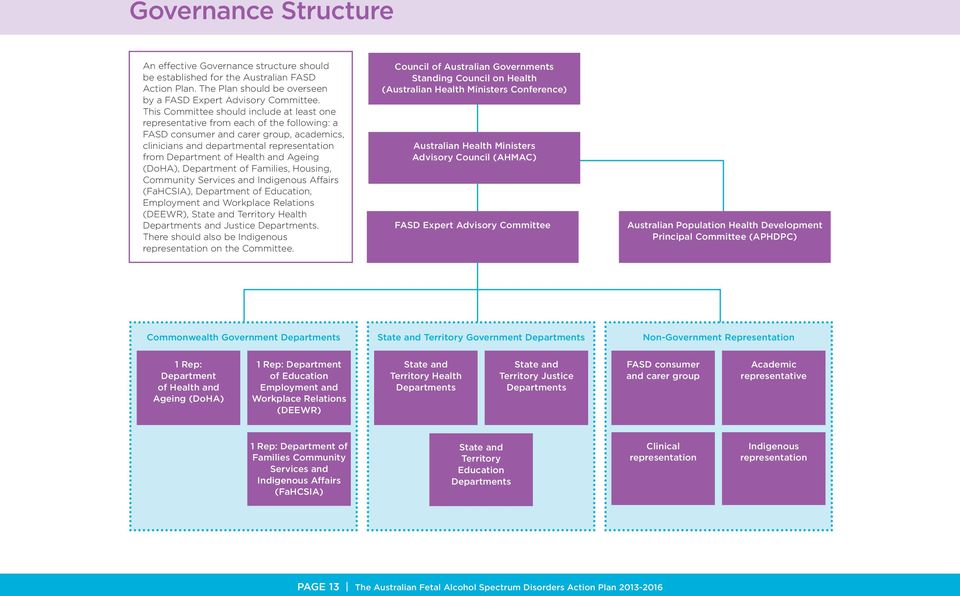
13 Governance Structure An effective Governance structure should be established for the Australian FASD Action Plan. The Plan should be overseen by a FASD Expert Advisory Committee. This Committee should include at least one representative from each of the following: a FASD consumer and carer group, academics, clinicians and departmental representation from Department of Health and Ageing (DoHA), Department of Families, Housing, Community Services and Indigenous Affairs (FaHCSIA), Department of Education, Employment and Workplace Relations (DEEWR), State and Territory Health Departments and Justice Departments. There should also be Indigenous representation on the Committee. Council of Australian Governments Standing Council on Health (Australian Health Ministers Conference) Australian Health Ministers Advisory Council (AHMAC) FASD Expert Advisory Committee Australian Population Health Development Principal Committee (APHDPC) Commonwealth Government Departments State and Territory Government Departments Non-Government Representation 1 Rep: Department of Health and Ageing (DoHA) 1 Rep: Department of Education Employment and Workplace Relations (DEEWR) State and Territory Health Departments State and Territory Justice Departments FASD consumer and carer group Academic representative 1 Rep: Department of Families Community Services and Indigenous Affairs (FaHCSIA) State and Territory Education Departments Clinical representation Indigenous representation PAGE 13 The Australian Fetal Alcohol Spectrum Disorders Action Plan
14 PAGE 14 The Australian Fetal Alcohol Spectrum Disorders Action Plan

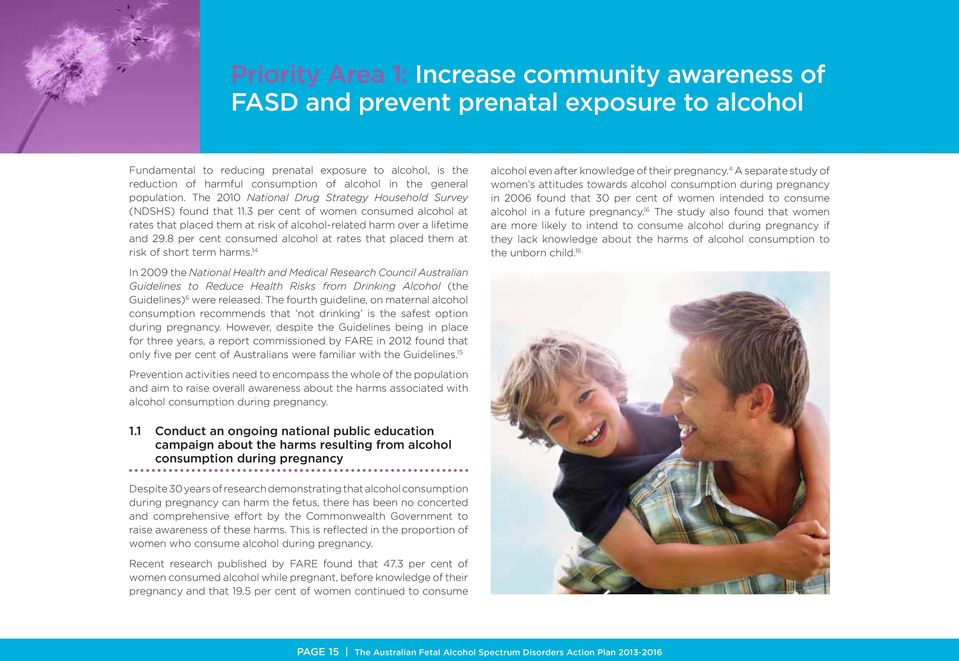
15 Priority Area 1: Increase community awareness of FASD and prevent prenatal exposure to alcohol Fundamental to reducing prenatal exposure to alcohol, is the reduction of harmful consumption of alcohol in the general population. The 2010 National Drug Strategy Household Survey (NDSHS) found that 11.3 per cent of women consumed alcohol at rates that placed them at risk of alcohol-related harm over a lifetime and 29.8 per cent consumed alcohol at rates that placed them at risk of short term harms. 14 In 2009 the National Health and Medical Research Council Australian Guidelines to Reduce Health Risks from Drinking Alcohol (the Guidelines) 6 were released. The fourth guideline, on maternal alcohol consumption recommends that not drinking is the safest option during pregnancy. However, despite the Guidelines being in place for three years, a report commissioned by FARE in 2012 found that only five per cent of Australians were familiar with the Guidelines. 15 alcohol even after knowledge of their pregnancy. 4 A separate study of women s attitudes towards alcohol consumption during pregnancy in 2006 found that 30 per cent of women intended to consume alcohol in a future pregnancy. 16 The study also found that women are more likely to intend to consume alcohol during pregnancy if they lack knowledge about the harms of alcohol consumption to the unborn child. 16 Prevention activities need to encompass the whole of the population and aim to raise overall awareness about the harms associated with alcohol consumption during pregnancy. 1.1 Conduct an ongoing national public education campaign about the harms resulting from alcohol consumption during pregnancy Despite 30 years of research demonstrating that alcohol consumption during pregnancy can harm the fetus, there has been no concerted and comprehensive effort by the Commonwealth Government to raise awareness of these harms. This is reflected in the proportion of women who consume alcohol during pregnancy. Recent research published by FARE found that 47.3 per cent of women consumed alcohol while pregnant, before knowledge of their pregnancy and that 19.5 per cent of women continued to consume PAGE 15 The Australian Fetal Alcohol Spectrum Disorders Action Plan
16 Internationally, public education campaigns have been shown to increase awareness about the risks of consuming alcohol whilst pregnant and awareness about FASD. In Canada public education campaigns have been in place since The effectiveness of Canadian efforts to raise awareness of FASD and the harms associated with consuming alcohol while pregnant are reflected in their prenatal alcohol consumption rates which are less than 15 per cent. 17 The promotion of the Guidelines in Australia has been limited and ad hoc. Since the release of the Guidelines, the Department of Health and Ageing (DoHA) has developed limited communication materials, including a specific brochure for pregnant women. 18 Over 700,000 of these resources (including brochures for adults, parents of young people, wallet cards for young people and a poster targeting pregnant women) have been distributed across Australia. 19 These efforts to promote the Guidelines have been largely ineffective, due in part to the ad hoc nature of the programs and the short term funding for these initiatives. To increase awareness and understanding of the Guidelines, a national, comprehensive and ongoing public education campaign is required. This campaign should have a particular focus on alcohol consumption during pregnancy. It needs to be appropriately resourced, and funded for the lifespan of the Australian FASD Action Plan. The campaign should include targeted messages for specific groups and promote evidence-based messages at both a national and community level. The campaign should use a broad range of media and ensure that there are specific messages for: the general public women their partners, and those identified as being at risk. The consumption of alcohol by people in the woman s life, especially partners and extended family, can influence alcohol consumption during pregnancy. 20 Those people also play an important role in supporting women to stop or reduce their alcohol consumption during pregnancy. A 1996 study found that around a third of women would stop or reduce their drinking if their partner also stopped drinking for the duration of the pregnancy, and 38 per cent would drink less if their partner encouraged them to stop or cut back. 21 At a community level, Medicare Locals should reinforce campaign messages to the general population as well as implement targeted communication messages to high risk individuals and communities. Because of their strong connection to primary health care providers, Medicare Locals are an ideal vehicle to deliver and reinforce educational campaigns about alcohol consumption during pregnancy and raise awareness about FASD. The total cost of a public education campaign over three years is estimated at $10.2 million. 13 These costs include the cost of producing and running a comprehensive campaign comprising of pamphlets, posters, television and radio advertisements. The initial campaign production in year one is estimated at $4.4 million. The campaign would require maintenance and updating as well as ongoing associated running costs, such as purchase of advertising time on television and radio. The ongoing costs are estimated as $2.9 million per year. 13 Action: Establish and deliver a three year public education campaign, using a range of media, about the harms from alcohol consumption during pregnancy, including specific messages and resources for the general public, women and their partners. Funding required: $10.2 million PAGE 16 The Australian Fetal Alcohol Spectrum Disorders Action Plan

17 1.2 Implement mandatory health warning labels on all alcohol products available for sale in Australia Internationally, at least 18 countries or territories have introduced laws that require the compulsory use of health warning labels on alcohol products. These countries include France, South Africa, Brazil, Costa Rica, Ecuador, Honduras, Mexico, South Korea and the USA. 22,23,24 Five countries also have mandated pregnancy labels, either pictorial or text indicating that alcohol should not be consumed during pregnancy (China, France, USA, South Africa and the Russian Federation). 23 In Australia, food labels including those on alcohol products are the statutory responsibility of Food Standards Australia New Zealand (FSANZ). At present the alcohol industry has a voluntary consumer information labelling scheme with different products having different messages. Pregnancy warning labels have been developed by DrinkWise, an industry funded social aspects organisation. The Drinkwise labels include two pregnancy labels, which are either text stating it is safest not to drink while pregnant or a pictorial silhouette of a woman drinking alcohol with a line through it. 25 Following a review of food labelling in Australia and New Zealand, published as Labelling Logic in January 2011, the Legislative and Governance Forum of Food Regulation (convening as the Australia and New Zealand Food Regulation Ministerial Council) decided, in December 2011, to support a mandated pregnancy warning label on alcohol products within two years. 26 There is currently no indication of the process the Government intends to follow to move towards this mandatory labelling regime. In 2009, as part of an application by the Alcohol Advisory Council (ALAC) of New Zealand to FSANZ to implement alcohol health warning labels, a review was commissioned: Alcohol warning labels: evidence of impact on alcohol consumption amongst women of childbearing age. 27 The report found that if labels were adopted in Australia, based upon the available literature, they would have the following potential impacts: the majority of female drinkers will have noticed the warnings within two to three years younger women and heavier drinkers may notice the warnings more of those who notice the labels, approximately 50 per cent will recall the message there will be an increase in the number of conversations about the risks of alcohol use during pregnancy, and behaviour change may occur if the labels are complemented at point of sale and at other message sources. 27 To contribute to awareness raising and have the greatest potential at changing behaviours, an evidence-based alcohol warning label regime is needed in Australia. The labelling regime should be: mandatory so the label appears on all products applied consistently across all products so they are visible and recognisable include a number of rotating messages focussing on different social and health harms developed by health behaviour and public health experts regulated and enforced by government, and accompanied by a national public education campaign. 28 The total cost to Government of implementing a mandatory health warning label regime over three years is $682,000. In the first year these costs total $306,000 and include the label development, administration and enforcement. The annual ongoing cost to Government of mandatory alcohol health warning labels has been estimated at $188,000 per year. 13 Action: Implement a mandatory, government regulated alcohol health warning label regime for all alcohol products available for sale in Australia. Funding required: $682,000 PAGE 17 The Australian Fetal Alcohol Spectrum Disorders Action Plan

18 1.3 Provide specialist support services to pregnant women who have alcohol-related disorders Women with alcohol or substance misuse issues, who are pregnant and/or parents face particular societal condemnation. 12 Unfortunately these women often delay seeking help or support and this can have serious implications for the mother and the fetus. There are many factors that influence alcohol consumption during pregnancy, including being aware of the pregnancy and being aware of the potential harms of alcohol consumption to the fetus and alcohol dependence. Women who have alcohol-use related disorders or are alcohol dependent are most at risk of having a child or multiple children with FASD. 29 Efforts to support these women to reduce or cease their alcohol consumption are crucial in helping to prevent new cases of FASD. These women should also be advised on the contraception options available to them to help prevent unplanned pregnancies. 30 services for the last ten years. 33 Subsequently, most treatment programs in Australia and overseas have been designed with men in mind and it is often difficult for services to take into account gender differences in their treatment options and facilities. 34 For women with alcohol-related disorders, there are often significant issues in their lives that prevent them from seeking treatment. One of the primary difficulties is the lack of childcare options. Few treatment services provide childcare and for some cultural groups it is very difficult for women to leave their homes and/or family responsibilities in order to undertake or seek treatment. 34 Other barriers to treatment include fear of losing custody of children; needing their partner s permission to attend treatment; fear that Factors that influence alcohol consumption during pregnancy include concurrent drug use, mental health problems, physical and sexual violence, and fewer economic resources and opportunities. 31 Women who experience significant disadvantage are more likely to have a child or multiple children with FASD. 32 A study by the University of Washington of 80 birth mothers of children with FASD, found that all women had alcohol use histories, and 63 had a parent with an alcohol problem. The study also found that, of the 80 birth mothers: 96 per cent had mental health disorders (post-traumatic stress, depression and anxiety being most common) 95 per cent had been physically or sexually abused during their lifetime, and 80 per cent lived with men who did not want them to stop drinking during pregnancy. 32 Women and in particular pregnant women face significant barriers in accessing treatment for their alcohol use. Women account for only 32 per cent of Australia s alcohol and other drug treatment episodes and men have been the major clients of alcohol and drug treatment PAGE 18 The Australian Fetal Alcohol Spectrum Disorders Action Plan

19 who were deemed at risk of having an alcohol-exposed pregnancy (i.e. any alcohol consumption in the previous 30 days and were not using reliable contraception) were no longer at risk after enrolling in and completing the self-guided online change intervention. 36 A further example is the use of a parent supporter in alcohol, drugs and addiction on the popular website Netmums in the UK. This parent support was provided by Swanswell s substance misuse workers to answer questions relating to alcohol and other drugs. 37 It is important that women who are at high-risk of an alcohol exposed pregnancy are referred to appropriate services. The most effective way to ensure that this occurs is through the development of a model of care in each state and territory. The West Australian Department of Health, Child and Youth Health Network Model of Care for FASD outlines that clear referral pathways are needed between GPs, maternity and newborn services and alcohol and other drug services to ensure comprehensive support for all pregnant women, including those in rural and remote regions. The WA Model of Care also highlights the need to develop protocols for multi-disciplinary inter-sectoral approaches to support pregnant women with alcohol use disorders over their life course. 38 their partner will leave them; stigma and shame that people might identify them as having a problem with alcohol; fear of withdrawal and a belief they that should be able to stop drinking on their own. There is also a lack of services for pregnant women, lack of information about treatment options and lack of priority access. 12 To address the barriers to access and engagement in alcohol and drug treatment services, it is important that these services are modified to better accommodate the needs of women. There is growing potential for women to access support through online alcohol assessments and interventions. These have been shown to have a positive effect on the levels of alcohol consumption by lowincome women. This was regardless of whether the women received personalised feedback or general information about alcohol s health impacts and FASD. 35 Another study showed that over half of women Women and in particular pregnant women face significant barriers in accessing treatment for their alcohol use. The development of the West Australia Model of Care in was led by a project officer (0.6FTE a ) with three development meetings held. These were: an implementation planning meeting; a project control group meeting, to which experts provided their time in kind; and a large forum with 100 people in attendance. 39 The cost of the project officer and various meetings is estimated as being $60, a FTE Full time equivalent position PAGE 19 The Australian Fetal Alcohol Spectrum Disorders Action Plan

20 Western Australia is now developing an implementation plan for the Model of Care, which is due for publication in early This plan will outline the roles and responsibilities for each Government agency. These actions have been negotiated with and assigned to each agency and the plan will include measures for implementation and reporting mechanisms. This is a complex process requiring system-wide change. The development of the implementation plan has involved more than 60 organisations and engagement strategies across the state. There are many factors that influence alcohol consumption during pregnancy, including being aware of the pregnancy and being aware of the potential harms of alcohol consumption to the fetus and alcohol dependence. The total cost of making alcohol and drug treatment services more suitable for women and pregnant women with alcohol-use disorder, is estimated at $2.1 million over three years. This consists of a scoping study in the first year and a small grants funding round in the second and third years. The scoping study is estimated to cost $100,000, consisting of quantitative and qualitative research with alcohol and other drug treatment providers and focus groups with pregnant women. This is costed at $35,000 with project implementation (led by a full time project officer for 12 months) estimated at $65,000. A total of $2 million should also be committed to the small grants funding round to improve specialist support to pregnant women with alcohol-use disorders. These grants would be capped at $100,000, with up to $1 million being available in each year. This would allow 20 services over two years to adopt women-centred practice. The total cost of developing, testing and evaluating an online intervention program for women who are planning pregnancy, pregnant and/or parents would be $500,000 over three years. This includes $100,000 for website development, $200,000 for counselling support, $100,000 for project management and promotion. A further $100,000 should be dedicated to the evaluation of the program. It is recommended that a National Model of Care be developed, with each state and territory establishing their own implementation plans. 40 The total cost of developing a National Model of Care and statebased implementation plans is estimated at $517,000. The National Model of Care is estimated to cost $146,000 over three years. This includes a series of workshops in each state and territory with relevant authorities ($48,000), salaries for project officers to oversee the drafting and promotion ($98,000). Each state based implementation plan is expected to cost $53,000, made up of salaries ($44,000), a consultation workshop ($6,000) and promotion ($3,000). The development of the implement plans in each state and territory would need to be overseen by a working group. Actions: Develop state and territory based models of care for women who have alcohol use disorders with clearly defined referral pathways into treatment ($517,000). Provide funding to alcohol and drug treatment services to allow them to develop women-centred practices, with a particular focus on women who are pregnant ($2.1 million). Develop and evaluate an online intervention program to support women at risk of alcohol exposed pregnancies ($500,000). Funding required: $3.1 million over three years. PAGE 20 The Australian Fetal Alcohol Spectrum Disorders Action Plan

21 1.4 Educate health professionals on FASD and enable them to routinely ask and advise all women about their alcohol consumption Australian women consider health professionals to be the best source of information regarding their pregnancy. Women are often willing to make changes to their lifestyle, diet and alcohol consumption if advised to do so, and pregnancy can be a teachable moment or a critical window of opportunity for change. 27 However health professionals are often reluctant to discuss alcohol consumption with women due to fear of upsetting the woman, time pressures or their own discomfort. 41 A national poll carried out by FARE in 2012 found that just over a third of the mothers surveyed could recall having had a healthcare professional raise with them the harms associated with alcohol consumption (37 per cent). 42 It is vitally important that all health professionals, including General Practitioners (GPs) are trained to ask women about their alcohol consumption. Every time a health professional sees a woman, there is potential to prevent a new case of FASD and provide a consistent message on the harms of alcohol consumption during pregnancy. 16 Every time a health professional sees a woman, there is potential to prevent a new case of FASD and provide a consistent message on the harms of alcohol consumption during pregnancy An Australian feasibility study, Asking QUestions about Alcohol in pregnancy (AQUA), examined the questions that health professionals should ask about alcohol consumption during pregnancy. The study found that women should be screened for their alcohol intake using a validated instrument which includes an assessment of consumption patterns and instructions for the practitioner on how to interpret and discuss the information with the woman. The study concluded that a mechanism for this already exists through the Lifescripts Advice for Healthy Living project at DoHA. 43 Lifescripts are used by GPs to address lifestyle risk factors across the population, such as smoking, nutrition, alcohol consumption and physical inactivity. Lifescripts are a national initiative, funded and developed by DoHA and supported and promoted by the Australian General Practice Network. Lifescripts were first introduced in the DoHA budget with an investment of $4.3 million towards their development. In 2007 the Government invested further funding to maximise the uptake of the program. 44 PAGE 21 The Australian Fetal Alcohol Spectrum Disorders Action Plan
22 The Pregnancy Lifescript was developed in 2007 to assist women in having healthy pregnancies. 45 This script had a special focus on alcohol consumption during pregnancy and was designed for use by GPs and practice nurses. During the Pregnancy Lifescripts were reviewed and updated versions were scheduled to be released in August To date these have not been published. The Lifescript resources also include posters for doctors waiting rooms, patient brochures and assessment and prescription pads for use by the GP. The total cost of the Lifescripts program has been $5.5 million from to The Government has already committed this funding to the Lifescripts program. The total cost of training health professionals on delivering information on alcohol consumption over three years is $650,450. DoHA has provided funding to FARE to work with health professional bodies to develop appropriate training to raise awareness of the Guidelines among health professionals, and to encourage them to discuss alcohol consumption with all consumers. 46 Actions: Publish and distribute the updated Pregnancy Lifescripts to GPs, to encourage discussions about alcohol consumption during pregnancy ($5.5 million already committed by Government for the complete Lifescripts program). Provide training to GPs and other relevant health professional bodies on how best to raise the issue of alcohol consumption with consumers, particularly with pregnant women ($650,450 already committed by Government). Funding already committed by Government: $6,150,450 PAGE 22 The Australian Fetal Alcohol Spectrum Disorders Action Plan
23 Priority Area 2: Improve diagnostic capacity for FASD in Australia FASD is often described as an invisible disability due to the underlying brain damage caused by prenatal alcohol exposure. This alcohol exposure can result in a variety of problems including difficulties with speech and language; impairment of vision and hearing; organ damage and difficulty with judgement, reasoning and behaviour. 1 Most people who are born with FASD do not display some or any of the physical traits that are characterised by the condition. 3 Even FAS, which is commonly associated with abnormal facial features, may be difficult to diagnose and assess in newborns and across different racial groups. Obtaining a diagnosis of FASD can improve an individual s opportunities in life. A diagnosis can allow an understanding of the specific deficits affecting that individual, which in turn can facilitate communication between health professionals, educators, families and carers on effective interventions and the appropriate supports needed. 47,48 However a diagnosis should never be an endpoint. The process to confirm a diagnosis should also identify the appropriate health care, education, and service needs of the individual and the families/carers Publish, implement and evaluate the Australian FASD diagnostic instrument Australia currently has no screening and diagnostic instrument for FASD. When diagnosing FASD in Australia, health professionals rely upon a combination of overseas diagnostic instruments, including the: FASD Canadian Guidelines for diagnosis 50 University of Washington 4-Digit Diagnostic code 51 Center for Disease Control Guidelines: Fetal Alcohol Syndrome: Guidelines for referral and diagnosis in the USA. 49 Canada is the only country that has nationally consistent diagnostic guidelines. These guidelines have facilitated consistent diagnostic practice across the country and allowed for comparable data on FASD to be collected and monitored over time. 52,53 In Australia, in 2010, the Commonwealth Government provided $450,000 in funding for the development of a Screening and Diagnostic Instrument for FASD in Australia. The funding was allocated to the Australian FASD Collaboration, which involved researchers from across the country b and was led by Professor Elizabeth Elliott and Winthrop Research Professor Carol Bower. The FASD Collaboration undertook considerable work to develop a national diagnostic instrument for FASD and submitted a final report to DoHA in May The report included a systematic literature b The Australian FASD Collaboration is made up of the following researchers: Lead Investigators: Professor Elizabeth Elliott (University of Sydney); Winthrop Research Professor Carol Bower (Telethon Institute of Child Health Research). Senior Consultants: Dr Lucinda Burns (National Drug and Alcohol Research Centre); Ms Heather D Antoine (Menzies School of Health Research); Ms Maureen Carter (Nindilingarri Cultural Health Services); Dr James Fitzpatrick (Sydney Medical School); Associate Professor Jane Halliday (Murdoch Children s Research Institute); Ms Lorian Hayes (University of Queensland); Associate Professor Jane Latimer (George Institute for International Health, Sydney Medical School); Ms Anne McKenzie (University of Western Australia); Ms Sue Miers (National Organisation for Fetal Alcohol Syndrome and Related Disorders); Dr Raewyn Mutch (WA Department of Health); Dr Colleen O Leary (Curtin University of Technology and Telethon Institute for Child Health Research); Ms Jan Payne (Telethon Institute for Child Health Research); Dr Elizabeth Peadon (University of Sydney); Ms Elizabeth Russell (Russell Family Fetal Alcohol Disorders Association); Dr Amanda Wilkins (WA Department of Health); Ms Heather Jones (Telethon Institute for Child Health Research) and Dr Rochelle Watkins (Telethon Institute for Child Health Research). PAGE 23 The Australian Fetal Alcohol Spectrum Disorders Action Plan
24 Australia currently has no screening and diagnostic instrument for FASD. When diagnosing FASD in Australia, health professionals rely upon a combination of overseas diagnostic instruments. review on screening and diagnostic assessment as well as an examination of FASD screening programs and diagnostic guidelines from across the world. The report also included a summary of consumer and community input into the design and implementation of screening and diagnosis for FASD in Australia. 54,55 The diagnostic instrument developed now requires evaluation in a range of clinical environments across Australia prior to its implementation. Detailed guidelines on its use and resources for health professionals also need to be developed. In total the cost of finalising and evaluating the diagnostic instrument would be $852, Based on costs from the previous developmental work, it is estimated that the evaluation and finalisation of the diagnostic instrument would cost a further $562,000 over two and half years. This includes a national consultation and expert review process ($25,000) and pilot testing ($85,000). The remainder would be spent on salaries of $452,000. The development of training resources on the diagnostic instrument would run in parallel with the evaluation of the instrument in the third year and is estimated at $290,000 over one year. This includes $180,000 on salaries, $35,000 on the development of resources, $30,000 on production costs and $45,000 in evaluation. 56 Action: Publish the Australian FASD diagnostic instrument and develop guidelines for its use. Funding required: $852,000 over three years. 2.2 Establish FASD diagnostic services An improvement of FASD diagnosis rates would result in people with the condition receiving greater assistance and support, while also improving awareness of FASD among the Australian community. Once the Australian FASD diagnostic instrument and guidelines are published, the assessment and diagnosis of individuals via multidisciplinary health teams needs to occur. A FASD diagnosis is determined through a multi-disciplinary approach with assessments undertaken by a range of health professionals including paediatricians, clinical psychologists, occupational therapists, speech and language therapists, physiotherapists and social workers. There can be considerable stigma associated with a FASD diagnosis 48 and the communication of this diagnosis with the individual, family and carers requires particular sensitivities. For a biological mother, a diagnosis of FASD for her child may be very confronting. 48 It is important that support is available to the family and carers to understand the diagnosis and cope with the changes to their lives that it entails. Four possible FASD diagnostic service models are explained in further detail below. Service model one: specific dedicated FASD diagnostic clinics Australia has one dedicated FASD diagnostic clinic, which is funded by FARE. This clinic opens fortnightly and is based at the Children s Development Unit, within The Children s Hospital at Westmead in Sydney. 57 Children (aged 0 to 16 years) who are referred to the clinic undergo a comprehensive assessment consisting of full history and medical checks as well as assessments in developmental and/or neuropsychology issues, speech and language, as well as occupational and physiotherapy developmental issues. As part of the diagnosis, children are photographed for analysis of facial features and referred on for other investigations such as brain scans, genetic testing and hearing and vision assessments where necessary. 57 In this model the child is initially seen by a paediatrician and then referred to the other specialists for further tests. To make a PAGE 24 The Australian Fetal Alcohol Spectrum Disorders Action Plan
25 diagnosis the multi-disciplinary team reviews the results from all of the assessments and recommends a final diagnosis. This model allows for specialist teams to focus on the diagnosis of FASD and would result in teams of health professionals specifically trained in the diagnosis of FASD. The two limitations of this model are that firstly it takes considerable time for the child to complete all of the assessments. They are only referred onto the next assessment when the first is completed. This means that assessments could take a number of months to complete. Secondly, dependent on hospital policy, this model would only be able to accept patients up to the age of 16 as the clinic sits within the remit of a children s hospital. An improvement of FASD diagnosis rates would result in people with the condition receiving greater assistance and support, while also improving awareness of FASD among the Australian community. Service model two: Using existing child development services to diagnose FASD The second service model uses existing Child Development Services, usually located in hospitals to assess children for FASD. These services exist across Australia, although they are known by different names in different states c (e.g. in South Australia these services are called Early Childhood Intervention Programs). There is also a lack of consistency on what conditions and age ranges of children that the different programs will assess. 58 In Western Australia there are 11 Child Development Centres across the state that provide a range of supports for children (up to 16 years of age) who have or are at risk of developmental difficulties. The services are made up of multi-disciplinary teams including speech pathologists, occupational therapists, paediatricians and medical officers, physiotherapists, social workers and clinical psychologists. 59 In 2010 the Western Australian Government committed $49.7 million to improve access to child development services across the state 60 and recommended that the existing Child Development Service: West Perth and State located at Princess Margaret Hospital undertake screening and diagnosis of children with FASD with joint assessments between health agencies and other services. 38 For adolescents and adults who are unable to be assessed through Child Development Services, the West Australian Model of Care for FASD recommends that: adolescents be assessed by the Child and Adolescent Mental Health Service and Complex Attention and Hyperactivity Disorders Service in WA adult clients should be seen through the Neuro-Psychiatric Service of the Adult Mental Health Service. 38 Funding for this model would be dependent upon the state or territory in which the model was being applied and the existing services structures. This model allows for the use of existing services to diagnose FASD. These services already utilise a multi-disciplinary approach so the health professionals have the skills and experience to undertake the work. One concern with this model is that these services are already over-stretched and have lengthy waiting periods. Service model three: Creating FASD diagnostic teams to target at-risk communities A third model for diagnosis in Australia is the approach that was used in Marulu: the Lililwan Project in the Fitzroy Valley of Western Australia. This model may be more appropriate for rural and remote communities. As part of the Lililwan project all children between the ages of seven and eight were assessed by a specialist multidisciplinary team that travelled to the community. 61 Information c Across Australia these are known as: Child Development Units, Child Development Centres, Developmental Assessment clinics, Child Development Clinics and Child and Adolescent Mental Health Services. PAGE 25 The Australian Fetal Alcohol Spectrum Disorders Action Plan
26 was also gathered on early life trauma based on questions from the Australian Longitudinal Study of Indigenous Children This model saw the multi-disciplinary team assess the children at the same time, rather than complete separate assessments over a number of weeks or months. 62 The cost of this model would be dependent upon the number of children in the community in which this model would be applied. Along with philanthropic funding, Marulu: the Lililwan Project received $1.7 million from the Department of Families, Housing, Community Services and Indigenous Affairs (FaHCSIA) and DoHA 63 in While this model allows for FASD diagnostic assessments for whole communities to be carried out at the same time, it may only be appropriate for high-risk communities due to the coordination and travel expenses for the specialists. Key to the success of this model is the need for it to be adapted to the specific community to ensure the cultural appropriateness of the approach. like this could be broadened to include a range of health disciplines necessary to undertake FASD diagnosis work. It is important that this model be flexible enough for different areas and local configurations. It is also possible that in time this service model could be provided using tele-health services. Tele-health uses high-speed broadband to deliver services via video link to consult with a patient, and the rapid transfer of files including scans to enable health professionals to participate in a virtual environment without travelling long distances. 65 The Apunipima Cape York Council has successfully undertaken its first tele-health consultation in June 2012 with three patients located in Mossman, a township located approximately 90 kilometres north of Cairns. 66 This model would allow for FASD diagnostic assessments to be undertaken within existing services, by local people who already work and live in the community. However, the model relies heavily on the skills, training and capacity of professionals working at the Service model four: A local remote/regional diagnostic team The experience in the Fitzroy Valley in Western Australia highlights that over time it may be possible to develop health services based in remote regions that are able to assess and diagnose children with FASD. This would require trained health professionals who live in the region and are able to travel to remote areas. Community Health Services are located throughout Australia and usually employ social workers, occupational therapists, speech therapists, psychologists, paediatricians and specialist alcohol and other drug or mental health workers. It is possible that the staff working for these services could be trained to become FASD diagnosis teams. This would build the capacity of local services. In Western Australia the Pilbara Community Drug Service Team, based in South Hedland provides outreach services to Port Hedland, Karratha, Onslow, Tom Price and Newman and is one of 12 communitybased alcohol and other drug programs that cover the state. The Pilbara team also runs the Alcohol and pregnancy: what are the risks? initiative in conjunction with the Pilbara Health Partnership. 64 This provides counselling and education for communities throughout the Pilbara region on alcohol and pregnancy. It is possible that a team PAGE 26 The Australian Fetal Alcohol Spectrum Disorders Action Plan
27 Community Health Services in undertaking diagnostic assessments and requires significant long term funding to embed practices and become sustainable. Overview of models These different models provide a range of options for diagnosing FASD in rural, remote and urban settings. It is important that as these models are implemented, that work is undertaken to examine the cost effectiveness of each model and to determine the effectiveness of different models in different locations e.g. rural versus urban settings, specialist clinic versus existing Child Development Services. In the first instance, three FASD clinics based on model one should be developed throughout Australia. These clinics should be based on the FASD Diagnostic Clinic at The Children s Hospital at Westmead. The total cost of developing and operating the three diagnostic clinics over three years is estimated to be $3.6 million. This is based on the funding provided to the FASD Diagnostic Clinic at The Children s Hospital at Westmead, which has received $184,000 for a 12 month pilot project. Of this, salaries account for $151,000, which consist of a General Paediatrician (0.1 FTE d ), Developmental Paediatrician (0.2 FTE), Clinical Psychologist (0.1 FTE), Speech Pathologist (0.1 FTE), Occupational Therapist (0.1 FTE), Physiotherapist (0.1 FTE) and Administration Officer (0.1 FTE). 57 This clinic is currently funded to operate one day per fortnight, and to be truly effective it would be preferable for any Dedicated FASD clinic to operate at least one day per week. It is therefore reasonable to double the current funding of the Westmead Clinic to provide an effective service. It is believed that at least three such Specific FASD clinics are required across Australia. Using the doubled costs of the Westmead clinic as a guide (approximately $400,000 per year), three clinics would require $1.2 million per annum. Research on the other service models also needs to be undertaken. Paediatric Registrar Dr James Fitzpatrick, with the The George Institute for Global Health has recently developed a funding proposal for a trial of paediatric and child health care being delivered by a multi-disciplinary team in Fitzroy Valley schools. 67 This model would see health and education professionals coordinating FASD diagnosis and management within the school system. There is strong support from health and education partners to trial this project from Private sector funding has been secured to undertake community consultation and pilot the model on a small scale. The model is similar to service model four and is estimated to cost $1.8 million over three years. This is comprised of $705,000 in the first year, (including $73,000 in set up costs) and $577,000 in the following two years. The operation costs in all three years include three members of staff (one clinical researcher, one coordinator and an Aboriginal Health Worker) estimated at $467,000 per year, administration and management ($40,000), promotion and resources ($5,000 per year), a team vehicle ($100,000 including purchase, maintenance and repair) and research and evaluation ($50,000 per year). A similar project should be established in another region, allowing two research projects to take place. The total estimated cost of two research projects to implement and evaluate different FASD diagnostic service models would be $3.7 million over three years. This would allow for each project to be awarded $1.8 million over three years. Actions: Establish FASD specific diagnostic clinics operating for one day per week, in three locations across Australia ($3.6 million). Undertake two research projects to establish and evaluate different FASD diagnostic service models in three locations ($3.7 million). Funding required: $7.3 million over three years. d FTE Full time equivalent position PAGE 27 The Australian Fetal Alcohol Spectrum Disorders Action Plan
28 2.3 Implement training for health professionals on use of the Australian FASD diagnostic instrument Greater knowledge, awareness and understanding of FASD is needed among health and medical professionals to improve the diagnosis of FASD. In particular a training and implementation plan should be developed alongside the guidelines for the Australian FASD diagnostic instrument, in order to train health and medical professionals on its use. Health professionals have a key role to play in improving the diagnosis of FASD; however few health professionals are aware of the condition or feel equipped to manage patients with FASD. In a study of 1,143 health professionals in Western Australia in 2005, only 12 per cent were able to correctly identify all four essential features of FAS and only two per cent considered that they were properly skilled to manage an individual with FAS. 5 When a similar study was conducted with paediatricians (n=132), it found that only 18.9 per cent identified all essential diagnostic features for FAS and that while 76.5 per cent had suspected a case was FAS they had not diagnosed it. 68 GPs also have an important role to play in the diagnosis and prevention of FASD. Most people s health care needs and information starts with a health professional, often in a consultation setting with a GP. This is also the public s preferred method for receiving information about their health concerns. 69 A Western Australian study in 2005 Health professionals have a key role to play in improving the diagnosis of FASD; however few health professionals are aware of the condition or feel equipped to manage patients with FASD. found that only 20 per cent of GPs surveyed could correctly identify the four essential features of FAS. A third of GPs (35 per cent) had suspected that a child had FAS but did not make a diagnosis. GPs most often requested education materials for themselves (75 per cent), their patients (69 per cent) and diagnostic checklists and referral resources to assist them. 5 Most (82 per cent) of the health and medical professionals in the West Australian survey agreed that an early diagnosis would improve the treatment plans for the child but did not make a diagnosis or refer the child as they were concerned that the diagnosis would stigmatise both the child and their family. 5 This is unfortunate as early diagnosis of FASD can improve the overall life outcomes for the individual 8 and enable families and carers to access disability support services otherwise unavailable to them. PAGE 28 The Australian Fetal Alcohol Spectrum Disorders Action Plan
29 To date, training opportunities on FASD have been limited. The Russell Family Fetal Alcohol Disorders Association (RFFADA), in conjunction with Training Connections Australia, currently offers ten modules on FASD for alcohol and other drug workers; mental health workers; teachers and the criminal justice sector. 70 Other initiatives have included the Drug and Alcohol Services South Australia s guide for midwives on FASD in This Guide outlines key information on FASD, strategies on how to ask women about their alcohol consumption during pregnancy and how to identify FASD in children. 71 The Drug and Alcohol Office in Western Australia also produces resources for health professionals on FASD and the prevention of prenatal alcohol exposure. 41 The West Australian Government, through the Model of Care, has acknowledged the importance of training health professionals in FASD and recommends training at: under-graduate; post-graduate levels and in-service training programs for: antenatal and maternity care providers including midwives, GPs, obstetricians and others child health nurses and school health nurses child development service providers including allied health professionals paediatricians and neonatologists Aboriginal health workers health promotion officers, and drug and alcohol service providers. 38 The training of Australian health professionals in FASD needs concerted effort and Australia could learn from programs in the USA that were developed to systemically train health and medical professionals about FASD. In 2009 the Center for Disease Control and Prevention (CDC) developed the FASD Competency-Based Curriculum Development Guide for Medical and Allied Health Education and Practice 72 and funded five university-based FASD Regional Training Centres to implement this training. Each of the five training centres received between $200,000 and $350,000 (USD) per year, to a total of $4.5 million over three years. 73 In 2010 the Royal Australian College of General Practitioners (RACGP) received $409,000 to administer a small grants funding round to train providers to deliver accredited psychological skills training to GPs. 74 The RACGP awarded 37 grants with each grant delivering a minimum of 20 hours training to 13 participants (on average). A total of 490 people were trained through these grants. The Commonwealth Government could fund a similar model to train health professionals on the use of the Australian FASD diagnostic instrument. This could be done through the development of a consortium body to oversee the implementation of this training and distribute grant funding. The consortium would consist of representatives from the peak bodies involved in FASD diagnosis. This includes the Paediatric College within the Royal Australasian College of Physicians, the Royal Australian College of General Practitioners and relevant allied health peaks (e.g. Australian Psychological Society, Australian Agency for Social Workers, Occupational Therapists Australia, Physiotherapists Australia and Speech Pathology Australia). This consortium would then disburse small grants funding to training providers to deliver training on use of the Australian FASD diagnostic instrument. The training of Australian health professionals in FASD needs concerted effort and Australia could learn from programs in the USA that were developed to systemically train health and medical professionals about FASD. The total cost of these training grants is estimated at $650,000 over two years and would commence once the diagnostic instrument and guidelines have been published. This funding is based on 500 health PAGE 29 The Australian Fetal Alcohol Spectrum Disorders Action Plan
30 professionals being trained at a cost of $1,000 each, and $150,000 towards program management and funds for the consortium. In addition to the small grants training, it is recommended that five hands-on training workshops with health professionals on FASD diagnosis and management be provided across Australia. 75 These training courses would be led by overseas diagnostic experts and include an overview on FASD, case scenario diagnostic evaluations and hands-on practice sessions. The training would run for three days. The total cost of these training workshops is estimated at $300,000 and would take place in the second year of the Australian FASD Action Plan, once the Australian FASD diagnostic instrument has been published. Funding for the training course is based on $35,000 being available for international and domestic flights for the diagnostic experts. The remainder of the funding ($265,000) would be divided between venue and catering costs of $150,000 (based on $30,000 per course for a three day course in five jurisdictions e ). The remaining $115,000 would go towards the development of course materials, management and administration. Actions: Train health professionals in the use of Australian FASD diagnostic instrument by funding a small grants round for training providers to train health professionals, overseen by a consortium of relevant health peak bodies ($650,000). Carry out five practical FASD diagnostic training workshops across Australia, led by international FASD experts ($300,000). Funding required: $950,000 over two years. e These figures are based on $10,000 per day per training course, made up of $1,500 for catering, $2,000 for audio visual hire and $6,500 for venue hire. Total of three day course is $30,000 in each jurisdiction. PAGE 30 The Australian Fetal Alcohol Spectrum Disorders Action Plan
31 Priority Area 3: Enable people with FASD to achieve their full potential A landmark Commonwealth Government report in 2009 called: Shut out: The experiences of people with disabilities and their families in Australia stated that people with disabilities may be present in the community but most do not enjoy full participation in it. 76 This is apparent for people with FASD. 77 Unfortunately FASD is not consistently identified as a disability in Australia. As a result people with FASD, their families and carers struggle to access assistance from social services, education and training, justice and health agencies. The Productivity Commission s report into Disability Care and Support in Australia, published in 2011 found people with disabilities and their families are both managers and advocates of their conditions, as they have to deal with concurrent service providers, government agencies and health professionals. 78 This echoes the frustration expressed by families and carers of people with FASD on the lack of knowledge on FASD by service providers and of the need to educate professionals themselves on the condition. 48 This often leads to more stress for the family, especially when personal experiences are ignored or minimised. Access to disability support services and early intervention programs are crucial in preventing the development of secondary disabilities for people with FASD. Secondary disabilities (such as mental health issues, alcohol and drug problems, disrupted schooling, lack of employment and incarceration) can occur when FASD is undiagnosed or misunderstood. Similar to other disabilities, access to early intervention services will result in better outcomes for the individual throughout their life Support people with FASD, their families and carers Across Australia, people with FASD, their families and carers have difficulties in accessing disability support services and funding. Many are precluded due to lack of diagnosis from a health professional or because FASD is excluded from eligibility criteria. There are also differences in the supports available to children and adults and differences between state and territory services. For adults in Australia access to the Disability Support Pension is determined through the Social Security Act 1991 (Cth) and the application of the Tables for the Assessment of Work-related PAGE 31 The Australian Fetal Alcohol Spectrum Disorders Action Plan
32 Across Australia, people with FASD, their families and carers have difficulties in accessing disability support services and funding.. Impairment (hereafter called Impairment Tables). These tables 79 have been revised under the Social Security and Other Legislation Amendment Bill 2011 (Cth) and individuals have been assessed under these tables since January FASD, has, for the first time been recognised in these Impairment Tables under Table 9: Intellectual Function but there is a qualification that the individual has a low IQ. This is unfortunate as although FAS is associated with lower IQ, 75 to 80 per cent of people with FASD have IQs within the normal range. 77 This, therefore, precludes most people with FASD. To amend this situation FASD should be listed as a condition under Table 7: Brain Function alongside a person with Autism Spectrum Disorder who does not have a low IQ. 80 For children with FASD little support is available. From 2008 to 2011 the Commonwealth Government invested $190 million into the Helping Children with Autism package. This allowed for the funding of individual assistance packages for children with autism or any other pervasive developmental disorder (though excluding FASD), their families and carers. 81 The Helping Children with Autism package involved cross government working with DoHA, FaHCSIA and the Department of Education, Employment and Workplace Relations (DEEWR) to deliver the program. People who care for children under 16 with a disability can access carers payments. Children with disabilities who automatically qualify for these payments are those recognised in the List of Registered Disabilities. 82 FASD is not currently included in this list and is not adequately covered by any other disabilities on the list. It is critical that this situation is changed and that FASD be added to this list. It is unfortunate that FASD has not been recognised in these initiatives and it is imperative that FASD be recognised in the new National Disability Insurance Scheme (NDIS). The creation of the NDIS was recommended by the Productivity Commission as a mechanism to fund long-term care and support (but not income replacement) for people with significant disabilities. 78 The Commonwealth Government is currently working with the states and territories to design the scheme, which is scheduled to be rolled out in mid-2013 and in place by Between now and 2018 it is important that people with FASD, their families and carers are adequately represented in NDIS eligibility criteria and that changes are made to existing services and initiatives to recognise FASD. Determining the costs of extending disability services and carers allowances to include FASD is difficult because of the uncertainty in FASD prevalence figures in Australia. Economic modelling is required to determine accurate estimates of the number of people who may be eligible. This modelling should be undertaken by Treasury and FaHSCIA. Actions: For adults: recognise FASD as a condition under Table 7: Brain Function in the Impairment Tables for the Disability Support Pension as well as in Table 9: Intellectual Disability in the Impairment Tables. f For carers of children under 16: recognise FASD in the List of Recognised Disabilities. Recognise FASD in the National Disability Insurance Scheme. Funding required: Economic modelling required by Treasury and FaHCSIA to determine numbers of people who may be eligible. f There will be cost in adding people with FASD to these Impairment Tables but it is impossible to quantify the number of people who will qualify to receive Disability Support Pensions as the number of adults with FASD is unknown. PAGE 32 The Australian Fetal Alcohol Spectrum Disorders Action Plan
33 3.2 Improve early intervention options for people with FASD, their families and carers In order to reach their full potential, children with FASD require the same level of access to early intervention services as children with other disabilities. The Commonwealth Government recommended in its best practice guidelines for Autism Spectrum Disorders that a child receive a minimum of 20 hours a week of early intervention services for two or more years in order to make major gains. 84 Children with FASD need comparable levels of service provision. The CDC in the USA recommended that early intervention services are needed for children from birth to three years of age to help in the development of language, walking, and interaction with others. 85 To achieve the same level of access to early intervention services as that received by other children with disabilities, it is imperative that FASD is recognised in the Commonwealth Government s Better Start for Children with Disability initiative. 86 The Better Start for Children with Disability initiative started in 2011 and provides assistance to eligible children g up to the age of 13 years. This assistance includes: up to $12,000 in funding for early intervention services and treatments assistance for children who live in outer-regional, rural or remote locations to access services a treatment and management plan to be developed and covered through Medicare, and funding for up to 20 allied health services up to the age of 15 years (provided a treatment and management plan is in place before the age of 13 years). 87 The Commonwealth Government has provided $122 million to the Better Start for Children with Disability initiative over four years (commencing in 2011). While early diagnosis of FASD is associated with fewer secondary disabilities, the Canadian Paediatric Society and the CDC in the USA both state that FASD intervention programs should not be dependent on a formal diagnosis. This is because the window of opportunity for dealing with behavioural abnormalities and preventing secondary disabilities is often missed. 88 In the USA, in 2009, five intervention programs for people with FASD were assessed by the Interventions for Children with Fetal Alcohol Spectrum Disorders Research Consortium. 89 It found that successful early intervention programs for FASD had the following elements: a component of education or training for parents that was built into the program giving explicit instructions to the child when learning new skills, rather than the child learning through observation and processing of information alone, and programs and techniques were integrated into existing community services, such as special education, therapy or counselling services that the child was already attending. Other strategies such as educational, psycho-social, and pharmacological approaches that include nutrition and physical g Eligible children are those who are under six and have a diagnosis of: Down syndrome, cerebral palsy, Fragile X syndrome; or a moderate or greater vision/hearing impairment including deafblindness. These categories were determined by the effectiveness of early intervention programs to be able to prepare these children for school. PAGE 33 The Australian Fetal Alcohol Spectrum Disorders Action Plan
34 therapies are being studied. 85 However the evidence-base for these programs is limited and they require further testing and evaluation. 90 People who care for those with FASD also need access to support. In 2002 the Victorian Order of Nurses for Canada undertook a four year project on parenting strategies for children with FASD. The main outcome of this project was the development of the Let s Talk FASD guidelines. These guidelines were shaped by the first-hand experiences of people living with FASD and are a collation of parentdriven strategies to care for children and adults with FASD. 91,92 In Australia support to parents and carers of people with FASD is provided by two organisations. These are RFFADA and the National Organisation for Fetal Alcohol Syndrome and Related Disorders (NOFASARD). In 2012 NOFASARD received $750,000 over three years from DoHA to continue to support people with FASD and those who care for them. 46 Continued funding is needed to support these organisations and to expand these services into other states and territories. This funding should match the funding provided to NOFASARD. The total cost of funding two other organisations to provide support to parents and carers of people with FASD is estimated at $1.5 million over three years. This is based on the current funding being provided to NOFASARD and its extension into two other jurisdictions. Actions Expand current Better Start for Children with Disability Initiative to include FASD. Extend funding support to parents and carers organisations that currently exist and expand these into other states and territories ($1.5 million). Funding required: $1.5million over three years. Funding already committed by Government: $122 million to the Better Start for Children with Disability and $750,000 to NOFASARD. 3.3 Treat people with FASD in a socially inclusive manner upon entry into education, employment and if in contact with the criminal justice system People with FASD often face a range of health, social and educational difficulties. Approximately 85 per cent of children with FASD do not live with their birth parents and are at risk of multiple foster placements. 3,93,94 In the USA, it is estimated that 70 per cent of children in foster care are affected by prenatal alcohol exposure to some degree. 95 Unfortunately similar data are not available in Australia. FASD can directly diminish a child s success at school. The underlying brain damage can limit how well a person with FASD may process information, understand and meet the expectations set for them. For example: concentrating in a classroom; sitting still for long periods of time and transferring learning from one situation to apply to another can be extremely difficult for people with FASD. 2 In order for people with FASD to fulfil their potential there needs to be improvements to the education, employment and criminal justice systems in Australia in recognising FASD as an issue and responding appropriately. In a traditional school environment, people with FASD struggle to meet these expectations, causing frustration for both the student and teacher. 2 Teaching methods that aim to change the behaviour of a person with FASD are likely to fail, not due to a lack of the individual s desire to change, but their ability to be able to do so. By PAGE 34 The Australian Fetal Alcohol Spectrum Disorders Action Plan
35 continually failing to meet expectations, people with FASD develop a sense of failure which can lead to depression and other mental health issues. 3,2 Being able to obtain and maintain employment is also difficult for people with FASD. A study of adults with FASD conducted in 1996 by the University of Washington found that: 50 per cent of respondents had trouble finding employment 60 per cent had difficulty maintaining employment 18 per cent had achieved independent living but most had employment problems, and 80 per cent had difficulty in managing money and decision making. 77 From the above it is apparent why people with disrupted school experiences, unstable home environments and difficulty obtaining employment may become involved with the criminal justice system. Additionally people with FASD are often vulnerable to exploitation and often guided into criminal behaviour. 96 In a prison environment an individual with FASD can be used as a scapegoat, be negatively influenced by their peers, victimised and exposed to more serious criminal elements. 77 Correctional facilities and the criminal justice system are not generally prepared to identify or address the needs of individuals with FASD within the overall offender population. Across Canada and the USA the situation is changing. Significant work has been undertaken to train teachers and address employment and criminal justice issues. In the education sector, British Columbia has produced a Manual of Policies, Procedures and Guidelines for Special Education Services 97 and in Alberta similar guidelines exist with strategies on how to teach students with FASD. 98 In the USA, the National Organization for Fetal Alcohol Syndrome (NOFAS) has created an education curriculum for teachers from kindergarten to grade 12 on FASD. This gives age-appropriate information on alcohol and provides opportunities for teachers to integrate information on FASD into the standard education curriculum. 99 The Florida Department of Education has also produced a resource guide for educators on FASD. 100 A Churchill Fellowship undertaken by Kym Crawford (an education specialist) on the Canadian experience of addressing FASD found that the key issues were that: People working in education, including principals, teachers, education assistants and Aboriginal and Torres Strait Islander education officers, need professional development training on how to educate students with FASD. Current specialist support services should be expanded to provide assistance for students with FASD. This includes FASD being an indicated group within the West Australian Schools Plus framework, and State government education departments need to work closely with diagnostic services (when these exist) to develop a support system immediately after diagnosis. This could be similar to the service provided for students with Acquired Brain Injury (ABI), where specialist teachers liaise with those making the diagnosis and make appropriate adjustments to the student s educational program to accommodate the specific needs of the individual. 101 Pilot programs have also taken place in the USA and Canada to help people with FASD achieve success in employment. From 2009 to 2010 the Alberta Government in Canada, ran pilot projects in the towns of Medicine Hat and Cold Lake. The project at Medicine Hat aimed to improve the employability and life skills of people with FASD through employment coaching. The Cold Lake project developed transition plans for young people moving from youth to adult services and produced tools for employment support agencies to work with people with FASD. 102 These projects and others in the USA have found that key structural components are needed when employing people with FASD. This includes awareness by the employer and other members of staff about FASD and an understanding that an individual s behaviour and abilities may change on a day-to-day basis. 103,2 Also in the USA and Canada there is a growing body of information about appropriate sentencing options for people with FASD. In British Columbia, the John Howard Society of Central and South Okanagan PAGE 35 The Australian Fetal Alcohol Spectrum Disorders Action Plan
36 has developed a Gateway Mentoring Program that provides oneto-one mentorship to people with FASD involved in or at risk of involvement in the Criminal Justice System. The program offers crisis intervention, life skills training, access to further community supports, and promotion of healthy lifestyles. 104 In Manitoba the FASD Youth Justice Program, established in 2004, provides people accused of a crime with an opportunity to receive an assessment for FASD prior to sentencing. This program developed a checklist called S.T.O.P (Systematic Tell-tales of the Problems) which is a series of red-flags that court and justice officials use to trigger a referral for diagnosis. These flags include: repeated history of failure to comply lacking empathy disrupted or poor school experiences being unable to connect actions with consequences appearing unaffected by past punishments committing crimes that are opportunistic rather than planned committing offences that involve risky behaviour for little gain or involvement in gang crime, and having superficial relationships and friendships. 105 In Australia, in 2011 with funding from FARE, the Queensland University and Collaboration for Alcohol Related Developmental Disorders (formerly FASD Research Network) h undertook a survey of all judges and magistrates in Queensland to ascertain levels of awareness of FASD and the impact of FASD on their practice. In total 49 members of the Queensland judiciary completed the survey. Of these, 80 per cent reported they had heard of FASD and 75 per cent thought that FASD was relevant to their work in the legal profession. However 82 per cent had never sent an accused person for a FASD diagnosis or assessment as they did not know where to send the person. Additionally 85 per cent wanted more information and guidelines on how to appropriately sentence a person with FASD. 106 In order for people with FASD to fulfil their potential there needs to be improvements to the education, employment and criminal justice systems in Australia in recognising FASD as an issue and responding appropriately. h Collaboration for Alcohol Related Developmental Disorders (formerly FASD Research Network) is made up of the following researchers: Dr Tom Burne (Queensland Brain Institute), Dr Suyinn Chong (Queensland Institute of Medical Research), Associate Professor Gail Garvey (Menzies School of Health Research), Ms Lorian Hayes (National Indigenous Australian Foetal Alcohol Syndrome Education Network), Ms Diane Malbin (Fetal Alcohol Syndrome Consultation, Education and Training Services Inc), Professor David Pow (Royal Melbourne Institute of Technology), Mrs Anne Russell (Russell Family Foundation for Fetal Alcohol Disorders), Dr Stephen Stathis, Brisbane Youth Detention Centre, Professor Emma Whitelaw (Queensland Institute of Medical Research). The Network also includes the following researchers from the University of Queensland: Dr Rosa Alati, Ms Amanda Barnett, Dr Tracey Björkman, Professor Paul Colditz, Professor Heather Douglas, Dr Simon Finnigan, Associate Professor Glenda Globe, Professor Wayne Hall, Dr Janet Hammill, Professor Noel Hayman, Professor Wendy Hoy, Professor Murray Mitchell, Associate Professor Karen Moritz, Dr Leith, Moxon-Lester, Dr Peter Nixon, Ms Coralie Ober, Dr Margo Pritchard, Associate Professor Stephen Rose, Dr James Scott and Ms Megan Williams. PAGE 36 The Australian Fetal Alcohol Spectrum Disorders Action Plan
37 To achieve the best educational outcomes DEEWR should work in conjunction with state and territory education departments to develop education standards to support children with FASD. 107 DEEWR should also develop national training guidelines on teaching people with FASD, based on guidelines that exist in Canada and the USA. Functional assessments should be undertaken by schools to shape decisions about educational goals for the individual. It should also be recognised that the education assistance for one person may not work for another. 2 To help find suitable employment, people with FASD are able to access Disability Employment Services (DES), funded by DEEWR. These services were introduced by the Commonwealth Government in 2010 to provide tailored advice for job seekers with a disability to enable them to secure suitable employment. i Regrettably no information is available on the numbers of people with FASD who have been able to use these services or what the outcome has been. More research is needed in Australia to understand the needs of people with FASD in seeking employment and of those who are employed. For the criminal justice sector the research undertaken by Queensland University recommended that corrective services screen for FASD when preparing pre-sentencing reports using the S.T.O.P checklist. 106 Also NOFAS in the USA recommend that the criminal justice system help people with FASD by: educating judges, lawyers and correctional officers on FASD establishing screening tools and procedures to identify FASD among those entering the juvenile justice or adult criminal justice system, and utilising alternative sentencing options for people with FASD. 108 Functional assessments should be undertaken by schools to shape decisions about educational goals for the individual. It should also be recognised that the education assistance for one person may not work for another. Determining the costs of how the education, employment and criminal justice systems can adequately respond to FASD is difficult. This is predominantly due to the current lack of awareness and knowledge of FASD as an issue within these sectors. To ensure the current situation changes the following are required: Develop teaching guidelines for educators on how to teach people with FASD. Undertake research into the employment needs of people with FASD, and Pilot a training program for judges and magistrates on FASD. The total cost of developing teaching guidelines is estimated at $800,000 over three years, based on development costs of $100,000 per state. Producing the teaching guidelines would require oversight by a project officer to prepare the guidelines and a consultation process on how to incorporate the teaching strategies into the curriculum. This process should be piloted by one State Government, supported by DEEWR before being expanded into other jurisdictions. i People who are eligible to access the DES Employment Support Services are recognised within the Disability Services Act This includes people with a disability that: a) is attributable to an intellectual, psychiatric, sensory or physical impairment or a combination of such impairments; b) is permanent or likely to be permanent, and c) results in: i. a substantially reduced capacity of the person for communication, learning or mobility, and ii. the need for ongoing support services. PAGE 37 The Australian Fetal Alcohol Spectrum Disorders Action Plan
38 The total cost of undertaking research into the employment needs of people with FASD is estimated to cost $200,000 over two years. This research would investigate the barriers and challenges that people with FASD face in seeking and maintaining employment. The research would consist of a postal survey of people with FASD, their parents and carers (n=2,000) and four focus groups. The quantitative and qualitative components of the research are estimated to cost $70,000 and the project implementation (led by a full time project officer for 18 months) is estimated at $130, Research from the Queensland University clearly indicates that knowledge by judges and magistrates on FASD is poor and that they require and are willing to participate in training on FASD. However the best model to deliver this training across Australia is currently unknown. It is therefore proposed that a pilot be undertaken to develop a training model for judges and magistrates on FASD. This pilot would include the development of a training course for judges and magistrates in Queensland (building on the Queensland University project), implementation and evaluation of this training and the development of a training model that could be used throughout Australia. This pilot could also be carried out in consultation with the Australasian Institute of Judicial Administration (AIJA) which is a membership body for judges, magistrates, tribunal members and court administrators in Australia. 110 The total cost of the training pilot for judges and magistrates is estimated at $67,000 over one year. This is based on running four training courses, with up to 15 participants per course (total of 60 participants) and includes training materials, workbooks and assessment information, to a total of $8,000. j The research component of the study is estimated to cost $50,000 which would evaluate the training and develop a training model that could be rolled out across Australia. Actions: Develop teaching guidelines for educators on how to teach people with FASD ($800,000). Undertake research on the employment needs of people with FASD ($200,000). Pilot a training program for judges and magistrates on FASD in one state and develop a training model to be rolled out across Australia ($67,000). Funding required: $1,067,000 over three years. j There are a total of 39 District Court Judges and 85 Magistrates in Queensland, total 124. Therefore running four training courses with 15 people per training would equate to 50 per cent of the District Court Judges and Magistrates in Queensland receiving training on FASD. Training costs provided by RFFADA. PAGE 38 The Australian Fetal Alcohol Spectrum Disorders Action Plan
39 Priority Area 4: Improve data collection to understand the extent of FASD in Australia The prevalence of FASD in Australia is largely unknown and believed to be significantly underreported. Australia lacks standardised data on alcohol consumption during pregnancy and on the number of people with FASD. Without this information Australia will continue to be unclear about the true extent of FASD within the Australian community. 4.1 Routinely record women s alcohol consumption during pregnancy There are significant gaps in knowledge about levels of alcohol consumption during pregnancy among Australian mothers. At present the NDSHS provides the best source of information about alcohol consumption during pregnancy Australia-wide. However, the survey only asks questions about the reduction or cessation of alcohol consumption during pregnancy and not about how much alcohol is being consumed or at what point in the pregnancy. In 2011, following a review of maternity data in Australia by the Australian Institute of Health and Welfare (AIHW) 111, it was recommended that items on maternal alcohol consumption be added to the Perinatal National Minimum Dataset (Perinatal NMDS). 111 The Perinatal NMDS currently consists of 23 mandatory questions with data supplied by state and territory governments. It includes items on the demographics of the mother and the baby and contains two items relating to tobacco use but no questions about alcohol consumption during pregnancy. The feasibility of adding additional questions to the Perinatal NMDS is currently being examined by the AIHW as part of a scoping study focused on improving the data collection on FASD in Australia. This study commenced in 2010 and the initial indications highlight inherent difficulties in adding new questions to the Perinatal NMDS. This is due to concerns about the privacy of data collected and reticence by staff to ask pregnant women about their alcohol consumption. The study is due to be published at the end of 2012 and has received $212,082 in funding over two years from DoHA. 112 Some states and territories, as part of their perinatal data sets, do collect information on alcohol consumption during pregnancy, although not all data collected is published. For example: In Tasmania the most recent data (2009) shows that 11 per cent of women consumed alcohol during pregnancy. Maternal alcohol consumption was more prevalent among older women, especially those aged between years (16 per cent). Additionally 9.3 per cent of babies born to mothers who consumed alcohol during pregnancy had lower birth weights, compared to 6.5 per cent for women who did not consume alcohol during pregnancy. 113 Northern Territory data from 2006 showed that alcohol was consumed by 10.9 per cent of the women during their pregnancy. The prevalence of alcohol consumption during pregnancy was higher for Indigenous women (14 per cent at the first visit and 8 per cent at 36 weeks gestation) than non- Indigenous mothers (8 per cent and 4 per cent). 114 In both Queensland and the Australian Capital Territory women are asked about their alcohol consumption during pregnancy however, this data has not been published. The Australian Capital Territory added questions to the Midwives Data Collection Form in 2002, 115 and In Victoria data collection on maternal alcohol consumption will commence in 2012 and form part of the Victoria Perinatal Data Collection. 116 PAGE 39 The Australian Fetal Alcohol Spectrum Disorders Action Plan
40 Further information about women s alcohol consumption during pregnancy has come from Growing up in Australia: The Longitudinal Study on Australian Children (LSAC) and the first wave of the Footprints in time: Longitudinal Study on Indigenous Children (LSIC). As part of the LSAC, mothers from two cohorts (known as cohorts B and K) were asked about their alcohol consumption during pregnancy. For those born between 1999 and 2000 (K cohort), 27.6 per cent of mothers reported drinking alcohol at some stage of their pregnancy. While for those born between 2003 and 2004 (B cohort), 37.6 per of women reporting consuming alcohol while pregnant. 117 The timing of these questions corresponds with changes to the NHMRC Guidelines on maternal alcohol consumption and suggests that consumption levels were higher when the NHMRC Australian Alcohol Guidelines: Health Risks and Benefits, were released in 2001, which allowed for small amounts of alcohol consumption during pregnancy. The first wave of data from LSIC in 2009 showed that 22 per cent of Aboriginal and Torres Strait Islander women consumed alcohol while pregnant. However the majority (79 per cent) drank less when pregnant than prior to pregnancy. 118 In order to improve our understanding of alcohol consumption during pregnancy it is critical that these studies continue to ask questions about maternal alcohol consumption patterns. It is crucial that the Perinatal NMDS includes mandatory questions about alcohol consumption during pregnancy. In 2011 the National Perinatal Epidemiology and Statistics Unit (NPESU) of AIHW stated that considerable work is needed to develop consistent definitions and standardisations on alcohol consumption. 111 It also recommended that the national maternity data collection should align with existing data capture arrangements as part of the Maternity Information Matrix, which is a depository of data collected from across Australia on maternity care. 111 The addition of nationally agreed questions on smoking status to the Perinatal NMDS took four years. This commenced in 2006 with a national data development program. Adding these items to the Perinatal NMDS required strong Commonwealth Government leadership. That same leadership is now required to develop consistent and standardised questions on alcohol consumption during pregnancy. These questions should be included as mandatory items in the Perinatal NMDS and reported on nationally. The development of standardised data for monitoring alcohol consumption during pregnancy should be overseen by the National Perinatal Data Development Committee (NPDDC). This committee reviews and recommends data items for inclusion on the Perinatal NMDS. The NPDDC is an advisory committee to the NPESU, of AIHW. This action does not require additional funding as it is part of the responsibilities of the AIHW National Perinatal Epidemiology and Statistics Unit to design and implement. Action: Introduce standardised questions about alcohol consumption during pregnancy as part of the Perinatal National Minimum Data Set. Funding already committed by Government: As part of the AIHW National Perinatal Epidemiology and Statistics Unit. PAGE 40 The Australian Fetal Alcohol Spectrum Disorders Action Plan
41 4.2 Standardise data collection on FASD Currently when a child or adult receives a diagnosis of FASD there are no recording or reporting mechanisms for that diagnosis. The AIHW is currently undertaking a scoping study on improving data collection and reporting of FASD in Australia. Unfortunately no information is currently available and the study is due to be published at the end of However, surveillance systems do exist across Australia for other birth defects and congenital anomalies. 119 Congenital anomalies are present from birth, are diagnosed either prenatally, at birth, or within the first few years of life. FASD is considered to be a congenital anomaly as the baby is born with the condition and the harm is caused prenatally. Currently congenital anomalies are reported through the Australian Congenital Anomalies Monitoring System (ACAMS). The ACAMS is used to detect changes in the frequency of birth defects and can help families and carers access support services. Unfortunately a National Minimum Data Set for congenital anomalies does not exist and notification periods of birth defects to ACAMS vary across the country. This ranges from prenatal diagnosis up to 15 years of age in one state. 119,k,l The committee responsible for the development of the National Minimum Data Set for Congenital Anomalies is comprised of representatives from the states and territory governments, Commonwealth Government and key medical bodies. m This committee provides technical advice on the standardisation of: data definitions; classifications; and scope (including periods of notification) of ACAMS. While ACAMS may offer a method to capture notifications of FASD in time, this is dependent on the development of a National Minimum Data Set for Congenital Anomalies. 120 Once the Australian FASD diagnostic instrument and clinical guidelines have been completed and published, then data on FASD should be included in ACAMS. There should be clear definitions and reporting mechanisms to be followed by all jurisdictions and national reporting by the AIHW. Another option is to establish separate birth defects registers on FASD in each state. Similar registers already exist for cerebral palsy across Australia including the Queensland Cerebral Palsy Register (QCPR). The QCPR was established in 2005 with the Queensland Government providing $90,000 in that year. 121 Since 2005 detailed data on cerebral palsy has been collected through the register, allowing for a better understanding of the prevalence of the condition over time. A similar register could be progressed for FASD with a pilot study in one jurisdiction to establish a FASD Register. This could then be rolled out across Australia. The total cost of establishing a FASD Register in one state is estimated at $321,000 over three years. This is based on the funding provided to establish the QCPR with inflation. This estimate of $107,000 per year to be predominantly spent on salaries and management ($98,000). Salaries include one Clinical Epidemiologist and two senior research assistants. 75 Some funds would also be needed to promote and develop the register, estimated at $9,000. Action: Pilot the establishment of a FASD diagnosis register in one state. Funding required: $321,000 over three years. k For Tasmania, Queensland and Australian Capital Territory diagnosis can be done prenatally, New South Wales notification period is at one year of age and for Victoria up to 15, Western Australia up to 6 and South Australian notifications can be made up to 5 years of age. l The Northern Territory data does not currently align with the format required by ACAMS and this is not reported on. m National Congenital Anomalies Steering Committee is comprised of representatives from state and territory governments, DoHA, AIHW, the National Centre for Classification in Health, the Human Genetics Society of Australasia/Royal Australian College of Physicians joint committee on newborn screening, the Australian Association of Paediatric Surgeons, the Royal College of Physicians and the Australian Paediatric Surveillance Unit PAGE 41 The Australian Fetal Alcohol Spectrum Disorders Action Plan
42 4.3 Monitor FASD prevalence through the Australian Paediatric Surveillance Unit As outlined throughout this document Australia lacks accurate data on the prevalence of FASD in the community. Once the Australian FASD diagnostic instrument is published and data is being collected and collated nationally, it should be possible to monitor the prevalence of FASD through existing surveillance units. Two studies are currently taking place that will help provide information about the prevalence of FASD in Australia. These include the Marulu: the Lililwan Project in the Fitzroy Valley of Western Australia, and a longitudinal birth cohort study called the Triple B Study: Bumps, babies and beyond. This study is coordinated by National Drug and Alcohol Research Centre (NDARC) and is collecting information on 1,800 to 2,000 Australian families to examine a wide range of factors that affect the health and development of children and families. The project has a key focus on examining the impact of substance use by pregnant women and their partners during the prenatal period of infant development and future family functioning. Once the Australian FASD diagnostic instrument is published and data is being collected and collated nationally, it should be possible to monitor the prevalence of FASD through existing surveillance units. The first national surveillance study for FAS in Australia took place between 2001 and 2004 using the Australian Paediatric Surveillance Unit (APSU) to record cases of FAS identified during that time period. 94 The APSU provides active surveillance for prospective, national identification and study of children (under 15 years of age) with uncommon conditions of childhood, including rare infectious and vaccine preventable diseases, genetic disorders, child mental health problems, and rare injuries. Report cards are sent each month to 1,330 paediatricians and other child health clinicians. Clinicians then indicate if they have seen a child with any of the conditions listed. Clinicians report details on demographics, diagnosis, treatments and short-term outcomes for their patients back to APSU. 122 The APSU national surveillance study found a limited number of cases of FAS, though it was hypothesised that this was due in part to only 19 per cent of paediatricians being able to correctly identify the diagnostic features of FAS. With systematic training of medical and health professionals to raise awareness of FASD (outlined in sections 1.3 and 2.3) it is likely that reporting rates of FASD would increase over time. Using the APSU, the systematic surveillance of FASD should be able to be achieved. This system would appear to be the most appropriate mechanism to ascertain the prevalence of FASD within the population over time. It is recommended that the APSU national surveillance study be repeated. 75 This would allow for comparison of data and to ascertain any improvements in awareness of the condition since that time. The total cost to repeat a National Surveillance study of FASD is estimated at $60,000 and would run over three years. The study would need to develop a new protocol to cover more conditions within the FASD spectrum, as the previous study only covered FAS. The study would be run by APSU and would cover staff costs in undertaking the study. 75 Action: Repeat the National Surveillance study of FASD using the Australian Paediatric Surveillance Unit. Funding required: $60,000 over three years. PAGE 42 The Australian Fetal Alcohol Spectrum Disorders Action Plan
43 Priority Area 5: Close the gap on the higher prevalence of FASD among Aboriginal and Torres Strait Islander peoples Aboriginal and Torres Strait Islander peoples are disproportionately affected by FASD with the incidence of FAS being between 2.76 and 4.7 per 1,000 births, in contrast to only between 0.6 and 0.68 per 1,000 live births in the general population. 9 The National Indigenous Drug and Alcohol Committee (NIDAC) outline in their 2012 report Addressing fetal alcohol spectrum disorder in Australia that most of our knowledge and research of FAS and FASD, to date, has been through studies conducted on Indigenous communities that are already known to have high levels of alcohol consumption. 123 NIDAC outlines that FASD should not be seen as a problem unique to Indigenous Australians or Indigenous people but that higher prevalence estimates of FAS in Indigenous communities are due to factors such as socioeconomic status, disadvantage, drinking patterns and diet. 128 A key challenge in adequately managing FASD among Aboriginal and Torres Strait Islander peoples is that approximately 26 per cent of Aboriginal and Torres Strait Islander people live in remote or very remote areas, making diagnosis and management of FASD difficult. 124 Aboriginal and Torres Strait Islander peoples require culturally appropriate diagnostic and treatment services to assist them in preventing new cases of FASD and to provide support to those who are currently affected, their families and their carers. Aboriginal and Torres Strait Islander peoples need culturally specific prevention, intervention and management strategies that are supported and controlled by local communities Provide support to Aboriginal and Torres Strait Islander peoples to develop community-driven solutions to address alcohol misuse The life expectancy of Aboriginal and Torres Strait Islander peoples remains 12 years lower for men and ten years lower for women than the non-indigenous population. 125 Chronic diseases continue to significantly contribute to morbidity and mortality and, unfortunately alcohol and other drug use continues to be both a consequence and a contributor to this gap in health and social equality between Indigenous and non-indigenous Australians. 126 Indigenous Australians are more likely to abstain from alcohol (23 per cent) compared to non-indigenous Australians (17 per cent) but those Aboriginal and Torres Strait Islander people who do drink, drink at higher risk levels for both the short and long term. 126 In certain communities where alcohol use is pervasive, anecdotal reports suggest that as well as health and social harms caused by alcohol, the prevalence of FASD is likely to be high. For example, the Director of a Queensland preschool and kindergarten stated to the House of Representative Standing Committee on Aboriginal and Torres Strait Islander Affairs that around 80 per cent of the children at the school were showing symptoms of FASD. 127 To begin to redress the inequality in Indigenous life expectancy, COAG, in November 2008 agreed to a National Partnership Agreement of $1.6 billion to close the life expectancy gap between Indigenous and non-indigenous Australians within a generation. This has become known as the Closing the Gap Strategy. The Commonwealth Government also established a Closing the Gap Clearinghouse within the AIHW, which in 2011 released a report titled What works to overcome Indigenous disadvantage. This PAGE 43 The Australian Fetal Alcohol Spectrum Disorders Action Plan
44 report reviewed available evidence and found that the key factors for success in Indigenous community-based alcohol and substanceabuse programs were strong leadership, strong community engagement, appropriate infrastructure and use of a paid workforce to ensure long-term sustainability. In addition adequate resourcing and planning of interventions was important. 128 To be effective, research evidence suggests that interventions should: have the support and be controlled by local communities be designed specifically for the needs of particular communities and subgroups within them be culturally sensitive have adequate resourcing and support be resourced to cater for clients with complex needs provide ongoing care achieve an appropriate balance between broad-based and substance specific services, and be part of a planned, integrated set of interventions. 128 The research also found that where Indigenous communities lack capacity partnering with non-indigenous organisations can occur and be successful if there are agreements for the local community to take full control within an agreed timeframe. 126 A powerful example of this has been the Marulu strategy in the Fitzroy Valley of Western Australia which began in This Strategy has been recognised by Australia s Social Justice Commissioner who described Marulu and the Lililwan study in particular as an example of researchers reciprocating both the spirit and intent of the community by working to address the challenges of FASD in genuine partnership done where research is done with the community and not just about the community. 129 The Marulu Strategy contains elements that AIHW has found are necessary for alcohol strategies to be effective. These are a comprehensive approach that: addresses the underlying social determinants prevents or minimises the uptake of harmful alcohol use provides safe acute care for those who are intoxicated provides treatment for those who are dependent, and supports people who are affected by FASD or those whose harmful alcohol and other drug use has left them disabled or cognitively impaired. 126 Aboriginal and Torres Strait Islander peoples need culturally specific prevention, intervention and management strategies that are supported and controlled by local communities. Funding for communities to be able to implement alcohol and substance abuse management plans should come from the Commonwealth Government s initiative called Breaking the Cycle of Alcohol and Drug Abuse in Indigenous Communities Activity. A total of $20 million over three years (from to ) has been committed to this initiative which covers four regions in South Australia, Queensland, New South Wales and Western Australia. 130 Notably the Breaking the Cycle initiative does not cover the Northern Territory which is covered by the Stronger Futures in the Northern Territory Act 2012 Cth which came into effect on 16 July 2012, replacing the previous Northern Territory National Emergency Response Act This legislation is not without controversy, though it is focused on strengthening the current alcohol management plans, continuing current alcohol restrictions and strengthening penalties for illicit sales of alcohol. 131 The Commonwealth Government has committed $3.4 billion to Stronger Futures. However this is not only for alcohol measures. The total amount of funding committed by the Commonwealth Government to these initiatives is over $3.4 billion and this funding should be used to support the implementation of community-driven solutions to alcohol misuse across Australia. Action: Continue to support the development of communitydriven solutions to alcohol misuse and support communityled alcohol restrictions where appropriate. Funding already committed by Government: $20 million for Breaking the Cycle of Alcohol and Drug Abuse in Indigenous Communities Activity and commitments to Stronger Futures. PAGE 44 The Australian Fetal Alcohol Spectrum Disorders Action Plan
45 5.2. Publish resources on FASD that are culturally appropriate and tailored to different cultural groups within Aboriginal and Torres Strait Islander communities As part of the Closing the Gap Strategy, the Commonwealth Government established an Indigenous Chronic Disease Package and through this package DoHA has undertaken developmental market research to understand Indigenous peoples awareness and knowledge of healthy lifestyles. 132 The market research undertaken in 2010 found that there is a prevailing belief among Aboriginal and Torres Strait Islander people that chronic diseases are an unavoidable and expected part of life. This is often compounded by the common and fatalistic view that negative health behaviours are both inherited and socially learnt by Aboriginal and Torres Strait Islander peoples. The research found that public education campaigns should aim to increase awareness on the links between risk factors and chronic disease by promoting the actions that can be taken and by appealing to known motivators such as the desire to look after one s health for the sake of one s family. 132 The research also showed that people in remote and very remote areas have a number of unique needs related to communications and physical distance. In particular the more isolated an Indigenous community, the greater likelihood that English will be only a second or third language. It was recommended that local campaigns need to make greater use of visual communications and local languages. 132 The research recommended that messages used in public education campaigns: use simple clear language devoid of jargon use familiar and/or local Indigenous people apply Aboriginal English apply a narrative, storytelling approach, and Australian Foetal Alcohol Syndrome Education Network (NIAFASEN). NIAFASEN provides education and awareness programs to Aboriginal and Torres Strait Islander communities on alcohol, other drug use and FASD. NIAFASEN undertakes training with parents, community members and health professionals on FASD across Australia and facilitates FASD prevention programs. Other examples include the The Strong Spirit Strong Future - Promoting Healthy Women and Pregnancies Project in Western Australia that was established in July This project developed a suite of culturally secure Aboriginal FASD initiatives and resources. A forum was also held to gain input and guidance of senior Aboriginal professionals and Aboriginal community members on the project. In September 2011 the Anyinginyi FASD Project commenced, located in Tennant Creek, Northern Territory. The initial focus of the project has been to identify existing services and programs and develop a library of resources to be used within the community. The project has also developed Pregnancy Pamper Packs to be distributed by health professionals to all pregnant women with information on alcohol. Anyinginyi has worked with local young people to create a hip hop song called Strong Baby, Strong Life! 133 use visual themes applying Indigenous imagery and art work. 132 There are already organisations and programs working to provide education and awareness of FASD in Aboriginal and Torres Strait Islander communities. This includes the National Indigenous PAGE 45 The Australian Fetal Alcohol Spectrum Disorders Action Plan
46 It is important that the knowledge gained through previous campaigns and education projects are distributed across Australia so that campaigns do not start from scratch. This could be done through existing clearinghouses such as the AIHW Closing the Gap Clearinghouse or Australian Indigenous HealthInfoNet Clearinghouse. DoHA has also funded National Drug Research Institute (NDRI), to undertake research on developing culturally appropriate resources on alcohol use during pregnancy and FASD. This research aims to develop resource templates on FASD and on the harms associated with alcohol consumption during pregnancy. These templates will then be used by Aboriginal and Torres Strait Islander communities to develop their own culturally appropriate and locally relevant resources on FASD. 134 NDRI was awarded close to $700,000 over two years to develop these templates and the project is due to be completed by December The research by NDRI should be seen as an initial phase in the development of culturally appropriate and local relevant resources. Once the project is completed it is critical that further funding is committed so that communities can develop and adapt these templates to local circumstances. A small grants funding scheme, to be developed and administered by DoHA, will achieve this. The total cost of implementing and adapting the resources from the NDRI project into local communities is estimated at $1.5 million over three years. This would be administered through a small grants scheme for communities to develop FASD resources based on the NDRI templates. Capping the small grants at $500,000 per year and $20,000 per grant (spent on production and development costs) could allow 25 organisations each year to develop culturally appropriate FASD resources based on the NDRI templates. 135 Action: Fund the provision of a small grants scheme for Aboriginal and Torres Strait Islander communities to adapt the resources produced by the NDRI on FASD and alcohol consumption during pregnancy. Funding required: $1.5 million over three years Develop comprehensive community responses to FASD in remote and isolated Aboriginal and Torres Strait Islander communities One of the key barriers to improving health care outcomes for Aboriginal and Torres Strait Islander peoples is poor access to primary health care services, due in part to location or transport problems in accessing the service as well as a lack of culturally sensitive services. Close to 80 per cent of discrete Indigenous communities are located more than 50 kilometres from a hospital and 50 per cent are located more than 25 kilometres from a community health centre. 136 Some areas of Australia also have acute shortages of health professionals or accommodation to house locum health professionals. 136 These factors need to be taken into consideration in allocating resources for the management of FASD in these communities. The total cost of providing a grant funding round to establish whole of community responses to FASD is estimated at $6 million over three years. Two potential service models for FASD diagnosis that may be applicable to Aboriginal and Torres Strait Islander peoples have already been outlined in Priority Area 2: Service model three: Creating FASD diagnostic teams to target at-risk communities and Service model four: A local remote/regional diagnostic team (see pages 25-26). Key to the success of either model is ensuring that it is culturally appropriate to the specific community where it is being implemented. The application and testing of different service models is now needed. This could be part of separate feasibility studies or as part PAGE 46 The Australian Fetal Alcohol Spectrum Disorders Action Plan
47 of comprehensive community response, such as the Marulu Strategy, in Fitzroy Valley, Western Australia. An example of a comprehensive community response to FASD has been the FASD prevention program by the Ord Valley Aboriginal Health Service (OVAHS) in East Kimberley region of Western Australia. Similar to Marulu this program was started in response to the local Aboriginal community s concerns about the risks of maternal alcohol use. 137 The OVAHS program has five target groups. The first being women attending antenatal appointments. These women are given information on FASD, advice on their alcohol consumption and oneon-one counselling. These assessments are now an accepted part of routine antenatal care by the community. The second target group is women of child-bearing age who are engaged through local services such as schools, crisis centres and at weekly community stalls and events. These women receive information on contraception, alcohol and FASD. The other target groups include local Aboriginal men and the wider community. Importantly a number of the nursing and medical staff at OVAHS completed the FASD diagnostic training course at Washington University in the USA, allowing them to undertake diagnostic assessments. Evaluation of the program has shown it to be effective in creating a whole of community response to FASD. 137 Similar programs could take place in other areas. The costs associated with funding comprehensive community responses to FASD in remote communities is difficult to estimate. The OVAHS program received $480,300 for one year from the Commonwealth Government. Using this figure, a grant funding round could be established for communities to develop a whole of community response to FASD. Similar to the Breaking the Cycle of Alcohol and Drug Abuse in Indigenous Communities Activity grants, participants could be invited to apply, capped at four regions.130 The total cost of providing a grant funding round to establish whole of community responses to FASD is estimated at $6 million over three years. This would encompass four communities receiving grants of $1.5 million over three years to establish and embed community responses to FASD. Each community grant would be expected to address the following five groups: pregnant women, women of child bearing age, local men, health professionals and other staff and engagement with the local community, including services and councils to fully embed the program. Action Establish a grant funding round for four Aboriginal and Torres Strait Islander communities to develop and embed a whole of community response to FASD, including diagnosis. Funding required: $6 million over three years. PAGE 47 The Australian Fetal Alcohol Spectrum Disorders Action Plan
48 Beyond the first three years of the Australian FASD Action Plan Beyond the initial three years of this Australian FASD Action Plan priorities should be determined by evaluating what has been achieved and by using the following criteria: Impact: those strategies which demonstrate the best impact in reducing harms; disability; mortality and economic costs. This includes impacts on people with FASD as well as families and communities. Improvability: those strategies which can close the gap between current practice and evidence-based practice and through improvements are likely to result in changes in numbers of people affected. Inclusiveness: those strategies that have the greatest population reach; this includes age groups, ethnicity and gender and is focused on equality and equity. It is also important that priorities and activities are reviewed and evaluated to demonstrate if they have been effective. A strategy to evaluate the success of the Australian FASD Action Plan should be developed and timed to commence with the start of the Plan. PAGE 48 The Australian Fetal Alcohol Spectrum Disorders Action Plan
49 Appendices Appendix A: History of FASD in Australia Across the world, the relationship between maternal alcohol consumption and negative child outcomes has been recognised for a considerable time, with Dr William Sullivan in 1899 suggesting that alcohol was causally related to negative birth and life outcomes. 138 In 1973 the term Fetal Alcohol Syndrome was coined by paediatric dysmorphologists Dr Kenneth Jones and Dr David Smith from the University of Washington. 139 Since that time research and clinical experience has expanded to describe a broader spectrum of prenatal alcohol exposure effects. 140 The USA and Canada have led the world on efforts to prevent new cases of FASD, to understand its effects and to provide support and assistance to those affected. Australian efforts to recognise and manage FASD issues have lagged behind these countries. When FASD programs have been developed, they have often been ad hoc and inconsistently applied across states and territories. This has meant that new programs have been established with few opportunities for extension or expansion or learning from previous initiatives. The profile raising of FASD in Australia is due to the passion and concerted efforts of people who have been affected by FASD, as well as key researchers and health professionals. Some of the key milestones achieved as a result of their efforts are included below s Four case studies on Fetal Alcohol Syndrome in Australia were published 141,142,143,144 These studies substantiated international research findings that heavy alcohol exposure in utero is associated with FAS National Organisation for Fetal Alcohol Syndrome and Related Disorders established The National Organisation for Fetal Alcohol Syndrome and Related Disorders (NOFASARD) was established. This was the first organisation in Australia with the aim of raising awareness of FASD and providing assistance to people living with FASD, their families, carers and support workers Publication of Cape York Justice Study (Fitzgerald Report) 145 The Queensland Government commissioned Justice Fitzgerald to study the causes, nature and extent of alcohol misuse in the Cape York region and relationship with the law. In the report Justice Fitzgerald found alcohol to be the chief precursor to violence, crime, injury and ill health to the people in the Cape York region and noted the alarming results...of maternal alcohol consumption on the newborn. 145 Recommendations were made for programs such as Strong Mothers, Strong Babies, Strong Culture to be undertaken to improve early childhood development and pregnancy outcomes Publication of Fetal Alcohol Syndrome: A literature review: National Alcohol Strategy 2001 to In 1999 the National Expert Advisory Committee on Alcohol (NEACA) recognised the need for a scientific literature review on FASD during the development of the National Alcohol Strategy /04. The occasional paper was developed through this and a national workshop identified in a list of priorities in the document. PAGE 49 The Australian Fetal Alcohol Spectrum Disorders Action Plan
50 2002 National Workshop on Fetal Alcohol Syndrome This workshop was convened by the Australian National Council on Drugs and NEACA and brought together researchers, clinicians, service providers and individuals with a particular interest and/or expertise in FASD. It aimed to raise the national profile of FAS among professionals and contribute to policy approaches to address FAS Publication of Alcohol and pregnancy: a mother s responsible disturbance This book, written by Elizabeth Russell uncovers the circumstances that lead to both her children being diagnosed with FASD. 147 This book was followed in 2007 with Alcohol and pregnancy: no blame no shame and Strategies for Employment Service Specialists also by Elizabeth Russell Application to Food Standards Australia New Zealand (FSANZ) for warning labels The Alcohol Advisory Council of New Zealand (ALAC) made a submission to FSANZ to make changes to the existing food codes so that all alcohol products would be required to have health and safety messages warning about the dangers of consuming alcohol while pregnant Intergovernmental Committee on Drugs Working Party on FASD established The Intergovernmental Committee on Drugs (IGCD) established a Working Party on FASD. The Working Party initiated and supported research into FASD, including examination of the economic impact of FASD, including services and treatment for FASD. A log of FASD-related activities in Australia was compiled and a monograph produced. The monograph was completed in 2009 and released in Russell Family Fetal Alcohol Disorders Association (RFFADA) established The Russell Family Fetal Alcohol Disorders Association (RFFADA) aims to support parents and carers of children and adolescents with FASD. In 2010 RFFADA established a partnership with Training Connections Australia to develop and deliver training on FASD to a variety of audiences around Australia National Indigenous Corporation for Fetal Alcohol Syndrome Education Network (NICFASEN) established Founded by Lorian Hayes, NICFASEN has provided education on FASD to over 40 Aboriginal and Torres Strait Islander communities across Australia Inquiry into FASD by the House of Representatives Social Policy and Legal Affairs Standing Committee In November 2011 the Minister for Families, Housing, Community Services and Indigenous Affairs, The Hon Jenny Macklin MP and the then Minister for Health and Ageing, The Hon Nicola Roxon MP requested that the Committee inquire into and report on the incidence and prevention of FASD in Australia. The committee is due to present its report to Parliament in Since 2009 the Commonwealth Government has invested $2.5 million into FASD specific programs and research. 149 This includes the development of the FASD Monograph, funding for the initial phases of development of the Australian FASD diagnostic instrument and investment into the first comprehensive assessment of FASD prevalence in an Australian Community, known as Marulu: The Lililwan Project. State and territory governments have also funded some work on FASD. In 2006 the Drug and Alcohol Service in South Australia produced a guide for midwives on FASD. 71 In 2010 the Western Australian Government Child and Youth Health Networks developed a Model of Care for FASD. 38 PAGE 50 The Australian Fetal Alcohol Spectrum Disorders Action Plan
51 Appendix B: Acronyms ABI: ACAMS: AHMAC: AIHW: AIJA: ALAC: APSU: AQUA Project: CDC: COAG: DEEWR: DES: DoHA: FaHCSIA: FARE: FAS: FASD: FASDRN: FSANZ: GP: HTA: ICD-9-BPA: ICD-9: Acquired Brain Injury Australian Congenital Anomalies Monitoring System Australian Health Ministers Advisory Council Australian Institute of Health and Welfare Australasian Institute of Judicial Administration Alcohol Advisory Council (of New Zealand) Australian Paediatric Surveillance Unit Asking QUestions about Alcohol in pregnancy Centers for Disease Control and Prevention (USA) Council of Australian Governments Australian Government Department of Education, Employment and Workplace Relations Disability Employment Services Australian Government Department of Health and Ageing Australian Government Department of Families, Housing, Community Services and Indigenous Affairs Foundation for Alcohol Research and Education Fetal Alcohol Syndrome Fetal Alcohol Spectrum Disorders FASD Research Network Food Standards Australia New Zealand General Practitioner Health Technology Analysts British Paediatric Association Classification of Diseases International Classification of Diseases, 9th Revision LSAC: LSIC: NDARC: NDIS: NDRI: NDSHS: NICFASEN: NIDAC: NEACA: NHMRC Guidelines: NOFASARD: NOFAS: NPDCC: NPESU: OVAHS: Perinatal NMDS: QCPR: RACGP: RFFADA: S.T.O.P: Growing up in Australia: The Longitudinal Study on Australian Children Footprints in time: Longitudinal Study on Indigenous Children National Drug and Alcohol Research Centre National Disability Insurance Scheme National Drug Research Institute National Drug Strategy Household Survey National Indigenous Australian Foetal Alcohol Syndrome Education Network National Indigenous Drug and Alcohol Committee National Expert Advisory Committee on Alcohol National Health and Medical Research Council Australian Guidelines to Reduce Health Risks from Drinking Alcohol National Organisation for Fetal Alcohol Syndrome and Related Disorders National Organization for Fetal Alcohol Syndrome (USA) National Perinatal Data Development Committee National Perinatal Epidemiology and Statistics Unit of AIHW Ord Valley Aboriginal Health Service Perinatal National Minimum Dataset Queensland Cerebral Palsy Register Royal Australian College of General Practitioners Russell Family Fetal Alcohol Disorders Association Systematic Tell-tales of the Problems, used by the Criminal Justice system in the USA as flags for referral for FASD diagnosis PAGE 51 The Australian Fetal Alcohol Spectrum Disorders Action Plan
52 Appendix C: Detailed breakdown of funding for each Priority Area Priority Area 1: Increase community awareness of FASD and prevent prenatal exposure to alcohol 1.1 Conduct an ongoing national public education campaign about the harms resulting from alcohol consumption during pregnancy. Establish and deliver a three year public education campaign, using a range of media, about the harms from alcohol consumption during pregnancy, including specific messages and resources for the general public, women and their partners: $10.2 million over three years. Breakdown of funding required n Year 1 Year 2 Year 3 Total Campaign development $2,000,000 $2,000,000 Printing, pamphlets and posters $700,000 $700,000 Development of television adverts $800,000 $800,000 Development of radio adverts $500,000 $500,000 Running the campaign $2,400,000 $2,900,000 $2,900,000 $8,200,000 Purchase of advertising time $2,000,000 $2,000,000 $2,000,000 $6,000,000 PR agency fees $400,000 $400,000 $400,000 $1,200,000 Update campaign ( 25% of total production costs) $500,000 $500,000 $1,000,000 Total $4,400,000 $2,900,000 $2,900,000 $10,200, Implement mandatory health warning labels on all alcohol products for sale in Australia. Implement a mandatory, government regulated alcohol health warning label regime for all alcohol products available for sale in Australia: $682,000 over three years. Breakdown of funding required n Year 1 Year 2 Year 3 Total Implementation and enforcement $264,000 $264,000 Administration $42,000 $11,000 $11,000 $64,000 Auditing $88,000 $88,000 $176,000 Dealing with complaints and enquiries $44,000 $44,000 $88,000 Research $45,000 $45,000 $90,000 Total $306,000 $188,000 $188,000 $682,000 n All figures taken from Health Technology Analysts report 13 PAGE 52 The Australian Fetal Alcohol Spectrum Disorders Action Plan
53 1.3 Provide specialist support services to pregnant women who have alcohol-related disorders. Total funding required: $3.1 million over three years: Develop state and territory based models of care for women who have alcohol use disorders with clearly defined referral pathways into treatment ($517,000). Provide funding to alcohol and drug treatment services to allow them to develop women-centred practices, with a particular focus on women who are pregnant ($2.1 million). Develop and evaluate an online intervention program to support women at risk of alcohol exposed pregnancies ($500,000). Breakdown of funding required Year 1 Year 2 Year 3 Total National Model of Care $44,000 o $58,000 $44,000 $146,000 Project Officer drafting (6 months) $44,000 $44,000 Project Officer analysis (6months) $44,000 $44,000 Consultation meetings ($6,000) in each state (eight) $48,000 $48,000 Promotion and resources $10,000 $10,000 Development of state-based implementation plans p $371,000 $371,000 Project officer drafting (6 months) $44,000 $44,000 State consultation meeting $6,000 $6,000 Promotion and resources $3000 $3,000 Total per State $53,000 Total for National Model of Care and state implementation plans $44,000 $58,000 $415,000 $517,000 Grants funding for specialist support $100,000 $1,000,000 $1,000,000 $2,100,000 Scoping study and small grants funding $100,000 $100,000 Project officer $65,000 $65,000 Qualitative and quantitative research $35,000 $35,000 Small grants funding 10 grants x $100,000 each $1,000,000 $1,000,000 $2,000,000 Online intervention program to support women at risk of alcohol exposed pregnancies $100,000 $300,000 $100,000 $500,000 Website development $100,000 $100,000 Counselling support $200,000 $200,000 Project management and promotion $100,000 $100,000 Evaluation $100,000 $ 100,000 Total $244,000 $1,358,000 $1,515,000 $3,117,000 o This figure excludes Western Australia which already has a Model of Care for FASD. p Excludes Western Australia PAGE 53 The Australian Fetal Alcohol Spectrum Disorders Action Plan
54 1.4 Educate health professionals on FASD and enable them to routinely ask and advise all women about their alcohol consumption. Total funding already committed by Government: $6,150,450: Publish and distribute the updated Pregnancy Lifescripts to GPs, to encourage discussions about alcohol consumption during pregnancy ($5.5 million already committed by Government for the complete Lifescripts program). Provide training to GPs and other relevant health professional bodies on how best to raise the issue of alcohol consumption with consumers, particularly with pregnant women ($650,450 already committed by Government). PAGE 54 The Australian Fetal Alcohol Spectrum Disorders Action Plan
55 Priority Area 2: Improve diagnostic capacity for FASD in Australia 2.1 Publish, implement and evaluate the Australian FASD diagnostic instrument. Publish the Australian FASD diagnostic instrument and develop guidelines for its use: $852,000 over three years. Breakdown of funding required 56 Year 1 Year 2 Year 3 Total Diagnostic instrument evaluation $195,400 $225,400 $141,000 $562,000 Salary costs $170,400 $170,600 $111,000 $452,000 National consultation $25,000 $25,000 National trial and evaluation $55,000 $30,000 $85,000 Diagnostic training resources $290,000 $290,000 Salary costs $180,000 $180,000 Resource development $35,000 $35,000 Resource production costs $30,000 $30,000 Evaluation $45,000 $45,000 Total $195,400 $225,600 $431,000 $852, Establish FASD diagnostic services. Total funding required: $7.3 million over three years: Establish FASD specific diagnostic clinics operating for one day per week, in three locations across Australia ($3.6 million). Undertake three research projects to establish and evaluate different FASD diagnostic service models in three locations ($3.7 million). Costs of one FASD specific clinic Per year Staffing $308,000 Equipment $36,000 Educating health professionals $9,000 Promotion $8,000 Clinic room rental $30,000 Management costs $9,000 Total clinic operating cost $400,000 Three clinics ($400,000 x 3) $1,200,000 Three clinics over three years $3,600,000 PAGE 55 The Australian Fetal Alcohol Spectrum Disorders Action Plan
56 Cost of research into other diagnostic models Year 1 Year 2 Year 3 Total Staff costs (three staff) $467,000 $467,000 $467,000 $1,401,000 Vehicle for use by team (includes registration, maintenance, repairs) $70,000 $15,000 $15,000 $100,000 Administration $40,000 $40,000 $40,000 $120,000 Promotion and resources $5,000 $5,000 $5,000 $15,000 Research and evaluation $50,000 $50,000 $50,000 $150,000 Set up costs $73,000 $0 $0 $73,000 Total clinic cost $705,000 $577,000 $577,000 $1,859,000 Two research projects $1,410,000 $1,154,000 $1,154,000 $3,718, Implement training for health professionals on use of the Australian FASD diagnostic instrument. Total funding required: $950,000 over two years: Train health professionals in the use of Australian FASD diagnostic instrument by funding a small grants round for training providers to train health professionals, overseen by consortium of relevant health peak bodies ($650,000). Carry-out five practical FASD diagnostic training workshops across Australia, led by international FASD experts ($300,000). Breakdown of funding required Year 1 Year 2 Year 3 Total Small grants round $325,000 $325,000 $650,000 Consortium establishment and program management $75,000 $75,000 $150,000 Training program (500 health professionals x $1000 each over two years) $250,000 $250,000 $500,000 Five FASD diagnostic training courses $300,000 $300,000 International and Domestic flights for experts $35,000 Venue and catering costs across the five courses (see below) $150,000 Development of couse materials, printing, management and administration $115,000 Total - $625,000 $325,000 $950,000 Cost per training course Per day Three day training course Five training courses Venue costs $6,500 $19,500 $97,500 Catering $1,500 $4,500 $22,500 Audio visual $2,000 $6,000 $30,000 Total $10,000 $30,000 $150,000 PAGE 56 The Australian Fetal Alcohol Spectrum Disorders Action Plan
57 Priority Area 3: Enable people with FASD to achieve their full potential 3.1 Support people with FASD, their families and carers: Economic modelling required. 3.2 Improve early intervention options for people with FASD, their families and carers. Extend funding support to parents and carers organisations that currently exist and expand these into other states and territories: $1.5 million over three years. Breakdown of funding required Year 1 Year 2 Year 3 Total Extend funding support to parents and carers organisations $500,000 $500,000 $500,000 $1,500,000 Total $500,000 $500,000 $500,000 $1,500, Treat people with FASD in a socially inclusive manner upon entry into education, employment and if in contact with the criminal justice system. Total funding required: $1,067,000 over three years: Develop teaching guidelines for educators on how to teach people with FASD ($800,000). Undertake research on the employment needs of people with FASD ($200,000). Pilot a training program for judges and magistrates on FASD in one state and develop a training model to be rolled out across Australia ($67,000). Breakdown of funding required Year 1 Year 2 Year 3 Total Pilot the development of teaching guidelines in one state $100,000 $350,000 $350,000 $800,000 Project officer $78,000 $78,000 Consultation and printing $22,000 $22,000 Expand development of teaching guidelines into other states ($750,000 over two years) $350,000 $350,000 $700,000 Research into employment needs $100,000 $100,000 $200,000 Quantitative and qualitative research components (over two years) $35,000 $35,000 $70,000 Project implementation (full time research officer 18 months) $65,000 $65,000 $130,000 Pilot training for judges and magistrates $67,000 - $67,000 Four training courses (fees $2,000 per course) $8,000 $8,000 Travel and accommodation for trainer $5,000 $5,000 Venue hire and catering costs $4,000 $4,0000 Evaluation of training and development of training model to be rolled out $50,000 $50,000 Total $267,000 $450,000 $350,000 $1,067,000 PAGE 57 The Australian Fetal Alcohol Spectrum Disorders Action Plan
58 Priority Area 4: Improve data collection to understand the extent of FASD in Australia 4.1 Routinely record women s alcohol consumption during pregnancy: Funding already committed by Government as part of the AIHW National Perinatal Epidemiology and Statistics Unit. 4.2 Standardise data collection on FASD Pilot the establishment of a FASD diagnosis register in one state: $321,000 over three years. Breakdown of funding required Year 1 Year 2 Year 3 Total Staffing $90,000 $90,000 $90,000 $270,000 Promotion $9,000 $9,000 $9,000 $27,000 Management cost $8,000 $8,000 $8,000 $24,000 Total $107,000 $107,000 $107,000 $321, Monitor FASD prevalence through the Australian Paediatric Surveillance Unit. Repeat the National Surveillance study of FASD using the Australian Paediatric Surveillance Unit: $60,000 over three years. Breakdown of funding required Year 1 Year 2 Year 3 Total Development of study protocol and staffing costs within APSU $20,000 $20,000 $20,000 $60,000 PAGE 58 The Australian Fetal Alcohol Spectrum Disorders Action Plan
59 Priority Area 5: Close the gap on the higher prevalence of FASD among Aboriginal and Torres Strait Islander peoples 5.1. Provide support to Aboriginal and Torres Strait Islander communities to develop community-driven solutions to address alcohol misuse: Funding already committed by Government Publish resources on FASD that are culturally appropriate and tailored to different cultural groups within Aboriginal and Torres Strait Islander communities. Fund the provision of a small grants scheme for Aboriginal and Torres Strait Islander communities to adapt the resources produced by the NDRI on FASD and alcohol consumption during pregnancy: $1.5 million over three years. Breakdown of funding required Year 1 Year 2 Year 3 Total Small grants funding scheme $500,000 $500,000 $500,000 $1,500, grants provided each year up to $20,000 each $20,000 x 25 grants 5.3 Develop comprehensive community responses to FASD in remote and isolated Aboriginal and Torres Strait Islander communities. Establish a grant funding round for four Aboriginal and Torres Strait Islander communities to develop and embed a whole of community response to FASD, including diagnosis: $6 million over three years. Breakdown of funding required Year 1 Year 2 Year 3 Total 1st community $500,000 $500,000 $500,000 $1,500,000 2nd community $500,000 $500,000 $500,000 $1,500,000 3rd community $500,000 $500,000 $500,000 $1,500,000 4th community $500,000 $500,000 $500,000 $1,500,000 Total $2,000,000 $2,000,000 $2,000,00 $6,000,000 PAGE 59 The Australian Fetal Alcohol Spectrum Disorders Action Plan
60 References 1 O Leary, C. (2002). Foetal Alcohol Syndrome: A literature review. National Alcohol Strategy 2001 to Occasional Paper. Commonwealth Department of Health and Ageing, Canberra 2 Riley, E. Clarren, S., Weinberg, J. and Jonsson, E. (Eds). (2011). Fetal Alcohol Spectrum Disorder: management and policy perspectives of FASD. Wiley- Blackwell, Germany 3 Russell, V. (2008). Living with Foetal Alcohol Spectrum Disorder: A guide for parents and caregivers. Drug Education Network Tasmania, Communities for Children and Stronger Families 4 Callinan, S. and Room, R. (2012). Alcohol consumption during pregnancy: Results from the 2010 National Drug Strategy Household Survey, Foundation for Alcohol Research and Education (FARE), Canberra 5 Payne J, Elliott E, D Antoine H, O Leary C, Mahony A, Haan E, et al. (2005). Health professionals knowledge, practice and opinions about foetal alcohol syndrome and alcohol consumption in pregnancy. Australian New Zealand Journal Public Health, 29(6), National Health and Medical Research Council (2009). Australian guidelines to reduce health risks from drinking alcohol. Commonwealth of Australia, Canberra 7 Telethon Institute for Child Health. (2009). Submission to: Education and Health Standing Committee - Inquiry into the Adequacy and Appropriateness of Prevention and Treatment Services for Alcohol and Illicit Drug Problems in WA. Alcohol and Pregnancy Research Group, Telethon Institute for Child Health, Perth 8 Streissguth A., Bookstein, F., Barr, H., Sampson, P., O Malley, K., and Young, J. (2004). Risk factors for adverse life outcomes in Foetal Alcohol Syndrome and Foetal Alcohol Effects. Journal of Development and Behavioural Pediatrics, 25(4), Peadon, E., Fremantle, E., Bower, C. and Elliott, E. (2008). International Survey of Diagnostic Services for Children with Foetal Alcohol Spectrum Disorders, BMC Pediatrics 2008, 8:12 10 Australian Human Rights Commission (2012). Submission to the Inquiry on Foetal Alcohol Spectrum Disorders: Australian Human Rights Commission submission to the Standing Committee on Social Policy and Legal Affairs. Sydney, New South Wales. 11 British Columbia Centre for Excellence on Women s Health and Canadian Centre on Substance Abuse (2009). Women-centred harm reduction: Gendering the National Framework. 12 United Nations Office of Drugs and Crime (2004). Substance abuse treatment and care for women: case studies and lessons learned. United Nations, Vienna 13 Health Technology Analysts Pty Ltd (2010). Fetal Alcohol Spectrum Disorder: exploratory analysis of different prevention strategies in Australia and New Zealand. Report for Food Standards Australia New Zealand, Canberra 14 Australian Institute of Health and Welfare (2011) National Drug Strategy Household Survey report. Drug Statistics series no 25. Cat. No. PHE 145. Australian Institute of Health and Welfare, Canberra 15 Livingston, M. (2012). Perceptions of low-risk drinking levels among Australians during a period of change in the official drinking guidelines. Centre for Alcohol Policy Research and Foundation for Alcohol Research and Education, Canberra 16 Peadon, E., Payne, J., Henley, N., D Antoine, H., Bartu, A., O Leary, C., Bower, C. and Elliott, E. (2011). Attitudes and behaviours predict women s intention to drink alcohol during pregnancy: the challenge for health professionals. BMC Public Health 2011, 11: Public Health Agency of Canada (2005). Research Update: Alcohol use during pregnancy, an important Canadian public health and social issue. Public Health Agency of Canada: Ontario 18 Australian Government Department of Health and Ageing (2009). Brochure: If you are pregnant the safest option is not to drink alcohol. Commonwealth Government of Australia 19 Dunn, J. (2012, 6 March). Current government resources on the guidelines Speech presented at Out of Sight, out of mind: Australia s Alcohol Guidelines, Foundation for Alcohol Research and Education forum, Melbourne 20 Environics Research Group. (2006). Alcohol use during pregnancy and awareness of Fetal Alcohol Syndrome and Fetal Alcohol Spectrum Disorder. Toronto: Public Health Agency of Canada. 21 Testa M, Reifman A. (1996). Individual differences in perceived riskiness of drinking in pregnancy: Antecedents and consequences. Journal of Studies in Alcohol. 57: PAGE 60 The Australian Fetal Alcohol Spectrum Disorders Action Plan
61 22 Farke, Walter (2011). Health warnings and responsibility messages on alcoholic beverages A review of practices in Europe. Katholische Hochschule Nordrhein-Westfalen, Catholic University of Applied Sciences, Germany 23 International Center for Alcohol Policies (ICAP) (February 2010). Health Warning Labels 24 Eurocare (2009). Labelling initiatives A brief summary of health warning labels on alcoholic beverages. Eurocare European Alliance on Alcohol, Belgium 25 DrinkWise (2011) Labelling Initiative Canberra 26 Forum on Food Regulation (2011). Response to the Recommendations of Labelling Logic: Review of Food Labelling Law and Policy. Legislative and Governance Forum of Food, Australian and New Zealand Food Regulation Ministerial Council 27 Wilkinson, C., Allsop, S., Cail, D., Chikritzhs, T., Daube, M., Kirby, G. and Mattick, R (2009). Report 2: Alcohol Warning Labels: Evidence of impact on alcohol consumption amongst women of childbearing age. Report prepared for Food Standards Australia New Zealand 28 Foundation for Alcohol Research and Education (2011). Alcohol product labelling: Health warning labels and consumer information. Foundation for Alcohol Research and Education, Canberra 29 Burd, L., Cotsonas-Hassler, T., Martsolf, J. and Kerbeshian, J. (2003). Recognition and management of fetal alcohol syndrome. Neurotoxicity and Teratology 25 pp: doi: /j.ntt Journal of Obstetrics and Gynaecology Canada. (2010). Alcohol use and Pregnancy Consensus Clinical Guidelines. Vol 31 No 8. Society of Obstetrics and Gynaecology of Canada, Ottawa 31 Gearing, R., McNeill, T. and Lozier F. (2005). Father involvement and Fetal Alcohol Spectrum Disorder: Developing Best Practice. JAS International, The Hospital for Sick Children, Toronto 32 Astley, S., Bailey, D., Talbot,. C and Clarren, S. (2000). Fetal Alcohol Syndrome (FAS) Primary Prevention through FAS diagnosis: II. A comprehensive profile of 80 birth mothers of children with FAS. Alcohol & Alcoholism Vol 35 (5) pp Australian Institute of Health and Welfare (2010). Alcohol and other drug treatment services in Australia : Report on the National Minimum Data Set, December Drug Treatment Series No 10. Australian Institute of Health and Welfare, Canberra 34 Miers, S., Hayes, L., Russell, A. and Russell, V. (2008). Information Package: Meeting with Chris Altis on behalf of Minister Roxon and Representatives from the National Organisation for Fetal Alcohol Syndrome and Related Disorders. National Organisation for Fetal Alcohol Syndrome and Related Disorders (NOFASARD). Pg Howlett, K. D. (2010). Web-Based Intervention for Alcohol Use in Women of Childbearing Potential (Dissertation) Tenkku, L.E et al. (2011). A Web-Based Intervention to Reduce Alcohol- Exposed Pregnancies in the Community. Health Education & Behavior 38(6), Swanswell (2011). Media Release: Swanswell helps thousands online through Netmums. Swanswell, Rugby UK 38 Department of Health, Western Australia. (2010). Fetal Alcohol Spectrum Disorder Model of Care. Health Networks Branch, Department of Health, Western Australia 39 Gatti, K. (2012). Presentation to Focus on FASD in WA Forum 27 Feb: Fetal Alcohol Spectrum Disorder Model of Care. WA Child and Youth Health Network media/309022/fasd_model_of_care_-_kate_gatti.pdf 40 Whitworth, B (2012). Personal communications 2 September Alcohol and Pregnancy Project (2009). Alcohol and Pregnancy and Fetal Alcohol Spectrum Disorder: a Resource for Health Professionals. Telethon Institute for Child Health Research, Perth 42 Foundation for Alcohol Research and Education (2012). Annual Alcohol Poll: Community attitudes and behaviours. Foundation for Alcohol Research and Education, Canberra 43 Murdoch Children s Research Institute (2010). Alcohol in Pregnancy: What questions should we be asking? Report to the Commonwealth Department of Health and Ageing. AQUA Project (Asking QUestions about Alcohol in pregnancy), Victoria 44 Department of Health and Ageing (2006): Webpage: Health Budget : Lifescripts - increased funding. budget/publishing.nsf/content/budget2006-hfact42.htm 45 Australian Government Department of Health and Ageing (2007). Lifescripts give sound advice to pregnant women and new mothers. Joint release: The Hon Christopher Pyne MP, Minister for Ageing; Senator the Hon Brett Mason, Parliamentary Secretary to the Minister for Health and Ageing. [Press release]. Retrieved from au/internet/ministers/publishing.nsf/content/mr-yr07-cp-pyn087. htm?opendocument&yr=2007&mth=07 PAGE 61 The Australian Fetal Alcohol Spectrum Disorders Action Plan
62 46 Department of Health and Ageing (2012) Press release: Government boosts efforts to reduce alcohol related harm 21 August health.gov.au/internet/ministers/publishing.nsf/content/mr-yr12-mbmb087.htm 47 US Department of Health and Human Services (2005). What you need to know: Understanding Fetal Alcohol Spectrum Disorders Getting a diagnosis. Substance Abuse and Mental Health Services Administration, Centre for Substance Abuse Prevention 48 Breen, C. and Burns, L. (2012). Unpublished: Improving services to families affected by FASD: Final report prepared for the Foundation for Alcohol Research and Education. National Drug and Alcohol Research Centre, University of New South Wales. 49 Bertrand, J., Floyd, L., Weber MK. O Connor ML, Riley EP., Johnson KA (2005) (2004). Fetal Alcohol Syndrome: Guidelines for referral and diagnosis. National Center on Birth Defects and Developmental Disabilities, Centers for Disease Control and Prevention & Department of Health and Human Services, National Task Force on Fetal Alcohol Syndrome and Fetal Alcohol Effects 50 Chudley, A., Conry, J., Cook, J., Loock, C., Rosales, T., and LeBlanc, N. (2005). Fetal alcohol spectrum disorder: Canadian guidelines for diagnosis Canadian Medical Association Journal Vol 172 No 5 51 Astley, A. (2006). Comparison of the 4-digit diagnostic code and the Hoyme diagnostic guidelines for fetal alcohol spectrum disorders. Pediatrics 118 (4): Badry, D. and Bradshaw, C. (2011). Assessment and Diagnosis of FASD Amongst Adults: A National and International Systematic Review. Public Health Agency of Canada ISBN Sterling, C. Lutke, J. and Sherbuck, M. (2011). The Canadian Guidelines and the interdisciplinary clinical capacity of Canada to diagnose Fetal Alcohol Spectrum Disorder. Journal of Population Therapeutics and Clinical Pharmacology Vol 18 (3) e494- e Telethon Institute for Child Health Research (2011). Alcohol, Pregnancy and FASD Bower, C. and Elliott E (2012). Submission to the House of Representatives Standing Committee on Social Policy and Legal Affairs Inquiry into Fetal Alcohol Spectrum Disorders: on behalf of the FASD Collaboration 56 Watkins R (2012) personal. communication., 6 August 57 Elliott, E. and Peadon, E (2011). Unpublished Development of the first screening and diagnostic service delivery for Fetal Alcohol Spectrum Disorders in Australia: funding application to the Foundation for Alcohol Research and Education. University of New South Wales. 58 Women and Children s Health Network Parenting and Child Health website: Early Intervention Program 59 West Australia Department of Health. Consumer health services directory website: Child Health cfm?topic_id=18 60 West Australian Government (2010). Budget: Budget statements. Budget Paper No 2 Vol 1. Presented to Legislative Assembly 20 May Budget_2010_11/bp2_vol1.pdf 61 Fitzpatrick, JP. Elliott, EJ, Latimer, J., Cater, M., Oscar, J., Ferreira, M., Carmichael Olson, H., Lucas, B., Doney, R., Salter, C., Peadon, E., Hawkes, G. and Hand, M. (2012). The Lililwan Project: study protocol for a populationbased active case ascertainment study of the prevalence of fetal alcohol spectrum disorders (FASD) in remote Australian Aboriginal communities. BMJ Open 2012;2: e Yungabun H. (2011). Conference abstract: The Lililwan Project: developing a culture and language-appropriate FASD diagnostic checklist for historytaking in an Australian Aboriginal community. For 11th National Rural Health Conference March Australian Government (2011) Government response to the House of Representatives Standing Committee on Aboriginal and Torres Strait Islander Affairs report: Doing Time Time for Doing: Indigenous Youth in the Criminal Justice System. Attorney General s Department, Commonwealth of Australia Indigenouslawandnativetitle/Indigenouslawprograms/Documents/ Response+to+Doing+Time+-+Web+Version+2011.pdf 64 Pilbara Community Drug Service Team website: health.wa.gov.au/index.php?id= Australian Government National Broadband Network factsheet: Telehealth: benefits of telehealth. NDES_factsheet_benefits-of-telehealth-WEB-ACCESSIBLE.pdf 66 Apunipima Cape York Health Council (2012) Website news feed: New technology sees Apunipima bill its first telehealth service 18 June nt01articleid=14&cntnt01origid=15&cntnt01dateformat=%25d%20%25b%20 %25Y&cntnt01returnid=15 PAGE 62 The Australian Fetal Alcohol Spectrum Disorders Action Plan
63 67 George Institute for Global Health (2012). Unpublished Marulu Paediatric and Child Health School Outreach Service. 68 Elliott, E.J., Payne, J., Haan, E. and Bower, C. (2006). Diagnosis of foetal alcohol syndrome and alcohol use in pregnancy: A survey of paediatricians knowledge, attitudes and practice. Journal of Paediatrics and Child Health, 42, Twyford Consulting (2001). Stocktake of models and approaches to facilitating consumer access to health information. A report for the Department of Health and Ageing. Twyford Consulting, Sydney. 70 Russell Family Fetal Alcohol Disorders Association website: Training page: 71 Government of South Australia and Drug and Alcohol Services South Australia (2006) Fetal Alcohol Spectrum Disorders: a guide for midwives. Government of South Australia, Southern Adelaide Health Service 72 Centers for Disease Control and Prevention (2011). Flyer: Fetal Alcohol Spectrum Disorders: Regional Training Centers. National Center on Birth Defects and Developmental Disabilities 73 US Department of Health and Human Services (2008). Centers for Disease Control and Prevention: Fetal Alcohol Spectrum Disorders Regional Training Centers. Centers for Disease Control and Prevention Investigation and Technical Assistance 74 Royal Australian College of General Practitioners (2010). Press release 1 September 2010: Focussed Psychological Strategies Skills Training Small Grants Project - Funding application information. news/ Elliott, E (2012) Personal communication 31 August National People with Disabilities and Carer Council (2009). Shut out: the experiences of people with disabilities and their families in Australia. National Disability Consultation Report. Australian Government 77 Streissguth, A., Barr, H., Kogan, J. and Bookstein. F. (1996). Understanding the Occurrence of Secondary Disabilities in Clients with Foetal Alcohol Syndrome and Foetal Alcohol Effects, Final Report to the Centers for Disease Control and Prevention. University of Washington, Fetal Alcohol and Drug Unit, Tech. Rep No Productivity Commission (2011). Disability Care and Support: Report No 54. Commonwealth of Australia, Canberra 79 National Welfare Rights Network (2011). Submission to the Social Security and Other Legislation Amendment Bill 2011, Schedule 3 (Disability Support Pension Impairment Tables). National Welfare Rights Network, Canberra 80 Department of Families, Housing, Community Services and Indigenous Affairs (2011). Social Security (Tables for the Assessment of Work-related impairment for Disability Support Pension) Determination Social Security Act Federal Register of Legislative Instruments 81 Department of Health and Ageing (2008). Helping Children with Autism: The Helping Children with Autism Program. Australian Government Department of Health and Ageing publishing.nsf/content/autism-children 82 Department of Families, Housing, Community Services and Indigenous Affairs website: Guide to the revised list of recognised disabilities Macklin, J. Minister for Families, Community Services and Indigenous Affairs, Minister for Disability Reform (2012). Press release: 30 April 2012: National Disability Insurance Scheme to launch in jennymacklin.fahcsia.gov.au/node/ Prior, M. and Roberts, J (2006). Early Intervention for children with Autism Spectrum Disorders: Guidelines for Best Practice. Australian Government Department of Health and Ageing 85 Centers for Disease Control and Prevention website: accessed: cdc.gov/ncbddd/fasd/treatments.html 86 McLucas, J. (2012). Media release: A review of early intervention therapies for children with Autism 6 March Parliamentary Secretary for Disabilities and Carers 87 Department of Families, Housing, Community Services and Indigenous Affairs (2012). Website information: Better Start for Children with Disability Initiative. betterstart/pages/better_start_early_intervention.aspx 88 Canadian Paediatric Society (2002). Statement on Fetal Alcohol Syndrome. Reaffirmed Bertrand J (2009). Interventions for children with fetal alcohol spectrum disorders (FASDs): Overview of findings for five innovative research projects. Research in Developmental Disabilities 30(5): PAGE 63 The Australian Fetal Alcohol Spectrum Disorders Action Plan
64 90 Chandrasena, A., Raja Mukherjee, R., and Turk, J. (2009). Fetal Alcohol Spectrum Disorders: An Overview of Interventions for Affected Individuals. Child and Adolescent Mental Health Vol 14 (4) Victorian Order of Nurses of Canada (2006). Final Report: parenting guidelines for Families of Children with FAS/FAE. VON Canada. 92 Victorian Order of Nurses of Canada (2005). Lets Talk FASD: parent driven strategies in caring for children with FASD. VON Canada 93 O Malley, D (Eds). (2007). ADHD and Fetal Alcohol Spectrum Disorders. Nova Biomedical pg Elliott, E., Payne, J., Morris, A., Haan.E, Bower, C (2008). Fetal alcohol syndrome: a prospective national surveillance study. Archives of Childhood Disease 93: National Organization on Fetal Alcohol Syndrome (2006). Factsheet: FASD: What the Foster Care System should know. 96 Bower, C. (2012). Submission to the West Australian Legislative Assembly Education and Health Standing Committee Inquiry into improving educational outcomes for West Australians of all ages. Subiaco, WA. 97 British Columbia Ministry of Education (2011). Special Education Services: A manual of policies, procedures and guidelines. British Columbia, Canada 98 Alberta Learning Special Programs Branch (2004). Teaching students with Fetal Alcohol Spectrum disorde : Building strengths, creating hope. Alberta Learning, Alberta Government, Canada. 99 National Organization on Fetal Alcohol Syndrome K-12 FASD Education & Prevention Curriculum Florida State University Center for Prevention and Early Intervention Policy (2005). Teaching students with Fetal Alcohol Spectrum Disorders: A resource guide for Florida Educators. Florida Department of Education and Bureau of Exceptional Education and Student Services 101 Crawford, K. (2007). Education of Students with Fetal Alcohol Spectrum Disorder. Prepared for Churchill Fellowship Report, September The Winston Churchill Memorial Trust. Sponsor: Department of Community Development (WA). Crawford_Kym_2008.pdf 102 Alberta Fetal Alcohol Spectrum Disorder Cross-Ministry Committee (2010). Annual Report Government of Alberta, Canada. 103 Kellerman T. (2001) What works for John s Employment Program webpage John Howard Society of Central and South Okanagan website: Gateway mentoring program: Harvie, M., Longstaffe, S. and Chudley A. (2011). The Manitoba FASD Youth Justice Program: Addressing criminal justice issues. In Riley, E. Clarren, S., Weinberg, J. and Jonsson, E. (Eds). Fetal Alcohol Spectrum Disorder: management and policy perspectives of FASD. Pp Wiley- Blackwell, Germany 106 Douglas, H., Hammill, J., Russell, EA., and Hall, W. (2012). Judicial views of foetal alcohol spectrum disorder in Queensland s criminal justice system. Journal of Judicial Administration Vol 21 (3) 107 National Council on Intellectual Disabilities (2012). Submission to the House of Representatives Standing Committee on Social Policy and Legal Affairs Inquiry in Foetal Alcohol Spectrum Disorders. National Council on Intellectual Disabilities (NCID), Canberra 108 National Organization on Fetal Alcohol Syndrome (2006). Factsheet: FASD: What the Justice System should know. National Organization on Fetal Alcohol Syndrome (NOFAS), United States of America 109 Burns, L (2012) personal communication 31 August Australasian Institute of Judicial Administration webpage: org.au/index.php 111 Australian Institute of Health and Welfare (2011). Maternity data in Australia: A review of sources and gaps. AIHW National Perinatal Epidemiology and Statistics Unit Bulletin 87, Australian Government 112 Department of Health and Ageing and Department of Families, Housing Community Services and Indigenous Affairs (2012). Submission to House of Representatives Standing Committee on Social Policy and Legal Affairs Inquiry into FASD, Attachment A. 113 Department of Health and Human Services (2009). Council on Obstetrics and Paediatric Mortality and Morbidity: Annual Report Care Reform, Department of Health and Human Services, Tasmanian 114 Tew, K. and Zhang, X. (2006) Northern Territory Midwives Collection: Mothers and Babies Department of Health and Families, Northern Territory Government 115 Population Health Research Centre (2007). Maternal and Perinatal Health in the ACT Health Series No 44. Population Health Division, ACT Health, ACT Government, Canberra 116 Maternity Information Matrix website: maternityinformation/details.php?id=46 PAGE 64 The Australian Fetal Alcohol Spectrum Disorders Action Plan
65 117 Australian Institute of Family Studies (2011). The Longitudinal Study of Australian Children: Annual Statistical report Commonwealth of Australia 118 Department of Families, Housing, Community Services and Indigenous Affairs (2009). Finding our feet: first findings from the Footprints in Time. Commonwealth of Australia 119 University of New South Wales Perinatal and Reproductive Epidemiology Research Unit website: National+Congenital+Anomalies+Steering+Committee 120 Abeywardana, S and Sullivan, E. (2008). Congenital anomalies in Australia Australian Institute of Health and Welfare National Perinatal Statistics Unit Cat no PER 41, Australian Government 121 Queensland Government (2005). Press release 16 August 2005: Minister for Health, The Honourable Stephen Roberston: Queensland s first database to drive Cerebral Palsy research. gov.au/mms/statementdisplaysingle.aspx?id= The Australian Paediatric Surveillance Unit website (2012). apsu.org.au/ 123 NIDAC. (2012). Addressing fetal alcohol spectrum disorder in Australia. National Indigenous Drug and Alcohol Committee 124 Australian Institute of Health and Welfare (2011). Indigenous Health webpage. Accessed: Australian Bureau of Statistics (2009). Deaths of Aboriginal and Torres Strait Islander peoples: Life tables for Aboriginal and Torres Strait Islander Australians 5BEB950CA CF049?opendocument 126 Closing the Gap Clearinghouse (AIHW, AIFS) (2010). Reducing the harm from alcohol and other drug related harm: Resource Sheet no 3 produced for the Closing the Gap Clearinghouse Gray D and Wilkes, E. Closing the Gap Clearinghouse, Australian Institute of Health and Welfare, Australian Institute of Family Studies 127 House of Representatives Standing Committee on Aboriginal and Torres Strait Islander Affairs (2011) Doing Time Time for Doing Indigenous Youth in the criminal justice system. Chapter 4: the link between health and the criminal justice system. Commonwealth of Australia 128 Closing the Gap Clearinghouse (AIHW, AIFS) (2011). What works to overcome Indigenous disadvantage: key learnings and gaps in the evidence. Produced for the Closing the Gap Clearinghouse. Australian Institute of Health and Welfare, Canberra and Australian Institute of Family Studies, Melbourne 129 L Latimer, J., Elliott, E., Fitzpatrick, J., Ferreira, M., Carter, M., Oscar, J., and Kefford, M. (eds) (2010) Marulu The Lililwan Project Fetal Alcohol Spectrum Disorders (FASD) Prevalence Study in the Fitzroy Valley: A Community Consultation, The George Institute for Global Health 130 Department of Families, Housing, Community Services and Indigenous Affairs (Breaking the Cycle of Alcohol and Drug Abuse in Indigenous Communities Activity website, accessed at: au/breaking-the-cycle-of-alcohol-and-drug-abuse-in-indigenouscommunities-activity 131 Australian Government (2011). Stronger Futures in the Northern Territory Policy Statement November Australian Government 132 Ipsos-Eureka Social Research Institute and Winangali Pty Ltd (2010). Developmental Research to inform the Local Indigenous Community Campaigns to Promote Better Health. Prepared for the Department of Health and Ageing Content/home-1/$file/Local%20Community%20Campaigns%20final%20 report.pdf 133 Anyinginyi Health Aboriginal Corporation FASD Project website: anyinginyi.org.au/programs-services/mens-health/foetal-alcoholspectrum-disorder-project 134 National Drug Research Institute website: research/research.asp?resprtyid=18&typeid=1&projid= Frances, K (2012). Personal communications 3 September Australian Institute of Health and Welfare (2011). Indigenous Health webpage. Accessed: Bridge P (2011) Ord Valley Aboriginal Health Service s fetal alcohol spectrum disorders program: Big steps, solid outcome. Australian Indigenous Health Bulletin 11(4) 138 Oba, P.S. (2008). History of FASD. Accessed 28 June Jones, K.L., Smith, D.W, Ulleland, C.N., Streissguth, A.P. (1973). Pattern of malformation in offspring of chronic alcoholic mothers. Lancet, 1, Nguyen, T., Coppens, J. and Riley, E (2011). Prenatal alcohol exposure, FAS and FASD: An introduction. In E.P. Riley, S Clarren, J Weinberg and E Jonsson (Eds.) Fetal Alcohol Spectrum Disorder: Management and Policy perspectives of FASD (pp.1-13). Weinheim, WILEY-VCH Verlag GmbH & Co. KGaA PAGE 65 The Australian Fetal Alcohol Spectrum Disorders Action Plan
66 141 Collins, E. and Turner, G. (1978). Six children affected by maternal alcoholism. The Medical Journal of Australia 2(14), Turner, E. (1979) Fetal alcohol syndrome (letter to the editor). The Medical Journal of Australia 1, Walpole, I. and Hockey, A. (1980). Fetal alcohol syndrome: Implications to family and society in Australia. Journal of Paediatrics and Child Health 16(2), Lipson, A., Walsh, D., and Webster, W. (1983). Fetal alcohol syndrome. A great paediatric imitator. The Medical Journal of Australia 1, Queensland, Department of Premier and Cabinet (2001). Cape York Justice Study. Vol 1: Summary, conclusions and recommendations. Justice Tony Fitzgerald. Department of Communities, Child Safety and Disability Services, Queensland Government. Pg Australian National Council on Drugs (2003). Fetal Alcohol Syndrome National Workshop Australian National Council on Drugs and National Expert Advisory Committee on Alcohol 147 Elizabeth Russell Alcohol and Pregnancy website: elizabethrussell.com.au/books/ 148 Alcohol Advisory Council of New Zealand (2006). Application to Food Standards Australia New Zealand (FSANZ): Amendment of Australian New Zealand Food Standards Code. Issues Paper: Mandatory Labelling of Alcohol Beverage Containers Advising of the Dangers of Drinking During Pregnancy Feb Alcohol Advisory Council of New Zealand (ALAC) 149 Commonwealth (Parliamentary evidence), House of Representatives, 28 June 2012, Social Policy and Legal Affairs Committee pg 2(David Butt, Deputy Secretary Department of Health and Ageing) PAGE 66 The Australian Fetal Alcohol Spectrum Disorders Action Plan
67
68 ISBN: Foundation for Alcohol Research and Education PO Box 19, Deakin West ACT 2600 Level 1, 40 Thesiger Court Deakin ACT
3.5 Guidelines, Monitoring and Surveillance of At Risk Groups
 3.5 Guidelines, Monitoring and Surveillance of At Risk Groups 3.5.6 Children of Parents who are Affected by Drug and Alcohol Misuse Background There is overwhelming evidence that the misuse of drugs and
The National Health Plan for Young Australians An action plan to protect and promote the health of children and young people
 The National Health Plan for Young Australians An action plan to protect and promote the health of children and young people Copyright 1997 ISBN 0 642 27200 X This work is copyright. It may be reproduced
Foreword. Closing the Gap in Indigenous Health Outcomes. Indigenous Early Childhood Development. Indigenous Economic Participation.
 National Aboriginal and Torres Strait Islander Health Workforce Strategic Framework 2011 2015 Prepared for The Australian Health Ministers Advisory Council by the Aboriginal and Torres Strait Islander
What Health Professionals Know and Do About Alcohol and Other Drug Use During Pregnancy
 What Health Professionals Know and Do About Alcohol and Other Drug Use During Pregnancy Trecia Wouldes, PhD Department of Psychological Medicine A Research Report in Collaboration with Executive Summary
Submission by the Australian College of Midwives (Inc.) in relation to The Australian Safety and Quality Goals for Health Care
 Submission by the Australian College of Midwives (Inc.) in relation to The Australian Safety and Quality Goals for Health Care The Consultation Paper titled Australian Safety and Quality Goals for Health
Fetal Alcohol Spectrum Disorder in New Zealand: Activating the. Awareness and Intervention Continuum
 Fetal Alcohol Spectrum Disorder in New Zealand: Activating the Awareness and Intervention Continuum Executive Summary April 2007 This Alcohol Healthwatch briefing paper contains information on: Fetal Alcohol
NATIONAL STRATEGY FOR FOOD SECURITY IN REMOTE INDIGENOUS COMMUNITIES
 NATIONAL STRATEGY FOR FOOD SECURITY IN REMOTE INDIGENOUS COMMUNITIES Council of Australian Governments A Strategy agreed between: the Commonwealth of Australia and the States and Territories, being: the
Drug and Alcohol Agency Action Plan 2010 2014
 Drug and Alcohol Agency Action Plan 2010 2014 Making a positive difference. CONTENTS INTRODUCTION...3 OBJECTIVES...4 STRATEGY 1: FOCUSING ON PREVENTION...5 STRATEGY 2: INTERVENING BEFORE PROBLEMS BECOME
Key Priority Area 1: Key Direction for Change
 Key Priority Areas Key Priority Area 1: Improving access and reducing inequity Key Direction for Change Primary health care is delivered through an integrated service system which provides more uniform
Substance-Exposed Newborns
 Substance-Exposed Newborns State of Oklahoma 2013 Substance-Exposed Newborns State of Oklahoma 2013 Legal Background Federal guidelines in the Child Abuse Prevention and Treatment Act (CAPTA) require states
Public Health Association of Australia: Policy-at-a-glance Alcohol Policy
 Key message: Public Health Association of Australia: Policy-at-a-glance Alcohol Policy 1. Alcohol is responsible for a substantial burden of death, disease and injury in Australia. Alcohol-related harm
The Health Index: Tracking Public Health Trends in London & Middlesex County
 FETAL ALCOHOL SPECTRUM DISORDER (FASD): ALCOHOL CONSUMPTION DURING PREGNANCY, AWARENESS AND ATTITUDES IN LONDON AND MIDDLESEX COUNTY Issue 16, May 2005 KEY POINTS A recent amendment to the Liquor License
Submission on the National Registration and Accreditation Scheme Partially Regulated Occupations
 Submission on the National Registration and Accreditation Scheme Partially Regulated Occupations The Australian Medical Council Limited (AMC) welcomes the opportunity to make a submission to the Practitioner
Health Consumers Queensland...your voice in health. Consumer and Community Engagement Framework
 Health Consumers Queensland...your voice in health Consumer and Community Engagement Framework February 2012 Definitions In this Framework, Health Consumers Queensland utilises the following definitions
Building a 21st Century Primary Health Care System. A Draft of Australia s First National Primary Health Care Strategy
 Building a 21st Century Primary Health Care System A Draft of Australia s First National Primary Health Care Strategy Building a 21st Century Primary Health Care System A Draft of Australia s First National
South Australian Women s Health Policy
 South Australian Women s Health Policy 1 2 South Australian Women s Health Policy To order copies of this publication, please contact: Department of Health PO Box 287 Rundle Mall Adelaide SA 5000 Telephone:
An outline of National Standards for Out of home Care
 Department of Families, Housing, Community Services and Indigenous Affairs together with the National Framework Implementation Working Group An outline of National Standards for Out of home Care A Priority
Maternal and Child Health Service. Program Standards
 Maternal and Child Health Service Maternal and Child Health Service Program Standards Contents Terms and definitions 3 1 Introduction 6 1.1 Maternal and Child Health Service: Vision, mission, goals and
Criminal justice policy and the voluntary sector
 Criminal justice policy and the voluntary sector Criminal justice policy and the voluntary sector Involving the voluntary sector 5 Reducing re-offending 5 Listening and responding to people with lived
Protecting children and supporting families. A guide to reporting child protection concerns and referring families to support services
 Protecting children and supporting families A guide to reporting child protection concerns and referring families to support services About this guide This guide has been developed for professionals working
Inquiry into teenage pregnancy. Lanarkshire Sexual Health Strategy Group
 Inquiry into teenage pregnancy Lanarkshire Sexual Health Strategy Group A. Do you have any views on the current policy direction being taken at the national level in Scotland to reduce rates of teenage
Australian Nursing Federation (Victorian Branch)
 Australian Nursing Federation (Victorian Branch) 17 th February 2012 Lisa Fitzpatrick State Secretary Box 12600 A Beckett Street PO Melbourne Victoria Telephone: 03 9275 9333 Fax: 03 9275 9344 www.anfvic.asn.au
NATIONAL PARTNERSHIP AGREEMENT ON EARLY CHILDHOOD EDUCATION
 NATIONAL PARTNERSHIP AGREEMENT ON EARLY CHILDHOOD EDUCATION Council of Australian Governments An agreement between the Commonwealth of Australia and the States and Territories, being: the State of New
Implementation Plan for. the Healthy Workers initiative
 Implementation Plan for WESTERN AUSTRALIA Healthy Workers Initiative the Healthy Workers initiative NATIONAL PARTNERSHIP AGREEMENT ON PREVENTIVE HEALTH NOTE: The Australian Government may publish all or
Age-friendly principles and practices
 Age-friendly principles and practices Managing older people in the health service environment Developed on behalf of the Australian Health Ministers Advisory Council (AHMAC) by the AHMAC Care of Older
Fetal Alcohol Spectrum Disorders 5-Minute Presentation for Classroom or Public Meeting or Committee Presentation
 The following notes can be printed and cut out to be used to guide your 5-minute speech. Fetal Alcohol Spectrum Disorders 5-Minute Presentation for Classroom or Public Meeting or Committee Presentation
Strategic Plan for Nurse Practitioners in the Northern Territory
 Strategic Plan for Nurse Practitioners in the Northern Territory 2014-2016 www.nt.gov.au/health PAGE 1 NT Department of Health Office of the Chief Nursing and Midwifery Officer NT Department of Health
Alcohol Screening and Brief Interventions of Women
 Alcohol Screening and Brief Interventions of Women Competency #2 Midwest Regional Fetal Alcohol Syndrome Training Center Competency 2: Screening and Brief Interventions This competency addresses preventing
Promising Practices in Substance Abuse Treatment for Justice-Involved Youth with FASD
 Promising Practices in Substance Abuse Treatment for Justice-Involved Youth with FASD Executive Summary Kaitlyn McLachlan, Katherine Wyper, & Allison Pooley Fetal alcohol spectrum disorder (FASD) is an
Definition of Terms. nn Mental Illness Facts and Statistics
 nn Mental Illness Facts and Statistics This section contains a brief overview of facts and statistics about mental illness in Australia as well as information that may be useful in countering common myths.
Alcohol Use in Pregnancy: Criminal Activity or Public Health Issue?
 Alcohol Use in Pregnancy: Criminal Activity or Public Health Issue? Susan Kendig, JD, MSN, WHNP-BC, FAANP Director of Policy, National Association for Nurse Practitioners in Women s Health (NPWH) This
NATIONAL HEALTHCARE AGREEMENT 2012
 NATIONAL HEALTHCARE AGREEMENT 2012 Council of Australian Governments An agreement between the Commonwealth of Australia and the States and Territories, being: t t t t t t t t the State of New South Wales;
Children s Health and Nursing:
 Children s Health and Nursing: A Summary of the Issues What s the issue? The foundation for healthy growth and development in later years is established to a large degree in the first six years of life.
Violence Prevention. Multiple Disadvantage
 Violence Prevention A ll forms of violence are a violation of fundamental human rights. Violence not only threatens the victim s physical health, housing security and mental wellbeing but with between
Scottish Parliament Health and Sport Committee s Inquiry into Teenage Pregnancy in Scotland Evidence from CHILDREN 1 ST
 Scottish Parliament Health and Sport Committee s Inquiry into Teenage Pregnancy in Scotland Evidence from CHILDREN 1 ST February 2013 For over 125 years CHILDREN 1 ST has been working to build a better
Minnesota Organization on Fetal Alcohol Syndrome
 Minnesota Organization on Fetal Alcohol Understanding Fetal Alcohol Spectrum Disorders in the Treatment Setting Sierra Asamoa-Tutu Program Coordinator and Trainer [email protected] MINNESOTA ORGANIZATION
Leeds Drug and Alcohol Strategy and Action Plan (2013 2016)
 1 Leeds Drug and Alcohol Strategy and Action Plan (2013 2016) Leeds is a city that promotes a responsible attitude to alcohol and where individuals, families and communities affected by the use of drugs
NATIONAL SAFE SCHOOLS FRAMEWORK
 NATIONAL SAFE SCHOOLS FRAMEWORK All Australian schools are safe, supportive and respectful teaching and learning communities that promote student wellbeing www.safeschoolshub.edu.au National Safe Schools
KidsMatter Early Childhood Connecting with the Early Childhood Education and Care National Quality Framework
 KidsMatter Early Childhood Connecting with the Early Childhood Education and Care National Quality Framework KidsMatter Early Childhood KidsMatter Early Childhood Mental Health Initiative has been developed
Social and Emotional Wellbeing
 Social and Emotional Wellbeing A Guide for Children s Services Educators Social and emotional wellbeing may also be called mental health, which is different from mental illness. Mental health is our capacity
Scope of Social Work Practice Social Work in Child Protection
 Scope of Social Work Practice Social Work in Child Protection 1 December 2015 Australian Association of Social Workers National Office - Melbourne Level 7, 14-20 Blackwood St, North Melbourne, VIC 3051
Fetal Alcohol Spectrum Disorders Distance Courses
 Fetal Alcohol Spectrum Disorders Distance Courses The Arctic FASD RTC is offers a series of three, intensive, one-credit courses during the spring semesters through distance delivery via the Department
How To Stop A Pregnant Addict From Getting A Jail Sentence For Drug Use
 Case: 3:14-cv-00870-jdp Document #: 14-9 Filed: 01/07/15 Page 1 of 6 APPENDIX 8 Case: 3:14-cv-00870-jdp Document #: 14-9 Filed: 01/07/15 Page 2 of 6 AMERICAN MEDICAL ASSOCIATION Pregnant women will be
Maternal Substance Use & Abuse
 Maternal Substance Use & Abuse A Charged and Complex Problem that Requires a Reasoned and Coordinated Response Across Agencies, Fund Sources & Systems The Scope of the Problem In the US: 9% of all children
Key Points. SNAPSHOT The impact of domestic violence on children. www.benevolent.org.au. Domestic violence and children
 Social issues SNAPSHOT The impact of domestic violence on children Key Points Domestic violence and children Children, especially babies and young children, affected by domestic violence experience significant
National Organization on Fetal Alcohol Syndrome. Kathleen Tavenner Mitchell, MHS, LCADC AIA Conference October 7 2005
 National Organization on Fetal Alcohol Syndrome Kathleen Tavenner Mitchell, MHS, LCADC AIA Conference October 7 2005 Vision The vision of the National Organization on Fetal Alcohol Syndrome () is a global
Warrington Safeguarding Children Board Neglect Strategy
 Warrington Safeguarding Children Board Neglect Strategy Every child and young person in Warrington should be able to grow up safe from maltreatment, neglect, bullying, discrimination and crime -receiving
Providing support to vulnerable children and families. An information sharing guide for registered school teachers and principals in Victoria
 Providing support to vulnerable children and families An information sharing guide for registered school teachers and principals in Victoria Service Coordination Tool Templates 2006 reference guide Providing
Individuals Affected by Fetal Alcohol Spectrum Disorder (FASD) and Their Families: Prevention, Intervention and Support
 FETAL ALCOHOL SPECTRUM DISORDERS (FASD) Individuals Affected by Fetal Alcohol Spectrum Disorder (FASD) and Their Families: Prevention, Intervention and Support Claire D. Coles, PhD Emory University, School
Queensland Health Policy
 Queensland Health Policy Service delivery for people with dual diagnosis (co-occurring mental health and alcohol and other drug problems) September 2008 Policy statement Individuals experiencing dual diagnosis
INDIGENOUS CHRONIC DISEASE PACKAGE CARE COORDINATION AND SUPPLEMENTARY SERVICES PROGRAM GUIDELINES
 CLOSING THE GAP tackling disease INDIGENOUS CHRONIC DISEASE PACKAGE CARE COORDINATION AND SUPPLEMENTARY SERVICES PROGRAM GUIDELINES November 2012 CONTENTS 1. Introduction... 3 Program Context... 3 Service
Revised pregnancy termination laws. proposed for Tasmania
 Submission to the Tasmanian Department of Health and Human Services on the Revised pregnancy termination laws proposed for Tasmania Draft Reproductive Health (Access to Terminations) Bill April 2013 Introduction
Information Sharing: Policy and Procedure Guidelines. Children and Young People Act 2008 Chapter 25 OFFICE FOR CHILDREN, YOUTH AND FAMILY SUPPORT
 Information Sharing: Policy and Procedure Guidelines Children and Young People Act 2008 Chapter 25 OFFICE FOR CHILDREN, YOUTH AND FAMILY SUPPORT DEPARTMENT OF DISABILITY, HOUSING AND COMMUNITY SERVICES
Children First Labor s plan to give our children the best start in life
 Children First Labor s plan to give our children the best start in life Authorised and printed by R Lindell, 360 King St, West Melbourne 3003. PUTTING VICTORIA S CHILDREN FIRST Children are our future.
National Standards for the Protection and Welfare of Children
 National Standards for the Protection and Welfare of Children For Health Service Executive Children and Family Services July 2012 About the Health Information and Quality Authority The (HIQA) is the independent
Primary Health Networks Life After Medicare Locals
 Health Industry Group Primary Health Networks Life After Medicare Locals BULLETIN 2 25 MARCH 2015 HEALTH INDUSTRY GROUP BULLETIN a Federal health policy is changing with 30 Primary Health Networks (PHNs)
Services to Young Offenders
 V I C T O R I A Victorian Auditor-General Services to Young Offenders Ordered to be printed VICTORIAN GOVERNMENT PRINTER June 2008 PP No 108, Session 2006-08 ISBN 1 921 060 73 5 The Hon. Robert Smith MLC
Women in Recovery Summits: A Targeted Strategy to Prevent Fetal Alcohol Spectrum Disorders (FASD)
 Women in Recovery Summits: A Targeted Strategy to Prevent Fetal Alcohol Spectrum Disorders (FASD) Kathleen Tavenner Mitchell, M.H.S., L.C.A.D.C. Vice President and Spokesperson National Organization on
IMPROVING COMMUNICATION WITH PARTICIPANTS
 IMPROVING COMMUNICATION WITH PARTICIPANTS Reference No: SQ15-000041 What steps is the Agency taking to improve communication with participants to ensure they are aware of things like home visits and who
The National Plan to Reduce Violence against Women. Immediate Government Actions April 2009
 The National Plan to Reduce Violence against Women Immediate Government Actions April 2009 Commonwealth of Australia 2009 ISBN 978-1-921380-45-7 This work is copyright. Apart from any use as permitted
Alcohol and drugs Be proactive
 Alcohol and drugs Be proactive PREGNANCY: a critical time to take care of yourself and your future baby Pregnant women must often change certain daily habits and are bombarded with recommendations from
UK Chief Medical Officers Alcohol Guidelines Review Summary of the proposed new guidelines
 UK Chief Medical Officers Alcohol Guidelines Review Summary of the proposed new guidelines January 2016 2 UK Chief Medical Officers Alcohol Guidelines Review Summary of the proposed new guidelines 1. This
Department of Human Services Standards
 Department of Human Services Standards Department of Human Service Standards June 2011 Department of Human Services Standards If you would like to receive this publication in an accessible format, please
Guide to the National Safety and Quality Health Service Standards for health service organisation boards
 Guide to the National Safety and Quality Health Service Standards for health service organisation boards April 2015 ISBN Print: 978-1-925224-10-8 Electronic: 978-1-925224-11-5 Suggested citation: Australian
OVERVIEW OF UNPLANNED PREGNANCY AND ABORTION SERVICES IN VICTORIA
 OVERVIEW OF UNPLANNED PREGNANCY AND ABORTION SERVICES IN VICTORIA ANNARELLA HARDIMAN PREGNANCY ADVISORY SERVICE [email protected] 03 83453059 SOCIAL, LEGAL AND SERVICE CONTEXT Unplanned Pregnancy
Position Statement #37 POLICY ON MENTAL HEALTH SERVICES
 THE ROYAL AUSTRALIAN AND NEW ZEALAND COLLEGE OF PSYCHIATRISTS Position Statement #37 POLICY ON MENTAL HEALTH SERVICES Mental disorder is a major cause of distress in the community. It is one of the remaining
Proposed overarching principles for National Standards for Out of Home Care
 Working document Development of National Standards for out of home care Over the last ten years, all Australian governments in strong partnership with the non-government sector have increasingly recognised
Substance Abuse During Pregnancy
 Substance Abuse During Pregnancy Time for Policy to Catch up with Research Barry M. Lester, Ph.D. Infant Development Center, Brown Medical School National Conference of State Legislators Audio Conference
April 2013. Please consider our following comments. www.securirty4women.org.au Page 1 of 6
 Submission to The House of Representatives Standing Committee on Education and Employment Inquiry into the Role of the Technical and Further Education system and its Operation April 2013 economic Security4Women
Base Salary: $113,000 Total Salary: $142,734. Indirect Supervision: 21. Policy coordination Medical treatment
 Position Title and Position Number Supervisor Community Services (P118 076) CEO Classification and Salary: Base Salary: $113,000 Total Salary: $142,734 Staff Direct Supervision: 8 Location (Note: Total
Australian ssociation
 Australian ssociation Practice Standards for Social Workers: Achieving Outcomes of Social Workers Australian Association of Social Workers September 2003 Contents Page Introduction... 3 Format of the Standards...
EARLY INTERVENTION AND PREVENTION STRATEGY 2012-15 Summary
 EARLY INTERVENTION AND PREVENTION STRATEGY 2012-15 Summary Plymouth Children, Young People and Families Partnership INTRODUCTION Why do we need early intervention in Plymouth? We know that effective early
Mobility and Young London Annex 2(b): London Continuum Descriptors
 Young London Matters April 2009 Government Office For London Riverwalk House 157-161 Millbank London SW1P 4RR For further information about Young London Matters contact: [email protected]
Australian Federation of AIDS Organisations (AFAO) Primary Health Care Reform
 Australian Federation of AIDS Organisations (AFAO) Primary Health Care Reform 27 February 2009 1 Introduction The Australian Federation of AIDS Organisations (AFAO) is the peak body for Australia s community
OPERATIONAL GUIDELINES FOR ACCESS TO ALLIED PSYCHOLOGICAL SERVICES (ATAPS) TIER 2 ABORIGINAL AND TORRES STRAIT ISLANDERS MENTAL HEALTH SERVICES
 DRAFT OPERATIONAL GUIDELINES FOR ACCESS TO ALLIED PSYCHOLOGICAL SERVICES (ATAPS) TIER 2 ABORIGINAL AND TORRES STRAIT ISLANDERS MENTAL HEALTH SERVICES APRIL 2012 Mental Health Services Branch Mental Health
Aboriginal and Torres Strait Islander Health Workers / Practitioners in focus
 Aboriginal and Torres Strait Islander Health Workers / Practitioners in focus i Contents Introduction... 1 What is an Aboriginal and Torres Strait Islander Health Worker?... 2 How are Aboriginal and Torres
How To Know More About Fetal Alcohol Spectrum Disorder
 Fetal Alcohol Spectrum Disorder (FASD) What is Fetal Alcohol Spectrum Disorder (FASD)? There's a lot to know about Fetal Alcohol Spectrum Disorder, or FASD. Here are answers to some of the questions often
Safety, crime and justice : from data to policy Australian Institute of Criminology Conference
 Safety, crime and justice : from data to policy Australian Institute of Criminology Conference ABS House, Canberra, Australia 6-7 June 2005 CONFERENCE PAPER: UNDERSTANDING WHAT CHILD PROTECTION DATA MEAN:
Standard 5. Patient Identification and Procedure Matching. Safety and Quality Improvement Guide
 Standard 5 Patient Identification and Procedure Matching Safety and Quality Improvement Guide 5 5 5October 5 2012 ISBN: Print: 978-1-921983-35-1 Electronic: 978-1-921983-36-8 Suggested citation: Australian
Keep Them. Safe. A shared approach to child wellbeing
 Keep Them Safe A shared approach to child wellbeing Keep them Safe sets out a new way of government and non-government organisations working together to support and protect vulnerable children. Stronger
CHILDREN, YOUTH AND WOMEN S HEALTH SERVICE JOB AND PERSON SPECIFICATION
 CHILDREN, YOUTH AND WOMEN S HEALTH SERVICE JOB AND PERSON SPECIFICATION POSITION DETAILS Position Title: Senior Clinical Psychologist Classification: PO2 Position No: WC0469 Cost Centre: 02811 Reports
Consultation Paper: Standards for Effectively Managing Mental Health Complaints
 What is the purpose of this paper? The purpose of this paper is to encourage discussion and feedback from people who access, or work in, Western Australia s mental health sector. The paper proposes a draft
Investment Domains Guideline
 Investment Domains Guideline Version: 1.0 Date: 2 September 2014 Version Control History This document was approved by: Name: Position: Unit: Date: Author: PCMR Date: 2 September 2014 Page 2 CONTENTS 1.