
SURVEY OF SCHOOLS: ICT IN EDUCATION COUNTRY PROFILE: ICELAND
|
|
|
- Morgan Harper
- 10 years ago
- Views:
Transcription
1 SURVEY OF SCHOOLS: ICT IN EDUCATION COUNTRY PROFILE: ICELAND November 2012

2 This report was prepared by the Contractor: European Schoolnet and University of Liège under contract SMART 2010/0039. The views expressed in this report are those of the authors and do not necessarily reflect those of the European Commission. Neither the European Commission nor any person acting on behalf of the Commission is responsible for the information provided in this document. Copyright Material in this report may be freely reproduced provided the source is acknowledged. Page 2

3 Table of Contents 1. Introduction... 4 ICT in the school education system of Iceland... 4 The Survey of Schools: ICT in Education... 4 Participation... 5 Page 3

4 1. INTRODUCTION ICT IN THE SCHOOL EDUCATION SYSTEM OF ICELAND In Iceland 1 education comes under the jurisdiction of the ministry of Education, Science and Culture. The municipalities are responsible for the operation of compulsory education with upper secondary schools run by the state. Education is compulsory from the age of six to sixteen. The costs of upper secondary education (post-16) are shared between the local authorities and the state and compulsory education funded almost completely by the municipalities. The ministry issues regulations and National Curriculum Guide which provides the details of how the law is to be implemented and defines more clearly the educational role of compulsory schools and the main objectives of instruction in individual subjects in accordance with that role. According to Eurydice s Key Data on Learning and Innovation through ICT at school in Europe 2, in Iceland there are national strategies covering training measures for ICT in schools, e-learning and e-skills development, and research projects 3 for ICT in schools and digital/media literacy. There are central steering documents for all ICT learning objectives 4 at secondary education level, except for using mobile devices, and at primary education level for knowledge of computer hardware and electronics, using a computer, using office applications, and searching for information. In primary and secondary schools ICT is taught as a general tool for other subjects/or as a tool for specific tasks in other subjects, and as a separate subject, and within technology as a subject. There are no recommendations, suggestions, or support provided for ICT hardware or for ICT software categories 5. According to official steering documents, students at both primary and secondary level are expected to use ICT for complementary activities in all subjects, and teachers at all levels to use it in all subjects, except for primary level teachers in mathematics and the arts. There are no central recommendations on the use of ICT in student assessment. Public-private partnerships for promoting the use of ICT are encouraged for developing new modes of assessment. THE SURVEY OF SCHOOLS: ICT IN EDUCATION In 2011, the European Commission Directorate General Communications Networks, Content and Technology 6 launched the Survey of Schools: ICT in Education, the primary goal of which is to benchmark countries' performance in terms of access, use and attitudes to ICT at grades 4, 8 and 11. The Survey of Schools is one of a series within the European Union's cross-sector benchmarking activities comparing national progress to Digital Agenda for Europe (DAE) and EU2020 goals. The published in 2011, specifically the following tables and associated commentaries: A6, B6, B7, C2, C3, C4, C12 and E10 3 from the following areas: ICT in schools, e-learning, e-inclusion, digital/media literacy, e-skills development 4 i.e. knowledge of computer hardware and electronics, using a computer, using mobile devices, using office applications, searching for information, using multimedia, developing programming skills, and using social media 5 from a range of hardware and software, i.e. computers, projectors or beamers, DVDs, videos, TV, cameras, mobile devices, e-book readers, smartboards, virtual learning environments; tutorial software, office applications, multimedia applications, digital learning games, communication software, digital resources. 6 Page 4
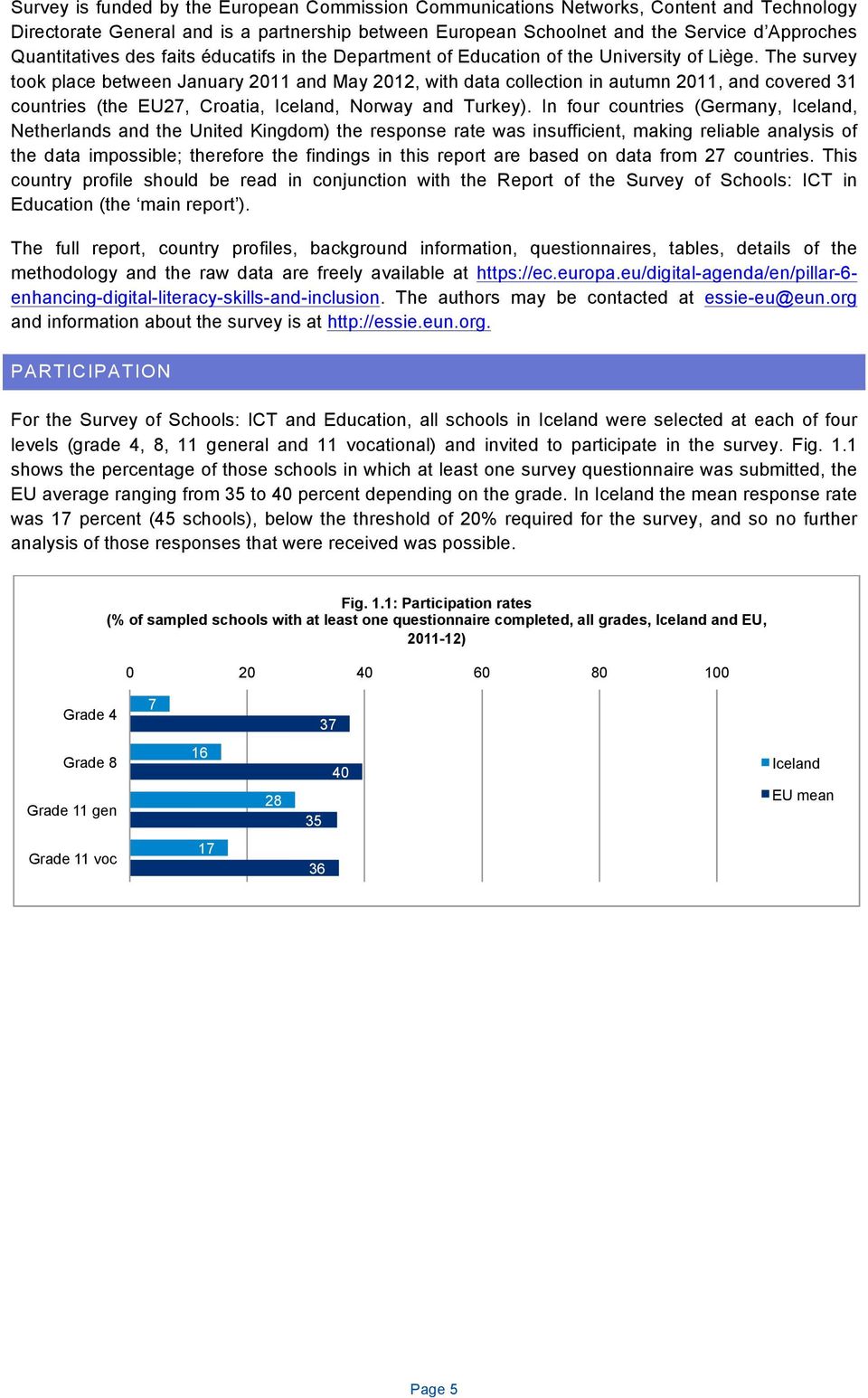
5 Survey is funded by the European Commission Communications Networks, Content and Technology Directorate General and is a partnership between European Schoolnet and the Service d Approches Quantitatives des faits éducatifs in the Department of Education of the University of Liège. The survey took place between January 2011 and May 2012, with data collection in autumn 2011, and covered 31 countries (the EU27, Croatia, Iceland, Norway and Turkey). In four countries (Germany, Iceland, Netherlands and the United Kingdom) the response rate was insufficient, making reliable analysis of the data impossible; therefore the findings in this report are based on data from 27 countries. This country profile should be read in conjunction with the Report of the Survey of Schools: ICT in Education (the main report ). The full report, country profiles, background information, questionnaires, tables, details of the methodology and the raw data are freely available at enhancing-digital-literacy-skills-and-inclusion. The authors may be contacted at [email protected] and information about the survey is at PARTICIPATION For the Survey of Schools: ICT and Education, all schools in Iceland were selected at each of four levels (grade 4, 8, 11 general and 11 vocational) and invited to participate in the survey. Fig. 1.1 shows the percentage of those schools in which at least one survey questionnaire was submitted, the EU average ranging from 35 to 40 percent depending on the grade. In Iceland the mean response rate was 17 percent (45 schools), below the threshold of 20% required for the survey, and so no further analysis of those responses that were received was possible. Fig. 1.1: Participation rates (% of sampled schools with at least one questionnaire completed, all grades, Iceland and EU, ) Grade Grade 8 Grade 11 gen Iceland EU mean Grade 11 voc Page 5
SURVEY OF SCHOOLS: ICT IN EDUCATION COUNTRY PROFILE: GERMANY
 SURVEY OF SCHOOLS: ICT IN EDUCATION COUNTRY PROFILE: GERMANY November 2012 This report was prepared by the Contractor: European Schoolnet and University of Liège under contract SMART 2010/009. The views
SURVEY OF SCHOOLS: ICT IN EDUCATION COUNTRY PROFILE: ESTONIA
 SURVEY OF SCHOOLS: ICT IN EDUCATION COUNTRY PROFILE: ESTONIA November 2012 This report was prepared by the Contractor: European Schoolnet and University of Liège under contract SMART 2010/0039. The views
SURVEY OF SCHOOLS: ICT IN EDUCATION COUNTRY PROFILE: PORTUGAL
 SURVEY OF SCHOOLS: ICT IN EDUCATION COUNTRY PROFILE: PORTUGAL November 2012 This report was prepared by the Contractor: European Schoolnet and University of Liège under contract SMART 2010/0039. The views
SURVEY OF SCHOOLS: ICT IN EDUCATION COUNTRY PROFILE: HUNGARY
 SURVEY OF SCHOOLS: ICT IN EDUCATION COUNTRY PROFILE: HUNGARY November 2012 This report was prepared by the Contractor: European Schoolnet and University of Liège under contract SMART 2010/0039. The views
SURVEY OF SCHOOLS: ICT IN EDUCATION COUNTRY PROFILE: NORWAY
 SURVEY OF SCHOOLS: ICT IN EDUCATION COUNTRY PROFILE: NORWAY November 2012 This report was prepared by the Contractor: European Schoolnet and University of Liège under contract SMART 2010/0039. The views
SURVEY OF SCHOOLS: ICT IN EDUCATION COUNTRY PROFILE: ITALY
 SURVEY OF SCHOOLS: ICT IN EDUCATION COUNTRY PROFILE: ITALY November 2012 This report was prepared by the Contractor: European Schoolnet and University of Liège under contract SMART 2010/0039. The views
SURVEY OF SCHOOLS: ICT IN EDUCATION COUNTRY PROFILE: FRANCE
 SURVEY OF SCHOOLS: ICT IN EDUCATION COUNTRY PROFILE: FRANCE November 2012 This report was prepared by the Contractor: European Schoolnet and University of Liège under contract SMART 2010/0039. The views
SURVEY OF SCHOOLS: ICT IN EDUCATION COUNTRY PROFILE: CZECH REPUBLIC
 SURVEY OF SCHOOLS: ICT IN EDUCATION COUNTRY PROFILE: CZECH REPUBLIC November 2012 This report was prepared by the Contractor: European Schoolnet and University of Liège under contract SMART 2010/0039.
SURVEY OF SCHOOLS: ICT IN EDUCATION COUNTRY PROFILE: SPAIN
 SURVEY OF SCHOOLS: ICT IN EDUCATION COUNTRY PROFILE: SPAIN November 2012 This report was prepared by the Contractor: European Schoolnet and University of Liège under contract SMART 2010/0039. The views
SURVEY OF SCHOOLS: ICT IN EDUCATION COUNTRY PROFILE: SWEDEN
 SURVEY OF SCHOOLS: ICT IN EDUCATION COUNTRY PROFILE: SWEDEN November 2012 This report was prepared by the Contractor: European Schoolnet and University of Liège under contract SMART 2010/0039. The views
SURVEY OF SCHOOLS: ICT IN EDUCATION COUNTRY PROFILE: BELGIUM
 SURVEY OF SCHOOLS: ICT IN EDUCATION COUNTRY PROFILE: BELGIUM November 2012 This report was prepared by the Contractor: European Schoolnet and University of Liège under contract SMART 2010/0039. The views
Survey of Schools: ICT in Education
 Survey of Schools: ICT in Education Benchmarking Access, Use and Attitudes to Technology in Europe s Schools FINAL REPORT A study prepared for the European Commission DG Communications Networks, Content
Computing our Future Computer programming and coding in schools in Europe. Anja Balanskat, Senior Manager European Schoolnet
 Computing our Future Computer programming and coding in schools in Europe Anja Balanskat, Senior Manager European Schoolnet ABOUT THE SURVEY What do Ministries currently think about the topic? Curricula
Survey of Schools: ICT in Education
 University of Liege Psychology and Education Survey of Schools: ICT in Education BENCHMARKING ACCESS, USE AND ATTITUDES TO TECHNOLOGY IN EUROPE S SCHOOLS Executive Summary February 2013 www europeanschoolnet
The Structure of the European Education Systems 2014/15:
 The Structure of the European Education Systems 2014/15: Schematic Diagrams November 2014 Eurydice Facts and Figures Education and Training at is Eurydice The Eurydice Network provides information on and
The structure of the European education systems 2012/13: schematic diagrams
 What is Eurydice The Eurydice Network provides information on and analyses of European education systems and policies. It consists of 38 national units based in all 34 countries participating in the EU's
The structure of the European education systems. schematic diagrams. Eurydice Highlights. Education and Training
 What is Eurydice The Eurydice Network provides information on and analyses of European education systems and policies. It consists of 40 national units based in all 36 countries participating in the EU's
Entrepreneurship Education at School in Europe
 Entrepreneurship Education at School in Europe National Strategies, Curricula and Learning Outcomes EURYDICE Entrepreneurship Education at School in Europe National Strategies, Curricula and Learning
EUROPLAT European Network for Psychology Learning & Teaching
 EUROPLAT European Network for Psychology Learning & Teaching Progress Report Public Part 155981-LLP-1-2009-UK-ERASMUS-ENWA Project information Project acronym: Project title: Project number: Sub-programme
Entrepreneurship Education at School in Europe
 Entrepreneurship Education at School in Europe National Strategies, Curricula and Learning Outcomes EURYDICE Entrepreneurship Education at School in Europe National Strategies, Curricula and Learning
ICT in Physics Teaching for Secondary Schools and Colleges
 ICT in Physics Teaching for Secondary Schools and Colleges Beata Jarosievitz Dennis Gabor College SEK Budapest International School (Hungary) [email protected] Abstract In my research work I studied the
Automatic Recognition of Full Degrees. Erasmus Student Network AISBL *1. Emanuel Alfranseder #2. February 2014
 Automatic Recognition of Full Degrees *1 Emanuel Alfranseder #2 February 2014 * 1 ESN AISBL, Rue Hydraulique / Waterkrachtstraat, 15B, 1210 Saint-Josse-Ten-Noode / Sint-Jost-ten-Node, Brussels BELGIUM,
PROGRAMME SPECIFICATION. Foundation Degree (Working with Children: Education and Well-Being) Foundation Degree / Foundation Certificate
 PROGRAMME SPECIFICATION Foundation Degree (Working with Children: Education and Well-Being) Awarding institution: Institute of Education, University of London Teaching institution: Institute of Education,
Eurydice Report. Developing. Key Competences. at School in Europe: Challenges and Opportunities for Policy. Eurydice
 Eurydice Report Developing Key Competences at School in Europe: Challenges and Opportunities for Policy Eurydice Developing Key Competences at School in Europe: Challenges and Opportunities for Policy
Cataloguing data can be found at the end of this publication. Luxembourg: Publications Office of the European Union, 2011 ISBN 978-92-896-0680-6
 Study visits act as a POWERFUL TOOL to stimulate discussions and inform/improve training policies at local, regional and national level A large number of participants brought the outcomes of their visits
ICT in Finnish education and ICT education in Finland. TOMI JAAKKOLA Centre for Learning Research University of Turku
 ICT in Finnish education and ICT education in Finland TOMI JAAKKOLA Centre for Learning Research University of Turku Finland Table of Contents Overview of Finnish education system ICT in Finnish education
INFORMATION TECHNOLOGY
 INFORMATION TECHNOLOGY You have: TASC subjects May lead to: Basic Computing 1 No previous experience Computing 2 Package Essential Skills - Using Computers and the Internet 2 Employment and further computer
Information and Communication Technologies in the field of general education in Armenia
 Information and Communication Technologies in the field of general education in Armenia NOVEMBER 2010 REPUBLIC OF ARMENIA Capital Yerevan Area 29,800 km 2 Population 3,250,000 Regions 11 Armenian school
The Use of ICT in Education: a survey of schools in Europe
 bs_bs_banner European Journal of Education, PartI The Use of ICT in Education: a survey of schools in Europe Patricia Wastiau, Roger Blamire, Caroline Kearney, Valerie Quittre, Eva Van de Gaer & Christian
N Subjects G 1 G 2 G 3 G 4 G 5 G 6
 System of General Education in Cambodia: 6 + + ; years of schooling Primary education (Grades -6): 6 years Lower secondary education (Grades 7-9): years Upper Secondary (Grade 0, and ): years Primary education
ESPIL- European School Psychologists Improve Lifelong Learning
 ESPIL- European School Psychologists Improve Lifelong Learning Final Report Public Part Project information Project acronym: Project title: Project number: ESPIL European School Psychologists Improve Lifelong
Age Starts at the age of 6 or 7 Duration 8 years in general (can be 4 or 6 years depending on the type of
 HUNGARY Introduction The Hungarian educational system is one of the most decentralised educational systems in Europe. The administrative responsibilities are shared horizontally between the Hungarian Ministry
Information security education for students in Japan
 Information security education for students in Japan Introduction This article aims to introduce the current situation of elementary and secondary school education on information security in Japan, as
EURYDICE. Key Data on Education in Europe 2012
 EURYDICE Key Data on Education in Europe 2012 This document is published by the Education, Audiovisual and Culture Executive Agency (EACEA P9 Eurydice). Available in English (Key Data on Education in Europe
The background of the improvement of PISA results in Hungary the impact of the EU funded educational development programs 1
 The background of the improvement of PISA results in Hungary the impact of the EU funded educational development programs 1 by Gábor Halász ELTE University Budapest (http://halaszg.ofi.hu) Hungary, similarly
The Community Innovation Survey 2010 (CIS 2010)
 The Community Innovation Survey 2010 (CIS 2010) THE HARMONISED SURVEY QUESTIONNAIRE The Community Innovation Survey 2010 FINAL VERSION July 9, 2010 This survey collects information on your enterprise s
STUDY VISITS FOR EDUCATION AND VOCATIONAL TRAINING SPECIALISTS AND DECISION-MAKERS
 Brussels, 31.01.2012 (LLP/NA/DIR/2012/004 Annex-1) STUDY VISITS FOR EDUCATION AND VOCATIONAL TRAINING SPECIALISTS AND DECISION-MAKERS PROGRAMME ANNOUNCEMENT FOR STUDY VISITS IN THE 2012-2013 ACADEMIC YEAR
Moodle E-Learning Platforms and Technologies Project Project No. LLP-LdV-PRT-2012-LT-0316
 Moodle E-Learning Platforms and Technologies Project Project No. LLP-LdV-PRT--LT-36 Survey Report according answers to Questionnaire for Students The aim of the research This questionnaire is part of the
PISA FOR SCHOOLS. How is my school comparing internationally? Andreas Schleicher Director for Education and Skills OECD. Madrid, September 22 nd
 PISA FOR SCHOOLS How is my school comparing internationally? Andreas Schleicher Director for Education and Skills OECD Madrid, September 22 nd PISA in brief Over half a million students representing 28
Key Data on Education in Europe 2012
 Key Data on Education in Europe 2012 EURYDICE Key Data on Education in Europe 2012 This document is published by the Education, Audiovisual and Culture Executive Agency (EACEA P9 Eurydice). Available
NECs. Q2. Are any of the employees of your NEC coordinating other European innitiatives (e.g. Youth Action, Euroguidance, LLP, EURES, etc.)?
 NECs Survey Questionnaire for the National Europass Centres Q2. Are any of the employees of your NEC coordinating other European innitiatives (e.g. Youth Action, Euroguidance, LLP, EURES, etc.)? Frequency
OECD review of the secondary school modernisation programme in Portugal
 ISSN 2072-7925 OECD review of the secondary school modernisation programme in Portugal CELE Exchange 2010/1 OECD 2010 OECD review of the secondary school modernisation programme in Portugal By Alastair
The education system and lifelong learning in Finland. October 2015 Petri Haltia
 The education system and lifelong learning in Finland October 2015 Petri Haltia FINLAND Population: year 2012: 5,421,827 density: 16/km 2 Area: total 338,424 km 2 water 10 % GDP (nominal) 2011 estimate:
The E-Learning Program of The Vocational Training Center of the National and Kapodistrian University uses innovative educational tools, such as:
 Context The E-Learning Program of The Vocational Training Center of the National and Kapodistrian University of Athens, in operation since 2001, provides distance education courses that link theoretical
Teachers and School Heads Salaries and Allowances in Europe, 2011/12. Eurydice Report. Education and Culture
 Teachers and School Heads Salaries and Allowances in Europe, 2011/12 Eurydice Report Education and Culture Eurydice Report Teachers' and School Heads' Salaries and Allowances in Europe, 2011/12 CONTENTS
How To Promote Physical Education In Schools
 Physical Education and at Sport School in Europe Eurydice Report Education and Training Physical Education and Sport at School in Europe Eurydice Report Education and Training This document is published
Teacher training and usage of ICT in education
 Teacher training and usage of ICT in education Jaco du Toit UNESCO Adviser for Communication and Information UNESCO Office for Eastern Africa Table of contents Definition of ICT-qualified; Professional
4. KEY COMPETENCES AMONG YOUNG PEOPLE
 4. KEY COMPETENCES AMONG YOUNG PEOPLE Main messages Literacy in reading, mathematics and science No significant progress was made on the European benchmark for the percentage of low achievers in reading
STUDY VISITS FOR EDUCATION AND VOCATIONAL TRAINING SPECIALISTS AND DECISION MAKERS
 Brussels,. (LLP/NA/DIR/2011/012 Annex) STUDY VISITS FOR EDUCATION AND VOCATIONAL TRAINING SPECIALISTS AND DECISION MAKERS PROGRAMME ANNOUNCEMENT FOR STUDY VISITS IN THE 2011-2012 ACADEMIC YEAR Applicants
The Structure of the European Education Systems 2015/16
 The Structure of the European Education Systems 2015/16 Schematic Diagrams Eurydice Facts and Figures Education and Training The Structure of the European Education Systems 2015/16 Schematic Diagrams
THE INFORMATION TECHNOLOGY (IT) UNIT OR DEPARTMENT IN THE MINISTRY OF EDUCATION. Issues of function, organization and staffing. By Alex Twinomugisha
 THE INFORMATION TECHNOLOGY (IT) UNIT OR DEPARTMENT IN THE MINISTRY OF EDUCATION Issues of function, organization and staffing By Alex Twinomugisha Global E Schools and Communities Initiative (GeSCI) Copyright
ICELAND ICELAND ICELAND. spotlight on VET. Education and training in figures. spotlight on VET 2012/13
 Education and training in figures Learners in upper secondary education enrolled in vocational and general % of all students in upper secondary education, 11 VOCATIONAL GERAL 1 Further information 23.9
International Computer and Information Literacy Study (ICILS): Development of digital skills in the school system: An international glance
 International Computer and Information Literacy Study (ICILS): Development of digital skills in the school system: An international glance Julian Fraillon Australian Council for Educational Research Aim
Supporting CSIRTs in the EU Marco Thorbruegge Head of Unit Operational Security European Union Agency for Network and Information Security
 Supporting CSIRTs in the EU Marco Thorbruegge Head of Unit Operational Security European Union Agency for Network and Information Security www.enisa.europa.eu European Union Agency for Network and Information
Note: Survey responses are based upon the number of individuals that responded to the specific question. Response Responses Responses
 State: IN Results based on 133 survey(s). Note: Survey responses are based upon the number of individuals that responded to the specific question. What is your current job responsibility? (select one)
ICT in Education: Malaysian Experience
 ICT in Education: Malaysian Experience Point of View From the educator s point of view, the function of ICT in schools is NOT primarily to promote computer literacy, or because technology is the wave of
Financial capability, examples and best practices
 Financial capability, examples and best practices Introducing financial education in Portuguese schools Susana Narciso Banco de Portugal Regional Meeting for Europe and Central Asia Skopje, 2 October 2014
Career Education in Korea
 Career Education in Korea Dr. Joo Hee CHANG Researcher 1 1 Overview 2 Recent Career Education Policy Reform 3 Career Education R & D at KRIVET 4 Future of Career Education 2 Part 1 OVERVIEW : EDUCATION
Planning Process and Methodology
 Executive Summary Our mission is to provide students and staff with technology to meet their instructional and administrative needs. This incorporates all aspects of technology including networking, end
IUSD TECHNOLOGY PLAN. November 2013. Irvine Unified School District Information Technology Department 1
 IUSD TECHNOLOGY PLAN November 2013 1 AGENDA Agenda 1 Scope and Purpose of the Plan 2 Plan Development 3 Plan Content 3.1 Current Access and Use 3.2 Curriculum Goals 3.3 Professional Learning Goals 3.4
Video conferencing guide
 1 Rather than teaching sample lessons on induction days or sending Secondary School teachers to visit Primaries, some Secondary Schools are now using video conferencing technology to display sample lessons
Country Report of Finland
 Country Report of Finland 23 rd March 2012 Educational and vocational training system in Finland The primary education in Finland has been valued positively by many countries. One reason for that is that
Screening report Turkey
 13 February 2006 Screening report Turkey Chapter 26 Education and Culture Date of screening meetings: Explanatory meeting: 26 October 2005 Bilateral meeting: 16 November 2005 1 I. CHAPTER CONTENT The areas
The pskills experience: Using modern Educational Programming Languages to revitalise computer science teaching
 The pskills experience: Using modern Educational Programming Languages to revitalise computer science teaching Emanuela Ovcin 1, Chiara Cerato 2, David Smith 3, Nektarios Moumoutzis 4 [email protected],
168/2014-4 November 2014. At risk of poverty or social exclusion 2 rate in the EU28, 2008-2013 (% of total population)
 168/2014-4 November 2014 At risk of poverty or social exclusion in the EU28 More than 120 million persons at risk of poverty or social exclusion in 2013 Almost 1 out of every 4 persons in the EU in this
Youth Financial Literacy: Development, Delivery and Execution of Programs
 International Conference on Financial Education Youth Financial Literacy: Development, Delivery and Execution of Programs Koid Swee Lian Director, Consumer and Market Conduct Department Bank Negara Malaysia
ICT in Malaysian Schools: Policy and Strategies
 ICT in Malaysian Schools: Policy and Strategies By Chan, Foong-Mae (Educational Technology Division, Ministry of Education, Malaysia) Background Malaysia implemented the first computer system in 1966.
Physical Education. Sport. School in Europe
 Physical Education and at Sport School in Europe Eurydice Report Education and Training Physical Education and Sport at School in Europe Eurydice Report Education and Training This document is published
(AGENDA -OVERVIEW OF THE DAY) 1. COOPERATION IN THE FIELD OF POLICIES 2. COMMUNITY PROGRAMMES 3. OTHER COMMUNITY INSTRUMENTS
 (AGENDA -OVERVIEW OF THE DAY) 1. COOPERATION IN THE FIELD OF POLICIES 2. COMMUNITY PROGRAMMES 3. OTHER COMMUNITY INSTRUMENTS 4. OTHER OBLIGATIONS RELATED TO THE ACQUIS 1 COOPERATION IN THE FIELD OF POLICIES
1. Perception of the Bancruptcy System... 2. 2. Perception of In-court Reorganisation... 4
 Bankruptcy Systems and In-court Reorganisation of Firms, 2010 Content: 1. Perception of the Bancruptcy System... 2 2. Perception of In-court Reorganisation... 4 3. Perception of Creditor Committees, Fast
Youthpass Impact Study. Young people's personal development and employability and the recognition of youth work
 Youthpass Impact Study Young people's personal development and employability and the recognition of youth work 1 Authors Marti Taru and Paul Kloosterman Commissioned by The European Commission DG Education
A STUDY OF THE EFFECTS OF ELECTRONIC TEXTBOOK-AIDED REMEDIAL TEACHING ON STUDENTS LEARNING OUTCOMES AT THE OPTICS UNIT
 A STUDY OF THE EFFECTS OF ELECTRONIC TEXTBOOK-AIDED REMEDIAL TEACHING ON STUDENTS LEARNING OUTCOMES AT THE OPTICS UNIT Chen-Feng Wu, Pin-Chang Chen and Shu-Fen Tzeng Department of Information Management,
ASSESSMENT WITHIN CENSUS AT SCHOOL: A PILOT PROGRAM IN THE UNITED STATES
 ASSESSMENT WITHIN CENSUS AT SCHOOL: A PILOT PROGRAM IN THE UNITED STATES Martha Aliaga and Rebecca Nichols American Statistical Association, United States of America [email protected] Census at School
Early Childhood Program Guidance for Children Ages Birth through Eight
 Early Childhood Program Guidance for Children Ages Birth through Eight Technology and Interactive Media in the Early Years Technology and interactive media are rapidly expanding the materials and experiences