
Web Load Testing Tutorial. SilkPerformer
|
|
|
- Marybeth Gibbs
- 10 years ago
- Views:
Transcription
1 Web Load Testing Tutorial SilkPerformer 2009

2 Borland Software Corporation 8310 N Capital of Texas Hwy Bldg 2, Ste 100 Austin, TX Borland Software Corporation may have patents and/or pending patent applications covering subject matter in this document. Please refer to the product CD or the About dialog box for the list of applicable patents. The furnishing of this document does not give you any license to these patents. Copyright Borland Software Corporation and/or its subsidiaries. All Borland brand and product names are trademarks or registered trademarks of Borland Software Corporation in the United States and other countries. All other marks are the property of their respective owners. June 2009 PDF

3 Contents Introduction 1 Overview SilkPerformer Sample Web Application Chapter 1 Defining Load Test Projects 5 Overview Defining a Load Test Project Chapter 2 Creating Test Scripts 9 Overview Creating a Load Test Script Trying Out a Generated Script Chapter 3 Analyzing Test Scripts 17 Overview Visual Analysis with TrueLog Explorer Viewing a Summary Report Finding Errors Viewing Page Statistics Comparing Record and Replay TrueLogs Chapter 4 Customizing Test Scripts 33 Overview Customizing Session Handling Customizing User Data Adding Verifications Chapter 5 Defining User Profiles 53 Overview Defining a custom user profile Chapter 6 Identifying Baseline Performance 59 Overview Finding a Baseline Confirming a Baseline Chapter 7 Setting Up Monitoring Templates 69 Overview Setting Up a Monitoring Template Chapter 8 Defining Workload 77 Overview Defining Workload Chapter 9 Running & Monitoring Tests 85 Overview Running a Load Test Monitoring a Test Monitoring a Server Chapter 10 Exploring Test Results 95 Overview Working with TrueLog On Error Viewing an Overview Report Viewing a Graph Index 117 SilkPerformer Web Load Testing Tutorial iii

4 iv SilkPerformer Web Load Testing Tutorial

5 Introduction About these tutorials The Web Load Testing Tutorial offers an overview of using SilkPerformer to set up and run Web load tests. This Introduction contains the following sections: Section Page Overview 1 SilkPerformer 1 Sample Web Application 2 Overview The Web Load Testing Tutorial is designed to ease you into the process of load testing with SilkPerformer, and to get you up and running as quickly as possible. It will help you take full advantage of SilkPerformer s ease of use and to exploit the leading-edge functionality that s embodied in e-business s load-testing tool of choice. SilkPerformer SilkPerformer is the industry s most powerful yet easiest to use enterpriseclass load and stress testing tool. Visual script generation techniques and the ability to test multiple application environments with thousands of concurrent users allow you to thoroughly test your enterprise applications reliability, performance, and scalability before they re deployed regardless of their size and complexity. Powerful root cause analysis tools and management reports help you isolate problems and make quick decisions thereby minimizing test SilkPerformer Web Load Testing Tutorial 1

6 INTRODUCTION Sample Web Application cycles and accelerating your time to market. Benefits Ensure the scalability, performance, and reliability of your enterprise applications SilkPerformer ensures the quality of your enterprise applications by measuring their performance from the end-user perspective, as well as internally, in a variety of workload scenarios and dynamic load conditions. Test remote components early in the development cycle Dramatically reduce the cost of bugs in your multi-tier enterprise application by testing the functionality, interoperability, and performance of remote components early in the development cycle even before client applications have been built. You can rapidly generate test drivers for Web services,.net remoting objects, EJB s and Java RMI objects by exploring them via a point & click interface. Alternately, you can reuse unit test drivers written by developers for concurrency tests or you can build new test cases directly in Java and other.net languages, such as C# and VB.NET, using SilkPerformer s Visual Studio.NET Add-In. Reusing projects Pinpoint problems easily for quick resolution SilkPerformer s unrivaled TrueLog TM technology for HTML, XML, SQL, TCP/ IP, and UDP based protocol data provides full visual root-cause analysis from the end-user perspective. TrueLogs visually recreate the data that users provide and receive during load tests for HTML pages this includes all embedded objects enabling you to visually analyze the behavior of your application as errors occur during load tests. In addition detailed response timer statistics help you uncover the root causes of missed Service Level Agreements before your application goes live. SilkPerformer s extended workflow simplifies and deepens its integration with SilkCentral Test Manager. By clicking SilkPerformer s new Reuse Project button, test projects can be uploaded to and reused by Test Manager (for test automation). See SilkCentral Test Manager documentation for details. Sample Web Application SilkPerformer s sample Web application is called ShopIt. ShopIt simulates a simple Web e-commerce site with a catalog of camping merchandise that is available for simulated online purchase. Use this application to experiment with SilkPerformer s Web application capabilities. 2 SilkPerformer Web Load Testing Tutorial

7 INTRODUCTION Sample Web Application ShopIt V 6.0 setup is available from SilkPerformer installation CD (\Extras\ShopItV60.exe) SilkPerformer s download area ( download_silk.html) See the SilkPerformer Installation Guide for detailed information on the installation process. ShopIt V is designed to generate errors, including missing Web links (due to merchandise being out of stock) and session errors. The scripts must be customized before the application can run error-free. See Customizing Session Handling for details. SilkPerformer Web Load Testing Tutorial 3

8 INTRODUCTION Sample Web Application 4 SilkPerformer Web Load Testing Tutorial

9 1 Defining 1Chapter Load Test Projects Introduction What you will learn This tutorial explains how to define a load testing project in SilkPerformer. This chapter contains the following sections: Section Page Overview 5 Defining a Load Test Project 6 Overview The first step in conducting a SilkPerformer load test is to define the basic settings for the load-testing project. The project is given a name, and optionally a brief description can be added. The type of application to be tested is specified from a range of choices that includes all the major traffic that is encountered in e-business today on the Internet and on the Web, including the most important database and distributed applications. The settings that are specified are associated with a particular load-testing project. It s easy to switch between different projects, to edit projects, and to save projects so that they can later be modified and reused. A project contains all the resources needed to complete a load test. These include a workload, one or more profiles and test scripts, all the data files that are accessed from the script, and a specific number of agent computers and information for server side monitoring. Options for all of these resources are available directly from the project icon in the corresponding tree list. SilkPerformer Web Load Testing Tutorial 5

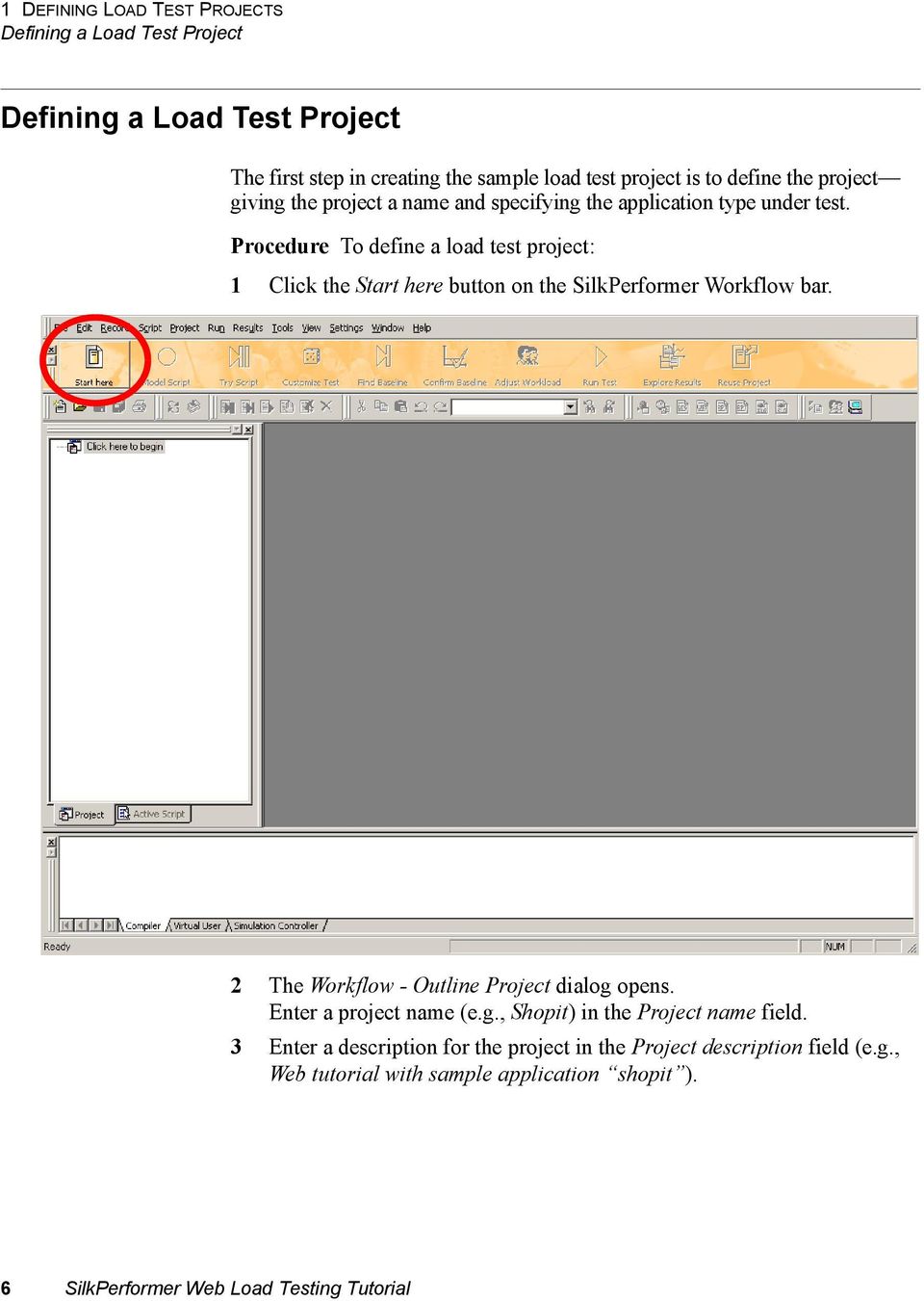
10 1 DEFINING LOAD TEST PROJECTS Defining a Load Test Project Defining a Load Test Project The first step in creating the sample load test project is to define the project giving the project a name and specifying the application type under test. Procedure To define a load test project: 1 Click the Start here button on the SilkPerformer Workflow bar. 2 The Workflow - Outline Project dialog opens. Enter a project name (e.g., Shopit) in the Project name field. 3 Enter a description for the project in the Project description field (e.g., Web tutorial with sample application shopit ). 6 SilkPerformer Web Load Testing Tutorial
11 1 DEFINING LOAD TEST PROJECTS Defining a Load Test Project 4 Select Web business transaction (HTML/HTTP) in the Application type field. Note If you want to load test a Flash Remoting application, please refer to the Advanced Concepts book, chapter Load Testing Flash Remoting Applications for detailed information. Note If you want to load test a WebDAV application (Microsoft Outlook Web Access), simply select WebDAV (MS Outlook Web Access) in the Application type field. The procedure is identical to load testing any other Web business transaction (HTTP). 5 Click OK to create the project based on your settings. SilkPerformer Web Load Testing Tutorial 7

12 1 DEFINING LOAD TEST PROJECTS Defining a Load Test Project 8 SilkPerformer Web Load Testing Tutorial
13 2 Creating 2Chapter Test Scripts Introduction What you will learn This tutorial explains how to model load test scripts and try out tests scripts via TryScript runs. This chapter contains the following sections: Section Page Overview 9 Creating a Load Test Script 10 Trying Out a Generated Script 14 Overview The easiest method of creating a load test script is to use the SilkPerformer Recorder, SilkPerformer s engine for capturing and recording traffic and generating test scripts. First the SilkPerformer Recorder captures and records the traffic between a client application and the server under test. When recording is complete, the SilkPerformer Recorder automatically generates a test script based on the recorded traffic. Scripts are written in SilkPerformer s scripting language, Benchmark Description Language (BDL). During the recording phase, you define transactions. A transaction is a discrete piece of work that can be assigned to a virtual user in a load test and for which separate time measurements can be made. You should create new transactions only for pieces of work that don t have dependencies on other pieces of work. Individual time measurements can be made for any action or series of actions that occur during recording. SilkPerformer Web Load Testing Tutorial 9

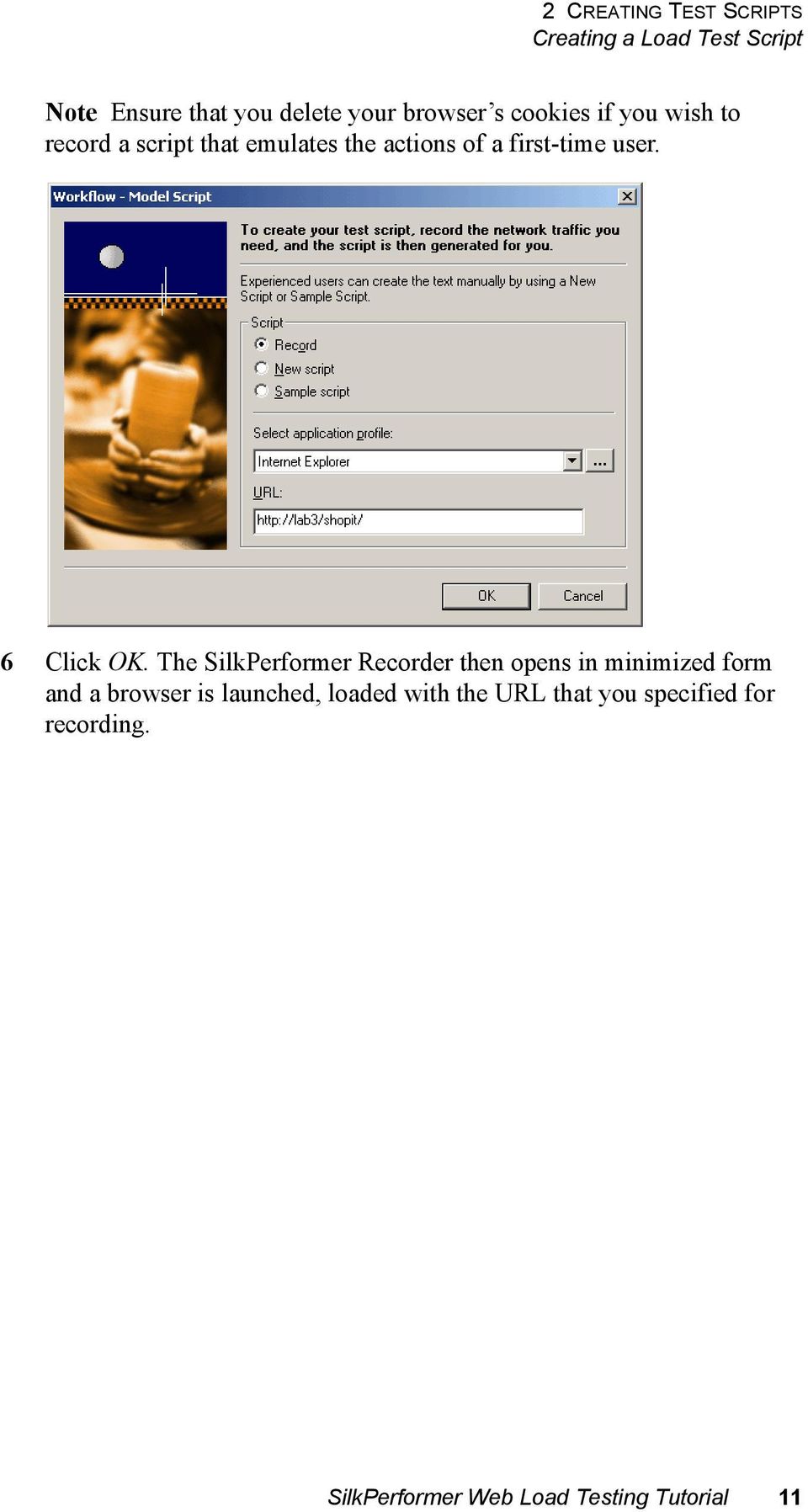
14 2 CREATING TEST SCRIPTS Creating a Load Test Script Creating a Load Test Script Procedure To model a load test script: 1 Click the Model Script button on the SilkPerformer Workflow bar. 2 The Workflow - Model Script dialog appears. Select Record in the Script area of the dialog. 3 From the Select application profile drop-down list, select a profile for the client application you wish to use in your load test (e.g., Internet Explorer). 4 If a profile has not yet been set up for the application you wish to use, click the button to the right of the drop-down list to set one up now. 5 In the URL field, enter a URL to be recorded (e.g., 10 SilkPerformer Web Load Testing Tutorial

15 2 CREATING TEST SCRIPTS Creating a Load Test Script Note Ensure that you delete your browser s cookies if you wish to record a script that emulates the actions of a first-time user. 6 Click OK. The SilkPerformer Recorder then opens in minimized form and a browser is launched, loaded with the URL that you specified for recording. SilkPerformer Web Load Testing Tutorial 11
16 2 CREATING TEST SCRIPTS Creating a Load Test Script Note To see a report of the actions that occur during recording, maximize the Recorder dialog by clicking the Change GUI size button. 7 Using the browser, interact with the target server in the way that you wish virtual users to interact during the load test (i.e., click links and explore products). Your actions will be captured and recorded by the Recorder. When you re finished, close the browser window and click the Stop Recording button on the Recorder. 12 SilkPerformer Web Load Testing Tutorial

17 2 CREATING TEST SCRIPTS Creating a Load Test Script 8 The Save As dialog appears. Save the script with a meaningful name that reflects the behavior of the virtual user who s actions you defined. SilkPerformer Web Load Testing Tutorial 13

18 2 CREATING TEST SCRIPTS Trying Out a Generated Script 9 The new generated load test script, that s based on the recorded traffic, then appears in the SilkPerformer script editor window. Trying Out a Generated Script Once you ve generated a test script you should determine if the script runs without error via a TryScript run. A TryScript run will determine if a script accurately recreates the interaction that was recorded previously in this tutorial. The default option settings for TryScript runs include live display of data downloaded during testing and the writing of log and report files. With TryScript runs only a single virtual user is run and the stress test option is enabled so that there is no think time or delay between transactions. TryScript runs are viewed in TrueLog Explorer, which helps you find replay errors quickly. 14 SilkPerformer Web Load Testing Tutorial

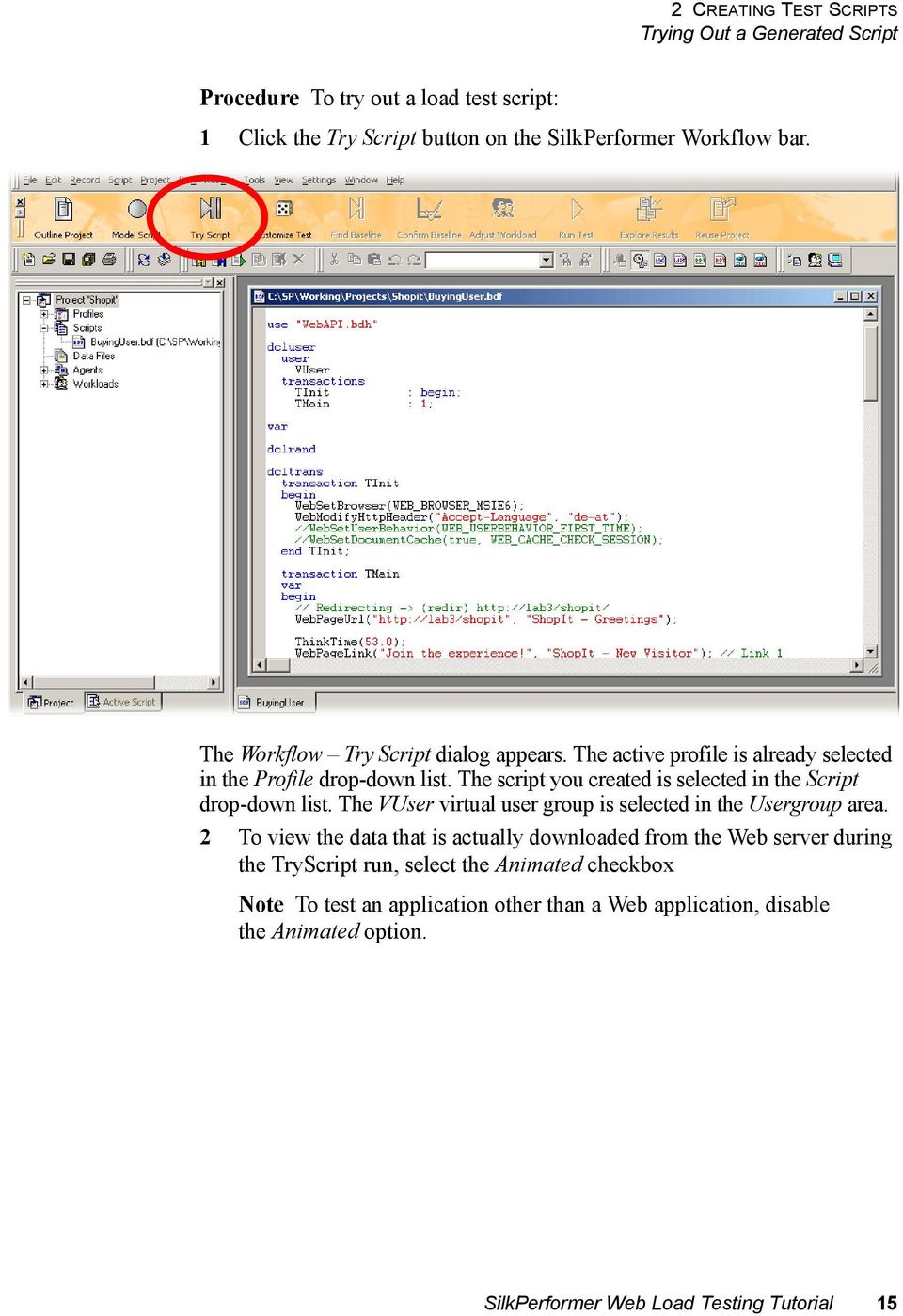
19 2 CREATING TEST SCRIPTS Trying Out a Generated Script Procedure To try out a load test script: 1 Click the Try Script button on the SilkPerformer Workflow bar. The Workflow Try Script dialog appears. The active profile is already selected in the Profile drop-down list. The script you created is selected in the Script drop-down list. The VUser virtual user group is selected in the Usergroup area. 2 To view the data that is actually downloaded from the Web server during the TryScript run, select the Animated checkbox Note To test an application other than a Web application, disable the Animated option. SilkPerformer Web Load Testing Tutorial 15
20 2 CREATING TEST SCRIPTS Trying Out a Generated Script 3 Click Run. Note You are not running an actual load test here, only a test run to see if your script requires debugging. 4 The TryScript run begins. The Monitor window opens, giving you detailed information about the run s progress. 5 TrueLog Explorer opens, showing you the data that is actually downloaded during the TryScript run. 6 If any errors occur during the TryScript run, TrueLog Explorer will assist you in locating them and customizing any session relevant information. See Customizing Session Handling for details. 16 SilkPerformer Web Load Testing Tutorial

21 3 Analyzing 3Chapter Test Scripts Introduction What you will learn This tutorial explains how to analyze recorded load test scripts based on the results of TryScript runs. This chapter contains the following sections: Section Page Overview 17 Visual Analysis with TrueLog Explorer 18 Viewing a Summary Report 20 Finding Errors 23 Viewing Page Statistics 25 Comparing Record and Replay TrueLogs 28 Overview Once you ve initiated a TryScript run for a recorded test script you ll need to analyze the results of the TryScript run using TrueLog Explorer. Test script analysis with TrueLog Explorer involves the following three tasks: - Viewing Virtual User Summary Reports - Finding errors - Comparing replay test runs with record test runs SilkPerformer Web Load Testing Tutorial 17
22 3 ANALYZING TEST SCRIPTS Visual Analysis with TrueLog Explorer Visual Analysis with TrueLog Explorer One of TrueLog Explorer s most powerful features is its ability to visually render Web content that s displayed by applications under test. In effect, it shows you what virtual users see when they interact with an application. TrueLog Explorer s interface is comprised of the following sections: The Workflow bar acts as your primary interface as you work with TrueLog Explorer. The Workflow Bar reflects TrueLog Explorer s builtin load testing methodology by supporting its five primary tasks. Tree List view on the left of the interface allows you to expand and collapse TrueLog data downloaded during load tests. Each loaded TrueLog file is displayed here with links to all relevant API nodes. You can click a node to display its contents in Source view and history details in Information view. The Source window offers views of both raw HTML source code and rendered HTML content. Rendered view displays rendered responses from the server for selected API nodes in Tree List view. Source view displays the HTML code that s used to generate Web content. 18 SilkPerformer Web Load Testing Tutorial
23 3 ANALYZING TEST SCRIPTS Visual Analysis with TrueLog Explorer Information view displays data regarding load testing scripts and test runs, including general information about the loaded TrueLog file, the selected API node, BDL script, HTML references, and HTTP header data. Workflow bar Tree View of accessed API nodes Rendered HTML view HTML Source view tab Information Window with multiple views Analyzing a test run Procedure To analyze the results of a test run: 1 Load a TrueLog of interest into TrueLog Explorer. 2 With the TrueLog of the TryScript run you executed in the previous tutorial loaded into TrueLog Explorer, click the Analyze Test button on the Workflow bar. The Analyze Test dialog appears, offering you three options: View a virtual user summary report Look for errors in the TrueLog SilkPerformer Web Load Testing Tutorial 19
24 3 ANALYZING TEST SCRIPTS Viewing a Summary Report Compare the replay test run to the record test run Viewing a Summary Report Virtual user summary reports are summary reports of individual TryScript runs that offer basic descriptions and timing averages. Each report tracks a separate virtual user and presents data in tabular format. Virtual user summary reports include details regarding: - Virtual users - Uncovered errors - Response time information tracked for each transaction defined in a load test script - Page timer measurements for each downloaded Web page - Measurements related to each Web form declared in a load-testing script, including response time measurements and throughput rates for form submissions using POST, GET, and HEAD methods. - Individual timers and counters used in scripts (Measure functions) 20 SilkPerformer Web Load Testing Tutorial
25 3 ANALYZING TEST SCRIPTS Viewing a Summary Report See SilkPerformer s online documentation for details regarding the statistics that are included in virtual user summary reports. Procedure To display a virtual user summary report for a test run: 1 With the TrueLog you generated in the preceding tutorial loaded into TrueLog Explorer, click the Analyze Test button. SilkPerformer Web Load Testing Tutorial 21
26 3 ANALYZING TEST SCRIPTS Viewing a Summary Report 2 Select the Show the virtual user summary report link. Enabling summary reports Because virtual user summary reports require significant processing, they are not generated by default. To enable the automatic display of virtual user reports at the end of animated TryScript runs, or when clicking the root node of a 22 SilkPerformer Web Load Testing Tutorial
27 3 ANALYZING TEST SCRIPTS Finding Errors TrueLog file in Tree List view, select the Display virtual user report checkbox on the TrueLog Explorer Settings menu (Settings/Workspace/Reports). Note Virtual user reports can also be viewed within SilkPerformer Workbench by right-clicking the virtual user in the User view and selecting Show Virtual User Report File from the context menu. Finding Errors TrueLog Explorer helps you find errors quickly after TryScript runs. Erroneous requests can then be examined and necessary customizations can be made via TrueLog Explorer. Note When viewed in Tree List view, API nodes that contain replay errors are tagged with red X marks. Procedure To find replay errors in a TrueLog: 1 With the TrueLog you generated in the preceding tutorial loaded into TrueLog Explorer, click the Analyze Test button. SilkPerformer Web Load Testing Tutorial 23
28 3 ANALYZING TEST SCRIPTS Finding Errors 2 Click the Find errors link on the dialog. 3 The Step through TrueLog dialog appears with the Errors option selected. 4 Click the Find Next button to step through TrueLog result files one error at a time. 24 SilkPerformer Web Load Testing Tutorial
29 3 ANALYZING TEST SCRIPTS Viewing Page Statistics Viewing Page Statistics After verifying the accuracy of a test run, you can analyze the performance of your application under no-load conditions via page statistics. Overview pages detail total page response times, document download times (including server busy times), and time elapsed for receipt of embedded objects. Detailed Web page statistics show exact response times for individual Web page components allowing you to easily pinpoint root causes of errors and slow page downloads. Note Because TryScript runs don t include think times, the measurements they produce cannot be used to predict real-world performance. Detailed Web page drill-down results include the following data for each page component: DNS lookup time Connection time SSL handshake time Send request time Server busy time Response receive time Cache statistics Procedure To view an Overview page: 1 Select an API node in Tree List view for which you would like to view statistics. 2 Select the Whole pages option on the Step through TrueLog dialog. SilkPerformer Web Load Testing Tutorial 25
30 3 ANALYZING TEST SCRIPTS Viewing Page Statistics 3 Click the Statistics tab to open Statistics view. 26 SilkPerformer Web Load Testing Tutorial
31 3 ANALYZING TEST SCRIPTS Viewing Page Statistics 4 Select specific components listed in the URL column for detailed analysis and page drill-down. SilkPerformer Web Load Testing Tutorial 27
32 3 ANALYZING TEST SCRIPTS Comparing Record and Replay TrueLogs Comparing Record and Replay TrueLogs With Web application testing, TrueLog Explorer shows the actual Web pages that are received during tests. Live monitoring of downloaded data is available with TrueLog Explorer's animated mode data is displayed as it is received during testing. By comparing replay TrueLogs generated during the script development process alongside TrueLogs originally generated during application recording, you can verify that test scripts run accurately. Differences between record and replay TrueLogs are typically caused by session relevant data, such as session ID s. See Customizing Session Handling for details. Procedure To compare a replay TrueLog with its corresponding record TrueLog: 1 Click the Analyze Test button on the Workflow Bar. The Workflow - Analyze Test dialog appears. 28 SilkPerformer Web Load Testing Tutorial
33 3 ANALYZING TEST SCRIPTS Comparing Record and Replay TrueLogs 2 Click the Compare your test run button. 3 The corresponding record TrueLog opens in Compare view and the Step through TrueLog dialog appears with the Whole pages option selected allowing you to run a node-by-node comparison of the TrueLogs. 4 Click the Find Next button to step through TrueLog result files one page at a time. SilkPerformer Web Load Testing Tutorial 29
34 3 ANALYZING TEST SCRIPTS Comparing Record and Replay TrueLogs Note Windows displaying content presented during replay have green triangles in their upper left corners. Windows displaying content originally displayed during application recording have red triangles in their upper left corners. Windows displaying the recorded session have red triangles 30 SilkPerformer Web Load Testing Tutorial
35 3 ANALYZING TEST SCRIPTS Comparing Record and Replay TrueLogs Explore differences visually SilkPerformer Web Load Testing Tutorial 31
36 3 ANALYZING TEST SCRIPTS Comparing Record and Replay TrueLogs 32 SilkPerformer Web Load Testing Tutorial
37 4 Customizing 4Chapter Test Scripts Introduction What you will learn This tutorial explains how to analyze a recorded load test script based on the results of a TryScript run. This chapter contains the following sections: Section Page Overview 33 Customizing Session Handling 34 Customizing User Data 40 Adding Verifications 47 Overview Once you ve generated a load test script with SilkPerformer and executed a TryScript run, TrueLog Explorer can help you customize the script in the following ways: Customize session handling - TrueLog Explorer s parsing functions allow you to replace static session ID s in scripts with dynamic session ID s and thereby maintain state information for successful load test runs. Parameterize input data - With user data customization you can make your test scripts more realistic by replacing static recorded user input data with dynamic, parameterized user data that changes with each transaction. Manual scripting isn t required to run such data-driven tests. SilkPerformer Web Load Testing Tutorial 33
38 4 CUSTOMIZING TEST SCRIPTS Customizing Session Handling Add verifications to test scripts - Using the Add Verifications tool, you can gain tremendous insight into data that s downloaded during load tests enabling you to verify that the content that is to be sent by the server is correct. Verifications remain useful after system deployment for ongoing performance management. Customizing Session Handling Because SilkPerformer s recording techniques generate context-full scripts that don t contain static session information, session handling customization is generally not required for most applications. So if you don t detect any problems when you analyze your test you can skip session handling customization and proceed with user data customization. In their responses to clients, servers often generate information at runtime that's used to identify future client requests as coming from the same computer during the same user session. If not updated, such session information can create problems in subsequent test runs. When replayed test runs are compared to originally recorded test runs and outdated session information is identified, that information must be replaced with dynamic variables in future test runs otherwise load test scripts will make requests with invalid session ID s or other session information. TrueLog Explorer s uniquely powerful heuristics do most of this work for you, identifying differences that are relevant for customization in orange and nonrelevant differences that don t require customization in blue. 34 SilkPerformer Web Load Testing Tutorial
39 4 CUSTOMIZING TEST SCRIPTS Customizing Session Handling Procedure To customize session handling: 1 With the record and replay TrueLogs from the previous tutorial loaded into TrueLog Explorer, click the Customize Session Handling button on the Workflow Bar. The Workflow - Customize Session Handling dialog opens. SilkPerformer Web Load Testing Tutorial 35
40 4 CUSTOMIZING TEST SCRIPTS Customizing Session Handling 2 Click Find differences to view a differences table (Source Differences view), which reveals instances in which the server responded with different (or dynamic) information during the replay session than it did during the record session. Such static information may need to be replaced with a variable. 3 Use the Step Through TrueLog dialog to step through HTML server responses with the recorded responses displayed alongside the corresponding replayed responses. Only those differences that indicate that static information is included in the test script and being sent back to the server need to be parsed (e.g., a difference between replay and record 36 SilkPerformer Web Load Testing Tutorial
41 4 CUSTOMIZING TEST SCRIPTS Customizing Session Handling sessions could be caused by an e-commerce site running out of stocked merchandise. Such a difference wouldn t be appropriate for script customization because it isn t session related). The status line tells you if identified differences seem to be sesssion information Differences are shown here in a difference table SilkPerformer Web Load Testing Tutorial 37
42 4 CUSTOMIZING TEST SCRIPTS Customizing Session Handling This indicator tells you that a difference may be session information The number of occurences in HTML code is listed here Double click a listed difference to customize it A difference can only be customized if it occurs in BDL code 4 Double-click an error listed in Source Differences view. The Insert Parsing Functions dialog appears with the boundary values and variable name already inserted there s no need to locate and enter boundary values manually. 38 SilkPerformer Web Load Testing Tutorial
43 4 CUSTOMIZING TEST SCRIPTS Customizing Session Handling 5 Click OK on the Insert Parsing Function dialog to insert the required parsing function into the BDL script. 6 Once the script has been modified successfully, click the Customize Session Handling button to initiate a new TryScript run. 7 Click TryScript Run to see if the script runs correctly now that session handling has been modified. SilkPerformer Web Load Testing Tutorial 39
44 4 CUSTOMIZING TEST SCRIPTS Customizing User Data 8 Analyze the results of the subsequent test run to determine whether or not session handling customization has been successful. 9 Repeat this procedure as many times as required until all session-relevant information in your load test script has been customized. Customizing User Data Under real world conditions, Web application users submit unpredictable combinations of data into HTML forms. One goal of effective Web application testing is to emulate such irregular and diverse user behavior using test scripts. You can customize the user input data that s entered into forms during testing using TrueLog Explorer's Parameter Wizard. The Parameter Wizard lets you specify values to be entered into form fields enabling your test scripts to be more realistic by replacing recorded user input data with randomized, parameterized user data. This tutorial covers the process of creating a variable that s based on an existing parameter. See SilkPerformer documentation for complete details regarding the functionality of the Parameter Wizard. 40 SilkPerformer Web Load Testing Tutorial
45 4 CUSTOMIZING TEST SCRIPTS Customizing User Data Procedure To customize user input data for an HTML form field: 1 With replay TrueLog loaded into TrueLog Explorer, click the Customize User Data button on the Workflow bar. The Customize User Data dialog appears. SilkPerformer Web Load Testing Tutorial 41
46 4 CUSTOMIZING TEST SCRIPTS Customizing User Data 2 Click Customize. 3 Use the Find Next and Find Previous buttons on the Step through TrueLog dialog to browse through all WebPageSubmit calls in the TrueLog (these are the calls that are candidates for user data customization). Post Data view shows the page that contains the HTML form that was submitted by the selected WebPageSubmit call. When your cursor passes over a form control, a tool tip shows the control s name in addition to its initial and submitted values. Highlighted HTML controls in Post Data view identify form fields that can be customized. You can replace the recorded values with various 42 SilkPerformer Web Load Testing Tutorial
47 4 CUSTOMIZING TEST SCRIPTS Customizing User Data types of input data (including predefined values from files and generic random values) and generate code into your test script that substitutes recorded input data with your customizations. 4 Right-click into a form control that you wish to customize and select Customize Value to open the Parameter Wizard. 5 With the Parameter Wizard you can modify script values in one of two ways. You can either use an existing parameter that s defined in the dclparam or dclrand section of your script, or you can create a new parameter (based on either a new constant value, a random variable, or values in a multi-column data file). Once you create a new parameter, that parameter is added to the existing parameters and becomes available for further customizations. SilkPerformer Web Load Testing Tutorial 43
48 4 CUSTOMIZING TEST SCRIPTS Customizing User Data Note This tutorial explains only the process of creating a parameter based on a random variable. See SilkPerformer documentation for complete details regarding the functionality of the Parameter Wizard. 6 Select the Create new parameter radio button and click Next to create a new parameter. 7 The Create New Parameter dialog appears. Select the Parameter from Random Variable radio button and click Next. 44 SilkPerformer Web Load Testing Tutorial
49 4 CUSTOMIZING TEST SCRIPTS Customizing User Data 8 The Random Variable Wizard appears. From the drop-down list, select the type of random variable you wish to insert into your test script. A brief description of the highlighted variable type appears in the lower window. 9 Click Next. 10 The Name the variable and specify its attributes screen appears. The Strings from file random variable type generates data strings that can either be selected randomly or sequentially from a specified file. Enter a name for the variable in the Name field. Specify whether the values should be called in Random or Sequential order. Then select a preconfigured datasource from the File/Name drop-down list. SilkPerformer Web Load Testing Tutorial 45
50 4 CUSTOMIZING TEST SCRIPTS Customizing User Data Alternative New random variable files can be created by clicking the New button. Multi-column data files 11 Click Next, the Choose the kind of usage dialog appears. Specify if the new random value should be used Per usage, Per transaction, or Per test. 12 Click Finish to modify the BDL form declaration of your test script so that it uses the random variable for the given form field in place of the recorded value. The new random variable function appears below in BDL view. 13 Initiate a TryScript run with the random variable function in your test script to confirm that the script runs without error. 14 With the Form Submissions radio button selected on the Step through TrueLog dialog, search for the next form for which you wish to customize input parameters. Parameterization from multi-column data files is a powerful means of parameterizing data because it defines files in which specific combinations of string values are stored (e.g., usernames/passwords, first names/last names, etc). Each column in a data file corresponds to a specific parameter. Multi-column data files enable a data driven test model and allow you to cover all user data input with a single data file. 46 SilkPerformer Web Load Testing Tutorial
51 4 CUSTOMIZING TEST SCRIPTS Adding Verifications Note See SilkPerformer documentation for details regarding multicolumn data files. Adding Verifications TrueLog Explorer allows you to easily add content checks to your test scripts to verify whether content that is to be sent by servers is in fact received by clients under real-world conditions. By comparing replay test runs with record test runs a uniquely powerful approach to the challenge of testing end-user experience in client/server environments TrueLog Explorer allows you to confirm visually whether or not embedded objects, text, graphics, table data, SQL responses and more are actually downloaded and displayed by clients while systems are under heavy load. This allows you to detect a class of errors that other Web traffic simulation tools aren t able to detect: errors that occur only under load that aren't detected with standard load test scripts. Content verifications remain useful after system deployment as they can be employed in ongoing performance management. By simply identifying the objects that you wish to have verified by rightclicking them in rendered HTML, HTML source code, or elsewhere all required verification functions can be generated and inserted into BDL scripts. TrueLog Explorer even offers pre-enabled verification functions for Web, XML, and database applications. For Web applications this includes checks of HTML page titles, page digests (entire content checks), tables, and source code. SilkPerformer Web Load Testing Tutorial 47
52 4 CUSTOMIZING TEST SCRIPTS Adding Verifications Procedure To define content verifications for a Web page: 1 With a TrueLog loaded into TrueLog Explorer, navigate to a page of interest. 2 Select text to be verified (this step is not required for page title and page digest verifications). 3 Click Add Verifications. Alternative You may also right-click content and select verification functions from a context menu. 48 SilkPerformer Web Load Testing Tutorial
53 4 CUSTOMIZING TEST SCRIPTS Adding Verifications 4 Select a pre-enabled verification from the Workflow - Add Verifications screen (for this tutorial, select Verify the selected text): - Verify the page title - Verify the selected text - Verify the selected text in an HTML table - Verify the digest SilkPerformer Web Load Testing Tutorial 49
54 4 CUSTOMIZING TEST SCRIPTS Adding Verifications 5 Complete the Insert Content Verification Function dialog to specify how verification functions should be inserted into the BDL script. Left and right boundaries are automatically identified for you. 6 Click OK to accept the verification settings. 7 Once the BDL script has been successfully modified, repeat this process for each verification you wish to add to the BDL script. 50 SilkPerformer Web Load Testing Tutorial
55 4 CUSTOMIZING TEST SCRIPTS Adding Verifications 8 Once you have finished adding verifications, click Yes on the Workflow - Add Verifications dialog to initiate a TryScript run. SilkPerformer Web Load Testing Tutorial 51
56 4 CUSTOMIZING TEST SCRIPTS Adding Verifications 9 Confirm that verifications have been passed successfully (API nodes that include verifications are indicated by blue V symbols). Completing your customizations Once you ve customized how your application handles session information and user-input data, you have added all necessary verification functions, and have completed any required manual BDL script editing via SilkPerformer, your load testing script should run without error. 52 SilkPerformer Web Load Testing Tutorial
57 5 Defining 5Chapter User Profiles Introduction What you will learn This tutorial explains how to configure a custom user profile. This chapter contains the following sections: Section Page Overview 53 Defining a custom user profile 54 Overview Load test scripts that offer a range of user behavior can be created based on user types, which are unique combinations of user groups and load test profiles. New user types can be created by defining new user groups and test profiles. User groups are sets of users that share common transactions and transaction frequency settings. User groups are defined in the dcluser sections of BDL scripts. By adding profiles to your load test project you can endow a single user type with a range of traits (e.g., varying connection speeds, protocols, browsers, etc). SilkPerformer has a default profile that you can use. In some instances you may require multiple profiles. For example, if you wanted to emulate three different modem speeds during your load test, you could create three profiles that define three different modem speeds. Project profiles contain important project-specific settings. A project may contain as many profiles as is required, each with unique settings. New profiles can easily be added to projects, and existing profiles can be copied, renamed, and deleted. Within profiles options can be set for how the SilkPerformer Recorder generates test scripts from recorded traffic and how protocols are used during recording. Simulation settings can be defined for script replay. Options for result files SilkPerformer Web Load Testing Tutorial 53
58 5 DEFINING USER PROFILES Defining a custom user profile generated during tests are defined. Options are also set for the different kinds of network traffic that are to be simulated Internet, Web, CORBA/IIOP, COM, TUXEDO, Jolt, and database. Defining a custom user profile Procedure To define a custom user profile: 1 Click the Customize Test button on the SilkPerformer workflow bar. 54 SilkPerformer Web Load Testing Tutorial
59 5 DEFINING USER PROFILES Defining a custom user profile 2 The Workflow - Customize Test dialog appears. In the Profile drop-down list, the currently active profile is selected. This is the default profile. To add a new profile to your workload, click the New Profile button. 3 The New Profile dialog appears. Enter a name (e.g., IE6_DSL) for the new profile and click OK. 4 In the Project tab of the tree-view area of the main SilkPerformer window, expand the Profiles folder. SilkPerformer Web Load Testing Tutorial 55
60 5 DEFINING USER PROFILES Defining a custom user profile 5.Right click the newly created profile name in the Project window and select Edit Profile from the context menu to display the Edit Profile dialog. 6 From the Edit Profile dialog you can configure numerous settings related to your project s user profile. Select icons in the shortcut list on the left to access specific settings. Virtual users can be customized to use any of a wide selection of Web browsers, and the functionality they embody. The most popular browsers in use today can be emulated. Lesser-known browsers are also available, as are browsers serving mobile phone users. Custom browsers can also be defined using different versions of HTTP. See SilkPerformer online help for full details regarding available profile settings. 56 SilkPerformer Web Load Testing Tutorial
61 5 DEFINING USER PROFILES Defining a custom user profile 7 Click OK to accept the profile settings. SilkPerformer Web Load Testing Tutorial 57
62 5 DEFINING USER PROFILES Defining a custom user profile 58 SilkPerformer Web Load Testing Tutorial
63 6 Identifying 6Chapter Baseline Performance Introduction What you will learn This tutorial explains how to identify and confirm the baseline performance of a Web application. This chapter contains the following sections: Section Page Overview 59 Finding a Baseline 59 Confirming a Baseline 63 Overview The next step in conducting a SilkPerformer load test is to ascertain baseline performance (i.e., the ideal performance of the application under test). Baseline tests are run using only one user per user type, and performance measurements of unstressed applications form the basis for calculating appropriate numbers of concurrent users per user type and appropriate boundaries for HTML page response timers and transaction response timers. The bandwidth required to run load tests is also calculated from baseline results. Baseline tests utilize the identical measurement types that are used for actual load tests. As with actual load tests, baseline tests also output reports and other standard files. Finding a Baseline By assigning different profiles to a user group and script you define new user types that represent unique combinations of script, user group, and profile. SilkPerformer Web Load Testing Tutorial 59
64 6 IDENTIFYING BASELINE PERFORMANCE Finding a Baseline Baseline tests establish baseline performance for load tests using specific user types. For baseline tests, only one virtual user per user type is executed. The Find Baseline dialog allows you to define multiple user types (unique combinations of script, user group, and profile). The following option settings are automatically set for baseline tests: Baseline report files are automatically created The Stop virtual users after simulation time (Queuing Workload) option is activated The Random think time option is deactivated The Load test description field is set to "BaseLine Test". The Display All Errors Of All Users option in the Monitor window is activated The Virtual user output files (.wrt) option is activated The Virtual user report files (.rpt) option is activated 60 SilkPerformer Web Load Testing Tutorial
65 6 IDENTIFYING BASELINE PERFORMANCE Finding a Baseline Procedure To identify a test baseline: 1 Click the Find Baseline button on the SilkPerformer Workflow bar. 2 The Workflow - Find Baseline dialog appears. Select the user types you wish to have run in the baseline test. One virtual user from each user type will be executed. SilkPerformer Web Load Testing Tutorial 61
66 6 IDENTIFYING BASELINE PERFORMANCE Finding a Baseline 3 If you want to add new user types to your load test, press the Add button and select a unique combination of script, profile, and user group from the Add User Type dialog. Each profile defined in a project can be selected with a user group from any script in that project. 4 If you wish to configure simulation settings for the selected profile, click the browse button (... ) to the right of the drop-down list. 62 SilkPerformer Web Load Testing Tutorial
67 6 IDENTIFYING BASELINE PERFORMANCE Confirming a Baseline 5 Click Run to run the baseline test. 6 The baseline test is run. The Monitor window opens, giving you detailed information about the progress of the test. Confirming a Baseline The next step in conducting a SilkPerformer load test is to confirm that the test baseline established by the test actually reflects the desired performance of the application under test. Resulting measurements are used to calculate the appropriate number of concurrent virtual users, required bandwidth, and acceptable thresholds for load tests. This is done by inspecting the results of a test in a baseline report. If results are satisfactory, they can be stored for further processing. Once a baseline test is complete, a baseline report is displayed. Baseline reports are based on XML/XSL and include important test results in tabular form. Note Baseline reports can be displayed for any load test you wish to use as a baseline (i.e., you can use the results of any past load test to generate a baseline report). SilkPerformer Web Load Testing Tutorial 63
68 6 IDENTIFYING BASELINE PERFORMANCE Confirming a Baseline Procedure To view a baseline report: 1 Click the Confirm Baseline button on the SilkPerformer Workflow bar. 64 SilkPerformer Web Load Testing Tutorial
69 6 IDENTIFYING BASELINE PERFORMANCE Confirming a Baseline 2 The Workflow - Confirm Baseline dialog opens. Click Baseline Report to display the baseline report for the current test. Baseline reports are comprised of the following elements: General Information User Types Summary tables Transaction response times HTML page timers Web form measurements Accept Results button The General Information section of baseline reports includes administrative information in tabular format, including SilkPerformer version information, project name, description of the project, date and time of the baseline test, workload definition, workload model, and number of errors. In summary lines in the User Types section offer details on measured response times for each user type. Summary lines include number of virtual users ( 1 for baseline tests), duration of the test, session time, session busy time, average page time, and number of transactions executed (OK, cancelled, and failed) and number of errors. Session Time is the time a virtual user required to step through the application. Session Busy Time is the time the virtual user required to step through the application without thinktime. Select a user type to see baseline test results for that specific user type. SilkPerformer Web Load Testing Tutorial 65
70 6 IDENTIFYING BASELINE PERFORMANCE Confirming a Baseline 3 Assuming you are satisfied with the test results and wish to save them for further processing (e.g., calculation of the number of concurrent virtual users and network bandwidth required for the load test), click the Accept Baseline button. 4 Click Yes. 5 Now that you have an accepted baseline you can set response time thresholds for the selected timers. MeasureSetBound functions will be generated into the script to set these thresholds. Click the set response time thresholds button to display the Automatic Threshold Generation dialog. 66 SilkPerformer Web Load Testing Tutorial
71 6 IDENTIFYING BASELINE PERFORMANCE Confirming a Baseline 6 Specify the timers for which you want to generate automatic threshold values based on baseline results in the Timers section of the dialog. 7 Specify multipliers that are to be used for the calculation of the time bound values in the Multiplier section of the dialog. The average response times in the baseline test will be multiplied by this factor to generate time bound values for the specified timers (e.g., a multiplier of three means that you accept response times three times higher than the average response time of the timer in the baseline test). 8 Specify whether errors or warning messages should be raised when a timer value exceeds the specified threshold in the Raise message when exceeding thresholds section of the dialog. You can also specify the severity of raised messages. 9 Click OK to have MeasureSetBound functions added to the test script for each selected timer and accepted user type. Select the timers which you want to generate thresholds Specify multipliers for lower and upper bounds The lower bound represents good response times. The upper bound separates bad response times from acceptable ones MeasureSetBound functions are added to the script for all selected timers and accepted user types Specify minimum threshold values Specify if a message should be raised and the type of severity SilkPerformer Web Load Testing Tutorial 67
72 6 IDENTIFYING BASELINE PERFORMANCE Confirming a Baseline 68 SilkPerformer Web Load Testing Tutorial
73 7 Setting 7Chapter Up Monitoring Templates Introduction What you will learn This tutorial explains how to set up monitoring templates to generate server-side results information during load tests. This chapter contains the following sections: Section Page Overview 69 Setting Up a Monitoring Template 70 Overview SilkPerformer offers server and client-side monitoring during load tests enabling you to view live graphical display of server performance while tests run. Monitoring servers during tests is important because it enables server-side results information to be generated. This information can then be viewed and correlated with other test measurements during results analysis. Among other uses, monitoring servers helps you determine if bottlenecks are present and, if so, where they are located. Allowing you to examine the performance of both operating systems and server applications. Custom server monitoring templates can be set up or you can use pre-installed templates (available for virtually all application types). SilkPerformer Web Load Testing Tutorial 69
74 7 SETTING UP MONITORING TEMPLATES Setting Up a Monitoring Template Setting Up a Monitoring Template Procedure To set up a template for server monitoring: 1 Click the Confirm Baseline button on the SilkPerformer Workflow bar. 2 The Workflow - Confirm Baseline dialog opens. Click Monitoring template. 3 The Profile Settings dialog opens, showing the Monitoring tab of the Results category. 4 In the Monitoring options area, select the Automatically start monitoring option to automatically launch Performance Explorer monitoring each time a load test begins. Performance Explorer displays server performance data that is relevant to the server type under test. 5 Select the Use custom monitoring template radio button to create a custom monitor template. 70 SilkPerformer Web Load Testing Tutorial
75 7 SETTING UP MONITORING TEMPLATES Setting Up a Monitoring Template 6 Enter a name for the custom template file and click the Create Custom Monitor Template button. 7 To edit the newly created template, click the browse button (... ) next to the edit field. Browse for and select the file. 8 With the new template file loaded in the edit field, click Edit Custom Monitor Template. SilkPerformer Web Load Testing Tutorial 71
76 7 SETTING UP MONITORING TEMPLATES Setting Up a Monitoring Template 9 Performance Explorer appears. Close any monitor windows that are not relevant to the template. 10 Click the Monitor Server button on the Performance Explorer Workflow bar. 11 The Data Source Wizard appears. 12 Click the Select from predefined Data Sources radio button to select a specific data source provided by the server. Note Performance Explorer can also scan servers for available data sources. 72 SilkPerformer Web Load Testing Tutorial
77 7 SETTING UP MONITORING TEMPLATES Setting Up a Monitoring Template 13 Click Next. 14 In the tree view on the System selection screen, expand the folder that corresponds to the operating system on which the server and the application under test run. 15 From the list, select the server application you wish to monitor. To monitor the operating system, select System. 16 Select the operating system on which the server and application under test run. 17 Click Next. 18 The Connection Parameters screen appears. SilkPerformer Web Load Testing Tutorial 73
78 7 SETTING UP MONITORING TEMPLATES Setting Up a Monitoring Template 19 In the Hostname edit field, enter connection parameters such as the host name or IP address of the computer that hosts the application, connection port, user name, and password. The data required here varies based on the operating system run by the monitored computer. 20 Click Next. 21 The Select displayed measures screen appears. Expand the tree view and select the measurements you wish to have monitored. 22 Click Finish. 74 SilkPerformer Web Load Testing Tutorial
79 7 SETTING UP MONITORING TEMPLATES Setting Up a Monitoring Template 23 A monitor window appears, with the elements you specified shown in a live, color-coded server performance graph. Beneath the graph is a list of included elements, along with a color-coding key, and performance information for each element. 24 Select Clone Monitor Report from the Performance Explorer Monitor menu to write monitor results to a time series data (.tsd) file. 25 A monitor report appears containing the same performance measurements that were selected for the graph. Monitoring information appears in the report in tabular format. SilkPerformer Web Load Testing Tutorial 75
80 7 SETTING UP MONITORING TEMPLATES Setting Up a Monitoring Template 26 To save the monitoring report so that it can later be compared with load test results for results exploration, select Write Monitor Data from the Performance Explorer Monitor menu. The file name appears in the File section of the Monitor information area of the report dialog. 27 Save the Performance Explorer workspace. Note If you attempt to close Performance Explorer before saving, you will be prompted to save. The next time you begin a load test, server monitoring will begin and stop automatically. 76 SilkPerformer Web Load Testing Tutorial
81 8 Defining 8Chapter Workload Introduction What you will learn This tutorial explains how to define workload settings for load tests. This chapter contains the following sections: Section Page Overview 77 Defining Workload 80 Overview The next step in conducting a SilkPerformer load test is to configure workload. SilkPerformer offers different workload models that can be used as the basis for load tests. You must select the workload model that best meets your needs prior to the execution of a load test. The number of concurrent virtual users per user type, the duration, and the involved agents must also be configured when defining workload. The following workload models are available: Increasing workload With this workload model, at the beginning of a load test, SilkPerformer simulates not the total number of defined users, but only a specified number. Gradually workload is increased until all the users in the user list are running. This workload model is useful when you want to determine at which load level your system crashes or does not respond within acceptable response times or error thresholds. SilkPerformer Web Load Testing Tutorial 77
82 8 DEFINING WORKLOAD Overview Steady state workload In this model, the same number of virtual users is employed throughout the test. Each virtual user executes the transactions defined in the load testing script. When work is completed, the virtual users begin executing the transactions again. There is no delay between transactions. The test is complete when the specified simulation time is reached. This workload model is useful when you want to find out about the behavior of the system under test at a specific load level. Dynamic workload With this model you can manually change the number of virtual users in a test while the test runs. The maximum number of virtual users to be run is set; within this limit, the number can be increased and decreased at any time during the test. No simulation time is specified, and you must end the test manually. This workload model is useful when you want to experiment with different load levels and have control over load levels during tests. All day workload This workload model allows you to define the distribution of your load in the most flexible way. You can assign different numbers of virtual users to any interval of the load test. Each user type can use a different load distribution. With this model you can design complex workload scenarios such as workday workloads and weekly workloads. During load tests you can adjust load levels for intervals that have not yet been executed. This workload model is especially useful when you wish to model complex, extended workload scenarios as realistically as possible. Queuing workload In this model, transactions are scheduled following a prescribed arrival rate. This rate is a random value based on an average interval calculated from the simulation time and the number of transactions specified in the script (dcluser section: number of transactions per user). Load tests are complete when all virtual users have completed their prescribed tasks. Note Tests may take longer than the specified simulation time due to the randomized arrival rates. For example, if you specify a simulation time of 3,000 seconds and want to execute 100 transactions, then you will receive an average transaction arrival rate of 30 seconds. This workload model is especially useful when you want to simulate workloads that use queuing mechanisms to handle multiple concurrent requests. Typically, application servers such as servlet engines and transaction servers which receive their requests from Web servers rather than end users can be 78 SilkPerformer Web Load Testing Tutorial
83 8 DEFINING WORKLOAD Overview accurately tested with the queuing model. Adjusting workload Verification workload Verification test runs are especially useful when combined with SilkPerformer s extended verification functionality. This combination can be used for regression testing of Web-based applications. A verification test run runs a single user of a specific user type on a specified agent computer. This workload model is especially useful when you wish to automate the verification of Web applications and want to begin verification tests from a command-line interface. The Adjust Workload button on the workflow bar launches the workload wizard, which helps you define all necessary parameters for your workload. After specifying the simulation time for a load test, the wizard helps you calculate the number of concurrent virtual users per user type associated with your load test. This task is important for emulating real user behavior. If you know the number of expected real user sessions per hour for the application under test, the number of concurrent virtual users will be calculated based on the results of accepted baseline tests. Additionally, required network bandwidth per user type is displayed. This helps you to check the network infrastructure for bottlenecks. Required bandwidth is calculated based on accepted baseline results. You can define multiple workload models in your load test project and save them for later use, but only one workload model can be active at a time. Accepted baseline results are associated with workload models if you copy or rename a workload model, the accepted baseline results will be copied and renamed accordingly. SilkPerformer Web Load Testing Tutorial 79
84 8 DEFINING WORKLOAD Defining Workload Defining Workload Procedure To specify the workload of a load test: 1 Click the Adjust Workload button on the SilkPerformer Workflow bar. 2 Select the workload model that most closely meets your needs (the All Day workload model is illustrated in this tutorial) 80 SilkPerformer Web Load Testing Tutorial
85 8 DEFINING WORKLOAD Defining Workload 3 Click Workload Wizard. 4 Specify simulation times for the load test. Depending on the workload model you selected, you can adjust the duration of each phase of your load test. During the Increasing phase workload increases gradually to the specified maximum number of virtual users. In the Steady State phase all virtual users run. In the Decreasing phase workload decreases gradually. The Warm-up phase specifies the time at the beginning of a load test during which measurements are not factored into results calculations. The Measurement phase restricts time measurements that are taken for results calculation. 5 Click Next. SilkPerformer Web Load Testing Tutorial 81
86 8 DEFINING WORKLOAD Defining Workload 6 On the Calculate the Virtual Users screen, calculate the number of concurrent virtual users by specifying the number of user sessions you expect per hour. Enter the number of virtual users you wish to run or calculate the number by using session time data from the baseline test and providing the number of sessions you expect per peak hour. In this manner the number of virtual users is calculated using the following formula: Vusers = Session Time[s] * Sessions Per Peak Hour / After completing your specifications, the All Day Workload Configuration dialog appears, allowing you to change any of the parameters of the load test. With the All Day workload model, intervals are suggested by SilkPerformer. You can change intervals by editing the table, adding or deleting rows, changing the number of virtual users or adjusting the duration of intervals. 82 SilkPerformer Web Load Testing Tutorial
87 8 DEFINING WORKLOAD Defining Workload Note Once a load test begins, you can change the number of virtual users for intervals that have not yet begun. Though you cannot exceed the maximum number of virtual users specified for the load test. 8 Click OK 9 The Workload Configuration dialog appears, where you can check the previously entered values. The diagram at the top of the dialog depicts a graphical representation of the specified workload model. The diagram uses the data of the user group selected in the workload list. 10 Use the workload list to configure the user groups that will be run in your test scripts. In the User Type area, select the user types that you wish to run in your test. All of the user types selected prior to the baseline test are listed here. 11 In the Max Vusers column, specify the number of virtual users to be run for each user type. 12 Check the TrueLog On Error option, when you want SilkPerformer to generate TrueLog files for transactions that contain errors. 13 In the Load Test Description area, enter a description for the load test (this is optional). This feature is provided only for your project management needs. SilkPerformer Web Load Testing Tutorial 83
88 8 DEFINING WORKLOAD Defining Workload 14 Click the User Distribution Overview button to view the assignment of virtual users to the agent computers that are currently available. 15 Click OK to save your changes. Note If you wish to define multiple workloads for your load test and save them for future use, expand the Workloads section of the tree view, right-click on one of the workload options to edit, copy, rename, delete, set the workload as active, or create a new workload. If you create a new workload model, the baseline must be accepted again for this model. You can copy previously accepted baseline results from an existing workload model by copying and renaming a workload. 16 Click Run to execute the test or click Connect to initialize the agent connection and start the test manually from the monitor view by clicking the Start all button. 84 SilkPerformer Web Load Testing Tutorial
89 9 Running 9Chapter & Monitoring Tests Introduction What you will learn This tutorial explains how to run and monitor load tests using SilkPerformer. This chapter contains the following sections: Section Page Overview 85 Running a Load Test 86 Monitoring a Test 88 Monitoring a Server 93 Overview Running tests Monitoring tests The next step in conducting a SilkPerformer load test is to run a full load test. Multiple virtual users are run by means of the test script(s) to test the target server. A large load test requires an appropriate testing environment set up on the local area network, including a full complement of agent computers to host the virtual users. It is essential to carefully set options for the appropriate test type, to accurately define workloads, and to enable generation of the test results that will be needed to assess the performance of the server. The logging option however should be disabled to prevent interference with load test results. Comprehensive information is provided to testers while load tests run. This includes real-time information about agent computers, virtual users, and transactions as they are conducted. In addition, real-time monitoring of the target server is available in graphical form. Graphical displays and full textual reporting of activity on both the client side and the server side offer easily understandable monitoring of test progress. Comprehensive overview information about agent computers and virtual users SilkPerformer Web Load Testing Tutorial 85
90 9 RUNNING & MONITORING TESTS Running a Load Test Monitoring servers is available directly from the workbench where tests are conducted. There is full control over the level of information detail offered from a global view of the progress of all agent computers in a test down to exhaustive detail regarding the transactions conducted by infidel virtual users. Progress information for each agent and user is available in many categories. Run-time details for each user include customizable, color-coded readouts on transactions, timers, functions, and errors as they happen. In addition, real-time monitoring of the performance of the target server is available in graphical form. Charts can display the most relevant performance information from a comprehensive collection of the most commonly used Web servers, application servers, database servers, and operating systems in use today. Multiple charts can be open at the same time, and these can be juxtaposed to provide the most relevant comparisons and contrasts. A tree-view editor allows elements from any data source to be combined in the charts. Performance information from the client application for example, response times can easily be placed in the same chart as performance data from the server. This enables a direct visual comparison to be made, so that you can see directly how shortcomings on the server influence client behavior. Running a Load Test Procedure To start a load test: 1 Activate the workload model you wish to use for the test. To activate a workload, right-click it and select Activate from the context menu. 86 SilkPerformer Web Load Testing Tutorial
91 9 RUNNING & MONITORING TESTS Running a Load Test 2 Click the Run Test button on the SilkPerformer Workflow bar. 3 The Workload Configuration dialog appears. Confirm all workload settings that you wish to use for the load test. 4 Click Run to start the load test. SilkPerformer Web Load Testing Tutorial 87
92 9 RUNNING & MONITORING TESTS Monitoring a Test Note Clicking the Connect button allows you to initialize the agent connection and then start the test manually from the monitor view by clicking the Start all button. Monitoring a Test Procedure To monitor all agent computers: 1 While your load test runs, view progress in the Monitor window. 88 SilkPerformer Web Load Testing Tutorial
93 9 RUNNING & MONITORING TESTS Monitoring a Test 2 View information about the progress of agent computers and user groups in the top view window. Among the comprehensive statistics that are available are status of particular agents, percentages of tests completed on those agents, and number of executed transactions. Procedure To monitor a specific agent computer: 1 In the top view of the Monitor window, select the specific agent you wish to monitor. 2 Information on all of the virtual users running on that agent appear in the bottom monitor view. 3 Among the available statistics presented for each user are user status, the name of the current transaction, the percentage of completed work, and the number of executed transactions. Procedure To monitor a specific virtual user: 1 In the bottom view of the monitor window, right-click the virtual user you wish to monitor. SilkPerformer Web Load Testing Tutorial 89
94 9 RUNNING & MONITORING TESTS Monitoring a Test 2 Select Show Output of Vuser from the context menu. 3 SilkPerformer displays detailed run-time information about the selected user in the Virtual User window (e.g., the transactions and functions the user executes, and the data the user sends to and receives from the server). 4 To customize the columns that are displayed, right-click a window header and select Columns from the context menu. 5 On the Select Monitor Columns window, select the columns you wish to have display. 90 SilkPerformer Web Load Testing Tutorial
95 9 RUNNING & MONITORING TESTS Monitoring a Test Procedure To change the settings of an active load test: 1 Select the All Day Workload Configuration button. 2 Change virtual user and time values directly in the table. SilkPerformer Web Load Testing Tutorial 91
96 9 RUNNING & MONITORING TESTS Monitoring a Test Note That values for intervals that are currently running cannot be edited. 3 Click Update to have your changes reflected in the current load test. 92 SilkPerformer Web Load Testing Tutorial
97 9 RUNNING & MONITORING TESTS Monitoring a Server Monitoring a Server Performance Explorer is the primary tool for viewing load test results. A vast array of graphic facilities allows both real-time monitoring of the target server while tests run and exhaustive analysis of results once tests are complete. Exploring test results is made easy by a workflow bar with a click-through user interface that offers enhanced drag-and-drop functionality. In real-time monitoring, live charts provide a customizable display of the most relevant performance information from the target server. Monitoring is available for a comprehensive collection of the most widely used Web servers, application servers, and database servers across most all operating systems. Multiple charts can be open at the same time, so that, for example, a tester can watch a graphic display of Web server performance and operating system performance simultaneously. A tree-view editor with drag-and-drop functionality allows elements from any data source to be combined in charts. After a test, the performance of the target server can be charted from both the client side and the server side. Response time measurements display the client perspective, while throughput data offers server-side perspective. Charts and graphs are fully customizable, and they can contain as many or as few of the measurements taken during tests as are required. Multiple charts, using information from one or different tests, can be opened at once to facilitate contrast/compare operations. Templates for the most typical test scenarios (Web, Database, IIOP) are provided, and these default charts can be populated easily and quickly with data the tester requires. Here also, drag-and-drop functionality enables chart elements to be combined from any data source. Information on client response times and server performance can be placed in a single chart, so that you can see directly how server performance affects client behavior. Because you specified that monitoring start automatically in the Setting Up a Monitoring Template tutorial, Performance Explorer launches and displays the template you customized in the Confirming a Baseline tutorial. Monitoring begins and ends automatically along with the load test. SilkPerformer Web Load Testing Tutorial 93
98 9 RUNNING & MONITORING TESTS Monitoring a Server Monitor reports automatically begin writing.tsd files when load tests begin and automatically stop writing when load tests end. 94 SilkPerformer Web Load Testing Tutorial
99 10 Exploring 10 Chapter Test Results Introduction What you will learn This tutorial explains how to analyze load test results using SilkPerformer. This chapter contains the following sections: Section Page Overview 95 Working with TrueLog On Error 96 Viewing an Overview Report 100 Viewing a Graph 112 Overview TrueLog On Error Overview Reports Graphs TrueLog On Error files provide complete histories of erroneous transactions uncovered during load tests enabling you to drill down through real content to analyze error conditions. TrueLog On Error files maintain histories of all client requests and server responses. Because they present errors in the context of the sessions within which they occur and are closely integrated with test scripts, TrueLog On Error files are uniquely suited for root-cause analysis of system and application faults. Once a load test is complete, Performance Explorer provides an overview report for the load test. These reports include the most important test results in tabular and graphical form. Performance Explorer offers a comprehensive array of graphic features for displaying test results, primarily in user-defined graphs, with as many elements as required. The results of different tests can be compared, and there are extensive features for server monitoring. SilkPerformer Web Load Testing Tutorial 95
100 10 EXPLORING TEST RESULTS Working with TrueLog On Error Working with TrueLog On Error It s typical after running load tests to have multiple TrueLog On Error files loaded into TrueLog Explorer (one TrueLog for each virtual user who returns an error). With TrueLog Explorer s Find Errors feature, you can jump from one error to the next sequentially as they occurred in time, regardless of which TrueLogs the errors were recorded in. This simplifies the process of analyzing errors there s no need for you to manually review all open TrueLogs to find the next error in a sequence. Procedure To analyze erroneous transactions uncovered during a load test: 1 After the completion of a load test, click SilkPerformer Workbench s Explore Results button. Note TrueLog On Error files are generated when SilkPerformer s Generate TrueLog On Error option is enabled. 2 The Explore Results dialog appears. Click TrueLog Explorer. 96 SilkPerformer Web Load Testing Tutorial
101 10 EXPLORING TEST RESULTS Working with TrueLog On Error Note The TrueLog Explorer Button is disabled when either no errors are detected during a test or when Truelog On error is not enabled. In such instances, proceed directly with Performance Explorer. 3 TrueLog Explorer launches, loaded with all of the TrueLog On Error files that were generated for the current load test, and the Find Error dialog is presented. 4 On the Find Error dialog, select All Open TrueLogs (the default) from the Search in drop-down list to search sequentially for errors in all open TrueLogs. Select a TrueLog in Tree List view and select selected TrueLog only from the Search in drop-down list to search sequentially for errors in only a selected TrueLog. Note TrueLog On Error files are searched sequentially, as they were recorded in time. 5 Specify the type of error you re looking for (error, warning or informational) in the Find what portion of the dialog. 6 Specify a search strategy (Start from selected node or Start with first error) in the Search strategy portion of the dialog. SilkPerformer Web Load Testing Tutorial 97
102 10 EXPLORING TEST RESULTS Working with TrueLog On Error 7 Click the Find Next button to advance to the first error. Error messages are displayed on the Info tab in the lower-right window. API nodes that contain replay errors are tagged with red X marks in the tree view. 8 When testing Web applications, errors often occur one or two steps before they manifest themselves in page content as non-loading images, error messages, etc. Navigate between pages by selecting them in the tree view, or navigate between errors by clicking Find Next and Find Previous. 98 SilkPerformer Web Load Testing Tutorial
103 10 EXPLORING TEST RESULTS Working with TrueLog On Error Note Test scripts can be customized to handle session relevant data so that session errors aren t raised repeatedly. See Customizing Session Handling for details. Detailed Web page statistics show exact response times for each individual Web page component allowing you to easily pinpoint the root causes of errors and slow page downloads. Detailed Web page drill down results include the following data for each page component: DNS lookup time Connection time SSL handshake time Send request time Server busy time Response receive time Cache statistics SilkPerformer Web Load Testing Tutorial 99
104 10 EXPLORING TEST RESULTS Viewing an Overview Report Procedure To view an Overview page: 1 Select an API node for which you would like to view statistics. 2 Click the Statistics tab to open Statistics view. 3 Click URL links to analyze component-level statistics and investigate the root causes of errors. Viewing an Overview Report Overview reports include the most important load test results in tabular and graphical form. Overview reports are comprised of the following sections: General information Summary tables User types 100 SilkPerformer Web Load Testing Tutorial
105 10 EXPLORING TEST RESULTS Viewing an Overview Report Custom charts Custom tables Detailed charts General information Procedure To view an overview summary report: 1 Click the Explore Results button in the SilkPerformer Workflow bar. 2 The Workflow - Explore Results dialog appears. SilkPerformer Web Load Testing Tutorial 101
106 10 EXPLORING TEST RESULTS Viewing an Overview Report 3 Click the Performance Explorer button. 4 The Performance Explorer opens and displays an overview summary report for the most recent load test. Note The Generate overview report automatically option must be set on the Settings/Options/Reporting dialog for overview reports to be displayed. Additionally, you can specify a previously stored template for the generation of an overview report using this dialog. If the overview report doesn t appear automatically, click the Overview Report button on the workflow bar. Then browse to and select the test s.tsd file. 102 SilkPerformer Web Load Testing Tutorial
107 10 EXPLORING TEST RESULTS Viewing an Overview Report Overview reports include many text areas that are predefined. You can edit these text areas based on your needs. Use the click here to edit text links to change text and save results with templates to be used later. A report s general information section includes administrative information in tabular form as well as important load test results in graphical form. Administrative information includes project name, a description of the project, the load test number, a description of the load test, the date of the load test, the duration of the load test, the number of used agent computers, and the number of virtual users that were run. Charts display the number of active virtual users, response time measurements for transactions, and the number of errors that occur over time. Transaction response times are provided for successfully executed transactions, for failed transactions, and for cancelled transactions. Additional charts display summary measurements related to the load-test project type. For example, in the case of Web application testing, response time measurements for Web pages are presented in a graph. SilkPerformer Web Load Testing Tutorial 103
108 10 EXPLORING TEST RESULTS Viewing an Overview Report 5 Click the summary tables tab to advance to the summary tables section of the report. Summary tables contain summary measurements in tabular form (i.e., aggregate measurements for all virtual users). The first table provides general information, such as the number of transactions that were executed and the number of errors that occurred. All the following tables provide summary information relevant to the application type under test. The Summary measurement group contains summarized measurements on a global level. It contains measurement types that aggregate individual measurements from other measurement groups as well as measurement types that represent information on a global level that is not included in other measurement groups. The summary measurement group contains only counters; it does not contain timers. 104 SilkPerformer Web Load Testing Tutorial
109 10 EXPLORING TEST RESULTS Viewing an Overview Report 6 Click the ranking tab to advance to the ranking section of the report. The ranking section ranks pages in order of slowest page download time (i.e., those pages with the longest page time are listed first). 7 Click the user types tab to advance to the user types section of the report. This section provides detailed measurements for each user type in tabular form. The measurements include transaction response times, individual timers, counters, and response time and throughput measurements related to the application type under test. In addition, errors and warnings for user groups are listed. SilkPerformer Web Load Testing Tutorial 105
110 10 EXPLORING TEST RESULTS Viewing an Overview Report 8 Click a user type link to advance further down the report, to user type profile settings and transaction response time measurements for individual user types and individual pages. 106 SilkPerformer Web Load Testing Tutorial
111 10 EXPLORING TEST RESULTS Viewing an Overview Report Custom charts Custom charts can be edited and added to overview reports. You can save your changes as templates to be displayed for each summary report. Procedure To add a new custom chart to the overview report: 1 From the custom charts section of the overview report, click the Click here to customize this section link. 2 The Custom Overview Report Wizard dialog opens. SilkPerformer Web Load Testing Tutorial 107
112 10 EXPLORING TEST RESULTS Viewing an Overview Report 3 Select Add new view and click Next. 4 Select Empty Graph as the view type and click Finish. 108 SilkPerformer Web Load Testing Tutorial
113 10 EXPLORING TEST RESULTS Viewing an Overview Report Performance Explorer then inserts the chart you have selected into the custom charts section of the overview report. SilkPerformer Web Load Testing Tutorial 109
114 10 EXPLORING TEST RESULTS Viewing an Overview Report 5 To customized the graph, on the Performance Explorer Graph tab, drag timers you are interested in from the tree view and drop them into the chart. When you add new measurements to the view that contains the graph, or when you remove measurements from the view, the corresponding graph in the overview report is automatically updated. Note To change the name and description of a chart, right-click in the view below the graph and select properties. There you can specify a name and a description that will appear in the overview report. Detailed charts Creating templates The detailed charts section of the overview report provides enlarged versions of the charts included in the report. Click on a reduced version of a chart to jump to the enlarged version, and vice versa. Procedure To save the layout of a report as a template: 1 Once you ve customized the overview report to your needs, select File/ Save as template... from the menu bar and provide a name for the new template. 110 SilkPerformer Web Load Testing Tutorial
115 10 EXPLORING TEST RESULTS Viewing an Overview Report 2 The template will be stored in the \working\include folder, to be used for all projects. Specifying default templates Procedure To set a template as the default template: 1 From the menu bar select Settings/Options... and then the Reporting tab. 2 Check Use template when generating a new overview report and select a stored template. SilkPerformer Web Load Testing Tutorial 111
116 10 EXPLORING TEST RESULTS Viewing a Graph 3 The selected template will then be used for creating new overview reports for all other projects. Viewing a Graph Procedure To view results in a graph: 1 Click the Explore Results button in the SilkPerformer Workflow bar. 2 The Workflow - Explore Results dialog appears. 3 Click the Performance Explorer button. 4 Performance Explorer opens. 5 In the Performance Explorer Workflow bar, click the Select Graph button. The Result Source dialog box appears. 112 SilkPerformer Web Load Testing Tutorial
117 10 EXPLORING TEST RESULTS Viewing a Graph 6 In the File field, specify the.tsd file in which you saved the recorded monitoring data that you wish to view. You may also click the button to the right of the field to browse to the Result File. 7 Click Next. The Template dialog box appears. 8 Select the measures you wish to view and click Finish. A graph appears that displays the measures you selected. 9 Drag any other relevant timers from the tree view into the graph. Server side monitoring results can even be selected for display alongside load test results. Procedure To edit the appearance of a time series element in a graph: 1 Select the element in the lower graph view. 2 Use the Series Color, Line Width, and Line Style drop-down lists on the Performance Explorer toolbar to change the element s appearance. SilkPerformer Web Load Testing Tutorial 113
118 10 EXPLORING TEST RESULTS Viewing a Graph Procedure To delete a time series element from your graph: 1 Select the element in the lower graph view. 2 Click your keyboard s Delete button. To expand a time interval in your graph, click the left edge of the area you wish to expand and drag to the right edge of the area. The area highlights as you drag, and is expanded when you release the mouse button. 114 SilkPerformer Web Load Testing Tutorial
119 10 EXPLORING TEST RESULTS Viewing a Graph SilkPerformer Web Load Testing Tutorial 115
120 10 EXPLORING TEST RESULTS Viewing a Graph 116 SilkPerformer Web Load Testing Tutorial
121 Index A Accept Results button 65 Agents 89 Animation 28 API nodes 18 B Baseline performance Confirming 63 Identifying 59 Baseline reports 63 BDL 9, 47, 50, 52 Browsers, defining in profiles 56 C Cache statistics 25, 99 Charts 93, 103, 110 Client-side monitoring 69 COM 54 Compare mode, TrueLogs 28 Connection parameters 73 Connection time 25, 99 Content verifications 34, 47 CORBA 54 Custom charts 107 Customizing user input data 40 D Data files, multi-column 46 Data Source Wizard 72 Data, monitoring downloads 28 dclparam 43 dclrand 43 Detailed charts 110 DNS lookup time 25, 99 E Embedded objects 25 Errors 52 Finding 23, 97 Root causes of 25, 99 F Find differences 36 Finding errors 19 Form submissions 46 G Graphs 93, 95, 103, 110 Viewing 112 H HTML Page timers 65 User data customization I IIOP 54 Input data, customization Invalid session ID s 34 J Jolt 54 L Load test scripts Context-full 34 Creating 9 Customizing 33, 40 Trying out 14 Load tests, running 85 M MeasureSetBound functions 67 Monitor Reports 75 Monitoring Custom templates 70 Starting automatically 70 Monitoring tests 88 Multi-column data files 46 SilkPerformer Web Load Testing Tutorial 117
122 O Overview pages 25, 100 Overview Report Wizard 107 P Page statistics 25 Parameter Wizard 40 Parameterize input data 33 Parameters Creating new for HTML 44 From random variables 44 Parsing functions Inserting 38 Performance Explorer 93, 95, 109 Post Data view 42 Profiles, User 56 Projects Defining new 5 Reusing 2 R Random Variable Wizard 45 Ranking 105 Record sessions 34 Recorder, SilkPerformer s 9, 53 Rendered HTML 47 Replay errors, finding 23 Replay TrueLogs 28 Response receive time 25 Response times 25, 99 S sample web application 2 Send request time 25, 99 Server busy time 25, 99 Server monitoring 69, 93 Session busy time 65 Session handling Customization 33, 34 Session information, Invalid 34 Session time 65 SilkCentral Test Manager 2 SilkPerformer 1 Source Differences view 36 SSL handshake time 25, 99 Statistics 25, 26, 99 Step through TrueLog 24, 29 Summary reports 20 Enabling 22 Summary tables 65, 100, 104 T Templates 93 Creating 110 Default 111 Monitoring 69 Test automation 2 Test scripts 40 Customizing 33 Think time 60 Time series data (.tsd) files 75 Timers 67 Transaction response times 65 Tree view 18 TrueLog Explorer 14, 18, 23, 28, 35, 96 Parameter Wizard 40 TrueLog On Error 95 TrueLogs 35 Comparing 28 TryScript runs 14, 20, 25, 33, 39 TUXEDO 54 U User data Customization 33, 40, 41 Parameterized 33 User profiles Defining 54 User types 65, 100, 105 V Variables, random 44 Verifications Adding 34, 48 Content 47 Virtual user summary reports 19, 21 Virtual Users Calculating 82 W web application, sample 2 Web form measurements 65 Workflow bar 18, 35 Workload Adjusting SilkPerformer Web Load Testing Tutorial
123 X All day 78 Configuration 82 Defining 77 Dynamic 78 Increasing 77 Queuing 78 Steady state 78 Verification 78 XML/XSL 63 SilkPerformer Web Load Testing Tutorial 119
124 120 SilkPerformer Web Load Testing Tutorial
How To Test On A Web Browser With Silkperformer (Web Browser) On A Pc Or Mac Or Ipad (Windows) On Pc Or Ipa (Windows 7) On Your Pc Or Pc Or Your Mac Or Mac (Windows 8)
 Silk Performer 15.0 Web Load Testing Tutorial Micro Focus 575 Anton Blvd., Suite 510 Costa Mesa, CA 92626 Copyright Micro Focus 2014. All rights reserved. Portions Copyright 1992-2009 Borland Software
How To Test Your Web Site On Wapt On A Pc Or Mac Or Mac (Or Mac) On A Mac Or Ipad Or Ipa (Or Ipa) On Pc Or Ipam (Or Pc Or Pc) On An Ip
 Load testing with WAPT: Quick Start Guide This document describes step by step how to create a simple typical test for a web application, execute it and interpret the results. A brief insight is provided
Load testing with. WAPT Cloud. Quick Start Guide
 Load testing with WAPT Cloud Quick Start Guide This document describes step by step how to create a simple typical test for a web application, execute it and interpret the results. 2007-2015 SoftLogica
SilkPerformer 9.0. Browser-Driven Web Load Testing Tutorial
 SilkPerformer 9.0 Browser-Driven Web Load Testing Tutorial Micro Focus 575 Anton Blvd., Suite 510 Costa Mesa, CA 92626 Copyright 2012 Micro Focus. All rights reserved. Portions Copyright 1992-2009 Borland
Silk Performer 15.0. Citrix Tutorial
 Silk Performer 15.0 Citrix Tutorial Micro Focus 575 Anton Blvd., Suite 510 Costa Mesa, CA 92626 Copyright Micro Focus 2014. All rights reserved. Portions Copyright 1992-2009 Borland Software Corporation
Silk Performer 15.0. Browser-Driven Web Load Testing Tutorial
 Silk Performer 15.0 Browser-Driven Web Load Testing Tutorial Micro Focus 575 Anton Blvd., Suite 510 Costa Mesa, CA 92626 Copyright Micro Focus 2014. All rights reserved. Portions Copyright 1992-2009 Borland
NetBeans IDE Field Guide
 NetBeans IDE Field Guide Copyright 2005 Sun Microsystems, Inc. All rights reserved. Table of Contents Introduction to J2EE Development in NetBeans IDE...1 Configuring the IDE for J2EE Development...2 Getting
Using InstallAware 7. To Patch Software Products. August 2007
 Using InstallAware 7 To Patch Software Products August 2007 The information contained in this document represents the current view of InstallAware Software Corporation on the issues discussed as of the
There are numerous ways to access monitors:
 Remote Monitors REMOTE MONITORS... 1 Overview... 1 Accessing Monitors... 1 Creating Monitors... 2 Monitor Wizard Options... 11 Editing the Monitor Configuration... 14 Status... 15 Location... 17 Alerting...
DEPLOYMENT GUIDE Version 2.1. Deploying F5 with Microsoft SharePoint 2010
 DEPLOYMENT GUIDE Version 2.1 Deploying F5 with Microsoft SharePoint 2010 Table of Contents Table of Contents Introducing the F5 Deployment Guide for Microsoft SharePoint 2010 Prerequisites and configuration
Test Run Analysis Interpretation (AI) Made Easy with OpenLoad
 Test Run Analysis Interpretation (AI) Made Easy with OpenLoad OpenDemand Systems, Inc. Abstract / Executive Summary As Web applications and services become more complex, it becomes increasingly difficult
StarTeam/CaliberRM LDAP QuickStart Manager 2009. Administration Guide
 StarTeam/CaliberRM LDAP QuickStart Manager 2009 Administration Guide Borland Software Corporation 8310 N Capital of Texas Bldg 2, Ste 100 Austin, TX 78731 USA http://www.borland.com Borland Software Corporation
TANDBERG MANAGEMENT SUITE 10.0
 TANDBERG MANAGEMENT SUITE 10.0 Installation Manual Getting Started D12786 Rev.16 This document is not to be reproduced in whole or in part without permission in writing from: Contents INTRODUCTION 3 REQUIREMENTS
Microsoft Dynamics GP 2010. SQL Server Reporting Services Guide
 Microsoft Dynamics GP 2010 SQL Server Reporting Services Guide April 4, 2012 Copyright Copyright 2012 Microsoft. All rights reserved. Limitation of liability This document is provided as-is. Information
NETWRIX EVENT LOG MANAGER
 NETWRIX EVENT LOG MANAGER ADMINISTRATOR S GUIDE Product Version: 4.0 July/2012. Legal Notice The information in this publication is furnished for information use only, and does not constitute a commitment
User Manual. Onsight Management Suite Version 5.1. Another Innovation by Librestream
 User Manual Onsight Management Suite Version 5.1 Another Innovation by Librestream Doc #: 400075-06 May 2012 Information in this document is subject to change without notice. Reproduction in any manner
Staying Organized with the Outlook Journal
 CHAPTER Staying Organized with the Outlook Journal In this chapter Using Outlook s Journal 362 Working with the Journal Folder 364 Setting Up Automatic Email Journaling 367 Using Journal s Other Tracking
Aspera Connect User Guide
 Aspera Connect User Guide Windows XP/2003/Vista/2008/7 Browser: Firefox 2+, IE 6+ Version 2.3.1 Chapter 1 Chapter 2 Introduction Setting Up 2.1 Installation 2.2 Configure the Network Environment 2.3 Connect
How to Configure a Stress Test Project for Microsoft Office SharePoint Server 2007 using Visual Studio Team Suite 2008.
 How to Configure a Stress Test Project for Microsoft Office SharePoint Server 2007 using Visual Studio Team Suite 2008. 1 By Steve Smith, MVP SharePoint Server, MCT And Penny Coventry, MVP SharePoint Server,
Search help. More on Office.com: images templates
 Page 1 of 14 Access 2010 Home > Access 2010 Help and How-to > Getting started Search help More on Office.com: images templates Access 2010: database tasks Here are some basic database tasks that you can
Forms Printer User Guide
 Forms Printer User Guide Version 10.51 for Dynamics GP 10 Forms Printer Build Version: 10.51.102 System Requirements Microsoft Dynamics GP 10 SP2 or greater Microsoft SQL Server 2005 or Higher Reporting
Sitecore InDesign Connector 1.1
 Sitecore Adaptive Print Studio Sitecore InDesign Connector 1.1 - User Manual, October 2, 2012 Sitecore InDesign Connector 1.1 User Manual Creating InDesign Documents with Sitecore CMS User Manual Page
Ajera 7 Installation Guide
 Ajera 7 Installation Guide Ajera 7 Installation Guide NOTICE This documentation and the Axium software programs may only be used in accordance with the accompanying Axium Software License and Services
DEPLOYMENT GUIDE Version 1.2. Deploying the BIG-IP System v10 with Microsoft IIS 7.0 and 7.5
 DEPLOYMENT GUIDE Version 1.2 Deploying the BIG-IP System v10 with Microsoft IIS 7.0 and 7.5 Table of Contents Table of Contents Deploying the BIG-IP system v10 with Microsoft IIS Prerequisites and configuration
QualysGuard WAS. Getting Started Guide Version 3.3. March 21, 2014
 QualysGuard WAS Getting Started Guide Version 3.3 March 21, 2014 Copyright 2011-2014 by Qualys, Inc. All Rights Reserved. Qualys, the Qualys logo and QualysGuard are registered trademarks of Qualys, Inc.
Installation and Operation Manual Portable Device Manager, Windows version
 Installation and Operation Manual version version About this document This document is intended as a guide for installation, maintenance and troubleshooting of Portable Device Manager (PDM) and is relevant
Attix5 Pro Server Edition
 Attix5 Pro Server Edition V7.0.3 User Manual for Linux and Unix operating systems Your guide to protecting data with Attix5 Pro Server Edition. Copyright notice and proprietary information All rights reserved.
QualysGuard WAS. Getting Started Guide Version 4.1. April 24, 2015
 QualysGuard WAS Getting Started Guide Version 4.1 April 24, 2015 Copyright 2011-2015 by Qualys, Inc. All Rights Reserved. Qualys, the Qualys logo and QualysGuard are registered trademarks of Qualys, Inc.
National Fire Incident Reporting System (NFIRS 5.0) Configuration Tool User's Guide
 National Fire Incident Reporting System (NFIRS 5.0) Configuration Tool User's Guide NFIRS 5.0 Software Version 5.6 1/7/2009 Department of Homeland Security Federal Emergency Management Agency United States
Outlook Profile Setup Guide Exchange 2010 Quick Start and Detailed Instructions
 HOSTING Administrator Control Panel / Quick Reference Guide Page 1 of 9 Outlook Profile Setup Guide Exchange 2010 Quick Start and Detailed Instructions Exchange 2010 Outlook Profile Setup Page 2 of 9 Exchange
Intellect Platform - The Workflow Engine Basic HelpDesk Troubleticket System - A102
 Intellect Platform - The Workflow Engine Basic HelpDesk Troubleticket System - A102 Interneer, Inc. Updated on 2/22/2012 Created by Erika Keresztyen Fahey 2 Workflow - A102 - Basic HelpDesk Ticketing System
IBM Operational Decision Manager Version 8 Release 5. Getting Started with Business Rules
 IBM Operational Decision Manager Version 8 Release 5 Getting Started with Business Rules Note Before using this information and the product it supports, read the information in Notices on page 43. This
ORACLE BUSINESS INTELLIGENCE WORKSHOP
 ORACLE BUSINESS INTELLIGENCE WORKSHOP Integration of Oracle BI Publisher with Oracle Business Intelligence Enterprise Edition Purpose This tutorial mainly covers how Oracle BI Publisher is integrated with
Attix5 Pro Server Edition
 Attix5 Pro Server Edition V7.0.2 User Manual for Mac OS X Your guide to protecting data with Attix5 Pro Server Edition. Copyright notice and proprietary information All rights reserved. Attix5, 2013 Trademarks
DiskPulse DISK CHANGE MONITOR
 DiskPulse DISK CHANGE MONITOR User Manual Version 7.9 Oct 2015 www.diskpulse.com [email protected] 1 1 DiskPulse Overview...3 2 DiskPulse Product Versions...5 3 Using Desktop Product Version...6 3.1 Product
UP L18 Enhanced MDM and Updated Email Protection Hands-On Lab
 UP L18 Enhanced MDM and Updated Email Protection Hands-On Lab Description The Symantec App Center platform continues to expand it s offering with new enhanced support for native agent based device management
Appendix E. Captioning Manager system requirements. Installing the Captioning Manager
 Appendix E Installing and configuring the Captioning Manager The Mediasite Captioning Manager, a separately sold EX Server add-on, allows users to submit and monitor captioning requests through Automatic
CMS Training. Prepared for the Nature Conservancy. March 2012
 CMS Training Prepared for the Nature Conservancy March 2012 Session Objectives... 3 Structure and General Functionality... 4 Section Objectives... 4 Six Advantages of using CMS... 4 Basic navigation...
Citrix EdgeSight for Load Testing User s Guide. Citrx EdgeSight for Load Testing 2.7
 Citrix EdgeSight for Load Testing User s Guide Citrx EdgeSight for Load Testing 2.7 Copyright Use of the product documented in this guide is subject to your prior acceptance of the End User License Agreement.
USER GUIDE WEB-BASED SYSTEM CONTROL APPLICATION. www.pesa.com August 2014 Phone: 256.726.9200. Publication: 81-9059-0703-0, Rev. C
 USER GUIDE WEB-BASED SYSTEM CONTROL APPLICATION Publication: 81-9059-0703-0, Rev. C www.pesa.com Phone: 256.726.9200 Thank You for Choosing PESA!! We appreciate your confidence in our products. PESA produces
NETWORK PRINT MONITOR User Guide
 NETWORK PRINT MONITOR User Guide Legal Notes Unauthorized reproduction of all or part of this guide is prohibited. The information in this guide is subject to change without notice. We cannot be held liable
14.1. bs^ir^qfkd=obcib`qflk= Ñçê=emI=rkfuI=~åÇ=léÉåsjp=eçëíë
 14.1 bs^ir^qfkd=obcib`qflk= Ñçê=emI=rkfuI=~åÇ=léÉåsjp=eçëíë bî~äì~íáåö=oéñäéåíáçå=ñçê=emi=rkfui=~åç=lééåsjp=eçëíë This guide walks you quickly through key Reflection features. It covers: Getting Connected
Desktop, Web and Mobile Testing Tutorials
 Desktop, Web and Mobile Testing Tutorials * Windows and the Windows logo are trademarks of the Microsoft group of companies. 2 About the Tutorial With TestComplete, you can test applications of three major
Performance Testing Process A Whitepaper
 Process A Whitepaper Copyright 2006. Technologies Pvt. Ltd. All Rights Reserved. is a registered trademark of, Inc. All other trademarks are owned by the respective owners. Proprietary Table of Contents
Toad for Oracle 8.6 SQL Tuning
 Quick User Guide for Toad for Oracle 8.6 SQL Tuning SQL Tuning Version 6.1.1 SQL Tuning definitively solves SQL bottlenecks through a unique methodology that scans code, without executing programs, to
Table of Contents. 1. Content Approval...1 EVALUATION COPY
 Table of Contents Table of Contents 1. Content Approval...1 Enabling Content Approval...1 Content Approval Workflows...4 Exercise 1: Enabling and Using SharePoint Content Approval...9 Exercise 2: Enabling
SharePoint Integration Framework Developers Cookbook
 Sitecore CMS 6.3 to 6.6 and SIP 3.2 SharePoint Integration Framework Developers Cookbook Rev: 2013-11-28 Sitecore CMS 6.3 to 6.6 and SIP 3.2 SharePoint Integration Framework Developers Cookbook A Guide
Appendix A How to create a data-sharing lab
 Appendix A How to create a data-sharing lab Creating a lab involves completing five major steps: creating lists, then graphs, then the page for lab instructions, then adding forms to the lab instructions,
DEPLOYMENT GUIDE Version 1.1. Deploying the BIG-IP LTM v10 with Citrix Presentation Server 4.5
 DEPLOYMENT GUIDE Version 1.1 Deploying the BIG-IP LTM v10 with Citrix Presentation Server 4.5 Table of Contents Table of Contents Deploying the BIG-IP system v10 with Citrix Presentation Server Prerequisites
NovaBACKUP. User Manual. NovaStor / November 2011
 NovaBACKUP User Manual NovaStor / November 2011 2011 NovaStor, all rights reserved. All trademarks are the property of their respective owners. Features and specifications are subject to change without
Citrix EdgeSight for Load Testing User s Guide. Citrix EdgeSight for Load Testing 3.8
 Citrix EdgeSight for Load Testing User s Guide Citrix EdgeSight for Load Testing 3.8 Copyright Use of the product documented in this guide is subject to your prior acceptance of the End User License Agreement.
Kentico CMS 7.0 Intranet Administrator's Guide
 Kentico CMS 7.0 Intranet Administrator's Guide 2 Kentico CMS 7.0 Intranet Administrator's Guide Table of Contents Introduction 5... 5 About this guide Getting started 7... 7 Installation... 11 Accessing
HP LoadRunner. Software Version: 12.50. LoadRunner Tutorial
 HP LoadRunner Software Version: 12.50 LoadRunner Tutorial Document Release Date: August 2015 Software Release Date: August 2015 Legal Notices Warranty The only warranties for HP products and services are
Web Load Stress Testing
 Web Load Stress Testing Overview A Web load stress test is a diagnostic tool that helps predict how a website will respond to various traffic levels. This test can answer critical questions such as: How
Learn how to create web enabled (browser) forms in InfoPath 2013 and publish them in SharePoint 2013. InfoPath 2013 Web Enabled (Browser) forms
 Learn how to create web enabled (browser) forms in InfoPath 2013 and publish them in SharePoint 2013. InfoPath 2013 Web Enabled (Browser) forms InfoPath 2013 Web Enabled (Browser) forms Creating Web Enabled
Velocity Web Services Client 1.0 Installation Guide and Release Notes
 Velocity Web Services Client 1.0 Installation Guide and Release Notes Copyright 2014-2015, Identiv. Last updated June 24, 2015. Overview This document provides the only information about version 1.0 of
KeyAdvantage System DMS Integration. Software User Manual
 KeyAdvantage System DMS Integration Software User Manual ii Copyright Disclaimer Trademarks and patents Intended use EMC Directive Regulatory 2013 United Technologies Corporation. All rights reserved.
25 Tips for Creating Effective Load Test Scripts using Oracle Load Testing for E-Business Suite and Fusion Applications.
 25 Tips for Creating Effective Load Test Scripts using Oracle Load Testing for E-Business Suite and Fusion Applications. O R A C L E W H I T E P A P E R S E P T E M B E R 2 0 1 4 Table of Contents Product
Email Signatures. Advanced User s Guide. Version 2.0
 Advanced User s Guide Version 2.0 Contents Email Signatures... 3 About the Documentation... 3 Ifbyphone on the Web... 3 Copying Click-to-XyZ Code... 4 Logging in to your ifbyphone Account... 4 Web-Based
SilkTest Workbench. Getting Started with.net Scripts
 SilkTest Workbench Getting Started with.net Scripts Borland Software Corporation 4 Hutton Centre Dr., Suite 900 Santa Ana, CA 92707 Copyright 2010 Micro Focus (IP) Limited. All Rights Reserved. SilkTest
Information Server Documentation SIMATIC. Information Server V8.0 Update 1 Information Server Documentation. Introduction 1. Web application basics 2
 Introduction 1 Web application basics 2 SIMATIC Information Server V8.0 Update 1 System Manual Office add-ins basics 3 Time specifications 4 Report templates 5 Working with the Web application 6 Working
TestManager Administration Guide
 TestManager Administration Guide RedRat Ltd July 2015 For TestManager Version 4.57-1 - Contents 1. Introduction... 3 2. TestManager Setup Overview... 3 3. TestManager Roles... 4 4. Connection to the TestManager
3 Setting up Databases on a Microsoft SQL 7.0 Server
 3 Setting up Databases on a Microsoft SQL 7.0 Server Overview of the Installation Process To set up GoldMine properly, you must follow a sequence of steps to install GoldMine s program files, and the other
How To Backup Your Computer With A Remote Drive Client On A Pc Or Macbook Or Macintosh (For Macintosh) On A Macbook (For Pc Or Ipa) On An Uniden (For Ipa Or Mac Macbook) On
 Remote Drive PC Client software User Guide -Page 1 of 27- PRIVACY, SECURITY AND PROPRIETARY RIGHTS NOTICE: The Remote Drive PC Client software is third party software that you can use to upload your files
SQL Server 2005: Report Builder
 SQL Server 2005: Report Builder Table of Contents SQL Server 2005: Report Builder...3 Lab Setup...4 Exercise 1 Report Model Projects...5 Exercise 2 Create a Report using Report Builder...9 SQL Server 2005:
Ricardo Perdigao, Solutions Architect Edsel Garcia, Principal Software Engineer Jean Munro, Senior Systems Engineer Dan Mitchell, Principal Systems
 A Sexy UI for Progress OpenEdge using JSDO and Kendo UI Ricardo Perdigao, Solutions Architect Edsel Garcia, Principal Software Engineer Jean Munro, Senior Systems Engineer Dan Mitchell, Principal Systems
Business Application Services Testing
 Business Application Services Testing Curriculum Structure Course name Duration(days) Express 2 Testing Concept and methodologies 3 Introduction to Performance Testing 3 Web Testing 2 QTP 5 SQL 5 Load
QUANTIFY INSTALLATION GUIDE
 QUANTIFY INSTALLATION GUIDE Thank you for putting your trust in Avontus! This guide reviews the process of installing Quantify software. For Quantify system requirement information, please refer to the
Integrating with BarTender Integration Builder
 Integrating with BarTender Integration Builder WHITE PAPER Contents Overview 3 Understanding BarTender's Native Integration Platform 4 Integration Builder 4 Administration Console 5 BarTender Integration
Mike Chyi, Micro Focus Solution Consultant May 12, 2010
 Mike Chyi, Micro Focus Solution Consultant May 12, 2010 Agenda Load Testing Overview, Best Practice: Performance Testing with Diagnostics Demo (?), Q&A Load Testing Overview What is load testing? Type
An Introduction to LoadRunner A Powerful Performance Testing Tool by HP. An Introduction to LoadRunner. A Powerful Performance Testing Tool by HP
 An Introduction to LoadRunner A Powerful Performance Testing Tool by HP Index Sr. Title Page 1 Introduction 2 2 LoadRunner Testing Process 4 3 Load test Planning 5 4 LoadRunner Controller at a Glance 7
SonicWALL GMS Custom Reports
 SonicWALL GMS Custom Reports Document Scope This document describes how to configure and use the SonicWALL GMS 6.0 Custom Reports feature. This document contains the following sections: Feature Overview
PureMessage for Microsoft Exchange Help. Product version: 4.0
 PureMessage for Microsoft Exchange Help Product version: 4.0 Document date: July 2013 Contents 1 About PureMessage for Microsoft Exchange...3 2 Key concepts...4 3 Administration console...7 4 Monitoring...9
Quadro Configuration Console User's Guide. Table of Contents. Table of Contents
 Epygi Technologies Table of Contents Table of Contents About This User s Guide... 3 Introducing the Quadro Configuration Console... 4 Technical Specification... 6 Requirements... 6 System Requirements...
NETWRIX EVENT LOG MANAGER
 NETWRIX EVENT LOG MANAGER QUICK-START GUIDE FOR THE ENTERPRISE EDITION Product Version: 4.0 July/2012. Legal Notice The information in this publication is furnished for information use only, and does not
Application Notes for Configuring MUG Enterprise Interceptor with Avaya Proactive Contact - Issue 1.0
 Avaya Solution & Interoperability Test Lab Application Notes for Configuring MUG Enterprise Interceptor with Avaya Proactive Contact - Issue 1.0 Abstract These Application Notes describe the procedures
Installing Windows Rights Management Services with Service Pack 2 Step-by- Step Guide
 Installing Windows Rights Management Services with Service Pack 2 Step-by- Step Guide Microsoft Corporation Published: October 2006 Author: Brian Lich Editor: Carolyn Eller Abstract This step-by-step guide
Installation Guide for Pulse on Windows Server 2012
 MadCap Software Installation Guide for Pulse on Windows Server 2012 Pulse Copyright 2014 MadCap Software. All rights reserved. Information in this document is subject to change without notice. The software
Microsoft Dynamics GP. Workflow Installation Guide Release 10.0
 Microsoft Dynamics GP Workflow Installation Guide Release 10.0 Copyright Copyright 2008 Microsoft Corporation. All rights reserved. Complying with all applicable copyright laws is the responsibility of
Building A Very Simple Web Site
 Sitecore CMS 6.2 Building A Very Simple Web Site Rev 100601 Sitecore CMS 6. 2 Building A Very Simple Web Site A Self-Study Guide for Developers Table of Contents Chapter 1 Introduction... 3 Chapter 2 Building
FileMaker Server 11. FileMaker Server Help
 FileMaker Server 11 FileMaker Server Help 2010 FileMaker, Inc. All Rights Reserved. FileMaker, Inc. 5201 Patrick Henry Drive Santa Clara, California 95054 FileMaker is a trademark of FileMaker, Inc. registered
FileMaker Server 15. Getting Started Guide
 FileMaker Server 15 Getting Started Guide 2007 2016 FileMaker, Inc. All Rights Reserved. FileMaker, Inc. 5201 Patrick Henry Drive Santa Clara, California 95054 FileMaker and FileMaker Go are trademarks
Contents Overview... 5 Configuring Project Management Bridge after Installation... 9 The Project Management Bridge Menu... 14
 Portfolio Management Bridge for Microsoft Office Project Server User's Guide June 2015 Contents Overview... 5 Basic Principles and Concepts... 5 Managing Workflow... 7 Top-Down Management... 7 Project-Based
Hypercosm. Studio. www.hypercosm.com
 Hypercosm Studio www.hypercosm.com Hypercosm Studio Guide 3 Revision: November 2005 Copyright 2005 Hypercosm LLC All rights reserved. Hypercosm, OMAR, Hypercosm 3D Player, and Hypercosm Studio are trademarks
Visual Studio.NET Database Projects
 Visual Studio.NET Database Projects CHAPTER 8 IN THIS CHAPTER Creating a Database Project 294 Database References 296 Scripts 297 Queries 312 293 294 Visual Studio.NET Database Projects The database project
Installation Guide for Pulse on Windows Server 2008R2
 MadCap Software Installation Guide for Pulse on Windows Server 2008R2 Pulse Copyright 2014 MadCap Software. All rights reserved. Information in this document is subject to change without notice. The software
NETWRIX FILE SERVER CHANGE REPORTER
 NETWRIX FILE SERVER CHANGE REPORTER ADMINISTRATOR S GUIDE Product Version: 3.3 April/2012. Legal Notice The information in this publication is furnished for information use only, and does not constitute
NSi Mobile Installation Guide. Version 6.2
 NSi Mobile Installation Guide Version 6.2 Revision History Version Date 1.0 October 2, 2012 2.0 September 18, 2013 2 CONTENTS TABLE OF CONTENTS PREFACE... 5 Purpose of this Document... 5 Version Compatibility...
Presentation Reporting Quick Start
 Presentation Reporting Quick Start Topic 50430 Presentation Reporting Quick Start Websense Web Security Solutions Updated 19-Sep-2013 Applies to: Web Filter, Web Security, Web Security Gateway, and Web
SMS Database System Quick Start. [Version 1.0.3]
![SMS Database System Quick Start. [Version 1.0.3]](/thumbs/27/10030198.jpg "SMS Database System Quick Start. [Version 1.0.3]") SMS Database System Quick Start [Version 1.0.3] Warning ICP DAS Inc., LTD. assumes no liability for damages consequent to the use of this product. ICP DAS Inc., LTD. reserves the right to change this manual
SMS Database System Quick Start [Version 1.0.3] Warning ICP DAS Inc., LTD. assumes no liability for damages consequent to the use of this product. ICP DAS Inc., LTD. reserves the right to change this manual
Deploying Windows Streaming Media Servers NLB Cluster and metasan
 Deploying Windows Streaming Media Servers NLB Cluster and metasan Introduction...................................................... 2 Objectives.......................................................
BASIC CLASSWEB.LINK INSTALLATION MANUAL
 LINKS MODULAR SOLUTIONS BASIC CLASSWEB.LINK INSTALLATION MANUAL classweb.link installation Links Modular Solutions Pty Ltd Table of Contents 1. SYSTEM REQUIREMENTS 3 2. DATABASES 3 Standalone Links Database
IBM FileNet eforms Designer
 IBM FileNet eforms Designer Version 5.0.2 Advanced Tutorial for Desktop eforms Design GC31-5506-00 IBM FileNet eforms Designer Version 5.0.2 Advanced Tutorial for Desktop eforms Design GC31-5506-00 Note
PORTAL ADMINISTRATION
 1 Portal Administration User s Guide PORTAL ADMINISTRATION GUIDE Page 1 2 Portal Administration User s Guide Table of Contents Introduction...5 Core Portal Framework Concepts...5 Key Items...5 Layouts...5
enicq 5 System Administrator s Guide
 Vermont Oxford Network enicq 5 Documentation enicq 5 System Administrator s Guide Release 2.0 Published November 2014 2014 Vermont Oxford Network. All Rights Reserved. enicq 5 System Administrator s Guide
Parallels Panel. Parallels Small Business Panel 10.2: User's Guide. Revision 1.0
 Parallels Panel Parallels Small Business Panel 10.2: User's Guide Revision 1.0 Copyright Notice ISBN: N/A Parallels 660 SW 39 th Street Suite 205 Renton, Washington 98057 USA Phone: +1 (425) 282 6400 Fax:
2X ApplicationServer & LoadBalancer Manual
 2X ApplicationServer & LoadBalancer Manual 2X ApplicationServer & LoadBalancer Contents 1 URL: www.2x.com E-mail: [email protected] Information in this document is subject to change without notice. Companies,
FileMaker Server 14. FileMaker Server Help
 FileMaker Server 14 FileMaker Server Help 2007 2015 FileMaker, Inc. All Rights Reserved. FileMaker, Inc. 5201 Patrick Henry Drive Santa Clara, California 95054 FileMaker and FileMaker Go are trademarks
Subscribe to RSS in Outlook 2007. Find RSS Feeds. Exchange Outlook 2007 How To s / RSS Feeds 1of 7
 Exchange Outlook 007 How To s / RSS Feeds of 7 RSS (Really Simple Syndication) is a method of publishing and distributing content on the Web. When you subscribe to an RSS feed also known as a news feed
Business Insight Report Authoring Getting Started Guide
 Business Insight Report Authoring Getting Started Guide Version: 6.6 Written by: Product Documentation, R&D Date: February 2011 ImageNow and CaptureNow are registered trademarks of Perceptive Software,