
Social Media Adoption Soars as Higher-Ed Experiments and Reevaluates Its Use of New Communications Tools
|
|
|
- Francis Jennings
- 10 years ago
- Views:
Transcription
1 Social Media Adoption Soars as Higher-Ed Experiments and Reevaluates Its Use of New Communications Tools Conducted by: Nora Ganim Barnes, Ph.D. Ava M. Lescault, MBA For the always connected generation, multi-tasking, hand-held devices and nearly constant communication are normal. Millennials, the generation born after 1980, are far less likely to have land-line phones, but they have Facebook profiles, a Twitter presence and send and receive as many as 50 texts everyday (according to a recent Nielsen Report). Their involvement with technology exceeds any other generation and presents an enormous challenge for those targeting this hyper-connected group. For US institutions of higher education, the competition for these students is fierce and survival ultimately depends on engaging them through the use of social media and new communications tools. In , fascinated by the dynamic created by all the new tools and habits of Millennials, the University of Massachusetts Dartmouth Center for Marketing Research conducted the first statistically-significant studies on the usage of social media by US colleges and universities. The study explored this fundamental question -- How does a college or university recruit in this new, highly networked, constantly on world? That study has been repeated every academic year since and now provides a longitudinal look at adoption of social media by colleges and universities. This latest study ( ) analyzes the most recent trending of social media adoption among four-year accredited institutions in the United States. As in all previous studies, the colleges and universities were identified using a directory compiled by the University of Texas. Under the direction of researchers Nora Ganim Barnes and Ava Lescault, interviews took place with those who managed social media at these institutions from November to May of the academic year. A proportional sample of schools in all 50 states are included and with public (28%) and private institutions (72%) ranging in size from 4 to over 54,000 undergraduates. Tuition (without fees) ranged from $1,700 to over $53,000. Admissions officers at well-known schools like Brigham Young University, Syracuse University, University of Notre Dame, Duke University, North Carolina State and Colby College were interviewed as well as smaller lesser-known institutions in the US. The findings presented here from the study are based on 456 interviews and are valid within the range of +/- 4%. The results are fascinating and continue to support what the study documented for the first time: Colleges and universities are using social media, especially social networking sites, not only to recruit but to research prospective students. It is clear that

2 online behavior can have important consequences for young people and that these tools can, and will, be utilized by others to make decisions about them. Additionally, schools are now moving away from some tools and embracing others, demonstrating a more strategic approach to their online communications. Usage Sixty-one percent of the respondents in reported they used at least one form of social media. One year later, 85% of college admissions offices were using at least one form of social media. In that number rose to 95% and in the latest study, 100% of colleges and universities studied are using some form of social media. Usage continues to rise for the most popular tools, but adoption of others has leveled off or fallen. Facebook is the most common form of social networking being used with 98% of colleges and universities reporting having a Facebook page (up from 87% last year). Eighty-four percent have a school Twitter account (up from 59%) and 66% have a blog (up from 51%). Podcasting has risen from 22% to 41% in just one year. Admissions professionals are flocking to LinkedIn with 47% on the professional networking site, up from 16% last year. The number of schools using MySpace has declined from 16% last year to 8% this year. Foursquare and You Tube were included in the study for the first time and are being used by 20% and 86% respectively. The use of message boards and video blogging have remained at approximately the same level as last year (37% and 47% respectively). Blogging continues to be embraced by colleges and universities. While other sectors are reporting a leveling off of blogging (i.e., Fortune 500, Forbes Top Charities) higher ed adoption has grown significantly in the past year. Facebook, YouTube, Twitter, blogging and podcasting are the tools of choice for US institutions of higher education. All of them have realized double-digit increases in adoption in the past year. Video continues to be strong with 41% using it. YouTube made its first appearance in this new study and debuted at 86% using the relatively new tools. It is interesting to note that podcasting now highlights faculty, students, lecture series etc. to create the experience of being on their campus. Even relatively new tools such as the location based Foursquare are being utilized by 20% of the schools studied in an attempt to bring prospective students to the campus. (See Figures 1a and 1b)
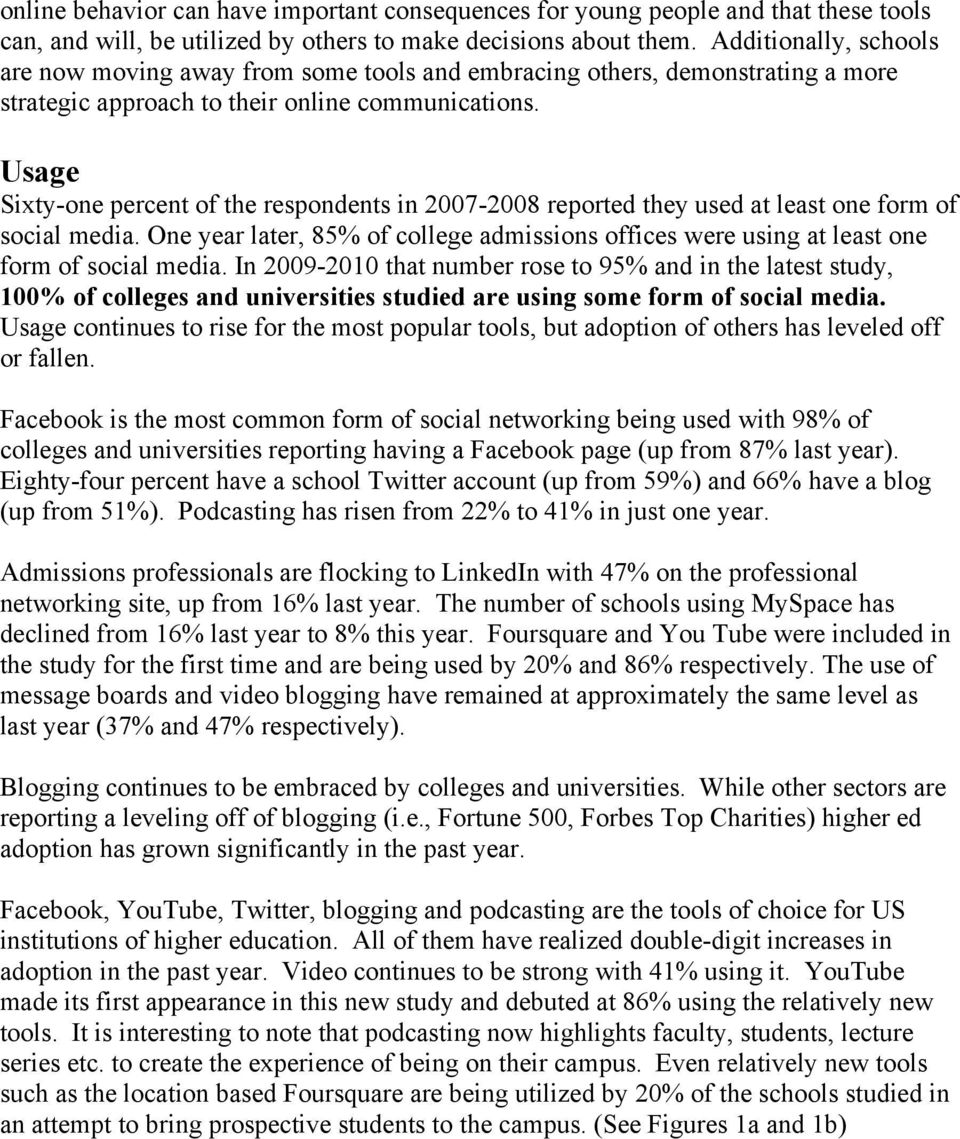
3 Figure 1a Figure 1b Eight percent of schools with blogs are using some internally developed applications (down from 14% in ). Others cite WordPress (38%) and Blogger (10%) as platforms. The use of WordPress as a blogging platform has doubled in the past year. It is not uncommon for those working with the school s social media to be unfamiliar with the platforms being used to host the school s blog (30%). At most schools, the IT department sets up the blog and the others manage it.
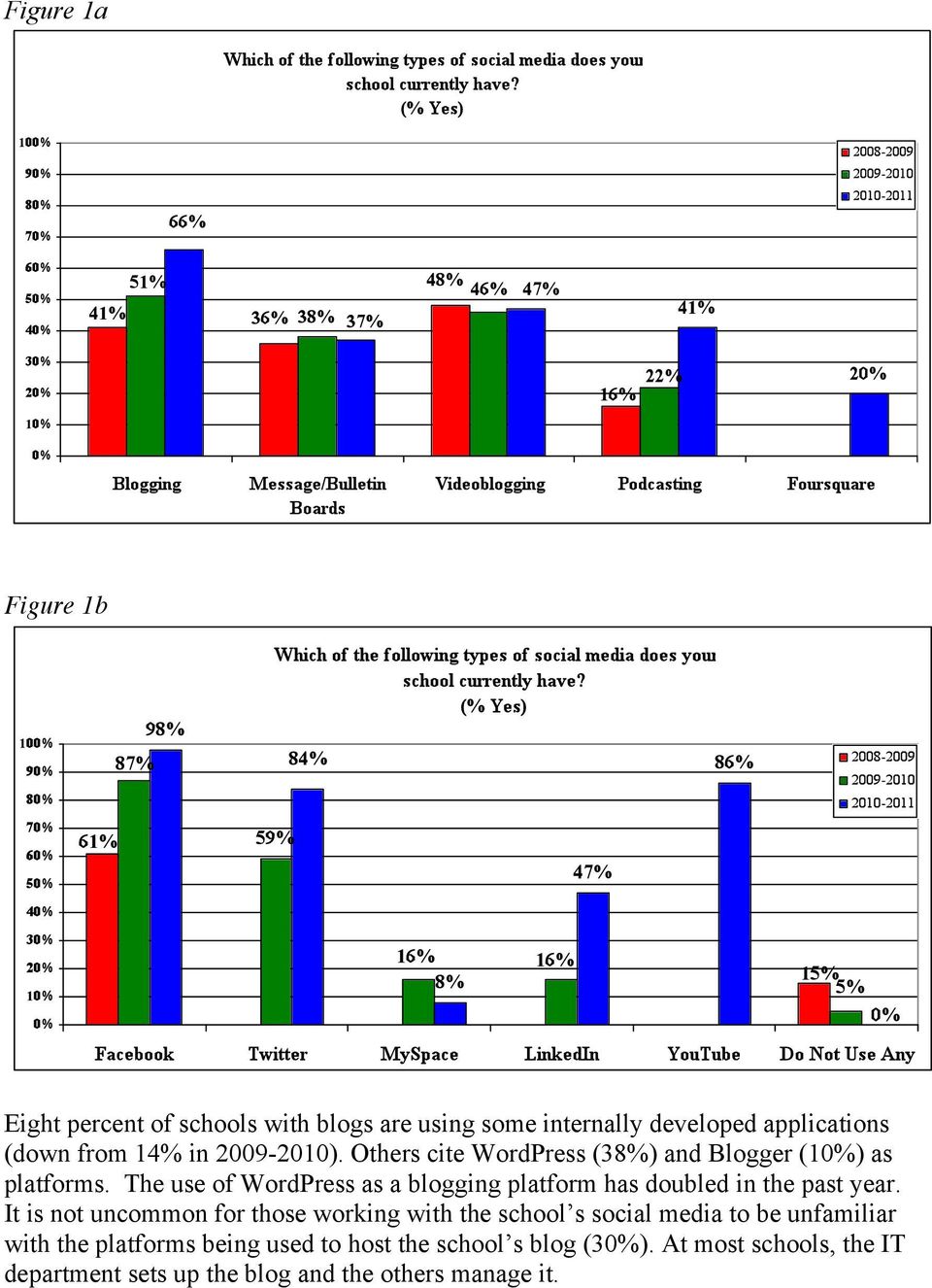
4 When asked who manages their blog, the most popular answers were the admissions office (including the director, staff and students), marketing and public relations. At schools with multiple blogs, the appropriate department manages their own (i.e., alumni, academic departments, etc.) Are colleges and universities using social media effectively? Usage of social media by colleges and universities appears to be a case study in the timely adoption of new technology. They demonstrate consistent evolution over the past four years in critical aspects of the technology necessary to maximize the effectiveness of these tools. Comparing the longitudinal data, it becomes clear that there has been significant improvement as we look at the implementation particularly with blogging. The survey asked about blog logistics like accepting comments, promoting the blog and planning for the future of the blog. The answers to these and other questions from schools with blogs are interesting in that they demonstrate how schools are learning about and using social media more effectively each year. The mantra of the blogosphere is conversation. Blogs that do not facilitate engagement and conversation tend to lose their audience. In the 2007 study, 37% of those schools with blogs did not accept comments. By any measure, this is a problem if the goal is to connect with prospective students through ongoing conversation with the school. In 2008 that figure dropped to 22%. The 2009 data shows another drop to 18%, then to 15% in Schools are mastering the tool and embracing its true spirit of two-way conversation. For students or their parents looking to have a conversation online about particular aspects of university life, this increased interaction through comments can be significant. Another blog characteristic that allows ease of conversation and increases participation is the use of RSS feeds or subscriptions. This simplifies the blogosphere for readers who may want to keep up with a certain conversation or be informed of new information without having to check the blog of interest every day to see if something new has been added. In the 2007 study, 46% of schools had an RSS feed available and 31% allowed subscriptions. In 2008, those numbers rose to 49% and 48% respectively. In 2009, 65% were taking RSS subscriptions and 43% enabled sign-ups for their blogs. The latest study shows 77% with RSS subscriptions and 54% allow sign-ups. Again, the increased use of RSS and subscriptions would indicate an increased sophistication in the use of blogging as a recruitment strategy. (See Figure 2)

5 Figure 2 When asked what the future plans are for the school s blog in 2007, the most popular answer was that there are NO future plans for the blog. This was disconcerting considering the swift movement and evolution of blog technology. In the 2008 study, the most popular response was to expand the blog. Many schools began to include podcasts, video and live chats as part of their blog. In 2009, the most popular plan was to link social media sites to blogs. This year the goal was to involve more user groups in blogging by making the platform available to students, faculty and staff. When asked how their school promotes their blog, the most popular answers were the school s homepage, the admissions website and the school s Facebook page. One cautionary note has to do with having a blogging or social media policy that defines what is acceptable via the institutions online communications. Forty-four percent (up from 32% last year) have such a policy in place for their staff or students who engage in online conversation as it relates to the school. Social media policies are now seen as important elements as an institution develops their social media strategy. (See Figure 3)
6 Figure 3 Those schools not currently using a particular tool, were asked if they planned to in the future. Of those without a Facebook page, 38% plan to create one. Almost half of the schools without a blog, video or Twitter plan to add them. Thirty-eight percent not currently using YouTube, plan to in the future. Only 1% of those not currently using MySpace plan to include it in their social media arsenal. (See Figure 4a and Figure 4b) Figure 4a Figure 4b

7 The Fortune 500, Inc. 500, Forbes top charities and higher education have all shown increases in blogging every year from 2007 but things have begun to change. The 2010 data shows blogging leveling off in the Fortune 500 and among Charities. Higher ed is the only sector reporting a double digit increase in adoption of blogging. (See Figure 5) Figure 5 Success of Social Media When asked how successful social media tools have been for their schools, respondents have consistently raved about their experience, especially Facebook (95% success) and YouTube (92%). For every tool studied, a high degree of success is reported. The relatively new Foursquare is being used by twenty percent of those interviewed while 61% of them report success with it. The exception is MySpace which shows a decrease in perceived success from 42% to 34%. (See Figures 6a and 6b) Figure 6a

8 Figure 6b Importance The adoption of social media by colleges and universities is being driven by their recognition of the increasingly important role of social media in today s world. There is an 18% increase in the number of colleges and universities reporting that social media is very important. Conversely, 4% say these technologies are somewhat or very unimportant now compared to 9% last year. Clearly, attitudes towards using social media in recruiting continue to change. (See Figure 7) Figure 7

9 Student Research A significant proportion of schools continue to research students via search engines (13%) and social networks (19%). The colleges and universities interviewed for this study reported using search engines and social networking sites to recruit students. Most schools report looking for information about the student s activities or interests. Many of them indicated looking for students by geographical region to target for their school. There were no reports of checking every applicant to an institution, no matter how small the school. Online research appears to be a new tool for marketing from which colleges and universities garner information that helps them better focus their resources on perspective students that might be a good match with their institution. There is also some indication of using these sites for evaluation. Social networking sites provide an insight into the lives of students that cannot be underestimated. As more and more young people spend increased amounts of time on these online networks, those interested in them (employers or schools) will continue to watch and read the publically available information and include their impressions in their decisions to accept or hire candidates. (See Figure 8) Figure 8

10 Are they listening? It is clear that schools are now communicating in new ways. The next question is: Are they listening to what s being said about their school online? Fifty-three percent in 2007, 54% in 2008 and 73% in 2009 report they monitored the internet for buzz, posts, conversations and news about their institution. Our latest research shows a slight decrease to 68%. Given the ease with which monitoring can be done, it is surprising that all schools are not monitoring online buzz about their institutions. US colleges and universities are taking the lead in using social media as part of their marketing and recruiting plans. Some schools will use search engines and social media sites to garner more information about perspective students. They are evaluating the effectiveness of tools that were adopted early on and making decisions about which new tools to add into their communications strategy. The goal is clearly to reach and engage those tech savvy young people who may be making at least initial decisions about a school based on its online presence. To be added to our distribution list for all of our social media reports, please sign up at

11 Bios & Acknowledgments Nora Ganim Barnes, Ph. D. Nora Ganim Barnes is a Chancellor Professor of Marketing and Director of the Center for Marketing Research at the University of Massachusetts Dartmouth. Nora has worked as a consultant for many national and international firms including Thomson Reuters, Scott s Lawn Care Company, National Association of College Admissions Counselors and the Board of Inquiry of the British Parliament. Working closely with businesses in the Northeast US, Nora and her students have provided marketing research assistance to hundreds of small businesses. She has published articles in academic and professional journals and proceedings, has contributed chapters to books, and has been awarded numerous research grants. Her work has been covered online and in print by Business Week, the NY Times, Washington Post, LA Times, Wall Street Journal, Fox News the Huffington Post and Computer World among others. She has been named a Senior Research Fellow by the Society for New Communications Research. Nora can be reached at [email protected]. Ava M. Lescault, MBA Ava M. Lescault is Senior Research Associate and Associate Director of the Center for Marketing Research at the University of Massachusetts Dartmouth. Ava graduated from UMass Dartmouth with a BS in Marketing and a Master's Degree in Business Administration with a concentration in Marketing Research. She recently completed a Certificate in Marketing Research from the University of Georgia. Ava has worked on approximately twenty-five extensive research projects and is a published author. Her clients include the cranberry industry, the shellfish industry, a national juice manufacturer, and a Fortune 500 company. She was the first person to hold the position of Senior Research Associate in the Center. Her areas of expertise include: SPSS analysis, database creation and manipulation, client interface, and report writing. Ava can be reached at [email protected].

College Presidents Out-Blog and Out-Tweet Corporate CEO s as Higher Ed Delves Deeper into Social Media to Recruit Students
 College Presidents Out-Blog and Out-Tweet Corporate CEO s as Higher Ed Delves Deeper into Social Media to Recruit Students Conducted by: Nora Ganim Barnes, Ph.D. ([email protected]) Ava M. Lescault, MBA
Social Media and College Admissions: Higher-Ed Beats Business in Adoption of New Tools for Third Year
 Social Media and College Admissions: Higher-Ed Beats Business in Adoption of New Tools for Third Year Conducted by: Nora Ganim Barnes, Ph.D. ([email protected]) Eric Mattson ([email protected]) The
Social Media and College Admissions: The First Longitudinal Study Conducted by: billion
 Social Media and College Admissions: The First Longitudinal Study Conducted by: Nora Ganim Barn es, Ph.D. ([email protected]) Eric Mattson ([email protected]) It s no surprise that social media has
US Charities Adoption of Social Media Outpaces All Other Sectors for the Third Year in a Row Conducted by: Introduction
 US Charities Adoption of Social Media Outpaces All Other Sectors for the Third Year in a Row Conducted by: Nora Ganim Barnes, Ph.D. ([email protected]) Eric Mattson ([email protected]) Introduction
Social Media Usage Now Ubiquitous Among US Top Charities, Ahead of All Other Sectors
 Social Media Usage Now Ubiquitous Among US Top Charities, Ahead of All Other Sectors Introduction Conducted by: Nora Ganim Barnes, Ph.D. ([email protected]) The University of Massachusetts Dartmouth Center
Fish Where the Fish Are: Higher-Ed Embraces New Communications Tools to Recruit the Wired Generation
 Fish Where the Fish Are: Higher-Ed Embraces New Communications Tools to Recruit the Wired Generation Nora Ganim Barnes University of Massachusetts Dartmouth Stephanie Laura Jacobsen University of Massachusetts
The 2011 Inc. 500 Social Media Update: Blogging Declines As Newer Tools Rule Conducted by:
 The 2011 Inc. 500 Social Media Update: Blogging Declines As Newer Tools Rule Conducted by: Nora Ganim Barnes, Ph.D. ([email protected]) Ava M. Lescault, MBA ([email protected]) The Center for Marketing
Social Media in the 2009 Inc. 500: New Tools & New Trends
 Social Media in the Inc. 500: New Tools & New Trends Conducted by: Nora Ganim Barnes, Ph.D. ([email protected]) Eric Mattson ([email protected]) The Center for Marketing Research at the University
Social Media: Considerations and Implications in College Admission
 NACAC s Research to Practice Brief A RESEARCH SERIES OF THE NATIONAL ASSOCIATION FOR COLLEGE ADMISSION COUNSELING ISSUE 7 009 Social Media: Considerations and Implications in College Admission Information
Exploring the Link Between Customer Care and Brand Reputation in the Age of Social Media
 Exploring the Link Between Customer Care and Brand Reputation in the Age of Social Media By Nora Ganim Barnes, Ph.D, Senior Fellow, Society for New Communications Research The following is the executive
How do the most successful companies use social media? By Nora Ganim Barnes
 How do the most successful companies use social media? By Nora Ganim Barnes 8 Spring 2010 Tweeting blogging and to the top The Center for Marketing Research at the University of Massachusetts Dartmouth,
Adoption of Social Media by Fast-Growing Companies: Innovation Among the Inc. 500
 Adoption of Social Media by Fast-Growing Companies: Innovation Among the Inc. 500 Nora Ganim Barnes University of Massachusetts Dartmouth Stephanie Jacobsen University of Massachusetts Dartmouth This study
Students College Preferences and Plans in the 2011 Admissions Cycle Results from the 2011 College Decision Impact Survey
 Students College Preferences and Plans in the 2011 Admissions Cycle Results from the 2011 College Decision Impact Survey March 2011 Our Partner: 1 Introduction In January 2011, surveys were collected from
INIGRAL INSIGHTS. The Social Side of Student Retention. Rose Broome Brandon Croke Michael Staton Hannah Zachritz
 INIGRAL INSIGHTS The Social Side of Student Retention Rose Broome Brandon Croke Michael Staton Hannah Zachritz Research, Retention & Best Practices Student retention is a leading issue in post-secondary
Reaching the Wired Generation: How Social Media is Changing College Admission
 2009 NACAC Discussion Paper Reaching the Wired Generation: How Social Media is Changing College Admission Nora Ganim Barnes, Ph.D. Chancellor Professor of Marketing and Director, Center for Marketing Research
Using Social Media Marketing to Drive Traffic to Your Website
 to Drive Traffic to Your Website 2 What is Social Media Marketing? In a nutshell, social media marketing is the process of participating in social media networks in order to further build a brand and enhance
experts in your field Get the profile: Managing your online reputation A Progressive Recruitment career guide Managing your online reputation
 experts in your field Get the profile: A Progressive Recruitment career guide Contents Introduction... 2 Why you need an online reputation... 3 Monitoring your online reputation... 3 How to protect your
E-Recruitment in the Age of Social Networking. Timothy Enright Senior Sales Executive Datatel, Inc.
 E-Recruitment in the Age of Social Networking Timothy Enright Senior Sales Executive Datatel, Inc. What is Web 2.0 Web 2.0 is linking people people sharing, trading and collaborating 2007 Digital Ethnography,
Building an E-Recruitment Network Connecting With College-Bound Seniors in the Era of MySpace
 Building an E-Recruitment Network Connecting With College-Bound Seniors in the Era of MySpace The growing influence of the Internet on recruitment has flattened the traditional funnel. Students are turning
How social media is influencing the job search process
 ABSTRACT How social media is influencing the job search process Matthew Stollak Amy Spielbauer Vandenberg Nathan Felhofer Patrick Sutherland Over the past eight years, social networking has continuously
The Global Social Media Check-up 2011. Blogs
 The Global Social Media Check-up 2011 Blogs Contents Methodology Twitter Fortune Global 100 Companies Use of: Facebook Twitter & Microblogs Facebook & Social Networks YouTube & Video Sharing Corporate
Job hunting in the digital age
 Job hunting in the digital age Leveraging the web in your job search and preventing social media from hindering your efforts. It s a digital world. Job hunting has changed dramatically in the past decade.
Essential Communication Methods for Today s Public Social Media 101. Presented by Tom D. Trimble, CIO Tulsa County Government
 Essential Communication Methods for Today s Public Social Media 101 Presented by Tom D. Trimble, CIO Tulsa County Government What you will learn today Why Social Media is important to you Today s Social
Tentative Schedule for Webinar Version
 Drury University's Graduate Level Social Media Program http://socialmediacertificate.net/ For questions about the program, contact: Curt Gilstrap, Ph.D. Director, Social Media Certificate Drury University
Advanced Degrees of E-Recruitment The E-Expectations of Prospective Graduate Students
 GRADUATE EDITION Advanced Degrees of E-Recruitment The E-Expectations of Prospective Graduate Students Many university e-recruitment programs are built around enrolling undergraduates, but what about students
The Online Expectations of College-Bound Juniors and Seniors
 2012 E-Expectations Report The Online Expectations of College-Bound Juniors and Seniors A look at their behavior and expectations regarding college Web sites, e-communications, social media, and more Noel-Levitz,
Today s Presentation
 Today s Presentation Lesson 1. What's the big deal?- Understand how your prospective student customer communicates- The digital native Lesson 2. Internet marketing- Improve your organisations website Lesson
BeeSocial. Create A Buzz About Your Business. Social Media Marketing. Bee Social Marketing is part of Genacom, Inc. www.genacom.
 BeeSocial M A R K E T I N G Create A Buzz About Your Business Social Media Marketing Bee Social Marketing is part of Genacom, Inc. www.genacom.com What is Social Media Marketing? Social Media Marketing
I N D U S T R Y T R E N D S & R E S E A R C H R E P O R T S F O R I N D U S T R I A L M A R K E T E R S. Social Media Use in the Industrial Sector
 I N D U S T R Y T R E N D S & R E S E A R C H R E P O R T S F O R I N D U S T R I A L M A R K E T E R S Social Media Use in the Industrial Sector Contents Executive Summary...3 An Introduction to Social
Preprint of: Nicholson, S. (2010). Inviting the world into the online classroom: Teaching a gaming in
 Preprint of: Nicholson, S. (2010). Inviting the world into the online classroom: Teaching a gaming in libraries course via YouTube. Journal of Education for Library and Information Science, 51(4). Inviting
2014 Vermont Residential Telecommunications Survey Report
 2014 Vermont Residential Telecommunications Survey Report Prepared for the Vermont Public Service Department by the Castleton Polling Institute Castleton College 6 Alumni Drive Castleton, Vermont 05735
MASTER OF BUSINESS ADMINISTRATION SCHOOL OF BUSINESS ADMINISTRATION
 MASTER OF BUSINESS ADMINISTRATION SCHOOL OF BUSINESS ADMINISTRATION OUR MBA PROGRAM The University of Dayton MBA is a 30 credit hour program if you hold an undergraduate degree in business. If you have
University of Arizona College of Engineering Marketing, Branding and Communications Plan
 University of Arizona College of Engineering Marketing, Branding and Communications Plan PETE BROWN, COMMUNICATIONS DIRECTOR EMAIL: [email protected] TELEPHONE: 520.621.3754 KARINA BARRENTINE, MARKETING
NAGAP 2012 Social Media Survey Report
 NAGAP 2012 Social Media Survey Report TABLE OF CONTENTS List of Figures & Tables ii I. Introduction 1 II. Methodology 1 III. Overview of Respondents 1 Institution Characteristics 1 IV. Social Networking
Sponsorship & Social/ Digital Media Brent Barootes May 28, 2013. WHITE PAPER Presented by Partnership Group Sponsorship Specialists
 Sponsorship & Social/ Digital Media Brent Barootes May 28, 2013 WHITE PAPER Presented by Partnership Group Sponsorship Specialists SPONSORSHIP AND SOCIAL / DIGITAL MEDIA HOW THESE NEW MEDIUMS CAN MAXIMIZE
Use of Social Media and Mobile by Healthcare Professionals
 Use of Social Media and Mobile by Healthcare Professionals 2011 Survey Results Use of Social Media and Mobile by Healthcare Professionals 2011 Survey Results: The Use of Social Media and Other Online Resources
Stephanie Laura Jacobsen 16 Marshall Way Rumford RI 02916 401-316-1241 [email protected]
 Stephanie Laura Jacobsen 16 Marshall Way Rumford RI 02916 401-316-1241 [email protected] Experience: January 11- University of Massachusetts Dartmouth, North Dartmouth, MA Present Lecturer in Management/Marketing
SOCIAL NETWORKING USAGE AND GRADES AMONG COLLEGE STUDENTS
 SOCIAL NETWORKING USAGE AND GRADES AMONG COLLEGE STUDENTS A Study to Determine the Correlation Of Social Media Usage and Grades Contact: Chuck Martin [email protected] (603) 750-3020 The Study This
Provided as a courtesy by CPA Trendlines (www.cpatrendlines.com)
 Social Media Recruiting for CPA Firms The use of social media for recruiting in CPA firms is growing, especially with the need for accountants who are tech savvy. By using popular social media sites, firms
Social Selling: Building Relationships in a Social Media World
 Social Selling: Building Relationships in a Social Media World RLI Design Professionals Design Professionals Learning Event DPLE 161 November 18, 2015 RLI Design Professionals is a Registered Provider
Amplify Conversations to Convert Prospects to Customers. B2B Event Marketing Tactics Workbook
 Amplify Conversations to Convert Prospects to Customers B2B Event Marketing Tactics Workbook In this part-guide, part-workbook, get to know the tactics of B2B event marketing and how to make it work for
2012 SOCIAL MEDIA MARKETING INDUSTRY REPORT
 2012 SOCIAL MEDIA MARKETING INDUSTRY REPORT How Marketers Are Using Social Media to Grow Their Businesses A P R I L 2 0 1 2 BY MICHAEL A. STELZNER Sponsored by Copyright 2012, Social Media Examiner Letter
Turn Your Degree into a Career
 Turn Your Degree into a Career LERN Awards Category: Marketing LERN Award Marketing According to recent statistics over a third of graduates from the 2010/2011 cohort are unemployed or underemployed, working
INSIGHTS WHITEPAPER What Motivates People to Apply for an MBA? netnatives.com twitter.com/netnatives
 INSIGHTS WHITEPAPER What Motivates People to Apply for an MBA? netnatives.com twitter.com/netnatives NET NATIVES HISTORY & SERVICES Welcome to our report on using data to analyse the behaviour of people
oneforty. Social Media KPIs and You: A Love Story Janet Aronica Directory, Marketing & Community oneforty
 oneforty. Social Media KPIs and You: A Love Story Janet Aronica Directory, Marketing & Community oneforty Social Media KPIs and You: A Love Story Establishing a social media measurement plan is a crucial
9/10/2011. Agenda. Social Media for HR Business Decisions
 September 2011 Social Media for HR Business Decisions Bill Balderaz Webbed Marketing September 2011 "HR is starting to act and behave like marketing. Everyone knows what HSBC and McDonald's business, but
Video Marketing For Law Firms
 Sponsored by Presented by We make law firms grow. Ask us how. Agenda About BusinessCreator, Inc. and me About the Power Practice Builder Webinar Series Topics Goals How To Get Your Phone To Ring About
Social Media Glossary of Terms For Small Business Owners
 Social Media Glossary of Terms For Small Business Owners Introduction As a small business, reaching your audience efficiently and cost-effectively way is critical to your success. Social media platforms
Davis Applied Technology College Public Relations Policy and Procedures Approval Date: December 12, 2011
 Davis Applied Technology College Public Relations Policy and Procedures Approval Date: December 12, 2011 1. Purpose 1.1. This policy standardizes production criteria for the College brand image, publications,
Developing and Pitching Your Personal Brand. Presented by Karen M. Landolt September 12, 2013
 Developing and Pitching Your Personal Brand Presented by Karen M. Landolt September 12, 2013 Karen M. Landolt Karen M. Landolt, Director, HireTexas Interview Center 18 years experience in organiza9onal
Social Media Measurement Meeting Robert Wood Johnson Foundation April 25, 2013 SOCIAL MEDIA MONITORING TOOLS
 Social Media Measurement Meeting Robert Wood Johnson Foundation April 25, 2013 SOCIAL MEDIA MONITORING TOOLS This resource provides a sampling of tools available to produce social media metrics. The list
City of Edmonton Social Media Guidelines
 City of Edmonton Social Media Guidelines June, 2011 Table of Contents Introduction What are Social Media? Risks and Benefits of using Social Media General guidelines Speaking to the media Personal accounts
The Five Biggest MISSED Internet Marketing Opportunities Most Lawyers Don't Know About
 The Five Biggest MISSED Internet Marketing Opportunities Most Lawyers Don't Know About Many lawyers and other professionals equate internet marketing with Search Engine Optimization (SEO). And while SEO
Technology for Small Business
 Technology for Small Business Steinar Knutsen February 2015 Agenda Importance of Online Marketing Online Marketing Blueprint Social Media Networks Tools of the Trade 2 Every 1 Second on the Internet Source:
Navigating Toward E-Recruitment Ten Revelations About Interacting With College-Bound High School Students
 TM Navigating Toward E-Recruitment Ten Revelations About Interacting With College-Bound High School Students They re out there. Looking at your Web site, making instant decisions about whether to remain
Monitoring the Social Media Conversation: From Twitter to Facebook
 Monitoring the Social Media Conversation: From Twitter to Facebook Monitoring the Social Media Conversation: From Twitter to Facebook The prevalence of social media has not just grown but exploded. Millions
2014 SOCIAL MEDIA MARKETING INDUSTRY REPORT
 2014 SOCIAL MEDIA MARKETING INDUSTRY REPORT How Marketers Are Using Social Media to Grow Their Businesses MAY 2014 BY MICHAEL A. STELZNER Published by Copyright 2014, Social Media Examiner Letter from
CAREER SERVICES USE OF SOCIAL MEDIA TECHNOLOGIES
 CAREER SERVICES USE OF SOCIAL MEDIA TECHNOLOGIES Executive Summary Introduction In conjunction with the Career Advisory Board (CAB), the National Association of Colleges and Employers (NACE) conducted
2012 Online Video Marketing Survey and Video Email Trends Report
 2012 Online Video Marketing Survey and Video Email Trends Report Published by the Web Video Marketing Council and Flimp Media March 2012 Table of Contents Executive Summary...3 Overview...3 Methodology...
How To Use Social Media For A University
 SOCIAL MEDIA AT BLOOMSBURG UNIVERSITY Guidelines for University Communications and Marketing Professionals October 2010 These guidelines were created by Bloomsburg Office of Marketing and Communications.