
Flexible Lifetime Protection Product Disclosure Statement (including Plan Rules)
|
|
|
- Nickolas Brooks
- 10 years ago
- Views:
Transcription
1 Flexible Lifetime Protection Product Disclosure Statement (including Plan Rules) Issued 19 May 2014 protect those you love with the one who s IMAGE AREA been there DS DS DS AWAR AWAR AWAR Legal particulars Supplied copy goes here Registered information trademark of AMP must Life appear Limited on the ABN same page 300 as 379 symbol. ABN particulars. DS DS DS AWAR AWAR AWAR
2 About AMP AMP is a leading independent wealth management company in Australia and New Zealand. We help people and organisations build financial security and we ve been doing this since Today we are helping over four million retail customers in Australia and New Zealand own their tomorrow, and business clients across Asia, Europe, the Middle East and North America. We understand that insurance is all about peace of mind and are committed to being a financially responsible insurer. We want to ensure our customers are looked after should the unthinkable happen to them. AMP insurance exists to provide a safety net for our customers when they need it. In 2013, AMP paid $850.4 million in claims to our customers. We strive to provide insurance that secures your tomorrow by protecting what you have today. The issuers The insurance products referred to in this document are issued by AMP Life Limited ABN , AFSL No (AMP Life). The superannuation product referred to in this document (see page 25) is issued by AMP Superannuation Limited ABN , AFSL No (Trustee). AMP Life and the Trustee are the joint issuers of this Product Disclosure Statement (PDS). Each issuer takes full responsibility for the whole of this document. However, an issuer is not responsible for the products issued by the other issuer. No other company in the AMP Group guarantees the performance of AMP Life s or the Trustee s obligations to customers or assumes any liability to customers in connection with the products. The meaning of words used in this document Throughout this document: AMP Life, we, us and our means AMP Life Limited, and you, your and yourself means either: a. the plan owner ; or b. where cover is acquired through the AMP Superannuation Savings Trust, a Self-Managed Super Fund (SMSF) or small APRA superannuation fund the insured person, except that any benefit payment will be made by AMP Life to the AMP Superannuation Savings Trust or the trustee of the SMSF or small APRA superannuation fund (where applicable). We use other terms that have specific meanings which are highlighted throughout the PDS by the use of inverted commas. These words and their meanings are set out in the dictionary on pages 77 to 86. This offer is available only to persons receiving it (including electronically) within Australia. We can t accept cash or applications signed and mailed from outside Australia. Monies received or paid must always be in Australian dollars. Changes to the information in this document As the information in this document may change from time to time, you can obtain updated information simply by visiting amp.com.au/pdsupdates or by calling us on to request a free paper copy of the updated information. If the change to the information is materially adverse, we will issue a Supplementary Product Disclosure Statement.
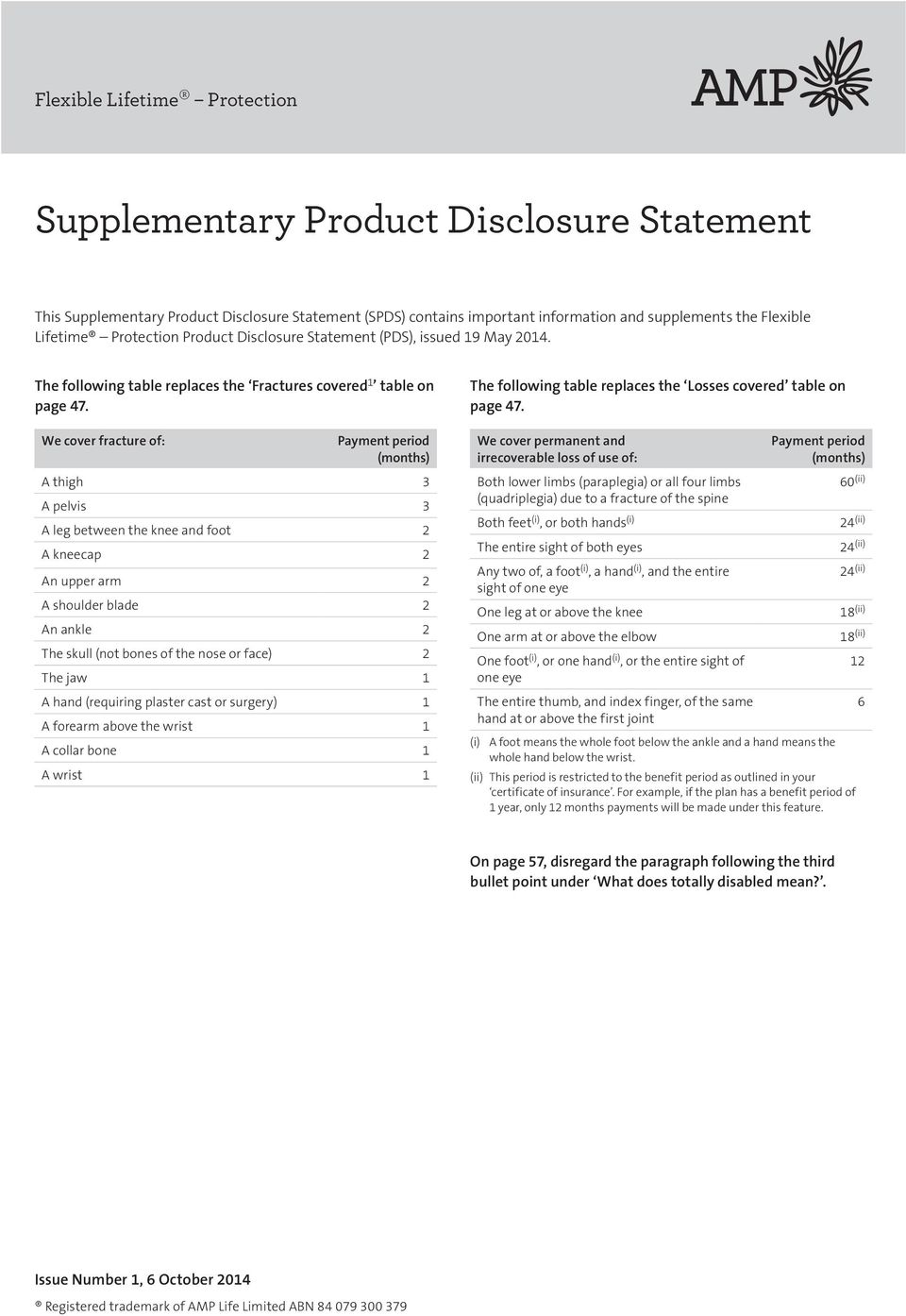
3 Flexible Lifetime Protection Supplementary Product Disclosure Statement This Supplementary Product Disclosure Statement (SPDS) contains important information and supplements the Flexible Lifetime Protection Product Disclosure Statement (PDS), issued 19 May The following table replaces the Fractures covered 1 table on page 47. We cover fracture of: Payment period (months) A thigh 3 A pelvis 3 A leg between the knee and foot 2 A kneecap 2 An upper arm 2 A shoulder blade 2 An ankle 2 The skull (not bones of the nose or face) 2 The jaw 1 A hand (requiring plaster cast or surgery) 1 A forearm above the wrist 1 A collar bone 1 A wrist 1 The following table replaces the Losses covered table on page 47. We cover permanent and irrecoverable loss of use of: Both lower limbs (paraplegia) or all four limbs (quadriplegia) due to a fracture of the spine Both feet (i), or both hands (i) The entire sight of both eyes Any two of, a foot (i), a hand (i), and the entire sight of one eye One leg at or above the knee One arm at or above the elbow One foot (i), or one hand (i), or the entire sight of one eye The entire thumb, and index finger, of the same hand at or above the first joint Payment period (months) 60 (ii) 24 (ii) 24 (ii) 24 (ii) 18 (ii) 18 (ii) (i) A foot means the whole foot below the ankle and a hand means the whole hand below the wrist. (ii) This period is restricted to the benefit period as outlined in your certificate of insurance. For example, if the plan has a benefit period of 1 year, only 12 months payments will be made under this feature On page 57, disregard the paragraph following the third bullet point under What does totally disabled mean?. Issue Number 1, 6 October 2014 Registered trademark of AMP Life Limited ABN
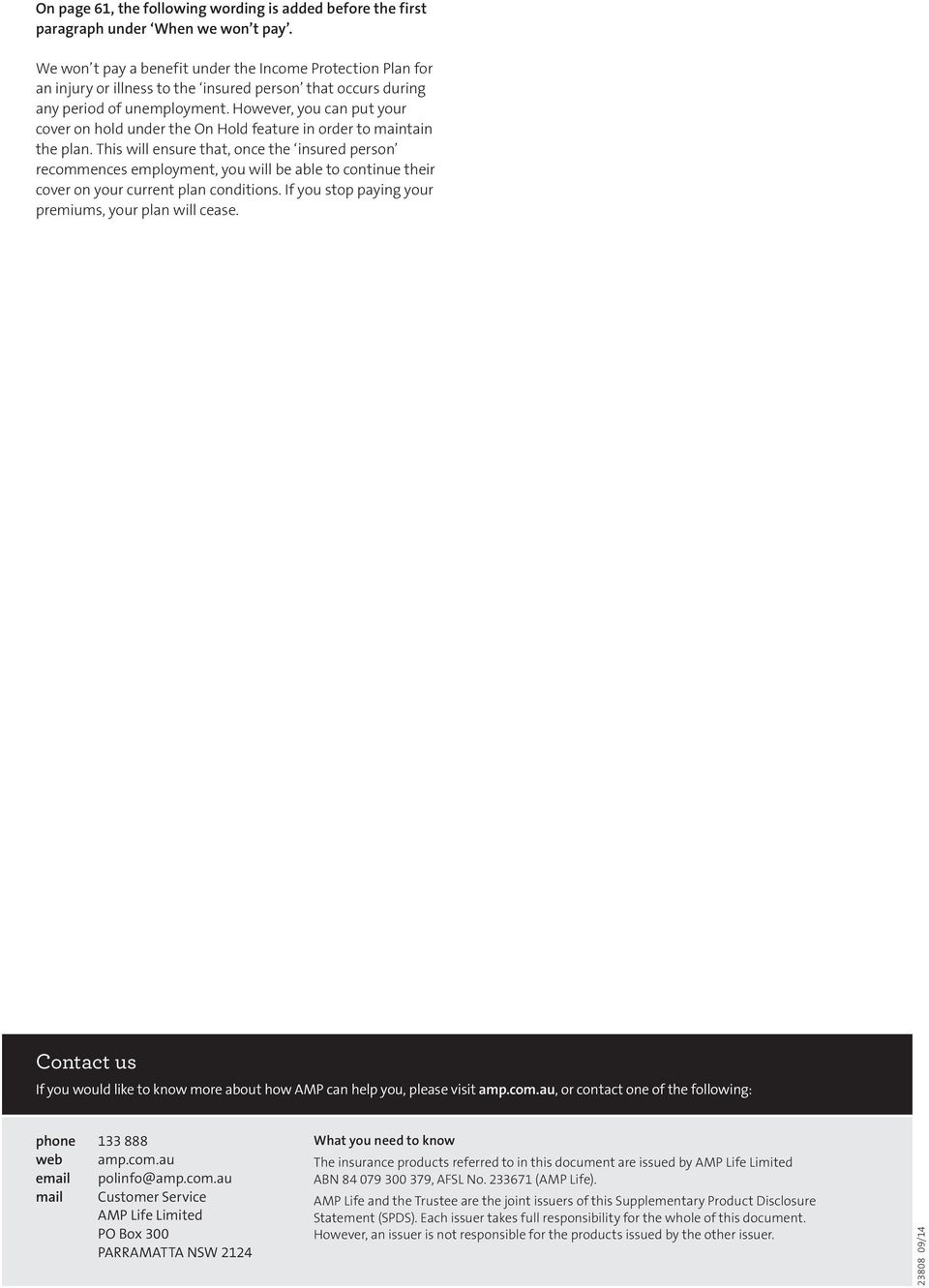
4 On page 61, the following wording is added before the first paragraph under When we won t pay. We won t pay a benefit under the Income Protection Plan for an injury or illness to the insured person that occurs during any period of unemployment. However, you can put your cover on hold under the On Hold feature in order to maintain the plan. This will ensure that, once the insured person recommences employment, you will be able to continue their cover on your current plan conditions. If you stop paying your premiums, your plan will cease. Contact us If you would like to know more about how AMP can help you, please visit amp.com.au, or contact one of the following: phone web amp.com.au [email protected] mail Customer Service AMP Life Limited PO Box 300 PARRAMATTA NSW 2124 What you need to know The insurance products referred to in this document are issued by AMP Life Limited ABN , AFSL No (AMP Life). AMP Life and the Trustee are the joint issuers of this Supplementary Product Disclosure Statement (SPDS). Each issuer takes full responsibility for the whole of this document. However, an issuer is not responsible for the products issued by the other issuer /14
5 Contents How to read this PDS 2 Section A About Flexible Lifetime Protection 3 The 5 steps to applying 5 Our commitment to you 6 Section B Life Protection Plan 7 About the Life Protection Plan 7 Plan Rules Life Protection Plans acquired 11 outside of superannuation Plan Rules Life Protection Plans acquired 25 through superannuation General information about the Life Protection Plan 32 acquired through the AMP Superannuation Savings Trust Section C Income Protection Plan 38 About the Income Protection Plan 38 Plan Rules Income Protection Plans acquired 41 outside of superannuation Plan Rules Income Protection Plans acquired 54 through a SMSF or small APRA superannuation fund Section D Business Overheads Insurance Plan 62 About the Business Overheads Insurance Plan 62 Plan Rules 63 Section E Additional information applicable to all 69 Flexible Lifetime Protection Plans Plan Rules Premiums and fees 71 Plan Rules Claiming a benefit 73 Providing information to AMP 75 Your Privacy 75 Your Duty of Disclosure 75 Dictionary of defined terms 77 Interim Cover Certificate 87 Section A About Flexible Lifetime Protection Section B Life Protection Plan Section E Additional information Section C Income Protection Plan Section D Business Overheads Insurance Plan

6 How to read this PDS Flexible Lifetime Protection offers the following insurance plans: Life Protection Plan (see Section B) Income Protection Plan (see Section C) and Business Overheads Insurance Plan (see Section D). Each of these plans contains certain in-built benefits and features as well as additional options that can be added for an extra premium. The availability of these plans and the availability of certain benefits, options and features will depend upon whether you acquire your plan through superannuation or outside of superannuation. This PDS is divided into five sections: Section A provides an overview of the different types of plans available through Flexible Lifetime Protection. Refer to page 3. Section B explains how the Life Protection Plan works both when acquired outside of superannuation and through superannuation, a SMSF or small APRA super fund. Refer to page 7. Section C explains how the Income Protection Plan works both when acquired outside of superannuation and through a SMSF or small APRA superannuation fund. Refer to page 38. Section D explains how the Business Overheads Insurance Plan works. This Plan cannot be acquired through superannuation. Refer to page 62. Section E tells you about important additional information, such as how premiums and fees are calculated and how you can lodge a claim. Refer to page 69. This PDS also contains Plan Rules. The Plan Rules together with your certificate of insurance form your contract of insurance once we have accepted your application for cover. 2

7 Section A About Flexible Lifetime Protection Flexible Lifetime Protection offers a range of plans that can be tailored to meet your personal insurance needs, helping secure your tomorrow by protecting what you have today. This summary will help you understand the types of insurance cover offered and what solution they offer if you need to make a claim. Life Protection Plan (see page 7) There are 3 types of cover available under the Life Protection Plan: Death cover, Total and Permanent Disablement (TPD) cover and Trauma cover. You can apply for one or more of the covers under one plan as well as the Children s Trauma cover option (see page 23). There are two types of cover available through a SMSF or small APRA super fund, Death cover and TPD cover. You can apply for one or both covers under one plan. Death cover or Death and TPD cover are also available through the AMP Superannuation Savings Trust. Type of cover Why do I need it? Key benefits payable Death cover You may want to take out Death cover to ensure that, if you die, the mortgage and other debts are paid off and loved ones are provided with the funds they need to continue their lifestyle. A lump sum is payable if the insured person dies. We will advance the Death cover insured amount if the insured person is diagnosed as being terminally ill. Total and Permanent Disablement (TPD) cover Trauma cover Income Protection Plan (see page 38) Money is the last thing you would want to think about when faced with a lifelong disability. An emotional strain can be placed on a family to provide support to someone who may need full-time care and may never be able to work again. Nobody likes to think about the possibility of experiencing a serious illness or injury in the future. You can t foresee this happening, but you can make plans to help support yourself should the unexpected happen. Trauma cover can help provide the funds to make lifestyle adjustments after experiencing a serious illness or injury. Type of cover Why do I need it? Key benefits payable Income Protection cover Income protection cover can help you continue paying your day-to-day living expenses while you are too ill or injured to go to work, so you can focus on your recovery. Business Overheads Insurance Plan (see page 62) Type of cover Why do I need it? Key benefits payable Business Overheads Insurance cover Business Overheads Insurance cover can help with business expenses to keep your business going while you are too ill or injured to go to work. A lump sum is payable if the insured person becomes totally and permanently disabled. A lump sum is payable if the insured person experiences a specified trauma condition, or undergoes a specified medical procedure, and survives 14 days. A monthly benefit is payable while the insured person is totally or partially disabled due to an illness or injury. Reimbursement of eligible business expenses while the insured person is totally or partially disabled due to an illness or injury. The above gives you a general idea about what each cover is designed to do. However, it is important that you read on so that you understand all of the terms and conditions of the cover. As Flexible Lifetime Protection is not a savings product, if you end a plan at any time after the 28 day money back guarantee period (see page 6), you won t receive any money back (except in the limited circumstances set out on page 71 Refund of premiums). Your plan does not entitle you to share in any profits of AMP Life. Section A About Flexible Lifetime Protection Section E Additional information Section C Income Protection Plan Section B Life Protection Plan Section A About Flexible Lifetime Section D Business Overheads Insurance Plan 3

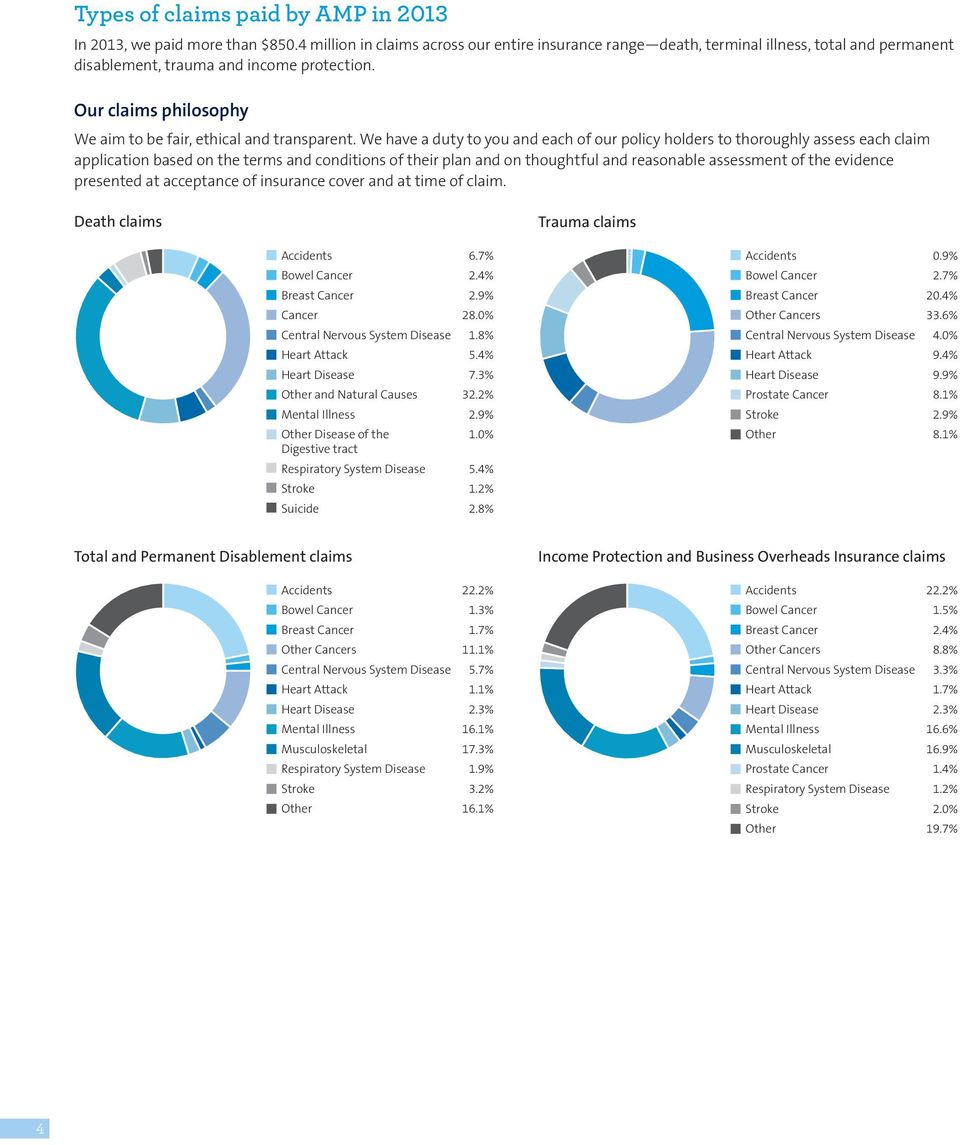
8 Types of claims paid by AMP in 2013 In 2013, we paid more than $850.4 million in claims across our entire insurance range death, terminal illness, total and permanent disablement, trauma and income protection. Our claims philosophy We aim to be fair, ethical and transparent. We have a duty to you and each of our policy holders to thoroughly assess each claim application based on the terms and conditions of their plan and on thoughtful and reasonable assessment of the evidence presented at acceptance of insurance cover and at time of claim. Death claims Trauma claims Accidents 6.7% Bowel Cancer 2.4% Breast Cancer 2.9% Cancer 28.0% Central Nervous System Disease 1.8% Heart Attack 5.4% Heart Disease 7.3% Other and Natural Causes 32.2% Mental Illness 2.9% Other Disease of the 1.0% Digestive tract Respiratory System Disease 5.4% Stroke 1.2% Suicide 2.8% Accidents 0.9% Bowel Cancer 2.7% Breast Cancer 20.4% Other Cancers 33.6% Central Nervous System Disease 4.0% Heart Attack 9.4% Heart Disease 9.9% Prostate Cancer 8.1% Stroke 2.9% Other 8.1% Total and Permanent Disablement claims Accidents 22.2% Bowel Cancer 1.3% Breast Cancer 1.7% Other Cancers 11.1% Central Nervous System Disease 5.7% Heart Attack 1.1% Heart Disease 2.3% Mental Illness 16.1% Musculoskeletal 17.3% Respiratory System Disease 1.9% Stroke 3.2% Other 16.1% Income Protection and Business Overheads Insurance claims Accidents 22.2% Bowel Cancer 1.5% Breast Cancer 2.4% Other Cancers 8.8% Central Nervous System Disease 3.3% Heart Attack 1.7% Heart Disease 2.3% Mental Illness 16.6% Musculoskeletal 16.9% Prostate Cancer 1.4% Respiratory System Disease 1.2% Stroke 2.0% Other 19.7% 4
9 The 5 steps to applying for Flexible Lifetime Protection Step 1 Making an informed decision Step 2 Finding out how much your insurance will cost Step 3 Completing your application for insurance Step 4 The underwriting process Step 5 The certificate of insurance This document sets out important information that you should know about Flexible Lifetime Protection, including the benefits, features and options available under each plan. You should consider this document before applying for a plan. The information in this document doesn t take into account your personal objectives, financial situation and needs. We encourage you to speak with your financial planner to help you decide which plan, and which insurance options, are fitted to your circumstances and needs. If you are applying for cover as the trustee of a SMSF or small APRA superannuation fund, you should be additionally aware of some important information which is set out on page 25. You can obtain an individual premium quote from your financial planner or by calling AMP on To apply for insurance we require you to complete an application. We also require a personal statement for each insured person. Before you apply for cover, it is important that you and the insured person have carefully read and understood your Duty of Disclosure (see page 76). We provide the following flexible options for you to complete the application and personal statement: Electronic Telephone Paper You can complete and lodge your application and personal statement electronically with your financial planner. Your financial planner can lodge your application and arrange for AMP to call you so that you can complete your personal statement over the phone at a time convenient to you. An application form and a personal statement are included at the back of this document. You can complete them in writing and send them to us at: AMP Life Limited PO Box 300 PARRAMATTA NSW 2124 The process of underwriting takes place after you have submitted your application. Underwriting ensures that everyone insured with AMP pays an appropriate premium. To properly assess your application AMP may obtain information from a range of sources such as your doctor or may require you to have a medical examination or blood tests. In some cases we may offer insurance that is different to what you applied for or we may decline your application for insurance. Interim Cover while we assess your application. We provide you with Interim cover at no extra cost, while your application is being assessed (see page 87). If we agree to issue a plan, we will issue a certificate of insurance. The certificate of insurance, together with the Plan Rules referred to in this document, is the contract of insurance between you and us. The certificate of insurance will set out the insured person(s), the type of cover for each insured person, the insured amounts, the options selected and other important information about the plan. Section A About Flexible Lifetime Protection Section E Additional information Section C Income Protection Plan Section B Life Protection Plan Section A About Flexible Lifetime Section D Business Overheads Insurance Plan 5

10 Our commitment to you Know exactly what you re getting 28 day money back period Keeping you informed Automatic plan enhancements Feel secure anywhere in the world Guaranteed renewable cover Supportive claims service Customer satisfaction Respecting your privacy We have included the Plan Rules in this document so that you know the exact terms of the insurance before you apply. These Plan Rules together with your certificate of insurance will form your contract of insurance with us once cover is accepted. If we accept your application for insurance cover, we will send you a certificate of insurance. You have 28 days to check that the insurance meets your needs. If it doesn t, simply write to us requesting that your plan be cancelled and return the certificate of insurance. Your premium will be refunded in full. You cannot return your plan if you have exercised any rights or powers available under it. If insurance cover is acquired through the AMP Superannuation Savings Trust, the refund must be paid to another complying superannuation fund (see page 71 for more information). Each year, we will send you an Annual Statement advising you about your insurance, fees and premiums for the next year. If you have changed occupation, ceased smoking or have experienced an improvement in health this may be an opportunity to be re-assessed and obtain a premium reduction. You can also get up-to-date information about your plan online. To register, visit amp.com.au and select My Portfolio from the online services menu. Our products are reviewed on a regular basis to ensure you receive competitive cover. If we enhance your plan without changing premium rates, we will automatically provide you the enhancements for which you are eligible at no extra charge. An insured person is covered worldwide, 24 hours a day, 7 days a week. For Income Protection and Business Overheads Insurance, benefit payments may stop after 3 months unless the insured person returns to Australia or New Zealand (see pages 43 and 56). As long as you pay premiums when they are due, we guarantee to continue cover until the cover ends, regardless of changes to the insured person s health, occupation or pastimes. Different rules apply to Income Protection Basic plans (see page 52). We are committed to paying all genuine claims in a professional empathetic manner and providing a supportive claims service. If you need to make a claim we have specially trained claims staff who will be ready to assist you. Either you or an authorised representative can call your financial planner or call us, to begin this process (see Claiming a benefit on page 73). If you have a question, please contact us. Our details are on the back cover. We aim to provide products and services that exceed your expectations. If we don t meet your expectations, please tell us. We hope that we can resolve the issue when you contact us. If we can t, we ll aim to give you a response within 10 working days. We will keep you advised at regular intervals of the status of your complaint. If we can t resolve your complaint to your satisfaction within 45 days, then you may have the right to lodge a complaint with the Financial Ombudsman Service: GPO Box 3 MELBOURNE VIC 3001 Phone: Fax: [email protected] Website: fos.org.au If you have a plan acquired through the AMP Superannuation Savings Trust, please see page 36 for information about the Trustee s complaints process. Your privacy is important to us. See page 75 for information about how we handle your personal information. 6

11 Section B About the Life Protection Plan The Life Protection Plan offers flexible solutions to provide insurance that secures your tomorrow by protecting what you have today. You can structure your plan to meet your needs and help you build a secure future. Flexibility to tailor a plan that meets your needs The Life Protection Plan gives you choices so you have the flexibility to tailor a plan that suits your needs. This section sets out the choices available to you. Cover is subject to us accepting your application for insurance. What cover suits your needs? There are 3 types of cover available under the Life Protection Plan. You can include any one or more of the following types of cover under the one Life Protection Plan: Death cover (see pages 11 and 25) Total and Permanent Disablement (TPD) cover Trauma cover (see pages 13 and 27) Standard Optimum (see page 17) (see page 17) If the Life Protection Plan is acquired through the AMP Superannuation Savings Trust, the plan must include Death cover, and may also include TPD cover. Trauma cover is not available through the AMP Superannuation Savings Trust or where the Life Protection Plan is owned by the trustee of a SMSF or a small APRA superannuation fund. Who can own the plan? The Life Protection Plan can be owned by: An individual Two individuals (as joint tenants) A company If you want a benefit paid under the Life Protection Plan to form part of your superannuation, you can select a superannuation trustee to own the plan. The trustee can be: AMP Superannuation Limited, the trustee of the AMP Superannuation Savings Trust A trustee of a SMSF or a small APRA superannuation fund If you choose AMP Superannuation Limited to be the owner of the Life Protection Plan, you must first become a member of the AMP Superannuation Savings Trust (see page 25). If you choose the trustee of a SMSF or a small APRA superannuation fund to be the owner of the Life Protection Plan, please read the important information on page 25. Who can be an insured person? The insured person must be within the ages set out in the table on page 10 when you apply for cover. There can be more than one insured person under the Life Protection Plan (up to a maximum of 19 covers). If the Life Protection Plan is acquired through the AMP Superannuation Savings Trust, there can only be one insured person. How do you want to structure your plan? If you select more than one type of cover for the same insured person under the Life Protection Plan, you can choose to make the covers either standalone or linked. Standalone cover generally has a higher premium than linked cover. Standalone If we pay a benefit under one type of cover (for example Trauma cover), it does not reduce the insured amount of any other cover (for example Death cover) for the insured person under the Life Protection Plan. Linked How much cover can you apply for? If we pay under one type of cover (for example Trauma cover), the insured amount of each remaining type of cover (for example Death cover) for that insured person is reduced by the amount we pay. The maximum insured amount that you can currently apply for is: Death cover TPD cover Trauma cover No maximum $5 million $2 million The above amounts are inclusive of all cover you may have with any insurer at the time you apply for cover or an increase in cover. The insured amounts may increase above these maximums during the term of your plan under the Indexation feature (see pages 21 and 30). Minimum insured amounts The minimum insured Trauma cover amount that you can currently apply for is $10,000. There is no minimum insured amount for Death cover or TPD cover. Section A About Flexible Lifetime Protection Section E Additional information Section D Business Overheads Section C Income Protection Plan Section B Life Protection Plan Insurance Plan 7
12 What type of premium works for you? You can choose either a stepped premium or level premium (see page 71). If you choose a level premium, the premium will automatically change to stepped from the plan anniversary after the insured person turns 64. Do any optional benefits and features suit your needs? Additional premium options can be added to your plan. The optional benefits and features available under each type of cover are set out as follows: Death cover pages 11 and 26 TPD cover pages 13 and 27 Trauma cover page hour, worldwide cover Subject to the terms and conditions of the plan, on acceptance of your plan we will cover the insured person 24 hours a day anywhere in the world. If the insured person becomes sick or injured outside Australia or New Zealand, we may require additional medical documentation and/or medical examinations by a doctor chosen by us to support the claim. 8
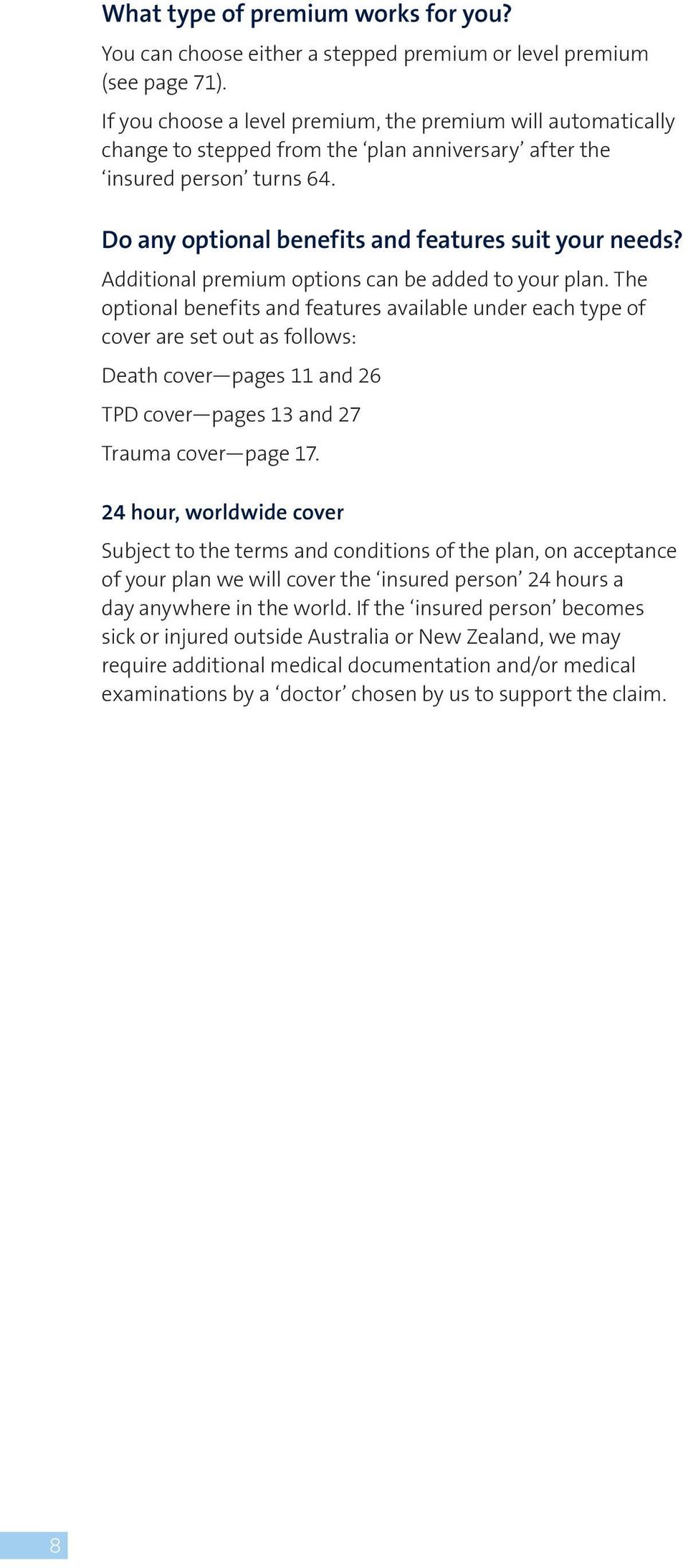
13 Life Protection Plan Snapshot Features and benefits Death cover Death cover where acquired through the AMP Superannuation Savings Trust, a SMSF or a small APRA superannuation fund Death benefit Terminal Illness benefit Funeral benefit Nomination of beneficiaries (ii) TPD cover TPD cover where acquired through the AMP Superannuation Savings Trust, a SMSF or a small APRA superannuation fund TPD benefit TPD Partial benefit TPD Plus option (i) Own Occupation option (i) Trauma benefit Partials Package option (i) Optimum Trauma Reinstatement option (i) Trauma cover (not available through the AMP Superannuation Savings Trust or where the Life Protection Plan is owned by the trustee of a SMSF or a small APRA superannuation fund) Optimum Buy Back option (i) Financial Planning benefit Guaranteed Future Insurability feature Indexation feature Business Safeguard option (i) Waiver of Premium option (i) Accommodation benefit Death Benefit feature Children s Trauma cover option (i) (i) This is an additional premium option. It only applies if it is shown in the certificate of insurance for the insured person. (ii) Not available where the cover is held by the trustee of a SMSF or small APRA superannuation fund. Section A About Flexible Lifetime Protection Section E Additional information Section D Business Overheads Section C Income Protection Plan Section B Life Protection Plan Insurance Plan 9
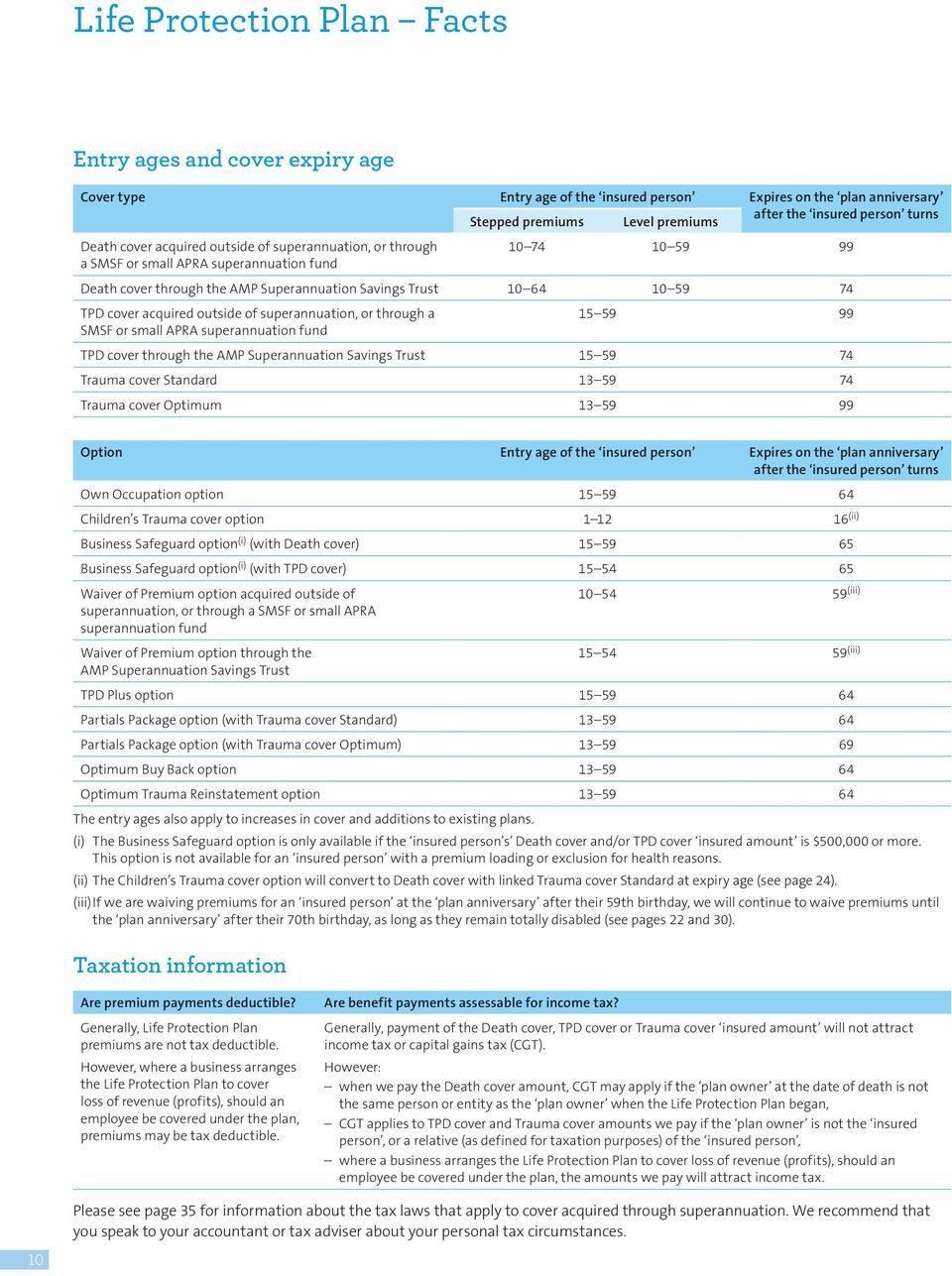
14 Life Protection Plan Facts Entry ages and cover expiry age Cover type Entry age of the insured person Expires on the plan anniversary after the insured person turns Stepped premiums Level premiums Death cover acquired outside of superannuation, or through a SMSF or small APRA superannuation fund Death cover through the AMP Superannuation Savings Trust TPD cover acquired outside of superannuation, or through a SMSF or small APRA superannuation fund TPD cover through the AMP Superannuation Savings Trust Trauma cover Standard Trauma cover Optimum Option Entry age of the insured person Expires on the plan anniversary after the insured person turns Own Occupation option Children s Trauma cover option (ii) Business Safeguard option (i) (with Death cover) Business Safeguard option (i) (with TPD cover) Waiver of Premium option acquired outside of superannuation, or through a SMSF or small APRA superannuation fund Waiver of Premium option through the AMP Superannuation Savings Trust (iii) (iii) TPD Plus option Partials Package option (with Trauma cover Standard) Partials Package option (with Trauma cover Optimum) Optimum Buy Back option Optimum Trauma Reinstatement option The entry ages also apply to increases in cover and additions to existing plans. (i) The Business Safeguard option is only available if the insured person s Death cover and/or TPD cover insured amount is $500,000 or more. This option is not available for an insured person with a premium loading or exclusion for health reasons. (ii) The Children s Trauma cover option will convert to Death cover with linked Trauma cover Standard at expiry age (see page 24). (iii) If we are waiving premiums for an insured person at the plan anniversary after their 59th birthday, we will continue to waive premiums until the plan anniversary after their 70th birthday, as long as they remain totally disabled (see pages 22 and 30). Taxation information Are premium payments deductible? Generally, Life Protection Plan premiums are not tax deductible. However, where a business arranges the Life Protection Plan to cover loss of revenue (profits), should an employee be covered under the plan, premiums may be tax deductible. Are benefit payments assessable for income tax? Generally, payment of the Death cover, TPD cover or Trauma cover insured amount will not attract income tax or capital gains tax (CGT). However: when we pay the Death cover amount, CGT may apply if the plan owner at the date of death is not the same person or entity as the plan owner when the Life Protection Plan began, CGT applies to TPD cover and Trauma cover amounts we pay if the plan owner is not the insured person, or a relative (as defined for taxation purposes) of the insured person, where a business arranges the Life Protection Plan to cover loss of revenue (profits), should an employee be covered under the plan, the amounts we pay will attract income tax. Please see page 35 for information about the tax laws that apply to cover acquired through superannuation. We recommend that you speak to your accountant or tax adviser about your personal tax circumstances. 10
15 Plan Rules Life Protection Plans acquired outside of superannuation The Plan Rules together with your certificate of insurance form your contract of insurance once we have accepted your application for cover. The following Plan Rules contained in pages 11 to 24 set out the terms and conditions that apply to a Life Protection Plan acquired outside of superannuation. Death cover Benefits and features at a glance The benefits and features of Death cover are listed below and are explained in detail on the pages listed below. In-built benefits and features are shown below like this: Additional premium options can be added to Death cover. These options will only apply if they are shown in the certificate of insurance for the insured person, and are shown below like this: Some words and expressions used in the Plan Rules have a specific meaning. These words and expressions are defined in the dictionary (see pages 77 to 86). Key benefit Death benefit (see page 11) Advanced payment benefits We may advance payment of the Death cover insured amount under these benefits: Terminal Illness benefit (see page 11) Additional benefits Funeral benefit (see page 12) The Financial Planning benefit and Accommodation benefit are in-built benefits and may be paid in addition to the above benefits. The Children s Trauma cover option is an additional premium option which can be added to Death cover, TPD cover or Trauma cover under a Life Protection Plan. Financial Planning benefit (see page 20) Children s Trauma cover option (see page 23) Accommodation benefit (see page 22) Features Increasing cover features These features allow the Death cover insured amount to be increased without providing evidence of the insured person s health or pastimes. Indexation feature (see page 21) Other features Nomination of beneficiaries (see page 12) Guaranteed renewable cover Guaranteed Future Insurability feature (see page 20) Business Safeguard option (see page 21) Waiver of Premium option (see page 22) As long as you pay premiums when they are due, we guarantee to continue Death cover until the cover ends (see page 13), regardless of changes in the insured person s health, occupation and pastimes. Benefits and features explained When we pay We only pay a benefit under Death cover if the insured event happens after cover starts and before cover ends (see page 13). We won t pay a benefit under Death cover in some circumstances (see When we won t pay on page 12). Also, you must satisfy our claim requirements before we pay a benefit (see page 73). Otherwise, we will pay a benefit under Death cover in the circumstances set out in this section and on page 20. Death benefit We pay the Death cover insured amount if the insured person dies. Terminal Illness benefit We advance payment of the Death cover insured amount if the insured person, after the cover starts and before the cover ends, becomes terminally ill. What does terminally ill mean? Terminally ill means that, as a direct result of any condition caused by an illness or injury, the insured person has a life expectancy of 12 months or less. Section A About Flexible Lifetime Protection Section E Additional information Section D Business Overheads Section C Income Protection Plan Section B Life Protection Plan Insurance Plan 11

16 12 The prognosis must be: based on clinical findings and reports, provided in writing by an appropriately qualified doctor who is approved by us, and supported by additional evidence that we may require to agree with the prognosis. We will only pay if you become terminally ill: after this plan commences before this plan ends, and before you reach the benefit expiry age for this plan. The amount we pay under the Terminal Illness benefit is the Death cover insured amount on the date we agree with the doctor s prognosis. On payment of the Terminal Illness benefit, Death cover for the insured person under the Life Protection Plan will end. If you have linked TPD cover and/or Trauma cover for the insured person, their TPD cover and/or Trauma cover insured amount(s) will be reduced by the amount of the Terminal Illness benefit payable. You don t have to pay any more premiums for an insured person under the Life Protection Plan if we have paid the Terminal Illness benefit for that insured person. Funeral benefit We advance $20,000 (or the Death cover insured amount, if less) if: the Funeral benefit is claimed, and we receive a certified copy of the insured person s death certificate. The Death cover insured amount reduces by the amount we pay under the Funeral benefit. We pay the balance of the Death cover insured amount (if any) if we accept the claim for the Death benefit. We pay the Funeral benefit to: you, or if you have died, to your estate or to any person we are permitted to pay under the Life Insurance Act (which currently includes your spouse, de facto, child, parent, sibling, niece or nephew or a person who satisfies us that they are entitled to your property under your Will or otherwise by law). Nomination of beneficiaries If you are both the sole plan owner and sole insured person of the Life Protection Plan, you can nominate one or more beneficiaries to receive the Death benefit under the Life Protection Plan. Your nomination will automatically be revoked if: you cease to be the sole plan owner or the sole insured person of the Life Protection Plan, or a nominated beneficiary dies before you (even if there are other surviving beneficiaries). You can cancel your nomination at any time by writing to us. Who we pay Plan owner If your plan has a sole plan owner with no nominated beneficiary If your plan has a sole plan owner with a nominated beneficiary(ies). If your plan is owned by two individuals as joint tenants Who we pay When we won t pay If you are alive, we pay the Terminal Illness benefit or Death benefit to you. If you have died, we pay the Funeral benefit or Death benefit to your estate. We pay the Terminal Illness benefit to you. We pay the Funeral benefit or Death benefit to your nominated beneficiary(ies). If both plan owners are alive, we pay the Terminal Illness benefit or Death benefit to the joint plan owners. If a plan owner has died, we pay the Funeral benefit, Terminal Illness benefit or Death benefit to the surviving plan owner. Unless Death cover is Replacement cover (see below), we won t pay a benefit under Death cover for an insured person if they die, or become terminally ill, by their own hand (whether sane or insane at the time) within 13 months of the date the Death cover starts or the date the Death cover was last reinstated. Also, if we increased the Death cover insured amount for the insured person because you asked us to, we won t pay the increased portion of the Death cover insured amount if the insured person dies, or becomes terminally ill, by their own hand (whether sane or insane at the time) within 13 months of the date of the increase. This does not apply to increases under the Indexation feature. We won t pay a benefit under Death cover for an injury or illness the insured person was diagnosed with, had any symptoms of, or was treated for, prior to the date the Death cover starts or the date the Death cover was last reinstated unless attributed to a sickness or disability that: you or the insured person were not aware of, and a reasonable person in the circumstances could not have been expected to be aware of, at the time. The sooner we are notified of your claim, the more effectively we will be able to assess your claim. If we are not notified as soon as possible, we may reduce the amount of any benefit paid to the extent that we have been prejudiced by this delay. Replacement cover If Death cover replaces Death cover issued by us, or another insurer, the 13 month period will not apply (but only up to the insured amount under the previous cover) if: you would have been entitled to claim under the previous cover had it not been replaced, and the previous cover was in place at the time we issued the Death cover, and the previous cover was in place for a continuous period of at least 13 months. For this exception to apply, we will require satisfactory evidence of the above at the time of any claim.
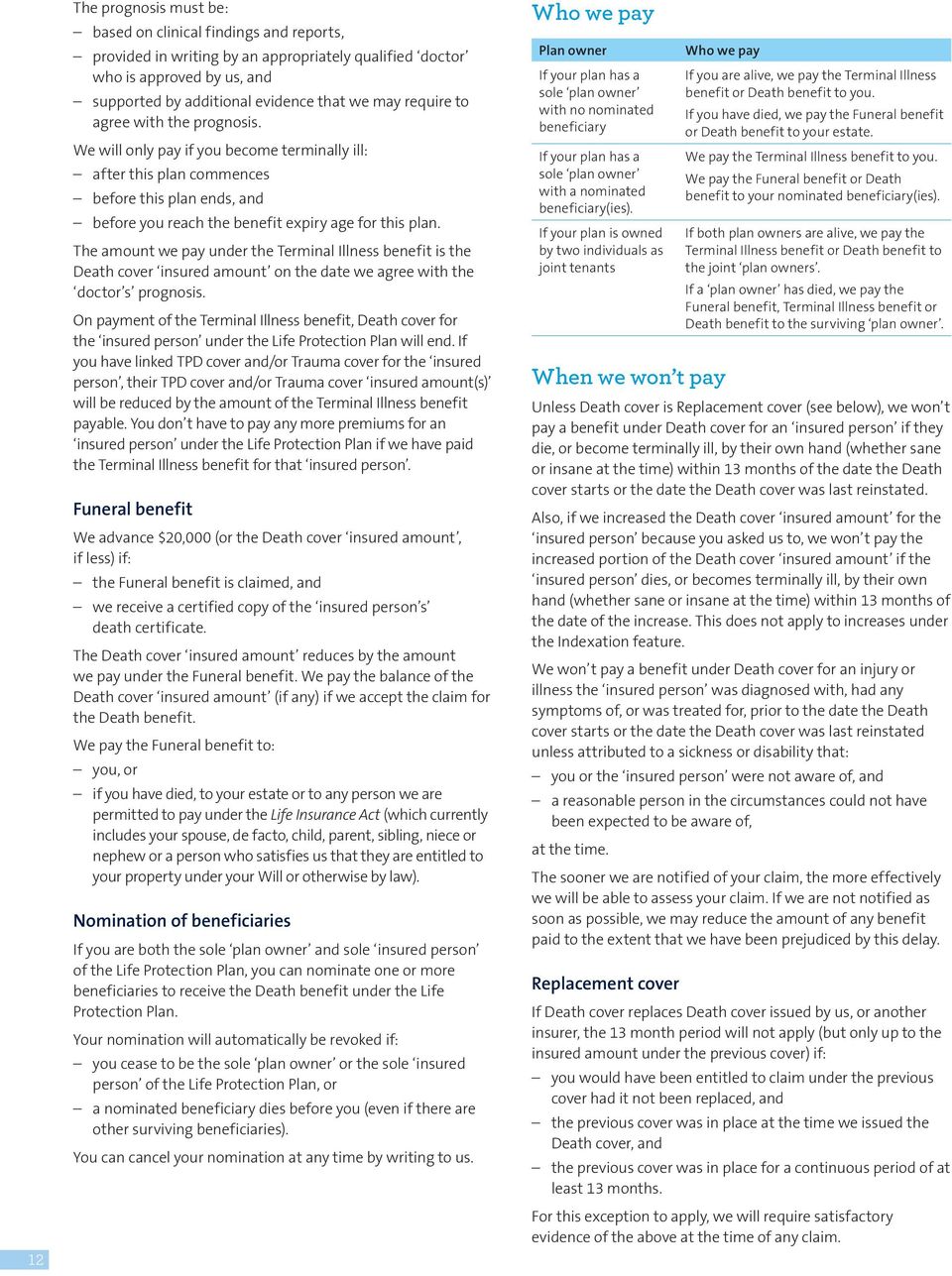
17 When Death cover ends The Death cover under your Life Protection Plan for an insured person ends when one of the following happens: the insured person dies, we receive your written request to cancel the Death cover for that insured person, the insured person s Death cover reduces to nil because another benefit (for example, the Terminal Illness benefit or other linked benefits) becomes payable, the end date for the insured person s Death cover shown on the certificate of insurance, the plan anniversary after the insured person s 99th birthday, or your Life Protection Plan ends (see page 24). Total and Permanent Disablement (TPD) cover Benefits and features at a glance The benefits and features of TPD cover are listed below and are explained in detail on the pages listed below. In-built benefits and features are shown below like this: Additional premium options can be added to TPD cover. These options will only apply if they are shown in the certificate of insurance for the insured person, and are shown below like this: Some words and expressions used in the Plan Rules have a specific meaning. These words and expressions are defined in the dictionary (see pages 77 to 86). Key benefits TPD benefit (see page 13) Additional benefits TPD Partial benefit (see page 15) The Financial Planning benefit and Accommodation benefit are in-built benefits and may be paid in addition to the above benefits. The Death Benefit feature is an in-built feature. The Children s Trauma cover option is an additional premium option which can be added to Death cover, TPD cover or Trauma cover under a Life Protection Plan. Financial Planning benefit (see page 20) Accommodation benefit (see page 22) Children s Trauma cover option (see page 23) Death Benefit feature (see page 22) Features Increasing cover features These features allow the TPD cover insured amount to be increased without providing evidence of the insured person s health or pastimes. Indexation feature (see page 21) Other features TPD Plus option (see page 15) Guaranteed renewable cover Guaranteed Future Insurability feature (see page 20) Own Occupation option (see page 15) Business Safeguard option (see page 21) Waiver of Premium option (see page 22) As long as you pay premiums when they are due, we guarantee to continue TPD cover until the cover ends (see page 15), regardless of changes to the insured person s health, occupation and pastimes. Benefits and features explained When we pay We only pay a benefit under TPD cover if the insured event happens after cover starts and before cover ends (see page 15). We won t pay a benefit under TPD cover in some circumstances (see When we won t pay on page 15). Also, you must satisfy our claim requirements before we pay a benefit (see page 73). Otherwise, we will pay a benefit under TPD cover in the circumstances set out in this section and on page 22. TPD benefit When we pay We pay you the TPD benefit if the insured person becomes totally and permanently disabled. The insured person must survive for 8 days from the occurrence of the illness or injury that directly or indirectly caused them to become totally and permanently disabled. What does totally and permanently disabled mean? An insured person is totally and permanently disabled if they satisfy one of the parts of the definition of totally and permanently disabled in the table below. However: part 2 of the definition of totally and permanently disabled only applies if the Own Occupation option is shown in the certificate of insurance for the insured person, and on and from the plan anniversary after the insured person s 64th birthday, the insured person is only totally and permanently disabled if they satisfy either part 4, 5 or 6 of the definition of totally and permanently disabled. Section A About Flexible Lifetime Protection Section E Additional information Section D Business Overheads Section C Income Protection Plan Section B Life Protection Plan Insurance Plan 13
18 Part 1 Unlikely to work The insured person is totally and permanently disabled if: they suffer an illness or injury, and the illness or injury wholly prevents them from engaging in regular remunerative work for at least 3 months (i) in a row, and since they became ill or injured, they have been under ongoing care for that illness or injury, and in our opinion, the illness or injury means that they are unlikely to ever work in regular remunerative work for which they are reasonably fitted by education, training or experience, that allows them to earn greater than 25% of their pre-disability income. Part 2 Unlikely to work Own occupation Part 2 only applies if the Own Occupation option is shown in the certificate of insurance for the insured person. The insured person is totally and permanently disabled if: they suffer an illness or injury, and the illness or injury wholly prevents them from engaging in their own occupation for at least 3 months (i) in a row, and since they became ill or injured, they have been under ongoing care for that illness or injury, and in our opinion, the illness or injury means that they are unlikely to ever work in their own occupation. Part 3 Home Duties The insured person is totally and permanently disabled if: they suffer an illness or injury, and the illness or injury wholly prevents them from engaging in their home duties for at least 3 months (i) in a row, and since they became ill or injured, they have been under ongoing care for that illness or injury, and in our opinion, the illness or injury means that they are unlikely to ever: a. engage in their home duties ; or b. work in any occupation for which they are reasonably fitted by education, training or experience. Part 4 Loss of use of limbs and/or sight The insured person is totally and permanently disabled if they suffer from the total and irrecoverable loss of: the use of 2 limbs, or the sight of both eyes, or the use of one limb and the sight of one eye, where a limb means the whole hand below the wrist or the whole foot below the ankle. The loss must be unable to be remedied. Part 5 Loss of independent living The insured person is totally and permanently disabled if they become totally and permanently unable to perform at least 2 activities of daily living without assistance from someone else. We will not pay for total and permanent disablement caused directly by alcohol or drug abuse. Part 6 Loss of cognitive functioning The insured person is totally and permanently disabled if they: suffer significant and permanent cognitive impairment with a loss of intellectual capacity, and are required to be under the continuous care and supervision of someone else. We will not pay for total and permanent disablement caused directly by alcohol or drug abuse. (i) Upon admittance of your claim, we will refund any TPD cover premiums falling due during this 3 month period that have been paid for the insured person. If the insured person satisfies the definition in Part 1, 2 or 3 as a result of one of the listed medical conditions, we will waive the 3 month qualifying period. The listed medical conditions are: Alzheimer s disease and other dementias Blindness Cardiomyopathy Paralysis diplegia Paralysis hemiplegia Paralysis paraplegia Paralysis quadriplegia Paralysis tetraplegia Loss of hearing Loss of speech Lung disease Major head trauma Motor neurone disease Multiple sclerosis Muscular dystrophy Parkinson s disease (advanced) Primary pulmonary hypertension Severe rheumatoid arthritis Each of the listed medical conditions are defined in the Trauma definitions section from page 77. Amount we pay If we accept the claim because the insured person has satisfied either Parts 1, 2 or 3 of the definition of totally and permanently disabled If we accept the claim because the insured person has satisfied either Parts 4, 5, or 6 of the definition of totally and permanently disabled The TPD benefit we pay is a lump sum equal to the TPD cover insured amount that applies on the date 3 months after the insured person stopped performing home duties, regular remunerative work or their own occupation (as applicable). The TPD benefit we pay is a lump sum equal to the TPD cover insured amount that applies on the date the insured person satisfies either parts 4, 5, or 6 of the definition of totally and permanently disabled (as applicable). We only pay the TPD cover insured amount once in respect of an insured person, even if the insured person satisfies two or more Parts in the definition of totally and permanently disabled. If you have linked Death and/or Trauma cover for the insured person, their Death and/or Trauma cover insured amount(s) will be reduced by the amount of the TPD benefit payable and your premium will be reduced having regard to the reduced insured amount(s). If you have any combination of linked Death, TPD and Trauma cover for the insured person and you are eligible for a benefit under two or all three types of cover at the same time for the same condition, we only pay a benefit under one type of cover. If the insured amounts are not equal, we pay a benefit under the cover which has the highest insured amount. 14

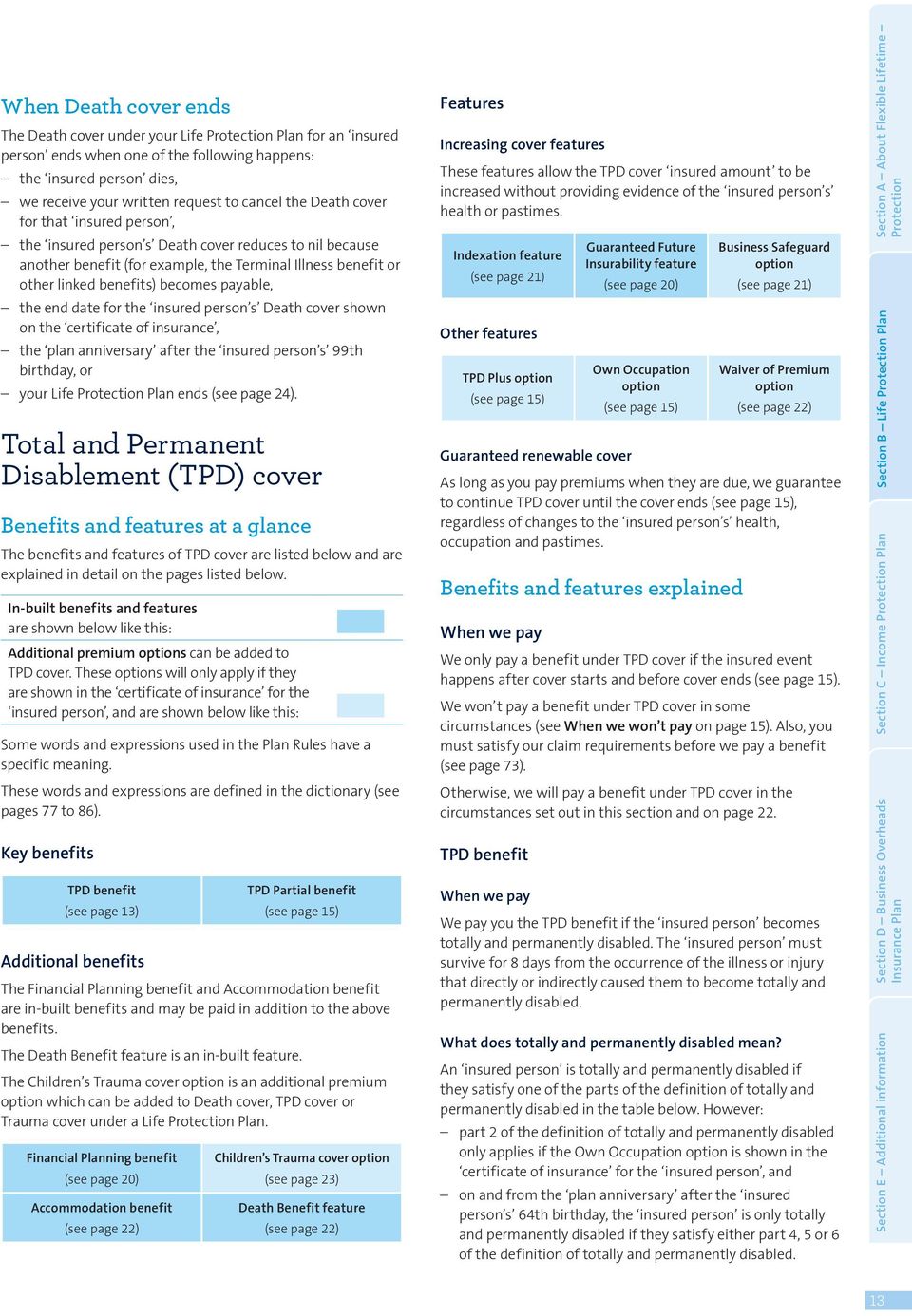
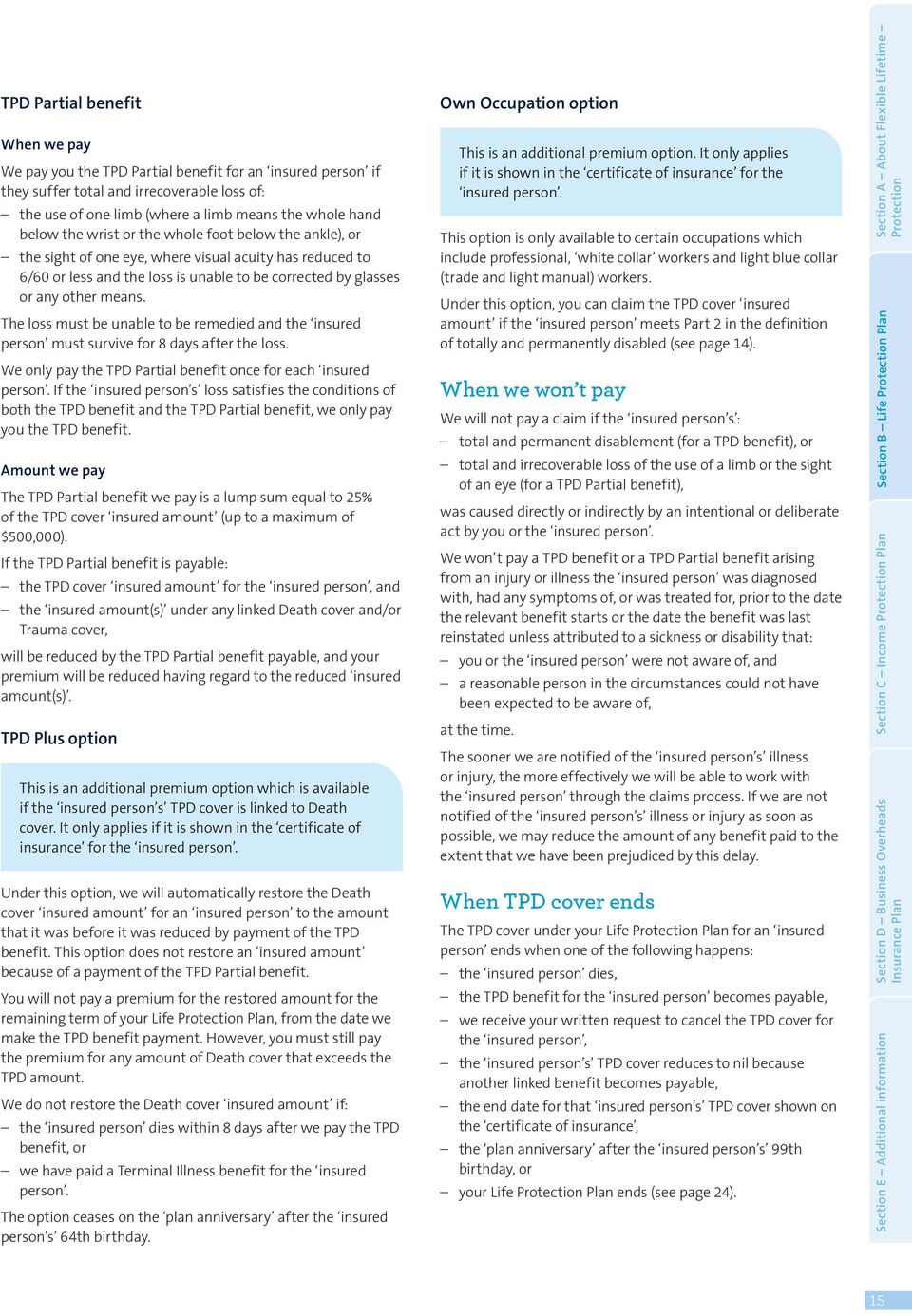
19 TPD Partial benefit When we pay We pay you the TPD Partial benefit for an insured person if they suffer total and irrecoverable loss of: the use of one limb (where a limb means the whole hand below the wrist or the whole foot below the ankle), or the sight of one eye, where visual acuity has reduced to 6/60 or less and the loss is unable to be corrected by glasses or any other means. The loss must be unable to be remedied and the insured person must survive for 8 days after the loss. We only pay the TPD Partial benefit once for each insured person. If the insured person s loss satisfies the conditions of both the TPD benefit and the TPD Partial benefit, we only pay you the TPD benefit. Amount we pay The TPD Partial benefit we pay is a lump sum equal to 25% of the TPD cover insured amount (up to a maximum of $500,000). If the TPD Partial benefit is payable: the TPD cover insured amount for the insured person, and the insured amount(s) under any linked Death cover and/or Trauma cover, will be reduced by the TPD Partial benefit payable, and your premium will be reduced having regard to the reduced insured amount(s). TPD Plus option This is an additional premium option which is available if the insured person s TPD cover is linked to Death cover. It only applies if it is shown in the certificate of insurance for the insured person. Under this option, we will automatically restore the Death cover insured amount for an insured person to the amount that it was before it was reduced by payment of the TPD benefit. This option does not restore an insured amount because of a payment of the TPD Partial benefit. You will not pay a premium for the restored amount for the remaining term of your Life Protection Plan, from the date we make the TPD benefit payment. However, you must still pay the premium for any amount of Death cover that exceeds the TPD amount. We do not restore the Death cover insured amount if: the insured person dies within 8 days after we pay the TPD benefit, or we have paid a Terminal Illness benefit for the insured person. The option ceases on the plan anniversary after the insured person s 64th birthday. Own Occupation option This is an additional premium option. It only applies if it is shown in the certificate of insurance for the insured person. This option is only available to certain occupations which include professional, white collar workers and light blue collar (trade and light manual) workers. Under this option, you can claim the TPD cover insured amount if the insured person meets Part 2 in the definition of totally and permanently disabled (see page 14). When we won t pay We will not pay a claim if the insured person s : total and permanent disablement (for a TPD benefit), or total and irrecoverable loss of the use of a limb or the sight of an eye (for a TPD Partial benefit), was caused directly or indirectly by an intentional or deliberate act by you or the insured person. We won t pay a TPD benefit or a TPD Partial benefit arising from an injury or illness the insured person was diagnosed with, had any symptoms of, or was treated for, prior to the date the relevant benefit starts or the date the benefit was last reinstated unless attributed to a sickness or disability that: you or the insured person were not aware of, and a reasonable person in the circumstances could not have been expected to be aware of, at the time. The sooner we are notified of the insured person s illness or injury, the more effectively we will be able to work with the insured person through the claims process. If we are not notified of the insured person s illness or injury as soon as possible, we may reduce the amount of any benefit paid to the extent that we have been prejudiced by this delay. When TPD cover ends The TPD cover under your Life Protection Plan for an insured person ends when one of the following happens: the insured person dies, the TPD benefit for the insured person becomes payable, we receive your written request to cancel the TPD cover for the insured person, the insured person s TPD cover reduces to nil because another linked benefit becomes payable, the end date for that insured person s TPD cover shown on the certificate of insurance, the plan anniversary after the insured person s 99th birthday, or your Life Protection Plan ends (see page 24). Section A About Flexible Lifetime Protection Section E Additional information Section D Business Overheads Section C Income Protection Plan Section B Life Protection Plan Insurance Plan 15
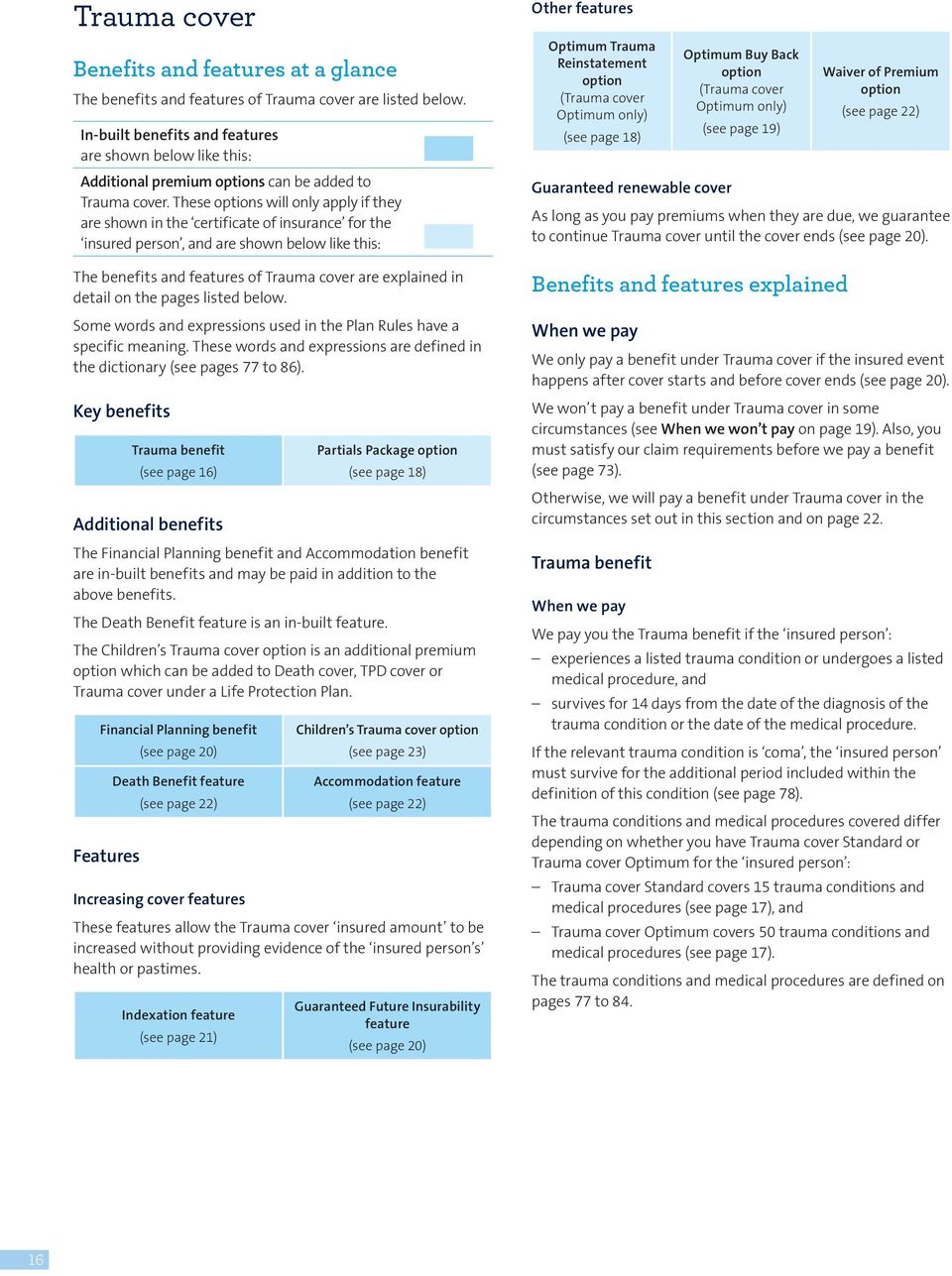
20 Trauma cover Benefits and features at a glance The benefits and features of Trauma cover are listed below. In-built benefits and features are shown below like this: Additional premium options can be added to Trauma cover. These options will only apply if they are shown in the certificate of insurance for the insured person, and are shown below like this: The benefits and features of Trauma cover are explained in detail on the pages listed below. Some words and expressions used in the Plan Rules have a specific meaning. These words and expressions are defined in the dictionary (see pages 77 to 86). Key benefits Trauma benefit (see page 16) Additional benefits Partials Package option (see page 18) The Financial Planning benefit and Accommodation benefit are in-built benefits and may be paid in addition to the above benefits. The Death Benefit feature is an in-built feature. The Children s Trauma cover option is an additional premium option which can be added to Death cover, TPD cover or Trauma cover under a Life Protection Plan. Financial Planning benefit (see page 20) Features Death Benefit feature (see page 22) Increasing cover features Children s Trauma cover option (see page 23) Accommodation feature (see page 22) These features allow the Trauma cover insured amount to be increased without providing evidence of the insured person s health or pastimes. Indexation feature (see page 21) Guaranteed Future Insurability feature (see page 20) Other features Optimum Trauma Reinstatement option (Trauma cover Optimum only) (see page 18) Guaranteed renewable cover Optimum Buy Back option (Trauma cover Optimum only) (see page 19) Waiver of Premium option (see page 22) As long as you pay premiums when they are due, we guarantee to continue Trauma cover until the cover ends (see page 20). Benefits and features explained When we pay We only pay a benefit under Trauma cover if the insured event happens after cover starts and before cover ends (see page 20). We won t pay a benefit under Trauma cover in some circumstances (see When we won t pay on page 19). Also, you must satisfy our claim requirements before we pay a benefit (see page 73). Otherwise, we will pay a benefit under Trauma cover in the circumstances set out in this section and on page 22. Trauma benefit When we pay We pay you the Trauma benefit if the insured person : experiences a listed trauma condition or undergoes a listed medical procedure, and survives for 14 days from the date of the diagnosis of the trauma condition or the date of the medical procedure. If the relevant trauma condition is coma, the insured person must survive for the additional period included within the definition of this condition (see page 78). The trauma conditions and medical procedures covered differ depending on whether you have Trauma cover Standard or Trauma cover Optimum for the insured person : Trauma cover Standard covers 15 trauma conditions and medical procedures (see page 17), and Trauma cover Optimum covers 50 trauma conditions and medical procedures (see page 17). The trauma conditions and medical procedures are defined on pages 77 to
21 Amount we pay The Trauma benefit we pay is a lump sum equal to the Trauma cover insured amount that applies on the date that the definition of the trauma condition or medical procedure is met. We only pay the Trauma cover insured amount once in respect of an insured person, even if the insured person satisfies the definition of two or more trauma conditions (unless the Optimum Trauma Reinstatement option is exercised and the Trauma benefit again becomes payable see page 18). If you have linked Death and/or TPD cover for the insured person, the Death and/or TPD cover insured amount(s) for that insured person will be reduced by the amount of the Trauma benefit payable and your premium will be reduced having regard to the reduced insured amount(s). If you have any combination of linked Death, TPD and Trauma cover for the insured person and you are eligible for a benefit under 2 or all 3 types of cover at the same time for the same condition, we only pay a benefit under one type of cover. If the insured amounts are not equal, we pay a benefit under the cover which has the highest insured amount (although, for the purposes of the Optimum Trauma Reinstatement option and the Optimum Buy Back option, if applicable, we will treat you as having been paid the Trauma benefit). Trauma cover Standard Trauma cover Standard covers the following trauma conditions and medical procedures: Cover for the trauma conditions and medical procedures in this column starts immediately Kidney failure Major organ transplant Paralysis that is one of: Diplegia Hemiplegia Paraplegia Quadriplegia Tetraplegia Peripheral blood stem cell or bone marrow transplant Cover for the trauma conditions and medical procedures in this column is delayed for 3 months (as set out on pages 19 and 20) Aortic surgery Cancer Coronary artery surgery Heart attack myocardial infarction Heart attack out of hospital cardiac arrest Heart valve surgery Stroke Under Trauma cover Standard, on and from the plan anniversary following the insured person s 64th birthday, the trauma conditions and medical procedures above will cease to be covered and will be replaced by: Loss of independent living, and Loss of use of limbs and/or sight. Trauma cover Optimum Trauma cover Optimum covers the following trauma conditions and medical procedures: Cover for the trauma conditions and medical procedures in this column starts immediately Alzheimer s disease and other dementias Aplastic anaemia Blindness Cardiomyopathy Coma Diabetes Encephalitis Hepatitis B or C occupationally acquired HIV/AIDS medically acquired HIV/AIDS occupationally acquired Intensive care Kidney failure Liver failure Loss of hearing Loss of independent living Loss of speech Loss of use of limbs and/or sight Lung disease Major head trauma Major organ transplant Motor neurone disease Multiple sclerosis Muscular dystrophy Myelodysplasia Myelofibrosis Paralysis that is one of: Diplegia Hemiplegia Paraplegia Quadriplegia Tetraplegia Parkinson s disease (advanced) Peripheral blood stem cell or bone marrow transplant Peripheral neuropathy Primary pulmonary hypertension Severe burns Systemic sclerosis Cover for the trauma conditions and medical procedures in this column is delayed for 3 months (as set out on pages 19 and 20) Aortic surgery Bacterial meningitis and meningococcal disease Benign tumour of the brain or spinal cord Cancer Coronary artery angioplasty triple vessel Coronary artery surgery Heart attack myocardial infarction Heart attack out of hospital cardiac arrest Heart valve surgery Open heart surgery Pneumonectomy Severe rheumatoid arthritis Stroke Systemic lupus erythematosus Under Trauma cover Optimum, on and from the plan anniversary following the insured person s 69th birthday, the only trauma conditions covered are: Loss of independent living, and Loss of use of limbs and/or sight. At this time, cover for all other trauma conditions and medical procedures ends. Section A About Flexible Lifetime Protection Section E Additional information Section D Business Overheads Section C Income Protection Plan Section B Life Protection Plan Insurance Plan 17
22 Partials Package option This is an additional premium option. It only applies if it is shown in the certificate of insurance for the insured person and the insured person s Trauma cover insured amount is at least $40,000. We pay under the Partials Package option if the insured person : experiences a listed trauma condition or undergoes a listed medical procedure, and survives for 14 days from the date of the diagnosis of the trauma condition or the date of the medical procedure. The Partial Package option covers the following trauma conditions and medical procedures: Aortic surgery by minimal invasive techniques Carcinoma in situ of breast Carcinoma in situ of cervix uteri Carcinoma in situ of fallopian tubes Carcinoma in situ of ovary Carcinoma in situ of penis Carcinoma in situ of perineum Carcinoma in situ of testes Carcinoma in situ of uterus Carcinoma in situ of vagina Carcinoma in situ of vulva Complications of pregnancy Coronary artery angioplasty Heart attack partial payment Heart valve surgery by minimal invasive techniques Loss of use of one limb Melanoma Parkinson s disease Partial blindness Partial loss of hearing Prostate cancer Severe inflammatory bowel disease Severe osteoporosis Temporal arteritis Type 1 Diabetes Cover for partial blindness, partial loss of hearing and loss of use of one limb commences immediately. However, cover for the other trauma conditions and medical procedures is delayed for 3 months (see pages 19 and 20). We may pay more than once under the Partials Package option, although we will not pay more than once for a same specific trauma condition or medical procedure. The exception to this is coronary artery angioplasty, where we will pay more than once but only where the procedure is at least 6 months after the previous coronary artery angioplasty procedure. Amount we pay Subject to the maximums below, the amount we pay under the Partials Package option for a trauma condition or a medical procedure is 25% of the Trauma cover insured amount. The maximum amount we pay under the Partials Package option for a trauma condition or a medical procedure is: For the following conditions: Carcinoma in situ of uterus Carcinoma in situ of fallopian tubes Carcinoma in situ of vagina Carcinoma in situ of vulva For coronary artery angioplasty For heart attack partial payment For all other trauma conditions and medical procedures under the Partials Package option 25% of the Trauma cover insured amount $50,000 per procedure $50,000 $25,000 If a benefit is payable under the Partials Package option: the Trauma cover insured amount for the insured person, and the insured amount(s) under any linked Death cover and/ or TPD cover, will be reduced by the benefit payable, and your premium will be reduced having regard to the reduced insured amount(s). When cover under this option ends Cover for an insured person under the Partials Package option ends when one of the following happens: the plan anniversary after the insured person reaches age: 64, if you have Trauma cover Standard, or 69, if you have Trauma cover Optimum the Trauma cover insured amount reduces to less than $40,000. Optimum Trauma Reinstatement option (Trauma cover Optimum only) This is an additional premium option. It only applies if it is shown in your certificate of insurance for the insured person. This option allows you to restore Trauma cover after we have paid the Trauma benefit, without providing evidence of the insured person s health, occupation or pastimes. This option does not allow you to restore a benefit amount paid under the Partials Package option. This option becomes exercisable one year after we pay the Trauma benefit. You must exercise the option within 30 days of the claim anniversary, by completing the relevant application form. We will send you notification when this option has become exercisable. Once this option has been exercised, the following options do not apply to the reinstated Trauma cover: Trauma Partials Package option Optimum Trauma Reinstatement option Indexation feature. 18
23 The premium for the reinstated Trauma cover will be based on our Trauma cover premium rates and the insured person s age, applicable at the time of exercising this option, and taking into account any special terms or premium loadings applying to the original Trauma cover. We will not pay a claim under the reinstated Trauma cover if: the insured person experiences a trauma condition or undergoes a medical procedure for which we have already paid a Trauma benefit, or the insured person was diagnosed with, or experienced symptoms leading to diagnosis of: a trauma condition, or a medical condition, that became apparent between the date that we paid the Trauma benefit and the date Trauma cover is reinstated under the Optimum Trauma Reinstatement option, or a new trauma condition, or medical condition that a new medical procedure is intended to address, is directly or indirectly caused by or related to a trauma condition or medical procedure for which we have already paid a Trauma benefit, or the new trauma condition, or the new medical procedure, is directly or indirectly related to: the treatment used for a previous trauma condition, or a previous medical procedure, or the new trauma condition is for kidney failure or a heart condition and a previous Trauma cover payment was for systemic lupus erythematosus, or the new trauma condition is: a heart condition a stroke, or Paralysis (directly or indirectly resulting from a stroke ), and previous Trauma cover payment was for a heart condition. When this feature ends The Optimum Trauma Reinstatement option will end on the earlier of: the date the option is exercised the plan anniversary after the insured person turns 64, and the Optimum Trauma Reinstatement option end date shown in the certificate of insurance. Optimum Buy Back option (Trauma cover Optimum only) This is an additional premium option which is available if the insured person s Trauma cover is linked to Death cover. It only applies if it is shown in the certificate of insurance for the insured person. This option allows you to restore Death cover for an insured person by the amount it was reduced after payment of the Trauma Benefit, without providing evidence of the insured person s health, occupation or pastimes. This option does not allow you to restore an insured amount because of a payment under the Partials Package option. This option becomes exercisable one year after we pay the Trauma benefit. You must exercise the option within 30 days of the claim anniversary by completing the relevant application form. The premium for the restored Death cover will be based on our Death cover premium rates and the insured person s age, applicable at the time of exercising this option, taking into account any special terms or premium loadings applying to the original Death cover. When this feature ends The Optimum Buy Back option will end when one of the following happens: the plan anniversary after the insured person turns 64 Death cover for the insured person ends; or the Optimum Buy Back option end date shown in the certificate of insurance. When we won t pay We will not pay if the trauma condition, or if the purpose for the medical procedure, was caused directly or indirectly by an intentional or deliberate act by you or the insured person. Also, we won t pay a benefit under Trauma cover for an injury or illness the insured person was diagnosed with, had any symptoms of, or was treated for, prior to the date the Trauma cover starts or the date the Trauma cover was last reinstated unless attributed to a sickness or disability that: you or the insured person were not aware of, and a reasonable person in the circumstances could not have been expected to be aware of, at the time. Delayed cover for some trauma conditions and medical procedures Unless Trauma cover is Replacement cover (see below), cover does not start for those trauma conditions and medical procedures which are expressed to be delayed for 3 months until 3 months after: the Trauma cover start date an increase to the Trauma cover insured amount (other than an increase under the Indexation feature) in respect of the increased portion only the most recent reinstatement of Trauma cover. This means that for those trauma conditions and medical procedures which are expressed to be delayed for 3 months: the trauma condition, or the medical condition which the medical procedure is intended to address, must be diagnosed at least 3 months after the Trauma cover start date. Section A About Flexible Lifetime Protection Section E Additional information Section D Business Overheads Section C Income Protection Plan Section B Life Protection Plan Insurance Plan 19
24 If the diagnosis occurs during this 3 month period, we will never pay for that trauma condition or medical procedure under the Life Protection Plan, even if the insured person experiences the same trauma condition again or undergoes the same medical procedure again. Replacement cover If Trauma cover replaces trauma cover issued by us, or another insurer, the 3 month delayed start date will not apply (but only up to the insured amount under the previous cover) if: you would have been entitled to claim under the previous cover for the same trauma condition or medical procedure had it not been replaced the previous cover was in force at the time we issued the Trauma cover, and the previous cover was in place for a continuous period of at least 3 months. We will require satisfactory evidence of the above points at the time of any claim for this exception to apply. When Trauma cover ends The Trauma cover under your Life Protection Plan for an insured person ends when one of the following happens: the insured person dies a Trauma benefit for the insured person becomes payable we receive your written request to cancel the Trauma cover for the insured person the insured person s Trauma cover reduces to nil because another linked benefit becomes payable the end date for that insured person s Trauma cover shown on the certificate of insurance the plan anniversary after the insured person s 74th birthday for Trauma cover Standard or the insured person s 99th birthday for Trauma cover Optimum, or your Life Protection Plan ends (see page 24). Additional benefits, features and options under the Life Protection Plan Financial Planning benefit We will reimburse the cost of financial planning advice up to $2,000 (in addition to the amount of the benefit we paid) if you are eligible for a benefit under the Life Protection Plan. Evidence of this expense must be produced in a form we accept and the financial advice must come from a suitable and qualified person we accept. If there is more than one recipient of a benefit, we divide the Financial Planning benefit equally between the recipients. This benefit is payable only once for each insured person under all plans with AMP and must be claimed within 12 months of the claim being paid. Guaranteed Future Insurability feature You can increase the Death cover and/or TPD cover and/or Trauma cover insured amount for an insured person without providing evidence of the insured person s health, occupation or pastimes when one of the following happens: the insured person marries, registers a de facto relationship or enters into a de facto agreement the insured person divorces, legally separates, registers a separation from a marriage or registered de facto relationship or cancels a de facto agreement the death of the insured person s spouse or registered de facto partner or a de facto partner who has entered into a de facto agreement with the insured person the insured person s child is born or they legally adopt a child the insured person s child starts school the insured person is granted a housing loan by a financial institution to buy their first home the insured person increases their mortgage for their primary place of residence the insured person completes their first undergraduate degree at a recognised Australian university the insured person is promoted or commences a new employment arrangement and as a result has an annual income increase of at least $10,000 and 10% the insured person becomes a carer for the first time the insured person increases their financial interest in a business for which they are a working partner or a working director, and the Life Protection Plan forms part of a buy/ sell, share protection or business succession agreement where the insured person is a key person in a business, the business owns the plan, which was written for the purpose of key person protection, and their value as a key person to that business increases, or the insured person takes out or increases a loan secured over the business for which the insured person is the primary guarantor and the Life Protection Plan was written for loan protection. You can only increase the insured amount once under this feature in any 12 month period for each type of cover under the Life Protection Plan. You must apply for the increase within 12 months of the date the event occurs and provide appropriate proof of the event that we accept (such as certification of the event or a statutory declaration). Maximum increases You may increase the insured amount by up to 25% (up to a maximum of $250,000) at any one time. Premiums will be based on our premium rates and the insured person s age, applicable at the time of exercising this feature. The maximum amount by which you can increase an insured person s Death cover insured amount under this feature over the term of the Life Protection Plan is the original Death cover insured amount (to a maximum of $1,000,000). 20
25 The maximum amount by which you can increase an insured person s TPD cover insured amount under this feature over the term of the Life Protection Plan is the original TPD cover insured amount (to a maximum of $250,000). The maximum amount you can increase TPD cover to through this feature is $2.5 million. The maximum amount by which you can increase an insured person s Trauma cover insured amount under this feature over the term of the Life Protection Plan is the original Trauma cover insured amount (to a maximum of $250,000). The maximum amount you can increase Trauma cover to through this feature is $2 million. If you apply to increase Death, TPD and/or Trauma cover under this feature, as a result of an increase to the insured person s mortgage, the maximum increase will also be limited to the amount the mortgage is increased by. If you apply to increase Death, TPD and/or Trauma cover under this feature, as a result of a promotion or commencement of a new employment arrangement, the maximum increase will also be limited to 10 times the salary increase. When you cannot apply for increases under this feature You cannot apply for increases under this feature for an insured person if, at the time of your request: the insured person is age 55 or more, or the insured person s cover has: more than one exclusion, or a premium loading of more than 50%, or both an exclusion and a premium loading, or any other special terms, or the insured person s premiums are being waived under the Waiver of Premium option, or a person is eligible to make, or has made, a Terminal Illness, TPD or Trauma claim under any AMP plan or any policy held with another company in relation to the insured person. This feature does not apply to: the Children s Trauma cover option the Death cover insured amount restored after exercising the TPD Plus option the Death cover insured amount restored after exercising the Optimum Buy Back option, or the Trauma cover insured amount reinstated after exercising the Optimum Trauma Reinstatement option. Indexation feature Each year, unless otherwise agreed, on the plan anniversary we will increase the insured amounts for all insured persons under the Life Protection Plan by the higher of: the percentage increase in the CPI (see page 84) since the last plan anniversary (or since the plan start date if this is the first plan anniversary under the Life Protection Plan), and 5%. We will notify you of the increase in the Annual Statement we send you each year. You must tell us if you do not want this increase, in full or in part. The Indexation feature ceases to apply to an insured person on the plan anniversary after age 74 for Death cover, TPD cover and Trauma cover. The Indexation feature does not apply to: the $25,000 Death cover insured amount under Children s Trauma cover option (see page 23), the Death cover insured amount restored as a result of exercising the TPD Plus option (see page 15), the Death cover insured amount restored as a result of exercising the Optimum Buy Back option (see page 19), or the Trauma cover insured amount reinstated as a result of exercising the Optimum Trauma Reinstatement option (see page 18). Business Safeguard option Business Safeguard option is not available with Trauma cover. This is an additional premium option. It only applies if it is shown in the certificate of insurance for the insured person. This option is designed to be used for business purposes such as: business succession planning (buy/sell agreement) loan guarantor insurance, and key person insurance. The option allows you to apply to increase the Death cover insured amount and/or TPD cover insured amount for an insured person, without providing evidence of the insured person s health or pastimes. You can apply to increase the insured amount for an insured person under this option by: if the insured person is a key person to the business the actual increase in the value of the insured person to the business since the latter of the last time the option was exercised and the commencement of the option, or if the Life Protection Plan forms part of a written buy/sell, share purchase or business continuation agreement the actual increase in the value of the insured person s interest in the business since the latter of the last time the option was exercised and the commencement of the option. This option is only available if the insured amount is $500,000 or more. This option is not available for an insured person with a premium loading or exclusion for health reasons. Before we increase the level of cover for an insured person under this option, we may require financial evidence of the increase in the value of the business from an appropriate person (eg an independent qualified accountant or business valuer) we approve. If we increase the insured amount for an insured person under this option, your premium will increase in line with the higher level of cover. Section A About Flexible Lifetime Protection Section E Additional information Section D Business Overheads Section C Income Protection Plan Section B Life Protection Plan Insurance Plan 21
26 When does the option end? The Business Safeguard option for Death cover or TPD cover (as applicable) ends when one of the following happens: you do not exercise this option for 5 years the 10th anniversary of the commencement of this option the insured person turns 65 for Death cover, the Death cover insured amount reaches 5 times the original insured amount (up to a maximum of $15 million) for TPD cover, the TPD cover insured amount reaches 5 times the original insured amount (up to a maximum of $2.5 million), or a person has made, or is eligible to make, a terminal illness, trauma or TPD claim in respect of the insured person under any plan with us. Waiver of Premium option This is an additional premium option. It only applies if it is shown in the certificate of insurance for the insured person. You can choose one of the following 2 types of Waiver of Premium options: Individual Life you do not have to pay the Life Protection Plan premium (including the plan fee) for a particular insured person if they become totally disabled before the plan anniversary after their 59th birthday and while they continue to remain totally disabled, or Nominated Life you do not have to pay the Life Protection Plan premium (including the plan fee) for all insured persons if the nominated insured person is totally disabled before the plan anniversary after their 59th birthday and while they continue to remain totally disabled. The option will cease to apply to your Life Protection Plan on the plan anniversary after the insured person s 59th birthday. However, if we are waiving premiums at that plan anniversary, we will continue to waive your premiums until the plan anniversary after the insured person s 70th birthday (providing they remain totally disabled). What does totally disabled mean? An insured person is totally disabled if they are unable, due to injury or illness, to engage in any regular remunerative work for which they are reasonably fitted by their education, training or experience for a continuous period of more than 6 months. Individual Life option Under this option, we waive the premiums for that insured person while they are totally disabled. Further, the premium you paid during the 6 months while we determined if the insured person was totally disabled will be refunded to you. You must restart paying the premium for the insured person when one of the following happens: as soon as the insured person is no longer totally disabled the date Death cover ends for the insured person, or the plan anniversary after the insured person s 70th birthday. Nominated Life option Under this option, we waive the premiums for all insured persons while the nominated insured person is totally disabled. Further, the premium you paid during the 6 months while we determined if the nominated insured person was totally disabled will be refunded to you. You must restart paying your premium when one of the following happens: the nominated insured person is no longer totally disabled the date Death cover ends for the nominated insured person the plan anniversary after the nominated insured person s 70th birthday, or if the nominated insured person dies. Accommodation benefit We pay the Accommodation benefit to reimburse the reasonable accommodation expenses, once receipts are provided, of an immediate family member of the insured person, who accompanies the insured person, if the insured person : is eligible to claim a benefit under the Terminal Illness benefit, TPD benefit, TPD Partial benefit, Trauma benefit or Children s Trauma benefit option; and is bedridden; and became totally disabled, and remains, over 100 km away from their usual residence, or the insured person needs to travel more than 100 km from home for medical treatment, and requires an immediate family member to be with them. We pay up to $250 per day for a maximum of 14 days. This benefit is only payable once for each insured person under the Life Protection Plan and must be claimed within 6 weeks of the Terminal Illness, TPD or Trauma claim being paid. Death Benefit feature This is an in-built feature of the Life Protection Plan with TPD cover or Trauma cover. This feature is only available if the insured person is not being provided with Death cover under this plan or any other plan where AMP Life is the insurer. We pay under this Death Benefit feature if the insured person dies while this plan is in force. We will pay $10,000 (or the TPD cover or Trauma cover insured amount if it is lower than $10,000) to you. We will only pay once on the death of an insured person across all plans with AMP for that insured person. This feature must be claimed within 12 months of the insured person s death. 22
27 This benefit is not payable if the insured person dies by their own hand (whether sane or insane at the time) within 13 months of the commencement or reinstatement of the Life Protection Plan, or if the insured person has made a claim under the Terminal Illness benefit, TPD cover or Trauma cover. Children s Trauma cover option This is an additional premium option. It only applies if it is shown in your certificate of insurance for the insured person. When we pay We only pay a benefit under the Children s Trauma cover option if the insured event happens after cover starts and before cover ends (see page 24). We pay you a benefit under the Children s Trauma cover option if the insured person : experiences a listed trauma condition or undergoes a listed medical procedure, and survives for 14 days from the date of the diagnosis of the trauma condition or the date of the medical procedure. We also pay a benefit under the Children s Trauma cover option if the insured person dies or is terminally ill. Terminally ill means: the insured person s doctor tells us in writing that they believe that the insured person has less than 12 months to live, and the doctor s prognosis is based on clinical findings and reports, and we agree with the doctor s prognosis. We may also require you to give us information from doctors we choose. The trauma conditions and medical procedures covered under Children s Trauma cover are set out in the table below. Cover for the trauma conditions in the right hand column of the table is delayed for 3 months (as set out on pages 19 and 20 under the heading Delayed cover for some trauma conditions and medical procedures). Amount we pay The amount we pay under the Children s Trauma cover option is: $100,000 (plus any increases under the Indexation feature) if the insured person experiences a listed trauma condition or undergoes a listed medical procedure and survives 14 days from the date of the diagnosis of the trauma condition or the date of the medical procedure, or $25,000 if the insured person dies or is terminally ill. We only pay once under the Children s Trauma cover option, even if the insured person satisfies two or more definitions. The Children s Trauma cover option covers the following trauma conditions and medical procedures: Cover for the trauma conditions and medical procedures in this column starts immediately Benign tumour of the brain or spinal cord Blindness Coma Intensive care Kidney failure Loss of hearing Loss of speech Loss of use of limbs and/or sight Major head trauma Major organ transplant Paralysis that is one of: Diplegia Hemiplegia Paraplegia Quadriplegia Tetraplegia Peripheral blood stem cell or bone marrow transplant Severe burns When we won t pay Cover for the trauma conditions in this column is delayed for 3 months (as set out on pages 19 and 20) Aplastic anaemia Bacterial meningitis and meningococcal disease Cancer Cardiomyopathy Leukaemia Stroke Subacute sclerosing panencephalitis Viral encephalitis We will not pay for a trauma condition or medical procedure for an insured person if: the insured person s trauma condition is caused directly or indirectly by, or the medical procedure is required directly or indirectly because of, any congenital condition, or the insured person s trauma condition, death or Terminal Illness is caused directly or indirectly by, or the medical procedure is required directly or indirectly because of: alcohol or drugs, or anybody who is connected to the insured person, or to either of their parents, or to a de facto spouse of either parent. it arises from an injury or illness the insured person was diagnosed with, had any symptoms of, or was treated for, prior to the date the relevant benefit starts or the date the benefit was last reinstated unless attributed to a sickness or disability that: you or the insured person were not aware of, and a reasonable person in the circumstances could not have been expected to be aware of, at the time. Section A About Flexible Lifetime Protection Section E Additional information Section D Business Overheads Section C Income Protection Plan Section B Life Protection Plan Insurance Plan 23
28 When the Children s Trauma cover option ends Cover for an insured person under the Children s Trauma cover option ends when one of the following happens: the first plan anniversary after the insured person s 16th birthday (see Conversion of cover below) the insured person dies we receive your written request to cancel the Children s Trauma cover option for the insured person a benefit under the Children s Trauma cover option becomes payable for the insured person all cover for the last insured person under the Life Protection Plan (other than an insured person under this option) ends, or your Life Protection Plan ends (see page 24). Conversion of cover If cover for an insured person under the Children s Trauma cover option has not ended earlier, on the first plan anniversary after the insured person s 16th birthday, cover under the Children s Trauma cover option ceases and is then automatically converted to Death cover, with linked Trauma cover Standard. The Death cover and Trauma cover insured amount at that time will be equal to the Children s Trauma cover amount at the time of conversion (this includes any increases previously provided under the Indexation feature). Any exclusions, loadings or other special terms we have applied to the Children s Trauma cover option will continue on the converted cover. General Rules Premiums and fees See page 71. When your plan and cover starts Your Life Protection Plan starts on the date specified in the certificate of insurance. Your cover and any increase in the insured amount of your existing cover, starts on the date we notify you in writing. We may also cancel your plan or cover for any reason the law permits. For example, if you do not comply with your Duty of Disclosure, we may cancel your plan or cover from the plan or cover start date and treat it as never having existed. Reinstating the Plan You may apply to have your plan reinstated if we cancel the plan because you have not paid your premium. You must apply within 12 months after the due date of the premium you did not pay. We may reinstate your plan at our sole discretion and on any terms we determine at the time. When you don t have to pay premiums You don t have to pay premiums for an insured person under a Life Protection Plan if: we have paid the Terminal Illness benefit for that insured person, or your premiums are being waived under the Waiver of Premium option (see page 22). You do not need to pay the premiums for Death cover for an insured person if their Death cover was reinstated as a result of exercising the TPD Plus option (see page 15). Once we have accepted your claim for a benefit payment under the Life Protection Plan, we will refund any premiums for that cover that fell due since the date of the insured person s death or the date their injury or illness commenced. Transfer of Ownership You can transfer ownership of the Life Protection Plan. To transfer ownership you must complete the transfer form on the last page of the certificate of insurance and send it to us, together with the certificate of insurance. Ownership will transfer when we register the transfer. We will register the transfer if we have received all required information. After the transfer, we will only communicate with the new plan owner. When your plan ends Your Life Protection Plan ends when one of the following happens: We receive your written request to cancel the Life Protection Plan, We cancel your Life Protection Plan because you have not paid your premium or any other amount payable under the plan, All covers for the last insured person end. 24
29 Plan Rules Life Protection Plans acquired through superannuation The Plan Rules together with your certificate of insurance form your contract of insurance once we have accepted your application for cover. The following Plan Rules contained in pages 25 to 31 set out terms and conditions that apply to a Life Protection Plan acquired through the AMP Superannuation Savings Trust or by you as the trustee of a SMSF or small APRA superannuation fund, as applicable. What cover is available through the AMP Superannuation Savings Trust? You can apply for Death cover only or Death and TPD cover through the AMP Superannuation Savings Trust under a Life Protection Plan. To have TPD cover, the Life Protection Plan must also have Death cover. Any Death or TPD benefit you are eligible for under the Life Protection Plan is paid as a lump sum. You must also become a member of the AMP Superannuation Savings Trust. AMP Superannuation Limited (Trustee), the Trustee of the AMP Superannuation Savings Trust, will acquire the Life Protection Plan on your behalf and will be the owner of the plan. The Trustee is a wholly owned subsidiary of AMP Life Limited. What cover is available through a SMSF or small APRA superannuation fund? A trustee of a SMSF or small APRA superannuation fund can also apply for Death cover, TPD cover or Death and TPD cover under a Life Protection Plan. Any Death or TPD benefit you are eligible for under the Life Protection Plan is paid as a lump sum. AMP will make all payments to the trustee of the superannuation fund. SMSF or small APRA superannuation fund trustee owners must read the following information. The trustee of a SMSF or small APRA superannuation fund is solely responsible for ensuring that they have received independent financial, legal and taxation advice about their ability to purchase one of these AMP products and the selection of options within them. AMP will make all payments to the trustee of the superannuation fund. The distribution of benefits to a member of the SMSF or small APRA superannuation fund is the responsibility of the trustee of that fund and they will be responsible to determine whether benefits can be distributed to members of the fund in conformity to the trust deed governing the fund and superannuation law, and for assessing the taxation implications of doing so. All taxation information in this document is in respect of individuals and employers only. We strongly recommend that the trustee specifically requests advice in relation to the tax deductibility of premiums, the impact of the sole purpose test requirements of the Superannuation Industry (Supervision) Act 1993 (SIS), the release of any insurance payments received by the trustee under these products in light of the cashing restrictions under SIS, and the tax obligations in respect of the payments to the member by the trustee. Some benefits paid under the policy may need to be preserved by the trustee until there is a nil cashing restriction under SIS. Death cover Benefits and features at a glance The benefits and features of Death cover are listed below and are explained in detail on the pages listed below. In-built benefits and features are shown below like this: Additional premium options can be added to Death cover. These options will only apply if they are shown in the certificate of insurance for the insured person, and are shown below like this: Some words and expressions used in the Plan Rules have a specific meaning. These words and expressions are defined in the dictionary (see pages 77 to 86). Key benefit Death benefit (see page 26) Advanced payment benefits We may advance payment of the Death cover insured amount under these benefits: Terminal Illness benefit (see page 26) Section A About Flexible Lifetime Protection Section E Additional information Section D Business Overheads Section C Income Protection Plan Section B Life Protection Plan Insurance Plan 25
30 Features Increasing cover features These features allow the Death cover insured amount to be increased without providing evidence of the insured person s health or pastimes. Indexation feature (see page 30) Other features Nomination of beneficiaries (see page 26) Guaranteed renewable cover Guaranteed Future Insurability feature (see page 29) Waiver of Premium option (see page 30) As long as you pay premiums when they are due, we guarantee to continue Death cover until the cover ends (see page 27), regardless of changes in the insured person s health, occupation and pastimes. Benefits and features explained When we pay We only pay a benefit under Death cover if the insured event happens after cover starts and before cover ends (see page 27). We won t pay a benefit under Death cover in some circumstances (see When we won t pay on page 26). Also, you must satisfy our claim requirements before we pay a benefit (see page 73). Otherwise, we will pay a benefit under Death cover in the circumstances set out in this section and on page 29. Death benefit We pay the Death cover insured amount if the insured person dies. Terminal Illness benefit If the insured person becomes terminally ill, we will pay the Terminal Illness benefit. This is an advance payment of the Death benefit. What does terminally ill mean? Terminally ill means: two doctors have certified, jointly or separately, that the insured person suffers from an illness, or has incurred an injury, that is likely to result in the insured person s death within 12 months of the date of certification at least one of the doctors is a specialist practising in an area related to the illness or injury, and for each of the certificates, the certification period has not ended. We may ask you or the insured person to provide additional evidence that we require in order to agree with the prognosis. This may include providing information from doctors we choose. No Terminal Illness benefit will be paid if this plan has lapsed, been cancelled, or is otherwise not in force prior to the date the insured person becomes terminally ill. We will only pay if the insured person becomes terminally ill: after this plan commences before this plan ends, and before you reach the benefit expiry age for this plan. The amount of the Terminal Illness benefit we will pay is the Death cover insured amount that applied when the insured person became terminally ill. On payment of the Terminal Illness benefit, the Death cover will cease. If a Terminal Illness claim is admitted, we will pay the Terminal Illness benefit to the trustee. The trustee can only make the proceeds available to the insured person if it is permitted to do so under its trust deed and superannuation law including that the insured person has satisfied a condition of release (such as terminal medical condition see page 34). The Death cover insured amount is specified in your certificate of insurance. Nomination of beneficiaries If the plan is owned by the trustee of a SMSF or small APRA superannuation fund, you can not make a binding nomination or non-binding nomination under the Life Protection Plan. A nomination may be made direct to the trustee of the fund. If Death cover is acquired through the AMP Superannuation Savings Trust, we pay the Death Benefit to the Trustee. However, you can make a binding nomination or non-binding nomination through the AMP Superannuation Savings Trust. See page 33 for further information about who the Trustee will pay your Death benefit to. Who we pay Plan owner SMSF or small APRA superannuation fund trustee Trustee Who we pay If you are alive, we pay the Terminal Illness benefit or Death benefit to you. If you have died, we pay the Death benefit to any surviving or replacement trustee, or otherwise to your estate. The Trustee. When we won t pay Unless Death cover is Replacement cover (see page 27), we won t pay a benefit under Death cover for an insured person if the insured person dies, or becomes terminally ill, by their own hand (whether sane or insane at the time) within 13 months of the date the Death cover starts or the date the Death cover was last reinstated. 26
31 Also, if we increased the Death cover insured amount for the insured person because you asked us to, we won t pay the increased portion of the Death cover insured amount if the insured person dies, or becomes terminally ill, by their own hand (whether sane or insane at the time) within 13 months of the date of the increase. This does not apply to increases under the Indexation feature. We won t pay a benefit under Death cover for an injury or illness the insured person was diagnosed with, had any symptoms of, or was treated for, prior to the date the Death cover starts or the date the Death cover was last reinstated unless attributed to a sickness or disability that: you or the insured person were not aware of, and a reasonable person in the circumstances could not have been expected to be aware of, at the time. The sooner we are notified of your claim, the more effectively we will be able to assess your claim. If we are not notified as soon as possible, we may reduce the amount of any benefit paid to the extent that we have been prejudiced by this delay. Replacement cover If Death cover replaces Death cover issued by us, or another insurer, the 13 month period will not apply (but only up to the insured amount under the previous cover) if: you would have been entitled to claim under the previous cover had it not been replaced the previous cover was in place at the time we issued the Death cover, and the previous cover was in place for a continuous period of at least 13 months. For this exception to apply, we will require satisfactory evidence of the above at the time of any claim. When Death cover ends The Death cover under your Life Protection Plan for an insured person ends when one of the following happens: the insured person dies, we receive your written request to cancel the Death cover for that insured person, the insured person s Death cover reduces to nil because another benefit (for example, the Terminal Illness benefit or other linked benefits) becomes payable, the end date for the insured person s Death cover shown on the certificate of insurance, the plan anniversary after the insured person s 74th birthday, or your Life Protection Plan ends (see page 31). Total and Permanent Disablement (TPD) cover Benefits and features at a glance The benefits and features of TPD cover are listed below and are explained in detail on the pages listed below. In-built benefits and features are shown below like this: Additional premium options can be added to TPD cover. These options will only apply if they are shown in the certificate of insurance for the insured person, and are shown below like this: Some words and expressions used in the Plan Rules have a specific meaning. These words and expressions are defined in the dictionary (see pages 77 to 86). Key benefits TPD benefit (see page 28) Additional benefits The Death Benefit feature is an in-built feature. Features Death Benefit feature (see page 31) Increasing cover features These features allow the TPD cover insured amount to be increased without providing evidence of the insured person s health or pastimes. Indexation feature (see page 30) Other features TPD Plus option (see page 29) Guaranteed renewable cover Guaranteed Future Insurability feature (see page 29) Waiver of Premium option (see page 30) As long as you pay premiums when they are due, we guarantee to continue TPD cover until the cover ends (see page 29), regardless of changes to the insured person s health, occupation and pastimes. Section A About Flexible Lifetime Protection Section E Additional information Section D Business Overheads Section C Income Protection Plan Section B Life Protection Plan Insurance Plan 27
32 Benefits and features explained When we pay We only pay a benefit under TPD cover if the insured event happens after cover starts and before cover ends (see page 29). We won t pay a benefit under TPD cover in some circumstances (see When we won t pay on page 29). Also, you must satisfy our claim requirements before we pay a benefit (see page 73). Otherwise, we will pay a benefit under TPD cover in the circumstances set out in this section and on page 30. TPD benefit When we pay We pay you the TPD benefit if the insured person becomes totally and permanently disabled. The insured person must survive for 8 days from the occurrence of the illness or injury that directly or indirectly caused them to become totally and permanently disabled. What does totally and permanently disabled mean? An insured person is totally and permanently disabled if they satisfy one of the parts of the definition of totally and permanently disabled in the table below. However, on and from the plan anniversary after the insured person s 64th birthday, the insured person is only totally and permanently disabled if they satisfy either part 2, 3 or 4 of the definition of totally and permanently disabled. Part 1 Unlikely to work The insured person is totally and permanently disabled if: they suffer an illness or injury, and the illness or injury wholly prevents them from engaging in remunerative work for at least 3 months (i) in a row, and since they became ill or injured, they have been under ongoing care for that illness or injury, and in our opinion, the illness or injury means that they are unlikely to ever work in remunerative work for which they are reasonably fitted by education, training or experience. Part 2 Loss of use of limbs and/or sight The insured person is totally and permanently disabled if: they satisfy the definition of permanent incapacity, and suffer from the total and irrecoverable loss of: the use of 2 limbs, or the sight of both eyes, or the use of one limb and the sight of one eye, where a limb means the whole hand below the wrist or the whole foot below the ankle. The loss must be unable to be remedied. Part 3 Loss of independent living The insured person is totally and permanently disabled if they: satisfy the definition of permanent incapacity, and become totally and permanently unable to perform at least 2 activities of daily living without assistance from someone else. We will not pay for total and permanent disablement caused directly by alcohol or drug abuse. Part 4 Loss of cognitive functioning The insured person is totally and permanently disabled if they: satisfy the definition of permanent incapacity, and suffer significant and permanent cognitive impairment with a loss of intellectual capacity, and are required to be under the continuous care and supervision of someone else. We will not pay for total and permanent disablement caused directly by alcohol or drug abuse. (i) Upon admittance of your claim, we will refund any premiums falling due during this 3 month period that have been paid for the insured person. If the insured person satisfies the definition in Part 1 as a result of one of the listed medical conditions, we will waive the 3 month qualifying period. The listed medical conditions are: Alzheimer s disease and other dementias Blindness Cardiomyopathy Paralysis diplegia Paralysis hemiplegia Paralysis paraplegia Paralysis quadriplegia Paralysis tetraplegia Loss of hearing Loss of speech Lung disease Major head trauma Motor neurone disease Multiple sclerosis Muscular dystrophy Parkinson s disease (advanced) Primary pulmonary hypertension Severe rheumatoid arthritis Each of the listed medical conditions are defined in the Trauma definitions section from page 77. Amount we pay If we accept the claim because the insured person has satisfied Part 1 of the definition of totally and permanently disabled If we accept the claim because the insured person has satisfied either Parts 2, 3 or 4 of the definition of totally and permanently disabled The TPD benefit we pay is a lump sum equal to the TPD cover insured amount that applies on the date 3 months after the insured person stopped performing remunerative work. The TPD benefit we pay is a lump sum equal to the TPD cover insured amount that applies on the date the insured person satisfies either parts 2, 3 or 4 of the definition of totally and permanently disabled (as applicable). We only pay the TPD cover insured amount once in respect of an insured person, even if the insured person satisfies two or more parts in the definition of totally and permanently disabled. 28
33 If you have linked Death cover for the insured person, their Death cover insured amount(s) will be reduced by the amount of the TPD benefit payable and your premium will be reduced having regard to the reduced insured amount(s). TPD Plus option This is an additional premium option which is available if the insured person s TPD cover is linked to Death cover. It only applies if it is shown in the certificate of insurance for the insured person. Under this option, we will automatically restore the Death cover insured amount for an insured person to the amount that it was before it was reduced by payment of the TPD benefit. You will not pay a premium for the restored amount for the remaining term of your Life Protection Plan, from the date we make the TPD benefit payment. However, you must still pay the premium for any amount of Death cover that exceeds the TPD amount. We do not restore the Death cover insured amount if: the insured person dies within 8 days after we pay the TPD benefit, or we have paid a Terminal Illness benefit for the insured person. The option ceases on the plan anniversary after the insured person s 64th birthday. When we won t pay We will not pay a claim if the insured person s total and permanent disablement was caused directly or indirectly by an intentional or deliberate act by you or the insured person. Also, we won t pay a benefit under TPD cover for an injury or illness the insured person was diagnosed with, had any symptoms of, or was treated for, prior to the date the TPD cover starts or the date the TPD cover was last reinstated unless attributed to a sickness or disability that: you or the insured person were not aware of, and a reasonable person in the circumstances could not have been expected to be aware of, at the time. The sooner we are notified of the insured person s illness or injury, the more effectively we will be able to work with the insured person through the claims process. If we are not notified of the insured person s illness or injury as soon as possible, we may reduce the amount of any benefit paid to the extent that we have been prejudiced by this delay. Conditions may apply to when a claim may be paid directly to you (see Rules for Terminal Illness and TPD benefits on page 34). When TPD cover ends The TPD cover under your Life Protection Plan for an insured person ends when one of the following happens: the insured person dies, the TPD benefit for the insured person becomes payable, we receive your written request to cancel the TPD cover for the insured person, the insured person s TPD cover reduces to nil because another linked benefit becomes payable, the end date for that insured person s TPD cover shown on the certificate of insurance, the plan anniversary after the insured person s 74th birthday, the date your Death cover ends, or your Life Protection Plan ends (see page 31). Additional features and options under the Life Protection Plan Guaranteed Future Insurability feature You can increase the Death cover and/or TPD cover insured amount for an insured person without providing evidence of the insured person s health, occupation or pastimes when one of the following happens: the insured person marries, registers a de facto relationship or enters into a de facto agreement the insured person divorces, legally separates, registers a separation from a marriage or registered de facto relationship or cancels a de facto agreement the death of the insured person s spouse or registered de facto partner or a de facto partner who has entered into a de facto agreement with the insured person the insured person s child is born or they legally adopt a child the insured person s child starts school the insured person is granted a housing loan by a financial institution to buy their first home the insured person increases their mortgage for their primary place of residence the insured person completes their first undergraduate degree at a recognised Australian university the insured person is promoted or commences a new employment arrangement and as a result has an annual income increase of at least $10,000 and 10% the insured person becomes a carer for the first time the insured person increases their financial interest in a business for which they are a working partner or a working director, and the Life Protection Plan forms part of a buy/ sell, share protection or business succession agreement where the insured person is a key person in a business which was written for the purpose of key person protection, and their value as a key person to that business increases, or Section A About Flexible Lifetime Protection Section E Additional information Section D Business Overheads Section C Income Protection Plan Section B Life Protection Plan Insurance Plan 29
34 the insured person takes out or increases a loan secured over the business for which the insured person is the primary guarantor and the Life Protection Plan was written for loan protection. You can only increase the insured amount once under this feature in any 12 month period for each type of cover under the Life Protection Plan. You must apply for the increase within 12 months of the date the event occurs and provide appropriate proof of the event that we accept (such as certification of the event or a statutory declaration). Maximum increases You may increase the insured amount by up to 25% (up to a maximum of $250,000) at any one time. Premiums will be based on our premium rates and the insured person s age, applicable at the time of exercising this feature. The maximum amount by which you can increase an insured person s Death cover insured amount under this feature over the term of the Life Protection Plan is the original Death cover insured amount (to a maximum of $1,000,000). The maximum amount by which you can increase an insured person s TPD cover insured amount under this feature over the term of the Life Protection Plan is the original TPD cover insured amount (to a maximum of $250,000). The maximum amount you can increase TPD cover to through this feature is $2.5 million. If you apply to increase Death and/or TPD cover under this feature, as a result of an increase to the insured person s mortgage, the maximum increase will also be limited to the amount the mortgage is increased by. If you apply to increase Death and/or TPD cover under this feature, as a result of a promotion or commencement of a new employment arrangement, the maximum increase will also be limited to 10 times the salary increase. When you cannot apply for increases under this feature You cannot apply for increases under this feature for an insured person if at the time of your request: the insured person is age 55 or more, or the insured person s cover has: more than one exclusion, or a premium loading of more than 50%, or any other special terms, or the insured person s premiums are being waived under the Waiver of Premium option, or a person is eligible to make, or has made, a Terminal Illness, TPD or Trauma claim under any AMP plan in relation to the insured person. This feature does not apply to the Death cover insured amount restored after exercising the TPD Plus option. Indexation feature Each year, unless otherwise agreed, on the plan anniversary we will increase the insured amounts for all insured persons under the Life Protection Plan by the higher of: the percentage increase in the CPI (see page 84) since the last plan anniversary (or since the plan start date if this is the first plan anniversary under the Life Protection Plan), and 5%. We will notify you of the increase in the Annual Statement we send you each year. You must tell us if you do not want this increase, in full or in part. The Indexation feature does not apply to the Death cover insured amount restored as a result of exercising the TPD Plus option (see page 29). Waiver of Premium option This is an additional premium option. It only applies if it is shown in the certificate of insurance for the insured person. If you choose this option, you do not have to pay the Life Protection Plan premium (including the plan fee) if the insured person becomes totally disabled before the plan anniversary after their 59th birthday and while they continue to remain totally disabled. Under this option, we waive the premiums for that insured person while they are totally disabled. Further, the premium you paid during the 6 months while we determined if the insured person was totally disabled will be refunded to you. However, if cover is acquired through the AMP Superannuation Savings Trust, the Trustee will pay this refund into a complying superannuation fund nominated by the member or an account in the AMP Eligible Rollover Fund established on behalf of the member. You must restart paying the premium for the insured person when one of the following happens: as soon as the insured person is no longer totally disabled the date Death cover ends for the insured person, or the plan anniversary after the insured person s 70th birthday. The option will cease to apply to your Life Protection Plan on the plan anniversary after the insured person s 59th birthday. However, if we are waiving premiums at that plan anniversary, we will continue to waive your premiums until the plan anniversary after the insured person s 70th birthday (providing they remain totally disabled). What does totally disabled mean? An insured person is totally disabled if they are unable, due to injury or illness, to engage in any regular remunerative work for which they are reasonably fitted by their education, training or experience for a continuous period of more than 6 months. 30
35 Death Benefit feature This is an in-built feature of the Life Protection Plan with TPD cover. This feature is only available if the insured person is not being provided with Death cover under this plan or any other plan where AMP Life is the insurer. We pay under this Death Benefit feature if the insured person dies while this plan is in force. We will pay $10,000 (or the TPD cover sum insured if it is lower than $10,000) to you or the nominated beneficiary. We will only pay once on the death of an insured person across all plans with AMP for that insured person. This feature must be claimed within 12 months of the insured person s death. This benefit is not payable if the insured person dies by their own hand (whether sane or insane at the time) within 13 months of the commencement or reinstatement of the Life Protection Plan, or if the insured person has made a claim under the Terminal Illness benefit or TPD cover. General rules Premiums and fees See page 71. When your plan and cover starts Your Life Protection Plan starts on the date specified in the certificate of insurance. Your cover and any increase in the insured amount of your existing cover, starts on the date we notify you in writing. When your plan ends Your Life Protection Plan ends when one of the following happens: We receive your written request to cancel the Life Protection Plan, We cancel your Life Protection Plan because you have not paid your premium or any other amount payable under the plan, All covers for the last insured person end, or If you have a Life Protection Plan acquired through the AMP Superannuation Savings Trust you are no longer eligible to make superannuation contributions to the AMP Superannuation Savings Trust. (When this happens you can apply for a replacement option, as described under Replacement option on page 33.) We may also cancel your plan or cover for any reason the law permits. For example, if you do not comply with your Duty of Disclosure, we may cancel your plan or cover from the plan or cover start date and treat it as never having existed. Reinstating the Plan You may apply to have your plan reinstated if we cancel the plan because you have not paid your premium. You must apply within 12 months after the due date of the premium you did not pay. We may reinstate your plan at our sole discretion and on any terms we determine at the time. When you don t have to pay premiums You don t have to pay premiums for an insured person under a Life Protection Plan if: we have paid the Terminal Illness benefit for that insured person, or your premiums are being waived under the Waiver of Premium option (see page 30). You do not need to pay the premiums for Death cover for an insured person if their Death cover was reinstated as a result of exercising the TPD Plus option (see page 29). Once we have accepted your claim for a benefit payment under the Life Protection Plan, we will refund any premiums for that cover that fell due since the date of the insured person s death or the date their injury or illness commenced. Transfer of Ownership You can t transfer the ownership of the Life Protection Plan to anyone else. Section A About Flexible Lifetime Protection Section E Additional information Section D Business Overheads Section C Income Protection Plan Section B Life Protection Plan Insurance Plan 31
36 General information about the Life Protection Plan through the AMP Superannuation Savings Trust This section sets out: the types of contributions that can be made to pay the premium for your insurance cover when the Trustee will pay a benefit under the Life Protection Plan to you or a beneficiary information about nominating a beneficiary to receive a death benefit tax information what to do if you have a complaint, and general information about the Trustee. Contributions What contributions are accepted? Having insurance in superannuation means that you have to satisfy superannuation contribution rules. The contributions that you make are used to pay the premium for your insurance cover. The following types of contributions can be made to the Fund: Contribution type Contribution description You are under age 65 Member contributions Spouse contributions Superannuation Guarantee (SG) (ii) and award/industrial Agreement Employer contributions (iii) Salary sacrifice and additional employer contributions Contributions you as a member either pay from your after-tax income or which you personally claim as a tax deduction Contributions your spouse pays into your plan. (Your spouse must not be entitled to a tax deduction for the contributions and must not live separately from you on a permanent basis.) Contributions an employer must pay under legislation, including contributions paid to comply with an award or industrial agreement. You may be able to arrange for your employer to make contributions to pay the premium for your insurance cover instead of paying you an equivalent amount of pre-tax salary. These salary sacrifice contributions are treated as employer contributions. Your employer can also make employer contributions to your plan in addition to SG, Award/Industrial Agreement and Salary Sacrifice contributions. At any time At any time You are age 65 to under 70 Only if you are working at least on a part-time basis (i) Only if you are working at least on a part-time basis (i) You are age 70 to under 75 Only if you are working at least on a part-time basis (i) At any time At any time At any time At any time Only if you are working at least on a part-time basis (i)(ii) No spouse contributions accepted Only if you are working at least on a part-time basis (i) (i) You are considered to be working on a part-time basis if, at the time the contribution is made, you have already worked at least 40 hours in a period of 30 consecutive days in that financial year. (ii) The Life Protection Plan isn t designed to solely meet an employer s total SG obligations. Your employer may need to contribute to other superannuation products to meet their total SG obligations. We do not accept transfers or rollovers from other superannuation funds as contributions. Your contributions will be credited as premium payments to a life insurance policy with AMP Life to secure your benefits. 32
37 When contributions can be made All types of contributions can be made into your plan if you are under age 65. From age 65, the contributions that can be made are set out in the table. If you don t satisfy these requirements the Trustee won t be able to accept your contributions. If the Trustee can t accept your contributions your cover will lapse, unless it is transferred to another AMP product. Replacement option You can continue your Death cover and/or TPD cover when you no longer can make contributions, by applying for a current Life Protection Plan or an equivalent plan without providing any evidence of health, occupation and pastimes. The new plan will be dependent on the terms and conditions applicable at the time. Benefit payment rules Who does the Trustee pay the Death benefit to? You can nominate one or more beneficiary(ies) to receive your lump sum death benefit. Generally, all beneficiaries must be your dependants. A dependant includes: your spouse your child any person who is financially dependent on you, and any person with whom you have an interdependency relationship under law. A spouse includes your husband or wife, another person whether of the same sex or different sex registered on the relationship registers of certain States or Territories (which at the date of this document are Victoria, Tasmania, the Australian Capital Territory, New South Wales and Queensland), or another person who, although not legally married to you, lives with you on a genuine domestic basis in a relationship as a couple. For tax purposes, a former spouse is also a dependant. A child includes an adopted child, a stepchild or an ex-nuptial child, a child of your spouse, and someone who is your child within the meaning of the Family Law Act 1975 (for example, a child as a result of a Court Order giving effect to a surrogacy arrangement). For tax purposes, only a child under 18 years of age is a dependant unless a financial dependant. You can also nominate your estate (referred to as legal personal representative ). A person must be a dependant on the date of your death to be a beneficiary. What is an interdependency relationship? Two persons (whether or not related by family) have an interdependency relationship if: they have a close personal relationship they live together one or each of them provides the other with financial support, and one or each of them provides the other with domestic support and personal care. An interdependency relationship also includes two persons (whether or not related by family): who have a close personal relationship, and who do not meet the other 3 criteria listed in the paragraph above, because either or both of them have a physical, intellectual or psychiatric disability. How can your Death benefit be paid? You can choose how you would want the Death benefit paid. There is a choice of: Option 1 Binding nomination. Option 2 Non-binding (or preferred) nomination, or Option 3 No nomination. Before making a nomination, there are a number of factors that should be kept in mind, for example, the type of beneficiary nominated can have tax implications for dependant(s) when they receive the Death benefit. For this reason, we strongly recommend that you discuss the nomination with a financial planner prior to filling in the application forms and personal statement. Option 1 Binding nomination If the Trustee is provided with a binding nomination that satisfies all legal requirements, then the Trustee must pay the Death benefit to the beneficiaries nominated and in the proportions specified. However, the Trustee is not required to pay the Death benefit in accordance with the binding nomination if it s aware either: that doing so would breach a court order, or that the giving of, or failure to change, a nomination was a breach of a court order. Section A About Flexible Lifetime Protection Section E Additional information Section D Business Overheads Section C Income Protection Plan Section B Life Protection Plan Insurance Plan 33
38 One of the legal requirements for a binding nomination is that it must be signed and dated in the presence of 2 witnesses over 18 who are not nominated beneficiaries. The Trustee will automatically treat the nomination as though it was non-binding if: the binding nomination does not satisfy this or other legal requirements, or it is not signed or correctly completed. When the Trustee receives the nomination it will not check if the nominated beneficiaries on the nomination form are dependants or a legal personal representative. The binding nomination will normally become invalid when one of the following happens: 3 years have lapsed from the date the Binding Nomination form was signed (a new Binding Nomination form will need to be completed for there to be a binding nomination). Any nominated beneficiary dies before you die. Any nominated beneficiary (other than the legal personal representative) is not a dependant at the time of death. You get married or enter a de facto relationship You get divorced or your de facto relationship ends after signing the Binding Nomination form. A non-binding nomination is made. If the binding nomination is no longer valid, then the Trustee will automatically treat the binding nomination as a nonbinding nomination (see Option 2 Non-binding nomination). It is important that the binding nomination is regularly reviewed and updated: when your personal circumstances change, or if 3 years pass from the date of your last binding nomination. The binding nomination can be cancelled or changed at any time. If the binding nomination is cancelled without making another nomination, then the Trustee must pay the Death benefit in accordance with Option 3 No nomination. Option 2 Non-binding (or preferred) nomination If a non-binding (or preferred) nomination is made or a binding nomination becomes a non-binding nomination (as described under Option 1 Binding nomination), then the Trustee will decide which beneficiary will receive the Death benefit. The Trustee will take into consideration your wishes that the death benefit be paid to the nominated beneficiary(ies), but depending on the circumstances at the time of death, the Trustee may decide to pay the Death benefit differently. When the Trustee receives the nomination it will not check if: the nominated beneficiary(ies) on the nomination form are dependants or a legal personal representative, or the nomination form has been signed or correctly completed. A non-binding nomination will continue to apply until it is cancelled or a new one is made. Therefore, it is important that a non-binding nomination is kept up-to-date in line with your personal circumstances. A non-binding nomination can be cancelled at any time or a new one can be made at any time. If the non-binding nomination is cancelled without making another nomination, then the Trustee must pay the Death benefit in accordance with Option 3 No nomination. Option 3 No nomination If a nomination is not made, or your existing nomination is cancelled and a new nomination is not made, then the Trustee must pay the Death benefit to your estate. However, if the estate is insolvent or if a legal personal representative has not been appointed to manage the estate within a reasonable period of time, then the Trustee will decide: if there are dependants, which dependants will receive the Death benefit (and in what proportions), or if there are no dependants, which other persons will receive the Death benefit (and in what proportions). This means that if there is neither a binding nor non-binding nomination, you should consider making a Will or altering your Will to cover the Death benefit. Payment rules for Terminal Illness and TPD benefits The Trustee can only pay the Terminal Illness benefit and TPD benefit in accordance with superannuation rules. Superannuation Industry (Supervision) Act definition of Permanent Incapacity Permanent incapacity, in relation to a member, means ill-health (whether physical or mental), where the trustee is reasonably satisfied that the member is unlikely, because of the ill-health, to engage in gainful employment for which the member is reasonably qualified by education, training or experience. Superannuation Industry (Supervision) Act definition of Terminal Medical Condition A terminal medical condition exists in relation to a person at a particular time if the following circumstances exist: Two registered medical practitioners have certified, jointly or separately, that the person suffers from an illness, or has incurred an injury, that is likely to result in the death of the person within a period (the certification period) that ends not more than 12 months after the date of the certification. At least one of the registered medical practitioners is a specialist practising in an area related to the illness or injury suffered by the person. For each of the certificates, the certification period has not ended. It is recommended you discuss the differences in definitions with your financial planner. 34 If the Trustee is not able to pay a Terminal Illness benefit or TPD benefit directly to you, the Trustee will transfer the benefit to an account in the AMP Eligible Rollover Fund set up on your behalf, or to a similar complying superannuation fund nominated by you. Any such transferred benefits can only be subsequently released if you satisfy the superannuation payment rules (eg reaching age 65 or retiring after you have reached your preservation age).
39 Additional identification requirements Before paying any benefit, the Trustee may need to verify the identity of: you any person(s), including the estate, selected to receive payments in the event of your death, and anyone acting on your behalf. Verification generally involves checking the name and date of birth or address against a reliable independent document, such as a passport or driver s licence, and may involve taking and retaining a copy of that document. The Trustee may decide to delay or refuse any request or transaction, including benefit payments, if it is concerned that the request or transaction may breach any obligation of, or cause us to commit or participate in an offence under the Anti- Money Laundering and Counter Terrorism Financing Act 2006 (Cth). The Trustee is not liable for any loss or damage arising from any such delay. Taxation Outlined below is our general understanding of current legislation and rules as at the date of preparation of this document. Taxation laws and their interpretation may change from time to time. The Trustee will inform you of any changes that will affect your plan. We recommend that you consult your tax adviser. Tax deductions for employers or self-employed individuals There are tax deductions for contributions made by employers to fund insurance cover premiums for the benefit of their employees. Self-employed individuals may be able to claim a tax deduction for their personal contributions. Contribution limits There are limits that apply to contributions made to superannuation funds. Non-concessional contributions above those limits (caps) are subject to excess contributions tax of 45% plus medicare levy. Concessional contributions above the concessional cap are included in your assessable income and taxed at your marginal tax rate. The cap amount and how much extra tax you pay once you exceed it depend upon whether the contributions are: concessional which are generally made to a super fund for or by you in a financial year and are included in the assessable income of the super fund (for example, Super Guarantee, salary sacrificed amounts and any amount you are allowed as a personal super deduction in your income tax return), and non-concessional which are generally made to a super fund by or for you in a financial year and are not included in the super fund s assessable income (for example, personal contributions you make from your after-tax income). The contributions caps are: Type of contribution Concessional contributions cap Nonconcessional contributions cap (i) Cap Special arrangement $25,000 pa (ii) A $35,000 pa (not indexed) concessional contributions cap applies to people aged 60 and over. From 1 July 2014, the higher concessional contributions cap applies to people aged 50 and over. $150,000 pa (iii) If under age 65, you can bring forward two years of caps. That is, you can make nonconcessional contributions of up to $450,000 (iv) in one financial year. However, you will not be able to make any further nonconcessional contributions for the next two years. (i) This cap is also used to limit the amount of contributions a superannuation fund can accept in some circumstances. (ii) Normally indexed annually in line with average weekly ordinary time earnings in increments of $5,000 (rounded down). However, indexation of the contributions caps have been paused for the 2013/2014 financial year. It increases to $30,000 for the 2014/2015 financial year. (iii) This cap will be calculated as six times the standard concessional contributions cap, and increases to $180,000 for the 2014/2015 financial year. (iv) This increases to $540,000 for the 2014/2015 financial year. Contributions in excess of the concessional contributions cap are included in your assessable income and taxed at your marginal tax rate, less a rebate for the 15% tax paid by your super fund. The excess concessional contributions amount may be paid personally, or if the individual elects, by debiting a superannuation account that has a balance. Note that the excess concessional contributions also count towards the non-concessional contributions cap. Contributions in excess of the non-concessional caps are taxed at 45% (plus Medicare levy). This is called the excess non-concessional contributions tax and must be paid from a superannuation fund that has an account balance. Please note that the excess contributions tax rates are applied to the gross amount of the contribution or payment and there is no reduction for death and disability premiums, unlike the standard 15% contributions tax allowance on concessional contributions. Section A About Flexible Lifetime Protection Section E Additional information Section D Business Overheads Section C Income Protection Plan Section B Life Protection Plan Insurance Plan 35
40 Eligible individuals will have the option to have excess concessional contributions taken out of their superannuation fund, and refunded, and assessed as income from their marginal tax rate, rather than incurring excess contributions tax. This measure will apply where an individual has made excess contributions of $10,000 or less in a particular year, and will only be available for the first breach in respect of the 2011/2012 or 2012/2013 years. For contributions made from 1 July 2013, the excess concessional contributions will be automatically added to your assessable income and you will have the option of withdrawing up to 85% of that excess, from a superannuation fund that still has a balance. If your income and certain contributions exceed $300,000pa in a financial year, you will be liable for an additional 15% tax. This tax is applied to the amount of concessional contributions which are under your concessional cap. If part of your capped concessional contributions falls under the $300,000 adjusted income threshold, the 15% tax will only apply to the capped contributions that fall above $300,000. This tax is assessed directly to you. Other tax concessions Contributions by employees on lower incomes and contributions made by a spouse may attract tax concessions. Your financial planner or tax adviser can provide more details about these concessions. Tax on death claims Death benefit lump sums paid to dependants, as defined for tax purposes (eg spouse, de facto spouse, your child under age 18, or people financially dependent on a person at the time of death or in an interdependent relationship) are generally tax free. Where Death benefit lump sums are paid to a person who is not a tax dependant they are generally taxed at a rate of up to 15% (30% in certain circumstances) plus the Medicare levy. Tax on Total and Permanent Disablement claims Tax concessions apply if the total and permanent disablement results in you being unable to ever be gainfully employed. Tax on Terminal Illness claims Terminal Illness benefits are tax free if you meet the terminal medical condition release set by superannuation rules (see page 34). Collection of Tax File Numbers The Trustee is required to disclose the following details before you provide your Tax File Number (TFN). The Trustee can collect your TFN under the Superannuation Industry (Supervision) Act 1993 (Cth). You are under no obligation to disclose your TFN to the Trustee and it is not an offence to not quote your TFN. However, if you do not disclose your TFN to the Trustee, the Life Protection Plan cannot be acquired through the AMP Superannuation Savings Trust. If the TFN is disclosed to the Trustee, the Trustee will treat it as confidential and use it only for lawful purposes, including: To find superannuation benefits To ensure you can continue to contribute to your account To calculate tax on any superannuation benefits you may be entitled to If the Trustee is paying unclaimed money, it must give the TFN to the Commissioner of Taxation The Trustee may also give the TFN to the Commissioner of Taxation if you receive a benefit, or for the purposes of the Lost Members Register, and If you wish to transfer your benefits to another superannuation fund or retirement savings account, the Trustee would provide the TFN to the trustee of that other fund or retirement savings account provider. However, if you do not want the Trustee to do this, you can notify the Trustee in writing at the time not to do so. These purposes may change in the future as a result of further legislative changes. More information about the use of Tax File Numbers and superannuation changes can be obtained from the Australian Taxation Office Superannuation Hotline Other important information Complaints The Trustee has established procedures to deal with any complaint. If you make a complaint, the Trustee will: acknowledge its receipt and ensure an appropriate person properly considers the complaint, and respond to you as soon as possible. If your complaint cannot be resolved at first contact then the Trustee will keep you informed of the progress and aim to give you a response to your complaint within 10 working days. If the complaint is not resolved by that time, then the Trustee will keep you advised at regular intervals of the status of your complaint. If the Trustee can t resolve your complaint to your satisfaction within 90 days, then you may have the right to lodge a complaint with the Superannuation Complaints Tribunal (SCT). The SCT reviews the decisions of superannuation trustees as they affect an individual member. It is independent from the Trustee. Please try to resolve the complaint directly with the Trustee before contacting the SCT. Superannuation Complaints Tribunal Phone: Fax: [email protected] Post: Locked Bag 3060 MELBOURNE VIC
41 Time limits on making complaints to the SCT Time limits apply to certain complaints to the SCT, for example, in respect of total and permanent disablement claims. If you have a complaint, you should contact the SCT immediately to find out if a time limit applies. If you contact the SCT more than 12 months after our decision or response, then the SCT may decide not to deal with your complaint. However, this general rule does not apply to a complaint about the denial of a Total and Permanent Disablement (TPD) claim or to a death benefit complaint (see below). You may be able to make a complaint to the SCT relating to a TPD claim: if you have permanently ceased employment as a result of the conditions that gave rise to your claim and lodged a claim within two years of ceasing employment, where you complain to the SCT within four years of our decision. otherwise, you have 6 years to lodge a complaint with the SCT. If we have notified you in writing of how we propose to pay a death benefit and have given you 28 days to lodge any objection to the proposal, you have lodged an objection within that time, and you have subsequently received written notice from us giving our final decision together with a notice that you have 28 days from the date of receipt of the letter to lodge a complaint with the SCT, you must do so within that time period. You should contact the SCT first to ensure that it can deal with your complaint. The Trustee Your plan is part of the AMP Superannuation Savings Trust (schedule G of the fund). AMP Superannuation Limited is the Trustee of the fund and is a wholly-owned subsidiary of AMP Life. The Trustee: is responsible for all aspects of the operation of the your Life Protection Plan is responsible for ensuring that the AMP Superannuation Savings Trust is properly administered in accordance with the trust deed and policy documents, and ensures that the AMP Superannuation Savings Trust complies with relevant legislation, that all members benefits are calculated correctly, and ensures that members are kept informed of the operations of the AMP Superannuation Savings Trust. The Trustee has indemnity insurance. The trust deed The trust deed for the AMP Superannuation Savings Trust establishes the AMP Superannuation Savings Trust. It also contains: the members rights and obligations relating to the AMP Superannuation Savings Trust, and the Trustee s rights and obligations as the trustee (for example, the right to charge fees, the right to be indemnified, the right to terminate the trust and the limits on our liability). The rights and obligations of a trustee are also governed by laws affecting superannuation and general trust law. You can contact us to get a copy of the trust deed (contact details are on the back cover). Annual report The Trustee will prepare an annual report of the AMP Superannuation Savings Trust each year. A copy can be obtained online at amp.com.au or by contacting AMP (our contact information is included on the back cover). Complying Superannuation Fund Notice This Complying Superannuation Fund Notice confirms that the AMP Superannuation Savings Trust: is a resident regulated superannuation fund within the meaning of the Superannuation Industry (Supervision) Act (SIS), and is not subject to a direction under section 63 of SIS. Pursuant to section 25 of the Superannuation Guarantee (Administration) Act, a contribution made by an employer for the benefit of an employee to the AMP Superannuation Savings Trust is conclusively presumed, except in the limited circumstances set out in that section, to be a contribution to a complying superannuation fund if the employer receives a copy of this Complying Superannuation Fund Notice at or before the time that the contribution is made. Section A About Flexible Lifetime Protection Section E Additional information Section D Business Overheads Section C Income Protection Plan Section B Life Protection Plan Insurance Plan 37
42 Section C About the Income Protection Plan (Not available through the AMP Superannuation Savings Trust) Flexibility to tailor a plan that meets your needs The Income Protection Plan gives you choices so that you have the flexibility to tailor a plan that suits your needs. This section sets out the choices available to you. Cover is subject to our acceptance. Who can own the plan? The Income Protection Plan can be owned by: An individual A trustee of a SMSF or small APRA superannuation fund We pay a benefit under the Income Protection Plan to the plan owner. If you choose the trustee of a SMSF or a small APRA superannuation fund to be the owner of the Income Protection Plan, please read the important information on page 54. Who can be an insured person? We only insure certain types of occupations. The insured person must be between the ages set out in the table on page 39 when you apply for this cover. There can only be one insured person under an Income Protection Plan. Unless the plan is owned by a trustee of a SMSF or small APRA superannuation fund, the plan owner and the insured person must be the same person. What plan type is right for you? There are 4 plan types available under the Income Protection Plan: Advanced plan Standard plan Basic plan SMSF Plan The SMSF Plan is only available where you choose the trustee of a SMSF or a small APRA superannuation fund to be the plan owner of the Income Protection Plan. The SMSF Plan is the only plan type available under an Income Protection Plan owned by the trustee of a SMSF or a small APRA superannuation fund. The benefits, features and options available under each plan are set out on page 40. What benefit type suits your needs? You may choose an agreed value or indemnity plan. A lower premium is charged for indemnity plans. Agreed value (i) The benefit we pay is based on the maximum monthly benefit, even if the insured person s monthly income subsequently falls (see page 43). Indemnity The benefit we pay will be no more than 75% of the insured person s monthly income in the 12 months immediately before they became totally disabled or partially disabled. (ii) This may be less than the maximum monthly benefit. (i) The agreed value plan is not available under the SMSF Plan. (ii) A different definition of indemnity applies if the insured person is taking or has taken maternity leave, paternity leave or leave without pay see page 43. How much cover do you need? You can insure a percentage of the insured person s income, as set out in the table below. Income The first $320,000 75% The next $240,000 50% Amounts over $560,000 (i) 15% Maximum % insured (i) Limitations may apply for benefits in excess of these amounts. The percentage may be higher if the Superannuation Contributions option applies to your plan (see page 48). Currently, the minimum amount of cover is $1,250 per month ($250 per month for increases to existing plans excluding increases under the Guaranteed Future Insurability feature). What length of benefit period and waiting period suits your needs? The benefit period is the maximum period of time that we will pay some benefits. The premium is cheaper if you choose a shorter benefit period. The waiting period is the period you must wait before you can become eligible for a Total Disability benefit or a Partial Disability benefit. The premium is cheaper if you choose a longer waiting period. 38
43 The following table shows the available benefit periods and waiting periods for each plan type: Plan type Advanced, Standard and SMSF Benefit periods available 1 Year 2 Years 5 Years To age 60 To age 65 Waiting periods available (weeks) 4 2, 4 2, 4, 8 2, 4, 8, 13, 26, 52, 104 2, 4, 8, 13, 26, 52, 104 Basic 2, 4 2, 4 2, 4, 8 Do any optional benefits and features suit your needs? The optional benefits and features available under the Income Protection Plan are set out on page hour, worldwide cover Subject to the terms and conditions of the plan, on acceptance of your plan we will cover the insured person 24 hours a day anywhere in the world. If the insured person becomes sick or injured outside Australia or New Zealand, we may require additional medical documentation and/or medical examinations by a doctor chosen by us to support the claim. Benefit payments may stop after 3 months unless the insured person returns to Australia or New Zealand - see When the insured person is outside Australia or New Zealand on page 43. Income Protection Plan facts Cover entry ages and expiry ages Entry ages Benefit period Advanced plan, Standard plan and SMSF Stepped Premium Level Premium Basic plan To age to to 59 To age to to 54 2 or 5 years 19 to to to 49 1 year 19 to to 49 The entry ages also apply to increases in cover and additions to existing plans. Plans with a benefit period of 1 year, 2 years, 5 years or To age 60 Plans with a benefit period To age 65 Expiry age Taxation information Are premium payments deductible? Premium payments are generally tax deductible. Are benefit payments assessable for income tax? Benefit payments are generally assessable for income tax and should be included in your tax return. The above is our general understanding of current legislation and rules as at the date of preparation of this document. Taxation laws and their interpretation may change from time to time. We recommend that you speak to your accountant or tax adviser about your personal tax circumstances. Section A About Flexible Lifetime Protection Section B Life Protection Plan Section E Additional information Section D Business Overheads Section C Income Protection Plan Insurance Plan 39
44 The insured person s occupation Based on the duties of the insured person s occupation, we allocate an occupation category. We use the following codes to describe occupation categories: 4A, 3A, 2A, A, 4B, 3B, 2B, 1B or E. The insured person s occupation category will affect the premium you pay and the type of plan you can apply for. Your financial planner can tell you which category the insured person s occupation belongs to. The following table provides a guide. The insured person s occupation category will be shown in your premium quote. Category 4A 3A 2A A 4B 3B 2B 1B E Description Selected professional occupations (other than medical practitioners and dentists, but including surgeons) eg accountant, solicitor. Medical professional (other than surgeons), eg medical practitioner and dentists. White collar occupation office environment only, sedentary, eg bank clerk, management consultant. White collar occupation travel or work outside the office environment or are not primarily sedentary in nature within the office environment, eg sales representative. Light/minimal manual work supervision of manual work with up to 10% manual work being performed, eg building foreman, owner of café. Trade qualified skilled craftspeople or tradespeople in non-hazardous industries. The occupation must require technical or trade qualifications and relevant licence (if required), eg mechanic, builder. Owner of businesses that involves manual work, however, trade qualifications are generally not required to perform the occupation. Also includes light manual occupations with limited skill required, eg greengrocer, blind and awning installers. Heavy manual blue collar occupations involved in either heavy manual work, or do not require any level of trade qualification. A degree of skill is still required, eg bricklayer, local truck driver. Selected hazardous or heavy manual occupations. Generally unskilled or unqualified. Should have a minimum of 3 years experience, eg bulldozer operator, roof plumber. Income Protection Plan Snapshot 40 Features and benefits Advanced plan Standard plan Basic plan SMSF Plan Total Disability benefit Partial Disability benefit Trauma feature Major Fracture or Loss feature Bedcare benefit Day 1 Accident option (i) Death feature Superannuation Contribution option (i) Rehabilitation Costs feature Rehabilitation bonus Overseas Transport benefit Domestic Transport benefit Accommodation benefit Family Support benefit AIDS Exclusion option (ii) Indexation feature Guaranteed Future Insurability feature Claims Escalation option (iii) On Hold feature Change of Employer feature Attempted return to work feature Relapse feature Return to work bonus Premium waiver (i) This is an additional premium option. It only applies if it is shown in the certificate of insurance. (ii) This is an option for a discounted premium. It only applies if it is shown in the certificate of insurance. (iii) This is an additional premium option on the Standard plan, the Basic plan and the SMSF plan. It only applies if it is shown in the certificate of insurance.
45 Plan Rules Income Protection Plan acquired outside of superannuation Section A About Flexible Lifetime Protection The Plan Rules together with your certificate of insurance form your contract of insurance once we have accepted your application for cover. The following Plan Rules contained in pages 41 to 53 set out terms and conditions that apply to an Income Protection Plan not acquired through superannuation. Benefits and features at a glance The benefits and features of the Income Protection Plan are listed below and are explained in detail on pages 44 to 52. In-built benefits and features that apply to the Advanced Plan, Standard Plan and Basic Plan (i) are shown in this section like this: (i) The Death feature does not apply to the Basic Plan. In-built benefits and features that only apply to the Advanced Plan are shown in this section like this: Additional premium options (ii) can be added to your Income Protection Plan. These options will only apply if they are shown in the certificate of insurance, and are shown in this section like this: (ii) The AIDS Exclusion option is a discounted premium option. Some words and expressions used in the Plan Rules have a specific meaning. These words and expressions are defined in the dictionary (see pages 77 to 86). Income benefits We will pay you one of the following income benefits at any one time as long as you satisfy the conditions for payment: Total Disability benefit (see page 44) Partial Disability benefit (see page 45) Major Fracture or Loss feature (see page 46) Trauma feature (see page 45) Death feature (Advanced plans and Standard plans only) (see page 48) A waiting period applies before you become eligible for a payment under these benefits (unless the insured person has suffered a relapse see page 51). However, you may be eligible for a payment under one of these benefits during the waiting period. Bedcare benefit (see page 47) Day 1 Accident option (Advanced and Standard plans only) (see page 47) A waiting period does not apply to these benefits. These benefits are payable for a specified period, even if the insured person can work. These benefits are only available for plans with a waiting period of 13 weeks or less. We may pay 6 extra payments equal to the Total Disability benefit (to a maximum of $60,000) if the insured person dies while they are totally disabled or partially disabled and we are paying you one of the above income benefits (although we don t pay under the Death feature if the insured person dies during the waiting period). Section B Life Protection Plan Section E Additional information Section D Business Overheads Section C Income Protection Plan Insurance Plan 41
46 Additional benefits These additional benefits may be paid in addition to one of the income benefits referred to on the previous page: Superannuation Contribution option (see page 48) Rehabilitation Costs feature (see page 49) Rehabilitation bonus (see page 49) Accommodation benefit (see page 49) Domestic Transport benefit (see page 49) Overseas Transport benefit (see page 49) Family Support benefit (see page 49) Return to work bonus (see page 50) Superannuation With this additional premium option, contributions to the insured person s superannuation may continue to be made while you are receiving an income benefit. Rehabilitation Either or both of these rehabilitation benefits may be paid while the insured person is totally disabled, both during the waiting period and while we are paying an income benefit under the Income Protection plan (and the rehabilitation bonus may be paid up to 3 months after the insured person returns to continuous full-time work). Disability away from home One of these benefits may be paid (which may be in addition to an income benefit ) if the insured person becomes totally disabled more than 100 km away from home. Family Support We may pay this benefit (in addition to an income benefit ) if the insured person is totally disabled and an immediate family member stops working to look after the insured person. Bonus on return to work We may pay this benefit (either in addition to a partial disability benefit or alone) if the insured person returns to work for at least 30 hours per week, after participating in an occupational rehabilitation programme, approved by us, for at least 3 months. Features The Income Protection Plan has the following features: Indexation feature (see page 50) Guaranteed Future Insurability feature (see page 50) Claims Escalation option (Standard plans and Basic plans only) (see page 51) On Hold feature (see page 51) Change of Employer feature (see page 51) Attempted return to work feature (see page 51) Relapse feature (see page 51) Premium Waiver (see page 52) AIDS Exclusion option (see page 50) Increasing cover features These features allow your maximum monthly benefit to be increased without providing evidence of the insured person s health, occupation or pastimes. Claims escalation option is not available for Advanced plans because, under the Advanced plan, a similar feature is already included. Employment event features These features give you choices if the insured person s employment circumstances change. Return to work features Premium waiver and discount features The AIDS Exclusion option is an option for discounted premiums. 42
47 Guaranteed renewable cover For Advanced plans and Standard plans, as long as you pay premiums when they are due, we guarantee to continue the Income Protection Plan until the plan ends (see page 53). Different rules apply to Basic plans (see page 52). Understanding the waiting period, the benefit period and the monthly benefit Waiting period The waiting period is the period of time that you must wait before you become eligible for a Total Disability benefit or a Partial Disability benefit. The length of the waiting period you choose is shown in the certificate of insurance. The waiting period starts on the date the insured person becomes totally disabled or partially disabled (as applicable). The waiting period only ends when the total number of consecutive days the insured person has been totally disabled or partially disabled (as applicable), when added together, equal the waiting period. We treat days of total disability or partial disability as being consecutive even if those days are interrupted by a period of attempted return to work under the Attempted return to work feature (see page 51). The following diagram illustrates how the waiting period and the timing of payments work. Total disability or partial disability starts Waiting period You will not receive a benefit for the waiting period. Eligibility for a benefit starts Benefit period how long we pay Benefit payments commence One month You will receive a benefit for this period (if the insured person meets the conditions for payment) but the payment will be paid monthly in arrears. The benefit period is the maximum period of time that we will pay the Total Disability benefit, and for Advanced plans and Standard plans, the Partial Disability benefit. The benefit period you choose is shown in the certificate of insurance. For Basic plans, the maximum period of time we will pay the Partial Disability benefit under one claim is 2 years, even if the benefit period is longer. For the purposes of determining when the benefit period ends, you will be treated as being paid a benefit during any period that your benefit is reduced to nil under Benefit offsets (see page 52). When the insured person is outside Australia or New Zealand We will pay for an illness or injury that happens anywhere in the world at any time. However, we may not pay for more than 3 months while the insured person is outside Australia or New Zealand (maximum overseas payment period). We may agree to keep paying for more than 3 months while the insured person is outside Australia or New Zealand if you ask us to and you, and the insured person, agree to any conditions we set. If we don t pay after the maximum overseas payment period, then, when the insured person returns to Australia or New Zealand, we will start paying again if you are still entitled to be paid under the Income Protection Plan. We will not pay you for any period before the insured person returns to Australia or New Zealand (other than the maximum overseas payment period). If the insured person has been outside Australia for more than 30 days, and they have been totally disabled for at least 14 days while they were overseas, then we may assist you with their return travel expenses (see Overseas Transport benefit on page 49). Monthly benefit The amount we pay under most benefits under the Income Protection Plan is the monthly benefit or is calculated by reference to the monthly benefit. The meaning of monthly benefit differs depending on whether you have an agreed value plan or an indemnity plan, which is shown in the certificate of insurance. Agreed Value Indemnity Indemnity if the insured person is taking maternity leave, paternity leave or leave without pay, or has returned to work after taking maternity leave, paternity leave or leave without pay, but has been back for less than 12 months Monthly benefit means the maximum monthly benefit, less any applicable Benefit offsets (see page 52). Monthly benefit means the lesser of: the maximum monthly benefit, and 75% of the insured person s monthly income in the 12 months immediately before the start of the waiting period (or the date you become eligible for the Major Fracture and Loss feature or the Trauma feature), less any applicable Benefit offsets (see page 52). Monthly benefit means the lesser of: the maximum monthly benefit, and 75% of the insured person s monthly income for the 12 months immediately before the start of the maternity leave, paternity leave, or leave without pay (or the date you become eligible for the Major Fracture and Loss feature or the Trauma feature), less any applicable Benefit offsets (see page 52). Section A About Flexible Lifetime Protection Section B Life Protection Plan Section E Additional information Section D Business Overheads Section C Income Protection Plan Insurance Plan 43
48 Benefits and features explained When we pay We only pay a benefit under the Income Protection Plan if the insured event happens after cover starts and before cover ends (see page 53). We won t pay a benefit under the Income Protection Plan in some circumstances (see When we won t pay on page 52). Also, for some plans, we may reduce the amount we pay under a benefit if you receive payments from other sources (see Benefit offsets on page 52). You must satisfy our claim requirements before we pay a benefit (see page 73). Otherwise, we will pay a benefit under the Income Protection Plan in the circumstances set out in this section. Total Disability benefit When we pay We pay the Total Disability benefit if the insured person is totally disabled and has satisfied these conditions: Advanced plan ( White collar occupation) The insured person is totally or partially disabled for the whole waiting period, and unless the insured person has experienced a relapse (see page 51), the insured person has been continuously totally disabled or partially disabled since the end of the waiting period. Advanced plan (other than white collar occupations), Standard plan and Basic plan The insured person is totally disabled for at least 7 consecutive days during the waiting period (and totally disabled or partially disabled for the remainder of the waiting period), and unless the insured person has experienced a relapse (see page 51), the insured person has been continuously totally disabled or partially disabled since the end of the waiting period. We pay the Total Disability benefit monthly in arrears. What does totally disabled mean? The meaning of totally disabled will depend on whether you have an Advanced plan, Standard plan or Basic plan. If you have an Advanced plan, the insured person will be considered totally disabled if they satisfy either the duties based or hours based definition of totally disabled below. If you have a Standard plan or Basic plan, the insured person will be considered totally disabled if they satisfy the duties based definition of totally disabled below. Definition of totally disabled Duties based Hours based The insured person is totally disabled if: they are so ill or injured that they are unable to carry out any one duty, or combination of duties, which are critical to the proper performance of their usual occupation, and they are under ongoing care for that illness or injury, and they do not do any remunerative work If the insured person is working more than 20 hours a week in the 12 months immediately preceding disability, the insured person is totally disabled if: they are so ill or injured that they are unable to carry out the important income producing duties of their usual occupation for more than 10 hours a week, and they are under ongoing care for that illness or injury, and they are not working for more than 10 hours a week. If the insured person is working 20 hours or less a week in the 12 months immediately preceding disability, the insured person is totally disabled if: they are so ill or injured that they are unable to carry out the important income producing duties of their usual occupation for more than 5 hours a week, and they are under ongoing care for that illness or injury, and they are not working for more than 5 hours a week. If the insured person experiences an illness or injury more than 12 consecutive months after temporarily leaving remunerative work (other than for maternity or paternity leave), we treat the insured person s usual occupation as being any occupation for which they are reasonably fitted by education, training or experience. Amount we pay The monthly amount we pay under the Total Disability benefit is the monthly benefit. If, in any month, the insured person is totally disabled for less than the full month, the daily amount we pay is the monthly amount divided by the number of days in that month, for each day that the insured person is totally disabled. When we stop paying We stop paying the Total Disability benefit when one of the following happens: the insured person is no longer totally disabled if you have a 1, 2 or 5 year benefit period, all periods that we have paid a benefit in relation to the one claim add up to the benefit period, or the Income Protection Plan ends (see page 53). If we stop paying because the insured person is no longer totally disabled, you may be eligible to claim the Partial Disability benefit. If we accept your Partial Disability benefit claim, benefit payments will continue without a new waiting period applying. 44
49 Partial Disability benefit When we pay We pay the Partial Disability benefit if the insured person is partially disabled and has satisfied these conditions: Advanced Plan ( White collar occupation) The insured person has been either totally disabled or partially disabled for the whole waiting period, and unless the insured person experiences a relapse (see page 51), the insured person has been continuously totally disabled or partially disabled since the end of the waiting period. Advanced Plan (other than white collar occupations), Standard plan and Basic plan The insured person has been totally disabled for at least 7 consecutive days during the waiting period, and the insured person has been totally disabled or partially disabled for the remainder of the waiting period, and unless the insured person experiences a relapse (see page 51), the insured person has been continuously totally disabled or partially disabled since the end of the waiting period. We pay the Partial Disability benefit monthly in arrears. What does partially disabled mean? The insured person is partially disabled if: they perform remunerative work but because they are so ill or injured they earn less than their pre-disability income, and they are under ongoing care for that illness or injury, and they are not totally disabled. Amount we pay The monthly amount we pay under the Partial Disability benefit is calculated using the following formula: (A - B) x C A Where: A = Pre-disability income B = The insured person s monthly income earned while partially disabled (if this amount is less than zero, we will treat it as zero). C = Monthly benefit (see page 43). If, in any month, the insured person is partially disabled for less than the full month, the daily amount we pay is the monthly amount divided by the number of days in that month, for each day that the insured person is partially disabled. When we stop paying We stop paying the Partial Disability benefit when one of the following happens: the insured person is no longer partially disabled, if you have a Basic plan, the sum of all the periods for which we have paid the Partial Disability benefit under one claim is equal to 2 years even if the benefit period is longer than 2 years, if you have a 1, 2 or 5 year benefit period, the sum of all the periods we have paid a benefit under the one claim is equal to the benefit period, or the Income Protection Plan ends (see page 53). Trauma feature (Advanced plans only) When we pay We pay under the Trauma feature if the insured person experiences any of the trauma conditions or undergoes any of the medical procedures listed in the following table. Trauma conditions and medical procedures covered Aortic surgery Cancer Cardiomyopathy Coma Coronary artery angioplasty triple vessel Coronary artery surgery Heart attack myocardial infarction Heart attack out of hospital cardiac arrest Heart valve surgery Hepatitis B or C occupationally acquired HIV/AIDS medically acquired HIV/AIDS occupationally acquired Intensive care Kidney failure Major head trauma Major organ transplant Open heart surgery Peripheral blood stem cell or bone marrow transplant Pneumonectomy Primary pulmonary hypertension Severe burns Stroke Please refer to pages 77 to 84 for the definitions of these trauma conditions and medical procedures. We pay even if the insured person does not stop working. Section A About Flexible Lifetime Protection Section B Life Protection Plan Section E Additional information Section D Business Overheads Section C Income Protection Plan Insurance Plan 45
50 We only pay once for each trauma condition and medical procedure. You can make more than one claim under the Trauma feature as long as each claim is for a different trauma condition or medical procedure. If the Trauma feature and Major Fracture or Loss feature are payable at the same time, the higher benefit, but not both, will be paid. We pay under the Trauma feature monthly in arrears. Amount we pay The amount we pay under the Trauma feature is the monthly benefit each month for 6 months. If we paid you under another income benefit for the same claim before we accepted your claim under the Trauma feature, we can take this into account in determining when the 6 month period ends. We do not take account of any income the insured person receives from remunerative work or any payments set out in Benefits offsets on page 52. When we stop paying We stop paying under the Trauma feature when one of the following happens: we have paid under the Trauma feature for 6 months, or the Income Protection Plan ends (see page 53). At the end of the 6 month period, you may be eligible for another benefit (for example, the Total Disability benefit or the Partial Disability benefit). The waiting period for the Total Disability benefit or the Partial Disability benefit can be satisfied while you are receiving a benefit under the Trauma feature. When does cover start? Cover does not start under the Trauma feature until 3 months after: the Income Protection Plan start date an increase to the maximum monthly benefit (other than an increase under the Indexation feature) in respect of the increased portion only the most recent reinstatement of the Income Protection Plan. This means that: the trauma condition, or the medical condition which the medical procedure is intended to address, must be diagnosed at least 3 months after the Trauma feature start date. If the diagnosis occurs before this time, we will never pay for that trauma condition or medical procedure under the Trauma feature, even if the insured person experiences the same trauma condition again or undergoes the same medical procedure again. Major Fracture or Loss feature (Advanced plans only) When we pay The length of your waiting period determines which aspects of this feature are applicable to your plan. Waiting period 13 weeks or less More than 13 weeks Covered for major fractures 7 Covered for major losses We pay under the Major Fracture or Loss feature each time the insured person experiences one of the major fractures or losses in the following tables. We pay under the Major Fracture or Loss feature monthly in arrears. We pay even if the insured person does not stop working. If the insured person experiences more than one fracture or loss resulting from the same incident, we pay for the one with the longest payment period. If the Major Fracture or Loss feature and the Trauma feature are payable at the same time, the higher benefit, but not both, will be paid. Amount we pay The amount we pay under the Major Fracture or Loss feature is the monthly benefit each month of the payment period. However, if your benefit period is shorter than the payment period, we only pay for the benefit period. If we paid you under another income benefit for the same claim before we accepted your claim under the Major Fracture or Loss feature, we can take this into account in determining when the payment period ends. We do not take into account any income the insured person receives from remunerative work or any payments set out in Benefit offsets on page 52. When we stop paying We stop paying under the Major Fracture or Loss feature when one of the following happens: We have paid for the payment period, If you have a 1, 2 or 5 year benefit period, the sum of all the periods that we have paid a benefit under the one claim is equal to the benefit period, or The Income Protection Plan ends (see page 52). At the end of the payment period, you may be eligible for another benefit (for example, the Total Disability benefit or the Partial Disability benefit). The waiting period for the Total Disability benefit or the Partial Disability benefit can be satisfied while you are receiving a benefit under the Major Fracture or Loss feature. 46
51 Fractures covered 1 Fracture means the disruption in continuity of bone, with or without displacement. The fracture must be shown by radiographic or scanning techniques and must require a pin, traction, a plaster cast or other immobilising structure as recommended by a doctor. We cover fracture of: The spine causing paraplegia or quadriplegia Payment period (months) A thigh 3 A pelvis 3 A leg between the knee and foot 2 A kneecap 2 An upper arm 2 A shoulder blade 2 An ankle 2 The skull (not bones of the nose or face) 2 The jaw 1 A hand (requiring a plaster cast or surgery) 1 A forearm above the wrist 1 A collar bone 1 A wrist 1 60 (i) (i) This period is restricted to the benefit period as outlined in your certificate of insurance. For example, if the plan has a benefit period of 1 year, only 12 months payments will be made under this feature. Losses covered We cover permanent and irrecoverable loss of use of: Both feet (i), or both hands (i) The entire sight of both eyes Any 2 of, a foot (i), a hand (i), and the entire sight of one eye One leg at or above the knee One arm at or above the elbow One foot (i), or one hand (i), or the entire sight of one eye The entire thumb, and index finger, of the same hand at or above the first joint Payment period (months) 24 (ii) 24 (ii) 24 (ii) 18 (ii) 18 (ii) (i) A foot means the whole foot below the ankle and a hand means the whole hand below the wrist. (ii) Payment will be restricted to 12 months if your plan has a benefit payment period of 1 year. 1 If your plan has special terms due to the insured person s participation in a pastime and the insured person subsequently suffers a fracture directly or indirectly related to participating in or practising for that pastime, you are not eligible to make a claim under this feature Bedcare benefit (Advanced plans only) When we pay We pay the Bedcare benefit if the insured person is bedridden for at least 3 days in a row during the waiting period. We will not pay the Bedcare benefit for any period that you are entitled to a payment under the Day 1 Accident option, the Trauma feature or the Major Fracture or Loss feature. Amount we pay The amount of the Bedcare benefit we pay is 1/30th of the monthly benefit for each day the insured person is bedridden during the waiting period. When we stop paying We stop paying the Bedcare benefit when one of the following happens: the insured person is no longer bedridden, the waiting period ends, we have paid the Bedcare benefit for 180 days, or the Income Protection Plan ends (see page 53). If the insured person is bedridden, more than once during one waiting period, we treat all of the days they were bedridden as one claim. Day 1 Accident option (Not available on Basic plans) This is an additional premium option. It only applies if it is shown in the certificate of insurance for the insured person. When we pay We pay under the Day 1 Accident option if the insured person is totally disabled for at least 3 days in a row during the waiting period due to an accident. We pay under the Day 1 Accident option monthly in arrears. We will not pay under the Day 1 Accident option for any period that you are entitled to a payment under the Trauma feature or the Major Fracture or Loss feature. Section A About Flexible Lifetime Protection Section B Life Protection Plan Section E Additional information Section D Business Overheads Section C Income Protection Plan Insurance Plan 47
52 Amount we pay The amount we pay under the Day 1 Accident option is 1/30th of the monthly benefit for each day that the insured person is totally disabled during the waiting period due to an accident. This amount may be reduced (see Benefit offsets on page 52). When we stop paying We stop paying under the Day 1 Accident option when one of the following happens: the insured person is no longer totally disabled, the waiting period ends, we have paid you under the Day 1 Accident option for 30 days, or the Income Protection Plan ends (see page 53). Death feature (Not available on Basic plans) We pay under the Death feature if the insured person dies while they are totally disabled or partially disabled and you are receiving an income benefit under this Income Protection Plan (although we don t pay under the Death feature if the insured person dies during the waiting period). We pay 6 extra payments, with each payment equal to the amount we would have paid each month if the insured person was totally disabled. The maximum we will pay under this benefit under all AMP income protection plans is $60,000. Superannuation Contribution option This is an additional premium option. It only applies if it is shown in the certificate of insurance for the insured person. If the insured person is an employee, their employer is obliged to make minimum contributions to a superannuation account on their behalf. These are known as Superannuation Guarantee (SG) contributions. The minimum is expected to increase gradually, from 1 July 2014, according to the following scale: Effective date SG minimum percentage 1 July 2013 to 30 June % 1 July 2014 to 30 June % 1 July 2015 to 30 June % 1 July 2016 to 30 June % 1 July 2017 to 30 June % 1 July 2018 to 30 June % From 1 July % If the insured person becomes disabled, and is unable to earn an income, their employer may also stop making SG contributions. The Superannuation Contribution option allows you to insure either: the insured person s compulsory SG contributions as at the time of your application; or a nominated percentage of annual income above the default minimum, but not more than 15%. The percentage nominated is limited to the insured person s superannuation contribution percentage at the time of application. When your plan starts, we will record the insured person s annual income. At each plan anniversary, we will increase this amount by the annual change in the CPI. When we pay We will pay under the Superannuation Contribution option if we are paying you under one of the following income benefits : Total Disability benefit Partial Disability benefit Major Fracture or Loss feature Trauma feature Bedcare benefit, or Day 1 Accident option. The amount insured under the Superannuation Contribution option will be paid in addition to the income benefits listed above. Amount we pay The maximum monthly benefit in the certificate of insurance includes the Superannuation Contribution option. Under this option you can choose to insure either: the insured person s compulsory SG contributions at the time of your application (according to the table above), or a nominated percentage of annual income above the default minimum, but not more than 15%. The percentage nominated is limited to the insured person s superannuation contribution percentage at the time of application. If the Superannuation Contribution option applies to your plan, the insured person s SG contributions or nominated percentage can t be included as income when determining the maximum monthly benefit. Any contributions exceeding 15% of the insured person s annual income can be included as income for the purpose of calculating the monthly benefit. Who we pay You must nominate a complying superannuation fund or retirement savings account, to which the benefit will be paid on your behalf. The amount paid is assessable income and needs to be included in the insured person s tax return in the financial year it is received. The income tax payable on the amount paid will need to be paid from another source as the amount paid to the complying superannuation fund or retirement 48
53 savings account can t be used to pay income tax because it is required to be preserved in accordance with legislation. Individuals and employers may be eligible for a tax deduction for the contribution. When we stop paying We stop paying under the Superannuation Contribution option when one of the following happens: we stop paying under the income benefits listed above, or the Income Protection Plan ends (see page 53). Rehabilitation Costs feature When we pay We will pay the Rehabilitation Costs feature for the reimbursement of the costs of any equipment, vocational rehabilitation programs or works which we agree the insured person needs for rehabilitation when the insured person is totally disabled. We will not reimburse you for medical costs, treatment costs (such as physiotherapy) or any other costs which can only be reimbursed by a registered health insurer. We do this while the insured person is totally disabled, both during the waiting period and while we are paying a benefit under the Income Protection Plan. For us to reimburse any costs: we need the insured person s doctor to tell us in writing that the equipment, vocational rehabilitation programs or works are necessary for their rehabilitation, we need a written estimate of the costs, and we must agree in writing to pay the costs before you incur them. Amount we pay We pay under the Rehabilitation Costs feature up to 12 times the monthly benefit. When we won t pay We won t pay: if we disagree with the doctor, any part of the costs which you or the insured person can recover from anywhere else, or any costs incurred after the Income Protection Plan ends. Rehabilitation bonus We pay the Rehabilitation bonus for up to 12 months while the insured person participates in a rehabilitation program approved by us. Before the insured person commences the program, we must have approved it in writing. We pay while the insured person is totally disabled, both during the waiting period and while we are paying a benefit under the Income Protection Plan (and for up to 3 months after the insured person returns to continuous full-time remunerative work ). The amount we pay under the Rehabilitation bonus is an additional 1/3 of the monthly benefit. Overseas Transport benefit We pay the Overseas Transport benefit if the insured person has been outside Australia for more than 30 days, and they have been totally disabled for at least 14 days while they were overseas, to assist with their return travel expenses to Australia. We reimburse up to the cost of one single economy airfare for the insured person, by the most direct route available, less any amounts anyone else pays you or the insured person for this expense. Domestic Transport benefit (Advanced plans only) We pay the Domestic Transport benefit if the insured person is in Australia but more than 100 km from their usual residence when they become totally disabled, and requires emergency transportation within Australia. This benefit reimburses costs directly arising from their transportation, other than: ambulance services, and costs reimbursed from other sources. This benefit is payable only once in any 12 month period. We pay up to 3 times the monthly benefit. Accommodation benefit (Advanced plans only) We pay the Accommodation benefit to reimburse the reasonable accommodation expenses, once receipts are provided, of an immediate family member of the insured person who accompanies the insured person if: you are eligible for a benefit under the Bedcare benefit, and the insured person became totally disabled, and remains, over 100 km away from their usual residence. We pay each time a new claim is made if the above requirements are met. This benefit is only payable once in any 12 month period. We pay up to $250 per day for a maximum period of 60 days. Family Support benefit (Advanced plans only) When we pay We pay the Family Support benefit while the insured person is totally disabled if: we have been paying a benefit under the Income Protection Plan for more than one month, and the insured person requires the full-time assistance of an immediate family member who was in full-time paid employment when the insured person became totally Section A About Flexible Lifetime Protection Section B Life Protection Plan Section E Additional information Section D Business Overheads Section C Income Protection Plan Insurance Plan 49
54 disabled but who stops all paid employment to look after the insured person. We pay each time a new claim is made if the above requirements are met. Amount we pay We pay 1/30th of the monthly benefit for each day that the conditions of payment are met (to a maximum of $150 per day). When we stop paying We stop paying the Family Support benefit when one of the following happens: you no longer satisfy the conditions for payment we have paid the Family Support benefit for 6 months, or the Income Protection Plan ends (see page 53). Return to work bonus When we pay We pay under the Return to work bonus if the insured person has participated in an occupational rehabilitation programme (approved in writing by us) for at least 3 months, and has since returned to paid work for at least 30 hours per week. Amount we pay We will pay an additional benefit amount upon completion of one month, 3 months and 6 months of consecutive employment of at least 30 hours per week, as shown below. After one month After three months After six months One payment of half the monthly benefit you would have received had the insured person been totally disabled. One payment of the full monthly benefit you would have received had the insured person been totally disabled. One payment of 1.5 times the monthly benefit you would have received had the insured person been totally disabled. The above amounts are limited to a total of 3 times the monthly benefit over the term of the Life Protection Plan. We will not pay the Return to work bonus at the same time as the Rehabilitation bonus. AIDS Exclusion option Indexation feature On each plan anniversary, we will increase the maximum monthly benefit, unless you tell us not to. If you have a Basic plan or Standard plan, we will not increase your maximum monthly benefit if we are paying you a benefit (although the maximum monthly benefit may be increased while on claim if the Claims Escalation option applies to your Income Protection Plan see page 51). The amount we will increase the maximum monthly benefit by will be the percentage increase in CPI since the last plan anniversary (or since the plan start date if this is the first plan anniversary under the Income Protection Plan). We won t reduce the maximum monthly benefit if the CPI is negative. This increase will be clearly identified in the Annual Statement we send you each year. If you do not want this increase, in full or in part, then you need to tell us. Guaranteed Future Insurability feature You can increase the maximum monthly benefit without providing evidence of the insured person s health, occupation or pastimes when the insured person s income increases. You may increase the maximum monthly benefit by up to 10% (to a maximum of $1,500 each year across all AMP Income Protection Plans). You cannot increase the monthly benefit above the maximum insured percentage or above $30,000. This increase is in addition to any increase to the maximum monthly benefit under the Indexation feature. Premiums will be based on the premium rates applicable at the time of exercising this feature. You may only request an increase once in any 12 month period. You must provide us with appropriate proof of the insured person s increase in income. You can t request an increase to the maximum monthly benefit under this feature if at the time of your request: the insured person is age 55 or more you are unable to provide proof of income to support the requested increase to your maximum monthly benefit your Income Protection Plan has: more than one exclusion, or a premium loading of more than 50%, or an exclusion and a premium loading, or any other special terms, or a person is eligible to make a claim, or is claiming a benefit, under any income protection plan with us. This is an option for a discounted premium. It only applies if it is shown in the certificate of insurance for the insured person. If the AIDS Exclusion option applies to your Income Protection Plan, we will not pay a benefit for disability arising from the presence of HIV in the insured person s body, or AIDS or any AIDS-related illness. 50
55 Claims Escalation option This is an additional premium option on Standard and Basic plans, and only applies if it is shown in the certificate of insurance for the insured person. If the Claims Escalation option applies to your Income Protection Plan, we will increase benefit payments made to you under a claim by the percentage increase in the CPI 12 months after the end of the waiting period and every 12 months after that. If the insured person experiences a relapse (see page 51), we add up all the periods we have paid when calculating the 12 month period. When you have the Claims Escalation option and we stop paying a claim, the maximum monthly benefit is reduced to the amount it was when we started paying a benefit. On Hold feature You can put your Income Protection Plan on hold within the first 12 months after the insured person temporarily leaves remunerative work. You must tell us in writing if you want to put your cover on hold. While the Income Protection Plan is on hold a reduced premium is payable and there is no cover. This means we won t pay for any illness or injury which happens while the Income Protection Plan is on hold. You can leave your plan on hold indefinitely until the plan ends. We guarantee to take the Income Protection Plan off hold when the insured person starts remunerative work again and you tell us in writing that you wish to take the cover off hold. We will take the Income Protection Plan off hold in these circumstances without you having to provide evidence of the insured person s health, pastimes or occupation. Your premium, once your Income Protection Plan ceases to be on hold, is no longer reduced. The premium when the insured person starts remunerative work again will be based on our premium rates at that time. Change of Employer feature You can shorten the waiting period if the insured person changes employer: If the waiting period is 13 weeks or less, you can move to the next shortest waiting period, without providing evidence of the insured person s health, pastimes or occupation, or If you have a 104 week waiting period, and the insured person s superannuation plan with a 2 year benefit period was cancelled as a result of leaving employment, you can shorten your waiting period to 13, 26 or 52 weeks within 60 days of that superannuation cover ending. You can only apply to shorten your waiting period once in any 12 month period. You can t shorten the waiting period while we are paying a benefit under the Income Protection Plan (or during the waiting period). If you shorten the waiting period, the premium will increase. When you ask us to shorten the waiting period, you need to provide us proof that the insured person has changed employer and that their superannuation cover has ended (if applicable). Usually, all we need is a letter from the insured person s new employer and a superannuation exit statement. Attempted return to work feature If the insured person returns to work during the waiting period (and is not totally disabled or partially disabled) for 5 days (or less) in a row, the waiting period does not start again. That is so, even if the insured person returns to work more than once during the waiting period. The waiting period is extended by the number of days of attempted return to work for the purposes of determining when the waiting period ends. Relapse feature Benefit periods To age 60 or 65 If the insured person experienced an illness or injury, and then they again experience the same illness or injury or one that arises from the same cause or a related cause within 12 months after we stopped paying the Total Disability benefit or the Partial Disability benefit, we treat the insured person as having experienced a relapse. We will recommence payment of the Total Disability benefit or Partial Disability benefit, as applicable, without applying a new waiting period. If the insured person experienced an illness or injury, and then they again experience the same illness or injury or one that arises from the same cause or a related cause at least 12 months after we stopped paying the Total Disability benefit or the Partial Disability benefit, we will not treat the insured person as having experienced a relapse. We treat it as a new claim and the waiting period starts again. Benefit periods 1, 2 and 5 years If the insured person experienced an illness or injury, and then they again experience the same illness or injury or one that arises from the same cause or a related cause, what happens depends on why we stopped paying. If we stopped paying because we had paid for the full benefit period, we will only pay if the insured person has worked in their usual occupation for at least their usual income for at least 6 months in a row since we stopped paying. In that case, we treat the claim as a new claim and both the waiting period and benefit period start again. Otherwise: If the insured person experiences the same illness or injury or one that arises from the same cause or a related cause within 6 months of when we stopped paying, then we treat the insured person as having experienced a relapse. We will treat the claim as a continuation of the previous claim and recommence payment of the Total Disability benefit or Section A About Flexible Lifetime Protection Section B Life Protection Plan Section E Additional information Section D Business Overheads Section C Income Protection Plan Insurance Plan 51
56 Partial Disability benefit (as applicable) without applying a new waiting period, or If the insured person experiences the same illness or injury or one that arises from the same cause or a related cause at least 6 months after we stopped paying, then we will not treat it as a relapse. We treat it as a new claim and the waiting period and benefit period start again. Premium waiver when you don t have to pay premiums You don t have to pay premiums if we are paying an income benefit under the Income Protection Plan. This is so even if the benefit payable under the Income Protection Plan is reduced to nil due to Benefit offsets (see page 52). Once we have accepted your claim we will refund any premiums that fell due during the waiting period. If we have paid until the benefit period ended and the insured person is still totally disabled or partially disabled, your Income Protection Plan still continues until the Income Protection Plan ends. You do not have to pay the premium while the insured person is totally disabled. However, for the purposes of determining whether this premium waiver will apply, we apply the duties based definition of totally disabled on page 44 and the first bullet point of that definition becomes: they are so ill or injured that they are unable to do any remunerative work for which they are reasonably fitted by their education, training or experience. Specific rules for Basic plans If you have a Basic plan, when we have finished paying a claim we have the choice of: keeping the cover going on the same terms as it had before the claim, at any time after the first plan anniversary, we can change the terms of the Income Protection Plan (for example we can charge extra premiums or add a specific rule to your Income Protection Plan), or at any time after the second plan anniversary, we can cancel the cover. What we will do will depend on the circumstances of the claim. If we don t cancel the Income Protection Plan after a claim, we will keep the Income Protection Plan going each year on the terms we set out when the claim was finished. We will do this as long as you pay the premium on time until we finish paying any other claim under the Income Protection Plan. When we finish paying any other claim, we can again change the terms of the cover or cancel it. Benefit offsets When we will reduce the amount we pay Advanced Plan ( White collar occupations) We will not reduce an income benefit by payments you or the insured person receives from any other source. Advanced Plan (other than white collar occupations), Standard Plan and Basic Plan We will reduce the amount we pay under the Total Disability benefit, the Partial Disability benefit and the Day 1 Accident option, if you or the insured person receives any of the following payments: regular payments from any workers compensation, accident compensation or public liability scheme payable because the insured person is ill or injured, and regular payments from any insurance policy covering the insured person after you applied for the Income Protection Plan if the insurer did not consider this Income Protection Plan in assessing your eligibility. If any of these payments are not paid monthly, we will convert them to monthly payments for our calculation. If the payment is a lump sum, we will only take into consideration that part of the payment that relates to compensation for loss of wages or earning capacity. We ignore any other income or regular payments (including investment income and amounts paid as compensation because of the insured person s pain and suffering). We can recalculate how much we pay, or have paid, if we did not include amounts listed above. You must return any amount we have overpaid. We may reduce any amounts we pay in the future to cover those overpayments. Deducting taxes or charges We can deduct from amounts we pay, any taxes or government charges that: the law requires us to deduct, or have to be paid and which we decide to deduct. Premiums and fees See page 71. When we won t pay We won t pay if the insured person s injury or illness was caused directly or indirectly by: war whether war was declared or not, or your, or the insured person s, intentional or deliberate act. We don t pay for normal and uncomplicated pregnancy or childbirth. However, we pay if the insured person is totally disabled or partially disabled because they experience complications during pregnancy or as a result of childbirth. We won t pay a benefit under Income Protection cover for an injury or illness the insured person was diagnosed with, had any symptoms of, or was treated for, prior to the date the Income Protection cover starts or the date the Income 52
57 Protection cover was last reinstated unless attributed to a sickness or disability that: you or the insured person were not aware of, and a reasonable person in the circumstances could not have been expected to be aware of, at the time. When cover starts Your Income Protection Plan starts on the date specified in the certificate of insurance. Any alteration to your cover, or increase in the maximum monthly benefit, starts on the date we notify you in writing. When the Income Protection plan ends Your Income Protection Plan ends when one of the following happens: the insured person turns 60 (if the benefit period is 1 year, 2 years, 5 years or to age 60), the insured person turns 65 (if the benefit period is to age 65), the insured person dies, the date we receive your written request to cancel the Income Protection Plan, we cancel your Income Protection Plan because you have not paid your premium or any other amount payable under the plan, the insured person leaves remunerative work and intends never to return to remunerative work, or if you have a Basic plan, we cancel the plan in the circumstances set out in the Specific rules for Basic plans on page 52. We may also cancel your Income Protection Plan for any reason the law permits. For example, if you do not comply with your Duty of Disclosure, we may cancel your plan from the plan start date and treat it as never having existed. Reinstating the Plan You may apply to have your Income Protection Plan reinstated if we cancel the plan because you have not paid your premium. You must apply within 3 months after the due date of the premium you did not pay. We may reinstate your plan on any terms we determine at the time. Transferring ownership You can t transfer the ownership of the Income Protection Plan to anyone else. Also, you can t use the plan as security for any loan and the only person we will pay under the plan is you. That is so even if we receive notice of a trust, assignment, lien or charge related to an attempt to transfer any rights under the plan to anyone. Section A About Flexible Lifetime Protection Section B Life Protection Plan Section E Additional information Section D Business Overheads Section C Income Protection Plan Insurance Plan 53
58 Plan Rules Income Protection Plans owned by a SMSF or small APRA superannuation fund The Plan Rules together with your certificate of insurance form your contract of insurance once we have accepted your application for cover. The following Plan Rules contained in pages 54 to 61 set out terms and conditions that apply to an Income Protection Plan acquired by you as the trustee of a SMSF or small APRA superannuation fund (ie the SMSF Plan). SMSF or small APRA superannuation fund trustee owners must read the following information. The trustee of a SMSF or small APRA superannuation fund is solely responsible for ensuring that they have received independent financial, legal and taxation advice about their ability to purchase one of these AMP products and the selection of options within them. AMP will make all payments to the trustee of the superannuation fund. The distribution of benefits to a member of the SMSF or small APRA superannuation fund is the responsibility of the trustee of that fund and they will be responsible to determine whether benefits can be distributed to members of the fund in conformity to the trust deed governing the fund and superannuation law, and for assessing the taxation implications of doing so. All taxation information in this document is in respect of individuals and employers only. We strongly recommend that the trustee specifically requests advice in relation to the tax deductibility of premiums, the impact of the sole purpose test requirements of the Superannuation Industry (Supervision) Act 1993 (SIS), the release of any insurance payments received by the trustee under these products in light of the cashing restrictions under SIS, and the tax obligations in respect of the payments to the member by the trustee. Some benefits paid under the policy may need to be preserved by the trustee until there is a nil cashing restriction under SIS. Benefits and features at a glance The benefits and features of the Income Protection Plan are listed below and are explained in detail on pages 56 to 60. In-built benefits and features that apply to the SMSF Plan are shown in this section like this: Additional premium options (ii) can be added to your Income Protection Plan. These options will only apply if they are shown in the certificate of insurance, and are shown in this section like this: (ii) The AIDS Exclusion option is a discounted premium option. Some words and expressions used in the Plan Rules have a specific meaning. These words and expressions are defined in the dictionary (see pages 77 to 86). Income benefits We will pay you one of the following income benefits at any one time as long as you satisfy the conditions for payment: Total Disability benefit (see page 56) Partial Disability benefit (see page 57) A waiting period applies before you become eligible for a payment under these benefits (unless the insured person has suffered a relapse see page 60). However, you may be eligible for a payment under the Day 1 Accident option during the waiting period. Day 1 Accident option (see page 57) Death feature (see page 58) We may pay 6 extra payments equal to the Total Disability benefit (to a maximum of $60,000) if the insured person dies while they are totally disabled or partially disabled and we are paying you one of the above income benefits (although we don t pay under the Death feature if the insured person dies during the waiting period). 54
59 Additional benefit The Superannuation Contribution option may pay a benefit in addition to one of the income benefits referred to on the previous page: Superannuation Contribution option (see page 58) Features The Income Protection Plan has the following features: Indexation feature (see page 59) Guaranteed Future Insurability feature (see page 59) Claims Escalation option (see page 59) On Hold feature (see page 59) Change of Employer feature (see page 59) Relapse feature (see page 60) Attempted return to work feature (see page 60) Premium Waiver (see page 60) AIDS Exclusion option (see page 59) Superannuation With this additional premium option, contributions to the insured person s superannuation may continue to be made while you are receiving an income benefit. Increasing cover features These features allow your maximum monthly benefit to be increased without providing evidence of the insured person s health, occupation or pastimes. Employment event features These features give you choices if the insured person s employment circumstances change. Return to work features Premium waiver and discount features The AIDS Exclusion option is an option for discounted premiums. Guaranteed renewable cover As long as you pay premiums when they are due, we guarantee to continue the Income Protection Plan until the plan ends (see page 61). Section A About Flexible Lifetime Protection Section B Life Protection Plan Section E Additional information Section D Business Overheads Section C Income Protection Plan Insurance Plan 55
60 Understanding the waiting period, the benefit period and the monthly benefit Waiting period The waiting period is the period of time that you must wait before you become eligible for a Total Disability benefit or a Partial Disability benefit. The length of the waiting period you choose is shown in the certificate of insurance. The waiting period starts on the date the insured person becomes totally disabled or partially disabled (as applicable). The waiting period only ends when the total number of consecutive days the insured person has been totally disabled or partially disabled (as applicable), when added together, equal the waiting period. We treat days of total disability or partial disability as being consecutive even if those days are interrupted by a period of attempted return to work under the Attempted return to work feature (see page 60). The following diagram illustrates how the waiting period and the timing of payments work. Total disability or partial disability starts Eligibility for a benefit starts Benefit payments commence be paid under the Income Protection Plan. We will not pay you for any period before the insured person returns to Australia or New Zealand (other than the maximum overseas payment period). Monthly benefit The amount we pay under most benefits under the Income Protection Plan is the monthly benefit or is calculated by reference to the monthly benefit. Indemnity Indemnity if the insured person is taking maternity leave, paternity leave or leave without pay, or has returned to work after taking maternity leave, paternity leave or leave without pay, but has been back for less than 12 months Monthly benefit means the lesser of: the maximum monthly benefit, and 75% of the insured person s monthly income in the 12 months immediately before the start of the waiting period, less any applicable Benefit offsets (see page 60). Monthly benefit means the lesser of: the maximum monthly benefit, and 75% of the insured person s monthly income for the 12 months immediately before the start of the maternity leave, paternity leave, or leave without pay, less any applicable Benefit offsets (see page 60). Waiting period You will not receive a benefit for the waiting period. Benefit period how long we pay One month You will receive a benefit for this period (if the insured person meets the conditions for payment) but the payment will be paid monthly in arrears. The benefit period is the maximum period of time that we will pay the Total Disability benefit or the Partial Disability benefit. The benefit period you choose is shown in the certificate of insurance. For the purposes of determining when the benefit period ends, you will be treated as being paid a benefit during any period that your benefit is reduced to nil under Benefit offsets (see page 60). When the insured person is outside Australia or New Zealand We will pay for an illness or injury that happens anywhere in the world at any time. However, we may not pay for more than 3 months while the insured person is outside Australia or New Zealand (maximum overseas payment period). We may agree to keep paying for more than 3 months while the insured person is outside Australia or New Zealand if you ask us to and you, and the insured person, agree to any conditions we set. If we don t pay after the maximum overseas payment period, then, when the insured person returns to Australia or New Zealand, we will start paying again if you are still entitled to Benefits and features explained When we pay We only pay a benefit under the Income Protection Plan if the insured event happens after cover starts and before cover ends (see page 61). We won t pay a benefit under the Income Protection Plan in some circumstances (see When we won t pay on page 61). Also, for some plans, we may reduce the amount we pay under a benefit if you receive payments from other sources (see Benefit offsets on page 60). You must satisfy our claim requirements before we pay a benefit (see page 73). Otherwise, we will pay a benefit under the Income Protection Plan in the circumstances set out in this section. Total Disability benefit When we pay We pay the Total Disability benefit if the insured person is totally disabled and has satisfied the following conditions: The insured person is totally disabled for at least 7 consecutive days during the waiting period (and totally disabled or partially disabled for the remainder of the waiting period), and Unless the insured person has experienced a relapse (see page 60), the insured person has been continuously totally disabled or partially disabled since the end of the waiting period. We pay the Total Disability benefit monthly in arrears. 56
61 What does totally disabled mean? The insured person is totally disabled if: they are so ill or injured that they are unable to carry out any one duty, or combination of duties, which are critical to the proper performance of their usual occupation, and they are under ongoing care for that illness or injury, and they do not do any remunerative work. If the insured person experiences an illness or injury more than 12 consecutive months after temporarily leaving remunerative work (other than for maternity or paternity leave), we treat the insured person s usual occupation as being any occupation for which they are reasonably fitted by education, training or experience. Amount we pay The monthly amount we pay under the Total Disability benefit is the monthly benefit. If, in any month, the insured person is totally disabled for less than the full month, the daily amount we pay is the monthly amount divided by the number of days in that month, for each day that the insured person is totally disabled. The sooner we are notified of the insured person s illness or injury, the more effectively we will be able to work with the insured person though the claims process. If we are not notified of the insured person s illness or injury as soon as possible, we may reduce the amount of any benefit paid to the extent that we have been prejudiced by this delay. When we stop paying We stop paying the Total Disability benefit when one of the following happens: the insured person is no longer totally disabled, if you have a 1, 2 or 5 year benefit period, all periods that we have paid a benefit in relation to the one claim add up to the benefit period, or the Income Protection Plan ends (see page 61). If we stop paying because the insured person is no longer totally disabled, you may be eligible to claim the Partial Disability benefit. If we accept your Partial Disability benefit claim, benefit payments will continue without a new waiting period applying. Partial Disability benefit When we pay We pay the Partial Disability benefit if the insured person is partially disabled and has satisfied these conditions: the insured person has been totally disabled for at least 7 consecutive days during the waiting period, and the insured person has been totally disabled or partially disabled for the remainder of the waiting period, and unless the insured person experiences a relapse (see page 60), the insured person has been continuously totally disabled or partially disabled since the end of the waiting period. We pay the Partial Disability benefit monthly in arrears. What does partially disabled mean? The insured person is partially disabled if: they perform remunerative work but because they are so ill or injured they earn less than their pre-disability income, and they are under ongoing care for that illness or injury, and they are not totally disabled. Amount we pay The monthly amount we pay under the Partial Disability benefit is calculated using the following formula: (A - B) x C A Where: A = Pre-disability income B = The insured person s monthly income earned while partially disabled (if this amount is less than zero, we will treat it as zero). C = Monthly benefit (see page 56). If, in any month, the insured person is partially disabled for less than the full month, the daily amount we pay is the monthly amount divided by the number of days in that month, for each day that the insured person is partially disabled. The sooner we are notified of the insured person s illness or injury, the more effectively we will be able to work with the insured person though the claims process. If we are not notified of the insured person s illness or injury as soon as possible, we may reduce the amount of any benefit paid to the extent that we have been prejudiced by this delay. When we stop paying We stop paying the Partial Disability benefit when one of the following happens: the insured person is no longer partially disabled, if you have a 1, 2 or 5 year benefit period, the sum of all the periods we have paid a benefit under the one claim is equal to the benefit period, or the Income Protection Plan ends (see page 61). Day 1 Accident option This is an additional premium option. It only applies if it is shown in the certificate of insurance for the insured person. When we pay We pay under the Day 1 Accident option if the insured person is totally disabled for at least 3 days in a row during the waiting period due to an accident. We pay under the Day 1 Accident option monthly in arrears. Section A About Flexible Lifetime Protection Section B Life Protection Plan Section E Additional information Section D Business Overheads Section C Income Protection Plan Insurance Plan 57
62 Amount we pay The amount we pay under the Day 1 Accident option is 1/30th of the monthly benefit for each day that the insured person is totally disabled during the waiting period due to an accident. This amount may be reduced (see Benefit offsets on page 60). When we stop paying We stop paying under the Day 1 Accident option when one of the following happens: the insured person is no longer totally disabled, the waiting period ends, we have paid you under the Day 1 Accident option for 30 days, or the Income Protection Plan ends (see page 61). Death feature We pay under the Death feature if the insured person dies while they are totally disabled or partially disabled and you are receiving an income benefit under this Income Protection Plan (although we don t pay under the death feature if the insured person dies during the waiting period). We pay 6 extra payments, with each payment equal to the amount we would have paid each month if the insured person was totally disabled. The maximum we will pay under this benefit under all AMP Income Protection plans is $60,000. Superannuation Contribution option This is an additional premium option. It only applies if it is shown in the certificate of insurance for the insured person. If the insured person is an employee, their employer is obliged to make minimum contributions to a superannuation account on their behalf. These are known as Superannuation Guarantee (SG) contributions. The minimum is expected to increase gradually, from 1 July 2014, according to the following scale: Effective date SG minimum percentage 1 July 2013 to 30 June % 1 July 2014 to 30 June % 1 July 2015 to 30 June % 1 July 2016 to 30 June % 1 July 2017 to 30 June % 1 July 2018 to 30 June % From 1 July % If the insured person becomes disabled, and is unable to earn an income, their employer may also stop making SG contributions. The Superannuation Contribution option allows you to insure either: the insured person s compulsory SG contributions as at the time of your application, or a nominated percentage of annual income above the default minimum, but not more than 15%. The percentage nominated is limited to the insured person s superannuation contribution percentage at the time of application. When your plan starts, we will record the insured person s annual income. At each plan anniversary, we will increase this amount by the annual change in the CPI. When we pay We will pay under the Superannuation Contribution option if we are paying you under one of the following income benefits : Total Disability benefit Partial Disability benefit Day 1 Accident option. The amount insured under the Superannuation Contribution option will be paid in addition to the income benefits listed above. Amount we pay The maximum monthly benefit in the certificate of insurance includes the Superannuation Contribution option. Under this option you can choose to insure either: the insured person s compulsory SG contributions at the time of your application (according to the table above), or a nominated percentage of annual income above the default minimum, but not more than 15%. The percentage nominated is limited to the insured person s superannuation contribution percentage at the time of application. If the Superannuation Contribution option applies to your plan, the insured person s SG contributions or nominated percentage can t be included as income when determining the maximum monthly benefit. Any contributions exceeding 15% of the insured person s annual income can be included as income for the purpose of calculating the monthly benefit. Who we pay We will pay the benefit to you as the trustee of the SMSF or small APRA superannuation fund. The amount paid is assessable income and needs to be included in the insured person s tax return in the financial year it is received. The income tax payable on the amount paid will need to be paid from another source as the amount paid to the complying superannuation fund can t be used to pay income tax because it is required to be preserved in accordance with legislation. Individuals and employers may be eligible for a tax deduction for the contribution. When we stop paying We stop paying under the Superannuation Contribution option when one of the following happens: we stop paying under the income benefits listed above, or the Income Protection Plan ends (see page 61). 58
63 AIDS Exclusion option This is an option for a discounted premium. It only applies if it is shown in the certificate of insurance for the insured person. If the AIDS Exclusion option applies to your Income Protection Plan, we will not pay a benefit for disability arising from the presence of HIV in the insured person s body, or AIDS or any AIDS-related illness. Indexation feature On each plan anniversary, we will increase the maximum monthly benefit, unless you tell us not to. We will not increase your maximum monthly benefit if we are paying you a benefit (although the maximum monthly benefit may be increased while on claim if the Claims Escalation option applies to your Income Protection Plan see page 59). The amount we will increase the maximum monthly benefit by will be the percentage increase in CPI since the last plan anniversary (or since the plan start date if this is the first plan anniversary under the Income Protection Plan). We won t reduce the maximum monthly benefit if the CPI is negative. This increase will be clearly identified in the Annual Statement we send you each year. If you do not want this increase, in full or in part, then you need to tell us. Guaranteed Future Insurability feature You can increase the maximum monthly benefit without providing evidence of the insured person s health, occupation or pastimes when the insured person s income increases. You may increase the maximum monthly benefit by up to 10% (to a maximum of $1,500 each year across all AMP Income Protection Plans). You cannot increase the monthly benefit above the maximum insured percentage or above $30,000. This increase is in addition to any increase to the maximum monthly benefit under the Indexation feature. Premiums will be based on the premium rates applicable at the time of exercising this feature. You may only request an increase once in any 12 month period. You must provide us with appropriate proof of the insured person s increase in income. You can t request an increase to the maximum monthly benefit under this feature if at the time of your request: the insured person is age 55 or more you are unable to provide proof of income to support the requested increase to your maximum monthly benefit your Income Protection Plan has: more than one exclusion, or a premium loading of more than 50%, or an exclusion and a premium loading, or any other special terms, or a person is eligible to make a claim, or is claiming a benefit, under any Income Protection plan with us. Claims Escalation option This is an additional premium option, and only applies if it is shown in the certificate of insurance for the insured person. If the Claims Escalation option applies to your Income Protection Plan, we will increase benefit payments made to you under a claim by the percentage increase in the CPI 12 months after the end of the waiting period and every 12 months after that. If the insured person experiences a relapse (see page 60), we add up all the periods we have paid when calculating the 12 month period. When you have the Claims Escalation option and we stop paying a claim, the maximum monthly benefit is reduced to the amount it was when we started paying a benefit. On Hold feature You can put your Income Protection Plan on hold within the first 12 months after the insured person temporarily leaves remunerative work. You must tell us in writing if you want to put your cover on hold. While the Income Protection Plan is on hold a reduced premium is payable and there is no cover. This means we won t pay for any illness or injury which happens while the Income Protection Plan is on hold. You can leave your plan on hold indefinitely until the plan ends. We guarantee to take the Income Protection Plan off hold when the insured person starts remunerative work again and you tell us in writing that you wish to take the cover off hold. We will take the Income Protection Plan off hold in these circumstances without you having to provide evidence of the insured person s health, pastimes or occupation. Your premium, once your Income Protection Plan ceases to be on hold, is no longer reduced. The premium when the insured person starts remunerative work again will be based on our premium rates at that time. Change of Employer feature You can shorten the waiting period if the insured person changes employer: If the waiting period is 13 weeks or less, you can move to the next shortest waiting period, without providing evidence of the insured person s health, pastimes or occupation, or If you have a 104 week waiting period, and the insured person s superannuation plan with a 2 year benefit period was cancelled as a result of leaving employment, you can shorten your waiting period to 13, 26 or 52 weeks within 60 days of that superannuation cover ending. You can only apply to shorten your waiting period once in any 12 month period. Section A About Flexible Lifetime Protection Section B Life Protection Plan Section E Additional information Section D Business Overheads Section C Income Protection Plan Insurance Plan 59
64 You can t shorten the waiting period while we are paying a benefit under the Income Protection Plan (or during the waiting period). If you shorten the waiting period, the premium will increase. When you ask us to shorten the waiting period, you need to provide us proof that the insured person has changed employer and that their superannuation cover has ended (if applicable). Usually, all we need is a letter from the insured person s new employer and a superannuation exit statement. Attempted return to work feature If the insured person returns to work during the waiting period (and is not totally disabled or partially disabled) for 5 days (or less) in a row, the waiting period does not start again. That is so, even if the insured person returns to work more than once during the waiting period. The days of attempted return to work are added to the waiting period for the purposes of determining when the waiting period ends. Relapse feature Benefit periods To age 60 or 65 If the insured person experienced an illness or injury, and then they again experience the same illness or injury or one that arises from the same cause or a related cause within 12 months after we stopped paying the Total Disability benefit or the Partial Disability benefit, we treat the insured person as having experienced a relapse. We will recommence payment of the Total Disability benefit or Partial Disability benefit, as applicable, without applying a new waiting period. If the insured person experienced an illness or injury, and then they again experience the same illness or injury or one that arises from the same cause or a related cause at least 12 months after we stopped paying the Total Disability benefit or the Partial Disability benefit, we will not treat the insured person as having experienced a relapse. We treat it as a new claim and the waiting period starts again. Benefit periods 1, 2 and 5 years If the insured person experienced an illness or injury, and then they again experience the same illness or injury or one that arises from the same cause or a related cause, what happens depends on why we stopped paying. If we stopped paying because we had paid for the full benefit period, we will only pay if the insured person has worked in their usual occupation for at least their usual income for at least 6 months in a row since we stopped paying. In that case, we treat the claim as a new claim and both the waiting period and benefit period start again. Otherwise: If the insured person experiences the same illness or injury or one that arises from the same cause or a related cause within 6 months of when we stopped paying, then we treat the insured person as having experienced a relapse. We will treat the claim as a continuation of the previous claim and recommence payment of the Total Disability benefit or Partial Disability benefit (as applicable) without applying a new waiting period, or If the insured person experiences the same illness or injury or one that arises from the same cause or a related cause at least 6 months after we stopped paying, then we will not treat it as a relapse. We treat it as a new claim and the waiting period and benefit period start again. Premium waiver when you don t have to pay premiums You don t have to pay premiums if we are paying an income benefit under the Income Protection Plan. This is so even if the benefit payable under the Income Protection Plan is reduced to nil due to Benefit offsets (see page 60). Once we have accepted your claim we will refund any premiums that fell due during the waiting period. If we have paid until the benefit period ended and the insured person is still totally disabled or partially disabled, your Income Protection Plan still continues until the Income Protection Plan ends. You do not have to pay the premium while the insured person is totally disabled. However, for the purposes of determining whether this premium waiver will apply, we apply the duties based definition of totally disabled on page 56 and the first bullet point of that definition becomes: they are so ill or injured that they are unable to do any remunerative work for which they are reasonably fitted by their education, training or experience. Benefit offsets When we will reduce the amount we pay It is a requirement under superannuation law that the insured person cannot receive more than 100% of their pre-disability income (excluding any indexation) from all sources. Therefore, we may reduce any benefit we pay you accordingly. We will reduce the amount we pay under the Total Disability benefit, the Partial Disability benefit and the Day 1 Accident option, if you or the insured person receives any of the following payments: regular payments from any workers compensation, accident compensation or public liability scheme payable because the insured person is ill or injured, and regular payments from any insurance policy covering the insured person after you applied for the Income Protection Plan if the insurer did not consider this Income Protection Plan in assessing your eligibility, and sick leave. If any of these payments are not paid monthly, we will convert them to monthly payments for our calculation. If the payment is a lump sum, we will only take into consideration that part of the payment that relates to compensation for loss of wages or earning capacity. We ignore any other income or regular payments (including investment income and amounts paid as compensation because of the insured person s pain and suffering). 60
65 We can recalculate how much we pay, or have paid, if we did not include amounts listed above. You must return any amount we have overpaid. We may reduce any amounts we pay in the future to cover those overpayments. Deducting taxes or charges We can deduct from amounts we pay, any taxes or government charges that: the law requires us to deduct, and have to be paid and which we decide to deduct. Premiums and fees See page 71. When we won t pay We won t pay if the insured person s injury or illness was caused directly or indirectly by: war whether war was declared or not, or your, or the insured person s, intentional or deliberate act. We don t pay for normal and uncomplicated pregnancy or childbirth. However, we pay if the insured person is totally disabled or partially disabled because they experience complications during pregnancy or as a result of childbirth. We won t pay a benefit under Income Protection cover for an injury or illness the insured person was diagnosed with, had any symptoms of, or was treated for, prior to the date the Income Protection cover starts or the date the Income Protection cover was last reinstated unless attributed to a sickness or disability that: you or the insured person were not aware of, and a reasonable person in the circumstances could not have been expected to be aware of, at the time. When cover starts Your Income Protection Plan starts on the date specified in the certificate of insurance. Any alteration to your cover, or increase in the maximum monthly benefit, starts on the date we notify you in writing. When the Income Protection Plan ends Your Income Protection Plan ends when one of the following happens: the insured person turns 60 (if the benefit period is 1 year, 2 years, 5 years or to age 60), the insured person turns 65 (if the benefit period is to age 65), the insured person dies, the date we receive your written request to cancel the Income Protection Plan, we cancel your Income Protection Plan because you have not paid your premium or any other amount payable under the plan, or the insured person leaves remunerative work and intends never to return to remunerative work. We may also cancel your Income Protection Plan for any reason the law permits. For example, if you do not comply with your Duty of Disclosure, we may cancel your plan from the plan start date and treat it as never having existed. Reinstating the Plan You may apply to have your Income Protection Plan reinstated if we cancel the plan because you have not paid your premium. You must apply within 3 months after the due date of the premium you did not pay. We may reinstate your plan on any terms we determine at the time. Transferring ownership You can t transfer the ownership of the Income Protection Plan to anyone else. Also, you can t use the plan as security for any loan and the only person we will pay under the plan is you. That is so even if we receive notice of a trust, assignment, lien or charge related to an attempt to transfer any rights under the plan to anyone. Section A About Flexible Lifetime Protection Section B Life Protection Plan Section E Additional information Section D Business Overheads Section C Income Protection Plan Insurance Plan 61
66 Section D About the Business Overheads Insurance Plan (Not available through the AMP Superannuation Savings Trust or to trustees of a SMSF or small APRA superannuation fund) Under a Business Overheads Insurance Plan you can be reimbursed for eligible business overheads while the insured person is totally disabled or partially disabled due to illness or injury. Is this plan right for you? This cover is designed for: Small businesses, partnerships with 5 or less partners and sole traders. Generally, it does not matter how the business is structured or who owns it. Businesses where the cashflow is earned as a result of services rendered (eg professionals or consultants). Generally, this cover will not be suitable for businesses where cashflow is earned from the sale of goods (eg retail shopkeepers). To be eligible for this cover, you need to show us that: the insured person s efforts are largely responsible for generating the business cash flow (or their share of its cash flow) if the insured person were unable to work, that cash flow would significantly decline, or even cease, and the insured person is responsible for the payment (or their share) of business expenses. Flexibility to tailor a plan that meets your needs The Business Overheads Insurance plan gives you choices so that you have the flexibility to tailor a plan that suits your needs. This section sets out the choices available to you. Who can own the plan? The Business Overheads Insurance plan can be owned by: There can only be one insured person under a Business Overheads Insurance plan. How much cover do you need? You can choose a maximum monthly benefit up to 100% of your monthly business expenses. The lowest maximum monthly benefit is currently $1,250. How long is the benefit period and what waiting period suits your needs? The benefit period is one year. This is the maximum period of time that we will pay most benefits. It can be extended by up to 6 months in some circumstances (see page 65). The waiting period is the period you must wait before you can become eligible for a Total Disability benefit or a Partial Disability benefit. You can have either a 2 week or 4 week waiting period. The premium is cheaper if you choose a longer waiting period. 24 hour, worldwide cover Subject to the terms and conditions of the plan, on acceptance of your plan we will cover the insured person 24 hours a day anywhere in the world. If the insured person becomes sick or injured outside Australia or New Zealand, we may require additional medical documentation and/or medical examinations by a doctor chosen by us to support the claim. Benefit payments may stop after 3 months unless the insured person returns to Australia or New Zealand see When the insured person is outside Australia or New Zealand on page 64. Business Overheads Insurance Plan facts Cover expiry age Cover expires at age 65. An individual A company Taxation information A Business Overheads Insurance plan can be owned by the individual or company that incurs the overhead costs of the business. We pay a benefit under the Business Overheads Insurance plan to the plan owner. Who can be an insured person? We only insure certain types of occupations. The person must be between the ages of 19 to 59 when you apply for cover. These entry age requirements apply to new business, as well as to increases and additions to existing plans. Are premium payments tax deductible? Premium payments are generally tax deductible if incurred by a business. Are benefit payments assessable for income tax? Benefit payments are generally assessable for income tax and should be included in your business s tax return. The above is our general understanding of the current legislation and rules as at the date of preparation of this document. Taxation laws and their interpretation may change from time to time. We recommend that you speak to your accountant or tax adviser about your personal tax circumstances. 62
67 Plan Rules Business Overheads Insurance Plan The Plan Rules together with your certificate of insurance form your contract of insurance once we have accepted your application for cover. The following Plan Rules contained in pages 63 to 68 set out terms and conditions that apply to the Business Overheads Insurance Plan. Benefits and features at a glance The benefits and features of the Business Overheads Insurance Plan are listed below. In-built benefits and features are shown below like this: An option for a discounted premium can be added to your Business Overheads Insurance Plan. This option will only apply if it is shown in your certificate of insurance, and is shown below like this: The benefits and features of the Business Overheads Insurance Plan are explained in detail on pages 64 to 67. Some words and expressions used in the Plan Rules have a specific meaning. These words and expressions are defined in the dictionary (see pages 77 to 86). Key benefits We will pay you one of the following business income benefits at any one time as long as you satisfy the conditions for payment: Total Disability benefit (see page 64) Additional benefits Partial Disability benefit (see page 65) These additional benefits may be paid in addition to one of the business income benefits referred to above: Cash Flow bonus (see page 66) Locum bonus (see page 66) Overseas Transport benefit (see page 66) Features The Business Overheads Insurance Plan has the following features: Indexation feature (see page 66) On Hold feature (see page 67) Guaranteed renewable cover Attempted return to work feature (see page 67) AIDS Exclusion option (see page 66) Relapse feature (see page 67) Premium Waiver (see page 67) As long as you pay premiums when they are due, we guarantee to continue the Business Overheads Insurance plan until the plan ends (see page 68). Understanding the waiting period, benefit period and the Maximum monthly benefit Waiting period The waiting period is the period of time you must wait before you become eligible for a Total Disability benefit or Partial Disability benefit. The length of the waiting period you choose is shown in the certificate of insurance. The waiting period starts on the date the insured person becomes totally disabled. The waiting period only ends when the total number of days the insured person has been totally disabled or partially disabled (as applicable) when added together, equal the waiting period. The following diagram illustrates how the waiting period and the timing of payments work. Total disability or partial disability starts Waiting period You will not receive a benefit for the waiting period. Eligibility for a benefit starts Benefit payments commence One month You will receive a benefit for this period (if the insured person meets the conditions for payment) but the payment will be paid monthly in arrears. Section A About Flexible Lifetime Protection Section B Life Protection Plan Section C Income Protection Plan Section E Additional information Section D Business Overheads Insurance Plan 63
68 Benefit period The benefit period is 12 months. It is the maximum period of time that we will pay the Total Disability benefit and the Partial Disability benefit for one claim. We may extend the benefit period in some circumstances (see page 65). When the insured person is outside Australia or New Zealand We will pay for an illness or injury that happens anywhere in the world at any time. However, we may not pay for more than 3 months while the insured person is outside Australia or New Zealand (maximum overseas payment period). We may agree to keep paying for more than 3 months while the insured person is outside Australia or New Zealand if you ask us to and you, and the insured person, agree to any conditions we set. If we don t pay after the maximum overseas payment period, then, when the insured person returns to Australia or New Zealand, we will start paying again if you are still entitled to be paid under the Business Overheads Insurance plan. We will not pay you for any period before the insured person returns to Australia or New Zealand (other than the maximum overseas payment period). If the insured person has been outside Australia for more than 30 days, and they have been totally disabled for at least 14 days while they were overseas, then we may assist you with their return travel expenses (see Overseas Transport benefit on page 66). Benefits and features explained When we pay We only pay a benefit under the Business Overheads Insurance Plan if the insured event happens after cover starts and before cover ends (see page 68). We won t pay a benefit under the Business Overheads Insurance Plan in some circumstances (see When we won t pay on page 67). Also, we may reduce the amount we pay under a benefit if you receive payments from other sources (see Benefit offsets on page 67). You must satisfy our claim requirements before we pay a benefit (see page 73). Other than that, we will pay a benefit under the Business Overheads Insurance Plan in the circumstances set out in this section. Total Disability benefit When we pay We pay the Total Disability benefit if the insured person is totally disabled and has satisfied these conditions: the insured person has been totally disabled for the whole waiting period, and unless the insured person has experienced a relapse (see page 67) the insured person has been continuously totally disabled or partially disabled since the end of the waiting period. We pay the Total Disability benefit monthly in arrears. What does totally disabled mean? The insured person is totally disabled if: they are so ill or injured that they are unable to carry out any one duty, or combination of duties, which are critical to the proper performance of their usual occupation, and they are under ongoing care for that illness or injury, and they do not do any remunerative work. Amount we pay We will reimburse the eligible business overheads (as defined on this page) incurred in a month, up to the maximum monthly benefit. If, in any month, the insured person is totally disabled for less than a full month, we will pay a daily amount for each day that the insured person is totally disabled in that month. We calculate the daily amount by dividing the monthly amount by the number of days for that month. We may reduce the amount of Total Disability benefit we pay by: Benefit offsets (see page 67), and any amount which the person who replaces the insured person has generated (since the end of the waiting period) in excess of the amount they cost. What are eligible business overheads? Eligible business overheads include ongoing fixed costs which will continue to be payable while the insured person is disabled, such as: salaries of non-income producing staff including family members who have been employed for more than 3 months in the business at the date the insured person became totally disabled. For example, we will pay salaries for secretaries, bookkeeping staff etc. We also pay costs directly relating to those salaries. For example, we pay workers compensation and superannuation costs, rent and mortgage interest payments for the business premises unless they are also the insured person s residence, property rates and property taxes, leasing costs for office equipment and motor vehicles, electricity, water, heating and telephone bills, cleaning and laundry bills, general insurance premiums, subscriptions to professional associations, advertising costs, accountant s and auditor s fees, and any other business overheads we agree to cover. 64
69 Note: When the business employs someone to replace the insured person, if all the reasonable costs of employing that replacement person (eg salary, travel, accommodation, superannuation, etc) exceed the business income the replacement generates, then we treat that excess as an eligible business overhead. What are not eligible business overheads? The following costs are not eligible business overheads: any form of remuneration paid to: the insured person someone who is not a genuine employee adding value to the business the person who replaces the insured person for example a locum people who earn income for the business, and any member of the insured person s family who has been employed for less than 3 months in the business at the date the insured person became totally disabled the cost of stock, equipment, or other assets of the business, payments of the principal of any mortgage or debt, any rent or mortgage payments on the insured person s residential premises even if the insured person uses those premises for their business, any tax the business has to pay, any depreciation, expenses which the business does not incur regularly, and expenses which are not normal and necessary for the business. When we stop paying We stop paying the Total Disability benefit when one of the following happens: the insured person is no longer totally disabled all the periods we have paid because of one claim add up to 12 months, unless the benefit period is extended (see page 65), or the Business Overheads Insurance plan ends (see page 68). If we stop paying because the insured person is no longer totally disabled, you may be eligible for the Partial Disability benefit. If we accept your Partial Disability benefit claim, benefit payments will continue without a new waiting period applying. Partial Disability benefit When we pay We pay the Partial Disability benefit if the insured person is partially disabled and satisfies these conditions: the insured person has been totally disabled for at least 7 consecutive days during the waiting period, the insured person has been totally disabled or partially disabled for the remainder of the waiting period, and unless the insured person has experienced a relapse (see page 67), the insured person has been continuously totally disabled or partially disabled since the end of the waiting period. We pay the Partial Disability benefit monthly in arrears. What does partially disabled mean? An insured person is partially disabled if: they perform remunerative work but the illness or injury which made them totally disabled causes them to earn less than they did before they became totally disabled, and they are under ongoing care. Amount we pay The monthly amount of the Partial Disability benefit we pay is calculated using the following formula: (A - B) x C A Where: A = Pre-disability income B = The insured person s business income while partially disabled. If this amount is less than zero, we will treat it as zero. C = The amount we would have paid if the insured person was totally disabled. We pay a daily amount if the insured person is partially disabled for less than a full month. The daily amount we pay is the monthly amount divided by the number of days in that month, for each day that the insured person is partially disabled. The sooner we are notified of the insured person s illness or injury, the more effectively we will be able to work with the insured person though the claims process. If we are not notified of the insured person s illness or injury as soon as possible, we may reduce the amount of any benefit paid to the extent that we have been prejudiced by this delay. We may reduce the amount of the Partial Disability benefit we pay by the Benefit offsets (see page 67). When we stop paying We stop paying the Partial Disability benefit when one of the following happens: the insured person is no longer partially disabled all the periods we have paid because of one claim add up to 12 months, unless the benefit period is extended (see below), or the Business Overheads Insurance plan ends (see page 68). When we extend the benefit period We will extend the period we pay you if: we have been paying you for a period of 12 months, and the insured person continues to be totally disabled or partially disabled, and Section A About Flexible Lifetime Protection Section B Life Protection Plan Section C Income Protection Plan Section E Additional information Section D Business Overheads Insurance Plan 65
70 the total amount we have paid is less than 12 times the maximum monthly benefit. We will continue to pay you until one of the following happens: the expiration of a further 6 months, the total amount we have paid you equals 12 times the maximum monthly benefit, the insured person ceases to be totally disabled or partially disabled, or the Business Overheads Insurance plan ends. Locum bonus Where we are paying a claim and you have employed a locum to the insured person s position, we pay a lump sum amount of $1,000 to help you meet the cost of this appointment. This amount does not increase with the Indexation feature. This amount will only be paid once during the term of the plan. Cash Flow bonus We pay a Cash Flow bonus, in addition to the Total Disability benefit, to help you cope with the peaks and troughs in your eligible business overheads from month to month. The Cash Flow bonus is paid out of the benefits pool or the expenses pool, as explained below: What is the benefits pool? If, in any month, we pay a Total Disability benefit which is less than the monthly benefit, we will allocate the difference to the benefits pool. What is the expenses pool? If, in any month, we pay a Total Disability benefit which equals the monthly benefit (but that amount is less than the eligible business overheads incurred) we will allocate unpaid eligible business overheads to the expenses pool. The monthly benefit is the maximum monthly benefit less Benefit offsets (see page 67). Amount we pay The amount of Cash Flow bonus we pay is: Negative cash flow situation The amount by which your eligible business overheads (less Benefit offsets) in a particular month exceeds your maximum monthly benefit (up to a maximum of the benefits pool). Positive cash flow situation The amount by which your eligible business overheads (less Benefit offsets) in a particular month are less than your maximum monthly benefit (up to a maximum of the expenses pool). Example Maria is a surveyor in sole practice. She is injured in a car accident and can t work. She has a Business Overheads Insurance plan, so we start paying her eligible overheads. Her maximum monthly benefit is $2,000. While she is totally disabled, she doesn t receive any reimbursement of overheads from anyone else and she doesn t appoint a locum. In January, Maria s eligible business costs are $1,800. We pay her that amount, and we allocate the left over $200 to the benefits pool. In February, Maria s business has an expensive month her insurance, rates, and electricity bills arrive. Maria s eligible business costs are $2,350 and she is in a negative cash flow situation. We pay Maria the maximum monthly benefit, $2,000 plus the $200 from the benefits pool. We allocate the $150 of unpaid overheads ($2,350 $2,200 paid to her) to the expenses pool. In March, Maria is in a positive cash flow situation. Her eligible business costs are $750. We add the $150 from the expenses pool to the $750 for March, and pay Maria $900. Overseas Transport benefit We pay the Overseas Transport benefit if the insured person has been outside Australia for more than 30 days, and they have been totally disabled for at least 14 days while they were overseas, to assist with their return travel expenses to Australia. We reimburse up to the cost of one single economy airfare for the insured person, by the most direct route available, less any amounts anyone else pays you or the insured person for this expense. AIDS Exclusion option This is an option for a discounted premium. It only applies if it is shown in the certificate of insurance. If the AIDS Exclusion option applies, we will not pay a benefit for disability arising from the presence of HIV in the insured person s body, or AIDS or any AIDS-related illness. Indexation feature On each plan anniversary, we will increase the maximum monthly benefit by the percentage increase in the CPI since the last plan anniversary (or since the plan start date if this is the first plan anniversary under the Business Overheads Insurance plan). However, we will not do this if: you tell us not to, or we are paying you a benefit. We will not reduce the maximum monthly benefit if the CPI is negative. This increase will be clearly identified in the Annual Statement we send you each year. If you do not want this increase, in full or in part, then you need to tell us. 66
71 Attempted return to work feature If the insured person returns to work during the waiting period (and is not totally disabled or partially disabled) for 5 days (or less) in a row, the waiting period does not start again. That is so, even if the insured person returns to work more than once during the waiting period. The days of attempted return to work are added to the waiting period for the purposes of determining when the waiting period ends. Relapse feature If the insured person experienced an illness or injury, and then they again experience the same illness or injury or one that arises from the same or a related cause, what happens depends on why we stopped paying. If we stopped paying because we had paid 12 times the monthly benefit, we will only pay if the insured person has worked in their usual occupation for at least their usual income for at least 6 months in a row since we stopped paying. In that case, we treat the claim as a new claim and both the waiting period and benefit period start again. Otherwise: If the insured person experiences the same illness or injury or one that arises from the same cause or a related cause at least 6 months after we stopped paying, then we will not treat it as a relapse. We treat it as a new claim and both the waiting period and the benefit period start again. If the insured person experiences the same illness or injury or one that arises from the same cause or a related cause within 6 months after we stop paying, then we treat the insured person as having experienced a relapse. We will treat the claim as a continuation of the previous claim. The waiting period and the benefit period do not start again. Instead, we add up all the periods we pay you for that claim and treat them as one benefit period. On Hold feature You can put the Business Overheads Insurance plan on hold within the first 12 months after the insured person temporarily leaves remunerative work. You must tell us in writing if you want to put your cover on hold. While the Business Overheads Insurance plan is on hold a reduced premium is payable and there is no cover. That means we won t pay for any illness or injury which happens while the plan is on hold. We guarantee to take the Business Overheads Insurance plan off hold when the insured person starts remunerative work again and you tell us in writing that you wish to take the Business Overheads Insurance plan off hold. We will take the Business Overheads Insurance plan off hold in these circumstances without you having to provide evidence of the insured person s health, pastimes or occupation. Your premium, once your Business Overheads Insurance plan ceases to be on hold, is no longer reduced. The premium when the insured person starts remunerative work again will be based on our premium rates at that time. Premium Waiver when you don t have to pay premiums You do not need to pay premiums under the Business Overheads Insurance Plan if we are paying a benefit under the Business Overheads Insurance Plan. This is so even if the benefit payable under the Business Overheads Insurance Plan is reduced to nil due to Benefit offsets (see below). Once we have accepted your claim for a Total Disability benefit or Partial Disability benefit under the Business Overheads Insurance plan, we will refund any premiums that fell due during the waiting period. If we have paid until the benefit period ended and the insured person is still totally disabled or partially disabled, your cover still continues until the Business Overheads Insurance Plan ends. You do not have to pay the premium while the insured person is totally disabled. However, for the purpose of this premium waiver, the first bullet point in the definition of totally disabled on page 64 becomes: they are so ill or injured that they are unable to carry out any remunerative work for which they are reasonably fitted by their education, training or experience. Continue cover We can continue cover up to 12 months after the insured person temporarily stops working for reasons other than illness or injury. Benefit offsets When we will reduce the amount we pay We will reduce the amount of the Total Disability benefit and Partial Disability benefit we pay if you, or the insured person, receives a business expense benefit from other insurance policies. We deduct taxes and charges We can deduct from amounts we pay, any taxes or government charges that: the law requires us to deduct, or have to be paid and which we decide to deduct. Premiums and fees See page 71. When we won t pay We will not pay if the insured person s injury or illness was caused directly or indirectly by: war whether war was declared or not, or your, or the insured person s, intentional or deliberate act. We do not pay for normal and uncomplicated pregnancy or childbirth. However, we will pay if the insured person is totally disabled or partially disabled because they experience complications during pregnancy or as a result of childbirth. Section A About Flexible Lifetime Protection Section B Life Protection Plan Section C Income Protection Plan Section E Additional information Section D Business Overheads Insurance Plan 67
72 We won t pay a benefit under Business Overheads Insurance cover for an injury or illness the insured person was diagnosed with, had any symptoms of, or was treated for, prior to the date the Business Overheads Insurance cover starts or the date the Business Overheads Insurance cover was last reinstated unless attributed to a sickness or disability that: you or the insured person were not aware of, and a reasonable person in the circumstances could not have been expected to be aware of, at the time. When does your cover start? Your Business Overheads Insurance Plan starts on the date specified in the certificate of insurance. Any alteration to your cover, or increase in the maximum monthly benefit, starts on the date we notify you in writing. When the plan ends Your Business Overheads Insurance Plan ends when one of the following happens: the insured person turns 65, the insured person dies, we receive your written request to cancel the Business Overheads Insurance Plan, we cancel your Business Overheads Insurance Plan because you have not paid your premium or any other amount payable under the plan, or the insured person leaves remunerative work and intends never to return to remunerative work. We may also cancel your Business Overheads Insurance Plan for any reason the law permits. For example, if you do not comply with your Duty of Disclosure, we may cancel your plan from the plan start date and treat it as never having existed. Reinstating the Plan You may apply to have your plan reinstated if we cancel the plan because you have not paid your premium. You must apply within 3 months after the due date of the premium you did not pay. We may reinstate your plan on any terms we determine at the time. Transferring ownership You can t transfer the ownership of the Business Overheads Insurance Plan to anyone else. Also, you can t use the plan as security for any loan and the only person we will pay under the plan is you. That is so even if we receive notice of a trust, assignment, lien or charge related to an attempt to transfer any rights under the plan to anyone. 68
73 Section E Additional Information applicable to all Flexible Lifetime Protection plans Premiums and fees facts What is the premium? The amount you pay for your plan is called a premium. Your premium includes a plan fee (which can increase each year by the CPI) and will usually change each year. Before you apply for cover, you can obtain an individual premium quote from your financial planner or by calling AMP on Each year, AMP will send you an Annual Statement advising you about your premiums for the next year Plan Fees Life Protection plan Income Protection plan Business Overheads Insurance plan $89.85 pa for the first insured person $17.90 pa for any subsequent insured person(s) $89.70 pa $17.90 pa for any other Income Protection Plan or Business Overheads Insurance Plan taken out at the same time to cover the same insured person $89.70 pa The minimum premium (including the plan fee) for a plan is $250 pa for the first insured person and $200 pa each for any other insured person(s). Note: Only one person can be insured under an Income Protection Plan or Business Overheads Insurance Plan. Flexible payment options You can pay premiums yearly, half-yearly or monthly by direct debit from your: bank account, building society account, or credit union account, or MasterCard, or VISA, or American Express card. You can also pay yearly or half-yearly by cheque, Bpay or Post Billpay. These payment options are subject to change. Registered to Bpay Pty Ltd ABN Factors that affect your premium The following table describes the various premium factors we consider and how they may affect your premium. Premium Factor Type of insurance Age Gender Smoking status Premium type Discounts and loadings State of health Sports/ recreational activities Stamp duty Payment frequency How it affects your cover We have separate premium rates for each type of plan, type of cover and optional benefit. Generally, as you become older the cost of insurance increases. As illness and life expectancy varies between men and women, we may charge different premium rates. Death cover and Trauma cover premiums are generally cheaper for females. TPD cover premiums are generally similar for males and females. Income Protection Plan and Business Overheads Insurance Plan premiums are generally cheaper for males. We charge more for smokers. We apply different base premium rates depending on your choice of stepped or level premiums. If the premium type is stepped, premiums generally increase each year in line with the insured person s age. Stepped premiums are cheaper than level premiums in the early years of cover. If the premium type is level, premiums do not increase each year because of the insured person s age (but your premium can increase for other reasons). Level premiums are more expensive than stepped premiums in the early years of cover but will become cheaper than stepped premiums in the longer term. We apply discounts or loadings to the premiums for the Life Protection Plans and Income Protection Plans, based on the size of the insured amount (see Discounts and loadings on page 70). We charge different rates depending on your state of health and family medical history. We charge more for anyone engaged in activities we consider high risk, eg scuba diving. Stamp duty is a State/Territory Government tax payable on insurance (see Government duties on page 70). If you pay more often than yearly, we may include an additional premium frequency loading in the premium. Additional factor for TPD cover, Income Protection Plan and Business Overheads Insurance Plan Occupation Generally, occupations with hazardous duties or higher risks are charged more. Benefit and waiting period For Income Protection Plans, we charge different base premium rates according to the waiting period and benefit period selected. Section A About Flexible Lifetime Protection Section B Life Protection Plan Section C Income Protection Plan Section D Business Overheads Insurance Plan Section E Additional information 69
74 Government duties Your premium may also include State/Territory government stamp duty or a similar tax. Stamp duty is either incorporated into the base premium rate or is an additional charge. If it is an additional charge it will be shown on your Annual Statement. We may change the way we recover stamp duty, from incorporating it into base premium rates to making it an additional charge. Currently, additional stamp duty charges vary between 1.5% and 11% of the cost of the base premium, depending on the plan, cover and/or options selected, and the State or Territory we record as the address of the first insured person on your plan. As stamp duty differs between States and Territories it is important that you inform us of any changes to the address of the first insured person on your plan. Discounts and loadings We apply discounts or loadings to the premiums for the Life Protection Plan and the Income Protection Plan, based on the size of the insured amount. These discounts and loadings are not guaranteed. The premium adjustment is effective on the full amount of the insured amount for each insured person. Each benefit is calculated separately. Due to the operation of the discount tables, there will be instances where the premium for the same insured person may be less for a larger sum insured. The premium quote you receive will already take these discounts/loadings into account. If you pay more often than yearly, we may include an additional premium frequency loading in the premium. This loading is a percentage of the yearly premium payable. We can change the percentage at any plan anniversary and we will inform you of any changes before it applies. For monthly payments, the loading is currently 7.52% and for half-yearly payments it is 3%. Direct Debit Service Agreement The following terms will apply to any direct debit that you, your spouse or your employer set up to make payments. These terms equally apply to members of the AMP Superannuation Savings Trust if the insurance is acquired through the AMP Superannuation Savings Trust. Here a reference to you will also include a reference to a member. Before you request a direct debit arrangement you must check that the account you want to nominate can have direct debit (eg some passbook savings accounts cannot have direct debit). To find out if we can debit from your account, contact your financial institution. Please double-check any account details you provide by comparing them with a recent statement from your financial institution. This agreement allows AMP Life to deduct from your nominated account the amount and at the frequency shown on the certificate of insurance, or the amount as modified annually due to increases under the Indexation feature. If we want to change this agreement, we will notify you 14 days in advance unless the change is specifically in relation to Government stamp duty. If you disagree with this change, please notify us within these 14 days. AMP will keep your financial institution account details confidential. However, we will disclose these details: if you give permission if a court order applies to settle a claim, or if our financial institution needs information. If the due date is on a weekend or public holiday, we will process your payment on the next business day. You should make sure that sufficient cleared funds are available in your account on the due date for payment. If there are not sufficient funds and your financial institution dishonours the payment, any charges incurred by: your financial institution may be debited from your account, and AMP may be debited from your Plan. If you want to change or cancel this agreement or dispute a debit, contact our Customer Service area. In particular, if you want to: change this agreement (eg the amount you pay, how often you pay, account number, deferring payment due to unforeseen circumstances) you need to contact us at least 3 days before the due date, cancel this agreement or an individual payment you need to contact us at least 5 days before the due date, or dispute a debit that has been made from your account AMP will respond to your initial dispute within 5 business days. Cancellations and claims may also be made through your financial institution. If you believe that a debit has not been correctly processed, you should contact us immediately on You indemnify us against all losses, costs, damages and liabilities that we suffer as a result of you breaching this agreement, or providing us with an invalid or non-binding direct debit request addressed to us. Ad hoc direct debit You, your spouse or your employer can request us to transfer ad hoc amounts from your, your spouse s or your employer s bank account. Ad hoc direct debits are not an automatic periodic deduction of a fixed amount. Debits from your, your spouse s or your employer s bank account will only occur each time you, your spouse or your employer instruct us by phone or in writing. 70
75 Plan Rules Premiums and fees The Plan Rules together with your certificate of insurance form your contract of insurance once we have accepted your application for cover. The following Plan Rules contained in pages 71 to 72 set out terms and conditions that apply to the Life Protection Plan, Income Protection Plan and Business Overheads Insurance Plan as applicable. Both the initial premium you are required to pay and when it is due are stated in the certificate of insurance. Your initial premium consists of: the basic premium the plan fee, and government charges (eg Stamp Duty). Premium types stepped or level premiums Stepped premiums Under the stepped method, we will recalculate the basic premium for an insured person s cover on each plan anniversary, based on the insured person s age on that date. The premium will usually increase. Level premiums Under the level method, the premium for: an insured person s initial insured amount (for a Life Protection Plan) or maximum monthly benefit (for an Income Protection Plan), is based on the insured person s age at the plan start date, and any increase in the insured amount (for a Life Protection Plan) or the maximum monthly benefit (for an Income Protection Plan), is based on the insured person s age at the date of the increase. If you choose a level premium for Death cover, TPD cover or Trauma cover the premium will automatically change to stepped from the plan anniversary after the insured person turns 64. Changes to premium rates Regardless of whether your premium type is stepped or level, the premium rates are not guaranteed. We may vary premium rates at any time. Any increase in your premium will apply at your next plan anniversary. We can t single you out for an individual premium rate variation. If we increase premium rates we will apply the increase to all plans that we consider to be similar to your plan. If we reduce our premium rates (or increase any discounts) for the Life Protection Plan we may keep your premium the same by increasing the insured amount under your plan. We will tell you in writing before we do this. Keeping the premium the same If you do not want your premium to increase on a plan anniversary, you need to write to us before the plan anniversary to let us know. As we will reduce the insured amount (for a Life Protection Plan) or the maximum monthly benefit (for Income Protection Plans or Business Overheads Insurance Plans) to keep the premium the same, you must also tell us at the time the plan or cover that you want to reduce or cancel. If you stop paying premiums If you don t pay each premium as it becomes due, we can end your plan. If you don t pay on time, we will write and remind you and you will have 30 days to pay before we take steps to end your plan. Refund of premiums If you end your plan during a period that you have already paid the premium, we will refund the premium (or proportion of that premium) less the plan fee, stamp duty and Government charges, for any unused complete months. We don t refund premiums if the plan ends for any other reason. If cover under a Life Protection Plan is acquired through the AMP Superannuation Savings Trust, the Trustee will pay this refund into a similar complying superannuation fund nominated by the member, or to an account in the AMP Eligible Rollover Fund on behalf of the member. This right is in addition to any cooling off rights you have under a plan. Statutory fund Premiums are paid to, and benefit payments are made from (and are limited to), the assets of our No. 1 Statutory Fund. Section A About Flexible Lifetime Protection Section B Life Protection Plan Section C Income Protection Plan Section D Business Overheads Insurance Plan Section E Additional information 71
76 Payments to your financial planner If you purchase this plan, AMP Life may pay remuneration for the purchase to your financial planner. This remuneration may be in the form of commissions and/or other benefits. Standard commission AMP Life will normally pay a commission to the financial planner for your plan. We pay this out of the insurance premiums you do not pay this additional amount. The financial planner will notify us at the time of application of the required commission structure. You can obtain details on commission rates from your financial planner or by contacting us on Alternative commission You and your financial planner can agree to an alternative to the standard commission. If an alternative rate of commission is agreed between you and your financial planner, the cost of your insurance may be reduced. 72
77 Plan Rules Claiming a benefit The Plan Rules together with your certificate of insurance form your contract of insurance once we have accepted your application for cover. The following Plan Rules contained in pages 73 to 74 set out terms and conditions that apply to the Life Protection Plan, Income Protection Plan and the Business Overheads Insurance Plan as applicable. How to claim We aim to be proactive in our claims management. Our claim requirements vary depending on the type of, and reason for, the claim you are making. We pride ourselves on providing a supportive claims service through a specially trained and empathetic claims team, who are committed to paying genuine claims. We adopt a collaborative and consistent multidisciplinary approach when assessing your claim. The 4 steps of the claims process: Step 1 You notify AMP of your intention to claim. Step 2 You complete and return the claim paperwork. Step 3 AMP assesses your claim. Step 4 We assist you with your claim payment and where applicable your return to work. Notifying us of a claim To notify us of your intention to claim a benefit, you or an authorised representative acting on your behalf can contact our Claims team on the following numbers: Death claims Disability claims Disability claims include claims under: Terminal Illness benefit Total and Permanent Disablement cover Trauma cover Income Protection and Business Overheads Insurance. When contacting us, you will be asked to provide the: Plan number(s) Full name of the plan owner Full name of the insured person Nature of the claim, and Name and address for correspondence. You must tell us you are going to claim a benefit as soon as practicable. If you delay in making a claim or providing information: this may delay the payment of any benefits you receive from us; and we may reduce the amount we pay (which may be to nil) to the extent that we have been prejudiced by the delay. Completing the claim form Upon notification of your claim, we will send claim forms for you to complete and return to us. These forms will be specific to the plan and benefit type under which you are claiming. Our initial claims requirements will be outlined in our letter to you which may include, but are not limited to: Initial Claim Form certified copy of the death certificate (if applicable) Initial Medical Report, completed by the insured person s treating doctor medical evidence, including proof of diagnosis of the medical condition or occurrence of the medical procedure for which the claim is being made copies of any medical reports from relevant specialists, scans or test results (eg clinical, histological and radiological evidence) which will assist in the assessment of your claim any other evidence and history of the insured person s health Employer s statement (if applicable) certified copy of yours and the insured person s proof of identity. In addition, we will advise you of the direct contact details of our claims representative for your future reference. You must also provide us with any other documents and information we reasonably require to consider your claim. For example, you must provide us any information which we reasonably require about: the insured person s income and expenses. For example, we will usually ask for the insured person s income tax returns, income tax assessment notices and any relevant books of account. We may ask you what the insured person s income and expenses: were when the plan started, or you last changed it, and were just before you became eligible for a benefit, and are while we are paying a benefit, and any other information we believe is relevant in assessing your claim. Section A About Flexible Lifetime Protection Section B Life Protection Plan Section C Income Protection Plan Section D Business Overheads Insurance Plan Section E Additional information 73
78 Assessing your claim When assessing your claim, we will review the circumstances surrounding your claim, in conjunction with the rules of your plan. Information regarding the benefits, definitions and exclusions that apply to your plan are contained in the plan documentation you received at the time your cover commenced. Depending on the type of plan you have selected, and the information you provided at the time you applied for cover, it may be necessary for us to obtain further information to assess your claim. This information may include details about your health, financial and business affairs, other insurance claims or any other matter that we consider relevant to your claim. Depending on the circumstances, we may review previous medical history and financial information about the type of cover you have. It is important that you complete the application form and personal statement accurately as this may impact your eligibility for benefits. In accordance with the conditions of the type of cover you have selected, it will be your responsibility to provide satisfactory documentation when requested. We may also require the insured person to attend, and co-operate at, any assessments. These assessments will be by doctors or rehabilitation advisers we choose. These assessments may include medical/psychological or rehabilitation testing. We will pay the costs of obtaining information from doctors or rehabilitation advisers we choose. In all other cases, you must pay the costs of providing information in support of your claim. We will notify you of any outstanding requirements to avoid delays in the consideration of your claim. Additionally, we may access our network of qualified medical and financial specialists and consultants to help you through the claims process. This may include arranging for one of our trained staff to visit you by appointment or for you to attend a specialist facility relevant to your claim for benefits. For ongoing disability claims, we will help you where possible to facilitate your claim, recovery and return to work. Claim payment We will pay as soon as we are satisfied that your circumstances meet the rules of the plan. 74
79 Providing information to AMP Your Privacy We may collect personal information directly from you or from your financial planner. We may also collect personal information if it is required or authorised by law, including the Superannuation Industry (Supervision) Act 1993, the Corporations Act 2001 and the Anti- Money Laundering and Counter-Terrorism Financing (AML/CTF) Act Our main purpose in collecting personal information from you is so we can establish and manage your plan. If you choose not to provide the information necessary to process your application, then we may not be able to process it. We may also collect and use any of your personal information, including sensitive information, collected and held by The National Mutual Life Association of Australasia Limited or N. M. Superannuation Pty Limited if you authorise us to do so. We may also use this information for related purposes for example, enhancing customer service, product options and providing you with ongoing information about opportunities that may be useful for your financial needs through direct marketing. These may include investment, retirement, financial planning, banking, credit, life and general insurance products and enhanced customer services that may be made available by us, other members of the AMP Group, or by your financial planner. Please contact us if you do not want your personal information used for direct marketing purposes. We usually disclose information of this kind to: other members of the AMP Group your financial planner or broker (if any) the owner of the plan (if applicable) external service suppliers who may be located in Australia or overseas, who supply administrative, financial or other services to assist the AMP Group in providing AMP Financial Services. A list of countries where these providers are likely to be located can be accessed via our Privacy Policy the Australian Transaction Reports and Analysis Centre (AUSTRAC) where required by our anti-money laundering compliance plan the Australian Taxation Office (ATO) to conduct searches on the ATO s Lost Member Register for lost superannuation anyone you have authorised or if required by law. If sensitive information, such as health information, is collected in relation to this financial product, then additional restrictions apply. AMP Life may collect health information using a third party provider. The primary purpose for obtaining this health information is for the insurer, AMP Life, to assess your application for new or additional insurance. AMP Life may also use this information for directly related purposes for example, deciding whether more information is needed, arranging reinsurance, assessing further applications and processing claims. AMP Life may disclose this type of health information to: your financial planner or broker (if any) the Trustee or other members of the AMP Group the owner of the plan (if applicable) AMP Life s reinsurers doctors any person AMP Life considers necessary to help either assess claims or resolve complaints. anyone you have authorised or if required by law. If you are an insured person, aspects of your health information may be provided to the owner of your plan in resolving terms of acceptance or if the standard plan rates are varied. If you are an insured person, AMP Life and/or their health screening provider may also speak to a third party for the sole purpose of arranging a health screening appointment. This third party may include a spouse, family member, personal assistant, financial planner or other relevant party. Under the current AMP Privacy Policy, you may access personal information about you held by the AMP Group. The AMP Privacy Policy sets out the AMP Group s policies on management of personal information, including information about how you can access your personal information, seek to have any corrections made on inaccurate, incomplete or out-ofdate information, how you can make a complaint about privacy, and information about how AMP deals with such complaints. The AMP Privacy Policy can be obtained online at amp.com.au or by calling our Customer Service Centre on Section A About Flexible Lifetime Protection Section B Life Protection Plan Section C Income Protection Plan Section D Business Overheads Insurance Plan Section E Additional information 75
80 Your Duty of Disclosure Before you enter into a contract of life insurance with an insurer, you have a duty, under the Insurance Contracts Act 1984, to disclose to the insurer every matter that you know, or could reasonably be expected to know, is relevant to the insurer s decision whether to accept the risk of the insurance and, if so, on what terms. You have the same duty to disclose those matters to the insurer before you renew, extend, vary or reinstate a contract of life insurance. Your duty however does not require disclosure of a matter: that diminishes the risk to be undertaken by the insurer that is of common knowledge that your insurer knows or, in the ordinary course of its business, ought to know as to which compliance with your duty is waived by the insurer. Non-disclosure If you fail to comply with your duty of disclosure and the insurer would not have entered into the contract on any terms if the failure had not occurred, the insurer may avoid the contract within 3 years of entering into it. If your nondisclosure is fraudulent, the insurer may avoid the contract at any time. An insurer who is entitled to avoid a contract of life insurance may, within 3 years of entering into it, elect not to avoid it but to reduce the sum that you have been insured for in accordance with a formula that takes into account the premium that would have been payable if you had disclosed all relevant matters to the insurer. We have the same rights if you make a misrepresentation to us. Additional rights from 28 June 2014 For policies issued from 28 June 2014, we will have the following additional rights if you fail to comply with your duty of disclosure or you make a misrepresentation to us: If the non-disclosure or misrepresentation was not fraudulent, we can avoid the contract of life insurance within 3 years of entering into it if we would not have entered into the same contract. We no longer have to show that we would not have entered into the contract on any terms. For contracts of life insurance which do not have a surrender value or death cover: we can elect to reduce the sum insured according to the formula referred to above at any time not just within the first 3 years of entering into the contract if we have not avoided the contract or varied the sum insured, we can vary the contract in a way that places us in the same position we would have been if the nondisclosure or misrepresentation had not occurred. We also have these additional rights for policies issued before 28 June 2014 if we agree to: increase the sum insured; or provide additional kinds of insurance cover, but only to the extent of the variation. Treatment of policies in exercising our rights In exercising our rights, we have to treat some policies as comprising 2 or more separate contracts of life insurance and elect whether to apply our rights to each of them separately. A policy must be treated as if it comprises 2 or more contracts of life insurance if any of the following apply: it includes 2 or more different groups of provisions there are 2 or more life insureds underwritten cover together with cover which is not underwritten, or is underwritten on different terms, applying to a life insured. 76
81 Plan Rules Dictionary of defined terms The Plan Rules together with your certificate of insurance form your contract of insurance once we have accepted your application for cover. The terms defined in this Dictionary are separated into 2 categories: Trauma definitions including AMP s Claims Guiding Statement (pages 77 to 84), and Other general definitions of terms used throughout this document (pages 84 to 86). Trauma definitions These definitions apply to trauma conditions and medical procedures covered under the Life Protection Plan and Income Protection Plan. Claims Guiding Statement Medical diagnoses and investigation methods used in many of the trauma conditions that we cover are advancing at a rapid rate. Some of these new diagnostic method(s) may prove to better define a particular trauma condition. Should the insured person be diagnosed with one of the trauma conditions, and the method(s) used to diagnose it isn t specified within our trauma definition, we may take that method(s) into consideration. This may assist in the assessment of your claim. Alzheimer s disease and other dementias The insured person receives an unequivocal diagnosis of dementia (including Alzheimer s disease) resulting in permanent and significant cognitive impairment with a Mini- Mental State Examination score of 24 or less. Aortic surgery The insured person has surgery performed to correct a structural abnormality of the aorta. In the opinion of an appropriate consultant medical specialist, the treatment must be required on medical grounds and must be the most appropriate treatment. We won t pay for surgery performed using intraluminal or laparoscopic techniques. Aortic surgery by minimal invasive techniques The insured person has keyhole surgery performed to correct a structural abnormality of the aorta. In the opinion of an appropriate consultant medical specialist, the treatment must be required on medical grounds and must be the most appropriate treatment. Aplastic anaemia The insured person has severe aplasia of bone marrow as defined by an appropriate consultant medical specialist. Bacterial meningitis and meningococcal disease The insured person suffers bacterial meningitis or meningococcal septicaemia. The meningitis or septicaemia must produce neurological deficit causing permanent and significant functional impairment or the inability to perform any one of the activities of daily living without assistance from someone else. Benign tumour of the brain or spinal cord The insured person has a non-cancerous tumour in the brain or spinal cord which is histologically described and which produces neurological deficit: causing permanent and significant functional impairment, or resulting in the inability to perform any one of the activities of daily living without assistance from someone else, or requiring surgery for its removal. We don t cover any of the following: cysts, granulomas and cerebral abscesses, or malformations in, or of, the arteries or veins of the brain, or haematomas, or tumours in the pituitary gland. Blindness The insured person loses the sight of both eyes to the extent that visual acuity is 6/60 or less in both eyes, or to the extent that the visual field is reduced to 10 degrees or less of arc. That loss must be irreversible and unable to be corrected by glasses or any other means. Section A About Flexible Lifetime Protection Section B Life Protection Plan Section C Income Protection Plan Section D Business Overheads Insurance Plan Section E Additional information 77
82 Cancer We will pay Payment conditions We won t pay If an insured person suffers from a malignant tumour. This includes: a malignant sarcoma, Hodgkin s lymphoma, non-hodgkin s lymphoma, a malignant bone marrow disorder, leukaemia, including: acute leukaemia, chronic myelocytic leukaemia, chronic lymphocytic leukaemia where classified as Binet Stage B and C or Rai Stage I, II or III, thrombocythemia, polycythemia vera, melanoma where the thickness is 1.0mm or more or the Clark level of invasion is Level 3 or more, or where the melanoma is showing signs of ulceration, any other type of skin cancer that has metastasised, a prostate tumour that is histologically described as having: a TNM Classification of T2, or a TNM Classification of T1 (or any equivalent classification) with a Gleason score of 6 or more, or a TNM Classification of T1 where removal of the entire prostate or radiotherapy is recommended, specifically to arrest the spread of malignancy, and the procedure is the appropriate and necessary treatment tumours which are histologically described as pre-malignant or showing malignant changes of carcinoma in situ requiring treatment similar in extent to that which would be undertaken for invasive carcinoma. (i) The cancer must be: confirmed by pathology tests, and characterised by the uncontrolled spread of malignant cells and the invasion of normal tissue. For all other types of skin cancer. (i) Treatment in this instance is defined as surgery and adjuvant therapy (such as radiotherapy and/or chemotherapy) Carcinoma in situ of breast The insured person suffers carcinoma in situ of the breast, where the tumour is classified as tumour in situ (Tis) according to the TNM Classification system. Carcinoma in situ of perineum The insured person suffers carcinoma in situ of the perineum, where the tumour is classified as tumour in situ (Tis) according to the TNM Classification system. 78 Carcinoma in situ of cervix uteri The insured person suffers carcinoma in situ of the cervixuteri, where the tumour is classified as: CIN 3 grading, or tumour in situ (Tis) according to the TNM Classification system. Carcinoma in situ of uterus The insured person suffers carcinoma in situ of the uterus, where the tumour is classified as tumour in situ (Tis) according to the TNM Classification system. Carcinoma in situ of fallopian tubes The insured person suffers carcinoma in situ of the fallopian tubes, where the tumour is classified as tumour in situ (Tis) according to the TNM Classification system. Carcinoma in situ of ovary The insured person suffers carcinoma in situ of the ovary, where the tumour is classified as tumour in situ (Tis) according to the TNM Classification system. Carcinoma in situ of penis The insured person suffers carcinoma in situ of the penis, where the tumour is classified as tumour in situ (Tis) according to the TNM Classification system. Carcinoma in situ of testes The insured person suffers carcinoma in situ of one or both testes, where the tumour is classified as tumour in situ (Tis) according to the TNM Classification system. Carcinoma in situ of vagina The insured person suffers carcinoma in situ of the vagina, where the tumour is classified as tumour in situ (Tis) according to the TNM Classification system. Carcinoma in situ of vulva The insured person suffers carcinoma in situ of the vulva, where the tumour is classified as tumour in situ (Tis) according to the TNM Classification system. Cardiomyopathy The insured person s heart muscle fails to function properly resulting in permanent physical impairment to at least Class 3 of the New York Heart Association Classification of Cardiac Impairment. Coma The insured person is in a state of unconsciousness and doesn t react to external stimuli. The state of unconsciousness must be continuous for at least 72 hours.
83 Complications of pregnancy The insured person experiences one of the following complications of pregnancy: Hydatidiform mole the insured person suffers a molar pregnancy, characterised by the presence of a hydatidiform mole and confirmed by an appropriate consultant medical specialist. Neo-natal death the insured person gives birth to a child of at least 20 weeks gestation that does not survive 30 days. Still birth (excluding elective pregnancy termination) the insured person s child suffers foetal death in utero after at least 20 weeks gestation and confirmed by a death certificate. Coronary artery angioplasty The insured person undergoes angioplasty involving less than 3 coronary arteries during the same procedure (with or without the insertion of a stent, laser therapy or atherectomy). In the opinion of an appropriate consultant medical specialist, the treatment must be required on medical grounds and must be the most appropriate treatment. Coronary artery angioplasty triple vessel The insured person undergoes angioplasty of the coronary arteries (with or without the insertion of a stent, laser therapy or atherectomy) to 3 or more coronary arteries within the same surgical procedure. Angiographic evidence, indicating obstruction of 3 or more coronary arteries, is required to confirm the need for this procedure. In the opinion of an appropriate consultant medical specialist, the treatment must be required on medical grounds and must be the most appropriate treatment. Coronary artery surgery The insured person has coronary artery disease and as a result has surgery involving bypass grafts to one or more coronary arteries. In the opinion of an appropriate consultant medical specialist, the treatment must be required on medical grounds and must be the most appropriate treatment. We don t pay under this particular trauma condition for procedures such as angioplasty, laser and intra-arterial techniques or other non-surgical procedures. Diabetes The insured person is diagnosed with diabetes by an appropriate consultant medical specialist resulting in at least two of the following: severe diabetic retinopathy resulting in visual acuity (corrected or uncorrected) of 6/36 or worse in both eyes, severe diabetic neuropathy causing motor and/or autonomic impairment, diabetic gangrene leading to surgical intervention, severe diabetic nephropathy causing chronic irreversible kidney impairment and requiring regular dialysis or kidney treatment. Encephalitis The insured person is diagnosed as having encephalitis by an appropriate consultant medical specialist. The insured person must have impaired brain function which causes permanent inability to perform any one of the activities of daily living without assistance from someone else, or causing at least 25% impairment of whole body function. We won t pay for encephalitis caused directly or indirectly by HIV/AIDS. To establish 25% impairment of whole body function we will rely on the latest published edition of American Medical Association (AMA) Guides to the Evaluation of Permanent Impairment at the time of claim. Assessment must be carried out by a medical practitioner accredited in the evaluation of permanent impairment. Heart attack partial payment The insured person suffers a heart attack resulting in the death of an area of the heart muscle due to a lack of adequate blood supply where, together with symptoms of ischaemia there are diagnostic changes in the relevant cardiac enzymes or biomarkers in the days following the heart attack. A heart attack must be confirmed by diagnostic changes in relevant cardiac enzymes or biomarkers and there will be no need for typical new ischaemic changes (new ST-T) or new left bundle branch block (LBBB) in the electrocardiograph (ECG) We won t pay for: non heart attack related causes of elevated cardiac enzymes or biomarkers, and other acute coronary syndromes including, but not limited to, angina pectoris. Heart attack myocardial infarction The insured person suffers a heart attack resulting in the death of an area of heart muscle due to lack of adequate blood supply where: there are diagnostic changes in relevant cardiac enzymes or biomarkers in the days following the heart attack, and there are typical new ischemic changes in the electrocardiograph (ECG): new ST-T changes or new left bundle branch block (LBBB). If the above criteria are not met, we will pay a claim based on satisfactory evidence that the insured person has unequivocally been diagnosed as having suffered a heart attack resulting in: a permanent reduction in the Left Ventricular Ejection Fraction to less than 50 per cent measured in the three months or more after the event, or new pathological Q waves. We won t pay for other acute coronary syndromes including, but not limited to, angina pectoris. Section A About Flexible Lifetime Protection Section B Life Protection Plan Section C Income Protection Plan Section D Business Overheads Insurance Plan Section E Additional information 79
84 80 Heart attack out of hospital cardiac arrest The insured person suffers a cardiac arrest which: isn t associated with any medical procedure, and is documented by an electrocardiogram, and occurs outside a hospital, and is due to either cardiac asystole or ventricular fibrillation. Heart valve surgery The insured person has surgery to correct, or replace, a cardiac valve. In the opinion of an appropriate consultant medical specialist, the treatment must be required on medical grounds and must be the most appropriate treatment. We won t pay for surgery performed using intraluminal or laparoscopic procedures. Heart valve surgery by minimal invasive techniques The insured person has keyhole surgery performed to repair or replace a cardiac valve. In the opinion of an appropriate consultant medical specialist, the treatment must be required on medical grounds and must be the most appropriate treatment. Hepatitis B or C occupationally acquired The insured person becomes infected with Hepatitis B or C, which is: acquired as a result of an accident occurring during the course of the insured person s normal occupation, and acquired while the insured person was carrying out their normal occupational duties, and documented by proof indicating: Hepatitis B surface antigen negative to Hepatitis B surface antigen positive, or Hepatitis C antibody negative to Hepatitis C antibody positive within 6 months of the presumed causal event. Any accident giving rise to a potential claim must be: reported to the relevant authority or employer, and reported to us within 14 days of its occurrence, and supported by a negative Hepatitis B or C test taken within 7 days of the accident. We will only pay if we are able to: independently test all blood samples used, and take further samples, and obtain a copy of the report made to the relevant institution or employer, and obtain all evidence relating to the alleged source of infection. We won t pay if the infection is acquired through any other cause including but not limited to sexual activity, recreational intravenous drug use or deliberate self-infection. HIV/AIDS medically acquired The insured person acquires HIV through accidental infection as a result of a medical procedure. We will only pay if we believe on the balance of probabilities that the infection arose because of one of the medical events listed below. The event must have been medically necessary and it was performed by or under the supervision of a medical doctor or a dentist, and: it occurred to the insured person in either Australia or New Zealand, and it occurred as a result of any one of the following procedures: a blood transfusion the transfusion with blood products an organ transplant to the insured person assisted reproductive techniques. Before we will pay, we will require proof of the incident via a statement from a Statutory Health Authority that the infection was medically acquired. We won t pay if the HIV infection is acquired through any other cause including but not limited to sexual activity, intravenous drug use except as a legitimate medical procedure, or deliberate self-infection. HIV/AIDS occupationally acquired The insured person becomes infected with HIV if: the virus is acquired as a result of an accident occurring during the course of the insured person s normal occupation, and the virus is acquired while the insured person was carrying out their normal occupational duties, and sero conversion to the HIV infection occurs within 6 months of that accident. Any accident giving rise to a potential claim must be: reported to the relevant authority or employer, and reported to us within 14 days of its occurrence, and supported by a negative HIV antibody test taken after the accident. We will only pay if we are able to: independently test all blood samples used take further samples obtain a copy of the report made to the relevant institution or employer, and obtain all evidence relating to the alleged source of infection. We won t pay if: the HIV infection is acquired through any other cause including but not limited to sexual activity, recreational intravenous drug use or deliberate self-infection, or recommended precautionary measures aren t taken before or after the presumed causal event. Intensive care The insured person has an accident or illness which requires them to have continuous mechanical ventilation by means of tracheal intubation. The tracheal intubation must need to continue for 10 consecutive days (24 hours per day) in an authorised intensive care unit of an acute care hospital. We won t pay where the accident or illness is a result of alcohol or drug use that isn t prescribed by a doctor.
85 Kidney failure The insured person suffers irreversible failure of both kidneys which requires either: continuing renal dialysis, or transplantation of a human kidney. In the opinion of an appropriate consultant medical specialist, the dialysis or transplant must be required on medical grounds and must be the most appropriate treatment. We won t pay in the event of temporary renal dialysis for acute and reversible kidney failure. Leukaemia The insured person is diagnosed with leukaemia. Liver failure The insured person suffers irreversible failure of the liver resulting in permanent jaundice, ascites and/or encephalopathy. Loss of hearing The insured person suffers a total and permanent loss of hearing, both natural and assisted from both ears. A cochlear implant must be deemed necessary by an appropriate consultant medical specialist. This must be certified at least 3 months after the ability to hear was first lost. Loss of independent living The insured person suffers total and permanent inability to perform at least 2 of the activities of daily living without assistance from someone else. We won t pay for loss of independent living caused directly by alcohol or drug abuse. Loss of speech The insured person totally loses the ability to speak due to organic brain disease or accidental injury. The loss must be irreversible. We won t pay for loss of speech which is due to any psychological cause. Loss of use of limbs and/or sight The insured person, because of irreversible functional impairment on either a neurological or musculoskeletal basis, totally and permanently loses the: use of both feet, or use of both hands, or use of one foot and one hand, or sight in both eyes (to the extent of 6/60 or less), or any combination of 2 of: a hand, a foot or sight in an eye (to the extent of 6/60 or less). Loss of use of one limb The insured person, because of irreversible functional impairment on either a neurological or musculoskeletal basis, totally and permanently loses the use of one foot or one hand. Lung disease The insured person suffers chronic lung disease and as a result requires permanent supplementary oxygen. The requirement for supplementary oxygen will be an arterial blood oxygen partial pressure of 55 mmhg or less, while breathing room air. Major head trauma The insured person suffers an accidental head injury which produces neurological deficit: causing the inability to perform any one of the activities of daily living without assistance from someone else, or causing significant functional impairment which in the opinion of an appropriate consultant medical specialist, is likely to be permanent. Major organ transplant The insured person requires a transplant from a donor of one of the following whole organs and is placed on a waiting list at an Australian hospital: kidney heart liver lung pancreas. In the opinion of an appropriate consultant medical specialist, the transplant must be required on medical grounds and must be the most appropriate treatment. We won t pay in the event of a donation by the insured person of an organ for transplant. Melanoma The insured person has a malignant melanoma where the thickness is less than 1.0mm and Clark level of invasion is less than 3. The melanoma must be confirmed by pathology tests and characterised by the uncontrolled spread of malignant cells and the invasion of normal tissue. Motor neurone disease The insured person receives an unequivocal diagnosis of motor neurone disease by an appropriate consultant medical specialist. Multiple sclerosis The insured person receives an unequivocal diagnosis of multiple sclerosis with more than one episode of well defined neurological deficit with persisting neurological abnormalities by an appropriate consultant medical specialist. Muscular dystrophy The insured person receives an unequivocal diagnosis of muscular dystrophy by an appropriate consultant medical specialist. Section A About Flexible Lifetime Protection Section B Life Protection Plan Section C Income Protection Plan Section D Business Overheads Insurance Plan Section E Additional information 81
86 Myelodysplasia The insured person is diagnosed to have myelodysplasia by an appropriate consultant medical specialist. The condition must have progressed to the point that it is permanent and the severity is such that the insured person requires a blood transfusion at least monthly and/or admission to hospital due to complications of the disorder at least 4 times per year. Myelofibrosis The insured person is diagnosed to have myelofibrosis by an appropriate consultant medical specialist. The condition must have progressed to the point that it is permanent and the severity is such that the insured person requires a blood transfusion at least monthly. Open heart surgery The insured person has open heart surgery requiring diversion of the blood through a heart-lung machine, in order to have surgery to correct any heart defect including heart valve surgery. In the opinion of an appropriate consultant medical specialist, the treatment must be required on medical grounds and must be the most appropriate treatment. We won t pay under this particular trauma condition for procedures such as valvotomy or coronary artery angioplasty which don t require open heart surgery. Paralysis diplegia The insured person suffers total and permanent paralysis of both arms or both legs due to organic disease or accidental injury. Paralysis hemiplegia The insured person suffers total and permanent paralysis of both the arm and the leg on the same side of the body due to organic disease or accidental injury. Paralysis paraplegia The insured person suffers total and permanent paralysis of both legs due to organic disease or accidental injury. Paralysis quadriplegia The insured person suffers total and permanent paralysis of both arms and both legs due to organic disease or accidental injury. Paralysis tetraplegia The insured person suffers total and permanent paralysis of both arms and both legs, together with loss of head movement, due to organic disease or accidental injury. Parkinson s disease (advanced) The insured person receives an unequivocal diagnosis of advanced Parkinson s disease. There must be significant neurological deficit which causes permanent inability to perform any one of the activities of daily living without assistance from someone else. Parkinson s disease The insured person receives an unequivocal diagnosis of Parkinson s disease as confirmed by an appropriate consultant neurologist. Parkinson s disease means the unequivocal diagnosis of idiopathic Parkinson s disease due to degeneration in the nigrostriatal area of the mid-brain and characterised clinically, by one or more of the following symptoms; rigidity, tremor, akinesia. Other forms of Parkinsonism, whether related to medication, toxins or other neurodegenerative conditions are specifically excluded. Partial blindness The insured person : loses the sight in both eyes with irreversible eye damage to the extent of 6/24, or loses the sight in one eye where visual acuity has reduced to 6/60 or less in that one eye, and the loss is unable to be corrected by glasses or any other means. Partial loss of hearing The insured person suffers a total and permanent loss of hearing, both natural and assisted in one ear. This must be certified at least 3 months after the ability to hear was first lost. Peripheral blood stem cell or bone marrow transplant The insured person receives a bone marrow transplant, or peripheral blood stem cell transplant for the treatment of a: malignant blood disorder, or metabolic disorder, where transplant is required. In the opinion of an appropriate consultant medical specialist, the transplant must be required on medical grounds and must be the most appropriate treatment. (No payment will be made where the insured person is a donor of an organ or stem cells for transplantation to another person.) Peripheral neuropathy The insured person is diagnosed to have peripheral neuropathy by an appropriate consultant medical specialist. The condition must have progressed to the point that it is permanent and results in the insured person not being able to do any one or more of the below activities without assistance from someone else: get in and out of a bed get on or off a chair/toilet move from place to place without using a wheelchair. We won t pay if the peripheral neuropathy is directly caused by alcohol or related to use of other drugs not prescribed by a doctor. We won t pay if this condition is contributed to or caused by HIV/AIDS related conditions. 82
87 Pneumonectomy The insured person undergoes surgical removal of an entire lung. In the opinion of an appropriate consultant medical specialist, the insured person must require the treatment on medical grounds and it must be the most appropriate treatment. Primary pulmonary hypertension The insured person suffers primary pulmonary hypertension with right ventricular enlargement established by investigations including cardiac catheterisation. Prostate cancer The insured person is diagnosed as having a prostate tumour equivalent to TNM Classification T1 and a Gleason score of 5 or less. The tumour must be confirmed by pathology tests and characterised by the uncontrolled spread of malignant cells and the invasion of normal tissue. Severe burns The insured person suffers burns classified as deep dermal thickness or full thickness, to 20% or more of their body surface area as measured by the Lund Browder Body Surface Chart. The burns can be caused by thermal, electrical or chemical agents. The head (including the neck) and each arm (including the hand) are separately considered to be 9% of the total body surface. The front, back and legs (including feet) are each separately considered to be 18% of the total body surface, with the remaining 1% being the perineal area. We will also pay, where grafting is required, if the insured person suffers full thickness burns to 50% of both hands or both feet or 50% of the face. Severe inflammatory bowel disease The insured person suffers severe inflammatory bowel disease. Severe inflammatory bowel disease means a diagnosis of Crohn s disease and/or ulcerative colitis that has failed surgical and conventional medical intervention and requires indefinite second-line therapy. Severe osteoporosis The insured person suffers severe osteoporosis. Severe osteoporosis means the insured person, before the age of 50, suffers at least 2 vertebral body fractures or a fracture of the neck or femur, due to osteoporosis and has bone mineral density reading with a T-score of less than -2.5 (ie 2.5 standard deviations below the young adult mean for bone density). This must be measured in at least 2 sites by dual energy x-ray absorptiometry (DEXA). Severe rheumatoid arthritis The insured person is diagnosed as having severe rheumatoid arthritis, by an appropriate consultant medical specialist who has confirmed all of the following complications occurred as a direct result of the rheumatoid arthritis: at least a 6 week history of severe rheumatoid arthritis which involves 3 or more of the following joint areas: proximal interphalangeal joints in the hands, metacarpophalangeal joints in the hands, metatarsophalangeal joints in the foot, wrist, elbow, knee or ankle, simultaneous bilateral and symmetrical joint soft tissue swelling or fluid (not bony overgrowth alone) typical rheumatoid joint deformity and at least two of the following criteria: morning stiffness, rheumatoid nodules, erosions seen on x-ray imaging, the presence of either a positive rheumatoid factor or the serological markers consistent with the diagnosis of severe rheumatoid arthritis. We won t pay for any other form of arthritis. Stroke The insured person suffers a cerebrovascular episode producing neurological damage which lasts for more than 24 hours. The damage must be evidenced clinically by: cerebral CT scan, or an angiogram, or an MRI or PET, or other reliable imaging techniques approved by AMP Life. We won t pay for transient ischaemic attacks, reversible ischaemic neurological deficit, major head injuries or symptoms due to migraine or headache. Subacute sclerosing panencephalitis The insured person suffers subacute sclerosing panencephalitis. Systemic lupus erythematosus (SLE) The insured person suffers systemic lupus erythematosus where irreversible organ damage has occurred requiring intravenous immunosuppressive or cytotoxic therapy. The organ damage includes lupus nephritis, cerebral lupus, cardiac disease specially related to SLE. An appropriate consultant medical specialist must confirm the diagnosis of SLE with pathological and other supporting evidence. Section A About Flexible Lifetime Protection Section B Life Protection Plan Section C Income Protection Plan Section D Business Overheads Insurance Plan Section E Additional information 83
88 84 Systemic sclerosis The insured person is diagnosed to have systemic sclerosis by an appropriate consultant medical specialist. The condition must have progressed to the point that the insured person can t perform any one of the activities of daily living without assistance from someone else. Temporal arteritis The insured person is diagnosed with arteritis and, as a result, permanently loses sight in one eye. Type 1 Diabetes The insured person is diagnosed with Type 1 insulin dependent diabetes mellitus (IDDM) for the first time after the age of 30 by an appropriate consultant medical specialist. Viral encephalitis The insured person suffers encephalitis due to direct viral invasion of the central nervous system. The encephalitis must produce neurological deficit causing permanent and significant functional impairment. General definitions Accident Accident means bodily injury caused directly and solely by violent, external and visible means and independent of all other causes. Activities of daily living 1. Washing: the insured person can wash themself by some means. 2. Dressing: the insured person can put clothing on or take clothing off. 3. Feeding: the insured person can get food from a plate into their mouth. 4. Continence: the insured person can control both their bowel and bladder function. 5. Mobility: the insured person can: a. get in and out of a bed; b. get on or off a chair/toilet; and c. move from place to place without using a wheelchair. AMP Superannuation Savings Trust AMP Superannuation Savings Trust (ABN ). AMP Life AMP Life Limited. Bedridden The insured person is bedridden if they are: totally disabled, and their doctor requires them to be, and they are, under the fulltime care of a registered nurse. The nurse can t be you, or a member of your immediate family or of the insured person. Benefit period For the Income Protection Plan (Advanced, Standard or Basic plans) See page 43. For the Income Protection Plan (SMSF plan) See page 56. For the Business Overheads Insurance Plan See page 64. Business income Gross monthly income earned by the business as a result of the insured person s personal exertion or activities. We do not include investment income. Business income benefit Business income benefit means one of the benefits listed on page 63. Carer The primary caregiver, who provides assistance with communication, mobility or self-care to a disabled or aged person, for more than 6 months. Certificate of insurance A reference to a certificate of insurance in this document means the Certificate of Insurance that we send you when your plan starts, as amended by: the Annual Statement we give you each year, and any notice we give you which records a change in the terms of your plan as agreed between you and us. CPI CPI means Consumer Price Index. When we make a calculation using the increase in the CPI, we use the percentage annual increase in the Australian National All Groups Consumer Price Index published by the Australian Bureau of Statistics. We use the Index published for the most recent September quarter. However, if that index is abolished or changed, we may use another index which we believe fairly and accurately reflects changes in the cost of living. When calculating the increase, we use the annual percentage increase to the index relative to the September quarter in the previous calendar year. De facto relationship De facto relationship means: a relationship between two persons (whether of the same sex or different sexes) that is registered under a law of a State or Territory of Australia, or a relationship between two persons (whether of the same sex or different sexes) who, although not legally married to each other, live with each other on a genuine domestic basis in a relationship as a couple.
89 Doctor Doctor means a legally qualified medical practitioner registered to practice in Australia, New Zealand, the United Kingdom, the United States of America or Canada. That person may not be: you, or your business partner, or a member of your immediate family or the insured person, the insured person s business partner, or a member of the insured person s immediate family. Dollar (or $) All references to dollar amounts in this document are references to Australian currency. All payments to and from us must be in Australian dollars. Full-time occupation The insured person is engaged in remunerative work for at least 20 hours per week, 40 weeks per year. Heart condition Heart condition means any of the following trauma definitions: Aortic surgery Cardiomyopathy Coronary artery angioplasty triple vessel Coronary artery surgery Heart attack myocardial infarction Heart attack out of hospital cardiac arrest Heart valve surgery Major organ transplant (heart only) Open heart surgery Primary pulmonary hypertension. Home duties The insured person is engaged in home duties if they are doing at least 4 of the following duties related to running the family home: cleaning the family home shopping for food and household items meal preparation laundry services caring for a child or dependant (if applicable). Income For employed persons The insured person s total package from employment, including commissions, regular bonuses, fringe benefits, employer superannuation contributions and any other items relating to their own efforts. We include superannuation contributions made by an employer that are part of a salary sacrifice arrangement between the employee and employer. We do not include investment income. If you choose the Superannuation Contribution Option, any superannuation contribution amount insured under that option will not be included in the calculation of income. For self-employed persons Where the insured person owns (directly or indirectly) all or part of the business or practice, income means income earned by the business or practice as a result of the insured person s personal exertion or activities less their share of the business expenses incurred in earning that income. We do not include investment income. Income benefit For Income Protection Plan (Advanced, Standard or Basic plans) Income benefit means one of the benefits listed on page 42. For Income Protection Plan (SMSF plan) Income benefit means one of the benefits listed on page 54. Insured amount Insured amount means the amount you apply for and we accept for a particular type of cover under the Life Protection Plan, as shown in the certificate of insurance and varied in accordance with the terms of the Plan (for example, under the Indexation Feature) or by agreement. If there are multiple insured persons under the one Life Protection Plan, a reference to insured amount in this document means the insured amount applicable to a particular insured person, as the context implies. Insured person The person(s) named as the insured person in the certificate of insurance, before the plan ends. Month Calendar month. Monthly benefit For Income Protection Plan (Advanced, Standard or Basic plans) See page 43. For Income Protection Plan (SMSF plan) See page 56. Maximum monthly benefit For Income Protection Maximum monthly benefit means the amount you apply for and we accept (as shown in the certificate of insurance ), as varied in accordance with the terms of the Plan (for example, under the Indexation Feature) or by agreement. For Business Overheads Insurance Maximum monthly benefit means the amount you apply for, and we accept, as varied in accordance with the terms of the Business Overheads Insurance plan (for example, under the Indexation feature) or by agreement. Section A About Flexible Lifetime Protection Section B Life Protection Plan Section C Income Protection Plan Section D Business Overheads Insurance Plan Section E Additional information 85
90 86 Ongoing care The insured person : has sought advice, care and associated treatment that is reasonably necessary and appropriate, from an appropriate doctor who has personally assessed the insured person and have been provided with full clinical details in relation to their illness or injury, and is continuing to do so at reasonable intervals in the circumstances, and is following the advice, care and associated treatment of the appropriate doctor, and is taking all other reasonable measures to minimise or avoid further illness or injury. Own occupation The primary full-time occupation the insured person has performed immediately prior to becoming disabled. Paralysis Paralysis means any of the following definitions: diplegia hemiplegia paraplegia quadriplegia tetraplegia. Permanent incapacity The insured person is permanently incapacitated if AMP Life is reasonably satisfied that the insured person s ill-heallth (whether physical or mental) makes it unlikely that they will engage in remunerative work for which they are reasonably fitted by education, training or experience. Plan anniversary The date of the plan anniversary for the Plan appears in the certificate of insurance. For most Plans, it will be the same date in each year as the date on which the Plan starts. However, if you want it to be a different date, we may agree to make it a different date. The plan anniversary is the date in each year on which we make any increase under the Indexation feature. When we recalculate the premium each year, the new amount applies for one year from the plan anniversary. Plan owner The person(s) named as the plan owner in the certificate of insurance, before the plan ends. Pre-disability income For TPD cover Remuneration received in the last 12 consecutive months of regular remunerative work before the insured person became unable to work due to illness or injury. For the Income Protection Plan Agreed value plans Pre-disability income is 1/12 of the insured person s highest average income for any 12 consecutive months between 2 years before the Income Protection Plan started and the start of the waiting period. Indemnity plans Pre-disability income is 1/12 of the insured person s income in the 12 months immediately before the start of the waiting period. If the insured person is on or has returned from maternity leave, paternity leave or leave without pay within the prior 12 months, and you have an indemnity plan, Pre-disability income is 1/12 of the highest average income for the consecutive 12 months before the start of the maternity leave, paternity leave or leave without pay. If you have an Advanced plan and we have accepted your claim for a Partial Disability benefit, on each anniversary of the claim (ie the date you became eligible for a benefit under the Income Protection Plan), we will increase pre-disability income by the percentage increase in the CPI since the date we commenced paying the benefit. If you have a Standard plan, Basic or SMSF plan, we will only do this if the Claims Escalation option applies to your Income Protection Plan (see pages 51 and 59). For the Business Overheads Insurance Plan Pre-disability income is 1/12 of the insured person s business income in the 12 months immediately before the start of the waiting period. Regular remunerative work The insured person is engaged in regular remunerative work if they are doing work in any employment, business, or occupation for at least 10 hours per week. They must be doing it for reward, or the hope of reward, of any type. Remunerative work The insured person is engaged in remunerative work if they are doing work in any employment, business, or occupation. They must be doing it for reward or the hope of reward of any type. Significant functional impairment Abnormalities of the nervous system that result in some disorder of function and produce symptoms which may include, but are not restricted to: any disability requiring daily assistance with any of the activities of daily living, or Impaired speech, vision, hearing, cognitive or motor function. Special terms Any terms which we apply to the insured person or the plan and which does not apply to all Flexible Lifetime Protection plans. White collar The insured person s occupation is white collar if the certificate of insurance shows their occupation category as White collar, 4A, 3A, 2A or A.
91 Interim cover Certificate This certificate is for you to keep. It explains the terms and conditions of Interim cover. About Interim cover While your application is being considered, we will provide you with Interim cover at no extra cost. This cover is different to the insurance being applied for and is subject to the terms and conditions set out below. Interim cover is not available if either you or the insured person : have withdrawn an application, or have applied for a similar type of plan, and had the application declined or deferred, or are currently applying for similar cover outside of AMP, or are applying for this cover to replace an existing plan. Any special terms that we would apply under our underwriting rules to the cover you apply for, will also apply to this Interim cover. When cover starts This cover will start when we receive your completed application form and personal statement and either the first premium payment or valid direct debit details at an AMP registered office. Cover is subject to the premium payment not being dishonoured. When we will pay If you applied for Death cover We will pay if you have applied for Death cover for an insured person, and they die during the Interim cover period. If you applied for TPD cover We will pay if you have applied for TPD cover for an insured person, and solely as a result of an accident during the Interim cover period, they satisfy one of the following parts of the definition of totally and permanently disabled. If applying for the Life Protection Plan outside of superannuation (see page 14): Part 1, Part 4, Part 5, or Part 6. If applying for the Life Protection Plan within superannuation (see page 28): Part 1, Part 2, Part 3, or Part 4. If you applied for Trauma cover We will pay if you have applied for Trauma cover for an insured person, and they experience one of the following trauma conditions or undergo one of the following medical procedures during the Interim cover period, solely as a result of an accident : Blindness 1 Coma 1 Intensive care 1 Loss of independent living 1 Major head trauma 1 Paralysis diplegia Paralysis hemiplegia Paralysis paraplegia Paralysis quadriplegia Paralysis tetraplegia. Severe burns 1 The definitions of the above trauma conditions and medical procedures are set out on pages 77 to 84. If you applied for an Income Protection Plan We will pay if you have applied for an Income Protection Plan for an insured person, and they become totally disabled during the Interim cover period. The total disability must be caused by an injury which occurs after Interim cover starts, or by an illness which is contracted and/or commences more than 30 days after the Interim cover starts. This benefit is paid monthly while the insured person is totally disabled, starting from the end of the waiting period selected, for a maximum of 12 months. If you applied for a Business Overheads Insurance Plan We will pay if you have applied for a Business Overheads Insurance Plan for an insured person and they become totally disabled solely as a result of an accident occurring during the Interim cover period. This benefit is paid monthly while the insured person is totally disabled, starting from the end of the waiting period selected, for a maximum of 6 months. 1 If you applied for Trauma cover Standard these conditions are not covered under that plan and not covered under Interim cover. 87
92 How much we pay We will only pay once for Interim cover for a Life Protection Plans with Death cover, TPD cover or Trauma cover. For Death cover under a Life Protection Plan We will pay you a lump sum under Death cover under a Life Protection Plan. We will pay the lesser of: $1,000,000, or the insured amount applied for. For TPD cover and/or Trauma cover under the Life Protection Plan We will pay you a lump sum under TPD cover and/or Trauma cover under a Life Protection Plan. We will pay the lesser of: $600,000, or the insured amount applied for. For Income Protection Plan We will pay you monthly benefits for a maximum of 12 months for Interim cover under Income Protection Plans. We will pay the lesser of: $10,000 per month, or the maximum monthly benefit applied for. The amount we pay may be reduced by Benefit offsets If you have applied for cover as an individual see page 52 for Benefit offsets. If you have applied for cover as the trustee of a SMSF see page 60 for Benefit offsets. When cover stops Interim cover ceases when one of the following happens: 90 days from the date this Interim cover starts, or the date your application is approved, declined, deferred or withdrawn, or the date we advise that your Interim cover is cancelled. When we won t pay We will not pay for intentional or self-inflicted injury or death. We will not pay where, under our underwriting rules, we would have declined or deferred the insurance applied for. We will not pay where eligibility for the Interim cover claim is caused by: an injury or illness the insured person was diagnosed with, had any symptoms of, or was treated for, prior to the date of application for cover unless attributed to a sickness or disability that: you or the insured person were not aware of, and a reasonable person in the circumstances could not have been aware of, at the time, or engaging in any sport, pastime or occupation which would not normally be covered under our standard underwriting rules. For Business Overheads Insurance Plan We will pay you monthly benefits for a maximum of 6 months for Interim cover under Business Overheads Insurance Plans. We will pay the lowest of: $5,000 per month, or the maximum monthly benefit applied for, or the insured person s share of the allowable business expenses actually incurred during the period for which they are totally disabled. The amount we pay may be reduced by the Benefit offsets (see pay 67). 88
93
94 IMAGE AREA Contact your financial planner Need more information? Everyone has different financial needs. And to find the best solution, you may need professional financial advice. Talk to your financial planner or an AMP Customer Service Officer: phone web amp.com.au Legal particulars Supplied AMP copy Life Limited goes here and AMP Superannuation Limited Registered 33 Alfred information Street SYDNEY must NSW appear 2000 on the same page as symbol. ABN particulars /14
95 AMP Flexible Lifetime Protection Application Before you sign this application form, be aware that AMP Life or your financial planner is obliged to provide you with a Product Disclosure Statement containing a summary of the important information in relation to these plans. This information will help you to understand the plan and decide whether it is appropriate to your needs. It is essential to attach a copy of the quote(s) and other relevant materials to this application form. Please print in CAPITAL LETTERS and place a cross in any applicable boxes. Office/Planner use only Planner number Multiple applications 1. Plans included What plan(s) are you applying for? Life Protection Plan All insured persons Superannuation Ordinary Self-managed super fund (SMSF) or small APRA superannuation fund Type of application New business (including conversion/continuation) Increase to existing plan Addition of insured person to existing plan (ordinary only) Addition of new cover to existing plan. Office/Planner use only Request ID Plan number Income Protection Plan and/or Business Overheads Insurance Plan Insured person 1 Income Protection Business Overheads Insurance Type of application New business (including conversion/continuation) Increase to existing plan Second plan discount AMP Flexible Super application lodged: No Yes Office/Planner use only Request ID Plan number Plan number Insured person 2 Income Protection Business Overheads Insurance Type of application New business (including conversion/continuation) Increase to existing plan Second plan discount AMP Flexible Super application lodged: No Yes Office/Planner use only Request ID Plan number Plan number! If more than 2 insured persons are applying, please provide a separate application. Flexible Lifetime Protection is issued by AMP Life Limited ABN , AFSL No and Flexible Lifetime Protection (Superannuation) is issued by AMP Superannuation Limited ABN , AFSL No Registered trademark of AMP Life Limited ABN A1 of 18 NS4096A 03/14
96 2. Insured person s details Insured person 1 Title Surname Given name(s) Previous surname Sex Date of birth Country of birth Male Female D D M M Y Y Y Y Marital status: Married Single Widowed Divorced De facto Are you related (mother, father, sister, brother, child or spouse), in a de facto or same sex relationship or in a No Yes business relationship with the financial planner of this plan? Have you smoked tobacco or any other substance, used e-cigarettes, nicotine patches or nicotine replacement No Yes products within the last 12 months? Current occupation Annual income pre-tax and excluding compulsory superannuation contribution $ Your relationship to owner for Life Protection Plan: Self Spouse/partner Business partner Employee Dependant Other: Residential address ( ) box if an overseas resident Residential address (a PO Box is not acceptable) Suburb State Postcode Country Do you want us to change the address for other AMP plans you have? No Yes Home phone number Business phone number Mobile phone number ( ) ( ) address Correspondence address (if same as above, leave blank) Correspondence address Suburb State Postcode Country Personal statement type easywrite tele easywrite office Paper Tax file number for Superannuation only Information on the collection of Tax File Numbers is included in the Tax file number Product Disclosure Statement. Existing insurance details Other than this/these applications, are you applying for, or do you have in force, any personal insurance No Yes with AMP or any other insurer? If yes, please provide details of: Please do not include: any policies in force with AMP values of cover from this application. any policies in force with other insurers any policies that you are applying for with other insurers. Total and Permanent Disablement cover Name of insurer Life cover or Permanent incapacity cover Trauma cover Monthly disability (income) cover Disability type Is this cover to be cancelled? 4 AMP Life Limited $ $ $ $ TSC 1 IP 2 No Yes Amount to Cancel $ $ $ $ BOI 3 Policy no: $ $ $ $ TSC 1 IP 2 No Yes Amount to Cancel $ $ $ $ BOI 3 Policy no: $ $ $ $ TSC 1 IP 2 No Yes Amount to Cancel $ $ $ $ BOI 3 Policy 1 Temporary salary continuance cover/temporary incapacity cover. 2 Income protection cover. 3 Business Overheads Insurance cover. 4 Important note: Your application will be considered on the understanding that if you intend to cancel any existing cover, that you will do so on acceptance of this application. Failure to do so may render invalid a claim on your AMP plan. If this application is to replace a current AMP plan, the plan to be replaced will cease and a new plan will start. A2 of 18 no:
97 2. Insured person s details (continued) Insured person 2 Title Surname Given name(s) Previous surname Sex Date of birth Country of birth Male Female D D M M Y Y Y Y Marital status: Married Single Widowed Divorced De facto Are you related (mother, father, sister, brother, child or spouse), in a de facto or same sex relationship or in a No Yes business relationship with the financial planner of this plan? Have you smoked tobacco or any other substance, used e-cigarettes, nicotine patches or nicotine replacement No Yes products within the last 12 months? Current occupation Annual income pre-tax and excluding compulsory superannuation contribution $ Your relationship to owner for Life Protection Plan: Self Spouse/partner Business partner Employee Dependant Other: Residential address ( ) box if an overseas resident Residential address (a PO Box is not acceptable) Suburb State Postcode Country Do you want us to change the address for other AMP plans you have? No Yes Home phone number Business phone number Mobile phone number ( ) ( ) address Correspondence address (if same as above, leave blank) Correspondence address Suburb State Postcode Country Personal statement type easywrite tele easywrite office Paper Tax file number for Superannuation only Information on the collection of Tax File Numbers is included in the Tax file number Product Disclosure Statement. Existing insurance details Other than this/these applications, are you applying for, or do you have in force, any personal insurance No Yes with AMP or any other insurer? If yes, please provide details of: Please do not include: any policies in force with AMP values of cover from this application. any policies in force with other insurers any policies that you are applying for with other insurers. Total and Permanent Disablement cover Name of insurer Life cover or Permanent incapacity cover Trauma cover Monthly disability (income) cover Disability type Is this cover to be cancelled? 4 AMP Life Limited $ $ $ $ TSC 1 IP 2 No Yes Amount to Cancel $ $ $ $ BOI 3 Policy no: $ $ $ $ TSC 1 IP 2 No Yes Amount to Cancel $ $ $ $ BOI 3 Policy no: $ $ $ $ TSC 1 IP 2 No Yes Amount to Cancel $ $ $ $ BOI 3 Policy 1 Temporary salary continuance cover/temporary incapacity cover. 2 Income protection cover. 3 Business Overheads Insurance cover. 4 Important note: Your application will be considered on the understanding that if you intend to cancel any existing cover, that you will do so on acceptance of this application. Failure to do so may render invalid a claim on your AMP plan. If this application is to replace a current AMP plan, the plan to be replaced will cease and a new plan will start. no: A3 of 18
98 2. Insured person s details (continued) Insured child 1 Surname Given name(s) Sex Date of birth Country of birth Male Female D D M M Y Y Y Y Residential address ( ) box if an overseas resident Residential address (a PO Box is not acceptable) Suburb State Postcode Country Children s Trauma cover details Children s trauma cover $100,000 (includes $25,000 death cover) No CPI. The Indexation feature is automatically included. If not required, please mark the box. Premium type: Stepped Level Personal Statement Type: easywrite tele easywrite office Paper Insured child 2 Surname Given name(s) Sex Date of birth Country of birth Male Female D D M M Y Y Y Y Residential address ( ) box if an overseas resident Residential address (a PO Box is not acceptable) Suburb State Postcode Country Children s Trauma cover details Children s trauma cover $100,000 (includes $25,000 death cover) No CPI. The Indexation feature is automatically included. If not required, please mark the box. Premium type: Stepped Level Personal Statement Type: easywrite tele easywrite office Paper A4 of 18
99 3. Plan owners Type of owner SMSF or small APRA superannuation fund > Complete a. below Individual Company (not available for Income Protection Plan) > Complete b. below for Life Protection Plan, or Go to Section 10 for Income Protection Plan and/or Business Overheads Insurance Plan > Complete c. below Plan owner 1 a. SMSF or small APRA superannuation fund owner Trustee name Superannuation fund name b. Individual owner Title Surname Given name(s) Sex Date of birth Male Female D D M M Y Y Y Y c. Company owner Company name Title Surname Given name(s) Job title Address Unit No. Street No. Street name Suburb State Postcode Country Home phone number Business phone number Mobile phone number ( ) ( ) address Plan owner 2 for Life Protection Plan Type of owner Individual Title Surname Given name(s) Sex Date of birth Male Female D D M M Y Y Y Y Address Unit No. Street No. Street name Suburb State Postcode Country Home phone number Business phone number Mobile phone number ( ) ( ) address A5 of 18
100 4. Address for correspondence Addressee Address: (Indicate either one if same as section 3) Plan owner 1 Plan owner 2 Suburb State Postcode Country 5. Reason insurance is needed Family protection Personal loan Business loan Buy/sell Key person Other 6. Life Protection Plan Insured person 1 a. Cover structure Type of cover Linked Standalone Premium type Stepped Level b. Death cover Cover applied for c. Total and Permanent Disablement cover Cover applied for Own Occupation option 1 No Yes TPD Plus option No Yes Occupation code A B C d. Trauma cover 1 Cover applied for Trauma type Optimum Standard Trauma options Partials Package option No Yes Trauma Optimum options Buyback option No Yes Trauma Reinstatement option No Yes e. Cover options Waiver of Premium $ $ $ Individual life Nominated life Business Safeguard option No Yes The Indexation feature is automatically included. If not required, please mark the box. No CPI Insured person 2 a. Cover structure Type of cover Linked Standalone Premium type Stepped Level b. Death cover Cover applied for c. Total and Permanent Disablement cover $ Cover applied for Own Occupation option 1 No Yes TPD Plus option No Yes Occupation code A B C d. Trauma cover 1 Cover applied for Trauma type Optimum Standard Trauma options Partials Package option No Yes Trauma Optimum options Buyback option No Yes Trauma Reinstatement option No Yes e. Cover options Waiver of Premium $ $ Individual life Nominated life Business Safeguard option No Yes The Indexation feature is automatically included. If not required, please mark the box. No CPI 1 Option not available on Life Protection Plans acquired through the AMP Superannuation Savings Trust, a SMSF or small APRA superannuation fund. A6 of 18
101 7. Nomination of beneficiaries (optional) Death cover only You must read this information before completing the beneficiary details below. For Death cover with individual ownership: You may (only) nominate beneficiaries if: there is only one insured person on this plan this person is also the sole owner of this plan (ie not a company or joint owner), and this person has applied for death cover. Death benefit payments to beneficiaries are subject to terms and conditions of the plan and limitations imposed by the law at the time of the claim payment. I understand that this nomination will be void if there is a change in plan ownership, or if insured person(s) are added to the plan. For Death cover taken out through the AMP Superannuation Savings Trust: What type of death nomination would you like to make for this plan? ( one only) Non-Binding death benefit nomination If you make a non-binding death nomination, the Trustee will decide who will receive your death benefit in the event of your death. We will generally pay your nominated beneficiary(ies), but may decide to pay your death benefit differently. Binding death benefit nomination The Trustee may pay your death benefit in the event of your death to the person(s) or your legal personal representative/estate you have nominated, provided your nomination is valid. If this form is not completed correctly, we will treat your death benefit nomination as non-binding. We will advise you if this happens. You can only nominate your legal personal representative/estate or a person(s) who is a dependant to receive your death benefit. A dependant includes: your spouse (including same or opposite sex de facto spouse), or your children (including an adopted child, a stepchild, or ex-nuptual child), or anyone who is financially dependent on you at the time of your death, or anyone who has an interdependency relationship with you at the time of your death. A person must be a dependant at the date of your death to be considered by the Trustee to be a beneficiary of your death benefit. Beneficiary details I nominate the following beneficiary(ies) to receive the specified proportion of the death benefit payable in the event of my death: Legal personal representative/estate Proportion of total benefit (Use full percentage only) and/or % Surname Given name(s) Date of birth (beneficiary) Proportion of total benefit D D M M Y Y Y Y % Sex Relationship to applicant Male Female Spouse Child Financial dependant Interdependency Other: Surname Given name(s) Date of birth (beneficiary) Proportion of total benefit Sex Relationship to applicant D D M M Y Y Y Y % Male Female Spouse Child Financial dependant Interdependency Other: Surname Given name(s) Date of birth (beneficiary) Proportion of total benefit Sex Relationship to applicant D D M M Y Y Y Y % Male Female Spouse Child Financial dependant Interdependency Other: Surname Given name(s) Date of birth (beneficiary) Proportion of total benefit Sex Relationship to applicant D D M M Y Y Y Y % Male Female Spouse Child Financial dependant Interdependency Other: Total 100%! If further beneficiaries are required, please attach a separate page to this form. A7 of 18
102 7. Nomination of beneficiaries (optional) Death cover only (continued) Witness declarations for binding death nominations only For a binding death benefit nomination, the following is to be read and signed by the 2 witnesses to your signing and dating this application: 1. I am 18 years of age or over. 2. I am not a nominated beneficiary of this applicant and my name does not appear in Section 7 of this form. 3. This form was signed and dated by the applicant in my presence. Name of first Witness Signature of first Witness Date D D M M Y Y Y Y Name of second Witness Signature of second Witness Date D D M M Y Y Y Y 8. Payment details Life Protection Plan Are the premiums paid by your employer? (Applicable only for plans taken out through the No Yes AMP Superannuation Savings Trust) Total premium $ per Year Half-year Month Initial payment option Credit card Direct debit Cheque Regular payment option Credit card Direct debit (must be chosen if initial payment is direct debit) Notice (not available for monthly payment) We will deduct your initial premium within 5 days of our acceptance of your application for insurance. Credit card debit authority Credit card type: MasterCard Visa AMEX Credit card number Expiry date Name as shown on credit card Direct debit authority BSB number Account number Account in name of (name in full) Name of financial institution (eg bank, building society, credit union) Branch location Preferred date for ongoing premium deductions (eg 15th). First premium may be deducted on a different date, dependent on when the plan starts. Signature(s) of account/cardholder(s) I/We request AMP Life (user ID000103), until further notice in writing, to debit my/our account/credit card, as outlined above, any amounts which they may debit or charge me/us through the direct debit system. I/We have read and agree to the terms of the direct debit service agreement in the Product Disclosure Statement. I/We understand that AMP or I/we may terminate this request at any time. Signature Signature Date D D M M Y Y Y Y A8 of 18 Date D D M M Y Y Y Y
103 9. Conversion/continuation option details Life Protection Plan Please contact your financial planner or AMP to confirm your eligibility for a conversion or continuation option. Complete this section only if you are transferring from an existing AMP plan and AMP has approved the transfer. I/We, as owner(s) of the plan(s) below (the old plan): Existing plan number(s) Continuation option from an AMP Superannuation fund plan number Request that the old plan be converted effective from the issue date of the new plan being applied for Acknowledge that all cover for the insured person under the old plan will end when the new plan is issued Acknowledge that this new plan is issued on the basis that I/we complied with the Duty of Disclosure at the time of issue of the old plan and on the basis that any statements made by me/us and all insured persons under the old plan were true and complete Acknowledge that any special conditions applying to the old plan will continue under the new plan Understand that the exclusion applicable to death or terminal illness will not apply to my/our new plan for the same amount of cover, provided the 13 month period under my/our old plan has finished. Replacement of existing insurance Where you have indicated that the insurance you are applying for is to replace existing insurance, you will be required to cancel this existing insurance at the time that your application is accepted by us. However if the existing insurance is held with us or another company within the AMP group of companies, you authorise: a. us to cancel, or to instruct the other insurer to cancel, that insurance effective the date that the new insurance commences; and b. the other insurer (if any) to cancel that insurance at our request on the basis of this authority. Signature(s) of previous plan owner(s) Signature Date D D M M Y Y Y Y Signature Date D D M M Y Y Y Y Signature(s) of previous plan owner(s) Signature Date D D M M Y Y Y Y Signature Date D D M M Y Y Y Y A9 of 18
104 ! If Income Protection Plan and/or Business Overheads Insurance Plan are not required, continue to section Income Protection Plan Insured person 1 Are you related (mother, father, sister, brother, No Yes child or spouse), in a de facto or same sex relationship or in a business relationship with the financial planner of this plan? Type of cover Advanced Standard Basic SMSF Type of plan Agreed value 1 Indemnity Benefit period 1 year 2 years 5 years To age 60 To age 65 Waiting period 2 weeks 4 weeks 8 weeks 13 weeks 26 weeks 52 weeks 104 weeks Total maximum monthly benefit $ (Including Superannuation Contribution option amount) Superannuation No Yes Contribution option If you have crossed yes, please indicate your nominated Superannuation Contribution option percentage. % AIDS cover No Yes Standard, Basic and SMSF plans: Claims Escalation option No Yes Advanced, Standard and SMSF plans: Day 1 Accident option No Yes Premium type Stepped Level The Indexation feature is automatically included. If not required, please mark the box. No CPI Occupation code 4A 3A 2A A 4B 3B 2B 1B E Insured person 2 Are you related (mother, father, sister, brother, No Yes child or spouse), in a de facto or same sex relationship or in a business relationship with the financial planner of this plan? Type of cover Advanced Standard Basic SMSF Type of plan Agreed value 1 Indemnity Benefit period 1 year 2 years 5 years To age 60 To age 65 Waiting period 2 weeks 4 weeks 8 weeks 13 weeks 26 weeks 52 weeks 104 weeks Total maximum monthly benefit $ (Including Superannuation Contribution option amount) Superannuation No Yes Contribution option If you have crossed yes, please indicate your nominated Superannuation Contribution option percentage. % AIDS cover No Yes Standard, Basic and SMSF plans: Claims Escalation option No Yes Advanced, Standard and SMSF plans: Day 1 Accident option No Yes Premium type Stepped Level The Indexation feature is automatically included. If not required, please mark the box. No CPI Occupation code 4A 3A 2A A 4B 3B 2B 1B E For Advanced and Standard plans with one year benefit period and conversion option, please specify details of conversion option Insured person 1 Will you be using the No Yes conversion option? Maximum monthly benefit $ (Including Superannuation Contribution option amount) Benefit period 1 year 2 years 5 years To age 60 To age 65 Waiting period 2 weeks 4 weeks 8 weeks 13 weeks 26 weeks 52 weeks 104 weeks AIDS cover No Yes Premium type Stepped Level Occupation code 4A 3A 2A A 4B 3B 2B 1B E Insured person 2 Will you be using the No Yes conversion option? Maximum monthly benefit $ (Including Superannuation Contribution option amount) Benefit period 1 year 2 years 5 years To age 60 To age 65 Waiting period 2 weeks 4 weeks 8 weeks 13 weeks 26 weeks 52 weeks 104 weeks AIDS cover No Yes Premium type Stepped Level Occupation code 4A 3A 2A A 4B 3B 2B 1B E 1 Option not available on Life Protection Plans acquired through the AMP Superannuation Savings Trust, a SMSF or small APRA superannuation fund. A10 of 18
105 11. Business Overheads Insurance Plan Insured person 1 Benefit period 1 year Waiting period 2 weeks 4 weeks Maximum monthly benefit AIDS cover No Yes Premium type $ Stepped The Indexation feature is automatically included. If not required, please mark the box. No CPI Insured person 2 Benefit period 1 year Waiting period 2 weeks 4 weeks $ Maximum monthly benefit AIDS cover No Yes Premium type Stepped The Indexation feature is automatically included. If not required, please mark the box. No CPI 12. Payment details Income Protection Plan and/or Business Overheads Insurance Plan Insured person 1 Total premium $ per year half-year month Initial payment option Credit card Direct debit Cheque Regular payment option Credit card Direct debit (must be chosen if initial payment is direct debit) Notice (not available for monthly payment) We will deduct your initial premium within 5 days of our acceptance of your application for insurance. Credit card debit authority Credit card type: MasterCard Visa AMEX Credit card number Expiry date Name as shown on credit card Direct debit authority BSB number Account number Account in name of (name in full) Name of financial institution (eg bank, building society, credit union) Branch location Preferred date for ongoing premium deductions (eg 15th). First premium may be deducted on a different date, dependent on when the plan starts. Signature(s) of account/cardholder(s) I/We request AMP Life (user ID000103), until further notice in writing, to debit my/our account/credit card, as outlined above, any amounts which they may debit or charge me/us through the direct debit system. I/We have read and agree to the terms of the direct debit service agreement in the Product Disclosure Statement. I/We understand that AMP or I/we may terminate this request at any time. Signature Signature Date D D M M Y Y Y Y Date D D M M Y Y Y Y Insured person 2 $ Total premium per year half-year month Initial payment option Credit card Direct debit Cheque Regular payment option Credit card Direct debit (must be chosen if initial payment is direct debit) Notice (not available for monthly payment) We will deduct your initial premium within 5 days of our acceptance of your application for insurance. A11 of 18
106 12. Payment details Income Protection Plan and/or Business Overheads Insurance Plan (continued) Credit card debit authority Credit card type: MasterCard Visa AMEX Credit card number Expiry date Name as shown on credit card Direct debit authority BSB number Account number Account in name of (name in full) Name of financial institution (eg bank, building society, credit union) Branch location Preferred date for ongoing premium deductions (eg 15th). First premium may be deducted on a different date, dependent on when the plan starts. Signature(s) of account/cardholder(s) I/We request AMP Life (user ID000103), until further notice in writing, to debit my/our account/credit card, as outlined above, any amounts which they may debit or charge me/us through the direct debit system. I/We have read and agree to the terms of the direct debit service agreement in the Product Disclosure Statement. I/We understand that AMP or I/we may terminate this request at any time. Signature Signature Date D D M M Y Y Y Y Date D D M M Y Y Y Y 13. Conversion details Income Protection Plan and/or Business Overheads Insurance Plan Please contact your financial planner or AMP to confirm your eligibility for a conversion. Complete this section only if you are transferring from an existing AMP plan and AMP has approved the transfer. Insured person 1 Existing Income Protection plan number(s) Insured person 2 Existing Income Protection plan number(s) Existing Business Overheads plan number(s) Existing Business Overheads plan number(s) I/We, as owner(s) of the plan above (the old plan): Request that the old plan be converted effective from the issue date of the new plan being applied for Acknowledge that all cover for the insured person under the old plan will end when the new plan is issued Acknowledge that this new plan is issued on the basis that I/we complied with the Duty of Disclosure at the time of issue of the old plan and on the basis that any statements made by me/us and all insured persons under the old plan were true and complete Acknowledge that any special conditions applying to the old plan will continue under the new plan. Replacement of existing insurance Where you have indicated that the insurance you are applying for is to replace existing insurance, you will be required to cancel this existing insurance at the time that your application is accepted by us. However if the existing insurance is held with us or another company within the AMP group of companies, you authorise: a. us to cancel, or to instruct the other insurer to cancel, that insurance effective the date that the new insurance commences; and b. the other insurer (if any) to cancel that insurance at our request on the basis of this authority. A12 of 18
107 13. Conversion details Income Protection Plan and/or Business Overheads Insurance Plan (continued) Signature(s) of previous plan owner(s) Signature Date D D M M Y Y Y Y Signature Date D D M M Y Y Y Y Signature(s) of previous plan owner(s) Signature Date D D M M Y Y Y Y Signature Date D D M M Y Y Y Y 14. Your Duty of Disclosure Before you enter into a contract of life insurance with an insurer, you have a duty, under the Insurance Contracts Act 1984, to disclose to the insurer every matter that you know, or could reasonably be expected to know, is relevant to the insurer s decision whether to accept the risk of the insurance and, if so, on what terms. You have the same duty to disclose those matters to the insurer before you renew, extend, vary or reinstate a contract of life insurance. Your duty however does not require disclosure of a matter: that diminishes the risk to be undertaken by the insurer that is of common knowledge that your insurer knows or, in the ordinary course of its business, ought to know as to which compliance with your duty is waived by the insurer. Non-disclosure If you fail to comply with your duty of disclosure and the insurer would not have entered into the contract on any terms if the failure had not occurred, the insurer may avoid the contract within 3 years of entering into it. If your non-disclosure is fraudulent, the insurer may avoid the contract at any time. An insurer who is entitled to avoid a contract of life insurance may, within 3 years of entering into it, elect not to avoid it but to reduce the sum that you have been insured for in accordance with a formula that takes into account the premium that would have been payable if you had disclosed all relevant matters to the insurer. We have the same rights if you make a misrepresentation to us. Treatment of policies in exercising our rights In exercising our rights, we have to treat some policies as comprising 2 or more separate contracts of life insurance and elect whether to apply our rights to each of them separately. A policy must be treated as if it comprises 2 or more contracts of life insurance if any of the following apply: it includes 2 or more different groups of provisions there are 2 or more life insureds underwritten cover together with cover which is not underwritten, or is underwritten on different terms, applying to a life insured. Additional rights from 28 June 2014 For policies issued from 28 June 2014, we will have the following additional rights if you fail to comply with your duty of disclosure or you make a misrepresentation to us: if the non-disclosure or misrepresentation was not fraudulent, we can avoid the contract of life insurance within 3 years of entering into it if we would not have entered into the same contract. We no longer have to show that we would not have entered into the contract on any terms. for contracts of life insurance which do not have a surrender value or death cover: we can elect to reduce the sum insured according to the formula referred to above at any time not just within the first 3 years of entering into the contract if we have not avoided the contract or varied the sum insured, we can vary the contract in a way that places us in the same position we would have been in if the non-disclosure or misrepresentation had not occurred. We also have these additional rights for policies issued before 28 June 2014 if we agree to: increase the sum insured, or provide additional kinds of insurance cover, but only to the extent of the variation. Death, Total and Permanent Disablement (Superannuation, SMSF or small APRA superannuation fund) cover Before the trustee effects insurance cover with the insurer, the trustee has a Duty of Disclosure. It is a condition of your obtaining insurance cover that you have the same Duty of Disclosure to the trustee. In this regard the trustee will rely on the information provided by you. If AMP Life refuses to pay an insured benefit to the trustee as a result of non-disclosure or misrepresentation, the trustee will not be able to pay the benefit to you. Replacement cover If we allow you to replace an existing contract held with AMP with the same type of cover for the same or lesser amount of insurance, and you were previously underwritten by us, then you will not be required to disclose any further information relating to any matter that occurred after the commencement of the existing contract. In entering into the replacement contract of insurance, we will rely on the information that you previously provided in relation to the existing contract of insurance. For that reason, the insurer s rights in relation to a breach of your Duty of Disclosure, or misrepresentation made, in relation to the existing contract will be applied to the replacement contract. A13 of 18
108 15. Agreement and declaration for all plans included in this application I/We agree that: 1. I/We have received and read the current Flexible Lifetime Protection Product Disclosure Statement (and any applicable supplements). 2. My/Our financial planner is authorised to use the information provided by me/us in this application and any other form relevant to AMP to complete and submit an electronic application on my/our behalf. 3. I/We have read the Duty of Disclosure on page A13 and understand the consequences of not complying with my/our Duty of Disclosure. 4. I/We also understand that I/we need to tell AMP of any change to an insured person(s) health, occupation or pastimes, or other things relevant to the insurance application that happen to that person after I/we have completed this Application and the Personal Statement(s) that could alter AMP s decision to insure them, right up to the point that AMP issues the Certificate of Insurance. 5. I/We understand that AMP may obtain information from any doctor or hospital used by the insured person(s). 6. I/We have read the Privacy information in the Product Disclosure Statement and agree to the various uses and exchanges of my/our personal information and acknowledge my/our right to access personal information held about me/us by the AMP group. 7. I/We have read all the information provided in this application and believe it is complete and correct even if the information has been written by someone else. 8. For plans applied for electronically, I/we understand that AMP may cancel my/our insurance contract issued and cover provided if AMP does not receive signed copies of the Application and Personal Statement(s) (if required) within 60 days of the insurance cover being issued. 9. I/We consent to AMP Life and/or their health screening provider to speak to a third party for the sole purpose of arranging a health screening appointment. This third party may include a spouse, family member, personal assistant, financial planner or other relevant party. 10. Where I/we hold a policy with NMLA, I/we also authorise AMP Life Limited making any information obtained under this authority available to NMLA for their use in connection with that policy. Signature(s) of insured persons Insured person 1 Signature Date D D M M Y Y Y Y Insured person 2 Signature Date D D M M Y Y Y Y I give my consent to my financial planner to provide information to AMP, on my behalf, concerning my health, pastimes, occupation and financial status, for the purpose of expediting the assessment of my application for insurance. I give my consent to AMP to disclose to my financial planner any personal medical information or finding that results in my application for Insurance being accepted on non-standard or amended terms, or declined. I understand that AMP will not provide copies of medical or other reports regarding my application for insurance to my financial planner without first obtaining my specific consent to do so. Signature Date D D M M Y Y Y Y Signature Date D D M M Y Y Y Y For Plan owners if not an insured person Plan owner 1 Signature Date D D M M Y Y Y Y Plan owner 2 Signature Date D D M M Y Y Y Y Notes: 1. Joint owners: If a Life Protection Plan has more than one plan owner, ownership is joint tenancy and, on the death of an owner, ownership will pass to the surviving plan owner(s). 2. Register: Life Protection Plans will be registered in the State or Territory of the first plan owner s address. Other plans will be registered in the insured person s State or Territory of residence. A14 of 18
109 Further declarations for life protection plan taken out through the AMP Superannuation Savings Trust 10. I am applying/have applied already to the Trustee of the AMP Superannuation Savings Trust, to be a member of that fund and agree to be bound by the provisions of the Trust Deed. 11. Where I am making an application with the assistance of a financial planner, my financial planner is authorised to use the information provided by me in this application and any other form to complete and submit an electronic application on my behalf. 12. If my employer is going to contribute to the AMP Superannuation Savings Trust to pay for my insurance premium: a. I confirm that any contributions made under an award or industrial agreement can legally be paid into the AMP Superannuation Savings Trust, and b. I will write to advise the Trustee if my employer stops making these contributions. Signature of insured person 13. I understand that I cannot receive a terminal illness benefit or a TPD benefit in cash unless I am able to access my superannuation benefit. Where I am making a death benefit nomination, I agree and declare that: 14. I have read and understood the information provided on the death benefit nominations in the Product Disclosure Statement. 15. I request the trustee to accept my death benefit nomination for my plan, as shown in Section Where I am making a binding death benefit nomination, the 2 witnesses who signed this form were present at the time I signed and dated this declaration and that on expiry I wish this binding nomination to become non-binding. Date D D M M Y Y Y Y Financial Planner and Office Use Only Financial Planner name Planner number Phone number address Initial income split (total 100%) % % % Servicing planner ( one) Commission details Please indicate the insurance commission type and level to apply. The commission amounts shown include GST. Upfront Hybrid Level 120% Initial, 12.5% Trail 85% Initial, 22% Trail 33% Level commission 96% Initial, 12.5% Trail 68% Initial, 22% Trail 26.4% Level commission 72% Initial, 12.5% Trail 51% Initial, 22% Trail 19.8% Level commission 48% Initial, 12.5% Trail 34% Initial, 22% Trail 13.2% Level commission 24% Initial, 12.5% Trail 17% Initial, 22% Trail 6.6% Level commission 0% Initial, 12.5% Trail 0% Initial, 22% Trail 0% commission 0% Initial, 0% pa ongoing AMP will arrange medicals on your behalf. If you prefer to arrange medicals yourself, please cross the box. Notes A15 of 18
110 Authority for medical report to be completed and signed by insured person 1 I (full name of insured person) hereby authorise you to release, at any time, details of my personal and family medical history, including referrals to or treatment by other Practitioners, to AMP Life Limited ABN and to any other person or entity acting on AMP Life s behalf. The purpose is to allow AMP to assess my application for new/additional/reinstated insurance (as applicable) and assess any claim that might arise. A photocopy of this authorisation shall be as valid as the original. Under Government Privacy legislation, I may access a copy of your report from AMP. Furthermore, I have been advised by AMP of the ways this information may be used and to whom it may be disclosed, and approve those purposes. Signature of insured person Date Authority for medical report to be completed and signed by insured person 2 D D M M Y Y Y Y I (full name of insured person) hereby authorise you to release, at any time, details of my personal and family medical history, including referrals to or treatment by other Practitioners, to AMP Life Limited ABN and to any other person or entity acting on AMP Lifes behalf. The purpose is to allow AMP to assess my application for new/additional/reinstated insurance (as applicable) and assess any claim that might arise. A photocopy of this authorisation shall be as valid as the original. Under Government Privacy legislation, I may access a copy of your report from AMP. Furthermore, I have been advised by AMP of the ways this information may be used and to whom it may be disclosed, and approve those purposes. Signature of insured person Date D D M M Y Y Y Y Financial Authority (Authority to obtain personal information from accountant to be completed by insured person 1) Only to be completed if you wish your accountant to release information to AMP. I hereby authorise my accountant, (insert name and address of accountant) (full name of insured person) or any accountant, financial institution, or any other financial service provider that I currently or may in future use, to release details of my financial history to AMP Life Limited ABN The purpose is to allow AMP Life Limited to assess my application for insurance. Signature of insured person Date D D M M Y Y Y Y Financial Authority (Authority to obtain personal information from accountant to be completed by insured person 2) Only to be completed if you wish your accountant to release information to AMP. I hereby authorise my accountant, (insert name and address of accountant) (full name of insured person) or any accountant, financial institution, or any other financial service provider that I currently or may in future use, to release details of my financial history to AMP Life Limited ABN The purpose is to allow AMP Life Limited to assess my application for insurance. Signature of insured person Date A16 of 18 D D M M Y Y Y Y
111 Authority for pathology tests I have recently applied to AMP Life Ltd ABN for Life Insurance/Income Continuation cover and, as part of their standard underwriting requirements, I am to undertake the following blood tests: Multiple Biochemical Analysis (MBA) HDL/LDL Cholesterol Hepatitis B and C serology HIV Antibodies. I hereby provide authorisation for the above blood tests to be performed in connection with my insurance application and the results to be forwarded to: The Chief Medical Officer, AMP Life Limited, PO Box 300, PARRAMATTA NSW I also provide my consent and authorisation for the HIV antibodies test and in the event of a positive result, request that the following doctor be advised of the result, to enable appropriate counselling to be conducted. I consent to AMP Life and/or their health screening provider to speak to a third party for the sole purpose of arranging a health screening appointment. This third party may include a spouse, family member, personal assistant, financial planner or other relevant party. Doctor s name Doctor s address Suburb State Postcode Name of insured person Signature of insured person Date D D M M Y Y Y Y Instructions to the insured person when blood tests are required! You must fast for 8 hours (you may drink water) before having blood tests done. An early morning appointment may help make fasting easier for you. You can choose from the following alternatives to get your blood tests done: 1. Via your own or usual doctor. You will need to take this tear-off form along to your doctor to ensure that the correct blood tests are completed. 2. Via a paramedical facility. 1 Your financial planner will contact one of these service providers who will then contact you to arrange an appointment, at a time and place convenient for yourself, for a nurse to visit you to take blood. 3. Via a local pathology collection centre. 1 As per your own or usual doctor, you will need to take this tear-off form along to the collection centre to ensure that the correct blood tests are completed. 1 You will need to confirm your identification at the time of providing the blood sample for 2 or 3 above. Instructions to the financial planner when blood tests are required 1. If your client chooses to attend their own or usual doctor to have the required blood tests done, you will need to ensure that they take this tear-off form with them. 2. If your client is comfortable using a paramedical facility, you will need to complete a Health Request form for the particular provider to be able to follow up with your client. AMP s Paramedical service providers include: UHG Phone: Fax: Lifescreen Phone: Fax: Pathrec Phone: Fax: If you do not have one of these forms available, contact UHG and they will immediately fax one to you. When you return this form to them, they will then look after everything for you. 3. If your client chooses to attend a local pathology collection centre, you will need to provide your client with the address and arrange an appointment accordingly. You will need to ensure that your client takes this tear-off form to their appointment. A17 of 18
112 This page has been left blank intentionally. A18 of 18
113 Personal Statement Office/Planner use only Financial Planner number If there is more than one insured person, please provide a separate Personal Statement for each insured person. Plan number Please print in CAPITAL LETTERS and place a cross in any applicable boxes. Details Title Surname Given name(s) Sex Date of birth Male Female D D M M Y Y Y Y May we phone or you if we need to clarify any details contained in this statement? No Yes If Yes, please provide preferred contact details: Phone number Preferred contact time Preferred contact day ( ) address am/pm Any Mon Tue Wed Thur Fri Any! Important note This Personal Statement must be complete and correct because it will be the basis on which AMP Life Limited (ABN ) may agree to insure you. You must, therefore, read and understand your DUTY OF DISCLOSURE explained below. If you are unsure of anything in the statement, please ask your Financial Planner or AMP to explain it. If you require more room to provide your answers than has been allocated on this form, please provide a separate signed and dated page(s) and attach this page(s) to your application. Your Duty Of Disclosure Before you enter into a contract of life insurance with an insurer, you have a duty, under the Insurance Contracts Act 1984, to disclose to the insurer every matter that you know, or could reasonably be expected to know, is relevant to the insurer s decision whether to accept the risk of the insurance and, if so, on what terms. You have the same duty to disclose those matters to the insurer before you renew, extend, vary or reinstate a contract of life insurance. Your duty however does not require disclosure of a matter: that diminishes the risk to be undertaken by the insurer that is of common knowledge that your insurer knows or, in the ordinary course of its business, ought to know as to which compliance with your duty is waived by the insurer. Non-disclosure If you fail to comply with your duty of disclosure and the insurer would not have entered into the contract on any terms if the failure had not occurred, the insurer may avoid the contract within 3 years of entering into it. If your non-disclosure is fraudulent, the insurer may avoid the contract at any time. An insurer who is entitled to avoid a contract of life insurance may, within 3 years of entering into it, elect not to avoid it but to reduce the sum that you have been insured for in accordance with a formula that takes into account the premium that would have been payable if you had disclosed all relevant matters to the insurer. We have the same rights if you make a misrepresentation to us. B1 of 22 NS4096B 03/14
114 Your Duty Of Disclosure (continued) Treatment of policies in exercising our rights In exercising our rights, we have to treat some policies as comprising 2 or more separate contracts of life insurance and elect whether to apply our rights to each of them separately. A policy must be treated as if it comprises 2 or more contracts of life insurance if any of the following apply: it includes 2 or more different groups of provisions there are 2 or more life insureds underwritten cover together with cover which is not underwritten, or is underwritten on different terms, applying to a life insured. Additional rights from 28 June 2014 For policies issued from 28 June 2014, we will have the following additional rights if you fail to comply with your duty of disclosure or you make a misrepresentation to us: if the non-disclosure or misrepresentation was not fraudulent, we can avoid the contract of life insurance within 3 years of entering into it if we would not have entered into the same contract. We no longer have to show that we would not have entered into the contract on any terms. for contracts of life insurance which do not have a surrender value or death cover: we can elect to reduce the sum insured according to the formula referred to above at any time not just within the first 3 years of entering into the contract if we have not avoided the contract or varied the sum insured, we can vary the contract in a way that places us in the same position we would have been in if the non-disclosure or misrepresentation had not occurred. We also have these additional rights for policies issued before 28 June 2014 if we agree to: increase the sum insured; or provide additional kinds of insurance cover, but only to the extent of the variation. 1. Residence details a. Are you an Australian citizen or a permanent resident of Australia? Yes > go to question 1c. No > proceed to question 1b. b. Are you a New Zealand citizen? Yes > proceed to 1c. No > i. What is your country of birth? ii. How long have you lived in Australia? years months iii. What type of visa do you hold? iv. Have you applied for an Australian permanent residency visa? No Yes c. In the next 12 months, do you intend to leave Australia and go live in another country? No Yes If Yes, please provide details: Where Duration 2. Travel a. Do you have any definite plans to travel overseas, other than New Zealand, in the next 12 months? No Yes If Yes : i. What countries will you travel to? ii. What is the purpose of travel? iii. When is the planned departure and duration? B2 of 22
115 3. Sports activities Have you in the last 12 months, do you currently, or do you intend to take part in any of the following activities? a. Aviation (other than as a fare paying passenger on a licensed public service) No Yes b. Motor racing (including car, bike and boat) No Yes c. Underwater diving No Yes d. Football No Yes e. Motor bike riding, including quad bike riding and trail bike riding No Yes f. Any other hazardous activity, pursuit or sport not previously disclosed (including, but not limited to: No Yes rock climbing, hang-gliding, ocean racing, martial arts, horse riding, or any other motor sports) If you answered Yes to an activity in bold complete the specific questionnaire in section B19 B20. For any other activities complete the other activities questionnaire in section B Doctor information a. Name and address of your usual doctor (if you do not have a usual doctor, then the last doctor that you saw) Name Address Phone number If you have known your doctor for less than 2 years, please provide details of the previous doctor. ( ) ( ) Name Address Phone number ( ) ( ) b. Date of last consultation with any doctor c. Name of doctor that you saw (if same as above, write As above ) D D M M Y Y Y Y d. Please advise reason for your last consultation e. Please advise results/outcome of your last consultation f. Were you referred for further tests, investigations or referred to a specialist? No Yes If Yes, please provide full details: 5. Insurance details a. Have you ever made a claim or received benefits in regard to any illness, injury, or condition? No Yes If Yes, please provide full details (eg type of claims and condition claimed for): If No, go to question 5c. b. Has the claim been finalised? No Yes If Yes, please specify the date the claim was finalised: D D M M Y Y Y Y c. Has any insurer ever indicated that they would not offer you insurance, or would apply loadings, No Yes restrictions or exclusions? If Yes, please provide full details: B3 of 22
116 6. Habits a. Have you smoked tobacco or any other substance, used e-cigarettes, nicotine patches or nicotine No Yes replacement products within the last 12 months? If yes, please advise which of the following apply and quantity consumed. Cigarettes Quantity per: day week month Tobacco pipes Quantity per: day week month Cigars Quantity per: day week month Nicotine replacement products E-cigarettes Other Please specify: If you have indicated above that you use nicotine replacement products, e-cigarettes or any other substance, please answer questions b and c. b. How often are or were these nicotine patches, e-cigarettes or other nicotine products used, replaced or refilled? c. What strength are or were they? mgs d. Do you consume alcohol? No Yes If Yes, please advise number of standard drinks 1 per: day week month e. Have you ever used cocaine, marijuana, ecstasy, heroin or any other recreational drugs, or drugs not No Yes prescribed by a doctor? (You do not need to tell us about any paracetemol, anti-histamines or any other over-the-counter medication) If Yes, please advise details including type, frequency and date(s) of usage: f. Have you ever received treatment or been recommended for treatment by a doctor or other medical No Yes facility for the use of drugs or alcohol? If Yes, please advise details including date(s) of treatment: 1 A standard drink = 1 x nip/30ml spirits, 1 x 100ml glass of wine, 1 x sherry glass of port/sherry, 1 x 250ml glass of beer. 7. Height and weight a. Height b. Weight cm or ft ins kg or st lbs b. Has your weight varied in the last 12 months? No Yes If Yes, please advise which of the following and provide the amount and reason: Gain Amount Loss Reason kg B4 of 22
117 8. Medical history! If you answer Yes to any of the conditions in bold, complete the relevant Medical Questionnaire on pages B10 to B18. If you answer Yes to conditions which are not bold, provide details in the Additional Information table on the following page. Have you ever had symptoms of, been told you had, or received advice from any health professionals including but not limited to doctors, specialists, counsellors or chiropractors for any of the following: a. High blood pressure, chest pain, high cholesterol, stroke or any heart or vascular disorder? No Yes b. Asthma, bronchitis or any other lung disorder? No Yes c. Epilepsy, seizure disorder, multiple sclerosis, paralysis, migraine, dizziness, neuritis or any other No Yes neurological disorder? d. Kidney stones, nephritis, passing blood in the urine or any other kidney or bladder disorder? No Yes e. Hepatitis, cirrhosis or any liver or gall bladder disorder? No Yes f. Diabetes, sugar in urine, thyroid or pancreatic disorder? No Yes g. Indigestion, reflux, ulcer or hernia? No Yes h. Colitis, passing blood from the bowel or any other bowel disorder? No Yes i. Anaemia, leukaemia, haemophilia, received a blood transfusion or any other blood disorder? No Yes j. Cancer, tumour, lump, cyst or skin lesion of any kind? No Yes k. Back or neck pain, sciatica, whiplash or any other spinal disorder? No Yes l. Repetitive strain injury, chronic fatigue syndrome, fibromyalgia, or muscle strain? No Yes m. Arthritis, gout or any disorder of the joints? No Yes n. Depression, adjustment disorder, post-traumatic stress disorder, post natal depression, No Yes major depression or any other mood or depressive disorder? o. Anxiety, attention deficit disorder, eating disorder, obsessive compulsive disorder or any other No Yes anxiety disorder? p. Schizophrenia, psychotic or personality disorder, manic or bipolar disorder or any other No Yes mental health disorder? q. Stress, fatigue, insomnia or sleeplessness? No Yes r. Psoriasis, eczema, dermatitis or any other skin condition? No Yes s. Sleep apnoea or any other sleep disorder? No Yes t. Any impairment of sight not corrected by glasses or contact lenses? No Yes u. Any ear disorder such as hearing loss or tinnitus? No Yes v. Have you ever had an occupational needle stick injury? No Yes w. i. Have you, or do you intend to participate in any activity that increases your chances of contracting No Yes the HIV virus? This would include things such as working or engaging in sexual intercourse with a sex worker or intravenous drug user or someone you suspect or know to be HIV positive, or engaging in anal sexual intercourse. If you have answered Yes to this question, AMP will contact you for further information. ii. Are you suffering from AIDS, or infected with HIV, or are you carrying antibodies to the HIV virus? No Yes If you have answered Yes to this question, AMP will contact you for further information. x. Have you had any other disorder or impairment, taken any medication or undergone any medical tests No Yes or surgery either in Australia or overseas not mentioned above? y. Do you intend to seek any medical advice, undergo any tests or investigations or surgery either No Yes in Australia or overseas in the future? z. Have you ever had, are you currently waiting for a result of, or are you considering having a genetic test? No Yes Note: You do not have to provide a result if you were or are taking part in a medical research project or trial and haven t been or will not be provided with your individual result. If Yes to z, please provide full details: B5 of 22
118 8. Medical history (continued) Males only aa. Any prostate disorder or abnormality? No Yes Females only ab. i. Have you ever had an abnormal pap smear or any gynaecological condition? No Yes ii. Have you ever had a breast ultrasound or mammogram? No Yes iii. Have you ever had a breast lump, thickening, unexplained pain or change in the breast or nipples No Yes (even if you have not seen a doctor about it)? iv. Have you ever had complications with a past or current pregnancy? No Yes v. Are you currently pregnant? No Yes If Yes, expected date of delivery? D D M M Y Y Y Y Additional information (required if Yes answered for conditions not in bold) Question letter Condition/test/reason Date first started Date of last symptoms Have you completely recovered? Full details of treatment Full name and address of doctor or hospital / / / / No Yes / / / / No Yes / / / / No Yes / / / / No Yes / / / / No Yes If you need more room to provide your answers, please provide a separate signed and dated page(s) and attach to your application. 9. Family history Has any first degree blood related family member (father, mother, brother, sister) had diabetes, stroke, No Yes a heart condition, familial polyposis, breast, ovarian, colon, bowel, or any other cancer, polycystic kidney disease, Huntington s chorea, Alzheimer s disease, multiple sclerosis, motor neurone disease, muscular dystrophy or any other hereditary or any other condition that runs in families? Note: You are only required to disclose family information relating to first degree blood related family members living or deceased (mother, father, sisters and brothers). If Yes, please complete the table below: Direct family member/ relationship to you List of all conditions and cause of death if applicable (if cancer, please give type and site) Age at onset (approx) Age at death (if applicable) B6 of 22
119 10. Occupation and income details (This section must be completed for all applications) a. What is your current occupation? b. How many hours per week do you work in your main occupation? hours c. How many weeks per year do you work in your main occupation? weeks d. Do you have any other occupation? No Yes If Yes, please provide details (including type of occupation, duties, number of hours worked per week and the income earned in the last 12 months): e. Do you have any definite plans to change your occupation? No Yes If Yes, please provide details: f. Have you or any business that you have, or have had, ownership of, ever been made bankrupt, No Yes been liquidated or been placed under administration? If Yes, please provide details including when and date of discharge if applicable: g. What is your current annual income? (income earned through personal exertion, less any expenses incurred whilst earning that income)? $ 11. Additional occupation and income details! To be completed only if applying for Total and Permanent Disablement, Permanent incapacity, Income Protection, Temporary Salary Continuance, Temporary incapacity or Business Overheads Insurance. a. Name of your business or employer b. Address of your business or employer c. Do you hold any professional/trade qualifications? No Yes If Yes, give details: Type Institution where qualification was obtained d. What are the main duties of your occupation? Duties (eg office work, sales, supervision, manual work, explosives handling) % of time Main location (eg office, on-site, driving, underground, offshore, underwater, at heights or at home) % of time % % % % % % % % 100% 100% B7 of 22
120 11. Additional occupation and income details (continued) To be completed if applying for Income Protection, Temporary Salary Continuance, Temporary incapacity or Business Overheads Insurance e. Has your main occupation and/or employment status changed in the last 3 years? No Yes If Yes, please provide details of your previous occupation, duties and dates of change: Occupation and duties Employment status Date from Date to / / / / / / / / / / / / f. Do you have any definite plans to take extended leave (eg parental or study leave) in the near future? No Yes If Yes, please provide full details including type and length of leave and your intentions on returning to work: g. Do you have definite plans to change your working arrangements to part-time, casual or self-employed? No Yes If Yes, please provide full details including current and future employment status: h. Are you self-employed (including sole trader, in a partnership or employee of your own company or trust)? No Yes If Yes, please complete the questions for SELF-EMPLOYED (i to m) If No, please complete the questions for EMPLOYEE (n to p) SELF-EMPLOYED: sole trader, partnership, employee of own company or trust i. How long have you been self-employed? years months j. Please select which of the following applies: sole trader in a partnership employee of your own company or trust k. i. What is the percentage of the business that you own? ii. How many employees do you have in the business? employee(s) l. Would any of your income continue if you were unable to work? No Yes If Yes, please provide for how long, and the source (eg salary, investment income, company profits): % m. Please indicate your share of the business income/expenses, etc for the last 2 financial years for which tax returns, assessment notices and accounts are available. Any director s Tax year ending Gross income A Expenses incurred B Net profit or loss before tax A B=C Any salary or wages D fees, and/or drawings E Your total income C+D+E=F 30 / 06 / $ $ $ $ $ $ 30 / 06 / $ $ $ $ $ $ Did your business contribute to a complying superannuation fund on your behalf? No Yes If Yes, what amount or percentage? $ or % B8 of 22
121 11. Additional occupation and income details (continued) EMPLOYEE with no ownership interest in your employer s business: n. What is your base annual salary from your main occupation (including salary packaged items)? $ o. Please give details of your total remuneration package from all sources currently and for the last two financial years. Current Last financial year Year immediately prior to last Salary $ $ $ Bonuses $ $ $ Commissions $ $ $ Regular overtime $ $ $ Superannuation $ $ $ Total $ $ $ p. Would any of your income continue if you were unable to work? No Yes If Yes, please provide for how long, and the source (eg sick leave in excess of 100 days, salary, investment income, company profits): 12. Agreement and declaration I, the insured person, agree and declare that: a. I have read the notice of my duty of disclosure. I have kept my Duty of Disclosure in mind when completing my Personal Statement, and I understand any plan issued by AMP will be based on information I give in my Personal Statement, any additional questionnaire(s), form(s) and statement(s), as well as telephone underwriting (if applicable). b. I understand I must tell AMP of any change in my health, occupation or pastimes and of any other thing that happens to me which may in any way affect the risk of insuring me, where this change occurs after I have completed this Personal Statement right up to the time that AMP issues the plan. c. All the information provided in my Personal Statement is complete and correct. If any information has been written by someone else, I have reviewed this information and confirm it is complete and correct. I understand that if I do not comply with my duty to disclose all information completely and accurately, the insurance might be cancelled or the terms may be altered by AMP. d. I authorise any doctor, health professional, hospital or clinic, or any insurer (including companies related to AMP Life), to disclose to AMP Life, and for AMP Life to collect, any information they have on my health, medical history, pastimes, work history, or anything else that AMP Life considers to be relevant to assessing or underwriting this cover or assessing any claim under it. I understand that, under Government Privacy legislation, I may access a copy of these reports from AMP. I have been advised by AMP of the ways this information may be used, and to whom it may be disclosed, and approve those purposes. e. I have read the Privacy Information on page B22 and agree to the various uses and exchanges of my personal information and acknowledge my right to access personal information held about me by the AMP group. f. I have read the HIV Antibodies Test Information on page B22 and I agree that if an HIV test is required to assess my application for insurance, that I consent to such a test being performed and that I will provide advice at the time of blood collection as to whom I wish to be notified in the event of a positive HIV antibody result. g. I consent to AMP Life and/or their health screening provider to speak to a third party for the sole purpose of arranging a health screening appointment. This third party may include a spouse, family member, personal assistant, Financial Planner or other relevant party. h. Where I hold a policy with NMLA, I also authorise AMP Life Limited making any information obtained under this authority available to NMLA for their use in connection with that policy.! Important This agreement and declaration must be signed after you have read your duty of disclosure and privacy information and completed your Personal Statement. Only sign this agreement and declaration if you agree to make the declaration. My signature to this declaration confirms my agreement to all of the above Date D D M M Y Y Y Y Signature of my parent/guardian if I am under age 16 (Parent/guardian if applicable) Date D D M M Y Y Y Y B9 of 22
122 13. Financial planner information (To be completed by financial planner) If this application has been discussed with an Underwriter prior to submission, provide the following: Underwriter s name Discussion details Date D D M M Y Y Y Y Pre-arranged medical tests Doctor Medical Exam Paramedical Exam Blood Test Exercise ECG Express check Other (please specify): Financial Planner notes 14. Health questionnaires If you need more room to provide your answers, please provide a separate signed and dated page(s) and attach to your application. 1. High blood pressure (hypertension) a. When was high blood pressure first diagnosed? b. What was your blood pressure reading at that time? D D M M Y Y Y Y c. What was your blood pressure when last tested? Date Blood pressure reading Have treatments changed since this result? / / / / d. Have you taken medication to control your blood pressure? No Yes If Yes, please provide details of medication, ie type, dose and when taken. e. Are you currently on the same medication as detailed above? No Yes If No, please provide details of current treatment. f. Have you had any medical investigations relating to your high blood pressure? No Yes If Yes, please provide details. g. Do you have any complications as a result of your blood pressure? No Yes If Yes, please provide details. B10 of 22
123 14. Health questionnaires (continued) 1. High blood pressure (hypertension) (continued) h. Does your usual doctor have details of your blood pressure and treatment? No Yes If No, please provide the name and address of the doctor who has records of your investigations and treatment. Name Medical provider Address 2. High cholesterol a. When were you first diagnosed with high cholesterol? b. What was your cholesterol level at this time? D D M M Y Y Y Y c. What was your cholesterol level when last tested? Date Cholesterol reading Have treatments changed since this result? / / / / d. Have you ever taken medication to reduce your cholesterol? No Yes If Yes, please provide details of medication, ie type, dose and when taken. e. Are you currently on the same medication as detailed above? No Yes If No, please provide details of current treatment. f. Does your usual doctor have details of your cholesterol results and treatment? No Yes If No, please provide the name and address of the doctor who has records of your investigations and treatment. Date Medical provider Address / / 3. Mental health disorders a. Which of the following mental health disorder(s) do you have or have you had or received treatment or advice for? (please select all that apply) Anxiety, generalised anxiety or panic disorder Adjustment disorder or post traumatic stress disorder Obsessive compulsive disorder or attention deficit disorder Anorexia, bulimia or any other eating disorder Post natal depression Depression, including major depression, mood or any other depressive disorder Manic depression or bipolar disorder Schizophrenia or any other psychotic or personality disorder Alcohol or substance abuse disorder Other, please provide details: b. Please describe your symptoms: B11 of 22
124 14. Health questionnaires (continued) 3. Mental health disorders (continued) c. What do you think caused your symptoms? d. When did you first experience symptoms and how long did they last? e. Has this condition(s) ever required you to take time off work or does/did it impact your ability to No Yes perform your normal duties at work? For example, did you need to reduce the number of hours you worked or were your responsibilities or duties changed in any way? If Yes, please provide details including time away from work and if there were any changes to your duties: f. Has this condition(s) ever affected your relationships, your ability to socialise with friends or family, No Yes your ability to sleep, eat, exercise or play sport? If Yes, please provide details: g. How many episodes of this condition have you experienced? For example, if you were depressed and recovered twice in three years we would say you had two episodes of depression. h. When was the last time you experienced symptoms? i. Have you ever received any treatment for this condition? No Yes If Yes, please provide the details in the table below: Type of treatment, eg counselling or medication etc Name of medication (if applicable) Dosage/frequency of treatment Date started Date ceased / / / / / / / / / / / / / / / / / / / / j. Have you or are you being treated for this condition by a general practitioner, psychologist, psychiatrist, No Yes counsellor or any other therapist? If Yes, please provide details in the table below: Field of practice, eg Psychologist or therapist etc Name Address Date of last consultation / / / / / / / / / / k. Are you still receiving treatment for this condition(s)? No Yes If No, please advise when you stopped treatment and was it at the direction of your treating health professional? B12 of 22
125 14. Health questionnaires (continued) 3. Mental health disorders (continued) l. Have you ever not followed the advice of your treating health professional in relation to prescribed No Yes medication or other recommended treatment for this condition(s)? If Yes, please provide details: m. Have you ever been hospitalised or admitted as an in-patient at a hospital or clinic for this condition(s)? No Yes If Yes, please provide details in the table below: Name of hospital/clinic Dates of hospitalisation Treatment received / / / / / / / / / / n. Have you ever thought about or tried to harm yourself or take your own life? No Yes If Yes, please provide the name and address of your doctor that would have the details: o. Has any first degree blood related family member (father, mother, brother, sister) had a mental health disorder? Note: you are only required to disclose family information relating to first degree blood related family members living or deceased (father, mother, brother, sister). 4. Stress, fatigue, insomnia and/or sleeplessness questionnaire a. Which of the following do you have or have you had or received treatment or advice for? (Please select all that apply) i. Stress ii. iii. Fatigue Insomnia and/or sleeplessness b. Did you see a doctor or other health professional for this condition(s)? No Yes c. Were you diagnosed with anxiety, depression or any other mental health disorder? No Yes If Yes, please go to the mental health disorders questionnaire in section 3. If No, please continue to complete this questionnaire. d. Did this condition(s) affect you to the point where you experienced any of the following? (Please select all that apply) i. Physical symptoms such as headache, dizziness, soreness or irritability ii. iii. iv. You found it difficult to go to work or were unable to go to work It had an impact on your relationships Your ability to sleep, eat, or think clearly v. Problems with concentration, memory or tiredness during the day vi. It caused you to use alcohol or drugs that were not prescribed for you by a doctor If you have answered Yes to any of the above, please provide full details including how much time you had away from work: B13 of 22
126 14. Health questionnaires (continued) 4. Stress, fatigue, insomnia and/or sleeplessness questionnaire (continued) e. What do you think caused your symptoms? f. When did you first experience symptoms and how long did they last? g. When was the last time you experienced symptoms? h. How many episodes of this condition have you experienced? For example, if you were stressed and recovered twice in three years we would say you had two episodes of stress. i. Have you ever been treated for this condition(s)? No Yes If Yes, please provide full details including type of treatment, name of medication (if applicable) and dates the treatment started and ceased: j. Please advise how often you see or saw your treating health professional for this condition and provide their name(s) and address(es): 5. General medical condition a. Name of condition Cause if known b. Date your condition first began Date of last symptoms D D M M Y Y Y Y D D M M Y Y Y Y c. How often do you have symptoms? Describe your symptoms d. Have you ever taken medication for this condition? No Yes If Yes, please provide details (including name, dose and frequency): e. Are you still taking this medication? No Yes f. Have you ever had any other treatment (eg physiotherapy, surgery, etc) or been in hospital or received No Yes emergency treatment for this condition? If Yes, please provide details: B14 of 22
127 14. Health questionnaires (continued) 5. General medical condition (continued) g. Are any tests, surgery or treatment planned or scheduled in relation to this condition? No Yes If Yes, please provide details: h. Are there any residual complications or disabilities resulting from this condition? No Yes If Yes, please provide details: i. Have you ever been absent from work or incapacitated as a result of this condition? No Yes If Yes, please provide details: j. Does your usual doctor have details of this condition? No Yes If Yes, please provide details: k. Please provide details of your most recent visit to a doctor, hospital or other therapist for anything related to this condition: Date Medical provider Address / / 6. Abnormal pap smear a. Please indicate in the appropriate box(es) the condition(s) you have had, or received treatment for: Carcinoma Human Papilloma Virus CIN3 Atypia or change (caused by infection or irritation) CIN2 Other abnormality CIN1 b. When was the condition diagnosed? Date D D M M Y Y Y Y c. Has the abnormality been surgically removed? No Yes If Yes, please provide details for each abnormality you have selected, including dates: d. Have you had a follow up pap smear? No Yes If Yes, please provide date and result: e. Give details of your most recent visit to a doctor or hospital relating to this condition: Date Medical provider Address / / B15 of 22
128 14. Health questionnaires (continued) 7. Respiratory disorders (eg asthma, bronchitis etc) a. Name of condition b. How long has it been since you last experienced symptoms (including but not limited to, shortness of breath, coughing, chest tightness or wheezing)? c. Do you use any inhalers? No Yes If Yes, how often do you take your medication? Medicine (eg Ventolin) Dose Frequency d. Have you ever required treatment with oral steroids, or been admitted to hospital in the past 12 months No Yes as a result of this condition? If Yes, how many times have you used oral steroids or been hospitalised for this condition in the past 12 months? Please provide details of your most recent visit to a doctor, hospital or other therapist for anything related to your condition: Date Medical provider Address / / 8. Cyst/mole/skin lesion a. Please indicate in the appropriate box(es) the condition(s) you have had, or received treatment for: Mole or naevi Basal Cell Carcinoma (BCC) Hyperkeratosis or solar keratosis Squamous Cell Carcinoma (SCC) Sebaceous (fatty) cyst Melanoma Other lesions (please describe below): b. Please advise the location(s) of the skin lesion(s): c. Has the lesion been fully removed? No Yes If Yes, please advise the method and date(s) of removal (eg frozen, burnt, lasered off or surgically removed): d. Give details of your most recent visit to a doctor or hospital relating to this condition: Date Medical provider Address / / B16 of 22
129 14. Health questionnaires (continued) 9. Back or neck or other musculoskeletal disorder a. Name of condition: b. What part of your back is affected (eg neck, upper, middle, lower and/or whole spine)? c. What was the cause of this condition? d. How long ago did this condition begin? e. Are you still experiencing symptoms? No Yes If Yes, how frequently do you suffer symptoms? If No, when did you last suffer symptoms? f. Do, or did your symptoms radiate to other areas (eg legs, arms or groin)? No Yes If Yes, please provide details: g. Have you ever had to do or intend to have surgery for this condition? No Yes If Yes, please provide details: h. Have you ever had, or are you contemplating having investigations such as CT or MRI scans? No Yes If Yes, please provide details (doctor, date and result etc): i. Have you ever been absent from work, incapacitated or had your lifestyle restricted as a result of this condition? No Yes If Yes, please provide details: j. Please provide details of all treatment that you have had or may have in the future for this condition, eg physiotherapy, chiropractic treatment, and/or medications, including dates, name and address of doctors, chiropractors or physiotherapists. B17 of 22
130 14. Health questionnaires (continued) 10. Diabetes a. Which of the following best describes your condition: Type 2 Diabetes (Non-Insulin Dependent) Glucose Intolerance Type 1 Diabetes (Insulin Dependent) Diabetes Insipidus Gestational Diabetes Insulin Resistant Not sure b. How long ago were you diagnosed with this condition? c. How is this condition treated? Diet Oral medication Insulin Other Please advise details including name of medication, dosage used per day: d. Do you have any complications as a result of your diabetes (eg eye, kidney or nerve problems, No Yes high blood pressure or vascular disease etc)? If Yes, please provide details: e. Have you ever suffered from a diabetic or insulin coma, or required hospitalisation due to your diabetes No Yes or any related condition? If Yes, please provide details: f. When did you last have this condition checked by a medical practitioner? g. What was the date and the result of your last Glycosylated Haemoglobin test? h. Please provide your doctor s details, including name and address: Date Doctor Address / / 11. Occupational needle stick injury a. Have you had any tests performed due to this needle stick injury? No Yes If Yes, please advise details of test(s) performed and the results if known: b. Are any tests pending due to your needle stick injury? No Yes If Yes, please advise what test(s) are to be performed and when this is to occur: B18 of 22
131 15. Sporting activities questionnaires If you need more room to provide your answers, please provide a separate signed and dated page(s) and attach to your application. 1. Underwater diving a. Which of the following best describes your participation in this activity, please select all that apply: Scuba Enriched Air Mixed Gases Snorkel Other Diving Activity b. Do you have recognised diving qualifications eg PADI, FAUI or NAUI and/or relevant qualifications No Yes for mixed gases? If Yes, please provide details of all diving qualifications you have obtained: c. How many dives do you perform per annum? d. What is the maximum depth to which you dive? (In metres) e. Do you dive: In caves No Yes At night No Yes In dams or lakes No Yes Potholing No Yes In ice No Yes Internal exploration of wrecks No Yes If Yes, please provide details including frequency: f. Do you ever dive alone or participate in depth record attempts? No Yes If Yes, please provide details including number of dives and location of the dives: 2. Motor sport on land or on water a. Are you a professional or sponsored driver? No Yes Please indicate in the appropriate box(es) the activity(ies) you take part in: Bicycles Jet ski racing Trucks Boats Karts/go karts Motorcycles Car Other (specify below) b. Provide details of your involvement Category Class Vehicle Fuel Engine capacity No. of events last 12 mths No. of events next 12 mths Maximum speed No. of vehicles per event c. Competition licence type Issuing body Years held B19 of 22
132 15. Sporting activities questionnaires (continued) 2. Motor sport on land or on water (continued) d. Do you have definite plans to compete overseas? No Yes If Yes, please provide details: e. Do you participate or intend to participate in record attempts, testing of prototypes or testing of vehicles? No Yes If Yes, please provide details: f. Have you ever had a motor sport accident, or has your competition licence ever been suspended? No Yes If Yes, please provide details: 3. Aviation a. Please indicate the activity(ies) you take part in: Type of flying 1 Fixed wing or helicopter No. of hours past 12 months No. of hours next 12 months b. Type of aircraft that you usually fly? c. Licence type Years held d. Name of your pilot s club or association: e. Air navigation order under which your flying is controlled: f. Do you have any definite plans to upgrade or change your licence? No Yes g. Do you have any definite plans to fly outside of Australia, or take off or land from anywhere that is No Yes not a registered airfield? If Yes, please provide details: h. Have you ever been involved in flying accidents, been grounded or had your licence revoked? No Yes If Yes, please provide details: 1 Type of flying as defined by the aviation authorities: eg aerobatics; agricultural (including crop dusting and inspecting); airline operations; air racing; aircraft record attempts; ballooning; charter flying; commuter operations; competition flying; experimental flying; gliding; hanggliding; microlighting/powered hang-gliders; paragliding and parascending; private flying or business commuting; record attempts; stunt flying; test flying; training/instructing; other (specify). B20 of 22
133 15. Sporting activities questionnaires (continued) 4. Other activities a. Please indicate the activity(ies) you take part in: b. On what basis do you participate in this activity? Amateur Semi-professional Professional c. Frequency of participation? per annum Duration of participation? years d. Details of any licences or qualifications: e. Name of any club or organisation that you are a member of: f. Location(s) where you undertake or participate in this activity: g. Maximum altitude/depth or speed etc: h. Do you participate in competition? No Yes If Yes, please provide details: i. Details of any injury(ies) as a result of participating in this activity: j. Details of any definite plans to change from what you stated above: k. Details of any other relevant features of your involvement in this activity: B21 of 22
134 Privacy information Your privacy is important to us and further information about AMP s collection of personal information is provided in our Product Disclosure Statement. HIV antibodies test information For AMP Life to consider your insurance application, you may need to have a blood test for Human Immunodeficiency Virus (HIV) antibodies. Depending on the type of insurance you have applied for, the blood sample may also be used to determine other matters like your serum cholesterol and kidney and liver functions. AIDS Acquired Immune Deficiency Syndrome is the final stage of the illness caused by HIV. HIV destroys some of the defence mechanisms which protect us against infections and cancers. As a result, people infected with HIV may suffer severe infections and cancer as well as organ damage. The most recent evidence suggests that the virus stays in the body indefinitely and causes progressive damage. There is still no cure or vaccine for AIDS but in many cases those infected may survive 10 or more years. A positive HIV antibody test can have major social, medical, psychological and legal consequences which you should consider before having this test done. These include: possible ill-informed discrimination possible lawful exclusion from employment if you work in one of a very limited range of occupations where there is a risk of transmitting HIV HIV and AIDS are notifiable to government authorities, but your identity would not be reported as HIV positive people will develop AIDS and long term outlook is uncertain, life and disability insurance is not normally available to people with HIV some countries restrict the entry of people with HIV it is an offence to knowingly transmit HIV or to put other people at risk of infection. You may choose to not have the test done. If you decide not to have the test, AMP can t consider your application for insurance. You may choose to arrange your own HIV antibody test and have the results sent to AMP. If you choose to have AMP arrange the test, the results will be sent under confidential cover to AMP s medical officer/chief underwriter to protect your privacy. In the event of a positive result, this will be communicated to you via the doctor you have specified in your authority for HIV test. Otherwise, acceptance of your insurance application will indicate that your HIV antibody test was negative. B22 of 22
135 File note To be kept by adviser on client file. AMP Flexible Lifetime Protection Electronic Lodgement Authority Form! This Electronic Lodgement Authority Form is only to be completed if the Flexible Lifetime Protection Application is being lodged electronically. Do not use this form if AMP Superannuation Limited is the plan owner. Complete the Application for Membership instead. 1. Plan owner authority and declaration 1. I have received the current Flexible Lifetime Protection Product Disclosure Statement (PDS) and understand that the PDS is an important document that I should consider before deciding to apply for cover. I have read the privacy statement in the PDS about the collection and use of my personal information by AMP Life. 2. I have read the Duty of Disclosure notice set out in the PDS and understand the consequences of not complying with my Duty of Disclosure. 3. I authorise my financial planner/intermediary (Adviser) to lodge my application for Flexible Lifetime Protection electronically. 4. I understand that when providing information to my Adviser in relation to my application for Flexible Lifetime Protection (and when my Adviser lodges my application), he/she is acting on my behalf (and not on behalf of AMP Life). AMP Life may assume that the information my Adviser provides to AMP Life is an accurate and complete record of the information I provided to my Adviser. 5. I understand that my application for insurance cover is subject to acceptance by AMP Life and that cover does not start until AMP Life notifies me in writing. I understand that my Duty of Disclosure continues until AMP Life notifies me in writing that my application has been accepted. 6. I understand that if my application is accepted, I will be provided with a Certificate of Insurance. I undertake to check the accuracy and completeness of the information in the Certificate of Insurance and notify AMP Life immediately if any of the information is inaccurate or incomplete. Direct Debit Authority (if applicable) 7. I request AMP Life (user ID000103), until further notice in writing, to debit from my account/credit card (the details of which have been provided to the Adviser in connection with the application for insurance), any amounts which they may debit or charge me through the direct debit system. I have read and agree to the terms of the direct debit service agreement in the Product Disclosure Statement. I understand that AMP Life or I may terminate this request at any time. By signing below, you are confirming the authorities, declarations and acknowledgements in points 1 to 6 above (and point 7 above, if account details have been provided, unless you are not the account holder and section 2 below has been signed). Plan owner 1 Signature Date D D M M Y Y Y Y Print name Plan owner 2 (if applicable) Signature Date D D M M Y Y Y Y Print name 2. Account holder signature Note: Only required if the account holder(s) making the above direct debit request are different from the plan owner(s). By signing below, you are making the Direct Debit Request in point 7 above. Signature of account holder Signature of account holder Date Date D D M M Y Y Y Y D D M M Y Y Y Y Flexible Lifetime Protection is issued by AMP Life Limited ABN , AFSL No Registered trademark of AMP Life Limited ABN C1 of 2 NS4096C 03/14
136 3. Insured person authority and declaration Declaration and acknowledgement 1. I have read the privacy statement in the current Flexible Lifetime Protection Product Disclosure Statement about the collection and use of my personal information by AMP Life. 2. I understand that if the application for insurance is accepted, I will be provided with a paper copy of the Risk Insurance Personal Statement. I undertake to check the accuracy and completeness of the information in the Risk Insurance Personal Statement and notify AMP Life immediately if any of the information is inaccurate or incomplete. 3. I consent to AMP Life disclosing to my financial planner/intermediary (Adviser) any personal medical information that is relevant to the assessment of my application for insurance. I understand that AMP Life will not provide copies of medical or other reports regarding my application to my Adviser without first obtaining my consent. Medical authority 4. I, the insured person noted below, authorise any medical practitioner to release, at any time, details of my personal and family medical history, including referrals to, or treatment by, other medical practitioners, to AMP Life Limited and to any other person or company acting on AMP Life s behalf. The purpose of this medical authority is to allow AMP Life to assess my application for new/additional/reinstated insurance (as applicable) and any claim that may arise. A photocopy of this authority is as valid as the original. I understand that under privacy legislation, I may access a copy of your report from AMP Life. I have been informed by AMP Life of the ways this information may be used and to whom it may be disclosed, and approve of those purposes. Where I hold a policy with NMLA, I also authorise AMP Life Limited making any information obtained under this authority available to NMLA for their use in connection with that policy. 5. I consent to AMP Life and/or their health screening provider to speak to a third party for the sole purpose of arranging a health screening appointment. This third party may include a spouse, family member, personal assistant, Financial Planner or other relevant party. Electronic lodgement authority (Not applicable if the Risk Insurance Personal Statement is to be completed using Easywrite Tele) 6. I authorise my Adviser to lodge my Risk Insurance Personal Statement for Flexible Lifetime Protection electronically. 7. I understand that the answers I provide to my Adviser in relation to the Risk Insurance Personal Statement for Flexible Lifetime Protection must be accurate and complete and I must tell AMP Life if any of my answers become inaccurate or incomplete before my application for insurance is accepted. 8. I understand that when providing information to my Adviser in relation to my Risk Insurance Personal Statement for Flexible Lifetime Protection (and when my Adviser lodges my Personal Statement), he/she is acting on my behalf (and not on behalf of AMP Life). AMP Life may assume that the information my Adviser provides to AMP Life is an accurate and complete record of the information provided by me to my Adviser. Insured person 1 Signature Date D D M M Y Y Y Y Print name Insured person 2 (if applicable) Signature Date D D M M Y Y Y Y Print name Please note that by signing this form you are, among other things, providing AMP Life with an authority to collect information about your medical history. 4. Adviser use only Checklist Section 1 has been signed and dated by the plan owner(s). If applicable, if the account holder(s) making the Direct Debit Request are different from the plan owner(s), Section 2 has been completed. Section 3 has been signed and dated by each insured person. If there are more than 2 insured persons, the additional insured persons have signed and dated a photocopy of this page, which has been stapled to this form. N o te: When collecting information from your client and lodging an application for insurance with AMP Life, you are acting on behalf of your client. I will keep this form as a file note on the client file and provide a copy to AMP Life on request. Adviser name Plan number (insert when application is lodged) C2 of 2
137 AMP Flexible Lifetime Protection Application for membership to the AMP Superannuation Savings Trust (including Electronic Lodgement Authority)! This Application for membership is only to be completed if the Flexible Lifetime Protection Application is being lodged electronically and AMP Superannuation Limited is the plan owner. This Application for membership cannot be lodged electronically. It must be sent to AMP Life. Please print in CAPITAL LETTERS and place a cross in any applicable boxes. 1. Applicant s details Surname Given name(s) Date of birth D D M M Y Y Y Y Address Suburb State Postcode Country 2. Tax file number Please refer to the Product Disclosure Statement for important information that you should consider before providing your Tax File Number. Tax file number 3. Death benefit nomination (Completion of this section is optional) No nomination Non-binding death benefit nomination Binding death benefit nomination Refer to the Product Disclosure Statement for information about how your death benefit will be paid if you don t make a death benefit nomination. If you make a non-binding death benefit nomination, the Trustee will consider your nomination but may decide to pay your death benefit differently. If you make a valid binding death benefit nomination (which remains valid at the date of your death), the Trustee will pay the death benefit to your nominated beneficiaries. Please refer to the Product Disclosure Statement for important information about making a non-binding death benefit nomination or a binding death benefit nomination. Legal personal representative/estate Proportion of total benefit and/or Surname Given name(s) Date of birth (beneficiary) Proportion of total benefit D D M M Y Y Y Y % Sex Relationship to applicant Male Female Spouse Child Financial dependant Interdependency Other: Surname Given name(s) Date of birth (beneficiary) Proportion of total benefit D D M M Y Y Y Y % Sex Relationship to applicant Male Female Spouse Child Financial dependant Interdependency Other: Note: The total of your beneficiary nominations must equal 100%. Additional beneficiaries can be nominated by attaching the additional details to this form. % Flexible Lifetime Protection (Superannuation) is issued by AMP Superannuation Limited ABN , AFSL No Registered trademark of AMP Life Limited ABN D1 of 4 NS4096D 03/14
138 4. Applicant s declaration Declaration to the Trustee 1. I have received the current Flexible Lifetime Protection Product Disclosure Statement (PDS) and understand that the PDS is an important document that I should consider before deciding to apply for cover and membership of the Fund. I have read the privacy statement in the PDS about the collection and use of my personal information by the Trustee and AMP Life. 2. I am applying to the Trustee of the Fund to become a member of the Fund and understand that, as a member, I will be bound by the provisions of the trust deed. If my employer is going to contribute to the Fund to pay for my insurance premium, I confirm that any contributions made under an award or industrial agreement can legally be paid into the Fund. I will write to advise the Trustee if my employer stops making these contributions. 3. Where I am making a death benefit nomination (section 3), I declare that I have read and understood the information about death benefit nominations in the PDS. If I am making a binding death benefit nomination on this form, the 2 witnesses who signed this form (section 6) were present at the time I signed and dated this declaration and that on expiry I wish this binding nomination to become non-binding, unless it is replaced by a new binding nomination. Electronic lodgement authority and declaration to AMP Life 4. I have read the Duty of Disclosure notice set out in the PDS and understand the consequences of not complying with the Duty of Disclosure. 5. I authorise my financial planner/intermediary (Adviser) to lodge my application for insurance and, if applicable, the Risk Insurance Personal Statement (together, Insurance Application) electronically. 6. I understand that the answers I provide to my Adviser in relation to my Insurance Application must be accurate and complete and I must tell AMP Life if any of my answers become inaccurate or incomplete before my Insurance Application is accepted. 7. I understand that when providing information to my Adviser in relation to my Insurance Application (and when my Adviser lodges my Insurance Application), he/she is acting on my behalf (and not on behalf of AMP Life). AMP Life may assume that the information my Adviser provides to AMP Life is an accurate and complete record of the information I provided to my Adviser. 8. I understand that my Insurance Application is subject to acceptance by AMP Life and that cover does not start until AMP Life notifies me in writing. I understand that if my Insurance Application is accepted, I will be provided with a Certificate of Insurance and a paper copy of the Risk Insurance Personal Statement. I undertake to check the accuracy and completeness of the information in these documents and notify AMP Life immediately if any of the information is inaccurate or incomplete. 9. I understand that any benefits payable under the plan will be paid by AMP Life to the Trustee and the Trustee will only pay the insurance proceeds to me or a beneficiary, as applicable, in accordance with the rules of the Fund. 10. I consent to AMP Life disclosing to my Adviser any personal medical information that is relevant to the assessment of my Insurance Application. I understand that AMP Life will not provide copies of medical or other reports regarding my application to my Adviser without first obtaining my consent. Medical authority 11. I, the applicant noted below, authorise any doctor, health professional, hospital or clinic, or any insurer (including companies related to AMP Life), to disclose to AMP Life, and for AMP Life to collect, any information they have on my health, medical history, pastimes, work history, or anything else that AMP Life considers to be relevant to assessing my application for new/ additional/reinstated insurance (as applicable) and any claim that may arise under it. A photocopy of this authority is as valid as the original. I understand that under privacy legislation, I may access a copy of your report from AMP Life. I have been informed by AMP Life of the ways this information may be used and to whom it may be disclosed, and approve of those purposes. Where I hold a policy with NMLA, I also authorise AMP Life Limited making any information obtained under this authority available to NMLA for their use in connection with that policy. 12. I consent to AMP Life and/or their health screening provider to speak to a third party for the sole purpose of arranging a health screening appointment. This third party may include a spouse, family member, personal assistant, Financial Planner or other relevant party. Direct Debit Authority (if applicable) 13. I request AMP Life (user ID000103), until further notice in writing, to debit from my account/credit card (the details of which have been provided to the Adviser in connection with the Insurance Application), any amounts which they may debit or charge me through the direct debit system. I have read and agree to the terms of the direct debit service agreement in the Product Disclosure Statement. I understand that AMP Life or I may terminate this request at any time. By signing below, you are confirming the authorities, declarations and acknowledgements in points 1 to 12 above (and point 13 above, if account details have been provided, unless you are not an account holder and section 5 below has been signed). Signature of applicant Date Print name D D M M Y Y Y Y Please note that by signing this form you are, among other things, providing AMP Life with an authority to collect information about your medical history. D2 of 4
139 5. Account holder signature! Note: Only required if the account holder(s) making the above Direct Debit Request are different from the insured person. By signing below, you are making the Direct Debit Request in point 13 on the previous page. Signature of account holder Signature of account holder Date D D M M Y Y Y Y Date D D M M Y Y Y Y 6. Witness declaration (only required if the applicant is making a binding death benefit nomination) 1. I am 18 years of age or over. 2. I am not a nominated beneficiary in section 3 of this form. 3. This form was signed and dated by the applicant in my presence. Signature of witness 1 Date D D M M Y Y Y Y Print name of witness 1 Signature of witness 2 Date D D M M Y Y Y Y Print name of witness 2! Note: Both witnesses must sign the form at the same date as applicant. 7. Adviser use only Checklist Section 1 has been completed. The applicant has provided their Tax File Number in section 2. If applicable, the applicant has completed the death benefit nomination in section 3. (Note: Section 3 is optional). Note: In some cases, a binding death benefit nomination may not be able to be made when the client signs this form (for example, because 2 witnesses may not be available at that time). In those circumstances, a binding death benefit nomination can be made on a separate AMP Superannuation Savings Trust Binding Death Benefit Nomination Form, which can be attached to this form. Section 4 has been signed and dated by the applicant. If applicable, if the account holder(s) making the Direct Debit Request are different from the applicant, section 5 has been completed. If a binding death benefit nomination has been made, the applicant s signature has been witnessed by 2 witnesses and section 6 has been signed and dated by 2 witnesses. Note: When collecting information from your client and lodging an application for insurance with AMP Life, you are acting on behalf of your client. Send this form to: AMP Life Limited PO Box 300 PARRAMATTA NSW 2124 Fax: [email protected] Adviser name Plan number (insert when application is lodged) D3 of 4
140 This page has been left blank intentionally. D4 of 4
141 This page has been left blank intentionally.
142 This page has been left blank intentionally.
Product Disclosure Statement
 Product Disclosure Statement 30 September 2013 ClearView LifeSolutions is issued by ClearView Life Assurance Limited: ABN 12 000 021 581, AFS Licence No. 227682. ClearView LifeSolutions Super is issued
Product Disclosure Statement Version 11, Issued 21 May 2012. Life s better with the right partner AIA.COM.AU. Priority Protection
 Priority Protection Product Disclosure Statement Version 11, Issued 21 May 2012 Life s better with the right partner AIA.COM.AU Who issues Priority Protection? This Product Disclosure Statement ( PDS )
Life and Total and Permanent Disability Superannuation Insurance
 AMP Elevate Life and Total and Permanent Disability Superannuation Insurance Contents A Important information 2 A.1 Keep this document safe 2 A.2 This plan is not a savings plan 2 A.3 Cooling-off period
Priority Protection for Platform Investors
 Priority for Platform Investors Product Disclosure Statement Version 1.1, Date Prepared 22 August 2014 Life s better with the right partner Important Notes This Product Disclosure Statement ( PDS ) describes
Westpac Protection Plans
 Westpac Protection Plans Supplementary Product Disclosure Statement and Policy Addendum (SPDS) Dated 1 July 2014 This SPDS is dated 1 July 2014 and supplements the information contained in the Westpac
Priority Protection. Product Disclosure Statement Version 13, Date Prepared 1 March 2014. Life s better with the right partner
 Priority Product Disclosure Statement Version 1, Date Prepared 1 March 2014 Life s better with the right partner Important Notes This Product Disclosure Statement ( PDS ) describes the main features of
Product Disclosure Statement. Life Insurance. Issue no. 1 Term Life Recovery Stand Alone Recovery Income Protector Income Advantage Business Expenses
 Product Disclosure Statement Life Insurance Issue no. 1 Term Life Recovery Stand Alone Recovery Income Protector Income Advantage Business Expenses Issued 1 March 2004 Contents 1 About Asteron 2 About
Protecting your future MLC Life Cover Super MLC Personal Protection Portfolio
 Protecting your future MLC Life Cover Super MLC Personal Protection Portfolio Product Disclosure Statement Life Cover Total & Permanent Disability Critical Illness Income Protection Business Expenses Premium
Priority Protection for Platform Investors
 Priority Protection for Platform Investors Product Disclosure Statement Version 12, Issued 8 June 2013 aia.com.au Life s better with the right partner Who issues Priority Protection for Platform Investors?
MLC Personal Protection Portfolio
 . Life Cover Total & Permanent Disability Critical Illness Income Protection Business Expenses Premium Waiver Preparation date 1 July 2016 Issue no: 9 This PDS was prepared by NULIS Nominees (Australia)
BT Protection Plans. Product Disclosure Statement and Policy Document (PDS)
 BT Protection Plans Product Disclosure Statement and Policy Document (PDS) Dated 19 May 2014 Who s responsible for BT Protection Plans The Insurer is Westpac Life Insurance Services Limited ABN 31 003
Zurich Life Risk Zurich Protection Plus
 Product Summary Issued 1 March 2015 Zurich Life Risk Zurich Protection Plus Adviser use only Zurich Protection Plus is a flexible package which allows you to choose any combination of Death cover, TPD
MLC Insurance and MLC Insurance (Super)
 Preparation date 25 May 2015 Issue no: 4 This PDS was prepared by and MLC Nominees Pty Limited MLC Limited ABN 93 002 814 959 ABN 90 000 000 402 AFSL 230694 AFSL 230702 RSE L0002998 Issuer of MLC Insurance
dependab e IMAGE AREA
 AMP Elevate insurance Product Disclosure Statement Issue Number 14, 19 May 2014 insurance that s dependab e IMAGE AREA because life is unpredictable Life Insurance Life Insurance Superannuation Life Insurance
Professional Insurance Portfolio
 Product Disclosure Statement Please read this Product Disclosure Statement carefully. It contains important information about the above product. Version 9 Issued 6 June 2014 Professional Insurance Portfolio
Insurance guide. Personal super and retirement account AMP Flexible Super fact sheet. Issued ₁ July ₂₀₁₅
 Issued ₁ July ₂₀₁₅ Insurance guide Personal super and retirement account AMP Flexible Super fact sheet Registered trademark of AMP Limited ABN 49 079 354 519 This is a fact sheet for AMP Flexible Super.
Product Summary. Life s better with the right partner. Life Cover. November 2015. Complimentary Final Family Expenses. Why consider Life Cover?
 Product Summary November 2015 Life s better with the right partner This is a summary of the main features and terms of the AIA Australia Priority Protection for Platform Investors product. For full details,
INSURANCE Group Salary Continuance Insurance
 INSURANCE Group Salary Continuance Insurance Product Disclosure Statement 15 November 2010 About OnePath Helping you shape and protect your future OnePath Life Limited (OnePath Life) is one of Australia
Zurich Life Risk Trauma cover
 Product Summary Issued 21 December 2015 Zurich Life Risk Trauma cover Adviser use only Trauma insurance provides a lump sum payment on diagnosis or occurrence of a covered trauma. This is a summary only
INSURANCE World of Protection Upgrade Announcement
 INSURANCE World of Protection Upgrade Announcement Leading Life Leading Life in OnePath MasterFund Recovery Cash Stand Alone Recovery Income Safe Plus Income Cover Income Safe Business Expenses Plan July
Simply Smarter Life Insurance. Budget Direct Life Insurance and Budget Direct Accidental Death Insurance Product Disclosure Statement
 Simply Smarter Life Insurance Budget Direct Life Insurance and Budget Direct Accidental Death Insurance Product Disclosure Statement Budget Direct Life Insurance and Budget Direct Accidental Death Insurance
Group Insurance. Product Disclosure Statement. pr tect. Depend on our people to. your people
 Group Insurance Product Disclosure Statement pr tect Depend on our people to your people This booklet contains Product Disclosure Statements for: Group Life Group Salary Continuance Issue number 9, 28
Income Care with either monthly or lump sum benefits
 Income Care with either monthly or lump sum benefits Important information This advice has been prepared by CommInsure, a registered business name of The Colonial Mutual Life Assurance Society Limited
Zurich Wealth Protection. Product Disclosure Statement including Policy conditions Issue date: 1 March 2012
 Zurich Wealth Protection Product Disclosure Statement including Policy conditions Issue date: 1 March 2012 About this PDS Date of preparation: 25 January 2012 This Product Disclosure Statement (PDS) is
MLC Insurance MLC Insurance (Super) Product Disclosure Statement
 MLC Insurance MLC Insurance (Super) Product Disclosure Statement Preparation date 25 May 2015 Issue no: 4 This PDS was prepared by MLC Limited ABN 90 000 000 402 AFSL 230694 Issuer of MLC Insurance and
Insurance. Product Disclosure Statement. Life Insurance Superannuation Plan & Income Insurance Superannuation is closed. Document not up to date.
 Insurance Product Disclosure Statement Life Insurance Plan Trauma Insurance Plus Plan Trauma Insurance Plan Total and Permanent Disability Insurance Plan Activities of Daily Living Total and Permanent
Flexible Lifetime Super
 Issued ₁ July ₂₀₁₅ Flexible Lifetime Super Insurance fact sheet Registered trademark of AMP Life Limited ABN 84 079 300 379. This document is a fact sheet for the product disclosure statement (PDS) dated
MLC Personal Protection Portfolio MLC Life Cover Super
 MLC Personal Protection Portfolio MLC Life Cover Super Product disclosure statement This Product Disclosure Statement was prepared by: MLC Limited ABN 90 000 000 402 AFSL 230694 Issuer of MLC Personal
FutureWise Product Disclosure Statement. Macquarie Life
 FutureWise Product Disclosure Statement Macquarie Life Product Disclosure Statement issued jointly by: Macquarie Life Limited ABN 56 003 963 773 AFSL 237 497 and Macquarie Investment Management Limited
Life insurance and TPD cover. Protect their tomorrows
 Life insurance and TPD cover Protect their tomorrows Life cover and Total and Permanent Disablement (TPD) cover provide you with the comfort of knowing that a lump sum will be paid if you were to die,
Zurich Wealth Protection
 Issue Date: 21 December 2015 Zurich Wealth Protection Product Disclosure Statement including policy conditions This PDS, prepared on 25 November 2015, is provided in two parts: Part 1 Policy information
BT Protection Plans Supplementary Product Disclosure Statement and Policy Addendum (SPDS)
 BT Protection Plans Supplementary Product Disclosure Statement and Policy Addendum (SPDS) Dated 1 July 2014 This SPDS is dated 1 July 2014 and supplements the information contained in the BT Protection
Policy document Group Salary Continuance. Employer non-superannuation DRAFT ONLY
 Policy document Group Salary Continuance Employer non-superannuation DRAFT ONLY Contents 1 Important information about this policy 2 1.1 Introduction 2 1.2 Policy commencement 2 1.3 Interpreting the policy
Macquarie Life Active Product Disclosure Statement. Macquarie Life
 Macquarie Life Active Product Disclosure Statement Macquarie Life Product Disclosure Statement jointly issued by: Macquarie Life Limited ABN 56 003 963 773 AFSL 237 497 and Macquarie Investment Management
Income Care with either monthly or lump sum benefits
 Income Care with either monthly or lump sum benefits Important information This advice has been prepared by CommInsure, a registered business name of The Colonial Mutual Life Assurance Society Limited
FIRSTCHOICE EMPLOYER SUPER
 FIRSTCHOICE EMPLOYER SUPER Insurance Issue No 2015/1, dated 18 May 2015 Investments in FirstChoice Employer Super are offered from the Colonial First State FirstChoice Superannuation Trust ABN 26 458 298
How To Get A Disability Benefit
 Income Care Plus Business Overheads Cover Policy Document This document is an agreement between you and The Colonial Mutual Life Assurance Society Limited ABN 12 004 021 809 AFSL 235035 (CMLA). This document
Suncorp Financial Protection Plan. Product Disclosure Statement Prepared on: 1st September 2006. Effective date: 23rd October 2006.
 Suncorp Financial Protection Plan Product Disclosure Statement Prepared on: 1st September 2006. Effective date: 23rd October 2006. 2 Suncorp Financial Protection Plan Product Disclosure Statement Prepared:
Total Care Plan. Policy Document
 Total Care Plan Policy Document This document is an agreement between you and The Colonial Mutual Life Assurance Society Limited ABN 12 004 021 809 AFSL 235035 (CMLA). This document is issued by The Colonial
Income Protection Policy Addendum Dated 23 April 2007
 Income Protection Policy Addendum Dated 23 April 2007 Income Protection Please read this document and keep it in a safe place with your Income Protection Policy Document. It is important that you read
SMSF. Comprehensive life insurance cover for members of self managed super funds. Product Disclosure Statement
 SMSF Comprehensive life insurance cover for members of self managed super funds Product Disclosure Statement Issued: 18 April 2013 Contents About Insure Me Now 3 About Hannover 3 Explaining this Product
INCOME PROTECTION. Publisher 62, Male, Severe ear condition INJURY AS A RESULT OF TRAUMA E.G. LOSS OF LIMB
 INCOME PROTECTION Telephonist 31, Female, Lower back pain Demolition worker 40, Male, Site injury Publisher 62, Male, Severe ear condition Mining worker 37, Male, Depressive episode Dentist 51, Male, Fracture
LIFE INSURANCE. Product Disclosure Statement
 LIFE INSURANCE Product Disclosure Statement This product and Product Disclosure Statement are issued by Suncorp Life & Superannuation Limited ABN 87 073 979 530 AFSL 229880 under the brand, AAMI. Contents
Priority Protection. Product Disclosure Statement Version 15, Date Prepared 21 November 2015. Life s better with the right partner
 Priority Get a 12.5% initial discount on eligible lump sum AIA Australia policies with Turn to the back to find out about AIA Vitality, our health and wellness rewards program. Product Disclosure Statement
LifeProtect Insurance
 LifeProtect Insurance LifeProtect Insurance Brochure Dated: 1 July 2010 Issued by Avanteos Investments Limited (Trustee) ABN 20 096 259 979 AFS Licence No. 245531 Locked Bag 3460 GPO Melbourne VIC 3001
Your Life. Product Disclosure Statement. Issue Date: 12 August 2005. Issued by: MetLife Insurance Limited (MetLife) ABN 75 004 274 882 AFSL No.
 Your Life Product Disclosure Statement Issue Date: 12 August 2005 Issued by: MetLife Insurance Limited (MetLife) ABN 75 004 274 882 AFSL. 238096 Products are offered by MetLife Insurance Limited (MetLife),
Suncorp Life Protect Product Disclosure Statement
 Suncorp Life Protect Product Disclosure Statement Prepared on: 20 February 2015 Effective date: 30 March 2015 Important Information This is the Product Disclosure Statement (PDS) for Suncorp Life Protect.
Home Loans. Freehold Mortgage Protection
 Home Loans Freehold Mortgage Protection ensuring your home stays in your hands Secure the roof over your head Buying a home is a major step in life. The last thing you want to see is your home slip out
Life, Total and Permanent Disability and Trauma Insurance
 AMP Elevate Life, Total and Permanent Disability and Trauma Insurance Contents A Important information 2 A.1 Keep this document safe 2 A.2 This plan is not a savings plan 2 A.3 Cooling-off period 2 A.4
Life and Income Protection
 Life and Income Protection Product Disclosure Statement (PDS) Preparation date: 26 September 2005 This PDS contains information about the following products: Income Protection income protection insurance
Asgard Personal Protection Package
 Asgard Personal Protection Package Supplementary Product Disclosure Statement (SPDS) This SPDS, dated 1 July 2014, replaces the SPDS dated 1 July 2013 and supplements information contained in the Product
CommInsure Protection
 CommInsure Protection Combined Product Disclosure Statement (PDS) and Policy Issue date: 11 May 2014 Product Disclosure Statement This Product Disclosure Statement (PDS) is issued by the insurer, The Colonial
ANZ Smart Choice Super. Insurance Guide For employers and their employees
 ANZ Smart Choice Super Insurance Guide For employers and their employees INSURANCe GUIDE 11 NOVEMBER 2013 ANZ Smart Choice Super Entity details in this Insurance Guide Name of legal entity Registered numbers
Insurance Guide. 15 December 2014. Contents. Important information. For more information
 Insurance Guide 15 December 2014 Contents 1. Insurance in your Super... 2 2. Complete Super at a glance... 2 3. Death and TPD cover... 2 4. Income Protection insurance cover... 4 6. Group Income Protection
Freehold Mortgage Protection
 Home Loans Freehold Mortgage Protection en s urin g your 2694 0209 HL Freehold Mortgage brochure.indd 1 n home stays i ds n ha r you 19/2/09 3:36:11 PM Secure the roof over your head Buying a home is a
Asgard Personal Protection Package
 Asgard Personal Protection Package Supplementary Product Disclosure Statement (SPDS) This SPDS, dated 1 July 2015, replaces the SPDS dated 1 July 2014 and supplements information contained in the Product
Suncorp Funeral Plan. Product Disclosure Statement
 Suncorp Funeral Plan Product Disclosure Statement Prepared on: 14 February 2014 Effective date: 12 March 2014 Important information This is the Product Disclosure Statement (PDS) for Suncorp Funeral Plan.
ADDITIONAL DESCRIPTION DATE INSURANCE GUIDE FOR EMPLOYERS AND THEIR EMPLOYEES 25 MAY 2015. Tailored Employer Plans
 ANZ Smart Headline Choice goes Super here ADDITIONAL DESCRIPTION DATE INSURANCE GUIDE FOR EMPLOYERS AND THEIR EMPLOYEES 25 MAY 2015 Tailored Employer Plans Legal entity referred to in this Guide Name of
Asgard Personal Protection Package
 Asgard Personal Protection Package Supplementary Product Disclosure Statement (SPDS) This SPDS is dated 1 February 2009 and relates to the Product Disclosure Statement (PDS) dated 18 February 2008 for
Funeral Plan. Product Disclosure Statement. Rewarding experience
 Funeral Plan Product Disclosure Statement Rewarding experience This product and product disclosure statement are issued by Suncorp Life & Superannuation Limited ABN 87 073 979 530 AFSL 229880 under the
Personal Insurance. Do I need Trauma cover? a safety. to help get you back on track
 Personal Insurance Do I need Trauma cover? a safety to help get you back on track Being able to focus on your recovery after suffering a traumatic event is going to be your primary concern. Having trauma
Income Protection Policy Addendum Dated 10 October 2010
 Income Protection Policy Addendum Dated 10 October 2010 Policy Addendum for Income Protection Please read this document and keep it in a safe place with your Income Protection Policy Document. It is important
GIO Funeral Insurance
 GIO Funeral Insurance Product Disclosure Statement and Policy Document Prepared on: 19 September 2014 Effective date: 20 October 2014 This product and combined Product Disclosure Statement and Policy Document
dependab e because life is unpredictable.
 AMP Elevate insurance Product Disclosure Statement Insurance that s dependab e because life is unpredictable. Issue Number 12, 21 May 2012 Life Insurance Life Insurance Superannuation Total and Permanent
Asteron Lifeguard. Issue 5
 Asteron Lifeguard Issue 5 Insurance information for your reference Life Cover Total and Permanent Disablement Stand Alone Recovery Package Recovery Stand Alone Income Shield Income Protector Income Advantage
CommInsure Protection
 CommInsure Protection Peace of mind for the times of your life Product Disclosure Statement (PDS) Issue date: 20 November 2011 This PDS contains information about the following types of cover: Life Total
COMMINSURE PROTECTION
 COMMINSURE PROTECTION SUPPLEMENTARY COMBINED PRODUCT DISCLOSURE STATEMENT AND POLICY Issue date: 18 October 2015 This Supplementary Combined Product Disclosure Statement (SPDS) and Policy supplements the
Product Disclosure Statement
 GIO Funeral Plan Product Disclosure Statement This product and Product Disclosure Statement are issued by Suncorp Life & Superannuation Limited ABN 87 073 979 530 AFSL 229880 under the brand, GIO. Important
Issued by T.I.S. Pty Ltd ABN 73 065 319 735 AFSL 247249
 The Transport Industry Superannuation Fund Insurance Guide Prepared and issued 1 July 2014 Issued by T.I.S. Pty Ltd ABN 73 065 319 735 AFSL 247249. This information in this guide forms part of the Product
AMP Risk Protection Plan Booklet. Protect what s most important to you
 AMP Risk Protection Plan Booklet Protect what s most important to you No matter how cautious we are, the unexpected can happen to any one of us, at any time. And our lives can change in a split second.
Insurance guide. SignatureSuper AMP Life fact sheet. Issued ₁ July ₂₀₁₅
 Issued ₁ July ₂₀₁₅ Insurance guide SignatureSuper AMP Life fact sheet AMP Corporate Super Registered trademark of AMP Life Limited ABN 84 079 300 379. The information in this document forms part of the
Loan Protection Plan. Product Disclosure Statement. Issued By: Hannover Life Re of Australasia Ltd and QBE Insurance (Australia) Limited
 Loan Protection Plan Product Disclosure Statement Issue date: 18 April 2016 Issued By: Hannover Life Re of Australasia Ltd and QBE Insurance (Australia) Limited Distributed by: ALI Group Table of contents
The Advantages of AFRM Financial Protection
 Providing the level of ADVICE and Security you deserve Protecting your tomorrow today Melbourne Sydney Central Coast Newcastle Port Macquarie As a medical practitioner, you require specialised managed
Personal Choice Private Insurance Service
 Personal Choice Private Insurance Service Product Disclosure Statement I Issue date: 28 March 2011 Life Protection Total & Permanent Disablement (TPD) Salary Continuance Please read this Product Disclosure
BT Protection Plans. Product Disclosure Statement and Policy Document (PDS)
 BT Protection Plans Product Disclosure Statement and Policy Document (PDS) Insurance Dated 20 May 2013 Table of contents Who s responsible for BT Protection Plans The Insurer is Westpac Life Insurance
Westpac Protection Plans. Product Disclosure Statement and Policy Document ( PDS )
 Westpac Protection Plans Product Disclosure Statement and Policy Document ( PDS ) Westpac Term Life Westpac Term Life as Superannuation Westpac Standalone Living Insurance Westpac Standalone Total and
Product Disclosure Statement
 Free Parent Cover Product Disclosure Statement Call 1300 547 435 or visit coles.com.au/insurance Issue Date: 1 February 2015 Issued by: MetLife Insurance Limited Who is the Insurer of Coles Life Insurance
Product Disclosure Statement
 Main SMSF heading Master Insurance Plan Sub heading Product Disclosure Statement Date Policy Owner: Australian Group Insurances Pty Ltd (AGI) ABN 97 140 572 434 AFSL 379565 Issue Date: 1 July 2014 Issued
Product Disclosure Statement
 Product Disclosure Statement For NAB Mortgage Protect Preparation Date: 23 June 2012 Issue No. 1 This Product Disclosure Statement (PDS) is issued by: MLC Limited, ABN 90 000 000 402 AFSL 230694 You ve
Asteron Life Complete. Product Disclosure Statement and Policy Document
 Asteron Life Complete Product Disclosure Statement and Policy Document Issue 1 Issued 12 March 2014 Preparation Date 13 February 2014 Asteron Life Complete Supplementary Product Disclosure Statement (SPDS)
Update to CommInsure Protection Combined Product Disclosure Statement (PDS) and Policy
 Update to CommInsure Protection Combined Product Disclosure Statement (PDS) and Policy Effective 25 June 2014, this document updates the Sum m ary of incom e p ro t ect ion d if f erences in sid e an d
Aussie Life Plan Product Disclosure Statement Issue date: 5 July 2010
 Aussie Life Plan Product Disclosure Statement Issue date: 5 July 2010 Aussie Life Plan is issued by Hannover Life Re of Australasia Ltd (Hannover) ABN 37 062 395 484 of Level 7, 70 Phillip Street, Sydney
Asteron Life Complete. Product Disclosure Statement and Policy Document
 Asteron Life Complete Product Disclosure Statement and Policy Document Issue 1 Issued 12 March 2014 Preparation Date 13 February 2014 Asteron Life Complete Supplementary Product Disclosure Statement (SPDS)
Suncorp Financial Protection Plan Product Disclosure Statement
 Suncorp Financial Protection Plan Product Disclosure Statement Suncorp Financial Protection Plan Product Disclosure Statement Prepared on: 29 September 2003 Issuer: Suncorp Life & Superannuation Ltd (
St.George Quick Cover
 St.George Quick Cover St.George Quick Cover is the fast and easy way to help protect the people you care about. Product Disclosure Statement and Policy Wording (PDS). Effective Date: 20 October 2014 Issued
Asteron Life Personal Insurance
 Asteron Life Personal Insurance What lump sum covers are available with Asteron Life Personal Insurance? Life Cover Life Cover insurance pays a lump sum of money if you pass away or become terminally ill.
Westpac Protection Plans. Product Disclosure Statement and Policy Document (PDS)
 Westpac Protection Plans Product Disclosure Statement and Policy Document (PDS) 20 May 2013 With Westpac Protection Plans in place, you re ready to build a life for your family knowing that if anything
Sunsuper for life. Insurance guide. Learn more about your insurance Identify your insurance needs
 Sunsuper for life Insurance guide Learn more about your insurance Identify your insurance needs Preparation date: 9 June 2015 Issue date: 1 July 2015 INSURANCE IN YOUR SUPER Contents 1 Why have insurance?
Supplementary Product Disclosure Statement
 Supplementary Product Disclosure Statement 12 March 2014 This Supplementary Product Disclosure Statement (SPDS) is dated 12 March 2014, and supplements each Product Disclosure Statement and Policy (PDS)
Loan Protection. Product Disclosure Statement (PDS) Issued: 1 September 2013. Protecting your financial future with us
 Loan Protection Product Disclosure Statement (PDS) Issued: 1 September 2013 Protecting your financial future with us Issued by: MetLife Insurance Limited ABN 75 004 274 882 AFSL 238096, Level 9, 2 Park
Insurance and superannuation claims
 Fact Sheet Insurance and superannuation claims (excluding death claims) This fact sheet provides information about making claims for total and permanent disablement permanent incapacity, a terminal illness
Core Super MySuper. Insurance & Other Important Information 3 August 2015
 Core Super MySuper Insurance & Other Important Information 3 August 2015 As a Core Super MySuper member you have Income Protection as well as Life and Total and Permanent Disablement [TPD] Insurance available
Insurance from MLC. Making your insurance even better. MLC Life Cover Super and MLC Personal Protection Portfolio
 Insurance from MLC Making your insurance even better MLC Life Cover Super and MLC Personal Protection Portfolio Effective from: 17 October 2011 Making sure you re well protected We regularly review our