
Protecting your future MLC Life Cover Super MLC Personal Protection Portfolio
|
|
|
- Pamela Wilkerson
- 10 years ago
- Views:
Transcription
1 Protecting your future MLC Life Cover Super MLC Personal Protection Portfolio Product Disclosure Statement Life Cover Total & Permanent Disability Critical Illness Income Protection Business Expenses Premium Waiver This Product Disclosure Statement is for the exclusive use of current holders of MLC Life Cover Super and MLC Personal Protection Portfolio policies. Preparation date 3 August 2015 Issue no: 8 This PDS was prepared by MLC Nominees Pty Limited ABN AFSL RSE L Issuer of MLC Life Cover Super Trustee for The Universal Super Scheme ABN R SFN and MLC Limited ABN AFSL Issuer of MLC Personal Protection Portfolio

2 This Product Disclosure Statement is for the exclusive use of current holders of MLC Life Cover Super and MLC Personal Protection Portfolio policies. Important information The information in this PDS may change from time to time. We ll let you know of changes that are materially adverse to you. Changes that aren t materially adverse will be updated and made to you at mlc.com.au or you can call us on for a paper copy. MLC and MLC Nominees are the joint issuers of this PDS. Each issuer takes full responsibility for the whole of the PDS. The full legal terms and conditions for each product are contained in their respective policy documents. Copies of the policy document(s) may be obtained free of charge, upon request. In providing this information we haven t taken account of your objectives, financial situation or needs. Because of this, before acting on this information you should consider whether the information in this PDS is appropriate having regard to your situation. MLC is not a registered tax agent. If you wish to rely on the general tax information contained in this PDS to determine your personal tax obligations, we recommend you seek professional advice from a registered tax agent. MLC is not an authorised deposit taking institution. Neither NAB, nor any of its related bodies corporate (other than MLC as insurer) guarantees or accepts liability in respect of MLC Life Cover Super and MLC Personal Protection Portfolio. The MLC group of companies is the wealth management division of the National Australia Bank (NAB). An MLC Personal Protection Portfolio policy or an interest in an MLC Life Cover Super policy held through the Scheme doesn t represent a deposit or liability with the NAB or other related bodies corporate of NAB (other than MLC as the insurer).
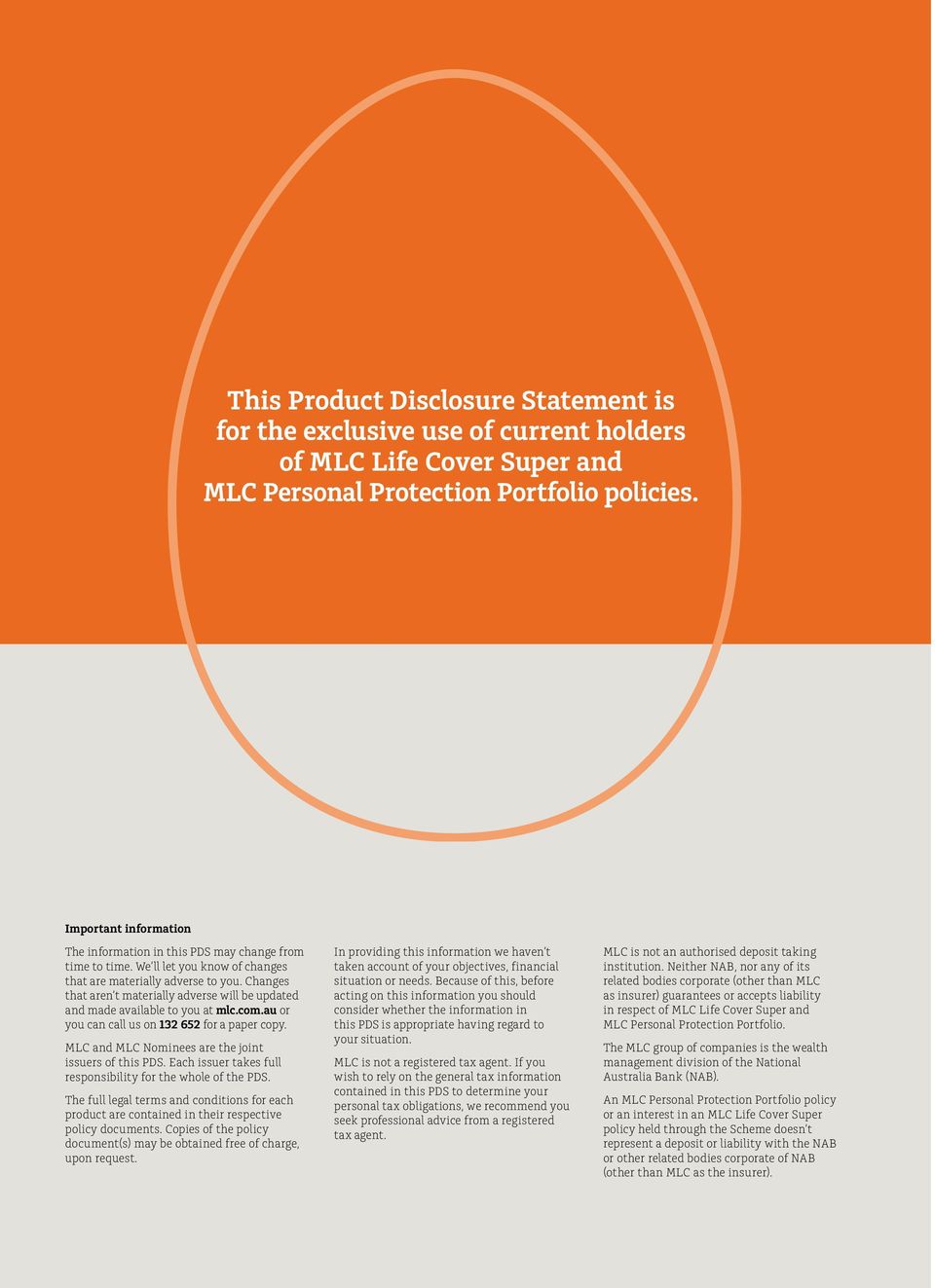
3 Before you read this PDS The information in this Product Disclosure Statement (PDS) applies if you have an existing MLC Life Cover Super (LCS) or MLC Personal Protection Portfolio (PPP) policy and want to make changes. For the terms and conditions of your existing insurance please refer to your Policy Document and subsequent upgrade notices. If you already have an LCS or PPP policy you can apply to: increase the amount of your existing benefits make changes to your existing insurance add new benefits and/or features to your policy transfer your non-super insurance to super insurance ie change your PPP policy to an LCS policy transfer your existing super insurance to a non-super insurance policy ie change your LCS policy to a PPP policy take out insurance in LCS if you already have a PPP policy, or take out insurance in PPP if you already have an LCS policy. For more information please refer to pages 77 and 78. In this PDS you ll find the following terms used: For MLC Life Cover Super (LCS) MLC/we/us refers to MLC Limited either in its capacity as insurer, or its capacity as administrator of the Scheme, on behalf of the Trustee MLC Nominees / the Trustee refers to MLC Nominees Pty Limited in its capacity as the Trustee of The Universal Super Scheme (the Scheme) and issuer of MLC Life Cover Super. the Scheme refers to The Universal Super Scheme you/your/member refers to a member of MLC Life Cover Super and the life insured. life insured refers to the person whose circumstances we assess and accept to be insured and is named in the Schedule. One person can be insured per policy. policy owner refers to When you take out MLC Life Cover Super, you become a member of The Universal Super Scheme. The Trustee of the Scheme takes out insurance on your behalf and becomes the policy owner. For MLC Personal Protection Portfolio (PPP) MLC/we/us refers to MLC Limited in its capacity as insurer and issuer of MLC Personal Protection Portfolio. you/your assumes that you are both the policy owner and the life insured. There are instances when the policy owner and life insured are different. For example, when a company takes out a policy on an employee, or there is more than one policy owner. life insured refers to the person whose circumstances we assess and accept to be insured and is named in the Schedule. Six persons can be insured per policy. policy owner refers to the person or entity that applies, and is accepted as the person who is entitled to receive benefits under the policy. The policy owner is named in the Schedule and is the only person who may extend, vary, cancel or otherwise exercise any rights under the policy. The policy owner can be an individual or individuals, a company, partnership or the trustee(s) of a family trust. Ownership must be the same for all insurances under the one policy. Income Protection insurance must generally be owned by the life insured. Any words shown with initial capital letters, such as Accident, have particular meanings which are explained in the Definitions section of this PDS. MLC Life Cover Super and MLC Personal Protection Portfolio PDS 3
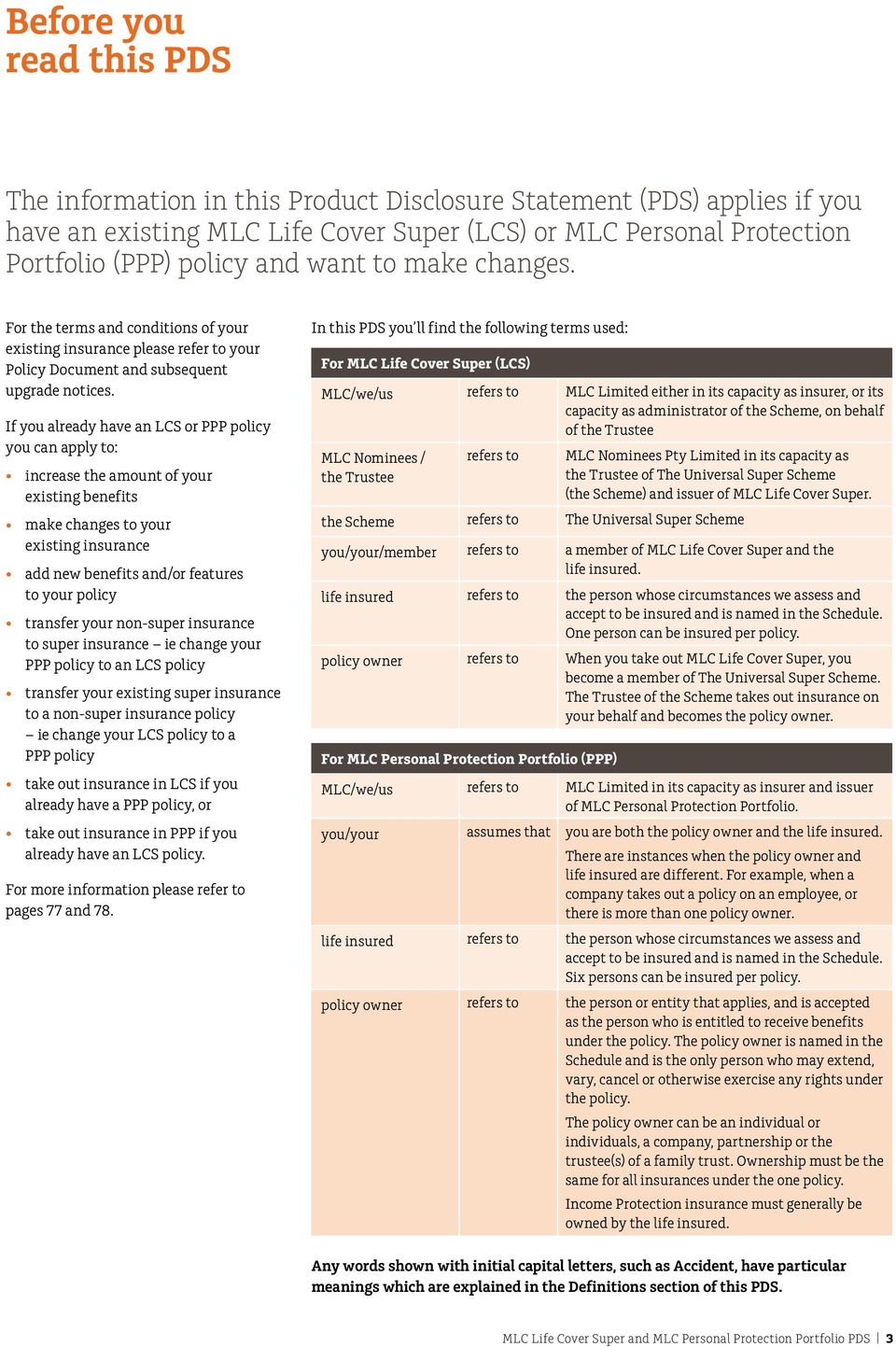
4 Contents 1. You re making the right choice with MLC 6 Why MLC is the right choice 7 2. The types of insurance offered 8 Protect yourself 9 Life Cover insurance 10 Total and Permanent Disability (TPD) and Loss of Independence insurance 15 Critical Illness insurance 19 Information common to Life Cover, Total and Permanent Disability (TPD) and Critical Illness 28 Income Protection insurance 33 Business Expenses insurance 54 Premium Waiver insurance Structuring your insurance 59 Structuring your insurance How it all works 61 Setting up your insurance 62 How to apply 62 How to pay 65 Your cooling off rights 68 Contributing to MLC Life Cover Super 69 The Universal Super Scheme 69 Accessing your MLC Life Cover Super benefits 69 4 MLC Life Cover Super and MLC Personal Protection Portfolio PDS
5 Managing your insurance 70 How to claim 70 Beneficiaries 71 Taxation 75 Altering, renewing, transferring, converting or cancelling your insurance 77 Altering your insurance 77 Renewing your insurance 77 Transferring your insurance between non-super and super 77 Converting MLC Life Cover Super to non-super insurance after age Cancelling your insurance 78 Transfers out of MLC Life Cover Super to rollover funds 79 Complaint resolutions 80 Privacy notification Definitions 84 General definitions 85 Total and Permanent Disability (TPD) and Loss of Independence Definitions 89 Critical Illness definitions 92 Interim Accident Insurance Certificate 101 Accompanying this PDS Application Form Supplementary Underwriting Questionnaires MLC Life Cover Super and MLC Personal Protection Portfolio PDS 5

6 6 MLC Life Cover Super and MLC Personal Protection Portfolio PDS 1 You re making the right choice with MLC

7 Why MLC is the right choice Our track record speaks for itself With over 125 years of insurance experience in Australia, we provide long-term, sustainable insurance to our customers. Our claims philosophy We re always there for our customers at claim time. Our team of claims assessors and support staff assess each claim with integrity and fairness. Worldwide insurance Our insurance travels with you, which means you re covered 24 hours a day, anywhere in the world. Keeping your insurance up to date We continuously look for ways to improve the features and benefits of our insurance, so you ll receive better protection. Where it won t affect your premiums, we ll add those improvements to your insurance. We ll also inform you of any improvements we make to this insurance. What you need to know about the risks There is a risk that the insurance won t meet your needs. Your adviser can thoroughly assess your circumstances and help you choose a type and amount of insurance to suit your needs. They can help you consider your future needs now as you may not qualify for some insurances if your circumstances change. Choosing your insurance At MLC we believe insurance should be affordable for the long-term. So we actively look for the most cost and tax-effective ways for our customers to purchase their insurance. We offer the following ways: 1. MLC Life Cover Super (LCS), where you can purchase insurance through superannuation. 2. MLC Personal Protection Portfolio (PPP), where you can purchase insurance directly in your own name. Tailoring your insurance We also understand different people have different needs, so we offer a comprehensive range of insurance options for you to choose and tailor. You have two options for your insurance: 1. Standard. This is our basic insurance at an affordable price. 2. Plus. This incorporates a wider range of benefits and options. Connected benefits This is a flexible way of structuring insurance and may result in reducing the overall cost of your insurance package. Specifically, it allows you to purchase Total and Permanent Disability or Critical Illness as an extension to your existing Life Cover, but have the policies structured with different owners. And, it doesn t matter if the Life Cover is held inside or outside of superannuation. What you can do next Please take the time to read this PDS carefully and, if you have any questions, we recommend you speak with your financial adviser. If you don t have an adviser, then we can put you in contact with one. Just visit mlc.com.au and go to the Contact us section on the Home page. MLC Life Cover Super and MLC Personal Protection Portfolio PDS 7

8 8 MLC Life Cover Super and MLC Personal Protection Portfolio PDS 2 The types of insurance offered

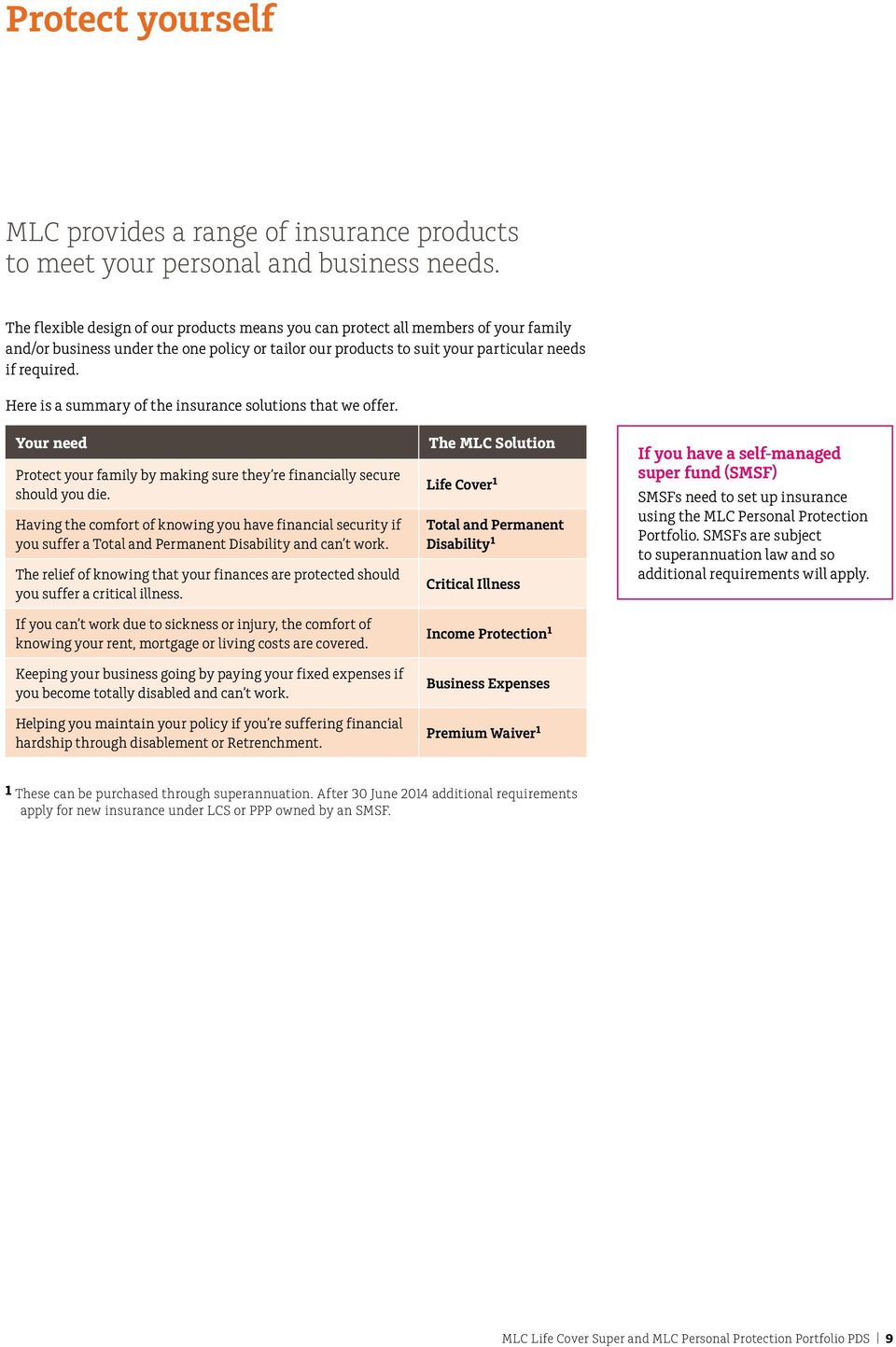
9 Protect yourself MLC provides a range of insurance products to meet your personal and business needs. The flexible design of our products means you can protect all members of your family and/or business under the one policy or tailor our products to suit your particular needs if required. Here is a summary of the insurance solutions that we offer. Your need Protect your family by making sure they re financially secure should you die. Having the comfort of knowing you have financial security if you suffer a Total and Permanent Disability and can t work. The relief of knowing that your finances are protected should you suffer a critical illness. If you can t work due to sickness or injury, the comfort of knowing your rent, mortgage or living costs are covered. Keeping your business going by paying your fixed expenses if you become totally disabled and can t work. Helping you maintain your policy if you re suffering financial hardship through disablement or Retrenchment. The MLC Solution Life Cover 1 Total and Permanent Disability 1 Critical Illness Income Protection 1 Business Expenses Premium Waiver 1 If you have a self-managed super fund (SMSF) SMSFs need to set up insurance using the MLC Personal Protection Portfolio. SMSFs are subject to superannuation law and so additional requirements will apply. 1 These can be purchased through superannuation. After 30 June 2014 additional requirements apply for new insurance under LCS or PPP owned by an SMSF. MLC Life Cover Super and MLC Personal Protection Portfolio PDS 9
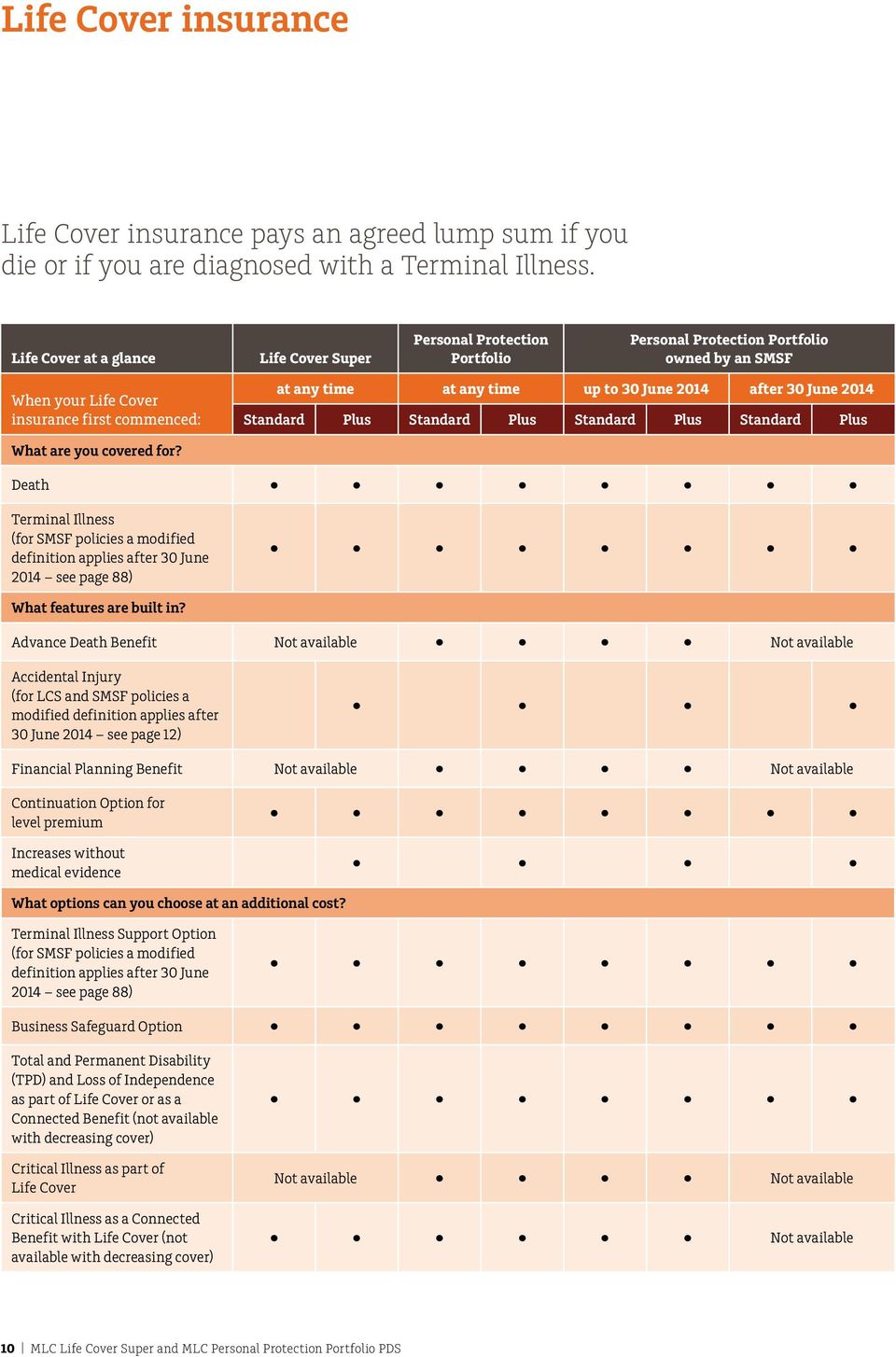
10 Life Cover insurance Life Cover insurance pays an agreed lump sum if you die or if you are diagnosed with a Terminal Illness. Life Cover at a glance Life Cover Super Personal Protection Portfolio Personal Protection Portfolio owned by an SMSF When your Life Cover insurance first commenced: at any time at any time up to 30 June 2014 after 30 June 2014 Standard Plus Standard Plus Standard Plus Standard Plus What are you covered for? Death Terminal Illness (for SMSF policies a modified definition applies after 30 June 2014 see page 88) What features are built in? Advance Death Benefit Accidental Injury (for LCS and SMSF policies a modified definition applies after 30 June 2014 see page 12) Financial Planning Benefit Continuation Option for level premium Increases without medical evidence What options can you choose at an additional cost? Terminal Illness Support Option (for SMSF policies a modified definition applies after 30 June 2014 see page 88) Business Safeguard Option Total and Permanent Disability (TPD) and Loss of Independence as part of Life Cover or as a Connected Benefit (not with decreasing cover) Critical Illness as part of Life Cover Critical Illness as a Connected Benefit with Life Cover (not with decreasing cover) 10 MLC Life Cover Super and MLC Personal Protection Portfolio PDS
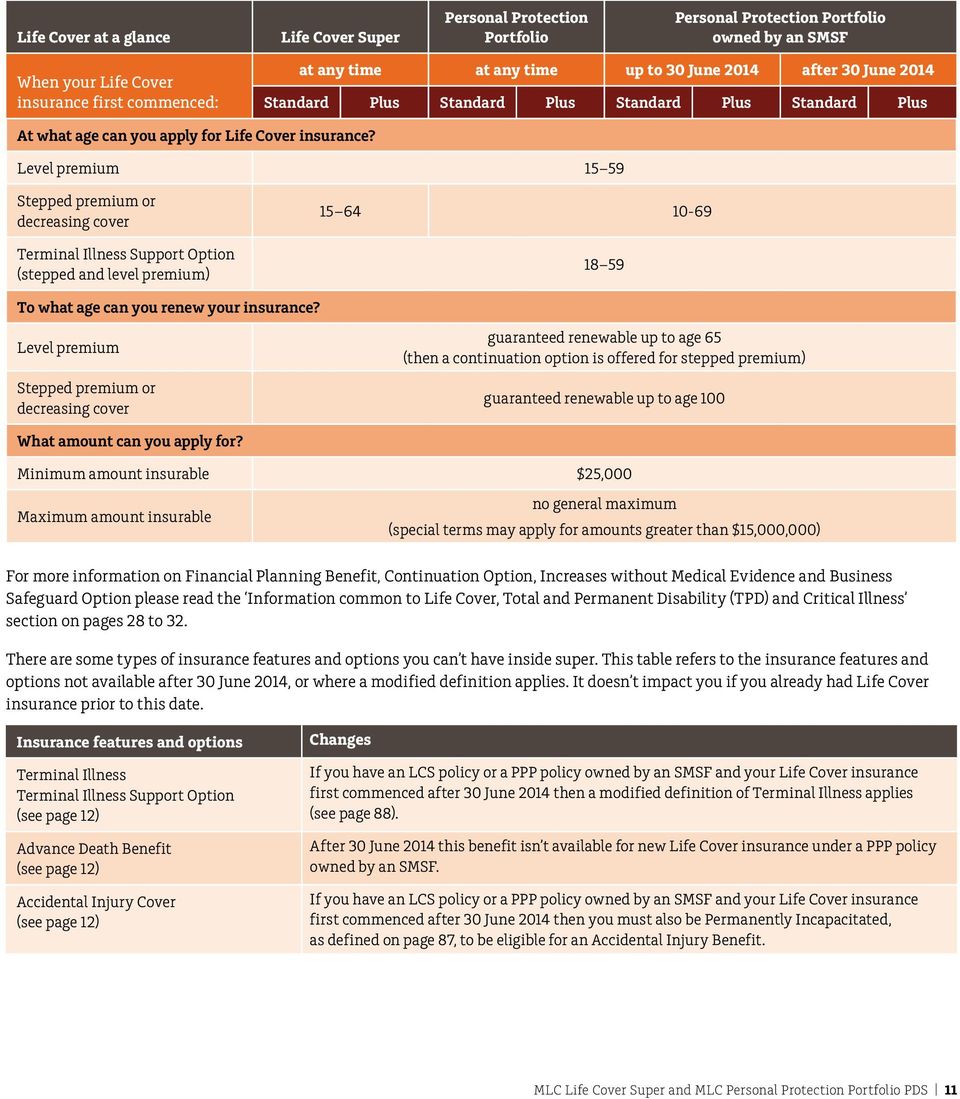
11 Life Cover at a glance Life Cover Super Personal Protection Portfolio Personal Protection Portfolio owned by an SMSF When your Life Cover insurance first commenced: at any time at any time up to 30 June 2014 after 30 June 2014 Standard Plus Standard Plus Standard Plus Standard Plus At what age can you apply for Life Cover insurance? Level premium Stepped premium or decreasing cover Terminal Illness Support Option (stepped and level premium) To what age can you renew your insurance? Level premium Stepped premium or decreasing cover guaranteed renewable up to age 65 (then a continuation option is offered for stepped premium) guaranteed renewable up to age 100 What amount can you apply for? Minimum amount insurable $25,000 Maximum amount insurable no general maximum (special terms may apply for amounts greater than $15,000,000) For more information on Financial Planning Benefit, Continuation Option, Increases without Medical Evidence and Business Safeguard Option please read the Information common to Life Cover, Total and Permanent Disability (TPD) and Critical Illness section on pages 28 to 32. There are some types of insurance features and options you can t have inside super. This table refers to the insurance features and options not after 30 June 2014, or where a modified definition applies. It doesn t impact you if you already had Life Cover insurance prior to this date. Insurance features and options Terminal Illness Terminal Illness Support Option (see page 12) Advance Death Benefit (see page 12) Accidental Injury Cover (see page 12) Changes If you have an LCS policy or a PPP policy owned by an SMSF and your Life Cover insurance first commenced after 30 June 2014 then a modified definition of Terminal Illness applies (see page 88). After 30 June 2014 this benefit isn t for new Life Cover insurance under a PPP policy owned by an SMSF. If you have an LCS policy or a PPP policy owned by an SMSF and your Life Cover insurance first commenced after 30 June 2014 then you must also be Permanently Incapacitated, as defined on page 87, to be eligible for an Accidental Injury Benefit. MLC Life Cover Super and MLC Personal Protection Portfolio PDS 11
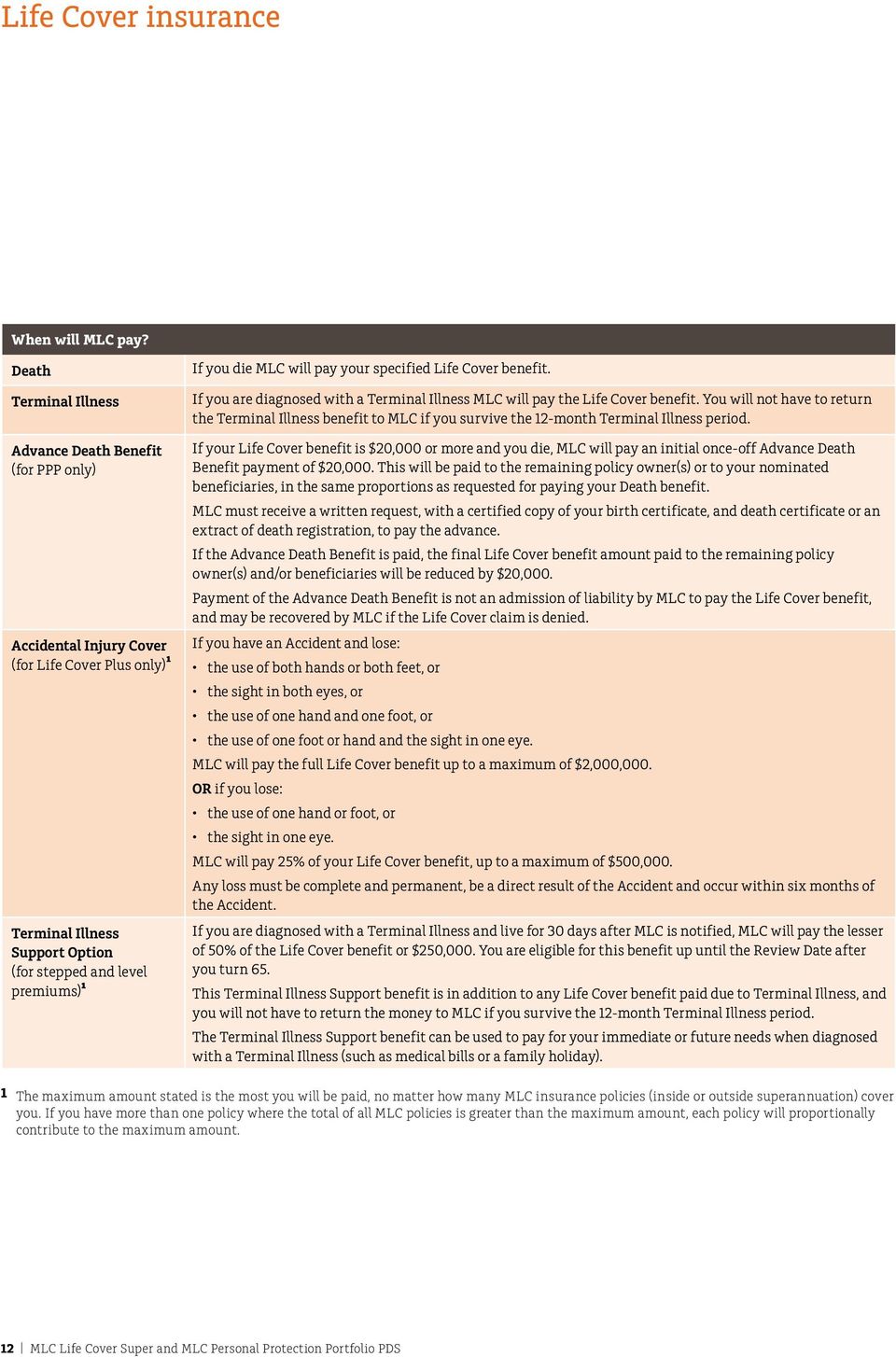
12 Life Cover insurance When will MLC pay? Death Terminal Illness Advance Death Benefit (for PPP only) Accidental Injury Cover (for Life Cover Plus only)¹ Terminal Illness Support Option (for stepped and level premiums)¹ If you die MLC will pay your specified Life Cover benefit. If you are diagnosed with a Terminal Illness MLC will pay the Life Cover benefit. You will not have to return the Terminal Illness benefit to MLC if you survive the 12-month Terminal Illness period. If your Life Cover benefit is $20,000 or more and you die, MLC will pay an initial once-off Advance Death Benefit payment of $20,000. This will be paid to the remaining policy owner(s) or to your nominated beneficiaries, in the same proportions as requested for paying your Death benefit. MLC must receive a written request, with a certified copy of your birth certificate, and death certificate or an extract of death registration, to pay the advance. If the Advance Death Benefit is paid, the final Life Cover benefit amount paid to the remaining policy owner(s) and/or beneficiaries will be reduced by $20,000. Payment of the Advance Death Benefit is not an admission of liability by MLC to pay the Life Cover benefit, and may be recovered by MLC if the Life Cover claim is denied. If you have an Accident and lose: the use of both hands or both feet, or the sight in both eyes, or the use of one hand and one foot, or the use of one foot or hand and the sight in one eye. MLC will pay the full Life Cover benefit up to a maximum of $2,000,000. OR if you lose: the use of one hand or foot, or the sight in one eye. MLC will pay 25% of your Life Cover benefit, up to a maximum of $500,000. Any loss must be complete and permanent, be a direct result of the Accident and occur within six months of the Accident. If you are diagnosed with a Terminal Illness and live for 30 days after MLC is notified, MLC will pay the lesser of 50% of the Life Cover benefit or $250,000. You are eligible for this benefit up until the Review Date after you turn 65. This Terminal Illness Support benefit is in addition to any Life Cover benefit paid due to Terminal Illness, and you will not have to return the money to MLC if you survive the 12-month Terminal Illness period. The Terminal Illness Support benefit can be used to pay for your immediate or future needs when diagnosed with a Terminal Illness (such as medical bills or a family holiday). 1 The maximum amount stated is the most you will be paid, no matter how many MLC insurance policies (inside or outside superannuation) cover you. If you have more than one policy where the total of all MLC policies is greater than the maximum amount, each policy will proportionally contribute to the maximum amount. 12 MLC Life Cover Super and MLC Personal Protection Portfolio PDS
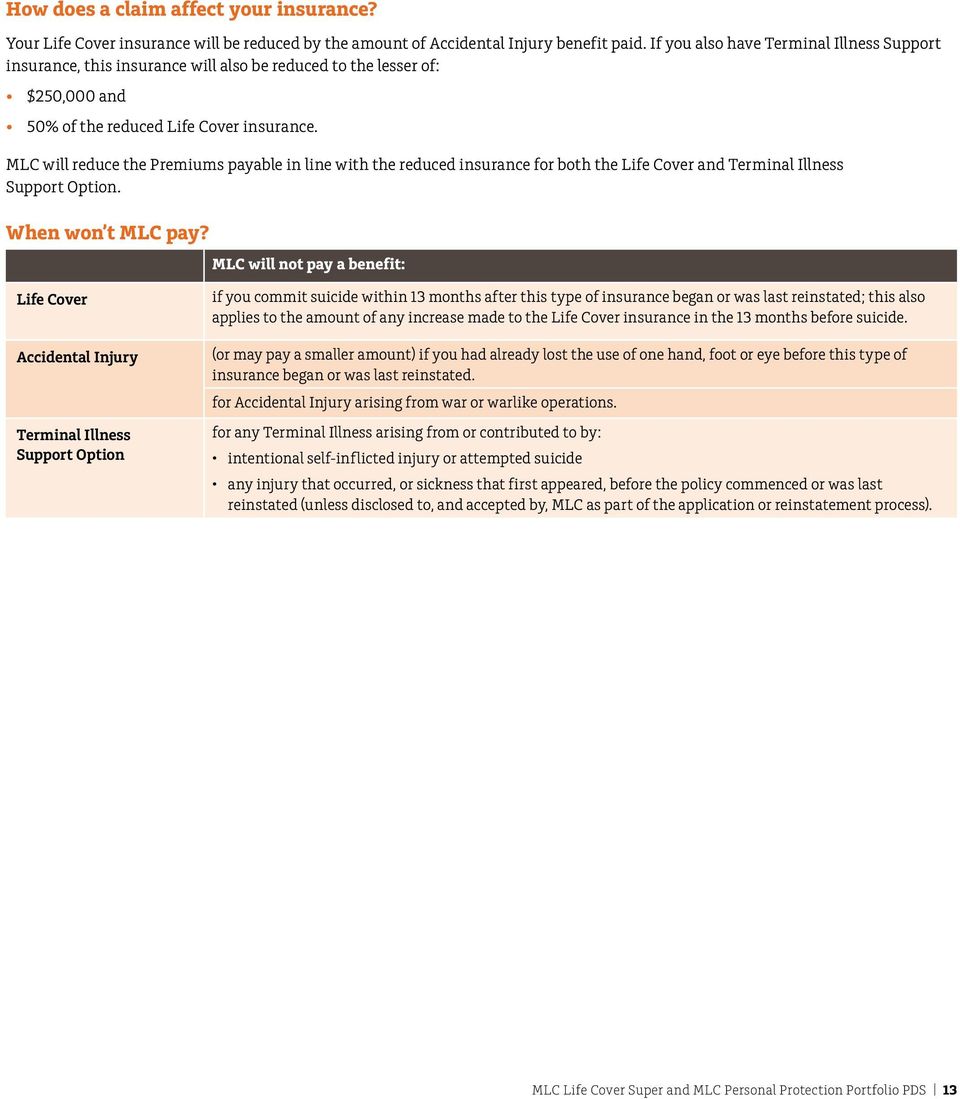
13 How does a claim affect your insurance? Your Life Cover insurance will be reduced by the amount of Accidental Injury benefit paid. If you also have Terminal Illness Support insurance, this insurance will also be reduced to the lesser of: $250,000 and 50% of the reduced Life Cover insurance. MLC will reduce the Premiums payable in line with the reduced insurance for both the Life Cover and Terminal Illness Support Option. When won t MLC pay? MLC will not pay a benefit: Life Cover Accidental Injury Terminal Illness Support Option if you commit suicide within 13 months after this type of insurance began or was last reinstated; this also applies to the amount of any increase made to the Life Cover insurance in the 13 months before suicide. (or may pay a smaller amount) if you had already lost the use of one hand, foot or eye before this type of insurance began or was last reinstated. for Accidental Injury arising from war or warlike operations. for any Terminal Illness arising from or contributed to by: intentional self-inflicted injury or attempted suicide any injury that occurred, or sickness that first appeared, before the policy commenced or was last reinstated (unless disclosed to, and accepted by, MLC as part of the application or reinstatement process). MLC Life Cover Super and MLC Personal Protection Portfolio PDS 13
14 Life Cover insurance When do Life Cover and Terminal Illness Support insurance end? Your insurance will end when: the insurance is cancelled at your request (cover ceases on the next Paid-to Date and MLC will not refund any Premium paid up to then) the insurance is cancelled because you stop paying Premiums the policy is cancelled because you make a fraudulent claim MLC pays your full Life Cover benefit or your full Terminal Illness Support benefit (where applicable) MLC pays your full TPD or Loss of Independence benefit and/or Critical Illness benefit, if they were part of or connected to Life Cover and the benefit paid equals the Life Cover insurance for LCS, the policy is converted to non-superannuation insurance (insurance will continue as detailed on page 78) you reach the expiry age for your type of insurance and premium structure you reach the Termination Date shown on your Schedule for Terminal Illness Support Option, your Life Cover insurance ends you die. Expiry ages: Life Cover insurance Life Cover Super Personal Protection Portfolio Stepped premium Your 75th birthday Next Review Date after your 100th birthday Decreasing cover Your 75th birthday Next Review Date after your 100th birthday Level premium Next Review Date after your 65th birthday Terminal Illness Support Stepped premium Next Review Date after your 65th birthday Decreasing cover Level premium Next Review Date after your 65th birthday Next Review Date after your 65th birthday Next Review Date after your 65th birthday Next Review Date after your 65th birthday 14 MLC Life Cover Super and MLC Personal Protection Portfolio PDS
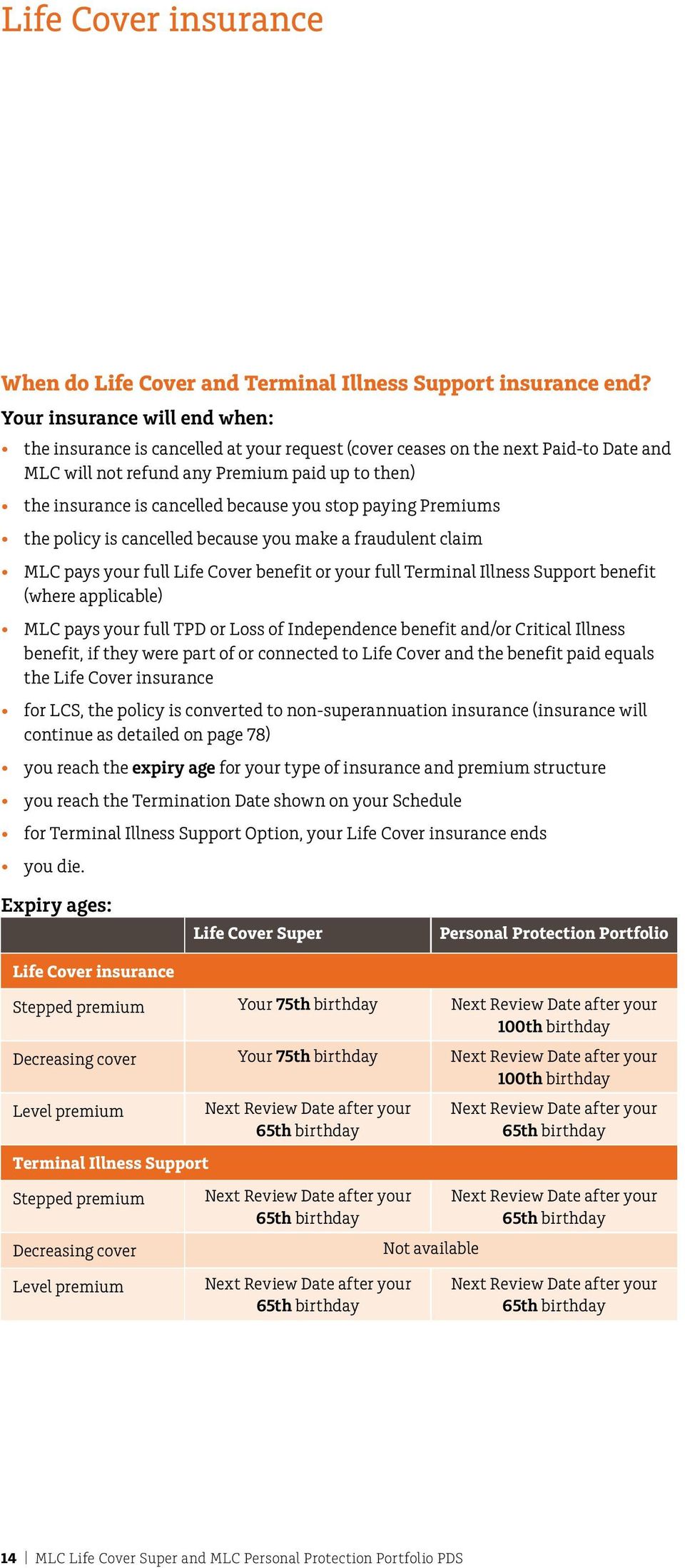
15 Total and Permanent Disability (TPD) and Loss of Independence insurance You will receive a lump sum if you suffer Total and Permanent Disability or Loss of Independence. MLC will insure you for TPD until the Review Date after you turn 65. After that date, MLC will insure you only for Loss of Independence. You can be covered under different definitions of TPD, which include Any Occupation, Own Occupation and not Gainfully Employed. For more detail on TPD and Loss of Independence definitions, please see Total and Permanent Disability (TPD) and Loss of Independence Definitions on pages 89 to 91. TPD and Loss of Independence at a glance Life Cover Super Personal Protection Portfolio Personal Protection Portfolio owned by an SMSF When your TPD and Loss of Independence insurance first commenced: up to 30 June 2014 after 30 June 2014 at any time up to 30 June 2014 after 30 June 2014 How can you structure this insurance? TPD and Loss of Independence as part of Life Cover TPD and Loss of Independence as a Connected Benefit (not with decreasing cover) TPD and Loss of Independence as stand-alone insurance (not with decreasing cover) What features are built in? Financial Planning Benefit Continuation Option for level premium Increases without Medical Evidence Partial Payment Benefit What options can you choose at an additional cost Own Occupation Definition (eligible occupations only) Life Cover Buy Back (not applicable to stand-alone) Business Safeguard Option At what age can you apply for TPD insurance? Level premium Stepped premium or decreasing cover MLC Life Cover Super and MLC Personal Protection Portfolio PDS 15
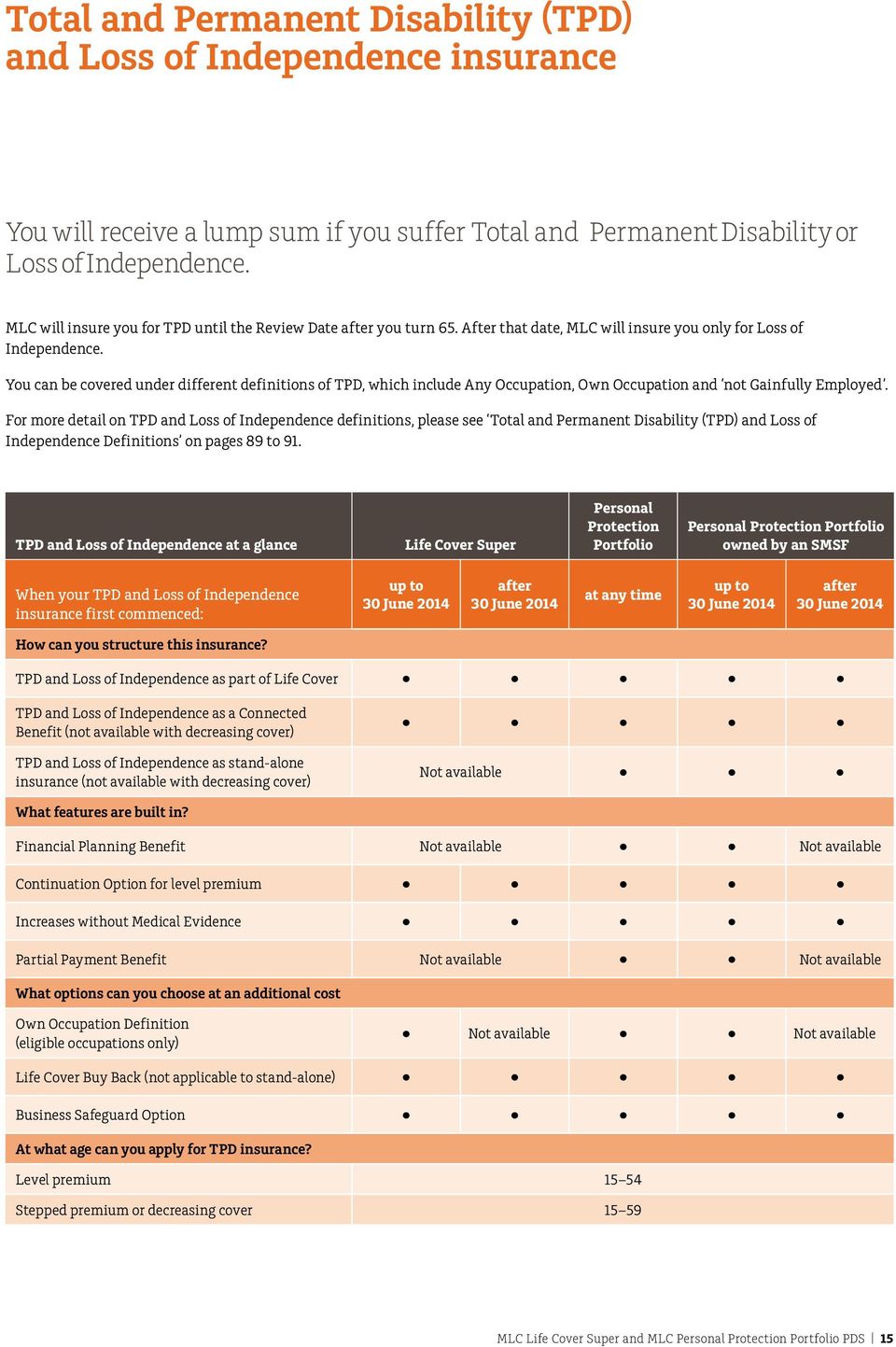
16 Total and Permanent Disability (TPD) and Loss of Independence insurance TPD and Loss of Independence at a glance Life Cover Super Personal Protection Portfolio Personal Protection Portfolio owned by an SMSF When your TPD and Loss of Independence insurance first commenced: up to 30 June 2014 after 30 June 2014 at any time up to 30 June 2014 after 30 June 2014 What amount can you apply for? Minimum amount insurable $25,000 Maximum amount insurable $5,000,000 for certain professional occupations such as surgeons, accountants and solicitors, or $3,000,000 for other occupations For more information on Financial Planning Benefit, Continuation Option, Life Cover Buy Back, Increases without Medical Evidence and Business Safeguard Option please read the Information common to Life Cover, Total and Permanent Disability (TPD) and Critical Illness section on pages 28 to MLC Life Cover Super and MLC Personal Protection Portfolio PDS
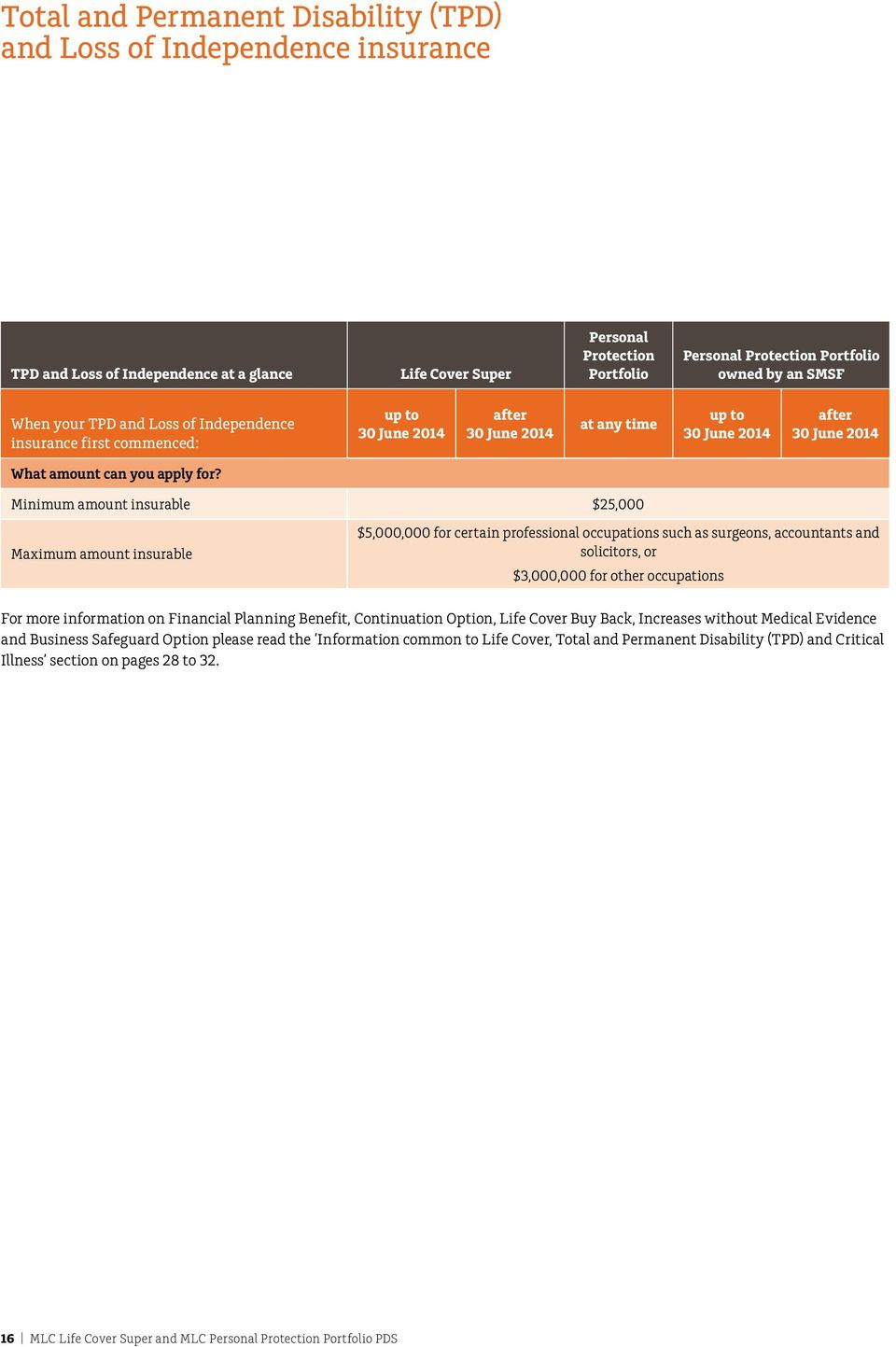
17 How can you structure TPD and Loss of Independence insurance? a. As part of your Life Cover The amount of TPD and Loss of Independence insurance you choose must not exceed your Life Cover insurance. When you also choose Critical Illness insurance as part of your Life Cover, the combined amount must not exceed your Life Cover insurance. b. As a Connected Benefit You can have TPD and Loss of Independence insurance, and Life Cover, as separate policies with different owners, but take advantage of connecting the TPD insurance to your Life Cover. For example you or your business could own TPD as a PPP policy (outside super), and connect it to Life Cover taken in LCS (inside super). When you also choose Critical Illness insurance as a Connected Benefit with TPD, the combined amount must not exceed your Life Cover insurance. e: stand-alone TPD insurance cannot be connected to Life Cover insurance. c. As stand-alone insurance In PPP (not with decreasing cover) you can choose to hold this insurance separately from your Life Cover. Special waiting periods apply to claims for stand-alone TPD and Loss of Independence insurance. When will MLC pay? To claim under this insurance all terms of the policy definition must be met. Diagnosis and certification must be provided by a Doctor who is an appropriate specialist and confirmed by MLC s medical adviser. TPD Loss of Independence Stand-alone TPD and Loss of Independence Until the Review Date after you turn 65, if you become Totally and Permanently Disabled MLC will pay your full TPD benefit Following the Review Date after your 65th birthday, if you lose your independence as outlined in What is Loss of Independence? on page 91, MLC will pay your full Loss of Independence benefit, up to a maximum of $3,000,000. After your 75th birthday, your Premium will be set and your benefit will be reduced each year in line with MLC s Premium rates at the time for this type of insurance. For a claim to be payable for stand-alone TPD and Loss of Independence you must survive for at least: six months to claim for TPD or Loss of Independence 14 days to claim for TPD based on the total and irrecoverable loss of limbs or sight. If you die within 14 days after becoming Totally and Permanently Disabled, MLC will pay a benefit of $5,000. How does a claim affect your insurance? If you have TPD and Loss of Independence insurance as part of your Life Cover or as a Connected Benefit: your Life Cover insurance will be reduced by the claim amount paid for TPD or Loss of Independence and, if applicable, your Terminal Illness Support insurance will also be reduced to the lesser of $250,000 or 50% of the reduced Life Cover insurance when MLC pays some or all of your Life Cover insurance for Terminal Illness or Accidental Injury, your TPD and Loss of Independence insurance will be reduced by the claim amount paid. MLC will reduce your future Premiums in line with the reduced insurance. If you have stand-alone TPD and Loss of Independence insurance: your Life Cover and Terminal Illness Support insurance will not be reduced by the claim amount paid for TPD or Loss of Independence your TPD and Loss of Independence insurance will not be reduced by any claim paid under your Life Cover insurance, including claims paid for Terminal Illness or Accidental Injury. MLC Life Cover Super and MLC Personal Protection Portfolio PDS 17
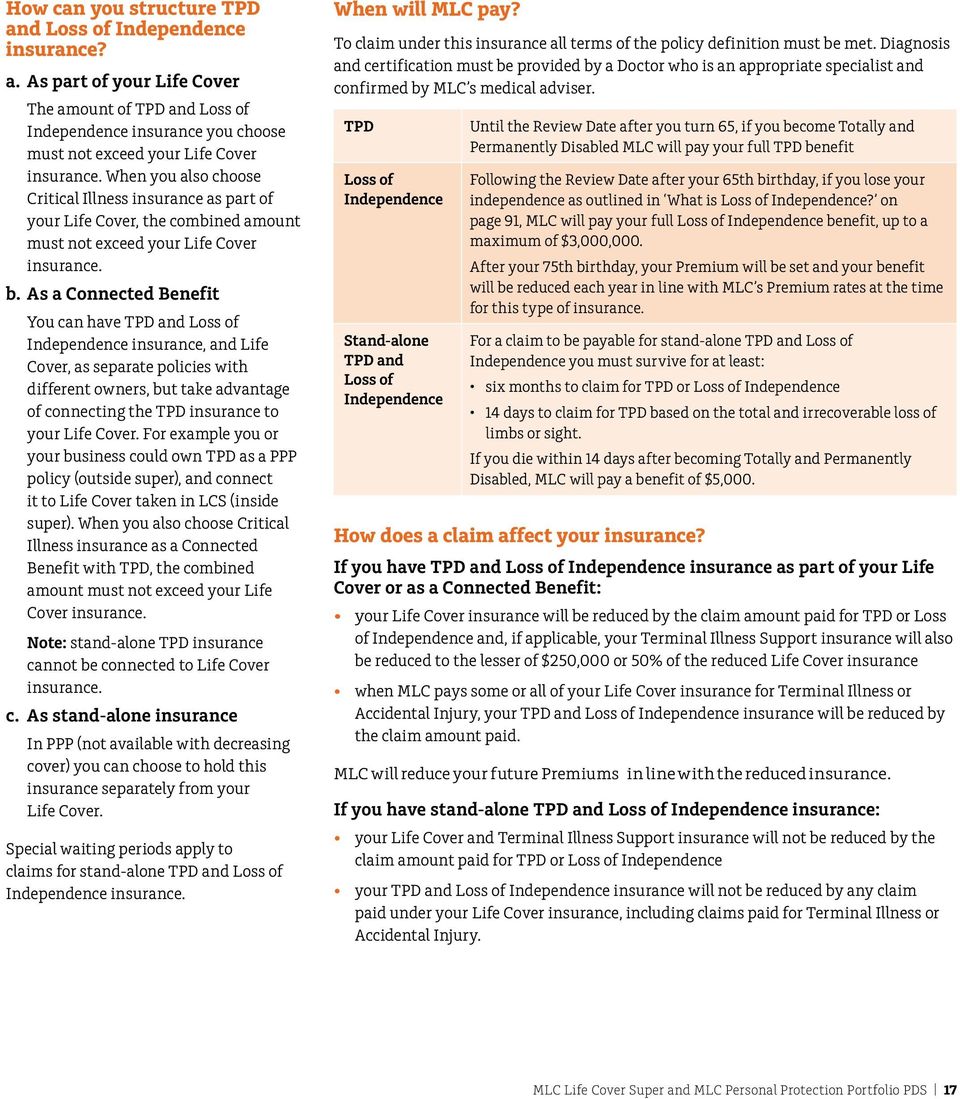
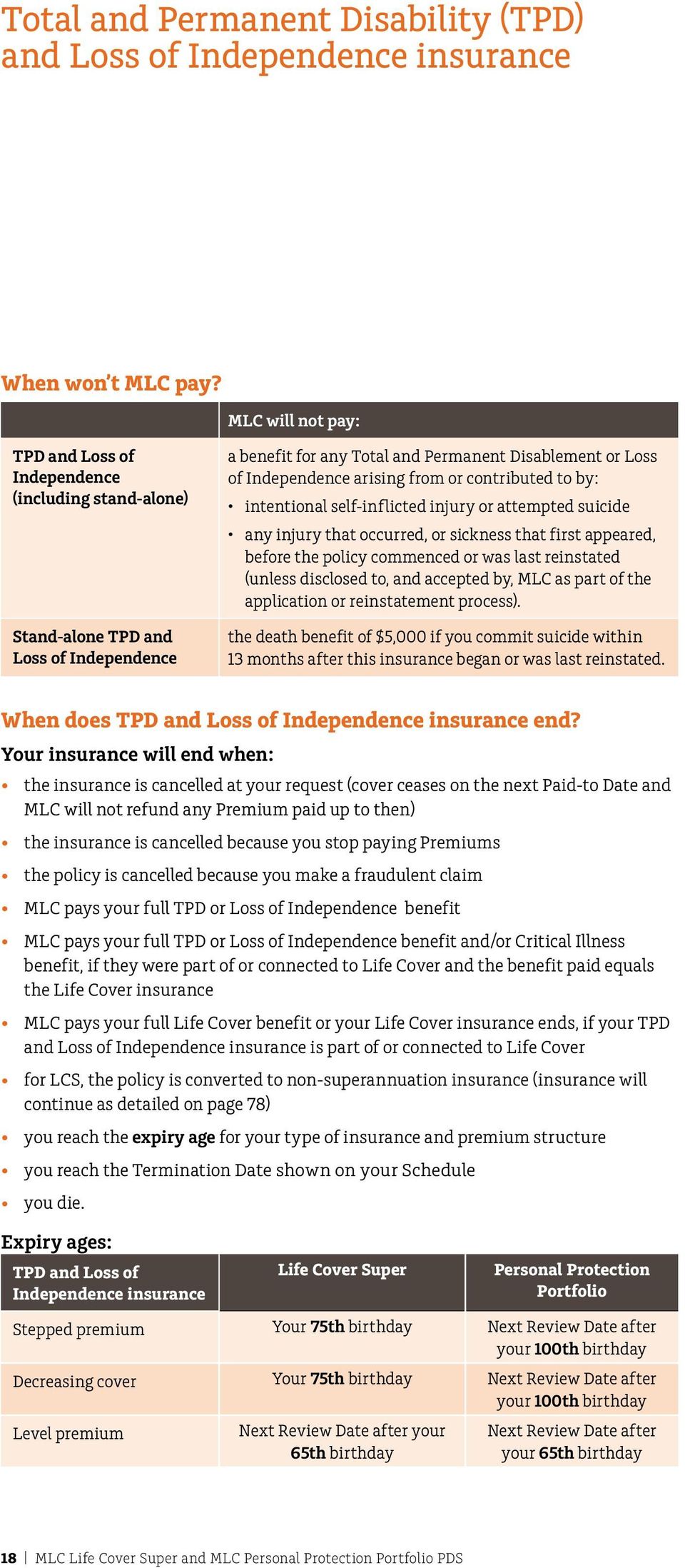
18 Total and Permanent Disability (TPD) and Loss of Independence insurance When won t MLC pay? MLC will not pay: TPD and Loss of Independence (including stand-alone) Stand-alone TPD and Loss of Independence a benefit for any Total and Permanent Disablement or Loss of Independence arising from or contributed to by: intentional self-inflicted injury or attempted suicide any injury that occurred, or sickness that first appeared, before the policy commenced or was last reinstated (unless disclosed to, and accepted by, MLC as part of the application or reinstatement process). the death benefit of $5,000 if you commit suicide within 13 months after this insurance began or was last reinstated. When does TPD and Loss of Independence insurance end? Your insurance will end when: the insurance is cancelled at your request (cover ceases on the next Paid-to Date and MLC will not refund any Premium paid up to then) the insurance is cancelled because you stop paying Premiums the policy is cancelled because you make a fraudulent claim MLC pays your full TPD or Loss of Independence benefit MLC pays your full TPD or Loss of Independence benefit and/or Critical Illness benefit, if they were part of or connected to Life Cover and the benefit paid equals the Life Cover insurance MLC pays your full Life Cover benefit or your Life Cover insurance ends, if your TPD and Loss of Independence insurance is part of or connected to Life Cover for LCS, the policy is converted to non-superannuation insurance (insurance will continue as detailed on page 78) you reach the expiry age for your type of insurance and premium structure you reach the Termination Date shown on your Schedule you die. Expiry ages: TPD and Loss of Independence insurance Life Cover Super Personal Protection Portfolio Stepped premium Your 75th birthday Next Review Date after your 100th birthday Decreasing cover Your 75th birthday Next Review Date after your 100th birthday Level premium Next Review Date after your 65th birthday Next Review Date after your 65th birthday 18 MLC Life Cover Super and MLC Personal Protection Portfolio PDS
19 Critical Illness insurance Critical Illness insurance pays you a lump sum if you suffer a critical condition. Critical Illness insurance is only under PPP. After 30 June 2014, new Critical Illness insurance is not to policies owned by SMSFs. Critical Illness at a glance Personal Protection Portfolio Personal Protection Portfolio owned by an SMSF at any time up to 30 June 2014 after 30 June 2014 When your Critical Illness insurance first commenced: Standard Plus Standard Plus Standard Plus How can you structure this insurance? Critical Illness as part of Life Cover Critical Illness as a Connected Benefit (not with decreasing cover) Critical Illness as stand-alone insurance What are you covered for? A range of critical conditions Limited Wide Limited Wide Critical conditions and definitions on renewal What features are built in? May change Can t be changed May change Can t be changed Financial Planning Benefit Continuation Option for level premium Increases without Medical Evidence Child Support Benefit What options can you choose at an additional cost Any Occupation Total and Permanent Disability (TPD) and Partial Payment Benefit for TPD as a critical condition (not under stand-alone) Own Occupation Total and Permanent Disability (TPD) and Partial Payment Benefit for TPD as a critical condition (not under stand-alone) Life Cover Buy Back (not applicable to stand-alone) Extra Benefits Option: Additional critical conditions for which a partial benefit is payable Critical Illness Buy Back MLC Life Cover Super and MLC Personal Protection Portfolio PDS 19

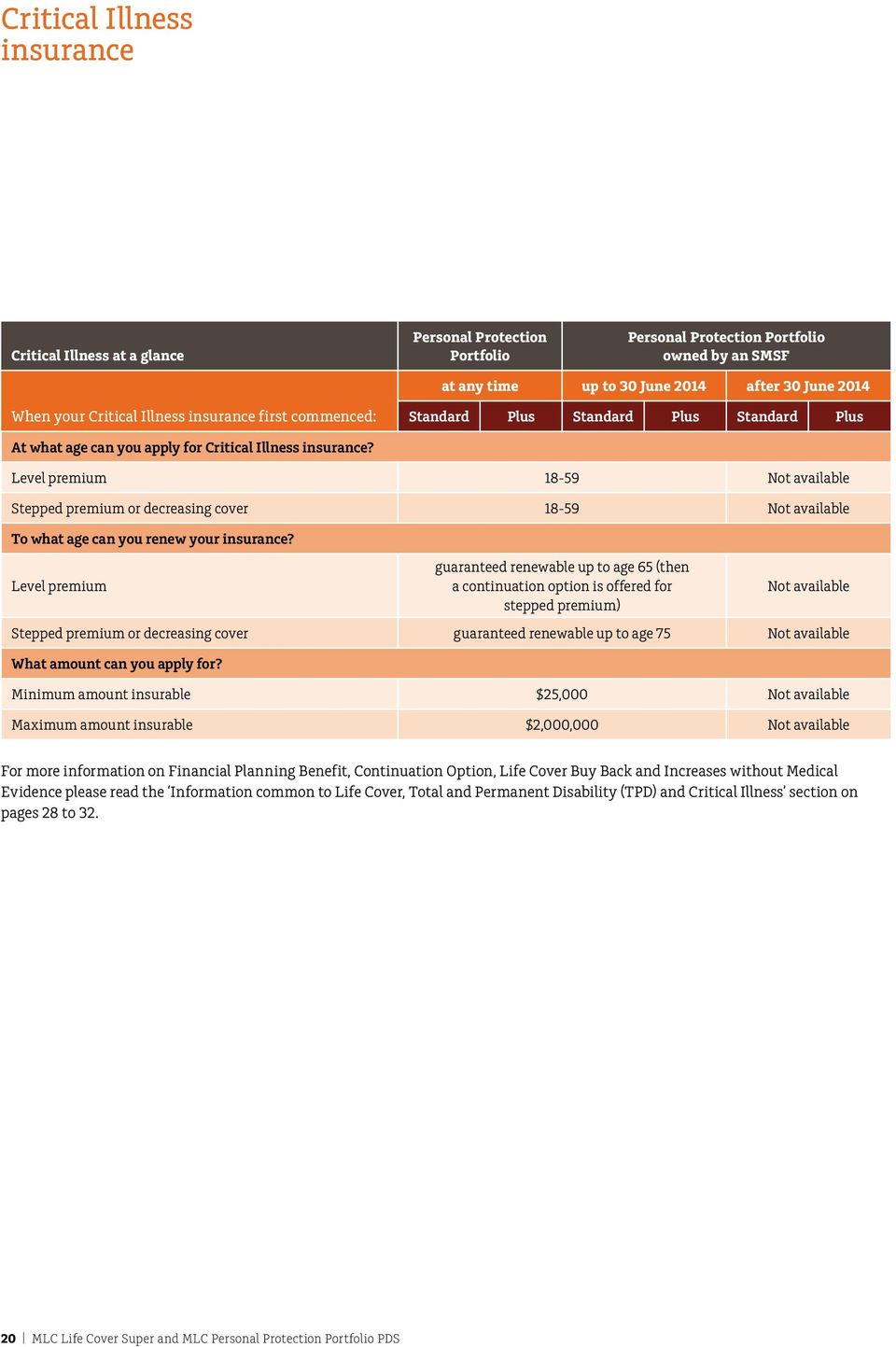
20 Critical Illness insurance Critical Illness at a glance Personal Protection Portfolio Personal Protection Portfolio owned by an SMSF at any time up to 30 June 2014 after 30 June 2014 When your Critical Illness insurance first commenced: Standard Plus Standard Plus Standard Plus At what age can you apply for Critical Illness insurance? Level premium Stepped premium or decreasing cover To what age can you renew your insurance? Level premium guaranteed renewable up to age 65 (then a continuation option is offered for stepped premium) Stepped premium or decreasing cover guaranteed renewable up to age 75 What amount can you apply for? Minimum amount insurable $25,000 Maximum amount insurable $2,000,000 For more information on Financial Planning Benefit, Continuation Option, Life Cover Buy Back and Increases without Medical Evidence please read the Information common to Life Cover, Total and Permanent Disability (TPD) and Critical Illness section on pages 28 to MLC Life Cover Super and MLC Personal Protection Portfolio PDS
21 There are some types of insurance features and options you can t have inside super. This table refers to the insurance features and options not after 30 June 2014, or where a modified definition applies. It doesn t impact you if you already had Critical Illness insurance prior to this date. Insurance Features and Options Own Occupation and Partial Payment Benefit for TPD (for eligible occupations only). (see pages 32 and 89 to 90) Changes This definition doesn t apply if the insurance first commenced after 30 June 2014 and the policy is owned by an SMSF. How can you structure Critical Illness insurance? a. As part of your Life Cover The amount of Critical Illness insurance you choose must not exceed your Life Cover insurance. When you also choose TPD insurance as part of your Life Cover, the combined amount must not exceed your Life Cover insurance. b. As a Connected Benefit You can have Critical Illness insurance and Life Cover as separate policies with different owners, but take advantage of connecting the Critical Illness insurance to your Life Cover. For example you could have your Life Cover insurance in LCS (inside super) and, as Critical Illness is not inside super, you could own Critical Illness insurance as a PPP policy (outside super) connected to that Life Cover. When you also choose TPD insurance as a Connected Benefit with Critical Illness insurance, the combined amount must not exceed your Life Cover insurance. e: stand-alone Critical Illness insurance cannot be connected to Life Cover insurance. c. As stand-alone insurance With Critical Illness Plus you can choose to hold this insurance separately from your Life Cover. What is a critical condition? You are deemed to meet a critical condition when the condition is first diagnosed as meeting its definition or, for surgical conditions, when the surgery is actually performed. An appropriate specialist and MLC s medical adviser must agree that your condition meets all the terms of MLC s detailed definitions (see Critical conditions definitions on pages 92 to 97). In some cases a condition must progress to a certain point before it meets the definition. Qualifying periods Some critical conditions are covered only after a period of time known as a qualifying period. This means that you are not covered for those conditions when they first appear, first happen or are first diagnosed within the qualifying period after this insurance began, was last reinstated or increased. For surgical procedures this means that you are not covered when the underlying condition requiring the surgical intervention first appears, first happens or is first diagnosed within the qualifying period. If, because of the qualifying period you are unable to claim an insurance benefit, MLC will still cover you for future unrelated critical conditions if they appear, happen or are diagnosed after the qualifying period has ended. If your insurance is replacing similar insurance, MLC will waive your qualifying period for the amount that would have applied if that insurance had continued. MLC Life Cover Super and MLC Personal Protection Portfolio PDS 21
22 Critical Illness insurance Which critical conditions are covered by Critical Illness Standard and Plus? The following table sets out the critical conditions covered by Critical Illness Standard and Plus, and their qualifying periods (see Critical conditions definitions on pages 92 to 97 for detailed definitions). Critical conditions Critical Illness Standard Critical Illness Plus Qualifying period Aorta Repair 3 months Aplastic Anaemia Bacterial Meningitis Benign Brain Tumour Blindness Cardiomyopathy Chronic Kidney Failure Chronic Liver Failure Chronic Lung Failure Coma Coronary Artery Angioplasty 1 3 months Coronary Artery Angioplasty 3 months Triple Vessel 2 Coronary Artery Bypass Surgery 3 months Deafness Dementia or Alzheimer s Disease Encephalitis Heart Attack 3 months Heart Valve Surgery 3 months HIV Contracted Through Medical Procedures HIV Contracted Through Your Work Intensive Care Loss of Independence Loss of Speech 22 MLC Life Cover Super and MLC Personal Protection Portfolio PDS Critical conditions Major Brain Injury Major Burns Major Organ or Bone Marrow Transplant Critical Illness Standard Critical Illness Plus Malignant Cancer Meningococcal Septicaemia Motor Neurone Disease Multiple Sclerosis Muscular Dystrophy Open Heart Surgery Out of Hospital Cardiac Arrest Parkinson s Disease Paralysis (includes Paraplegia, Quadriplegia, Hemiplegia, Diplegia, Tetraplegia) Pneumonectomy Primary Pulmonary Hypertension Severe Diabetes Qualifying period Standard: 6 months Plus: 3 months Severe Osteoporosis Severe Rheumatoid Arthritis Stroke 3 months Total and Permanent Disability (TPD) (optional not with stand-alone cover) 1 Coronary Artery Angioplasty benefit will only apply if your Critical Illness benefit is $100,000 or more. The benefit payable for Coronary Artery Angioplasty is 10% of the Critical Illness benefit up to a maximum of $20,000 per event. 2 The benefit payable for Coronary Artery Angioplasty - Triple Vessel is 100% of your Critical Illness benefit. It is only the first time you have this operation.
23 Conditions covered by Critical Illness Standard and their definitions may change As advances are made in treatment and diagnostic techniques, MLC may need to change the definitions used to ensure that they: remain appropriate with regard to medical terminology and classification take into account effective cures, vaccines and modern diagnostic procedures include some conditions considered appropriate in the future exclude some conditions that are no longer considered critical. As a result, if you choose Critical Illness Standard, MLC may continue your insurance on the same or different conditions and definitions on renewal. Following the first three years of your Critical Illness insurance, MLC does not guarantee to renew your current policy terms and conditions for this type of insurance. Where a change is necessary, the change will apply to all insurances of a similar type. MLC cannot single you out for a change. MLC will notify you of any changes to your critical conditions or definitions. You may accept the new conditions by continuing to pay your Premiums and you will in effect be entering into a new policy. You may choose to reject these changes by not making further Premium payments and your policy will lapse. When will MLC pay? Critical Illness Stand-alone Critical Illness If you suffer a critical condition MLC will pay you a lump sum. If you live for 14 days after suffering a critical condition, MLC will pay the full Critical Illness benefit. If you die within 14 days after suffering a critical condition, MLC will pay a benefit of $5,000. Qualifying periods and exclusions apply for certain critical conditions. How does a claim affect your insurance? If you have Critical Illness insurance as part of your Life Cover or as a Connected Benefit: your Life Cover insurance will be reduced by the claim amount paid for Critical Illness and, if applicable, your Terminal Illness Support insurance will also be reduced to the lesser of $250,000 or 50% of the reduced Life Cover insurance your Critical Illness insurance will be reduced by the claim amount paid for your Life Cover benefit for Terminal Illness or Accidental Injury. MLC will reduce your future Premiums in line with the reduced insurance. If you have stand-alone Critical Illness insurance: your Life Cover and Terminal Illness Support insurance will not be reduced by the claim amount paid for Critical Illness your Critical Illness will not be reduced by any claim paid under Life Cover insurance for Terminal Illness or Accidental Injury. Child Support Benefit (for Critical Illness Plus only) If a Child dies or the first time a Child suffers a Child Support Benefit condition: while this insurance is in force, and after the Review Date following the Child s second birthday, you ll receive the Child Support Benefit. What we will pay The Child Support Benefit payable for each Child is $10,000. Payment of this benefit will not reduce the Critical Illness Plus insurance benefit to which it is connected. What conditions are covered The Child Support Benefit conditions covered are: Aplastic Anaemia Bacterial Meningitis Benign Brain Tumour Blindness Cardiomyopathy Chronic Kidney Failure Chronic Liver Failure Coma MLC Life Cover Super and MLC Personal Protection Portfolio PDS 23
24 Critical Illness insurance Deafness Encephalitis Heart Attack Heart Valve Surgery HIV Contracted Through Medical Procedures Intensive Care Loss of Speech Major Brain Injury Major Burns Major Organ or Bone Marrow Transplant Malignant Cancer Meningococcal Septicaemia Open Heart Surgery Out of Hospital Cardiac Arrest Paralysis Pneumonectomy Primary Pulmonary Hypertension Stroke Type 1 Diabetes The definitions for these Child Support Benefit conditions can be found in the Critical Illness definitions on pages 92 to 97. The first time your Child has a Child Support Benefit condition: for surgical conditions, when the underlying condition requiring the surgical intervention first appeared, happened or was diagnosed as meeting its definition, and for all other conditions, when the condition first appeared, happened or was diagnosed as meeting its definition. Conditions that apply to the Child Support Benefit The Child Support Benefit: will only be payable if the Critical Illness benefit is $100,000 or more, and is payable once only for any one Child. When won t a benefit be paid? We won t pay a benefit for any Child Support Benefit condition arising from or contributed to by: the Child s intentional self-inflicted injury or attempted suicide, sickness or injury that first appeared, happened or was diagnosed before or within three months of this insurance starting or last being reinstated, sickness or injury that first appeared, happened or was diagnosed before the Review Date following the Child s second birthday, congenital abnormalities that first appeared for the life insured, the life insured s Spouse or any of their Children before this insurance started or was last reinstated, congenital abnormalities that first appeared before the Review Date following the Child s second birthday, or an injury maliciously inflicted on the Child for the purpose of gain from this insurance. What options can you choose at an additional cost? Total and Permanent Disability (TPD) as a critical condition If you choose Critical Illness as part of your Life Cover or as a Connected Benefit, you can add the following TPD definitions to the critical conditions under Critical Illness insurance: Any Occupation and Partial Payment Benefit for TPD Own Occupation and Partial Payment Benefit for TPD (for eligible occupations only). The following entry ages apply: 18 to 54 for level premium 18 to 59 for stepped premium or decreasing cover. Extra Benefits Option (for Critical Illness Plus) If you choose Critical Illness Plus you can add one or both of the following extra benefits: additional critical conditions for which a partial benefit is payable Critical Illness Buy Back an option to buy back your Critical Illness insurance. 24 MLC Life Cover Super and MLC Personal Protection Portfolio PDS
25 Additional critical conditions for which a partial benefit is payable If you suffer one of the additional critical conditions listed in the table below, MLC will pay you a proportion of the Critical Illness insurance benefit. The partial payment for these conditions is 20% of the Critical Illness insurance benefit subject to the maximum partial benefit payable listed in the table below. Your Critical Illness insurance will be reduced by the amount of any partial benefit payment made for these additional critical conditions. You can only claim once for each critical condition. See Critical condition definitions Extra Benefits Option on pages 98 to 100 for detailed definitions. Additional critical conditions Adult Onset Insulin Dependent Diabetes Mellitus Advanced Endometriosis Carcinoma In Situ of the Breast Deafness in One Ear Early Stage Chronic Lymphocytic Leukaemia Qualifying period 3 months 3 months Maximum partial benefit payable $100,000 How does a claim under the Extra Benefits Option affect your insurance? If you are covered for additional critical conditions under the Extra Benefits Option with Critical Illness, as part of your Life Cover or as a Connected Benefit, MLC will reduce your Critical Illness benefit and your Life Cover insurance by the amount of any Critical Illness benefit MLC pays you under the option. Your Terminal Illness Support insurance (if applicable) will also be reduced to the lesser of 50% of the reduced Life Cover insurance or $250,000. MLC will reduce your future Premiums in line with the reduced insurance. If you take this option with stand-alone Critical Illness insurance, any Life Cover you have will not be affected. Early Stage Prostate Cancer 3 months Facial Reconstructive Surgery and Skin Grafting Serious Accidental Injury Loss of One Foot or One Hand Loss of Sight in One Eye Congenital Abnormalities of a Child Inability of a Child to Gain Independence Carcinoma In Situ of the Female Reproductive Organs Death of a Child Early Stage Melanoma Orchidectomy (As Required to Diagnose Carcinoma In Situ Of the Testicle) Specified Complications of Pregnancy 1 year 1 year 3 months 1 year 3 months 3 months 1 year $200,000 $50,000 $20,000 MLC Life Cover Super and MLC Personal Protection Portfolio PDS 25
26 Critical Illness insurance Critical Illness Buy Back Until the review date after your 75th birthday, this option allows you to apply to restore your Critical Illness insurance up to the same amount as the benefit paid (without having to provide additional evidence of health, occupation or pursuits). Your insurance can be restored one year after MLC pays your Critical Illness benefit, including a partial benefit paid under the Critical Illness Extra Benefits Option. You must apply to restore your Critical Illness insurance within 30 days after the one year waiting period ends. The restored insurance will not cover a critical condition: for which a benefit or partial benefit has been paid (excluding Coronary Artery Angioplasty) which is related to, arises from or is contributed to by (directly or indirectly, or wholly or partly) any critical condition for which a benefit or partial benefit has been paid. TPD and Increases without further medical evidence will not be under the restored Critical Illness insurance. The Financial Planning Benefit will not be under the restored Critical Illness insurance if it has been paid previously. If you have Critical Illness as part of your Life Cover or as a Connected Benefit and: you have the option to buy back your Life Cover insurance after a claim (see page 28), you must buy back your Life Cover insurance when you buy back your Critical Illness insurance. Restoring your Life Cover and Critical Illness insurances may happen at different times, depending on the dates you satisfy the requirements to restore each of these insurances, or you don t have the option to buy back your Life Cover after a claim, your restored Critical Illness insurance will be issued as stand-alone Critical Illness insurance. If your Critical Illness insurance was issued as a Connected Benefit and your Life Cover is restored at the same time under Life Cover Buy Back, the owner of the original connected Life Cover policy will own the restored Life Cover insurance. MLC will base the Premium for the restored insurance on MLC s normal Critical Illness rates and your age at the time, taking into account the Insured Benefit, your premium structure and any special conditions on your original Critical Illness insurance. When won t MLC pay? MLC will not pay: Critical Illness (including stand-alone) Stand-alone Critical Illness a benefit for any critical conditions arising from or contributed to by: intentional self-inflicted injury or attempted suicide any injury that occurred, or sickness that first appeared, first happened or was first diagnosed before the policy commenced or was last reinstated or, for Critical Illness Plus Extra Benefits Option, before the option began or was last reinstated (unless disclosed to, and accepted by, MLC as part of the application or reinstatement process). the death benefit of $5,000 if you commit suicide within 13 months after this insurance began or was last reinstated 26 MLC Life Cover Super and MLC Personal Protection Portfolio PDS
27 When does Critical Illness insurance end? Your insurance will end when: the insurance is cancelled at your request (cover ceases on the next Paid-to Date and MLC will not refund any Premium paid up to then) the insurance is cancelled because you stop paying Premiums the policy is cancelled because you make a fraudulent claim MLC pays your full Critical Illness benefit MLC pays your full Critical Illness benefit, and/or TPD or Loss of Independence benefit, if they were part of or connected to your Life Cover and the benefit paid equals the Life Cover insurance MLC pays your full Life Cover benefit or your Life Cover insurance ends, if your Critical Illness insurance is part of or connected to Life Cover you reach the expiry age for your type of insurance and premium structure you reach the Termination Date shown on your Schedule you die. Expiry ages: Critical Illness insurance Personal Protection Portfolio Stepped premium Decreasing cover Level premium Cover for TPD as a critical condition option Next Review Date after your 75th birthday Next Review Date after your 75th birthday Next Review Date after your 65th birthday Next Review Date after your 65th birthday MLC Life Cover Super and MLC Personal Protection Portfolio PDS 27
28 Information common to Life Cover, Total and Permanent Disability (TPD) and Critical Illness There are some types of insurance features and options you can t have inside super. This table refers to the insurance features and options not after 30 June 2014, or where a modified definition applies. It doesn t impact you if you already had Life Cover, TPD and Critical Illness insurance prior to this date. Insurance Features and Options Financial Planning Benefit (see below) Increases without further medical evidence For Revenue Protection (Key Person) insurance under Business Events (see page 29) Business Safeguard Option For Revenue Protection (Key Person) insurance (see page 31) Partial Payment Benefit (for PPP only) (see page 32) Financial Planning Benefit (for PPP only) When MLC pays a lump sum benefit of at least $100,000, you or your beneficiary can claim up to $5,000 for a fully documented financial plan prepared by a qualified financial adviser. If there is more than one beneficiary of the lump sum benefit, the Financial Planning Benefit will be divided equally between those who each receive at least $100,000. The reimbursement must be claimed: within six months of the date when we pay the lump sum benefit only once for all MLC policies covering you. MLC reserves the right to increase the minimum lump sum benefit amount of $100,000. MLC will let you know when this happens. Changes After 30 June 2014 this benefit isn t for new insurance under a PPP policy owned by an SMSF. Continuation Option (for level premium after age 65 only) Level premium Life Cover, TPD and Loss of Independence, and Critical Illness insurances end when you turn 65. If the policy is claim free, the Continuation Option lets you continue with the nearest equivalent MLC insurance at the time, up to the same insurance amount, on a stepped premium. New terms and conditions may apply. For TPD and Loss of Independence, continued cover is for Loss of Independence only. You must apply for continuation within 30 days of the Termination Date of your existing insurance. For TPD and Loss of Independence and for Critical Illness you must exercise your Life Cover Continuation Option at the same time. Life Cover Buy Back This option is if you choose TPD or Critical Illness as part of your Life Cover insurance or as a Connected Benefit until the review date after your 75th birthday. If you purchase the Life Cover Buy Back option for TPD or Critical Illness insurance, MLC will restore your Life Cover insurance up to the same amount as the benefit paid (without having to provide additional evidence of health, occupation or pursuits) if you: survive 14 days after MLC pays your full TPD or Loss of Independence benefit survive 14 days after MLC pays your full Critical Illness benefit due to TPD as a critical condition apply after MLC has paid your full Critical Illness benefit where the benefit is not paid due to TPD as a critical condition, from the later of: 12 months after the date we receive your claim form (the date the form is received by our Claims team), and 12 months after you first meet the full Critical Illness benefit definition (the date your condition is confirmed in writing and received by our Claims team). You have up to 30 days after the later of the above dates to ask for your Life Cover to be restored. Your restored Life Cover insurance will apply to death, Terminal Illness (unless paid previously) and Accidental Injury (Life Cover Plus only). 28 MLC Life Cover Super and MLC Personal Protection Portfolio PDS
29 Limitations The Accidental Injury benefit under the restored Life Cover Plus insurance won t be paid for any loss arising from or contributed to by an injury or sickness for which the benefit has been paid under the original TPD or Critical Illness insurance. For TPD if you take out TPD under LCS, in certain cases you may need to take new insurance outside the Scheme. For Critical Illness, you cannot exercise this option if a benefit for Terminal Illness has been previously paid. If the Terminal Illness Support Option and the Financial Planning Benefit have been paid previously they won t be under the restored Life Cover. If your TPD or Critical Illness insurance was issued as a Connected Benefit, the owner of the original connected Life Cover policy will also own the restored Life Cover insurance. If you have Critical Illness as part of your Life Cover or as a Connected Benefit, you must buy back your Life Cover insurance when you buy back your Critical Illness insurance (see page 26). Restoring your Life Cover and Critical Illness insurances may happen at different times, depending on the dates you satisfy the requirements to restore each of these insurances. MLC will base the Premium for the restored insurance on MLC s normal Life Cover rates and your age at the time, taking into account the Insured Benefit, your premium structure and any special conditions on your original insurance. Increases without medical evidence (for Life Cover Plus, TPD and Critical Illness Plus only) Until the Review Date after your 55th birthday, you can apply to increase your Life Cover, TPD and Critical Illness insurance (as applicable) without further medical evidence due to specified personal and business events. You must apply for the increase at any time between the event and 30 days after the first Review Date following a personal event and within 30 days after the first Review Date following a business event. Your Premiums will rise in line with the increased insurance. Personal events You can apply to increase your Life Cover, TPD and Critical Illness insurance by up to 25% of your original insured benefit (your insured benefit at the date the policy began), up to a maximum of $200,000 per event, if any of these personal events occur: you or your Spouse adopt or give birth to a child you get married or divorced you complete an undergraduate degree at a government-recognised university you receive an increase in your Earnings of at least 10% in the previous 12 months you have a dependent child who starts secondary school. If you take out, or increase, a mortgage to buy or improve your home, the maximum increase MLC allows in your Life Cover, TPD and Critical Illness insurance is the lowest of: 50% of your original insurance the value of your new mortgage the value of the latest increase to your existing mortgage $200,000. Business events You can apply to increase your Life Cover, TPD and Critical Illness insurance if the insurance is used for one of the following purposes: a written ownership (buy/sell), share purchase or business continuation agreement under which you re a partner, shareholder or unit holder in the business asset protection (loan guarantee) insurance Revenue Protection (Key Person) insurance if you are a Key Person in the business (for PPP only). The increase will be in proportion to the increase in value over the year of your financial interest in the business or of the Key Person to your business (as agreed by MLC). The maximum increase allowed is the lowest of: 25% of your original insurance for a written ownership (buy/ sell), share purchase or business continuation agreement under which you re a partner, shareholder or unit holder in the business, the increase, averaged over the preceding three years, in the net value of your financial interest in the business MLC Life Cover Super and MLC Personal Protection Portfolio PDS 29
30 Information common to Life Cover, Total and Permanent Disability (TPD) and Critical Illness for asset protection (loan guarantee) insurance, the increase in that part of the business loan you re responsible for, which is averaged over the preceding three years for Revenue Protection (Key Person) insurance, five times the increase in your value to the business, averaged over the preceding three years, or $200,000. What conditions apply for personal and business events? Number and frequency of increases Until the Review Date, after you turn 55, you can apply for increases as many times as the listed events occur while you have the policy. However, you may only apply for an increase for one personal and one business event each year. Limitations The maximum by which you can increase each insurance (Life Cover, TPD or Critical Illness as applicable) without medical evidence is the lesser of the original amount of each insurance or $2,000,000. If more than one MLC insurance policy covers you, these maximums apply to the combination of all MLC policies covering you, and each policy that provides Increases without Medical Evidence for Life Cover, TPD or Critical Illness as applicable will proportionally contribute to any such increase. However, the maximum amount of all increases in the Life Cover, TPD and Critical Illness insurance (as applicable) under this right for all MLC policies covering you is the lesser of: the total of your original Life Cover, TPD and Critical Illness insurances (as applicable), or $2,000,000. If you have TPD and/or Critical Illness as part of your Life Cover or as a Connected Benefit, MLC s maximum benefit limits for them still apply and they can t collectively exceed your Life Cover. During the first six months after certain increases, increased amounts cover you only for the following specified events caused by Accident: Type of insurances Reason for increase: In the first six months the increase covers only: Life Cover marriage, divorce or mortgage death caused by Accident Critical Illness marriage, divorce or mortgage death and critical condition caused by Accident TPD all specified event reasons TPD caused by Accident You can apply to increase your Life Cover, TPD and Critical Illness insurance only if: MLC originally insured you without any additional loading due to your health, occupation or pastimes your Life Cover insurance was not restored by the Life Cover Buy Back option under TPD and/or Critical Illness your Critical Illness insurance was not restored by the Critical Illness Buy Back option under the Critical Illness Plus Extra Benefits Option. The increased insurance does not cover you for any TPD claim caused by an Accident or sickness that first occurred within the six months prior to the increase date. You cannot apply to increase your Life Cover, TPD and Critical Illness insurance (as applicable) when a claim is made or is entitled to be made. 30 MLC Life Cover Super and MLC Personal Protection Portfolio PDS
31 Business Safeguard Option (for Life Cover and TPD only) This option isn t for decreasing cover in Life Cover. For an additional cost, Business Safeguard Option lets you increase your Life Cover and TPD insurance (if applicable) without further medical evidence when a business event happens and if the insurance is used for one of the following business purposes: an ownership (buy/sell) agreement where your share of the business is purchased by any remaining partners when certain events occur (for example, your death or disability) asset protection (loan guarantee) insurance Revenue Protection (Key Person) Insurance (for PPP only). A business event is when the value of your financial interest in the business, loan guarantee, or the value of the Key Person to your business increases. How do you apply for Business Safeguard increases? To apply for an increase, write to MLC and provide a valuation of your business or of the Key Person to your business as performed by an independent qualified accountant or business valuer, or evidence of the loan guarantee, and any other contractual or financial evidence MLC may request to satisfy itself that the value of your financial interest is at least equal to the increase you request. At what age can you apply for Business Safeguard Option? When does this option end? Maximum benefit increase Life Cover TPD Stepped and level premium Life Cover Stepped premium TPD Level premium TPD At the Review Date after your 65th birthday If not used within three consecutive Review Dates (policy years) three times original insured amount up to $15,000,000 three times original insured amount up to: $5,000,000 for professional occupations such as accountants, solicitors and surgeons, or $3,000,000 for other occupations. This maximum includes Life Cover or TPD from all sources covering you for any ownership (buy/sell) agreement, asset protection (loan guarantee) insurance or Revenue Protection (Key Person) insurance purpose or any other business protection purpose. You must apply for the increase within 30 days either side of the Review Date. Your Premiums will rise in line with the increased insurance. What conditions apply to Business Safeguard Option? Any insurance increase must be approved by MLC. For TPD insurance as part of Life Cover insurance, Business Safeguard Option is only where you have selected it with your Life Cover. Limitations For TPD insurance as part of your Life Cover or as a Connected Benefit, the TPD insurance cannot be more than your Life Cover insurance, so you may need to increase your Life Cover insurance to increase your TPD insurance. You do not have to increase your TPD insurance if you increase your Life Cover. The total amount of the Life Cover or TPD benefit (if applicable) for all policies from all sources under Business Safeguard Option cannot exceed the value (as applicable) of: your financial interest in the business the loan guarantee the Key Person to the business (for PPP only). MLC Life Cover Super and MLC Personal Protection Portfolio PDS 31
32 Information common to Life Cover, Total and Permanent Disability (TPD) and Critical Illness If your original Life Cover or TPD insurance was less than 100% of the value of your financial interest in the business, the loan guarantee or the Key Person to the business, your insurance can only increase under this option to an equivalent percentage of their value at the time you apply for an increase. During the first six months after an increase for a loan guarantee, the increase amount covers you only for death and TPD (if applicable) caused by an Accident. If the Business Safeguard Option is not exercised within any three consecutive Review Dates (policy years), no further application for increases can be made unless the value of your financial interest in the business, loan guarantee, or the value of the Key Person to your business has not increased during the period. You cannot apply for a benefit increase under this option when a claim is made or is entitled to be made under your Life Cover insurance or TPD insurance. Partial Payment Benefit (for PPP only) Available for TPD and where TPD is taken as a critical condition under Critical Illness. If you suffer the total and irrecoverable loss of: the sight of one eye, or one foot or one hand, you ll receive the Partial Payment Benefit. What we will pay The Partial Payment Benefit payable will be the lesser of: 25% of the Total and Permanent Disability benefit, or $500,000. This benefit is not payable if it is less than $10,000. Conditions that apply to the Partial Payment Benefit The Partial Payment Benefit: will only be payable once, and will reduce the Total and Permanent Disability benefit by the amount paid. Definitions for the Partial Payment Benefit Loss of one foot or one hand. The total and irrecoverable loss, or loss of the use, of the following: one foot, or one hand. Loss of sight in one eye. The permanent loss of sight in one eye, whether aided or unaided, due to sickness or injury to the extent that visual acuity is 6/60 or less. 32 MLC Life Cover Super and MLC Personal Protection Portfolio PDS
33 Income Protection insurance Income Protection insurance pays a benefit each month that you are totally or partially disabled or under rehabilitation. This benefit is usually payable monthly in arrears from the end of the waiting period you choose. What types of occupations are covered under Income Protection? Professional, Clerical and General Occupations Special Risk Occupations Farmers (under the Farmers Package) Covers people in most occupations. Covers people who work in certain special risk occupations which are hazardous or present special assessment difficulties, such as armed security guards. For this type of insurance, after the first three years, MLC will review your Income Protection insurance each year and may offer, but does not guarantee, its renewal. The maximum benefit period is five years. Covers principal farm owners whose farm has been in operation for a minimum of two years and has a positive balance sheet (total assets exceeding total liabilities) over the two financial years prior to application. The benefit is based on the gross farm turnover (the total revenue received by the farm business throughout the financial year prior to application). MLC or your financial adviser can tell you your occupation category. See the tables on pages 34 to 39 for what features and options are depending on your occupation category. MLC Life Cover Super and MLC Personal Protection Portfolio PDS 33
34 Income Protection insurance Professional, Clerical and General Occupations Professional, Clerical and General Occupations Income Protection at a glance Life Cover Super Personal Protection Portfolio Personal Protection Portfolio owned by an SMSF When your Income Protection insurance first commenced: at any time at any time up to 30 June 2014 after 30 June 2014 Standard Plus Standard Plus Standard Plus Standard Plus What are you covered for? Total Disability: Own Occupation definition (for LCS and SMSF policies a modified definition applies after 30 June 2014 see page 41) Two years Own Occupation, then Any Occupation definition (for LCS and SMSF policies a modified definition applies after 30 June 2014 see page 41) Partial Disability or Rehabilitation (for LCS and SMSF policies a modified definition applies after 30 June 2014 see page 41) Death benefit What features are built in? World-wide coverage, 24 hours a day, 7 days a week Choice of waiting periods Choice of benefit periods Rehabilitation Expenses Rehabilitation Bonus Premium waived while you receive benefits Return to work during waiting period 34 MLC Life Cover Super and MLC Personal Protection Portfolio PDS
35 Professional, Clerical and General Occupations continued Professional, Clerical and General Occupations Income Protection at a glance Life Cover Super Personal Protection Portfolio Personal Protection Portfolio owned by an SMSF When your Income Protection insurance first commenced: at any time at any time up to 30 June 2014 after 30 June 2014 Standard Plus Standard Plus Standard Plus Standard Plus Recurring Disability Benefit Extended Leave Cover Elective Surgery Benefit Child Support Income Benefit Increases without Medical Evidence Waiting Period Conversion Extended Cover Renewable to Age 70 Style of benefit: Indemnity Benefit (see page 48) Agreed Value Benefit (see page 48) What options can you choose to lower the cost? Indemnity Option HIV/AIDS Exclusion Discount Non-Occupational Cover Discount What options can you choose at extra cost? Indexed Claim Benefits Short waiting period for accidental injury Extra Benefits Option Occupational HIV, Hepatitis B or C Lump Sum Benefit (certain professions) MLC Life Cover Super and MLC Personal Protection Portfolio PDS 35
36 Income Protection insurance Special Risk Occupations Special Risk Occupations Income Protection at a glance Life Cover Super Personal Protection Portfolio Personal Protection Portfolio owned by an SMSF When your Income Protection insurance first commenced: at any time at any time up to 30 June 2014 after 30 June 2014 Standard Plus Standard Plus Standard Plus Standard Plus What are you covered for? Total Disability: Own Occupation definition (for LCS and SMSF policies a modified definition applies after 30 June 2014 see page 41) Two years Own Occupation, then Any Occupation definition (for LCS and SMSF policies a modified definition applies after 30 June 2014 see page 41) Partial Disability or Rehabilitation (for LCS and SMSF policies a modified definition applies after 30 June 2014 see page 41) Death benefit What features are built in? World-wide coverage, 24 hours a day, 7 days a week Choice of waiting periods Choice of benefit periods Rehabilitation Expenses Rehabilitation Bonus Premium waived while you receive benefits Return to work during waiting period Recurring Disability Benefit 36 MLC Life Cover Super and MLC Personal Protection Portfolio PDS
37 Special Risk Occupations continued Special Risk Occupations Income Protection at a glance Life Cover Super Personal Protection Portfolio Personal Protection Portfolio owned by an SMSF When your Income Protection insurance first commenced: at any time at any time up to 30 June 2014 after 30 June 2014 Standard Plus Standard Plus Standard Plus Standard Plus Extended Leave Cover Elective Surgery Benefit Child Support Income Benefit Increases without Medical Evidence Waiting Period Conversion Extended Cover Renewable to Age 70 Style of benefit: Indemnity Benefit (see page 48) Agreed Value Benefit (see page 48) What options can you choose to lower the cost? Indemnity Option HIV/AIDS Exclusion Discount Non-Occupational Cover Discount What options can you choose at extra cost? Indexed Claim Benefits Short waiting period for accidental injury Extra Benefits Option Occupational HIV, Hepatitis B or C Lump Sum Benefit (certain professions) MLC Life Cover Super and MLC Personal Protection Portfolio PDS 37
38 Income Protection insurance Farmers under the Farmers Package Farmers under the Farmers Package Income Protection at a glance Life Cover Super Personal Protection Portfolio Personal Protection Portfolio owned by an SMSF When your Income Protection insurance first commenced: at any time at any time up to 30 June 2014 after 30 June 2014 Standard Plus Standard Plus Standard Plus Standard Plus What are you covered for? Total Disability: Own Occupation definition (for LCS and SMSF policies a modified definition applies after 30 June 2014 see page 41) Two years Own Occupation, then Any Occupation definition (for LCS and SMSF policies a modified definition applies after 30 June 2014 see page 41) Partial Disability or Rehabilitation (for LCS and SMSF policies a modified definition applies after 30 June 2014 see page 41) Death benefit What features are built in? World-wide coverage, 24 hours a day, 7 days a week Choice of waiting periods Choice of benefit periods Rehabilitation Expenses Rehabilitation Bonus Premium waived while you receive benefits Return to work during waiting period Recurring Disability Benefit 38 MLC Life Cover Super and MLC Personal Protection Portfolio PDS
39 Farmers under the Farmers Package continued Farmers under the Farmers Package Income Protection at a glance Life Cover Super Personal Protection Portfolio Personal Protection Portfolio owned by an SMSF When your Income Protection insurance first commenced: Extended Leave Cover Elective Surgery Benefit Child Support Income Benefit Increases without Medical Evidence at any time at any time up to 30 June 2014 after 30 June 2014 Standard Plus Standard Plus Standard Plus Standard Plus Waiting Period Conversion Extended Cover Renewable to Age 70 Style of benefit: Indemnity Benefit (see page 48) Agreed Value Benefit (see page 48) What options can you choose to lower the cost? Indemnity Option HIV/AIDS Exclusion Discount Non-Occupational Cover Discount What options can you choose at extra cost? Indexed Claim Benefits Short waiting period for accidental injury Extra Benefits Option Occupational HIV, Hepatitis B or C Lump Sum Benefit (certain professions) MLC Life Cover Super and MLC Personal Protection Portfolio PDS 39
40 Income Protection insurance The information in the below table applies to all occupation categories. Income Protection at a glance Life Cover Super Personal Protection Portfolio Personal Protection Portfolio owned by an SMSF At what age can you apply for Income Protection insurance? Professional and Clerical Occupations General Occupations Special Risk Occupations Farmers under Farmers Package To what age can you renew your insurance? Professional and Clerical Occupations guaranteed renewable up to age 65 General Occupations guaranteed renewable up to age 65 Special Risk Occupations guaranteed renewable up to age 65 Farmers under Farmers Package (PPP only) guaranteed renewable up to age 65 What benefit can you apply for? Minimum benefit Maximum benefit $500 per month Professional, Clerical, General and Special Risk Occupations maximum 75% of your Earnings up to a maximum benefit of: $60,000 per month for some professional occupations such as surgeons, accountants and solicitors. This isn t under LCS. $30,000 per month for all occupations based on: 75% of the first $320,000 per annum of Earnings plus 50% of the next $240,000 per annum of Earnings plus 20% of the remainder up to the maximum monthly benefit For more information see How much insurance can you apply for on page 41. Farmers under Farmers Package (PPP only) either up to $5,000 per month for a two year maximum benefit period or up to $5,000 per month or up to 30% of gross farm turnover, whichever is less, for a five year maximum benefit period. 40 MLC Life Cover Super and MLC Personal Protection Portfolio PDS
41 There are some types of insurance features and options you can t have inside super. This table refers to the insurance features and options not after 30 June 2014, or where a modified definition applies. It doesn t impact you if you already had Income Protection Insurance prior to this date. Insurance Features and Options Total Disability (see page 42) Partial Disability or Rehabilitation (see pages 42 to 44) Benefits where a prior period of total disability is not required for Partial Disability or Rehabilitation (see page 43) Rehabilitation Expenses (for PPP only) (see page 45) Rehabilitation Bonus (for PPP only) (see page 45) Child Support Income Benefit (for PPP Plus only) (see page 46) Extra Benefits Option (for PPP only) (see page 49) Occupational HIV, Hepatitis B or C Lump Sum Benefit (for certain occupations only under PPP Plus) (see page 51) How much insurance can you apply for? Changes If you have an LCS policy or a PPP policy owned by an SMSF and your Income Protection insurance first commenced after 30 June 2014 then you must also satisfy a period of Temporary Incapacity, as defined on page 87. After 30 June 2014 this benefit isn t for new Income Protection insurance under a PPP policy owned by an SMSF. The maximum monthly benefit you can apply for is based on your Earnings as follows: For example, if your Earnings were $160,000 per annum and you are in a professional, clerical and general or special risk occupation the maximum Income Protection benefit you could apply for would be $10,000 per month, being 75% of the monthly equivalent of $160,000 per annum ($160,000/12 x 0.75). * benefits over $30,000 are only under PPP and can only be applied for by certain professional occupations such as surgeons, accountants and solicitors. Your financial adviser can help you work out whether your occupation is eligible. This maximum applies to the combination of all your income protection insurance policies from all sources. Conditions for monthly benefits over $30,000 Insurance above $30,000 monthly benefit is for PPP only. Insurance above $30,000 monthly benefit is only if your insurance below that amount is with us. The waiting periods are 1, 3 or 12 months and the maximum benefit period is two years. Maximum monthly benefit limits Your Earnings (per annum) Your Earnings (per month) Percentage of your Earnings Maximum monthly benefit First $320,000 $26,666 75% $20,000 From $320,001 to $560,000 From $560,001 to $2,360,000* $26,667 to $46,666 50% $20,001 to $30,000 $46,667 to $196,666 20% $30,001 to $60,000 Over $2,360,000 Over $196,666 Nil $60,000 MLC Life Cover Super and MLC Personal Protection Portfolio PDS 41
42 Income Protection insurance When will MLC pay? Total Disability The definition of total disability depends on the Income Protection insurance you choose. LCS and PPP Standard LCS and PPP Plus You are totally disabled if, during the first two years of disability, you are continuously unable to do at least one of the important duties of your occupation necessary to producing your income. After the two years, you are totally disabled only if you are unable to do the important duties of any occupation you are suited to by way of education, training or experience. You are totally disabled if you are continuously unable to do at least one of the important duties of your occupation necessary to producing your income. Your inability to work must be due to sickness or injury. If you are working for Earnings, payment or profit, you will not be eligible for Total Disability benefits but you may be eligible for Partial Disability or Rehabilitation benefits. MLC will pay benefits for total and partial disability and rehabilitation only while a Doctor is regularly treating you. MLC will review the benefit regularly and may require further proof of continued disability. Partial Disability and Rehabilitation MLC will pay you a reduced monthly benefit if you remain continuously unable to fully perform the duties of your own occupation as a direct result of the sickness or injury which caused your total disability, but you do one of the following: return to work in your own or another occupation begin a vocational rehabilitation programme approved by government or MLC. The Partial Disability or Rehabilitation benefit must follow total disability of at least 14 days or from the end of your waiting period, whichever is later. 42 MLC Life Cover Super and MLC Personal Protection Portfolio PDS
43 For PPP only, where partial disability or rehabilitation is due to one of the following specified conditions, a prior period of total disability is not required to be eligible for those benefits: Motor Neurone Disease Muscular Dystrophy Multiple Sclerosis Parkinson s Disease. The specified condition must satisfy all of the terms of its definition, be diagnosed by an appropriate specialist and be confirmed by MLC s medical adviser. These specified conditions are defined in Critical conditions definitions Extra Benefits Option on pages 98 to 100. The maximum period of time MLC will pay Partial Disability or Rehabilitation benefits depends on the Income Protection insurance you choose. LCS and PPP Standard LCS and PPP Plus MLC will pay Partial Disability or Rehabilitation benefits for up to a maximum of six months. If you are paid less than the full monthly benefit over the six months, MLC will extend the benefit period while your partial disability or rehabilitation continues until the benefit paid equals six times the full monthly benefit. MLC will pay Partial Disability or Rehabilitation benefits up to the end of the benefit period. MLC will pay benefits for total and partial disability and rehabilitation only while a Doctor is regularly treating you. MLC will review the benefit regularly and may require further proof of continued disability. MLC Life Cover Super and MLC Personal Protection Portfolio PDS 43
44 Income Protection insurance The Partial Disability or Rehabilitation benefit is calculated as follows: Professional, Clerical and General, and Special Risk Occupations insured under LCS and PPP, Standard and Plus: The Partial Disability or Rehabilitation benefit is calculated in proportion to your reduction in Earnings. Farmers insured under the Farmers Package (Plus): The Partial Disability or Rehabilitation benefit is calculated as 50% of your monthly benefit for up to two years of partial disability or rehabilitation. Then, beyond two years, if you have a five-year benefit period, 50% of your monthly benefit or a part of the monthly benefit in proportion to your level of whole person impairment, whichever is less. Whole person impairment is based on medical advice that may include regular occupational or medical assessment by a medical adviser appointed by MLC, which may be requested at any time. It will be required following two years of partial disability or rehabilitation and every six months thereafter while partial disability or rehabilitation continues or until the end of the benefit period, whichever is earlier. This assessment is in addition to any other information or examination required to assess the claim. No benefit will be payable for any period of partial disability or rehabilitation with an assessed whole person impairment of less than 25%. One benefit paid at a time MLC only pays one benefit at a time except for the: rehabilitation expense benefit under PPP Standard rehabilitation expense benefit and rehabilitation bonus under PPP Plus double benefits for specified conditions, home assistance benefit, transportation benefit and accommodation benefit under the Extra Benefits Option under PPP Plus. When do the benefits end? Any benefit you are paid under Total Disability, Partial Disability or Rehabilitation ends if any of these occur: you cease to be totally disabled, partially disabled or in rehabilitation (as applicable) your maximum benefit period ends your Income Protection insurance ends. If you die while your Income Protection insurance is in force, in addition to any other benefits that have been paid or are payable, we will pay you: six times the monthly benefit as a lump sum, or $60,000 whichever is the lesser. 44 MLC Life Cover Super and MLC Personal Protection Portfolio PDS
45 What features are built in? Choice of waiting periods You select a waiting period when you apply. This is the initial period of your disability during which MLC does not pay benefits. You pay a lower Premium the longer the waiting period you select. You can choose a period of: Professional, Clerical and General Occupations Special Risk Occupations 14 days 14 days Farmers (Farmers Package) 1 month 1 month 1 month 3 months 3 months 3 months 12 months 12 months 24 months Choice of benefit periods MLC will pay a benefit each month until you recover for up to the maximum benefit period you choose. You pay a lower Premium the shorter the benefit period you select. You can choose a maximum benefit period of: Professional, Clerical and General Occupations Special Risk Occupations Farmers (Farmers Package) 2 years 2 years 2 years 5 years 5 years 5 years up to age 65 Rehabilitation Expenses (for PPP only) In addition to any Rehabilitation benefit payable, we will pay up to six times your monthly benefit (Standard) or 12 times your monthly benefit (Plus) for approved rehabilitation expenses, such as the cost of a rehabilitation course or special equipment, to help you return to work. Rehabilitation Bonus (for PPP Plus only) While MLC pays you Rehabilitation benefits MLC may approve a benefit increase of 50% for up to 12 months unless double benefits for specified conditions are payable under the Extra Benefits Option during the same period. Premium waived while you receive benefits We will refund any Premium paid (including Premiums paid during the waiting period) for Income Protection insurance while you are disabled and receiving benefits. Premiums will still be due for other types of insurances and other people insured. When benefits stop, we will start charging you Premiums again, unless your Income Protection insurance ends. Return to work during the waiting period You can return to work during the waiting period. The days you work do not have to be consecutive. The waiting period will be extended by the number of days you return to work. However, the waiting period will start again if: you select a waiting period of 14 days or one month and you return to work for more than five consecutive workdays you select a waiting period longer than one month and you return to work for more than 10 consecutive workdays. Recurring Disability Benefit If the same disability recurs while this insurance is in force and within: six months (if your benefit period is five years or less) 12 months (if your benefit period is more than five years) MLC Life Cover Super and MLC Personal Protection Portfolio PDS 45
46 Income Protection insurance of your return to full-time work, MLC will consider it a continuation of the original disability. You can claim as soon as the disability recurs, with no new waiting period. The cause of the disability must be the same as, or related to, the cause of the original disability. If the disability recurs after this time, MLC will treat it as a new claim. Extended Leave Cover Your cover continues for up to a year while you are on extended leave (you are not doing paid work), except as a direct result of disability or Sabbatical leave. MLC may approve longer periods in writing. For professional and clerical occupations, if you are on Sabbatical leave, the insurance can continue for up to two years. You must continue to pay Premiums during this time. Elective Surgery Benefit MLC will pay you the monthly benefit if you are unable to work as a result of undergoing elective surgery performed by an appropriately qualified Doctor to donate an organ to another person, to improve your appearance as a result of sickness or injury, or on the advice of a medical practitioner. The surgery must take place more than six months after your Income Protection insurance began or was last reinstated. MLC will not pay any increase to your Income Protection benefit for surgery within six months of the increase. Child Support Income Benefit (for PPP Plus only) If a Child dies or first suffers a Child Income Support Benefit condition: while this insurance is in force, and after the Review Date following the Child s second birthday, you ll receive the Child Support Income Benefit. What we will pay The Child Support Income Benefit payable for each Child will be the lesser of: three times the monthly benefit, and $25,000. The Child Support Income Benefit will be paid as a lump sum. The benefit is not payable if it is less than $10,000. What conditions are covered: The Child Support Income Benefit conditions covered are: Aplastic Anaemia Bacterial Meningitis Benign Brain Tumour Blindness Cardiomyopathy Chronic Kidney Failure Chronic Liver Failure Coma Deafness Encephalitis Heart Attack Heart Valve Surgery HIV Contracted Through Medical Procedures Intensive Care Loss of Speech Major Brain Injury Major Burns Major Organ or Bone Marrow Transplant Malignant Cancer Meningococcal Septicaemia Open Heart Surgery Out of Hospital Cardiac Arrest Paralysis Pneumonectomy Primary Pulmonary Hypertension Stroke Type 1 Diabetes The definitions for these Child Support Income Benefit conditions can be found in the Critical Illness definitions on pages 92 to 97. The first time your Child has a Child Support Income Benefit condition: for surgical conditions, when the underlying condition requiring the surgical intervention first appeared, happened or was diagnosed as meeting its definition, and for all other conditions, when the condition first appeared, happened or was diagnosed as meeting its definition. 46 MLC Life Cover Super and MLC Personal Protection Portfolio PDS
47 Conditions that apply to the Child Support Income Benefit The Child Support Income Benefit is payable once only for any one Child. When won t a benefit be paid? We will not pay a benefit for any Child Support Income Benefit condition arising from or contributed to by: the Child s intentional self-inflicted injury or attempted suicide, sickness or injury that first appeared, happened or was diagnosed before or within three months of this insurance starting or last being reinstated, sickness or injury that first appeared, happened or was diagnosed before the Review Date following the Child s second birthday, congenital abnormalities that first appeared for the life insured, the life insured s Spouse or any of their Children before this insurance started or was last reinstated, congenital abnormalities that first appeared before the Review Date following the Child s second birthday, or an injury maliciously inflicted on the Child for the purpose of gain from this insurance. Increases without Medical Evidence (Plus only) Until the Review Date after your 55th birthday, you can apply to increase your Income Protection Plus insurance without further medical evidence due to specified personal events. You must apply for the increase at any time between the event and 30 days after the first Review Date following a personal event. Your Premiums will rise in line with the increased insurance. This isn t if you work in a special risk occupation. Personal events You can apply to increase your Income Protection Plus insurance by up to 20% of your original insured benefit (your insured benefit at the date the policy began), subject to the maximum insurable amount calculated based on the formula described in the table on page 41, if any of these personal events occur: you or your spouse adopt or give birth to a child you get married or divorced you complete an undergraduate degree at a government-recognised university you receive an increase in your Earnings of at least 10% in the previous 12 months you have a dependent child who starts secondary school you take out, or increase, a mortgage to buy or improve your home. You will need to provide financial evidence satisfactory to us to support the increase requested, proof of the event and request the increase in writing. This increase will be in addition to any increases under the Inflation Linked Option. What conditions apply for personal events? Number and frequency of increases Until the Review Date, after your 55th birthday, you can apply for increases as many times as the listed events occur while you have the policy. However, you can only apply for one increase during any three-year period. Limitations Your monthly benefit cannot be increased if: you are over age 55 you are being paid a benefit or are eligible to make a claim for a benefit a medical loading or exclusion applies to your insurance, or the total amount of all income protection insurance issued by MLC which covers you exceeds $30,000 per month. For the first 12 months after your monthly benefit is increased without further medical evidence, the increased monthly benefit (excluding any increases due to the Inflation Linked Option) is only payable for disability caused by an Accident. Waiting period conversion You can apply to change the waiting period of this insurance from two years to 90 days without further medical evidence if you have left your employer and your cover under an eligible Group Salary Continuance scheme or other similar arrangement (Salary Continuance Arrangement) ends and the conditions (outlined below) are met. MLC Life Cover Super and MLC Personal Protection Portfolio PDS 47
48 Income Protection insurance Apart from medical history, all aspects of your history will be assessed to determine whether we can offer to convert the waiting period and if so, the conditions which may apply. We may decline to accept the application to convert the waiting period on the basis of this evidence or information, when considered in light of our standard underwriting guidelines applicable at the time of the application to convert the waiting period. Alternatively, we may accept the conversion subject to a change to the occupation category that applies or a change to the monthly benefit. This isn t if you work in a special risk occupation or under the Farmers Package. Conditions that apply to the Waiting Period Conversion The Waiting Period Conversion can only be exercised by you if: when this insurance started the waiting period was two years, when this insurance started you were insured under a Salary Continuance Arrangement which has a two-year benefit period, you ve left your employer and your cover under the Salary Continuance Arrangement has ended, you don t exercise a continuation option under the Salary Continuance Arrangement, you re Gainfully Employed and your Earnings are greater than or equal to your average Earnings in the continuous 12 month period before cover under the Salary Continuance Arrangement ended, you have not ceased Gainful Employment due to sickness or injury, you have not made or are not eligible to a make a claim under: the Salary Continuance Arrangement, any other policy providing disability income insurance with any life insurer; or any TPD benefit with any life insurer, it is exercised within 60 days of the cover under the Salary Continuance Arrangement ending the insurance is not part of a transfer from another MLC product or has not been issued as part of a continuation option, unless it has been fully underwritten, you provide evidence satisfactory to us to support the request to convert the waiting period, it is exercised before the policy anniversary following your 55th birthday. A Salary Continuance Arrangement includes a Group Salary Continuance scheme, or similar arrangement provided by an employer that was issued by a life company registered in Australia. Extended cover renewable to age 70 (Plus only) Following your policy expiry date, at your 65th birthday, we ll give you the option to continue your Income Protection Plus insurance on altered terms until age 70, if you continue to work full-time and aren t receiving, or entitled to receive, benefits at the Review Date when you turn 65. Please note: This isn t if: your insurance expires before your 65th birthday, or you work in a special risk occupation. If you re eligible, we ll write to you giving you the option to continue Income Protection Plus insurance. If approved, extended cover will be provided under a new policy, and your existing policy will end. Please see your adviser for more information. Style of benefit For both LCS and PPP, subject to all the terms and conditions of your insurance and provided that your proposal is accurate, complete and acceptable to us when you apply, if your Earnings decrease after your policy is issued an: Agreed Value Benefit (Plus only) means that the monthly benefit issued will be the amount upon which your benefits are based when you claim - eg your Total Disability benefit will not be reduced because your Earnings are lower when you claim than they were when your policy was issued. Indemnity Benefit (Standard and under the Plus Indemnity Option) means that the monthly benefit issued may be reduced when you claim so that it does not exceed more than 75% of your Earnings before disability. 48 MLC Life Cover Super and MLC Personal Protection Portfolio PDS
49 What options can you choose to lower the cost? Indemnity Option (for Plus, except under the Farmers Package) To lower the cost of Income Protection Plus you can select the Indemnity Option instead of an Agreed Value Benefit. As for Standard cover (Indemnity Benefit), if your Earnings decrease after taking out Income Protection Plus insurance, MLC will reduce your monthly benefit when you claim so that you receive no more than 75% of your Earnings before disability. HIV/AIDS Exclusion Discount MLC will discount your Premium if you do not want cover for HIV/AIDS and are prepared to accept this exclusion. Non-Occupational Cover Discount (for Special Risk Occupations only) This option lets you pay a lower Premium for Income Protection insurance that will not cover you for disabilities caused at work or as a result of work, or for which you can claim benefits under any Workers Compensation Act or similar legislation. What options can you choose at extra cost? Indexed Claim Benefits So that your benefits keep pace with Inflation, MLC will apply the Consumer Price Index (CPI) increase to: your monthly benefit, each year after benefits have been paid for a full year your pre-disability Earnings, when calculating your Partial Disability or Rehabilitation benefit. Short waiting period for accidental injury (for PPP Plus except farmers under the Farmers Package) If you choose a 14-day or one-month waiting period, this option enables you to receive benefits while you are totally disabled during the waiting period, unless you are already eligible for benefits during the waiting period under the Extra Benefits Option. Benefits are payable from the fourth consecutive day of your total disability during the waiting period. Your total disability must be caused by an Accident and begin within 30 days of the Accident. Extra Benefits Option (for PPP Plus only) Extra Benefits Option offers: Benefit during the waiting period Accommodation benefit Double benefits for specified conditions No claim bonus Advance payment for certain injuries Home assistance Transportation benefit. Benefit during the waiting period MLC will pay you the daily proportion of your monthly benefit for each day during the waiting period that you are totally disabled, confined to bed, and receiving full-time registered nursing care (not provided by a member of your immediate family) under a Doctor s direction. The benefit applies if you re confined to bed for at least 72 hours. You will receive this benefit for each day of care during the waiting period for up to 180 consecutive days. Accommodation benefit If you are totally disabled, confined to bed and receiving full-time registered nursing care (not provided by a member of your immediate family) under a Doctor s direction, more than 100 kilometres from your usual place of residence, MLC will pay an additional benefit of $500 per day if one of your immediate family members requires hotel or motel accommodation to be near you. The benefit applies from the fourth day of your confinement to bed for a maximum of 30 days in any 12-month period. Double benefits for specified conditions MLC will pay you double the normal monthly benefit for total or partial disability or rehabilitation for up to six months if you are disabled by any of the following conditions, defined in Critical conditions definitions on pages 92 to 97. Aorta Repair Aplastic Anaemia Benign Brain Tumour Cardiomyopathy Chronic Kidney Failure Chronic Liver Failure Chronic Lung Failure Coma Coronary Artery Bypass Surgery Deafness Dementia or Alzheimer s Disease Encephalitis Heart Attack Heart Valve Surgery HIV Contracted Through Medical Procedures HIV Contracted Through Your Work MLC Life Cover Super and MLC Personal Protection Portfolio PDS 49
50 Income Protection insurance Major Brain Injury Major Burns Major Organ or Bone Marrow Transplant Malignant Cancer Motor Neurone Disease Multiple Sclerosis Muscular Dystrophy Open Heart Surgery Parkinson s Disease Pneumonectomy Primary Pulmonary Hypertension Stroke The specified condition must satisfy all of the terms of its definition, be diagnosed by an appropriate specialist and confirmed by MLC s medical adviser. No claim bonus Every year that you do not claim under Income Protection insurance, MLC increases your monthly benefit for the first year of a claim: Advance payment for certain injuries For certain injuries, MLC will pay your monthly benefit in advance as a lump sum for the periods indicated in the following tables. If one injury causes more than one of the losses shown in the following tables, MLC will pay only for the loss with the largest benefit. If, within 181 days of the injury, you completely and permanently lose the use of: both hands or both feet or the sight in both eyes a hand and a foot a hand or foot and the sight in one eye an arm or leg a hand or foot or the sight in one eye thumb and index finger on the same hand If you completely fracture these bones (so that they require a pin, traction, a plaster cast or other immobilizing structure, diagnosed within 30 days of the injury that caused the fracture): thigh (shaft) pelvis (except the coccyx) skull (except the face or nose bones) the advance benefit period is: 24 months 24 months 24 months 18 months 12 months 6 months the advance benefit period is: 3 months 3 months 2 months Continuous years without a claim Increase in monthly benefit % 3 10% 4 15% 5 20% 6+ 25% upper arm (shaft, including the elbow and shoulder) shoulder blade lower leg (shaft, including the ankle but excluding the foot and toes) kneecap collar bone forearm (shaft, including the wrist but excluding the elbow) jaw 2 months 2 months 2 months 2 months 1.5 months 1.5 months 1.5 months If you are diagnosed with: Paralysis (the total and permanent loss of the function of two or more limbs caused so that the total you receive is not more that 75% of your Earnings before disability the advance benefit period is: your benefit period or 60 months, whichever is less 50 MLC Life Cover Super and MLC Personal Protection Portfolio PDS
51 If your waiting period is greater than one month, the advance benefit will equal your monthly benefit for the period in the table minus your waiting period. MLC will pay your monthly Income Protection benefits after the advance benefit period while you are totally or partially disabled or under rehabilitation as a result of your injury up to the earliest of the following: MLC pays your chosen maximum benefit (taking into account any advance benefits) your 65th birthday, or you die. Home assistance If MLC is paying you Total Disability benefits under Income Protection insurance and you are at home, confined to bed or the house, and dependent on home assistance or nursing care, MLC will pay you a further benefit to help cover this care. The benefit for home assistance is the daily proportion of your monthly benefit if your spouse stops working full-time to care for you at home, unless your spouse worked for you or your employer before your disability. The benefit for nursing care is $150 per day for a hired private registered nurse who is not a member of your immediate family. The maximum benefit is the lesser of your monthly benefit or $4,500 per month, for up to six months. Transportation benefit If you become totally disabled for at least one month while you are: outside Australia, MLC will reimburse the cost of transportation back to Australia inside Australia, more than 100 kilometres from home, MLC will reimburse the cost of transportation back to your home. MLC will only pay this benefit once in any 12 calendar-month period, after deducting any reimbursements you are entitled to receive from other sources, and the most MLC will pay is an amount equivalent to three times your monthly benefit. Occupational HIV, Hepatitis B or C Lump Sum Benefit (for certain occupations only under PPP Plus) This option is only for Income Protection Plus for certain medical occupations (such as doctors, surgeons, dentists, nurses and ambulance officers) if you also choose the Extra Benefits Option. MLC or your financial adviser can tell you if you are eligible. MLC will pay you a lump sum if, while the policy is in force, you acquire HIV (Human Immunodeficiency Virus), Hepatitis B or Hepatitis C as a result of an occupational Accident while you are performing the normal duties of your occupation in the health industry. The minimum benefit you can select is $25,000 and the maximum benefit you can select is 100 times your monthly benefit to a maximum of $500,000. You (or someone representing you) must tell MLC you may become infected within 14 days of the incident or that you have become infected within 14 days of diagnosis. MLC will send a claim form and/or instructions for submitting proof of benefit entitlement. Documented proof must be provided by you to MLC that: the incident did happen at work and involved a definite source of infection, including copies of the incident report, the names of the witnesses to the incident and confirmation of the source of infection the HIV, Hepatitis B or Hepatitis C is a new infection and that seroconversion from the relevant negative antibodies or antigens to positive antibodies or antigens has taken place within six months of the incident, based upon blood or body fluid samples tested by Australian Government approved pathology laboratories. MLC must be allowed to independently retest the samples and/or take further samples for testing at MLC s cost. MLC will not pay benefits for any Hepatitis B infection commencing within six months after this insurance began or was last reinstated. MLC Life Cover Super and MLC Personal Protection Portfolio PDS 51
52 Income Protection insurance MLC will not pay for any HIV, Hepatitis B or C infection: arising from intentionally selfinflicted infection first diagnosed after you die commencing after the appropriate government body has recommended a preventative vaccine for use in your occupation, but you have not taken this vaccine commencing after the appropriate government body has approved a treatment which makes infection inactive and non-infectious occurring, or sickness first appearing, before the policy commenced or was last reinstated (unless disclosed to, and accepted by, MLC as part of the application or reinstatement process). MLC will continue your Occupational HIV, Hepatitis B or C infection lump sum insurance until the benefit is paid or your Income Protection Plus insurance ends. What if you can claim from another source? If you re paid a regular income benefit under government legislation, such as workers compensation, MLC will reduce the amount we pay so the total you receive is not more than as follows: If you choose Agreed Value cover Your benefits will be reduced so that the amount we pay you, together with benefits from another source, doesn t exceed: 75% of your Earnings before disability for Total Disability (or not more than the monthly benefit, for farmers under the Farmers Package), or 100% of your Earnings before disability for Partial Disability. We won t reduce your benefits if they, together with your benefits from another source, are less than your monthly benefit. If you choose Indemnity cover Your benefits will be reduced so that the amount we pay you, together with benefits from another source, is not more than 75% of your Earnings before disability. Where benefits from another source are paid as a lump sum, to calculate the reduction in your benefit, we ll treat the lump sum as though it was paid in equal monthly instalments for eight years. We won t make any adjustments for social security payments, benefits at common law, compensation paid for pain or suffering or superannuation payments. In addition to the above, the following applies: Income Protection Standard MLC will reduce the amount it will pay if you receive any benefit from: a superannuation or pension plan or any policy of income protection, salary continuance or disability insurance any income provided or arranged by an employer, partnership or business, including sick leave. Income Protection Plus If at the time of application you have over 90 days accumulated sick leave or have disability insurance arrangements through your employer, your policy may include a condition that will reduce the benefit payable so that the total you receive is not more than 75% of your Earnings before disability. 52 MLC Life Cover Super and MLC Personal Protection Portfolio PDS
53 Time limits to claim Please let us know if you need to make a claim and lodge your claim form with us as soon as possible. Preferably you should lodge your claim within 30 days of first becoming totally or partially disabled. This helps to minimise any delay in us making a decision on your claim. Please note that if there is a significant delay in the claim being lodged with us, it may impact on the benefit payable. Details and relevant supporting evidence needs to be provided preferably within 90 days for total disability. When won t MLC pay? All Income Protection policy types Income Protection Standard (additional exclusions) MLC will not pay a benefit for any disability arising from or contributed to by: intentional self-inflicted injury or attempted suicide normal and uncomplicated pregnancy or childbirth war or warlike operations (does not apply to any benefit payable on your death) any injury that occurred, or sickness that first appeared, before the policy commenced or was last reinstated (unless disclosed to, and accepted by, MLC as part of the application or reinstatement process). chronic fatigue syndrome or fibromyalgia Mental Disorder and/or alcohol, drug or chemical abuse or dependency except where you are confined indoors and, under the direction of an appropriately qualified Doctor, are receiving full-time nursing care or continuous supervision (not provided by a member of your immediate family) to protect yourself or other people. When does Income Protection insurance end? Your insurance will end when: the insurance is cancelled at your request (cover ceases on the next Paidto Date and MLC will not refund any Premium paid up to then) the insurance is cancelled because you stop paying Premiums the policy is cancelled because you make a fraudulent claim for LCS, the policy is converted to non-superannuation insurance (insurance will continue as detailed on page 78) for Special Risk Occupations, renewal is declined by MLC you cease working for more than 12 months (or two years if you are on Sabbatical from a professional or clerical occupation), except as a direct result of disability or if MLC approves an extension in writing you reach your 65th birthday you retire, or stop work and do not intend to work anymore, for reasons other than disability you reach the Termination Date shown in your Schedule you die. MLC Life Cover Super and MLC Personal Protection Portfolio PDS 53
54 Business Expenses insurance Business Expenses insurance reimburses certain business expenses incurred while you are totally disabled, if you are self-employed or in a small partnership. Business Expenses insurance is only under PPP. After 30 June 2014, for SMSFs new Business Expenses insurance is not under a PPP policy. Business Expenses at a glance Personal Protection Portfolio Personal Protection Portfolio owned by an SMSF When your Business Expenses insurance first commenced: at any time up to 30 June 2014 after 30 June 2014 What are you covered for? Monthly reimbursement of covered business expenses during total disability (as defined in Income Protection Plus on page 42) (for SMSF policies a modified definition applies after 30 June 2014 see page 41) 3 months extra benefits up to a maximum of $30,000 if you die while receiving benefits What features are built in? World-wide coverage, 24 hours a day, 7 days a week Your choice of 14 day or 1 month waiting period Business Expenses Premium refund during disability What options can you choose at an additional cost? HIV/AIDS Exclusion Discount At what age can you apply for Business Expenses insurance? General Occupations Professional or Clerical Occupations Special Risk Occupations To what age can you renew your insurance? General Occupations and Professional or Clerical Occupations guaranteed renewable up to age 65 What amount can you apply for? Minimum benefit (per month) $500 Maximum benefit (per month) $60,000 MLC or your financial adviser can tell you your occupation category. 54 MLC Life Cover Super and MLC Personal Protection Portfolio PDS
55 What is a business expense? The covered expenses are the reasonable and regular normal operating expenses of the business you own and manage, including: rent or mortgage payments property rates and taxes equipment or vehicle lease costs electricity, heating and water costs cleaning and laundry costs depreciation on office equipment and premises that the business owns salaries of employees not generating business income costs of accounting services fees for memberships of professional associations business insurance Premiums net cost of a locum. What is a locum? A locum is a person engaged to work in your business from an external source as a direct replacement for you. Net cost of a locum means the cost incurred in engaging a locum less the gross sales, earnings or billings generated by the locum. When will MLC pay? MLC reimburses the monthly expenses you actually incur after your waiting period ends and while you are totally disabled, up to your chosen monthly benefit, for up to one year. If you are entitled to benefits because you are disabled for part of a month, MLC will reduce the covered expenses and monthly benefits proportionally based on a 30-day month. If you are paid less than the full benefit over a year (for example, if your expenses are sometimes less than your chosen benefit), MLC will extend the benefit period while your disability continues for up to another 12 months until you have been reimbursed the full 12 months benefit. MLC pays benefits only while a Doctor is regularly treating you. MLC will review the benefit regularly and may require further proof of disability if it continues. If you die while your Business Expenses insurance is in force, in addition to any other Benefits that have been paid or are payable, we will pay you: three times the Monthly benefit as a lump sum, or $30,000 whichever is the lesser. What if the same disability recurs? If the same disability recurs within six months of your return to full-time work, and while this insurance is in force, MLC will consider it a continuation of the original disability. You can claim as soon as the disability recurs, with no new waiting period. The cause of the disability must be the same as, or related to, the cause of the original disability. If the disability recurs after six months, MLC will treat it as a new claim. Time limits to claim Please let us know if you need to make a claim and lodge your claim form with us as soon as possible. Preferably you should lodge your claim within 30 days of first becoming totally disabled. This helps to minimise any delay in us making a decision on your claim. Please note that if there is a significant delay in the claim being lodged with us, it may impact on the benefit payable. Details and relevant supporting evidence needs to be provided preferably within 90 days for total disability. Your choice of waiting periods When you apply, you choose a waiting period of 14 days or, for a lower Premium, one month. Payment begins one month after your waiting period ends. Return to work during the waiting period You can return to work during the waiting period. The days you work do not have to be consecutive. The waiting period will be extended by the number of days you return to work. However, the waiting period will start again if you return to work for more than five consecutive workdays. Premium waived while you receive benefits When you have been disabled for longer than your waiting period, MLC will refund any Premium paid (including Premiums paid during the waiting period) for Business Expenses insurance while you are disabled and receiving benefits. MLC Life Cover Super and MLC Personal Protection Portfolio PDS 55
56 Business Expenses insurance Premiums will still be due for other types of insurance and other people insured. When benefits stop being paid, MLC will charge you Premiums again, unless this insurance ends. HIV/AIDS Exclusion Discount MLC will discount your Premium if you do not want cover for HIV/AIDS and are prepared to accept this exclusion. How does Business Expenses insurance work for your business? If your business continues to generate income while you are disabled, MLC will not reduce your benefits. When won t MLC pay? MLC does not cover you for expenses incurred during a disability arising from or contributed to by: intentional self-inflicted injury or attempted suicide normal and uncomplicated pregnancy or childbirth war or warlike operations (this exclusion does not apply to any benefit payable on your death) any injury that occurred, or sickness that first appeared, before the policy commenced or was last reinstated (unless disclosed to, and accepted by, MLC as part of the application or reinstatement process). Business Expenses insurance does not reimburse: expenses that you can claim from another source payment or other benefits of any kind to you any expense that was not normally paid before the disability repayment of the principal of a loan or mortgage that started less than one year before the disability the cost of equipment or merchandise for your business. If there is more than one owner of the business MLC will pay your share of the covered expenses. If you own and operate your business through a company, MLC will treat covered expenses paid by the company as if they were paid by you. If you change businesses the policy is portable. Simply apply it to your new business. If you have a break in employment you can continue your cover for up to a year while you are on extended leave, unless it is a direct result of disability. MLC can approve longer periods. You must continue to pay Premiums during this time. When does Business Expenses insurance end? Your insurance will end when: the insurance is cancelled at your request (cover ceases on the next Paid-to Date and MLC will not refund any Premium paid up to then) the insurance is cancelled because you stop paying Premiums (unless MLC is paying you benefits) the policy is cancelled because you make a fraudulent claim you reach your 65th birthday you reach the Termination Date in your Schedule you cease working for more than 12 months, except as a direct result of disability or if MLC has agreed in writing to extend this period you retire, or stop work and do not intend to work anymore, for reasons other than disability you die. 56 MLC Life Cover Super and MLC Personal Protection Portfolio PDS
57 Premium Waiver insurance Premium Waiver insurance enables all premiums on a policy to be waived where the life insured is disabled or Retrenched. Premium Waiver insurance is only for Life Cover, Total and Permanent Disability (TPD) and Critical Illness insurance. Income Protection and Business Expenses insurance already includes a built-in premium waiver benefit so that premiums are waived while the life insured is receiving benefits for disability. This waiver benefit does not cover Retrenchment. However, if you purchase Premium Waiver insurance with Life Cover, TPD and Critical Illness, and you also have Income Protection and/or Business Expenses insurance as part of the policy, then the Retrenchment provision of Premium Waiver insurance will apply to all benefits. Only one life insured can be nominated for Premium Waiver per policy. If that person becomes eligible to have their Premiums waived under this insurance, Premiums will be waived for all benefits on all lives insured under the policy while the nominated person remains eligible to have Premiums waived. Premium Waiver at a glance Life Cover Super Personal Protection Portfolio Personal Protection Portfolio owned by an SMSF When your Premium Waiver insurance first commenced: at any time at any time at any time When does MLC waive your Premiums? While you re Totally and Permanently Disabled under the Any Occupation definition up to age 65 (for LCS and SMSF policies a modified definition applies after 30 June 2014 see page 89) While you re receiving Income Protection benefits for Total Disability (as defined in Income Protection Plus on page 42) after you ve been so disabled for six months, up to age 65 (for LCS and SMSF policies a modified definition applies after 30 June 2014 see page 41) For 12 months after you re retrenched, as long as you ve had this type of insurance and have been employed full-time by the same employer continuously for the 12 months before your Retrenchment. e: This benefit is only once in any five-year period.* At what age can you apply for Premium Waiver insurance? General, Professional or Clerical Occupations Special Risk Occupations To what age can you renew your insurance? General, Professional or Clerical Occupations guaranteed renewable up to age 65 Special Risk Occupations MLC or your financial adviser can tell you your occupation category. * If you have Income Protection insurance, as outlined on page 53 your Income Protection insurance will end when you cease working for more than 12 months, except as a direct result of disability. MLC Life Cover Super and MLC Personal Protection Portfolio PDS 57
58 Premium Waiver insurance When won t MLC waive? MLC will not waive Premiums: due to disability or Retrenchment arising from, or contributed to by: intentional self-inflicted injury or attempted suicide normal and uncomplicated pregnancy or childbirth war or warlike operations any injury that occurred, or sickness that first appeared, before the policy commenced or was last reinstated (unless disclosed to, and accepted by, MLC as part of the application or reinstatement process). due to Retrenchment if you are: self-employed an independent contractor employed by a member of your immediate family, your family company or family trust a partner in a partnership Retrenched more than once from the same employment. for any insurance increase you obtain in the 12 months prior to Retrenchment (MLC waives only the Premiums which applied before the increase). for any benefits or types of insurance which you add after you are retrenched or suffer a sickness or injury causing your disability, except for increases under the Inflation Linked Option. When does Premium Waiver insurance end? Your insurance will end when: the insurance is cancelled at your request (cover ceases on the next Paidto Date and MLC will not refund any Premium paid up to then) the insurance is cancelled because you stop paying Premiums (unless MLC is paying you benefits) the policy is cancelled because you make a fraudulent claim you reach the Review Date after your 65th birthday you reach the Termination Date in your Schedule your Life Cover insurance ends you die. 58 MLC Life Cover Super and MLC Personal Protection Portfolio PDS
59 3 Structuring your insurance MLC Life Cover Super and MLC Personal Protection Portfolio PDS 59
60 Structuring your insurance There are a number of things you can do to get the most from your insurance. You can set up your insurance as: part of your super (ie inside super through an LCS policy) stand-alone insurance an extension to Life Cover insurance: on the same policy, or as a connected benefit on a separate policy. The structure you choose will affect the cost of your premiums and also what happens when you make a claim. Your financial adviser can help you work out which structure is most appropriate for you. Insurance inside super Taking out insurance through an LCS policy may give you access to a range of tax concessions not when insuring outside super. These concessions can make it more affordable to insure through super. Some types of insurance, insurance features and options aren t through super (see the at a glance tables in the The types of insurance offered section on pages 10 to 40) and you may need to consider this when structuring your insurance. What is stand-alone insurance? This is insurance that can be purchased on its own and is independent of all other insurances you purchase. If a claim is paid on one of your insurances, your other insurances won t be reduced. The insurances you can purchase as stand-alone are listed below. Outside and inside super: Life Cover insurance Income Protection insurance Outside super only: Total and Permanent Disability (TPD) stand-alone insurance Critical Illness stand-alone insurance, and Business Expenses insurance What is extension insurance? Extension insurance allows one insurance type to be attached to another insurance type. You ll pay less for this structure than stand-alone insurance because a claim payment will reduce the insurance to which it s attached. The insurances you can purchase as extensions to Life Cover are: Total and Permanent Disability insurance (TPD), and Critical Illness insurance. The combined amount of any insurances you choose as extensions can t exceed the Life Cover benefit to which they re attached. You can also choose to connect your extension insurances both inside and outside super to maximise the cost effectiveness of your insurance. This can be on different policies and with different policy owners. This is known as connected benefits. 60 MLC Life Cover Super and MLC Personal Protection Portfolio PDS
61 4 How it all works MLC Life Cover Super and MLC Personal Protection Portfolio PDS 61
62 Setting up your insurance How to apply How do you apply for insurance? Your financial adviser can prepare a recommendation based on your financial needs. To apply for your insurance, please complete the Application Form. If you re applying for insurance inside super, the Trustee will apply for insurance on your behalf using your completed Application Form. A LCS policy can only cover one life insured. The insurances form a part of a policy issued by MLC Limited to MLC Nominees Pty Limited as the Trustee of the Scheme. A PPP policy can cover up to six lives and each life insured can have different types of insurance and levels of cover. What you need to tell us It s important you disclose every matter you know, or could reasonably be expected to know, that could be relevant to our decision to accept your application. You also need to let us know if any of the information in your application changes before your insurance is issued. For example, if you become ill or have an Accident. If you don t let us know, your insurance may not be valid. This also applies when you apply to extend, vary or reinstate your insurance. Your Duty of Disclosure When you apply for a life insurance policy, you have a duty to tell us anything that you know, or could reasonably be expected to know, may affect our decision to insure you and on what terms. You have this duty until we agree to insure you. You have the same duty before you extend, vary or reinstate the policy. You do not need to tell us anything that: reduces the risk we insure you for; or is common knowledge; or we know or should know as an insurer; or we waive your duty to tell us about. If someone other than you will be the life insured under the policy, any failure by that person to comply with the above duty will be treated as a failure by you. If you request life insurance inside super, the Trustee obtains this insurance from us in relation to you. In this circumstance, we rely on the disclosures that you or the Trustee makes to us. If you do not tell us something In exercising the following rights, we may consider whether different types of cover can constitute separate policies of life insurance. If they do, we may apply the following rights separately to each type of cover. If you do not tell us anything you are required to, and we would not have insured you if you had told us, we may avoid the policy within 3 years of entering into it. If we choose not to avoid the policy, we may, at any time, reduce the amount you have been insured for. This would be worked out using a formula that takes into account the premium that would have been payable if you had told us everything you should have. However, if the policy provides cover on death, we may only exercise this right within 3 years of entering into the policy. If we choose not to avoid the policy or reduce the amount you have been insured for, we may, at any time vary the policy in a way that places us in the same position we would have been in if you had told us everything you should have. However, this right does not apply if the policy provides cover on death. If your failure to tell us is fraudulent, we may refuse to pay a claim and treat the policy as if it never existed. Disclosure MLC Transfer Applications If you apply to transfer your insurance from an existing MLC policy to a new MLC policy (transfer application), we will rely on the matters disclosed and representations made to us prior to entering into the existing MLC policy and, if applicable, the matters disclosed and representations made to us with your application for a new MLC policy (including an application for any change, increase or addition to the existing MLC policy) when making a decision whether to accept the transfer application and on what terms. 62 MLC Life Cover Super and MLC Personal Protection Portfolio PDS
63 If we refuse your transfer application for any reason, your existing insurance will continue unless you choose to cancel it or your insurance ends. By submitting a transfer application you consent to this process. How is your application assessed? After receiving your application MLC assesses it, taking into account your occupation, lifestyle, leisure activities and medical history, to decide whether, and on what terms or conditions, insurance can be offered to you. In some cases you may not be eligible for the insurance you request or MLC may offer you insurance at a higher Premium or with an exclusion (for instance, if you have an existing health problem or participate in a hazardous sport). MLC may telephone you to help assess and process your application. To process your application MLC may require you to provide additional medical information. You may be requested to undergo a medical examination or other test. If this is required, you will be notified and the appropriate forms will be sent to you. MLC will pay for medical information requested during the assessment process, unless you are advised otherwise. MLC may also need to write to your Doctor for additional information (authorised by you). MLC will contact you if financial information is required from you or your accountant for insurances such as Income Protection, Business Expenses or high amounts of Life Cover, Critical Illness and Total and Permanent Disability insurance. You must let MLC know if any information you give on your application changes before MLC has issued a policy (for instance, if you become ill or have an Accident). If you do not, the insurance policy may not be valid. This also applies to applications to extend, vary or reinstate the policy. Replacing your existing insurance If you re replacing part or all of any insurance, you should compare the differences between the existing and replacement policies. This way you can make sure your replacement insurance is suitable for you. Before you cancel any existing policies, please make sure your replacement insurance is in place. You must cancel your existing insurance within 14 days after your insurance with us starts. If you don t, any amount payable under your replacement insurance will be reduced by any similar amount that you, your estate or nominated beneficiary, would be entitled to receive under the insurance that was to be replaced. Interim Accident Insurance When your application is submitted to MLC, you will be covered by the Interim Accident Insurance Certificate on terms as detailed on pages 101 and 102. How do you appoint your authorised representative? You may appoint an authorised representative to access information about the policy on your behalf with a written request, or by completing the Change of Policy Details Form. This person is not permitted to perform any other actions in respect of the policy. The appointment is valid until changed or cancelled in writing by you (in a form acceptable to MLC), or until the policy is cancelled. It is your responsibility to change your authorised representative if your circumstances change. What payment will your financial adviser receive? Your Premium includes provision for your financial adviser s commission, but the actual remuneration your financial adviser receives depends upon your financial arrangement with them, which will be specified in the Statement Of Advice they must provide to you. The commission is not an additional cost to you. The Premium will not be less, if you don t have a financial adviser. MLC Life Cover Super and MLC Personal Protection Portfolio PDS 63
64 Setting up your insurance When does your insurance start? If MLC approves your application you will receive: a copy of the insurance policy issued to the Trustee which includes the Schedule and a letter of confirmation for LCS a policy document which includes your Schedule for PPP. All the terms of your insurance are effective from the policy start date printed on your Schedule, which outlines the specific insurances that apply to you. You should read the policy documents and Schedules carefully to ensure the policy meets your needs. You will need these policy documents to make a claim, so keep them with this PDS in a secure, accessible place. If your application is declined, you will be notified. Guarantee of upgrade Whenever we improve the terms of a type of insurance you ve chosen, and those improvements don t increase your premiums, we ll upgrade the terms of your policy. Each new improvement only applies from its effective date - ie the date when the new definition or feature starts. So the improvement only applies to claims, health conditions and events which start or take place after the effective date. The improvements won t apply to past or existing claims, or claims resulting from health conditions or events which started or took place before the effective date. We ll inform you of the effective date of any improvements to your policy. You may choose to have a claim assessed under the pre-improvement wording if you prefer. Need help? Call your financial adviser or the MLC Client Service Centre any business day between 8 am and 6 pm AEST/AEDT on MLC Life Cover Super and MLC Personal Protection Portfolio PDS
65 How to pay Premiums What is your premium? You pay Premiums to purchase your insurance. The Premium for the types of insurance and the amount of insured benefits you initially apply for will be calculated by your financial adviser and confirmed by MLC. If you don t have a financial adviser please contact the MLC Client Service Centre on for a quotation before completing an application. Your Premium will differ according to your individual circumstances as the life insured, including but not limited to your: age at policy commencement and chosen premium structure in a stepped premium structure Premiums generally increase with age, while in a level premium structure Premiums are based on your age when the policy begins sex occupation MLC or your financial adviser can provide you with more information smoking status Premiums are higher for smokers than non-smokers medical history your state of health and/or your family s medical history lifestyle and leisure activities the greater the risk of the activities you undertake, the higher the Premium. frequency of Premium payments and applicable policy fee the financial arrangement agreed with your financial adviser. Your initial Premium will be stated in the Schedule. The Premium for both your initial cover and for subsequent changes, excluding policy fees, will be at least: Frequency of Premium payments Minimum Premium (for new applications) Minimum Premium (for increases to existing insurance) Minimum Premium (for TPD and Critical Illness as a Connected Benefit) Monthly $20 $10 $10 Half-yearly $130 $65 $65 Yearly $250 $125 $125 How can you pay premiums? All premiums must be paid in advance. For LCS Premiums that are paid by deduction from Eligible MLC MasterKey Superannuation Products only one deduction may operate on any account. Your Premium will be higher the more frequently you pay. MLC can change these percentages at any time and will notify you and the Trustee (for LCS) of any change. Frequency of Premium payments Direct debit Credit card Payment methods Cheque Bpay MLC MasterKey (LCS only) Current loading on frequent payments Monthly yearly plus 7% Half-yearly yearly plus 4% Yearly yearly MLC Life Cover Super and MLC Personal Protection Portfolio PDS 65
66 Setting up your insurance How is your first premium treated? Any Premium paid by direct debit, credit card or cheque stays in a trust account while your application is being considered until your application is accepted or declined (in which case the Premium is refunded). Any interest earned on monies in the trust account will be retained by MLC. Selecting a benefit and premium structure For certain insurance benefits you can choose from three Insured Benefit and premium structures: Level premium Your insured benefit stays the same and the Premium will be based on your age at the time you take out your policy. When you renew your policy, your Premiums will only vary if a change is made to MLC s Premium rates. Stepped premium Your Insured Benefit stays the same, while the Premiums vary each year with the age of those insured and MLC s Premium rates at the time you renew your policy. Decreasing cover (not for TPD stand-alone, Income Protection or Business Expenses) Your Premium stays the same, while your Insured Benefit varies each year with the age of those insured and MLC s Premium rates at the time you renew your policy. Stepped and level premium rates are subject to any Inflation Linked Option variations (see Policy fee and other charges on page 67) and other increases to the level of benefits. You can make different selections for different types of insurance. However, if you purchase Critical Illness or Total and Permanent Disability and Loss of Independence insurance as part of your Life Cover or as a Connected Benefit, the premium structure(s) chosen must be the same as for Life Cover. You can also choose to split your cover between different premium structures for the one type of insurance. What happens if your premiums are not paid? If your Premium is not paid in full by the due date you ll receive a reminder letter. If you don t pay your outstanding Premiums by the due date in the letter: MLC will cancel the policy and your insurance will end, and any benefits payable up to the due date will be reduced by any outstanding Premiums due to MLC. If you hold an LCS policy and it is your only interest in the Scheme, then your membership of the Scheme will also end. If the policy is cancelled due to nonpayment of Premiums, you can apply to have it reinstated on terms set by MLC up to 6 months after the date the policy was cancelled. However: the policy will not be reinstated until MLC approves the reinstatement MLC is under no obligation to approve the application for reinstatement you must tell MLC (in writing) about any event that could influence MLC s decision to reinstate the policy as part of your Duty of Disclosure payment of overdue amounts does not automatically reinstate the policy. If the policy is not reinstated MLC will refund to you, or if required by super law, to your super account, any Premiums you sent after the policy was cancelled. In the case of LCS, if your Premiums are not accepted, depending on your payment method, the money will be returned to you or, if required by super law, to your super account, or to the Eligible MLC MasterKey Superannuation Product account from which it was deducted. Refunding your premium when you cancel your insurance If you cancel your insurance and: you pay your Premium monthly, your insurance will end on the next date we would have debited your Premium if your insurance had not been cancelled, or you pay your Premium half-yearly or yearly, your insurance will end when we receive your request to cancel your insurance. Any Premium paid by you for a period after that date will be refunded to you or, if required by the super law, to your superannuation account. 66 MLC Life Cover Super and MLC Personal Protection Portfolio PDS
67 Can premiums change? MLC may change (increase or decrease) how it sets Premiums at any time. As a result, your Premiums change. However, MLC will: give you one month s written notice before it changes your Premiums only change your Premiums on the Review Date following any change not single you out for a change in Premiums. Premium rates for each type of insurance are upon request by calling the MLC Client Service Centre on Policy fee and other charges All the charges of the policy (other than the Premium) are fully described in this section. MLC undertakes not to apply any other charges without your specific consent. Policy fee A policy fee applies to each policy for which you apply. However if you have purchased Total and Permanent Disability and/or Critical Illness insurance as a Connected Benefit where the Life Cover is issued on a separate policy, only one policy fee will apply and the policy fee will be applied to the policy with the Life Cover. e: if the connected Life Cover policy is cancelled and the connected policy remains in force the current policy fee applicable at the time will be reinstated. The Premiums charged include the policy fee, which will increase every year in line with the CPI at the Review Date on or after 1 October each year. The latest policy fee information for new policies is at mlc.com.au The policy fee at the preparation date of this PDS is: Frequency of Premium payment Policy fee Annual equivalent Monthly $7.54 $90.48 Half-yearly $43.93 $87.86 Yearly $84.46 $84.46 Government charges MLC and the Trustee (for LCS) reserve the right to recover from you the cost of any duty, tax, excise or other charge of the Australian Government or any state or territory government as they may apply to the policy from time to time. There is no Goods and Services Tax (GST) payable by you on the policy Premium for PPP or the Premium payable by the Trustee to MLC for LCS. Family Law charges The Family Law Act enables superannuation, life insurance and other investments to be divided between parties in the event of marriage breakdown. MLC and the Trustee may be obliged to provide information to other parties and manage your policy in line with court orders. MLC and the Trustee may charge a fee for any costs we incur. MLC Life Cover Super and MLC Personal Protection Portfolio PDS 67
68 Setting up your insurance Trustee fees For LCS, as at the date of preparation of this PDS, the Trustee does not charge a fee for setting up the member s insurance through the super fund. If this changes, the Trustee will notify you at least three months before introducing a fee. Inflation Linked Option Inflation may erode the value of your insured benefits. MLC offers inflation-linked increases, so each year your benefits can increase in line with the CPI. The increase is regardless of any claims you make on the policy, or any changes in the health of those insured. You will be notified of the increase one month prior to the Review Date. For all premium structures, including level premium, the Premium rate applicable to the increased benefits due to CPI will be based on your age when the increase is effective. To accept the increase, simply pay the corresponding additional Premium, which will vary with the increased benefit and your age. To decline the inflation-linked increase for a particular year, notify MLC in writing within two months after the Review Date, and MLC will not increase your benefits according to inflation for that year. Your cooling-off rights When you receive your policy document, you have 14 days to reconsider whether you want to continue with your policy. Within this period, you may cancel your policy or part of it (if you wish to cancel one or more types of insurance cover that you applied for) by advising us in writing. This notification must be signed by the relevant life insured (for LCS) or policy owner (for PPP) in respect of the policy or insurance to be cancelled. We will return all money paid, or part of the money paid referable to the type of insurance to be cancelled, other than government fees and charges. An alteration or claim made on the policy within the 14-day period will confirm your acceptance of the policy. Type of insurance Life Cover Total and Permanent Disability Critical Illness Income Protection Business Expenses Total and Permanent Disability as part of Life Cover or as a Connected Benefit Critical Illness as part of Life Cover or as a Connected Benefit Terminal Illness Support Option Decreasing cover premium structure Inflation-linked increase the CPI increase or 5%, whichever is higher the CPI increase the same as your connected Life Cover s increase not 68 MLC Life Cover Super and MLC Personal Protection Portfolio PDS
69 Contributing to MLC Life Cover Super MLC and the Trustee need your Tax File Number to accept contributions. Please read the Taxation section on pages 75 to 76 for further details. Who can contribute to super? Most commonly, contributions can be made by you, your spouse or your employer to your super account. Contributions may be made to LCS subject to your age and certain work related conditions. To find out who can contribute go to apra.gov.au or ato.gov.au. You can also speak to your financial adviser. LCS does not accept Premiums from age 75 and above. When you reach your 75th birthday the LCS insurance policy terminates and no more contributions are accepted. However, before you reach your 75th birthday you may be able to replace LCS insurance with a non-super policy on similar terms by conversion. Please refer to Converting MLC Life Cover Super to non-super insurance after age 65 on page 78. e: LCS does not accept superannuation lump sum rollovers, personal injury contributions, small business sale proceeds or transfers from overseas funds. The Universal Super Scheme The Scheme is a Complying Superannuation Fund under section 40 of the Superannuation Industry (Supervision) Act When you obtain LCS insurance you become a member of the Scheme. MLC Nominees Pty Limited is the Trustee of the Scheme. The Trustee is a wholly owned subsidiary of MLC. The Trustee officially holds your money and is responsible for the operation of the Scheme, including management and administration. The Trustee has appointed MLC to carry out the day-to-day management, investment and administration of LCS. MLC receives the Premiums for the insurance outlined in this PDS, which includes the cost of these services. The Trust Deed of the Scheme and the policy document contain the full legal terms of LCS which govern your interest in the Scheme. You can get a free copy of the Trust Deed by calling us on Accessing your MLC Life Cover Super benefits Money from Life Cover Super insurance claims is part of your super and is paid to the super scheme Trustee who will immediately pass the money on to you if you meet the conditions of release set by law. For new insurance benefits inside super that commenced after 30 June 2014, the Trustee is required to provide insurance benefits that are consistent with a super condition of release. This means that all valid claims for insurance benefits that commenced after this date will meet the relevant condition of release and you will have immediate access to your money. If your insurance commenced prior to 1 July 2014 and you make a valid claim but you don t meet a condition of release, the Trustee will hold the insurance benefit in the Scheme as a preserved benefit, until you do satisfy a condition of release. You can find more information about the conditions of release at moneysmart.gov.au MLC Life Cover Super and MLC Personal Protection Portfolio PDS 69
70 Managing your insurance How to claim When a claim needs to be made, please let us know so we can start working on it. You or your representative can contact us and we ll tell you what you need to do and send you the necessary forms. The amount of benefit payable for each type of insurance is shown in your Schedule. In the case of Income Protection and Business Expenses insurance we ll review your benefit amount regularly. Different types of insurance may have special claim requirements and we may ask for further information to help in assessing your claim. The information you provide is at your cost. However, if we need a financial audit or medical examination by a person we appoint, we ll pay for it. If we don t accept your claim, we ll let you know our reasons. Time limits to claim When should your claim be lodged? The following provides a guide as to when you should lodge your claim with us. Claims against Income Protection and Business Expenses insurance cover We recommend that you lodge your claim as soon as possible after you become totally or partially disabled, and no more than 30 days after first becoming disabled. Claims against TPD insurance cover We recommend that you lodge your claim as soon as possible after you have become TPD, and no more than 3 months afterwards. Claims against Life Cover and Critical Illness insurance cover We recommend that you lodge your claim as soon as possible after the event entitling you to claim, and no more than 12 months afterwards. Please note that if you delay making a claim this may impact on the timeliness of us making payment to you or whether a benefit is payable at all. For more information If you need to make a claim, please call us on as soon as possible. 70 MLC Life Cover Super and MLC Personal Protection Portfolio PDS
71 Beneficiaries It is important to keep your beneficiary nomination up to date with changes in your personal circumstances. You can cancel or change your nomination at any time by completing the Beneficiary Nominations Form from mlc.com.au or by calling the MLC Client Service Centre on You should speak to your financial adviser, estate planner or legal representative and registered tax agent to determine which type of nomination will best suit your circumstances and how the complex tax rules about death benefits and beneficiaries may affect you. Please note: For MLC Personal Protection Portfolio, nominations cannot be made by trustees of a trust or a self-managed super fund. MLC Personal Protection Portfolio How can you control who receives your PPP death benefit? You may nominate a beneficiary to receive the Life Cover benefit in the event of your death. You may nominate up to six people to each receive a share of the Life Cover benefit in the proportions you nominate. Benefits paid for Terminal Illness and Accidental Injury will be paid to you. You can nominate beneficiaries on your application, and you may vary or cancel your nomination at any time by completing a Beneficiary Nominations Form. The latest written nomination received by MLC will apply. e: nominations cannot be made where the policy owner is a trustee of a trust or selfmanaged superannuation fund. The interest of a Nominated Beneficiary is purely personal and it cannot be sold or otherwise assigned or passed to their estate. If a Nominated Beneficiary dies before the life insured, the nomination is cancelled. If you assign the policy, any nomination will be cancelled automatically. Nomination of a beneficiary is only for any insurance taken out for non-business purposes. Generally, non-business purposes means that the beneficiary does not pay an amount of money or other consideration to become nominated. What happens if you don t nominate any beneficiaries? If you die while your Life Cover policy is in force, and you have no nominated beneficiaries, MLC will pay the amount to your estate unless MLC is legally required to pay the benefit to someone else. What happens if there is more than one policy owner? If there is more than one owner, they all own the policy jointly and if one owner dies, the remaining owners still own the policy jointly. Benefits will be paid to the policy owner(s) you nominate or, if you don t make a nomination, to the remaining owners. If all the policy owners have died, MLC will pay any benefits to the estate of the owner who died last, unless legally required to pay someone else. Please consult your financial adviser or the policy document for details. MLC Life Cover Super and MLC Personal Protection Portfolio PDS 71
72 Managing your insurance MLC Life Cover Super How can you control who receives the LCS benefit if you die? If you die, the Trustee will generally pay a death benefit to your eligible beneficiaries and/or to your legal personal representative as described below. If you are diagnosed with a Terminal Illness MLC will pay the Trustee the relevant Insured Benefit. Superannuation payment rules may prevent the Trustee from releasing this benefit to you. Please read Accessing your MLC Life Cover Super benefits on page 69 in this PDS. You have three ways to nominate a beneficiary. The process and outcome will differ depending on your situation and the type of nomination you make. Option Make a non-lapsing binding death benefit nomination Result If valid, and unless there are contrary court orders, the Trustee will pay your benefit to those you nominated in your latest nomination, in the proportions you requested. Who can you nominate? Whether you make a non-lapsing binding or non-binding death benefit nomination you can only nominate: your Spouse children including step and adopted children individuals who are financially dependent on you at the time of your death your legal personal representative (either the executor under your Will or a person(s) granted letters of administration for your estate if you die without having left a valid Will) someone in an Interdependency Relationship with you. OR Make a category selection under the MLC Super Estate Optimiser facility The Trustee must pay your benefit as a lump sum or an account-based pension according to the rules set out in that category. In that sense, your selection is binding on the Trustee. If you do not have any such beneficiaries at the time of your death, then the Trustee may pay the benefit to another person. When nominating your beneficiary you should take these restrictions into account. OR Make a non-binding death benefit nomination In the event of your death, the Trustee will determine who receives your benefit, taking into account your nominated beneficiaries and other factors. You can notify MLC and the Trustee of your choice on your application. If you have not nominated one of the above, the Trustee will have discretion over who receives the benefit in the event of your death. Why use a non-lapsing binding nomination Non-lapsing binding death benefit nominations are designed to help you with your estate planning. This means that you can choose who to leave your benefit to, as long as you have made a valid nomination. 72 MLC Life Cover Super and MLC Personal Protection Portfolio PDS
73 How do you make a valid non-lapsing binding death benefit nomination? In order to make a valid non-lapsing binding death benefit nomination, it must: be in writing, stating the full name and, unless the nomination is to your legal personal representative, the date of birth of eligible beneficiaries and their relationship to you be signed and dated by you in the presence of two adult witnesses who are not nominated beneficiaries contain a signed and dated declaration from the witnesses that your beneficiary nomination was made in their presence for multiple beneficiaries, specify the proportions of the benefit to go to each beneficiary (the total must add up to no more than 100%). The Trustee must confirm its acceptance of your nomination. Can you change your non-lapsing binding death benefit nomination? Yes. You can change the beneficiaries of your non-lapsing binding death benefit nomination or cancel it at any time. You can also replace your non-lapsing binding death benefit nomination with a non-binding death benefit nomination. Can your non-lapsing binding death benefit nomination become invalid? Yes. Your non-lapsing binding death benefit nomination can become invalid for any beneficiary who is not an eligible beneficiary at the time of your death. In this case the Trustee will have discretion over who receives the benefit amount allocated to that beneficiary. Do you need to review your nomination regularly? Yes. It is important that you review your nomination regularly to ensure you still want the Trustee to pay the person(s) you have nominated. If you make a non-lapsing binding death benefit nomination your nomination will not automatically become invalid in the event of marriage, divorce or any other life-changing event. In these circumstances, your last valid nomination may no longer reflect your intentions and, unless you update it, the Trustee will still pay the person named in the nomination so long as they are still an eligible beneficiary. We will confirm the details of your nomination each year via your annual statement. MLC Super Estate Optimiser If you have Life Cover under LCS, MLC Super Estate Optimiser can provide you with greater certainty as to how your death benefit will be paid and to whom. You select from categories to determine how the death benefit will be paid (as a lump sum or an account-based pension) and to which class of beneficiaries (your Spouse, dependent children or estate). With this facility you do not nominate specific individuals to receive your death benefits. Instead, the benefit will be paid in equal portions to all beneficiaries that meet the criteria for the nominated category. Once selected, the Trustee must pay your death benefit according to your category selection. In that sense, your selection is binding on the Trustee. If your personal circumstances change you should update your category selection. What are the key advantages of MLC Super Estate Optimiser? The advantages of this facility are that: you exercise greater control of your estate planning (note that ex-spouses are excluded, but your Dependent and Minor Children are included) certainty is provided about who will receive the benefits (assuming you update your selection if your circumstances change) future beneficiaries are automatically included if they meet the category definition at the date of your death (for example, future children for child related categories) your nomination does not expire and is effective until you change or cancel your selection the need to set up a Testamentary Trust may be reduced, potentially saving legal and associated fees. Who should use MLC Super Estate Optimiser? You will find this facility particularly useful if you want peace of mind that your death benefit will be paid to the groups of beneficiaries selected by you and in the manner specified by you (lump sum or pension). How does MLC Super Estate Optimiser work? You determine who will receive your superannuation death proceeds by selecting one of the eight categories below. The Trustee will pay your death benefits according to your selected category. MLC Life Cover Super and MLC Personal Protection Portfolio PDS 73
74 Managing your insurance What are the categories? 1 Lump Sum Spouse 2 Lump Sum Minor Children 3 Lump Sum Spouse/Minor Children (50/50) 4 Lump Sum Dependent Children and Minor Children 5 Lump Sum Estate 6 Account-Based Pension Spouse 7 Account-Based Pension Minor Children 8 Account-Based Pension Spouse/Minor Children (50/50) Who do the categories include? Spouse is the spouse (of the same or opposite gender to you) who lived with you as husband/wife/partner immediately before your death. This also includes a de facto spouse, but does not include a spouse or de facto spouse from whom you were separated at the time of your death. Minor Children are your children aged under 18 at the date of your death. This includes stepchildren and adopted children. e: If an account-based pension is paid to a minor child, it must be cashed out as a lump sum at age 25 unless the child is Disabled at that time. Dependent Children are children of yours who are dependent (in most cases financially dependent) on you and aged 18 or over at the date of your death. This includes stepchildren and adopted children. Estate for the purpose of payment will be the executor or administrator of your estate. What if there is more than one eligible child? Where there is more than one eligible child the payment will be made to those children in equal shares. What if your beneficiaries don t meet the eligibility criteria? Important benefit default provisions apply where the person(s) you have nominated does not (do not) meet the definition for the category nominated at the date of your death or do not survive you: if a lump sum would have been payable to your Dependent Children or Minor Children, but neither exists at the date of your death, then the lump sum is paid to your Spouse, or if none, to your Estate if a pension would have been payable to your Minor Children and there are no Minor Children at the date of your death, then the pension is paid to your Spouse, or if none, as a lump sum to your Estate if a benefit would have been payable to your Spouse and there is none at the date of your death, then the benefit is paid as a lump sum to your Estate. Default pensions If a pension is selected, the Trustee will pay a pension according to the current terms. The current default pension is MLC MasterKey Pension Fundamentals. How do you make a category selection under MLC Super Estate Optimiser? To make a category selection under MLC Super Estate Optimiser, complete the Super Estate Optimiser questions in your application and send it to MLC with your application for LCS. To assist the Trustee in administering a claim you may name Children and/or your Spouse in the Selection Form, but all persons who fulfil the category at the date of your death will receive the death benefit whether or not they are named on the Selection Form. How do you change your category selection under MLC Super Estate Optimiser? You can change your category selection at any time by completing the Super Estate Optimiser questions in your application. Of course you should also regularly update your Will. What is the effect of super splitting under the Family Law Act? You should be aware that in certain circumstances upon the breakdown of your marriage, your MLC Super Estate Optimiser death benefit category selection may be overridden in whole or in part and the payment of benefits may be delayed by various actions taken under the superannuation provisions of the Family Law Act. Should your marriage break down, you should review your current category selection under the MLC Super Estate Optimiser. 74 MLC Life Cover Super and MLC Personal Protection Portfolio PDS
75 Taxation This section gives a brief summary of the way LCS and PPP are treated for tax purposes as at the preparation date of this PDS. The information is of a general nature only. This information does not apply for insurance through an SMSF please refer the trustee of that fund for tax information. MLC recommends that you seek professional tax advice regarding your own taxation position. MLC is not a registered tax (financial) adviser or registered tax agent. If you intend to rely on any advice to satisfy liabilities, obligations or claim entitlements that arise, or could arise under taxation law, you should seek advice from a registered tax agent or registered tax (financial) adviser. Tax laws change. To keep up-todate, please visit ato.gov.au MLC Personal Protection Portfolio Generally, whether a PPP Premium is tax deductible or a benefit payment is assessable depends on who is insured and whether it is for business or non-business (personal) purposes. The table below provides a general guide on the potential tax treatments of your insurance. Life Cover insurance Total and Permanent Disability, Terminal Illness Support, Critical Illness and Occupational HIV, Hepatitis B or C lump sum benefit insurances Personal Premium is not tax deductible. Benefit is tax-free. Premium is not tax deductible. Benefit is tax-free when you insure yourself, your Spouse or a qualifying relative. If you insure anyone else, a taxable capital gain may arise when the benefit is paid to you. Business Premium is likely to be tax deductible when you insure a Key Person to protect against a revenue loss. Benefit is likely to be included in the business assessable income. Premium is likely to be tax deductible when you insure a Key Person to protect against a revenue loss. Benefit is likely to be included in the business assessable income. In other circumstances the Premium may not be tax deductible and a benefit may give rise to a capital gain when paid. Financial Planning Benefit Benefits are generally tax-free. However, seek tax advice specific to your circumstances. Seek tax advice specific to your circumstances. Income Protection, Business Expenses insurances Premium Waiver insurance, Policy Fee If you are self-employed or an employee, the Premium is likely to be tax deductible and the benefit is likely to be assessable as income. Where the life insured dies while receiving Income Protection benefits, the lump sum benefit paid is not likely to be assessable as income. Where your policy covers a number of benefits, the cost of Premium Waiver and Policy Fees for each benefit may be deductible, partly deductible or non-deductible depending on the tax treatment of each benefit type. MLC Life Cover Super and MLC Personal Protection Portfolio PDS 75
76 Managing your insurance MLC Life Cover Super Any contributions used to fund your Premiums will be reported to the Australian Taxation Office (ATO) for the purpose of calculating superannuation contribution limits. Where required by law, we ll deduct any tax, duty or government fees and forward the money to the relevant authority. Do you intend to claim a tax deduction for contributions used to fund your LCS premium? You may be entitled to claim a tax deduction if you are under age 75 and receive less than 10% of your assessable income, reportable fringe benefits and reportable employer super contributions from eligible employment. If you intend to claim a tax deduction for your premium, you will need to provide us with a ice of Intent to Claim form within the relevant time limits. Also, if your application for your LSC policy is not finalised before the end of the income year, we will not record the contribution as being received until the following income year when your application is approved. This could have implications for the income year in which you are entitled to a tax deduction and can also affect your contribution limits. What are the maximum contribution amounts? Your LCS contributions are added to any contributions you and your employer make. While you can contribute as much as you like, you may have to pay additional tax if contributions exceed certain limits. These limits may change from time to time. To find out more about current contribution limits and taxation implications of exceeding these limits go to ato.gov.au and/or speak to your registered tax agent. How are LCS contributions taxed? Contributions are generally either taxfree or taxed at a concessional rate of 15% in the fund. These include, but aren t limited to, contributions from your employer (including salary sacrifice) or, if you re eligible, personal contributions for which you can claim a tax deduction. An additional 15% tax may also apply on certain concessional contributions of high-income earners whose concessional contributions and income exceed $300,000 p.a. This tax will be assessed by the Australian Taxation Office (ATO) and will be charged to the individual. Insurance premiums may be tax deductible to the Scheme. Where the premium is deductible to the Scheme, the Trustee is able to offset the tax payable on contributions by the amount of the deduction. This may reduce the amount of tax you pay on a taxable contribution. How are LCS benefits taxed? The rules relating to the taxation of benefits are complex and you should seek professional tax advice from a registered tax agent. Where required we ll withhold tax from benefit payments and forward the money to the ATO. Any tax that applies depends on a number of factors such as the type of benefit, how the benefit is paid (lump sum or pension) and the age of the beneficiary. Should you provide your Tax File Number? Yes. Whilst you re not legally required to provide your Tax File Number, if you do not provide your Tax File Number your application for LCS cannot be accepted. In the event an LCS policy is issued and a Tax File Number is not provided by you on request, MLC may cancel the policy. You should also be aware that: MLC and the Trustee are authorised to collect your Tax File Number under the Superannuation Industry (Supervision) Act It is not an offence to decline to notify MLC and the Trustee of your Tax File Number. If you do not notify MLC and the Trustee of your Tax File Number, they may not be able to now or in the future locate or amalgamate and identify your benefits in order to pay you any benefits. MLC and the Trustee are allowed to use your Tax File Number only for lawful purposes, in particular if paying out monies, identifying and amalgamating superannuation benefits for surcharge purposes and for other approved purposes. The approved purposes and the consequences of not notifying a Tax File Number may change in the future as a result of legislative changes. Your Tax File Number will be disclosed to the Commissioner of Taxation. Your Tax File Number will also be passed to another superannuation provider if your benefits are being transferred, unless you inform MLC and the Trustee in writing not to pass on your Tax File Number. Your Tax File Number will not otherwise be disclosed to any other person. 76 MLC Life Cover Super and MLC Personal Protection Portfolio PDS
77 Altering, renewing, transferring, converting or cancelling your insurance Altering your insurance Your financial adviser can help you add to or alter your insurance. Your premium may change as a result. We ll let you know if we ve accepted or declined your change. Renewing your insurance As long as your Premiums continue to be paid, we ll generally renew your insurance each year, even if you make claims or your health worsens. The following insurances are not guaranteed renewable and, after the first three years in force: we ll renew Critical Illness Standard insurance only on terms and conditions that apply at the time of renewal, and we ll renew Income Protection (Special Risk) insurance on a case by case basis. Transferring your insurance between non-super and super policies At any time prior to the expiry of your policy you can transfer your insurance between PPP and LCS as long as the insurance is still in place. Transferring insurance involves replacing it with insurance on another policy. For example, you can replace your Life Cover insurance in your PPP policy with Life Cover insurance under a new LCS policy, to obtain the benefits of holding your insurance inside super, or you can transfer your insurance in your LCS policy to a new PPP policy outside super if you become ineligible to make contributions to super (see Converting MLC Life Cover Super to non-super insurance after age 65 below). In determining eligibility for insurance, the new policy will be taken to have started on the later of: the date similar insurance began under the original insurance policy, or the date the original insurance policy was last reinstated. The amount of Insured Benefits under the new policy won t be more than it was under the old policy at the date of conversion. Premiums under the new policy will be calculated in line with MLC s base Premium rates at the time, taking into account the amount of Insured Benefits, your age and acceptance terms of the policy. Any beneficiary nomination made for one product doesn t apply to another product when the transfer applies. You ll need to make a new beneficiary nomination for the new policy by completing the Beneficiary Nomination Form on mlc.com.au or call to request the form. If you are transferring your insurance from a non-super policy to a super policy, there may be certain restrictions applicable to the insurance benefits involving insurance inside super policies and your financial adviser can help you with this. We reserve the right to refuse a transfer application if you have made a claim or are entitled to make a claim. If we do refuse your transfer application for any reason your existing insurance will continue unless you choose to cancel or your insurance ends. MLC Life Cover Super and MLC Personal Protection Portfolio PDS 77
78 Altering, renewing, transferring, converting or cancelling your insurance Converting MLC Life Cover Super to non-super insurance after age 65 You can transfer your insurance in your LCS policy to a new PPP policy outside super if you become ineligible to make contributions to super. What is conversion? Conversion means your insurance inside super ends and a new policy will be issued outside super. When does conversion happen? If you pay your premiums via direct debit, credit card, cheque or Bpay, we have to convert the policy to a nonsuper policy if you become ineligible to contribute to super. When you reach age 65, there are some age-based regulations around making contributions to super. This includes meeting a work test. You need to make sure you meet this test before making a contribution. If you don t meet the requirement, you must inform us within 14 days of making a contribution. If you tell us you don t meet the work test, you ll be offered the opportunity to convert to a non-super policy. If you pay your premiums through deduction from your Eligible MLC MasterKey Superannuation Product account, you re aged between 65 and 74, and no longer meet the work test, you can keep your LCS policy as long as you have sufficient funds in your account to pay for your insurance Premiums. How does conversion work? On conversion, we ll cancel the LCS policy held by the Trustee for you and issue you with a non-super policy with similar types of insurance and amounts of insured benefits. The policy terms and conditions will be determined at the date of conversion. If your only interest in the Scheme is LCS, your membership of the Scheme and your entitlement to receive a benefit from it will also cease. Cancelling your insurance If you want to cancel your insurance, please call us on What is the work test? To satisfy the work test, you must be Gainfully Employed on at least a part-time basis, having worked for at least 40 hours during a period of 30 consecutive days in the financial year in which the contribution is made. This requirement may change from time to time. 78 MLC Life Cover Super and MLC Personal Protection Portfolio PDS
79 Transfers out of MLC Life Cover Super to rollover funds Transfers to an eligible rollover fund The Trustee may transfer your benefit to an Eligible Rollover Fund if we lose contact with you and cannot locate you. The Trustee will advise you of our intention to transfer your benefit to an Eligible Rollover Fund in writing at your last known address and will proceed with transferring your benefit if you don t respond with details of an alternative superannuation fund. Transfer to an Eligible Rollover Fund may be detrimental to you as the Eligible Rollover Fund may have a different fee structure, different investment strategies and may not offer insurance benefits. The eligible rollover fund we currently use is the Australian Eligible Rollover Fund and they can be contacted on What happens to unclaimed money? If you don t claim your benefit, it is treated as unclaimed money and the Trustee must pay it to the Australian Taxation Office. In summary, we re required by law to transfer your benefit to the ATO if one of the following situations occur: Your account balance is less than $2,000 and you haven t used your account for 12 months and we have no way of contacting you, or your account was set up through your employer, you have been a member for more than two years and there have been no transactions on your account for over five years. You re over 65 (male) or 60 (female), and you haven t made a contribution for over two years and we haven t been able to contact you for least five years. The ATO informed us that you were a former temporary resident and left the country over six months ago. Upon your death and after an extended period of time we ve tried but been unable to identify or contact the beneficiary of your account. Additionally, the law also requires us to transfer the portion payable to your spouse as a result of Family Law ruling if after an extended period of time we have not been able to contact your spouse, or your spouse s beneficiary/estate. To seek payment, you or the person entitled to receive your benefit must apply to the Australian Taxation Office which can be contacted at: Telephone: Website: ato.gov.au The Australian Taxation Office website also has an online SuperSeeker service that enables you to search for your unclaimed money (also known as lost superannuation) using your Tax File Number. You can phone SuperSeeker on MLC Life Cover Super and MLC Personal Protection Portfolio PDS 79
80 Complaint resolutions In most cases we can deal with your complaint over the telephone. You can speak to a customer service consultant by calling us on If we cannot resolve your complaint please write to us at the following address and mark your envelope ice of complaint : The Manager MLC Complaint Resolutions PO Box 200 North Sydney NSW 2059 If we are unable to resolve your complaint within the timeframe specified below or if you are dissatisfied with the outcome, you may seek assistance from the following independent bodies: After 90 days, if your complaint relates to a Life Cover Super policy: Superannuation Complaints Tribunal Telephone: [email protected] Website: sct.gov.au After 45 days, if your complaint relates to a Personal Protection Portfolio policy: Financial Ombudsman Service Telephone: [email protected] Website: fos.org.au 80 MLC Life Cover Super and MLC Personal Protection Portfolio PDS
81 Privacy notification The notification tells you how we (MLC Limited and MLC Nominees Pty Limited) collect your information, what we use it for and who we share it with. It also points out some key features of our Privacy Policy at mlc.com.au/privacy How we collect information We ll collect your personal information from you directly whenever we can. Sometimes we collect your personal information from third parties. Sometimes we collect information about you from other sources, for example, from your doctor, medical professionals, medical facilities or health authorities who verify any health information you may provide. Instances of when we may need to collect information from third parties include: where we can t get hold of you and we rely on publicly information to update your contact details; when we need information from your doctor or medical professional, or your employer, about a claim you have made or your medical history; at your request, we exchange information with your legal or financial advisers or other representatives. You may not be aware that we have done so (for example, when we collect information about you from an investigator) and in such a case if we collect information that can be used to identify you, we will take reasonable steps to let you know of that collection. We may collect information about you because we are required or authorised by law to collect it. There are laws that affect financial institutions, including company and tax law, which require us to collect personal information, for example, we require personal information to verify your identity under Commonwealth Anti-Money Laundering law. How we use your information We use your information to provide you with the product or service you asked for, and for other purposes including: giving you information about a product or service; considering whether you are eligible for a product or service; processing your application and providing you with a product or service; administering the product or service we provide you, which includes answering your requests and complaints, varying products and services and managing our relevant product portfolios; identifying you or verifying your authority to act on behalf of a customer; assisting in arrangements with other organisations (such as loyalty partners) in relation to a product or service we make to you; allowing us to run our business and perform administrative and operational tasks, such as: training staff; developing and marketing products and services; risk management; systems development and testing, including our websites and other online channels; undertaking planning, research and statistical analysis; determining whether a beneficiary will be paid a benefit; preventing or investigating any fraud or crime, or any suspected fraud or crime; as required by law, regulation or codes binding us; and for any purpose for which you have given your consent. We use your information to tell you about other products or services that may be of interest to you, or running competitions and other promotions (this can be via , telephone, SMS, im, mail, or any other electronic means including via social networking forums) unless you tell us not to. You can let us know at any time if you no longer wish to receive direct marketing offers from the Group. We will process your request as soon as practicable. What happens if you don t provide your information to us? If you don t provide your information to us, we may not be able to: provide you with the product or service you want; manage or administer your product or service, for example, assess a claim, or pay a benefit under a policy or product; verify your identity or protect against fraud; or let you know about other products or services from our Group that might better meet your financial, e-commerce and lifestyle needs. MLC Life Cover Super and MLC Personal Protection Portfolio PDS 81
82 Privacy notification Sharing Your Information We may share your information with other organisations for any purposes for which we use your information. MLC Limited and MLC Nominees Pty Limited are part of the NAB Group, comprising National Australia Bank Ltd ABN and its related companies (the Group ) which includes all the banking, financing, funds management, financial planning, superannuation, insurance, broking and e-commerce organisations in the Group. We may share your personal information with other Group members. This could depend on the product or service you have applied for and the Group member you are dealing with. We may need to share your personal information at your request for instance, your representative or any person acting on your behalf (for example, financial advisers, lawyers, settlement agents, accountants, executors, administrators, trustees, guardians, brokers or auditors), and your referee such as your employer (to confirm details about you). We may disclose your personal information to third parties (outside of the Group) including: those involved in providing, managing or administering your product or service; authorised representatives of the Group who sell products or services on our behalf; superannuation and managed funds organisations and their advisers; and, if your insurance is held in super, to superannuation organisations and their advisers; medical professionals, medical facilities or health authorities who verify any health information you may provide; valuers, insurers, re-insurers, claims assessors and investigators; brokers or referrers who refer your application or business to us; loyalty program partners; other financial institutions, such as banks; organisations involved in debt collecting, including purchasers of debt; fraud reporting agencies (including organisations that assist with fraud investigations and organisations established to identify, investigate and/or prevent any fraud, suspected fraud, crime, suspected crime, or misconduct of a serious nature); government or regulatory bodies (including ASIC and the ATO) as required or authorised by law (in some instances these bodies may share it with relevant foreign authorities); our accountants, auditors or lawyers and other external advisers; guarantors and prospective guarantors of your facility; organisations that maintain, review and develop our business systems, procedures and technology infrastructure, including testing or upgrading our computer systems; organisations that participate with us in payments systems including merchants, payment organisations and organisations that produce cards, cheque books and statements for us; our joint venture partners that conduct business with us; organisations involved in a corporate re-organisation or transfer of Group assets or business; organisations that assist with our product planning, research and development; mailing houses and telemarketing agencies who assist us to communicate with you; other organisations involved in our normal business practices, including our agents and contractors; and where you ve given your consent. We will only use and share your sensitive information in accordance with the Privacy Act. Sharing outside Australia We run our business in Australia and overseas. We may need to share some of your information (including credit information) with organisations outside Australia. Sometimes, we may need to ask you before this happens. You can view a list of the countries in which those overseas organisations are located at mlc.com.au/privacy. We may store your information in cloud or other types of networked or electronic storage. As electronic or networked storage can be accessed from various countries via an internet connection, it s not always practicable to know in which country your information may be held. If your information is stored in this way, disclosures may occur in countries other than those listed. Overseas organisations may be required to disclose information we share with them under a foreign law. In those instances, we will not be responsible for that disclosure. 82 MLC Life Cover Super and MLC Personal Protection Portfolio PDS
83 Contact Us We care about your privacy and welcome your feedback. Please contact us if you have any questions or comments about our Privacy Policies and procedures. Accessing or correcting your Information You can ask us to access information or to correct information that we hold about you. You can find out how to access and correct your information by reading our Privacy Policy. Complaints If you have a complaint about a privacy issue, please tell us about it. You can find out how to make a complaint and how we will deal with these complaints, by reading our Privacy Policy. Our Privacy Policy Our Privacy Policy is at mlc.com.au/privacy or by calling and asking us for a copy. (Hearing impaired customers can call TTY ). MLC Life Cover Super and MLC Personal Protection Portfolio PDS 83
84 84 MLC Life Cover Super and MLC Personal Protection Portfolio PDS 5 Definitions
85 General definitions Accident Activities of daily living Business Day Child Complying Superannuation Fund Concessional Contributions Consumer Price Index (CPI) Dependant Disabled Doctor Earnings An event where bodily injury is caused directly and solely by violent, external and visible means, independently of all other causes. Means: bathing or showering dressing moving from place to place, on and out of bed and in and out of a chair eating and drinking, or using the toilet. A day, other than a Saturday or Sunday, or a public or Bank holiday. Child, for the purposes of Child Support Benefit and Child Support Income Benefit, means a person who is: age 20 or younger, and the natural child, stepchild, adopted child or a child under the legal guardianship of the life insured. A regulated superannuation fund that qualifies for concessional tax rates. A complying superannuation fund must meet the requirements that are set out in law. These include, but are not limited to, contributions from your employer (including Salary Sacrifice) or if you are eligible, personal contributions for which you claim a tax deduction. There are a number of specific inclusions and exclusions and if contributions other than these are being made to your account you need to check the impact these may have on your concessional contributions limit. The Consumer Price Index: All Groups Index Weighted Average for Eight Capital Cities published by the Australian Bureau of Statistics or, if that is not, any reasonable substitute chosen by MLC. Includes a spouse, a child of any age, a person financially dependant on you, or a person in an Interdependency Relationship. A different definition applies for tax purposes. For the purposes of the death benefit restriction for child beneficiaries, a disabled person is defined in s8(1) of the Disability Services Act as a person with a disability that is attributable to an intellectual, psychiatric, sensory or physical impairment or a combination of such impairments. The disability must be permanent or likely to be permanent and result in a substantially reduced capacity of the person for communication, learning or mobility and the need for ongoing support services. This is a registered medical practitioner, who is not the life insured, policy owner or any member of their families. Where you are self-employed (directly or indirectly own part of a business), earnings means the income of the business generated by your personal efforts after the deduction of your share of business expenses in generating that income. Where you are an employee, earnings means the total remuneration paid by the employer to you including salary, commissions, fees, regular bonuses, regular overtime, fringe benefits and regular superannuation contributions paid by the employer on your behalf. Earnings do not include investment income and are calculated before tax. MLC Life Cover Super and MLC Personal Protection Portfolio PDS 85
86 General definitions Eligible MLC MasterKey Superannuation Product Eligible Rollover Fund (ERF) Farmers Package Gainfully Employed Inflation Insured Benefit Interdependency Relationship Key Person Mental Disorder Normal Physical Domestic Duties Premiums can be deducted from the following MLC MasterKey superannuation products: MasterKey Super and Pension Fundamentals MasterKey Super and Pension MasterKey Superannuation (Gold Star / Five Star) A regulated superannuation fund or approved deposit fund which has formally elected to be an eligible rollover fund. An eligible rollover fund is required to treat all members as protected members. An Income Protection Plus plan under PPP, which may be to farmers when they do not qualify for Income Protection insurance due to difficulty of assessing Earnings. Working for Earnings, payment or profit. The increase in the price of goods and services as measured by the Consumer Price Index (CPI). The effect of inflation is that something you buy today will cost more in the future The amounts shown in the Schedule for LCS which are the maximum amounts that will be paid to the Trustee by MLC under each type of insurance provided. Broadly, an interdependency relationship exists where two persons: have a close personal relationship live together one or each provides financial support to the other, and one or each provides domestic support and financial care to the other. If a close personal relationship exists but the other requirements of an interdependency relationship are not satisfied because of physical, intellectual or psychiatric disability, then an interdependency relationship may still exist. This is an employee or business owner without whose knowledge or expertise the business would suffer material financial loss. Revenue Protection (Key Person) insurance is used by a business or employer to protect against financial loss that may result from the loss of service of a key person in the event of death, sickness or injury. A mental disorder is defined as any disorder classified in the Diagnostic and Statistical Manual of Mental Disorders (DSM) published by the American Psychiatric Association (APA) which is current at the start of the period of total disability. Such disorders include, but are not limited to, stress (including post traumatic stress); physical symptoms of a psychiatric illness; mental disorders due to a general medical condition; anxiety, depression, psychoneurotic, psychotic, personality, emotional or behavioural disorders; and disorders related to substance abuse and dependency which include alcohol, drug or chemical abuse dependency. If the DSM is discontinued, MLC will use the manual chosen as its replacement by the APA. Cleaning, cooking meals, doing the laundry, shopping for groceries and taking care of dependent children. 86 MLC Life Cover Super and MLC Personal Protection Portfolio PDS
87 Paid-to Date Permanent Incapacity and Permanently Incapacitated Premium Retrenchment Revenue Protection (Key Person) Insurance Review Date Sabbatical Salary Sacrifice Schedule Spouse Statement of Advice Temporary Incapacity and Temporarily Incapacitated The date Premiums are paid up to in whole months in line with the Review Date. The following will apply: if you pay your Premiums monthly, your insurance cover will end as at the next paid-to date if your Premiums are deducted from your Eligible MLC MasterKey Superannuation Product account, MLC will cease deducting Premiums on the date the policy is cancelled and your insurance cover will end as at the next paid-to date, as outlined above for Premiums paid monthly if you pay your Premiums half-yearly or yearly, your insurance cover will end on the next monthly paid-to date following receipt of your cancellation request. Any Premium paid by you for cover after that paid-to date will be refunded. The life insured s ill-health (whether physical or mental) which makes it unlikely that the life insured will ever engage in Gainful Employment for which the life insured is reasonably qualified by education, experience or training. The amount of money charged by MLC for the insurance cover provided. When your employer terminates your full-time employment because your position is no longer needed; for the business. A method used by a business or employer to protect against financial loss that may result from the loss of service of a Key Person in the event of death, sickness or injury. A Key Person is a person without whose knowledge or expertise the business would suffer financial loss. The date stated in the Schedule on which MLC reviews the insured benefits and Premiums each year. Typically, this is the anniversary of the date the policy was issued or reinstated. Leave that is taken for study or travel and study as a normal part of the life insured s occupation. Before tax salary that can be contributed to your superannuation account via an arrangement with your employer. These contributions are treated as employer contributions. The schedule issued for LCS and PPP with the policy which details the types of insurance and the amount of insured benefits under the policy. An updated schedule will be issued each year or at any time there is a change in the benefits or types of insurance. The updated schedule will replace the previous schedule. A person living together with another person as husband, wife or de facto partners on a genuine domestic basis, including same-sex partners. e this definition does not apply to the MLC Super Estate Optimiser facility. A document that must be given to a client by their financial adviser in relation to the provision of personal advice in accordance with Div 3C and 3D of Part 7.7 of the Corporations Act. The life insured s ill health (whether physical or mental) which causes the life insured to: cease to be Gainfully Employed but not Permanently Incapacitated, or cease temporarily to receive any gain or reward (including ceasing to be paid leave such as sick leave) under a continuing arrangement for the life insured to be Gainfully Employed. MLC Life Cover Super and MLC Personal Protection Portfolio PDS 87
88 General definitions Terminal Illness Termination Date For LCS and policies owned by SMSFs: Terminal Illness means an illness that, in the opinion of two Doctors, one of whom is an appropriate specialist in the relevant medical field approved by MLC, is likely to lead to death within 12 months from the date the Doctors certify the condition (the Certification Period). MLC must be notified in writing of the Terminal Illness within the Certification Period. For PPP: Terminal Illness means any illness that, in the opinion of an appropriate specialist physician approved by MLC, is likely to lead to your death within 12 months from the date MLC is notified in writing by the approved physician The date when the insurance ends. The termination date may vary for different types of insurance. 88 MLC Life Cover Super and MLC Personal Protection Portfolio PDS
89 Total and Permanent Disability (TPD) and Loss of Independence Definitions What is Total and Permanent Disability? You are Totally and Permanently Disabled If your insurance is inside super and commenced up to 30 June 2014 (in LCS or in an SMSF) If your insurance is inside super and commenced after 30 June 2014 (in LCS or in an SMSF) If your insurance is outside super you must be Permanently Incapacitated, as defined on page 87, and you must have either: you must have either: you must have either: a disability resulting from an injury or illness and, as a result of your disability, you have been completely unable, and are unlikely ever to be able, to work according to your Occupation Definition at the time of claim, and these circumstances have existed continuously for at least three months, OR a disability resulting from an injury or illness and you suffer a permanent impairment of at least 25% of whole person function so that you are completely unable, and are unlikely ever to be able, to work according to your Occupation Definition ( whole person function is defined in the American Medical Association s Guide to the Evaluation of Permanent Impairment, current as at the date of impairment, or an equivalent guide to impairment approved by MLC), OR suffered the total and irrecoverable loss of any of: the use of both hands the use of both feet the sight in both eyes the use of one hand and one foot the use of one foot and the sight in one eye the use of one hand and the sight in one eye. For a claim to be payable under stand-alone TPD you must survive for at least 14 days after the event leading to Total and Permanent Disability. MLC Life Cover Super and MLC Personal Protection Portfolio PDS 89
90 Total and Permanent Disability (TPD) and Loss of Independence Definitions What are the TPD Occupation Definitions? How your inability to work is defined depends on whether or not you are Gainfully Employed (working for Earnings, payment or profit) when your disability begins, and whether you are insured under the Any Occupation or Own Occupation definition. The definition used will be the one closest to your circumstances. If you are Gainfully Employed or have been Gainfully Employed during the previous 12 months when your disability begins, unable to work means your inability to: If you are not Gainfully Employed or have not been Gainfully Employed during the previous 12 months when your disability begins, unable to work means your inability to: If you are not Gainfully Employed, have not been Gainfully Employed during the previous 12 months and you were performing full-time domestic duties or child rearing when your disability begins, unable to work means your inability to: work at your usual occupation or any other occupation you are reasonably suited to by way of education, experience or training that would result in a rate of Earnings of more than 25% of your rate of Earnings during the continuous 12-month period before you were disabled for the Any Occupation definition work at your own occupation for the Own Occupation definition and not be working in any occupation for a continuous period of at least three months. work at your usual occupation or any other occupation you are reasonably suited to by way of education, experience or training. do any Normal Physical Domestic Duties (cleaning, cooking meals, doing the laundry, shopping for groceries and taking care of dependent children). Eligibility for Own Occupation definition of TPD For an additional cost you can choose an Own Occupation definition if you re in an eligible occupation when you apply. Eligible occupations include professional occupations such as accountants, doctors and solicitors. MLC or your financial adviser can tell you your occupation category. The Own Occupation definition of TPD varies according to your employment status. When you claim, the Own Occupation definition lets you choose to be assessed according to: your occupation when you applied, or your occupation immediately prior to your date of disability, as long as that occupation is eligible for the Own Occupation definition. After 30 June 2014 the Own Occupation definition isn t for new insurance under an LCS policy or a PPP policy owned by an SMSF. 90 MLC Life Cover Super and MLC Personal Protection Portfolio PDS
91 What is Loss of Independence? There are three ways you can experience Loss of Independence. You have experienced Loss of Independence If your TPD insurance is inside super and commenced up to 30 June 2014 (in LCS or in an SMSF) If your TPD insurance is inside super and commenced after 30 June 2014 (in LCS or in an SMSF) you must be Permanently Incapacitated, as defined on page 87, and If your insurance is outside super you must have either: you must have either: you must have either: as a result of illness or injury, you are permanently unable to do any two or more Activities of Daily Living without physical help from someone else: bathing or showering dressing moving from place to place, in and out of bed, and in and out of a chair eating and drinking using the toilet, OR as a result of illness or injury, you have suffered from the total and irrecoverable loss of: the use of both hands, or the use of both feet, or the sight in both eyes, or the use of one hand and one foot, or the use of one foot and the sight in one eye, or the use of one hand and the sight in one eye, OR you suffer severe permanent cognitive impairment (if you obtain a score of 15 or less out of 30 in a Mini Mental State Examination ), so that you need continuous supervision to protect yourself or other people. A Mini Mental State Examination is a test which samples various functions including arithmetic, memory and orientation to assess cognition. The Loss of Independence circumstances must have existed continuously for at least three months. For a claim to be payable under Loss of Independence you must survive for at least 14 days after the event leading to Loss of Independence. MLC Life Cover Super and MLC Personal Protection Portfolio PDS 91
92 Critical Illness definitions Critical Conditions Definitions Your Critical Illness insurance requires the following precise medical definitions: Aorta Repair Aplastic Anaemia Bacterial Meningitis Benign Brain Tumour Blindness Cardiomyopathy Chronic Kidney Failure Chronic Liver Failure Chronic Lung Failure Coma The correction of narrowing, dissection or aneurysm of the aorta through the chest or abdominal wall. It does not include angioplasty, intra-arterial procedures or other non-surgical procedures. Means bone marrow failure which results in anaemia, neutropenia and thrombocytopenia requiring as a minimum one of the following treatments: marrow stimulating agents bone marrow transplantation blood product transfusions immunosuppressive agents. Severe inflammation of the membrane that surrounds the brain and spinal cord which results in a permanent impairment of at least 25% of whole person function. Bacterial meningitis occurring in patients with HIV infection is not covered. The presence of a non-cancerous tumour of the brain or spinal cord which is histologically confirmed and results in: at least 25% permanent impairment of the whole person function; or the undergoing of neuro-surgical intervention for its removal. The following are not included: intracranial cysts, granulomas and haematomas intracranial malformation in or of the arteries and veins tumours of the pituitary gland. The permanent loss of all sight in both eyes, whether aided or unaided, due to sickness or injury to the extent that visual acuity is 6/60 or less in both eyes, or to the extent that the visual field is reduced to 20 degrees or less of arc. The inability of the heart muscle to function properly resulting in permanent physical impairment to the degree of at least Class 3 of the New York Heart Association classification of cardiac impairment. The final stage of kidney disease that requires permanent dialysis or a transplant. The final stage of liver disease with at least two of the following conditions: permanent jaundice, ascites (abnormal retention of fluids within the abdominal cavity) deteriorating liver function tests, and encephalopathy (related brain disease). The final stage of lung disease, needing a permanent extra oxygen supply and with lung function tests known as FEV1 consistently showing results of less than one litre. A total loss of consciousness and responsiveness in which the life insured is incapable of sensing or responding to external stimuli that results in a documented Glasgow Coma Scale of 6 or less for at least 72 hours. 92 MLC Life Cover Super and MLC Personal Protection Portfolio PDS
93 Coronary Artery Angioplasty Coronary Artery Angioplasty Triple Vessel Coronary Artery Bypass Surgery Deafness Dementia or Alzheimer s Disease Encephalitis An operation to correct narrowing or obstruction of one or more coronary arteries. Intra-arterial investigation procedures are not included. This critical condition applies only for policies where the Critical Illness benefit is $100,000 or more. The benefit payable for this critical condition is 10% of the life insured s Critical Illness benefit up to a maximum of $20,000 per event. After this benefit is paid, this type of insurance will continue, with the benefit reduced by the amount paid. Critical Illness Premiums will be reduced in line with the reduced benefit. A benefit will be paid for subsequent angioplasty procedures provided that they are necessary and occur at least six months apart. The actual undergoing for the first time of an operation to correct narrowing or obstruction of three or more coronary arteries within the same procedure when considered the necessary and appropriate treatment. The benefit payable for Coronary Artery Angioplasty Triple Vessel is 100% of the life insured s Critical Illness benefit. The surgical grafting of a bypass to a coronary artery to overcome narrowing or obstruction. It does not include Coronary Artery Angioplasty, intra-arterial procedures or other non-surgical procedures. Permanent loss of all hearing in both ears. The unequivocal diagnosis of Dementia or Alzheimer s disease that results in: permanent failure of brain function resulting in significant cognitive impairment, and a deterioration in the life insured s Mini-Mental State Examination score to 24 or less. Severe inflammation of brain substance which results in the life insured suffering either: permanent loss of at least 25% of either the brain s mental function or its physical control function; or permanent loss of the ability to perform one or more Activities of Daily Living without physical help from someone else, or severe cognitive impairment (with a score of 15 or less out of 30 in a Mini Mental State Examination) which leads to the need for continuous supervision to protect the life insured or other people. A Mini Mental State Examination tests various functions including arithmetic ability, memory and physical orientation to assess cognitive ability. The permanent loss or impairment described above must have existed continuously for at least six months. Encephalitis occurring in patients with HIV infection is not covered. MLC Life Cover Super and MLC Personal Protection Portfolio PDS 93
94 Critical illness definitions Heart Attack Heart Valve Surgery HIV Contracted Through Medical Procedures HIV Contracted Through Your Work The death of part of the heart muscle because of inadequate blood supply. The diagnosis must be based on electrocardiogram changes and either: higher levels of cardiac enzyme (CK-MB) than normal, or an elevation (other than as a result of cardiac or coronary intervention or angina) of Troponin I in excess of 2.0 µg/l (micro-grams per litre) or Troponin T in excess of 0.6 µg/l. If a diagnosis based on the above criteria is inconclusive, then we will consider a claim based on conclusive evidence that the life insured has been diagnosed as having suffered a heart attack, resulting in either one of the following: new pathological Q waves, or a permanent left ventricular ejection fraction of 50% or less, measured 3 or more months after the event. We will also consider any claim based on any other medical test results provided by a cardiologist that unequivocally diagnose myocardial infarction of the degree of severity as documented above, or greater. The surgical repair or replacement of a defective heart valve or valves. It does not include intra-arterial procedures or other non-surgical procedures. Accidental infection with Human Immunodeficiency Virus (HIV) as a direct result of one of the following medical procedures: blood transfusion, or transfusion with blood products organ transplant to the life insured assisted reproductive techniques, or any other procedure or operation performed by a medical practitioner or dentist. The procedure must have occurred in Australia and have been performed by a recognised and registered medical practitioner or dentist. Any event that might lead to a claim must be reported to us within 14 days. The claim must be supported by a negative HIV antibody test on a blood sample taken immediately after the event. We must have access to the blood sample tested and must be able to take further samples if we think this is needed. Seroconversion must occur within 6 months of the event. A benefit will not be paid if any of the following are true: the HIV infection has any other cause, including sexual activity or recreational intravenous drug use, or the Australian Government has approved a treatment which makes HIV inactive and non-infectious. Infection with Human Immunodeficiency Virus (HIV) as a result of an injury while the life insured is working at their normal occupation. Any injury that might lead to a claim must be reported to us within 14 days. The claim must be supported by a negative HIV antibody test on a blood sample taken immediately after the injury. We must have access to the blood sample tested and must be able to take further samples if we think this is needed. Seroconversion must occur within six months of the injury. A benefit will not be paid if any of the following are true: the HIV infection has any other cause, including sexual activity or recreational intravenous drug use before the injury the Australian Government has recommended an HIV vaccine for use in the life insured s occupation, but the life insured has not taken this vaccine the Australian Government has approved a treatment which makes HIV inactive and non-infectious. 94 MLC Life Cover Super and MLC Personal Protection Portfolio PDS
95 Intensive Care Loss of Independence Loss of Speech Major Brain Injury Major Burns Major Organ or Bone Marrow Transplant Mechanical ventilation by means of tracheal intubation for 10 consecutive days (24 hours per day) in an intensive care unit of an acute care hospital. The life insured suffers a Loss of Independence if, as a result of sickness or injury they are permanently unable to perform any two or more Activities of Daily Living without physical help from someone else. The Life Insured also suffers a Loss of Independence if they have severe permanent cognitive impairment (with a score of 15 or less out of 30 in a Mini Mental State Examination) which leads to a need for continuous supervision of the Life Insured to protect them or other people. A mini mental state examination is a test which samples various functions including arithmetic, memory and orientation to assess cognition. The Loss of Independence circumstances must have existed continuously for at least 6 months. Total and permanent loss of all ability to speak. A claim can only be made once the initial diagnosis is reconfirmed after three months. Physical head injury that results in the life insured suffering either: a permanent loss of at least 25% of either the brain s mental function or its physical control function, or permanent loss of the ability to perform one or more Activities of Daily Living without physical help from someone else, or severe cognitive impairment (with a score of 15 or less out of 30 in a Mini Mental State Examination) which leads to the need for continuous supervision to protect the life insured or other people. A Mini Mental State Examination tests various functions including arithmetic ability, memory and physical orientation to assess cognitive ability. The permanent loss or impairment described above must have existed continuously for at least six months. Full thickness burns to 20% or more of the body surface, or to 50% of the face or 50% of both hands requiring surgical debridement and/or grafting. The transplant, or placement on an Australian waiting list approved by us for: transplant of any of the following organs from a human donor to the life insured: kidney liver heart lung pancreas small bowel, or bone marrow transplant. This treatment must be considered medically necessary and the condition affecting the organ or bone marrow deemed untreatable by any other means other than transplant, as confirmed by a specialist. MLC Life Cover Super and MLC Personal Protection Portfolio PDS 95
96 Critical illness definitions Malignant Cancer Meningococcal Septicaemia Motor Neurone Disease Multiple Sclerosis Muscular Dystrophy Open Heart Surgery Out of Hospital Cardiac Arrest Parkinson s Disease Paralysis The presence of one or more malignant tumours, leukaemia or lymphomas. The following are not included: Chronic lymphocytic leukaemia in its early stages (less than RAI stage 1). Prostate cancer which is histologically described as TNM classification T1(a) or (b) or another equivalent or lesser classification with a Gleason score of 5 or less unless: the person insured is required to undertake major interventionist therapy including radiotherapy, brachytherapy, chemotherapy, biological response modifiers or any other major treatment; or the tumour is completely untreatable. Carcinoma in situ, cervical dysplasia CIN1, CIN2, and CIN3, or pre-malignant tumours. Carcinoma in situ of the breast is included where it leads to the removal of the breast by a mastectomy or removal of the carcinoma in situ by breast conserving surgery (lumpectomy, complete local excision, wide local excision, partial mastectomy) together with radiotherapy or chemotherapy. The procedure must be performed as a direct result of the carcinoma in situ and specifically to arrest the spread of malignancy, and be considered the necessary and appropriate treatment. Skin cancer other than melanoma that: shows signs of ulceration as determined by histological examination; or is greater than 1.0 mm thick, or is at least Clark Level 3 of invasion. Hyperkeratosis or basal cell skin carcinoma Squamous cell skin carcinoma unless it has spread to other organs. Severe infection in the blood stream that causes blood poisoning which results in a permanent impairment of at least 25% of whole person function. The progressive weakening and wasting of the muscles of the body. The unequivocal diagnosis of motor neurone disease must be certain and supported by neurological investigations. The progressive destruction of the insulating layer of myelin in the brain and spinal cord. The unequivocal diagnosis of Multiple Sclerosis must be by a consultant neurologist. There must be more than one episode of defined neurological deficit with persistent abnormalities. Neurological investigations such as lumbar puncture, MRI (Magnetic Response Imaging), evidence of lesions in the central nervous system and evoked visual responses are required to confirm diagnosis. The unequivocal diagnosis of muscular dystrophy by a medical practitioner who is a consultant neurologist on the basis of confirmatory neurological investigations. Open heart surgery for the treatment of a cardiac defect, cardiac aneurysm or benign cardiac tumour. Cardiac arrest which is not associated with any medical procedure and is documented by an electrocardiogram, occurs out of hospital and is due to cardiac asystole or ventricular fibrillation with or without ventricular tachycardia. The unequivocal diagnosis of degenerative idiopathic Parkinson s disease, as characterised by the clinical manifestation of one or more of: rigidity tremor akinesia from degeneration of the nigrostriatal system. All other types of Parkinsonism, including secondary parkinsonism due to medication, are excluded. Total and permanent loss of the function of two or more limbs caused by damage to the nervous system. 96 MLC Life Cover Super and MLC Personal Protection Portfolio PDS
97 Pneumonectomy Primary Pulmonary Hypertension Severe Diabetes Severe Osteoporosis Severe Rheumatoid Arthritis Stroke Type 1 Diabetes (Child Support and Child Income Support benefit) The removal of an entire lung when considered the necessary and appropriate treatment. A condition associated with right ventricular enlargement established by cardiac catheterisation resulting in permanent physical impairment to the degree of at least Class 3 of the New York Heart Association classification of cardiac impairment. Severe diabetes mellitus, either Insulin or Non-insulin dependent, as certified by a consultant endocrinologist and resulting in at least two of the following criteria: Severe Diabetic Retinopathy resulting in visual acuity uncorrected and corrected of 6/36 or worse in both eyes; Severe Diabetic Neuropathy causing motor and/or autonomic impairment; Diabetic Gangrene leading to surgical intervention; Severe Diabetic Nephropathy causing chronic irreversible renal impairment (as measured by a corrected creatinine clearance below the laboratory/ies measured normal range). The life insured: before the age of 50, suffers at least two vertebral body fractures and/or a fracture of the neck of femur, due to osteoporosis, and has bone mineral density reading with a T-score of less than -2.5 (ie 2.5 standard deviations below the young adult mean for bone density). This must be measured in at least two sites by dual energy x-ray absorptiometry (DEXA). The unequivocal diagnosis of severe rheumatoid arthritis by a Rheumatologist. The diagnosis must be supported by, and evidence, all of the following criteria: at least a six week history of severe rheumatoid arthritis which involves three or more of the following joint areas: proximal interphalangeal joints in the hands metacarpophalangeal joints in the hands metatarsophalangeal joints in the foot wrist, elbow, knee, or ankle. simultaneous bilateral and symmetrical joint soft tissue swelling or fluid (not bony overgrowth alone) typical rheumatoid joint deformity, and at least two of the following criteria, morning stiffness rheumatoid nodules erosions seen on x-ray imaging the presence of either a positive rheumatoid factor or the serological markers consistent with the diagnosis of severe rheumatoid arthritis. An incident in the blood vessels of the brain or bleeding in the brain leading to neurological effects that last for at least 24 hours. There must be clear evidence on a CT, MRI or similar scan that a stroke has occurred. Transient ischaemic attacks, symptoms due to migraine, vascular disease of the optic nerve, physical head injury, reversible neurological deficit or any blood vessel incident outside the cranium, except embolism resulting in stroke, are not included. Diabetes mellitus type 1 with an early onset, which requires insulin injections to control the disease. MLC Life Cover Super and MLC Personal Protection Portfolio PDS 97
98 Critical illness definitions Critical Conditions Extra Benefits Option Definitions For the purposes of the Critical Illness Extra Benefits Option Child means your natural, adopted or step child. If you have chosen the Extra Benefits Option your Critical Illness Plus insurance requires the following precise medical definitions: Adult Onset Insulin The diagnosis after the age of 30 of Type 1 diabetes mellitus for which insulin is required for survival. Dependent Diabetes Mellitus Advanced Endometriosis The presence of endometrial tissue (normal lining of the uterus) outside the uterus, usually in the pelvic cavity. Advanced endometriosis is a partial or complete obliteration of the cul-de-sac (Pouch of Douglas) by endometriotic adhesions, and/or the presence of endometriomas (cysts containing endometriotic material), and/or the presence of deep endometriotic deposits involving the pelvic side wall, cul-de-sac and broad ligaments, or involving the wall of the bladder, ureter and bowel for which surgical treatment is required. Carcinoma In Situ of the Breast Carcinoma In Situ Female Reproductive Organs Congenital Abnormalities of a Child 98 MLC Life Cover Super and MLC Personal Protection Portfolio PDS The presence of histologically proven localised pre-invasive cancer in the breast, where cancer cells do not penetrate the basement membrane nor invade the surrounding tissues or stroma. This includes, but is not limited to, pre-invasive cancer of the milk ducts or lobules. The presence of histologically proven carcinoma in situ of: corpus uteri fallopian tube ovary perineum (excluding skin equivalent cancers) vagina (excluding skin equivalent cancers) vulva (excluding skin equivalent cancers) cervix. Carcinoma in situ means a focal autonomous new growth of carcinomatous cells which has not yet resulted in the invasion of normal tissues. Invasion means an infiltration and/or active destruction of normal tissue beyond the basement membrane. The carcinoma in situ must be classified as Tis according to the TNM staging method or FIGO Stage 0. If the life insured or life insured s Spouse gives birth to a Child that survives for at least 28 days and is diagnosed with one of the following: Down s syndrome a specific genetic abnormality caused by an extra chromosome 21 that causes mental retardation and physical abnormalities. Spina bifida defective closure of the spinal column due to neural tube deficit with a meningomyelocele or meningocele and resulting in neurological deficit. Tetralogy of Fallot an anatomical abnormality with severe or total right ventricular outflow tract obstruction and a ventricular septal defect allowing right ventricular deoxygenated blood to bypass the pulmonary artery and enter the aorta directly. The diagnosis must be supported by an echocardiogram, and invasive surgery must be performed to correct the condition. Transposition of great vessels a congenital heart defect where the aorta arises from the right ventricle and the pulmonary artery from the left ventricle. The diagnosis must be supported by an echocardiogram, and invasive surgery must be performed to correct the condition. Congenital Blindness complete absence of the sense of sight from birth. Congenital Deafness complete absence of the sense of hearing from birth. Congenital abnormalities that first appeared in a Child, before this Extra Benefits Option commenced or was last reinstated, are not covered for any existing or future children. Benefits are not payable if payment has been made under Inability of a Child to Gain Independence or Death of a Child.
99 Deafness in One Ear Death of a Child Early Stage Chronic Lymphocytic Leukaemia (CLL) Early Stage Melanoma Early Stage Prostate Cancer Facial Reconstructive Surgery And Skin Grafting Inability of a Child to Gain Independence Loss of One Foot or One Hand Loss of Sight in One Eye The total, irreversible and irreparable loss of hearing in one ear, whether aided or unaided. If the life insured has a Child that dies whilst the policy is in force, MLC will pay you a partial benefit. Benefits are not payable: if the death of an existing or future Child is caused or contributed to by an injury that occurred or sickness that first appeared before this Extra Benefits Option commenced or was last reinstated, and if payment has been made under Congenital Abnormalities of a Child, Specified Complications Of Pregnancy, or Inability Of A Child To Gain Independence. The presence of chronic lymphocytic leukaemia diagnosed as less than RAI stage 1 (characterised by lymphocytosis and enlarged lymph nodes). The presence of one or more malignant melanomas. The melanoma must be less than or equal to 1.0 mm depth of invasion or Clark Level 3. The diagnosis must be by biopsy. The malignancy must be characterised by the uncontrollable growth and spread of malignant cells. The presence of prostate cancer histologically described as: TNM classification T1(a) or (b) (or another equivalent classification), or a Gleason score of five or less. The undergoing of skin grafting and plastic or reconstructive surgery above the neck which is deemed medically necessary for the treatment of facial disfigurement as a direct result of an Accident requiring inpatient hospital treatment of the life insured. The Accident must occur while the insurance is in force. The life insured s Child, as a result of sickness or injury, will be permanently unable to do any two or more of the following groups of activities of daily living without physical help from someone else: bathing or showering dressing moving from place to place, in and out of bed and in and out of a chair eating and drinking, or using the toilet. The life insured s Child also suffers an inability to gain independence which results in permanent loss of at least 25% of either the brain s mental function or its physical control function which leads to a need for continuous supervision of the Child to protect them or other people. A claim can only be made once the initial assessment or diagnosis is reconfirmed after six months. Benefits are not payable: if the inability of an existing or future Child to gain independence is caused or contributed to by an injury that occurred or sickness that first appeared before this Extra Benefits Option commenced or was last reinstated, and if payment has been made under Congenital Abnormalities of a Child, or Death of a Child. The total and irrecoverable loss or loss of the use, of the following: one foot one hand. The permanent loss of sight in one eye, whether aided or unaided, due to sickness or injury to the extent that visual acuity is 6/60 or less. MLC Life Cover Super and MLC Personal Protection Portfolio PDS 99
100 Critical illness definitions Orchidectomy (as required to diagnose carcinoma in situ of the testicle) Serious Accidental Injury Specified Complications Of Pregnancy The removal of one or both testes by radical orchidectomy as required to positively or negatively diagnose carcinoma in situ (Tis) of the testicle. The removal must be the appropriate and necessary treatment. Orchidectomy for any other reason is specifically excluded. The life insured suffers a serious accidental injury resulting in confinement to an acute care hospital for a period of 30 consecutive days (24 hours per day) under the full-time care of a registered Doctor. The life insured is diagnosed with one of the following: Disseminated Intravascular Coagulation (DIC) where there is a pregnancy related cause of the DIC which has resulted in a life-threatening haemorrhage from multiple sites. Ectopic pregnancy pregnancy in which implantation of a fertilised ovum occurs outside the uterine cavity. The ectopic pregnancy must be terminated by laparotomy or laparoscopic surgery. Hydatidiform mole the development of fluid-filled cysts in the uterus after the degeneration of the chorion during pregnancy which results in death of the embryo Stillbirth the birth of an infant after at least 28 weeks of pregnancy, which shows no signs of life after birth. Elective termination of pregnancy is specifically excluded. Benefits are not payable if payment has been made under Death of a Child. 100 MLC Life Cover Super and MLC Personal Protection Portfolio PDS
101 Interim Accident Insurance Certificate This information is provided by MLC Limited ABN AFSL (MLC), the issuer of this Interim Accident Insurance. MLC is pleased to provide this Interim Accident Insurance, at no extra cost, while your application for LCS and/ or PPP, whether for a new policy or an addition to an existing policy, is being considered. This insurance is provided separately to LCS and is not part of the Scheme. The Trustee has no liability or obligation to you for this Interim Accident Insurance. The terms and conditions of this Interim Accident Insurance Certificate are set out below. This Interim Accident Insurance does not apply to applications for transfer of insurances between PPP and LCS. When will MLC pay? MLC will pay you the benefits of the Interim Accident Insurance if the life insured dies, is Totally and Permanently Disabled, suffers a critical condition, or becomes totally disabled, as a result of a bodily injury caused by Accidental means, which occurs while that life insured is covered by this Interim Accident Insurance. Details are as follows: Life Cover insurance and Total and Permanent Disability insurance If you applied for any of these insurances for a life insured, and that life insured dies within 12 months, or is Totally and Permanently Disabled, as a result of a bodily injury which is caused by Accidental means during the term of this insurance, MLC will pay you the lowest of: $1,000,000 the benefit you applied for the benefit MLC would allow under its normal assessment guidelines. Critical Illness insurance (applicable for PPP only. After 30 June 2014 not for policies owned by an SMSF). If you applied for Critical Illness insurance for a life insured, and that life insured suffers one of the following critical conditions, as a result of bodily injury which is caused by Accidental means during the term of this insurance: Coma 1 Major Burns 1 Major Brain Injury 1 Blindness 1 Paralysis 1 Loss of Independence MLC will pay the lowest of: $600,000 the Critical Illness benefit you applied for on that life insured the Critical Illness benefit MLC would allow for that life insured under its normal assessment guidelines. The definitions of each critical condition that will apply are the definitions for those conditions set out in the current PPP policy document, and as outlined in the Product Disclosure Statement (PDS). 1 These conditions are not covered if you have applied for Critical Illness Standard. Interim cover will only be provided for those conditions that are covered under the terms of the insurance for which you have applied. Income Protection insurance If you have applied for Income Protection insurance for a life insured, and that life insured is totally disabled as a result of a bodily injury which is caused by accidental means during the term of this insurance, MLC will pay you the lowest of: $10,000 a month the benefit you applied for the Income Protection benefit MLC would allow under its normal assessment guidelines MLC will pay this benefit each month that the life insured is continuously totally disabled after the end of the waiting period you applied for, up to a maximum of 12 months. If the life insured is disabled for part of a month the benefit will be reduced proportionately. Conditions Other than as varied by these terms, the following (as set out in this PDS and the policy document), shall apply to this Interim Accident Insurance: the Any Occupation definition of Totally and Permanently Disabled the definition of totally disabled under Income Protection Plus the standard conditions, waiting periods, limitations and exclusions, subject to any options you applied for in your application for LCS and/or PPP. MLC Life Cover Super and MLC Personal Protection Portfolio PDS 101
102 Interim Accident Insurance Certificate In applying the definitions to your Interim Accident Insurance, in respect of an application for LCS, a reference to the Trustee as set out in the insurance policy issued by MLC for LCS should be read as a reference to you. When does Interim Accident Insurance start? Unless MLC nominates an earlier date, Interim Accident Insurance will start when MLC or the Trustee receives an application for LCS or PPP at any of its offices together with one of the following: one full instalment of the Premium a fully completed Direct Debit Request Schedule or Credit Card Deduction Authority or Direct Payment a MasterKey Superannuation Deduction Authority (in respect to LCS). If the application is submitted electronically, Interim Accident insurance will start upon submission. If your application is not accepted, any Premium received by MLC will be refunded, less any government charges or taxes, to you or to the Trustee for LCS members. Your Interim Accident cover is void if the Premium payment for LCS and/or PPP is dishonoured. Your Duty of Disclosure Interim Accident Insurance will only be if you and the lives insured nominated in the application for LCS and/or PPP have completed the application accurately and honestly and have complied with your Duty of Disclosure as set out in your application. Your Duty of Disclosure does not end on completion of your application and personal statement. Your duty continues until MLC accepts your application and issues a Schedule and a policy document to you. MLC will not pay more than one benefit MLC will not pay more than one benefit under this Interim Accident Insurance for any one Accident to any life insured. Benefit Limits If you are applying to replace an existing policy, the amount of any benefit will be limited to the amount (if any) by which the sum proposed to be insured under the LCS and/or PPP application exceeds the sum insured under the policy to be replaced. When won t MLC pay? In addition to MLC s standard exclusions (as set out in the current LCS and/or PPP policy document and outlined in the PDS), MLC will not pay under this insurance for death or disability arising from or contributed to by: any condition that you or any life insured knew about before applying for LCS and/or PPP the life insured engaging in any occupation, sport or pastime that MLC would not cover under MLC s normal assessment guidelines. Furthermore, MLC will not pay if: the cover applied for would have been declined under MLC s current assessment guidelines, or you lodge a claim for an event or condition that would have been excluded under the normal underwriting process. When does Interim Accident Insurance end? MLC will cancel your Interim Accident Insurance by notice in writing on the earliest of the following: 90 days after the start of this Interim Accident Insurance unless before then MLC tells you a different date the date MLC issues a Schedule following MLC s acceptance of your application for LCS and/or PPP (or in the case of additional insurance, when MLC issues a revised Schedule to you) when MLC advises you that your application has not been accepted when MLC advises you that your Interim Accident Insurance has ended when you withdraw your application. Your application for LCS and/or PPP If you claim under your Interim Accident Insurance for any life insured, MLC will take this into account in considering your application for LCS and/or PPP on that life insured. MLC may decide not to accept your application on this basis. MLC may accept or reject your application as MLC sees fit. No insurance will take effect (apart from this Interim Accident Insurance) before MLC accepts your application and issues a policy to you (or in the case of additional insurance, when MLC issues a revised Schedule to you). No financial adviser or other person is authorised to change these conditions, whether in writing or otherwise. No changes will be binding upon MLC. 102 MLC Life Cover Super and MLC Personal Protection Portfolio PDS
103 For more information call MLC from anywhere in Australia on or contact your financial adviser. Postal address MLC, PO Box 200 North Sydney NSW 2059 Registered office Ground Floor, MLC Building Miller Street North Sydney NSW mlc.com.au MLC Companies are part of the National Australia Bank Group. An investment with MLC is not a deposit or liability of, and is not guaranteed by, NAB M0615
104
105 Everyone has an opinion. But it can be the second one that counts. Your guide to Best Doctors
106 xx Your health. In the world s best hands. Best Doctors is a Harvard-established global network of over 50,000 medical specialists nominated as leading experts by their peers. 2 Your guide to Best Doctors
107 There s nothing to lose. Except anxiety. A lot of questions go through your mind when you ve been diagnosed with a serious illness, or you re living with a chronic condition. But knowing exactly what you re dealing with and getting advice from the world s top doctors can give you a clear way forward. Best Doctors empowers you and your family seek a second opinion at no extra cost. And not just any opinion, but an in-depth review of your diagnosis and treatment plan by an expert physician nominated as a global leader in their field. And you needn t worry about offending your treating specialist. These days, it s virtually impossible for any doctor to stay informed of all of the evolving techniques and medications, so sharing your Best Doctors findings with them means they can collaborate with a global expert on deciding the best treatment for you. Doctors know better than anyone that, when it comes to returning to a full and vital life, a second opinion never hurts. Your guide to Best Doctors 3
108 Straight to you. From all over the world. Best Doctors lets you consult with specialists based anywhere in the world and you don t even need to leave the house. This can come as a welcome relief if you re managing chronic pain or reduced mobility. Best Doctors will work with your treating doctor to: confirm your diagnosis decide on treatment options check information you ve been given by your doctor ask questions about surgery, and seek advice if your condition s not improving. 4 Your guide to Best Doctors
109 Fast answers and in-depth assessments. Whether you re looking for quick answers, or need a more considered reply, Best Doctors offers three different levels of anytime support. In-depth Medical Review Collection and full analysis of your medical records, requesting pathology retests if required. Within weeks you ll receive a comprehensive report including diagnosis and recommended treatment options to talk through with your doctor. Ask The Expert Answers from an expert within days to key questions you have about your condition or treatment. Doctor Online Answers to basic health questions within 48 hours from a team of carefully selected Australian GPs. Your guide to Best Doctors 5
110 We ve got you covered. From chronic to critical. Exclusions can be a major worry if you re already coping with the stress of a serious condition. Best Doctors consults on not only critical illnesses such as heart attack, cancer and stroke, but also ongoing chronic conditions such as allergies, severe migraines and back pain. The only exclusions are: acute (emergency room) cases pregnancy, and mental health conditions. Plus, if you re are managing more than one health concern, or worried about the diagnosis or treatment members of your family have received, you re free to use Best Doctors as often as you need to, without any limits or additional costs. You don t have to be going through an MLC claim to use Best Doctors. 6 Your guide to Best Doctors
111 We won t pry. Confidentiality is key. It s understandable that you might have concerns about how a new diagnosis or treatment plan could affect whether or not your claim is accepted. So we feel it s important to reassure you that Best Doctors is an independent organisation that never shares its findings with MLC. If you have put in an insurance claim, it s understandable that you might have concerns about whether a Best Doctors review might affect it. So we feel it s important to reassure you that Best Doctors is an independent organisation that never shares its findings with MLC. Helping you get the best possible treatment is paramount, and we d never compromise your confidentiality or health as a result. You have complete control over who you share your report with, including your own doctor. The only way MLC will ever see your information is if you consent to your treating specialist using it to further support your claim. Your guide to Best Doctors 7
112 What do people think about Best Doctors? 96% of clients intend to tell their family and friends about Best Doctors Source: Best Doctors, Quality Survey Results, December % Yes 4% No 8 Your guide to Best Doctors
113 76% Very Important 22% Important 2% important 98% of clients who have used Best Doctors rate it as Important or a Very important part of their insurance policy. We re thrilled with the whole Best Doctors service We sit on the ward with lots of other parents and we ve told everyone to change their insurance so they can get access to Best Doctors. Client who has used Best Doctors Your guide to Best Doctors 9
114 Some things are best left alone. Kylie s story Pregnant with her third child, Kylie was relieved when the cystic tumour detected in her ovary had disappeared at 19 weeks. But when it came time for her baby to be born, emergency scans revealed that the tumour hadn t disappeared at all but was now so large that it was blocking the birth canal. I was given two different diagnoses, and I felt so confused. After a C-section and surgery to remove the tumour, she was told that she had pseudomyxoma peritonei (PMP) a rare cancer that can spread through the lining of the abdominal cavity. Kylie s specialist advised that the disease had spread to her diaphragm, and that she would need to undergo a highly invasive operation known as cytoreductive surgery, followed by chemotherapy. Distraught by the news, Kylie consulted a second specialist who provided a completely different diagnosis of ovarian cancer, recommending a full hysterectomy. I was given two different diagnoses, and I felt so confused. When Kylie reached out to Best Doctors, a leading gynaecological oncologist came to a dramatically different conclusion: he agreed with the PMP diagnosis, but recommended regular monitoring only as it was highly unlikely that the cancer would progress. The expert provided Kylie with information on how in the unlikely case it did eventually spread she could confirm the best possible procedures and therapy options for her. Best Doctors couldn t have given Kylie greater relief and peace of mind. Three months later, she s feeling great and can finally enjoy life with her new baby and family to the fullest. 10 Your guide to Best Doctors
115 Your guide to Best Doctors 11
116 12 Your guide to Best Doctors
117 The right pair of eyes. Freddy s story. When seven year old Freddy went in for a routine check-up of his lazy eye, exams led to an MRI that showed an abnormality that occurs when brain tissue pushes into the spinal cord. It also indicated a cyst in Freddy s spinal cord as well as another cyst in his brain, and abnormal fusion of his skull bones. Although Freddy had no symptoms, his parents were advised to proceed with the first of many likely surgeries. As the operation drew near, they increasingly worried if they were doing the right thing, and reached out to Best Doctors. Right away, Freddy s complete medical records and imaging were sent to one of the world s foremost experts in paediatric neurological surgery based at Harvard Medical School. While the expert confirmed that Freddy did have an abnormality, he had never operated on patients with this condition unless they had symptoms that warranted it. In fact, it might even improve over time. He also had innocent explanations for both cysts, and found no strong evidence of any abnormal fusion of Freddy s skull bones. The only things Freddy would need would be annual MRIs and neurological assessments. There are no words to express the relief that comes with knowing that, rather than being in hospital, your son will be going to birthday parties and playing soccer. Freddy s mum, Alison Freddy s parents shared the report with the treating surgeon, who promptly cancelled surgery. The family is thrilled to be back to life as usual, relieved that Freddy has been spared the pain and emotional stress of a complicated and unnecessary operation. Your guide to Best Doctors 13
118 The only bad questions? The ones you don t ask. Who selects the Best Doctors? Best Doctors believes that doctors and specialists are the best qualified to evaluate and identify those who are at the peak of their field. Best Doctors has undertaken the largest, continuous, peer-to-peer survey of the medical profession ever conducted to develop its database of 50,000 expert physicians. Only current medical specialists within the Best Doctors network can nominate peers to join. What happens once your medical records have been collected? A team of medical experts (including Harvard-trained specialists) assess your case in rigorous detail by: identifying the important issues identifying specific questions or concerns you may have, and distilling the specifics into a detailed clinical summary. Best Doctors then searches its network of medical specialists to identify who is best suited to review your case. The leading specialist receives your medical information and conducts a thorough analysis, writing a report based on your key issues and concerns. Before sending you this report, a medical professional from Best Doctors in Australia will call you and go through the key findings. You ll then receive a report that you may want to share with your doctor. How long does this process take? On average, you should receive your in-depth report within business days. That s if pathology doesn t need to be retested. 14 Your guide to Best Doctors
119 Will my doctor be familiar with Best Doctors? Best Doctors has formed an Australianbased Medical Advisory Board. One role of this Board is to help educate doctors at a local level about Best Doctors. However, it is not possible to ensure that every doctor will be familiar with the service. Best Doctors collects medical records, diagnostic tests and pathology through departments of the hospital where you or your family member has been treated. If they need to approach your doctor to request medical records, they will fully explain the service. How can Best Doctors help local doctors? These days, it s virtually impossible for any doctor to stay informed of the evolving techniques, medications and treatments for every medical condition. As a result of you sharing your Best Doctors report with your treating doctor/s, leading medical specialists may provide them with valuable insights. These may regard complicated medical conditions, and additional information on innovative diagnostic and treatment protocols that might not be readily. How do I access the Best Doctors online services? You can access the full suite of Best Doctors services online from askbestdoctors.com. This includes: In-depth Medical Review Ask the Expert DocOnline Extensive multimedia library Medical Encyclopaedia, and Symptom Checker. Have more questions? Call Best Doctors on or visit askbestdoctors.com Your guide to Best Doctors 15
120 For more information call MLC from anywhere in Australia on or contact your financial adviser. mlc.com.au Postal address: MLC Limited, PO Box 200 North Sydney NSW 2059 Registered office: Ground Floor, MLC Building, Miller Street North Sydney NSW 2060 Important information Best Doctors isn t insurance (including health insurance) and it doesn t replace your relationship with your current doctor or medical specialist. Information about the history of Best Doctors and choice of specialists was sourced from Best Doctors. MLC reserves the right to withdraw the service at any time or to change the terms on which the service is provided to customers. Copyright Best Doctors. All Rights Reserved. Best Doctors, the star-in-cross logo and InterConsultation are trademarks, or registered trademarks, of Best Doctors in the European Community, the United States and in other countries and are used under license. This brochure has been prepared by MLC Limited (ABN , AFSL ) of Miller Street, North Sydney, NSW 2060, a member of the National Australia Group of companies and is intended to provide general information only, without taking into account any person s objectives, financial situation or needs. The content of this brochure is correct at 1 September 2012 but may be subject to change. No part of this brochure may be reproduced without permission from MLC. MLC Limited ABN AFSL Part of the National Australia Bank Group of Companies. It is prohibited to copy, use or publish the content or parts of the content of this case story without the express permission of Best Doctors. Best Doctors and the star-in-cross logo are trademarks of Best Doctors, Inc., in the United States and in other countries, and are used under license M0515
MLC Personal Protection Portfolio
 . Life Cover Total & Permanent Disability Critical Illness Income Protection Business Expenses Premium Waiver Preparation date 1 July 2016 Issue no: 9 This PDS was prepared by NULIS Nominees (Australia)
MLC Insurance MLC Insurance (Super) Product Disclosure Statement
 MLC Insurance MLC Insurance (Super) Product Disclosure Statement Preparation date 25 May 2015 Issue no: 4 This PDS was prepared by MLC Limited ABN 90 000 000 402 AFSL 230694 Issuer of MLC Insurance and
MLC Insurance and MLC Insurance (Super)
 Preparation date 25 May 2015 Issue no: 4 This PDS was prepared by and MLC Nominees Pty Limited MLC Limited ABN 93 002 814 959 ABN 90 000 000 402 AFSL 230694 AFSL 230702 RSE L0002998 Issuer of MLC Insurance
Insurance from MLC. Making your insurance even better. MLC Life Cover Super and MLC Personal Protection Portfolio
 Insurance from MLC Making your insurance even better MLC Life Cover Super and MLC Personal Protection Portfolio Effective from: 17 October 2011 Making sure you re well protected We regularly review our
Zurich Life Risk Zurich Protection Plus
 Product Summary Issued 1 March 2015 Zurich Life Risk Zurich Protection Plus Adviser use only Zurich Protection Plus is a flexible package which allows you to choose any combination of Death cover, TPD
Zurich Life Risk Trauma cover
 Product Summary Issued 21 December 2015 Zurich Life Risk Trauma cover Adviser use only Trauma insurance provides a lump sum payment on diagnosis or occurrence of a covered trauma. This is a summary only
Product Disclosure Statement Version 11, Issued 21 May 2012. Life s better with the right partner AIA.COM.AU. Priority Protection
 Priority Protection Product Disclosure Statement Version 11, Issued 21 May 2012 Life s better with the right partner AIA.COM.AU Who issues Priority Protection? This Product Disclosure Statement ( PDS )
FutureWise Product Disclosure Statement. Macquarie Life
 FutureWise Product Disclosure Statement Macquarie Life Product Disclosure Statement issued jointly by: Macquarie Life Limited ABN 56 003 963 773 AFSL 237 497 and Macquarie Investment Management Limited
INSURANCE World of Protection Upgrade Announcement
 INSURANCE World of Protection Upgrade Announcement Leading Life Leading Life in OnePath MasterFund Recovery Cash Stand Alone Recovery Income Safe Plus Income Cover Income Safe Business Expenses Plan July
MLC Insurance. How to get back on track. MLC Critical Illness insurance. Now with the unique medical advice service by Best Doctors
 MLC Insurance How to get back on track MLC Critical Illness insurance. Now with the unique medical advice service by Best Doctors Around half of all Australians aged over 30 will suffer at least one of
MLC Personal Protection Portfolio MLC Life Cover Super
 MLC Personal Protection Portfolio MLC Life Cover Super Product disclosure statement This Product Disclosure Statement was prepared by: MLC Limited ABN 90 000 000 402 AFSL 230694 Issuer of MLC Personal
Insurance. Product Disclosure Statement. Life Insurance Superannuation Plan & Income Insurance Superannuation is closed. Document not up to date.
 Insurance Product Disclosure Statement Life Insurance Plan Trauma Insurance Plus Plan Trauma Insurance Plan Total and Permanent Disability Insurance Plan Activities of Daily Living Total and Permanent
Accelerated Protection. Do I need Critical Illness insurance?
 Accelerated Protection Do I need Critical Illness insurance? Are you prepared? It s a fact of life that we all get sick, and sometimes seriously. The cost of recovery from an illness like cancer or heart
Life Insurance Accelerated Protection Policy Document 24 October 2011
 Life Insurance Accelerated Protection Policy Document 24 October 2011 TAL Life Limited ABN 70 050 109 450 AFSL 237 848 TAL Superannuation Limited ABN 69 003 059 407 AFSL 237 851 TAL Superannuation and
Macquarie Life Active Product Disclosure Statement. Macquarie Life
 Macquarie Life Active Product Disclosure Statement Macquarie Life Product Disclosure Statement jointly issued by: Macquarie Life Limited ABN 56 003 963 773 AFSL 237 497 and Macquarie Investment Management
Life Living Assurance Customer guide LIVING ASSURANCE. TotalCareMax Customer guide. Life. Take charge. sovereign.co.nz
 Life Living Assurance Customer guide LIVING ASSURANCE TotalCareMax Customer guide Life. Take charge. sovereign.co.nz WHAT IS LIVING ASSURANCE? Living Assurance provides you and your family with peace of
Your guide to what is included in the MLC Protectionfirst Product Disclosure Statement.
 . This Product Disclosure Statement (PDS) is for the exclusive use of current holders of policies within the MLC Protectionfirst range. Preparation date 3 August 2015 Issued by MLC Limited ABN 90 000 000
REAL Trauma Cover. What is it?
 PROTECTION PERSONAL REAL Trauma Cover What is it? REAL Trauma Cover pays you a lump sum of up to $2 million if you suffer any of the 43 critical illnesses specified in the policy, such as cancer, heart
Product Disclosure Statement
 Product Disclosure Statement 30 September 2013 ClearView LifeSolutions is issued by ClearView Life Assurance Limited: ABN 12 000 021 581, AFS Licence No. 227682. ClearView LifeSolutions Super is issued
Asteron Life Personal Insurance
 Asteron Life Personal Insurance What lump sum covers are available with Asteron Life Personal Insurance? Life Cover Life Cover insurance pays a lump sum of money if you pass away or become terminally ill.
Simply Smarter Life Insurance. Budget Direct Life Insurance and Budget Direct Accidental Death Insurance Product Disclosure Statement
 Simply Smarter Life Insurance Budget Direct Life Insurance and Budget Direct Accidental Death Insurance Product Disclosure Statement Budget Direct Life Insurance and Budget Direct Accidental Death Insurance
Asteron Life Business Insurance
 Asteron Life Business Insurance What lump sum covers are available with Asteron Life Business Insurance? Life Cover Life Cover pays a lump sum of money if you pass away or become terminally ill. Total
BT Protection Plans. Product Disclosure Statement and Policy Document (PDS)
 BT Protection Plans Product Disclosure Statement and Policy Document (PDS) Insurance Dated 20 May 2013 Table of contents Who s responsible for BT Protection Plans The Insurer is Westpac Life Insurance
Sun Critical Illness Insurance
 Sun Critical Illness Insurance PRODUCT FEATURE SHEET CRITICAL ILLNESS INSURANCE gives you a lump sum payment if you are diagnosed with and survive an illness covered by your plan. Having this extra measure
Total Care Plan. Policy Document
 Total Care Plan Policy Document This document is an agreement between you and The Colonial Mutual Life Assurance Society Limited ABN 12 004 021 809 AFSL 235035 (CMLA). This document is issued by The Colonial
Priority Protection for Platform Investors
 Priority for Platform Investors Product Disclosure Statement Version 1.1, Date Prepared 22 August 2014 Life s better with the right partner Important Notes This Product Disclosure Statement ( PDS ) describes
Critical illness conditions covered
 For financial adviser use Critical illness conditions covered Provider Alzheimer s Disease age 65 age 60 Aorta graft surgery for disease Benign brain tumour Blindness permanent and irreversible Cancer
SIMPLY THE ESSENTIALS
 PERSONAL INSURANCE SIMPLY THE ESSENTIALS TotalCareMax Essential Disability Income Protection SOMETHING TO THINK ABOUT While your health may suffer a setback, your finances and lifestyle shouldn t have
Asteron Life Complete. Product Disclosure Statement and Policy Document
 Asteron Life Complete Product Disclosure Statement and Policy Document Issue 1 Issued 12 March 2014 Preparation Date 13 February 2014 Asteron Life Complete Supplementary Product Disclosure Statement (SPDS)
Priority Protection. Product Disclosure Statement Version 13, Date Prepared 1 March 2014. Life s better with the right partner
 Priority Product Disclosure Statement Version 1, Date Prepared 1 March 2014 Life s better with the right partner Important Notes This Product Disclosure Statement ( PDS ) describes the main features of
Policy Summary of Friends Life Individual Protection Critical Illness with Life Cover
 Policy Summary of Friends Life Individual Protection Critical Illness with Life Cover FLIP/4569/Mar15 This policy summary gives you important information about the Friends Life Individual Protection Critical
PRODUCT DISCLOSURE STATEMENT. Protect what matters. It s life. Accelerated Protection.
 PRODUCT DISCLOSURE STATEMENT Protect what matters. It s life. Accelerated Protection. Product Disclosure Statement 12 December 2014 Important Note This Product Disclosure Statement (PDS) gives you important
Policy Summary of Friends Life Individual Protection Critical Illness with Life Cover
 Policy Summary of Friends Life Individual Protection Critical Illness with Life Cover FLIP/4569/Mar15 This policy summary gives you important information about the Friends Life Individual Protection Critical
Overview. Business Protection Plan. Safeguard the future of your business.
 Overview Business Protection Plan Safeguard the future of your business. When a business loses its sole trader, a key employee, an owner or a business partner, the consequences can be dramatic. Profits
Westpac Protection Plans. Product Disclosure Statement and Policy Document (PDS)
 Westpac Protection Plans Product Disclosure Statement and Policy Document (PDS) 20 May 2013 With Westpac Protection Plans in place, you re ready to build a life for your family knowing that if anything
Asteron Lifeguard. Issue 5
 Asteron Lifeguard Issue 5 Insurance information for your reference Life Cover Total and Permanent Disablement Stand Alone Recovery Package Recovery Stand Alone Income Shield Income Protector Income Advantage
Product Disclosure Statement. Life Insurance. Issue no. 1 Term Life Recovery Stand Alone Recovery Income Protector Income Advantage Business Expenses
 Product Disclosure Statement Life Insurance Issue no. 1 Term Life Recovery Stand Alone Recovery Income Protector Income Advantage Business Expenses Issued 1 March 2004 Contents 1 About Asteron 2 About
Product Summary. Life s better with the right partner. Life Cover. November 2015. Complimentary Final Family Expenses. Why consider Life Cover?
 Product Summary November 2015 Life s better with the right partner This is a summary of the main features and terms of the AIA Australia Priority Protection for Platform Investors product. For full details,
PRODUCT DISCLOSURE STATEMENT. Protect what matters. It s life. Accelerated Protection for Investment Platforms.
 PRODUCT DISCLOSURE STATEMENT Protect what matters. It s life. Accelerated Protection for Investment Platforms. Product Disclosure Statement 1 July 2014 Important Note This Product Disclosure Statement
CRACKING GOOD COVER. Protection Personal Menu. royallondon.com
 CRACKING GOOD COVER Protection Personal Menu royallondon.com WHAT S INSIDE A summary of our protection covers 4 Cover for you, your partner or both of you 5 Life Cover 6 Critical Illness Cover 7 The full
PRODUCT DISCLOSURE STATEMENT. Protect what matters. It s life. Accelerated Protection for Investment Platforms.
 PRODUCT DISCLOSURE STATEMENT Protect what matters. It s life. Accelerated Protection for Investment Platforms. Product Disclosure Statement 12 December 2014 Important Note This Product Disclosure Statement
Your Life. Product Disclosure Statement. Issue Date: 12 August 2005. Issued by: MetLife Insurance Limited (MetLife) ABN 75 004 274 882 AFSL No.
 Your Life Product Disclosure Statement Issue Date: 12 August 2005 Issued by: MetLife Insurance Limited (MetLife) ABN 75 004 274 882 AFSL. 238096 Products are offered by MetLife Insurance Limited (MetLife),
What has changed? Changes effective 4 February. From 4 February 2012 Protectionfirst insurance will only be available to certain customers.
 Insurance from MLC MLC Protectionfirst Supplementary Product Disclosure Statement (SPDS) This SPDS supplements and should be read together with the Protectionfirst PDS dated 2 October 2010. What has changed?
Home Loans. Freehold Mortgage Protection
 Home Loans Freehold Mortgage Protection ensuring your home stays in your hands Secure the roof over your head Buying a home is a major step in life. The last thing you want to see is your home slip out
Freehold Mortgage Protection
 Home Loans Freehold Mortgage Protection en s urin g your 2694 0209 HL Freehold Mortgage brochure.indd 1 n home stays i ds n ha r you 19/2/09 3:36:11 PM Secure the roof over your head Buying a home is a
Progressive Care Insurance for life A NEW TYPE OF INSURANCE
 Progressive Care Insurance for life A NEW TYPE OF INSURANCE New Progressive Care from Sovereign Progressive Care is a type of insurance that is new to New Zealand. It s not a traditional all-or-nothing
CommInsure Protection
 CommInsure Protection Peace of mind for the times of your life Product Disclosure Statement (PDS) Issue date: 20 November 2011 This PDS contains information about the following types of cover: Life Total
now can protect their future
 Life SmartLife your decisions now can protect their future they re in good hands life we re in it together hello Asteron is one of Australia and New Zealand s largest financial services providers with
Level, Renewable and Family Income Protection Key Features
 Level, Renewable and Family Income Protection Key Features Lifetime Protection from Standard Life This is an important document. Please read it and keep for future reference. The Financial Conduct Authority
Asgard Personal Protection Package
 Asgard Personal Protection Package Supplementary Product Disclosure Statement (SPDS) This SPDS, dated 1 July 2014, replaces the SPDS dated 1 July 2013 and supplements information contained in the Product
Key facts of AA Life Insurance with Critical Illness Cover
 Key facts of AA Life Insurance with Critical Illness Cover The Financial Services Authority is the independent financial services regulator. It requires us, Friends Life Limited, to give you important
Suncorp Financial Protection Plan. Product Disclosure Statement Prepared on: 1st September 2006. Effective date: 23rd October 2006.
 Suncorp Financial Protection Plan Product Disclosure Statement Prepared on: 1st September 2006. Effective date: 23rd October 2006. 2 Suncorp Financial Protection Plan Product Disclosure Statement Prepared:
LIFE BOLD SIMPLE DIFFERENT. A personal approach to life cover LIFE
 LIFE SIMPLE BOLD DIFFERENT A personal approach to life cover LIFE ALEXANDER FORBES LIFE Protecting your wealth to secure your financial well-being Flexible, to change as often as life does. You can change
PRODUCT DISCLOSURE STATEMENT. It s more than insurance. It s life. Accelerated Protection.
 PRODUCT DISCLOSURE STATEMENT It s more than insurance. It s life. Accelerated Protection. Product Disclosure Statement 30 January 2014 Important Note This Product Disclosure Statement (PDS) gives you important
AA Critical Illness with Life Cover Policy Summary
 AA Critical Illness with Life Cover Policy Summary The Financial Services Authority is the independent financial services regulator. It requires us, Friends Life and Pensions Limited, to give you important
Professional Insurance Portfolio
 Product Disclosure Statement Please read this Product Disclosure Statement carefully. It contains important information about the above product. Version 9 Issued 6 June 2014 Professional Insurance Portfolio
Asgard Personal Protection Package
 Asgard Personal Protection Package Supplementary Product Disclosure Statement (SPDS) This SPDS, dated 1 July 2015, replaces the SPDS dated 1 July 2014 and supplements information contained in the Product
Flexible Lifetime Protection Product Disclosure Statement (including Plan Rules)
 Flexible Lifetime Protection Product Disclosure Statement (including Plan Rules) Issued 19 May 2014 protect those you love with the one who s IMAGE AREA been there DS DS DS AWAR AWAR AWAR 2 2 013 013 Legal
BT Protection Plans. Product Disclosure Statement and Policy Document (PDS)
 BT Protection Plans Product Disclosure Statement and Policy Document (PDS) Dated 19 May 2014 Who s responsible for BT Protection Plans The Insurer is Westpac Life Insurance Services Limited ABN 31 003
MLC Insurance. MLC Insurance (Super) Product Disclosure Statement. Preparation date: 10 September 2012
 Insurance from MLC This SPDS supplements and should be read together with the MLC Insurance and MLC Insurance (Super) Product Disclosure Statement dated 10 September 2012. Please read this SPDS carefully
Enjoy a position of vantage, come what may.
 Enjoy a position of vantage, come what may. prucrisis covervantage While you have achieved much in life and you and your family enjoy the benefits of success, there may be times when the unexpected happens.
Life, Total and Permanent Disability and Trauma Insurance
 AMP Elevate Life, Total and Permanent Disability and Trauma Insurance Contents A Important information 2 A.1 Keep this document safe 2 A.2 This plan is not a savings plan 2 A.3 Cooling-off period 2 A.4
Life Insurance. Accelerated Protection
 Life Insurance Accelerated Protection Product Disclosure Statement 1 November 2012 Important Note This Product Disclosure Statement (PDS) gives you important information about an insurance policy known
Asteron Life Complete. Product Disclosure Statement and Policy Document
 Asteron Life Complete Product Disclosure Statement and Policy Document Issue 1 Issued 12 March 2014 Preparation Date 13 February 2014 Asteron Life Complete Supplementary Product Disclosure Statement (SPDS)
Westpac Protection Plans
 Westpac Protection Plans Supplementary Product Disclosure Statement and Policy Addendum (SPDS) Dated 1 July 2014 This SPDS is dated 1 July 2014 and supplements the information contained in the Westpac
We understand you want support right from the beginning
 PROTECT We understand you want support right from the beginning PRUearly stage crisis cover Should an illness strike, the earlier it is diagnosed, the easier it is to manage and the higher the chances
Westpac Insurance. Life & Loan Insurance
 Westpac Insurance Life & Loan Insurance July 2013 Life it s rather unpredictable, isn t it? That s why our range of insurance cover is so flexible. We understand that everyone has different insurance needs
Group 2: Critical Illness Benefits
 Group 2: Zurich s cover is designed to free yourself and your loved ones from the potentially devastating financial impact that follows diagnosis with a critical illness. 1. Level Term Life or Earlier
Supplementary Product Disclosure Statement Issue Date: 18 December 2015
 ACCELERATED PROTECTION Supplementary Product Disclosure Statement Issue Date: 18 December 2015 TAL Life Limited (ABN 70 050 109 450) (TAL) is a registered life insurance company. TAL s Australian Financial
CRITICAL CARE ADVANTAGE
 Health Protection CRITICAL CARE ADVANTAGE Be covered across three stages of illness - early, intermediate and critical The chances of a full recovery from a critical illness are now much higher due to
Why CI? Critical Illness Protection from Transamerica for a Broader Spectrum of Coverage
 Why CI? Critical Illness Protection from Transamerica for a Broader Spectrum of Coverage What is Critical Illness Protection? Critical Illness Protection is a form of insurance that provides you with a
For customers Friends Life Individual Protection. Childcover benefit
 For customers Friends Life Individual Protection Childcover benefit Helping to protect the whole family Most parents don t want to think about what would happen if their child became critically ill. However,
We understand that you would want multiple coverage against critical illnesses
 PROTECT Enhanced We understand that you would want multiple coverage against critical illnesses PRUmultiple crisis cover Medical advancements over the years have led to better survival and recovery rates
Extra Care Critical Illness Insurance Plan
 Extra Care Critical Illness Insurance Plan 25,000 20,000 15,000 10,000 11,378 11,658 11,510 11,791 5,000 4,635 4,969 5,309 5,866 0 3,108 3,218 3,462 3,416 2001 2002 2003 2004 100 N 100 L 280 N 100 N/L
Group Insurance. Product Disclosure Statement. pr tect. Depend on our people to. your people
 Group Insurance Product Disclosure Statement pr tect Depend on our people to your people This booklet contains Product Disclosure Statements for: Group Life Group Salary Continuance Issue number 9, 28
Key Features of Term Assurance with Critical Illness
 Key Features of Term Assurance with Critical Illness Key Features of Term Assurance with Critical Illness The Financial Conduct Authority is a financial services regulator. It requires us, Aviva, to give
CommInsure Protection
 CommInsure Protection Peace of mind for the times of your life Product Disclosure Statement (PDS) Preparation date: 3 February 2010 This PDS contains information about the following types of cover: Life
Zurich Wealth Protection. Product Disclosure Statement including Policy conditions Issue date: 1 March 2012
 Zurich Wealth Protection Product Disclosure Statement including Policy conditions Issue date: 1 March 2012 About this PDS Date of preparation: 25 January 2012 This Product Disclosure Statement (PDS) is
Z Care. Sow the seeds of a resilient future
 Z Care Sow the seeds of a resilient future Secure your best chances of recovery Despite an increasing trend in the number of people diagnosed with critical illness today, more are surviving it. Studies
CommInsure Protection
 CommInsure Protection Combined Product Disclosure Statement (PDS) and Policy Issue date: 11 May 2014 Product Disclosure Statement This Product Disclosure Statement (PDS) is issued by the insurer, The Colonial
Priority Protection. Product Disclosure Statement Version 15, Date Prepared 21 November 2015. Life s better with the right partner
 Priority Get a 12.5% initial discount on eligible lump sum AIA Australia policies with Turn to the back to find out about AIA Vitality, our health and wellness rewards program. Product Disclosure Statement
Zurich Wealth Protection
 Issue Date: 21 December 2015 Zurich Wealth Protection Product Disclosure Statement including policy conditions This PDS, prepared on 25 November 2015, is provided in two parts: Part 1 Policy information
BT Protection Plans Supplementary Product Disclosure Statement and Policy Addendum (SPDS)
 BT Protection Plans Supplementary Product Disclosure Statement and Policy Addendum (SPDS) Dated 1 July 2014 This SPDS is dated 1 July 2014 and supplements the information contained in the BT Protection
Your health is an asset. Don t let critical illness turn it into a liability.
 Your health is an asset. Don t let critical illness turn it into a liability. 100% lump sum payout for critical illness1 including early stage My Early Critical Illness Plan Be financially prepared for
Flexible Lifetime Super
 Issued ₁ July ₂₀₁₅ Flexible Lifetime Super Insurance fact sheet Registered trademark of AMP Life Limited ABN 84 079 300 379. This document is a fact sheet for the product disclosure statement (PDS) dated
Term Assurance INVESTMENTS PENSIONS PROTECTION
 Term Assurance About Canada Life Established in 1903, the Canada Life Group has grown to be a modern and dynamic international financial services business. We are part of Great-West Life, one of the world