
FutureWise Product Disclosure Statement. Macquarie Life
|
|
|
- Silas Stone
- 10 years ago
- Views:
Transcription
1 FutureWise Product Disclosure Statement Macquarie Life Product Disclosure Statement issued jointly by: Macquarie Life Limited ABN AFSL and Macquarie Investment Management Limited ABN AFSL RSE No. R RSE Licence No. L DATED: 17 NOVEMBER 2014

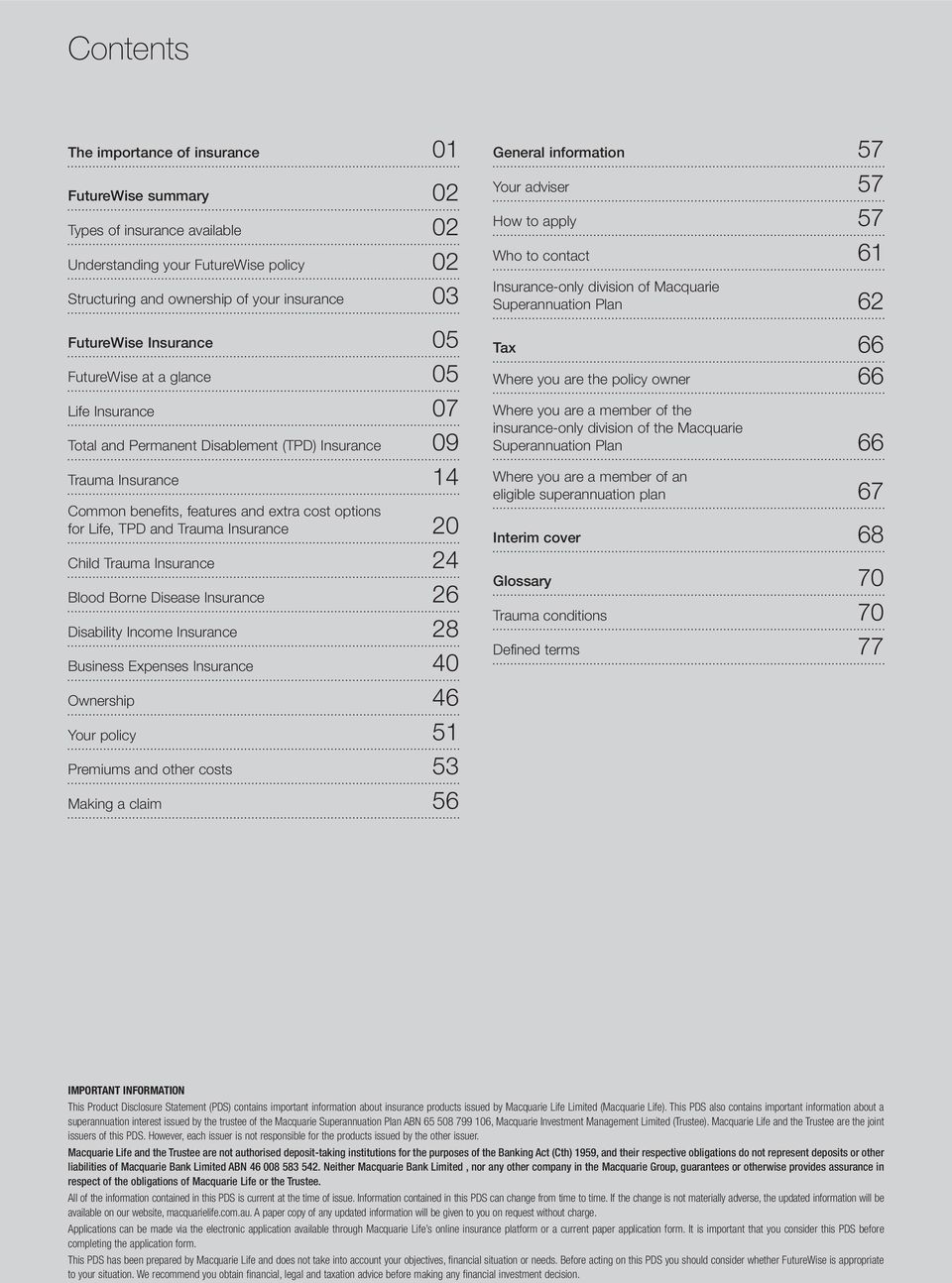
2 Contents The importance of insurance 01 FutureWise summary 02 Types of insurance available 02 Understanding your FutureWise policy 02 Structuring and ownership of your insurance 03 FutureWise Insurance 05 FutureWise at a glance 05 Life Insurance 07 Total and Permanent Disablement (TPD) Insurance 09 Trauma Insurance 14 Common benefits, features and extra cost options for Life, TPD and Trauma Insurance 20 Child Trauma Insurance 24 Blood Borne Disease Insurance 26 Disability Income Insurance 28 Business Expenses Insurance 40 Ownership 46 Your policy 51 Premiums and other costs 53 Making a claim 56 General information 57 Your adviser 57 How to apply 57 Who to contact 61 Insurance-only division of Macquarie Superannuation Plan 62 Tax 66 Where you are the policy owner 66 Where you are a member of the insurance-only division of the Macquarie Superannuation Plan 66 Where you are a member of an eligible superannuation plan 67 Interim cover 68 Glossary 70 Trauma conditions 70 Defined terms 77 IMPORTANT INFORMATION This Product Disclosure Statement (PDS) contains important information about insurance products issued by Macquarie Life Limited (Macquarie Life). This PDS also contains important information about a superannuation interest issued by the trustee of the Macquarie Superannuation Plan ABN , Macquarie Investment Management Limited (Trustee). Macquarie Life and the Trustee are the joint issuers of this PDS. However, each issuer is not responsible for the products issued by the other issuer. Macquarie Life and the Trustee are not authorised deposit-taking institutions for the purposes of the Banking Act (Cth) 1959, and their respective obligations do not represent deposits or other liabilities of Macquarie Bank Limited ABN Neither Macquarie Bank Limited, nor any other company in the Macquarie Group, guarantees or otherwise provides assurance in respect of the obligations of Macquarie Life or the Trustee. All of the information contained in this PDS is current at the time of issue. Information contained in this PDS can change from time to time. If the change is not materially adverse, the updated information will be available on our website, macquarielife.com.au. A paper copy of any updated information will be given to you on request without charge. Applications can be made via the electronic application available through Macquarie Life s online insurance platform or a current paper application form. It is important that you consider this PDS before completing the application form. This PDS has been prepared by Macquarie Life and does not take into account your objectives, financial situation or needs. Before acting on this PDS you should consider whether FutureWise is appropriate to your situation. We recommend you obtain financial, legal and taxation advice before making any financial investment decision.
3 The importance of insurance No matter how comprehensive and successful your investment plan may be, the most important asset to you and your family is your health. Without it, you lose your ability to provide for yourself and your family on a day-today basis and you may have difficulty achieving your long-term goals. Being injured or sick, or worse, dying prematurely, are subjects we would prefer to keep at the back of our minds. By taking out life, total and permanent disablement, trauma or disability income insurance, you can have peace of mind knowing that if the worst happens, you and your family will be protected. That s where FutureWise fits in, providing you with a range of insurance solutions that can cover you for the financial consequences should the worst occur. 1

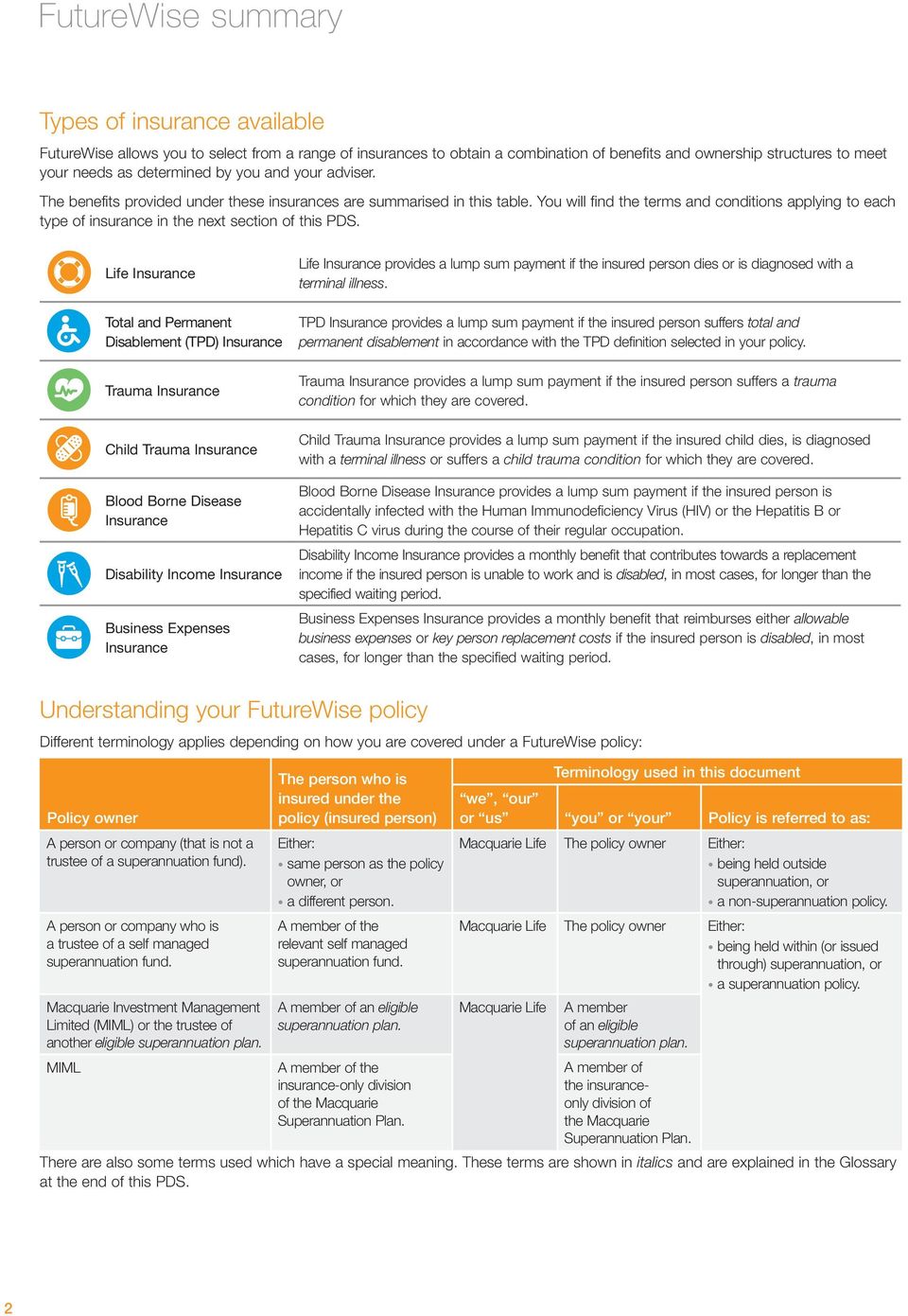
4 FutureWise summary Trauma Insurance Blood Borne Disease Insurance Business Expenses Insurance ce Blood Borne Business Expenses Types Disease Insurance of insurance available FutureWise allows you to select from a range of insurances to obtain a combination of benefits and ownership structures to meet your needs as determined by you and your adviser. Disability Income Insurance Insurance Active Cover Insurance Child Trauma Insurance The benefits provided under these insurances are summarised in this table. You will find the terms and conditions applying to each type of insurance in the next section of this PDS. surance Active Cover Insurance Child Trauma Insurance Life Insurance Life Insurance provides a lump sum payment if the insured person dies or is diagnosed with a terminal illness. ence Life Insurance Business Expenses Linked Insurance TPD Insurance Linked TPD Insurance Total and Permanent Disablement (TPD) Insurance Income Cover Trauma Insurance Income Cover TPD Insurance provides a lump sum payment if the insured person suffers total and permanent disablement in accordance with the TPD definition selected in your policy. Trauma Insurance provides a lump sum payment if the insured person suffers a trauma condition for which they are covered. Trauma Insurance Blood Borne Disease Insurance Child Trauma Insurance Business Expenses Insurance Child Trauma Insurance provides a lump sum payment if the insured child dies, is diagnosed with a terminal illness or suffers a child trauma condition for which they are covered. rance nce rance surance nce Child Trauma Insurance Trauma Insurance Blood Borne Disability Disease Income Insurance Insurance Income Cover Disability Income Insurance Active Life Cover Insurance Business Expenses Insurance Insurance Blood Borne Disease Insurance Blood Borne Disease Insurance Business Expenses Active Cover Insurance Insurance Disability Income Insurance Active Cover Insurance Business Expenses Insurance Child Linked Trauma TPD Insurance Insurance Business Expenses Insurance Blood Borne Disease Insurance provides a lump sum payment if the insured person is accidentally infected with the Human Immunodeficiency Virus (HIV) or the Hepatitis B or Hepatitis C virus during the course of their regular occupation. Disability Income Insurance provides a monthly benefit that contributes towards a replacement income if the insured person is unable to work and is disabled, in most cases, for longer than the specified waiting period. Business Expenses Insurance provides a monthly benefit that reimburses either allowable business expenses or key person replacement costs if the insured person is disabled, in most cases, for longer than the specified waiting period. Child Trauma Insurance Child Trauma Insurance Income Cover Understanding your FutureWise policy Life Insurance Linked TPD Insurance Income Cover Different terminology applies depending on how you are covered under a FutureWise policy: e rance rance Linked TPD Insurance Child Trauma Insurance Income Cover Income Cover Policy owner A person or company (that is not a trustee of a superannuation fund). A person or company who is a trustee of a self managed superannuation fund. Macquarie Investment Management Limited (MIML) or the trustee of another eligible superannuation plan. MIML The person who is insured under the policy (insured person) Either: same person as the policy owner, or a different person. A member of the relevant self managed superannuation fund. A member of an eligible superannuation plan. A member of the insurance-only division of the Macquarie Superannuation Plan. Terminology used in this document we, our or us you or your Policy is referred to as: Macquarie Life The policy owner Either: being held outside superannuation, or a non-superannuation policy. Macquarie Life The policy owner Either: being held within (or issued through) superannuation, or a superannuation policy. Macquarie Life A member of an eligible superannuation plan. A member of the insuranceonly division of the Macquarie Superannuation Plan. There are also some terms used which have a special meaning. These terms are shown in italics and are explained in the Glossary at the end of this PDS. 2
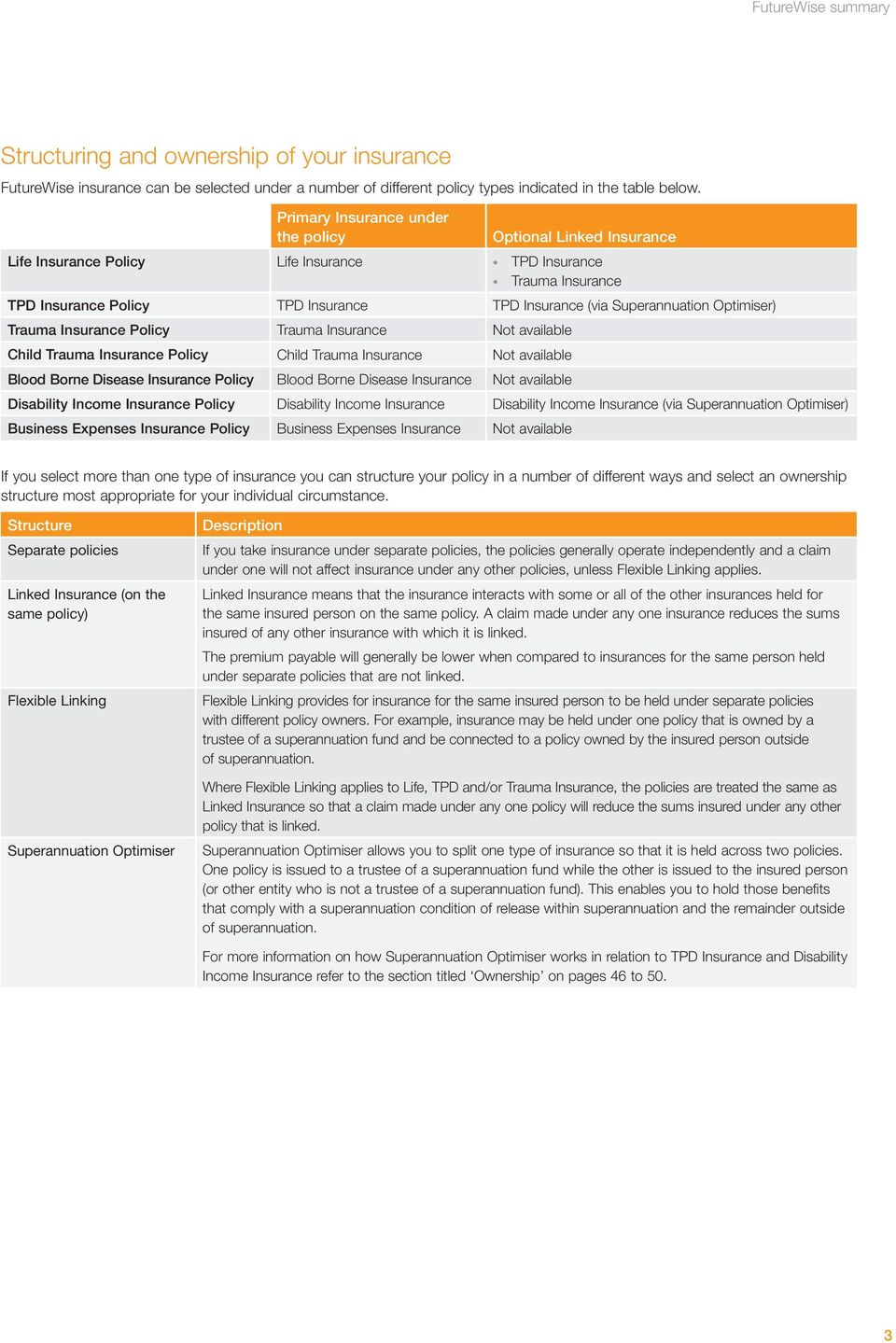
5 FutureWise summary Structuring and ownership of your insurance FutureWise insurance can be selected under a number of different policy types indicated in the table below. Primary Insurance under the policy Optional Linked Insurance Life Insurance Policy Life Insurance TPD Insurance Trauma Insurance TPD Insurance Policy TPD Insurance TPD Insurance (via Superannuation Optimiser) Trauma Insurance Policy Trauma Insurance Not available Child Trauma Insurance Policy Child Trauma Insurance Not available Blood Borne Disease Insurance Policy Blood Borne Disease Insurance Not available Disability Income Insurance Policy Disability Income Insurance Disability Income Insurance (via Superannuation Optimiser) Business Expenses Insurance Policy Business Expenses Insurance Not available If you select more than one type of insurance you can structure your policy in a number of different ways and select an ownership structure most appropriate for your individual circumstance. Structure Separate policies Linked Insurance (on the same policy) Flexible Linking Superannuation Optimiser Description If you take insurance under separate policies, the policies generally operate independently and a claim under one will not affect insurance under any other policies, unless Flexible Linking applies. Linked Insurance means that the insurance interacts with some or all of the other insurances held for the same insured person on the same policy. A claim made under any one insurance reduces the sums insured of any other insurance with which it is linked. The premium payable will generally be lower when compared to insurances for the same person held under separate policies that are not linked. Flexible Linking provides for insurance for the same insured person to be held under separate policies with different policy owners. For example, insurance may be held under one policy that is owned by a trustee of a superannuation fund and be connected to a policy owned by the insured person outside of superannuation. Where Flexible Linking applies to Life, TPD and/or Trauma Insurance, the policies are treated the same as Linked Insurance so that a claim made under any one policy will reduce the sums insured under any other policy that is linked. Superannuation Optimiser allows you to split one type of insurance so that it is held across two policies. One policy is issued to a trustee of a superannuation fund while the other is issued to the insured person (or other entity who is not a trustee of a superannuation fund). This enables you to hold those benefits that comply with a superannuation condition of release within superannuation and the remainder outside of superannuation. For more information on how Superannuation Optimiser works in relation to TPD Insurance and Disability Income Insurance refer to the section titled Ownership on pages 46 to 50. 3
6 FutureWise summary Ownership In addition to the structure of your policy (or policies), ownership of your FutureWise insurance is an important consideration. Your adviser will be able to recommend an appropriate ownership structure for you based on your personal circumstances. You can choose either non-superannuation ownership or superannuation ownership. Ownership Non-superannuation Superannuation Description The policy can be issued to an individual, a company, family trust, or other entity that is not a trustee of a superannuation fund. If a benefit becomes payable, the benefit is generally paid to the policy owner. If the insured person and policy owner are the same, the amount payable on the death of the insured person will be paid to their legal personal representative, unless any beneficiaries have been nominated under the policy, in which case it will be paid to the nominated beneficiaries. The policy is issued to a trustee of a superannuation fund as policy owner and the insured person is a member of the superannuation fund. Some FutureWise insurance cannot be held within superannuation. If a benefit under the policy becomes payable, it will be paid to the trustee of the superannuation fund as policy owner, who must distribute the benefit in accordance with the governing rules of the superannuation plan and superannuation law current at the time of payment. The availability of insurance under each ownership type is outlined in the table below. Ownership Insurance type Non-superannuation Superannuation Life Insurance P P Trauma Insurance P O TPD Insurance P P Child Trauma Insurance P O Blood Borne Disease Insurance P O Disability Income Insurance P P Business Expenses Insurance P O Superannuation law requires that the insurance benefits held within superannuation are aligned with the superannuation payment rules to ensure that any insurance proceeds paid are available to fund members at the time of claim. This means that for those insurances available through superannuation additional conditions may apply to the benefits and options available. For more information on the restrictions of ownership within superannuation refer to pages 46 to 50. 4

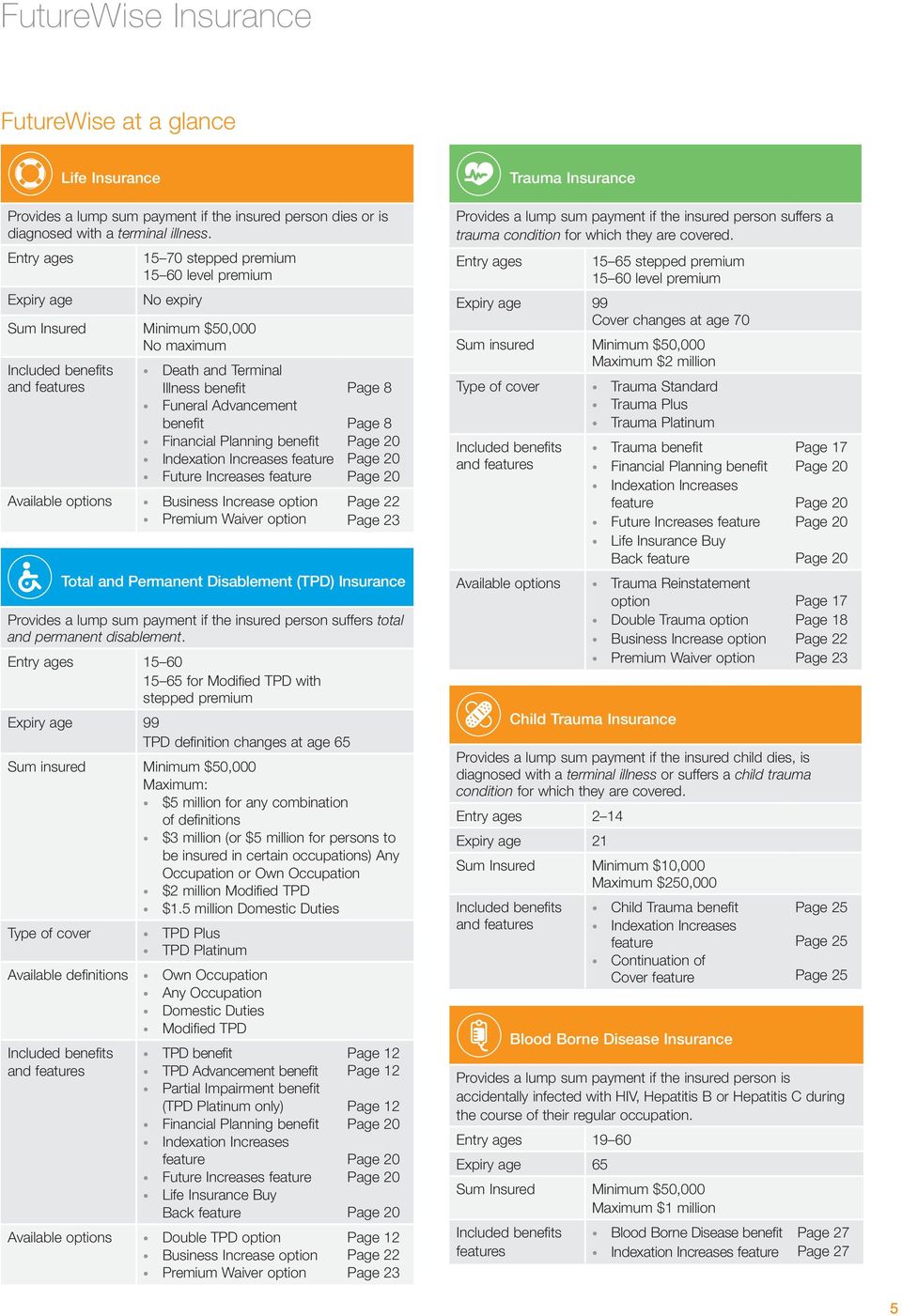
7 Trauma Insurance Blood Borne Disease Insurance Business Expenses Insurance FutureWise Insurance Disability Income Insurance Active Cover Insurance Child Trauma Insurance FutureWise at a glance Life Insurance Trauma Insurance ce surance e Life Insurance Linked TPD Insurance Income Cover Provides a lump sum payment if the insured person dies or is diagnosed with a terminal illness. Entry ages stepped premium level premium Expiry age No expiry Sum Insured Minimum $50,000 No maximum Blood Borne Business Expenses Included benefits Death and Terminal Insurance and features Illness benefit Funeral Advancement benefit Financial Planning benefit Indexation Increases feature Future Increases feature Child Trauma Insurance Available options Business Increase option Premium Waiver option Disease Insurance Active Cover Insurance Linked TPD Insurance Income Cover Page 8 Page 8 Page 20 Page 20 Page 20 Page 22 Page 23 Total and Permanent Disablement (TPD) Insurance Provides a lump sum payment if the insured person suffers Blood Borne Trauma Insurance total Disease Insurance and permanent disablement. Entry ages for Modified TPD with stepped premium Expiry age 99 TPD definition Disability changes Income Insurance at age Active 65Cover Insurance Sum insured Minimum $50,000 Maximum: $5 million for any combination of definitions $3 million (or $5 million for persons to be insured in certain occupations) Any Life Insurance Linked TPD Insurance Occupation or Own Occupation $2 million Modified TPD $1.5 million Domestic Duties Type of cover TPD Plus TPD Platinum Available definitions Own Occupation Any Occupation Domestic Duties Modified TPD Included benefits TPD benefit Page 12 and features TPD Advancement benefit Trauma Page Insurance 12 Partial Impairment benefit (TPD Platinum only) Page 12 Financial Planning benefit Page 20 Indexation Increases feature Page 20 Future Increases feature Page 20 Life Insurance Buy Back feature Disability Income Insurance Page 20 Available options Double TPD option Business Increase option Premium Waiver option Page 12 Page 22 Page 23 Trauma Insurance Disability Income Insurance Blood Borne Disease Insurance Linked TPD Insurance Business Expenses Insurance Provides a lump sum payment if the insured person suffers a trauma condition for which they are covered. Entry ages stepped premium level premium Expiry age 99 Cover changes at age 70 Active Cover Insurance Child Trauma Insurance Sum insured Minimum $50,000 Maximum $2 million Type of cover Trauma Standard Trauma Plus Trauma Platinum Included Life Insurance benefits and features Trauma benefit Income Cover Financial Planning benefit Indexation Increases feature Future Increases feature Life Insurance Buy Back feature Available options Trauma Reinstatement option Double Trauma option Business Increase option Premium Waiver option Business Expenses Insurance Child Trauma Insurance Child Trauma Insurance Provides a lump sum payment if the insured child dies, is diagnosed with a terminal illness or suffers a child trauma condition for which they are covered. Entry ages 2 14 Expiry age 21 Sum Income Cover Insured Minimum $10,000 Maximum $250,000 Included benefits and features Blood Borne Disease Insurance Child Trauma benefit Indexation Increases feature Continuation of Cover feature Blood Borne Disease Insurance Business Expenses Insurance Active Sum Cover Insurance Insured Child Trauma Minimum Insurance $50,000 Page 17 Page 20 Page 20 Page 20 Page 20 Page 17 Page 18 Page 22 Page 23 Page 25 Page 25 Page 25 Provides a lump sum payment if the insured person is accidentally infected with HIV, Hepatitis B or Hepatitis C during the course of their regular occupation. Entry ages Expiry age 65 Included benefits features Maximum $1 million Blood Borne Disease benefit Indexation Increases feature Page 27 Page 27 Life Insurance Linked TPD Insurance Income Cover 5
8 FutureWise Insurance Trauma Insurance Blood Borne Disease Insurance Business Expenses Insurance Disability Income Insurance Disability Income Insurance Active Cover Insurance Trauma Child Trauma Insurance Insurance Disease Insurance Provides a monthly benefit if the insured person is unable to work due to an illness or injury and is totally disabled or partially disabled, in most cases, for longer than the specified waiting period. Entry ages Expiry age Life Insurance Monthly insured amount (64, for to age 70 benefit period) 65 (70, for to age 70 benefit period) Linked TPD Insurance Income Cover Minimum $1,250 Disability Income per Insurance month Maximum $30,000 per month, plus an additional $30,000 per month restricted to a two year benefit period. Type of cover Disability Income Standard Disability Income Plus Disability Income Life Insurance Super-only Benefit type Indemnity Agreed Value Endorsed Agreed Value Waiting periods available Benefit periods available Included benefits and features 30 days 60 days 90 days 2 years 5 years 180 days 1 year 2 years To age 65 To age 70 Total Disability benefit Partial Disability benefit Specific Injury benefit Death benefit Indexation Increases feature Premium Waiver feature Involuntary Unemployment Premium Waiver feature Recurrent Disability feature Waiting Period Reduction feature Medical Professionals feature Available options Extra Benefits option Trauma benefit Bed Confinement benefit Home Care benefit Rehabilitation Expense benefit Accommodation benefit Future Increases feature Cover Extension feature Accident option Claims Escalation option Superannuation Cover option TPD Commutation option Booster option Blood Borne Active Cover Insurance Linked TPD Insurance Page 32 Page 32 Page 33 Page 33 Page 33 Page 33 Page 34 Page 34 Page 34 Page 34 Page 34 Page 35 Page 35 Page 35 Page 35 Page 36 Page 36 Page 36 Page 36 Page 37 Page 37 Page 38 Page 38 Business Expenses Insurance Child Trauma Insurance Business Expenses Insurance Provides a monthly benefit that reimburses either allowable business expenses or key person replacement costs if the insured person is disabled, in most cases, for longer than the specified waiting period. Entry ages Expiry age 65 Monthly insured amount Minimum $1,250 per month ($750 per month if taken with Disability Income Insurance) Maximum $60,000 per month Benefit type Ongoing Fixed Expenses Income Cover Key Person Replacement Waiting periods available 30 days 90 days Benefit period 12 times the monthly insured amount over a period of 24 months Included benefits Total Disability benefit Page 42 and features Partial Disability benefit Page 43 Death benefit Page 43 Indexation Increases feature Page 43 Future Increases feature Page 43 Premium Waiver feature Page 44 Recurrent Disability feature Page 44 Cover Extension feature Page 44 Available options Accident option Page 44 6
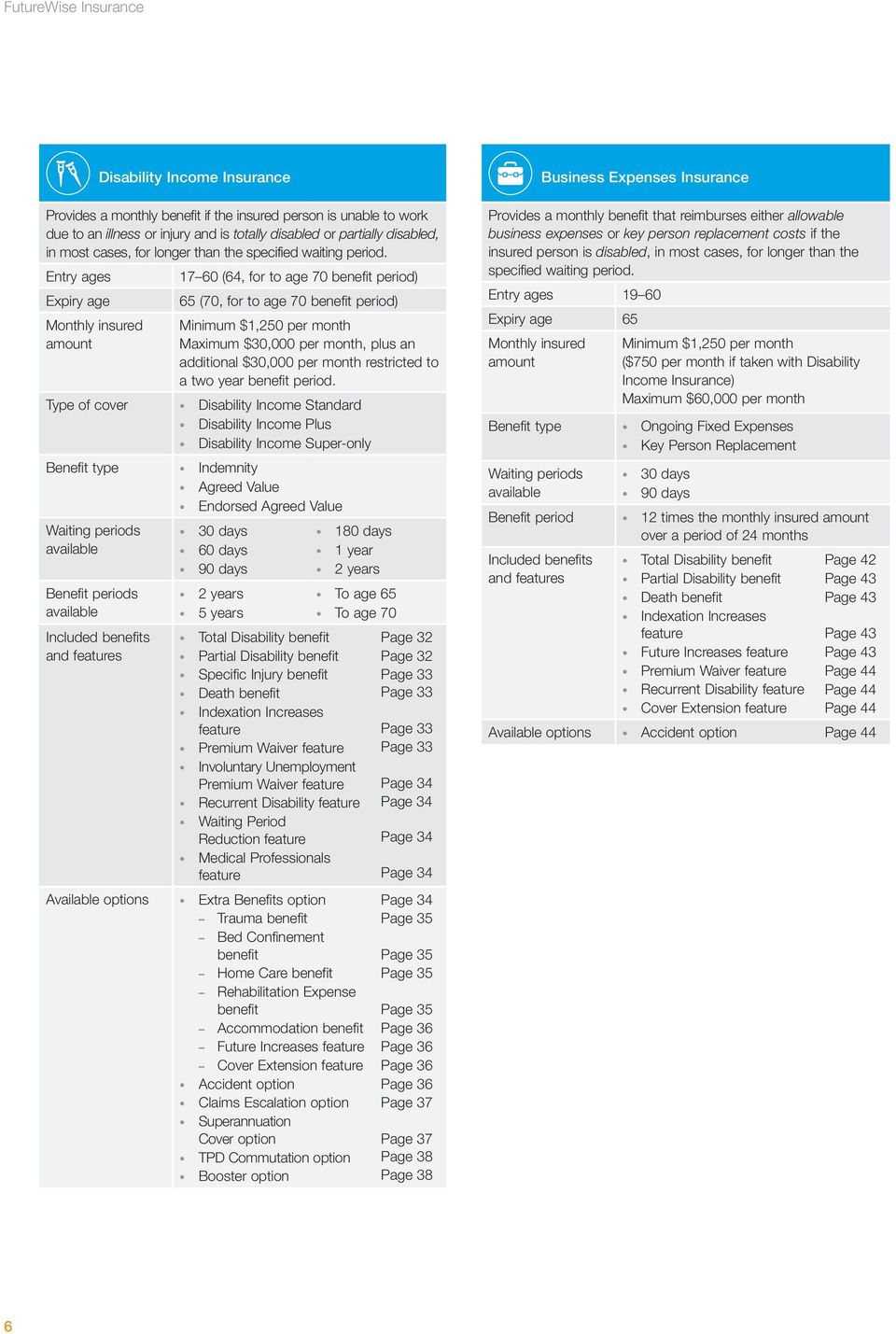
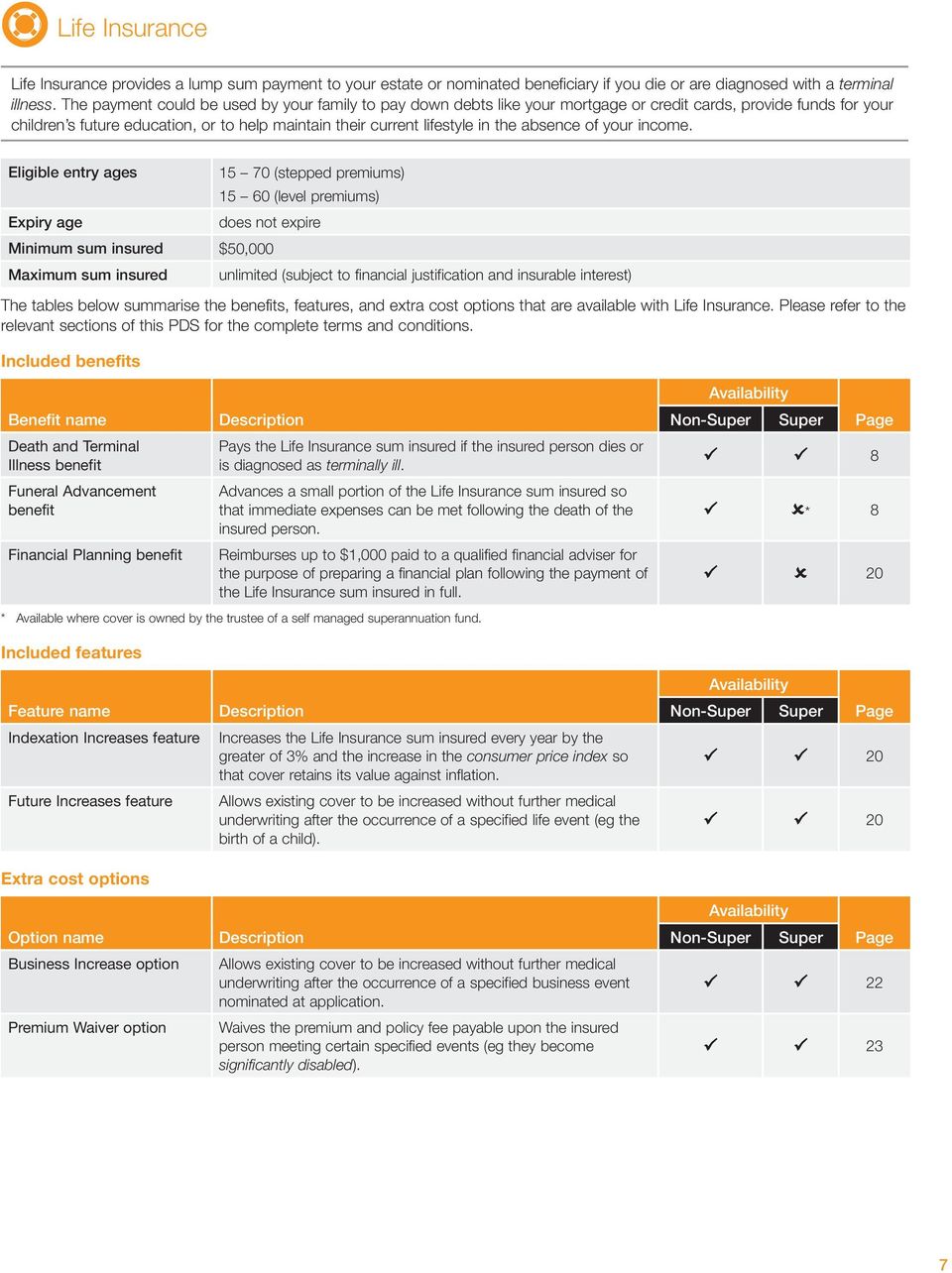
9 Trauma Insurance Disease Insurance Insurance Disability Income Insurance Active Cover Insurance Child Trauma Insurance Life Insurance Life Insurance Linked TPD Insurance Income Cover Life Insurance provides a lump sum payment to your estate or nominated beneficiary if you die or are diagnosed with a terminal illness. The payment could be used by your family to pay down debts like your mortgage or credit cards, provide funds for your children s future education, or to help maintain their current lifestyle in the absence of your income. Eligible entry ages (stepped premiums) (level premiums) Expiry age does not expire Minimum sum insured $50,000 Maximum sum insured unlimited (subject to financial justification and insurable interest) The tables below summarise the benefits, features, and extra cost options that are available with Life Insurance. Please refer to the relevant sections of this PDS for the complete terms and conditions. Included benefits Benefit name Death and Terminal Illness benefit Funeral Advancement benefit Financial Planning benefit Description Pays the Life Insurance sum insured if the insured person dies or is diagnosed as terminally ill. Advances a small portion of the Life Insurance sum insured so that immediate expenses can be met following the death of the insured person. Reimburses up to $1,000 paid to a qualified financial adviser for the purpose of preparing a financial plan following the payment of the Life Insurance sum insured in full. * Available where cover is owned by the trustee of a self managed superannuation fund. Availability Non-Super Super Page P P 8 P O* 8 P O 20 Included features Feature name Indexation Increases feature Future Increases feature Extra cost options Option name Business Increase option Premium Waiver option Description Increases the Life Insurance sum insured every year by the greater of 3% and the increase in the consumer price index so that cover retains its value against inflation. Allows existing cover to be increased without further medical underwriting after the occurrence of a specified life event (eg the birth of a child). Description Allows existing cover to be increased without further medical underwriting after the occurrence of a specified business event nominated at application. Waives the premium and policy fee payable upon the insured person meeting certain specified events (eg they become significantly disabled). Availability Non-Super Super Page P P 20 P P 20 Availability Non-Super Super Page P P 22 P P 23 7
10 Life Insurance The information provided below forms part of your Life Insurance terms and conditions. Words or expressions shown in italics have their meaning explained in the Glossary at the end of this PDS. When the Life Insurance sum insured is payable Death and Terminal Illness benefit If your FutureWise policy includes Life Insurance, the Life Insurance sum insured will be paid if, during the period of insurance, the insured person: is diagnosed with a terminal illness, or dies. Funeral Advancement benefit Under this benefit, part of the Life Insurance sum insured will be paid in advance so that immediate expenses can be met following the death of the insured person. The amount payable is the lesser of 10% of the Life Insurance sum insured and $15,000. The maximum amount we will pay under the Funeral Advancement benefit is $15,000 across all cover held with Macquarie Life for the insured person. In order to pay this benefit, we require medical evidence of the cause and date of death. This benefit is not payable if the insured person s death is the result of: suicide within 13 months of the cover start date anything that is excluded under the policy, or if there is reasonable doubt about whether the Life Insurance sum insured will become payable. If we agree this benefit is payable, it will be paid to the nominated beneficiary, the policy owner if different to the insured person or the legal personal representative, within two business days of receipt of all the required documents. The Life Insurance sum insured will be reduced by the amount paid under the Funeral Advancement benefit. The payment of the Funeral Advancement benefit is not an admission of liability and we reserve the right to recover the amount paid under the Funeral Advancement benefit if the Life Insurance claim is subsequently denied. The Funeral Advancement benefit is not included if the policy is held within superannuation except where owned by the trustee of a self managed superannuation fund. When the Life Insurance sum insured is reduced The Life Insurance sum insured will be reduced by the following payments: the amount paid for terminal illness the amount paid for the Funeral Advancement benefit the amount of any TPD Insurance sum insured paid, when the TPD Insurance is: included in the Life Insurance policy, or connected to the Life Insurance policy through Flexible Linking, and the amount of any Trauma Insurance sum insured paid (excluding any amount that exceeds the Trauma Insurance sum insured, for example, where a trauma condition pays 125% of the sum insured), when Trauma Insurance is: included in the Life Insurance policy, or connected to the Life Insurance policy through Flexible Linking. If the Life Insurance sum insured is reduced, but part of the sum insured remains, the premium for your policy is adjusted by applying our then current premium rates to the amount of the Life Insurance sum insured that remains. The premium can otherwise be altered as set out in this PDS on page 54. Your policy schedule will show whether TPD and/or Trauma Insurance are included in your FutureWise Life Insurance policy, or whether another policy is connected to it through Flexible Linking. When we won t pay The Death and Terminal Illness benefit will not be payable if death or terminal illness is caused or contributed to by an intentional self-inflicted act, within 13 months of: the cover start date the date cover is reinstated, including under the Life Insurance Buy Back feature (but only in respect of the reinstated cover), or the cover start date for any increase in cover that you applied for (but only in respect of that increase). This exclusion does not apply if your policy replaces other similar insurance under a policy or policies issued by Macquarie Life or another insurer (the other policy) and we agreed to issue your policy on the basis that it replaced the other policy (as shown in your policy schedule) and the following conditions are also met: the Life Insurance sum insured under the policy being issued by us is the same amount or less than that under the other policy. If the Life Insurance sum insured under the policy being issued by us is higher than that under the other policy, the exclusion only applies to the amount of the Life Insurance sum insured in excess of the cover under the other policy the other policy was continuously in force for 13 months immediately prior to the issue of this policy the other policy was cancelled immediately after the issue of this policy, and no claim is pending or payable under the other policy. The Death and Terminal Illness benefit will not be payable if death or terminal illness is caused or contributed to by anything excluded under the policy as indicated on the policy schedule. 8

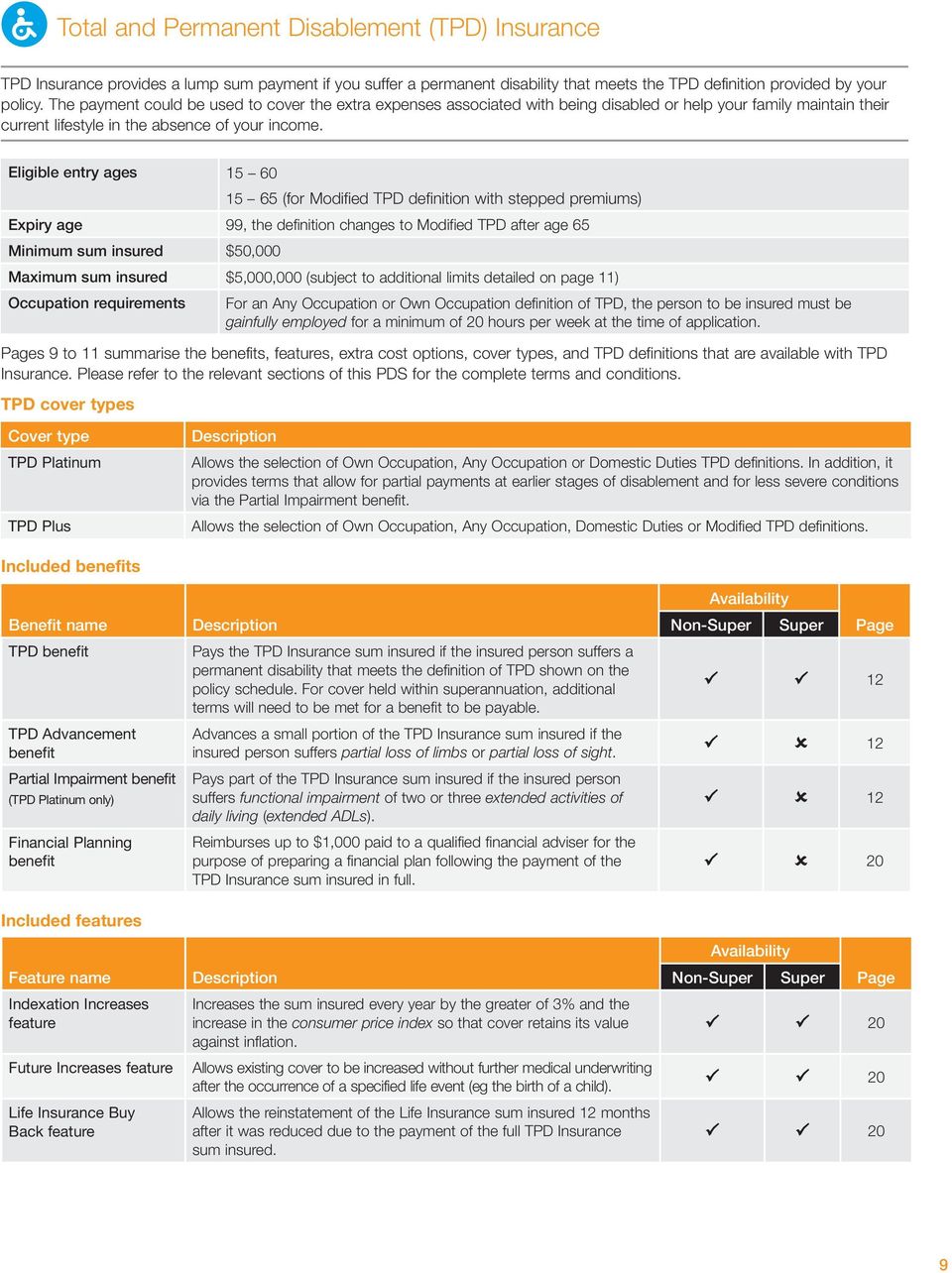
11 e Disease Insurance Insurance rance Active Cover Insurance Child Trauma Insurance Total and Permanent Disablement (TPD) Insurance Linked TPD Insurance Income Cover TPD Insurance provides a lump sum payment if you suffer a permanent disability that meets the TPD definition provided by your policy. The payment could be used to cover the extra expenses associated with being disabled or help your family maintain their current lifestyle in the absence of your income. Eligible entry ages (for Modified TPD definition with stepped premiums) Expiry age 99, the definition changes to Modified TPD after age 65 Minimum sum insured $50,000 Maximum sum insured $5,000,000 (subject to additional limits detailed on page 11) Occupation requirements For an Any Occupation or Own Occupation definition of TPD, the person to be insured must be gainfully employed for a minimum of 20 hours per week at the time of application. Pages 9 to 11 summarise the benefits, features, extra cost options, cover types, and TPD definitions that are available with TPD Insurance. Please refer to the relevant sections of this PDS for the complete terms and conditions. TPD cover types Cover type TPD Platinum TPD Plus Description Allows the selection of Own Occupation, Any Occupation or Domestic Duties TPD definitions. In addition, it provides terms that allow for partial payments at earlier stages of disablement and for less severe conditions via the Partial Impairment benefit. Allows the selection of Own Occupation, Any Occupation, Domestic Duties or Modified TPD definitions. Included benefits Benefit name TPD benefit TPD Advancement benefit Partial Impairment benefit (TPD Platinum only) Financial Planning benefit Included features Feature name Indexation Increases feature Future Increases feature Life Insurance Buy Back feature Description Pays the TPD Insurance sum insured if the insured person suffers a permanent disability that meets the definition of TPD shown on the policy schedule. For cover held within superannuation, additional terms will need to be met for a benefit to be payable. Advances a small portion of the TPD Insurance sum insured if the insured person suffers partial loss of limbs or partial loss of sight. Pays part of the TPD Insurance sum insured if the insured person suffers functional impairment of two or three extended activities of daily living (extended ADLs). Reimburses up to $1,000 paid to a qualified financial adviser for the purpose of preparing a financial plan following the payment of the TPD Insurance sum insured in full. Description Increases the sum insured every year by the greater of 3% and the increase in the consumer price index so that cover retains its value against inflation. Allows existing cover to be increased without further medical underwriting after the occurrence of a specified life event (eg the birth of a child). Allows the reinstatement of the Life Insurance sum insured 12 months after it was reduced due to the payment of the full TPD Insurance sum insured. Availability Non-Super Super Page P P 12 P O 12 P O 12 P O 20 Availability Non-Super Super Page P P 20 P P 20 P P 20 9
12 Total and Permanent Disablement (TPD) Insurance Extra cost options Option name Double TPD option (Linked TPD Insurance only) Business Increase option Premium Waiver option Description Allows the reinstatement of the Life Insurance sum insured 14 days after it was reduced due to the payment of the full TPD Insurance sum insured. The premium for the reinstated Life Insurance sum insured is then waived for the remaining life of the policy. Allows existing cover to be increased without further medical underwriting after the occurrence of a specified business event nominated at application. Waives the premium and policy fee payable upon the insured person meeting certain specified events (eg they become significantly disabled). Availability Non-Super Super Page P P 12 P P 22 P P 23 TPD definitions The TPD definition selected will determine the criteria against which the insured person s disability is assessed at the time of claim. The requirements of the TPD definitions vary and are summarised below. In all cases the disability must be permanent and irreversible. Own Occupation Requires the insured person to be permanently unable to perform the occupation they were working in prior to their disability. If they were not working when they became disabled, assessment is made against their most recent occupation. Any Occupation Requires the insured person to be permanently unable to perform any occupation that is suitable to them based on their education, training, or experience. This means that even if they cannot perform their most recent occupation, a payment may not be available if they can work in another suitable occupation. Domestic Duties Requires the insured person to meet the requirements of the Any Occupation definition and also to be unable to perform domestic duties ever again. It is available to those people whose main occupation is to maintain the family home. If the insured person was gainfully employed for more than 20 hours a week prior to becoming disabled, only the Any Occupation requirements need to be met. At the policy anniversary when the insured person is aged 65, all definitions will revert to Modified TPD. An additional restriction will be applied to TPD Insurance if it is held entirely within superannuation that requires the insured person to satisfy the definition of permanent incapacity in order for the benefit to be payable. For full details of the TPD definitions please see the Glossary of this PDS. Other ways to meet the TPD definition For Own Occupation, Any Occupation, and Domestic Duties TPD, we will also consider the insured person to have met the TPD definition requirements if they: 1. suffer functional impairment of at least four extended ADLs 2. suffer permanent and irreversible whole person impairment of at least 60%, or 3. meet the Modified TPD definition. Qualifying periods There are qualifying periods that apply in order for you to meet the TPD definitions. Please refer to the Glossary of this PDS for further information. Modified TPD Requires the insured person to have suffered any one of the following severe disabilities: 1. loss of limbs (this includes the loss of any two limbs, loss of sight in both eyes, or loss of sight in one eye and the loss of one limb) 2. loss of independent existence (this is the permanent inability to perform two of the activities of daily living) 3. cognitive loss (this is a permanent loss of intellectual capacity). 10

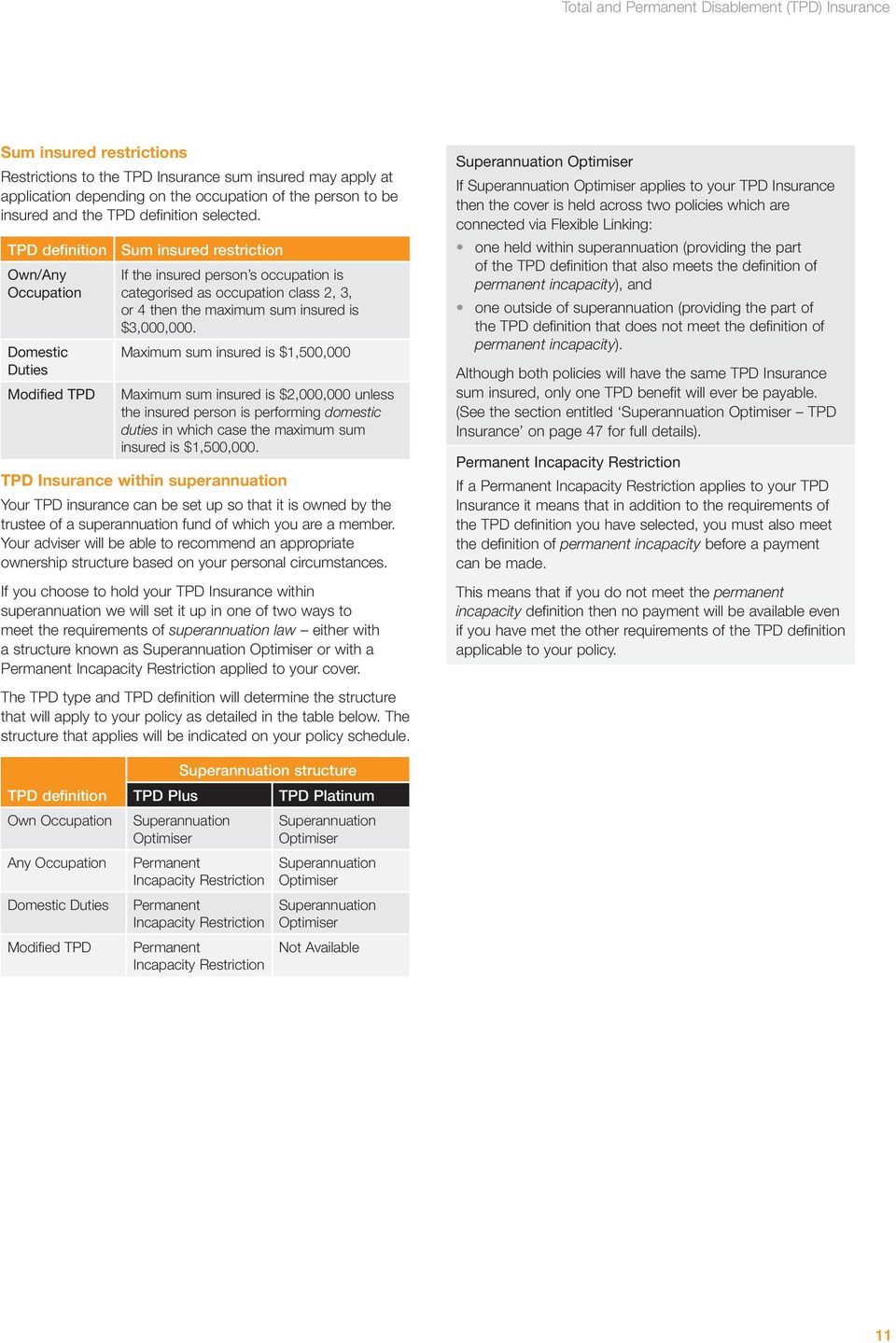
13 Total and Permanent Disablement (TPD) Insurance Sum insured restrictions Restrictions to the TPD Insurance sum insured may apply at application depending on the occupation of the person to be insured and the TPD definition selected. TPD definition Own/Any Occupation Domestic Duties Modified TPD Sum insured restriction If the insured person s occupation is categorised as occupation class 2, 3, or 4 then the maximum sum insured is $3,000,000. Maximum sum insured is $1,500,000 Maximum sum insured is $2,000,000 unless the insured person is performing domestic duties in which case the maximum sum insured is $1,500,000. TPD Insurance within superannuation Your TPD insurance can be set up so that it is owned by the trustee of a superannuation fund of which you are a member. Your adviser will be able to recommend an appropriate ownership structure based on your personal circumstances. If you choose to hold your TPD Insurance within superannuation we will set it up in one of two ways to meet the requirements of superannuation law either with a structure known as Superannuation Optimiser or with a Permanent Incapacity Restriction applied to your cover. Superannuation Optimiser If Superannuation Optimiser applies to your TPD Insurance then the cover is held across two policies which are connected via Flexible Linking: one held within superannuation (providing the part of the TPD definition that also meets the definition of permanent incapacity), and one outside of superannuation (providing the part of the TPD definition that does not meet the definition of permanent incapacity). Although both policies will have the same TPD Insurance sum insured, only one TPD benefit will ever be payable. (See the section entitled Superannuation Optimiser TPD Insurance on page 47 for full details). Permanent Incapacity Restriction If a Permanent Incapacity Restriction applies to your TPD Insurance it means that in addition to the requirements of the TPD definition you have selected, you must also meet the definition of permanent incapacity before a payment can be made. This means that if you do not meet the permanent incapacity definition then no payment will be available even if you have met the other requirements of the TPD definition applicable to your policy. The TPD type and TPD definition will determine the structure that will apply to your policy as detailed in the table below. The structure that applies will be indicated on your policy schedule. TPD definition Own Occupation Any Occupation Domestic Duties Modified TPD Superannuation structure TPD Plus TPD Platinum Superannuation Optimiser Permanent Incapacity Restriction Permanent Incapacity Restriction Permanent Incapacity Restriction Superannuation Optimiser Superannuation Optimiser Superannuation Optimiser Not Available 11
14 Total and Permanent Disablement (TPD) Insurance The information provided in this section forms part of your TPD Insurance terms and conditions. Words or expressions shown in italics have their meaning explained in the Glossary at the end of this PDS. When the TPD Insurance sum insured is payable TPD benefit If your FutureWise policy includes TPD Insurance, the TPD Insurance sum insured will be paid if the insured person suffers total and permanent disablement during the period of insurance. The definition of total and permanent disablement will be shown on your policy schedule. Where your policy schedule indicates that Superannuation Optimiser applies, your TPD Insurance will be held over two policies linked via Flexible Linking with a payment available under only one of these policies in the event of the insured person suffering total and permanent disablement. Please refer to the Superannuation Optimiser TPD Insurance section on page 47 for further information regarding the policy from which the benefit will be paid. TPD Advancement benefit Under this benefit, part of the TPD Insurance sum insured will be advanced if the insured person suffers partial loss of limbs or partial loss of sight. The amount payable is the lesser of 25% of the TPD Insurance sum insured and $500,000. The TPD Advancement benefit is only payable once and the maximum amount we will pay under the TPD Advancement benefit is $500,000 across all cover held with Macquarie Life for the insured person. The TPD Advancement benefit will be reduced by the amount of any Trauma Insurance paid for partial loss of limbs or partial loss of sight if the TPD Insurance is: included in a policy along with Trauma Insurance and both the TPD Insurance and Trauma Insurance are linked, or connected through Flexible Linking to a separate policy which includes Trauma Insurance. The TPD Insurance sum insured will be reduced by the amount paid under the TPD Advancement benefit. The TPD Advancement benefit is not available if the policy is held within superannuation. For more information, refer to the section titled Ownership on page 46. Partial Impairment benefit This benefit is only provided if TPD Platinum applies as shown on your policy schedule. Under this benefit, up until the cover anniversary when the insured person is aged 65, part of the TPD Insurance sum insured will be paid if the insured person suffers functional impairment of a specified number of extended ADLs as set out in the following table: Partial Impairment level Functional impairment of at least 3 extended ADL categories Functional impairment of at least 2 extended ADL categories Amount of sum insured payable 65% 40% A benefit is only payable once at each Partial Impairment level. The TPD Insurance sum insured will be reduced by the amount paid under the Partial Impairment benefit. If you choose to hold your TPD Platinum through superannuation, Superannuation Optimiser will apply and the Partial Impairment benefit will be held under the non-superannuation policy. Please refer to the Superannuation Optimiser TPD Insurance section on page 47 for more information. Double TPD option This is an option for which an additional premium is charged. If the Double TPD option applies, it will be shown on your policy schedule. It is only available if you have Linked TPD Insurance under a Life Insurance policy or your TPD insurance is connected to a Life Insurance policy through Flexible Linking. Up until the cover anniversary when the insured person is aged 65, this option reinstates the Life Insurance sum insured 14 days after it was reduced by the payment of the TPD benefit, without the need for medical underwriting. This option cannot be exercised if a claim for terminal illness (or similar benefit) is in progress or has previously been paid for the insured person by us. The premium will be waived on the reinstated Life Insurance sum insured. Any exclusions or special conditions which applied to the original Life Insurance will also apply to cover reinstated under the Double TPD option. The Future Increases feature, Indexation Increases feature, and the Business Increase option do not apply to the reinstated Life Insurance. The Life Insurance Buy Back feature cannot be exercised if the Life Insurance sum insured has been reinstated under the Double TPD option. When the TPD Insurance changes From the cover anniversary when the insured person is aged 65, the applicable TPD definition will be Modified TPD so that the TPD Insurance sum insured will only be payable if the insured person meets the Modified TPD definition before the TPD Insurance ends, as explained in the section titled When cover ends on page

15 Total and Permanent Disablement (TPD) Insurance When the TPD Insurance sum insured is reduced There are circumstances when your TPD Insurance sum insured will be reduced. These include when: we pay a claim other insurance is reduced or cancelled, and/or you reach age 65. When we pay a claim The TPD Insurance sum insured will be reduced by the following: the amount of any Life Insurance sum insured paid for terminal illness, if TPD Insurance is: included in a Life Insurance policy, or connected to a Life Insurance policy through Flexible Linking, the amount of any TPD Insurance sum insured paid in full or in part under the policy in cases where Superannuation Optimiser applies, the amount of any TPD Insurance sum insured paid under a policy to which it is connected through Flexible Linking, and the amount of any Trauma Insurance sum insured paid (excluding any amount that exceeds the Trauma Insurance sum insured, for example, where a trauma condition pays 125% of the sum insured), if TPD Insurance is: included in a policy along with Trauma Insurance, or connected through Flexible Linking to another policy which includes Trauma Insurance. Your policy schedule will show any other types of insurance included in your FutureWise policy, and whether it is connected to another policy through Flexible Linking. When other insurance is reduced or cancelled If TPD Insurance is included in a Life Insurance policy or connected to one through Flexible Linking, and the Life Insurance is reduced or cancelled, the TPD Insurance sum insured will be reduced so that it is not more than the Life Insurance sum insured. If Superannuation Optimiser applies and the TPD Insurance is reduced or cancelled under one of the policies connected through Flexible Linking, the TPD Insurance sum insured under the connected policy will also be reduced so that it is not more than the reduced or cancelled TPD Insurance sum insured. If the TPD Insurance sum insured is reduced, but part of the sum insured remains, the premium for your policy is adjusted by applying our then current premium rates to the amount of the sum insured that remains. The premium can otherwise be altered as set out in this PDS on page 54. Where portions of the sum insured are subject to different terms Where we agree, your TPD Insurance may be set up so that separate portions of the sum insured are subject to different terms (such as TPD definition, TPD cover type, etc). Details of each portion of the sum insured and terms that apply to each will be shown on the policy schedule that we issue to you. The insured person will be assessed against the terms of each portion of the sum insured and benefits will only become payable under those portions of the sum insured where the terms are met. One benefit payable If the TPD Insurance is held in a Linked Insurance structure with other types of insurance, the following conditions apply regarding the order of assessment for claims: where cover is held within superannuation under Flexible Linking, including where Superannuation Optimiser applies, the claim will be assessed under the superannuation policy first after the claim has been assessed under the superannuation policy, if applicable, the claim will then be assessed under any Linked non-superannuation policies. If the insured person suffers a condition that satisfies the definition under more than one benefit at the same time, only one benefit will be paid in respect of the condition, being the one which results in the highest payment. The benefit will be paid to the policy owner of the relevant policy. When we won t pay A TPD Insurance claim will not be payable if: the condition or event giving rise to the claim is caused or contributed to by an intentional, self-inflicted act the condition or event giving rise to the claim is caused or contributed to by anything excluded under the policy as indicated on the policy schedule the condition or event giving rise to the claim is loss of limbs, loss of independent existence, or whole person impairment and the insured person dies (or is declared brain dead) within 14 days of when they satisfy the definition, or the policy schedule indicates that the Permanent Incapacity Restriction applies and the insured person does not meet the definition of permanent incapacity. When you reach age 65 At the cover anniversary when the insured person is aged 65, the TPD Insurance sum insured is reduced to $3 million across all policies issued by us on the life of the insured person. Where multiple policies are issued by us providing TPD Insurance for the same insured person, we will apply any reduction to the sum insured based on the cover start date of each policy (or the start date of any increases, other than indexation increases), reducing the most recently commenced policy (or approved increase) first. 13
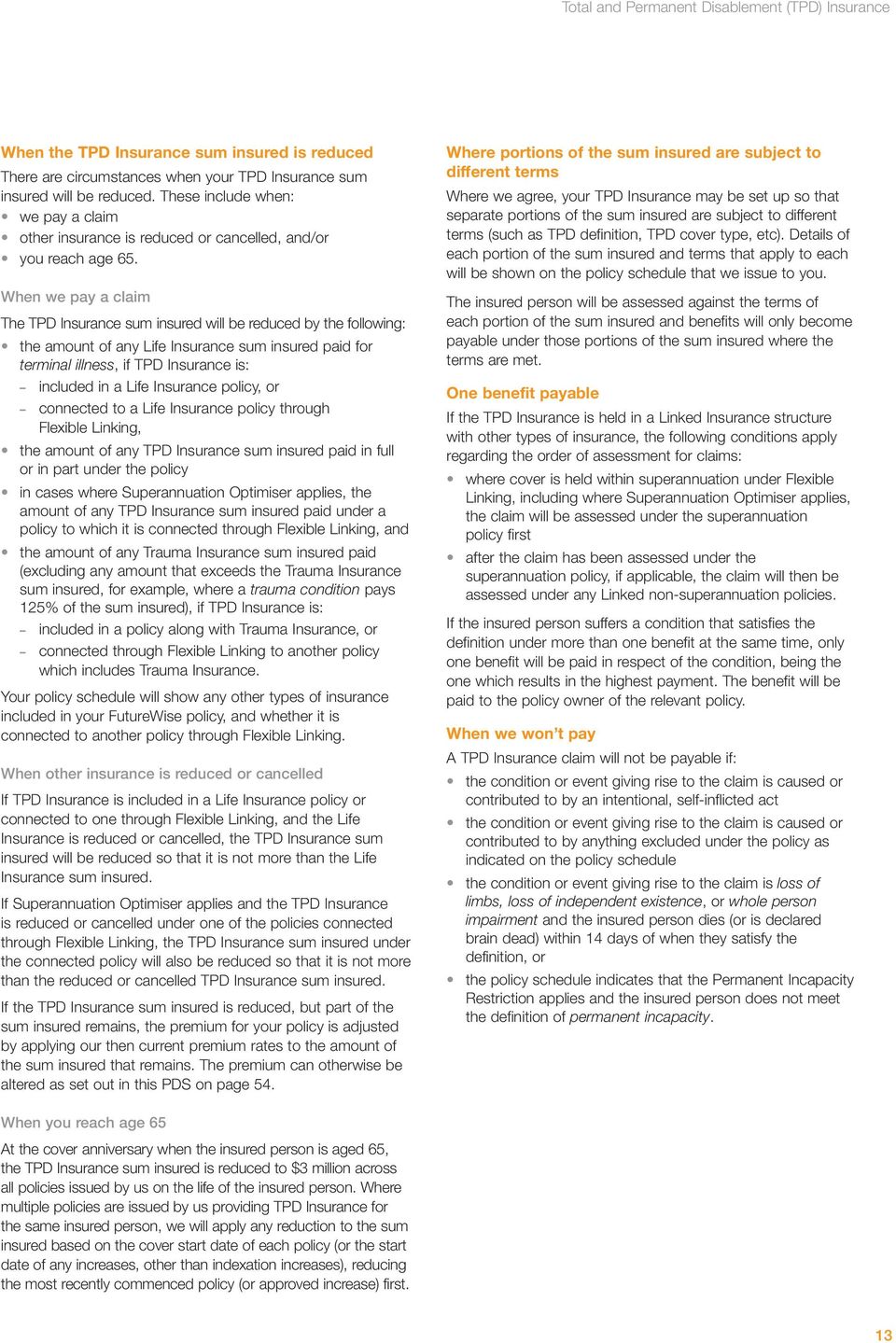
16 Trauma Insurance Trauma Insurance Blood Borne Disease Insurance Business Expenses Insurance Trauma Insurance provides a lump sum payment if you suffer one of the trauma conditions covered by your policy. The payment could be used to pay for additional unexpected expenses as a result of your illness or provide funds to allow you to take additional time off work. Eligible entry ages (stepped premiums) Active Cover Insurance Child Trauma Insurance (level premiums) Expiry age 99, the trauma conditions covered are limited after age 70 Minimum sum insured $50,000 Maximum sum insured $2,000,000 Disability Income Insurance The Life Insurance tables below Linked summarise TPD Insurance the benefits, Income Cover features, and extra cost options that are available for Trauma Insurance. Please refer to the relevant sections of this PDS for the complete terms and conditions. Trauma Insurance cannot be owned by the trustee of a superannuation fund. Trauma cover types Cover type Trauma Platinum Trauma Plus Trauma Standard Included benefits Description Provides a full payment of the Trauma Insurance sum insured for 44 conditions, partial payments for 21 conditions, a boosted payment for four severe trauma conditions, and enhanced terms for the Trauma Reinstatement option. Provides a full payment of the Trauma Insurance sum insured for 41 conditions, partial payments for 21 conditions and a boosted payment for four severe trauma conditions. Provides a full payment of the Trauma Insurance sum insured for 35 conditions and partial payments for 10 conditions. Benefit name Description Page Trauma benefit Pays a benefit if the insured person suffers one of the listed trauma conditions. The payment may be the full Trauma Insurance sum insured or part of it, depending on the trauma condition. 17 Financial Planning benefit Reimburses up to $1,000 paid to a qualified financial adviser for the purpose of preparing a financial plan following payment of the Trauma Insurance sum insured in full. 20 Included features Feature name Description Page Indexation Increases feature Increases the sum insured every year by the greater of 3% and the increase in the consumer price index so that cover retains its value against inflation. 20 Future Increases feature Allows existing cover to be increased without further medical underwriting after the occurrence of a specified life event (eg the birth of a child). 20 Life Insurance Buy Back feature Extra cost options Allows the reinstatement of the Life Insurance sum insured 12 months after it was reduced due to the payment of the full Trauma Insurance sum insured. Option name Description Page Trauma Reinstatement option Double Trauma option (Linked Trauma Insurance only) Business Increase option Premium Waiver option Allows the reinstatement of the Trauma Insurance sum insured 12 months after it was reduced due to payment of the full Trauma Insurance sum insured. Allows the reinstatement of the Life Insurance sum insured 14 days after it was reduced due to payment of the full Trauma Insurance sum insured. The premium for the reinstated Life Insurance sum insured is waived for the remaining life of the policy. Allows existing cover to be increased without further medical underwriting after the occurrence of a specified business event nominated at application. Waives the premium and policy fee payable upon the insured person meeting certain specified events (eg they become significantly disabled)
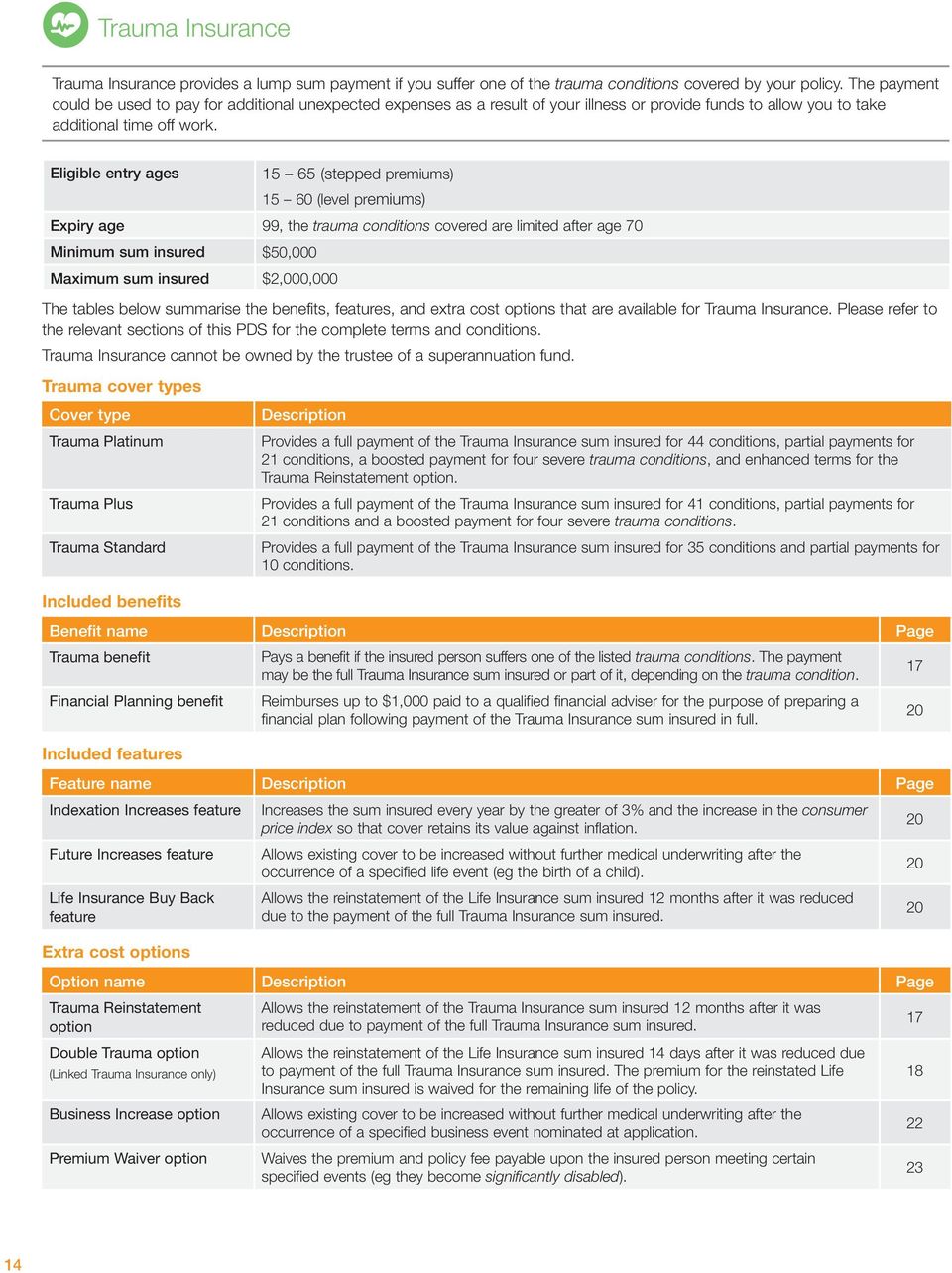
17 Trauma Insurance The information provided in this section forms part of your Trauma Insurance terms and conditions. Words or expressions shown in italics have their meaning explained in the Glossary at the end of this PDS. Trauma conditions The trauma conditions that your Trauma Insurance covers will depend on the type of Trauma Insurance indicated on your policy schedule. There are three types of Trauma Insurance available: Trauma Standard, Trauma Plus, and Trauma Platinum. The trauma conditions covered by each type of Trauma Insurance, and the level of payment for each, is detailed in the table below. Please refer to the Glossary at the end of this PDS for the definition of each listed trauma condition. Body system Cancer of any body system Heart and artery Brain and nerves Amount of sum insured payable Condition Trauma Standard Trauma Plus Trauma Platinum aplastic anaemia 100% 100% 100% cancer 100% 100% 100% carcinoma in situ of the breast 20% 20% 20% carcinoma in situ of the breast with lumpectomy and treatment 20% 20% 100% carcinoma in situ of the cervix and cervical dysplasia 0% 20% 20% carcinoma in situ of the fallopian tube 0% 20% 20% carcinoma in situ of the ovary 0% 20% 20% carcinoma in situ of the vagina 0% 20% 20% carcinoma in situ of the vulva 0% 20% 20% early stage melanoma 20% 20% 20% early stage prostate cancer 20% 20% 20% angioplasty 20% 20% 20% triple vessel angioplasty 100% 100% 100% aortic surgery 100% 100% 100% cardiomyopathy 100% 100% 100% coronary artery bypass surgery 100% 100% 100% heart attack 100% 100% 100% minor heart attack 0% 0% 20% heart valve surgery 100% 100% 100% out of hospital cardiac arrest 100% 100% 100% bacterial meningitis or meningococcal septicaemia 100% 100% 100% benign brain tumour 0% 0% 20% benign brain tumour with impairment level 100% 100% 100% cognitive loss 100% 100% 100% coma 100% 100% 100% dementia including Alzheimer s disease 100% 100% 100% encephalitis 100% 100% 100% hydrocephalus 0% 20% 20% major head trauma 100% 100% 100% motor neurone disease 20% 100% 100% motor neurone disease with impairment level 100% 100% 100% multiple sclerosis 20% 100% 100% multiple sclerosis with impairment level 100% 100% 100% muscular dystrophy 20% 100% 100% muscular dystrophy with impairment level 100% 100% 100% paralysis 100% 125% 125% Parkinson s disease 20% 100% 100% Parkinson s disease with impairment level 100% 100% 100% stroke 100% 100% 100% 15
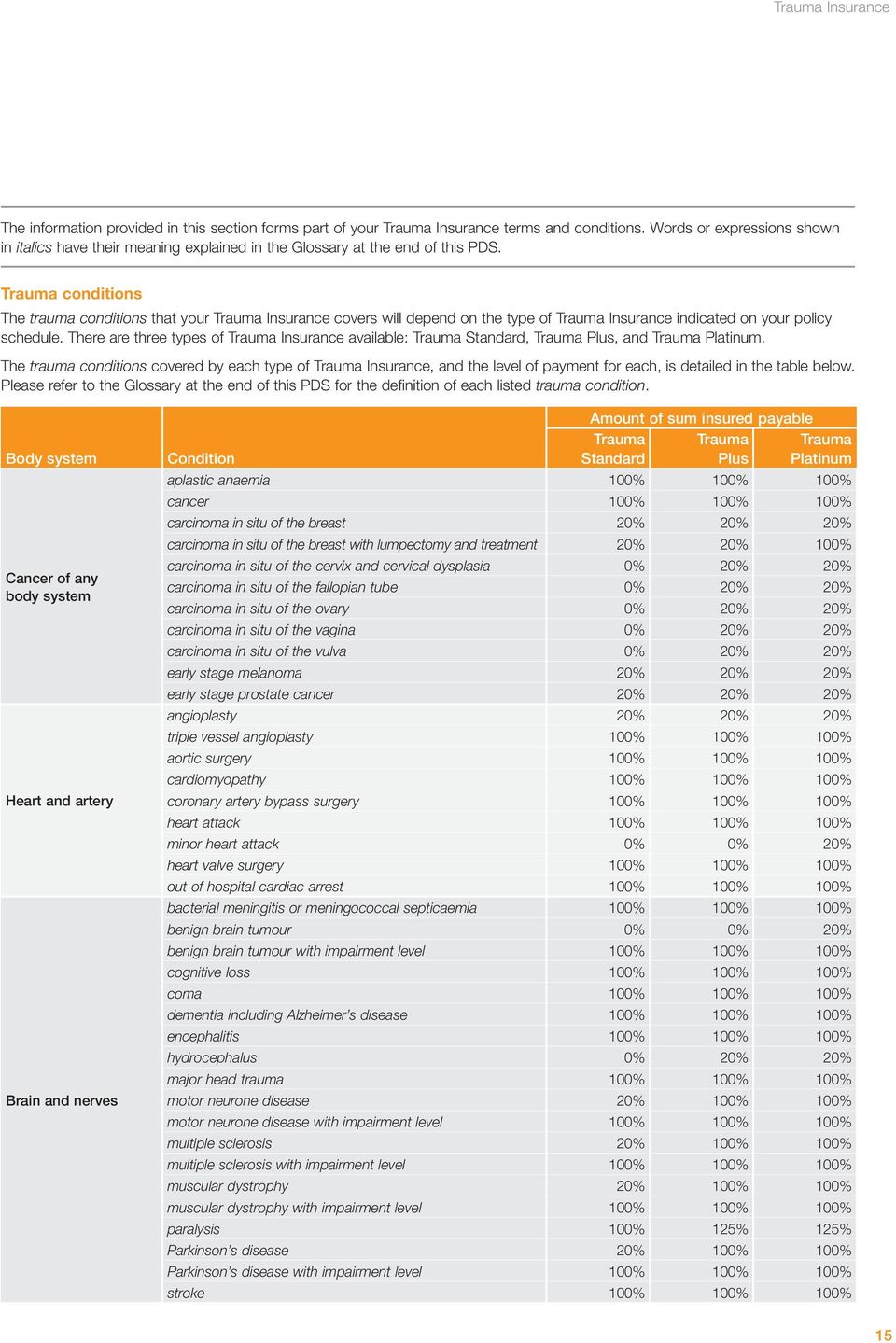
18 Trauma Insurance Body system Lungs Condition Amount of sum insured payable Trauma Standard Trauma Plus Trauma Platinum chronic lung disease 100% 100% 100% primary pulmonary hypertension 100% 100% 100% Kidneys chronic kidney failure 100% 100% 100% Ear, nose and throat Eye Musculoskeletal Digestive system Endocrine system Other loss of hearing 100% 100% 100% partial loss of hearing 0% 20% 20% loss of speech or total aphasia 100% 100% 100% loss of sight 100% 125% 125% partial loss of sight 0% 20% 20% loss of limbs 100% 125% 125% partial loss of limbs 0% 20% 20% severe burns 100% 125% 125% severe burns of limited extent 0% 20% 20% severe osteoporosis 0% 20% 20% severe rheumatoid arthritis 0% 20% 100% chronic liver disease 100% 100% 100% colostomy/ileostomy 0% 20% 20% severe Crohn s disease 0% 20% 20% severe ulcerative colitis 0% 20% 20% advanced diabetes 0% 100% 100% diabetes complications 0% 20% 20% loss of independent existence 100% 100% 100% major organ transplant 100% 100% 100% major organ transplant waiting list 20% 100% 100% medically acquired HIV 100% 100% 100% occupationally acquired hepatitis B or C 0% 0% 100% occupationally acquired HIV 100% 100% 100% Some of the above conditions are excluded for 90 days from the application date or date any cover is reinstated. Please refer to the section titled When we won t pay on page 19 for more information. 16

19 Trauma Insurance When the Trauma Insurance sum insured is payable Trauma benefit If your FutureWise policy includes Trauma Insurance, all or part of the Trauma Insurance sum insured is payable if the insured person suffers one of the trauma conditions listed in the table on pages 15 and 16 during the period of insurance. Cover is limited from age 70, as explained in the section titled When the Trauma Insurance changes on page 18. The amount payable will be the percentage of your Trauma Insurance sum insured as indicated in the trauma conditions table, and based on the type of Trauma Insurance shown on your policy schedule (Trauma Standard, Trauma Plus, or Trauma Platinum). We will only pay once for any one trauma condition, except in the case of angioplasty (see below). The insured person must be living (and not declared brain dead) for 14 days from the diagnosis or occurrence of the claimed trauma condition in order to be eligible to receive a payment under the Trauma Insurance. Special terms applicable to certain trauma conditions Trauma conditions with a payment level of 20% are limited to a maximum payment for each claim of $100,000 except for angioplasty and minor heart attack which have a maximum payment for each claim of $40,000. You can claim for angioplasty more than once where the subsequent angioplasty procedure being claimed for occurs at least six months after the previous angioplasty procedure. Where a claim has been made for a minor heart attack, any subsequent angioplasty procedure being claimed for must occur at least six months after the minor heart attack. Where a claim has been made for angioplasty, any subsequent minor heart attack being claimed for must occur at least six months after the angioplasty procedure. Trauma conditions with a payment level of 125% are limited to a maximum payment equal to the Indexed Benefit Limit. The Indexed Benefit Limit is $2 million when your policy commences and increases in the same proportion as the Trauma Insurance sum insured due to Indexation Increases. Trauma Reinstatement option This is an option for which an additional premium is charged. If the Trauma Reinstatement option applies, it will be shown on your policy schedule. This option allows you to reinstate all or part of the Trauma Insurance sum insured without the need for medical underwriting (12 months after it was reduced in full), subject to the following conditions. The option cannot be exercised after the cover anniversary when the insured person is aged 70. The Trauma Insurance sum insured must have been reduced to nil as a result of the payment of one or more claims for Trauma, TPD or terminal illness before reinstatement can occur. The reinstatement date is 12 months after the date the valid claim form is lodged with us for the claim which reduces the Trauma Insurance sum insured to nil. A valid claim form for this purpose is one which resulted in a claim payment and where, within 30 days of the claim form being lodged, we determine the definition of the trauma condition suffered was met. If there is no valid claim form, the relevant date for reinstatement is 12 months after the date the liability for the claim was admitted by us. Trauma Insurance can only be reinstated where the condition or event giving rise to the Trauma, TPD or terminal illness claim that reduced the Trauma Insurance sum insured, also satisfied a trauma condition definition. The amount that can be reinstated is the amount by which the Trauma Insurance sum insured was reduced for that claim. If the Trauma Insurance sum insured was reduced by more than one claim, the entitlement to reinstate Trauma Insurance will be determined separately for each claim that reduced the relevant amount of the Trauma Insurance sum insured. If a benefit is paid under Trauma Insurance that exceeds the Trauma Insurance sum insured (for example, where a trauma condition pays 125% of the sum insured), the amount exceeding the sum insured cannot be reinstated under Trauma Reinstatement. We will give you at least 30 days notice prior to the expiry of the 12 month period and must receive your acceptance within the 30 days prior to the date on which the option to reinstate the Trauma Insurance falls. We will provide written confirmation to you once your Trauma Insurance has been reinstated. The premium for the reinstated Trauma Insurance will be based on the FutureWise premium rates applying at the time of reinstatement. Any premium adjustments, exclusions or special conditions which applied to the original Trauma Insurance will also apply to the reinstated cover. Special terms that apply to all reinstated Trauma Insurance Where a claim under TPD or terminal illness results in a reinstatement entitlement, the condition or event that gave rise to the claim will be treated as a trauma condition in determining whether a claim is payable under the reinstated Trauma Insurance. The Future Increases and Indexation Increases features do not apply to the reinstated cover. The Trauma Reinstatement option, Double Trauma option and the Business Increase option are not available with the reinstated cover. Where Trauma Insurance is reinstated, no claim is payable for: any trauma condition for which a Trauma, TPD or terminal illness claim has been paid any condition which is caused or contributed to a trauma condition (or treatment of that condition) for which a Trauma, TPD or terminal illness claim has been previously paid a condition which first occurs or symptoms leading to the condition occurring or being diagnosed first became apparent before the reinstatement of any Trauma Insurance under this option. 17
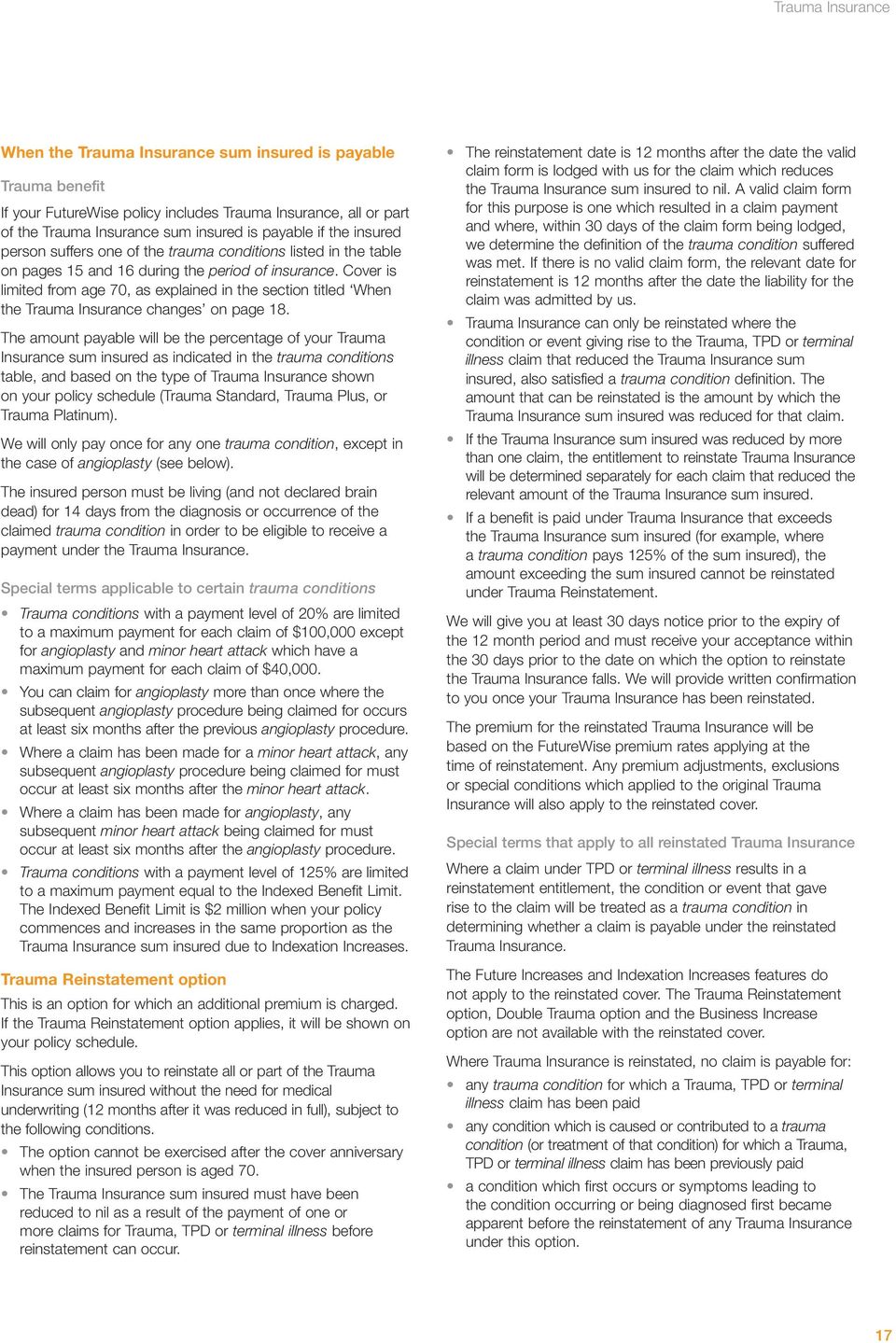
20 Trauma Insurance In addition to the above terms, the following apply to the specific conditions indicated: if a Trauma, TPD, or terminal illness claim has been paid for any one trauma condition in the Heart and Artery body system group, or for primary pulmonary hypertension or chronic kidney failure then no claim is payable for any trauma condition in the Heart and Artery body system group, or for primary pulmonary hypertension, chronic kidney failure or stroke if a Trauma, TPD, or terminal illness claim has been paid for any one trauma condition in the Heart and Artery body system group or for primary pulmonary hypertension, then no claim is payable for paralysis or loss of sight, resulting from cerebrovascular accident if a Trauma, TPD, or terminal illness claim has been paid for any one trauma condition in the Cancer of any body system group then no claim is payable for any trauma conditions in the Cancer of any body system group, or if a Trauma, TPD or terminal illness claim has been paid for dementia including Alzheimer s disease then no claim is payable for stroke or heart attack. Special terms that apply to reinstated Trauma Platinum If you have Trauma Platinum with a sum insured of at least $100,000 (determined by the amount shown on your policy schedule plus applicable indexation increases), and have selected the Trauma Reinstatement option, the following additional terms are included as part of Trauma Reinstatement: if a Trauma, TPD, or terminal illness claim was paid for any one trauma condition in the Heart and Artery body system group, or for primary pulmonary hypertension, or chronic kidney failure then, under the reinstated cover, we will pay a claim if the insured person suffers a heart attack after the date the cover is reinstated. The benefit payable is equal to the lesser of: 10% of the sum insured, and $50,000 if a Trauma, TPD, or terminal illness claim was paid for any one trauma condition in the Cancer of any body system group then, under the reinstated cover, we will pay a claim if the insured person suffers cancer of a different cell type after the date the cover is reinstated. The benefit payable is equal to the lesser of: 10% of the sum insured, and $50,000. Double Trauma option This is an option for which an additional premium is charged. If the Double Trauma option applies, it will be shown on your policy schedule. It is only available if you take Trauma Insurance under a Life Insurance policy or if your Trauma Insurance is connected to a Life Insurance policy through Flexible Linking. Up until the cover anniversary when the insured person is aged 65, this option reinstates the Life Insurance sum insured 14 days after it was reduced by the payment of the Trauma Insurance sum insured in full, without the need for medical underwriting. This option cannot be exercised if a claim for terminal illness (or similar benefit) is in progress or has previously been paid for the insured person by us. The premium will be waived on the reinstated Life Insurance sum insured. Any exclusions or special conditions which applied to the original Life Insurance will also apply to the reinstated Life Insurance. The Future Increases feature, Indexation Increases feature and the Business Increase option do not apply to the reinstated Life Insurance. The Life Insurance Buy Back feature cannot be exercised if the Life Insurance sum insured has been reinstated under the Double Trauma option. When the Trauma Insurance changes From the cover anniversary when the insured person is aged 70, the Trauma Insurance sum insured is only payable if the insured person suffers loss of independent existence, loss of limbs or cognitive loss before the Trauma Insurance ends, as explained in the section titled When cover ends on page 51. When the Trauma Insurance sum insured is reduced There are circumstances when your Trauma Insurance sum insured will be reduced. These include when: we pay a claim other insurance is reduced or cancelled, and/or you reach age 70. When we pay a claim The Trauma Insurance sum insured will be reduced by the following: the amount of any Life Insurance sum insured paid for terminal illness, if Trauma Insurance is: included in a Life Insurance policy, or connected to a Life Insurance policy through Flexible Linking, and the amount of any TPD Insurance sum insured paid, if Trauma Insurance is: included in a policy along with TPD Insurance, or connected through Flexible Linking to a policy which includes TPD Insurance, and the amount of any Trauma Insurance sum insured paid (in full or part) for a trauma condition. Your policy schedule will show any other types of insurances included in your FutureWise policy, and whether it is connected to another policy through Flexible Linking. When other insurance is reduced or cancelled If Trauma Insurance is included in a Life Insurance policy or connected to one through Flexible Linking, and the Life Insurance is reduced or cancelled, the Trauma Insurance sum insured will be reduced so that it is not more than the Life Insurance sum insured. If the Trauma Insurance sum insured is reduced, but part of the sum insured remains, the premium for your policy is adjusted by applying our then current premium rates to the amount of the sum insured that remains. The premium can otherwise be altered as set out on page

21 Trauma Insurance When you reach a certain age From the cover anniversary when the insured person is aged 70, the Trauma Insurance sum insured is reduced to $2 million across all policies issued by us for the insured person. Where we issue multiple policies providing Trauma Insurance for the same insured person we will apply any reduction to the sum insured based on the cover start date of each policy (or the start date of any increases, other than indexation increases), reducing the most recently commenced policy (or approved increase) first. Where portions of the sum insured are subject to different terms Where we agree, your Trauma Insurance may be set up so that separate portions of the sum insured are subject to different terms (such as Trauma cover type, etc). Details of each portion of the sum insured and terms that apply to each will be shown in the policy schedule that we issue to you. The insured person will be assessed against the terms of each portion of the sum insured and benefits will only become payable under those portions of the sum insured where the terms are met. One benefit payable If cover for Trauma Insurance is held in a Linked Insurance structure with other types of Insurance the following conditions apply regarding the order of assessment for claims: where Trauma Insurance is linked to insurance held within superannuation by Flexible Linking, including where Superannuation Optimiser applies, the claim will be assessed under the superannuation policy first after the claim has been assessed under the superannuation policy, if applicable, the claim will then be assessed under any Linked non-superannuation policies. If the insured person suffers a condition that satisfies the definition under more than one benefit at the same time, only one benefit will be paid in respect of the condition, being the one which results in the highest payment. The benefit will be paid to the policy owner of the relevant policy. When we won t pay A Trauma Insurance claim will not be payable if the trauma condition (or where the condition involves surgery or a procedure, the disease or condition for which the surgery or procedure is undertaken): is caused or contributed to by an intentional self-inflicted act is caused or contributed to by anything excluded under the policy as indicated on the policy schedule first occurs or symptoms leading to the condition occurring or being diagnosed first became apparent before the Trauma Insurance cover start date shown in your policy schedule or the date any cover is reinstated, or first occurs or symptoms leading to the condition occurring or being diagnosed first became apparent in the 90 days following the application date or the date any cover is reinstated, including under the Trauma Reinstatement option explained on page 17 and the trauma condition is: a stroke a trauma condition in Cancer of any body system (not including aplastic anaemia), or a trauma condition in the Heart and artery body system (not including cardiomyopathy). This exclusion does not apply to a trauma condition if your policy replaces other similar insurance under a policy or policies issued by Macquarie Life or another insurer (the other policy) and we agreed to issue this policy on the basis that it replaced the other policy (as shown on your policy schedule) and the following conditions are also met: the Trauma Insurance sum insured under the policy being issued by us is the same amount or less than that under the other policy. If the Trauma Insurance sum insured under the policy being issued by us is higher under the other policy, the exclusion only applies to the amount of the Trauma Insurance sum insured in excess of the cover under the other policy the other policy was continuously in force for 90 days immediately prior to the issue of this policy the other policy provided similar cover for the trauma condition the other policy was cancelled immediately after the issue of this policy, and no claim is pending or payable or has been paid under the other policy. 19
22 Common benefits, features and extra cost options for Life, TPD and Trauma Insurance Common benefits, features and extra cost options for Life, TPD and Trauma Insurance The information provided in this section forms part of your terms and conditions for the benefits, features and extra cost options which are common to Life Insurance, TPD Insurance, and Trauma Insurance. Words or expressions shown in italics have their meaning explained in the Glossary at the end of this PDS. Financial Planning benefit Under this benefit, we will reimburse the cost of engaging a qualified financial adviser to prepare a financial plan following payment of the Life, TPD or Trauma Insurance sum insured in full. The total amount payable under this benefit is the lesser of the actual fee paid for the financial planning advice (excluding any commissions received by the adviser) and $1,000. It is payable on receipt of evidence of the financial advice provided, qualifications of the financial adviser and payment made for that advice. This evidence must be received within 12 months of payment of the sum insured. The benefit is payable to the person who receives the sum insured benefit. If the sum insured is paid to more than one person, the maximum amount payable to each beneficiary for reimbursement of financial planning costs incurred by them will be split proportionally in line with the split of the sum insured. The benefit is only payable once for the insured person across all cover with Macquarie Life. The financial adviser whose services are being reimbursed must be qualified and operating under an Australian Financial Services Licence. The Financial Planning benefit is not available if the policy is held within superannuation. Refer to the section titled Ownership on page 46. Indexation Increases feature So that your cover retains its value over time in line with inflation, on each cover anniversary before the insured person reaches age 65, we will increase the sum insured by the greater of 3% and the increase in the consumer price index. We will tell you the proposed indexation increase before it applies and you can choose not to accept the increase. If you decline an increase it will not affect future increase offers. To decline an increase, we must receive your notice of decline before the applicable cover anniversary. Under the Indexation Increases feature, the sum insured can increase above the maximum sum insured allowed at application. Life Insurance Buy Back feature This feature only applies if TPD and/or Trauma Insurance is included in a Life Insurance policy or is connected to a Life Insurance policy through Flexible Linking. The Life Insurance Buy Back feature cannot be exercised if the Life Insurance sum insured has been reinstated under the Double TPD or Double Trauma option. This feature allows you to reinstate the Life Insurance sum insured after it was reduced by the payment of the TPD or Trauma Insurance sum insured in full, without the need for medical underwriting, 12 months after the date a valid claim form is lodged with us. A valid claim form for this purpose is one which resulted in a claim payment and where we determine, within 30 days of the claim form being lodged, the definition of TPD, or the trauma condition suffered, as applicable, was met. If there is no valid claim form, the relevant date for reinstatement is 12 months from the date the liability for the claim was admitted by us. This feature expires on the cover anniversary when the insured person is aged 65. We will give you at least 30 days notice prior to the expiry of the 12 month period and must receive your acceptance within 30 days of the date on which the option to reinstate the Life Insurance falls. We will provide written confirmation to you once your Life Insurance has been reinstated. If the Life Insurance that is being reinstated is provided under a policy held through the insurance-only division of the Macquarie Superannuation Plan or an eligible superannuation plan, it can only be reinstated if the insured person is eligible to make contributions to superannuation. If not, the insured person can request us to issue the reinstated policy to him or her to be held directly. The premium for the reinstated Life Insurance will be based on the FutureWise premium rates applying at the time of reinstatement. Any premium adjustments, exclusions or special conditions, which applied to the original Life Insurance, will also apply to the reinstated cover. The Future Increases and Business Increase features are not available for cover reinstated under the Life Insurance Buy Back feature. The Indexation Increases feature will apply to the reinstated Life Insurance sum insured. Future Increases feature Under this feature, you can apply to increase your existing Life, TPD and/or Trauma Insurance sums insured after certain specified events occur, without the need for medical underwriting. Satisfactory evidence documenting the change in financial position, personal or business event for which the increase is sought will need to be provided to us. This feature expires when the insured person turns 55. Any premium adjustments, exclusions or special conditions which apply to the Life, TPD or Trauma Insurance will also apply to any increases made to each of these insurances under this feature. 20
23 Common benefits, features and extra cost options for Life, TPD and Trauma Insurance Personal events Personal event The insured person marries or registers a partnership The insured person or their partner gives birth to or adopts a child The insured person becomes a carer for the first time The death of the insured person s partner The insured person divorces or de-registers a partnership A child of the insured person turns 18. Maximum increase Occupation classes 1, 1E, 1L, 1M, 1P, 2, 3 & 4 Occupation class 1, 1E, 1L, 1M and 1P only The lowest of: The lowest of: 25% of the applicable sum insured when your policy started, and $200, % of the applicable sum insured when your policy started, and $500,000. The income of the insured person increases by 15% or more in a 12 month period. The insured person takes out a new mortgage or increases an existing mortgage (excluding refinance or draw down). Business events The lowest of: 25% of the applicable sum insured when your policy started, $200,000, and five times the increase in income. The lowest of: 25% of the applicable sum insured when your policy started, $200,000, and the increase in the size of the mortgage. The lowest of: 10% of the applicable sum insured when your policy started, $500,000, and five times the increase in income. The lowest of: 10% of the applicable sum insured when your policy started, $500,000, and the increase in the size of the mortgage. Business event An increase in the insured person s value to your business (if the insured person is a key person in your business). Maximum increase Occupation classes 1, 1E, 1L, 1M, 1P, 2, 3 & 4 Occupation class 1, 1E, 1L, 1M and 1P only The lowest of: The lowest of: 25% of the applicable sum insured when your policy started $200,000, and the increase in the value of the insured person s value to the business. 10% of the applicable sum insured when your policy started $500,000, and the increase in the value of the insured person s value to the business. An increase in the value of the insured person s interest/share in your business (if the insured person is a partner, shareholder or similar principal in your business and this policy supports a buy/sell, share purchase or business succession agreement). Increase in the size of a business loan where the insured person has an interest in the business or is a key person for your business. The lowest of: 25% of the applicable sum insured when your policy started $200,000, and the increase in the value of the insured person s interest/share in the business. The lowest of: 25% of the applicable sum insured when your policy started $200,000, and the increase in the size of the loan. The lowest of: 10% of the applicable sum insured when your policy started $500,000, and the increase in the value of the insured person s interest/share in the business. The lowest of: 10% of the applicable sum insured when your policy started $500,000, and the increase in the size of the loan. 21
24 Common benefits, features and extra cost options for Life, TPD and Trauma Insurance Increasing cover under the Future Increases feature The application for an increase under this feature must be made on the appropriate form. The increase only takes effect from when we approve the application for the increase. Only increases of $10,000 or more are eligible for applications under the Future Increases feature. An increase under this feature cannot be made until 12 months after the cover start date for the applicable insurance cover. The increase in cover must be requested in the six months period following the event and only one increase may be applied for in any 12 month period under this feature. Future Increases cannot be exercised for a business event if the Business Increase option has already been exercised for the same business event. Maximum increases The tables on page 21 set out the events and the maximum amounts by which you can apply to increase the sum insured. If the insured person s occupation class is shown on your policy schedule as 1, 1E, 1L, 1M or 1P, the maximum by which you can increase your cover is determined by whichever of the two methods indicated in the applicable table provide the higher increase in the sum insured. The maximum amount by which the applicable sum insured can be increased under the Future Increases feature on your FutureWise policy is $1 million. TPD Insurance cannot be increased above: $3 million for the Own Occupation and Any Occupation definitions combined $2 million for the Modified TPD definition, and $1 million for the Domestic Duties definition. To be eligible to increase Own Occupation or Any Occupation TPD the insured person must be gainfully employed for at least 20 hours per week at the time of the increase. Trauma Insurance cannot be increased above $2 million. These maximum limits apply inclusive of all cover for the insured person held with us or another insurer. If included in a Life Insurance policy or connected to a Life Insurance policy through Flexible Linking, neither TPD nor Trauma Insurance sums insured can be increased to an amount greater than the Life Insurance sum insured. If included in a TPD Insurance policy or connected to a TPD Insurance policy through Flexible Linking, the Trauma Insurance sum insured cannot be increased to an amount greater than the TPD Insurance sum insured. When the Future Increases feature is not available This feature is not available for each insurance if: the insurance was issued with a premium adjustment in the form of a medical loading of 75% or more, or a claim has or can be made for the insured person under any policy of Life, TPD or Trauma Insurance provided by us. Special terms applying to increased cover If an event or condition giving rise to a claim occurs (or for Trauma Insurance, the symptoms leading to the condition occurring or being diagnosed first became apparent) during the first six months after an increase in the sum insured under this feature, we will only pay a claim in respect of the increased cover if: the condition for which the claim is being made is caused by an accident, and the accident occurs after the date of the increase. Business Increase option This is an option for which an additional premium is charged. If the Business Increase option applies, it will be shown on your policy schedule. It is available with Life, TPD and Trauma Insurance. For policies where several types of insurance are linked, the option can be applied for on Life Insurance only or on all insurances under the policy. It is not available with TPD Insurance if the Modified TPD definition is selected. The person to be insured must be aged between 19 and 60 to apply for this option. When you apply for this option, you nominate a specific business insurance arrangement for which you may want to increase your cover in the future and the current value associated with this arrangement. Business insurance arrangements we may approve include key person insurance, business succession agreements, and loan guarantor insurance. If, after the policy start date, the value of the business insurance arrangement increases (herein referred to as a business event) you may apply to increase the sum insured without the need for medical underwriting. Any increase under this option must be for the same business event for which the policy was originally established as determined by us. The increase must not exceed the increase in the value of the business event, using the same valuation methodology used in the original application. This option cannot be cancelled once you have exercised an increase under this option. Expiry of the Business Increase option This option will expire at the policy anniversary three years after the Business Increase option was included on the policy. However, if you apply and are accepted for an increase under the option within that three year period, the expiry date of the option will be extended to the policy anniversary three years after the increase was accepted. The Business Increase option will expire at the cover anniversary when the insured person is aged 65 if it has not expired earlier as a result of the above terms. Increasing cover under the Business Increase option Your application must be provided on the appropriate form and must be supported by financial evidence of the business event acceptable to us. The increase only takes effect from when we approve the application for the increase. 22
25 Common benefits, features and extra cost options for Life, TPD and Trauma Insurance Only increases of $10,000 or more are eligible for applications under the Business Increase option. Only one increase may be applied for in any 12 month period under this option. Increases under this option cannot be exercised for a business event if the Future Increases feature has already been exercised for the same business event. Limitations on increases The following table sets out the maximum to which the sum insured can be increased over time under this option. Life The lesser of $15 million and three times the original sum insured. TPD The lowest of $5 million, three times the original sum insured, and the maximum sum insured permitted at application based on the insured person s occupation. Trauma The lesser of $2 million and three times the original sum insured. These limits apply inclusive of all cover for the insured person held with Macquarie Life and other insurers. Special terms applying to increased cover In respect of increases under the loan guarantor business event, if an event or condition giving rise to a claim occurs (or in the event of Trauma Insurance, the symptoms leading to the condition occurring or being diagnosed first became apparent) during the first six months after an increase in the sum insured under this feature, we will only pay a claim in respect of the increased cover if: the condition for which the claim is being made is due to an accident, and the accident occurs after the date of the increase. Premium Waiver option This is an option for which an additional premium is charged. If the Premium Waiver option applies it will be shown in your policy schedule. The person to be insured must be aged between 15 and 60 to apply for this option. For persons working in some occupations, the Premium Waiver option may not be available. The Premium Waiver option waives the premium and policy fee on your policy if the insured person meets certain criteria as detailed in the table below. If the insured person also owns a Child Trauma policy, the premiums under the Child Trauma policy will be waived while premiums are being waived for the insured person. Premiums will not be waived under the Premium Waiver option on any insurance that has been reinstated under the Life Insurance Buy Back feature or Trauma Reinstatement option. Premiums will not be waived under the Premium Waiver option where the insured person s total and permanent disablement, total disability or significant disability is caused by or attributable to: an intentional self-inflicted act normal or uncomplicated pregnancy or child birth war or an act of war. The Premium Waiver option ends on the cover anniversary when the insured person is aged 65. The following table sets out the events and the maximum periods for which we will waive the premium and policy fee payable under the policy to which this option applies. Premium Waiver events Event If the insured person has TPD Insurance with us and we have paid the TPD Insurance sum insured in full for the insured person. While a Total Disability benefit is being paid for the insured person under a FutureWise Disability Income Insurance or Business Expenses Insurance policy with us. After the insured person has been significantly disabled for a period of six months, while the insured person continues to be significantly disabled. If the insured person is involuntarily unemployed for at least 10 consecutive working days, while the insured person is involuntarily unemployed and registered with a recognised employment agency. Maximum period for which premium will be waived Until the policy anniversary when the insured person is aged 65. Until the earlier of: the insured person is no longer receiving the Total Disability benefit, or the policy anniversary when the insured person is aged 65. Until the earlier of: the insured person is no longer significantly disabled, or the policy anniversary when the insured person is aged 65. Until the earlier of: the insured person is no longer involuntarily unemployed or registered with a recognised employment agency the premium has been waived due to involuntary unemployment for three months in any 12 month period the premium has been waived due to involuntary unemployment for six months across all cover held with Macquarie Life for the insured person the policy anniversary when the insured person is aged
26 e Business Expenses Insurance Child Trauma Insurance nce Child Trauma Insurance Child Trauma Insurance provides a lump sum payment if the insured child suffers one of the child trauma conditions covered by your policy. The payment could be used to cover additional unexpected expenses as a result of the injury or illness, or provide funds to allow you or your partner to take time off work to care for your child while they are unwell. ce Eligible entry ages 2 14 Expiry age 21 (cover may be converted to an adult policy once the child is 15) Minimum sum insured $10,000 Maximum sum insured $250,000 Other requirements You must have, or be applying for, (as policy owner or insured person) at least one other type of policy issued by Macquarie Life (excluding Blood Borne Disease Insurance or Child Trauma Insurance), and the insured child must be your natural, step or adopted child or grandchild. Income Cover The tables below summarise the benefits and features available for Child Trauma Insurance. Please refer to the relevant sections of this PDS for the complete terms and conditions. Child Trauma Insurance cannot be owned by a trustee of a superannuation fund. Included benefits Benefit name Description Page Child Trauma benefit Pays the Child Trauma Insurance sum insured if the insured child suffers one of the listed 25 child trauma conditions. Included features Feature name Description Page Indexation Increases feature Increases the sum insured every year by the greater of 3% and the increase in the consumer price index so that your cover retains its value against inflation. 25 Continuation of Cover feature Allows you or the insured child to convert the Child Trauma Insurance to an adult policy without the need for medical underwriting once they reach the age of The information provided in this section forms part of your Child Trauma Insurance terms and conditions. Words or expressions shown in italics have their meaning explained in the Glossary at the end of this PDS. Any references to the insured person include references to the insured child, where applicable. Child trauma conditions Body system Condition Body system Condition Cancer of any body system aplastic anaemia cancer Lungs chronic lung disease primary pulmonary hypertension Heart and artery Brain and nerves cardiomyopathy heart attack open heart surgery out of hospital cardiac arrest bacterial meningitis or meningococcal septicaemia benign brain tumour with impairment level brain damage coma encephalitis major head trauma muscular dystrophy with impairment level paralysis stroke Kidneys Ear, nose and throat Eye Musculo-skeletal Digestive system Other chronic kidney failure loss of hearing loss of speech or total aphasia loss of sight loss of limbs severe burns chronic liver disease child's loss of independent existence intensive care major organ transplant medically acquired HIV 24 Some of the above conditions are excluded for 90 days from the application date or date any cover is reinstated. Please refer to the section titled When we won t pay on page 25 for more information.
27 Child Trauma Insurance When the Child Trauma Insurance sum insured is payable Child Trauma benefit If your FutureWise policy includes Child Trauma Insurance, the Child Trauma Insurance sum insured is payable if, during the period of insurance, an insured child: dies is diagnosed with a terminal illness, or suffers one of the child trauma conditions listed in the previous table headed Child trauma conditions after cover starts for the condition. We will only pay the sum insured once under the policy per insured child. Indexation Increases feature So that your cover retains its value over time in line with inflation, on each cover anniversary we will increase the sum insured by the greater of 3% and the increase in the consumer price index. We will tell you the proposed indexation increase before it applies and you can choose not to accept the increase. If you decline an increase it will not affect future increase offers. To decline an increase, we must receive your notice of decline before the applicable cover anniversary. Under the Indexation Increases feature, the sum insured can increase above the maximum sum insured allowed at application. Continuation of Cover feature This feature allows you or the insured child, on any cover anniversary that falls when the insured child is aged 15 to 21 inclusive, to commence either a Life Insurance policy with Linked Trauma Insurance or a Trauma Insurance policy without the need for medical underwriting. The sum insured for the new policy must be no more than the Child Trauma Insurance sum insured for the insured child. The Trauma Insurance cover type for the new policy will be Trauma Standard. Additional information from the insured child will be required at the time of conversion to establish the premium rate that will apply to the insurance. Once this election is made, the Child Trauma Insurance for that insured child is cancelled. The Continuation of Cover feature is not available if a claim has been paid or is payable for the insured child under any cover with us. When we won t pay A Child Trauma Insurance benefit will not be payable in respect of an insured child if the child trauma condition (or where the condition involves surgery or a procedure, the disease or condition for which the surgery or procedure is undertaken): first occurs or symptoms leading to the condition occurring or being diagnosed first became apparent before the Child Trauma Insurance start date shown on your policy schedule or before the date any cover is reinstated is a congenital condition is intensive care and the illness or injury that has caused this condition is as a result of drug or alcohol intake or selfinflicted means is caused by the intentional act or intentional omission of the policy owner or the insured child s parent, guardian or a person acting in a regular de facto role as a parent, or first occurs or symptoms leading to the condition occurring or being diagnosed first became apparent in the 90 days following the application date or the date any cover is reinstated if the child trauma condition is: a stroke, cancer, or a child trauma condition in the Heart and artery body system category (not including cardiomyopathy). This exclusion does not apply if the policy issued by us replaces other similar insurance under a policy or policies issued by us or another insurer (the other policy) and we agreed to issue this policy on the basis that it replaced the other policy (as shown on your policy schedule) and the following conditions are also met: the Child Trauma Insurance sum insured under the policy being issued by us is the same amount or less than that under the other policy. If the Child Trauma Insurance sum insured under the policy being issued by us is higher than that under the other policy, the exclusion only applies to the amount of the Child Trauma Insurance sum insured in excess of the cover under the other policy the other policy was continuously in force for 90 days immediately prior to the issue of this policy the other policy provided similar cover for the child trauma condition the other policy was cancelled immediately after the issue of this policy, and no claim is pending, payable or has been paid under the other policy. Child Trauma Insurance benefit will not be payable if we have not received consent to obtain the medical records, past and present, of the insured child. 25
28 Blood Borne Disease Insurance e Blood Borne Disease Insurance Business Expenses Insurance Blood Borne Disease Insurance provides a lump sum payment if you are infected with the Human Immunodeficiency Virus (HIV) or the Hepatitis B or Hepatitis C virus due to an accident during the course of your regular occupation. The payment could be used to pay for additional expenses incurred, or to supplement your reduced salary if your duties are restricted as a result of the illness. rance Eligible entry ages Expiry age Child Trauma Insurance 65 Minimum sum insured $50,000 Maximum sum insured $1,000,000 Active Cover Insurance Occupation requirement Linked TPD Insurance Other requirements Income Cover Only available to medical professionals and those occupations in which infection with HIV, Hepatitis B or Hepatitis C is an occupational hazard The person to be insured must have, or be applying for, (as policy owner or insured person) at least one other type of policy issued by Macquarie Life (excluding Blood Borne Disease Insurance or Child Trauma Insurance) The tables below summarise the benefits and features available for Blood Borne Disease Insurance. Please refer to the relevant sections of this PDS for the complete terms and conditions. Blood Borne Disease Insurance cannot be owned by a trustee of a superannuation fund. Included benefits Benefit name Description Page Blood Borne Disease benefit Pays the Blood Borne Disease Insurance sum insured if the insured person is infected with HIV, Hepatitis B, or Hepatitis C due to an accident during the course of their regular occupation. 27 Included features Feature name Description Page Indexation Increases feature Increases the sum insured every year by the greater of 3% and the increase in the consumer 27 price index so that cover retains its value against inflation. 26
29 Blood Borne Disease Insurance The information provided below forms part of your Blood Borne Disease Insurance terms and conditions. Words or expressions shown in italics have their meaning explained in the Glossary at the end of this PDS. When the Blood Borne Disease Insurance sum insured is payable Blood Borne Disease benefit If your FutureWise policy includes Blood Borne Disease Insurance, the sum insured will be paid if the insured person becomes infected with HIV or the Hepatitis B or Hepatitis C virus as the result of an accident during the course of the insured person s regular occupation during the period of insurance. The production and detection (sero-conversion) of: HIV antibodies, by way of a positive HIV antibody test, or Hepatitis B surface antigen or HBV DNA, by way of a positive Hepatitis B surface antigen or HBV DNA test, or Hepatitis C antibodies, by way of a positive Hepatitis C antibody test, must be confirmed within six months of the accident. Any accident giving rise to a potential claim must be reported to us within seven days of the accident occurring and supported by a negative HIV, Hepatitis B or Hepatitis C test (as applicable) taken after the accident. We must be given access to test all blood samples used. Indexation Increases feature So that your cover retains its value over time in line with inflation, on each cover anniversary before the insured person reaches age 65, we will increase the sum insured by the greater of 3% and the increase in the consumer price index. We will tell you the proposed indexation increase before it applies and you can choose not to accept the increase. If you decline an increase it will not affect future increase offers. To decline an increase, we must receive your notice of decline before the applicable cover anniversary. Under the Indexation Increases feature, the sum insured can increase above the maximum sum insured allowed at application. When we won t pay A Blood Borne Disease Insurance claim will not be payable if: HIV or the Hepatitis B or Hepatitis C virus is caused by any other means, including sexual activity or intravenous drug use, a treatment is developed and approved which renders the HIV, Hepatitis B or Hepatitis C virus (as applicable) inactive and non-infectious, or the insured person has not taken an approved vaccine that is recommended by the relevant government body for use in the insured person s occupation and is available prior to the event which causes infection. We will only pay an amount under this insurance once. 27
30 Trauma Insurance Blood Borne Disease Insurance Business Expenses Insurance Disability Income Insurance Disability Income Insurance Active Cover Insurance Child Trauma Insurance Disability Income Insurance provides a monthly benefit if you are unable to work due to an illness or injury and are totally or partially disabled for longer than the waiting period. It contributes towards a replacement income so that you can concentrate on your recovery without having to worry about how to pay your ongoing expenses. Eligible entry ages Life Insurance Linked TPD Insurance Income Cover for the to age 70 benefit period with stepped premiums Expiry age 65, or 70 for the to age 70 benefit period Minimum monthly $1,250 insured amount Maximum monthly insured amount Occupation requirement Waiting periods $30,000 plus an additional $30,000 with a two year benefit period limited to the monthly equivalent of: 75% of the first $320,000 of annual income 50% of the next $240,000 of annual income, and 20% of the balance of annual income. The person to be insured must be gainfully employed for a minimum of 20 hours per week at the time of application. 30 days, 60 days, 90 days, 180 days, 1 year and 2 years* Benefit periods 2 years, 5 years, to age 65, to age 70 # * Not available with a 2 year or 5 year benefit period. # Restricted to occupation classes 1E, 1L, 1M, and 1P. Pages 28 to 30 summarise the benefits, features, and extra cost options, as well as other important information about Disability Income Insurance. Please refer to the relevant sections of this PDS for the complete terms and conditions. Disability Income cover types Cover type Disability Income Plus Disability Income Standard Disability Income Super-only * Your adviser will be able to assist you to determine your occupation class. Included benefits Description Available only to those working in occupations classed as 1, 1E, 1L, 1M or 1P.* It includes additional terms with respect to the waiting period requirements, total disability definition, and Premium Waiver feature. Available in superannuation ownership, subject to Superannuation Optimiser. See pages 48 to 50 for more details. Available to all occupation classes. Available in superannuation ownership, subject to Superannuation Optimiser. See pages 48 to 50 for more details. Available to all occupation classes. Only available in superannuation ownership with additional conditions on the payment of benefits. See page 48 for more details. Benefit name Description Page Total Disability benefit Pays the monthly benefit if the insured person is totally disabled. 32 Partial Disability benefit Pays part of the monthly benefit if the insured person is disabled but still earning some income. 32 Specific Injury benefit* Pays the monthly benefit for a set period of time if the insured person suffers one of a list of injuries, even if they return to work. 33 Death benefit Pays the monthly insured amount for up to four months if the insured person dies while a benefit is being paid. 33 * Not included in Disability Income Super-only. 28
31 Disability Income Insurance Included features Feature name Description Page Indexation Increases feature Increases the monthly insured amount each year by the increase in the consumer price index so that cover retains its value against inflation. 33 Premium Waiver feature Waives the premium and policy fee while a benefit is payable. 33 Recurrent Disability feature Allows the insured person to continue with a previous claim without having to meet the waiting period requirements again if a reoccurrence of the same disability occurs within a certain period of time. 34 Waiting Period Reduction feature Involuntary Unemployment Waiver feature Medical Professionals feature* * Not available with Disability Income Super-only. Extra cost options Allows for a one year or two year waiting period to be reduced to a shorter period if the insured person leaves an employer and their salary continuance cover ends as a result. Waives the premium and policy fee if the insured person becomes involuntarily unemployed. Provides special terms for medical professionals who contract the Human Immunodeficiency Virus (HIV), Hepatitis B, or Hepatitis C and as a result have their occupational duties restricted. Option name Description Page Extra Benefits option* Provides a comprehensive suite of additional benefits and features such as the Trauma benefit which pays the monthly benefit for six months if the insured person suffers one of the 34 listed conditions, even if they can return to work. Accident option Allows a benefit to be paid during the waiting period if the insured person suffers an accident that causes them to be totally disabled for at least four consecutive days. 36 Claims Escalation option Increases the monthly benefit each year by the consumer price index while receiving the Total Disability benefit or Partial Disability benefit. 37 Superannuation Cover option* Allows larger portion of income to be insured so that in the event of disability, a contribution can be made into superannuation. 37 Booster option* Increases the monthly benefit payable by 33% for 24 months if the insured person s disability satisfies the any occupation TPD definition. 38 TPD Commutation option* Allows the election of a lump sum payment in place of the ongoing monthly benefit if Total Disability benefits have been paid for 12 months and the insured person meets the any 38 occupation TPD and permanent incapacity definitions. * Not available with Disability Income Super-only. Benefit types The benefit type of Disability Income Insurance will determine how your benefit is calculated at claim time and the type of financial evidence that will need to be provided. FutureWise Disability Income Insurance provides the following three options: Indemnity, Agreed Value, and Endorsed Agreed Value. For some occupations, and for Disability Income Super-only, cover is only available on an Indemnity basis Benefit type Indemnity Agreed Value and Endorsed Agreed Value Description When cover is provided on an Indemnity basis, the benefit payable in the event of a claim is based on the income you were earning prior to your illness or injury occurring. If your income reduces after applying for your policy, you may not receive the full amount for which you are insured. You will need to provide financial evidence at the time of claim to support the benefit being claimed before any benefit can be paid. Evidence of any post-disability income will also be required before payment of the Partial Disability benefit. When cover is provided on an Agreed Value or Endorsed Agreed Value basis, the benefit payable in the event of a claim will be based on your income at the time you applied for the cover up to a maximum of the monthly insured amount. If you elect Endorsed Agreed Value, you will need to provide financial evidence at the time of application that supports the benefit for which you are applying. If you elect Agreed Value cover, you will instead need to provide this financial evidence at the time of claim before any benefit can be paid. If you cannot substantiate the income disclosed at application then your benefit will be reduced accordingly. For both Agreed Value and Endorsed Agreed Value, you will need to provide evidence of any postdisability income before the Partial Disability benefit can be paid. 29
32 Disability Income Insurance The waiting period and benefit period Two important aspects of your Disability Income Insurance are your waiting period and benefit period. Waiting period This is the period of time before a benefit is payable on your policy. Generally, benefits are not payable during the waiting period. Disability Income Insurance benefits are paid monthly in arrears. This means that if you qualify for a benefit your first payment will be made one month after the end of the waiting period. For example, consider a policy with a 30 day waiting period. If the insured person suffered an injury on 1 April and as a result could not work at all, provided they meet the claim requirements and supply all the necessary evidence we request: the waiting period would end on 1 May (30 days after the injury) and the first payment would be paid on 1 June (covering the period from 1 May to 1 June). Benefit period This is the maximum period of time we will make payments for the same disability. For some occupations certain benefit periods may not be available. If payments have been made for the full duration of a 2 year or 5 year benefit period, new claims with a new benefit period can be considered but only after the insured person makes a successful return to gainful employment for at least 20 hours per week for six months before a disability recurs. This applies whether the new claim is as a result of a related or unrelated cause. 30
33 Disability Income Insurance The information provided in this section forms part of your Disability Income Insurance terms and conditions. Words or expressions shown in italics have their meaning explained in the Glossary at the end of this PDS. The monthly benefit If you have FutureWise Disability Income Insurance a monthly insured amount will be shown on your policy schedule. The monthly insured amount (plus any applicable Indexation Increases) is the maximum amount that is payable for any given monthly period. However, where the Booster option applies, the monthly benefit may be higher. See the section entitled Booster option on page 38 for further details. To determine the amount payable each month, we first calculate the monthly benefit. The way your monthly benefit is calculated is determined by the benefit type as indicated on your policy schedule. The monthly benefit is calculated as follows: Endorsed Agreed Value If the benefit type on your policy schedule is Endorsed Agreed Value then the monthly benefit is your monthly insured amount. Agreed Value or Indemnity If the benefit type on your policy schedule is Agreed Value or Indemnity then the monthly benefit is calculated as the lesser of your monthly insured amount and the monthly equivalent of: 75% of the first $320,000 of annualised claimable income, 50% of the next $240,000 of annualised claimable income, and 20% of the balance of annualised claimable income. For both Agreed Value and Indemnity you will need to provide financial evidence satisfactory to us of claimable income. If the Superannuation Cover option is indicated on your policy schedule, different limits will apply. Please see the section entitled Superannuation Cover option on page 37 for further details. Different benefit types If your policy schedule indicates that you have both Endorsed Agreed Value and Indemnity benefit portions then the monthly benefit will be the greater of: the monthly insured amount of the Endorsed Agreed Value portion, and the monthly benefit calculated on the basis of the total of all monthly insured amounts being treated as Indemnity. Once calculated, the monthly benefit is used to determine the benefit payable from either the Total Disability benefit, Partial Disability benefit, Specific Injury benefit, or Trauma benefit (if the Extra Benefits option applies) depending on your disability. Please see the relevant sections of the PDS for further details of these benefits. If the to age 70 benefit period has been selected, the monthly benefit will be calculated on an Indemnity basis for any new claim where the waiting period commences on or after the cover anniversary when the insured person is 65. If the policy schedule indicates that Superannuation Optimiser applies, please also refer to the section entitled Superannuation Optimiser Disability Income Insurance on page 48 for important information regarding how payments are made from the two linked policies under which your benefits are provided. Claimable income Claimable income is used to determine your monthly benefit if your benefit type is Agreed Value or Indemnity. You will need to provide evidence of claimable income, to support the monthly insured amount for which you applied, that is satisfactory to us before we will make any payments to you. If you are unable to provide financial evidence to support the monthly insured amount then your monthly benefit will be reduced accordingly. IMPORTANT: the definition for claimable income is different for Agreed Value and Indemnity policies as detailed below. Agreed Value Claimable income is the higher of the insured person s: highest average monthly income for any 12 consecutive months in the 36 months preceding the start of the waiting period applying to the claim, and pre-application income, adjusted for the change in the consumer price index applicable at each cover anniversary until the date of disability. Pre-application income is generally calculated as the average monthly income for the 12 months immediately prior to the application for cover or the most recent of any approved increases to cover. In some cases we will base the calculation on the average monthly income for the 24 months immediately prior to application or approved increase. See page 82 for the definition of pre-application income. Indemnity Claimable income is the highest average monthly income for any 12 consecutive months in the 36 months preceding the start of the waiting period applying to the claim. The benefit period The benefit period is the maximum period for which a claim for disability is payable. The benefit period that applies is shown on your policy schedule. The benefit period for a claim starts at the end of the waiting period and continues until the earlier of: the end of the selected benefit period (if the benefit period selected is to age 65 or to age 70, the benefit period ends at the cover anniversary when the insured person is aged 65 or 70, respectively), and the date when cover ends (see the section, When cover ends on page 51). If Superannuation Optimiser applies, so that two policies are linked, the payment of a claim under one of the policies will count toward the benefit period of the other policy. See pages 48 to 50 for more information on Superannuation Optimiser. 31
34 Disability Income Insurance The waiting period The waiting period is the period of time you must wait before a benefit is payable under your policy. The waiting period that applies is shown on your policy schedule. The waiting period begins the day the insured person is disabled due to illness or injury and has consulted a medical practitioner in relation to their disability. On the basis of medical and other evidence acceptable to us, we may reduce the waiting period by up to seven days, determined by the number of continuous days for which the insured person was absent from gainful employment due to illness or injury prior to first consulting a medical practitioner in relation to their disability. Return to work during the waiting period The waiting period will restart if the insured person returns to work and is no longer disabled. However we will allow the insured person to return to work during the waiting period, without the waiting period restarting for up to: five consecutive days if the waiting period is 30 days 10 consecutive days if the waiting period is 60 days, 90 days, 180 days, 1 year or 2 years six consecutive months if the waiting period is 2 years and the insured person is also covered by a type of disability income insurance with a benefit period of two years provided through membership of a regulated superannuation scheme in Australia or provided through their employer, or six consecutive months if the waiting period is 1 year and the insured person is also covered by Business Expenses Insurance with a benefit type of Key Person Replacement, as shown on the policy schedule. The waiting period will be extended by the number of days worked while the insured person is not disabled. Total Disability benefit If you have Disability Income Standard as shown on your policy schedule, the Total Disability benefit is payable if, during the period of insurance, the insured person: has been continuously disabled during the waiting period and is totally disabled for at least five consecutive days during that time is totally disabled after the end of the waiting period, or after a period during which a Partial Disability benefit has been paid for the same illness or injury, and continues to be totally disabled. If you have Disability Income Plus as shown on your policy schedule, the Total Disability benefit is payable if, during the period of insurance, the insured person: has been continuously disabled during the waiting period is totally disabled after the end of the waiting period, or after a period during which the Partial Disability benefit has been paid for the same illness or injury, and continues to be totally disabled. If you have Disability Income Super-only as shown on your policy schedule, the Total Disability benefit is payable if, during the period of insurance, the insured person: has been continuously disabled during the waiting period and is totally disabled for at least five consecutive days during that time is totally disabled after the end of the waiting period, or after a period during which the Partial Disability benefit has been paid for the same illness or injury as a result of the disability, has either ceased to be gainfully employed or has temporarily ceased to receive any gain or reward from a continuing arrangement of gainful employment, and continues to be totally disabled. Calculating the benefit payable The Total Disability benefit payable is the monthly benefit, adjusted to take into account any: offsets which apply, as explained in the section titled When the monthly benefit is reduced on page 39, and increases under the Claims Escalation option, if it applies, as explained on page 37. The Total Disability benefit is payable monthly in arrears for each day of total disability after the end of the waiting period (1/30th of the Total Disability benefit payable per day if the benefit is only payable for part of a month), but not beyond the end of the benefit period for that disability. Partial Disability benefit If you have Disability Income Standard or Disability Income Plus as shown on your policy schedule, the Partial Disability benefit is payable if, during the period of insurance, the insured person: has been continuously disabled during the waiting period is partially disabled after the end of the waiting period, or after a period during which the Total Disability benefit has been paid for the same illness or injury, and continues to be partially disabled. If you have Disability Income Super-only as shown on your policy schedule, the Partial Disability benefit is payable if, during the period of insurance, the insured person: has been continuously disabled during the waiting period is partially disabled after the end of the waiting period, or after a period during which the Total Disability benefit has been paid for the same illness or injury as a result of the disability, has either ceased to be gainfully employed or has temporarily ceased to receive any gain or reward from a continuing arrangement of gainful employment, and continues to be partially disabled. 32
35 Disability Income Insurance Calculating the benefit payable The Partial Disability benefit payable is a proportion of the monthly benefit, calculated as follows: pre-disability post-disability income income X monthly benefit pre-disability income adjusted to take into account any: offsets which apply, as explained in the section titled When the monthly benefit is reduced on page 39, and increases under the Claims Escalation option, if it applies, as explained on page 37. The Partial Disability benefit is payable monthly in arrears for each day of partial disability after the end of the waiting period (1/30th of the Partial Disability benefit payable per day if the benefit is only for part of a month) but not beyond the end of the benefit period for that disability. Specific Injury benefit If you have Disability Income Standard or Disability Income Plus as shown on your policy schedule, and the insured person suffers one of the injuries listed below during the period of insurance, we will pay the monthly benefit for the number of months indicated, regardless of whether the insured person is totally disabled. Payments will be made during the waiting period. Injury Paralysis Total and permanent loss of any two of: the use of a foot from the ankle joint the use of a hand from the wrist the sight in an eye that is irreversible. Total and permanent loss of any one of: the use of a foot from the ankle joint the use of a hand from the wrist the sight in an eye that is irreversible. Total and complete severance of the thumb and index finger from the phalangeal joint of the same hand. Fracture of thigh or pelvis. Fracture of the leg (between the knee and foot) or knee cap. Fracture of the upper arm (including elbow and shoulder bone). Fracture of the skull (except bones of the nose or face). Fracture of the lower arm (including wrist, but excluding elbow, hands or fingers). Fracture of the jaw or collarbone. Payment period 60 months* 24 months 12 months 6 months 3 months 2 months 2 months 2 months 1 month 1 month * If the benefit period is two years, the payment period for paralysis under this feature is 24 months. If the benefit period is 2 years or 5 years, the benefit period for disability due to, or related to, an injury for which we have paid the Specific Injury benefit is reduced by the number of months for which we have paid the Specific Injury benefit. If the insured person suffers more than one specific injury at the same time, we will only pay for one specific injury, being the one with the longest payment period. If we are paying benefits under the Specific Injury benefit, payments will cease if Disability Income Insurance ends, explained in the section titled When cover ends on page 51. The Specific Injury benefit is only available on cover held outside of superannuation. Refer to the section titled Ownership on page 46. Death benefit If you have a FutureWise Disability Income Insurance policy and the insured person dies while a benefit is being paid, we will continue to pay a monthly benefit equal to the monthly insured amount, for a period of four months from the date of death upon receipt of the death certificate. The maximum combined benefit we will pay for the four months is $75,000. If you have the Extra Benefits option as shown on your policy schedule, the maximum amount we will pay for the four months is $150,000. Indexation Increases feature So that your cover retains its value over time in line with inflation, on each cover anniversary before the insured person reaches age 65, we will increase the monthly insured amount by the increase in the consumer price index. If the change in the consumer price index is zero or negative, the monthly insured amount will not change. We will tell you the proposed indexation increase before it applies and you can choose not to accept the increase. If you decline an indexation increase it will not affect future Indexation Increases offers. To decline an indexation increase, we must receive your notice of decline before the applicable cover anniversary. If your FutureWise Disability Income Insurance policy provides cover on an Indemnity basis, you should consider whether, by accepting an increase, your monthly insured amount will exceed the monthly benefit. If your FutureWise Disability Income Insurance policy provides cover on an Agreed Value or Endorsed Agreed Value basis, the indexation increases applied to the monthly insured amount will not need to be financially verified at time of claim. Under the Indexation Increases feature, the monthly insured amount can increase above the maximum allowed at application. Premium Waiver feature We will waive the premium and policy fee payable under your FutureWise Disability Income Insurance policy while a benefit is payable. If you have Disability Income Plus as shown on your policy schedule, the premium and policy fee will also be waived during the waiting period, if a benefit becomes payable under the policy. 33
36 Disability Income Insurance 34 Involuntary Unemployment Premium Waiver feature If your FutureWise Disability Income Insurance policy has been continuously in force for six months preceding involuntary unemployment of at least 10 consecutive working days, we will waive the premium and policy fee payable under your policy for up to three months for the period while the insured person is involuntarily unemployed and registered with a recognised employment agency. The premium and policy fee will be waived due to involuntary unemployment for a maximum of three months in any 12 month period and a total maximum of six months inclusive of all cover held with Macquarie Life for the insured person over the life of the policy. If the premium is paid on an annual basis, we will provide a pro rata refund of the premium and policy fee that has already been paid for each month that you are eligible for the Involuntary Unemployment Premium Waiver. This feature is not available if the insured person was selfemployed immediately prior to involuntary unemployment. Recurrent Disability feature If the benefit period under your FutureWise Disability Income Insurance policy is to age 65 or to age 70, any claim for disability arising from the same or a related cause as a previous claim that occurs within 12 months of the date to which benefits have been paid for the previous claim, will be treated as a continuation of the previous claim and the waiting period will be waived. If the claim is made more than 12 months after the previous claim ended it will be treated as a new claim and a new waiting period will apply. If the benefit period under your FutureWise Disability Income Insurance policy is 2 years or 5 years, or this insurance has been extended beyond the cover anniversary when the insured person is aged 65 under the terms of the Cover Extension feature on page 36, any claim for disability arising from the same or a related cause as a previous claim that occurs within six months of the date to which benefits have been paid for the previous claim, will be treated as a continuation of the previous claim and the waiting period will be waived. If the claim is made more than six months after the date to which benefits have been paid for the previous claim, a new waiting period will apply. A new benefit period will apply only if the insured person made a successful return to gainful employment of at least 20 hours per week for a continuous period of six months. Waiting Period Reduction feature If you have a FutureWise Disability Income Insurance policy and the waiting period is 1 year or 2 years as shown on your policy schedule, the waiting period can be reduced without medical underwriting to 1 year or 90 days if the insured person also has salary continuance cover provided through their employer and that cover terminates because they leave their employer. This is not available if the insured person: elects to take up any continuation of cover option on the salary continuance cover are on claim or eligible to claim (on either policy) at the time of applying to reduce the waiting period, or are not engaged in gainful employment of at least 20 hours per week with a new employer. You must apply to change the waiting period within 30 days of the insured person ceasing employment with the employer through which the salary continuance cover was provided. Evidence of the cover, cessation of employment and other information necessary to assess eligibility is required at the time of applying to reduce the waiting period. The premium will be adjusted accordingly for any change made to the waiting period under this feature. Medical Professionals feature If a medical professional contracts HIV, Hepatitis B or Hepatitis C, professional guidelines may restrict their ability to perform certain procedures and result in a reduction of income, well before the illness results in a physical inability to perform the duties of their occupation. If you have Disability Income Standard or Disability Income Plus as shown on your policy schedule, and the insured person is a medical professional, we will consider that the insured person has satisfied the occupational duties component of the total disability or partial disability definition if the following apply: the occupation class shown on your policy schedule is 1M the insured person becomes infected with HIV, Hepatitis B or Hepatitis C as confirmed by documented proof of the infection at the time of infection, exposure-prone procedures, as defined by the relevant professional governing body, are at least one of the duties of the insured person s usual occupation necessary to produce income, and due to the insured person s HIV, Hepatitis B or Hepatitis C status, they are required to cease performing exposure prone procedures as a result of the guidelines of the professional governing body in their state. The other components of the Total Disability benefit and Partial Disability benefit as applicable, must also be satisfied in order for a claim to be admitted. The Medical Professionals feature will not apply if: a treatment is available which renders the HIV or Hepatitis B or Hepatitis C (as applicable) virus inactive and noninfectious, or the insured person has elected not to take an approved vaccine that is recommended by the relevant professional governing body for use in the insured person s occupation and which is available prior to the event which causes infection. Extra Benefits option This is an optional package of additional benefits and features for which an additional premium is charged. It is available if you select Disability Income Standard or Disability Income Plus. If the Extra Benefits option applies, it will be shown on your policy schedule. The Extra Benefits option includes the following benefits and features: Trauma benefit Bed Confinement benefit Home Care benefit Rehabilitation Expenses benefit Accommodation benefit Future Increases feature Cover Extension feature.
37 Disability Income Insurance Trauma benefit If the insured person suffers one of the trauma conditions listed below after the Extra Benefits option starts and before your Disability Income Insurance cover ends, we will pay the monthly benefit for six months, regardless of whether the insured person is disabled. Payments will be made during the waiting period. Body System Cancer of any body system Heart and artery Brain and nerves Lungs Kidneys Ear, nose and throat Eye Musculo-skeletal Digestive system Other Condition aplastic anaemia cancer aortic surgery cardiomyopathy coronary artery bypass surgery heart attack heart valve surgery out of hospital cardiac arrest triple vessel angioplasty bacterial meningitis or meningococcal septicaemia benign brain tumour with impairment level cognitive loss coma dementia including Alzheimer s disease encephalitis major head trauma motor neurone disease with impairment level multiple sclerosis with impairment level muscular dystrophy with impairment level Parkinson s disease with impairment level paralysis stroke chronic lung disease primary pulmonary hypertension chronic kidney failure loss of hearing loss of speech or total aphasia loss of sight loss of limbs severe burns chronic liver disease loss of independent existence major organ transplant medically acquired HIV occupationally acquired HIV We will only pay once for each trauma condition under this benefit. If the benefit period is 2 years or 5 years, the benefit period for disability due to or related to a condition for which we have paid the Trauma benefit is reduced by the number of months for which we have paid the Trauma benefit. If the insured person suffers more than one trauma condition, we will only pay for one trauma condition at a time. If we are paying benefits under the Trauma benefit, payments will cease if the Disability Income Insurance ends as explained in the section titled When cover ends on page 51. Bed Confinement benefit If the insured person is totally disabled, confined to bed, as confirmed by a medical practitioner, and is under the care of a registered nurse for 72 hours or more during the waiting period, we will pay 1/30th of the monthly benefit for each day of such bed confinement during the waiting period. The Bed Confinement benefit is payable for a maximum of 90 days. Home Care benefit If a Total Disability benefit has been paid for at least 30 days, and the insured person is confined to bed as a result of continuing total disability, as confirmed by a medical practitioner, we will increase the amount we will pay in a month to cover either: the forgone income of an immediate family member who provides satisfactory evidence to us that they were gainfully employed for at least 20 hours per week prior to the insured person suffering the illness or injury and have ceased to be gainfully employed to care for the insured person, or the cost of employing a registered nurse or housekeeper. The additional amount we will pay each month is limited to the lesser of $5,000 or the amount equivalent to the monthly benefit, for a maximum of six months. This benefit starts to accrue on the first day all of the above requirements are met and is paid monthly in arrears. This benefit is in addition to any benefit payable for the Total Disability benefit. Rehabilitation Expenses benefit If a Total Disability benefit is payable, we will increase the amount we will pay in a month to cover all or part of any rehabilitation expenses or costs associated with a rehabilitation programme for the insured person that we have approved in advance. A maximum payment of 12 times the monthly benefit applies under this benefit. This benefit is in addition to any benefit payable for the Total Disability benefit or Partial Disability benefit. 35
38 Disability Income Insurance Accommodation benefit If the insured person is totally disabled and confined to bed, as confirmed by a medical practitioner, and an immediate family member requires accommodation at a location more than 100 kilometres from their home to be closer to the insured person, we will increase the amount we will pay in a month to cover the costs of accommodation up to $250 per day for a maximum of 30 days in any 12 month period. The Accommodation benefit is payable during the waiting period. This benefit is in addition to any benefit payable for the Total Disability benefit. Future Increases feature Under this feature, you can apply to increase your monthly insured amount on each cover anniversary until the insured person turns 55, and we will accept the increase without the need for medical underwriting. Only increases to the monthly insured amount above $500 are eligible for applications under the Future Increases feature. The monthly insured amount cannot be increased under the Future Increases feature: by more than 15% at any cover anniversary, or above the monthly equivalent of a percentage of the annual income of the insured person, calculated as follows: 75% of the first $320,000 50% of the next $240,000, and 20% of the balance, subject to a maximum monthly insured amount of: $60,000 per month if the benefit period is 2 years, or $30,000 per month for other benefit periods (plus an additional $30,000 per month for the first 24 months of the benefit period). The combined total of all increases to the monthly insured amount made under this feature cannot exceed the monthly insured amount originally issued. Financial evidence may be required to establish that the insured person s income supports the increase to the monthly insured amount. The increase in cover must be requested in the 30 days prior to the applicable cover anniversary and must be made on the appropriate form. The increase only takes effect from when we approve the application for the increase. Any premium adjustments, exclusions or special conditions which apply to the insurance will also apply to any increases made under this feature. This feature is not available if: the policy was issued with a premium adjustment in the form of a medical loading of 75% or more, or a claim has or can be made for the insured person under any Disability Income Insurance or Business Expenses Insurance policy provided by us. Cover Extension feature This feature applies if the occupation class shown on your policy schedule is 1E, 1L, 1M or 1P. Under this feature we will offer to continue Disability Income Insurance beyond the cover anniversary when the insured person is aged 65, if the insured person is employed in an occupation which we insure under our standard underwriting guidelines at the time the offer is made. This offer will not apply if: we originally offered cover with a limitation on the term of the policy so that cover expires earlier than the cover anniversary when the insured person is aged 65 we originally offered cover with a premium adjustment due to medical reasons, or the insured person was eligible to receive a Total Disability benefit or Partial Disability benefit in the 12 month period preceding the date the offer would otherwise be available. Cover under this feature will be provided on the following modified terms: on an Indemnity basis a benefit period of 12 months benefits will only be payable for the Total Disability benefit, Partial Disability benefit and Death benefit the Extra Benefits option, Claims Escalation option, Accident option and Superannuation Cover option will not apply the Indexation Increases feature will not apply, and the maximum monthly benefit we will pay is $15,000. Cover can continue on the modified basis until the earlier of: the cover anniversary when the insured person is aged 70, and the insured person has not been in gainful employment of at least 20 hours a week for six consecutive months. Accident option This is an option for which an additional premium is charged. If the Accident option applies, it will be shown on your policy schedule. It is only available if a 30 day waiting period applies. For some occupations, the Accident option may not be available. If the insured person is totally disabled for at least four consecutive days within 30 days of suffering an accident the monthly benefit for the Total Disability benefit will be payable during the waiting period. The monthly benefit is payable in arrears for each day of total disability including the first four consecutive days (1/30th of the monthly benefit per day if the benefit is only payable for part of the month), but not beyond the end of the waiting period for that illness or injury. 36
39 Disability Income Insurance Claims Escalation option This is an option for which an additional premium is charged. If the Claims Escalation option applies, it will be shown on your policy schedule. If you have Disability Income Standard or Disability Income Plus as shown on your policy schedule, while the Total Disability benefit or Partial Disability benefit is being paid, we will increase the monthly benefit at the cover anniversary by any increase in the consumer price index. If you have Disability Income Super-only as shown on your policy schedule, while the Total Disability benefit or Partial Disability benefit is being paid, we will increase the monthly benefit at the cover anniversary by the lesser of any increase in the consumer price index, and 5%. Superannuation Cover option The Superannuation Cover option allows you to insure a higher portion of your income so that you can continue to make superannuation contributions while you are disabled. It is not available with Disability Income Super-only or Disability Income Standard or Plus where Superannuation Optimiser applies. Refer to the section titled Ownership on page 46. If the Superannuation Cover option applies, it will be shown on your policy schedule along with a percentage which is the proportion of the monthly benefit that will be paid to a nominated superannuation fund (after any adjustment for tax) while we are paying you a benefit under Disability Income Insurance. The percentage is calculated at the time of application and is calculated by dividing the monthly superannuation contribution being insured by the monthly insured amount. Effect on the monthly benefit calculation If the Superannuation Cover option applies then the way in which your Indemnity and Agreed Value monthly benefit is calculated will be altered to be the monthly equivalent of: 100% of annualised claimable income contributed to superannuation (to a maximum of 20% of annualised claimable income) 75% of the next $320,000 of annualised claimable income 50% of the next $240,000 of annualised claimable income, and 20% of the balance of annualised claimable income. The monthly benefit calculated cannot exceed the monthly insured amount. Example An applicant earns an annual salary package of $110,000 (inclusive of $10,000 superannuation contributions). Without Superannuation Cover option With Superannuation Cover option Superannuation Cover amount Remainder of Income Monthly insured amount Nil 75% x $110,000 $6,875 = $82,500 / 12 = $6, % x $10,000 75% x $100,000 $7,083 = $10,000 / 12 = $75,000 / 12 = $833 = $6,250 The percentage of any benefits paid to the nominated superannuation fund at the time of claim is 11.76% ($833 / $7,083). Payment of the Superannuation Cover amount You must provide us with the name and details of a nominated superannuation fund to which the Superannuation Cover portion of any benefits payable is to be paid. If you do not provide us with a direction at time of claim, we may not be able to pay the Superannuation Cover amount. If the fund you nominate does not accept the Superannuation Cover amount from us, we will pay it to you subject to proof that the amount is subsequently forwarded to a superannuation provider for the insured person s benefit. We will adjust the Superannuation Cover amount for the potential tax liability that may apply to this amount based on the marginal rate of tax that would otherwise have applied to the last dollar of the insured person s pre-disability income. The tax adjustment amount will be paid directly to you and the Superannuation Cover amount reduced by this tax adjustment amount before it is paid to the nominated superannuation fund. The amount that we pay to the nominated superannuation fund is paid on the insured person s behalf as a personal contribution and subject to the standard superannuation rules relating to preservation, contributions and tax. 37
40 Disability Income Insurance TPD Commutation option This is an option for which an additional premium is charged. If the TPD Commutation option applies, it will be shown on your policy schedule. The TPD Commutation option is only available where: the cover type is Disability Income Standard or Disability Income Plus the waiting period is 30, 60 or 90 days the Claims Escalation option is selected, and the insurance is held within superannuation (see the section titled Ownership on page 46). TPD commutation is only available on that portion of the monthly insured amount with a to age 65 or to age 70 benefit period. After the Total Disability benefit has been paid for at least 12 months, this option allows you to elect to receive a lump sum amount in place of the ongoing monthly benefit if the insured person suffers total and permanent disablement that meets the any occupation TPD definition and meets the superannuation law definition of permanent incapacity as amended from time to time. The option will not apply if the insured person has a terminal illness. The monthly benefit for the purposes of calculating the TPD Commutation amount does not include any increase in the monthly insured amount provided under the Booster option. The benefit payable under this option is the lesser of: $3 million, and the relevant multiple of that portion of the monthly benefit which would otherwise be payable under the applicable benefit period less any offsets which apply, as explained in the section titled When the monthly benefit is reduced on page 39, where the multiple is: Age next birthday less than 40 years Multiples for to age 65 benefit period to to to to minus age next birthday, multiplied by to minus age next birthday, multiplied by 12 Multiples for to age 70 benefit period 70 minus age next birthday, multiplied by 12 The relevant multiple is based on the age of the insured person at the date the lump sum becomes payable, not when the request is received. Booster option This is an option for which an additional premium is charged. If the Booster option applies, it will be shown on your policy schedule. The Booster option is only available where: the cover type is Disability Income Standard or Disability Income Plus the benefit period is to age 65 or to age 70, and the monthly insured amount applied for, inclusive of any Superannuation Cover amount, is $30,000 per month or less. Under this option, if the insured person suffers a disability that meets the any occupation TPD definition, we will increase the monthly benefit by 33% for the Total Disability benefit, Specific Injury benefit or Trauma benefit for a maximum of 24 months over the life of the policy. Any benefits payable after the cover anniversary when the insured person is age 65 will not be subject to increases under this option. The Booster option does not apply to a claim for the Partial Disability benefit, Death benefit, Bed Confinement benefit, Home Care benefit, Rehabilitation benefit, Accommodation benefit or benefits payable under the Accident option or TPD Commutation option. The Indexation Increases feature and the Claims Escalation option will continue to apply. If the Superannuation Cover option applies, the Superannuation Cover percentage will be applied to the increased benefit payable to determine the amount payable to the trustee of your nominated superannuation fund. One benefit payable If the insured person is eligible for one or more benefit(s) payable for the Total Disability benefit, Partial Disability benefit, Specific Injury benefit, Trauma benefit, Bed Confinement benefit or Accident option at the same time, only one benefit will be payable, being the benefit which provides the highest payment. When portions of the monthly insured amount are subject to different terms Where we agree, your FutureWise Disability Income Insurance policy may be set up so that separate portions of the monthly insured amount are subject to different waiting periods, benefit periods, types of cover and/or options. Details of each portion of the monthly insured amount, and the waiting periods, benefit periods, types of cover and options that apply to each portion, will be shown on the policy schedule issued to you. In determining the monthly benefit to be used as the basis for the payment of any benefit(s) under the policy in any given month, we will consider the sum of only those portions of the monthly insured amount for which the particular benefit is payable, having regard to the waiting period, benefit period, type of cover and options that are applicable. The lump sum that you receive under this option will be treated in the same way as TPD Insurance for tax purposes. 38 Cover ends and all benefits are reduced to nil under your FutureWise Disability Income Insurance policy as well as any policy to which it is linked (if applicable) when a benefit is paid under the TPD Commutation option.
41 Disability Income Insurance When the monthly benefit is reduced The monthly benefit payable for the Total Disability benefit or Partial Disability benefit may be reduced by any of the following payments that are made or are payable in respect of the insured person: legislated compensation schemes and Workers Compensation (unless your policy schedule shows you have Disability Income Standard or Disability Income Plus and the insured person is categorised with an occupation class of 1E, 1L, 1M or 1P) any other insurance that provides income payments due to illness or injury, which commenced prior to the commencement of the FutureWise Disability Income Insurance policy unless we have expressly agreed in writing not to apply a reduction, and any payments received from an employer for periods of approved leave including sick leave payments if your policy schedule shows you have Disability Income Super-only. If a lump sum is paid by any of the above sources in respect of the insured person, we will convert that lump sum to a monthly payment at the rate of 1% of the lump sum paid per month for the first 100 months. Benefit reductions will only start once the lump sum has been paid. The benefit we will pay will only be reduced to ensure that, when combined with the payments from any of the above sources and any post-disability income, it does not exceed the monthly equivalent of 75% of pre-disability income (100% of pre-disability income for the Partial Disability benefit or while the monthly benefit is increased under the Booster option). Additional reductions where Key Person Replacement cover also applies If the insured person is also covered under Macquarie Life Business Expenses Insurance and the benefit type is Key Person Replacement, claims cannot be paid under both types of insurance for the same period (including where the policies do not have the same policy owner). If these circumstances apply, any benefit otherwise payable under Disability Income Insurance will be reduced to nil if it is less than or equal to the amount payable under Business Expenses Insurance for the same period. When we won t pay A benefit will not be payable under Disability Income Insurance for a claim which is caused or contributed to by: an intentional self-inflicted act normal or uncomplicated pregnancy or childbirth war or an act of war anything excluded under the policy as indicated on the policy schedule elective surgery that occurs within six months of: the cover start date the date any cover is reinstated (but only in respect of the reinstated cover), or the cover start date for any increase in cover that you applied for (but only in respect of that increase) for the Trauma benefit on page 35, a trauma condition that first occurs or symptoms leading to the condition occurring or being diagnosed first became apparent in the 90 days following the application date or the date any cover is reinstated if that trauma condition is: stroke cancer, or in the Heart and artery body system (not including cardiomyopathy). This exclusion does not apply to the Trauma benefit in respect of a trauma condition listed if the policy issued by us replaces other similar insurance under a policy or policies issued by us or another insurer (the other policy) and we agreed to issue this policy on the basis that it replaced the other policy (as shown on your policy schedule) and the following conditions are also met: the Disability Income Insurance monthly insured amount under the policy being issued by us is the same amount or less than that under the other policy. If the monthly insured amount under the policy being issued by us is higher than that under the other policy, the exclusion only applies to the amount of the monthly insured amount in excess of the monthly insured amount under the other policy the other policy was continuously in force for 90 days immediately prior to the issue of this policy the other policy provided similar cover for the trauma condition the other policy was cancelled immediately after the issue of this policy, and no claim is pending or payable under the other policy. We will not pay for any period while the insured person is in jail. Benefits are only payable for up to six months while the insured person is outside Australia. In some circumstances, benefits may continue to be paid beyond six months if the insured person returns to Australia or attends a regional medical facility approved by us. The payment of Disability Income Insurance benefits will end if the insured person unreasonably refuses to undergo the medical treatment including rehabilitation to treat their condition as recommended by their medical practitioner. If you have Disability Income Super-only as shown on your policy schedule, in addition to the above conditions, a benefit will not be payable for a claim if at the time the insured person first becomes disabled, the insured person was not in gainful employment. (Note: While the insured person is not in gainful employment, the policy continues subject to this restriction on a claim being paid, so that cover is still available upon return to gainful employment. Premiums continue to be payable during the absence from gainful employment, unless you exercise the premium and policy suspension feature explained on page 54.) 39
42 Business Expenses Insurance Business Expenses Insurance e Business Expenses Insurance Business Expenses Insurance provides a monthly benefit that can reimburse ongoing fixed business expenses or the costs to hire a replacement employee while the insured person is disabled due to an illness or injury. nce ce Eligible entry ages Expiry age 65 Minimum monthly insured amount $1,250 (or $750 if taken with Disability Income Insurance) Maximum monthly insured amount $60,000 Occupation requirement The person to be insured must be gainfully employed for a minimum of 20 hours per week at the time of application. Child Trauma Insurance Pages 40 and 41 summarise the benefits, features, extra cost options and other important information on Business Expenses Income Cover Insurance. Please refer to the relevant sections of this PDS for the complete terms and conditions. Business Expenses Insurance cannot be owned by a trustee of a superannuation fund. Included benefits Benefit name Description Page Total Disability benefit Pays the monthly benefit if the insured person is totally disabled. 42 Partial Disability benefit Pays part of the monthly benefit if the insured person is partially disabled. 43 Death benefit Continues to pay the monthly insured amount for up to four months if the insured person dies while a benefit is being paid. 43 Included features Feature name Description Page Indexation Increases feature Increases the monthly insured amount each year by the increase in the consumer price index so that cover retains its value against inflation. 43 Future Increases feature Allows an increase to the monthly insured amount at the cover anniversary without the need for medical assessment. 43 Premium Waiver feature Waives the premium and policy fee while a benefit is payable. 44 Recurrent Disability feature Allows the insured person to continue with a previous claim without having to meet the waiting period requirements again if a reoccurrence of the same disability occurs within a 44 certain period of time. Cover Extension feature Extends the benefit period past the usual expiry date if the insured person is still employed in an occupation acceptable to us. 44 Extra cost options Option name Description Page Accident option Allows a benefit to be received during the waiting period if the insured person suffers an 44 accident that causes them to be totally disabled for at least four consecutive days. 40
43 Business Expenses Insurance Benefit type The benefit type you choose will determine the monthly insured amount you can apply for as well as the business expenses that may be eligible for reimbursement at claim time. FutureWise Business Expenses Insurance provides two options: Ongoing Fixed Expenses and Key Person Replacement. The insured person cannot be insured under both Ongoing Fixed Expenses and Key Person Replacement cover. Benefit type Ongoing Fixed Expenses Key Person Replacement Description The benefit payable in the event of a claim is based on the allowable business expenses incurred each month by the insured person up to a maximum of the monthly insured amount. This may include items such as rent on a business premises, electricity, rates, etc. Up to 100% of allowable business expenses can be insured at application. The benefit payable in the event of a claim is based on the key person replacement costs incurred each month to replace the insured person within the business for up to a maximum of the monthly insured amount. This means that in any given month, if no key person replacement costs are incurred, then no benefit will be payable for that month. Up to 75% of key person replacement costs can be insured at application. The waiting period and benefit period Two important aspects of Business Expenses Insurance are the waiting period and benefit period. Waiting period This is the period of time before a benefit becomes payable on a policy. Generally, benefits are not payable during the waiting period. A waiting period of either a 30 days or 90 days can be selected. Business Expenses Insurance benefits are paid monthly in arrears. This means that after qualifying for a benefit the first payment will be made one month after the end of the waiting period. For example, consider a policy with a 30 day waiting period. If the insured person suffered an injury on 1 April and as a result could not work at all, provided they meet the claim requirements and supply all the necessary evidence we request: the waiting period would end on 1 May (30 days after the injury), and the first payment would be paid on 1 June (covering the period from 1 May to 1 June). Benefit period This is the maximum period of time for which we will make payments for the same disability. The maximum benefit period is 24 months with the maximum total benefit payable over this period being 12 times the monthly insured amount. If payments have been made for the full duration of the Business Expenses Insurance benefit period, a new benefit period can be considered but only after the insured person makes a successful return to gainful employment for at least 20 hours per week for six months before a disability recurs. This applies whether the new claim is as a result of a related or unrelated cause. 41
44 Business Expenses Insurance The information provided in this section forms part of your Business Expenses Insurance terms and conditions. Words or expressions shown in italics have their meaning explained in the Glossary at the end of this PDS. The monthly benefit If you have FutureWise Business Expenses Insurance a monthly insured amount will be shown on your policy schedule. The monthly insured amount is the maximum amount that is payable for any given monthly period. To determine the amount payable from your policy each month, we first need to calculate the monthly benefit. The way in which your monthly benefit is calculated is determined by the benefit type as indicated on your policy schedule. The monthly benefit is calculated as follows: Ongoing Fixed Expenses If the benefit type on your policy schedule is Ongoing Fixed Expenses then the monthly benefit is the lesser of the monthly insured amount and the insured person s share of allowable business expenses which are incurred while they are disabled. Key Person Replacement If the benefit type on your policy schedule is Key Person Replacement then the monthly benefit is the lesser of the monthly insured amount and 75% of the key person replacement costs incurred while the insured person is disabled. Once calculated, the monthly benefit is used to determine the benefit payable from either the Total Disability benefit or Partial Disability benefit depending on the insured person s disability. It is important to note that, while the benefit payable will never exceed the monthly insured amount, in some cases it may be less than the monthly insured amount. The benefit period The benefit period is the maximum period for which a claim for disability is payable. The benefit period for any one claim starts at the end of the waiting period and continues until the earlier of: the end of a 24 month period the total of benefits paid for the claim reaching 12 times the monthly insured amount, and the date when cover ends (see the section, When cover ends on page 51). The waiting period The waiting period is the period of time you must wait before a benefit becomes payable on your policy. The waiting period that applies is shown on your policy schedule. The waiting period begins the day the insured person is disabled due to illness or injury and has consulted a medical practitioner in relation to their disability. On the basis of medical and other evidence acceptable to us, we will reduce the waiting period by up to seven days, determined by the number of continuous days the insured person was absent from gainful employment due to illness or injury prior to first consulting a medical practitioner in relation to their disability. The waiting period will restart if the insured person returns to work and is no longer disabled. However, we will allow the insured person to return to work during the waiting period, without the waiting period restarting, for up to: five consecutive days if the waiting period is 30 days, or 10 consecutive days if the waiting period is 90 days. The waiting period will be extended by the number of days worked while the insured person is not disabled. Total Disability benefit If you have FutureWise Business Expenses Insurance as shown on your policy schedule, the Total Disability benefit is payable if, during the period of insurance, the insured person: has been continuously disabled during the waiting period and is totally disabled for at least five consecutive days during that time is totally disabled after the end of the waiting period, or after a period during which a Partial Disability benefit has been paid for the same illness or injury, and continues to be totally disabled. If you have FutureWise Business Expenses Insurance as well as Disability Income Plus as shown on your policy schedule, the Total Disability benefit is payable if, during the period of insurance, the insured person: has been continuously disabled during the waiting period is totally disabled after the end of the waiting period, or after a period during which the Partial Disability benefit has been paid for the same illness or injury, and continues to be totally disabled. 42
45 Business Expenses Insurance Calculating the benefit payable The Total Disability benefit payable is the monthly benefit, adjusted to take into account any offsets which apply, as explained in the section titled When the monthly benefit is reduced on page 45. The Total Disability benefit is payable monthly in arrears for each day of total disability after the end of the waiting period (1/30th of the Total Disability benefit payable per day if the benefit is only payable for part of a month), but not beyond the end of the benefit period for that disability. Partial Disability benefit If you have FutureWise Business Expenses Insurance as shown on your policy schedule, the Partial Disability benefit is payable if, during the period of insurance, the insured person: has been continuously disabled during the waiting period is partially disabled after the end of the waiting period, or after a period during which the Total Disability benefit has been paid for the same illness or injury, and continues to be partially disabled. The benefit payable will be adjusted to take into account any offsets which apply, as explained in the section titled When the monthly benefit is reduced on page 45. The Partial Disability benefit is payable monthly in arrears for each day of partial disability after the end of the waiting period (1/30th of the Partial Disability benefit payable per day if the benefit is only for part of a month) but not beyond the end of the benefit period for that disability. Calculating the benefit payable for Ongoing Fixed Expenses If your Business Expenses Insurance has a benefit type of Ongoing Fixed Expenses as shown on your policy schedule, the Partial Disability benefit will be calculated as follows: pre-disability post-disability business income business income pre-disability business income X monthly benefit Calculating the benefit payable for Key Person Replacement If your Business Expenses Insurance has a benefit type of Key Person Replacement as shown on your policy schedule, the Partial Disability benefit will be calculated as the lesser of: the monthly benefit, and a portion of the monthly insured amount based on the hours worked by the insured person as outlined in the table below. Maximum percentage of the Hours worked per week monthly insured amount Up to 15 hours 75% More than 15 hours but less 50% than hours or more 25% Death benefit If you have a FutureWise Business Expenses Insurance policy and the insured person dies while a benefit is being paid, we will continue to pay a monthly benefit equal to the monthly insured amount for a period of four months from the date of death upon receipt of the death certificate. The maximum combined benefit we will pay for the four months is $75,000. Indexation Increases feature So that your cover retains its value over time in line with inflation, on each cover anniversary before the insured person reaches age 65 we will increase the monthly insured amount by the increase in the consumer price index. If the change in the consumer price index is zero or negative, the monthly insured amount will not change. We will tell you the proposed indexation increase before it applies and you can choose not to accept the increase. If you decline an increase it will not affect future increase offers. To decline an increase, we must receive your notice of decline before the applicable cover anniversary. You should consider whether, by accepting an increase, your monthly insured amount will exceed the monthly benefit. Under the Indexation Increases feature, the monthly insured amount can increase above the maximum allowed at application. Future Increases feature If you have a FutureWise Business Expenses Insurance policy, under this feature, you can apply to increase your monthly insured amount on each cover anniversary until the insured person turns 55, and we will accept the increase without the need for medical underwriting. Only increases to the monthly insured amount above $500 are eligible for applications under the Future Increases feature. The monthly insured amount cannot be increased under the Future Increases feature: For Ongoing Fixed Expenses by more than 15% at any cover anniversary above the insured person s share of monthly allowable business expenses at the time of applying for the increase above $60,000 per month (this includes existing business expenses insurance with us or another insurer) if the insured person s share of business income has decreased in the 12 months prior to the cover anniversary at which the increase application is made. For Key Person Replacement by more than 15% at any cover anniversary above 75% of the key person replacement costs at the time of applying for the increase above $60,000 per month (this includes existing business expenses or disability income insurance with us or another insurer) if the insured person s share of business income has decreased in the 12 months prior to the cover anniversary at which the increase application is made. 43
46 Business Expenses Insurance The combined total of all increases to the monthly insured amount made under this feature cannot exceed the monthly insured amount originally issued. Financial evidence may be required to establish that the financial position of the insured person s business supports the increase to the monthly insured amount. The increase in cover must be requested in the 30 days prior to the applicable cover anniversary and must be made on the appropriate form. Any premium adjustments, exclusions or special conditions which apply to the insurance will also apply to any increases made under this feature. This feature is not available if: the policy was issued with a premium adjustment in the form of a medical loading of 75% or more, or a claim has or can be made for the insured person under any policy of Disability Income or Business Expenses Insurance provided by us. Premium Waiver feature We will waive the premium and policy fee payable under your Business Expenses Insurance policy while a benefit is payable. If you also have Disability Income Plus, the premium and policy fee under your Business Expenses Insurance policy will also be waived during the waiting period if a benefit becomes payable under your Business Expenses Insurance policy. Recurrent Disability feature Any Business Expenses Insurance claim for disability arising from the same or a related cause as a previous claim that occurs within six months of the date to which benefits have been paid for the previous claim, will be treated as a continuation of the previous claim and the waiting period will be waived. If the claim is made more than six months after the date to which benefits have been paid for the previous claim, a new waiting period will apply. A new benefit period will apply only if the insured person made a successful return to gainful employment for a continuous period of six months. Cover Extension feature If you have a FutureWise Business Expenses Insurance policy, this feature applies if the occupation class shown on your policy schedule is 1E, 1L, 1M or 1P. Under this feature we will offer to continue your Business Expenses Insurance beyond the cover anniversary when the insured person is aged 65, if the insured person is employed in an occupation which we insure under our standard underwriting guidelines at the time the offer is made. This offer will not apply if: we originally offered cover with a limitation on the term of the policy so that cover expires earlier than the cover anniversary when the insured person is aged 65 we originally offered cover with a premium adjustment due to medical reasons, or the insured person was eligible to receive a Total Disability benefit or Partial Disability benefit in the 12 month period preceding the date the offer would otherwise be available. Cover under this feature will be provided on the following modified terms: the Accident option will not apply Indexation Increases will not apply, and the maximum monthly benefit we will pay is $15,000. Cover can continue on the modified basis until the earlier of: the cover anniversary when the insured person is aged 70, and the insured person has not been in gainful employment of at least 20 hours a week for six consecutive months. Accident option This is an optional benefit, for which an additional premium is charged. If the Accident option applies, it will be shown on your policy schedule. If the insured person is totally disabled for at least four consecutive days within 30 days of suffering an accident the monthly benefit for the Total Disability benefit will be payable during the waiting period. The monthly benefit is payable in arrears for each day of total disability including the first four consecutive days (1/30th of the monthly benefit per day if the benefit is only payable for part of the month), but not beyond the end of the waiting period for that illness or injury. 44
47 Business Expenses Insurance One benefit payable If the insured person is eligible for one or more benefit(s) payable for the Total Disability benefit, Partial Disability benefit, or Accident option at the same time, only one benefit is payable, being the benefit which provides the highest payment. When portions of the monthly insured amount are subject to different terms Where we agree, your Business Expenses Insurance policy may be set up so that separate portions of the monthly insured amount are subject to different waiting periods and/or options. Details of each portion of the monthly insured amount, and the waiting periods and options that apply to each portion, will be shown in the policy schedule issued to you. You can not set up a Business Expenses Insurance policy with benefit types of both Ongoing Fixed Expenses and Key Person Replacement. In determining the monthly benefit to be used as the basis for the payment of any benefit(s) under the policy in any given month, we will consider the sum of only those portions of the monthly insured amount for which the particular benefit is payable, having regard to the waiting period and options that are applicable. When the monthly benefit is reduced Ongoing Fixed Expenses If your Business Expenses benefit type is Ongoing Fixed Expenses as shown on your policy schedule, the monthly benefit payable for the Total Disability benefit or Partial Disability benefit may be reduced by any other business expense benefit payable due to illness or injury under any other insurance which commenced prior to the commencement of the FutureWise Business Expenses Insurance cover, unless we have expressly agreed in writing not to apply a reduction. We will only reduce the monthly benefit payable to ensure that, when combined with any benefit payments from the above source, it does not exceed 100% of allowable business expenses. Key Person Replacement If your Business Expenses benefit type is Key Person Replacement as shown on your policy schedule, the monthly benefit payable for the Total Disability benefit or Partial Disability benefit may be reduced by any other business expenses benefits or disability income benefits payable due to illness or injury under any other insurance whether that insurance commenced prior to, or after, the commencement date of the FutureWise Business Expenses Insurance cover, unless we have expressly agreed in writing not to apply a reduction. In addition, if the benefit type of your Business Expenses Insurance policy is Key Person Replacement and the insured person is also covered under Macquarie Life Disability Income Insurance, claims cannot be paid under both types of insurance for the same period (including where the policies do not have the same policy owner). If these circumstances apply, any benefit otherwise payable under Business Expenses Insurance will be reduced to nil if a greater amount is payable under Disability Income Insurance for the same period. Conditions which apply to the payment of benefits We will apportion pre-paid or accrued allowable business expenses and key person replacement costs over the period to which they relate, to determine the amounts which are attributable to the month for which we are assessing the benefit payable, unless we agree to a different basis. If your Business Expenses Insurance benefit type is Ongoing Fixed Expenses, if more than one person generates income in the insured person s business we will attribute the allowable business expenses in equal proportion between the insured person and the other person(s), to determine the insured person s own share, unless we agree to attribute the business expenses on a different basis. We only consider allowable business expenses and key person replacement costs for which receipts or other evidence acceptable to us are provided to us within 90 days of the date they were incurred. When we won t pay A benefit will not be payable under Business Expenses Insurance for a claim which is caused by or attributable to: an intentional self-inflicted act anything excluded under the policy as indicated on the policy schedule normal or uncomplicated pregnancy or child birth war or an act of war, or elective surgery that occurs within six months of: the cover start date the date any cover is reinstated (but only in respect of that reinstated cover), or the cover start date for any increase in cover that you applied for (but only in respect of that increase). We will not pay for any period while the insured person is in jail. Benefits are only payable for up to six months while the insured person is outside of Australia. In some circumstances, benefits may continue to be paid beyond six months if the insured person returns to Australia or attends a regional medical facility approved by us. If your Business Expenses Insurance benefit type is Key Person Replacement, if prior to disability the insured person ceases to be employed and/or ceases to be an owner of your business then benefit payments will not be available. The payment of Business Expenses benefits will end if the insured person unreasonably refuses to undergo the medical treatment including rehabilitation to treat their condition as recommended by their medical practitioner. 45
48 Ownership Ownership FutureWise allows you to structure your insurance with: non-superannuation ownership: where one or more individuals, a company, or a trust (ie an entity that is not a trustee of a superannuation fund) owns the insurance superannuation ownership: where a trustee of a superannuation fund (of which you are a member) owns the insurance. This can include: MIML as trustee of the insurance-only division of the Macquarie Superannuation Plan MIML or another trustee approved by Macquarie Life as trustee of an eligible superannuation plan a trustee of a self-managed superannuation fund (SMSF). In some cases we allow insurance to be split across two policies, with different policy owners. Non-superannuation ownership When you apply for FutureWise outside of superannuation, the policy is issued directly to you as the policy owner. You can apply for cover on your own life or the life of another person unless applying for cover under Disability Income Insurance or Business Expenses Insurance, which are generally only available on your own life. If you apply for cover on the life of another person, you must have an insurable interest in the person to be insured that is satisfactory to us. Where there are multiple owners of a single policy who are individual persons, each will own the policy as joint tenants (ie on the death of one of the policy owners, their share passes to the surviving joint tenants) unless we agree to a different arrangement which we will note on your policy schedule. If a benefit becomes payable, the benefit is generally paid to the policy owner. If the insured person and policy owner are the same, the amount payable on the death of the insured person will generally be paid to the insured person s legal personal representative, or nominated beneficiaries. Nominating a beneficiary for death benefits If the policy owner is the same as the insured person, up to five beneficiaries can be nominated to receive the benefit payment if the insured person dies. If you do not nominate a beneficiary, the benefit will be paid to your legal personal representative or other person we are permitted to pay under the Life Insurance Act 1995 (Cth). Each beneficiary you nominate must be a person, a company, a trust, or a legally recognised charity. You can change or cancel these nominations at any time in writing. A change in a nomination only takes effect when received by us. At time of claim, if part of a nomination is invalid or one of the nominated beneficiaries has predeceased the insured person, the proceeds in relation to that invalid part or predeceased nominated beneficiary will be paid to your legal personal representative. If a nominated beneficiary is a minor, we will pay the proceeds in relation to that nominated beneficiary to their legal guardian or into a trust for which that minor is a beneficiary. All nominations will automatically cease if ownership of the policy is transferred. Flexible Linking Flexible Linking is available with Life, TPD and Trauma Insurances and allows you to connect two policies with different ownership to each other, in order to link together insurances covering the same insured person. Where Flexible Linking is used to connect policies, a claim paid under any one insurance policy will reduce the sums insured of all insurance held under the other policy, as well as all sums insured under the policy for which the claim is paid. Where TPD and/or Trauma Insurance are under a policy linked to other insurances through Flexible Linking, these are referred to on your policy schedule as Flexible TPD Insurance or Flexible Trauma Insurance. The policy schedule will identify each policy connected through Flexible Linking. The sums insured for Flexible TPD and Flexible Trauma Insurance cannot be greater than the sum insured for Life Insurance when connected through Flexible Linking. If the Life Insurance sum insured is reduced, the Flexible TPD and Flexible Trauma Insurance sums insured will also be reduced so that they are no greater than the Life Insurance sum insured. Where Flexible Linking applies and a linked policy is cancelled, we will recalculate the premiums for the continuing policy using the premium rates applicable at the time of the calculation, taking into account that the remaining insurance is no longer linked to the cancelled insurance. For example, the premium for Flexible Linked TPD Insurance will change if Flexible Linked Trauma Insurance, to which it is linked, is cancelled. Flexible Linking is also used when your TPD Insurance is structured with Superannuation Optimiser. Ownership within superannuation When you apply for FutureWise within superannuation, the policy is issued to a trustee of the relevant superannuation fund as policy owner. If you are the trustee of a self-managed superannuation fund, it is your responsibility as trustee to consider: the appropriateness of providing each type of insurance cover within superannuation and its potential implications for the complying status of your fund the taxation consequences of holding the cover, and superannuation law that operates to limit when benefits received by you as trustee can be paid out of the fund. If a benefit becomes payable under a FutureWise policy held within superannuation, it will be paid to the trustee, who must distribute the benefit in accordance with the governing rules of the superannuation plan and superannuation law current at the time of payment. 46
49 Ownership Where you have applied on a previous PDS, and been accepted for insurance prior to 1 July 2014, there may be circumstances in which superannuation law prevents the trustee from releasing all or part of a benefit received under a FutureWise policy at the time it is received as it may not meet superannuation payment rules (eg some Trauma Insurance benefits, certain definitions of TPD, and certain features and benefits of Disability Income Insurance). Restrictions on insurance held within superannuation Superannuation law requires superannuation fund trustees to ensure insurance benefits they acquire from 1 July 2014 are aligned with the superannuation payment rules. We have applied restrictions to the insurance benefits we offer to superannuation fund trustees in accordance with these requirements. The only types of insurance that we allow to be held within superannuation are Life, TPD and Disability Income Insurances. See below for details of the terms that apply to Life and TPD Insurance held within superannuation. The terms that apply to Disability Income Insurance held within superannuation are explained on pages 48 to 50. Life Insurance within superannuation The following condition applies to Life Insurance within superannuation: Terminal illness claims for terminal illness must also satisfy the definition of terminal medical condition. The following benefits of Life Insurance are not available if your insurance is held within superannuation: Funeral Advancement benefit (unless owned by the trustee of a self-managed superannuation fund), and Financial Planning benefit. TPD Insurance within superannuation TPD Insurance provided within superannuation is subject to the condition that, at the time of claim, the insured person also satisfies the definition of permanent incapacity. The following benefits of TPD Insurance are excluded if your insurance is held within superannuation: Financial Planning benefit TPD Advancement benefit Partial Impairment benefit (TPD Platinum only). TPD Insurance can be structured within superannuation in one of two ways: Wholly within superannuation, in which case the Permanent Incapacity Restriction applies Via the Superannuation Optimiser structure, in which case benefits that do not meet permanent incapacity are excluded from the superannuation policy, but will be held on a non-superannuation policy. Your policy schedule will indicate the structure that applies to your policy. TPD Permanent Incapacity Restriction If you hold your TPD Insurance wholly within superannuation (ie Superannuation Optimiser does not apply) then it will be subject to a Permanent Incapacity Restriction. If your policy is subject to this restriction, it will be shown on your policy schedule. Where this restriction applies, in addition to meeting the definition of total and permanent disablement indicated on your policy schedule, you must also meet the definition of permanent incapacity. Please note, if you choose to move your TPD Insurance outside of superannuation by cancelling and replacing it without underwriting, the TPD Insurance provided by the new policy will also be subject to the Permanent Incapacity Restriction. If your policy is subject to this restriction, it will be shown on your policy schedule. Superannuation Optimiser TPD Insurance Superannuation Optimiser applies to TPD Plus with an Own Occupation definition and TPD Platinum when held within superannuation. When Superannuation Optimiser applies to TPD Insurance, the cover is held across two policies which are connected by Flexible Linking. One of the policies is issued to a trustee of a superannuation fund (referred to as the superannuation policy), and the TPD Insurance provided under this policy is called the superannuation component. The remainder of the cover is issued under a policy outside superannuation (referred to as the non-superannuation policy), and the TPD Insurance provided under this policy called the non-superannuation component. We will determine the policy under which a benefit is payable based on the information available to us at the time the decision is made by us. As explained in the section titled When the TPD Insurance changes on page 12, the definition of TPD converts to modified TPD at the cover anniversary when the insured person is aged 65 and will be held under the superannuation policy. The TPD cover under the non-superannuation policy will end at the cover anniversary when the insured person is aged 65. The cover provided under each policy is illustrated in the table below. Superannuation component All TPD claims first assessed under the TPD benefit of this policy. Non-superannuation component Claim assessed under the TPD benefit of this policy only once it has been determined no claim is payable under the superannuation component TPD benefit TPD benefit The insured person The insured person meets the meets the definition of: definition of: total and permanent total and permanent disablement disablement, and but not: permanent incapacity. permanent incapacity. These other benefits are only available under the nonsuperannuation component: TPD Advancement benefit Partial Impairment benefit (TPD Platinum only) Financial Planning benefit 47
50 Ownership TPD claims under the superannuation policy In the event of a claim for a TPD benefit, an assessment will first be made under the superannuation component to determine if the following requirements are satisfied: the insured person meets the definition of total and permanent disablement shown on the policy schedule, and the insured person meets the definition of permanent incapacity. If both the above requirements are satisfied and a benefit is payable under the superannuation policy, the benefit will be paid to the trustee of the superannuation fund. The release of the benefit from the superannuation fund to the member will be determined by the trustee, subject to the governing rules of the superannuation fund and superannuation law current at the time of payment. TPD claims under the non-superannuation policy If the requirements of the superannuation component are not satisfied, the claim will then be assessed under the nonsuperannuation component. If the insured person satisfies the definition of total and permanent disablement shown on the policy schedule but does not also satisfy the definition of permanent incapacity, then the benefit is paid directly to the policy owner of the non-superannuation policy (and hence is not subject to superannuation law or any superannuation fund governing laws). The TPD Advancement benefit, Financial Planning benefit and Partial Impairment benefit (under TPD Platinum) will only be available under the non-superannuation policy. Special conditions which apply to TPD Insurance linked by Superannuation Optimiser The amount of the TPD Insurance sum insured under each policy must always be equal. A payment under one policy which reduces the TPD Insurance sum insured will also reduce the TPD Insurance sum insured under the connected policy, as well as reducing the sums insured of any other Linked Insurances under the two policies. If you request a decrease to the TPD Insurance sum insured, it will be applied to both policies. Similarly, if you apply to increase the sum insured, you must apply to increase the sum insured under both policies. In the event that the TPD Insurance is cancelled under one of the policies, the TPD Insurance under the other policy will also end. Disability Income Insurance within superannuation Disability Income Insurance can be structured within superannuation in one of two ways: wholly within superannuation, in which case restrictions apply that are designed to meet the requirements of superannuation law. This applies where you select Disability Income Super-only, or via the Superannuation Optimiser structure, in which case benefits that do not meet the requirements of superannuation law are excluded from the superannuation policy, but will be held on a non-superannuation policy. This applies where you select Disability Income Standard or Disability Income Plus. Your policy schedule will indicate the Disability Income Insurance cover type that applies to your policy. Superannuation Optimiser Disability Income Insurance When you apply for Disability Income Standard or Disability Income Plus that is to be owned by a trustee of a superannuation fund, the cover is issued as two separate Disability Income Insurance policies linked to each other under the Superannuation Optimiser structure. One policy will be owned by a trustee of a superannuation fund (referred to as the superannuation policy) and the cover it provides is known as the superannuation component. The Disability Income Insurance benefits held under this policy are restricted by us. Our restrictions include rules to ensure any payments made under the superannuation policy as a result of a disability will be consistent with the superannuation law. The remainder of the Disability Income Insurance benefits which would otherwise be available under Disability Insurance will be provided under a policy issued outside superannuation (referred to as the non-superannuation policy). The Disability Income Insurance provided under this policy is called the nonsuperannuation component. The following conditions apply to Disability Income Insurance subject to Superannuation Optimiser: the Specific Injury benefit is not available under the superannuation policy (but will be available under the nonsuperannuation policy) the TPD Commutation option can only be included in the superannuation policy the Extra Benefits option can only be included in the nonsuperannuation policy any injury or illness resulting in an entitlement under the Specific Injury benefit, Trauma benefit, or Bed Confinement benefit (which can only arise under the non-superannuation policy), is excluded from a benefit payment under the superannuation policy, but only for the period for which such benefit is payable under the non-superannuation policy the Death benefit is payable under the superannuation policy for amounts up to $75,000. If a Death benefit is payable in excess of $75,000 (only possible where the Extra Benefits option is selected), the portion above $75,000 will be paid from the non-superannuation policy. 48
51 Ownership The cover provided under each policy is summarised in the table below. Superannuation component Benefits that meet temporary incapacity, up to the superannuation payment limit for the: Total Disability benefit, or Partial Disability benefit. Death benefit (up to $75,000) TPD Commutation option (if selected). Benefits excluded: Total Disability and Partial Disability for any injury or illness qualifying for payment under the Specific Injury benefit, Trauma benefit, or Bed Confinement benefit under the non-superannuation component. (But only for the period that such benefit is payable under the nonsuperannuation component.) the portion of the Death benefit that exceeds $75,000. Non-superannuation component Benefits that do not meet temporary incapacity or, where the benefit meets temporary incapacity, any amount of the benefit that exceeds the superannuation payment limit for the: Total Disability benefit, and Partial Disability benefit. Specific Injury benefit Any benefits payable under the Extra Benefits option (if selected) Death benefit (only the portion of the benefit that exceeds $75,000 where Extra Benefits option has been selected). These benefit are not payable under the nonsuperannuation component: the portion of the Death benefit that is less than $75,000. The total benefits that are payable under the policies together will not exceed the amount that would otherwise be payable if the Disability Income Insurance policy had been issued to a single policyholder. The non-superannuation component only provides cover for a benefit also listed under the superannuation component in any particular month where, because of the Superannuation Optimiser restrictions, the superannuation component cannot pay the benefits. In any particular month, the Disability Income Insurance entitlements may be split across the two policies. For example, there may be instances when, in a particular month, the total benefit is payable under the superannuation component or under the non-superannuation component. There may also be instances where we pay a portion of the benefit payable under each of the linked Disability Income Insurance policies. In the event of a claim we first consider the type of benefit to be assessed and the policy under which it is to be assessed. Claims will be assessed to determine whether they meet the requirements for a Specific Injury benefit. Similarly, if the Extra Benefits option applies, claims will be assessed to determine whether they meet the requirements of the Trauma benefit or the Bed confinement benefit. We will pay the benefit under the appropriate policy based on the information available to us at the time the decision is made by us. Disability Income claims under the superannuation policy Claims for the following benefits are considered under the superannuation policy: Total Disability benefit (including payments under the Accident option and the Booster option, where selected) Partial Disability benefit Death benefit TPD Commutation option (where selected). In the event of a claim for either the Total Disability benefit or Partial Disability benefit, assessment will first be made under the superannuation policy to determine: if a benefit can be paid under the policy (because the insured person satisfies the requirements of temporary incapacity), and if so how much of the benefit that can be paid under the terms of the insurance can be paid under the superannuation policy (because the amount of payments must not exceed the superannuation payment limit). No benefit will be paid from the superannuation policy for the same period for which a benefit has been paid or is payable from the non-superannuation policy under the Specific Injury benefit, Trauma benefit, or Bed Confinement benefit. The amount of the benefit that can be paid is determined as the lesser of: the amount otherwise calculated under the terms of the insurance, and the superannuation payment limit. The Death benefit is payable through superannuation up to the limit of $75,000. If the TPD Commutation option applies, and is exercised, the commuted amount is determined based on the monthly benefit calculated and payable across both superannuation and non-superannuation policies. If a benefit is payable under the superannuation policy, the benefit will be paid to the trustee of the superannuation fund. The release of the benefit from the superannuation fund to the member will be determined by the trustee, subject to the governing rules of the superannuation fund and superannuation law current at the time of payment. 49
52 Ownership Disability Income claims under the nonsuperannuation policy In the event of a claim, the amount payable will be: any amount payable under the Specific Injury benefit or benefit payable under the Extra Benefits option any amount payable for the Total Disability benefit or Partial Disability benefit that cannot be paid under the superannuation policy because the insured person does not satisfy the requirements of temporary incapacity, and any amount payable under the Disability Income Insurance terms which exceeds the superannuation payment limit and could not be paid under the superannuation policy. If the Extra benefits option applies and a Death benefit becomes payable, any portion payable in excess of $75,000, is payable under the non-superannuation policy. Any benefit that becomes payable in respect of the nonsuperannuation component is paid to the policy owner of the non-superannuation policy and is not subject to superannuation law. Ownership by the trustee of an eligible superannuation plan Where the trustee of an eligible superannuation plan is the policy owner, all written notices regarding the policy, including, but not limited to, the policy schedule, renewal, dishonour and cancellation notices will be issued to the trustee of the eligible superannuation plan as policy owner. The trustee is solely responsible for communicating with the member in regard to the policy and is responsible for payment of the premium in respect of the member by the due date. In some circumstances, Macquarie Life may, by written agreement with the trustee, send notices to the member directly. Insurance-only division of the Macquarie Superannuation Plan Important information about applying for FutureWise within superannuation by becoming a member of the insurance-only division of the Macquarie Superannuation Plan can be found on page 62. Restrictions to the monthly insured amount The policy schedule will indicate if a policy is linked to another under Superannuation Optimiser and the policy number to which it is linked. If linked to another policy under this arrangement, the monthly insured amount under both policies must always be the same. If the monthly insured amount under either policy is altered, then the other will similarly be altered and the premium adjusted accordingly. If either policy is cancelled, then the other will also be cancelled. Special conditions which apply to Disability Income Insurance policies linked by Superannuation Optimiser The monthly amount insured, benefit type, benefit period and waiting period under each policy must be the same. If you request to change any of these under one policy, reduce the amount of cover or cancel one of the policies, the same changes will be made to the other policy to ensure that these policies continue to correspond with each other. If one policy is cancelled, the other policy will also be cancelled. For the duration of a claim, each month we will determine, by applying the policy terms, whether a benefit is payable under the superannuation policy or the non-superannuation policy, or in some cases, by apportioning the total amount payable between the two policies so that benefits are payable under both policies. The payment of a benefit under one policy will also count towards the benefit period of the other policy. If the requirements of the Premium Waiver feature are satisfied because a claim is payable under either or both of the policies under a Superannuation Optimiser structure, we will waive the premiums payable under both policies. If the requirements of the Involuntary Unemployment Premium Waiver feature are satisfied, we will waive the premiums payable under both policies under a Superannuation Optimiser structure. 50
53 Your policy Your policy When cover starts Subject to any special conditions noted on your policy schedule, cover starts for each type of insurance from the cover start date shown for that cover on your policy schedule. If we accept your application, we will issue a policy schedule(s) detailing: policy owner(s) (where there are multiple owners of a single policy who are individual persons, each will own the policy as joint tenants, unless they own the policy as trustees or we agree to a different arrangement which we will note in your policy schedule) insured person details of the insured person (such as gender, date of birth, occupation class and smoker status) type of Insurance provided type of policy under which cover is provided (and hence whether cover is provided on a Linked basis) whether the policy is connected to another policy through Flexible Linking sum insured/monthly insured amount for the insurance(s) provided if TPD Insurance is included, whether: the insured person is covered on the basis of the Own Occupation, Any Occupation, Domestic Duties or Modified TPD definition Superannuation Optimiser or the Permanent Incapacity Restriction applies if TPD Insurance is included and Superannuation Optimiser applies, whether the policy includes the superannuation component or the non superannuation component if Disability Income Insurance is included, whether: the cover is provided on an Indemnity, Agreed Value, or Endorsed Agreed Value basis, the waiting period and the benefit period Superannuation Optimiser applies if Disability Income Insurance is included and issued under a Superannuation Optimiser structure, whether the policy includes the superannuation component or nonsuperannuation component if Business Expenses Insurance is included, the waiting period and whether an Ongoing Fixed Expenses or Key Person Replacement benefit type applies any options that apply cover start date application date cover anniversary any premium adjustments which apply any special conditions which apply to you in addition to those outlined within this PDS, and the premium and policy fee payable for the first year and when it is payable. Your FutureWise policy is referable to our No. 4 Statutory Fund and any claims paid under the policy will be paid from this fund. We may, when lawfully entitled to do so, avoid or adjust your cover if you and/or the insured person have breached your duty of disclosure in your application for FutureWise or when applying for an increase in cover. When cover ends Insurance cover provided under a FutureWise policy ends on the earliest of: the cover anniversary following the expiry age shown in the table following the death of the insured person payment of the sum insured for that Insurance in full* the sum(s) insured for all insurance(s) included under the policy is reduced to nil cancellation of the cover upon the written request of the policy owner cancellation of the cover by us due to non-payment of the premium (and policy fee) when due cancellation of the cover by us due to a failure to comply with the Duty of Disclosure (as described on pages 57 and 58) cancellation of cover by us due to a fraudulent claim for Child Trauma Insurance, the Continuation of Cover feature, as explained in this PDS, is exercised* any other date applied under a special condition shown in your policy schedule, and if you are a member of an eligible superannuation plan, 30 days after the insured person has left the eligible superannuation plan or becomes ineligible for membership of the eligible superannuation plan under law. Insurance type Expiry age Life Insurance No expiry TPD Insurance 99 Trauma Insurance 99 Child Trauma Insurance 21* Blood Borne Disease Insurance 65 Disability Income Insurance 65** (benefit periods: 2 years, 5 years and to age 65) Disability Income Insurance 70 (benefit period: to age 70) Business Expenses Insurance 65^ * For Child Trauma Insurance, cover ends only in respect of the insured child for whom the event has occurred. ** Disability Income Insurance may be extended beyond the cover anniversary when the insured person is aged 65 subject to the terms of the Cover Extension feature (see page 36 for details). ^ Business Expenses Insurance may be extended beyond the cover anniversary when the insured person is aged 65 subject to the terms of the Cover Extension feature (see page 44 for details). Your policy schedule From time to time we will reissue your policy schedule. This policy schedule will be updated to include any changes that have occurred to your policy since we last issued a policy schedule. Any policy schedule reissued will replace all previous policy schedules from the effective date indicated on the policy schedule. 51
54 Your policy Guaranteed upgrades to your cover We will automatically pass on any future improvements we make to FutureWise when they do not result in an increase in the premium rates. Where they do result in an increase in the premium rates, you have the option to take up the offer of the upgrade. Improvements will not apply to a claim resulting from an illness which first occurs (or symptoms leading to the condition occurring or being diagnosed, first became reasonably apparent), or an injury or event which occurred, before these improvements took effect. Guaranteed renewable Provided the premiums and policy fee continue to be paid when due, your FutureWise policy is guaranteed renewable until the policy anniversary after the expiry age, shown in the table in the section titled When cover ends. This means that we cannot cancel or alter the terms of the cover because of changes in the insured person s health, occupation or pastimes. World wide cover Your policy covers the insured person 24 hours a day, anywhere in the world. Please refer to the When we won t pay section in Disability Income Insurance and Business Expenses Insurance for additional terms regarding claims while outside of Australia. Keeping us informed To ensure that our records are kept up to date and correct, we request that you advise us in writing: of a change in your address or contact details, or of a change in banking or credit card details. Keeping you informed Where permitted by law, we may communicate with you regarding your policy via a number of different methods depending on the circumstances. These include (but are not limited to) post, telephone, fax, and SMS. If you request to extend, vary or reinstate your cover, your duty of disclosure applies but only in respect of the cover that is being extended, varied or reinstated. 52
55 Premiums and other costs Premiums and other costs How the premium is calculated The premium payable for your FutureWise policy is calculated as at the cover start date and each subsequent cover anniversary, by applying our FutureWise premium rates to the sum insured/ monthly insured amount for each type of insurance. The factors upon which the premium will depend include, the sum insured/monthly insured amount, the options which apply, the premium payment frequency, the premium type and the insured person s: age (premiums generally increase with age) gender general health smoking status (premiums are higher for smokers) recreational pursuits occupation, and state of residence. The premiums for each type of insurance also depend on the following additional factors: for TPD Insurance, the TPD definition which applies for TPD and Trauma Insurances, the other types of insurances to which they are linked, and whether they are linked within the same policy or connected through Flexible Linking for Disability Income Insurance, the waiting period, the benefit period, the cover type, whether Superannuation Optimiser applies, and whether the cover is provided on an Indemnity, Agreed Value or Endorsed Agreed Value basis, and for Business Expenses Insurance, the waiting period. You can choose a stepped premium type which means that, generally, each year the premium increases based on insured person s age, or a level premium type which means that the premium remains the same (except for policy fee increases, sum insured increases, changes to optional benefits and changes to the premium, as explained in Changes to the premium and/or policy fee on the next page), until the policy anniversary when the insured person is aged 65, at which time the level premium automatically converts to a stepped premium. If the sum insured changes then the premium will also change. Before each cover anniversary, we will notify you of the premium and policy fee for the period to the next cover anniversary. Changes to the premium type will not be permitted while receiving Disability Income Insurance benefits or within six months of a claim ending. As part of the application process, an indicative premium will be provided to you. You can also request a copy of our FutureWise premium rates. The actual premium may increase if the person to be insured has a birthday after the indicative premium is provided and before the cover start date. We may also only be able to offer you cover if you agree to a higher premium. Policy fee A policy fee per insured person per application is also payable each year and is shown on your policy schedule. If more than one FutureWise policy is issued as a result of a single application for an insured person, only one policy fee is payable. As at 1 March 2014, the policy fee is $93.74 per annum if the premium is paid annually or $7.81 per month if the premium is paid monthly, plus any stamp duty that is applicable. The policy fee will be adjusted each year on 1 March by the consumer price index, and will be effective from the cover start date or cover anniversary on or following that date. Payment of the premium Your premium is calculated on an annual basis and can be paid yearly or monthly in advance. However, if you choose to pay it monthly, a loading of 6 per cent will apply. If you are a member of an eligible superannuation plan, your FutureWise policy forms part of your superannuation interest and premiums will automatically be deducted in advance from your account. Otherwise the premium can be paid from the following sources: credit card direct debit from an Australian bank account an eligible wrap service held in the same name, or Macquarie Cash Management Account (CMA). If you are paying your premiums on an annual basis, you may also pay via: Bpay, or cheque made out to Macquarie Life, or for policies held within the Macquarie Superannuation Plan, MIML. If you provide a cheque made out to another entity in the Macquarie Group to pay for your Macquarie Life insurance premiums, the cheque will be banked and the funds used in the manner as had the cheque been made out to the correct entity. If you are a member of the insurance-only division of the Macquarie Superannuation Plan and your premiums are being paid on an annual basis, you may pay via a rollover from an external superannuation fund. Any premiums paid (excluding those paid via rollover from an external superannuation fund) for a member of the insurance-only division of the Macquarie Superannuation Plan, are considered superannuation contributions and are counted towards any applicable contributions caps. If your employer is making contributions on your behalf, only certain payment options will meet the data and payment standard for superannuation contributions made from 1 July 2014, subject to transitional arrangements. Please contact the ATO for further information regarding the data and payment standards. You, or your adviser acting as your agent, must provide us with a valid premium deduction authority to enable us to deduct the premium and policy fee when due for payment. Registered to Bpay Pty Ltd ABN
56 Premiums and other costs The premium and policy fee payable for the first year are shown on your policy schedule. If paid annually, we will deduct the premium (and policy fee) on the cover anniversary each year or another date to which we agree. If paid monthly, we will deduct the premium (and policy fee) every month on the same day of the month as the cover anniversary or another day of the month to which we agree. If the date shown falls on a weekend or public holiday, the premium and policy fee will be deducted on the next business day following the due date. All payments to us must be in Australian dollars. Non-payment of premium If a premium (and policy fee) payment is not made, we will notify you advising the date on which the policy will end if the amount due is not paid. If a payment sufficient to meet the amount due is not made by that date, we will cancel the policy. We will give at least 20 business days notice in writing before the policy is cancelled because of non-payment of premiums. Changes to the premium and/or policy fee We can change the FutureWise premium rates and/or policy fee but only if we do this for all policies in a defined risk group. Any changes to premium rates will come into effect for your policy on the next cover anniversary after we make the change. We reserve the right to pass on any government taxes and charges which may be introduced or increased during the life of your policy. If we increase premium rates (or the policy fee by an amount more than the annual adjustment provided for above in the section Policy fee ) we will provide 30 days prior notice of your new premium (or policy fee). Surrender value Your FutureWise policy does not have a surrender value. A pro-rata refund will be made where a premium and policy fee is paid annually and cover is cancelled prior to the next cover anniversary. Premium and policy suspension If your FutureWise policy has been continuously in force for 12 months you may request for your policy and premiums to be suspended. If your premium is paid on an annual basis, we will provide a pro rata refund of the premium and policy fee that has already been paid for each whole month following the date of suspension. In addition to the above, no claim will be payable on recommenced cover at any time for any: injury that first occurs during the period of suspension, or illness that first occurs or presents symptoms from the date of cover suspension until 90 days following cover recommencement. Your policy will only recommence upon written confirmation from us following receipt of a written request from you prior to the date the suspension period is due to end and prior to the benefit expiry date. If no such recommencement request is received and subsequent written confirmation of recommencement issued by us, your policy will lapse and cover will end under the policy. Premiums on recommenced cover will be payable from the date of recommencement based on premium rates and policy fee applicable at that date and will be payable on the date specified in your policy schedule. Following recommencement of cover, any benefit(s) paid due to an illness or injury that first occurs or symptoms leading to the condition occurring or being diagnosed first becoming apparent prior to the suspension period commencing, will be reduced by the amount of premium that was not collected by us during the suspension period. You may only suspend your premiums once in any 12 month period and for a maximum total period of 12 months over the life of your policy. Indexation of the sum insured will not occur during the period of suspension. Rollovers A rollover of existing superannuation benefits from another superannuation fund can be used to pay the annual premium on your FutureWise policy held within the insurance-only division of the Macquarie Superannuation Plan. The rollover amount received by MIML must match the annual premium exactly for the rollover to be accepted. The insurance-only division is unable to accept rollovers that contain UK transfer or New Zealand KiwiSaver transfer amounts. Rollovers that cannot be accepted will be returned to the external superannuation fund. If you indicate that you wish to pay your annual premium by rollover then your policy will commence immediately on acceptance and issuance of a written contract of insurance by Macquarie Life. Your premium is due immediately on commencement, however, cover may remain in force for a period of up to 90 days while awaiting the receipt of rollover funds. During the suspension period you will not be required to pay your premium or policy fee but you will be ineligible to claim any benefit under your policy. You must provide the suspension request to us in writing, 30 days prior to the date that the suspension is to commence. 54
57 Premiums and other costs Direct Debit Service Agreement Where you have elected to have your FutureWise premium deducted from your account by direct debit, you agree to the terms detailed below. 1. I/we have requested Macquarie Life Limited, ABN AFSL No , (User ID ) to deduct my nominated account with: any amounts that become payable in relation to my FutureWise policy, or any amount needed to cover contributions to the insurance-only division of the Macquarie Superannuation Plan, through the BECS (Bulk Electronic Clearing System). 2. The financial institution may, in its absolute discretion, at any time by notice in writing to me terminate this request as to future debits. 3. Macquarie Life may, by notifying me within 14 days, vary the timing of future debits. 4. Where the due date does not fall on a business day and I am uncertain whether sufficient cleared funds will be available to meet the direct debit, I will contact my financial institution directly and ensure that sufficient cleared funds are available. 5. I can modify or defer this regular Direct Debit Request at any time by giving Macquarie Life 14 days notice. 6. I can stop or cancel the regular Direct Debit Request at any time by giving Macquarie Life or my financial institution 14 days notice. 7. If at any time I feel that a direct debit against my nominated account is inappropriate or wrong it is my responsibility to notify Macquarie Life or my financial institution as soon as possible. 8. If I believe there has been an error in debiting my account, I will notify Macquarie Life or my financial institution and confirm that notice in writing with Macquarie Life as soon as possible. 9. Direct debiting through BECS is not available on all accounts. I can check my account details against a regular statement or check with my financial institution as to whether I can request a direct debit from my account. 10. It is my responsibility to ensure that there are sufficient cleared funds in my nominated account to honour the Direct Debit Request. I understand that the Direct Debit Request will be automatically cancelled if two debit payments are dishonoured because of insufficient funds. Macquarie Life will give me 14 days notice in writing if they intend to cancel my Direct Debit Request. Macquarie Life will also charge the cost of dishonoured direct debits against my account. Macquarie Life may cancel my FutureWise cover if the Direct Debit Request is cancelled because of dishonours. 11. It is my responsibility to ensure that the authorisation given to debit the nominated account is identical to the account signing instruction held by the financial institution where the account is held. 12. Macquarie Life may need to pass on details of my direct debit request to their sponsor bank in BECS to assist with the checking of any incorrect or wrongful debits to my nominated account. 55
58 Making a claim Making a claim Notifying us of a claim Please contact us on , or [email protected], or via our website (macquarielife.com.au) if you think you are eligible to make a claim, or are unsure and would like some assistance. It is important that you notify us as soon as possible after any event that may lead to a claim. If you do not notify us within 30 days of an event, we may be able to adjust the benefit payable if we have been prejudiced by the delay. However, for Blood Borne Disease Insurance claims, we must be notified within 7 days of an event as explained on page 27. We will send you a claim form and explain in detail our requirements and what the next steps are. Assessing a claim We will not determine liability on a claim until all of our claim requirements have been met. While assessing a claim we may, at our discretion, pay a benefit(s). This is not an admission of liability. To assess the claim, and ongoing payments in the case of Disability Income and Business Expenses Insurance, we will require some or all of the following (to be provided at your expense), in a form that is satisfactory to us: a completed claim form your policy proof of age of the insured person (unless previously provided) a certified copy of the death certificate (for death claims only) evidence of terminal illness, total and permanent disablement, trauma condition or disability, whichever is applicable for the claim being made, including test results, investigations, medical attendant statements, and specialists reports (as requested) financial evidence including evidence of other insurance cover on the insured person s life evidence of claimable income, pre-disability income and post-disability income and any payments received while on claim (for Disability Income Insurance claims) evidence of income at time of application (and, if we have accepted an application for an increase in cover, the insured person s income at the time you applied for the increase in cover) if Disability Income Insurance is provided on an Agreed Value basis, and evidence of pre-disability business income and postdisability business income, allowable business expenses (for Ongoing Fixed Expenses cover), or key person replacement costs (for Key Person Replacement cover) incurred and any payments received while on claim (for Business Expenses Insurance claims). We may also require the insured person to undergo medical and occupational assessments and you and/or the insured person to provide other information where relevant to assess or finalise payment of the claim. Reasonable co-operation from the insured person and/or claimant is required. All claim payments may be subject to an appropriate medical specialist approved by us verifying the diagnosis. Where we request an examination, assessment or financial audit by a person we nominate, we will meet the cost. Otherwise you must meet the cost of satisfying our claim requirements. For Insurance linked to Life Insurance, if the insured person dies while a TPD, Trauma or terminal illness claim is being assessed, we will finalise assessment of the claim in progress if we have sufficient evidence at the time of death to establish whether the insured person met the definition for which the original claim was being assessed. If we do not have sufficient evidence at that time to finalise assessment of the claim in progress, the claim will be assessed as a death claim under the policy terms relating to Life Insurance. Payment of a claim We will pay the claim as soon as possible once it has been approved. All claims will be paid in Australian dollars. We understand that at the time of claim it is not only financial support that is needed and so for severe claims, up to three free counselling sessions may be available for the claimant and/or their immediate family. Refund of premium For Life Insurance, TPD Insurance, Trauma Insurance, Child Trauma Insurance and Blood Borne Disease Insurance, we will provide a refund of any premium and policy fee that is paid after a valid claim form was lodged with us but only in respect of the proportion of cover that is reduced as a result of the claim. A valid claim form for this purpose is one which resulted in a claim payment and where we determine, within 30 days of the claim form being lodged, the relevant definition for the benefit being claimed was met. If there is no valid claim form, the relevant date for the refund of premiums is the date the liability for the claim was admitted by us. 56
59 General information Your adviser This product is available through licensed intermediaries, who we refer to as your adviser. This includes licensed financial advisers, who can assist you with advice in considering FutureWise and help you determine the amount and type of cover you require considering your personal circumstances. It also includes licensed distributors who may promote the product and make it available to you or assist you with an application. Your adviser is your main point of contact for your insurance so, if you have any questions about your FutureWise cover, please talk to your adviser. Your adviser may act as your agent and lodge your application with us on your behalf. If your application for FutureWise is accepted, we may pay your adviser a commission for selling this product. The commission is paid by Macquarie Life and does not affect your premium. You can obtain details from your adviser of any commission paid. How to apply To apply for cover, an application needs to be lodged with us, which your adviser can assist you with. We will accept a paper application signed by you, and we will also accept an online application lodged electronically by your adviser. Generally, the application will include an application for FutureWise, a detailed questionnaire about your health, occupation and pastimes and a number of declarations and authorisations we will rely on in deciding whether or not to issue (and the terms on which we issue) the insurances being applied for and to administer any policies we issue. As an alternative to completing the personal statement via a paper or online application, you may elect for the insured person to complete their personal statement via our TeleConnect interview service. If selected, we will set up a time to complete the interview over the telephone. Once the interview is completed, the application will be assessed and we inform your adviser of our decision. If your adviser lodges an online application on your behalf, the adviser is required to confirm that they have your authorisation to act as your agent and that you have made a number of declarations and authorisations. It is your responsibility to ensure that the information provided to us by your adviser is accurate and complete. We will rely on the accuracy of the information provided to us via the online application as we would if a paper application was signed and submitted by you. We may contact you to verify that the information we have received from your adviser is accurate and complete. If you are the policy owner, but are not also the insured person under the policy we issue, it will be necessary for personal and health information to be collected from the person to be insured. This can be provided on a paper application submitted to us, and signed by the person to be insured. Alternatively, it may be supplied to us via the online application process described above. In these cases, the adviser will also be acting as the agent of the person to be insured in submitting the information. After an online application is lodged with us electronically by your adviser or you have completed an interview with our TeleConnect service, you will receive a copy of the information disclosed in your application that is relied upon by us in assessing the application. We request that you review the information provided carefully to ensure it is accurate and complete and notify us as soon as possible if any corrections are required. If a policy has already been issued and the corrected information would have been relevant in our assessment of the application, we may seek to enforce our remedies for non-disclosure and avoid or vary the insurance to take account of the corrected information. If the person to be insured has a birthday after the application is submitted and before cover commences, the premium will be adjusted to reflect the rate applicable for their age at cover commencement and in these cases the premium may differ from any indicative quotes provided to you prior to the issue of the policy. Risks of holding insurance There are risks you should consider when deciding to purchase this policy, including: the insurance you have chosen might be inadequate to protect your circumstances now or in the future the insured person becomes ill but your policy does not pay a benefit for their specific condition the insured person may be unable to work for longer than the selected benefit period for Disability Income Insurance you elect to reject indexation increases to your policy and as a result cover does not maintain its value against inflation a claim is not paid and this policy cancelled if you fail to comply with the Duty of Disclosure set out below your policy is cancelled because you become unable to pay your premiums by the due date as described on page 54 the insurer becomes insolvent and is unable to meet liabilities that fall due under your policy. Your duty of disclosure Before entering into a contract with Macquarie Life Limited you have a duty, under the Insurance Contracts Act, to disclose to us every matter you know, or could reasonably be expected to know, that is relevant to our decision whether to accept the risk of the insurance and, if so, on what terms. You have the same duty to disclose those matters to us before your cover is extended, varied or reinstated. This duty extends until the time we issue the contract of insurance. This means you have a duty to update any disclosures you make to us if any change to your circumstances occurs in the period up until we have issued the contract of insurance. Your duty, however, does not require disclosure of a matter: that diminishes the risk to be undertaken by us that is of common knowledge that we know or, in the ordinary course of our business, ought to know, or as to which compliance with your duty is waived by us. 57
60 General information Non-disclosure If you fail to comply with your duty of disclosure and we would not have entered into the contract if the failure had not occurred, we may avoid the contract within three years of entering into it. If your non-disclosure is fraudulent, we may avoid the contract at any time. Where we are entitled to avoid a contract of life insurance, we may elect not to avoid it but apply either of the following options: reduce the sum that you would have been insured for in accordance with a formula that takes into account the premium that would have been payable if you had disclosed all relevant matters to us, or vary the contract in such a way as to place us in a position that we would have been had you disclosed all relevant matters. Where your contract provides death cover, we may only apply the first of the two options and we must do so within three years of you entering into the contract with us. Underwriting We will promptly notify you or your adviser of any additional information needed to underwrite your application. If you do not want your adviser to receive information relating to the underwriting assessment of the person to be insured, you must inform us in writing at the time of application. We may seek additional information about the medical and financial circumstances of the person to be insured, as well as any hazardous pursuits or pastimes, occupational duties and other information that may assist with assessment of your application. We may ask the person to be insured to undergo a medical examination and/or blood tests. This will usually be arranged through our nominated pathology provider, who may be able to arrange the services to be undertaken at the workplace or home of the person to be insured or at medical centres across Australia. On request, we can send medical examination and blood test results to a doctor nominated by the person to be insured. We will cover the associated costs of any tests required. The tests and requirements vary depending on the age and occupation of the person to be insured and the amount and type of cover applied for. The application In accepting an application of insurance, we will be relying on declarations and authorisations made by you, either directly or via your agent, relating to the following matters: Your adviser You have appointed your adviser to act on your behalf in relation to this insurance and, if we receive online applications, you have appointed your adviser as your agent to complete and lodge an application for insurance as your agent. You have received a FutureWise PDS and agree to be bound by it. Disclosure obligations You and the person to be insured (if different) have read and understood the duty of disclosure as explained in this PDS and understand the duty continues until we have issued a contract of insurance. You and the person to be insured confirm the information supplied in connection with the application is true and correct and no information material to the application has been withheld. You acknowledge that we are entitled to rely on the information provided in the application, including online applications lodged on your behalf, in determining an application and assessing future claims, and that we may be entitled to vary or avoid the insurance if there has been non-disclosure, and/or misrepresentation. You and the person to be insured agree that you will review the information provided on an online application and agree to inform us immediately if there are any errors or omissions and understand that we may seek to vary or avoid the insurance if errors or omissions are identified. Authorisations You and the person to be insured authorise and consent to the collection of medical information and its use by us. You authorise the collection of premiums from the account designated in the application. Other declarations You have read the Privacy Statement contained in the PDS. You have read the anti-money laundering terms and conditions in the PDS. If applying for cover within superannuation, you are eligible to contribute to superannuation under superannuation law. You acknowledge that Macquarie Bank Limited has no obligations in respect of FutureWise policies issued by us. Who should authorise the application Both you as the policy owner and the person to be insured (if different) must authorise the application, payment authority and various other declarations and authorisations that are required to be completed for an application. As noted above, where an online application is lodged by your adviser electronically these authorisations will be provided to us by the adviser acting as your agent. 58
61 General information Cooling-off period You have a 21 day cooling-off period after your FutureWise policy commences during which time you can cancel your policy if you decide that the insurance cover does not meet your needs. You will be entitled to a refund of the premium and policy fee that you have paid (but if you applied for cover within superannuation, the law may require your refund to be preserved within the superannuation system). If you wish to use the cooling-off period, you must not have made a claim and must notify us within 21 days of the earlier of: the date you receive your policy, or the end of the 5th day after we issue the policy. Privacy Your privacy and that of the insured person, is important to Macquarie Life and the Trustee. This statement explains how personal information can be used or disclosed and provides information about your privacy rights. By completing the application you and the person to be insured agree to allow Macquarie Life (and, if you are a member of a plan for which MIML is trustee, the Trustee) to collect, use and disclose the personal information of you and the person to be insured to: assess and process the application for insurance communicate with you and your adviser about the application and any cover Macquarie Life supplies to you monitor, audit, evaluate and otherwise administer your policy, and assess, process and investigate any claims. Other than for the purposes set out in this document, we will not share sensitive, health or financial information. However, we, or other Macquarie companies, may contact you on an ongoing basis by telephone, electronic message (eg or SMS), online and other means to offer other products or services which may be of interest to you, including offers of banking, financial, advisory, investment, and funds management services. If you do not wish that to occur please let us know by calling or visiting macquarie.com.au/optout-bfs We collect personal information through our interactions with you and the person to be insured, as well as from public sources, information brokers and the third parties described under Disclosure of personal information below. We may take steps to verify information collected. If you, or the person to be insured, do not supply Macquarie Life and (if applicable) the trustee with the personal information requested, Macquarie Life may not be able to provide the cover applied for. Health information The references in this Privacy Statement to personal information include sensitive information such as medical and health related details of the person to be insured. If required to assess your application, administer your policy or process any claims, Macquarie Life (and, if you are a member of a plan for which MIML is trustee, the Trustee) may seek further information from any medical attendant consulted by the insured person. Disclosure of personal information You and the person to be insured also agree that we and (if applicable) the Trustee may disclose personal information about you and the person to be insured to other companies in the Macquarie Group and external service providers (including reinsurers and other service providers as described in our Privacy Policy). Some of these third parties may be located outside of Australia (this includes locations in the Philippines, India, South Africa, and the United States of America). Where this occurs we take reasonable precautions to ensure your information is kept secure. A current list of all locations to which your and the person to be insured s information may be sent and/or stored by Macquarie Group and its external service providers is available in our Privacy Policy, available at macquarie.com.au Macquarie Life and the Trustee may also disclose the personal information of you and the person to be insured: if you are a member of an eligible superannuation plan, to the trustee of the eligible superannuation plan if acting in good faith, we believe that the law requires or permits us to do so if you or the person to be insured consent, or to the doctor identified in the application of the person to be insured in the event that any medical tests that we have requested return an abnormal result. The personal information will also be provided to your adviser in connection with the application for insurance and ongoing management of your policy. This excludes the release of any reports sourced by Macquarie Life from any outside parties. You can instruct us not to supply your adviser with any medical information received by us in the declaration that forms part of your application, or by writing to us. Your rights and responsibilities You have a duty of disclosure (explained on page 57 and 58) under the Insurance Contracts Act. We are required or authorised to collect certain personal information about you and/or the person to be insured under that Act, the Superannuation Industry (Supervision) Act and the Anti- Money Laundering and Counter-Terrorism Financing Act. Under the Privacy Act, you may request access to your personal information held by Macquarie Life (and, if you are a member of a plan for which MIML is trustee, the Trustee). You can contact us to make such a request or for any other reason relating to the privacy of your personal information. You may also request a copy of the Macquarie Group Privacy Policy available at macquarie.com.au which contains further information about our handling of personal information including procedures for accessing and correcting personal information and dealing with your concerns. Contact details are shown in the section titled Who to contact. 59
62 General information Client money If a premium payment in relation to your insurance is paid by way of cheque, that money will be held in a non-interest bearing trust account with an Australian authorised deposit taking institution (currently Macquarie Bank) until we have issued a policy to you or renewed your insurance. Similarly, unless your premium is paid by direct debit, premium payments received by us prior to us issuing or renewing a policy may be placed in the trust account referred to above. If we do not issue the insurance applied for, or renew the insurance, within a period of one month of receipt of the money (or if this is not reasonably practicable, by the end of such longer period as is reasonable in the circumstances), we will return the money. Anti-money Laundering and Counter Terrorism Financing Act 2006 (AML/CTF Act) 1. Applications under the PDS are subject to the Anti-Money Laundering and Counter-Terrorism Financing Act 2006, rules and other subordinate instruments (AML/CTF Laws). 2. You undertake that you will not knowingly do anything to put us in breach of AML/CTF Laws and to notify us if you are aware of anything that would put Macquarie in breach of AML/CTF Laws. 3. We will be required to carry out procedures to verify your identify before providing services to you and from time to time thereafter. 4. If requested, you agree to provide additional information and assistance and comply with requests to facilitate Macquarie s compliance with AML/CTF Laws and/or its internal policies and procedures in Australia or equivalent overseas jurisdiction. 5. You acknowledge that you are not aware and have no reason to suspect that: a) the money used to fund the insurance is derived from or related to money laundering, terrorism financing or similar activities (Illegal Activities), and b) the proceeds of insurance made in connection with this product will fund illegal activities. 6. You acknowledge that we are subject to AML/CTF Laws and our internal policies and procedures. In making this application you consent to us disclosing in connection with AML/CTF Laws any of your Personal Information as defined in the Privacy Act 1988 (Cth) in accordance with the section titled Disclosure of Personal Information on page You acknowledge that in certain circumstances transactions may be delayed or refused where we have reasonable grounds to believe that the transaction breaches applicable law or regulation and we may be obliged to freeze or block an account where it is used in connection with Illegal Activities or suspected Illegal Activities. Freezing or blocking can arise as a result of the account monitoring that is required by AML/ CTF Laws and/or our internal policies and procedures. If either of the above circumstances occurs, we are not liable to you for any consequences or losses whatsoever and you agree to indemnify us if we are found liable to a third party in connection with the freezing or blocking of your account. 8. You acknowledge that we retain the right not to provide services or issue products to any applicant that we decide, in our sole discretion, that we do not wish to supply. 60
63 General information Who to contact We are here to help with any questions you have about your cover. The contact details for Macquarie Life and Macquarie Investment Management Limited are: General enquiries Telephone: Fax: Post: Macquarie Life GPO Box 5216 Brisbane QLD 4001 Claims Telephone: Fax: Post: Macquarie Life Claims GPO Box 4443 Sydney NSW 2001 You should be aware that we record all of our telephone conversations with you or your adviser relating to your policy. What to do if you have a complaint Policy owners of FutureWise (either directly or as the member or trustee of a self managed superannuation fund) Macquarie Life has procedures in place to properly consider and deal with your enquiries and complaints within 45 days of a complaint being made. If you have a complaint you may contact the Complaints Officer of Macquarie Life via the contact details below. Telephone: Fax: [email protected] Post: Macquarie Life GPO Box 5216 Brisbane QLD 4001 If your complaint is not resolved to your satisfaction within 45 days you may refer it to the Financial Ombudsman Service Limited which has the following contact details: Telephone: [email protected] Website: fos.org.au Members of an eligible superannuation plan or the insurance-only division of the Macquarie Superannuation Plan If you are a member of an eligible superannuation plan or the insurance-only division of the Macquarie Superannuation Plan, superannuation law requires the trustee to take all reasonable steps to ensure that complaints are properly considered and dealt with within 90 days. Where MIML is the trustee, complaints may be made to the Complaints Officer via the contact details above. Where the trustee is a party other than MIML, any complaint should be made directly to the other trustee. If your complaint is not resolved to your satisfaction within 90 days you may refer it to the Superannuation Complaints Tribunal which has the following contact details: Telephone: [email protected] Website: sct.gov.au 61
64 General information Insurance-only division of Macquarie Superannuation Plan This section is applicable if you want to apply for FutureWise within superannuation by becoming a member of the insurance-only division of the Macquarie Superannuation Plan. Some parts of FutureWise are not available within this division. In addition, some modifications to the cover will apply when the cover is held within this division. For more information, please refer to the Ownership section on pages 46 to 50. You may apply for additional FutureWise cover by applying for two policies and can use the Flexible Linking ownership structure to split cover across two policies, one of which is held inside the insurance-only division and one which is held outside superannuation. For example, you can use Superannuation Optimiser to achieve the equivalent of Own Occupation TPD cover split across two policies. The Macquarie Superannuation Plan is a resident, complying and regulated superannuation fund within the meaning of superannuation law. Macquarie Investment Management Limited (MIML) is trustee of the fund and any reference to Trustee in this section is a reference to MIML. The Macquarie Superannuation Plan is not subject to a direction from the Australian Prudential Regulation Authority under Section 63 of the Superannuation Industry (Supervision) Act 1993 (Cth), not to accept any contributions, made to the Plan by an employer sponsor. Who can apply Membership of the insurance-only division of the Macquarie Superannuation Plan is solely for the purpose of the provision of insurance cover within superannuation. The Trustee will only accept your application for membership of the insurance-only division of the Macquarie Superannuation Plan if your application for insurance is accepted by Macquarie Life. The insurance-only division of the Macquarie Superannuation Plan does not offer a superannuation savings facility. The only amounts that the Trustee will accept are contributions or rollovers from an external superannuation fund that are made for the purpose of paying the premiums for your FutureWise policy. The Trustee will not accept other amounts, including: contributions and rollovers that are made for a purpose other than the payment of premiums UK transfers or New Zealand KiwiSaver amounts Government co-contributions, and low income superannuation contributions. Contributions Generally, you are eligible to contribute to superannuation (or have contributions made on your behalf) if you are either: under age 65, or aged 65 to 74 and have worked at least 40 hours in a period of not more than 30 consecutive days in the financial year in which contributions are made. For the tax treatment of contributions, including contribution caps see the section titled Tax treatment of premiums on page 66. In the event that we receive a contribution from you before we issue an interest in the fund or issue you a policy, the money will be held in trust for you in a non-interest bearing account. Electronic processing of rollovers and contributions The Macquarie Superannuation Plan meets the data and payment standard required to process rollovers electronically. If you are employed by a medium to large employer (one with 20 or more employees), this standard will apply to your employer remitted contributions from 1 July 2014, subject to transitional arrangements. For employees of smaller businesses, the standard will apply from 1 July When these rules become effective contributions made by your employer and information about these contributions must be sent from your employer to us in a format that meets the data and payment standard. Benefit payments The Trustee can only pay a benefit from the insurance-only division of the Macquarie Superannuation Plan if: it receives a benefit from us in respect of a FutureWise policy under which you are covered, and the Trustee is able to pay the benefit in accordance with superannuation law current at the time of payment and the governing rules of the fund. The current conditions of release for superannuation benefits are outlined below. Death In the event of your death, any benefit paid to the Trustee will be paid from the fund to either your legal personal representative (estate) or one or more of your dependants as defined under superannuation law. The person we pay will depend on whether there is a valid non-lapsing death benefit nomination in place at the time of your death (see the section titled Death benefit nominations on page 63). However, the benefit may be paid to another individual if the Trustee has not been able to find a legal personal representative or a dependant of yours after making reasonable enquiries. Death benefits can only be paid as a lump sum from the insurance-only division of the Macquarie Superannuation Plan. However, certain beneficiaries may be eligible to receive your death benefit as a pension. In this situation, the beneficiary may apply to the Trustee to have the benefit transferred to a pension account within the Macquarie Superannuation Plan subject to superannuation law current at the time of payment and the governing rules of the fund. Terminal medical condition Under present superannuation law, in order for the Trustee to release a benefit due to a terminal medical condition, the following conditions must be met: two registered medical practitioners have certified that you suffer from an illness or have incurred an injury that is likely to result in your death within a period that ends not more than 12 months after the date of the certificate at least one of the registered medical practitioners is a specialist practising in an area related to the illness or injury suffered by you, and the period stated in each of the certificates has not ended. 62
65 General information Permanent incapacity Under present superannuation law, in order for the Trustee to release a benefit due to permanent incapacity, the following condition must be met: the Trustee is reasonably satisfied that you are unlikely, because of ill-health, to engage in gainful employment in a capacity for which you are reasonably qualified because of education, training or experience. Temporary incapacity Under present superannuation law, in order for the Trustee to release a benefit due to temporary incapacity, the following conditions must be met: you suffer from physical or mental ill health that has caused you to cease, temporarily or otherwise, gainful employment, but that does not constitute permanent incapacity, and benefits can only be paid as an income stream for the period of incapacity (restrictions apply) which is unable to be converted to a lump sum. Other conditions The other conditions prescribed under superannuation law under which the Trustee may release a benefit from the fund include: where you have reached the age of 65 where you have reached the age of 60 and you have ceased an arrangement of gainful employment on or after reaching the age of 60 where you have reached your preservation age (see below), you have ceased an arrangement of gainful employment and the Trustee is reasonably satisfied that you intend to never again become gainfully employed for at least 10 hours per week where you are in severe financial hardship as defined in superannuation law (limits may apply) where you are granted access on compassionate grounds approved by the Department of Human Services (limits may apply). Your preservation age depends on when you were born as set out in the table below: Date of birth Preservation age Before 1 July July June July June July June July June After 30 June Death benefit nominations You have the option of nominating to whom a death benefit payable from the insurance-only division of the Macquarie Superannuation Plan will be paid. No nomination if you do not nominate a beneficiary, your benefit will be paid as a lump sum to your legal personal representative (your estate) unless the trustee has not been able to find a legal personal representative after making reasonable enquiries, in which case payment may be made to another individual. Non-lapsing death benefit nomination where the Trustee has consented to your nomination, your benefit will be paid as a lump sum to the person that you have nominated as long as your nomination: is valid, and has been made in the prescribed manner. A non-lapsing nomination can only be made by you. The Trustee will not accept a non-lapsing nomination made by an attorney or any other agent. The Trustee can only consent to a nomination in respect of one or more of your dependants (explained on the following page) or legal personal representative. To remain a valid nomination, a nominated beneficiary must still be a dependant at the time of death. If the Trustee has consented to your nomination and that nomination, or a part of it, is no longer valid at the time of payment, the Trustee will pay the non-valid portion of your death benefit to your legal personal representative. The Trustee will pay the valid portion of your death benefit in accordance with that part of your nomination which is valid. Your benefit can only be paid as a pension if, at the time of death, the recipient is either: a dependant of yours (for example a spouse, a financial dependant or a person with whom you have an interdependency relationship) who is not a child, or a child of yours who is: less than age 18 or aged 18 to 24 inclusive and is financially dependent on you, or aged 18 or more and has a qualifying disability. Please refer to the section titled Benefit payments on page 61 for further details about the payment of death benefits as a pension. It is very important that you periodically review your nomination to ensure you still wish for the Trustee to pay the person(s) you have nominated, because: unlike a Will, your non-lapsing nomination will not automatically become invalid in the event of marriage, divorce or any other life-changing event, and a non-lapsing nomination will not become invalid after a period of time. We will send you regular reminders with the details of your nomination. 63
66 General information The Trustee can only consent to a nomination if it is made in writing and signed by you in the presence of two witnesses who are over 18 years of age and not named as beneficiaries in your nomination. To make a nomination simply complete the death benefit nomination section of the application, or complete a death benefit nomination form and send it to us. A nomination applies across all death benefits with regard to your FutureWise interest in the insurance-only division of the Macquarie Superannuation Plan. Any subsequent nomination revokes a prior nomination and applies across all death benefits with regard to your FutureWise interest in the insurance-only division of the Macquarie Superannuation Plan. You may revoke or change your nomination at any time by completing and sending to us a new non-lapsing death benefit nomination form. It will come into effect once the Trustee has consented to it. Because there are special rules regarding how benefits can be paid from a superannuation fund in the event of your death, care should be taken when making your nomination as you may need to consider the impact it could have on your overall estate planning. You may want to seek legal or financial advice. In some cases, upon special request, the Trustee will consent to nominations which are not catered for on the non-lapsing death benefit nomination form (eg because they are complex or because payment is contingent upon certain events occurring). If you wish to make a more detailed nomination, please speak to your financial adviser or contact us. Who is a dependant? Under present superannuation law a dependant includes: your spouse (including an opposite or same-sex de facto partner with whom you live on a genuine domestic basis as a couple or a person (whether of the same sex or a different sex) with whom you are in a prescribed kind of relationship that is registered under a State or Territory law prescribed for the purposes of the Acts Interpretation Act 1901) a child of yours (including an adopted child, a step-child, an ex nuptial child, a child of your spouse and a child within the meaning of the Family Law Act 1975) a person with whom you have an interdependency relationship, and a person who is otherwise your dependant (such as someone who is financially dependent on you). Tax file number collection Collection of tax file numbers (TFNs) is authorised under superannuation law. The Trustee will only use your TFN for purposes authorised by superannuation and taxation laws. The purposes currently authorised include: taxing benefit payments at lower rates than may otherwise apply passing your TFN to the Australian Taxation Office allowing the Trustee to provide your TFN to the trustee of another superannuation fund or Retirement Savings Account (RSA) if your benefit is transferred to that fund. However, the Trustee will not do so if you advise us in writing that you do not want us to pass it on, and locating accounts in the Fund or consolidating certain accounts within the superannuation environment. Declining to quote your TFN is not an offence, however, if you do not give your superannuation fund your TFN, either now or later: the Trustee cannot accept contributions made by you or someone on your behalf (other than your employer) certain concessional contributions and other amounts may be subject to an additional TFN tax you may pay more tax on your superannuation benefits than you have to (you may get this back in your income tax assessment), and it may be more difficult to find your superannuation benefits if you lose contact with your superannuation fund. As a consequence, the Trustee will not accept your application for membership of the insurance-only division of the Macquarie Superannuation Plan until you provide your TFN. The lawful purpose for which your TFN can be used and the consequences of not quoting your TFN may change in future, as a result of legislative amendments. Two people will typically have an interdependency relationship if: they have a close personal relationship they live together one or each of them provides the other with financial support, and one or each of them provides the other with domestic support and personal care. Also, if two people have a close personal relationship but do not satisfy the conditions referred to above because either or both of them suffer from a physical, intellectual or psychiatric disability, they may nevertheless have an interdependency relationship. 64
67 General information Refunds The insurance-only division of the Macquarie Superannuation Plan has been established purely for the purpose of providing insurance cover inside the superannuation environment and is not an accumulation based superannuation fund. Premiums paid under a FutureWise policy can be funded by superannuation contributions or rollovers. These are subject to superannuation preservation rules and therefore are generally not refundable directly back to the member or contributor. In cases where a premium is refunded (for example, a part refund of an annual insurance premium where cover is cancelled), the refund will need to be paid to another complying superannuation fund (the other fund ) by way of a rollover, rather than as a direct payment back to the contributor. When money is paid as a rollover to the other fund, contributions tax or tax on the untaxed element of a rollover received from an external fund that would otherwise have been offset by a tax deduction for insurance premiums may become payable by the fund. In these cases, the amount of the tax payable will be deducted from the amount refunded and the balance transferred to the other fund. If the member does not provide details of the other fund to which they would like the rollover to be paid within 30 days, the Trustee may transfer the money to an Eligible Rollover Fund (ERF). The ERF chosen for this purpose is called the Super Safeguard Eligible Rollover Fund. The Super Safeguard Eligible Rollover Fund APRA has approved the Super Safeguard Eligible Rollover Fund to operate as an ERF. The trustee is the Trust Company (Superannuation) Services ABN AFSL Should your superannuation benefit be transferred to the Super Safeguard Eligible Rollover Fund all subsequent enquiries relating to your benefit should be directed to: Super Safeguard Eligible Rollover Fund GPO Box 3426 Melbourne, Victoria 3001 Phone: Fax: [email protected] Website: supersafeguard.com.au Should your superannuation benefit be transferred to the Super Safeguard Eligible Rollover Fund: your interest in (and membership of) the Macquarie Superannuation Plan, including your insurance cover, will cease you will become a member of the Super Safeguard Eligible Rollover Fund and will be subject to its governing rules your account will be invested according to the investment strategy of the Super Safeguard Eligible Rollover Fund the Super Safeguard Eligible Rollover Fund may charge fees to your account, and you may not be offered insurance cover. You should refer to the Product Disclosure Statement for the Super Safeguard Eligible Rollover Fund for more information. The Trustee reserves the right to change the chosen ERF without prior notice to you. Regular reports An annual report about the management and financial condition of the Macquarie Superannuation Plan for the period to 30 June is prepared each year. This annual report is available free of charge from us, at macquarie.com.au or as a hard copy. If you do not elect to receive a hard copy annual report we will assume you wish to view the annual report online and we will not send you a copy. Management fees and charges The Trustee applies no management fees or costs to members or their benefits. The only amounts paid by members are contributions to meet the premium and policy fee for the FutureWise policy. The Trust Deed The Trust Deed and Rules of the insurance-only division of the Macquarie Superannuation Plan sets out the powers and duties of the Trustee and the rights and obligations of the members of the Macquarie Superannuation Plan. Members are bound by (and the Trustee must comply with) the Trust Deed and Rules (as amended from time to time) for the Macquarie Superannuation Plan. The Trustee is also subject to duties under the law, including to: act honestly exercise care and diligence, and exercise its powers in the best interests of members of the Macquarie Superannuation Plan (as a whole). The Trust Deed and Rules and superannuation law also limit the Trustee s liabilities in relation to the Macquarie Superannuation Plan. Generally the Trustee can be indemnified for its costs and expenses in acting as the trustee of the Macquarie Superannuation Plan out of the assets of the Macquarie Superannuation Plan. The Trustee can (without your consent) amend the Trust Deed and Rules, terminate the Macquarie Superannuation Plan or transfer your interest to another superannuation fund. A copy of the Trust Deed and Rules is available on request. 65
68 Tax The information provided in this PDS is a guide only and is based on our understanding of the tax laws that were current at the date of this PDS. These laws can change, so we recommend you speak to your tax adviser regarding the tax consequences of insurance cover and policy ownership. Where you are the policy owner Any reference to you in this section is in respect of your capacity as the policy owner (including circumstances in which you own the policy in your capacity as trustee of a self managed superannuation fund). Tax treatment of premiums Non-superannuation The premiums for a non-superannuation policy in respect of Life, TPD, Trauma, Child Trauma and Blood Borne Disease Insurance are generally not tax deductible to you. However, there are some circumstances where the premium, or part of the premium, may be claimed as a tax deduction. For example, this may be relevant in situations where an employer owns the policy or pays the premiums. The premiums for Disability Income and Business Expenses Insurance are typically a tax deductible expense to you. Within superannuation (as trustee of a self managed superannuation fund) The premiums for an insurance policy held inside superannuation are generally tax deductible to the trustee depending on the extent to which they relate to the fund s liability to pay: a superannuation death benefit a superannuation benefit because of a terminal medical condition a disability superannuation benefit an income stream because of temporary incapacity. We recommend you seek professional tax advice. Tax treatment of benefits Non-superannuation The tax treatment of a benefit payable for Life, TPD, Trauma, Child Trauma or Blood Borne Disease Insurance policy can vary depending on the policy owner. There may be some cases where the benefit is taxable, such as where an employer owns the policy, and we recommend you discuss your particular circumstances with your tax adviser. Benefits that are payable under a Disability Income (including any Superannuation Cover and Extra Benefits Cover) or Business Expenses Insurance policy are generally included in your assessable income and will be subject to tax at your marginal tax rate. Within superannuation (as trustee of a self managed superannuation fund) If you own a FutureWise policy as the trustee of a self managed superannuation fund, the gross amount of any benefit that is payable under the policy will be paid by Macquarie Life to you in your capacity as the trustee. You are responsible for determining any tax liability in respect of a FutureWise benefit that you receive or distribute from your self managed superannuation fund. The amounts received by the ultimate benefit recipients (for example, a member of the relevant superannuation fund) may have special tax treatment which does not necessarily depend on the nature of the original insurance claim payment. We recommend you seek professional tax advice. Where you are a member of the insurance-only division of the Macquarie Superannuation Plan Any reference to you in this section is in respect of your capacity as a member of the insurance-only division of the Macquarie Superannuation Plan. Tax treatment of premiums Contributions or rollovers of your existing superannuation benefits are used by the Trustee to pay the premiums due on your policy held through the superannuation plan. When contributing to superannuation, it is important to be mindful of contribution caps which operate to limit the amount of contributions that can be made tax effectively to superannuation. The caps generally apply to all contributions paid into the superannuation system for you during the course of a financial year, whether they are made to one or more superannuation funds. It is your responsibility to ensure you do not exceed these caps. Significant tax penalties may apply where these caps are exceeded. In some circumstances, you may be entitled to claim a tax deduction in respect of the personal contributions you make to the superannuation plan. To claim a tax deduction, you must meet a number of conditions including a requirement to submit a notice to the Trustee in an ATO approved format within certain time limits. We suggest you obtain professional tax advice if you are considering claiming a tax deduction for your contributions. Generally the Trustee is required to pay tax of 15 per cent* on all employer contributions and personal contributions that you advise us you intend to claim as a tax deduction. The Trustee is also required to pay tax of 15 per cent on the untaxed element of an amount rolled over from an external superannuation fund. However, this tax may be offset (in full or part) by a tax deduction on the premiums. * An additional tax of 15 per cent applies to certain concessional contributions, that, when added to an individual s taxable income and certain other amounts, exceed a threshold of $300,000. Contributions affected are broadly those concessional contributions that do not exceed the concessional contributions cap. This tax is levied on the individual, not the superannuation fund. However, all or part of the tax may be withdrawn from superannuation. 66
69 Tax In situations where the contributions or rollovers are not taxable (for example where you or your spouse make non-concessional contributions or where you roll over an amount that does not include an untaxed element) the tax effect of a deduction available to the Trustee in relation to policy premiums is not credited to your FutureWise account. The premiums for an insurance policy held in the Insuranceonly division of the Macquarie Superannuation Plan are generally tax deductible to the Trustee. Tax treatment of benefits If an insured benefit becomes payable, Macquarie Life pays the insurance proceeds to the Trustee, who in turn is responsible for paying the benefit in accordance with the governing rules of the fund and superannuation law. Any insurance benefit that is payable through superannuation may be paid from the fund after allowance for any fund tax liability. Special tax treatment may apply to payments made from or the insurance-only division of the Macquarie Superannuation Plan in the event of your death, diagnosis of a terminal medical condition or permanent disablement. This treatment is determined independently of the basis for which the original insurance claim was paid to the trustee. A lump sum benefit paid from the insurance-only division of the Macquarie Superannuation Plan after your death is tax free when it is paid to one or more of your tax dependants (either directly or via the estate). For tax purposes, a dependant includes: your spouse (including an opposite or same-sex de facto partner with whom you live on a genuine domestic basis as a couple or a person (whether of the same sex or a different sex) with whom the you are in a prescribed kind of relationship that is registered under a State or Territory law prescribed for the purposes of the Acts Interpretation Act 1901) your former spouse a child of yours under the age of 18 (including an adopted child, a stepchild or an ex nuptial child, a child of your spouse and child within the meaning of the Family Law Act 1975) a person with whom you have an interdependency relationship, and a person who is otherwise your dependant (such as someone who is financially dependent on you). A lump sum benefit paid in the event you suffer from a terminal medical condition may be tax free in certain circumstances. A lump sum benefit paid because of your permanent disablement may be a taxable superannuation benefit. In some cases, special tax treatment may apply to the payment. An income stream paid from the Insurance-only division of the Macquarie Superannuation Plan under a disability income insurance policy will generally be taxed as ordinary income at your marginal rate. We may be required to withhold PAYG tax on any income stream benefits paid from the Fund to you. Where you are a member of an eligible superannuation plan Any reference to you in this section is in respect of your capacity as a member of an eligible superannuation plan. Tax treatment of premiums The premiums for an insurance policy held within superannuation are generally tax deductible to the trustee depending on the extent to which they relate to the fund s liability to pay: a superannuation death benefit a superannuation benefit because of a terminal medical condition a disability superannuation benefit an income stream because of temporary incapacity. Tax treatment of benefits If an insured benefit becomes payable, Macquarie Life pays the insurance proceeds to the trustee, who in turn is responsible for paying the benefit in accordance with the governing rules of the fund and superannuation law. Any insurance benefit that is payable through superannuation may be paid from the fund after allowance for any fund tax liability. In other circumstances, part or all of the death benefit may not be tax free. The level of tax applicable will depend on a number of factors. 67
70 Interim cover We provide you with interim cover for accidental injury or death while your application is being assessed, except where the insurance applied for will replace existing insurance in place with us or with another insurer. Life Insurance If you have applied for a Life Insurance policy, we will pay the interim Life Insurance if the person to be insured dies as the result of an accident, where the accident occurs during the period of interim cover and death occurs within three months of the accident. TPD Insurance If you have applied for a policy that includes TPD Insurance, we will pay the interim TPD Insurance if the person to be insured, suffers total and permanent disablement as a result of an accident, where the accident occurs during the period of interim cover and total and permanent disablement occurs within three months of the accident. The definition of TPD that applies for interim cover is generally the definition applied for, subject to the following conditions: if you have applied for the Own Occupation definition and the person to be insured is in gainful employment at the time of the accident causing total and permanent disablement, the definition that applies for interim cover is the Any Occupation definition if you have applied for the Any Occupation or the Own Occupation definition and the person to be insured is not in gainful employment at the time of the accident causing total and permanent disablement, the definition that applies for interim cover is the modified TPD definition. Trauma Insurance If you have applied for a policy that includes Trauma Insurance, we will pay the interim Trauma Insurance if the person to be insured suffers one of the trauma conditions listed below as the result of an accident, where the accident occurs during the period of interim cover and the condition occurs within three months of the accident. Trauma conditions covered for interim cover are: coma paralysis loss of hearing loss of limbs loss of sight major head trauma severe burns. Child Trauma Insurance If you have applied for a policy that includes Child Trauma Insurance, we will pay the interim Child Trauma Insurance if the child to be insured dies as the result of an accident or suffers one of the child trauma conditions listed below as the result of an accident, where the accident occurs during the period of interim cover and death or the condition occurs within three months of the accident. Child trauma conditions covered for interim cover are: coma paralysis loss of hearing loss of limbs loss of sight major head trauma severe burns. Disability Income Insurance If you have applied for a FutureWise Disability Income Insurance policy we will pay: the interim Total Disability benefit from the end of the waiting period applied for in the application, for up to a maximum of six months, if the person to be insured is totally disabled as the result of an accident that occurs during the period of interim cover and total disability due to the accident starts within three months of the accident, and the interim Death benefit, if the person to be insured dies as the result of an accident that occurs during the period of interim cover and death occurs within three months of the accident. Business Expenses Insurance If you have applied for a FutureWise Business Expenses Insurance policy, we will pay: the interim Total Disability benefit from the end of the waiting period applied for in the application for up to a maximum of six months, if the person to be insured is totally disabled as the result of an accident that occurs during the period of interim cover and total disability due to the accident starts within three months of the accident, and the interim Death benefit, if the person to be insured dies as the result of an accident that occurs during the period of interim cover and death occurs within three months of the accident. When interim cover starts Interim cover starts on the date an authorised application is received by Macquarie Life. 68
71 Interim cover When interim cover ends Interim cover will end on the earlier of: your application for cover is accepted and cover commences your application for cover is cancelled or withdrawn by you your application for cover is declined by us insurance cover commences under another contract of insurance (whether or not it is an interim contract of insurance) between you (or the trustee if you become a member of an eligible superannuation plan or the insurance-only division of the Macquarie Superannuation Plan) and Macquarie Life or another insurer your interim cover is cancelled by us providing you with at least 20 business days written notice, or 90 days from the date the interim cover started. When interim cover is not payable Nothing will be payable if the condition or event giving rise to the claim under interim cover was caused directly or indirectly by: an accident or injury that first occurred before interim cover started an accident or injury that would have been excluded by underwriting based on information existing on the date of application an intentional self-inflicted act consumption of alcohol or drugs for Child Trauma Insurance, an intentional act or intentional omission of the policy owner or the insured child s parent, guardian or a person acting in a regular de facto role as a parent, or the person to be insured engaging in any sport, pastime or occupation that we would not normally cover at standard rates. When lawfully entitled to do so, Macquarie Life may avoid or adjust your interim cover if you have breached your duty of disclosure or have made a misrepresentation when applying for cover. What we will pay The maximum interim cover benefit that we will pay for each type of insurance across all applications for the person to be insured is the lesser of: in the case of Life, TPD and Trauma Insurance: the sum insured applied for to a maximum of: Life Insurance $1 million TPD Insurance $500,000 Trauma Insurance $500,000 the sum insured that we would offer under our usual underwriting rules based on the proposed premium in the case of the interim Total Disability benefit under Disability Income Insurance: the monthly insured amount applied for $5,000 per month the monthly equivalent of 75% of first $320,000, 50% of the next $240,000 and 20% of the balance of the person to be insured s pre-disability income, adjusted for any offsets which apply, as explained in the section titled When the monthly benefit is reduced on page 39 the monthly insured amount that we would offer under our usual underwriting rules based on the proposed premium in the case of the interim Total Disability benefit under Business Expenses Insurance: the monthly insured amount applied for $5,000 per month if you have applied for Ongoing Fixed Expenses cover, the person to be insured s share of allowable business expenses which are incurred while they are totally disabled, adjusted for any offsets which apply, as explained in the section titled When the monthly benefit is reduced on page 45 if you have applied for Key Person Replacement cover, 75% of the key person replacement costs which are incurred while the insured person is totally disabled, adjusted for offsets which apply, as explained in the section titled When the monthly benefit is reduced on page 45 the monthly insured amount that we would offer under our usual underwriting monthly insured rules based on the proposed premium in the case of the interim Death benefit under Disability Income Insurance: four times the monthly insured amount applied for $20,000 four times the monthly equivalent of 75% of first $320,000, 50% of the next $240,000 and 20% of the balance of the person to be insured s claimable income four times the monthly insured amount that we would offer under our usual underwriting rules based on the proposed premium in the case of the interim death benefit under Business Expenses Insurance: four times the monthly insured amount applied for $20,000 four times the monthly insured amount that we would offer under our usual underwriting rules based on the proposed premium. If multiple policies on the same person to be insured are applied for, and the maximum interim cover benefit payable for the person to be insured is less than the total of all amounts applied for, we will apply the reduction to the amount we will pay across the multiple applications in the same proportion. If interim cover benefits are paid for the person to be insured by other insurers for an accident, we will reduce the amount we will pay for the same accident under the same or similar type of insurance so that the total paid across all insurers is no more than the maximum amount we otherwise would have paid. The sum insured under interim cover will be reduced by the amount of interim cover paid for other insurances in some cases. This will apply to Life, TPD or Trauma insurance where the insurances have been applied for under the same policy or the insurances are connected through Flexible Linking. The amount payable under interim cover will be reduced on the same basis as amounts payable would be reduced under the insurance applied for. 69
72 Glossary Trauma conditions All medical classifications cited are as of the date of the PDS. Trauma condition Definition Cancer of any body system aplastic anaemia Severe aplasia of bone marrow which results in anaemia, neutropenia and thrombocytopenia requiring one of the following treatments: immunosuppressive agents bone marrow transplant, or peripheral blood stem cell transplant. cancer The presence of one or more malignant tumours, including lymphoma (including Hodgkin s and non Hodgkin s disease), leukaemia, multiple myeloma and malignant bone marrow disorders, that are characterised by the uncontrolled growth and spread of malignant cells and the invasion and destruction of normal tissue. The following cancers are excluded: tumours which are histologically described as premalignant or show the malignant changes of carcinoma in situ (including cervical dysplasia CIN III and lower). Carcinoma in situ of the breast is covered if it results directly in the removal of the entire breast. This procedure must be performed specifically to arrest the spread of malignancy and be considered the appropriate and necessary treatment melanomas which are less than stage T1bN0M0 all hyperkeratoses and basal cell carcinomas, and squamous cell or intra-epidermal carcinomas of skin unless there is spread to other organs chronic lymphocytic leukaemia less than Rai stage 1, and prostatic cancers which are TNM Classification T1 or less and have a Gleason score of 6 or less. Prostatic cancer which is TNM classification T1 or less and which has a Gleason score of 6 or less is covered if it results in the entire removal of the prostate. This procedure must be performed specifically to arrest the spread of malignancy and be considered the appropriate and necessary treatment by a medical practitioner. carcinoma in situ of the breast carcinoma in situ of the breast with lumpectomy and treatment carcinoma in situ of the cervix and cervical dysplasia carcinoma in situ of the fallopian tube carcinoma in situ of the ovary carcinoma in situ of the vagina carcinoma in situ of the vulva early stage melanoma early stage prostate cancer Localised cancer characterised by a focal autonomous new growth of cancer cells, which has not yet infiltrated or destroyed normal tissue, and where there is a confirmed histopathological diagnosis of carcinoma in situ without evidence of invasive cancer. Carcinoma in situ of the breast requiring breast conserving surgery and adjuvant therapy (such as radiotherapy and/or chemotherapy). This procedure must be performed specifically to arrest the spread of malignancy and be considered the appropriate and necessary treatment by a medical practitioner. High grade dysplasia of the cervix at CIN III or above, confirmed histologically by biopsy. A focal autonomous new growth of carcinomatous cells within the fallopian tube which has not yet resulted in the invasion of normal tissues. Invasion means an infiltration and/or active destruction of normal tissue beyond the basement membrane. The tumour must be limited to the tubal mucosa and classified as Tis according to the TNM staging method or FIGO* Stage 0. A focal autonomous new growth of carcinomatous cells within the ovary which has not yet resulted in the invasion of normal tissues. Invasion means an infiltration and/or active destruction of normal tissue beyond the basement membrane. The tumour must be classified as Tis according to the TNM staging method or FIGO* Stage 0. A focal autonomous new growth of carcinomatous cells within the vagina which has not yet resulted in the invasion of normal tissues. Invasion means an infiltration and/or active destruction of normal tissue beyond the basement membrane. The tumour must be classified as Tis according to the TNM staging method or FIGO* Stage 0. A focal autonomous new growth of carcinomatous cells within the vulva which has not yet resulted in the invasion of normal tissues. Invasion means an infiltration and/or active destruction of normal tissue beyond the basement membrane. The tumour must be classified as Tis according to the TNM staging method or FIGO* Stage 0. The presence of one or more melanomas which are classified as melanoma in situ or stage T1aN0M0. Localised cancer characterised by focal autonomous new growth of cancer cells. The tumour must be described histologically as TNM Classification T1 and have a Gleason score of 6 or less. * FIGO refers to the staging method of the International Federation of Gynaecology and Obstetrics. 70
73 Glossary Trauma condition Heart and artery angioplasty aortic surgery cardiomyopathy coronary artery bypass surgery heart attack heart valve surgery minor heart attack open heart surgery out of hospital cardiac arrest triple vessel angioplasty Definition The undergoing of angioplasty on one or two coronary arteries to correct a narrowing or blockage that is considered the appropriate and necessary treatment on the basis of angiographic evidence. The undergoing of surgery that is considered the appropriate and necessary treatment to correct any narrowing, dissection or aneurysm of the thoracic or abdominal aorta. Angioplasty, intra-arterial procedures or other non-surgical techniques are excluded. Disease of the heart muscle causing it to enlarge and become weaker, resulting in significant cardiac impairment to the degree of at least Class III of the New York Heart Association functional classification system. The undergoing of coronary artery bypass surgery for the treatment of coronary artery disease that is considered the appropriate and necessary treatment by a medical practitioner. Myocardial infarction, characterised by death of a portion of heart muscle due to inadequate blood supply. The following clinical features must be present (and not caused by medical intervention): new ECG changes, and elevation of cardiac biomarkers with CK-MB above the upper limit of normal or Troponin I greater than 2.0ug/L or Troponin T greater than 0.6ug/L. If the above is inconclusive then we will consider a claim based on conclusive evidence that myocardial infarction has occurred, resulting in either one of the following: new pathological Q-waves, a permanent left ventricular ejection fraction of 50% or less, measured six weeks or more after the event. The undergoing of surgery that is considered necessary to replace or repair cardiac valves as a consequence of heart valve defects or abnormalities. It does not include angioplasty, intra-arterial procedures or other non-surgical techniques. Myocardial infarction, characterised by the death of a portion of heart muscle due to inadequate blood supply. A rise and/or fall of cardiac enzymes, Troponin or other biochemical markers must be present and caused by myocardial infarction, with at least one value above generally accepted laboratory levels of normal. Furthermore, the clinical evidence and disease management pathway must be consistent with the diagnosis of acute myocardial infarction and confirmed as the hospital discharge diagnosis. If the above is inconclusive then we will consider a claim based on conclusive evidence that myocardial infarction has occurred. The undergoing of a thoracotomy for treatment of cardiac defect(s), cardiac aneurysm or benign cardiac tumour(s). Cardiac arrest that occurs outside of a hospital due to cardiac asystole or ventricular fibrillation with or without ventricular tachycardia. The cardiac arrest must not be related to any medical procedure and must be documented by an electrocardiogram. The undergoing of angioplasty on three or more coronary arteries to correct a narrowing or blockage. The angioplasty on all three arteries must be performed within the same procedure or via two procedures no more than two months apart. The procedure(s) must be considered the appropriate and necessary treatment on the basis of angiographic evidence. 71
74 Glossary Trauma condition Brain and nerves bacterial meningitis or meningococcal septicaemia benign brain tumour benign brain tumour with impairment level brain damage cognitive loss coma dementia including Alzheimer s disease encephalitis hydrocephalus major head trauma motor neurone disease Definition Bacterial meningitis or meningococcal septicaemia resulting in: permanent and irreversible whole person impairment of at least 25%, or total and irreversible inability to perform at least one of the numbered activities of daily living. Diagnosis of a non-malignant tumour of the brain, pituitary gland or spine. The presence of the tumour must be confirmed by imaging studies such as CT scan or MRI. Non-malignant tumour in the brain, pituitary gland or spine, resulting in a neurological deficit causing: permanent and irreversible whole person impairment of at least 25%, or total and irreversible inability to perform at least one of the numbered activities of daily living. The presence of the tumour must be confirmed by imaging studies such as CT scan or MRI. Cysts, granulomas, aneurysms in or of the arteries or veins of the brain and haematomas are not covered. Brain damage, as confirmed by a medical practitioner who is a consultant neurologist, which results in a neurological deficit causing permanent and irreversible whole person impairment of at least 25% A total and permanent deterioration or loss of intellectual capacity (supported by a score of 15 or less out of 30 in a Mini Mental State Examination or evidence from another neuropsychometric test that is acceptable to us) that has required the insured person to be under continuous care and supervision by another person for at least three consecutive months and at the end of that three month period the insured person is likely to require ongoing continuous care and supervision by another person. A state of total unconsciousness and unresponsiveness to all external stimuli, resulting in a score of 8 or less on the Glasgow Coma Scale, as outlined below, for a continuous period of at least three days. Glasgow Coma Scale is a scoring system used to measure the level of consciousness following traumatic brain injury. It is composed of three parameters as given below: Best Eye Response (4) 1. No eye opening 2. Eye opening to pain 3. Eye opening to verbal command 4. Eyes open spontaneously Best Verbal Response (5) 1. No verbal response 2. Incomprehensible sounds 3. Inappropriate words 4. Confused 5. Orientated Best Motor Response (6) 1. No motor response 2. Extension to pain 3. Flexion to pain 4. Withdrawal from pain 5. Localising pain 6. Obeys commands A Coma Score of 13 or higher correlates with a mild brain injury, 9 to 12 a moderate injury and 8 or less a severe brain injury. Diagnosis of dementia by neurological assessment confirming that the insured person requires continual supervisory care as the result of cognitive impairment characterised by a Mini Mental State Examination score of 24 or less out of 30 or evidence from another neuropsychometric test that is acceptable to us. Acute inflammation of the brain caused by viral infection resulting in neurological deficit and leading to: permanent and irreversible whole person impairment of at least 25%, or total and irreversible inability to perform at least one of the numbered activities of daily living. An excessive accumulation of cerebrospinal fluid within the cranium requiring the insertion of a permanent shunt. Accidental head injury, leading to neurological deficit causing: permanent and irreversible whole person impairment of at least 25%, or total and irreversible inability to perform at least one of the numbered activities of daily living. Unequivocal diagnosis of motor neurone disease, leading to neurological deficit. 72
75 Glossary Trauma condition motor neurone disease with impairment level Definition Unequivocal diagnosis of motor neurone disease, leading to neurological deficit, resulting in: permanent and irreversible whole person impairment of at least 25%, or total and irreversible inability to perform at least one of the numbered activities of daily living. multiple sclerosis multiple sclerosis with impairment level muscular dystrophy muscular dystrophy with impairment level paralysis Parkinson s disease Parkinson s disease with impairment level stroke Unequivocal diagnosis of multiple sclerosis, and evidenced by appropriate neuro-imaging and spinal fluid abnormalities, leading to neurological deficit. Unequivocal diagnosis of multiple sclerosis with more than one episode of well defined neurological deficit with persisting neurological abnormalities, and evidenced by appropriate neuro-imaging and spinal fluid abnormalities, leading to neurological deficit and resulting in: permanent and irreversible whole person impairment of at least 25%, or total and irreversible inability to perform at least one of the numbered activities of daily living. Unequivocal diagnosis of muscular dystrophy, which causes progressive and selective degeneration and weakness of voluntary muscles. Unequivocal diagnosis of muscular dystrophy, which causes progressive and selective degeneration and weakness of voluntary muscles resulting in: permanent and irreversible whole person impairment of at least 25%, or total and irreversible inability to perform at least one of the numbered activities of daily living. The total and irreversible loss of the use of two limbs, where a limb is defined as the shoulder down to the hand or the hip down to the foot. Unequivocal diagnosis of Parkinson s disease, leading to irreversible neurological deficit. Unequivocal diagnosis of Parkinson s disease, leading to irreversible neurological deficit, resulting in: permanent and irreversible whole person impairment of at least 25%, or total and irreversible inability to perform at least one of the numbered activities of daily living. A neurological event caused by a cerebrovascular incident. The stroke must: be confirmed by an appropriate medical specialist be evidenced by the acute onset of objective neurological signs and clinical symptoms, and be evidenced by neuro-imaging. Transient ischaemic attacks, cerebral events due to reversible neurological deficits, migraine, hypoxia or trauma, and vascular disease affecting the eye, optic nerve or vestibular functions are excluded. Lungs chronic lung disease End stage lung disease requiring permanent and continuous oxygen therapy, a persistent FEV1 less than 30% predicted or DLCO less than 40% predicted (American Thoracic Society 2004). primary pulmonary hypertension Kidneys chronic kidney failure Ear, nose and throat loss of hearing loss of speech or total aphasia partial loss of hearing Eye loss of sight partial loss of sight Primary pulmonary hypertension characterised by enlargement of the right ventricle as a result of high pulmonary artery pressure. It must have resulted in significant cardiac and respiratory impairment leading to impairment equivalent to at least Class III of the New York Heart Association functional classification system. Chronic irreversible failure of the function of both kidneys requiring either regular renal dialysis or renal transplantation. The total and irreversible loss of hearing in both ears with and without the use of an appropriate aid. Total and irreversible loss of speech. The loss must be confirmed to be total and irreversible at least three months after speech was first lost. Loss of speech or total aphasia due to psychological reasons is excluded. The total and irreversible loss of hearing in one ear, with and without the use of an appropriate aid. The irrecoverable loss of sight, with and without the use of an appropriate aid, to the extent that eyesight is reduced in both eyes to 6/60 or less of central visual acuity on the Snellen test chart or the degree of vision is less than or equal to 20 degrees of arc. The irrecoverable loss of sight in one eye, with and without the use of an appropriate aid, to the extent that eyesight is reduced in that eye to 6/60 or less of central visual acuity on the Snellen test chart. 73
76 Glossary Trauma condition Definition Musculoskeletal loss of limbs partial loss of limbs severe burns severe burns of limited extent The total and irreversible loss of the use of: two limbs, or sight in both eyes (loss of sight), or the sight in one eye (partial loss of sight) and one limb, where limb means whole hand or whole foot. The total and irreversible loss of the use of one limb, where limb means whole hand or whole foot. Tissue injury caused by thermal, electrical or chemical agents causing third degree burns to at least: 20% of body surface as measured by the Rule of Nines or the Lund and Browder Body Surface Chart the whole of both hands, requiring surgical debridement and/or grafting, or the whole of the face, requiring surgical debridement and/or grafting. Tissue injury caused by thermal, electrical or chemical agents causing third degree burns to at least: 10% of body surface as measured by the Rule of Nines or the Lund and Browder Body Surface Chart 50% of the combined surface area of both hands, requiring surgical debridement and/or grafting, or 50% of the face, requiring surgical debridement and/or grafting. severe osteoporosis before the age of 50, the insured person suffers at least two vertebral body fractures or a fracture of the neck or the femur, due to osteoporosis, and the insured person has a bone mineral density reading with a T-score of less than -2.5 (ie 2.5 standard deviations below the young adult mean for bone density). This must be measured in at least two sites by dual energy x-ray absorptiometry (DEXA). severe rheumatoid arthritis Diagnosis of rheumatoid arthritis, confirmed by appropriate radiology and blood tests, that has failed to respond to treatment with immunosuppressive agents. Digestive system chronic liver disease colostomy/ileostomy severe Crohn s disease severe ulcerative colitis End stage liver failure resulting in permanent jaundice, bleeding varices, ascites or encephalopathy. The creation of a permanent non-reversible opening, linking the colon and/or ileum to the external surface of the body. Diagnosis of Crohn s disease that has failed to be controlled by standard therapy including cortisone treatment, and requires permanent immunosuppressive medication. Diagnosis of ulcerative colitis that has failed to be controlled by standard therapy including cortisone treatment, and requires permanent immunosuppressive medication. Endocrine system advanced diabetes diabetes complications Severe diabetes mellitus, either insulin or non-insulin dependent, as certified by a consultant endocrinologist and resulting in at least two of the following criteria: severe diabetic retinopathy resulting in visual acuity uncorrected and corrected of 6/36 or worse in both eyes severe diabetic neuropathy causing motor and/or autonomic impairment diabetic gangrene leading to surgical intervention, or severe diabetic nephropathy causing chronic irreversible renal impairment as measured by a corrected creatinine clearance less than 28ml/min (CKD stage 4, International Chronic Kidney Disease classification). Diabetes complications (as defined below) is excluded. Diagnosis of Type 1 insulin dependent diabetes mellitus, as certified by a consultant endocrinologist and resulting in at least two of the following criteria: urinary protein excretion of more than 300mg per day creatinine clearance of 28 42ml/min (CKD stage 3b, International Chronic Kidney Disease classification) diabetic retinopathy with a minimum severity of at least exudates and/or dot-blot haemorrhages, or persistent sensory neuropathy. 74
77 Glossary Trauma condition Other child s loss of independent existence intensive care loss of independent existence major organ transplant major organ transplant waiting list medically acquired HIV Definition After reaching seven years of age, the total and irreversible inability to perform at least two of the numbered activities of daily living without the assistance of another person. An illness or injury has resulted in the insured person requiring continuous mechanical ventilation by means of tracheal intubation for 10 consecutive days (24 hours per day) or more in an authorised intensive care unit of an acute care hospital. No benefit shall be payable where the illness or injury is as a result of drug or alcohol intake or other self-inflicted means. The total and irreversible inability to perform at least two of the numbered activities of daily living without the assistance of another person. The insured person is the recipient of an organ transplant of one of the following organs: heart kidney liver lung pancreas small bowel, or the transplantation of bone marrow. The transplant must be considered the appropriate and necessary treatment by a medical practitioner. The insured person, upon the advice of an appropriate medical specialist, has been placed on an official Australian waiting list, approved by us, for the organ transplant of one of the following organs: heart kidney liver lung pancreas small bowel, or the transplantation of bone marrow. The accidental infection with Human Immunodeficiency Virus (HIV), which on the balance of probabilities arose from one of the following medical procedures: transfusion of blood or blood products organ transplant assisted reproduction techniques, or other medical procedure or operation performed by a doctor or at a registered medical facility. The procedure must have been performed by a registered health professional and have occurred in Australia. We require a statement from the appropriate Statutory Health Authority that provides documented proof of the incident and confirms that the infection is medically acquired. A Trauma claim for medically acquired HIV will not be payable if: HIV infection is caused by any other means, including sexual activity or recreational intravenous drug use, or a treatment is developed and approved which renders the HIV virus inactive and non-infectious. 75
78 Glossary Trauma condition occupationally acquired Hepatitis B or C occupationally acquired HIV Definition Infection with Hepatitis B or Hepatitis C as the result of an accident during the course of the insured person s regular occupation. Evidence must be produced within six months of the accident indicating the production and detection (seroconversion) of: Hepatitis B surface antigen or HBV DNA, by way of a positive Hepatitis B surface antigen or HBV DNA test, or Hepatitis C antibodies by way of a positive Hepatitis C test. Any accident giving rise to a potential claim must be reported to us within seven days of the incident and supported by a negative Hepatitis test taken after the accident. We must be given access to test all blood samples used. A Trauma claim for occupationally acquired Hepatitis B or Hepatitis C will not be payable if: Hepatitis B or Hepatitis C infection is caused by any other means, including sexual activity or recreational intravenous drug use, or a treatment is developed and approved which renders Hepatitis B or Hepatitis C inactive and noninfectious, or the insured person has elected not to take an approved vaccine that is recommended by the relevant government body for use in the insured person s occupation and is available prior to the event which causes infection. Infection with Human Immunodeficiency Virus (HIV) as the result of an accident during the course of the insured person s regular occupation. The production and detection of HIV antibodies (sero-conversion) must be confirmed by way of a positive HIV antibody test within six months of the accident. Any accident giving rise to a potential claim must be reported to us within seven days of the incident and supported by a negative HIV antibody test taken after the accident. We must be given access to test all blood samples used. A Trauma claim for occupationally acquired HIV will not be payable if: HIV infection is caused by any other means, including sexual activity or recreational intravenous drug use a treatment is developed and approved which renders the HIV virus inactive and non-infectious, or the insured person has elected not to take an approved vaccine that is recommended by the relevant government body for use in the insured person s occupation and is available prior to the event which causes infection. 76
79 Glossary Defined terms Term accident/accidental activities of daily living allowable business expenses any occupation any occupation TPD Definition A fortuitous and unforeseen event, resulting in an injury, which is not caused, or contributed to, by an intentional act of the insured person. 1. Bathing and showering 2. Dressing and undressing 3. Eating and drinking 4. Using the toilet to maintain personal hygiene 5. Moving from place to place by walking, wheelchair or with assistance of a walking aid or getting in and out of bed, a chair or wheelchair The normal day to day expenses incurred in the insured person s business and include, but are not limited to: accounting and audit fees bank fees and charges cleaning costs electricity and gas charges property rates equipment hire motor vehicle leases, registration and insurance business related insurance premiums (not including this policy) interest payments on business loans and mortgages office leasing fees rents on business premises salaries (including superannuation) and payroll tax of employees not directly involved in the generation of income or revenue regular advertising costs telephone costs fees for professional associations cost of a locum less any earnings generated by the locum printing, postage and stationery costs contracted maintenance contracted advertising contracted security any other expenses agreed by us The following expenses are excluded: the insured person s personal remuneration, salary, fees or drawings from the business cost of goods or merchandise repayments of capital on a loan or mortgage (other than those repayments directly related to one or more identifiable business assets, which are no greater than the minimum repayments permitted or required by the loan or mortgage, and which have been in place for at least six consecutive calendar months prior to the insured person s disability) costs of implements of profession premiums payable on this policy salaries (including superannuation) and payroll tax of employees directly involved in the generation of income or revenue depreciation salaries of immediate family members (unless they were employed more than 30 days before the date of the insured person s disability) Any occupation, business or employment for which the insured person is suited by education, training or experience that would generate earnings greater than 25% of the insured person s earnings in the most recent 12 month period during which he or she was gainfully employed. The insured person, i. has been absent from work for a continuous period of at least three months, or has suffered permanent and irreversible whole person impairment* of at least 25%, and ii. is incapacitated to the extent that, in our opinion, is unlikely to ever again be able to engage in any occupation. OR The insured person suffers functional impairment of at least four extended ADL categories. OR The insured person has suffered permanent and irreversible whole person impairment* of at least 60%. * Where you are claiming as a result of whole person impairment, the insured person must be living (and not declared brain dead) for 14 days from the date the insured person satisfies the definition. 77
80 Glossary Term application date business income carer claimable income cognitive loss consumer price index disability/disabled domestic duties domestic duties TPD eligible superannuation plan Definition The application date shown on your policy, which is the Macquarie Life date stamp recorded on a paper application received by Macquarie Life or the date an electronic application is authorised via Macquarie s online website for: a new type of Insurance with Macquarie Life, or an increase to existing Insurance (but only in respect of the increase). The monthly income of the business in which the insured person is gainfully employed before expenses and before tax. The insured person begins to provide unpaid care for the first time and that care is: medically necessary due to disability, chronic illness or frail age was not previously required is likely to be required for a continuous period of at least six months. The commencement of care for the first time must be evidenced by either a letter from a medical practitioner or evidence that the insured person is receiving a Centrelink carer benefit for providing that care. If the benefit type indicated on your policy schedule is Indemnity then claimable income is the highest average monthly income for any 12 consecutive months in the 36 months preceding the start of the waiting period applying to the claim. If the benefit type indicated on your policy schedule is Agreed Value then claimable income is the higher of the insured person s: highest average monthly income for any 12 consecutive months in the 36 months preceding the start of the waiting period applying to the claim, and pre-application income, adjusted for any change in the consumer price index applicable at each cover anniversary until the date of disability. A total and permanent deterioration or loss of intellectual capacity (supported by a score of 15 or less out of 30 in a Mini Mental State Examination or evidence from another neuropsychometric test that is acceptable to us) that has required the insured person to be under continuous care and supervision by another person for at least three consecutive months and at the end of that three month period the insured person is likely to require ongoing continuous care and supervision by another person. The weighted average of the eight Australian capital cities combined, published by the Australian Bureau of Statistics or any body which succeeds it, in respect of the 12 month period finishing on or prior to 30th September. It will be determined at 31st December each year and applied at the cover anniversary on or following 1st March in the next year. Total disability or partial disability. The tasks performed by an insured person whose sole occupation is to maintain the family home. These tasks include, unassisted by another person, cleaning of the home, cooking of meals for their family, doing the family laundry, shopping for the family s groceries and taking care of dependent children (where applicable). Domestic duties do not include duties performed outside the insured person s home for remuneration or reward. The insured person, i. has not performed domestic duties for a continuous period of at least three months, or has suffered permanent and irreversible whole person impairment* of at least 25%, and ii. is incapacitated to the extent that, in our opinion, it is likely that they will be able to perform neither domestic duties nor engage in any occupation ever again. OR The insured person suffers functional impairment of at least four extended ADL categories. OR The insured person has suffered permanent and irreversible whole person impairment* of at least 60%. * Where you are claiming as a result of whole person impairment, the insured person must be living (and not declared brain dead) for 14 days from the date the insured person satisfies the definition. Macquarie Super Consolidator, Macquarie Super Accumulator, Macquarie Super Manager or Macquarie SuperOptions any other product offered through a superannuation plan for which MIML acts as trustee (excluding the insurance-only division of the Macquarie Superannuation Plan), or any other product issued by the trustee of a superannuation fund approved by Macquarie Life. eligible wrap service Macquarie Investment Consolidator, Macquarie Investment Accumulator or Macquarie Investment Manager, or a client branded version of one of the above products. 78
81 Glossary Term extended activities of daily living/extended ADLs extended activities of daily living/extended ADLs (continued) Definition There are six categories of extended ADLs. Each category is made up of a list of specific tasks. If the stated number of the specific tasks within a category cannot be performed, the whole category is scored as an inability to perform that extended ADL category. The ability to perform the tasks of each extended ADL category must be assessed by a medical specialist, appropriate to the medical condition causing the impairment, using the Activities of Daily Living score sheet provided by us. When an insured person is being measured on their ability to perform any tasks of an extended ADL category: all tasks for which an impairment is present must be scored, irrespective of the medical condition(s) causing the impairment, and assistive devices must be used, where applicable. Supporting objective medical evidence or investigations must be provided for each task of an extended ADL category scored. The extended ADL categories, specific tasks and required scores in order to be considered unable to perform the extended ADL category are detailed in the table below. The extended ADL categories, specific tasks and required scores in order to be considered unable to perform the extended ADL category are detailed in the table below. ADL category Specific tasks 1. Self-care Bathing Grooming Dressing Eating and feeding 2. Communication Speaking Reading Writing Keyboard use 3. Physical activity Intrinsic Standing Sitting Reclining Walking Stooping Squatting Kneeling Reaching Bending Twisting Bowel and bladder function Mobility Functional Carrying Lifting Pushing Pulling Climbing Exercising Scores required in order to be considered unable to perform the ADL category: cannot in at least one specific task, or with help in at least two specific tasks. cannot in at least one specific task, or minimal in at least two specific tasks. cannot in at least three specific tasks, or with help in at least six specific tasks. 4. Sensory function Hearing Seeing Tactile sensation Tasting Smelling 5. Hand functions Grasping Holding Pinching Percussive movements 6. Advanced functions Travel (riding, driving) Sexual function Social interaction Understand concepts Memory Sensory discrimination Problem solving Stress adaptation Sleep pattern Recreational/ social activities cannot in at least one specific task, or minimal in at least two specific tasks. cannot in at least one specific task, or minimal in at least two specific tasks. cannot or poor in at least four specific tasks. ADL scoring The following scoring method is used to score the ADL Score Sheet: If a person is independent in performing that task, they are regarded as able to do that task (can), (normal) or (good) If a person makes use of assistive devices, or requires the supervision of another person in performing that task, they are regarded as requiring assistance to do the task (with help), (minimal) or (average). Examples of assistive devices are walking frames, raised toilet seats, shower or bath benches. Please note that glasses and hearing aids are not classified as assistive devices. If a person is completely dependent on another person(s) to perform a task, they are regarded as unable to do that task (cannot) or (poor). Poor means a rating of poor or below average as measured and evaluated by the relevant and appropriate test(s). 79
82 Glossary Term fracture functional impairment gainful employment/ gainfully employed illness immediate family member income involuntary unemployment/ involuntarily unemployed key person replacement costs loss of independent existence loss of limbs loss of sight Definition Any fracture that requires a pin, traction, plaster or other immobilising structure. The presence of a medically recognised disease or disorder, resulting in an inability to perform a specified number of the extended activities of daily living categories, while on optimal therapy if appropriate, assessed in accordance with the specific scoring criteria set out in the definition of extended ADLs. The functional impairment must be present for a minimum of six months and be permanent and irreversible. The insured person is engaged in an occupation, business or employment for remuneration or reward. The insured person has a pathological condition evidenced by medically recognised signs and symptoms. A married or de facto partner, child, brother, sister or parent. Income earned through personal exertion calculated: after the deduction of expenses incurred in producing that income, and before the deduction of income tax. It is based on the total remuneration package and includes salary, wages, packaged fringe benefits, regular commissions, regular bonuses, regular overtime payments and pre-tax superannuation contributions. For the self-employed it also includes that share of net income of the business directly generated by personal exertion after deduction of all business expenses but before the deduction of tax. Income does not include: income that the insured person would continue to receive directly or indirectly from his or her business even if unable to work, including any ongoing profit generated by other employees of the business, or other unearned income such as dividends, interest, rental income. A period during which the insured person is: not working is actively seeking employment, and is registered with Centrelink or other government approved job placement agencies as a job seeker, and where becoming unemployed was a result of: the termination of the insured person s gainful employment by their employer without the consent of the insured person, or the insured person being made redundant from gainful employment by their employer. It does not include unemployment as a result of: the insured person ceasing gainful employment of a casual, seasonal or temporary nature, the expiration of a fixed term employment contract or other specified period of work, or the deliberate or serious misconduct of the insured person. Costs incurred by the policy owner or their business attributed to the remuneration of a locum or replacement person engaged while the insured person is disabled. Costs may include salary, wages, packaged fringe benefits, regular bonuses, regular overtime payments, pretax superannuation contributions, and payroll tax. Costs attributed to a locum or replacement person who is an immediate family member of the insured person or the policy owner (or where the policy is owned by a company, any person with a controlling interest in the company or a related entity) are not included. The total and irreversible inability to perform at least two of the numbered activities of daily living without the assistance of another person. The total and irreversible loss of the use of: two limbs, or sight in both eyes (loss of sight), or one limb and the sight in one eye (partial loss of sight), where limb means whole hand or whole foot. The irrecoverable loss of sight, with and without the use of an appropriate aid, to the extent that eyesight is reduced in both eyes to 6/60 or less of central visual acuity on the Snellen test chart or the degree of vision is less than or equal to 20 degrees of arc. 80
83 Glossary Term medical practitioner modified TPD monthly benefit New York Heart Association functional classification system own occupation own occupation TPD Definition A doctor who is legally qualified and registered to practise medicine in Australia (or if outside Australia, has equivalent qualifications and registration) not being you, the insured person, or a business partner or immediate family member of you or the insured person. The insured person has suffered: loss of limbs* loss of independent existence*, or cognitive loss. * Where you are claiming as a result of loss of limbs or loss of independent existence, the insured person must be living (and not declared brain dead) for 14 days from the date the insured person satisfies the definition. When referring to Disability Income Insurance, the monthly benefit as described on page 31 of this PDS. When referring to Business Expenses Insurance, the monthly benefit as described on page 42 of this PDS. A scale used to assess cardiac impairment. I. No symptoms and no limitation in ordinary physical activity. II. Mild symptoms and slight limitation during ordinary activity. Comfortable at rest. III. Marked limitation in activity due to symptoms, even during less-than-ordinary activity. Comfortable only at rest. IV. Severe limitations. Experiences symptoms even while at rest. The occupation, business or employment in which the insured person was gainfully employed at the time of the injury or illness for which the claim for total and permanent disablement is made (or, if not gainfully employed at that time, the occupation, business or employment in which the insured person was most recently gainfully employed). The insured person: i. has been absent from work for a continuous period of at least three months, or has suffered permanent and irreversible whole person impairment* of at least 25%, and ii. is incapacitated to the extent that, in our opinion, is unlikely to ever again be able to engage in their own occupation. OR The insured person suffers functional impairment of at least four extended ADL categories. OR The insured person has suffered permanent and irreversible whole person impairment* of at least 60%. * Where you are claiming as a result of whole person impairment, the insured person must be living (and not declared brain dead) for 14 days from the date the insured person satisfies the definition. partial disability/partially disabled partial loss of limbs partial loss of sight partner partnership Disability Income Insurance Business Expenses Insurance The insured person is not totally disabled, and solely as a result of injury or illness: is unable to perform at full capacity one or more of the duties of their usual occupation necessary to produce income as confirmed by a medical practitioner, and is gainfully employed but their post-disability income is less than their pre-disability income, and is under the regular care and following the advice of a medical practitioner. The insured person is not totally disabled, and solely as a result of injury or illness: is unable to perform at full capacity one or more of the duties of their usual occupation necessary to produce business income as confirmed by a medical practitioner, and is gainfully employed in the policy owner s business, and is under the regular care and following the advice of a medical practitioner. The total and irreversible loss of the use of one limb, where limb means whole hand or whole foot. The irrecoverable loss of sight in one eye, with and without the use of an appropriate aid, to the extent that eyesight is reduced in that eye to 6/60 or less of central visual acuity on the Snellen test chart. A person with whom the insured person is legally married or in a partnership. A prescribed relationship which is registered under State or Territory law for the purposes of the Acts Interpretation Act
84 Glossary Term period of insurance permanent incapacity pre-application income pre-disability business income pre-disability income post-disability business income post-disability income significantly disabled superannuation law superannuation payment limit Definition Commences on the cover start date shown on the policy schedule for each insurance cover, and continues until the insurance cover ends as explained in the section entitled When cover ends on page 51 of this PDS. The period of insurance does not include any period during which the Insurance cover is subject to premium and policy suspension (see the section entitled Premium and policy suspension on page 54 for further details). Permanent incapacity as defined by the superannuation law, as amended from time to time and applied as if Macquarie Life was the trustee of the relevant superannuation fund and the insured person was a member of the fund. If the insured person is Self-Employed, and their average monthly income in the 12 months immediately prior to application is greater than their average monthly income in the preceding 12 month period by 20% or more, the insured person s pre-application income is calculated as the average monthly income over the 24 months immediately prior to the application for cover or the most recent of any approved increases (other than indexation increases). Otherwise, the insured person s pre-application income is calculated as the average monthly income over the 12 months immediately prior to the application for cover or the most recent of any approved increases (other than indexation increases). The monthly average of the insured person s share of business income for the 12 months before commencement of disability. If the Disability Income Insurance is provided on an: Agreed Value or Endorsed Agreed Value basis Indemnity basis the highest average monthly income of the insured the highest average monthly income of the insured person for any 12 consecutive months in the period person for any 12 consecutive months in the 36 commencing 24 months before the cover start date months preceding the start of the waiting period until the start of the waiting period applying to the claim applying to the claim Pre-disability income will be increased by the increase in the consumer price index at each cover anniversary while the insured person remains on claim. The insured person s share of business income for the applicable month (excluding any Business Expense Insurance benefit payable under your policy). The income earned in the month by the insured person from personal exertion following injury or illness while partially disabled. The insured person is, solely as a result of injury or illness: unable to perform any occupation, business or employment for which the insured person is suited by education, training or experience, as confirmed by a medical practitioner, and not gainfully employed in any capacity, and is under the regular care and following the advice of a medical practitioner. Superannuation law includes the Superannuation Industry (Supervision) Act 1993 (Cth) and associated regulations as amended from time to time. The amount we determine in our absolute discretion as satisfying the requirements of the superannuation law in regard to the permissible insurance benefits payable in respect of a member of a superannuation fund and applied as if Macquarie Life was the trustee of the relevant superannuation fund and the insured person was a member of the fund. In making the determination, it is recognised that Macquarie Life may interpret the superannuation law in a particular manner which may change over time. We will make a determination in accordance with procedures maintained by us. 82
85 Glossary Term temporary incapacity terminal illness terminal medical condition total and permanent disablement Definition Temporary incapacity as defined by the superannuation law and applied as if Macquarie Life was the trustee of the relevant superannuation fund and the insured person was a member of the fund. The insured person is diagnosed with an illness, which reduces life expectancy to less than 12 months from the date of diagnosis, as confirmed by a medical specialist approved by us. Terminal medical condition as defined by the superannuation law and applied as if Macquarie Life was the trustee of the relevant superannuation fund and the insured person was a member of the fund. If the TPD Definition on your policy schedule is Own Occupation: Due to illness or injury, prior to the policy anniversary when the insured person is 65, the insured person satisfies the own occupation TPD or modified TPD definition, or from the policy anniversary when the insured person is 65, the insured person satisfies the modified TPD definition. If the TPD Definition on your policy schedule is Any Occupation: Due to illness or injury, prior to the policy anniversary when the insured person is 65, the insured person satisfies the any occupation TPD or modified TPD definition, or from the policy anniversary when the insured person is 65, the insured person satisfies the modified TPD definition. If the TPD Definition on your policy schedule is Domestic Duties: Due to illness or injury, prior to the policy anniversary when the insured person is 65, the insured person satisfies the domestic duties TPD definition, or if the insured person has been in gainful employment for at least 20 hours per week continuously during the preceding six months prior to ceasing work, the insured person satisfies the any occupation TPD definition, or the insured person satisfies the modified TPD definition. from the policy anniversary when the insured person is 65, the insured person satisfies the modified TPD definition. If the TPD Definition on your policy schedule is Modified TPD: Due to illness or injury, the insured person satisfies the modified TPD definition. IMPORTANT NOTES: if the policy schedule indicates Superannuation Optimiser applies, rules applying to payments from these policies can be found on page 47 if the policy schedule indicates that a Permanent Incapacity Restriction applies then, in addition to the above definition requirements, the insured person must also meet permanent incapacity. 83
86 Glossary Term total disability/totally disabled usual occupation whole person impairment Definition Business Expenses Insurance Key Person Replacement Business Expenses Insurance Ongoing Fixed Expenses Disability Income Plus Disability Income Standard or Disability Income Super-only Solely as a result of injury or illness, the insured person is not gainfully employed in any capacity and is unable to perform one or more of the duties of their usual occupation necessary to produce business income, as confirmed by a medical practitioner. In addition to the above, the insured person must be under the regular care and following the advice of a medical practitioner. Solely as a result of injury or illness, the insured person is not gainfully employed in any capacity and is unable to perform one or more of the duties of their usual occupation necessary to produce business income, as confirmed by a medical practitioner. If you also have Disability Income Plus as indicated on your policy schedule, for a maximum of twelve monthly payments per claim, totally disabled will also include: solely as a result of injury or illness, the insured person is not gainfully employed for more than 10 hours** per week, is unable to work more than 10 hours** per week in their usual occupation, and has a post-disability business income that is not more than 25% of their pre-disability business income, or solely as a result of injury or illness, the insured person is not gainfully employed for more than 20 hours*** per week, is unable to earn a post-disability business income that is more than 20% of their pre-disability business income, and has a post-disability business income that is not more than 20% of their pre-disability business income. In addition to the above, the insured person must be under the regular care and following the advice of a medical practitioner. Solely as a result of injury or illness, the insured person is not gainfully employed in any capacity and is unable to perform one or more of the duties of their usual occupation necessary to produce income, as confirmed by a medical practitioner. If you also have Disability Income Plus as indicated on your policy schedule, for a maximum of twelve monthly payments per claim, totally disabled will also include: solely as a result of injury or illness, the insured person is not gainfully employed for more than 10 hours** per week, is unable to work more than 10 hours** per week in their usual occupation, and has a post-disability income that is not more than 25% of their pre-disability income, or solely as a result of injury or illness, the insured person is not gainfully employed for more than 20 hours*** per week, is unable to earn a post-disability income that is more than 20% of their pre-disability income, and has a post-disability income that is not more than 20% of their pre-disability income. In addition to the above, the insured person must be under the regular care and following the advice of a medical practitioner. Solely as a result of injury or illness, the insured person is not gainfully employed in any capacity and is unable to perform one or more of the duties of their usual occupation necessary to produce income, as confirmed by a medical practitioner. In addition to the above, the insured person must be under the regular care and following the advice of a medical practitioner. The occupation in which the insured person is regularly engaged at the time of the illness or injury giving rise to the claim, except: if your policy schedule shows that we classified the occupation of the insured person as occupation class 4, after 36 months of claim, usual occupation means any occupation which the insured person is reasonably capable of performing having regard to their education, training or experience, if the insured person has been unemployed or on maternity, paternity or sabbatical leave for greater than 12 months at the time of disability, then usual occupation means any occupation which the insured person is reasonably capable of performing having regard to their education, training or experience. Whole person impairment based on the American Medical Association Guides to the Evaluation of Permanent Impairment, 5th edition, or an equivalent guide to impairment approved by us the examining doctor will be provided with specific evaluating protocols. ** If the insured person was working less than 20 hours per week in their usual occupation in the 12 months immediately prior to the commencement of disability, the insured person must be unable to work more than five hours per week in their usual occupation and not be gainfully employed for more than five hours per week. *** If the insured person was working less than 20 hours per week in their usual occupation in the 12 months immediately prior to the commencement of disability, then the insured must not be gainfully employed for more than 10 hours per week. 84
87 Glossary 85
88 For more information about Macquarie Life and Macquarie Investment Management Limited contact your Adviser or call You can also fax us on , us at or visit our website at macquarie.com.au/life Macquarie Life GPO Box 5216 Brisbane QLD 4001 For claims queries, contact us on , fax us on or us at You can also notify us of a claim by visiting our website at macquarielife.com.au Macquarie Life Claims GPO Box 4443 Sydney NSW 2001 BFS /14
Macquarie Life Active Product Disclosure Statement. Macquarie Life
 Macquarie Life Active Product Disclosure Statement Macquarie Life Product Disclosure Statement jointly issued by: Macquarie Life Limited ABN 56 003 963 773 AFSL 237 497 and Macquarie Investment Management
FutureWise at a glance. Macquarie Life
 FutureWise at a glance Macquarie Life Macquarie Life FutureWise offers a comprehensive and competitively priced suite of products that enables you to choose the right combination of cover types and benefits
Zurich Life Risk Zurich Protection Plus
 Product Summary Issued 1 March 2015 Zurich Life Risk Zurich Protection Plus Adviser use only Zurich Protection Plus is a flexible package which allows you to choose any combination of Death cover, TPD
Zurich Life Risk Trauma cover
 Product Summary Issued 21 December 2015 Zurich Life Risk Trauma cover Adviser use only Trauma insurance provides a lump sum payment on diagnosis or occurrence of a covered trauma. This is a summary only
Product Disclosure Statement Version 11, Issued 21 May 2012. Life s better with the right partner AIA.COM.AU. Priority Protection
 Priority Protection Product Disclosure Statement Version 11, Issued 21 May 2012 Life s better with the right partner AIA.COM.AU Who issues Priority Protection? This Product Disclosure Statement ( PDS )
MLC Insurance MLC Insurance (Super) Product Disclosure Statement
 MLC Insurance MLC Insurance (Super) Product Disclosure Statement Preparation date 25 May 2015 Issue no: 4 This PDS was prepared by MLC Limited ABN 90 000 000 402 AFSL 230694 Issuer of MLC Insurance and
Asteron Life Personal Insurance
 Asteron Life Personal Insurance What lump sum covers are available with Asteron Life Personal Insurance? Life Cover Life Cover insurance pays a lump sum of money if you pass away or become terminally ill.
Protecting your future MLC Life Cover Super MLC Personal Protection Portfolio
 Protecting your future MLC Life Cover Super MLC Personal Protection Portfolio Product Disclosure Statement Life Cover Total & Permanent Disability Critical Illness Income Protection Business Expenses Premium
Asteron Life Business Insurance
 Asteron Life Business Insurance What lump sum covers are available with Asteron Life Business Insurance? Life Cover Life Cover pays a lump sum of money if you pass away or become terminally ill. Total
MLC Insurance and MLC Insurance (Super)
 Preparation date 25 May 2015 Issue no: 4 This PDS was prepared by and MLC Nominees Pty Limited MLC Limited ABN 93 002 814 959 ABN 90 000 000 402 AFSL 230694 AFSL 230702 RSE L0002998 Issuer of MLC Insurance
Insurance from MLC. Making your insurance even better. MLC Life Cover Super and MLC Personal Protection Portfolio
 Insurance from MLC Making your insurance even better MLC Life Cover Super and MLC Personal Protection Portfolio Effective from: 17 October 2011 Making sure you re well protected We regularly review our
Product Disclosure Statement
 Product Disclosure Statement 30 September 2013 ClearView LifeSolutions is issued by ClearView Life Assurance Limited: ABN 12 000 021 581, AFS Licence No. 227682. ClearView LifeSolutions Super is issued
Accelerated Protection. Do I need Critical Illness insurance?
 Accelerated Protection Do I need Critical Illness insurance? Are you prepared? It s a fact of life that we all get sick, and sometimes seriously. The cost of recovery from an illness like cancer or heart
MLC Personal Protection Portfolio
 . Life Cover Total & Permanent Disability Critical Illness Income Protection Business Expenses Premium Waiver Preparation date 1 July 2016 Issue no: 9 This PDS was prepared by NULIS Nominees (Australia)
INSURANCE World of Protection Upgrade Announcement
 INSURANCE World of Protection Upgrade Announcement Leading Life Leading Life in OnePath MasterFund Recovery Cash Stand Alone Recovery Income Safe Plus Income Cover Income Safe Business Expenses Plan July
Product Summary. Life s better with the right partner. Life Cover. November 2015. Complimentary Final Family Expenses. Why consider Life Cover?
 Product Summary November 2015 Life s better with the right partner This is a summary of the main features and terms of the AIA Australia Priority Protection for Platform Investors product. For full details,
Life Insurance Accelerated Protection Policy Document 24 October 2011
 Life Insurance Accelerated Protection Policy Document 24 October 2011 TAL Life Limited ABN 70 050 109 450 AFSL 237 848 TAL Superannuation Limited ABN 69 003 059 407 AFSL 237 851 TAL Superannuation and
Insurance. Product Disclosure Statement. Life Insurance Superannuation Plan & Income Insurance Superannuation is closed. Document not up to date.
 Insurance Product Disclosure Statement Life Insurance Plan Trauma Insurance Plus Plan Trauma Insurance Plan Total and Permanent Disability Insurance Plan Activities of Daily Living Total and Permanent
now can protect their future
 Life SmartLife your decisions now can protect their future they re in good hands life we re in it together hello Asteron is one of Australia and New Zealand s largest financial services providers with
PRODUCT DISCLOSURE STATEMENT. Protect what matters. It s life. Accelerated Protection for Investment Platforms.
 PRODUCT DISCLOSURE STATEMENT Protect what matters. It s life. Accelerated Protection for Investment Platforms. Product Disclosure Statement 1 July 2014 Important Note This Product Disclosure Statement
PRODUCT DISCLOSURE STATEMENT. Protect what matters. It s life. Accelerated Protection.
 PRODUCT DISCLOSURE STATEMENT Protect what matters. It s life. Accelerated Protection. Product Disclosure Statement 12 December 2014 Important Note This Product Disclosure Statement (PDS) gives you important
PRODUCT DISCLOSURE STATEMENT. Protect what matters. It s life. Accelerated Protection for Investment Platforms.
 PRODUCT DISCLOSURE STATEMENT Protect what matters. It s life. Accelerated Protection for Investment Platforms. Product Disclosure Statement 12 December 2014 Important Note This Product Disclosure Statement
BT Protection Plans. Product Disclosure Statement and Policy Document (PDS)
 BT Protection Plans Product Disclosure Statement and Policy Document (PDS) Insurance Dated 20 May 2013 Table of contents Who s responsible for BT Protection Plans The Insurer is Westpac Life Insurance
REAL Trauma Cover. What is it?
 PROTECTION PERSONAL REAL Trauma Cover What is it? REAL Trauma Cover pays you a lump sum of up to $2 million if you suffer any of the 43 critical illnesses specified in the policy, such as cancer, heart
Asteron Life Complete. Product Disclosure Statement and Policy Document
 Asteron Life Complete Product Disclosure Statement and Policy Document Issue 1 Issued 12 March 2014 Preparation Date 13 February 2014 Asteron Life Complete Supplementary Product Disclosure Statement (SPDS)
Simply Smarter Life Insurance. Budget Direct Life Insurance and Budget Direct Accidental Death Insurance Product Disclosure Statement
 Simply Smarter Life Insurance Budget Direct Life Insurance and Budget Direct Accidental Death Insurance Product Disclosure Statement Budget Direct Life Insurance and Budget Direct Accidental Death Insurance
LIFE BOLD SIMPLE DIFFERENT. A personal approach to life cover LIFE
 LIFE SIMPLE BOLD DIFFERENT A personal approach to life cover LIFE ALEXANDER FORBES LIFE Protecting your wealth to secure your financial well-being Flexible, to change as often as life does. You can change
Overview. Business Protection Plan. Safeguard the future of your business.
 Overview Business Protection Plan Safeguard the future of your business. When a business loses its sole trader, a key employee, an owner or a business partner, the consequences can be dramatic. Profits
Asteron Lifeguard. Issue 5
 Asteron Lifeguard Issue 5 Insurance information for your reference Life Cover Total and Permanent Disablement Stand Alone Recovery Package Recovery Stand Alone Income Shield Income Protector Income Advantage
Westpac Protection Plans. Product Disclosure Statement and Policy Document (PDS)
 Westpac Protection Plans Product Disclosure Statement and Policy Document (PDS) 20 May 2013 With Westpac Protection Plans in place, you re ready to build a life for your family knowing that if anything
Life Living Assurance Customer guide LIVING ASSURANCE. TotalCareMax Customer guide. Life. Take charge. sovereign.co.nz
 Life Living Assurance Customer guide LIVING ASSURANCE TotalCareMax Customer guide Life. Take charge. sovereign.co.nz WHAT IS LIVING ASSURANCE? Living Assurance provides you and your family with peace of
PRODUCT DISCLOSURE STATEMENT. It s more than insurance. It s life. Accelerated Protection.
 PRODUCT DISCLOSURE STATEMENT It s more than insurance. It s life. Accelerated Protection. Product Disclosure Statement 30 January 2014 Important Note This Product Disclosure Statement (PDS) gives you important
Life Insurance. Accelerated Protection
 Life Insurance Accelerated Protection Product Disclosure Statement 1 November 2012 Important Note This Product Disclosure Statement (PDS) gives you important information about an insurance policy known
CommInsure Protection
 CommInsure Protection Peace of mind for the times of your life Product Disclosure Statement (PDS) Issue date: 20 November 2011 This PDS contains information about the following types of cover: Life Total
Product Disclosure Statement. Life Insurance. Issue no. 1 Term Life Recovery Stand Alone Recovery Income Protector Income Advantage Business Expenses
 Product Disclosure Statement Life Insurance Issue no. 1 Term Life Recovery Stand Alone Recovery Income Protector Income Advantage Business Expenses Issued 1 March 2004 Contents 1 About Asteron 2 About
Total Care Plan. Policy Document
 Total Care Plan Policy Document This document is an agreement between you and The Colonial Mutual Life Assurance Society Limited ABN 12 004 021 809 AFSL 235035 (CMLA). This document is issued by The Colonial
Policy Summary of Friends Life Individual Protection Critical Illness with Life Cover
 Policy Summary of Friends Life Individual Protection Critical Illness with Life Cover FLIP/4569/Mar15 This policy summary gives you important information about the Friends Life Individual Protection Critical
Policy Summary of Friends Life Individual Protection Critical Illness with Life Cover
 Policy Summary of Friends Life Individual Protection Critical Illness with Life Cover FLIP/4569/Mar15 This policy summary gives you important information about the Friends Life Individual Protection Critical
Sun Critical Illness Insurance
 Sun Critical Illness Insurance PRODUCT FEATURE SHEET CRITICAL ILLNESS INSURANCE gives you a lump sum payment if you are diagnosed with and survive an illness covered by your plan. Having this extra measure
Your Life. Product Disclosure Statement. Issue Date: 12 August 2005. Issued by: MetLife Insurance Limited (MetLife) ABN 75 004 274 882 AFSL No.
 Your Life Product Disclosure Statement Issue Date: 12 August 2005 Issued by: MetLife Insurance Limited (MetLife) ABN 75 004 274 882 AFSL. 238096 Products are offered by MetLife Insurance Limited (MetLife),
Group 2: Critical Illness Benefits
 Group 2: Zurich s cover is designed to free yourself and your loved ones from the potentially devastating financial impact that follows diagnosis with a critical illness. 1. Level Term Life or Earlier
CommInsure Protection
 CommInsure Protection Peace of mind for the times of your life Product Disclosure Statement (PDS) Preparation date: 3 February 2010 This PDS contains information about the following types of cover: Life
Home Loans. Freehold Mortgage Protection
 Home Loans Freehold Mortgage Protection ensuring your home stays in your hands Secure the roof over your head Buying a home is a major step in life. The last thing you want to see is your home slip out
Supplementary Product Disclosure Statement Issue Date: 18 December 2015
 ACCELERATED PROTECTION Supplementary Product Disclosure Statement Issue Date: 18 December 2015 TAL Life Limited (ABN 70 050 109 450) (TAL) is a registered life insurance company. TAL s Australian Financial
Priority Protection. Product Disclosure Statement Version 13, Date Prepared 1 March 2014. Life s better with the right partner
 Priority Product Disclosure Statement Version 1, Date Prepared 1 March 2014 Life s better with the right partner Important Notes This Product Disclosure Statement ( PDS ) describes the main features of
Group Salary Continuance
 Group Salary Continuance Product Disclosure Statement 1 July 2011 TAL Life Limited ABN 70 050 109 450 AFSL Number 237848 Important information This Product Disclosure Statement (PDS) details the important
Asteron Life Complete. Product Disclosure Statement and Policy Document
 Asteron Life Complete Product Disclosure Statement and Policy Document Issue 1 Issued 12 March 2014 Preparation Date 13 February 2014 Asteron Life Complete Supplementary Product Disclosure Statement (SPDS)
Priority Protection for Platform Investors
 Priority for Platform Investors Product Disclosure Statement Version 1.1, Date Prepared 22 August 2014 Life s better with the right partner Important Notes This Product Disclosure Statement ( PDS ) describes
Freehold Mortgage Protection
 Home Loans Freehold Mortgage Protection en s urin g your 2694 0209 HL Freehold Mortgage brochure.indd 1 n home stays i ds n ha r you 19/2/09 3:36:11 PM Secure the roof over your head Buying a home is a
What has changed? Changes effective 4 February. From 4 February 2012 Protectionfirst insurance will only be available to certain customers.
 Insurance from MLC MLC Protectionfirst Supplementary Product Disclosure Statement (SPDS) This SPDS supplements and should be read together with the Protectionfirst PDS dated 2 October 2010. What has changed?
Critical illness conditions covered
 For financial adviser use Critical illness conditions covered Provider Alzheimer s Disease age 65 age 60 Aorta graft surgery for disease Benign brain tumour Blindness permanent and irreversible Cancer
OneCare upgrade announcement 1 May 2008
 OneCare upgrade announcement 1 May 2008 Life Cover TPD Cover Trauma Cover Income Secure Cover Business Expense Cover Living Expense Cover Contents Upgrade announcement 1 Improved Total and Permanent Disability
SIMPLY THE ESSENTIALS
 PERSONAL INSURANCE SIMPLY THE ESSENTIALS TotalCareMax Essential Disability Income Protection SOMETHING TO THINK ABOUT While your health may suffer a setback, your finances and lifestyle shouldn t have
Priority Protection for Platform Investors
 Priority Protection for Platform Investors Product Disclosure Statement Version 12, Issued 8 June 2013 aia.com.au Life s better with the right partner Who issues Priority Protection for Platform Investors?
Life, Total and Permanent Disability and Trauma Insurance
 AMP Elevate Life, Total and Permanent Disability and Trauma Insurance Contents A Important information 2 A.1 Keep this document safe 2 A.2 This plan is not a savings plan 2 A.3 Cooling-off period 2 A.4
Your guide to what is included in the MLC Protectionfirst Product Disclosure Statement.
 . This Product Disclosure Statement (PDS) is for the exclusive use of current holders of policies within the MLC Protectionfirst range. Preparation date 3 August 2015 Issued by MLC Limited ABN 90 000 000
Zurich Wealth Protection. Product Disclosure Statement including Policy conditions Issue date: 1 March 2012
 Zurich Wealth Protection Product Disclosure Statement including Policy conditions Issue date: 1 March 2012 About this PDS Date of preparation: 25 January 2012 This Product Disclosure Statement (PDS) is
Group Insurance. Product Disclosure Statement. pr tect. Depend on our people to. your people
 Group Insurance Product Disclosure Statement pr tect Depend on our people to your people This booklet contains Product Disclosure Statements for: Group Life Group Salary Continuance Issue number 9, 28
Enjoy a position of vantage, come what may.
 Enjoy a position of vantage, come what may. prucrisis covervantage While you have achieved much in life and you and your family enjoy the benefits of success, there may be times when the unexpected happens.
Professional Insurance Portfolio
 Product Disclosure Statement Please read this Product Disclosure Statement carefully. It contains important information about the above product. Version 9 Issued 6 June 2014 Professional Insurance Portfolio
Westpac Protection Plans
 Westpac Protection Plans Supplementary Product Disclosure Statement and Policy Addendum (SPDS) Dated 1 July 2014 This SPDS is dated 1 July 2014 and supplements the information contained in the Westpac
Westpac Insurance. Life & Loan Insurance
 Westpac Insurance Life & Loan Insurance July 2013 Life it s rather unpredictable, isn t it? That s why our range of insurance cover is so flexible. We understand that everyone has different insurance needs
For customers Friends Life Individual Protection. Childcover benefit
 For customers Friends Life Individual Protection Childcover benefit Helping to protect the whole family Most parents don t want to think about what would happen if their child became critically ill. However,
BT Protection Plans. Product Disclosure Statement and Policy Document (PDS)
 BT Protection Plans Product Disclosure Statement and Policy Document (PDS) Dated 19 May 2014 Who s responsible for BT Protection Plans The Insurer is Westpac Life Insurance Services Limited ABN 31 003
dependab e IMAGE AREA
 AMP Elevate insurance Product Disclosure Statement Issue Number 14, 19 May 2014 insurance that s dependab e IMAGE AREA because life is unpredictable Life Insurance Life Insurance Superannuation Life Insurance
Progressive Care Insurance for life A NEW TYPE OF INSURANCE
 Progressive Care Insurance for life A NEW TYPE OF INSURANCE New Progressive Care from Sovereign Progressive Care is a type of insurance that is new to New Zealand. It s not a traditional all-or-nothing
Suncorp Financial Protection Plan. Product Disclosure Statement Prepared on: 1st September 2006. Effective date: 23rd October 2006.
 Suncorp Financial Protection Plan Product Disclosure Statement Prepared on: 1st September 2006. Effective date: 23rd October 2006. 2 Suncorp Financial Protection Plan Product Disclosure Statement Prepared:
CRITICAL CARE ADVANTAGE
 Health Protection CRITICAL CARE ADVANTAGE Be covered across three stages of illness - early, intermediate and critical The chances of a full recovery from a critical illness are now much higher due to
Asgard Personal Protection Package
 Asgard Personal Protection Package Supplementary Product Disclosure Statement (SPDS) This SPDS, dated 1 July 2014, replaces the SPDS dated 1 July 2013 and supplements information contained in the Product
Asgard Personal Protection Package
 Asgard Personal Protection Package Supplementary Product Disclosure Statement (SPDS) This SPDS, dated 1 July 2015, replaces the SPDS dated 1 July 2014 and supplements information contained in the Product
How much insurance cover?
 How much insurance cover? We consider life and TPD insurance coverage to be family protection it is about protecting your family. Life Insurance The purpose of life insurance is to provide your dependants
AA Critical Illness with Life Cover Policy Summary
 AA Critical Illness with Life Cover Policy Summary The Financial Services Authority is the independent financial services regulator. It requires us, Friends Life and Pensions Limited, to give you important
CRACKING GOOD COVER. Protection Personal Menu. royallondon.com
 CRACKING GOOD COVER Protection Personal Menu royallondon.com WHAT S INSIDE A summary of our protection covers 4 Cover for you, your partner or both of you 5 Life Cover 6 Critical Illness Cover 7 The full
Key facts of AA Life Insurance with Critical Illness Cover
 Key facts of AA Life Insurance with Critical Illness Cover The Financial Services Authority is the independent financial services regulator. It requires us, Friends Life Limited, to give you important
We understand that you would want multiple coverage against critical illnesses
 PROTECT Enhanced We understand that you would want multiple coverage against critical illnesses PRUmultiple crisis cover Medical advancements over the years have led to better survival and recovery rates
Term Assurance INVESTMENTS PENSIONS PROTECTION
 Term Assurance About Canada Life Established in 1903, the Canada Life Group has grown to be a modern and dynamic international financial services business. We are part of Great-West Life, one of the world
dependab e because life is unpredictable.
 AMP Elevate insurance Product Disclosure Statement Insurance that s dependab e because life is unpredictable. Issue Number 12, 21 May 2012 Life Insurance Life Insurance Superannuation Total and Permanent
We understand you want support right from the beginning
 PROTECT We understand you want support right from the beginning PRUearly stage crisis cover Should an illness strike, the earlier it is diagnosed, the easier it is to manage and the higher the chances
BT Protection Plans. Customer Guide
 BT Protection Plans Customer Guide Table of contents BT Protection Plans page 2 The importance of insurance page 3 Types of insurance in BT Protection Plans page 4 Term Life page 5 Total and Permanent
Zurich Life Risk Zurich Income Replacement
 Product Summary Issued 1 March 2015 Zurich Life Risk Zurich Income Replacement Adviser use only Summary These tables outline the in-built benefits, optional extras and product parameters for Zurich Income
Zurich Wealth Protection
 Issue Date: 21 December 2015 Zurich Wealth Protection Product Disclosure Statement including policy conditions This PDS, prepared on 25 November 2015, is provided in two parts: Part 1 Policy information
Individual Living Benefits Product Portfolio. Personal income, lifestyle and business protection
 Individual Living Benefits Product Portfolio Personal income, lifestyle and business protection PROFESSIONAL MARKET The Professional Series policy OBJECTIVE n Provides non-cancellable coverage that includes
The Advantages of AFRM Financial Protection
 Providing the level of ADVICE and Security you deserve Protecting your tomorrow today Melbourne Sydney Central Coast Newcastle Port Macquarie As a medical practitioner, you require specialised managed
Extra Care Critical Illness Insurance Plan
 Extra Care Critical Illness Insurance Plan 25,000 20,000 15,000 10,000 11,378 11,658 11,510 11,791 5,000 4,635 4,969 5,309 5,866 0 3,108 3,218 3,462 3,416 2001 2002 2003 2004 100 N 100 L 280 N 100 N/L
Asteron Lifeguard Enhancements Total and Permanent Disablement (TPD) Stand Alone
 Enhancements Total and Permanent Disablement (TPD) Stand Alone Contents 1.0 Summary of changes 2 2.0 Improved Included Benefits 4 2.1 New Permanent Disability Increase Benefit New Trigger Events 4 2.2
Protecting you and your world. Mortgage Protection. With Serious Illness Cover
 Protecting you and your world Mortgage Protection With Serious Illness Cover Serious Illness Cover for your Mortgage from Caledonian Life Caledonian Life s Mortgage Protection policy offers you a cost-effective
When it s hard to get the help you need, we ll make it easy.
 PROTECTION AIA PRIME CRITICAL COVER When it s hard to get the help you need, we ll make it easy. AIA Prime Critical Cover gives you easy access to critical illness protection with coverage up to age 100.
Key Features of Term Assurance with Critical Illness
 Key Features of Term Assurance with Critical Illness Key Features of Term Assurance with Critical Illness The Financial Conduct Authority is a financial services regulator. It requires us, Aviva, to give
Priority Protection. Product Disclosure Statement Version 15, Date Prepared 21 November 2015. Life s better with the right partner
 Priority Get a 12.5% initial discount on eligible lump sum AIA Australia policies with Turn to the back to find out about AIA Vitality, our health and wellness rewards program. Product Disclosure Statement