
Bachelor Degree in International Sales and Marketing
|
|
|
- Allyson Holmes
- 10 years ago
- Views:
Transcription
1 Zealand Institute of Business and Technology Curriculum Bachelor Degree in International Sales and Marketing September September 0
2

3 Table of contents PART 1. INTRODUCTION (THE ZEALAND INSTITUTE OF BUSINESS AND TECHNOLOGY) Programme objective Title, duration and certificate Effective date and transitional provisions Legal framework for the curriculum Admission to the degree programme Admission requirements Admission requirements... 7 PART 2. THE COMMON PART...8 PART 3. THE INSTITUTION-SPECIFIC PART Teaching and work methods Targeted learning E-learning as a teaching method Practical learning Learning methodology and structure Guidelines for differentiated teaching Rules about the student's duty to attend and requirements to written assignments and projects Assessment of study activity Study activity criteria Deregistration of students The student deregisters The student is deregistered because of insufficient study activity Elective educational elements Contents Scope Timing and type of exam Teaching resources Learning objectives Available elective educational elements Internationalisation and globalisation Innovative e-marketing Exam in the elective educational element at Campus Næstved Campus Roskilde

4 Target Rules governing the internship Requirements to the parties The student Internship coordinator Internship supervisor Collaboration between student and internship supervisor Evaluation of the internship Internationalisation Studies abroad Agreements with foreign educational institutions about parallel studies Exams Forms of exams Compulsory assignment in connection with CCEs duty to attend and submission Deadlines for complying with fixed requirements Initial assessment test Rules on completion of examinations Cancellation Examination aids Requirements to written assignments and projects How important are formulation and spelling skills for the grade awarded? Forms of exams and formal requirements Cheating at exams Using one s own work and that of others plagiarism Cheating and disruptive behaviour at exams Exemption rules Entry into force Appendix 1 Exam rules
5 PART 1. INTRODUCTION (THE ZEALAND INSTITUTE OF BUSINESS AND TECHNOLOGY) This curriculum for the Bachelor Degree Programme in International Sales and Marketing Management was drafted by educational institutions that have permission to offer the programme in accordance with Executive Order no of 16 December 2013 on Academy Profession and Professional Bachelor Degree Programmes. The common part has been prepared jointly by the institutions mentioned below, which have undertaken to safeguard national levels of competence and merit by planning and implementing joint external exams. The common part of this curriculum was prepared by the following institutions: Copenhagen Business Academy Business Academy South West International Business Academy (IBA) Kolding Lillebælt Academy Erhvervsakademi MidtVest Business Academy Aarhus University College of Northern Denmark VIA University College Zealand Institute of Business and Technology Programme objective The objective of the Bachelor Degree Programme in International Sales and Marketing Management is to give the graduate the necessary knowledge and understanding of practice, applied theory and methodology within international sales and marketing and to equip the graduate to independently analyse, assess and reflect on relevant issues as well as handle complex tasks associated with international customer relations and direct sales. Learning objectives The learning objectives comprise the knowledge, skills and competences which an Bachelor of International Sales and Marketing Management should acquire during the degree programme, cf. Executive Order no of 3 November 2009 on the Bachelor Degree Programme in International Sales and Marketing Management, Appendix 1. 4

6 Knowledge The graduate has knowledge about: practice, applied theory and methodology in relation to sales and marketing in an international perspective and is able to reflect on these issues key theories and models necessary for business-to-business sales and marketing essential laws and regulations relating to international marketing and sales relevant models for assessing opportunities for growth and development management theories and methodologies. Skills The graduate is able to: develop, assess and implement international sales strategies for different types of companies apply relevant models for carrying out product and concept development within the company assess and apply legal methodologies and tools to support the sales work in an internationally focused company assess the company s competitive position as a basis for planning the company s sales initiatives present and justify the chosen strategies in a sales plan to relevant stakeholders apply relevant development models in connection with innovative projects apply various methods relating to the management of sales staff. Competences The graduate is able to: handle and identify the need for relevant financial and legal information about international sales tasks independently contribute to cross-disciplinary teams and create a motivating environment in the sales department manage sales meetings with an emphasis on the financial results and focus areas for action independently manage complex tasks and development-oriented situations in connection with international sales and marketing, and identify own learning requirements and structure own learning in different learning environments within international sales and marketing Title, duration and certificate Title Graduates who have completed the degree programme are entitled to use the title Bachelor of International Sales and Marketing Management. The Bachelor s degree corresponds to level 6 of the qualification framework for life-long learning. Duration and maximum study time The education is an advanced studies programme and is equivalent to 90 ECTS credits. According to Section 9 of Executive Order no of 16 December 2013 on Academy Profession and Professional Bachelor Degree Programmes (the LEP Executive Order), 60 ECTS equal one year of full-time study. According to Section 5(2) of the Executive Order, the degree programme must be completed within a period corresponding to twice the nominated study time, ie. three years. Cphbusiness may grant an exemption from the completion deadline if the delay is due to unusual 5

7 circumstances Effective date and transitional provisions This curriculum takes effect on 1 August 2014 and applies to students admitted and enrolled in the degree programme commencing in or after autumn At the same time, previous curricula for this degree programme issued by Cphbusiness cease to apply and are replaced by this curriculum. Students enrolled under previous curricula may apply for permission to complete their degree in accordance with those curricula, subject to the maximum number of ECTS credits for the degree, cf. subsections 1.2 and 3.1. ZIBAT may, under special circumstances, grant exemptions from subsection 1.3 of this curriculum. In the event of the implementation of a new curriculum or major changes to this curriculum in the future, the new curriculum will contain transitional provisions Legal framework for the curriculum The latest version of the following acts and regulations apply to the degree programme: Consolidated Act no. 935 of 25 August 2014 on Academies of Professional Higher Education Consolidated Act no. 467 of 8 May 2013 on Academy Profession and Professional Bachelor Degree Programmes (the LEP Act) Executive Order no of 16 December 2013 on Academy Profession and Professional Bachelor Degree Programmes (the LEP Executive Order) Executive Order no of 16 December 2013 on Tests and Exams in Vocational Programmes Executive Order no. 223 of 11 March 2014 on Admission to Academy Profession and Professional Bachelor Degree Programmes Executive Order no. 262 of 20 March 2007 on Grading Scale and other Forms of Assessment Executive Order no of 3 November 2009 on the Professional Bachelor Degree in International Sales and Marketing Management Applicable laws and regulations are publicised at 2. Admission to the degree programme 2.1. Admission requirements Admission to the degree programme requires a qualifying exam and compliance with certain requirements to subject and education. All admission requirements are set out in the current Executive Order on Admission. If there is any doubt about the information in this section, the description of the admission requirements in the Executive Order on Admission therefore applies. Admission to the degree programme requires a completed business academy degree in International Sales and Marketing Management (AP in Marketing Management) or another Danish or foreign degree at a similar level as well as compliance with a number of specific admission requirements. The specific admission requirements for the programme are: a certain average in the qualifying exam, motivation and prior experience. Applicants may be invited for a personal 6
8 interview Admission requirements The student must comply with the admission requirements set out under 2.1, but this is not the only requirement for admission. ZIBAT may determine and announce detailed information about the criteria for admission of students if the number of qualified applicants exceeds the number of places available, cf. section 2.1. ZIBAT publicises the admission criteria on the Institute s website. 7
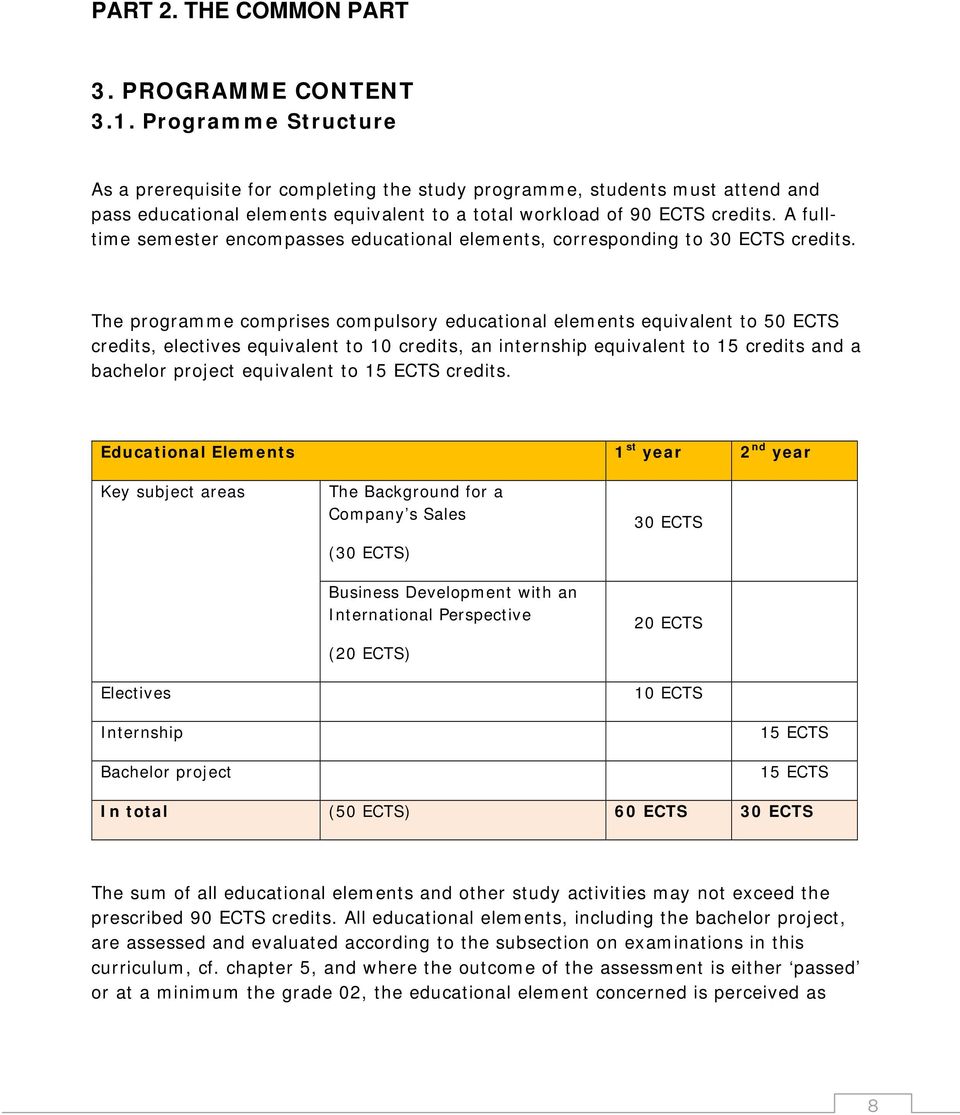
9 PART 2. THE COMMON PART 3. PROGRAMME CONTENT 3.1. Programme Structure As a prerequisite for completing the study programme, students must attend and pass educational elements equivalent to a total workload of 90 ECTS credits. A fulltime semester encompasses educational elements, corresponding to 30 ECTS credits. The programme comprises compulsory educational elements equivalent to 50 ECTS credits, electives equivalent to 10 credits, an internship equivalent to 15 credits and a bachelor project equivalent to 15 ECTS credits. Educational Elements 1 st year 2 nd year Key subject areas Electives The Background for a Company s Sales (30 ECTS) Business Development with an International Perspective (20 ECTS) 30 ECTS 20 ECTS 10 ECTS Internship Bachelor project 15 ECTS 15 ECTS In total (50 ECTS) 60 ECTS 30 ECTS The sum of all educational elements and other study activities may not exceed the prescribed 90 ECTS credits. All educational elements, including the bachelor project, are assessed and evaluated according to the subsection on examinations in this curriculum, cf. chapter 5, and where the outcome of the assessment is either passed or at a minimum the grade 02, the educational element concerned is perceived as 8
10 passed. For more information on examinations, please read chapter Key Subject Areas The programme covers a number of overarching subject areas to which the educational elements are related. The subject areas comprise educational elements corresponding to 50 ECTS credits. The contents of the subject areas as well as the distribution of ECTS credits have been determined collaboratively by the institutions of higher education approved to offer the particular programme. The subject areas include the following: The Background for a Company s Sales Work load: 30 ECTS Content: An analysis of current and potential customers, their strategic situation, needs and wants as a basis for an assessment of a company's total efforts Analysis of a company's business model and effectiveness in a company's supply chain with a view to determining a company's core competencies and ability to cover the customers' needs Complex competition forms, competitor analysis, regulation of competition and an analysis and assessment of the international economic environment including financial and economic benchmarking and benchmarking of a company's supply chain The organisation of the sales department and its relation to other departments including business partners Product and concept development strategies and processes Assessment of the innovative platform including a company's innovative processes and incentives Conclusion of International Contracts and Sale of Goods and Services International Conflict Management from a Legal Perspective Learning objectives: Knowledge The graduate will: have knowledge and understanding of relevant theories and models to analyse a company's competencies, customer base, development of the customer portfolio and profitability assessments be able to understand the tools for assessment of the customer portfolio surrounding profitability, commitment and credit be able to understand the rules of international trade with goods and services including knowledge of EU competition law and marketing law have knowledge of employment clauses and EU employment law concerning 9

11 employment contracts and posted employment have knowledge of the EU Service Directive have knowledge of international conflict management have knowledge of international patent and trademark law be able to relate to and implement relevant theories and models of the competitive position in the marketplace be able to understand benchmarking theory for comparisons within industry have established knowledge of the economic effects of globalisation have understanding of relevant models for assessment of growth and developmental possibilities have knowledge of different models of strategic handling of product and concept development processes in business understand theory of a company's innovative platform, creative processes and value-based management understand essential implications of innovative projects on a company's supply chain Skills The graduate will: be able to assess the customer base including the individual customer in relation to company and a sales competencies and business model be able to analyse and assess an internationally focused company's choice of supply chain with involvement of relevant theories be capable of implementing an economic analysis, assessment and prioritisation of a customer portfolio be able to analyse and assess a company's competitive position be able to benchmark a company against a competitor or industry be able to apply relevant models to the implementation of product and concept development in business including assessing the economic consequences be able to assess various options to secure the purchase sum Competences The graduate will be able to: enter into in a company's work with marketing intelligence with a focus on collection and assessment of information about the competitive position in the marketplace involve relevant data for the assessment of a company's customer care and customer development structure including the ability to implement the sales assignment assess and identify areas for improvement in a company's supply chain make a basis for decision as support for an economic assessment of customer base and external influences assess a company's innovative starting point and be able to enter into a company's work in order to plan and implement product and concept 10
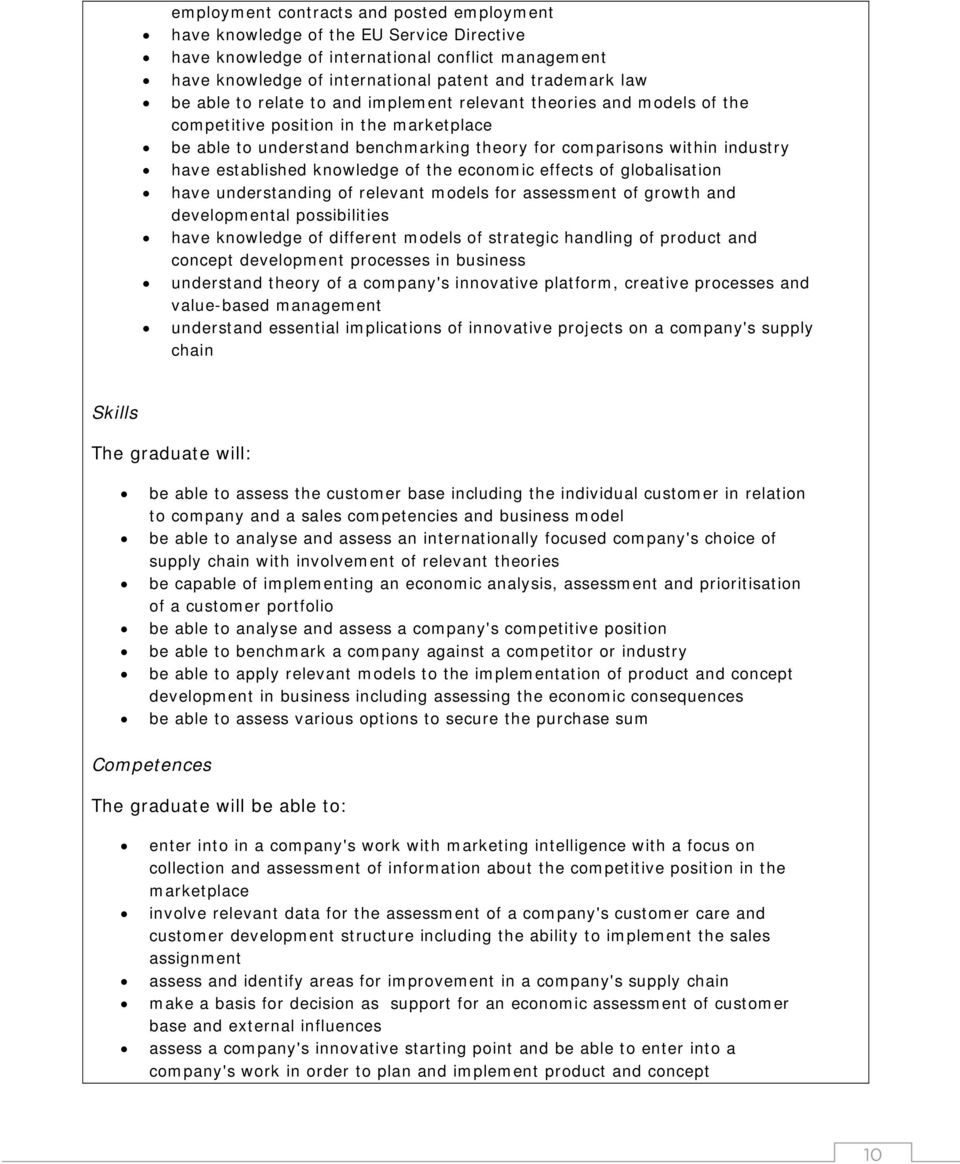
12 developmental processes analyse and assess legal issues in relation to international trade apply and assess different forms of distribution assess the compliance of marketing measures with EU law on misleading and comparative advertising Business Development with an International Perspective Work load: 20 ECTS Content: Strategy development focusing on customers, relations, products, incentives, sales organisation and presentations, activity-based costing and value chain optimisation Evaluation of the contribution of the sales department Management of the sales department Learning objectives: Knowledge The graduate will: have an understanding of and be able to reflect upon central theories and models for the development of a company's sales base have a general and broad knowledge about the management theories which can support the development of a company's sales base have knowledge and understanding of theories and models which support and develop the tactical and operational sales performance have knowledge of tools and models for customer follow-up have knowledge of situation-specific management in the sales department have knowledge and understanding of tools for measurement and management of the effectiveness in the company's supply chain Skills The graduate will: be able to develop, assess and implement international sales strategies for different business types be able to substantiate and communicate the chosen strategies in a sales plan to relevant parties be able to choose and apply theories and models for the planning of the tactical and operational sales performance based upon the chosen sales strategy be able to draw up a balanced scorecard for a sales department and sales territory including making suggestions for follow-up 11

13 be able to assess and apply methods and tools for a company's supply chain to benefit the sales performance be able to assess the marketing mix against customers generally and the individual customer specifically be able to make suggestions for possible changes in strategy and operations Competences The graduate will: be able to handle and manage the development of the sales strategy starting from different complex situations and with the involvement of relevant parties develop an organisational plan of action which ensures the implementation of the sales plan be able to develop the economic foundation for a sales strategy in a practical context for a specific company be able to participate in the sales work in a company at the tactical and operational level be able to make his/her own balanced scorecard in relation to a company's primary strategy and plan and secure ongoing follow-up be able to enter into a dialogue with the sales department about the optimisation of a company's total sales activities 3.3. Compulsory Educational Elements The key subject areas cover a range of educational elements that correspond to 50 ECTS credits. This part of the curriculum has been determined collaboratively by the institutions of higher education approved to offer the particular programme, and these educational elements are mandatory. The compulsory educational elements are all concluded with an examination and include the following: Schematic presentation of the educational elements divided by semester Educational elements distributed on semesters 1st semester 2nd semester 3rd semester ECTS ECTS ECTS Key Subject Areas and Compulsory Educational Elements 50 The Background for a Company s Sales 30 The Customer as Starting 15 Point 15 Industry and Competitors 5 5 Innovation 5 5 Theory and Methods 5 5 Business Development with an International Perspective 20 Developing the Sales 10 Base 10 Tactical and Operational 5 5 E C T S 12
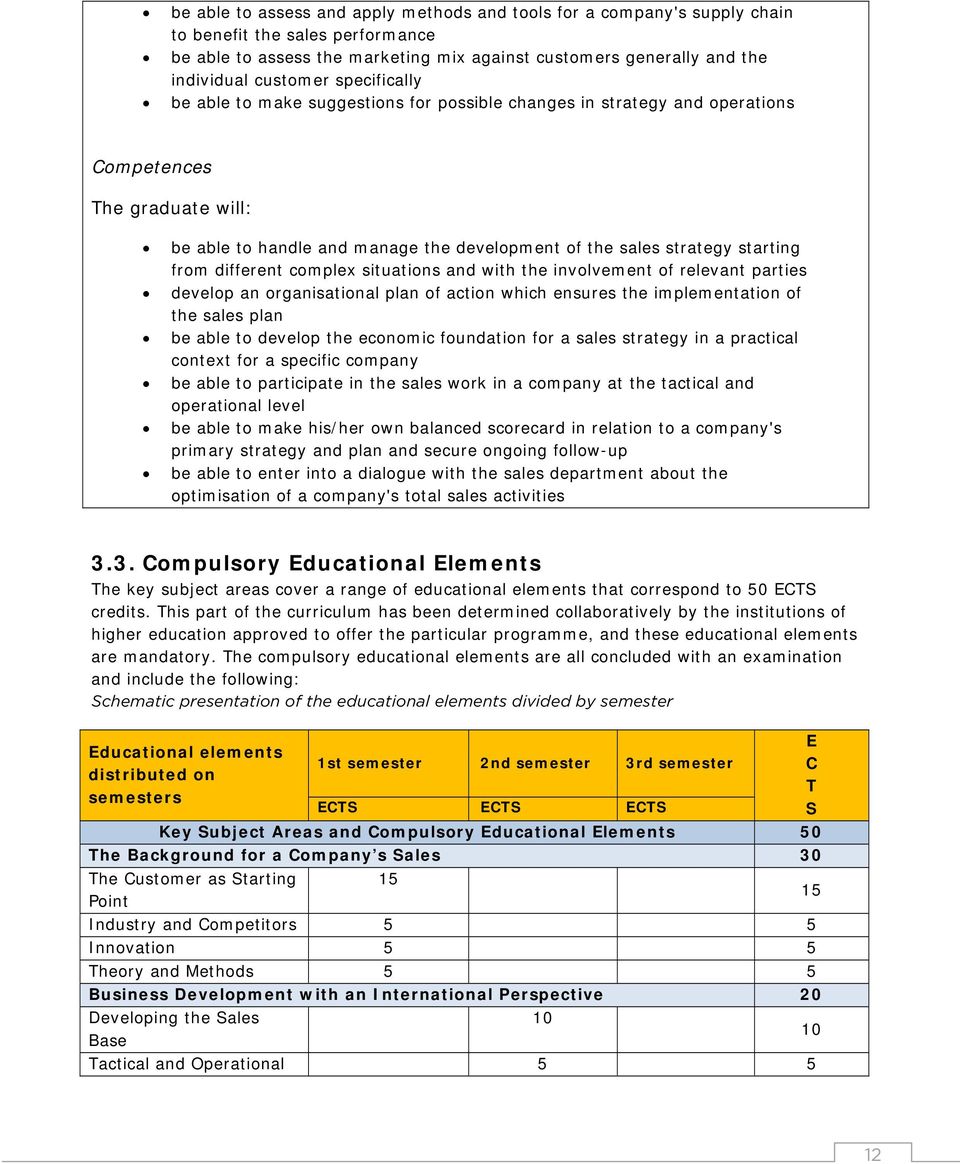
14 Sales Implementation and 5 Follow-up 5 Elective Educational Elements 10 Electives Internship and Bachelor Project 30 Internship and Project Bachelor Project Total Examination (1 st semester) 30 The Background for a 25 Company s Sales 25 Theory and Methods 5 5 Examination (2 nd semester) 30 Business Development 20 with an International 20 Perspective Electives Examination (3 rd semster) 30 Internship Examination Bachelor Project Examination In the following, the compulsory educational elements will be elaborated on. The Customer as Starting Point Key subject area: The Background for a Company s Sales Timing: 1 st semester Work load: 15 ECTS Content: An analysis of current and potential customers, their strategic situation, needs and wants as a basis for an assessment of a company's total efforts Assessment of a company s business model and competencies Analysis of relations and marketing mix Analysis of effectiveness in a company's supply chain with a view to determining the company's core competencies and ability to satisfy the customers' needs Assessment of choice of geographical positioning of centres of production and know how, including partnerships and outsourcing A company's strategic foundation and focus The organisation of the sales department strategically, tactically and operationally Organisational analysis of the sales team and buy centre in relation to a sales assignment The relation of the sales department to other departments, including business 13
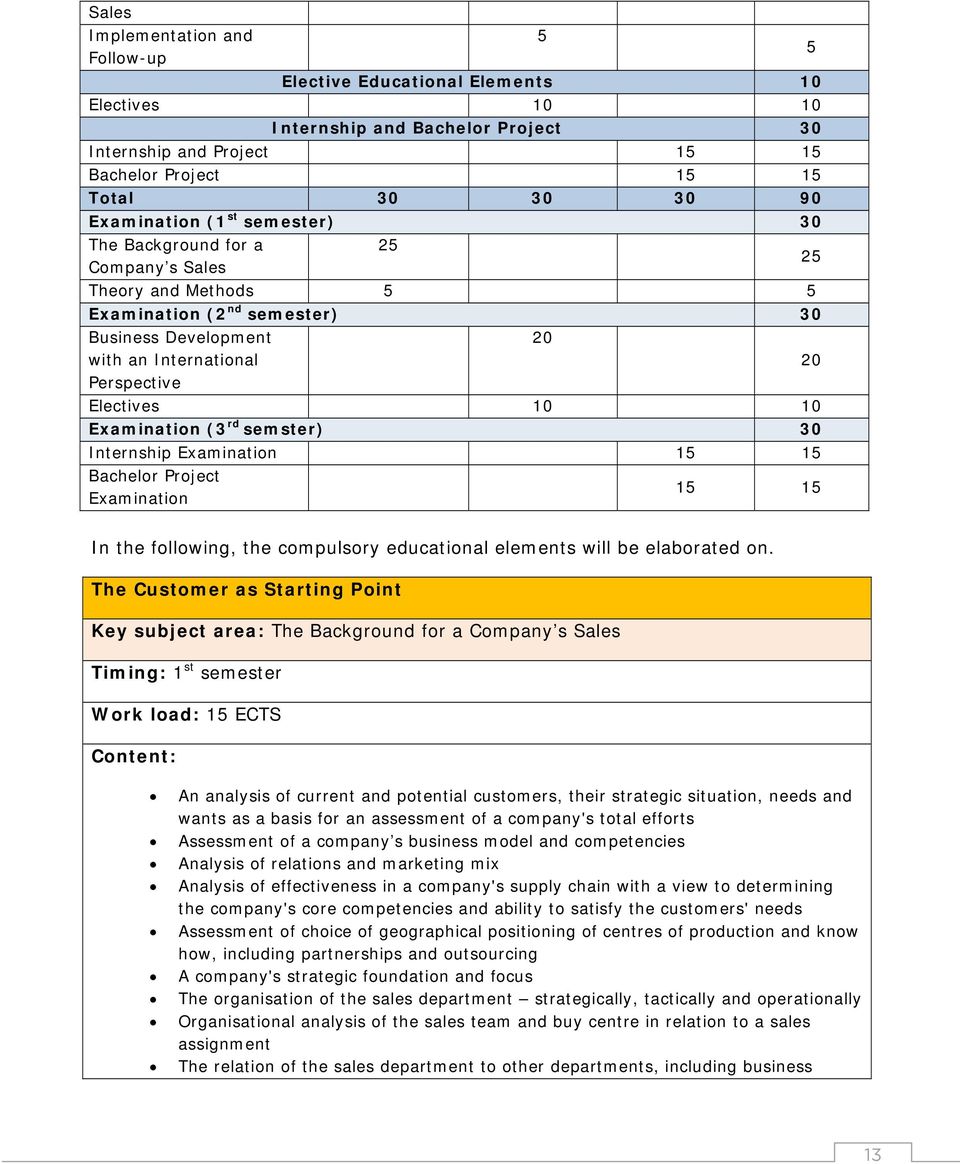
15 partners Competency analysis The rules for international agreement contracts and international sales of goods and services EU employment law concerning employment contracts and posted employment International conflict management The economic and financial foundation of the sale Activity-based costing Customer profitability, including credit assessment Learning goals: Knowledge The graduate will: have knowledge of and be able to understand relevant theories and models for analysis of a company's competencies, customer base, development of the customer portfolio including profitability assessment have knowledge and understanding of relevant models and theories of business models with the sale as the starting point be able to understand practical international examples in connection with current theory in the discipline have knowledge of general strategic perceptions and models within the structuring and organising of the sale, competence assessment, customer organisation, assessment of ability to implement plans, and relations to other departments and partners be able to understand tools for assessment of the customer portfolio surrounding profitability, commitment and credit have knowledge of how to apply to employment clauses in connection with employment in exporting countries and knowledge of EU rules concerning posted employment, employment contracts and social insurance have knowledge of the Brussels Regime (EU rules regulating jurisdiction in the EU and EFTA) and various international conflict management methods, including the rules concerning venue, pros and cons of court orders compared with arbitration and mediation have knowledge of the EU Service Directive Skills The graduate will: be able to assess the customer base as well as the individual customer in relation to a company's and sale's competencies and business model. be able to analyse and assess these relations between a customer and a company 14

16 be able to assess the customer's profitability and projected future earning potential along with the relevance of either a resource-based or marketoriented approach be able to analyse and assess an internationally focused company's choice of supply chain with the use of relevant theory from the discipline. This analysis will focus on the connection between: the organisation of the sale development of partnerships securing customer satisfaction and experience of quality be able to analyse and perform an assessment of a company's strategic position be able to analyse and assess the organisation of a sale seen from a customer point of view, including relations to other departments in a company be able to analyse the organisation of a sale be able to use customer analysis to analyse and assess the competencies and requirements of the sales department be capable of implementing an economic analysis, assessment and prioritisation of a customer portfolio be capable of assessing various ways of securing the purchase sum in connection with export transactions, including the use of delivery clauses, letters of credit, export credit schemes, various types of banker s guarantees, factoring/forfaiting and retention of ownership Competencies The graduate will: be able to participate in multidisciplinary teams in marketing intelligence, focusing on the customer be able to extract relevant data for the assessment of a company's customer care and customer development structure assess a company's competencies and ability to match the customers' expectations to the sales department be able to identify legal regulations that are relevant for sales agreements be able to analyse and assess the legal consequences of an international sales agreement be able to make a basis for decision which supports an economic assessment of the customer base be able to use and assess the need for and the legal consequences of conditions of sales and delivery be able to analyse and assess questions in relation to international trade with goods and services, including choice of law and international contract rules with the main focus on the Global Sales Law (CISG) 15
17 be able to apply the rules concerning the different forms of distribution to an analysis with a view to choosing form of distribution in connection with export transactions, including direct sales, sales agents, sales through branches, sales through subsidiaries, franchising, joint venture/strategic alliances and e-commerce Examination and assessment: 1 st semester: External examination graded according to the 7-point grading scale (1 st External examination/the Background for a Company s Sales). For more information on examinations, please read chapter 5 and [institutionens eksamenskatalog]. Industry and Competitors Key subject area: The Background for a Company s Sales Timing: 1 st semester Work load: 5 ECTS Content: Analysis of the increasing complexity of forms of competition Analysis of competitors, clustering, and applications of benchmarking Benchmarking of a company's supply chain Ethics and social responsibility including corporate social responsibility Regulation of competition An analysis and assessment of international economic environment relations Financial and economic benchmarking Learning goals: Knowledge The graduate will: be able to relate to and extract relevant theories and models about the competitive position in the marketplace be able to identify and analyse specific competitors have knowledge about different benchmarking models have knowledge about basic benchmarking theory and models including supply chain management have knowledge about business ethics and corporate social responsibility have knowledge of international competition law with the main focus on EU competition law 16
18 have knowledge of the ICC Advertising and Marketing Code have basic knowledge of the economic effects of globalisation have an understanding of international trade movements in the area be able to understand economic and financial benchmarking theory for comparisons within an industry Skills The graduate will: be able to analyse and assess the company's competitive position as a basis for preparation of the company's marketing mix with a focus on the sales effort. In relation to this the student will be able to benchmark a company against both the industry and its actual competitors with reference to strategic, tactical and operational level be able to involve relevant theories and models in relation to benchmarking the supply chain of an internationally-oriented medium-sized company understand a company's ethical dimension be able to benchmark a company against a competitor or industry with the involvement of relevant economic theory Competencies The graduate will: be able to carry out marketing intelligence with a focus on compilation and assessment of information about the competitive position in the marketplace be able to assess and identify areas of improvement in a company's supply chain based on benchmarking be able to handle an economic assessment of the external influences on a company from both the industry and international environment be able to assess whether certain marketing measures comply with the EU rules concerning misleading and comparative advertising Examination and assessment: 1 st semester: External examination graded according to the 7-point grading scale (1 st External examination/the Background for a Company s Sales). For more information on examinations, please read chapter 5 and [institutionens eksamenskatalog]. Innovation Key subject area: The Background for a Company s Sales 17
19 Timing: 1 st semester Work load: 5 ECTS Content: Analysis of growth basis of businesses Analysis of product and concept development strategies and processes Consequences of innovation for a company's supply chain Assessment of the innovative platform along with a company's innovative processes and incentives International/EU incorporeal law Project management and measurement systems Learning goals: Knowledge The graduate will: have an understanding of the relevant models for assessment of growth and development possibilities have knowledge about different models for strategic handling of product and concept developmental processes in a company understand practical implications of innovative products on a company's supply chain understand theory about a company's innovative platform and creative processes along with value-based management understand economic theory related to project management and assessment have knowledge of the rules concerning intellectual property rights, including international patents and EU trademarks Skills The graduate will: be able to apply relevant models to the implementation of product and concept development in a company be able to apply relevant models to the development of solutions for a company's supply chain in relation to innovative projects be capable of assessing the innovative structures, processes and incentives of the organisation of sales be able to analyse the economic consequences of a particular policy of innovation for a company Competencies 18

20 The graduate will: be able to enter into a company's work with planning and implementing product and concept development be able to form part of multidisciplinary teams with a view to solving challenges in a company's supply chain in relation to implementation of innovative projects be able to assess a company's innovative basis be able to apply the rules of protection of incorporeal rights be able to define Key Performance Indicators for a company's innovative work in relation to the sales effort Examination and assessment: 1 st semester: External examination graded according to the 7-point grading scale (1 st External examination/the Background for a Company s Sales). For more information on examinations, please read chapter 5 and [institutionens eksamenskatalog]. Theory and Method Key subject area: The Background for a Company s Sales Timing: 1 st semester Work load: 5 ECTS Content: Theory and Methods refers to the specific subject area's considerations of its existence as an academic discipline Illustration of what consequences the choice of scientific paradigms have for choice of method and what it ultimately means for the analysis and assessment of practice A foundation for academic work Research into the central methodological approach within the disciplines of business economics Systematization of the ability of the approach to produce knowledge Understanding and command of the academic challenges encountered in modern society Learning goals: Knowledge The graduate will: gain insight into important perspectives in knowledge, perceptions and 19
21 recognition have a solid grasp of what knowledge means in the context of social science and have a grasp of what role the knowledge plays in a business economic perspective have a basic knowledge of essential theoretical problems and schools within a social-science perspective and in particular within the core areas of marketing, organisation/management and economics have knowledge about the theory's theoretical hypotheses and methodological approaches which support the production of knowledge have knowledge and understanding of central paradigm shifts within the disciplines of business economics have understanding of the application of methodology in project and report writing following the principles of academic work Skills The graduate will: be able to relate critically to empirical-analytical theory and among other things be able to discuss what knowledge is, how it is generated and how it relates to practice be able to reflect upon and enter into discussions about business economic perspectives in academic contexts be able to work with theoretically and methodologically based problems and integrate understanding of academic work and methods professionally in project and report writing be able to collate, adapt and interpret quantitative and qualitative data along with relating critically to existing or new data materials, including having knowledge about measuring scales and being able to judge the relevance, topicality, validity, reliability and scope for generalisation of data be able to prepare problem analysis and perform problem definition, put forward problems and hypotheses, along with being able to perform methodological considerations and substantiate choice of research methods be able to structure and analyse following the principles of academic work Competencies The graduate will: be able to prepare scholarly reports and projects, including arranging research results and suggested solutions in a clear and easy-to-read report which contains a clear formulation of the problem, methodological consideration along with an assessment of the reliability and validity of the results and conditions 20
22 be able to draw up a research plan along with assessing the strong and weak points of alternative research methods be able to substantiate choice of method along with relating critically to the method Examination and assessment: 1 st semester: Internal examination graded according to the 7-point grading scale (1 st Internal examination/theory and Methods). For more information on examinations, please read chapter 5 and [institutionens eksamenskatalog]. Developing the Sales Base Key subject area: Business Development with an International Perspective Timing: 2 nd semester Work load: 10 ECTS Content: Development of international sales strategies Development of CRM strategies from attracting new customers to retaining and developing existing customers. Includes key account management (KAM) and global account management (GAM) Development of sales plans Development of international strategies for a company's supply chain to support sales strategies and plans Adaptation of action parameters Organisational development and innovation management Personal development, including self-leadership and stress management Team building Competence development plans Management of partnerships Strategic behaviour and game theory Economic value added and Weighted Average Costs of Capital (WACC) Forecasting models Implementation power Learning goals: Knowledge The graduate will: have an understanding of and be able to reflect upon central theories and models for the development of a company's sales base based on as well relational as transactional approaches understand the theoretical tools in relation to a company's supply chain for development of an international sales base including the basic agent theory 21
23 have a general and broad knowledge about management theories which can support the development of a company's sales base including the development of competency planning, partnerships and the sales team understand basic sales strategy models and their applications Skills The graduate will: be able to develop, assess and implement international sales strategies for different business types (industry, sizes, resources etc.) be able to substantiate and arrange the chosen strategies into a sales plan for relevant parties be able to develop and assess the company s action parameters in relation to the individual customer be able to collate relevant data for the assessment and development of plans for a company's supply chain plans which support the sales base be able to identify areas of development in the organisation of sales, including international agencies be able to develop competency plans for the sales team including selfleadership and stress management be able to prepare a plan for the development of an organisation in relation to aspects of a company's culture and values be able to apply taught theory in relation to the assessment of alternative sales plans be able to assess the sales department's implementation power in connection with sales measures Competencies The graduate will: be able to handle and manage the development of the sales strategy starting from different complex situations and with involvement of relevant stakeholders be able to identify their own learning needs, including necessary knowledge and constant skills development be able to ensure the involvement of theories and methods for a company's supply chain for the development of a commercial plan for the sale develop an organisational plan of action which secures the implementation of the sales plan be capable of identifying and constructing personal networks be able to apply the rules of different distribution types in an analysis with reference to choice of distribution type be able to assess and develop the company's ability to implement the sales activity Examination and assessment: 22
24 2 nd semester: External examination graded according to the 7-point grading scale (2 nd External Examination/Business Development with an International Perspective). For more information on examinations, please read chapter 5 and [institutionens eksamenskatalog]. The Tactical and Operational Sales Performance Key subject area: Business Development with an International Perspective Timing: 2 nd semester Work load: 5 ECTS Content: Implementation of sales strategies and sales plans Coordination and cooperation in a company's supply chain Preparation of back-up plans Recruitment and selection of sales personnel Incentive strategies Coaching Conflict management Management of the sales department including stress management Activity-based costing and value-chain optimisation Foreign currency and option theory Learning goals: Knowledge The graduate will: have knowledge and understanding of theories and models which support and develop the tactical and operational sales performance have basic understanding of problems, theory and models in a company's supply chain which are linked to the tactical and operational sales performance have knowledge and understanding of different methods for recruitment of sales personnel be able to understand and reflect upon the meaning of different theories of motivation for the preparation of incentive strategies have knowledge and understanding of different conflict styles and problemsolving possibilities have knowledge of situation-specific management in the sales department understand basic theory and models in the area Skills 23
25 The graduate will: be able to choose and apply theories and models to the planning of the tactical and operational sales performance based on the chosen sales strategy be able to develop a company's strategy starting from unique customer relations and be able to communicate this to relevant parties be able to assess and apply methods and tools for a company's supply chain to support the tactical and operational sales performance prepare suggestions for the recruitment plan prepare strategies for the motivation of sales personnel have an understanding of the relevance of coaching in relation to sales personnel prepare suggestions for conflict management in a company have an understanding of situation-specific management in the organisation of sales be able to apply the taught theory to actual international sales assignments Competencies The graduate will: be able to participate in the tactical and operational sales performance in a company at the tactical and operational levels be able to identify problems and solutions in a company's supply chain for planning the tactical and operational sales performance be able to manage and develop solutions surrounding complex situations within international sales management be able to assess the economic consequences of a given international sales effort including risk assessment and limitation Examination and assessment: 2 nd semester: External examination graded according to the 7-point grading scale (2 nd External Examination/Business Development with an International Perspective). For more information on examinations, please read chapter 5 and [institutionens eksamenskatalog]. Implementation and Follow-up Key subject area: Business Development with an International Perspective Timing: 2 nd semester Work load: 5 ECTS Content: Customer follow-up tools 24
26 MIS (Marketing Intelligence Systems) CRM software Measuring effectiveness of a company's supply chain Evaluation of the sales department's efforts, including personal, professional, cultural and social competencies Preparation of analysis of employee satisfaction Balanced scorecard Variable analysis with basis in the marketing mix Learning goals: Knowledge The graduate will: have knowledge of tools and models for customer follow-up have knowledge and understanding of tools for measuring effectiveness of a company's supply chain have knowledge and understanding of tools for measuring colleague satisfaction and criteria for evaluation of the sales department's efforts have understanding of general economic reporting methods and their application in Danish commerce Skills The graduate will: be able to assess marketing mix for a company's customers generally and the individual customer specifically and be able to make suggestions for possible changes in strategy and efforts be able to prepare a follow-up plan for measuring effectiveness of a company's supply chain be able to perform a measurement of sales efforts and subsequently put forward commercial suggestions based upon the measured results be able to draw up a balanced scorecard for a sales department and sales area along with suggestions for follow-up Competencies The graduate will: be able to enter into work assessing a company's combined efforts along with individual efforts in relation to sales work for its customers. In relation to this the student will be able to identify their own learning needs to be able to develop and maintain relevant competencies for this work be able to enter into a dialogue with the sales department about optimisation of a company's total sales efforts from the perspective of effectiveness in the whole supply chain be able to develop and implement an evaluation of personal, professional, 25
27 cultural and social competencies and employee satisfaction be able to create their own balanced scorecard in connection with a company's primary strategy and plan, and secure on-going follow-up be able to be part of multidisciplinary teams in connection with the company s marketing intelligence with the customer as starting point Examination and assessment: 2 nd semester: External examination graded according to the 7-point grading scale (2 nd External Examination/Business Development with an International Perspective). For more information on examinations, please read chapter 5 and [institutionens eksamenskatalog]. Examinations Semester Name of the examination Educational element Noted on the final diploma ECTS 1 st semester 2 nd semester 3 rd semester 1 st External Examination (The Background for a Company s Sales) 1 st Internal Examination (Theory and Methods) 2 nd External Examination (Business Development with an International Perspective) 2 nd Internal Examination (Electives) 3 rd Internal Examination (Internship Examination) 3 rd External Examination (Bachelor Project Examination) The Customer as Starting Point, Industry and Competitors and Innovation One grade 25 ECTS Theory and Methods One grade 5 ECTS Developing the Sales Base, Tactical and Operational Sales and Implementation and Follow-up One grade 20 ECTS Electives One grade 10 ECTS Internship and project One grade 15 ECTS Bachelor project One grade 15 ECTS 3.4. Internship The Bachelor s Degree Programme in International Sales and Marketing includes both theory and practical experience with the purpose of supporting the student s continuous learning process and contributing to the fulfilment of the learning objectives specified for the study programme. During the internship, students are faced with professionally relevant issues, just as they become familiarised with relevant job functions. Students must actively and independently seek a placement with one or more private or public companies, and [the institution] ensures that the 26
28 internship settings are satisfactory. The internship is unpaid. Internship Timing: 3 rd semester Work load: 15 ECTS Purpose: The course's internship will create a connection between the studied theory and the profession's vocational relations. The internship will ensure closeness to practice and the development of professional and personal competencies for independent participation in business. The internship assists the student in converting the studied knowledge into practical experience. Learning objectives: Knowledge The graduate will possess knowledge of: have knowledge of the profession's theory and methods along with practice be able to understand terms and methods along with reflecting upon the application have experiences of participating in the solution of practical work assignments Skills The graduate will be able to: be able to convert the studied knowledge into practice within business be able to assess theoretical and practical problems and draw up suggested solutions be able to apply and arrange relevant theories to the solution of assignments in the workplace Competences The graduate will be able to: be able to see their own professional role in relation to actual assignments be able to enter into professional as well as interdepartmental cooperation Examination and assessment: 3 rd semester: Internal examination graded according to the 7-point grading scale (3 rd Internal Examination/Internship examination). For more information on examinations, please read chapter 5 and Catalogue of Examinations and Other Tests Used at The Bachelor s Degree Programme in International Sales and Marketing. 27
29 3.5. The Bachelor Project The bachelor project, concluding the Bachelor s Degree Programme in International Sales and Marketing, must document the students abilities to understand and analyse a practice-based problem related to their respective fields of study by means of relevant theory and methodology. Thus, central subjects from the programme should be covered by the project, and a problem statement, which must be key to not only the programme but also the respective type of industry/profession, has to be formulated by the student, and if desired in cooperation with a private or public company. [The institution] will subsequently approve the problem statement. The bachelor project is conducted as an external examination, which, together with the internship report and other programme examinations, should document that the programme s learning objectives and requirements are met. The examination comprises a written part and an oral part that result in a single joint grade. The examination can only take place after the student has passed all other educational elements. For more information about the bachelor project, see section [X.X] in this curriculum, the [institutionens eksamenskatalog] and the specific manual for the bachelor project. Bachelor project Timing: 3 rd semester Work load: 15 ECTS Purpose: The project will take the central topics of the course as its starting point and will contain elements from the internship. The problem proposal for the project is prepared by the student and as much as possible in cooperation with a company. The project's problem proposal must be approved by the institution. Learning goals: Knowledge The graduate will: have knowledge about the profession's and subject area's applied theory and methods along with practice be able to understand theory and methods along with being able to reflect upon the profession's application of theory and methods Skills The graduate will be able to: 28
30 apply methods and tools for collation and analysis of information and will master the skills related to employment in the profession assess theoretical and practical problems and substantiate the chosen actions and solutions communicate practical and professional problems and solutions for colleagues and users Competences The graduate will be able to: handle complex and development-oriented situations in relation to work and study independently enter into academic and interdisciplinary cooperative work and take on responsibility within the settings of professional ethics identify their own learning needs and, in relation to the profession, develop their own knowledge and skills Assessment: A single grade according to the 7-point grading scale Credit Transfer In some cases, [the institution] may be able to transfer credits for educational elements, or parts hereof, completed at other educational institutions, provided that the elements in question correspond to elements included in this curriculum. [The institution] bases the decision about a possible credit transfer on an assessment of the element s content, level etc. A transferable educational element from a stay abroad will be regarded as successfully completed, if the student has passed the element in accordance with the rules and regulations in effect at the educational institution at which the element was taken. Students are obliged to notify [the institution] of any previously passed educational elements at a higher educational level, which includes both Danish and foreign higher educations, presumed to be transferable. [The institution] handles all applications for credit transfer after these rules. 29
31 PART 3. THE INSTITUTION-SPECIFIC PART 5. Teaching and work methods 5.1. Targeted learning The programme consists of three semesters, which combine to give the Bachelor the targeted competence profile. At the same time, each semester constitutes an independent, defined learning process with individual exams. It is therefore possible for a student to replace a semester with documented equivalent learning and exams from another Danish or foreign institution. The educational elements aim to give the students the academic and methodological skills that will provide them with a solid, theoretical foundation for dealing with complex issues in practice. Through their studies, the students should also learn to identify and meet their own learning needs and learn to take part in personal and complex cross-cultural relations in a flexible, targeted and determined manner, whether in relation to customers and business partners or colleagues and managers, both in Denmark and abroad. The compulsory educational elements reflect the core functions of the profession as it is exercised in practice. In addition, the programme includes an elective where the students work in study groups to define a topic that is relevant to the profession and within this topic identify a number of compulsory academic educational elements for in-depth study. Each of the first two semesters concludes with a semester project defined by relevant external parties. The purpose of the internship is to give the students an opportunity to apply the knowledge they have acquired in the first two semesters on relevant practical issues relating to the profession. The internship must therefore take place in a company and a job function that are relevant to the profession. The final Bachelor Project also takes place in a professionally relevant company and role, and serves to give the students an opportunity to document their overall learning outcome by solving a defined problem relevant to the profession. Together with the internship and the Bachelor Project, the elective gives the students an opportunity to individualise their overall competence profile E-learning as a teaching method Under special circumstances, the teaching can take place via e-learning, which does not require physical presence. The scope of the e-learning may not account for a major part of a subject. The 30
32 material produced for e-learning will be uploaded to the students Intranet Practical learning By taking part in quality and development work and being involved in company and knowledge networks together with end users and research institutions, the teachers acquire insight into and knowledge of the latest trends within the profession. This experience is systematically incorporated into the teaching. Through semester projects, internships and the Bachelor Project, the students come into contact with practice and have an opportunity to combine theory and practice Learning methodology and structure This practical angle provides a holistic and multi-disciplinary approach to the complex practical issues that characterise the profession. The teaching is thus based on practical issues and to a great extent builds on empirical data, cases and best practice from the companies involved in the degree programme. The institution also emphasises that teachers of the degree programme must have relevant practical experience and be part of knowledge-sharing networks in both practical and research environments within the academic field in question. The teaching incorporates the latest knowledge and results from national and international research, trials and development work within the disciplines relevant for the profession. IT is used as a tool, a teaching method and to share information. The use of a large number of different methodologies within both teaching and other educational activities helps prepare the students for their sales and marketing work, while creating a lively and engaging learning environment. The teaching is based on a combination of academic input and practical issues in relevant areas while including empirical data, cases and best practice from companies with which the institution or the students collaborate. The following activities help the students meet the learning objectives: 1) classroom teaching 2) group and project work 3) supervision 4) presentations 5) guest lectures, company visits, cases, etc. 6) the physical framework 7) lessons and modules 31
33 Re 1) The content of the teaching and associated activities in the degree programme is designed to follow the typical workflow within sales and marketing in the form of modules called Compulsory Course Elements (CCE), and the students therefore receive theoretical and academic input just-intime. Throughout the degree programme, processes ensure that the students acquire the necessary knowledge, skills and competences in the individual subjects (cf. the learning objectives), which the students can use in international groups to develop concrete sales and marketing strategies. During the 1st semester, all students take part in an innovation camp of one week s duration. This camp may be replaced normal teaching, in which case it is spread over the entire semester. Participation is compulsory, and attendance is recorded. Students who fail to attend, with or without notice, have to sit another form of test. Re 2) At the beginning of the programme, the students are divided into study groups, where they work together and complete assignments. It is a requirement that gender and nationality be taken into account in the composition of the group and that the group makes use of cross-disciplinary competences so that different forms of input and skills are represented. Re 3) Supervision is available to support the student s work with assignments. See section 18 on the exams involved in the degree programme, which describes the requirements to written projects, etc. The supervisor is also responsible for helping the students clarify any academic questions relating to assignments and projects and identify any needs for personal and academic development that would help the students perform in practice. The students cannot expect to receive any guidance beyond what is relevant for the institution s assignments and projects. Re 4) During their studies (as a minimum once per semester), the students have to pitch and/or present to the class, the teachers and external stakeholders, if relevant, (eg. potential partners, investors, advisors, case companies or others). Re 5) To the extent possible, the institution will involve experienced professionals, advisors, etc. in the programme so they can share their personal experience. Re 6) Teaching and project work take place in physical surroundings that support both classroom and group activities. 32
34 Re 7) The teaching is planned so that the length of the modules, lessons, breaks, etc. is flexible and may be planned by the individual teacher. The study programme may include days with independent study, but not always on the same day of the week. 6. Guidelines for differentiated teaching The teaching is planned so as to take the students previous professional academy studies into account. As part of the study programme, the students are required to independently study additional fundamental literature as indicated by the teachers. This aims to facilitate the planning process and ensure that the students have similar background knowledge for their project work in groups. 7. Rules about the student's duty to attend and requirements to written assignments and projects 7.1. Assessment of study activity The criteria have been defined to ensure that the students graduate from ZIBAT with the highest possible level of professional skills, and so that the Institute complies with existing legislation for academy profession degree programmes and professional bachelor degree programmes, as set out in the following Executive Order: Executive Order on Academy Profession and Professional Bachelor Degree Programmes Section 5(1) The student is obliged to participate in the teaching programme in accordance with the rules set out in the curriculum, including any rules about compulsory attendance in relation to parts of the programme. (2) Degree programmes with a prescribed scope of up to 120 ECTS, must be completed within a number of years corresponding to twice the prescribed duration. Other degree programmes must be completed within the number of years corresponding to the prescribed duration plus two years. The educational institution may grant an exemption to the A student's enrolment may be terminated by ZIBAT without further notice if the student has not been active for a consecutive period of at least 12 months, cf. section 17(2) no. 10 of the LEP Executive Order. 33
35 ZIBAT may grant an exemption from this rule if unusual circumstances apply, see Section 38(2) of the Executive Order on Admission. Students who fail to pass exams totalling a minimum of 45 ECTS within a consecutive period of 12 months are not deemed to be active. Periods of approved leave do not count in this regard Study activity criteria Participation in the teaching Attendance is compulsory and records are kept. If a student's absence exceeds 15%, the student will be evaluated to determine his/her level of study activity. The absence percentage is evaluated three times per semester. Students must participate actively in project and group work and project presentations. Requirements/assignments An initial assessment tests/fixed requirements/tests. Compulsory assignments The teacher follows up on any students who do not attend, fail or for some other reason do not comply with the fixed requirements/tests/compulsory assignments. The students have three attempts at each test. If a student does not comply with the fixed requirements/tests, the teacher will inform the programme manager accordingly. The student will then receive a written notification of deregistration. The educational institution may grant an exemption if warranted on account of unusual circumstances. The following procedures have been prepared regarding study activity: deregistration of students official deregistration form letter of warning deregistration letter to students who do not comply with the criteria regarding study activity. 8. Deregistration of students 8.1. The student deregisters Students who wish to deregister must submit written documentation to comply with the administrative procedures. The documentation may consist of a completed, official deregistration 34
36 form or an from the student The student is deregistered because of insufficient study activity The student s study activity is assessed in the course of the semester. Study activity is assessed on the basis of records of absence and fixed requirements/tests/submission of assignments. The programme has a fixed definition of study activity. The tutor is responsible for assessing the study activity of the students on the basis of the records of absence, and the teachers/programme manager are responsible for assessing the study activity of the students in the light of the fixed requirements/tests/submission of assignments see the procedure for study activity under the individual programmes. The first time a student is rated as inactive, he/she is contacted by the tutor (via or telephone) and invited for an interview. The second time a student is rated as inactive, he/she receives a written warning from the study administration. Upon receipt of the written notice, the student must actively confirm whether he/she wants to keep his/her place, stating how the student intends to meet the requirement to study activity in the future. If the student fails to provide this feedback, the student will receive a second reminder from the study administration regarding deregistration. The third time a student is rated as inactive, he/she receives a written warning from the study administration regarding deregistration. 9. Elective educational elements 9.1. Contents Each semester, the institution offers a number of elective educational elements (electives). These subjects may be offered in Danish or English. The electives are described in separate documents produced by the institution. Each elective is equivalent to 5 ECTS credits Scope The elective topic totals 10 ECTS credits Timing and type of exam The elective topic (the electives) is placed in the 2nd semester. The evaluation method is described in the institution s guidelines for the electives. Grades will be awarded individually according to the 7-point grading scale. The electives are assessed by an internal examiner. 35
37 9.4. Teaching resources When the teaching involves study groups and elective topics, the teacher helps the participants in the individual study groups structure the chosen topic and identify the academic material that can contribute to their learning. Objectives for the learning outcome are also formulated based on the knowledge, skills and competences which the participants are meant to acquire through their work in the study group. The students may take all or part of the elective abroad, in which case the form may vary Learning objectives The educational element must relate to the core areas of the degree programme. The course must relate to the core areas of the degree programme. Learning objectives are defined together with the study group and the students, as they vary depending on the chosen line of specialisation Available elective educational elements The objective of the elective is to ensure that the student acquires the knowledge, skills and competences necessary to identify, assess and develop sales and marketing strategies. In addition, the student should be able apply the acquired knowledge to achieve specific goals in collaboration with an established company. ZIBAT, Campus Næstved, offers the following electives in autumn 2014: Internationalisation and globalisation Innovative e-marketing ZIBAT, Campus Roskilde, offers the following electives in autumn 2014: Business Models PMPD 9.7. Internationalisation and globalisation The work methods include teaching, lectures and presentations, and the study groups work with chosen topics independently of each other. The students work in groups to develop concrete solutions to given tasks chosen from the list of companies handed out. Knowledge xxx Skills 36
38 The ability to carry out a global strategic analysis for a chosen company The ability to understand the differences and similarities between core strategies, multiple local strategies and global strategies The ability to measure the effect of industry drivers, strategic levers, organisational factors and a regional focus The ability to create a dynamic and motivating environment in which the study group can develop a global strategy. Competences The ability to independently organise and carry out tasks relating to the development and implementation of a global strategy The ability to take part in the effective strategic work of a company and assume responsibility for independent areas at management level Become independent and develop the ability to cooperate and innovate. Academic content Identifying the industry s potential for globalisation Building a presence in the global market Designing global products and services Identifying the site of global activities Formulating global marketing strategies Planning a global reaction to the activities of competitors Building a global organisation Measuring the effect of industry drivers, strategic levers, organisational factors and a regional focus. Performing a global strategic analysis. Specific Each study group chooses an organisation from the list of organisations that have turned out to have a great potential for globalisation. The companies typically have an international or global strategy with the potential for further development. At the end of the course, the students should be able to carry out a global strategic analysis of the industry/markets in question Innovative e-marketing The work methods include teaching, lectures and presentations, and the study groups work with chosen topics independently of each other. The students work in groups to develop concrete 37
39 solutions to given tasks from the list of companies. Knowledge Xxx Skills The ability to develop e-marketing strategies for a chosen company and apply relevant models in connection with product and concept development for the company The ability to understand the project work involved in implementing a prototype of a concept developed on an electronic medium The ability to assess the company s competitive position as a basis for identifying the resources required for the company s sales work. Competences The ability to plan and perform tasks relating to the development of e-marketing strategies on the basis of independent evaluations The ability to develop, manage and implement sales strategies based on different innovative work methods that include relevant partners The ability to take part in effective e-marketing sales work in a company with responsibility at management level Develop independence and the ability to cooperate and innovate. Academic content e-marketing Innovation Green Business Semiotics Communication Graphic design Specifics The subject aims to teach the students to use innovative processes to develop new marketing strategies based on electronic platforms. Practical implementation knowledge. The students should be able to develop and implement a prototype of their concept, starting with the design, communication, graphic planning and preparation of a proposal and finishing with a prototype version of the concept on a media platform. 38
40 9.9. Exam in the elective educational element at Campus Næstved The exam is an oral group exam lasting 30 (45) minutes. Upon completion of the elective, each study group prepares a project and a synopsis written in accordance with the project manual. This synopsis subsequently serves as the basis for the oral exam. The grade is awarded to the group, but individual grades may be awarded in instances where a student does not participate actively. Each student provides examples of one or more interesting problems relating to the project, proposing solutions and theoretical arguments. Campus Roskilde Business Models The exam in Business Models consists of a written synopsis of a minimum of five pages, which is submitted prior to the oral exam. The exam is based on the synopsis, but the student should expect to be examined in the entire syllabus. At the exam, special emphasis is placed on the student demonstrating insight into how both newly established and existing companies can use the tools taught in the course to develop and improve their business. The course includes teaching, lectures, tutorials and presentations, where the study groups work independently of each other with chosen topics and issues. The students work in groups to develop solutions to tasks and cases presented by companies as well as tasks formulated independently by the student. Knowledge The student is expected to acquire knowledge about the different tools and models that can be used to describe the business models of companies and industries. The student is expected to demonstrate cross-disciplinary understanding and apply the tools learnt during other parts of the syllabus and in general to demonstrate business understanding and the ability to apply concepts and methodologies taught in subjects such as marketing, organisation, economics and business law. Skills The ability to analyse the business model of both an established company and a new company The ability to analyse value creation, customer relations, sales channels, customer segments and revenue streams The ability to analyse the partnerships, key resources and activities and cost structures of different business models The ability to understand the differences and correlations between different business models The ability to identify and analyse strategic perspectives The ability to formulate an operational business plan on the basis of strategic analyses of 39
41 business models The ability to create a dynamic and motivating environment in the study group when developing a business model. Competences The student is also expected to develop a general understanding of business. The course aims to teach the student to understand and analyse the business models of different companies and industries using tools such as Business Models Canvas. The ability to independently organise and carry out tasks relating to the development and implementation of a business model Becoming independent and developing the ability to promote innovation in the company s business model. Project Management & Product Development (PMPD) The exam in Project Management & Product Development (PMPD) consists of a written synopsis of a minimum of five pages, which is submitted prior to the oral exam. The exam is based on the synopsis, but the student should expect to be examined in the entire syllabus. At the exam, special emphasis is placed on the student demonstrating insight into how companies can use the tools taught in the course to develop and improve their business. The student is expected to demonstrate cross-disciplinary understanding and the ability to apply tools taught during other parts of the syllabus and in general a good understanding of business. The duration of the exam is 30 minutes including evaluation and awarding of a grade. Academic outcome In this subject, the student develops skills in analysing, reflecting on and managing the demands of society to organisations in terms of project management and product development, in theory as well as in practice. Course content In general, we work with the following topics: Project management, problem segmentation and timing New Product Development (NPD), innovation and product optimisation Risk management and sustainability High Reliability Organisations: what are they and how can they inspire other types of organisations. Objective To teach the students to analyse and handle issues relating to project management, risk management and product development in a dynamic interplay between theory and practice. 40
42 Target Knowledge and understanding Knowledge of the different concepts, theories and methodologies relating to project management and product development Knowledge about the organisational processes involved in the above Knowledge about the general ways in which a company plans for risks and uncertainties Knowledge of how to prepare a project based on innovation. Skills Skills in identifying needs for product development within an organisation Skills in understanding and dealing with challenges relating to project management Skills in applying the relevant tools to solve tasks within the organisation Skills in planning management initiatives relating to NPD project management. Competences The ability to manage projects in an organisation operating in the market that requires innovation and NPD. The ability to identify needs and handle the corresponding project-oriented management tasks within an innovative organisation. 10. Rules governing the internship Requirements to the parties Roles and responsibilities in connection with the internship A written contract signed by the student, the host company and the supervisor forms the basis of the internship. The host company is expected to be one of the business partners in the teacher s knowledge network that assist with best practice experience and are involved in student projects during the 1st and 2nd semesters. The student is associated with a supervisor at the company. The company and the student are jointly responsible for ensuring that this occurs. The internship is intended to be equivalent to a full-time job with the requirements to working hours, performance, involvement and versatility that graduates with a Bachelor s degree can expect to encounter in their first job. 41
43 The student The student is personally responsible for the process up to the signing of the internship contract with the entrepreneur/company environment or business. The institute supports the student in this process in various ways as mentioned below. During the internship, the student is responsible for achieving the learning objectives. In case of problems during the internship, the student is responsible for informing the allocated supervisor so the parties can find a solution. Internship coordinator The internship coordinator is responsible for introducing the student to the internship. The coordinator is also responsible for collecting and ensuring that the internship contract defines the learning objectives to be achieved during the internship. Internship supervisor The student is allocated a supervisor in connection with the written project. The supervisor is the person the student normally contacts with any questions, to get help, etc. The internship coordinator can subsequently be contacted. Collaboration between student and internship supervisor The students are allocated an internship supervisor who assists them throughout the internship process in connection with the academic content of the internship and helps them define the learning objectives in cooperation with their chosen company. The supervisor is expected to be in contact with the host company as and when required. Evaluation of the internship The internship concludes with a written report, which may be followed by an evaluation interview in which the student and the supervisor jointly evaluate what the student has learned during the internship as compared with the defined learning objectives. The student must meet the learning objectives to register for the exam. Alternatively, the written report (internship report) can be evaluated by the internship supervisor. A pass is required before the student can register for the exam. 11. Internationalisation Students may complete their internship and Bachelor Project in companies or organisations abroad Studies abroad The following educational elements of the Bachelor s degree in International Sales and Marketing Management may be completed abroad: - 2nd semester - Internship - Bachelor Project 42
44 The student may be granted credits for educational elements completed as part of a stay abroad, provided they comply with the requirements to contents and level. ZIBAT must receive an application for credit transfer via the programme manager and have sufficient time to approve the application before the stay abroad commences. It is the responsibility of the student to make sure the application is submitted in time. The decision will be based on an academic assessment. A student who has obtained advance approval of studies abroad must document successful completion of such studies upon his/her return from abroad. In connection with the advance approval, the student must grant ZIBAT the right to collect the necessary information upon completion of the studies abroad. The educational element, for which credit transfer has been granted, is deemed to have been completed if it has been passed in accordance with the rules for the programme in question. ZIBAT endeavours to ensure that students can complete their 2nd semester at an educational institution abroad Agreements with foreign educational institutions about parallel studies No agreements on parallel studies currently exist with foreign educational institutions. 12. Exams Forms of exams Oral exam based on a written report Synopsis a brief written presentation that serves as a basis for discussion at the exam Opponent Pitch presentation of an idea, concept or the like Workshops Group or individual exams See the tables below for more details about the different types of exams. First external exam (A Company s Sales Base) 25 ECTS External Timing: End of the 1st semester. Form of examination: 6-hour written exam. Assessment: Grades will be awarded according to the 7-point grading scale. Admission requirements: All compulsory study activities must have been approved. Attendance is compulsory and a requirement for registration for the exam. These requirements are described in the current exam schedule. 43
45 Consequences of a failure to pass: Re-examination. See the exam schedule. Method and Theory of Science 5 ECTS Internal Timing: End of the 1st semester. Form of examination: Written exam Assessment: Grades will be awarded according to the 7-point grading scale. Admission requirements: All compulsory study activities must have been approved. Attendance is compulsory and a requirement for registration for the exam. These requirements are described in the current exam schedule. Consequences of a failure to pass: Re-examination 2nd external (Business Development from an International 20 ECTS External Perspective) Timing: End of the 2nd semester. Form of examination: Oral exam on the basis of written work. Assessment: Grades will be awarded according to the 7-point grading scale. Admission requirements: All compulsory study activities must have been approved. Attendance is compulsory and a requirement for registration for the exam. These requirements are described in the current exam schedule. Consequences of a failure to pass: Re-examination 2nd internal exam (exam in elective educational element) 10 ECTS Internal Timing: End of the 2nd semester. Form of examination: See the catalogue of electives. Assessment: Grades will be awarded according to the 7-point grading scale. Admission requirements: All compulsory study activities must have been approved. Attendance is compulsory and a requirement for registration for the exam. These requirements are described in the current exam schedule. Consequences of a failure to pass: Re-examination 3rd internal exam (internship exam) 15 ECTS Internal Timing: 3rd semester (at the end of the internship period). Form of examination: Report with an oral exam. Assessment: Grades will be awarded according to the 7-point grading scale. Admission requirements: To be admitted to the exam, the student must have completed ZIBAT s electronic evaluation of the internship. Consequences of a failure to pass: Improvement of the internship report. 3rd external (Bachelor Project) 15 ECTS External Timing: End of the 3rd semester. Form of examination: Report with oral defence. Description of the form of the exam: See the section on the Bachelor Project and the bachelor manual. Assessment: A grade will be awarded according to the 7-point grading scale. Admission requirements: The student must have passed all other exams in the degree programme, including the internship. 44
46 Consequences of a failure to pass: If the overall grade averages less than 02, the student must complete a new project based on a new problem statement Compulsory assignment in connection with CCEs duty to attend and submission The compulsory assignments must be passed (CCE) for the student to be enrolled in the coming examination. A description stipulating the requirements to output, evaluation, deadline, etc. is published for each compulsory assignment (fixed requirement). The deadlines for submission are announced using the institute s internal communication platform. A manual is available for each CCE with information about requirements, deadlines, etc Deadlines for complying with fixed requirements Semester Exam Time 1st semester CCE1 CCE2 CCE3 Semester exam 2nd semester 3rd semester CCE5 CCE6 CCE7 Semester exam Internship Bachelor Project About 6 weeks into the 1st semester About 9 weeks into the 1st semester About 11 weeks into the 1st semester End of semester About 6 weeks into the 2nd semester About 9 weeks into the 2nd semester About 11 weeks into the 2nd semester End of semester About 10 weeks into the 3rd semester End of semester The times indicated are approximations, and the exact dates will be shown in the activity schedule for the programme in question Initial assessment test ZIBAT uses initial assessment tests for all full-time degree programmes. Students must pass the initial assessment tests to be able to continue in the programme, cf. Section 9 of the Executive Order on Examinations. Students must sit the initial assessment test no later than two months from the start of the programme, and they must receive the results at the latest two weeks after the test. Students who fail this test may sit a re-examination, which takes place within three months from the start of the programme. A student has two attempts to pass the initial assessment test. The initial assessment test is assessed internally as either Pass/Fail or Approved/Not Approved. 45
47 The initial assessment test is not covered by the rules regarding exam appeals. ZIBAT may grant students an exemption from the deadlines laid down for passing the initial assessment test if necessary due to illness, childbirth or unusual circumstances. Such circumstances must be documented. Initial assessment test Timing: The initial assessment test takes place no later than two months from commencement of the programme. Form: Recording of absence (first attempt). If the student s first attempt is not successful, an alternative test is organised. Read more about the initial assessment test in the current exam catalogue. Description of the form of the exam: The student must participate in 80% of the teaching during the first six weeks from commencement of the programme (first attempt). A student who does not comply with this requirement to attendance must submit a written home assignment (second attempt). Assessment: Pass/Fail or Approved/Not approved. The student must be informed of the result no later than two weeks from the date of the test. A student has two attempts to pass the initial assessment test. Admission requirements: None Consequences of a failure to pass: Students who fail this test may sit a re-examination, which takes place within three months of the start of the programme. If the second attempt is also not successful, the student cannot continue with the programme and is deregistered, cf. Section 9 of the Executive Order on Examinations. Further about the initial assessment test: The initial assessment test is not covered by the rules regarding exam appeals, cf. Section 9(4) of the Executive Order on Examinations. ZIBAT may grant students an exemption from the deadlines for passing the initial assessment test on account of illness, childbirth or unusual circumstances. Such circumstances must be documented. 13. Rules on completion of examinations Cancellation If an exam has not been cancelled in time, the exam will be regarded as having been commenced in terms of the number of examination attempts permitted. Students who do not want to sit an exam must notify the office in writing as follows: for project exams: at the latest 14 days prior to submission of the exam report for written exams: at the latest 14 days prior to the exam date for oral exams: at the latest 14 days prior to the exam date Examination aids In connection with written exams, students may use books and materials handed out during the instruction, own notes, additional materials, Intranet, Internet and USB pens and similar devices with documents, unless otherwise expressly stated in the exam paper/guidelines. The student may not bring or use the following aids: Bluetooth 46
48 Mobile phone Other data communication equipment enabling the student to communicate with others. Illegal use of the above-mentioned aids will result in instant expulsion from the exam. During the exam, students are not permitted to share aids or borrow from fellow students. For further information see the appendix on exam regulations Requirements to written assignments and projects Formal requirements apply to written assignments. ZIBAT is obliged to inform the students of the most important criteria and requirements to the assignments, as set out in Executive Order No. 714 of 27 June 2012 on Tests and Exams in Vocational Programmes. Failure to comply with formal requirements may lead to the answer being rejected. The answer will then not be assessed, and the student will have used one attempt. It is therefore important that the students familiarise themselves with the requirements. The purpose of the requirements is to make the paper easy to understand and read and ensure that it complies with the general requirements to publication. We recommend that the students also familiarise themselves with the content of Guidelines for Preparing Project Reports. When handing in a written answer, students must sign to confirm that the work was completed without undue assistance. The following requirements apply to all written work in the Bachelor s degree programme in International Sales and Marketing Management: The work must have a standard cover page as shown in Guidelines for Preparing Project Reports. The standard cover page must show the name(s) and signature(s) of the author(s). Table of contents. All pages must be numbered, and the name(s) and student number(s) of the student(s) as well as the date of submission must be shown (eg. in a header or footer). List of references and materials How important are formulation and spelling skills for the grade awarded? Formulation and spelling are part of the overall assessment of an assignment or exam performance, regardless of the language in which the project is written, but the academic content carries the most weight, cf. Section 34(2) of the Executive Order on Examinations. The written work in connection with the Bachelor Project is assessed on the basis of the academic content as well as legibility (clarity, terminology, formulation and spelling). 47
49 14. Forms of exams and formal requirements The degree programme comprises a number of different forms of exams to reflect the content and work methods used in the programme. The form of the exam depends on the objectives of the individual subject/topic Cheating at exams A student who gives or receives undue assistance with an exam paper or uses non-permitted aids will be expelled from the exam. In aggravating circumstances, the student may be expelled from the educational institution. When handing in a written answer, students must sign to confirm that the answer was completed without undue assistance. Using one s own work and that of others plagiarism Projects and other material relating to the exams must be the work of the individual student. If a student passes the work of others off as own work (plagiarism) or uses own, previously assessed work without a source reference, the student will be expelled from the exam and will have used one attempt. Expulsion may also take place after completion of the exam. Expulsion from an exam on account of cheating means that the grade awarded, if any, is cancelled, and that the student has used one attempt. Cheating in exams through plagiarism comprises instances where a written answer is presented as if completely or partially produced personally by the student(s), also if the answer 1. comprises identical or almost identical repetitions of the wording or work of others, without clearly identifying this by means of quotation marks, italics, indentation or other clear indications stating the source, cf. ZIBAT s requirements to written answers, etc. 2. reuses the student s own previously assessed material in breach of the provisions As far as individual, written assignments are concerned, it will also be regarded as plagiarism if the student uses parts of texts that were written jointly by a group of students and submitted in identical form in several assignments. For more information about plagiarism see Cheating and disruptive behaviour at exams Cheating at tests and exams is treated in accordance with the Executive Order on Tests and Exams in Vocational Programmes (the Executive Order on Examinations). Students who cheat at an exam will be expelled. Cheating under aggravating circumstances may lead to the student being expelled from the programme for a period of time. Expulsion on account of cheating under aggravating circumstances is accompanied by a written warning that a recurrence may lead to permanent expulsion from the programme. 48
50 Examples of cheating are: Receiving prohibited assistance during the test Providing prohibited assistance to others during a test Passing the work of others off for own work (plagiarism, see Using own work that has previously been assessed without providing a reference Using aids that are not permitted for the test in question. For further information see the appendix on exam regulations. 15. Exemption rules ZIBAT may grant an exemption from the provisions defined by ZIBAT and set out in the curriculum laid down by the educational institution when warranted by unusual circumstances. 16. Entry into force The curriculum applies to students who commence their studies in or after August
51 Appendix 1 Exam rules Zealand Institute of Business and Technology (ZIBAT) Campus Roskilde Campus Næstved 50
52 PREFACE In this appendix you can read about the rules that apply to exams and tests. The appendix is divided into different topics as they relate to the period before, during and after the exam, so it is easy to understand how the exams/tests work. The exam rules are officially part of the curriculum for the degree programme, but for practical reasons the rules have been inserted in an appendix so that the same rules can be used for different curricula. The exam rules often refer to the curriculum, which contains a description of the different exams and tests. Such references should be interpreted as referring to the full text of the curriculum. 51
53 TABLE OF CONTENTS BEFORE THE EXAM ENROLMENT CANCELLATION EXAM SCHEDULE ARRIVE EARLY ILLNESS/ABSENCE EXAM LANGUAGE EXAM AIDS REMEMBER TO BRING PHOTO ID SPECIAL CONDITIONS WRITTEN ASSIGNMENTS AND SIMILAR DURING THE EXAM THE EXAM IS OPEN TO THE PUBLIC ILLNESS LATE ARRIVAL PHOTO ID CHEATING AND DISRUPTIONS SOUND AND IMAGE RECORDINGS SPECIAL RULES FOR WRITTEN EXAMS AFTER THE EXAM ASSESSMENT RE-EXAMINATION APPEAL
54 BEFORE THE EXAM ENROLMENT When you enrol in the degree programme, you automatically register for the exams that form part of the regular programme. However, if you need to sit a re-examination, or if you wish to register for an exam relating to a later course, you need to register in person at the programme administration. The registration deadline is two weeks before the exam (or before submission, if the test involves submission of written work). It is your own responsibility to monitor the dates of the tests and to check that you have been registered. To be able to sit the exam, you must comply with the requirements to prior exams, submissions, participation in the teaching, etc. See the curriculum for further information. CANCELLATION You may cancel up to one week before the date of the exam/submission. If you cancel, you cannot register for a re-examination but have to wait until the next regular exam. Remember that registering for a re-examination is your own responsibility. EXAM SCHEDULE The campus prepares an exam schedule for each exam. The plan contains practical information about: dates and times, including the estimated date and time of a re-examination rooms type of exam names of the internal and external examiners name of the person responsible for the exam in question contact details for the programme administration (to be used for reporting ill, etc.) material to be submitted where (to whom) the material should be submitted any special conditions, eg. the use of IT when the exam result will be available. The exam schedule is announced on a notice board and via the Internet approximately one month prior to the exam or submission. It is your responsibility to stay informed about the exam schedule. 53
55 ARRIVE EARLY Arrive at the exam well ahead the scheduled time at least 15 minutes early. For written exams you must be at your seat and ready at the time the exam is scheduled to start. If you are late for an exam or late submitting a report/product, you may be excluded from the exam, which will count as one examination attempt (see below for information about re-examinations). If you have a good reason for being late, the person responsible for the (written) exam may decide whether to let you in. Similarly, the examiner at an oral exam may decide whether you can be examined at a later time during the exam in question. Written work and other products used as a basis for the examination, but not included in the assessment, must be submitted in accordance with the above rules. ILLNESS/ABSENCE If you fall ill before the exam, you must immediately notify the programme administration. Expect to be asked to submit a medical certificate (at your own expense). The time of the re-examination is stated in the exam schedule. If you are absent without due cause, the exam counts as one examination attempt, and you cannot register for a re-examination but must wait until the next regular exam takes place. EXAM LANGUAGE The language used in the exam, including written submissions, is Danish or the language in which the subject was taught. You may apply to ZIBAT for permission to use another language. You must submit your application to your supervisor no later than two months before the exam, and you are entitled to an answer one month before the exam. EXAM AIDS In principle, all aids are permitted at exams. However, communication devices (mobile phones, networks, etc.) are only permitted if specifically stated in the curriculum. In the curriculum you can see which aids are permitted for the individual exam. Pay special attention to IT-based aids the exact rules are set out in the curriculum. REMEMBER TO BRING PHOTO ID You must prove your identity at all exams by producing a photo ID (student card, driver s licence, passport). The invigilators and examiners do not know you! 54
56 SPECIAL CONDITIONS If you have a physical or mental disability or similar difficulties, or if Danish is not your mother tongue, you may apply to ZIBAT to sit the exam on special conditions. ZIBAT may grant you special conditions if necessary to put you on an equal footing with other students. You must submit your application to your supervisor at the latest two months before the exam, and you are entitled to an answer one month before the exam. WRITTEN ASSIGNMENTS AND SIMILAR Several students may complete an assignment together, unless the curriculum states otherwise for the exam in question. Remember that if the assignment is assessed on its own and not followed up by an oral exam, it must be clear which student completed which part of the assignment, so the students can be assessed individually. You must sign your written assignments on the cover page. By signing you certify that you have carried out the work without undue assistance. If it nevertheless turns out that you have received undue assistance or passed the work of others off for your own work, ZIBAT may expel you from the exam. In severe cases, you may be expelled from the programme for a period of time. In such cases you will receive a written warning to the effect that repeat offences may lead to permanent expulsion. If you are expelled from an exam, it will count as one examination attempt. DURING THE EXAM THE EXAM IS OPEN TO THE PUBLIC An oral/practical exam is open to the public, ie. others may be present at your exam, and you may invite guests. If the exam is individual and you are examined on the basis of a product prepared by a group, the other members of the group may not be present in the room before they themselves have been examined. The campus may limit access to the exam in the interest of the examined student or in connection with assignments that are subject to a confidentiality agreement with a company. The examiner may restrict access to the exam room due to lack of space and may prevent certain individuals from attending if necessary to maintain order. ILLNESS If you fall ill during an exam, you must immediately notify the examiner or invigilator. It will not count as an examination attempt if the exam is interrupted. Contact your doctor expect to be asked to submit a medical certificate (at your own expense). 55
57 LATE ARRIVAL If you are late for an exam, you are, in principle, not entitled to take part in the exam, which counts as one examination attempt. If there are reasonable grounds for the delay, the examiner may decide that you can be examined later (this applies to oral exams). In the case of written exams, it is up to the person responsible for the exam to decide whether to admit you. The time allowed for the written exam may only be extended under very special circumstances. PHOTO ID Written exams: Place your photo ID on your desk at the start of the exam. Once the exam has commenced, the invigilator(s) will examine your ID. At other exams you only need to show your ID upon request, but remember to bring it! CHEATING AND DISRUPTIONS If you obtain unauthorised help or use other aids than those permitted, you will be expelled from the exam. You may also be expelled from the exam if you cause disruption. In both cases, the exam will count as one attempt. SOUND AND IMAGE RECORDINGS No sound or image recordings may be made during the exam, unless they are part of the exam. In that case, the recording takes place on the campus. SPECIAL RULES FOR WRITTEN EXAMS You may not enter the examination room until the invigilators are present ZIBAT may decide where you sit (place cards) Paper is provided, and you are not allowed to use your own paper There are no special rules about whether to use a pen or pencil If you need to leave the examination room, you must do so under supervision You are not allowed to leave the examination room within the last 30 minutes before the end of the exam, even if you have already handed in your answer No exam papers or answers (including drafts) may be removed from the examination room until the exam is over If you use a PC, your answer must be printed before the exam is over You are not allowed to leave your seat until you have handed in your answer Each sheet of paper submitted for assessment must have the following information on the front page: name, date and class number It is up to you to decide what material to submit for assessment, and it must be clear what material you want assessed 56
58 Your answer must be submitted in the cover provided. AFTER THE EXAM ASSESSMENT The exam schedule shows when the grades will be available. Grades for the individual exams are displayed on the notice board and on the Internet. RE-EXAMINATION If you failed the exam, you may register for re-examination. The date is shown on the exam schedule. There is only one re-examination. If you also fail the re-examination, you have to wait for the next regular exam term. If an exam combines practical work and several forms of exams, the curriculum contains information about the parts of the exam you have to repeat. You have a total of three attempts for each exam. The campus may grant you additional attempts but only under very special circumstances. APPEAL If you disagree with your grade, you may appeal: We must be in receipt of your appeal at the latest two weeks after the grade was announced. The campus may grant an exemption from the deadline if unusual circumstances apply. The appeal must be in writing, stating reasons. The appeal must be personal you can only appeal about your own exam! If several students wish to appeal the same aspect of the exam, each student must submit his/her own appeal. The appeal must be submitted to the programme administration and be addressed to the programme manager for the programme in question. You may obtain a copy of the exam paper and your written answer, if applicable, for use in connection with the appeal. The appeal will then be dealt with in accordance with the rules set out in the Executive Order on Examinations see the Executive Order for further details or contact the programme manager. 57
Bachelor s Degree Programme in International Sales and Marketing Professionsbachelor i international handel og markedsføring
 Joint curriculum August 2014 Bachelor s Degree Programme in International Sales and Marketing Professionsbachelor i international handel og markedsføring Part 1: Common Part 1. PROGRAMME CONTENT... 2 1.1.
2013-2015. Curriculum for Bachelor of International Sales and Marketing Management
 Curriculum for Bachelor of International Sales and Marketing Management 2013-2015 Professionsbacheloruddannelse i International Handel & Markedsføring Bachelor of International Sales & Marketing Management
Curriculum International Sales and Marketing
 Curriculum International Sales and Marketing Bachelor s Degree Programme in International Sales and Marketing Professionsbachelor i international handel og markedsføring Joint curriculum August 2015 CONTENTS
Bachelor of International Sales and Marketing Management Professionsbachelor i international handel og markedsføring
 August 2009 Curriculum Bachelor of International Sales and Marketing Management Professionsbachelor i international handel og markedsføring Contents Contents... 1 Section 1: General... 3 1 The Course...
International Sales and Marketing
 1 September 2015 International Sales and Marketing Curriculum for the Bachelor s Degree Programme in International Sales and Marketing (in Danish: Professionsbachelor i International Handel og Markedsføring)
Curriculum Innovation and Entrepreneurship
 Curriculum Innovation and Entrepreneurship Bachelor s Degree Programme in Innovation and Entrepreneurship Professionsbacheloruddannelsen i innovation og entrepreneurship Approved 25 August 2014 Head of
Curriculum for the Bachelor s Degree Programme in International Hospitality Management 2014 to 2016
 Curriculum for the Bachelor s Degree Programme in International Hospitality Management 2014 to 2016 Curriculum for the Bachelor s Degree Programme in International Hospitality Management 2014 to 2016 Foreløbig
Curriculum Computer Science (AP)
 Curriculum Computer Science (AP) Academy Profession Degree Programme in Computer Science Erhvervsakademiuddannelse inden for informationsteknologi (datamatiker AK) Approved 25 August 2014 Head of Study
Curriculum for Web Development
 Curriculum for Web Development Bachelor s Degree Programme in Web Development Professionsbachelor i webudvikling Approved 24 August 2015 Head of Study Programmes, Lars Bogetoft Director of Education, Gregers
Curriculum for Software Development
 Curriculum for Software Development Bachelor s Degree Programme in Software Development Professionsbachelor i softwareudvikling Approved 25 August 2014 Head of Study Programmes Lars Bogetoft Director of
Curriculum Marketing Management (AP)
 Curriculum Marketing Management (AP) Academy Profession Degree Programme in Marketing Management Erhvervsakademiuddannelse inden for international handel og markedsføring (markedsførignsøkonom AK) Approved
Professionsbachelor i Innovation og Entrepreneurship Bachelor of Innovation and Entrepreneurship
 Bachelor of Innovation and Entrepreneurship 2012-2014 Professionsbachelor i Innovation og Entrepreneurship Bachelor of Innovation and Entrepreneurship August 2012 Bachelor of Innovation and Entrepreneurship
Curriculum Multimedia Designer
 Curriculum Multimedia Design and Communication programme Local part Curriculum Multimedia Designer Academy Profession Programme (AP) in Multimedia Design and Communication National Curriculum issued by
Curriculum Service, Hospitality and Tourism Management
 Curriculum Service, Hospitality and Tourism Management Academy Profession Degree Programme in Service, Hospitality and Tourism Management Erhvervsakademiuddannelse inden for service, turisme og hotel (serviceøkonom
CURRICULUM. for The Academy Education in Leadership and Management AP Degree. Revised 1 July 2012. 1 July 2012
 1 July 2012 for The Academy Education in Leadership and Management AP Degree Revised 1 July 2012 The Curriculum will be in force from 1 July 2012 Contents 1 Introduction... 1 2 Purpose of the education...
Curriculum for The Master of Science in Economics and Business Administration (cand.merc.)
 Curriculum for The Master of Science in Economics and Business Administration (cand.merc.) Esbjerg, Kolding, Odense, Sønderborg 2009, 1 of 21 This curriculum has been prepared under powers conferred by
Academic Regulations for MBA Master of Business Administration
 Academic Regulations for MBA Master of Business Administration September 2014 Academic Regulations for MBA 2014 2 Contents ACADEMIC REGULATATIONS FOR MASTER OF BUSINESS ADMINISTRATION MBA... 3 General...
How To Study Engineering In Global And Manufacturing
 1 Academic Regulations 2014, Bachelor of Engineering in Global and Manufacturing (GMM) Applicable to students enrolled in September 2014 and onwards Contents 1. Framework provisions of the Academic Regulations...
Programme curriculum for THE MASTER S PROGRAMME IN POLITICAL SCIENCE, THE 2012 CURRICULUM, VALID FROM 1 SEPTEMBER 2015
 1 Programme curriculum for THE MASTER S PROGRAMME IN POLITICAL SCIENCE, THE 2012 CURRICULUM, VALID FROM 1 SEPTEMBER 2015 Table of contents 1. Preamble... 3 2. Title and affiliation... 3 3. Objectives and
Curriculum for Business Economics and Information Technology
 Curriculum for Business Economics and Information Technology Copenhagen School of Design and Technology August 2012 1 General regulations for all institutions providing the programme Curriculum Applicable
Curriculum for the Bachelor Programme in Engineering in Information and Communication Technology
 Curriculum for the Bachelor Programme in Engineering in Information and Communication Technology Applies to students who commenced studies in August 2015 or later Rev. January 2016 Table of Contents Introduction...
Curriculum for the Master of Laws (LL.M.) at the University of Copenhagen
 Curriculum for the Master of Laws (LL.M.) at the University of Copenhagen This document is a translation produced solely for guidance purposes. The Danish language version of this document is the only
CURRICULUM for Diploma of Technology in Project Management
 CURRICULUM for Diploma of Technology in Project Management Revised 1 April 2011 Table of contents 1. Introduction 2. The purpose of the programme 3. Programme duration 4. Programme title 5. Admission requirements
The Bachelor's Degree Programme in Public Administration. (Professionsbachelor i Offentlig Administration) Curriculum
 The Bachelor's Degree Programme in Public Administration (Professionsbachelor i Offentlig Administration) Curriculum 2013 1 Contents 1 Preface... 3 2 National curriculum... 3 2.1 Aim... 3 2.2 Duration
Academic regulations for the Master of Science in Engineering (Technology Based Business Development)
 Aarhus University School of Business and Social Sciences AU Herning Academic regulations for the Master of Science in Engineering (Technology Based Business Development) September 2014 Table of contents
REGULATIONS AND CURRICULUM FOR THE MASTER S PROGRAMME IN INFORMATION ARCHITECTURE FACULTY OF HUMANITIES AALBORG UNIVERSITY
 REGULATIONS AND CURRICULUM FOR THE MASTER S PROGRAMME IN INFORMATION ARCHITECTURE FACULTY OF HUMANITIES AALBORG UNIVERSITY SEPTEMBER 2015 Indhold PART 1... 4 PRELIMINARY REGULATIONS... 4 Section 1 Legal
SEMESTER- SYLLABUS 4TH SEMESTER INTERNSHIP AND FINAL PROJECT. AP Graduate of Construction Technology. VIA University College Aarhus
 Get updated VIA University College SEMESTER- SYLLABUS 4TH SEMESTER INTERNSHIP AND FINAL PROJECT AP Graduate of Construction Technology VIA University College Aarhus Spring 2016 Get updated VIA University
Curriculum for the Master of Science (MSc) in Social Sciences in Comparative Public Policy and Welfare Studies
 Curriculum for Master of Science (MSc) in Social Sciences in Comparative Public Policy and Welfare Studies Odense 2013 1 of 19 This curriculum has been prepared under powers conferred by The Ministry of
Curriculum for the Bachelor programme in sound engineering
 Curriculum for the Bachelor programme in sound engineering BMus (sound engineering) Rhythmic Music Conservatory 18 August 2014 Contents Introduction... 3 General provisions... 4 1 Title, entrance requirements,
Curriculum for the bachelor s programme in economics and business administration (HA)
 Curriculum for the bachelor s programme in economics and business administration (HA) Aalborg University September 2007 With amendments 2009, 2010, 2011 and 2012 Curriculum for the bachelor s programme
2011-2013. Academy Profession degree (AP) in Service, Hospitality, and Tourism Management
 Academy Profession degree (AP) in Service, Hospitality, and Tourism Management 2011-2013 Erhvervsakademiuddannelsen, Serviceøkonom AP Degree in Service, Hospitality and Tourism Management AP Degree in
Rules for the PhD Programme at the Graduate School, Arts
 Rules for the PhD Programme at the Graduate School, Arts Table Of Contents 1. Purpose, structure, etc.... 1 1.1. Purpose... 1 1.2. Organisation... 1 2. Admission etc. to the PhD programme... 2 2.1. The
Curriculum for the Master Programme in Manufacturing Technology
 Curriculum for the Master Programme in Manufacturing Technology Studieordning for kandidatuddannelsen i virksomhedsteknologi The Faculties of Engineering, Science and Medicine Aalborg University 2010 0
CURRICULUM OF 1 SEPTEMBER 2014... 2
 Table of Contents CURRICULUM OF 1 SEPTEMBER 2014 2 CHAPTER 1: PURPOSE 3 CHAPTER 2: ADMISSION 5 CHAPTER 3: STRUCTURE 5 CHAPTER 4: CONTENTS 6 CHAPTER 5: TEACHING METHODS 8 CHAPTER 6: ENGLISH REQUIREMENTS
THE MASTER'S DEGREE IN ENGLISH
 Academic regulations for THE MASTER'S DEGREE IN ENGLISH THE FACULTY OF HUMANITIES THE UNIVERSITY OF AARHUS 2007 1 Framework conditions Title Prepared by Effective date Prescribed points Master s degree
PREFACE... 3 PRESENTATION OF INFORMATION MATERIAL ABOUT THE STUDY... 4 PROGRAMME... 4 PRESENTATION OF THE ADMINISTRATION... 4
 Study Guide Table of Contents PREFACE... 3 PRESENTATION OF INFORMATION MATERIAL ABOUT THE STUDY... 4 PROGRAMME... 4 PRESENTATION OF THE ADMINISTRATION... 4 GENERAL INFORMATION ABOUT THE MASTER OF ARTS
Programme description for PhD Programme in Educational Sciences for Teacher Education (180 ECTS credits) at Oslo and Akershus University College of
 Programme description for PhD Programme in Educational Sciences for Teacher Education (180 ECTS credits) at Oslo and Akershus University College of Applied Sciences Approved by the Oslo and Akershus University
Curriculum for Master of Science in. Information Technology (IT, Communication and Organisation) MsCIT ITCO
 Please note: Only the original study guide in Danish has legal validity in matters of discrepancy Curriculum for Master of Science in Information Technology (IT, Communication and Organisation) MsCIT ITCO
Curriculum for the AP Degree Programme in Design, Technology and Business NATIONAL SECTION
 Unfold your talent VIA University College The Academy Profession Degree Programme In Design, Technology and Business Curriculum for the AP Degree Programme in Design, Technology and Business NATIONAL SECTION
Study Programme for PBA Web Development January 2012
 Study Programme for PBA Web Development January 2012 Contents 1. PBA Web Development Study Programme... 4 1.1 Study programme... 4 1.2 Objective of the programme... 4 1.3 Scope of the programme... 4 1.4
Contents MSc in Business Administration, Accounting and Auditing
 Please note: Only the original study guide in Danish language has legal validity in matters of discrepancy. Contents MSc in Business Administration, Accounting and Auditing PREFACE... 2 USEFUL ADDRESSES...
Programme curriculum for THE BACHELOR PROGRAMME IN POLITICAL SCIENCE, THE 2015 CURRICULUM, VALID FROM 1 SEPTEMBER 2015
 Programme curriculum for THE BACHELOR PROGRAMME IN POLITICAL SCIENCE, THE 2015 CURRICULUM, VALID FROM 1 SEPTEMBER 2015 Contents 1. Preamble... 3 2. Title and affiliation... 3 3. Objectives and competency
Curriculum for The Master of Science Programme in Technology in Entrepreneurial Engineering
 The Faculty of Engineering and Science The Study Board for Industry and Global Business Development Curriculum for The Master of Science Programme in Technology in Entrepreneurial Engineering Aalborg University
Curriculum for the Bachelor Programme in Music (music production)
 Curriculum for the Bachelor Programme in Music (music production) Contents Introduction... 3 General provisions... 4 1 Title, entrance requirements, admission... 4 2 Aims and learning outcomes... 4 3 Structure
Curriculum for the basic subject at master s level in. IT and Cognition, the 2013 curriculum. Adjusted 2014
 D E T H U M A N I S T I S K E F A K U L T E T K Ø B E N H A V N S U N I V E R S I T E T Curriculum for the basic subject at master s level in IT and Cognition, the 2013 curriculum Adjusted 2014 Department
Curriculum. for the Master's degree programme in. International Management
 Curriculum for the Master's degree programme in International Management Curriculum for the Master's degree programme in "International Management" Table of contents 1 General... - - 2 Qualification profile...
Bachelor of Public Administration Curriculum
 2010 Bachelor of Public Administration Curriculum From the beginning of the academic year 2010 1 Contents Preamble 1. Aims and scope of the degree programme 1.1. Aims 1.2. ECTS credits 1.3. Titles 1.4.
Curriculum for the Master s Programme in Operations and Innovation Management (cand.scient.techn.)
 The Faculty of Engineering and Science The Study Board of Industry and Global Business Development Curriculum for the Master s Programme in Operations and Innovation Management Curriculum for the Master
Curriculum, August 2015 Multimedia Design and Communication
 Joint national Part Curriculum, August 2015 Multimedia Design and Communication Multimediedesigneruddannelsen Joint National Part revised August 2014 Institutional Part revised August 2015 0 Joint national
Rules for PhD Programmes
 AARHUS SCHOOL OF ARCHITECTURE Rules for PhD Programmes at the Aarhus School of Architecture 2013 Contents: Introduction... 3 1 Objectives, Structure, Etc.... 4 1.1 Objectives... 4 1.2 Structure... 4 1.3
Curriculum for the Master s Program in Management in the Building Industry
 Curriculum for the Master s Program in Management in the Building Industry The Faculties of Engineering, Science and Medicine Aalborg University 2014 Preface: Pursuant to Act 367 of May 22, 2013 on Universities
TEACHING AND EXAMINATION REGULATIONS PART B: programme specific section MASTER S PROGRAMME IN FORENSIC SCIENCE
 UNIVERSITY OF AMSTERDAM FACULTY OF SCIENCE TEACHING AND EXAMINATION REGULATIONS PART B: programme specific section Academic year 2015 2016 MASTER S PROGRAMME IN FORENSIC SCIENCE Chapter 1 Article 1.1 Article
Academic Regulations for the Degree of Bachelor of Fine Art (BFA) at the Royal Danish Academy of Fine Arts Schools of Visual Arts
 Academic Regulations for the Degree of Bachelor of Fine Art (BFA) at the Royal Danish Academy of Fine Arts Schools of Visual Arts CONTENTS 1. Introduction 1 2. Course principles and academic objectives
CURRICULUM MASTER OF DISASTER MANAGEMENT
 CURRICULUM MASTER OF DISASTER MANAGEMENT Applicable to students enrolling in one or more of the below components of the Master of Disaster Management (MDMa) as of September 1 st 2013 The programme is delivered
Conditions of Studies Economics - Business Administration (B.A.) for the bachelor study programme of Business Administration (B.A.
 Study Regulations* for the bachelor study programme of Business Administration (B.A.) at SRH Hochschule Berlin according to the decision of the senate 17 of the basic statutes 27. May 2010 1 * Whenever
Master s studies in International Business at RU. Rules and Regulations
 Master s studies in International Business at RU Rules and Regulations Master s studies in International Business at RU Rules and Regulations 1. Master studies in international business. 1.1. The Program.
Guidelines for Industrial PhD In force as of 9 March 2015
 Guidelines for Industrial PhD In force as of 9 March 2015 Contents 1. What is an Industrial PhD?... 1 2. General conditions... 3 3. Entry requirements... 4 4. Application... 7 5. Decision on applications...
AP Degree in FINANCIAL MANAGEMENT. Academy Profession Programme International Financial Management and Financial Services
 AP Degree in FINANCIAL MANAGEMENT Academy Profession Programme International Financial Management and Financial Services CURRICULUM And Academic Regulations 2010-2012 September 2011 Page 1 of 23 These
CURRICULUM for Diploma in Leadership
 Diploma in Leadership 1 January 2013 CURRICULUM for Diploma in Leadership (revised 27 January 2014) 1 Contents 1. Introduction...3 2. Purpose of the education...3 3. Length of the education...4 4. Title
PROGRAMME SPECIFICATION UNDERGRADUATE PROGRAMMES. Cass Business School Department or equivalent UG Programme (Cass Business School) UCAS Code
 PROGRAMME SPECIFICATION UNDERGRADUATE PROGRAMMES KEY FACTS Programme name Business Studies Award BSc (Hons) School Cass Business School Department or equivalent UG Programme (Cass Business School) UCAS
MASTER S DEGREE IN MEDIA STUDIES, ERASMUS MUNDUS MASTERS JOURNALISM AND MEDIA WITHIN GLOBALISATION: THE EUROPEAN PERSPECTIVE
 MASTER S DEGREE IN MEDIA STUDIES, ERASMUS MUNDUS MASTERS JOURNALISM AND MEDIA WITHIN GLOBALISATION: THE EUROPEAN PERSPECTIVE ATTACHMENT TO THE ACADEMIC REGULATIONS FOR THE MASTER S DEGREE PROGRAMME IN
Academic and Examination Regulations (OER) Master s degree programme International Business Law. Academic year 2012-2013
 Academic and Examination Regulations (OER) Master s degree programme Academic year 2012-2013 VU University Amsterdam Faculty of Law Section 1 - General provisions Article 1. Scope of application of these
STUDY PROGRAMME PBA IN JEWELLERY, TECHNOLOGY AND BUSINESS. August 2013
 STUDY PROGRAMME PBA IN JEWELLERY, TECHNOLOGY AND BUSINESS August 2013 Professional Bachelor in Jewellery, Technology and Business 2 CONTENTS Study programme framework 4 Name of the course and graduate
Bachelor s Programme in Agricultural and Environmental Management Study line: Environmental Management. Total Study description 2011-2013
 Bachelor s Programme in Agricultural and Environmental Management Study line: Environmental Management Total Study description 2011-2013 Table of contents: 1. The Programme... 3 2. Total study overview...
Study, Internship, and Examination Regulations. Academy Profession and Bachelor Degrees INTERNATIONAL BUSINESS COLLEGE MITROVICA
 Study, Internship, and Examination Regulations Academy Profession and Bachelor Degrees INTERNATIONAL BUSINESS COLLEGE MITROVICA These study and examination regulations apply for the two year Academy Profession
Profile Description - International Business & Marketing
 Profile Description - International Business & Marketing Enclosure to the curriculum for Master of Science in Economics and Business Administration 1 of 9 This profile description is an enclosure to the
PROGRAMME AND COURSE OUTLINE MASTER S PROGRAMME IN MULTICULTURAL AND INTERNATIONAL EDUCATION. 12O ECTS credits. The academic year 2013/2014
 PROGRAMME AND COURSE OUTLINE MASTER S PROGRAMME IN MULTICULTURAL AND INTERNATIONAL EDUCATION 12O ECTS credits The academic year 2013/2014 Oslo and Akershus University College of Applied Sciences Faculty
onsa VISIONS AND ACTION PLAN FOR THE PHD DEGREE PROGRAMME AT THE AARHUS FACULTY OF HEALTH SCIENCES FACULTY OF HEALTH SCIENCES AARHUS UNIVERSITY
 US Visi onsa VISIONS AND ACTION PLAN FOR THE PHD DEGREE PROGRAMME AT THE AARHUS FACULTY OF HEALTH SCIENCES FACULTY OF HEALTH SCIENCES AARHUS UNIVERSITY Visions and action plan for the PhD degree programme
Statute for the PhD Program in Political Science at the Department of Political Science University of Copenhagen
 Statute for the PhD Program in Political Science at the Department of Political Science University of Copenhagen Adopted by the Faculty of Social Sciences Doctoral Committee on 28 May 2014 Introductory
Programme Curriculum for Master s Programme in European and International Tax Law
 Programme Curriculum for Master s Programme in European and International Tax Law 1. Identification Name of programme Scope of programme Level Programme code European and International Tax Law (master
Nottingham Trent University Course Specification
 Nottingham Trent University Course Specification 1. 2. 3. 4. 5. Basic Course Information Awarding Institution: School/Campus: Final Award, Course Title and Modes of Study: Normal Duration: UCAS Code: Nottingham
THE BACHELOR S DEGREE IN SPANISH
 Academic regulations for THE BACHELOR S DEGREE IN SPANISH THE FACULTY OF HUMANITIES THE UNIVERSITY OF AARHUS 2007 1 Framework conditions Heading Title Prepared by Effective date Prescribed points Text
Profile Description - Management Accounting
 Profile Description - Management Enclosure to the curriculum for Master of Science in Economics and Business Administration 1 of 9 This profile description is an enclosure to the curriculum for the Master
Programme Regulations 2006. of the Master s degree programme in. Management, Technology, and Economics
 RSETHZ 324.1.1800.11 Programme Regulations 2006 of the Master s degree programme in Management, Technology, and Economics Department of Management, Technology, and Economics 5 July 2006 (1 This is an English
Curriculum Multimedia Designer
 Multimedia Designer Academy Profession Programme (AP) in Media and Communication November 2012 rev. 2. Table of Contents... 2 The Programme Is Governed by the Following Acts and Orders... 2 Titles of Programme
THE MASTER'S DEGREE IN HISTORY OF IDEAS
 Academic regulations for THE MASTER'S DEGREE IN HISTORY OF IDEAS THE FACULTY OF HUMANITIES THE UNIVERSITY OF AARHUS 2007 1 1. Framework conditions Title Prepared by Effective date Prescribed points Master's
Curricula s Common Part for the Faculty of Social Sciences
 Curricula s Common Part for the Faculty of Social Sciences 1 Introduction... 3 2 Duration and ECTS credits... 3 2.1 Requirements for passing... 3 2.2 Study activity requirements... 4 3 Structure of the
MASTER S DEGREE IN EUROPEAN STUDIES
 Academic regulations for MASTER S DEGREE IN EUROPEAN STUDIES THE FACULTY OF HUMANITIES THE UNIVERSITY OF AARHUS 2007 1. Framework provisions Title Prepared by Effective date Prescribed points Master s
Curriculum for postgraduate studies in Micro-data Analysis
 Curriculum for postgraduate studies in Micro-data Analysis Beslut: FuN 2012-10-01 Revidering: FuN 2012-12-04 Dnr: DUC 2012/1533/90 Gäller fr.o.m.: 2012-10-01 Ansvarig för uppdatering: Studierektor för
Contents. Page 1 of 18
 Programme-specific Section of the Curriculum for the MSc Programme in Agricultural Economics at the Faculty of Science, University of Copenhagen 2014 (Rev. 2015) Contents 1 Title, affiliation and language...
Master of Science in Management
 Programme Syllabus for Master of Science in Management 120 higher education credits Second Cycle Established by the Faculty Board of the School of Business, Economics and Law, University of Gothenburg,
Master of Music (cand. musicae), musician
 CURRICULUM Master of Music (cand. musicae), musician Degree course CLASSICAL GUITAR Aarhus Effective as of 2011 Approved by the Board of Studies on August 24th, 2010 Version: August 2015 1/14 Content 1
Regulation for the degree of Philosophiae doctor (Ph.D.) at Gjøvik University College
 Regulation for the degree of Philosophiae doctor (Ph.D.) at Gjøvik University College Issued by the board at Gjøvik University College on 22 February 2007, pursuant to the Act of 1 April 2005 no. 15 relating
DIPLOMA SUPPLEMENT. Bachelor Degree in Value Chain Management. School of Technology and Business Bachelor Programme in Value Chain Management, Horsens
 This Diploma Supplement model was developed by the European Commission, Council of Europe and UNESCO/CEPES. The purpose of the supplement is to provide sufficient independent data to improve the international
PROGRAMME SPECIFICATION UNDERGRADUATE PROGRAMMES. Cass Business School Department or equivalent UG Programme (Cass Business School) UCAS Code
 PROGRAMME SPECIFICATION UNDERGRADUATE PROGRAMMES KEY FACTS Programme name Business Studies Award BSc (Hons) School Cass Business School Department or equivalent UG Programme (Cass Business School) UCAS