
International Sales and Marketing
|
|
|
- Lambert Norman
- 9 years ago
- Views:
Transcription

1 1 September 2015 International Sales and Marketing Curriculum for the Bachelor s Degree Programme in International Sales and Marketing (in Danish: Professionsbachelor i International Handel og Markedsføring)

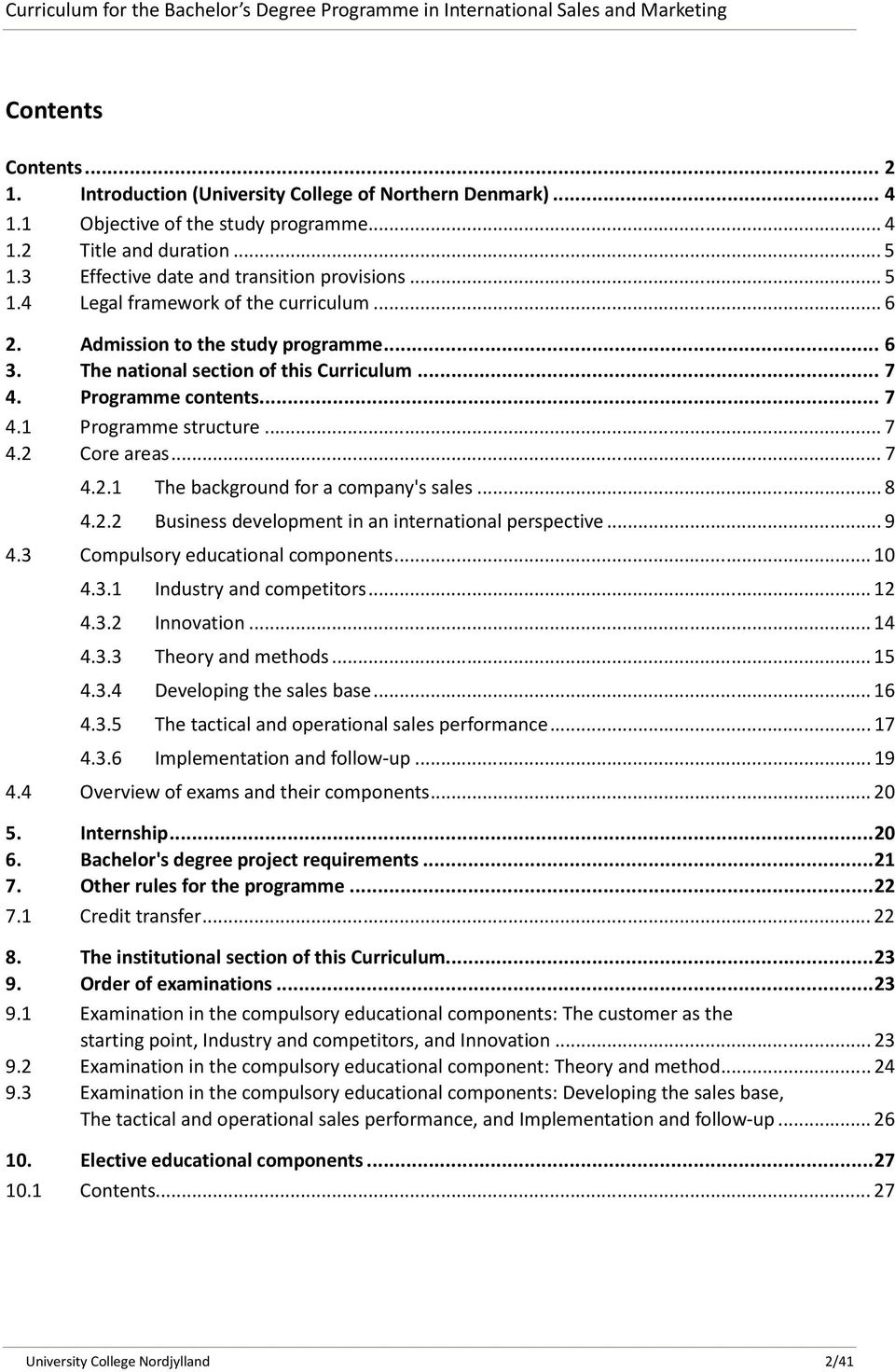
2 Contents Contents Introduction (University College of Northern Denmark) Objective of the study programme Title and duration Effective date and transition provisions Legal framework of the curriculum Admission to the study programme The national section of this Curriculum Programme contents Programme structure Core areas The background for a company's sales Business development in an international perspective Compulsory educational components Industry and competitors Innovation Theory and methods Developing the sales base The tactical and operational sales performance Implementation and follow-up Overview of exams and their components Internship Bachelor's degree project requirements Other rules for the programme Credit transfer The institutional section of this Curriculum Order of examinations Examination in the compulsory educational components: The customer as the starting point, Industry and competitors, and Innovation Examination in the compulsory educational component: Theory and method Examination in the compulsory educational components: Developing the sales base, The tactical and operational sales performance, and Implementation and follow-up Elective educational components Contents University College Nordjylland 2/41
3 11. Internship The bachelor's degree project Educational components that may take place abroad Types of learning and teaching methods applied Credit transfer for elective educational components Obligation to participate Criteria for assessing study activity Language Examination language Resit and illness resit exams Illness resits Resits Study aids Special exam arrangements Academic misconduct at exams Use of your own work and the work of others plagiarism Disciplinary actions in events of academic misconduct and disruptive behaviour Suspected academic misconduct at exams including plagiarism, during and after the exam The process of identifying academic misconduct, including plagiarism Complaints about exams and appeals against decisions Complaints about exams Complaints about the examination basis etc., the course of the exam and the assessment Appeals Complaints about legal matters Exemption Effective date and transition period University College Nordjylland 3/41

4 1. Introduction (University College of Northern Denmark) This Curriculum for the Bachelor s Degree Programme in International Sales and Marketing has been prepared in accordance with Ministerial Order no of 16 December 2013 on Academy Profession Programmes and Professional Bachelor Programmes (the Programme Order) by the institutions approved to offer the study programme. The national section of this Curriculum has been prepared jointly by the below institutions which are committed to ensure national competence and credit transfer. The national section of this Curriculum has been laid down by the following institutions: Copenhagen Business Academy International Business Academy Kolding Lillebaelt Academy of Professional Higher Education Erhvervsakademi Midt Vest Zealand Institute of Business and Technology Business Academy Southwest Business Academy Aarhus VIA University College University College of Northern Denmark Objective of the study programme The objective of the Bachelor's Degree Programme in International Sales and Marketing is to give the graduates knowledge and understanding of practice, applied theory and method within internationally-oriented sales and marketing as well as to qualify the graduates to independently analyse, assess and reflect on relevant issues and handle complex tasks in connection with international customer relations and direct sales. Learning outcomes The goals for learning outcomes comprise the knowledge and competences that international sales and marketing graduates should achieve during the study programme, cf. Ministerial Order no of 3 November 2009 on the bachelor's degree programme in International Sales and Marketing, Appendix 1. Knowledge The students should have acquired knowledge of practice, applied theory and method within sales and marketing in an international perspective as well as be able to reflect on it; central theories and models required for business-to-business sales and marketing; central laws and regulations of significance to international sales and marketing; relevant models for assessment of growth and development potential; and management theories and methods. University College Nordjylland 4/41

5 Skills develop, assess and implement international sales strategies for different company types; apply relevant models to implement product and concept development in the company; assess and apply legal methods and tools to support the operational sales performance in an internationally-focused company; assess the company's competitive situation as a basis for preparing the company's marketing mix with focus on the sales efforts; substantiate and communicate the chosen strategies in a sales plan to relevant stakeholders; apply relevant models for development in connection with innovative projects; and apply methods for management of sales staff. Competences handle and identify needs for relevant financial and legal information on international sales tasks; independently take part in interdisciplinary teams and create a motivating environment in the sales department; handle sales meetings with focus on the economic results and human focus areas; independently handle complex tasks and development-oriented situations in connection with international sales and marketing; and identify their own learning needs and structure their own learning in different learning environments within international sales and marketing. 1.2 Title and duration Title Students who have completed the programme are entitled to use the title: Bachelor of International Sales and Marketing. The Danish title is professionsbachelor i international handel og markedsføring. The programme is placed at level 6 in the Danish Qualifications Framework for Lifelong Learning. Duration and maximum length of study The programme is an independent top-up programme worth 90 ECTS credits. 60 ECTS credits correspond to one year's full-time studies, cf. section 9 of Ministerial Order no of 16 December 2013 on Academy Profession Programmes and Professional Bachelor Programmes (the Programme Order). Cf. section 5(2) of the Programme Order, the study programme must be completed within a number of years corresponding to twice the official length of study. That is three years. The educational institution may exempt students from the latest date of completion of the programme, when this is founded in exceptional circumstances. 1.3 Effective date and transition provisions This Curriculum will come into effect on 1 September 2015 and will apply to students who are admitted to and registered in the study programme starting as of the autumn of University College Nordjylland 5/41

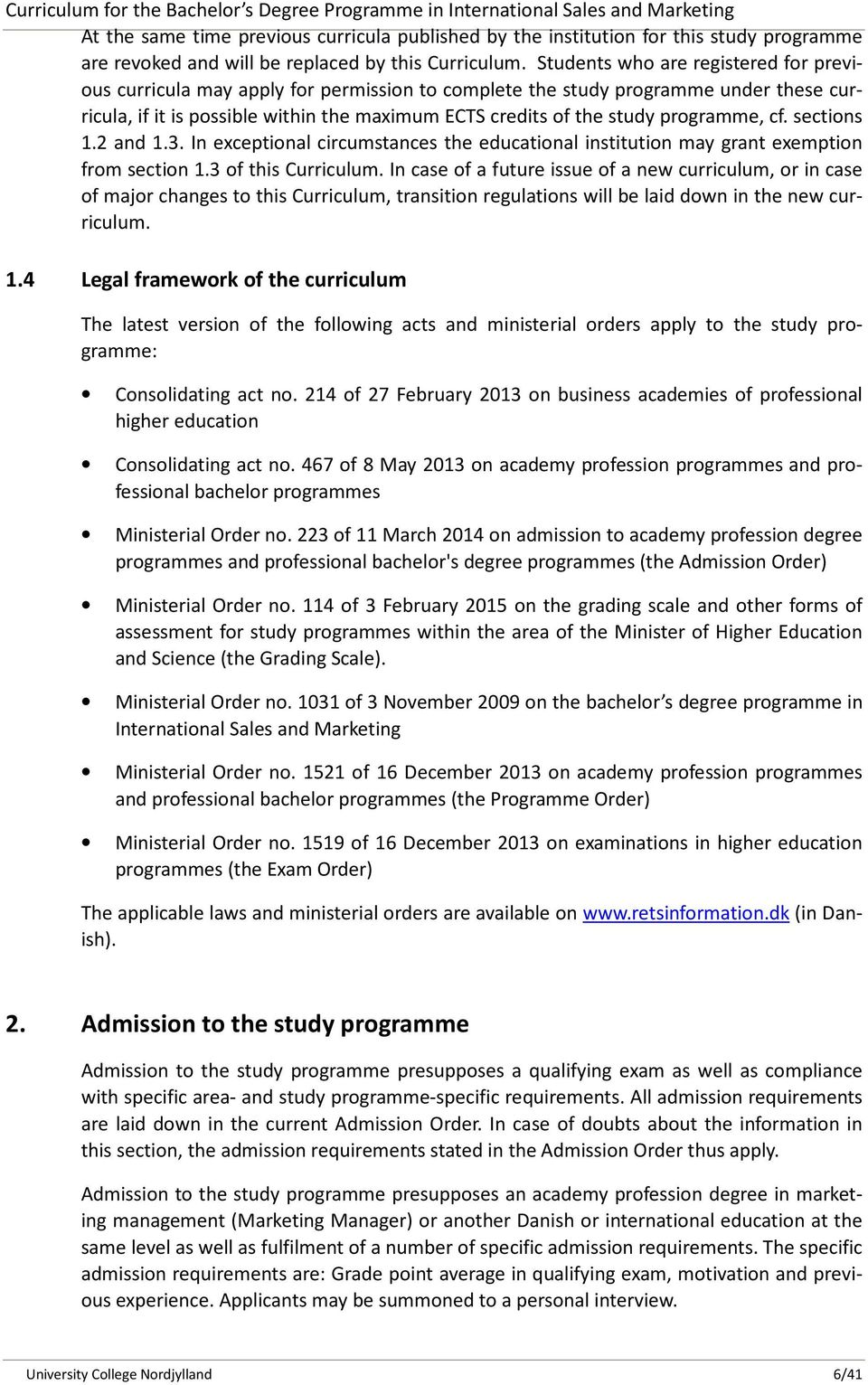
6 At the same time previous curricula published by the institution for this study programme are revoked and will be replaced by this Curriculum. Students who are registered for previous curricula may apply for permission to complete the study programme under these curricula, if it is possible within the maximum ECTS credits of the study programme, cf. sections 1.2 and 1.3. In exceptional circumstances the educational institution may grant exemption from section 1.3 of this Curriculum. In case of a future issue of a new curriculum, or in case of major changes to this Curriculum, transition regulations will be laid down in the new curriculum. 1.4 Legal framework of the curriculum The latest version of the following acts and ministerial orders apply to the study programme: Consolidating act no. 214 of 27 February 2013 on business academies of professional higher education Consolidating act no. 467 of 8 May 2013 on academy profession programmes and professional bachelor programmes Ministerial Order no. 223 of 11 March 2014 on admission to academy profession degree programmes and professional bachelor's degree programmes (the Admission Order) Ministerial Order no. 114 of 3 February 2015 on the grading scale and other forms of assessment for study programmes within the area of the Minister of Higher Education and Science (the Grading Scale). Ministerial Order no of 3 November 2009 on the bachelor s degree programme in International Sales and Marketing Ministerial Order no of 16 December 2013 on academy profession programmes and professional bachelor programmes (the Programme Order) Ministerial Order no of 16 December 2013 on examinations in higher education programmes (the Exam Order) The applicable laws and ministerial orders are available on (in Danish). 2. Admission to the study programme Admission to the study programme presupposes a qualifying exam as well as compliance with specific area- and study programme-specific requirements. All admission requirements are laid down in the current Admission Order. In case of doubts about the information in this section, the admission requirements stated in the Admission Order thus apply. Admission to the study programme presupposes an academy profession degree in marketing management (Marketing Manager) or another Danish or international education at the same level as well as fulfilment of a number of specific admission requirements. The specific admission requirements are: Grade point average in qualifying exam, motivation and previous experience. Applicants may be summoned to a personal interview. University College Nordjylland 6/41
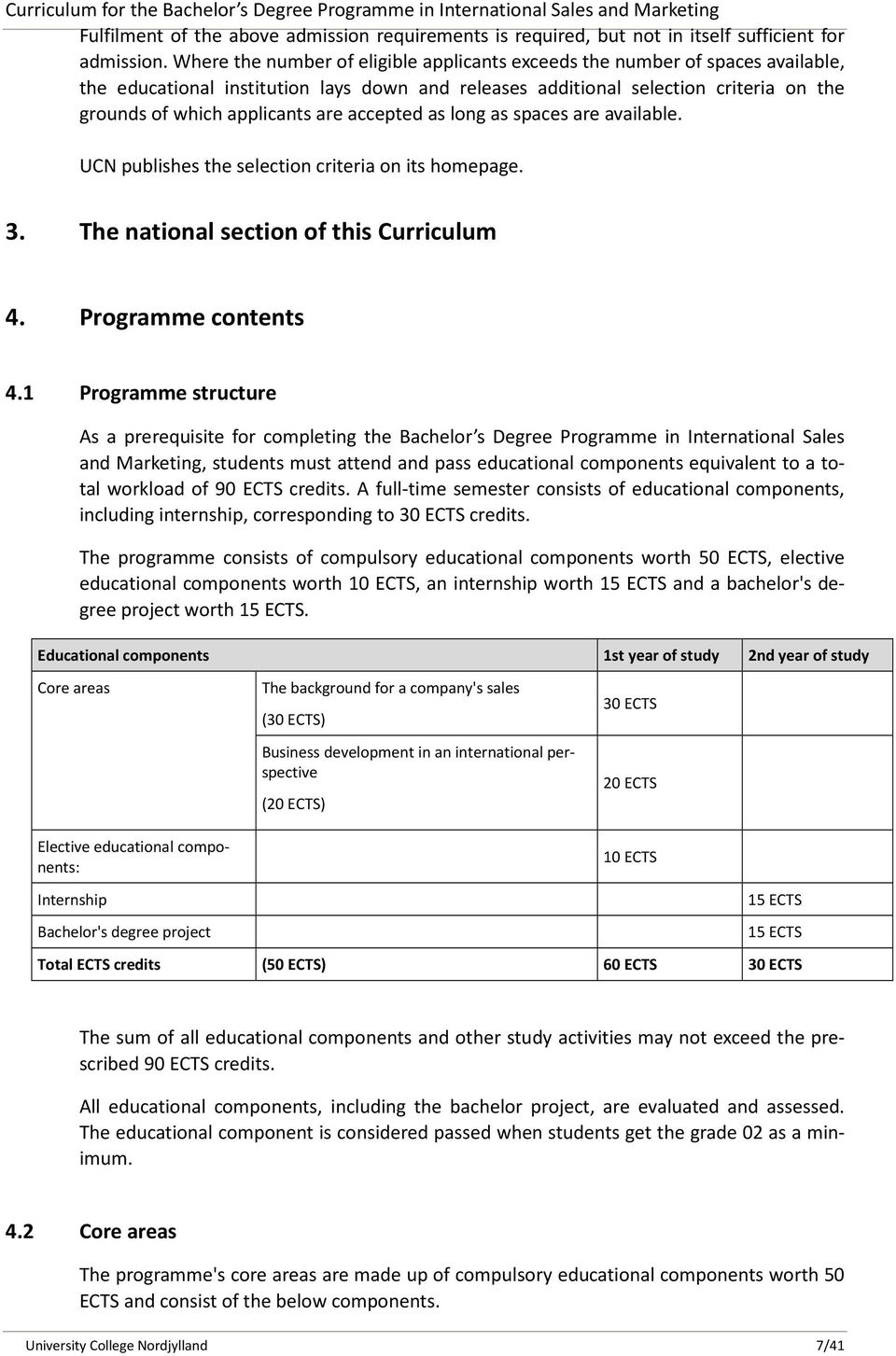
7 Fulfilment of the above admission requirements is required, but not in itself sufficient for admission. Where the number of eligible applicants exceeds the number of spaces available, the educational institution lays down and releases additional selection criteria on the grounds of which applicants are accepted as long as spaces are available. UCN publishes the selection criteria on its homepage. 3. The national section of this Curriculum 4. Programme contents 4.1 Programme structure As a prerequisite for completing the Bachelor s Degree Programme in International Sales and Marketing, students must attend and pass educational components equivalent to a total workload of 90 ECTS credits. A full-time semester consists of educational components, including internship, corresponding to 30 ECTS credits. The programme consists of compulsory educational components worth 50 ECTS, elective educational components worth 10 ECTS, an internship worth 15 ECTS and a bachelor's degree project worth 15 ECTS. Educational components 1st year of study 2nd year of study Core areas Elective educational components: The background for a company's sales (30 ECTS) Business development in an international perspective (20 ECTS) 30 ECTS 20 ECTS 10 ECTS Internship 15 ECTS Bachelor's degree project 15 ECTS Total ECTS credits (50 ECTS) 60 ECTS 30 ECTS The sum of all educational components and other study activities may not exceed the prescribed 90 ECTS credits. All educational components, including the bachelor project, are evaluated and assessed. The educational component is considered passed when students get the grade 02 as a minimum. 4.2 Core areas The programme's core areas are made up of compulsory educational components worth 50 ECTS and consist of the below components. University College Nordjylland 7/41
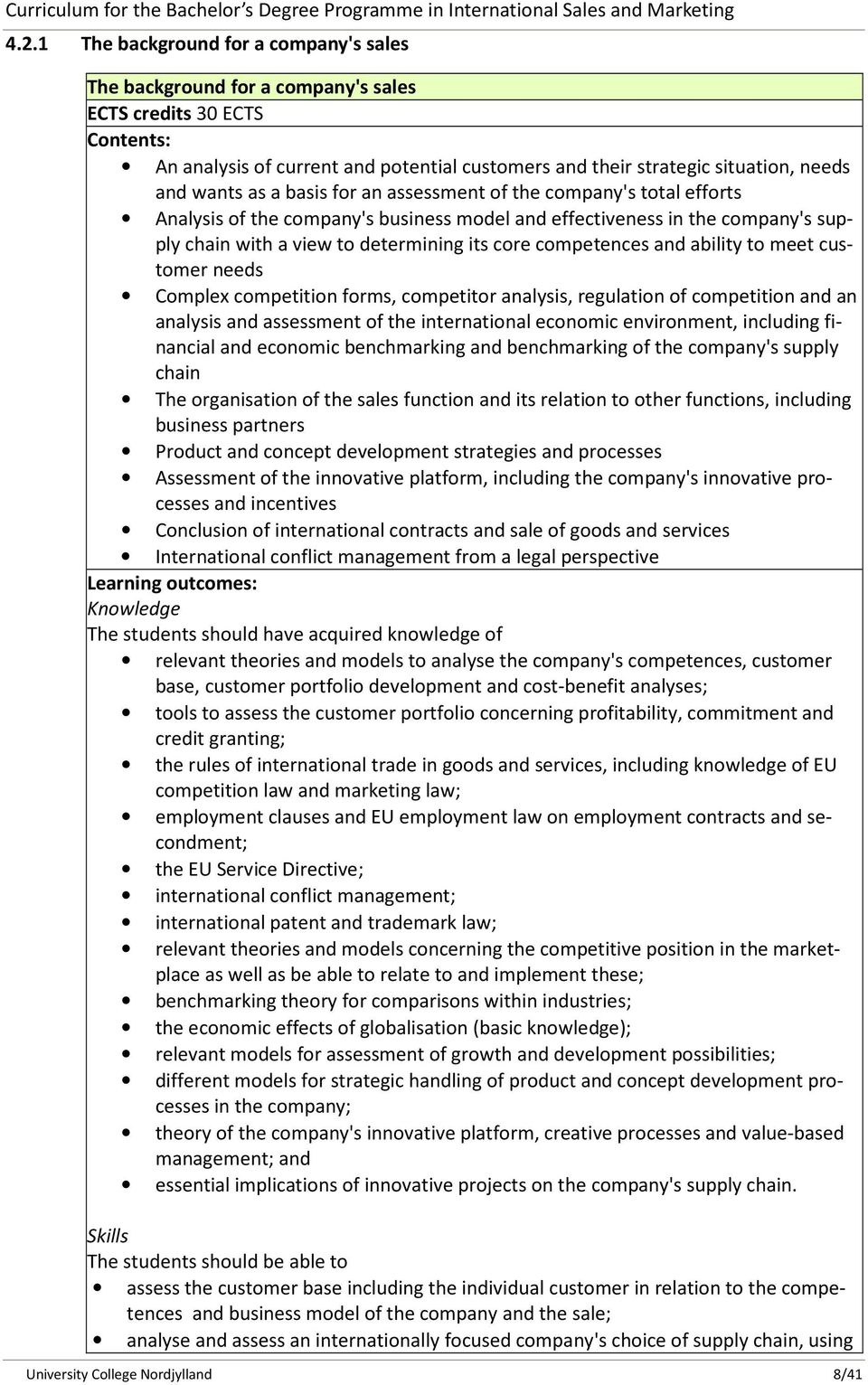
8 4.2.1 The background for a company's sales The background for a company's sales ECTS credits 30 ECTS Contents: An analysis of current and potential customers and their strategic situation, needs and wants as a basis for an assessment of the company's total efforts Analysis of the company's business model and effectiveness in the company's supply chain with a view to determining its core competences and ability to meet customer needs Complex competition forms, competitor analysis, regulation of competition and an analysis and assessment of the international economic environment, including financial and economic benchmarking and benchmarking of the company's supply chain The organisation of the sales function and its relation to other functions, including business partners Product and concept development strategies and processes Assessment of the innovative platform, including the company's innovative processes and incentives Conclusion of international contracts and sale of goods and services International conflict management from a legal perspective Learning outcomes: Knowledge The students should have acquired knowledge of relevant theories and models to analyse the company's competences, customer base, customer portfolio development and cost-benefit analyses; tools to assess the customer portfolio concerning profitability, commitment and credit granting; the rules of international trade in goods and services, including knowledge of EU competition law and marketing law; employment clauses and EU employment law on employment contracts and secondment; the EU Service Directive; international conflict management; international patent and trademark law; relevant theories and models concerning the competitive position in the marketplace as well as be able to relate to and implement these; benchmarking theory for comparisons within industries; the economic effects of globalisation (basic knowledge); relevant models for assessment of growth and development possibilities; different models for strategic handling of product and concept development processes in the company; theory of the company's innovative platform, creative processes and value-based management; and essential implications of innovative projects on the company's supply chain. Skills assess the customer base including the individual customer in relation to the competences and business model of the company and the sale; analyse and assess an internationally focused company's choice of supply chain, using University College Nordjylland 8/41
9 relevant theories; conduct an economic analysis, assessment and prioritisation of a customer portfolio; analyse and assess the company's competitive position; benchmark a company against a competitor or the industry; apply relevant models for product and concept development in the company, including assess the economic consequences; and assess various possibilities to secure the purchase sum. Competences take part in the company's work with marketing intelligence with focus on collection and assessment of information about the competitive position in the marketplace; include relevant data in the assessment of the company's customer care and customer development structure, including the ability to implement the sales task; assess and identify areas for improvement in the company's supply chain; make a basis for decision as support for an economic assessment of customer base and external influences; assess a company's innovative starting point and be able to take part in the company's planning and implementation of product and concept development processes; analyse and assess legal issues in relation to international trade; apply and assess different forms of distribution; and assess the compliance of marketing measures with EU law on misleading and comparative advertising Business development in an international perspective Business development in an international perspective ECTS credits 20 ECTS Contents: Strategy development focusing on customers, relations, products, incentives, sales organisation and presentations, activity-based costing and value chain optimisation Evaluation of the contribution of the sales function Management of the sales function Learning outcomes: Knowledge The students should have acquired knowledge of and be able to reflect on central theories and models for the development of the company's sales base; management theories which can support the development of the company's sales base, in general and broadly; theories and models which support and develop the tactical and operational sales performance; tools and models for customer follow-up; situation-specific management in the sales function; and tools for measurement and management of the effectiveness in the company's supply chain. University College Nordjylland 9/41
10 Skills develop, assess and implement international sales strategies for different company types; substantiate and communicate the chosen strategies in a sales plan to relevant stakeholders; choose and apply theories and models for the planning of the tactical and operational sales performance based on the chosen sales strategy; draw up a balanced scorecard for a sales function and sales area, including make suggestions for follow-up; assess and apply methods and tools for the company's supply chain to benefit the operational sales performance; assess the marketing mix against customers generally and the individual customer specifically; and make suggestions for possible changes in strategy and operations. Competences handle and manage the development of the sales strategy starting from different complex situations and involving relevant parties; develop an organisational action plan which ensures the implementation of the sales plan; develop the economic foundation for a sales strategy in a practical context for a specific company; participate in the sales work in a company at the tactical and operational level; make their own balanced scorecard in relation to a company's overall strategy and plan and secure ongoing follow-up; and enter into a dialogue with the sales function about the optimisation of the company's total sales activities. 4.3 Compulsory educational components The programme's core areas are made up of compulsory educational components worth 50 ECTS and consist of the below components. The customer as the starting point Core area: The background for a company's sales ECTS credits 15 ECTS Contents: An analysis of current and potential customers and their strategic situation, needs and wants as a basis for an assessment of the company's total efforts Assessment of the company s business model and competences Analysis of relations and marketing mix Analysis of effectiveness in the company's supply chain with a view to determining the company's core competences and ability to satisfy customer needs Assessment of choice of geographical positioning of centres of production and know-how, including partnerships and outsourcing The company's strategic foundation and focus The organisation of the sales function strategically, tactically and operationally Organisation analysis of the sales team and purchase centre in relation to a sales University College Nordjylland 10/41
11 assignment The relation of the sales function to other functions, including business partners Competence analysis The rules of international contract formation and international sale of goods and services EU employment law concerning employment contracts and secondment International conflict management The economic and financial foundation of the sale Activity Based Costing Customer profitability, including credit rating Learning outcomes: Knowledge The students should have acquired knowledge of relevant theories and models to analyse the company's competences, customer base, customer portfolio development and cost-benefit analyses; relevant models and theories on business models with the sale as the starting point; practical international examples in connection with current theory in the area; general strategic perceptions and models within the structuring and organising of the sale, competence assessment, customer organisation, assessment of implementation capacity, and relations to other functions and partners; tools to assess the customer portfolio concerning profitability, commitment and credit granting; how to apply employment clauses in connection with employment in exporting countries and knowledge of EU rules concerning secondment, employment contracts and social security; Council Regulation (EC) No 44/2001 of 22 December 2000 on jurisdiction and the recognition and enforcement of judgements in civil and commercial matters (Brussels I Regulation) and various international conflict management methods, including the rules concerning venue, pros and cons of court orders compared with arbitration and mediation; and the EU Service Directive; Skills assess the customer base including the individual customer in relation to the competences and business model of the company and the sale; analyse and assess the relations between customer and company; assess the customer's profitability and projected future earnings potential along with the relevance of either a resource-based or market-oriented approach; analyse and assess an internationally focused company's choice of supply chain, using relevant theories. This analysis will focus on the connection between: - the organisation of the sale - the development of partnerships - securing customer satisfaction and experience of quality; analyse and assess the company's strategic position; analyse and assess the organisation of a sale seen from a customer point of view, including relations to other functions in the company; analyse the organisation of a sale; University College Nordjylland 11/41
12 use customer analysis to analyse and assess the competences and requirements of the sales department; conduct an economic analysis, assessment and prioritisation of a customer portfolio; assess various ways of securing the purchase sum in connection with export transactions, including the use of delivery clauses, letters of credit, export credit schemes, various types of banker s guarantees, factoring/forfaiting and retention of ownership. Competences participate in interdisciplinary teams in connection with the company's assessment of the customer base; include relevant data for the assessment of the company's customer care and customer development structure; assess the company's competences and ability to match the customers' expectations of the sales function; identify legal regulations that are relevant for the agreement and the sale; analyse and assess the legal consequences of an international sales agreement; make a basis for decision which supports an economic assessment of the customer base; use and assess the need for and the legal consequences of conditions of sales and delivery; analyse and assess matters in relation to international trade in goods and services, including conflict of laws rules and international contract rules with main focus on the United Nations Convention on Contracts for the International Sale of Goods (CISG); and apply the rules on the different forms of distribution in an analysis with a view to choosing distribution form in connection with export transactions, including direct sales, sales agents, sales through branches, sales through subsidiaries, franchising, joint venture/strategic alliances and e-commerce. Examination and assessment: - One examination Industry and competitors Industry and competitors Core area: The background for a company's sales ECTS credits 5 ECTS Contents: Analysis of the increasing complexity of the forms of competition Analysis of competitors, clustering and application of benchmarking Benchmarking of the company's supply chain Ethics and social responsibility, including corporate social responsibility Regulation of competition An analysis and assessment of the conditions of the international economic environment Financial and economic benchmarking Learning outcomes: Knowledge The students should have acquired knowledge of relevant theories and models concerning the competitive position in the market as well as be able to relate to and implement these; University College Nordjylland 12/41
13 identification and analysis of specific competitors; different benchmarking models; basic benchmarking theory and models within supply chain management; business ethics and corporate social responsibility; international competition law with main focus on EU competition law; the ICC Advertising and Marketing Communication Practice; the economic effects of globalisation (basic knowledge); international trade movements in the area; and economic and financial benchmarking theory for comparisons within an industry. Skills analyse and assess the company's competitive position as a basis for preparation of the company's marketing mix with focus on the sales effort. In relation to this, the students should be able to benchmark the company against both the industry and its specific competitors with reference to the strategic, tactical and operational level; involve relevant theories and models in relation to benchmarking of the supply chain of an internationally-oriented medium-sized company; understand the company's ethical dimension; and benchmark a company against a competitor or industry, including relevant economic theory. Competences take part in the company's work with marketing intelligence with focus on collection and assessment of information about the competitive position in the marketplace; assess and identify areas of improvement in the company's supply chain based on benchmarking; handle an economic assessment of the external influences on a company from both the industry and international conditions; and assess whether certain marketing measures comply with the EU rules concerning misleading and comparative advertising. Examination and assessment: - One examination University College Nordjylland 13/41

14 4.3.2 Innovation Innovation Core area: The background for a company's sales ECTS credits 5 ECTS Contents: Analysis of the growth basis of companies Analysis of the product and concept development strategies and processes of companies Consequences of innovation for the company's supply chain Assessment of the innovative platform along with the company's innovative processes and incentives International/EU intellectual property law Project management and measurement systems Learning outcomes: Knowledge The students should have acquired knowledge of relevant models for assessment of growth and development possibilities; different models for strategic handling of product and concept development processes in the company; essential implications of innovative projects on the company's supply chain. theory of the company's innovative platform, creative processes and value-based management; economic theory about project management and assessment; and the rules on intellectual property rights, including international patents and EU trademarks. Skills apply relevant models to the implementation of product and concept development in the company; apply relevant models to the development of solutions for the company's supply chain in relation to innovative projects; assess the innovative structures, processes and incentives of the sales organisation; and analyse the economic consequences of a particular innovation policy for a company. Competences carry out concept development; take part in interdisciplinary teams with a view to solving challenges in the company's supply chain in relation to implementation of innovative projects; assess a company's innovative basis; apply the rules of protection of intellectual property rights; and define Key Performance Indicators for the company's innovative work in relation to the sales effort. Examination and assessment: - One examination University College Nordjylland 14/41

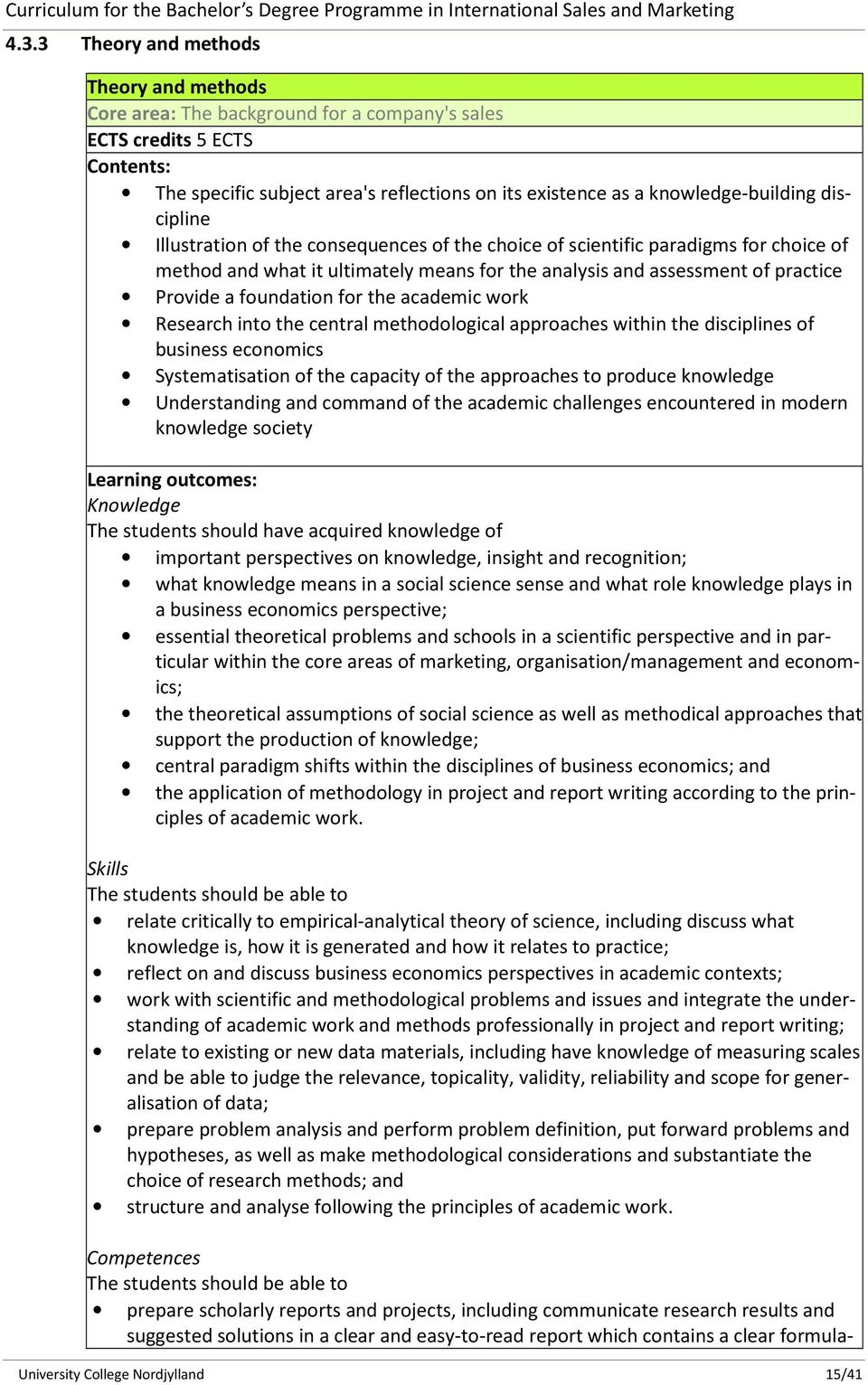
15 4.3.3 Theory and methods Theory and methods Core area: The background for a company's sales ECTS credits 5 ECTS Contents: The specific subject area's reflections on its existence as a knowledge-building discipline Illustration of the consequences of the choice of scientific paradigms for choice of method and what it ultimately means for the analysis and assessment of practice Provide a foundation for the academic work Research into the central methodological approaches within the disciplines of business economics Systematisation of the capacity of the approaches to produce knowledge Understanding and command of the academic challenges encountered in modern knowledge society Learning outcomes: Knowledge The students should have acquired knowledge of important perspectives on knowledge, insight and recognition; what knowledge means in a social science sense and what role knowledge plays in a business economics perspective; essential theoretical problems and schools in a scientific perspective and in particular within the core areas of marketing, organisation/management and economics; the theoretical assumptions of social science as well as methodical approaches that support the production of knowledge; central paradigm shifts within the disciplines of business economics; and the application of methodology in project and report writing according to the principles of academic work. Skills relate critically to empirical-analytical theory of science, including discuss what knowledge is, how it is generated and how it relates to practice; reflect on and discuss business economics perspectives in academic contexts; work with scientific and methodological problems and issues and integrate the understanding of academic work and methods professionally in project and report writing; relate to existing or new data materials, including have knowledge of measuring scales and be able to judge the relevance, topicality, validity, reliability and scope for generalisation of data; prepare problem analysis and perform problem definition, put forward problems and hypotheses, as well as make methodological considerations and substantiate the choice of research methods; and structure and analyse following the principles of academic work. Competences prepare scholarly reports and projects, including communicate research results and suggested solutions in a clear and easy-to-read report which contains a clear formula- University College Nordjylland 15/41
16 tion of the problem, methodological considerations and an assessment of the reliability and validity of the results and prerequisites; prepare a research plan and assess the strong and weak points of alternative research methods; and substantiate the choice of method along with relating critically to the method. Assessment and examination: - One examination Developing the sales base Developing the sales base Core area: Business development in an international perspective ECTS credits 10 ECTS Contents: Development of international sales strategies Development of CRM strategies, from attracting new customers to retaining and developing existing customers, including key account management (KAM) and global account management (GAM) Development of sales plans Development of international strategies for the company's supply chain to support sales strategies and plans Adaptation of action parameters Organisation development and change management Personal development, including self-leadership and stress management Team building Competence development plans Management of partnerships Strategic behaviour and game theory Economic value added and weighted average costs of capital (WACC) Forecasting models Implementation power Learning outcomes: Knowledge The students should have acquired knowledge of and be able to reflect on central theories and models for the development of the company's sales base, based on relational as well as transactional approaches; the theoretical tools in relation to the company's supply chain with a view to developing an international sales base, including basic agent theory; management theories, generally and broadly, which can support the development of the company's sales base, including development of competence plans, partnerships and the sales team; and basic sales strategy models and their applications. Skills develop, assess and implement international sales strategies for different business types (industry, sizes, resources etc.); substantiate and communicate the chosen strategies in a sales plan to relevant stakeholders; University College Nordjylland 16/41

17 develop and adapt the company s action parameters to the individual customer; collect relevant data for the assessment and development of plans for the company's supply chain plans as support for the sales base; identify areas of development in the sales organisation, including international agents; develop competence plans for the sales team, including self-leadership and stress management; prepare a plan for the development of an organisation in relation to the company's culture and values; apply the theory acquired to the assessment of alternative sales plans; and assess the sales department's implementation power in connection with sales measures. Competences handle complex situations, involving relevant stakeholders; identify their own learning needs, so that they can continuously develop their skills and knowledge; ensure the use of theories and methods for the company's supply chain with a view to developing an action plan for the sale; develop an organisational action plan which ensures the implementation of the sales plan; identify and build up personal networks; handle and develop solutions for complex situations within international partnerships; develop the economic basis of a sales strategy in a practical context for a specific company; and assess and develop the company's ability to implement the sales activity. Examination and assessment: - One examination The tactical and operational sales performance The tactical and operational sales performance Core area: Business development in an international perspective ECTS credits 5 ECTS Contents: Implementation of sales strategies and sales plans Coordination and cooperation in the company's supply chain Preparation of back-up plans Recruitment and selection of sales personnel Incentive strategies Coaching Conflict management Management of the sales function, including stress management Activity Based Costing and value chain optimisation Foreign currency and option theory University College Nordjylland 17/41

18 Learning outcomes: Knowledge The students should have knowledge and understanding of theories and models which support and develop the tactical and operational sales performance; have a basic understanding of problems, theory and models in the company's supply chain which are linked to the tactical and operational sales performance; have knowledge and understanding of different methods for recruitment of sales personnel; be able to understand and reflect on the significance of different motivation theories for the preparation of incentive strategies; have knowledge and understanding of different conflict styles and conflict resolution options; have knowledge of situation-specific management in the sales function; and understand basic theory and models in the area. Skills choose and apply theories and models for planning of the tactical and operational sales performance based on the chosen sales strategy; develop the company's strategy based on unique customer relations and be able to communicate this to relevant stakeholders; assess and apply methods and tools for the company's supply chain to support the tactical and operational sales performance; prepare suggestions for the recruitment plan; prepare strategies for the motivation of sales personnel; understand the relevance of coaching in relation to sales personnel; prepare suggestions for conflict management in the company; understand situational management in the sales organisation; and apply the theory acquired to actual international sales assignments. Competences participate in the sales work in a company at the tactical and operational level; identify problems and solutions in the company's supply chain for planning of the tactical and operational sales performance; manage and develop solutions to complex situations within international sales management; and assess the economic consequences of a given international sales effort, including risk assessment and limitation. Examination and assessment: - One examination University College Nordjylland 18/41

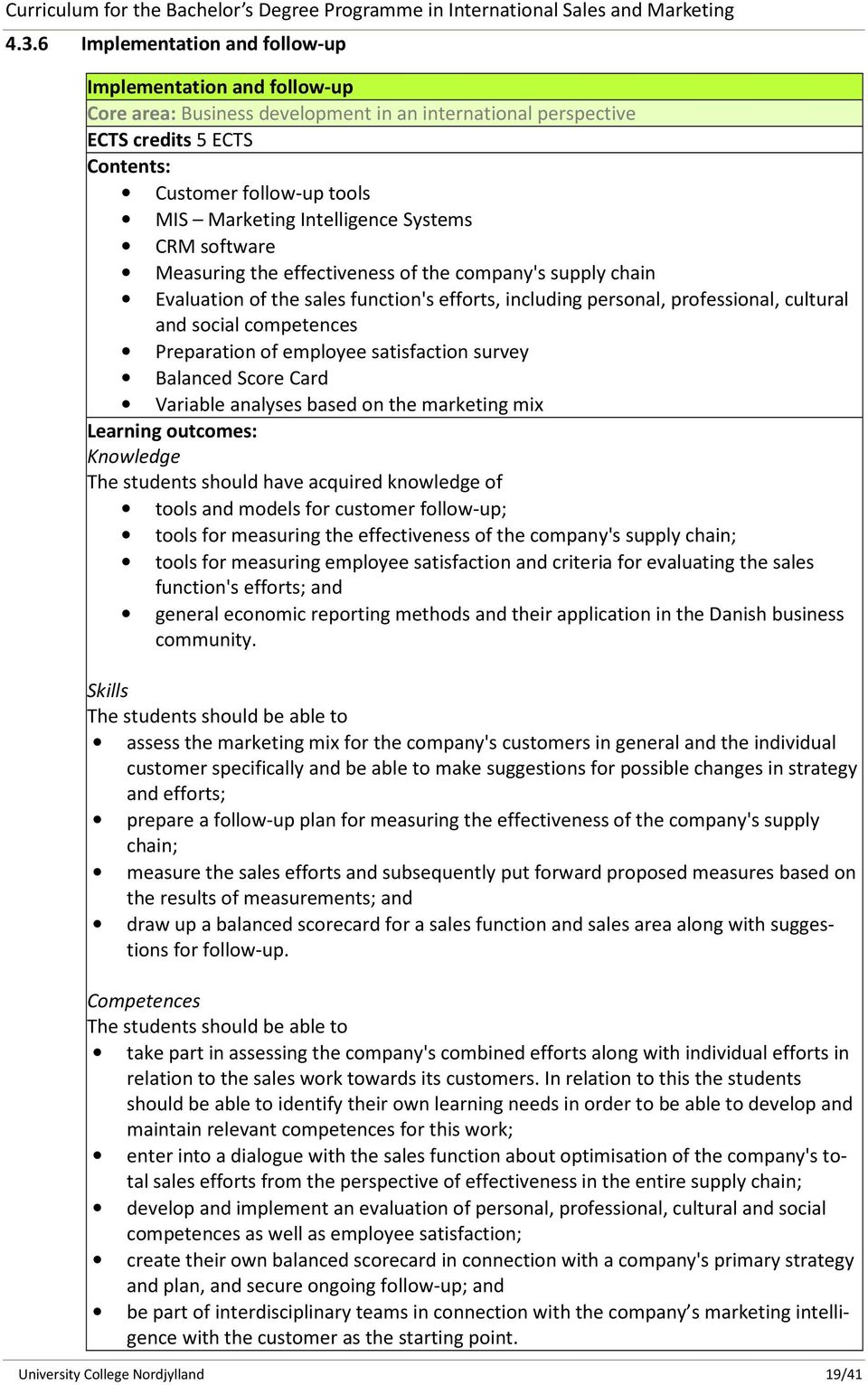
19 4.3.6 Implementation and follow-up Implementation and follow-up Core area: Business development in an international perspective ECTS credits 5 ECTS Contents: Customer follow-up tools MIS Marketing Intelligence Systems CRM software Measuring the effectiveness of the company's supply chain Evaluation of the sales function's efforts, including personal, professional, cultural and social competences Preparation of employee satisfaction survey Balanced Score Card Variable analyses based on the marketing mix Learning outcomes: Knowledge The students should have acquired knowledge of tools and models for customer follow-up; tools for measuring the effectiveness of the company's supply chain; tools for measuring employee satisfaction and criteria for evaluating the sales function's efforts; and general economic reporting methods and their application in the Danish business community. Skills assess the marketing mix for the company's customers in general and the individual customer specifically and be able to make suggestions for possible changes in strategy and efforts; prepare a follow-up plan for measuring the effectiveness of the company's supply chain; measure the sales efforts and subsequently put forward proposed measures based on the results of measurements; and draw up a balanced scorecard for a sales function and sales area along with suggestions for follow-up. Competences take part in assessing the company's combined efforts along with individual efforts in relation to the sales work towards its customers. In relation to this the students should be able to identify their own learning needs in order to be able to develop and maintain relevant competences for this work; enter into a dialogue with the sales function about optimisation of the company's total sales efforts from the perspective of effectiveness in the entire supply chain; develop and implement an evaluation of personal, professional, cultural and social competences as well as employee satisfaction; create their own balanced scorecard in connection with a company's primary strategy and plan, and secure ongoing follow-up; and be part of interdisciplinary teams in connection with the company s marketing intelligence with the customer as the starting point. University College Nordjylland 19/41
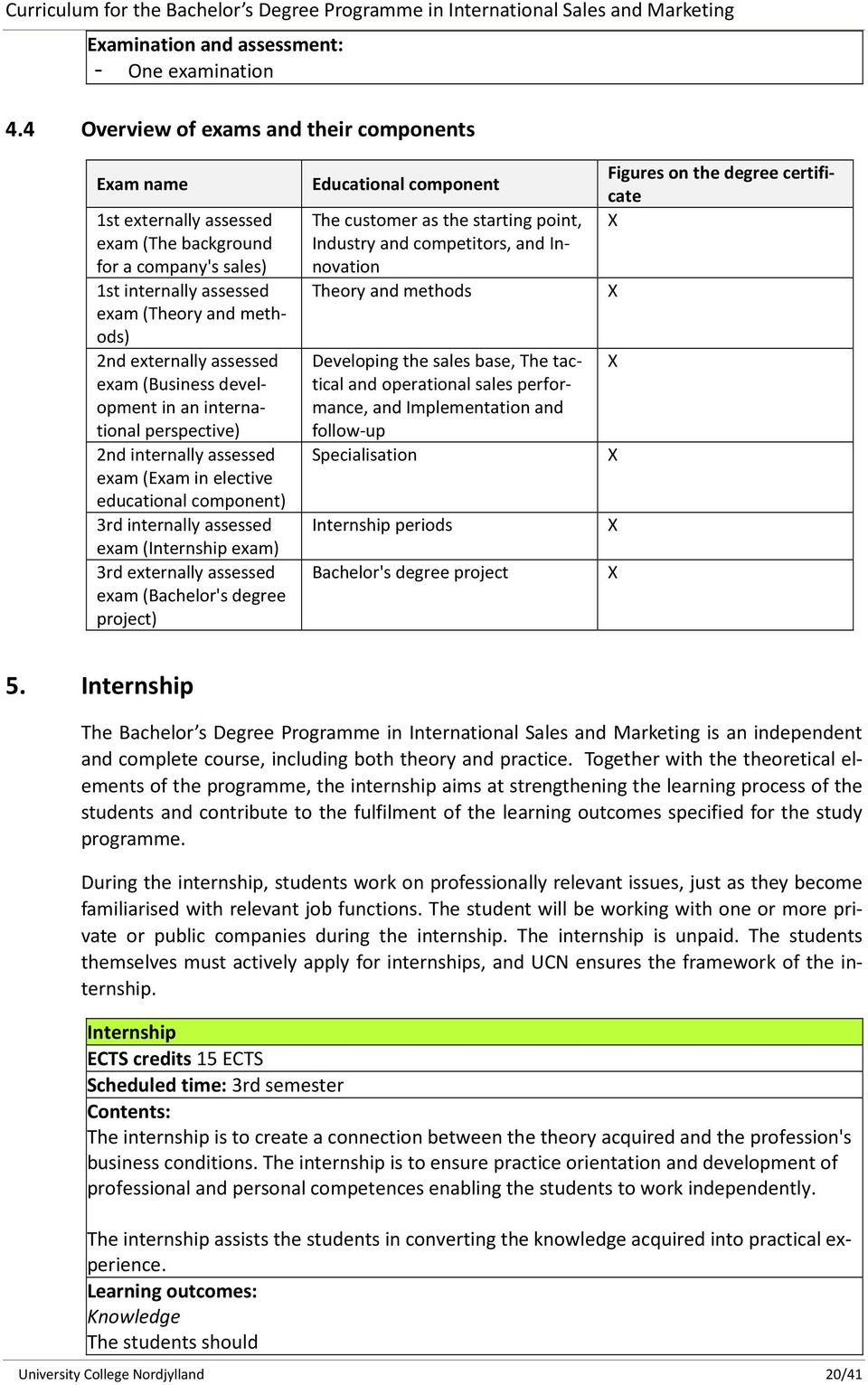
20 Examination and assessment: - One examination 4.4 Overview of exams and their components Exam name 1st externally assessed exam (The background for a company's sales) 1st internally assessed exam (Theory and methods) 2nd externally assessed exam (Business development in an international perspective) 2nd internally assessed exam (Exam in elective educational component) 3rd internally assessed exam (Internship exam) 3rd externally assessed exam (Bachelor's degree project) Educational component The customer as the starting point, Industry and competitors, and Innovation Theory and methods Developing the sales base, The tactical and operational sales performance, and Implementation and follow-up Specialisation Internship periods Bachelor's degree project Figures on the degree certificate X X X X X X 5. Internship The Bachelor s Degree Programme in International Sales and Marketing is an independent and complete course, including both theory and practice. Together with the theoretical elements of the programme, the internship aims at strengthening the learning process of the students and contribute to the fulfilment of the learning outcomes specified for the study programme. During the internship, students work on professionally relevant issues, just as they become familiarised with relevant job functions. The student will be working with one or more private or public companies during the internship. The internship is unpaid. The students themselves must actively apply for internships, and UCN ensures the framework of the internship. Internship ECTS credits 15 ECTS Scheduled time: 3rd semester Contents: The internship is to create a connection between the theory acquired and the profession's business conditions. The internship is to ensure practice orientation and development of professional and personal competences enabling the students to work independently. The internship assists the students in converting the knowledge acquired into practical experience. Learning outcomes: Knowledge The students should University College Nordjylland 20/41
21 have acquired knowledge of the theory and method of the profession as well as of practice; understand concepts and methods as well as be able to reflect on the use; and have acquired experience from participating in practical assignments. Skills convert the knowledge acquired into practice within the trade; assess theoretical and practical issues and put forward suggested solutions; and use and communicate relevant theories for addressing assignments at the place of internship. Competences see their own specialist role in relation to specific tasks; and be part of discipline-specific as well as interdisciplinary cooperation. Assessment: One exam 6. Bachelor's degree project requirements The bachelor project in the Bachelor s Degree Programme in International Sales and Marketing must document the students understanding of practice and applied theory and methods in relation to a practice-based problem based on a specific assignment within the field of study. The problem statement, which must be key to the programme and the industry, has to be formulated by the students, possibly in cooperation with a private or public company. The educational institution must approve the problem statement and research question. The bachelor project exam is conducted as an externally assessed examination, which, together with the internship exam and other programme examinations, should document that the programme s learning outcomes have been achieved. The exam is made up of a project and an oral examination. The results of the two will be combined to provide the students with a single grade. The exam will not take place until the students have passed the final internship exam as well as the other exams of the programme. Bachelor's degree project ECTS credits 15 ECTS Scheduled time: At the end of the 3rd semester Contents: The project must be based on central topics of the programme and must contain elements from the internship. The problem statement for the bachelor's project must be prepared by the students and as far as possible in collaboration with a company. The problem statement must be approved by the educational institution. As a main rule, the bachelor project is prepared individually. When addressing the problem set out in the problem statement, it is important that stu- University College Nordjylland 21/41
22 dents are able to apply central theories and methods. Furthermore, the bachelor's project must include empirical material in addressing the specific problem or issues. Learning outcomes: The learning outcomes are the same as the learning outcomes for the study programme. Further, the below learning outcomes apply to the bachelor project. Knowledge The students should have acquired knowledge of the profession's and subject area's applied theory and methods along with practice; and theory and methods along with being able to reflect on the profession's application of theory and methods. Skills apply methods and tools for collection and analysis of information and master the skills related to employment in the profession; assess theoretical and practical problems and issues and substantiate the chosen actions and solutions; and communicate practical and professional problems and issues as well as solutions for colleagues and users. Competences handle complex and development-oriented situations in relation to work or study; independently take part in discipline-specific and interdisciplinary collaboration and take on responsibility within the settings of professional ethics; and identify their own learning needs and, in relation to the profession, develop their own knowledge and skills. 7. Other rules for the programme 7.1 Credit transfer It may be possible to obtain credit transfer for educational components from other institutions etc. for a study programme at UCN. In each case UCN approves credit transfer based on completed educational components and employment that match up to subjects, educational components and internship components in the study programme at UCN. The decision is based on a professional assessment. The students must provide information on completed educational components from another Danish or international further education and on employment assumed to result in credit transfer. University College Nordjylland 22/41
23 8. The institutional section of this Curriculum 9. Order of examinations Overview of all examinations and their order Exam order Examination 90 ECTS credits distributed across exams Internal/external assessment Assessment 1st semester 1st semester 1. Compulsory educational components The customer as the starting point Industry and competitors Innovation 2. Compulsory educational component: Theory and methods 2nd semester 3. Compulsory educational components Developing the sales base The tactical and operational sales performance and Implementation and follow-up 25 External 7-point grading scale 5 Internal 7-point grading scale 20 External 7-point grading scale 2nd semester 4. Elective educational component 10 Internal 7-point grading scale 3rd semester 5. Internship exam 15 Internal 7-point grading scale External 6. Bachelor's degree project 15 External 7-point grading scale Information about the time and place for each exam can be found on ecampus. 9.1 Examination in the compulsory educational components: The customer as the starting point, Industry and competitors, and Innovation Exam attendance prerequisites, including obligation to participate Students must meet the following requirements in order to sit the exam: Approved participation in Mandatory Assignment 1 Approved participation in Mandatory Assignment 2 Approved participation in Mandatory Assignment 3 Submission of and approved semester project Non-performance of one or more prerequisites means that the students may not participate in the exam, and that they will be considered to have made an exam attempt. University College Nordjylland 23/41
24 For further information on the prerequisites, see the semester plan which is found on ecampus. Exam form and procedure The exam is an interdisciplinary, individual written case exam graded according to the 7- point grading scale. The exam has a duration of six hours and takes place following 24 hours of preparation. The basis of the 24 hours of preparation is a case in English. The exam is worth 25 ECTS credits. For further information on the prerequisites, see the semester plan which is found on ecampus. Assessment criteria The assessment criteria for the exam are the same as the learning outcomes for the compulsory educational components: The customer as the starting point, Industry and competitors, and Innovation The learning outcomes are described in the national section of this Curriculum. Scheduled time The exam takes place at the end of the 1st semester. Information about time and place can be found on ecampus. The exam must be passed before the end of the 1st year of study in order for students to continue the study. The study programme may exempt individual students from the deadlines specified for passing the exam, if the exemption is due to illness, maternity or paternity leave or exceptional circumstances. Use of study aids All electronic study aids are permitted. Examination language English. 9.2 Examination in the compulsory educational component: Theory and method Exam attendance prerequisites, including obligation to participate Students must meet the following requirements in order to sit the exam: Approved participation in Mandatory Assignment 1 Approved participation in Mandatory Assignment 2 University College Nordjylland 24/41
25 Approved participation in Mandatory Assignment 3 Submission of and approved semester project Non-performance of one or more prerequisites means that the students may not participate in the exam, and that they will be considered to have made an exam attempt. For further information on the prerequisites, see the semester plan which is found on ecampus. Examination procedure The exam is an oral internally assessed exam graded according to the 7-point grading scale. The exam is a group examination. Based on a discussion of the learning outcomes for the component, the individual student's understanding will be individually assessed. The exam is worth 5 ECTS credits. For further information on the prerequisites, see the semester plan which is found on ecampus. Assessment criteria The assessment criteria for the exam are the same as the learning outcomes for the compulsory educational component: Theory and methods The learning outcomes are described in the national section of this Curriculum. Order of examinations The exam takes place at the end of the 1st semester. Information about time and place can be found on ecampus. The exam must be passed before the end of the 1st year of study in order for students to continue the study. The study programme may exempt individual students from the deadlines that have been set for passing the examination if the exemption is due to illness, maternity or paternity leave or exceptional circumstances. Use of study aids No electronic study aids are permitted. Examination language English. University College Nordjylland 25/41
26 9.3 Examination in the compulsory educational components: Developing the sales base, The tactical and operational sales performance, and Implementation and follow-up Exam attendance prerequisites, including obligation to participate Students must meet the following requirements in order to sit the exam: Approved participation in Mandatory Assignment 4 Approved participation in Mandatory Assignment 5 Approved participation in Mandatory Assignment 6 Submission of and approved semester project, which must meet the formal requirements of projects, see ecampus; and be submitted in due time according to the semester plan, which can be found on ecampus. Non-performance of one or more prerequisites means that the students cannot sit the exam and that they will be considered to have made an exam attempt. For further information on the prerequisites, see the semester plan which is found on ecampus. Formal written project requirements The project report must include: Cover page with title, name of study programme, place of study, date, semester, class name, project name, supervisor's name, name(s) of project participant(s) and the number of standard pages of 2,400 characters including spaces and footnotes, models and pictures. Only the actual assignment is assessed, as preface, table of contents, reference list and appendices are not included in the assessment. Table of contents Introduction, including problem statement and research question Method and theory Analysis and problem-solving Conclusion Optional discussion in which you place your research and findings in a wider context Reference list (including all sources referred to in the project) Appendices (include only appendices central to the report) University College Nordjylland 26/41
27 For each group, the written project must total 40 standard pages of 2,400 characters including spaces. 1 Examination procedure The exam is a 30-minute individual externally assessed oral examination based on a written group project. The exam is assessed solely based on the oral performance. The project will be graded according to the 7-point grading scale. The exam is worth 20 ECTS credits. For further information on the prerequisites, see the semester plan which is found on ecampus. Assessment criteria The assessment criteria for the exam are the same as the learning outcomes for the compulsory educational components: Developing the sales base, the tactical and operational sales performance, and Implementation and follow-up. The learning outcomes are described in the national section of this Curriculum. Scheduled time The exam takes place at the end of the 2nd semester. Information about time and place can be found on ecampus. The exam must be passed before the end of the 1st year of study in order for students to continue the study. The study programme may exempt individual students from the deadlines that have been set for passing the examination if the exemption is due to illness, maternity or paternity leave or exceptional circumstances. Use of study aids No electronic study aids are permitted. Examination language English. 10. Elective educational components 10.1 Contents The elective educational components give the students the opportunity to qualify their study and professional competence through specialising and further expanding subjects 1 Indicated as, for example: 69,360 characters/28.9 standard pages of 2,400 characters including spaces University College Nordjylland 27/41
28 that are broadly related to the international sales and marketing field. The elective educational component must further expand on the programme core areas. Learning outcomes are prepared by the individual students or the group as a whole and depend on the selected subject. Suggestion: The elective is addressed in groups within the framework of the learning outcomes for the elective educational component. Upon approval, the institution ensures that the student's goal for the elective is within this framework, and lecturers act as advisors The advisors assist the individual groups in structuring the elective and identifying the parts of the relevant professional disciplines which can contribute to the absorption. Further, goals are laid down for the learning outcome, specified in the knowledge, skills and competences to be acquired by the participants. ECTS credits Elective educational components offered are worth 10 ECTS credits. Learning outcomes Knowledge The students should have acquired knowledge of Skills the theory and practice of the selected subject(s); and the relevance of the selected subject(s) to the theory and practise of the study programme. Competences select, describe and perform literature search for an elective professional issue; discuss process-related and analytical skills related to the selected topic(s); assess problems and suggest solutions in the context of the chosen subject(s); and convey central results. independently acquaint themselves with new subjects within the theory and/or practice of the subject area; and elaborate on and relate the chosen subject(s) to the other subject fields of the study programme. University College Nordjylland 28/41
29 Exam attendance prerequisites, including obligation to participate Students must meet the following requirements in order to sit the exam: Approved participation in the mid-term evaluation of the elective component. Submission of synopsis, which must meet the formal requirements for a synopsis, cf. ecampus; and be submitted in due time according to the exam plan, which can be found on ecampus. Examination procedure The exam is an internally assessed oral exam. The elective educational component is evaluated in groups based on the written synopsis. One overall grade is given according to the 7- point grading scale. A further description of the elective educational component and the exam can be found on ecampus. Order of examinations The elective educational components take place in the 2nd semester of the study programme. Examination language English. 11. Internship Internship requirements and expectations As a rule, the students themselves are responsible for finding a relevant place of internship. UCN offers guidance in finding a place of internship. During the internship, students will work on issues that are relevant to the profession and which lie within the core areas of the study programme while achieving knowledge of relevant job functions. The students will be associated with one or more companies during the internship. The connection between the theoretical tuition and the internship is the basis of the student's internship goals. Based on the learning outcomes for the internship, cf. the national section of this Curriculum, the students set the specific goals for the learning outcomes of the internship. The goals are written down on the Internship Portal. These goals will guide the planning of the students' internship tasks and work. The internship should be considered similar to a full-time job with the same requirements for working hours, effort, commitment and flexibility that graduates can expect to meet in their first job. University College Nordjylland 29/41
30 The internship may be organised in a flexible and differentiated manner and may form the basis of the students' choice of subject for the final exam project. The internship period must be at least three months. Examination prerequisites The students must keep a weekly journal in which they describe the tasks, activities, reflections, etc. of the week. The journal is a prerequisite for passing the internship exam. The journal must be practice-related and describe the topics and issues addressed during the internship period, how the student worked with these in practice as well as reflections on the professional and personal development during the internship. Non-performance of one or more prerequisites means that the students cannot sit the exam and that they will be considered to have made an exam attempt. Examination procedure The exam is oral, internally assessed and graded according to the 7-point grading scale. The oral exam assesses the student's achievement of the learning outcomes for the internship. The internship must have been passed before students can attend the final exam project examination. Assessment criteria The assessment criteria for the exam are the same as the learning objectives for the compulsory educational component: Internship The learning outcomes are described in the national section of this Curriculum. Scheduled time The exam takes place at the end of the 3rd semester. Information about time and place can be found on ecampus. Examination language English. See ecampus for a further description of the internship and the exam. 12. The bachelor's degree project For requirements for the final professional bachelor's degree project as well as learning outcomes, please see the national section of this Curriculum for the Bachelor s Degree Programme in International Sales and Marketing. University College Nordjylland 30/41
31 Exam participation prerequisites The written project, which constitutes the assessment as well as the examination basis, must meet the requirements for the final exam project; cf. the national section of this Curriculum be submitted in due time. Incorrect submission of the written project, which constitutes the written part of the exam, means that the students cannot sit the exam and that they will be considered to have made an exam attempt. The exam will not take place until the students have passed the final exam of the internship as well as the other exams of the study programme. Examination procedure The exam is externally assessed and is a combination of an oral and a written individual/group examination based on a written project. 45 minutes are allocated per examinee, including time for deliberations, with an option to make a 15-minute presentation. One individual overall grade is given based on an overall evaluation of the written and oral performance. The exam is graded according to the 7-point grading scale. The final bachelor's project may be written in groups of up to three students. A more detailed description of the bachelor's project and the exam can be found on ecampus. The exam is worth 15 ECTS credits. Assessment criteria The assessment criteria for the exam are the same as the learning outcomes for the final exam project/the professional bachelor's project, cf. the national section of this Curriculum. In addition to the discipline-specific content, assessments must also consider the student's spelling and writing skills. However, the discipline-specific content weighs the most. Scheduled time The exam takes place at the end of the 3rd semester. Information about time and place can be found on ecampus. Examination language English. University College Nordjylland 31/41
32 13. Educational components that may take place abroad It is possible for the students to take the 2nd semester at educational institutions outside Denmark. It is also possible to do internships and the bachelor's project with companies or organisations outside Denmark. The institution must approve/grant credit transfer before the stay abroad takes place. 14. Types of learning and teaching methods applied In the international sales and marketing programme we use a wide range of teaching and learning methods that combined support the student in achieving the learning outcomes described in this Curriculum. The learning and teaching forms are based on the common learning approach of UCN Business, which is continuously updated and described atwww.ucnorth.dk The general learning and teaching methods are dialogue-based class tuition, assignments and project work in groups. However, the programme also features many other activities such as study group work, self study, individual assignments and projects, presentations in front of groups and the whole class, interdisciplinary theme activities and much more. Common to all these activities is that we always try to define (or help you define) clear goals for the learning activities. 15. Credit transfer for elective educational components Passed elective educational components are equivalent to the corresponding educational components offered by other providers of this study programme as well as to educational components of other study programmes. Pre-approved credit transfer can be applied for if credit is requested for educational components not offered by the programme. 16. Obligation to participate In order for the learning objectives/benefits to be achieved, certain study components have an obligation to participate in the form of, for instance submission / presentation of assignments / projects, and obligation to attend, i.e. physical presence at lessons Before the students are allowed to sit an exam, the activities in the semester included in the obligation to participate (compulsory activities) must be approved. University College Nordjylland 32/41
33 The description of each examination states whether obligations to participate and any obligations to attend are prerequisite for participating in exams. If students fail to comply with the obligation to participate, and it is a prerequisite for the exam, the non-compliance is equated with a failure to show at the exam, and the students will be considered to have made an exam attempt 17. Criteria for assessing study activity Criteria for cessation of registration of students who are not participating actively in studies Registration will be terminated for students who have not passed at least one exam for a continuous period of at least one year (non-compliance with the study activity requirements). Periods during which the students have not been participating actively in studies due to leave of absence, maternity or paternity leave, adoption of a child, verified illness or military service do not count against the period of 12 months required for participating actively in studies. On request, the students must provide documentation of such matters. The study programme may grant exemption from these stipulations in exceptional circumstances. The application for exemption should be submitted to the programme director. Students will be informed in writing before their student registration is terminated. In connection with such notification, students will be made aware of the above rules. In the letter, students must be informed that they will have 14 days to submit documentary evidence to prove that periods in which they were not participating should not count as non-compliance with the study activity requirements. Furthermore, students will be notified of the deadline for making an appeal for exemption. If the student has not responded within the fixed deadline, his/her registration as a student will be terminated. 18. Language The international dimension of the study programme means that the tuition material, exam cases, tuition, written projects and presentations, etc. will be in English. That presupposes that the student has obtained competences in written and oral English corresponding to Marketing Management graduates Examination language English. University College Nordjylland 33/41
34 19. Resit and illness resit exams 19.1 Illness resits Students who were prevented from attending an exam owing to verified illness or other unforeseeable reason will have the opportunity to resit the exam or sit the illness resit exam as soon as possible. If the exam takes place in the final exam term, students will have the opportunity to resit the exam in that exact term or immediately after the term. The illness resit exam may be identical to the next ordinary exam. It is the student's responsibility to stay informed on when (illness) resit exams will be held. Information about time and place for each illness resit can be found on ecampus. Illness must be verified by medical certificate. The educational institution must receive the medical certificate within three working days after the exam was held. Students who suffer from acute illness during an exam must substantiate that they have been ill on the day in question. If illness is not verified according to the above rules, the students will be considered to have made an exam attempt. It is the students' responsibility to cover the expense of a medical certificate Resits Where the students have failed or not attended an exam, they are automatically registered for a resit, as long as exam attempts remain. The resit exam may be identical to the next ordinary exam. It is the students' responsibility to stay informed on when resit exams will be held. Information about time and place for each resit exam can be found on ecampus. The programme can grant exemption from continued registration when this is founded in exceptional circumstances, including documented disability. 20. Study aids In connection with written exams the students are allowed to use books and material handed out during lectures, own notes, supplementary material, Intranet, Internet, USB stick or the like with documents, unless otherwise expressly stated in the exam paper/guidelines. The students may not bring or use the following aids: Bluetooth Mobile phone Any other data communication equipment enabling the students to communicate with others University College Nordjylland 34/41
35 If during exam a student is making unauthorised use of the above, the student will be immediately expelled from the exam. During exams students are not permitted to share aids or lend aids to fellow students. Students are under no circumstances allowed to communicate with each other during the exam. If students try to communicate with other students or use non-permitted aids, they will be expelled immediately. The exam is to be taken in understandable English. 21. Special exam arrangements If their medical condition or relevant specific disabilities qualify them to do so, students may apply for extended exam time, etc. The application deadline may be extended in cases of sudden health-related problems. With the application the following should be enclosed: a medical certificate; a statement from e.g. a speech, hearing, dyslexia or blind institute; or other evidence of the health condition or relevant specific functional impairment. 22. Academic misconduct at exams When handing in a written exam assignment, the student must confirm by signature that the assignment was prepared without undue help Use of your own work and the work of others plagiarism Academic misconduct at exams in the form of plagiarism are instances where a written assignment, in full or in part, appears to have been made by the student or students themselves, even though the assignment includes identical or near-identical wording of other people's statements or works where the text is not marked by quotation marks, italics, indentation or any other clear indication with a reference to the source; see the institution's written work requirements; includes substantial sections of text that are so similar to another work in wording etc. that on comparison it is clear that the sections could not have been written without the use of the other work; includes the use of the words or ideas of others without giving due credit to the sources; and/or reuses text and/or central ideas from their own previously assessed works without observing the stipulations in sections 1 and 3. University College Nordjylland 35/41
36 22.2 Disciplinary actions in events of academic misconduct and disruptive behaviour During exams An examinee who, undoubtedly and an examinee who unduly obtains help; or helps another student do an assignment, or uses non-authorised aids behaves in a disruptive manner at an exam may be expelled from the exam room while the exam is taking place by the programme director, a person authorised by the director, or jointly by the assessors. In such cases, the justification of the expulsion from the exam room will be assessed in connection with the subsequent decision on the sanctions to be imposed. In cases of less serious disturbing behaviour, the students will first be given a warning Suspected academic misconduct at exams including plagiarism, during and after the exam If, during or after an exam, suspicion arises that an examinee having obtained or provided undue help; has passed off another person's work as their own (plagiarism), or has used his/her own previously assessed work or parts of it without reference (plagiarism); this will be reported to the programme director The process of identifying academic misconduct, including plagiarism Suspension of the exam If the reported misconduct regards plagiarism in a written assignment that is to make up the basis of assessment for a subsequent oral exam, the programme director will suspend the exam if the matter cannot be settled before the fixed examination date. Form and contents of a report of misconduct Misconduct must be reported without undue delay. The report must include a written presentation of the case with information to identify the reported persons, as well as a brief University College Nordjylland 36/41
37 account of the matter and the existing evidence. Previous incidents of academic misconduct by one or more of the reported students must be stated explicitly. When plagiarism is reported, the plagiarised sections must be clearly indicated and a reference to their sources stated. The copied text must also be indicated in the source text. Involving the students hearing of the parties The programme director decides whether the hearing of the students will be oral, made in writing or a combination. For an oral hearing, the examinee will be summoned for a discussion for further clarification of the case where they will be presented with the documentation of the assumption of academic misconduct, and where they will be able to state their point of view. The examinee may bring a companion. For a written hearing, the documentation of suspected academic misconduct will be sent to the students requesting them to state their point of view in writing. Sanctions against academic misconduct and disruptive behaviour during exams If the suspected misconduct is confirmed after the matter has been investigated, and if the misconduct has had or may be having an influence on the assessment of the examinee's performance, the programme director will suspend the examinee from the exam. In less serious cases, the examinee will first be given a warning. In aggravating circumstances, the programme director may suspend the examinee for a period of time. In such cases, the examinee will receive a written warning that any further instances of misconduct may lead to expulsion. A period of suspension means that any grades awarded for the exam in question will be annulled, and that the examinee will be considered to have made an examination attempt. The examinee will not be allowed to resit the exam and will have to wait until the next ordinary exam in that particular programme is offered. In cases of aggravating circumstances, the programme director may decide to suspend the examinee from the institution for a period of time. In such cases, the student will receive a written warning that repeated instances of academic misconduct may lead to expulsion. The student cannot attend lectures or exams while suspended. Complaints The decision that a student is suspended and has used an exam attempt is final and cannot be brought before a higher administrative authority. Complaints on the grounds of legal matters (e.g. legal incapacity, the hearing procedure, guidelines on making complaints, correct interpretation of the Exam Order, etc.) may be brought before the Danish Agency for Higher Education. The complaint must be brought before the institution and directed to the attention of the relevant programme director who will make a statement. The complainant will have the opportunity to comment on the statement, the deadline being usually one week. The institution will submit the complaint, University College Nordjylland 37/41
38 the statement and any comments made by the complainant to the Danish Agency for Higher Education. The deadline for complaints made to the institution is two weeks from the day the complainant was notified of the decision, cf. section 51 of the Exam Order. 23. Complaints about exams and appeals against decisions 23.1 Complaints about exams The examinee is recommended to seek guidance from the student advisor in connection with the complaints procedure and writing a complaint. The regulations on complaints about exams can be found in section 10 of the Exam Order. The Exam Order distinguishes between two kinds of complaints: Complaints about the examination basis etc., the course of the exam and/or the assessment Complaints on the grounds of legal matters The two kinds of complaints are dealt with differently Complaints about the examination basis etc., the course of the exam and the assessment Within two weeks after the assessment of the exam has been announced in the usual way, an examinee may submit a written, substantiated complaint about 1. the exam basis, including the exam questions, assignments etc. and its connection to the objectives and requirements of the programme; 2. the examination procedure; and 3. the assessment. The complaint may concern any exam, including written exams, oral exams and combinations hereof as well as practical or clinical exams. The complaint is to be submitted to the programme director. The complaint will immediately be brought before the original assessors, i.e. the examiner and the external examiner from the exam in question. The statement made by the assessors must be usable as the basis of the institution's decision regarding discipline-specific matters. The institution will usually give the assessors a deadline of two weeks to make their statements. Immediately after the statements are made available, the complainant will be given the opportunity to comment on them within, usually, one week. The decision will be made by the institution based on the discipline-specific statements made by the assessors and any comments made by the complainant. The decision must be made in writing and must include a rationale. It may regard University College Nordjylland 38/41
39 1. an offer of a new assessment (re-assessment); this only applies to written examinations; 2. an offer of a new examination (resit); or 3. a dismissal of the complaint. If it is decided that the complainant will be offered re-assessment or a resit exam, the programme director will appoint new assessors. Re-assessment may only be offered in cases of written exams where written material exists for assessment, as new assessors will not be able to (re-)assess an already held oral exam, and as the notes of the original assessors are personal and cannot be passed on to others. If the decision is to offer the complainant a re-assessment or resit exam, the complainant must be notified that a re-assessment or a resit exam may result in a lower grade. The complainant must accept the offer within two weeks of the announcement of the decision. Acceptance of an offer of re-assessment or a resit exam cannot be cancelled. If the complainant does not accept the offer within the deadline, re-assessment or a resit exam will not be carried out. Re-assessment or a resit exam must take place as soon as possible. For re-assessment, the assessors must be presented with the case documents: the exam paper, the students' assignment, the complaint, the statements made by the original assessors with the comments made by the complainant, and the decision made by the institution. The assessors will deliver the result of the re-assessment including a written explanation and their assessment to the educational institution. Resit exams and re-assessments may result in lower grades than the initial grades. If it is decided that a re-assessment or resit exam will be offered, the decision will apply to all students who took the exam in question, if their assignment features the same deficiency as the one being complained about. The complaint must be submitted to the programme director not later than two weeks (14 calendar days) after the assessment results of the exam in question have been announced. If the deadline falls on a holiday, the deadline will be extended to expire on the first weekday after that day. In exceptional circumstances, the deadline may be disregarded Appeals The appellant may bring the institution's decision on discipline-specific matters before an appeals board. The activities of the appeals board fall under the Danish Public Administration Act, including the stipulations on legal incapacity and the duty of confidentiality. The appeal is to be submitted to the programme director. The deadline for appeals is two weeks after the examinee has been notified of the decision. The above requirements for complaints (being in writing, substantiated etc.) also apply to appeals. University College Nordjylland 39/41
40 The appeals board is made up of two appointed external examiners who will be appointed by the chairman of the external examiners, one examiner and a student within the same field (from the study programme) both appointed by the programme director. The appeals board will make a decision based on the material that formed the basis of the institution's decision and the examinee s substantiated appeal. The appeals board will process the appeal, and the decision may regard 1. an offer of a new assessment made by new assessors; this only applies to written examinations; 2. an offer of a new examination (resit) with new assessors; or 3. a dismissal of the appeal. If the decision is to offer the appellant a re-assessment or resit exam, the appellant must be notified that a re-assessment or a resit exam may result in a lower grade. The appellant must accept the offer within two weeks of the announcement of the decision. Acceptance of an offer of re-assessment or a resit exam cannot be cancelled. If the appellant does not accept the offer within the deadline, re-assessment or a resit exam will not be carried out. Re-assessment or a resit exam must take place as soon as possible. For re-assessment, the assessors must be presented with the case documents: the exam paper, the students' assignment, the complaint, the statements made by the original assessors with the comments made by the complainant, and the decision made by the institution. The appeals board must have made a decision within two months and within three months for summer exams after the appeal was made. The decision of the appeals board is final meaning that the case cannot be brought before a higher administrative authority regarding the parts of the appeal that concern disciplinespecific matters Complaints about legal matters Complaints about legal matters in decisions made by the assessors in connection with reassessment or resit exams or the appeals board's decisions may be brought before University College of Northern Denmark within two weeks of the day the students were notified of the decision. Complaints on the grounds of legal matters in decisions that were made by the institution according to the provisions of the Exam Order (e.g. legal incapacity, the hearing procedure, correct interpretation of the Exam Order etc.) may be brought before the educational institution. The educational institution will make a statement and the complainant must be given the opportunity to comment on this statement, the deadline for such comment being usually one week. The institution will forward the complaint, the statement and any comments made by the complainant to the Danish Agency for Higher Education. The deadline for lodging com- University College Nordjylland 40/41
41 plaints with the institution is two weeks (14 days) from the day the complainant was notified of the decision. 24. Exemption University College of Northern Denmark may grant exemption from the rules in this national section of the Curriculum that were laid down solely by the educational institutions, when such exemption is substantiated by exceptional circumstances. 25. Effective date and transition period These national and institutional sections of the Curriculum come into effect on 1 September 2015 and apply to all students who are and will be registered for the programme and to all examinations commenced on said date or thereafter. The national and institutional sections of the curriculum of September 2014 will be repealed as of 31 August However, exams started before 1 September 2015 will be carried out according to the national and institutional sections of this Curriculum not later than 31 August University College Nordjylland 41/41
2013-2015. Curriculum for Bachelor of International Sales and Marketing Management
 Curriculum for Bachelor of International Sales and Marketing Management 2013-2015 Professionsbacheloruddannelse i International Handel & Markedsføring Bachelor of International Sales & Marketing Management
Bachelor s Degree Programme in International Sales and Marketing Professionsbachelor i international handel og markedsføring
 Joint curriculum August 2014 Bachelor s Degree Programme in International Sales and Marketing Professionsbachelor i international handel og markedsføring Part 1: Common Part 1. PROGRAMME CONTENT... 2 1.1.
Bachelor of International Sales and Marketing Management Professionsbachelor i international handel og markedsføring
 August 2009 Curriculum Bachelor of International Sales and Marketing Management Professionsbachelor i international handel og markedsføring Contents Contents... 1 Section 1: General... 3 1 The Course...
Bachelor Degree in International Sales and Marketing
 Zealand Institute of Business and Technology Curriculum Bachelor Degree in International Sales and Marketing September 2014 29 September 0 Table of contents PART 1. INTRODUCTION (THE ZEALAND INSTITUTE
Curriculum International Sales and Marketing
 Curriculum International Sales and Marketing Bachelor s Degree Programme in International Sales and Marketing Professionsbachelor i international handel og markedsføring Joint curriculum August 2015 CONTENTS
Curriculum for the Bachelor s Degree Programme in International Hospitality Management 2014 to 2016
 Curriculum for the Bachelor s Degree Programme in International Hospitality Management 2014 to 2016 Curriculum for the Bachelor s Degree Programme in International Hospitality Management 2014 to 2016 Foreløbig
Curriculum Innovation and Entrepreneurship
 Curriculum Innovation and Entrepreneurship Bachelor s Degree Programme in Innovation and Entrepreneurship Professionsbacheloruddannelsen i innovation og entrepreneurship Approved 25 August 2014 Head of
Curriculum for Web Development
 Curriculum for Web Development Bachelor s Degree Programme in Web Development Professionsbachelor i webudvikling Approved 24 August 2015 Head of Study Programmes, Lars Bogetoft Director of Education, Gregers
Curriculum for Software Development
 Curriculum for Software Development Bachelor s Degree Programme in Software Development Professionsbachelor i softwareudvikling Approved 25 August 2014 Head of Study Programmes Lars Bogetoft Director of
The Bachelor's Degree Programme in Public Administration. (Professionsbachelor i Offentlig Administration) Curriculum
 The Bachelor's Degree Programme in Public Administration (Professionsbachelor i Offentlig Administration) Curriculum 2013 1 Contents 1 Preface... 3 2 National curriculum... 3 2.1 Aim... 3 2.2 Duration
Professionsbachelor i Innovation og Entrepreneurship Bachelor of Innovation and Entrepreneurship
 Bachelor of Innovation and Entrepreneurship 2012-2014 Professionsbachelor i Innovation og Entrepreneurship Bachelor of Innovation and Entrepreneurship August 2012 Bachelor of Innovation and Entrepreneurship
Curriculum Computer Science (AP)
 Curriculum Computer Science (AP) Academy Profession Degree Programme in Computer Science Erhvervsakademiuddannelse inden for informationsteknologi (datamatiker AK) Approved 25 August 2014 Head of Study
Curriculum Marketing Management (AP)
 Curriculum Marketing Management (AP) Academy Profession Degree Programme in Marketing Management Erhvervsakademiuddannelse inden for international handel og markedsføring (markedsførignsøkonom AK) Approved
Curriculum for the Bachelor Programme in Engineering in Information and Communication Technology
 Curriculum for the Bachelor Programme in Engineering in Information and Communication Technology Applies to students who commenced studies in August 2015 or later Rev. January 2016 Table of Contents Introduction...
Curriculum Service, Hospitality and Tourism Management
 Curriculum Service, Hospitality and Tourism Management Academy Profession Degree Programme in Service, Hospitality and Tourism Management Erhvervsakademiuddannelse inden for service, turisme og hotel (serviceøkonom
Curriculum Multimedia Designer
 Curriculum Multimedia Design and Communication programme Local part Curriculum Multimedia Designer Academy Profession Programme (AP) in Multimedia Design and Communication National Curriculum issued by
Curriculum for the Master of Laws (LL.M.) at the University of Copenhagen
 Curriculum for the Master of Laws (LL.M.) at the University of Copenhagen This document is a translation produced solely for guidance purposes. The Danish language version of this document is the only
CURRICULUM. for The Academy Education in Leadership and Management AP Degree. Revised 1 July 2012. 1 July 2012
 1 July 2012 for The Academy Education in Leadership and Management AP Degree Revised 1 July 2012 The Curriculum will be in force from 1 July 2012 Contents 1 Introduction... 1 2 Purpose of the education...
CURRICULUM for Diploma of Technology in Project Management
 CURRICULUM for Diploma of Technology in Project Management Revised 1 April 2011 Table of contents 1. Introduction 2. The purpose of the programme 3. Programme duration 4. Programme title 5. Admission requirements
Curriculum for The Master of Science in Economics and Business Administration (cand.merc.)
 Curriculum for The Master of Science in Economics and Business Administration (cand.merc.) Esbjerg, Kolding, Odense, Sønderborg 2009, 1 of 21 This curriculum has been prepared under powers conferred by
Curriculum for Business Economics and Information Technology
 Curriculum for Business Economics and Information Technology Copenhagen School of Design and Technology August 2012 1 General regulations for all institutions providing the programme Curriculum Applicable
How To Study Engineering In Global And Manufacturing
 1 Academic Regulations 2014, Bachelor of Engineering in Global and Manufacturing (GMM) Applicable to students enrolled in September 2014 and onwards Contents 1. Framework provisions of the Academic Regulations...
Contents MSc in Business Administration, Accounting and Auditing
 Please note: Only the original study guide in Danish language has legal validity in matters of discrepancy. Contents MSc in Business Administration, Accounting and Auditing PREFACE... 2 USEFUL ADDRESSES...
Academic regulations for the Master of Science in Engineering (Technology Based Business Development)
 Aarhus University School of Business and Social Sciences AU Herning Academic regulations for the Master of Science in Engineering (Technology Based Business Development) September 2014 Table of contents
DIPLOMA SUPPLEMENT. Bachelor Degree in Value Chain Management. School of Technology and Business Bachelor Programme in Value Chain Management, Horsens
 This Diploma Supplement model was developed by the European Commission, Council of Europe and UNESCO/CEPES. The purpose of the supplement is to provide sufficient independent data to improve the international
Programme curriculum for THE MASTER S PROGRAMME IN POLITICAL SCIENCE, THE 2012 CURRICULUM, VALID FROM 1 SEPTEMBER 2015
 1 Programme curriculum for THE MASTER S PROGRAMME IN POLITICAL SCIENCE, THE 2012 CURRICULUM, VALID FROM 1 SEPTEMBER 2015 Table of contents 1. Preamble... 3 2. Title and affiliation... 3 3. Objectives and
CURRICULUM MASTER OF DISASTER MANAGEMENT
 CURRICULUM MASTER OF DISASTER MANAGEMENT Applicable to students enrolling in one or more of the below components of the Master of Disaster Management (MDMa) as of September 1 st 2013 The programme is delivered
Academic Regulations for MBA Master of Business Administration
 Academic Regulations for MBA Master of Business Administration September 2014 Academic Regulations for MBA 2014 2 Contents ACADEMIC REGULATATIONS FOR MASTER OF BUSINESS ADMINISTRATION MBA... 3 General...
Curriculum for the basic subject at master s level in. IT and Cognition, the 2013 curriculum. Adjusted 2014
 D E T H U M A N I S T I S K E F A K U L T E T K Ø B E N H A V N S U N I V E R S I T E T Curriculum for the basic subject at master s level in IT and Cognition, the 2013 curriculum Adjusted 2014 Department
Curriculum Multimedia Designer
 Multimedia Designer Academy Profession Programme (AP) in Media and Communication November 2012 rev. 2. Table of Contents... 2 The Programme Is Governed by the Following Acts and Orders... 2 Titles of Programme
Bachelor of Public Administration Curriculum
 2010 Bachelor of Public Administration Curriculum From the beginning of the academic year 2010 1 Contents Preamble 1. Aims and scope of the degree programme 1.1. Aims 1.2. ECTS credits 1.3. Titles 1.4.
CURRICULUM for Diploma in Leadership
 Diploma in Leadership 1 January 2013 CURRICULUM for Diploma in Leadership (revised 27 January 2014) 1 Contents 1. Introduction...3 2. Purpose of the education...3 3. Length of the education...4 4. Title
Contents. Page 1 of 18
 Programme-specific Section of the Curriculum for the MSc Programme in Agricultural Economics at the Faculty of Science, University of Copenhagen 2014 (Rev. 2015) Contents 1 Title, affiliation and language...
Curriculum for the bachelor s programme in economics and business administration (HA)
 Curriculum for the bachelor s programme in economics and business administration (HA) Aalborg University September 2007 With amendments 2009, 2010, 2011 and 2012 Curriculum for the bachelor s programme
Study, Internship, and Examination Regulations. Academy Profession and Bachelor Degrees INTERNATIONAL BUSINESS COLLEGE MITROVICA
 Study, Internship, and Examination Regulations Academy Profession and Bachelor Degrees INTERNATIONAL BUSINESS COLLEGE MITROVICA These study and examination regulations apply for the two year Academy Profession
STUDY PROGRAMME PBA IN JEWELLERY, TECHNOLOGY AND BUSINESS. August 2013
 STUDY PROGRAMME PBA IN JEWELLERY, TECHNOLOGY AND BUSINESS August 2013 Professional Bachelor in Jewellery, Technology and Business 2 CONTENTS Study programme framework 4 Name of the course and graduate
Curriculum for the Master s Programme in Operations and Innovation Management (cand.scient.techn.)
 The Faculty of Engineering and Science The Study Board of Industry and Global Business Development Curriculum for the Master s Programme in Operations and Innovation Management Curriculum for the Master
SEMESTER- SYLLABUS 4TH SEMESTER INTERNSHIP AND FINAL PROJECT. AP Graduate of Construction Technology. VIA University College Aarhus
 Get updated VIA University College SEMESTER- SYLLABUS 4TH SEMESTER INTERNSHIP AND FINAL PROJECT AP Graduate of Construction Technology VIA University College Aarhus Spring 2016 Get updated VIA University
MASTER S DEGREE IN EUROPEAN STUDIES
 Academic regulations for MASTER S DEGREE IN EUROPEAN STUDIES THE FACULTY OF HUMANITIES THE UNIVERSITY OF AARHUS 2007 1. Framework provisions Title Prepared by Effective date Prescribed points Master s
Curriculum for the Master of Science (MSc) in Social Sciences in Comparative Public Policy and Welfare Studies
 Curriculum for Master of Science (MSc) in Social Sciences in Comparative Public Policy and Welfare Studies Odense 2013 1 of 19 This curriculum has been prepared under powers conferred by The Ministry of
Profile Description - International Business & Marketing
 Profile Description - International Business & Marketing Enclosure to the curriculum for Master of Science in Economics and Business Administration 1 of 9 This profile description is an enclosure to the
Move forward VIA University College
 Move forward VIA University College Diploma Supplement Bachelor degree in International Sales and Marketing Management Professionsbachelor I International Handel og Markedsføring Bachelor of International
PROGRAMME SPECIFICATION UNDERGRADUATE PROGRAMMES. Cass Business School Department or equivalent UG Programme (Cass Business School) UCAS Code
 PROGRAMME SPECIFICATION UNDERGRADUATE PROGRAMMES KEY FACTS Programme name Business Studies Award BSc (Hons) School Cass Business School Department or equivalent UG Programme (Cass Business School) UCAS
Curricula s Common Part for the Faculty of Social Sciences
 Curricula s Common Part for the Faculty of Social Sciences 1 Introduction... 3 2 Duration and ECTS credits... 3 2.1 Requirements for passing... 3 2.2 Study activity requirements... 4 3 Structure of the
Curriculum for The Master of Science Programme in Technology in Entrepreneurial Engineering
 The Faculty of Engineering and Science The Study Board for Industry and Global Business Development Curriculum for The Master of Science Programme in Technology in Entrepreneurial Engineering Aalborg University
Profile description - Accounting & Finance
 Profile description - & Finance Enclosure to the curriculum for Master of Science in Economics and Business Administration 1 of 9 This profile description is an enclosure to the curriculum for the Master
REGULATIONS AND CURRICULUM FOR THE MASTER S PROGRAMME IN INFORMATION ARCHITECTURE FACULTY OF HUMANITIES AALBORG UNIVERSITY
 REGULATIONS AND CURRICULUM FOR THE MASTER S PROGRAMME IN INFORMATION ARCHITECTURE FACULTY OF HUMANITIES AALBORG UNIVERSITY SEPTEMBER 2015 Indhold PART 1... 4 PRELIMINARY REGULATIONS... 4 Section 1 Legal
CURRICULUM OF 1 SEPTEMBER 2014... 2
 Table of Contents CURRICULUM OF 1 SEPTEMBER 2014 2 CHAPTER 1: PURPOSE 3 CHAPTER 2: ADMISSION 5 CHAPTER 3: STRUCTURE 5 CHAPTER 4: CONTENTS 6 CHAPTER 5: TEACHING METHODS 8 CHAPTER 6: ENGLISH REQUIREMENTS
Curriculum for the AP Degree Programme in Design, Technology and Business NATIONAL SECTION
 Unfold your talent VIA University College The Academy Profession Degree Programme In Design, Technology and Business Curriculum for the AP Degree Programme in Design, Technology and Business NATIONAL SECTION
Curriculum for the Master Programme in Manufacturing Technology
 Curriculum for the Master Programme in Manufacturing Technology Studieordning for kandidatuddannelsen i virksomhedsteknologi The Faculties of Engineering, Science and Medicine Aalborg University 2010 0
Profile Description - Management Accounting
 Profile Description - Management Enclosure to the curriculum for Master of Science in Economics and Business Administration 1 of 9 This profile description is an enclosure to the curriculum for the Master
Curriculum, August 2015 Multimedia Design and Communication
 Joint national Part Curriculum, August 2015 Multimedia Design and Communication Multimediedesigneruddannelsen Joint National Part revised August 2014 Institutional Part revised August 2015 0 Joint national
Curriculum for Master of Science in. Information Technology (IT, Communication and Organisation) MsCIT ITCO
 Please note: Only the original study guide in Danish has legal validity in matters of discrepancy Curriculum for Master of Science in Information Technology (IT, Communication and Organisation) MsCIT ITCO
Master of Science in Management
 Programme Syllabus for Master of Science in Management 120 higher education credits Second Cycle Established by the Faculty Board of the School of Business, Economics and Law, University of Gothenburg,
2011-2013. Academy Profession degree (AP) in Service, Hospitality, and Tourism Management
 Academy Profession degree (AP) in Service, Hospitality, and Tourism Management 2011-2013 Erhvervsakademiuddannelsen, Serviceøkonom AP Degree in Service, Hospitality and Tourism Management AP Degree in
Curriculum for the Bachelor programme in sound engineering
 Curriculum for the Bachelor programme in sound engineering BMus (sound engineering) Rhythmic Music Conservatory 18 August 2014 Contents Introduction... 3 General provisions... 4 1 Title, entrance requirements,
Curriculum for the Bachelor Programme in Music (music production)
 Curriculum for the Bachelor Programme in Music (music production) Contents Introduction... 3 General provisions... 4 1 Title, entrance requirements, admission... 4 2 Aims and learning outcomes... 4 3 Structure
General Syllabus for Third Cycle Studies for the Degree of
 GENERAL SYLLABUS 1 10 December 2015 Reg. no U 2015/469 Centre for Theology and Religious Studies Philosophy of Religion and Ethics General Syllabus for Third Cycle Studies for the Degree of Doctor in Philosophy
Rules for the PhD Programme at the Graduate School, Arts
 Rules for the PhD Programme at the Graduate School, Arts Table Of Contents 1. Purpose, structure, etc.... 1 1.1. Purpose... 1 1.2. Organisation... 1 2. Admission etc. to the PhD programme... 2 2.1. The
REGULATIONS AND CURRICULUM FOR THE BACHELOR PROGRAMME IN LANGUAGE AND INTERNATIONAL STUDIES, ENGLISH THE FACULTY OF HUMANITIES AALBORG UNIVERSITY
 REGULATIONS AND CURRICULUM FOR THE BACHELOR PROGRAMME IN LANGUAGE AND INTERNATIONAL STUDIES, ENGLISH THE FACULTY OF HUMANITIES AALBORG UNIVERSITY SEPTEMBER 2011 (Translated from Danish August 2013) Table
Diploma Supplement Academy Profession degree in Marketing Management Markedsføringsøkonom AK AP Graduate in Marketing Management
 Move forward VIA University College Diploma Supplement Academy Profession degree in Marketing Management Markedsføringsøkonom AK AP Graduate in Marketing Management Name: «fornavn» «efternavn» Civil registration
Curriculum for Doctoral Studies in. Nursing
 Karlstad University Faculty of Social and Life Sciences Curriculum for Doctoral Studies in Nursing Approved by the Faculty Board of Social and Life Sciences on 14 June 2007 (Reg.no. FAK3 2007/218) and
Curriculum for Doctoral Studies in. Political Science
 Faculty of Social and Life Sciences Curriculum for Doctoral Studies in Political Science Approved by the Faculty Board of Social and Life Sciences on 4 June 2008 (Reg.no. FAK3 2008/131) and is valid from
Master of Science in Management
 Programme Syllabus for Master of Science in Management 120 higher education credits Second Cycle Established by the Faculty Board of the School of Business, Economics and Law, University of Gothenburg,
Master of Music (cand. musicae), musician
 CURRICULUM Master of Music (cand. musicae), musician Degree course CLASSICAL GUITAR Aarhus Effective as of 2011 Approved by the Board of Studies on August 24th, 2010 Version: August 2015 1/14 Content 1
Programme description for PhD Programme in Educational Sciences for Teacher Education (180 ECTS credits) at Oslo and Akershus University College of
 Programme description for PhD Programme in Educational Sciences for Teacher Education (180 ECTS credits) at Oslo and Akershus University College of Applied Sciences Approved by the Oslo and Akershus University
Studieordning for KANDIDATUDDANNELSE I EUROPASTUDIER
 Studieordning for KANDIDATUDDANNELSE I EUROPASTUDIER DET HUMANISTISKE FAKULTET AARHUS UNIVERSITET 2008 Title 1. Framework provisions Master s Degree in European Studies/kandidatuddannelsen i europastudier
THE MASTER'S DEGREE IN INFORMATION STUDIES
 Academic Regulations for THE MASTER'S DEGREE IN INFORMATION STUDIES THE FACULTY OF HUMANITIES THE UNIVERSITY OF AARHUS 2007 Revised June 2009 1. Framework Provisions Title Prepared by The Master s degree
Profile Description - International Business & Marketing
 Profile Description - International Business & Marketing Enclosure to the curriculum for Master of Science in Economics and Business Administration Odense 2015, sept. 1 of 9 This profile description is
Curriculum. for the Master's degree programme in. International Management
 Curriculum for the Master's degree programme in International Management Curriculum for the Master's degree programme in "International Management" Table of contents 1 General... - - 2 Qualification profile...
Programme Curriculum for Master Programme in International Marketing and Brand Management
 Programme Curriculum for Master Programme in International Marketing and Brand Management 1. Identification Name of programme Scope of programme Level Programme code Master Programme in International Marketing
AP Degree in FINANCIAL MANAGEMENT. Academy Profession Programme International Financial Management and Financial Services
 AP Degree in FINANCIAL MANAGEMENT Academy Profession Programme International Financial Management and Financial Services CURRICULUM And Academic Regulations 2010-2012 September 2011 Page 1 of 23 These
PREFACE... 3 PRESENTATION OF INFORMATION MATERIAL ABOUT THE STUDY... 4 PROGRAMME... 4 PRESENTATION OF THE ADMINISTRATION... 4
 Study Guide Table of Contents PREFACE... 3 PRESENTATION OF INFORMATION MATERIAL ABOUT THE STUDY... 4 PROGRAMME... 4 PRESENTATION OF THE ADMINISTRATION... 4 GENERAL INFORMATION ABOUT THE MASTER OF ARTS
Conditions of Studies Economics - Business Administration (B.A.) for the bachelor study programme of Business Administration (B.A.
 Study Regulations* for the bachelor study programme of Business Administration (B.A.) at SRH Hochschule Berlin according to the decision of the senate 17 of the basic statutes 27. May 2010 1 * Whenever
INTERNSHIP INFORMATION FOR COMPANIES
 INTERNSHIP INFORMATION FOR COMPANIES OUR STUDENTS ARE TOP MOTIVATED AND HARD-WORKING TABLE OF CONTENTS Practical information 4 AP degree programmes 6 Top-up Bachelor s degree programmes 15 Contact 19 2
Programme Curriculum for Master s Programme in European and International Tax Law
 Programme Curriculum for Master s Programme in European and International Tax Law 1. Identification Name of programme Scope of programme Level Programme code European and International Tax Law (master
Degree Programme in Business Information Systems. Bachelor of Business Administration. The maximum number of admission score
 Curriculum 1 (6) GENERAL INFORMATION DEGREE PROGRAMME PERIOD OF EXECUTION 2013-2016 SCOPE DESCRIPTION Degree Programme in Business Information Systems 210 ECTS credits Business information system skills
Bachelor of Science in Library and Information Science / Librarian DB. The Royal School of Library and Information Science (RSLIS), Denmark 2004
 Curriculum Bachelor of Science in Library and Information Science / Librarian DB Curriculum The Royal School of Library and Information Science (RSLIS), Denmark 2004 TABLE OF CONTENTS: Foreword...3 The
Programme Study Plan
 FAK1 2012/132 Faculty of Economic Sciences, Communication, and IT Programme Study Plan Master Programme in Information Systems Programme Code SAINF Programme Title: ECTS Credits 120 Master Programme in
General Syllabus for Third Cycle Studies for the Degree of Doctor in Cognitive Science
 GENERAL SYLLABUS 21 March 2013 Reg. no HT 2013/50 1 Department of Philosophy Cognitive Science General Syllabus for Third Cycle Studies for the Degree of Doctor in Cognitive Science This syllabus was approved
TEACHING AND EXAMINATION REGULATIONS PART B: programme specific section MASTER S PROGRAMME IN FORENSIC SCIENCE
 UNIVERSITY OF AMSTERDAM FACULTY OF SCIENCE TEACHING AND EXAMINATION REGULATIONS PART B: programme specific section Academic year 2015 2016 MASTER S PROGRAMME IN FORENSIC SCIENCE Chapter 1 Article 1.1 Article
Academic Regulations for the Degree of Bachelor of Fine Art (BFA) at the Royal Danish Academy of Fine Arts Schools of Visual Arts
 Academic Regulations for the Degree of Bachelor of Fine Art (BFA) at the Royal Danish Academy of Fine Arts Schools of Visual Arts CONTENTS 1. Introduction 1 2. Course principles and academic objectives