
Prostate cancer. A guide for men who ve just been diagnosed
|
|
|
- Valentine Eric Simpson
- 10 years ago
- Views:
Transcription
1 Prostate cancer A guide for men who ve just been diagnosed

2 2 Prostate cancer A guide for men who ve just been diagnosed About this booklet This booklet is for men who ve recently been diagnosed with prostate cancer. Your partner, family and friends might also find it useful. We explain what prostate cancer is, the tests you may have to diagnose it, and the treatment options available. You can use this booklet as your personal guide. The blue shaded areas towards the back are for you to write down any contact details and information that might be helpful to you. There s also information about support to help you deal with the impact of cancer. Each hospital will do things slightly differently, so use this booklet as a guide to what to expect. Ask your doctor or nurse for more details about your care and the support available to you. You can also speak to our Specialist Nurses, in confidence, on The following symbols appear throughout the booklet to guide you to sources of further information: Prostate Cancer UK Specialist Nurses Prostate Cancer UK publications Sections for you to fill in Watch men tell their own stories in our online videos:

3 Specialist Nurses Contents About this booklet... 2 What is the prostate?... 5 What is prostate cancer?... 6 How is prostate cancer diagnosed?...8 What do my test results mean?...11 What are my treatment options?...17 Choosing a treatment...19 Dealing with prostate cancer...31 List of medical words...37 More information from us...46 Other useful organisations About Prostate Cancer UK...50 Sections for you to fill in What are my test results? Who are my team members? Appointment diary... 44
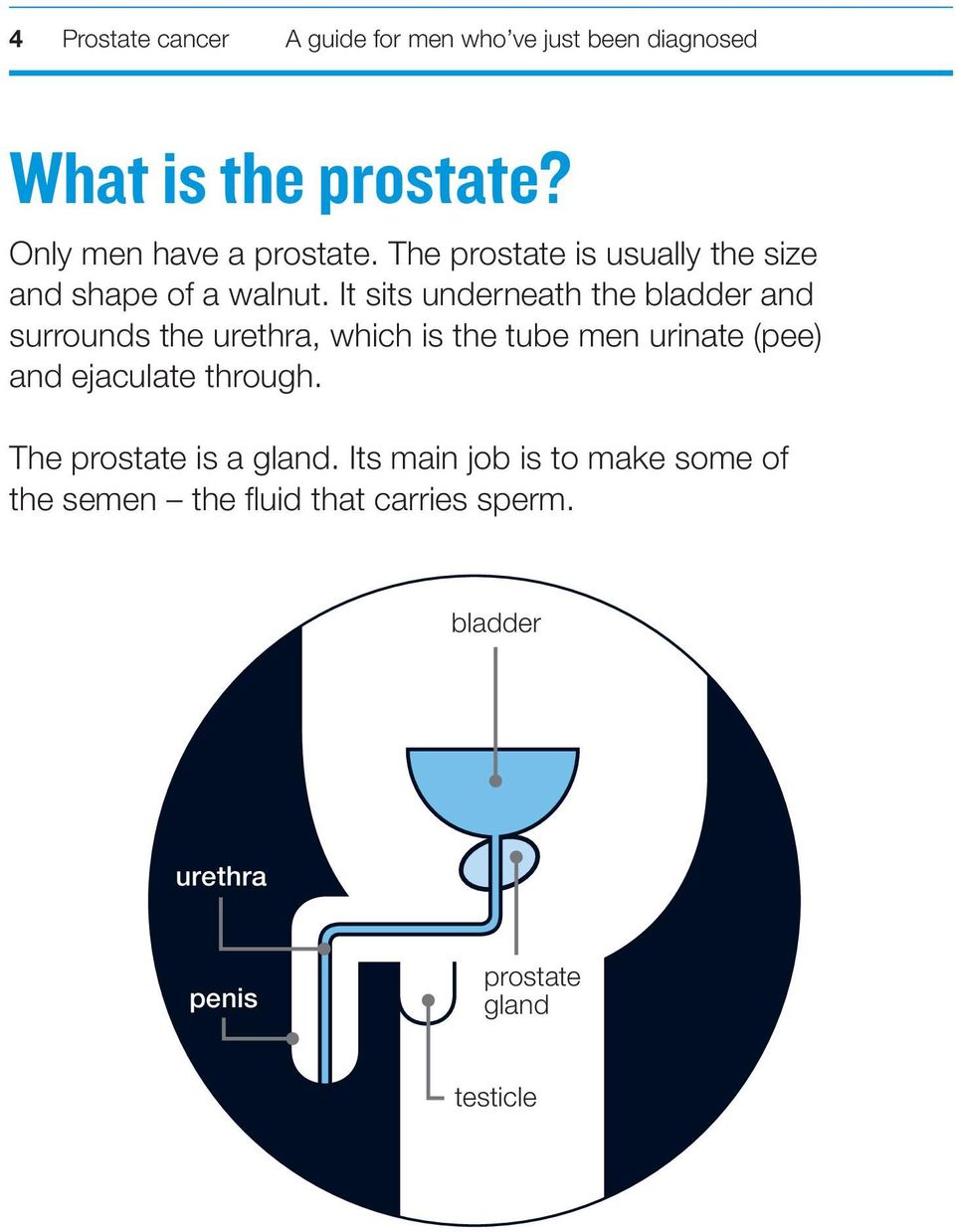
4 4 Prostate cancer A guide for men who ve just been diagnosed What is the prostate? Only men have a prostate. The prostate is usually the size and shape of a walnut. It sits underneath the bladder and surrounds the urethra, which is the tube men urinate (pee) and ejaculate through. The prostate is a gland. Its main job is to make some of the semen the fluid that carries sperm. bladder urethra penis prostate gland testicle
5 Specialist Nurses

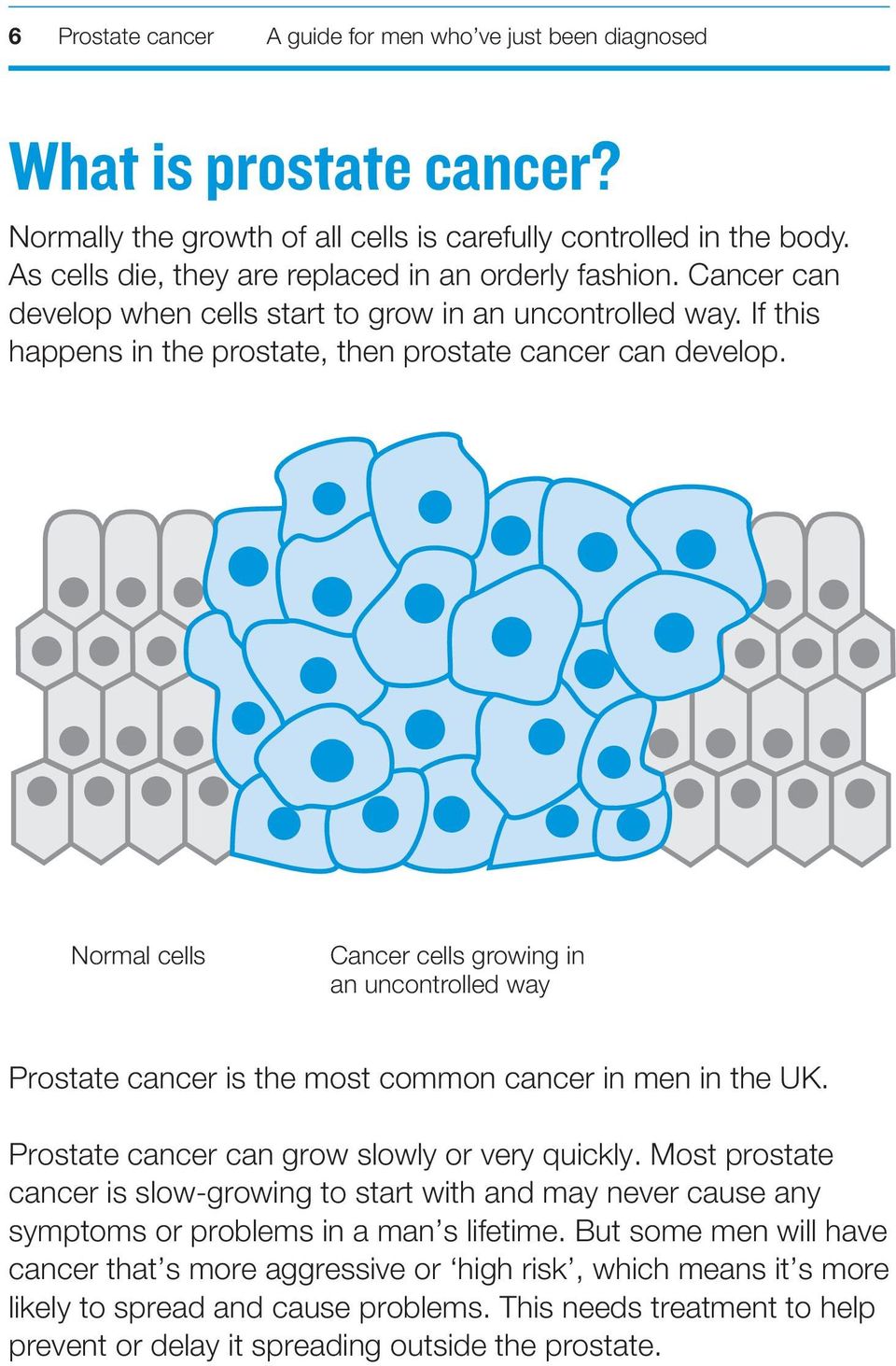
6 6 Prostate cancer A guide for men who ve just been diagnosed What is prostate cancer? Normally the growth of all cells is carefully controlled in the body. As cells die, they are replaced in an orderly fashion. Cancer can develop when cells start to grow in an uncontrolled way. If this happens in the prostate, then prostate cancer can develop. Normal cells Cancer cells growing in an uncontrolled way Prostate cancer is the most common cancer in men in the UK. Prostate cancer can grow slowly or very quickly. Most prostate cancer is slow-growing to start with and may never cause any symptoms or problems in a man s lifetime. But some men will have cancer that s more aggressive or high risk, which means it s more likely to spread and cause problems. This needs treatment to help prevent or delay it spreading outside the prostate.
7 Specialist Nurses Some men may have symptoms, such as problems going for a pee (urinating). For others, the first noticeable symptoms are from prostate cancer which has spread to their bones. If this happens, you might notice pain in your back, hips or pelvis, that wasn t there before. In the UK, about 1 in 8 men will get prostate cancer at some point in their lives. The following things might mean you re more likely to get prostate cancer. Age prostate cancer mainly affects men over the age of 50, and your risk increases with age. Family history you are two and a half times more likely to get prostate cancer if your father or brother has been diagnosed with it, compared with a man who has no relatives with prostate cancer. There is a higher chance of developing it if your relative was under 60 when he was diagnosed, or if you have more than one close relative with prostate cancer. Ethnicity Black men are more likely to get prostate cancer than men of other ethnic backgrounds. In the UK, about 1 in 4 Black men will get prostate cancer at some point in their lives. Lifestyle no one knows how to prevent prostate cancer, but a healthy diet and lifestyle may be important in protecting against it. For more information about your risk of prostate cancer, read our booklet, Know your prostate: A guide to common prostate problems.
8 8 Prostate cancer A guide for men who ve just been diagnosed How is prostate cancer diagnosed? Prostate cancer is diagnosed using a number of tests, which we describe on the following pages. You might have already had some of these, but you may need further tests to find out whether the cancer has spread and how aggressive it is. You may not need to have all of the tests described here, and you might not have them in this order. Read more about these tests in our Tool Kit fact sheet, How prostate cancer is diagnosed. PSA test The PSA test is a blood test that measures the amount of prostate specific antigen (PSA) in your blood. PSA is a protein produced by normal cells in the prostate and also by prostate cancer cells. It s normal for all men to have a small amount of PSA in their blood. A raised PSA may show that you have a problem with your prostate, but not necessarily cancer (see page 11). Read more in our booklet, Understanding the PSA test: A guide for men concerned about prostate cancer. Digital rectal examination (DRE) This is where the doctor feels your prostate through the wall of the back passage (rectum). They ll wear gloves and put some gel onto their finger to make it more comfortable. They ll feel your prostate for any hard or irregular areas and to get an idea of its size.

9 Specialist Nurses Prostate biopsy A prostate biopsy involves using thin needles to take small samples of tissue from the prostate to see if there is any prostate cancer. The doctor will put an ultrasound probe into your back passage, using a gel to make it more comfortable. The ultrasound probe scans the prostate and an image appears on a screen. A needle is then inserted through the wall of the back passage into the prostate, using the ultrasound image as a guide. Sometimes the biopsy is done by inserting the needles through the skin between the testicles and the back passage (perineum). The biopsy samples will be looked at under a microscope to check for any cancer cells. Your doctor will be sent a report, called a pathology report, with the results. The results will show: whether any cancer was found how many biopsy samples contained cancer how much cancer is present in each sample. You might be sent a copy of the pathology report. If you have trouble understanding any of it, ask your doctor to explain it. Or call our Specialist Nurses.

10 10 Prostate cancer A guide for men who ve just been diagnosed You may have the following tests to find out whether the cancer has spread outside the prostate. MRI scan MRI (magnetic resonance imaging) uses magnets to create a detailed picture of your prostate and the surrounding tissues, to see whether the cancer has spread. An MRI scan is often the first type of scan used as it s the most accurate way of looking at the prostate. CT scan A CT (computerised tomography) scan can also show whether the cancer has spread beyond the prostate, for instance to the lymph nodes. Lymph nodes are part of your immune system and are found throughout your body. Bone scan A bone scan can show whether any cancer cells have spread to the bone. A small amount of a safe radioactive dye is injected into a vein in your arm, and you ll have the scan two to three hours later. If there is any cancer in the bones, the dye will collect in these areas and show up on the scan.

11 Specialist Nurses What do my test results mean? Your doctor will use the results of all the tests you ve had to find out if the cancer has spread and if it s growing and how quickly. Ask your doctor to explain your test results if you don t understand them. PSA level The PSA test alone can t tell you whether you have prostate cancer. A raised PSA may show that you have a problem with your prostate, but not necessarily cancer. This is because a number of things can cause your PSA level to rise including age and an enlarged prostate as well as prostate cancer. Your PSA level rises as you get older and the prostate gets bigger. The following figures are a very rough guide to normal PSA levels, depending on your age: up to 3ng/ml for men in their 50s up to 4ng/ml for men in their 60s up to 5ng/ml for men in their 70s and over. Some men with a normal PSA level can have prostate cancer. A very high PSA level (for example, in the hundreds or thousands) normally means that a man has prostate cancer. The PSA test is also a good way of monitoring your prostate cancer after you ve been diagnosed or had treatment. You will have regular PSA tests as part of your care, and they can be used alongside other test results.

12 12 Prostate cancer A guide for men who ve just been diagnosed Gleason grade and Gleason score You may hear your doctor talk about your Gleason grade and your Gleason score when they ve looked at your biopsy results. Gleason grade If there are prostate cancer cells in your biopsy samples, they are given a Gleason grade. This grade tells you how aggressive the cancer is in other words, how likely it is to grow and spread outside the prostate. When cancer cells are looked at under the microscope, they have different patterns, depending on how quickly they re likely to grow. The pattern is given a grade from 1 to 5. This is called the Gleason grade. If a grade is given, it will usually be 3 or higher, as grade 1 and 2 are not cancer. Gleason score There may be more than one grade of cancer in the biopsy samples. An overall Gleason score is worked out by adding together two Gleason grades. The first is the most common grade in all the samples. The second is the highest grade of what s left. When the most common and the highest grade are added together, the total is called the Gleason score. Gleason score = the most common grade + the highest other grade in the samples

13 Specialist Nurses For example, if the biopsy samples show that: most of the cancer seen is grade 3 and the highest grade of any other cancer seen is grade 4, then the Gleason score will be 7 (3+4). Because grade 1 and 2 are not cancer, the combined Gleason score is normally 6 or higher. So your Gleason score will normally only be between 6 (3+3) and 10 (5+5). Some men will only be told their total Gleason score and not given their Gleason grades. What does the Gleason score mean? The higher the Gleason score, the more aggressive the cancer, and the more likely it is to spread. A Gleason score of 6 usually suggests that the cancer is slow-growing. A Gleason score of 7 suggests that the cancer may grow at a moderate rate. A Gleason score of 8, 9 or 10 suggests that the cancer may grow more quickly.
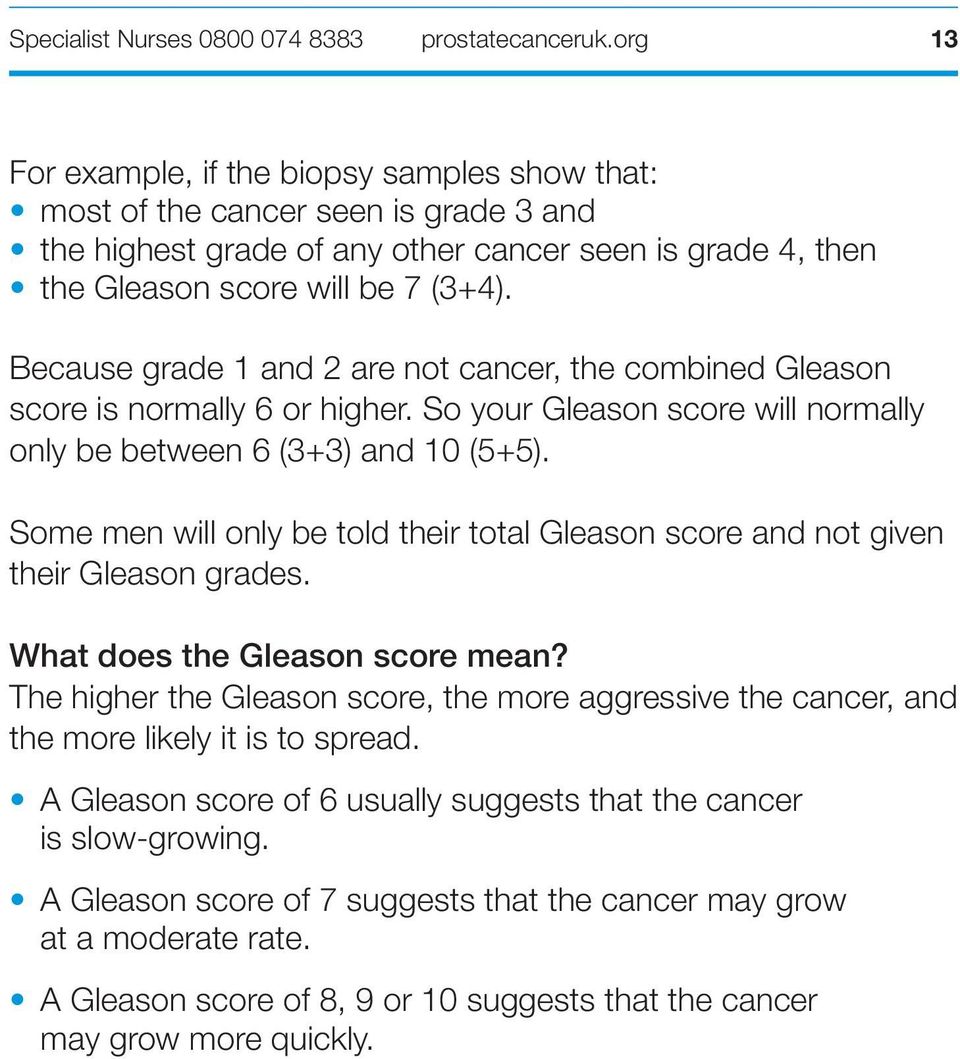
14 14 Prostate cancer A guide for men who ve just been diagnosed Staging Staging is a way of recording how far the cancer has spread. The most common method is the TNM (Tumour-Nodes- Metastases) system. T stage (tumour) The T stage shows how far the cancer has spread in and around the prostate. This is measured with a DRE (see page 8). You might also have an MRI scan to confirm your T stage. seminal vesicle bladder T1 The cancer can t be felt or seen on scans, and can only be seen under a microscope localised prostate cancer. prostate gland T1 prostate cancer seminal vesicle bladder T2 The cancer can be felt or seen on scans but it is contained within the prostate localised prostate cancer. prostate gland T2 prostate cancer
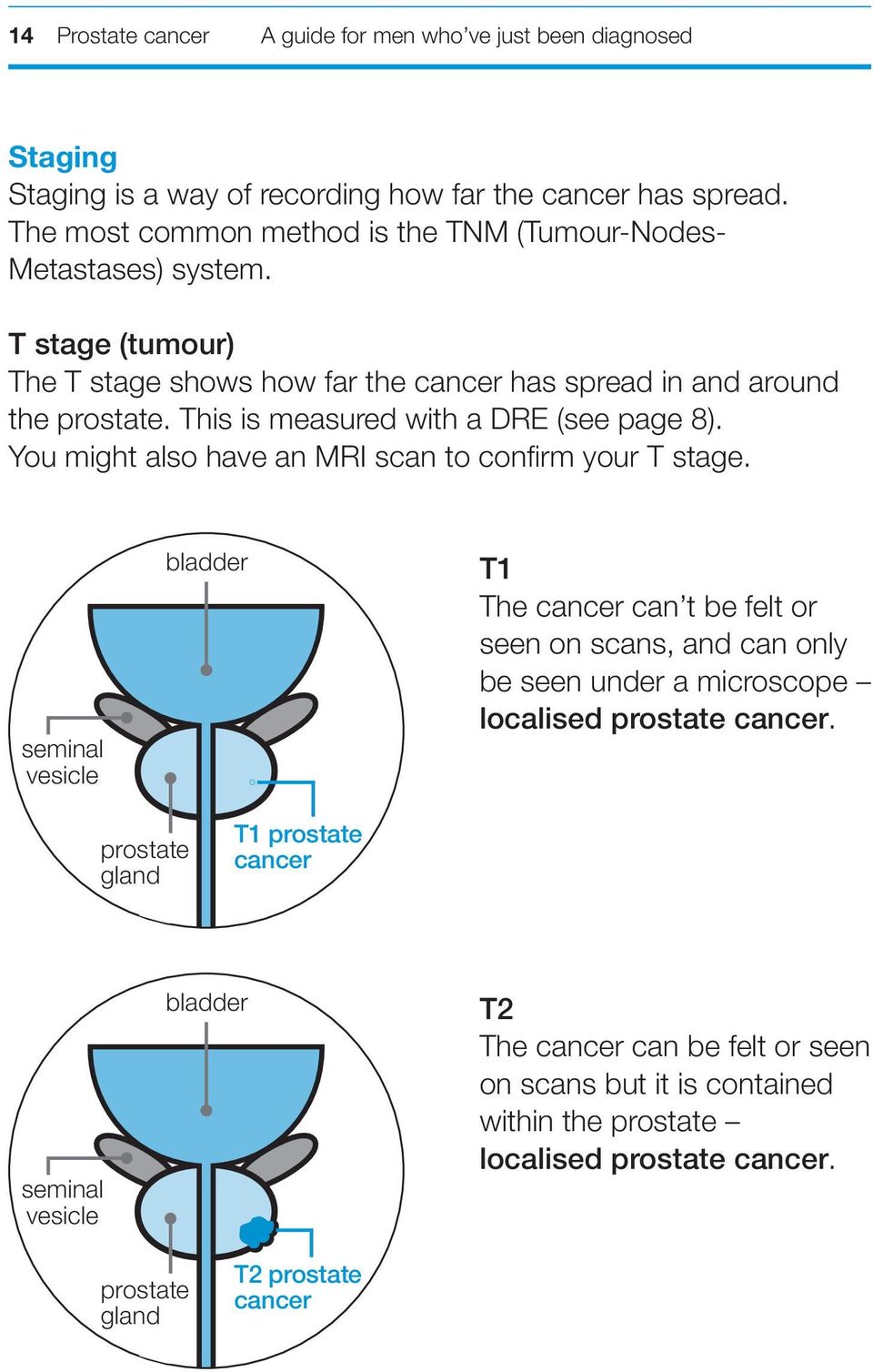
15 Specialist Nurses bladder T3 The cancer can be felt or seen breaking through the capsule of the prostate locally advanced prostate cancer. seminal vesicle prostate gland T3a prostate cancer T3a The cancer has broken through the capsule of the prostate but has not spread to the seminal vesicles (which produce some of the fluid in semen). T3b The cancer has spread to the seminal vesicles. seminal vesicle prostate gland bladder bladder neck T4 prostate cancer T4 The cancer has spread to nearby organs, such as the neck of the bladder, back passage, pelvic wall or lymph nodes locally advanced prostate cancer.
16 16 Prostate cancer A guide for men who ve just been diagnosed N stage (node) The N stage shows whether the cancer has spread to the nearby lymph nodes. Lymph nodes are part of your immune system and are found throughout your body. The lymph nodes in your groin are near the prostate and are a common place for prostate cancer to spread to. The N stage is measured using an MRI or CT scan (see page 10). This stage will only be measured if the result is likely to affect your treatment options. NX The lymph nodes were not measured. N0 No cancer cells can be seen in the lymph nodes. N1 The lymph nodes contain cancer cells. M stage (metastases) The M stage shows whether the cancer has spread (metastasised) to other parts of the body, such as the bones. This is measured using a bone scan (see page 10). Cancer that has spread to other parts of your body is called advanced prostate cancer. This stage might not be measured if the result is unlikely to affect your treatment options. MX The spread of the cancer was not measured. M0 The cancer has not spread to other parts of the body. M1 The cancer has spread to other parts of the body. Read more about how the stage of prostate cancer is measured in our Tool Kit fact sheet, How prostate cancer is diagnosed. You can record your test results on page 39.

17 Specialist Nurses What are my treatment options? Your doctor will look at all your test results to get an overall idea of how far the cancer has spread (its stage) and how quickly it may be growing. This will help you and your doctor to discuss the best possible treatments. There are different treatment options for each stage of prostate cancer. If you have localised cancer, treatments are aimed at getting rid of it completely. And even with more advanced cancer which has spread, treatments can keep it under control, sometimes for several years. Read more about treatment options on page 21. Stages of prostate cancer Localised prostate cancer Localised prostate cancer is cancer that s contained within the prostate. You may also hear it called early prostate cancer. Many localised cancers are not aggressive and grow too slowly to cause any problems in your lifetime. But, some may grow more quickly and spread to other parts of the body. There are a number of treatments for localised prostate cancer, and there is no best treatment each one has its own pros and cons. Thinking about these will help you decide which treatment is best for you. Read more in our Tool Kit fact sheet, Localised prostate cancer.
18 18 Prostate cancer A guide for men who ve just been diagnosed Locally advanced prostate cancer Locally advanced prostate cancer is cancer that s starting to break out of the prostate, or has spread to the area just outside it. It can spread to the seminal vesicles, the neck of the bladder, back passage, pelvic wall or lymph nodes in the groin. Your treatment options will depend on how far the cancer has spread. Read more in our Tool Kit fact sheet, Locally advanced prostate cancer. Advanced prostate cancer Advanced prostate cancer is cancer that has spread from the prostate to other parts of the body. It s also called metastatic prostate cancer. Prostate cancer can spread to any part of the body, but it most commonly spreads to the bones and lymph nodes. Advanced prostate cancer can cause symptoms such as bone pain and problems urinating. There are treatments available to help manage these symptoms. It s not possible to cure advanced prostate cancer, but treatments can keep it under control, sometimes for several years. Read more in our Tool Kit fact sheet, Advanced prostate cancer.

19 Specialist Nurses Choosing a treatment Your doctor or nurse will talk you through your treatment options so that you have the information you need to choose the right treatment for you. On the next few pages you ll find a summary of the different treatment options. Some of the treatments listed here might not be suitable for you, so ask your doctor or nurse to mark the treatments that are suitable. Read more about all these treatments and their pros and cons in our Tool Kit fact sheets. You can download or order them from our website at /publications or call our Specialist Nurses. What will affect my treatment choice? Which treatment you choose may depend on several things, including: how far the cancer has spread (its stage), and how quickly it may be growing your age and general health for example, if you have any other health problems such as heart disease what each treatment involves the possible side effects of each treatment the pros and cons of each treatment, including practical things like how often you would need to go to hospital, or how far away your nearest hospital is your own thoughts and feelings about different treatments for example some men prefer to have their prostate removed, while others don t like the idea of surgery how the treatment you choose now would affect your treatment options later if your cancer comes back or spreads.
20 20 Prostate cancer A guide for men who ve just been diagnosed Each treatment has side effects. These will affect each man differently, and you might not get all the possible side effects. It s important that you think about the side effects and how you would cope with them when deciding on a treatment. We ve included some information about side effects here. You can find more detailed information in our Tool Kit fact sheets. The first treatment you have may affect which treatments you can have in the future, if you need further treatment. For example, surgery is usually not an option if you ve already had radiotherapy. Read more about this for each treatment below and speak to your doctor or nurse about this. The different treatment options can be a lot to take in, especially when you ve just been diagnosed with prostate cancer. Make sure you have all the information you need, and give yourself time to think about which treatment is right for you. Your doctor or nurse will be able to help you weigh up the pros and cons. It can be a good idea to write down any questions you might want to ask at your next appointment. And you might find it useful to have someone with you at the appointment, or to make notes to help you remember what was said. What are my treatment options? The following information describes treatments for men who have just been diagnosed with prostate cancer. Men who ve had prostate cancer for some time may have different treatments and combinations of treatment. Speak to your doctor or nurse about what treatments are suitable for you. Watch men share their stories about treatments.
21 Specialist Nurses Treatment options Localised prostate cancer Surgery (radical prostatectomy) External beam radiotherapy (EBRT) Brachytherapy (either permanent seed or temporary) Active surveillance Watchful waiting High intensity focused ultrasound (in specialist centres or as part of a clinical trial) Cryotherapy (in specialist centres or as part of a clinical trial) Locally advanced prostate cancer External beam radiotherapy with hormone therapy (and sometimes with temporary brachytherapy) Hormone therapy Watchful waiting Less commonly, surgery (radical prostatectomy) with hormone therapy and/or external beam radiotherapy Advanced prostate cancer Hormone therapy Chemotherapy Pain-relieving drugs to treat pain Radiotherapy to treat symptoms Bisphosphonates to treat bone pain
22 22 Prostate cancer A guide for men who ve just been diagnosed Surgery (radical prostatectomy) This is an operation to remove the prostate and the cancer inside it. There are several types of operation: open surgery keyhole (laparoscopic) surgery robot-assisted laparoscopic surgery. Surgery is usually only suitable for men with localised prostate cancer. In men with more aggressive cancer (with higher Gleason score), the lymph nodes around the prostate are also often removed. Surgery may also be an option for some men with locally advanced prostate cancer. This can only be used in some situations as it might not be possible to remove all the cancer cells that have spread outside the prostate. In this situation, further treatment, such as radiotherapy, may also be needed afterwards. You might be offered surgery for locally advanced prostate cancer as part of a clinical trial. After surgery, if your cancer spreads outside the prostate or comes back, you will be offered a course of radiotherapy or hormone therapy. Some men have side effects after surgery. The most common side effects are leaking urine, and difficulty getting and keeping an erection (erectile dysfunction). Side effects may improve over time, and there are treatments available to help manage them. The prostate and seminal vesicles are removed during the operation. This means that you won t be able to ejaculate any semen even if you can get an erection so you will be infertile and won t be able to have children.
23 Specialist Nurses If you re planning on having children, you may be able to store your sperm before the operation for use in IVF (in vitro fertilisation). Read more about surgery, including the side effects, in our Tool Kit fact sheet, Surgery: radical prostatectomy. External beam radiotherapy (EBRT) This treatment uses high energy X-ray beams to destroy the cancer cells from outside the body. EBRT is suitable for men with localised prostate cancer, who will often have it with hormone therapy. It s also suitable for men with locally advanced prostate cancer, and is used with hormone therapy. If you have EBRT as a first treatment for prostate cancer and your cancer comes back or spreads, you may be offered high intensity focused ultrasound (HIFU), cryotherapy or hormone therapy. Surgery is rarely an option because radiotherapy changes the prostate tissue and makes it very hard for the surgeon to remove the prostate. Some men have side effects from EBRT these include problems urinating, bowel problems such as loose or watery bowel movements (diarrhoea), problems getting and keeping an erection, and tiredness (fatigue). Side effects can develop during treatment and get better with time. But for some men they can be long-term and may develop several months or years after having radiotherapy. There are treatments available to help manage side effects. Read more about EBRT, including the side effects, in our Tool Kit fact sheet, External beam radiotherapy.
24 24 Prostate cancer A guide for men who ve just been diagnosed Brachytherapy This treatment involves putting radioactive seeds or pellets into the prostate to kill the cancer cells. There are two types of brachytherapy permanent seed brachytherapy and temporary brachytherapy. Permanent seed brachytherapy, also called low dose-rate brachytherapy, involves implanting tiny radioactive seeds into the prostate. This is an option for men with localised prostate cancer. Temporary brachytherapy, also called high dose-rate brachytherapy, is where radioactive pellets are passed into the prostate for a few minutes at a time before being removed. This treatment is less common and can be used to treat localised prostate cancer, and sometimes locally advanced prostate cancer. Brachytherapy can be used together with EBRT to give higher doses of radiation to the whole gland, as well as the area just outside it. You might have hormone therapy to shrink the prostate for a few months before starting brachytherapy. If you have brachytherapy as a first treatment for prostate cancer and your cancer comes back or spreads, you may be offered cryotherapy or hormone therapy. However, you are unlikely to be able to have high intensity focused ultrasound (HIFU) or surgery. Some men may have side effects after brachytherapy including problems urinating, problems getting and keeping an erection, and tiredness (fatigue). Men who have permanent seed brachytherapy may also get bowel problems, although these tend to be mild. Problems urinating usually start to improve after a few months. Erection problems may not happen straight after treatment but can develop over several years. There are treatments available to help manage these side effects.
25 Specialist Nurses Read more about brachytherapy, including the side effects, in our Tool Kit fact sheets, Permanent seed brachytherapy and Temporary brachytherapy. Active surveillance Active surveillance is a way of monitoring slow-growing prostate cancer. The aim is to avoid or delay unnecessary treatment in men with low risk localised prostate cancer and so avoid or delay the side effects that can be caused by treatment. Active surveillance involves monitoring your cancer with regular tests, rather than treating it straight away. The tests aim to find any changes that suggest the cancer is growing. If the tests show that your cancer might be growing, you will be offered treatment with surgery (radical prostatectomy), radiotherapy or brachytherapy, with the aim of getting rid of the cancer completely. Read more in our Tool Kit fact sheet, Active surveillance. Watchful waiting Watchful waiting is a different way of monitoring prostate cancer that isn t causing any symptoms or problems. The aim is to keep an eye on the cancer over the long term. You will only start treatment if you get symptoms, such as problems urinating or bone pain. You will then be offered hormone therapy (see page 26) to manage these symptoms. Watchful waiting involves having fewer tests than active surveillance.
26 26 Prostate cancer A guide for men who ve just been diagnosed It s generally suitable for men who have other health problems and may not be fit enough for treatments such as surgery or radiotherapy. It might also be suitable if your prostate cancer isn t likely to cause problems during your lifetime, or shorten your life. Read more in our Tool Kit fact sheet, Watchful waiting. If you re offered active surveillance or watchful waiting, make sure you re clear which one your doctor is talking about. They are quite different approaches to treatment. These terms aren t always used in the same way, and some doctors use different terms such as active monitoring and wait and see. Ask your doctor to explain exactly what they mean. Hormone therapy Prostate cancer needs the male hormone testosterone to grow. Hormone therapy works by stopping testosterone from reaching prostate cancer cells. It will treat all prostate cancer cells, wherever they are in the body. Hormone therapy won t cure prostate cancer, but it can keep the cancer under control, sometimes for several years. Hormone therapy is often used with EBRT for localised prostate cancer. It can also be used with EBRT for locally advanced prostate cancer. It s the standard treatment for advanced prostate cancer. There are three main types of hormone therapy for prostate cancer: injections or implants to stop the production of testosterone surgery (orchidectomy) to remove the testicles or just the parts that make testosterone tablets to block the effects of testosterone.
27 Specialist Nurses The side effects of hormone therapy are caused by lowered testosterone levels. They can include: hot flushes loss of sex drive and problems getting and keeping an erection tiredness (fatigue) swelling and tenderness in the breast area (gynaecomastia) weight gain. The chances of getting each side effect depend on which type of hormone therapy you re having and how long you have it for. There are ways to manage them. Read more about hormone therapy, including the side effects, in our Tool Kit fact sheet, Hormone therapy, and our booklet, Living with hormone therapy: A guide for men with prostate cancer. High intensity focused ultrasound (HIFU) HIFU uses ultrasound to heat and destroy cancer cells in the prostate. HIFU is newer than some of the other treatments for prostate cancer, so we don t know as much about how well it works and the risk of side effects in the long term. Because of this, it s only available in specialist centres in the UK or as part of a clinical trial. HIFU might be a suitable option if you have localised prostate cancer. It can also be used to treat cancer that has started to grow again after radiotherapy. If you have HIFU as a first treatment for prostate cancer and your cancer comes back or spreads, you may be offered more HIFU, EBRT, cryotherapy or hormone therapy. However, you re unlikely to be able to have surgery.
28 28 Prostate cancer A guide for men who ve just been diagnosed You might have side effects after HIFU including problems urinating and difficulty getting and keeping an erection. Some men get a burning sensation or bleeding from the back passage. There are treatments available to help manage these side effects. Read more about HIFU, including the side effects, in our Tool Kit fact sheet, High intensity focused ultrasound (HIFU). Cryotherapy Cryotherapy uses freezing and thawing to destroy the prostate cancer cells. It s newer than some of the other treatments for prostate cancer, so we don t know as much about how well it works and the risk of side effects in the long term. Because of this, it s only available in specialist centres in the UK or as part of a clinical trial. Cryotherapy can be used to treat localised prostate cancer, and occasionally locally advanced prostate cancer. However, it s more often used to treat men whose cancer has come back after treatment with radiotherapy or brachytherapy. If your cancer comes back or spreads after cryotherapy, you may be offered more cryotherapy, EBRT, or hormone therapy. However, you re unlikely to be offered surgery. Some men have side effects after cryotherapy. The most common side effect is problems getting and keeping an erection. Some men also get urinary problems after cryotherapy. These side effects may improve over time, and there are ways to manage them. Read more about cryotherapy, including the side effects, in our Tool Kit fact sheet, Cryotherapy.
29 Specialist Nurses Treatments to control advanced prostate cancer Hormone therapy is the first treatment option for advanced prostate cancer. Over time, it may become less effective, but there are other treatments available that can help control the cancer and might help men live longer. Chemotherapy uses anti-cancer drugs to kill the cancer cells. It doesn t get rid of prostate cancer, but aims to shrink it and slow its growth. It can also help delay or improve symptoms. Abiraterone (Zytiga ) is a new type of hormone therapy. It s suitable for men with advanced prostate cancer that has stopped responding to other types of hormone therapy. Enzalutamide (Xtandi ) is a new type of hormone therapy for men whose prostate cancer has stopped responding to other hormone therapy and chemotherapy treatments. Read more about these in our Tool Kit fact sheets, Second-line hormone therapy and further treatment options and Chemotherapy. Treatments to manage the symptoms of advanced prostate cancer If you ve been diagnosed with advanced prostate cancer and have symptoms such as bone pain, there are treatments to manage these. Pain-relieving drugs can help with pain. Radiotherapy can help to relieve symptoms. This uses a low dose of radiotherapy to slow down the growth of the cancer and control symptoms. Bisphosphonates are drugs that treat pain caused by cancer that has spread to the bones.
30 30 Prostate cancer A guide for men who ve just been diagnosed Read more about these in our Tool Kit fact sheets, Managing pain in advanced prostate cancer, Radiotherapy for advanced prostate cancer and Bisphosphonates for advanced prostate cancer. Clinical trials A clinical trial is a type of medical research. Clinical trials aim to find new and improved ways of preventing, diagnosing, treating and controlling illnesses. You can ask your doctor or nurse if there are any clinical trials you could take part in, or you can call our Specialist Nurses. You can also find details of clinical trials happening now from the CancerHelp UK database at Read more in our Tool Kit fact sheet, A guide to prostate cancer clinical trials.
31 Specialist Nurses Dealing with prostate cancer If you ve been diagnosed with prostate cancer, you might be scared, worried, stressed or even angry. You might feel helpless. On the other hand, some men say that a diagnosis of prostate cancer changes the way they think and feel about life. You may be concerned about the future and how a diagnosis of prostate cancer will affect your life and your loved ones. It can be difficult and stressful trying to make a decision about your treatment. At times, lots of men with prostate cancer get these kinds of thoughts and feelings. But there s no right way that you re supposed to feel and everyone reacts in their own way. There are things you can do to help yourself and there are people who can help. Families can also find this a difficult time and they may need support too. This section might also be helpful for them. Many men worry about how to tell their family or friends that they have cancer. Macmillan Cancer Support produce information that can help you figure out where to start and make these conversations a bit easier. It includes information about talking to children. Am I going to die? It s a normal reaction to worry about dying if you ve just been told that you have cancer. But most prostate cancer is slow-growing and may never cause any symptoms or problems in a man s lifetime. So a diagnosis of prostate cancer doesn t necessarily mean that you ll die from it.
32 32 Prostate cancer A guide for men who ve just been diagnosed There are effective treatments for prostate cancer which can get rid of the cancer completely. Or if you have advanced prostate cancer, they can keep it under control, sometimes for several years. How long you are going to live depends on many things. Your doctor won t be able to tell you exactly how long, but they might be able to give you an idea based on the stage of your prostate cancer and how quickly it might be growing. Your age, general health and any other medical conditions will also affect how long you will live. Speak to your doctor about your own situation. If you ve been told you may only have a certain amount of time to live, this can be really tough to deal with. There are people you can talk to and ways of getting support (see page 34).
33 Specialist Nurses How can I help myself? Find out about your treatment options, so you know what to expect. Find out about any side effects of treatment, so you know what to expect, and how you can try to manage them. Be as active as you can. Physical activity can lift your mood. Think about what you eat and drink. Some men find they manage better by aiming for a healthy, balanced diet. Unload what s going around in your head find someone you can talk to. It could be someone close, or someone trained to listen, like a counsellor or your medical team. Take time out to look after yourself. When you feel up to it, learn some techniques to manage stress and to relax like listening to music or breathing exercises. Set yourself goals and things to look forward to even if they re just for the next few weeks or months. Find more strategies in our booklet, Living with and after prostate cancer: A guide to physical, emotional and practical issues. Get more ideas about how to look after yourself from Macmillan Cancer Support, Maggie s Centres, and Penny Brohn Cancer Care, as well as local cancer support centres. Trying to distract yourself from difficult thoughts and feelings can work for some men. This could be through doing something you enjoy, like physical activity, watching TV, reading a book or seeing friends. But at some point you may need to deal with these thoughts and feelings, particularly if they re stopping you from getting on with your life.
34 34 Prostate cancer A guide for men who ve just been diagnosed The following people will be able to help you deal with your diagnosis. Or if you need to speak to someone immediately, you could ring the Samaritans on (open 24 hours). Who can help? Our Specialist Nurses Our Specialist Nurses can answer your questions, help explain your diagnosis and go through your treatment options with you. They ve got time to listen to any concerns you or those close to you have about living with prostate cancer. Everything is confidential. To get in touch: call our Specialist Nurses on from our website at (click We can help ). Your medical team It could be useful to speak to your nurse, doctor, GP or someone else in your medical team. Your main point of contact might be called your key worker. This could be your specialist nurse or another health professional. They can help you understand your diagnosis, treatment and side effects, listen to your concerns, and put you in touch with other people who can help. Trained counsellors Counsellors are trained to listen and can help you to find your own answers and ways to deal with things. Many hospitals have counsellors or psychologists in their team who are specialists in helping people with cancer your doctor or nurse at the hospital will be able to let you know if this is available.
35 Specialist Nurses There are different types of counselling available. Your GP may be able to refer you to a counsellor, or you can see a private counsellor. To find out more contact the British Association for Counselling & Psychotherapy. Our one-to-one support service Our one-to-one support service is a chance to speak to someone who s been there and understands what you re going through. They can share their experiences and listen to yours. You could discuss treatment options, dealing with side effects, or telling people about your cancer whatever s important to you. Our Specialist Nurses will try to match you with a trained volunteer with similar experiences. Family members can also speak to partners of men with prostate cancer. To arrange it: call our Specialist Nurses on visit our website at (click We can help ). Our online community Our online community is a place to talk about whatever s on your mind your questions, your ups and your downs. Anyone can ask a question or share an experience. It s a place to deal with prostate cancer together. Lots of men use their real names on the forum, but you don t have to. You can keep it anonymous. Sign up on our website at /online-community
36 36 Prostate cancer A guide for men who ve just been diagnosed Local support groups At local support groups men get together to share their experiences of living with prostate cancer you can ask questions, offload worries and know that someone understands what you re going through. Some groups have been set up by local health professionals, others by men themselves. Many also welcome partners, friends and relatives. To find your nearest support group: visit our website at (click We can help ) ask your nurse call our Specialist Nurses on Practical issues You might need to make decisions about things like work and money. Read more about this in our booklet, Living with and after prostate cancer: A guide to physical, emotional and practical issues. If you live in England and are having treatment for cancer, including treatments for symptoms or side effects, you are entitled to free prescriptions. Anyone over 60 in England also gets free prescriptions. You ll need to apply for a medical exemption certificate. Ask your doctor for a FP92A form. Once you ve filled out the form, your doctor will need to sign it, and the certificate will be sent to you. You can find out more about free prescriptions from NHS Choices. If you live in Scotland, Wales or Northern Ireland, all prescriptions are free.
37 Specialist Nurses List of medical words Our Tool Kit fact sheet, A to Z of medical words, explains more words that you may hear or read when you re finding out about prostate cancer. Gleason grade If there are prostate cancer cells in your biopsy samples, they are given a Gleason grade. This grade tells you how likely the cancer is to grow and spread outside the prostate. When cancer cells are looked at under the microscope they have different patterns. The pattern is given a grade from 1 to 5. This is called the Gleason grade. See page 12. Gleason score There may be more than one grade of cancer in the biopsy samples. An overall Gleason score is worked out by adding together two Gleason grades. The first is the most common grade in all the samples. The second is the highest grade of what s left. When the most common and the highest grade are added together, the total is called the Gleason score. See page 12. Lymph nodes These are part of your immune system and they are found throughout your body. The lymph nodes in your groin are near the prostate and are a common place for prostate cancer to spread to. Lymph nodes are sometimes called lymph glands.
38 38 Prostate cancer A guide for men who ve just been diagnosed Metastasis Metastasis is the spread of prostate cancer cells from the prostate to other parts of the body. Cancers that have spread may be called metastases, secondary cancers or secondaries. A cancer that has spread is said to have metastasised. Oncology The hospital department that deals with the diagnosis and treatment of cancer. Prostate specific antigen (PSA) A protein that s produced by the prostate. It s normal for all men to have a small amount of PSA in their blood. A raised PSA may show that you have a problem with your prostate, but not necessarily cancer. Urology The hospital department that deals with the treatment of diseases of the urinary system, including prostate cancer. Uro-oncology The diagnosis and treatment of cancer that affects the urinary system, including prostate cancer.
39 Specialist Nurses What are my test results? You can use this section with your doctor or nurse to record your test results and appointment dates. PSA level at diagnosis: Number of biopsy samples taken: Number of biopsy samples affected: Gleason score: T stage at diagnosis: N stage at diagnosis (if measured): M stage at diagnosis (if measured): Date of MRI scan (if needed): Results of MRI scan: Date of CT scan (if needed): Results of CT scan:
40 40 Prostate cancer A guide for men who ve just been diagnosed Date of bone scan (if needed): Results of bone scan: The cancer is (please tick): localised contained within the prostate locally advanced breaking out of the prostate or spread to the area just outside the prostate advanced spread to other parts of the body. Treatment plan: My next appointments are with my (tick those that apply): urologist specialist nurse oncologist other. You can record details of future appointments on page 44. Contact your specialist nurse or key worker (you may be given a main point of contact this is your key worker) at any time if you have any questions or concerns. You can also speak to our Specialist Nurses.
41 Specialist Nurses Who are my team members? You can use this space to record the names and contact details of the team of health professionals who will be involved in your care. You may hear them called your multi-disciplinary team (MDT). They will discuss your individual diagnosis and agree on which treatment options would be suitable for you. We ve listed the health professionals who are likely to be most involved in your care, but you might not see all of them. You re likely to meet more of them later on when you begin treatment or have check-ups. Specialist nurse You may have a urology, uro-oncology or prostate cancer specialist nurse. They can answer any questions you may have, and might carry out some of your tests, treatments and follow-up care. Name: Job title: Telephone: Notes:
42 42 Prostate cancer A guide for men who ve just been diagnosed Main contact (key worker) Your main point of contact might be called your key worker. This could be your specialist nurse or another health professional. They will help to co-ordinate your care, guide you to the appropriate team member and tell you where you can get information. Name: Job title: Telephone: Notes: Consultant urologist This type of doctor specialises in the urinary and reproductive systems. Urologists are surgeons. Name: Job title: Telephone: Notes: Consultant oncologist This type of doctor specialises in cancer treatments other than surgery, such as radiotherapy. Name: Job title: Telephone: Notes:
43 Specialist Nurses Other health professionals You can record contact details of other health professionals in the space below. General practitioner (GP): Practice nurse: Other health professionals: Our Specialist Nurses: Your local support group: You can find out about your nearest support group from your nurse or on our website. When I was first diagnosed I found it extremely helpful to fill in the details of the diagnosis. It also helped me to ask the right questions. A personal experience
44 44 Prostate cancer A guide for men who ve just been diagnosed Appointment diary You can fill in this diary before and after your appointments, to help you get the most out of them. You might want to photocopy this page so you have enough copies to last you for a while. Date of appointment: Fill in before your appointment How I ve been feeling you can include physical things (for example, side effects of treatment) as well as emotional things: My questions or concerns:
45 Specialist Nurses Fill in during or after your appointment Answers to my questions or concerns: Advice from my doctor or nurse: PSA level: Date and time of next appointment:
46 46 Prostate cancer A guide for men who ve just been diagnosed More information from us The Tool Kit The Tool Kit information pack contains fact sheets that explain how prostate cancer is diagnosed, how it s treated and how it may affect your lifestyle. Each treatment fact sheet also includes a list of suggested questions to ask your doctor. Call our Specialist Nurses for a personally tailored copy. Leaflets and booklets We have a range of other leaflets and booklets about prostate cancer and other prostate problems. To order publications: All our publications are free and available to order or download online. To order them: Call us on Visit our website at /publications Call our Specialist Nurses If you want to talk about prostate cancer or other prostate problems, call our Specialist Nurses in confidence. You can also the nurses using the contact form on our website. Visit and click on We can help. Speak to our Specialist Nurses * * Calls are recorded for training purposes only. Confidentiality is maintained between callers and Prostate Cancer UK.
47 Specialist Nurses Other useful organisations British Association for Counselling & Psychotherapy Telephone: Information about counselling and details of therapists in your area. Cancer Black Care Telephone: Information and support for all people affected by cancer. Raises awareness of cancer in black and minority ethnic communities. CancerHelp UK Nurse helpline: Patient information from Cancer Research UK. Carers UK Advice line: Information and advice for carers, and details of local support groups. Citizens Advice Online advice: Advice on a wide range of issues including financial and legal matters. Find your nearest Citizens Advice Bureau in the phonebook or online.
48 48 Prostate cancer A guide for men who ve just been diagnosed Healthtalkonline Watch, listen to and read personal experiences of men with prostate cancer and other medical conditions. Macmillan Cancer Support Telephone: Practical, financial and emotional support for people with cancer, their family and friends. Maggie s Centres Telephone: A network of drop-in centres for cancer information and support. Includes an online support group. National Institute for Health and Care Excellence (NICE) Telephone: Guidelines for care and for the use of treatments and procedures on the NHS in England and Wales. NHS Choices Information about treatments, conditions and lifestyle. Support for carers and a directory of health services in England. NHS Direct Wales Telephone: Provides health advice 24 hours a day, and lists local health services in Wales, including GPs and dentists.
49 Specialist Nurses NHS Inform Telephone: Provides health information and details of NHS and other support services in Scotland. nidirect Information about government services in Northern Ireland, including health services. Penny Brohn Cancer Care Helpline: Runs courses and offers physical, emotional and spiritual support for people with cancer and those close to them. Samaritans Helpline: Confidential, non-judgemental emotional support, 24 hours a day, by telephone, , letter or face to face. UK Prostate Link Helps you find and compare reliable information about prostate cancer.
50 50 Prostate cancer A guide for men who ve just been diagnosed About Prostate Cancer UK Prostate Cancer UK fights to help more men survive prostate cancer and enjoy a better life. We support men by providing vital information and services. We find answers by funding research into causes and treatments and we lead change, raising the profile of all prostate diseases and improving care. We believe that men deserve better. At Prostate Cancer UK, we take great care to provide up-to-date, unbiased and accurate facts about prostate diseases. We hope these will add to the medical advice you have had and help you to make decisions. Our services are not intended to replace advice from your doctor. References to sources of information used in the production of this booklet are available at This publication was written and edited by: Prostate Cancer UK s Information Team. It was reviewed by: Vanessa Basketter, Senior Uro-oncology Clinical Nurse Specialist, Queen Alexandra Hospital, Cosham Ben Challacombe, Consultant Urological Surgeon & Honorary Senior Lecturer, Guy s Hospital & King s College London Christopher Eden, Consultant Urologist, The Royal Surrey County Hospital, Guildford Debbie Gray, Urology Oncology CNS, Darlington Memorial Hospital, Co Durham Prostate Cancer UK Volunteers Prostate Cancer UK Specialist Nurses
51 Specialist Nurses Donate today help others like you Did you find this information useful? Would you like to help others in your situation access the facts they need? Every year, 40,000 men face a prostate cancer diagnosis. Thanks to our generous supporters, we offer information free to all who need it. If you would like to help us continue this service, please consider making a donation. Your gift could fund the following services: 10 could buy a Tool Kit a set of fact sheets, tailored to the needs of each man with vital information on diagnosis, treatment and lifestyle. 25 could give a man diagnosed with prostate cancer unlimited time to talk over treatment options with one of our specialist nurses. To make a donation of any amount, please call us on , visit /donations or text PROSTATE to 70004*. There are many other ways to support us. For more details please visit /get-involved *You can donate up to 10 via SMS and we will receive 100% of your donation. Texts are charged at your standard rate. For full terms and conditions and more information, please visit /terms
52 Speak to our Specialist Nurses * Prostate Cancer UK February 2014 To be reviewed February 2016 Call our Specialist Nurses from Mon to Fri 9am - 6pm, Wed 10am - 8pm * Calls are recorded for training purposes only. Confidentiality is maintained between callers and Prostate Cancer UK. Prostate Cancer UK is a registered charity in England and Wales ( ) and in Scotland (SC039332). Registered company number DIA/FEB14
Locally advanced prostate cancer
 Diagnosis Specialist Nurses 0800 074 8383 prostatecanceruk.org 1 Locally advanced prostate cancer In this fact sheet: What is locally advanced prostate cancer? How is locally advanced prostate cancer diagnosed?
Localised prostate cancer
 Diagnosis Specialist Nurses 0800 074 8383 prostatecanceruk.org 1 Localised prostate cancer In this fact sheet: What is localised prostate cancer? How is localised prostate cancer diagnosed? What do my
Prostate cancer A guide for newly diagnosed men
 Prostate cancer A guide for newly diagnosed men 2 Prostate cancer A guide for newly diagnosed men About this booklet This booklet is for men who have recently been diagnosed with prostate cancer. It is
Recurrent prostate cancer A guide to treatment and support
 Recurrent prostate cancer A guide to treatment and support 2 Recurrent prostate cancer About this booklet This booklet is for you if your prostate cancer has come back after treatment that aimed to get
Advanced prostate cancer
 1 Advanced prostate cancer In this fact sheet: What is advanced (metastatic) prostate cancer? What tests are used to diagnose advanced prostate cancer? What do my test results mean? What are my treatment
Advanced prostate cancer
 Diagnosis Helpline 0800 074 8383 prostatecanceruk.org 1 Advanced prostate cancer In this fact sheet: What is advanced (metastatic) prostate cancer? What tests are used to diagnose advanced prostate cancer?
A guide to prostate cancer clinical trials
 1 A guide to prostate cancer clinical trials In this fact sheet: What is a clinical trial? Why are trials done? What are trials looking into at the moment? How are clinical trials done? Should I take part
Understanding the PSA test. A guide for men concerned about prostate cancer
 Understanding the PSA test A guide for men concerned about prostate cancer Introduction This booklet is for men who want to know more about having a blood test, called a PSA test, that can help diagnose
Treating Localized Prostate Cancer A Review of the Research for Adults
 Treating Localized Prostate Cancer A Review of the Research for Adults Is this information right for me? Yes, this information is right for you if: Your doctor * said all tests show you have localized
Treating Prostate Cancer
 Treating Prostate Cancer A Guide for Men With Localized Prostate Cancer Most men have time to learn about all the options for treating their prostate cancer. You have time to talk with your family and
How prostate cancer is diagnosed
 How prostate cancer is diagnosed This information is an extract from the booklet Having tests for prostate cancer. You may find the full booklet helpful. We can send you a free copy see page 7. Contents
Prostate Cancer Screening. A Decision Guide
 Prostate Cancer Screening A Decision Guide This booklet was developed by the U.S. Department of Health and Human Services, Centers for Disease Control and Prevention (CDC). Is screening right for you?
Early Prostate Cancer: Questions and Answers. Key Points
 CANCER FACTS N a t i o n a l C a n c e r I n s t i t u t e N a t i o n a l I n s t i t u t e s o f H e a l t h D e p a r t m e n t o f H e a l t h a n d H u m a n S e r v i c e s Early Prostate Cancer:
A Woman s Guide to Prostate Cancer Treatment
 A Woman s Guide to Prostate Cancer Treatment Supporting the man in your life Providing prostate cancer support and resources for women and families WOMEN AGAINST PROSTATE CANCER A Woman s Guide to Prostate
Prostate Cancer Screening. A Decision Guide for African Americans
 Prostate Cancer Screening A Decision Guide for African Americans This booklet was developed by the U.S. Department of Health and Human Services, Centers for Disease Control and Prevention (CDC). Published
An Introduction to PROSTATE CANCER
 An Introduction to PROSTATE CANCER Being diagnosed with prostate cancer can be a life-altering experience. It requires making some very difficult decisions about treatments that can affect not only the
Radiation Therapy for Prostate Cancer
 Radiation Therapy for Prostate Cancer Introduction Cancer of the prostate is the most common form of cancer that affects men. About 240,000 American men are diagnosed with prostate cancer every year. Your
PSA Screening for Prostate Cancer Information for Care Providers
 All men should know they are having a PSA test and be informed of the implications prior to testing. This booklet was created to help primary care providers offer men information about the risks and benefits
PROSTATE CANCER 101 WHAT IS PROSTATE CANCER?
 PROSTATE CANCER 101 WHAT IS PROSTATE CANCER? Prostate cancer is cancer that begins in the prostate. The prostate is a walnut-shaped gland in the male reproductive system located below the bladder and in
PATIENT GUIDE. Localized Prostate Cancer
 PATIENT GUIDE Localized Prostate Cancer The prostate* is part of the male reproductive system. It is about the same size as a walnut and weighs about an ounce. As pictured in Figure 1, the prostate is
CONTENTS: WHAT S IN THIS BOOKLET
 Q Questions & A & Answers About Your Prostate Having a biopsy test to find out if you may have prostate cancer can bring up a lot of questions. This booklet will help answer those questions. CONTENTS:
University College Hospital. Hormone therapy for prostate cancer. Radiotherapy Department Patient information series
 University College Hospital Hormone therapy for prostate cancer Radiotherapy Department Patient information series 10 2 If you need a large print, audio or translated copy of the document, please contact
Prostate Cancer Guide. A resource to help answer your questions about prostate cancer
 Prostate Cancer Guide A resource to help answer your questions about prostate cancer Thank you for downloading this guide to prostate cancer treatment. We know that all the information provided online
Prostate Cancer. Understanding your diagnosis
 Prostate Cancer Understanding your diagnosis Prostate Cancer Understanding your diagnosis When you first hear that you have cancer, you may feel alone and afraid. You may be overwhelmed by the large amount
External beam radiotherapy
 Treatment Helpline 0800 074 8383 prostatecanceruk.org 1 External beam radiotherapy In this fact sheet: Who can have radiotherapy? How does radiotherapy treat prostate cancer? What are the advantages and
AFTER DIAGNOSIS: PROSTATE CANCER Understanding Your Treatment Options
 AFTER DIAGNOSIS: PROSTATE CANCER Understanding Your Treatment Options INTRODUCTION This booklet describes how prostate cancer develops, how it affects the body and the current treatment methods. Although
Screening for Prostate Cancer
 Cancer Expert Working Group on Cancer Prevention and Screening Screening for Prostate Cancer Information for men and their families 1 What is the prostate? 2 What is prostate cancer? prostate The prostate
Stereotactic Radiotherapy for Prostate Cancer using CyberKnife
 Stereotactic Radiotherapy for Prostate Cancer using CyberKnife Delivering the best in care UHB is a no smoking Trust To see all of our current patient information leaflets please visit www.uhb.nhs.uk/patient-information-leaflets.htm
Tubular breast cancer
 Tubular breast cancer This booklet is for people who would like more information about tubular breast cancer. It describes what tubular breast cancer is, its symptoms, how a diagnosis is made and the possible
Prostate Cancer. There is no known association with an enlarged prostate or benign prostatic hyperplasia (BPH).
 Prostate Cancer Definition Prostate cancer is cancer that starts in the prostate gland. The prostate is a small, walnut-sized structure that makes up part of a man's reproductive system. It wraps around
Prostate Cancer Action Plan: Choosing the treatment that s right for you
 Prostate Cancer Action Plan: Choosing the treatment that s right for you Segment 1: Introduction Trust me, there's a better way to choose a treatment for your prostate cancer. Watching this program is
PROSTATE CANCER. Get the facts, know your options. Samay Jain, MD, Assistant Professor,The University of Toledo Chief, Division of Urologic Oncology
 PROSTATE CANCER Get the facts, know your options Samay Jain, MD, Assistant Professor,The University of Toledo Chief, Division of Urologic Oncology i What is the Prostate? Unfortunately, you have prostate
Radiotherapy for vulval cancer
 This information is an extract from the booklet Understanding cancer of the vulva. You may find the full booklet helpful. We can send you a copy free see page 6. Contents External radiotherapy Internal
Prostate Specific Antigen (PSA) Blood Test
 TO PROVIDE THE VERY BEST CARE FOR EACH PATIENT ON EVERY OCCASION Prostate Specific Antigen (PSA) Blood Test An information guide Prostate Specific Antigen (PSA) Blood Test Prostate Specific Antigen (PSA)
Transrectal Ultrasound (Trus) Guided Prostate Biopsies Urology Patient Information Leaflet
 Transrectal Ultrasound (Trus) Guided Prostate Biopsies Urology Patient Information Leaflet Page 1 What is the purpose of my appointment? Your doctor has informed us that you have an elevated Prostate Specific
Testing for Prostate Cancer. Should I be tested? Is it the right choice for me?
 Testing for Prostate Cancer Should I be tested? Is it the right choice for me? Prostate cancer affects many men. There are tests to find it early. There may be benefits and risks with testing. Research
Pelvic floor muscle exercises
 Lifestyle Specialist Nurses 0800 074 8383 prostatecanceruk.org Pelvic Floor Muscles Pelvic floor muscle exercises 21 In this fact sheet: How do pelvic floor muscle exercises help? When should I start the
to Know About Your Partner s
 What You Need to Know About Your Partner s Prostate Cancer. A Guide for Wives, Partners, and the Men They Love. Providing Support for Your Partner Prostate cancer can be a physical and emotional challenge
CMScript. Member of a medical scheme? Know your guaranteed benefits! Issue 7 of 2014
 Background CMScript Member of a medical scheme? Know your guaranteed benefits! Issue 7 of 2014 Prostate cancer is second only to lung cancer as the leading cause of cancer-related deaths in men. It is
Invasive lobular breast cancer
 Invasive lobular breast cancer This booklet is about invasive lobular breast cancer. It describes what invasive lobular breast cancer is, the symptoms, how it s diagnosed and possible treatments. Diagnosed
Talking about Prostate Cancer
 Talking about Prostate Cancer Talking about Prostate Cancer If I can avoid going to a doctor, I will but not when we re talking about prostate cancer. Why take chances with a condition that might be serious?
WHEN PROSTATE CANCER RETURNS: ADVANCED PROSTATE CANCER. How Will I Know If My Prostate Cancer Returns?
 WHEN PROSTATE CANCER RETURNS: ADVANCED PROSTATE CANCER (The following information is based on the general experiences of many prostate cancer patients. Your experience may be different.) How Will I Know
Information for Men Receiving Radiation and Hormone Treatments for Prostate Cancer
 Information for Men Receiving Radiation and Hormone Treatments for Prostate Cancer Treatment Plan Stage of prostate cancer: RADIATION THERAPY Radiation Treatments: Date for planning CT: Date to start radiation
After Diagnosis: Prostate Cancer. Understanding Your Treatment Options
 After Diagnosis: Prostate Cancer Understanding Your Treatment Options What s inside How will this booklet help me?... 3 What is the prostate?... 4 What is prostate cancer?... 4 Who gets prostate cancer?...
Bard: Prostate Cancer Treatment. Bard: Pelvic Organ Prolapse. Prostate Cancer. An overview of. Treatment. Prolapse. Information and Answers
 Bard: Prostate Cancer Treatment Bard: Pelvic Organ Prolapse Prostate Cancer An overview of Pelvic Treatment Organ Prolapse Information and Answers A Brief Overview Prostate Anatomy The prostate gland,
Prostate Cancer Screening
 Prostate Cancer Screening The American Cancer Society and Congregational Health Ministry Team June Module To access this module via the Web, visit www.cancer.org and type in congregational health ministry
Prostate Cancer. Patient Information
 Prostate Cancer Patient Information 1 The Prostate & Prostate Cancer The prostate is a small gland in the male reproductive system, approximately the size and shape of a walnut. It is located directly
Breast Cancer Questions to Ask
 Ask about your medicines for primary (early) breast cancer Questions to help you get the best from your drug treatments Ask about your medicines for primary (early) breast cancer This guide is to help
Treating Mesothelioma - A Quick Guide
 Treating Mesothelioma - A Quick Guide Contents This is a brief summary of the information on Treating mesothelioma from CancerHelp UK. You will find more detailed information on the website. In this information
Dealing with Erectile Dysfunction During and After Prostate Cancer Treatment For You and Your Partner
 Dealing with Erectile Dysfunction During and After Prostate Cancer Treatment For You and Your Partner The following information is based on the general experiences of many prostate cancer patients. Your
HEALTH NEWS PROSTATE CANCER THE PROSTATE
 HEALTH NEWS PROSTATE CANCER THE PROSTATE Prostate comes from the Greek meaning to stand in front of ; this is very different than prostrate which means to lie down flat. The prostate is a walnut-sized
These rare variants often act aggressively and may respond differently to therapy than the more common prostate adenocarcinoma.
 Prostate Cancer OVERVIEW Prostate cancer is the second most common cancer diagnosed among American men, accounting for nearly 200,000 new cancer cases in the United States each year. Greater than 65% of
Patient & Family Guide 2015 Hormone Therapy for Prostate Cancer
 Patient & Family Guide 2015 Hormone Therapy for Prostate Cancer www.nshealth.ca Hormone Therapy for Prostate Cancer What is the prostate? The prostate is one of the male sex glands. It makes seminal fluid
The PSA Test for Prostate Cancer Screening:
 For more information, please contact your local VA Medical Center or Health Clinic. U.S. Department of Veterans Affairs Veterans Health Administration Patient Care Services Health Promotion and Disease
A918: Prostate: adenocarcinoma
 A918: Prostate: adenocarcinoma General facts of prostate cancer The prostate is about the size of a walnut. It is just below the bladder and in front of the rectum. The tube that carries urine (the urethra)
LIvING WITH Prostate Cancer
 Living with Prostate Cancer A Common Cancer in Men If you ve been diagnosed with prostate cancer, it s normal to be concerned about your future. It may help you to know that this disease can often be cured
Why is radiation therapy used to treat prostate cancer? Is there anything that I have to do before my treatment planning appointment?
 2015 Information for Patients Receiving Radiation Therapy: External Beam Treatment for Prostate Cancer Why is radiation therapy used to treat prostate cancer? Prostate cancer may be treated with a combination
For further information on screening and early detection of prostate cancer, see the Section entitled Screening for Prostate Cancer.
 Prostate Cancer For many older men, prostate cancer may be present but never cause symptoms or problems and many men will die with their prostate cancer rather than of their prostate cancer. Yet it remains
University College Hospital. Prostate high dose rate (HDR) brachytherapy. Radiotherapy Department Patient information series
 University College Hospital Prostate high dose rate (HDR) brachytherapy Radiotherapy Department Patient information series 18 2 If you need a large print, audio or translated copy of the document, please
Testing for Prostate Cancer
 Testing for Prostate Cancer Should I be tested? Is it the right choice for me? Prostate cancer affects many men. There are tests to find it early. There may be benefits and risks with testing. Research
Prostate Cancer. What is prostate cancer?
 Scan for mobile link. Prostate Cancer Prostate cancer is a tumor of the prostate gland, which is located in front of the rectum and below the bladder. Your doctor may perform a physical exam, prostate-specific
Newly Diagnosed Prostate Cancer: Understanding Your Risk
 Newly Diagnosed Prostate Cancer: Understanding Your Risk When the urologist calls with the life-changing news that your prostate biopsy is positive for prostate cancer, an office appointment is made to
How treatment is planned Giving your consent The benefits and disadvantages of treatment Second opinion
 Treatment overview for lung cancer This information is an extract from the booklet Understanding lung cancer. You may find the full booklet helpful. We can send you a free copy see page 5. Contents How
Short Course, Pre-operative Radiotherapy for Bowel Cancer
 Short Course, Pre-operative Radiotherapy for Bowel Cancer Patient Information Introduction This leaflet tells you about short course, pre-operative radiotherapy for the treatment of bowel cancer. It explains
University College Hospital. Metastatic spinal cord compression (MSCC) information for patients at risk of developing MSCC.
 University College Hospital Metastatic spinal cord compression (MSCC) information for patients at risk of developing MSCC Cancer Services 2 If you would like this document in another language or format,
Questions to Ask My Doctor About Prostate Cancer
 Questions to Ask My Doctor Being told you have prostate cancer can be scary and stressful. You probably have a lot of questions and concerns. Learning about the disease, how it s treated, and how this
Breast Cancer. CSC Cancer Experience Registry Member, breast cancer
 ESSENTIALS Breast Cancer Take things one step at a time. Try not to be overwhelmed by the tidal wave of technical information coming your way. Finally you know your body best; you have to be your own advocate.
Radiotherapy for breast cancer
 Radiotherapy for breast cancer This information is an extract from the booklet Understanding breast cancer. You may find the full booklet helpful. We can send you a copy free see page 6. Contents Radiotherapy
Ovarian cancer. Patient information from the BMJ Group. What is ovarian cancer? What are the symptoms?
 Patient information from the BMJ Group Ovarian cancer Ovarian cancer is a serious disease. If it s diagnosed at an early stage, ovarian cancer can usually be cured. But even cancers that are more advanced
NHS breast screening Helping you decide
 NHS breast screening Helping you decide What is breast cancer? 2 What is breast screening? 3 Breast screening results 6 Making a choice the possible benefits 9 and risks of breast screening What are the
Prostate cancer screening. It s YOUR decision!
 Prostate cancer screening It s YOUR decision! For many years now, a test has been available to screen for. The test is called the prostate-specific antigen blood test (or PSA test). It is used in combination
Information for patients receiving short-term hormone treatment and radiotherapy for prostate cancer
 Information for patients receiving short-term hormone treatment and radiotherapy for prostate cancer Northern Centre for Cancer Care (NCCC) Freeman Hospital Introduction This leaflet has been written to
Us TOO University Presents: Understanding Diagnostic Testing
 Us TOO University Presents: Understanding Diagnostic Testing for Prostate Cancer Patients Today s speaker is Manish Bhandari, MD Program moderator is Pam Barrett, Us TOO International Made possible by
PRIMARY LUNG CANCER TREATMENT
 PRIMARY LUNG CANCER TREATMENT Cancer Care Pathways Directorate Tailored Information in Cancer Care (TICC) Sir Anthony Mamo Oncology Centre December 2014 Contents About this booklet 1 Types of Lung Cancer
Secondary liver cancer Patient Information Booklet
 Secondary liver cancer Patient Information Booklet Delivering the best in care UHB is a no smoking Trust To see all of our current patient information leaflets please visit www.uhb.nhs.uk/patient-information-leaflets.htm
Understanding your pathology report
 Understanding your pathology report 2 Contents Contents Introduction 3 What is a pathology report? 3 Waiting for your results 4 What s in a pathology report? 4 Information about your breast cancer 5 What
Treatment of colon cancer
 Treatment of colon cancer This information is an extract from the booklet, Understanding colon cancer. You may find the full booklet helpful. We can send you a copy free see page 5. Contents How treatment
Prostate Cancer Treatment: What s Best for You?
 Prostate Cancer Treatment: What s Best for You? Prostate Cancer: Radiation Therapy Approaches I. Choices There is really a variety of options in prostate cancer management overall and in radiation therapy.