
The Path Forward The Future of Graduate Education in the United States Executive Summary
|
|
|
- Jonah Simon
- 10 years ago
- Views:
Transcription
1 The Path Forward The Future of Graduate Education in the United States Executive Summary

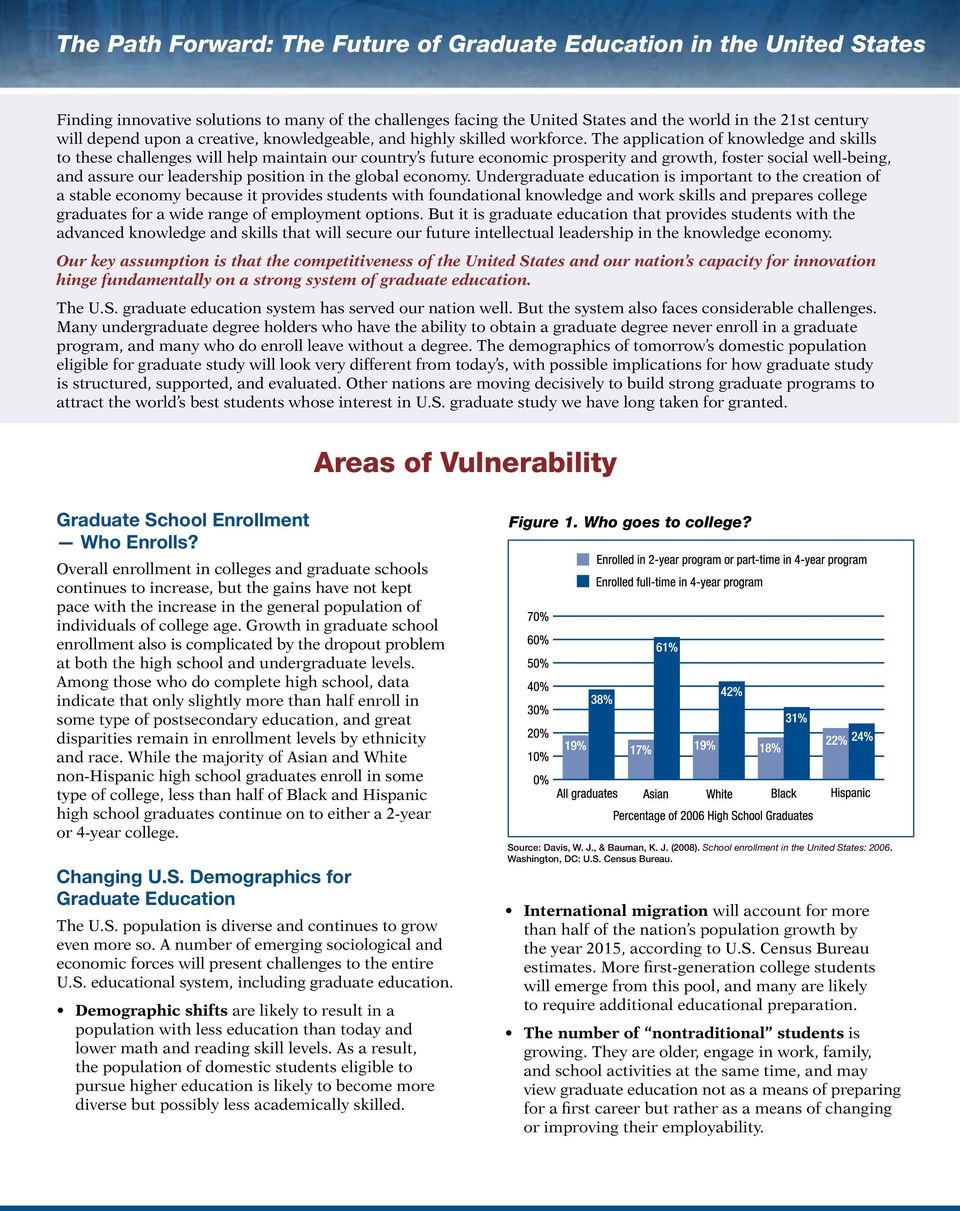
2 The Path Forward: The Future of Graduate Education in the United States Finding innovative solutions to many of the challenges facing the United States and the world in the 21st century will depend upon a creative, knowledgeable, and highly skilled workforce. The application of knowledge and skills to these challenges will help maintain our country s future economic prosperity and growth, foster social well-being, and assure our leadership position in the global economy. Undergraduate education is important to the creation of a stable economy because it provides students with foundational knowledge and work skills and prepares college graduates for a wide range of employment options. But it is graduate education that provides students with the advanced knowledge and skills that will secure our future intellectual leadership in the knowledge economy. Our key assumption is that the competitiveness of the United States and our nation s capacity for innovation hinge fundamentally on a strong system of graduate education. The U.S. graduate education system has served our nation well. But the system also faces considerable challenges. Many undergraduate degree holders who have the ability to obtain a graduate degree never enroll in a graduate program, and many who do enroll leave without a degree. The demographics of tomorrow s domestic population eligible for graduate study will look very different from today s, with possible implications for how graduate study is structured, supported, and evaluated. Other nations are moving decisively to build strong graduate programs to attract the world s best students whose interest in U.S. graduate study we have long taken for granted. Areas of Vulnerability Graduate School Enrollment Who Enrolls? Overall enrollment in colleges and graduate schools continues to increase, but the gains have not kept pace with the increase in the general population of individuals of college age. Growth in graduate school enrollment also is complicated by the dropout problem at both the high school and undergraduate levels. Among those who do complete high school, data indicate that only slightly more than half enroll in some type of postsecondary education, and great disparities remain in enrollment levels by ethnicity and race. While the majority of Asian and White non-hispanic high school graduates enroll in some type of college, less than half of Black and Hispanic high school graduates continue on to either a 2-year or 4-year college. Changing U.S. Demographics for Graduate Education The U.S. population is diverse and continues to grow even more so. A number of emerging sociological and economic forces will present challenges to the entire U.S. educational system, including graduate education. Demographic shifts are likely to result in a population with less education than today and lower math and reading skill levels. As a result, the population of domestic students eligible to pursue higher education is likely to become more diverse but possibly less academically skilled. Figure 1. Who goes to college? Source: Davis, W. J., & Bauman, K. J. (2008). School enrollment in the United States: Washington, DC: U.S. Census Bureau. International migration will account for more than half of the nation s population growth by the year 2015, according to U.S. Census Bureau estimates. More first-generation college students will emerge from this pool, and many are likely to require additional educational preparation. The number of nontraditional students is growing. They are older, engage in work, family, and school activities at the same time, and may view graduate education not as a means of preparing for a first career but rather as a means of changing or improving their employability.
3 Increasing numbers of individuals are returning to graduate school after having spent time in the workforce. The current economy contributes to this trend; a growing number of career changers or laid-off workers are looking to graduate education in hopes that an advanced degree will ensure continued employability and/or career advancement. These changes point to the need to reconsider how graduate students are financially supported as well as what kinds of additional resources they may need to succeed in graduate study. The changing demographics also may require a reconsideration of traditional time-to-degree expectations and career pathway opportunities. Who Completes Graduate Degrees? A number of other serious challenges face the U.S. graduate system. These include: Degree completion: Despite the rigorous selection processes used for admissions into U.S. graduate schools and the high achievement level of those pursuing a graduate degree, some studies indicate that the attrition rate in doctoral education is as high as 40% to 50%. Why do students not complete their degrees? At the doctoral level, factors include a change in family status, full or part-time enrollment status, job/military commitments, needing to work, or dissatisfaction with the particular program. Time to degree completion is lengthy, especially for those in doctoral programs. There is no fixed time appropriate for every degree, and there always will be a range of average times to degree based on different requirements in different fields. Still, the public and private costs of a longer-than-necessary time to degree completion, and the benefits to the public and to the individual recipient of a degree awarded, mean that students should complete as efficiently as possible. The Council of Graduate Schools Ph.D. Completion Project shows that less than 25% of students completed degrees within 5 years, and only about 45% completed within 7 years. Changes Influencing Workforce Needs It is projected that about 2.5 million jobs will require a master s, doctoral, or advanced degree between 2008 and While many master s programs are geared toward the needs of the workplace and prepare students for careers in the business, government, and nonprofit sectors, this is not necessarily true at the doctoral level. Figure 2. Doctoral completion rate, by field and number of years. Source: Council of Graduate Schools. (2008). Ph.D. completion and attrition: Analysis of baseline program data from the Ph.D. Completion Project. Washington, DC: Author. The expected career path for doctoral recipients is less straightforward than for master s graduates. Changes in the availability of tenure track positions in academia may influence the career path for doctoral students. An academic position in higher education that leads to tenure has, in the past, been an important career incentive for many students pursuing a doctoral degree. Today, however, an increasing number of nontenured and adjunct faculty are being hired over those in tenure track positions, and many doctoral recipients are looking for ways to serve society in careers outside academia. International changes in higher education also challenge the U.S. graduate system. For many years the United States led the world in attracting international students to graduate programs. Cultural changes have resulted in increased access to higher education in many countries, and systemic changes in Europe have resulted in more unified and consistent standards. Political and economic changes have placed a focus on the economic benefits of a highly trained workforce, leading to greater competition among countries for available students. The growing reputation of international graduate programs means that while U.S. graduate schools have always provided the highest-quality graduate education, the quality of graduate programs outside the United States is growing as well.

4 Addressing Areas of Vulnerability Addressing vulnerabilities in our graduate education system now will strengthen not only graduate education, but also our capacity for innovation and our ability to compete in the global economy. Changes in the university, industry, and government arenas are called for. Universities U.S. graduate education is a strategic national asset. Like all valuable assets it must be attended to and nurtured in order to remain viable and strong. Strengthening higher education and specifically graduate education is an investment in our future. In order to ensure a strong graduate education system going forward, universities need to address a number of challenges. Continuing efforts to identify and attract talented students to graduate education are critical. Improving student completion rates is important. Institutions must review and analyze their own completion and attrition patterns at both the master s and doctoral levels and create interventions to increase completion. Nonacademic career pathways for graduate students must be clarified and expanded upon. Graduate schools must provide appropriate training, mentoring, and information about career opportunities outside academia (e.g., business, government, and the nonprofit sector) in addition to those in academia. Preparing future faculty also is critical. Technology and demographics are changing, our understanding of how students learn is improving, and the aging of the professoriate has implications for how future faculty are prepared in U.S. graduate schools. A professional development component is one of the strengths of graduate education. However, it is primarily master s level programs, not doctoral, that have included this component. Universities should support the acquisition of such transferable skills to prepare doctoral recipients for a larger array of employment opportunities. Employers Employers play an important role in strengthening graduate education. They must clarify expectations of graduate recipients and help convey industry needs to graduate schools. Develop business/university partnerships by establishing a Graduate School Chair or other type of fellowship that provides financial support to graduate students; increasing internships and workstudy opportunities for graduate students; creating employer-matched, portable individual accounts that finance employee education and training; and providing tuition reimbursement programs for current employees to pursue graduate degrees. Develop business/university partnerships to promote participation of students from underrepresented groups in graduate programs. Communicate the educational skills needed for 21st-century jobs to students in high school through graduate school to help inform their decisions about educational choices in light of career opportunities. Policymakers The federal government must ensure that graduate education is a viable option for a growing number of U.S. citizens. Given the increasing diversity of the domestic student population, broadening participation in U.S. graduate education must remain a national priority. The odds that students will remain in graduate school are affected by several factors, especially the availability of appropriate financial support. Federal government support for graduate education must be increased through the authorization and implementation of two new initiatives to support doctoral and master s education. A COMPETES doctoral traineeship program would support doctoral education in areas of national need by providing direct student support through a stipend, tuition and fees, ancillary fringe costs, and other costs of education. A new competitive grant program would provide partial funding to create new, innovative master s programs or reinvigorate existing programs. Universities receiving the grants would need to secure at least two-thirds of program funding from sources other than the federal government. Continuing federal government support for existing programs and initiatives also is critical. This includes updating federal training and fellowship programs to keep pace with the increasing cost of graduate education, expanding loan forgiveness programs to other critical fields, amending current tax policies for graduate fellowships and scholarships, and aligning federal and state grant programs. Improvements and changes in the visa process to encourage international students to enroll in U.S. graduate schools and to remain in the United States following their degree completion also are needed.
5 The Path Forward Graduate education plays a critical role in today s world and will continue to do so in the future. A better understanding of that role and a clear path forward depend upon effective collaborations between universities, industry, and government. Finding solutions to 21st-century challenges, ensuring continued national prosperity, and maintaining our position in the global economy will require a highly skilled, creative, and innovative workforce. These creative innovators will be the product of the U.S. graduate education system.
6 The report was written by: Cathy Wendler, ETS; Brent Bridgeman, ETS; Fred Cline, ETS; Catherine Millett, ETS; JoAnn Rock, ETS; Nathan Bell, CGS; and Patricia McAllister, CGS. The Commission on the Future of Graduate Education in the United States is a joint effort of the Council of Graduate Schools (CGS) and Educational Testing Service (ETS). It was charged with overseeing a research effort to examine the political, demographic, socioeconomic, educational, and financial trends that impact participation in graduate education. The assumption underlying this work was that the global competitiveness of the United States and capacity for innovation hinges fundamentally on a strong system of graduate education. The 18-member Commission includes university presidents, graduate deans, provosts, industry leaders, and higher education scholars. The Commission guided the development of a report outlining the research findings and recommendations to universities, industry, and policymakers, and will seek to create a national conversation on how to increase graduate degree attainment by all segments of the country s population. The views expressed in this executive summary are those of the authors and do not necessarily reflect the views of the officers and trustees of Educational Testing Service. Copyright 2010 by Educational Testing Service. All rights reserved. ETS and the ETS logo are registered trademarks of Educational Testing Service (ETS) Copyright 2010 Council of Graduate Schools and/or its suppliers. All rights reserved.

Pathways, Potholes and Partnerships: Rethinking the Future of Graduate Education
 Pathways, Potholes and Partnerships: Rethinking the Future of Graduate Education Debra W. Stewart President Emerita and Senior Scholar Council of Graduate Schools Council of Colleges of Arts and Sciences
The Path Forward The Future of Graduate Education in the United States
 The Path Forward The Future of Graduate Education in the United States The Path Forward The Future of Graduate Education in the United States Suggested citation*: Council of Graduate Schools and Educational
Graduate Education in the United States
 Graduate Education in the United States Finnish Higher Education Experts USA Study Tour 2009 October 26, 2009 Robert Sowell Vice President for Programs and Operations Council of Graduate Schools Outline
HR 2272 Conference Report STEM Education Provisions Summary
 HR 2272 Conference Report STEM Education Provisions Summary Title I Office of Science and Technology Policy (OSTP) Directs the President to convene a National Science and Technology Summit not more than
FINANCIAL AID GRADUATE RESEARCH FELLOWSHIPS AND AWARDS. Graduate Dean's Fellowship
 FINANCIAL AID GRADUATE RESEARCH FELLOWSHIPS AND AWARDS Graduate Dean's Fellowship The Graduate Dean's Fellowship is a prestigious, competitive fellowship which provides advanced graduate students with
Graduate Assistants and Fellowships
 Graduate Assistants and Fellowships The School of Public Health offers Graduate Awards to students who are in good academic standing and demonstrate merit. Students should submit a separate application
Evolving Modalities for Doctoral Education
 Evolving Modalities for Doctoral Education Charles McClintock Dean, Human & Organizational Development Fielding Graduate University Orlando L. Taylor President, Washington, DC Campus The Chicago School
EGREES HOPE. Redefining Access for the 21 st Century Student VIEWING GUIDE
 EGREES OF HOPE Redefining Access for the 21 st Century Student VIEWING GUIDE 2 FOR TOO MANY STUDENTS, ACCESS TO A QUALITY EDUCATION REMAINS ELUSIVE Degrees of Hope: Redefining Access for the 21 st Century
Building Science and Engineering Talent. SEA Qualification Statement
 "A Unique Resource for the Nation" Building Science and Engineering Talent SEA Qualification Statement Background and Need Science, mathematics, and engineering education in many countries is essential
AAU COMMITTEE ON GRADUATE EDUCATION REPORT AND RECOMMENDATIONS. October 1998 - 1 -
 AAU COMMITTEE ON GRADUATE EDUCATION REPORT AND RECOMMENDATIONS October 1998-1 - EXECUTIVE SUMMARY Graduate education in the United States is widely recognized as the best in the world, yet it is far from
UNIVERSITY OF COLORADO DENVER GRADUATE SCHOOL STRATEGIC PLAN 2009-2015
 UNIVERSITY OF COLORADO DENVER GRADUATE SCHOOL STRATEGIC PLAN 2009-2015 MISSION: The Graduate School mission is to 1) guide, facilitate, and enhance educational quality, opportunities and experiences for
PROGRAM AUTHORITY; AUTHORIZATION OF APPROPRIATIONS.
 Higher Education Act of 1965, 1998 Higher Education Act Amendments Subpart 2 Federal Early Outreach and Student Services Programs CHAPTER 1 FEDERAL TRIO PROGRAMS SEC. 402A. 20 U.S.C. 1070a 11 PROGRAM AUTHORITY;
Dean of the College of Pharmacy and Health Sciences
 1 Dean of the College of Pharmacy and Health Sciences Texas Southern University invites nominations and applications for the position of Dean of the College of Pharmacy and Health Sciences (COPHS). Reporting
Text table 4-1 Enrollment, degree attainment, and employment status of academic year 1996/97 and 1997/98 S&E bachelor s degree recipients: April 1999
 Chapter 4 Graduate Enrollment Overview Graduate enrollment in science and engineering 1 rose in after 5 consecutive years of decline. (See appendix table 4-1.) The growth was entirely attributable to increases
New Hampshire Nursing Diversity Pipeline Project NH Future of Nursing Scholars Program Application 2011 2012 Academic Year
 New Hampshire Nursing Diversity Pipeline Project NH Future of Nursing Scholars Program Application 2011 2012 Academic Year A Project of the Partners Investing in Nursing s Future Initiative You Are The
The School Counselor s Role in College and Career Readiness
 College and Career Readiness Counseling for All Students 1 The School Counselor s Role in College and Career Readiness Judy Petersen, M. Ed. Director, College and Career Readiness Granite School District
GILLIAM FELLOWSHIPS for ADVANCED STUDY
 HOWARD HUGHES MEDICAL INSTITUTE GILLIAM FELLOWSHIPS for ADVANCED STUDY 2016 PROGRAM ANNOUNCEMENT Application Deadline: February 4, 2016 Award Notification: June 2016 Fellowship Term Begins: September 1,
2010-2015 Strategic Plan Template. Department of Special Education and Child Development 2010-2015 Strategic Plan
 2010-2015 Strategic Plan Template Department of Special Education and Child Development 2010-2015 Strategic Plan I. EXECUTIVE SUMMARY 1-2 pages A. Mission and goals: The mission of the Department Special
Strategic Vision Faculty and Staff Recruitment and Development
 Strategic Vision Faculty and Staff Recruitment and I. End Result: UAF engages in best practices in recruiting, hiring, evaluating, developing and promoting staff. Objective A: To implement regular staff
HHRP ISSUES A SERIES OF POLICY OPTIONS
 P o l I C y B R I E F # 5 J A N U A R y 2 0 0 9 HHRP ISSUES A SERIES OF POLICY OPTIONS SUSTAINING THE WORKFORCE BY EMBRACING DIVERSITY According to a 2002 study by the Canadian Nurses Association, Canada
DRAFT (February 7, 2000) Bert Garza. Faculty and Office for Computing and Information Science: Administrative and Management Structure
 DRAFT (February 7, 2000) Bert Garza Faculty and Office for Computing and Information Science: Administrative and Management Structure BACKGROUND The Information Revolution is transforming society creating
The Role, Mission, Vision, and Goals of Graduate Education at Central Washington University
 The Role, Mission, Vision, and Goals of Graduate Education at Central Washington University Role: The role of graduate education at Central Washington University is multi-faceted. Graduate education, first
Strategic Plan 2012 2020
 Department of Economics College of Arts and Sciences Texas Tech University Strategic Plan 2012 2020 Mission The Department of Economics is dedicated to excellence in teaching, research, and service. The
Reimagining the Doctoral Learning Experience
 Reimagining the Doctoral Learning Experience WALDEN UNIVERSITY was founded in 1970 as a doctorate-granting institution for working professionals. Supported by a diverse and global faculty of leading scholar-practitioners
College of Arts and Sciences
 College of Strategic Plan July, 2013 A Strategic Vision for the College of Mission The College of serves the public good by weaving the cultural, artistic, and intellectual fabric of the university experience
GUIDELINES FOR CONDUCTING EVALUATIONS OF ACADEMIC PROGRAMS
 GUIDELINES FOR CONDUCTING EVALUATIONS OF ACADEMIC PROGRAMS OFFICE OF THE PROVOST UNIVERSITY OF PITTSBURGH PITTSBURGH, PENNSYLVANIA 15260 JULY, 2002 Guidelines for Conducting Evaluations of Academic Programs
CSCU. Becoming a World-Class System of Higher Education
 CSCU Becoming a World-Class System of Higher Education CSCU The Connecticut State College & University System For over 160 years, Connecticut s state colleges & universities have played a critical role
Strategic Plan. Revised, April 2015
 Strategic Plan 2011 2020 Revised, April 2015 A Message from the President I am pleased to present Endicott College: Strategic Plan 2011 2020, which was developed by the Endicott College Planning Committee
Subpart 1 Federal Pell Grants
 TITLE IV STUDENT ASSISTANCE PART A GRANTS TO STUDENTS IN ATTENDANCE AT INSTITUTIONS OF HIGHER EDUCATION SEC. 400. ø20 U.S.C. 1070 STATEMENT OF PURPOSE; PROGRAM AUTHORIZATION. (a) PURPOSE. It is the purpose
What It s Worth: Field of Training and Economic Status in 2009
 What It s Worth: Field of Training and Economic Status in 2009 Household Economic Studies Issued February 2012 P70-129 INTRODUCTION The relationship between educational attainment and economic outcomes
Investing in What Works: How Federal TRiO Programs Can be Used to Enhance the STEM Pipeline
 Investing in What Works: How Federal TRiO Programs Can be Used to Enhance the STEM Pipeline A Presentation for the Building Diversity in Higher Education: Strategies for Broadening Participation in the
UNIVERSITY OF ROCHESTER William E. Simon Graduate School of Business Administration. Proposal for a Clinical Faculty Track
 Contents: UNIVERSITY OF ROCHESTER William E. Simon Graduate School of Business Administration Proposal for a Clinical Faculty Track 1. Rationale and Objectives of the Proposal 2. The Simon School Mission
Draft. Graduate Education Strategic Plan. Contents. DRAFT September 29, 2014
 Graduate Education Strategic Plan Contents Vision... 3 Mission... 3 Guiding Principles... 3 Graduate Education at Georgia Tech... 4 Strategic Goals... 5 Goal 1: Deliver an educational experience that is
Program Committee Report-Criminal Justice
 Program Committee Report-Criminal Justice Goals, Objectives, and Activities The Criminal Justice Program prepares students for careers in criminal justice or for further graduate or professional studies
EXPANDING FACULTY DIVERSITY AT UMBC
 EXPANDING FACULTY DIVERSITY AT UMBC FACULTY HIRING: UMBC STRIDE: (Committee on Strategies and Tactics for Recruiting to Improve Diversity and Excellence) is a faculty-led group that provides peer-to-peer
Race Matters. Household Asset Poverty by Race in North Carolina. Child Poverty by County
 Race Matters Children of color are more likely to grow up in both income poverty and asset poverty. This double burden creates a difficult barrier for children to overcome. As adults, children of color
Texas Southern University
 Texas Southern University College of Education Bylaws 2012 [Type text] 2 College of Education Bylaws Preamble Texas Southern University was founded in 1927 and became a state institution in 1947. Texas
Agency 5-Year Plan. Section 1: UAA Main Campus. Section 2: UHA AHSC Campus
 Agency 5-Year Plan Section 1: UAA Main Campus Section 2: UHA AHSC Campus Issue 1 Engaging Agency 5-Year Plan Description: Design the Arizona experience so that 100 percent of our students have the opportunity
The Graduate School Strategic Plan 2009-2011. University of Kentucky
 The Graduate School Strategic Plan 2009-2011 University of Kentucky Who We Are The Graduate School was established at the University of Kentucky in 1912. As we approach the Centennial, we have refined
Achievement, Innovation, Community: The University of Baltimore Strategic Plan 2014-17
 Achievement, Innovation, Community: The University of Baltimore Strategic Plan 2014-17 Mission The University of Baltimore provides innovative education in business, public affairs, the applied liberal
INDIANA UNIVERSITY SCHOOL OF EDUCATION. Long-Range Plan. An Evaluative Framework for Pursuing School Goals and Objectives
 INDIANA UNIVERSITY SCHOOL OF EDUCATION Long-Range Plan An Evaluative Framework for Pursuing School Goals and Submitted by the School of Education Long-Range Planning Committee 3/4/2013 Approved by Policy
students to complete their degree online. During the preliminary stage of included Art, Business, Computer Science, English, Government, History, and
 Texas Woman s University College of Arts and Sciences Bachelor of General Studies Program Undergraduate Program Review May 2012 I. PROGRAM REVIEW AND MISSION A. History Texas Woman s University has a proud
Lakeland Community College Campus Completion Plan
 Lakeland Community College Campus Plan Narrative Overview Lakeland Community College opened its doors in 1967 as the first college in Ohio established by a vote of local citizens committed to providing
A m e r i c A n S o c i o l o g i c A l A S S o c i At i o n
 A m e r i c A n S o c i o l o g i c A l A S S o c i At i o n Paying Attention to the Master s Degree in Sociology Roberta Spalter-Roth and Nicole Van Vooren Department of Research and Development 1 An
Graduate Student Researchers Project (GSRP)
 Graduate Student Researchers Project (GSRP) Administered by Cooperative Agreement between NASA and NASA Research and Education Support Services (NRESS) Linda Rodgers, Project Manager Jet Propulsion Laboratory
DEFIANCE COLLEGE Business Department Strategic Plan 2013-2016. Mission Statement
 DEFIANCE COLLEGE Strategic Plan 2013-2016 The at Defiance is part of the Division of Business, Education, and Social Work. The department includes majors in Business Administration and Accounting; minors
1. The UAEU College of Graduate Studies
 Graduate Studies Policies Manual Policy Number 02-Mar-2014 Responsible Office: DVC Research & Grad. Studies Page of this Policy 1 of 1 1. Overview Establishes the policies and related procedures for the
Massachusetts Community Colleges
 Massachusetts Community Colleges CONTENTS Executive Summary... 1 The Massachusetts Community Colleges - Benefits to Students and the Commonwealth... 3 The Massachusetts Community Colleges - Benefits to
High Growth Initiative Retail Industry Executive Summary
 Executive Summary Introduction A major priority of the U.S. Department of Labor s Employment and Training Administration (ETA) is to expand the capacity of the local workforce system to be market-driven,
SELF-STUDY FORMAT FOR REVIEW OF EXISTING DEGREE PROGRAMS
 SELF-STUDY FORMAT FOR REVIEW OF EXISTING DEGREE PROGRAMS Although programs engage in continual self-assessment and review of their work, periodic program reviews are designed to provide a broader view
Commission on Peer Review and Accreditation
 Commission on Peer Review and Accreditation Network of Schools of Public Policy, Affairs, and Administration ACCREDITATION STANDARDS For Master s degree programs Adopted October 16, 2009 at the NASPAA
Higher Education: A Pathway to Opportunity Making Higher Education Affordable and Effective for All Rhode Islanders
 A Note from Gina Dear friend, Higher Education: A Pathway to Opportunity Making Higher Education Affordable and Effective for All Rhode Islanders Like so many other Rhode Islanders, my family s American
Penn Engineering Diversity Plan
 Penn Engineering Diversity Plan May 31, 2012 1 Introduction Penn Engineering remains strongly committed to initiatives that support the University s efforts to achieve an educational and employment environment
SPECIAL SECTION: Indebtedness
 SPECIAL SECTION: Indebtedness Introduction Student indebtedness is a topic of great import for universities, public policy officials, and of course, doctoral students and their families. This special section
In Pursuit of Excellence and Equity Gevirtz Graduate School of Education Strategic Plan 2007 2012
 1 In Pursuit of Excellence and Equity Gevirtz Graduate School of Education Strategic Plan 2007 2012 The Gevirtz Graduate School of Education is one of five colleges at the University of California, Santa
INDIANA S TWENTY-FIRST CENTURY SCHOLARS PROGRAM. Stan Jones, Indiana Commission for Higher Education
 1 INDIANA S TWENTY-FIRST CENTURY SCHOLARS PROGRAM 3/7/2008 Stan Jones, Indiana Commission for Higher Education The Goals Help more students continue their education. Reduce the high school dropout rate.
School of Accounting Florida International University Strategic Plan 2012-2017
 School of Accounting Florida International University Strategic Plan 2012-2017 As Florida International University implements its Worlds Ahead strategic plan, the School of Accounting (SOA) will pursue
Department of Management and Human Resources PhD Program
 Department of Management and Human Resources PhD Program The primary goal of the PhD program is to develop top-class researchers in the field of management, with specializations in the areas of entrepreneurship,
Strategic Plan 2011. The College of Arts and Sciences. Vision. www.art-sci.udel.edu/ Leading the Way in Academics, Research and Public Engagement
 Strategic Plan 2011 and Sciences Leading the Way in Academics, Research and Public Engagement www.art-sci.udel.edu/ Vision The and Sciences at the University of Delaware will be nationally recognized for
SOCIOLOGY PHD PROGRAM. Student Learning Objectives
 SOCIOLOGY PHD PROGRAM Student Learning Objectives 1. Ability to apply key sociological concepts and research methodologies in critiquing sociological scholarship and in developing and reporting individual
ETS s Addressing Achievement Gaps Symposium. Advancing Success for Black Men in College. A Statistical Profile
 ETS s Addressing Achievement Gaps Symposium Advancing Success for Black Men in College A Statistical Profile ETS s Addressing Achievement Gaps Symposium Advancing Success for Black Men in College Co-sponsored
The Price of a Science PhD: Variations in Student Debt Levels Across Disciplines and Race/Ethnicity
 Center for Education & Innovation at American Institutes for Research Broadening Participation in Graduate Education Issue Brief May 2013 Kristina L. Zeiser Rita J. Kirshstein Courtney Tanenbaum The Price
OFFICE FOR Equity, Diversity, and Inclusion. Unit Plan 2014 17
 OFFICE FOR Equity, Diversity, and Inclusion Unit Plan 2014 17 Equity, Diversity, and Inclusion Built on collaboration and innovation, UC San Diego is a preeminent student-centered, research-focused, service-oriented