
Transport Canada s Departmental Sustainable Development Strategy Reporting Update
|
|
|
- Brenda Rodgers
- 10 years ago
- Views:
Transcription
1 Transport Canada s Departmental Sustainable Development Strategy Reporting Update 1

2 For more information, please visit Transport Canada s website at Her Majesty the Queen in Right of Canada, as represented by the Minister of Transport (2013) Catalogue No. T1-9/2-2013E-PDF 2

3 This is Transport Canada's fifth update of our Departmental Sustainable Development Strategy website under the new federal approach. The Federal Sustainable Development Strategy continues to guide the Government of Canada s sustainable development activities. During , the government consulted with the public regarding the second three-year cycle of the Federal Sustainable Development Strategy ( ). This Federal Sustainable Development Strategy will then be finalized to provide the basis for the year end performance reporting. Transport Canada continues to support Environment Canada in the development of the Federal Sustainable Development Strategy. This Strategy will be tabled in Parliament in the fall of After which, Transport Canada will develop new Departmental Sustainable Development Strategy website content to show how it supports the new Federal Sustainable Development Strategy. Transport Canada's Departmental Sustainable Development Strategy provides information on: Sustainable development and transportation What this means for Transport Canada Departmental decision-making and sustainable development Detailed information on Transport Canada's commitments in the Federal Sustainable Development Strategy Sustainable development and transportation Transportation takes place within a complex web of human and physical interactions and conditions. Trends in the environment, the economy and society affect the nature and scale of transportation activities, the impacts of those activities, and our responses to those impacts. The nature and volume of trade drives the demand for freight transportation. Similarly, the size of the population, its habits, income levels, the cost of energy and land use patterns affect passenger travel. Transportation is fundamental to Canada's economic prosperity and Canadians' quality of life. To enhance our quality of life, we need to ensure that our system is safe, secure and environmentally responsible. To maintain and enhance our competitiveness, we must ensure our transportation system is efficient and able to adapt to new challenges as they arise. 3

4 To preserve and strengthen Canada's transportation system, transportation policy must provide a framework that addresses the three elements of sustainable transportation - social, economic and environmental. It must also give carriers the opportunity to adapt, innovate, compete and serve shippers and travellers, in a way that takes into account each of these elements. The fundamental policy challenge is to find the right balance among these three elements. Canada's size and dependence on international trade make transportation very important to Canadians. Transportation - by land, water and air - links Canadians to each other and Canada with the world. Transportation has a wide range of impacts on the economy, our society and the environment. While many of these impacts are positive (e.g., supporting economic growth; moving people to their destinations and goods to markets; providing jobs; supporting mobility; enabling human contact), there are negative impacts as well that need to be considered (e.g., emissions; resource use - materials and energy; possibility of spills and leaks; impacts on land use). What this means for Transport Canada Transport Canada is responsible for the Government of Canada's transportation policies and programs. While not directly responsible for all aspects or modes of transportation, the department plays a leadership role to ensure that all parts of the transportation system work together effectively. Transport Canada leads Canada's efforts in addressing environmental issues from the rail, marine and aviation sectors. For example, under the legislative authority of the Railway Safety Act, the Canada Shipping Act, 2001 and the Aeronautics Act, Transport Canada contributes to reducing the air emissions from transportation by creating and implementing regulatory regimes. Our Vision - A transportation system in Canada that is recognized worldwide as safe and secure, efficient and environmentally responsible. The department's vision of a sustainable transportation system is one that integrates and balances social, economic and environmental objectives. This vision is guided by the following principles: highest possible safety and security of life and property - guided by performance-based standards and regulations when necessary; efficient movement of people and goods to support economic prosperity and a sustainable quality of life - based on competitive markets and targeted use of regulation and government funding; and respect for the environmental legacy of future generations of Canadians - guided by environmental assessment and planning processes in transportation decisions and selective use of regulation and government funding. 4

5 Departmental decision-making and sustainable development Sustainable development planning and reporting is now linked with the federal government's core expenditure planning and reporting system under the Federal Sustainable Development Strategy. This integration occurs through two primary planning and reporting vehicles: Report on Plans and Priorities - Objectives and plans that contribute to the Federal Sustainable Development Strategy are highlighted in Transport Canada's annual Reports on Plans and Priorities. Departmental Performance Report - Transport Canada reports progress against its Federal Sustainable Development Strategy implementation strategies in its annual Departmental Performance Reports. Following are some other key examples of how Transport Canada is integrating environmental aspects into its decision-making: Transport Canada's National Environmental Management System Strategic Environmental Assessment Transport Canada's National Environmental Management System Transport Canada is using the principles of the International Organization for Standardization series of standards in its National Environmental Management System to incorporate environmental considerations into decisions regarding Transport Canada operations. Transport Canada's National Environmental Management System identifies the following areas of interest: Air Land Water Hazardous materials Waste Procurement Environmental Emergency Preparedness Resource Use Flora/Fauna Management Transport Canada's National Environmental Management System also facilitates the achievement of Transport Canada's targets under the Federal Sustainable Development Strategy Theme IV - Shrinking the Environmental Footprint - Beginning with Government. 5

6 For more information on the department's contribution to the Federal Sustainable Development Strategy - Theme IV, please see: Theme IV - Shrinking the Environmental Footprint - Beginning with Government. Strategic Environmental Assessment Strategic Environmental Assessment evaluates the environmental effects of a proposed policy, plan, or program and its alternatives, and informs decision-making through a careful analysis of environmental risks and opportunities. The Guidelines for the Implementation of the Cabinet Directive on the Environmental Assessment of Policy, Plan, and Program Proposals clearly outline the Strategic Environmental Assessment process and reporting requirements. The guidelines were recently revised to include the following: A requirement for Strategic Environmental Assessment analysis to include impacts on the achievement of Federal Sustainable Development Strategy goals and targets; and, A requirement for departments to report on the results of Strategic Environmental Assessments. Transport Canada has committed to: Updating its internal Strategic Environmental Assessment Policy Statement to incorporate new requirements. Updating guidance material (templates, manuals, training material) to ensure practitioners understand these new requirements. Revising its internal process to link Strategic Environmental Assessment results to the Federal Sustainable Development Strategy goals and targets. Revising internal procedure for the preparation of public statements to address this new requirement. Planned reporting activities and performance measures in the Report on Plans and Priorities and Departmental Performance Report include: Number of proposals (Memoranda to Cabinet, Treasury Board submissions, regulatory amendments) submitted by Transport Canada to Cabinet or Treasury Board and approved (#); Number of proposals for which the Strategic Environmental Assessment process was completed (Preliminary Scans or Detailed Strategic Environmental Assessment) (#); 6

7 Transport Canada's overall Strategic Environmental Assessment compliance (%); and, Progress: # Submitted by Transport Canada to Cabinet or Treasury Board and approved Memorandum to Cabinet 13 Treasury Board Submissions 14 Regulatory Amendments 25 Number of Proposals for which the Strategic Environmental Assessment process was completed (Preliminary Scans or Detailed Strategic Environmental Assessment) Transport Canada s overall Strategic Environmental Assessment Compliance 40 79% Number of proposals for which a Detailed Strategic Environmental Assessment was completed and how it contributed towards Federal Sustainable Development Strategy goals and targets In : One detailed Strategic Environmental Assessment was completed in for the proposal entitled The Next Generation of Clean Transportation Initiatives. This suite of programs and regulations responds directly to the Federal Sustainable Development Strategy by addressing goals under the Addressing Climate Change and Quality theme. These include: Goal 1: Climate Change Reduce greenhouse gas emission levels to mitigate the severity and unavoidable impacts of climate change; and, Goal 2: Air Pollution Minimize the threats to air quality, so that the air Canadians breathe is clean, and help support a healthy ecosystem. 7

8 These initiatives will continue to fulfill existing Government of Canada commitments under the Clean Air Agenda to alleviate the environmental impact of the transportation sector by: addressing air pollution and greenhouse gas emissions through regulations for the aviation, marine and rail modes; ensuring the transportation system is safe and efficient; targeting heavy-duty vehicles by promoting the adoption of technologies that improve system efficiencies; specifically addressing local air emissions at marine ports; and, conducting evaluation and research into technologies, practices and measurement methodologies to better inform the development of future policies and regulations. In : No Detailed Strategic Environmental Assessments were completed. On April 1, 2013, Transport Canada launched its Sustainable Transportation Assessment Tool (STAT). The Sustainable Transportation Assessment Tool replaces the former Transport Canada Strategic Environmental Assessment preliminary scan template and requires analysts to identify potential economic, social and environmental effects of proposed policies, plans and programs. By asking these kinds of questions early in the design and development of proposals, it is anticipated that risks and opportunities will be better identified and managed, potential impacts across the department s strategic outcomes will be considered, and economic, social and environmental considerations will be integrated into departmental decision-making. For more information on Transport Canada's Strategic Environmental Assessments, please visit our website, and for more information on Strategic Environmental Assessments in general, please visit Detailed information on Transport Canada's commitments in the Federal Sustainable Development Strategy As required by the Federal Sustainable Development Act, the Government of Canada developed a Federal Sustainable Development Strategy and tabled it in Parliament in October The Federal Sustainable Development Strategy focuses on the environment as a first step in integrating environmental issues with economic and social considerations. It contains a number of goals, targets and implementation strategies, which are organized under four priority themes: 8

9 Theme I Addressing climate change and air quality Theme II Maintaining water quality and availability Theme III Protecting nature Theme IV Shrinking the environmental footprint - Beginning with government (also known as Greening Government Operations) The first Federal Sustainable Development Strategy contains 320 implementation strategies for meeting the goals and targets under Themes I to III. Transport Canada is responsible, or jointly responsible for 38 of these implementation strategies (commitments). As a Schedule I department, Transport Canada is also required to meet all targets found under Theme IV. The following sections of this website provide you with more detail on what these commitments mean, how they link to Transport Canada's strategic outcomes, and how the department plans to measure its progress. It is important to note that the numbering of these implementation strategies comes directly from the Federal Sustainable Development Strategy. Beginning in the Planning Update a new section was included on this website, entitled Other Initiatives that Support the Federal Sustainable Development Strategy. In this section, initiatives which are new since the tabling of the first Federal Sustainable Development Strategy in October 2010, and which support one of its themes, are highlighted. To streamline planning and reporting activities, some of Transport Canada's Federal Sustainable Development Strategy commitments from Theme I Addressing Climate Change and Air Quality are reported on under this new section. Where this occurs, the reader will be re-directed to the appropriate place. In addition, several performance indicators have been revised to more closely align with the measurement framework under Transport Canada's Program Activity Architecture. 9

10 Theme I - Addressing Climate Change and Air Quality Transportation is one of the largest sources of air pollutants and greenhouse gas emissions in Canada. In 2009, transportation accounted for 24% of Canada's total greenhouse gas emissions 1. Transportation is also linked with the emission of air pollutants such as carbon monoxide, nitrogen oxide, sulphur oxides, volatile organic compounds and particulate matter. These pollutants contribute to the formation of smog and poor air quality. Since 1990, pollutant emissions have fallen significantly, largely due to regulatory changes introduced by the federal government. However, more action is required to ensure this trend continues in the transportation sector. Transport Canada's Commitments In 2010, under Theme I - Addressing Climate Change and Air Quality Transport Canada committed to contribute to the Federal Sustainable Development Strategy through the following implementation strategies. Goal 1 - Climate Change Undertake and deliver scientific research and reporting in support of regulatory and other programs, including data analysis, inventory development, monitoring, modeling and assessment of the effectiveness of efforts as well as research on options, costs and benefits, and technology assessments. (EC, HC, NRCan, TC) Develop regulations under the Canadian Environmental Protection Act, 1999 to address greenhouse gas emissions from heavy-duty vehicles, aligned with the United States but taking into consideration the distinct nature of the Canadian fleet. The draft regulations are expected to be available for consultation in the fall of (EC, TC) Work within the International Maritime Organization (IMO) to support the development of international energy efficiency / GHG standards for marine vessels. (TC) Develop regulations under the Railway Safety Act to address greenhouse gas emissions from the rail sector in collaboration with the United States. (TC) Work within the International Civil Aviation Organization (ICAO) to develop aircraft design performance standards for CO 2 as early as (TC) 10
11 Develop and/or implement new rules within Canada's domestic regulatory regime which reflect appropriate international standards and recommended practices concerning greenhouse emissions adopted by the International Maritime Organization and the International Civil Aviation Organization. (TC) Continue to support a Memorandum of Understanding (MOU) with the Railway Association of Canada that ensures the rail industry continues to improve its GHG emissions performance during the period (EC, TC) Continue to support the MOU signed between Transport Canada and the Air Transport Association of Canada to reduce emissions of greenhouse gases from aviation sources. The agreement sets an annual fuel-efficiency target that will achieve a cumulative improvement in fuel efficiency of 24% by 2012, relative to 1990 levels. (TC) Deliver extensive outreach under the ecotransport Strategy to build knowledge and capacity for the adoption of emission-reducing technologies and practices. The majority of ecotransport programs will end March 31, (TC) Manage research and development, develop partnerships, support and/or conduct technology development (emerging and forward-looking) to improve energy efficiency and reduce emissions for surface, marine and air transportation. (TC) Support the development of international principles, standards and recommended practices with the International Civil Aviation Organization aimed at a globally coherent approach to manage international aviation GHG emissions. (TC) Support the development of international standards and recommended practices with the International Maritime Organization concerning greenhouse gas emissions from marine sources. (TC) Work within International Civil Aviation Organization to continue to advance emissions limitations and reductions from international aviation, including the implementation of the ICAO Programme of Action on International Aviation and Climate Change, while maintaining a high level of safety. (TC, EC) Work within the International Maritime Organization toward the development of international standards and recommended practices that reduce greenhouse gas emissions from marine shipping, while maintaining a high level of safety. (TC) 11
12 Goal 2: Air Pollution Undertake scientific research and reporting in support of regulatory and other programs delivered, including data analysis, inventory development, monitoring, modeling and assessment of the effectiveness of efforts as well as research on options, costs and benefits including economic and social and technology assessments. (EC, NRCan, HC, TC) Develop emission regulations for Criteria Air Contaminants (CAC) for the rail sector under the Railway Safety Act to take effect in 2011, aligned with U.S. Environmental Protection Agency emissions standards. (TC) Continue to work with the United States and France to implement a designated Emission Control Area for North American coastal areas, under the auspices of the IMO, by (TC, EC) Develop enhanced emissions regulations under the Canada Shipping Act, 2001, for vessels operating in Canadian waters. (TC) Continue to support a Memorandum of Understanding (MOU) with the Railway Association of Canada that ensures the rail industry continues to improve emission performance during the period. (EC, TC) ecoaction programs reduce GHG emissions and can directly or indirectly contribute to air pollutant emission reduction. (NRCan, TC, INAC) Deliver extensive outreach under the ecotransport Strategy to build knowledge and capacity for the adoption of emission-reducing technologies and practices. The majority of ecotransport programs will end March 31, (TC) Support the design, manufacture and sale of fuel-efficient, light-duty motor vehicles to promote energy efficiency. (TC) Support the development of standards and recommended practices within the Committee on Aviation Environmental Protection (CAEP) of the International Civil Aviation Organization concerning air pollutant emissions from aviation sources. (TC) Support the development of international standards and recommended practices within the International Maritime Organization concerning air pollutant emissions from marine sources. (TC) Participate in the Marine Environmental Protection Committee of the International Maritime Organization. (TC) 12

13 Participate in the International Civil Aviation Organization Council's Committee on Aviation Environmental Protection. (TC) Implementation Strategy # Undertake and deliver scientific research and reporting in support of regulatory and other programs, including data analysis, inventory development, monitoring, modeling and assessment of the effectiveness of efforts as well as research on options, costs and benefits, and technology assessments. (EC, HC, NRCan, TC) Contribution to the Federal Sustainable Development Strategy (FSDS) FSDS Theme I - Addressing Climate Change and Air Quality Goal 1 - Climate Change: Reduce greenhouse gas emission levels to mitigate the severity and unavoidable impacts of climate change Target Climate Change Mitigation: Relative to 2005 emission levels, reduce Canada's total greenhouse gas emissions (GHG) 17% by 2020* *Transport Canada contributes to this Government of Canada target. Linkage to the departmental PAA 2.1 Clean Air from Transportation A brief description of the implementation strategy Transport Canada works with partners to address data gaps with regard to transportation activity, energy use and related emissions for all modes. Transport Canada develops and maintains a database of activity, fuel use, air pollutants and greenhouse gas emissions per mode for all modes of transportation. This information is used in the preparation of the 'Transportation in Canada' annual report. Under section 52 of the Canada Transportation Act, the Minister of Transport is required to prepare an annual report that provides a brief overview of the state of transportation in Canada. Every fifth year, this report is expanded to be more comprehensive in nature, to include additional information, such as the financial performance of each mode of transportation and its contribution to the Canadian economy and long-term outlook and trends in transportation in Canada. With a view to addressing data gaps, Transport Canada has engaged in reviewing the Carriers and Transportation and Grain Handling Undertakings Information Regulations, which are in place today, but last reviewed in Section 50 of the Canada Transportation Act (amended in June 2007) has expanded the scope of the Minister's authority to collect information related to environmental issues, under the lens of national transportation policy development. Extensive consultations were conducted throughout 2009 and 2010 on the proposed regulations. 13

14 The proposed regulations, published in the Canada Gazette, Part I on February 19, 2011, take a common, bottom-up approach, across all modes to measure greenhouse gas emissions. Transport Canada expects to be in a position to publish the final version of the amendments to this regulation in fall of Transport Canada also assesses the economic and environmental costs and benefits of regulatory and non-regulatory initiatives. Transport Canada continues to support sustainable transportation research and development projects through the efforts of the Transportation Development Centre and through various socio-economic studies. This implementation strategy is linked to , and Relationship between this implementation strategy and the Federal Sustainable Development Strategy targets The knowledge developed under this implementation strategy will contribute to a better understanding of the greenhouse gas and air pollutant emissions associated with transportation activities, which will contribute towards the Federal Sustainable Development Strategy Target Climate Change Mitigation and Target Air Pollutants. The research undertaken during the period will also contribute to Target Climate Change Mitigation and Target Air Pollutants. An outline of the non-financial performance expectations Performance Indicators Tabling of the 'Transportation in Canada' Annual Report in both Houses of Parliament Adoption of the revised Carriers and Transportation and Grain Handling Undertakings Information Regulations Targets Annually, before the end of May In the course of fiscal year Results Achieved SUBSTANTIALLY ACHIEVED The report was tabled in both Houses of Parliament in June NOT ACHIEVED Amendments remain under revision and are now expected to be adopted in
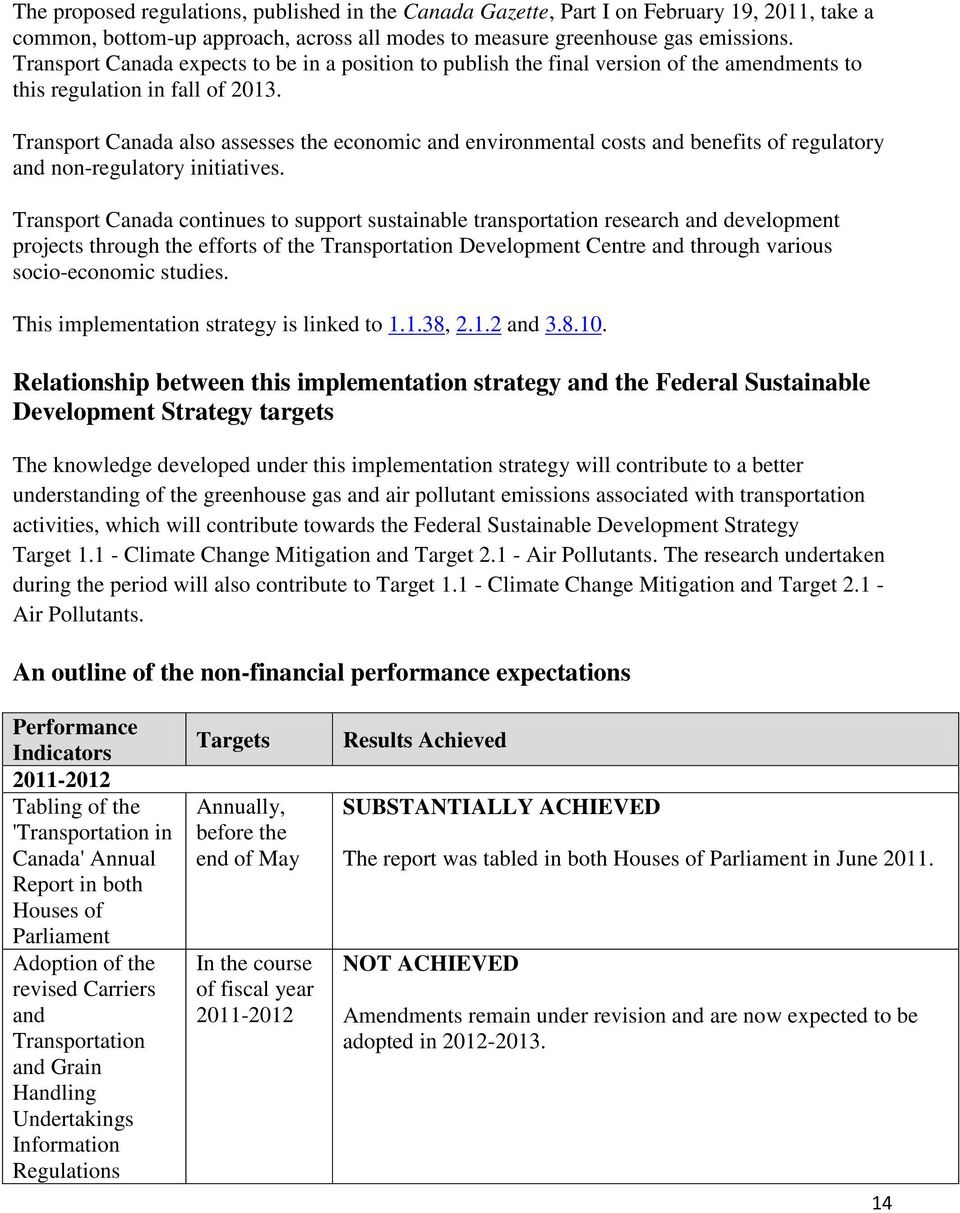
15 Performance Indicators Enhanced focus of the R&D efforts allocated to sustainable transportation activities Tabling of the 'Transportation in Canada' Annual Report in both Houses of Parliament Improving the quality of data linking greenhouse gas emissions and transportation activities Targets 15% of the Transportatio n Development Centre's efforts allocated towards sustainable transportation priorities Annually, before the end of May At least one transportation sector will show measurable improvement Results Achieved ACHIEVED Greater than 20% of the Transportation Development Centre staff were allocated to create and maintain research programs pertaining to sustainable transportation priorities. ACHIEVED The report was tabled in both Houses of Parliament on May 31, ACHIEVED The need for a better link between emissions and activity data was identified in the context of the Data Strategy that Transport Canada put in place in There has been significant improvement in the on-road transportation sector following the implementation of the Canadian Vehicle Use Study (CVUS) and the development of the Heavy-Duty Vehicle Use Study, whose design took into consideration the Data Strategy findings with regards to the link between activity and emissions. The CVUS was highlighted by the Clerk of the Privy Council in the Twentieth Report to the Prime Minister on the State of The Public Service under innovation. These studies now provide Transport Canada with the tools to collect activity data which is directly linked to vehicle characteristics and fuel consumption. This type of information was not previously available and will allow for much improved estimates of on-road greenhouse gas emissions and activity. 15
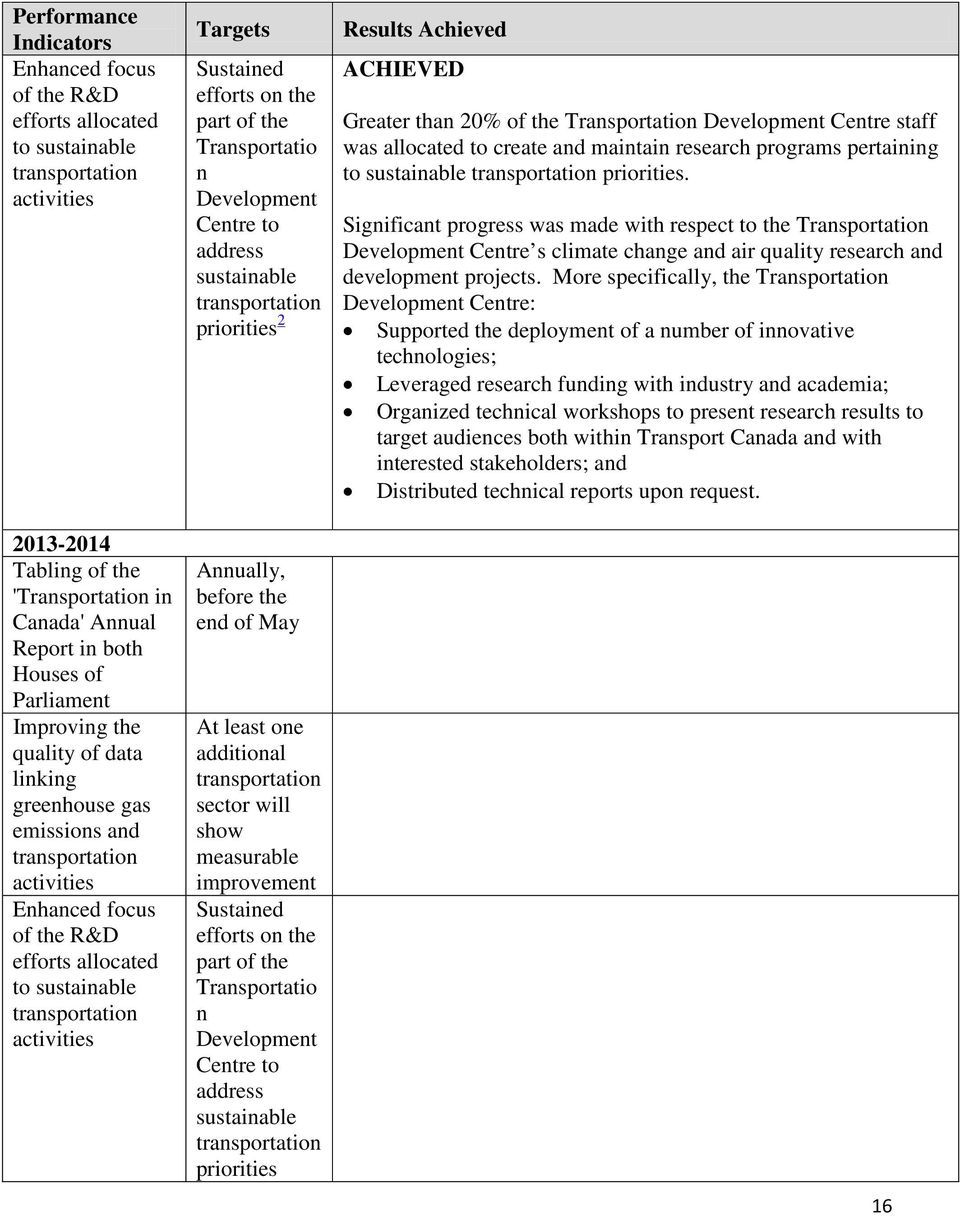
16 Performance Indicators Enhanced focus of the R&D efforts allocated to sustainable transportation activities Tabling of the 'Transportation in Canada' Annual Report in both Houses of Parliament Improving the quality of data linking greenhouse gas emissions and transportation activities Enhanced focus of the R&D efforts allocated to sustainable transportation activities Targets Sustained efforts on the part of the Transportatio n Development Centre to address sustainable transportation priorities 2 Annually, before the end of May At least one additional transportation sector will show measurable improvement Sustained efforts on the part of the Transportatio n Development Centre to address sustainable transportation priorities Results Achieved ACHIEVED Greater than 20% of the Transportation Development Centre staff was allocated to create and maintain research programs pertaining to sustainable transportation priorities. Significant progress was made with respect to the Transportation Development Centre s climate change and air quality research and development projects. More specifically, the Transportation Development Centre: Supported the deployment of a number of innovative technologies; Leveraged research funding with industry and academia; Organized technical workshops to present research results to target audiences both within Transport Canada and with interested stakeholders; and Distributed technical reports upon request. 16
17 Implementation Strategy # IS Develop regulations under the Canadian Environmental Protection Act, 1999 to address greenhouse gas emissions from heavyduty vehicles, aligned with the United States but taking into consideration the distinct nature of the Canadian fleet. The draft regulations are expected to be available for consultation in the fall of (EC, TC) Contribution to the Federal Sustainable Development Strategy (FSDS) FSDS Theme I - Addressing Climate Change and Air Quality Goal 1 - Climate Change: Reduce greenhouse gas emission levels to mitigate the severity and unavoidable impacts of climate change Target Climate Change Mitigation: Relative to 2005 emission levels, reduce Canada's total greenhouse gas emissions (GHG) 17% by 2020* *Transport Canada contributes to this Government of Canada target. Please note that planning and reporting information for this implementation strategy is now found under the Support for Vehicle Greenhouse Gas Emission Regulations Initiative in the Other Initiatives Supporting the Federal Sustainable Development Strategy section of this website. 17

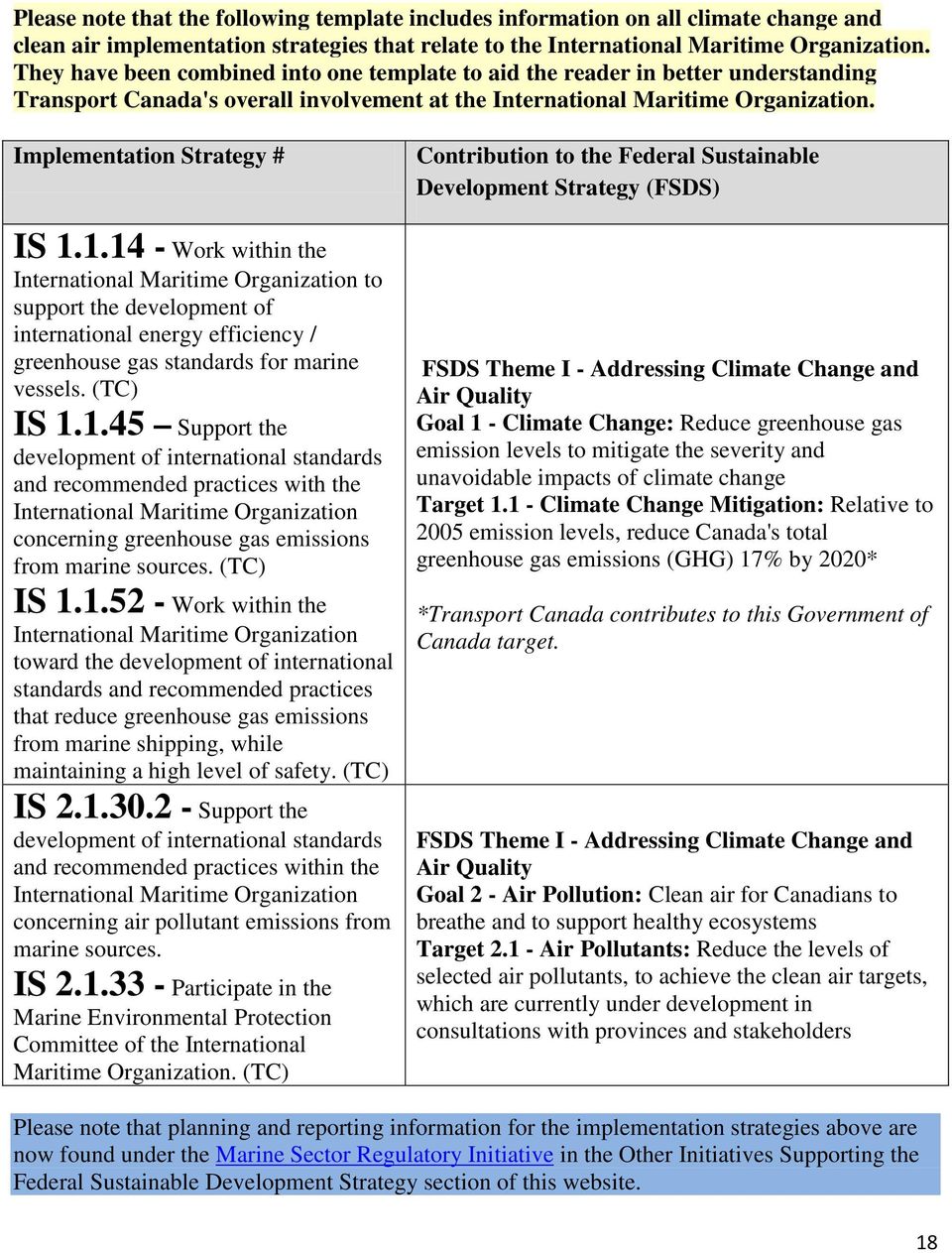
18 Please note that the following template includes information on all climate change and clean air implementation strategies that relate to the International Maritime Organization. They have been combined into one template to aid the reader in better understanding Transport Canada's overall involvement at the International Maritime Organization. Implementation Strategy # IS Work within the International Maritime Organization to support the development of international energy efficiency / greenhouse gas standards for marine vessels. (TC) IS Support the development of international standards and recommended practices with the International Maritime Organization concerning greenhouse gas emissions from marine sources. (TC) IS Work within the International Maritime Organization toward the development of international standards and recommended practices that reduce greenhouse gas emissions from marine shipping, while maintaining a high level of safety. (TC) IS Support the development of international standards and recommended practices within the International Maritime Organization concerning air pollutant emissions from marine sources. IS Participate in the Marine Environmental Protection Committee of the International Maritime Organization. (TC) Contribution to the Federal Sustainable Development Strategy (FSDS) FSDS Theme I - Addressing Climate Change and Air Quality Goal 1 - Climate Change: Reduce greenhouse gas emission levels to mitigate the severity and unavoidable impacts of climate change Target Climate Change Mitigation: Relative to 2005 emission levels, reduce Canada's total greenhouse gas emissions (GHG) 17% by 2020* *Transport Canada contributes to this Government of Canada target. FSDS Theme I - Addressing Climate Change and Air Quality Goal 2 - Air Pollution: Clean air for Canadians to breathe and to support healthy ecosystems Target Air Pollutants: Reduce the levels of selected air pollutants, to achieve the clean air targets, which are currently under development in consultations with provinces and stakeholders Please note that planning and reporting information for the implementation strategies above are now found under the Marine Sector Regulatory Initiative in the Other Initiatives Supporting the Federal Sustainable Development Strategy section of this website. 18
19 Implementation Strategy # IS Develop regulations under the Railway Safety Act to address greenhouse gas emissions from the rail sector in collaboration with the United States. (TC) Contribution to the Federal Sustainable Development Strategy (FSDS) FSDS Theme I - Addressing Climate Change and Air Quality Goal 1 - Climate Change: Reduce greenhouse gas emission levels to mitigate the severity and unavoidable impacts of climate change Target Climate Change Mitigation: Relative to 2005 emission levels, reduce Canada's total greenhouse gas emissions (GHG) 17% by 2020* *Transport Canada contributes to this Government of Canada target. Please note that planning and reporting information for this implementation strategy is now found under the Rail Sector Regulatory Initiative in the Other Initiatives Supporting the Federal Sustainable Development Strategy section of this website. Please note that the following template includes information on all implementation strategies that relate to the International Civil Aviation Organization. They have been combined into one template to aid the reader in better understanding Transport Canada's overall involvement at the International Civil Aviation Organization. Implementation Strategy # IS Work within the International Civil Aviation Organization to develop aircraft design performance standards for CO 2 as early as (TC) IS Support the development of international principles, standards and recommended practices with the International Civil Aviation Organization aimed at a globally coherent approach to manage international aviation greenhouse gas emissions. (TC) Contribution to the Federal Sustainable Development Strategy (FSDS) FSDS Theme I - Addressing Climate Change and Air Quality Goal 1 - Climate Change: Reduce greenhouse gas emission levels to mitigate the severity and unavoidable impacts of climate change Target Climate Change Mitigation: Relative to 2005 emission levels, reduce Canada's total greenhouse gas emissions (GHG) 17% by 2020* *Transport Canada contributes to this Government of Canada target. 19

20 Implementation Strategy # Contribution to the Federal Sustainable Development Strategy (FSDS) IS Work within International Civil Aviation Organization to continue to advance emissions limitations and reductions from international aviation, including the implementation of the International Civil Aviation Organization Programme of Action on International Aviation and Climate Change, while maintaining a high level of safety. (TC, EC) IS Support the development of standards and recommended practices within the Committee on Aviation Environmental Protection (CAEP) of the International Civil Aviation Organization concerning air pollutant emissions from aviation sources. (TC) IS Participate in the International Civil Aviation Organization Council's Committee on Aviation Environmental Protection. (TC) FSDS Theme I - Addressing Climate Change and Air Quality Goal 1 - Climate Change: Reduce greenhouse gas emission levels to mitigate the severity and unavoidable impacts of climate change Target Climate Change Mitigation: Relative to 2005 emission levels, reduce Canada's total greenhouse gas emissions (GHG) 17% by 2020* *Transport Canada contributes to this Government of Canada target. Please note that planning and reporting information for the implementation strategies above are now found under the Aviation Sector Regulatory Initiative in the Other Initiatives Supporting the Federal Sustainable Development Strategy section of this website. 20

21 Implementation Strategy # IS Develop and/or implement new rules within Canada's domestic regulatory regime, which reflect appropriate international standards and recommended practices concerning greenhouse emissions adopted by the International Maritime Organization and the International Civil Aviation Organization. (TC) Contribution to the Federal Sustainable Development Strategy (FSDS) FSDS Theme I - Addressing Climate Change and Air Quality Goal 1 - Climate Change: Reduce greenhouse gas emission levels to mitigate the severity and unavoidable impacts of climate change Target Climate Change Mitigation: Relative to 2005 emission levels, reduce Canada's total greenhouse gas emissions (GHG) 17% by 2020* *Transport Canada contributes to this Government of Canada target. Please note that planning and reporting information for this implementation strategy is now found under the Aviation and Marine Sector Regulatory Initiatives in the Other Initiatives Supporting the Federal Sustainable Development Strategy section of this website. Implementation Strategy # IS Continue to support a Memorandum of Understanding (MOU) with the Railway Association of Canada that ensures the rail industry continues to improve its GHG emissions performance during the period (EC, TC) Note: This implementation strategy was completed in Contribution to the Federal Sustainable Development Strategy (FSDS) FSDS Theme I - Addressing Climate Change and Air Quality Goal 1 - Climate Change: Reduce greenhouse gas emission levels to mitigate the severity and unavoidable impacts of climate change Target Climate Change Mitigation: Relative to 2005 emission levels, reduce Canada's total greenhouse gas emissions (GHG) 17% by 2020* *Transport Canada contributes to this Government of Canada target. Linkage to the departmental PAA ecofreight Note: As this Implementation Strategy was completed in , the previous PAA linkage is provided. 21
22 A brief description of the implementation strategy In 2007, Transport Canada, Environment Canada and the Railway Association of Canada signed a Memorandum of Understanding, in force from 2006 to 2010, to reduce the emissions of greenhouse gases and criteria air contaminants from locomotives operating in Canada. The Memorandum of Understanding established 2010 greenhouse gas emissions intensity targets for the major railway companies: Class I Freight kg CO 2 equivalent per 1,000 revenue tonne-kilometre Short Lines kg CO 2 equivalent per 1,000 revenue tonne-kilometre Intercity Passenger kg CO 2 equivalent per passenger-kilometre Commuter kg CO 2 equivalent per passenger An annual report is prepared each year, describing the performance under the Memorandum of Understanding. The reports are available online at: This implementation strategy is linked to and An explanation of the relationship between that implementation strategy and one or more Federal Sustainable Development Strategy targets Work under this Memorandum of Understanding leads to reductions of greenhouse gas emissions and air pollutants and contributes to Federal Sustainable Development Strategy Target Climate Change Mitigation and Target Air Pollutants. 22
23 An outline of the non-financial performance expectations Performance Indicators results published in Annual Report Not applicable as this Implementation Strategy was completed in Not applicable as this Implementation Strategy was completed in Targets Report published Not applicable as this Implementation Strategy was completed in Not applicable as this Implementation Strategy was completed in Results Achieved NOT ACHIEVED 2009 Locomotive Emissions Monitoring Program Report (LEM Report) was published in January The 2010 LEM Report is expected to be published in fall Update The 2010 LEM Report was published in 2012 and is can be viewed along with the 2009 Report on the Railway Association of Canada s website. Not applicable as this Implementation Strategy was completed in Not applicable as this Implementation Strategy was completed in
24 Implementation Strategy # IS Continue to support the Memorandum of Understanding signed between Transport Canada and the Air Transport Association of Canada to reduce emissions of greenhouse gases from aviation sources. The agreement sets an annual fuel-efficiency Target that will achieve a cumulative improvement in fuel efficiency of 24% by 2012, relative to 1990 levels. (TC) Contribution to the Federal Sustainable Development Strategy (FSDS) FSDS Theme I - Addressing Climate Change and Air Quality Goal 1 - Climate Change: Reduce greenhouse gas emission levels to mitigate the severity and unavoidable impacts of climate change Target Climate Change Mitigation: Relative to 2005 emission levels, reduce Canada's total greenhouse gas emissions 17% by 2020* *Transport Canada contributes to this Government of Canada target. Linkage to the departmental PAA Clean Air Regulatory Framework and Oversight A brief description of the implementation strategy In 2005, Transport Canada and the Air Transport Association of Canada signed a Memorandum of Understanding to reduce greenhouse gas emissions from aviation sources. This Memorandum of Understanding set an annual average target of 1.1 percent fuel efficiency improvement, compared to a 1990 baseline with a cumulative improvement of 24 percent by This will be measured in litres of fuel per total Revenue Tonne-Kilometre and fuel consumption per Revenue Tonne-Kilometre. Canada was the first country to have such a voluntary initiative, involving both government and industry. In 2008, the four largest passenger air carriers - Air Canada, Air Transat, Jazz Air LP, and WestJet - elected to leave the Air Transport Association Of Canada, and formed a new trade association, the National Airlines Council of Canada. While no longer covered by the Memorandum of Understanding, these carriers have affirmed their continuing support of the agreement and its goals, and have assumed their responsibilities as set out in the agreement. An annual report is prepared each year, describing the performance under the Memorandum of Understanding. The reports are available online at: 24
25 Relationship between this implementation strategy and the Federal Sustainable Development Strategy targets Work under the Memorandum of Understanding leads to reductions of greenhouse gas emissions and contributes to the Federal Sustainable Development Strategy Target Climate Change Mitigation. An outline of the non-financial performance expectations Performance Indicators results published in Annual Report results published in Annual Report Not applicable Targets Report published Report published Results Achieved ACHIEVED The 2010 Canadian Aviation Industry Report on Greenhouse Gas Emissions Reductions was published on Transport Canada s website in April ACHIEVED The 2011 Canadian Aviation Industry Report on Greenhouse Gas Emissions Reductions was published on Transport Canada s website in January Implementation Strategy # IS Deliver extensive outreach under the ecotransport Strategy to build knowledge and capacity for the adoption of emissionreducing technologies and practices. The majority of ecotransport programs will end March 31, Note: This Implementation Strategy was completed in Contribution to the Federal Sustainable Development Strategy (FSDS) FSDS Theme I - Addressing Climate Change and Air Quality Goal 1 - Climate Change: Reduce greenhouse gas emission levels to mitigate the severity and unavoidable impacts of climate change Target Climate Change Mitigation: Relative to 2005 emission levels, reduce Canada's total greenhouse gas emissions (GHG) 17% by 2020 * *Transport Canada contributes to this Government of Canada target. 25
26 Linkage to the departmental PAA ecofreight Clean Urban Transportation Clean Vehicle Note: This Implementation Strategy was completed in , the previous PAA linkage is provided. A brief description of the implementation strategy The ecotransport Strategy was a four-year initiative ( to ) part of the ecoaction programs to reduce greenhouse gas emissions and that can directly or indirectly contribute to air pollutant emission reduction. Two programs of the strategy were extended to : ecomobility and Marine Shore Power. The ecomobility program aims to reduce emissions from urban passenger transportation by helping municipalities attract residents to less polluting forms of transportation. During the last year of the program, the ecomobility projects with municipalities will be finalized, final reports will be reviewed and final stage of the program measurement strategy will be initiated. Information on the results of projects funded under the program will be disseminated. The Marine Shore Power program's objective is to improve air quality by reducing air emissions, particles and marine vessel stack smoke in some of Canada's largest urban centers by enabling ships to turn off their auxiliary diesel engines and reduce their emissions while docked and to connect to a city's electrical grid using specially designed equipment to power the ship's load (e.g., lighting, air conditioning, communication equipment, etc.). In , the Marine Shore Power program will support the implementation of the Prince Rupert Port Authority project and begin to implement its program impacts measurement strategy. Information on projects funded under the program will be disseminated. This implementation strategy is linked to and Relationship between this implementation strategy and the Federal Sustainable Development Strategy targets Work under the ecotransport Strategy is aimed at reducing greenhouse gas emissions and indirectly contributes to reductions in air pollutant emissions, contributing to Federal Sustainable Development Strategy Target Climate Change Mitigation and Target Air Pollutants. 26
27 An outline of the non-financial performance expectations Performance Indicators Dissemination of project results and information Targets Results and information on all projects funded under the program are disseminated Results Achieved ACHIEVED Transport Canada s Urban Transportation Programs directly reached at least 1,000 urban transportation practitioners through webinars, workshops, booths and sessions at conferences and by sharing its information products such as implementation guides and case studies. Information is available on: 13 case studies funded under the ecofreight program; 5 green transportation checklists for freight shippers; and, 8 truck technology fact sheets, 4 truck technology emission calculators, and 3 videos showcasing benefits of marine shore power, truck aerodynamic improvement and rail locomotive anti-idling systems. The Federation of Canadian Municipalities hosts these information products on their website Not applicable as this Implementation Strategy was completed in Not applicable as this Implementation Strategy was completed in
28 Implementation Strategy # IS Manage research and development, develop partnerships, support and/or conduct technology development (emerging and forwardlooking) to improve energy efficiency and reduce emissions for surface, marine and air transportation. (TC) Contribution to the Federal Sustainable Development Strategy (FSDS) FSDS Theme I - Addressing Climate Change and Air Quality Goal 1 - Climate Change: Reduce greenhouse gas emission levels to mitigate the severity and unavoidable impacts of climate change Target Climate Change Mitigation: Relative to 2005 emission levels, reduce Canada's total greenhouse gas emissions (GHG) 17% by 2020 * *Transport Canada contributes to this Government of Canada target. Linkage to the departmental PAA 1.4 Transportation Innovation A brief description of the implementation strategy Transport Canada will support sustainable transportation research and development projects through the efforts of the Transportation Development Centre. This implementation strategy is linked to 1.1.5, and Relationship between this implementation strategy and the Federal Sustainable Development Strategy targets The research undertaken during the period will contribute to the mitigation of climate change, supporting Federal Sustainable Development Strategy Target Climate Change Mitigation. 28
29 An outline of the non-financial performance expectations Performance Indicators Enhanced focus of the R&D efforts allocated to sustainable transportation activities Enhanced focus of the R&D efforts allocated to sustainable transportation activities Targets 15% of the Transportation Development Centre's efforts allocated towards sustainable transportation priorities Sustained efforts on the part of the Transportation Development Centre to address sustainable transportation priorities Results Achieved ACHIEVED Greater than 20% of the Transportation Development Centre staff were allocated to create and maintain research programs pertaining to sustainable transportation priorities. ACHIEVED Greater than 20% of the Transportation Development Centre staff were allocated to create and maintain research programs pertaining to sustainable transportation priorities. Significant progress was made with respect to the Transportation Development Centre s climate change and air quality research and development projects. More specifically, the Transportation Development Centre: Supported the deployment of a number of innovative technologies; Leveraged research funding with industry and academia; Organized technical workshops to present research results to target audiences both within Transport Canada and with interested stakeholders; and Distributed technical reports upon request. 29
30 Performance Indicators Enhanced focus of the R&D efforts allocated to sustainable transportation activities Targets Sustained efforts on behalf of the Transportation Development Centre to address sustainable transportation priorities Results Achieved Implementation Strategy # IS Undertake scientific research and reporting in support of regulatory and other programs delivered, including data analysis, inventory development, monitoring, modeling and assessment of the effectiveness of efforts as well as research on options, costs and benefits including economic and social and technology assessments. (EC, NRCan, HC, TC) Contribution to the Federal Sustainable Development Strategy (FSDS) FSDS Theme I - Addressing Climate Change and Air Quality Goal 2 - Air Pollution: Clean air for Canadians to breathe and to support healthy ecosystems Target Air Pollutants: Reduce the levels of selected air pollutants, to achieve the clean air targets, which are currently under development in consultations with provinces and stakeholders Linkage to the departmental PAA 2.1 Clean Air from Transportation 30
31 A brief description of the implementation strategy Transport Canada works with partners to address data gaps with regard to transportation activity, energy use and related emissions for all modes. Transport Canada develops and maintains a database of activity, fuel use, air pollutants and greenhouse gas emissions per mode for all modes of transportation. This information is used in the preparation of the 'Transportation in Canada' annual report. Under section 52 of the Canada Transportation Act, the Minister of Transport is required to prepare an annual report that provides a brief overview of the state of transportation in Canada. Every fifth year, this report is expanded to be more comprehensive in nature, to include additional information, such as the financial performance of each mode of transportation and its contribution to the Canadian economy and long-term outlook and trends in transportation in Canada. With a view to addressing data gaps, Transport Canada has engaged in reviewing the Carriers and Transportation and Grain Handling Undertakings Information Regulations, which are in place today, but last reviewed in Section 50 of the Canada Transportation Act (amended in June 2007) has expanded the scope of the Minister's authority to collect information related to environmental issues, under the lens of national transportation policy development. Extensive consultations were conducted throughout 2009 and 2010 on the proposed regulations. The proposed regulations, published in the Canada Gazette, Part I on February 19, 2011, take a common, bottom-up approach, across all modes to measure air pollutant emissions. Transport Canada expects to be in a position to publish the final version of the amendments to this regulation in early Transport Canada also assesses the economic and environmental costs and benefits of regulatory and non-regulatory initiatives. Transport Canada continues to support sustainable transportation research and development projects through the efforts of the Transportation Development Centre and through various socio-economic studies. This implementation strategy is linked to 1.1.5, and Relationship between this implementation strategy and the Federal Sustainable Development Strategy targets The knowledge developed under this implementation strategy will contribute to a better understanding of the greenhouse gas and air pollutant emissions associated with transportation activities, which will contribute towards the Federal Sustainable Development Strategy Target Climate Change Mitigation and Target Air Pollutants. The research undertaken during the period will also contribute to Target Climate Change Mitigation and Target Air Pollutants. 31
32 An outline of the non-financial performance expectations Performance Indicators Tabling of the 'Transportation in Canada' Annual Report in both Houses of Parliament Adoption of the revised Carriers and Transportation and Grain Handling Undertakings Information Regulations Enhanced focus of the R&D efforts allocated to sustainable transportation activities Targets Annually, before the end of May In the course of fiscal year Efforts on the part of the Transportation Development Centre to address sustainable transportation priorities Results Achieved SUBSTANTIALLY ACHIEVED The report was tabled in both Houses of Parliament in June NOT ACHIEVED Amendments remain under revision and are now expected to be adopted in ACHIEVED Initiated a literature review and series of interviews among industry and government participants to determine the best priorities for research and development funding to reduce air emissions from locomotives. The results will inform a five year research agenda and future policy development. Provided funding for three multi-year projects on emission reducing technologies for rail sector that will have industry uptake in the short-term. Conducted technology verification of exhaust treatment technologies in conjunction with Environment Canada and an industry partner to ensure compliance with the International Maritime Organization Emission Control Area regulations. Worked with Natural Resources Canada and an industry partner in developing an Ice Navigation and Detection Radar system to determine better route planning and fuel consumption of vessels operating in ice. The system also improved Target detection to minimize damage and avoidance of pollution. 32
33 Performance Indicators Tabling of the 'Transportation in Canada' Annual Report in both Houses of Parliament Enhanced focus of the R&D efforts allocated to sustainable transportation activities Targets Annually, before the end of May Sustained efforts on the part of the Transportation Development Centre to address sustainable transportation priorities Results Achieved Collaborated with the International Maritime Organization to undertake research and development on reduction of greenhouse gases via different technical measures to comply with Energy Efficiency Design Index and investigation of abatement technologies to reduce Black Carbon emissions from shipping, and potential use of liquefied natural gas as a ship fuel in Canadian Waters. Carried out research and development in Fuel Cell Technology focussing on integration of a onboard fuel cell system. Initiated a project with stakeholders to examine the establishment of a West Coast Liquefied Natural Gas Supply Chain for ultimate use in the marine sector. Determined feasibility of new technology for a high speed amphibious passenger ferry that has potential for full battery propulsion. ACHIEVED The report was tabled in both Houses of Parliament on May 31, ACHIEVED The Transportation Development Centre led a number of Clean Rail research and development projects and created the Clean Rail Academic Grant Program which provides federal funds to academics currently developing technologies and practices which aim to reduce air emissions from the rail sector. A Call for Proposals under the Clean Transportation Initiatives was initiated for the aviation, marine and rail sectors to support research, development and the communication of research findings within these sectors. 33
34 Performance Indicators Tabling of the 'Transportation in Canada' Annual Report in both Houses of Parliament Targets Annually, before the end of May Results Achieved In addition, the following initiatives were completed including: Multi-year projects on emission reducing technologies (that will have industry uptake) for the rail sector; The development of an Ice Navigation and Detection Radar system to determine better route planning and fuel consumption of vessels operating in ice. The system also improved Target detection in order to minimize damage and avoidance of pollution; and A literature review and series of interviews among industry and government participants to determine priorities for rail sector research and development funding to reduce air emissions from locomotives. Furthermore, a number of projects remain ongoing including: Collaborative work with the International Maritime Organization to undertake research and development on reduction of greenhouse gases via different technical measures in order to: o Comply with Energy Efficiency Design Index; o Investigate abatement technologies to reduce black carbon emissions from shipping; and, o Examine potential use of liquefied natural gas as a ship fuel in Canadian Waters. Research and development in fuel cell technology focussing on integration of an onboard fuel cell system; Examination of the establishment of a West Coast liquefied natural gas supply chain for use by the marine sector; and, Determination of the feasibility of new technology for a high speed amphibious passenger ferry that has potential for full battery propulsion. 34
35 Performance Indicators Improving the quality of data linking criteria air contaminants emissions and transportation activities Enhanced focus of the R&D efforts allocated to sustainable transportation activities Targets At least one transportation sector will show measurable improvement Sustained efforts on the part of the Transportation Development Centre to address sustainable transportation priorities Results Achieved Implementation Strategy # IS Develop emission regulations for Criteria Air Contaminants (CAC) for the rail sector under the Railway Safety Act to take effect in 2011, aligned with U.S. Environmental Protection Agency emissions standards. (TC) Contribution to the Federal Sustainable Development Strategy (FSDS) FSDS Theme I - Addressing Climate Change and Air Quality Goal 2 - Air Pollution: Clean air for Canadians to breathe and to support healthy ecosystems Target Air Pollutants: Reduce the levels of selected air pollutants, to achieve the clean air targets, which are currently under development in consultations with provinces and stakeholders Please note that planning and reporting information for this implementation strategy is now found under the Rail Sector Regulatory Initiative in the Other Initiatives Supporting the Federal Sustainable Development Strategy section of this website. 35
36 Implementation Strategy # IS Continue to work with the United States and France to implement a designated Emission Control Area for North American coastal areas, under the auspices of the IMO, by (TC, EC) Contribution to the Federal Sustainable Development Strategy (FSDS) FSDS Theme I - Addressing Climate Change and Air Quality Goal 2 - Air Pollution: Clean air for Canadians to breathe and to support healthy ecosystems Target Air Pollutants: Reduce the levels of selected air pollutants, to achieve the clean air targets, which are currently under development in consultations with provinces and stakeholders Please note that planning and reporting information for this implementation strategy is now found under Marine Sector Regulatory Initiative in the Other Initiatives Supporting the Federal Sustainable Development Strategy section of this website. Implementation Strategy # IS Develop enhanced emissions regulations under the Canada Shipping Act, 2001, for vessels operating in Canadian waters. (TC) Contribution to the Federal Sustainable Development Strategy (FSDS) FSDS Theme I - Addressing Climate Change and Air Quality Goal 2 - Air Pollution: Clean air for Canadians to breathe and to support healthy ecosystems Target Air Pollutants: Reduce the levels of selected air pollutants, to achieve the clean air targets, which are currently under development in consultations with provinces and stakeholders Please note that planning and reporting information for this implementation strategy is now found under the Marine Sector Regulatory Initiative in the Other Initiatives Supporting the Federal Sustainable Development Strategy section of this website. 36
37 Implementation Strategy # IS Continue to support a Memorandum of Understanding (MOU) with the Railway Association of Canada that ensures the rail industry continues to improve emission performance during the period. (EC, TC) Note: This Implementation Strategy was completed in Contribution to the Federal Sustainable Development Strategy (FSDS) FSDS Theme I - Addressing Climate Change and Air Quality Goal 2 - Air Pollution: Clean air for Canadians to breathe and to support healthy ecosystems Target Air Pollutants: Reduce the levels of selected air pollutants, to achieve the clean air targets, which are currently under development in consultations with provinces and stakeholders Linkage to the departmental PAA ecofreight Note: This Implementation Strategy was completed in , the previous PAA linkage is provided. A brief description of the implementation strategy In 2007, Transport Canada, Environment Canada and the Railway Association of Canada signed a Memorandum of Understanding, in force from 2006 to 2010, to reduce the emissions of greenhouse gas and criteria air contaminants from locomotives operating in Canada. The Memorandum of Understanding includes a commitment by Railway Association of Canada members to take action to reduce criteria air contaminant emissions through such measures as: purchasing new and lower-emitting locomotives; retiring 130 medium-horsepower locomotives built between 1973 and 1999; and upgrading medium-horsepower and high-horsepower locomotives built after 1972 to be lower emitting. These are measured by the following performance indicators: number of new Environmental Protection Agency Tier 2 locomotives acquired; number of high-horsepower units upgraded to Environmental Protection Agency Tier 0 or Tier 1; number of medium-horsepower units upgraded to Tier Environmental Protection Agency Tier 0; and, number of medium-horsepower units retired. 37
38 An annual report is prepared each year, describing the performance under the Memorandum of Understanding. The reports are available online at: This implementation strategy is linked to and Relationship between this implementation strategy and the Federal Sustainable Development Strategy targets The Memorandum of Understanding aims to reduce emissions of greenhouse gases and criteria air contaminants from locomotives operating in Canada, supporting Federal Sustainable Development Strategy Target Climate Change Mitigation and Target Air Pollutants. An outline of the non-financial performance expectations Performance Indicators results published in Annual Report Not applicable Not applicable Targets Report published Results Achieved NOT ACHIEVED 2009 Locomotive Emissions Monitoring Program Report (LEM Report) was published in January The 2010 LEM Report is expected to be published in fall Update The 2010 LEM Report was published in 2012 and is can be viewed along with the 2009 Report on the Railway Association of Canada s website. 38
39 Implementation Strategy # IS ecoaction programs reduce greenhouse gas emissions and can directly or indirectly contribute to air pollutant emission reduction. (NRCan, TC, INAC) Note: This Implementation Strategy was completed in Contribution to the Federal Sustainable Development Strategy (FSDS) FSDS Theme I - Addressing Climate Change and Air Quality Goal 2 - Air Pollution: Clean air for Canadians to breathe and to support healthy ecosystems Target Air Pollutants: Reduce the levels of selected air pollutants, to achieve the clean air targets, which are currently under development in consultations with provinces and stakeholders Linkage to the departmental PAA ecofreight Clean Urban Transportation Clean Vehicle Note: This Implementation Strategy was completed in , the previous PAA linkage is provided. A brief description of the implementation strategy The ecotransport Strategy was a four-year initiative ( to ) part of the ecoaction programs to reduce greenhouse gas emissions and that can directly or indirectly contribute to air pollutant emission reduction. Two programs of the strategy were extended to : ecomobility and Marine Shore Power. The ecomobility program aims to reduce emissions from urban passenger transportation by helping municipalities attract residents to less polluting forms of transportation. During the last year of the program, the ecomobility projects with municipalities will be finalized, final reports will be reviewed and final stage of the program measurement strategy will be initiated. Information on the results of projects funded under the program will be disseminated. The Marine Shore Power program's objective is to improve air quality by reducing air emissions, particles and marine vessel stack smoke in some of Canada's largest urban centers by enabling ships to turn off their auxiliary diesel engines and reduce their emissions while docked and to connect to a city's electrical grid using specially designed equipment to power the ship's load (e.g., lighting, air conditioning, communication equipment, etc.). In , the Marine Shore Power program will support the implementation of the Prince Rupert Port Authority project and begin to implement its program impacts measurement strategy. Information on projects funded under the program will be disseminated. This implementation strategy is linked to and
40 Relationship between this implementation strategy and the Federal Sustainable Development Strategy targets Work under the ecotransport Strategy is aimed at reducing greenhouse gas emissions and indirectly contributes to reductions in air pollutant emissions, contributing to Federal Sustainable Development Strategy Target Climate Change Mitigation and Target Air Pollutants. An outline of the non-financial performance expectations Performance Indicators Change in greenhouse gas emissions Targets Greenhouse gas emissions decrease of 0.12 Mt Results Achieved TO BE DETERMINED Measurement and analysis of final programs results are currently on-going and results will be available by the end March 31, Update ACHIEVED The ecotransport programs achieved the following annual greenhouse gas emissions reductions: ecofreight: 16.6 kt CO2e per year ecomobility: 6.4 kt CO2e per year ecotechnology for vehicles: : 215 kt CO2e For a total of 238 kt or MT/year for the ecotransport strategy. 40
41 Performance Indicators Targets Results Achieved TO BE DETERMINED Measurement and analysis of final program results are currently on-going and results will be available by March 31, 2013 Change in pollutant emissions Project funded under the programs have reduced their pollutant emissions Update Vehicles criteria air contaminant emissions are directly correlated with the quantity of fuel used. The more fuel that is burned, the more criteria air contaminants are emitted. The ecotransport programs reduced the amount of fuel consumed either by using more efficient technologies that burns less fuel or by moving to less energy intensive modes of transportation. The ecotransport programs have contributed to reduction of the amount of criteria air contaminants emitted and improvement of air quality but it is not possible to provide an accurate estimate of the reductions as other factors influence the quantity of criteria air contaminants emitted. For example, driving behaviours, temperature or wind conditions are important factors to consider. Environment Canada recommends to refrain from quantifying criteria air contaminant emissions based on fuel consumption when these factors cannot be accurately measured. Not applicable as this Implementation Strategy was completed in Not applicable as this Implementation Strategy was completed in
42 Implementation Strategy # IS Deliver extensive outreach under the ecotransport Strategy to build knowledge and capacity for the adoption of emissionreducing technologies and practices. The majority of ecotransport programs will end March 31, (TC) Contribution to the Federal Sustainable Development Strategy (FSDS) FSDS Theme I - Addressing Climate Change and Air Quality Goal 2 - Air Pollution: Clean air for Canadians to breathe and to support healthy ecosystems Target Air Pollutants: Reduce the levels of selected air pollutants, to achieve the clean air targets, which are currently under development in consultations with provinces and stakeholders Note: This Implementation Strategy was completed in Linkage to the departmental PAA ecofreight Clean Urban Transportation Clean VehicleClean Air Programs Note: This Implementation Strategy was completed in , the previous PAA linkage is provided. A brief description of the implementation strategy The ecotransport Strategy was a four-year initiative ( to ) part of the ecoaction programs to reduce greenhouse gas emissions and that can directly or indirectly contribute to air pollutant emission reduction. Two programs of the strategy were extended to : ecomobility and Marine Shore Power. The ecomobility program aims to reduce emissions from urban passenger transportation by helping municipalities attract residents to less polluting forms of transportation. During the last year of the program, the ecomobility projects with municipalities will be finalized, final reports will be reviewed and final stage of the program measurement strategy will be initiated. Information on the results of projects funded under the program will be disseminated. 42
43 The Marine Shore Power program's objective is to improve air quality by reducing air emissions, particles and marine vessel stack smoke in some of Canada's largest urban centers by enabling ships to turn off their auxiliary diesel engines and reduce their emissions while docked and to connect to a city's electrical grid using specially designed equipment to power the ship's load (e.g., lighting, air conditioning, communication equipment, etc.). In , the Marine Shore Power program will support the implementation of the Prince Rupert Port Authority project and begin to implement its program impacts measurement strategy. Information on projects funded under the program will be disseminated This implementation strategy is linked to and Relationship between this implementation strategy and the Federal Sustainable Development Strategy targets Work under the ecotransport Strategy aimed at reducing greenhouse gas emissions and indirectly contributes to reductions in air pollutant emissions, contributing to Federal Sustainable Development Strategy Target Climate Change Mitigation and Target Air Pollutants. An outline of the non-financial performance expectations Performance Indicators Dissemination of project results and information Targets Results and information on all projects funded under the program are disseminated Results Achieved ACHIEVED Transport Canada s Urban Transportation Programs directly reached at least 1,000 urban transportation practitioners through webinars, workshops, booths and sessions at conferences and by sharing its information products such as implementation guides and case studies. Information is available on: 13 case studies funded under the ecofreight program; 5 green transportation checklists for freight shippers; and, 8 truck technology fact sheets, 4 truck technology emission calculators, and 3 videos showcasing benefits of marine shore power, truck aerodynamic improvement and rail locomotive anti-idling systems. The Federation of Canadian Municipalities hosts these information products on their website. 43
44 Performance Indicators Targets Results Achieved Not applicable as this Implementation Strategy was completed in Not applicable as this Implementation Strategy was completed in Implementation Strategy # IS Support the design, manufacture and sale of fuel-efficient, light-duty motor vehicles to promote energy efficiency. (TC) Note: This Implementation Strategy was completed in Contribution to the Federal Sustainable Development Strategy (FSDS) FSDS Theme I - Addressing Climate Change and Air Quality Goal 2 - Air Pollution: Clean air for Canadians to breathe and to support healthy ecosystems Target Air Pollutants: Reduce the levels of selected air pollutants, to achieve the clean air targets, which are currently under development in consultations with provinces and stakeholders Linkage to the departmental PAA Clean Vehicle Note: This Implementation Strategy was completed in , therefore the previous PAA linkage is reflected. A brief description of the implementation strategy Transport Canada's ecotechnology for Vehicles program helped to reduce the environmental impacts of passenger vehicles by addressing and where possible helping to mitigate barriers to the latest clean vehicle technologies becoming available safely and quickly in Canada. The program did this by working with manufacturers to acquire and test new passenger vehicle technologies in Canada and harnessing the information to foster their introduction. 44
45 The ecotechnology for Vehicles program, part of the 4-year ecotransport Strategy, concluded in For more information, please visit: Relationship between this implementation strategy and the Federal Sustainable Development Strategy targets No relationship has been provided as this program concluded in An outline of the non-financial performance expectations Performance Indicators Not applicable Not applicable Not applicable Targets Not applicable Not applicable Not applicable Results Achieved Not applicable as the program concluded in For more information please visit the program web site at: htm Not applicable as the program concluded in Not applicable as the program concluded in Canada's National Inventory Report allocated 28% of Canada's total greenhouse gas emissions to transportation activities in However, when greenhouse gas emissions are allocated by economic sectors (e.g., pipelines' emissions to the oil and gas sector), the transportation sector share of Canada's total greenhouse gas emissions is 24%. 2 In the version of the Departmental Sustainable Development Strategy website the Target was defined as 20% in and 25% in of the Transportation Development Centre's efforts allocated towards sustainable transportation priorities. As these percentages are not clearly defined, it is appropriate to replace with a qualitative statement relating to sustained effort. The same changes have been made to the and targets in Implementation Strategies and
46 Theme II - Maintaining Water Quality and Availability Marine shipping is critical to Canada's economy and the movement of goods by sea is becoming increasingly important as trade with Asia and other international trading partners continues to grow. A dominant feature of marine transportation is its international dimension, which shapes the policy, regulatory and competitive environment. These conditions underpin the need for largely international governance of marine issues, in marine safety and environmental issues in particular, which is done mainly through the International Maritime Organization. The movement of goods by sea carries with it a range of possible environmental consequences for the marine environment and water quality. For example, accidental oil spills in the marine environment are prominent in the public eye when they occur, and have immediate and obvious negative consequences for the environment and the health of local communities. Water-borne spills of hazardous and noxious substances can also cause serious damage to human health and the environment. Transport Canada develops and administers policies, regulations and programs to: protect the marine environment; reduce the impact on the environment of marine pollution incidents in Canadian waters; and, promote the safety of the general public. Transport Canada's Commitments In 2010, Under Theme II - Maintaining Water Quality and Availability Transport Canada committed to contribute to the Federal Sustainable Development Strategy through the following implementation strategies. Goal 3: Water Quality Implement programs to prevent pollution and respond to environmental incidents, including spills. (TC) Provide advice on garbage, ballast water, sewage and other marine pollution to support Canadian positions in international commitments. (TC, EC) Collect required data to support International Maritime Organization, the United Nations Environmental Programme and other domestic and international organizations. (TC, EC) Ensure compliance with the Canada Shipping Act, 2001, and its regulations that set controls for ships to manage ballast water and marine pollution as well as the controls on ships' discharges set out under the Arctic Waters Pollution Prevention Act. (TC) 46
47 3.8.6 Implement a national regime for preparedness and response to maritime hazardous and noxious substances incidents. (TC) Monitor and regulate discharges from marine vessels into the marine environment through inspections and the detection of oil discharges using the National Aerial Surveillance Program which may result in investigations and enforcement actions. (TC) Monitor and regulate Canada's Marine Oil Pollution Preparedness and Response regime to ensure private industry maintains the required capacity to respond to oil spills caused by marine transportation. (TC) Advance positions that can influence global rules and practices on dumping waste at sea and other marine pollution matters. (EC, TC) Manage research and development, develop partnerships, support and/or conduct technology development (emerging and forward-looking) to improve pollution prevention technologies and manage risks for marine transportation. (TC) Advance Canadian positions on reducing and managing global marine pollution from ships. (TC) Support the adoption by Canada of Marine Environmental Protection Committee (International Maritime Organization) requirements where applicable. (TC) Implementation Strategy # IS Implement programs to prevent pollution and respond to environmental incidences, including spills. (TC) Contribution to the Federal Sustainable Development Strategy (FSDS) FSDS Theme II Maintaining Water Quality and Availability Goal 3 Water Quality: The quality of water is protected and enhanced so that it is clean, safe and secure for all Canadians and supports healthy ecosystems Target 3.9 Marine Water Quality: Prevent marine pollution from uncontrolled dumping at sea. Ensure that permitted disposal at sea is sustainable such that 85% of disposal site monitoring events do not identify the need for site management action (such as site closure) 47
48 Linkage to the departmental PAA 2.2 Clean Water Regulatory Framework and Clean Water Regulatory Oversight A brief description of the implementation strategy Pollution Prevention Transport Canada regulates under the Canada Shipping Act, 2001 the carriage of oil and dangerous chemical cargoes onboard vessels as well as the fuel and wastes vessels generate onboard. Requirements vessels must comply with include having proper crew training, certified equipment and vessel construction, adherence to proper loading and unloading procedures, adherence to routeing restrictions, and the use of certified pollution control equipment. This regime aims to prevent pollution and incidents. Currently, regulations under the Canada Shipping Act, 2001, are in place that set requirements to prevent spills. These requirements set out how such substances may be carried, how they are to be loaded and unloaded, and for ships to have emergency plans. Canada's Marine Oil Spill Preparedness and Response Regime Transport Canada regulates and monitors certified response organizations, prescribed oil handling facilities and vessels as part of Canada's Marine Oil Pollution Preparedness and Response regime under Part 8 of the Canada Shipping Act, The regime is built upon successful collaboration between government and industry. Transport Canada works with industry to ensure regulatory compliance and response preparedness in the event of an oil spill of up to 10,000 tonnes. The regime is operated and funded by the private sector through a bulk oil cargo fee. The Canada Shipping Act, 2001 and its regulations and standards demand that potential polluters maintain a minimum level of preparedness at all times. The regime applies the polluter-pay principle, which makes the polluter liable for all response costs associated with an oil pollution incident. There are various national and international funds to pay for clean-up costs as well. National Aerial Surveillance Program Transport Canada carries out inspections of Canadian and foreign vessels in ports to verify they comply with Canadian and international requirements. As well, to deter illegal discharges at sea, Transport Canada operates the National Aerial Surveillance Program, which owns and operates three aircraft that cover all coasts of Canada and are equipped with state of the art sensors to detect oil on the ocean surface. If detected oil is linked to a ship, an evidence package is prepared for investigation and enforcement action. If the ship is not destined for a Canadian port, under international agreements, Canada can advise other countries of an incident in Canadian jurisdiction and request investigations which can lead to enforcement action. 48
49 Hazardous and Noxious Substances Transport Canada is developing a national regime to deal with liability and compensation and to prepare for and respond to maritime hazardous and noxious substance incidents. With respect to a response regime for hazardous and noxious substances incidents, Transport Canada has conducted initial consultations with key stakeholders to develop a regime that will define how responses to maritime incidents involving hazardous and noxious substances should be managed. Further consultations to take place in fiscal year 2013/2014. Relationship between this implementation strategy and the Federal Sustainable Development Strategy targets This work sets a regulatory regime to prevent pollution and incidents and ensures there are preparations and capacity in place to respond to an incident. Technology plays a key role in both preventing pollution and responding to incidents. By administering regulations and carrying out research and development Transport Canada aims to attain highest possible levels of protection for the environment. As such, this work supports Federal Sustainable Development Strategy Target 3.9 Marine Water Quality. An outline of the non-financial performance expectations Performance Indicators Targets Results Achieved Regulations in place to prevent pollution Regulations in place for response to incidents and spills Compliance with regulations Regulations under development or in place Regulations under development or in place ACHIEVED Draft Vessel Pollution and Dangerous Chemicals Regulations were pre-published in the Canada Gazette, Part I for public comment on November 5, The final Regulations were published in May ACHIEVED Environmental Response Regulations under development. 100% TO BE DETERMINED Data not available at this time as the program is being realigned. Preliminary figures show that 100% of Oil Handling Facilities and Response Organizations that were inspected in 2011 were in compliance with regulations. 49
50 Performance Indicators Number of releases by vessels of substances that could have a negative impact on the marine environment TC and partners' research advancing new technologies to facilitate regulatory development Regulations in place to prevent pollution Targets 5% reduction by 2017 New technologies being researched and adopted by industry Regulations under development or in place Results Achieved ACHIEVED For , there were 19 releases by vessels identified that could have a negative impact on the marine environment. This is a reduction of 32% from the baseline of 28 releases. Performance indicator will be reviewed in 2012 following introduction of new pollution regulations. ACHIEVED In , research was undertaken on the use of brine water to treat ballast water. In addition, a study compiling waste management technologies was completed. Created an Environmental Technology Session at the Canadian Marine Advisory Council. ACHIEVED The proposed Regulations Amending the Vessel Pollution and Dangerous Chemicals Regulations were pre-published in Canada Gazette, Part I on July 21, 2012 and final regulations were prepared for publication in the spring of These regulations implement the North American Emission Control Area to limit air pollutant emissions from ships, the Energy Efficiency Design Index (EEDI) and Ship Energy Efficiency Management Plan (SEEMP) to address greenhouse gas emissions from ships, standards related to the management of greywater (drainage from showers, sinks and laundries), and requirements for ship to ship transfers of oil. 50
51 Performance Indicators Regulations in place for response to incidents and spills Targets Regulations under development or in place Results Achieved ACHIEVED The Response Organization and Oil Handling Facilities Regulations (1995) and the Environmental Response Arrangements Regulations (2008) are in place. The development of the Environmental Response Regulations, which will update and consolidate the above two regulations are still under development. Compliance with regulations 100% TO BE DETERMINED Data not available at this time as the program is being realigned. Preliminary figures show that of Oil Handling Facilities and Response Organizations that were inspected in 2012, 100% were in compliance with regulations. Percentage change in number of releases by vessels of substances that could have a negative impact on the marine environment TC and partners' research advancing new technologies to facilitate regulatory development Regulations in place to prevent pollution 5% reduction by 2017 New technologies being researched and adopted by industry Regulations under development or in place ACHIEVED In , there were 14 releases by vessels identified by the National Aerial Surveillance Program that could have a negative impact on the marine environment. This is a reduction of 50% from the baseline of 28 releases. ACHIEVED Transport Canada continued to work with the International Maritime Organization to verify and if appropriate, approve various ballast water management technologies which could then be used by ship owners and operators in Canadian waters, including the Great Lakes. 51
52 Performance Indicators Regulations in place for response to incidents and spills Compliance with regulations Percentage change in number of releases by vessels of substances that could have a negative impact on the marine environment TC and partners' research advancing new technologies to facilitate regulatory development Targets Regulations under development or in place 100% 5% reduction by 2017 New technologies being researched and adopted by industry Results Achieved Implementation Strategy # IS Provide advice on garbage, ballast water, sewage and other marine pollution to support Canadian positions in international commitments. (TC, EC) Contribution to the Federal Sustainable Development Strategy (FSDS) FSDS Theme II - Maintaining Water Quality and Availability Goal 3 - Water Quality: The quality of water is protected and enhanced so that it is clean, safe and secure for all Canadians and supports healthy ecosystems Target Marine Water Quality: Prevent marine pollution from uncontrolled dumping at sea. Ensure that permitted disposal at sea is sustainable such that 85% of disposal site monitoring events do not identify the need for site management action (such as site closure) 52
53 Linkage to the departmental PAA Clean Water Regulatory Framework A brief description of the implementation strategy As Canada depends on foreign ships to carry its trade, Canada also relies on strong international standards to protect its environment. Canada is a key member of the International Maritime Organization, the United Nations specialized agency governing marine shipping, and plays a leading role in its committees and working groups. In 1973, the International Maritime Organization adopted the International Convention for the Prevention of Pollution from Ships, now known universally as MARPOL, which has been amended by the Protocols of 1978 and 1997 and kept updated with relevant amendments. The MARPOL Convention addresses pollution from ships by oil; by noxious liquid substances carried in bulk; harmful substances carried by sea in packaged form; sewage, garbage; and the prevention of air pollution from ships. MARPOL has greatly contributed to a significant decrease in pollution from international shipping and applies to 99% of the world's merchant tonnage. Other treaties address anti-fouling systems used on ships, the transfer of alien species by ships' ballast water and the environmentally sound recycling of ships. Canada makes specific proposals to the International Maritime Organization to ensure international standards are protective of the environment. Transport Canada leads Canada's participation at the International Maritime Organization and often relies on timely science and technical advice from other departments to develop Canadian positions. Transport Canada in turn provides advice on shipping to other departments who lead other fora, such as Environment Canada and the United Nations Environment Programme. For more information see This implementation strategy is linked to 3.8.5, and Relationship between this implementation strategy and the Federal Sustainable Development Strategy targets This strategy aims to ensure that international standards on marine shipping protect the environment, and supports Federal Sustainable Development Strategy Target Marine Water Quality. 53
54 An outline of the non-financial performance expectations Performance Indicators Formal papers or positions supported, developed or tabled Targets As required Results Achieved ACHIEVED Paper submitted to International Maritime Organization s Bulk Liquids and Gases Sub-Committee on requiring combined ballast water exchange and treatment systems for vessels destined to freshwater ports. Engagement in committees, working groups or sub groups As required ACHIEVED Participated at International Maritime Organization s Marine Environment Protection Committee and worked to: revise standards for managing ships garbage; develop standards for the recycling of ships; examine the risks of invasive species by hull fouling; and, examine the risks to marine life from vessel noise in the ocean. Chaired Standing Committee on Environment at Canadian Marine Advisory Council and created a new forum to promote environmental technology Formal papers or positions supported, developed or tabled As required ACHIEVED Paper submitted to Marine Environmental Protection Committee (MEPC 65) on promotion of implementation and enforcement of MARPOL (International Convention for the Prevention of Pollution From Ships, 1973 as modified by the Protocol of 1978) and related instruments. The paper was entitled: A New System For Managing Wastewater From Vessels. 54
55 Performance Indicators Engagement in committees, working groups or sub groups Formal papers or positions supported, developed or tabled Engagement in committees, working groups or sub groups Targets As required As required As required Results Achieved ACHIEVED Continued work on developing standards for recycling of ships and examining risks to marine life from vessel noise in the ocean. Chaired Standing Committee on Environment at Canadian Marine Advisory Council. Implementation Strategy # IS Collect required data to support International Maritime Organization, the United Nations Environmental Programme and other domestic and international organizations. (TC, EC) Contribution to the Federal Sustainable Development Strategy (FSDS) FSDS Theme II - Maintaining Water Quality and Availability Goal 3 - Water Quality: The quality of water is protected and enhanced so that it is clean, safe and secure for all Canadians and supports healthy ecosystems Target Marine Water Quality: Prevent marine pollution from uncontrolled dumping at sea. Ensure that permitted disposal at sea is sustainable such that 85% of disposal site monitoring events do not identify the need for site management action (such as site closure) 55
56 Linkage to the departmental PAA Clean Water Regulatory Framework A brief description of the implementation strategy Canada is a key member of the International Maritime Organization, the United Nations specialized agency governing marine shipping, and plays a leading role in its committees and working groups. Transport Canada submits annual reports to the International Maritime Organization on Canada's compliance with international standards and on observed compliance by other countries vessels operating in Canada's jurisdiction. For more information see Relationship between this implementation strategy and the Federal Sustainable Development Strategy targets The work supports the protection of the marine environment by providing international policy makers current information on environmental issues to guide negotiations, supporting Federal Sustainable Development Strategy Target Marine Water Quality. An outline of the non-financial performance expectations Performance Indicators Canada submits reports to the International Maritime Organization Targets Reports submitted on time Results Achieved ACHIEVED Paper submitted to International Maritime Organization s Bulk Liquids and Gases Sub-Committee on time Canada submits reports to the International Maritime Organization Reports submitted on time ACHEIVED Reports on enforcement of MARPOL Convention submitted to the International Maritime Organization. 56
57 Performance Indicators Canada submits reports to the International Maritime Organization Targets Reports submitted on time Results Achieved Implementation Strategy # IS Ensure compliance with the Canada Shipping Act, 2001, and its regulations that set controls for ships to manage ballast water and marine pollution as well as the controls on ships' discharges set out under the Arctic Waters Pollution Prevention Act. (TC) Contribution to the Federal Sustainable Development Strategy (FSDS) FSDS Theme II - Maintaining Water Quality and Availability Goal 3 - Water Quality: The quality of water is protected and enhanced so that it is clean, safe and secure for all Canadians and supports healthy ecosystems Target Marine Water Quality: Prevent marine pollution from uncontrolled dumping at sea. Ensure that permitted disposal at sea is sustainable such that 85% of disposal site monitoring events do not identify the need for site management action (such as site closure) Linkage to the departmental PAA Clean Water Regulatory Oversight A brief description of the implementation strategy Transport Canada carries out inspections of Canadian and foreign vessels in ports to verify they comply with Canadian and international requirements for ballast water management and to prevent pollution. Details are found at These inspections are complemented for ballast water by a Canada-US joint inspection program in the Great Lakes and St. Lawrence Seaway, and for pollution prevention by the National Aerial Surveillance Program and international cooperation with other countries on enforcement. 57
58 Transport Canada also implements the provisions of the Arctic Waters Pollution Prevention Act for the zero discharge regime for the Arctic. This implementation strategy is linked to and Relationship between this implementation strategy and the Federal Sustainable Development Strategy targets This work protects the marine environment by ensuring laws and regulations are followed. It supports Federal Sustainable Development Strategy Target Marine Water Quality. An outline of the non-financial performance expectations Performance Indicators Targets Results Achieved Percentage of industry compliance with regulatory framework 95% by 2017 IN PROGRESS - 42% As of April 1, 2012, 42% of Environmental Response regulations are aligned with Canada Shipping Act, Work is ongoing to ensure full alignment by Percentage of vessels in compliance with the Ballast Water Control and Management Regulations reporting rules Percentage of industry compliance with regulatory framework for environmental response regime 95% by 2017 ACHIEVED - 96% For , preliminary data indicates that 96% of vessels entering Canadian waters submitted a ballast water report as required by the Ballast Water Control and Management Regulations. 95% by 2017 ACHIEVED - 100% 100% of industry compliance with the regulatory framework 58
59 Performance Indicators Targets Results Achieved Percentage of vessels in compliance with the Ballast Water Control and Management Regulations reporting rules Percentage of industry compliance with regulatory framework for environmental response regime Percentage of vessels in compliance with the Ballast Water Control and Management Regulations reporting rules 95% by 2017 ACHIEVED - 95% 95% of vessels in compliance with the Regulations. 95% by % by
60 Implementation Strategy # IS Implement a national regime for preparedness and response to maritime hazardous and noxious substances incidences. (TC) Contribution to the Federal Sustainable Development Strategy (FSDS) FSDS Theme II - Maintaining Water Quality and Availability Goal 3 - Water Quality: The quality of water is protected and enhanced so that it is clean, safe and secure for all Canadians and supports healthy ecosystems Target Marine Water Quality: Prevent marine pollution from uncontrolled dumping at sea. Ensure that permitted disposal at sea is sustainable such that 85% of disposal site monitoring events do not identify the need for site management action (such as site closure) Linkage to the departmental PAA Clean Water Regulatory Framework A brief description of the implementation strategy While an oil response regime is in place, Transport Canada is developing a national regime to deal with liability and compensation and to prepare for and respond to ship-source hazardous and noxious substance incidents. With respect to a response regime for hazardous and noxious substances incidents, Transport Canada has conducted an initial round of consultations with key stakeholders to develop a regime that will define how response to maritime incidents involving hazardous and noxious substances should be managed. More consultations will be necessary in order to capture a broader audience which may have an interest in hazardous and noxious substances. With regards to a liability and compensation regime that would provide a framework for effective compensation in the event of an incident of hazardous and noxious substances, the International Maritime Organization has also developed an international convention on shipowner's liability and which creates an international compensation fund. Transport Canada has released a discussion paper to consult stakeholders on a proposal for Canada to ratify this convention. 60
61 Relationship between this implementation strategy and the Federal Sustainable Development Strategy targets These measures will protect the marine environment by ensuring a capacity is in place to respond to a maritime incident involving hazardous and noxious substances. It will also ensure that appropriate liability and compensation is available to pay for a response to such an incident and for the damages it would cause. This work supports Federal Sustainable Development Strategy Theme II Maintaining Water Quality and Availability An outline of the non-financial performance expectations Performance Indicators Initial consultations with stakeholders Targets Completed Results Achieved ACHIEVED Held national consultations on the development and implementation of a national ship-source hazardous and noxious substances (HNS) incident preparedness and response regime between November 2011 to February A discussion paper was prepared to support this process. The paper was initially presented at the 2011 Canadian Marine Advisory Council meeting in Ottawa and distributed to more than 120 stakeholders from a wide range of sectors. In addition to presenting the paper at various venues across Canada (conferences, Regional Advisory Council meetings, etc), a round table with key industry representatives was also held to hear stakeholder s views, questions and recommendations on Transport Canada's current proposals for creating a national HNS regime. A post-consultation report/summary will be made available in
62 Performance Indicators Development of capacity needs and legislation/regulat ions Development of capacity needs and legislation/regulat ions Targets Capacity needs identified legislation/re gulations under development Capacity needs addressed, legislation/re gulations implemented Results Achieved ACHIEVED Bill C-57, the Safeguarding Canada's Seas and Skies Act, was introduced in Parliament on March 18, The Bill includes amendments to the Marine Liability Act which implement the International Convention on Liability and Compensation for Damage in Connection with the Carriage of Hazardous and Noxious Substances by Sea, The Government of Canada also announced the creation of a Tanker Safety Expert Panel to review Canada's current system and propose further measures to strengthen it. The Panel will consider Hazardous and Noxious Substances during the second phase of their work in
63 Implementation Strategy # IS Monitor and regulate discharges from marine vessels into the marine environment through inspections and the detection of oil discharges using the National Aerial Surveillance Program, which may result in investigations and enforcement actions. (TC) Contribution to the Federal Sustainable Development Strategy (FSDS) FSDS Theme II - Maintaining Water Quality and Availability Goal 3 - Water Quality: The quality of water is protected and enhanced so that it is clean, safe and secure for all Canadians and supports healthy ecosystems Target Marine Water Quality: Prevent marine pollution from uncontrolled dumping at sea. Ensure that permitted disposal at sea is sustainable such that 85% of disposal site monitoring events do not identify the need for site management action (such as site closure) Linkage to the departmental PAA Clean Water Regulatory Oversight A brief description of the implementation strategy Transport Canada carries out inspections of Canadian and foreign vessels in ports to verify they comply with Canadian and international requirements. As well, to deter illegal discharges at sea, Transport Canada operates the National Aerial Surveillance Program, which owns and operates three aircraft that cover all coasts of Canada and are equipped with state of the art sensors to detect oil on the ocean surface. If detected oil is linked to a ship, an evidence package is prepared for investigation and enforcement action. If the ship is not destined for a Canadian port, under international agreements, Canada can advise other countries of an incident in waters under Canadian jurisdiction and request investigations which can lead to enforcement action. This implementation strategy is linked with Relationship between this implementation strategy and the Federal Sustainable Development Strategy targets This work protects the marine environment from the adverse effects of shipping by ensuring laws and regulations are followed and enforced. It supports Federal Sustainable Development Strategy Target Marine Water Quality. 63
64 An outline of the non-financial performance expectations Performance Indicators Targets Results Achieved Commercial vessel overflights per flight patrol hour by National Aerial Surveillance Program aircraft Ship source pollution spills identified per total pollution spills detected by National Aerial Surveillance Program aircraft Number of commercial vessel overflights per flight patrol hour by National Aerial Surveillance Program (NASP) aircraft Ship source pollution spills identified per total pollution spills detected by National Aerial Surveillance Program aircraft 4.4 ACHIEVED 11% ACHIEVED 4.5 ACHIEVED 13% ACHIEVED For , there were 12,032 vessel over-flights, which equated to 7.04 vessel over-flights per hour. In , there were 135 pollution sightings, of which 16 were identified as a known source (11.9%). For , there were 10,134 vessel over-flights, which equated to 4.87 vessel over-flights per hour. In , there were 97 pollution sightings, of which 13 were identified as a known source (13.4%). 64
65 Performance Indicators Number of commercial vessel overflights per flight patrol hour by National Aerial Surveillance Program (NASP) aircraft Ship source pollution spills identified per total pollution spills detected by National Aerial Surveillance Program aircraft Targets % Results Achieved Implementation Strategy # IS Monitor and regulate Canada's Marine Oil Pollution Preparedness and Response regime to ensure private industry maintains the required capacity to respond to oil spills caused by marine transportation. (TC) Contribution to the Federal Sustainable Development Strategy (FSDS) FSDS Theme II - Maintaining Water Quality and Availability Goal 3 - Water Quality: The quality of water is protected and enhanced so that it is clean, safe and secure for all Canadians and supports healthy ecosystems Target Marine Water Quality: Prevent marine pollution from uncontrolled dumping at sea. Ensure that permitted disposal at sea is sustainable such that 85% of disposal site monitoring events do not identify the need for site management action (such as site closure) 65
66 Linkage to the departmental PAA Clean Water Regulatory Oversight A brief description of the implementation strategy Transport Canada regulates and monitors certified response organizations, prescribed oil handling facilities and vessels as part of Canada's Marine Oil Pollution Preparedness and Response regime under Part 8 of the Canada Shipping Act, The regime is built upon successful collaboration between government and industry. Transport Canada works with industry to ensure regulatory compliance and response preparedness in the event of an oil spill of up to 10,000 tonnes. The regime is operated and funded by the private sector through a bulk oil cargo fee. The Canada Shipping Act, 2001 and its regulations and standards demand that potential polluters maintain a minimum level of preparedness at all times. The regime applies the polluter-pay principle, which makes the polluter liable for all response costs associated with an oil pollution incident. There are various national and international funds to pay for clean-up costs as well. Relationship between this implementation strategy and the Federal Sustainable Development Strategy targets The regulations and monitoring of the Marine Oil Pollution Preparedness and Response regime ensures a state of readiness to respond during an incident, thus protecting the marine environment. It supports Federal Sustainable Development Strategy Target Marine Water Quality. 66
67 An outline of the non-financial performance expectations Performance Indicators Targets Results Achieved Response organizations meet requirements for their area of operations Response organizations meet requirements for their area of operations 100% ACHIEVED 100% ACHIEVED In 2010, Transport Canada s National Review Board evaluated the response plans from four response organizations (RO). The plans were thoroughly reviewed and met the certification criteria as stipulated under the Canada Shipping Act, 2001 and the Response Organizations and Oil Handling Facilities Regulations, which outline the procedures, equipment and resources of response organizations and oil handling facilities for use in respect of an oil pollution incident. Over the next certification period (three years), Transport Canada will continue to inspect the ROs and evaluate their capabilities and activities, reporting any deficiencies or anomalies and followingup (monitor for compliance). In 2010, Transport Canada s National Review Board evaluated the response plans from four response organizations. The plans were thoroughly reviewed and met the certification criteria as stipulated under the Canada Shipping Act, 2001 and the Response Organizations and Oil Handling Facilities Regulations, which outline the procedures, equipment and resources of response organizations and oil handling facilities for use in respect of an oil pollution incident. In 2013, the Certificate of Designation for response organizations will expire. Transport Canada will review the response organization plans to ensure the certification criteria as stipulated is met prior to issuing a 2013 certificate of designation to the four response organizations. 67
68 Performance Indicators Response organizations meet requirements for their area of operations Targets 100% Results Achieved Implementation Strategy # IS Advance positions that can influence global rules and practices on dumping waste at sea and other marine pollution matters. (EC, TC) Contribution to the Federal Sustainable Development Strategy (FSDS) FSDS Theme II - Maintaining Water Quality and Availability Goal 3 - Water Quality: The quality of water is protected and enhanced so that it is clean, safe and secure for all Canadians and supports healthy ecosystems Target Marine Water Quality: Prevent marine pollution from uncontrolled dumping at sea. Ensure that permitted disposal at sea is sustainable such that 85% of disposal site monitoring events do not identify the need for site management action (such as site closure) Linkage to the departmental PAA Clean Water Regulatory Framework 68
69 A brief description of the implementation strategy Controls on dumping at sea fall under the mandate of Environment Canada, under the Canadian Environmental Protection Act, For other marine pollution matters, as Canada depends on foreign ships to carry its trade, Canada also relies on strong international standards to protect its environment. Canada is a key member of the International Maritime Organization, the United Nations specialized agency governing marine shipping, and plays a leading role in its committees and working groups. Canada makes specific proposals to the International Maritime Organization to ensure international standards are protective of the environment. For more information see Relationship between this implementation strategy and the Federal Sustainable Development Strategy targets Ensuring international standards on marine shipping protect the environment contributes to Federal Sustainable Development Strategy Target Marine Water Quality. An outline of the non-financial performance expectations Performance Indicators Engagement in committees, working groups or sub groups Targets As required Results Achieved ACHIEVED Participated at International Maritime Organization s Marine Environment Protection Committee and worked to: Revise standards for managing ships garbage; Develop standards for the recycling of ships. Examine the risks of invasive species by hull fouling; and, Examine the risks to marine life from vessel noise in the ocean. 69
70 Performance Indicators Engagement in committees, working groups or sub groups Engagement in committees, working groups or sub groups Targets As required As required Results Achieved ACHIEVED Continued work on developing standards for recycling of ships; examining risks to marine life from vessel noise in the ocean; and chaired a Standing Committee on Environment at the Canadian Maritime Advisory Council. Implementation Strategy # IS Manage research and development, develop partnerships, support and/or conduct technology development (emerging and forwardlooking) to improve pollution prevention technologies and manage risks for marine transportation. (TC) Contribution to the Federal Sustainable Development Strategy (FSDS) FSDS Theme II - Maintaining Water Quality and Availability Goal 3 - Water Quality: The quality of water is protected and enhanced so that it is clean, safe and secure for all Canadians and supports healthy ecosystems Target Marine Water Quality: Prevent marine pollution from uncontrolled dumping at sea. Ensure that permitted disposal at sea is sustainable such that 85% of disposal site monitoring events do not identify the need for site management action (such as site closure) Linkage to the departmental PAA 1.4 Transportation Innovation 70
71 A brief description of the implementation strategy Transport Canada supports sustainable transportation through the efforts of the Transportation Development Centre's research and development projects focusing on pollution prevention. This includes consulting with industry and developing strategic partnerships to ensure the feasibility of these innovative technologies. This implementation strategy is linked to 1.1.5, and Relationship between this implementation strategy and the Federal Sustainable Development Strategy targets The research undertaken during the period will contribute to prevent marine pollution, supporting Federal Sustainable Development Strategy Target Marine Water Quality. An outline of the non-financial performance expectations Performance Indicators Enhanced focus of the R&D efforts allocated to sustainable transportation activities Enhanced focus of the R&D efforts allocated to sustainable transportation activities Targets To be determined To be determined Results Achieved NOT ACHIEVED Transport Canada s Transportation Development Centre s Marine Research and Development priorities for this fiscal year are focused on air quality rather than water quality. ACHIEVED In addressing water quality, the Transportation Development Centre managed research projects, developed partnerships and conducted technology development projects. 71
72 Performance Indicators Enhanced focus of the R&D efforts allocated to sustainable transportation activities Targets To be determined Results Achieved Specifically, the development of an Ice Navigation and Detection Radar research launched in continued in partnership with Natural Resources Canada. This technology, if successfully implemented, would help ensure safer navigation in ice infested waters and thereby could reduce the probability of collisions and accidental oil spills. Furthermore, research was conducted on closed loop scrubbers designed to avoid any overboard discharge, thereby protecting water quality. Implementation Strategy # IS Advance Canadian positions on reducing and managing global marine pollution from ships. (TC) Contribution to the Federal Sustainable Development Strategy (FSDS) FSDS Theme II - Maintaining Water Quality and Availability Goal 3 - Water Quality: The quality of water is protected and enhanced so that it is clean, safe and secure for all Canadians and supports healthy ecosystems Target Marine Water Quality: Prevent marine pollution from uncontrolled dumping at sea. Ensure that permitted disposal at sea is sustainable such that 85% of disposal site monitoring events do not identify the need for site management action (such as site closure) 72
73 Linkage to the departmental PAA Clean Water Regulatory Framework A brief description of the implementation strategy As Canada depends on foreign ships to carry its trade, Canada also relies on strong international standards to protect its environment. Canada is a key member of the International Maritime Organization, the United Nations specialized agency governing marine shipping, and plays a leading role in its committees and working groups. Canada also makes specific proposals to the International Maritime Organization to ensure international standards are protective of the environment. For more information see Relationship between this implementation strategy and the Federal Sustainable Development Strategy targets This strategy seeks to protect the marine environment by ensuring the international standards on marine shipping are protective of the environment and contributes to Federal Sustainable Development Strategy Target Marine Water Quality. An outline of the non-financial performance expectations Performance Indicators Formal papers or positions supported, developed or tabled Targets As required Results Achieved ACHIEVED Paper submitted to International Maritime Organization s Bulk Liquids and Gases Sub-Committee on requiring combined ballast water exchange and treatment systems for vessels destined to freshwater ports. 73
74 Performance Indicators Engagement in committees, working groups or sub groups Formal papers or positions supported, developed or tabled Engagement in committees, working groups or sub groups Formal papers or positions supported, developed or tabled Targets As required As required As required As required Results Achieved ACHIEVED Participated at International Maritime Organization s Marine Environment Protection Committee and worked to: revise standards for managing ships garbage; develop standards for the recycling of ships; examine the risks of invasive species by hull fouling; and, examine the risks to marine life from vessel noise in the ocean. Chaired a Standing Committee on Environment at Canadian Marine Advisory Council, created new forum to promote environmental technology. ACHIEVED Paper submitted to the 65th session of the Marine Environment Protection Committee on promotion of implementation and enforcement of MARPOL (International Convention for the Prevention of Pollution From Ships, 1973 as modified by the Protocol of 1978) and related instruments. The paper was entitled: A New System for Managing Wastewater from Vessels ACHIEVED Continued work on developing standards for recycling of ships; examining risks to marine life from vessel noise in the ocean; and chaired a Standing Committee on Environment at Canadian Marine Advisory Council. 74
75 Performance Indicators Engagement in committees, working groups or sub groups Targets As required Results Achieved Implementation Strategy # IS Support the adoption by Canada of Marine Environmental Protection Committee (International Maritime Organization) requirements where applicable. (TC) Contribution to the Federal Sustainable Development Strategy (FSDS) FSDS Theme II - Maintaining Water Quality and Availability Goal 3 - Water Quality: The quality of water is protected and enhanced so that it is clean, safe and secure for all Canadians and supports healthy ecosystems Target Marine Water Quality: Prevent marine pollution from uncontrolled dumping at sea. Ensure that permitted disposal at sea is sustainable such that 85% of disposal site monitoring events do not identify the need for site management action (such as site closure) Linkage to the departmental PAA Clean Water Regulatory Framework A brief description of the implementation strategy Canada is a key member of the International Maritime Organization, the United Nations specialized agency governing marine shipping, and plays a leading role in its committees and working groups. As foreign ships carry most of Canada's trade, and comprise most of Canada's shipping activity, setting clear and predictable rules based on international standards ensures compliance by foreign vessels. 75
76 Marine Environmental Protection Committee The Marine Environment Protection Committee administers key international conventions to prevent pollution from ships, including air and greenhouse gas emissions. Three sub-committees, Bulk Liquids and Gases, Design and Equipment, and Facilitation, play a key supporting role. Canada makes specific proposals to Marine Environment Protection Committee and related subcommittees to ensure international standards are protective of the environment. More information is available at Adoption of international standards into domestic regulatory framework Transport Canada is adopting applicable international standards developed by the International Maritime Organization's Marine Environment Protection Committee into its regulatory framework under the Canada Shipping Act, For more information on Transport Canada's involvement in the International Maritime Organization, please visit Relationship between this implementation strategy and the Federal Sustainable Development Strategy targets Implementation strategy seeks to protect the marine environment by ensuring the international standards on marine shipping are protective of the environment, supporting Federal Sustainable Development Strategy Target Marine Water Quality. An outline of the non-financial performance expectations Performance Indicators Adoption of international standards into Canadian regulations and guidelines Targets As appropriate Results Achieved ACHIEVED Final Ballast Water Control and Management Regulations published in the Canada Gazette, Part II on November 9, Proposed Vessel Pollution and Dangerous Chemicals Regulations pre-published in the Canada Gazette, Part I on November 5,
77 Performance Indicators Targets Results Achieved Percentage of clean water domestic instruments harmonized or aligned within 5 years after adoption of an international standard 90% ACHIEVED The proposed Regulations Amending the Vessel Pollution and Dangerous Chemicals Regulations were pre-published in Canada Gazette, Part I on July 21, 2012 and final regulations were prepared for publication in the spring of These regulations implement the North American Emission Control Area to limit air pollutant emissions from ships, the Energy Efficiency Design Index (EEDI) and Ship Energy Efficiency Management Plan (SEEMP) to address greenhouse gas emissions from ships, standards related to the management of greywater (drainage from showers, sinks and laundries), and requirements for ship to ship transfers of oil. Both of these Regulations incorporate requirements of International standards (MARPOL) into domestic regulatory regime Percentage of clean water domestic instruments harmonized or aligned within 5 years after adoption of an international standard As appropriate 77
78 Theme III - Protecting Nature Canada has one of the longest navigable coastlines in the world, from the St. Lawrence Seaway and Great Lakes to the Atlantic, Arctic and Pacific Oceans. A significant increase in worldwide shipping traffic and the corresponding amount of ballast water discharged by them has resulted in an increase in alien species introductions. Modern commercial shipping cannot operate without ballast water, which provides balance and stability to ships. Water is pumped into the ballast tanks when the vessel is departing a port of origin and released when it takes on cargo at another port. Over the past 30 years, there has been growing international recognition of potential problems associated with the discharge of ships' ballast water. The introduction and spread of alien invasive species is a serious problem that has ecological, economic, health and environmental impacts, including loss of native biological diversity. Species are considered alien if they are not native to a given ecosystem. Alien species are considered to be invasive when their introduction causes, or is likely to cause, harm to the environment, the economy, or human health. For more information on the Canadian Ballast Water Program, please visit Transport Canada's website. Transport Canada's Commitment In 2010, under Theme III - Protecting Nature Transport Canada committed to contribute to the Federal Sustainable Development Strategy through the following implementation strategies. Goal 6: Ecosystem/Habitat Conservation and Protection Implement Ballast Water Control and Management Regulations to prevent invasive species from ships' ballast water. This includes cooperating with the United States Coast Guard and Seaway Authorities to inspect vessels entering the Seaway and Great Lakes to ensure compliance. (TC) 78
79 Implementation Strategy # IS Implement Ballast Water Control and Management Regulations to prevent invasive species from ships' ballast water. This includes cooperating with the United States Coast Guard and Seaway Authorities to inspect vessels entering the Seaway and Great Lakes to ensure compliance. (TC) Contribution to the Federal Sustainable Development Strategy (FSDS) FSDS Theme III - Protecting Nature Goal 6 - Ecosystem / Habitat Conservation and Protection: Productive and resilient ecosystems with the capacity to recover and adapt are maintained; and areas are protected in ways that leave them unimpaired for present and future generations Target Managing Threats to Ecosystems: Threats of new alien invasive species entering Canada are understood and reduced by 2015 Linkage to the departmental PAA Clean Water Regulatory Oversight A brief description of the implementation strategy Transport Canada receives reports from vessels and carries out inspections of vessels arriving at Canadian ports to confirm compliance. For vessels entering the shared waters of the St. Lawrence Seaway and the Great Lakes, Transport Canada coordinates a joint Canada-United States inspection program with the St. Lawrence Seaway Management Corporation, the United States Coast Guard, and the US Saint Lawrence Seaway Development Corporation. This joint program ensures 100% of vessels originating from foreign ports are inspected to verify compliance prior to entering the Seaway. In the event non-compliance is found, the vessel is required to take corrective action before entering the Great Lakes. Ballast water management requirements for ships entering the Great Lakes St. Lawrence Seaway System are the most stringent in the world. Transport Canada and U.S. Coast Guard regulations require all ships destined for Great Lakes ports from beyond the exclusive economic zone to exchange their ballast at sea. If the ships have not complied, they are required to retain the ballast water on board, pump the ballast water ashore, treat the ballast water in an environmentally sound manner, or return to sea to conduct a ballast water exchange. This implementation strategy is linked to and
80 Relationship between this implementation strategy and the Federal Sustainable Development Strategy targets This measure supports the reduction of invasive species entering Canadian waters, contributing to Federal Sustainable Development Strategy Goal Managing Threats to Ecosystems. An outline of the non-financial performance expectations Performance Indicators Targets Results Achieved Percentage of vessels in compliance with Ballast Water Control and Management Regulations reporting rules Percentage of vessels in compliance with Ballast Water Control and Management Regulations reporting rules 95% by 2017 ACHIEVED 95% by 2017 ACHIEVED For , preliminary data indicates that 96% of vessels entering Canadian waters submitted a ballast water report as required by the Ballast Water Control and Management Regulations. For , data indicates that 95% of vessels entering Canadian water submitted a ballast water report as required by the Ballast Water Control and Management Regulations Percentage of vessels in compliance with Ballast Water Control and Management Regulations reporting rules 95% by
81 Theme IV - Shrinking the Environmental Footprint - Beginning with Government Under this theme, the Federal Sustainable Development Strategy lays out goals and targets that will help the federal government reduce its own environmental footprint including, for example, setting targets for reducing emissions of greenhouse gases and making the federal government's purchasing more environmentally-friendly. The federal government has a considerable environmental footprint ranging from the energy used to heat and cool federal buildings and operate the federal vehicle fleet, to the goods purchased to deliver services to Canadians and the disposal of electronic equipment at the end of its useful life. The Government of Canada is committed to improving the environmental performance of its own operations. With this in mind, the federal government has developed targets in the areas of green buildings, greenhouse gas emissions, electronic waste, printing units, paper consumption, green meetings, and green procurement. Transport Canada's Commitments Transport Canada's commitments under Theme IV - Shrinking the Environmental Footprint - Beginning with Government are listed on the following website: National Environmental Management System. Targets under Theme IV relate to the following areas: Green buildings Greenhouse gas emissions Surplus electronic and electrical equipment Printing unit reduction Paper consumption Green meetings Green procurement Reporting on the purchases of offset credits Other Initiatives that Support the Federal Sustainable Development Strategy Renewed Clean Air Agenda The 2011 Budget announced the renewal of the Clean Air Agenda, building on the momentum gained from the Clean Air Agenda over the period of which formed part of the Government's broader efforts to address the challenges of climate change and air pollution, with a view to ensuring a clean and healthy environment for all Canadians. 81
82 The Clean Air Agenda spans 11 departments and agencies managing 60 environmental initiatives. The centrepiece of this approach is a regulatory agenda with complementary programming to support innovation and clean technologies, Canada's international participation and in adapting to the challenges of climate change. Transport Canada is responsible for nine initiatives under the Clean Air Agenda, each of which contributes to one or more Federal Sustainable Development Strategy goals. In the Planning Update of our Departmental Sustainable Development Strategy, a new section called 'Other Initiatives that Support the Federal Sustainable Development Strategy' was included, which includes planning and reporting information on Transport Canada s Clean Air Agenda initiatives. Because some of Transport Canada's Federal Sustainable Development Strategy implementation strategies are now captured under the new Clean Air Agenda initiatives, to avoid duplication these are reported on once under this new section, using the expected results and performance indicators of the Clean Air Agenda. Transport Canada is responsible for the following Clean Air Agenda initiatives: Aviation Sector Regulatory Initiative Rail Sector Regulatory Initiative Marine Sector Regulatory Initiative Support for Vehicle Greenhouse Gas Emission Regulations Gateway Carbon Footprint Initiative ecotechnology for Vehicles II Initiative Truck Reservation System Program Shore Power Technology for Ports Program Northern Transportation Adaptation Initiative 82
83 Clean Air Agenda - Clean Transportation Initiatives Aviation Sector Regulatory Initiative Program Activity Architecture (PAA) Linkage Clean Air Regulatory Framework and Oversight Program Description Background: In Canada, domestic aviation accounted for 4.8 percent of transport-related greenhouse gas emissions (1 percent of the national total) in 2005; these emissions are projected to rise by 42 percent between 2005 and While further emission reductions are possible through operational improvements (e.g., fleet renewal, more efficient operations and improved air traffic management), technological breakthroughs (e.g., new aircraft designs, alternative fuels) will be needed to bring about large decreases. Aviation is a highly integrated and competitive international industry that operates within a framework of rules and standards set by the International Civil Aviation Organization. The International Civil Aviation Organization and the aviation sector have long worked to minimize or reduce aviation's environmental impacts. For example, the International Civil Aviation Organization has recently established new emission standards for oxides of nitrogen, which will soon be implemented in Canada, and is developing a certification requirement for a new nonvolatile particulate matter standard. In recent years, the scope of the International Civil Aviation Organization's environmental work has expanded to include the global impact of aircraft emissions, including greenhouse gas emissions. In October 2009, the International Civil Aviation Organization's High-Level Meeting on Climate Change resulted in the adoption of a Programme of Action to reduce greenhouse gas emissions from international aviation. In October 2010, the International Civil Aviation Organization also adopted a new Assembly Resolution on climate change, Resolution A The resolution set several voluntary goals for international aviation emissions. The resolution encouraged Member States to submit action plans detailing specific measures to address greenhouse gas emissions related to international aviation to the International Civil Aviation Organization by June For more information on the International Civil Aviation Organization's emissions reduction work, please visit the International Civil Aviation Organization's website at: 83
84 In 2005, the Air Transport Association of Canada and Transport Canada signed a voluntary agreement to reduce collective Air Transport Association of Canada member fleet greenhouse gas emissions. This was the first voluntary agreement of this kind in the world. The agreement established a goal of an average 1.1 percent per annum improvement in fuel efficiency, reaching a cumulative improvement of 24 percent by 2012 compared to the 1990 base case scenario. At the end of 2010, the industry had achieved a 1.9 percent annual average fuel efficiency improvement and a 31.0 percent cumulative improvement, surpassing the agreed upon goal. Program Description: This program supports Transport Canada's participation at the International Civil Aviation Organization to develop a new airplane emission standard for carbon dioxide and a new aircraft engine emission standard for non-volatile particulate matter. Once these standards are finalized at the International Civil Aviation Organization, Transport Canada will adopt them domestically under the Aeronautics Act. Transport Canada will also be involved in assessing the impact of global fuel consumption goals, analysing possible measures to address greenhouse gas emissions from international aviation, and providing input into the International Civil Aviation Organization guidance on the development of Action Plans. Transport Canada will also support the Canadian aviation industry to implement the voluntary Canadian Action Plan to address domestic and international greenhouse gas emissions from the aviation sector, for which was submitted to the International Civil Aviation Organization in June All of these activities will be informed by targeted scientific research that will improve understanding of the technical aspects of reducing emissions, including support for the development of the certification requirements for the carbon dioxide (CO2) and the non-volatile particulate matter standards Research will also be undertaken to improve knowledge of the Canadian aviation sector as well as to enhance Transport Canada's capacity to evaluate potential options for future policies, standards, and programs and to inform future input for the International Civil Aviation Organization. 84
85 Support of Federal Sustainable Development Strategy Target(s) Once developed, the new standards will lead to reduction of greenhouse gas emissions and air pollutants, thus supporting: FSDS Target 1.1 Climate Change Mitigation: Relative to 2005 emission levels, reduce Canada's total greenhouse gas emissions 17 percent by 2020; and FSDS Target 2.1 Air Pollutants: Reduce air pollutants in order to maintain or improve air quality across the country to achieve the emission targets which are currently under development in consultations with provinces and stakeholders. Furthermore, the initiative groups together the following six Transport Canada Federal Sustainable Development Strategy implementation strategies. This template will therefore replace these six Federal Sustainable Development Strategy templates, in order to provide a more fulsome description and to streamline progress reporting Work within the International Civil Aviation Organization to develop aircraft design performance standards for CO 2 as early as (TC) Develop and/or implement new rules within Canada's domestic regulatory regime which reflect appropriate international standards and recommended practices concerning greenhouse emissions adopted by the International Maritime Organization and the International Civil Aviation Organization. (TC) Support the development of international principles, standards and recommended practices with the International Civil Aviation Organization aimed at a globally coherent approach to manage international aviation GHG emissions. (TC) Work within International Civil Aviation Organization to continue to advance emissions limitations and reductions from international aviation, including the implementation of the ICAO Programme of Action on International Aviation and Climate Change, while maintaining a high level of safety. (TC, EC) Support the development of standards and recommended practices within the Committee on Aviation Environmental Protection (CAEP) of the International Civil Aviation Organization concerning air pollutant emissions from aviation sources. (TC) Participate in the International Civil Aviation Organization Council's Committee on Aviation Environmental Protection. (TC) 85
86 Program's Expected Results This initiative is expected to result in new or amended emission standards for the Canadian aviation sector. The new oxides of nitrogen (NO x ) standard is expected to reduce the emissions from new airplane engines by 15 percent (targeted for 2013). The initiative is also expected to contribute to the implementation of the domestic emission reduction voluntary agreement known as the Canada s Action Plan to Reduce Greenhouse Gas Emissions from Aviation. Transport Canada will support the development of standards, global targets, measures to address greenhouse gas emissions from aviation, and other related instruments at the International Civil Aviation Organization. Transport Canada will support research that examines the short- and long-term impacts of aviation emissions with regards to climate change and regional and local air quality, technological and operational challenges to addressing these emissions, as well as safety, security and economic considerations. Program's Expected Achievements and Planning Highlights for In , the program's expected achievements include: Implementation of the oxides of nitrogen (NO x ) standard domestically in Canada through regulatory action (incorporation by reference) into the Canadian Aviation Regulations, to come into force by the end of 2013; Nitrogen oxide emission standard coming into effect (targeted for 2013); New domestic voluntary agreement with Canadian aviation industry for the reduction of GHG emissions; Submission of Canadian Action Plan to ICAO by June 2012; Continue to monitor issues raised by the European Union Emissions Trading scheme; Continue to support the development of global framework to address aviation emissions at ICAO; and, Research on aviation emissions impacts related to climate change and local air quality impacts and technological and operational challenges to addressing these emissions. 86
87 Program Achieved results/performance summary in In , Transport Canada: Reviewed schedule to incorporate new oxides of nitrogen standard into the Canadian Aviation Regulations; new standard comes into effect at the end of All Canadian engines currently in production comply. In June 2012, the Government of Canada and the Canadian aviation industry signed Canada s Action Plan to Reduce Greenhouse Gas Emissions from Aviation. The Action Plan was officially released on June 4, 2012 and submitted to the International Civil Aviation Organization on June 25, Continued to monitor developments related to the application of the European Union Emissions Trading Scheme to international aviation. Participated in the experts group assessing potential measures to address greenhouse gas emissions from aviation; Contributed to the International Civil Aviation Organization emissions task group developing a new carbon dioxide standard for airplanes: a carbon dioxide metric system and a certification requirement were approved. Contributed to the International Civil Aviation Organization particulate matter task group developing a new non-volatile particulate matter standard for aircraft engines: a draft Aerospace Recommended Practice was developed as a basis for the particulate matter certification requirement. Funded research projects providing scientific support to the sampling and measurement methodologies for the particulate matter certification requirement; guidance on the metric system for the carbon dioxide standard; and in-flight testing on alternative jet fuel emissions. Participated in the selection process and funding of research projects undertaken by the Partnership for AiR Transportation Noise and Emissions Reduction (PARTNER). PARTNER research fosters advances in alternative fuels, emissions, noise, operations, aircraft technologies, and science and decision-making for the betterment of mobility, economy, national security and the environment. Worked jointly with Regina International Airport to complete a three-season air quality study. This effort looked at actual criteria air contaminants from airport sources and used Transport Canada s Mobile Air Quality Monitoring Laboratory to collect the information. Launched the Airport Carbon and Emissions Reporting Tool (ACERT) in partnership with Airports Council International. This tool enables airports to calculate their greenhouse gas emissions easily using a number of inputs that airports have on hand. The tool is now available to 1600 airports worldwide. 87
88 Financial Performance Planned Spending Actual Spending TOTAL $2,974,293 $2,537,674 Figures exclude Public Works and Government Services Canada accommodation costs. Rail Sector Regulatory Initiative Program Activity Architecture (PAA) Linkage Clean Air Regulatory Framework and Oversight Program Description Background: In 2009, Canadian railways produced close to 8.7 percent of Canada's total transportation-related oxides of nitrogen (NO x ) emissions and approximately 3.7 percent of the transportation sector's total greenhouse gas emissions. If left unaddressed, rail emissions will continue to increase as traffic levels rise. In October 2006, the Government of Canada issued a notice of intent to regulate air pollutant and greenhouse gas emissions from the rail sector under the Railway Safety Act. Budget 2011 renewed funding for the Clean Air Agenda, including for the development of regulations in the rail sector. Railway companies have been voluntarily implementing measures to reduce emissions from the rail sector. The rail industry has worked with the Government of Canada since 1995 through a series of Memoranda of Understanding to reduce emissions. These agreements have served as a bridge to regulation and have been cost effective in encouraging the rail sector to take early and voluntary action on reducing emissions in advance of federal regulations coming into force. 88
89 Program Description Air Pollutant Emission Regulations Transport Canada will complete the development of air pollutant emission regulations for locomotives. Regulations will be aligned with those currently in place in the U.S. Transport Canada will also set up the compliance and enforcement regime. Greenhouse Gas Emissions Regulations Transport Canada will undertake analytical work to prepare for the development of potential future greenhouse gas emission regulations for the rail sector. Transport Canada intends to collaborate with the U.S. to reduce greenhouse gas emissions from the North American rail industry. Voluntary Action Plan Transport Canada will work with the rail sector to continue to address emissions by negotiating a renewed voluntary agreement to reduce these emissions. Research The rail industry's ability to comply with future air pollutant and greenhouse gas emission regulations will depend to a large extent on the development and adoption of new technologies. Transport Canada will advance research into innovations that address air emissions from the rail sector. Support of Federal Sustainable Development Strategy Target(s) Once developed, the regulatory framework will lead to reduction of air pollutants and greenhouse gas emissions, thus supporting: FSDS Target 1.1 Climate Change Mitigation: Relative to 2005 emission levels, reduce Canada's total greenhouse gas emissions (GHG) 17% by 2020 and FSDS Target 2.1 Air Pollutants: Reduce air pollutants in order to maintain or improve air quality across the country to achieve the emission targets which are currently under development in consultations with provinces and stakeholders. 89
90 Furthermore, the initiative groups together the following two Transport Canada Federal Sustainable Development Strategy implementation strategies. This template will therefore replace these two Federal Sustainable Development Strategy templates, in order to streamline progress reporting Develop regulations under the Railway Safety Act to address greenhouse gas emissions from the rail sector in collaboration with the United States. (TC) Develop emission regulations for criteria air contaminants (CAC) for rail sector under the Railway Safety Act to take effect in 2011, aligned with U.S. Environmental Protection Agency emission standards. (TC) Program's Expected Results This initiative is expected to result in new or amended regulatory frameworks, along with effective compliance and oversight regimes. The new air pollutant emission regulations are expected to reduce air pollutant emissions and lead to both environmental and health benefits. The initiative is also expected to result in domestic emission reductions from a voluntary agreement. Finally, scientific and technical research and studies will result from this initiative. Specifically, Transport Canada will engage in research on new and emerging technologies in the rail sector, including assessments of how they perform from a safety, economic and environmental perspective. Program's Expected Achievements and Planning Highlights for This initiative is expected to result in new or amended regulatory frameworks, along with effective compliance and oversight regimes. The new air pollutant emission regulations are expected to reduce air pollutant emissions and lead to both environmental and health benefits. The initiative is also expected to result in domestic emission reductions from a voluntary agreement. Finally, scientific and technical research and studies will result from this initiative. Specifically, Transport Canada will engage in research on new and emerging technologies in the rail sector, including assessments of how they perform from a safety, economic and environmental perspective. 90
91 Program Achieved results/performance summary in In , Transport Canada: Continued to develop Locomotive Emissions Regulations that will help to reduce criteria air contaminant emissions from locomotives in Canada. Pre-publication in Canada Gazette, Part I, is expected to occur in Hosted a successful Canada-US railroad workshop with industry experts in October Transport Canada and the US Environmental Protection Agency continued to work with key stakeholders on a path forward for addressing greenhouse gas emissions under the framework of the Regulatory Cooperation Council Locomotive Emissions Initiative. Completed a rail technology and infrastructure scan, under the framework of the Regulatory Cooperation Council to identify existing and emerging opportunities to reduce emissions from locomotives Transportation Development Centre (TDC) led a number of Clean Rail R&D projects and created the Clean Rail Academic Grant Program which provides federal funds to academics currently developing technologies and practices which aim to reduce air emissions from the rail sector Worked on the development of a renewed voluntary agreement for the Canadian rail sector in collaboration with the Railway Association of Canada. Continued to develop a Locomotive Emissions Information System to collect and analyze data submitted by the rail industry to adhere to the proposed Canadian rail regulations Financial Performance Planned Spending Actual Spending TOTAL $4,028,009 $2,339,581 Figures exclude Public Works and Government Services Canada accommodation costs. 91
92 Marine Sector Regulatory Initiative Program Activity Architecture (PAA) Linkage Clean Air Regulatory Framework and Oversight Program Description Background: Domestic marine transportation accounted for 3% of Canada's transport-related greenhouse gas emissions (<1% of the national total) in 2005; these emissions are expected to increase by 8% between 2005 and The marine sector is also a significant source of air pollutants. Marine transportation is a highly integrated and competitive global industry that operates within a framework of rules and standards set by the International Maritime Organization to ensure a level playing field. The International Maritime Organization and the maritime sector have long worked to manage the environmental impacts of international shipping. With respect to air emissions, most of this work has focused on reducing air pollutants. Recently, addressing greenhouse gas emissions and climate change has become an additional area of focus for the International Maritime Organization. Transport Canada has been actively engaged at the International Maritime Organization in developing standards and recommended best practices for reducing greenhouse gas emissions and air pollutants caused by ships In the Canadian context, aligning marine emission regulations with U.S. domestic standards is also crucial for trade and the economy because ships that travel the Great Lakes and St. Lawrence Seaway are subject to both Canadian and U.S. regulations. For more information on the International Maritime Organization's emission reduction work, please visit the International Maritime Organization website at: Program Description: Transport Canada will develop and implement new regulations under the Canada Shipping Act, 2001, expected by August 1, 2012, to address emissions, including standards for: Vessels operating in Canadian coastal waters (i.e. the North American Emission Control Area) and Canadian vessels overseas; Vessels operating in the Great Lakes and St. Lawrence Seaway; and, Medium marine diesel engines aligned with US standards. 92
93 Transport Canada, with support from Environment Canada, leads Canada's participation at the International Maritime Organization. Transport Canada will update regulations for marine vessels operating in the Arctic. Transport Canada will carry out research on new design standards that will increase the fuel efficiency of Polar class vessels. The new standards will then be incorporated into regulations under the Arctic Waters Pollution Prevention Act. Transport Canada will engage in research, in collaboration with Environment Canada and Natural Resources Canada, to facilitate the adoption of innovations such as lower carbon fuels, hybrid propulsion systems, and emerging clean air and fuel-efficient technologies, while leveraging private-sector investment. Outcomes of this effort will support the International Maritime Organization's work on new global standards and guidelines and foster the maritime industry's ability to comply with emission standards over the medium to long term. Transport Canada will also work on the development and implementation of a marine vessel activity and fuel consumption survey aimed at improving estimates of domestic and international marine-related energy use, air pollutants and greenhouse gas emissions. Research will also be undertaken to improve knowledge of the Canadian marine sector as well as to enhance Transport Canada's capacity to evaluate potential options for future policies, regulations, and programs as well as inform future input for the International Maritime Organization. Support of Federal Sustainable Development Strategy Target(s) Once developed, the regulatory framework will lead to reduction of greenhouse gas emissions and air pollutants, thus supporting: FSDS Target 1.1 Climate Change Mitigation: Relative to 2005 emission levels, reduce Canada's total greenhouse gas emissions (GHG) 17% by 2020; and FSDS Target 2.1 Air Pollutants: Reduce air pollutants in order to maintain or improve air quality across the country to achieve the emission targets which are currently under development in consultations with provinces and stakeholders. The initiative groups together the following eight Transport Canada Federal Sustainable Development Strategy implementation strategies. This template will therefore replace these eight Federal Sustainable Development Strategy templates, in order to provide a more fulsome description and to streamline progress reporting Work within the International Maritime Organization (IMO) to support the development of international energy efficiency / GHG standards for marine vessels. (TC) 93
94 Develop and/or implement new rules within Canada's domestic regulatory regime which reflect appropriate international standards and recommended practices concerning greenhouse emissions adopted by the International Maritime Organization and the International Civil Aviation Organization. (TC) Support the development of international standards and recommended practices with the International Maritime Organization concerning greenhouse gas emissions from marine sources. (TC) International Maritime Organization: Work within the International Maritime Organization toward the development of international standards and recommended practices that reduce greenhouse gas emissions from marine shipping, while maintaining a high level of safety. (TC) Continue to work with the United States and France to implement a designated Emission Control Area for North American coastal areas, under the auspices of the IMO, by (TC, EC) Develop enhanced emissions regulations under the Canada Shipping Act, 2001, for vessels operating in Canadian waters. (TC) Support the development of international standards and recommended practices within the International Maritime Organization concerning air pollutant emissions from marine sources. (TC) Participate in the Marine Environmental Protection Committee of the International Maritime Organization. (TC) Program's Expected Results This initiative is expected to result in new or amended regulatory frameworks, along with effective compliance and oversight regimes. The new regulations made under the Canada Shipping Act, 2001 are expected to reduce sulphur oxide emissions from marine vessels by up to 94 percent and nitrogen oxide emissions by up to 80 percent by The regulatory amendments planned for the Arctic Waters Pollution Prevention Act should reduce fuel use, in turn decreasing air pollutant and greenhouse gas emissions. The regulatory amendments planned for the Arctic Waters Pollution Prevention Act should reduce fuel use, in turn decreasing air pollutant and greenhouse gas emissions. Transport Canada will contribute to the development of new international emission standards as well as a framework, technical measures, and other measures to reduce greenhouse gas emissions at the International Maritime Organization. Canada's input will not generate emission reductions directly; however, once the instruments are finalized at the International Maritime Organization and adopted domestically in Canada, they should lead to decreased emissions. Transport Canada will engage in research that examines new technologies and practices that can be used for emission reduction or emission measurement. 94
95 Program's Expected Achievements and Planning Highlights for In , the program's expected achievements include: Publication of final Vessel Pollution and Dangerous Chemicals Regulations in Canada Gazette, Part II to enter into force August 1, Continuing to play a leadership role at the Marine Environment Protection Committee of the IMO. Continuing to work at IMO on the development of a framework and technical measures to reduce GHG emissions. Conducting of research on new technologies and practices for emissions reduction and measurement for the marine sector. Arrangements finalized for reciprocity with the United States on regulations of air pollutant emissions in the Great Lakes, the St. Lawrence Seaway, and the Gulf of St. Lawrence. Initial consultations held with IMO member states on guidelines for assessing other compliance methods for determining equivalency to air emissions standards. Draft Transport Canada operational policies and guidelines to support the regulations developed. Program Achieved results/performance summary in In , Transport Canada: The proposed Regulations Amending the Vessel Pollution and Dangerous Chemicals Regulations were pre-published in Canada Gazette, Part I on July 21, 2012 and final regulations were prepared for publication in the spring of These regulations implement the North American Emission Control Area to limit air pollutant emissions from ships, the Energy Efficiency Design Index (EEDI) and Ship Energy Efficiency Management Plan (SEEMP) to address greenhouse gas emissions from ships, standards related to the management of greywater (drainage from showers, sinks and laundries), and requirements for ship to ship transfers of oil. Continued to play a leadership role at the Marine Environment Protection Committee of the International Maritime Organization. Recently dispatched a permanent representative in London to enhance this leading role. Continued to work at the International Maritime Organization on the development of measures to reduce greenhouse gas emissions from international maritime shipping, via the Marine Environment Protection Committee and intercessional work with fellow International Maritime Organization member states. Continued to support industry led research and development efforts in alternative compliance technology such as oxides of sulphur scrubber development. 95
96 Researched new technologies and practices for emissions reduction and measurement for the marine sector. Completed the Arctic East/West Coast Marine Emissions Inventories. Initiated six initiatives related to addressing data collection/acquisition gaps in both domestic, and international vessel activity information. Developed an informal reciprocity agreement with the United States on the regulation of air pollutant emissions in the Great Lakes and St. Lawrence Region. Continued consultations with other International Maritime Organization member states to develop guidelines for the assessment of other compliance methods. Developed draft Transport Canada Marine Safety operational policies and guidelines to support the regulations Financial Performance Planned Spending Actual Spending TOTAL $4,809,961 $4,476,269 Figures exclude Public Works and Government Services Canada accommodation costs. Support for Vehicle GHG Emission Regulations Program Activity Architecture (PAA) Linkage Clean Air Regulatory Framework and Oversight Program Description Background: In 2005, on-road vehicles accounted for 18% of Canada's total greenhouse gas (GHG) emissions, more than any other mode in the transportation sector. Emissions from heavy-duty vehicles (buses and trucks) are expected to rise by 27% between 2005 and To address these emissions, the Government of Canada has announced that it will put in place GHG emission regulations for heavy-duty vehicles for model years 2014 to
97 It has also committed to implementing progressively more stringent emission standards for lightduty vehicles (passenger automobiles and light trucks) that will cover model years 2017 and beyond, extending the current regulatory approach that sets emission standards for light-duty vehicles for model years 2011 to The proposed heavy-duty and light-duty GHG emission regulations, lead by Environment Canada, will align with standards developed by the United States. Program Description: Transport Canada will support Environment Canada's efforts by assessing the safety, environmental and competitiveness impacts associated with proposed GHG emission regulations. For light-duty vehicles, Transport Canada will engage in data, analytical and modeling work, building on existing knowledge and expertise gained through supporting the former ecoauto Rebate Program and Green Levy. These activities will provide a better understanding of the sector and increased capacity to assess the competitiveness and environmental impacts of future regulatory and other mitigation policy options. With respect to heavy-duty vehicles, Transport Canada, in collaboration with Environment Canada and Natural Resources Canada, will develop and launch a national heavy-duty vehicle survey. The survey will improve data gathering that will assist EC in the development of the heavy-duty vehicle GHG emission regulations. The GHG emission regulations for new light- and heavy-duty vehicles are expected to accelerate the introduction of new fuel-saving and energy-efficient technologies for motor vehicles (e.g., low-rolling resistance tires). In assessing these technologies, Transport Canada will develop new or revised vehicle safety regulations, standards, codes, or guidelines (under the Motor Vehicle Safety Act) as required. Support of Federal Sustainable Development Strategy Target(s) Once developed, the regulatory framework will lead to reduction of greenhouse gas emissions, thus supporting: FSDS Target 1.1 Climate Change Mitigation: Relative to 2005 emission levels, reduce Canada's total greenhouse gas emissions (GHG) 17% by
98 In order to provide a more fulsome description and to streamline progress reporting this template will replace the Federal Sustainable Development Strategy template Develop regulations under the Canadian Environmental Protection Act, 1999 to address greenhouse gas emissions from heavy-duty vehicles, aligned with the United States but taking into consideration the distinct nature of the Canadian fleet. The draft regulations are expected to be available for consultation in in the fall of (EC, TC) Program's Expected Results This initiative is expected to result in new or amended regulatory frameworks, along with effective compliance and oversight regimes. Preliminary estimates suggest that the proposed heavy-duty vehicle greenhouse gas emission regulations will result in a reduction of approximately 2 megatonnes (Mt) per year by The emission reduction potential of the future light-duty vehicle GHG regulations can only be estimated once the regulations are developed This initiative could also result in new or amended vehicle safety regulatory frameworks made under the Motor Vehicle Safety Act, if determined to be required. While GHG emission reductions would not result directly from the new safety regulations, standards, codes, or guidelines, they would help eliminate barriers to the introduction of fuel-saving vehicle technologies in Canada. Finally, research results and studies are expected to result from this initiative. Program's Expected Achievements and Planning Highlights for In , the program's expected achievements include: Support Environment Canada in the development of heavy-duty vehicle regulations; Support Environment Canada in consultation process; and, Improve data on fleet characteristics and assist Environment Canada in the assessment of the impact of the proposed light-duty vehicle and heavy-duty vehicle regulations. Program Achieved results/performance summary in In , Transport Canada: Undertook several studies with respect to data collection, modeling, and analysis to support Environment Canada in better understanding of vehicle use and the impact of road emissions regulations on Canada, the vehicle industry and on the environment. Analyzed provincial vehicle registration data in order to develop accurate fleet estimates by regulatory class and weight class. These estimates allowed for the development of vehicle survival rates which are now available and have been included in Transport Canada s general modeling efforts. 98
99 Initiated the development of a fleet emissions module for medium and heavy-duty vehicles for Transport Canada s Transportation Energy use and Emissions Model (TCTEEM). This module will allow Transport Canada to analyze fuel use and emissions trends. Collected heavy-duty vehicles data through the Heavy-Duty Vehicle Use Study. Key deliverables under this study included: o o o o o o o The purchase of on-board electronic logger devices; Development of questionnaires to collect trip-level information via the logger s touch screen; Testing the installation and use of the logger with truck carriers; Verification of which data variables are supported by engine make; Development of an intake questionnaire to obtain information not acquired from the logger device; Development and validation of the heavy truck database; and, Development of an expansion methodology for the full-scale pilot project in Ontario. Continued expansion of the Canadian Vehicle Use Survey for light-duty vehicles, with new provincial partnerships. The initiative, the first of its kind worldwide, was highlighted in the Clerk of the Privy Council s Twentieth Annual Report to the Prime Minister on the Public Service of Canada. This survey collects travel data from different types of vehicles across Canada exclusively via an automatic data logger and assists the department and its partners develop programs and policies that keep Canadians safer and reduce fuel consumption. Worked with the Canadian National Research Council to: o Review and test the safety aspects of liquefied natural gas tanks for large trucks and vehicle electrical energy storage systems. Continued to work with provinces and territories for updating or creating new standards, regulations and/or codes to ensure the safe use of natural gas and propane for motor vehicles. Continued to work with the United States National Highway Traffic Safety Administration and the United Nations World Forum for Harmonization of Vehicle Regulations towards the development of international regulations related to tire and hydrogen safety, the safety of visually impaired pedestrians in relation to the use of electric and electric hybrid quiet vehicles and the safety of electrical energy storage systems for such vehicles Financial Performance Planned Spending Actual Spending TOTAL $2,261,933 $2,145,546 Figures exclude Public Works and Government Services Canada accommodation costs. 99
100 ecotechnology for Vehicles II Initiative Program Activity Architecture (PAA) Linkage Clean Transportation Programs Program Description Background: The Government of Canada has committed to progressively more stringent greenhouse gas regulations for light-duty vehicles and heavy-duty vehicles. While these regulations are expected to generate environmental benefits and reduce fuel use and fuel costs, they are also likely to increase the pace of technological change. As new technologies move towards commercialization more quickly and in greater numbers, Canada will need regulatory approaches that are more proactive, streamlined, and targeted. To achieve this, Transport Canada's ecotechnology for Vehicles II initiative will proactively test and evaluate advanced light-duty vehicle and heavy-duty vehicle technologies before they are well established in the market. Test results will help inform the development of safety and environmental regulations. Results will also help inform the development and harmonization of the regulatory and non-regulatory codes and standards required to address new and emerging technologies and facilitate their entry into the marketplace over the next 5-10 years. Identifying environmental benefits and potential safety risks earlier in the development of new vehicle technologies will allow for the faster, safer, and more cost-effective introduction of advanced vehicle technologies in Canada. Program Description: The ecotechnology for Vehicles II (etv II) program is an integrated technical assessment initiative that will provide the knowledge base required to develop proactive safety and environmental regulatory approaches for new technologies. It will also support national, continental and international standards alignment to foster timely access to new advanced vehicle technologies for Canadians. In-depth testing and evaluations of advanced light-duty vehicle and heavy-duty vehicle technologies will be conducted in laboratories, on test tracks, and in real world conditions to establish an integrated and comprehensive knowledge base about their environmental and safety performance in Canadian conditions. 100
101 Technical findings will be proactively made available to regulators across the Government of Canada to inform the development of safety and greenhouse emissions regulations; to industry associations to support the development of non-regulatory codes and standards; and to other governments (provincial, territorial, US, and international) to support the harmonization of regulations, codes and standards. The initiative will also support Transport Canada's participation in efforts to align codes, standards and regulations nationally, continentally and internationally, and well as with nonregulatory authorities. Increased alignment will expand the market for Canadian vehicle technology innovations and allow technology developers to design to a more predictable set of standards. Support of Federal Sustainable Development Strategy Target(s) The etv II initiative will support Environment Canada (EC)'s work to develop greenhouse gas emission (GHG) regulations for light- and heavy-duty vehicles, proposed under its renewal of the Clean Air Regulatory Agenda. Once developed, these regulations will lead to reduction of GHG emissions and air pollutants, thus supporting FSDS Target 1.1 Climate Change Mitigation: Relative to 2005 emission levels, reduce Canada's total GHG emissions 17% by 2020; and, FSDS Target 2.1 Air Pollutants: Reduce air pollutants in order to maintain or improve air quality across the country to achieve the emission targets which are currently under development in consultations with provinces and stakeholders. Program's Expected Results The etv II will produce scientific and technical research results and studies that assess the safety and environmental performance of advanced vehicle technologies in order to: support the development of standards, codes, protocols, guidelines, and related instrument; inform the development of Safety Standards and Environment Canada's light-duty vehicle and heavy-duty vehicle greenhouse gas emissions regulations; and, to help more low-emission vehicle technologies enter the Canadian market. 101
102 Program's Expected Achievements and Planning Highlights for In , the program's expected achievements include: Conducting an annual technology/environmental scan to update the program's five-year technology priority and stakeholder engagement plans, as appropriate; Conducting safety and environmental testing and evaluation activities on identified light-duty vehicle and heavy-duty vehicle technology priorities, e.g, advanced tires, electric vehicle and heavy-duty vehicle aerodynamic technologies; and Compilation and dissemination of test results to stakeholders. Program Achieved results/performance summary in In , Transport Canada: Conducted an annual technology/environmental scan to update the program's five-year technology priority and stakeholder engagement plans, and as a result, added intelligent transportation systems/connected vehicle technologies as a new technology priority; Conducted safety and environmental testing and evaluation activities on twenty-one advanced vehicle technologies. Examples of testing include: o An investigation of the traction performance of low rolling-resistance and single wide-based tires in winter conditions. The differences (if any) between low rolling resistance and non-low rolling resistance tires, as well as single wide-based tires and non-single wide-based tires was also quantified. o Extensive laboratory testing to measure cold weather impacts on battery electric vehicle range and energy consumption. o A technical review to better understand new and emerging heavy-duty vehicle aerodynamic technologies that can be applied to improve the efficiency of tractor and trailer combinations and highway motor coach buses. o Qualitative and quantitative risk assessment of compressed natural gas using computer-modeled leak scenarios, to compare the relative risks of natural gas leaks in enclosed environments versus gasoline, diesel and hydrogen gas. o Testing and evaluating of cooperative truck platooning systems for safety, energy savings and emission reduction. Published seventeen technical papers covering seven technology areas, as well as presented technical results at five industry forums; Participated in, and provided technical guidance data, to eight standards development organizations to support the development of industry codes & standards; and, 102
103 Shared results from seven test programs with North American / International vehicle regulators to support the alignment / harmonization of vehicle regulations, through such mechanisms as the U.S.-Canada Regulatory Cooperation Council, Canada-U.S. Air Quality Agreement, and the United Nations Economic Commission for Europe Working Party 29, among others Financial Performance Planned Spending Actual Spending TOTAL $8,249,192 $6,486,503 Figures exclude Public Works and Government Services Canada accommodation costs. Gateway Carbon Footprint Initiative Program Activity Architecture (PAA) Linkage Clean Transportation Programs Program Description Background: Transport Canada has a mandate to ensure the national transportation system is efficient and to lead Canada's efforts in advancing a National Policy Framework for Strategic Gateways and Trade Corridors. This framework includes long-term policy, planning and strategic investments in transportation systems to strengthen Canada's position in international commerce. The gateways and corridors (i.e., Atlantic Gateway, Ontario-Quebec Continental Gateway, Asia- Pacific Gateway and Corridor Initiative) are of strategic importance to Canada's trade movements. International pressure is mounting to reduce transportation's environmental impacts, and increasingly, shippers and carriers are looking for ways to green their supply chains. The competitiveness of Canada's system could be enhanced via measures that improve efficiency and reduce emissions in the gateways and corridors. 103
104 Program Description: Under this initiative Transport Canada will: Create an inventory of existing information sources on production and energy consumption for the supply chains of Canada's three gateway and corridor initiatives; Develop and implement data gathering and processing; and, Generate and organize data to quantify the carbon performance of Canada's strategic gateways and trade corridors. Support of Federal Sustainable Development Strategy Target(s) No linkages identified. Program's Expected Results This initiative is expected to result in research analysis and collection of data that will help the freight transportation sector and governments to demonstrate the carbon performance of Canada's strategic gateways and trade corridors and make transportation decisions that limit greenhouse gas emissions. Program's Expected Achievements and Planning Highlights for In , the program's expected achievements include: Finalize project design and produce report on supply chain elements. This includes: identification of differences between Canada, the United States and other relevant jurisdictions in terms of supply chain activities; inventory of existing calculators; and identification of existing datasets. Generate a description and inventory of ongoing work, and synergies with existing projects at Transport Canada and other federal government departments and other institutions. Complete a draft of the internal model that includes an identification of inputs and methodologies relevant to Canadian supply chains, as well as specific data gaps and mitigation strategies. 104
105 Program Achieved results/performance summary in In , Transport Canada: Conducted a literature review of different existing Carbon Footprint methodologies in order to assist the department in developing the methodology and design for its Carbon Footprint calculator. Undertook internal consultation to create awareness of the initiative and acceptance of the proposed approach. These consultations also assisted in ensuring that other departmental initiatives consider the objectives of, and coordinate with the Gateway Carbon Footprint Initiative. This process also resulted in the generation of a description and inventory of ongoing work. Presented information on the Gateway Carbon Footprint Initiative to a variety of domestic stakeholders, such as the Intermodal Committee of the Performance Table of the Asia-Pacific Gateway and Corridor, the Ports of Prince Rupert and Metro Vancouver, a number of Trucking Associations and railways as well as Natural Resources Canada s Smartway Canada team. Developed, in collaboration with a consulting firm, an internal model to estimate the carbon dioxide emissions of containers being imported from Asia into the North American market through a multimodal supply chain. Commissioned a study in order to develop a tool for the estimation of in-bound container traffic port-related emissions. The tool will be used to collect data from the Ports of Metro Vancouver and Prince-Rupert Financial Performance Planned Spending Actual Spending TOTAL $413,740 $190,469 Figures exclude Public Works and Government Services Canada accommodation costs. 105
106 Truck Reservation System Program Program Activity Architecture (PAA) Linkage Clean Transportation Programs Program Description Background: As container traffic at ports across Canada continues to grow, trucking fleets find it increasingly challenging to access port terminals. Multiple trucks often arrive at port entrances at the same time, causing congestion and contributing to long queues and wait times for entry into the port. Unnecessary greenhouse gas and air pollutant emissions result as the trucks idle their engines. Truck reservation systems use technologies, software, and communications equipment (such as radio-frequency identification tags for vehicles and readers at port and terminal facilities) to allow port operators to schedule the arrival of trucks for pick-up and delivery of containers. They also track trucks, align them with their scheduled time slot, and direct them to the appropriate location within the port facility. In addition to reducing emissions, truck reservation systems provide advanced freight scheduling, appointment and container tracking information to trucking companies and container terminals, which in turn can provide substantial benefits to the port community at large. These port terminals solutions can alleviate congestion and delays on roads and at the terminal gate, result in fuel savings, and increase overall port/terminal efficiency and competitiveness. Program Description: Under this initiative, Transport Canada will be looking at ways innovative technology applications and improved operational practices can help increase efficiency and environmental sustainability for port terminal and trucking fleet operators. The department will work with various supply chain participants to better understand the needs, challenges and benefits from a systems perspective. Work to improve port-related trucking efficiency and environmental sustainability will align with and support Transport Canada's Smart Corridor approaches, which are part of the gateway initiatives. These approaches underline the importance of improved, more interoperable technology systems, and they take a holistic and integrated approach to goods movement. Transport Canada will provide transfer payment funding to support the deployment of truck reservation systems. Eligible recipients will include port and container terminal operators and trucking operations. 106
107 Federal funds will support the installation of technologies, software, and equipment. Support of Federal Sustainable Development Strategy Target(s) This initiative will lead to reduction of greenhouse gas emissions and air pollutants, thus supporting: FSDS Target 1.1 Climate Change Mitigation: Relative to 2005 emission levels, reduce Canada's total greenhouse gas emissions (GHG) 17% by 2020; and, FSDS Target 2.1 Air Pollutants: Reduce air pollutants in order to maintain or improve air quality across the country to achieve the emission targets which are currently under development in consultations with provinces and stakeholders. Program's Expected Results This initiative is expected to result in the implementation of integrated, more efficient truck reservation systems or other technologies and innovative practices to increase efficiencies at Canadian ports and terminals. Key benefits include: Efficiency Benefits: Alleviating congestion and delays on roads and at terminal gates by enhancing the efficiency of truck freight movements at ports resulting in time and fuel savings, and improved supply chain competitiveness and productivity. Environmental Benefits: Greening the supply chain by encouraging greater awareness and uptake of proven advanced technologies and best practices that enable operators to reduce truck idling and emissions at port facilities. This initiative is also expected to produce studies and reports that broaden understanding of system technologies. Economic Benefits: Supporting the supply chain objectives of Canada's major container ports, and working in collaboration with supply chain participants in order to help position Canada's gateways for long-term growth. Program's Expected Achievements and Planning Highlights for In , the program's expected achievements include: Engaging container ports, terminal operators, trucking fleet operators and other supply chain participants; Completing a needs assessment in collaboration with container port-trucking stakeholders to identify and better understand challenges and benefits of potential improvement initiatives and their enabling technologies and operating practices; and Advancing work at Port Metro Vancouver. 107
108 Program Achieved results/performance summary in In , Transport Canada: Engaged with the three major container Port Authorities (Halifax, Montreal, and Vancouver) to present the Clean Transportation Initiative on Port-Trucking Related Program and provided guidance on the application guide; Received four project proposals (three from Port of Metro Vancouver and one from the Port of Montreal); Completed studies and situational analyses on the port-trucking industry in relation to both the Metro Vancouver Region and the Halifax/Atlantic markets; and Signed two contribution agreements with the Port of Metro Vancouver; a Container Trucking Drayage Efficiency Project Expansion and a Common Data-Interface (CDI) system and Pre- Gate -Concept of Operations Financial Performance Planned Spending Actual Spending TOTAL $1,717,295* $514,866 *The planned spending was adjusted to $922,295 to account for the approved reprofile of $725,000 to future fiscal years. Figures exclude Public Works and Government Services Canada accommodation costs. 108
109 Shore Power Technology for Ports Program Program Activity Architecture (PAA) Linkage Clean Transportation Programs Program Description Background: Marine shore power is a leading edge technology that allows ships to plug into the local electrical grid to power the vessel while at port, thereby avoiding the use of diesel auxiliary engines which consume fuel and produce GHG and air pollutant emissions. Canadian ports are facing barriers to the adoption of marine shore power including the initial capital cost of these installations for the port and terminal operators, the lack of experience in Canada with this technology, and the complexity of contractual arrangements with partners (e.g., utilities, provincial and/or municipal governments) governing access to city electrical grids and power lines. Additionally, the benefits of shore power are shared among many stakeholders, making the business case for investment by the port challenging. These challenges continue to limit the uptake of shore power in Canada. Experience with previous programs has shown that these complex and innovative projects are not likely to happen without federal leadership over the near term. Vessels entering Canadian coastal ports will be required to burn cleaner fuel to comply with the North American Emission Control Area requirements that came into effect August 1, Similarly, marine emission standards on the Great Lakes / St. Lawrence Seaway System will require the use of cleaner fuel. Shore power will reduce the need to burn this fuel while in ports. Program Description: Under this initiative Transport Canada will: Provide transfer payment funding to support the deployment of shore power technology in up to six eastern, western coastal or Great Lakes ports for all types of commercial vessels (cruise, container, bulk); and, Share information to inform industry and stakeholders on shore power initiatives. Transport Canada will provide transfer payment funding ($27.2M over five years) to support the deployment of shore power technology in a range of port and geographical settings. The proposed Shore Power Technology for Ports Program will support coastal or Great Lakes ports for all types of commercial vessels (cruise, container, bulk). 109
110 Eligible recipients will include Canadian port authorities and terminal operators. Federal funds will equal no more than 50% of eligible project costs. Eligible expenses will include costs related to research and planning; construction; labour; the purchase, lease, or modification of equipment, or other technologies; and related administrative costs. Support of Federal Sustainable Development Strategy Target(s) Once fully implemented, the SPTP will lead to reduction of greenhouse gas emissions and air pollutants, thus supporting: FSDS Target 1.1 Climate Change Mitigation: Relative to 2005 emission levels, reduce Canada's total greenhouse gas emissions (GHG) 17% by 2020; and, FSDS Target 2.1 Air Pollutants: Reduce air pollutants in order to maintain or improve air quality across the country to achieve the emission targets which are currently under development in consultations with provinces and stakeholders. Program's Expected Results This initiative is expected to result in the implementation of shore power technologies at Canadian ports. Once these projects are completed, they are expected to result in reduced emission intensity in port facilities. Transport Canada expects to fund projects yielding estimated total reductions of 217 tonnes of SO x, 422 tonnes of NO x, 34 tonnes of particulate matter and 34 tonnes of CO from port facilities (preliminary estimates). The initiative is also expected to achieve up to 30,000 tonnes in annual GHG reductions by 2016 (preliminary estimates). These emissions will result from decreased fuel use by ships at port. The initiative could decrease fuel consumption in the marine sector by up to 9.7M litres/year. This initiative is also expected to produce reports that broaden understanding of shore power facilities. Project reports will describe results and lessons learned from the installation of these technologies. These reports will highlight the potential benefits of Shore Power technologies and help other ports identify partners and sources of capital investment to initiate additional projects. Program's Expected Achievements and Planning Highlights for In , the program's expected achievements include: Negotiation and signing of transfer payment agreements; Project start-up announcements; Ongoing engagement and information sharing to inform industry and stakeholders on shore power initiatives (e.g., presentations, site visits); and Solicitation for shore power project applications (subject to available funds). 110
111 Program Achieved results/performance summary in In , Transport Canada: Signed contribution agreements for two projects and is in the process of negotiating two additional contribution agreements. Announced the start-up of two projects. Transport Canada will announce the remaining two projects once the final negotiations are completed and the contribution agreements are signed. Followed up with key stakeholders to request feedback on the Program s application process and gauge appetite for a second round of funding. Prepared to announce a second round of funding (expected early in the fiscal year). Engaged with a public utility to facilitate the development of shore power electric rates Financial Performance Planned Spending Actual Spending TOTAL $490,221 $429,315 Figures exclude Public Works and Government Services Canada accommodation costs. 111
112 Northern Transportation Adaptation Initiative Program Activity Architecture (PAA) Linkage Transportation Innovation and Environmental Stewardship Program Description Program Description Background: Canada's northern regions depend on reliable transportation links for their social and economic development and prosperity. However, transportation infrastructure in the North is particularly sensitive to environmental change. Increases in ground temperatures and a corresponding loss of integrity in permafrost terrain threaten Canada's northern transportation systems. The systems' safety and effectiveness are being compromised by deteriorating infrastructure and increasing maintenance costs-for roads, airstrips, terminal buildings, and other infrastructure. Northern marine infrastructure is also affected through sea level rise, higher and more violent tides, and shoreline erosion. Other impacts include an increase in winter temperatures, increases in winter precipitation (snow and rain) and more frequent freeze-thaw cycles, all of which have significant impacts on infrastructure. The Northern Strategy, through its four pillars (economic and social development, governance, environmental protection, and sovereignty), recognizes that Canada's ability to meet the upcoming opportunities and challenges that exist in the North will shape its future. Science and technology underpin the pillars of the Northern Strategy, especially in support of its economic and social development, and environmental objectives. Economic interest in the North has intensified because of the potential for resource development and the opening of new transportation routes, both facilitated and challenged by the growing impacts of climate change. This initiative will complement the Northern Strategy by taking measures to increase our understanding of the vulnerability of the transportation system and associated infrastructure in the North; enabling the department to effectively identify approaches to assist the northern transportation system in adapting to climate change (such as technology implementation); and allowing transportation systems to remain safe, secure and efficient. Program Description: This initiative will study, develop, and introduce innovative science-based technologies to help improve the resiliency and adaptability of existing and future northern transportation infrastructure. This will be done through strategic partnerships with other federal government departments, territorial and provincial governments, academia and industry to ensure that the limited northern resources are maximized and that knowledge, best practices and adaptive solutions are shared amongst stakeholders. 112
113 Building on existing research, this adaptation initiative will focus on increasing capacity among Northerners to adapt transportation infrastructure to a changing climate, thereby ensuring the safety, efficiency and environmental sustainability of that infrastructure. More specifically, objectives of the initiative include: improved knowledge of the impacts of climate change on transportation infrastructure; an understanding of the future costs associated with maintenance of existing infrastructure in light of climate change impacts; building new science-based capacity; conducting research and development on the technical challenges of adapting northern transportation infrastructure; supporting research to develop and test science-based technologies that address effects of climate change across northern transportation infrastructure; and ensuring that the necessary knowledge is available and provide the appropriate adaptive tools to enable planners and practitioners to make strategic choices in support of Canada's northern transportation system. Support of Federal Sustainable Development Strategy Target(s) While this initiative has no direct links to the Federal Sustainable Development Strategy, it is linked to other government initiatives and reports. In particular, this initiative will play a role in addressing gaps identified by the DM CCEE Building Resilience to Climate Change policy paper: 1. Improving our understanding of climate change Technology applications in surface, marine and air transportation will increase our knowledge of the effects climate change is having on northern transportation infrastructure and help identify the most appropriate future measures to manage the risks associated with these changes. It will ensure that essential services continue to be provided to northern communities; increase the safety and security of the northern transportation system; and ultimately lower the risk of disturbing the everyday activities of northern communities. The initiative will contribute to an overall understanding of the vulnerability of the transportation system and associated infrastructure in the North. 2. Building priority-driven partnerships The initiative necessitates close partnerships with territorial and other governments to address pressing transportation infrastructure risks that are occurring from climate change (e.g., permafrost thaw, seasonal temperature variations, increased precipitation, etc.) 113
114 3. Developing policy tools The initiative will produce valuable knowledge along with technological tools that will inform future policy development and investment decisions in the North. The initiative will address these key resilience domains by ensuring that existing and new infrastructure for surface, marine and air transportation can withstand new climatic conditions; maintaining the integrity of northern transportation infrastructure and therefore prolonging the lifetime of the infrastructure while minimizing maintenance costs; ensuring northern communities have access to a transportation system that is safe, secure and accessible; and maintaining the efficient flow and movement of people and goods on northern transportation systems. Program's Expected Results Immediate outputs of this initiative include: Practices, guidelines and maintenance activities to respond to risks and opportunities of climate change; Reports to support future policy development and decision making; Scoping studies to help inform the priorities for funding research and development during the program; Multi-year pilot research and development projects; Testing, deployment and installation of new adaptive technologies; Workshops and case studies that focus on specific problems (e.g., increased ground water flow, airstrip and marine infrastructure vulnerabilities); Working groups, workshops and conferences that foster relationships and knowledge sharing between stakeholders and industry members; and, Training and exchange seminars that help disseminate knowledge or build capacity. The long term outcome of this initiative is to have increased capacity among Northerners to adapt transportation infrastructure to a changing climate thereby ensuring the safety, efficiency and environmental sustainability of that infrastructure. Where little infrastructure exists at present (as is the case with northern marine infrastructure), adaptation knowledge and technologies will be important for the design, construction and maintenance of infrastructure over the coming decades. Ultimately, this initiative will offer added value toward northern transportation infrastructure choices that optimize resources and justify associated costs. 114
115 Program's Expected Achievements and Planning Highlights for In , the initiative's expected achievements include: Bringing together stakeholders through networks and holding workshops and discussion groups to share relevant knowledge and identify themes where gaps exist; and Conducting knowledge gap studies and needs assessments in consultation with territorial governments, looking at short term (5 years) and long term needs and linkages among the territories. Program Achieved results/performance summary in In , Transport Canada: Held workshops in the North for two Transport Canada-led stakeholder network groups, one on Permafrost and the other on Arctic Marine Shipping. Discussions during workshops were productive and involved exchanges between provincial and territorial practitioners, academics and industry. Through the subsequent submission of project proposals, Transport Canada has witnessed an increase in submissions involving two or more stakeholders from various fields of interest. Identified gaps through the networks discussions and subsequently supported ten scoping studies to better understand needs. The results of these studies will be used in the coming years to help inform future investments. Engaged all three territorial governments in project discussions for the grants and contributions program element. One contribution agreement was signed with the Government of Nunavut (to understand permafrost processes under the Iqaluit Airport) and one grant was signed with Université de Montréal. In addition, negotiations on three additional contribution agreements (with Yukon Territory and Northwest Territories) were initiated. Developed the objectives of the adaptation project in Kuujjuaq for friction and drainage. Completed a site visit to identify important issues specific to the airstrip. 115
116 Financial Performance Planned Spending Actual Spending TOTAL $3,102,710* $1,970,695 *The planned spending was adjusted to $2,562,710 to account for the approved reprofile of $540,000 to future fiscal years. Figures exclude Public Works and Government Services Canada accommodation costs. 116
Sustainable Development Strategy 2011-2014 Responsibility. Innovation. Commitment.
 Canada Revenue Agency Sustainable Development Strategy 2011-2014 Responsibility. Innovation. Commitment. RC4087(E) Rev. 11 xxxx Message from the Commissioner The Government of Canada tabled its first Federal
Planning for a Sustainable Future: Strategy for Canada 2013 2016. Sustainable Development Office Environment Canada
 Planning for a Sustainable Future: A Federal Sustainable Development Strategy for Canada 2013 2016 Sustainable Development Office Environment Canada November 2013 ISBN 978-1-100-22627-9 Cat. No.: En4-136/2013E-PDF
Proposed Local Law No. 3 Of 2015. County Of Ulster
 BE IT ENACTED, by the Legislature of the County of Ulster, as follows: SECTION 1. LEGISLATIVE INTENT AND PURPOSE. The Ulster County Legislature finds that government must be innovative, efficient, and
City of Toronto Consolidated Green Fleet Plan
 City of Toronto Consolidated Green Fleet Plan 2014-2018 The severity of impact on our communities will depend in large part on our ability to adopt effective green technologies and practices to reduce
Office of Climate Change, Energy Efficiency and Emissions Trading. Business Plan
 Office of Climate Change, Energy Efficiency and Emissions Trading Business Plan April 1, 2011 - March 31, 2014 Table of Contents Message from the Premier...3 1.0 OVERVIEW...4 2.0 MANDATE...5 3.0 LINES
Audit Results by Transport Sector
 Regulatory Audit Results by Transport Sector As part of the Government s Red Tape Reduction Programme the Infrastructure and Regional Development portfolio (the portfolio) has undertaken an Audit of its
ClimatE leaders GrEENHOUsE Gas inventory PrOtOCOl COrE module GUidaNCE
 United States Environmental Protection Agency may 2008 EPa430-r-08-006 www.epa.gov/climateleaders Office of air and radiation ClimatE leaders GrEENHOUsE Gas inventory PrOtOCOl COrE module GUidaNCE Optional
SmartWay Transport Partnership UN CSD 19 Learning Center. Buddy Polovick US Environmental Protection Agency 09 May 2011
 SmartWay Transport Partnership UN CSD 19 Learning Center Buddy Polovick US Environmental Protection Agency 09 May 2011 Outline Part 1 Freight Sustainability Drivers and Challenges SmartWay Overview Questions
Clean Up Your Fleet. Introducing a practical approach to cleaner, more efficient fleet operation
 Clean Up Your Fleet Introducing a practical approach to cleaner, more efficient fleet operation The value of clean fleet management Reduce air pollution from your fleet Reduce greenhouse gas emissions
Your Partner in Sustainability
 Your Partner in Sustainability 1 Your Partner in Sustainability UPS pursues sustainable business practices worldwide through operational efficiency, conservation initiatives and industry-leading innovations.
4. The role of fleets and fleet managers
 4. The role of fleets and fleet managers 79% 5% 44% To grow by 50% by 2010 over 1998 Role of Fleets - Changing operating environment: national, local government incentives, disincentives - Economies of
CLIMATE ACTION IN BRITISH COLUMBIA 2014 PROGRESS REPORT
 CLIMATE ACTION IN BRITISH COLUMBIA 2014 PROGRESS REPORT B.C. is continuing to work towards an economy that is prepared for climate change, and helping to reduce greenhouse gas emissions on a global scale.
IMO. REVIEW OF MARPOL ANNEX VI AND THE NO x TECHNICAL CODE. Development of Standards for NO x, PM, and SO x. Submitted by the United States
 INTERNATIONAL MARITIME ORGANIZATION E IMO SUB-COMMITTEE ON BULK LIQUIDS AND GASES 11th session Agenda item 5 BLG 11/5/15 9 February 2007 Original: ENGLISH REVIEW OF MARPOL ANNEX VI AND THE NO x TECHNICAL
Planning Railway Safety in Canada
 Planning Railway Safety in Canada Mike Lowenger Vice President, Operations and Regulatory Affairs Railway Association of Canada July 10, 2014 ABOUT THE RAC 50+ members Represents virtually all railways
4. The role of fleets and fleet managers Role of REC?
 4. The role of fleets and fleet managers Role of REC? 79% 5% 44% To grow by 50% by 2010 over 1998 Role of Fleets - Changing operating environment: national, local government incentives, disincentives -
Key Solutions CO₂ assessment
 GE Capital Key Solutions CO₂ assessment CO₂ emissions from company car fleets across Europe s major markets between 2008 and 2010 www.gecapital.eu/fleet Contents Introduction and key findings Reduction
Item No. 4 Halifax Regional Council February 16, 2010
 PO Box 1749 Halifax, Nova Scotia B3J 3A5, Canada Item No. 4 Halifax Regional Council February 16, 2010 TO: Mayor Kelly and Members of Halifax Regional Council SUBMITTED BY: Phillip Townsend, Director,
GREEN FLEET STRATEGY AND PURE ELECTRIC VEHICLE FEASIBILITY PROGRAM
 COMMITTEE OF THE WHOLE OCTOBER 25, 2011 GREEN FLEET STRATEGY AND PURE ELECTRIC VEHICLE FEASIBILITY PROGRAM Recommendation The Manager of Environmental Sustainability and the Commissioner of Community Services,
Green Fleet Policy Ordinance
 Green Fleet Policy Ordinance Section 1 Basis for ordinance 1. The total energy bill in for the City and/or County of was $ million and in projected to increase by percent to about $ million by. 2. Public
Fleet Management Framework
 Saskatchewan Ministry of Government Services Fleet Management Framework Central Vehicle Agency Table of Contents Background... 2 Development of the Framework... 3 Objective... 3 Green Fleet Framework...
An Overview of California s Cap and Trade Program
 An Overview of California s Cap and Trade Program Presented to the California Marine Affairs & Navigation Conference (CMANC) Winter Meeting 2015 Long Beach, California By Nancy Pfeffer, President, Network
H- 3: Composition of the road motor vehicle fleet by fuel type. 2) Relevance for environmental policy... 2
 H- 3: Composition of the road motor vehicle fleet by fuel type 1) General description... 2 1.1) Brief definition... 2 1.2) Units of measurement... 2 1.3) Context...2 2) Relevance for environmental policy...
Webinar Agenda. Introduction and webinar logistics Speakers: Q&A Post-webinar survey
 Webinar Agenda Introduction and webinar logistics Speakers: Denise Kearns, SmartWay Program, U.S. EPA (Moderator) Brad Pierce, Corporate Transportation Manager, Tyson Food Robert Damon, Senior Director
COMMUNICATION FROM THE COMMISSION TO THE EUROPEAN PARLIAMENT, THE COUNCIL, THE EUROPEAN ECONOMIC AND SOCIAL COMMITTEE AND THE COMMITTEE OF THE REGIONS
 EUROPEAN COMMISSION Brussels, 15.7.2011 COM(2011) 441 final COMMUNICATION FROM THE COMMISSION TO THE EUROPEAN PARLIAMENT, THE COUNCIL, THE EUROPEAN ECONOMIC AND SOCIAL COMMITTEE AND THE COMMITTEE OF THE
2 nd National Workshop on Global Fuel Economy Initiative (GFEI) in Mauritius. Ministry of Environment and Sustainable Development 27 th November 2014
 2 nd National Workshop on Global Fuel Economy Initiative (GFEI) in Mauritius Ministry of Environment and Sustainable Development 27 th November 2014 1 Global Fuel Economy Initiative Background Estimated
The Carbon Footprint of Global Trade
 The Carbon Footprint of Global Trade Tackling Emissions from International Freight Transport 1 International Transport Forum: Global dialogue for better transport Growing concern Projected increase of
1. Transport challenges in subnational entities and related GHG emissions
 MOBILITY and TRANSPORTS CODATU and FRANCE NATURE ENVIRONNEMENT 1. Transport challenges in subnational entities and related GHG emissions Mobility for people as well as goods is at the heart of issues related
Shipping, World Trade and the Reduction of CO 2 Emissions
 Shipping, World Trade and the Reduction of CO 2 Emissions United Nations Framework Convention on Climate Change (UNFCCC) INTERNATIONAL CHAMBER OF SHIPPING (ICS) Representing the Global Shipping Industry
SUBMISSION BY THE UNITED ARAB EMIRATES
 SUBMISSION BY THE UNITED ARAB EMIRATES 22 October 2015 Intended Nationally Determined Contribution of the United Arab Emirates In the post-2020 period the United Arab Emirates will continue to expand its
Air Quality. DavidPinoPhotography / Shutterstock.com. Air Quality
 DavidPinoPhotography / Shutterstock.com Air Quality Los Angeles has made great strides in improving its air quality since the 1970 s, yet more work is required to protect public health and improve our
The Contribution of Rail in Mitigating Climate Change
 The Contribution of Rail in Mitigating Climate Change Philippe Citroën Director General, UNIFE PPMC Transport Day Paris, 6 December 2015 Who we are n UNIFE represents the European Rail Supply Industry
Questions and Answers on the European Commission Communication: The Paris Protocol A blueprint for tackling global climate change beyond 2020
 European Commission - Fact Sheet Questions and Answers on the European Commission Communication: The Paris Protocol A blueprint for tackling global climate change beyond 2020 Brussels, 25 February 2015
PLANNING FOR A SUSTAINABLE FUTURE: A FEDERAL SUSTAINABLE DEVELOPMENT STRATEGY FOR CANADA. Sustainable Development Office Environment Canada
 PLANNING FOR A SUSTAINABLE FUTURE: A FEDERAL SUSTAINABLE DEVELOPMENT STRATEGY FOR CANADA Sustainable Development Office Environment Canada October 2010 ERRATUM Please be advised that there was a minor
Canadian Automotive Fuel Economy Policy Regulatory Policies Economic Instruments Labeling References
 Canadian Automotive Fuel Economy Policy Regulatory Policies Economic Instruments Labeling References 1.1Background Vehicles in Canada are required to comply with emission standards for a defined full useful
The Ontario Public Service Green Fleet Project Nomination for Summit Leadership Award for Green Procurement
 The Ontario Public Service Green Fleet Project Nomination for Summit Leadership Award for Green Procurement Objective: The primary Ontario Public Service Green Fleet Project objective is the 10% reduction
Green Fleet Policy PURPOSE
 PURPOSE The purpose of this policy is to document the process for purchasing and managing the City s diverse vehicle fleet, which include both vehicles and heavy equipment, in a manner that minimizes greenhouse
DEPARTMENT OF INFRASTRUCTURE AND REGIONAL DEVELOPMENT
 Corporate Plan 2015 2016 Corporate Plan 2015 2016 i DEPARTMENT OF INFRASTRUCTURE AND REGIONAL DEVELOPMENT Commonwealth of Australia 2015 ISBN 978-1-925216-54-7 June 2015 / INFRA2410 Ownership of intellectual
POLICY ACTIONS INVESTING IN INNOVATION
 The BC Energy Plan ALTERNATIVE ENERGY Government will work with other agencies to maximize opportunities to develop, deploy and export British Columbia clean and alternative energy technologies. POLICY
Empowering Local Clean Energy Action FEDERAL POLICY AGENDA FOR 2011
 Empowering Local Clean Energy Action FEDERAL POLICY AGENDA FOR 2011 L ocal government leadership is essential for America to achieve energy independence, renew economic prosperity and protect the environment.
usage of these types of fuels with production price far higher then diesel and petrol, is also a measure. We can say that in Bulgaria there are
 TRANSPORT The basic goals of the national transport policy are focused on sustainable development of the road and railway infrastructure of national and international importance, improvement of the transport
City of Toronto Electric Vehicle Working Group
 City of Toronto Electric Vehicle Working Group Mobilizing Internally to Develop EV Friendly Policies and Programs for City of Toronto Residents and Businesses By: Cecilia Fernandez, Research Analyst Toronto
Policy Statement Goal A: Ecosystem Preservation and Protection. Discussion Draft for Public Consultation Page 1 of 10
 Discussion Draft for Public Consultation Page 1 of 10 Strategic Plan Potential Objectives and Examples of Strategies and Activities for the 2014-2018 Term Discussion Draft for Public Consultation June
COMMISSION STAFF WORKING DOCUMENT EXECUTIVE SUMMARY OF THE IMPACT ASSESSMENT. Accompanying the document. Proposal for a COUNCIL REGULATION
 EUROPEAN COMMISSION Brussels, 10.7.2013 SWD(2013) 258 final COMMISSION STAFF WORKING DOCUMENT EXECUTIVE SUMMARY OF THE IMPACT ASSESSMENT Accompanying the document Proposal for a COUNCIL REGULATION on the
FURTHER TECHNICAL AND OPERATIONAL MEASURES FOR ENHANCING ENERGY EFFICIENCY OF INTERNATIONAL SHIPPING
 MARINE ENVIRONMENT PROTECTION COMMITTEE 67th session Agenda item 5 MEPC 67/5/XX [ ] August 2014 Original: ENGLISH FURTHER TECHNICAL AND OPERATIONAL MEASURES FOR ENHANCING ENERGY EFFICIENCY OF INTERNATIONAL
Montenegrin Road Towards Carbon Neutral Tourism
 The New Green Age: Montenegrin Road Towards Carbon Neutral Tourism Ms. Jelena Janjusevic, PhD Manager of the Centre for Sustainable Development, UNDP SUSTAINABLE AND COMPETITIVE HOTELS THROUGH ENERGY INNOVATION
COMMISSION STAFF WORKING DOCUMENT. A call to action on urban logistics. Accompanying the document
 EUROPEAN COMMISSION Brussels, 17.12.2013 SWD(2013) 524 final COMMISSION STAFF WORKING DOCUMENT A call to action on urban logistics Accompanying the document COMMUNICATION FROM THE COMMISSION TO THE EUROPEAN
How Will Environmental Challenges Drive the Industry?
 How Will Environmental Challenges Drive the Industry? Introduction The Problem Proposal Status Quo of the Proposal Examples The Airline Perspective The Manufacturer Perspective Outlook Introduction Aviation
ENVIRONMENT CANADA REPORT ON PLANS AND PRIORITIES
 ENVIRONMENT CANADA REPORT ON PLANS AND PRIORITIES 2012 2013 TABLE OF CONTENTS Minister s Message... 3 SECTION I: ORGANIZATIONAL OVERVIEW... 5 Raison d être... 5 Responsibilities... 5 Strategic Outcomes
Overview of the Heavy-Duty National Program. Need to Reduce Fuel Consumption and Greenhouse Gases from Vehicles
 Submitted by United States of America Informal document WP.29-155-11 (155 th WP.29, 15-18 November 2011, agenda item 14) United States of America Environmental Protection Agency and National Highway Traffic
ENVIRONMENT. Aviation. Property. Marine Services. Trading & Industrial. Beverages
 ENVIRONMENT Our ultimate goal, which we first articulated in 2010, is for our operating companies to achieve zero net impact on the environment. We call this goal Net Zero. In, we developed a preliminary
JACKSON HOLE ENERGY EFFICIENCY ACTION PLAN FALL 2007. Page 1 of 9
 JACKSON HOLE ENERGY EFFICIENCY ACTION PLAN FALL 2007 Page 1 of 9 TABLE OF CONTENTS I. SUMMARY 1. Introduction 2. Purpose 3. Energy Use Snapshot 4. Strategies 5. Short-Term Recommendations 6. Long-Term
Birmingham City University / Students Union Aspects and Impacts Register. Waste. Impacts description
 Birmingham City University / Students Union and Impacts Register Waste Production of non - hazardous waste Production of hazardous waste Storage of non - hazardous waste Potential for waste to be disposed
A DRAFTER S GUIDE TO CABINET DOCUMENTS
 A DRAFTER S GUIDE TO CABINET DOCUMENTS Privy Council Office 2013 A DRAFTER S GUIDE TO CABINET DOCUMENTS Table of Contents 1. Introduction...1 2. When an Item Should Be Brought to Cabinet...1 2.1 Regulations
Technical Support Document
 Technical Support Document Department of the Environment Amendments to COMAR 26.11.34.02 Low Emissions Vehicle Program Primary Purpose of these Amendments The purpose of these amendments is to update COMAR
Robert D. Trimborn Airport Director Santa Monica Airport
 Robert D. Trimborn Airport Director Santa Monica Airport Association of California Airports Conference - September 18, 2009 Noise Air Emissions Ground Support Equipment Alternative Fuels and Green
Background paper: Climate Action Programme 2020
 As at: 4 December 2014 Background paper: Climate Action Programme 2020 On 3 December 2014 the German cabinet adopted the Climate Action Programme 2020. This programme contains measures to be implemented
Sustainable Freight Transport Systems: Opportunities for Developing Countries
 Multi-year Expert Meeting on Transport, Trade Logistics and Trade Facilitation: Sustainable Freight Transport Systems: Opportunities for Developing Countries 14-16 October 2015 NATIONAL EXPERIENCE PAKISTAN
DHL GREEN SERVICES DECREaSE EmISSIoNS. INCREaSE EffICIENCy.
 DHL GREEN SERVICES decrease emissions. increase efficiency. IS YOUR SUPPLY CHAIN CARBON EFFICIENT? DHL GREEN SERVICES 2 Carbon emissions are increasing, and the corporate world is demonstrating its leadership
Multi-year Expert Meeting on Transport, Trade Logistics and Trade Facilitation
 Multi-year Expert Meeting on Transport, Trade Logistics and Trade Facilitation Sustainable Freight Transport Systems: Opportunities for Developing Countries 14-16 October 2015 EGYPT'S POLICIES FOR SUSTAINABLE
Adaptive Management Measures under the Canadian Environmental Assessment Act
 Operational Policy Statement Adaptive Management Measures under the Canadian Environmental Assessment Act Purpose This operational policy statement (OPS) provides best practice guidance on the use of adaptive
Draft Scope 2 Accounting Guidance: What it could mean for corporate decisions to purchase environmental instruments
 Draft Scope 2 Accounting Guidance: What it could mean for corporate decisions to purchase environmental instruments September 2014 Corporate Scope 2 accounting has traditionally been relatively straight
Exhaust Emissions from Ship Engines in Australian Waters Including Ports
 Exhaust Emissions from Ship Engines in Australian Waters Including Ports Laurie Goldsworthy Honorary Research Fellow National Centre for Maritime Engineering and Hydrodynamics Australian Maritime College
Empowering Sustainability in Logistics
 Empowering Sustainability in Logistics Building a Responsible Partnership for a Green Supply Chain Sustainability is now part of the supply chain lexicon or should be If mismanaged, supply chain decisions
FCCC/SBSTA/2016/1. United Nations. Provisional agenda and annotations. I. Provisional agenda
 United Nations FCCC/SBSTA/2016/1 Distr.: General 7 March 2016 Original: English Subsidiary Body for Scientific and Technological Advice Forty-fourth session Bonn, 16 26 May 2016 Item 2 of the provisional
Call to Action on Smart Sustainable Cities
 Call to Action on Smart Sustainable Cities 1. Introduction Achieving sustainable urbanization, along with the preservation of our planet, has been recognized as one of the major challenges of our society
Meet Clean Diesel. Improving Energy Security. Fueling Environmental Progress. Powering the Economy
 Meet Clean Diesel Improving Energy Security Fueling Environmental Progress Powering the Economy What is Clean Diesel? Diesel power is cleaner and more vital to the U.S. economy than ever before. The diesel
Expanding the Twin Ports Energy Cluster to include LNG and CNG Production and Distribution. Dr. Richard Stewart, Co-Director-GLMRI May 21, 2014
 Expanding the Twin Ports Energy Cluster to include LNG and CNG Production and Distribution Dr. Richard Stewart, Co-Director-GLMRI May 21, 2014 Natural Gas (NG) Study Overview The U.S. Maritime Administration
1. a) How effective is the current Climate Change Act 2010 in driving climate change action by:
 Public Submission Review of Climate Change Act 2010 City of Melbourne Questions 1. a) How effective is the current Climate Change Act 2010 in driving climate change action by: Government? (tick one only)
What does mandatory shore power in EU mean?
 What does mandatory shore power in EU mean? Jorma Kämäräinen Chief Adviser Marine Environment and Security Electrification in ports and vessels benefits and new Helsinki, Scandic Grand Marina, 13 November
Marine industry careers
 Marine industry careers Québec s marine transport industry: an economic driving force The St. Lawrence River permits large volumes of raw materials and manufactured products (imports and exports) to be
ENERGY CONSUMPTION AND ENVIRONMENTAL EFFECTS OF PASSENGER TRANSPORT MODES - A LIFE CYCLE STUDY ON PASSENGER TRANSPORT MODES
 ENERGY CONSUMPTION AND ENVIRONMENTAL EFFECTS OF PASSENGER TRANSPORT MODES - A LIFE CYCLE STUDY ON PASSENGER TRANSPORT MODES English Summary M Sc (Eng) Hanna Kalenoja Tampere University of Technology Transportation
VEHICLE INSPECTION FOR REDUCING EMISSION
 VEHICLE INSPECTION FOR REDUCING EMISSION Stakeholders Workshop on Air Quality and Transportation Challenges in Nigeria Presented by Prince Segun Obayendo MD/CEO Temple Resources Nig Ltd Content Introduction
EMISSIONS INVENTORY FORECASTING IN CALIFORNIA. 2015 International Emissions Inventory Conference San Diego, California April 15, 2015
 EMISSIONS INVENTORY FORECASTING IN CALIFORNIA 2015 International Emissions Inventory Conference San Diego, California April 15, 2015 Presentation Overview Need for emission inventory forecasts Emission
REDUCING THE CARBON FOOTPRINT OF FREIGHT MOVEMENT THROUGH ECO-DRIVING
 REDUCING THE CARBON FOOTPRINT OF FREIGHT MOVEMENT THROUGH ECO-DRIVING Kanok Boriboonsomsin June 25, 2015 1 TRANSFORMING THE TRANSPORTATION SYSTEM R E S E A R C H Producing state of knowledge white papers
ATLANTIC GATEWAY INTERNATIONAL MARKETING:
 ATLANTIC GATEWAY INTERNATIONAL MARKETING: A Component of the Gateways and Border Crossings Fund (GBCF) PROGRAM DESCRIPTION AND APPLICANT GUIDE TABLE OF CONTENTS PREFACE... 1 SECTION ONE... 2 1.0 OVERVIEW
ENVIRONMENTAL PORT INDEX
 ENVIRONMENTAL PORT INDEX Presented on behalf of: Gun Rudeberg, Port of Stockholm Ellen Kaasik, Port of Tallinn Andrej Vatterrott, Port of Rostock Markku Alahäme, Port of Turku Ulf Sonesson, Port of Trelleborg
Carbon Management Plan
 E-2015-02-02 Addendum Carbon Management Plan Date: 14 May 2014 Owners: Approval: K.W.Bullimore & M.Sackett A.Burrell Executive Summary This document sets out the Carbon Management Plan (CMP) for The Open
Los Angeles Regional Collaborative For Climate Action & Sustainability CHARTER PREAMBLE
 CHARTER PREAMBLE The United Nations World Council on the Environment and Development defines sustainability as the ability to meet the needs of the present without compromising the ability of future generations
Environmental Defense Fund NAFA Fleet Management Association
 August 2009 Introduction About Our Organizations Highway Emissions Carbon Dioxide Methane and Nitrous Oxide Refrigerants (HFCs) Non-highway Emissions Sample Calculations Private light-duty fleet Private
E2SHB 2569 - S COMM AMD By Committee on Energy, Environment & Telecommunications
 2569-S2.E AMS EET S4774.1 E2SHB 2569 - S COMM AMD By Committee on Energy, Environment & Telecommunications ADOPTED 03/06/2014 1 Strike everything after the enacting clause and insert the 2 following: 3
VICTORIAN GOVERNMENT DEPARTMENT ENVIRONMENTAL MANAGEMENT SYSTEM MODEL MANUAL
 MODEL FINAL VERSION 1, MARCH 2003 ACKNOWLEDGMENTS This Manual is based on Environment Australia s Model EMS 1 and has been adapted for use by Victorian Government agencies by Richard Oliver International.
Environmental Performance Data Calculation Standards
 Environal Performance Data Calculation Standards Subject Period: April 1, 2012 March 31, 2013 Scope : Fujitsu and Fujitsu Group (For details, refer to the List of Companies Covered by the Report on Environal