
Instructions for Use Installation and Servicing. To be left with the user
|
|
|
- Todd Preston
- 10 years ago
- Views:
Transcription
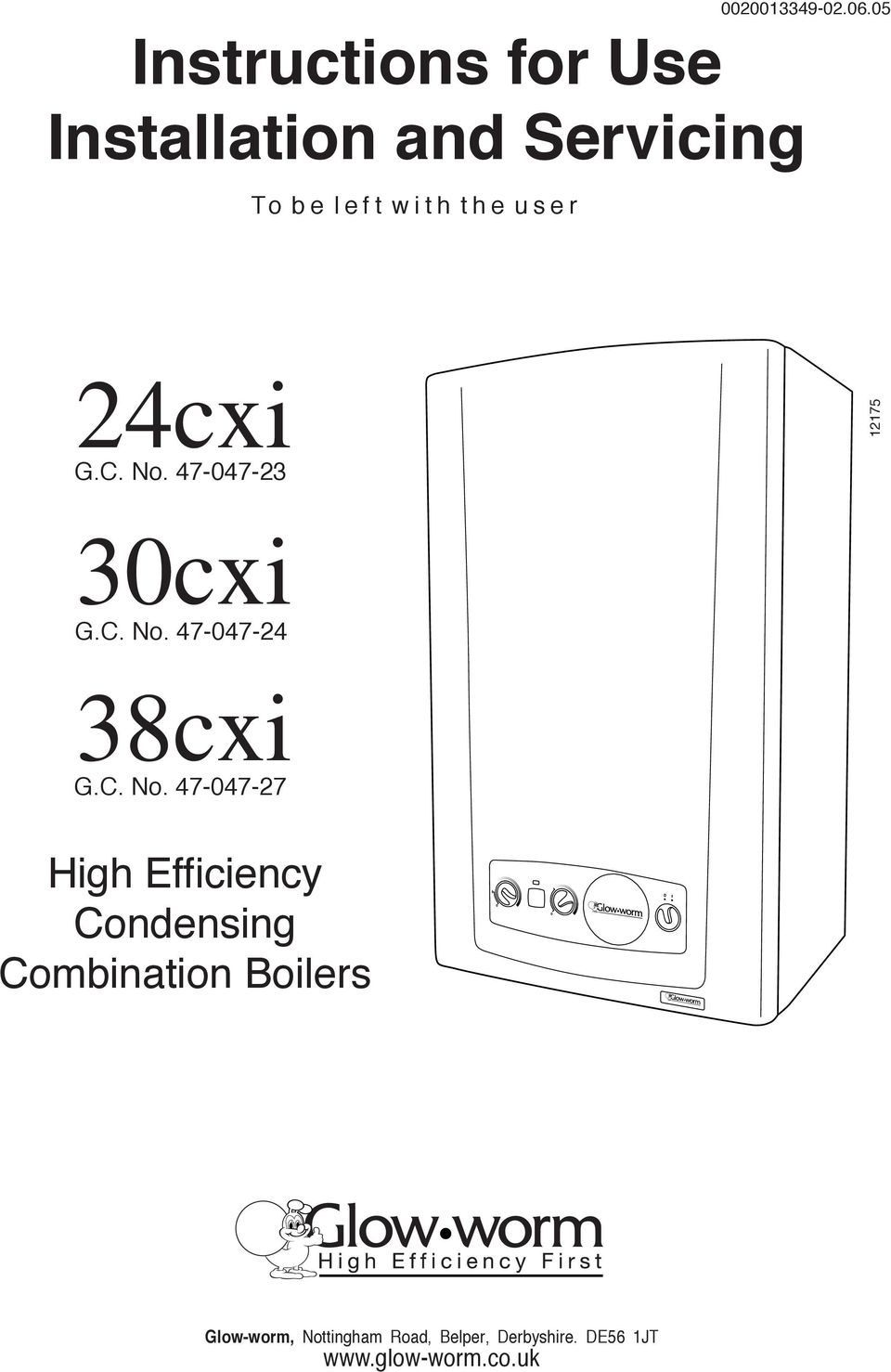
1 Instructions for Use Installation and Servicing To be left with the user cxi G.C. No cxi G.C. No cxi G.C. No High Efficiency Condensing Combination Boilers Glow-worm, Nottingham Road, Belper, Derbyshire. DE56 1JT
2 Guarantee Registration Thank you for installing a new Glow-worm appliance in your home. Glow-worm appliances are manufactured to the very highest standard so we are pleased to offer our customers a Comprehensive Guarantee. This product is guaranteed for 24 months from the date of installation or 30 months from the date of manufacture, whichever is the shorter, for parts. In addition this product is guaranteed for 12 months from the date of installation or 18 months from the date of manufacture, whichever is the shorter, for labour. The second year of the parts guarantee, from the beginning of the 13th month onwards after installation or manufacture, is conditional upon the boiler having been serviced by a CORGI registered gas installer, in accordance with the manufacturer's recommendations. We strongly recommend regular servicing of your gas appliance, but where the condition is not met, any chargeable spare parts or components issued within the applicable guarantee period still benefit from a 12 month warranty from the date of issue by the manufacturer. We recommend you complete and return as soon as possible your guarantee registration card. If your guarantee registration card is missing you can obtain a copy or record your registration by telephoning the Glow-worm Customer Service number For customer service call: Technical helpline: For General and Sales enquiries: Tel Fax: To register your Glow-worm appliance call:

3 Contents The instructions consist of three parts, User, Installation and Servicing Instructions. The instructions are an integral part of the appliance and must, to comply with the current issue of the Gas Safety (Installation and Use) Regulations, be handed to the user on completion of the installation. CONTENTS DESCRIPTION SECTION PAGE No. INTRODUCTION Important Information 4 General Information 5 Manual Handling 5 INSTRUCTIONS FOR USE Appliance Safety Devices 7 Maintenance and Servicing 7 Operating the Boiler 8 INSTALLATION INSTRUCTIONS Technical Information 1 10 Boiler Location and Ventilation 2 13 Flue Location and Ventilation 3 14 Heating System 4 16 Domestic Hot Water System 5 18 Installation Preparation 6 18 Gas/Water & Appliance Connection 7 21 Safety Discharge Valve and Condensate Connection 8 22 Flue Preparation Telescopic and Standard Flue 9 24 Electrical Connection Commissioning SERVICING INSTRUCTIONS Servicing Fault Finding Replacement of Parts Spare Parts

4 Important Information WARNINGS Gas Leak or Fault Turn off the gas emergency control valve immediately. Eliminate all sources of ignition, i.e.smoking, blowlamps, hot air guns etc. Do not operate electrical lights or switches either on or off. Open all doors and windows,ventilate the area. Sheet Metal Parts This boiler contains metal parts (components) and care should be taken when handling and cleaning, with particular regard to edges. Sealed Components Under no circumstances must the User interfere with or adjust sealed parts. Gas Category This boiler is for use only on G20 natural gas, but the 30cxi may be converted for use on G31 gas (Propane L.P.G.). Gas Safety (Installation and Use) Regulations In your own interests and that of safety, it is the Law that ALL gas appliances are installed by a competent person in accordance with the current issue of the above regulations. Testing and Certification This boiler is tested and certificated for safety and performance. It is, therefore, important that no alteration is made to the boiler, without permission, in writing, by Glowworm. Any alteration not approved by Glow-worm, could invalidate the certification, boiler warranty and may also infringe the current issue of the statutory requirements. CE Mark This boiler meets the requirements of Statutory Instrument, No The Boiler (Efficiency) Regulations, and therefore is deemed to meet the requirements of Directive 92/42/EEC on the efficiency requirements for new hot water boilers fired with liquid or gaseous fuels. Type test for purposes of Regulation 5 certified by: Notified body Product/production certified by: Notified body The CE mark on this appliance shows compliance with: 1. Directive 90/396/EEC on the approximation of the laws of the Member States relating to appliances burning gaseous fuels. 2. Directive 73/23/EEC on the harmonisation of the Laws of the Member States relating to electrical equipment designed for use within certain voltage limits. 3. Directive 89/336/EEC on the approximation of the Laws of the Member States relating to electromagnetic compatibility. Control of Substances Hazardous to Health Under Section 6 of The Health and Safety at Work Act 1974, we are required to provide information on substances hazardous to health. The adhesives and sealants used in this appliance are cured and give no known hazard in this state. Insulation Pads / Ceramic Fibre These can cause irritation to skin, eyes and the respiratory tract. If you have a history of skin complaint you may be susceptible to irritation. High dust levels are usual only if the material is broken. Normal handling should not cause discomfort, but follow normal good hygiene and wash your hands before eating, drinking or going to the lavatory. If you do suffer irritation to the eyes or severe irritation to the skin seek medical attention. Electrical Supply The boiler must be earthed. All system components shall be of an approved type and all wiring to current I.E.E. wiring regulations. External wiring must be correctly earthed, polarised and in accordance with the relevant standards. In GB this is BS In IE this is the current edition of I.S.813 "Domestic Gas Installations". The boiler must be connected to a permanent 230V ac, 50Hz supply. Connection of the whole electrical system of the boiler, including any heating controls, to the electrical supply must be through one common isolator and must be fused 3 Amp maximum. Isolation should be by a double pole switched fused spur box, with a minimum gap of 3mm for both poles. The fused spur box should be readily accessible and preferably adjacent to the appliance. It should be identified as to its use. Alternatively connection can be made through an unswitched shuttered socket and 3A fused 3-pin plug both to the current issue of BS 1363 may be used, provided they are not used in a room containing a bath or shower. Wiring to the boiler must be PVC 85 O C insulated cable, not less than 0.75mm 2 (24/0.20mm)

5 General Information General Note This boiler is designed for use as part of a sealed water central heating system with fully pumped circulation. The pump, expansion vessel and associated safety devices are all fitted within the boiler. Once the controls are set the boiler operates automatically. Please read these instructions and follow them carefully for the correct installation and economical use of your boiler. Water Treatment In the case of an existing installation, it is ESSENTIAL that prior to installing the new boiler the system is thoroughly flushed. For optimum performance after installation of a new system, the boiler and its associated central heating system should also be flushed. Flushing should be carried out in accordance with BS7593: 1992 using a cleanser such as Sentinel X300 or X400, Fernox restorer or Salamander corrosion guard cleaner. For long-term corrosion protection, after flushing, an inhibitor suitable for stainless steel exchangers should be used, refer to the current issue of BS 5449 and BS 7593 on the use of inhibitors in central heating systems. Examples are Sentinel X100 Fernox protector or Salamander corrosion guard inhibitor. Compartment or Cupboard Installations If the boiler is fitted into a compartment or cupboard it does not require ventilation openings. Do not use the compartment or cupboard for storage. Condensate Drain The condensate drain, see section 8.2, must not be modified or blocked. Pluming from flue terminal Like all condensing boilers this appliance will produce a plume of condensation from the flue terminal in cool weather. This is due to the high efficiency and hence low flue gas temperature of the boiler. It is normal and not a fault indication. Cleaning The boiler casing can be cleaned using a mild liquid detergent with a damp cloth, then a dry cloth to polish. Do not use any form of abrasive or solvent cleaner as you may damage the paintwork. Electrical Supply If the mains electricity and gas are to be turned off for any long periods during severe weather, it is recommended that the whole system, including the boiler, should be drained to avoid the risk of freezing. Make sure that, if fitted, the immersion heater in the cylinder is switched off. NOTE: If you have a sealed water system contact your installation/servicing company as draining, refilling and pressurising MUST be carried out by a competent person. Clearances If fixtures are positioned close to the boiler, space must be left as shown in section 2. Enough space must also be left in front of the boiler to allow for servicing. Manual Handling IMPORTANT. With regards to the Manual Handling Operations, 1992 Regulations, the following lift operation exceeds the recommended weight for a one man lift. General recommendations when handling Clear the route before attempting the lift. Ensure safe lifting techniques are used keep back straight bend using legs. Keep load as close to body as possible. Do not twist reposition feet instead. If 2 persons performing lift, ensure co-ordinated movements during lift. Avoid upper body/top heavy bending - do not lean forward/ sideways. Recommend wear suitable cut resistant gloves with good grip to protect against sharp edges and ensure good grip. Always use assistance if required. Removal of carton from delivery van Recommend 2 person lift or 1 person with use of sack truck. If 1 person is performing lift, straddle the load, tilt and place carton into position on truck. Recommend secure appliance onto truck with suitable straps. Ensure safe lifting techniques are used keep back straight bend using legs. Keep load as close to body as possible. If 2 persons performing lift, ensure coordinated movements during lift. Always use assistance if required. Carriage of carton from point of delivery to point of installation ground floor Recommend 2 person lift or 1 person with use of sack truck. If 1 person is performing lift, straddle the load, tilt and place carton into position on truck. Recommend secure appliance onto truck with suitable straps. Ensure safe lifting techniques are used keep back straight bend using legs. Keep load as close to body as possible. If 2 persons performing lift, ensure coordinated movements during lift. Clear the route before attempting the lift. If removing boiler from truck straddle the load and tilt forwards to facilitate secure grip. Ensure safe lifting techniques are used keep back straight bend using legs. Do not twist reposition feet instead. Take care to avoid trip hazards, slippery or wet surfaces and when climbing steps and stairs. Always use assistance if required

6 Manual Handling Carriage of carton from point of delivery to point of installation first or higher floor, cellar. Recommend 2-person lift or 1 person with use of sack truck. If 1 person is performing lift, straddle the load, tilt and place carton into position on truck. Recommend secure appliance onto truck with suitable straps. Ensure safe lifting techniques are used keep back straight bend using legs. Keep load as close to body as possible. If 2 persons performing lift, ensure coordinated movements during lift. Avoid upper body/top heavy bending - do not lean forward/sideways. Clear the route before attempting the lift. If removing boiler from truck straddle the load and tilt forwards to facilitate secure grip. Ensure safe lifting techniques are used keep back straight bend using legs. Do not twist reposition feet instead. Take care to avoid trip hazards, slippery or wet surfaces and when climbing steps and stairs. Always use assistance if required. Carriage of carton from point of delivery to point of installation roofspace. Recommend 2-person lift. Ensure co-ordinated movements during lift. Avoid upper body/top heavy bending - do not lean forward/sideways. Clear the route before attempting the lift. Take care to avoid trip hazards, slippery or wet surfaces and when climbing steps and stairs. When transferring appliance into roofspace, recommend 1 person to be in roofspace to receive the appliance and other person to be below to pass up and support appliance. Ensure safe lifting techniques are used keep back straight bend using legs. Keep load as close to body as possible. Always use assistance if required. It is assumed safe access, flooring and adequate lighting are provided in the roof space. It is recommended a risk assessment of the roof space area be carried out before moving the appliance into the area to take into account access, stability of flooring, lighting and other factors, and appropriate measures taken. Unpacking of appliance from carton. Recommend 2 persons unpack appliance from carton. Always keep working area clear. Recommend cut base end of carton and open carton flaps, then tilt boiler forwards from its side onto its base and remove carton by sliding up over the boiler. Ensure safe lifting techniques are used keep back straight bend using legs. Keep load as close to body as possible. Always use assistance if required. Dispose of packaging in a responsible manner. Recommend wear suitable cut resistant gloves with good grip to protect against sharp edges and ensure good grip when handling appliance outside packaging. Positioning of Appliance for Final Installation no obstructions. Recommend 2 persons lift appliance to position into place. Fit bracket securely onto wall before lifting appliance into position. Obtain firm grip on front and sides of appliance, lift upwards, ensure stable balance achieved and lift upwards to position in place on bracket. Ensure safe lifting techniques are used keep back straight bend using legs - when lifting load from floor level. Do not twist reposition feet instead. Keep boiler as close as possible to body throughout lift to minimise strain on back. Ensure co-ordinated movements to ensure equal spread of weight of load. Always use assistance if required. Recommend wear suitable cut resistant gloves with good grip to protect against sharp edges and ensure good grip when handling appliance. Positioning of Appliance for Final Installation above worktop, foreseeable obstructions etc. Recommend 2 persons lift appliance to position into place. Fit bracket securely onto wall before lifting appliance into position. Obtain firm grip on front and sides of appliance, lift upwards, onto worktop if practicable. Ensure stable balance achieved and lift upwards to position in place on bracket. If 2 persons positioning onto bracket obtain firm grip at front and sides/base of boiler. Ensure co-ordinated movements during 2 person lifts to ensure equal spread of weight of load. Ensure safe lifting techniques are used keep back straight bend using legs - when lifting load from floor level. Do not twist reposition feet instead. Keep boiler as close as possible to body throughout lift to minimise strain on back. Avoid upper body/top heavy bending - do not lean forward/sideways. Always use assistance if required. Recommend wear suitable cut resistant gloves with good grip to protect against sharp edges and ensure good grip when handling appliance. Positioning of Appliance for Final Installation within compartment etc. restricting installation. Recommend 2 persons lift appliance to position into place, space permitting. Fit bracket securely onto wall before lifting appliance into position. Obtain firm grip on front and sides of appliance, lift upwards, onto worktop if practicable. Ensure stable balance achieved and lift upwards to drop into place onto bracket. If 2 persons positioning onto bracket obtain firm grip at front and sides/base of boiler. Ensure co-ordinated movements during 2 person lifts to ensure equal spread of weight of load. If 1 person positioning onto bracket recommend obtain firm grip supporting base of boiler. Ensure safe lifting techniques are used keep back straight bend using legs - when lifting load from floor level. Do not twist reposition feet instead. Keep boiler as close as possible to body throughout lift to minimise strain on back. Always use assistance if required. Recommend wear suitable cut resistant gloves with good grip to protect against sharp edges and ensure good grip when handling appliance. Positioning of Appliance for Final Installation in roof space restricting installation. Recommend 2 persons lift appliance to position into place, space permitting. Fit bracket securely onto wall before lifting appliance into position. Obtain firm grip on front and sides of appliance, lift upwards, ensure stable balance achieved and lift upwards to drop into place onto bracket. If 2 persons positioning onto bracket obtain firm grip at front and sides/base of boiler. Ensure co-ordinated movements during 2 person lifts to ensure equal spread of weight of load. If 1 person positioning onto bracket recommend obtain firm grip supporting base of boiler. Ensure safe lifting techniques are used - keep back straight bend using legs - when lifting load from floor level. Do not twist reposition feet instead. Keep boiler as close as possible to body throughout lift to minimise strain on back. Always use assistance if required. Recommend wear suitable cut resistant gloves with good grip to protect against sharp edges and ensure good grip when handling appliance. It is recommended a risk assessment of the roof space area be carried out before moving the appliance into the area to take into account access, stability of flooring, lighting and other factors, and appropriate measures taken

7 Appliance Safety Devices - User Instructions Electrical Supply Failure Reset Switch The boiler will not work without an electrical supply. Normal operation of the boiler should resume when the electrical supply is restored. Reset any external controls, to resume normal operation of the central heating. If the boiler does not resume normal operation turn the mains reset switch off and on. If the boiler does not resume normal operation after this the overheat stat may have operated. Overheating safety In the event of the boiler overheating the safety devices will cause a safety shutdown. If this happens, call your Installation/ Servicing company. Safety Discharge Valve A safety discharge valve and discharge pipe is fitted to the boiler. This valve must not be touched. Should there be any discharge from the pipe, isolate the boiler electrical supply and call your installer or Glow-worm s own service organisation using the telephone number on the inside front cover of this booklet. Frost protection The appliance has a built in frost protection device that protects the boiler from freezing. With the gas and electric supplies ON and irrespective of any room thermostat setting, the frost protection device will operate the pump when the temperature of the boiler water falls below 7 O C. The burner will fire if the temperature inside the boiler falls to 3 O C. When the temperature reaches 10 O C the boiler stops. Any other exposed areas of the system should be protected by a separate frost thermostat. Condensate Drain Blockage As a safety feature the boiler will stop working if the condensate drain becomes blocked. During freezing conditions this may be due to the forming of ice in the condense drain external to the house. Release an ice blockage by the use of warm cloths on the pipe. The boiler should then restart. Contact your installation/ servicing company if the fault persists. Maintenance and Servicing - User Instructions Maintenance and Servicing To ensure the continued efficient and safe operation of the appliance it is recommended that it is checked and serviced as necessary at regular intervals. The frequency of servicing will depend upon the particular installation conditions and usage, refer to guarantee registration on the inside front cover of this literature. If this appliance is installed in a rented property there is a duty of care imposed on the owner of the property by the current issue of the Gas Safety (Installation and Use) Regulations, Section 35. Servicing/maintenance should be carried out by a competent person in accordance with the rules in force in the countries of destination. To obtain service, please call your installer or Glow-worm s own service organisation using the telephone number on the inside front cover of this literature. Please be advised that the 'Benchmark' logbook should be completed by the installation engineer on completion of commissioning and servicing. All CORGI Registered Installers carry a CORGI ID card, and have a registration number. Both should be recorded in your benchmark Logbook. You can check your installer is CORGI registered by calling CORGI direct on: Spare Parts Remember, when replacing a part on this appliance, use only spare parts that you can be assured conform to the safety and performance specification that we require. Do not use reconditioned or copy parts that have not been clearly authorised by Glow-worm. If a part is required contact Glow-worm's own service organisation using the telephone number on the inside front cover of this booklet. Please quote the name of the appliance, this infomation will be on the name badge on the front of the appliance. If in doubt seek advice from the local gas company or Glowworm's own service organisation using the telephone number on the inside front cover of this booklet

8 Operating the Boiler - User Instructions CONTROLS FASCIA CONTROL LIGHT DIGITAL DISPLAY NO PRE-HEAT POSITION ECONOMY POSITION APPROX 55 O WITH PRE-HEAT 9934 MAINS RESET SWITCH CENTRAL HEATING WATER TEMPERATURE CONTROL HOT WATER TEMPERATURE CONTROL MAXIMUM POSITION APPROX 62 O WITH PRE-HEAT Diagram 1 OPERATION OF THE BOILER 1. Check that all isolating valves on the boiler are open and that water flows from the hot water tap. 2. If you are in any doubt about the boiler being filled with water contact your installer or Glow-worm's own service organisation using the telephone number on the inside front cover of this booklet. Do not operate the boiler without water. 3. Check that the electrical supply to the boiler is ON and set any remote controls as required.. 4. With the User controls in their "OFF" (0) positions, turn the Mains Reset Switch to the ON (1) position, the running lamp will initially illuminate (green) then go off, the system pressure will be displayed and should read on the digital display, at least 0.7bar (recommended 1.0bar), if less, pressurise as described in the System Pressurisation section. CENTRAL HEATING CONTROL USER CONTROLS 1. Turn the central heating water temperature control "ON", the lighting sequence will begin, the running lamp will illuminate (green) to indicate the boiler has lit, the system temperature will now be displayed instead of system pressure. The temperature of the central heating water can be adjusted by turning the central heating water temperature control to desired setting between 1 'Min' and 'Max'. Maximum setting is appoximately 82 C. Set the control to '0' to switch off heating. If the boiler fails to light, reset the controls, see paragraph below, TO RESET If a fault occurs the running lamp will flash red and a fault code will appear on the digital display. DOMESTIC HOT WATER CONTROL 2. Position 0 - hot water OFF. Turn hot water temperature control between 0 to for hot water 62 o C with no pre-heat. Turn hot water temperature control between and for hot water, 40 o C - 62 o C with pre-heat. Pre-heat is a function that provides hot water with minimum delay. The ECO setting is recommended and ideally suited to normal family use (showers, washing up etc.). Positions between ECO and are for occasional use, for water above 55 o C approx. TO RESET 3. Turn the Mains Reset Switch to 0, wait for 5 seconds, turn Mains Reset Switch to 1, the boiler is reset. If the fault persists contact your installer/service provider using the telephone number on the inside font cover of this booklet. TO TURN THE BOILER OFF 4. Turn the Mains Reset Switch to the OFF (0) position. Turn the gas supply OFF at the gas service cock if the boiler is to be out of use for some time

9 Operating the Boiler - User Instructions Digital Display/ System Pressurisation The digital display normally shows the operating temperature of the unit when there is a central heating demand and gives a pressure reading when there is no demand or when the appliance is in the domestic hot water mode. If the digital display shows pressure less than 0.7bar, repressurise the system to 1bar by gently opening the built in filling tap underneath the boiler, see diagram 2. A tap extension is provided to facilitate this. Ensure the tap is closed. If the system repeatedly loses pressure, YOU MUST CONTACT YOUR INSTALLER OR GLOW-WORM'S OWN SERVICE ORGANISATION USING THE TELEPHONE NUMBER ON THE INSIDE FRONT COVER OF THIS BOOKLET To Turn the Boiler Off There is a mains reset switch on the right hand side of the controls fascia, which will isolate the boiler. However, it is preferable to leave the electrical supply on whenever possible to permit operation of the built-in frost protection (see 'Protection Against Freezing') and daily pump and valve exercise. To turn off the central heating use the room thermostat or programmer. To turn off the domestic hot water turn the hot water temperature control knob to the minimum setting. For holiday mode turn both of the temperature knobs to the minimum setting. To turn off the boiler for servicing, isolate it from the electrical supply. To turn it on again follow the instructions given in 'Operation of the Boiler'. FILLING LOOP TUBE FILLING LOOP TAP AND EXTENSION Diagram

10 1 Technical Information FLUE CENTRE LINE C L FLUE 76 C L BOILER 715 SAFETY DISCHARGE DRAIN 117 THIS DIMENSION CAN BE INCREASED TO 600mm MAX GAS GENERAL ARRANGEMENT 450 Diagram IMPORTANT NOTICE The boiler is supplied in one carton, which includes a fittings pack, pipe pack, fixing jig, condense pipe, and documentation pack, see diagram 6.1 and 6.1a. The flue is supplied seperately. This boiler is for use only on G20 natural gas, but the 30cxi may be converted for use on G31 gas (Propane L.P.G.). Where no British Standards exists, materials and equipment should be fit for their purpose and of suitable quality and workmanship. The installation of this boiler must be carried out by a competent person in accordance the rules in force in the countries of destination. Manufacturer's instructions must not be taken as overriding statutory requirements. 1.2 Statutory Requirements In GB the installation of the boiler must be carried out by a competent person as described in the following regulations: The manufacturer's instructions supplied. The Gas Safety (Installation and Use) Regulations. The appropriate Buildings Regulations either The Building Regulations, The Building Regulations (Scotland),The Building Regulations (Northern Ireland). The Water Fittings Regulations or Water byelaws in Scotland. The Health and Safety at Work Act, Control of Substances Hazardous to Health (COSHH). The Current I.E.E. Wiring Regulations. Where no specific instructions are given, reference should be made to the relevant British Standard Code of Practice. In IE, the installation must be carried out by a competent person and installed in accordance with the current edition of I.S.813 "Domestic Gas Installations", the current Building Regulations and reference should be made to the current ETCI rules for Electrical Installation. In GB the following Codes of Practice apply: BS4814, BS6798, BS5440 Part 1 and 2, BS5546 Part 1, BS5449, BS6891, BS6700, BS7074 Part 1 and 2, BS7593, BS7671. In IE: I.S.813, BS5546, BS 5449, BS 7074, BS Manufacturer's instructions must not be taken as overriding statutory requirements. Note: For further information, see the current issue of the Building Regulations, approved document L1 ( in the UK) and the references: 1) GIL 59, 2000: Central heating system specification (CheSS) and 2) GPG 302, 2001: Controls for domestic central heating system and hot water. BRECSU

11 1 Technical Information TABLE 1 24cxi 30cxi 38cxi Lift Weight 41kg(90lb) 42kg(92.5lb) 44kg(97lb) Total Weight (installed) 44kg(97lb) 45kg(99lb) 47kg(103.5lb) Gas connection Heating and return Domestic hot water 22mm copper 22mm copper 15mm copper Safety valve Preset 3bar (43.5lbf/in 2 ) Safety valve discharge 15mm copper Expansion vessel capacity 8 litres (1.76 gallons) Charge pressure 0.5bar (7.3lbf/in 2 ) Heating system 0.7bar (10.1lbf/in 2 ) minimum pressure D.H.W Max. working pressure 10bar (145lbf/in 2 ) Minimum working pressure for max. domestic flow rate 0.2bar (2.9lbf/in 2 ) Max. Domestic hot water flow rate at 35 O C rise 24 cxi 9.8L/min. 30 cxi 12.3L/min. 38 cxi 15.5L/min. Min. Domestic hot water flow rate 24/30/38cxi 1L/min. Maximum flow temperature 63 0 C Maximum heating system 130 litres water content using (28.6 gallons) pressurised at 1bar. fitted expansion vessel, at 75 0 C average system temperature Electrical supply Electrical rating IP classification Internal Fuse rating On PCB 230V~50Hz 180W fused 3A X4D 630mAT Ball valves are fitted in water and gas connections. For larger systems use an additional expansion vessel. Diagram

12 1 Technical Information Certification This boiler certificated to the current issue of EN 483 : 2000 for performance and safety. It is important that no alteration is made to the boiler, without permission, in writing, from Glow-worm. Any alteration that is not approved by Glow-worm, could invalidate the warranty and could also infringe the current issue of the Statutory Requirements Gas Supply The gas installation must be in accordance with the relevant standards. In GB this is BS6891. In IE this is the current edition of I.S.813 "Domestic Gas Installations". The supply from the governed meter must be of adequate size to provide a steady inlet working pressure of 20mbar (8in wg) at the boiler. On completion, test the gas installation for soundness using the pressure drop method and suitable leak detection fluid, purge in accordance with the above standard. 1.4 Technical Data All dimensions are given in millimetres (except as noted). See diagrams 1.1 and Tables 1 and 2. The data label is positioned on the inner door, refer to diagram 1.2. The Seasonal Efficiency Domestic Boilers UK (SEDBUK) is Class 'A' : 24cxi %, 30cxi % & 38cxi %. The value is used in the UK Government's Standard Assessment Procedure (SAP) for energy rating of dwellings. The test data from which it has been calculated has been certified by B.S.I. 1.5 Condensate Drain A plastic drain pipe must be fitted to allow discharge of condensate to a drain. Condensate should, if possible, be discharged into the internal household draining system. If this is not practical, discharge can be made externally into the household drainage system or a purpose designed soak away, see section 8.2 for more details. 1.6 Upward Piping Kits Where the domestic hot water and heating flow and return pipes come from above the boiler or just the heating flow and return pipes, upward piping kits are available to facilitate this. Central Heating only, part No. A Central Heating and DHW, part No. A Contact Glow-worm for further details. 1.7 Optional Programmer Kit An optional programmer for fitting in the boiler is available, Pt. no. A20087 electromechanical or A20087 digital. SCHEMATIC LAYOUT OF BOILER BURNER %CO 2 APPROXIMATE GAS RATE (after 10 mins. from cold) BURNER %CO 2 APPROXIMATE GAS RATE (after 10 mins. from cold) BURNER %CO 2 APPROXIMATE GAS RATE (after 10 mins. from cold) TABLE 2 30 cxi Diagram 1.3 Case Off Case On MIN MAX m 3 /h ft 3 /h 24 cxi Case Off Case On MIN MAX m 3 /h ft 3 /h 38 cxi Case Off Case On MIN MAX m 3 /h ft 3 /h

13 2 Boiler Location and Ventilation 2.1 Location This boiler is not suitable for outdoor installation. This boiler may be installed in any room, although particular attention is drawn to the installation of a boiler in a room containing a bath or shower where reference must be made to the relevant requirements. This boiler is suitable for installation in bathroom zones 2 and 3. In GB this is the current I.E.E. WIRING REGULATIONS and BUILDING REGULATIONS. In IE reference should be made to the current edition of I.S.813 "Domestic Gas Installations" and the current ETCI rules Clearances The boiler should be positioned so that at least the minimum operational and servicing clearances are provided, see diagram 2.1. Additional clearances may be beneficial around the boiler for installation and servicing. For flue installations where external access is not practicable, consideration should be given for the space required to insert the flue internally, which may necessitate clearance larger than those specified in diagram Timber Frame Buildings If the boiler is to be installed in a timber frame building it should be fitted in accordance with the Institute of Gas Engineers document IGE/UP/7/1998. If in doubt seek advice from the local gas undertaking or Glow-worm. 2.4 Room Ventilation The boiler is room sealed, so when it is installed in a room or space, a permanent air vent is not required. 2.5 Cupboard or Compartment Ventilation Due to the high efficiency and hence low casing temperature of this boiler, cupboard or compartment ventilation is not necessary. Leave existing air vents A removable compartment door can be placed at least 5mm in front of the appliance. MINIMUM CLEARANCE FROM PERMANENT SURFACES Diagram

14 3 Flue Location and Ventilation 3.1 Flue Options This boiler is suitable for concentric Horizontal and Vertical flues, elevated horizontal and vertical twin, all are fitted onto the top of the boiler. The Glow-worm Flue Options Guide, available on request or through the web site, describes in detail the necessary accessories. These instructions describe the use of the standard and telescopic horizontal flues. The instructions for all other flues will be contained in those packs. 3.2 Flue Length The maximum permissable horizontal flue length is 10 metres plus the flue terminal, this can be achieved by use of the accessories, however should additional 90 o or 2 x 45 o elbows be used then the length MUST be reduced by 1metre. When extension pipes are used the flue system must be designed to have a continuous fall to the boiler of at least 2.5 o 44mm/metre to allow condensate to run back into the boiler and out via the drain. The flue can be installed from inside the building, when access to the outside wall face is not practicable. The diagrams 3.1 to 3.4 describe the lengths achievable without the use of extensions or elbows. 75 min. to 540 max. WALL THICKNESS min. to 413 max. WALL THICKNESS min min OUTSIDE WALL FACE BOILER MOUNTING WALL OUTSIDE WALL FACE BOILER MOUNTING WALL NOTE. If necessary, it is permitted to increase this dimension to 600mm max. TOP REAR FLUE - STANDARD NOTE. If necessary, it is permitted to increase this dimension to 600mm max. Diagram 3.1 TOP REAR FLUE - TELESCOPIC Diagram min NOTE. If necessary, it is permitted to increase this dimension to 600mm max. Max flue length 717mm min NOTE. If necessary, it is permitted to increase this dimension to 600mm max. Max flue length 589mm mm min. clearance mm min. clearance A CL FLUE A CL FLUE OUTSIDE WALL FACE INTERNAL SURFACE Max. distance from outside wall face to min clearance. LH - 458mm RH - 486mm TOP SIDE FLUE - STANDARD A Min. distance from outside wall face to min clearance. LH/RH - 75mm OUTSIDE WALL FACE INTERNAL SURFACE Max. distance from outside wall face to min clearance. LH - 330mm RH - 358mm Diagram 3.2 TOP SIDE FLUE - TELESCOPIC Diagram 3.4 A Min. distance from outside wall face to min clearance. LH - 125mm RH - 153mm

15 3 Flue Location and Ventilation MINIMUM SITING DIMENSIONS FOR FANNED FLUE TERMINALS POSITION MM HORIZONTAL FLUES A DIRECTLY BELOW AN OPENING, AIR BRICK, OPENING WINDOWS 300 B ABOVE AN OPENING, AIR BRICK, OPENING WINDOWS 300 C HORIZONTALLY TO AN OPENING, AIR BRICK, OPENING WINDOWS 300 D BELOW GUTTER, DRAIN/SOIL PIPE 25 E BELOW EAVES 25 F BELOW A BALCONY OR CAR PORT 25 G FROM VERTICAL DRAIN PIPES AND SOIL PIPES 25 H FROM INTERNAL/EXTERNAL CORNERS 25 H* TO A BOUNDARY ALONGSIDE THE TERMINAL 300 I ABOVE ADJACENT GROUND OR BALCONY LEVEL 300 J* FROM SURFACE OR A BOUNDARY FACING THE TERMINAL 600 K FACING TERMINALS 1200 L FROM OPENING (DOOR/WINDOW) IN CAR PORT INTO DWELLING 1200 M VERTICAL FROM A TERMINAL 1500 N HORIZONTALLY FROM A TERMINAL Terminal Position The minimum acceptable siting dimensions for the terminal from obstructions, other terminals and ventilation openings are shown in diagram 3.5. For Ireland the minimum distances for flue terminal positioning must be those detailed in I.S.813 "Domestic Gas Installations". The terminal must be exposed to the external air, allowing free passage of air across it at all times. Being a condensing boiler some pluming may occur from the flue outlet. This should be taken into consideration when selecting the position for the terminal. H* and J* See diagram 3.5. These dimensions comply with the building regulations, but they may need to be increased to avoid wall staining and nuisance from pluming depending on site conditions. Increased siting flexibility can be achieved by using the Glowworm Plume Management Kit, A (black) or A (white). NOTE: If necessary it is permitted to increase the terminal protrusion through the outside wall to greater than the minimum dimension of 87mm but no more than 600mm, see diagram 1.1. Carports or similar extensions of a roof only, or a roof and one wall, require special consideration with respect to any openings, doors, vents or windows under the roof. Care is required to protect the roof if made of plastic sheeting. If the carport comprises of a roof and two or more walls, seek advice from the local gas supply company before installing the boiler. 3.5 Terminal Guard A terminal guard is required if persons could come into contact with the terminal or the terminal could be subject to damage. If a terminal guard is required, it must be positioned to provide minimum of 50mm clearance from any part of the terminal and be central over the terminal. The guard should be similar to that shown in diagram 3.6. A suitable guard is manufactured by: - Tower Flue Components Morley Rd. Tonbridge Kent TN9 1RA. Size: 280mm x 280mm x 270mm. TERMINAL GUARD VERTICAL FLUES P FROM ANOTHER TERMINAL 600 Q ABOVE ROOF LEVEL 300 R FROM ADJACENT OPENING WINDOW 1000 S FROM ADJACENT WALL TO FLUE 300 Diagram 3.5 Diagram

16 4 Heating System 4.1 General The boiler is for use only with sealed central heating systems. The safety valve is an integral part of the boiler and it cannot be adjusted. The digital readout on the controls fascia indicates the system pressure when there is no central heating demand. The circulation pump is integral with the boiler. 4.2 Expansion Vessel The boiler has an integral expansion vessel with a capacity of 8 litres (1.76 gallons), with a charge pressure of 0.5bar. NOTE: The expansion vessel volume depends on the total water system volume and the initial system design pressure. Guidance on vessel sizing is also given in the current issue of BS5449 and BS7074 Part 1, for IE refer to the current edition of I.S.813 "Domestic Gas Installations". MODEL Table 3. Flow Rate MINIMUM FLOW RATE 24 cxi 774 litres/hr. 30 cxi 1032 litres/hr. 38 cxi 1289 litres/hr This is equal to 20 O C differential at maximum heat input. 4.3 Flow Rate If it is necessary to alter the flow rate, the system can be fitted with a lockable balancing valve in the main flow or return pipes shown as valve "A" in diagram 4.1. The flow rate through the boiler must not be allowed to fall below that given in table Bypass The boiler is fitted with an adjustable automatic bypass. Ensure that under no circumstances does the flow rate drop below the figure specified, refer to table 3 and section The installation of the boiler must comply with the requirements of the current issue of BS6798, in Ireland, refer also to the current edition of I.S.813 "Domestic Gas Installations". In GB it is necessary to comply with the Water Supply (Water Fittings) Regulations 1999 (for Scotland, the Water Byelaws 2000, Scotland). To comply with the Water regulations your attention is drawn to: The Water Regulations guide published by the Water Regulations Advisory Service (WRAS) gives full details of the requirements. In IE the requirements given in the current edition of I.S.813 "Domestic Gas Installations" and the current Building Regulations must be followed. 4.5 Filling the Sealed System NOTE: The water pressure at the boiler must be at least 1.2bar to enable filling the boiler to a minimum pressure. If not pressurisation must be carried out by an alternative filling loop. The boiler has a built in filling device, see diagram 4.2. A pushon extension is supplied in the loose items pack to ease access to the filling device tap. This filling device is designed to enable the re-pressurisation of the system in the event of loss of pressure. It is not intended to be used to completely fill the system. If so used, it may take a long time to fill the system. To fill the system quickly provision should be made to include a proprietry filling loop external to the boiler. Suitable external filling systems are shown diagramatically, see diagram 4.3. The system should be pressurized to 1 bar, indicated on the digital display with no heating demand. * Refer to section 11.6 Diagram

17 4.6 Water Treatment In the case of an existing installation, it is ESSENTIAL that prior to installing the new boiler the system is thoroughly flushed. For optimum performance after installation of a new system, the boiler and its associated central heating system should also be flushed. Flushing should be carried out in accordance with BS7593: 1992 using a cleanser such as Sentinel X300 or X400, Fernox restorer or Salamander corrosion guard cleaner. For long-term corrosion protection, after flushing, an inhibitor suitable for stainless steel exchangers should be used, refer to the current issue of BS 5449 and BS 7593 on the use of inhibitors in central heating systems. Examples are Sentinel X100 Fernox protector or Salamander corrosion guard inhibitor. 4 Heating System 4.7 Draining Tap A draining tap must be provided at the lowest points of the system, which will allow the entire system to be drained. See addendum. A drain tap for the appliance is provided as an integral part of the hydroblock, see diagram General - All domestic hot water circuits, connections, fittings must be in accordance with the relevant standards and water supply regulations. For GB: Guidance G17 to G24 and recommendation R17 to R24 of the Water Regulations Guide. For IE: The current edition of I.S.813 "Domestic Gas Installations" REDUCED PRESSURE ZONE VALVE FILLING LOOP TAP FILLING LOOP TAP EXTENSION Diagram 4.2 Diagram

18 5.1 Water Pressure The maximum working pressure of the domestic hot water circuit is 10 bar. If the cold water supply pressure exceeds this, then a pressure-reducing valve must be fitted in the supply to the boiler. 5.2 'Hard' Water Areas The temperatures within the heat exchanger are limited by the boiler control system to minimise scale formation within the hot 5 Domestic Hot Water System 6 Installation Preparation water pipework. However, in areas where the water is 'hard' (i.e. more than 200mg/litre), it is recommended that the hot water setting is reduced and that a scale reducer is fitted. Refer to the manufacturer's instructions or consult the local water company for additional advice. 5.3 Domestic Water Flow Rate The water flow rate is restricted to a maximum 8 l/min (24cxi) 12 l/min (30cxi) and15.5 l/min (38cxi) by a restrictor fitted during boiler installation, see diagram Appliance Pack IMPORTANT: With regards to the Health and Safety Manual Handling requirements, two persons shall be required to lift the appliance, refer to Manual Handling section on page 5. Please check the boiler contents as shown in diagrams 6.1 and 6.1a. NOTE: The fittings pack, pipe pack and document pack are located in the polystyrene packing on the top of the boiler.the flexible condensate outlet pipe is located in the base polystyrene packing under the boiler base. Remove the polystyrene end packing pieces then carefully lay the boiler on its back, remove the two front casing panel securing screws and lift off the panel from two retaining lugs. Remove the transit packaging behind the front panel and discard. Carefully place front panel and screws to one side FIXING JIG Diagram

19 6 Installation Preparation SEALING WASHER 12x18x2 1 off SEALING WASHER 18x23x1.5 4 off SEALING WASHER 14x18x1.5 5 off SEALING WASHER 16x24x1.5 9 off FLOW RESTRICTOR 1off FITTINGS PACK HEATING FLOW CONNECTION D.H.W CONNECTION HEATING FLOW PIPE D.H.W OUTLET PIPE GAS SUPPLY PIPE COLD WATER INLET PIPE SAFETY DISCHARGE VALVE PIPE GAS CONNECTION PIPE HEATING RETURN PIPE PIPE PACK D.H.W CONNECTION HEATING RETURN CONNECTION DOCUMENTATION PACK (Not illustrated) FLEXIBLE CONDENSATE OUTLET PIPE LOOSE ITEMS Diagram 6.1a

20 6 Installation Preparation 6.2 Wall Template Take the wall template from the documentation pack and place in the desired position on a flat wall, giving due consideration to boiler clearances, see section 2, and the flue you are fitting. 6.3 Flue Hole Cutting The standard horizontal flue is designed with an internal fall of 44mm/metre towards the boiler for disposal of condensate. If the standard flue length alone is being used then the flue hole of diameter 105mm can be cut in the position marked on the wall template. For standard side flues the horizontal flue centre line on the wall template should be extended to the side wall, and the vertical centre of the flue hole marked at 176mm from the back wall. For installations with external access, a 105mm diameter core drill can be used. For installations with internal access only a 125mm diameter core drill should be used. When using extension pipes with the horizontal rear flue, a core drill size of 125mm should be used to allow the extension pieces to slope at 44mm/metre (2.5 ) towards the boiler. For extended side flues, the flue hole centre should be determined by extending the dashed inclined line on the template to the side wall. This dashed line is drawn at 44mm/metre (2.5 o ) rise from the boiler. Where this line reaches the side wall, a horizontal line should be marked. The vertical centre line of the flue should then be marked at 176mm from the back wall, see diagram 6.2. To allow for the flue passing through the wall at this angle a 125mm hole should be drilled irrespective of internal or external installation. Remove the wall template whilst drilling the flue hole. 6.4 Fixing Jig Reposition the wall template over the flue hole and mark the position of the fixing holes for the fixing jig, see diagram 6.3. Drill the required fixing holes and insert suitable wall plugs. NOTE: Due to the varied site conditions we do not supply fixings and advise that the installer should supply those which are suitable. Secure the fixing jig to the wall. Ø 125 EXTENDED SIDE FLUE SCREW Standard flue length Horizontal WALL TEMPLATE WALL PLUG mm/metre Inclined Extended flue length WALL TEMPLATE Diagram FIXING JIG Diagram

21 7 Gas/Water & Appliance Connection 7.1 System Connection The system can now be connected without the boiler being mounted. All water and gas connections are on the fixing jig with the exception of the condense drain and safety discharge, the positions of these are shown on the wall template. The gas supply pipe must be chased into the wall if routed up the back of the boiler. A Vertical Plumbing Kit can be used to route the central heating or DHW pipes, see section 1.6. Make connections to fixing jig, gas, water and heating cocks with the tube assemblies supplied in fixing pack as shown in diagram Gas Connection Before connection check supply of local gas. Refer also to section 1.2. Do not subject the gas service cock to heat. Fit the sealing washer into the union nut and make good the connection to the gas service cock on the wall fixing jig, see diagram 7.1. Make sure the on / off lever is accessible. The whole of the gas installation, including the meter, should be inspected, tested for soundness and purged in accordance with the current issue of BS6891 and in IE the current edition of I.S.813 "Domestic Gas Installations". 7.3 Water Connections Flush out the domestic hot water and the heating systems before connecting to the boiler. Make the connections to the domestic hot water and heating systems by fitting the sealing washers into the securing nuts and make good the connection to the isolating valves on the fixing jig, see diagram 7.1. Do not subject the isolation valves to heat. Make sure the drain point is accessible, refer diagram Appliance Connection IMPORTANT: With regards to the Manual Handling Operations, 1992 Regulations, the following lift operation exceeds the recommended weight for a one man lift, refer to Manual Handling section, on page 5. The appliance will contain a small amount of water, place a water container beneath the boiler connections before removing the protective caps. Position gasket/sealing washers and cold water inlet flow restrictor supplied in the fittings pack, as shown in diagram 7.1. Lifting the boiler into position, lean the top of the boiler slightly to the wall and position just above the hanging bracket. Lower the boiler slowly and engage onto the hanging bracket. Position gasket/sealing washers and cold water inlet flow restrictor supplied in the fittings pack, as shown in diagram 7.1. Make good the final connections. F and L A Central heating isolation valve (Flow) B Domestic hot water isolation valve C Gas service cock isolation valve D Domestic cold water inlet E Central heating isolation valve (Return) F Safety discharge outlet G 22mm. inlet pipe fitting H 15mm. inlet pipe fitting J Boiler connections K Gas connection pipe A B C D E ALL ISOLATION VALVES ARE SHOWN IN CLOSED POSITION N H M G 15mm 22mm M G L Sealing washer 12x18x2 M Sealing washer 18x23x1.5 N Sealing washer 14x18x1.5 P Sealing washer 16x24x1.5 P J P N K P J P N P R P N H 22mm 15mm G M 22mm R Flow restrictor J P J P NOTE: One additional washer for each size M,N and P, is supplied as a spare. Diagram
22 8 Safety Discharge Valve and Condensate Connections 8.1 Safety Discharge Valve The pipe from the safety discharge valve must not discharge above an entrance, window or any type of public access area. Take the short safety discharge tube, union nut and seal, supplied loose in the boiler fittings pack and fit as shown in diagram 8.1 This must be extended, using not less than 15mm o.d. pipe, to discharge, in a visible position, outside the building, facing downwards, preferably over a drain. The pipe must have a continuous fall and be routed to a position so that any discharge of water, possibly boiling, or steam cannot create any danger to persons, damage to property or external electrical components and wiring. To ease future servicing it is advisable to use a compression type fitting to extend the safety discharge valve tube. SAFETY DISCHARGE VALVE Condensate Drain Connection The condensate drain connection is behind the pump at the rear of the boiler, see diagram 8.2. A flexible condensate outlet pipe is supplied loose in the base polystyrene packaging and should be used to fit on to the drain connection, if required, to discharge condensate to a drain. The drain pipe should have a fall of a least 2.5 o away from the boiler. Condensate should, if possible be discharged into the household internal drainage system. If this is not practicable, discharge can be allowed into the external household drains or a purpose designed soak away, refer to diagram 8.3. It is recommended that any external condensate drain pipe is insulated and also preferably of 32mm diameter, to prevent freezing in adverse weather conditions. The condensate is discharged periodically in 'slugs' by siphonic action. It is not necessary to provide air breaks or extra traps in the discharge pipe as there is already a 75mm high trap inside the boiler. Fitting an extra trap may cause the boiler siphon to work incorrectly. Refer to BS5546 or BS6798 for advice on disposal of boiler condensate. UNION NUT Tighten half turn past finger tight CONDENSATE TRAP SAFETY DISCHARGE VALVE TUBE Diagram CONDENSATE DRAIN CONNECTOR Diagram
23 8 Safety Discharge Valve and Condensate Connections Typical Gravity Draining Condensate Installations INTERNAL SOIL AND VENT STACK BOILER EXTERNAL SOIL AND VENT STACK EXTERNAL MAX. 3M BOILER MIN. DIA. 21MM NO RESTRICTION ON LENGTH MIN. DIA. 21MM NO RESTRICTION ON LENGTH Internal Soil and Vent Pipe External Soil and Vent Pipe or Rainwater Pipe EXTERNAL LENGTH OF PIPE 3M MAX. * BOILER SINK (CONSTITUTES AIR BREAK) BOILER MIN. DIA. 21MM OPEN END OF PIPE DIRECT INTO GULLEY BELOW GROUND BUT ABOVE WATER LEVEL *NOTE: FOR EXTENDED PIPE RUNS 32MM DIA. PIPE SHOULD BE USED. External Termination to a Gulley or Hopper MIN. DIA. 21MM NO RESTRICTION ON LENGTH Internal Termination into Combined Sink Waste 21MM TERMINATION FROM APPLIANCE *NOTE: FOR EXTENDED PIPE RUNS 32MM DIA. PIPE SHOULD BE USED. MIN. DIA. 21MM NO RESTRICTION ON LENGTH BOILER SINK CEMENT MORTAR SEALING o 2.5 FALL 25MM 100MM PLASTIC TUBE 300MM BOTTOM OF TUBE SEALED OPEN END OF PIPE DIRECT INTO GULLEY BELOW GROUND LEVEL BUT ABOVE WATER LEVEL. Internal Termination Downstream of Sink Waste HOLE DEPTH 400MM 2 ROWS OF 3 x 12MM HOLES AT 25MM CENTRES 50MM FROM BOTTOM OF TUBE. HOLES TO FACE AWAY FROM HOUSE. External Termination into Soakaway 0 NOTE: PIPEWORK SHOULD ALWAYS FALL AWAY FROM BOILER BY AT LEAST mm FOR EVERY 1M. Diagram
24 9 Flue Preparation Telescopic and Standard Flue 9.1 Flue Components The components supplied in the Standard and Telescopic kit are shown in diagram 9.1. Additional flue accessories are available to suit your site conditions, see diagram 9.2. The Glow-worm Flue Options Guide, available on request or through the web site, describes in detail the necessary accessories. Top Outlet Horizontal Concentric Flue Packs: A Horizontal telescopic flue pack. A Standard horizontal flue pack. SECURING COLLAR FLUE ELBOW SCREW x SEALING TAPE (telescopic only) SCREW x 2 SEALING COLLAR SCREW x 2 GASKET (fitted) SCREW x 1 TELESCOPIC TERMINAL ASSEMBLY SEALING COLLAR STANDARD TERMINAL ASSEMBLY Diagram o Bend (2off) o Bend m EXTENSION m EXTENSION m EXTENSION VERTICAL FLUE ADAPTOR A Diagram
25 9 Flue Preparation Telescopic and Standard Flue 9.2 Flue Length Top Rear flue - Standard - with the flue elbow temporarily fitted, measure the distance from the outside wall to the butt joint, see diagram 9.3. If the measurement 'Y' exceeds 652mm, then the appropriate length of extension pipe is required. The minimum dimension is 187mm to suit a 75mm min wall thickness. Top Rear flue - Telescopic - with the flue elbow temporarily fitted, measure the distance from the outside wall to the butt joint, see diagram 9.4. If the measurement 'Y' exceeds 525mm, then the appropriate length of extension pipe is required, if the dimension is less than 320mm DO NOT cut the flue, it can project to a maximum of 600mm, if this is not desirable then a Standard flue MUST be used and cut to length. Top Side flue - Standard - with the flue elbow temporarily fitted, measure the distance from the outside wall to the butt joint, see diagram 9.5. If the measurement 'Y' exceeds 652mm, then the appropriate length of extension pipe is required. The minimum dimension for Lhd is 270 and Rhd 242 to suit a minimum wall thickness of 75mm. Top Side flue - Telescopic - with the flue elbow temporarily fitted, measure the distance from the outside wall to the butt joint, see diagram 9.6. If the measurement 'Y' exceeds 525mm, then the appropriate length of extension pipe is required, if the dimension is less than 320mm DO NOT cut the flue, it can project to a maximum of 600mm, if this is not desirable then a Standard flue MUST be used and cut to length. OUTER RUBBER COLLAR Y FLUE DUCT AIR COLLAR DUCT DRILL AND SCREW Y WALL THICKNESS DRILL AND SCREW OUTSIDE WALL FACE INNER PLASTIC COLLAR CL FLUE OUTSIDE WALL FACE TOP REAR FLUE - STANDARD Y BOILER MOUNTING WALL WALL THICKNESS 112 COLLAR Diagram TOP SIDE FLUE - STANDARD OUTER RUBBER COLLAR FLUE DUCT Y AIR DUCT Diagram 9.5 COLLAR DRILL AND SCREW DRILL AND SCREW OUTSIDE WALL FACE INNER PLASTIC COLLAR CL FLUE OUTSIDE WALL FACE DRILL AND SCREW BOILER MOUNTING WALL TOP REAR FLUE - TELESCOPIC COLLAR Diagram 9.4 TOP SIDE FLUE - TELESCOPIC Diagram
26 9 Flue Preparation Telescopic and Standard Flue 9.2 (cont'd) Flue and Air Ducts Telescopic: The Telescopic Flue system MUST NOT be cut. Adjust the flue to your required length "Y", mark the securing hole position in the air duct. Drill a 3mm diameter hole at this position, take care not to pierce the inner flue duct. Secure with screw provided and tape the joint, see diagram 9.7. Standard: Separate the flue duct from the terminal by twisting to release the terminal catch, then pull out of the retaining seal, refer to diagram 9.8. The duct cutting lengths are shown in diagram 9.8. The air duct should be cut at the opposite end to the terminal fixing. The terminal plastic duct MUST be cut at the opposite end to the catch. The plastic flue duct extensions MUST be cut at the opposite end to seal. The cut ducts must be de-burred and all filings and debris removed. NOTE: If you require to lubricate the seals to ease installation, please do not use a mineral oil based grease, we would recommend the use of water. AIR DUCT - TELESCOPIC TOP TELESCOPIC AIR DUCT SECURING Diagram 9.7 L Flue Assembly The flue assembly is a push fit design with securing collars. Having adjusted the telescopic or cut the air and flue ducts as described in section 9.2 Assemble the flue elbow to the air duct, ensuring the correct alignment of the terminal. Fit the collar into position, mark through two of the pre drilled holes in the collar. Remove collar and drill two 3mm diameter holes in the elbow, take care not to pierce the inner flue duct. Insert the terminal flue duct, remembering to engage the catch within the terminal, check for alignment. Fit the rubber sealing collar behind the locating lugs on the flue terminal, see diagram 9.1. Push the flue assembly into the wall, externally or internally, initially until the end of the assembly protrudes a short way from the inside face of the wall. This will enable the internal trim ring(if required) to be positioned and allow the flue duct to be drawn back into the flue elbow after the boiler has been mounted. 9.4 Flue Attachment To Boiler Secure the flue elbow in position on top of the boiler with four torque headed screws supplied. Draw the flue assembly from wall and engage the flue duct into the elbow and butt fit the air duct, then fit the collar and secure with screws provided, see diagram 9.9. NOTE: If the air and flue ducts have been correctly cut to the instructions given in section 9.2, the rubber sealing collar should fit flush with the outside wall, check this. Slide the internal trim ring back against the wall, securing in place with a small amount of sealant if required. 13mm DUCT CUTTING LENGTHS AIR DUCT L TERMINAL CATCH FLUE DUCT L + 11mm Diagram 9.8 Diagram
27 10 Electrical Connection WARNING: This appliance must be earthed. This appliance must be wired in accordance with these instructions. Any fault arising from incorrect wiring cannot be put right under the terms of the Glow-worm guarantee All system components must be of an approved type. Electrical components have been tested to meet the equivalent requirements of the BEAB. Do not interrupt the mains supply with a time switch or programmer. Connection of the whole electrical system and any heating system controls to the electrical supply must be through a common isolator. Isolation should preferably be by a double pole switched fused spur box having a minimum contact separation of 3mm on each pole. The fused spur box should be readily accessible and preferably adjacent to the boiler. It should be identified as to its use. A fused three pin plug and shuttered socket outlet may be used instead of a fused spur box provided that: a) They are not used in a room containing a fixed bath or shower. b) Both the plug and socket comply with the current issue of BS CONTROL PANEL REAR COVER SECURING SCREW (3) CABLE EXIT 10.1 Mains Cable Important: If a replacement supply cable is required it must be purchased. Part No. S Voltage Free System Controls WARNING: UNDER NO CIRCUMSTANCES MUST ANY MAINS VOLTAGE BE APPLIED TO ANY OF THE TERMINALS ON THE VOLTAGE FREE HEATING CONTROLS CONNECTION PLUG. This boiler will operate continuously on heating as supplied, if the wire link (E), fitted between the two terminals of the heating controls connection, is left in place, see diagram System heating controls e.g. Room thermostat, should be fitted in accordance with the rules in force. Refer to diagram VOLTAGE FREE HEATING CONTROLS CONNECTION WIRE LINK (E) CONTROL PANEL REAR COVER Diagram 10.1 BOILER CONTROLS INTERFACE PCB X DO NOT CONNECT TO MAIN PCB CONNECTOR J15 VOLTAGE FREE HEATING CONTROLS CONNECTION (ON CONTROLS BOX COVER) PROGRAMMER ON/OFF SWITCH ROOM THERMOSTAT PROGRAMMER VOLTAGE FREE ROOM THERMOSTAT 3 AMP FUSE DOUBLE POLE ISOLATOR L N E 230V~ 50Hz PERMANENT MAINS SUPPLY Diagram
28 10 Electrical Connection 10.3 Mains Voltage System Controls WARNING: UNDER NO CIRCUMSTANCES MUST ANY MAINS VOLTAGE BE APPLIED TO ANY OF THE TERMINALS ON THE VOLTAGE FREE HEATING CONTROLS CONNECTION PLUG. Remove the MAINS VOLTAGE HEATING CONTROLS CONNECTION PLUG from the fittings pack and install on the control interface PCB as follows. Gain access to the control and user interface PCB's by unclipping the fascia panel and hinging forward, see diagram Route the system controls cable and connect to the plug, see diagram Insert plug onto controls interface PCB, see diagram Close the fascia panel and remove the screws to open the rear cover of control panel, see diagram Secure the system control cable in the strain relief, and thread the cable through rear of the control panel and out of the cables exit, see diagram Close and secure rear cover of control panel. Remove the wire link from the voltage free heating controls connector, see diagram Connect system controls as diagram External controls should be fitted in accordance with the rules in force Electrical Connections - Testing Carry out preliminary electrical system checks as below: 1. Test insulation resistance to earth of mains cables. 2. Test the earth continuity and short circuit of cables. 3. Test the polarity of the mains CABLE EXIT MAINS CABLE SYSTEM CONTROLS CABLE STRAIN RELIEF Diagram 10.4 RETAINING LATCHES SYSTEM CONTROLS CABLE ( MAINS VOLTAGE) PLUG Diagram 10.3 Diagram
29 11 Commissioning Please ensure the "Benchmark" logbook is completed and left with the user and the magnetic lighting instruction label is placed on the surface of the boiler casing. LPG CONVERSION - 30cxi only NOTE: Steps 11.1 to 11.3 will need to be completed before the appliance can be converted. The 30cxi can be converted to run on LPG-Propane (G31). This conversion should only be carried out by a competent person. During the conversion to Propane use of a suitable flue gas analyser is necessary. As an option a chargeable boiler only commissioning service can be provided by Glow-worm Service by calling telephone No Tools required to make the conversion are a 2mm Allen key and an electricians screwdriver. Ensure that the appliance supply pressure = 37mbar. (1) Access the gas valve. (2) Refer to diagram 11.4 and turn the gas valve throttle fully clockwise. (3) Turn the throttle back anti-clockwise by 5 1 /2 turns. (4) Ensure that the gas analyser is set to the correct fuel setting - Propane. (5) Attach combustion analyser to the combustion test point. See diagram (6) Unclip the controls fascia to reveal the service potentiometer on the rear of the user interface. See diagram (7) Turn on the mains electrical supply and turn on the gas service cock. Switch the boiler on. (8) Ensure external controls are calling for heat. The boiler should fire automatically. (9) Using an electrical screwdriver, rotate the service potentiometer to the mid point or 3 o clock position. See diagram The fan speed should now reduce to minimum and 12 should be shown flashing on the digital display. Check the CO 2 value. If necessary refer to diagram 11.4 and using a 2mm allen key carefully adjust the offset screw until a CO 2 reading of 10.5% ± 0.2% is achieved. Turning the offset screw clockwise increases the CO 2 reading. (10) After setting combustion, rotate the service potentiometer fully anti-clockwise so that the display indicates the water temperature. Check that the CO 2 combustion remains between 9.8% and 10.8% CO 2. Further adjustment should not be necessary, however if required, carefully adjust the gas valve throttle (see diagram 11.4) until this is achieved. (11) Remove analyser probe from the test point and replace the cap. Refit the control panel. (12) Fit the LPG conversion label supplied in the documentation pack to the inner front panel alongside the data label. Refit the inner door and outer door. The water flow rate is restricted to a maximum 10 l/min (24cxi) 12 l/min (30cxi) and15.5 l/min (38cxi) by a restrictor fitted during boiler installation, see diagram Filling the Heating Circuit Refer to section 4 to fill the system. Open the two central heating isolating valves and domestic cold water inlet valve, slots in line with the length of the valve, see diagram 7.1 To enable the system pressure to be viewed, turn the Central heating temperature knob and hot water temperature knob to the off position. Turn the mains electricity supply on to the appliance and ensure that the mains switch on the appliance fascia is set to the on position. The system pressure is displayed on the controls panel fascia of the appliance, see diagram 1 of the User Instructions. Fill the system until the pressure on the display reads at least 1.0bar. Note that on filling the system a small amount of water may be discharged from the reduced pressure zone valve, see diagram 4.2. Remove the two inner casing panel securing screws, lift the panel off the retaining lugs, refer diagram Make sure that the automatic air vent works correctly and that the black cap is loosely fitted to allow air to escape, see diagram Check the heating system and boiler connections for water soundness. CASING PANEL SECURING SCREWS INNER CASING PANEL AUTOMATIC AIR VENT CAP SECURING SCREW (2) Diagram Filling Domestic Water Circuit Fully open any valves in the domestic water supply to the boiler. Open the domestic water isolation valve, slot in line with the length of the valve, see diagram 7.1. Open all hot water taps in turn and close them when water flows. Check for water soundness of the complete domestic water system. PUMP Diagram
30 11 Commissioning 11.3 Preparation for Lighting Isolate the boiler from the mains electrical supply. Test for gas soundness and purge air from the gas supply. Turn on the gas service cock, see diagram Initial Lighting The lighting procedure of the boiler is fully automated. Check that all external controls are calling for heat. If the integral programmer is fitted check that it is correctly programmed and if necessary overridden to provide heat. Ensure that both the central heating water temperature and the hot water temperature control knobs are turned OFF (0). Turn on the mains electrical supply and the mains reset knob to (I) on the controls fascia. Turn the central heating water temperature control knob to (I) MINIMUM. The digital display will show water temperature in central heating demand. The fan should start and after a few seconds the ignition will commence If the burner fails to light the fan will stop. Initially this may be due to air in the gas supply line. The boiler will automatically have three attempts at ignition. If necessary turn the reset switch to the off position (0), then back to the on position (I) and the boiler will restart. After the boiler has lit, allow to warm at MINIMUM temperature setting to purge any air from the system. NOTE: If the appliance is operated above MINIMUM on initial lighting, there is a possibility that the overheat thermostat will trip and "F5" will be displayed on controls fascia, this is due to air not having been completly purged. See diagram 11.3 for reset switch. Once the system has been purged of air turn the Hot water temperature control knob to the desired position and open a hot water tap. The diverter valve motor will move to hot water supply and the display will read system pressure. Check that hot water is available and then close the hot water tap. Turn the Central heating water temperature control knob to the desired temperature. The appliance will then continue to fire in central heating until the user controls are satisfied or there is another demand made for hot water. NOTE: After first power up the firing sequence for central heating changes. After one minute stabilisation time the boiler will ramp slowly to full rate rather than going immediately to full rate. This is an adaptive feature to cope with small system requirements Testing - Natural Gas ONLY Should any doubt exist about the gas rate, check it using the gas meter test dial and stop watch at least 10 minutes after the burner has lit, making sure that all other gas burning appliances and pilot lights are off. The approximate gas rates: 24cxi : 2.24m 3 /h (79ft 3 /h) 30cxi : 2.8m 3 /h (99ft 3 /h) 38cxi : 3.6m 3 /h (127ft 3 /h) The gas valve is factory set for natural gas (G20) and should need no adjustment. (LPG(G31) should be adjusted as described on the previous page). It should be checked that the supply pressure is 20mbar when the boiler is firing at full rate. This can be achieved by turning on several hot water taps and checking the inlet pressure at the inlet pressure test point on the gas valve shown in diagram Turn taps off and disconnect pressure gauge. In the unlikely event that the gas valve needs adjusting, refer to section Re-setting of the gas valve requires a combustion analyser and any adjustment should only be carried out by a competent person. Note that the burner pressure cannot be measured at the gas valve as it is altered by the suction of the fan and modulated according to demand Testing - Heating System Check that all remote controls are calling for heat. The boiler will fire automatically. Fully open all radiator valves, flow control valve 'A', if fitted, see diagram 4.1. Balance the radiators as required and if fitted adjust valve 'A' to give the required system differential. Turn off all radiators that can be shut off by the user and check to see if less than the maximum differential allowed of 20 o C can be achieved across flow and return. This boiler has a built in bypass, see diagram The boiler is supplied with the bypass open half a turn. It should not be necessary to adjust the bypass, but if required turn the adjustment screw clockwise to close the valve, see diagram Allow the system to reach maximum temperature then switch off the boiler by isolating from the electrical supply. Drain the entire system rapidly whilst hot, using the drain tap at the lowest part of the system. Fill and vent the system as described previously in section Lock or remove the handle from control valve 'A', if fitted. Replace inner casing panel and front casing panel. OVERHEAT THERMOSTAT RESET SWITCH GAS VALVE OFFSET ADJUSTMENT THROTTLE ELECTRICAL PLUG INLET PRESSURE TEST POINT Diagram 11.3 Diagram
31 11 Commissioning 11.7 Completion Adjust the boiler temperature control and any system controls to their required settings. In addition it is necessary to complete the "Benchmark" logbook. For IE, it is necessary to complete a "Declaration of Conformity" to indicate compliance to I.S.813. An example of this is given in the current edition of I.S.813. Testing Flue Gases: If any doubt exists that the flue products are not exhausting correctly, investigate by use of a gas analyser (FGA). ADJUSTMENT SCREW 9531 Diagram Commissioning - Instructions to the User 11.8 User Controls and Options The mains reset on/off switch is used to restart the boiler after a fault condition has occurred, i.e. ignition failure, low water pressure or high water temperature. The central heating water temperature and hot water temperature control knobs allow the user to set the temperatures in each mode. NOTE: If there is no demand the digital display shows the water pressure. Temperature Display The digital display normally shows the operating temperature of the unit when there is a central heating demand. Holiday Mode Normal mode uses the domestic hot water and central heating temperatures selected. By turning the central heating water temperature and hot water temperature control knobs to minimum setting the holiday mode is set up. However, frost protection and pump exercise programme remain active. By doing this the DHW will operate without pre-heat and DHW will set at maximum temperature. To resume normal operation after a holiday period, return the control knobs to their original position Pump Exercise Program After a power cut or every 24 hours in holiday mode the three way valve will switch and the pump will run to prevent the components from sticking. This will also occur during normal operating if there is no domestic or central heating demand for more than 24 hours Frost Protection The boiler has a built in frost protection programme as long as the electricity and gas are left switched on. This device operates the appliance pump when the temperature inside the boiler falls below 7 C and circulates water around the appliance only. If the temperature falls to 3 C the burner is lit and water circulates around the heating system. When the temperature inside the appliance reaches 10 C the burner will shut down and after a short period the pump will stop. This device primarily protects the boiler. Any other exposed areas of the system should be protected by a separate frost thermostat Instruct the User Instruct and demonstrate the lighting procedure and advise the user on the safe and efficient operation of the boiler. Instruct on and demonstrate the operation of any heating system controls. Advise the user on the use and maintenance of any scale reducer and pass on any relevant instructional documents. Advise that to ensure the continued efficient and safe operation of the boiler it is recommended that it is checked and serviced at regular intervals. The frequency of servicing will depend upon the installation conditions and usage, but in general, once a year should be enough. Draw attention, if applicable, to the current issue of the Gas Safety (Installation and Use) Regulations, Section 35, which imposes a duty of care on all persons who let out any property containing a gas appliance in the UK. The user shall not interfere with or adjust sealed components. It is the Law that any servicing is carried out by a competent person. Advise the user that, like all condensing boilers this appliance will produce a plume of condensation from the flue terminal in cool weather. This is due to the high efficiency and hence low flue gas temperature of the boiler. Advise the user of the precautions necessary to prevent damage to the system, boiler and the building, in the event of the heating system being out of use during frost or freezing conditions. Advise the user that the permanent mains electrical supply SHOULD NOT be switched off, as the built in frost protection and pump/valve saver program would not be operable. Reminder, leave these instructions and the Benchmark logbook with the user
32 12 Servicing Important Notes To ensure the continued efficient and safe operation of the boiler it is recommended that it is checked and serviced at regular intervals. The frequency of servicing will depend upon the particular installation and usage, but in general once a year should be enough. It is the Law that any servicing is carried out by a competent person. When replacing a part on this appliance, use only spare parts that you can be assured conform to the safety and performance specification that we require. Do not use reconditioned or copy parts that have not been clearly authorised by Glow-worm General Refer to Table 2 Section 1 Technical Information. Measurement of the products of combustion can be achieved by connection of a probe to the combustion analyser test point, see diagram IMPORTANT NOTE: Products of combustion will be discharged when the cap is removed. It is important to replace the cap immediately. Before commencing with a service or replacement of parts the boiler should be isolated from the electrical supply and the gas supply should be turned off at the gas isolation valve, see diagram 7.1. All routine servicing requirements can be achieved by the removal of the front panel and inner panel only. To remove simply undo the two screws on the underside of the front panel and lift off, see diagram Undo the two screws on the front of inner panel and lift off, see diagram Unless stated otherwise any part removed during servicing should be replaced in the reverse order to removal. Servicing should always include the removal of any debris from the condensate pipe and siphon. After completing any servicing of gas carrying components, ALWAYS test for gas soundness and carry out a functional test of the controls. Testing Flue Gases: If any doubt exists that the flue products are not exhausting correctly, investigate by use of a gas analyser (FGA) Spark Electrode Disconnect the electrode lead and two securing screws. Withdraw the spark electrode carefully from the combustion chamber, see diagram 12.3 and Inspect the tips for damage. Clean away any debris and check the spark gap is 3.5 to 4.5 mm. Check the electrode gasket for signs of damage and replace if necessary Burner Drop down the control panel into the service position, see diagram Disconnect the gas supply at the gas service cock, see diagram 7.1. Remove the two gas pipe retaining clips, one located below gas valve and the other one located on the underside of the boiler chassis, see diagram Pull sealing grommet down gas pipe, see diagram Push the gas pipe upwards further into gas valve connection and then rotate anti-clockwise (looking down) until the gas pipe end is over the large hole in boiler chassis, see diagram FLUE ELBOW RETAINING CORD COMBUSTION ANALYSER TEST POINT FLUE DUCT EXTENSION RETAINING SLOTS GASKET ELECTRODE SECURING SCREW (2 OFF) EARTH LEAD REAR PANEL TORX SCREWS (3) SPARK GAP 3.5 to Diagram CONTROL BOX Diagram 12.2 HEAT EXCHANGER Diagram
33 12 Servicing Withdraw the gas pipe from gas valve connection and remove. NOTE: When replacing ensure that the sealing grommet, situated below the gas valve is correctly re-seated. Disconnect the gas valve electrical plug at the gas valve. Disconnect the electrical leads from the fan. Remove the five combustion chamber front retaining nuts, see diagram Gently remove the fan, gas valve and burner assembly from the combustion chamber, see diagram Clean the burner with a soft brush taking great care not to damage the front insulation. DO NOT use wire or sharp instruments to clean the holes of the burner. Inspect the burner for any signs of damage. Inspect the sealing rings and replace if necessary. Removal of the burner is not necessary during a normal service. NOTE: IF THE BURNER HAS TO BE REMOVED IT WILL REQUIRE A NEW GASKET WHEN REFITTED Combustion Chamber and Heat Exchanger Refer to diagram Remove loose debris from combustion chamber using a soft brush and vacuum cleaner. Carefully flush by spraying water any remaining debris through the condensate trap (Ensure the water is kept away from electrical components) Condensate Drain The condense drain does not normally need removing during servicing. To flush the condense drain carefully pour water into the heat exchanger and check that water flows freely to drain. If the condense drain is blocked refer to section for removal. GAS PIPE RETAINING CLIP GAS SERVICE COCK OFFSET ADJUSTMENT THROTTLE GAS VALVE GAS PIPE RETAINING CLIP SEALING GROMMET Diagram 12.5 COMBUSTION CHAMBER BURNER SECURING NUT (5 OFF) HEAT EXCHANGER SEALING RING SPADE CONNECTOR ELECTRODE LEAD FAN GAS VALVE Diagram 12.4 Diagram
34 12 Servicing 12.6 Combustion Check. If a gas carrying component has been replaced, the combustion of the appliance should be checked as follows. Once the appliance has been re-assembled (apart from the front and inner casing panels) connect a CO 2 combustion analyser to the test point on the flue adapter, see diagram Turn on the gas service cock, see diagram 7.1. With the power off and the appliance cold, unclip the controls fascia and hinge it down to reveal the potentiometers on the rear of the User interface, see diagram Take care not to allow the fascia to drop down and damage the wiring. Turn on the electrical supply. Ensure external controls are calling for heat. The boiler should fire automatically. Allow the boiler to fire for a minimum of 60 seconds and then, using an electrical screwdriver, rotate the service potentiometer fully clockwise, see diagram This will allow the digital display to indicate the 'flashing' fan speed on the appliance fascia. In the fully clockwise position the display should be indicating the maximum fan speed of the appliance, in central heating mode this should be 39±1 for 24cxi, 45±1 for 30cxi and 45±1 for 38cxi. With domestic hot water max. demand this should be 51±1 for 24cxi, 57±1 for 30cxi and 57±1 for 38cxi. Check the CO 2 value, which should be 9.1% Note that with the inner casing panel fitted the combustion readings will increase slightly to 9.3% If adjustment proves necessary then proceed as follows. Any adjustment to the gas valve should only be carried out by a competent person. Refer to diagram Adjust the maximum rate CO 2 with the throttle to 9.1%. (Rotate anti-clockwise to increase). Rotate the service potentiometer fully anti-clockwise. Hold it in this position for about 5 seconds before rotating the service potentiometer clockwise to the mid-point or 3 o'clock position. The fan should reduce to 1200 ± 100 rpm which will flash '12' ±1 on the digital display. Check the CO 2 value, which should be 9.1% For Propane the CO 2 value, should be 10.5% If adjustment proves necessary then proceed as follows. Adjustment of the CO 2 at minimum rate is very coarse so carefully adjust the CO 2 with the offset adjustment to 9.1%, see diagram Rotate the service potentiometer fully clockwise, see diagram 12.7 and re-check the maximum rate combustion, which should be 9.1% After checking combustion rotate the service potentiometer fully anti-clockwise so that the display indicates the water temperature. Replace the cap on the test point and refit the control cover rear panel MAX. SECURING CLIP HOUSING CONTROLS FASCIA MIN. POTENTIOMETERS RETAINING LATCHES SERVICE POTENTIOMETER USER INTERFACE Diagram 12.7 DOMESTIC COLD WATER INLET FILTER PUMP Diagram
35 12 Servicing 12.7 Domestic Cold Water Inlet Filter If the water flow rate through the appliance has reduced it may be necessary to clean or replace the water inlet filter. Turn off the electrical supply to the boiler. Refer to section and drain the domestic hot water circuit. Slide out the securing clip, which holds the filter in its housing to the left of the pump, remove the filter to clean or renew if necessary, see diagram Replace the filter into its housing and replace the securing clip. Open the cold water isolating valve and test the Domestic Hot Water circuit for soundness. Check for leaks HOUSING RETAINING CLIP 12.8 Central Heating Return Filter Turn off the electrical supply to the boiler. Refer to section 12.9 and drain the heating circuit of the boiler. Remove the filter retaining clip and filter clean or renew if necessary, see diagram Refit the filter, ensuring the correct orientation. The flat and hole in the filter as shown in diagram Secure with retaining clip. Open the heating flow and return isolating valves and refill, vent and pressurise the heating circuit. See section Check for leaks Draining of Boiler Heating Circuit Drain down the Heating Circuit of the boiler only, by closing the heating flow and return isolating valves on the wall mounting jig, see diagram 7.1. Attach a length of hose to the drain point and open the drain valve, see diagram After servicing or replacing parts, close the drain valve and remove the hose. Open the heating flow and return isolating valves and refill, vent and pressurise the heating circuit. See section Check for leaks. CENTRAL HEATING RETURN FILTER DRAIN POINT FLAT AND HOLE Diagram 12.9 DRAIN VALVE Draining of Boiler Hot Water Circuit Drain the Domestic Hot Water circuit by closing the cold-water isolation valve on the wall mounting jig. Open one or more hot water taps to drain the hot water circuit. After servicing or replacing parts open the cold-water isolation valve and slowly open a hot water tap to remove air. Close the hot water tap and check for any leaks Inner Casing Panel Seal Check. Check the condition of the seal, replace as required. To replace remove the old seal, thoroughly clean the casing sufaces. Fit the new seal, it is supplied to the correct length, see diagram GAS SERVICE COCK FRONT CASING PANEL Diagram INNER CASING PANEL SEAL Diagram
36 13 Fault Finding NOTE Before trying to operate the boiler make sure that : All gas supply cocks are open and that the gas supply has been purged of air. There is a permanent mains supply to the boiler. There is a heating demand from the external controls. WARNING. Always isolate the boiler from the electrical supply before carrying out any electrical replacement work. Always check for gas soundness after any service work. Electrical Testing Should there be any doubt about the voltage supply to any of the components, it is possible to carry out a simple electrical test. Important. On completion of the Service/Fault Finding tasks which have required the breaking and remaking of the electrical connections the earth continuity, polarity, short circuit and resistance to earth checks must be repeated using a suitable multimeter. To carry out the electrical test, gain access, as follows: Hinge down the control box and remove Torx screws and unhook the rear panel, refer diagram Refer to the Wiring diagram 13.1 and fault finding charts diagrams 13.2 and
37 13 Fault Finding MAINS VOLTAGE HEATING CONTROLS PLUG REMOVE VOLTAGE FREE LINK 230V SWITCHED LIVE FROM OPTIONAL FROST STAT. 230V SWITCHED LIVE FROM HEATING CONTROLS. CONTROLS INTERFACE VOLTAGE FREE HEATING CONTROLS PLUG LINK REMOVE THE LINK IF FITTING VOLTAGE FREE OR 230V SYSTEM CONTROLS. IF THE LINK IS NOT REMOVED THE BOILER WILL RUN CONTINUOUSLY. Diagram
38 13 Fault Finding Diagram
39 13 Fault Finding Diagram
40 14 Replacement of Parts 14.1 General Replacement of parts must be carried out by a competent person. Before replacing any parts the boiler should be isolated from the mains electric supply and the gas should be turned off at the service cock on the boiler, see diagram 7.1. Unless stated otherwise parts are replaced in the reverse order to removal. After replacing any parts always test for gas soundness and if necessary carry out functional test of the controls. For replacement of parts the front casing and the inner casing panel of the boiler will need to be removed. To remove undo the two screws on the underside of the front casing and lift off. Undo the two screws on the front of the inner front panel and lift off. The side panels can be hinged sideways to aid replacement of parts. To hinge a side panel undo and remove the three screws securing each side panel to the boiler, two at the front and one at the top Spark Electrode Remove the spark plug lead, earth lead and two securing screws. Withdraw the spark electrode carefully from the combustion chamber, see diagram Igniter Unit Remove ignition lead and electrical connections then remove igniter unit by removing two securing screws, see diagram Ignition Lead Refer to diagram Pull the spark plug style connector off the spark electrode and the spade connector connected to the igniter unit, see diagram SECURING SCREWS (2) ELECTRICAL CONNECTIONS IGNITER UNIT IGNITION LEAD GAS VALVE SPADE CONNECTOR Diagram ELECTRICAL PLUG PRESSURE TEST POINT 14.5 Gas Valve Remove the electrical plug from the gas valve, see diagram Refer to section 12.3 for removal of the fan, gas valve and burner assembly. Before removing the gas valve note its position on the fan. Remove the three securing screws, which fix the gas valve and plastic swirl plate to the venturi on the fan, see diagram Remove the gas valve. When re-fitting the gas valve take care as it can be fitted more than one way. After re-fitting check the combustion CO 2 and adjust if necessary, see section After assembly test for gas soundness and purge in accordance with the current issue of BS6891or in IE, the current edition of I.S.813 "Domestic Gas Installations" VENTURI PLATE Diagram 14.2 SECURING SCREW (3) Diagram
41 14 Replacement of Parts 14.6 Fan Refer to section 12.3 for removal of the fan, gas valve and burner assembly. Remove the gas valve as described in the relevant parts of section Remove the venturi plate secured with three screws, see diagram Remove the two screws securing the fan to the gas manifold, see diagram 14.4, check the gasket and replace if necessary. NOTE : The 30 fan is secured through an extension piece with two securing screws, check and replace any seals or gaskets if necessary Burner 24cxi Illustrated GAS MANIFOLD SECURING SCREW (2) Refer to section 12.3 for removal of the fan, gas valve and burner assembly. Remove the four screws that secure the burner, see diagram NOTE: THE BURNER WILL REQUIRE A NEW GASKET WHEN REFITTED Front Insulation Refer to section 12.3 for removal of the fan, gas valve and burner assembly. Remove burner as per section Remove spark electrode, see section NOTE: THE BURNER WILL REQUIRE A NEW GASKET WHEN REFITTED Rear Insulation FAN Diagram BURNER Refer to section 12.3 for removal of the fan, gas valve and burner assembly. Remove securing screw and washer in the centre of the insulation and withdraw insulation, see diagram SECURING SCREW (4) INSULATION Diagram Viewing Window WASHER REAR INSULATION Refer to diagram Remove circlip. Remove steel washer. Remove glass. Remove fibre washer. Replace in reverse order Expansion Vessel SECURING SCREW Refer to section 12.9 and drain the boiler heating circuit. Undo the coupling at the base of the vessel, see diagram While holding the vessel remove the securing bolt on the top panel of the boiler. Remove upper support bracket. Lift the vessel up, draw bottom out to the left, lower and remove. Fit the replacement unit. HEAT EXCHANGER Diagram
42 14 Replacement of Parts Fit a new gasket between the expansion vessel and coupling. Refill, vent and pressurise the boiler. Check for leaks. FIBRE WASHER GLASS Heat Exchanger Refer to Manual Handling section on page 5. Refer to section 12.3 for removal of the fan, gas valve and burner assembly. Drain the boiler heating circuit, see section Drain the boiler hot water circuit, see section Remove the clip securing the clear condense pipe to heat exchanger. Pull to remove the clear condense pipe out of the bottom of the heat exchanger. Undo the two nuts of the flow and return pipes from the heat exchanger. Move the pipes away from the heat exchanger. Loosen the three heat exchanger securing screws and clamps (two at the top and one at the bottom) to remove the heat exchanger, see diagram CAUTION: There will be water in the heat exchanger. Remove condense pipe connector from bottom of heat exchanger. Carefully ease heat exchanger out Flue Hood Remove heat exchanger as per section Remove the two securing screws and pull the flue hood down and away from the flue hood bracket and flue elbow, see diagram Diverter Valve Motor Refer to diagram Remove the electrical plug. Remove the retaining clip. Ease the diverter valve motor from its housing and remove Pump (head only) Refer to section 12.9 and drain the boiler heating circuit. Refer to diagram Remove the four cap head screws. Carefully remove the pump head together with cable. Do not strain cable. Support the pump head, unscrew cable cover at the side of pump head and take off. Disconnect wiring from pump head. Reconnect wiring to new pump head and fit cover. Fit the new pump head with 'O' ring. Refill, vent and pressurise the boiler. Check for leaks. CIRCLIP STEEL WASHER SECURING BOLT COUPLING Diagram 14.7 UPPER SUPPORT BRACKET EXPANSION VESSEL Diagram
43 14 Replacement of Parts Safety Discharge Valve Refer to section 12.9 and drain the boiler heating circuit. Refer to diagram Undo the safety discharge valve union and remove from the pipework. Remove the securing clip and withdraw the safety discharge valve. Fit new 'O' ring. Refill, vent and pressurise the boiler. Check for leaks. RETAINING CLIP (NOTE ORIENTATION) DIVERTER VALVE MOTOR DIVERTER VALVE ELECTRICAL PLUG) Diagram FLOW AND RETURN PIPE NUTS SECURING SCREWS AND CLAMPS CAP HEAD SCREW (4) CABLE COVER Diagram 14.9 PUMP HEAD Diagram SAFETY DISCHARGE VALVE FLUE HOOD BRACKET FLUE HOOD SECURING SCREWS Diagram Diagram
44 14 Replacement of Parts Domestic Hot Water Thermistor Refer to section and drain the boiler domestic hot water circuit. Refer to diagram Disconnect the domestic hot water thermistor electrical connections Remove hot water thermistor and retaining clip. Remove domestic hot water thermistor from clip. NOTE: When reconnecting electrical connections, polarity is not important. Carry out a functional test of the controls Heating Flow Thermistor Refer to diagram Remove the electrical connections from the thermistor. Remove the retaining clip from the flow pipe. NOTE: When reconnecting, the polarity of the wiring to thermistors is not mportant Heating Return Thermistor Refer to diagram Remove the electrical connections from the thermistor. Remove the retaining clip from the return pipe. NOTE: When reconnecting, the polarity of the wiring to thermistors is not important Overheat Thermostat Refer to diagram Remove the electrical connections from the overheat thermostat. Remove the retaining clip from the flow pipe. Remove the overheat thermostat from the retaining clip. NOTE: When fitting new thermostat, please ensure that it is located correctly onto the flat area of the pipe and the retaining clip is secure Automatic Air Vent Refer to section 12.9 and drain the boiler heating circuit. Refer to diagram Unscrew the automatic air vent. Fit the new automatic air vent and 'O' ring ensuring the vent cap is left loose. Refill, vent and pressurise the boiler. Check for leaks. DOMESTIC HOT WATER THERMISTOR FLOW PIPE OVERHEAT THERMOSTAT FLOW THERMISTOR RETURN PIPE AUTOMATIC AIR VENT NOTE: Position thermistor within the area indicated HEAT EXCHANGER Diagram RETURN THERMISTOR Diagram Diagram
45 14 Replacement of Parts Flow Sensor Refer to section and drain the boiler hot water circuit. Refer to diagram Remove the clip securing the filling loop tube to the domestic water filter housing, see diagram Pull the tube forward to disengage it before rotating it down and out of the way. Undo the brass securing nut above the cold water inlet valve. Remove the securing clip between the domestic water filter housing and the flow sensor, see diagram Disengage the domestic water filter housing by lifting it up and out. Remove the electrical connection to the flow sensor. Remove the securing clip between the flow sensor and the hydroblock. Remove flow sensor. Fit new 'O' rings. After replacing the flow sensor, open the cold-water isolation valve and slowly open a hot water tap to remove air. Close the hot water tap and check for any leaks Low Water Pressure Sensor Refer to section 12.9 and drain the boiler heating circuit. Refer to diagram Disconnect the electrical lead by pushing up retaining tab to withdraw the lead plug. Remove the retaining clip to remove the low water pressure sensor. Fit new 'O' ring. Fit the new low water pressure sensor. Refill vent and pressurise the boiler. Check for leaks. FLOW SENSOR ELECTRICAL LEAD AND PLUG RETAINING CLIP Diagram Bypass Refer to section 12.9 and drain the boiler heating circuit. Refer to diagram Remove the retaining clips to remove the bypass tube. Fit new 'O' rings. Replace the bypass tube, refill, vent and pressurise the boiler. Check for leaks. LOW WATER PRESSURE SENSOR AUTOMATIC BYPASS VALVE Diagram BYPASS TUBE Diagram
46 14 Replacement of Parts Filling Loop Tube Refer to section and drain the boiler hot water circuit. Refer to diagram Remove the retaining clips to remove the filling loop tube. Fit new 'O' rings. After replacing the filling loop tube open the cold-water isolation valve and slowly open a hot water tap to remove air. Close the hot water tap and check for any leaks Filling Loop Valve. Refer to section and drain the boiler hot water circuit. Refer to diagram Remove the clip securing the filling loop valve to the domestic water filter housing. Disengage by pulling forward. Remove the clip securing the filling loop to the filling loop valve. Remove the filling loop valve from the filling loop. Fit new 'O' rings. After replacing the filling loop valve open the cold water isolation valve and slowly open a hot water tap to remove air. Close the hot water tap and check for any leaks Automatic Bypass Valve Refer to section 12.9 and drain the boiler heating circuit. Refer to diagram Remove the retaining clip to remove the bypass valve. Fit new 'O' rings. Replace the bypass valve, refill, vent and pressurise the boiler. Adjust the bypass as described in commissioning, see section Check for leaks Reduced Pressure Zone Valve Refer to diagram Refer to section to remove the filling loop Remove the retaining clip to remove the reduced pressure zone valve. Fit new 'O' rings. Replace the reduced pressure zone valve, refill, vent and pressurise the boiler. Check for leaks Domestic Cold Water Inlet Filter Refer to section Fit new 'O' rings RETAINING CLIP FILLING LOOP TUBE RETAINING CLIPS FILLING LOOP VALVE Diagram REDUCED PRESSURE ZONE VALVE Diagram
47 14 Replacement of Parts Central Heating Filter Refer to section Fit new 'O' rings Heating Circuit Drain Point Refer to section 12.9 to drain the boiler heating circuit. Refer to diagram Remove the retaining clip to remove the drain point. Fit new 'O' rings. Replace the drain point, refill, vent and pressurise the boiler. Check for leaks. RETAINING CLIP Inner Casing Panel Seal Refer to diagram Remove the inner casing panel. To replace remove the old seal, thoroughly clean the casing surfaces. Fit the new seal, it is supplied to the correct length. Refit the inner casing panel. NOTE: Ensure the seal is fitted correctly giving an airtight joint Plate-to-Plate Heat Exchanger Refer to section 12.9 to drain the boiler heating circuit. Refer to section and drain the boiler hot water circuit. Refer to diagram Remove the gas supply pipe from the gas service cock and the gas valve, refer to relevant parts of section Undo the central heating flow pipe connection into the left hand hydroblock, see diagram Undo the nut connecting flow pipe to heat exchanger, see diagram Lift it up to remove it from the hydroblock with the washer and rotate it forward and out of the way. Using a TORX screwdriver remove the two screws securing the plate-to-plate heat exchanger to the hydroblock. Remove the plate-to-plate heat exchanger by lifting it up and over the top of the left hand hydroblock. When replacing the plate-to-plate heat exchanger ensure that the four rubber sealing washers are fitted into the hydroblock. NOTE: The plate-to-plate heat exchanger only fits one way round, 'TOP' is marked on the plate. Refill, vent and pressurise the boiler. Open the cold-water isolation valve and slowly open a hot water tap to remove air. Close the hot water tap and check for any leaks. Open the heating circuit isolation valves, re-pressurise the system as necessary. DRAIN POINT Diagram
48 14 Replacement of Parts Hydroblock Assembly Left-Hand Refer to section 12.9 to drain the boiler heating circuit. Refer to section and drain the boiler hot water circuit. Refer to diagram Undo the connector on the bottom of the flow pipe from the hydroblock. Undo the nut connecting flow pipe to heat exchanger. Lift the flow pipe up out of the way. Remove the filling loop tube, refer to section Remove the reduced pressure zone valve, refer to section Remove the bypass tube, refer to section Undo the safety discharge valve union and remove the pipework. Remove the securing clip and withdraw the safety discharge valve, refer to section Remove securing clips 1 and 2 below hydroblock, see diagram Undo three securing screws on the underside of the left-hand hydroblock. Remove the diverter valve motor as described in section Remove left hand hydroblock from plate-to-plate heat exchanger using a TORX screwdriver to remove the securing screw, see diagram Lift out the left hand hydroblock. Remove the remaining components for refitting into the replacement left hand hydroblock. Refill, vent and pressurise the boiler. Open the cold water isolation valve and slowly open a hot water tap to remove air. Close the hot water tap. Check for any leaks Hydroblock Assembly Right-Hand Refer to section 12.9 to drain the boiler heating circuit. Refer to section and drain the boiler hot water circuit. Refer to diagram Undo the connector on the bottom of the return pipe from the hydroblock. Undo the nut connecting return pipe to heat exchanger. Lift the return pipe up out of the way. Undo the coupling at the base of the expansion vessel, see diagram Remove the clip holding the expansion vessel coupling into the top of the right hand hydroblock. Move the coupling out of the way. Remove pump head, refer to section NOTE: It is not necessary to disconnect the electrical lead but put pump head in a convenient place where it will not strain the lead. Remove the filling loop tube, refer to section Remove the bypass tube, refer to section Remove the electrical connections to the flow sensor and the low water pressure sensor, refer to sections and Remove the water connection clips 3 and 4 below the hydroblock, see diagram Remove the central heating filter, refer to section Remove the retaining clip to remove the drain point, refer to section Undo two securing screws on underside of the right hand hydroblock. Remove right hand hydroblock from plate-to-plate heat exchanger using a TORX screwdriver to remove the securing screw, see diagram Lift out the right hand hydroblock. Remove the remaining components for refitting into the replacement right hand hydroblock. Refill, vent and pressurise the boiler. Open the cold-water isolation valve and slowly open a hot water tap to remove air. Close the hot water tap. Check for leaks Access to Switches, User Interface and Programmer Release the front of the fascia by carefully prising up the two retaining latches, see diagram Do not allow the front of the fascia to swing down and be loosely held by the electrical connections to the mains/reset switch, user interface and clock. Either remove the connections or support the fascia Programmer (if fitted) Refer to section for access. Remove electrical plug. Undo two securing screws and withdraw programmer Diverter Valve Motor Refer to section 12.9 and drain the boiler heating circuit. Refer to section and drain the boiler hot water circuit. Remove the diverter valve motor as described in section Refer to section to remove the left hand hydroblock. Unscrew and remove both halves of the diverter valve from the left hand and right hand sides of the hydroblock, see diagram When replacing the two halves of the diverter valve it is important to ensure the spindle is located correctly. This can be observed with the left hand hydroblock removed Mains Reset Switch Refer to section for access. Remove the switch retaining screw. Remove switch from housing, see diagram Remove electrical leads Mains Reset Knob Refer to section for access. Remove actuator by springing back retaining clips, see diagram Spring back knob retaining clips and push knob out from the back
49 14 Replacement of Parts Main PCB Hinge down the control box. Remove TORX screws and unhook the rear panel. Remove the electrical connections to the PCB. Prise back the two PCB retaining clips and withdraw the PCB, see diagram When refitting the rear panel ensure the leads are not trapped, refer to diagram CENTRAL HEATING FLOW PIPE CONNECTOR SAFETY DISCHARGE VALVE PLATE TO PLATE HEAT EXCHANGER SECURING SCREW RH HYDROBLOCK OUTLET CONNECTOR LH VIEW HYDROBLOCK SECURING CLIP 2 SECURING CLIP 3 PLATE TO PLATE HEAT EXCHANGER SECURING SCREW SECURING CLIP 1 SECURING CLIP Diagram DIVERTER VALVE MAINS/RESET SWITCH KNOB RETAINING CLIPS DIVERTER VALVE MAINS/RESET KNOB L.H. HYDROBLOCK Diagram Diagram
50 14 Replacement of Parts Control Box For access, refer to section Remove relevant plugs and connectors, refer to wiring diagram Withdraw grommets and leads so they are hanging loose. Unthread the retaining cord and remove the control box by drawing it outwards away from its retaining slots, see diagram Fuse, Main PCB - Control Box For access, refer to section The fuse is located at bottom right hand side of the PCB, see diagram 13.1 or User Interface Refer to section for access. Remove electrical plug. Remove the securing screws, see diagram Withdraw the board. When replacing the board refer to instructions supplied with replacement PCB on setting it up V Controls Interface For access, refer to section Disconnect the electrical connection from the 230V controls interface board and the electrical connection from the Main PCB. Remove the 230V controls interface retaining screw. Remove the 230V controls interface board, see diagram Condense Drain Refer to diagram Remove the clips securing the flexible tubes to the siphon adapter by twisting the clips slightly to disengage the clip jaws from each other. Remove black flexible tubes from siphon adapter. Lift off the siphon adapter. SECURING SCREWS RETAINING SLOTS TORX SCREWS (3) 9808 USER INTERFACE Diagram RETAINING CORD REAR PANEL 230V CONTROLS INTERFACE BOARD RETAINING SCREW MAIN PCB CONTROL BOX PCB RETAINING CLIPS FUSE Diagram USER INTERFACE Diagram
51 15 Spare Parts Remove the drain connection downstream of the condense trap.remove the two condense trap securing screws. Lift up and carefully remove the condense trap taking care not to spill any water which may be left in the unit. As the unit is lifted remove the flexible pipe on the outlet. Remove the cap at the base of the condense trap. Remove any solids found. Remove the float to clean it. Flush water through the trap to remove any remaining solids. Check for any debris in the outlet pipe of the condensate drain and clean as necessary. Reassemble and refit the condense trap. When refitting the cap ensure that a watertight seal is achieved, but do not use excessive force. Remove the siphon adaptor from the flexible tubes, using a suitable container, flush the heat exchanger until the water appears clear in the container. SIPHON ADAPTER FLOAT CONDENSE TRAP SCREW Diagram Spare Parts When ordering spare parts, contact Glow-worm's own service organisation using the telephone number on the inside front cover of this booklet. Please quote the name of the appliance and serial number, to be found on the data label. If ordering from British Gas also quote the G.C. number of the part. Key No. Part No. Description GC Part No Overheat Thermostat E System Pressure Sensor E Plate to Plate Heat Exchanger E Diverter Valve Motor E Electrode E Safety Discharge Valve E Automatic Air Vent E Central Heating Filter E Heating flow thermistor /Heating return thermistor E Gas valve E Gas valve (38cxi only) E Mains Reset Switch E Domestic Cold Water Inlet Filter * Flow Sensor E Igniter Unit E By-pass E V Controls Interface E Main P.C.B. E Pump (head only) E Fan E User Interface 24cxi E User Interface 30cxi * User Interface 38cxi * cxi Burner E cxi Burner E cxi Burner *
52 15 Spare Parts Diagram 15.1 Because of our constant endeavour for improvement, details may vary slightly from those shown in these instructions
Instructions for Use Installation and Servicing. To be left with the user
 Instructions for Use Installation and Servicing To be left with the user 0020008155A.02.05 18sxi G.C. No. 41-047-72 12041 30sxi G.C. No. 41-047-62 High Efficiency Condensing System Boiler Glow-worm, Nottingham
Betacom. 24c G.C. No. 47-019-08. 30c G.C. No. 47-019-09. Installation and Servicing. High Efficiency Condensing Combination Boilers
 bar 3 4 5 2 6 1 7 24 8 23 9 22 10 21 11 20 12 19 13 18 14 17 16 15 Betacom Installation and Servicing 24c G.C. No. 47-019-08 30c G.C. No. 47-019-09 High Efficiency Condensing Combination Boilers ON 30
USERS GUIDE. LOGIC Combi 24, 30, 35. For installation guide see reverse of book
 USERS GUIDE LOGIC Combi 24, 30, 35 For installation guide see reverse of book When replacing any part on this appliance, use only spare parts that you can be assured conform to the safety and performance
For installation guide see reverse of book
 USERS GUIDE LOGIC Combi 24, 30, 35 For installation guide see reverse of book When replacing any part on this appliance, use only spare parts that you can be assured conform to the safety and performance
User's Instructions. Alpha HE CB25/33 and HE SY25
 User's Instructions Alpha HE CB25/33 and HE SY25 Wall Mounted, Fan Assisted, Room Sealed, Gas Fired, High Efficiency Condensing Boiler Range For Technical help or for Service call... ALPHA HELPLINE Tel:
USERS GUIDE. LOGIC Heat 12, 15, 18, 24, 30. For installation guide see reverse of book
 USERS GUIDE LOGIC Heat 12, 15, 18, 24, 30 For installation guide see reverse of book When replacing any part on this appliance, use only spare parts that you can be assured conform to the safety and performance
Baxi Combi 130 HE. User s Operating Instructions. Gas Fired Wall Mounted Condensing Combination Boiler
 User s Operating Instructions Baxi Combi 130 HE Gas Fired Wall Mounted Condensing Combination Boiler Please keep these instructions safe. Should you move house, please hand them over to the next occupier.
Response: The combi boiler. Response: The fit anywhere combi
 Response: The combi boiler The Ideal Response is a wall mounted, fanned flue combination boiler which serves a home's central heating system and delivers hot water on demand. It has been designed to be
Baxi Combi Instant 80e & 105e. User s Operating Instructions. Gas Fired Wall Mounted Combination Boiler
 User s Operating Instructions Baxi Combi Instant 8e & 15e Gas Fired Wall Mounted Combination Boiler Please keep these instructions safe. Should you move house, please hand them over to the next occupier.
Alpha CD13R,18R and 24R
 Installation and Servicing Instructions Alpha CD3R,8R and 24R Wall Mounted, Fan Assisted, Room Sealed, Gas Fired, High Efficiency Condensing Regular Boiler Range For Technical help or for Service call...
Baxi Combi 80e & 105e
 Baxi Combi 8e & 15e Please keep these instructions safe. Should you move house, please hand them over to the next occupier. Gas Fired Wall Mounted Combination Boiler User s Operating Instructions Natural
Installation and User Instructions Unvented Electric Storage Water Heater Models: S10UNV, S15UNV.
 Installation and User Instructions Unvented Electric Storage Water Heater Models: S10UNV, S15UNV. MULTIPOINT Please read and understand these instructions before starting work. Please leave this leaflet
USER INSTRUCTIONS FOR GET PORTABLE 12k BTU AIR CONDITIONER MODEL No. GPACU12HR
 USER INSTRUCTIONS FOR GET PORTABLE 12k BTU AIR CONDITIONER MODEL No. GPACU12HR CONTENTS Introduction Safety Notes Identification of parts Installation instructions Operation instructions Maintenance Troubleshooting
User Guide and Important Warranty Information. Heatmax Combi HE Range. Condensing Combination Boiler
 You can rely on User Guide and Important Warranty Information Heatmax Combi HE Range Condensing Combination Boiler Please keep these instructions in a safe place. If you move house, please hand them over
Alpha InTec 12S, 18S, 28S
 Installation and Servicing Instructions Alpha InTec 2S, 8S, 28S Range of Wall Mounted, Fan Assisted, Room Sealed, Gas Fired, High Efficiency Condensing System Boilers For Technical help or for Service
Duo-tec Combi HE A Range. User s Operating Instructions & Important Warranty Information. Gas Fired Wall Mounted Condensing Combination Boiler
 User s Operating Instructions & Important Warranty Information Duo-tec Combi HE A Range Gas Fired Wall Mounted Condensing Combination Boiler Please keep these instructions in a safe place. If you move
Installation and Servicing Instructions. Eco. Wall Mounted, Fan Assisted, Room Sealed, Gas Fired, High Efficiency Condensing Combination Boiler
 Installation and Servicing Instructions Eco Wall Mounted, Fan Assisted, Room Sealed, Gas Fired, High Efficiency Condensing Combination Boiler For Technical help or for Service call... ALPHA HELPLINE Tel:
Alpha InTec 30GS and 40GS
 Installation and Servicing Instructions Alpha InTec 30GS and 40GS Wall Mounted, Fan Assisted, Room Sealed, Gas Fired, High Efficiency Condensing Combination Boilers with a Passive Flue Gas Heat Recovery
ecomax Instructions for use Wall hung room sealed fan assisted condensing boilers For the user
 For the user Instructions for use ecomax Wall hung room sealed fan assisted condensing boilers ecomax 63/ E ecomax 68/ E ecomax 6/ E ecomax 635 E ecomax 84/ E ecomax 88/ E ecomax 835 E GB Table of contents
Flue Installation. High Efficiency Condensing Boilers
 Flue Installation High Efficiency Condensing Boilers Table of contents INTRODUCTION 1 Instruction guidance...4 1.1 Product documentation...4 1.2 Explanation of symbols...4 1.3 Important Notes...4 INSTALLATION
Table of Contents. 1 List of Contents... 4 1.1 Contents included with ecomax pro boiler... 4
 To be left with the user Instructions for Use, Installation and Servicing ecomax pro GB Wall hung condensing boilers for traditional open vented systems 18 E 28 E Table of Contents Page 1 List of Contents.......................................
Getting the best from your urn
 444448538 Standard 444448539 Deluxe Getting the best from your urn Remove any plastic film from the urn before use. Any water in the urn is due to testing and is normal. The urn must be used on a flat
Operating instructions
 6302 6959 02/2006 GB For the user Operating instructions Logano G215 WS Oil and gas-fired boilers Please read thoroughly before use. Overview Regulations and directives Installation: 90/396/EEC gas appliance
INDUSTRY GUIDANCE FOR INSTALLERS ON CONDENSATE DRAINAGE PIPE INSTALLATION. This guidance is endorsed by HHIC members.
 1. BACKGROUND INDUSTRY GUIDANCE FOR INSTALLERS ON CONDENSATE DRAINAGE PIPE INSTALLATION This guidance is endorsed by HHIC members. During recent winters the UK has experienced prolonged spells of extremely
ferroli Boiler Replacement Optimax HE- Modena HE
 ferroli Boiler Replacement Optimax HE- Modena HE Introduction The new Ferroli Modena 32C HE high efficiency condensing combination boiler is an ideal replacement for the Ferroli Optimax HE 31 C and the
GC 3 (PF) (THREE OVEN) GAS FIRED POWER FLUE COOKER
 GC 3 (PF) (THREE OVEN) GAS FIRED POWER FLUE COOKER Installation Instructions REMEMBER: when replacing a part on this appliance, use only spare parts that you can be assured conform to the safety and performance
MULTIPOINT BF Gas Fired Balanced Flue Water Heater
 Please leave these instructions with the user MULTIPOINT BF Gas Fired Balanced Flue Water Heater User Operating, Installation and Servicing Instructions 6 720 607 090 GB (04.10) JS Natural Gas Main Multipoint
For the installer. Instructions for installation and servicing ecotec plus. Wall hung open vent condensing boiler
 For the installer Instructions for installation and servicing ecotec plus Wall hung open vent condensing boiler GB Contents Contents Page 1 Introduction........................... 4 1.1 Notes on the documentation............
This unit is a pump that will clear the waste from a domestic shower and washbasin, bath, washing machine, glass washer and a sink.
 1. Description This unit is a pump that will clear the waste from a domestic shower and washbasin, bath, washing machine, glass washer and a sink. The unit will start automatically. Please pay particular
Installation Instructions for AGA BF Gas Fired Cooker Models GC, GCB, GE and GEB
 Gas Fired Cookers Installation Instructions for AGA BF Gas Fired Cooker Models GC, GCB, GE and GEB FOR USE IN GB & IE PLEASE READ THESE INSTRUCTIONS BEFORE INSTALLING YOUR AGA Consumer Protection As responsible
AquaNova. Water heater. Installation & Servicing Instructions THESE INSTRUCTIONS TO BE RETAINED BY USER
 AquaNova Water heater Installation & Servicing Instructions THESE INSTRUCTIONS TO BE RETAINED BY USER Vokèra is a licensed member of the Benchmark scheme which aims to improve the standards of installation
Portable Air Conditioner
 Portable Air Conditioner Owner's Manual Model:3 in 1 12,000 Btu/h Series 3 Please read this owner s manual carefully before operation and retain it for future reference. CONTENTS 1. SUMMARY...1 2. PORTABLE
High Efficiency Boiler Range Technical Guide
 High Efficiency Boiler Range Technical Guide Glow-worm Nottingham Road Belper Derbyshire DE56 1JT Head Office: 01773 824 639 Literature: 01773 596 105 After Sales Service: 01773 596 510 Technical Advice:
THE BOILING WATER DISPENSER INSTALLATION & OPERATING INSTRUCTIONS
 THE BOILING WATER DISPENSER INSTALLATION & OPERATING INSTRUCTIONS Applied Energy Products Limited, Morley Way, Peterborough, PE2 9JJ, UK Telephone: +44 (0) 844 372 7761 / Fax: +44 (0) 84 372 7762 Website:
Mikrofill Ethos Condensing combination boiler
 Mikrofill Ethos Condensing combination boiler Installation Instructions 24cc CE Mark No: 0201055 British Gas Service Listing G.C.No: 47-157-01 Mikrofill gas appliances comply with the requirements contained
Users Instructions 0694 51BQ3030 THESE INSTRUCTIONS TO BE RETAINED BY USER
 Users Instructions 0694 51BQ3030 THESE INSTRUCTIONS TO BE RETAINED BY USER G.C. NUMBER SABRE 25 HE N 470 94 70 SABRE 29 HE N 470 94 71 SABRE 35 HE N 470 94 72 Contents Introduction Page Dear customer 2
Installation and Service Manual. Duo-tec Combi 24-28 - 33-40 28 LPG. Gas Fired Wall Mounted Condensing Combination Boiler
 United Kingdom en Installation and Service Manual Gas Fired Wall Mounted Condensing Combination Boiler Duo-tec Combi 24-28 - 33-40 28 LPG These instructions include the Benchmark Commissioning Checklist
INSTALLATION & TECHNICAL MANUAL
 The COMET Range of Boilers the ultimate solution for central heating INSTALLATION & TECHNICAL MANUAL If you require any further assistance: Telephone: 01698 820533 Fax: 01698 825697 E-mail: [email protected]
Vaillant s plain English guide to. simple, concise and precise
 Vaillant s plain English guide to simple, concise and precise Introduction Contents Installing a new boiler 05 Servicing and repairing 13 What s a diverter valve? Why do you need a TRV? And happens when
Installation and Servicing Instructions
 Installation and Servicing Instructions Alpha Pro Tec 50, 70, 90 and 5 Wall Mounted, Fan Assisted, Gas Fired, High Efficiency Condensing System Boilers For Technical help or for Service call... ALPHA HELPLINE
Visage. Digital. Digital diverter. Installation guide. Visage Digital diverter installation instructions Page 1
 Visage Digital Digital diverter TM Installation guide Visage Digital diverter installation instructions Page 1 Visage Digital diverter Visage Digital concealed with adjustable and fixed head Visage Digital
Combi 30 HE. Installation & Service Instructions
 Installation & Service Instructions Combi 30 HE Please keep these instructions in a safe place. If you move house, please hand them over to the next occupier. Baxi Heating UK Ltd 2009 Natural Gas Main
Flue Options. Ace Finest Finest Gold Best 30/40/50/60 Best 80. Flue Options Flue Options Flue Options Flue Options
 Flue Options Ace Finest Finest Gold Best 30/40/50/60 Best 80 Flue Options Flue Options Flue Options Flue Options B r i t i s h M a d e B o i l e r s Halstead have been manufacturing boilers in the UK since
HALSTEAD. Best db 30/40/50/60 HALSTEAD INSTALLATION & SERVICING INSTRUCTIONS FOR THE
 INSTALLATION & SERVICING INSTRUCTIONS FOR THE HALSTEAD CAST IRON HALSTEAD Best db 0/40/50/60 WALL MOUNTED FAN ASSISTED BOILER B R I T I S H M A D E B O I L E R S Best 0 G. C. No. 4 50 Best 40 G. C. No.
SHOWER WATER HEATER MODEL BS 35 / 45 / 60 BS 35 E / 45 E / 60 E OPERATION AND INSTALLATION INSTRUCTIONS
 SHOWER WATER HEATER MODEL BS 35 / 45 / 60 BS 35 E / 45 E / 60 E OPERATION AND INSTALLATION INSTRUCTIONS 2 This water heater must be installed (water and electrical installation), commissioned and serviced
Installation and Servicing Instructions. Alpha 240/280. Range of Wall Mounted, Fan Assisted, Room Sealed, Gas Fired Combination Boilers
 Installation and Servicing Instructions Alpha 240/280 Range of Wall Mounted, Fan Assisted, Room Sealed, Gas Fired Combination Boilers For Technical help or for Service call... ALPHA HELPLINE Tel: 0870
Art.S001-S002 SOLAR MODULE WITH DELIVERY AND RETURN CONNECTIONS
 Art.S001-S002 SOLAR MODULE WITH DELIVERY AND RETURN CONNECTIONS Technical Information sheet 0001/07/Rev01 ENG FUNCTION Series S001 and S002 circulation units are applied to the primary circuit of solar
UB1 AIR CONDITIONING UNIT INSTALLATION INSTRUCTIONS
 UB1 AIR CONDITIONING UNIT INSTALLATION INSTRUCTIONS INSTALLATION INSTRUCTIONS: Carefully read these instructions before installing your new air-conditioner. AUSTRALIAN AUTOMOTIVE AIR AL00500054E 1 Table
This section gives you some helpful information and tips on running your home and the equipment in it.
 67 This section gives you some helpful information and tips on running your home and the equipment in it. Electricity Fuse board (electrical consumer unit) Make sure you know where your fuse board is and
Installation and User Instructions Aquarius Undersink Vented Water Heaters Models: AU7/3, AU7/1, AU10/3, AU10/1.
 Installation and User Instructions Aquarius Undersink Vented Water Heaters Models: AU7/3, AU7/1, AU10/3, AU10/1. Please read and understand these instructions before starting work. Please leave this leaflet
IMPORTANT INSTRUCTIONS & OPERATING MANUAL. Houston 50 Inch Electric Wall Mounted Fireplace Black / White
 IMPORTANT INSTRUCTIONS & OPERATING MANUAL Houston 50 Inch Electric Wall Mounted Fireplace Black / White Model Number:MFE5050BK Model Number:MFE5050WH Read these instructions carefully before attempting
Visage. Digital. Exposed with adjustable height head. Visage Digital exposed installation instuctions page 1
 Visage Digital Exposed with adjustable height head The Waste Electrical and Electronic Equipment (Producer Responsibility) Regulation 2004 This product is outside the scope of the European Waste Electrical
Installation and Service Manual. Promax Combi 24-28 - 33. Condensing Combination Boiler
 United Kingdom en Installation and Service Manual Condensing Combination Boiler Promax Combi 24-28 - 33 These instructions include the Benchmark Commissioning Checklist and should be left with the user
THE BOILING WATER DISPENSER INSTALLATION & OPERATING INSTRUCTIONS
 THE BOILING WATER DISPENSER INSTALLATION & OPERATING INSTRUCTIONS IMPORTANT: This booklet should be left with the user after installation and demonstration Thank you for choosing a quality Redring product
USER INSTRUCTIONS FOR 10 LITRE PORTABLE DEHUMIDIFIER MODEL NO. DHMD102
 USER INSTRUCTIONS FOR 10 LITRE PORTABLE DEHUMIDIFIER MODEL NO. DHMD102 THANK YOU FOR CHOOSING YOUR NEW DEHUMIDIFIER. BEFORE USING THE UNIT READ THESE INSTRUCTIONS FULLY AND RETAIN THEM FOR FUTURE REFERENCE
Speedflow Undersink Unvented Water Heater. Models SF10K and SF15K. Instruction Manual
 Speedflow Undersink Unvented Water Heater Models SF10K and SF15K Instruction Manual Version 2.0 May 2009 Hyco SpeedFLOW UnVENTED WATER HEATER Models SF10K (10 Litres) and SF15K (15 Litres) 1. Introduction
Instructions for installation and servicing. For the heating engineer. Instructions for installation and servicing. ecotec. ecotec plus ecotec pro
 Instructions for installation and servicing For the heating engineer Instructions for installation and servicing ecotec ecotec plus ecotec pro GB, IE Contents Contents 1 Introduction...4 1.1 Notes on the
SF15K SF05KSS, SF10KSS
 Product Instruction Manual Speedflow SF05K, SF10K & SF15K SF05KSS, SF10KSS & SF15KSS Undersink unvented water heater V15.6/6 Version 3.2 Jan 2015 Thank you for purchasing a Hyco Speedflow unvented water
Please also see 10 golden rules for correct Saniflo installation on www.saniflo.co.uk
 1. Description Sanicom is a lifting pump for wastewater used in commercial applications (restaurants, hairdressing salons, the catering industry etc.). The unit operates automatically, has a high performance
BUILT-IN DISHWASHER INSTALLATION INSTRUCTIONS
 BUILT-IN DISHWASHER INSTALLATION INSTRUCTIONS PLEASE READ COMPLETE INSTRUCTIONS BEFORE YOU BEGIN LEAVE INSTALLATION INSTRUCTIONS AND USER'S GUIDE WITH OWNER ALL ELECTRIC WIRING AND PLUMBING MUST BE DONE
Oil and Coolant Circulating Heating System. Model - OCSM
 Oil and Coolant Circulating Heating System Model - OCSM Installation & Operation Manual 216280-000 REV 2 Identifying Your System The HOTSTART heating system is designed to heat fluids for use in marine
Drayton Digistat +2RF/+3RF
 /+3RF Programmable Room Thermostat Wireless Model: RF700/22090 Model: RF701/22092 Power Supply: Battery - Thermostat Mains - Digistat SCR Invensys Controls Europe Customer Service Tel: 0845 130 5522 Customer
GRANT. Vortex Condensing Oil Boilers. USER, INSTALLATION and SERVICING INSTRUCTIONS
 Part No. IRL 003 Rev. 02 May 2010 EFFICIENT HEATING SOLUTIONS GRANT Vortex Condensing Oil Boilers USER, INSTALLATION and SERVICING INSTRUCTIONS Indoor/Utility, System and Boiler House Models with outputs
Elson Coral E. Open Vented Thermal Store providing mains pressure hot water heated by electricity. Installation, Servicing and User's Instructions
 Part No. 130009 Iss. 12 August 2004 Elson www.elsonhotwater.co.uk Open Vented Thermal Store providing mains pressure hot water heated by electricity Installation, Servicing and User's Instructions Read
Select Radiators Installation Guide
 Select Radiators Installation Guide Table of Contents Informational Symbols...3 Before You Begin...4 Select Rough-In... 5 Connection Installation...6 Optional Piping Arrangements...7 Conventional Wall
Rapide Inline Ceiling Extractor Fan, White Fascia 41800040590. Rapide Inline Ceiling Extractor Fan, Chrome Fascia 41800040580
 Any Queries Call : 08000 23 23 23 Rapide Inline Ceiling Extractor Fan, White Fascia 41800040590 Rapide Inline Ceiling Extractor Fan, White Fascia Illuminated 41800040670 Rapide Inline Ceiling Extractor
1. Description. 2. List of Accessories included A B C F G H
 1. Description This unit is a pump that will clear the waste from a domestic shower and washbasin. The unit will start automatically. Please pay particular attention to the following: Possible danger to
Chill 4 Hole Bath Shower Mixer
 Chill 4 Hole Bath Shower Mixer Fitting Instructions & Contents List Please keep these instructions for future reference and request of replacement parts Contents Page 1. Introduction 02 2. Safety Note
ATS Overhead Table Shelf System INSTRUCTION MANUAL
 ATS Overhead Table Shelf System INSTRUCTION MANUAL ATS Overhead Table Shelf System Instruction Manual Warranty Newport Corporation warrants this product to be free of defects in material and workmanship
Combi Eco Elite Range. User s Guide and Important Warranty Information
 User s Guide and Important Warranty Information Combi Eco Elite Range Please keep these instructions in a safe place. If you move house, please hand them over to the next occupier. Contents Natural Gas
Instructions for installation and servicing ecomax
 For the installer Instructions for installation and servicing ecomax Wall hung room sealed fan assisted condensing boilers ecomax 63/2 E ecomax 68/2 E ecomax 622/2 E ecomax 635 E ecomax 824/2 E ecomax
INSTALLATION & USER INSTRUCTIONS
 INSTALLATION & USER INSTRUCTIONS LED ELECTRIC FIRE Focal Point Fires plc. Christchurch, Dorset BH23 2BT Tel: 0202 499330 Fax: 0202 499326 www.focalpointfires.co.uk e : [email protected] MODELS
orlando OWNER S MANUAL
 orlando OWNER S MANUAL 2 Assembling & operating manual Orlando 30 mbar - PORTABLE GAS BARBECUE 1. 2. 3. Improper installation, adjustment, alteration, service or maintenance can injury or property damage.
-- ---- I u SYSTEM BOILER. Central Heating Faned Flue system. Installation. System 40. System 60. heygfj& AA
 -- ---- I u SYSTEM BOILER Central Heating Faned Flue system System 40 System 60 Installation Operating and instructions heygfj& v AA These instructions are suitable for the following boilers : Britony
Operating instructions
 6300 9681 02/2006 GB For the user Operating instructions Logano GE315 Boiler for oil-/gas-fired pressure jet burners Please read thoroughly before use. Operating instructions Logano GE315 Dear Customer,
How To Design A Gas Dryer
 Non Domestic Laundry Gas Appliance Installation Code of Practice Introduction This code of practice has been produced with the assistance of all Companies within the OPL sector of SLEAT because of the
SUB Universal water baths SBB Boiling baths JB, PB Unstirred water baths
 SUB Universal water baths SBB Boiling baths JB, PB Unstirred water baths Operating instructions Universal water baths SUB6: 6 litres SUB14: 14 litres SUB28: 28 litres SUB36: 36 litres Boiling baths SBB6:
MICA HEATER INSTRUCTION MANUAL Model No: UHM-786 230V 50Hz 2200W
 MICA HEATER INSTRUCTION MANUAL Model No: UHM-786 230V 50Hz 2200W Safety Precautions To reduce the risk of personal injury or damage to property, basic safety precautions must be observed including the
INFRARED QUARTZ WALL HEATER
 INFRARED QUARTZ WALL HEATER MODEL NO: IQ2000 PART NO: 6939004 MOUNTING & OPERATION INSTRUCTIONS GC0715 INTRODUCTION Thank you for purchasing this CLARKE Infrared Wall Heater. Before attempting to use this
Close Coupled & Back To Wall WC Saintaryware. Fitting Instructions
 Close Coupled & Back To Wall WC Saintaryware Fitting Instructions Before starting any installation project please consider the following: Prior to drilling into walls, check there are no hidden electrical
User Guide and Important Warranty Information. Suprima 30L - 100L. Wall Mounted Fan Assisted Balanced Flue Gas Boiler
 User Guide and Important Warranty Information Suprima 30L - 100L Wall Mounted Fan Assisted Balanced Flue Gas Boiler These instructions are for use with boilers whose serial numbers end C (or higher) only.
BATHROOM HEATER. User's Manual. Page 2...A515 Page 9...A716
 BATHROOM HEATER User's Manual Page 2...A515 Page 9...A716 BATHROOM HEATER User's Manual A515 SAVE THESE INSTRUCTIONS AND READ ALL INSTRUCTIONS BEFORE USING THE HEATER. Dear customers, Thank you for selecting
Ultrasonic support removal tank
 Ultrasonic support removal tank User guide and safety manual See inside for use and safety information. The Ultrasonic support removal tank automatically removes PLA support material from a printed ABS
Plumbing Installations. A homeowner guide to the City of Winnipeg plumbing requirements for a single-family dwelling
 Plumbing Installations A homeowner guide to the City of Winnipeg plumbing requirements for a single-family dwelling February 2001 contents General Information 3 Inspection 4 New Drain and Vent Installations
NewAir AC-10100E / AC-10100H Portable Air Conditioner Owner s Manual PLEASE READ AND SAVE THESE INSTRUCTIONS
 NewAir AC-10100E / AC-10100H Portable Air Conditioner Owner s Manual PLEASE READ AND SAVE THESE INSTRUCTIONS ELECTRICAL SAFETY This appliance is for indoor use only. Always turn off the unit and unplug
Combi 24 HE. User s Guide and Important Warranty Information
 User s Guide and Important Warranty Information Combi 4 HE Please keep these instructions in a safe place. If you move house, please hand them over to the next occupier. Baxi Heating UK Ltd 0 Contents
English. Symbols used to mark instructions...3. Congratulations...5 Getting the best results...5. Warnings...6 Operating Procedure...
 2 Contents Components Attachments Guidance Installation Operation Maintenance Service Technical Troubleshooting Symbols used to mark instructions...3 Included Attachments...4 Congratulations...5 Getting
Replacement parts. WM97+ gas-fired water boiler Boiler Manual. OBTAIN PARTS ONLY THROUGH WEIL-McLAIN THE BOILER CONTAINS CERAMIC FIBER MATERIALS
 Replacement parts DO NOT SERVICE THE BOILER WITHOUT A WM97+ MAINTENANCE KIT AVAILABLE Failure to adhere to these guidelines can result in severe personal injury, death or substantial property damage. The
3 IN 1 BATHROOM HEATER
 3 IN 1 BATHROOM HEATER MODEL NO.: A515 - SH MINI FUNCTION: HEATER, EXHAUST FAN AND LIGHT Dear customers, Thank you for selecting the AUPU 3 in 1 Bathroom Heater. Please read all instructions before commencing
OPL BASIC. Dosing System for Professional Laundry machines. Contents
 OPL BASIC Dosing System for Professional Laundry machines Contents 1 Getting Started. Page 2 2 Installation. Page 4 3 Set Up & Operation. Page 8 4 Maintenance & Accessories. Page 10 5 Troubleshooting Page
Instruction Manual. Image of SP-3015 & SP-3815. Important Safeguards. Automatic Dispensing Hot Water Pot with Reboil Function
 Important Safeguards READ ALL INSTRUCTIONS BEFORE USE. Instruction Manual Automatic Dispensing Hot Water Pot with Reboil Function Image of SP-3015 & SP-3815 SP-3015: 3.0L SP-3815: 3.8L SP-3017: 3.0L (Stainless
Baxi Platinum Combi HE Range. User s Operating Instructions & Important Warranty Information. Gas Fired Wall Mounted Condensing Combination Boiler
 User s Operating Instructions & Important Warranty Information Baxi Platinum Combi HE Range Gas Fired Wall Mounted Condensing Combination Boiler Please keep these instructions safe. Should you move house,
Unvented water heater
 Unvented water heater Description of water heater 1)Hot water outlet 2)Temperature and pressure relief valve (30 litre only) 3)Cold water inlet 4)Control cover 5)Regulation knob 6)Heating neon 1 4 5 6
Coolflo Safe Touch Shower Mixing Valve ST20015CP
 Coolflo Safe Touch Shower Mixing Valve ST20015CP Installation and Maintenance Instructions In this procedure document we have endeavoured to make the information as accurate as possible. We cannot accept
Installation Manual Gravity Solar Water Heater Evacuated Tube Integrated (Direct) System, unpressurized
 Installation Manual Gravity Solar Water Heater Evacuated Tube Integrated (Direct) System, unpressurized Gravity Solar System Installation Manual: This manual explains how to install a system of evacuated
Response: The combi boiler. Response: The fit anywhere combi
 Response: The combi boiler The Ideal Response is a wall mounted, fanned flue combination boiler which serves a home's central heating system and delivers hot water on demand. It has been designed to be
Mynute 25 A. High efficiency system boiler. Users Instructions. Installation & Servicing Instructions THESE INSTRUCTIONS TO BE RETAINED BY USER
 Mynute 25 A High efficiency system boiler Users Instructions Installation & Servicing Instructions THESE INSTRUCTIONS TO BE RETAINED BY USER Vokèra is a licensed member of the Benchmark scheme which aims
Operating instructions
 Operating instructions Gas condensing boilers MGK-130 MGK-170 MGK-210 MGK-250 MGK-300 Wolf GmbH Postfach 1380 D-84048 Mainburg Tel. +49 8751/74-0 Fax +49 8751/741600 Internet: www.wolf-heiztechnik.de Document
Factory owners must ensure the boiler is:
 Factory owners must ensure the boiler is: * Registered with the Boilers and Pressure Vessels Division, Labour Department * Examined by an appointed examiner and has a valid certificate of fitness * Supervised