
How to access your CD files
|
|
|
- Cory Briggs
- 10 years ago
- Views:
Transcription
1
2 How to access your CD files The print edition of this book includes a CD. To access the CD files, go to and look for the Downloads tab. Note: Use a desktop web browser, as files may not be accessible from all ereader devices. Questions? Please contact: [email protected] Microsoft Press
3

4 PUBLISHED BY Microsoft Press A Division of Microsoft Corporation One Microsoft Way Redmond, Washington Copyright 2009 by Stacia Misner All rights reserved. No part of the contents of this book may be reproduced or transmitted in any form or by any means without the written permission of the publisher. Library of Congress Control Number: Printed and bound in the United States of America QWT Distributed in Canada by H.B. Fenn and Company Ltd. A CIP catalogue record for this book is available from the British Library. Microsoft Press books are available through booksellers and distributors worldwide. For further infor mation about international editions, contact your local Microsoft Corporation office or contact Microsoft Press International directly at fax (425) Visit our Web site at Send comments to [email protected]. Microsoft, Microsoft Press, Access, Active Directory, ActiveX, Excel, IntelliSense, Internet Explorer, MS, PerformancePoint, SharePoint, SQL Server, Visual Basic, Visual C#, Visual Studio, Windows, Windows Server, and Windows Vista are either registered trademarks or trademarks of the Microsoft group of companies. Other product and company names mentioned herein may be the trademarks of their respective owners. The example companies, organizations, products, domain names, addresses, logos, people, places, and events depicted herein are fictitious. No association with any real company, organization, product, domain name, address, logo, person, place, or event is intended or should be inferred. This book expresses the author s views and opinions. The information contained in this book is provided without any express, statutory, or implied warranties. Neither the authors, Microsoft Corporation, nor its resellers, or distributors will be held liable for any damages caused or alleged to be caused either directly or indirectly by this book. Acquisitions Editor: Ken Jones Developmental Editor: Sally Stickney Project Editor: Carol Vu Editorial Production: Custom Editorial Productions, Inc. Technical Reviewer: Rozanne Murphy Whalen; Technical Review services provided by Content Master, a member of CM Group, Ltd. Cover: Tom Draper Design Body Part No. X

5 Contents at a Glance Part I Getting Started with Reporting Services 1 Introducing Reporting Services Installing Reporting Services Exploring Reporting Services Part II Developing Reports 4 Designing Reports Developing Expressions Adding Interactivity Using Analysis Services as a Data Source Visualizing Data Developing Report Models Part III Managing the Report Server 10 Deploying Reports to a Server Securing Report Server Content Performing Administrative Tasks Part IV Viewing Reports 13 Accessing Reports Online Creating Ad Hoc Reports Working with Subscriptions Part V Using Reporting Services as a Development Platform 16 Programming Reporting Services iii

6

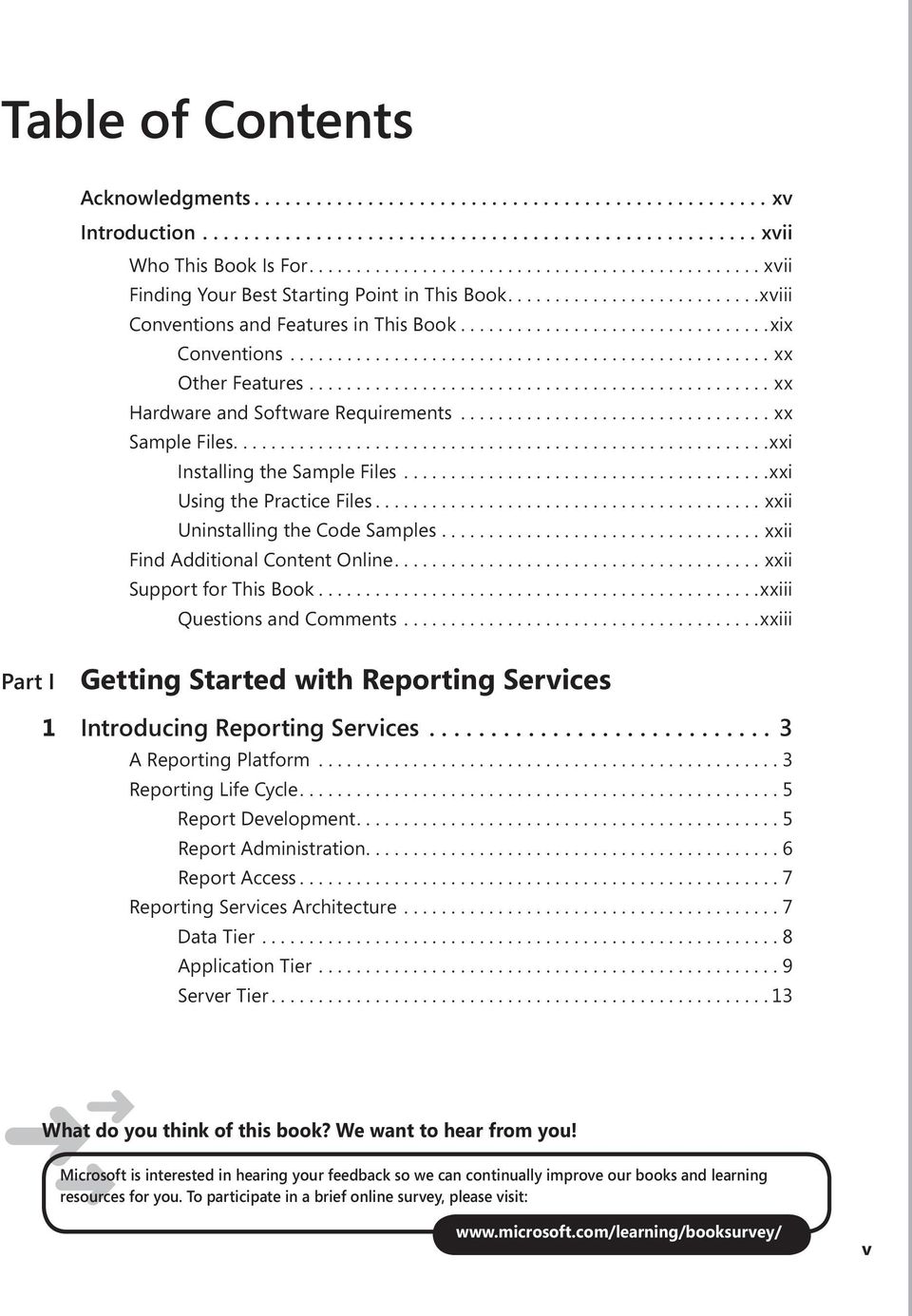
7 Table of Contents Acknowledgments xv Introduction xvii Who This Book Is For xvii Finding Your Best Starting Point in This Book xviii Conventions and Features in This Book xix Conventions xx Other Features xx Hardware and Software Requirements xx Sample Files xxi Installing the Sample Files xxi Using the Practice Files xxii Uninstalling the Code Samples xxii Find Additional Content Online xxii Support for This Book xxiii Questions and Comments xxiii Part I Getting Started with Reporting Services 1 Introducing Reporting Services A Reporting Platform Reporting Life Cycle Report Development Report Administration Report Access Reporting Services Architecture Data Tier Application Tier Server Tier What do you think of this book? We want to hear from you! Microsoft is interested in hearing your feedback so we can continually improve our books and learning resources for you. To participate in a brief online survey, please visit: v
8 vi Table of Contents SharePoint Integrated Mode SharePoint Server Report Server Chapter 1 Quick Reference Installing Reporting Services Planning for Installation Choosing an Edition Choosing a Server Mode Choosing a Deployment Topology Reviewing Hardware and Software Requirements Planning Accounts for Reporting Services Performing the Installation Installing Prerequisites Installing Setup Support Files Installing SQL Server 2008 Features Configuring Reporting Services Installing Report Builder Installing Sample Databases Configuring SharePoint Integrated Mode Configuring the Report Server Installing the Reporting Services Add-in for SharePoint Technologies Configuring SharePoint for Reporting Services Integration Creating a SharePoint Web Application Creating a Report Center Site Adding Reporting Services Content Types to a SharePoint Document Library Chapter 2 Quick Reference Exploring Reporting Services Developing a Simple Report Introducing Report Builder Adding a Data Source Adding a Dataset Adding a Report Title Adding a Table Grouping Data Inserting Page Breaks
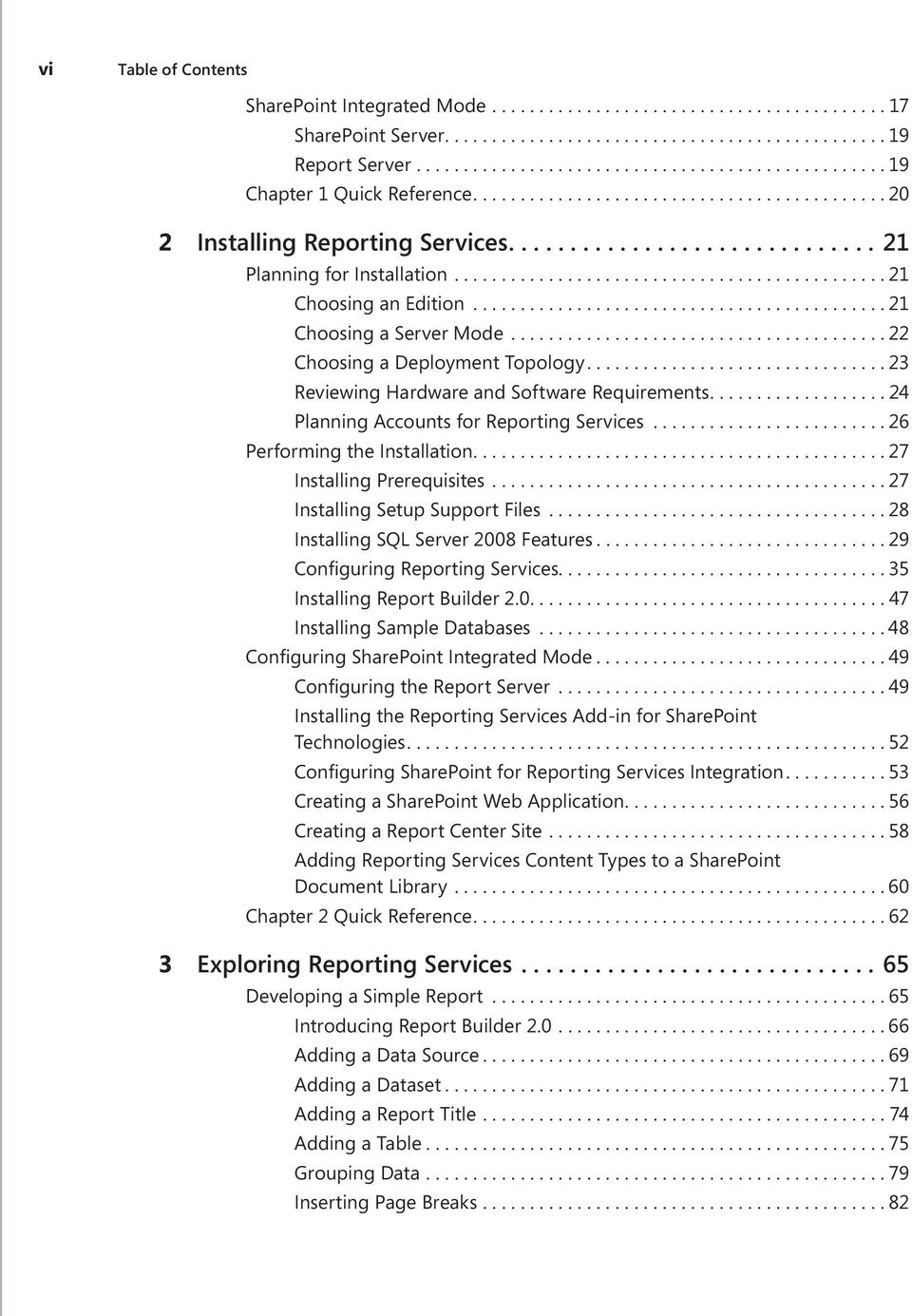
9 Table of Contents vii Formatting a Report Previewing a Report Managing a Report Publishing a Report Adding a Description Reviewing Execution Properties Viewing a Report Opening a Report Using the HTML Viewer Chapter 3 Quick Reference Part II Developing Reports 4 Designing Reports Getting Started with Report Designer Creating a Report Server Project Adding a Report to a Project Creating a Data Source Creating a Dataset Designing the Report Structure Adding a Data Region Binding Data to a Data Region Grouping Data Adding a Total Using a Matrix Using a List Defining Adjacent Groups Adding a Text Box Adding a Line Adding an Image Linking Information with a Subreport Enhancing the Report Appearance Configuring the Placement and Size of a Report Item Changing the Appearance of a Report Item Setting Page Breaks Adjusting the Report Size for Print-Ready Formats Adding a Page Header and Page Footer Chapter 4 Quick Reference

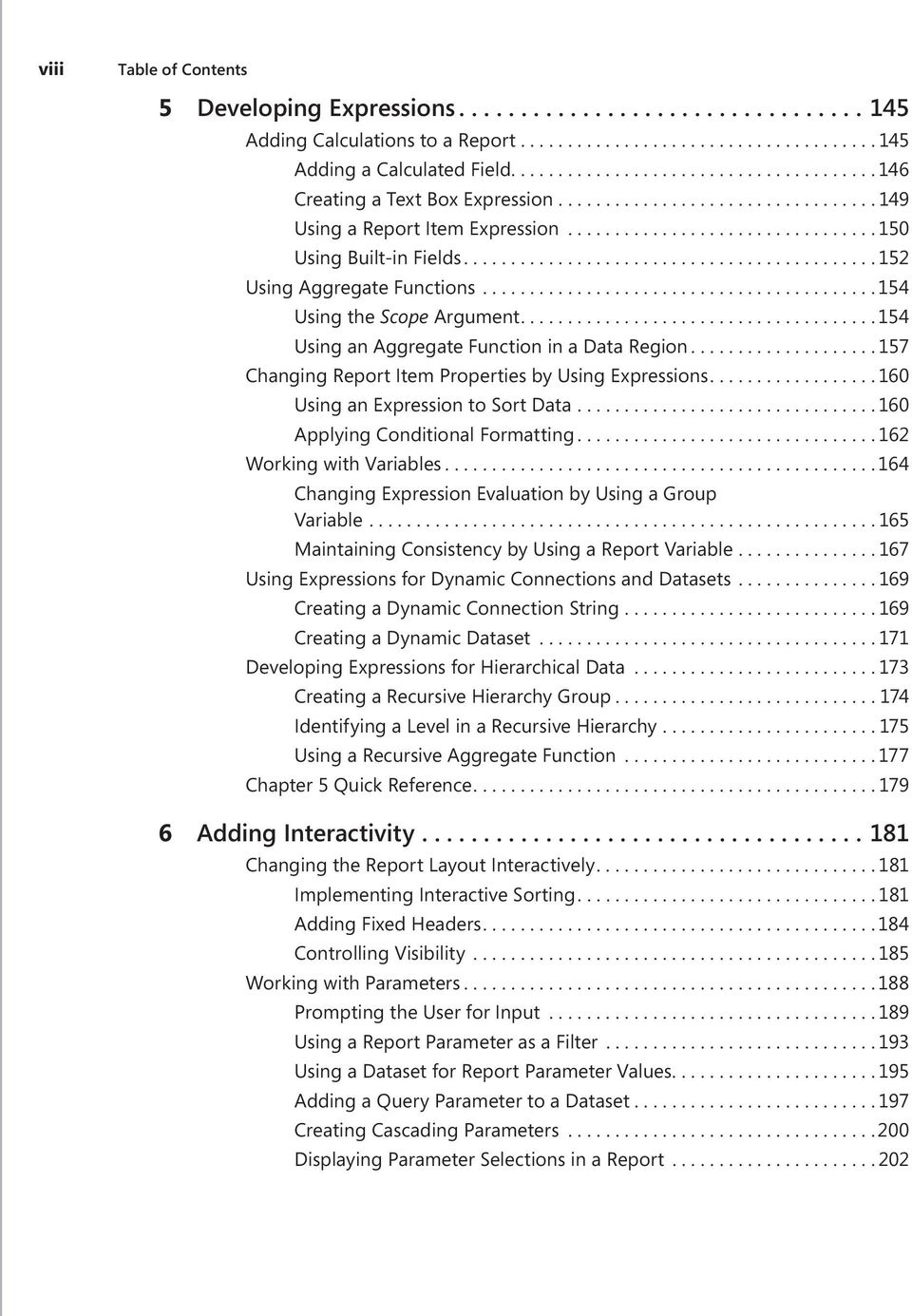
10 viii Table of Contents 5 Developing Expressions Adding Calculations to a Report Adding a Calculated Field Creating a Text Box Expression Using a Report Item Expression Using Built-in Fields Using Aggregate Functions Using the Scope Argument Using an Aggregate Function in a Data Region Changing Report Item Properties by Using Expressions Using an Expression to Sort Data Applying Conditional Formatting Working with Variables Changing Expression Evaluation by Using a Group Variable Maintaining Consistency by Using a Report Variable Using Expressions for Dynamic Connections and Datasets Creating a Dynamic Connection String Creating a Dynamic Dataset Developing Expressions for Hierarchical Data Creating a Recursive Hierarchy Group Identifying a Level in a Recursive Hierarchy Using a Recursive Aggregate Function Chapter 5 Quick Reference Adding Interactivity Changing the Report Layout Interactively Implementing Interactive Sorting Adding Fixed Headers Controlling Visibility Working with Parameters Prompting the User for Input Using a Report Parameter as a Filter Using a Dataset for Report Parameter Values Adding a Query Parameter to a Dataset Creating Cascading Parameters Displaying Parameter Selections in a Report
11 Table of Contents ix Adding Navigation Features Configuring a Document Map Jumping to a Report Using Embedded HTML Tags Chapter 6 Quick Reference Using Analysis Services as a Data Source Installing the Sample Database Creating an Analysis Services Dataset Creating an Analysis Services Data Source Building a Query Adding a Calculation to the MDX Query Building a Report Using an Analysis Services Dataset in a Report Using Extended Field Properties Using the Aggregate Function Displaying Aggregate Values in Detail Rows Designing Parameters Adding a Parameter to an Analysis Services Dataset Creating a Custom Query Parameter Chapter 7 Quick Reference Visualizing Data Creating Charts Understanding Chart Types Creating a Column Chart Formatting a Chart Using a Scale Break Adding a Calculated Series Using a Secondary Axis Combining Chart Types Adding a Second Chart Area Working with Gauges Understanding Gauge Types Creating a Linear Gauge Chapter 8 Quick Reference

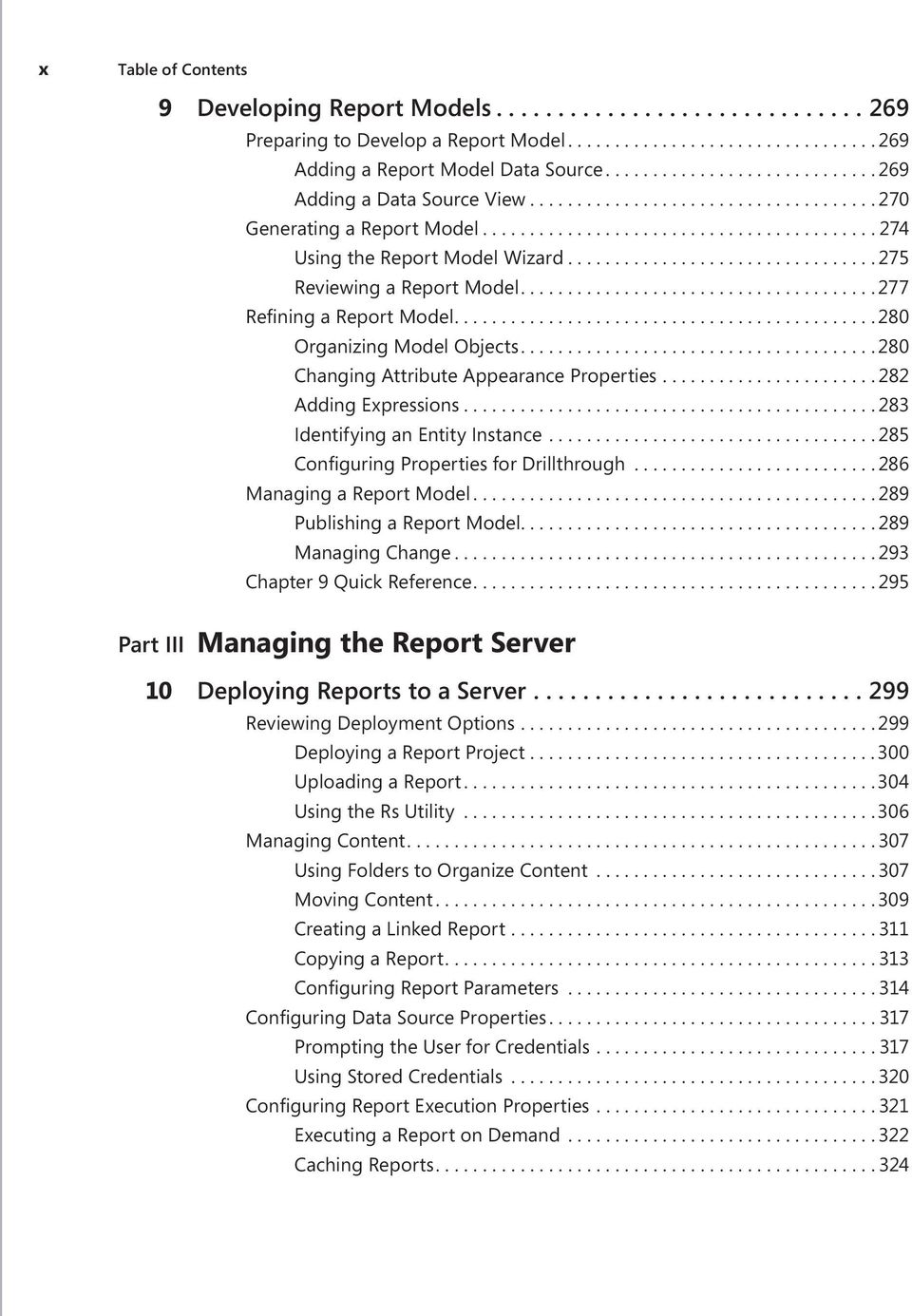
12 x Table of Contents 9 Developing Report Models Preparing to Develop a Report Model Adding a Report Model Data Source Adding a Data Source View Generating a Report Model Using the Report Model Wizard Reviewing a Report Model Refining a Report Model Organizing Model Objects Changing Attribute Appearance Properties Adding Expressions Identifying an Entity Instance Configuring Properties for Drillthrough Managing a Report Model Publishing a Report Model Managing Change Chapter 9 Quick Reference Part III Managing the Report Server 10 Deploying Reports to a Server Reviewing Deployment Options Deploying a Report Project Uploading a Report Using the Rs Utility Managing Content Using Folders to Organize Content Moving Content Creating a Linked Report Copying a Report Configuring Report Parameters Configuring Data Source Properties Prompting the User for Credentials Using Stored Credentials Configuring Report Execution Properties Executing a Report on Demand Caching Reports
13 Table of Contents xi Creating Report Snapshots Saving Report Snapshots in Report History Chapter 10 Quick Reference Securing Report Server Content Configuring Report Server Security Policies Preparing to Implement Security Reviewing Default Authorization Policies Assigning User Permissions Granting Access to Report Server Content Configuring Item-Level Security Securing a Folder Approving Data Sources in SharePoint Integrated Mode Securing a Report Assigning a System Role Securing a Report Model Implementing Data Security Using a Query Parameter and a Role to Secure Data Using a Permissions Table to Secure Data Using a Dataset Filter to Secure Data Chapter 11 Quick Reference Performing Administrative Tasks Using Management Tools Using SSMS Suspending Report Execution Configuring the Report Server Managing Encrypted Information Configuring Authentication Managing Memory Monitoring the Report Server Checking the Application Database Size Using the Trace Log Adding the HTTP Log Using Performance Counters Chapter 12 Quick Reference

14 xii Table of Contents Part IV Viewing Reports 13 Accessing Reports Online Using Report Manager Searching for a Report Using the HTML Viewer Printing a Report Using the My Reports Folder Accessing Reports in SharePoint Configuring Search in SharePoint Searching for a Report Using the SharePoint Report Viewer Creating a Dashboard Exporting Reports Exporting a Report for Online Viewing Exporting a Report for Analysis Creating a Data-Driven Document Exporting a Report for Printing Exporting a Report for Data Exchange Chapter 13 Quick Reference Creating Ad Hoc Reports Developing Reports with Report Builder Introducing Report Builder Building a Table Building a Matrix Building a Chart Testing Security Enhancing Reports Formatting a Report Adding Formula Fields Filtering a Report Sorting Data Disabling Interactive Features Working with Clickthrough Opening a Clickthrough Report Configuring a Custom Clickthrough Report Assigning a Custom Clickthrough Report to a Report Model Chapter 14 Quick Reference

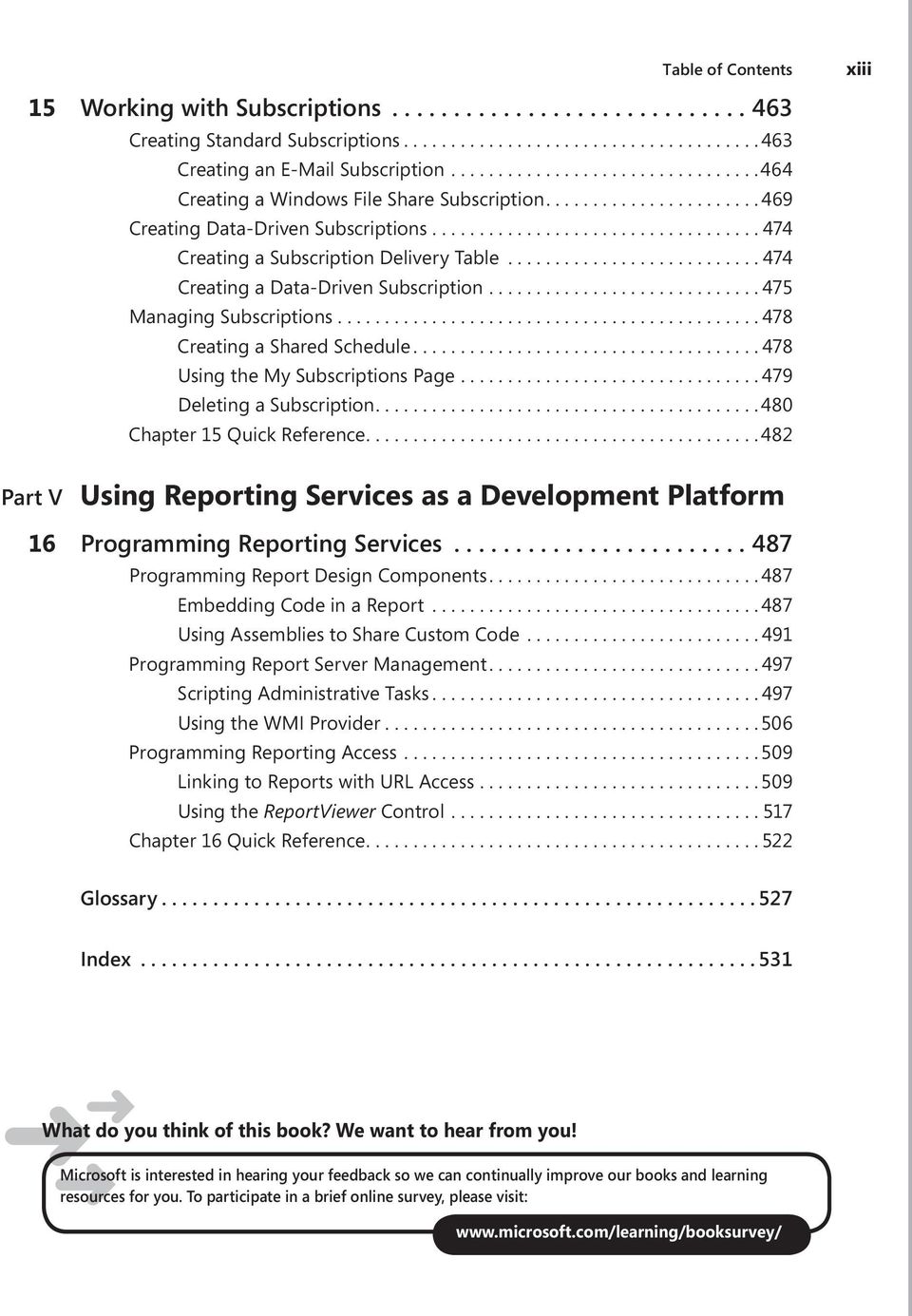
15 Table of Contents xiii 15 Working with Subscriptions Creating Standard Subscriptions Creating an Subscription Creating a Windows File Share Subscription Creating Data-Driven Subscriptions Creating a Subscription Delivery Table Creating a Data-Driven Subscription Managing Subscriptions Creating a Shared Schedule Using the My Subscriptions Page Deleting a Subscription Chapter 15 Quick Reference Part V Using Reporting Services as a Development Platform 16 Programming Reporting Services Programming Report Design Components Embedding Code in a Report Using Assemblies to Share Custom Code Programming Report Server Management Scripting Administrative Tasks Using the WMI Provider Programming Reporting Access Linking to Reports with URL Access Using the ReportViewer Control Chapter 16 Quick Reference Glossary Index What do you think of this book? We want to hear from you! Microsoft is interested in hearing your feedback so we can continually improve our books and learning resources for you. To participate in a brief online survey, please visit:
16

17 Acknowledgments Each time I start a new book project, I am amazed to see the way it develops a life of its own after it leaves my custody. Many other people have left their mark on this book s pages as they made the changes necessary to improve upon my initial work and I m so grateful for their commitment to quality and accuracy. As always, I enjoy working with Microsoft Press and appreciate the great team of people they have brought together for this project. In particular, I would like to thank Ken Jones and Sally Stickney for their efforts in the initial stages of the book, and my project editor, Carol Vu, for nudging me along gently but persistently until the manuscript was complete. Rozanne Murphy Whalen provided a thorough technical review of the book by ensuring that each step performed exactly as described. Linda Allen of Custom Editorial Productions, Inc., Susan McClung, and Julie Hotchkiss were outstanding in their respective contributions to the book as they moved the manuscript through the editing process and continually rechecked the work to ensure that new errors weren t introduced as old errors were cleaned up. They have done the most thorough job I have ever seen and I believe that any author would be lucky to work with this group. Of course, my family deserves many thanks as well. My husband, Gerry, has learned to indulge me in my writing projects and patiently sacrifices some of our time together so that I can focus on writing, but he s also my biggest cheerleader and encourages me every step of the way. For this, and all he has done for me in our many years together, I am eternally grateful. I also appreciate my daughter s help on this project. Erika s glimmer of understanding of what I do for a living first developed when she provided feedback from a newbie s perspective on my last book, Microsoft SQL Server 2005 Express Edition: Start Now! (Microsoft Press, 2007). Little did either of us realize at the time that she would decide to learn more about what I do and eventually join me in my practice as a business intelligence consultant. Her experience using Reporting Services 2005 on a variety of projects since that time has given her an excellent perspective on the features that make Reporting Services 2008 compelling, and consequently, she was a great help to me in preparing many of the procedures in this book to highlight those features. I look forward to many more collaborative ventures together in the future. xv

18

19 Introduction Microsoft Reporting Services is the component of Microsoft SQL Server 2008 that provides an enterprise-ready and extensible presentation layer for the Microsoft business intelligence platform. In its third release, Reporting Services continues its support for the three stages of the reporting life cycle, but it now includes several new features that improve the report development, management, and delivery processes. The new tablix and chart controls give you more options for presenting data in a report, and the new server architecture makes it easier for administrators to manage server resources and for users to access and page through large reports. As you complete the step-by-step procedures in this book, you are introduced to these and other new features, in addition to all the other features that have made Reporting Services a popular choice for implementing a reporting platform in organizations of all sizes since its initial release in When you have finished the book, you will know how to build reports using each type of structure supported by Reporting Services and how to enhance reports with interactivity and data visualization techniques. You use these reports to learn how to move reports from the development workstation to the server environment and how to manage and secure the reports once they re on the report server. Then you use these reports again to learn how users can access reports online and subscribe to reports for delivery on a scheduled basis. You also learn how to build and use a report model for ad hoc reporting. If you have programming skills, you can continue learning about the extensibility of Reporting Services by enhancing the reports with custom code, by developing tools to manage the report server, and by exploring techniques for integrating access to reports managed by Reporting Services into portals and custom applications. Who This Book Is For Because Reporting Services is a platform of technologies rather than a single application, a variety of people serving in different roles and having different skill sets all need to learn how to work with some aspect of Reporting Services. Whether you re a report developer, IT administrator, or business user, you can use this book to learn how to perform the tasks for which you are responsible. If you re completely new to Reporting Services, this book teaches you the fundamental concepts required to build, manage, and access reports. You need no prior experience with Reporting Services to use this book successfully. On the other hand, if you re already familiar with an earlier version of Reporting Services, this book gives you a guided tour of the new features found in Reporting Services xvii
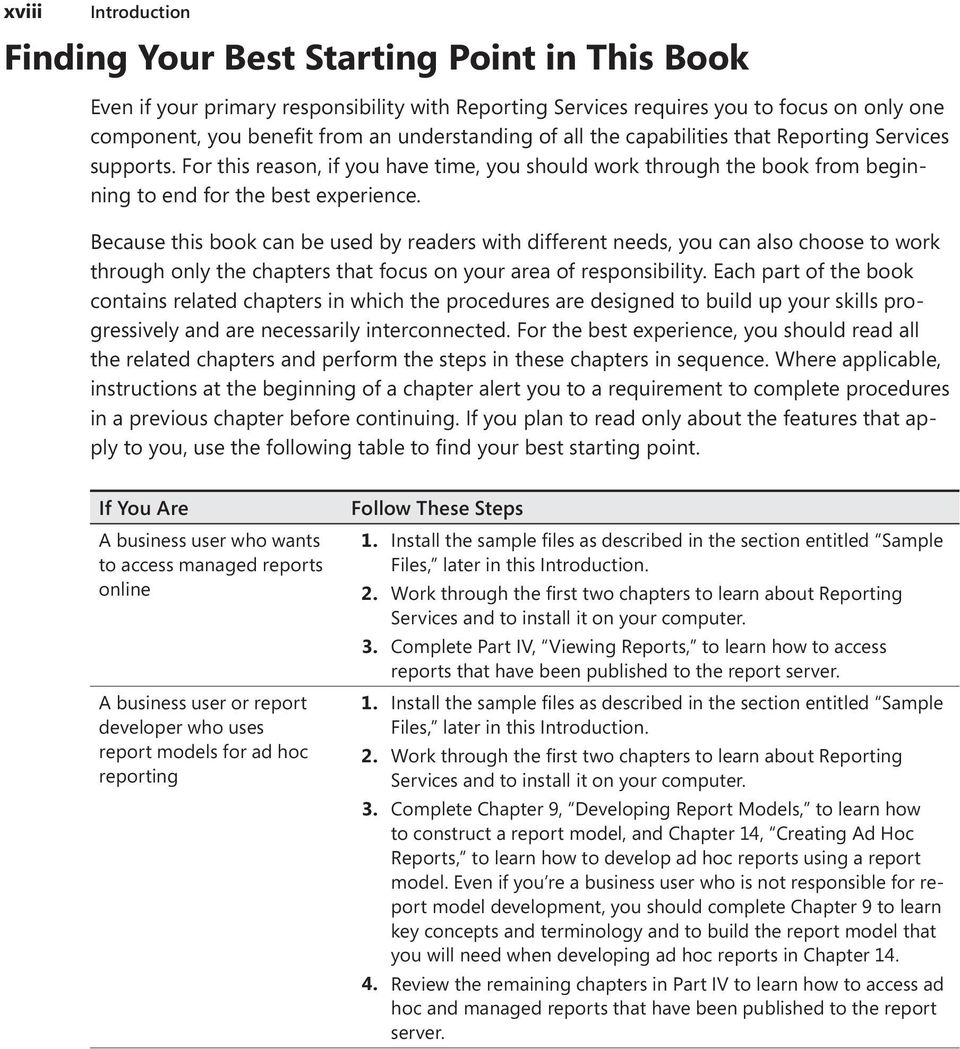
20 xviii Introduction Finding Your Best Starting Point in This Book Even if your primary responsibility with Reporting Services requires you to focus on only one component, you benefit from an understanding of all the capabilities that Reporting Services supports. For this reason, if you have time, you should work through the book from beginning to end for the best experience. Because this book can be used by readers with different needs, you can also choose to work through only the chapters that focus on your area of responsibility. Each part of the book contains related chapters in which the procedures are designed to build up your skills progressively and are necessarily interconnected. For the best experience, you should read all the related chapters and perform the steps in these chapters in sequence. Where applicable, instructions at the beginning of a chapter alert you to a requirement to complete procedures in a previous chapter before continuing. If you plan to read only about the features that apply to you, use the following table to find your best starting point. If You Are A business user who wants to access managed reports online A business user or report developer who uses report models for ad hoc reporting Follow These Steps 1. Install the sample files as described in the section entitled Sample Files, later in this Introduction. 2. Work through the first two chapters to learn about Reporting Services and to install it on your computer. 3. Complete Part IV, Viewing Reports, to learn how to access reports that have been published to the report server. 1. Install the sample files as described in the section entitled Sample Files, later in this Introduction. 2. Work through the first two chapters to learn about Reporting Services and to install it on your computer. 3. Complete Chapter 9, Developing Report Models, to learn how to construct a report model, and Chapter 14, Creating Ad Hoc Reports, to learn how to develop ad hoc reports using a report model. Even if you re a business user who is not responsible for report model development, you should complete Chapter 9 to learn key concepts and terminology and to build the report model that you will need when developing ad hoc reports in Chapter Review the remaining chapters in Part IV to learn how to access ad hoc and managed reports that have been published to the report server.
21 If You Are A business user with some experience developing database queries who develops managed reports A report developer Introduction xix Follow These Steps 1. Install the sample files as described in the section entitled Sample Files, later in this Introduction. 2. Work through the chapters in Part I, Getting Started with Reporting Services, to learn about Reporting Services, to install it on your computer, and to learn how to use Report Builder Review the chapters that interest you in Part II, Developing Reports, to learn how to build more advanced reports. In many cases, you can adapt the procedures in these chapters for use with Report Builder Review the chapters that interest you in Part IV to learn how users access reports from the report server. 1. Install the sample files as described in the section entitled Sample Files, later in this Introduction. 2. Work through the chapters in Part I to learn about Reporting Services, to install it on your computer, and to learn how to use Report Builder Complete Part II to learn how to use all the report development features available in Reporting Services. 4. Review the chapters that interest you in Parts III and IV to become familiar with overall functionality in Reporting Services. 5. If you have programming skills, complete Chapter 16, Programming Reporting Services, to learn how you can customize Reporting Services. A server administrator 1. Install the sample files as described in the section entitled Sample Files, later in this Introduction. 2. Work through Chapter 1, Introducing Reporting Services, and Chapter 2, Installing Reporting Services, to learn about Reporting Services and to install it on your computer. 3. Complete Part III to learn how to configure and manage the report server. 4. Review the chapters that interest you in Part IV to understand how users interact with the report server. 5. Skim Chapter 16 to discover how customization of Reporting Services might require changes on the report server and how to perform administrative tasks programmatically. Conventions and Features in This Book This book presents information using conventions designed to make the information readable and easy to follow. Before you start, read the following list, which explains conventions you see throughout the book and points out helpful features that you might want to use.
22 xx Introduction Conventions n Each exercise is a series of tasks. Each task is presented as a series of numbered steps (1, 2, and so on). A round bullet ( ) indicates an exercise that has only one step. n Notes labeled Tip provide additional information or alternative methods for completing a step successfully. n Notes labeled Important alert you to information you need to check before continuing. n Text that you type appears in bold. n A plus sign (+) between two key names means that you must press those keys at the same time. For example, Press Alt+Tab means that you hold down the Alt key while you press the Tab key. Other Features n Sidebars throughout the book provide more in-depth information about the exercise. The sidebars might contain background information, design tips, or features related to the information being discussed. n Each chapter ends with a section entitled Quick Reference, which contains brief reminders of how to perform the tasks that you learned in the chapter. Hardware and Software Requirements You ll need the following hardware and software to complete the exercises in this book: n Windows Vista Home Premium, Windows Vista Business, Windows Vista Ultimate, Windows Vista Enterprise, Windows Server 2003 Standard SP2, Windows Server 2003 Data Center SP2, Windows Server 2003 Enterprise SP2, Windows Server 2008 Standard, Windows Server 2008 Data Center, or Windows Server 2008 Enterprise. The exercises also run using Microsoft Windows XP Professional SP2. n Microsoft SQL Server 2008 Standard, SQL Server 2008 Enterprise, SQL Server 2008 Developer, or SQL Server 2008 Evaluation. n Optional: Microsoft Windows SharePoint Services 3.0 or Microsoft Office SharePoint Server n Optional: Microsoft Visual Studio 2008 Standard or Professional with either the Microsoft Visual Basic.NET or Microsoft Visual C#.NET library, and Visual Studio 2008 Service Pack 1.
23 Introduction xxi Note Visual Studio 2008 is required only to complete Chapter 16. If you install it before you complete the other chapters, you will notice that the steps that you must follow to start a new project or to open an existing project will vary slightly from the steps written in those chapters. These steps were written with the assumption that you do not install Visual Studio 2008 until you reach Chapter 16. n 1 gigahertz (GHz) Pentium III+ processor, or faster, with 2 GHz recommended. n 512 GB of available, physical RAM with 2 GB recommended. n Video (1,028 x 768 or higher resolution) monitor with at least 256 colors. n CD-ROM or DVD-ROM drive for installation from disc. n Microsoft mouse or compatible pointing device. You also need to have Administrator access to your computer to configure SQL Server 2008 Reporting Services. Sample Files The companion CD inside this book contains the sample files that you use as you perform the exercises. By using these sample files, you won t waste time creating files that aren t relevant to the exercise. The files and the step-by-step instructions in the lessons also let you learn by doing, which is an easy and effective way to acquire and remember new skills. Digital Content for Digital Book Readers: If you bought a digital-only edition of this book, you can enjoy select content from the print edition s companion CD. Visit to get your downloadable content. This content is always up-to-date and available to all readers. Installing the Sample Files Perform the following steps to install the sample files and required software on your computer so that you can use them with the exercises. 1. Remove the companion CD from the package inside this book and insert it into your CD-ROM drive. Note A license agreement should open automatically. If this agreement does not appear, open My Computer on the desktop or Start menu, double-click the icon for your CD-ROM drive, and then double-click StartCD.exe.
24 xxii Introduction 2. Review the license agreement. If you accept the terms, select the Accept option and then click Next. A menu appears with options related to the book. 3. Click Install Practice Files. 4. Follow the instructions that appear. The code samples are installed to the Microsoft Press\Rs2008sbs folder in your Documents folder on your computer. If your computer s operating system is Windows Vista or Windows Server 2008, your Documents folder is located at C:\Users\<login>\ Documents, where <login> is your login name. If the operating system is Windows XP or Windows Server 2003, your Documents folder is located at C:\Documents And Settings\<login>\My Documents. Using the Practice Files Each chapter in this book explains when and how to use any practice files for that chapter. When it s time to use a practice file, the book lists the instructions for how to open the files. Uninstalling the Code Samples Perform the following steps to remove the code samples from your computer. 1. In Control Panel, open Add Or Remove Programs. 2. From the list of Currently Installed Programs, select Microsoft SQL Server 2008 Reporting Services Step by Step. 3. Click Remove. 4. Follow the instructions that appear to remove the code samples. Find Additional Content Online As new or updated material becomes available that complements your book, it will be posted online on the Microsoft Press Online Developer Tools Web site ( /books/online/developer). The type of material you might find includes updates to book content, articles, links to companion content, errata, sample chapters, and more. This Web site is updated periodically.
25 Support for This Book Introduction xxiii Every effort has been made to ensure the accuracy of this book and the contents of the companion CD. As corrections or changes are collected, they will be added to a Microsoft Knowledge Base article. Microsoft Press provides support for books and companion media at the following Web site: Questions and Comments If you have comments, questions, or ideas regarding the book or the companion CD, or questions that are not answered by visiting the sites above, please send them to Microsoft Press via to [email protected] Or via postal mail to Microsoft Press Attn: Microsoft SQL Server 2008 Reporting Services Step by Step Editor One Microsoft Way Redmond, WA Please note that Microsoft software product support is not offered through the preceding addresses.
26 Chapter 4 Designing Reports After completing this chapter, you will be able to: n n n n n n n n n n Create a report server project in Business Intelligence Development Studio. Add a new or existing report to a report server project. Add a shared data source to a report server project. Define a dataset. Design a report using data regions and report items. Group and total data in a data region. Embed a report in another report as a subreport. Use properties to define placement and appearance of report items. Define page breaks and set properties related to paging. Add report items to the page header and page footer. In this chapter, you learn how to use Report Designer in Business Intelligence Development Studio (BI Dev Studio) to develop reports. Many of the principles that you have already learned about using Report Builder 2.0 are also applicable to using Report Designer, so you can use either tool comfortably when you finish this chapter. You start by preparing a report server project to contain your reports and creating a data source and dataset to provide data for your report. Then you learn a variety of techniques for structuring data in a report and enhancing the appearance of your report. Getting Started with Report Designer Before you start report development using Report Designer, you must first perform some tasks to prepare the environment. Whereas Report Builder 2.0 supports development of one report at a time, as explained in Chapter 3, Exploring Reporting Services, the integrated development environment in BI Dev Studio allows you to work with multiple reports in the same environment. You use a report server project as a container to store these reports in a common location. Another difference from Report Builder 2.0 that you encounter when using BI Dev Studio is the ability to create a shared data source to store data source connection information independently of the reports. After creating a shared data source, you define the query used to extract data from the source for display in the report. After finishing these tasks, you re ready to start developing reports. 103
27 104 Part II Developing Reports Creating a Report Server Project BI Dev Studio is a Microsoft Visual Studio shell program that provides many of the features of Visual Studio without requiring you to purchase and install Visual Studio. If you re new to the Visual Studio integrated environment, don t worry. You don t need to be a programmer to use this tool effectively. Before you start report development, you must create a report server project, which is a folder created to store a set of reports and shared data sources. When you create a new report server project, you define the location for this folder and a name for the solution to contain the report server project. A solution is simply a container for one or more projects, which can be any combination of project types supported by Visual Studio, including a report server project. In this procedure, you create a report server project in BI Dev Studio. Create a report server project 1. Click Start, select All Programs and Microsoft SQL Server 2008, and click SQL Server Business Intelligence Development Studio. 2. On the File menu, point to New, and click Project. 3. In the New Project dialog box, in the Templates pane, select Report Server Project. When you create a new project, you have three templates from which to choose: Report Server Project Wizard, Report Server Project, and Report Model Project. You can use the Report Server Project Wizard to accelerate basic report design using a wizard interface. (To learn more about the Report Project Wizard, refer to the sidebar, Using the Report Project Wizard, later in this chapter.) To meet specific report design requirements, however, you will likely find it better to use the Report Server Project as you learn how to do in this procedure. You learn how to use the Report Model Project in Chapter 9, Developing Report Models. 4. In the Name box, type Sales. 5. In the Location box, type C:\Users\<Username>\Documents\Microsoft Press \Rs2008sbs\Workspace, as shown here. Note If you re using Microsoft Windows XP or Windows Server 2003, navigate to C:\Documents and Settings\<Username>\My Documents\Microsoft Press\Rs2008sbs \Workspace.
28 Chapter 4 Designing Reports Click OK. Using the Report Project Wizard The Report Project Wizard walks you step by step through the report development process. You define an embedded or shared data source, provide a query string, select a report layout, define groupings, and apply a style to set colors and fonts for the report. The wizard limits you to using a tabular or matrix layout. However, after the report is created, you can continue to fine-tune the report to meet your specifications. Adding a Report to a Project Now that you have a report server project ready, you can add a report to your report server project by using the Report Project Wizard, adding a new report manually, or importing a report from Microsoft Office Access. In this procedure, you add a report to your report server project. Add a report to a report server project 1. In Solution Explorer, right-click the Reports folder, select Add, and click New Item. You might be tempted to click the Add New Report command on the context menu for Reports, but this command starts the Report Project Wizard. The Report Project Wizard is useful for quickly producing a basic report, but most report developers prefer to build a report manually.
29 106 Part II Developing Reports 2. In the Templates pane, select Report. In addition to the Report template, the list of available templates includes the Report Project Wizard and Data Source templates. The Report Project Wizard template produces the same result as using the Add New Report command from the Reports context menu. Similarly, the Data Source template displays the same dialog box as the Add New Data Source command in the Shared Data Sources context menu. 3. In the Name box, type Reseller Sales Summary.rdl, and click Add. Note You must provide the file extension.rdl for the file you are adding to the report server project. After you click Add, the report appears in the solution and Report Designer displays in the document window.
30 Chapter 4 Designing Reports 107 Before continuing to develop your report, take a few moments to become familiar with the layout of the design environment: n Toolbox The Toolbox window is hidden by default when you first open a report and appears only as a tab on the left side of the window. The Toolbox window is similar to the Ribbon in Report Builder 2.0 introduced in Chapter 3. You use this window to add controls that define your report layout. n Report Data The Report Data window displays to the left of the report layout. It contains three folders: Built-in Fields, Parameters, and Images. You use Built-in Fields to add commonly used expressions, such as ReportName or PageNumber, to your report. You learn how to work with the Parameters folder in Chapter 6, Adding Interactivity. The Images folder stores images you use in the report, as you do later in this chapter. After you add a data source and a dataset to your report, these objects display in the Report Data window as well. Thus, the Report Data window organizes many of the key items you use within your report. n Report Designer The Report Designer occupies the central window in the development environment and consists of two tabs. On the Design tab, you arrange the layout of data and graphical elements on your report. On the Preview tab, you can test the rendering of the report to different formats without first deploying your report to the report server. The Grouping pane appears at the bottom of the Report Designer window and displays a hierarchical view of groups defined for a selected data region. n Solution Explorer This window appears to the right of Report Designer and displays the files associated with each project within your solution. n Properties Each item you add to the report, as well as each area of the report (such as the body, page header, page footer, and even the report itself), has a set of properties to define its appearance and behavior. When you select an item or report area in Report Designer, you see its related properties in the Properties window, which displays to the right of Report Designer. You can rearrange these windows while developing your report to give more space to Report Designer or to access items better in a window. For example, you can use the Auto Hide feature to minimize the Toolbox, Report Data, Solution Explorer, or Properties window. You can also undock a window from its default location and drag it to a new location.
31 108 Part II Developing Reports 4. Point to the Toolbox tab on the left side of the window, and then click the Auto Hide button (which looks like a pushpin and is displayed next to the Close button for the window) to open and lock the Toolbox window, shown here. Notice that the Toolbox overlays the Report Data window to conserve the amount of space used on your screen. You use the tabs at the bottom of the current window to switch to the other window. 5. Click the Report Data tab to switch the visible window. Instead of using the Auto Hide feature, you can close a window to maximize screen space for the Report Designer. 6. In the upper-right corner of the Report Data window, click the Close button (which appears as an X). At any time, you can open a closed window by using the View menu. 7. On the View menu, click Report Data. Creating a Data Source A report requires a data source to identify where the data for the report is found and how the user is authenticated to determine whether permissions exist to retrieve the report data. You can choose to embed a data source within the report or to use a shared data source that is available to multiple reports. By using a shared data source, you can maintain connection and authentication information in a single location, which is generally the recommended approach. However, if you need to use a dynamic data source, such as when you need to use different servers for different users, then you must use an embedded data source.
32 Chapter 4 Designing Reports 109 In this procedure, you create a shared data source for the AdventureWorksDW2008 database. Create a shared data source 1. In the Report Data window, click New, and then click Data Source. 2. In the Data Source Properties dialog box, in the Name text box, type AdventureWorksDW2008. Note When you define a name for a data source, you cannot include spaces in the name and you must use a letter as the first character. You can choose either to create an embedded connection or to use a shared data source reference. When you use an embedded connection, you can define an explicit connection string, as you did in Chapter 3, or you can click the Expression button (to the left of the Edit button) to build a dynamic connection string, which you learn how to do in Chapter 5, Developing Expressions. 3. Select Use Shared Data Source Reference, and click New. Note Because no shared data sources exist in the report server project, you must create a new data source before you can select a reference. 4. In the Shared Data Source Properties dialog box, in the Name text box, type AdventureWorksDW Open the Type drop-down list, review the available data providers, and select Microsoft SQL Server. You can choose from the following data providers: Microsoft SQL Server, Object Linking and Embedding Database (OLE DB), Microsoft SQL Server Analysis Services, Oracle, Open Database Connectivity (ODBC), Extensible Markup Language (XML), Report Server Model, SAP NetWeaver BI, Hyperion Essbase, and Teradata. You must supply a connection string applicable to the selected data provider. If the Edit button is available after you select a data provider, you can use it to open the Connection Properties dialog box, which provides a graphical interface that prompts you for the properties required to construct the appropriate connection string. 6. Click Edit. 7. In the Connection Properties dialog box, in the Server Name text box, type localhost. 8. In the Select Or Enter A Database Name drop-down list, select AdventureWorksDW2008, and click OK. 9. In the Shared Data Source Properties dialog box, click Credentials.
33 110 Part II Developing Reports As you learned in Chapter 3, you must specify whether the report uses Windows authentication to pass through the current user s credentials, a hard-coded value for user name and password, a prompt at report execution to request the user to enter credentials, or no credentials at all. Unless the data source has no security defined, which is highly unusual, the credentials are used by the data source to authenticate the user before the query executes. Accordingly, the user account must have at least Read permissions on the data source. 10. Click OK to close the Shared Data Source Properties dialog box. Notice that the AdventureWorksDW2008.rds file has been added to the Sales solution in the Shared Data Sources folder in the Solution Explorer window. AdventureWorksDW2008.rds is an XML file containing all the information required to connect to the data source. The shared data source deploys to the report server when you deploy the report, as you learn in Chapter 10, Deploying Reports to a Server. 11. In the Data Source Properties dialog box, in the Use Shared Data Source Reference drop-down list, select AdventureWorksDW2008, as shown here. Notice the Use Single Transaction When Processing The Queries check box at the bottom of the dialog box. You should select this check box when your report contains multiple datasets that reference the same shared data source and your data source cannot handle several parallel connections, or if you want the queries to execute as a single transaction. In other words, when this option is selected, if one query to the data source fails, then all queries to the same data source should also fail. If you leave this check box cleared, then the dataset queries execute in parallel. 12. Click OK to close the Data Source Properties dialog box.
34 Chapter 4 Designing Reports 111 Notice that the data source now appears in the Report Data window. This data source is actually a pointer to the data source file that you see in Solution Explorer. If you later change connection information in the shared data source file, you won t need to update the connection in your report because your report automatically uses the new connection information. Creating a Dataset As you learned in Chapter 3, a dataset defines a query for your report and contains the field list of data columns returned by the query. The Dataset Properties dialog box allows you to use a query designer for supported data sources, such as SQL Server or Analysis Services, to build the query text or to import the query text from a file saved on your computer or network. You can also test the query to be sure you re retrieving the right data before developing your report. In this procedure, you add a dataset to return reseller sales amounts grouped by sales territory and by business type for the calendar year Add a dataset 1. In the Report Data window, click New, and then click Dataset. 2. In the Dataset Properties dialog box, in the Name text box, type ResellerSales. As with a data source, your dataset name cannot include spaces and must have a letter as the first character. Notice that the data source is already selected. If you have multiple data sources defined in your report, then you must be sure to select the correct data source. You also have the option to create a new data source at this time if you skipped that step before attempting to create a dataset. If you plan to write your own query, select Text as the query type, which is the default. Many database administrators prefer that reports use stored procedures to retrieve data from a database. When you select Stored Procedure as the query type, a list of available stored procedures displays in a drop-down list from which you make a selection. If you are using an OLE DB or ODBC data provider to connect to a SQL Server database, you can select Table as the query type to use the TableDirect feature of SQL Server to return all fields within a table. Instead of providing static query text for a dataset, you can construct a query dynamically by specifying an expression. You learn how to do this in Chapter Click Query Designer. 4. On the toolbar, click Import.
35 112 Part II Developing Reports 5. In the Import Query dialog box, navigate to the Microsoft Press\Rs2008sbs\Chap04 folder in your Documents folder, and double-click ResellerSalesSummary2004.sql. This query retrieves sales for each sales territory group, sales territory country, and reseller business type for the calendar year On the toolbar, click the Run button (which displays as an exclamation point) to run the query, as shown here. You can edit the query text if you need to make changes before saving the dataset query. 7. On the toolbar, click Edit As Text to disable the text editor and view the Query Designer. Tip If you prefer a GUI, you can click Edit As Text to toggle to the Query Designer if it s supported by the selected data provider.
36 Chapter 4 Designing Reports Click OK to close the Query Designer window and return to the Dataset Properties, as shown here. You can specify a time-out value in seconds to end execution if the query cannot execute within a fixed period of time. If you clear the value from the Time Out (In Seconds) box so that it s empty, the query never times out. Notice also that the Dataset Properties dialog box has several other tabs, as follows: n Parameters You can provide default values for query parameters if they are supported by the data source. These default values can alternatively be linked to report parameters, which you learn about in Chapter 6. n Fields In addition to fields retrieved for the dataset by executing the query, you can define calculated fields, which you learn about in Chapter 5. n Options You can specify options for your data, such as collation, case sensitivity, accent sensitivity, kanatype sensitivity, and width sensitivity. This page also includes an option for specifying whether subtotal rows in your dataset should be treated as detail rows in your report, which is explained in more detail in Chapter 7, Using Analysis Services as a Data Source. n Filters If you are unable to filter data at the data source by using a WHERE clause in your query, you can filter the data in the dataset by defining filter rules. You learn how to use filters in Chapter 6.
37 114 Part II Developing Reports 9. Click OK to close the Dataset Properties dialog box. The dataset appears in the Report Data window as a node of the AdventureWorksDW2008 data source. Notice the fields below the data set, as shown here. Each field is a column returned by the query for this dataset. Designing the Report Structure Now that you have completed the preparation for report development, you re ready to start designing the layout of data on the report. You use one or more data regions to present data in a structured or unstructured format in the report layout. As you work, you can switch to Preview mode to confirm you re achieving the desired results. Your report specifications might require you to define groupings and totals, add supporting elements such as a text box, line, or image, or even embed another report within the report you re currently developing. Adding a Data Region A data region is the primary report item that you use to display data in your report. Reporting Services provides four different data regions: tables, matrixes, lists, and charts. You link a data region to a single dataset and specify how fields in that dataset are positioned within the data region. To start your first report, you use a table. A table has a fixed number of columns, and the number of detail rows depends on the number of rows returned by the dataset query. Much as a spreadsheet is a collection of cells, a Reporting Services table is a collection of text boxes organized as rows and columns. You can define a header row in a table for column labels or a footer row for aggregated values. To organize detail rows better, you can add groups and define subtotals for these groups. In this procedure, you add a table to the report design. Add a table 1. In the Toolbox window, double-click Table to add it to the design surface, or you can drag the table from the Toolbox to the design surface.
38 Chapter 4 Designing Reports 115 Tip If you can t see the Toolbox window, click the Toolbox tab on the left if the window is currently configured to Auto Hide, or click the Toolbox tab at the bottom of the Report Data window if the window is currently configured as a tabbed document. If you still can t see the Toolbox window, use the View menu to open the Toolbox window. When you double-click a control in the Toolbox window, the control is placed as near the upper-left corner of the design surface as possible. You can be more specific with the placement of the control if you drag it from the toolbox to the desired location. The default table includes three columns. You can add or remove columns to meet your requirements. 2. Right-click the top row of the third column, and click Delete Columns. Now your table has two columns that you can use to display Business Type and Sales Amount from the ResellerSales dataset. Binding Data to a Data Region A data region must be bound to a dataset so that you can position fields from that dataset within the data region. To associate a dataset with a data region, you can set the DatasetName property for the data region or you can drag a dataset field from the Report Data window to a text box in the data region. After you have bound a data region to a dataset, you cannot add fields from a different dataset to that data region. In this procedure, you add fields to your table. Add fields to a table 1. Open the Report Data window, and then drag the BusinessType field to the second row of the first column, as shown here. When you add a field to a detail row in a table, Report Designer displays the field name in the column header automatically. You can change the text if you prefer a different label. If the field s data type is numeric, the text box automatically is right-justified.
39 116 Part II Developing Reports Tip If you place data in a wrong field, or do anything you didn t intend, for that matter, click the Undo button on the toolbar to revert to the previous state of your report. This action undoes the last action that you performed, so you need to do it immediately after you recognize your error. You can undo up to your last five actions. 2. Point to the second row of the second column, click the Field List icon, and click SalesAmount. You can either drag fields from the Report Data window or use the Field List to select a field from the dataset bound to the data region. By adding BusinessType to the table, you bound the ResellerSales dataset to the table. 3. In the Properties window, open the drop-down list at the top of the window, select Tablix1, and scroll to locate the DataSetName property in the General section to confirm the binding to the ResellerSales dataset. Note You might be wondering why the data region is called a tablix here rather than a table, but first it s important to develop an understanding of data regions in general. You learn more about the tablix later in this chapter. 4. Click the Preview tab to view the report, as shown here. Notice the repetition of the business types: Specialty Bike Shop, Value Added Reseller, and Warehouse. Each row in the table is a detail row and reproduces the same sequence of rows that you saw when you executed the dataset query in a previous procedure in this chapter. In the dataset, these detail rows are grouped by sales territory group and country. You ll also add these groups to your table in the next procedure. 5. Close the Output window.
40 Chapter 4 Designing Reports 117 Each time you preview your report, the Output window appears. Any errors or warnings display in this window to alert you to problems to be corrected in your report. This window stays open even when you switch back to the Design tab, but you can close it at any time. Previewing a Report in Report Designer You can preview a report without first deploying it to a server to make sure it looks the way you intend for online viewing. You also can use the Print Layout button to see how the printed version of the report will look, which is an important step to remember. Commonly, new report developers focus on a report design that looks great online, but they forget to check the print version. A data region might render across multiple pages unintentionally or blank pages might appear problems that become evident only when you print or export the report while in Preview mode. The Preview toolbar includes several buttons to test your report. Use the Page Setup button to define page size, orientation, and margins, and then use the Print button to send your report to a printer. Be sure to test rendering to other formats by using the Export button to view the report in XML, Comma-Separated Value (CSV), Tagged Image File Format (TIFF), Portable Document Format (PDF), MIME Encapsulation of Aggregate HTML Documents (MHTML), Microsoft Office Excel, or Microsoft Office Word formats. Grouping Data You can use groups to combine detail rows into related sets, and you can include subtotal values as an aggregation of numeric fields in the detail rows. For a table, you define row groups only. You can right-click a text box in a data region to create a new group, and then select a dataset field to use for grouping, or alternatively define an expression. You can see groups in the Grouping pane at the bottom of Report Designer. This Grouping pane makes it easier to see which groups are defined for the data region and, if multiple groups are defined, how the groups relate to one another hierarchically. Furthermore, in the Grouping pane, you can access properties for each group or add additional groups easily. In this procedure, you add groups to your table. Group data in a table 1. Click the Design tab. 2. Right-click the second row of the first column, select Add Group, and then, in the Row Group section, click Parent Group.
41 118 Part II Developing Reports There are also options to add a column group or an adjacent group. You learn more about working with these other group types later in this chapter. 3. In the Tablix Group dialog box, in the Group By drop-down list, select [SalesTerritoryGroup], as shown here. You have the option to add a header or footer for the group. When you choose these options, rows are added to the table above and below the details row. For this report, you are creating a more compact table and will not use header and footer rows for each group. 4. Click OK to close the Tablix Group dialog box. Notice that the group appears in a new column to the left of the existing columns, as shown here. A default column label, Group1, also displays, which you can change, of course. 5. Right-click the second row of the first column (containing [SalesTerritoryGroup]), select Add Group, and then, in the Row Group section, click Child Group. When you add a group to a data region that already contains at least one group, you must decide how the groups will relate to each other. If the new group will contain the existing group or detail rows, you create a parent group. If the new group will be contained by the existing group, you create a child group, as you did here. 6. In the Tablix Group dialog box, in the Group By drop-down list, select [SalesTerritoryCountry], and click OK.
42 Chapter 4 Designing Reports 119 The labels for the groups default to Group1 and Group2, as shown here, which you can change by replacing the text in the table header row. 7. Click in the first row of the first column, highlight Group1, and type Group. 8. Click in the first row of the second column, highlight Group2, and type Country. Note Changing the labels does not change the name of the groups in the Grouping pane. Instead, you must access the Group properties to change the group names to identify them more easily in the Grouping pane. Tip Although you are not required to provide names for the groups yourself, you will find it helpful to use a more meaningful name than the default generic name when multiple groups display in the Grouping pane. 9. In the Grouping pane, right-click Group1, and click Group Properties.
43 120 Part II Developing Reports 10. In the Group Properties dialog box, in the Name text box, type SalesTerritoryGroup, as shown here. Note Group names, like data source and dataset names, cannot contain spaces and must start with a letter. Notice that you can define multiple group expressions for a single group by clicking Add and selecting a new field. Instead of using a dataset field as a group expression, you can construct a formula expression for grouping. You learn more about expressions in Chapter 5. You can define many other types of properties for each group: Page Breaks, Sorting, Filters, Variables, and Advanced. You learn more about Page Breaks and Sorting later in this chapter. Defining a filter for a data region is similar to defining a filter for a dataset, except that the data region filter applies only to the data region. You learn more about group variables in Chapter 5 and about the options on the Advanced tab in Chapters 5 and Click OK to close the Group Properties dialog box. 12. In the Grouping pane, right-click Group2, and click Group Properties. 13. In the Group Properties dialog box, in the Name box, type SalesTerritoryCountry, and click OK. Tip From time to time, it s a good idea to save your work. Notice the asterisk on the Report Designer tab. The asterisk lets you know that you have made changes to the report that you have not yet saved to disk, and it disappears when you save your report.
44 Chapter 4 Designing Reports On the File menu, click Save, or click the Save Selected Items button on the toolbar. 15. Click the Preview tab to view the current state of your report, as shown here. Adding a Total When you use a table in your report, you can use the Add Total command to add a row to sum detail rows for a group, or for the entire table. By default, the Add Total command inserts an expression using the Sum() function, but you can change the expression to use an alternative aggregate function such as Average() or Min(). You learn more about aggregate functions in Chapter 5. In this procedure, you add totals for each group in your table. Add totals to row groups 1. Click the Design tab. 2. Right-click the text box containing [SalesAmount], and click Add Total. A new row appears as a group footer row for the SalesTerritoryCountry group. 3. Click the new text box containing [Sum(SalesAmount)], as shown here.
45 122 Part II Developing Reports When you click a text box containing an aggregate function, an orange bar appears to the left of the row group to which the aggregate function applies. In this case, the sum of the Sales Amount column entries represents the sum of all sales amounts for the SalesTerritoryCountry group. 4. Right-click the text box containing [Sum(SalesAmount)], and click Add Total. When you apply the Add Total command to a group total, Report Designer adds another group footer row for the total of the parent group, which in this case is the SalesTerritoryGroup. Because SalesTerritoryGroup has no parent group, a label for Total displays in the new group footer row. Notice also the icons in the row handles on the left side of the table. The set of three horizontal lines identifies the detail row. The line spanning the second and third rows of the table shows the scope of the innermost group, SalesTerritoryCountry, and the line spanning the second, third, and fourth rows of the table shows the scope of the SalesTerritoryGroup group. These visual cues are helpful when you add many groups and multiple rows per group to a table. 5. In the text box to the left of [Sum(SalesAmount)] in the group footer row of the SalesTerritoryCountry group (in the third row of the third column), type Country Total. 6. In the SalesTerritoryGroup group footer row, replace Total by typing Group Total in the text box. 7. Click Save Selected Items, and then click the Preview tab to view the report, as shown here.
46 Chapter 4 Designing Reports 123 Reviewing the RDL File The purpose of Report Designer is to provide a graphical interface for the construction of a Report Definition Language (RDL) file, which is an XML representation of your report using Report Definition Language, an open schema developed by Microsoft. Instead of reports stored in a proprietary format that can be used only within specific applications, Reporting Services allows you to create a report definition to describe the report s data query, fields, layout, properties, and so on. The report definition describes how to get the data required for the report and what the final report should look like, but not how to produce it. You can view the RDL of your report at any time. In Solution Explorer, right-click the report, and click View Code. You can make edits to the RDL in Code view, but be careful. If you inadvertently remove a required tag, you can no longer work with the report in Report Designer. Be sure to make a copy of your report before modifying the RDL as a safeguard. Using a Matrix Another type of data region that you will find useful is a matrix. Whereas a table has a fixed number of columns and a dynamic number of rows, both the rows and columns of a matrix are dynamic. A matrix displays data in a structure much like a crosstab or pivot table, and can use groups on either rows or columns with optional subtotals. In this procedure, you add a matrix to your report. Add a matrix 1. Click the Design tab. You can reuse the same dataset in multiple data regions on your report, or you can use separate datasets for each data region. In the current report, you add a new dataset to summarize reseller sales by sales territory group and by year. 2. Open the Report Data window, click New, and click Dataset. 3. In the Dataset Properties dialog box, in the Name box, type ResellerSalesByTerritoryByYear. 4. In the Dataset Properties dialog box, click Import. 5. In the Import Query dialog box, navigate to the Microsoft Press\Rs2008sbs\Chap04 folder in your Documents folder, double-click ResellerSalesByTerritoryByYear.sql, and click OK.
47 124 Part II Developing Reports 6. Open the Toolbox window, and drag the Matrix control onto the design surface to the right of the table at the top of the report body, as shown here. 7. Point to the text box on the second row of the first column, click the Field List icon, point to AdventureWorksDW2008, point to ResellerSalesByTerritoryByYear, and click SalesTerritoryCountry. When a dataset is not bound to a data region and multiple datasets exist, the first time you make a selection using the Field List, you must select the data source and data set before you can select a field. Of course, you can drag a field from the Report Data window and drop it into the text box instead of using the Field List. Notice that the Grouping pane now shows only the group associated with the matrix. The rows and columns you add to a matrix are classified automatically as groups. There are no detail rows in a matrix, which is another characteristic differentiating a matrix from a table. 8. Point to the text box on the first row of the second column, click the Field List icon, and click CalendarYear. Notice that CalendarYear appears now as a column group in the Grouping pane. The Grouping pane displays only groups associated with the currently selected data region. 9. In the matrix, point to the text box on the second row of the second column, click the Field List icon, and click SalesAmount. Because there are no detail rows in a matrix, all data field text boxes, appearing at the intersections of rows and columns, automatically use the Sum aggregate function, although you can replace it with a different aggregate function. Notice also that when you click in the data field text box, an orange bar appears to the left of the row group and above the column group to show the group scope affecting the current text box.
48 Chapter 4 Designing Reports Save and then preview the report, as shown here. The matrix renders to the right of the table. Notice that the years display out of sequence, however. The dataset query for the table includes an ORDER BY clause to display the table rows in the desired order without any further change required. If the dataset query does not include an ORDER BY clause, or if you want to override the ORDER BY clause, you can change the sorting property of the group. Tip For better performance, you should let the database engine perform sort operations. Use report properties only when the database engine can t perform a required operation, such as certain types of calculations that you learn about in Chapter Click the Design tab, click the matrix, right-click the CalendarYear group in the Grouping pane, and click Group Properties. 12. In the Group Properties dialog box, in the left pane, click Sorting. 13. Click Add, and then, in the Sort By drop-down list, select [CalendarYear], as shown here.
49 126 Part II Developing Reports The default sort order is ascending, which is designated by A to Z in the Order dropdown list. You can define a sort based on multiple fields, each with its own sort order. You use the up and down arrow buttons to control the sequence in which the sorts apply. Instead of using dataset fields to define a sort, you can click the Expression button to the right of the Sort By drop-down list to use a formula as a sort expression. You learn about expressions in Chapter Click OK to close the Group Properties dialog box. 15. Click the Preview tab to verify that the sort order is now correct. Using a List When you use a table or matrix, you present data in text boxes that are arranged in rows or columns, but a list can create a more flexible layout than the other two data regions. You can, for example, use nothing but text boxes for a completely free-form layout, or you can use a combination of text boxes and other data regions to present some data in free form and other data in a structured layout. Unlike the table and matrix data regions, the list supports only one level of grouping, but you can implement multiple levels of grouping by nesting lists within lists. In this procedure, you create a copy of your report and then use a list to display a text box and a matrix in your report. Display a text box and a matrix in a list 1. Click the Design tab, and then click the Save Selected Items button on the toolbar. 2. In Solution Explorer, right-click Reseller Sales Summary.rdl, and click Copy. 3. In Solution Explorer, click the Reports folder, and press CTRL+V. 4. Right-click the new report, Copy Of Reseller Sales Summary.rdl, click Rename, type Reseller Sales Summary List.rdl, and press Enter. 5. In Solution Explorer, double-click Reseller Sales Summary List.rdl to open the new report. Tip After you make a copy of a report, it s very easy to start making design changes to the original report without realizing it. To ensure you re working on the new report copy, you can make sure only the current copy of the report is open by right-clicking the current report tab in the document workspace, and clicking Close All But This. 6. From the Toolbox window, drag the List control onto the design surface below the matrix, as shown here.
50 Chapter 4 Designing Reports 127 When you drag a new control onto the design surface near existing controls, you see blue snap lines appear to help you align the controls. In this report, you move the list later to a new position, so don t worry right now about getting the alignment perfect. 7. Right-click anywhere inside the matrix, point to Select, click Tablix2 to select the matrix (as indicated by the crosshair), and then, using the crosshair, drag the matrix into the list, as shown here. 8. Right-click anywhere inside the list, point to Select, and click Tablix3 to select the list. 9. In the Properties window, in the DatasetName drop-down list, select ResellerSalesByTerritoryByYear. Important The list and any data regions that you nest inside the list, such as the matrix in this example, must be bound to the same dataset. 10. In the Grouping pane, right-click the Details1 group, and click Group Properties. The list differs from the table and matrix data regions because you define a group for the details row. 11. In the Group Properties dialog box, click Add.
51 128 Part II Developing Reports 12. In the Group On drop-down list, select [SalesTerritoryGroup], and click OK. 13. Right-click the matrix inside the list, point to Select, click Tablix2, and then drag the matrix down inside the list to make room for a text box above the matrix. 14. From the Toolbox window, drag a text box control into the list above the matrix, and position the text box at the left edge of the list just above the matrix, as shown here. 15. Point to the new text box, click the Field List icon, and click SalesTerritoryGroup. You can bind data to a freestanding text box, but you must use an aggregate function, such as Sum for a numeric field or First for a string field. 16. Right-click anywhere inside the list, point to Select, click Tablix3 to select the list, and then drag the list to the top edge of the report body just to the right of the table. 17. Save and then preview the report, as shown here.
52 Chapter 4 Designing Reports 129 Introducing the Tablix By completing the procedures up to this point in the chapter, you have developed experience with the table, matrix, and list data regions. To the report processing engine, these data regions are all treated as a tablix, which is a hybrid data region with a flexible grid layout that can be defined with fixed columns and dynamic rows like a table, or dynamic columns and dynamic rows like a matrix. Although you select a table control from the Toolbox window, the structure on the report design surface is really just a starting point. After starting to design a traditional table layout, if you decide you really need to add a column group or define dynamic columns, you can make the change easily without the need to discard your work and start development of a matrix instead. Similarly, you can add row or column groups to a list to convert it to a table or matrix structure. In addition, you can group data more flexibly. For example, you can nest groups in parent and child relationships, but you can also place groups adjacent to one another. Defining Adjacent Groups A traditional grouping structure in a table or matrix combines multiple groups into a hierarchical structure that refers to a containing group as a parent group and a contained group as a child group. A new feature in Reporting Services 2008 is the ability to create an adjacent group. One way you might use adjacent groups is to display data in a matrix that uses adjacent groups on columns. The data in each adjacent group represents all data from the dataset query. Each adjacent group provides different views of the same data. In this procedure, you update an existing report by adding adjacent groups to a matrix. Define adjacent groups 1. In Solution Explorer, right-click the Reports folder, point to Add, and click Existing Item. You can import a report definition file into your project instead of creating a report from scratch. When you do this, the report definition file is kept in its original location, and a copy of the file is added to the project folder. Any edits you make to the report affect only the file stored in the report server project. 2. In the Add Existing Item Sales dialog box, navigate to the Microsoft Press\Rs2008sbs \Chap04 folder in your Documents folder, and double-click Reseller Sales By Year By Product.rdl. 3. In Solution Explorer, double-click Reseller Sales By Year By Product.rdl to open the report in the document workspace.
53 130 Part II Developing Reports This report currently contains a matrix similar to the one you created in the Add a Matrix procedure earlier in this chapter. You are now going to add a second column group to the matrix as an adjacent group. 4. Right-click the text box containing [CalendarYear], point to Add Group, and select Adjacent Right. 5. In the Tablix Group dialog box, in the Group By drop-down list, select Category, and click OK. 6. Point to the text box below [Category], click the Field List icon, and click SalesAmount. In this example, you are creating an adjacent group displaying the same value as the first group, SalesAmount. However, you could select any field value or use an expression to display an entirely different value in the adjacent group. 7. Save and then preview the report. 8. To view the entire width of the matrix, as shown here, in the Zoom drop-down list in the center of the Preview toolbar, select 75%. Adding a Text Box A text box is a report item that can exist independently of a data region. It can either contain static text or an expression that computes a value for the text box at the time of the report execution. You use freestanding text boxes for report titles and page numbers, for example. In this procedure, you add a static title to your report. Add a static report title 1. Click the Design tab. 2. On the Report menu, select Ruler. A vertical ruler appears along the left side of the document workspace and a horizontal ruler appears across the top of the workspace. You can use these rulers to help align an object as you drag it across the design surface. 3. Right-click anywhere inside the matrix, point to Select, click Tablix1 to select the matrix, and then drag the matrix down on the design surface so that the top edge is approximately at the ½-inch mark on the vertical ruler.
54 Chapter 4 Designing Reports From the Toolbox window, drag a text box onto the design surface and position it in the upper-left corner of the report body. 5. Click in the new text box, and type Reseller Sales by Year and by Product. 6. Click anywhere in the report outside the text box, click inside the text box to select it, and then drag the right edge of the text box to the 3-inch mark on the horizontal ruler. 7. Save and then preview the report, as shown here. Adding a Line You can use a line to add visual effects to a report. A line has properties that you can set to define its length, width, and color, among other properties. Although you can configure many property values to change at report execution, as you learn in Chapter 5, a line always has a fixed length that cannot be changed dynamically. In this procedure, you add a line below the text box containing the report title. Add a line 1. Click the Design tab. 2. In the Toolbox window, double-click the Line control. 3. Click the left end of the line and drag it below the report title text box. 4. Click the right end of the line and drag the end of the line to stretch the line to the same length as the title text box at the same vertical position as the left end of the line. When the line length matches the text box width, you see a blue snap line connecting the two report items to indicate alignment. The snap line disappears when you release your mouse button. Your report layout now looks like this: A line does nothing more than add decoration to a report. Later in this chapter, you learn how to use properties to add more visual interest to the line.
55 132 Part II Developing Reports Adding an Image You can use an image as a freestanding logo or picture in your report, or you can have pictures associated with rows of data, such as details for a product catalog. You can also use an image as a background for a text box, a data region, or the body of a report. You can add images to a report in a number of ways. The most straightforward way is to import an image into the report and store it as an embedded image. If you need to refer to the same image in many reports, such as a corporate logo, you can store the image on a network share or on a Web server and embed a reference to the image in your report. Then, if the image later changes, you can update the image in one location, and all reports then use the new image. Finally, for the display of separate images in detail, you can retrieve images from a database. In this procedure, you add a logo to your report as an embedded image. Add an embedded image 1. From the Toolbox window, drag the image to the top edge of the design surface at approximately the 4-inch mark of the horizontal ruler. 2. In the Image Properties dialog box, in the Name text box, type logo. 3. Open the Select The Image Source drop-down list to review the available options: External, Embedded, and Database. When you select an option, the dialog box changes to prompt you for the information required to support the selected option. 4. In the Select The Image Source drop-down list, select Embedded. If you already have an embedded image in the report, you can select the image in the Use This Image drop-down list to use the same image in a new location. Because you have no images yet, you must import an image into the report. 5. Click Import.
56 Chapter 4 Designing Reports In the Open dialog box, navigate to the Microsoft Press\Rs2008sbs\Chap04 folder in your Documents folder, select BMP Files in the Files Of Type drop-down list, and double-click Logo.bmp. The Image Properties box now looks like this: 7. In the left pane, click Size, select Original Size, and click OK. The image height interferes with the expansion of the matrix, but you can resize it to fit the page better. 8. Drag the bottom edge of the image approximately to the ½-inch mark on the vertical ruler to position it above the top edge of the matrix, as shown here. The image resizes proportionally as you manually adjust the height or width. 9. Save and then preview the report.
57 134 Part II Developing Reports Linking Information with a Subreport A subreport is a special report item that serves as a placeholder for another report that you want to embed in the report you are currently developing. You can build a report once and reuse it many times as a subreport. A popular way to use subreports is to combine many online reports into a single report for the purpose of producing a PDF document. You can pass parameter values from the report to the subreport to change the subreport s content dynamically, which you learn about in Chapter 6. Note The page header and page footer sections of the subreport do not render in the parent report. In this procedure, you add a subreport to your report. Add a subreport 1. Click the Design tab. First, to preview your report and subreport by using Report Designer, you should add the other report to your report server project if it s not already there. The subreport is not required to be stored in the same location as the parent report once deployed, but you need to provide the path to the report when you configure the subreport. 2. In Solution Explorer, right-click the Reports folder, point to Add, and click Existing Item. 3. In the Add Existing Item Sales dialog box, navigate to the Microsoft Press\Rs2008sbs \Chap04 folder in your Documents folder, and double-click Reseller Sales By Business Type.rdl. 4. In the Reseller Sales By Year By Product report, from the Toolbox window, drag Subreport to the design surface below the matrix. A placeholder appears for the subreport. By default, this placeholder is three inches high and three inches wide, but you see when you preview the report that the subreport is not confined to these dimensions. You can resize the placeholder if you prefer. 5. Right-click the subreport, and select Subreport Properties. 6. In the Subreport Properties dialog box, in the Use This Report As A Subreport dropdown list, select Reseller Sales By Business Type, and click OK. The name of the report displays inside the subreport placeholder to help you identify the report that will display in that location.
58 Chapter 4 Designing Reports Save, and then preview the report, as shown here. enhancing the Report Appearance After you finalize the data layout, you can then improve your report by configuring properties to manage the location and size of report items, change the formatting of report items, or control the paging of the report. For large reports, you might add page breaks to separate the report into logical groupings. If your report contains multiple pages, you might add page headers and page footers to repeat information on each page such as the report title and page number. Configuring the Placement and Size of a Report Item You can use drag-and-drop to move a report item or a data region to a new location, and you can drag the edges of a report item to make it larger or smaller. However, using drag-and-drop to perform these tasks might not provide the precision you need for a pixel- perfect report. Instead, you can use the Location and Size properties to configure the placement and size of a report item to meet exact specifications. In this procedure, you reposition and resize the logo image. Change the value of the Location and Size properties 1. Click the Design tab, and then, on the design surface, click the image. Alternatively, in the Properties window, select Logo.
59 136 Part II Developing Reports 2. In the Properties window, scroll down to locate the Location and Size boxes in the Position category. By default, properties are arranged by category. If you prefer, you can switch to an alphabetical arrangement by clicking the Alphabetical button on the Properties toolbar. 3. To the left of the Location box, click the plus sign (+) to expand the property. There are actually two values you must provide for the Location property: Left and Top. These values provide the coordinate for the upper-left corner of the selected report item. 4. In the Left box, type 3in, and in the Top box, type 0in if it contains a different value. 5. To the left of the Size box, click the plus sign (+) to expand the property. 6. In the Width box, type 1.5in, and in the Height box, type 0.5in. 7. Review the report design surface to see the new placement and size of the image. Changing the Appearance of a Report Item Many properties are available for configuring the appearance of a report item. Most commonly, you define format strings, font sizes, styles, and colors of text, but you can also use properties related to borders, padding, and background colors, among others. A new feature in Reporting Services 2008 allows you to set different formatting properties for selected text within a text box. In this procedure, you use the Properties window to set report item properties. Set report item properties 1. Click inside the text box containing the report title and highlight the text. Notice that the current report item in the Properties window is Selected Text. Rather than applying format properties to all the text in a text box (which was the only option
60 Chapter 4 Designing Reports 137 in previous versions of Reporting Services), you can apply properties to selected text within a text box. 2. On the toolbar above the document workspace, click the Bold button. Note The Bold button, along with other buttons that define format properties, appears on the Report Formatting toolbar that displays by default in BI Dev Studio. If you don t see this toolbar, right-click any visible toolbar and select Report Formatting. You can set a variety of properties for selected text, including Indent, SpaceAfter, SpaceBefore, TextAlign, Color, Font, or LineHeight. You can also define bulleted and numbered lists and list indention. 3. In the text box, select Reseller Sales, and then, in the Font Size drop-down list on the Report Formatting toolbar, select 12pt. 4. With Reseller Sales selected, in the Properties window, in the Color box, select Blue. 5. Click the tablix, and then click the row handle of the first row to select the entire row. You can apply formatting to all text boxes in a row or column by selecting the applicable handle in the data region. 6. On the Report Formatting toolbar, click the Bold button. 7. In the Properties window, in the BackgroundColor drop-down list, select Light Gray. 8. In the tablix, click the text box containing [Category], and then, on the Report Formatting toolbar, click the Align Right button. 9. In the tablix, click the text box in the second column containing [Sum(SalesAmount)], and then, while holding the Shift key, click the text box to its right. 10. In the Properties window, in the Format box, type C0. Tip Recall from Chapter 3 that you can use any Microsoft Visual Basic.NET format string for this property. 11. Click the line below the report title, and then, in the Properties window, in the LineColor drop-down list, select Blue. 12. In the LineWidth box, type 5pt. 13. In the Location/Left box, type 0in, and in the Location/Top box, type 0.4in. 14. In the Properties window, in the report item drop-down list, select Textbox3, and then, in the Location/Left box, type 0in, and in the Location/Top box, type 0in.
61 138 Part II Developing Reports 15. Click Save Selected Items, click the Preview tab, and in the Zoom drop-down list, select 100% to better view the report, as shown here. Setting Page Breaks By default, the report processing engine will fit as much of a data region onto a page as it can before creating a page break. You can override this behavior by inserting page breaks relative to a data region, or when a group instance changes within a data region. In this procedure, you add page breaks to your report. Add page breaks 1. Click the Design tab. 2. In the Properties window, in the report item drop-down list, select Tablix1. 3. In the PageBreak drop-down list, select End. When the report renders the tablix, a page break forces the subreport to start on the next page. The PageBreak property allows you to set a page break before the data region renders, after the data region renders, or both before and after rendering. 4. In Solution Explorer, double-click Reseller Sales By Business Type.rdl to open the report for editing. 5. In the Grouping pane, right-click the SalesTerritoryGroup, and click Group Properties. 6. In the Group Properties dialog box, click Page Breaks, select the Between Each Instance Of A Group check box, and click OK. 7. Save and then preview the report.
62 Chapter 4 Designing Reports 139 The first page of the report now contains only the tablix displaying sales by sales territory on rows and by business type on columns. The first group instance, Europe, displays. Note The question mark that appears to the right of the page number indicates that the report is not yet fully rendered and the total number of pages in the report is not yet available. When a report renders one page at a time, you experience better performance, especially when a report contains a lot of data. 8. On the Preview toolbar, click the Next Page button. On the second page of the report, you see the North America group instance. Each group instance appears on a separate page. Notice, however, that the column labels are missing. You can configure the data region to repeat column labels on each page. 9. Click the Design tab. 10. In the Grouping pane, click the arrow that appears to the right of the Column Groups label, and click Advanced Mode to display all groups, as shown here. 11. In the Row Groups section, click the first Static group, and then, in the Properties window, in the RepeatOnNewPage drop-down list, select True. 12. Save the report. Adjusting the Report Size for Print-Ready Formats Your report has properties, too. You might need to set page size and margin properties for reports that will be printed or exported to PDF format. You can also define background color or image properties, or add borders to your report. There is also a property to eliminate white space so that blank pages are not added to your report.
63 140 Part II Developing Reports In this procedure, you change the PageSize property to change the report to a landscape format. Use the PageSize property to define a landscape format 1. In Solution Explorer, double-click Reseller Sales By Year By Product.rdl. 2. In the Properties window, in the report item drop-down list, select Report. 3. Expand the PageSize box, type 11in in the Width box, and type 8.5in in the Height box. The PageSize property applies only to a report rendered to a print-ready format such as PDF or TIFF. To adjust sizing of a report for online viewing, you use the InteractiveSize property. Because the first tablix in the report is very wide, you must make some additional adjustments to fit the data region onto a single page even though you have defined a landscape format by setting a page size of 11 inches by 8.5 inches. Changing margin size is one type of adjustment you can make. 4. Expand the Margins text box, type 0.25in in the Left box, and type 0.25in in the Right box. Even after making adjustments to margins and page size, a data region still might not fit on a page. In this case, you can adjust the font size and column spacing to reduce the overall space required by the data region. 5. Click anywhere in the first tablix, click the first column handle, and then, while pressing the CTRL key, click the second and third column handles. 6. On the Report Formatting toolbar, in the Font Size drop-down list, select 8pt. 7. Click the second column handle, and then, in the Properties window, expand the Size text box and type 1in in the Width box. 8. Preview the report, click the Print Layout button on the Preview toolbar, and click the Next Page button on the Preview toolbar. Although you have adjusted the report to fit the first tablix on a single page, the second page of the report is blank, which indicates that the body and margins of the report are too wide for the report page size. 9. Click the Design tab, and notice the amount of white space to the right of Tablix1. The white space in the body of your report is preserved by default, which can extend the body size beyond the width of the report and cause blank pages to appear. You can disable this behavior by setting the ConsumeWhiteSpace property of the report. 10. In the Properties window, in the report item drop-down list, select Report, and then, in the ConsumeContainerWhitespace drop-down list, select True.
64 Chapter 4 Designing Reports Preview the report, click the Print Layout button on the Preview toolbar, and click the Next Page button on the Preview toolbar. The second page of the report now displays the first page of the subreport. 12. Continue paging through the report to observe the page break between group instances and the repeating column labels for each group instance. Adding a Page Header and Page Footer The page header and page footer sections of a report are optional and disabled by default. If you want to repeat information or images on all report pages, you can enable these report sections and then place a text box or image inside the desired section. You cannot add a dataset field to a text box in a page header or page footer, nor can you add a data region or subreport in these sections. In this procedure, you add a report title to the page header that displays on all but the first page, and add page numbers to the page footer that display on all pages of the report. Add a page header and a page footer 1. Click the Design tab. 2. On the Report menu, select Add Page Header. 3. In the Report Data window, expand the Built-in Fields folder, and drag Report Name to the page header, aligning the left edge of the text box with the left side of the report. 4. Drag the right edge of the text box to the same width as the report title text box in the body of the report. You can prevent the display of the text box in the page header on the first page only by changing the PrintOnFirstPage property. By default, the report items in the page header display on each page of the report. Important If you later decide to remove the page header, all report items contained in the page header will be deleted from the report. 5. Click anywhere in the page header to set it as the current report item in the Properties window, and then, in the PrintOnFirstPage drop-down list, select False. 6. Right-click in the area below the report body in the document workspace and click Add Page Footer. 7. From the Report Data window, drag Page Number to the left side of the page footer.
65 142 Part II Developing Reports Because the page number is a numeric value, the page number aligns right when the report renders. If you position the page number on the left side of the page footer, you can change the text box to align left. 8. With the text box containing [PageNumber] selected, click the Align Left button on the Report Formatting toolbar. 9. Save and then preview the report. Page through the report to test the appearance of the page header and page footer. 10. On the File menu, select Close Project, and, if the Microsoft Visual Studio message box appears, click Yes to save the solution. You ve learned a lot about developing reports in this chapter, but there is still much more to learn. In the next chapter, you learn how to work with expressions to use calculations in your report and to change the content and appearance of your report dynamically. Chapter 4 Quick Reference To Create a new report server project Add a new report to your report server project Create a shared data source Create a dataset Add a data region to the report lay out Bind data to a data region Do This Open Business Intelligence Development Studio; on the File menu, select New, Project, select Report Server Project in the Template list, and provide a name and location for the project. In Solution Explorer, right-click the Reports folder, select Add, click New Item, select Report in the Templates list, and provide a name for the report. In the Report Data window, click New, click Data Source, provide a report data source name, click New, provide a shared data source name, select a provider type, specify a connection string, click Credentials, and select a report authentication method. In the Report Data window, click New, click Dataset, provide a dataset name, select a data source, and provide a query string. In the Toolbox, double-click a table, matrix, or list control; or Drag a control from the Toolbox onto the Report Designer design surface. From the Report Data window, drag a field from a dataset into a text box in a data region; or Point to a text box in a data region, click the Field List icon, and click a dataset field.
66 Chapter 4 Designing Reports 143 To Preview a report Group data Add a total Sort group instances Add a static report title Add a line Add an embedded image Add a subreport Change the placement and size of a report item Change the appearance of text in a text box Resize a report Do This Click the Preview tab. Right-click a text box in a data region, select Add Group, and then, in the Row Group or Column Group section, select one of the following options: Parent Group, Child Group, Adjacent Above, Adjacent Below, Adjacent Left, or Adjacent Right. In the Tablix Group dialog box, select a field in the Group By drop-down list, and add a group header or group footer if you want. Right-click a text box containing a value to total, and click Add Total. In the Grouping pane, right-click a group, select Group Properties, Sorting, Add, and then, in the Sort By drop-down list, select a field. In the Sort By drop-down list, select a sort direction. From the Toolbox window, add a text box to the design surface. Click in the new text box, and type a string for the report title. From the Toolbox window, add a line to the design surface, drag the line endpoints to the desired position, and set applicable properties, such as LineColor or LineWidth, in the Properties window. From the Toolbox window, add an image to the design surface. In the Image Properties dialog box, provide a name for the image, select Embedded in the Select The Image Source drop-down list, click Import, navigate to the image location, and double-click the image file. From the Toolbox window, add a subreport to the design surface. Right-click the subreport, select Subreport Properties, and select a report in the Use This Report As A Subreport drop-down list. On the design surface, select the report item, and then, in the Properties window, change the values of the Location/ Top and Location/Left boxes for placement and the Size Height and Size Width boxes for size of the report item. Click inside the text box, highlight all or part of the text within the text box, and use the buttons on the Report Formatting toolbar, such as Bold, or change values of properties, such as Color, in the Properties window. In the Properties window, in the report item drop-down list, select Report, expand the PageSize box, and change the values of Width and Height.
67 144 Part II Developing Reports To Set page breaks Eliminate blank pages Add a page header or page footer Do This In the Properties window, in the report item drop-down list, select a tablix item, and select a value in the PageBreak drop-down list to control a page break relative to a report item; or In the Grouping pane, right-click a group, select Group Properties, Page Breaks, Between Each Instance Of A Group, and (if you want) Also At The Start Of A Group or Also At The End Of A Group. In the Properties window, in the report item drop-down list, select Report, and select True in the ConsumeContainer- Whitespace drop-down list. On the Report menu, click Add Page Header or Add Page Footer.
68 Chapter 10 Deploying Reports to a Server After completing this chapter, you will be able to: n n n n n n n Deploy reports to the report server. Organize content on the report server by using folders. Create a linked report on a native-mode report server. Override report parameter settings. Manage authentication in data sources. Control report execution. Create and store report snapshots in history. The process of deploying reports includes a variety of tasks that are covered in this chapter. At minimum, you place report definition files on the report server to make reports available to users. Typically, you also configure data sources to associate reports with a different test or production database. You might create alternate versions of a base report by setting up linked reports or generating report copies. You can also configure report properties, such as report parameter default values, execution options, or history management properties, to control what data displays in a report, the amount of time before the user request that the data is retrieved for the report, and the amount of time a snapshot of a report is saved on the report server. Important To complete the procedures in this chapter, you must be assigned to the Content Manager role on a native-mode report server or to the Owners role on an integrated-mode report server. If you are a local administrator on the server, you have the correct role assignment by default. You learn more about assigning security permissions to control user activity on the report server in Chapter 11, Securing Report Server Content. Reviewing Deployment Options The deployment process copies the report definition into the ReportServer database described in Chapter 1, Introducing Reporting Services. A shared data source or a file that you want to store centrally for user access can also be deployed to the report server and is 299
69 300 Part III Managing the Report Server similarly stored in the ReportServer database. Report developers typically deploy a report directly from Business Intelligence Development Studio (BI Dev Studio), while report server administrators often deploy a report manually by using Report Manager or programmatically by using the Rs utility (described more fully in Chapter 16, Programming Reporting Services ). Deploying a Report Project A solution in BI Dev Studio can contain one or more report projects, each of which can contain one or more reports. Each project has a set of properties to define the target location for the reports and data sources that it contains. After you define these properties, you can deploy all reports in all report projects in the solution, all reports in a single report project, a selected set of reports, or a specific report. In this procedure, you use BI Dev Studio to deploy a report server project. Deploy a report project to a report server 1. Click Start, select Microsoft SQL Server 2008, and then select SQL Server Business Intelligence Development Studio. 2. On the File menu, select Open, and then select Project/Solution. 3. In the Open Project dialog box, navigate to the Microsoft Press\Rs2008sbs\Chap10 folder in your documents folder, select Sales.sln, and click Open. Important Although the reports in this project are similar to the reports that you created if you completed the previous chapters, you must use the report project in the Chap10 folder to complete all procedures in this chapter successfully. 4. In Solution Explorer, right-click Sales, and then select Properties. Note Many of the remaining steps to follow in this procedure depend on whether your target report server is native mode or SharePoint integrated mode. Each step includes instructions for both architectures. 5. In the Sales Property Pages dialog box, in the TargetDataSourceFolder text box, provide the target location for the shared data source in the project. You can create a hierarchy of folders also by including each folder name in the TargetDataSourceFolder box and separating each folder name with a forward slash (/). q Native mode: Keep the default value, Data Sources. This folder will be created on the Home page of Report Manager if it doesn t already exist.
70 Chapter 10 Deploying Reports to a Server 301 q Integrated mode: Type connections, replacing <servername> with the name of your server. Note This URL for the integrated mode server assumes that you followed the instructions in Chapter 2, Installing Reporting Services, to create a Report Center site called SSRS. Replace the example URL if you have an alternate site available. Important Even if you are deploying to your local computer, you must specify the server name in the URL rather than localhost. Otherwise, the deployment fails with the following error: Report Server has encountered a SharePoint error. In a typical SharePoint integrated-mode configuration, you store data sources in a data connections library, but you can use any document library to which the report data source content type has been added. 6. In the TargetReportFolder text box, provide the target location for the reports in the project. q Native mode: Keep the default value, Sales. q Integrated mode: Type replacing <servername> with the name of your server. The target report folder can be any document library to which the report content type has been added as described in Chapter In the TargetServerURL text box, provide the URL for the target report server. q Native mode: Type as shown here, and then click OK. Note This procedure assumes that you followed the instructions in Chapter 2 to install Reporting Services on your local computer and to create a virtual directory called ReportServer for the Web service. Replace the server name or the virtual directory name in this URL as appropriate if your configuration differs from the environment described in Chapter 2.
71 302 Part III Managing the Report Server q Integrated mode: Type replacing <servername> with the name of your server, as shown here. Note In this example, and throughout this chapter, the server name in the URL is fictitious and is included for illustration purposes only. Notice that the target server URL does not include a reference to the report server virtual directory as it does when deploying to a native-mode report server. In this case, you deploy to a SharePoint site that is configured for Reporting Services as described in Chapter In Solution Explorer, right-click Sales, and select Deploy.
72 Chapter 10 Deploying Reports to a Server 303 Tip In this procedure, you deploy all reports in the project. In some cases, you might prefer to deploy a specific report or set of reports. To limit deployment to a set of one or more reports, select each report to include in the set, right-click one of the reports in the set, and then select the Deploy command from the shortcut menu. 9. Review the output of the deployment process in the Output window, which displays at the bottom of your screen in the default layout. The Output window shown here is for deployment to a native-mode report server. An integrated-mode report server deployment looks very similar and displays the report s URL reference as each report deploys. 10. When deployment completes, open Windows Internet Explorer and navigate to the Web application hosting Reporting Services. q Native mode: In the address bar, type to open the Home page in Report Manager, and then click the Sales link to view the deployed reports, as shown here. q Integrated mode: In the address bar, type /ReportsLibrary to open the Reports Library, replacing <servername> with the name of your server, as shown here.
73 304 Part III Managing the Report Server Note The SampleWorkbook appearing in the Reports Library is a Microsoft Office Excel 2007 workbook added to the Reports Library automatically when you created the site collection. The Reseller Sales item is the report model that is deployed at the end of Chapter 9, Developing Report Models. All files are physically stored as binary files in the Catalog table in the ReportServer database. For a native-mode report server, Report Manager queries this table to retrieve a list of the items for the current folder, Sales, and displays the results in two columns in alphabetical order. An integrated-mode report server also stores the report definition files in the SharePoint content database and displays the list of report definition files as a single column of report titles. Uploading a Report In some organizations, certain users might have permission to add content to the report server but might not be report developers and therefore won t have BI Dev Studio installed on their computers. These users can upload reports directly to the report server using the Web application interface. In this procedure, you upload a report to the report server.
74 Chapter 10 Deploying Reports to a Server 305 Upload a report to a report server 1. In Internet Explorer, open the target report folder. q Native mode: If the Sales folder is not already open, in the address bar, type q Integrated mode: If the reports library is not already open, type replacing <servername> with the name of your server. 2. Upload the Sales Summary report definition file. q Native mode: On the Report Manager toolbar, click Upload File, click Browse, navigate to the Microsoft Press\Rs2008sbs\Chap10 folder in your documents folder, select Sales Summary.rdl, and click Open. In the Name text box, keep the default report name, as shown here, and click OK. q Integrated mode: On the SharePoint toolbar, click the Upload button, click Browse, navigate to the Microsoft Press\Rs2008sbs\Chap10 folder in your documents folder, select Sales Summary.rdl, and click Open. On the Upload Document: Reports Library page, shown here, click OK. Note By default, the uploaded document in SharePoint adds the report definition as new content to support the versioning feature in SharePoint. In-depth coverage of generic features of SharePoint such as this is beyond the scope of this book. However, you can learn more from the Help article Introduction to Versioning, at /en-us/help/ha aspx?pid=cl
75 306 Part III Managing the Report Server 3. On a SharePoint integrated-mode report server, keep the default report name, as shown here, and then click OK. Important The upload process to a report server in native mode or integrated mode does not associate the report definition file with a data source, which prevents you from viewing the report at this time. Later in this chapter, you learn how to correctly associate a report with its data source. Using the Rs Utility A report administrator can use script files to manage many activities on a native-mode report server, including report deployment. When you want an administrator to deploy reports in bulk, you develop a script file using Microsoft Visual Basic.NET and save the file as a Unicode or UTF-8 text with an.rss file name extension. Then you provide the administrator with the script file and report definition files to be uploaded. The report administrator can then use the script file as an input file for the Rs utility (described in more detail in Chapter 16).
76 Chapter 10 Deploying Reports to a Server 307 Important The Rs utility is not supported for use with an integrated-mode report server. In this procedure, you execute the Rs utility with the DeploySalesReports.rss script to deploy reports. Deploy reports to a native-mode report server by using the Rs utility 1. On a native-mode report server, open a command prompt window. 2. Type the command to navigate to the folder containing the script file. For example, if you re running Windows XP or Windows Server 2003, type cd C:\Documents and Settings\<username>\My Documents\Microsoft Press\Rs2008sbs\Chap10. If you re running Windows Vista or Windows Server 2008, type cd C:\Users \<username>\documents\rs2008sbs\chap To run the Rs utility, type rs i DeploySalesReports.rss s /ReportServer, and press Enter. The results of executing the utility display in the command prompt window. 4. To confirm the successful deployment of the reports, switch to Internet Explorer, navigate to and click the Sales And Order Quantity Analysis link in Report Manager and view the list of reports. Managing Content One way to manage content on a report server is to store every report in a single location, such as the Home page, but before long, you ll find that the number of reports becomes so large that it is difficult to manage security and to find content. You can use folders to simplify report management and usage. You can move content to a new folder later and, on a nativemode server, use a linked report to set up variations of a single report for applying different properties such as security or parameters. Using Folders to Organize Content Folders are useful for organizing content into logical groups by subject matter, target audience, security, or any combination of these. Folders can be nested into a hierarchical structure, and you can provide a description for a folder to provide users with more information about the folder contents. On a native-mode report server, you can also hide a folder name from the list view in Report Manager. In this procedure, you add folders to store reports.
77 308 Part III Managing the Report Server Add a folder to a report server 1. In Internet Explorer, open the home folder for Reporting Services. q Native mode: In the address bar, type to open the Home folder in Report Manager or click the Home link at the top of the window. q Integrated mode: Type replacing <servername> with the name of your server, to open the Reports Library folder in SharePoint. 2. Add a new folder. q Native mode: On the Report Manager toolbar, click the New Folder button. q Integrated mode: On the Reports Library toolbar, click the arrow on the New button, and select Folder. 3. Provide a name for the folder. q Native mode: Replace the default name with For Review, and then, in the Description box, type Reports in this folder are pending user review and acceptance, as shown here. Click OK. Note On a native-mode report server, you can hide a folder in the list view. Hiding a folder is not a security measure because the user can switch to detail view and see the folder. However, you can use a hidden folder to store reports that users don t normally access. For example, you can use a hidden folder to store subreports that users don t need to view as individual reports. q Integrated mode: In the Name text box, type For Review, and click OK.
78 Chapter 10 Deploying Reports to a Server 309 Moving Content Getting the right folder structure established for reports might take some time. After reports are deployed to a report server, you can move them from one folder to another folder. In this procedure, you move selected reports from the Sales folder to the For Review folder. Move content 1. In Internet Explorer, open the folder containing the Reporting Services reports that you deployed earlier in this chapter. q Native mode: On the Home page of Report Manager, click the Sales link. q Integrated mode: If the Reports Library folder is not already open, in the address bar, type replacing <servername> with the name of your server. 2. Open the view that allows you to select the reports to move. q Native mode: On the Report Manager toolbar, click the Show Details button. When you click the Show Details button, the contents of the folder display as a single list with a check box to the left of each item, as shown here. You can move or delete one or more items in the list by selecting each item s check box and then clicking the Move or Delete button on the toolbar, respectively. q Integrated mode: In the upper-right corner of the window, click Site Actions, select Manage Content And Structure, and then, in the tree view on the left, select Reports Library to view the library contents, as shown here.
79 310 Part III Managing the Report Server 3. Select all reports except the Reseller Sales Margin Analysis by Sales Territory report to move to the For Review folder. q Native mode: Select the uppermost check box (to the left of Edit) to select all reports, clear the Reseller Sales Margin Analysis By Sales Territory check box, and then click Move. q Integrated mode: Select the uppermost check box (to the left of Type) to select all reports, clear the For Review, SampleWorkbook.xlsx, Sample Dashboard.aspx, Reseller Sales.smdl, and Reseller Sales Margin Analysis By Sales Territory check boxes, click the arrow on the Actions button, and select Move. 4. Select the For Review folder as the target location for the reports. q Native mode: Select the For Review folder, as shown here, and then click OK. q Integrated mode: In the Move Webpage Dialog box, expand Reports Library, select the For Review folder, as shown here, and then click OK.
80 Chapter 10 Deploying Reports to a Server Open the For Review folder to confirm that the seven reports have been moved successfully. q Native mode: In the upper-left corner of the browser window, click the Home link, and then, in the list view, click the For Review link. q Integrated mode: In the address bar, type /ReportsLibrary/For Review, replacing <servername> with the name of your server. Important When you move reports to a new folder on an integrated-mode report server, the link between the data source and the report breaks. You must reset the link on each report manually before users can view the reports. In the sections Configuring Report Parameters, Executing a Report on Demand, and Saving Report Snapshots in History, later in this chapter, you perform the steps necessary to reset this link for three reports. Creating a Linked Report On a native-mode report server, you can create a variation of a report without the need to create and maintain multiple report definition files by creating a linked report. A linked report is a separate report item on the report server that uses a report definition file as a base but has separate execution, parameter, subscription, and security properties. A common reason to use a linked report is if you want to build a report that contains data for multiple departments
81 312 Part III Managing the Report Server and includes a parameter to filter the report content by department. You can then deploy the report to a folder that none of the users can access, create one linked report per department, set the report parameter default to a specific department, and configure security such that users can access only the linked report for their department. In this procedure, you create a linked report for the Reseller Sales Margin Analysis by Sales Territory report. Create a linked report 1. In Internet Explorer, click the Home link at the top of the window, and then click the Sales link. Note If you see the Hide Details button, then the list view is visible in Report Manager. You must be in list view to access the Properties page of a report directly, without viewing the report first. If Report Manager is not in list view, perform step 2 to switch modes. Otherwise, you can skip to step If necessary, click the Show Details button to switch the view to list view. 3. In the Edit column for the Reseller Sales Margin Analysis by Sales Territory report, click the Properties icon, as shown here. Properties Icon 4. Click Create Linked Report. 5. In the Name text box, type Pacific Reseller Sales Margin Analysis, as shown here. Note that, as with the base report, you can add a description to the linked report. By default, the linked report is created in the same folder as the base report. You can click Change Location and select a target folder for the linked report. 6. Click OK. The linked report displays in the browser window. You can now change the properties of the linked report. For example, to display only data for the Pacific sales territory in the report, you must change the parameter properties, which you do in the next procedure.
82 Copying a Report Chapter 10 Deploying Reports to a Server 313 Although you cannot create linked reports on an integrated-mode report server, you can create a copy of a report to achieve a similar result. That is, you can reproduce the same report definition as a separate file on the report server and set different execution, parameter, subscription, and security properties on the new file. However, any changes to the base report definition do not update the copy. Important If you followed the steps in Chapter 2, you currently have a site collection at To complete the following procedure successfully, you must also have a root site collection, on your SharePoint server. To create a root site collection, click Start, select All Programs, Administrative Tools, and SharePoint 3.0 Central Administration. Click the Application Management tab, and click the Create Site Collection link. In the Web Application drop-down list, select Change Web Application, and then select SharePoint 80 in the list associated with the root URL, On the Create Site Collection page, provide a title for the site, and then, in the Web Site Address section, make sure the URL looks like this: selecting / in the drop-down list to replace sites if necessary. Select a template of any type for the site. In the Primary Site Collection Administrator section, in the User Name box, type your login name, and click the Check Names icon to the right. Click OK to create the root site collection. In this procedure, you create a copy of the Reseller Sales Margin Analysis by Sales Territory report on an integrated-mode server. Create a report copy 1. In Internet Explorer, in the navigation bar on the left, click Reports. 2. Point to the Reseller Sales Margin Analysis by Sales Territory report, click the Edit button (which appears as an arrow to the right of the report title), point to Send To, and select Other Location. 3. On the Copy: Reseller Sales Margin Analysis By Sales Territory.rdl page, in the Destination Document Library Or Folder box, append /ReportsLibrary to the existing URL. 4. In the File Name For The Copy box, replace the default text by typing Pacific Reseller Sales Margin Analysis, as shown here.
83 314 Part III Managing the Report Server Note Because the Reporting Services deployment process does not depend on checking items in and out, setting the Prompt The Author To Send Out Updates When The Document Is Checked In? option to Yes does not lead to an update of the report copy when the base report changes. 5. Click OK. 6. In the Copy Progress message box, click OK, and then, when the copy operation completes, click Done. 7. In the Copy Progress message box, click OK. The report copy displays in the list of reports. You can now change properties for the report copy, which you do in the next procedure. Configuring Report Parameters Besides managing the location of reports on the report server, you can also manage the default values that are configured for the report parameters. In addition, you can remove the parameter prompt for a report so that a user cannot choose a different parameter value. In this procedure, you configure the default value of a parameter in the Pacific Reseller Sales Margin Analysis report and remove the user prompt for the parameter. Configure parameter properties 1. In Internet Explorer, open the parameter properties page of the Pacific Reseller Sales Margin Analysis report that you created earlier in this chapter. q Native mode: Open the report if necessary, click the Properties tab above the report, and then click the Parameters link.
84 Chapter 10 Deploying Reports to a Server 315 q Integrated mode: Open the reports library folder for the report, if necessary, point to the report in the list, click the Edit button (which appears to the right of the report title), and select Manage Parameters. 2. Change the default value for the SalesTerritoryGroup parameter to Pacific. q Native mode: On the SalesTerritoryGroup row, in the Default Value drop-down list, clear the rows containing Europe and North America, as shown here. q Integrated mode: Click the SalesTerritoryGroup link, and then, in the Use This Value drop-down list, clear the check boxes for the rows containing Europe and North America. 3. Remove the user prompt for SalesTerritoryGroup. Important When a default value is missing for a report parameter, the report cannot execute until the user provides a parameter value. For this reason, be sure not to remove the user prompt for a report parameter without also specifying a default value, or else the report can never execute. q Native mode: On the SalesTerritoryGroup row, clear the Prompt User check box, and then click Apply. q Integrated mode: Select the Hidden option, click OK, and then, on the Manage Parameters: Pacific Reseller Sales Margin Analysis page, click Close. Note The Hidden option allows you to specify a default value for a report parameter without allowing the user to view or change the report parameter value. The Internal option also hides the parameters, but it requires an expression in the report definition to evaluate at run time. 4. View the report. q Native mode: Above the parameter properties, click the View tab to render the report, as shown here.
85 316 Part III Managing the Report Server Notice that the prompt for the sales territory selection does not appear in the parameter toolbar above the report and that the report displays data only for the Pacific sales territory. q Integrated mode: In the Reports Library list, point to the Pacific Reseller Sales Margin Analysis report, click the Edit button (which appears to the right of the report title), and select Manage Data Sources. Click the AdventureWorksDW2008 link, and then click the ellipsis button to the right of the Data Source Link box. In the Select An Item dialog box, click Up, click the Data Connections link, select AdventureWorksDW2008, click OK twice, and click Close. Now that the data source information has been linked to the report, click the Pacific Reseller Sales Margin Analysis link to view the report, shown here.
86 Chapter 10 Deploying Reports to a Server 317 Enabling Personalized Folders On a native-mode report server, you can enable My Reports to give each user a personal workspace in which the user can store reports created using one of the report development tools for personal use. A user with appropriate permissions can also create a linked report to personalize a report, such as setting a specific parameter value when the report opens. To enable My Reports using SQL Server Management Studio, connect to Reporting Services, right-click the server in Object Explorer, select Properties, and then select the Enable A My Reports Folder For Each User check box. The tasks that a user can perform in this folder are controlled by the role settings that are described in Chapter 11. On an integrated-mode server, you can also provide a personal workspace for report storage, by creating a Shared Services Provider and configuring a My Site Location and personalization on the SharePoint server. (For more information, see the article Create and Configure Shared Services Providers, at /cc aspx.) A user with appropriate permissions can then click the My Site link at the top of the SharePoint site to create a personal site, and then use the Send To command (as described in the procedure entitled Create a report copy earlier in this chapter) to copy a report and personalize the parameter settings. Configuring Data Source Properties You will likely design and test reports in BI Dev Studio by using a local data source that contains a representative subset of production data. By limiting the data used for report development, you can avoid long waits for report execution. On the server, however, you want reports to retrieve data from the production data sources. You can maintain one data source for your development environment and another for your server environment. The OverwriteDataSources property for the project controls whether the data source in your project gets copied to the server. By default, deployment copies the data source file the first time, but subsequent deployments ignore the data source file, allowing you to change the properties on the server without affecting the data source on your development computer. Prompting the User for Credentials The simplest type of security to implement is Windows integrated security, which passes the user s credentials to the data source, but you might have data sources that don t use Microsoft Windows credentials for authentication. For these situations, you can prompt the user for credentials, which then pass to the data provider for authentication at the data source. You should use this authentication method only for reports that the user can access on demand because the report cannot execute without user input.
87 318 Part III Managing the Report Server In this procedure, you create a report-specific data source to prompt the user for credentials before executing the report. Configure prompted credentials 1. In Internet Explorer, open the Sales Summary report that you created earlier in this chapter. q Native mode: In Report Manager, click the Home link at the top of the window, click the For Review link, and then click the Sales Summary link. q Integrated mode: In the address bar, type /ReportsLibrary/For Review (replacing <servername> with the name of your server), or if viewing a report, click the Reports Library link at the top of the window and then click the Sales Summary link. A message displays explaining that the current data source connection information has been deleted. Remember that this report was uploaded directly to the report server and independently of any shared data source described in the report definition. You must either associate the report with shared data sources on the report server, or configure a report-specific data source. In this procedure, you create a report-specific data source to learn the proper steps. 2. Open the data source properties page for the report. q Native mode: Above the report, click the Properties tab, and then click the Data Sources link. A message displays explaining that the data source reference is no longer valid. q Integrated mode: At the top of the window, click the For Review link, point to the Sales Summary report, and click the Edit button to the right of the report title, select Manage Data Sources, and click the AdventureWorksDW2008 link. A message displays explaining that the linked data source could not be found. 3. Create a report-specific data source to connect to the AdventureWorksDW2008 data source. q Native mode: Select A Custom Data Source, and then, in the Connection String text box, type Data Source=localhost;Initial Catalog=AdventureWorksDW2008;. The default authentication when creating a new data source on the report server is Credentials Supplied By The User Running The Report, as shown here.
88 Chapter 10 Deploying Reports to a Server 319 q Integrated mode: Select Custom Data Source, and then, in the Connection String box, type Data Source=localhost;Initial Catalog=AdventureWorksDW2008;, and then select Prompt For Credentials. Before the user can view the report, the user must enter a user name and password. You can change the prompt that is displayed to the user in the Display The Following Text To Prompt User For A User Name And Password text box in native mode, or in the Provide Instructions Or Example box in integrated mode. Important If the user must supply a Windows user account, be sure to select the Use As Windows Credentials When Connecting To The Data Source check box in native mode, or select Use As Windows Credentials in integrated mode. 4. Apply the change to the data source properties. q Native mode: Click Apply. q Integrated mode: Click OK, and then click Close. 5. View the report. q Native mode: Above the data source properties, click the View tab. The prompt for credentials displays, as shown here. Type your user name and password, and then click View Report to display the report.
89 320 Part III Managing the Report Server q Integrated mode: Click the Sales Summary link. The prompt for credentials displays. Type your user name and password, and then click Apply to display the report. Important If you have configured Windows authentication for your SQL Server database engine, which is the default, be sure to include the domain name with your user name in the Log In Name box, using the Domain\User format. Using Stored Credentials Several execution methods require the data source to use stored credentials when the report runs on a scheduled basis or produces a report snapshot. The stored credentials are stored in the ReportServer database using reversible encryption. The account used for stored credentials must be granted Read permission on the source database. In this procedure, you configure a shared data source to use stored credentials. Configure stored credentials 1. In Internet Explorer, open the AdventureWorksDW2008 data source that was deployed with your report project earlier in this chapter. Important If you deployed the report model project in Chapter 9, you also see the Adventure Works DW2008 data source for the report model in the Data Sources folder. Be sure to select the correct data source. q Native mode: In Report Manager, click the Home link at the top of the window, click the Data Sources link, and then click the AdventureWorksDW2008 link. q Integrated mode: Type connections (replacing <servername> with the name of your server), and then click the AdventureWorksDW2008 link. 2. Configure the stored credentials option. q Native mode: Select Credentials Stored Securely In The Report Server, type your user name and password in the applicable text boxes, select the Use As Windows Credentials When Connecting To The Data Source check box if you are using Windows authentication in your SQL Server database, and then click Apply. The updated properties page for the data source is shown here.
90 Chapter 10 Deploying Reports to a Server 321 Note In this example, the server name in the User Name string is fictitious and is included for illustration purposes only. q Integrated mode: Select Stored Credentials, type your user name and password in the applicable boxes, select the User As Windows Credentials check box if you are using Windows authentication in your SQL Server database, and click OK. Important If you type an incorrect user name and password for a data source s stored credentials, no error message displays. You must test a report using this data source to confirm the user name and password are correct, which you do in the next procedure. Configuring Report Execution Properties Report execution transforms a report stored in the ReportServer database into a rendered report that the user views. As part of the execution process, the queries defined in the report s datasets execute and return data to the report server, which then uses the report definition file to determine how to construct the report with the retrieved data. At this point, the report is in an intermediate format that is sent to the applicable rendering extension to produce the final rendered report. Report performance is determined largely by how much data is retrieved by the report and how much processing is required to produce the rendered report. If the users don t need the
91 322 Part III Managing the Report Server most current data in the database each time the report executes, you should consider any execution option that generates the report s intermediate format in advance of the user viewing the report to achieve optimal performance. The following sections in this chapter explain the relationship between each execution option and generation of the intermediate format. Executing a Report on Demand When a user clicks the link for a report, the report executes on demand, returning the most current data to the report server which then produces an intermediate format. The intermediate format is stored in the ReportServerTempDB database in a session cache to speed up subsequent requests by the same user for the same report during the current session. For example, after the user views the report online, the user might export the report to an Excel format. By having the intermediate format in session cache, the online version and the Excel version of the report match. Furthermore, the Excel version renders very quickly from the intermediate format of the report because the report server does not need to wait for the query to execute again. In this procedure, you configure the execution properties of the Employee Sales Moving Average report to execute on demand with a 60-second timeout. Configure report execution on demand with a 60-second timeout 1. In Internet Explorer, open the execution properties page of the Employee Sales Moving Average Report. q Native mode: In Report Manager, click the Home link at the top of the window, click the For Review link, click the Employee Sales Moving Average link, click the Properties tab, and then click the Execution link to view the execution properties, as shown here.
92 Chapter 10 Deploying Reports to a Server 323 q Integrated mode: In the navigation bar, click Reports, click the For Review link, point to Employee Sales Moving Average, click the Edit button appearing to the right of the report title, and select Manage Data Sources. Click the AdventureWorksDW2008 link, and then click the ellipsis button to the right of the Data Source Link box. In the Select An Item dialog box, click Up twice, click the Data Connections link, select AdventureWorksDW2008, click OK twice, and click Close. Now the link to the data source, which was broken when you moved the report to the For Review folder, is fixed, and you can proceed to set the execution properties. Point to Employee Sales Moving Average, click Edit, and then select Manage Processing Options. The two execution properties for a report are the type of execution and the report execution timeout, as shown in the following table. For This Property Type Execution type Execution timeout On a Native-Mode Report Server, the Default Property Is Do Not Cache Temporary Copies Of The Report Use The System Default Setting On an Integrated-Mode Report Server, the Default Property Is Use Live Data Use Site Default Setting You learn how to configure the System/Site default setting in Chapter 12, Performing Administrative Tasks, if you want to use a value other than the 1,800-second default for all reports. Alternatively, you can override this value, as shown in the next step. 2. Change the report execution timeout value to 60. q Native mode: In the Report Execution Timeout section, select Limit Report Execution To The Following Number Of Seconds, and then, in the text box to the right, type 60, and click Apply. q Integrated mode: In the Processing Time-out section, select Limit Report Processing (In Seconds), and then, in the text box to the right, type 60, and click OK. 3. View the report to confirm execution on demand. q Native mode: Click the View tab and note the date-time stamp below the chart. q Integrated mode: Click the Employee Sales Moving Average link and note the date-time stamp below the chart. 4. Above the report title, click the For Review link, click the Employee Sales Moving Average link, and then note the new date-time stamp below the chart.
93 324 Part III Managing the Report Server Caching Reports Caching a report is helpful when you want to strike a balance between having current data in the report and having faster access to the online report. The first time a user clicks the link for a report configured to cache, the report execution process is identical to the on-demand process. However, the intermediate format is flagged as a cached instance and stored in ReportServerTempDB until the time specified by the cache settings expires. Meanwhile, if any user requests the report during the time that it still resides in cache, then the report server retrieves the intermediate format and renders the report so long as the user requests the same combination of parameter values. This process is much faster than retrieving the data, producing the intermediate format, and then rendering the report. If a user requests a different set of parameter values for a cached report, then the report processor treats the request as a new report executing on demand, but flags it as a second cached instance. If users are constantly looking at different parameter combinations and not reusing parameter values, then using cached reports is not helpful. In this procedure, you configure the execution properties of the Employee Sales Moving Average report to cache the report and expire the cached instance after 60 minutes. Configure caching with expiration after 60 minutes 1. In Internet Explorer, open the execution properties page of the Employee Sales Moving Average report. q Native mode: Open the report, if necessary, click the Properties tab, and then click the Execution link to view the execution properties. q Integrated mode: If the report is open, click the For Review link. Otherwise, type Review (replacing <servername> with the name of your server), point to Employee Sales Moving Average, click the Edit button (located to the right of the report title), and then select Manage Processing Options. 2. Set the execution type to caching with an expiration after 60 minutes. q Native mode: Select Cache A Temporary Copy Of The Report, and then, in the Expire Copy Of The Report After A Number Of Minutes text box, type 60. Click Apply. q Integrated mode: Select Use Cached Data, and then, in the Elapsed Time In Minutes text box, type 60, as shown here, and click OK.
94 Chapter 10 Deploying Reports to a Server View the report to confirm execution. q Native mode: Click the View tab and note the date-time stamp below the chart. q Integrated mode: Click the Employee Sales Moving Average link. 4. Above the report title, click the For Review link, click the Employee Sales Moving Average Report link, and then note the date-time stamp below the chart has not changed to reflect the current time. 5. In the Employee drop-down list, select Campbell, David, click View Report or Apply (as applicable to your report server), and then note the new date-time stamp. 6. In the Employee drop-down list, select Pak, Jae, click View Report or Apply as applicable, and then note the date-time stamp for the first cached instance of the report. Creating Report Snapshots When users don t need up-to-the minute data from the data source, and also need fast report performance, you can use report snapshots. A report snapshot executes the query and produces the intermediate format in advance of the user s request to view the report. You can configure a report to generate a snapshot on demand, or you can set up a recurring schedule to replace a snapshot periodically with a more current version. The intermediate format of the report has no expiration time like a cached instance, and is stored in the ReportServer database as part of permanent storage. If you have limited disk space, you should monitor the growth in your ReportServer database, as described in Chapter 12.
95 326 Part III Managing the Report Server If you decide to create a report snapshot on a recurring schedule, you can choose between a report-specific schedule and a shared schedule. The benefit of using a shared schedule is the ability to apply the schedule to several different activities, such as creating snapshot, expiring caches, or delivering subscriptions. In this procedure, you configure the Sales and Average Sales report to execute as a report snapshot on a weekly schedule. Configure a report as a scheduled snapshot 1. Click Start, select All Programs, Microsoft SQL Server 2008, Configuration Tools, and click SQL Server Configuration Manager. Then select SQL Server Services in the tree view on the left, right-click SQL Server Agent in the detail view on the right, and, if the state of the SQL Server Agent is stopped, select Start. Close SQL Server Configuration Manager. Important The SQL Server Agent must be running to create and execute schedules. If you later stop or disable the SQL Server Agent, any schedules that were missed do not execute. 2. Switch to Internet Explorer, and open the execution properties page of the Sales and Average Sales report. q Native mode: In Report Manager, click the Home link at the top of the window, click the For Review link, click the Sales And Average Sales link, click the Properties tab, and then click the Execution link to view the execution properties. q Integrated mode: If the report is open, click the For Review link. Otherwise, type Review (replacing <servername> with the name of your server), point to Employee Sales Moving Average, click the Edit button (located to the right of the report title), and then select Manage Processing Options. 3. Set the execution type to a report execution snapshot using a report-specific schedule. q Native mode: Select Render This Report From A Report Execution Snapshot, select the Use The Following Schedule To Create Report Execution Snapshots check box, and then click Configure. Note If a shared schedule exists, you can select the Shared Schedule option, and select the shared schedule in the corresponding drop-down list. You can configure server-wide schedules by clicking the Site Settings link at the top of the window, clicking the Schedules link, and then clicking New Schedule. You then specify the schedule details on the Scheduling page, which looks very similar to the page that you configure in the next step.
96 Chapter 10 Deploying Reports to a Server 327 q Integrated mode: Select Use Snapshot Data, select the Schedule Data Processing check box, and then click Configure. Note If a shared schedule exists, you can select the On A Shared Schedule option, and select the shared schedule in the corresponding drop-down list. You can configure serverwide schedules by clicking the Site Actions button at the top of the window. Click Site Settings, click Modify All Site Settings, click Manage Shared Schedules in the Reporting Services section, and click Add Schedule. You then specify the schedule details on the Scheduling page, which looks very similar to the page that you configure in the next step. 4. Configure a weekly schedule to create the snapshot each Monday at 6:00 AM, ending in two weeks. q Native mode: Select Week, and then, in the first Start Time text box, replace the current value with 06. Select the Stop This Schedule On check box, click the Calendar icon, and select a date two weeks into the future, as shown here. Click OK. q Integrated mode: Select Week, and then, in the Start Time box, replace the current value with 6:00. Select Stop Running This Schedule On, click the Calendar icon, select a date two weeks into the future, and click OK.
97 328 Part III Managing the Report Server Note In this procedure, a specific end date for the schedule is specified to limit the number of times the report executes on a schedule. In a production system, you are more likely to omit specifying an end date for the schedule to keep creating the report snapshot on an ongoing basis. 5. Apply the new execution properties. q Native mode: On the execution properties page, shown here, click Apply. q Integrated mode: On the Manage Processing Options: Employee Sales Moving Average page, click OK. Notice that the Create A Report Snapshot When You Click The Apply Button On This Page check box is selected by default on this page on a native-mode report server. On an integrated-mode server, the equivalent option is the Create Or Update The Snapshot When This Page Is Saved check box. You can create a snapshot on demand without waiting for the scheduled snapshot by opening this page, selecting this check box, and saving the page by clicking Apply on a native-mode report server or by clicking OK on an integrated-mode report server. 6. View the report snapshot label in the For Review folder. q Native mode: Above the execution properties, click the For Review link to view the snapshot label, shown here.
98 Chapter 10 Deploying Reports to a Server 329 q Integrated mode: After you click OK in the previous step, the contents of the For Review folder displays. However, there is no indicator that the report is now a snapshot report. The Report Modified date-time stamp displays the execution time of the snapshot after you refresh the browser. Each time you click the report link to view the report snapshot, the execution date-time reflects the execution time of the snapshot. Note that the user cannot change any report parameter that passes a value to a query parameter. The report parameter is visible in the toolbar, but it is disabled. When a new snapshot is created according to the defined schedule, the former snapshot is removed. Only the most current snapshot is available for viewing unless you configure report history, which you learn how to do in the next procedure. Saving Report Snapshots in Report History By default, a new report snapshot replaces the previous report snapshot. You can choose to accumulate report snapshots in report history to preserve a record of the report contents at specific points in time. To add a report snapshot to report history, you can click a button to add it manually, or you can add to report history each time a new report snapshot is created according to the defined schedule. Because snapshots can require a lot of storage space, you might want to impose a serverwide limit to the number of snapshots that can accumulate for a report, or you can set a limit specific to each report. In this procedure, you configure report history and manually add a report snapshot to report history. Configure report history 1. Open the History page of the Sales and Average Sales report. q Native mode: In Report Manager, click the Sales And Average Sales link, click the Properties tab, and then click the History link to view the history properties, as shown here.
99 330 Part III Managing the Report Server q Integrated mode: In the For Review folder of the Reports Library, point to the Sales And Average Sales report, click the Edit button (which appears to the right of the report title), and select Manage Data Sources. Click the AdventureWorksDW2008 link, and then click the ellipsis button to the right of the Data Source Link box. In the Select An Item dialog box, click Up twice, click the Data Connections link, select AdventureWorksDW2008, click OK twice, and click Close. Now, to view the history properties, select the Sales And Average Sales report, click Edit, and then click Manage Processing Options. Select the Allow Report History To Be Created Manually check box to enable the user to create a report history snapshot on demand. The report history snapshot is different from the snapshot you created in the previous procedure because it is accessible only on the History tab of the report on a native-mode report server, and on the View History page on an integrated-mode server, where you can accumulate multiple snapshots in report history. The New Snapshot button appears on the History tab when this option is enabled. As an alternative to creating report history manually, you can select the Use The Following Schedule To Add Snapshots To Report History check box on a native-mode report server. On an integrated-mode report server, select the Create Report History Snapshots On A Schedule check box. 2. Configure the option to store each report execution snapshot in report history. q Native mode: Select the Store All Report Execution Snapshots In History check box, and click Apply. q Integrated mode: Select the Store All Report Data Snapshots In Report History check box, and click OK.
100 Chapter 10 Deploying Reports to a Server 331 Note Only report execution snapshots created after you enabled this option are stored in report history. Because report history consumes storage space in the ReportServer database, you should carefully manage the number of snapshots that accumulate in report history. You learn more about how to change the server-wide defaults in Chapter 12. The options for applying a snapshot limit are described in the following table. To Set This Type of Snapshot Limit On a Native-Mode Report Server, Use This Option On an Integrated-Mode Report Server, Use This Option Default Default Setting Use Site Default Setting Specific number Limit The Copies Of Report History Limit Number Of Snapshots To No limit Keep An Unlimited Number Of Snapshots In Report History Do Not Limit the Number Of Snapshots 3. Create a report snapshot manually. q Native mode: Click the History tab, and then click the New Snapshot button. The report snapshot appears in a list on the History tab. q Integrated mode: Select the Sales And Average Sales report, click Edit, click View Report History, and click New Snapshot. The list of report snapshots in history includes the date and time the report snapshot was created and the total size of the report. You can delete a report by selecting its check box, and clicking the Delete button on the toolbar. Managing Change in the Reporting Life Cycle When report modifications are required to fix issues during testing or to accommodate changing business requirements, you must edit the report definition file and then redeploy the report. You can redeploy the report using any of the methods described previously in this chapter. The deployment process replaces the original report definition in the ReportServer database with the new report definition. All existing report properties are preserved, so you won t need to change execution settings or security permissions when you redeploy a report, for example. However, be aware that because parameter properties are preserved, any changes you make to report parameters in the report definition are visible when you view the report on the report server after deployment. You must first delete the report from the report server and then deploy the report to enable access to report parameter settings in the report definition.
101 332 Part III Managing the Report Server Chapter 10 Quick Reference To Set report server project properties Deploy a report server project Upload a report to the report server Deploy reports with the Rs utility on a native-mode report server Add a folder to a report server Move a report to a new folder Create a linked report on a native-mode report server Create a report copy on an integrated-mode report server Do This In Solution Explorer, right-click the project, select Properties, and then specify a target data sources folder, a target report folder, and the target report server URL. In Solution Explorer, right-click the project, and select Deploy. Native mode: In Internet Explorer, open Report Manager, navigate to the folder in which to store the report, click the Upload File button on the Report Manager toolbar, click Browse, navigate to the report on the file system, and select the report definition file. Integrated mode: In Internet Explorer, open the reports library on the SharePoint site, click the Upload button on the reports library toolbar, click Browse, navigate to the report on the file system, and select the report definition file. Create a script file that uses the CreateFolder and CreateReport methods, and provide the path to this script file as an input argument for the Rs utility by using the following syntax: rs i inputfile s Native mode: In Report Manager, navigate to an existing folder, and click the New Folder button on the Report Manager toolbar. Integrated mode: In the SharePoint reports library, on the reports library toolbar, click the arrow on the New button, and select Folder. Native mode: In Report Manager, navigate to the report s parent folder, click the Show Details button on the Report Manager toolbar, select the report s check box, click the Move button, and select a target folder. Integrated mode: In the upper-right corner of a page in the SharePoint site, click Site Actions, select Manage Content And Structure, select Reports Library in the tree view, select the report s check box, click the arrow on the Actions button, select Move, and select a target folder. In Report Manager, open the base report, click the Properties tab, click Create Linked Report, provide a name for the linked report, and then, if you want, click Change Location and select a target location. In a SharePoint site, in the navigation bar, click Reports, point to a report in the library, click the Edit button appearing to the right of the report title, select Send To, click Other Location, type the name of a target document library or folder, and type a name for the report copy.
102 Chapter 10 Deploying Reports to a Server 333 To Configure report parameter properties Configure a data source Configure report execution properties Enable report history Do This Native mode: In Report Manager, open the report, click the Properties tab, click the Parameters link, and, if you want, clear the Has Default check box, provide an alternate default value, select the Hide check box, clear the Prompt User check box, or change the Display Text for the report parameter prompt. Integrated mode: In the SharePoint reports library, point to the report, click the Edit button appearing to the right of the report title, select Manage Parameters, click a parameter link, and, if you want, select a new default value, select Do Not Use A Default Value, change the Prompt text, or hide the parameter by selecting Hidden or Internal. Native mode: In Report Manager, open the shared data source or open a report, click the Properties tab, click the Data Sources link, select A Custom Data Source, select a data source type, and provide a connection string. Select the applicable Connect Using option to configure one of the following authentication methods: prompted credentials, stored credentials (which requires supplying the login name and password), Windows integrated security, or no credentials. Integrated mode: In SharePoint, open the Data Connections folder on the site, and select a data source link or, in a reports library, point to a report, click the Edit button appearing to the right of the report title, select Manage Data Source, click the data source link, and select Custom Data Source. Select a data source type, and provide a connection string. Select the applicable Credentials option and configure one of the following authentication methods: Windows integrated security, prompted credentials, stored credentials (which requires supplying the login name and password), or the unattended report processing account. Native mode: In Report Manager, open the report, click the Properties tab, click the Execution link, and then specify an execution type (on demand, caching, or snapshot) and a report execution timeout setting. Integrated mode: In SharePoint, open the reports library, point to a report, click the Edit button located to the right of the report title, select Manage Processing Options, and then specify an execution type (on demand, caching, or snapshot) and a report execution timeout setting. Native mode: In Report Manager, open the report, click the Properties tab, click the History link, and select a method for adding snapshots to report history and a limit to the number of snapshots to keep in report history. Integrated mode: In SharePoint, open the reports library, point to a report, click the Edit button located to the right of the report title, select Manage Processing Options, and select a method for adding snapshots to the report history and a limit to the number of snapshots to keep in report history.
103 Index A accent sensitivity, 113 Access Denied message, 350, 383 access to reports, , exporting reports for, as data-driven documents, for analysis, for data exchange, for printing, online viewing of, granting, in SharePoint, dashboards in, Report Viewer in, search configuration for, searching for reports in, overview of, 7 programmatic interface and, 11 Quick Reference guide on, 428 Report Manager for, HTML Viewer in, My Reports folder in, printing reports and, to search for reports, ReportViewer control for, SOAP (Simply Object Access Protocol) endpoint for, 19 to large reports, 14 to Report Builder, URL, , 524 Action property, 205 ActiveX controls, 371, 404 ad hoc reports, 4, clickthrough feature for, configuring, opening, Report Models for, entity instances and, 285 filtering, formatting, formula fields for, interactive feature disabling in, permissions for, 355 Quick Reference guide for, 20, Report Builder for, 9, 47, chart building in, introduction to, matrix building in, security testing in, table building in, report models for, 276 Semantic Model Definition Language (SMDL) and, 276 sorting data in, Add New Report command, administrative tasks, overview of, 6 7 programming, deploying reports by, linked report creation by, Quick Reference guide on, Report Server configuration in, authentication in, encrypted information in, memory management in, Report Server monitoring in, for application database size, HTTP log for, performance counters for, trace logs for, SSMS (SQL Server Management Studio) for, suspending report execution for, Adobe Acrobat Reader, 424. See also PDF (Portable Document Format) files Advanced Multiple Web Site Configuration dialog box, 39 advanced properties, of datasets, 120 Aggregate attribute, , 281 Aggregate function, 78, 121, , 179 in Analysis Services, in data regions, in table building, 434 recursive, , 180 Scope argument as, to bind data to text boxes, 128 AlertThreshold argument, 493 alignment blue snap line for, 127, 131, 251 in charts, 262, 267, 440 of attributes, 282 Allow Log On Locally permission, 26 ampersand symbol, 152 Analysis Services, Aggregate function in, as data source, 69, 109 data processing extensions for, 14 dataset for, calculation added to query for, data source in, in reports, query for, exporting reports to, extended field properties in, in Reporting Services installation,
104 532 And operator installing, 29 30, 33 parameters for, custom query, in datasets, Quick Reference guide on, 240 report models and, 270 sample database for, And operator, 450 anomalies, charts and, 241 anonymous access authentication, 16 17, 55 APIs (application programming interfaces), 7, 9 application domains, 16 application pools, 26, 58, applications as architecture tier, 9 12 corporate, 7 custom, 5 in reporting platform, 3 in SharePoint integrated mode, 54 monitoring database size of, portal, 7 ReportViewer control in, to list report server settings, Web, approving reports, 348 architecture application tier in, 9 12 data tier in, 8 for SharePoint integrated mode, server tier in, area charts, 244, 439 arguments, in programming, 489, 493 ASP.NET technology application domain layer hosting of, 16 forms authentication in, 16, 383 user permissions for, assemblies of code, , 522 attachments, reports sent as, 464, 466 attacks, lockdown strategy against, 385 attributes alignment of, 282 appearance properties of, Autogenerate command and, 293 DefaultDetailAttributes property for, 286 in report models, , 281 of entities, properties of, 296 security of, 354 AttributesReference Collection Editor, 286, authentication anonymous access, 17, 55 connection string for, 8 Credentials Supplied By The User Running The Report as, 318 data sources for, 71, 108 extensions for, 14 in Report Server configuration, in service architecture, 16 Kerberos, 55, 57 NTLM (NT LAN Manager), 57 Service Credentials, 52 settings for, 395 to confirm identity, 335 Windows, 55, 109, 170, 218, 317, 339 authoring, 9 10 authorization policies, Auto Execute toolbar button, in query designer, 221 Auto Hide feature, , 115 Auto-fit option, 253 Autogenerate command, 293 Average function, 121, 154 axes, of charts, 10, 242, , 440 B background colors, 136, 185, 229 background processing, 16 BackgroundRepeat drop-down list, 164 backup encryption key, 45, 63 bar charts, 243, 439 basic authentication, 382 batch mode, 11 blue snap line, for alignment, 127, 131, 251 Bold button, 137 Bollinger bands, for financial charts, 254 bookmarks, , 421, 424 borders, 68, 75, 136, 242 BorderStyle property, 162 branch offices, SQL Server 2008 Workgroup for, 22 browser role, subscriptions and, 465 Build command, 491 Builder functions, 202 built-in fields for expressions, in Report Data pane, 66, 107 Business Intelligence Development Studio (BI Dev Studio). See also Designing reports Analysis Services shared data source creation in, 218 chart creation in, 245 custom functions developed in, 488 dashboard creation in, 415 deployment from, 299, 304 installing, local data source for, 317, 350 Model Designer in, 9 My Reports folder and, 405 overview of, 9 Report Formatting toolbar in, 137 report model creation in, 269, 280, 294 ReportViewer control and, 517 RSreportserver.config file edited in, 377, , securing data and, 362, 364 trace log configuration and, Web applications to view reports from, 436
105 connection strings 533 C caching reports execution properties to implement, 92, 94 in deployment to servers, null delivery provider and, 14 ReportServerTempDB database for, 13, 387 session for, 322 calculations, 5 as expressions, for charts, formula fields for, 113, 179, in current cube, 215, in MDX (Multidimensional Expression) queries, , 240 support for, 10 variables for, 10 Calendar control, , 239, 327 Cancel All Jobs command, 373 Cancel Query toolbar button, in query designer, 222 cascading parameters, , 213 case sensitivity, 113, 156 CASE statements, 487 catalog table, in ReportServer database, 304 category (x) axis, of charts, 242 category drop zone, 246 Centered button, 444 Central Administration, 54, 57, 59 certificates, 17, 38 change permission, 469 charts, calculated series in, column, combining types of, data region for, 10 formatting, of linear data, of multi-value data, 245 of ratio data, 244 overview of, 242 Report Builder for, 432, report processing extensions for, 14 scale breaks in, second area in, secondary axis in, child gauges, 263 child groups, 129 Choose program flow function, 162 ChunkData table, class libraries, for code assemblies, clickthrough reports, See also drillthrough reports configuring, , 462 infinite, 22 opening, , 462 Report Models for, Client Tools Connectivity, Clip option, 164 Clipboard, 68, 172 CLR (common language runtime) integration, 16 clusters, 23, 244 code assemblies of, , 522 embedded, , 522 CodePlex community, 48, 216 collateral resources, 24 collation, in datasets, 113 colors background, 136, 185, 229 coding by, 265 conditional formatting of, fill, 444 font, 84 Report Project Wizard and, 105 text, 137 column charts, , , 258, 266, 439 column headers, pinning, 184 column titles, for tables, 77 Command Type MDX, 221 command-line utilities Add New Report, Add Total, 121 Autogenerate, 293 Build, 491 Cancel All Jobs, 373 Deploy, 289 Edit as Formula, 449 for publishing reports, 12 for repetitive tasks, 12 Insert Table, 98 overview of, 12 Remove Prompt, 449 Rs, 12, , 332, 498, 501, 523 Rsconfig, Run, 68 to update connection information, 377 URL access, 510 commas, embedded, 427 complex expressions, 145 complex report models, 281 compound expressions, 145 Computer Management console, 336 concatenation expression for, in linking report and query parameters, 199 of strings, 5 Condition argument, 489 condition groups, 450 conditional expression, 173 conditional formatting expressions for, extended field properties for, 229 in recursive hierarchies, 176, 179 Connection Properties dialog box, 109 connection strings, 319 authentication and, 8
106 534 connectivity data source and, 69 dynamic, , 180 for shared data sources, 109 connectivity, 29, 390. See also ODBC (Open Database Connectivity) content. See also Security; also Security of content filtering parameters for, 6 folders to organize, for SharePoint document libraries, management tools for, moving, organizing, 5 Content Manager role My Reports folder feature and, 372 Report Builder and, 435 securing folders and, 348 subscriptions and, 465, 474, 479 to deploy reports, 299, 343 Content Sources and Crawl Schedules link, 410 Contribute permissions, 341, 354 contribution percentage, 161 controls, from Toolbox window, 115, , 131, 155 copying reports for security, in deployment to server, , 332 corporate applications, 7 Count function, 154, 245 CountDistinct function, 154 CountRows function, 154 crawl schedules, 410 CreateFolder method, CreateReport method, 498 credentials data source, 94 for report server database, for SharePoint for Reporting Services integration, 55 in dynamic connection string creation, 170 prompt for, 71, stored, to open Report Manager, 382 CSV (Comma-Separated Value) format exporting reports in, overview of, 7 rendering extensions for, viewing reports in, 117 cubes, OLAP (online analytical processing) database as, 215, 220, 225, 227, 240 currency rates, expressions for, 167 custom authentication type, 383 custom query parameters, D dashboards access to reports by, description of, 10, 17 Report Viewer Web Parts in, 428 Data Connections library, 276, 301 data drop zone, 246, 259 data exchange, Data pane, 221 data processing extensions, 14 Data Refresh Options, 94 data regions adding, adjacent groups in, aggregate functions in, binding data to, definition of, 67 drag-and-drop to move, 135 group relationships in, 118 grouping data in, in layouts, 142 in report building, 226 lists as, matrix as, sorting in, 183 tables as, 75 tablix as, 79, 129 totals in, Data Source View (DSV) in report models, , 295 updating, data sources adding, 98 Analysis Services, assigning, 523 credentials for, 94 deployment to servers and, , 333 disabling shared, embedded, 105 for subscription delivery tables, 476 identifying, 66, in architecture tier, 8 in report models, , 295 item-level security for, 350 parameter configuration and, 316 Report Designer to create, security, 346 shared assigning, 523 creating, , 142 disabling, folder for, 218 in Report Models, 277 Report Project Wizard and, 105 templates for, 106 variety of, 5 Database Engine Services, 29 30, 32, 34, 387 Database Name and Authentication, 58 databases, temporary, 24 data-driven documents, data-driven subscriptions, , 483 DataSetName property, 116 datasets adding, 98 Analysis Services, calculation added to query for,
107 dynamic filters 535 data source in, in reports, parameters in, query for, creating, 142 defining, 66, dynamic, , 180 empty, 199 expressions for, filters for, , 213, for interactivity parameter values, properties of, 146, 363 Report Designer to create, date-time report parameter, default aggregate attributes, 279 Default Content Access Account link, 410 Default Target Server, for Report Builder, 47 DefaultDetailAttribute property, 286, DefaultTraceSwitch setting, 388 Define Formula dialog box, 447 Definition variable, 499 Delete toolbar button, in query designer, 221 delimiter strings, 203 delivery of reports. See also Scheduling and Delivery Processor; also Subscriptions background processing management of, 16 disabling, 386 extensions for, 14, 473 performance of, 8 programmatic interface for, 11 SOAP (Simply Object Access Protocol) endpoint and, 19 dependency, in cascading parameters, 200 deployment. See also Scale-out deployment accessing content after, 343 distributed, 52 of Analysis Services, of report models, 296 programming scripts for, , 523 to servers, caching reports in, copying reports in, data source properties in, folders to organize content in, linked reports in, moving content in, of report projects, on-demand execution of reports in, parameters configured for, Quick Reference guide on, reporting life cycle and, 331 Rs utility for, snapshot reports in, uploading reports to, topology for, descriptions of reports, Design Mode toolbar button, in query designer, 222 Design view, 68, 86 designing reports, appearance enhancements in, for print-ready formats, page breaks in, page headers and footers in, report item placement and size in, report item properties in, assemblies of custom code for, data regions in adding, adjacent groups in, binding data to, grouping, list as, matrix as, tablix as, 129 totals in, embedding code for, images in, lines in, 131 Quick Reference guide on, Report Designer for, data source created in, datasets created in, Report Server project in, reports added in, subreports linked in, text boxes in, detail rows aggregate values in, grouping of, 77 sorting by, 183 development of reports overview of, 4 6 tools for, 9 10 digest authentication, 17 dimension tables, 48 disk space, 24 25, 31 Disk Usage by Top Tables report, 387 distributed deployment, 52 document libraries content types for, in SharePoint, 10 report description added to, viewing reports in, 96 document maps, 6, , 213, 412, 421 documents, data-driven, domain accounts, for services, 32 doughnut charts, 244, 439 drag-and-drop, data regions moved by, 135 drillthrough reports, 13. See also clickthrough reports entities for, 296 Report Builder and, 436 report models for, 280, summary and detailed data in, dynamic connections, expressions for, , 180 dynamic filters, 448
108 536 Edit as Formula command E Edit as Formula command, 449 delivery exporting reports for, 419 extensions for, 14 HTML markup for, of reports, 11 Scheduling and Delivery Processor for, 13 subscriptions for, 43, , 474, 482 embedded code, embedded commas, 427 embedded data sources, 70, 105 embedded images, , 143 embedded reports, 4, 9 10, 20 EnableDrillthrough property, 455 EnableRemoteErrors property, 373 encryption, in Report Server configuration, entities Autogenerate command and, 293 expressions in, 296 for drillthrough reports, 296 in report models, 277, 285, instances of, , 296 security of, 354 equals operator, 449 Error and Usage Reporting page, 35 error messages, 60, 361 evaluation, expression, Event Viewer, 62 Excel spreadsheets, 4 CSV (Comma Separated Values) files opened in, 426 dashboards and, 415 exporting reports as, rendering extensions for, viewing reports as, 117 Excel Web Access Web Parts, 416 exchange, of data, Execute Query toolbar button, in query designer, 222 execution of reports. See also Memory logging, 370, 372 on-demand, 6, 333 disabling, 386 in deployment to servers, Report Processor for, 13 properties for, subscriptions and, 468 suspending, , 395 time-out setting for, expiration, of caching, exporting reports, 117, as data-driven documents, for analysis, for data exchange, for online viewing, for printing, expressions, builder functions for, 202 built-in fields for, 107, calculated, 10, calculated series and, 255 case sensitivity of, 78 conditional formatting by, custom assemblies in, custom functions in, dialog box for, 81 embedded code for, Excel format and, 422 for aggregate functions, in data regions, Scope argument as, for date-time parameters, 193 for dynamic connections and datasets, for dynamic queries, 111 for gauges, 264 for hierarchical data, for report models, , 296 for shared data sources, 109 HTML markup tags in, 208 in Bookmark property, 205 in data drop zone, 259 loops as, 487 multiple group, 120 parameter, 190 placeholder displays for, Quick Reference guide on, report item, securing data and, 363 sorting by, , 183 Sum function as, 121 text box, updating, 293 variables in, extended field properties, in Analysis Services, extensions authentication, 14 data processing, for report delivery, 14, 473 Null Delivery Provider, 473 rendering, 14 report processing, 14.rss file, 306 server, 13, 20 F fact tables, 48 failover clusters, 23 fax devices, delivery to, 14 field expressions, 145 field lists, 71, 78, 80, 124 Field Source text box, 147 fields for report models, formula, , 462 in tables, string, 128
109 headers and footers 537 filename variable, 499 filepath variable, 499 file share, delivery extensions for, 14 FileSizeLimitMb setting, 388 fill color, 444 fill property, 242 filtering by date, cube data limited by, 220, 222 dataset, 113, 120, 213, 240, entity instances for, 285 gauges for, 263 InstanceSelection property and, 275 interactivity parameters for, of ad hoc reports, , 462 parameters for, 6, permissions table and, 360 Report Builder and, 280 Find box, 167 First function, 128, 154 fluctuations, moving average charts and, 256 folders content organized by, 300, for report servers, 332 item-level security for, personalized, 317 FontFamily property, 162 fonts, 68 color of, 164 for charts, 242, 440 in report design, 105, , 140 FOR statements, 487 foreign key column, in tables, , 272, 278 formats, 4, 471, See also CSV (Comma- Separated Value) format; also Excel spreadsheets; also HTML (Hypertext Markup Language); also Microsoft Office Word; also PDF (Portable Document Format) files; also TIFF (Tagged Image File Format) files; also XML (Extensible Markup Language) FormattedValue property, 265 formatting ad hoc reports, , 462 attributes, 282 charts, , 266, 442 clickthrough reports, 458 conditional, , 176, 179, 229 Excel spreadsheets, 421 hierarchical data, 173 HTML markup tags for, 208 in calculated member definition, 225 numerical, 249 secondary axis of charts, 256 setting properties for, 98 simple reports, values, , 240 Word documents, 422 formula fields, for ad hoc reports, , 462 free-form text boxes, 5 FriendlyName property, 272, 274 Full Control permissions, 341, 354 full crawl schedules, 410 full screen mode, 403 funnel charts, 244 G Gantt charts, 245 gauges creating, data region for, 10 for key performance indicators, 5 GetStatus function, 490 global report information, 179 globally unique identifier (GUID), 293 Globals collection, for complex expressions, 152 Go To Bookmark action, 206 Go To Report action, , 213 Go To URL action, 206 Goal Variance calculated member, goal variance, gauge for, 264 Grant Database Access page, 54 graphical user interface (GUI), 5, 11 Grid pane, 273 grouping adjacent, chart category axis for, 242 condition, 450 data, , 143 disabling interactive, for subtotal display, 5 gauges and, 263 in Report Builder, in Report Server Project Wizard, 105 list support of, 126 of hierarchical data, of parent rows, 98 of variables, 10, page breaks and, tables for, XML file preservation of, 427 Grouping pane details row group in, 77 fixed column headers and, 185 in Report Designer window, 107 overview of, page breaks and, H handles, on tables, 80, 85 hardware requirements, headers and footers Add Group, 81 adding, 144 as appearance enhancements,
110 538 Height property definition of, 67 field lists and, 80 fixed, , 212 in Word document format, 422 of subreports, 134 page numbers in, 153 report titles in, table titles in, 77 Height property, 422 hidden value, of parameters, 169 hierarchical data, 5, high memory pressure, 384 highlighting values, conditional formatting for, history, report ChunkData table and, saving report snapshots in, , 333 SSMS and, 370, 372 home folder, 400 Horizontal rotation property, 441 hostfolder variable, 500 HTML (Hypertext Markup Language), 4 as default rendering, 7 embedded tags of, 203, rendering extensions for, 14 viewer for. See also Access to reports appearance of, 514, 525 displayed with reports, 513 for access to reports, hiding, 509 searching reports with, HTTP (Hypertext Transfer Protocol) log configuring, 396 for Report Server monitoring, 386, performance counters for, 391 HTTP 401 Access Denied errors, 383 HTTP Listener, 15 HTTP.SYS, Hyperion Essbase, 14, 109 I IF-THEN statements, 487 Iif program flow function, 162 IIS (Internet Information Services), 17, 389, 468 images, 66 embedded, 143 files for, 24 for report design, in Report Server Project Wizard, 107 in Word document format, 422, 424 impersonating users, for security testing, Import Query dialog box, 200 importing reports, 129 In operator, 198 Include Link check box, 466 incremental crawl schedules, 410 Indent property, 137 IdentifyingAttributes property, infinite clickthrough, 22 inheritance, security, , 351, 360 Installation Progress page, 35 Installation Rules page, 35 installing Reporting Services, accounts for, 26 configuration in, deployment topology choice in, edition choice in, hardware and software requirements for, prerequisites for, Quick Reference guide on, Report Builder 2.0 in, 47 server mode choice in, setup support files in, SharePoint integrated mode configuration in, add-in for, ASPNET user permissions in, content types for document libraries in, for Report Server, integration steps in, Report Center site for, Web application creation for, SQL Server features in, Windows Firewall in, 46 Instance Configuration page, 31 InstanceSelection property, 275 integrated mode. See SharePoint integrated mode Integration Services, in SQL Server 2008, 5, 372 IntelliSense, 147, 157, 166 interactivity, clickthrough feature for, 454 disabling, , 462 fixed header additions and, in navigation features, document map in, embedded HTML tags for, for jumping to reports, in Report Builder, in sorting, of Excel spreadsheet format, 421 of HTML format, 419 of Word document format, 422 overview of, 5 6 parameters for, as filters, cascading, dataset for values of, displaying, for user input prompt, query, Quick Reference guide on, visibility control and, Internet Explorer caching reports and, 324 copying reports and, 313 parameter configuration and, 314 prompted credentials and, 318
111 memory 539 report access and, 343 Report Manager and, 10, 89 report models and, 276 Report Server Web service and, 40 stored credentials and, 320 testing security and, 348, 352, 354 to confirm deployment, 307 to download Report Builder, 47 to download sample databases, 48 intranet settings, 40 ISAPI (Internet Server Application Programming Interface), 17 item-level security, for data sources in SharePoint integrated mode, 350 for folders, for report models, for reports, system role in, J job schedules, 11 jobs, executing reports as, 373 Join function, 203 jumping to reports, K kanatype sensitivity, 113 Kerberos authentication, 16, 55, 57, 382 keys, encrypted, 381 keywords, for searching, 410 KPIs (key performance indicators) Excel format and, 422 group variables for, 167 in dashboards, 416 in gauges, 5, 262 in Metadata pane, 220, L Label property, 203 labels default, 119 in ad hoc reports, 445 on chart axes, 247, 253 parameter, , 213 value versus, 190 landscape orientation, , 405 Last function, 154 layout, 68, 105, 129. See also Formatting least-privilege accounts, 26, 379 legends, on charts, 242, 247, 266, 440 Level function, , 180 licensing for native-mode topology, 23 for Report Builder, 47 for SharePoint integrated mode, 53 in Reporting Services installation, 29 of sample databases, 48 life cycle, reporting, 331 line charts, 243, 258, 439 linear data, charts of, linear gauges, LineHeight property, 137 lines, 131, 143 links, 6 Content Sources and Crawl Schedules, 410 Default Content Access Account, 410 deployment to servers and, HTML, 203 in reports, 332, , , 523 parameter to query, 233 report parameter to query parameter, to My Reports folder, , 428 to subreports, to URL-access reports, lists, , 137 load balancing, in scale-out deployment, 23 Location property, lockdown strategy, 385 low memory pressure, 384 M main procedure, Manage Processing options, 323 managed reports, 4, 20, 47 Management Studio, management tools, 11 12, See also administrative tasks mapping, 14, 195, 360 maps, document, 6, , 213, 412, 421 margins, page, 117, 140, 405 matrixes as data region, chart similarities to, 245 gauge added to, in lists, interactivity disabling in, 452 Report Builder for, 432, Report Server Project Wizard limited to, 105 Tablix versus, 10 Maximum function, 154 maximum memory setting, 384 MDX (Multidimensional Expression) query, 215 calculations added to, constructing, 218 designer for, , 240 Measures object, 220, 222, 227 medium memory pressure, 384 memory management of, performance counters for, 391, Report Server configuration and, requirements for, 25
112 540 Memory Broker Memory Broker, 384 Metadata pane, , 224 MHTML (MIME Encapsulation of Aggregate HTML Documents) files, , 466 Microsoft.NET Framework technology application domain layer hosting of, 16 for distributed deployment, 52 for SQL Server installation, programming with, 491, 498 service platform support of, 16 Microsoft Office Performance Server 2007, 7 Microsoft Office Word, 14 15, 117, Microsoft Public License message box, 216 Microsoft Reporting Services Add-in for SharePoint Technologies, 25 Microsoft Visual Basic, 137 Microsoft Visual Basic.NET format string, 85 Microsoft Visual Basic.NET Framework, 306 Microsoft Visual Basic.NET programming language, 487 Microsoft Visual Basic.NET scripts, 12 Microsoft Visual Studio, 9, 104, 276, 491 Microsoft Windows Installer, 27 MIME HTML (Mulitpurpose Internet Mail Extensions Hypertext Markup Language), viewing reports as, 117 Minimum function, 121, 154 minimum memory setting, 384 minus sign, to hide report items, 187 Model Designer, 9, 272, 278 model item security, 356, model objects, organizing, , 295 moving average convergence and divergence (MACD), for financial charts, , 266 MSRS 2008 Web Service object, 391 MSRS 2008 Windows Service object, 391 multidimensional data structure, 5, 215. See also cubes, OLAP (online analytical processing) database as multi-value data, charts of, 245 My Reports folder Content Manager role similar to, 372 for access to reports, linked reports for, 428 SSMS and, My Subscriptions page, N named query, 270, naming conventions, 31 native mode, Reporting Services in as default configuration, 34 authentication configuration on, 383 Content Manager role in, 299 deployment scripts for, editions of, 62 installation in, linked report scripts for, overview of, 7 publishing reports in, Report Builder access in, 430 Report Manager for, 10, 63 report model deployed to, security in, , SharePoint partial integration with, 62 subscription schedules and, 477 system user roles for, TargetDataSourceFolder in, 300 viewing reports in, navigation document map for, 6, embedded HTML tags as, for jumping to reports, HTML Viewer for, 401 in SharePoint document libraries, 60 nesting bookmarks in groups, 204 folders, 307, 400 gauges in matrixes, Network Load Balancing (NLB), in scale-out deployment, 23 networking, 16, 26 NoDataMessage property, 245 nonadditive values, , 240 NoRowsMessage property, 199 Notepad, 377, Now function, NTLM (NT LAN Manager) authentication, 16, 57, 382 Null Delivery Provider extension, 14, 473 numbers, formatting, 68, 249. See also Charts numeric attributes, 279 O Object Explorer, 217 databases folder in, 361 disk usage review and, 387 Jobs folder in, 373 personalized folder enabling and, 317 security folder in, 339, 353 SSMS and, 370 Object Model Statistics page, 275 ODBC (Open Database Connectivity), 14, 30, 109, 111, 218 Office. See Excel spreadsheets; Microsoft Office Word Office SharePoint Server, 23 OLAP (online analytical processing) database, 215 OLE DB (Object Linking and Embedding Database), 14, 30, 69, 109, 111 on-demand execution of reports, 6 disabling, 386 in deployment to servers, , 333 Report Processor for, 13 options, in datasets, 113 Oracle databases, 9, 14 ORDER BY clause, 160 Order drop-down list, 126
113 printing 541 orientation, page, 117 out-of-memory exception, 383 Output window, 117 OverwriteData Sources property, 317 owner permission, 470 owners role, 299 P Padding property, 136, 162 page breaks in tables, 120 inserting, 82 84, 98 setting, , 144 soft, 421 page file size, 383 page layout, 4. See also formatting page numbers, 153 Page Setup button, 117 PageSize property, paging, rendering formats and, 15 paragraph alignment, 68 parameters. See also query parameters for Analysis Services, custom query, in datasets, for deployment to servers, , 333 for interactivity, as filters, cascading, dataset for values of, displaying, for user input prompt, query, in Report Server Project Wizard, 107 report, 66 Report Viewer and, 413 simple report, 180 static available values for, 212 to filter content, 6 Parameters collection, 169 parent gauges, 263 parent groups, 129 parent reports, 462 parent row groups, 98 parent security, 347 parentfolder variable, 499 parentpath variable, 499 passwords encrypted keys and, 381 expired, 377 for subscriptions, 472 in data source creation, 110 in Reporting Services installation, 45 in SharePoint search function, PDF (Portable Document Format) files as Reporting Services feature, 4, 7 disk space requirements of, 24 rendering extensions for, 14 viewing reports as, 117, percentage format, 150 performance counters for, 386, , 396 delivery, 8 fine-tuning, 6 Performance Console, 391 permissions ASPNET user, authentication granting of, 336 Change, 469 for My Reports folder feature, 372 for personalized folders, 317 for report model security, for report retrieval, 108 for Reporting Services accounts, 26 for SharePoint search function, 408 in item-level security, 348 in report life cycle, 331 management of, 12 Owner, 470 SharePoint, , stored credentials and, 320 table for, to add content, 304 personalized folders, 317 Perspective property, for charts, 441 pie charts, 244, 439 pixel-perfect reports, 135 placeholders, for subreports, 134 platform, reporting, 3 5, 20 plus sign, for report item visibility, 187 pointers, in gauges, , 267 polar charts, 244 policies, security, authorization, implementing, 336 in native mode, in SharePoint integrated mode, Population standard deviation function, 154 Population variance function, 154 portal applications, 7 portrait orientation, 405 Prepare Query toolbar button, in query designer, 222 preprogrammed reports, 3 previewing reports, 5, 98, 143 ActiveX controls for, 404 for print-ready formats, 140 in Report Designer, 117 Output window for, 117 simple reports, primary key column, in tables, , 272 Primary Site Collection Administrator, 313 printing accessing reports for, , 428 client-side, delivery extensions for, 14
114 542 processor components exporting reports for, formatting for, page layout for, 4 print layout for, 117, 446 Report Manager for, 10 Report Viewer and, 414 processor components, 13 Product Key, in Reporting Services installation, 28 production environment, 62 programming, 9 management, 12 Quick Reference guide for, report design components, assemblies of custom code for, embedding code for, report server management, deploying reports in, linking reports in, WMI provider for, reporting access, ReportViewer control for, URL, to view reports, 11 prompt for user input, Properties pane, 67, 85, 98, 116 public keys, 381 publishing centralized store for, 4 command-line utilities for, 12 management of, report models, simple reports, 99 pyramid charts, 244 Q queries clickthrough report, MDX (Multidimensional Expression), 215 named, 270, Query Designer adding datasets and, 72 73, expressions and, 173 MDX (Multidimensional Expression) queries in, 218 query parameters in, 221 report parameter values and, 195 securing data and, 362, 364 query language, 4 query parameters calculations added to, Calendar Year values retrieved by, 438 custom, for Analysis Services, for interactivity, for security of content, importing, 200 in query designer, 221 report parameters linked to, 213 Value default passed to, 190 query strings, 71, 105 query types, stored procedure as, 111 Quick Reference guide on access to reports, 428 on ad hoc reports, on administrative tasks, on Analysis Services, 240 on deployment to servers, on designing reports, on expressions, on installing Reporting Services, on interactivity, on programming, on report models, on Reporting Services introduction, 20 on security of content, on simple report development, on subscriptions, on visualizing data, quotation marks, as text qualifiers, 427 R radar charts, 244 radial gauges, 263 range charts, 245 ratio data, charts of, 244 RDL (Report Definition Language) files, 9, 123, 501, 522 readability, improving, 85 Ready to Install page, 35 recursive hierarchies Aggregate function and, grouping, , 180 levels in, , 180 refreshing Metadata pane, 221 refreshing report models, 293 relational databases, 5, 9 Reliability and Performance Console, 391 remote report server, 291 remote SQL Server, 24, 26 Remove Prompt command, 449 rendering reports alternate formats for, 525 background processing management of, 16 execution for, 93, 321 explanation of, 4 extensions for, 14 HTML as default, 7, 419 HTML Viewer and, 513 in CSV (Comma Separated Values) format, 425 in Excel format, 421 memory requirements for, 383 page breaks in, 138 programmatic interface for, 11 quick reference on, 20 Report Manager for, 10 subscriptions for, 471, testing of, 107 repetitive tasks, 5, 12
115 Reporting Services Configuration Manager 543 Report Builder, 9 disabling, 386 EnableDrillthrough property in, 286 entity instances and, 285 for ad hoc reports, 4, , 461 chart building in, introduction to, matrix building in, security testing in, table building in, for simple report development, GUIDs in reports and, 293 in Reporting Services installation, 47 opening, 98 overview of, 9 10 permissions for, report models and, 277 Ribbon interface in, 107 Semantic Model Definition Language (SMDL) and, 276 SortDirection property and, 280 Report Center permissions for, 408 searching in, 411 site for, Report Designer, 9, data sources created in, datasets created in, message display by, 199 overview of, 10 previewing reports in, 117 RDL (Report Definition Language) files in, 123 Report Builder versus, 439 Report Server project in, , 107 reports added in, testing functions in, 491 report items definition of, 67 expressions for, placement and size of, , 143 properties of, report management, descriptions in, execution properties in, publishing in, Report Manager disabling, 386 execution properties page opened in, for access to reports, HTML Viewer for, My Reports folder for, to print, to search for reports, HTML as default format in, 419 in service architecture, 16 in SharePoint integrated mode, 49 management tools in, report description added in, Report Server Configuration Manager and, 376 viewing reports in, 10, 95 Report Model Wizard, Calendar Year recognition by, 438 report models, attribute appearance properties in, changes in, data source added to, data source view added to, description of, 4 drillthrough reports and, entity instances and, expressions for, for clickthrough reports, item-level security for, management of, 12, , 289 memory management and, 383 organizing model objects in, publishing, Quick Reference guide on, 20, Report Model Wizard for, Report Processor and, 13 reviewing, report processing extensions, 14 Report Processor, 13, 71 Report Server, 19, as application database, 386 configuration of, authentication in, encrypted information in, memory management in, deploying reports in, disabling features of, in SharePoint integrated mode configuration, linking reports in, monitoring of, for application database size, HTTP log for, performance counters for, trace logs for, Report Designer and, status page of, 36 URL reservation for, 37 WMI provider for, Report Server Database Configuration Wizard, Report Server Model Project template, 104 Report Server Model, as data source, 69, 109 Report Server project, 142 Report Server Project Wizard, Report Server Web Service, 16 Report Server Windows Service, disabling, 386 Report Viewer dashboards and, 428 HTML as default format in, 419 in SharePoint integrated mode, overview of, Reporting Services Configuration Connection dialog box, 35 Reporting Services Configuration Manager. See also Report Server for administrative tasks, 369
116 544 Reporting Services Configuration Tool, for accounts in installation, in scale-out deployment, 46 overview of, WMI provider for, 506 Reporting Services Configuration Tool, for accounts, 26 Reporting Services, introduction to, 1 20 access to, 7 administration in, 6 7 architecture of, 7 19 application tier in, 9 12 data tier in, 8 for SharePoint integrated mode, server tier in, development in, 5 6 quick reference guide for, 20 reporting platform in, 3 5 Reports Library, 415 reports variable, 500 ReportServer config file, 395 ReportServer Service object, 391 ReportServerTempDB database, 8, 13, 322, 324, ReportViewer control, , 525 ReportViewer Web server control, 471 repository, for reports, 7 request queue, URL reservation and, 37 resizing images, 133 resizing reports, 10, 143, 404 reusability of code, 491 Ribbon interface, in Report Builder, 66 67, 76, 107 roles. See also Content Manager role; also permissions assignments of, authorization system based on, 336 in report models, 277 security of, 354 root site collections, 313 rotating chart labels, 253, 266 rotation properties, for charts, 441 Row Groups section, 77, 82, 185 Row Visibility dialog box, 186 RPC (Remote Procedure Call), in services architecture, 16 RPL Renderer, 471 Rs command-line utility, 12, , 332, , 501, 523 Rs2008sbs.VB.Extensions.dll assembly file, 494 Rsconfig command, Rsreportserver.config file authentication and, connection information in, 377 editing, memory management in, rss file extension, 306 RSWindowsKerberos authentication type, 382 RSWindowsNegotiate authentication type, 382 RSWindowsNTLM authentication type, 382 rulers, 67, 130 Run command, 68 RunningValue function, 154, S SAP Netweaver Business Intelligence, 14, 69, 109 saving reports, 120, scalar values, of attributes, 288 scale breaks, in charts, , 266 scale-out deployment, 22 authentication limits in, 16 Configuration Manager for, 11 12, 46 data tier requirements for, 8 multiple report server instances created in, 23 scatter charts, 244 schedules background processing management of, 16 Content Sources and Crawl, 410 disabling, 386 for snapshot reports, , 376 Gantt charts for, 245 pausing shared, 373 Shared Schedule Manager for, 353 stored credentials and, 320 subscription, 466, 469, 478, 483 Scheduling and Delivery Processor, Scope argument, 151, , 175 scripts for subscription delivery table, Microsoft Visual Basic.NET, 12 permissions table and, 361 Rs utility for, 523 to deploy reports, , to execute repetitive tasks, 5 to link reports, tools for, 11 scrolling, fixed headers to avoid, 184 searching configuration for, for report strings, 97 HTML Viewer for, 401 in SharePoint integrated mode, , 428 Report Manager for, 10, report server content, 428 second chart area, , 267 secondary axes, in charts, 10, , 266 security. See also authentication administration of, 6 custom extensions for, 14 encrypted keys for, 381 implementing, 5 in SharePoint integrated mode, 17 in SharePoint Web applications, 57 lockdown strategy for, 385 programmatic interface for, 11 Report Builder testing of, reports requiring none, 71 URL access and, 516 Windows integrated, 317 security of content, implementing, dataset filter for,
117 simple reports, developing 545 permissions table for, query parameter and role for, item-level, of data sources in SharePoint integrated mode, 350 of folders, of report model, of reports, system role in, permissions for, policies for, authorization, implementing, 336 in native mode, in SharePoint integrated mode, Quick Reference guide on, Security Source Query report, 363 SELECT clause, 146 Select Model Generation Rules page, 275 self-referencing join, table with, 173 Semantic Model Definition Language (SMDL), 276, 289 series drop zone, 246 series, chart, 242 Server Application Unavailable error message, 60 server extensions, 13, 20 servers as architecture tier, configuration of, deployment to, caching reports in, copying reports in, data source properties in, folders to organize content in, moving content in, of linked reports, of report projects, on-demand execution of reports in, parameters configured for, Quick Reference guide on, reporting life cycle and, 331 Rs utility for, snapshot reports in, uploading reports in, managing resources of, 5 mode choices for, single, 26, 49 Web front-end, 24 service accounts, 12 service architecture, Service Credentials authentication, 52 service platform, 16 Set Expression For Value box, 147, 156, 172 setup support files, for Reporting Services installation, shadow options, 242 shared data sources assigning, 523 creating, , 142 disabling, folder for, 218 for subscription delivery tables, 476 in report models, 277 Report Project Wizard and, 105 Shared Schedule Manager, 353 shared schedules, 326, 373, 469, 478, 483 SharePoint configuration database, 19 SharePoint content database reports, 19 SharePoint document library, subscriptions and, 473 SharePoint integrated mode access to reports in, dashboards for, Report Viewer for, search configuration for, searching for reports in, architecture of, as default configuration, 34 configuration of, add-in for, ASPNET user permissions in, content types for document libraries in, for Report Server, integration steps in, Report Center site in, Web application creation in, Data Connections library in, 276, 301 execution properties page opened in, installation in, overview of, 7 Owners role in, 299 publishing reports to, 88 Report Builder access in, 430 report description added to document library of, report model deployed to, Report Viewer in, HTML as default format in, 419 Reporting Services Configuration Manager and, 12 Reporting Services editions in, 62 search configuration for, 428 security in, 336, , subscription schedules and, 477 switching to, 41 viewing reports in, 10, SharePoint server, 19 SharePoint Web farm administrators, 54 sharing reports, by publishing to centralized store, 4 Show Aggregations toolbar button, in query designer, 221 Show Empty Cells toolbar button, in query designer, 221 show-hide display, 67 simple expressions, 145, 179 simple reports, developing, data sources for, datasets for, formatting, grouping data for, page breaks for, previewing, 86 87
118 546 site collections quick reference guide for, Report Builder for, tables for, titles for, site collections, 54, 59, 88, 313 Size property, SMTP (Simple Mail Transfer Protocol), 11 12, 43, 376, 464, 468 snapshot reports, 6 ChunkData table and, 386 created on schedules, 376 disk space and, 24 execution properties to implement, 92, 94 in deployment to servers, in Report History, 372 memory management and, 383 Report Processor for, 13 Scheduling and Delivery Processor for, 13 subscriptions and, 467 suspending, 373 SOAP (Simply Object Access Protocol) endpoint, 19 soft page breaks, 421 software requirements, Solution Explorer Calendar Control in, 237 chart creation and, 245, 254, 256, 258, 260 dashboards and, 415 data source view and, 271 deployment path changes in, 217 for clickthrough reports, 458 for detail rows, 231 in expression development, 146, 155, 160 in report design, 105, 107, 111, 123, 129, 134, 138 interactivity and, 182 report model deployment and, 290 securing data and, 362, 365 Shared Data Source folder in, 218 SortDirection property, 280, 282 sorting chart series, 266 default order of, 126 expressions for, , 179 gauges and, 263 grouping and, 120, 143 in ad hoc reports, , 462 interactive, , 212 SpaceAfter property, 137 SpaceBefore property, 137 sparkline charts, 243 SPN (service principal name), 382 SQL Server. See also Business Intelligence Development Studio (BI Dev Studio) as data source, 69, 109 CLR integration of, 16 data processing extensions for, 14 installing features of, Integration Services of, 5 jobs of, 13 Remote, 24 Reporting Services in, 3 service platform and, 16 SQL Server 2008 Analysis Services RTM Samples Setup Wizard, 216 SQL Server 2008 Developer, 22, 454, 474 SQL Server 2008 Enterprise, 22, 454, 474 SQL Server 2008 Evaluation, 22 SQL Server 2008 Express with Advanced Services, 21 SQL Server 2008 Standard, 22 SQL Server 2008 Web, 22 SQL Server 2008 Workgroup, 22 SQL Server Agent service, 32, 464 SQL Server Books Online, 29 30, 391, 419, 468 SQL Server Configuration Manager, 11 SQL Server Credentials, 52 SQL Server Installation Center, SQL Server Management Studio, 11 12, 317, SQL Server Surface Area Configuration, 37 SSL (Secure Sockets Layer) certificates, 38 SSMS (SQL Server Management Studio) disk usage reviewed in, Report Server configured in, SSP (Shared Services Provider), 409 stacked area charts, 244 Standard deviation function, 154 star schema design, 48 static available values, for parameters, static text boxes, 130 status bar, in Report Builder, 68 StatusType argument, 489 stock charts, 245, storage for report history, 331 of credentials, Report ServerTempDB for, 387 scalable, 14 SOAP (Simply Object Access Protocol) endpoint and, 19 stored procedure, as query type, 111 string fields, 128 string values, aggregate functions for, 154 strong passwords, 45 styles, 84, , See also formatting subreports adding, 143 definition of, 67 linking information in, mapping report parameters to, 195 subscriptions, background processing management of, 16 data-driven, 22, deleting, delivery formats for, 7 , 43, management of, 12 memory management and, 383 My Subscriptions page for, Null Delivery Provider, 473 parameter values and, 190
119 URL reservations, for report server Web service 547 Quick Reference guide on, Scheduling and Delivery Processor for, 13 shared schedule for, 478 SharePoint Document Library, 473 suspending, 373 Windows file share, SUM function, 121, 128, 151, 154, 156, 161, 229, 446 surface area, reducing, 385 Switch function, 172 switch program flow function, 162, 164 Switches section, in configuration files, 388 symmetric keys, 381 system role, in item-level security, T TableDirect feature, 111 tables. See also Data Source View (DSV) Analysis Services dataset for, as query type, 111 chart legends in, 248 ChunkData, fields added to, for simple reports, grouping data in, 79 82, in named query, insert command for, 98 permissions, Report Builder for, report models to describe, 4 Report Server Project Wizard limited to, 105 self-referencing join in, 173 star schema design and, 48 subscription delivery, tablix versus, 10 tablix, 129 data region for, 10, 79 expressions in, 149 Group dialog box for, 118, 130 in Properties window, 116 recursive hierarchy groups in, 174 RunningValue function in, target locations, for report display, 205 target zones, gauges and, 263 TargetDataSourceFolder, 300, 415 TargetReportFolder, 415 TargetServerURL, 415 templates in Report Center site creation, 59 project, 104, 106 Report Designer, 9 temporary formats, 13 Teradata databases, 9 10, 14, 109, 270 testing applications with ReportViewer, 520 functions, 491 reports, 331 security, 348, 352, 354, TestNow function for, 168 text boxes controls for, 155, 202 expressions in, , 179 for report item visibility, 186 free-form, 5 Go To Report action in, , 213 in lists, in report design, report item for, 10 text appearance in, 143 visibility of, 212 text qualifiers, 427 TextAlign property, 137 third-party client-side reporting tools, 3 thread processing, 16 Threshold argument, 489, 493 TIFF (Tagged Image File Format) files, 7, 117, 424 time periods, as category axis of charts, time-out settings, 113, time stamps, expressions for, 167 titles adding, chart, 242, 248, 266, 440 in page headers, 74 75, 141 static, 143 Toggleitem property, 185 toolbars, in report viewers, 10 Toolbox window, , 114, 155, 202, 263 totals, , 143 trace logs for HTTP activity, , 396 for Report Server monitoring, settings for, 396 transactional databases, 48 tree form, bookmarks displayed in, 204 tree view, of Model Designer, 278 trends, charts for, 241, 260 troubleshooting client connectivity, 390 subscriptions, 468 trace logs for, Trusted Account mode, 26, 55 Try-Catch block, 499, 501, 504 T-SQL (Transact-SQL) statements, 146 Tufte, Edward, 243 Type argument, 489 U unattended execution, 12, 63 Undo button, 116 unicode text, 306 Universal Naming Convention (UNC), 469 uploading reports, , 332 URL access to reports, , 524 URL endpoints, 12 URL reservations, for report server Web service, 37 38, 40, 42
120 548 users users impersonating, prompt for input from, Role Properties for, 339 UTF-8 text, 306 V validating reports, 348 value (y) axis, in charts, 242 Value property, 147 values chart for distributions of, 244 for parameters, formatting, in range charts, 245 scalar, 288 variables, 120 for calculated expressions, 10 group, 179 in expressions, report, 180 Variance function, 154 Verbose mode, for trace logs, 388 versioning, 17, 305, 371, 473 Vertical rotation property, 441 viewing reports, 95 97, 99, views, in Report Builder, 68 virtual directories, 37 38, 302, 376 visibility, 212 control of, dynamic, 427 interactivity and, 212 of charts, 242, 247 of parameters, 169, 190 Visual Studio 2008, 517 visualizing data, charts for, calculated series in, column, combining types of, formatting, of linear data, of multi-value data, 245 of ratio data, 244 overview of, 242 scale breaks in, second area in, secondary axis in, gauges for, Quick Reference guide on, W Wall thickness property, for charts, 441 warning zones, gauges and, 263 Warnings variable, 499 Web applications, in SharePoint integrated mode configuration, Web front-end servers, 24 Web Parts adding, 416 Excel Web Access, 416 for embedding reports, 10 for report viewing, 18 in dashboards, 415 native mode use with, 22 Report Viewer, 417, 428 Web service, 12 Web service, configuring, 63 Web, reporting applications for, 4 WHERE clause, 113, , 201, 455 WHILE statements, 487 white space, 140, 144, 260 width sensitivity, 113 Windows authentication, 14, 55, 109, 170, 218, 317, 339 Windows Credentials, 52 Windows Explorer, 61 Windows file share subscriptions, , 482 Windows Firewall, in Reporting Services installation, 46 Windows groups, Windows Performance Console, 391 Windows XP, Windows Firewall configuration in, 46 WITH clause, 224 WMI (Windows Management Instrumentation), 16, 28, WMIQueryVB.ext file, 509 Word. See MIcrosoft Office Word workflows, 17 workflows, for dashboard approval, 419 Workspace folder, for subscriptions, 471 World Wide Web Consortium (W3C), 389 WOW 64 (Windows on Windows 64-bit) mode, 25 wrapping text, 183, 426 WSDL (Web Services Definition Language), 498 X x axis, of charts, 242 XML (Extensible Markup Language), 7 as data source, 69, 109 exporting reports in, rendering extensions for, 14 RSreportserver.config file in, 377 Semantic Model Definition Language (SMDL) and, 276 viewing reports in, 117 Y y axis, in charts, 242 Z Zoom factor, 10, 401, 403, 413, 425
121 About the Author Stacia Misner is the founder of Data Inspirations, which delivers global business intelligence (BI) consulting and education services. She is a consultant, educator, mentor, and author specializing in business intelligence and performance management solutions using Microsoft technologies. Stacia has more than 20 years of experience in information technology and has focused exclusively on Microsoft BI technologies since She is the author of Microsoft SQL Server 2000 Reporting Services Step by Step, Microsoft SQL Server 2005 Reporting Services Step by Step, and Microsoft SQL Server 2005 Express Edition: Start Now! and the coauthor of Business Intelligence: Making Better Decisions Faster, Microsoft SQL Server 2005 Analysis Services Step by Step, and Microsoft SQL Server 2005 Administrator s Companion. She is also a Microsoft Certified IT Professional-BI and a Microsoft Certified Technology Specialist-BI. Stacia lives in Las Vegas, Nevada, with her husband, Gerry. Contributing Author Erika Bakse is a consultant at Data Inspirations, where she specializes in developing custom solutions using Microsoft business intelligence technologies. Erika has a B.S. in Mathematics from the Massachusetts Institute of Technology and is a Microsoft Certified Technology Specialist. She currently lives in Las Vegas, Nevada.
Microsoft SQL Server 2005 Reporting Services Step by Step
 Microsoft SQL Server 2005 Reporting Services Step by Step Stacia Misner; Hitachi Consulting To learn more about this book, visit Microsoft Learning at http://www.microsoft.com/mspress/books/9153.aspx 9780735622500
Master Data Services. SQL Server 2012 Books Online
 Master Data Services SQL Server 2012 Books Online Summary: Master Data Services (MDS) is the SQL Server solution for master data management. Master data management (MDM) describes the efforts made by an
DataPA OpenAnalytics End User Training
 DataPA OpenAnalytics End User Training DataPA End User Training Lesson 1 Course Overview DataPA Chapter 1 Course Overview Introduction This course covers the skills required to use DataPA OpenAnalytics
Reporting Services. White Paper. Published: August 2007 Updated: July 2008
 Reporting Services White Paper Published: August 2007 Updated: July 2008 Summary: Microsoft SQL Server 2008 Reporting Services provides a complete server-based platform that is designed to support a wide
InfoView User s Guide. BusinessObjects Enterprise XI Release 2
 BusinessObjects Enterprise XI Release 2 InfoView User s Guide BusinessObjects Enterprise XI Release 2 Patents Trademarks Copyright Third-party contributors Business Objects owns the following U.S. patents,
Learn About Analysis, Interactive Reports, and Dashboards
 Learn About Analysis, Interactive Reports, and Dashboards This document supports Pentaho Business Analytics Suite 5.0 GA and Pentaho Data Integration 5.0 GA, documentation revision February 3, 2014, copyright
SharePoint Server for Business Intelligence
 SharePoint Server for Business Intelligence SharePoint Business Intelligence Content Team Summary: Step-by-step, learn how to install and configure SharePoint Server 2010 and SQL Server 2008 to create
SQL Server 2005 Reporting Services (SSRS)
 SQL Server 2005 Reporting Services (SSRS) Author: Alex Payne and Brian Welcker Published: May 2005 Summary: SQL Server 2005 Reporting Services is a key component of SQL Server 2005. Reporting Services
BusinessObjects Enterprise InfoView User's Guide
 BusinessObjects Enterprise InfoView User's Guide BusinessObjects Enterprise XI 3.1 Copyright 2009 SAP BusinessObjects. All rights reserved. SAP BusinessObjects and its logos, BusinessObjects, Crystal Reports,
BID2WIN Workshop. Advanced Report Writing
 BID2WIN Workshop Advanced Report Writing Please Note: Please feel free to take this workbook home with you! Electronic copies of all lab documentation are available for download at http://www.bid2win.com/userconf/2011/labs/
Centran Version 4 Getting Started Guide KABA MAS. Table Of Contents
 Page 1 Centran Version 4 Getting Started Guide KABA MAS Kaba Mas Welcome Kaba Mas, part of the world-wide Kaba group, is the world's leading manufacturer and supplier of high security, electronic safe
Working with Microsoft Dynamics CRM 2011. Mike Snyder Jim Steger Kristie Reid
 Working with Microsoft Dynamics CRM 2011 Mike Snyder Jim Steger Kristie Reid PUBLISHED BY Microsoft Press A Division of Microsoft Corporation One Microsoft Way Redmond, Washington 98052-6399 Copyright
Silect Software s MP Author
 Silect MP Author for Microsoft System Center Operations Manager Silect Software s MP Author User Guide September 2, 2015 Disclaimer The information in this document is furnished for informational use only,
Decision Support AITS University Administration. Web Intelligence Rich Client 4.1 User Guide
 Decision Support AITS University Administration Web Intelligence Rich Client 4.1 User Guide 2 P age Web Intelligence 4.1 User Guide Web Intelligence 4.1 User Guide Contents Getting Started in Web Intelligence
Pro SQL Server 2012. Reporting Services. Third Edition. mm m. Brian McDonald. Shawn McGehee. Rodney Landrum. Apress*
 Pro SQL Server 2012 Reporting Services Third Edition mm m Brian McDonald Shawn McGehee Rodney Landrum Apress* Contents About the Authors About the Technical Reviewers Acknowledgments m Introduction xvn
Business Portal for Microsoft Dynamics GP 2010. User s Guide Release 5.1
 Business Portal for Microsoft Dynamics GP 2010 User s Guide Release 5.1 Copyright Copyright 2011 Microsoft. All rights reserved. Limitation of liability This document is provided as-is. Information and
QAD Enterprise Applications. Training Guide Demand Management 6.1 Technical Training
 QAD Enterprise Applications Training Guide Demand Management 6.1 Technical Training 70-3248-6.1 QAD Enterprise Applications February 2012 This document contains proprietary information that is protected
SQL Server 2014 BI. Lab 04. Enhancing an E-Commerce Web Application with Analysis Services Data Mining in SQL Server 2014. Jump to the Lab Overview
 SQL Server 2014 BI Lab 04 Enhancing an E-Commerce Web Application with Analysis Services Data Mining in SQL Server 2014 Jump to the Lab Overview Terms of Use 2014 Microsoft Corporation. All rights reserved.
Business Portal for Microsoft Dynamics GP 2010. Key Performance Indicators
 Business Portal for Microsoft Dynamics GP 2010 Key Performance Indicators April 2, 2012 Copyright Copyright 2012 Microsoft. All rights reserved. Limitation of liability This document is provided as-is.
Release 2.1 of SAS Add-In for Microsoft Office Bringing Microsoft PowerPoint into the Mix ABSTRACT INTRODUCTION Data Access
 Release 2.1 of SAS Add-In for Microsoft Office Bringing Microsoft PowerPoint into the Mix Jennifer Clegg, SAS Institute Inc., Cary, NC Eric Hill, SAS Institute Inc., Cary, NC ABSTRACT Release 2.1 of SAS
SAS BI Dashboard 4.3. User's Guide. SAS Documentation
 SAS BI Dashboard 4.3 User's Guide SAS Documentation The correct bibliographic citation for this manual is as follows: SAS Institute Inc. 2010. SAS BI Dashboard 4.3: User s Guide. Cary, NC: SAS Institute
Microsoft Access 2010 handout
 Microsoft Access 2010 handout Access 2010 is a relational database program you can use to create and manage large quantities of data. You can use Access to manage anything from a home inventory to a giant
Migrating to Excel 2010 from Excel 2003 - Excel - Microsoft Office 1 of 1
 Migrating to Excel 2010 - Excel - Microsoft Office 1 of 1 In This Guide Microsoft Excel 2010 looks very different, so we created this guide to help you minimize the learning curve. Read on to learn key
Microsoft Dynamics GP 2010. SQL Server Reporting Services Guide
 Microsoft Dynamics GP 2010 SQL Server Reporting Services Guide April 4, 2012 Copyright Copyright 2012 Microsoft. All rights reserved. Limitation of liability This document is provided as-is. Information
ORACLE BUSINESS INTELLIGENCE WORKSHOP
 ORACLE BUSINESS INTELLIGENCE WORKSHOP Integration of Oracle BI Publisher with Oracle Business Intelligence Enterprise Edition Purpose This tutorial mainly covers how Oracle BI Publisher is integrated with
[email protected] João Diogo Almeida Premier Field Engineer Microsoft Corporation
 [email protected] João Diogo Almeida Premier Field Engineer Microsoft Corporation Reporting Services Overview SSRS Architecture SSRS Configuration Reporting Services Authoring Report Builder Report
MICROSOFT OFFICE ACCESS 2007 - NEW FEATURES
 MICROSOFT OFFICE 2007 MICROSOFT OFFICE ACCESS 2007 - NEW FEATURES Exploring Access Creating and Working with Tables Finding and Filtering Data Working with Queries and Recordsets Working with Forms Working
MGC WebCommander Web Server Manager
 MGC WebCommander Web Server Manager Installation and Configuration Guide Version 8.0 Copyright 2006 Polycom, Inc. All Rights Reserved Catalog No. DOC2138B Version 8.0 Proprietary and Confidential The information
Virtual CD v10. Network Management Server Manual. H+H Software GmbH
 Virtual CD v10 Network Management Server Manual H+H Software GmbH Table of Contents Table of Contents Introduction 1 Legal Notices... 2 What Virtual CD NMS can do for you... 3 New Features in Virtual
Create Reports Utilizing SQL Server Reporting Services and PI OLEDB. Tutorial
 Create Reports Utilizing SQL Server Reporting Services and PI OLEDB Tutorial Introduction... 3 PI OLEDB... 3 SQL Server 2005 Reporting Services (SSRS)... 3 Installed Software on Tutorial PC... 3 Basic
Content Author's Reference and Cookbook
 Sitecore CMS 6.2 Content Author's Reference and Cookbook Rev. 091019 Sitecore CMS 6.2 Content Author's Reference and Cookbook A Conceptual Overview and Practical Guide to Using Sitecore Table of Contents
Colligo Email Manager 6.0. Connected Mode - User Guide
 6.0 Connected Mode - User Guide Contents Colligo Email Manager 1 Benefits 1 Key Features 1 Platforms Supported 1 Installing and Activating Colligo Email Manager 2 Checking for Updates 3 Updating Your License
Getting Started with Vision 6
 Getting Started with Vision 6 Version 6.9 Notice Copyright 1981-2009 Netop Business Solutions A/S. All Rights Reserved. Portions used under license from third parties. Please send any comments to: Netop
BillQuick Agent 2010 Getting Started Guide
 Time Billing and Project Management Software Built With Your Industry Knowledge BillQuick Agent 2010 Getting Started Guide BQE Software, Inc. 2601 Airport Drive Suite 380 Torrance CA 90505 Support: (310)
Visualization with Excel Tools and Microsoft Azure
 Visualization with Excel Tools and Microsoft Azure Introduction Power Query and Power Map are add-ins that are available as free downloads from Microsoft to enhance the data access and data visualization
How To Create A Report In Excel
 Table of Contents Overview... 1 Smartlists with Export Solutions... 2 Smartlist Builder/Excel Reporter... 3 Analysis Cubes... 4 MS Query... 7 SQL Reporting Services... 10 MS Dynamics GP Report Templates...
Installing Windows Rights Management Services with Service Pack 2 Step-by- Step Guide
 Installing Windows Rights Management Services with Service Pack 2 Step-by- Step Guide Microsoft Corporation Published: October 2006 Author: Brian Lich Editor: Carolyn Eller Abstract This step-by-step guide
Password Memory 6 User s Guide
 C O D E : A E R O T E C H N O L O G I E S Password Memory 6 User s Guide 2007-2015 by code:aero technologies Phone: +1 (321) 285.7447 E-mail: [email protected] Table of Contents Password Memory 6... 1
2X ApplicationServer & LoadBalancer Manual
 2X ApplicationServer & LoadBalancer Manual 2X ApplicationServer & LoadBalancer Contents 1 URL: www.2x.com E-mail: [email protected] Information in this document is subject to change without notice. Companies,
Microsoft Office System Tip Sheet
 The 2007 Microsoft Office System The 2007 Microsoft Office system is a complete set of desktop and server software that can help streamline the way you and your people do business. This latest release
INSTALL AND CONFIGURATION GUIDE. Atlas 5.1 for Microsoft Dynamics AX
 INSTALL AND CONFIGURATION GUIDE Atlas 5.1 for Microsoft Dynamics AX COPYRIGHT NOTICE Copyright 2012, Globe Software Pty Ltd, All rights reserved. Trademarks Dynamics AX, IntelliMorph, and X++ have been
Business Portal for Microsoft Dynamics GP. Key Performance Indicators Release 10.0
 Business Portal for Microsoft Dynamics GP Key Performance Indicators Release 10.0 Copyright Copyright 2007 Microsoft Corporation. All rights reserved. Complying with all applicable copyright laws is the
NETWORK PRINT MONITOR User Guide
 NETWORK PRINT MONITOR User Guide Legal Notes Unauthorized reproduction of all or part of this guide is prohibited. The information in this guide is subject to change without notice. We cannot be held liable
Business Insight Report Authoring Getting Started Guide
 Business Insight Report Authoring Getting Started Guide Version: 6.6 Written by: Product Documentation, R&D Date: February 2011 ImageNow and CaptureNow are registered trademarks of Perceptive Software,
Hands-On Lab: WSUS. Lab Manual Expediting WSUS Service for XP Embedded OS
 Lab Manual Expediting WSUS Service for XP Embedded OS Summary In this lab, you will learn how to deploy the security update to your XP Pro or XP embedded images. You will also learn how to prepare the
NDA-30141 ISSUE 1 STOCK # 200893. CallCenterWorX-Enterprise IMX MAT Quick Reference Guide MAY, 2000. NEC America, Inc.
 NDA-30141 ISSUE 1 STOCK # 200893 CallCenterWorX-Enterprise IMX MAT Quick Reference Guide MAY, 2000 NEC America, Inc. LIABILITY DISCLAIMER NEC America, Inc. reserves the right to change the specifications,
SQL Server 2005: Report Builder
 SQL Server 2005: Report Builder Table of Contents SQL Server 2005: Report Builder...3 Lab Setup...4 Exercise 1 Report Model Projects...5 Exercise 2 Create a Report using Report Builder...9 SQL Server 2005:
SQL Server 2012 Tutorials: Reporting Services
 SQL Server 2012 Tutorials: Reporting Services SQL Server 2012 Books Online Summary: This book contains tutorials for SQL Server 2012 Reporting Services: Create a Data-Driven Subscription, Create a Basic
Results CRM 2012 User Manual
 Results CRM 2012 User Manual A Guide to Using Results CRM Standard, Results CRM Plus, & Results CRM Business Suite Table of Contents Installation Instructions... 1 Single User & Evaluation Installation
Migrating to Azure SQL Database
 Migrating to Azure SQL Database Contents Azure account required for lab... 3 SQL Azure Migration Wizard Overview... 3 Provisioning an Azure SQL Database... 4 Exercise 1: Analyze and resolve... 8 Exercise
Access 2007 Creating Forms Table of Contents
 Access 2007 Creating Forms Table of Contents CREATING FORMS IN ACCESS 2007... 3 UNDERSTAND LAYOUT VIEW AND DESIGN VIEW... 3 LAYOUT VIEW... 3 DESIGN VIEW... 3 UNDERSTAND CONTROLS... 4 BOUND CONTROL... 4
EzyScript User Manual
 Version 1.4 Z Option 417 Oakbend Suite 200 Lewisville, Texas 75067 www.zoption.com (877) 653-7215 (972) 315-8800 fax: (972) 315-8804 EzyScript User Manual SAP Transaction Scripting & Table Querying Tool
Trend Micro Incorporated reserves the right to make changes to this document and to the products described herein without notice.
 Trend Micro Incorporated reserves the right to make changes to this document and to the products described herein without notice. Before installing and using the software, please review the readme files,
INFOPATH FORMS FOR OUTLOOK, SHAREPOINT, OR THE WEB
 INFOPATH FORMS FOR OUTLOOK, SHAREPOINT, OR THE WEB GINI COURTER, TRIAD CONSULTING If you currently create forms using Word, Excel, or even Adobe Acrobat, it s time to step up to a best-in-class form designer:
Microsoft Office System Tip Sheet
 Experience the 2007 Microsoft Office System The 2007 Microsoft Office system includes programs, servers, services, and solutions designed to work together to help you succeed. New features in the 2007
Content Author's Reference and Cookbook
 Sitecore CMS 6.5 Content Author's Reference and Cookbook Rev. 110621 Sitecore CMS 6.5 Content Author's Reference and Cookbook A Conceptual Overview and Practical Guide to Using Sitecore Table of Contents
Excel 2007. OLAP@Work Excel 97 Add-In. Excel 2010 PowerPivot. Excel Add-In Pivot Table Services Office Web Components
 Excel Excel OLAP features and limitations Pivot tables, charts, named sets, cube formulas, online/offline cubes and so much more Best of combined PowerPivot with Analysis Services cubes Demo: Excel with
Using SQL Reporting Services with Amicus
 Using SQL Reporting Services with Amicus Applies to: Amicus Attorney Premium Edition 2011 SP1 Amicus Premium Billing 2011 Contents About SQL Server Reporting Services...2 What you need 2 Setting up SQL
Legal Notes. Regarding Trademarks. 2012 KYOCERA Document Solutions Inc.
 Legal Notes Unauthorized reproduction of all or part of this guide is prohibited. The information in this guide is subject to change without notice. We cannot be held liable for any problems arising from
Table of Contents. Part I Welcome. Part II Introduction. Part III Getting Started. Part IV The User Interface. Part V Quick Start Tutorials
 Contents I Table of Contents Part I Welcome 5 Part II Introduction 5 1 Overview... 5 2 Product... Levels 5 3 Technical... Support 6 4 Copyright... 7 Part III Getting Started 7 1 Installation... 7 2 Register...
Timeless Time and Expense Version 3.0. Copyright 1997-2009 MAG Softwrx, Inc.
 Timeless Time and Expense Version 3.0 Timeless Time and Expense All rights reserved. No parts of this work may be reproduced in any form or by any means - graphic, electronic, or mechanical, including
intertrax Suite resource MGR Web
 intertrax Suite resource MGR Web Resource Management Installation Guide Version 4 2012 Copyright 2003-2012 by Salamander Technologies, Inc. Protected by US Patents 5,573,278; 5,596,652; 5,793,882; 6,761,312;
Getting Started Guide. Trimble Accubid Enterprise Software
 Getting Started Guide Trimble Accubid Enterprise Software Revision A August 2013 F Toronto Office Trimble Canada Ltd. 7725 Jane Street Concord, Ontario L4K 1X4 Copyright and Trademarks 2005-2013 Trimble
for Sage 100 ERP Business Insights Overview Document
 for Sage 100 ERP Business Insights Document 2012 Sage Software, Inc. All rights reserved. Sage Software, Sage Software logos, and the Sage Software product and service names mentioned herein are registered
Getting started with Microsoft SharePoint Server 2010
 Getting started with Microsoft SharePoint Server 2010 Microsoft Corporation Published: May 2010 Author: Microsoft Office System and Servers Team ([email protected]) Abstract This book provides basic
Colligo Email Manager 5.1. User Guide
 5.1 User Guide Contents Enterprise Email Management for SharePoint 2010 1 Benefits 1 Key Features 1 Platforms Supported 1 Installing and Activating Colligo Email Manager 2 Managing SharePoint Sites 5 Adding
Release Document Version: 1.4-2013-05-30. User Guide: SAP BusinessObjects Analysis, edition for Microsoft Office
 Release Document Version: 1.4-2013-05-30 User Guide: SAP BusinessObjects Analysis, edition for Microsoft Office Table of Contents 1 About this guide....6 1.1 Who should read this guide?....6 1.2 User profiles....6
14.1. bs^ir^qfkd=obcib`qflk= Ñçê=emI=rkfuI=~åÇ=léÉåsjp=eçëíë
 14.1 bs^ir^qfkd=obcib`qflk= Ñçê=emI=rkfuI=~åÇ=léÉåsjp=eçëíë bî~äì~íáåö=oéñäéåíáçå=ñçê=emi=rkfui=~åç=lééåsjp=eçëíë This guide walks you quickly through key Reflection features. It covers: Getting Connected
FileMaker 12. ODBC and JDBC Guide
 FileMaker 12 ODBC and JDBC Guide 2004 2012 FileMaker, Inc. All Rights Reserved. FileMaker, Inc. 5201 Patrick Henry Drive Santa Clara, California 95054 FileMaker and Bento are trademarks of FileMaker, Inc.
WatchDox for Windows. User Guide. Version 3.9.5
 WatchDox for Windows User Guide Version 3.9.5 Notice Confidentiality This document contains confidential material that is proprietary WatchDox. The information and ideas herein may not be disclosed to
MICROSOFT OFFICE OUTLOOK 2007 - LEVEL 1
 MICROSOFT OFFICE 2007 MICROSOFT OFFICE OUTLOOK 2007 - LEVEL 1 Exploring Outlook Getting Help Sending and Receiving Messages Using Outlook Messaging Features Working with Components and Office Organizing
Microsoft Migrating to Word 2010 from Word 2003
 In This Guide Microsoft Word 2010 looks very different, so we created this guide to help you minimize the learning curve. Read on to learn key parts of the new interface, discover free Word 2010 training,
StrikeRisk v6.0 IEC/EN 62305-2 Risk Management Software Getting Started
 StrikeRisk v6.0 IEC/EN 62305-2 Risk Management Software Getting Started Contents StrikeRisk v6.0 Introduction 1/1 1 Installing StrikeRisk System requirements Installing StrikeRisk Installation troubleshooting
Excel Companion. (Profit Embedded PHD) User's Guide
 Excel Companion (Profit Embedded PHD) User's Guide Excel Companion (Profit Embedded PHD) User's Guide Copyright, Notices, and Trademarks Copyright, Notices, and Trademarks Honeywell Inc. 1998 2001. All
Producing Listings and Reports Using SAS and Crystal Reports Krishna (Balakrishna) Dandamudi, PharmaNet - SPS, Kennett Square, PA
 Producing Listings and Reports Using SAS and Crystal Reports Krishna (Balakrishna) Dandamudi, PharmaNet - SPS, Kennett Square, PA ABSTRACT The SAS Institute has a long history of commitment to openness
Xtreeme Search Engine Studio Help. 2007 Xtreeme
 Xtreeme Search Engine Studio Help 2007 Xtreeme I Search Engine Studio Help Table of Contents Part I Introduction 2 Part II Requirements 4 Part III Features 7 Part IV Quick Start Tutorials 9 1 Steps to
EMC Documentum Webtop
 EMC Documentum Webtop Version 6.5 User Guide P/N 300 007 239 A01 EMC Corporation Corporate Headquarters: Hopkinton, MA 01748 9103 1 508 435 1000 www.emc.com Copyright 1994 2008 EMC Corporation. All rights
JD Edwards EnterpriseOne Tools. 1 Understanding JD Edwards EnterpriseOne Business Intelligence Integration. 1.1 Oracle Business Intelligence
 JD Edwards EnterpriseOne Tools Embedded Business Intelligence for JD Edwards EnterpriseOne Release 8.98 Update 4 E21426-02 March 2011 This document provides instructions for using Form Design Aid to create
Parallels Panel. Parallels Small Business Panel 10.2: User's Guide. Revision 1.0
 Parallels Panel Parallels Small Business Panel 10.2: User's Guide Revision 1.0 Copyright Notice ISBN: N/A Parallels 660 SW 39 th Street Suite 205 Renton, Washington 98057 USA Phone: +1 (425) 282 6400 Fax:
Sage ERP MAS 90 Sage ERP MAS 200 Sage ERP MAS 200 SQL. Installation and System Administrator's Guide 4MASIN450-08
 Sage ERP MAS 90 Sage ERP MAS 200 Sage ERP MAS 200 SQL Installation and System Administrator's Guide 4MASIN450-08 2011 Sage Software, Inc. All rights reserved. Sage, the Sage logos and the Sage product
Module One: Getting Started... 6. Opening Outlook... 6. Setting Up Outlook for the First Time... 7. Understanding the Interface...
 2 CONTENTS Module One: Getting Started... 6 Opening Outlook... 6 Setting Up Outlook for the First Time... 7 Understanding the Interface...12 Using Backstage View...14 Viewing Your Inbox...15 Closing Outlook...17
TIBCO Spotfire Metrics Modeler User s Guide. Software Release 6.0 November 2013
 TIBCO Spotfire Metrics Modeler User s Guide Software Release 6.0 November 2013 Important Information SOME TIBCO SOFTWARE EMBEDS OR BUNDLES OTHER TIBCO SOFTWARE. USE OF SUCH EMBEDDED OR BUNDLED TIBCO SOFTWARE
Create a Balanced Scorecard
 Create a Balanced Scorecard SharePoint Business Intelligence Content Team Summary: Learn how to create scorecards and strategy maps across various measurements and display them in one dashboard by using
STEP BY STEP IIS, DotNET and SQL-Server Installation for an ARAS Innovator9x Test System
 STEP BY STEP IIS, DotNET and SQL-Server Installation for an ARAS Innovator9x Test System Abstract The intention of this document is to ensure successful installation of 3rd-Party software required for
Parameter Fields and Prompts. chapter
 Parameter Fields and Prompts chapter 23 Parameter Fields and Prompts Parameter and prompt overview Parameter and prompt overview Parameters are Crystal Reports fields that you can use in a Crystal Reports
Introduction to MS WINDOWS XP
 Introduction to MS WINDOWS XP Mouse Desktop Windows Applications File handling Introduction to MS Windows XP 2 Table of Contents What is Windows XP?... 3 Windows within Windows... 3 The Desktop... 3 The
Dell Statistica Document Management System (SDMS) Installation Instructions
 Dell Statistica Document Management System (SDMS) Installation Instructions 2015 Dell Inc. ALL RIGHTS RESERVED. This guide contains proprietary information protected by copyright. The software described
www.dfcconsultants.com 800-277-5561 Microsoft Dynamics GP Audit Trails
 www.dfcconsultants.com 800-277-5561 Microsoft Dynamics GP Audit Trails Copyright Copyright 2010 Microsoft. All rights reserved. Limitation of liability This document is provided as-is. Information and
WEBFOCUS QUICK DATA FOR EXCEL
 WEBFOCUS QUICK DATA FOR EXCEL BRIAN CARTER INFORMATION BUILDERS SUMMIT 2008 USERS CONFERENCE JUNE 2008 Presentation Abstract: Even with the growing popularity and evolvement of Business Intelligence products
Universal Management Service 2015
 Universal Management Service 2015 UMS 2015 Help All rights reserved. No parts of this work may be reproduced in any form or by any means - graphic, electronic, or mechanical, including photocopying, recording,
Business Portal for Microsoft Dynamics GP. Project Time and Expense Administrator s Guide Release 10.0
 Business Portal for Microsoft Dynamics GP Project Time and Expense Administrator s Guide Release 10.0 Copyright Copyright 2007 Microsoft Corporation. All rights reserved. Complying with all applicable
OPTAC Fleet Viewer. Instruction Manual
 OPTAC Fleet Viewer Instruction Manual Stoneridge Limited Claverhouse Industrial Park Dundee DD4 9UB Help-line Telephone Number: 0870 887 9256 E-Mail: [email protected] Document version 4.0 Part Number:
Sage 100 ERP. Installation and System Administrator s Guide
 Sage 100 ERP Installation and System Administrator s Guide This is a publication of Sage Software, Inc. Version 2014 Copyright 2013 Sage Software, Inc. All rights reserved. Sage, the Sage logos, and the
Connectivity Pack for Microsoft Guide
 HP Vertica Analytic Database Software Version: 7.0.x Document Release Date: 2/20/2015 Legal Notices Warranty The only warranties for HP products and services are set forth in the express warranty statements
Horizon Debt Collect. User s and Administrator s Guide
 Horizon Debt Collect User s and Administrator s Guide Microsoft, Windows, Windows NT, Windows 2000, Windows XP, and SQL Server are registered trademarks of Microsoft Corporation. Sybase is a registered
COGNOS Query Studio Ad Hoc Reporting
 COGNOS Query Studio Ad Hoc Reporting Copyright 2008, the California Institute of Technology. All rights reserved. This documentation contains proprietary information of the California Institute of Technology
Sage Intelligence Financial Reporting for Sage ERP X3 Version 6.5 Installation Guide
 Sage Intelligence Financial Reporting for Sage ERP X3 Version 6.5 Installation Guide Table of Contents TABLE OF CONTENTS... 3 1.0 INTRODUCTION... 1 1.1 HOW TO USE THIS GUIDE... 1 1.2 TOPIC SUMMARY...
Microsoft Corporation. Project Server 2010 Installation Guide
 Microsoft Corporation Project Server 2010 Installation Guide Office Asia Team 11/4/2010 Table of Contents 1. Prepare the Server... 2 1.1 Install KB979917 on Windows Server... 2 1.2 Creating users and groups
Cal Answers Analysis Training Part III. Advanced OBIEE - Dashboard Reports
 Cal Answers Analysis Training Part III Advanced OBIEE - Dashboard Reports University of California, Berkeley March 2012 Table of Contents Table of Contents... 1 Overview... 2 Remember How to Create a Query?...
Lab 02 Working with Data Quality Services in SQL Server 2014
 SQL Server 2014 BI Lab 02 Working with Data Quality Services in SQL Server 2014 Jump to the Lab Overview Terms of Use 2014 Microsoft Corporation. All rights reserved. Information in this document, including