
Doing Business in Mexico Automotive Industry
|
|
|
- Cody Evans
- 10 years ago
- Views:
Transcription
1 Doing Business in Mexico Automotive Industry PwC Mexico June 2012

2

3 Introduction Eventhough during the last crisis the automotive industry was seriously affected, and as a result of the natural process of adaptation, many groups faced serious restructures and restricted budgets in the last two years, the automotive industry is back and holds it s place among the most emblematic and representative industries in the world economy. The recovery does not mean that things will go back to how they were before. On the contrary, if the industry managed to make a comeback after the crisis, it was due to severe adjustments in different key aspects, such as the production capacity, restructuring the organization and mainly changing the focus of the business model of the large European, Asian and particularly North American automotive corporations. In relation to the markets, the most significant change is evidently, the end of the hegemony of North American Automotive Industry, which was surpassed by Japan first and now by China, as the world s largest vehicle manufacturer in 2010, however, in 2011 North America Automotive Industry was the second largest vehicle manufacturer. Other changes can also be attributed to technological advances, which have made possible to improve the performance of internal combustion engines, introduce new lines of vehicles with electric or hybrid engines, and to the gradual trend of the large car manufacturers towards smaller size vehicles and designing unified construction platforms that allow for greater flexibility in producing different vehicle models at the same time and for a significant reduction in manufacturing and assembly costs. But the most encouraging news for countries located below the Tropic of Cancer, is the new and most significant role that those emerging countries will take in the strategic world, either through local companies (China and India), or hand-in-hand with the large global automotive corporations, as in the case of Mexico, Brazil and other countries in Latin America. Lead Partner of the Automotive Industry Luis Lozano Doing Business - Mexico
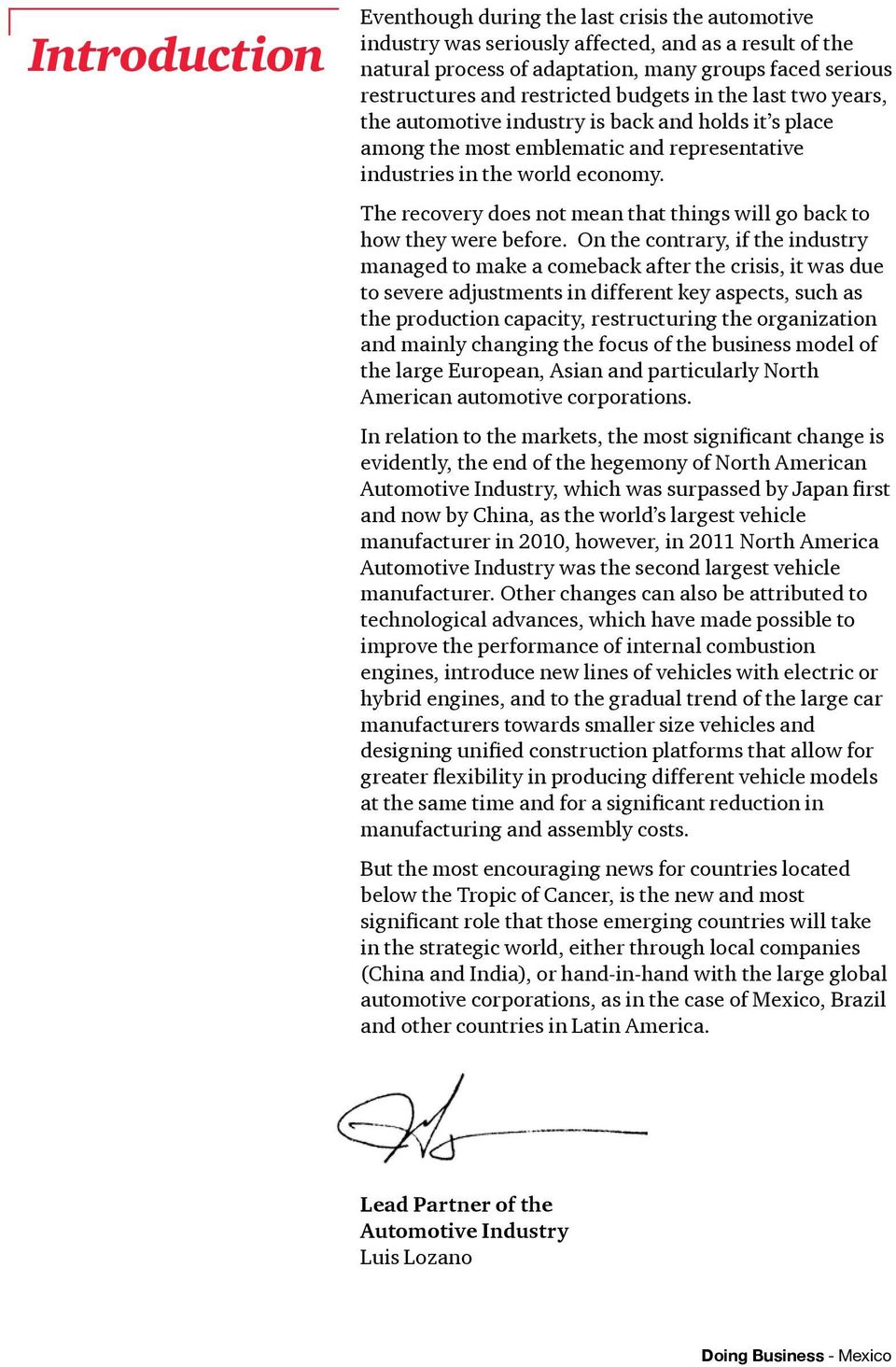
4 Automotive vocation The recent evolution of the Mexican Automotive Industry (MAI), its rapid recovery from the effects of the crisis, its exports, the permanent flow of investments and the expansion of its production capacity are all more than sufficient arguments to prove that, like those of China, India, Korea and Brazil, the MAI is currently among the most dynamic and competitive in the world. Worldwide, the MAI is in 8th place, with 2.68 million units produced in 2011 (see table 1.1), and in 8th place in exports, with a total of 2.14 million vehicles exported (see tables 1.2a and 1.2b). Main car-producing countries in the world Table China 22.35% China 23.53% China 22.99% 2 Japan 12.86% Japan 12.40% United States 10.80% 3 United States 9.29% United States 10.00% Japan 10.48% 4 Germany 8.44% Germany 7.61% Germany 7.87% 5 South Korea 5.69% South Korea 5.50% South Korea 5.81% 6 Brazil 5.16% Brazil 4.70% India 4.91% 7 India 4.28% India 4.56% Brazil 4.25% 8 Spain 3.52% Spain 3.08% Mexico 3.34% 9 France 3.32% Mexico 3.02% Spain 2.93% 10 Mexico 2.53% France 2.87% France 2.86% Countries maintained in top ten positions Countries that have improved its position within the top ten Countries that have decreased its position within the top ten Source: OICA (Organisation Internationale des Constructeurs d'automobiles) The Automotive Industry - PwC Mexico
5 Truck and car exports Table 1.2a Truck and car exports Table 1.2b (thousands of units) 1,537 1,613 1,661 1,859 2, % 1,094 1,186 1, % 15.31% 8.41% 4.98% 2.98% % Source: Mexican Association of the Automotive Industry, (AMIA, AC. by its acronyms in Spanish) Monthly Bulletin (several years). The importance of the MAI for the Mexican economy is beyond question. It accounts for 3.6% of the gross national product (GNP) and 20.3% of the GNP of the manufacturing industry (see tables 1.3a and 1.3b), aside is the principal generator of foreign currency (see table 1.4). GNP Participation in manufacturing sub-sector of transport equipment ¹ 3.5% 3.1% 3.1% 3.0% 2.9% 2.9% 3.0% 2.7% 2.8% 2.8% Table 1.3a 3.6% 3.2% 2.5% 2.4% 2.0% 1.5% 1.0% 0.5% 0.0% Source: INEGI. Mexican National Accounts System. ¹2003 prices. 2 Third quarter. Automotive industry participation in manufacturing industry GNP¹ 20.0% Table 1.3b 20.3% 18.2% 16.0% 15.8% 15.8% 15.3% 15.6% 15.8% 17.0% 17.3% 17.5% 14.3% 12.0% 8.0% 4.0% 0.0% Source: INEGI. Mexican National Accounts System ¹2003 prices. 2 Third quarter. Doing Business - México

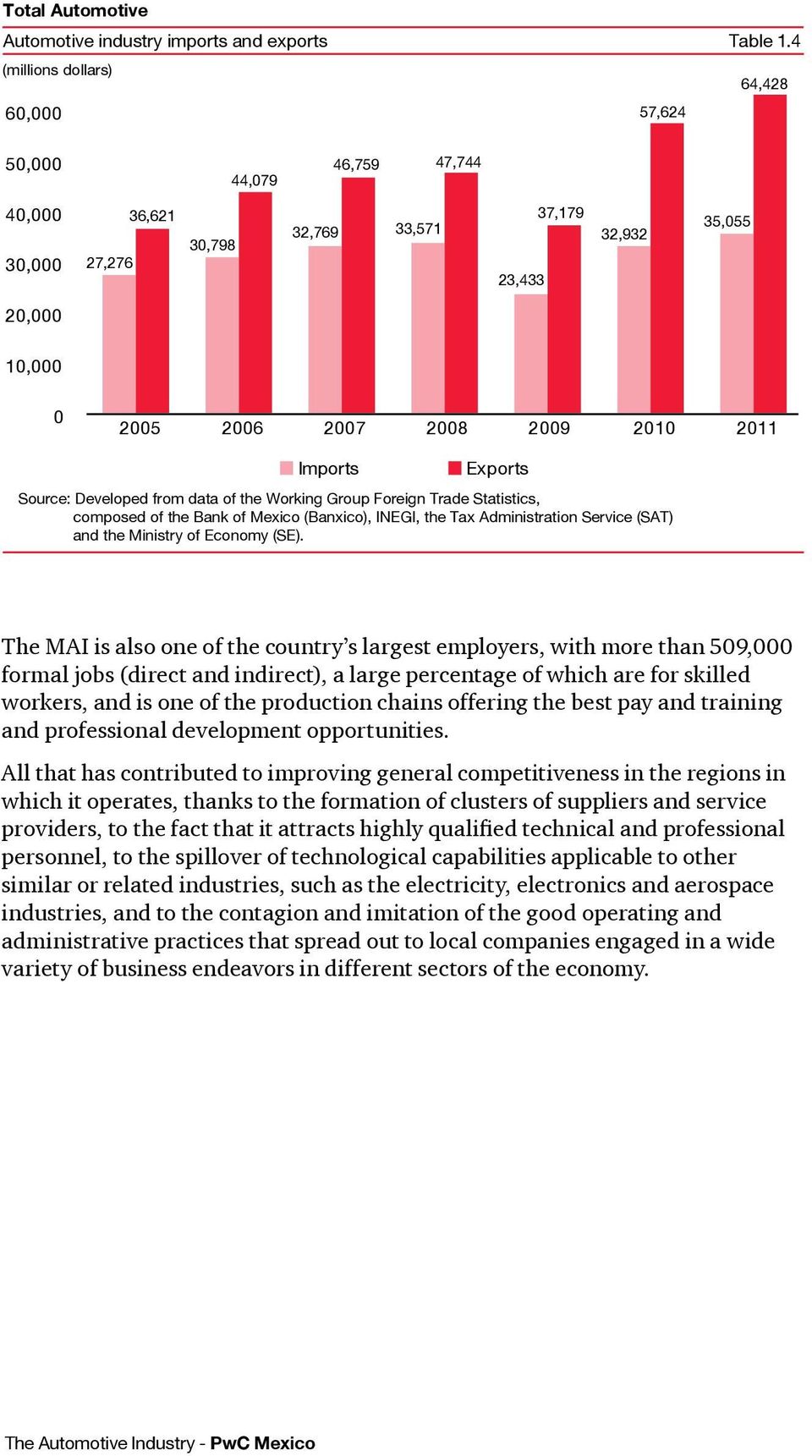
6 Total Automotive Automotive industry imports and exports (millions dollars) 60,000 57,624 Table ,428 50,000 44,079 46,759 47,744 40,000 30,000 27,276 36,621 30,798 32,769 33,571 23,433 37,179 32,932 35,055 20,000 10, Imports Exports Source: Developed from data of the Working Group Foreign Trade Statistics, composed of the Bank of Mexico (Banxico), INEGI, the Tax Administration Service (SAT) and the Ministry of Economy (SE). The MAI is also one of the country s largest employers, with more than 509,000 formal jobs (direct and indirect), a large percentage of which are for skilled workers, and is one of the production chains offering the best pay and training and professional development opportunities. All that has contributed to improving general competitiveness in the regions in which it operates, thanks to the formation of clusters of suppliers and service providers, to the fact that it attracts highly qualified technical and professional personnel, to the spillover of technological capabilities applicable to other similar or related industries, such as the electricity, electronics and aerospace industries, and to the contagion and imitation of the good operating and administrative practices that spread out to local companies engaged in a wide variety of business endeavors in different sectors of the economy. The Automotive Industry - PwC Mexico
7 Beyond costs Mexico s manufacturing vocation is solidly established, not only because of the low operating costs resulting from its geographical location, the salary levels and the advantages of the North American Free Trade Agreement (NAFTA), but also because of its long industrial tradition and the quality of the work done by skillful and ingenious people. The foregoing can be said for all areas of the economy, but it particularly applies to the automotive and auto parts industry. Those branches, which comprise the second most important value chain in the country, are made up of dozens of intermediate and terminal manufacturing plants operating at the highest quality and productivity levels in the world, which have been awarded numerous prizes, including the prestigious Shingo Prize, which is the equivalent of the Nobel Prize for manufacturers. Proven competitivity How has the MAI sustained two digit growths in exports over the last ten years, reaching 2.14 million vehicles in 2011? During the time it took us to research and prepare this report, we asked the presidents and general directors of some of those companies that same question, and the reply has been the same in all cases: By offering consumers the best quality/price ratio. For many years now, manufacturing quality has been the outstanding feature of vehicles manufactured in Mexico. They are exported to the most demanding markets in the world, such as the US, Germany and even Japan, where Mexican plants have been held up as examples of quality and commitment to constant improvement. Among the most important factors for global automotive manufacturers when deciding on their investment strategies, location and geographical positioning, has been plant quality and Mexican labor. As proof of the foregoing, over the last five years, the majority of the companies manufacturing automotive and commercial vehicles in Mexico and a significant number of companies producing automotive equipment, parts and components have made massive investments for the expansion of their production capacity and for outfitting, modernizing and automating their plants. Doing Business - Mexico
8 Promising future Aside from Mexico s competitive advantage in terms of skilled labor, product quality and industrial processes, geographical positioning and preferential access to other markets as a result of a number of free-trade agreements, the MAI offers other advantages as well as an ample base of top-level local and multinational suppliers, spread out in 13 large specialized clusters in the North, Central and Bajio areas, including more than 20 public and private technological and design centers at which most automotive and commercial vehicle manufacturers have made headway in achieving value added processes and services. With those competitive capacities and advantages, plus the processes for restructuring the automotive industry at the worldwide level, and the great opportunity offered by the development of the internal market, the MAI has a high potential for growth and for generating high-quality jobs. Furthermore, Mexico can improve its competitiveness as a platform for the production and exportation of light and commercial vehicles, as well as auto parts, advanced and technological components and value-added services. The Automotive Industry - PwC Mexico
9 Contents Outlook for the Mexican Automotive Industry Terminal (MAIT) 1 Fenix industries 1 A question of focus 3 Export growth 3 The MAIT places its bets on diversification 5 Making things happen 6 Fighting bottlenecks 6 The government turns on the lights 7 Horsepower 7 Structure, market power and competitiveness within the MAIT 9 A competitive market 10 Intelligence and added value 12 MAIT competitiveness 20 (Strengths, Opportunities, Weaknesses and Threats) 20 Principal legislation applicable to the automotive industry 23 Legal Provisions 23 Tax Obligations 27 Income tax - IT 28 Tax incentives 31 Promotion of the national economical development (Promexico) tax amendments 34 Flat Tax 35 Foreign trade 39 Bonded Warehouse 42 Import duty drawback 42 Conclusions 43 Lead Partner of the Automotive Industry 45 Contact our team 46 Doing Business - Mexico

10

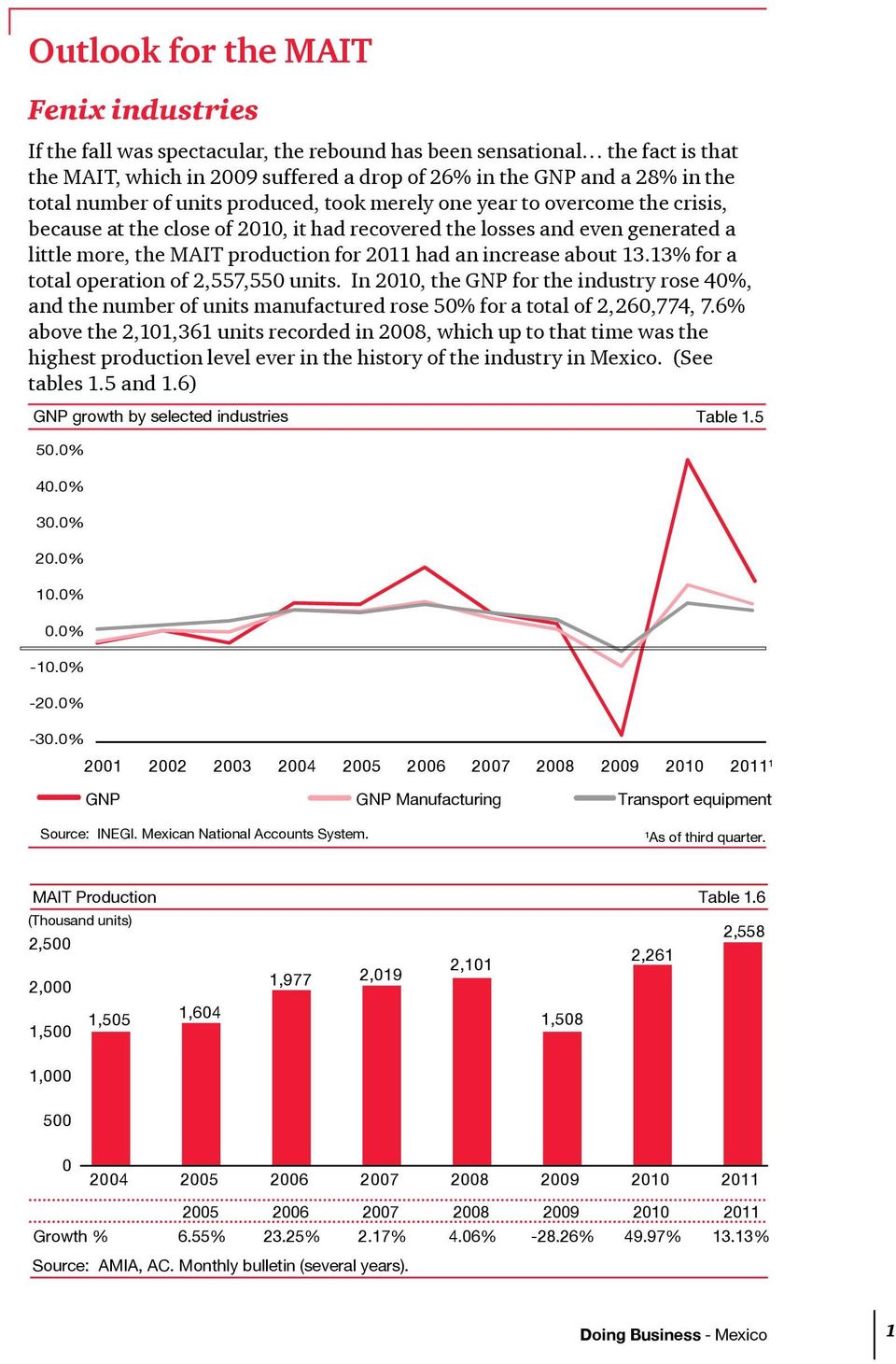
11 Outlook for the MAIT Fenix industries If the fall was spectacular, the rebound has been sensational the fact is that the MAIT, which in 2009 suffered a drop of 26% in the GNP and a 28% in the total number of units produced, took merely one year to overcome the crisis, because at the close of 2010, it had recovered the losses and even generated a little more, the MAIT production for 2011 had an increase about 13.13% for a total operation of 2,557,550 units. In 2010, the GNP for the industry rose 40%, and the number of units manufactured rose 50% for a total of 2,260,774, 7.6% above the 2,101,361 units recorded in 2008, which up to that time was the highest production level ever in the history of the industry in Mexico. (See tables 1.5 and 1.6) GNP growth by selected industries Table % 40.0% 30.0% 20.0% 10.0% 0.0% -10.0% -20.0% -30.0% GNP GNP Manufacturing Transport equipment Source: INEGI. Mexican National Accounts System. ¹As of third quarter. MAIT Production (Thousand units) 2,500 2,000 1,977 2,019 2,101 2,261 Table 1.6 2,558 1,500 1,505 1,604 1,508 1, Growth % 6.55% 23.25% 2.17% 4.06% % 49.97% Source: AMIA, AC. Monthly bulletin (several years) % Doing Business - Mexico 1
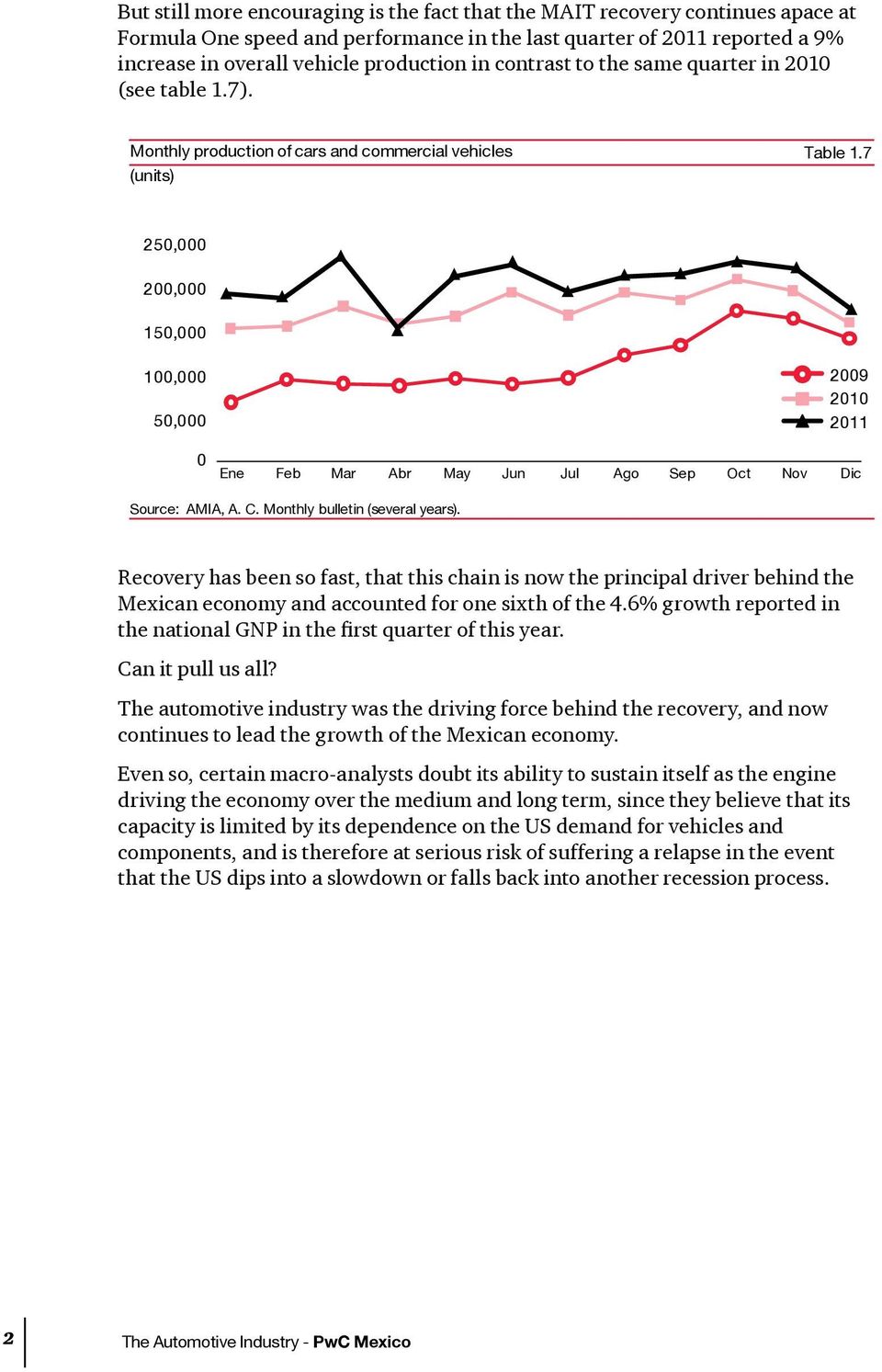
12 But still more encouraging is the fact that the MAIT recovery continues apace at Formula One speed and performance in the last quarter of 2011 reported a 9% increase in overall vehicle production in contrast to the same quarter in 2010 (see table 1.7). Monthly production of cars and commercial vehicles (units) Table , , , ,000 50, Ene Feb Mar Abr May Jun Jul Ago Sep Oct Nov Dic Source: AMIA, A. C. Monthly bulletin (several years). Recovery has been so fast, that this chain is now the principal driver behind the Mexican economy and accounted for one sixth of the 4.6% growth reported in the national GNP in the first quarter of this year. Can it pull us all? The automotive industry was the driving force behind the recovery, and now continues to lead the growth of the Mexican economy. Even so, certain macro-analysts doubt its ability to sustain itself as the engine driving the economy over the medium and long term, since they believe that its capacity is limited by its dependence on the US demand for vehicles and components, and is therefore at serious risk of suffering a relapse in the event that the US dips into a slowdown or falls back into another recession process. 2 The Automotive Industry - PwC Mexico
13 A question of focus There is logic behind the argument, which reminds us that it is not yet time to start celebrating. However, a close look at recent performance and trends shows that the MAIT is going through a stage of restructuring and very significant changes in global business models and portfolios, which leads us to respond excitedly to the reserved optimism shown by the CEOs of the large Mexican automotive manufacturers. The first factor behind that optimism has to do with the vocation and competitiveness of the Mexican automotive clusters within which many of the large global firms operate. It is precisely that competitiveness, which has made Mexico one of the most vigorous exportation platforms in the world, that led the three great US car manufacturers (and a few Asian and European as well) to assign Mexico a much larger role in their global and regional business strategies. It is not a secret that over the last few years, the three greats have accelerated the relocation of US production plants to Mexico and invested copious amounts to build new plants and expand existing facilities; they have also chosen their Mexican operations as the most suitable manufacturing platform for the production and exportation of some of the new and most important product lines. Export growth The favorable expectations of the MAIT are bolstered by the fact that at the close of 2011, the exportation of light vehicles to the US and Canada were 6.7% over export sales recorded in 2010, while the increase in total vehicle sales in those markets was only 10.2% in the same period (see table 1.8a and 18.b). Another more concrete fact is the 31.9% to 32.5% increase in market share vehicles of total vehicles imported into the US and Canada, and what is even more, the fact that those 0.60 percentage points were won over from the market share of Spain, France and Brazil, between others. The growth of Mexican exports to the NAFTA markets was so significant, that it alone explains in 2011 the 45.8% growth in US and Canadian imports and the 7.2% increase in total sales of light vehicles recorded in those two countries (see table 1.8b). Doing Business - Mexico 3

14 Import and sales of light vehicles in US and Canadian markets Country source of vehicles Germany Japan Korea Mexico Others Total imports Vehicles manufactured in US and Canada Total market of US and Canada Source: Ward s Automotive Reports (units)* 569,426 1,399, ,626 1,277, ,096 4,024,045 7,530,531 11,554, (units)* 634,394 1,421, ,380 1,362, ,713 4,194,693 8,539,663 12,734,356 (%) 11.4% 2.4% -5.3% 6.7% 15.1% 4.4% 13.3% 10.2% Table 1.8a Difference (units) 64,968 33,020-29,536 85,241 32, ,309 1,004,529 1,179,838 * Cumulative figure from January to December Import and sales of light vehicles in US and Canadian markets Participation % in total market of light vehicles Country source of vehicles Germany Japan Korea Mexico Others Total imports Vehicles manufactured in US and Canada Total market of US and Canada % 12.0% 4.8% 11.1% 1.9% 34.7% 65.3% 100.0% % 11.2% 4.1% 10.7% 2.0% 32.9% 67.1% 100.0% Table 1.8b ¹ 5.5% 2.8% -2.5% 7.2% 2.8% 15.8% 84.2% 100.0% Country source of vehicles Germany Japan Korea Mexico Others Total imports Participation % on light vehicle imports % 34.6% 13.9% 31.9% 5.4% 100.0% % 33.9% 12.6% 32.5% 5.9% 100.0% ² 34.9% 17.7% -15.9% 45.8% 17.5% 100.0% *Participation % from January to December periods each year ¹Contribution to the growth of light vehicle sales in USA and Canadian markets" ²Contribution to the growth of light vehicle imports Source: Ward s Automotive Reports. 4 The Automotive Industry - PwC Mexico

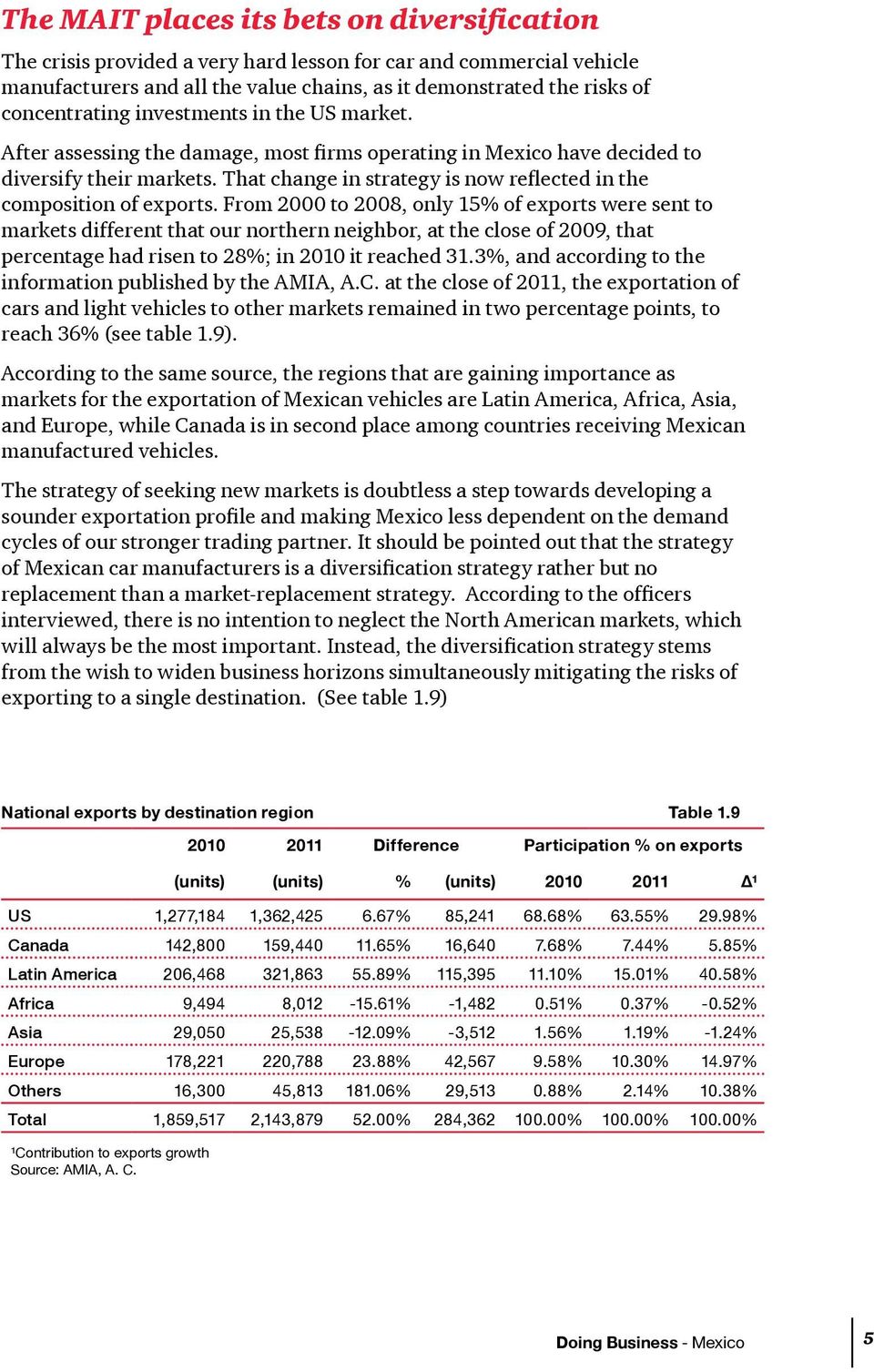
15 The MAIT places its bets on diversification The crisis provided a very hard lesson for car and commercial vehicle manufacturers and all the value chains, as it demonstrated the risks of concentrating investments in the US market. After assessing the damage, most firms operating in Mexico have decided to diversify their markets. That change in strategy is now reflected in the composition of exports. From 2000 to 2008, only 15% of exports were sent to markets different that our northern neighbor, at the close of 2009, that percentage had risen to 28%; in 2010 it reached 31.3%, and according to the information published by the AMIA, A.C. at the close of 2011, the exportation of cars and light vehicles to other markets remained in two percentage points, to reach 36% (see table 1.9). According to the same source, the regions that are gaining importance as markets for the exportation of Mexican vehicles are Latin America, Africa, Asia, and Europe, while Canada is in second place among countries receiving Mexican manufactured vehicles. The strategy of seeking new markets is doubtless a step towards developing a sounder exportation profile and making Mexico less dependent on the demand cycles of our stronger trading partner. It should be pointed out that the strategy of Mexican car manufacturers is a diversification strategy rather but no replacement than a market-replacement strategy. According to the officers interviewed, there is no intention to neglect the North American markets, which will always be the most important. Instead, the diversification strategy stems from the wish to widen business horizons simultaneously mitigating the risks of exporting to a single destination. (See table 1.9) National exports by destination region Table Difference Participation % on exports (units) (units) % (units) ¹ US 1,277,184 1,362, % 85, % 63.55% 29.98% Canada 142, , % 16, % 7.44% 5.85% Latin America 206, , % 115, % 15.01% 40.58% Africa 9,494 8, % -1, % 0.37% -0.52% Asia 29,050 25, % -3, % 1.19% -1.24% Europe 178, , % 42, % 10.30% 14.97% Others 16,300 45, % 29, % 2.14% 10.38% Total 1,859,517 2,143, % 284, % % % ¹Contribution to exports growth Source: AMIA, A. C. Doing Business - Mexico 5
16 Those statistics and the changes in the aforementioned business models weaken the pessimist viewpoint, and although US demand will most likely slow down when the US authorities decide to deal aggressively with their complicated macroeconomic imbalances, it is also true that the MAIT has and will probably continue to hold a greater market share. Furthermore, it is evident that the large US, European and Asian manufacturers operating in Mexico are not there only because of the NAFTA markets but are now aiming at markets in Latin America, Europe and Asia from the Mexican export platform. Therefore, when the US government decides to implement its exit strategy, the MAIT will have a more diversified business portfolio. Making things happen The segments within the MAI are being called upon to play a much more relevant role in the positioning strategies of the large global firms. Proof of that is to be found in their investments, both present and scheduled, the incorporation of new product lines, the sustained growth of regional clusters and the number of suppliers, the greater sophistication and value of the Mexican component in cars, and the greater number of design, engineering and research and development centers in Mexico. The description provided thus far is not intended to paint a rosy picture of guaranteed bonanza for the MAIT, but to point out its current and future potential over the medium and long-term, if all those involved (companies, workers, the government and consumers) manage to properly line up and balance their objectives and interests and make things happen. Fighting bottlenecks Actually, the greatest stumbling block faced by the MAIT is the weakness of internal markets, affected by the low average per capita income of the population and by a middle class that does not grow and is enmeshed in concern about the existing uncertainty and the effects of unemployment. Other bottlenecks could be: the lack of financing, not only for the purchase of automotives, but also to lubricate performance along the entire value chain; taxes such as the new automotive tax (ISAN by its acronyms in Spanish) and the tax on vehicles (Tenencia by its meaning in Spanish), and the limitation on income tax and flat tax deduction of 100% of investments up to $175 thousand pesos; disloyal competition in the form of the disorderly importation of used cars; the lack of security and the resulting impact on the cost of insurance policies; and even the rise in the price of gasoline. 6 The Automotive Industry - PwC Mexico

17 The government turns on the lights Now that the crisis is over, the Mexican government is more receptive to the needs of the industry and is beginning to take steps to encourage its growth and competitiveness. The most significant step taken is the elimination of the Tenencia in Also, the House of Representatives Special Commission for the Automotive Industry continues to work in a law for the Promotion of the Automotive Industry, which contemplates, among other things, the elimination of the ISAN and authorizes income tax and flat tax deduction of 100% of investments in new vehicles valued up to $400 thousand pesos. Horsepower In the race for global competitiveness, the MAI is at the ready, with engines running, and occupies a privileged and favorable position on the starting line. The machinery is good and competitive, and so are the drivers. All that s missing is for the entire value chain, the three levels of government, the medium and higher education institutions and the research centers to be fully aware of its needs so that they can provide the industry with the special equipment needed to do an efficient job in the pits. Nothing guarantees success but the conditions are in place to achieve it, and if we take advantage of those conditions, there is every likelihood that in the future, the strength of the Mexican economy will no longer be measured in percentage points for growth, but other indicators will have to be used, such as the acceleration capacity of horsepower. Doing Business - Mexico 7

18

19 Structure, market power and competitiveness within the MAIT The history of the MAIT began in 1925 with the installation of Ford s first assembly lines. General Motors arrived 10 years later, and in 1938 saw Automex (later Chrysler) started operations. In the 50s, the MAIT got a second wind with the entry of Volkswagen (1954), Nissan and Kenworth (1959). Third wind didn t come until the 80s, with the arrival of Honda (1985), followed by Scania (1992) and International (1996). The MAIT evolved through a number of stages, some of which were marked by the need to adapt to the regulatory environment and to the growth and development strategies followed by the Mexican government, such as industrialization and growth models involving substitution of imports ( ), the commercial opening and promotion of exports ( ) followed by a more in-depth opening to commerce and foreign investment under the NAFTA regulatory umbrella, but also via the vigorous influx of globalization and the technological revolutions that have transformed and connected the world over the last two decades. The MAIT has always been an important industry because of its capacity to generate well-paid jobs and the extent of its multiplying effect on the overall Mexican economy. However, its real takeoff, the rapid growth and increased sophistication that resulted in the current structure and size began with the negotiations leading up to the signature of the NAFTA and the growing influence of globalization trends within the world economy. Over the last 25 years, Mexico has gone from a closed and not very competitive economy to one of the largest and most dynamic export platforms in the world, hand in hand with the automotive industry and the electric and electronic equipment industries, among others. Doing Business - Mexico 9
20 A competitive market The MAIT markets in Mexico are quite open to international competition and there are no monopoly or oligopoly structures that can distort or exert significant influence on price setting processes for sales on those markets. Eighteen of the world s most important light and heavy vehicle manufacturers have manufacturing and assembly plants in Mexico, which usually also handle foundry, production and stamping of body parts and engines. Most production centers are fully prepared to meet internal demand and export to the much sought-after North American markets. (See map of plants and heavy trucks) Eight of those corporations compete principally in the automotive and light vehicle markets (vans, pick-ups and small buses), offering approximately 50 different models, while the remaining 10, with the exception of Volkswagen, produce mainly heavy trucks and tractor trucks. See map of plants and employees of light vehicles) Geographical distribution of plants and employees of light vehicles Tijuana Plant Employees: 689 Hermosillo Plant Employees: 1,430 Ramos Arizpe Plant Employees: 1,500 Chihuahua Plant Employees: 3,382 Ramos Arizpe Plant Employees: 2,400 Saltillo Plant Employees: 4,027 SLP Plant Employees: 1,986 Aguascalientes Plant Employees: 5,736 Puebla Plant Employees: 18,621 El Salto Plant Employees: 2,250 Silao Plant Employees: 5,152 Toluca Plant Employees: 1,695 Civac Plant Employees: 4,480 Toluca Plant Employees: 14, The Automotive Industry - PwC Mexico

21 Geographical distribution of plants and heavy trucks Kenworth - Mexicali Plant (Trucks and tractors) Daimler - Saltillo Plant* (Chassis, foreign buses, trucks and tractors) Navistar - Escobedo Plant (Chassis, foreign buses, trucks and tractors) Daimler - Garcia, NL Plant* (Chassis, foreign buses, trucks and tractors) Cummins - SLP Plant (Engines) Dina - Sahagun Plant (Chassis and trucks) Hino - Silao Plant (Trucks class 4,6 & 8) Man - Queretaro Plant (Foreign buses, trucks and tractors) Volvo - Queretaro Plant (Chassis, foreign buses, trucks and tractors) Daimler - Santiago Tianguistengo Plant* (Chassis, foreign buses, trucks and tractors) Puebla Plant (Chassis and trucks class 5) Scania - Tultitlan Plant* (Chassis, foreign buses, trucks and tractors) Isuzu - San Martin Tepetlixpan Plant (Chassis and trucks class 4 & 6) Doing Business - Mexico 11
22 Intelligence and added value For a number of years, most automotive corporations have been incorporating technologies and industrial operating models that are more and more sophisticated and efficient, as well as value added processes, which include: the design and development of technological solutions, equipment, specialized components and even some models of companies such as Ford, Nissan and Volkswagen which have been almost entirely designed in Mexico and are successfully positioned in the domestic and international markets. The good economic, operating and strategic results reported for these value added and research and development activities have encouraged automotive companies to invest in the creation of more technological centers and in putting together large engineering groups in Mexico. (See map of technological centers) This is of great importance, as it will allow the MAIT to complete the cycle of logistics, production, services, engineering and development required by the industry to exploit all its value-creating potential. The big challenge here will be developing the specialized human capital necessary to meet the growing demand of the industry. 12 The Automotive Industry - PwC Mexico
23 Geographical Center of Engineering and Design Modeling and Design Automotive Center Mexicali, BCN Engineering and Design Virtual Center Cuautitlán, Mex Technical Development and Part Design Center Puebla, Pue Test Center (laboratory analysis and emissions) Manzanillo, Col Test Center Cupuán, Mich Engineering and Design Center Toluca, Mex Regional Engineering Center Toluca, Mex Technology Development and Laboratory Emission Center Toluca, Mex Doing Business - Mexico 13
24 Who s who in the MAIT The MAIT comprises the manufacturing plants of 18 large global corporations, but brands such as Audi, Mazda, Seat, Mitsubishi, Suzuki, Peugeot, Mercedes Benz, Subaru, Volvo, Acura, Fiat, Smart and Isuzu also compete. Although the number of competitors is relatively large, the main roles are filled by Chrysler, Ford, General Motors, Nissan and Volkswagen. Together those companies account for 94% of overall production, 93% of exports and 76% of sales on the domestic market. Although certain dynamism has been lost in the domestic market in the last few years, that does not mean that competition is more relaxed. On the contrary, competition is intense for consumer preference in all product segments and it is unusual for any given company to show clear leadership in more than two product and market segments. Chrysler is in fifth place of the top five as concerning production (increase 8.76%, see table 1.11), exportation (increase 18.76%, see table 1.12) and sales on the domestic market (increase 3.20%, see table 1.13). Ford, the grand old man of the industry in Mexico, continues to recover from the restructuring of recent years, and is coming back sharply focused on exports. Its exports have increased over the last six years from 106,027 to 449,925 units in 2011, making it the second-largest exporter in the sector. (See table 1.12) General Motors is the largest manufacturer of light vehicles in Mexico, with overall production of 544,202 units at the close of 2011, and is also the largest exporter, placing 443,237 units in the US and Latin American markets in that year (see tables 1.11 and 1.12). Nissan has led the internal market since 2009 with a sales volume of 162,234 units (see tables 1.13 and 1.13a). Aside from remaining in the lead position in domestic sales with 223,465 units in 2011, Nissan has managed to increase its market share from 22% of total domestic sales in 2009 to 25% in On the other hand, Volkswagen maintains the Pole Position in the compact car segment, and in 2011 was in third place among manufacturers and exporters of automotives and light vehicles. As it was to be expected, the best performance in terms of growth were shown by companies and brands recently joining or rejoining the market, such as Volvo, Renault, Mazda, Isuzu and Land Rover. 14 The Automotive Industry - PwC Mexico
25 Total production of cars and trucks by company (units) Table 1.11 Growth% ¹ Total 1,603,759 1,976,645 2,019,447 2,101,361 1,507,527 2,260,776 2,557, % General Motors 425, , , , , , , % Nissan 349, , , , , , , % Volkswagen 300, , , , , , , % Ford 147, , , , , , , % Chrysler 343, , , , , , , % Honda 23,532 24,262 26,374 51,253 47,728 55,001 45, % Toyota 0 33,209 32,249 49,879 42,696 54,278 49, % Fiat ,903 na Renault 13,543 9,821 9,034 8,818 2, na Source: AMIA, AC. Monthly bulletin (several years). ¹ As of December Doing Business - Mexico 15
26 Cars and trucks exports by company (units) Table 1.12 Growth% ¹ Total 1,186,346 1,536,768 1,613,313 1,661,403 1,223,333 1,859,182 2,143, % General Motors 335, , , , , , , % Ford 106, , , , , , , % Volkswagen 239, , , , , , , % Nissan 156, , , , , , , % Chrysler 334, , , , , , , % Toyota 0 10,111 32,249 49,879 42,696 54,278 49, % Honda 14,499 15,107 15,755 34,037 36,829 41,121 36, % Fiat ,979 na Renault na Source: AMIA, AC. Monthly bulletin (several years). ¹ As of December 16 The Automotive Industry - PwC Mexico
27 Car and truck sales by company to dealers Table 1.13 Growth% Total 1,125,971 1,157,356 1,074,342 1,019, , , , % Nissan 236, , , , , , , % General Motors 243, , , , , , , % Volkswagen 145, , , , , , , % Ford 191, , , ,106 78,262 85,092 86, % Chrysler 122, , , ,666 77,775 78,061 80, % Toyota 38,174 58,244 75,736 61,186 45,268 49,945 47, % Honda 38,237 48,839 55,913 52,292 32,377 40,154 33, % Mazda 1,312 7,827 18,208 22,589 18,049 25,501 31, % Renault 23,433 20,175 17,772 14,884 10,414 19,486 23, % Seat 20,533 19,498 13,409 12,590 15,753 14,251 18, % Mitsubishi 15,373 16,992 16,841 17,380 13,645 12,876 10, % Suzuki 867 4,381 6,130 8,109 6,732 8,120 9, % Audi 3,911 4,451 4,796 5,452 4,559 5,416 8, % Mercedes Benz 7,504 6,222 7,791 7,443 5,166 6,258 7, % BMW 6,580 6,897 7,836 6,859 5,431 5,534 6, % Peugeot 16,966 15,474 13,023 8,871 6,818 6,113 5, % Mini 1,877 1,768 2,073 2,089 1,710 2,124 3, % Fiat 0 1,447 3,549 3,165 3,169 2,614 2, % Lincoln 4,378 5,384 4,953 4,288 1,777 2,723 1, % Acura 1,139 1,715 1,852 2,106 1,846 1,960 1, % Isuzu ,340 1, % Smart , % Volvo 3,678 2,708 2,690 1, ,262 1, % Land Rover , % Subaru , % Infinity n.d. n.d. n.d. n.d. n.d na Porsche % Alfa Romeo n.d. n.d. n.d. n.d. n.d na Jaguar % Bentley % Source: AMIA, AC. Monthly bulletin (several years). ¹ As of December Doing Business - Mexico 17
28 Companies' participation % on sale of cars and trucks to dealers Table 1.13b (units) Others* Mitsubishi Seat 6% Renault 2% 1% 3% 6% Mazda 3% 2% 2%2% 3% 6% 2% 1%2% 23% Honda 4% 22% 2% 5% 4% 25% Nissan Toyota 5% 6% 6% 2009 Chrysler 9% 9% 11% 18% % Ford 9% 10% 11% 14% 13% 19% General Motors 14% Volkswagen Source: AMIA, AC. Monthly bulletin (several years). *Includes the following companies (2011): Suzuki (0.90%), Audi (0.90%), Mercedes Benz (0.87%), BMW (0.77%), Peugeot (0.62%), Mini (0.36%), Fiat (0.33%), Lincoln (0.22%), Acura (0.20%), Isuzu (0.18%), Smart (0.17%), Volvo (0.14%), Land Rover (0.07%), Subaru (0.06%), Infinity (0.06%), Porsche (0.06%), Alfa Romeo (0.007%), Jaguar (0.005%) and Bentley (0.0008%). 18 The Automotive Industry - PwC Mexico
29 Weather forecasts The short-term horizon for the MAIT looks promising. Obviously, the growth rate for production, exports and sales recorded in 2010 will not be seen again for many years. However, if the Mexican and international economies manage to keep up the current growth rate, it would not be very far-fetched to expect two-digit growth for this year, for both production volumes and value added, proof of that is the information of 2011 that we shared. Furthermore, in the first quarter of 2011, the sale of new cars increased 16.2% in contrast to the same quarter in That marked improvement in sales could be the first sign of a rebirth in the internal market for cars and commercial vehicles. Medium and long-term growth expectations for the MAIT are good, but slightly less optimistic, since they depend on the performance of the US economy (which in 2011 occupied the second place as an auto motor producer in the world) and on the administration of Barack Obama (or whoever is elected as US president in 2012) deciding to make the macroeconomic adjustments required by that country s economy. Other factors that could threaten the future performance of the MAIT have to do with internal matters, such as insecurity, poor control of used-car imports, and the results of the 2012 elections and its effects on the Mexican business climate. In any case, the medium and long-term perspectives are good, and barring unexpected events, growth of the MAIT over the upcoming five years could easily be from 5% to 9%, always two or three points above growth of the overall Mexican GNP. Doing Business - Mexico 19
30 MAIT competitiveness (Strengths, Opportunities, Weaknesses and Threats) Strengths Installed capacity is ample and continues to grow as a result of the multiannual investment programs of the large multinational manufacturers operating in Mexico. There are 13 large clusters of suppliers and services for the terminal automotive industry, distributed through the central and northern portions of the country. Those clusters have a significant base of local and international suppliers with long experience in the manufacture of parts, components, original equipment and spare parts. Skilled labor at relatively lower cost. High-tech production lines with the flexibility necessary for simultaneous assembly of different models. World-class manufacturing systems operating with quality standards exceeding those of competitors in Latin America and in Asian countries such as China and India. A growing number of technological and engineering centers with the capacity to render value added service to the large manufacturers and auto parts suppliers. Exporting experience and the advantages of the commercial treaties signed with the US and Canada, the European Union, Japan and certain countries in Central and South America. The very advantageous geographic location favoring exports to North American markets, with considerable savings as concerns time and transportation costs. Development, production and distribution with a lower environmental impact. 20 The Automotive Industry - PwC Mexico
31 Opportunities Diversify export destinations in order to reduce the dependence on North American markets. Improve quality and service costs of distributors and distribution channels. Control the entry of used cars. Issue an official standard regulating pollution levels in an effort to reduce the existing environmental impact and the entry of jalopies, which compete with the established industry. Detect new market niches throughout the sector value chain, from auto parts companies to automotive and transportation equipment insurers. Increase local and regional integration and value added percentages. Bring down or eliminate redundant operations. Search out improvements or benefits through strategic alliances or mergers. Improve or increase the availability of specialized engineers and professionals by means of programs that will attract more high-level students to the professional disciplines pertaining to the automotive industry. Do away with the ISAN and the Tenencia. Eradicate or significantly reduce all types of vehicle theft. Weaknesses Their precarious financial position of certain manufacturers. Very large operating structures with significant direct costs. The rising weakness in the internal market over the last two years. The limited availability of domestic supplies of certain auto parts and specialized components. The limited availability of high-level specialized engineers coming out of public or private Mexican universities. Labor legislation out of step with current needs and with the new international trends and strategies used in managing human resources. Doing Business - Mexico 21
32 Threats The drop in the demand for cars and transportation equipment in the US. The persisting weakness in internal consumption. Protectionist trends and the indiscriminate use of non-tariff barriers in certain Latin American markets. Competition benefiting other nations in the form of subsidies and dumping practices. Insufficient effect of federal government promotion programs on car sales. The progressive and indiscriminate importation of used cars. Negative effects on consumer preferences resulting from the activities of organized crime. 22 The Automotive Industry - PwC Mexico
33 Principal legislation applicable to the automotive industry Legal Provisions Foreign Investment In Mexico, the legal framework that regulates investment by non-mexican individuals or entities is the Foreign Investment Law (FIL), whose purpose is to establish and regulate the activities in which those individuals or entities are allowed to participate, assigning percentages, limits, restrictions or conditions for percentages of participation. The FIL specifies activities reserved exclusively for the Mexican State, those reserved for Mexican entities and individuals and those in which foreign investment is unrestricted or is limited to certain percentages of participation. In the case of certain restricted activities, the FIL considers exceptions, which are ultimately subject to a resolution issued by the regulating authority, that in this matter is the Ministry of Economy. There are also cases in which foreign investment participation is limited, those limits cannot be exceeded directly, or through trusts, agreements, social or statutory agreements, corporate restructuring, or any other means that provides control or a participation that exceeds what is established in the FIL, except for the case of foreign investment in the capital stock of authorized Mexican companies or trusts. According to the FIL, the companies should stipulate that foreign partners will be considered as Mexicans regarding their shares, partnership interests or rights acquired there under and regarding goods, rights, obligations, concessions, participations or interest of the holders, and therefore they agree not to appeal to the protection of their governments. Otherwise, they must add an exclusion clause clearly stating that the company will not allow foreign investment in its capital stock. In the particular case of the automotive sector, until 1999, companies dedicated to manufacture and assembly of parts, equipment and accessories for this industry, could have a participation of 49% of foreign investment, however, from that year, the FIL was amended to allow 100% participation of foreign investment without the need to secure any kind of permit or favorable resolution from the Mexican authorities. Nevertheless the increased openness to foreign investment in the sector, companies are required to report to the authorities their financial situation and the changes in their shareholding structure, their capital stock and their management (Board of Directors). Doing Business - Mexico 23
34 Investment in the Mexican Market The automotive industry is one of the most important and productive value chains in the Mexican economy and although it has suffered the impact of the worldwide economic crisis over the last few years, since 2010 its recovery has been truly remarkable. We, at PwC, realize that it is one of the industries with the greatest growth potential in our country, however, special attention should be paid to the following points and recommendations, to take full advantage of business opportunities offered by this sector and minimize the risks arising from the current regional and worldwide economic situation. Following is a brief list of the principal means for investing in the Mexican market and we will attempt to respond the most frequently asked questions by investors interested in investing in the automotive industry. Incorporating a new company The most frequent way of investing in the Mexican market is incorporating a new company. In our experience, we have noticed that foreign investment in Mexico usually participates through a Stock Corporation (S.A.); or a Limited Liability Company (S. de R.L. 1 ). 1 For its acronyms in Spanish 24 The Automotive Industry - PwC Mexico
35 The principal differences between those two types of organizations are the following: Stock Corporation (S.A.) The liability of the shareholders is limited to the payment of their shares. There must be a minimum of two shareholders. The maximum is unlimited. Shareholders may hold more than one share. Different series and shares may be created. Company management must be in the charge of a Sole Administrator or a Board of Directors. They may or may not be stockholders, and are temporary designated. Limited Liability Company (S. de R.L. de C.V.) The partners are only required to pay their contributions. There must be a minimum of two partners. The maximum is 50. No partner may hold more than one partnership interest, unless different rights and obligations are specified. Company management must be in the charge of a manager or Board of Managers, who may be partners or third parties, temporary designated or for an undetermined period. The supreme organ of the company is the Shareholders Meeting. Shareholders Meetings may be held at the company s domicile, and may be general or special. Resolutions must be based on the majority established in the bylaws or in the General Corporation and Partnership Law. The supreme organ of the company is the Partners Meeting. Meetings may be held at the company s domicile. Resolutions must be based on majority votes of partners representing at least 50% of the capital stock. Common rules These companies may be of the Variable Capital type, and may increase or reduce their capital, as resolved at a Shareholders or Partners Meeting. Considerations It is important to consider that the S. de R.L. de C.V. cannot quote on the stock exchange. If a S. de R.L. de C.V. looks forward to be positioned in the stock market, it may carry out a transformation to become an S.A.. Likewise, a S.A. may become an Investment Promotion Corporation, ( S.A.P.I. 1 ) The legal framework for a S.A.P.I. is contained in the Stock Market Law (SML), which provides benefits and exceptions to the rules established for stock corporations in the General Corporation and Partnership Law (GCPL) with a view to attract risk capital investors. Some of the advantages of the S.A.P.I. regime are: 1. The shareholders may stipulate in the bylaws restrictions for shares transfers; establish the basis for excluding shareholders or for allowing them to withdraw. 2. S.A.P.I.s don t need to register or to be supervised by the National Banking and Securities Commission (NBSC). 3. S.A.P.I. bylaws allow the issuance of several series of shares with different rights and obligations, in order to attract private and risk capital. 4. The minority rights specified in the GCPL may be exercised with lower percentages. 5. The option to apply better corporate governance practices. S.A.P.I.s may acquire their own shares, and are not subject to the prohibition established in the GCPL. They are not required to publish their financial statements. Their management is in charge of a Board of Directors. The company has two options: (a) to adopt the management regime of a S.A. or (b) to adopt the management regime of a Company Stock or (S.A.B. 1 ) S.A.P.I can operate under this regimen or transform to become a Stock Investment Promotion Corporation, (S.A.P.I.B. 1 ). S.A.P.I.B.s are a transition in order to access to the Mexican Stock Market. Once a S.A.P.I. adopts the S.A.P.I.B. regime, it may list on the stock-market and adopt the S.A.B. regime within three years following the change. S.A.B.s are companies quoted on the stock market, and are therefore public to the business and investing community. S.A.B.s are subject to NBSC supervision. S.A.B. s management is in charge of a Board of Directors and a General Director. They are also subject to corporate governance rules. 1 For its acronyms in Spanish Doing Business - Mexico 25
36 Mergers and acquisitions Another way of investing is by means of a merger or acquisition of another company. This can be done by three principal mechanisms: a. By purchasing the shares or partnership interest of an existing company. b. By purchasing the assets of an existing company. c. By merging two or more companies to create a new one, including the assets and liabilities of such companies. Strategic alliances A third option for investing in Mexico is to sign a contract with a company already established in Mexico. That way, a foreign individual or entity may use the infrastructure and/or rights previously acquired by its commercial allies. Compliance with legislation We should always take into account, that regardless of the way in which it is decided to invest, parties operating in this industry must comply with all applicable laws, before operations begin, and during business development. Primarily be taken into account, economic competition, environment, tax, labor and administrative rules, as well as obtaining licenses, permits and/or authorizations required for the proper operation. 26 The Automotive Industry - PwC Mexico
37 Tax Obligations Corporate taxpayers in Mexico are required to: File, no later than March of the following year, an annual tax return 1 showing the result or taxable profit for the period and the basis for Employees Statutory Profit Sharing (PTU). File, no later than February, a number of informative returns reporting on specific points such as wages and salaries, taxes withholding, payments made to foreign residents, uncollectible accounts, donations made, tax withheld from third parties, etc. Prepare a statement of financial position and conduct an inventory count of stock at the year-end closing. In cases where income subject to income tax exceeds $34.8 million Mexican pesos and the value of its assets in the terms of the Income Tax Law (ITL) is above $69.6 million Mexican pesos or more than 300 of its personnel have rendered services in each of the months of the preceding period, its financial statements must be audited for tax purposes by an authorized public accountant. As part of the administrative facilities granted by the Mexican tax authorities, taxpayers may opt to provide certain information directly to the tax authorities rather than having their financial statements audited for tax purposes 2. An authorized public accountant must issue a report on compliance with Social Security and Workers Housing Fund obligations, when certain assumptions apply. Have an authorized public accountant report issued on compliance with local tax obligations, i.e. the average number of employees, the cadastral value of real property or bi-yearly water consumption. Have a transfer pricing study made to demonstrate that operations with local and foreign related parties were conducted at fair market value. Companies engaging in foreign trade must submit certain specific information to the Department of the Economy. Certain additional tax obligations must be complied with, depending on the operations conducted by each company. Those operations must therefore be analyzed separately. 1 Annual flat tax return also filed, and a report is issued on value added tax (VAT) for each of the months in the year. 2 However, the following advantages are lost if the tax report is not filed: Sequential review by tax authorities and early conclusion of in-house visits. Amended return resulting from the tax report (not included for the purpose of the limit). Spontaneous compliance (10 days). Reduction in the term for refunding favorable balances (from 40 to 25 days). Refund with a statement issued by the public accountant. The option to request certificates in the name of third parties; to microfilm or record the accounting on optic discs; to make monthly provisional or definitive payments; to request strip stamps or labels in advance. Releasing the Legal Representative from joint liability when that person is no longer a tax resident of Mexico (in liquidations). The authorization to use own equipment to record operations with the general public. Doing Business - Mexico 27
38 Income tax - IT IT is payable in Mexico by parties resident in the country (on all income received in the period) and by parties resident abroad with a permanent establishment in Mexico or parties receiving income from a source of wealth located in Mexico. In general terms, IT is calculated by applying the 30% rate to the tax result for the period 1. The tax result is determined by subtracting authorized deductions (such as cost of sales, investments in fixed assets and financial costs and expenses) from taxable revenue for the period, then subtracting PTU paid. Unamortized tax losses 2 not amortized in preceding periods are subtracted from the tax profit, when applicable. The Mexican tax system is very strict when compliance with obligations such as filing informative returns and issuing invoices is required in order to be entitled to apply authorized deductions. Special care should therefore be taken to ensure the tax compliance. Additionally, as from January 1, 2011, digital tax documentation (particularly invoices) must be issued. Certain advantages The after-tax earnings account (CUFIN) The ITL requires entities to keep a CUFIN to have the track of its profits on which tax has been paid. Dividends paid from that account are not subject to income tax. The capital contributions account (CUCA) Companies are required to keep an account called the CUCA to record capital contributions, which should not give rise to income tax when reduced, reimbursed or amortized. It should be remembered that it is necessary to apply controls, keep records and ensure that there is documentation supporting the CUCA and the CUFIN, such as annual tax returns and tax reports, which must be kept throughout the lifetime of the company. Tax losses The ITL explains the treatment applicable to a company s tax losses, when, in the period, deductions declared exceed income. Those losses can be subtracted from tax profits in a ten year carry forward, until they are exhausted. 1 The applicable rate for 2013 will be 29% 2 It result when taxable income is less than the authorized deductions and PTU 28 The Automotive Industry - PwC Mexico
39 Reduction of provisional tax payments Taxpayers are required to make provisional income tax payments on account of annual income tax, based on a profit factor determined on tax figures for the preceding period. When that profit factor is considered to exceed the factor actually corresponding to those payments, the tax authorities can be requested to authorize a reduction in said payments as from the second half of the period. Maquiladora industry The maquiladora industry is born from the need to reduce operating costs of large transnational corporations, through cheap labor. In Mexico, the industry is a creative source of jobs, so the building on the premises of this industry has proliferated since the 60s. In fact, it started in 1965, and its history of international outsourcing (maquila process) through the so-called Border Industrialization Program, which aimed to solve the same problem of unemployment in the north border of our country, and reduce the flow of migrants to United States of America. Later analysis is presented regarding current foreign trade programs Mexican authorities which provide. In relation to the above and to support companies in the maquiladora industry, many of which are involved in the automotive industry, were given a benefit with the income tax through the Decree granting various benefits in Relation to Income Tax for Foreign Residents Related Companies Assembly published on October 30, 2003, which exempts from corporate income tax substantially. In general terms, the income tax of the payment exemption year will be obtained through the following calculation: a) The fee is 6.9% of the total value of assets used in jobbing, b) Multiplying the rate of 6.5% of total costs and expenses for the operation, c) The taxable income which is greater under the preceding paragraphs, shall be deducted with an amount which results from applying the rate of 3% on the same basis as the preceding paragraphs, d) To the reduced tax income under the preceding bullet, a corporate income tax rate (30% by 2011) will be applied and this is the amount to be exempted from income tax payment to the companies in the maquiladora industry. There are several requirements that must be completed, especially in foreign trade, so we must be attentive to comply with them in due time and form. Doing Business - Mexico 29
40 The tax consolidation regime An interesting item that can be used to streamline a company s tax burden and defer payment of income tax is the tax consolidation regime, the principal advantages of which are: Immediate application of the tax losses of the controlling and the controlled companies in the period in which they arise, against the tax profits of the other companies of the same group. Deferral, over a period of five years, of income tax on dividends not arising from the CUFIN, paid among the companies of the consolidating group. The figures of the controlled companies are immediately added to the CUFIN and the tax cost of the shares of the controlling company. Strengthening of the group, reflecting its importance in the country and in the eyes of the community in Mexico. International treaties Mexico has signed a number of international treaties for the avoidance of double taxation with numerous countries, including the following: Argentina Finland Luxembourg Spain Australia France New Zealand Sweden Austria Germany Norway Switzerland Bahrain Greece Panama The Czech Republic Barbados Iceland Poland The Netherlands Belgium India Portugal The UK Brazil Indonesia Romania The US Canada Ireland Russia Ukraine Chile Israel Singapore Uruguay China Italy Slovakia Denmark Japan South Africa Ecuador Lithuania South Korea 30 The Automotive Industry - PwC Mexico
41 Tax incentives Immediate deduction of new fixed assets New fixed assets may be immediately deducted in the period in which the investment is made or the assets are first used, or in the following period. For that purpose, the ITL establishes the deduction of investments in new fixed assets on the basis of an annual deduction rate, depends on the type of assets in question. This could represent a financial advantage, when goods are immediately deducted at a discount rate below the interest rate that would have to be paid on financing from third parties. In general terms, the discount rate specified in the ITL is 3%, and the percentage specified in the decree published on June 20, 2003 is 6%. Therefore, application would have to be analyzed. It should be pointed out that certain requirements must be complied with in each particular case. Additional to the above, on March 30, 2012 the tax authorities published a fiscal incentive which consists in decrease the taxable income determined in accordance with article 14 of the ITL with the amount of immediate deduction to be held in the year, in accordance with article 220 of the income tax law, for investment in new plant and equipment assets actually made. Promotion of the national economical development (Promexico) The Promexico fund was created by Presidential Decree on June of 2007, and focuses on contributing for the attraction of direct foreign investment, through the granting of support to projects that promote the national economical development. The fund is operated through a trust fund which is operated by the National Bank of Foreign Commerce (BANCOMEXT) and is integrated by resources provided within the Federal Budget for the Ministry of Economy. The fund supports Companies that provide within its business activities, the following: a) Infrastructure (i) Physical (Civil engineer works and equipment). (ii) Technological (Installation of laboratories, design and test centers). b) Buildings and constructions. c) Equipment (purchase and installation of machinery and equipment). d) Innovation and Technological Development (payment of royalties, licenses and intellectual property). e) Technological transfer (expenses involved for the transfer of technology required for the development of the project). f) Development of Human Capital (Training employees in Mexico and abroad). Doing Business - Mexico 31
42 Companies contracting special needs or blind persons Employers may deduct IT withheld from employees with physical disabilities (which is refunded to them). Incentive for employing persons 65 and over The March 18, 2007 decree provides individuals and business entities subject to income tax with an incentive consisting of deducting (from taxable income) an additional 25% of salaries actually paid to any of the following persons: I. Persons of 65 years old or over, or II. Persons with motor incapacity requiring the permanent use of prosthesis, crutches or wheelchairs; mental incapacity; hearing incapacity or speech impediments with 80% or more of normal capacity; and blind persons. Tax incentive for investments in Mexican motion picture production (FIDECINE) Taxpayers may apply a tax credit of the amount contributed to investments in Mexican motion picture productions, against IT for the period. That credit is not subject to IT, and may not exceed 10% of IT payable in the period immediately preceding that in which it is applied. Investments in Mexican motion picture projects are considered to be only those made in Mexico, as well as the human, material and financial resources necessary for the project. Tax incentive for investments in Mexican theater production A tax incentive is provided to IT taxpayer equivalent to the amount contributed to investments in Mexican theater production projects; that incentive is applied to IT for the period and provisional payments for that same period. That credit is not subject to IT and may not exceed 10% of the taxpayer s IT for the immediate preceding period. Program for the Development of High-Technology Industries (Prodiat) Prodiat rules were published on July 21, The objective is to promote the preservation and improvement of human capital developed by companies, as well as to provide temporary assistance for the transfer and adoption of technologies, based on market deficiencies in those industries. Prodiat support consists of subsidies contemplated in the Federal Disbursement Budget, and are provided to beneficiaries under certain operating rules and other legal provisions based on objectivity, fairness and transparency criteria, as well as on the feasibility and social economic impact of the project. 32 The Automotive Industry - PwC Mexico
43 Vehicle renovation program The Prodiat provides this assistance for Type C Projects 1 which promote the expansion of the automotive market by means of vehicle renovation and the destruction of used vehicles. Amounts granted are determined on the basis of production levels of the beneficiary companies, which need to comply with certain requirements in order to be eligible. New truck and bus tax incentive Another tax incentive makes it possible to replace vehicles used to provide federal freight and passenger transportation service with new vehicles. That incentive is applicable to authorized manufacturers, assemblers or distributors resident in Mexico that sell: Tractor-trailers Unit buses Buses The tax incentive consists of a credit equivalent to the lowest of the price paid for used vehicles, 15% of the price of a new vehicle and the amount specified in the Decree; the ceiling is $161,000 Mexican pesos for fifth-wheel trucks, $103,000 Mexican pesos for three-axle minibuses, $69,000 Mexican pesos for two-axle minibuses and $138,000 Mexican pesos for full size-buses factory- outfitted with more than 30 seats. The Decree establishes that the tax incentive determined may be credited against IT, against IT withheld from third parties, and against Value Added Tax (VAT) payable in provisional payments, definitive payments or in the annual return, as the case may be. Other tax incentives There are also other tax incentives, which include: Risk capital investments in Mexico Personal savings accounts and premiums on retirement insurance A tax incentive for bringing down provisional payments by the amount of paid PTU 1 Manufacturers of new light motor vehicles with current registration in the terms of article 3 of the Automobile Decree are known as Type C Project Population Objective Doing Business - Mexico 33
44 2010 tax amendments Tax consolidation A number of amendments to the tax consolidation regime were published in the December 7, 2009 Official Gazette requiring groups to determine IT deferred under consolidation, which is payable as from the sixth immediate preceding period (beginning in 2004); 25% of tax deferred up to 2004 is payable in June 2010, and the remainder is payable in the following periods, as shown below: Portion of Payment The tax period to which the deferred tax belongs and preceding years 25% 25% 20% 15% 15% % 25% 20% 15% 15% % 25% 20% 15% 15% % 25% 20% 15% 15% When the controlling company fails to pay deferred tax in the allotted time, the tax authorities are empowered to determine omitted tax and the respective accessories. Deferred tax can be calculated as per the mechanics specified for withdrawal or deconsolidation in the current ITL, or by means of an optional method. The mechanics elected must remain in place for a period of five years. The registered public accountant auditing the financial statements of the controlling company must issue his opinion on the items involved and on determination of IT deferred under tax consolidation. Said deferred IT includes items such as unamortized tax losses, dividends paid not arising from the CUFIN and differences between the consolidated CUFIN balance and the balances of the consolidating companies. New rules have been issued in the miscellaneous tax resolution involving different points related to the determination of deferred IT, which prevent duplication of tax payment. 34 The Automotive Industry - PwC Mexico
45 Flat Tax A number of amendments and additions to the tax provisions went into effect on January 1, The most significant was the addition of flat tax and the annulment of asset tax (AT). Flat tax is playable by individuals and business entities resident in Mexico as well as by parties resident abroad, with a permanent establishment in Mexico, on overall income received, regardless of the source. Flat tax does not contemplate an exemption period. The law establishes that it is determined on the basis of cash flows, it does not recognize the benefits of the aforementioned tax incentives, and IT actually paid and the tax credits specified in the following paragraphs may be credited against it. Unlike IT, flat tax payments do not generate CUFIN. We would also like to mention the countries currently allowing flat tax paid, to be credited in Mexico 1 against IT for the period. Australia Finland Japan South Africa Austria France Luxembourg Korea Barbados 2 Germany New Zealand Spain Belgium Greece Norway Sweden Brazil Iceland 2 Poland Switzerland Canada India 2 Portugal The Czech Republic Chile Indonesia Romania The Netherlands China Ireland Russia The UK Denmark Israel Singapore The US 2 Ecuador Italy Slovakia 2 Signed treaties not in force 1 Considered to be a tax on profits. Doing Business - Mexico 35
46 Relevant aspects Flat tax is calculated as 17.5% of the taxable base arrived at by subtracting authorized deductions from income. Income subject to the tax is the revenue arising from: The sale of goods The rendering of independent services The lease of goods For flat tax purposes, the only deductions are for disbursements that are strictly indispensable for the described operations and those involving their management, as well as the production, sale and distribution of goods and services giving rise to income subject to flat tax. Certain other items are not deductible from flat tax, such as wages, salaries and benefits, as well as Social Security dues, for which credits are granted at the flat tax rate. Lastly, there are no deductions or credits for interest or royalties paid to related parties. Additional deduction of investments There is an additional flat tax deduction for new investments acquired and paid from September 1 to December 31, 2007, applicable in 2008, 2009 and 2010, in three equal parts. A portion of those investments paid beginning in 2008 is a flat tax deduction in that period. Tax credits The transitory provisions of the Flat Tax Law (FTL) and the Decree Granting IT and flat tax incentives published in the November 5, 2007 Official Gazette (the Decree) provide the following credits that can be applied against flat tax. FTL Excess of deductions over income (only in 2009). Taxable wages and salaries, as well as Social Security dues. Investments acquired from 1998 to August The Automotive Industry - PwC Mexico
47 The November 5, 2007 Decree Inventory at December 31, 2007 IT losses (resulting from the immediate deduction of fixed assets) Installment sales of goods Maquila Companies Operations conducted with the general public In the case of the Decree, Inventory and Loss credits are applicable over 10 years, at 60% and 50%, respectively, of the base value applicable to same. With respect to the maquiladoras, the incentive provided virtually extends the benefit that provides income tax reduction that for several years the ITL has established in order to promote the growth of this industry, recognizing its importance in the national economy. There is no order of preference for the application of those credits, which means that companies should be on the alert for opportunities to apply them and avoid tax overpayments that cut into their finances. A number of requirements must be complied with in order to apply those credits, and care should be taken to ensure that they are complied with, including restatement procedures. Tax credit (for deductions exceeding income) The FTL establishes that when authorized flat tax deductions exceed taxable income for the period, the taxpayer may apply a tax credit of the amount arrived at by applying the tax rate to the difference. That tax credit may be credited against flat tax for the period and against provisional tax payments for the following 10 periods until the credit is exhausted. Furthermore, when the taxpayer is entitled to take a flat tax credit in a particular period but fails to do so, the right to credit that tax in future periods is lost (up to the amount that could have been credited). Other considerations As a result of the annulment of the AT Law, rules have been established allowing for the recovery of the AT actually paid in the preceding 10 periods. In periods in which a taxpayer generates IT, it may request an AT refund (limited to 10% of the lower of IT for the period and AT for 2005, 2006 or 2007). That amount may be offset against flat tax, went flat tax exceeds IT for the period. A number of flat tax provisions have been issued, such as Tax Incentives for the Economic Support Program, which makes it possible to defer IT, flat tax and Social Security dues, among others. Advantage should be taken of these incentives. Doing Business - Mexico 37
48 New vehicle tax (ISAN) Individuals and business entities (other than the manufacturer, assembler, distributor and marketer) are required to pay ISAN on the sale of new vehicles and on their importation into Mexico. The tax is calculated by applying rates corresponding to the price of the vehicle, including optional equipment, regular or luxury, with no discounts, reductions or rebates. Certain rules apply to tax payment on imported vehicles, based on the type of vehicle and other factors. The payment is definitive, per tax period. Additionally, the tax is not payable on permanently exported vehicles or on the sale of vehicles when the sale price (including optional equipment, regular or luxury) does not exceed $193, Mexican pesos. Furthermore, when the price is from $193, Mexican pesos to $244, Mexican pesos, there is a 50% exemption on tax payment. Tenencia The tax is calculated on the basis of the features of the vehicle, such as the model, brand name, year, version and price, using annually updated tables and percentages. The tax is gradually reduced as the vehicle ages, and no tax is payable on vehicles 10 years or older. As of 2012, this tax ceased to be a federal tax and it is now up to each state to impose it. 38 The Automotive Industry - PwC Mexico
49 Foreign trade Mexico has diverse programs to support the automotive industry, given the importance of this sector in the Mexican economy. Notwithstanding the above, it is worth mentioning that Mexico has an extended treaty network such as Free Trade Agreements which allow to import goods under preferential duty rates. Nowadays this network includes 12 treaties with 49 different countries around the world. European Union (EU)* European Free Trade Association: Iceland Norway Switzerland Liechtenstein North America: United States Canada Triangle of North: Honduras El Salvador Guatemala Nicaragua Costa Rica G3: Colombia** Bolivia Chile Uruguay 6 ACEs*** Mercosur: Argentina Brazil Peru Colombia Israel Japan * Austria, Belgium, Bulgaria, Cyprus, Czech Republic, Denmark, Estonia, Finland, France, Germany, Greece, Hungary, Ireland, Italy, Latvia, Lithuania, Luxembourg, Malta, Netherlands, Poland, Portugal, Romania, Slovakia, Slovenia, Spain, Sweden, UK. * As of January 1st of 2007, Bulgaria and Romania became a part of the EU ** As of November 19 of 2006, Venezuela is not longer a part of the TLC del G-3 *** Economic Complementary Agreements (ECA) Doing Business - Mexico 39
50 Temporary imports (IMMEX) previously known as Maquilas The Ministry of Economy (SE) created The Decree to Promote Manufacturing, Maquila and Export Services Companies (IMMEX) published in November This Decree consolidates the Maquila and PITEX programs (the previous temporary import programs), nullifying the PITEX program. Entities exporting at least US$500,000 or 10 percent of their production may enter into a IMMEX program authorized by SE and rewarded with the following benefits: 1. Temporary (duty-free) imports (raw materials): 2. For up to 18 months for raw materials, supplies and packing materials used on the exported production. 3. Exemption from import duties: On fuels, lubricants, spare parts, and other consumables used in the production of exports. 4. The domestic sale of part of the production (with foreign content) covered under the program may be performed upon the payment of the suspended import duties over the foreign contents thereof. 5. VAT will be returned within 20 days if there is a credit balance. The life of an IMMEX program is indefinite as long as the company complies with the provisions, including: 1. Generate a foreign trade operations annual report according to the program; 2. Keep an automated inventory record to control the merchandise imported and exported during the life of the program. 3. Export merchandise in 18 months, at the latest. Zero rate of VAT is applicable to exports, even when they are physically exported by a third party, provided they remain under the temporary importation regime. IMMEX includes the services authorized in the Maquila programs, as well as the additional services of repairing, cleaning, quality control testing, packing, painting, greasing activities and technological support services (software). On December , the IMMEX decree was amended re-defining the Maquila operation, including the following situations: a. Raw materials are supplied by a foreign resident (with whom the Maquila has a maquila contract) are temporarily imported to be processed, transformed or repaired and returned abroad, in accordance with the Mexican Customs Law and the IMMEX decree, including virtual import-export customs declarations. For this purpose it would not be necessary to export scrap or waste. b. The Maquila would also be permitted to have goods imported under the permanent regime and local purchases can be made, as long as such goods are consumed in production or are exported with the temporarily imported inventory under the IMMEX program. c. Process, transformation or repair of goods would be required to be performed with temporarily imported Machinery & Equipment (M&E) and property of the foreign resident. For this purpose, at least 30% of the M&E used for Maquila operations must be property of the foreign resident and temporarily imported under the IMMEX. Such M&E cannot be previously owned by the Maquila or a Mexican related party. 40 The Automotive Industry - PwC Mexico
51 M&E used in Maquila operations could be complemented with fixed assets that are property of the Maquila, or another Mexican unrelated party which provides those goods in a lease agreement. Note that specific rules for determining the percentage of M&E would be applicable according to the specific rules of the tax authorities, which would be published. The limits for M&E would not be applicable to companies that were operating under an IMMEX program as of December 31, 2009, if such companies have fulfilled all their tax obligations, especially those related to the transfer pricing safe harbors provided for by article 216-bis of ITL. If the authorization was in effect before 2010, there would be no specific limitations on percentages of M&E. However, many experts might consider that some M&E and inventory will need to be imported on a temporary basis and these temporary assets should be property of the foreign principal in order to be eligible for protection from the Permanent Establishment (PE) status and to be eligible for reduced income tax rates available to Maquilas. d. Companies must fulfill all requirements established in articles 2 and 216bis of the ITL, and it is not considered a Maquila activity when goods transformed or repaired are sold in Mexico, unless such sale is documented with an export customs declaration (i.e. virtual exportations). Therefore, local sales would not ordinarily be deemed to be operations described in ITL articles 2 and 216-bis. Companies with a high volume of exports, ALTEX The High Volume Exporting Companies Registry (Empresas Altamente Exportadoras ALTEX) is granted for entities exporting at least US$2 million annually or when its export sales represent at least 40 percent of gross sales. As for non-tax benefits, ALTEX entities are provided with greater financial assistance, top priority in customs clearances and special promotional assistance in Mexico and overseas. In addition, ALTEX entities are able to obtain value-added tax refunds within a 10 working day period, instead of the common 90 working day period. Exporters may also be able to recover import duties through the drawback system when they export products in the same condition in which they were imported. Although this program was suppressed in the last IMMEX Decree amendment, the previous registers are still valid, as long as the Companies fulfill their obligations. Nowadays it is possible to benefit from the ALTEX benefits by enrolling into an IMMEX program. Doing Business - Mexico 41
52 Sectorial Relief Programs (SRP) The SRP provides companies a preferential tariff rate to import goods intended for production, regardless of the country of origin, and charges preferential rates (foreign trade taxes from 0% to 5%) to export the resulting products. The authorized sectors in which companies are able to charge preferential rates in the importation of goods are the following: Vehicle and auto-parts industry Electronic industry Capital goods industry Chemical industry Rubber and plastic manufacturing industry Steel industry Leather and fur industry The program lifecycle is indefinite as long as the company complies with the law provisions, such as the production of other imported goods and the filing of an annual report. Bonded Warehouse Bonded Warehouse regime consists of introducing for a limited period of time, foreign, national or nationalized goods into authorized warehouses, with the purpose of being stored for safekeeping, exhibition, distribution, transformation or to be repaired, as long as such goods are strictly controlled. The main benefits of said regime are as follows: Neither import duties nor countervailing duties will be paid, except for those cases contemplated within the Free Trade Agreements Rules prevailing accordingly. Non-tariff restrictions and regulations do not have to be complied with, except for those regarding animal and vegetable sanitation, public health, environmental and national security. Duties and VAT will be triggered only if goods are extracted into domestic market, bonded via a definitive import. Import duty drawback Under import duty drawback, all exporters (including indirect exporter suppliers) are entitled to the refund of import duties paid up to one year before on imported merchandise integrated into exported goods or sold to other entities that physically transport the exported assets. 42 The Automotive Industry - PwC Mexico
53 Conclusions Road-signs The Automotive Industry This document contains the road-signs necessary to navigate safely through a sector opening up to world and national dynamics full of surprises. Throughout the different sections, by analyzing the figures and indicators provided, the reader will find areas of opportunity, as well as unforeseen situations. As it can be seen throughout this document, the roadsigns showing the way (expanding markets and speedily recovered competitiveness) are not unmovable; they sometimes shift in a positive manner and sometimes towards areas of uncertainty, such as the frequent changes in Mexican legislation. But those areas have to be dealt with and imply changes in strategy. However, if the details contained herein are taken into account, the players in this industry will feel more confident in charting their way, with the aid of this PwC report, which has been designed to assist in planning future strategy. What is important to us is that this update will be instrumental in working out the best strategies for your company within the worldwide dynamics of the Mexican automotive industry. The many changes in Mexican legislation and in the international regulations affected by it must be efficiently dealt with in order to mitigate contingencies and risks and provide practical and innovative solutions making it possible to streamline resources and avoid cutting into a company s financial capacity. Therefore, before setting out on the road to recovery, we recommend talking to the PwC automotive industry specialists and taking advantage of their expertise in dealing with all the challenges posed by globalization. PwC offers overall support in designing, deciding or adjusting the best strategy for your company, as well as maximizing or transforming your business competitiveness. We will be pleased to advise you in this regard. Doing Business - Mexico 43
54
55 Lead Partner of the Automotive Industry Luis Lozano Soto Luis Lozano is a Legal and Tax Services Partner, Lead Partner of the Automotive Industry at PwC Mexico. He has 23 years of professional experience, advising local, multinational and international companies with their Mexican tax issues, requirements, reports, transactions, tax compliance and planning, primarily in the Automotive Industry, working in coordination with the global network of PwC. He is a member of the Merger and Acquisitions and Innovation Committees and was member of the Tax Consolidation Committee in PwC; he is also a member of the American Chamber in Mexico as well the Mexican Institute of Public Accountants. Co-author of the book Analysis of the Income and Assets Tax and he has released several tax articles for the magazine Puntos finos. Luis Lozano Soto [email protected] Mexico City Doing Business - Mexico 45
56 Contact our team Offices in Central Mexico Mariano Escobedo Mariano Escobedo 573 Colonia Rincón del Bosque México D.F. Telephone: (55) Fax: (55) Satelite Corporativo City Shops Boulevard Manuel Avila Camacho 3130, piso 8 Colonia Valle Dorado Tlalnepantla, Estado de México Telephone: (55) Fax: (55) Offices in the Northeast Region Monterrey Avenida Rufino Tamayo 100 Colonia Valle Oriente San Pedro Garza García, NL Telephone: (81) Fax: (81) Tampico Avenida Hidalgo 5502 B, piso 4 Esquina con Privada Hidalgo Colonia Laguna de la Herradura Tampico, Tamaulipas Telephone: (833) Fax: (833) Torreon Paseo de la Rosita Colonia Campestre La Rosita Torreón, Coahuila Telephone: (871) y 9689, Fax: (871) Offices in the Western Region Guadalajara Av. Prolongación Américas 1905, piso 8 Colonia Colomos Providencia Sector Hidalgo Guadalajara, Jalisco Telephone: (33) Fax: (33) Leon Paseo del Moral 502, piso 5 Fraccionamiento Jardines del Moral León, Guanajuato Telephone: (477) Fax: (477) Queretaro Edificio TEC 100 Avenida Tecnológico 100, piso 6 Colonia San Ángel Querétaro, Querétaro Telephone: (442) Fax: (442) San Luis Potosi Edificio MW Alberto Cossío 105, piso 12 Fraccionamiento Tangamanga San Luis Potosí, S.L.P. Telephone: (444) Fax: (444) The Automotive Industry - PwC Mexico
57 Offices in the Northwest Region Chihuahua Edificio Punto Alto E-2 Av. Valle Escondido 5500, int. 204 y 205 Fraccionamiento El Saucito Chihuahua, Chihuahua Telephone: (614) Fax: (614) Ciudad Juárez Blvd. Tomás Fernández 8490 Esquina con Camino Real SENECÚ Fraccionamiento Anglia Ciudad Juárez, Chihuahua Telephone: (656) Fax: (656) Hermosillo Blvd. Solidaridad 335 Edificio A, piso 5 Colonia Paseo del Sol Hermosillo, Sonora Telephone: (662) Fax: (662) Los Cabos Plaza Peninsular local 4C Carretera Transpeninsular km 29.5 Colonia La Jolla de los Cabos San José del Cabo, Baja California Sur Telephone: (624) Mexicali Calz. Justo Sierra y Laureles 1101-B Altos Mexicali, Baja California Telephone: (686) Fax: (686) ext. 20 Tijuana Tapachula 11550, interior B Colonia Chapultepec Tijuana, Baja California Telephone: (664) Fax: (664) Oficinas Sureste Cancun Avenida Bonampak 73 Super Mz-3, Mz-10 Edificio Global Cancún Torre B, depto. 501 Colonia Benito Juárez Cancún, Quintana Roo Telephone: (998) Fax: (998) Merida Calle A, piso 7, deptos Por Prolongación Paseo de Montejo y 46A, Fraccionamiento Gonzalo Guerrero Mérida, Yucatán Telephone: (999) Fax: (999) Puebla Avenida 31 Poniente 4128, piso 8 Colonia Ampliación Reforma Sur Puebla, Puebla Telephone: (222) Fax: (222) Veracruz Blvd. Adolfo Ruiz Cortínez 1600, piso 6 Fraccionamiento Costa de Oro Boca del Río, Veracruz Telephone: (229) Fax: (229) Villahermosa Torre Atenas, oficina 403, piso 4 Avenida Paseo Tabasco 1406 Colonia Oropeza Villahermosa, Tabasco Telephone: (993) Fax: (993) Doing Business - Mexico 47
58 The purpose of this document is to be only a general reference on certain areas of interest. The application and effect of the law may vary depending on the specific data included herein. Omissions or inaccuracies are possible due to the changing nature of the laws, rules and regulations. This document is distributed based on the understanding that the authors and editors are not bound to offer legal, accounting and tax advice, nor other professional services. Therefore, this document cannot replace direct accounting, tax or legal professional advice, or any other type of advice. Before making any decision or taking any action, we recommend calling upon a professional of PwC Mexico. Even though we made our best effort to base the contents of this document on reliable sources, PwC Mexico is not responsible for any mistake or omission resulting from the use of this information. The data included in this document is provided as found in the original source, without guaranteeing its integrity, precision, accuracy or assuming the responsibility for the results obtained through its application; and without any other kind of guarantee, expressed or implicit, including but not limited to performance, commercialization and convenience guarantees to reach an specific goal. PwC Mexico, its affiliated companies/firms, partners, agents or employees cannot be held accountable for any decision or measure implemented by you or any other person based on this information, as well as for any resulting damage or harm, specific or similar, including a notification about the possibility of such damage. The member firms of the PwC network offer Assurance, Consulting, and Tax & Legal services by industry to create more value for its clients. More than 169,000 people in 158 countries work for the member firms of the PwC network, and share their ideas and experiences to develop new perspectives and practical solutions. For additional information please go to:
59
60 2012 PricewaterhouseCoopers, S.C. All rights reserved. PwC refers to the Mexico member firm, and may sometimes refer to the PwC network. Each member firm is a separate legal entity. Please see for further details. PwC Mexico helps organisations and individuals create the value they re looking for. We re a member of the PwC network of firms in 158 countries with close to 169,000 people. We re committed to delivering quality in assurance, tax and advisory services. Tell us what matters to you and find out more by visiting us at This content is for general information purposes only, and should not be used as a substitute for consultation with professional advisors.
www.pwc.com/mx/doing-business-automotive Doing Business in Mexico Automotive Industry
 www.pwc.com/mx/doing-business-automotive Doing Business in Mexico Automotive Industry PwC Mexico May 2013 Introduction During the following three years, Mexico will achieve the capacity to manufacture
Doing Business in Mexico Automotive Industry
 Doing Business - PwC México Guide to develop and invest in the Mexican automotive sector. PwC Mexico September 2014 Doing Business in Mexico Automotive Industry www.pwc.com/mx/doing-business-automotive
Economic and Market Outlook. EU Automobile Industry
 Economic and Market Outlook EU Automobile Industry March 2015 Report 1 of 4 2015 CONTENTS EU ECONOMIC FORECASTS... 2 PASSENGER CARS... 4 REGISTRATIONS... 4 WORLD... 4 THE EUROPEAN UNION... 6 PRODUCTION...
Consumer Credit Worldwide at year end 2012
 Consumer Credit Worldwide at year end 2012 Introduction For the fifth consecutive year, Crédit Agricole Consumer Finance has published the Consumer Credit Overview, its yearly report on the international
Economic and Market Report. EU Automotive Industry Quarter 3 2015
 Economic and Market Report EU Automotive Industry Quarter 3 2015 December 2015 CONTENTS EU Economic Outlook... 2 Passenger cars... 4 Registrations... 4 World... 4 The European Union... 7 Production...
CAFÉ FOR NEW CARS IN MEXICO? Dr. David Bonilla Senior Research Fellow TSU/JM-Institute for Carbon & Reduction in Transport 28 text; 36-44 title
 CAFÉ FOR NEW CARS IN MEXICO? Dr. David Bonilla Senior Research Fellow TSU/JM-Institute for Carbon & Reduction in Transport 28 text; 36-44 title Outline Why CAFÉ? Why: Policy evolution, Transport-energy
Philippines Taxation
 Philippines Taxation FUNDS AND FUND MANAGEMENT 2010 3.1 Taxation of funds Taxation of mutual funds A mutual fund company which is established in the Philippines is taxable like any domestic corporation.
MALTA TRADING COMPANIES IN MALTA
 MALTA TRADING COMPANIES IN MALTA Trading companies in Malta 1. An effective jurisdiction for international trading operations 410.000 MALTA GMT +1 Located in the heart of the Mediterranean, Malta has always
Recent developments regarding Mexico s tax treaty network and relevant court precedents
 Recent developments regarding Mexico s tax treaty network and relevant court precedents Mexico has a relatively short background on the negotiation and application of treaties for the avoidance of double
Economic and Market Report. EU Automotive Industry Quarter 4 2015
 Economic and Market Report EU Automotive Industry Quarter 4 2015 March 2016 CONTENTS Passenger cars... 2 Registrations... 2 World... 2 The European Union... 5 Production... 7 World... 7 The European Union...
Malta Companies in International Tax Structuring February 2015
 INFORMATION SHEET No. 126 Malta in International Tax Structuring February 2015 Introduction Malta is a reputable EU business and financial centre with an attractive tax regime and sound legislative framework.
Starting a Business in Israel
 Starting a Business in Israel Inspiration Invention Innovation Content: Page 1. Business Entities....... 2 a. Company...... 2 b. Foreign Company (e.g. a branch)...... 2 c. Partnership...... 3 d. Self Employed......
Extended Warranties for New and Used Cars in Latin America
 Extended Warranties for New and Used Cars in Latin America Report Prospectus April 2015 Finaccord Ltd., 2015 Web: www.finaccord.com. E-mail: [email protected] 1 Prospectus contents Page What is the research?
Q2 and Half-Year 2010 Results
 Q2 and Half-Year 2010 Results July 27, 2010 27.07.2010 1 Key financials in billions of Q2 2009 Q2 2010 Revenue 19.6 25.1 EBIT Net profit (loss) Earnings (loss) per share (in ) (1.0) (1.1) (0.99) 2.1 1.3
BLUM Attorneys at Law
 BLUM Attorneys at Law CORPORATE TAXATION SYSTEM IN SWITZERLAND Outline of Swiss Corporate Tax System Levels of Taxation in Switzerland Resident companies are subject to: federal corporate income tax, and
Eliminating Double Taxation through Corporate Integration
 FISCAL FACT Feb. 2015 No. 453 Eliminating Double Taxation through Corporate Integration By Kyle Pomerleau Economist Key Findings The United States tax code places a double-tax on corporate income with
PORTABILITY OF SOCIAL SECURITY AND HEALTH CARE BENEFITS IN ITALY
 PORTABILITY OF SOCIAL SECURITY AND HEALTH CARE BENEFITS IN ITALY Johanna Avato Human Development Network Social Protection and Labor The World Bank Background study March 2008 The Italian Social Security
Extended Warranties for New and Used Cars in Europe
 Extended Warranties for New and Used Cars in Europe Report Prospectus October 2013 Web: www.finaccord.com. E-mail: [email protected] 1 Prospectus contents Page What is the research? What is the rationale?
Extended Warranties for New and Used Cars in Europe
 Extended Warranties for New and Used Cars in Europe Report Prospectus October 2013 Web: www.finaccord.com. E-mail: [email protected] 1 Prospectus contents Page What is the research? What is the rationale?
Focus on fleet customers SAF-HOLLAND 1st half-year results 2014
 Focus on fleet customers SAF-HOLLAND 1st half-year results 214 Detlef Borghardt, CEO Wilfried Trepels, CFO August 7, 214 Executive Summary 1 Increase in group sales by 1.7% to 482.mn (previous year: 435.6)
International Business Strategy
 International Business Strategy Executive Summary The Canadian automotive industry, and in particular the automotive component parts industry is part of the broader global industry. Canadian suppliers
Taxation of Cross-Border Mergers and Acquisitions
 KPMG INTERNATIONAL Taxation of Cross-Border Mergers and Acquisitions Panama kpmg.com 2 Panama: Taxation of Cross-Border Mergers and Acquisitions Panama Introduction The signing of several Free Trade Agreements
International aspects of taxation in the Netherlands
 International aspects of taxation in the Netherlands Individuals resident in the Netherlands are subject to income tax on their worldwide income. Companies established in the Netherlands are subject to
How many students study abroad and where do they go?
 From: Education at a Glance 2012 Highlights Access the complete publication at: http://dx.doi.org/10.1787/eag_highlights-2012-en How many students study abroad and where do they go? Please cite this chapter
Renault continues to lead volume brands as new car CO 2 emissions fall across Europe
 PRESS RELEASE 00:01 GMT, 3 rd March 2015 Renault continues to lead volume brands as new car CO 2 emissions fall across Europe Renault claims lowest average CO 2 emissions among volume brands in Europe
Order bookings 48,719 55,565-12 12,835 14,845 Sales 48,331 56,492-14 13,166 17,076
 28 January, 2002 SCANIA YEAR-END REPORT JANUARY - DECEMBER 2001 After the unsatisfactory 2001, our measures to adjust production to lower global demand, structural changes related to cab production and
Dividends Tax: Summary of withholding tax rates per South African Double Taxation Agreements currently in force Version: 2 Updated: 2012-05-22
 Dividends Tax: Summary of withholding tax rates per South African Double Taxation Agreements currently in force Version: 2 Updated: 2012-05-22 Note: A summary of the rates and the relevant provisions relating
Manufacturer-Branded and Dealer-Intermediated Motor Insurance and Road Assistance in Latin America
 Manufacturer-Branded and Dealer- Intermediated Motor Insurance and Road Assistance in Latin America Report Prospectus May 2015 Finaccord Ltd., 2015 Web: www.finaccord.com. E-mail: [email protected] 1
U.S. Trade Overview, 2013
 U.S. Trade Overview, 213 Stephanie Han & Natalie Soroka Trade and Economic Analysis Industry and Analysis Department of Commerce International Trade Administration October 214 Trade: A Vital Part of the
INTRODUCTION TO THE TAXATION SYSTEM IN ISRAEL
 INTRODUCTION TO THE TAXATION SYSTEM IN ISRAEL 1. INTRODUCTION The Israeli tax system is based on UK tax principles with substantial modification. On January 1, 2003, Israel introduced a substantial tax
The big pay turnaround: Eurozone recovering, emerging markets falter in 2015
 The big pay turnaround: Eurozone recovering, emerging markets falter in 2015 Global salary rises up compared to last year But workers in key emerging markets will experience real wage cuts Increase in
Greece Country Profile
 Greece Country Profile EU Tax Centre March 2013 Key factors for efficient cross-border tax planning involving Greece EU Member State Double Tax Treaties With: Albania Estonia Lithuania Serbia Armenia Finland
Automotive Suppliers Survey
 The outlook for 2014 remains optimistic. The key to success will be innovation and R&D, the key to survive will be skilled labour. Automotive Suppliers Survey Slovakia, 2014 Consultancy firm PwC in cooperation
- 2 - Chart 2. Annual percent change in hourly compensation costs in manufacturing and exchange rates, 2010-2011
 For release 10:00 a.m. (EST) Wednesday, December 19, 2012 USDL-12-2460 Technical Information: (202) 691-5654 [email protected] www.bls.gov/ilc Media Contact: (202) 691-5902 [email protected] INTERNATIONAL
Managing payments from and to Latin America: Reducing your company's tax burden
 Managing payments from and to Latin America: Reducing your company's tax burden Latin America 2010: Proactive Strategies for Doing Business in Today's Changing Landscape Miami, Florida March 17, 2010 Why
360 o View of. Global Immigration
 360 o View of Global Immigration In a fast moving global economy, remaining compliant with immigration laws, being informed and in control is more challenging than ever before. We are a globally linked
MEXICAN TAX BILL FOR 2016
 MEXICAN TAX BILL FOR 2016 On September 8, 2015, the President sent to Congress the Tax Bill where some proposals are made to change current Mexican tax legislation. The main proposals are the following:
Review of R&D Tax Credit. Invitation for Submissions
 Review of R&D Credit invitation for submissions Review of R&D Credit Invitation for Submissions February 2013 Economic and Fiscal Divisions Department of Finance Government Buildings, Upper Merrion Street,
Consolidated Financial Results for the First Two Quarters of the Fiscal Year Ending March 31, 2016 (Japan GAAP)
 Consolidated Financial Results for the First Two Quarters of the Fiscal Year Ending March 31, 2016 (Japan GAAP) Name of Listed Company: Yokogawa Electric Corporation (the Company herein) Stock Exchanges
2012 Southwest IDEAS Investor Conference
 2012 Southwest IDEAS Investor Conference November 14, 2012 This presentation contains statements which constitute forward-looking statements, within the meaning of the Private Securities Litigation Reform
Overview of Vehicle Leasing (Renting) Market in Portugal Current trends and future prospects
 Overview of Vehicle Leasing (Renting) Market in Portugal Current trends and future prospects 2 Moderate growth for the overall company car market 450,000 400,000 350,000 300,000 250,000 200,000 + 65000
Volvo Trucks Jorma Halonen
 Volvo Trucks Jorma Halonen 1 Trucks Third Quarter Third Quarter First Nine Months SEK M 2002 2001 Change 2002 Change Volume (units) 37,515 31,142 20% 114,618 1% Sales 28,507 25,611 11% 87,619 4% Operating
Fleet Markets Presentation 2005
 A Datamonitor report Fleet Markets Presentation 2005 Published: Sep-05 Product Code: DMAU0279 Providing you with: Sizes of the company car market and main financing methods used within the market in the
Sri Lanka Tax Profile
 Sri Lanka Tax Profile Produced in conjunction with the KPMG Asia Pacific Tax Centre Updated: September 2014 Contents 1 Corporate Income Tax 1 2 Income Tax Treaties for the Avoidance of Double Taxation
41 T Korea, Rep. 52.3. 42 T Netherlands 51.4. 43 T Japan 51.1. 44 E Bulgaria 51.1. 45 T Argentina 50.8. 46 T Czech Republic 50.4. 47 T Greece 50.
 Overall Results Climate Change Performance Index 2012 Table 1 Rank Country Score** Partial Score Tendency Trend Level Policy 1* Rank Country Score** Partial Score Tendency Trend Level Policy 21 - Egypt***
Second Quarter and First Half 2015 Trading Update
 Second Quarter and First Half 2015 Trading Update Trading Performance Year-on-Year Gross Profit Reported ( m) Constant 2015 2014 % % Q2 145.3 137.1 +6.0% +10.6% H1 281.0 263.7 +6.6% +10.8% Q2 Gross Profit
Euler Hermes the world leader in credit insurance RISK ASSESSMENT CREDIT INSURANCE DEBT COLLECTION
 Euler Hermes the world leader in credit insurance RISK ASSESSMENT CREDIT INSURANCE DEBT COLLECTION Agenda 1 The Euler Hermes group 2 Our business 3 Our products and solutions 4 Our added value 2 The Euler
Norway Country Profile
 Norway Country Profile Produced by Oslo Revisjon AS P.O. Box 123 Skoyen, N - 0212 Oslo, Norway Phone: +47 22 50 24 50 Fax : +47 22 50 36 80 Email: [email protected] The intention of this profile
DOING BUSINESS THROUGH MALTA - AN OVERVIEW
 A. WHY MALTA 2 B. THE MALTESE COMPANY 2 C. MALTA TAX REFUNDS - LOWEST TAX IN THE EU 3 D. MALTESE TRADING STRUCTURE - 5% EFFECTIVE TAXATION Benefits and Uses of the Maltese Trading Company Basic Trading
Financial Results for the First Quarter Ended June 30, 2014
 July 28, 2014 Company name : Nissan Motor Co., Ltd. Code no : 7201 (URL http://www.nissan-global.com/en/ir/) Representative : Carlos Ghosn, President Contact person : Joji
UNCITRAL legislative standards on electronic communications and electronic signatures: an introduction
 legislative standards on electronic communications and electronic signatures: an introduction Luca Castellani Legal Officer secretariat International harmonization of e-commerce law Model Law on Electronic
UAE TAX. Personal Tax
 UAE TAX This document aims to provide a brief outline of the laws and treaties in force in the UAE, an overview of the taxation regime in the UAE including a summary of the UAE double taxation treaties
Software Tax Characterization Helpdesk Quarterly June 2008
 & McKenzie Software Tax Characterization Helpdesk Quarterly June 2008 Characterizing foreign software revenues is a complex challenge for large and small software firms alike. Variations in the rules around
Global Investment Trends Survey May 2015. A study into global investment trends and saver intentions in 2015
 May 2015 A study into global investment trends and saver intentions in 2015 Global highlights Schroders at a glance Schroders at a glance At Schroders, asset management is our only business and our goals
DEMOGRAPHICS AND MACROECONOMICS
 1 UNITED KINGDOM DEMOGRAPHICS AND MACROECONOMICS Data from 2008 or latest available year. 1. Ratio of over 65-year-olds the labour force. Source: OECD, various sources. COUNTRY PENSION DESIGN STRUCTURE
U.S. Commercial Service / U.S. Department of Commerce U.S. Embassy - Mexico. Selling into Mexico s Automotive Supply Chain
 U.S. Commercial Service / U.S. Department of Commerce U.S. Embassy - Mexico in cooperation with Advanced Business Events Present Selling into Mexico s Automotive Supply Chain featuring November 4, 2014
PRACTICAL MEXICAN TAX STRATEGIES. Cross-Border Hybrid. Arrangements. Transfer Pricing Adjustments for Export Manufacturing and Maquila Taxpayers
 WTE PRACTICAL MEXICAN TAX STRATEGIES WorldTrade Executive Report on Tax Planning for International Companies Operating in Mexico Cross-Border Hybrid Arrangements By Juan Angel Becerra (JAB Consultores
STATISTICAL REVIEW OF THE CANADIAN AUTOMOTIVE INDUSTRY: 2001 EDITION
 STATISTICAL REVIEW OF THE CANADIAN AUTOMOTIVE INDUSTRY: 2001 EDITION Aerospace and Automotive Branch Industry Canada 235 Queen Street Ottawa, Ontario K1A OH5 Tel: (613) 952-7254 Fax: (613) 952-8088 E-mail
Appendix 1: Full Country Rankings
 Appendix 1: Full Country Rankings Below please find the complete rankings of all 75 markets considered in the analysis. Rankings are broken into overall rankings and subsector rankings. Overall Renewable
INTERNATIONAL COMPARISONS OF HOURLY COMPENSATION COSTS
 For release 10:00 a.m. (EST) Tuesday, March 8, 2011 USDL-11-0303 Technical Information: (202) 691-5654 [email protected] www.bls.gov/ilc Media Contact: (202) 691-5902 [email protected] INTERNATIONAL COMPARISONS
How To Tax A Holding Company
 Investing in Latin America through Spain: Planning Opportunities 11th Annual Latin American Tax Conference Miami, Florida 10-11 March 2010 Luis Carbajo, Isabel Otaola, Joaquin Kersman, Clarissa Machado,
Evolution of Territorial Tax Systems in the OECD
 www.pwc.com/us/nes Evolution of Territorial Tax Systems in the OECD Evolution of Territorial Tax Systems in the OECD April 2, 203 Prepared for The Technology CEO Council Evolution of Territorial Tax Systems
SURVEY OF INVESTMENT REGULATION OF PENSION FUNDS. OECD Secretariat
 SURVEY OF INVESTMENT REGULATION OF PENSION FUNDS OECD Secretariat Methodological issues The information collected concerns all forms of quantitative portfolio restrictions applied to pension funds in OECD
DSV Air & Sea, Inc. Aerospace Sector. DSV Air & Sea, Inc. Aerospace
 DSV Air & Sea, Inc. Aerospace Sector DSV Air & Sea, Inc. Aerospace Introduction to DSV DSV is a global supplier of transport and logistics services. We have offices in more than 70 countries and an international
The investment fund statistics
 The investment fund statistics Narodowy Bank Polski (NBP) publishes data reported by investment funds which have been defined in Art. 3 section 1 of the Act of 27 May 2004 on investment funds (Journal
Verifone Reports Results for the Second Quarter of Fiscal 2016
 Verifone Reports Results for the Second Quarter of Fiscal 2016 SAN JOSE, Calif. (BUSINESS WIRE) Verifone (NYSE: PAY), a world leader in payments and commerce solutions, today announced financial results
DOING BUSINESS IN MEXICO THE LEGAL FRAMEWORK & GUIDELINES
 DOING BUSINESS IN MEXICO THE LEGAL FRAMEWORK & GUIDELINES By: Ernesto Velarde Danache Mexican Notary Public & International Attorney E-mail: [email protected] www.velardedanache.com Ph. USA: 001 956
International investment continues to struggle
 FDI IN FIGURES December 2014 International investment continues to struggle Figures for the first half of 2014 point to stalled FDI flows Findings FDI fell in the first quarter of 2014 before rebounding
Consolidated Results for the First Quarter of the Fiscal Year Ending March 20, 2016
 Consolidated Results for the First Quarter of the Fiscal Year Ending March 20, 2016 [Japan GAAP] July 21, 2015 Listed company name: YASKAWA Electric Corporation http://www.yaskawa.co.jp/en/ Representative:
Insurance Market Outlook
 Munich Re Economic Research May 2014 Premium growth is again slowly gathering momentum After a rather restrained 2013 (according to partly preliminary data), we expect growth in global primary insurance
Sybase Solutions for Healthcare Adapting to an Evolving Business and Regulatory Environment
 Sybase Solutions for Healthcare Adapting to an Evolving Business and Regulatory Environment OVERVIEW Sybase Solutions for Healthcare Adapting to an Evolving Business and Regulatory Environment Rising medical
BANK FOR INTERNATIONAL SETTLEMENTS P.O. BOX, 4002 BASLE, SWITZERLAND
 BANK FOR INTERNATIONAL SETTLEMENTS P.O. BOX, 4002 BASLE, SWITZERLAND PRESS RELEASE CENTRAL BANK SURVEY OF FOREIGN EXCHANGE AND DERIVATIVES MARKET ACTIVITY IN APRIL 1998: PRELIMINARY GLOBAL DATA The BIS
Know the Facts. Aon Hewitt Country Profiles can help: Support a decision to establish or not establish operations in a specific country.
 Aon Hewitt Country Profiles Your eguide to employment requirements and practices Profiles for nearly 90 countries worldwide Risk. Reinsurance. Human Resources. Know the Facts Whether you are a newcomer
MALTA TRADING COMPANIES
 MALTA TRADING COMPANIES Malta Trading Companies Maltese Registered Companies and Trading Operations in Malta Malta, an EU Member State since May 2004, has developed into a leading and reputable financial
Global Effective Tax Rates
 www.pwc.com/us/nes Global s Global s April 14, 2011 This document has been prepared pursuant to an engagement between PwC and its Client. As to all other parties, it is for general information purposes
Thinking Beyond Borders
 INTERNATIONAL EXECUTIVE SERVICES Thinking Beyond Borders Tanzania kpmg.com Tanzania Introduction Taxation of individuals under the Income Tax Act 2004 (ITA) is on the basis of both residence and source.
WORLD ROBOTICS 2006 EXECUTIVE SUMMARY
 2005 World Robot Market Total world-wide sales: 126,700 units, up 30% on 2004 EXECUTIVE SUMMARY World total stock of operational industrial robots: 923,000 units, 9% greater than 2004 World market surged
The Special Non-resident Tax Regime for Expatriate Employees in Belgium
 H UMAN C APITAL t The Special Non-resident Tax Regime for Expatriate Employees in Belgium Contents 1. Qualifying Conditions 2. The special tax regime a. Generalities b. Non-taxable allowances c. Calculation
BT Premium Event Call and Web Rate Card
 BT Managed Event and BT Self-Managed Event (also referred to as Express, Plus and Premium) Conference Bridge and Call for Booked Audio Conferencing Services will comprise the following for each phone-conference:
Finland must take a leap towards new innovations
 Finland must take a leap towards new innovations Innovation Policy Guidelines up to 2015 Summary Finland must take a leap towards new innovations Innovation Policy Guidelines up to 2015 Summary 3 Foreword
Rovaniemi. Oulu. Oulu
 FINLAND finland PORT Compounds INLAND Compounds CAR Production Sites TRUCK Production Sites PORT Compounds INLAND Compounds CAR Production Sites Rovaniemi TRUCK Production Sites Rovaniemi Oulu Oulu Vaasa
Module II: Corporate Tax Planning Update: Mexico
 Module II: Corporate Tax Planning Update: Mexico 11th Annual Latin American Tax Conference Miami, Florida 10-11 March 2010 Leobardo Tenorio Tijuana Luis Adrian Jimenez Mexico City Jaime Gonzalez-Bendicksen
2015 Country RepTrak The World s Most Reputable Countries
 2015 Country RepTrak The World s Most Reputable Countries July 2015 The World s View on Countries: An Online Study of the Reputation of 55 Countries RepTrak is a registered trademark of Reputation Institute.
European new car sales grew every month during 2014
 PRESS RELEASE 11:30 GMT, 21 st January 2015 European new car sales grew every month during 2014 European new car sales grew 5.0% in December compared with the same month last year Volkswagen remains the
The Key to Mobility. Creating Value with Financial Services. Fixed Income Investor Update - December 2010. Volkswagen Financial Services AG
 The Key to Mobility Creating Value with Financial Services Fixed Income Investor Update - December 2010 Bernd Bode Head of Group Treasury and Investor Relations Volkswagen Financial Services Nils Allnoch
International Factors Group Model Law of Factoring
 Afreximbank Conference - Lusaka Regulatory and Legal Aspects of Factoring & International Factors Group Model Law of Factoring Edward Wilde Solicitor with Squire Patton Boggs Financial Services Team London
The Determinants of Global Factoring By Leora Klapper
 The Determinants of Global Factoring By Leora Klapper Factoring services can be traced historically to Roman times. Closer to our own era, factors arose in England as early as the thirteenth century, as
Stabilus at a glance. April 2014
 Stabilus at a glance April 2014 Stabilus Overview Sales: 460mm Employees: ~4,000 Plants: 11 Sales by region 1 : Europe: 53% NAFTA: 34% Asia / RoW: 13% Automotive Industrial Gas springs Powerise Capital
Perrigo Company Acquisition of Elan Corporation plc Exchange of Perrigo common shares Frequently Asked Questions & Answers
 Perrigo Company Acquisition of Elan Corporation plc Exchange of Perrigo common shares Frequently Asked Questions & Answers On November 18, 2013, Perrigo Company ( Perrigo ) announced that its shareholders
Laos Tax Profile. Produced in conjunction with the KPMG Asia Pacific Tax Centre. Updated: June 2015
 Laos Tax Profile Produced in conjunction with the KPMG Asia Pacific Tax Centre Updated: June 2015 Contents 1 Corporate Income Tax 1 2 Income Tax Treaties for the Avoidance of Double Taxation 5 3 Indirect
Treatment of capital gains in mining projects in Ecuador
 Treatment of capital gains in mining projects in Ecuador September 2015 CAPITAL GAINS TA IN LATIN AMERICA Is the indirect disposal of shares taxed? Country Taxes Does not tax Brazil Argentina Chile Colombia
THE LOW INTEREST RATE ENVIRONMENT AND ITS IMPACT ON INSURANCE MARKETS. Mamiko Yokoi-Arai
 THE LOW INTEREST RATE ENVIRONMENT AND ITS IMPACT ON INSURANCE MARKETS Mamiko Yokoi-Arai Current macro economic environment is of Low interest rate Low inflation and nominal wage growth Slow growth Demographic
The rise of the cross-border transaction. Grant Thornton International Business Report 2013
 The rise of the cross-border transaction Grant Thornton International Business Report 2013 Foreword MIKE HUGHES GLOBAL SERVICE LINE LEADER MERGERS & ACQUISITIONS GRANT THORNTON INTERNATIONAL LTD When reflecting