
University of Massachusetts Boston
|
|
|
- Lindsay Lindsey
- 10 years ago
- Views:
Transcription
1 Photo by K. Wade University of Massachusetts Boston Annual Security Report for 2013 Published in the Year 2014 OFFICE OF PUBLIC SAFETY UNIVERSITY OF MASSACHUSETTS BOSTON

2

3 Table of Contents Message from the Chancellor Message from the Chief of Police Key Contact Information Section 1: Introduction Overview Statement of Policy for Addressing Campus Law Enforcement Authority and Jurisdiction Statement of Policy for Addressing General Procedures for Reporting a Crime or Emergency Policy Addressing Limited Voluntary Confidential Reporting Responsibilities of the University Community Section 2: Timely Warning, Emergency Response & Evacuation Statement of Policy for Addressing Timely Warnings Notification to the University Community About an Immediate Threat Statement of Policy Regarding Immediate Emergency Response and Evacuation Procedures Procedure for Testing Emergency Response and Evacuation Procedures Shelter-in-Place Procedures Section 3: Campus Facilities Safety and Security Statement of Policy for Addressing Security and Access Maintenance of Campus Facilities Statement of Policy for Addressing Safety and Security in the Residence Halls Statement of Policy for Addressing Safety and Security Off Campus Statement of Policy for Addressing the Monitoring and Recording of Student Conduct in On- and Off-Campus Residences Missing Student Notification Policy Section 4: Security Awareness and Crime Prevention Programs Statement of Policy for Addressing Security Awareness and Crime Prevention Programs Statement of Policy for Addressing Substance Abuse Education Statement of Policy for Addressing Alcohol Statement of Policy for Addressing Illegal Drugs Statement Regarding Firearms and Weapons Section 5: Sexual Assault, Domestic Violence, Dating Violence, and Stalking Prevention and Response Statement of Policy for Addressing Sexual Assault, Domestic Violence, Dating Violence, and Stalking Getting Help Resources for Victims of Domestic Violence, Dating Violence, Sexual Assault & Stalking Statement of Policy Informing the Accuser and Accused of the Outcome of a Disciplinary Proceeding Statement Addressing Counselors Statement of Policy Addressing Sex Offender Registration Section 6: Crime Statistics Statement of Policy for Reporting the Annual Disclosure of Crime Statistics Specific Information about Classifying Crime Statistics Criminal Offenses and Crime Statistics Liquor, Drug, Weapons Arrests and Judicial Referrals Statistics Violence Against Women Act Offenses Hate Crime Statistics Definitions of Reportable Crimes
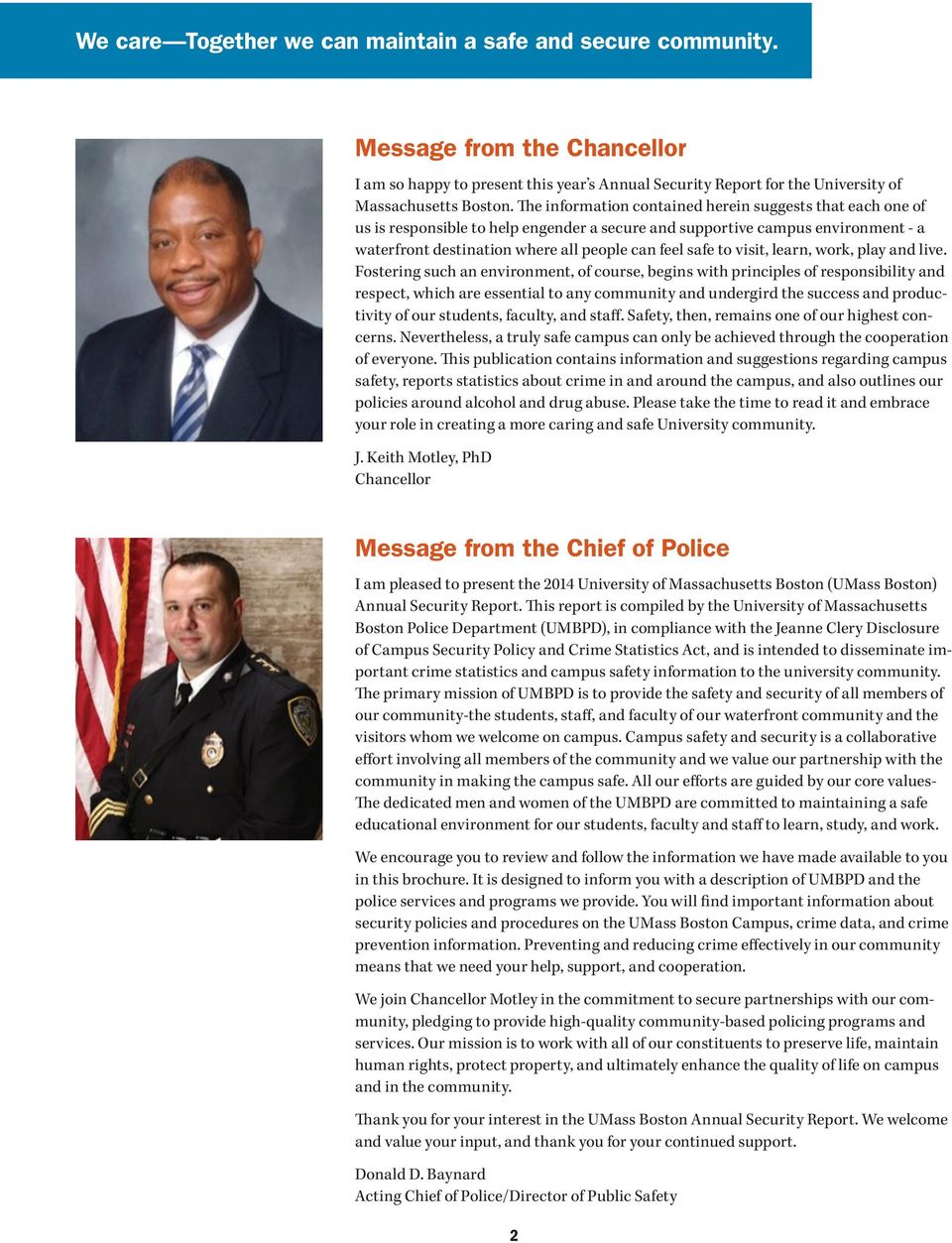
4 We care Together we can maintain a safe and secure community. Message from the Chancellor I am so happy to present this year s Annual Security Report for the University of Massachusetts Boston. The information contained herein suggests that each one of us is responsible to help engender a secure and supportive campus environment - a waterfront destination where all people can feel safe to visit, learn, work, play and live. Fostering such an environment, of course, begins with principles of responsibility and respect, which are essential to any community and undergird the success and productivity of our students, faculty, and staff. Safety, then, remains one of our highest concerns. Nevertheless, a truly safe campus can only be achieved through the cooperation of everyone. This publication contains information and suggestions regarding campus safety, reports statistics about crime in and around the campus, and also outlines our policies around alcohol and drug abuse. Please take the time to read it and embrace your role in creating a more caring and safe University community. J. Keith Motley, PhD Chancellor Message from the Chief of Police I am pleased to present the 2014 University of Massachusetts Boston (UMass Boston) Annual Security Report. This report is compiled by the University of Massachusetts Boston Police Department (UMBPD), in compliance with the Jeanne Clery Disclosure of Campus Security Policy and Crime Statistics Act, and is intended to disseminate important crime statistics and campus safety information to the university community. The primary mission of UMBPD is to provide the safety and security of all members of our community-the students, staff, and faculty of our waterfront community and the visitors whom we welcome on campus. Campus safety and security is a collaborative effort involving all members of the community and we value our partnership with the community in making the campus safe. All our efforts are guided by our core values- The dedicated men and women of the UMBPD are committed to maintaining a safe educational environment for our students, faculty and staff to learn, study, and work. We encourage you to review and follow the information we have made available to you in this brochure. It is designed to inform you with a description of UMBPD and the police services and programs we provide. You will find important information about security policies and procedures on the UMass Boston Campus, crime data, and crime prevention information. Preventing and reducing crime effectively in our community means that we need your help, support, and cooperation. We join Chancellor Motley in the commitment to secure partnerships with our community, pledging to provide high-quality community-based policing programs and services. Our mission is to work with all of our constituents to preserve life, maintain human rights, protect property, and ultimately enhance the quality of life on campus and in the community. Thank you for your interest in the UMass Boston Annual Security Report. We welcome and value your input, and thank you for your continued support. Donald D. Baynard Acting Chief of Police/Director of Public Safety 2
5 Key Contact Information Campus Emergency Phone Non-Emergency Dispatch (617) Rape Crisis Hotline (800) or (800) Dean of Student s Office (617) TIPS Line (617) Title IX Coordinator (617) Counseling Center (617) Student Health Center (617) Human Resources Office (617) City of Boston Police Department (District 6) and Community Affairs (617) City of Boston Police Department (District 11) and Community Affairs (617) Massachusetts State Police (Troop H) (617) UMass Boston Police Department Location: Quinn Administration Building 100 Morrissey Boulevard Boston, MA We hope that you find this information beneficial. We invite your questions, concerns, and suggestions. You may visit our website for contact information, or the UMBPD at [email protected]. 3

6 Section 1: Introduction Overview The University of Massachusetts Boston is concerned with the safety of its students, staff, faculty, guests and visitors. We are concerned and accept the responsibility to employ security measures and law enforcement practices to help provide the University community with a safe, secure environment in which to live and pursue academic goals. The University of Massachusetts Boston Police Department (UMBPD) prepares this report in compliance with the Jeanne Clery Disclosure of Campus Security Policy and Crime Statistics Act. This report includes statistics for the previous three years ( ) concerning reported crimes that occurred on campus; in certain off-campus buildings or property owned, leased or controlled by the University of Massachusetts Boston; and on public property within, or immediately adjacent to and accessible from, the campus. This report also includes institutional policy statements concerning campus security, alcohol and drug use, crime prevention, the reporting of crimes, sexual assault, and other matters. This report is prepared in cooperation with local law enforcement agencies, and the Office of the Dean of Students (including Judicial Affairs). Each entity provides updated information on their educational efforts and programs to comply with the Act. Campus crime, arrest and referral statistics include are those reported to the UMBPD, designated campus officials (including but not limited to directors, deans, department heads, judicial affairs, advisors to students/student organizations, athletic coaches) and local law enforcement agencies. Each year, the University distributes a notice to all enrolled students, faculty and staff informing them of the availability of this Annual Security Report. This notification provides information on how to access the Annual Security Report online; employees who do not have a campus address receive a postcard through campus mail which provides similar information. The Annual Security Report is available at UMBPD, on-line at campus_safety_report or by request on October 1st of each reporting year. Copies of this report may also be obtained at the University of Massachusetts Boston Police Department located at 100 Morrissey Boulevard, Boston, MA 02125, or by calling UMBPD at Statement of Policy for Addressing Campus Law Enforcement Authority and Jurisdiction The University of Massachusetts Boston campus, one of five campuses of the UMass system, is a community of more 16,000 students, staff and faculty. The University of Massachusetts Boston is nationally recognized as a model of excellence for urban public universities. The scenic waterfront campus, with easy access to downtown Boston, is located next to the John F. Kennedy Library and Presidential Museum and future home to the Edward M. Kennedy Institute for the United States Senate. It is the second-largest campus in the UMass system and combines a small-college experience with the vast resources of a major research university. To combat crime and ensure public tranquility, the University of Massachusetts Boston Police Department is a visible part of campus life. UMBPD is organized, trained, and equipped to provide progressive law enforcement and emergency services to our community. Officers derive their authority promulgated from the Board of Trustees of the University of Massachusetts. As set forth in Massachusetts General Law: The (University) trustees may appoint as police officers persons in the employ of the University who in the enforcement of said rules and regulations and throughout university property shall have the powers of police officers, except as to service of civil process. (MGL Ch. 75, Sec.32A) Therefore, our officers possess the power and authority to apprehend and arrest anyone involved in illegal acts on any campus property owned or controlled by the University of Massachusetts Boston. University of Massachusetts Boston Police Officers attend the Municipal Police Training Committee academies located throughout the Commonwealth. The University of Massachusetts Boston Police Department operates 24 hours per day, seven days a week, providing all patrol, investigation, specialized, and emergency response, as well as crime prevention and educational services at the University of Massachusetts Boston campus. The University of Massachusetts Boston Police Department is among the best qualified, motivated, supervised, and led police departments in the region and in the nation. We strive to maintain the highest ethical and performance standards in our policies, procedures, and actions. 4

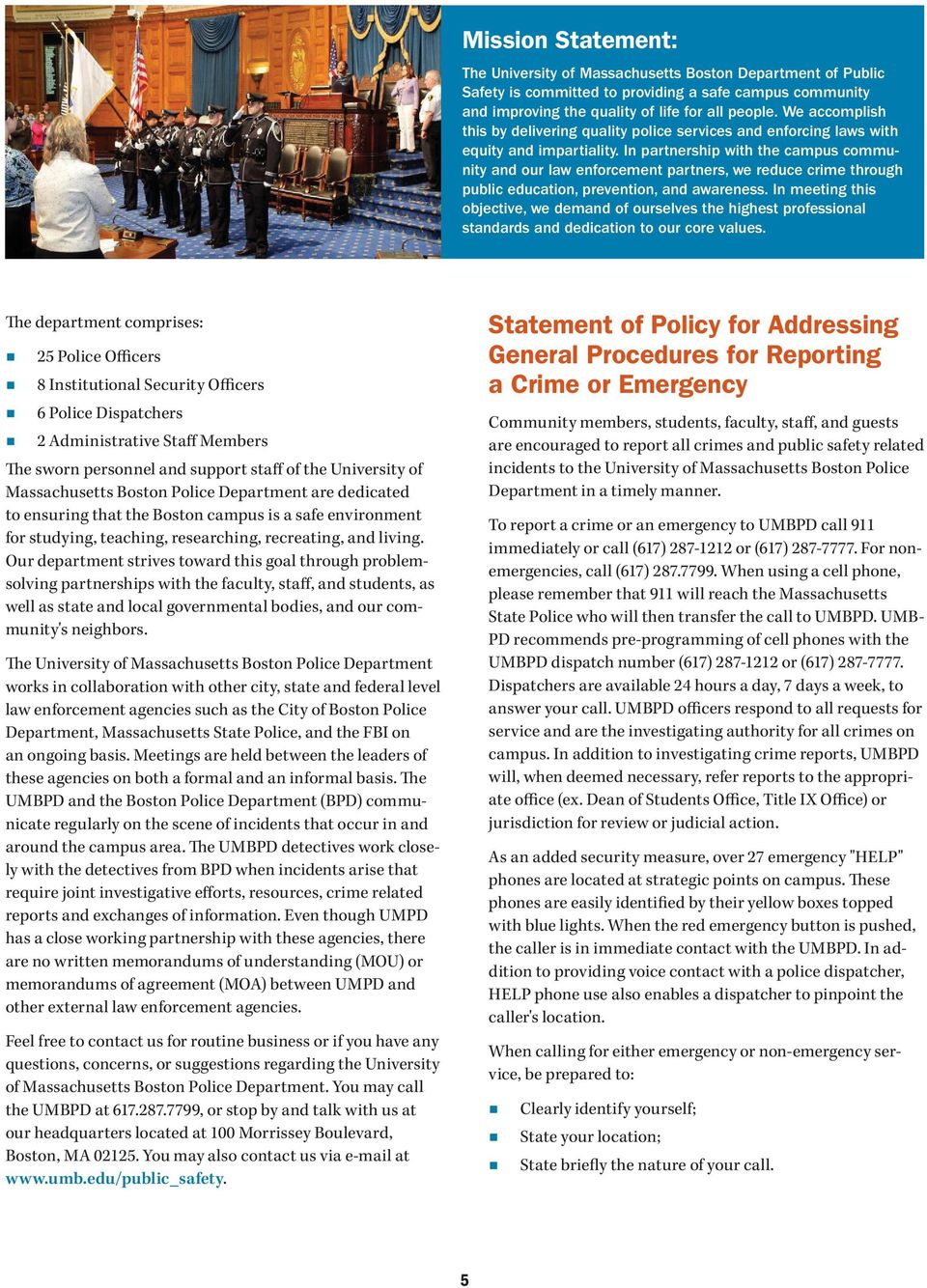
7 Mission Statement: The University of Massachusetts Boston Department of Public Safety is committed to providing a safe campus community and improving the quality of life for all people. We accomplish this by delivering quality police services and enforcing laws with equity and impartiality. In partnership with the campus community and our law enforcement partners, we reduce crime through public education, prevention, and awareness. In meeting this objective, we demand of ourselves the highest professional standards and dedication to our core values. The department comprises: 25 Police Officers 8 Institutional Security Officers 6 Police Dispatchers 2 Administrative Staff Members The sworn personnel and support staff of the University of Massachusetts Boston Police Department are dedicated to ensuring that the Boston campus is a safe environment for studying, teaching, researching, recreating, and living. Our department strives toward this goal through problemsolving partnerships with the faculty, staff, and students, as well as state and local governmental bodies, and our community's neighbors. The University of Massachusetts Boston Police Department works in collaboration with other city, state and federal level law enforcement agencies such as the City of Boston Police Department, Massachusetts State Police, and the FBI on an ongoing basis. Meetings are held between the leaders of these agencies on both a formal and an informal basis. The UMBPD and the Boston Police Department (BPD) communicate regularly on the scene of incidents that occur in and around the campus area. The UMBPD detectives work closely with the detectives from BPD when incidents arise that require joint investigative efforts, resources, crime related reports and exchanges of information. Even though UMPD has a close working partnership with these agencies, there are no written memorandums of understanding (MOU) or memorandums of agreement (MOA) between UMPD and other external law enforcement agencies. Feel free to contact us for routine business or if you have any questions, concerns, or suggestions regarding the University of Massachusetts Boston Police Department. You may call the UMBPD at , or stop by and talk with us at our headquarters located at 100 Morrissey Boulevard, Boston, MA You may also contact us via at Statement of Policy for Addressing General Procedures for Reporting a Crime or Emergency Community members, students, faculty, staff, and guests are encouraged to report all crimes and public safety related incidents to the University of Massachusetts Boston Police Department in a timely manner. To report a crime or an emergency to UMBPD call 911 immediately or call (617) or (617) For nonemergencies, call (617) When using a cell phone, please remember that 911 will reach the Massachusetts State Police who will then transfer the call to UMBPD. UMB- PD recommends pre-programming of cell phones with the UMBPD dispatch number (617) or (617) Dispatchers are available 24 hours a day, 7 days a week, to answer your call. UMBPD officers respond to all requests for service and are the investigating authority for all crimes on campus. In addition to investigating crime reports, UMBPD will, when deemed necessary, refer reports to the appropriate office (ex. Dean of Students Office, Title IX Office) or jurisdiction for review or judicial action. As an added security measure, over 27 emergency "HELP" phones are located at strategic points on campus. These phones are easily identified by their yellow boxes topped with blue lights. When the red emergency button is pushed, the caller is in immediate contact with the UMBPD. In addition to providing voice contact with a police dispatcher, HELP phone use also enables a dispatcher to pinpoint the caller's location. When calling for either emergency or non-emergency service, be prepared to: Clearly identify yourself; State your location; State briefly the nature of your call. 5
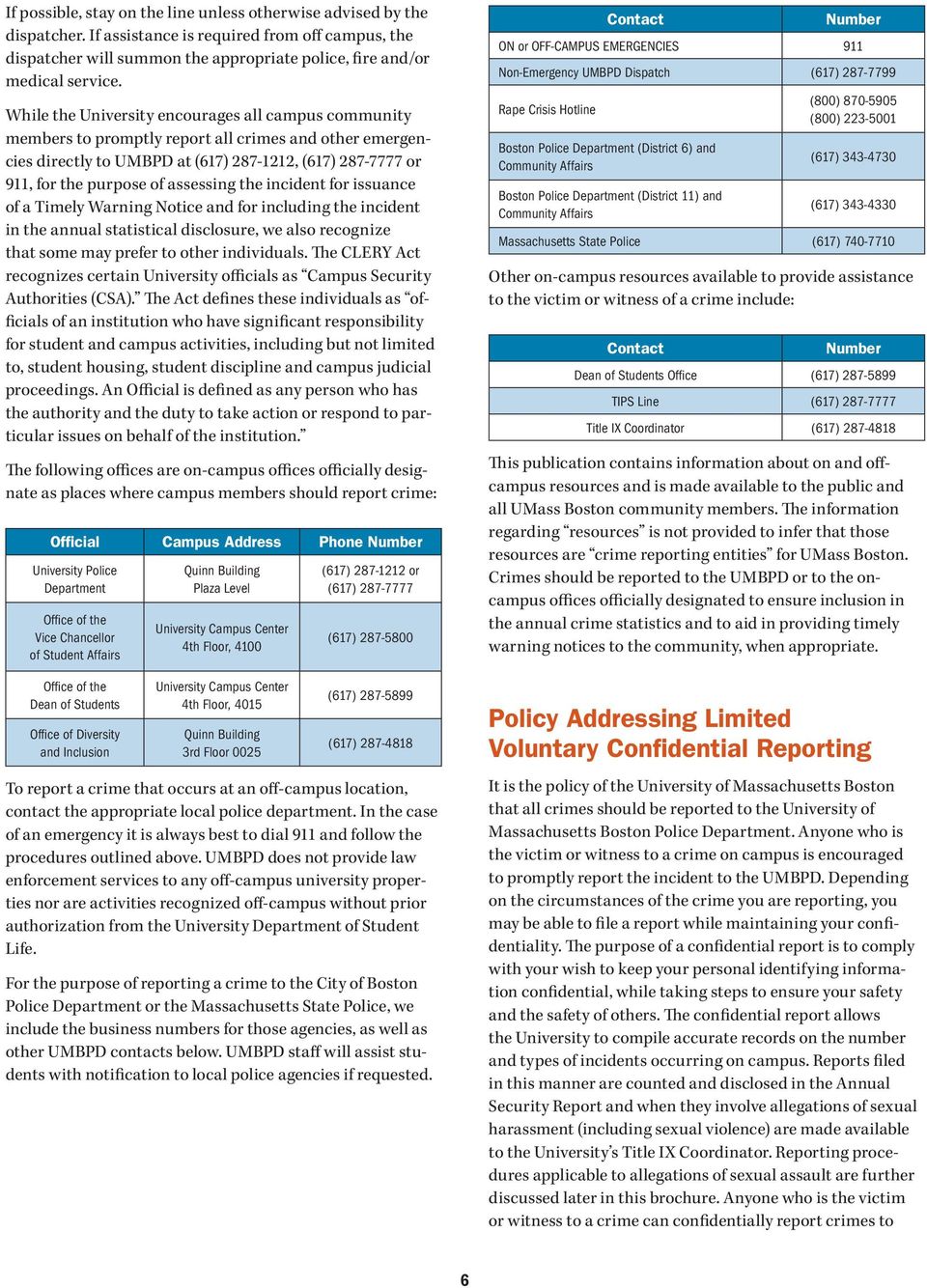
8 If possible, stay on the line unless otherwise advised by the dispatcher. If assistance is required from off campus, the dispatcher will summon the appropriate police, fire and/or medical service. While the University encourages all campus community members to promptly report all crimes and other emergencies directly to UMBPD at (617) , (617) or 911, for the purpose of assessing the incident for issuance of a Timely Warning Notice and for including the incident in the annual statistical disclosure, we also recognize that some may prefer to other individuals. The CLERY Act recognizes certain University officials as Campus Security Authorities (CSA). The Act defines these individuals as officials of an institution who have significant responsibility for student and campus activities, including but not limited to, student housing, student discipline and campus judicial proceedings. An Official is defined as any person who has the authority and the duty to take action or respond to particular issues on behalf of the institution. The following offices are on-campus offices officially designate as places where campus members should report crime: Official Campus Address Phone Number University Police Department Offi ce of the Vice Chancellor of Student Affairs Offi ce of the Dean of Students Offi ce of Diversity and Inclusion Quinn Building Plaza Level University Campus Center 4th Floor, 4100 University Campus Center 4th Floor, 4015 Quinn Building 3rd Floor 0025 (617) or (617) (617) (617) (617) To report a crime that occurs at an off-campus location, contact the appropriate local police department. In the case of an emergency it is always best to dial 911 and follow the procedures outlined above. UMBPD does not provide law enforcement services to any off-campus university properties nor are activities recognized off-campus without prior authorization from the University Department of Student Life. For the purpose of reporting a crime to the City of Boston Police Department or the Massachusetts State Police, we include the business numbers for those agencies, as well as other UMBPD contacts below. UMBPD staff will assist students with notification to local police agencies if requested. Contact Number ON or OFF-CAMPUS EMERGENCIES 911 Non-Emergency UMBPD Dispatch (617) Rape Crisis Hotline Boston Police Department (District 6) and Community Affairs Boston Police Department (District 11) and Community Affairs (800) (800) (617) (617) Massachusetts State Police (617) Other on-campus resources available to provide assistance to the victim or witness of a crime include: Contact Number Dean of Students Offi ce (617) TIPS Line (617) Title IX Coordinator (617) This publication contains information about on and offcampus resources and is made available to the public and all UMass Boston community members. The information regarding resources is not provided to infer that those resources are crime reporting entities for UMass Boston. Crimes should be reported to the UMBPD or to the oncampus offices officially designated to ensure inclusion in the annual crime statistics and to aid in providing timely warning notices to the community, when appropriate. Policy Addressing Limited Voluntary Confidential Reporting It is the policy of the University of Massachusetts Boston that all crimes should be reported to the University of Massachusetts Boston Police Department. Anyone who is the victim or witness to a crime on campus is encouraged to promptly report the incident to the UMBPD. Depending on the circumstances of the crime you are reporting, you may be able to file a report while maintaining your confidentiality. The purpose of a confidential report is to comply with your wish to keep your personal identifying information confidential, while taking steps to ensure your safety and the safety of others. The confidential report allows the University to compile accurate records on the number and types of incidents occurring on campus. Reports filed in this manner are counted and disclosed in the Annual Security Report and when they involve allegations of sexual harassment (including sexual violence) are made available to the University s Title IX Coordinator. Reporting procedures applicable to allegations of sexual assault are further discussed later in this brochure. Anyone who is the victim or witness to a crime can confidentially report crimes to 6
9 UMPD through UMPD s confidential reporting program. This program can be accessed via UMBPD s website at In limited circumstances, UMBPD may not be able to assure confidentiality and will inform you in those cases. When a potentially dangerous threat to the University community arises, alerts will be issued to notify individuals of the threat in a timely manner. These alerts will also inform the community of any recommended action to be taken. (See Timely Warning Policy). Responsibilities of the University Community Members of the University community must assume responsibility for their own personal safety and the security of their personal property. The following precautions provide guidance. Report all suspicious activity to UMBPD immediately. Never take personal safety for granted. Try to avoid walking alone at night. Use the UMPD escort service. Limit your alcohol consumption, and leave social functions that get too loud, too crowded, or that have too many people drinking excessively. If you do choose to consume alcohol, do not leave your beverage unattended or trust anyone to watch over your beverage. Remember to call UMBPD or the local police department for help at the first sign of trouble. Carry only small amounts of cash. Never leave valuables (wallets, purses, books, phones, etc.) unattended. Carry your keys at all times and do not lend them to anyone. Lock up bicycles and motorcycles. Lock car doors and close windows when leaving your car. Always lock the door to your residence, whether or not you are there. Be certain that your door is locked when you go to sleep, and keep windows closed and locked when you are not at home. Do not leave valuables in your car, especially if they can be easily noticed. Engrave serial numbers or owner s recognized numbers, such as a driver s license number, on items of value. Inventory your personal property and insure it appropriately with personal insurance coverage. 7

10 Section 2: Timely Warnings, Emergency Response & Evacuation Statement of Policy for Addressing Timely Warnings The purpose of this policy is to comply with the Department of Education requirements regarding timely notice of certain events as described 20 U.S.C. s. 1092(f), known as the Jeanne Clery Disclosure of Campus Security Policy, along with the Campus Crimes Statistics Act (1998). These Acts along with the Higher Education Reauthorization Act (2008) require any acts which have occurred on or near campus, require campus police officers to keep the institution informed on a timely basis of crimes and other imminent threats that may require timely warning. It is the policy of the University of Massachusetts Boston Police Department to fully comply with the provisions and intent of the Clery Act, in regards to the timely notification of our campus community, of any serious or continuous threat to their safety, in order to aid in the prevention of similar occurrences. The University of Massachusetts Boston Police Department is responsible for issuing Crime Alerts in compliance with the Clery Act. In the event of a reported crime which may pose a serious or continuous threat to members of the UMass Boston community, these alerts are written by UMBPD personnel and Command staff members. Upon receiving a report, alerts are issued to keep the campus community informed about safety and security matters. The decision to issue a Crime Alert is made on a case-by-case basis in light of all the facts surrounding an incident, including factors such as the nature of the crime, the continuous threat to the campus community, whether UMBPD received a report of the crime in a timely manner, and the possible risk of compromising law enforcement efforts. Crime Alerts are typically issued using the Uniformed Crime Reporting Program (UCR)/National Incident Based Reporting System (NIBRS) for Clery reportable incidents of arson, aggravated assault, criminal homicide, robbery, and sex offenses. Cases of aggravated assault and sex offenses are considered on a case-by-case basis, depending on the facts of the case and the information known by UMBPD. For example, if an assault occurs between two students who have a disagreement, there may be no on-going threat to other UMass Boston community members and a Crime Alert would not be distributed. In cases involving sexual assault, they are often reported long after the incident occurred, and thus there is no ability to distribute a timely warning notice to the community. Sex offenses will be considered on a case-by-case basis depending on when and where the incident occurred, when it was reported, and the amount of information known by UMBPD. Crime Alerts may also be posted for other crime classifications as deemed necessary. To issue a Crime Alert the University police informs the campus community via a campus-wide text or which is addressed to students, faculty and staff. This indicates that a Crime Alert has been issued and may provide a link to the University of Massachusetts Boston Police Department web page at In addition to these Crime Alerts, UMass Boston has been able to issue campus-wide alerts via text-messaging, and cell phones, to the campus community in the event of an imminent or immediate threat to the community. UMass Boston campus-wide alerts are disseminated with the goal of notifying as many people as possible, as rapidly as possible (i.e., active threats, bomb threats, or a dangerous chemical spill, etc.) These alerts are sent to individuals who subscribe to UMass Boston campus-wide alerts. All students, faculty and staff are encouraged to sign up to receive these notices by going to To learn more about the program please go to edu/preparedness/alert. Individuals with disabilities are encouraged to contact the Office of Diversity and Inclusion, ADA Compliance Services at or the Help Desk at for assistance in subscribing to Campus Alerts. Notification to the University Community About an Immediate Threat The University of Massachusetts Boston has developed an all-hazard Emergency Operations Plan to provide a systematic and comprehensive response to a wide variety of emergencies that could occur on campus. The plan outlines the roles of specific campus response departments, including UMBPD, Environmental Health and Safety, Facilities Management, University Health Services, and Information Technology. All members of the University community are notified on an annual basis that they are encouraged to notify UMBPD of any situation or incident on campus that involves a significant emergency or dangerous situation that may involve an imminent or immediate threat to the health and safety of students and/or employees on campus. UMBPD has the 8

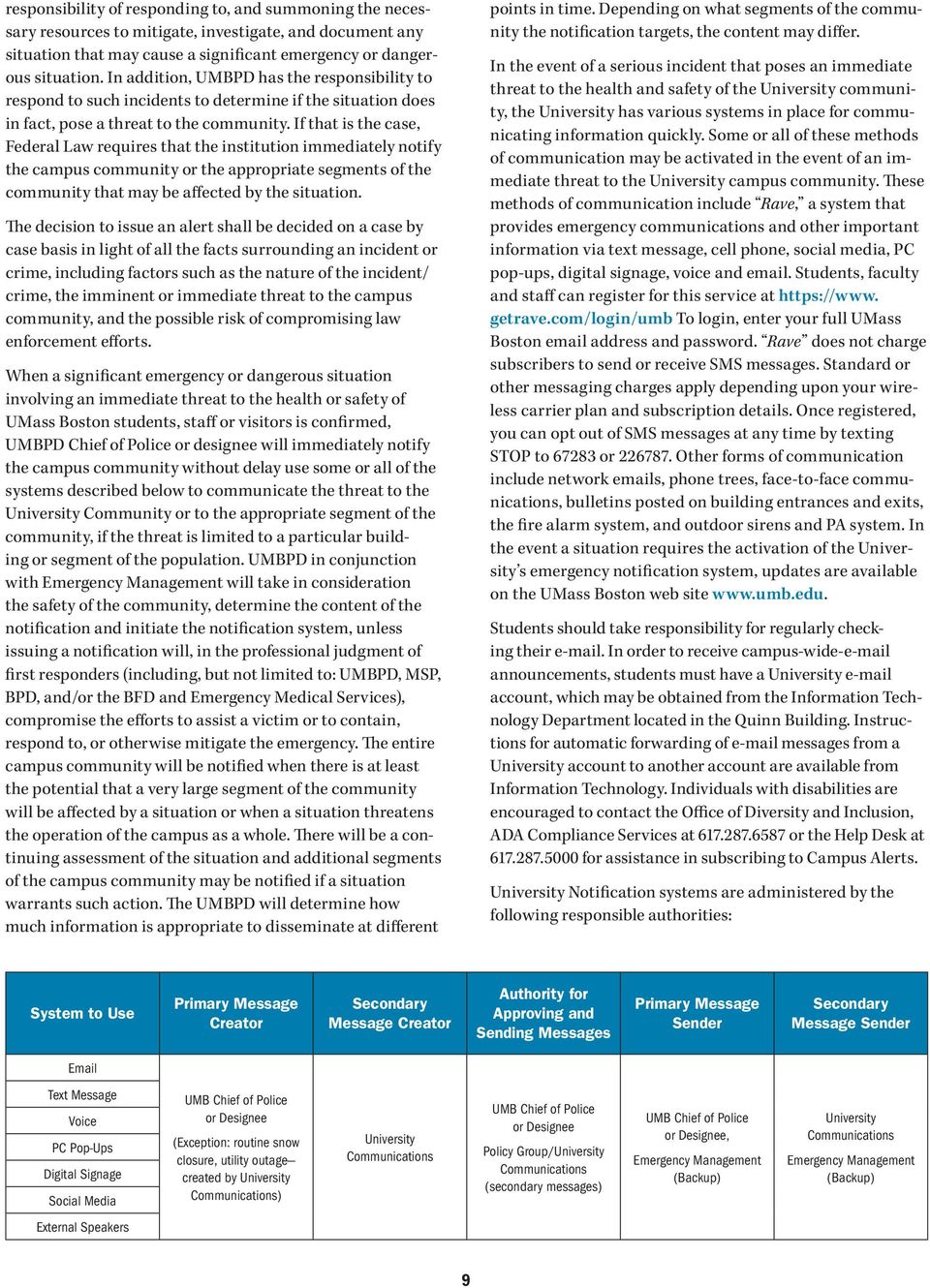
11 responsibility of responding to, and summoning the necessary resources to mitigate, investigate, and document any situation that may cause a significant emergency or dangerous situation. In addition, UMBPD has the responsibility to respond to such incidents to determine if the situation does in fact, pose a threat to the community. If that is the case, Federal Law requires that the institution immediately notify the campus community or the appropriate segments of the community that may be affected by the situation. The decision to issue an alert shall be decided on a case by case basis in light of all the facts surrounding an incident or crime, including factors such as the nature of the incident/ crime, the imminent or immediate threat to the campus community, and the possible risk of compromising law enforcement efforts. When a significant emergency or dangerous situation involving an immediate threat to the health or safety of UMass Boston students, staff or visitors is confirmed, UMBPD Chief of Police or designee will immediately notify the campus community without delay use some or all of the systems described below to communicate the threat to the University Community or to the appropriate segment of the community, if the threat is limited to a particular building or segment of the population. UMBPD in conjunction with Emergency Management will take in consideration the safety of the community, determine the content of the notification and initiate the notification system, unless issuing a notification will, in the professional judgment of first responders (including, but not limited to: UMBPD, MSP, BPD, and/or the BFD and Emergency Medical Services), compromise the efforts to assist a victim or to contain, respond to, or otherwise mitigate the emergency. The entire campus community will be notified when there is at least the potential that a very large segment of the community will be affected by a situation or when a situation threatens the operation of the campus as a whole. There will be a continuing assessment of the situation and additional segments of the campus community may be notified if a situation warrants such action. The UMBPD will determine how much information is appropriate to disseminate at different points in time. Depending on what segments of the community the notification targets, the content may differ. In the event of a serious incident that poses an immediate threat to the health and safety of the University community, the University has various systems in place for communicating information quickly. Some or all of these methods of communication may be activated in the event of an immediate threat to the University campus community. These methods of communication include Rave, a system that provides emergency communications and other important information via text message, cell phone, social media, PC pop-ups, digital signage, voice and . Students, faculty and staff can register for this service at getrave.com/login/umb To login, enter your full UMass Boston address and password. Rave does not charge subscribers to send or receive SMS messages. Standard or other messaging charges apply depending upon your wireless carrier plan and subscription details. Once registered, you can opt out of SMS messages at any time by texting STOP to or Other forms of communication include network s, phone trees, face-to-face communications, bulletins posted on building entrances and exits, the fire alarm system, and outdoor sirens and PA system. In the event a situation requires the activation of the University s emergency notification system, updates are available on the UMass Boston web site Students should take responsibility for regularly checking their . In order to receive campus-wide- announcements, students must have a University account, which may be obtained from the Information Technology Department located in the Quinn Building. Instructions for automatic forwarding of messages from a University account to another account are available from Information Technology. Individuals with disabilities are encouraged to contact the Office of Diversity and Inclusion, ADA Compliance Services at or the Help Desk at for assistance in subscribing to Campus Alerts. University Notification systems are administered by the following responsible authorities: System to Use Primary Message Creator Secondary Message Creator Authority for Approving and Sending Messages Primary Message Sender Secondary Message Sender Text Message Voice PC Pop-Ups Digital Signage Social Media External Speakers UMB Chief of Police or Designee (Exception: routine snow closure, utility outage created by University Communications) University Communications UMB Chief of Police or Designee Policy Group/University Communications (secondary messages) UMB Chief of Police or Designee, Emergency Management (Backup) University Communications Emergency Management (Backup) 9
12 If any of the systems using technology fails, the campus would initiate face to face communication using appropriate staff and students on campus. Statement of Policy Regarding Immediate Emergency Response and Evacuation Procedures A crisis can erupt at any time and in any form. A fire, explosion, medical epidemic, water leak, power outage, hurricane, or bomb threat the possibilities are infinite and unpredictable. Nonetheless, planning for the unpredictable does help. University Departments are responsible for developing contingency plans and continuity of operation plans for their own staff and areas of responsibility. The University conducts numerous announced or unannounced emergency response exercises each year, such as table top exercises, real time exercises, and tests of the emergency notification systems on campus. These tests are designed to assess and evaluate the emergency plans and capabilities of the institution. The UMBPD officers and Supervisors have received training in Incident Command and Responding to Critical Incidents on Campus. When a serious incident occurs that causes an immediate threat to campus, the first responders to the scene are usually the UMBPD, EH&S, Emergency Management who typically respond and work together to manage the incident. Depending on the nature of the incident, other UMass departments and other local, state or federal agencies could also be involved in responding to the incident. General information about the emergency response and evacuation procedures for UMass is publicized each year as part of the institution s Clery Act compliance effort and that information is available on the UMBPD web site. Detailed information about, and updates on, Emergency Alerts are available on the web site at alerts_and_notices. The University annually reviews the emergency response and evacuation procedures as to provide updates and ensure that the University continues to move forward and strengthen emergency response programs, policies and procedures. For more information about UMB s emergency response and evacuation procedures please visit UMB s Office of Emergency Management and Business web site at Procedure for Testing Emergency Response and Evacuation Procedures The purpose of evacuation drills is to prepare building occupants for an organized evacuation in case of an emergency. At UMass Boston, evacuation drills are used as a way to educate and train occupants on issues specific to their building. During the drill, occupants practice drill procedures and familiarize themselves with the location of exits and the sound of the fire alarm. In addition to educating the occupants of each building about the evacuation procedures during the drills, the process also provides the University the opportunity to test the operation of fire alarm system components. Evacuation drills are coordinated by Environmental Health and Safety (EH&S) twice per year. Students, faculty and staff learn the locations of the emergency exits in the buildings and are provided guidance about the direction they should travel when exiting each building for a short-term building evacuation. EH&S does not tell individuals in advance about the designated locations for long-term evacuations because those decisions are affected by time of day, location of the building being evacuated, the availability of the various designated emergency gathering locations on campus, and other factors such as the location and nature of the threat. EH&S and staff on the scene will communicate information to individuals regarding the developing situation or any evacuation status changes. Fire drills are typically scheduled during the first 30 days of each semester (spring and fall). EH&S conducts announced and unannounced drills and exercises each year and conducts follow-through activities designed for assessment and evaluation of emergency plans and capabilities. EH&S coordinates announced and unannounced evacuation drills each semester, as described above, to test the emergency response and evacuation procedures, and to assess and evaluate the emergency evacuation plans and capabilities. UMass Boston will publish a summary of its emergency response and evacuation procedures in conjunction with at least one drill or exercise each calendar year. UMBPD performs Active Threat Drills. An active threat refers to any incident which creates an immediate threat or presents an imminent danger to the campus community such as a shooter or hostage situation. Although encountering an active threat on campus remains remote, we encourage members of the campus community to review the guidelines in the event of an emergency. The University conducts table top and real time exercises as to test Emergency Preparedness, Business Continuity and Disaster Recovery Plans. 10

13 Shelter-in-Place Procedures What it Means to Shelter-in-Place : If an incident occurs and the buildings or areas around you become unstable, or if the air outdoors becomes dangerous due to toxic or irritating substances, it is usually safer to stay indoors, because leaving the area may expose you to that danger. Thus, to shelter-in-place means to make a shelter of the building that you are in, and with a few adjustments this location can be made even safer and more comfortable until it is safe to go outside. Basic Shelter-in-Place Guidance: If an incident occurs and the building you are in is not damaged, stay inside in an interior room until you are told it is safe to come out. If your building is damaged, take your personal belongings (purse, wallet, student ID card, etc.) and follow the evacuation procedures for your building (close your door, proceed to the nearest exit, and use the stairs instead of the elevators). Once you have evacuated, seek shelter at the nearest University building quickly. If police or fire department personnel are on the scene, follow their directions. How You Will Know to Shelter-in-Place : A shelter-in-place notification may come from several sources, including UMBPD, other University employees, the federal or local government, local police agencies, or other authorities utilizing the University s emergency communications tools. How to Shelter in-place : No matter where you are, the basic steps of shelter-in-place will generally remain the same. Should the need ever arise; follow these steps, unless instructed otherwise by local emergency personnel: 1. If you are inside, stay where you are. Collect any emergency shelter-in-place supplies and a telephone to be used in case of emergency. If you are outdoors, proceed into the closest building quickly or follow instructions from emergency personnel on the scene. 2. Locate a room to shelter inside. It should be: An interior room; Above ground level; and Without windows or with the least number of windows. If there is a large group of people inside a particular building, several rooms maybe necessary. 3. Shut and lock all windows (tighter seal) and close exterior doors. 4. Turn off air conditioners, heaters, and fans. 5. Close vents to ventilation systems as you are able. (University staff will turn off the ventilation as quickly as possible.) 6. Make a list of the people with you and ask someone (House Staff, faculty, or other staff) to call the list in to UMBPD so they know where you are sheltering. If only students are present, one of the students should call in the list. 7. Turn on a radio or TV and listen for further instructions. 8. Make yourself comfortable. 11

14 Section 3: Campus Facilities Safety and Security Statement of Policy for Addressing Security and Access The Facilities Department maintains all the University building grounds with a special concern for safety and security. Personnel conduct inspections to identify lighting deficiencies and make recommendations for repairs to security/safety equipment such as broken locks, windows and fire safety equipment. Most campus buildings and facilities are accessible to members of the campus community, guests, and visitors during normal hours of business, Monday through Friday, and for limited designated hours on Saturday, Sunday, and holidays. Facilities are maintained, and their security monitored, in the interest of students, staff, and faculty. Many cultural and athletic events held in University facilities, such as the Campus Center, 100 Morrissey Boulevard, Boston MA, adjacent to the Massachusetts State Archive Building, are open to the public. Other facilities such as the bookstore, libraries, and cafeterias are also open to the public. Access to academic and administrative facilities on campus is generally limited to students, employees, and visitors for the purpose of study, work, teaching, and to conduct other University business. Each academic building has established its hours based on the needs of specific academic departments. UMPD provides random patrols of all facilities 24 hours a day. Maintenance of Campus Facilities The buildings which comprise the campus are mixed-use facilities, and are operated on an open campus basis during normal business hours; twenty-four hour access is available upon demonstrated need. Keys are provided in accordance with a policy that requires the approval of an employee s department head. Students are provided off-hour access to laboratories and other restricted facilities by security personnel upon approval of a professor or other authorized staff member; they are not issued keys, as a rule. The Department of Public Safety provides the University s Facilities Department with input on issues regarding lighting, and other concerns involving security and maintenance of the facility. Every effort is made to assign top priority to repairs impacting the security of campus facilities. Emergencies may necessitate changes or alterations to any posted schedules. Areas which appear to be problematic have security surveys conducted by UMBPD. Statement of Policy for Addressing Safety and Security in the Residence Halls The University of Massachusetts Boston does not own or maintain any residence hall facilities. Statement of Policy for Addressing Safety and Security Off Campus Off-campus apartment complexes, townhouses/condominium communities, and other multi-family dwellings pose unique challenges. Because of the natural turnover of many residents in rental property, students must make an extra effort to be aware of their surroundings. This includes knowledge of the measures landlords have taken on behalf of resident safety. These residences fall under the Police Department of the particular jurisdiction. To report a crime, call the nonemergency number at (617) In the event of an emergency dial 911. University of Massachusetts Boston Police Department personnel do not provide law enforcement services to off-campus residences unless requested by the police department of that jurisdiction, nor are activities off-campus recognized by University authority. Statement of Policy for Addressing the Monitoring and Recording of Student Conduct in On- and Off-Campus Residences The University must consider student conduct, whether on or off campus, that is disruptive of good community relations or which interferes with, impairs or obstructs the University s mission, functions and processes or that are found to be offensive to generally accepted standards of sound behavior, as harmful and adverse to the University s interests. Because of this, the Boston Police Department makes every effort to inform the University of off campus criminal activity involving our students. If a violation of law occurs on or off campus, which is also a violation of University Code of Conduct or local regulations, the University may institute proceedings against the offenders. Such action by the University is independent of, and may proceed in parallel with, civil and/or criminal action. 12

15 Missing Student Notification Policy If an individual or a member of the University community has reason to believe a student is missing, he or she should immediately report this information to the UMBPD at which shall investigate each report and make a determination whether the student is missing in accordance with this policy. For purposes of this policy, a student is missing when the student s whereabouts are unknown and unexplained for a period of time that would be regarded as highly unusual or suspicious by persons familiar with the student s plans, habits or routines. Initial Institutional Response: Upon receipt of a missing student report, working closely with the Dean of Students Office and other relevant departments, the UMBPD will promptly begin efforts to locate the student. Initial efforts to contact the student may involve telephone, , text message or other electronic communications listed in WISER. If a student does not respond, the UMBPD will determine whether a welfare check at the student s listed residence is appropriate. If the University or the UMBPD cannot locate the student and it is determined the student appears to be missing for a period of twenty-four hours, the following shall apply: The UMBPD will initiate a missing persons report and shall immediately enter the missing person's data into National Crime Information Center (NCIC) and Criminal Justice Information System (CJIS) databases. If the student has designated a contact person, the UMBPD or the Dean of Students Office will notify that contact person within 24 hours of the determination that the student is missing. The UMBPD or the Dean of Students Office shall notify the student's custodial parents or legal guardians in the case of emancipated students under the age of eighteen. After it has been determined a student is missing and regardless of whether the student has identified a contact person, if he/she is above the age of 18 or is an emancipated minor, the UMBPD will inform any other law enforcement agencies that have jurisdiction in the area of the missing student. The UMBPD and any other appropriate law enforcement agencies will continue to investigate the missing person report. Nothing in this policy restricts University of Massachusetts Boston from making notifications earlier than noted above if deemed appropriate under the circumstances. Nothing in this policy restricts University of Massachusetts Boston from contacting other individuals if deemed necessary to prevent harm to a student or others, necessary to the investigation, or otherwise appropriate under the circumstances. Who to Contact: University Massachusetts Boston Police Department Emergency: 911 Non-Emergency Police Dispatch: (617) Office of the Dean of Students (617) Campus Center, 4th Floor 13

16 Section 4: Security Awareness and Crime Prevention Programs Statement of Policy for Addressing Security Awareness and Crime Prevention Programs The University of Massachusetts Boston Police Department believes that through crime prevention and safety awareness education, community members are better prepared to prevent crime and to respond if crime does occur. In addition to the other University offices; during the 2013 calendar year, the UMBPD has sponsored over (35) crime prevention and security awareness programs intended to inform and educate the community on crime issues. Rape awareness, and active threats, domestic violence, and safety awareness are examples of the issues dealt with in these programs. Additionally, crime prevention officers assist in the design of new facilities and in evaluating areas where theft is or may become a problem. Crime prevention officers are available throughout the year to speak to groups or to staff. They appear at exhibits at various functions sponsored by the university s Department of Student Life, where they demonstrate innovative security products and provide guidance on a wide range of security and safety concerns. University police representatives attend new student and employee orientations to promote awareness of the department, to encourage the prompt reporting of crime or suspicious activity to the department, and to provide an awareness of security policies and procedures. There is an ongoing effort to educate the community concerning the availability of the 911 emergency number and the locations of the emergency telephones that provide direct contact with a university police dispatcher. Upon request, a police blotter is provided to the student newspaper, listing all crimes reported for the prior week. A monthly newsletter is distributed throughout the university containing crime prevention tips, featured programs, public safety services, consumer alerts, and community notes, along with other items of interest. Though not an all-inclusive list, the following are some programs that we offer: The P.R.I.D.E. Program is run by University Health Services and provides education and remediation in the areas of drug and alcohol abuse. The alcohol awareness program is a student run peer support program; for additional information, contact the Department of Student Life. Domestic Violence Prevention: Throughout National Domestic Violence Awareness Month in October, the university displays a Silent Witness exhibit campuswide to educate the campus community about domestic violence prevention and to show support for the victims among us. RAD: Rape Aggression Defense (RAD) program in which women can learn prevention techniques and receive hands-on self-defense training by certified RAD trainers in the event of an attack. Active Shooter Awareness: The University provides education and training on actions to take in the event of an active shooter on campus. Faculty, staff, and students are offered the opportunity to view training videos and are given hand-out materials listing recommended actions to take when dealing with an active shooter on campus. Theft Prevention: Officers present information and precautions to be taken to minimize the risk of becoming a victim of theft. In addition to the many programs offered by the University, the University has established a multidisciplinary team composed of University officials and professionals. This team is referred to the C.A.R.E. Team (Counsel, Advocate, Refer, and Educate) to enhance emergency preparedness and prevention efforts. The objective of the C.A.R.E. Team is to systematically address, evaluate, and manage student behaviors that may involve potentially threatening situations which may include mental health concerns. If you would like further information about the C.A.R.E. Team, you can access the C.A.R.E. Teams website at in_distress or contact the Office of Dean of Students at (617) Statement of Policy for Addressing Substance Abuse Education Substance abuse and its related consequences undermine the University of Massachusetts Boston s goals of academic success and civility. All students/employees at the University of Massachusetts Boston are expected to abide by all Federal, State and local laws, including those regulating the use, possession, sale, distribution, manufacture and cultivation of illegal drugs and alcohol. In addition, Congress amended Title XII of the Higher Education Act of 1965 by adding a 14

17 section pertaining to Drug Free Schools and Campuses. Under this new amendment any institution receiving federal funds, including federal student loan programs, must adopt and implement policies to prevent the use of illegal drugs and alcohol by students and employees. Financial aid penalties for drug offenses: Beginning on July 1, 2000, the 1998 amendments to the higher education act require the suspension of eligibility for financial aid for students convicted of drug related offenses. The length of suspension of eligibility is not less than one year and varies depending on the nature of the offense. Full details are available from the Office of Financial Aid. The University of Massachusetts Boston is committed to promoting a climate which supports academic and personal growth and success and the well-being of all members of the academic community. To safeguard and promote a healthy academic and living environment, the University promulgates rules and regulations for the behavior of all members of the community. These are outlined in several major policy statements i.e., the student conduct code, the hazing policy, the alcohol and other drug policies, etc. copies of these campus regulations are available in the Office of the Dean of Students and on the web at: campus/policies/code. Health risks associated with alcohol and other drug consumption include impaired judgment, vision, speech, coordination, memory, sensation and perception. Long-term use of alcohol and other drugs can negatively impact many of the body's systems, and cause physical and psychological dependence. It is the responsibility of each member of this community to understand and comply with all campus rules and regulations. These regulations include all federal, state and local laws including the Drug Free Schools and Community Act of 1989, the Drug Free Workplace Act of 1988 and the Higher Education Act (as amended in 1998). As a member of the university community, it is your responsibility to know and abide by all campus rules and regulations, to understand the risks associated with the use and abuse of alcohol and other drugs, and to assist in creating an environment that promotes health-enhancing attitudes and activities. Any violation of the University s Code of Student Conduct or violation of federal, state or local laws shall subject the offender to the University disciplinary process and/or criminal prosecution. Services and resources are available to all members of the University community, to provide accurate information relating to drugs and alcohol, to support individual needs and to assist at crisis points. Listings of resources on campus are available by calling: Contact Number Counseling Center (617) Student Health Center (617) Human Resource Offi ce (617) Offi ce of Dean of Students (617) In addition, individuals who wish to enroll in a drug or alcohol rehabilitation program should check the University s insurance policy or their own insurance policy to verify if they are covered for these services. 15

18 University employees who may have a problem with substance abuse, programs are available through the University of Massachusetts Boston Employee Assistance Program (EAP). EAP can be reached 24 hours a day, 7 days a week at or by visiting their website at The full text of the University Alcohol and Drug Policy can be found online at: The Code of Student Conduct can be found at: edu/life_on_campus/policies/code Alcohol and Other Drug Education Program Recovery Support Program can be found on-line at Statement of Policy for Addressing Alcohol The possession, sale or the furnishing of alcohol on the University campus is governed by the University Alcohol Policy and Massachusetts state law. Laws regarding the possession, use, sale, consumption or furnishing of alcohol is controlled by the Department of Alcohol and Beverage Control (ABC); however, the enforcement of alcohol laws on-campus is the primary responsibility of the University of Massachusetts Boston Police Department. The possession, use, sale, manufacture or distribution of any controlled substance is illegal under both state and federal laws. Such laws, including underage drinking laws, are strictly enforced by the University of Massachusetts Boston Police Department. Violators are subject to University disciplinary action, criminal prosecution, fine and imprisonment. It is unlawful to sell, furnish or provide alcohol to a person under the age of 21. The possession of alcohol by anyone under 21 years of age is illegal. Statement of Policy for Addressing Illegal Drugs The University of Massachusetts campus has been designated Drug Free. The possession, use, sale, manufacture or distribution of any controlled substance is illegal under both state and federal laws. Such laws are strictly enforced by the University of Massachusetts Police. Violators are subject to arrest, criminal prosecution, University disciplinary action, fine and imprisonment. Statement Regarding Firearms and Weapons Possession of firearms on the University property is regulated under MGL, Chapter 269, Section 10j. Firearms of any type, assembled or disassembled, ammunition, knives, machetes, javelins, martial arts devices, clubs, or any device which can be considered hazardous to the welfare of members of the university community are strictly prohibited on campus. Any violation of state laws or town ordinances prohibiting the manufacture, sale, purchase, transportation, possession, concealment, or use of firearms, cutting instruments, explosives, incendiary devices, or other deadly weapons will result in prosecution and will be subject to severe disciplinary action, up to, and including, dismissal from the university. 16
19 Section 5: Sexual Assault, Domestic Violence, Dating Violence, and Stalking Prevention and Response Statement of Policy for Addressing Sexual Assault, Domestic Violence, Dating Violence and Stalking The University of Massachusetts does not discriminate on the basis of sex in its educational programs and sexual harassment and sexual violence are types of sex discrimination. Other acts can also be forms of sex-based discrimination and are also prohibited whether sexually based or not and include dating violence, domestic violence, and stalking. As a result, UMass Boston issues this statement of policy to inform the community of our comprehensive plan addressing sexual misconduct, educational programs, and procedures that address sexual assault, domestic violence, dating violence, and stalking, whether the incident occurs on or off campus and when it is reported to a University official. In this context, UMass Boston prohibits the offenses of domestic violence, dating violence, sexual assault and stalking and reaffirms its commitment to maintain a campus environment emphasizing the dignity and worth of all members of the university community. For a complete copy of the University s policy governing sexual misconduct, visit policies/.../sexual_offense A. Definitions There are numerous terms used by UMass Boston in our policy and procedures. Below, we provide the definitions of consent as defined by the Student Code of Conduct. We also provide definitions for the offenses of sexual assault, domestic violence, dating violence and stalking as defined by the United States Department of Education as well as under Massachusetts State criminal law. Consent is defined by our Student Code of Conduct as Consent 1. General definition: Acceptance or approval of what is planned or done by another; acquiescence. 2. Consent as it relates to sexual activity, domestic violence, dating violence, or stalking: It is the responsibility of the person seeking to initiate the sexual activity or conduct to affirmatively obtain consent, not the intended recipient of such contact or conduct to affirmatively deny such consent. An affirmative, informed decision to engage in mutually acceptable sexual activity must be given by clear actions or words. It is an informed decision made freely and actively by all parties. a) Relying solely upon nonverbal communication can lead to miscommunication. It is important not to make assumptions; if confusion or ambiguity on the issue of consent arises anytime during the sexual interaction, it is essential that each participant stops and clarifies, verbally, willingness to continue. b) Students should understand that consent may not be inferred from silence, passivity, or lack of active resistance alone. c) A current or previous dating or sexual relationship is not sufficient to constitute consent, and consent to one form of sexual activity does not imply consent to other forms of sexual activity. d) When substance use is involved, a person is not considered able to give consent when the degree of intoxication is such that the victim s judgment is so impaired that he or she would not be capable of making rational decisions about his or her welfare, and as such the person would not be able to give consent to engage in sexual activity. e) When an individual is incapable of giving consent because of his/her temporary or permanent mental or physical incapacity. f) Consent is not indefinite and may be withdrawn at any time. Once consent is withdrawn, all sexual activity must cease unless and until additional effective consent is given. Sexual Assault: Sexual assault means an offense that meets the definition of rape, fondling, incest, or statutory rape as used in the FBI s Uniform Crime Reporting system. A sex offense is any act directed against another person, without the consent of the victim, including instances where the victim if incapable of giving consent. Rape is defined as the penetration, no matter how slight, of the vagina or anus with any body part or object, or oral penetration by a sex organ of another person, without the consent of the victim. Fondling is defined as the touching of the private parts of another person for the purposes of sexual gratification, without the consent of the victim, including instances where the victim is incapable of giving consent because of his/her age or because of his/her temporary or permanent mental incapacity. Incest is defined as nonforcible sexual intercourse between persons who are related to each other within the degrees wherein marriage is prohibited by law. 17

20 Statutory Rape is defined a nonforcible sexual intercourse with a person who is under the statutory age of consent. Massachusetts s Criminal Law also defines Sexual Assault under the statute contained in Ch : Rape (Section 22): a) Whoever has sexual intercourse or unnatural sexual intercourse with a person, and compels such person to submit by force and against his will, or compels such person to submit by threat of bodily injury and if either such sexual intercourse or unnatural sexual intercourse results in or is committed with acts resulting in serious bodily injury, or is committed by a joint enterprise, or is committed during the commission or attempted commission of an offense defined in section fifteen A, fifteen B, seventeen, nineteen or twenty-six of this chapter, section fourteen, fifteen, sixteen, seventeen or eighteen of chapter two hundred and sixty-six or section ten of chapter two hundred and sixty-nine shall be punished by imprisonment in the state prison for life or for any term of years. No person serving a sentence for a second or subsequent such offense shall be eligible for furlough, temporary release, or education, training or employment programs established outside a correctional facility until such person shall have served two-thirds of such minimum sentence or if such person has two or more sentences to be served otherwise than concurrently, two-thirds of the aggregate of the minimum terms of such several sentences. b) Whoever has sexual intercourse or unnatural sexual intercourse with a person and compels such person to submit by force and against his will, or compels such person to submit by threat of bodily injury, shall be punished by imprisonment in the state prison for not more than twenty years; and whoever commits a second or subsequent such offense shall be punished by imprisonment in the state prison for life or for any term or years. Whoever commits any offense described in this section while being armed with a firearm, rifle, shotgun, machine-gun or assault weapon, shall be punished by imprisonment in the state prison for not less than ten years. Whoever commits a second or subsequent such offense shall be punished by imprisonment in the state prison for life or for any term of years, but not less than 15 years. No person serving a sentence for a second or subsequent such offense shall be eligible for furlough, temporary release, or education, training or employment programs established outside a correctional facility until such person shall have served two-thirds of such minimum sentence or if such person has two or more sentences to be served otherwise than concurrently, two-thirds of the aggregate of the minimum terms of such several sentences. For the purposes of prosecution, the offense described in subsection (b) shall be a lesser included offense to that described in subsection (a). Domestic Violence: The term domestic violence means: 1. Felony or misdemeanor crimes of violence committed i. By a current or former spouse or intimate partner of the victim; ii. By a person with whom the victim shares a child in common; iii. By a person who is cohabitating with or has cohabitated with the victim as a spouse or intimate partner; iv. By a person similarly situated to a spouse of the victim under the domestic or family violence laws of the jurisdiction in which the crime of violence occurred; or v. By any other person against an adult or youth victim who is protected from that person s acts under the domestic or family violence laws of the jurisdiction in which the crime of violence occurred. 2. For the purposes of complying with the requirements of this section and section , any incident meeting this definition is considered a crime for the purposes of Clery Act reporting. Massachusetts s Criminal Law also defines Domestic Violence under the statute contained in Ch 209A 1 Domestic Violence Definitions Section 1. As used in this chapter the following words shall have the following meanings: Abuse, the occurrence of one or more of the following acts between family or household members: a) attempting to cause or causing physical harm; b) placing another in fear of imminent serious physical harm; c) causing another to engage involuntarily in sexual relations by force, threat or duress. Court, the superior, probate and family, district or Boston municipal court departments of the trial court, except when the petitioner is in a dating relationship when Court shall mean district, probate, or Boston municipal courts. Family or household members, persons who: a) are or were married to one another; b) are or were residing together in the same household; 18
21 c) are or were related by blood or marriage; d) having a child in common regardless of whether they have ever married or lived together; or e) are or have been in a substantive dating or engagement relationship, which shall be adjudged by district, probate or Boston municipal courts consideration of the following factors: 1. the length of time of the relationship; 2. the type of relationship; 3. the frequency of interaction between the parties; and 4. if the relationship has been terminated by either person, the length of time elapsed since the termination of the relationship. Law officer, any officer authorized to serve criminal process. Protection order issued by another jurisdiction, any injunction or other order issued by a court of another state, territory or possession of the United States, the Commonwealth of Puerto Rico, or the District of Columbia, or tribal court that is issued for the purpose of preventing violent or threatening acts or harassment against, or contact or communication with or physical proximity to another person, including temporary and final orders issued by civil and criminal courts filed by or on behalf of a person seeking protection. Vacate order, court order to leave and remain away from a premises and surrendering forthwith any keys to said premises to the plaintiff. The defendant shall not damage any of the plaintiff s belongings or those of any other occupant and shall not shut off or cause to be shut off any utilities or mail delivery to the plaintiff. In the case where the premises designated in the vacate order is a residence, so long as the plaintiff is living at said residence, the defendant shall not interfere in any way with the plaintiff s right to possess such residence, except by order or judgment of a court of competent jurisdiction pursuant to appropriate civil eviction proceedings, a petition to partition real estate, or a proceeding to divide marital property. A vacate order may include in its scope a household, a multiple family dwelling and the plaintiff s workplace. When issuing an order to vacate the plaintiff s workplace, the presiding justice must consider whether the plaintiff and defendant work in the same location or for the same employer. Dating Violence: The term dating violence means violence committed by a person: 1. who is or has been in a social relationship of a romantic or intimate nature with the victim and 2. The existence of such a relationship shall be based on the reporting party s statement and with consideration of the length of the relationship, the type of relationship, and the frequency of interaction between the persons involved in the relationship. For the purposes of this definitioni. Dating Violence includes, but is not limited to, sexual or physical abuse or the threat of such abuse. ii. Dating violence does not include acts covered under the definition of domestic violence. For the purposes of complying with the requirements of this section and section (668.41, Reporting and disclosure of information CFR), any incident meeting this definition is considered a crime for the purposes of Clery Act reporting. Dating violence is not defined specifically in Massachusetts s State criminal law. Stalking: The term stalking means: 1. Engaging in a course of conduct directed at a specific person that would cause a reasonable person to i. Fear for the person s safety or the safety of others; or ii. Suffer substantial emotional distress. 2. For the purposes of this definition i. Course of conduct means two or more acts, including, but not limited to, acts which the stalker directly, indirectly, or through third parties, by any action, method, device, or means follows, monitors, observes, surveils, threatens, or communicates to or about, a person, or interferes with a person s property. ii. Substantial emotional distress means significant mental suffering or anguish that may, but does not necessarily, require medical or other professional treatment or counseling. iii. Reasonable persons means a reasonable person under similar circumstances and with similar identities to the victim. For the purposes of complying with the requirements of this section and section (668.41, Reporting and disclosure of information CFR), any incident meeting this definition is considered a crime for the purposes of Clery Act reporting. Massachusetts s Criminal Law also defines Stalking under the statute contained in Ch : Stalking a) Whoever (1) willfully and maliciously engages in a knowing pattern of conduct or series of acts over a period of time directed at a specific person which seriously alarms or annoys that person and would cause a reasonable person to suffer substantial emotional distress, and (2) makes a threat with the intent to place the person in imminent fear of death 19
22 or bodily injury, shall be guilty of the crime of stalking and shall be punished by imprisonment in the state prison for not more than 5 years or by a fine of not more than $1,000, or imprisonment in the house of correction for not more than 2 1 /2 years or by both such fine and imprisonment. The conduct, acts or threats described in this subsection shall include, but not be limited to, conduct, acts or threats conducted by mail or by use of a telephonic or telecommunication device or electronic communication device including, but not limited to, any device that transfers signs, signals, writing, images, sounds, data, or intelligence of any nature transmitted in whole or in part by a wire, radio, electromagnetic, photo-electronic or photo-optical system, including, but not limited to, electronic mail, internet communications, instant messages or facsimile communications. b) Whoever commits the crime of stalking in violation of a temporary or permanent vacate, restraining, or no-contact order or judgment issued pursuant to sections eighteen, thirty-four B, or thirty-four C of chapter two hundred and eight; or section thirty-two of chapter two hundred and nine; or sections three, four, or five of chapter two hundred and nine A; or sections fifteen or twenty of chapter two hundred and nine C or a protection order issued by another jurisdiction; or a temporary restraining order or preliminary or permanent injunction issued by the superior court, shall be punished by imprisonment in a jail or the state prison for not less than one year and not more than five years. No sentence imposed under the provisions of this subsection shall be less than a mandatory minimum term of imprisonment of one year. A prosecution commenced hereunder shall not be placed on file or continued without a finding, and the sentence imposed upon a person convicted of violating any provision of this subsection shall not be reduced to less than the mandatory minimum term of imprisonment as established herein, nor shall said sentence of imprisonment imposed upon any person be suspended or reduced until such person shall have served said mandatory term of imprisonment. A person convicted of violating any provision of this subsection shall not, until he shall have served the mandatory minimum term of imprisonment established herein, be eligible for probation, parole, furlough, work release or receive any deduction from his sentence for good conduct under sections one hundred and twenty-nine, one hundred and twenty-nine C and one hundred and twenty-nine D of chapter one hundred and twenty-seven; provided, however, that the commissioner of correction may, on the recommendation of the warden, superintendent, or other person in charge of a correctional institution, grant to said offender a temporary release in the custody of an officer of such institution for the following purposes only: to attend the funeral of next of kin or spouse; to visit a critically ill close relative or spouse; or to obtain emergency medical services unavailable at said institution. The provisions of section eighty-seven of chapter two hundred and seventy-six relating to the power of the court to place certain offenders on probation shall not apply to any person seventeen years of age or over charged with a violation of this subsection. The provisions of section thirty-one of chapter two hundred and seventy-nine shall not apply to any person convicted of violating any provision of this subsection. c) Whoever, after having been convicted of the crime of stalking, commits a second or subsequent such crime shall be punished by imprisonment in a jail or the state prison for not less than two years and not more than ten years. No sentence imposed under the provisions of this subsection shall be less than a mandatory minimum term of imprisonment of two years. A prosecution commenced hereunder shall not be placed on file or continued without a finding, and the sentence imposed upon a person convicted of violating any provision of this subsection shall not be reduced to less than the mandatory minimum term of imprisonment as established herein, nor shall said sentence of imprisonment imposed upon any person be suspended or reduced until such person shall have served said mandatory term of imprisonment. A person convicted of violating any provision of this subsection shall not, until he shall have served the mandatory minimum term of imprisonment established herein, be eligible for probation, parole, furlough, work release or receive any deduction from his sentence for good conduct under sections one hundred and twenty-nine, one hundred and twenty-nine C and one hundred and twenty-nine D of chapter one hundred and twenty-seven; provided, however, that the commissioner of correction may, on the recommendation of the warden, superintendent, or other person in charge of a correctional institution, grant to said offender a temporary release in the custody of an officer of such institution for the following purposes only: to attend the funeral of next of kin or spouse; to visit a critically ill close relative or spouse; or to obtain emergency medical services unavailable at said institution. The provisions of 20
23 section eighty-seven of chapter two hundred and seventy-six relating to the power of the court to place certain offenders on probation shall not apply to any person seventeen years of age or over charged with a violation of this subsection. The provisions of section thirty-one of chapter two hundred and seventy-nine shall not apply to any person convicted of violating any provision of this section. B. Education and Prevention Programs The University engages in comprehensive, intentional, and integrated programming, initiatives, strategies, and campaigns intended to end dating violence, domestic violence, sexual assault and stalking that: Are culturally relevant, inclusive of diverse communities and identities, sustainable, responsive to community needs, and informed by research, or assessed for value, effectiveness, or outcome; and Consider environmental risk and protective factors as they occur on the individual, relationship, institutional, community and societal levels. Educational programming consists of primary prevention and awareness programs for all incoming students and new employees and ongoing awareness and prevention campaigns for students and employees that: a. Identifies domestic violence, dating violence, sexual assault and stalking as prohibited conduct; b. Defines using definitions provided both by the Department of Education as well as state law what behavior constitutes domestic violence, dating violence, sexual assault, and stalking; c. Defines what behavior and actions constitute consent to sexual activity in the State of Massachusetts and/or using the definition of consent found in the Student Code of Conduct if state law does not define consent; d. Provides a description of safe and positive options for bystander intervention. Bystander intervention means safe and positive options that may be carried out by an individual or individuals to prevent harm or intervene when there is a risk of dating violence, domestic violence, sexual assault or stalking. Bystander intervention includes recognizing situations of potential harm, understanding institutional structures and cultural conditions that facilitate violence, overcoming barriers to intervening, identifying safe and effective intervention options, and taking action to intervene; e. Information on risk reduction. Risk reduction means options designed to decrease perpetration and bystander inaction, and to increase empowerment for victims in order to promote safety and to help individuals and communities address conditions that facilitate violence; f. Provides an overview of information contained in the Annual Security Report in compliance with the Clery Act. The University has developed an annual educational campaign consisting of presentations that include distribution of educational materials to new students; participating in and presenting information and materials during new employee orientation; and in providing ongoing awareness training, activities and programming for all students and employees. The University offered the following primary prevention and awareness programs for all incoming students in 2013: Name of Program Dean of Students/ Beacon Beginnings Orientation program Date Held January 2013: 7, 10, 17, 22, 24 April 2013: 22 May 2013: 20, 30 June 2013: 11-13, 17-19, 25, 26 July 2013: 10, 12, 16-18, 23, 31 Aug 2013: 8, 14, 21, 29 Location Held Campus Center Ballroom C. Procedures for Reporting a Complaint Which Prohibited Behavior Covered Domestic Violence Dating Violence Sexual Assault Stalking The University has procedures in place that serve to be sensitive to those who report sexual assault, domestic violence, dating violence, and stalking, including informing individuals about their right to file criminal charges as well as the availability of counseling, health, mental health, victim advocacy, legal assistance, visa and immigration assistance and other services on and/or off campus as well as additional remedies to prevent contact between a victim 1 and an accused party, such as housing, academic, transportation and working accommodations, if reasonably available. The University will make such accommodations, if the victim requests them and if they are reasonable available, regardless of whether the victim chooses to report the crime to the CAMPUS POLICE or local law enforcement. 1 This document will use victim and complainant and perpetrator and accused party interchangeably. Each institution needs to use language consistent with their institutional policies. 21
24 Students and employees should contact: STUDENTS Associate Dean of Students Office of the Dean of Students Division of Student Affairs Campus Center fourth floor Room Number University of Massachusetts Boston Phone: Office of Diversity and Inclusion Quinn Administration, 03, 025 Phone: Fax: EMPLOYEES Human Resources Quinn Administration, 03, 076 Phone: After an incident of sexual assault and domestic violence, the victim should consider seeking medical attention as soon as possible at: Boston Medical Center 840 Harrison Ave, Boston, MA (617) In Massachusetts evidence may be collected even if you chose not to make a report to law enforcement 2. It is important that a victim of sexual assault not bathe, douche, smoke, change clothing or clean the bed/linen/area where they were assaulted if the offense occurred within the past 96 hours so that evidence may be preserved that may assist in proving that the alleged criminal offense occurred/ or is occurring or may be helpful in obtaining a protection order. In circumstances of sexual assault, if victims do not opt for forensic evidence collection, health care providers can still treat injuries and take steps to address concerns of pregnancy and/or sexually transmitted disease. Victims of sexual assault, domestic violence, stalking, and dating violence are encouraged to also preserve evidence by saving text messages, instant messages, social networking pages, other communications, and keeping pictures, logs or other copies of documents, if they have any, that would be useful to University hearing boards/investigators or police. Although the university strongly encourages all members of its community to report violations of this policy to law enforcement, it is the victim s choice whether or not to make such a report and victims have the right to decline involvement with the police. The University will assist any victim with notifying local police if they so desire. University of Massachusetts Police Department At Quinn Administration Building Plaza Level Boston Police Department Sexual Assault Team One Schroeder Plaza Boston If you have been the victim of domestic violence, dating violence, sexual assault, or stalking, you should report the incident promptly to the Title IX Coordinator, by calling, writing or coming into the office to report in person and Campus Police (if the victim so desires.) 3 The University will provide resources, on campus off campus or both, to include medical, health, to persons who have been victims of sexual assault, domestic violence, dating violence, or stalking, and will apply appropriate disciplinary procedures to those who violate this policy. The procedures set forth below are intended to afford a prompt response to charges of sexual assault, domestic or dating violence, and stalking, to maintain confidentiality and fairness consistent with applicable legal requirements, and to impose appropriate sanctions on violators of this policy. As time passes, evidence may dissipate or become lost or unavailable, thereby making investigation, possible prosecution, disciplinary proceedings, or obtaining protection from abuse orders related to the incident more difficult. If a victim chooses not to make a complaint regarding an incident, he or she nevertheless should consider speaking with Campus Public Safety or other law enforcement to preserve evidence in the event that the victim changes her/his mind at a later date. If a report of domestic violence, dating violence, sexual assault or stalking is reported to the University, the below are the procedures that the University will follow as well as a statement of the standard of evidence that will be used during any judicial hearing on campus arising from such a report. Georgianna Melendez Interim Chief Diversity Officer [email protected] 2 Under the Violence Against Women and Department of Justice Reauthorization Act of 2005, starting in 2009, states must certify that they do not require a victim of sexual assault to participate in the criminal justice system or cooperate with law enforcement in order to be provided with forensic medical exam, reimbursement for charges incurred on account of such exam, or both 3 The Title IX Coordinator is regarded as a Responsible Employee under Title IX and also a Campus Security Authority under the Clery Act. Statistical information less the victims identifying information will be provided to campus public safety or whomever at the institution compiles the annual crime statistics even if the victim chooses not to alert campus public safety personally. 22
25 Incident Being Reported: Sexual Assault Procedure Institution Will Follow: 1. Depending on when reported (immediate vs delayed report), institution will provide complainant with access to medical care 2. Institution will assess immediate safety needs of complainant 3. Institution will assist complainant with contacting local police if complainant requests AND complainant provided with contact information for local police department 4. Institution will provide complainant with referrals to on and off campus mental health providers 5. Institution will assess need to implement interim or long-term protective measures, such as housing changes, change in class schedule, No Contact directive between both parties 6. Institution will provide a No trespass (PNG) directive to accused party if deemed appropriate 7. Institution will provide written instructions on how to apply for Protective Order 8. Institution will provide a copy of the Sexual Misconduct Policy to complainant and inform the complainant regarding timeframes for inquiry, investigation and resolution 9. Institution will inform the complainant of the outcome of the investigation, whether or not the accused will be administratively charged and what the outcome of the hearing is 10. Institution will enforce the anti-retaliation policy and take immediate and separate action against parties that retaliate against a person for complaining of sex-based discrimination or for assisting in the investigation Evidentiary Standard Preponderance of the Evidence Incident Being Reported: Stalking Procedure Institution Will Follow: 1. Institution will assess immediate safety needs of complainant 2. Institution will assist complainant with contacting local police if complainant requests AND complainant provided with contact information for local police department 3. Institution will provide written instructions on how to apply for Protective Order 4. Institution will provide written information to complainant on how to preserve evidence 5. Institution will assess need to implement interim or long-term protective measures to protect the complainant, if appropriate 6. Institution will provide a No trespass (PNG) directive to accused party if deemed appropriate Evidentiary Standard Preponderance of the Evidence Incident Being Reported: Dating Violence Procedure Institution Will Follow: 1. Institution will assess immediate safety needs of complainant 2. Institution will assist complainant with contacting local police if complainant requests AND complainant provided with contact information for local police department 3. Institution will provide written instructions on how to apply for Protective Order 4. Institution will provide written information to complainant on how to preserve evidence 5. Institution will assess need to implement interim or long-term protective measures to protect the complainant, if appropriate 6. Institution will provide a No trespass (PNG) directive to accused party if deemed appropriate Evidentiary Standard Preponderance of the Evidence 23
26 Incident Being Reported: Domestic Violence Procedure Institution Will Follow: 1. Institution will assess immediate safety needs of complainant 2. Institution will assist complainant with contacting local police if complainant requests AND complainant provided with contact information for local police department 3. Institution will provide written instructions on how to apply for Protective Order 4. Institution will provide written information to complainant on how to preserve evidence 5. Institution will assess need to implement interim or long-term protective measures to protect the complainant, if appropriate 6. Institution will provide a No trespass (PNG) directive to accused party if deemed appropriate Evidentiary Standard Preponderance of the Evidence D. Assistance for Victims: Rights & Options Regardless of whether a victim elects to pursue a criminal complaint or whether the offense is alleged to have occurred on or off campus, the university will assist victims of sexual assault, domestic violence, dating violence, and stalking and will provide each victim with a written explanation of their rights and options. In Massachusetts, a victim of domestic violence, dating violence, sexual assault or stalking has rights. The Massachusetts Victim Bill of Rights (M.G.L. c.258b) provides rights and services to crime victims and survivors in order to ensure a meaningful role for them in the criminal justice system. While the Bill of Rights applies to all crimes, victims and survivors of violent crimes are given priority status for services. If you wish to be notified of the status of a pending criminal case, you must provide your victim witness advocate, prosecutor and others in the criminal justice system with a current address and phone number at which you can be reached. For a complete listing of your rights, please refer to the Victim Bill of Rights (M.G.L. c258b). For a complete guidebook to your rights as a crime victim in the Commonwealth of Massachusetts, visit the Massachusetts Office for Victim Assistance at mova/victim-rights-resources/ or access the guidebook here UMass Boston complies with Massachusetts State law in recognizing Abuse Prevention Orders (209A) and directs any person who obtains an order of protection from domestic or dating abuse, harassment, stalking or sexual assault from any state in the country to provide a copy to the University Police Department and the complainant may then meet with an officer from the University Police Department to develop a Safety Action Plan, which is a plan for campus police and the victim to reduce risk of harm while on campus or coming and going from campus. This plan may include, but is not limited to: escorts, special parking arrangements, providing a temporary cellphone, changing classroom location, supervisor, work location, or allowing a student to complete assignments from home, depending on the course. The University cannot apply for a legal Abuse Prevention Order, no contact order or restraining order for a victim from the applicable jurisdiction(s). The victim is required to apply directly for these services. The following information is information on the District Attorney s website that may be helpful when trying to get an Abuse Prevention Order (209A) and a Harassment Prevention Order (258E). abuse-harassment/ What is the difference between an Abuse Prevention Order (209A) and a Harassment Prevention Order (258E)? If you are being abused or harassed, you may be able to request a restraining order. There are two different kinds: 1. Abuse Prevention Orders Limited to someone with whom you have a specific types of relationship (family, intimate, residential) see below. You may ask for an Abuse Prevention Order (a 209A Order ) from a judge if: If the person abusing you is: A person to whom you are or were married, Someone with whom you are or were living, A family member related by blood or marriage, The parent of your child even if you were never married, or Someone with whom you are or have been in a serious dating relationship. and you are suffering from abuse because your abuser has: Harmed or attempted to harm you physically, Caused you to fear that you are likely to be physically hurt at any moment, or Forced you to have sex or threatened you into having sex. 24
27 2. Harassment Prevention Orders Not limited to specific types of relationships. You may ask for a Harassment Prevention Order (a 258E Order ) from a judge if: You are suffering from harassment because: someone has committed 3 or more acts: that were willful and malicious. This means it was done on purpose and was done for cruelty, hostility or revenge. and were aimed at you, and were intended to cause you fear, intimidation, abuse or damage to property, Abuse means causing or attempting to cause physical harm, or causing fear of imminent serious physical harm. and did in fact cause you fear, intimidation, abuse or damage to property; OR someone has forced you to have sex or threatened you into having sex at least once, or someone has committed one of the following crimes against you at least once: Indecent assault and battery Rape Statutory rape Assault with intent to rape Enticement of a child Criminal stalking Criminal harassment or Drugging for sexual intercourse What is Abuse? Under the law, abuse is physically harming you or trying to physically harm you, causing fear that you are likely to be physically hurt at any moment, or forcing you to have sex, or threatening you into having sex. Who Can I Be Protected Against? You cannot get an abuse prevention order against any person you wish. You may only obtain an order against: A person to whom you are or were married, Someone with whom you are or were living, A family member related by blood or marriage, The parent of your child even if you were never married, or Someone with whom you are or have been in a serious dating relationship. What Can I Request Under an Abuse Prevention Order? Chapter 209A allows a judge to issue a variety of types of court orders including an order that the defendant not abuse you, not contact you, stay away from your home and work address and not possess any firearms. An abuse prevention order can include any provisions that a judge thinks are needed to keep you safe. Can I get an abuse prevention order without telling the defendant? The court may issue an abuse prevention order without the defendant having notice if there is a substantial likelihood of immediate danger of abuse. Such an order is called an ex parte order. You file a complaint form that includes an affidavit (described below) and a hearing is held right away without letting the defendant know. The court can issue an ex parte order that can last for up to ten business days. The court will schedule a hearing within ten business days and then notify the defendant about the ex parte order. The defendant has a right to attend that hearing to argue that all or part of the order should not be continued. At that hearing, often referred to as the 10 day hearing, the judge will hear from you and the defendant, if the defendant appears. The judge may also decide not to issues an ex parte order at that time. If the judge does not does not think that there is a basis to grant an abuse prevention order, the request will be denied. If the judge thinks that there is not a substantial likelihood of immediate danger of abuse, the request may be put off and a hearing set up at a later time. The defendant will be given notice of that hearing and have the right to attend that hearing. At this hearing both you and the defendant will have the right to tell the court why an abuse prevention order should or should not issue. If the judge does not issue an ex parte order but wants to set up a hearing where the defendant will be present, you may decide not to go forward with your complaint and ask that the hearing not be scheduled. You can request that the defendant be ordered not to abuse you. This means that: The defendant shall not physically assault or threaten you. The defendant shall not do anything that makes you reasonably fear that the defendant might cause you physical harm. The defendant shall not use force or a threat of any kind to make you have sex unwillingly. You can request that the defendant be ordered to have no contact with you. This means that: The defendant shall not live with you. The defendant must stay a specific number of feet/yards away from you. The distance that the defendant must remain away from you is be listed on the order 25
28 The defendant shall not contact you in any way. This includes, but is not limited to, phone calls, text messages, s, gifts and contact through friends, relatives, neighbors or anyone else, sending or posting messages on Facebook, Twitter or any other social media site, unless specifically allowed in the order. If you are already at a place and the defendant comes to that same location, the defendant must leave that place as quickly as possible. You can request that the defendant be ordered to leave a residence (home). This means that: The defendant must leave your residence immediately and stay away from that residence while the order is in effect. The defendant must stay away from the residence even if you are not there at the time. If the residence is an apartment, the defendant may be ordered to remain away from the entire building, even if the lease is in the defendant s name. The defendant shall not damage the residence in any way. The defendant shall not shut off any utilities or interrupt your mail delivery. You can request that the defendant be ordered to stay away from your work. This means: The defendant must stay away from the place where you work as long as the order is in effect. The defendant must stay away from that workplace even if you are not there at the time. You can request that your residential, workplace and/or school address not appear on the order. If the defendant does not know your current residential, workplace or school address (es) you may request that these addresses be kept confidential. This information would only be available to the court, the police, the district attorney or others specifically allowed by you or the court. In all cases, this information is not available to the public. You can request that you be given custody of children. This means: The children will live with you unless or until a judge changes that order. You can request that the defendant be also ordered to have no contact with the children. This means: The defendant must stay a specific number of feet/yards away from them (the distance is listed on the order) and have no contact with them while the order is in effect unless and until a judge permits contact with the children. The court can also order the defendant to stay a specific number of feet/yards away from a child s school or daycare. If the defendant is permitted to have contact with the children but not with you and the children live with you, the defendant must speak only to the children, not to you. The Probate Court can change a District Court Judge s restraining order with regard to custody and contact with children. Even if the Probate Court changes the parts of the order that deal with the children, all other parts of the District Court order remain in effect. You may request that the defendant be ordered to pay certain money. This means: The defendant can be ordered to pay temporary support if he or she might be legally obligated to do so (for example, if you are married), The defendant can be ordered to pay child support for his or her children, or The defendant can be ordered to pay for costs related to the abuse, such as medical bills, lost wages or for changing the locks. If the judge issues a 209A order, the defendant will be ordered to surrender (give up) firearms. This means: The defendant must immediately transfer possession of any firearms, ammunition, and license to carry a firearm or firearms identification card that he/she has to the police department listed on the order. The defendant may not purchase any firearms or ammunition while the order is in effect. How Do I Get an Abuse Prevention Order? There is no charge to get an abuse prevention order. Getting Help If you need help with getting an order, the Mass. Office of Victim Assistance offers a program called SAFEPLAN that provides people to help you in many courts across the state. There are other programs in some courts that provide people who can help you fill out the forms and go with you to the courtroom. In some cases the advocate is from the local domestic violence service provider. In other cases, District Attorney Office victim-witness advocates assist people in filing for a 209A order. A list of domestic violence service providers can be found at Jane Doe, Inc. People at these organizations can tell you if they have court advocates or, if not, how to reach a court advocate. If you need help immediately such as safety planning or shelter, call the SAFELINK hotline at , which can find you a domestic violence program or shelter near you. 26
29 Where do I apply for an abuse prevention order? During regular business hours on weekdays, you can go to the Boston Municipal, District, Probate and Family or Superior Court whose jurisdiction covers where you live. See Court Locator. If you are unsure what court covers where you live, you can call the closest court on the list and they will be able to direct you to the right place. If you have left home since the abuse, you can choose to go to a court whose jurisdiction covers where you are staying. Go to the civil clerk s office and tell them you want to ask for a 209A order. They will give you the forms you need. If you are in crisis and courts are closed, you can call or go to your local police station. The police will give you the forms to fill out and then call a judge. If the judge grants the order, it is only temporary until the next court business day. The order given to you by the police will tell you which court and when you need to be at the court. What forms do I file? You will always file: Complaint for Protection from Abuse including an affidavit in support of your request Defendant Information Form Plaintiff Confidential Information Form You may also need: If you have children: Complaint for Protection from Abuse page 2 Affidavit Disclosing Care or Custody Proceedings If you want custody of your pets, or an order to keep the defendant from abusing your pets: Petition and Order Issued Pursuant to GL c.209a, s.11 Relative to Domesticated Animals What happens next? After you fill out the forms, give them back to the clerk s office. Court staff will check to see if the defendant is wanted by the police, if there are or have been other restraining orders against the defendant, and/or whether the defendant has any criminal record. In some courts, court staff may also check your record. Once this is done, you will be brought into the courtroom. Going into court After you file your papers, you will appear before a judge. If you have asked for an order without the defendant knowing, the defendant will not be there. The judge will look over your papers and ask you some questions. The judge will decide whether or not to give you the order while you are still there. You will be given a copy of the order by the Clerk s office after the hearing is over. The police will attempt to serve the defendant with a copy of the order. Your local police department receives a copy of the order. You should also keep a copy of the order with you at all times. How Long Does the Order Last? The first order you get, if the defendant is not present, is only good until you have a court hearing where the defendant has an opportunity to tell his side of the story. This is scheduled within 10 business days, so it is commonly called a 10-Day Hearing. It may be in fewer than 10 days. The judge will tell you when this hearing will be held at the time he or she issues the first order. The date of this hearing will also be on the order. If you get an emergency order when the court is not in session from a judge over the telephone and the defendant is also arrested, the defendant might be at the same court where you go to get the order extended. In that case, the judge will hold a hearing with both you and the defendant present and may grant an order for up to a year. 10 Day Hearing The date and time for the next court hearing will be listed on the order. The name and location of the court that issued the order is listed at the top right hand corner of the order. During that hearing, the judge will listen to the evidence and decide if the order should continue to remain in effect, be amended in some way(s), or be terminated (ended). Both the plaintiff and the defendant have a right to be heard at the hearing and to present evidence that the judge finds is relevant. If you do not appear at the next scheduled court hearing, the order will expire at the end of that court day. If the judge grants the order, it will be in effect for up to one year. The order will say how long it will last, and will tell you when you need to go back to court if you want to renew it. If you want to renew the order, you will need to go back to court on the return/expiration date on the order, and ask for the order to be renewed or the order will expire. How Do I Appeal? If you are not given an order or not given everything you request you may appeal. You have 30 days to appeal after the judge makes his or her decision. No matter what court issued the order, you must appeal to the Massachusetts Appeals Court. To start your appeal, you must file a Notice of Appeal at the Clerk s office of the court that issued the order within thirty days of your hearing. See the Appeals Court Help Center for information on the appeals process. What Happens if the Defendant Does Something He or She is Not Supposed to Do? If the police witness or have probable cause to believe that the defendant violated a restraining order, the police are required to arrest the defendant. 27
30 A restraining order is a civil order but violation of certain parts of the order is a criminal offense. If the defendant violates the no abuse, no contact, leave the home, stay away from home/ work or surrender firearms terms of the order, you should contact the local police department immediately and tell them that you have a restraining order and what happened. Failure to pay money owed. If the defendant does not pay support, child support or any money damages ordered, you will need to go back to the court that issued the order and ask for a hearing to see if the defendant should be held in contempt of court. What If I Want to Change or Terminate (End) the Order? An abuse prevention order is a court order. That means that only a judge can change the order. The person who requested the order CANNOT change or end the order without returning to court. Even if the plaintiff seems to request or allow conduct forbidden by the order, the defendant will be in violation of the abuse prevention order unless a judge has changed it. If you want to change or end the order you can go to the same court that issued the order Monday through Friday 8:30 am to 4:00 pm to ask the judge to change or end the order. The Clerk-Magistrate s Office can assist you in the filing of documents to make this request. More Information for People Seeking Abuse Prevention Orders Help 1. Safelink is a Massachusetts 24/7 toll-free domestic violence hotline. Advocates are multilingual, and conversations are free and confidential. The advocates can assist victims with safety planning, locating shelters, providing emotional support, and finding local community services. Call Local Police - You don t have to call the police, but it is important for you to know you can call them if you feel you need their protection, especially in emergencies. 3. Jane Doe, Inc. is the statewide coalition of against sexual assault and domestic violence. Their website includes information for victims and survivors of domestic violence. 4. Mass. Office for Victim Assistance. Coordinates the SAFEPLAN programs on a statewide basis. SAFEPLAN is a court-based program that provides advocates to help victims of domestic violence who are seeking protection from abuse. SAFEPLAN Advocates are available in 41 district and probate courts across the state. The services they provide to victims are free. SAFEPLAN Advocates can help you with getting a 209A order or go with you to a protective order hearing. For information on SAFEPLAN Advocates, what they do, and how to reach them, read the SAFEPLAN FAQs. The University may issue an institutional no contact order if deemed appropriate or at the request of the victim or accused. To the extent of the victim s cooperation and consent, university offices will work cooperatively to ensure that the complainant s health, physical safety, work and academic status are protected, pending the outcome of a formal university investigation of the complaint. For example, if reasonably available, a complainant may be offered changes to academic, living, or working situations in addition to counseling, health services, visa and immigration assistance and assistance in notifying appropriate local law enforcement. Additionally, personal identifiable information about the victim will be treated as confidential and only shared with persons with a specific need to know who are investigating/adjudicating the complaint or delivering resources or support services to the complainant (for example, publicly available record-keeping for purposes of Clery Act reporting and disclosures will be made without inclusion of identifying information about the victim, as defined in 42 USC 1395 (a) (20).) Further, the institution will maintain as confidential, any accommodations or protective measures provided to the victim to the extent that maintaining such confidentiality would not impair the ability of the institution to provide the accommodations or protective measures. The University does not publish the name of crime victims nor house identifiable information regarding victims in the campus police departments Daily Crime Log or online. Victims may request that directory information on file be removed from public sources by request by University of Massachusetts Boston Police Department. 28
31 Resources for Victims of Domestic Violence, Dating Violence, Sexual Assault & Stalking On-Campus University Health Services Counseling Center Quinn Administration Building 2nd Floor University Health Services Quinn Administration Building 2nd Floor Mental Health Quinn Administration Building 2nd Floor Victim Advocacy Boston Area Rape Crisis Center Offi ce of the Vice Chancellor of Student Affairs University Campus Center, 4th Floor, Offi ce of Diversity and Inclusion Quinn Building 3rd Floor Offi ce of Off-Campus Student Housing University Campus Center, 3rd Floor, Off-Campus Counseling Boston Area Rape Crisis Center Health & Mental Health Boston Medical Center 840 Harrison Ave, Boston, MA Victim Advocacy Boston Area Rape Crisis Center Visa and Immigration Assistance Action for Boston Community Development (ABCD) 21 Meridian St., East Boston ALPHA Immigrant Center 62 Northampton St., Boston, MA Catholic Charities Refugee and Immigrant Services 51 Sleeper Street, Boston, MA Haitian TPS Assistance Call in hours: Wed, Thurs., 10am-12pm Community Legal Services and Counselling Center 1 West Street, Cambridge, MA East Boston Ecumenical Community Council 50 Meridian Street, Suite B1, East Boston, MA Greater Boston Legal Services (Immigration Unit) 197 Friend Street, Boston, MA P: F: [email protected] P: TTD: Other resources available to persons who report being the victim of sexual assault, domestic violence, dating violence, or stalking, include: Rape, Abuse and Incest National Network - Department of Justice Department of Education, Office of Civil Rights How to be an Active Bystander 29 Bystanders play a critical role in the prevention of sexual and relationship violence. They are individuals who observe violence or witness the conditions that perpetuate violence. They are not directly involved but have the choice to intervene, speak up, or do something about it. 4 We want to promote a culture of community accountability where bystanders are actively engaged in the prevention of violence without causing further harm. We may not always know what to do even if we want to help. Below is a list 5 of some ways to be an active bystander. Further information regarding bystander intervention may be found. If you or someone else is in immediate danger, dial 911.This could be when a person is yelling at or being physically abusive towards another and it is not safe for you to interrupt. 4 Burn, S.M. (2009). A situational model of sexual assault prevention through bystander intervention. Sex Roles, 60, Bystander intervention strategies adapted from Stanford University s Office of Sexual Assault & Relationship Abuse
32 1. Watch out for your friends and fellow students/employees. If you see someone who looks like they could be in trouble or need help, ask if they are ok. 2. Confront people who seclude, hit on, try to make out with, or have sex with people who are incapacitated. 3. Speak up when someone discusses plans to take sexual advantage of another person. 4. Believe someone who discloses sexual assault, abusive behavior, or experience with stalking. 5. Refer people to on or off campus resources listed in this document for support in health, counseling, or with legal assistance. Risk Reduction With no intent to victim blame and fully recognizing that only rapists are responsible for rape, the following are some strategies to reduce one s risk of sexual assault or harassment (taken from Rape, Abuse, & Incest National Network, 1. Be aware of your surroundings. Knowing where you are and who is around you may help you to find a way to get out of a bad situation. 2. Try to avoid isolated areas. It is more difficult to get help if no one is around. 3. Walk with purpose. Even if you don t know where you are going, act like you do. 4. Trust your instincts. If a situation or location feels unsafe or uncomfortable, it probably isn t the best place to be. 5. Try not to load yourself down with packages or bags as this can make you appear more vulnerable. 6. Make sure your cell phone is with you and charged and that you have cab money. 7. Don t allow yourself to be isolated with someone you don t trust or someone you don t know. 8. Avoid putting music headphones in both ears so that you can be more aware of your surroundings, especially if you are walking alone. 9. When you go to a social gathering, go with a group of friends. Arrive together, check in with each other throughout the evening, and leave together. Knowing where you are and who is around you may help you to find a way out of a bad situation. 10. Trust your instincts. If you feel unsafe in any situation, go with your gut. If you see something suspicious, contact law enforcement immediately (local authorities can be reached by calling 911 in most areas of the U.S.) Don t leave your drink unattended while talking, dancing, using the restroom, or making a phone call. If you ve left your drink alone, just get a new one. 12. Don t accept drinks from people you don t know or trust. If you choose to accept a drink, go with the person to the bar to order it, watch it being poured, and carry it yourself. At parties, don t drink from the punch bowls or other large, common open containers. 13. Watch out for your friends, and vice versa. If a friend seems out of it, is way too intoxicated for the amount of alcohol they ve had, or is acting out of character, get him or her to a safe place immediately. 14. If you suspect you or a friend has been drugged, contact law enforcement immediately (local authorities can be reached by calling 911 in most areas of the U.S.). Be explicit with doctors so they can give you the correct tests (you will need a urine test and possibly others). 15. If you need to get out of an uncomfortable or scary situation here are some things that you can try: a. Remember that being in this situation is not your fault. You did not do anything wrong, it is the person who is making you uncomfortable that is to blame. b. Be true to yourself. Don t feel obligated to do anything you don t want to do. I don t want to is always a good enough reason. Do what feels right to you and what you are comfortable with. c. Have a code word with your friends or family so that if you don t feel comfortable you can call them and communicate your discomfort without the person you are with knowing. Your friends or family can then come to get you or make up an excuse for you to leave. d. Lie. If you don t want to hurt the person s feelings it is better to lie and make up a reason to leave than to stay and be uncomfortable, scared, or worse. Some excuses you could use are: needing to take care of a friend or family member, not feeling well, having somewhere else that you need to be, etc. 16. Try to think of an escape route. How would you try to get out of the room? Where are the doors? Windows? Are there people around who might be able to help you? Is there an emergency phone nearby? 17. If you and/or the other person have been drinking, you can say that you would rather wait until you both have your full judgment before doing anything you may regret later.
33 E. Adjudication of Violations Whether or not criminal charges are filed, the university 6 or a person may file a complaint under the Student Code Conduct alleging that a student or employee violated the University s Sexual Offense policy Describes each type of disciplinary proceeding used by the institution to include: The Initial Steps: Any person wishing to initiate a complaint regarding any University of Massachusetts Boston student or student organization is encouraged to do so in writing as soon as possible following the incident. The University may independently investigate an allegation of student misconduct whether or not it has been submitted in writing and whether or not it is beyond the three hundred sixty-five days provided in this paragraph. A complaint will be investigated when it is submitted in writing (independently by the University) within three hundred sixty-five (365) days of the alleged violation or discovery of the alleged violation is presented to the Office of the Dean of Students. The complainant should include the following information, if available: 1. Date of the incident 2. Name(s) of the accused 3. Description of the incident, including location 4. Names, addresses, and telephone numbers of witnesses 5. Names, addresses, and telephone numbers of those filing the complaint Response to allegations of sexual offense, domestic violence, dating violence, or stalking In addition to this complaint procedure, the Dean of Students or designee will provide the complainant with written explanations of the complainant s rights and options. A copy of these rights and options are also available at ALLEGATIONS OF A SEXUAL OFFENSE BY A STAFF MEMBER OR FACULTY MEMBER OF A STUDENT WILL BE INVESTIGATED AND DETERMINED UNDER THE PROCEDURES SET FORTH BY THE OFFICE OF DIVERSITY AND INCLUSION. The University will take prompt and appropriate measures available to the University to address allegations of a sexual offense, domestic violence, dating violence, or stalking. The University will provide a prompt, fair, and impartial 6 Title IX states that if an institution knows or reasonably should know of sexual harassment, to include sexual violence, the institution has a duty to investigate. Consequently, whether a complainant chooses to cooperate or not should not be the deciding factor for whether or not disciplinary charges are brought against an accused party. If an investigation determines that it is more likely than not that the institution s sexual misconduct policy was violated, then the University may assume the role of the complainant. 31 investigation and resolution of claims brought under this Code, including claims for a sexual offense, domestic violence, dating violence, or stalking involving. Investigations for claims of sexual offense, domestic violence, dating violence, or stalking will be conducted by Hearing Officers, Community Review Boards or members of the Office of Diversity and Inclusion, who receive annual training on the issues related to sexual offenses, domestic violence, dating violence, and stalking and how to conduct an investigation and hearing process that protects the safety of victims and promotes accountability. NOTE: All members of the University community are expected to report all violations of the Code to the Dean of Students Office, maintain appropriate privacy for investigations and proceedings, and refrain from filing complaints in bad faith, or in retaliation against any individual. Decision Making Process: The student respondent will be presumed not responsible until proven otherwise by a preponderance of the evidence presented during the Student Conduct process. The formal rules of evidence applicable to civil and criminal cases shall not apply, nor shall deviations from prescribed procedures necessarily invalidate a decision, unless significant prejudice to an accused student or the University results. Determination of Charges: Upon the receipt of a complaint, the Dean of Students or designee will evaluate the complaint and determine whether there is sufficient merit to charge the respondent student with a violation of the Code. If there is sufficient merit to charge the respondent, a Notice of Violation will be issued to the respondent. Time Line: Hearing Notification If the Dean of Students or designee determines after evaluating the complaint that the Code may have been violated, a Notice of Violation will be issued to the student respondent through the student s University account. The Notice of Violation will provide the student respondent a brief summary of the allegations, the violation he/she is being charged with, notice of the right to identify witnesses, the time frame within which the student respondent has to set a date for his/her Administrative Conduct Hearing, and the location of the Hearing. The complainant will receive notice of the right to identify witnesses, and the date and location of the Community Review hearing. Complaints alleging claims of a sexual offense, domestic violence, dating violence, or stalking will be noticed to proceed to a Community Review Board hearing.
34 Any Hearing Officer or member of the Community Review Board may recuse himself/herself for a particular hearing for reasons of possible conflict of interest by informing the Dean of Students or designee within twenty-four (24) hours of the hearing. In addition, a respondent or complainant may challenge the bias of a Hearing Officer or Community Review Board member to the Dean of Students at least twenty-four (24) hours prior to the time set for the hearing. a. The Administrative Conduct Hearings will be scheduled not less than two (2) business days and typically no more than fifteen (15) business days after the student respondent has been notified of the charges (time may be altered at the discretion of the Hearing Officer, taking into consideration of mitigating circumstances). b. Student respondents may request to delay an Administrative Conduct hearing in cases where criminal charges related to the alleged Code violation are pending. In these cases, a reasonable delay shall be granted to secure the advice of legal counsel. Proceedings: Administrative Conduct Hearing Process a. The Administrative Conduct Hearing is a formal disciplinary hearing. The Hearing Officer will explain the Student Conduct procedures, provide a copy of any report that details the charge, discuss the charges with the student respondent, and the range of possible sanctions. The student respondent will have the opportunity to speak in his/her own defense and explain his/her version of events. b. If a student respondent acknowledges responsibility for violating the Code during the Administrative Conduct hearing, the case will be resolved immediately, resulting in appropriate sanctions. In this case, the outcome of an Administrative Conduct hearing is final and there is no appeal or further conduct proceedings regarding the findings or the sanction. c. Students that are not subject to a potential sanction of suspension or expulsion who choose not to schedule and/or participate in an Administrative Conduct Hearing may be subject to a Hearing Officer making a decision on the case without the student s input. A student found responsible may have the right to appeal. d. Students who do not acknowledge responsibility and are not subject to a potential sanction of suspension or expulsion may be found responsible at the conclusions of the Administrative Conduct Hearing. Students who do not acknowledge responsibility and are subject to a potential sanction of suspension or expulsion will proceed to a Community Review Board hearing after the Administrative Conduct hearing is conducted. Whether or not a student is subject to a potential sanction of suspension or expulsion, when the student respondent has been found responsible under the Code within the past academic year, even if an appeal is pending, a Community Review Board hearing will be conducted after the Administrative Conduct Hearing. In some cases, alternative dispute resolution such as an Intermediary Solution may be offered by mutual consent of the parties involved and on a basis acceptable to the Dean of Students or designee and when students involved have not previously engaged in mediation (under the same or similar set of facts or circumstances) through this process. Upon mutual consent of the parties involved to participate in mediation, the parties will enter into a binding agreement, which will set forth the terms of the mediation. Once the agreement is rendered, it is not subject to appeal. A copy of the agreement will be provided to all parties. If mediation fails, the case will be assigned to an administrative hearing. Information gathered through the mediation process shall not be submitted as evidence in an Administrative or a Community Board Hearing. Failure to abide by the agreement may result in the situation being returned through the Student Conduct process for possible disciplinary action. Intermediary Solutions may not be used in cases involving forms of sexual offense. Notice of Community Review Hearings A Community Review Hearing will be scheduled not less than two (2) business days and typically no more than fifteen (15) business days after either the student respondent has received a Notice of Decision at the conclusion of an Administrative Conduct Hearing or a Notice of Violation in the case of a complaint alleging a sexual offense, domestic violence, dating violence or stalking (time may be altered at the discretion of the Hearing Officer, taking into consideration mitigating circumstances). In instances where the student respondent is noticed to attend an Administrative Conduct hearing and the student respondent does not attend the scheduled Administrative Conduct hearing, the Community Review Hearing may go forward and be scheduled as provided above, from the date of the scheduled Administrative Conduct hearing sent to student respondent in writing. If a student respondent acknowledges responsibility for violating the Code prior to the Community Review hearing, the case will be resolved by a Hearing Officer in an Administrative Conduct hearing resulting in appropriate sanctions. In this case, the outcome is final and there is no appeal or further conduct proceedings regarding the findings or the sanction, unless the complaint alleged a sexual offense, domestic 32
35 violence, dating violence or stalking. In those such cases, the respondent and complainant may have a right of appeal. Student respondents may request to delay a Hearing in cases where criminal charges related to the alleged Code violation are pending. In these cases, a reasonable delay shall be granted to secure the advice of legal counsel. Community Review Board Hearing A Community Review Board Hearing is a formal disciplinary process that provides students charged with violating the Code the opportunity to be heard in a fair and impartial environment by a board of their peers and administrators and/or faculty. The Chair will explain the Student Conduct procedures, provide a copy of any report that details the charge, state the charges to the student respondent, and the range of possible sanctions. The student respondent and complainant will have the opportunity to speak and explain his/her version of events. Community Review Board and Administrative Hearing Process. The Community Review Board will consist of five (5) members of the University s faculty and/or staff and students selected by the Dean of Students or designee. Where the alleged Code violation involves a sexual offense, as defined in the Code, domestic violence, dating violence, or stalking, no student will be a member of the Community Review Board. Student Rights ADDITIONAL RIGHTS MAY BE AFFORDED THE COMPLAINANT WHERE THE COMPLAINT ALLEGES A SEXUAL OFFENSE, DOMESTIC VIOLENCE, DATING VIOLENCE, OR STALKING AS PROVIDED IN PARAGRAPH C BELOW. Rights of the Respondent The respondent shall receive advanced notification of the specific charge(s) and the date, time and place of the scheduled hearing ( Notice of Violation ). The Notice of Violation will be delivered to the respondent s University- account. 1. Rights of the Complainant and the Respondent The respondent and complainant will be provided with the names of the Community Review Board members (or Administrative Hearing Officer) twenty-four (24) hours prior to the hearing. The respondent and complainant may challenge the bias of a Community Review Board member (or Administrative Hearing Officer) to the Dean of Students at least twenty-four (24) hours before the time set for the hearing. The respondent and complainant will be afforded reasonable access to review the reports and text of statements made by witnesses, respondent, and complainant as permitted by FERPA. The respondent and complainant may request an extension of time to prepare for the hearing. The request must be in writing and received by the Dean of Students, or designee at least 24 hours prior to the scheduled time for the hearing. The hearing may be extended at the discretion of the Dean of Students or designee, taking into consideration mitigating circumstances. The respondent and complainant may elect not to participate in the hearing process or chose not to answer questions, with the understanding that a decision will be made without the respondent s or complainant s participation or input. The respondent and complainant may present letters of support from up to two (2) character witnesses. If the student respondent is found responsible the letters will be presented to the Appeal Board, if there is an appeal. The respondent and complainant will be given an opportunity to describe the incident from his/her perspective and answer questions from the Hearing Officer or members of the Community Review Board. The respondent and complainant may be accompanied by an advisor, as defined under this Code. The respondent and complainant shall provide the Dean of Students or designee of his/her advisor in writing of the name, address and phone number of all witnesses who have relevant and necessary information pertaining to the incident; and the advisor, no later than twenty-four (24) hours in advance of the time set for the hearing. The respondent and complainant must also provide the written statement of each witness. Written statements should include the general nature of the witness testimony and their consent to appear at the hearing. It is the responsibility of the respondent and complainant to provide this information. Failure to provide said information as provided may prohibit the participation of the witness(es) and/or advisor, at the discretion of the Hearing Officer. The respondent and complainant may only ask questions of any witnesses and/or the complainant/respondent indirectly through written questions presented to the Chair, (or Administrative Hearing Officer). The Chair (or Administrative Hearing Officer), at his/her discretion may ask the question(s) presented in writing. The Chair (or Administrative Hearing Officer) may at his/her discretion recall a witness and ask questions. The Chair (or Administrative Hearing Officer) may also call as a witness any member of the University community, as well as any other person. The Chair (or Administrative Hearing Officer) reserves the right to interview witnesses separately at the hearing. 33
36 The respondent and complainant may not discuss any part of this case, including witnesses statements with any Board members named in the hearing notification letter prior to the hearing or outside of the hearing process. The respondent will be found responsible only if the evidence presented during the Student Conduct process meets the preponderance of the evidence standard as stated in this Code. The respondent will receive the final results of the hearing consisting of the University s findings, rationale for the findings, the violation committed, and any sanction imposed by the University, ( Notice of Decision ). ONLY WHEN THE COMPLAINT INVOLVES A CLAIM OF A SEXUAL OFFENSE, DATING VIOLENCE, DOMESTIC VIOLENCE, OR STALKING WILL THE COMPLAINANT AND RESPONDANT, SIMULTANEOUSLY BE SENT A COPY OF THE NOTICE OF DECISION, AND ANY CHANGE IN THE DECISION BEFORE IT BECOMES FINAL, SUBJECT TO FERPA. The respondent may appeal a University hearing decision in accordance with this Code. ONLY WHEN THE COMPLAINT INVOLVES A CLAIM OF A SEXUAL OF- FENSE, DATING VIOLENCE, DOMESTIC VIOLENCE, OR STALKING WILL THE COMPLAINANT BE GIVEN THE RIGHT OF APPEAL AND BOTH RESPONDENT AND COMPLAINANT WILL BE SIMULTANEOUSLY SENT A COPY OF THE RIGHTS OF APPEAL, SUBJECT TO FERPA. Additional Rights of Complainant. In addition to the above rights that may be afforded a complainant when the complaint alleges a sexual offense, domestic violence, dating violence, or stalking as defined under this Code, the following additional rights shall apply: The complainant shall have the right to submit in writing a victim statement, which will be read at the hearing and provided to the Community Review Board members, (or Administrative Hearing officer). The complainant may request in writing to the Dean of Students or designee at least twenty-four (24) hours prior to the time specified for the hearing, an opportunity to attend the hearing via phone, in back of a screen, videoconference at a location convenient to the complainant and the University, or other reasonable means, when the complainant expresses concern for personal safety, well being and/or fears of confrontation of the respondent. Responsibilities of complainant, respondent, and witnesses. Respondent, complainant, witnesses, Hearing Officers, Community Review Board members, and Administrative Hearing Officers are expected to keep all proceedings confidential. Hearing Officers or Community Review Board members found to have violated confidentiality will be removed from the case and may face disciplinary action. Community Review Board and Administrative hearings are closed; an audiotape of the proceedings may be retained for appeal purposes. Students will not be permitted to record or in any way copy the proceedings through any mechanism. A person who serves as a witness may not serve in any other capacity during the hearing. Should any witness intentionally mislead a Hearing Officer or Community Review Board, the witness may face charges for violations of the Code. If a student respondent, complainant, or witness is disruptive or disorderly during a hearing, the Board may have him/her removed and may proceed without his/ her input. If a complainant, respondent, witness or student organization chooses not to participate in any part of the process or fails to appear for a scheduled hearing, the Hearing Officer or Chair of the Community Review Board has the option to: (1) set a new hearing date; or (2) make a decision based on the information available to the Hearing Officer or Chair without the benefit of that complainant s, respondent s, witness or student organization s input. Respondents and student organizations will be held accountable for any sanctions issued as a result of a hearing. Evidence Presented at Hearings The University Hearing Officer or Chair of a Community Review Board will decide whether to admit evidence in a hearing. Information from an anonymous source will not be admitted as evidence. However, information stemming from an anonymous source can be used to launch an investigation. Hearing Officers or the Chair of a Community Review Board will agree to consider evidence that is relevant to the subject matter of the hearing and is fair and reliable under the circumstances of the case. Student Conduct Process During Criminal Proceedings Disciplinary proceedings through the Student Conduct Process may be instituted against a student charged with conduct that potentially violates a criminal law and this Code (if the violation results from the same or a similar set of facts). The University s disciplinary process may proceed prior to, simultaneously with, or following the criminal proceedings at the discretion of the Hearing Officer or Chair of the Community Review Board. Determinations made or sanctions imposed under this Code shall not be subject to 34
37 challenge or change on the ground that criminal charges involving the same incident have been dismissed, reduced, or resolved. When related criminal charges are filed or pending, Hearing Officers or the Chair of the Community Review Board shall permit a lawyer to serve as an advisor (as the term advisor is defined in this Code) at the expense of the student. ALLEGATIONS OF A SEXUAL OFFENSE BY A STAFF MEMBER OR FACULTY MEMBER OF A STUDENT WILL BE INVESTIGATED AND DETERMINED UNDER THE PROCEDURES SET FORTH BY THE OFFICE OF DIVER- SITY AND INCLUSION ( Reports of all domestic violence, dating violence, sexual assault and stalking made to Campus Public Safety will automatically be referred to the Title IX Coordinator for investigation regardless of if the complainant choses to pursue criminal charges. The university disciplinary process is consistent with the institution s policy and will include a prompt, fair, and impartial investigation and resolution process transparent to the accuser and the accused. Usually, the resolution of complaints of sexual misconduct are completed within 60 days of the report, however the proceedings timeframe allows for extensions for good cause with notice to the accuser and the accused of the delay and the reason for the delay. Investigators and hearing board members are trained annually on the issues related to domestic violence, dating violence, sexual assault, and stalking and taught how to conduct an investigation and hearing process that protects the safety of the victim and promotes accountability. The Student Code of Conduct provides that: 1. The accuser and the accused student each have the opportunity to attend a hearing before a properly trained hearing board that protects the safety of victims and promotes accountability; 2. The accuser and the accused will have timely notice for meetings at which the accuser or accused, or both, may be present; 3. The institution will allow for timely access to the accuser, the accused and appropriate officials to any information that will be used after the fact-finding investigation but during formal and informal disciplinary meeting and hearings; 4. The institutional disciplinary procedures will not be conducted by officials who have a conflict of interest or bias for or against the accuser or the accused; 5. The institution provides the accuser and accused the same opportunities to have others present during an institutional disciplinary proceeding. The accuser and the accused student each have the opportunity to be advised by a personal advisor of their choice, at their expense, at any stage of the process and to be accompanied by that advisor at any meeting or proceeding. An advisor may only consult. An advisor may only consult and advise his or her advisee, but not speak for the advisee at any meeting or hearing; 6. A student conduct decision is based on the preponderance of evidence standard, i.e. more likely than not to have occurred standard. In other words, the conduct process asks: is it more likely than not that the accused student violated the university s Student Conduct Code? ; 7. The accuser and the accused will be notified simultaneously in writing of the result of any disciplinary proceeding, as well as any changes to those result or disciplinary actions prior to the time that such results become final; and 8. The accuser and the accused each have the right to appeal the outcome of the hearing by putting their request in writing to the Dean of Students or his/her designee within five (5) business days of receipt of the Notice of Decision. The appeal must specify grounds that would justify consideration. General dissatisfaction with the outcome of the student conduct proceeding and/or an appeal for mercy is not an appropriate basis for appeal. The written appeal must specifically address at least one of the grounds for appeal as listed in the Code. The University Appeals Board ( UAB ) will be convened by the Dean of Students or designee when the criteria have been met. The accuser and the accused and will be notified simultaneously in writing, of any change to the result prior to the time that it becomes final and of the final result after the appeal is resolved. A person alleging sexual assault, domestic violence, dating violence, or stalking may also utilize the complaint and investigatory procedures set forth in the university s policy against Sexual Harassment located in the Student Code of Conduct order to remedy any hostile environment. 7 All conduct proceedings against students, however, will be resolved through the Student Code of Conduct. When a complainant does not consent to the disclosure of his or her name or other identifiable information to the alleged perpetrator, the university s ability to respond to the complaint may be limited. 7 Hostile Environment is the term used by Title VII in employment law as it relates to action taken against a person in retaliation of a complaint of sexual harassment or for cooperating with a sexual harassment investigation. Under Title IX, the term used is retaliation. Institutions may choose to provide both terms for clarification although it is not required. 35
38 Confidentiality The university will protect the identity of persons who report having been victims of sexual assault, domestic violence, dating violence, or stalking to the fullest extent of the law and as previously mentioned in this document. Sanctions and Protective Measures In all cases, investigations that result in a finding of more likely than not that a violation of the POLICY occurred will lead to the initiation of disciplinary procedures against the accused individual. University sanctions including, Suspension (32 Week Disciplinary Probation upon return to the University) or Expulsion may be imposed upon those determined to have violated this policy per the sanction guideline established in the Student Code of Conduct. The University may implement protective measures following the report of domestic violence, dating violence, sexual assault and/or stalking or permanent measures after a finding of responsibility which may include some or all of the following actions: Interim restrictions may include, but are not limited to, the following: immediate suspension; limitation of access to designated University facilities and/or buildings; restriction of communication with named individuals or Student Organizations within the University community; the requirement to secure advance authorization to engage in a specified activity. For students, sexual assault, domestic violence, dating violence, and stalking are violations of the Student Conduct Code. Employees who violate this policy will be subject to discipline, up to and including termination of employment. Sexual assault, domestic violence, dating violence, and stalking are criminal acts which also may subject the perpetrator to criminal and civil penalties under federal and state law. The Title IX Coordinator or their designee will determine whether interim interventions and protective measure should be implemented, and, if so, take steps to implement those protective measures as soon as possible. Examples of interim protective measures include, but are not limited to: a University order of no contact, residence hall relocation, adjustment of course schedules, a leave of absence, or reassignment to a different supervisor or position. These remedies may be applied to one, both, or multiple parties involved. 8 Violations of the Title IX Coordinator s directives and/or protective measures will constitute related 8 Applicable law requires that, when taking such steps to separate the complainant and the accused, the University must minimize the burden on the complainant and thus should not, as a matter of course, remove the complainant from his or her job, classes or housing while allowing the accused to remain. violations that may lead to additional disciplinary action. Protective measures imposed may be temporary pending the results of an investigation or may become permanent as determined by the University. Statement of Policy Informing the Accuser and the Accused of the Outcome of a Disciplinary Proceeding UMass Boston will, upon written request, disclose to the alleged victim of a crime of violence, (as that term is defined in Section 16 of Title 18, United States Code), or a non-forcible sex offense, the report on the results of any disciplinary proceeding conducted by such institution against a student who is the alleged perpetrator of such crime or offense. If the alleged victim is deceased as the result of such crime or offense, the next of kin of such victim shall be treated as the alleged victim for purposes of this paragraph. According to Section 16 of Title 18 of the United States Code, the term crime of violence means: a) an offense that has as an element the use, attempted use, or threatened use of physical force against the person or property of another, or b) any other offense that is a felony and that, by its nature, involves a substantial risk that physical force against the person or property of another may be used in the course of committing the offense. The results of a disciplinary proceeding means: only the institution s final determination with respect to the alleged sex offense and any sanction that is imposed against the accused. Statement Addressing Counselors As a result of the negotiated rulemaking process which followed the signing into law of the 1998 amendments to 20 U.S.C. Section 1092 (f), clarification was given to those considered to be Campus Security Authority (CSA). Campus Pastoral Counselors and Campus Professional Counselors, when acting as such are not considered to be a campus security authority and are not required to report crimes for inclusion in the annual disclosure of crime statistics. As a matter of policy, the professional counselors at the University of Massachusetts Boston are encouraged if and when they deem it appropriate, to inform persons being counseled of the procedures to report crimes to the University of Massachusetts Boston Police Department, or on a confidential basis by accessing via UMBPD s website at for inclusion into the annual crime statistics. 36
39 This federally mandated law defines counselors as: Pastoral Counselor An employee of an institution, who is associated with a religious order or denomination, recognized by that religious order or denomination as someone who provides confidential counseling and who is functioning within the scope of that recognition as a pastoral counselor. Professional Counselor An employee of an institution whose official responsibilities include providing psychological counseling to members of the institution s community, and who is functioning within the scope of his or her license or certification. Information contained in the Sex Offender Registry shall not be used to commit a crime against an offender or to engage in illegal discrimination or harassment of an offender. Any person who improperly uses Sex Offender Registry information shall be punished by not more than two and one-half years in the house of correction or by a fine of not more than $1,000 or by both such fine and imprisonment. Statement of Policy Addressing Sex Offender Registration The federal Campus Sex Crimes Prevention Act, enacted on October 28, 2000, requires institutions of higher education to issue a statement advising the campus community where law enforcement agency information provided by a State concerning registered sex offenders may be obtained. It also requires sex offenders already required to register in a State to provide notice, as required under State law, of each institution of higher education in that State at which the person is employed, carries on a vocation, volunteers services or is a student. How to Inquire Members of the University of Massachusetts Boston community may request information about sex offenders in Massachusetts at the Massachusetts Sex Offender Registry Board, telephone (978) or ma.us/search.htm Penalties for Improper Use of Sex Offender Registry Information Information contained in the Sex Offender Registry shall not be used to commit a crime against an offender or to engage in illegal discrimination or harassment of an offender. Any person who improperly uses Sex Offender Registry information shall be punished by not more than two and one-half years in the house of correction or by a fine of not more than $1,000 or by both such fine and imprisonment. 37
40 Section 6: Crime Statistics Statement of Policy for Reporting the Annual Disclosure of Crime Statistics The information below provides context for the crime statistics reported as part of compliance with the Clery Act. As required by federal law, UMBPD yearly crime statistics for this report are compiled on a calendar-year basis in accordance with the definitions of crimes provided by the FBI for use in the Uniform Crime Reporting (UCR) system. The report includes statistics for the previous three years concerning crimes that occurred on campus and were reported to the UMass Boston Police Department and other campus security authorities. In addition, these statistics also include persons referred for campus disciplinary action for categories required under the Clery Act, including liquor and drug law violations, and illegal weapons possession. Statistical information for certain off-campus locations or property owned or controlled by the University of Massachusetts Boston as well as public property within or immediately adjacent to and accessible from the campus are requested and collected from the Boston Police Department. For statistical purposes, crime statistics reported to any of these sources are recorded in the calendar year during which the crime was reported. All of the statistics are gathered, compiled, and reported to the University of Massachusetts Boston community via this report, entitled Annual Security Report which is published by the UMBPD via the UMBPD website at: preparedness/campus_safety_report. UMBPD submits the annual crime statistics published in this brochure to the Department of Education (ED). The statistical information gathered by the Department of Education is available to the public through the ED website: security. UMBPD sends an to every enrolled student and current employee on an annual basis. The includes a brief summary of the contents of this report. The also includes the address for the UMBPD website where the Annual Security Report brochure can be found online at employees who do not have a campus address receive a postcard through campus which provides similar information. Copies of this report may also be obtained at the University Police Department located at 100 Morrissey Boulevard, Boston, MA, Quinn Administration Building or by calling UMBPD The UMBPD Daily Crime Log is available at 100 Morrissey Boulevard, Boston, MA Quinn Administration Building, plaza level. The crime statistics tables located at the end of this report are reflective of the requirements mandated by Federal law for compiling this report which became effective July 1, Specific Information about Classifying Crime Statistics The following statistics are published in accordance with the standards and guidelines used by the Federal Bureau of Investigation Uniform Crime Reporting Handbook and the federal law (the Clery Act). The number of victims involved in a particular incident is indicated for the following crime classifications: Murder/ Non-Negligent Manslaughter, Negligent Manslaughter, Forcible and Non-Forcible Sex Offenses, Aggravated Assault. For example, if an aggravated assault occurs and there are three victims, this would be counted as three aggravated assaults in the crime statistics chart. The number of incidents involving a particular offense is indicated for the following crime categories (includes one offense per distinct operation): Robbery, Burglary, Larceny, and Arson. For example, if five students are walking across campus together and they are robbed, this would count as one instance of robbery in the crime statistics chart. In cases of motor vehicle theft, each vehicle stolen is counted. In cases involving Liquor Law, Drug Law, and Illegal Weapons violations, each person who was arrested is indicated in the arrest statistics. If an arrest includes offenses for multiple liquor or drug law violations, it is only counted as a Drug Law Violation as that is the more egregious offense. The statistics captured under the Referred for Disciplinary Action section for Liquor Law, Drug Law, and Illegal Weapons violations indicate the number of people who are referred to the Judicial System in the Dean of Students Office for violating those specific laws. Beginning in 2005, UMBPD Hate Crime statistics are separated by their category of prejudice. The numbers for most of 38
41 the specific crime categories are part of the overall statistics reported for each year. The only exceptions to this are the addition of Simple Assault, Intimidation, and any other crime that involves bodily injury that is not already included in the required reporting categories. If a Hate Crime occurs where there is an incident involving Intimidation, Vandalism, Larceny, Simple Assault or other bodily injury, the law requires that the statistic be reported as a hate crime even though there is no requirement to report the crime classification in any other area of the compliance document. Note: A hate or bias related crime is not a separate, distinct crime, but is the commission of a criminal offense which was motivated by the offender s bias. For example, a subject assaults a victim, which is a crime. If the facts of the case indicate that the offender was motivated to commit the offense because of his/her bias against the victim s race, sexual orientation, gender, religion, ethnicity, or disability, the assault is then also classified as a hate/ bias crime. Criminal Offenses and Crime Statistics Offense Location On-Campus Murder/Non-negligent Manslaughter Off-Campus Public Property On-Campus Negligent Manslaughter Off-Campus Public Property On-Campus Sex Offenses Off-Campus Public Property On-Campus Sex Offenses Non Forcible Off-Campus Public Property On-Campus Robbery Off-Campus Public Property On-Campus Aggravated Assault Off-Campus Public Property On-Campus Burglary Off-Campus Public Property On-Campus Motor Vehicle Theft Off-Campus Public Property On-Campus Arson Off-Campus Statistics are reported in good faith to UMBPD for the purpose of complying with the Clery Act Public Property Note: In 2013, UMass Boston reported 12 Off-Campus Sexual Assaults. After the disclosure of the 2013 UMass Boston Annual Security Report, the statistics submitted in good faith to UMBPD were verified to be a part of a grid not the specific address requested. Therefore, the statistics submitted to UMBPD were inaccurate and warranted the change in the 2014 Annual Security Report. If there are questions, please feel free to contact UMBPD at
42 Liquor, Drug, Weapons Arrests and Judicial Referrals Offense Location On-Campus Liquor Law Arrests Off-Campus Public Property On-Campus Liquor Law Referrals Off-Campus Public Property On-Campus Drug Law Arrests Off-Campus Public Property On-Campus Drug Law Referrals Off-Campus Public Property On-Campus Weapons Law Arrests Off-Campus Public Property On-Campus Weapons Law Referrals Off-Campus Statistics are reported in good faith to UMBPD for the purpose of complying with the Clery Act Public Property
43 Violence Against Women Act: 2013 Offense Location 2013 On-Campus 1 Domestic Violence Off-Campus 0 Public Property 0 On-Campus 0 Dating Violence Off-Campus 0 Public Property 0 On-Campus 5 Stalking Off-Campus 0 Public Property 0 Statistics are reported in good faith to UMBPD for the purpose of complying with the Clery Act Hate Crime Statistics 2011 There were (2) reported hate crimes in the Category of Off-Campus Property. The law enforcement agency did not disclose the category of prejudice or the crime(s) associated with the prejudice 2012 There were (3) reported hate crimes in the Category of Off-Campus Property. The law enforcement agency did not disclose the category of prejudice or the crime(s) associated with the prejudice 2013 There was (1) reported hate crime in the Category of On-Campus Property referencing a Simple Assault under the Category of Religion Statistics are reported in good faith to UMBPD for the purpose of complying with the Clery Act Definitions of Reportable Crimes Clery Reportable Offense Crime definitions are taken from the Uniform Crime Reporting Handbook Sexual Assault: Sexual assault means an offense that meets the definition of rape, fondling, incest, or statutory rape as used in the FBI s Uniform Crime Reporting system. A sex offense is any act directed against another person, without the consent of the victim, including instances where the victim if incapable of giving consent. Rape is defined as the penetration, no matter how slight, of the vagina or anus with any body part or object, or oral penetration by a sex organ of another person, without the consent of the victim. Fondling is defined as the touching of the private parts of another person for the purposes of sexual gratification, without the consent of the victim, including instances where the victim is incapable of giving consent because of his/her age or because of his/her temporary or permanent mental incapacity. Incest is defined as non-forcible sexual intercourse between persons who are related to each other within the degrees wherein marriage is prohibited by law. Statutory Rape is defined a non-forcible sexual intercourse with a person who is under the statutory age of consent. Aggravated Assault: an unlawful attack by one person upon another for the purpose of inflicting severe or aggravated bodily injury. This type of assault usually is accompanied by the use of a weapon or by means likely to produce death or great bodily harm. It is not necessary that injury result from an aggravated assault when a gun, knife, or other weapon is used which could or probably would result in a serious potential injury if the crime were successfully completed. 41
44 Arson: Any willful or malicious burning or attempt to burn, with or without intent to defraud, a dwelling house, public building, motor vehicle or aircraft, personal property, etc. Burglary: The unlawful entry of a structure to commit a felony or a theft. For reporting purposes this definition includes: unlawful entry with intent to commit a larceny or a felony; breaking and entering with intent to commit a larceny; housebreaking; safecracking; and all attempts to commit any of the aforementioned. Motor Vehicle Theft: The theft or attempted theft of a motor vehicle (Classify as motor vehicle theft all cases where automobiles are taken by persons not having lawful access even though the vehicles are later abandoned-including joy riding). Murder and Non-negligent Manslaughter: The willful (non-negligent) killing of one human being by another. Manslaughter by Negligence: The killing of another person through gross negligence. Robbery: The taking or attempting to take anything of value from the care, custody, or control of a person or persons by force or threat of force, violence, and/or causing the victim fear. Weapon Law Violations: The violation of laws or ordinances dealing with weapon offenses, regulatory in nature, such as: manufacture, sale, or possession of deadly weapons; carrying deadly weapons, concealed or openly; furnishing deadly weapons to minors; aliens possessing deadly weapons; all attempts to commit any of the aforementioned. Drug Law Violations: Violations of state and local laws relating to the unlawful possession, sale, use, growing, manufacturing, and making of narcotic drugs. The relevant substances include: opium or cocaine and their derivatives (morphine, heroin, codeine); marijuana; synthetic narcotics (Demerol, methadone); and dangerous non-narcotic drugs (barbiturates, Benzedrine). Liquor Law Violations: The violation of laws or ordinances prohibiting: the manufacture, sale, transporting, furnishing, possessing of intoxicating liquor; maintaining unlawful drinking places; bootlegging; operating a still; furnishing liquor to a minor or intemperate person; using a vehicle for illegal transportation of liquor; drinking on a train or public conveyance; all attempts to commit any of the aforementioned. (Drunkenness and driving under the influence are not included in this definition.) Offense Definitions Relating to the Hate/Bias Related Crime Statistics as Per the UCR Hate Crime Reporting Guidelines A hate crime is a criminal offense committed against a person or property which is motivated, in whole or in part, by the offender s bias. The University of Massachusetts Boston is required to report statistics for hate (bias) related crimes by the type of bias as defined below for the following classifications: murder/non-negligent manslaughter, negligent manslaughter, sex offenses (forcible and non-forcible), robbery, aggravated assault, burglary, motor vehicle theft, arson (see definitions above) and larceny, vandalism, intimidation, and simple assault (see definitions below). Larceny: The unlawful taking, carrying, leading, or riding away of property from the possession or constructive possession of another. Vandalism: To willfully or maliciously destroy, injure, disfigure, or deface any public or private property, real or personal, without the consent of the owner or person having custody or control by cutting, tearing, breaking, marking, painting, drawing, covering with filth, or any other such means as may be specified by local law. Intimidation: To unlawfully place another person in reasonable fear of bodily harm through the use of threatening words and/or other conduct, but without displaying a weapon or subjecting the victim to actual physical attack. Simple Assault: An unlawful physical attack by one person upon another where neither the offender displays a weapon, nor the victim suffers obvious severe or aggravated bodily injury involving apparent broken bones, loss of teeth, possible internal injury, severe laceration or loss of consciousness. Note: If a hate crime occurs where there is an incident involving intimidation, vandalism, larceny, simple assault or other bodily injury, the law requires that the statistic be reported as a hate crime even though there is no requirement to report the crime classification in any other area of the compliance document. A hate or bias related crime is not a separate, distinct crime, but is the commission of a criminal offense which was motivated by the offender's bias. For example, a subject assaults a victim, which is a crime. If the facts of the case indicate that the offender was motivated to commit the offense because of his bias against the victim's race, sexual orientation, etc... the assault is then also classified as a hate/bias crime. 42
45 Geography definitions are taken directly from the Clery Act On-Campus-Defined as: 1. Any building or property owned or controlled by an institution within the same reasonably contiguous geographic area and used by the institution in direct support of or in a manner related to the institution's educational purposes, including residence halls; and 2. Any building or property that is within or reasonably contiguous to the area identified in paragraph (1), that is owned by the institution but controlled by another person, is frequently used by students and supports institutional purposes (such as a food or retail vendor). Non-Campus Building Or Property-Defined as: 1. Any building or property owned or controlled by a student organization that is officially recognized by the institution; or 2. Any building or property owned or controlled by an institution that is used in direct support of or in relation to the institution's educational purposes, is frequently used by students, and is not within the same reasonably contiguous geographic area of the institution. Public Property-Defined as: All public property, including thoroughfares, streets, sidewalks, and parking facilities, that is within the campus or immediately adjacent to and accessible from the campus. Note: Statistics for Residential Facilities are also counted in the On-Campus crime category. The law requires institutions to break out the number of On-Campus crimes that occur in residential facilities. UMass Boston does not have any residential facilities. For a list of all buildings and properties owned or controlled by UMass Boston and addresses for these buildings/properties, please go to: UMass Boston Campus Map We hope that you have found this information beneficial. We invite your questions, concerns, and suggestions. You may visit our website for contact information, or the UMBPD at [email protected]. 43
46 44
47
48 About UMass Boston With a growing reputation for innovative research addressing complex urban issues, the University of Massachusetts Boston, metropolitan Boston s only public university, offers its diverse student population both an intimate learning environment and the rich experience of a great American city. UMass Boston s ten colleges and graduate schools serve more than 15,000 students while engaging local, national, and international constituents through academic programs, research centers, and public service activities. To learn more about UMass Boston, visit UNIVERSITY OF MASSACHUSETTS BOSTON OFFICE OF PUBLIC SAFETY 100 Morrissey Boulevard Quinn Administration Building Boston, MA phone fax [email protected] UNIVERSITY OF MASSACHUSETTS BOSTON ENVIRONMENTAL, HEALTH AND SAFETY OFFICE 100 Morrissey Boulevard Quinn Administration Building Boston, MA phone A copy of this publication is available in alternative format upon request. Please go to 25
Federico Beauty Institute. Campus Safety and Security Handbook
 Federico Beauty Institute Campus Safety and Security Handbook I. Campus Geography Federico Beauty Institute is located & controls 1515 Sports Drive, Sacramento, CA 95834. This is The School s only location.
OCPS Tech Centers Orlando Campus. Annual Security Report
 OCPS Tech Centers Orlando Campus Annual Security Report 2015 2016 1. Current campus policies regarding procedures for students and others to report criminal actions or other emergencies occurring on campus.
Riverside Community College District Policy No. 3515 General Institution
 Riverside Community College District Policy No. 3515 General Institution BP 3515 REPORTING OF CRIMES Reference: Education Code Section 67380 34 Code of Federal Regulations Section 668.46(b)(7) The Chancellor
Administration & Finance
 Issuing Office: Vice Chancellor Policy Number: FY13-A&F-004-01 for Policy Name: UMass Boston Alert System Original Date Issued: April 24, 2013 Revision #: 1 Last Update: August 13, 2014 Purpose of Policy:
College Safety Offices. www.ecc.edu 716-851-1ECC
 College Safety Offices North Campus Spring Student Center Room 5 Phone 85-4 South Campus Building 5 Room 5 Phone 85-6 City Campus Main Building Room Phone 85- For emergencies call 76-7-4545 or 9 www.ecc.edu
School of Human Services San Diego Campus 2011 Jeanne Clery Disclosure of Campus Security Policy and Campus Crime Statistics Act Report Emergencies:
 School of Human Services San Diego Campus 2011 Jeanne Clery Disclosure of Campus Security Policy and Campus Crime Statistics Act Report (known as the Clery Report) Emergencies: Dial [(619) 582 4002] ([911
Campus Crime Awareness
 1 of 5 2/24/2009 9:22 AM Campus Crime Awareness Title II of the Student Right to Know and Campus Security Act, know as the Campus Crime Awareness and Campus Security Act of 1990, requires that colleges
Mt. San Antonio College Campus Emergency Response and Evacuation Plan
 Mt. San Antonio College Campus Emergency Response and Evacuation Plan The Mt. SAC Board of Trustees is committed to providing a safe and secure campus work and learning environment for students, employees,
Western Kentucky University, The Center. The Michael Minger Act Report for 2015 Activity Reported for Calendar Year 2014
 Western Kentucky University, The Center The Michael Minger Act Report for 2015 Activity Reported for Calendar Year 2014 Section 1: Campus Security Authority List campus security authority personnel (definition
Eastern University Esperanza college 4261 N. 5th Street, Philadelphia, PA 19140 2010 CAMPUS SAFETY AND SECURITY REPORT:
 Eastern University Esperanza college 4261 N. 5th Street, Philadelphia, PA 19140 Security at Esperanza College 2010 CAMPUS SAFETY AND SECURITY REPORT: Esperanza College of Eastern University is part of
Intersection of Title IX and the Clery Act. What types of incidents must be reported to school officials under Title IX and the Clery Act?
 Intersection of Title IX and the Clery Act The purpose of this chart is to clarify the reporting requirements of Title IX and the Clery Act in cases of sexual violence and to resolve any concerns about
Preparation of Disclosure of Crime Statistics
 Preparation of Disclosure of Crime Statistics Carlos Albizu University prepares this report to comply with the Jeanne Clery Disclosure of Campus Security Policy and Crime Statistics Act. The full text
CLERY ACT CAMPUS SECURITY
 CLERY ACT CAMPUS SECURITY 2015 ANNUAL SECURITY REPORT / CRIME STATISTICS Heritage College, Kansas City, Missouri 2012 2013 2014 CRIMINAL OFFENSES ON CAMPUS Burglary 0 0 0 Arrests for liquor law violations,
ATA College 10180-10200 Linn Station Road Suite Louisville, Kentucky 40223 (502) 371-8330 Consumer Disclosure Information
 ATA College 10180-10200 Linn Station Road Suite Louisville, Kentucky 40223 (502) 371-8330 Consumer Disclosure Information Accreditation & Licensure Net Price Calculator Transfer & Bypass Credit Policy
UNION COLLEGE SCHENECTADY, NY 12308 EMERGENCY MANAGEMENT PROCEDURES
 UNION COLLEGE SCHENECTADY, NY 12308 EMERGENCY MANAGEMENT PROCEDURES Departments involved in fulfilling the obligations of these Emergency Management Procedures include: President s Office (Executive Assistant
TECHNICAL EDUCATION CENTER OSCEOLA ST. CLOUD ANNUAL SECURITY REPORT
 TECHNICAL EDUCATION CENTER OSCEOLA ST. CLOUD ANNUAL SECURITY REPORT HISTORY The Technical Education Center Osceola (TECO) opened its doors in April of 1994. TECO provides initial Workforce Development
Buckeye Career Center Adult Education 545 University Drive NE New Philadelphia, Ohio 44663 (330) 308-5720 www.buckeyecareercenter.
 Buckeye Career Center Adult Education 545 University Drive NE New Philadelphia, Ohio 44663 (330) 308-5720 www.buckeyecareercenter.org July 1, 2015- June 30, 2016 Buckeye Career Center Adult Workforce Education
SECURITY POLICIES AND CRIME STATISTICS REPORT POLICY STATEMENT ON SECURITY AND CAMPUS ACCESS. Harry S Truman College
 SECURITY POLICIES AND CRIME STATISTICS REPORT POLICY STATEMENT ON SECURITY AND CAMPUS ACCESS Harry S Truman College I. MESSAGE FROM THE PRESIDENT DR. REAGAN F. ROMALI Harry S Truman College enrolls more
DRUG PREVENTION PROGRAM
 DRUG PREVENTION PROGRAM This is to inform you of the requirements of the Drug-Free Schools and Communities Act Amendments of 1989 Public Law 101-226 and what our schools require of the Staff and the Students.
GUNNISON DISPATCH CAMPUS SECURITY CAMPUS FACILITIES. Emergency 911 Non-Emergency 970.641.8000
 Emergency Guide EMERGENCY CONTACTS GUNNISON DISPATCH Emergency 911 Non-Emergency 970.641.8000 CAMPUS SECURITY Security Office 970.943.3084 Security Cell 970.209.1020 Security Duty Cell 970.209.8798 CAMPUS
University of Illinois at Chicago Student Sexual Misconduct and Sexual Violence Interim Policy
 University of Illinois at Chicago Student Sexual Misconduct and Sexual Violence Interim Policy Introduction The University of Illinois at Chicago is committed to creating a safe and secure community for
Ashland University Dwight Schar College of Nursing Mansfield Regional Center Security Report 2014
 Ashland University Dwight Schar College of Nursing Mansfield Regional Center Security Report 2014 The information presented in this report is in compliance with the Jeanne Clery Disclosure of Campus Security
Ashland University Dwight Schar College of Nursing Mansfield Regional Center Annual Security Report
 Ashland University Dwight Schar College of Nursing Mansfield Regional Center Annual Security Report The information presented in this report is in compliance with the Jeanne Clery Disclosure of Campus
Mayville State University
 Mayville State University Campus Crime and Security Act Provisions I. Campus Crime Reports and Statistics Mayville State University has a student population of approximately 1100, and approximately 150
Domestic Violence and Protective Orders
 Domestic Violence and Protective Orders Domestic violence (also called family violence) is a pattern of behavior and a method of control which results in physical injury or places one in reasonable apprehension
CAMPUS SECURITY INFORMATION ANNUAL CAMPUS SECURITY REPORT-TULSA
 CAMPUS SECURITY INFORMATION ANNUAL CAMPUS SECURITY REPORT-TULSA The following statistics are provided as part of the requirement under the Student Right- To Know and Campus Security Act, Public Law 101-542,
Annual Security Report LONE STAR COLLEGE SYSTEM
 2012 Annual Security Report LONE STAR COLLEGE SYSTEM Department of Public Safety 2012 Annual Security Report System Services and Training Lone Star College Cy-Fair Lone Star College Kingwood Lone Star
EMERGENCY PREPAREDNESS PLAN
 EMERGENCY PREPAREDNESS PLAN Promontory Charter School ----------------Emergency 911--------------------- INTRODUCTION The purpose of this Emergency Preparedness Plan for Promontory Charter School is to
POINT UNIVERSITY CAMPUS SECURITY Emergency Response Plan
 POINT UNIVERSITY CAMPUS SECURITY Emergency Response Plan Introduction The Point University Emergency Response Plan establishes guidelines for campus-wide communication, service coordination and safety
Campus Security and Safety Report Madison Center September, 2015
 Campus Security and Safety Report Madison Center September, 2015 This information is being provided to all students and employees as part of Upper Iowa University's - Madison Center commitment to safety
ANNUAL SECURITY REPORT
 ANNUAL SECURITY REPORT Published September 29, 2015 4202 W. Spruce Tampa, FL 33607 P: 813.874.0094 F: 813.872.6884 Annual Security Report Tampa, Florida The safety of students, associates and visitors
2015 ANNUAL SECURITY & FIRE SAFETY REPORT
 2015 ANNUAL SECURITY & FIRE SAFETY REPORT PREPARED BY: THE COLORADO SCHOOL OF MINES POLICE DEPARTMENT Based on 2014 Statistics In compliance with the Jeanne Clery Disclosure of Campus Security Policy and
http://www.saic.edu/media/saic/pdfs/campusresources/campussafetyandsecurity/security_fire_safety_report.pdf
 2015 Annual Security & Fire Safety Report For Emergencies on Campus: Call Police, Fire or Paramedics at 911 AND Call Campus Security Push "EMERGENCY" button on any house phone or dial (312) 899-1230 24-Hour
PHILADELPHIA, PA CRIME REPORTING, EMERGENCY RESPONSE AND EVACUATION PLAN
 PHILADELPHIA, PA CRIME REPORTING, EMERGENCY RESPONSE AND EVACUATION PLAN INTRODUCTION The goal in the development of this Crime Reporting, Emergency Response and Evacuation Plan is to provide for the effcient
Departmental Policy for Handling of Domestic Violence Incidents Involving Law Enforcement Officers 1
 Departmental Policy for Handling of Domestic Violence Incidents Involving Law Enforcement Officers 1 This Policy, prepared by the Division of Criminal Justice, is intended to serve as a model for the law
Asnuntuck Community College. 2014 Jeanne Clery Disclosure of Campus Security Policy and Campus Crime Statistics for 2013
 Asnuntuck Community College 2014 Jeanne Clery Disclosure of Campus Security Policy and Campus Crime Statistics for 2013 Introduction This publication of the Jeanne Clery Disclosure of Campus Security Policy
COASTAL CAROLINA UNIVERSITY ALCOHOL AND DRUG POLICY
 COASTAL CAROLINA UNIVERSITY ALCOHOL AND DRUG POLICY I. Introduction Coastal Carolina University recognizes its responsibility for understanding how alcohol and other drug problems can present grave consequences
Campus Safety and Security Policy and Fire Safety Report
 Campus Safety and Security Policy and PAGE 1 OF 15 INTRODUCTION: This document has been designed to inform all students and employees of Paul Mitchell the School Birmingham about its safety and security
(C) A statement of current policies concerning campus law enforcement, including--
 Jeanne Clery Disclosure of Campus Security Policy and Campus Crime Statistics Act 20 USC 1092 (f) Disclosure of campus security policy and campus crime statistics (1) Each eligible institution participating
University of North Carolina Wilmington
 University of North Carolina Wilmington ANNUAL SECURITY REPORT 2015 1 U NIVERSITY OF N ORTH C AROLINA W ILMINGTON 2015 A NNUAL S ECURITY R EPORT Table of Contents A Message from the Chief of Police...
11. PUBLIC SAFETY DATA & ANALYSIS
 11. DATA & ANALYSIS I. University Police Department The mission of the University of Florida Police Department (UPD) is to preserve a safe, secure campus environment where diverse social, cultural and
Chippewa County Courthouse Security Emergency Procedures. Dial 9 9 1 1 FIRE POLICE AMBULANCE
 Chippewa County Courthouse Security Emergency Procedures Dial 9 9 1 1 FIRE POLICE AMBULANCE Table of Contents Introduction... 2 Explosion... 3 Civil Disorder/Threat to Personal Safety... 4 Chemical Spill...
Guidelines for Setting up Security Measures to Stop Domestic Violence in the Workplace
 Guidelines for Setting up Security Measures to Stop Domestic Violence in the Workplace As of June 15, 2010, all employers in Ontario are responsible for protecting workers when domestic violence follows
Advanced Institute of Hair Design, Inc. (Glendale) Campus Crime and Annual Security Report
 Advanced Institute of Hair Design, Inc. (Glendale) Campus Crime and Annual Security Report Advanced Institute of Hair Design, Inc., doing business as VICÍ Beauty School, prepares this report to comply
CUNY New York Workplace Violence Policy and Procedures
 CUNY New York Workplace Violence Policy and Procedures The City University of New York has a longstanding commitment to promoting a safe and secure academic and work environment that promotes the achievement
B.I.R. Training Center 2014 Annual Security Report and Fire Safety Report
 B.I.R. Training Center 2014 Annual Security Report and Fire Safety Report I. Campus Security B.I.R. Training Center (The School) encourages its community members to be fully aware of the safety issues
BRYN MAWR COLLEGE EMERGENCY RESPONSE PLAN Revised 3/17/08 (abridged)
 BRYN MAWR COLLEGE EMERGENCY RESPONSE PLAN Revised 3/17/08 (abridged) This document is a synopsis of the planning and preparation the College has undertaken to handle emergencies in a professional, efficient,
Domestic Violence, Dating Violence, and Stalking Policy Statement
 Domestic Violence, Dating Violence, and Stalking Policy Statement Introduction The University of West Georgia is committed to providing a safe learning and working environment for all. In order to comply
SAFE AND SECURE SCHOOLS PLAN
 SAFE AND SECURE SCHOOLS PLAN This safe schools plan is a comprehensive set of coordinated efforts both at the school and district level, all aimed at three components: prevention, intervention and, when
Message from the Chief of Police
 Trinity University Annual Security Report Message from the Chief of Police The Trinity University Police Department is committed to creating a safe community in which to work, learn and live. Our state
Policy on Sexual Assault, Stalking, Dating Violence, and Domestic Violence
 Administrative Regulation 6:2 Responsible Office: Title IX Coordinator / VP Student Affairs Date Effective: 12/3/2014 Supersedes Version: 9/30/2014 (Interim) Policy on Sexual Assault, Stalking, Dating
Working Relationship with Local Law Enforcement Authorities. Department of Safety and Security Scope of Authority. How to Report On-Campus Crime
 Working Relationship with Local Law Enforcement Authorities The working relationship with local police departments is limited to the reporting of crimes and information sharing. The working relationship
Campus security Report
 Campus security Report Updated as of January 2014 The school s campus security report; CRIME STATISTICS In accordance with the Jeanne Cleary Disclosure of Campus Security Policy and Campus Crime Statistics
EMERGENCY PROCEDURES
 EMERGENCY PROCEDURES In an Emergency Call 911 Using County Telephone System Call 9-911 Fresno County Sheriff 600-3111 Fresno County Security 600-6785 TABLE OF CONTENTS Introduction 3 Accidents 4 Serious
EMERGENCY MESSAGE TEMPLATES
 General Guidelines: EMERGENCY MESSAGE TEMPLATES Text messages may not be longer than 160 characters, including spaces. E-mail and voice mail messages should generally be the same message. There are two
California State University, Northridge Campus Plan to Address Sexual Assault
 California State University, Northridge Campus Plan to Address Sexual Assault PREPARED BY CHIEF ANNE P. GLAVIN, CHAIR on behalf of THE CSUN SEXUAL ASSAULT COMMITTEE JUNE, 2009 2 California State University,
UNIVERSITY OF CALIFORNIA, MERCED EMERGENCY NOTIFICATION SYSTEM (UCMAlert)
 UNIVERSITY OF CALIFORNIA, MERCED EMERGENCY NOTIFICATION SYSTEM (UCMAlert) RESPONSIBLE OFFICER : Vice Chancellor - Administration EFFECTIVE DATE : REVISION NUMBER : Original NUMBER OF PAGES : 8 I. REFERENCES
2015 ANNUAL FIRE & SECURITY REPORT BRIGHAM YOUNG UNIVERSITY IDAHO
 2015 ANNUAL FIRE & SECURITY REPORT BRIGHAM YOUNG UNIVERSITY IDAHO Table of Contents Jeanne Clery Act 1 Security and Safety Department 2 Reporting Criminal Incidents 3 Communicating Safety Alerts 4 Emergency
West Chester University of Pennsylvania Official University Mass Communication Methods
 West Chester University of Pennsylvania Official University Mass Communication Methods Scope This policy covers official West Chester University mass communication methods to ensure effective and efficient
How To Protect Your Campus From Crime
 Message from Chief Barrera Police Department (PD) is committed to ensuring the safety of students, faculty, staff and visitors at the campuses. This 2015 Annual Security Report contains important information
Onondaga Community College Annual Security & Fire Safety Reports 2015
 Onondaga Community College Annual Security & Fire Safety Reports 2015 Members of the OCC Campus Safety Department team credited with saving a man s life when he had a heart attack in March. From left to
Law Enforcement Information. Fire Safety Information. Crime Statistics. Fire Statistics
 Crime Statistics Law Enforcement Information Fire Statistics Fire Safety Information This information is provided in compliance with the Jeanne Clery Disclosure of Campus Security Policy and Campus Crime
EASTLAND FAIRFIELD CAREER & TECHNICAL SCHOOLS. Campus Security Policy and Crime Statistics Report Clery Act. 9378938v1
 EASTLAND FAIRFIELD CAREER & TECHNICAL SCHOOLS Campus Security Policy and Crime Statistics Report Clery Act 2015 9378938v1 Contents 1. INTRODUCTION AND PURPOSE...4 2. ANNUAL REPORTING OF CRIME STATISTICS...4
Student Drug, Alcohol and Tobacco Use ABERDEEN SCHOOL DISTRICT #58. POLICY NO: 551 PAGE 1 of 5 PHILOSOPHY
 POLICY TITLE: Student Drug, Alcohol and Tobacco Use ABERDEEN SCHOOL DISTRICT #58 POLICY NO: 551 PAGE 1 of 5 PHILOSOPHY It is the Idaho Legislature s intent that parental involvement in all aspects of a
Safety & Security October 2015
 Safety & Security October 2015 Intro PCC Facilities and College Police constantly monitor and strive to improve security and safety at the college. This presentation will cover improvement projects that