
32-bit Microcontrollers (up to 512 KB Flash and 128 KB SRAM) with Graphics Interface, USB, CAN, and Ethernet
|
|
|
- Lindsay Hubbard
- 10 years ago
- Views:
Transcription
1 32-bit Microcontrollers (up to 512 KB Flash and 128 KB SRAM) with Graphics Interface, USB, CAN, and Ethernet Operating Conditions 2.3V to 3.6V, -40ºC to +105ºC, DC to 80 MHz Core: 80 MHz/105 DMIPS MIPS32 M4K MIPS16e mode for up to 40% smaller code size Code-efficient (C and Assembly) architecture Single-cycle (MAC) 32x16 and two-cycle 32x32 multiply Clock Management 0.9% internal oscillator Programmable PLLs and oscillator clock sources Fail-Safe Clock Monitor (FSCM) Independent Watchdog Timer Fast wake-up and start-up Power Management Low-power management modes (Sleep and Idle) Integrated Power-on Reset, Brown-out Reset 0.5 ma/mhz dynamic current (typical) 41 µa IPD current (typical) Graphics Features External graphics interface with up to 34 Parallel Master Port (PMP) pins: - Interface to external graphics controller - Capable of driving LCD directly with DMA and internal or external memory Analog Features ADC Module: - 10-bit 1 Msps rate with one Sample and Hold (S&H) - 16 analog inputs - Can operate during Sleep mode Flexible and independent ADC trigger sources Comparators: - Two dual-input Comparator modules - Programmable references with 32 voltage points Packages Timers/Output Compare/Input Capture Five General Purpose Timers: - Five 16-bit and up to two 32-bit Timers/Counters Five Output Compare (OC) modules Five Input Capture (IC) modules Real-Time Clock and Calendar (RTCC) module Communication Interfaces USB 2.0-compliant Full-Speed OTG controller 10/100 Mbps Ethernet MAC with MII and RMII interface CAN module: - 2.0B Active with DeviceNet addressing support Six UART modules (20 Mbps): - Supports LIN 1.2 protocols and IrDA support Up to four 4-wire SPI modules (25 Mbps) Up to five I 2 C modules (up to 1 Mbaud) with SMBus support Parallel Master Port (PMP) Direct Memory Access (DMA) Up to eight channels of hardware DMA with automatic data size detection 32-bit Programmable Cyclic Redundancy Check (CRC) Six additional channels dedicated to USB, Ethernet and CAN modules Input/Output 15 ma or 10 ma source/sink for standard VOH/VOL and up to 22 ma for non-standard VOH1 5V-tolerant pins Selectable open drain and pull-ups External interrupts Qualification and Class B Support AEC-Q100 REVG (Grade 2-40ºC to +105ºC) planned Class B Safety Library, IEC Debugger Development Support In-circuit and in-application programming 4-wire MIPS Enhanced JTAG interface Unlimited program and six complex data breakpoints IEEE compatible (JTAG) boundary scan Type QFN TQFP TFBGA VTLA Pin Count I/O Pins (up to) Contact/Lead Pitch Dimensions 9x9x0.9 10x10x1 12x12x1 14x14x1 10x10x1.1 9x9x0.9 Note: All dimensions are in millimeters (mm) unless specified Microchip Technology Inc. DS H-page 1

2 TABLE 1: PIC32 USB AND CAN FEATURES USB and CAN Device Pins Program Memory (KB) Data Memory (KB) USB CAN Timers/Capture/Compare DMA Channels (Programmable/Dedicated) UART (2,3) SPI (3) I 2 C (3) 10-bit 1 Msps ADC (Channels) Comparators PMP/PSP JTAG Trace Packages (4) PIC32MX534F064H (1) /5/5 4/ Yes Yes No PIC32MX564F064H (1) /5/5 4/ Yes Yes No PIC32MX564F128H (1) /5/5 4/ Yes Yes No PT, MR PT, MR PT, MR PIC32MX575F256H (1) /5/5 8/ Yes Yes No PIC32MX575F512H (1) /5/5 8/ Yes Yes No PIC32MX534F064L (1) /5/5 4/ Yes Yes Yes PIC32MX564F064L (1) /5/5 4/ Yes Yes Yes PIC32MX564F128L (1) /5/5 4/ Yes Yes Yes PIC32MX575F256L (1) /5/5 8/ Yes Yes Yes PIC32MX575F512L (1) /5/5 8/ Yes Yes Yes PT, PF, BG Legend: PF, PT = TQFP MR = QFN BG = TFBGA TL = VTLA (5) Note 1: This device features 12 KB boot Flash memory. 2: CTS and RTS pins may not be available for all UART modules. Refer to the Pin Diagrams section for more information. 3: Some pins between the UART, SPI and I 2 C modules may be shared. Refer to the Pin Diagrams section for more information. 4: Refer to Section33.0 Packaging Information for more information. 5: 100-pin devices in the VTLA package are available upon request. Please contact your local Microchip Sales Office for details. PT, MR PT, MR PT, PF, BG PT, PF, BG PT, PF, BG PT, PF, BG DS H-page Microchip Technology Inc.

3 TABLE 2: PIC32 USB AND ETHERNET FEATURES USB and Ethernet Device Pins Program Memory (KB) Data Memory (KB) USB Ethernet Timers/Capture/Compare DMA Channels (Programmable/Dedicated) UART (2,3) SPI (3) I 2 C (3) 10-bit 1 Msps ADC (Channels) Comparators PMP/PSP JTAG Trace Packages (4) PIC32MX664F064H (1) /5/5 4/ Yes Yes No PIC32MX664F128H (1) /5/5 4/ Yes Yes No PIC32MX675F256H (1) /5/5 8/ Yes Yes No PIC32MX675F512H (1) /5/5 8/ Yes Yes No PIC32MX695F512H (1) /5/5 8/ Yes Yes No PIC32MX664F064L (1) /5/5 4/ Yes Yes Yes PIC32MX664F128L (1) /5/5 4/ Yes Yes Yes PIC32MX675F256L (1) /5/5 8/ Yes Yes Yes PIC32MX675F512L (1) /5/5 8/ Yes Yes Yes PT, MR PT, MR PT, MR PT, MR PT, MR PT, PF, BG PT, PF, BG PT, PF, BG PT, PF, BG, TL PIC32MX695F512L (1) /5/5 8/ Yes Yes Yes PT, PF, BG, TL Legend: PF, PT = TQFP MR = QFN BG = TFBGA TL = VTLA (5) Note 1: This device features 12 KB boot Flash memory. 2: CTS and RTS pins may not be available for all UART modules. Refer to the Pin Diagrams section for more information. 3: Some pins between the UART, SPI and I 2 C modules may be shared. Refer to the Pin Diagrams section for more information. 4: Refer to Section33.0 Packaging Information for more information. 5: 100-pin devices other than those listed here are available in the VTLA package upon request. Please contact your local Microchip Sales Office for details Microchip Technology Inc. DS H-page 3

4 TABLE 3: PIC32 USB, ETHERNET AND CAN FEATURES USB, Ethernet and CAN Device Pins Program Memory (KB) Data Memory (KB) USB Ethernet CAN Timers/Capture/Compare DMA Channels (Programmable/Dedicated) UART (2,3) SPI (3) I 2 C (3) 10-bit 1 Msps ADC (Channels) Comparators PMP/PSP JTAG Trace Packages (4) PIC32MX764F128H (1) /5/5 4/ Yes Yes No PIC32MX775F256H (1) /5/5 8/ Yes Yes No PIC32MX775F512H (1) /5/5 8/ Yes Yes No PIC32MX795F512H (1) /5/5 8/ Yes Yes No PIC32MX764F128L (1) /5/5 4/ Yes Yes Yes PIC32MX775F256L (1) /5/5 8/ Yes Yes Yes PIC32MX775F512L (1) /5/5 8/ Yes Yes Yes PT, MR PT, MR PT, MR PT, MR PT, PF, BG PT, PF, BG PT, PF, BG PIC32MX795F512L (1) /5/5 8/ Yes Yes Yes PT, PF, BG, TL Legend: PF, PT = TQFP MR = QFN BG = TFBGA TL = VTLA (5) Note 1: This device features 12 KB boot Flash memory. 2: CTS and RTS pins may not be available for all UART modules. Refer to the Pin Diagrams section for more information. 3: Some pins between the UART, SPI and I 2 C modules may be shared. Refer to the Pin Diagrams section for more information. 4: Refer to Section 33.0 Packaging Information for more information. 5: 100-pin devices other than those listed here are available in the VTLA package upon request. Please contact your local Microchip Sales Office for details. DS H-page Microchip Technology Inc.

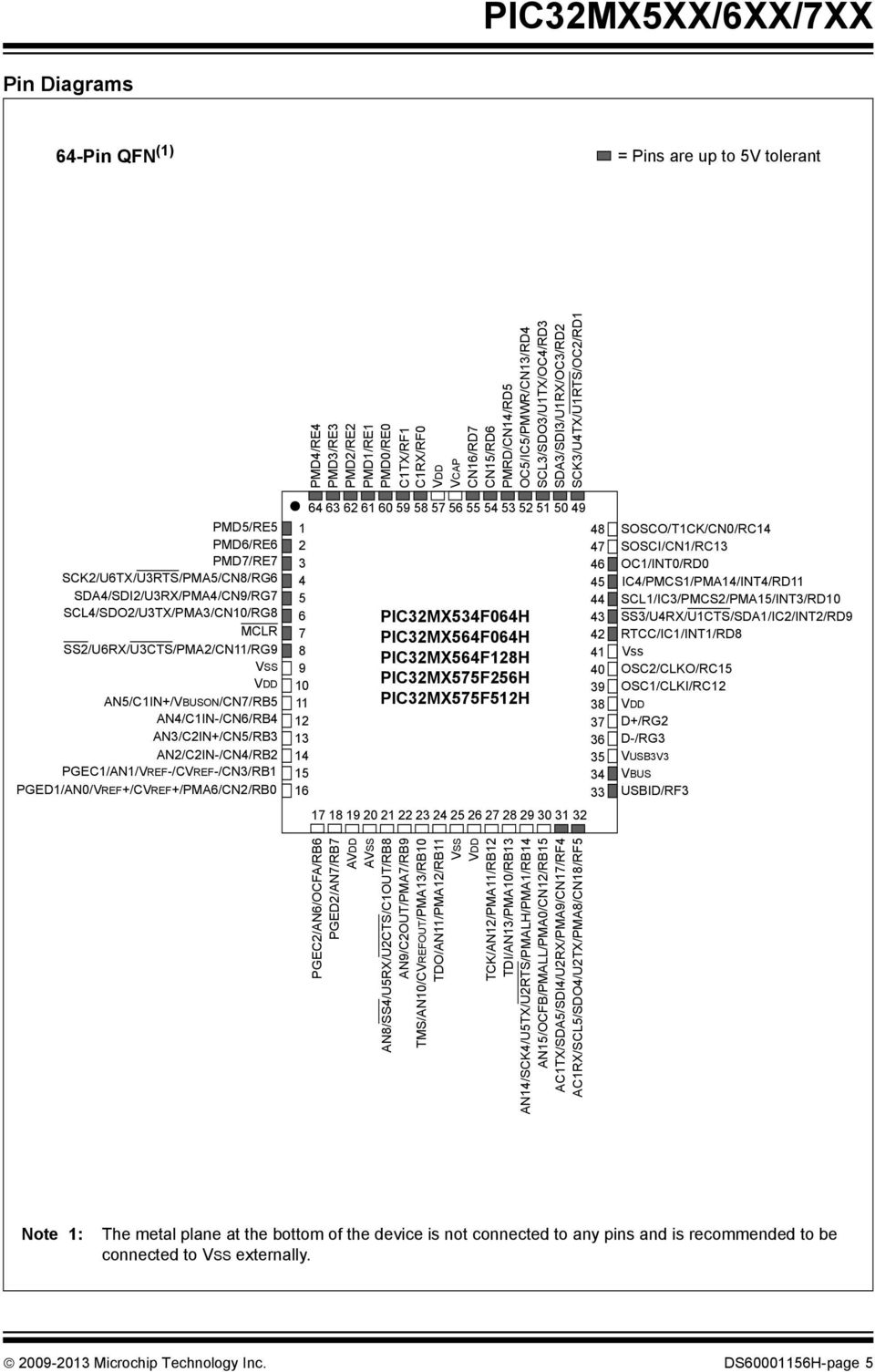
5 Pin Diagrams 64-Pin QFN (1) = Pins are up to 5V tolerant PMD5/RE5 PMD6/RE6 PMD7/RE7 SCK2/U6TX/U3RTS/PMA5/CN8/RG6 SDA4/SDI2/U3RX/PMA4/CN9/RG7 SCL4/SDO2/U3TX/PMA3/CN10/RG8 MCLR SS2/U6RX/U3CTS/PMA2/CN11/RG9 VSS VDD AN5/C1IN+/VBUSON/CN7/RB5 AN4/C1IN-/CN6/RB4 AN3/C2IN+/CN5/RB3 AN2/C2IN-/CN4/RB2 PGEC1/AN1/VREF-/CVREF-/CN3/RB1 PGED1/AN0/VREF+/CVREF+/PMA6/CN2/RB PIC32MX534F064H PIC32MX564F064H PIC32MX564F128H PIC32MX575F256H PIC32MX575F512H PGEC2/AN6/OCFA/RB6 PGED2/AN7/RB7 AVDD AVSS AN8/SS4/U5RX/U2CTS/C1OUT/RB8 AN9/C2OUT/PMA7/RB9 TMS/AN10/CVREFOUT/PMA13/RB10 TDO/AN11/PMA12/RB11 VSS VDD TCK/AN12/PMA11/RB12 TDI/AN13/PMA10/RB13 AN14/SCK4/U5TX/U2RTS/PMALH/PMA1/RB14 AN15/OCFB/PMALL/PMA0/CN12/RB15 AC1TX/SDA5/SDI4/U2RX/PMA9/CN17/RF4 AC1RX/SCL5/SDO4/U2TX/PMA8/CN18/RF5 PMD4/RE4 PMD3/RE3 PMD2/RE2 PMD1/RE1 PMD0/RE0 C1TX/RF1 C1RX/RF0 VDD VCAP CN16/RD7 CN15/RD6 PMRD/CN14/RD5 OC5/IC5/PMWR/CN13/RD4 SCL3/SDO3/U1TX/OC4/RD3 SDA3/SDI3/U1RX/OC3/RD2 SCK3/U4TX/U1RTS/OC2/RD1 SOSCO/T1CK/CN0/RC14 SOSCI/CN1/RC13 OC1/INT0/RD0 IC4/PMCS1/PMA14/INT4/RD11 SCL1/IC3/PMCS2/PMA15/INT3/RD10 SS3/U4RX/U1CTS/SDA1/IC2/INT2/RD9 RTCC/IC1/INT1/RD8 Vss OSC2/CLKO/RC15 OSC1/CLKI/RC12 VDD D+/RG2 D-/RG3 VUSB3V3 VBUS USBID/RF3 Note 1: The metal plane at the bottom of the device is not connected to any pins and is recommended to be connected to VSS externally Microchip Technology Inc. DS H-page 5
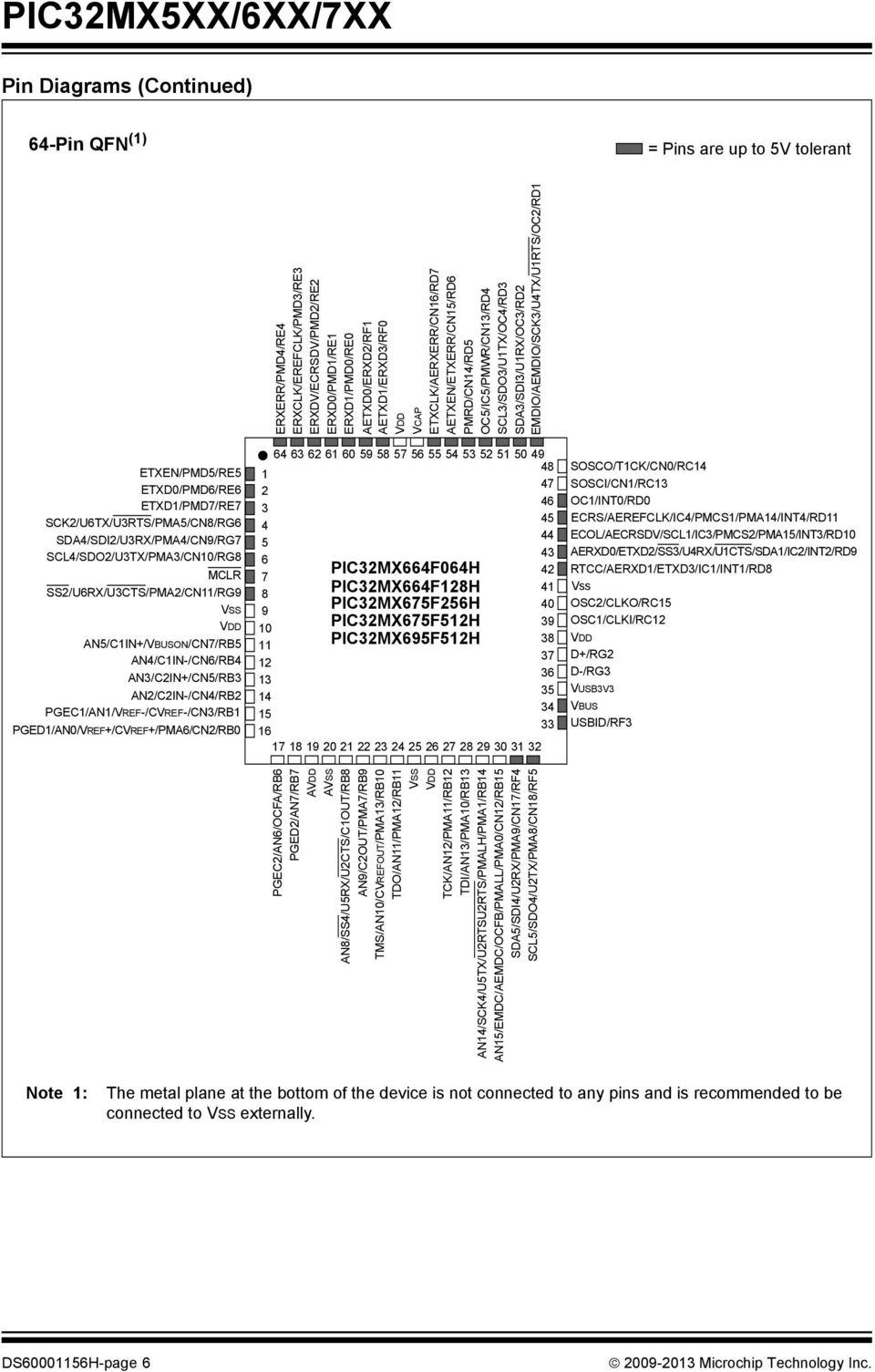
6 Pin Diagrams (Continued) 64-Pin QFN (1) = Pins are up to 5V tolerant ETXEN/PMD5/RE5 ETXD0/PMD6/RE6 ETXD1/PMD7/RE7 SCK2/U6TX/U3RTS/PMA5/CN8/RG6 SDA4/SDI2/U3RX/PMA4/CN9/RG7 SCL4/SDO2/U3TX/PMA3/CN10/RG8 MCLR SS2/U6RX/U3CTS/PMA2/CN11/RG9 VSS VDD AN5/C1IN+/VBUSON/CN7/RB5 AN4/C1IN-/CN6/RB4 AN3/C2IN+/CN5/RB3 AN2/C2IN-/CN4/RB2 PGEC1/AN1/VREF-/CVREF-/CN3/RB1 PGED1/AN0/VREF+/CVREF+/PMA6/CN2/RB PIC32MX664F064H PIC32MX664F128H PIC32MX675F256H PIC32MX675F512H PIC32MX695F512H SOSCO/T1CK/CN0/RC14 SOSCI/CN1/RC13 OC1/INT0/RD0 ECRS/AEREFCLK/IC4/PMCS1/PMA14/INT4/RD11 ECOL/AECRSDV/SCL1/IC3/PMCS2/PMA15/INT3/RD10 AERXD0/ETXD2/SS3/U4RX/U1CTS/SDA1/IC2/INT2/RD9 RTCC/AERXD1/ETXD3/IC1/INT1/RD8 Vss OSC2/CLKO/RC15 OSC1/CLKI/RC12 VDD D+/RG2 D-/RG3 VUSB3V3 VBUS USBID/RF3 PGEC2/AN6/OCFA/RB6 PGED2/AN7/RB7 AVDD AVSS AN8/SS4/U5RX/U2CTS/C1OUT/RB8 AN9/C2OUT/PMA7/RB9 TMS/AN10/CVREFOUT/PMA13/RB10 TDO/AN11/PMA12/RB11 VSS VDD TCK/AN12/PMA11/RB12 TDI/AN13/PMA10/RB13 AN14/SCK4/U5TX/U2RTSU2RTS/PMALH/PMA1/RB14 AN15/EMDC/AEMDC/OCFB/PMALL/PMA0/CN12/RB15 SDA5/SDI4/U2RX/PMA9/CN17/RF4 SCL5/SDO4/U2TX/PMA8/CN18/RF5 ERXERR/PMD4/RE4 ERXCLK/EREFCLK/PMD3/RE3 ERXDV/ECRSDV/PMD2/RE2 ERXD0/PMD1/RE1 ERXD1/PMD0/RE0 AETXD0/ERXD2/RF1 AETXD1/ERXD3/RF0 VDD VCAP ETXCLK/AERXERR/CN16/RD7 AETXEN/ETXERR/CN15/RD6 PMRD/CN14/RD5 OC5/IC5/PMWR/CN13/RD4 SCL3/SDO3/U1TX/OC4/RD3 SDA3/SDI3/U1RX/OC3/RD2 EMDIO/AEMDIO/SCK3/U4TX/U1RTS/OC2/RD1 Note 1: The metal plane at the bottom of the device is not connected to any pins and is recommended to be connected to VSS externally. DS H-page Microchip Technology Inc.
7 Pin Diagrams (Continued) 64-Pin QFN (1) = Pins are up to 5V tolerant ERXERR/PMD4/RE4 ERXCLK/EREFCLKPMD3/RE3 ERXDV/ECRSDV/PMD2/RE2 ERXD0/PMD1/RE1 ERXD1/PMD0/RE0 C1TX/AETXD0/ERXD2/RF1 C1RX/AETXD1/ERXD3/RF0 VDD VCAP ETXCLK/AERXERR/CN16/RD7 AETXEN/ETXERR/CN15/RD6 PMRD/CN14/RD5 OC5/IC5/PMWR/CN13/RD4 SCL3/SDO3/U1TX/OC4/RD3 SDA3/SDI3/U1RX/OC3/RD2 EMDIO/AEMDIO/SCK3/U4TX/U1RTS/OC2/RD1 ETXEN/PMD5/RE5 ETXD0/PMD6/RE6 ETXD1/PMD7/RE7 SCK2/U6TX/U3RTS/PMA5/CN8/RG6 SDA4/SDI2/U3RX/PMA4/CN9/RG7 SCL4/SDO2/U3TX/PMA3/CN10/RG8 MCLR SS2/U6RX/U3CTS/PMA2/CN11/RG9 VSS VDD AN5/C1IN+/VBUSON/CN7/RB5 AN4/C1IN-/CN6/RB4 AN3/C2IN+/CN5/RB3 AN2/C2IN-/CN4/RB2 PGEC1/AN1/VREF-/CVREF-/CN3/RB1 PGED1/AN0/VREF+/CVREF+/PMA6/CN2/RB PIC32MX775F256H PIC32MX775F512H PIC32MX795F512H SOSCO/T1CK/CN0/RC14 SOSCI/CN1/RC13 OC1/INT0/RD0 ECRS/AEREFCLK/IC4/PMCS1/PMA14/INT4/RD11 ECOL/AECRSDV/SCL1/IC3/PMCS2/PMA15/INT3/RD10 AERXD0/ETXD2/SS3/U4RX/U1CTS/SDA1/IC2/INT2/RD9 RTCC/AERXD1/ETXD3/IC1/INT1/RD8 Vss OSC2/CLKO/RC15 OSC1/CLKI/RC12 VDD D+/RG2 D-/RG3 VUSB3V3 VBUS USBID/RF3 PGEC2/AN6/OCFA/RB6 PGED2/AN7/RB7 AVDD AVSS AN8/C2TX/SS4/U5RX/U2CTS/C1OUT/RB8 AN9/C2OUT/PMA7/RB9 TMS/AN10/CVREFOUT/PMA13/RB10 TDO/AN11/PMA12/RB11 VSS VDD TCK/AN12/PMA11/RB12 TDI/AN13/PMA10/RB13 AN14/C2RX/SCK4/U5TX/U2RTS/PMALH/PMA1/RB14 AN15/EMDC/AEMDC/OCFB/PMALL/PMA0/CN12/RB15 AC1TX/SDA5/SDI4/U2RX/PMA9/CN17/RF4 AC1RX/SCL5/SDO4/U2TX/PMA8/CN18/RF5 Note 1: The metal plane at the bottom of the device is not connected to any pins and is recommended to be connected to VSS externally Microchip Technology Inc. DS H-page 7

8 Pin Diagrams (Continued) 64-Pin QFN (1) = Pins are up to 5V tolerant ERXERR/PMD4/RE4 ERXCLK/EREFCLKPMD3/RE3 ERXDV/ECRSDV/PMD2/RE2 ERXD0/PMD1/RE1 ERXD1/PMD0/RE0 C1TX/AETXD0/ERXD2/RF1 C1RX/AETXD1/ERXD3/RF0 VDD VCAP ETXCLK/AERXERR/CN16/RD7 AETXEN/ETXERR/CN15/RD6 PMRD/CN14/RD5 OC5/IC5/PMWR/CN13/RD4 SCL3/SDO3/U1TX/OC4/RD3 SDA3/SDI3/U1RX/OC3/RD2 EMDIO/AEMDIO/SCK3/U4TX/U1RTS/OC2/RD1 ETXEN/PMD5/RE5 ETXD0/PMD6/RE6 ETXD1/PMD7/RE7 SCK2/U6TX/U3RTS/PMA5/CN8/RG6 SDA4/SDI2/U3RX/PMA4/CN9/RG7 SCL4/SDO2/U3TX/PMA3/CN10/RG8 MCLR SS2/U6RX/U3CTS/PMA2/CN11/RG9 VSS VDD AN5/C1IN+/VBUSON/CN7/RB5 AN4/C1IN-/CN6/RB4 AN3/C2IN+/CN5/RB3 AN2/C2IN-/CN4/RB2 PGEC1/AN1/VREF-/CVREF-/CN3/RB1 PGED1/AN0/VREF+/CVREF+/PMA6/CN2/RB PIC32MX764F128H SOSCO/T1CK/CN0/RC14 SOSCI/CN1/RC13 OC1/INT0/RD0 ECRS/AEREFCLK/IC4/PMCS1/PMA14/INT4/RD11 ECOL/AECRSDV/SCL1/IC3/PMCS2/PMA15/INT3/RD10 AERXD0/ETXD2/SS3/U4RX/U1CTS/SDA1/IC2/INT2/RD9 RTCC/AERXD1/ETXD3/IC1/INT1/RD8 Vss OSC2/CLKO/RC15 OSC1/CLKI/RC12 VDD D+/RG2 D-/RG3 VUSB3V3 VBUS USBID/RF3 PGEC2/AN6/OCFA/RB6 PGED2/AN7/RB7 AVDD AVSS AN8/SS4/U5RX/U2CTS/C1OUT/RB8 AN9/C2OUT/PMA7/RB9 TMS/AN10/CVREFOUT/PMA13/RB10 TDO/AN11/PMA12/RB11 VSS VDD TCK/AN12/PMA11/RB12 TDI/AN13/PMA10/RB13 AN14/SCK4/U5TX/U2RTS/PMALH/PMA1/RB14 AN15/EMDC/AEMDC/OCFB/PMALL/PMA0/CN12/RB15 AC1TX/SDA5/SDI4/U2RX/PMA9/CN17/RF4 AC1RX/SCL5/SDO4/U2TX/PMA8/CN18/RF5 Note 1: The metal plane at the bottom of the device is not connected to any pins and is recommended to be connected to VSS externally. DS H-page Microchip Technology Inc.

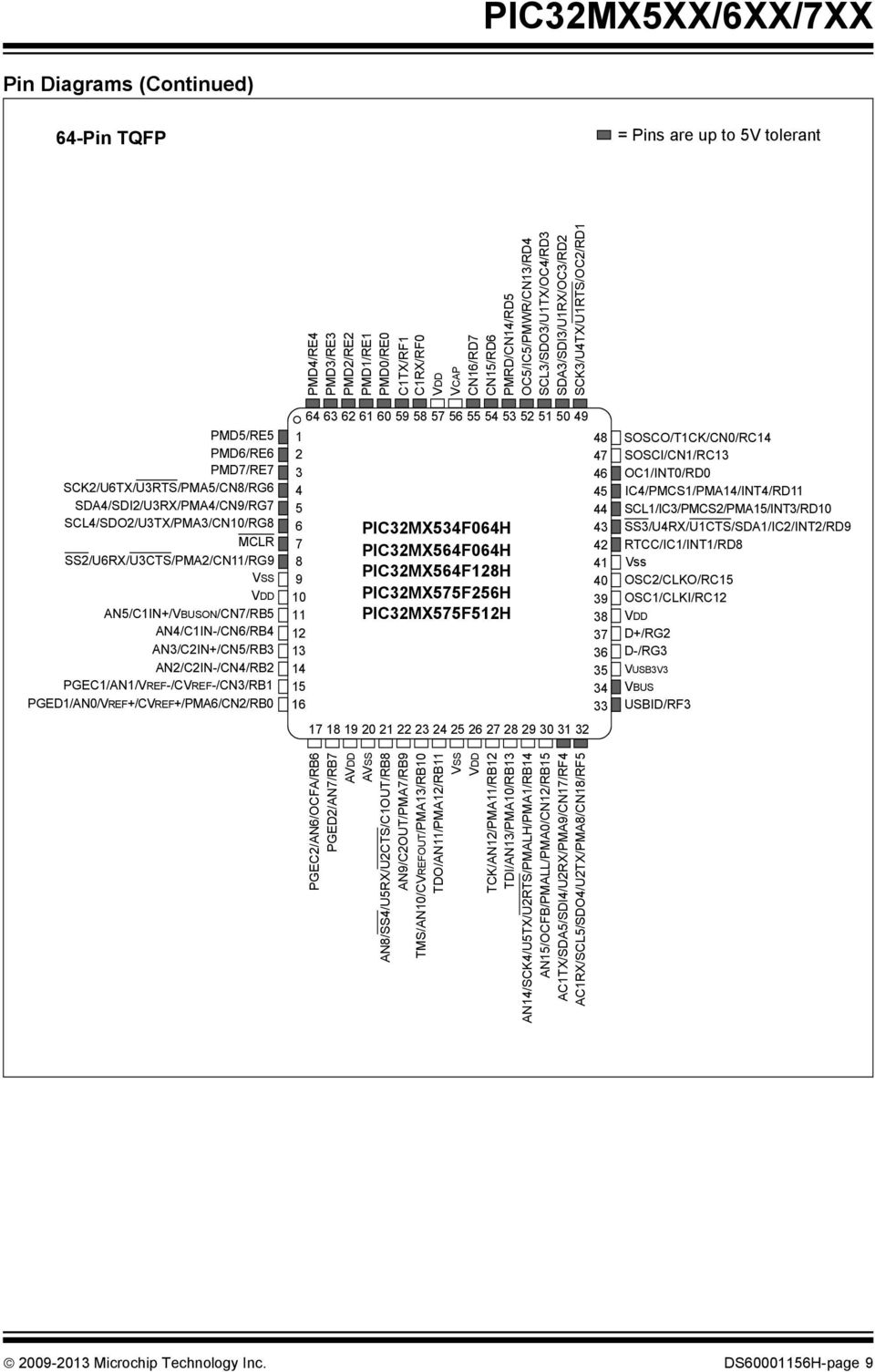
9 Pin Diagrams (Continued) 64-Pin TQFP = Pins are up to 5V tolerant PMD5/RE5 PMD6/RE6 PMD7/RE7 SCK2/U6TX/U3RTS/PMA5/CN8/RG6 SDA4/SDI2/U3RX/PMA4/CN9/RG7 SCL4/SDO2/U3TX/PMA3/CN10/RG8 MCLR SS2/U6RX/U3CTS/PMA2/CN11/RG9 VSS VDD AN5/C1IN+/VBUSON/CN7/RB5 AN4/C1IN-/CN6/RB4 AN3/C2IN+/CN5/RB3 AN2/C2IN-/CN4/RB2 PGEC1/AN1/VREF-/CVREF-/CN3/RB1 PGED1/AN0/VREF+/CVREF+/PMA6/CN2/RB PIC32MX534F064H PIC32MX564F064H PIC32MX564F128H PIC32MX575F256H PIC32MX575F512H PGEC2/AN6/OCFA/RB6 PGED2/AN7/RB7 AVDD AVSS AN8/SS4/U5RX/U2CTS/C1OUT/RB8 AN9/C2OUT/PMA7/RB9 TMS/AN10/CVREFOUT/PMA13/RB10 TDO/AN11/PMA12/RB11 VSS VDD TCK/AN12/PMA11/RB12 TDI/AN13/PMA10/RB13 AN14/SCK4/U5TX/U2RTS/PMALH/PMA1/RB14 AN15/OCFB/PMALL/PMA0/CN12/RB15 AC1TX/SDA5/SDI4/U2RX/PMA9/CN17/RF4 AC1RX/SCL5/SDO4/U2TX/PMA8/CN18/RF5 PMD4/RE4 PMD3/RE3 PMD2/RE2 PMD1/RE1 PMD0/RE0 C1TX/RF1 C1RX/RF0 VDD VCAP CN16/RD7 CN15/RD6 PMRD/CN14/RD5 OC5/IC5/PMWR/CN13/RD4 SCL3/SDO3/U1TX/OC4/RD3 SDA3/SDI3/U1RX/OC3/RD2 SCK3/U4TX/U1RTS/OC2/RD1 SOSCO/T1CK/CN0/RC14 SOSCI/CN1/RC13 OC1/INT0/RD0 IC4/PMCS1/PMA14/INT4/RD11 SCL1/IC3/PMCS2/PMA15/INT3/RD10 SS3/U4RX/U1CTS/SDA1/IC2/INT2/RD9 RTCC/IC1/INT1/RD8 Vss OSC2/CLKO/RC15 OSC1/CLKI/RC12 VDD D+/RG2 D-/RG3 VUSB3V3 VBUS USBID/RF Microchip Technology Inc. DS H-page 9
10 Pin Diagrams (Continued) 64-Pin TQFP = Pins are up to 5V tolerant ERXERR/PMD4/RE4 ERXCLK/EREFCLK/PMD3/RE3 ERXDV/ECRSDV/PMD2/RE2 ERXD0/PMD1/RE1 ERXD1/PMD0/RE0 AETXD0/ERXD2/RF1 AETXD1/ERXD3/RF0 VDD VCAP ETXCLK/AERXERR/CN16/RD7 AETXEN/ETXERR/CN15/RD6 PMRD/CN14/RD5 OC5/IC5/PMWR/CN13/RD4 SCL3/SDO3/U1TX/OC4/RD3 SDA3/SDI3/U1RX/OC3/RD2 EMDIO/AEMDIO/SCK3/U4TX/U1RTS/OC2/RD1 ETXEN/PMD5/RE5 ETXD0/PMD6/RE6 ETXD1/PMD7/RE7 SCK2/U6TX/U3RTS/PMA5/CN8/RG6 SDA4/SDI2/U3RX/PMA4/CN9/RG7 SCL4/SDO2/U3TX/PMA3/CN10/RG8 MCLR SS2/U6RX/U3CTS/PMA2/CN11/RG9 VSS VDD AN5/C1IN+/VBUSON/CN7/RB5 AN4/C1IN-/CN6/RB4 AN3/C2IN+/CN5/RB3 AN2/C2IN-/CN4/RB2 PGEC1/AN1/VREF-/CVREF-/CN3/RB1 PGED1/AN0/VREF+/CVREF+/PMA6/CN2/RB PIC32MX664F064H PIC32MX664F128H PIC32MX675F256H PIC32MX675F512H PIC32MX695F512H SOSCO/T1CK/CN0/RC14 SOSCI/CN1/RC13 OC1/INT0/RD0 ECRS/AEREFCLK/IC4/PMCS1/PMA14/INT4/RD11 ECOL/AECRSDV/SCL1/IC3/PMCS2/PMA15/INT3/RD10 AERXD0/ETXD2/SS3/U4RX/U1CTS/SDA1/IC2/INT2/RD9 RTCC/AERXD1/ETXD3/IC1/INT1/RD8 Vss OSC2/CLKO/RC15 OSC1/CLKI/RC12 VDD D+/RG2 D-/RG3 VUSB3V3 VBUS USBID/RF3 PGEC2/AN6/OCFA/RB6 PGED2/AN7/RB7 AVDD AVSS AN8/SS4/U5RX/U2CTS/C1OUT/RB8 AN9/C2OUT/PMA7/RB9 TMS/AN10/CVREFOUT/PMA13/RB10 TDO/AN11/PMA12/RB11 VSS VDD TCK/AN12/PMA11/RB12 TDI/AN13/PMA10/RB13 AN14/SCK4/U5TX/U2RTS/PMALH/PMA1/RB14 AN15/EMDC/AEMDC/OCFB/PMALL/PMA0/CN12/RB15 SDA5/SDI4/U2RX/PMA9/CN17/RF4 SCL5/SDO4/U2TX/PMA8/CN18/RF5 DS H-page Microchip Technology Inc.

11 Pin Diagrams (Continued) 64-Pin TQFP = Pins are up to 5V tolerant ERXERR/PMD4/RE4 ERXCLK/EREFCLK/PMD3/RE3 ERXDV/ECRSDV/PMD2/RE2 ERXD0/PMD1/RE1 ERXD1/PMD0/RE0 C1TX/AETXD0/ERXD2/RF1 C1RX/AETXD1/ERXD3/RF0 VDD VCAP ETXCLK/AERXERR/CN16/RD7 AETXEN/ETXERR/CN15/RD6 PMRD/CN14/RD5 OC5/IC5/PMWR/CN13/RD4 SCL3/SDO3/U1TX/OC4/RD3 SDA3/SDI3/U1RX/OC3/RD2 EMDIO/AEMDIO/SCK3/U4TX/U1RTS/OC2/RD1 ETXEN/PMD5/RE5 ETXD0/PMD6/RE6 ETXD1/PMD7/RE7 SCK2/U6TX/U3RTS/PMA5/CN8/RG6 SDA4/SDI2/U3RX/PMA4/CN9/RG7 SCL4/SDO2/U3TX/PMA3/CN10/RG8 MCLR SS2/U6RX/U3CTS/PMA2/CN11/RG9 VSS VDD AN5/C1IN+/VBUSON/CN7/RB5 AN4/C1IN-/CN6/RB4 AN3/C2IN+/CN5/RB3 AN2/C2IN-/CN4/RB2 PGEC1/AN1/VREF-/CVREF-/CN3/RB1 PGED1/AN0/VREF+/CVREF+/PMA6/CN2/RB PIC32MX775F256H PIC32MX775F512H PIC32MX795F512H SOSCO/T1CK/CN0/RC14 SOSCI/CN1/RC13 OC1/INT0/RD0 ECRS/AEREFCLK/IC4/PMCS1/PMA14/INT4/RD11 ECOL/AECRSDV/SCL1/IC3/PMCS2/PMA15/INT3/RD10 AERXD0/ETXD2/SS3/U4RX/U1CTS/SDA1/IC2/INT2/RD9 RTCC/AERXD1/ETXD3/IC1/INT1/RD8 Vss OSC2/CLKO/RC15 OSC1/CLKI/RC12 VDD D+/RG2 D-/RG3 VUSB3V3 VBUS USBID/RF3 PGEC2/AN6/OCFA/RB6 PGED2/AN7/RB7 AVDD AVSS AN8/C2TX/SS4/U5RX/U2CTS/C1OUT/RB8 AN9/C2OUT/PMA7/RB9 TMS/AN10/CVREFOUT/PMA13/RB10 TDO/AN11/PMA12/RB11 VSS VDD TCK/AN12/PMA11/RB12 TDI/AN13/PMA10/RB13 AN14/C2RX/SCK4/U5TX/U2RTS/PMALH/PMA1/RB14 AN15/EMDC/AEMDC/OCFB/PMALL/PMA0/CN12/RB15 AC1TX/SDA5/SDI4/U2RX/PMA9/CN17/RF4 AC1RX/SCL5/SDO4/U2TX/PMA8/CN18/RF Microchip Technology Inc. DS H-page 11

12 Pin Diagrams (Continued) 64-Pin TQFP = Pins are up to 5V tolerant ERXERR/PMD4/RE4 ERXCLK/EREFCLK/PMD3/RE3 ERXDV/ECRSDV/PMD2/RE2 ERXD0/PMD1/RE1 ERXD1/PMD0/RE0 C1TX/AETXD0/ERXD2/RF1 C1RX/AETXD1/ERXD3/RF0 VDD VCAP ETXCLK/AERXERR/CN16/RD7 AETXEN/ETXERR/CN15/RD6 PMRD/CN14/RD5 OC5/IC5/PMWR/CN13/RD4 SCL3/SDO3/U1TX/OC4/RD3 SDA3/SDI3/U1RXU1RX/OC3/RD2 EMDIO/AEMDIO/SCK3/U4TX/U1RTS/OC2/RD1 ETXEN/PMD5/RE5 ETXD0/PMD6/RE6 ETXD1/PMD7/RE7 SCK2/U6TX/U3RTS/PMA5/CN8/RG6 SDA4/SDI2/U3RX/PMA4/CN9/RG7 SCL4/SDO2/U3TX/PMA3/CN10/RG8 MCLR SS2/U6RX/U3CTS/PMA2/CN11/RG9 VSS VDD AN5/C1IN+/VBUSON/CN7/RB5 AN4/C1IN-/CN6/RB4 AN3/C2IN+/CN5/RB3 AN2/C2IN-/CN4/RB2 PGEC1/AN1/VREF-/CVREF-/CN3/RB1 PGED1/AN0/VREF+/CVREF+/PMA6/CN2/RB PIC32MX764F128H SOSCO/T1CK/CN0/RC14 SOSCI/CN1/RC13 OC1/INT0/RD0 ECRS/AEREFCLK/IC4/PMCS1/PMA14/INT4/RD11 ECOL/AECRSDV/SCL1/IC3/PMCS2/PMA15/INT3/RD10 AERXD0/ETXD2/SS3/U4RX/U1CTS/SDA1/IC2/INT2/RD9 RTCC/AERXD1/ETXD3/IC1/INT1/RD8 Vss OSC2/CLKO/RC15 OSC1/CLKI/RC12 VDD D+/RG2 D-/RG3 VUSB3V3 VBUS USBID/RF3 PGEC2/AN6/OCFA/RB6 PGED2/AN7/RB7 AVDD AVSS AN8/SS4/U5RX/U2CTS/C1OUT/RB8 AN9/C2OUT/PMA7/RB9 TMS/AN10/CVREFOUT/PMA13/RB10 TDO/AN11/PMA12/RB11 VSS VDD TCK/AN12/PMA11/RB12 TDI/AN13/PMA10/RB13 AN14/SCK4/U5TX/U2RTS/PMALH/PMA1/RB14 AN15/EMDC/AEMDC/OCFB/PMALL/PMA0/CN12/RB15 AC1TX/SDA5/SDI4/U2RX/PMA9/CN17/RF4 AC1RX/SCL5/SDO4/U2TX/PMA8/CN18/RF5 DS H-page Microchip Technology Inc.

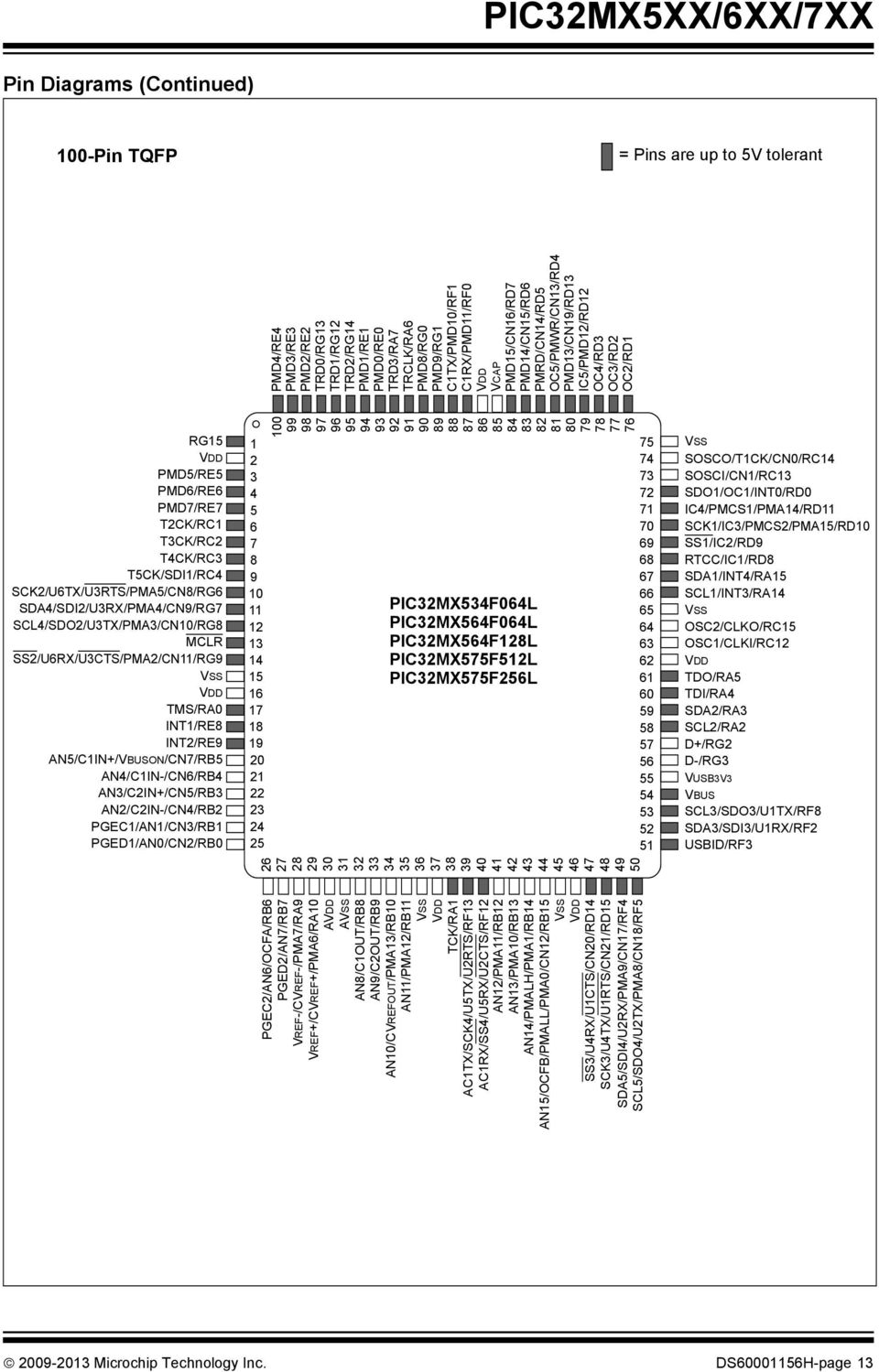
13 Microchip Technology Inc. DS H-page 13 PIC32MX5XX/6XX/7XX Pin Diagrams (Continued) PMRD/CN14/RD5 OC5/PMWR/CN13/RD4 PMD13/CN19/RD13 IC5/PMD12/RD12 OC4/RD3 OC3/RD2 OC2/RD1 TRD3/RA7 TRCLK/RA6 PMD2/RE2 TRD0/RG13 TRD1/RG12 TRD2/RG14 PMD1/RE1 PMD0/RE0 PMD8/RG0 PMD4/RE4 PMD3/RE3 C1RX/PMD11/RF0 SOSCI/CN1/RC13 SDO1/OC1/INT0/RD0 SCK1/IC3/PMCS2/PMA15/RD10 SS1/IC2/RD9 RTCC/IC1/RD8 IC4/PMCS1/PMA14/RD11 SDA1/INT4/RA15 SCL1/INT3/RA14 OSC2/CLKO/RC15 OSC1/CLKI/RC12 VDD D+/RG2 VUSB3V3 VBUS SCL3/SDO3/U1TX/RF8 D-/RG3 SDA3/SDI3/U1RX/RF2 USBID/RF3 VSS SOSCO/T1CK/CN0/RC14 VREF+/CVREF+/PMA6/RA10 VREF-/CVREF-/PMA7/RA9 AVDD AVSS AN8/C1OUT/RB8 AN9/C2OUT/RB9 AN10/CVREFOUT/PMA13/RB10 AN11/PMA12/RB11 VDD AC1RX/SS4/U5RX/U2CTS/RF12 AC1TX/SCK4/U5TX/U2RTS/RF13 SS3/U4RX/U1CTS/CN20/RD14 SCK3/U4TX/U1RTS/CN21/RD15 VDD VSS PGEC2/AN6/OCFA/RB6 PGED2/AN7/RB7 SCL5/SDO4/U2TX/PMA8/CN18/RF5 SDA5/SDI4/U2RX/PMA9/CN17/RF4 PMD5/RE5 PMD6/RE6 PMD7/RE7 T2CK/RC1 T3CK/RC2 T4CK/RC3 T5CK/SDI1/RC4 SCK2/U6TX/U3RTS/PMA5/CN8/RG6 VDD TMS/RA0 INT1/RE8 INT2/RE9 AN5/C1IN+/VBUSON/CN7/RB5 AN4/C1IN-/CN6/RB4 AN3/C2IN+/CN5/RB3 AN2/C2IN-/CN4/RB2 SDA4/SDI2/U3RX/PMA4/CN9/RG7 SCL4/SDO2/U3TX/PMA3/CN10/RG8 PGEC1/AN1/CN3/RB1 PGED1/AN0/CN2/RB0 VDD RG15 SS2/U6RX/U3CTS/PMA2/CN11/RG9 MCLR AN12/PMA11/RB12 AN13/PMA10/RB13 AN14/PMALH/PMA1/RB14 AN15/OCFB/PMALL/PMA0/CN12/RB15 PMD9/RG1 C1TX/PMD10/RF1 VDD PMD14/CN15/RD6 TDO/RA5 SDA2/RA3 SCL2/RA2 VSS VSS VSS VCAP TDI/RA4 TCK/RA1 100-Pin TQFP PMD15/CN16/RD7 = Pins are up to 5V tolerant PIC32MX575F512L PIC32MX575F256L PIC32MX534F064L PIC32MX564F064L PIC32MX564F128L
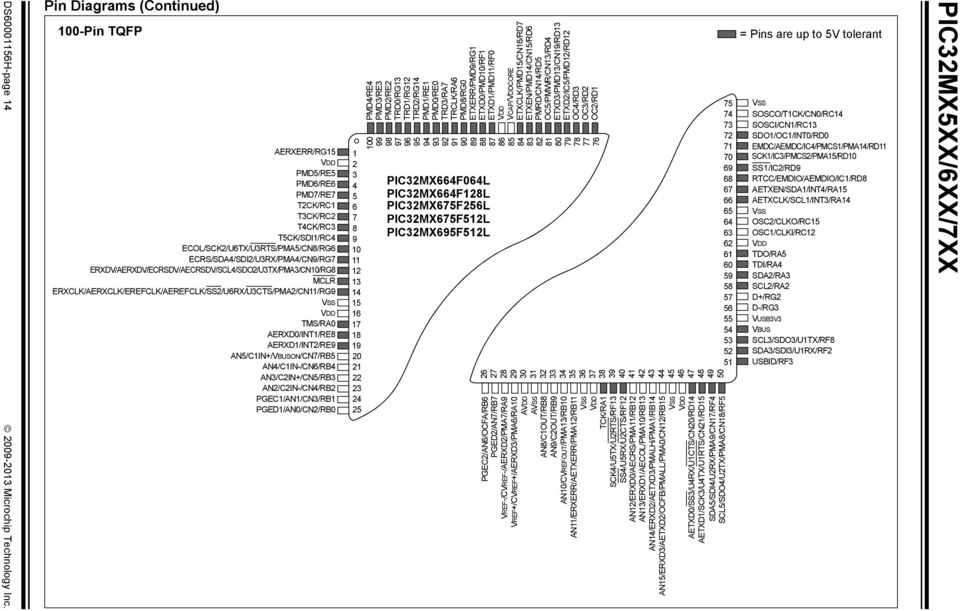
14 DS H-page Microchip Technology Inc. Pin Diagrams (Continued) 100-Pin TQFP PIC32MX675F512L PIC32MX695F512L PIC32MX675F256L = Pins are up to 5V tolerant PMRD/CN14/RD5 OC5/PMWR/CN13/RD4 ETXD3/PMD13/CN19/RD13 ETXD2/IC5/PMD12/RD12 OC4/RD3 OC3/RD2 OC2/RD1 TRD3/RA7 TRCLK/RA6 PMD2/RE2 TRD0/RG13 TRD1/RG12 TRD2/RG14 PMD1/RE1 PMD0/RE0 PMD8/RG0 PMD4/RE4 PMD3/RE3 ETXD1/PMD11/RF0 PMD5/RE5 PMD6/RE6 PMD7/RE7 T2CK/RC1 T3CK/RC2 T4CK/RC3 T5CK/SDI1/RC4 ECOL/SCK2/U6TX/U3RTS/PMA5/CN8/RG6 VDD TMS/RA0 AERXD0/INT1/RE8 AERXD1/INT2/RE9 AN5/C1IN+/VBUSON/CN7/RB5 AN4/C1IN-/CN6/RB4 AN3/C2IN+/CN5/RB3 AN2/C2IN-/CN4/RB2 ECRS/SDA4/SDI2/U3RX/PMA4/CN9/RG7 ERXDV/AERXDV/ECRSDV/AECRSDV/SCL4/SDO2/U3TX/PMA3/CN10/RG8 PGEC1/AN1/CN3/RB1 PGED1/AN0/CN2/RB0 VDD AERXERR/RG15 ERXCLK/AERXCLK/EREFCLK/AEREFCLK/SS2/U6RX/U3CTS/PMA2/CN11/RG9 MCLR ETXERR/PMD9/RG1 ETXD0/PMD10/RF1 VDD ETXEN/PMD14/CN15/RD6 VSS VCAP/VDDCORE ETXCLK/PMD15/CN16/RD SOSCI/CN1/RC13 SDO1/OC1/INT0/RD0 SS1/IC2/RD9 RTCC/EMDIO/AEMDIO/IC1/RD8 EMDC/AEMDC/IC4/PMCS1/PMA14/RD11 AETXEN/SDA1/INT4/RA15 AETXCLK/SCL1/INT3/RA14 OSC2/CLKO/RC15 OSC1/CLKI/RC12 VDD D+/RG2 VUSB3V3 VBUS SCL3/SDO3/U1TX/RF8 D-/RG3 SDA3/SDI3/U1RX/RF2 USBID/RF3 VSS SOSCO/T1CK/CN0/RC14 VREF+/CVREF+/AERXD3/PMA6/RA10 VREF-/CVREF-/AERXD2/PMA7/RA9 AVDD AVSS AN8/C1OUT/RB8 AN9/C2OUT/RB9 AN10/CVREFOUT/PMA13/RB10 AN11/ERXERR/AETXERR/PMA12/RB11 VDD SS4/U5RX/U2CTS/RF12 SCK4/U5TX/U2RTS/RF13 AETXD0/SS3/U4RX/U1CTS/CN20/RD14 AETXD1/SCK3/U4TX/U1RTS/CN21/RD15 VDD VSS PGED2/AN7/RB7 SCL5/SDO4/U2TX/PMA8/CN18/RF5 SDA5/SDI4/U2RX/PMA9/CN17/RF4 AN12/ERXD0/AECRS/PMA11/RB12 AN13/ERXD1/AECOL/PMA10/RB13 AN14/ERXD2/AETXD3/PMALH/PMA1/RB14 AN15/ERXD3/AETXD2/OCFB/PMALL/PMA0/CN12/RB15 TDO/RA5 SDA2/RA3 SCL2/RA2 VSS VSS TDI/RA4 TCK/RA SCK1/IC3/PMCS2/PMA15/RD10 PIC32MX664F064L PIC32MX664F128L PGEC2/AN6/OCFA/RB6 26
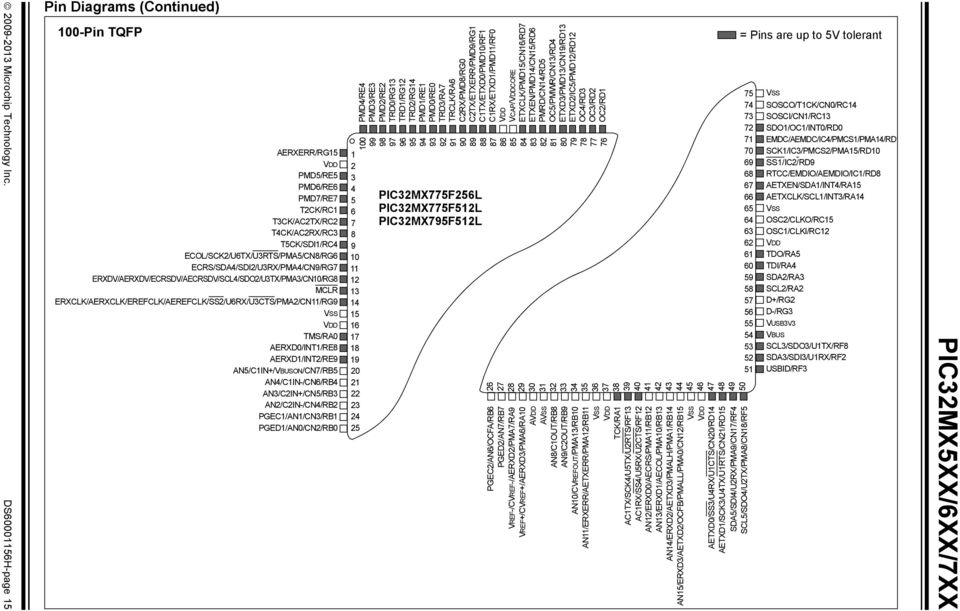
15 Microchip Technology Inc. DS H-page 15 PIC32MX5XX/6XX/7XX Pin Diagrams (Continued) 100-Pin TQFP = Pins are up to 5V tolerant PIC32MX795F512L PIC32MX775F256L PIC32MX775F512L PMRD/CN14/RD5 OC5/PMWR/CN13/RD4 ETXD3/PMD13/CN19/RD13 ETXD2/IC5/PMD12/RD12 OC4/RD3 OC3/RD2 OC2/RD1 TRD3/RA7 TRCLK/RA6 PMD2/RE2 TRD0/RG13 TRD1/RG12 TRD2/RG14 PMD1/RE1 PMD0/RE0 C2RX/PMD8/RG0 PMD4/RE4 PMD3/RE3 C1RX/ETXD1/PMD11/RF0 PMD5/RE5 PMD6/RE6 PMD7/RE7 T2CK/RC1 T3CK/AC2TX/RC2 T4CK/AC2RX/RC3 T5CK/SDI1/RC4 ECOL/SCK2/U6TX/U3RTS/PMA5/CN8/RG6 VDD TMS/RA0 AERXD0/INT1/RE8 AERXD1/INT2/RE9 AN5/C1IN+/VBUSON/CN7/RB5 AN4/C1IN-/CN6/RB4 AN3/C2IN+/CN5/RB3 AN2/C2IN-/CN4/RB2 ECRS/SDA4/SDI2/U3RX/PMA4/CN9/RG7 ERXDV/AERXDV/ECRSDV/AECRSDV/SCL4/SDO2/U3TX/PMA3/CN10/RG8 PGEC1/AN1/CN3/RB1 PGED1/AN0/CN2/RB0 VDD AERXERR/RG15 ERXCLK/AERXCLK/EREFCLK/AEREFCLK/SS2/U6RX/U3CTS/PMA2/CN11/RG9 MCLR C2TX/ETXERR/PMD9/RG1 C1TX/ETXD0/PMD10/RF1 VDD ETXEN/PMD14/CN15/RD6 VSS VCAP/VDDCORE ETXCLK/PMD15/CN16/RD SOSCI/CN1/RC13 SDO1/OC1/INT0/RD0 SCK1/IC3/PMCS2/PMA15/RD10 SS1/IC2/RD9 RTCC/EMDIO/AEMDIO/IC1/RD8 EMDC/AEMDC/IC4/PMCS1/PMA14/RD1 AETXEN/SDA1/INT4/RA15 AETXCLK/SCL1/INT3/RA14 OSC2/CLKO/RC15 OSC1/CLKI/RC12 VDD D+/RG2 VUSB3V3 VBUS SCL3/SDO3/U1TX/RF8 D-/RG3 SDA3/SDI3/U1RX/RF2 USBID/RF3 VSS SOSCO/T1CK/CN0/RC14 VREF+/CVREF+/AERXD3/PMA6/RA10 VREF-/CVREF-/AERXD2/PMA7/RA9 AVDD AVSS AN8/C1OUT/RB8 AN9/C2OUT/RB9 AN10/CVREFOUT/PMA13/RB10 AN11/ERXERR/AETXERR/PMA12/RB11 VDD AC1RX/SS4/U5RX/U2CTS/RF12 AC1TX/SCK4/U5TX/U2RTS/RF13 AETXD0/SS3/U4RX/U1CTS/CN20/RD14 AETXD1/SCK3/U4TX/U1RTS/CN21/RD15 VDD VSS PGEC2/AN6/OCFA/RB6 PGED2/AN7/RB7 SCL5/SDO4/U2TX/PMA8/CN18/RF5 SDA5/SDI4/U2RX/PMA9/CN17/RF4 AN12/ERXD0/AECRS/PMA11/RB12 AN13/ERXD1/AECOL/PMA10/RB13 AN14/ERXD2/AETXD3/PMALH/PMA1/RB14 AN15/ERXD3/AETXD2/OCFB/PMALL/PMA0/CN12/RB15 TDO/RA5 SDA2/RA3 SCL2/RA2 VSS VSS TDI/RA4 TCK/RA
16 DS H-page Microchip Technology Inc. Pin Diagrams (Continued) 100-Pin TQFP = Pins are up to 5V tolerant PIC32MX764F128L PMRD/CN14/RD5 OC5/PMWR/CN13/RD4 ETXD3/PMD13/CN19/RD13 ETXD2/IC5/PMD12/RD12 OC4/RD3 OC3/RD2 OC2/RD1 TRD3/RA7 TRCLK/RA6 PMD2/RE2 TRD0/RG13 TRD1/RG12 TRD2/RG14 PMD1/RE1 PMD0/RE0 PMD8/RG0 PMD4/RE4 PMD3/RE3 C1RX/ETXD1/PMD11/RF0 PMD5/RE5 PMD6/RE6 PMD7/RE7 T2CK/RC1 T3CK/RC2 T4CK/RC3 T5CK/SDI1/RC4 ECOL/SCK2/U6TX/U3RTS/PMA5/CN8/RG6 VDD TMS/RA0 AERXD0/INT1/RE8 AERXD1/INT2/RE9 AN5/C1IN+/VBUSON/CN7/RB5 AN4/C1IN-/CN6/RB4 AN3/C2IN+/CN5/RB3 AN2/C2IN-/CN4/RB2 ECRS/SDA4/SDI2/U3RX/PMA4/CN9/RG7 ERXDV/AERXDV/ECRSDV/AECRSDV/SCL4/SDO2/U3TX/PMA3/CN10/RG8 PGEC1/AN1/CN3/RB1 PGED1/AN0/CN2/RB0 VDD AERXERR/RG15 ERXCLK/AERXCLK/EREFCLK/AEREFCLK/SS2/U6RX/U3CTS/PMA2/CN11/RG9 MCLR ETXERR/PMD9/RG1 C1TX/ETXD0/PMD10/RF1 VDD ETXEN/PMD14/CN15/RD6 VSS VCAP/VDDCORE ETXCLK/PMD15/CN16/RD SOSCI/CN1/RC13 SDO1/OC1/INT0/RD0 SCK1/IC3/PMCS2/PMA15/RD10 SS1/IC2/RD9 RTCC/EMDIO/AEMDIO/IC1/RD8 EMDC/AEMDC/IC4/PMCS1/PMA14/RD1 AETXEN/SDA1/INT4/RA15 AETXCLK/SCL1/INT3/RA14 OSC2/CLKO/RC15 OSC1/CLKI/RC12 VDD D+/RG2 VUSB3V3 VBUS SCL3/SDO3/U1TX/RF8 D-/RG3 SDA3/SDI3/U1RX/RF2 USBID/RF3 VSS SOSCO/T1CK/CN0/RC14 VREF+/CVREF+/AERXD3/PMA6/RA10 VREF-/CVREF-/AERXD2/PMA7/RA9 AVDD AVSS AN8/C1OUT/RB8 AN9/C2OUT/RB9 AN10/CVREFOUT/PMA13/RB10 AN11/ERXERR/AETXERR/PMA12/RB11 VDD AC1RX/SS4/U5RX/U2CTS/RF12 AC1TX/SCK4/U5TX/U2RTS/RF13 AETXD0/SS3/U4RX/U1CTS/CN20/RD14 AETXD1/SCK3/U4TX/U1RTS/CN21/RD15 VDD VSS PGEC2/AN6/OCFA/RB6 PGED2/AN7/RB7 SCL5/SDO4/U2TX/PMA8/CN18/RF5 SDA5/SDI4/U2RX/PMA9/CN17/RF4 AN12/ERXD0/AECRS/PMA11/RB12 AN13/ERXD1/AECOL/PMA10/RB13 AN14/ERXD2/AETXD3/PMALH/PMA1/RB14 AN15/ERXD3/AETXD2/OCFB/PMALL/PMA0/CN12/RB15 TDO/RA5 SDA2/RA3 SCL2/RA2 VSS VSS TDI/RA4 TCK/RA

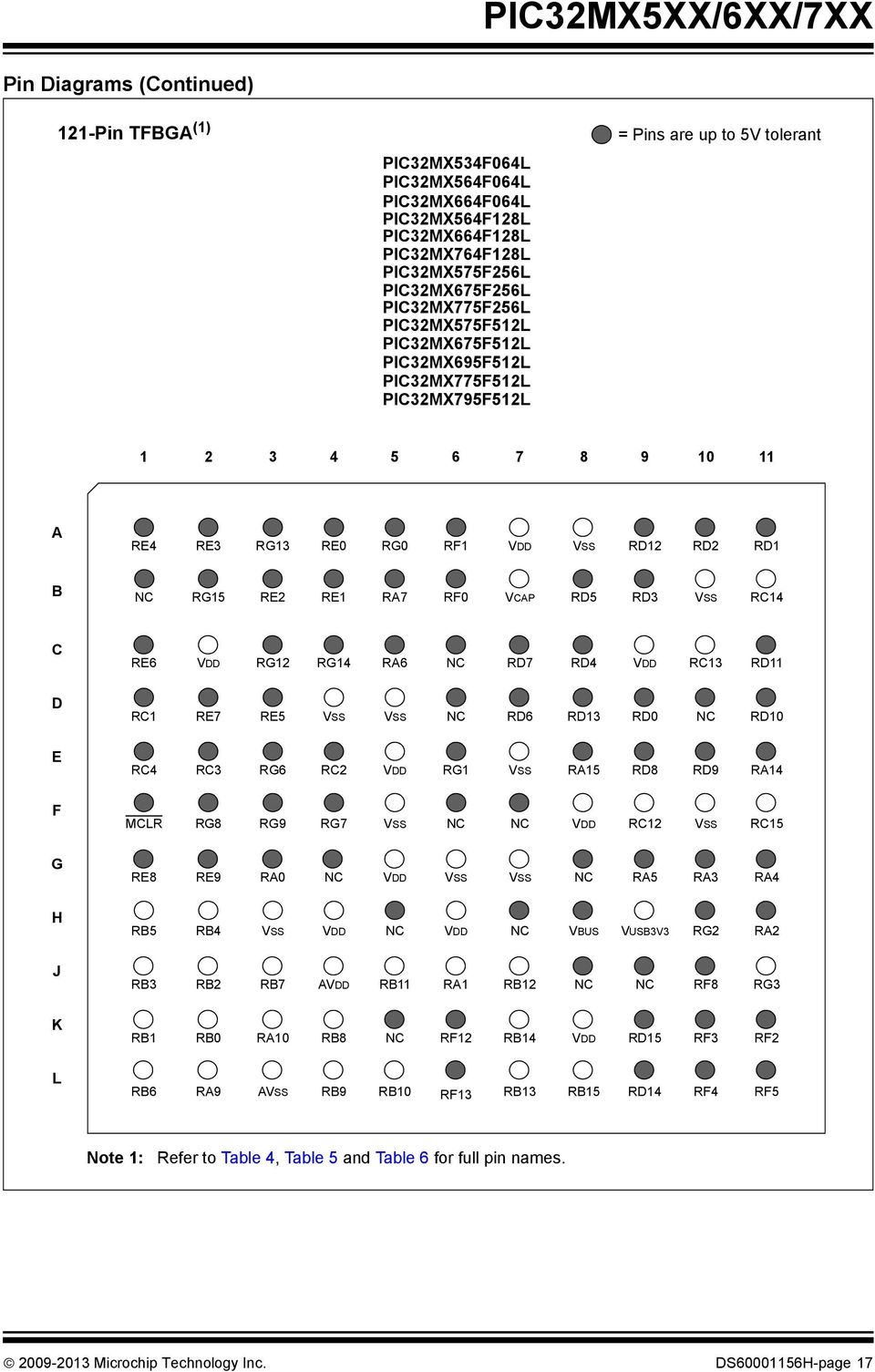
17 Pin Diagrams (Continued) 121-Pin TFBGA (1) PIC32MX534F064L PIC32MX564F064L PIC32MX664F064L PIC32MX564F128L PIC32MX664F128L PIC32MX764F128L PIC32MX575F256L PIC32MX675F256L PIC32MX775F256L PIC32MX575F512L PIC32MX675F512L PIC32MX695F512L PIC32MX775F512L PIC32MX795F512L = Pins are up to 5V tolerant A RE4 RE3 RG13 RE0 RG0 RF1 VDD VSS RD12 RD2 RD1 B NC RG15 RE2 RE1 RA7 RF0 VCAP RD5 RD3 VSS RC14 C D E F G H J K L RE6 VDD RG12 RG14 RA6 NC RD7 RD4 VDD RC13 RD11 RC1 RE7 RE5 VSS VSS NC RD6 RD13 RD0 NC RD10 RC4 RC3 RG6 RC2 VDD RG1 VSS RA15 RD8 RD9 RA14 MCLR RG8 RG9 RG7 VSS NC NC VDD RC12 VSS RC15 RE8 RE9 RA0 NC VDD VSS VSS NC RA5 RA3 RA4 RB5 RB4 VSS VDD NC VDD NC VBUS VUSB3V3 RG2 RA2 RB3 RB2 RB7 AVDD RB11 RA1 RB12 NC NC RF8 RG3 RB1 RB0 RA10 RB8 NC RF12 RB14 VDD RD15 RF3 RF2 RB6 RA9 AVSS RB9 RB10 RF13 RB13 RB15 RD14 RF4 RF5 Note 1: Refer to Table 4, Table 5 and Table 6 for full pin names Microchip Technology Inc. DS H-page 17
18 TABLE 4: Pin Number PIN NAMES: PIC32MX534F064L, PIC32MX564F064L, PIC32MX564F128L, PIC32MX575F256L AND PIC32MX575F512L DEVICES Full Pin Name Pin Number Full Pin Name A1 PMD4/RE4 E8 SDA1/INT4/RA15 A2 PMD3/RE3 E9 RTCC/IC1/RD8 A3 TRD0/RG13 E10 SS1/IC2/RD9 A4 PMD0/RE0 E11 SCL1/INT3/RA14 A5 PMD8/RG0 F1 MCLR A6 C1TX/PMD10/RF1 F2 SCL4/SDO2/U3TX/PMA3/CN10/RG8 A7 VDD F3 SS2/U6RX/U3CTS/PMA2/CN11/RG9 A8 VSS F4 SDA4/SDI2/U3RX/PMA4/CN9/RG7 A9 IC5/PMD12/RD12 F5 VSS A10 OC3/RD2 F6 No Connect (NC) A11 OC2/RD1 F7 No Connect (NC) B1 No Connect (NC) F8 VDD B2 RG15 F9 OSC1/CLKI/RC12 B3 PMD2/RE2 F10 VSS B4 PMD1/RE1 F11 OSC2/CLKO/RC15 B5 TRD3/RA7 G1 INT1/RE8 B6 C1RX/PMD11/RF0 G2 INT2/RE9 B7 VCAP G3 TMS/RA0 B8 PMRD/CN14/RD5 G4 No Connect (NC) B9 OC4/RD3 G5 VDD B10 VSS G6 VSS B11 SOSCO/T1CK/CN0/RC14 G7 VSS C1 PMD6/RE6 G8 No Connect (NC) C2 VDD G9 TDO/RA5 C3 TRD1/RG12 G10 SDA2/RA3 C4 TRD2/RG14 G11 TDI/RA4 C5 TRCLK/RA6 H1 AN5/C1IN+/VBUSON/CN7/RB5 C6 No Connect (NC) H2 AN4/C1IN-/CN6/RB4 C7 PMD15/CN16/RD7 H3 VSS C8 OC5/PMWR/CN13/RD4 H4 VDD C9 VDD H5 No Connect (NC) C10 SOSCI/CN1/RC13 H6 VDD C11 IC4/PMCS1/PMA14/RD11 H7 No Connect (NC) D1 T2CK/RC1 H8 VBUS D2 PMD7/RE7 H9 VUSB3V3 D3 PMD5/RE5 H10 D+/RG2 D4 VSS H11 SCL2/RA2 D5 VSS J1 AN3/C2IN+/CN5/RB3 D6 No Connect (NC) J2 AN2/C2IN-/CN4/RB2 D7 PMD14/CN15/RD6 J3 PGED2/AN7/RB7 D8 PMD13/CN19/RD13 J4 AVDD D9 SDO1/OC1/INT0/RD0 J5 AN11/PMA12/RB11 D10 No Connect (NC) J6 TCK/RA1 D11 SCK1/IC3/PMCS2/PMA15/RD10 J7 AN12/PMA11/RB12 E1 T5CK/SDI1/RC4 J8 No Connect (NC) E2 T4CK/RC3 J9 No Connect (NC) E3 SCK2/U6TXU6TX/U3RTS/PMA5/CN8/RG6 J10 SCL3/SDO3/U1TX/RF8 E4 T3CK/RC2 J11 D-/RG3 E5 VDD K1 PGEC1/AN1/CN3/RB1 E6 PMD9/RG1 K2 PGED1/AN0/CN2/RB0 E7 VSS K3 VREF+/CVREF+/PMA6/RA10 DS H-page Microchip Technology Inc.

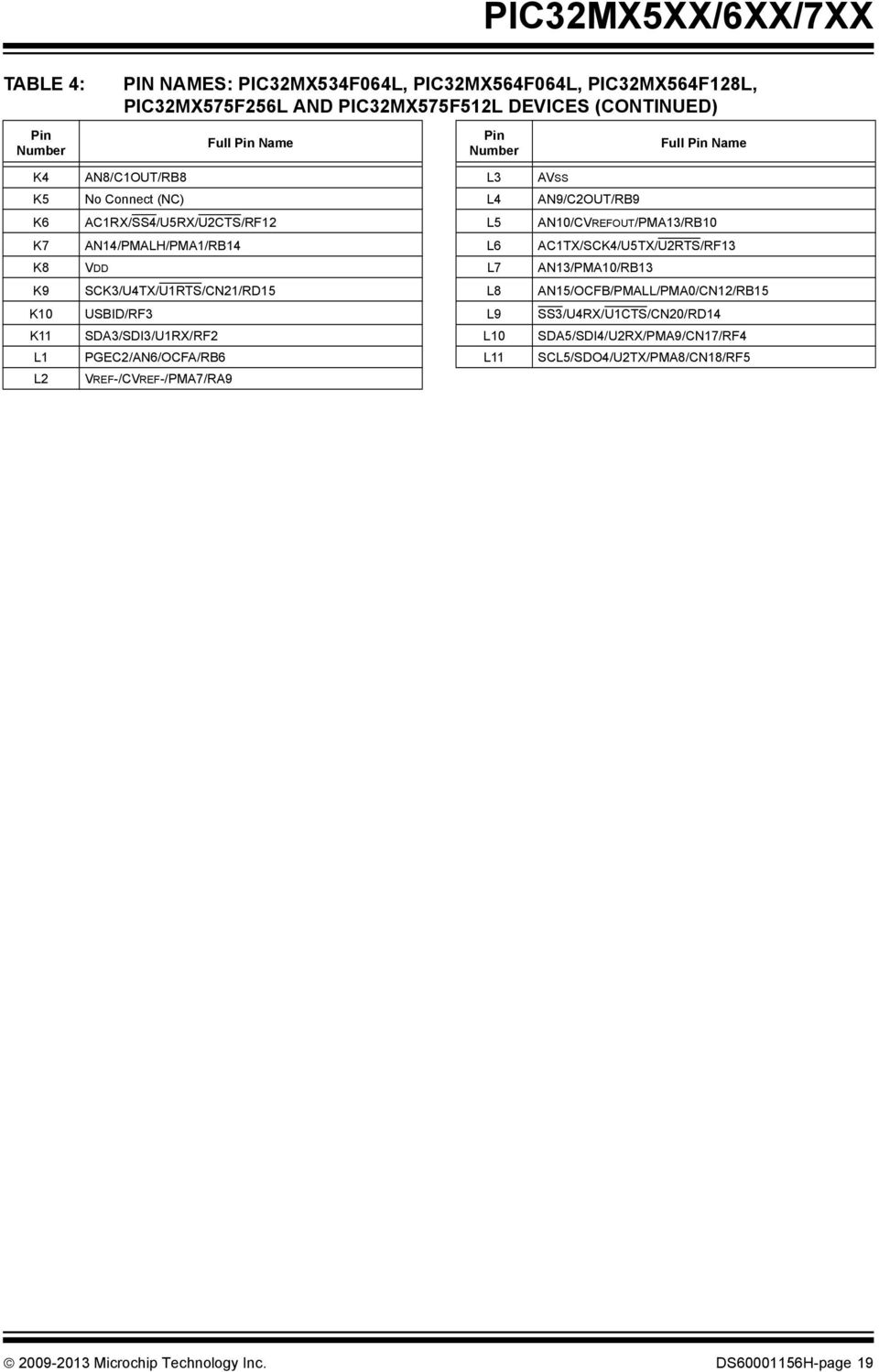
19 TABLE 4: Pin Number PIN NAMES: PIC32MX534F064L, PIC32MX564F064L, PIC32MX564F128L, PIC32MX575F256L AND PIC32MX575F512L DEVICES (CONTINUED) Full Pin Name Pin Number Full Pin Name K4 AN8/C1OUT/RB8 L3 AVSS K5 No Connect (NC) L4 AN9/C2OUT/RB9 K6 AC1RX/SS4/U5RX/U2CTS/RF12 L5 AN10/CVREFOUT/PMA13/RB10 K7 AN14/PMALH/PMA1/RB14 L6 AC1TX/SCK4/U5TX/U2RTS/RF13 K8 VDD L7 AN13/PMA10/RB13 K9 SCK3/U4TX/U1RTS/CN21/RD15 L8 AN15/OCFB/PMALL/PMA0/CN12/RB15 K10 USBID/RF3 L9 SS3/U4RX/U1CTS/CN20/RD14 K11 SDA3/SDI3/U1RX/RF2 L10 SDA5/SDI4/U2RX/PMA9/CN17/RF4 L1 PGEC2/AN6/OCFA/RB6 L11 SCL5/SDO4/U2TX/PMA8/CN18/RF5 L2 VREF-/CVREF-/PMA7/RA Microchip Technology Inc. DS H-page 19
20 TABLE 5: Pin Number PIN NAMES: PIC32MX664F064L, PIC32MX664F128L, PIC32MX675F256L, PIC32MX675F512L AND PIC32MX695F512L DEVICES Full Pin Name Pin Number Full Pin Name A1 PMD4/RE4 E8 AETXEN/SDA1/INT4/RA15 A2 PMD3/RE3 E9 RTCC/EMDIO/AEMDIO/IC1/RD8 A3 TRD0/RG13 E10 SS1/IC2/RD9 A4 PMD0/RE0 E11 AETXCLK/SCL1/INT3/RA14 A5 PMD8/RG0 F1 MCLR A6 ETXD0/PMD10/RF1 F2 ERXDV/AERXDV/ECRSDV/AECRSDV//SCL4/SDO2/ U3TX/PMA3/CN10/RG8 A7 VDD F3 ERXCLK/AERXCLK/EREFCLK/AEREFCLK/SS2/U6RX/ U3CTS/PMA2/CN11/RG9 A8 VSS F4 ECRS/SDA4/SDI2/U3RX/PMA4/CN9/RG7 A9 ETXD2/IC5/PMD12/RD12 F5 VSS A10 OC3/RD2 F6 No Connect (NC) A11 OC2/RD1 F7 No Connect (NC) B1 No Connect (NC) F8 VDD B2 AERXERR/RG15 F9 OSC1/CLKI/RC12 B3 PMD2/RE2 F10 VSS B4 PMD1/RE1 F11 OSC2/CLKO/RC15 B5 TRD3/RA7 G1 AERXD0/INT1/RE8 B6 ETXD1/PMD11/RF0 G2 AERXD1/INT2/RE9 B7 VCAP G3 TMS/RA0 B8 PMRD/CN14/RD5 G4 No Connect (NC) B9 OC4/RD3 G5 VDD B10 VSS G6 VSS B11 SOSCO/T1CK/CN0/RC14 G7 VSS C1 PMD6/RE6 G8 No Connect (NC) C2 VDD G9 TDO/RA5 C3 TRD1/RG12 G10 SDA2/RA3 C4 TRD2/RG14 G11 TDI/RA4 C5 TRCLK/RA6 H1 AN5/C1IN+/VBUSON/CN7/RB5 C6 No Connect (NC) H2 AN4/C1IN-/CN6/RB4 C7 ETXCLK/PMD15/CN16/RD7 H3 VSS C8 OC5/PMWR/CN13/RD4 H4 VDD C9 VDD H5 No Connect (NC) C10 SOSCI/CN1/RC13 H6 VDD C11 EMDC/AEMDC/IC4/PMCS1/PMA14/RD11 H7 No Connect (NC) D1 T2CK/RC1 H8 VBUS D2 PMD7/RE7 H9 VUSB3V3 D3 PMD5/RE5 H10 D+/RG2 D4 VSS H11 SCL2/RA2 D5 VSS J1 AN3/C2IN+/CN5/RB3 D6 No Connect (NC) J2 AN2/C2IN-/CN4/RB2 D7 ETXEN/PMD14/CN15/RD6 J3 PGED2/AN7/RB7 D8 ETXD3/PMD13/CN19/RD13 J4 AVDD D9 SDO1/OC1/INT0/RD0 J5 AN11/ERXERR/AETXERR/PMA12/RB11 D10 No Connect (NC) J6 TCK/RA1 D11 SCK1/IC3/PMCS2/PMA15/RD10 J7 AN12/ERXD0/AECRS/PMA11/RB12 E1 T5CK/SDI1/RC4 J8 No Connect (NC) E2 T4CK/RC3 J9 No Connect (NC) E3 ECOL/SCK2/U6TX/U3RTS/PMA5/CN8/RG6 J10 SCL3/SDO3/U1TX/RF8 E4 T3CK/RC2 J11 D-/RG3 E5 VDD K1 PGEC1/AN1/CN3/RB1 E6 ETXERR/PMD9/RG1 K2 PGED1/AN0/CN2/RB0 E7 VSS K3 VREF+/CVREF+/AERXD3/PMA6/RA10 DS H-page Microchip Technology Inc.

21 TABLE 5: Pin Number PIN NAMES: PIC32MX664F064L, PIC32MX664F128L, PIC32MX675F256L, PIC32MX675F512L AND PIC32MX695F512L DEVICES (CONTINUED) Full Pin Name Pin Number Full Pin Name K4 AN8/C1OUT/RB8 L3 AVSS K5 No Connect (NC) L4 AN9/C2OUT/RB9 K6 SS4/U5RX/U2CTS/RF12 L5 AN10/CVREFOUT/PMA13/RB10 K7 AN14/ERXD2/AETXD3/PMALH/PMA1/RB14 L6 SCK4/U5TX/U2RTS/RF13 K8 VDD L7 AN13/ERXD1/AECOL/PMA10/RB13 K9 AETXD1/SCK3/U4TX/U1RTS/CN21/RD15 L8 AN15/ERXD3/AETXD2/OCFB/PMALL/PMA0/CN12/RB15 K10 USBID/RF3 L9 AETXD0/SS3/U4RX/U1CTS/CN20/RD14 K11 SDA3/SDI3/U1RX/RF2 L10 SDA5/SDI4/U2RX/PMA9/CN17/RF4 L1 PGEC2/AN6/OCFA/RB6 L11 SCL5/SDO4/U2TX/PMA8/CN18/RF5 L2 VREF-/CVREF-/AERXD2/PMA7/RA Microchip Technology Inc. DS H-page 21
22 TABLE 6: Pin Number PIN NAMES: PIC32MX775F256L, PIC32MX775F512L AND PIC32MX795F512L DEVICES Full Pin Name Pin Number Full Pin Name A1 PMD4/RE4 E8 AETXEN/SDA1/INT4/RA15 A2 PMD3/RE3 E9 RTCC/EMDIO/AEMDIO/IC1/RD8 A3 TRD0/RG13 E10 SS1/IC2/RD9 A4 PMD0/RE0 E11 AETXCLK/SCL1/INT3/RA14 A5 C2RX/PMD8/RG0 F1 MCLR A6 C1TX/ETXD0/PMD10/RF1 F2 ERXDV/AERXDV/ECRSDV/AECRSDV/SCL4/SDO2/ U3TX/PMA3/CN10/RG8 A7 VDD F3 ERXCLK/AERXCLK/EREFCLK/AEREFCLK/SS2/U6RX/ U3CTS/PMA2/CN11/RG9 A8 VSS F4 ECRS/SDA4/SDI2/U3RX/PMA4/CN9/RG7 A9 ETXD2/IC5/PMD12/RD12 F5 VSS A10 OC3/RD2 F6 No Connect (NC) A11 OC2/RD1 F7 No Connect (NC) B1 No Connect (NC) F8 VDD B2 AERXERR/RG15 F9 OSC1/CLKI/RC12 B3 PMD2/RE2 F10 VSS B4 PMD1/RE1 F11 OSC2/CLKO/RC15 B5 TRD3/RA7 G1 AERXD0/INT1/RE8 B6 C1RX/ETXD1/PMD11/RF0 G2 AERXD1/INT2/RE9 B7 VCAP G3 TMS/RA0 B8 PMRD/CN14/RD5 G4 No Connect (NC) B9 OC4/RD3 G5 VDD B10 VSS G6 VSS B11 SOSCO/T1CK/CN0/RC14 G7 VSS C1 PMD6/RE6 G8 No Connect (NC) C2 VDD G9 TDO/RA5 C3 TRD1/RG12 G10 SDA2/RA3 C4 TRD2/RG14 G11 TDI/RA4 C5 TRCLK/RA6 H1 AN5/C1IN+/VBUSON/CN7/RB5 C6 No Connect (NC) H2 AN4/C1IN-/CN6/RB4 C7 ETXCLK/PMD15/CN16/RD7 H3 VSS C8 OC5/PMWR/CN13/RD4 H4 VDD C9 VDD H5 No Connect (NC) C10 SOSCI/CN1/RC13 H6 VDD C11 EMDC/AEMDC/IC4/PMCS1/PMA14/RD11 H7 No Connect (NC) D1 T2CK/RC1 H8 VBUS D2 PMD7/RE7 H9 VUSB3V3 D3 PMD5/RE5 H10 D+/RG2 D4 VSS H11 SCL2/RA2 D5 VSS J1 AN3/C2IN+/CN5/RB3 D6 No Connect (NC) J2 AN2/C2IN-/CN4/RB2 D7 ETXEN/PMD14/CN15/RD6 J3 PGED2/AN7/RB7 D8 ETXD3/PMD13/CN19/RD13 J4 AVDD D9 SDO1/OC1/INT0/RD0 J5 AN11/ERXERR/AETXERR/PMA12/RB11 D10 No Connect (NC) J6 TCK/RA1 D11 SCK1/IC3/PMCS2/PMA15/RD10 J7 AN12/ERXD0/AECRS/PMA11/RB12 E1 T5CK/SDI1/RC4 J8 No Connect (NC) E2 T4CK/AC2RX/RC3 J9 No Connect (NC) E3 ECOL/SCK2/U6TX/U3RTS/PMA5/CN8/RG6 J10 SCL3/SDO3/U1TX/RF8 E4 T3CK/AC2TX/RC2 J11 D-/RG3 E5 VDD K1 PGEC1/AN1/CN3/RB1 E6 C2TX/ETXERR/PMD9/RG1 K2 PGED1/AN0/CN2/RB0 E7 VSS K3 VREF+/CVREF+/AERXD3/PMA6/RA10 DS H-page Microchip Technology Inc.
23 TABLE 6: Pin Number PIN NAMES: PIC32MX775F256L, PIC32MX775F512L AND PIC32MX795F512L DEVICES (CONTINUED) Full Pin Name Pin Number Full Pin Name K4 AN8/C1OUT/RB8 L3 AVSS K5 No Connect (NC) L4 AN9/C2OUT/RB9 K6 AC1RX/SS4/U5RX/U2CTS/RF12 L5 AN10/CVREFOUT/PMA13/RB10 K7 AN14/ERXD2/AETXD3/PMALH/PMA1/RB14 L6 AC1TX/SCK4/U5TX/U2RTS/RF13 K8 VDD L7 AN13/ERXD1/AECOL/PMA10/RB13 K9 AETXD1/SCK3/U4TX/U1RTS/CN21/RD15 L8 AN15/ERXD3/AETXD2/OCFB/PMALL/PMA0/CN12/RB15 K10 USBID/RF3 L9 AETXD0/SS3/U4RX/U1CTS/CN20/RD14 K11 SDA3/SDI3/U1RX/RF2 L10 SDA5/SDI4/U2RX/PMA9/CN17/RF4 L1 PGEC2/AN6/OCFA/RB6 L11 SCL5/SDO4/U2TX/PMA8/CN18/RF5 L2 VREF-/CVREF-/AERXD2/PMA7/RA Microchip Technology Inc. DS H-page 23
24 TABLE 7: Pin Number PIN NAME: PIC32MX764F128L DEVICE Full Pin Name Pin Number Full Pin Name A1 PMD4/RE4 E8 AETXEN/SDA1/INT4/RA15 A2 PMD3/RE3 E9 RTCC/EMDIO/AEMDIO/IC1/RD8 A3 TRD0/RG13 E10 SS1/IC2/RD9 A4 PMD0/RE0 E11 AETXCLK/SCL1/INT3/RA14 A5 PMD8/RG0 F1 MCLR A6 C1TX/ETXD0/PMD10/RF1 F2 ERXDV/AERXDV/ECRSDV/AECRSDV/SCL4/SDO2/ U3TX/PMA3/CN10/RG8 A7 VDD F3 ERXCLK/AERXCLK/EREFCLK/AEREFCLK/SS2/U6RX/ U3CTS/PMA2/CN11/RG9 A8 VSS F4 ECRS/SDA4/SDI2/U3RX/PMA4/CN9/RG7 A9 ETXD2/IC5/PMD12/RD12 F5 VSS A10 OC3/RD2 F6 No Connect (NC) A11 OC2/RD1 F7 No Connect (NC) B1 No Connect (NC) F8 VDD B2 AERXERR/RG15 F9 OSC1/CLKI/RC12 B3 PMD2/RE2 F10 VSS B4 PMD1/RE1 F11 OSC2/CLKO/RC15 B5 TRD3/RA7 G1 AERXD0/INT1/RE8 B6 C1RX/ETXD1/PMD11/RF0 G2 AERXD1/INT2/RE9 B7 VCAP G3 TMS/RA0 B8 PMRD/CN14/RD5 G4 No Connect (NC) B9 OC4/RD3 G5 VDD B10 VSS G6 VSS B11 SOSCO/T1CK/CN0/RC14 G7 VSS C1 PMD6/RE6 G8 No Connect (NC) C2 VDD G9 TDO/RA5 C3 TRD1/RG12 G10 SDA2/RA3 C4 TRD2/RG14 G11 TDI/RA4 C5 TRCLK/RA6 H1 AN5/C1IN+/VBUSON/CN7/RB5 C6 No Connect (NC) H2 AN4/C1IN-/CN6/RB4 C7 ETXCLK/PMD15/CN16/RD7 H3 VSS C8 OC5/PMWR/CN13/RD4 H4 VDD C9 VDD H5 No Connect (NC) C10 SOSCI/CN1/RC13 H6 VDD C11 EMDC/AEMDC/IC4/PMCS1/PMA14/RD11 H7 No Connect (NC) D1 T2CK/RC1 H8 VBUS D2 PMD7/RE7 H9 VUSB3V3 D3 PMD5/RE5 H10 D+/RG2 D4 VSS H11 SCL2/RA2 D5 VSS J1 AN3/C2IN+/CN5/RB3 D6 No Connect (NC) J2 AN2/C2IN-/CN4/RB2 D7 ETXEN/PMD14/CN15/RD6 J3 PGED2/AN7/RB7 D8 ETXD3/PMD13/CN19/RD13 J4 AVDD D9 SDO1/OC1/INT0/RD0 J5 AN11/ERXERR/AETXERR/PMA12/RB11 D10 No Connect (NC) J6 TCK/RA1 D11 SCK1/IC3/PMCS2/PMA15/RD10 J7 AN12/ERXD0/AECRS/PMA11/RB12 E1 T5CK/SDI1/RC4 J8 No Connect (NC) E2 T4CK/RC3 J9 No Connect (NC) E3 ECOL/SCK2/U6TX/U3RTS/PMA5/CN8/RG6 J10 SCL3/SDO3/U1TX/RF8 E4 T3CK/RC2 J11 D-/RG3 E5 VDD K1 PGEC1/AN1/CN3/RB1 E6 ETXERR/PMD9/RG1 K2 PGED1/AN0/CN2/RB0 E7 VSS K3 VREF+/CVREF+/AERXD3/PMA6/RA10 DS H-page Microchip Technology Inc.
25 TABLE 7: Pin Number PIN NAME: PIC32MX764F128L DEVICE (CONTINUED) Full Pin Name Pin Number Full Pin Name K4 AN8/C1OUT/RB8 L3 AVSS K5 No Connect (NC) L4 AN9/C2OUT/RB9 K6 AC1RX/SS4/U5RX/U2CTS/RF12 L5 AN10/CVREFOUT/PMA13/RB10 K7 AN14/ERXD2/AETXD3/PMALH/PMA1/RB14 L6 AC1TX/SCK4/U5TX/U2RTS/RF13 K8 VDD L7 AN13/ERXD1/AECOL/PMA10/RB13 K9 AETXD1/SCK3/U4TX/U1RTS/CN21/RD15 L8 AN15/ERXD3/AETXD2/OCFB/PMALL/PMA0/CN12/RB15 K10 USBID/RF3 L9 AETXD0/SS3/U4RX/U1CTS/CN20/RD14 K11 SDA3/SDI3/U1RX/RF2 L10 SDA5/SDI4/U2RX/PMA9/CN17/RF4 L1 PGEC2/AN6/OCFA/RB6 L11 SCL5/SDO4/U2TX/PMA8/CN18/RF5 L2 VREF-/CVREF-/AERXD2/PMA7/RA Microchip Technology Inc. DS H-page 25
26 Pin Diagrams (Continued) 124-Pin VTLA (1) = Pins are up to 5V tolerant A68 A67 A66 A65 A64 A63 A62 A61 A60 A59 A58 A57 A56 A55 A54 A53 A52 A51 A1 B56 B55 B54 B53 B52 B51 B50 B49 B48 B47 B46 B45 B44 B43 B42 A50 A2 B1 A49 A3 B2 B41 A48 A4 B3 B40 A47 A5 B4 B39 A46 A6 B5 B38 A45 A7 B6 B37 A44 A8 B7 PIC32MX675F512L B36 A43 PIC32MX695F512L A9 B8 PIC32MX795F512L B35 A42 A10 B9 B34 A41 A11 B10 B33 A40 A12 B11 B32 A39 A13 B12 B31 A38 A14 B13 B30 A37 A15 B29 A36 A16 B14 B15 B16 B17 B18 B19 B20 B21 B22 B23 B24 B25 B26 B27 B28 A35 A17 A18 A19 A20 A21 A22 A23 A24 A25 A26 A27 A28 A29 A30 A31 A32 A33 A34 Note 1: Refer to Table 8 for the full list of pin names. DS H-page Microchip Technology Inc.
27 TABLE 8: PIN NAMES: PIC32MX675F512L, PIC32MX695F512L, AND PIC32MX795F512L DEVICES Package Bump # Full Pin Name Package Bump # A1 No Connect (NC) A52 OC2/RD1 A2 AERXERR/RG15 A53 OC4/RD3 A3 VSS A54 ETXD3/PMD13/CN19/RD13 A4 PMD6/RE6 A55 PMRD/CN14/RD5 A5 T2CK/RC1 A56 ETXCLK/PMD15/CN16/RD7 A6 T4CK/AC2RX (1) /RC3 A57 No Connect (NC) A7 ECOL/SCK2/U6TX/U3RTS/PMA5/CN8/RG6 A58 No Connect (NC) A8 ERXDV/AERXDV/ECRSDV/AECRSDV/SCL4/SDO2/ U3TX/PMA3/CN10/RG8 A59 VDD Full Pin Name A9 ERXCLK/AERXCLK/EREFCLK/AEREFCLK/SS2/U6RX/ A60 C1TX (1) /ETXD0/PMD10/RF1 U3CTS/PMA2/CN11/RG9 A10 VDD A61 C2RX (1) /PMD8/RG0 A11 AERXD0/INT1/RE8 A62 TRD3/RA7 A12 AN5/C1IN+/VBUSON/CN7/RB5 A63 VSS A13 AN3/C2IN+/CN5/RB3 A64 PMD1/RE1 A14 VDD A65 TRD1/RG12 A15 PGEC1/AN1/CN3/RB1 A66 PMD2/RE2 A16 No Connect (NC) A67 PMD4/RE4 A17 No Connect (NC) A68 No Connect (NC) A18 No Connect (NC) B1 VDD A19 No Connect (NC) B2 PMD5/RE5 A20 PGEC2/AN6/OCFA/RB6 B3 PMD7/RE7 A21 VREF-/CVREF-/AERXD2/PMA7/RA9 B4 T3CK/AC2TX/RC2 A22 AVDD B5 T5CK/SDI1/RC4 A23 AN8/C1OUT/RB8 B6 ECRS/SDA4/SDI2/U3RX/PMA4/CN9/RG7 A24 AN10/CVREFOUT/PMA13/RB10 B7 MCLR A25 VSS B8 VSS A26 TCK/RA1 B9 TMS/RA0 A27 AC1RX (1) /SS4/U5RX/U2CTS/RF12 B10 AERXD1/INT2/RE9 A28 AN13/ERXD1/AECOL/PMA10/RB13 B11 AN4/C1IN-/CN6/RB4 A29 AN15/ERXD3/AETXD2/OCFB/PMALL/PMA0/CN12/RB15 B12 VSS A30 VDD B13 AN2/C2IN-/CN4/RB2 A31 AETXD1/SCK3/U4TX/U1RTS/CN21/RD15 B14 PGED1/AN0/CN2/RB0 A32 SCL5/SDO4/U2TX/PMA8/CN18/RF5 B15 No Connect (NC) A33 No Connect (NC) B16 PGED2/AN7/RB7 A34 No Connect (NC) B17 VREF+/CVREF+/AERXD3/PMA6/RA10 A35 USBID/RF3 B18 AVSS A36 SDA3/SDI3/U1RX/RF2 B19 AN9/C2OUT/RB9 A37 VBUS B20 AN11/ERXERR/AETXERR/PMA12/RB11 A38 D-/RG3 B21 VDD A39 SCL2/RA2 B22 AC1TX (1) /SCK4/U5TX/U2RTS/RF13 A40 TDI/RA4 B23 AN12/ERXD0/AECRS/PMA11/RB12 A41 VDD B24 AN14/ERXD2/AETXD3/PMALH/PMA1/RB14 A42 OSC2/CLKO/RC15 B25 VSS A43 VSS B26 AETXD0/SS3/U4RX/U1CTS/CN20/RD14 A44 AETXEN/SDA1/INT4/RA15 B27 SDA5/SDI4/U2RX/PMA9/CN17/RF4 A45 SS1/IC2/RD9 B28 No Connect (NC) A46 EMDC/AEMDC/IC4/PMCS1/PMA14/RD11 B29 SCL3/SDO3/U1TX/RF8 A47 SOSCI/CN1/RC13 B30 VUSB3V3 A48 VDD B31 D+/RG2 A49 No Connect (NC) B32 SDA2/RA3 A50 No Connect (NC) B33 TDO/RA5 A51 No Connect (NC) B34 OSC1/CLKI/RC12 Note 1: This pin is only available on PIC32MX795F512L devices Microchip Technology Inc. DS H-page 27
28 TABLE 8: PIN NAMES: PIC32MX675F512L, PIC32MX695F512L, AND PIC32MX795F512L DEVICES Package Bump # Full Pin Name Package Bump # Full Pin Name B35 No Connect (NC) B46 VSS B36 AETXCLK/SCL1/INT3/RA14 B47 No Connect (NC) B37 RTCC/EMDIO/AEMDIO/IC1/RD8 B48 VCAP B38 SCK1/IC3/PMCS2/PMA15/RD10 B49 C1RX/ETXD1/PMD11/RF0 B39 SDO1/OC1/INT0/RD0 B50 C2TX/ETXERR/PMD9/RG1 B40 SOSCO/T1CK/CN0/RC14 B51 TRCLK/RA6 B41 VSS B52 PMD0/RE0 B42 OC3/RD2 B53 VDD B43 ETXD2/IC5/PMD12/RD12 B54 TRD2/RG14 B44 OC5/PMWR/CN13/RD4 B55 TRD0/RG13 B45 ETXEN/PMD14/CN15/RD6 B56 PMD3/RE3 Note 1: This pin is only available on PIC32MX795F512L devices. DS H-page Microchip Technology Inc.
29 Table of Contents 1.0 Device Overview Guidelines for Getting Started with 32-bit MCUs CPU Memory Organization Flash Program Memory Resets Interrupt Controller Oscillator Configuration Prefetch Cache Direct Memory Access (DMA) Controller USB On-The-Go (OTG) I/O Ports Timer Timer2/3, Timer4/ Input Capture Output Compare Serial Peripheral Interface (SPI) Inter-Integrated Circuit (I 2 C ) Universal Asynchronous Receiver Transmitter (UART) Parallel Master Port (PMP) Real-Time Clock and Calendar (RTCC) bit Analog-to-Digital Converter (ADC) Controller Area Network (CAN) Ethernet Controller Comparator Comparator Voltage Reference (CVREF) Power-Saving Features Special Features Instruction Set Development Support Electrical Characteristics DC and AC Device Characteristics Graphs Packaging Information The Microchip Web Site Customer Change Notification Service Customer Support Reader Response Product Identification System Microchip Technology Inc. DS H-page 29
30 TO OUR VALUED CUSTOMERS It is our intention to provide our valued customers with the best documentation possible to ensure successful use of your Microchip products. To this end, we will continue to improve our publications to better suit your needs. Our publications will be refined and enhanced as new volumes and updates are introduced. If you have any questions or comments regarding this publication, please contact the Marketing Communications Department via at or fax the Reader Response Form in the back of this data sheet to (480) We welcome your feedback. Most Current Data Sheet To obtain the most up-to-date version of this data sheet, please register at our Worldwide Web site at: You can determine the version of a data sheet by examining its literature number found on the bottom outside corner of any page. The last character of the literature number is the version number, (e.g., DS A is version A of document DS ). Errata An errata sheet, describing minor operational differences from the data sheet and recommended workarounds, may exist for current devices. As device/documentation issues become known to us, we will publish an errata sheet. The errata will specify the revision of silicon and revision of document to which it applies. To determine if an errata sheet exists for a particular device, please check with one of the following: Microchip s Worldwide Web site; Your local Microchip sales office (see last page) When contacting a sales office, please specify which device, revision of silicon and data sheet (include literature number) you are using. Customer Notification System Register on our web site at to receive the most current information on all of our products. DS H-page Microchip Technology Inc.
31 Referenced Sources This device data sheet is based on the following individual chapters of the PIC32 Family Reference Manual. These documents should be considered as the general reference for the operation of a particular module or device feature. Note 1: To access the documents listed below, browse to the documentation section of the PIC32MX795F512L product page on the Microchip web site ( or select a family reference manual section from the following list. In addition to parameters, features, and other documentation, the resulting page provides links to the related family reference manual sections. Section 1. Introduction (DS ) Section 2. CPU (DS ) Section 4. Prefetch Cache (DS ) Section 3. Memory Organization (DS ) Section 5. Flash Program Memory (DS ) Section 6. Oscillator Configuration (DS ) Section 7. Resets (DS ) Section 8. Interrupt Controller (DS ) Section 9. Watchdog Timer and Power-up Timer (DS ) Section 10. Power-Saving Features (DS ) Section 12. I/O Ports (DS ) Section 13. Parallel Master Port (PMP) (DS ) Section 14. Timers (DS ) Section 15. Input Capture (DS ) Section 16. Output Capture (DS ) Section bit Analog-to-Digital Converter (ADC) (DS ) Section 19. Comparator (DS ) Section 20. Comparator Voltage Reference (CVREF) (DS ) Section 21. Universal Asynchronous Receiver Transmitter (UART) (DS ) Section 23. Serial Peripheral Interface (SPI) (DS ) Section 24. Inter-Integrated Circuit (I2C ) (DS ) Section 27. USB On-The-Go (OTG) (DS ) Section 29. Real-Time Clock and Calendar (RTCC) (DS ) Section 31. Direct Memory Access (DMA) Controller (DS ) Section 32. Configuration (DS ) Section 33. Programming and Diagnostics (DS ) Section 34. Controller Area Network (CAN) (DS ) Section 35. Ethernet Controller (DS ) Microchip Technology Inc. DS H-page 31
32 NOTES: DS H-page Microchip Technology Inc.
33 1.0 DEVICE OVERVIEW This document contains device-specific information for Note 1: This data sheet summarizes the features of the PIC32MX5XX/6XX/7XX family of devices. It is not intended to be a comprehensive reference source. To complement the information in this data sheet, refer to the related section of the PIC32 Family Reference Manual, which is available from the Microchip web site ( 2: Some registers and associated bits described in this section may not be available on all devices. Refer to Section 4.0 Memory Organization in this data sheet for device-specific register and bit information. PIC32MX5XX/6XX/7XX devices. Figure 1-1 illustrates a general block diagram of the core and peripheral modules in the PIC32MX5XX/6XX/ 7XX family of devices. Table 1-1 lists the functions of the various pins shown in the pinout diagrams. FIGURE 1-1: BLOCK DIAGRAM (1,2) OSC2/CLKO OSC1/CLKI OSC/SOSC Oscillators FRC/LPRC Oscillators PLL Dividers PLL-USB Timing Generation USBCLK SYSCLK PBCLK VCAP Voltage Regulator Precision Band Gap Reference Power-up Timer Oscillator Start-up Timer Power-on Reset Watchdog Timer Brown-out Reset VDD, VSS MCLR PORTA Peripheral Bus Clocked by SYSCLK CN1-22 PORTB PORTC PORTD 32 JTAG BSCAN EJTAG Priority Interrupt Controller MIPS32 M4K CPU Core IS 32 INT DS USB 32 CAN1, CAN2 Bus Matrix ETHERNET DMAC ICD Peripheral Bus Clocked by PBCLK Timer1-5 PWM OC1-5 IC1-5 SPI1-4 I2C1-5 PORTE Prefetch Module Data RAM Peripheral Bridge 32 PMP PORTF PORTG bit Wide Program Flash Memory Flash Controller Note 1: Some features are not available on all devices. 2: BOR functionality is provided when the on-board voltage regulator is enabled. 10-bit ADC UART1-6 RTCC Comparators Microchip Technology Inc. DS H-page 33
34 TABLE 1-1: Pin Name PINOUT I/O DESCRIPTIONS 64-Pin QFN/TQFP Pin Number (1) 100-Pin TQFP 121-Pin TFBGA 124-pin VTLA Pin Type Buffer Type Description AN K2 B14 I Analog Analog input channels AN K1 A15 I Analog AN J2 B13 I Analog AN J1 A13 I Analog AN H2 B11 I Analog AN H1 A12 I Analog AN L1 A20 I Analog AN J3 B16 I Analog AN K4 A23 I Analog AN L4 B19 I Analog AN L5 A24 I Analog AN J5 B20 I Analog AN J7 B23 I Analog AN L7 A28 I Analog AN K7 B24 I Analog AN L8 A29 I Analog CLKI F9 B34 I ST/ CMOS CLKO F11 A42 O OSC F9 B34 I ST/ CMOS OSC F11 A42 I/O SOSCI C10 A47 I ST/ CMOS External clock source input. Always associated with OSC1 pin function. Oscillator crystal output. Connects to crystal or resonator in Crystal Oscillator mode. Optionally functions as CLKO in RC and EC modes. Always associated with OSC2 pin function. Oscillator crystal input. ST buffer when configured in RC mode; CMOS otherwise. Oscillator crystal output. Connects to crystal or resonator in Crystal Oscillator mode. Optionally functions as CLKO in RC and EC modes khz low-power oscillator crystal input; CMOS otherwise SOSCO B11 B40 O khz low-power oscillator crystal output Legend: CMOS = CMOS compatible input or output Analog = Analog input P = Power ST = Schmitt Trigger input with CMOS levels O = Output I = Input TTL = TTL input buffer Note 1: Pin numbers are only provided for reference. See the Pin Diagrams section for device pin availability. 2: See Section 24.0 Ethernet Controller for more information. DS H-page Microchip Technology Inc.
35 TABLE 1-1: Pin Name PINOUT I/O DESCRIPTIONS (CONTINUED) 64-Pin QFN/TQFP Pin Number (1) 100-Pin TQFP 121-Pin TFBGA 124-pin VTLA Pin Type Buffer Type Description CN B11 B40 I ST Change notification inputs. Can be CN C10 A47 I ST software programmed for internal weak pull-ups on all inputs. CN K2 B14 I ST CN K1 A15 I ST CN J2 B13 I ST CN J1 A13 I ST CN H2 B11 I ST CN H1 A12 I ST CN E3 A7 I ST CN F4 B6 I ST CN F2 A8 I ST CN F3 A9 I ST CN L8 A29 I ST CN C8 B44 I ST CN B8 A55 I ST CN D7 B45 I ST CN C7 A56 I ST CN L10 B27 I ST CN L11 A32 I ST CN19 80 D8 A54 I ST CN20 47 L9 B26 I ST CN21 48 K9 A31 I ST IC E9 B37 I ST Capture Inputs 1-5 IC E10 A45 I ST IC D11 B38 I ST IC C11 A46 I ST IC A9 A60 I ST OCFA L1 A20 I ST Output Compare Fault A Input OC D9 B39 O Output Compare Output 1 OC A11 A52 O Output Compare Output 2 OC A10 B42 O Output Compare Output 3 OC B9 A53 O Output Compare Output 4 OC C8 B44 O Output Compare Output 5 OCFB L8 A29 I ST Output Compare Fault B Input INT D9 B39 I ST External Interrupt 0 INT G1 A11 I ST External Interrupt 1 INT G2 B10 I ST External Interrupt 2 INT E11 B36 I ST External Interrupt 3 INT E8 A44 I ST External Interrupt 4 Legend: CMOS = CMOS compatible input or output Analog = Analog input P = Power ST = Schmitt Trigger input with CMOS levels O = Output I = Input TTL = TTL input buffer Note 1: Pin numbers are only provided for reference. See the Pin Diagrams section for device pin availability. 2: See Section 24.0 Ethernet Controller for more information Microchip Technology Inc. DS H-page 35
36 TABLE 1-1: Pin Name PINOUT I/O DESCRIPTIONS (CONTINUED) 64-Pin QFN/TQFP Pin Number (1) 100-Pin TQFP 121-Pin TFBGA 124-pin VTLA Pin Type Buffer Type Description RA0 17 G3 B9 I/O ST PORTA is a bidirectional I/O port RA1 38 J6 A26 I/O ST RA2 58 H11 A39 I/O ST RA3 59 G10 B32 I/O ST RA4 60 G11 A40 I/O ST RA5 61 G9 B33 I/O ST RA6 91 C5 B51 I/O ST RA7 92 B5 A62 I/O ST RA9 28 L2 A21 I/O ST RA10 29 K3 B17 I/O ST RA14 66 E11 B36 I/O ST RA15 67 E8 A44 I/O ST RB K2 B14 I/O ST PORTB is a bidirectional I/O port RB K1 A15 I/O ST RB J2 B13 I/O ST RB J1 A13 I/O ST RB H2 B11 I/O ST RB H1 A12 I/O ST RB L1 A20 I/O ST RB J3 B16 I/O ST RB K4 A23 I/O ST RB L4 B19 I/O ST RB L5 A24 I/O ST RB J5 B20 I/O ST RB J7 B23 I/O ST RB L7 A28 I/O ST RB K7 B24 I/O ST RB L8 A29 I/O ST RC1 6 D1 A5 I/O ST PORTC is a bidirectional I/O port RC2 7 E4 B4 I/O ST RC3 8 E2 A6 I/O ST RC4 9 E1 B5 I/O ST RC F9 B34 I/O ST RC C10 A47 I/O ST RC B11 B40 I/O ST RC F11 A42 I/O ST Legend: CMOS = CMOS compatible input or output Analog = Analog input P = Power ST = Schmitt Trigger input with CMOS levels O = Output I = Input TTL = TTL input buffer Note 1: Pin numbers are only provided for reference. See the Pin Diagrams section for device pin availability. 2: See Section 24.0 Ethernet Controller for more information. DS H-page Microchip Technology Inc.
37 TABLE 1-1: Pin Name PINOUT I/O DESCRIPTIONS (CONTINUED) 64-Pin QFN/TQFP Pin Number (1) 100-Pin TQFP 121-Pin TFBGA 124-pin VTLA Pin Type Buffer Type Description RD D9 B39 I/O ST PORTD is a bidirectional I/O port RD A11 A52 I/O ST RD A10 B42 I/O ST RD B9 A53 I/O ST RD C8 B44 I/O ST RD B8 A55 I/O ST RD D7 B45 I/O ST RD C7 A56 I/O ST RD E9 B37 I/O ST RD E10 A45 I/O ST RD D11 B38 I/O ST RD C11 A46 I/O ST RD12 79 A9 B43 I/O ST RD13 80 D8 A54 I/O ST RD14 47 L9 B26 I/O ST RD15 48 K9 A31 I/O ST RE A4 B52 I/O ST PORTE is a bidirectional I/O port RE B4 A64 I/O ST RE B3 A66 I/O ST RE A2 B56 I/O ST RE A1 A67 I/O ST RE5 1 3 D3 B2 I/O ST RE6 2 4 C1 A4 I/O ST RE7 3 5 D2 B3 I/O ST RE8 18 G1 A11 I/O ST RE9 19 G2 B10 I/O ST RF B6 B49 I/O ST PORTF is a bidirectional I/O port RF A6 A60 I/O ST RF2 52 K11 A36 I/O ST RF K10 A35 I/O ST RF L10 B27 I/O ST RF L11 A32 I/O ST RF8 53 J10 B29 I/O ST RF12 40 K6 A27 I/O ST RF13 39 L6 B22 I/O ST Legend: CMOS = CMOS compatible input or output Analog = Analog input P = Power ST = Schmitt Trigger input with CMOS levels O = Output I = Input TTL = TTL input buffer Note 1: Pin numbers are only provided for reference. See the Pin Diagrams section for device pin availability. 2: See Section 24.0 Ethernet Controller for more information Microchip Technology Inc. DS H-page 37
38 TABLE 1-1: Pin Name PINOUT I/O DESCRIPTIONS (CONTINUED) 64-Pin QFN/TQFP Pin Number (1) 100-Pin TQFP 121-Pin TFBGA 124-pin VTLA Pin Type Buffer Type Description RG0 90 A5 A61 I/O ST PORTG is a bidirectional I/O port RG1 89 E6 B50 I/O ST RG E3 A7 I/O ST RG F4 B6 I/O ST RG F2 A8 I/O ST RG F3 A9 I/O ST RG12 96 C3 A65 I/O ST RG13 97 A3 B55 I/O ST RG14 95 C4 B54 I/O ST RG15 1 B2 A2 I/O ST RG H10 B31 I ST PORTG input pins RG J11 A38 I ST T1CK B11 B40 I ST Timer1 external clock input T2CK 6 D1 A5 I ST Timer2 external clock input T3CK 7 E4 B4 I ST Timer3 external clock input T4CK 8 E2 A6 I ST Timer4 external clock input T5CK 9 E1 B5 I ST Timer5 external clock input U1CTS L9 B26 I ST UART1 clear to send U1RTS K9 A31 O UART1 ready to send U1RX K11 A36 I ST UART1 receive U1TX J10 B29 O UART1 transmit U3CTS 8 14 F3 A9 I ST UART3 clear to send U3RTS 4 10 E3 A7 O UART3 ready to send U3RX 5 11 F4 B6 I ST UART3 receive U3TX 6 12 F2 A8 O UART3 transmit U2CTS K6 A27 I ST UART2 clear to send U2RTS L6 B22 O UART2 ready to send U2RX L10 B27 I ST UART2 receive U2TX L11 A32 O UART2 transmit U4RX L9 B26 I ST UART4 receive U4TX K9 A31 O UART4 transmit U6RX 8 14 F3 A9 I ST UART6 receive U6TX 4 10 E3 A7 O UART6 transmit U5RX K6 A27 I ST UART5 receive U5TX L6 B22 O UART5 transmit SCK1 70 D11 B38 I/O ST Synchronous serial clock input/output for SPI1 SDI1 9 E1 B5 I ST SPI1 data in Legend: CMOS = CMOS compatible input or output Analog = Analog input P = Power ST = Schmitt Trigger input with CMOS levels O = Output I = Input TTL = TTL input buffer Note 1: Pin numbers are only provided for reference. See the Pin Diagrams section for device pin availability. 2: See Section 24.0 Ethernet Controller for more information. DS H-page Microchip Technology Inc.
39 TABLE 1-1: Pin Name PINOUT I/O DESCRIPTIONS (CONTINUED) 64-Pin QFN/TQFP Pin Number (1) 100-Pin TQFP 121-Pin TFBGA 124-pin VTLA Pin Type Buffer Type SDO1 72 D9 B39 O SPI1 data out SS1 69 E10 A45 I/O ST SPI1 slave synchronization or frame pulse I/O SCK K9 A31 I/O ST Synchronous serial clock input/output for SPI3 SDI K11 A36 I ST SPI3 data in SDO J10 B29 O SPI3 data out SS L9 B26 I/O ST SPI3 slave synchronization or frame pulse I/O SCK E3 A7 I/O ST Synchronous serial clock input/output for SPI2 SDI F4 B6 I ST SPI2 data in SDO F2 A8 O SPI2 data out SS F3 A9 I/O ST SPI2 slave synchronization or frame pulse I/O SCK L6 B22 I/O ST Synchronous serial clock input/output for SPI4 SDI L10 B27 I ST SPI4 data in SDO L11 A32 O SPI4 data out SS K6 A27 I/O ST SCL E11 B36 I/O ST SDA E8 A44 I/O ST SCL J10 B29 I/O ST SDA K11 A36 I/O ST SCL2 58 H11 A39 I/O ST SDA2 59 G10 B32 I/O ST SCL F2 A8 I/O ST SDA F4 B6 I/O ST SCL L11 A32 I/O ST SDA L10 B27 I/O ST Description SPI4 slave synchronization or frame pulse I/O Synchronous serial clock input/output for I2C1 Synchronous serial data input/output for I2C1 Synchronous serial clock input/output for I2C3 Synchronous serial data input/output for I2C3 Synchronous serial clock input/output for I2C2 Synchronous serial data input/output for I2C2 Synchronous serial clock input/output for I2C4 Synchronous serial data input/output for I2C4 Synchronous serial clock input/output for I2C5 Synchronous serial data input/output for I2C5 Legend: CMOS = CMOS compatible input or output Analog = Analog input P = Power ST = Schmitt Trigger input with CMOS levels O = Output I = Input TTL = TTL input buffer Note 1: Pin numbers are only provided for reference. See the Pin Diagrams section for device pin availability. 2: See Section 24.0 Ethernet Controller for more information Microchip Technology Inc. DS H-page 39
40 TABLE 1-1: Pin Name PINOUT I/O DESCRIPTIONS (CONTINUED) 64-Pin QFN/TQFP Pin Number (1) 100-Pin TQFP 121-Pin TFBGA 124-pin VTLA Pin Type Buffer Type TMS G3 B9 I ST JTAG Test mode select pin TCK J6 A26 I ST JTAG test clock input pin TDI G11 A40 I ST JTAG test data input pin TDO G9 B33 O JTAG test data output pin RTCC E9 B37 O Real-Time Clock alarm output CVREF L2 A21 I Analog Comparator Voltage Reference (low) CVREF K3 B17 I Analog Comparator Voltage Reference (high) CVREFOUT L5 A24 O Analog Comparator Voltage Reference output C1IN H2 B11 I Analog Comparator 1 negative input C1IN H1 A12 I Analog Comparator 1 positive input C1OUT K4 A23 O Comparator 1 output C2IN J2 B13 I Analog Comparator 2 negative input C2IN J1 A13 I Analog Comparator 2 positive input C2OUT L4 B19 O Comparator 2 output PMA L8 A29 I/O TTL/ST Parallel Master Port Address bit 0 input (Buffered Slave modes) and output (Master modes) PMA K7 B24 I/O TTL/ST Parallel Master Port Address bit 1 input (Buffered Slave modes) and output (Master modes) PMA F3 A9 O Parallel Master Port address PMA F2 A8 O (Demultiplexed Master modes) PMA F4 B6 O PMA E3 A7 O PMA K3 B17 O PMA L2 A21 O PMA L11 A32 O PMA L10 B27 O PMA L7 A28 O PMA J7 B23 O PMA J5 B20 O PMA L5 A24 O PMA C11 A46 O PMA D11 B38 O PMCS C11 A46 O PMCS D11 B38 O Description Parallel Master Port Chip Select 1 strobe Parallel Master Port Chip Select 2 strobe Legend: CMOS = CMOS compatible input or output Analog = Analog input P = Power ST = Schmitt Trigger input with CMOS levels O = Output I = Input TTL = TTL input buffer Note 1: Pin numbers are only provided for reference. See the Pin Diagrams section for device pin availability. 2: See Section 24.0 Ethernet Controller for more information. DS H-page Microchip Technology Inc.
41 TABLE 1-1: Pin Name PINOUT I/O DESCRIPTIONS (CONTINUED) 64-Pin QFN/TQFP Pin Number (1) 100-Pin TQFP 121-Pin TFBGA 124-pin VTLA Pin Type Buffer Type PMD A4 B52 I/O TTL/ST Parallel Master Port data PMD B4 A64 I/O TTL/ST (Demultiplexed Master mode) or address/data (Multiplexed Master PMD B3 A66 I/O TTL/ST modes) PMD A2 B56 I/O TTL/ST PMD A1 A67 I/O TTL/ST PMD5 1 3 D3 B2 I/O TTL/ST PMD6 2 4 C1 A4 I/O TTL/ST PMD7 3 5 D2 B3 I/O TTL/ST PMD8 90 A5 A61 I/O TTL/ST PMD9 89 E6 B50 I/O TTL/ST PMD10 88 A6 A60 I/O TTL/ST PMD11 87 B6 B49 I/O TTL/ST PMD12 79 A9 B43 I/O TTL/ST PMD13 80 D8 A54 I/O TTL/ST PMD14 83 D7 B45 I/O TTL/ST PMD15 84 C7 A56 I/O TTL/ST PMALL L8 A29 O Parallel Master Port address latch enable low byte (Multiplexed Master modes) PMALH K7 B24 O Parallel Master Port address latch enable high byte (Multiplexed Master modes) PMRD B8 A55 O Parallel Master Port read strobe PMWR C8 B44 O Parallel Master Port write strobe VBUS H8 A37 I Analog USB bus power monitor VUSB3V H9 B30 P Description USB internal transceiver supply. If the USB module is not used, this pin must be connected to VDD. VBUSON H1 A12 O USB Host and OTG bus power control output D H10 B31 I/O Analog USB D+ D J11 A38 I/O Analog USB D- USBID K10 A35 I ST USB OTG ID detect C1RX B6 B49 I ST CAN1 bus receive pin C1TX A6 A60 O CAN1 bus transmit pin AC1RX K6 A27 I ST Alternate CAN1 bus receive pin AC1TX L6 B22 O Alternate CAN1 bus transmit pin C2RX A5 A61 I ST CAN2 bus receive pin C2TX E6 B50 O CAN2 bus transmit pin AC2RX 8 E2 A6 1 ST Alternate CAN2 bus receive pin AC2TX 7 E4 B4 O Alternate CAN2 bus transmit pin Legend: CMOS = CMOS compatible input or output Analog = Analog input P = Power ST = Schmitt Trigger input with CMOS levels O = Output I = Input TTL = TTL input buffer Note 1: Pin numbers are only provided for reference. See the Pin Diagrams section for device pin availability. 2: See Section 24.0 Ethernet Controller for more information Microchip Technology Inc. DS H-page 41
42 TABLE 1-1: Pin Name PINOUT I/O DESCRIPTIONS (CONTINUED) 64-Pin QFN/TQFP Pin Number (1) 100-Pin TQFP 121-Pin TFBGA 124-pin VTLA Pin Type Buffer Type Description ERXD J7 B23 I ST Ethernet Receive Data 0 (2) ERXD L7 A28 I ST Ethernet Receive Data 1 (2) ERXD K7 B24 I ST Ethernet Receive Data 2 (2) ERXD L8 A29 I ST Ethernet Receive Data 3 (2) ERXERR J5 B20 I ST Ethernet receive error input (2) ERXDV F2 A8 I ST Ethernet receive data valid (2) ECRSDV F2 A8 I ST Ethernet carrier sense data valid (2) ERXCLK F3 A9 I ST Ethernet receive clock (2) EREFCLK F3 A9 I ST Ethernet reference clock (2) ETXD A6 A60 O Ethernet Transmit Data 0 (2) ETXD B6 B49 O Ethernet Transmit Data 1 (2) ETXD A9 B43 O Ethernet Transmit Data 2 (2) ETXD D8 A54 O Ethernet Transmit Data 3 (2) ETXERR E6 B50 O Ethernet transmit error (2) ETXEN 1 83 D7 B45 O Ethernet transmit enable (2) ETXCLK C7 A56 I ST Ethernet transmit clock (2) ECOL E3 A7 I ST Ethernet collision detect (2) ECRS F4 B6 I ST Ethernet carrier sense (2) EMDC C11 A46 O Ethernet management data clock (2) EMDIO E9 B37 I/O Ethernet management data (2) AERXD G1 A11 I ST Alternate Ethernet Receive Data 0 (2) AERXD G2 B10 I ST Alternate Ethernet Receive Data 1 (2) AERXD2 28 L2 A21 I ST Alternate Ethernet Receive Data 2 (2) AERXD3 29 K3 B17 I ST Alternate Ethernet Receive Data 3 (2) AERXERR 55 1 B2 A2 I ST Alternate Ethernet receive error input (2) AERXDV 12 F2 A8 I ST Alternate Ethernet receive data valid (2) AECRSDV F2 A8 I ST Alternate Ethernet carrier sense data valid (2) AERXCLK 14 F3 A9 I ST Alternate Ethernet receive clock (2) AEREFCLK F3 A9 I ST Alternate Ethernet reference clock (2) AETXD L9 B26 O Alternate Ethernet Transmit Data 0 (2) AETXD K9 A31 O Alternate Ethernet Transmit Data 1 (2) AETXD2 44 L8 A29 O Alternate Ethernet Transmit Data 2 (2) AETXD3 43 K7 B24 O Alternate Ethernet Transmit Data 3 (2) AETXERR 35 J5 B20 O Alternate Ethernet transmit error (2) AETXEN E8 A44 O Alternate Ethernet transmit enable (2) AETXCLK 66 E11 B36 I ST Alternate Ethernet transmit clock (2) AECOL 42 L7 A28 I ST Alternate Ethernet collision detect (2) AECRS 41 J7 B23 I ST Alternate Ethernet carrier sense (2) Legend: CMOS = CMOS compatible input or output Analog = Analog input P = Power ST = Schmitt Trigger input with CMOS levels O = Output I = Input TTL = TTL input buffer Note 1: Pin numbers are only provided for reference. See the Pin Diagrams section for device pin availability. 2: See Section 24.0 Ethernet Controller for more information. DS H-page Microchip Technology Inc.
43 TABLE 1-1: Pin Name AEMDC C11 A46 O Alternate Ethernet Management Data clock (2) AEMDIO E9 B37 I/O Alternate Ethernet Management Data (2) TRCLK 91 C5 B51 O Trace clock TRD0 97 A3 B55 O Trace Data bits 0-3 TRD1 96 C3 A65 O TRD2 95 C4 B54 O TRD3 92 B5 A62 O PGED K2 B14 I/O ST PGEC K1 A15 I ST PGED J3 B16 I/O ST PGEC L1 A20 I ST MCLR 7 13 F1 B7 I/P ST Data I/O pin for Programming/ Debugging Communication Channel 1 Clock input pin for Programming/ Debugging Communication Channel 1 Data I/O pin for Programming/ Debugging Communication Channel 2 Clock input pin for Programming/ Debugging Communication Channel 2 Master Clear (Reset) input. This pin is an active-low Reset to the device. AVDD J4 A22 P P Positive supply for analog modules. This pin must be connected at all times. AVSS L3 B18 P P Ground reference for analog modules VDD 10, 26, 38, 57 2, 16, 37, 46, 62, 86 A7, C2, C9, E5, K8, F8, G5, H4, H6 A10, A14, A30, A41, A48, A59, B1, B21, B53 P Positive supply for peripheral logic and I/O pins VCAP B7 B48 P Capacitor for Internal Voltage Regulator VSS 9, 25, 41 PINOUT I/O DESCRIPTIONS (CONTINUED) 64-Pin QFN/TQFP Pin Number (1) 100-Pin TQFP 15, 36, 45, 65, Pin TFBGA A8, B10, D4, D5, E7, F5, F10, G6, G7, H3 124-pin VTLA A3, A25, A43, A63, B8, B12, B25, B41, B46 Pin Type Buffer Type P Description Ground reference for logic and I/O pins. This pin must be connected at all times. VREF K3 B17 I Analog Analog voltage reference (high) input VREF L2 A21 I Analog Analog voltage reference (low) input Legend: CMOS = CMOS compatible input or output Analog = Analog input P = Power ST = Schmitt Trigger input with CMOS levels O = Output I = Input TTL = TTL input buffer Note 1: Pin numbers are only provided for reference. See the Pin Diagrams section for device pin availability. 2: See Section 24.0 Ethernet Controller for more information Microchip Technology Inc. DS H-page 43
44 NOTES: DS H-page Microchip Technology Inc.
45 2.0 GUIDELINES FOR GETTING STARTED WITH 32-BIT MCUS Note 1: This data sheet summarizes the features of the PIC32MX5XX/6XX/7XX family of devices. It is not intended to be a comprehensive reference source. To complement the information in this data sheet, refer to the related section of the PIC32 Family Reference Manual, which is available from the Microchip web site ( 2: Some registers and associated bits described in this section may not be available on all devices. Refer to Section 4.0 Memory Organization in this data sheet for device-specific register and bit information. 2.1 Basic Connection Requirements Getting started with the PIC32MX5XX/6XX/7XX family of 32-bit Microcontrollers (MCUs) requires attention to a minimal set of device pin connections before proceeding with development. The following is a list of pin names, which must always be connected: All VDD and VSS pins (see 2.2 Decoupling Capacitors ) All AVDD and AVSS pins even if the ADC module is not used (see 2.2 Decoupling Capacitors ) VCAP pin (see 2.3 Capacitor on Internal Voltage Regulator (VCAP) ) MCLR pin (see 2.4 Master Clear (MCLR) Pin ) PGECx/PGEDx pins used for In-Circuit Serial Programming (ICSP ) and debugging purposes (see 2.5 ICSP Pins ) OSC1 and OSC2 pins when external oscillator source is used (see 2.8 External Oscillator Pins ) The following pin may be required, as well: VREF+/ VREF- pins used when external voltage reference for ADC module is implemented. Note: The AVDD and AVSS pins must be connected, regardless of the ADC use and the ADC voltage reference source. 2.2 Decoupling Capacitors The use of decoupling capacitors on power supply pins, such as VDD, VSS, AVDD and AVSS is required. See Figure 2-1. Consider the following criteria when using decoupling capacitors: Value and type of capacitor: A value of 0.1 µf (100 nf), 10-20V is recommended. The capacitor should be a low Equivalent Series Resistance (low-esr) capacitor and have resonance frequency in the range of 20 MHz and higher. It is further recommended to use ceramic capacitors. Placement on the printed circuit board: The decoupling capacitors should be placed as close to the pins as possible. It is recommended that the capacitors be placed on the same side of the board as the device. If space is constricted, the capacitor can be placed on another layer on the PCB using a via; however, ensure that the trace length from the pin to the capacitor is within one-quarter inch (6 mm) in length. Handling high frequency noise: If the board is experiencing high frequency noise, upward of tens of MHz, add a second ceramic-type capacitor in parallel to the above described decoupling capacitor. The value of the second capacitor can be in the range of 0.01 µf to µf. Place this second capacitor next to the primary decoupling capacitor. In high-speed circuit designs, consider implementing a decade pair of capacitances as close to the power and ground pins as possible. For example, 0.1 µf in parallel with µf. Maximizing performance: On the board layout from the power supply circuit, run the power and return traces to the decoupling capacitors first, and then to the device pins. This ensures that the decoupling capacitors are first in the power chain. Equally important is to keep the trace length between the capacitor and the power pins to a minimum, thereby reducing PCB track inductance. FIGURE 2-1: VDD R C R1 0.1 µf Ceramic CBP MCLR VSS VDD 10 AVDD BULK CAPACITORS RECOMMENDED MINIMUM CONNECTION VCAP PIC32MX AVSS CEFC 0.1 µf Ceramic CBP The use of a bulk capacitor is recommended to improve power supply stability. Typical values range from 4.7 µf to 47 µf. This capacitor should be located as close to the device as possible. VDD VDD VSS VUSB3V3 (1) VSS 0.1 µf Ceramic CBP VDD VSS 0.1 µf Ceramic CBP 0.1 µf Ceramic CBP Note 1: If the USB module is used, this pin must be connected to VDD Microchip Technology Inc. DS H-page 45
46 2.3 Capacitor on Internal Voltage Regulator (VCAP) INTERNAL REGULATOR MODE A low-esr (1 ohm) capacitor is required on the VCAP pin, which is used to stabilize the internal voltage regulator output. The VCAP pin must not be connected to VDD, and must have a CEFC capacitor, with at least a 6V rating, connected to ground. The type can be ceramic or tantalum. Refer to Section 31.0 Electrical Characteristics for additional information on CEFC specifications. 2.4 Master Clear (MCLR) Pin The MCLR pin provides two specific device functions: Device Reset Device Programming and Debugging Pulling The MCLR pin low generates a device Reset. Figure 2-2 illustrates a typical MCLR circuit. During device programming and debugging, the resistance and capacitance that can be added to the pin must be considered. Device programmers and debuggers drive the MCLR pin. Consequently, specific voltage levels (VIH and VIL) and fast signal transitions must not be adversely affected. Therefore, specific values of R and C will need to be adjusted based on the application and PCB requirements. For example, as illustrated in Figure 2-2, it is recommended that the capacitor C, be isolated from the MCLR pin during programming and debugging operations. Place the components illustrated in Figure 2-2 within one-quarter inch (6 mm) from the MCLR pin. FIGURE 2-2: VDD R (1) JP C (3) EXAMPLE OF MCLR PIN CONNECTIONS R1 (2) MCLR PIC32 Note 1: R 10 k is recommended. A suggested starting value is 10 k. Ensure that the MCLR pin VIH and VIL specifications are met. 2: R1 470 will limit any current flowing into MCLR from the external capacitor C, in the event of MCLR pin breakdown, due to Electrostatic Discharge (ESD) or Electrical Overstress (EOS). Ensure that the MCLR pin VIH and VIL specifications are met. 3: The capacitor can be sized to prevent unintentional Resets from brief glitches or to extend the device Reset period during the POR. 2.5 ICSP Pins The PGECx and PGEDx pins are used for In-Circuit Serial Programming (ICSP ) and debugging purposes. It is recommended to keep the trace length between the ICSP connector and the ICSP pins on the device as short as possible. If the ICSP connector is expected to experience an ESD event, a series resistor is recommended, with the value in the range of a few tens of Ohms, not to exceed 100 Ohms. Pull-up resistors, series diodes and capacitors on the PGECx and PGEDx pins are not recommended as they will interfere with the programmer/debugger communications to the device. If such discrete components are an application requirement, they should be removed from the circuit during programming and debugging. Alternatively, refer to the AC/DC characteristics and timing requirements information in the respective device Flash programming specification for information on capacitive loading limits and pin input voltage high (VIH) and input low (VIL) requirements. Ensure that the Communication Channel Select (i.e., PGECx/PGEDx pins) programmed into the device matches the physical connections for the ICSP to MPLAB ICD 3 or MPLAB REAL ICE. For more information on ICD 3 and REAL ICE connection requirements, refer to the following documents that are available on the Microchip web site. Using MPLAB ICD 3 (poster) (DS ) MPLAB ICD 3 Design Advisory (DS ) MPLAB REAL ICE In-Circuit Emulator User s Guide (DS ) Using MPLAB REAL ICE Emulator (poster) (DS ) 2.6 JTAG The TMS, TDO, TDI and TCK pins are used for testing and debugging according to the Joint Test Action Group (JTAG) standard. It is recommended to keep the trace length between the JTAG connector and the JTAG pins on the device as short as possible. If the JTAG connector is expected to experience an ESD event, a series resistor is recommended, with the value in the range of a few tens of Ohms, not to exceed 100 Ohms. Pull-up resistors, series diodes and capacitors on the TMS, TDO, TDI and TCK pins are not recommended as they will interfere with the programmer/debugger communications to the device. If such discrete components are an application requirement, they should be removed from the circuit during programming and debugging. Alternatively, refer to the AC/DC characteristics and timing requirements information in the respective device Flash programming specification for information on capacitive loading limits and pin input voltage high (VIH) and input low (VIL) requirements. DS H-page Microchip Technology Inc.
47 2.7 Trace The trace pins can be connected to a hardware-traceenabled programmer to provide a compress real time instruction trace. When used for trace the TRD3, TRD2, TRD1, TRD0 and TRCLK pins should be dedicated for this use. The trace hardware requires a22 series resistor between the trace pins and the trace connector. 2.8 External Oscillator Pins Many MCUs have options for at least two oscillators: a high-frequency primary oscillator and a low-frequency secondary oscillator. Refer to Section 8.0 Oscillator Configuration for details. The oscillator circuit should be placed on the same side of the board as the device. Also, place the oscillator circuit close to the respective oscillator pins, not exceeding one-half inch (12 mm) distance between them. The load capacitors should be placed next to the oscillator itself, on the same side of the board. Use a grounded copper pour around the oscillator circuit to isolate them from surrounding circuits. The grounded copper pour should be routed directly to the MCU ground. Do not run any signal traces or power traces inside the ground pour. Also, if using a two-sided board, avoid any traces on the other side of the board where the crystal is placed. A suggested layout is illustrated in Figure 2-3. FIGURE 2-3: SUGGESTED OSCILLATOR CIRCUIT PLACEMENT Oscillator Secondary 2.9 Configuration of Analog and Digital Pins During ICSP Operations If MPLAB ICD 3 or REAL ICE is selected as a debugger, it automatically initializes all of the Analogto-Digital input pins (ANx) as digital pins by setting all bits in the AD1PCFG register. The bits in this register that correspond to the Analogto-Digital pins that are initialized by MPLAB ICD 3 or REAL ICE, must not be cleared by the user application firmware; otherwise, communication errors will result between the debugger and the device. If your application needs to use certain ADC pins as analog input pins during the debug session, the user application must clear the corresponding bits in the AD1PCFG register during initialization of the ADC module. When MPLAB ICD 3 or REAL ICE is used as a programmer, the user application firmware must correctly configure the AD1PCFG register. Automatic initialization of this register is only done during debugger operation. Failure to correctly configure the register(s) will result in all ADC pins being recognized as analog input pins, resulting in the port value being read as a logic 0, which may affect user application functionality Unused I/Os Unused I/O pins should not be allowed to float as inputs. They can be configured as outputs and driven to a logic-low state. Alternatively, inputs can be reserved by connecting the pin to VSS through a 1k to 10k resistor and configuring the pin as an input. Guard Trace Guard Ring Main Oscillator Microchip Technology Inc. DS H-page 47
48 NOTES: DS H-page Microchip Technology Inc.
49 3.0 CPU Note 1: This data sheet summarizes the features of the PIC32MX5XX/6XX/7XX family of devices. It is not intended to be a comprehensive reference source. To complement the information in this data sheet, refer to Section 2. CPU (DS ) in the PIC32 Family Reference Manual, which is available from the Microchip web site ( Resources for the MIPS32 M4K Processor Core are available at 2: Some registers and associated bits described in this section may not be available on all devices. Refer to Section 4.0 Memory Organization in this data sheet for device-specific register and bit information. The MIPS32 M4K Processor core is the heart of the PIC32MX5XX/6XX/7XX family processor. The CPU fetches instructions, decodes each instruction, fetches source operands, executes each instruction and writes the results of instruction execution to the proper destinations. 3.1 Features 5-stage pipeline 32-bit address and data paths MIPS32 Enhanced Architecture (Release 2) - Multiply-accumulate and multiply-subtract instructions - Targeted multiply instruction - Zero/One detect instructions - WAIT instruction - Conditional move instructions (MOVN, MOVZ) - Vectored interrupts - Programmable exception vector base - Atomic interrupt enable/disable - GPR shadow registers to minimize latency for interrupt handlers - field manipulation instructions MIPS16e code compression - 16-bit encoding of 32-bit instructions to improve code density - Special PC-relative instructions for efficient loading of addresses and constants - SAVE and RESTORE macro instructions for setting up and tearing down stack frames within subroutines - Improved support for handling 8-bit and 16-bit data types Simple Fixed Mapping Translation (FMT) mechanism Simple dual bus interface - Independent 32-bit address and data busses - Transactions can be aborted to improve interrupt latency Autonomous multiply/divide unit - Maximum issue rate of one 32x16 multiply per clock - Maximum issue rate of one 32x32 multiply every other clock - Early-in iterative divide. Minimum 11 and maximum 33 clock latency (dividend (rs) sign extension-dependent) Power control - Minimum frequency: 0 MHz - Low-Power mode (triggered by WAIT instruction) - Extensive use of local gated clocks EJTAG debug and instruction trace - Support for single stepping - Virtual instruction and data address/value - Breakpoints - PC tracing with trace compression FIGURE 3-1: MIPS M4K PROCESSOR CORE BLOCK DIAGRAM CPU MDU EJTAG TAP Off-chip Debug Interface Execution Core (RF/ALU/Shift) FMT Bus Interface Dual Bus Interface Bus Matrix System Co-processor Power Management Microchip Technology Inc. DS H-page 49
50 3.2 Architecture Overview The MIPS M4K processor core contains several logic blocks working together in parallel, providing an efficient high-performance computing engine. The following blocks are included with the core: Execution Unit Multiply/Divide Unit (MDU) System Control Coprocessor (CP0) Fixed Mapping Translation (FMT) Dual Internal Bus interfaces Power Management MIPS16e Support Enhanced JTAG (EJTAG) Controller EXECUTION UNIT The MIPS M4K processor core execution unit implements a load/store architecture with single-cycle ALU operations (logical, shift, add, subtract) and an autonomous multiply/divide unit. The core contains thirty-two 32-bit General Purpose Registers (GPRs) used for integer operations and address calculation. One additional register file shadow set (containing thirty-two registers) is added to minimize context switching overhead during interrupt/exception processing. The register file consists of two read ports and one write port and is fully bypassed to minimize operation latency in the pipeline. The execution unit includes: 32-bit adder used for calculating the data address Address unit for calculating the next instruction address Logic for branch determination and branch target address calculation Load aligner Bypass multiplexers used to avoid stalls when executing instruction streams where data producing instructions are followed closely by consumers of their results Leading Zero/One detect unit for implementing the CLZ and CLO instructions Arithmetic Logic Unit (ALU) for performing bit-wise logical operations Shifter and store aligner MULTIPLY/DIVIDE UNIT (MDU) MIPS M4K processor core includes a Multiply/Divide Unit (MDU) that contains a separate pipeline for multiply and divide operations. This pipeline operates in parallel with the Integer Unit (IU) pipeline and does not stall when the IU pipeline stalls. This allows MDU operations to be partially masked by system stalls and/or other integer unit instructions. The high-performance MDU consists of a 32x16 booth recoded multiplier, result/accumulation registers (HI and LO), a divide state machine, and the necessary multiplexers and control logic. The first number shown ( 32 of 32x16) represents the rs operand. The second number ( 16 of 32x16) represents the rt operand. The PIC32 core only checks the value of the latter (rt) operand to determine how many times the operation must pass through the multiplier. The 16x16 and 32x16 operations pass through the multiplier once. A 32x32 operation passes through the multiplier twice. The MDU supports execution of one 16x16 or 32x16 multiply operation every clock cycle; 32x32 multiply operations can be issued every other clock cycle. Appropriate interlocks are implemented to stall the issuance of back-to-back 32x32 multiply operations. The multiply operand size is automatically determined by logic built into the MDU. Divide operations are implemented with a simple 1 bit per clock iterative algorithm. An early-in detection checks the sign extension of the dividend (rs) operand. If rs is 8 bits wide, 23 iterations are skipped. For a 16 bit wide rs, 15 iterations are skipped and for a 24 bit wide rs, 7 iterations are skipped. Any attempt to issue a subsequent MDU instruction while a divide is still active causes an IU pipeline stall until the divide operation is completed. Table 3-1 lists the repeat rate (peak issue rate of cycles until the operation can be reissued) and latency (number of cycles until a result is available) for the PIC32 core multiply and divide instructions. The approximate latency and repeat rates are listed in terms of pipeline clocks. TABLE 3-1: MIPS M4K CORE HIGH-PERFORMANCE INTEGER MULTIPLY/DIVIDE UNIT LATENCIES AND REPEAT RATES Opcode Operand Size (mul rt) (div rs) Latency Repeat Rate MULT/MULTU, MADD/MADDU, MSUB/MSUBU 16 bits bits 2 2 MUL 16 bits bits 3 2 DIV/DIVU 8 bits bits bits bits DS H-page Microchip Technology Inc.
51 The MIPS architecture defines that the result of a multiply or divide operation be placed in the HI and LO registers. Using the Move-From-HI (MFHI) and Move- From-LO (MFLO) instructions, these values can be transferred to the General Purpose Register file. In addition to the HI/LO targeted operations, the MIPS32 architecture also defines a multiply instruction, MUL, which places the least significant results in the primary register file instead of the HI/LO register pair. By avoiding the explicit MFLO instruction required when using the LO register, and by supporting multiple destination registers, the throughput of multiply-intensive operations is increased. Two other instructions, Multiply-Add (MADD) and Multiply-Subtract (MSUB), are used to perform the multiply-accumulate and multiply-subtract operations. The MADD instruction multiplies two numbers and then adds the product to the current contents of the HI and LO registers. Similarly, the MSUB instruction multiplies two operands and then subtracts the product from the HI and LO registers. The MADD and MSUB operations are commonly used in DSP algorithms SYSTEM CONTROL COPROCESSOR (CP0) In the MIPS architecture, CP0 is responsible for the virtual-to-physical address translation, the exception control system, the processor s diagnostics capability, the operating modes (Kernel, User and Debug) and whether interrupts are enabled or disabled. Configuration information, such as presence of options like MIPS16e, is also available by accessing the CP0 registers, listed in Table 3-2. TABLE 3-2: Register Number COPROCESSOR 0 REGISTERS Register Name Function 0-6 Reserved Reserved. 7 HWREna Enables access via the RDHWR instruction to selected hardware registers. 8 BadVAddr (1) Reports the address for the most recent address-related exception. 9 Count (1) Processor cycle count. 10 Reserved Reserved. 11 Compare (1) Timer interrupt control. 12 Status (1) Processor status and control. 12 IntCtl (1) Interrupt system status and control. 12 SRSCtl (1) Shadow register set status and control. 12 SRSMap (1) Provides mapping from vectored interrupt to a shadow set. 13 Cause (1) Cause of last general exception. 14 EPC (1) Program counter at last exception. 15 PRId Processor identification and revision. 15 Ebase Exception vector base register. 16 Config Configuration register. 16 Config1 Configuration Register Config2 Configuration Register Config3 Configuration Register Reserved Reserved. 23 Debug (2) Debug control and exception status. 24 DEPC (2) Program counter at last debug exception Reserved Reserved. 30 ErrorEPC (1) Program counter at last error. 31 DESAVE (2) Debug handler scratchpad register. Note 1: Registers used in exception processing. 2: Registers used during debug Microchip Technology Inc. DS H-page 51
52 Coprocessor 0 also contains the logic for identifying and managing exceptions. Exceptions can be caused by a variety of sources, including alignment errors in data, external events or program errors. Table 3-3 lists the exception types in order of priority. TABLE 3-3: Exception Reset DSS DINT NMI Interrupt DIB AdEL IBE DBp Sys Bp RI CpU CEU Ov Tr DDBL/DDBS AdEL AdES DBE DDBL PIC32MX5XX/6XX/7XX FAMILY CORE EXCEPTION TYPES Description Assertion MCLR or a Power-on Reset (POR). EJTAG debug single step. EJTAG debug interrupt. Caused by the assertion of the external EJ_DINT input or by setting the EjtagBrk bit in the ECR register. Assertion of NMI signal. Assertion of unmasked hardware or software interrupt signal. EJTAG debug hardware instruction break matched. Fetch address alignment error. Fetch reference to protected address. Instruction fetch bus error. EJTAG breakpoint (execution of SDBBP instruction). Execution of SYSCALL instruction. Execution of BREAK instruction. Execution of a reserved instruction. Execution of a coprocessor instruction for a coprocessor that is not enabled. Execution of a CorExtend instruction when CorExtend is not enabled. Execution of an arithmetic instruction that overflowed. Execution of a trap (when trap condition is true). EJTAG Data Address Break (address only) or EJTAG data value break on store (address + value). Load address alignment error. Load reference to protected address. Store address alignment error. Store to protected address. Load or store bus error. EJTAG data hardware breakpoint matched in load data compare. DS H-page Microchip Technology Inc.
53 3.3 Power Management The MIPS M4K Processor core offers a number of power management features, including low-power design, active power management and power-down modes of operation. The core is a static design that supports slowing or halting the clocks, which reduces system power consumption during idle periods INSTRUCTION-CONTROLLED POWER MANAGEMENT The mechanism for invoking Power-Down mode is through execution of the WAIT instruction. For more information on power management, see Section 27.0 Power-Saving Features LOCAL CLOCK GATING The majority of the power consumed by the PIC32MX- 5XX/6XX/7XX family core is in the clock tree and clocking registers. The PIC32 family uses extensive use of local gated clocks to reduce this dynamic power consumption. 3.4 EJTAG Debug Support The MIPS M4K Processor core provides for an Enhanced JTAG (EJTAG) interface for use in the software debug of application and kernel code. In addition to standard User mode and Kernel modes of operation, the MIPS M4K core provides a Debug mode that is entered after a debug exception (derived from a hardware breakpoint, single-step exception, etc.) is taken and continues until a Debug Exception Return (DERET) instruction is executed. During this time, the processor executes the debug exception handler routine. The EJTAG interface operates through the Test Access Port (TAP), a serial communication port used for transferring test data in and out of the MIPS M4K processor core. In addition to the standard JTAG instructions, special instructions defined in the EJTAG specification define which registers are selected and how they are used Microchip Technology Inc. DS H-page 53
54 NOTES: DS H-page Microchip Technology Inc.
55 4.0 MEMORY ORGANIZATION Note: This data sheet summarizes the features of the PIC32MX5XX/6XX/7XX family of devices. It is not intended to be a comprehensive reference source. For detailed information, refer to Section 3. Memory Organization (DS ) in the PIC32 Family Reference Manual, which is available from the Microchip web site ( PIC32MX5XX/6XX/7XX microcontrollers provide 4 GB of unified virtual memory address space. All memory regions, including program, data memory, SFRs and Configuration registers, reside in this address space at their respective unique addresses. The program and data memories can be optionally partitioned into user and kernel memories. In addition, the data memory can be made executable, allowing PIC32MX5XX/6XX/7XX devices to execute from data memory. Key features include: 32-bit native data width Separate User (KUSEG) and Kernel (KSEG0/ KSEG1) mode address space Flexible program Flash memory partitioning Flexible data RAM partitioning for data and program space Separate boot Flash memory for protected code Robust bus exception handling to intercept runaway code Simple memory mapping with Fixed Mapping Translation (FMT) unit Cacheable (KSEG0) and non-cacheable (KSEG1) address regions 4.1 Memory Layout PIC32MX5XX/6XX/7XX microcontrollers implement two address schemes: virtual and physical. All hardware resources, such as program memory, data memory and peripherals, are located at their respective physical addresses. Virtual addresses are exclusively used by the CPU to fetch and execute instructions as well as access peripherals. Physical addresses are used by bus master peripherals, such as DMA and the Flash controller, that access memory independently of the CPU. The memory maps for the PIC32MX5XX/6XX/7XX devices are illustrated in Figure 4-1 through Figure PERIPHERAL REGISTERS LOCATIONS Table 4-1 through Table 4-44 contain the peripheral address maps for the PIC32MX5XX/6XX/7XX devices Microchip Technology Inc. DS H-page 55
56 FIGURE 4-1: 0xFFFFFFFF 0xBFC xBFC02FFF 0xBFC02FF0 0xBFC02FEF 0xBFC00000 MEMORY MAP ON RESET FOR PIC32MX564F064H, PIC32MX564F064L, PIC32MX664F064H AND PIC32MX664F064L DEVICES Virtual Memory Map (1) Reserved Device Configuration Registers Boot Flash Physical Memory Map (1) 0xFFFFFFFF 0xBF xBF8FFFFF 0xBF xBD xBD00FFFF 0xBD Reserved SFRs Reserved Program Flash (2) KSEG1 Reserved 0xA xA0007FFF 0xA x9FC x9FC02FFF 0x9FC02FF0 0x9FC02FEF 0x9FC x9D x9D00FFFF 0x9D x x80007FFF 0x x Reserved RAM (2) Reserved Device Configuration Registers Boot Flash Reserved Program Flash (2) Reserved RAM (2) KSEG0 Device Configuration Registers Boot Flash Reserved SFRs Reserved Program Flash (2) Reserved 0x1FC x1FC02FFF 0x1FC02FF0 0x1FC02FEF 0x1FC x1F x1F8FFFFF 0x1F x1D x1D00FFFF 0x1D x Reserved RAM (2) 0x00007FFF 0x Note 1: Memory areas are not shown to scale. 2: The size of this memory region is programmable (see Section 3. Memory Organization (DS )) and can be changed by initialization code provided by end user development tools (refer to the specific development tool documentation for information). DS H-page Microchip Technology Inc.
57 FIGURE 4-2: 0xFFFFFFFF 0xBFC xBFC02FFF 0xBFC02FF0 0xBFC02FEF 0xBFC00000 MEMORY MAP ON RESET FOR PIC32MX534F064H AND PIC32MX534F064L DEVICES Virtual Memory Map (1) Reserved Device Configuration Registers Boot Flash Physical Memory Map (1) 0xFFFFFFFF 0xBF xBF8FFFFF 0xBF xBD xBD00FFFF 0xBD Reserved SFRs Reserved Program Flash (2) KSEG1 Reserved 0xA xA0003FFF 0xA x9FC x9FC02FFF 0x9FC02FF0 0x9FC02FEF 0x9FC x9D x9D00FFFF 0x9D x x80003FFF 0x x Reserved RAM (2) Reserved Device Configuration Registers Boot Flash Reserved Program Flash (2) Reserved RAM (2) KSEG0 Device Configuration Registers Boot Flash Reserved SFRs Reserved Program Flash (2) Reserved 0x1FC x1FC02FFF 0x1FC02FF0 0x1FC02FEF 0x1FC x1F x1F8FFFFF 0x1F x1D x1D00FFFF 0x1D x Reserved RAM (2) 0x00003FFF 0x Note 1: Memory areas are not shown to scale. 2: The size of this memory region is programmable (see Section 3. Memory Organization (DS )) and can be changed by initialization code provided by end user development tools (refer to the specific development tool documentation for information) Microchip Technology Inc. DS H-page 57
58 FIGURE 4-3: 0xFFFFFFFF 0xBFC xBFC02FFF 0xBFC02FF0 0xBFC02FEF 0xBFC00000 MEMORY MAP ON RESET FOR PIC32MX564F128H, PIC32MX564F128L, PIC32MX664F128H, PIC32MX664F128L, PIC32MX764F128H AND PIC32MX764F128L DEVICES Virtual Memory Map (1) Reserved Device Configuration Registers Boot Flash Physical Memory Map (1) 0xFFFFFFFF 0xBF xBF8FFFFF 0xBF xBD xBD01FFFF 0xBD Reserved SFRs Reserved Program Flash (2) KSEG1 Reserved 0xA xA0007FFF 0xA x9FC x9FC02FFF 0x9FC02FF0 0x9FC02FEF 0x9FC x9D x9D01FFFF 0x9D x x80007FFF 0x x Reserved RAM (2) Reserved Device Configuration Registers Boot Flash Reserved Program Flash (2) Reserved RAM (2) KSEG0 Device Configuration Registers Boot Flash Reserved SFRs Reserved Program Flash (2) Reserved 0x1FC x1FC02FFF 0x1FC02FF0 0x1FC02FEF 0x1FC x1F x1F8FFFFF 0x1F x1D x1D01FFFF 0x1D x Reserved RAM (2) 0x00007FFF 0x Note 1: Memory areas are not shown to scale. 2: The size of this memory region is programmable (see Section 3. Memory Organization (DS )) and can be changed by initialization code provided by end user development tools (refer to the specific development tool documentation for information). DS H-page Microchip Technology Inc.
59 FIGURE 4-4: 0xFFFFFFFF 0xBFC xBFC02FFF 0xBFC02FF0 0xBFC02FEF 0xBFC00000 MEMORY MAP ON RESET FOR PIC32MX575F256H, PIC32MX575F256L, PIC32MX675F256H, PIC32MX675F256L, PIC32MX775F256H AND PIC32MX775F256L DEVICES Virtual Memory Map (1) Reserved Device Configuration Registers Boot Flash Physical Memory Map (1) 0xFFFFFFFF 0xBF xBF8FFFFF 0xBF xBD xBD03FFFF 0xBD Reserved SFRs Reserved Program Flash (2) KSEG1 Reserved 0xA xA000FFFF 0xA x9FC x9FC02FFF 0x9FC02FF0 0x9FC02FEF 0x9FC x9D x9D03FFFF 0x9D x x80007FFF 0x x Reserved RAM (2) Reserved Device Configuration Registers Boot Flash Reserved Program Flash (2) Reserved RAM (2) KSEG0 Device Configuration Registers Boot Flash Reserved SFRs Reserved Program Flash (2) Reserved 0x1FC x1FC02FFF 0x1FC02FF0 0x1FC02FEF 0x1FC x1F x1F8FFFFF 0x1F x1D x1D03FFFF 0x1D x Reserved RAM (2) 0x0000FFFF 0x Note 1: Memory areas are not shown to scale. 2: The size of this memory region is programmable (see Section 3. Memory Organization (DS )) and can be changed by initialization code provided by end user development tools (refer to the specific development tool documentation for information) Microchip Technology Inc. DS H-page 59
60 FIGURE 4-5: 0xFFFFFFFF 0xBFC xBFC02FFF 0xBFC02FF0 0xBFC02FEF MEMORY MAP ON RESET FOR PIC32MX575F512H, PIC32MX575F512L, PIC32MX675F512H, PIC32MX675F512L, PIC32MX775F512H AND PIC32MX775F512L DEVICES 0xBFC00000 Virtual Memory Map (1) Reserved Device Configuration Registers Boot Flash Physical Memory Map (1) 0xFFFFFFFF 0xBF xBF8FFFFF 0xBF xBD xBD07FFFF 0xBD Reserved SFRs Reserved Program Flash (2) KSEG1 Reserved 0xA xA000FFFF 0xA x9FC x9FC02FFF 0x9FC02FF0 0x9FC02FEF 0x9FC x9D x9D07FFFF 0x9D x x8000FFFF 0x x Reserved RAM (2) Reserved Device Configuration Registers Boot Flash Reserved Program Flash (2) Reserved RAM (2) KSEG0 Device Configuration Registers Boot Flash Reserved SFRs Reserved Program Flash (2) Reserved 0x1FC x1FC02FFF 0x1FC02FF0 0x1FC02FEF 0x1FC x1F x1F8FFFFF 0x1F x1D x1D07FFFF 0x1D x Reserved RAM (2) 0x0000FFFF 0x Note 1: Memory areas are not shown to scale. 2: The size of this memory region is programmable (see Section 3. Memory Organization (DS )) and can be changed by initialization code provided by end user development tools (refer to the specific development tool documentation for information). DS H-page Microchip Technology Inc.
61 FIGURE 4-6: MEMORY MAP ON RESET FOR PIC32MX695F512H, PIC32MX695F512L, PIC32MX795F512H AND PIC32MX795F512L DEVICES Virtual Memory Map (1) Physical Memory Map (1) 0xFFFFFFFF 0xBFC xBFC02FFF 0xBFC02FF0 0xBFC02FEF 0xBFC00000 Reserved Device Configuration Registers Boot Flash 0xFFFFFFFF 0xBF xBF8FFFFF 0xBF xBD xBD07FFFF 0xBD Reserved SFRs Reserved Program Flash (2) KSEG1 Reserved 0xA xA001FFFF 0xA x9FC x9FC02FFF 0x9FC02FF0 0x9FC02FEF 0x9FC x9D x9D07FFFF 0x9D x x8001FFFF 0x x Reserved RAM (2) Reserved Device Configuration Registers Boot Flash Reserved Program Flash (2) Reserved RAM (2) KSEG0 Device Configuration Registers Boot Flash Reserved SFRs Reserved Program Flash (2) Reserved 0x1FC x1FC02FFF 0x1FC02FF0 0x1FC02FEF 0x1FC x1F x1F8FFFFF 0x1F x1D x1D07FFFF 0x1D x Reserved RAM (2) 0x0001FFFF 0x Note 1: Memory areas are not shown to scale. 2: The size of this memory region is programmable (see Section 3. Memory Organization (DS )) and can be changed by initialization code provided by end user development tools (refer to the specific development tool documentation for information) Microchip Technology Inc. DS H-page 61
62 DS H-page Microchip Technology Inc. TABLE 4-1: Virtual Address (BF88_#) Register Name BUS MATRIX REGISTER MAP Range s 31/15 30/14 29/13 28/12 27/11 26/10 25/9 24/8 23/7 22/6 21/5 20/4 19/3 18/2 17/1 16/ BMXCON (1) 31:16 BMXCHEDMA BMXERRIXI BMXERRICD BMXERRDMA BMXERRDS BMXERRIS 001F 15:0 BMXWSDRM BMXARB<2:0> 0041 (1) 2010 BMXDKPBA 15:0 BMXDKPBA<15:0> 0000 (1) 2020 BMXDUDBA 15:0 BMXDUDBA<15:0> 0000 (1) 2030 BMXDUPBA 15:0 BMXDUPBA<15:0> BMXDRMSZ 31:16 xxxx BMXDRMSZ<31:0> 15:0 xxxx 31:16 BMXPUPBA<19:16> 0000 (1) 2050 BMXPUPBA 15:0 BMXPUPBA<15:0> BMXPFMSZ 31:16 xxxx BMXPFMSZ<31:0> 15:0 xxxx 2070 BMXBOOTSZ 31: BMXBOOTSZ<31:0> 15: Legend: x = unknown value on Reset; = unimplemented, read as 0. Reset values are shown in hexadecimal. Note 1: This register has corresponding CLR, SET and INV registers at its virtual address, plus an offset of 0x4, 0x8 and 0xC, respectively. See Section CLR, SET and INV Registers for more information. All Resets PIC32MX5XX/6XX/7XX
63 Microchip Technology Inc. DS H-page 63 TABLE 4-2: Virtual Address (BF88_#) Register Name (1) Range INTERRUPT REGISTER MAP FOR PIC32MX534F064H, PIC32MX564F064H, PIC32MX564F128H, PIC32MX575F256H AND PIC32MX575F512H DEVICES s 31/15 30/14 29/13 28/12 27/11 26/10 25/9 24/8 23/7 22/6 21/5 20/4 19/3 18/2 17/1 16/ INTCON 31:16 SS :0 MVEC TPC<2:0> INT4EP INT3EP INT2EP INT1EP INT0EP INTSTAT (3) 15:0 SRIPL<2:0> VEC<5:0> IPTMR 31: IPTMR<31:0> 15: U1TXIF U1RXIF U1EIF 1030 IFS0 31:16 I2C1MIF I2C1SIF I2C1BIF SPI3TXIF SPI3RXIF SPI3EIF OC5IF IC5IF T5IF INT4IF OC4IF IC4IF T4IF 0000 I2C3MIF I2C3SIF I2C3BIF 15:0 INT3IF OC3IF IC3IF T3IF INT2IF OC2IF IC2IF T2IF INT1IF OC1IF IC1IF T1IF INT0IF CS1IF CS0IF CTIF :16 IC3EIF IC2EIF IC1EIF CAN1IF USBIF FCEIF DMA7IF (2) DMA6IF (2) DMA5IF (2) DMA4IF (2) DMA3IF DMA2IF DMA1IF DMA0IF IFS1 U2TXIF U2RXIF U2EIF U3TXIF U3RXIF U3EIF 15:0 RTCCIF FSCMIF SPI4TXIF SPI4RXIF SPI4EIF SPI2TXIF SPI2RXIF SPI2EIF CMP2IF CMP1IF PMPIF AD1IF CNIF 0000 I2C5MIF I2C5SIF I2C5BIF I2C4MIF I2C4SIF I2C4BIF 1050 IFS2 15:0 U5TXIF U5RXIF U5EIF U6TXIF U6RXIF U6EIF U4TXIF U4RXIF U4EIF PMPEIF IC5EIF IC4EIF 0000 U1TXIE U1RXIE U1EIE 1060 IEC0 31:16 I2C1MIE I2C1SIE I2C1BIE SPI3TXIE SPI3RXIE SPI3EIE OC5IE IC5IE T5IE INT4IE OC4IE IC4IE T4IE 0000 I2C3MIE I2C3SIE I2C3BIE 15:0 INT3IE OC3IE IC3IE T3IE INT2IE OC2IE IC2IE T2IE INT1IE OC1IE IC1IE T1IE INT0IE CS1IE CS0IE CTIE :16 IC3EIE IC2EIE IC1EIE CAN1IE USBIE FCEIE DMA7IE (2) DMA6IE (2) DMA5IE (2) DMA4IE (2) DMA3IE DMA2IE DMA1IE DMA0IE IEC1 U2TXIE U2RXIE U2EIE U3TXIE U3RXIE U3EIE 15:0 RTCCIE FSCMIE SPI4TXIE SPI4RXIE SPI4EIE SPI2TXIE SPI2RXIE SPI2EIE CMP2IE CMP1IE PMPIE AD1IE CNIE 0000 I2C5MIE I2C5SIE I2C5BIE I2C4MIE I2C4SIE I2C4BIE 1080 IEC2 15:0 U5TXIE U5RXIE U5EIE U6TXIE U6RXIE U6EIE U4TXIE U4RXIE U4EIE PMPEIE IC5EIE IC4EIE IPC0 31:16 INT0IP<2:0> INT0IS<1:0> CS1IP<2:0> CS1IS<1:0> :0 CS0IP<2:0> CS0IS<1:0> CTIP<2:0> CTIS<1:0> A0 IPC1 31:16 INT1IP<2:0> INT1IS<1:0> OC1IP<2:0> OC1IS<1:0> :0 IC1IP<2:0> IC1IS<1:0> T1IP<2:0> T1IS<1:0> 0000 Legend: x = unknown value on Reset; = unimplemented, read as 0. Reset values are shown in hexadecimal. Note 1: Except where noted, all registers in this table have corresponding CLR, SET and INV registers at their virtual addresses, plus offsets of 0x4 0x8 and 0xC, respectively. See Section CLR, SET and INV Registers for more information. 2: These bits are not available on PIC32MX534/564/664/764 devices. 3: This register does not have associated CLR, SET, and INV registers. All Resets PIC32MX5XX/6XX/7XX
64 DS H-page Microchip Technology Inc. TABLE 4-2: Virtual Address (BF88_#) 10B0 10C0 10D0 10E0 10F0 Register Name (1) IPC2 IPC3 IPC4 IPC5 IPC IPC IPC IPC IPC IPC IPC12 Range INTERRUPT REGISTER MAP FOR PIC32MX534F064H, PIC32MX564F064H, PIC32MX564F128H, PIC32MX575F256H AND PIC32MX575F512H DEVICES (CONTINUED) 31:16 INT2IP<2:0> INT2IS<1:0> OC2IP<2:0> OC2IS<1:0> :0 IC2IP<2:0> IC2IS<1:0> T2IP<2:0> T2IS<1:0> :16 INT3IP<2:0> INT3IS<1:0> OC3IP<2:0> OC3IS<1:0> :0 IC3IP<2:0> IC3IS<1:0> T3IP<2:0> T3IS<1:0> :16 INT4IP<2:0> INT4IS<1:0> OC4IP<2:0> OC4IS<1:0> :0 IC4IP<2:0> IC4IS<1:0> T4IP<2:0> T4IS<1:0> :16 OC5IP<2:0> OC5IS<1:0> :0 IC5IP<2:0> IC5IS<1:0> T5IP<2:0> T5IS<1:0> :16 AD1IP<2:0> AD1IS<1:0> CNIP<2:0> CNIS<1:0> 0000 U1IP<2:0> U1IS<1:0> 15:0 I2C1IP<2:0> I2C1IS<1:0> SPI3IP<2:0> SPI3IS<1:0> I2C3IP<2:0> I2C3IS<1:0> U3IP<2:0> U3IS<1:0> 31:16 SPI2IP<2:0> SPI2IS<1:0> CMP2IP<2:0> CMP2IS<1:0> 0000 I2C4IP<2:0> I2C4IS<1:0> 15:0 CMP1IP<2:0> CMP1IS<1:0> PMPIP<2:0> PMPIS<1:0> :16 RTCCIP<2:0> RTCCIS<1:0> FSCMIP<2:0> FSCMIS<1:0> 0000 U2IP<2:0> U2IS<1:0> 15:0 SPI4IP<2:0> SPI4IS<1:0> I2C5IP<2:0> I2C5IS<1:0> s 31/15 30/14 29/13 28/12 27/11 26/10 25/9 24/8 23/7 22/6 21/5 20/4 19/3 18/2 17/1 16/0 31:16 DMA3IP<2:0> DMA3IS<1:0> DMA2IP<2:0> DMA2IS<1:0> :0 DMA1IP<2:0> DMA1IS<1:0> DMA0IP<2:0> DMA0IS<1:0> :16 DMA7IP<2:0> (2) DMA7IS<1:0> (2) DMA6IP<2:0> (2) DMA6IS<1:0> (2) :0 DMA5IP<2:0> (2) DMA5IS<1:0> (2) DMA4IP<2:0> (2) DMA4IS<1:0> (2) :16 CAN1IP<2:0> CAN1IS<1:0> :0 USBIP<2:0> USBIS<1:0> FCEIP<2:0> FCEIS<1:0> :16 U5IP<2:0> U5IS<1:0> U6IP<2:0> U6IS<1:0> :0 U4IP<2:0> U4IS<1:0> 0000 Legend: x = unknown value on Reset; = unimplemented, read as 0. Reset values are shown in hexadecimal. Note 1: Except where noted, all registers in this table have corresponding CLR, SET and INV registers at their virtual addresses, plus offsets of 0x4 0x8 and 0xC, respectively. See Section CLR, SET and INV Registers for more information. 2: These bits are not available on PIC32MX534/564/664/764 devices. 3: This register does not have associated CLR, SET, and INV registers. All Resets PIC32MX5XX/6XX/7XX
65 Microchip Technology Inc. DS H-page 65 TABLE 4-3: Virtual Address (BF88_#) Register Name (1) Range INTERRUPT REGISTER MAP FOR PIC32MX664F064H, PIC32MX664F128H, PIC32MX675F256H, PIC32MX675F512H AND PIC32MX695F512H DEVICES s 31/15 30/14 29/13 28/12 27/11 26/10 25/9 24/8 23/7 22/6 21/5 20/4 19/3 18/2 17/1 16/ INTCON 31:16 SS :0 MVEC TPC<2:0> INT4EP INT3EP INT2EP INT1EP INT0EP INTSTAT (3) 15:0 SRIPL<2:0> VEC<5:0> IPTMR 31: IPTMR<31:0> 15: U1TXIF U1RXIF U1EIF 1030 IFS0 31:16 I2C1MIF I2C1SIF I2C1BIF SPI3TXIF SPI3RXIF SPI3EIF OC5IF IC5IF T5IF INT4IF OC4IF IC4IF T4IF 0000 I2C3MIF I2C3SIF I2C3BIF 15:0 INT3IF OC3IF IC3IF T3IF INT2IF OC2IF IC2IF T2IF INT1IF OC1IF IC1IF T1IF INT0IF CS1IF CS0IF CTIF :16 IC3EIF IC2EIF IC1EIF ETHIF USBIF FCEIF DMA7IF (2) DMA6IF (2) DMA5IF (2) DMA4IF (2) DMA3IF DMA2IF DMA1IF DMA0IF IFS1 U2TXIF U2RXIF U2EIF U3TXIF U3RXIF U3EIF 15:0 RTCCIF FSCMIF SPI4TXIF SPI4RXIF SPI4EIF SPI2TXIF SPI2RXIF SPI2EIF CMP2IF CMP1IF PMPIF AD1IF CNIF 0000 I2C5MIF I2C5SIF I2C5BIF I2C4MIF I2C4SIF I2C4BIF 1050 IFS2 31: :0 U5TXIF U5RXIF U5EIF U6TXIF U6RXIF U6EIF U4TXIF U4RXIF U4EIF PMPEIF IC5EIF IC4EIF 0000 U1TXIE U1RXIE U1EIE 1060 IEC0 31:16 I2C1MIE I2C1SIE I2C1BIE SPI3TXIE SPI3RXIE SPI3EIE OC5IE IC5IE T5IE INT4IE OC4IE IC4IE T4IE 0000 I2C3MIE I2C3SIE I2C3BIE 15:0 INT3IE OC3IE IC3IE T3IE INT2IE OC2IE IC2IE T2IE INT1IE OC1IE IC1IE T1IE INT0IE CS1IE CS0IE CTIE :16 IC3EIE IC2EIE IC1EIE ETHIE USBIE FCEIE DMA7IE (2) DMA6IE (2) DMA5IE (2) DMA4IE (2) DMA3IE DMA2IE DMA1IE DMA0IE IEC1 U2TXIE U2RXIE U2EIE U3TXIE U3RXIE U3EIE 15:0 RTCCIE FSCMIE SPI4TXIE SPI4RXIE SPI4EIE SPI2TXIE SPI2RXIE SPI2EIE CMP2IE CMP1IE PMPIE AD1IE CNIE 0000 I2C5MIE I2C5SIE I2C5BIE I2C4MIE I2C4SIE I2C4BIE 1080 IEC2 15:0 U5TXIE U5RXIE U5EIE U6TXIE U6RXIE U6EIE U4TXIE U4RXIE U4EIE PMPEIE IC5EIE IC4EIE IPC0 31:16 INT0IP<2:0> INT0IS<1:0> CS1IP<2:0> CS1IS<1:0> :0 CS0IP<2:0> CS0IS<1:0> CTIP<2:0> CTIS<1:0> A0 IPC1 31:16 INT1IP<2:0> INT1IS<1:0> OC1IP<2:0> OC1IS<1:0> :0 IC1IP<2:0> IC1IS<1:0> T1IP<2:0> T1IS<1:0> B0 IPC2 31:16 INT2IP<2:0> INT2IS<1:0> OC2IP<2:0> OC2IS<1:0> :0 IC2IP<2:0> IC2IS<1:0> T2IP<2:0> T2IS<1:0> C0 IPC3 31:16 INT3IP<2:0> INT3IS<1:0> OC3IP<2:0> OC3IS<1:0> :0 IC3IP<2:0> IC3IS<1:0> T3IP<2:0> T3IS<1:0> 0000 Legend: x = unknown value on Reset; = unimplemented, read as 0. Reset values are shown in hexadecimal. Note 1: Except where noted, all registers in this table have corresponding CLR, SET and INV registers at their virtual addresses, plus offsets of 0x4, 0x8 and 0xC respectively. See Section CLR, SET and INV Registers for more information. 2: These bits are not available on PIC32MX664 devices. 3: This register does not have associated CLR, SET, and INV registers. All Resets PIC32MX5XX/6XX/7XX
66 DS H-page Microchip Technology Inc. TABLE 4-3: Virtual Address (BF88_#) 10D0 10E0 10F0 Register Name (1) IPC4 IPC5 IPC IPC IPC IPC IPC IPC IPC12 Range INTERRUPT REGISTER MAP FOR PIC32MX664F064H, PIC32MX664F128H, PIC32MX675F256H, PIC32MX675F512H AND PIC32MX695F512H DEVICES (CONTINUED) 31:16 INT4IP<2:0> INT4IS<1:0> OC4IP<2:0> OC4IS<1:0> :0 IC4IP<2:0> IC4IS<1:0> T4IP<2:0> T4IS<1:0> :16 OC5IP<2:0> OC5IS<1:0> :0 IC5IP<2:0> IC5IS<1:0> T5IP<2:0> T5IS<1:0> :16 AD1IP<2:0> AD1IS<1:0> CNIP<2:0> CNIS<1:0> 0000 U1IP<2:0> U1IS<1:0> 15:0 I2C1IP<2:0> I2C1IS<1:0> SPI3IP<2:0> SPI3IS<1:0> I2C3IP<2:0> I2C3IS<1:0> U3IP<2:0> U3IS<1:0> 31:16 SPI2IP<2:0> SPI2IS<1:0> CMP2IP<2:0> CMP2IS<1:0> 0000 I2C4IP<2:0> I2C4IS<1:0> 15:0 CMP1IP<2:0> CMP1IS<1:0> PMPIP<2:0> PMPIS<1:0> :16 RTCCIP<2:0> RTCCIS<1:0> FSCMIP<2:0> FSCMIS<1:0> 0000 U2IP<2:0> U2IS<1:0> 15:0 SPI4IP<2:0> SPI4IS<1:0> I2C5IP<2:0> I2C5IS<1:0> s 31/15 30/14 29/13 28/12 27/11 26/10 25/9 24/8 23/7 22/6 21/5 20/4 19/3 18/2 17/1 16/0 31:16 DMA3IP<2:0> DMA3IS<1:0> DMA2IP<2:0> DMA2IS<1:0> :0 DMA1IP<2:0> DMA1IS<1:0> DMA0IP<2:0> DMA0IS<1:0> :16 DMA7IP<2:0> (2) DMA7IS<1:0> (2) DMA6IP<2:0> (2) DMA6IS<1:0> (2) :0 DMA5IP<2:0> (2) DMA5IS<1:0> (2) DMA4IP<2:0> (2) DMA4IS<1:0> (2) :0 USBIP<2:0> USBIS<1:0> FCEIP<2:0> FCEIS<1:0> :16 U5IP<2:0> U5IS<1:0> U6IP<2:0> U6IS<1:0> :0 U4IP<2:0> U4IS<1:0> ETHIP<2:0> ETHIS<1:0> 0000 Legend: x = unknown value on Reset; = unimplemented, read as 0. Reset values are shown in hexadecimal. Note 1: Except where noted, all registers in this table have corresponding CLR, SET and INV registers at their virtual addresses, plus offsets of 0x4, 0x8 and 0xC respectively. See Section CLR, SET and INV Registers for more information. 2: These bits are not available on PIC32MX664 devices. 3: This register does not have associated CLR, SET, and INV registers. All Resets PIC32MX5XX/6XX/7XX
67 Microchip Technology Inc. DS H-page 67 TABLE 4-4: Virtual Address (BF88_#) Register Name (1) Range INTERRUPT REGISTER MAP FOR PIC32MX764F128H, PIC32MX775F256H, PIC32MX775F512H AND PIC32MX795F512H DEVICES s 31/15 30/14 29/13 28/12 27/11 26/10 25/9 24/8 23/7 22/6 21/5 20/4 19/3 18/2 17/1 16/ INTCON 31:16 SS :0 MVEC TPC<2:0> INT4EP INT3EP INT2EP INT1EP INT0EP INTSTAT (3) 15:0 SRIPL<2:0> VEC<5:0> IPTMR 31: IPTMR<31:0> 15: U1TXIF U1RXIF U1EIF 1030 IFS0 31:16 I2C1MIF I2C1SIF I2C1BIF SPI3TXIF SPI3RXIF SPI3EIF OC5IF IC5IF T5IF INT4IF OC4IF IC4IF T4IF 0000 I2C3MIF I2C3SIF I2C3BIF 15:0 INT3IF OC3IF IC3IF T3IF INT2IF OC2IF IC2IF T2IF INT1IF OC1IF IC1IF T1IF INT0IF CS1IF CS0IF CTIF :16 IC3EIF IC2EIF IC1EIF ETHIF CAN2IF (2) CAN1IF USBIF FCEIF DMA7IF (2) DMA6IF (2) DMA5IF (2) DMA4IF (2) DMA3IF DMA2IF DMA1IF DMA0IF IFS1 U2TXIF U2RXIF U2EIF U3TXIF U3RXIF U3EIF 15:0 RTCCIF FSCMIF SPI4TXIF SPI4RXIF SPI4EIF SPI2TXIF SPI2RXIF SPI2EIF CMP2IF CMP1IF PMPIF AD1IF CNIF 0000 I2C5MIF I2C5SIF I2C5BIF I2C4MIF I2C4SIF I2C4BIF 1050 IFS2 15:0 U5TXIF U5RXIF U5EIF U6TXIF U6RXIF U6EIF U4TXIF U4RXIF U4EIF PMPEIF IC5EIF IC4EIF 0000 U1TXIE U1RXIE U1EIE 1060 IEC0 31:16 I2C1MIE I2C1SIE I2C1BIE SPI3TXIE SPI3RXIE SPI3EIE OC5IE IC5IE T5IE INT4IE OC4IE IC4IE T4IE 0000 I2C3MIE I2C3SIE I2C3BIE 15:0 INT3IE OC3IE IC3IE T3IE INT2IE OC2IE IC2IE T2IE INT1IE OC1IE IC1IE T1IE INT0IE CS1IE CS0IE CTIE :16 IC3EIE IC2EIE IC1EIE ETHIE CAN2IE (2) CAN1IE USBIE FCEIE DMA7IE (2) DMA6IE (2) DMA5IE (2) DMA4IE (2) DMA3IE DMA2IE DMA1IE DMA0IE IEC1 U2TXIE U2RXIE U2EIE U3TXIE U3RXIE U3EIE 15:0 RTCCIE FSCMIE SPI4TXIE SPI4RXIE SPI4EIE SPI2TXIE SPI2RXIE SPI2EIE CMP2IE CMP1IE PMPIE AD1IE CNIE 0000 I2C5MIE I2C5SIE I2C5BIE I2C4MIE I2C4SIE I2C4BIE 1080 IEC2 15:0 U5TXIE U5RXIE U5EIE U6TXIE U6RXIE U6EIE U4TXIE U4RXIE U4EIE PMPEIE IC5EIE IC4EIE IPC0 31:16 INT0IP<2:0> INT0IS<1:0> CS1IP<2:0> CS1IS<1:0> :0 CS0IP<2:0> CS0IS<1:0> CTIP<2:0> CTIS<1:0> A0 IPC1 31:16 INT1IP<2:0> INT1IS<1:0> OC1IP<2:0> OC1IS<1:0> :0 IC1IP<2:0> IC1IS<1:0> T1IP<2:0> T1IS<1:0> B0 IPC2 31:16 INT2IP<2:0> INT2IS<1:0> OC2IP<2:0> OC2IS<1:0> :0 IC2IP<2:0> IC2IS<1:0> T2IP<2:0> T2IS<1:0> C0 IPC3 31:16 INT3IP<2:0> INT3IS<1:0> OC3IP<2:0> OC3IS<1:0> :0 IC3IP<2:0> IC3IS<1:0> T3IP<2:0> T3IS<1:0> 0000 Legend: x = unknown value on Reset; = unimplemented, read as 0. Reset values are shown in hexadecimal. Note 1: Except where noted, all registers in this table have corresponding CLR, SET and INV registers at their virtual addresses, plus offsets of 0x4, 0x8 and 0xC, respectively. See Section CLR, SET and INV Registers for more information. 2: This bit is unimplemented on PIC32MX764F128H device. 3: This register does not have associated CLR, SET, and INV registers. All Resets PIC32MX5XX/6XX/7XX
68 DS H-page Microchip Technology Inc. TABLE 4-4: Virtual Address (BF88_#) Register Name (1) Range INTERRUPT REGISTER MAP FOR PIC32MX764F128H, PIC32MX775F256H, PIC32MX775F512H AND PIC32MX795F512H DEVICES (CONTINUED) s 31/15 30/14 29/13 28/12 27/11 26/10 25/9 24/8 23/7 22/6 21/5 20/4 19/3 18/2 17/1 16/0 10D0 IPC4 31:16 INT4IP<2:0> INT4IS<1:0> OC4IP<2:0> OC4IS<1:0> :0 IC4IP<2:0> IC4IS<1:0> T4IP<2:0> T4IS<1:0> E0 IPC5 31:16 OC5IP<2:0> OC5IS<1:0> :0 IC5IP<2:0> IC5IS<1:0> T5IP<2:0> T5IS<1:0> :16 AD1IP<2:0> AD1IS<1:0> CNIP<2:0> CNIS<1:0> F0 IPC6 U1IP<2:0> U1IS<1:0> 15:0 I2C1IP<2:0> I2C1IS<1:0> SPI3IP<2:0> SPI3IS<1:0> 0000 I2C3IP<2:0> I2C3IS<1:0> U3IP<2:0> U3IS<1:0> 1100 IPC7 31:16 SPI2IP<2:0> SPI2IS<1:0> CMP2IP<2:0> CMP2IS<1:0> 0000 I2C4IP<2:0> I2C4IS<1:0> 15:0 CMP1IP<2:0> CMP1IS<1:0> PMPIP<2:0> PMPIS<1:0> :16 RTCCIP<2:0> RTCCIS<1:0> FSCMIP<2:0> FSCMIS<1:0> IPC8 U2IP<2:0> U2IS<1:0> 15:0 SPI4IP<2:0> SPI4IS<1:0> 0000 I2C5IP<2:0> I2C5IS<1:0> 1120 IPC9 31:16 DMA3IP<2:0> DMA3IS<1:0> DMA2IP<2:0> DMA2IS<1:0> :0 DMA1IP<2:0> DMA1IS<1:0> DMA0IP<2:0> DMA0IS<1:0> IPC10 31:16 DMA7IP<2:0> (2) DMA7IS<1:0> (2) DMA6IP<2:0> (2) DMA6IS<1:0> (2) :0 DMA5IP<2:0> (2) DMA5IS<1:0> (2) DMA4IP<2:0> (2) DMA4IS<1:0> (2) IPC11 31:16 CAN2IP<2:0> (2) CAN2IS<1:0> (2) CAN1IP<2:0> CAN1IS<1:0> :0 USBIP<2:0> USBIS<1:0> FCEIP<2:0> FCEIS<1:0> IPC12 31:16 U5IP<2:0> U5IS<1:0> U6IP<2:0> U6IS<1:0> :0 U4IP<2:0> U4IS<1:0> ETHIP<2:0> ETHIS<1:0> 0000 Legend: x = unknown value on Reset; = unimplemented, read as 0. Reset values are shown in hexadecimal. Note 1: Except where noted, all registers in this table have corresponding CLR, SET and INV registers at their virtual addresses, plus offsets of 0x4, 0x8 and 0xC, respectively. See Section CLR, SET and INV Registers for more information. 2: This bit is unimplemented on PIC32MX764F128H device. 3: This register does not have associated CLR, SET, and INV registers. All Resets PIC32MX5XX/6XX/7XX
69 Microchip Technology Inc. DS H-page 69 TABLE 4-5: Virtual Address (BF88_#) Register Name (1) Range INTERRUPT REGISTER MAP FOR PIC32MX534F064L, PIC32MX564F064L, PIC32MX564F128L PIC32MX575F512L AND PIC32MX575F256L DEVICES s 31/15 30/14 29/13 28/12 27/11 26/10 25/9 24/8 23/7 22/6 21/5 20/4 19/3 18/2 17/1 16/ INTCON 31:16 SS :0 MVEC TPC<2:0> INT4EP INT3EP INT2EP INT1EP INT0EP INTSTAT (3) 15:0 SRIPL<2:0> VEC<5:0> IPTMR 31: IPTMR<31:0> 15: U1TXIF U1RXIF U1EIF 1030 IFS0 31:16 I2C1MIF I2C1SIF I2C1BIF SPI3TXIF SPI3RXIF SPI3EIF SPI1TXIF SPI1RXIF SPI1EIF OC5IF IC5IF T5IF INT4IF OC4IF IC4IF T4IF 0000 I2C3MIF I2C3SIF I2C3BIF 15:0 INT3IF OC3IF IC3IF T3IF INT2IF OC2IF IC2IF T2IF INT1IF OC1IF IC1IF T1IF INT0IF CS1IF CS0IF CTIF :16 IC3EIF IC2EIF IC1EIF CAN1IF USBIF FCEIF DMA7IF (2) DMA6IF (2) DMA5IF (2) DMA4IF (2) DMA3IF DMA2IF DMA1IF DMA0IF IFS1 U2TXIF U2RXIF U2EIF U3TXIF U3RXIF U3EIF 15:0 RTCCIF FSCMIF I2C2MIF I2C2SIF I2C2BIF SPI4TXIF SPI4RXIF SPI4EIF SPI2TXIF SPI2RXIF SPI2EIF CMP2IF CMP1IF PMPIF AD1IF CNIF 0000 I2C5MIF I2C5SIF I2C5BIF I2C4MIF I2C4SIF I2C4BIF 1050 IFS2 15:0 U5TXIF U5RXIF U5EIF U6TXIF U6RXIF U6EIF U4TXIF U4RXIF U4EIF PMPEIF IC5EIF IC4EIF 0000 U1TXIE U1RXIE U1EIE 1060 IEC0 31:16 I2C1MIE I2C1SIE I2C1BIE SPI3TXIE SPI3RXIE SPI3EIE SPI1TXIE SPI1RXIE SPI1EIE OC5IE IC5IE T5IE INT4IE OC4IE IC4IE T4IE 0000 I2C3MIE I2C3SIE I2C3BIE 15:0 INT3IE OC3IE IC3IE T3IE INT2IE OC2IE IC2IE T2IE INT1IE OC1IE IC1IE T1IE INT0IE CS1IE CS0IE CTIE :16 IC3EIE IC2EIE IC1EIE CAN1IE USBIE FCEIE DMA7IE (2) DMA6IE (2) DMA5IE (2) DMA4IE (2) DMA3IE DMA2IE DMA1IE DMA0IE IEC1 U2TXIE U2RXIE U2EIE U3TXIE U3RXIE U3EIE 15:0 RTCCIE FSCMIE I2C2MIE I2C2SIE I2C2BIE SPI4TXIE SPI4RXIE SPI4EIE SPI2TXIE SPI2RXIE SPI2EIE CMP2IE CMP1IE PMPIE AD1IE CNIE 0000 I2C5MIE I2C5SIE I2C5BIE I2C4MIE I2C4SIE I2C4BIE 1080 IEC2 15:0 U5TXIE U5RXIE U5EIE U6TXIE U6RXIE U6EIE U4TXIE U4RXIE U4EIE PMPEIE IC5EIE IC4EIE IPC0 31:16 INT0IP<2:0> INT0IS<1:0> CS1IP<2:0> CS1IS<1:0> :0 CS0IP<2:0> CS0IS<1:0> CTIP<2:0> CTIS<1:0> A0 IPC1 31:16 INT1IP<2:0> INT1IS<1:0> OC1IP<2:0> OC1IS<1:0> :0 IC1IP<2:0> IC1IS<1:0> T1IP<2:0> T1IS<1:0> B0 IPC2 31:16 INT2IP<2:0> INT2IS<1:0> OC2IP<2:0> OC2IS<1:0> :0 IC2IP<2:0> IC2IS<1:0> T2IP<2:0> T2IS<1:0> C0 IPC3 31:16 INT3IP<2:0> INT3IS<1:0> OC3IP<2:0> OC3IS<1:0> :0 IC3IP<2:0> IC3IS<1:0> T3IP<2:0> T3IS<1:0> 0000 Legend: x = unknown value on Reset; = unimplemented, read as 0. Reset values are shown in hexadecimal. Note 1: Except where noted, all registers in this table have corresponding CLR, SET and INV registers at their virtual addresses, plus offsets of 0x4, 0x8 and 0xC, respectively. See Section CLR, SET and INV Registers for more information. 2: These bits are not available on PIC32MX534/564 devices. 3: This register does not have associated CLR, SET, and INV registers. All Resets PIC32MX5XX/6XX/7XX
70 DS H-page Microchip Technology Inc. TABLE 4-5: Virtual Address (BF88_#) Register Name (1) Range INTERRUPT REGISTER MAP FOR PIC32MX534F064L, PIC32MX564F064L, PIC32MX564F128L PIC32MX575F512L AND PIC32MX575F256L DEVICES (CONTINUED) s 31/15 30/14 29/13 28/12 27/11 26/10 25/9 24/8 23/7 22/6 21/5 20/4 19/3 18/2 17/1 16/0 10D0 IPC4 31:16 INT4IP<2:0> INT4IS<1:0> OC4IP<2:0> OC4IS<1:0> :0 IC4IP<2:0> IC4IS<1:0> T4IP<2:0> T4IS<1:0> E0 IPC5 31:16 SPI1IP<2:0> SPI1IS<1:0> OC5IP<2:0> OC5IS<1:0> :0 IC5IP<2:0> IC5IS<1:0> T5IP<2:0> T5IS<1:0> :16 AD1IP<2:0> AD1IS<1:0> CNIP<2:0> CNIS<1:0> F0 IPC6 U1IP<2:0> U1IS<1:0> 15:0 I2C1IP<2:0> I2C1IS<1:0> SPI3IP<2:0> SPI3IS<1:0> 0000 I2C3IP<2:0> I2C3IS<1:0> U3IP<2:0> U3IS<1:0> 1100 IPC7 31:16 SPI2IP<2:0> SPI2IS<1:0> CMP2IP<2:0> CMP2IS<1:0> 0000 I2C4IP<2:0> I2C4IS<1:0> 15:0 CMP1IP<2:0> CMP1IS<1:0> PMPIP<2:0> PMPIS<1:0> :16 RTCCIP<2:0> RTCCIS<1:0> FSCMIP<2:0> FSCMIS<1:0> IPC8 U2IP<2:0> U2IS<1:0> 15:0 I2C2IP<2:0> I2C2IS<1:0> SPI4IP<2:0> SPI4IS<1:0> 0000 I2C5IP<2:0> I2C5IS<1:0> 1120 IPC9 31:16 DMA3IP<2:0> DMA3IS<1:0> DMA2IP<2:0> DMA2IS<1:0> :0 DMA1IP<2:0> DMA1IS<1:0> DMA0IP<2:0> DMA0IS<1:0> IPC10 31:16 DMA7IP<2:0> (2) DMA7IS<1:0> (2) DMA6IP<2:0> (2) DMA6IS<1:0> (2) :0 DMA5IP<2:0> (2) DMA5IS<1:0> (2) DMA4IP<2:0> (2) DMA4IS<1:0> (2) IPC11 31:16 CAN1IP<2:0> CAN1IS<1:0> :0 USBIP<2:0> USBIS<1:0> FCEIP<2:0> FCEIS<1:0> IPC12 31:16 U5IP<2:0> U5IS<1:0> U6IP<2:0> U6IS<1:0> :0 U4IP<2:0> U4IS<1:0> 0000 Legend: x = unknown value on Reset; = unimplemented, read as 0. Reset values are shown in hexadecimal. Note 1: Except where noted, all registers in this table have corresponding CLR, SET and INV registers at their virtual addresses, plus offsets of 0x4, 0x8 and 0xC, respectively. See Section CLR, SET and INV Registers for more information. 2: These bits are not available on PIC32MX534/564 devices. 3: This register does not have associated CLR, SET, and INV registers. All Resets PIC32MX5XX/6XX/7XX
71 Microchip Technology Inc. DS H-page 71 TABLE 4-6: Virtual Address (BF88_#) Register Name (1) Range INTERRUPT REGISTER MAP FOR PIC32MX664F064L, PIC32MX664F128L, PIC32MX675F256L, PIC32MX675F512L AND PIC32MX695F512L DEVICES s 31/15 30/14 29/13 28/12 27/11 26/10 25/9 24/8 23/7 22/6 21/5 20/4 19/3 18/2 17/1 16/ INTCON 31:16 SS :0 MVEC TPC<2:0> INT4EP INT3EP INT2EP INT1EP INT0EP INTSTAT (3) 15:0 SRIPL<2:0> VEC<5:0> IPTMR 31: IPTMR<31:0> 15: U1TXIF U1RXIF U1EIF 1030 IFS0 31:16 I2C1MIF I2C1SIF I2C1BIF SPI3TXIF SPI3RXIF SPI3EIF SPI1TXIF SPI1RXIF SPI1EIF OC5IF IC5IF T5IF INT4IF OC4IF IC4IF T4IF 0000 I2C3MIF I2C3SIF I2C3BIF 15:0 INT3IF OC3IF IC3IF T3IF INT2IF OC2IF IC2IF T2IF INT1IF OC1IF IC1IF T1IF INT0IF CS1IF CS0IF CTIF :16 IC3EIF IC2EIF IC1EIF ETHIF USBIF FCEIF DMA7IF (2) DMA6IF (2) DMA5IF (2) DMA4IF (2) DMA3IF DMA2IF DMA1IF DMA0IF IFS1 U2TXIF U2RXIF U2EIF U3TXIF U3RXIF U3EIF 15:0 RTCCIF FSCMIF I2C2MIF I2C2SIF I2C2BIF SPI4TXIF SPI4RXIF SPI4EIF SPI2TXIF SPI2RXIF SPI2EIF CMP2IF CMP1IF PMPIF AD1IF CNIF 0000 I2C5MIF I2C5SIF I2C5BIF I2C4MIF I2C4SIF I2C4BIF 1050 IFS2 15:0 U5TXIF U5RXIF U5EIF U6TXIF U6RXIF U6EIF U4TXIF U4RXIF U4EIF PMPEIF IC5EIF IC4EIF 0000 U1TXIE U1RXIE U1EIE 1060 IEC0 31:16 I2C1MIE I2C1SIE I2C1BIE SPI3TXIE SPI3RXIE SPI3EIE SPI1TXIE SPI1RXIE SPI1EIE OC5IE IC5IE T5IE INT4IE OC4IE IC4IE T4IE 0000 I2C3MIE I2C3SIE I2C3BIE 15:0 INT3IE OC3IE IC3IE T3IE INT2IE OC2IE IC2IE T2IE INT1IE OC1IE IC1IE T1IE INT0IE CS1IE CS0IE CTIE :16 IC3EIE IC2EIE IC1EIE ETHIE USBIE FCEIE DMA7IE (2) DMA6IE (2) DMA5IE (2) DMA4IE (2) DMA3IE DMA2IE DMA1IE DMA0IE IEC1 U2TXIE U2RXIE U2EIE U3TXIE U3RXIE U3EIE 15:0 RTCCIE FSCMIE I2C2MIE I2C2SIE I2C2BIE SPI4TXIE SPI4RXIE SPI4EIE SPI2TXIE SPI2RXIE SPI2EIE CMP2IE CMP1IE PMPIE AD1IE CNIE 0000 I2C5MIE I2C5SIE I2C5BIE I2C4MIE I2C4SIE I2C4BIE 1080 IEC2 15:0 U5TXIE U5RXIE U5EIE U6TXIE U6RXIE U6EIE U4TXIE U4RXIE U4EIE PMPEIE IC5EIE IC4EIE IPC0 31:16 INT0IP<2:0> INT0IS<1:0> CS1IP<2:0> CS1IS<1:0> :0 CS0IP<2:0> CS0IS<1:0> CTIP<2:0> CTIS<1:0> A0 IPC1 31:16 INT1IP<2:0> INT1IS<1:0> OC1IP<2:0> OC1IS<1:0> :0 IC1IP<2:0> IC1IS<1:0> T1IP<2:0> T1IS<1:0> B0 IPC2 31:16 INT2IP<2:0> INT2IS<1:0> OC2IP<2:0> OC2IS<1:0> :0 IC2IP<2:0> IC2IS<1:0> T2IP<2:0> T2IS<1:0> C0 IPC3 31:16 INT3IP<2:0> INT3IS<1:0> OC3IP<2:0> OC3IS<1:0> :0 IC3IP<2:0> IC3IS<1:0> T3IP<2:0> T3IS<1:0> 0000 Legend: x = unknown value on Reset; = unimplemented, read as 0. Reset values are shown in hexadecimal. Note 1: Except where noted, all registers in this table have corresponding CLR, SET and INV registers at their virtual addresses, plus offsets of 0x4, 0x8 and 0xC, respectively. See Section CLR, SET and INV Registers for more information. 2: These bits are not available on PIC32MX664 devices. 3: This register does note have associated CLR, SET, and INV registers. All Resets PIC32MX5XX/6XX/7XX
72 DS H-page Microchip Technology Inc. TABLE 4-6: Virtual Address (BF88_#) Register Name (1) Range INTERRUPT REGISTER MAP FOR PIC32MX664F064L, PIC32MX664F128L, PIC32MX675F256L, PIC32MX675F512L AND PIC32MX695F512L DEVICES (CONTINUED) s 31/15 30/14 29/13 28/12 27/11 26/10 25/9 24/8 23/7 22/6 21/5 20/4 19/3 18/2 17/1 16/0 10D0 IPC4 31:16 INT4IP<2:0> INT4IS<1:0> OC4IP<2:0> OC4IS<1:0> :0 IC4IP<2:0> IC4IS<1:0> T4IP<2:0> T4IS<1:0> E0 IPC5 31:16 SPI1IP<2:0> SPI1IS<1:0> OC5IP<2:0> OC5IS<1:0> :0 IC5IP<2:0> IC5IS<1:0> T5IP<2:0> T5IS<1:0> :16 AD1IP<2:0> AD1IS<1:0> CNIP<2:0> CNIS<1:0> F0 IPC6 U1IP<2:0> U1IS<1:0> 15:0 I2C1IP<2:0> I2C1IS<1:0> SPI3IP<2:0> SPI3IS<1:0> 0000 I2C3IP<2:0> I2C3IS<1:0> U3IP<2:0> U3IS<1:0> 1100 IPC7 31:16 SPI2IP<2:0> SPI2IS<1:0> CMP2IP<2:0> CMP2IS<1:0> 0000 I2C4IP<2:0> I2C4IS<1:0> 15:0 CMP1IP<2:0> CMP1IS<1:0> PMPIP<2:0> PMPIS<1:0> :16 RTCCIP<2:0> RTCCIS<1:0> FSCMIP<2:0> FSCMIS<1:0> IPC8 U2IP<2:0> U2IS<1:0> 15:0 I2C2IP<2:0> I2C2IS<1:0> SPI4IP<2:0> SPI4IS<1:0> 0000 I2C5IP<2:0> I2C5IS<1:0> 1120 IPC9 31:16 DMA3IP<2:0> DMA3IS<1:0> DMA2IP<2:0> DMA2IS<1:0> :0 DMA1IP<2:0> DMA1IS<1:0> DMA0IP<2:0> DMA0IS<1:0> IPC10 31:16 DMA7IP<2:0> (2) DMA7IS<1:0> (2) DMA6IP<2:0> (2) DMA6IS<1:0> (2) :0 DMA5IP<2:0> (2) DMA5IS<1:0> (2) DMA4IP<2:0> (2) DMA4IS<1:0> (2) IPC11 15:0 USBIP<2:0> USBIS<1:0> FCEIP<2:0> FCEIS<1:0> IPC12 31:16 U5IP<2:0> U5IS<1:0> U6IP<2:0> U6IS<1:0> :0 U4IP<2:0> U4IS<1:0> ETHIP<2:0> ETHIS<1:0> 0000 Legend: x = unknown value on Reset; = unimplemented, read as 0. Reset values are shown in hexadecimal. Note 1: Except where noted, all registers in this table have corresponding CLR, SET and INV registers at their virtual addresses, plus offsets of 0x4, 0x8 and 0xC, respectively. See Section CLR, SET and INV Registers for more information. 2: These bits are not available on PIC32MX664 devices. 3: This register does note have associated CLR, SET, and INV registers. All Resets PIC32MX5XX/6XX/7XX
73 Microchip Technology Inc. DS H-page 73 TABLE 4-7: Virtual Address (BF88_#) Register Name (1) Range INTERRUPT REGISTER MAP FOR PIC32MX764F128L, PIC32MX775F256L, PIC32MX775F512L AND PIC32MX795F512L DEVICES s 31/15 30/14 29/13 28/12 27/11 26/10 25/9 24/8 23/7 22/6 21/5 20/4 19/3 18/2 17/1 16/ INTCON 31:16 SS :0 MVEC TPC<2:0> INT4EP INT3EP INT2EP INT1EP INT0EP INTSTAT (3) 15:0 SRIPL<2:0> VEC<5:0> IPTMR 31: IPTMR<31:0> 15: U1TXIF U1RXIF U1EIF 1030 IFS0 31:16 I2C1MIF I2C1SIF I2C1BIF SPI3TXIF SPI3RXIF SPI3EIF SPI1TXIF SPI1RXIF SPI1EIF OC5IF IC5IF T5IF INT4IF OC4IF IC4IF T4IF 0000 I2C3MIF I2C3SIF I2C3BIF 15:0 INT3IF OC3IF IC3IF T3IF INT2IF OC2IF IC2IF T2IF INT1IF OC1IF IC1IF T1IF INT0IF CS1IF CS0IF CTIF :16 IC3EIF IC2EIF IC1EIF ETHIF CAN2IF (2) CAN1IF USBIF FCEIF DMA7IF (2) DMA6IF (2) DMA5IF (2) DMA4IF (2) DMA3IF DMA2IF DMA1IF DMA0IF IFS1 U2TXIF U2RXIF U2EIF U3TXIF U3RXIF U3EIF 15:0 RTCCIF FSCMIF I2C2MIF I2C2SIF I2C2BIF SPI4TXIF SPI4RXIF SPI4EIF SPI2TXIF SPI2RXIF SPI2EIF CMP2IF CMP1IF PMPIF AD1IF CNIF 0000 I2C5MIF I2C5SIF I2C5BIF I2C4MIF I2C4SIF I2C4BIF 1050 IFS2 15:0 U5TXIF U5RXIF U5EIF U6TXIF U6RXIF U6EIF U4TXIF U4RXIF U4EIF PMPEIF IC5EIF IC4EIF 0000 U1TXIE U1RXIE U1EIE 1060 IEC0 31:16 I2C1MIE I2C1SIE I2C1BIE SPI3TXIE SPI3RXIE SPI3EIE SPI1TXIE SPI1RXIE SPI1EIE OC5IE IC5IE T5IE INT4IE OC4IE IC4IE T4IE 0000 I2C3MIE I2C3SIE I2C3BIE 15:0 INT3IE OC3IE IC3IE T3IE INT2IE OC2IE IC2IE T2IE INT1IE OC1IE IC1IE T1IE INT0IE CS1IE CS0IE CTIE :16 IC3EIE IC2EIE IC1EIE ETHIE CAN2IE (2) CAN1IE USBIE FCEIE DMA7IE (2) DMA6IE (2) DMA5IE (2) DMA4IE (2) DMA3IE DMA2IE DMA1IE DMA0IE IEC1 U2TXIE U2RXIE U2EIE U3TXIE U3RXIE U3EIE 15:0 RTCCIE FSCMIE I2C2MIE I2C2SIE I2C2BIE SPI4TXIE SPI4RXIE SPI4EIE SPI2TXIE SPI2RXIE SPI2EIE CMP2IE CMP1IE PMPIE AD1IE CNIE 0000 I2C5MIE I2C5SIE I2C5BIE I2C4MIE I2C4SIE I2C4BIE 1080 IEC2 15:0 U5TXIE U5RXIE U5EIE U6TXIE U6RXIE U6EIE U4TXIE U4RXIE U4EIE PMPEIE IC5EIE IC4EIE IPC0 31:16 INT0IP<2:0> INT0IS<1:0> CS1IP<2:0> CS1IS<1:0> :0 CS0IP<2:0> CS0IS<1:0> CTIP<2:0> CTIS<1:0> A0 IPC1 31:16 INT1IP<2:0> INT1IS<1:0> OC1IP<2:0> OC1IS<1:0> :0 IC1IP<2:0> IC1IS<1:0> T1IP<2:0> T1IS<1:0> B0 IPC2 31:16 INT2IP<2:0> INT2IS<1:0> OC2IP<2:0> OC2IS<1:0> :0 IC2IP<2:0> IC2IS<1:0> T2IP<2:0> T2IS<1:0> C0 IPC3 31:16 INT3IP<2:0> INT3IS<1:0> OC3IP<2:0> OC3IS<1:0> :0 IC3IP<2:0> IC3IS<1:0> T3IP<2:0> T3IS<1:0> 0000 Legend: x = unknown value on Reset; = unimplemented, read as 0. Reset values are shown in hexadecimal. Note 1: Except where noted, all registers in this table have corresponding CLR, SET and INV registers at their virtual addresses, plus offsets of 0x4, 0x8 and 0xC, respectively. See Section CLR, SET and INV Registers for more information. 2: This bit is unimplemented on PIC32MX764F128L device. 3: This register does not have associated CLR, SET, and INV registers. All Resets PIC32MX5XX/6XX/7XX
74 DS H-page Microchip Technology Inc. TABLE 4-7: Virtual Address (BF88_#) Register Name (1) Range INTERRUPT REGISTER MAP FOR PIC32MX764F128L, PIC32MX775F256L, PIC32MX775F512L AND PIC32MX795F512L DEVICES (CONTINUED) s 31/15 30/14 29/13 28/12 27/11 26/10 25/9 24/8 23/7 22/6 21/5 20/4 19/3 18/2 17/1 16/0 10D0 IPC4 31:16 INT4IP<2:0> INT4IS<1:0> OC4IP<2:0> OC4IS<1:0> :0 IC4IP<2:0> IC4IS<1:0> T4IP<2:0> T4IS<1:0> E0 IPC5 31:16 SPI1IP<2:0> SPI1IS<1:0> OC5IP<2:0> OC5IS<1:0> :0 IC5IP<2:0> IC5IS<1:0> T5IP<2:0> T5IS<1:0> :16 AD1IP<2:0> AD1IS<1:0> CNIP<2:0> CNIS<1:0> F0 IPC6 U1IP<2:0> U1IS<1:0> 15:0 I2C1IP<2:0> I2C1IS<1:0> SPI3IP<2:0> SPI3IS<1:0> 0000 I2C3IP<2:0> I2C3IS<1:0> U3IP<2:0> U3IS<1:0> 1100 IPC7 31:16 SPI2IP<2:0> SPI2IS<1:0> CMP2IP<2:0> CMP2IS<1:0> 0000 I2C4IP<2:0> I2C4IS<1:0> 15:0 CMP1IP<2:0> CMP1IS<1:0> PMPIP<2:0> PMPIS<1:0> :16 RTCCIP<2:0> RTCCIS<1:0> FSCMIP<2:0> FSCMIS<1:0> IPC8 U2IP<2:0> U2IS<1:0> 15:0 I2C2IP<2:0> I2C2IS<1:0> SPI4IP<2:0> SPI4IS<1:0> 0000 I2C5IP<2:0> I2C5IS<1:0> 1120 IPC9 31:16 DMA3IP<2:0> DMA3IS<1:0> DMA2IP<2:0> DMA2IS<1:0> :0 DMA1IP<2:0> DMA1IS<1:0> DMA0IP<2:0> DMA0IS<1:0> IPC10 31:16 DMA7IP<2:0> (2) DMA7IS<1:0> (2) DMA6IP<2:0> (2) DMA6IS<1:0> (2) :0 DMA5IP<2:0> (2) DMA5IS<1:0> (2) DMA4IP<2:0> (2) DMA4IS<1:0> (2) IPC11 31:16 CAN2IP<2:0> (2) CAN2IS<1:0> (2) CAN1IP<2:0> CAN1IS<1:0> :0 USBIP<2:0> USBIS<1:0> FCEIP<2:0> FCEIS<1:0> IPC12 31:16 U5IP<2:0> U5IS<1:0> U6IP<2:0> U6IS<1:0> :0 U4IP<2:0> U4IS<1:0> ETHIP<2:0> ETHIS<1:0> 0000 Legend: x = unknown value on Reset; = unimplemented, read as 0. Reset values are shown in hexadecimal. Note 1: Except where noted, all registers in this table have corresponding CLR, SET and INV registers at their virtual addresses, plus offsets of 0x4, 0x8 and 0xC, respectively. See Section CLR, SET and INV Registers for more information. 2: This bit is unimplemented on PIC32MX764F128L device. 3: This register does not have associated CLR, SET, and INV registers. All Resets PIC32MX5XX/6XX/7XX
75 Microchip Technology Inc. DS H-page 75 TABLE 4-8: Virtual Address (BF80_#) Register Name (1) Range TIMER1-TIMER5 REGISTER MAP s 31/15 30/14 29/13 28/12 27/11 26/10 25/9 24/8 23/7 22/6 21/5 20/4 19/3 18/2 17/1 16/ T1CON 15:0 ON SIDL TWDIS TWIP TGATE TCKPS<1:0> TSYNC TCS TMR1 15:0 TMR1<15:0> PR1 15:0 PR1<15:0> FFFF 0800 T2CON 15:0 ON SIDL TGATE TCKPS<2:0> T32 TCS (2) TMR2 15:0 TMR2<15:0> PR2 15:0 PR2<15:0> FFFF 0A00 T3CON 15:0 ON SIDL TGATE TCKPS<2:0> TCS (2) A10 TMR3 15:0 TMR3<15:0> A20 PR3 15:0 PR3<15:0> FFFF 0C00 T4CON 15:0 ON SIDL TGATE TCKPS<2:0> T32 TCS (2) C10 TMR4 15:0 TMR4<15:0> C20 PR4 15:0 PR4<15:0> FFFF 0E00 T5CON 15:0 ON SIDL TGATE TCKPS<2:0> TCS (2) E10 TMR5 15:0 TMR5<15:0> E20 PR5 15:0 PR5<15:0> FFFF Legend: x = unknown value on Reset; = unimplemented, read as 0. Reset values are shown in hexadecimal. Note 1: All registers in this table have corresponding CLR, SET and INV registers at their virtual addresses, plus offsets of 0x4, 0x8 and 0xC, respectively. See Section CLR, SET and INV Registers for more information. 2: These bits are not available on 64-pin devices. All Resets PIC32MX5XX/6XX/7XX
76 DS H-page Microchip Technology Inc. TABLE 4-9: Virtual Address (BF80_#) Register Name Range INPUT CAPTURE 1-INPUT CAPTURE 5 REGISTER MAP s 31/15 30/14 29/13 28/12 27/11 26/10 25/9 24/8 23/7 22/6 21/5 20/4 19/3 18/2 17/1 16/ IC1CON (1) 15:0 ON SIDL FEDGE C32 ICTMR ICI<1:0> ICOV ICBNE ICM<2:0> :16 xxxx 2010 IC1BUF IC1BUF<31:0> 15:0 xxxx 2200 IC2CON (1) 15:0 ON SIDL FEDGE C32 ICTMR ICI<1:0> ICOV ICBNE ICM<2:0> :16 xxxx 2210 IC2BUF IC2BUF<31:0> 15:0 xxxx 2400 IC3CON (1) 15:0 ON SIDL FEDGE C32 ICTMR ICI<1:0> ICOV ICBNE ICM<2:0> :16 xxxx 2410 IC3BUF IC3BUF<31:0> 15:0 xxxx 2600 IC4CON (1) 15:0 ON SIDL FEDGE C32 ICTMR ICI<1:0> ICOV ICBNE ICM<2:0> :16 xxxx 2610 IC4BUF IC4BUF<31:0> 15:0 xxxx 2800 IC5CON (1) 15:0 ON SIDL FEDGE C32 ICTMR ICI<1:0> ICOV ICBNE ICM<2:0> :16 xxxx 2810 IC5BUF IC5BUF<31:0> 15:0 xxxx Legend: x = unknown value on Reset; = unimplemented, read as 0. Reset values are shown in hexadecimal. Note 1: This register has corresponding CLR, SET and INV registers at its virtual address, plus an offset of 0x4, 0x8 and 0xC, respectively. See Section CLR, SET and INV Registers for more information. All Resets PIC32MX5XX/6XX/7XX
77 Microchip Technology Inc. DS H-page 77 TABLE 4-10: Virtual Address (BF80_#) Register Name (1) Range OUTPUT COMPARE 1-OUTPUT COMPARE 5 REGISTER MAP s 31/15 30/14 29/13 28/12 27/11 26/10 25/9 24/8 23/7 22/6 21/5 20/4 19/3 18/2 17/1 16/ OC1CON 15:0 ON SIDL OC32 OCFLT OCTSEL OCM<2:0> OC1R 31:16 xxxx OC1R<31:0> 15:0 xxxx 3020 OC1RS 31:16 xxxx OC1RS<31:0> 15:0 xxxx 3200 OC2CON 15:0 ON SIDL OC32 OCFLT OCTSEL OCM<2:0> OC2R 31:16 xxxx OC2R<31:0> 15:0 xxxx 3220 OC2RS 31:16 xxxx OC2RS<31:0> 15:0 xxxx 3400 OC3CON 15:0 ON SIDL OC32 OCFLT OCTSEL OCM<2:0> OC3R 31:16 xxxx OC3R<31:0> 15:0 xxxx 3420 OC3RS 31:16 xxxx OC3RS<31:0> 15:0 xxxx 3600 OC4CON 15:0 ON SIDL OC32 OCFLT OCTSEL OCM<2:0> OC4R 31:16 xxxx OC4R<31:0> 15:0 xxxx 3620 OC4RS 31:16 xxxx OC4RS<31:0> 15:0 xxxx 3800 OC5CON 15:0 ON SIDL OC32 OCFLT OCTSEL OCM<2:0> OC5R 31:16 xxxx OC5R<31:0> 15:0 xxxx 3820 OC5RS 31:16 xxxx OC5RS<31:0> 15:0 xxxx Legend: x = unknown value on Reset; = unimplemented, read as 0. Reset values are shown in hexadecimal. Note 1: All registers in this table have corresponding CLR, SET and INV registers at their virtual addresses, plus offsets of 0x4, 0x8 and 0xC, respectively. See Section CLR, SET and INV Registers for more information. All Resets PIC32MX5XX/6XX/7XX
78 DS H-page Microchip Technology Inc. TABLE 4-11: Virtual Address (BF80_#) Register Name (1) Range I2C1, I2C3, I2C4 AND I2C5 REGISTER MAP s 31/15 30/14 29/13 28/12 27/11 26/10 25/9 24/8 23/7 22/6 21/5 20/4 19/3 18/2 17/1 16/ I2C3CON 15:0 ON SIDL SCLREL STRICT A10M DISSLW SMEN GCEN STREN ACKDT ACKEN RCEN PEN RSEN SEN I2C3STAT 15:0 ACKSTAT TRSTAT BCL GCSTAT ADD10 IWCOL I2COV D/A P S R/W RBF TBF I2C3ADD 15:0 ADD<9:0> I2C3MSK 15:0 MSK<9:0> I2C3BRG 15:0 Baud Rate Generator Register I2C3TRN 15:0 Transmit Register I2C3RCV 15:0 Receive Register I2C4CON 15:0 ON SIDL SCLREL STRICT A10M DISSLW SMEN GCEN STREN ACKDT ACKEN RCEN PEN RSEN SEN I2C4STAT 15:0 ACKSTAT TRSTAT BCL GCSTAT ADD10 IWCOL I2COV D/A P S R/W RBF TBF I2C4ADD 15:0 ADD<9:0> I2C4MSK 15:0 MSK<9:0> I2C4BRG 15:0 Baud Rate Generator Register I2C4TRN 15:0 Transmit Register I2C4RCV 15:0 Receive Register I2C5CON 15:0 ON SIDL SCLREL STRICT A10M DISSLW SMEN GCEN STREN ACKDT ACKEN RCEN PEN RSEN SEN I2C5STAT 15:0 ACKSTAT TRSTAT BCL GCSTAT ADD10 IWCOL I2COV D/A P S R/W RBF TBF 0000 Legend: x = unknown value on Reset; = unimplemented, read as 0. Reset values are shown in hexadecimal. Note 1: All registers in this table except I2CxRCV have corresponding CLR, SET and INV registers at their virtual addresses, plus offsets of 0x4, 0x8 and 0xC, respectively. See Section CLR, SET and INV Registers for more information. All Resets PIC32MX5XX/6XX/7XX
79 Microchip Technology Inc. DS H-page 79 TABLE 4-11: Virtual Address (BF80_#) Register Name (1) Range I2C1, I2C3, I2C4 AND I2C5 REGISTER MAP (CONTINUED) s 31/15 30/14 29/13 28/12 27/11 26/10 25/9 24/8 23/7 22/6 21/5 20/4 19/3 18/2 17/1 16/ I2C5ADD 15:0 ADD<9:0> I2C5MSK 15:0 MSK<9:0> I2C5BRG 15:0 Baud Rate Generator Register I2C5TRN 15:0 Transmit Register I2C5RCV 15:0 Receive Register I2C1CON 15:0 ON SIDL SCLREL STRICT A10M DISSLW SMEN GCEN STREN ACKDT ACKEN RCEN PEN RSEN SEN I2C1STAT 15:0 ACKSTAT TRSTAT BCL GCSTAT ADD10 IWCOL I2COV D/A P S R/W RBF TBF I2C1ADD 15:0 ADD<9:0> I2C1MSK 15:0 MSK<9:0> I2C1BRG 15:0 Baud Rate Generator Register I2C1TRN 15:0 Transmit Register I2C1RCV 15:0 Receive Register 0000 Legend: x = unknown value on Reset; = unimplemented, read as 0. Reset values are shown in hexadecimal. Note 1: All registers in this table except I2CxRCV have corresponding CLR, SET and INV registers at their virtual addresses, plus offsets of 0x4, 0x8 and 0xC, respectively. See Section CLR, SET and INV Registers for more information. All Resets PIC32MX5XX/6XX/7XX
80 DS H-page Microchip Technology Inc. TABLE 4-12: Virtual Address (BF80_#) Register Name (1) Range I2C2 REGISTER MAP FOR PIC32MX534F064L, PIC32MX564F064L, PIC32MX564F128L, PIC32MX575F256L, PIC32MX575F512L, PIC32MX664F064L, PIC32MX664F128L, PIC32MX675F256L, PIC32MX675F512L, PIC32MX695F512L, PIC32MX764F128L, PIC32MX775F256L, PIC32MX775F512L AND PIC32MX795F512L DEVICES s 31/15 30/14 29/13 28/12 27/11 26/10 25/9 24/8 23/7 22/6 21/5 20/4 19/3 18/2 17/1 16/ I2C2CON 15:0 ON SIDL SCLREL STRICT A10M DISSLW SMEN GCEN STREN ACKDT ACKEN RCEN PEN RSEN SEN I2C2STAT 15:0 ACKSTAT TRSTAT BCL GCSTAT ADD10 IWCOL I2COV D/A P S R/W RBF TBF I2C2ADD 15:0 ADD<9:0> I2C2MSK 15:0 MSK<9:0> I2C2BRG 15:0 Baud Rate Generator Register I2C2TRN 15:0 Transmit Register I2C2RCV 15:0 Receive Register 0000 Legend: x = unknown value on Reset; = unimplemented, read as 0. Reset values are shown in hexadecimal. Note 1: All registers in this table except I2CxRCV have corresponding CLR, SET and INV registers at their virtual addresses, plus offsets of 0x4, 0x8 and 0xC, respectively. See Section CLR, SET and INV Registers for more information. All Resets PIC32MX5XX/6XX/7XX
81 Microchip Technology Inc. DS H-page 81 TABLE 4-13: Virtual Address (BF80_#) Register Name Range UART1 THROUGH UART6 REGISTER MAP s 31/15 30/14 29/13 28/12 27/11 26/10 25/9 24/8 23/7 22/6 21/5 20/4 19/3 18/2 17/1 16/ U1MODE (1) 15:0 ON SIDL IREN RTSMD UEN<1:0> WAKE LPBACK ABAUD RXINV BRGH PDSEL<1:0> STSEL U1STA (1) 31:16 ADM_EN ADDR<7:0> :0 UTXISEL<1:0> UTXINV URXEN UTXBRK UTXEN UTXBF TRMT URXISEL<1:0> ADDEN RIDLE PERR FERR OERR URXDA U1TXREG 15:0 TX8 Transmit Register U1RXREG 15:0 RX8 Receive Register U1BRG (1) 15:0 BRG<15:0> U4MODE (1) 15:0 ON SIDL IREN WAKE LPBACK ABAUD RXINV BRGH PDSEL<1:0> STSEL U4STA (1) 31:16 ADM_EN ADDR<7:0> :0 UTXISEL<1:0> UTXINV URXEN UTXBRK UTXEN UTXBF TRMT URXISEL<1:0> ADDEN RIDLE PERR FERR OERR URXDA U4TXREG 15:0 TX8 Transmit Register U4RXREG 15:0 RX8 Receive Register U4BRG (1) 15:0 BRG<15:0> U3MODE (1) 15:0 ON SIDL IREN RTSMD UEN<1:0> WAKE LPBACK ABAUD RXINV BRGH PDSEL<1:0> STSEL U3STA (1) 31:16 ADM_EN ADDR<7:0> :0 UTXISEL<1:0> UTXINV URXEN UTXBRK UTXEN UTXBF TRMT URXISEL<1:0> ADDEN RIDLE PERR FERR OERR URXDA U3TXREG 15:0 TX8 Transmit Register U3RXREG 15:0 RX8 Receive Register U3BRG (1) 15:0 BRG<15:0> U6MODE (1) 15:0 ON SIDL IREN WAKE LPBACK ABAUD RXINV BRGH PDSEL<1:0> STSEL U6STA (1) 31:16 ADM_EN ADDR<7:0> :0 UTXISEL<1:0> UTXINV URXEN UTXBRK UTXEN UTXBF TRMT URXISEL<1:0> ADDEN RIDLE PERR FERR OERR URXDA U6TXREG 15:0 TX8 Transmit Register 0000 Legend: x = unknown value on Reset; = unimplemented, read as 0. Reset values are shown in hexadecimal. Note 1: This register has corresponding CLR, SET and INV registers at its virtual address, plus an offset of 0x4, 0x8 and 0xC, respectively. See Section CLR, SET and INV Registers for more information. All Resets PIC32MX5XX/6XX/7XX
82 DS H-page Microchip Technology Inc. TABLE 4-13: Virtual Address (BF80_#) Register Name 6630 U6RXREG 15:0 RX8 Receive Register U6BRG (1) 15:0 BRG<15:0> U2MODE (1) 15:0 ON SIDL IREN RTSMD UEN<1:0> WAKE LPBACK ABAUD RXINV BRGH PDSEL<1:0> STSEL U2STA (1) 31:16 ADM_EN ADDR<7:0> :0 UTXISEL<1:0> UTXINV URXEN UTXBRK UTXEN UTXBF TRMT URXISEL<1:0> ADDEN RIDLE PERR FERR OERR URXDA U2TXREG 15:0 TX8 Transmit Register U2RXREG 15:0 RX8 Receive Register U2BRG (1) 15:0 BRG<15:0> A00 U5MODE (1) 15:0 ON SIDL IREN WAKE LPBACK ABAUD RXINV BRGH PDSEL<1:0> STSEL A10 U5STA (1) 31:16 ADM_EN ADDR<7:0> :0 UTXISEL<1:0> UTXINV URXEN UTXBRK UTXEN UTXBF TRMT URXISEL<1:0> ADDEN RIDLE PERR FERR OERR URXDA A20 U5TXREG Range UART1 THROUGH UART6 REGISTER MAP (CONTINUED) 15:0 TX8 Transmit Register A30 U5RXREG 15:0 RX8 Receive Register A40 U5BRG (1) 15:0 BRG<15:0> 0000 s 31/15 30/14 29/13 28/12 27/11 26/10 25/9 24/8 23/7 22/6 21/5 20/4 19/3 18/2 17/1 16/0 Legend: x = unknown value on Reset; = unimplemented, read as 0. Reset values are shown in hexadecimal. Note 1: This register has corresponding CLR, SET and INV registers at its virtual address, plus an offset of 0x4, 0x8 and 0xC, respectively. See Section CLR, SET and INV Registers for more information. All Resets PIC32MX5XX/6XX/7XX
83 Microchip Technology Inc. DS H-page 83 TABLE 4-14: Virtual Address (BF80_#) Register Name (1) Range SPI2, SPI3 AND SPI4 REGISTER MAP s 31/15 30/14 29/13 28/12 27/11 26/10 25/9 24/8 23/7 22/6 21/5 20/4 19/3 18/2 17/1 16/ SPI3CON 31:16 FRMEN FRMSYNC FRMPOL MSSEN FRMSYPW FRMCNT<2:0> SPIFE ENHBUF :0 ON SIDL DISSDO MODE32 MODE16 SMP CKE SSEN CKP MSTEN STXISEL<1:0> SRXISEL<1:0> SPI3STAT 31:16 RXBUFELM<4:0> TXBUFELM<4:0> :0 SPIBUSY SPITUR SRMT SPIROV SPIRBE SPITBE SPITBF SPIRBF SPI3BUF 31: DATA<31:0> 15: SPI3BRG 15:0 BRG<8:0> A00 SPI2CON 31:16 FRMEN FRMSYNC FRMPOL MSSEN FRMSYPW FRMCNT<2:0> SPIFE ENHBUF :0 ON SIDL DISSDO MODE32 MODE16 SMP CKE SSEN CKP MSTEN STXISEL<1:0> SRXISEL<1:0> A10 SPI2STAT 31:16 RXBUFELM<4:0> TXBUFELM<4:0> :0 SPIBUSY SPITUR SRMT SPIROV SPIRBE SPITBE SPITBF SPIRBF A20 SPI2BUF 31: DATA<31:0> 15: A30 SPI2BRG 15:0 BRG<8:0> C00 SPI4CON 31:16 FRMEN FRMSYNC FRMPOL MSSEN FRMSYPW FRMCNT<2:0> SPIFE ENHBUF :0 ON SIDL DISSDO MODE32 MODE16 SMP CKE SSEN CKP MSTEN STXISEL<1:0> SRXISEL<1:0> C10 SPI4STAT 31:16 RXBUFELM<4:0> TXBUFELM<4:0> :0 SPIBUSY SPITUR SRMT SPIROV SPIRBE SPITBE SPITBF SPIRBF C20 SPI4BUF 31: DATA<31:0> 15: C30 SPI4BRG 15:0 BRG<8:0> 0000 Legend: x = unknown value on Reset; = unimplemented, read as 0. Reset values are shown in hexadecimal. Note 1: All registers in this table except SPIxBUF have corresponding CLR, SET and INV registers at their virtual addresses, plus offsets of 0x4, 0x8 and 0xC, respectively. See Section CLR, SET and INV Registers for more information. All Resets PIC32MX5XX/6XX/7XX
84 DS H-page Microchip Technology Inc. TABLE 4-15: Virtual Address (BF80_#) Register Name (1) Range SPI1 REGISTER MAP FOR PIC32MX534F064L, PIC32MX564F064L, PIC32MX564F128L, PIC32MX575F256L, PIC32MX575F512L, PIC32MX664F064L, PIC32MX664F128L, PIC32MX675F256L, PIC32MX675F512L, PIC32MX695F512L, PIC32MX764F128L, PIC32MX775F256L, PIC32MX775F512L AND PIC32MX795F512L DEVICES s 31/15 30/14 29/13 28/12 27/11 26/10 25/9 24/8 23/7 22/6 21/5 20/4 19/3 18/2 17/1 16/0 5E00 SPI1CON 31:16 FRMEN FRMSYNC FRMPOL MSSEN FRMSYPW FRMCNT<2:0> SPIFE ENHBUF :0 ON SIDL DISSDO MODE32 MODE16 SMP CKE SSEN CKP MSTEN STXISEL<1:0> SRXISEL<1:0> :16 RXBUFELM<4:0> TXBUFELM<4:0> E10 SPI1STAT 15:0 SPIBUSY SPITUR SRMT SPIROV SPIRBE SPITBE SPITBF SPIRBF E20 SPI1BUF 31: DATA<31:0> 15: E30 SPI1BRG 15:0 BRG<8:0> 0000 Legend: x = unknown value on Reset; = unimplemented, read as 0. Reset values are shown in hexadecimal. Note 1: All registers in this table except SPI1BUF have corresponding CLR, SET and INV registers at their virtual addresses, plus offsets of 0x4, 0x8 and 0xC, respectively. See Section CLR, SET and INV Registers for more information. All Resets PIC32MX5XX/6XX/7XX
85 Microchip Technology Inc. DS H-page 85 TABLE 4-16: Virtual Address (BF80_#) Register Name Range ADC REGISTER MAP s 31/15 30/14 29/13 28/12 27/11 26/10 25/9 24/8 23/7 22/6 21/5 20/4 19/3 18/2 17/1 16/0 (1) 9000 AD1CON1 15:0 ON SIDL FORM<2:0> SSRC<2:0> CLRASAM ASAM SAMP DONE AD1CON2 (1) 15:0 VCFG2 VCFG1 VCFG0 OFFCAL CSCNA BUFS SMPI<3:0> BUFM ALTS AD1CON3 (1) 15:0 ADRC SAMC<4:0> ADCS<7:0> AD1CHS (1) 31:16 CH0NB CH0SB<3:0> CH0NA CH0SA<3:0> : AD1PCFG (1) 15:0 PCFG15 PCFG14 PCFG13 PCFG12 PCFG11 PCFG10 PCFG9 PCFG8 PCFG7 PCFG6 PCFG5 PCFG4 PCFG3 PCFG2 PCFG1 PCFG (1) 9050 AD1CSSL 15:0 CSSL15 CSSL14 CSSL13 CSSL12 CSSL11 CSSL10 CSSL9 CSSL8 CSSL7 CSSL6 CSSL5 CSSL4 CSSL3 CSSL2 CSSL1 CSSL ADC1BUF0 31: ADC Result Word 0 (ADC1BUF0<31:0>) 15: ADC1BUF1 31: ADC Result Word 1 (ADC1BUF1<31:0>) 15: ADC1BUF2 31: ADC Result Word 2 (ADC1BUF2<31:0>) 15: A0 ADC1BUF3 31: ADC Result Word 3 (ADC1BUF3<31:0>) 15: B0 ADC1BUF4 31: ADC Result Word 4 (ADC1BUF4<31:0>) 15: C0 ADC1BUF5 31: ADC Result Word 5 (ADC1BUF5<31:0>) 15: D0 ADC1BUF6 31: ADC Result Word 6 (ADC1BUF6<31:0>) 15: E0 ADC1BUF7 31: ADC Result Word 7 (ADC1BUF7<31:0>) 15: F0 ADC1BUF8 31: ADC Result Word 8 (ADC1BUF8<31:0>) 15: ADC1BUF9 31: ADC Result Word 9 (ADC1BUF9<31:0>) 15: ADC1BUFA 31: ADC Result Word A (ADC1BUFA<31:0>) 15: ADC1BUFB 31: ADC Result Word B (ADC1BUFB<31:0>) 15: Legend: x = unknown value on Reset; = unimplemented, read as 0. Reset values are shown in hexadecimal. Note 1: This register has corresponding CLR, SET and INV registers at their virtual addresses, plus offsets of 0x4, 0x8 and 0xC, respectively. See Section CLR, SET and INV Registers for more information. All Resets PIC32MX5XX/6XX/7XX
86 DS H-page Microchip Technology Inc. TABLE 4-16: Virtual Address (BF80_#) Register Name Range ADC REGISTER MAP (CONTINUED) 9130 ADC1BUFC 31: ADC Result Word C (ADC1BUFC<31:0>) 15: ADC1BUFD 31: ADC Result Word D (ADC1BUFD<31:0>) 15: ADC1BUFE 31: ADC Result Word E (ADC1BUFE<31:0>) 15: ADC1BUFF 31: ADC Result Word F (ADC1BUFF<31:0>) 15: s 31/15 30/14 29/13 28/12 27/11 26/10 25/9 24/8 23/7 22/6 21/5 20/4 19/3 18/2 17/1 16/0 Legend: x = unknown value on Reset; = unimplemented, read as 0. Reset values are shown in hexadecimal. Note 1: This register has corresponding CLR, SET and INV registers at their virtual addresses, plus offsets of 0x4, 0x8 and 0xC, respectively. See Section CLR, SET and INV Registers for more information. All Resets PIC32MX5XX/6XX/7XX
87 Microchip Technology Inc. DS H-page 87 TABLE 4-17: Virtual Address (BF88_#) Register Name Range DMA GLOBAL REGISTER MAP s 31/15 30/14 29/13 28/12 27/11 26/10 25/9 24/8 23/7 22/6 21/5 20/4 19/3 18/2 17/1 16/ DMACON (1) 15:0 ON SUSPEND DMABUSY DMASTAT 15:0 RDWR DMACH<2:0> (2) DMAADDR 31: DMAADDR<31:0> 15: Legend: x = unknown value on Reset; = unimplemented, read as 0. Reset values are shown in hexadecimal. Note 1: This register has corresponding CLR, SET and INV registers at its virtual address, plus an offset of 0x4, 0x8 and 0xC, respectively. See Section CLR, SET and INV Registers for more information. 2: DMACH<3> bit is not available on PIC32MX534/564/664/764 devices. TABLE 4-18: DMA CRC REGISTER MAP (1) Virtual Address (BF88_#) Register Name (1) Range s 31/15 30/14 29/13 28/12 27/11 26/10 25/9 24/8 23/7 22/6 21/5 20/4 19/3 18/2 17/1 16/ DCRCCON 31:16 BYTO<1:0> WBO BITO :0 PLEN<4:0> CRCEN CRCAPP CRCTYP CRCCH<2:0> DCRCDATA 31: DCRCDATA<31:0> 15: DCRCXOR 31: DCRCXOR<31:0> 15: Legend: x = unknown value on Reset; = unimplemented, read as 0. Reset values are shown in hexadecimal. Note 1: All registers in this table have corresponding CLR, SET and INV registers at their virtual addresses, plus offsets of 0x4, 0x8 and 0xC, respectively. See Section CLR, SET and INV Registers for more information. All Resets All Resets PIC32MX5XX/6XX/7XX
88 DS H-page Microchip Technology Inc. TABLE 4-19: Virtual Address (BF88_#) Register Name (1) Range DMA CHANNELS 0-7 REGISTER MAP s 31/15 30/14 29/13 28/12 27/11 26/10 25/9 24/8 23/7 22/6 21/5 20/4 19/3 18/2 17/1 16/ DCH0CON 15:0 CHBUSY CHCHNS CHEN CHAED CHCHN CHAEN CHEDET CHPRI<1:0> :16 CHAIRQ<7:0> 00FF 3070 DCH0ECON 15:0 CHSIRQ<7:0> CFORCE CABORT PATEN SIRQEN AIRQEN FF DCH0INT 31:16 CHSDIE CHSHIE CHDDIE CHDHIE CHBCIE CHCCIE CHTAIE CHERIE :0 CHSDIF CHSHIF CHDDIF CHDHIF CHBCIF CHCCIF CHTAIF CHERIF DCH0SSA 31: CHSSA<31:0> 15: A0 DCH0DSA 31: CHDSA<31:0> 15: B0 DCH0SSIZ 15:0 CHSSIZ<15:0> C0 DCH0DSIZ 15:0 CHDSIZ<15:0> D0 DCH0SPTR 15:0 CHSPTR<15:0> E0 DCH0DPTR 15:0 CHDPTR<15:0> F0 DCH0CSIZ 15:0 CHCSIZ<15:0> DCH0CPTR 15:0 CHCPTR<15:0> DCH0DAT 15:0 CHPDAT<7:0> DCH1CON 15:0 CHBUSY CHCHNS CHEN CHAED CHCHN CHAEN CHEDET CHPRI<1:0> :16 CHAIRQ<7:0> 00FF 3130 DCH1ECON 15:0 CHSIRQ<7:0> CFORCE CABORT PATEN SIRQEN AIRQEN FF DCH1INT 31:16 CHSDIE CHSHIE CHDDIE CHDHIE CHBCIE CHCCIE CHTAIE CHERIE :0 CHSDIF CHSHIF CHDDIF CHDHIF CHBCIF CHCCIF CHTAIF CHERIF DCH1SSA 31: CHSSA<31:0> 15: DCH1DSA 31: CHDSA<31:0> 15: DCH1SSIZ 15:0 CHSSIZ<15:0> 0000 Legend: x = unknown value on Reset; = unimplemented, read as 0. Reset values are shown in hexadecimal. Note 1: All registers in this table have corresponding CLR, SET and INV registers at their virtual addresses, plus offsets of 0x4, 0x8 and 0xC, respectively. See Section CLR, SET and INV Registers for more information. 2: DMA channels 4-7 are not available on PIC32MX534/564/664/764 devices. All Resets PIC32MX5XX/6XX/7XX
89 Microchip Technology Inc. DS H-page 89 TABLE 4-19: Virtual Address (BF88_#) Register Name (1) Range DMA CHANNELS 0-7 REGISTER MAP (CONTINUED) 3180 DCH1DSIZ 15:0 CHDSIZ<15:0> DCH1SPTR 15:0 CHSPTR<15:0> A0 DCH1DPTR 15:0 CHDPTR<15:0> B0 DCH1CSIZ 15:0 CHCSIZ<15:0> C0 DCH1CPTR 15:0 CHCPTR<15:0> D0 DCH1DAT 15:0 CHPDAT<7:0> E0 DCH2CON 15:0 CHBUSY CHCHNS CHEN CHAED CHCHN CHAEN CHEDET CHPRI<1:0> :16 CHAIRQ<7:0> 00FF 31F0 DCH2ECON 15:0 CHSIRQ<7:0> CFORCE CABORT PATEN SIRQEN AIRQEN FF DCH2INT 31:16 CHSDIE CHSHIE CHDDIE CHDHIE CHBCIE CHCCIE CHTAIE CHERIE :0 CHSDIF CHSHIF CHDDIF CHDHIF CHBCIF CHCCIF CHTAIF CHERIF DCH2SSA 31: CHSSA<31:0> 15: DCH2DSA 31: CHDSA<31:0> 15: DCH2SSIZ 15:0 CHSSIZ<15:0> DCH2DSIZ 15:0 CHDSIZ<15:0> DCH2SPTR 15:0 CHSPTR<15:0> DCH2DPTR 15:0 CHDPTR<15:0> DCH2CSIZ 15:0 CHCSIZ<15:0> DCH2CPTR 15:0 CHCPTR<15:0> 0000 Legend: x = unknown value on Reset; = unimplemented, read as 0. Reset values are shown in hexadecimal. Note 1: All registers in this table have corresponding CLR, SET and INV registers at their virtual addresses, plus offsets of 0x4, 0x8 and 0xC, respectively. See Section CLR, SET and INV Registers for more information. 2: DMA channels 4-7 are not available on PIC32MX534/564/664/764 devices. s 31/15 30/14 29/13 28/12 27/11 26/10 25/9 24/8 23/7 22/6 21/5 20/4 19/3 18/2 17/1 16/0 All Resets PIC32MX5XX/6XX/7XX
90 DS H-page Microchip Technology Inc. TABLE 4-19: Virtual Address (BF88_#) Register Name (1) Range DMA CHANNELS 0-7 REGISTER MAP (CONTINUED) 3290 DCH2DAT 15:0 CHPDAT<7:0> A0 DCH3CON 15:0 CHBUSY CHCHNS CHEN CHAED CHCHN CHAEN CHEDET CHPRI<1:0> :16 CHAIRQ<7:0> 00FF 32B0 DCH3ECON 15:0 CHSIRQ<7:0> CFORCE CABORT PATEN SIRQEN AIRQEN FF00 32C0 DCH3INT 31:16 CHSDIE CHSHIE CHDDIE CHDHIE CHBCIE CHCCIE CHTAIE CHERIE :0 CHSDIF CHSHIF CHDDIF CHDHIF CHBCIF CHCCIF CHTAIF CHERIF D0 DCH3SSA 31: CHSSA<31:0> 15: E0 DCH3DSA 31: CHDSA<31:0> 15: F0 DCH3SSIZ 15:0 CHSSIZ<15:0> DCH3DSIZ 15:0 CHDSIZ<15:0> DCH3SPTR 15:0 CHSPTR<15:0> DCH3DPTR 15:0 CHDPTR<15:0> DCH3CSIZ 15:0 CHCSIZ<15:0> DCH3CPTR 15:0 CHCPTR<15:0> DCH3DAT 15:0 CHPDAT<7:0> DCH4CON 15:0 CHBUSY CHCHNS CHEN CHAED CHCHN CHAEN CHEDET CHPRI<1:0> :16 CHAIRQ<7:0> 00FF 3370 DCH4ECON 15:0 CHSIRQ<7:0> CFORCE CABORT PATEN SIRQEN AIRQEN FF DCH4INT 31:16 CHSDIE CHSHIE CHDDIE CHDHIE CHBCIE CHCCIE CHTAIE CHERIE :0 CHSDIF CHSHIF CHDDIF CHDHIF CHBCIF CHCCIF CHTAIF CHERIF DCH4SSA 31: CHSSA<31:0> 15: A0 DCH4DSA 31: CHDSA<31:0> 15: Legend: x = unknown value on Reset; = unimplemented, read as 0. Reset values are shown in hexadecimal. Note 1: All registers in this table have corresponding CLR, SET and INV registers at their virtual addresses, plus offsets of 0x4, 0x8 and 0xC, respectively. See Section CLR, SET and INV Registers for more information. 2: DMA channels 4-7 are not available on PIC32MX534/564/664/764 devices. s 31/15 30/14 29/13 28/12 27/11 26/10 25/9 24/8 23/7 22/6 21/5 20/4 19/3 18/2 17/1 16/0 All Resets PIC32MX5XX/6XX/7XX
91 Microchip Technology Inc. DS H-page 91 TABLE 4-19: Virtual Address (BF88_#) Register Name (1) Range DMA CHANNELS 0-7 REGISTER MAP (CONTINUED) 33B0 DCH4SSIZ 15:0 CHSSIZ15:0> C0 DCH4DSIZ 15:0 CHDSIZ<15:0> D0 DCH4SPTR 15:0 CHSPTR<15:0> E0 DCH4DPTR 15:0 CHDPTR<15:0> F0 DCH4CSIZ 15:0 CHCSIZ<15:0> DCH4CPTR 15:0 CHCPTR<15:0> DCH4DAT 15:0 CHPDAT<7:0> DCH5CON 15:0 CHBUSY CHCHNS CHEN CHAED CHCHN CHAEN CHEDET CHPRI<1:0> :16 CHAIRQ<7:0> 00FF 3430 DCH5ECON 15:0 CHSIRQ<7:0> CFORCE CABORT PATEN SIRQEN AIRQEN FF DCH5INT 31:16 CHSDIE CHSHIE CHDDIE CHDHIE CHBCIE CHCCIE CHTAIE CHERIE :0 CHSDIF CHSHIF CHDDIF CHDHIF CHBCIF CHCCIF CHTAIF CHERIF DCH5SSA 31: CHSSA<31:0> 15: DCH5DSA 31: CHDSA<31:0> 15: DCH5SSIZ 15:0 CHSSIZ<15:0> DCH5DSIZ 15:0 CHDSIZ<15:0> DCH5SPTR 15:0 CHSPTR<15:0> A0 DCH5DPTR 15:0 CHDPTR<15:0> B0 DCH5CSIZ 15:0 CHCSIZ<15:0> C0 DCH5CPTR 15:0 CHCPTR<15:0> 0000 Legend: x = unknown value on Reset; = unimplemented, read as 0. Reset values are shown in hexadecimal. Note 1: All registers in this table have corresponding CLR, SET and INV registers at their virtual addresses, plus offsets of 0x4, 0x8 and 0xC, respectively. See Section CLR, SET and INV Registers for more information. 2: DMA channels 4-7 are not available on PIC32MX534/564/664/764 devices. s 31/15 30/14 29/13 28/12 27/11 26/10 25/9 24/8 23/7 22/6 21/5 20/4 19/3 18/2 17/1 16/0 All Resets PIC32MX5XX/6XX/7XX
92 DS H-page Microchip Technology Inc. TABLE 4-19: Virtual Address (BF88_#) Register Name (1) Range DMA CHANNELS 0-7 REGISTER MAP (CONTINUED) 34D0 DCH5DAT 15:0 CHPDAT<7:0> E0 DCH6CON 15:0 CHBUSY CHCHNS CHEN CHAED CHCHN CHAEN CHEDET CHPRI<1:0> :16 CHAIRQ<7:0> 00FF 34F0 DCH6ECON 15:0 CHSIRQ<7:0> CFORCE CABORT PATEN SIRQEN AIRQEN FF DCH6INT 31:16 CHSDIE CHSHIE CHDDIE CHDHIE CHBCIE CHCCIE CHTAIE CHERIE :0 CHSDIF CHSHIF CHDDIF CHDHIF CHBCIF CHCCIF CHTAIF CHERIF DCH6SSA 31: CHSSA<31:0> 15: DCH6DSA 31: CHDSA<31:0> 15: DCH6SSIZ 15:0 CHSSIZ<15:0> DCH6DSIZ 15:0 CHDSIZ<15:0> DCH6SPTR 15:0 CHSPTR<15:0> DCH6DPTR 15:0 CHDPTR<15:0> DCH6CSIZ 15:0 CHCSIZ<15:0> DCH6CPTR 15:0 CHCPTR<15:0> DCH6DAT 15:0 CHPDAT<7:0> A0 DCH7CON 15:0 CHBUSY CHCHNS CHEN CHAED CHCHN CHAEN CHEDET CHPRI<1:0> :16 CHAIRQ<7:0> 00FF 35B0 DCH7ECON 15:0 CHSIRQ<7:0> CFORCE CABORT PATEN SIRQEN AIRQEN FF00 35C0 DCH7INT 31:16 CHSDIE CHSHIE CHDDIE CHDHIE CHBCIE CHCCIE CHTAIE CHERIE :0 CHSDIF CHSHIF CHDDIF CHDHIF CHBCIF CHCCIF CHTAIF CHERIF D0 DCH7SSA 31: CHSSA<31:0> 15: E0 DCH7DSA 31: CHDSA<31:0> 15: Legend: x = unknown value on Reset; = unimplemented, read as 0. Reset values are shown in hexadecimal. Note 1: All registers in this table have corresponding CLR, SET and INV registers at their virtual addresses, plus offsets of 0x4, 0x8 and 0xC, respectively. See Section CLR, SET and INV Registers for more information. 2: DMA channels 4-7 are not available on PIC32MX534/564/664/764 devices. s 31/15 30/14 29/13 28/12 27/11 26/10 25/9 24/8 23/7 22/6 21/5 20/4 19/3 18/2 17/1 16/0 All Resets PIC32MX5XX/6XX/7XX
93 Microchip Technology Inc. DS H-page 93 TABLE 4-19: Virtual Address (BF88_#) Register Name (1) Range DMA CHANNELS 0-7 REGISTER MAP (CONTINUED) s 31/15 30/14 29/13 28/12 27/11 26/10 25/9 24/8 23/7 22/6 21/5 20/4 19/3 18/2 17/1 16/0 35F0 DCH7SSIZ 15:0 CHSSIZ<15:0> DCH7DSIZ 15:0 CHDSIZ<15:0> DCH7SPTR 15:0 CHSPTR<15:0> DCH7DPTR 15:0 CHDPTR<15:0> DCH7CSIZ 15:0 CHCSIZ<15:0> DCH7CPTR 15:0 CHCPTR<15:0> DCH7DAT 15:0 CHPDAT<7:0> 0000 Legend: x = unknown value on Reset; = unimplemented, read as 0. Reset values are shown in hexadecimal. Note 1: All registers in this table have corresponding CLR, SET and INV registers at their virtual addresses, plus offsets of 0x4, 0x8 and 0xC, respectively. See Section CLR, SET and INV Registers for more information. 2: DMA channels 4-7 are not available on PIC32MX534/564/664/764 devices. All Resets PIC32MX5XX/6XX/7XX
94 DS H-page Microchip Technology Inc. TABLE 4-20: Virtual Address (BF80_#) Register Name (1) Range COMPARATOR REGISTER MAP s 31/15 30/14 29/13 28/12 27/11 26/10 25/9 24/8 23/7 22/6 21/5 20/4 19/3 18/2 17/1 16/0 A000 CM1CON 15:0 ON COE CPOL COUT EVPOL<1:0> CREF CCH<1:0> 00C3 A010 CM2CON 15:0 ON COE CPOL COUT EVPOL<1:0> CREF CCH<1:0> 00C3 A060 CMSTAT 15:0 SIDL C2OUT C1OUT 0000 Legend: x = unknown value on Reset; = unimplemented, read as 0. Reset values are shown in hexadecimal. Note 1: All registers in this table have corresponding CLR, SET and INV registers at their virtual addresses, plus offsets of 0x4, 0x8 and 0xC, respectively. See Section CLR, SET and INV Registers for more information. TABLE 4-21: Virtual Address (BF80_#) Register Name (1) Range COMPARATOR VOLTAGE REFERENCE REGISTER MAP s 31/15 30/14 29/13 28/12 27/11 26/10 25/9 24/8 23/7 22/6 21/5 20/4 19/3 18/2 17/1 16/ CVRCON 15:0 ON VREFSEL (2) BGSEL<1:0> (2) CVROE CVRR CVRSS CVR<3:0> 0100 Legend: x = unknown value on Reset; = unimplemented, read as 0. Reset values are shown in hexadecimal. Note 1: All registers in this table have corresponding CLR, SET and INV registers at their virtual addresses, plus offsets of 0x4, 0x8 and 0xC, respectively. See Section CLR, SET and INV Registers for more information. 2: These bits are not available on PIC32MX575/675/695/775/795 devices. On these devices, reset value for CVRCON is All Resets All Resets PIC32MX5XX/6XX/7XX
95 Microchip Technology Inc. DS H-page 95 TABLE 4-22: Virtual Address (BF80_#) Register Name Range FLASH CONTROLLER REGISTER MAP s 31/15 30/14 29/13 28/12 27/11 26/10 25/9 24/8 23/7 22/6 21/5 20/4 19/3 18/2 17/1 16/0 F400 NVMCON (1) 15:0 WR WREN WRERR LVDERR LVDSTAT NVMOP<3:0> 0000 F410 NVMKEY 31: NVMKEY<31:0> 15: F420 NVMADDR (1) 31: NVMADDR<31:0> 15: F430 NVMDATA 31: NVMDATA<31:0> 15: F440 NVMSRC 31: NVMSRCADDR<31:0> ADDR 15: Legend: x = unknown value on Reset; = unimplemented, read as 0. Reset values are shown in hexadecimal. Note 1: This register has corresponding CLR, SET and INV registers at their virtual addresses, plus offsets of 0x4, 0x8 and 0xC, respectively. See Section CLR, SET and INV Registers for more information. TABLE 4-23: Virtual Address (BF80_#) Register Name (1) Range SYSTEM CONTROL REGISTER MAP s 31/15 30/14 29/13 28/12 27/11 26/10 25/9 24/8 23/7 22/6 21/5 20/4 19/3 18/2 17/1 16/0 F000 OSCCON 31:16 PLLODIV<2:0> FRCDIV<2:0> SOSCRDY PBDIV<1:0> PLLMULT<2:0> :0 COSC<2:0> NOSC<2:0> CLKLOCK ULOCK SLOCK SLPEN CF UFRCEN SOSCEN OSWEN 0000 F010 OSCTUN 15:0 TUN<5:0> WDTCON 15:0 ON SWDTPS<4:0> WDTCLR 0000 F600 RCON 15:0 CMR VREGS EXTR SWR WDTO SLEEP IDLE BOR POR 0000 F610 RSWRST 15:0 SWRST 0000 F230 SYSKEY 31: SYSKEY<31:0> 15: Legend: x = unknown value on Reset; = unimplemented, read as 0. Reset values are shown in hexadecimal. Note 1: All registers in this table have corresponding CLR, SET and INV registers at their virtual addresses, plus offsets of 0x4, 0x8 and 0xC, respectively. See Section CLR, SET and INV Registers for more information. 2: Reset values are dependent on the DEVCFGx Configuration bits and the type of Reset. All Resets All Resets (2) PIC32MX5XX/6XX/7XX
96 DS H-page Microchip Technology Inc. TABLE 4-24: Virtual Address (BF88_#) Register Name (1) Range PORTA REGISTER MAP FOR PIC32MX534F064L, PIC32MX564F064L, PIC32MX564F128L, PIC32MX575F256L, PIC32MX575F512L, PIC32MX664F064L, PIC32MX664F128L, PIC32MX675F256L, PIC32MX675F512L, PIC32MX695F512L, PIC32MX764F128L, PIC32MX775F256L, PIC32MX775F512L AND PIC32MX795F512L DEVICES s 31/15 30/14 29/13 28/12 27/11 26/10 25/9 24/8 23/7 22/6 21/5 20/4 19/3 18/2 17/1 16/ TRISA 15:0 TRISA15 TRISA14 TRISA10 TRISA9 TRISA7 TRISA6 TRISA5 TRISA4 TRISA3 TRISA2 TRISA1 TRISA0 C6FF 6010 PORTA 15:0 RA15 RA14 RA10 RA9 RA7 RA6 RA5 RA4 RA3 RA2 RA1 RA0 xxxx 6020 LATA 15:0 LATA15 LATA14 LATA10 LATA9 LATA7 LATA6 LATA5 LATA4 LATA3 LATA2 LATA1 LATA0 xxxx 6030 ODCA 15:0 ODCA15 ODCA14 ODCA10 ODCA9 ODCA7 ODCA6 ODCA5 ODCA4 ODCA3 ODCA2 ODCA1 ODCA Legend: x = unknown value on Reset; = unimplemented, read as 0. Reset values are shown in hexadecimal. Note 1: All registers in this table have corresponding CLR, SET and INV registers at their virtual addresses, plus offsets of 0x4, 0x8 and 0xC, respectively. See Section CLR, SET and INV Registers for more information. TABLE 4-25: Virtual Address (BF88_#) Register Name (1) Range PORTB REGISTER MAP s 31/15 30/14 29/13 28/12 27/11 26/10 25/9 24/8 23/7 22/6 21/5 20/4 19/3 18/2 17/1 16/ TRISB 15:0 TRISB15 TRISB14 TRISB13 TRISB12 TRISB11 TRISB10 TRISB9 TRISB8 TRISB7 TRISB6 TRISB5 TRISB4 TRISB3 TRISB2 TRISB1 TRISB0 FFFF 6050 PORTB 15:0 RB15 RB14 RB13 RB12 RB11 RB10 RB9 RB8 RB7 RB6 RB5 RB4 RB3 RB2 RB1 RB0 xxxx 6060 LATB 15:0 LATB15 LATB14 LATB13 LATB12 LATB11 LATB10 LATB9 LATB8 LATB7 LATB6 LATB5 LATB4 LATB3 LATB2 LATB1 LATB0 xxxx 6070 ODCB 15:0 ODCB15 ODCB14 ODCB13 ODCB12 ODCB11 ODCB10 ODCB9 ODCB8 ODCB7 ODCB6 ODCB5 ODCB4 ODCB3 ODCB2 ODCB1 ODCB Legend: x = unknown value on Reset; = unimplemented, read as 0. Reset values are shown in hexadecimal. Note 1: All registers in this table have corresponding CLR, SET and INV registers at their virtual addresses, plus offsets of 0x4, 0x8 and 0xC, respectively. See Section CLR, SET and INV Registers for more information. All Resets All Resets PIC32MX5XX/6XX/7XX
97 Microchip Technology Inc. DS H-page 97 TABLE 4-26: Virtual Address (BF88_#) Register Name (1) Range PORTC REGISTER MAP FOR PIC32MX534F064H, PIC32MX564F064H, PIC32MX564F128H, PIC32MX575F256H, PIC32MX575F512H, PIC32MX664F064H, PIC32MX664F128H, PIC32MX675F256H, PIC32MX675F512H, PIC32MX695F512H, PIC32MX764F128H, PIC32MX775F256H, PIC32MX775F512H AND PIC32MX795F512H DEVICES s 31/15 30/14 29/13 28/12 27/11 26/10 25/9 24/8 23/7 22/6 21/5 20/4 19/3 18/2 17/1 16/ TRISC 15:0 TRISC15 TRISC14 TRISC13 TRISC12 F PORTC 15:0 RC15 RC14 RC13 RC12 xxxx 60A0 LATC 15:0 LATC15 LATC14 LATC13 LATC12 xxxx 60B0 ODCC 15:0 ODCC15 ODCC14 ODCC13 ODCC Legend: x = unknown value on Reset; = unimplemented, read as 0. Reset values are shown in hexadecimal. Note 1: All registers in this table have corresponding CLR, SET and INV registers at their virtual addresses, plus offsets of 0x4, 0x8 and 0xC, respectively. See Section CLR, SET and INV Registers for more information. TABLE 4-27: Virtual Address (BF88_#) Register Name (1) Range PORTC REGISTER MAP FOR PIC32MX534F064L, PIC32MX564F064L, PIC32MX564F128L, PIC32MX575F256L, PIC32MX575F512L, PIC32MX664F064L, PIC32MX664F128L, PIC32MX675F256L, PIC32MX675F512L, PIC32MX695F512L, PIC32MX764F128L, PIC32MX775F256L, PIC32MX775F512L AND PIC32MX795F512L DEVICES s 31/15 30/14 29/13 28/12 27/11 26/10 25/9 24/8 23/7 22/6 21/5 20/4 19/3 18/2 17/1 16/ TRISC 15:0 TRISC15 TRISC14 TRISC13 TRISC12 TRISC4 TRISC3 TRISC2 TRISC1 F00F 6090 PORTC 15:0 RC15 RC14 RC13 RC12 RC4 RC3 RC2 RC1 xxxx 60A0 LATC 15:0 LATC15 LATC14 LATC13 LATC12 LATC4 LATC3 LATC2 LATC1 xxxx 60B0 ODCC 15:0 ODCC15 ODCC14 ODCC13 ODCC12 ODCC4 ODCC3 ODCC2 ODCC Legend: x = unknown value on Reset; = unimplemented, read as 0. Reset values are shown in hexadecimal. Note 1: All registers in this table have corresponding CLR, SET and INV registers at their virtual addresses, plus offsets of 0x4, 0x8 and 0xC, respectively. See Section CLR, SET and INV Registers for more information. All Resets All Resets PIC32MX5XX/6XX/7XX
98 DS H-page Microchip Technology Inc. TABLE 4-28: Virtual Address (BF88_#) Register Name (1) Range PORTD REGISTER MAP FOR PIC32MX534F064H, PIC32MX564F064H, PIC32MX564F128H, PIC32MX575F256H, PIC32MX575F512H, PIC32MX664F064H, PIC32MX664F128H, PIC32MX675F256H, PIC32MX675F512H, PIC32MX695F512H, PIC32MX775F256H, PIC32MX775F512H AND PIC32MX795F512H DEVICES s 31/15 30/14 29/13 28/12 27/11 26/10 25/9 24/8 23/7 22/6 21/5 20/4 19/3 18/2 17/1 16/0 60C0 TRISD 15:0 TRISD11 TRISD10 TRISD9 TRISD8 TRISD7 TRISD6 TRISD5 TRISD4 TRISD3 TRISD2 TRISD1 TRISD0 0FFF 60D0 PORTD 15:0 RD11 RD10 RD9 RD8 RD7 RD6 RD5 RD4 RD3 RD2 RD1 RD0 xxxx 60E0 LATD 15:0 LATD11 LATD10 LATD9 LATD8 LATD7 LATD6 LATD5 LATD4 LATD3 LATD2 LATD1 LATD0 xxxx 60F0 ODCD 15:0 ODCD11 ODCD10 ODCD9 ODCD8 ODCD7 ODCD6 ODCD5 ODCD4 ODCD3 ODCD2 ODCD1 ODCD Legend: x = unknown value on Reset; = unimplemented, read as 0. Reset values are shown in hexadecimal. Note 1: All registers in this table have corresponding CLR, SET and INV registers at their virtual addresses, plus offsets of 0x4, 0x8 and 0xC, respectively. See Section CLR, SET and INV Registers for more information. TABLE 4-29: Virtual Address (BF88_#) Register Name (1) Range PORTD REGISTER MAP FOR PIC32MX534F064L, PIC32MX564F064L, PIC32MX564F128L, PIC32MX575F256L, PIC32MX575F512L, PIC32MX664F064L, PIC32MX664F128L, PIC32MX675F256L, PIC32MX675F512L, PIC32MX695F512L, PIC32MX764F128L, PIC32MX775F256L, PIC32MX775F512L AND PIC32MX795F512L DEVICES s 31/15 30/14 29/13 28/12 27/11 26/10 25/9 24/8 23/7 22/6 21/5 20/4 19/3 18/2 17/1 16/0 60C0 TRISD 15:0 TRISD15 TRISD14 TRISD13 TRISD12 TRISD11 TRISD10 TRISD9 TRISD8 TRISD7 TRISD6 TRISD5 TRISD4 TRISD3 TRISD2 TRISD1 TRISD0 FFFF 60D0 PORTD 15:0 RD15 RD14 RD13 RD12 RD11 RD10 RD9 RD8 RD7 RD6 RD5 RD4 RD3 RD2 RD1 RD0 xxxx 60E0 LATD 15:0 LAT15 LAT14 LAT13 LAT12 LATD11 LATD10 LATD9 LATD8 LATD7 LATD6 LATD5 LATD4 LATD3 LATD2 LATD1 LATD0 xxxx 60F0 ODCD 15:0 ODCD15 ODCD14 ODCD13 ODCD12 ODCD11 ODCD10 ODCD9 ODCD8 ODCD7 ODCD6 ODCD5 ODCD4 ODCD3 ODCD2 ODCD1 ODCD Legend: x = unknown value on Reset; = unimplemented, read as 0. Reset values are shown in hexadecimal. Note 1: All registers in this table have corresponding CLR, SET and INV registers at their virtual addresses, plus offsets of 0x4, 0x8 and 0xC, respectively. See Section CLR, SET and INV Registers for more information. All Resets All Resets PIC32MX5XX/6XX/7XX
99 Microchip Technology Inc. DS H-page 99 TABLE 4-30: Virtual Address (BF88_#) Register Name (1) Range PORTE REGISTER MAP FOR PIC32MX534F064H, PIC32MX564F064H, PIC32MX564F128H, PIC32MX575F256H, PIC32MX575F512H, PIC32MX664F064H, PIC32MX664F128H, PIC32MX675F256H, PIC32MX675F512H, PIC32MX695F512H, PIC32MX775F256H, PIC32MX775F512H AND PIC32MX795F512H DEVICES s 31/15 30/14 29/13 28/12 27/11 26/10 25/9 24/8 23/7 22/6 21/5 20/4 19/3 18/2 17/1 16/ TRISE 15:0 TRISE7 TRISE6 TRISE5 TRISE4 TRISE3 TRISE2 TRISE1 TRISE0 00FF 6110 PORTE 15:0 RE7 RE6 RE5 RE4 RE3 RE2 RE1 RE0 xxxx 6120 LATE 15:0 LATE7 LATE6 LATE5 LATE4 LATE3 LATE2 LATE1 LATE0 xxxx 6130 ODCE 15:0 ODCE7 0DCE6 ODCE5 ODCE4 ODCE3 ODCE2 ODCE1 ODCE Legend: x = unknown value on Reset; = unimplemented, read as 0. Reset values are shown in hexadecimal. Note 1: All registers in this table have corresponding CLR, SET and INV registers at their virtual addresses, plus offsets of 0x4, 0x8 and 0xC, respectively. See Section CLR, SET and INV Registers for more information. TABLE 4-31: Virtual Address (BF88_#) Register Name (1) Range PORTE REGISTER MAP FOR PIC32MX534F064L, PIC32MX564F064L, PIC32MX564F128L, PIC32MX575F256L, PIC32MX575F512L, PIC32MX664F064L, PIC32MX664F128L, PIC32MX675F256L, PIC32MX675F512L, PIC32MX695F512L, PIC32MX764F128L, PIC32MX775F256L, PIC32MX775F512L AND PIC32MX795F512L DEVICES s 31/15 30/14 29/13 28/12 27/11 26/10 25/9 24/8 23/7 22/6 21/5 20/4 19/3 18/2 17/1 16/ TRISE 15:0 TRISE9 TRISE8 TRISE7 TRISE6 TRISE5 TRISE4 TRISE3 TRISE2 TRISE1 TRISE0 03FF 6110 PORTE 15:0 RE9 RE8 RE7 RE6 RE5 RE4 RE3 RE2 RE1 RE0 xxxx 6120 LATE 15:0 LATE9 LATE8 LATE7 LATE6 LATE5 LATE4 LATE3 LATE2 LATE1 LATE0 xxxx 6130 ODCE 15:0 ODCE9 ODCE8 ODCE7 0DCE6 ODCE5 ODCE4 ODCE3 ODCE2 ODCE1 ODCE Legend: x = unknown value on Reset; = unimplemented, read as 0. Reset values are shown in hexadecimal. Note 1: All registers in this table have corresponding CLR, SET and INV registers at their virtual addresses, plus offsets of 0x4, 0x8 and 0xC, respectively. See Section CLR, SET and INV Registers for more information. All Resets All Resets PIC32MX5XX/6XX/7XX
100 DS H-page Microchip Technology Inc. TABLE 4-32: Virtual Address (BF88_#) Register Name (1) Range PORTF REGISTER MAP FOR PIC32MX534F064H, PIC32MX564F064H, PIC32MX564F128H, PIC32MX575F256H, PIC32MX575F512H, PIC32MX664F064H, PIC32MX664F128H, PIC32MX675F256H, PIC32MX675F512H, PIC32MX695F512H, PIC32MX775F256H, PIC32MX775F512H AND PIC32MX795F512H DEVICES s 31/15 30/14 29/13 28/12 27/11 26/10 25/9 24/8 23/7 22/6 21/5 20/4 19/3 18/2 17/1 16/ TRISF 15:0 TRISF5 TRISF4 TRISF3 TRISF1 TRISF0 003B 6150 PORTF 15:0 RF5 RF4 RF3 RF1 RF0 xxxx 6160 LATF 15:0 LATF5 LATF4 LATF3 LATF1 LATF0 xxxx 6170 ODCF 15:0 ODCF5 ODCF4 ODCF3 ODCF1 ODCF Legend: x = unknown value on Reset; = unimplemented, read as 0. Reset values are shown in hexadecimal. Note 1: All registers in this table have corresponding CLR, SET and INV registers at their virtual addresses, plus offsets of 0x4, 0x8 and 0xC, respectively. See Section CLR, SET and INV Registers for more information. TABLE 4-33: Virtual Address (BF88_#) Register Name (1) Range PORTF REGISTER MAP PIC32MX534F064L, PIC32MX564F064L, PIC32MX564F128L, PIC32MX575F256L, PIC32MX575F512L, PIC32MX664F064L, PIC32MX664F128L, PIC32MX675F256L, PIC32MX675F512L, PIC32MX695F512L, PIC32MX775F256L, PIC32MX764F128L, PIC32MX775F512L AND PIC32MX795F512L DEVICES s 31/15 30/14 29/13 28/12 27/11 26/10 25/9 24/8 23/7 22/6 21/5 20/4 19/3 18/2 17/1 16/ TRISF 15:0 TRISF13 TRISF12 TRISF8 TRISF5 TRISF4 TRISF3 TRISF2 TRISF1 TRISF0 313F 6150 PORTF 15:0 RF13 RF12 RF8 RF5 RF4 RF3 RF2 RF1 RF0 xxxx 6160 LATF 15:0 LATF13 LATF12 LATF8 LATF5 LATF4 LATF3 LATF2 LATF1 LATF0 xxxx 6170 ODCF 15:0 ODCF13 ODCF12 ODCF8 ODCF5 ODCF4 ODCF3 ODCF2 ODCF1 ODCF Legend: x = unknown value on Reset; = unimplemented, read as 0. Reset values are shown in hexadecimal. Note 1: All registers in this table have corresponding CLR, SET and INV registers at their virtual addresses, plus offsets of 0x4, 0x8 and 0xC, respectively. See Section CLR, SET and INV Registers for more information. All Resets All Resets PIC32MX5XX/6XX/7XX
101 Microchip Technology Inc. DS H-page 101 TABLE 4-34: Virtual Address (BF88_#) Register Name (1) Range PORTG REGISTER MAP FOR PIC32MX534F064H, PIC32MX564F064H, PIC32MX564F128H, PIC32MX575F256H, PIC32MX575F512H, PIC32MX664F064H, PIC32MX664F128H, PIC32MX675F256H, PIC32MX675F512H, PIC32MX695F512H, PIC32MX764F128H, PIC32MX775F256H, PIC32MX775F512H AND PIC32MX795F512H DEVICES s 31/15 30/14 29/13 28/12 27/11 26/10 25/9 24/8 23/7 22/6 21/5 20/4 19/3 18/2 17/1 16/ TRISG 15:0 TRISG9 TRISG8 TRISG7 TRISG6 TRISG3 TRISG2 03CC 6190 PORTG 15:0 RG9 RG8 RG7 RG6 RG3 RG2 xxxx 61A0 LATG 15:0 LATG9 LATG8 LATG7 LATG6 LATG3 LATG2 xxxx 61B0 ODCG 15:0 ODCG9 ODCG8 ODCG7 ODCG6 ODCG3 ODCG Legend: x = unknown value on Reset; = unimplemented, read as 0. Reset values are shown in hexadecimal. Note 1: All registers in this table have corresponding CLR, SET and INV registers at their virtual addresses, plus offsets of 0x4, 0x8 and 0xC, respectively. See Section CLR, SET and INV Registers for more information. TABLE 4-35: Virtual Address (BF88_#) Register Name (1) Range PORTG REGISTER MAP FOR PIC32MX534F064L, PIC32MX564F064L, PIC32MX564F128L, PIC32MX575F256L, PIC32MX575F512L, PIC32MX664F064L, PIC32MX664F128L, PIC32MX675F256L, PIC32MX675F512L, PIC32MX695F512L, PIC32MX764F128L, PIC32MX775F256L, PIC32MX775F512L AND PIC32MX795F512L DEVICES s 31/15 30/14 29/13 28/12 27/11 26/10 25/9 24/8 23/7 22/6 21/5 20/4 19/3 18/2 17/1 16/ TRISG 15:0 TRISG15 TRISG14 TRISG13 TRISG12 TRISG9 TRISG8 TRISG7 TRISG6 TRISG3 TRISG2 TRISG1 TRISG0 F3CF 6190 PORTG 15:0 RG15 RG14 RG13 RG12 RG9 RG8 RG7 RG6 RG3 RG2 RG1 RG0 xxxx 61A0 LATG 15:0 LATG15 LATG14 LATG13 LATG12 LATG9 LATG8 LATG7 LATG6 LATG3 LATG2 LATG1 LATG0 xxxx 61B0 ODCG 15:0 ODCG15 ODCG14 ODCG13 ODCG12 ODCG9 ODCG8 ODCG7 ODCG6 ODCG3 ODCG2 ODCG1 ODCG Legend: x = unknown value on Reset; = unimplemented, read as 0. Reset values are shown in hexadecimal. Note 1: All registers in this table have corresponding CLR, SET and INV registers at their virtual addresses, plus offsets of 0x4, 0x8 and 0xC, respectively. See Section CLR, SET and INV Registers for more information. All Resets All Resets PIC32MX5XX/6XX/7XX
102 DS H-page Microchip Technology Inc. TABLE 4-36: Virtual Address (BF88_#) Register Name (1) Range CHANGE NOTICE AND PULL-UP REGISTER MAP FOR PIC32MX534F064L, PIC32MX564F064L, PIC32MX564F128L, PIC32MX575F256L, PIC32MX575F512L, PIC32MX664F064L, PIC32MX664F128L, PIC32MX675F256L, PIC32MX675F512L, PIC32MX695F512L, PIC32MX764F128L, PIC32MX775F256L, PIC32MX775F512 AND PIC32MX795F512L DEVICES s 31/15 30/14 29/13 28/12 27/11 26/10 25/9 24/8 23/7 22/6 21/5 20/4 19/3 18/2 17/1 16/0 61C0 CNCON 15:0 ON SIDL D0 CNEN 31:16 CNEN21 CNEN20 CNEN19 CNEN18 CNEN17 CNEN :0 CNEN15 CNEN14 CNEN13 CNEN12 CNEN11 CNEN10 CNEN9 CNEN8 CNEN7 CNEN6 CNEN5 CNEN4 CNEN3 CNEN2 CNEN1 CNEN E0 CNPUE 31:16 CNPUE21 CNPUE20 CNPUE19 CNPUE18 CNPUE17 CNPUE :0 CNPUE15 CNPUE14 CNPUE13 CNPUE12 CNPUE11 CNPUE10 CNPUE9 CNPUE8 CNPUE7 CNPUE6 CNPUE5 CNPUE4 CNPUE3 CNPUE2 CNPUE1 CNPUE Legend: x = unknown value on Reset; = unimplemented, read as 0. Reset values are shown in hexadecimal. Note 1: All registers in this table have corresponding CLR, SET and INV registers at their virtual addresses, plus offsets of 0x4, 0x8 and 0xC, respectively. See Section CLR, SET and INV Registers for more information. TABLE 4-37: Virtual Address (BF88_#) Register Name (1) Range CHANGE NOTICE AND PULL-UP REGISTER MAP FOR PIC32MX575F256H, PIC32MX575F512H, PIC32MX675F256H, PIC32MX675F512H, PIC32MX695F512H, PIC32MX775F256H, PIC32MX775F512H AND PIC32MX795F512H DEVICES s 31/15 30/14 29/13 28/12 27/11 26/10 25/9 24/8 23/7 22/6 21/5 20/4 19/3 18/2 17/1 16/0 61C0 CNCON 15:0 ON SIDL D0 CNEN 31:16 CNEN18 CNEN17 CNEN :0 CNEN15 CNEN14 CNEN13 CNEN12 CNEN11 CNEN10 CNEN9 CNEN8 CNEN7 CNEN6 CNEN5 CNEN4 CNEN3 CNEN2 CNEN1 CNEN E0 CNPUE 31:16 CNPUE18 CNPUE17 CNPUE :0 CNPUE15 CNPUE14 CNPUE13 CNPUE12 CNPUE11 CNPUE10 CNPUE9 CNPUE8 CNPUE7 CNPUE6 CNPUE5 CNPUE4 CNPUE3 CNPUE2 CNPUE1 CNPUE Legend: x = unknown value on Reset; = unimplemented, read as 0. Reset values are shown in hexadecimal. Note 1: All registers in this table have corresponding CLR, SET and INV registers at their virtual addresses, plus offsets of 0x4, 0x8 and 0xC, respectively. See Section CLR, SET and INV Registers for more information. All Resets All Resets PIC32MX5XX/6XX/7XX
103 Microchip Technology Inc. DS H-page 103 TABLE 4-38: Virtual Address (BF80_#) Register Name (1) Range PARALLEL MASTER PORT REGISTER MAP s 31/15 30/14 29/13 28/12 27/11 26/10 25/9 24/8 23/7 22/6 21/5 20/4 19/3 18/2 17/1 16/ PMCON 15:0 ON SIDL ADRMUX<1:0> PMPTTL PTWREN PTRDEN CSF<1:0> ALP CS2P CS1P WRSP RDSP PMMODE 15:0 BUSY IRQM<1:0> INCM<1:0> MODE16 MODE<1:0> WAITB<1:0> WAITM<3:0> WAITE<1:0> PMADDR 15:0 CS2EN/A15 CS1EN/A14 ADDR<13:0> PMDOUT 31: DATAOUT<31:0> 15: PMDIN 31: DATAIN<31:0> 15: PMAEN 15:0 PTEN<15:0> PMSTAT 15:0 IBF IBOV IB3F IB2F IB1F IB0F OBE OBUF OB3E OB2E OB1E OB0E 008F Legend: x = unknown value on Reset; = unimplemented, read as 0. Reset values are shown in hexadecimal. Note 1: All registers in this table have corresponding CLR, SET and INV registers at their virtual addresses, plus offsets of 0x4, 0x8 and 0xC, respectively. See Section CLR, SET and INV Registers for more information. TABLE 4-39: Virtual Address (BF80_#) Register Name Range PROGRAMMING AND DIAGNOSTICS REGISTER MAP s 31/15 30/14 29/13 28/12 27/11 26/10 25/9 24/8 23/7 22/6 21/5 20/4 19/3 18/2 17/1 16/0 F200 DDPCON 15:0 JTAGEN TROEN TDOEN 0008 Legend: x = unknown value on Reset; = unimplemented, read as 0. Reset values are shown in hexadecimal. All Resets All Resets PIC32MX5XX/6XX/7XX
104 DS H-page Microchip Technology Inc. TABLE 4-40: Virtual Address (BF88_#) Register Name Range PREFETCH REGISTER MAP s 31/15 30/14 29/13 28/12 27/11 26/10 25/9 24/8 23/7 22/6 21/5 20/4 19/3 18/2 17/1 16/0 (1,2) 31:16 CHECOH CHECON 15:0 DCSZ<1:0> PREFEN<1:0> PFMWS<2:0> CHEACC (1) 31:16 CHEWEN :0 CHEIDX<3:0> CHETAG (1) 31:16 LTAGBOOT LTAG<23:16> 00xx 15:0 LTAG<15:4> LVALID LLOCK LTYPE xxx CHEMSK (1) 15:0 LMASK<15:5> CHEW0 31:16 xxxx CHEW0<31:0> 15:0 xxxx 4050 CHEW1 31:16 xxxx CHEW1<31:0> 15:0 xxxx 4060 CHEW2 31:16 xxxx CHEW2<31:0> 15:0 xxxx 4070 CHEW3 31:16 xxxx CHEW3<31:0> 15:0 xxxx 4080 CHELRU 31:16 CHELRU<24:16> :0 CHELRU<15:0> CHEHIT 31:16 xxxx CHEHIT<31:0> 15:0 xxxx 40A0 CHEMIS 31:16 xxxx CHEMIS<31:0> 15:0 xxxx 40C0 CHEPFABT 31:16 xxxx CHEPFABT<31:0> 15:0 xxxx Legend: x = unknown value on Reset; = unimplemented, read as 0. Reset values are shown in hexadecimal. Note 1: This register has corresponding CLR, SET and INV registers at its virtual address, plus an offset of 0x4, 0x8 and 0xC, respectively. See Section CLR, SET and INV Registers for more information. 2: Reset value is dependent on DEVCFGx configuration. All Resets PIC32MX5XX/6XX/7XX
105 Microchip Technology Inc. DS H-page 105 TABLE 4-41: Virtual Address (BF80_#) Register Name (1) Range RTCC REGISTER MAP s 31/15 30/14 29/13 28/12 27/11 26/10 25/9 24/8 23/7 22/6 21/5 20/4 19/3 18/2 17/1 16/ RTCCON 31:16 CAL<9:0> :0 ON SIDL RTSECSEL RTCCLKON RTCWREN RTCSYNC HALFSEC RTCOE RTCALRM 15:0 ALRMEN CHIME PIV ALRMSYNC AMASK<3:0> ARPT<7:0> RTCTIME 31:16 HR10<3:0> HR01<3:0> MIN10<3:0> MIN01<3:0> xxxx 15:0 SEC10<3:0> SEC01<3:0> xx RTCDATE 31:16 YEAR10<3:0> YEAR01<3:0> MONTH10<3:0> MONTH01<3:0> xxxx 15:0 DAY10<3:0> DAY01<3:0> WDAY01<3:0> xx00 31:16 HR10<3:0> HR01<3:0> MIN10<3:0> MIN01<3:0> xxxx 0240 ALRMTIME 15:0 SEC10<3:0> SEC01<3:0> xx00 31:16 MONTH10<3:0> MONTH01<3:0> 00xx 0250 ALRMDATE 15:0 DAY10<3:0> DAY01<3:0> WDAY01<3:0> xx0x Legend: x = unknown value on Reset; = unimplemented, read as 0. Reset values are shown in hexadecimal. Note 1: All registers in this table have corresponding CLR, SET and INV registers at its virtual address, plus an offset of 0x4, 0x8 and 0xC, respectively. See Section CLR, SET and INV Registers for more information. All Resets PIC32MX5XX/6XX/7XX
106 DS H-page Microchip Technology Inc. TABLE 4-42: Virtual Address (BFC0_#) Register Name Range DEVCFG: DEVICE CONFIGURATION WORD SUMMARY s 31/15 30/14 29/13 28/12 27/11 26/10 25/9 24/8 23/7 22/6 21/5 20/4 19/3 18/2 17/1 16/0 31:16 FVBUSONIO FUSBIDIO FCANIO FETHIO FMIIEN FSRSSEL<2:0> xxxx 2FF0 DEVCFG3 15:0 USERID<15:0> xxxx 31:16 FPLLODIV<2:0> xxxx 2FF4 DEVCFG2 15:0 UPLLEN UPLLIDIV<2:0> FPLLMUL<2:0> FPLLIDIV<2:0> xxxx 31:16 FWDTEN WDTPS<4:0> xxxx 2FF8 DEVCFG1 15:0 FCKSM<1:0> FPBDIV<1:0> OSCIOFNC POSCMOD<1:0> IESO FSOSCEN FNOSC<2:0> xxxx 31:16 CP BWP PWP<7:4> xxxx 2FFC DEVCFG0 15:0 PWP<3:0> ICESEL DEBUG<1:0> xxxx Legend: x = unknown value on Reset; = unimplemented, read as 0. Reset values are shown in hexadecimal. TABLE 4-43: Virtual Address (BF80_#) Register Name Range DEVICE AND REVISION ID SUMMARY s 31/15 30/14 29/13 28/12 27/11 26/10 25/9 24/8 23/7 22/6 21/5 20/4 19/3 18/2 17/1 16/0 31:16 VER<3:0> DEVID<27:16> xxxx F220 DEVID 15:0 DEVID<15:0> xxxx Legend: x = unknown value on Reset; = unimplemented, read as 0. Reset values are shown in hexadecimal. Note 1: Reset values are dependent on the device variant. Refer to PIC32MX5XX/6XX/7XX Family Silicon Errata and Data Sheet Clarification (DS ) for more information. All Resets All Resets (1) PIC32MX5XX/6XX/7XX
107 Microchip Technology Inc. DS H-page 107 TABLE 4-44: Virtual Address (BF88_#) Register Name (1) USB REGISTER MAP Range s 31/15 30/14 29/13 28/12 27/11 26/10 25/9 24/8 23/7 22/6 21/5 20/4 19/3 18/2 17/1 16/ U1IR (2) 5220 U1EIR (2) 5040 U1OTGIR (2) 15:0 IDIF T1MSECIF LSTATEIF ACTVIF SESVDIF SESENDIF VBUSVDIF U1OTGIE 15:0 IDIE T1MSECIE LSTATEIE ACTVIE SESVDIE SESENDIE VBUSVDIE U1OTGSTAT (3) 15:0 ID LSTATE SESVD SESEND VBUSVD U1OTGCON 15:0 DPPULUP DMPULUP DPPULDWN DMPULDWN VBUSON OTGEN VBUSCHG VBUSDIS U1PWRC 15:0 UACTPND (4) USLPGRD USBBUSY USUSPEND USBPWR :0 STALLIF ATTACHIF RESUMEIF IDLEIF TRNIF SOFIF UERRIF URSTIF 0000 DETACHIF U1IE URSTIE :0 STALLIE ATTACHIE RESUMEIE IDLEIE TRNIE SOFIE UERRIE DETACHIE :0 BTSEF BMXEF DMAEF BTOEF DFN8EF CRC16EF CRC5EF 0000 PIDEF EOFEF U1EIE 15:0 BTSEE BMXEE DMAEE BTOEE DFN8EE CRC16EE CRC5EE 0000 PIDEE EOFEE U1STAT (3) 15:0 ENDPT<3:0> (4) DIR PPBI U1CON 5260 U1ADDR 15:0 JSTATE (4) SE0 (4) PKTDIS USBEN 0000 USBRST HOSTEN RESUME PPBRST TOKBUSY SOFEN :0 LSPDEN DEVADDR<6:0> U1BDTP1 15:0 BDTPTRL<7:1> U1FRML (3) 15:0 FRML<7:0> 0000 Legend: x = unknown value on Reset; = unimplemented, read as 0. Reset values are shown in hexadecimal. Note 1: All registers in this table (except as noted) have corresponding CLR, SET and INV registers at its virtual address, plus an offset of 0x4, 0x8 and 0xC respectively. See Section CLR, SET and INV Registers for more information. 2: This register does not have associated SET and INV registers. 3: This register does not have associated CLR, SET and INV registers. 4: Reset value for this bit is undefined. All Resets PIC32MX5XX/6XX/7XX
108 DS H-page Microchip Technology Inc. TABLE 4-44: Virtual Address (BF88_#) Register Name (1) USB REGISTER MAP (CONTINUED) Range s 31/15 30/14 29/13 28/12 27/11 26/10 25/9 24/8 23/7 22/6 21/5 20/4 19/3 18/2 17/1 16/ U1FRMH (3) 15:0 FRMH<2:0> A0 U1TOK 15:0 PID<3:0> EP<3:0> B0 U1SOF 15:0 CNT<7:0> C0 U1BDTP2 15:0 BDTPTRH<7:0> D0 U1BDTP3 15:0 BDTPTRU<7:0> E0 U1CNFG1 15:0 UTEYE UOEMON USBSIDL UASUSPND U1EP0 15:0 LSPD RETRYDIS EPCONDIS EPRXEN EPTXEN EPSTALL EPHSHK U1EP1 15:0 EPCONDIS EPRXEN EPTXEN EPSTALL EPHSHK U1EP2 15:0 EPCONDIS EPRXEN EPTXEN EPSTALL EPHSHK U1EP3 15:0 EPCONDIS EPRXEN EPTXEN EPSTALL EPHSHK U1EP4 15:0 EPCONDIS EPRXEN EPTXEN EPSTALL EPHSHK U1EP5 15:0 EPCONDIS EPRXEN EPTXEN EPSTALL EPHSHK U1EP6 15:0 EPCONDIS EPRXEN EPTXEN EPSTALL EPHSHK U1EP7 15:0 EPCONDIS EPRXEN EPTXEN EPSTALL EPHSHK U1EP8 15:0 EPCONDIS EPRXEN EPTXEN EPSTALL EPHSHK U1EP9 15:0 EPCONDIS EPRXEN EPTXEN EPSTALL EPHSHK A0 U1EP10 15:0 EPCONDIS EPRXEN EPTXEN EPSTALL EPHSHK 0000 Legend: x = unknown value on Reset; = unimplemented, read as 0. Reset values are shown in hexadecimal. Note 1: All registers in this table (except as noted) have corresponding CLR, SET and INV registers at its virtual address, plus an offset of 0x4, 0x8 and 0xC respectively. See Section CLR, SET and INV Registers for more information. 2: This register does not have associated SET and INV registers. 3: This register does not have associated CLR, SET and INV registers. 4: Reset value for this bit is undefined. All Resets PIC32MX5XX/6XX/7XX
109 Microchip Technology Inc. DS H-page 109 TABLE 4-44: Virtual Address (BF88_#) Register Name (1) USB REGISTER MAP (CONTINUED) Range s 31/15 30/14 29/13 28/12 27/11 26/10 25/9 24/8 23/7 22/6 21/5 20/4 19/3 18/2 17/1 16/0 53B0 U1EP11 15:0 EPCONDIS EPRXEN EPTXEN EPSTALL EPHSHK C0 U1EP12 15:0 EPCONDIS EPRXEN EPTXEN EPSTALL EPHSHK D0 U1EP13 15:0 EPCONDIS EPRXEN EPTXEN EPSTALL EPHSHK E0 U1EP14 15:0 EPCONDIS EPRXEN EPTXEN EPSTALL EPHSHK F0 U1EP15 15:0 EPCONDIS EPRXEN EPTXEN EPSTALL EPHSHK 0000 Legend: x = unknown value on Reset; = unimplemented, read as 0. Reset values are shown in hexadecimal. Note 1: All registers in this table (except as noted) have corresponding CLR, SET and INV registers at its virtual address, plus an offset of 0x4, 0x8 and 0xC respectively. See Section CLR, SET and INV Registers for more information. 2: This register does not have associated SET and INV registers. 3: This register does not have associated CLR, SET and INV registers. 4: Reset value for this bit is undefined. All Resets PIC32MX5XX/6XX/7XX
110 DS H-page Microchip Technology Inc. TABLE 4-45: Virtual Address (BF88_#) Register Name (1) CAN1 REGISTER SUMMARY FOR PIC32MX534F064H, PIC32MX564F064H, PIC32MX564F128H, PIC32MX575F256H, PIC32MX575F512H, PIC32MX764F128H, PIC32MX775F256H, PIC32MX775F512H, PIC32MX795F512H, PIC32MX534F064L, PIC32MX564F064L, PIC32MX564F128L, PIC32MX575F256L, PIC32MX575F512L, PIC32MX764F128L, PIC32MX775F256L, PIC32MX775F512L AND PIC32MX795F512L DEVICES Range s 31/15 30/14 29/13 28/12 27/11 26/10 25/9 24/8 23/7 22/6 21/5 20/4 19/3 18/2 17/1 16/0 B000 C1CON 31:16 ABAT REQOP<2:0> OPMOD<2:0> CANCAP :0 ON SIDLE CANBUSY DNCNT<4:0> 0000 B010 C1CFG 31:16 WAKFIL SEG2PH<2:0> :0 SEG2PHTS SAM SEG1PH<2:0> PRSEG<2:0> SJW<1:0> BRP<5:0> 0000 B020 C1INT 31:16 IVRIE WAKIE CERRIE SERRIE RBOVIE MODIE CTMRIE RBIE TBIE :0 IVRIF WAKIF CERRIF SERRIF RBOVIF MODIF CTMRIF RBIF TBIF 0000 B030 C1VEC 15:0 FILHIT<4:0> ICODE<6:0> 0040 B040 C1TREC 31:16 TXBO TXBP RXBP TXWARN RXWARN EWARN :0 TERRCNT<7:0> RERRCNT<7:0> 0000 B050 C1FSTAT 31:16 FIFOIP31 FIFOIP30 FIFOIP29 FIFOIP28 FIFOIP27 FIFOIP26 FIFOIP25 FIFOIP24 FIFOIP23 FIFOIP22 FIFOIP21 FIFOIP20 FIFOIP19 FIFOIP18 FIFOIP17 FIFOIP :0 FIFOIP15 FIFOIP14 FIFOIP13 FIFOIP12 FIFOIP11 FIFOIP10 FIFOIP9 FIFOIP8 FIFOIP7 FIFOIP6 FIFOIP5 FIFOIP4 FIFOIP3 FIFOIP2 FIFOIP1 FIFOIP B060 C1RXOVF 31:16 RXOVF31 RXOVF30 RXOVF29 RXOVF28 RXOVF27 RXOVF26 RXOVF25 RXOVF24 RXOVF23 RXOVF22 RXOVF21 RXOVF20 RXOVF19 RXOVF18 RXOVF17 RXOVF :0 RXOVF15 RXOVF14 RXOVF13 RXOVF12 RXOVF11 RXOVF10 RXOVF9 RXOVF8 RXOVF7 RXOVF6 RXOVF5 RXOVF4 RXOVF3 RXOVF2 RXOVF1 RXOVF B070 C1TMR 31:16 CANTS<15:0> :0 CANTSPRE<15:0> 0000 B080 C1RXM0 31:16 SID<10:0> - MIDE EID<17:16> xxxx 15:0 EID<15:0> xxxx B090 C1RXM1 31:16 SID<10:0> - MIDE EID<17:16> xxxx 15:0 EID<15:0> xxxx B0A0 C1RXM2 31:16 SID<10:0> - MIDE EID<17:16> xxxx 15:0 EID<15:0> xxxx B0B0 C1RXM3 31:16 SID<10:0> - MIDE EID<17:16> xxxx 15:0 EID<15:0> xxxx 31:16 FLTEN3 MSEL3<1:0> FSEL3<4:0> FLTEN2 MSEL2<1:0> FSEL2<4:0> 0000 B0C0 C1FLTCON0 15:0 FLTEN1 MSEL1<1:0> FSEL1<4:0> FLTEN0 MSEL0<1:0> FSEL0<4:0> :16 FLTEN7 MSEL7<1:0> FSEL7<4:0> FLTEN6 MSEL6<1:0> FSEL6<4:0> 0000 B0D0 C1FLTCON1 15:0 FLTEN5 MSEL5<1:0> FSEL5<4:0> FLTEN4 MSEL4<1:0> FSEL4<4:0> :16 FLTEN11 MSEL11<1:0> FSEL11<4:0> FLTEN10 MSEL10<1:0> FSEL10<4:0> 0000 B0E0 C1FLTCON2 15:0 FLTEN9 MSEL9<1:0> FSEL9<4:0> FLTEN8 MSEL8<1:0> FSEL8<4:0> :16 FLTEN15 MSEL15<1:0> FSEL15<4:0> FLTEN14 MSEL14<1:0> FSEL14<4:0> 0000 B0F0 C1FLTCON3 15:0 FLTEN13 MSEL13<1:0> FSEL13<4:0> FLTEN12 MSEL12<1:0> FSEL12<4:0> 0000 Legend: x = unknown value on Reset; = unimplemented, read as 0. Reset values are shown in hexadecimal. Note 1: All registers in this table have corresponding CLR, SET and INV registers at their virtual addresses, plus offsets of 0x4, 0x8 and 0xC, respectively. See Section CLR, SET and INV Registers for more information. All Resets PIC32MX5XX/6XX/7XX
111 Microchip Technology Inc. DS H-page 111 TABLE 4-45: Virtual Address (BF88_#) 31:16 FLTEN19 MSEL19<1:0> FSEL19<4:0> FLTEN18 MSEL18<1:0> FSEL18<4:0> 0000 B100 C1FLTCON4 15:0 FLTEN17 MSEL17<1:0> FSEL17<4:0> FLTEN16 MSEL16<1:0> FSEL16<4:0> :16 FLTEN23 MSEL23<1:0> FSEL23<4:0> FLTEN22 MSEL22<1:0> FSEL22<4:0> 0000 B110 C1FLTCON5 15:0 FLTEN21 MSEL21<1:0> FSEL21<4:0> FLTEN20 MSEL20<1:0> FSEL20<4:0> :16 FLTEN27 MSEL27<1:0> FSEL27<4:0> FLTEN26 MSEL26<1:0> FSEL26<4:0> 0000 B120 C1FLTCON6 15:0 FLTEN25 MSEL25<1:0> FSEL25<4:0> FLTEN24 MSEL24<1:0> FSEL24<4:0> :16 FLTEN31 MSEL31<1:0> FSEL31<4:0> FLTEN30 MSEL30<1:0> FSEL30<4:0> 0000 B130 C1FLTCON7 15:0 FLTEN29 MSEL29<1:0> FSEL29<4:0> FLTEN28 MSEL28<1:0> FSEL28<4:0> 0000 C1RXFn 31:16 SID<10:0> - EXID EID<17:16> xxxx B140 (n = 0-31) 15:0 EID<15:0> xxxx B340 C1FIFOBA 31: C1FIFOBA<31:0> 15: B350 C1FIFOCONn 31:16 FSIZE<4:0> 0000 (n = 0-31) 15:0 FRESET UINC DONLY TXEN TXABAT TXLARB TXERR TXREQ RTREN TXPRI<1:0> 0000 B360 Register Name (1) C1FIFOINTn (n = 0-31) CAN1 REGISTER SUMMARY FOR PIC32MX534F064H, PIC32MX564F064H, PIC32MX564F128H, PIC32MX575F256H, PIC32MX575F512H, PIC32MX764F128H, PIC32MX775F256H, PIC32MX775F512H, PIC32MX795F512H, PIC32MX534F064L, PIC32MX564F064L, PIC32MX564F128L, PIC32MX575F256L, PIC32MX575F512L, PIC32MX764F128L, PIC32MX775F256L, PIC32MX775F512L AND PIC32MX795F512L DEVICES (CONTINUED) Range 31:16 TXNFULLIE TXHALFIE TXEMPTYIE RXOVFLIE RXFULLIE RXHALFIE 15:0 TXNFULLIF TXHALFIF TXEMPTYIF RXOVFLIF RXFULLIF RXHALFIF s 31/15 30/14 29/13 28/12 27/11 26/10 25/9 24/8 23/7 22/6 21/5 20/4 19/3 18/2 17/1 16/0 All Resets RXN EMPTYIE 0000 RXN EMPTYIF 0000 B370 C1FIFOUAn 31: C1FIFOUA<31:0> (n = 0-31) 15: B380 C1FIFOCIn (n = 0-31) 15:0 C1FIFOCI<4:0> 0000 Legend: x = unknown value on Reset; = unimplemented, read as 0. Reset values are shown in hexadecimal. Note 1: All registers in this table have corresponding CLR, SET and INV registers at their virtual addresses, plus offsets of 0x4, 0x8 and 0xC, respectively. See Section CLR, SET and INV Registers for more information. PIC32MX5XX/6XX/7XX
112 DS H-page Microchip Technology Inc. TABLE 4-46: Virtual Address (BF88_#) Register Name (1) CAN2 REGISTER SUMMARY FOR PIC32MX775F256H, PIC32MX775F512H, PIC32MX795F512H, PIC32MX775F256L, PIC32MX775F512L AND PIC32MX795F512L DEVICES Range s 31/15 30/14 29/13 28/12 27/11 26/10 25/9 24/8 23/7 22/6 21/5 20/4 19/3 18/2 17/1 16/0 C000 C2CON 31:16 ABAT REQOP<2:0> OPMOD<2:0> CANCAP :0 ON SIDLE CANBUSY DNCNT<4:0> 0000 C010 C2CFG 31:16 WAKFIL SEG2PH<2:0> :0 SEG2PHTS SAM SEG1PH<2:0> PRSEG<2:0> SJW<1:0> BRP<5:0> 0000 C020 C2INT 31:16 IVRIE WAKIE CERRIE SERRIE RBOVIE MODIE CTMRIE RBIE TBIE :0 IVRIF WAKIF CERRIF SERRIF RBOVIF MODIF CTMRIF RBIF TBIF 0000 C030 C2VEC 15:0 FILHIT<4:0> ICODE<6:0> 0040 C040 C2TREC 31:16 TXBO TXBP RXBP TXWARN RXWARN EWARN :0 TERRCNT<7:0> RERRCNT<7:0> 0000 C050 C2FSTAT 31:16 FIFOIP31 FIFOIP30 FIFOIP29 FIFOIP28 FIFOIP27 FIFOIP26 FIFOIP25 FIFOIP24 FIFOIP23 FIFOIP22 FIFOIP21 FIFOIP20 FIFOIP19 FIFOIP18 FIFOIP17 FIFOIP :0 FIFOIP15 FIFOIP14 FIFOIP13 FIFOIP12 FIFOIP11 FIFOIP10 FIFOIP9 FIFOIP8 FIFOIP7 FIFOIP6 FIFOIP5 FIFOIP4 FIFOIP3 FIFOIP2 FIFOIP1 FIFOIP C060 C2RXOVF 31:16 RXOVF31 RXOVF30 RXOVF29 RXOVF28 RXOVF27 RXOVF26 RXOVF25 RXOVF24 RXOVF23 RXOVF22 RXOVF21 RXOVF20 RXOVF19 RXOVF18 RXOVF17 RXOVF :0 RXOVF15 RXOVF14 RXOVF13 RXOVF12 RXOVF11 RXOVF10 RXOVF9 RXOVF8 RXOVF7 RXOVF6 RXOVF5 RXOVF4 RXOVF3 RXOVF2 RXOVF1 RXOVF C070 C2TMR 31:16 CANTS<15:0> :0 CANTSPRE<15:0> 0000 C080 C2RXM0 31:16 SID<10:0> - MIDE EID<17:16> xxxx 15:0 EID<15:0> xxxx C0A0 C2RXM1 31:16 SID<10:0> - MIDE EID<17:16> xxxx 15:0 EID<15:0> xxxx C0B0 C2RXM2 31:16 SID<10:0> - MIDE EID<17:16> xxxx 15:0 EID<15:0> xxxx C0B0 C2RXM3 31:16 SID<10:0> - MIDE EID<17:16> xxxx 15:0 EID<15:0> xxxx 31:16 FLTEN3 MSEL3<1:0> FSEL3<4:0> FLTEN2 MSEL2<1:0> FSEL2<4:0> 0000 C0C0 C2FLTCON0 15:0 FLTEN1 MSEL1<1:0> FSEL1<4:0> FLTEN0 MSEL0<1:0> FSEL0<4:0> :16 FLTEN7 MSEL7<1:0> FSEL7<4:0> FLTEN6 MSEL6<1:0> FSEL6<4:0> 0000 C0D0 C2FLTCON1 15:0 FLTEN5 MSEL5<1:0> FSEL5<4:0> FLTEN4 MSEL4<1:0> FSEL4<4:0> :16 FLTEN11 MSEL11<1:0> FSEL11<4:0> FLTEN10 MSEL10<1:0> FSEL10<4:0> 0000 C0E0 C2FLTCON2 15:0 FLTEN9 MSEL9<1:0> FSEL9<4:0> FLTEN8 MSEL8<1:0> FSEL8<4:0> :16 FLTEN15 MSEL15<1:0> FSEL15<4:0> FLTEN14 MSEL14<1:0> FSEL14<4:0> 0000 C0F0 C2FLTCON3 15:0 FLTEN13 MSEL13<1:0> FSEL13<4:0> FLTEN12 MSEL12<1:0> FSEL12<4:0> 0000 Legend: x = unknown value on Reset; = unimplemented, read as 0. Reset values are shown in hexadecimal. Note 1: All registers in this table have corresponding CLR, SET and INV registers at their virtual addresses, plus offsets of 0x4, 0x8 and 0xC, respectively. See Section CLR, SET and INV Registers for more information. All Resets PIC32MX5XX/6XX/7XX
113 Microchip Technology Inc. DS H-page 113 TABLE 4-46: Virtual Address (BF88_#) Register Name (1) 31:16 FLTEN19 MSEL19<1:0> FSEL19<4:0> FLTEN18 MSEL18<1:0> FSEL18<4:0> 0000 C100 C2FLTCON4 15:0 FLTEN17 MSEL17<1:0> FSEL17<4:0> FLTEN16 MSEL16<1:0> FSEL16<4:0: :16 FLTEN23 MSEL23<1:0> FSEL23<4:0> FLTEN22 MSEL22<1:0> FSEL22<4:0> 0000 C110 C2FLTCON5 15:0 FLTEN21 MSEL21<1:0> FSEL21<4:0> FLTEN20 MSEL20<1:0> FSEL20<4:0> :16 FLTEN27 MSEL27<1:0> FSEL27<4:0> FLTEN26 MSEL26<1:0> FSEL26<4:0> 0000 C120 C2FLTCON6 15:0 FLTEN25 MSEL25<1:0> FSEL25<4:0> FLTEN24 MSEL24<1:0> FSEL24<4:0> :16 FLTEN31 MSEL31<1:0> FSEL31<4:0> FLTEN30 MSEL30<1:0> FSEL30<4:0> 0000 C130 C2FLTCON7 15:0 FLTEN29 MSEL29<1:0> FSEL29<4:0> FLTEN28 MSEL28<1:0> FSEL28<4:0> 0000 C2RXFn 31:16 SID<10:0> - EXID EID<17:16> xxxx C140 (n = 0-31) 15:0 EID<15:0> xxxx C340 C2FIFOBA 31: C2FIFOBA<31:0> 15: C350 C2FIFOCONn 31:16 FSIZE<4:0> 0000 (n = 0-31) 15:0 FRESET UINC DONLY TXEN TXABAT TXLARB TXERR TXREQ RTREN TXPRI<1:0> 0000 C360 C2FIFOINTn (n = 0-31) CAN2 REGISTER SUMMARY FOR PIC32MX775F256H, PIC32MX775F512H, PIC32MX795F512H, PIC32MX775F256L, PIC32MX775F512L AND PIC32MX795F512L DEVICES (CONTINUED) Range 31:16 TXNFULLIE TXHALFIE TXEMPTYIE RXOVFLIE RXFULLIE RXHALFIE 15:0 TXNFULLIF TXHALFIF TXEMPTYIF RXOVFLIF RXFULLIF RXHALFIF s 31/15 30/14 29/13 28/12 27/11 26/10 25/9 24/8 23/7 22/6 21/5 20/4 19/3 18/2 17/1 16/0 All Resets RXN EMPTYIE 0000 RXN EMPTYIF 0000 C370 C2FIFOUAn 31: C2FIFOUA<31:0> (n = 0-31) 15: C380 C2FIFOCIn (n = 0-31) 15:0 C2FIFOCI<4:0> 0000 Legend: x = unknown value on Reset; = unimplemented, read as 0. Reset values are shown in hexadecimal. Note 1: All registers in this table have corresponding CLR, SET and INV registers at their virtual addresses, plus offsets of 0x4, 0x8 and 0xC, respectively. See Section CLR, SET and INV Registers for more information. PIC32MX5XX/6XX/7XX
114 DS H-page Microchip Technology Inc. TABLE 4-47: Virtual Address (BF88_#) Register Name (1) 9000 ETHCON ETHCON ETHTXST 9030 ETHRXST 9040 ETHHT ETHHT1 Range ETHERNET CONTROLLER REGISTER SUMMARY FOR PIC32MX664F064H, PIC32MX664F128H, PIC32MX664F064L, PIC32MX664F128L, PIC32MX675F256H, PIC32MX675F512H, PIC32MX695F512H, PIC32MX775F256H, PIC32MX775F512H, PIC32MX795F512H, PIC32MX695F512L, PIC32MX675F256L, PIC32MX675F512L, PIC32MX764F128H, PIC32MX764F128L, PIC32MX775F256L, PIC32MX775F512L AND PIC32MX795F512L DEVICES s 31/15 30/14 29/13 28/12 27/11 26/10 25/9 24/8 23/7 22/6 21/5 20/4 19/3 18/2 17/1 16/0 31:16 PTV<15:0> :0 ON SIDL TXRTS RXEN AUTOFC MANFC BUFCDEC :0 RXBUFSZ<6:0> :16 TXSTADDR<31:16> :0 TXSTADDR<15:2> :16 RXSTADDR<31:16> :0 RXSTADDR<15:2> : HT<31:0> 15: : HT<63:32> 15: ETHPMM0 31: PMM<31:0> 15: ETHPMM1 31: PMM<63:32> 15: ETHPMCS 9090 ETHPMO 90A0 ETHRXFC 15:0 PMCS<15:0> :0 PMO<15:0> :0 HTEN MPEN NOTPM PMMODE<3:0> CRC ERREN CRC OKEN RUNT ERREN RUNTEN UCEN NOT MEEN All Resets MCEN BCEN :16 RXFWM<7:0> B0 ETHRXWM 15:0 RXEWM<7:0> C0 ETHIEN 90D0 ETHIRQ 15:0 TX BUSEIE RX BUSEIE EW MARKIE FW MARKIE RX DONEIE PK TPENDIE RX ACTIE TX DONEIE TX ABORTIE RX BUFNAIE RX OVFLWIE :0 TXBUSE RXBUSE EWMARK FWMARK RXDONE PKTPEND RXACT TXDONE TXABORT RXBUFNA RXOVFLW 0000 Legend: x = unknown value on Reset; = unimplemented, read as 0. Reset values are shown in hexadecimal. Note 1: All registers in this table (with the exception of ETHSTAT) have corresponding CLR, SET and INV registers at their virtual addresses, plus offsets of 0x4, 0x8 and 0xC, respectively. See Section CLR, SET and INV Registers for more information. 2: Reset values default to the factory programmed value. PIC32MX5XX/6XX/7XX
115 Microchip Technology Inc. DS H-page 115 TABLE 4-47: Virtual Address (BF88_#) 90E0 ETHSTAT Register Name (1) 31:16 BUFCNT<7:0> :0 BUSY TXBUSY RXBUSY 0000 ETH RXOVFLOW 15:0 RXOVFLWCNT<15:0> 0000 ETH FRMTXOK ETH SCOLFRM ETH MCOLFRM ETH FRMRXOK ETH FCSERR ETH ALGNERR EMAC1 CFG1 EMAC1 CFG2 Range 15:0 FRMTXOKCNT<15:0> :0 SCOLFRMCNT<15:0> :0 MCOLFRMCNT<15:0> :0 FRMRXOKCNT<15:0> :0 FCSERRCNT<15:0> :0 ALGNERRCNT<15:0> :0 ETHERNET CONTROLLER REGISTER SUMMARY FOR PIC32MX664F064H, PIC32MX664F128H, PIC32MX664F064L, PIC32MX664F128L, PIC32MX675F256H, PIC32MX675F512H, PIC32MX695F512H, PIC32MX775F256H, PIC32MX775F512H, PIC32MX795F512H, PIC32MX695F512L, PIC32MX675F256L, PIC32MX675F512L, PIC32MX764F128H, PIC32MX764F128L, PIC32MX775F256L, PIC32MX775F512L AND PIC32MX795F512L DEVICES (CONTINUED) SOFT RESET SIM RESET RESET RMCS RESET RFUN RESET TMCS RESET TFUN LOOPBACK TXPAUSE RXPAUSE PASSALL RXENABLE 800D 15:0 EXCESS DFR BP NOBKOFF NOBKOFF LONGPRE PUREPRE AUTOPAD VLANPAD PAD ENABLE s 31/15 30/14 29/13 28/12 27/11 26/10 25/9 24/8 23/7 22/6 21/5 20/4 19/3 18/2 17/1 16/0 CRC ENABLE All Resets DELAYCRC HUGEFRM LENGTHCK FULLDPLX EMAC1 IPGT 15:0 B2BIPKTGP<6:0> EMAC1 IPGR 15:0 NB2BIPKTGP1<6:0> NB2BIPKTGP2<6:0> 0C EMAC1 CLRT 15:0 CWINDOW<5:0> RETX<3:0> 370F 9250 EMAC1 MAXF 15:0 MACMAXF<15:0> 05EE Legend: x = unknown value on Reset; = unimplemented, read as 0. Reset values are shown in hexadecimal. Note 1: All registers in this table (with the exception of ETHSTAT) have corresponding CLR, SET and INV registers at their virtual addresses, plus offsets of 0x4, 0x8 and 0xC, respectively. See Section CLR, SET and INV Registers for more information. 2: Reset values default to the factory programmed value. PIC32MX5XX/6XX/7XX
116 DS H-page Microchip Technology Inc. TABLE 4-47: Virtual Address (BF88_#) Register Name (1) EMAC1 SUPP EMAC1 TEST EMAC1 MCFG Range 15:0 RESET RMII SPEED RMII :0 TESTBP TESTPAUSE SHRTQNTA :0 ETHERNET CONTROLLER REGISTER SUMMARY FOR PIC32MX664F064H, PIC32MX664F128H, PIC32MX664F064L, PIC32MX664F128L, PIC32MX675F256H, PIC32MX675F512H, PIC32MX695F512H, PIC32MX775F256H, PIC32MX775F512H, PIC32MX795F512H, PIC32MX695F512L, PIC32MX675F256L, PIC32MX675F512L, PIC32MX764F128H, PIC32MX764F128L, PIC32MX775F256L, PIC32MX775F512L AND PIC32MX795F512L DEVICES (CONTINUED) RESET MGMT s 31/15 30/14 29/13 28/12 27/11 26/10 25/9 24/8 23/7 22/6 21/5 20/4 19/3 18/2 17/1 16/0 CLKSEL<3:0> NOPRE SCANINC EMAC1 MCMD 15:0 SCAN READ A0 EMAC1 MADR 15:0 PHYADDR<4:0> REGADDR<4:0> B0 EMAC1 MWTD 15:0 MWTD<15:0> C0 EMAC1 MRDD 15:0 MRDD<15:0> D0 EMAC1 MIND 15:0 LINKFAIL NOTVALID SCAN MIIMBUSY EMAC1 31:16 xxxx SA0 (2) 15:0 STNADDR6<7:0> STNADDR5<7:0> xxxx 9310 EMAC1 31:16 xxxx SA1 (2) 15:0 STNADDR4<7:0> STNADDR3<7:0> xxxx 9320 EMAC1 31:16 xxxx SA2 (2) 15:0 STNADDR2<7:0> STNADDR1<7:0> xxxx Legend: x = unknown value on Reset; = unimplemented, read as 0. Reset values are shown in hexadecimal. Note 1: All registers in this table (with the exception of ETHSTAT) have corresponding CLR, SET and INV registers at their virtual addresses, plus offsets of 0x4, 0x8 and 0xC, respectively. See Section CLR, SET and INV Registers for more information. 2: Reset values default to the factory programmed value. All Resets PIC32MX5XX/6XX/7XX
117 4.2 Control Registers Register 4-1 through Register 4-8 are used for setting the RAM and Flash memory partitions for data and code. REGISTER 4-1: BMXCON: BUS MATRIX CONFIGURATION REGISTER Range 31/23/15/7 30/22/14/6 29/21/13/5 28/20/12/4 27/19/11/3 26/18/10/2 25/17/9/1 24/16/8/0 31:24 23:16 15:8 7:0 U-0 U-0 U-0 R/W-1 R/W-1 R/W-1 R/W-1 R/W-1 BMX ERRIXI BMX ERRICD BMX ERRDMA BMX ERRDS BMX ERRIS U-0 R/W-1 U-0 U-0 U-0 R/W-0 R/W-0 R/W-1 BMX WSDRM BMXARB<2:0> Legend: R = Readable bit W = Writable bit U = Unimplemented bit, read as 0 -n = Value at POR 1 = is set 0 = is cleared bit Unimplemented: Read as 0 bit 20 BMXERRIXI: Enable Bus Error from IXI bit 1 = Enable bus error exceptions for unmapped address accesses initiated from IXI shared bus 0 = Disable bus error exceptions for unmapped address accesses initiated from IXI shared bus bit 19 BMXERRICD: Enable Bus Error from ICD Debug Unit bit 1 = Enable bus error exceptions for unmapped address accesses initiated from ICD 0 = Disable bus error exceptions for unmapped address accesses initiated from ICD bit 18 BMXERRDMA: Bus Error from DMA bit 1 = Enable bus error exceptions for unmapped address accesses initiated from DMA 0 = Disable bus error exceptions for unmapped address accesses initiated from DMA bit 17 BMXERRDS: Bus Error from CPU Data Access bit (disabled in Debug mode) 1 = Enable bus error exceptions for unmapped address accesses initiated from CPU data access 0 = Disable bus error exceptions for unmapped address accesses initiated from CPU data access bit 16 BMXERRIS: Bus Error from CPU Instruction Access bit (disabled in Debug mode) 1 = Enable bus error exceptions for unmapped address accesses initiated from CPU instruction access 0 = Disable bus error exceptions for unmapped address accesses initiated from CPU instruction access bit 15-7 Unimplemented: Read as 0 bit 6 BMXWSDRM: CPU Instruction or Data Access from Data RAM Wait State bit 1 = Data RAM accesses from CPU have one wait state for address setup 0 = Data RAM accesses from CPU have zero wait states for address setup bit 5-3 Unimplemented: Read as 0 bit 2-0 BMXARB<2:0>: Bus Matrix Arbitration Mode bits 111 = Reserved (using these Configuration modes will produce undefined behavior) 011 = Reserved (using these Configuration modes will produce undefined behavior) 010 = Arbitration Mode = Arbitration Mode 1 (default) 000 = Arbitration Mode Microchip Technology Inc. DS H-page 117
118 REGISTER 4-2: Range 31/23/15/7 BMXDKPBA: DATA RAM KERNEL PROGRAM BASE ADDRESS REGISTER 30/22/14/6 29/21/13/5 28/20/12/4 27/19/11/3 26/18/10/2 25/17/9/1 24/16/8/0 31:24 23:16 15:8 7:0 R/W-0 R/W-0 R/W-0 R/W-0 R/W-0 R/W-0 R-0 R-0 BMXDKPBA<15:8> R-0 R-0 R-0 R-0 R-0 R-0 R-0 R-0 BMXDKPBA<7:0> Legend: R = Readable bit W = Writable bit U = Unimplemented bit, read as 0 -n = Value at POR 1 = is set 0 = is cleared x = is unknown bit Unimplemented: Read as 0 bit BMXDKPBA<15:10>: DRM Kernel Program Base Address bits When non-zero, this value selects the relative base address for kernel program space in RAM bit 9-0 BMXDKPBA<9:0>: DRM Kernel Program Base Address Read-Only bits Value is always 0, which forces 1 KB increments Note 1: At Reset, the value in this register is forced to zero, which causes all of the RAM to be allocated to Kernal mode data usage. 2: The value in this register must be less than or equal to BMXDRMSZ. DS H-page Microchip Technology Inc.
119 REGISTER 4-3: Range 31/23/15/7 BMXDUDBA: DATA RAM USER DATA BASE ADDRESS REGISTER 30/22/14/6 29/21/13/5 28/20/12/4 27/19/11/3 26/18/10/2 25/17/9/1 24/16/8/0 31:24 23:16 15:8 7:0 R/W-0 R/W-0 R/W-0 R/W-0 R/W-0 R/W-0 R-0 R-0 BMXDUDBA<15:8> R-0 R-0 R-0 R-0 R-0 R-0 R-0 R-0 BMXDUDBA<7:0> Legend: R = Readable bit W = Writable bit U = Unimplemented bit, read as 0 -n = Value at POR 1 = is set 0 = is cleared x = is unknown bit Unimplemented: Read as 0 bit BMXDUDBA<15:10>: DRM User Data Base Address bits When non-zero, the value selects the relative base address for User mode data space in RAM, the value must be greater than BMXDKPBA. bit 9-0 BMXDUDBA<9:0>: DRM User Data Base Address Read-Only bits Value is always 0, which forces 1 KB increments Note 1: At Reset, the value in this register is forced to zero, which causes all of the RAM to be allocated to Kernal mode data usage. 2: The value in this register must be less than or equal to BMXDRMSZ Microchip Technology Inc. DS H-page 119
120 REGISTER 4-4: Range 31/23/15/7 BMXDUPBA: DATA RAM USER PROGRAM BASE ADDRESS REGISTER 30/22/14/6 29/21/13/5 28/20/12/4 27/19/11/3 26/18/10/2 25/17/9/1 24/16/8/0 31:24 23:16 15:8 7:0 R/W-0 R/W-0 R/W-0 R/W-0 R/W-0 R/W-0 R-0 R-0 BMXDUPBA<15:8> R-0 R-0 R-0 R-0 R-0 R-0 R-0 R-0 BMXDUPBA<7:0> Legend: R = Readable bit W = Writable bit U = Unimplemented bit, read as 0 -n = Value at POR 1 = is set 0 = is cleared x = is unknown bit Unimplemented: Read as 0 bit BMXDUPBA<15:10>: DRM User Program Base Address bits When non-zero, the value selects the relative base address for User mode program space in RAM, BMXDUPBA must be greater than BMXDUDBA. bit 9-0 BMXDUPBA<9:0>: DRM User Program Base Address Read-Only bits Value is always 0, which forces 1 KB increments Note 1: At Reset, the value in this register is forced to zero, which causes all of the RAM to be allocated to Kernal mode data usage. 2: The value in this register must be less than or equal to BMXDRMSZ. DS H-page Microchip Technology Inc.
121 REGISTER 4-5: BMXDRMSZ: DATA RAM SIZE REGISTER Range 31/23/15/7 30/22/14/6 29/21/13/5 28/20/12/4 27/19/11/3 26/18/10/2 25/17/9/1 24/16/8/0 31:24 23:16 15:8 7:0 R R R R R R R R BMXDRMSZ<31:24> R R R R R R R R BMXDRMSZ<23:16> R R R R R R R R BMXDRMSZ<15:8> R R R R R R R R BMXDRMSZ<7:0> Legend: R = Readable bit W = Writable bit U = Unimplemented bit, read as 0 -n = Value at POR 1 = is set 0 = is cleared x = is unknown bit 31-0 BMXDRMSZ<31:0>: Data RAM Memory (DRM) Size bits Static value that indicates the size of the Data RAM in bytes: 0x = device has 16 KB RAM 0x = device has 32 KB RAM 0x = device has 64 KB RAM REGISTER 4-6: Range 31/23/15/7 BMXPUPBA: PROGRAM FLASH (PFM) USER PROGRAM BASE ADDRESS REGISTER (1,2) 30/22/14/6 29/21/13/5 28/20/12/4 27/19/11/3 26/18/10/2 25/17/9/1 24/16/8/0 31:24 23:16 15:8 7:0 U-0 U-0 U-0 U-0 R/W-0 R/W-0 R/W-0 R/W-0 BMXPUPBA<19:16> R/W-0 R/W-0 R/W-0 R/W-0 R/W-0 R-0 R-0 R-0 BMXPUPBA<15:8> R-0 R-0 R-0 R-0 R-0 R-0 R-0 R-0 BMXPUPBA<7:0> Legend: R = Readable bit W = Writable bit U = Unimplemented bit, read as 0 -n = Value at POR 1 = is set 0 = is cleared x = is unknown bit Unimplemented: Read as 0 bit BMXPUPBA<19:11>: Program Flash (PFM) User Program Base Address bits bit 10-0 BMXPUPBA<10:0>: Program Flash (PFM) User Program Base Address Read-Only bits Value is always 0, which forces 2 KB increments Note 1: At Reset, the value in this register is forced to zero, which causes all of the RAM to be allocated to Kernal mode data usage. 2: The value in this register must be less than or equal to BMXPFMSZ Microchip Technology Inc. DS H-page 121
122 REGISTER 4-7: Range 31/23/15/7 BMXPFMSZ: PROGRAM FLASH (PFM) SIZE REGISTER 30/22/14/6 29/21/13/5 28/20/12/4 27/19/11/3 26/18/10/2 25/17/9/1 24/16/8/0 31:24 23:16 15:8 7:0 R R R R R R R R BMXPFMSZ<31:24> R R R R R R R R BMXPFMSZ<23:16> R R R R R R R R BMXPFMSZ<15:8> R R R R R R R R BMXPFMSZ<7:0> Legend: R = Readable bit W = Writable bit U = Unimplemented bit, read as 0 -n = Value at POR 1 = is set 0 = is cleared x = is unknown bit 31-0 BMXPFMSZ<31:0>: Program Flash Memory (PFM) Size bits Static value that indicates the size of the PFM in bytes: 0x = device has 64 KB Flash 0x = device has 128 KB Flash 0x = device has 256 KB Flash 0x = device has 512 KB Flash REGISTER 4-8: Range 31/23/15/7 BMXBOOTSZ: BOOT FLASH (IFM) SIZE REGISTER 30/22/14/6 29/21/13/5 28/20/12/4 27/19/11/3 26/18/10/2 25/17/9/1 24/16/8/0 31:24 23:16 15:8 7:0 R R R R R R R R BMXBOOTSZ<31:24> R R R R R R R R BMXBOOTSZ<23:16> R R R R R R R R BMXBOOTSZ<15:8> R R R R R R R R BMXBOOTSZ<7:0> Legend: R = Readable bit W = Writable bit U = Unimplemented bit, read as 0 -n = Value at POR 1 = is set 0 = is cleared x = is unknown bit 31-0 BMXBOOTSZ<31:0>: Boot Flash Memory (BFM) Size bits Static value that indicates the size of the Boot PFM in bytes: 0x = device has 12 KB boot Flash DS H-page Microchip Technology Inc.
123 5.0 FLASH PROGRAM MEMORY PIC32MX5XX/6XX/7XX devices contain an internal Note 1: This data sheet summarizes the features of the PIC32MX5XX/6XX/7XX family of devices. It is not intended to be a comprehensive reference source. To complement the information in this data sheet, refer to Section 5. Flash Program Memory (DS ) in the PIC32 Family Reference Manual, which is available from the Microchip web site ( 2: Some registers and associated bits described in this section may not be available on all devices. Refer to Section 4.0 Memory Organization in this data sheet for device-specific register and bit information. Flash program memory for executing user code. There are three methods by which the user can program this memory: Run-Time Self-Programming (RTSP) EJTAG Programming In-Circuit Serial Programming (ICSP ) RTSP is performed by software executing from either Flash or RAM memory. Information about RTSP techniques is available in Section 5. Flash Program Memory (DS ) in the PIC32 Family Reference Manual. EJTAG is performed using the EJTAG port of the device and an EJTAG capable programmer. ICSP is performed using a serial data connection to the device and allows much faster programming times than RTSP. The EJTAG and ICSP methods are described in the PIC32 Flash Programming Specification (DS ), which can be downloaded from the Microchip web site. Note: For PIC32MX5XX/6XX/7XX devices, the Flash page size is 4 KB and the row size is 512 bytes (1024 IW and 128 IW, respectively) Microchip Technology Inc. DS H-page 123
124 5.1 Control Registers REGISTER 5-1: Range 31:24 23:16 15:8 7:0 31/23/15/7 NVMCON: PROGRAMMING CONTROL REGISTER 30/22/14/6 29/21/13/5 28/20/12/4 27/19/11/3 26/18/10/2 25/17/9/1 24/16/8/0 R/W-0, HC R/W-0 R-0, HS R-0, HS R-0, HSC U-0 U-0 U-0 WR WREN WRERR (1) LVDERR (1) LVDSTAT (1) U-0 U-0 U-0 U-0 R/W-0 R/W-0 R/W-0 R/W-0 NVMOP<3:0> Legend: U = Unimplemented bit, read as 0 HSC = Set and Cleared by hardware R = Readable bit W = Writable bit HS = Set by hardware HC = Cleared by hardware -n = Value at POR 1 = is set 0 = is cleared x = is unknown bit Unimplemented: Read as 0 bit 15 WR: Write Control bit This bit is writable when WREN = 1 and the unlock sequence is followed. 1 = Initiate a Flash operation. Hardware clears this bit when the operation completes 0 = Flash operation complete or inactive bit 14 WREN: Write Enable bit 1 = Enable writes to WR bit and enables LVD circuit 0 = Disable writes to WR bit and disables LVD circuit Note: This is the only bit in this register that is reset by a device Reset. bit 13 WRERR: Write Error bit (1) This bit is read-only and is automatically set by hardware. 1 = Program or erase sequence did not complete successfully 0 = Program or erase sequence completed normally bit 12 LVDERR: Low-Voltage Detect Error bit (LVD circuit must be enabled) (1) This bit is read-only and is automatically set by hardware. 1 = Low-voltage detected (possible data corruption, if WRERR is set) 0 = Voltage level is acceptable for programming bit 11 LVDSTAT: Low-Voltage Detect Status bit (LVD circuit must be enabled) (1) This bit is read-only and is automatically set, and cleared, by hardware. 1 = Low-voltage event is active 0 = Low-voltage event is not active bit 10-4 Unimplemented: Read as 0 bit 3-0 NVMOP<3:0>: NVM Operation bits These bits are writable when WREN = = Reserved 0111 = Reserved 0110 = No operation 0101 = Program Flash (PFM) erase operation: erases PFM, if all pages are not write-protected 0100 = Page erase operation: erases page selected by NVMADDR, if it is not write-protected 0011 = Row program operation: programs row selected by NVMADDR, if it is not write-protected 0010 = No operation 0001 = Word program operation: programs word selected by NVMADDR, if it is not write-protected 0000 = No operation Note 1: This bit is cleared by setting NVMOP == 0000b, and initiating a Flash operation (i.e., WR). DS H-page Microchip Technology Inc.
125 REGISTER 5-2: Range 31/23/15/7 NVMKEY: PROGRAMMING UNLOCK REGISTER 30/22/14/6 29/21/13/5 28/20/12/4 27/19/11/3 26/18/10/2 25/17/9/1 24/16/8/0 31:24 23:16 15:8 7:0 W-0 W-0 W-0 W-0 W-0 W-0 W-0 W-0 NVMKEY<31:24> W-0 W-0 W-0 W-0 W-0 W-0 W-0 W-0 NVMKEY<23:16> W-0 W-0 W-0 W-0 W-0 W-0 W-0 W-0 NVMKEY<15:8> W-0 W-0 W-0 W-0 W-0 W-0 W-0 W-0 NVMKEY<7:0> Legend: R = Readable bit W = Writable bit U = Unimplemented bit, read as 0 -n = Value at POR 1 = is set 0 = is cleared x = is unknown bit 31-0 Note: NVMKEY<31:0>: Unlock Register bits These bits are write-only, and read as 0 on any read. This register is used as part of the unlock sequence to prevent inadvertent writes to the PFM. REGISTER 5-3: NVMADDR: FLASH ADDRESS REGISTER Range 31/23/15/7 30/22/14/6 29/21/13/5 28/20/12/4 27/19/11/3 26/18/10/2 25/17/9/1 24/16/8/0 31:24 23:16 15:8 7:0 R/W-0 R/W-0 R/W-0 R/W-0 R/W-0 R/W-0 R/W-0 R/W-0 NVMADDR<31:24> R/W-0 R/W-0 R/W-0 R/W-0 R/W-0 R/W-0 R/W-0 R/W-0 NVMADDR<23:16> R/W-0 R/W-0 R/W-0 R/W-0 R/W-0 R/W-0 R/W-0 R/W-0 NVMADDR<15:8> R/W-0 R/W-0 R/W-0 R/W-0 R/W-0 R/W-0 R/W-0 R/W-0 NVMADDR<7:0> Legend: R = Readable bit W = Writable bit U = Unimplemented bit, read as 0 -n = Value at POR 1 = is set 0 = is cleared x = is unknown bit 31-0 NVMADDR<31:0>: Flash Address bits Bulk/Chip/PFM Erase: Address is ignored. Page Erase: Address identifies the page to erase. Row Program: Address identifies the row to program. Word Program: Address identifies the word to program Microchip Technology Inc. DS H-page 125
126 REGISTER 5-4: Range 31/23/15/7 NVMDATA: FLASH PROGRAM DATA REGISTER 30/22/14/6 29/21/13/5 28/20/12/4 27/19/11/3 26/18/10/2 25/17/9/1 24/16/8/0 31:24 23:16 15:8 7:0 R/W-0 R/W-0 R/W-0 R/W-0 R/W-0 R/W-0 R/W-0 R/W-0 NVMDATA<31:24> R/W-0 R/W-0 R/W-0 R/W-0 R/W-0 R/W-0 R/W-0 R/W-0 NVMDATA<23:16> R/W-0 R/W-0 R/W-0 R/W-0 R/W-0 R/W-0 R/W-0 R/W-0 NVMDATA<15:8> R/W-0 R/W-0 R/W-0 R/W-0 R/W-0 R/W-0 R/W-0 R/W-0 NVMDATA<7:0> Legend: R = Readable bit W = Writable bit U = Unimplemented bit, read as 0 -n = Value at POR 1 = is set 0 = is cleared x = is unknown bit 31-0 Note: NVMDATA<31:0>: Flash Programming Data bits The bits in this register are only reset by a Power-on Reset (POR). REGISTER 5-5: Range 31/23/15/7 NVMSRCADDR: SOURCE DATA ADDRESS REGISTER 30/22/14/6 29/21/13/5 28/20/12/4 27/19/11/3 26/18/10/2 25/17/9/1 24/16/8/0 31:24 23:16 15:8 7:0 R/W-0 R/W-0 R/W-0 R/W-0 R/W-0 R/W-0 R/W-0 R/W-0 NVMSRCADDR<31:24> R/W-0 R/W-0 R/W-0 R/W-0 R/W-0 R/W-0 R/W-0 R/W-0 NVMSRCADDR<23:16> R/W-0 R/W-0 R/W-0 R/W-0 R/W-0 R/W-0 R/W-0 R/W-0 NVMSRCADDR<15:8> R/W-0 R/W-0 R/W-0 R/W-0 R/W-0 R/W-0 R/W-0 R/W-0 NVMSRCADDR<7:0> Legend: R = Readable bit W = Writable bit U = Unimplemented bit, read as 0 -n = Value at POR 1 = is set 0 = is cleared x = is unknown bit 31-0 NVMSRCADDR<31:0>: Source Data Address bits The system physical address of the data to be programmed into the Flash when the NVMOP<3:0> bits (NVMCON<3:0>) are set to perform row programming. DS H-page Microchip Technology Inc.
127 6.0 RESETS The Reset module combines all Reset sources and Note 1: This data sheet summarizes the features of the PIC32MX5XX/6XX/7XX family of devices. It is not intended to be a comprehensive reference source. To complement the information in this data sheet, refer to Section 7. Resets (DS ) in the PIC32 Family Reference Manual, which is available from the Microchip web site ( 2: Some registers and associated bits described in this section may not be available on all devices. Refer to Section 4.0 Memory Organization in this data sheet for device-specific register and bit information. controls the device Master Reset signal, SYSRST. The following is a list of device Reset sources: Power-on Reset (POR) Master Clear Reset pin (MCLR) Software Reset (SWR) Watchdog Timer Reset (WDTR) Brown-out Reset (BOR) Configuration Mismatch Reset (CMR) A simplified block diagram of the Reset module is illustrated in Figure 6-1. FIGURE 6-1: SYSTEM RESET BLOCK DIAGRAM MCLR Glitch Filter MCLR Sleep or Idle Voltage Regulator Enabled VDD VDD Rise Detect WDT Time-out Power-up Timer WDTR POR SYSRST Configuration Mismatch Reset Software Reset Brown-out Reset BOR CMR SWR Microchip Technology Inc. DS H-page 127
128 6.1 Control Registers REGISTER 6-1: Range 31:24 23:16 15:8 7:0 31/23/15/7 RCON: RESET CONTROL REGISTER 30/22/14/6 29/21/13/5 28/20/12/4 27/19/11/3 26/18/10/2 25/17/9/1 24/16/8/0 U-0 U-0 U-0 U-0 U-0 U-0 R/W-0, HS R/W-0 CMR VREGS R/W-0, HS R/W-0, HS U-0 R/W-0, HS R/W-0, HS R/W-0, HS R/W-1, HS R/W-1, HS EXTR SWR WDTO SLEEP IDLE BOR (1) POR (1) Legend: HS = Set by hardware R = Readable bit W = Writable bit U = Unimplemented bit, read as 0 -n = Value at POR 1 = is set 0 = is cleared x = is unknown bit Unimplemented: Read as 0 bit 9 CMR: Configuration Mismatch Reset Flag bit 1 = Configuration mismatch Reset has occurred 0 = Configuration mismatch Reset has not occurred bit 8 VREGS: Voltage Regulator Standby Enable bit 1 = Regulator is enabled and is on during Sleep mode 0 = Regulator is disabled and is off during Sleep mode bit 7 EXTR: External Reset (MCLR) Pin Flag bit 1 = Master Clear (pin) Reset has occurred 0 = Master Clear (pin) Reset has not occurred bit 6 SWR: Software Reset Flag bit 1 = Software Reset was executed 0 = Software Reset was not executed bit 5 Unimplemented: Read as 0 bit 4 WDTO: Watchdog Timer Time-out Flag bit 1 = WDT Time-out has occurred 0 = WDT Time-out has not occurred bit 3 SLEEP: Wake From Sleep Flag bit 1 = Device was in Sleep mode 0 = Device was not in Sleep mode bit 2 IDLE: Wake From Idle Flag bit 1 = Device was in Idle mode 0 = Device was not in Idle mode bit 1 BOR: Brown-out Reset Flag bit (1) 1 = Brown-out Reset has occurred 0 = Brown-out Reset has not occurred bit 0 POR: Power-on Reset Flag bit (1) 1 = Power-on Reset has occurred 0 = Power-on Reset has not occurred Note 1: User software must clear this bit to view the next detection. DS H-page Microchip Technology Inc.
129 REGISTER 6-2: Range 31:24 23:16 15:8 7:0 31/23/15/7 RSWRST: SOFTWARE RESET REGISTER 30/22/14/6 29/21/13/5 28/20/12/4 27/19/11/3 26/18/10/2 25/17/9/1 24/16/8/0 U-0 U-0 U-0 U-0 U-0 U-0 U-0 W-0, HC SWRST (1) Legend: HC = Cleared by hardware R = Readable bit W = Writable bit U = Unimplemented bit, read as 0 -n = Value at POR 1 = is set 0 = is cleared x = is unknown bit 31-1 Unimplemented: Read as 0 bit 0 SWRST: Software Reset Trigger bit (1) 1 = Enable software Reset event 0 = No effect Note 1: The system unlock sequence must be performed before the SWRST bit can be written. Refer to Section 6. Oscillator (DS ) in the PIC32 Family Reference Manual for details Microchip Technology Inc. DS H-page 129
130 NOTES: DS H-page Microchip Technology Inc.
131 7.0 INTERRUPT CONTROLLER Note 1: This data sheet summarizes the features of the PIC32MX5XX/6XX/7XX family of devices. It is not intended to be a comprehensive reference source. To complement the information in this data sheet, refer to Section 8. Interrupts (DS ) in the PIC32 Family Reference Manual, which is available from the Microchip web site ( 2: Some registers and associated bits described in this section may not be available on all devices. Refer to Section 4.0 Memory Organization in this data sheet for device-specific register and bit information. PIC32MX5XX/6XX/7XX devices generate interrupt requests in response to interrupt events from peripheral modules. The interrupt control module exists externally to the CPU logic and prioritizes the interrupt events before presenting them to the CPU. The Interrupt Controller module includes the following features: Up to 96 interrupt sources Up to 64 interrupt vectors Single and multi-vector mode operations Five external interrupts with edge polarity control Interrupt proximity timer Seven user-selectable priority levels for each vector Four user-selectable subpriority levels within each priority Dedicated shadow set for user-selectable priority level Software can generate any interrupt User-configurable interrupt vector table location User-configurable interrupt vector spacing A simplified block diagram of the Interrupt Controller module is illustrated in Figure 7-1. FIGURE 7-1: INTERRUPT CONTROLLER MODULE Vector Number Interrupt Requests Interrupt Controller Priority Level CPU Core Shadow Set Number Microchip Technology Inc. DS H-page 131
132 TABLE 7-1: INTERRUPT IRQ, VECTOR AND BIT LOCATION Interrupt Source (1) IRQ Number Vector Number Interrupt Location Flag Enable Priority Sub-Priority Highest Natural Order Priority CT Core Timer Interrupt 0 0 IFS0<0> IEC0<0> IPC0<4:2> IPC0<1:0> CS0 Core Software Interrupt IFS0<1> IEC0<1> IPC0<12:10> IPC0<9:8> CS1 Core Software Interrupt IFS0<2> IEC0<2> IPC0<20:18> IPC0<17:16> INT0 External Interrupt IFS0<3> IEC0<3> IPC0<28:26> IPC0<25:24> T1 Timer1 4 4 IFS0<4> IEC0<4> IPC1<4:2> IPC1<1:0> IC1 Input Capture IFS0<5> IEC0<5> IPC1<12:10> IPC1<9:8> OC1 Output Compare IFS0<6> IEC0<6> IPC1<20:18> IPC1<17:16> INT1 External Interrupt IFS0<7> IEC0<7> IPC1<28:26> IPC1<25:24> T2 Timer2 8 8 IFS0<8> IEC0<8> IPC2<4:2> IPC2<1:0> IC2 Input Capture IFS0<9> IEC0<9> IPC2<12:10> IPC2<9:8> OC2 Output Compare IFS0<10> IEC0<10> IPC2<20:18> IPC2<17:16> INT2 External Interrupt IFS0<11> IEC0<11> IPC2<28:26> IPC2<25:24> T3 Timer IFS0<12> IEC0<12> IPC3<4:2> IPC3<1:0> IC3 Input Capture IFS0<13> IEC0<13> IPC3<12:10> IPC3<9:8> OC3 Output Compare IFS0<14> IEC0<14> IPC3<20:18> IPC3<17:16> INT3 External Interrupt IFS0<15> IEC0<15> IPC3<28:26> IPC3<25:24> T4 Timer IFS0<16> IEC0<16> IPC4<4:2> IPC4<1:0> IC4 Input Capture IFS0<17> IEC0<17> IPC4<12:10> IPC4<9:8> OC4 Output Compare IFS0<18> IEC0<18> IPC4<20:18> IPC4<17:16> INT4 External Interrupt IFS0<19> IEC0<19> IPC4<28:26> IPC4<25:24> T5 Timer IFS0<20> IEC0<20> IPC5<4:2> IPC5<1:0> IC5 Input Capture IFS0<21> IEC0<21> IPC5<12:10> IPC5<9:8> OC5 Output Compare IFS0<22> IEC0<22> IPC5<20:18> IPC5<17:16> SPI1E SPI1 Fault IFS0<23> IEC0<23> IPC5<28:26> IPC5<25:24> SPI1RX SPI1 Receive Done IFS0<24> IEC0<24> IPC5<28:26> IPC5<25:24> SPI1TX SPI1 Transfer Done IFS0<25> IEC0<25> IPC5<28:26> IPC5<25:24> U1E UART1 Error SPI3E SPI3 Fault I2C3B I2C3 Bus Collision Event U1RX UART1 Receiver SPI3RX SPI3 Receive Done I2C3S I2C3 Slave Event U1TX UART1 Transmitter SPI3TX SPI3 Transfer Done I2C3M I2C3 Master Event I2C1B I2C1 Bus Collision Event IFS0<26> IFS0<27> IFS0<28> IFS0<29> IEC0<26> IEC0<27> IEC0<28> IEC0<29> IPC6<4:2> IPC6<4:2> IPC6<4:2> IPC6<12:10> IPC6<1:0> IPC6<1:0> IPC6<1:0> IPC6<9:8> I2C1S I2C1 Slave Event IFS0<30> IEC0<30> IPC6<12:10> IPC6<9:8> I2C1M I2C1 Master Event IFS0<31> IEC0<31> IPC6<12:10> IPC6<9:8> CN Input Change Interrupt IFS1<0> IEC1<0> IPC6<20:18> IPC6<17:16> Note 1: Not all interrupt sources are available on all devices. See TABLE 1: PIC32 USB and CAN Features, TABLE 2: PIC32 USB and Ethernet Features and TABLE 3: PIC32 USB, Ethernet and CAN Features for the list of available peripherals. DS H-page Microchip Technology Inc.
133 TABLE 7-1: INTERRUPT IRQ, VECTOR AND BIT LOCATION (CONTINUED) Interrupt Source (1) IRQ Number Vector Number Interrupt Location Flag Enable Priority Sub-Priority AD1 ADC1 Convert Done IFS1<1> IEC1<1> IPC6<28:26> IPC6<25:24> PMP Parallel Master Port IFS1<2> IEC1<2> IPC7<4:2> IPC7<1:0> CMP1 Comparator Interrupt IFS1<3> IEC1<3> IPC7<12:10> IPC7<9:8> CMP2 Comparator Interrupt IFS1<4> IEC1<4> IPC7<20:18> IPC7<17:16> U3E UART2A Error SPI2E SPI2 Fault IFS1<5> IEC1<5> IPC7<28:26> IPC7<25:24> I2C4B I2C4 Bus Collision Event U3RX UART2A Receiver SPI2RX SPI2 Receive Done IFS1<6> IEC1<6> IPC7<28:26> IPC7<25:24> I2C4S I2C4 Slave Event U3TX UART2A Transmitter SPI2TX SPI2 Transfer Done IFS1<7> IEC1<7> IPC7<28:26> IPC7<25:24> IC4M I2C4 Master Event U2E UART3A Error SPI4E SPI4 Fault IFS1<8> IEC1<8> IPC8<4:2> IPC8<1:0> I2C5B I2C5 Bus Collision Event U2RX UART3A Receiver SPI4RX SPI4 Receive Done IFS1<9> IEC1<9> IPC8<4:2> IPC8<1:0> I2C5S I2C5 Slave Event U2TX UART3A Transmitter SPI4TX SPI4 Transfer Done IFS1<10> IEC1<10> IPC8<4:2> IPC8<1:0> IC5M I2C5 Master Event I2C2B I2C2 Bus Collision Event IFS1<11> IEC1<11> IPC8<12:10> IPC8<9:8> I2C2S I2C2 Slave Event IFS1<12> IEC1<12> IPC8<12:10> IPC8<9:8> I2C2M I2C2 Master Event IFS1<13> IEC1<13> IPC8<12:10> IPC8<9:8> FSCM Fail-Safe Clock Monitor IFS1<14> IEC1<14> IPC8<20:18> IPC8<17:16> RTCC Real-Time Clock and Calendar IFS1<15> IEC1<15> IPC8<28:26> IPC8<25:24> DMA0 DMA Channel IFS1<16> IEC1<16> IPC9<4:2> IPC9<1:0> DMA1 DMA Channel IFS1<17> IEC1<17> IPC9<12:10> IPC9<9:8> DMA2 DMA Channel IFS1<18> IEC1<18> IPC9<20:18> IPC9<17:16> DMA3 DMA Channel IFS1<19> IEC1<19> IPC9<28:26> IPC9<25:24> DMA4 DMA Channel IFS1<20> IEC1<20> IPC10<4:2> IPC10<1:0> DMA5 DMA Channel IFS1<21> IEC1<21> IPC10<12:10> IPC10<9:8> DMA6 DMA Channel IFS1<22> IEC1<22> IPC10<20:18> IPC10<17:16> DMA7 DMA Channel IFS1<23> IEC1<23> IPC10<28:26> IPC10<25:24> FCE Flash Control Event IFS1<24> IEC1<24> IPC11<4:2> IPC11<1:0> USB USB Interrupt IFS1<25> IEC1<25> IPC11<12:10> IPC11<9:8> CAN1 Control Area Network IFS1<26> IEC1<26> IPC11<20:18> IPC11<17:16> CAN2 Control Area Network IFS1<27> IEC1<27> IPC11<28:26> IPC11<25:24> ETH Ethernet Interrupt IFS1<28> IEC1<28> IPC12<4:2> IPC12<1:0> IC1E Input Capture 1 Error 61 5 IFS1<29> IEC1<29> IPC1<12:10> IPC1<9:8> IC2E Input Capture 2 Error 62 9 IFS1<30> IEC1<30> IPC2<12:10> IPC2<9:8> Note 1: Not all interrupt sources are available on all devices. See TABLE 1: PIC32 USB and CAN Features, TABLE 2: PIC32 USB and Ethernet Features and TABLE 3: PIC32 USB, Ethernet and CAN Features for the list of available peripherals Microchip Technology Inc. DS H-page 133
134 TABLE 7-1: INTERRUPT IRQ, VECTOR AND BIT LOCATION (CONTINUED) Interrupt Source (1) IRQ Number Vector Number Interrupt Location Flag Enable Priority Sub-Priority IC3E Input Capture 3 Error IFS1<31> IEC1<31> IPC3<12:10> IPC3<9:8> IC4E Input Capture 4 Error IFS2<0> IEC2<0> IPC4<12:10> IPC4<9:8> IC4E Input Capture 5 Error IFS2<1> IEC2<1> IPC5<12:10> IPC5<9:8> PMPE Parallel Master Port Error IFS2<2> IEC2<2> IPC7<4:2> IPC7<1:0> U4E UART4 Error IFS2<3> IEC2<3> IPC12<12:10> IPC12<9:8> U4RX UART4 Receiver IFS2<4> IEC2<4> IPC12<12:10> IPC12<9:8> U4TX UART4 Transmitter IFS2<5> IEC2<5> IPC12<12:10> IPC12<9:8> U6E UART6 Error IFS2<6> IEC2<6> IPC12<20:18> IPC12<17:16> U6RX UART6 Receiver IFS2<7> IEC2<7> IPC12<20:18> IPC12<17:16> U6TX UART6 Transmitter IFS2<8> IEC2<8> IPC12<20:18> IPC12<17:16> U5E UART5 Error IFS2<9> IEC2<9> IPC12<28:26> IPC12<25:24> U5RX UART5 Receiver IFS2<10> IEC2<10> IPC12<28:26> IPC12<25:24> U5TX UART5 Transmitter IFS2<11> IEC2<11> IPC12<28:26> IPC12<25:24> (Reserved) Lowest Natural Order Priority Note 1: Not all interrupt sources are available on all devices. See TABLE 1: PIC32 USB and CAN Features, TABLE 2: PIC32 USB and Ethernet Features and TABLE 3: PIC32 USB, Ethernet and CAN Features for the list of available peripherals. DS H-page Microchip Technology Inc.
135 7.1 Control Registers REGISTER 7-1: INTCON: INTERRUPT CONTROL REGISTER Range 31/23/15/7 30/22/14/6 29/21/13/5 28/20/12/4 27/19/11/3 26/18/10/2 25/17/9/1 24/16/8/0 31:24 23:16 15:8 7:0 U-0 U-0 U-0 U-0 U-0 U-0 U-0 R/W-0 SS0 U-0 U-0 U-0 R/W-0 U-0 R/W-0 R/W-0 R/W-0 MVEC TPC<2:0> U-0 U-0 U-0 R/W-0 R/W-0 R/W-0 R/W-0 R/W-0 INT4EP INT3EP INT2EP INT1EP INT0EP Legend: R = Readable bit W = Writable bit U = Unimplemented bit, read as 0 -n = Value at POR 1 = is set 0 = is cleared x = is unknown bit Unimplemented: Read as 0 bit 16 SS0: Single Vector Shadow Register Set bit 1 = Single vector is presented with a shadow register set 0 = Single vector is not presented with a shadow register set bit Unimplemented: Read as 0 bit 12 MVEC: Multiple Vector Configuration bit 1 = Interrupt controller configured for Multi-vector mode 0 = Interrupt controller configured for Single-vector mode bit 11 Unimplemented: Read as 0 bit 10-8 TPC<2:0>: Interrupt Proximity Timer Control bits 111 = Interrupts of group priority 7 or lower start the Interrupt Proximity timer 110 = Interrupts of group priority 6 or lower start the Interrupt Proximity timer 101 = Interrupts of group priority 5 or lower start the Interrupt Proximity timer 100 = Interrupts of group priority 4 or lower start the Interrupt Proximity timer 011 = Interrupts of group priority 3 or lower start the Interrupt Proximity timer 010 = Interrupts of group priority 2 or lower start the Interrupt Proximity timer 001 = Interrupts of group priority 1 start the Interrupt Proximity timer 000 = Disables Interrupt Proximity timer bit 7-5 Unimplemented: Read as 0 bit 4 INT4EP: External Interrupt 4 Edge Polarity Control bit 1 = Rising edge 0 = Falling edge bit 3 INT3EP: External Interrupt 3 Edge Polarity Control bit 1 = Rising edge 0 = Falling edge bit 2 INT2EP: External Interrupt 2 Edge Polarity Control bit 1 = Rising edge 0 = Falling edge bit 1 INT1EP: External Interrupt 1 Edge Polarity Control bit 1 = Rising edge 0 = Falling edge bit 0 INT0EP: External Interrupt 0 Edge Polarity Control bit 1 = Rising edge 0 = Falling edge Microchip Technology Inc. DS H-page 135
136 REGISTER 7-2: INTSTAT: INTERRUPT STATUS REGISTER Range 31/23/15/7 30/22/14/6 29/21/13/5 28/20/12/4 27/19/11/3 26/18/10/2 25/17/9/1 24/16/8/0 31:24 23:16 15:8 7:0 U-0 U-0 U-0 U-0 U-0 R/W-0 R/W-0 R/W-0 RIPL<2:0> (1) U-0 U-0 R/W-0 R/W-0 R/W-0 R/W-0 R/W-0 R/W-0 VEC<5:0> (1) Legend: R = Readable bit W = Writable bit U = Unimplemented bit, read as 0 -n = Value at POR 1 = is set 0 = is cleared x = is unknown bit Unimplemented: Read as 0 bit 10-8 RIPL<2:0>: Requested Priority Level bits (1) = The priority level of the latest interrupt presented to the CPU bit 7-6 Unimplemented: Read as 0 bit 5-0 VEC<5:0>: Interrupt Vector bits (1) = The interrupt vector that is presented to the CPU Note 1: This value should only be used when the interrupt controller is configured for Single-vector mode. REGISTER 7-3: TPTMR: TEMPORAL PROXIMITY TIMER REGISTER Range 31/23/15/7 30/22/14/6 29/21/13/5 28/20/12/4 27/19/11/3 26/18/10/2 25/17/9/1 24/16/8/0 31:24 23:16 15:8 7:0 R/W-0 R/W-0 R/W-0 R/W-0 R/W-0 R/W-0 R/W-0 R/W-0 TPTMR<31:24> R/W-0 R/W-0 R/W-0 R/W-0 R/W-0 R/W-0 R/W-0 R/W-0 TPTMR<23:16> R/W-0 R/W-0 R/W-0 R/W-0 R/W-0 R/W-0 R/W-0 R/W-0 TPTMR<15:8> R/W-0 R/W-0 R/W-0 R/W-0 R/W-0 R/W-0 R/W-0 R/W-0 TPTMR<7:0> Legend: R = Readable bit W = Writable bit U = Unimplemented bit, read as 0 -n = Value at POR 1 = is set 0 = is cleared x = is unknown bit 31-0 TPTMR<31:0>: Temporal Proximity Timer Reload bits Used by the Temporal Proximity Timer as a reload value when the Temporal Proximity timer is triggered by an interrupt event. DS H-page Microchip Technology Inc.
137 REGISTER 7-4: IFSx: INTERRUPT FLAG STATUS REGISTER Range 31/23/15/7 30/22/14/6 29/21/13/5 28/20/12/4 27/19/11/3 26/18/10/2 25/17/9/1 24/16/8/0 31:24 23:16 15:8 7:0 R/W-0 R/W-0 R/W-0 R/W-0 R/W-0 R/W-0 R/W-0 R/W-0 IFS31 IFS30 IFS29 IFS28 IFS27 IFS26 IFS25 IFS24 R/W-0 R/W-0 R/W-0 R/W-0 R/W-0 R/W-0 R/W-0 R/W-0 IFS23 IFS22 IFS21 IFS20 IFS19 IFS18 IFS17 IFS16 R/W-0 R/W-0 R/W-0 R/W-0 R/W-0 R/W-0 R/W-0 R/W-0 IFS15 IFS14 IFS13 IFS12 IFS11 IFS10 IFS09 IFS08 R/W-0 R/W-0 R/W-0 R/W-0 R/W-0 R/W-0 R/W-0 R/W-0 IFS07 IFS06 IFS05 IFS04 IFS03 IFS02 IFS01 IFS00 Legend: R = Readable bit W = Writable bit U = Unimplemented bit, read as 0 -n = Value at POR 1 = is set 0 = is cleared x = is unknown bit 31-0 Note: IFS31-IFS00: Interrupt Flag Status bits 1 = Interrupt request has occurred 0 = Interrupt request has not occurred This register represents a generic definition of the IFSx register. Refer to Table 7-1 for the exact bit definitions. REGISTER 7-5: Range 31/23/15/7 IECx: INTERRUPT ENABLE CONTROL REGISTER 30/22/14/6 29/21/13/5 28/20/12/4 27/19/11/3 26/18/10/2 25/17/9/1 24/16/8/0 31:24 23:16 15:8 7:0 R/W-0 R/W-0 R/W-0 R/W-0 R/W-0 R/W-0 R/W-0 R/W-0 IEC31 IEC30 IEC29 IEC28 IEC27 IEC26 IEC25 IEC24 R/W-0 R/W-0 R/W-0 R/W-0 R/W-0 R/W-0 R/W-0 R/W-0 IEC23 IEC22 IEC21 IEC20 IEC19 IEC18 IEC17 IEC16 R/W-0 R/W-0 R/W-0 R/W-0 R/W-0 R/W-0 R/W-0 R/W-0 IEC15 IEC14 IEC13 IEC12 IEC11 IEC10 IEC09 IEC08 R/W-0 R/W-0 R/W-0 R/W-0 R/W-0 R/W-0 R/W-0 R/W-0 IEC07 IEC06 IEC05 IEC04 IEC03 IEC02 IEC01 IEC00 Legend: R = Readable bit W = Writable bit U = Unimplemented bit, read as 0 -n = Value at POR 1 = is set 0 = is cleared x = is unknown bit 31-0 Note: IEC31-IEC00: Interrupt Enable bits 1 = Interrupt is enabled 0 = Interrupt is disabled This register represents a generic definition of the IECx register. Refer to Table 7-1 for the exact bit definitions Microchip Technology Inc. DS H-page 137
138 REGISTER 7-6: Range 31/23/15/7 IPCx: INTERRUPT PRIORITY CONTROL REGISTER 30/22/14/6 29/21/13/5 28/20/12/4 27/19/11/3 26/18/10/2 25/17/9/1 24/16/8/0 31:24 23:16 15:8 7:0 U-0 U-0 U-0 R/W-0 R/W-0 R/W-0 R/W-0 R/W-0 IP03<2:0> IS03<1:0> U-0 U-0 U-0 R/W-0 R/W-0 R/W-0 R/W-0 R/W-0 IP02<2:0> IS02<1:0> U-0 U-0 U-0 R/W-0 R/W-0 R/W-0 R/W-0 R/W-0 IP01<2:0> IS01<1:0> U-0 U-0 U-0 R/W-0 R/W-0 R/W-0 R/W-0 R/W-0 IP00<2:0> IS00<1:0> Legend: R = Readable bit W = Writable bit U = Unimplemented bit, read as 0 -n = Value at POR 1 = is set 0 = is cleared x = is unknown bit Unimplemented: Read as 0 bit IP03<2:0>: Interrupt Priority bits 111 = Interrupt priority is = Interrupt priority is = Interrupt priority is = Interrupt is disabled bit IS03<1:0>: Interrupt Subpriority bits 11 = Interrupt subpriority is 3 10 = Interrupt subpriority is 2 01 = Interrupt subpriority is 1 00 = Interrupt subpiority is 0 bit Unimplemented: Read as 0 bit IP02<2:0>: Interrupt Priority bits 111 = Interrupt priority is = Interrupt priority is = Interrupt priority is = Interrupt is disabled bit IS02<1:0>: Interrupt Subpriority bits 11 = Interrupt subpriority is 3 10 = Interrupt subpriority is 2 01 = Interrupt subpriority is 1 00 = Interrupt subpriority is 0 bit Unimplemented: Read as 0 Note: This register represents a generic definition of the IPCx register. Refer to Table 7-1 for the exact bit definitions. DS H-page Microchip Technology Inc.
139 REGISTER 7-6: bit IP01<2:0>: Interrupt Priority bits 111 = Interrupt priority is = Interrupt priority is = Interrupt priority is = Interrupt is disabled bit 9-8 IS01<1:0>: Interrupt Subpriority bits 11 = Interrupt subpriority is 3 10 = Interrupt subpriority is 2 01 = Interrupt subpriority is 1 00 = Interrupt subpriority is 0 bit 7-5 Unimplemented: Read as 0 bit 4-2 IP00<2:0>: Interrupt Priority bits 111 = Interrupt priority is 7 bit 1-0 IPCx: INTERRUPT PRIORITY CONTROL REGISTER (CONTINUED) 010 = Interrupt priority is = Interrupt priority is = Interrupt is disabled IS00<1:0>: Interrupt Subpriority bits 11 = Interrupt subpriority is 3 10 = Interrupt subpriority is 2 01 = Interrupt subpriority is 1 00 = Interrupt subpriority is 0 Note: This register represents a generic definition of the IPCx register. Refer to Table 7-1 for the exact bit definitions Microchip Technology Inc. DS H-page 139
140 NOTES: DS H-page Microchip Technology Inc.
141 8.0 OSCILLATOR CONFIGURATION Note 1: This data sheet summarizes the features of the PIC32MX5XX/6XX/7XX family of devices. It is not intended to be a comprehensive reference source. To complement the information in this data sheet, refer to Section 6. Oscillator (DS ) in the PIC32 Family Reference Manual, which is available from the Microchip web site ( 2: Some registers and associated bits described in this section may not be available on all devices. Refer to Section 4.0 Memory Organization in this data sheet for device-specific register and bit information. The Oscillator module has the following features: A total of four external and internal oscillator options as clock sources On-chip PLL with user-selectable input divider, multiplier and output divider to boost operating frequency on select internal and external oscillator sources On-chip user-selectable divisor postscaler on select oscillator sources Software-controllable switching between various clock sources A Fail-Safe Clock Monitor (FSCM) that detects clock failure and permits safe application recovery or shutdown Dedicated On-Chip PLL for USB peripheral Figure 8-1shows the Oscillator module block diagram. FIGURE 8-1: OSCILLATOR BLOCK DIAGRAM USB PLL C1 (3) C2 (3) XTAL Primary Oscillator (POSC) RP (1) RS (1) OSC1 OSC2 (4) RF (2) To Internal Logic Enable FRC Oscillator 8 MHz typical div x PLL Input Divider FPLLIDIV<2:0> COSC<2:0> UFIN PLL x24 UFIN 4 MHz UPLLIDIV<2:0> PLL Multiplier PLLMULT<2:0> div 2 UPLLEN XT, HS, EC 4 MHz FIN 5 MHz XTPLL, HSPLL, FIN ECPLL, FRCPLL div x PLL div y PLL Output Divider PLLODIV<2:0> UFRCEN FRC USB Clock (48 MHz) Postscaler div x PBDIV<1:0> Peripherals PBCLK TUN<5:0> LPRC Oscillator Postscaler FRCDIV<2:0> khz typical div 16 FRC/16 FRCDIV LPRC CPU and Select Peripherals SYSCLK SOSCO Secondary Oscillator (SOSC) khz SOSC SOSCI SOSCEN and FSOSCEN Notes: 1. A series resistor, RS, may be required for AT strip cut crystals or eliminate clipping. Alternately, to increase oscillator circuit gain, add a parallel resistor, RP, with a value of 1 M 2. The internal feedback resistor, RF, is typically in the range of 2 to 10 M 3. Refer to the PIC32 Family Reference Manual Section 6. Oscillator Configuration (DS ) for help determining the best oscillator components. 4. PBCLK out is available on the OSC2 pin in certain clock modes. Clock Control Logic Fail-Safe Clock Monitor NOSC<2:0> COSC<2:0> FSCMEN<1:0> OSWEN FSCM INT FSCM Event WDT, PWRT Timer1, RTCC Microchip Technology Inc. DS H-page 141
142 8.1 Control Registers REGISTER 8-1: Range 31/23/15/7 OSCCON: OSCILLATOR CONTROL REGISTER 30/22/14/6 29/21/13/5 28/20/12/4 27/19/11/3 26/18/10/2 25/17/9/1 24/16/8/0 31:24 23:16 15:8 7:0 U-0 U-0 R/W-y R/W-y R/W-y R/W-0 R/W-0 R/W-1 PLLODIV<2:0> FRCDIV<2:0> U-0 R-0 R-1 R/W-y R/W-y R/W-y R/W-y R/W-y SOSCRDY PBDIVRDY PBDIV<1:0> PLLMULT<2:0> U-0 R-0 R-0 R-0 U-0 R/W-y R/W-y R/W-y COSC<2:0> NOSC<2:0> R/W-0 R-0 R-0 R/W-0 R/W-0 R/W-0 R/W-y R/W-0 CLKLOCK ULOCK SLOCK SLPEN CF UFRCEN SOSCEN OSWEN Legend: y = Value set from Configuration bits on POR R = Readable bit W = Writable bit U = Unimplemented bit, read as 0 -n = Value at POR 1 = is set 0 = is cleared x = is unknown bit Unimplemented: Read as 0 bit PLLODIV<2:0>: Output Divider for PLL 111 = PLL output divided by = PLL output divided by = PLL output divided by = PLL output divided by = PLL output divided by = PLL output divided by = PLL output divided by = PLL output divided by 1 bit FRCDIV<2:0>: Internal Fast RC (FRC) Oscillator Clock Divider bits 111 = FRC divided by = FRC divided by = FRC divided by = FRC divided by = FRC divided by = FRC divided by = FRC divided by 2 (default setting) 000 = FRC divided by 1 bit 23 Unimplemented: Read as 0 bit 22 SOSCRDY: Secondary Oscillator (SOSC) Ready Indicator bit 1 = Indicates that the Secondary Oscillator is running and is stable 0 = Secondary Oscillator is still warming up or is turned off bit 21 PBDIVRDY: Peripheral Bus Clock (PBCLK) Divisor Ready bit 1 = PBDIV<1:0> bits can be written 0 = PBDIV<1:0> bits cannot be written bit PBDIV<1:0>: Peripheral Bus Clock (PBCLK) Divisor bits 11 = PBCLK is SYSCLK divided by 8 (default) 10 = PBCLK is SYSCLK divided by 4 01 = PBCLK is SYSCLK divided by 2 00 = PBCLK is SYSCLK divided by 1 Note: Writes to this register require an unlock sequence. Refer to Section 6. Oscillator (DS ) in the PIC32 Family Reference Manual for details. DS H-page Microchip Technology Inc.
143 REGISTER 8-1: OSCCON: OSCILLATOR CONTROL REGISTER (CONTINUED) bit PLLMULT<2:0>: Phase-Locked Loop (PLL) Multiplier bits 111 = Clock is multiplied by = Clock is multiplied by = Clock is multiplied by = Clock is multiplied by = Clock is multiplied by = Clock is multiplied by = Clock is multiplied by = Clock is multiplied by 15 bit 15 Unimplemented: Read as 0 bit COSC<2:0>: Current Oscillator Selection bits 111 = Internal Fast RC (FRC) Oscillator divided by OSCCON<FRCDIV> bits 110 = Internal Fast RC (FRC) Oscillator divided by = Internal Low-Power RC (LPRC) Oscillator 100 = Secondary Oscillator (SOSC) 011 = Primary Oscillator (POSC) with PLL module (XTPLL, HSPLL or ECPLL) 010 = Primary Oscillator (POSC) (XT, HS or EC) 001 = Internal Fast RC Oscillator with PLL module via Postscaler (FRCPLL) 000 = Internal Fast RC (FRC) Oscillator bit 11 Unimplemented: Read as 0 bit 10-8 NOSC<2:0>: New Oscillator Selection bits 111 = Internal Fast RC Oscillator (FRC) divided by OSCCON<FRCDIV> bits 110 = Internal Fast RC Oscillator (FRC) divided by = Internal Low-Power RC (LPRC) Oscillator 100 = Secondary Oscillator (SOSC) 011 = Primary Oscillator with PLL module (XTPLL, HSPLL or ECPLL) 010 = Primary Oscillator (XT, HS or EC) 001 = Internal Fast Internal RC Oscillator with PLL module via Postscaler (FRCPLL) 000 = Internal Fast Internal RC Oscillator (FRC) On Reset, these bits are set to the value of the FNOSC Configuration bits (DEVCFG1<2:0>). bit 7 CLKLOCK: Clock Selection Lock Enable bit If clock switching and monitoring is disabled (FCKSM<1:0> = 1x): 1 = Clock and PLL selections are locked 0 = Clock and PLL selections are not locked and may be modified bit 6 bit 5 bit 4 bit 3 Note: If clock switching and monitoring is enabled (FCKSM<1:0> = 0x): Clock and PLL selections are never locked and may be modified. ULOCK: USB PLL Lock Status bit 1 = Indicates that the USB PLL module is in lock or USB PLL module start-up timer is satisfied 0 = Indicates that the USB PLL module is out of lock or USB PLL module start-up timer is in progress or USB PLL is disabled SLOCK: PLL Lock Status bit 1 = PLL module is in lock or PLL module start-up timer is satisfied 0 = PLL module is out of lock, PLL start-up timer is running or PLL is disabled SLPEN: Sleep Mode Enable bit 1 = Device will enter Sleep mode when a WAIT instruction is executed 0 = Device will enter Idle mode when a WAIT instruction is executed CF: Clock Fail Detect bit 1 = FSCM has detected a clock failure 0 = No clock failure has been detected Writes to this register require an unlock sequence. Refer to Section 6. Oscillator (DS ) in the PIC32 Family Reference Manual for details Microchip Technology Inc. DS H-page 143
144 REGISTER 8-1: bit 2 bit 1 bit 0 OSCCON: OSCILLATOR CONTROL REGISTER (CONTINUED) UFRCEN: USB FRC Clock Enable bit 1 = Enable FRC as the clock source for the USB clock source 0 = Use the Primary Oscillator or USB PLL as the USB clock source SOSCEN: Secondary Oscillator (SOSC) Enable bit 1 = Enable Secondary Oscillator 0 = Disable Secondary Oscillator OSWEN: Oscillator Switch Enable bit 1 = Initiate an oscillator switch to selection specified by NOSC<2:0> bits 0 = Oscillator switch is complete Note: Writes to this register require an unlock sequence. Refer to Section 6. Oscillator (DS ) in the PIC32 Family Reference Manual for details. DS H-page Microchip Technology Inc.
145 REGISTER 8-2: OSCTUN: FRC TUNING REGISTER Range 31/23/15/7 30/22/14/6 29/21/13/5 28/20/12/4 27/19/11/3 26/18/10/2 25/17/9/1 24/16/8/0 31:24 23:16 15:8 7:0 U-0 R-0 U-0 U-0 U-0 U-0 U-0 U-0 U-0 R-0 U-0 U-0 U-0 U-0 U-0 U-0 U-0 U-0 R/W-0 R/W-0 R/W-0 R/W-0 R/W-0 R/W-0 TUN<5:0> (1) Legend: R = Readable bit W = Writable bit U = Unimplemented bit, read as 0 -n = Value at POR 1 = is set 0 = is cleared x = is unknown bit 31-6 Unimplemented: Read as 0 bit 5-0 TUN<5:0>: FRC Oscillator Tuning bits (1) = Center frequency -12.5% = = = Center frequency; Oscillator runs at minimal frequency (8 MHz) = = = Center frequency +12.5% Note 1: OSCTUN functionality has been provided to help customers compensate for temperature effects on the FRC frequency over a wide range of temperatures. The tuning step size is an approximation, and is neither characterized, nor tested. Note: Writes to this register require an unlock sequence. Refer to Section 6. Oscillator (DS ) in the PIC32 Family Reference Manual for details Microchip Technology Inc. DS H-page 145
146 NOTES: DS H-page Microchip Technology Inc.
147 9.0 PREFETCH CACHE Prefetch cache increases performance for applications Note 1: This data sheet summarizes the features of the PIC32MX5XX/6XX/7XX family of devices. It is not intended to be a comprehensive reference source. To complement the information in this data sheet, refer to Section 4. Prefetch Cache (DS ) in the PIC32 Family Reference Manual, which is available from the Microchip web site ( 2: Some registers and associated bits described in this section may not be available on all devices. Refer to Section 4.0 Memory Organization in this data sheet for device-specific register and bit information. executing out of the cacheable program Flash memory regions by implementing instruction caching, constant data caching and instruction prefetching. 9.1 Features 16 fully-associative lockable cache lines 16-byte cache lines Up to four cache lines allocated to data Two cache lines with address mask to hold repeated instructions Pseudo-LRU replacement policy All cache lines are software writable 16-byte parallel memory fetch Predictive instruction prefetch A simplified block diagram of the Prefetch Cache module is illustrated in Figure 9-1. FIGURE 9-1: PREFETCH CACHE MODULE BLOCK DIAGRAM FSM CTRL BMX/CPU CTRL Bus Control Cache Control Tag Logic Cache Line BMX/CPU Prefetch Control Hit LRU Miss LRU Cache Line Address Encode RDATA Hit Logic Prefetch Prefetch CTRL RDATA PFM Microchip Technology Inc. DS H-page 147
148 9.2 Control Registers REGISTER 9-1: CHECON: CACHE CONTROL REGISTER Range 31/23/15/7 30/22/14/6 29/21/13/5 28/20/12/4 27/19/11/3 26/18/10/2 25/17/9/1 24/16/8/0 31:24 23:16 15:8 7:0 U-0 U-0 U-0 U-0 U-0 U-0 U-0 R/W-0 CHECOH U-0 U-0 U-0 U-0 U-0 U-0 R/W-0 R/W-0 DCSZ<1:0> U-0 U-0 R/W-0 R/W-0 U-0 R/W-1 R/W-1 R/W-1 PREFEN<1:0> PFMWS<2:0> Legend: R = Readable bit W = Writable bit U = Unimplemented bit, read as 0 -n = Value at POR 1 = is set 0 = is cleared x = is unknown bit Unimplemented: Write 0 ; ignore read bit 16 CHECOH: Cache Coherency Setting on a PFM Program Cycle bit 1 = Invalidate all data and instruction lines 0 = Invalidate all data lnes and instruction lines that are not locked bit Unimplemented: Write 0 ; ignore read bit 9-8 DCSZ<1:0>: Data Cache Size in Lines bits Changing these bits causes all lines to be reinitialized to the invalid state. 11 = Enable data caching with a size of 4 lines 10 = Enable data caching with a size of 2 lines 01 = Enable data caching with a size of 1 line 00 = Disable data caching bit 7-6 Unimplemented: Write 0 ; ignore read bit 5-4 PREFEN<1:0>: Predictive Prefetch Enable bits 11 = Enable predictive prefetch for both cacheable and non-cacheable regions 10 = Enable predictive prefetch only for non-cacheable regions 01 = Enable predictive prefetch only for cacheable regions 00 = Disable predictive prefetch bit 3 Unimplemented: Write 0 ; ignore read bit 2-0 PFMWS<2:0>: PFM Access Time Defined in Terms of SYSLK Wait States bits 111 = Seven Wait states 110 = Six Wait states 101 = Five Wait states 100 = Four Wait states 011 = Three Wait states 010 = Two Wait states 001 = One Wait state 000 = Zero Wait state DS H-page Microchip Technology Inc.
149 REGISTER 9-2: CHEACC: CACHE ACCESS REGISTER Range 31/23/15/7 30/22/14/6 29/21/13/5 28/20/12/4 27/19/11/3 26/18/10/2 25/17/9/1 24/16/8/0 31:24 23:16 15:8 7:0 R/W-0 U-0 U-0 U-0 U-0 U-0 U-0 U-0 CHEWEN U-0 U-0 U-0 U-0 R/W-0 R/W-0 R/W-0 R/W-0 CHEIDX<3:0> Legend: R = Readable bit W = Writable bit U = Unimplemented bit, read as 0 -n = Value at POR 1 = is set 0 = is cleared x = is unknown bit 31 CHEWEN: Cache Access Enable bits These bits apply to registers CHETAG, CHEMSK, CHEW0, CHEW1, CHEW2, and CHEW3. 1 = The cache line selected by CHEIDX<3:0> is writeable 0 = The cache line selected by CHEIDX<3:0> is not writeable bit 30-4 Unimplemented: Write 0 ; ignore read bit 3-0 CHEIDX<3:0>: Cache Line Index bits The value selects the cache line for reading or writing Microchip Technology Inc. DS H-page 149
150 REGISTER 9-3: CHETAG: CACHE TAG REGISTER Range 31/23/15/7 30/22/14/6 29/21/13/5 28/20/12/4 27/19/11/3 26/18/10/2 25/17/9/1 24/16/8/0 31:24 23:16 15:8 7:0 R/W-0 U-0 U-0 U-0 U-0 U-0 U-0 U-0 LTAGBOOT R/W-x R/W-x R/W-x R/W-x R/W-x R/W-x R/W-x R/W-x LTAG<19:12> R/W-x R/W-x R/W-x R/W-x R/W-x R/W-x R/W-x R/W-x LTAG<11:4> R/W-x R/W-x R/W-x R/W-x R/W-0 R/W-0 R/W-1 U-0 LTAG<3:0> LVALID LLOCK LTYPE Legend: R = Readable bit W = Writable bit U = Unimplemented bit, read as 0 -n = Value at POR 1 = is set 0 = is cleared x = is unknown bit 31 LTAGBOOT: Line Tag Address Boot bit 1 = The line is in the 0x1D (physical) area of memory 0 = The line is in the 0x1FC00000 (physical) area of memory bit Unimplemented: Write 0 ; ignore read bit 23-4 bit 3 bit 2 bit 1 bit 0 LTAG<19:0>: Line Tag Address bits LTAG<19:0> bits are compared against physical address to determine a hit. Because its address range and position of PFM in kernel space and user space, the LTAG PFM address is identical for virtual addresses, (system) physical addresses, and PFM physical addresses. LVALID: Line Valid bit 1 = The line is valid and is compared to the physical address for hit detection 0 = The line is not valid and is not compared to the physical address for hit detection LLOCK: Line Lock bit 1 = The line is locked and will not be replaced 0 = The line is not locked and can be replaced LTYPE: Line Type bit 1 = The line caches instruction words 0 = The line caches data words Unimplemented: Write 0 ; ignore read DS H-page Microchip Technology Inc.
151 REGISTER 9-4: CHEMSK: CACHE TAG MASK REGISTER Range 31/23/15/7 30/22/14/6 29/21/13/5 28/20/12/4 27/19/11/3 26/18/10/2 25/17/9/1 24/16/8/0 31:24 23:16 15:8 7:0 R/W-0 R/W-0 R/W-0 R/W-0 R/W-0 R/W-0 R/W-0 R/W-0 LMASK<10:3> R/W-0 R/W-0 R/W-0 U-0 U-0 U-0 U-0 U-0 LMASK<2:0> Legend: R = Readable bit W = Writable bit U = Unimplemented bit, read as 0 -n = Value at POR 1 = is set 0 = is cleared x = is unknown bit Unimplemented: Write 0 ; ignore read bit 15-5 LMASK<10:0>: Line Mask bits 1 = Enables mask logic to force a match on the corresponding bit position in LTAG<19:0> bits (CHETAG<23:4>) and the physical address 0 = Only writeable for values of CHEIDX<3:0> bits (CHEACC<3:0>) equal to 0x0A and 0x0B (disables mask logic) bit 4-0 Unimplemented: Write 0 ; ignore read REGISTER 9-5: CHEW0: CACHE WORD 0 Range 31/23/15/7 30/22/14/6 29/21/13/5 28/20/12/4 27/19/11/3 26/18/10/2 25/17/9/1 24/16/8/0 31:24 23:16 15:8 7:0 R/W-x R/W-x R/W-x R/W-x R/W-x R/W-x R/W-x R/W-x CHEW0<31:24> R/W-x R/W-x R/W-x R/W-x R/W-x R/W-x R/W-x R/W-x CHEW0<23:16> R/W-x R/W-x R/W-x R/W-x R/W-x R/W-x R/W-x R/W-x CHEW0<15:8> R/W-x R/W-x R/W-x R/W-x R/W-x R/W-x R/W-x R/W-x CHEW0<7:0> Legend: R = Readable bit W = Writable bit U = Unimplemented bit, read as 0 -n = Value at POR 1 = is set 0 = is cleared x = is unknown bit 31-0 CHEW0<31:0>: Word 0 of the cache line selected by CHEIDX<3:0> bits (CHEACC<3:0>) Readable only if the device is not code-protected Microchip Technology Inc. DS H-page 151
152 REGISTER 9-6: CHEW1: CACHE WORD 1 Range 31/23/15/7 30/22/14/6 29/21/13/5 28/20/12/4 27/19/11/3 26/18/10/2 25/17/9/1 24/16/8/0 31:24 23:16 15:8 7:0 R/W-x R/W-x R/W-x R/W-x R/W-x R/W-x R/W-x R/W-x CHEW1<31:24> R/W-x R/W-x R/W-x R/W-x R/W-x R/W-x R/W-x R/W-x CHEW1<23:16> R/W-x R/W-x R/W-x R/W-x R/W-x R/W-x R/W-x R/W-x CHEW1<15:8> R/W-x R/W-x R/W-x R/W-x R/W-x R/W-x R/W-x R/W-x CHEW1<7:0> Legend: R = Readable bit W = Writable bit U = Unimplemented bit, read as 0 -n = Value at POR 1 = is set 0 = is cleared x = is unknown bit 31-0 CHEW1<31:0>: Word 1 of the cache line selected by CHEIDX<3:0> bits (CHEACC<3:0>) Readable only if the device is not code-protected. REGISTER 9-7: CHEW2: CACHE WORD 2 Range 31/23/15/7 30/22/14/6 29/21/13/5 28/20/12/4 27/19/11/3 26/18/10/2 25/17/9/1 24/16/8/0 31:24 23:16 15:8 7:0 R/W-x R/W-x R/W-x R/W-x R/W-x R/W-x R/W-x R/W-x CHEW2<31:24> R/W-x R/W-x R/W-x R/W-x R/W-x R/W-x R/W-x R/W-x CHEW2<23:16> R/W-x R/W-x R/W-x R/W-x R/W-x R/W-x R/W-x R/W-x CHEW2<15:8> R/W-x R/W-x R/W-x R/W-x R/W-x R/W-x R/W-x R/W-x CHEW2<7:0> Legend: R = Readable bit W = Writable bit U = Unimplemented bit, read as 0 -n = Value at POR 1 = is set 0 = is cleared x = is unknown bit 31-0 CHEW2<31:0>: Word 2 of the cache line selected by CHEIDX<3:0> bits (CHEACC<3:0>) Readable only if the device is not code-protected. DS H-page Microchip Technology Inc.
153 REGISTER 9-8: CHEW3: CACHE WORD 3 Range 31/23/15/7 30/22/14/6 29/21/13/5 28/20/12/4 27/19/11/3 26/18/10/2 25/17/9/1 24/16/8/0 31:24 23:16 15:8 7:0 R/W-x R/W-x R/W-x R/W-x R/W-x R/W-x R/W-x R/W-x CHEW3<31:24> R/W-x R/W-x R/W-x R/W-x R/W-x R/W-x R/W-x R/W-x CHEW3<23:16> R/W-x R/W-x R/W-x R/W-x R/W-x R/W-x R/W-x R/W-x CHEW3<15:8> R/W-x R/W-x R/W-x R/W-x R/W-x R/W-x R/W-x R/W-x CHEW3<7:0> Legend: R = Readable bit W = Writable bit U = Unimplemented bit, read as 0 -n = Value at POR 1 = is set 0 = is cleared x = is unknown bit 31-0 CHEW3<31:0>: Word 3 of the cache line selected by CHEIDX<3:0> bits (CHEACC<3:0>) Readable only if the device is not code-protected. Note: This register is a window into the cache data array and is only readable if the device is not code-protected. REGISTER 9-9: CHELRU: CACHE LRU REGISTER Range 31/23/15/7 30/22/14/6 29/21/13/5 28/20/12/4 27/19/11/3 26/18/10/2 25/17/9/1 24/16/8/0 31:24 23:16 15:8 7:0 U-0 U-0 U-0 U-0 U-0 U-0 U-0 R-0 CHELRU<24> R-0 R-0 R-0 R-0 R-0 R-0 R-0 R-0 CHELRU<23:16> R-0 R-0 R-0 R-0 R-0 R-0 R-0 R-0 CHELRU<15:8> R-0 R-0 R-0 R-0 R-0 R-0 R-0 R-0 CHELRU<7:0> Legend: R = Readable bit W = Writable bit U = Unimplemented bit, read as 0 -n = Value at POR 1 = is set 0 = is cleared x = is unknown bit Unimplemented: Write 0 ; ignore read bit 24-0 CHELRU<24:0>: Cache Least Recently Used State Encoding bits Indicates the pseudo-lru state of the cache Microchip Technology Inc. DS H-page 153
154 REGISTER 9-10: CHEHIT: CACHE HIT STATISTICS REGISTER Range 31/23/15/7 30/22/14/6 29/21/13/5 28/20/12/4 27/19/11/3 26/18/10/2 25/17/9/1 24/16/8/0 31:24 23:16 15:8 7:0 R/W-x R/W-x R/W-x R/W-x R/W-x R/W-x R/W-x R/W-x CHEHIT<31:24> R/W-x R/W-x R/W-x R/W-x R/W-x R/W-x R/W-x R/W-x CHEHIT<23:16> R/W-x R/W-x R/W-x R/W-x R/W-x R/W-x R/W-x R/W-x CHEHIT<15:8> R/W-x R/W-x R/W-x R/W-x R/W-x R/W-x R/W-x R/W-x CHEHIT<7:0> Legend: R = Readable bit W = Writable bit U = Unimplemented bit, read as 0 -n = Value at POR 1 = is set 0 = is cleared x = is unknown bit 31-0 CHEHIT<31:0>: Cache Hit Count bits Incremented each time the processor issues an instruction fetch or load that hits the prefetch cache from a cacheable region. Non-cacheable accesses do not modify this value. REGISTER 9-11: Range 31/23/15/7 CHEMIS: CACHE MISS STATISTICS REGISTER 30/22/14/6 29/21/13/5 28/20/12/4 27/19/11/3 26/18/10/2 25/17/9/1 24/16/8/0 31:24 23:16 15:8 7:0 R/W-x R/W-x R/W-x R/W-x R/W-x R/W-x R/W-x R/W-x CHEMIS<31:24> R/W-x R/W-x R/W-x R/W-x R/W-x R/W-x R/W-x R/W-x CHEMIS<23:16> R/W-x R/W-x R/W-x R/W-x R/W-x R/W-x R/W-x R/W-x CHEMIS<15:8> R/W-x R/W-x R/W-x R/W-x R/W-x R/W-x R/W-x R/W-x CHEMIS<7:0> Legend: R = Readable bit W = Writable bit U = Unimplemented bit, read as 0 -n = Value at POR 1 = is set 0 = is cleared x = is unknown bit 31-0 CHEMIS<31:0>: Cache Miss Count bits Incremented each time the processor issues an instruction fetch from a cacheable region that misses the prefetch cache. Non-cacheable accesses do not modify this value. DS H-page Microchip Technology Inc.
155 REGISTER 9-12: Range 31/23/15/7 CHEPFABT: PREFETCH CACHE ABORT STATISTICS REGISTER 30/22/14/6 29/21/13/5 28/20/12/4 27/19/11/3 26/18/10/2 25/17/9/1 24/16/8/0 31:24 23:16 15:8 7:0 R/W-x R/W-x R/W-x R/W-x R/W-x R/W-x R/W-x R/W-x CHEPFABT<31:24> R/W-x R/W-x R/W-x R/W-x R/W-x R/W-x R/W-x R/W-x CHEPFABT<23:16> R/W-x R/W-x R/W-x R/W-x R/W-x R/W-x R/W-x R/W-x CHEPFABT<15:8> R/W-x R/W-x R/W-x R/W-x R/W-x R/W-x R/W-x R/W-x CHEPFABT<7:0> Legend: R = Readable bit W = Writable bit U = Unimplemented bit, read as 0 -n = Value at POR 1 = is set 0 = is cleared x = is unknown bit 31-0 CHEPFABT<31:0>: Prefab Abort Count bits Incremented each time an automatic prefetch cache is aborted due to a non-sequential instruction fetch, load or store Microchip Technology Inc. DS H-page 155
156 NOTES: DS H-page Microchip Technology Inc.
157 10.0 DIRECT MEMORY ACCESS (DMA) CONTROLLER Note 1: This data sheet summarizes the features of the PIC32MX5XX/6XX/7XX family of devices. It is not intended to be a comprehensive reference source. To complement the information in this data sheet, refer to Section 31. Direct Memory Access (DMA) Controller (DS ) in the PIC32 Family Reference Manual, which is available from the Microchip web site ( 2: Some registers and associated bits described in this section may not be available on all devices. Refer to Section 4.0 Memory Organization in this data sheet for device-specific register and bit information. The Direct Memory Access (DMA) controller is a bus master module useful for data transfers between different devices without CPU intervention. The source and destination of a DMA transfer can be any of the memory mapped modules existent in the PIC32 (such as SPI, UART, PMP, etc.) or memory itself. Following are some of the key features of the DMA controller module: Four identical channels, each featuring: - Auto-increment source and destination address registers - Source and destination pointers - Memory to memory and memory to peripheral transfers Automatic word-size detection: - Transfer granularity, down to byte level - Bytes need not be word-aligned at source and destination Fixed priority channel arbitration Flexible DMA channel operating modes: - Manual (software) or automatic (interrupt) DMA requests - One-Shot or Auto-Repeat Block Transfer modes - Channel-to-channel chaining Flexible DMA requests: - A DMA request can be selected from any of the peripheral interrupt sources - Each channel can select any (appropriate) observable interrupt as its DMA request source - A DMA transfer abort can be selected from any of the peripheral interrupt sources - Pattern (data) match transfer termination Multiple DMA channel status interrupts: - DMA channel block transfer complete - Source empty or half empty - Destination full or half full - DMA transfer aborted due to an external event - Invalid DMA address generated DMA debug support features: - Most recent address accessed by a DMA channel - Most recent DMA channel to transfer data CRC Generation module: - CRC module can be assigned to any of the available channels - CRC module is highly configurable FIGURE 10-1: DMA BLOCK DIAGRAM INT Controller System IRQ Peripheral Bus Address Decoder Channel 0 Control I 0 SEL Channel 1 Control I 1 Y Bus Interface Device Bus + Bus Arbitration I 2 Global Control (DMACON) Channel n Control I n SEL Channel Priority Arbitration Microchip Technology Inc. DS H-page 157
158 10.1 Control Registers REGISTER 10-1: Range 31/23/15/7 DMACON: DMA CONTROLLER CONTROL REGISTER 30/22/14/6 29/21/13/5 28/20/12/4 27/19/11/3 26/18/10/2 25/17/9/1 24/16/8/0 31:24 23:16 15:8 7:0 R/W-0 U-0 U-0 R/W-0 R/W-0 U-0 U-0 U-0 ON (1) SUSPEND DMABUSY Legend: R = Readable bit W = Writable bit U = Unimplemented bit, read as 0 -n = Value at POR 1 = is set 0 = is cleared x = is unknown bit Unimplemented: Read as 0 bit 15 ON: DMA On bit (1) 1 = DMA module is enabled 0 = DMA module is disabled bit Unimplemented: Read as 0 bit 12 SUSPEND: DMA Suspend bit 1 = DMA transfers are suspended to allow CPU uninterrupted access to data bus 0 = DMA operates normally bit 11 DMABUSY: DMA Module Busy bit 1 = DMA module is active 0 = DMA module is disabled and not actively transferring data bit 10-0 Unimplemented: Read as 0 Note 1: When using the 1:1 PBCLK divisor, the user s software should not read/write the peripheral s SFRs in the SYSCLK cycle immediately following the instruction that clears the module s ON bit. DS H-page Microchip Technology Inc.
159 REGISTER 10-2: DMASTAT: DMA STATUS REGISTER Range 31/23/15/7 30/22/14/6 29/21/13/5 28/20/12/4 27/19/11/3 26/18/10/2 25/17/9/1 24/16/8/0 31:24 23:16 15:8 7:0 U-0 U-0 U-0 U-0 R-0 R-0 R-0 R-0 RDWR DMACH<2:0> Legend: R = Readable bit W = Writable bit U = Unimplemented bit, read as 0 -n = Value at POR 1 = is set 0 = is cleared x = is unknown bit 31-4 Unimplemented: Read as 0 bit 3 RDWR: Read/Write Status bit 1 = Last DMA bus access was a read 0 = Last DMA bus access was a write bit 2-0 DMACH<2:0>: DMA Channel bits These bits contain the value of the most recent active DMA channel. REGISTER 10-3: DMAADDR: DMA ADDRESS REGISTER Range 31/23/15/7 30/22/14/6 29/21/13/5 28/20/12/4 27/19/11/3 26/18/10/2 25/17/9/1 24/16/8/0 31:24 23:16 15:8 7:0 R-0 R-0 R-0 R-0 R-0 R-0 R-0 R-0 DMAADDR<31:24> R-0 R-0 R-0 R-0 R-0 R-0 R-0 R-0 DMAADDR<23:16> R-0 R-0 R-0 R-0 R-0 R-0 R-0 R-0 DMAADDR<15:8> R-0 R-0 R-0 R-0 R-0 R-0 R-0 R-0 DMAADDR<7:0> Legend: R = Readable bit W = Writable bit U = Unimplemented bit, read as 0 -n = Value at POR 1 = is set 0 = is cleared x = is unknown bit 31-0 DMAADDR<31:0>: DMA Module Address bits These bits contain the address of the most recent DMA access Microchip Technology Inc. DS H-page 159
160 REGISTER 10-4: DCRCCON: DMA CRC CONTROL REGISTER Range 31/23/15/7 30/22/14/6 29/21/13/5 28/20/12/4 27/19/11/3 26/18/10/2 25/17/9/1 24/16/8/0 31:24 23:16 15:8 7:0 U-0 U-0 R/W-0 R/W-0 R/W-0 U-0 U-0 R/W-0 BYTO<1:0> WBO (1) BITO U-0 U-0 U-0 R/W-0 R/W-0 R/W-0 R/W-0 R/W-0 PLEN<4:0> R/W-0 R/W-0 R/W-0 U-0 U-0 R/W-0 R/W-0 R/W-0 CRCEN CRCAPP (1) CRCTYP CRCCH<2:0> Legend: R = Readable bit W = Writable bit U = Unimplemented bit, read as 0 -n = Value at POR 1 = is set 0 = is cleared x = is unknown bit Unimplemented: Read as 0 bit BYTO<1:0>: CRC Byte Order Selection bits 11 = Endian byte swap on half-word boundaries (source half-word order with reverse source byte order per half-word) 10 = Swap half-words on word boundaries (reverse source half-word order with source byte order per half-word) 01 = Endian byte swap on word boundaries (reverse source byte order) 00 = No swapping (source byte order) bit 27 WBO: CRC Write Byte Order Selection bit (1) 1 = Source data is written to the destination re-ordered as defined by BYTO<1:0> 0 = Source data is written to the destination unaltered bit Unimplemented: Read as 0 bit 24 BITO: CRC Order Selection bit When CRCTYP (DCRCCON<15>) = 1 (CRC module is in IP Header mode): 1 = The IP header checksum is calculated Least Significant bit (LSb) first (reflected) 0 = The IP header checksum is calculated Most Significant bit (MSb) first (not reflected) When CRCTYP (DCRCCON<15>) = 0 (CRC module is in LFSR mode): 1 = The LFSR CRC is calculated Least Significant bit first (reflected) 0 = The LFSR CRC is calculated Most Significant bit first (not reflected) bit Unimplemented: Read as 0 bit 12-8 PLEN<4:0>: Polynomial Length bits (1) When CRCTYP (DCRCCON<15>) = 1 (CRC module is in IP Header mode): These bits are unused. bit 7 When CRCTYP (DCRCCON<15>) = 0 (CRC module is in LFSR mode): Denotes the length of the polynomial 1. CRCEN: CRC Enable bit 1 = CRC module is enabled and channel transfers are routed through the CRC module 0 = CRC module is disabled and channel transfers proceed normally Note 1: When WBO = 1, unaligned transfers are not supported and the CRCAPP bit cannot be set. DS H-page Microchip Technology Inc.
161 REGISTER 10-4: DCRCCON: DMA CRC CONTROL REGISTER (CONTINUED) bit 6 CRCAPP: CRC Append Mode bit (1) 1 = The DMA transfers data from the source into the CRC but not to the destination. When a block transfer completes the DMA writes the calculated CRC value to the location given by CHxDSA 0 = The DMA transfers data from the source through the CRC obeying WBO as it writes the data to the destination bit 5 CRCTYP: CRC Type Selection bit 1 = The CRC module will calculate an IP header checksum 0 = The CRC module will calculate a LFSR CRC bit 4-3 Unimplemented: Read as 0 bit 2-0 CRCCH<2:0>: CRC Channel Select bits 111 = CRC is assigned to Channel = CRC is assigned to Channel = CRC is assigned to Channel = CRC is assigned to Channel = CRC is assigned to Channel = CRC is assigned to Channel = CRC is assigned to Channel = CRC is assigned to Channel 0 Note 1: When WBO = 1, unaligned transfers are not supported and the CRCAPP bit cannot be set Microchip Technology Inc. DS H-page 161
162 REGISTER 10-5: DCRCDATA: DMA CRC DATA REGISTER Range 31/23/15/7 30/22/14/6 29/21/13/5 28/20/12/4 27/19/11/3 26/18/10/2 25/17/9/1 24/16/8/0 31:24 23:16 15:8 7:0 R/W-0 R/W-0 R/W-0 R/W-0 R/W-0 R/W-0 R/W-0 R/W-0 DCRCDATA<31:24> R/W-0 R/W-0 R/W-0 R/W-0 R/W-0 R/W-0 R/W-0 R/W-0 DCRCDATA<23:16> R/W-0 R/W-0 R/W-0 R/W-0 R/W-0 R/W-0 R/W-0 R/W-0 DCRCDATA<15:8> R/W-0 R/W-0 R/W-0 R/W-0 R/W-0 R/W-0 R/W-0 R/W-0 DCRCDATA<7:0> Legend: R = Readable bit W = Writable bit U = Unimplemented bit, read as 0 -n = Value at POR 1 = is set 0 = is cleared x = is unknown bit 31-0 DCRCDATA<31:0>: CRC Data Register bits Writing to this register will seed the CRC generator. Reading from this register will return the current value of the CRC. s greater than PLEN will return 0 on any read. When CRCTYP (DCRCCON<15>) = 1 (CRC module is in IP Header mode): Only the lower 16 bits contain IP header checksum information. The upper 16 bits are always 0. Data written to this register is converted and read back in 1 s complement form (current IP header checksum value). When CRCTYP (DCRCCON<15>) = 0 (CRC module is in LFSR mode): s greater than PLEN will return 0 on any read. REGISTER 10-6: Range 31/23/15/7 DCRCXOR: DMA CRCXOR ENABLE REGISTER 30/22/14/6 29/21/13/5 28/20/12/4 27/19/11/3 26/18/10/2 25/17/9/1 24/16/8/0 31:24 23:16 15:8 7:0 R/W-0 R/W-0 R/W-0 R/W-0 R/W-0 R/W-0 R/W-0 R/W-0 DCRCXOR<31:24> R/W-0 R/W-0 R/W-0 R/W-0 R/W-0 R/W-0 R/W-0 R/W-0 DCRCXOR<23:16> R/W-0 R/W-0 R/W-0 R/W-0 R/W-0 R/W-0 R/W-0 R/W-0 DCRCXOR<15:8> R/W-0 R/W-0 R/W-0 R/W-0 R/W-0 R/W-0 R/W-0 R/W-0 DCRCXOR<7:0> Legend: R = Readable bit W = Writable bit U = Unimplemented bit, read as 0 -n = Value at POR 1 = is set 0 = is cleared x = is unknown bit 31-0 DCRCXOR<31:0>: CRC XOR Register bits When CRCTYP (DCRCCON<15>) = 1 (CRC module is in IP Header mode): This register is unused. When CRCTYP (DCRCCON<15>) = 0 (CRC module is in LFSR mode): 1 = Enable the XOR input to the Shift register 0 = Disable the XOR input to the Shift register; data is shifted in directly from the previous stage in the register DS H-page Microchip Technology Inc.
163 REGISTER 10-7: Range 31/23/15/7 DCHxCON: DMA CHANNEL x CONTROL REGISTER 30/22/14/6 29/21/13/5 28/20/12/4 27/19/11/3 26/18/10/2 25/17/9/1 24/16/8/0 31:24 23:16 15:8 7:0 R/W-0 U-0 U-0 U-0 U-0 U-0 U-0 R/W-0 CHBUSY CHCHNS (1) R/W-0 R/W-0 R/W-0 R/W-0 U-0 R-0 R/W-0 R/W-0 CHEN (2) CHAED CHCHN CHAEN CHEDET CHPRI<1:0> Legend: R = Readable bit W = Writable bit U = Unimplemented bit, read as 0 -n = Value at POR 1 = is set 0 = is cleared x = is unknown bit Unimplemented: Read as 0 bit 15 CHBUSY: Channel Busy bit 1 = Channel is active or has been enabled 0 = Channel is inactive or has been disabled bit 14-9 Unimplemented: Read as 0 bit 8 CHCHNS: Chain Channel Selection bit (1) 1 = Chain to channel lower in natural priority (CH1 will be enabled by CH2 transfer complete) 0 = Chain to channel higher in natural priority (CH1 will be enabled by CH0 transfer complete) bit 7 CHEN: Channel Enable bit (2) bit 6 bit 1 = Channel is enabled 0 = Channel is disabled CHAED: Channel Allow Events If Disabled bit 1 = Channel start/abort events will be registered, even if the channel is disabled 0 = Channel start/abort events will be ignored if the channel is disabled CHCHN: Channel Chain Enable bit 1 = Allow channel to be chained 0 = Do not allow channel to be chained bit 4 CHAEN: Channel Automatic Enable bit 1 = Channel is continuously enabled, and not automatically disabled after a block transfer is complete 0 = Channel is disabled on block transfer complete bit 3 Unimplemented: Read as 0 bit 2 bit 1-0 CHEDET: Channel Event Detected bit 1 = An event has been detected 0 = No events have been detected CHPRI<1:0>: Channel Priority bits 11 = Channel has priority 3 (highest) 10 = Channel has priority 2 01 = Channel has priority 1 00 = Channel has priority 0 Note 1: The chain selection bit takes effect when chaining is enabled (CHCHN = 1). 2: When the channel is suspended by clearing this bit, the user application should poll the CHBUSY bit (if available on the device variant) to see when the channel is suspended, as it may take some clock cycles to complete a current transaction before the channel is suspended Microchip Technology Inc. DS H-page 163
164 REGISTER 10-8: Range 31/23/15/7 DCHxECON: DMA CHANNEL x EVENT CONTROL REGISTER 30/22/14/6 29/21/13/5 28/20/12/4 27/19/11/3 26/18/10/2 25/17/9/1 24/16/8/0 31:24 23:16 15:8 7:0 R/W-1 R/W-1 R/W-1 R/W-1 R/W-1 R/W-1 R/W-1 R/W-1 CHAIRQ<7:0> (1) R/W-1 R/W-1 R/W-1 R/W-1 R/W-1 R/W-1 R/W-1 R/W-1 CHSIRQ<7:0> (1) S-0 S-0 R/W-0 R/W-0 R/W-0 U-0 U-0 U-0 CFORCE CABORT PATEN SIRQEN AIRQEN Legend: S = Settable bit R = Readable bit W = Writable bit U = Unimplemented bit, read as 0 -n = Value at POR 1 = is set 0 = is cleared x = is unknown bit Unimplemented: Read as 0 bit CHAIRQ<7:0>: Channel Transfer Abort IRQ bits (1) = Interrupt 255 will abort any transfers in progress and set CHAIF flag = Interrupt 1 will abort any transfers in progress and set CHAIF flag = Interrupt 0 will abort any transfers in progress and set CHAIF flag bit 15-8 CHSIRQ<7:0>: Channel Transfer Start IRQ bits (1) = Interrupt 255 will initiate a DMA transfer = Interrupt 1 will initiate a DMA transfer = Interrupt 0 will initiate a DMA transfer bit 7 CFORCE: DMA Forced Transfer bit 1 = A DMA transfer is forced to begin when this bit is written to a 1 0 = This bit always reads 0 bit 6 CABORT: DMA Abort Transfer bit 1 = A DMA transfer is aborted when this bit is written to a 1 0 = This bit always reads 0 bit 5 PATEN: Channel Pattern Match Abort Enable bit 1 = Abort transfer and clear CHEN on pattern match 0 = Pattern match is disabled bit 4 SIRQEN: Channel Start IRQ Enable bit 1 = Start channel cell transfer if an interrupt matching CHSIRQ occurs 0 = Interrupt number CHSIRQ is ignored and does not start a transfer bit 3 AIRQEN: Channel Abort IRQ Enable bit 1 = Channel transfer is aborted if an interrupt matching CHAIRQ occurs 0 = Interrupt number CHAIRQ is ignored and does not terminate a transfer bit 2-0 Unimplemented: Read as 0 Note 1: See Table 7-1: Interrupt IRQ, Vector and Location for the list of available interrupt IRQ sources. DS H-page Microchip Technology Inc.
165 REGISTER 10-9: Range 31/23/15/7 DCHxINT: DMA CHANNEL x INTERRUPT CONTROL REGISTER 30/22/14/6 29/21/13/5 28/20/12/4 27/19/11/3 26/18/10/2 25/17/9/1 24/16/8/0 31:24 23:16 15:8 7:0 R/W-0 R/W-0 R/W-0 R/W-0 R/W-0 R/W-0 R/W-0 R/W-0 CHSDIE CHSHIE CHDDIE CHDHIE CHBCIE CHCCIE CHTAIE CHERIE R/W-0 R/W-0 R/W-0 R/W-0 R/W-0 R/W-0 R/W-0 R/W-0 CHSDIF CHSHIF CHDDIF CHDHIF CHBCIF CHCCIF CHTAIF CHERIF Legend: R = Readable bit W = Writable bit U = Unimplemented bit, read as 0 -n = Value at POR 1 = is set 0 = is cleared x = is unknown bit Unimplemented: Read as 0 bit 23 CHSDIE: Channel Source Done Interrupt Enable bit 1 = Interrupt is enabled 0 = Interrupt is disabled bit 22 CHSHIE: Channel Source Half Empty Interrupt Enable bit 1 = Interrupt is enabled 0 = Interrupt is disabled bit 21 CHDDIE: Channel Destination Done Interrupt Enable bit 1 = Interrupt is enabled 0 = Interrupt is disabled bit 20 CHDHIE: Channel Destination Half Full Interrupt Enable bit 1 = Interrupt is enabled 0 = Interrupt is disabled bit 19 CHBCIE: Channel Block Transfer Complete Interrupt Enable bit 1 = Interrupt is enabled 0 = Interrupt is disabled bit 18 CHCCIE: Channel Cell Transfer Complete Interrupt Enable bit 1 = Interrupt is enabled 0 = Interrupt is disabled bit 17 CHTAIE: Channel Transfer Abort Interrupt Enable bit 1 = Interrupt is enabled 0 = Interrupt is disabled bit 16 CHERIE: Channel Address Error Interrupt Enable bit 1 = Interrupt is enabled 0 = Interrupt is disabled bit 15-8 Unimplemented: Read as 0 bit 7 CHSDIF: Channel Source Done Interrupt Flag bit 1 = Channel Source Pointer has reached end of source (CHSPTR = CHSSIZ) 0 = No interrupt is pending bit 6 CHSHIF: Channel Source Half Empty Interrupt Flag bit 1 = Channel Source Pointer has reached midpoint of source (CHSPTR = CHSSIZ/2) 0 = No interrupt is pending Microchip Technology Inc. DS H-page 165
166 REGISTER 10-9: bit 5 bit 4 bit 3 bit 2 bit 1 bit 0 DCHxINT: DMA CHANNEL x INTERRUPT CONTROL REGISTER (CONTINUED) CHDDIF: Channel Destination Done Interrupt Flag bit 1 = Channel Destination Pointer has reached end of destination (CHDPTR = CHDSIZ) 0 = No interrupt is pending CHDHIF: Channel Destination Half Full Interrupt Flag bit 1 = Channel Destination Pointer has reached midpoint of destination (CHDPTR = CHDSIZ/2) 0 = No interrupt is pending CHBCIF: Channel Block Transfer Complete Interrupt Flag bit 1 = A block transfer has been completed (the larger of CHSSIZ/CHDSIZ bytes has been transferred), or a pattern match event occurs 0 = No interrupt is pending CHCCIF: Channel Cell Transfer Complete Interrupt Flag bit 1 = A cell transfer has been completed (CHCSIZ bytes have been transferred) 0 = No interrupt is pending CHTAIF: Channel Transfer Abort Interrupt Flag bit 1 = An interrupt matching CHAIRQ has been detected and the DMA transfer has been aborted 0 = No interrupt is pending CHERIF: Channel Address Error Interrupt Flag bit 1 = A channel address error has been detected (either the source or the destination address is invalid) 0 = No interrupt is pending DS H-page Microchip Technology Inc.
167 REGISTER 10-10: DCHxSSA: DMA CHANNEL x SOURCE START ADDRESS REGISTER Range 31/23/15/7 30/22/14/6 29/21/13/5 28/20/12/4 27/19/11/3 26/18/10/2 25/17/9/1 24/16/8/0 31:24 23:16 15:8 7:0 R/W-0 R/W-0 R/W-0 R/W-0 R/W-0 R/W-0 R/W-0 R/W-0 CHSSA<31:24> R/W-0 R/W-0 R/W-0 R/W-0 R/W-0 R/W-0 R/W-0 R/W-0 CHSSA<23:16> R/W-0 R/W-0 R/W-0 R/W-0 R/W-0 R/W-0 R/W-0 R/W-0 CHSSA<15:8> R/W-0 R/W-0 R/W-0 R/W-0 R/W-0 R/W-0 R/W-0 R/W-0 CHSSA<7:0> Legend: R = Readable bit W = Writable bit U = Unimplemented bit, read as 0 -n = Value at POR 1 = is set 0 = is cleared x = is unknown bit 31-0 CHSSA<31:0> Channel Source Start Address bits Channel source start address. Note: This must be the physical address of the source. REGISTER 10-11: Range 31/23/15/7 DCHxDSA: DMA CHANNEL x DESTINATION START ADDRESS REGISTER 30/22/14/6 29/21/13/5 28/20/12/4 27/19/11/3 26/18/10/2 25/17/9/1 24/16/8/0 31:24 23:16 15:8 7:0 R/W-0 R/W-0 R/W-0 R/W-0 R/W-0 R/W-0 R/W-0 R/W-0 CHDSA<31:24> R/W-0 R/W-0 R/W-0 R/W-0 R/W-0 R/W-0 R/W-0 R/W-0 CHDSA<23:16> R/W-0 R/W-0 R/W-0 R/W-0 R/W-0 R/W-0 R/W-0 R/W-0 CHDSA<15:8> R/W-0 R/W-0 R/W-0 R/W-0 R/W-0 R/W-0 R/W-0 R/W-0 CHDSA<7:0> Legend: R = Readable bit W = Writable bit U = Unimplemented bit, read as 0 -n = Value at POR 1 = is set 0 = is cleared x = is unknown bit 31-0 CHDSA<31:0>: Channel Destination Start Address bits Channel destination start address. Note: This must be the physical address of the destination Microchip Technology Inc. DS H-page 167
168 REGISTER 10-12: DCHxSSIZ: DMA CHANNEL x SOURCE SIZE REGISTER Range 31/23/15/7 30/22/14/6 29/21/13/5 28/20/12/4 27/19/11/3 26/18/10/2 25/17/9/1 24/16/8/0 31:24 23:16 15:8 7:0 R/W-0 R/W-0 R/W-0 R/W-0 R/W-0 R/W-0 R/W-0 R/W-0 CHSSIZ<15:8> R/W-0 R/W-0 R/W-0 R/W-0 R/W-0 R/W-0 R/W-0 R/W-0 CHSSIZ<7:0> Legend: R = Readable bit W = Writable bit U = Unimplemented bit, read as 0 -n = Value at POR 1 = is set 0 = is cleared x = is unknown bit Unimplemented: Read as 0 bit 15-0 CHSSIZ<15:0>: Channel Source Size bits = 65,535 byte source size = 2 byte source size = 1 byte source size = 65,536 byte source size REGISTER 10-13: DCHxDSIZ: DMA CHANNEL x DESTINATION SIZE REGISTER Range 31/23/15/7 30/22/14/6 29/21/13/5 28/20/12/4 27/19/11/3 26/18/10/2 25/17/9/1 24/16/8/0 31:24 23:16 15:8 7:0 R/W-0 R/W-0 R/W-0 R/W-0 R/W-0 R/W-0 R/W-0 R/W-0 CHDSIZ<15:8> R/W-0 R/W-0 R/W-0 R/W-0 R/W-0 R/W-0 R/W-0 R/W-0 CHDSIZ<7:0> Legend: R = Readable bit W = Writable bit U = Unimplemented bit, read as 0 -n = Value at POR 1 = is set 0 = is cleared x = is unknown bit Unimplemented: Read as 0 bit 15-0 CHDSIZ<15:0>: Channel Destination Size bits = 65,535 byte destination size = 2 byte destination size = 1 byte destination size = 65,536 byte destination size DS H-page Microchip Technology Inc.
169 REGISTER 10-14: DCHxSPTR: DMA CHANNEL x SOURCE POINTER REGISTER Range 31/23/15/7 30/22/14/6 29/21/13/5 28/20/12/4 27/19/11/3 26/18/10/2 25/17/9/1 24/16/8/0 31:24 23:16 15:8 7:0 R-0 R-0 R-0 R-0 R-0 R-0 R-0 R-0 CHSPTR<15:8> R-0 R-0 R-0 R-0 R-0 R-0 R-0 R-0 CHSPTR<7:0> Legend: R = Readable bit W = Writable bit U = Unimplemented bit, read as 0 -n = Value at POR 1 = is set 0 = is cleared x = is unknown bit Unimplemented: Read as 0 bit 15-0 CHSPTR<15:0>: Channel Source Pointer bits = Points to byte 65,535 of the source = Points to byte 1 of the source = Points to byte 0 of the source Note: When in Pattern Detect mode, this register is reset on a pattern detect. REGISTER 10-15: DCHxDPTR: DMA CHANNEL x DESTINATION POINTER REGISTER Range 31/23/15/7 30/22/14/6 29/21/13/5 28/20/12/4 27/19/11/3 26/18/10/2 25/17/9/1 24/16/8/0 31:24 23:16 15:8 7:0 R-0 R-0 R-0 R-0 R-0 R-0 R-0 R-0 CHDPTR<15:8> R-0 R-0 R-0 R-0 R-0 R-0 R-0 R-0 CHDPTR<7:0> Legend: R = Readable bit W = Writable bit U = Unimplemented bit, read as 0 -n = Value at POR 1 = is set 0 = is cleared x = is unknown bit Unimplemented: Read as 0 bit 15-0 CHDPTR<15:0>: Channel Destination Pointer bits = Points to byte 65,535 of the destination = Points to byte 1 of the destination = Points to byte 0 of the destination Microchip Technology Inc. DS H-page 169
170 REGISTER 10-16: DCHxCSIZ: DMA CHANNEL x CELL-SIZE REGISTER Range 31/23/15/7 30/22/14/6 29/21/13/5 28/20/12/4 27/19/11/3 26/18/10/2 25/17/9/1 24/16/8/0 31:24 23:16 15:8 7:0 R/W-0 R/W-0 R/W-0 R/W-0 R/W-0 R/W-0 R/W-0 R/W-0 CHCSIZ<15:8> R/W-0 R/W-0 R/W-0 R/W-0 R/W-0 R/W-0 R/W-0 R/W-0 CHCSIZ<7:0> Legend: R = Readable bit W = Writable bit U = Unimplemented bit, read as 0 -n = Value at POR 1 = is set 0 = is cleared x = is unknown bit Unimplemented: Read as 0 bit 15-0 CHCSIZ<15:0>: Channel Cell-Size bits = 65,535 bytes transferred on an event = 2 bytes transferred on an event = 1 byte transferred on an event = 65,536 bytes transferred on an event REGISTER 10-17: DCHxCPTR: DMA CHANNEL x CELL POINTER REGISTER Range 31/23/15/7 30/22/14/6 29/21/13/5 28/20/12/4 27/19/11/3 26/18/10/2 25/17/9/1 24/16/8/0 31:24 23:16 15:8 7:0 R-0 R-0 R-0 R-0 R-0 R-0 R-0 R-0 CHCPTR<15:8> R-0 R-0 R-0 R-0 R-0 R-0 R-0 R-0 CHCPTR<7:0> Legend: R = Readable bit W = Writable bit U = Unimplemented bit, read as 0 -n = Value at POR 1 = is set 0 = is cleared x = is unknown bit Unimplemented: Read as 0 bit 15-0 CHCPTR<7:0>: Channel Cell Progress Pointer bits = 65,535 bytes have been transferred since the last event = 1 byte has been transferred since the last event = 0 bytes have been transferred since the last event Note: When in Pattern Detect mode, this register is reset on a pattern detect. DS H-page Microchip Technology Inc.
171 REGISTER 10-18: DCHxDAT: DMA CHANNEL x PATTERN DATA REGISTER Range 31/23/15/7 30/22/14/6 29/21/13/5 28/20/12/4 27/19/11/3 26/18/10/2 25/17/9/1 24/16/8/0 31:24 23:16 15:8 7:0 R/W-0 R/W-0 R/W-0 R/W-0 R/W-0 R/W-0 R/W-0 R/W-0 CHPDAT<7:0> Legend: R = Readable bit W = Writable bit U = Unimplemented bit, read as 0 -n = Value at POR 1 = is set 0 = is cleared x = is unknown bit 31-8 Unimplemented: Read as 0 bit 7-0 CHPDAT<7:0>: Channel Data Register bits Pattern Terminate mode: Data to be matched must be stored in this register to allow terminate on match. All other modes: Unused Microchip Technology Inc. DS H-page 171
172 NOTES: DS H-page Microchip Technology Inc.
173 11.0 USB ON-THE-GO (OTG) Note 1: This data sheet summarizes the features of the PIC32MX5XX/6XX/7XX family of devices. It is not intended to be a comprehensive reference source. To complement the information in this data sheet, refer to Section 27. USB On- The-Go (OTG) (DS ) in the PIC32 Family Reference Manual, which is available from the Microchip web site ( 2: Some registers and associated bits described in this section may not be available on all devices. Refer to Section 4.0 Memory Organization in this data sheet for device-specific register and bit information. The Universal Serial Bus (USB) module contains analog and digital components to provide a USB 2.0 full-speed and low-speed embedded Host, full-speed Device or OTG implementation with a minimum of external components. This module in Host mode is intended for use as an embedded host and therefore does not implement a UHCI or OHCI controller. The USB module consists of the clock generator, the USB voltage comparators, the transceiver, the Serial Interface Engine (SIE), a dedicated USB DMA controller, pull-up and pull-down resistors, and the register interface. A block diagram of the PIC32 USB OTG module is presented in Figure The clock generator provides the 48 MHz clock required for USB full-speed and low-speed communication. The voltage comparators monitor the voltage on the VBUS pin to determine the state of the bus. The transceiver provides the analog translation between the USB bus and the digital logic. The SIE is a state machine that transfers data to and from the endpoint buffers and generates the hardware protocol for data transfers. The USB DMA controller transfers data between the data buffers in RAM and the SIE. The integrated pull-up and pull-down resistors eliminate the need for external signaling components. The register interface allows the CPU to configure and communicate with the module. The USB module includes the following features: USB Full-speed support for host and device Low-speed host support USB OTG support Integrated signaling resistors Integrated analog comparators for VBUS monitoring Integrated USB transceiver Transaction handshaking performed by hardware Endpoint buffering anywhere in system RAM Integrated DMA to access system RAM and Flash Note: The implementation and use of the USB specifications, as well as other third party specifications or technologies, may require licensing; including, but not limited to, USB Implementers Forum, Inc. (also referred to as USB-IF). The user is fully responsible for investigating and satisfying any applicable licensing obligations Microchip Technology Inc. DS H-page 173
174 FIGURE 11-1: PIC32MX5XX/6XX/7XX FAMILY USB INTERFACE DIAGRAM USBEN USB Suspend CPU Clock Not POSC Sleep FRC Oscillator 8 MHz Typical TUN<5:0> (4) OSC1 OSC2 (PB Out) (1) Primary Oscillator (POSC) UFIN (5) Div x PLL Div 2 UFRCEN (3) UPLLIDIV (6) UPLLEN (6) USB Suspend To Clock Generator for Core and Peripherals Sleep or Idle USB Module Bus SRP Charge SRP Discharge USB Voltage Comparators 48 MHz USB Clock (7) Full-Speed Pull-up D+ (2) Host Pull-down Transceiver SIE Registers and Control Interface Low-Speed Pull-up D- (2) Host Pull-down DMA System RAM ID Pull-up ID (8) VBUSON (8) VUSB3V3 Transceiver Power 3.3V Note 1: PB clock is only available on this pin for select EC modes. 2: Pins can be used as digital inputs when USB is not enabled. 3: This bit field is contained in the OSCCON register. 4: This bit field is contained in the OSCTRM register. 5: USB PLL UFIN requirements: 4 MHz. 6: This bit field is contained in the DEVCFG2 register. 7: A 48 MHz clock is required for proper USB operation. 8: Pins can be used as GPIO when the USB module is disabled. DS H-page Microchip Technology Inc.
175 11.1 Control Registers REGISTER 11-1: Range 31/23/15/7 U1OTGIR: USB OTG INTERRUPT STATUS REGISTER 30/22/14/6 29/21/13/5 28/20/12/4 27/19/11/3 26/18/10/2 25/17/9/1 24/16/8/0 31:24 23:16 15:8 7:0 R/WC-0, HS R/WC-0, HS R/WC-0, HS R/WC-0, HS R/WC-0, HS R/WC-0, HS U-0 R/WC-0, HS IDIF T1MSECIF LSTATEIF ACTVIF SESVDIF SESENDIF VBUSVDIF Legend: WC = Write 1 to clear HS = Hardware Settable bit R = Readable bit W = Writable bit U = Unimplemented bit, read as 0 -n = Value at POR 1 = is set 0 = is cleared x = is unknown bit 31-8 Unimplemented: Read as 0 bit 7 IDIF: ID State Change Indicator bit 1 = Change in ID state detected 0 = No change in ID state detected bit 6 T1MSECIF: 1 Millisecond Timer bit 1 = 1 millisecond timer has expired 0 = 1 millisecond timer has not expired bit 5 LSTATEIF: Line State Stable Indicator bit 1 = USB line state has been stable for 1 ms, but different from last time 0 = USB line state has not been stable for 1 ms bit 4 ACTVIF: Bus Activity Indicator bit 1 = Activity on the D+, D-, ID or VBUS pins has caused the device to wake-up 0 = Activity has not been detected bit 3 SESVDIF: Session Valid Change Indicator bit 1 = VBUS voltage has dropped below the session end level 0 = VBUS voltage has not dropped below the session end level bit 2 SESENDIF: B-Device VBUS Change Indicator bit 1 = A change on the session end input was detected 0 = No change on the session end input was detected bit 1 Unimplemented: Read as 0 bit 0 VBUSVDIF: A-Device VBUS Change Indicator bit 1 = Change on the session valid input detected 0 = No change on the session valid input detected Microchip Technology Inc. DS H-page 175
176 REGISTER 11-2: Range 31/23/15/7 U1OTGIE: USB OTG INTERRUPT ENABLE REGISTER 30/22/14/6 29/21/13/5 28/20/12/4 27/19/11/3 26/18/10/2 25/17/9/1 24/16/8/0 31:24 23:16 15:8 7:0 R/W-0 R/W-0 R/W-0 R/W-0 R/W-0 R/W-0 U-0 R/W-0 IDIE T1MSECIE LSTATEIE ACTVIE SESVDIE SESENDIE VBUSVDIE Legend: R = Readable bit W = Writable bit U = Unimplemented bit, read as 0 -n = Value at POR 1 = is set 0 = is cleared x = is unknown bit 31-8 Unimplemented: Read as 0 bit 7 IDIE: ID Interrupt Enable bit 1 = ID interrupt enabled 0 = ID interrupt disabled bit 6 T1MSECIE: 1 Millisecond Timer Interrupt Enable bit 1 = 1 millisecond timer interrupt enabled 0 = 1 millisecond timer interrupt disabled bit 5 LSTATEIE: Line State Interrupt Enable bit 1 = Line state interrupt enabled 0 = Line state interrupt disabled bit 4 ACTVIE: Bus ACTIVITY Interrupt Enable bit 1 = ACTIVITY interrupt enabled 0 = ACTIVITY interrupt disabled bit 3 SESVDIE: Session Valid Interrupt Enable bit 1 = Session valid interrupt enabled 0 = Session valid interrupt disabled bit 2 SESENDIE: B-Session End Interrupt Enable bit 1 = B-session end interrupt enabled 0 = B-session end interrupt disabled bit 1 Unimplemented: Read as 0 bit 0 VBUSVDIE: A-VBUS Valid Interrupt Enable bit 1 = A-VBUS valid interrupt enabled 0 = A-VBUS valid interrupt disabled DS H-page Microchip Technology Inc.
177 REGISTER 11-3: U1OTGSTAT: USB OTG STATUS REGISTER Range 31/23/15/7 30/22/14/6 29/21/13/5 28/20/12/4 27/19/11/3 26/18/10/2 25/17/9/1 24/16/8/0 31:24 23:16 15:8 7:0 R-0 U-0 R-0 U-0 R-0 R-0 U-0 R-0 ID LSTATE SESVD SESEND VBUSVD Legend: R = Readable bit W = Writable bit U = Unimplemented bit, read as 0 -n = Value at POR 1 = is set 0 = is cleared x = is unknown bit 31-8 Unimplemented: Read as 0 bit 7 ID: ID Pin State Indicator bit 1 = No cable is attached or a type B cable has been inserted into the USB receptacle 0 = A type A OTG cable has been inserted into the USB receptacle bit 6 Unimplemented: Read as 0 bit 5 LSTATE: Line State Stable Indicator bit 1 = USB line state (SE0 (U1CON<6> and JSTATE (U1CON<7>) has been stable for the previous 1 ms 0 = USB line state (SE0 (U1CON<6> and JSTATE (U1CON<7>) has not been stable for the previous 1 ms bit 4 Unimplemented: Read as 0 bit 3 SESVD: Session Valid Indicator bit 1 = VBUS voltage is above Session Valid on the A or B device 0 = VBUS voltage is below Session Valid on the A or B device bit 2 SESEND: B-Device Session End Indicator bit 1 = VBUS voltage is below Session Valid on the B device 0 = VBUS voltage is above Session Valid on the B device bit 1 Unimplemented: Read as 0 bit 0 VBUSVD: A-Device VBUS Valid Indicator bit 1 = VBUS voltage is above Session Valid on the A device 0 = VBUS voltage is below Session Valid on the A device Microchip Technology Inc. DS H-page 177
178 REGISTER 11-4: U1OTGCON: USB OTG CONTROL REGISTER Range 31/23/15/7 30/22/14/6 29/21/13/5 28/20/12/4 27/19/11/3 26/18/10/2 25/17/9/1 24/16/8/0 31:24 23:16 15:8 7:0 R/W-0 R/W-0 R/W-0 R/W-0 R/W-0 R/W-0 R/W-0 R/W-0 DPPULUP DMPULUP DPPULDWN DMPULDWN VBUSON OTGEN VBUSCHG VBUSDIS Legend: R = Readable bit W = Writable bit U = Unimplemented bit, read as 0 -n = Value at POR 1 = is set 0 = is cleared x = is unknown bit 31-8 Unimplemented: Read as 0 bit 7 DPPULUP: D+ Pull-Up Enable bit 1 = D+ data line pull-up resistor is enabled 0 = D+ data line pull-up resistor is disabled bit 6 DMPULUP: D- Pull-Up Enable bit 1 = D- data line pull-up resistor is enabled 0 = D- data line pull-up resistor is disabled bit 5 DPPULDWN: D+ Pull-Down Enable bit 1 = D+ data line pull-down resistor is enabled 0 = D+ data line pull-down resistor is disabled bit 4 DMPULDWN: D- Pull-Down Enable bit 1 = D- data line pull-down resistor is enabled 0 = D- data line pull-down resistor is disabled bit 3 VBUSON: VBUS Power-on bit 1 = VBUS line is powered 0 = VBUS line is not powered bit 2 OTGEN: OTG Functionality Enable bit 1 = DPPULUP, DMPULUP, DPPULDWN and DMPULDWN bits are under software control 0 = DPPULUP, DMPULUP, DPPULDWN and DMPULDWN bits are under USB hardware control bit 1 VBUSCHG: VBUS Charge Enable bit 1 = VBUS line is charged through a pull-up resistor 0 = VBUS line is not charged through a resistor bit 0 VBUSDIS: VBUS Discharge Enable bit 1 = VBUS line is discharged through a pull-down resistor 0 = VBUS line is not discharged through a resistor DS H-page Microchip Technology Inc.
179 REGISTER 11-5: U1PWRC: USB POWER CONTROL REGISTER Range 31/23/15/7 30/22/14/6 29/21/13/5 28/20/12/4 27/19/11/3 26/18/10/2 25/17/9/1 24/16/8/0 31:24 23:16 15:8 7:0 R-0 U-0 U-0 R/W-0 R/W-0 U-0 R/W-0 R/W-0 UACTPND USLPGRD USBBUSY USUSPEND USBPWR Legend: R = Readable bit W = Writable bit U = Unimplemented bit, read as 0 -n = Value at POR 1 = is set 0 = is cleared x = is unknown bit 31-8 Unimplemented: Read as 0 bit 7 UACTPND: USB Activity Pending bit 1 = USB bus activity has been detected; but an interrupt is pending, it has not been generated yet 0 = An interrupt is not pending bit 6-5 Unimplemented: Read as 0 bit 4 USLPGRD: USB Sleep Entry Guard bit 1 = Sleep entry is blocked if USB bus activity is detected or if a notification is pending 0 = USB module does not block Sleep entry bit 3 USBBUSY: USB Module Busy bit 1 = USB module is active or disabled, but not ready to be enabled 0 = USB module is not active and is ready to be enabled Note: When USBPWR = 0 and USBBUSY = 1, status from all other registers is invalid and writes to all USB module registers produce undefined results. bit 2 Unimplemented: Read as 0 bit 1 USUSPEND: USB Suspend Mode bit 1 = USB module is placed in Suspend mode (The 48 MHz USB clock will be gated off. The transceiver is placed in a low-power state.) 0 = USB module operates normally bit 0 USBPWR: USB Operation Enable bit 1 = USB module is turned on 0 = USB module is disabled (Outputs held inactive, device pins not used by USB, analog features are shut down to reduce power consumption.) Microchip Technology Inc. DS H-page 179
180 REGISTER 11-6: Range 31:24 23:16 15:8 7:0 31/23/15/7 U1IR: USB INTERRUPT REGISTER 30/22/14/6 29/21/13/5 28/20/12/4 27/19/11/3 26/18/10/2 25/17/9/1 24/16/8/0 R/WC-0, HS R/WC-0, HS R/WC-0, HS R/WC-0, HS R/WC-0, HS R/WC-0, HS R-0 R/WC-0, HS STALLIF ATTACHIF (1) RESUMEIF (2) IDLEIF TRNIF (3) SOFIF UERRIF (4) URSTIF (5) DETACHIF (6) Legend: WC = Write 1 to clear HS = Hardware Settable bit R = Readable bit W = Writable bit U = Unimplemented bit, read as 0 -n = Value at POR 1 = is set 0 = is cleared x = is unknown bit 31-8 Unimplemented: Read as 0 bit 7 STALLIF: STALL Handshake Interrupt bit 1 = In Host mode a STALL handshake was received during the handshake phase of the transaction. In Device mode, a STALL handshake was transmitted during the handshake phase of the transaction. 0 = STALL handshake has not been sent bit 6 ATTACHIF: Peripheral Attach Interrupt bit (1) 1 = Peripheral attachment was detected by the USB module 0 = Peripheral attachment was not detected bit 5 RESUMEIF: Resume Interrupt bit (2) 1 = K-State is observed on the D+ or D- pin for 2.5 µs 0 = K-State is not observed bit 4 IDLEIF: Idle Detect Interrupt bit 1 = Idle condition detected (constant Idle state of 3 ms or more) 0 = No Idle condition detected bit 3 TRNIF: Token Processing Complete Interrupt bit (3) 1 = Processing of current token is complete; a read of the U1STAT register will provide endpoint information 0 = Processing of current token not complete bit 2 SOFIF: SOF Token Interrupt bit 1 = SOF token received by the peripheral or the SOF threshold reached by the host 0 = SOF token was not received nor threshold reached bit 1 UERRIF: USB Error Condition Interrupt bit (4) 1 = Unmasked error condition has occurred 0 = Unmasked error condition has not occurred bit 0 URSTIF: USB Reset Interrupt bit (Device mode) (5) 1 = Valid USB Reset has occurred 0 = No USB Reset has occurred DETACHIF: USB Detach Interrupt bit (Host mode) (6) 1 = Peripheral detachment was detected by the USB module 0 = Peripheral detachment was not detected Note 1: This bit is only valid if the HOSTEN bit is set (see Register 11-11), there is no activity on the USB for 2.5 µs, and the current bus state is not SE0. 2: When not in Suspend mode, this interrupt should be disabled. 3: Clearing this bit will cause the STAT FIFO to advance. 4: Only error conditions enabled through the U1EIE register will set this bit. 5: Device mode. 6: Host mode. DS H-page Microchip Technology Inc.
181 REGISTER 11-7: Range 31:24 23:16 15:8 7:0 31/23/15/7 U1IE: USB INTERRUPT ENABLE REGISTER 30/22/14/6 29/21/13/5 28/20/12/4 27/19/11/3 26/18/10/2 25/17/9/1 24/16/8/0 R/W-0 R/W-0 R/W-0 R/W-0 R/W-0 R/W-0 R/W-0 R/W-0 STALLIE ATTACHIE RESUMEIE IDLEIE TRNIE SOFIE UERRIE (1) URSTIE (2) DETACHIE (3) Legend: R = Readable bit W = Writable bit U = Unimplemented bit, read as 0 -n = Value at POR 1 = is set 0 = is cleared x = is unknown bit 31-8 Unimplemented: Read as 0 bit 7 STALLIE: STALL Handshake Interrupt Enable bit 1 = STALL interrupt enabled 0 = STALL interrupt disabled bit 6 ATTACHIE: ATTACH Interrupt Enable bit 1 = ATTACH interrupt enabled 0 = ATTACH interrupt disabled bit 5 RESUMEIE: RESUME Interrupt Enable bit 1 = RESUME interrupt enabled 0 = RESUME interrupt disabled bit 4 IDLEIE: Idle Detect Interrupt Enable bit 1 = Idle interrupt enabled 0 = Idle interrupt disabled bit 3 TRNIE: Token Processing Complete Interrupt Enable bit 1 = TRNIF interrupt enabled 0 = TRNIF interrupt disabled bit 2 SOFIE: SOF Token Interrupt Enable bit 1 = SOFIF interrupt enabled 0 = SOFIF interrupt disabled bit 1 UERRIE: USB Error Interrupt Enable bit (1) 1 = USB Error interrupt enabled 0 = USB Error interrupt disabled bit 0 URSTIE: USB Reset Interrupt Enable bit (2) 1 = URSTIF interrupt enabled 0 = URSTIF interrupt disabled DETACHIE: USB Detach Interrupt Enable bit (3) 1 = DATTCHIF interrupt enabled 0 = DATTCHIF interrupt disabled Note 1: For an interrupt to propagate USBIF, the UERRIE bit (U1IE<1>) must be set. 2: Device mode. 3: Host mode Microchip Technology Inc. DS H-page 181
182 REGISTER 11-8: Range 31:24 23:16 15:8 7:0 31/23/15/7 U1EIR: USB ERROR INTERRUPT STATUS REGISTER 30/22/14/6 29/21/13/5 28/20/12/4 27/19/11/3 26/18/10/2 25/17/9/1 24/16/8/0 R/WC-0, HS R/WC-0, HS R/WC-0, HS R/WC-0, HS R/WC-0, HS R/WC-0, HS R/WC-0, HS R/WC-0, HS BTSEF BMXEF DMAEF (1) BTOEF (2) DFN8EF CRC16EF CRC5EF (4) EOFEF (3,5) Legend: WC = Write 1 to clear HS = Hardware Settable bit R = Readable bit W = Writable bit U = Unimplemented bit, read as 0 -n = Value at POR 1 = is set 0 = is cleared x = is unknown bit 31-8 Unimplemented: Read as 0 bit 7 BTSEF: Stuff Error Flag bit 1 = Packet rejected due to bit stuff error 0 = Packet accepted bit 6 BMXEF: Bus Matrix Error Flag bit 1 = Invalid base address of the BDT, or the address of an individual buffer pointed to by a BDT entry 0 = No address error bit 5 DMAEF: DMA Error Flag bit (1) 1 = USB DMA error condition detected 0 = No DMA error bit 4 BTOEF: Bus Turnaround Time-Out Error Flag bit (2) 1 = Bus turnaround time-out has occurred 0 = No bus turnaround time-out bit 3 DFN8EF: Data Field Size Error Flag bit 1 = Data field received is not an integral number of bytes 0 = Data field received is an integral number of bytes bit 2 CRC16EF: CRC16 Failure Flag bit 1 = Data packet rejected due to CRC16 error 0 = Data packet accepted bit 1 CRC5EF: CRC5 Host Error Flag bit (4) 1 = Token packet rejected due to CRC5 error 0 = Token packet accepted EOFEF: EOF Error Flag bit (3,5) 1 = EOF error condition detected 0 = No EOF error condition bit 0 PIDEF: PID Check Failure Flag bit 1 = PID check failed 0 = PID check passed PIDEF Note 1: This type of error occurs when the module s request for the DMA bus is not granted in time to service the module s demand for memory, resulting in an overflow or underflow condition, and/or the allocated buffer size is not sufficient to store the received data packet causing it to be truncated. 2: This type of error occurs when more than 16-bit-times of Idle from the previous End-of-Packet (EOP) has elapsed. 3: This type of error occurs when the module is transmitting or receiving data and the SOF counter has reached zero. 4: Device mode. 5: Host mode. DS H-page Microchip Technology Inc.
183 REGISTER 11-9: Range 31:24 23:16 15:8 7:0 31/23/15/7 U1EIE: USB ERROR INTERRUPT ENABLE REGISTER 30/22/14/6 29/21/13/5 28/20/12/4 27/19/11/3 26/18/10/2 25/17/9/1 24/16/8/0 R/W-0 R/W-0 R/W-0 R/W-0 R/W-0 R/W-0 R/W-0 R/W-0 BTSEE BMXEE DMAEE BTOEE DFN8EE CRC16EE CRC5EE(1) PIDEE EOFEE (2) Legend: R = Readable bit W = Writable bit U = Unimplemented bit, read as 0 -n = Value at POR 1 = is set 0 = is cleared x = is unknown bit 31-8 Unimplemented: Read as 0 bit 7 BTSEE: Stuff Error Interrupt Enable bit 1 = BTSEF interrupt enabled 0 = BTSEF interrupt disabled bit 6 BMXEE: Bus Matrix Error Interrupt Enable bit 1 = BMXEF interrupt enabled 0 = BMXEF interrupt disabled bit 5 DMAEE: DMA Error Interrupt Enable bit 1 = DMAEF interrupt enabled 0 = DMAEF interrupt disabled bit 4 BTOEE: Bus Turnaround Time-out Error Interrupt Enable bit 1 = BTOEF interrupt enabled 0 = BTOEF interrupt disabled bit 3 DFN8EE: Data Field Size Error Interrupt Enable bit 1 = DFN8EF interrupt enabled 0 = DFN8EF interrupt disabled bit 2 CRC16EE: CRC16 Failure Interrupt Enable bit 1 = CRC16EF interrupt enabled 0 = CRC16EF interrupt disabled bit 1 CRC5EE: CRC5 Host Error Interrupt Enable bit (1) bit 0 1 = CRC5EF interrupt enabled 0 = CRC5EF interrupt disabled EOFEE: EOF Error Interrupt Enable bit (2) 1 = EOF interrupt enabled 0 = EOF interrupt disabled PIDEE: PID Check Failure Interrupt Enable bit 1 = PIDEF interrupt enabled 0 = PIDEF interrupt disabled Note 1: Device mode. 2: Host mode. Note: For an interrupt to propagate USBIF, the UERRIE bit (U1IE<1>) must be set Microchip Technology Inc. DS H-page 183
184 REGISTER 11-10: U1STAT: USB STATUS REGISTER Range 31/23/15/7 30/22/14/6 29/21/13/5 28/20/12/4 27/19/11/3 26/18/10/2 25/17/9/1 24/16/8/0 31:24 23:16 15:8 7:0 R-x R-x R-x R-x R-x R-x U-0 U-0 ENDPT<3:0> DIR PPBI Legend: R = Readable bit W = Writable bit U = Unimplemented bit, read as 0 -n = Value at POR 1 = is set 0 = is cleared x = is unknown bit 31-8 Unimplemented: Read as 0 bit 7-4 ENDPT<3:0>: Encoded Number of Last Endpoint Activity bits (Represents the number of the BDT, updated by the last USB transfer.) 1111 = Endpoint = Endpoint =Endpoint =Endpoint 0 bit 3 DIR: Last Buffer Descriptor Direction Indicator bit 1 = Last transaction was a transmit transfer (TX) 0 = Last transaction was a receive transfer (RX) bit 2 PPBI: Ping-Pong Buffer Descriptor Pointer Indicator bit 1 = The last transaction was to the Odd buffer descriptor bank 0 = The last transaction was to the Even buffer descriptor bank bit 1-0 Unimplemented: Read as 0 Note: The U1STAT register is a window into a 4-byte FIFO maintained by the USB module. U1STAT value is only valid when U1IR<TRNIF> is active. Clearing the U1IR<TRNIF> bit advances the FIFO. Data in register is invalid when U1IR<TRNIF> = 0. DS H-page Microchip Technology Inc.
185 REGISTER 11-11: U1CON: USB CONTROL REGISTER Range 31/23/15/7 30/22/14/6 29/21/13/5 28/20/12/4 27/19/11/3 26/18/10/2 25/17/9/1 24/16/8/0 31:24 23:16 15:8 7:0 R-x R-x R/W-0 R/W-0 R/W-0 R/W-0 R/W-0 R/W-0 PKTDIS (4) JSTATE SE0 USBRST HOSTEN (2) RESUME (3) USBEN (4) PPBRST TOKBUSY (1,5) SOFEN (5) Legend: R = Readable bit W = Writable bit U = Unimplemented bit, read as 0 -n = Value at POR 1 = is set 0 = is cleared x = is unknown bit 31-8 Unimplemented: Read as 0 bit 7 JSTATE: Live Differential Receiver JSTATE flag bit 1 = JSTATE was detected on the USB 0 = JSTATE was not detected bit 6 SE0: Live Single-Ended Zero flag bit 1 = Single-ended zero was detected on the USB 0 = Single-ended zero was not detected bit 5 PKTDIS: Packet Transfer Disable bit (4) 1 = Token and packet processing disabled (set upon SETUP token received) 0 = Token and packet processing enabled TOKBUSY: Token Busy Indicator bit (1,5) 1 = Token being executed by the USB module 0 = No token being executed bit 4 USBRST: Module Reset bit (5) 1 = USB reset generated 0 = USB reset terminated bit 3 HOSTEN: Host Mode Enable bit (2) 1 = USB host capability enabled 0 = USB host capability disabled bit 2 RESUME: RESUME Signaling Enable bit (3) 1 = RESUME signaling activated 0 = RESUME signaling disabled Note 1: Software is required to check this bit before issuing another token command to the U1TOK register (see Register 11-15). 2: All host control logic is reset any time that the value of this bit is toggled. 3: Software must set RESUME for 10 ms in Device mode, or for 25 ms in Host mode, and then clear it to enable remote wake-up. In Host mode, the USB module will append a low-speed EOP to the RESUME signaling when this bit is cleared. 4: Device mode. 5: Host mode Microchip Technology Inc. DS H-page 185
186 REGISTER 11-11: U1CON: USB CONTROL REGISTER (CONTINUED) bit 1 PPBRST: Ping-Pong Buffers Reset bit 1 = Reset all Even/Odd buffer pointers to the Even buffer descriptor banks 0 = Even/Odd buffer pointers are not reset bit 0 USBEN: USB Module Enable bit (4) 1 = USB module and supporting circuitry enabled 0 = USB module and supporting circuitry disabled SOFEN: SOF Enable bit (5) 1 = SOF token sent every 1 ms 0 = SOF token disabled Note 1: Software is required to check this bit before issuing another token command to the U1TOK register (see Register 11-15). 2: All host control logic is reset any time that the value of this bit is toggled. 3: Software must set RESUME for 10 ms in Device mode, or for 25 ms in Host mode, and then clear it to enable remote wake-up. In Host mode, the USB module will append a low-speed EOP to the RESUME signaling when this bit is cleared. 4: Device mode. 5: Host mode. DS H-page Microchip Technology Inc.
187 REGISTER 11-12: U1ADDR: USB ADDRESS REGISTER Range 31/23/15/7 30/22/14/6 29/21/13/5 28/20/12/4 27/19/11/3 26/18/10/2 25/17/9/1 24/16/8/0 31:24 23:16 15:8 7:0 R/W-0 R/W-0 R/W-0 R/W-0 R/W-0 R/W-0 R/W-0 R/W-0 LSPDEN DEVADDR<6:0> Legend: R = Readable bit W = Writable bit U = Unimplemented bit, read as 0 -n = Value at POR 1 = is set 0 = is cleared x = is unknown bit 31-8 Unimplemented: Read as 0 bit 7 LSPDEN: Low-Speed Enable Indicator bit 1 = Next token command to be executed at low-speed 0 = Next token command to be executed at full-speed bit 6-0 DEVADDR<6:0>: 7-bit USB Device Address bits REGISTER 11-13: Range 31/23/15/7 U1FRML: USB FRAME NUMBER LOW REGISTER 30/22/14/6 29/21/13/5 28/20/12/4 27/19/11/3 26/18/10/2 25/17/9/1 24/16/8/0 31:24 23:16 15:8 7:0 R-0 R-0 R-0 R-0 R-0 R-0 R-0 R-0 FRML<7:0> Legend: R = Readable bit W = Writable bit U = Unimplemented bit, read as 0 -n = Value at POR 1 = is set 0 = is cleared x = is unknown bit 31-8 Unimplemented: Read as 0 bit 7-0 FRML<7:0>: 11-bit Frame Number Lower bits The register bits are updated with the current frame number whenever a SOF TOKEN is received Microchip Technology Inc. DS H-page 187
188 REGISTER 11-14: Range 31/23/15/7 U1FRMH: USB FRAME NUMBER HIGH REGISTER 30/22/14/6 29/21/13/5 28/20/12/4 27/19/11/3 26/18/10/2 25/17/9/1 24/16/8/0 31:24 23:16 15:8 7:0 U-0 U-0 U-0 U-0 U-0 R-0 R-0 R-0 FRMH<2:0> Legend: R = Readable bit W = Writable bit U = Unimplemented bit, read as 0 -n = Value at POR 1 = is set 0 = is cleared x = is unknown bit 31-3 Unimplemented: Read as 0 bit 2-0 FRMH<2:0>: Upper 3 bits of the Frame Numbers bits These register bits are updated with the current frame number whenever a SOF TOKEN is received. REGISTER 11-15: U1TOK: USB TOKEN REGISTER Range 31/23/15/7 30/22/14/6 29/21/13/5 28/20/12/4 27/19/11/3 26/18/10/2 25/17/9/1 24/16/8/0 31:24 23:16 15:8 7:0 R/W-0 R/W-0 R/W-0 R/W-0 R/W-0 R/W-0 R/W-0 R/W-0 PID<3:0> EP<3:0> Legend: R = Readable bit W = Writable bit U = Unimplemented bit, read as 0 -n = Value at POR 1 = is set 0 = is cleared x = is unknown bit 31-8 Unimplemented: Read as 0 bit 7-4 PID<3:0>: Token Type Indicator bits (1) 1101 = SETUP (TX) token type transaction 1001 = IN (RX) token type transaction 0001 = OUT (TX) token type transaction Note: All other values not listed, are Reserved and must not be used. bit 3-0 EP<3:0>: Token Command Endpoint Address bits The four bit value must specify a valid endpoint. DS H-page Microchip Technology Inc.
189 REGISTER 11-16: U1SOF: USB SOF THRESHOLD REGISTER Range 31/23/15/7 30/22/14/6 29/21/13/5 28/20/12/4 27/19/11/3 26/18/10/2 25/17/9/1 24/16/8/0 31:24 23:16 15:8 7:0 R/W-0 R/W-0 R/W-0 R/W-0 R/W-0 R/W-0 R/W-0 R/W-0 CNT<7:0> Legend: R = Readable bit W = Writable bit U = Unimplemented bit, read as 0 -n = Value at POR 1 = is set 0 = is cleared x = is unknown bit 31-8 Unimplemented: Read as 0 bit 7-0 CNT<7:0>: SOF Threshold Value bits Typical values of the threshold are: = 64-byte packet = 32-byte packet = 16-byte packet = 8-byte packet REGISTER 11-17: Range 31/23/15/7 U1BDTP1: USB BUFFER DESCRIPTOR TABLE PAGE 1 REGISTER 30/22/14/6 29/21/13/5 28/20/12/4 27/19/11/3 26/18/10/2 25/17/9/1 24/16/8/0 31:24 23:16 15:8 7:0 R/W-0 R/W-0 R/W-0 R/W-0 R/W-0 R/W-0 R/W-0 U-0 BDTPTRL<15:9> Legend: R = Readable bit W = Writable bit U = Unimplemented bit, read as 0 -n = Value at POR 1 = is set 0 = is cleared x = is unknown bit 31-8 Unimplemented: Read as 0 bit 7-1 BDTPTRL<15:9>: BDT Base Address bits This 7-bit value provides address bits 15 through 9 of the BDT base address, which defines the starting location of the BDT in system memory. The 32-bit BDT base address is 512-byte aligned. bit 0 Unimplemented: Read as Microchip Technology Inc. DS H-page 189
190 REGISTER 11-18: Range 31/23/15/7 U1BDTP2: USB BUFFER DESCRIPTOR TABLE PAGE 2 REGISTER 30/22/14/6 29/21/13/5 28/20/12/4 27/19/11/3 26/18/10/2 25/17/9/1 24/16/8/0 31:24 23:16 15:8 7:0 R/W-0 R/W-0 R/W-0 R/W-0 R/W-0 R/W-0 R/W-0 R/W-0 BDTPTRH<23:16> Legend: R = Readable bit W = Writable bit U = Unimplemented bit, read as 0 -n = Value at POR 1 = is set 0 = is cleared x = is unknown bit 31-8 Unimplemented: Read as 0 bit 7-0 BDTPTRH<23:16>: BDT Base Address bits This 8-bit value provides address bits 23 through 16 of the BDT base address, which defines the starting location of the BDT in system memory. The 32-bit BDT base address is 512-byte aligned. REGISTER 11-19: Range 31/23/15/7 U1BDTP3: USB BUFFER DESCRIPTOR TABLE PAGE 3 REGISTER 30/22/14/6 29/21/13/5 28/20/12/4 27/19/11/3 26/18/10/2 25/17/9/1 24/16/8/0 31:24 23:16 15:8 7:0 R/W-0 R/W-0 R/W-0 R/W-0 R/W-0 R/W-0 R/W-0 R/W-0 BDTPTRU<31:24> Legend: R = Readable bit W = Writable bit U = Unimplemented bit, read as 0 -n = Value at POR 1 = is set 0 = is cleared x = is unknown bit 31-8 Unimplemented: Read as 0 bit 7-0 BDTPTRU<31:24>: BDT Base Address bits This 8-bit value provides address bits 31 through 24 of the BDT base address, defines the starting location of the BDT in system memory. The 32-bit BDT base address is 512-byte aligned. DS H-page Microchip Technology Inc.
191 REGISTER 11-20: Range 31/23/15/7 U1CNFG1: USB CONFIGURATION 1 REGISTER 30/22/14/6 29/21/13/5 28/20/12/4 27/19/11/3 26/18/10/2 25/17/9/1 24/16/8/0 31:24 23:16 15:8 7:0 R/W-0 R/W-0 U-0 R/W-0 U-0 U-0 U-0 R/W-0 UTEYE UOEMON USBSIDL UASUSPND Legend: R = Readable bit W = Writable bit U = Unimplemented bit, read as 0 -n = Value at POR 1 = is set 0 = is cleared x = is unknown bit 31-8 Unimplemented: Read as 0 bit 7 UTEYE: USB Eye-Pattern Test Enable bit 1 = Eye-Pattern Test enabled 0 = Eye-Pattern Test disabled bit 6 UOEMON: USB OE Monitor Enable bit 1 = OE signal active; it indicates intervals during which the D+/D- lines are driving 0 = OE signal inactive bit 5 Unimplemented: Read as 0 bit 4 USBSIDL: Stop in Idle Mode bit 1 = Discontinue module operation when device enters Idle mode 0 = Continue module operation in Idle mode bit 3-1 Unimplemented: Read as 0 bit 0 UASUSPND: Automatic Suspend Enable bit 1 = USB module automatically suspends upon entry to Sleep mode. See the USUSPEND bit (U1PWRC<1>) in Register = USB module does not automatically suspend upon entry to Sleep mode. Software must use the USUSPEND bit (U1PWRC<1>) to suspend the module, including the USB 48 MHz clock Microchip Technology Inc. DS H-page 191
192 REGISTER 11-21: Range 31/23/15/7 U1EP0-U1EP15: USB ENDPOINT CONTROL REGISTER 30/22/14/6 29/21/13/5 28/20/12/4 27/19/11/3 26/18/10/2 25/17/9/1 24/16/8/0 31:24 23:16 15:8 7:0 R/W-0 R/W-0 U-0 R/W-0 R/W-0 R/W-0 R/W-0 R/W-0 LSPD RETRYDIS EPCONDIS EPRXEN EPTXEN EPSTALL EPHSHK Legend: R = Readable bit W = Writable bit U = Unimplemented bit, read as 0 -n = Value at POR 1 = is set 0 = is cleared x = is unknown bit 31-8 Unimplemented: Read as 0 bit 7 LSPD: Low-Speed Direct Connection Enable bit (Host mode and U1EP0 only) 1 = Direct connection to a low-speed device enabled 0 = Direct connection to a low-speed device disabled; hub required with PRE_PID bit 6 RETRYDIS: Retry Disable bit (Host mode and U1EP0 only) 1 = Retry NACK d transactions disabled 0 = Retry NACK d transactions enabled; retry done in hardware bit 5 Unimplemented: Read as 0 bit 4 EPCONDIS: Bidirectional Endpoint Control bit If EPTXEN = 1 and EPRXEN = 1: 1 = Disable Endpoint n from control transfers; only TX and RX transfers are allowed 0 = Enable Endpoint n for control (SETUP) transfers; TX and RX transfers are also allowed Otherwise, this bit is ignored. bit 3 EPRXEN: Endpoint Receive Enable bit 1 = Endpoint n receive enabled 0 = Endpoint n receive disabled bit 2 EPTXEN: Endpoint Transmit Enable bit 1 = Endpoint n transmit enabled 0 = Endpoint n transmit disabled bit 1 EPSTALL: Endpoint Stall Status bit 1 = Endpoint n was stalled 0 = Endpoint n was not stalled bit 0 EPHSHK: Endpoint Handshake Enable bit 1 = Endpoint Handshake enabled 0 = Endpoint Handshake disabled (typically used for isochronous endpoints) DS H-page Microchip Technology Inc.
193 Note 1: This data sheet summarizes the features of the PIC32MX5XX/6XX/7XX family of devices. It is not intended to be a comprehensive reference source. To complement the information in this data sheet, refer to Section 12. I/O Ports (DS ) in the PIC32 Family Reference Manual, which is available from the Microchip web site ( 2: Some registers and associated bits described in this section may not be available on all devices. Refer to Section 4.0 Memory Organization in this data sheet for device-specific register and bit information I/O PORTS General purpose I/O pins are the simplest of peripherals. They allow the PIC32 MCU to monitor and control other devices. To add flexibility and functionality, some pins are multiplexed with alternate function(s). These functions depend on which peripheral features are on the device. In general, when a peripheral is functioning, that pin may not be used as a general purpose I/O pin. Following are some of the key features of this module: Individual output pin open-drain enable/disable Individual input pin weak pull-up enable/disable Monitor selective inputs and generate interrupt when change in pin state is detected Operation during Sleep and Idle modes Fast bit manipulation using CLR, SET and INV registers Figure 12-1 illustrates a block diagram of a typical multiplexed I/O port. FIGURE 12-1: PIO Module RD ODC BLOCK DIAGRAM OF A TYPICAL MULTIPLEXED PORT STRUCTURE Peripheral Module Peripheral Module Enable Peripheral Output Enable Peripheral Output Data Data Bus D Q SYSCLK WR ODC RD TRIS CK EN Q ODC I/O Cell 1 WR TRIS WR LAT WR PORT D Q CK TRIS EN Q D Q CK LAT EN Q 1 0 Output Multiplexers I/O Pin RD LAT RD PORT 1 0 Q D Q D Sleep Q CK Q CK SYSCLK Peripheral Input R Peripheral Input Buffer Synchronization Legend: Note: R = Peripheral input buffer types may vary. Refer to Table 1-1 for peripheral details. This block diagram is a general representation of a shared port/peripheral structure is only for illustration purposes. The actual structure for any specific port/peripheral combination may be different than it is shown here Microchip Technology Inc. DS H-page 193
194 12.1 Parallel I/O (PIO) Ports All port pins have three registers (TRIS, LAT and PORT) that are directly associated with their operation. TRIS is a Data Direction or Tri-State Control register that determines whether a digital pin is an input or an output. Setting a TRISx register bit = 1, configures the corresponding I/O pin as an input; setting a TRISx register bit = 0, configures the corresponding I/O pin as an output. All port I/O pins are defined as inputs after a device Reset. Certain I/O pins are shared with analog peripherals and default to analog inputs after a device Reset. PORT is a register used to read the current state of the signal applied to the port I/O pins. Writing to a PORTx register performs a write to the port s latch, LATx register, latching the data to the port s I/O pins. LAT is a register used to write data to the port I/O pins. The LATx Latch register holds the data written to either the LATx or PORTx registers. Reading the LATx Latch register reads the last value written to the corresponding PORT or Latch register. Not all port I/O pins are implemented on some devices, therefore, the corresponding PORTx, LATx and TRISx register bits will read as zeros CLR, SET AND INV REGISTERS Every I/O module register has a corresponding Clear (CLR), Set (SET) and Invert (INV) register designed to provide fast atomic bit manipulations. As the name of the register implies, a value written to a SET, CLR or INV register effectively performs the implied operation, but only on the corresponding base register and only bits specified as 1 are modified. s specified as 0 are not modified. Reading SET, CLR and INV registers returns undefined values. To see the affects of a write operation to a SET, CLR or INV register, the base register must be read. The maximum input voltage allowed on the input pins is the same as the maximum VIH specification. Refer to Section 31.0 Electrical Characteristics for VIH specification details. Note: Analog levels on any pin that is defined as a digital input (including the ANx pins) may cause the input buffer to consume current that exceeds the device specifications ANALOG INPUTS Certain pins can be configured as analog inputs used by the ADC and comparator modules. Setting the corresponding bits in the AD1PCFG register = 0 enables the pin as an analog input pin and must have the corresponding TRIS bit set = 1 (input). If the TRIS bit is cleared = 0 (output), the digital output level (VOH or VOL) will be converted. Any time a port I/O pin is configured as analog, its digital input is disabled and the corresponding PORTx register bit will read 0. The AD1PCFG register has a default value of 0x0000; therefore, all pins that share ANx functions are analog (not digital) by default DIGITAL OUTPUTS Pins are configured as digital outputs by setting the corresponding TRIS register bits = 0. When configured as digital outputs, these pins are CMOS drivers or can be configured as open-drain outputs by setting the corresponding bits in the Open-Drain Configuration (ODCx) register. The open-drain feature allows generation of outputs higher than VDD (e.g., 5V) on any desired 5V tolerant pins by using external pull-up resistors. The maximum open-drain voltage allowed is the same as the maximum VIH specification. See the Pin Diagrams section for the available pins and their functionality. Note: Using a PORTxINV register to toggle a bit is recommended because the operation is performed in hardware atomically, using fewer instructions, as compared to the traditional read-modify-write method, as follows: PORTC ^ = 0x0001; ANALOG OUTPUTS Certain pins can be configured as analog outputs, such as the CVREF output voltage used by the comparator module. Configuring the comparator reference module to provide this output will present the analog output voltage on the pin, independent of the TRIS register setting for the corresponding pin DIGITAL INPUTS Pins are configured as digital inputs by setting the corresponding TRIS register bits = 1. When configured as inputs, they are either TTL buffers or Schmitt Triggers. Several digital pins share functionality with analog inputs and default to the analog inputs at POR. Setting the corresponding bit in the AD1PCFG register = 1 enables the pin as a digital pin INPUT CHANGE NOTIFICATION The input change notification function of the I/O ports (CNx) allows devices to generate interrupt requests in response to change-of-state on selected pin. Each CNx pin also has a weak pull-up, which acts as a current source connected to the pin. The pull-ups are enabled by setting the corresponding bit in the CNPUE register. DS H-page Microchip Technology Inc.
195 12.2 Control Register REGISTER 12-1: Range 31/23/15/7 CNCON: CHANGE NOTICE CONTROL REGISTER 30/22/14/6 29/21/13/5 28/20/12/4 27/19/11/3 26/18/10/2 25/17/9/1 24/16/8/0 31:24 23:16 15:8 7:0 R/W-0 U-0 R/W-0 U-0 U-0 U-0 U-0 U-0 ON SIDL Legend: R = Readable bit W = Writable bit U = Unimplemented bit, read as 0 -n = Value at POR 1 = is set 0 = is cleared x = is unknown bit Unimplemented: Read as 0 bit 15 ON: Change Notice (CN) Control ON bit 1 = CN is enabled 0 = CN is disabled bit 14 Unimplemented: Read as 0 bit 13 SIDL: Stop in Idle Control bit 1 = Idle mode halts CN operation 0 = Idle mode does not affect CN operation bit 12-0 Unimplemented: Read as Microchip Technology Inc. DS H-page 195
196 NOTES: DS H-page Microchip Technology Inc.
197 13.0 TIMER1 This family of PIC32 devices features one synchronous/ Note 1: This data sheet summarizes the features of the PIC32MX5XX/6XX/7XX family of devices. It is not intended to be a comprehensive reference source. To complement the information in this data sheet, refer to Section 14. Timers (DS ) in the PIC32 Family Reference Manual, which is available from the Microchip web site ( 2: Some registers and associated bits described in this section may not be available on all devices. Refer to Section 4.0 Memory Organization in this data sheet for device-specific register and bit information. asynchronous 16-bit timer that can operate as a free-running interval timer for various timing applications and counting external events. This timer can also be used with the low-power Secondary Oscillator (SOSC) for Real-Time Clock (RTC) applications. The following modes are supported: Synchronous Internal Timer Synchronous Internal Gated Timer Synchronous External Timer Asynchronous External Timer 13.1 Additional Supported Features Selectable clock prescaler Timer operation during Idle and Sleep mode Fast bit manipulation using CLR, SET and INV registers Asynchronous mode can be used with the SOSC to function as a Real-Time Clock (RTC) A simplified block diagram of the Timer1 module is illustrated in Figure FIGURE 13-1: TIMER1 BLOCK DIAGRAM PR1 Equal 16-bit Comparator TSYNC (T1CON<2>) T1IF Event Flag 0 1 Reset TMR1 Q D 1 Sync 0 TGATE (T1CON<7>) TGATE (T1CON<7>) Q TCS (T1CON<1>) ON (T1CON<15>) SOSCO/T1CK x 1 SOSCEN (1) Gate Sync 1 0 Prescaler 1, 8, 64, 256 SOSCI PBCLK TCKPS<1:0> (T1CON<5:4>) Note 1: The default state of the SOSCEN (OSCCON<1>) during a device Reset is controlled by the FSOSCEN bit in Configuration Word, DEVCFG Microchip Technology Inc. DS H-page 197
198 13.2 Control Register REGISTER 13-1: T1CON: TYPE A TIMER CONTROL REGISTER Range 31/23/15/7 30/22/14/6 29/21/13/5 28/20/12/4 27/19/11/3 26/18/10/2 25/17/9/1 24/16/8/0 31:24 23:16 15:8 7:0 R/W-0 U-0 R/W-0 R/W-0 R-0 U-0 U-0 U-0 ON (1) SIDL TWDIS TWIP R/W-0 U-0 R/W-0 R/W-0 U-0 R/W-0 R/W-0 U-0 TGATE TCKPS<1:0> TSYNC TCS Legend: R = Readable bit W = Writable bit U = Unimplemented bit, read as 0 -n = Value at POR 1 = is set 0 = is cleared x = is unknown bit Unimplemented: Read as 0 bit 15 ON: Timer On bit (1) 1 = Timer is enabled 0 = Timer is disabled bit 14 Unimplemented: Read as 0 bit 13 bit 12 SIDL: Stop in Idle Mode bit 1 = Discontinue operation when device enters Idle mode 0 = Continue operation when device is in Idle mode TWDIS: Asynchronous Timer Write Disable bit 1 = Writes to TMR1 are ignored until pending write operation completes 0 = Back-to-back writes are enabled (Legacy Asynchronous Timer functionality) bit 11 TWIP: Asynchronous Timer Write in Progress bit In Asynchronous Timer mode: 1 = Asynchronous write to TMR1 register in progress 0 = Asynchronous write to TMR1 register complete In Synchronous Timer mode: This bit is read as 0. bit 10-8 Unimplemented: Read as 0 bit 7 TGATE: Timer Gated Time Accumulation Enable bit When TCS = 1: This bit is ignored. When TCS = 0: 1 = Gated time accumulation is enabled 0 = Gated time accumulation is disabled bit 6 Unimplemented: Read as 0 Note 1: When using the 1:1 PBCLK divisor, the user s software should not read/write the peripheral SFRs in the SYSCLK cycle immediately following the instruction that clears the module s ON bit. DS H-page Microchip Technology Inc.
199 REGISTER 13-1: bit 5-4 TCKPS<1:0>: Timer Input Clock Prescale Select bits 11 = 1:256 prescale value 10 = 1:64 prescale value 01 = 1:8 prescale value 00 = 1:1 prescale value bit 3 Unimplemented: Read as 0 bit 2 T1CON: TYPE A TIMER CONTROL REGISTER (CONTINUED) TSYNC: Timer External Clock Input Synchronization Selection bit When TCS = 1: 1 = External clock input is synchronized 0 = External clock input is not synchronized When TCS = 0: This bit is ignored. bit 1 TCS: Timer Clock Source Select bit 1 = External clock from TxCKI pin 0 = Internal peripheral clock bit 0 Unimplemented: Read as 0 Note 1: When using the 1:1 PBCLK divisor, the user s software should not read/write the peripheral SFRs in the SYSCLK cycle immediately following the instruction that clears the module s ON bit Microchip Technology Inc. DS H-page 199
200 NOTES: DS H-page Microchip Technology Inc.
201 14.0 TIMER2/3, TIMER4/5 Note 1: This data sheet summarizes the features of the PIC32MX5XX/6XX/7XX family of devices. It is not intended to be a comprehensive reference source. To complement the information in this data sheet, refer to Section 14. Timers (DS ) of the PIC32 Family Reference Manual, which is available from the Microchip web site ( 2: Some registers and associated bits described in this section may not be available on all devices. Refer to Section 4.0 Memory Organization in this data sheet for device-specific register and bit information. This family of PIC32 devices features four synchronous 16-bit timers (default) that can operate as a freerunning interval timer for various timing applications and counting external events. The following modes are supported: Synchronous Internal 16-bit Timer Synchronous Internal 16-bit Gated Timer Synchronous External 16-bit Timer Two 32-bit synchronous timers are available by combining Timer2 with Timer3 and Timer4 with Timer5. The 32-bit timers can operate in three modes: Synchronous Internal 32-bit Timer Synchronous Internal 32-bit Gated Timer Synchronous External 32-bit Timer Note: In this chapter, references to registers, TxCON, TMRx and PRx, use x to represent Timer2 through Timer5 in 16-bit modes. In 32-bit modes, x represents Timer2 or Timer4; y represents Timer3 or Timer Additional Supported Features Selectable clock prescaler Timers operational during CPU idle Time base for Input Capture and Output Compare modules (only Timer2 and Timer3) ADC event trigger (only Timer3) Fast bit manipulation using CLR, SET and INV registers FIGURE 14-1: TIMER2/3 AND TIMER4/5 BLOCK DIAGRAM (16-BIT) TMRx Sync ADC Event Trigger (1) Equal Comparator x 16 Reset PRx TxIF Event Flag 0 1 Q D TGATE (TxCON<7>) TGATE (TxCON<7>) Q TCS (TxCON<1>) ON (TxCON<15>) TxCK (2) Gate Sync x Prescaler 1, 2, 4, 8, 16, 32, 64, 256 PBCLK TCKPS (TxCON<6:4>) Note 1: ADC event trigger is only available on Timer3. 2: TxCK pins are not available on 64-pin devices Microchip Technology Inc. DS H-page 201
202 FIGURE 14-2: TIMER2/3 AND TIMER4/5 BLOCK DIAGRAM (32-BIT) Reset TMRy TMRx Sync ADC Event Trigger (3) MS Half Word LS Half Word 32-bit Comparator Equal PRy PRx TyIF Event Flag 0 1 Q D TGATE (TxCON<7>) TGATE (TxCON<7>) Q TCS (TxCON<1>) ON (TxCON<15>) TxCK (2) Gate Sync x Prescaler 1, 2, 4, 8, 16, 32, 64, 256 PBCLK TCKPS (TxCON<6:4>) Note 1: In this diagram, the use of x in registers, TxCON, TMRx, PRx and TxCK, refers to either Timer2 or Timer4; the use of y in registers, TyCON, TMRy, PRy, TyIF, refers to either Timer3 or Timer5. 2: TxCK pins are not available on 64-pin devices. 3: ADC event trigger is only available on the Timer2/3 pair. DS H-page Microchip Technology Inc.
203 14.2 Control Register REGISTER 14-1: TXCON: TYPE B TIMER CONTROL REGISTER Range 31/23/15/7 30/22/14/6 29/21/13/5 28/20/12/4 27/19/11/3 26/18/10/2 25/17/9/1 24/16/8/0 31:24 23:16 15:8 7:0 R/W-0 U-0 R/W-0 U-0 U-0 U-0 U-0 U-0 ON (1,3) SIDL (4) R/W-0 R/W-0 R/W-0 R/W-0 R/W-0 U-0 R/W-0 U-0 TGATE (3) TCKPS<2:0> (3) T32 (2) TCS (3) Legend: R = Readable bit W = Writable bit U = Unimplemented bit, read as 0 -n = Value at POR 1 = is set 0 = is cleared x = is unknown bit Unimplemented: Read as 0 bit 15 ON: Timer On bit (1,3) 1 = Module is enabled 0 = Module is disabled bit 14 Unimplemented: Read as 0 bit 13 SIDL: Stop in Idle Mode bit (4) 1 = Discontinue operation when device enters Idle mode 0 = Continue operation when device is in Idle mode bit 12-8 Unimplemented: Read as 0 bit 7 TGATE: Timer Gated Time Accumulation Enable bit (3) When TCS = 1: This bit is ignored and is read as 0. When TCS = 0: 1 = Gated time accumulation is enabled 0 = Gated time accumulation is disabled bit 6-4 TCKPS<2:0>: Timer Input Clock Prescale Select bits (3) 111 = 1:256 prescale value 110 = 1:64 prescale value 101 = 1:32 prescale value 100 = 1:16 prescale value 011 = 1:8 prescale value 010 = 1:4 prescale value 001 = 1:2 prescale value 000 = 1:1 prescale value Note 1: When using the 1:1 PBCLK divisor, the user s software should not read/write the peripheral SFRs in the SYSCLK cycle immediately following the instruction that clears the module s ON bit. 2: This bit is only available on even numbered timers (Timer2 and Timer4). 3: While operating in 32-bit mode, this bit has no effect for odd numbered timers (Timer1, Timer3, and Timer5). All timer functions are set through the even numbered timers. 4: While operating in 32-bit mode, this bit must be cleared on odd numbered timers to enable the 32-bit timer in Idle mode Microchip Technology Inc. DS H-page 203
204 REGISTER 14-1: TXCON: TYPE B TIMER CONTROL REGISTER (CONTINUED) bit 3 T32: 32- Timer Mode Select bit (2) 1 = Odd numbered and even numbered timers form a 32-bit timer 0 = Odd numbered and even numbered timers form a separate 16-bit timer bit 2 Unimplemented: Read as 0 bit 1 TCS: Timer Clock Source Select bit (3) 1 = External clock from TxCK pin 0 = Internal peripheral clock bit 0 Unimplemented: Read as 0 Note 1: When using the 1:1 PBCLK divisor, the user s software should not read/write the peripheral SFRs in the SYSCLK cycle immediately following the instruction that clears the module s ON bit. 2: This bit is only available on even numbered timers (Timer2 and Timer4). 3: While operating in 32-bit mode, this bit has no effect for odd numbered timers (Timer1, Timer3, and Timer5). All timer functions are set through the even numbered timers. 4: While operating in 32-bit mode, this bit must be cleared on odd numbered timers to enable the 32-bit timer in Idle mode. DS H-page Microchip Technology Inc.
205 15.0 INPUT CAPTURE Note 1: This data sheet summarizes the features of the PIC32MX5XX/6XX/7XX family of devices. It is not intended to be a comprehensive reference source. To complement the information in this data sheet, refer to Section 15. Input Capture (DS ) of the PIC32 Family Reference Manual, which is available from the Microchip web site ( 2: Some registers and associated bits described in this section may not be available on all devices. Refer to Section 4.0 Memory Organization in this data sheet for device-specific register and bit information. The Input Capture module is useful in applications requiring frequency (period) and pulse measurement. The Input Capture module captures the 16-bit or 32-bit value of the selected Time Base registers when an event occurs at the ICx pin. The following events cause capture events: Simple capture event modes: - Capture timer value on every falling edge of input at ICx pin - Capture timer value on every rising edge of input at ICx pin Capture timer value on every edge (rising and falling) Capture timer value on every edge (rising and falling), specified edge first. Prescaler capture event modes: - Capture timer value on every 4th rising edge of input at ICx pin - Capture timer value on every 16th rising edge of input at ICx pin Each input capture channel can select between one of two 16-bit timers (Timer2 or Timer3) for the time base, or two 16-bit timers (Timer2 and Timer3) together to form a 32-bit timer. The selected timer can use either an internal or external clock. Other operational features include: Device wake-up from capture pin during Sleep and Idle modes Interrupt on input capture event 4-word FIFO buffer for capture values Interrupt optionally generated after 1, 2, 3 or 4 buffer locations are filled Input Capture module can also be used to provide additional sources of external interrupts FIGURE 15-1: INPUT CAPTURE BLOCK DIAGRAM ICx Input Timer3 Timer2 ICTMR C32 FIFO Control ICxBUF<31:16> ICxBUF<15:0> 0 1 Prescaler 1, 4, 16 Edge Detect ICM<2:0> ICM<2:0> FEDGE ICxCON ICBNE ICOV ICI<1:0> Interrupt Event Generation Data Space Interface Interrupt Peripheral Data Bus Microchip Technology Inc. DS H-page 205
206 15.1 Control Register REGISTER 15-1: Range 31/23/15/7 ICXCON: INPUT CAPTURE X CONTROL REGISTER 30/22/14/6 29/21/13/5 28/20/12/4 27/19/11/3 26/18/10/2 25/17/9/1 24/16/8/0 31:24 23:16 15:8 7:0 R/W-0 U-0 R/W-0 U-0 U-0 U-0 R/W-0 R/W-0 ON (1) SIDL FEDGE C32 R/W-0 R/W-0 R/W-0 R-0 R-0 R/W-0 R/W-0 R/W-0 ICTMR ICI<1:0> ICOV ICBNE ICM<2:0> Legend: R = Readable bit W = Writable bit U = Unimplemented bit, read as 0 -n = Value at POR 1 = is set 0 = is cleared x = is unknown bit Unimplemented: Read as 0 bit 15 ON: Input Capture Module Enable bit (1) 1 = Module enabled 0 = Disable and reset module, disable clocks, disable interrupt generation and allow SFR modifications bit 14 Unimplemented: Read as 0 bit 13 SIDL: Stop in Idle Control bit 1 = Halt in Idle mode 0 = Continue to operate in Idle mode bit Unimplemented: Read as 0 bit 9 FEDGE: First Capture Edge Select bit (only used in mode 6, ICM<2:0> = 110) 1 = Capture rising edge first 0 = Capture falling edge first bit 8 C32: 32-bit Capture Select bit 1 = 32-bit timer resource capture 0 = 16-bit timer resource capture bit 7 ICTMR: Timer Select bit (Does not affect timer selection when C32 (ICxCON<8>) is 1 ) 1 = Timer2 is the counter source for capture 0 = Timer3 is the counter source for capture bit 6-5 bit 4 bit 3 ICI<1:0>: Interrupt Control bits 11 = Interrupt on every fourth capture event 10 = Interrupt on every third capture event 01 = Interrupt on every second capture event 00 = Interrupt on every capture event ICOV: Input Capture Overflow Status Flag bit (read-only) 1 = Input capture overflow occurred 0 = No input capture overflow occurred ICBNE: Input Capture Buffer Not Empty Status bit (read-only) 1 = Input capture buffer is not empty; at least one more capture value can be read 0 = Input capture buffer is empty Note 1: When using the 1:1 PBCLK divisor, the user s software should not read/write the peripheral s SFRs in the SYSCLK cycle immediately following the instruction that clears the module s ON bit. DS H-page Microchip Technology Inc.
207 REGISTER 15-1: bit 2-0 ICXCON: INPUT CAPTURE X CONTROL REGISTER (CONTINUED) ICM<2:0>: Input Capture Mode Select bits 111 = Interrupt-Only mode (only supported while in Sleep mode or Idle mode) 110 = Simple Capture Event mode every edge, specified edge first and every edge thereafter 101 = Prescaled Capture Event mode every sixteenth rising edge 100 = Prescaled Capture Event mode every fourth rising edge 011 = Simple Capture Event mode every rising edge 010 = Simple Capture Event mode every falling edge 001 = Edge Detect mode every edge (rising and falling) 000 = Input Capture module is disabled Note 1: When using the 1:1 PBCLK divisor, the user s software should not read/write the peripheral s SFRs in the SYSCLK cycle immediately following the instruction that clears the module s ON bit Microchip Technology Inc. DS H-page 207
208 NOTES: DS H-page Microchip Technology Inc.
209 16.0 OUTPUT COMPARE The Output Compare module is used to generate a Note 1: This data sheet summarizes the features of the PIC32MX5XX/6XX/7XX family of devices. It is not intended to be a comprehensive reference source. To complement the information in this data sheet, refer to Section 16. Output Compare (DS ) in the PIC32 Family Reference Manual, which is available from the Microchip web site ( 2: Some registers and associated bits described in this section may not be available on all devices. Refer to Section 4.0 Memory Organization in this data sheet for device-specific register and bit information. single pulse or a series of pulses in response to selected time base events. For all modes of operation, the Output Compare module compares the values stored in the OCxR and/or the OCxRS registers to the value in the selected timer. When a match occurs, the Output Compare module generates an event based on the selected mode of operation. Some of the key features of the Output Compare module are: Multiple Output Compare modules in a device Programmable interrupt generation on compare event Single and Dual Compare modes Single and continuous output pulse generation Pulse-Width Modulation (PWM) mode Hardware-based PWM Fault detection and automatic output disable Programmable selection of 16-bit or 32-bit time bases Can operate from either of two available 16-bit time bases or a single 32-bit time base FIGURE 16-1: OUTPUT COMPARE MODULE BLOCK DIAGRAM Set Flag bit OCxIF (1) OCxRS (1) OCxR (1) Output Logic S R Q OCx (1) Comparator 3 OCM<2:0> Mode Select Output Enable Output Enable Logic OCFA or OCFB (2) 0 1 OCTSEL TMR Register Inputs from Time Bases (3) Period Match Signals from Time Bases (3) Note 1: Where x is shown, reference is made to the registers associated with the respective output compare channels, 1 through 5. 2: The OCFA pin controls the OC1-OC4 channels. The OCFB pin controls the OC5 channel. 3: Each output compare channel can use one of two selectable 16-bit time bases or a single 32-bit timer base Microchip Technology Inc. DS H-page 209
210 16.1 Control Register REGISTER 16-1: Range 31:24 23:16 15:8 7:0 31/23/15/7 OCxCON: OUTPUT COMPARE x CONTROL REGISTER 30/22/14/6 29/21/13/5 28/20/12/4 27/19/11/3 26/18/10/2 25/17/9/1 24/16/8/0 R/W-0 U-0 R/W-0 U-0 U-0 U-0 U-0 U-0 ON (1) SIDL U-0 U-0 R/W-0 R-0 R/W-0 R/W-0 R/W-0 R/W-0 OC32 OCFLT (2) OCTSEL OCM<2:0> Legend: R = Readable bit W = Writable bit U = Unimplemented bit, read as 0 -n = Value at POR 1 = is set 0 = is cleared x = is unknown bit Unimplemented: Read as 0 bit 15 ON: Output Compare Module On bit (1) 1 = Output Compare module is enabled 0 = Output Compare module is disabled bit 14 Unimplemented: Read as 0 bit 13 SIDL: Stop in Idle Mode bit 1 = Discontinue operation when CPU enters Idle mode 0 = Continue operation when CPU is in Idle mode bit 12-6 Unimplemented: Read as 0 bit 5 OC32: 32-bit Compare Mode bit 1 = OCxR<31:0> and/or OCxRS<31:0> are used for comparisions to the 32-bit timer source 0 = OCxR<15:0> and OCxRS<15:0> are used for comparisons to the 16-bit timer source bit 4 OCFLT: PWM Fault Condition Status bit (2) 1 = PWM Fault condition has occurred (only cleared in hardware) 0 = PWM Fault condition has not occurred bit 3 bit 2-0 OCTSEL: Output Compare Timer Select bit 1 = Timer3 is the clock source for this Output Compare module 0 = Timer2 is the clock source for this Output Compare module OCM<2:0>: Output Compare Mode Select bits 111 = PWM mode on OCx; Fault pin enabled 110 = PWM mode on OCx; Fault pin disabled 101 = Initialize OCx pin low; generate continuous output pulses on OCx pin 100 = Initialize OCx pin low; generate single output pulse on OCx pin 011 = Compare event toggles OCx pin 010 = Initialize OCx pin high; compare event forces OCx pin low 001 = Initialize OCx pin low; compare event forces OCx pin high 000 = Output compare peripheral is disabled but continues to draw current Note 1: When using the 1:1 PBCLK divisor, the user s software should not read/write the peripheral s SFRs in the SYSCLK cycle immediately following the instruction that clears the module s ON bit. 2: This bit is only used when OCM<2:0> = 111. It is read as 0 in all other modes. DS H-page Microchip Technology Inc.
211 17.0 SERIAL PERIPHERAL INTERFACE (SPI) Note 1: This data sheet summarizes the features of the PIC32MX5XX/6XX/7XX family of devices. It is not intended to be a comprehensive reference source. To complement the information in this data sheet, refer to Section 23. Serial Peripheral Interface (SPI) (DS ) in the PIC32 Family Reference Manual, which is available from the Microchip web site ( 2: Some registers and associated bits described in this section may not be available on all devices. Refer to Section 4.0 Memory Organization in this data sheet for device-specific register and bit information. The SPI module is a synchronous serial interface that is useful for communicating with external peripherals and other microcontroller devices. These peripheral devices may be Serial EEPROMs, Shift registers, display drivers, Analog-to-Digital Converters, etc. The PIC32 SPI module is compatible with Motorola SPI and SIOP interfaces. Some of the key features of this module include: Master mode and Slave mode support Four different clock formats Enhanced Framed SPI protocol support User-configurable 8-bit, 16-bit and 32-bit data width Separate SPI FIFO buffers for receive and transmit - FIFO buffers act as 4/8/16-level deep FIFOs based on 32/16/8-bit data width Programmable interrupt event on every 8-bit, 16-bit and 32-bit data transfer Operation during Sleep and Idle modes Fast bit manipulation using CLR, SET and INV registers FIGURE 17-1: SPI MODULE BLOCK DIAGRAM Internal Data Bus SPIxBUF Read SPIxRXB FIFO Write SPIxTXB FIFO FIFOs Share Address SPIxBUF Transmit Receive SDIx bit 0 SPIxSR SDOx SSx/FSYNC Slave Select and Frame Sync Control Shift Control Clock Control Edge Select SCKx Baud Rate Generator PBCLK Enable Master Clock Note: Access SPIxTXB and SPIxRXB FIFOs via SPIxBUF register Microchip Technology Inc. DS H-page 211
212 17.1 Control Registers REGISTER 17-1: SPIxCON: SPI CONTROL REGISTER Range 31/23/15/7 30/22/14/6 29/21/13/5 28/20/12/4 27/19/11/3 26/18/10/2 25/17/9/1 24/16/8/0 31:24 23:16 15:8 7:0 R/W-0 R/W-0 R/W-0 R/W-0 R/W-0 R/W-0 R/W-0 R/W-0 FRMEN FRMSYNC FRMPOL MSSEN FRMSYPW FRMCNT<2:0> U-0 U-0 U-0 U-0 U-0 U-0 R/W-0 R/W-0 SPIFE ENHBUF (2) R/W-0 U-0 R/W-0 R/W-0 R/W-0 R/W-0 R/W-0 R/W-0 ON (1) SIDL DISSDO MODE32 MODE16 SMP CKE (3) R/W-0 R/W-0 R/W-0 U-0 R/W-0 R/W-0 R/W-0 R/W-0 SSEN CKP MSTEN STXISEL<1:0> SRXISEL<1:0> Legend: R = Readable bit W = Writable bit U = Unimplemented bit, read as 0 -n = Value at POR 1 = is set 0 = is cleared x = is unknown bit 31 FRMEN: Framed SPI Support bit 1 = Framed SPI support is enabled (SSx pin used as FSYNC input/output) 0 = Framed SPI support is disabled bit 30 FRMSYNC: Frame Sync Pulse Direction Control on SSx pin bit (only Framed SPI mode) 1 = Frame sync pulse input (Slave mode) 0 = Frame sync pulse output (Master mode) bit 29 FRMPOL: Frame Sync Polarity bit (only Framed SPI mode) 1 = Frame pulse is active-high 0 = Frame pulse is active-low bit 28 MSSEN: Master Mode Slave Select Enable bit 1 = Slave select SPI support enabled. The SS pin is automatically driven during transmission in Master mode. Polarity is determined by the FRMPOL bit. 0 = Slave select SPI support is disabled. bit 27 FRMSYPW: Frame Sync Pulse Width bit 1 = Frame sync pulse is one character wide 0 = Frame sync pulse is one clock wide bit FRMCNT<2:0>: Frame Sync Pulse Counter bits. Controls the number of data characters transmitted per pulse. This bit is only valid in Framed Sync mode. 111 = Reserved 110 = Reserved 101 = Generate a frame sync pulse on every 32 data characters 100 = Generate a frame sync pulse on every 16 data characters 011 = Generate a frame sync pulse on every 8 data characters 010 = Generate a frame sync pulse on every 4 data characters 001 = Generate a frame sync pulse on every 2 data characters 000 = Generate a frame sync pulse on every data character bit Unimplemented: Read as 0 bit 17 SPIFE: Frame Sync Pulse Edge Select bit (only Framed SPI mode) 1 = Frame synchronization pulse coincides with the first bit clock 0 = Frame synchronization pulse precedes the first bit clock Note 1: When using the 1:1 PBCLK divisor, the user s software should not read or write the peripheral s SFRs in the SYSCLK cycle immediately following the instruction that clears the module s ON bit. 2: This bit can only be written when the ON bit = 0. 3: This bit is not used in the Framed SPI mode. The user should program this bit to 0 for the Framed SPI mode (FRMEN = 1). DS H-page Microchip Technology Inc.
213 REGISTER 17-1: SPIxCON: SPI CONTROL REGISTER (CONTINUED) bit 16 ENHBUF: Enhanced Buffer Enable bit (2) 1 = Enhanced Buffer mode is enabled 0 = Enhanced Buffer mode is disabled bit 15 ON: SPI Peripheral On bit (1) 1 = SPI Peripheral is enabled 0 = SPI Peripheral is disabled bit 14 Unimplemented: Read as 0 bit 13 SIDL: Stop in Idle Mode bit 1 = Discontinue operation when CPU enters in Idle mode 0 = Continue operation in Idle mode bit 12 DISSDO: Disable SDOx pin bit 1 = SDOx pin is not used by the module (pin is controlled by associated PORT register) 0 = SDOx pin is controlled by the module bit MODE<32,16>: 32/16- Communication Select bits MODE32 MODE16 Communication 1 x 32-bit bit bit bit 9 SMP: SPI Data Input Sample Phase bit Master mode (MSTEN = 1): 1 = Input data sampled at end of data output time 0 = Input data sampled at middle of data output time Slave mode (MSTEN = 0): SMP value is ignored when SPI is used in Slave mode. The module always uses SMP = 0. bit 8 CKE: SPI Clock Edge Select bit (3) 1 = Serial output data changes on transition from active clock state to Idle clock state (see CKP bit) 0 = Serial output data changes on transition from Idle clock state to active clock state (see CKP bit) bit 7 SSEN: Slave Select Enable (Slave mode) bit 1 = SSx pin used for Slave mode 0 = SSx pin not used for Slave mode (pin is controlled by port function) bit 6 CKP: Clock Polarity Select bit 1 = Idle state for clock is a high level; active state is a low level 0 = Idle state for clock is a low level; active state is a high level bit 5 MSTEN: Master Mode Enable bit 1 = Master mode 0 = Slave mode bit 4 Unimplemented: Read as 0 bit 3-2 STXISEL<1:0>: SPI Transmit Buffer Empty Interrupt Mode bits 11 = Interrupt is generated when the buffer is not full (has one or more empty elements) 10 = Interrupt is generated when the buffer is empty by one-half or more 01 = Interrupt is generated when the buffer is completely empty 00 = Interrupt is generated when the last transfer is shifted out of SPISR and transmit operations are complete bit 1-0 SRXISEL<1:0>: SPI Receive Buffer Full Interrupt Mode bits 11 = Interrupt is generated when the buffer is full 10 = Interrupt is generated when the buffer is full by one-half or more 01 = Interrupt is generated when the buffer is not empty 00 = Interrupt is generated when the last word in the receive buffer is read (i.e., buffer is empty) Note 1: When using the 1:1 PBCLK divisor, the user s software should not read or write the peripheral s SFRs in the SYSCLK cycle immediately following the instruction that clears the module s ON bit. 2: This bit can only be written when the ON bit = 0. 3: This bit is not used in the Framed SPI mode. The user should program this bit to 0 for the Framed SPI mode (FRMEN = 1) Microchip Technology Inc. DS H-page 213
214 REGISTER 17-2: SPIxSTAT: SPI STATUS REGISTER Range 31/23/15/7 30/22/14/6 29/21/13/5 28/20/12/4 27/19/11/3 26/18/10/2 25/17/9/1 24/16/8/0 31:24 23:16 15:8 7:0 U-0 U-0 U-0 R-0 R-0 R-0 R-0 R-0 RXBUFELM<4:0> U-0 U-0 U-0 R-0 R-0 R-0 R-0 R-0 TXBUFELM<4:0> U-0 U-0 U-0 U-0 R-0 U-0 U-0 R-0 SPIBUSY SPITUR R-0 R/W-0 R-0 U-0 R-1 U-0 R-0 R-0 SRMT SPIROV SPIRBE SPITBE SPITBF SPIRBF Legend: C = Clearable bit HS = Set in hardware R = Readable bit W = Writable bit U = Unimplemented bit, read as 0 -n = Value at POR 1 = is set 0 = is cleared x = is unknown bit Unimplemented: Read as 0 bit RXBUFELM<4:0>: Receive Buffer Element Count bits (only valid when ENHBUF = 1) bit Unimplemented: Read as 0 bit TXBUFELM<4:0>: Transmit Buffer Element Count bits (only valid when ENHBUF = 1) bit Unimplemented: Read as 0 bit 11 SPIBUSY: SPI Activity Status bit 1 = SPI peripheral is currently busy with some transactions 0 = SPI peripheral is currently idle bit 10-9 Unimplemented: Read as 0 bit 8 SPITUR: Transmit Under Run bit 1 = Transmit buffer has encountered an underrun condition 0 = Transmit buffer has no underrun condition This bit is only valid in Framed Sync mode; the underrun condition must be cleared by disabling/re-enabling the module. bit 7 SRMT: Shift Register Empty bit (only valid when ENHBUF = 1) 1 = When SPI module shift register is empty 0 = When SPI module shift register is not empty bit 6 SPIROV: Receive Overflow Flag bit 1 = A new data is completely received and discarded. The user software has not read the previous data in the SPIxBUF register. 0 = No overflow has occurred This bit is set in hardware; can only be cleared (= 0) in software. bit 5 SPIRBE: RX FIFO Empty bit (only valid when ENHBUF = 1) 1 = RX FIFO is empty (CRPTR = SWPTR) 0 = RX FIFO is not empty (CRPTR SWPTR) bit 4 Unimplemented: Read as 0 bit 3 SPITBE: SPI Transmit Buffer Empty Status bit 1 = Transmit buffer, SPIxTXB is empty 0 = Transmit buffer, SPIxTXB is not empty Automatically set in hardware when SPI transfers data from SPIxTXB to SPIxSR. Automatically cleared in hardware when SPIxBUF is written to, loading SPIxTXB. bit 2 Unimplemented: Read as 0 DS H-page Microchip Technology Inc.
215 REGISTER 17-2: bit 1 SPIxSTAT: SPI STATUS REGISTER SPITBF: SPI Transmit Buffer Full Status bit 1 = Transmit not yet started, SPITXB is full 0 = Transmit buffer is not full Standard Buffer Mode: Automatically set in hardware when the core writes to the SPIBUF location, loading SPITXB. Automatically cleared in hardware when the SPI module transfers data from SPITXB to SPISR. bit 0 Enhanced Buffer Mode: Set when CWPTR + 1 = SRPTR; cleared otherwise SPIRBF: SPI Receive Buffer Full Status bit 1 = Receive buffer, SPIxRXB is full 0 = Receive buffer, SPIxRXB is not full Standard Buffer Mode: Automatically set in hardware when the SPI module transfers data from SPIxSR to SPIxRXB. Automatically cleared in hardware when SPIxBUF is read from, reading SPIxRXB. Enhanced Buffer Mode: Set when SWPTR + 1 = CRPTR; cleared otherwise Microchip Technology Inc. DS H-page 215
216 NOTES: DS H-page Microchip Technology Inc.
217 18.0 INTER-INTEGRATED CIRCUIT (I 2 C ) Note 1: This data sheet summarizes the features of the PIC32MX5XX/6XX/7XX family of devices. It is not intended to be a comprehensive reference source. To complement the information in this data sheet, refer to Section 24. Inter- Integrated Circuit (I 2 C ) (DS ) in the PIC32 Family Reference Manual, which is available from the Microchip web site ( 2: Some registers and associated bits described in this section may not be available on all devices. Refer to Section 4.0 Memory Organization in this data sheet for device-specific register and bit information. The I 2 C module provides complete hardware support for both Slave and Multi-Master modes of the I 2 C serial communication standard. Figure 18-1 illustrates the I 2 C module block diagram. Each I 2 C module has a 2-pin interface: the SCLx pin is clock and the SDAx pin is data. Each I 2 C module offers the following key features: I 2 C interface supporting both master and slave operation I 2 C Slave mode supports 7-bit and 10-bit addressing I 2 C Master mode supports 7-bit and 10-bit addressing I 2 C port allows bidirectional transfers between master and slaves Serial clock synchronization for the I 2 C port can be used as a handshake mechanism to suspend and resume serial transfer (SCLREL control) I 2 C supports multi-master operation; detects bus collision and arbitrates accordingly Provides support for address bit masking Microchip Technology Inc. DS H-page 217
218 FIGURE 18-1: I 2 C BLOCK DIAGRAM Internal Data Bus I2CxRCV Read SCLx Shift Clock I2CxRSR LSB SDAx Match Detect Address Match Write I2CxMSK Write Read I2CxADD Read Start and Stop bit Detect Write Start and Stop bit Generation I2CxSTAT Collision Detect Acknowledge Generation Control Logic I2CxCON Read Write Read Clock Stretching Write I2CxTRN Shift Clock LSB Read Reload Control Write BRG Down Counter I2CxBRG PBCLK Read DS H-page Microchip Technology Inc.
219 18.1 Control Registers REGISTER 18-1: I2CXCON: I 2 C CONTROL REGISTER Range 31/23/15/7 30/22/14/6 29/21/13/5 28/20/12/4 27/19/11/3 26/18/10/2 25/17/9/1 24/16/8/0 31:24 23:16 15:8 7:0 R/W-0 U-0 R/W-0 R/W-1, HC R/W-0 R/W-0 R/W-0 R/W-0 ON (1) SIDL SCLREL STRICT A10M DISSLW SMEN R/W-0 R/W-0 R/W-0 R/W-0, HC R/W-0, HC R/W-0, HC R/W-0, HC R/W-0, HC GCEN STREN ACKDT ACKEN RCEN PEN RSEN SEN Legend: HC = Cleared by hardware R = Readable bit W = Writable bit U = Unimplemented bit, read as 0 -n = Value at POR 1 = is set 0 = is cleared x = is unknown bit Unimplemented: Read as 0 bit 15 ON: I 2 C Enable bit (1) 1 = Enables the I 2 C module and configures the SDA and SCL pins as serial port pins 0 = Disables the I 2 C module; all I 2 C pins are controlled by PORT functions bit 14 Unimplemented: Read as 0 bit 13 bit 12 bit 11 bit 10 bit 9 bit 8 SIDL: Stop in Idle Mode bit 1 = Discontinue module operation when device enters Idle mode 0 = Continue module operation when device enters Idle mode SCLREL: SCLx Release Control bit (when operating as I 2 C slave) 1 = Release SCLx clock 0 = Hold SCLx clock low (clock stretch) If STREN = 1: is R/W (software can write 0 to initiate stretch and write 1 to release clock). Cleared by hardware at the beginning of a slave transmission and at the end of slave reception. If STREN = 0: is R/S (software can only write 1 to release clock). Cleared by hardware at the beginning of slave transmission. STRICT: Strict I 2 C Reserved Address Rule Enable bit 1 = Strict reserved addressing is enforced. Device does not respond to reserved address space or generate addresses in reserved address space. 0 = Strict I 2 C reserved address rule is not enabled A10M: 10-bit Slave Address bit 1 = I2CxADD is a 10-bit slave address 0 = I2CxADD is a 7-bit slave address DISSLW: Disable Slew Rate Control bit 1 = Slew rate control disabled 0 = Slew rate control enabled SMEN: SMBus Input Levels bit 1 = Enable I/O pin thresholds compliant with SMBus specification 0 = Disable SMBus input thresholds Note 1: When using the 1:1 PBCLK divisor, the user s software should not read/write the peripheral s SFRs in the SYSCLK cycle immediately following the instruction that clears the module s ON bit Microchip Technology Inc. DS H-page 219
220 REGISTER 18-1: bit 7 bit 6 bit 5 bit 4 bit 3 bit 2 bit 1 bit 0 I2CXCON: I 2 C CONTROL REGISTER (CONTINUED) GCEN: General Call Enable bit (when operating as I 2 C slave) 1 = Enable interrupt when a general call address is received in the I2CxRSR (module is enabled for reception) 0 = General call address disabled STREN: SCLx Clock Stretch Enable bit (when operating as I 2 C slave) Used in conjunction with SCLREL bit. 1 = Enable software or receive clock stretching 0 = Disable software or receive clock stretching ACKDT: Acknowledge Data bit (when operating as I 2 C master, applicable during master receive) Value that is transmitted when the software initiates an acknowledge sequence. 1 = Send NACK during an acknowledge 0 = Send ACK during an acknowledge ACKEN: Acknowledge Sequence Enable bit (when operating as I 2 C master, applicable during master receive) 1 = Initiate Acknowledge sequence on SDAx and SCLx pins and transmit ACKDT data bit. Hardware clear at end of master Acknowledge sequence. 0 = Acknowledge sequence not in progress RCEN: Receive Enable bit (when operating as I 2 C master) 1 = Enables Receive mode for I 2 C. Hardware clear at end of eighth bit of master receive data byte. 0 = Receive sequence not in progress PEN: Stop Condition Enable bit (when operating as I 2 C master) 1 = Initiate Stop condition on SDAx and SCLx pins. Hardware clear at end of master Stop sequence. 0 = Stop condition not in progress RSEN: Repeated Start Condition Enable bit (when operating as I 2 C master) 1 = Initiate Repeated Start condition on SDAx and SCLx pins. Hardware clear at end of master Repeated Start sequence. 0 = Repeated Start condition is not in progress SEN: Start Condition Enable bit (when operating as I 2 C master) 1 = Initiate Start condition on SDAx and SCLx pins. Hardware clear at end of master Start sequence. 0 = Start condition is not in progress Note 1: When using the 1:1 PBCLK divisor, the user s software should not read/write the peripheral s SFRs in the SYSCLK cycle immediately following the instruction that clears the module s ON bit. DS H-page Microchip Technology Inc.
221 REGISTER 18-2: I2CXSTAT: I 2 C STATUS REGISTER Range 31/23/15/7 30/22/14/6 29/21/13/5 28/20/12/4 27/19/11/3 26/18/10/2 25/17/9/1 24/16/8/0 31:24 23:16 15:8 7:0 R-0, HSC R-0, HSC U-0 U-0 U-0 R/C-0, HS R-0, HSC R-0, HSC ACKSTAT TRSTAT BCL GCSTAT ADD10 R/C-0, HS R/C-0, HS R-0, HSC R/C-0, HSC R/C-0, HSC R-0, HSC R-0, HSC R-0, HSC IWCOL I2COV D_A P S R_W RBF TBF Legend: HS = Set by hardware HSC = Hardware set/cleared R = Readable bit W = Writable bit U = Unimplemented bit, read as 0 -n = Value at POR 1 = is set 0 = is cleared C = Clearable bit bit Unimplemented: Read as 0 bit 15 ACKSTAT: Acknowledge Status bit (when operating as I 2 C master, applicable to master transmit operation) This bit is set or cleared by hardware at the end of a slave Acknowledge. 1 = NACK received from slave 0 = ACK received from slave bit 14 TRSTAT: Transmit Status bit (when operating as I 2 C master, applicable to master transmit operation) This bit is set by hardware at the beginning of a master transmission, and is cleared by hardware at the end of a slave Acknowledge. 1 = Master transmit is in progress (8 bits + ACK) 0 = Master transmit is not in progress bit Unimplemented: Read as 0 bit 10 BCL: Master Bus Collision Detect bit This bit is set by hardware at the detection of a bus collision. 1 = A bus collision has been detected during a master operation 0 = No collision bit 9 GCSTAT: General Call Status bit This bit is set by hardware when the address matches the general call address, and is cleared by hardware clear at a Stop detection. 1 = General call address was received 0 = General call address was not received bit 8 ADD10: 10-bit Address Status bit This bit is set by hardware upon a match of the 2nd byte of the matched 10-bit address, and is cleared by hardware at a Stop detection. 1 = 10-bit address was matched 0 = 10-bit address was not matched bit 7 IWCOL: Write Collision Detect bit This bit is set by hardware at the occurrence of a write to I2CxTRN while busy (cleared by software). 1 = An attempt to write the I2CxTRN register failed because the I 2 C module is busy 0 = No collision bit 6 I2COV: Receive Overflow Flag bit This bit is set by hardware at an attempt to transfer I2CxRSR to I2CxRCV (cleared by software). 1 = A byte was received while the I2CxRCV register is still holding the previous byte 0 = No overflow Microchip Technology Inc. DS H-page 221
222 REGISTER 18-2: bit 5 bit 4 bit 3 bit 2 bit 1 bit 0 I2CXSTAT: I 2 C STATUS REGISTER (CONTINUED) D_A: Data/Address bit (when operating as I 2 C slave) This bit is cleared by hardware upon a device address match, and is set by hardware by reception of the slave byte. 1 = Indicates that the last byte received was data 0 = Indicates that the last byte received was device address P: Stop bit This bit is set or cleared by hardware when a Start, Repeated Start, or Stop condition is detected. 1 = Indicates that a Stop bit has been detected last 0 = Stop bit was not detected last S: Start bit This bit is set or cleared by hardware when a Start, Repeated Start, or Stop condition is detected. 1 = Indicates that a Start (or Repeated Start) bit has been detected last 0 = Start bit was not detected last R_W: Read/Write Information bit (when operating as I 2 C slave) This bit is set or cleared by hardware after reception of an I 2 C device address byte. 1 = Read indicates data transfer is output from slave 0 = Write indicates data transfer is input to slave RBF: Receive Buffer Full Status bit This bit is set by hardware when the I2CxRCV register is written with a received byte, and is cleared by hardware when software reads I2CxRCV. 1 = Receive complete, I2CxRCV is full 0 = Receive not complete, I2CxRCV is empty TBF: Transmit Buffer Full Status bit This bit is set by hardware when software writes to the I2CxTRN register, and is cleared by hardware upon completion of data transmission. 1 = Transmit in progress, I2CxTRN is full 0 = Transmit complete, I2CxTRN is empty DS H-page Microchip Technology Inc.
223 19.0 UNIVERSAL ASYNCHRONOUS RECEIVER TRANSMITTER (UART) Note 1: This data sheet summarizes the features of the PIC32MX5XX/6XX/7XX family of devices. It is not intended to be a comprehensive reference source. To complement the information in this data sheet, refer to Section 21. Universal Asynchronous Receiver Transmitter (UART) (DS ) in the PIC32 Family Reference Manual, which is available from the Microchip web site ( 2: Some registers and associated bits described in this section may not be available on all devices. Refer to Section 4.0 Memory Organization in this data sheet for device-specific register and bit information. The UART module is one of the serial I/O modules available in PIC32MX5XX/6XX/7XX family devices. The UART is a full-duplex, asynchronous communication channel that communicates with peripheral devices and personal computers through protocols, such as RS-232, RS-485, LIN 1.2 and IrDA. The module also supports the hardware flow control option, with UxCTS and UxRTS pins, and also includes an IrDA encoder and decoder. The primary features of the UART module are: Full-duplex, 8-bit or 9-bit data transmission Even, Odd or No Parity options (for 8-bit data) One or two Stop bits Hardware auto-baud feature Hardware flow control option Fully integrated Baud Rate Generator (BRG) with 16-bit prescaler Baud rates ranging from 76 bps to 20 Mbps at 80 MHz 8-level deep First-In-First-Out (FIFO) transmit data buffer 8-level deep FIFO receive data buffer Parity, framing and buffer overrun error detection Support for interrupt-only on address detect (ninth bit = 1) Separate transmit and receive interrupts Loopback mode for diagnostic support LIN 1.2 Protocol support IrDA encoder and decoder with 16x baud clock output for external IrDA encoder/decoder support Figure 19-1 illustrates a simplified block diagram of the UART module. FIGURE 19-1: UART SIMPLIFIED BLOCK DIAGRAM Baud Rate Generator IrDA BCLKx Hardware Flow Control UxRTS UxCTS UARTx Receiver UxRX UARTx Transmitter UxTX Note: Not all pins are available for all UART modules. Refer to the device-specific pin diagram for more information (see Pin Diagrams ) Microchip Technology Inc. DS H-page 223
224 Figure 19-2 and Figure 19-3 illustrate typical receive and transmit timing for the UART module. FIGURE 19-2: UART RECEPTION Char 1 Char 2-4 Char 5-10 Char Read to UxRXREG UxRX Start 1 Stop Start 2 Stop 4 Start 5 Stop 10 Start 11 Stop 13 RIDLE OERR UxRXIF URXISEL = 00 UxRXIF URXISEL = 01 Cleared by Software Cleared by Software Cleared by Software UxRXIF URXISEL = 10 FIGURE 19-3: TRANSMISSION (8-BIT OR 9-BIT DATA) 8 into TxBUF Write to UxTXREG BCLK/16 (Shift Clock) TSR Pull from Buffer UxTX Start 0 1 Stop Start 1 UxTXIF UTXISEL = 00 UxTXIF UTXISEL = 01 UxTXIF UTXISEL = 10 DS H-page Microchip Technology Inc.
225 19.1 Control Registers REGISTER 19-1: UxMODE: UARTx MODE REGISTER Range 31/23/15/7 30/22/14/6 29/21/13/5 28/20/12/4 27/19/11/3 26/18/10/2 25/17/9/1 24/16/8/0 31:24 23:16 15:8 7:0 R/W-0 U-0 R/W-0 R/W-0 R/W-0 U-0 R/W-0 R/W-0 ON (1) SIDL IREN RTSMD UEN<1:0> R/W-0 R/W-0 R/W-0, HC R/W-0 R/W-0 R/W-0 R/W-0 R/W-0 WAKE LPBACK ABAUD RXINV BRGH PDSEL<1:0> STSEL Legend: HC = Cleared by hardware R = Readable bit W = Writable bit U = Unimplemented bit, read as 0 -n = Value at POR 1 = is set 0 = is cleared x = is unknown bit Unimplemented: Read as 0 bit 15 ON: UARTx Enable bit (1) 1 = UARTx is enabled. UARTx pins are controlled by UARTx as defined by UEN<1:0> and UTXEN control bits. 0 = UARTx is disabled. All UARTx pins are controlled by corresponding bits in the PORTx, TRISx and LATx registers; UARTx power consumption is minimal. bit 14 Unimplemented: Read as 0 bit 13 bit 12 SIDL: Stop in Idle Mode bit 1 = Discontinue operation when device enters Idle mode 0 = Continue operation when device enters Idle mode IREN: IrDA Encoder and Decoder Enable bit 1 = IrDA is enabled 0 = IrDA is disabled bit 11 RTSMD: Mode Selection for UxRTS Pin bit 1 = UxRTS pin is in Simplex mode 0 = UxRTS pin is in Flow Control mode bit 10 Unimplemented: Read as 0 bit 9-8 bit 7 bit 6 UEN<1:0>: UARTx Enable bits 11 = UxTX, UxRX and UxBCLK pins are enabled and used; UxCTS pin is controlled by corresponding bits in the PORTx register 10 = UxTX, UxRX, UxCTS and UxRTS pins are enabled and used 01 = UxTX, UxRX and UxRTS pins are enabled and used; UxCTS pin is controlled by corresponding bits in the PORTx register 00 = UxTX and UxRX pins are enabled and used; UxCTS and UxRTS/UxBCLK pins are controlled by corresponding bits in the PORTx register WAKE: Enable Wake-up on Start bit Detect During Sleep Mode bit 1 = Wake-up is enabled 0 = Wake-up is disabled LPBACK: UARTx Loopback Mode Select bit 1 = Loopback mode is enabled 0 = Loopback mode is disabled Note 1: When using the 1:1 PBCLK divisor, the user software should not read/write the peripheral SFRs in the SYSCLK cycle immediately following the instruction that clears the module s ON bit Microchip Technology Inc. DS H-page 225
226 REGISTER 19-1: bit 5 bit 4 bit 3 bit 2-1 bit 0 UxMODE: UARTx MODE REGISTER (CONTINUED) ABAUD: Auto-Baud Enable bit 1 = Enable baud rate measurement on the next character requires reception of Sync character (0x55); cleared by hardware upon completion 0 = Baud rate measurement disabled or completed RXINV: Receive Polarity Inversion bit 1 = UxRX Idle state is 0 0 = UxRX Idle state is 1 BRGH: High Baud Rate Enable bit 1 = High-Speed mode 4x baud clock enabled 0 = Standard Speed mode 16x baud clock enabled PDSEL<1:0>: Parity and Data Selection bits 11 = 9-bit data, no parity 10 = 8-bit data, odd parity 01 = 8-bit data, even parity 00 = 8-bit data, no parity STSEL: Stop Selection bit 1 = 2 Stop bits 0 = 1 Stop bit Note 1: When using the 1:1 PBCLK divisor, the user software should not read/write the peripheral SFRs in the SYSCLK cycle immediately following the instruction that clears the module s ON bit. DS H-page Microchip Technology Inc.
227 REGISTER 19-2: Range 31/23/15/7 UxSTA: UARTx STATUS AND CONTROL REGISTER 30/22/14/6 29/21/13/5 28/20/12/4 27/19/11/3 26/18/10/2 25/17/9/1 24/16/8/0 31:24 23:16 15:8 7:0 U-0 U-0 U-0 U-0 U-0 U-0 U-0 R/W-0 ADM_EN R/W-0 R/W-0 R/W-0 R/W-0 R/W-0 R/W-0 R/W-0 R/W-0 ADDR<7:0> R/W-0 R/W-0 R/W-0 R/W-0 R/W-0, HC R/W-0 R-0 R-1 UTXISEL<1:0> UTXINV URXEN UTXBRK UTXEN UTXBF TRMT R/W-0 R/W-0 R/W-0 R-1 R-0 R-0 R/W-0, HS R-0 URXISEL<1:0> ADDEN RIDLE PERR FERR OERR URXDA Legend: HS = Set by hardware HC = Cleared by hardware R = Readable bit W = Writable bit U = Unimplemented bit, read as 0 -n = Value at POR 1 = is set 0 = is cleared x = is unknown bit Unimplemented: Read as 0 bit 24 ADM_EN: Automatic Address Detect Mode Enable bit 1 = Automatic Address Detect mode is enabled 0 = Automatic Address Detect mode is disabled bit ADDR<7:0>: Automatic Address Mask bits When the ADM_EN bit is 1, this value defines the address character to use for automatic address detection. bit UTXISEL<1:0>: TX Interrupt Mode Selection bits 11 = Reserved, do not use 10 = Interrupt is generated and asserted while the transmit buffer is empty 01 = Interrupt is generated and asserted when all characters have been transmitted 00 = Interrupt is generated and asserted while the transmit buffer contains at least one empty space bit 13 UTXINV: Transmit Polarity Inversion bit If IrDA mode is disabled (i.e., IREN (UxMODE<12>) is 0 ): 1 = UxTX Idle state is 0 0 = UxTX Idle state is 1 bit 12 bit 11 bit 10 bit 9 If IrDA mode is enabled (i.e., IREN (UxMODE<12>) is 1 ): 1 = IrDA encoded UxTX Idle state is 1 0 = IrDA encoded UxTX Idle state is 0 URXEN: Receiver Enable bit 1 = UARTx receiver is enabled. UxRX pin is controlled by UARTx (if ON = 1) 0 = UARTx receiver is disabled. UxRX pin is ignored by the UARTx module. UxRX pin is controlled by port. UTXBRK: Transmit Break bit 1 = Send Break on next transmission. Start bit followed by twelve 0 bits, followed by Stop bit; cleared by hardware upon completion. 0 = Break transmission is disabled or completed UTXEN: Transmit Enable bit 1 = UARTx transmitter is enabled. UxTX pin is controlled by UARTx (if ON = 1) 0 = UARTx transmitter is disabled. Any pending transmission is aborted and buffer is reset. UxTX pin is controlled by port. UTXBF: Transmit Buffer Full Status bit (read-only) 1 = Transmit buffer is full 0 = Transmit buffer is not full, at least one more character can be written Microchip Technology Inc. DS H-page 227
228 REGISTER 19-2: bit 8 TRMT: Transmit Shift Register is Empty bit (read-only) 1 = Transmit shift register is empty and transmit buffer is empty (the last transmission has completed) 0 = Transmit shift register is not empty, a transmission is in progress or queued in the transmit buffer bit 7-6 URXISEL<1:0>: Receive Interrupt Mode Selection bit 11 = Reserved 10 = Interrupt flag bit is asserted while receive buffer is 3/4 or more full (has 6 or more data characters) 01 = Interrupt flag bit is asserted while receive buffer is 1/2 or more full (has 4 or more data characters) 00 = Interrupt flag bit is asserted while receive buffer is not empty (has at least 1 data character) bit 5 ADDEN: Address Character Detect bit (bit 8 of received data = 1) 1 = Address Detect mode is enabled. If 9-bit mode is not selected, this control bit has no effect. 0 = Address Detect mode is disabled bit 4 bit 3 bit 2 bit 1 bit 0 UxSTA: UARTx STATUS AND CONTROL REGISTER (CONTINUED) RIDLE: Receiver Idle bit (read-only) 1 = Receiver is idle 0 = Data is being received PERR: Parity Error Status bit (read-only) 1 = Parity error has been detected for the current character 0 = Parity error has not been detected FERR: Framing Error Status bit (read-only) 1 = Framing error has been detected for the current character 0 = Framing error has not been detected OERR: Receive Buffer Overrun Error Status bit. This bit is set in hardware and can only be cleared (= 0) in software. Clearing a previously set OERR bit resets the receiver buffer and RSR to an empty state. 1 = Receive buffer has overflowed 0 = Receive buffer has not overflowed URXDA: Receive Buffer Data Available bit (read-only) 1 = Receive buffer has data, at least one more character can be read 0 = Receive buffer is empty DS H-page Microchip Technology Inc.
229 20.0 PARALLEL MASTER PORT (PMP) Note 1: This data sheet summarizes the features of the PIC32MX5XX/6XX/7XX family of devices. It is not intended to be a comprehensive reference source. To complement the information in this data sheet, refer to Section 13. Parallel Master Port (PMP) (DS ) in the PIC32 Family Reference Manual, which is available from the Microchip web site ( 2: Some registers and associated bits described in this section may not be available on all devices. Refer to Section 4.0 Memory Organization in this data sheet for device-specific register and bit information. The PMP is a parallel 8-bit/16-bit input/output module specifically designed to communicate with a wide variety of parallel devices, such as communications peripherals, LCDs, external memory devices and microcontrollers. Because the interface to parallel peripherals varies significantly, the PMP module is highly configurable. Figure 20-1 shows the PMP module pinout and its connections to external devices. Key features of the PMP module include: 8-bit and 16-bit interface Up to 16 programmable address lines Up to two Chip Select lines Programmable strobe options - Individual read and write strobes, or - Read/Write strobe with enable strobe Address auto-increment/auto-decrement Programmable address/data multiplexing Programmable polarity on control signals Parallel Slave Port support - Legacy addressable - Address support - 4-byte deep auto-incrementing buffer Programmable wait states Operates during Sleep and Idle modes Fast bit manipulation using CLR, SET and INV registers Note: On 64-pin devices, the PMD<15:8> data pins are not available. FIGURE 20-1: PMP MODULE PINOUT AND CONNECTIONS TO EXTERNAL DEVICES Address Bus Data Bus PIC32MX5XX/6XX/7XX Parallel Master Port PMA<0> PMALL PMA<1> PMALH PMA<13:2> Up to 16-bit Address Control Lines Flash EEPROM SRAM PMA<14> PMCS1 PMA<15> PMCS2 PMRD PMRD/PMWR PMWR PMENB Microcontroller LCD FIFO Buffer PMD<7:0> PMD<15:8> (1) 16/8-bit Data (with or without multiplexed addressing) Note 1: On 64-pin devices, data pins, PMD<15:8>, are not available in 16-bit Master modes Microchip Technology Inc. DS H-page 229
230 20.1 Control Registers REGISTER 20-1: Range 31:24 23:16 15:8 7:0 31/23/15/7 PMCON: PARALLEL PORT CONTROL REGISTER 30/22/14/6 29/21/13/5 28/20/12/4 27/19/11/3 26/18/10/2 25/17/9/1 24/16/8/0 R/W-0 U-0 R/W-0 R/W-0 R/W-0 R/W-0 R/W-0 R/W-0 ON (1) SIDL ADRMUX<1:0> PMPTTL PTWREN PTRDEN R/W-0 R/W-0 R/W-0 U-0 R/W-0 U-0 R/W-0 R/W-0 CSF<1:0> (2) ALP (2) CS1P (2) WRSP RDSP Legend: R = Readable bit W = Writable bit U = Unimplemented bit, read as 0 -n = Value at POR 1 = is set 0 = is cleared x = is unknown bit Unimplemented: Read as 0 bit 15 ON: Parallel Master Port Enable bit (1) 1 = PMP is enabled 0 = PMP is disabled, no off-chip access performed bit 14 Unimplemented: Read as 0 bit 13 SIDL: Stop in Idle Mode bit 1 = Discontinue module operation when device enters Idle mode 0 = Continue module operation when device enters Idle mode bit ADRMUX<1:0>: Address/Data Multiplexing Selection bits 11 = Lower 8 bits of address are multiplexed on PMD<7:0> pins; upper 8 bits are not used 10 = All 16 bits of address are multiplexed on PMD<7:0> pins 01 = Lower 8 bits of address are multiplexed on PMD<7:0> pins, upper bits are on PMA<10:8> and PMA<14> 00 = Address and data appear on separate pins bit 10 bit 9 PMPTTL: PMP Module TTL Input Buffer Select bit 1 = PMP module uses TTL input buffers 0 = PMP module uses Schmitt Trigger input buffer PTWREN: Write Enable Strobe Port Enable bit 1 = PMWR/PMENB port is enabled 0 = PMWR/PMENB port is disabled bit 8 PTRDEN: Read/Write Strobe Port Enable bit 1 = PMRD/PMWR port is enabled 0 = PMRD/PMWR port is disabled bit 7-6 CSF<1:0>: Chip Select Function bits (2) 11 = Reserved 10 = PMCS1 functions as Chip Select 01 = PMCS1 functions as address bit = PMCS1 functions as address bit 14 Note 1: When using the 1:1 PBCLK divisor, the user s software should not read/write the peripheral s SFRs in the SYSCLK cycle immediately following the instruction that clears the module s ON control bit. 2: These bits have no effect when their corresponding pins are used as address lines. DS H-page Microchip Technology Inc.
231 REGISTER 20-1: PMCON: PARALLEL PORT CONTROL REGISTER (CONTINUED) bit 5 ALP: Address Latch Polarity bit (2) 1 = Active-high (PMALL and PMALH) 0 = Active-low (PMALL and PMALH) bit 4 Unimplemented: Read as 0 bit 3 CS1P: Chip Select 0 Polarity bit (2) 1 = Active-high (PMCS1) 0 = Active-low (PMCS1) bit 2 Unimplemented: Read as 0 bit 1 bit 0 WRSP: Write Strobe Polarity bit For Slave Modes and Master mode 2 (PMMODE<9:8> = 00,01,10): 1 = Write strobe active-high (PMWR) 0 = Write strobe active-low (PMWR) For Master mode 1 (PMMODE<9:8> = 11): 1 = Enable strobe active-high (PMENB) 0 = Enable strobe active-low (PMENB) RDSP: Read Strobe Polarity bit For Slave modes and Master mode 2 (PMMODE<9:8> = 00,01,10): 1 = Read Strobe active-high (PMRD) 0 = Read Strobe active-low (PMRD) For Master mode 1 (PMMODE<9:8> = 11): 1 = Read/write strobe active-high (PMRD/PMWR) 0 = Read/write strobe active-low (PMRD/PMWR) Note 1: When using the 1:1 PBCLK divisor, the user s software should not read/write the peripheral s SFRs in the SYSCLK cycle immediately following the instruction that clears the module s ON control bit. 2: These bits have no effect when their corresponding pins are used as address lines Microchip Technology Inc. DS H-page 231
232 REGISTER 20-2: Range 31:24 23:16 15:8 7:0 31/23/15/7 PMMODE: PARALLEL PORT MODE REGISTER 30/22/14/6 29/21/13/5 28/20/12/4 27/19/11/3 26/18/10/2 25/17/9/1 24/16/8/0 R-0 R/W-0 R/W-0 R/W-0 R/W-0 U-0 R/W-0 R/W-0 BUSY IRQM<1:0> INCM<1:0> MODE<1:0> R/W-0 R/W-0 R/W-0 R/W-0 R/W-0 R/W-0 R/W-0 R/W-0 WAITB<1:0> (1) WAITM<3:0> (1) WAITE<1:0> (1) Legend: R = Readable bit W = Writable bit U = Unimplemented bit, read as 0 -n = Value at POR 1 = is set 0 = is cleared x = is unknown bit Unimplemented: Read as 0 bit 15 BUSY: Busy bit (only Master mode) 1 = Port is busy 0 = Port is not busy bit IRQM<1:0>: Interrupt Request Mode bits 11 = Reserved 10 = Interrupt generated when Read Buffer 3 is read or Write Buffer 3 is written (Buffered PSP mode) or on a read or write operation when PMA<1:0> =11 (only Addressable Slave mode) 01 = Interrupt generated at the end of the read/write cycle 00 = Interrupt is not generated bit INCM<1:0>: Increment Mode bits 11 = Slave mode read and write buffers auto-increment (only PMMODE<1:0> = 00) 10 = Decrement ADDR<10:2> and ADDR<14> by 1 every read/write cycle (2) 01 = Increment ADDR<10:2> and ADDR<14> by 1 every read/write cycle (2) 00 = No increment or decrement of address bit 10 Unimplemented: Read as 0 bit 9-8 MODE<1:0>: Parallel Port Mode Select bits 11 = Master mode 1 (PMCS1, PMRD/PMWR, PMENB, PMA<x:0>, and PMD<7:0>) 10 = Master mode 2 (PMCS1, PMRD, PMWR, PMA<x:0>, and PMD<7:0>) 01 = Enhanced Slave mode, control signals (PMRD, PMWR, PMCS1, PMD<7:0>, and PMA<1:0>) 00 = Legacy Parallel Slave Port, control signals (PMRD, PMWR, PMCS1, and PMD<7:0>) bit 7-6 WAITB<1:0>: Data Setup to Read/Write Strobe Wait States bits (1) 11 = Data wait of 4 TPB; multiplexed address phase of 4 TPB 10 = Data wait of 3 TPB; multiplexed address phase of 3 TPB 01 = Data wait of 2 TPB; multiplexed address phase of 2 TPB 00 = Data wait of 1 TPB; multiplexed address phase of 1 TPB (default) Note 1: Whenever WAITM<3:0> = 0000, WAITB and WAITE bits are ignored and forced to 1 TPBCLK cycle for a write operation; WAITB = 1 TPBCLK cycle, WAITE = 0 TPBCLK cycles for a read operation. 2: Address bit A14 is not subject to auto-increment/decrement if configured as Chip Select CS1. DS H-page Microchip Technology Inc.
233 REGISTER 20-2: PMMODE: PARALLEL PORT MODE REGISTER (CONTINUED) bit 5-2 WAITM<3:0>: Data Read/Write Strobe Wait States bits (1) 1111 = Wait of 16 TPB 0001 = Wait of 2 TPB 0000 = Wait of 1 TPB (default) bit 1-0 WAITE<1:0>: Data Hold After Read/Write Strobe Wait States bits (1) 11 = Wait of 4 TPB 10 = Wait of 3 TPB 01 = Wait of 2 TPB 00 = Wait of 1 TPB (default) For Read operations: 11 = Wait of 3 TPB 10 = Wait of 2 TPB 01 = Wait of 1 TPB 00 = Wait of 0 TPB (default) Note 1: Whenever WAITM<3:0> = 0000, WAITB and WAITE bits are ignored and forced to 1 TPBCLK cycle for a write operation; WAITB = 1 TPBCLK cycle, WAITE = 0 TPBCLK cycles for a read operation. 2: Address bit A14 is not subject to auto-increment/decrement if configured as Chip Select CS Microchip Technology Inc. DS H-page 233
234 REGISTER 20-3: Range 31/23/15/7 PMADDR: PARALLEL PORT ADDRESS REGISTER 30/22/14/6 29/21/13/5 28/20/12/4 27/19/11/3 26/18/10/2 25/17/9/1 24/16/8/0 31:24 23:16 U-0 R/W-0 U-0 U-0 U-0 R/W-0 R/W-0 R/W-0 15:8 CS1 ADDR<10:8> 7:0 R/W-0 R/W-0 R/W-0 R/W-0 R/W-0 R/W-0 R/W-0 R/W-0 ADDR<7:0> Legend: R = Readable bit W = Writable bit U = Unimplemented bit, read as 0 -n = Value at POR 1 = is set 0 = is cleared x = is unknown bit Unimplemented: Read as 0 bit 14 CS1: Chip Select 1 bit 1 = Chip Select 1 is active 0 = Chip Select 1 is inactive (pin functions as PMA<14>) bit Unimplemented: Read as 0 bit 10-0 ADDR<10:0>: Destination Address bits DS H-page Microchip Technology Inc.
235 REGISTER 20-4: Range 31/23/15/7 PMAEN: PARALLEL PORT PIN ENABLE REGISTER 30/22/14/6 29/21/13/5 28/20/12/4 27/19/11/3 26/18/10/2 25/17/9/1 24/16/8/0 31:24 23:16 15:8 7:0 U-0 R/W-0 U-0 U-0 U-0 R/W-0 R/W-0 R/W-0 PTEN14 PTEN<10:8> R/W-0 R/W-0 R/W-0 R/W-0 R/W-0 R/W-0 R/W-0 R/W-0 PTEN<7:0> Legend: R = Readable bit W = Writable bit U = Unimplemented bit, read as 0 -n = Value at POR 1 = is set 0 = is cleared x = is unknown bit Unimplemented: Read as 0 bit PTEN14: PMCS1 Strobe Enable bits 1 = PMA14 functions as either PMA14 or PMCS1 (1) 0 = PMA14 functions as port I/O bit Unimplemented: Read as 0 bit 10-2 PTEN<10:2>: PMP Address Port Enable bits 1 = PMA<10:2> function as PMP address lines 0 = PMA<10:2> function as port I/O bit 1-0 PTEN<1:0>: PMALH/PMALL Strobe Enable bits 1 = PMA1 and PMA0 function as either PMA<1:0> or PMALH and PMALL (2) 0 = PMA1 and PMA0 pads function as port I/O Note 1: The use of this pin as PMA14 or CS1 is selected by the CSF<1:0> bits in the PMCON register. 2: The use of these pins as PMA1/PMA0 or PMALH/PMALL depends on the Address/Data Multiplex mode selected by bits ADRMUX<1:0> in the PMCON register Microchip Technology Inc. DS H-page 235
236 REGISTER 20-5: Range 31/23/15/7 PMSTAT: PARALLEL PORT STATUS REGISTER (ONLY SLAVE MODES) 30/22/14/6 29/21/13/5 28/20/12/4 27/19/11/3 26/18/10/2 25/17/9/1 24/16/8/0 31:24 23:16 15:8 7:0 R-0 R/W-0, HSC U-0 U-0 R-0 R-0 R-0 R-0 IBF IBOV IB3F IB2F IB1F IB0F R-1 R/W-0, HSC U-0 U-0 R-1 R-1 R-1 R-1 OBE OBUF OB3E OB2E OB1E OB0E Legend: HSC = Set by Hardware; Cleared by Software R = Readable bit W = Writable bit U = Unimplemented bit, read as 0 -n = Value at POR 1 = is set 0 = is cleared x = is unknown bit Unimplemented: Read as 0 bit 15 IBF: Input Buffer Full Status bit 1 = All writable input buffer registers are full 0 = Some or all of the writable input buffer registers are empty bit 14 IBOV: Input Buffer Overflow Status bit 1 = A write attempt to a full input byte buffer occurred (must be cleared in software) 0 = An overflow has not occurred bit Unimplemented: Read as 0 bit 11-8 IBxF: Input Buffer x Status Full bits 1 = Input buffer contains data that has not been read (reading buffer will clear this bit) 0 = Input buffer does not contain any unread data bit 7 OBE: Output Buffer Empty Status bit 1 = All readable output buffer registers are empty 0 = Some or all of the readable output buffer registers are full bit 6 OBUF: Output Buffer Underflow Status bit 1 = A read occurred from an empty output byte buffer (must be cleared in software) 0 = An underflow has not occurred bit 5-4 Unimplemented: Read as 0 bit 3-0 OBxE: Output Buffer x Status Empty bits 1 = Output buffer is empty (writing data to the buffer will clear this bit) 0 = Output buffer contains data that has not been transmitted DS H-page Microchip Technology Inc.
237 21.0 REAL-TIME CLOCK AND CALENDAR (RTCC) Note 1: This data sheet summarizes the features of the PIC32MX5XX/6XX/7XX family of devices. It is not intended to be a comprehensive reference source. To complement the information in this data sheet, refer to Section 29. Real-Time Clock and Calendar (RTCC) (DS ) in the PIC32 Family Reference Manual, which is available from the Microchip web site ( 2: Some registers and associated bits described in this section may not be available on all devices. Refer to Section 4.0 Memory Organization in this data sheet for device-specific register and bit information. The PIC32 RTCC module is intended for applications in which accurate time must be maintained for extended periods of time with minimal or no CPU intervention. Low-power optimization provides extended battery lifetime while keeping track of time. A simplified block diagram of the RTCC module is illustrated in Figure Key features of the RTCC module include: Time: hours, minutes and seconds 24-hour format (military time) Visibility of one-half second period Provides calendar: Weekday, date, month and year Alarm intervals are configurable for half of a second, one second, 10 seconds, one minute, 10 minutes, one hour, one day, one week, one month and one year Alarm repeat with decrementing counter Alarm with indefinite repeat: Chime Year range: 2000 to 2099 Leap year correction BCD format for smaller firmware overhead Optimized for long-term battery operation Fractional second synchronization User calibration of the clock crystal frequency with auto-adjust Calibration range: 0.66 seconds error per month Calibrates up to 260 ppm of crystal error Requirements: External khz clock crystal Alarm pulse or seconds clock output on RTCC pin FIGURE 21-1: RTCC BLOCK DIAGRAM khz Input from Secondary Oscillator (SOSC) Alarm Event RTCC Prescalers 0.5s RTCC Timer Comparator Compare Registers with Masks Repeat Counter RTCVAL ALRMVAL YEAR, MTH, DAY WKDAY HR, MIN, SEC MTH, DAY WKDAY HR, MIN, SEC RTCC Interrupt Logic RTCC Interrupt Alarm Pulse Seconds Pulse RTCC Pin RTCOE Microchip Technology Inc. DS H-page 237
238 21.1 Control Registers REGISTER 21-1: RTCCON: RTC CONTROL REGISTER Range 31/23/15/7 30/22/14/6 29/21/13/5 28/20/12/4 27/19/11/3 26/18/10/2 25/17/9/1 24/16/8/0 31:24 23:16 15:8 7:0 U-0 U-0 U-0 U-0 U-0 U-0 R/W-0 R/W-0 CAL<9:8> R/W-0 R/W-0 R/W-0 R/W-0 R/W-0 R/W-0 R/W-0 R/W-0 CAL<7:0> R/W-0 U-0 R/W-0 U-0 U-0 U-0 U-0 U-0 ON (1,2) SIDL R/W-0 R-0 U-0 U-0 R/W-0 R-0 R-0 R/W-0 RTSECSEL (3) RTCCLKON RTCWREN (4) RTCSYNC HALFSEC (5) RTCOE Legend: R = Readable bit W = Writable bit U = Unimplemented bit, read as 0 -n = Value at POR 1 = is set 0 = is cleared x = is unknown bit Unimplemented: Read as 0 bit CAL<9:0>: RTC Drift Calibration bits, which contain a signed 10-bit integer value = Minimum negative adjustment, subtracts 1 RTC clock pulse every one minute = Minimum negative adjustment, subtracts 512 clock pulses every one minute = Maximum positive adjustment, adds 511 RTC clock pulses every one minute = Minimum positive adjustment, adds 1 RTC clock pulse every one minute = No adjustment bit 15 ON: RTCC On bit (1,2) 1 = RTCC module is enabled 0 = RTCC module is disabled bit 14 Unimplemented: Read as 0 bit 13 SIDL: Stop in Idle Mode bit 1 = Disables the PBCLK to the RTCC when CPU enters in Idle mode 0 = Continue normal operation in Idle mode bit 12-8 Unimplemented: Read as 0 bit 7 RTSECSEL: RTCC Seconds Clock Output Select bit (3) 1 = RTCC Seconds Clock is selected for the RTCC pin 0 = RTCC Alarm Pulse is selected for the RTCC pin bit 6 RTCCLKON: RTCC Clock Enable Status bit 1 = RTCC Clock is actively running 0 = RTCC Clock is not running bit 5-4 Unimplemented: Read as 0 Note 1: The ON bit is only writable when RTCWREN = 1. 2: When using the 1:1 PBCLK divisor, the user s software should not read/write the peripheral s SFRs in the SYSCLK cycle immediately following the instruction that clears the module s ON bit. 3: Requires RTCOE = 1 (RTCCON<0>) for the output to be active. 4: The RTCWREN bit can only be set when the write sequence is enabled. 5: This bit is read-only. It is cleared to 0 on a write to the seconds bit fields (RTCTIME<14:8>). Note: This register is only reset on a Power-on Reset (POR). DS H-page Microchip Technology Inc.
239 REGISTER 21-1: RTCCON: RTC CONTROL REGISTER (CONTINUED) bit 3 RTCWREN: RTC Value Registers Write Enable bit (4) 1 = RTC Value registers can be written to by the user 0 = RTC Value registers are locked out from being written to by the user bit 2 RTCSYNC: RTCC Value Registers Read Synchronization bit 1 = RTC Value registers can change while reading, due to a rollover ripple that results in an invalid data read. If the register is read twice and results in the same data, the data can be assumed to be valid. 0 = RTC Value registers can be read without concern about a rollover ripple bit 1 HALFSEC: Half-Second Status bit (5) bit 0 1 = Second half period of a second 0 = First half period of a second RTCOE: RTCC Output Enable bit 1 = RTCC clock output is enabled (clock presented onto an I/O) 0 = RTCC clock output is disabled Note 1: The ON bit is only writable when RTCWREN = 1. 2: When using the 1:1 PBCLK divisor, the user s software should not read/write the peripheral s SFRs in the SYSCLK cycle immediately following the instruction that clears the module s ON bit. 3: Requires RTCOE = 1 (RTCCON<0>) for the output to be active. 4: The RTCWREN bit can only be set when the write sequence is enabled. 5: This bit is read-only. It is cleared to 0 on a write to the seconds bit fields (RTCTIME<14:8>). Note: This register is only reset on a Power-on Reset (POR) Microchip Technology Inc. DS H-page 239
240 REGISTER 21-2: Range 31:24 23:16 15:8 7:0 31/23/15/7 RTCALRM: RTC ALARM CONTROL REGISTER 30/22/14/6 29/21/13/5 28/20/12/4 27/19/11/3 26/18/10/2 25/17/9/1 24/16/8/0 R/W-0 R/W-0 R/W-0 R-0 R/W-0 R/W-0 R/W-0 R/W-0 ALRMEN (1,2) CHIME (2) PIV (2) ALRMSYNC (3) AMASK<3:0> (2) R/W-0 R/W-0 R/W-0 R/W-0 R/W-0 R/W-0 R/W-0 R/W-0 ARPT<7:0> (2) Legend: R = Readable bit W = Writable bit U = Unimplemented bit, read as 0 -n = Value at POR 1 = is set 0 = is cleared x = is unknown bit Unimplemented: Read as 0 bit 15 ALRMEN: Alarm Enable bit (1,2) 1 = Alarm is enabled 0 = Alarm is disabled bit 14 CHIME: Chime Enable bit (2) 1 = Chime is enabled ARPT<7:0> is allowed to rollover from 0x00 to 0xFF 0 = Chime is disabled ARPT<7:0> stops once it reaches 0x00 bit 13 PIV: Alarm Pulse Initial Value bit (3) When ALRMEN = 0, PIV is writable and determines the initial value of the Alarm Pulse. When ALRMEN = 1, PIV is read-only and returns the state of the Alarm Pulse. bit 12 ALRMSYNC: Alarm Sync bit (3) 1 = ARPT<7:0> and ALRMEN may change as a result of a half second rollover during a read. The ARPT must be read repeatedly until the same value is read twice. This must be done since multiple bits may be changing, which are then synchronized to the PB clock domain. 0 = ARPT<7:0> and ALRMEN can be read without concerns of rollover because the prescaler is > 32 RTC clocks away from a half-second rollover bit 11-8 AMASK<3:0>: Alarm Mask Configuration bits (2) 1111 = Reserved 1010 = Reserved 1001 = Once a year (except when configured for February 29, once every four years) 1000 = Once a month 0111 = Once a week 0110 = Once a day 0101 = Every hour 0100 = Every 10 minutes 0011 = Every minute 0010 = Every 10 seconds 0001 = Every second 0000 = Every half-second Note 1: Hardware clears the ALRMEN bit anytime the alarm event occurs, when ARPT<7:0> = 00 and CHIME = 0. 2: This field should not be written when the RTCC ON bit = 1 (RTCCON<15>) and ALRMSYNC = 1. 3: This assumes a CPU read will execute in less than 32 PBCLKs. Note: This register is only reset on a Power-on Reset (POR). DS H-page Microchip Technology Inc.
241 REGISTER 21-2: RTCALRM: RTC ALARM CONTROL REGISTER (CONTINUED) bit 7-0 ARPT<7:0>: Alarm Repeat Counter Value bits (2) = Alarm will trigger 256 times = Alarm will trigger one time The counter decrements on any alarm event. The counter only rolls over from 0x00 to 0xFF if CHIME = 1. Note 1: Hardware clears the ALRMEN bit anytime the alarm event occurs, when ARPT<7:0> = 00 and CHIME = 0. 2: This field should not be written when the RTCC ON bit = 1 (RTCCON<15>) and ALRMSYNC = 1. 3: This assumes a CPU read will execute in less than 32 PBCLKs. Note: This register is only reset on a Power-on Reset (POR) Microchip Technology Inc. DS H-page 241
242 REGISTER 21-3: RTCTIME: RTC TIME VALUE REGISTER Range 31/23/15/7 30/22/14/6 29/21/13/5 28/20/12/4 27/19/11/3 26/18/10/2 25/17/9/1 24/16/8/0 31:24 23:16 15:8 7:0 R/W-x R/W-x R/W-x R/W-x R/W-x R/W-x R/W-x R/W-x HR10<3:0> HR01<3:0> R/W-x R/W-x R/W-x R/W-x R/W-x R/W-x R/W-x R/W-x MIN10<3:0> MIN01<3:0> R/W-x R/W-x R/W-x R/W-x R/W-x R/W-x R/W-x R/W-x SEC10<3:0> SEC01<3:0> Legend: R = Readable bit W = Writable bit U = Unimplemented bit, read as 0 -n = Value at POR 1 = is set 0 = is cleared x = is unknown bit HR10<3:0>: Binary-Coded Decimal Value of Hours bits, 10 digits; contains a value from 0 to 2 bit HR01<3:0>: Binary-Coded Decimal Value of Hours bits, 1 digit; contains a value from 0 to 9 bit MIN10<3:0>: Binary-Coded Decimal Value of Minutes bits, 10 digits; contains a value from 0 to 5 bit MIN01<3:0>: Binary-Coded Decimal Value of Minutes bits, 1 digit; contains a value from 0 to 9 bit SEC10<3:0>: Binary-Coded Decimal Value of Seconds bits, 10 digits; contains a value from 0 to 5 bit 11-8 SEC01<3:0>: Binary-Coded Decimal Value of Seconds bits, 1 digit; contains a value from 0 to 9 bit 7-0 Unimplemented: Read as 0 Note: This register is only writable when RTCWREN = 1 (RTCCON<3>). DS H-page Microchip Technology Inc.
243 REGISTER 21-4: RTCDATE: RTC DATE VALUE REGISTER Range 31/23/15/7 30/22/14/6 29/21/13/5 28/20/12/4 27/19/11/3 26/18/10/2 25/17/9/1 24/16/8/0 31:24 23:16 15:8 7:0 R/W-x R/W-x R/W-x R/W-x R/W-x R/W-x R/W-x R/W-x YEAR10<3:0> YEAR01<3:0> R/W-x R/W-x R/W-x R/W-x R/W-x R/W-x R/W-x R/W-x MONTH10<3:0> MONTH01<3:0> R/W-x R/W-x R/W-x R/W-x R/W-x R/W-x R/W-x R/W-x DAY10<3:0> DAY01<3:0> U-0 U-0 U-0 U-0 R/W-x R/W-x R/W-x R/W-x WDAY01<3:0> Legend: R = Readable bit W = Writable bit U = Unimplemented bit, read as 0 -n = Value at POR 1 = is set 0 = is cleared x = is unknown bit YEAR10<3:0>: Binary-Coded Decimal Value of Years bits, 10 digits bit YEAR01<3:0>: Binary-Coded Decimal Value of Years bits, 1 digit bit MONTH10<3:0>: Binary-Coded Decimal Value of Months bits, 10 digits; contains a value from 0 to 1 bit MONTH01<3:0>: Binary-Coded Decimal Value of Months bits, 1 digit; contains a value from 0 to 9 bit DAY10<3:0>: Binary-Coded Decimal Value of Days bits, 10 digits; contains a value from 0 to 3 bit 11-8 DAY01<3:0>: Binary-Coded Decimal Value of Days bits, 1 digit; contains a value from 0 to 9 bit 7-4 Unimplemented: Read as 0 bit 3-0 WDAY01<3:0>: Binary-Coded Decimal Value of Weekdays bits,1 digit; contains a value from 0 to 6 Note: This register is only writable when RTCWREN = 1 (RTCCON<3>) Microchip Technology Inc. DS H-page 243
244 REGISTER 21-5: ALRMTIME: ALARM TIME VALUE REGISTER Range 31/23/15/7 30/22/14/6 29/21/13/5 28/20/12/4 27/19/11/3 26/18/10/2 25/17/9/1 24/16/8/0 31:24 23:16 15:8 7:0 R/W-x R/W-x R/W-x R/W-x R/W-x R/W-x R/W-x R/W-x HR10<3:0> HR01<3:0> R/W-x R/W-x R/W-x R/W-x R/W-x R/W-x R/W-x R/W-x MIN10<3:0> MIN01<3:0> R/W-x R/W-x R/W-x R/W-x R/W-x R/W-x R/W-x R/W-x SEC10<3:0> SEC01<3:0> Legend: R = Readable bit W = Writable bit U = Unimplemented bit, read as 0 -n = Value at POR 1 = is set 0 = is cleared x = is unknown bit HR10<3:0>: Binary Coded Decimal value of hours bits, 10 digits; contains a value from 0 to 2 bit HR01<3:0>: Binary Coded Decimal value of hours bits, 1 digit; contains a value from 0 to 9 bit MIN10<3:0>: Binary Coded Decimal value of minutes bits, 10 digits; contains a value from 0 to 5 bit MIN01<3:0>: Binary Coded Decimal value of minutes bits, 1 digit; contains a value from 0 to 9 bit SEC10<3:0>: Binary Coded Decimal value of seconds bits, 10 digits; contains a value from 0 to 5 bit 11-8 SEC01<3:0>: Binary Coded Decimal value of seconds bits, 1 digit; contains a value from 0 to 9 bit 7-0 Unimplemented: Read as 0 DS H-page Microchip Technology Inc.
245 REGISTER 21-6: ALRMDATE: ALARM DATE VALUE REGISTER Range 31/23/15/7 30/22/14/6 29/21/13/5 28/20/12/4 27/19/11/3 26/18/10/2 25/17/9/1 24/16/8/0 31:24 23:16 15:8 7:0 R/W-x R/W-x R/W-x R/W-x R/W-x R/W-x R/W-x R/W-x MONTH10<3:0> MONTH01<3:0> R/W-x R/W-x R/W-x R/W-x R/W-x R/W-x R/W-x R/W-x DAY10<1:0> DAY01<3:0> U-0 U-0 U-0 U-0 R/W-x R/W-x R/W-x R/W-x WDAY01<3:0> Legend: R = Readable bit W = Writable bit U = Unimplemented bit, read as 0 -n = Value at POR 1 = is set 0 = is cleared x = is unknown bit Unimplemented: Read as 0 bit MONTH10<3:0>: Binary Coded Decimal value of months bits, 10 digits; contains a value from 0 to 1 bit MONTH01<3:0>: Binary Coded Decimal value of months bits, 1 digit; contains a value from 0 to 9 bit DAY10<3:0>: Binary Coded Decimal value of days bits, 10 digits; contains a value from 0 to 3 bit 11-8 DAY01<3:0>: Binary Coded Decimal value of days bits, 1 digit; contains a value from 0 to 9 bit 7-4 Unimplemented: Read as 0 bit 3-0 WDAY01<3:0>: Binary Coded Decimal value of weekdays bits, 1 digit; contains a value from 0 to Microchip Technology Inc. DS H-page 245
246 NOTES: DS H-page Microchip Technology Inc.
247 BIT ANALOG-TO-DIGITAL CONVERTER (ADC) Note 1: This data sheet summarizes the features of the PIC32MX5XX/6XX/7XX family of devices. It is not intended to be a comprehensive reference source. To complement the information in this data sheet, refer to Section bit Analog-to-Digital Converter (ADC) (DS ) in the PIC32 Family Reference Manual, which is available from the Microchip web site ( 2: Some registers and associated bits described in this section may not be available on all devices. Refer to Section 4.0 Memory Organization in this data sheet for device-specific register and bit information. The PIC32MX5XX/6XX/7XX 10-bit Analog-to-Digital Converter (ADC) includes the following features: Successive Approximation Register (SAR) conversion Up to 1 Msps conversion speed Up to 16 analog input pins External voltage reference input pins One unipolar, differential Sample and Hold (S&H) circuit Automatic Channel Scan mode Selectable conversion trigger source 16-word conversion result buffer Selectable buffer fill modes Eight conversion result format options Operation during Sleep and Idle modes A block diagram of the 10-bit ADC is illustrated in Figure The 10-bit ADC has up to 16 analog input pins, designated AN0-AN15. In addition, there are two analog input pins for external voltage reference connections. These voltage reference inputs may be shared with other analog input pins and may be common to other analog module references. The analog inputs are connected through two multiplexers (MUXs) to one S&H. The analog input MUXs can be switched between two sets of analog inputs between conversions. Unipolar differential conversions are possible on all channels, other than the pin used as the reference, using a reference input pin (see Figure 22-1). The Analog Input Scan mode sequentially converts user-specified channels. A control register specifies which analog input channels will be included in the scanning sequence. The 10-bit ADC is connected to a 16-word result buffer. Each 10-bit result is converted to one of eight 32-bit output formats when it is read from the result buffer. FIGURE 22-1: ADC1 MODULE BLOCK DIAGRAM VREF+ (1) AVDD VREF- (1) AVSS VCFG<2:0> AN0 ADC1BUF0 ADC1BUF1 Channel Scan AN15 + S&H VREFH VREFL ADC1BUF2 CH0SA<4:0> CH0SB<4:0> - SAR ADC CSCNA AN1 VREFL ADC1BUFE ADC1BUFF CH0NA CH0NB Alternate Input Selection Note 1: VREF+ and VREF- inputs can be multiplexed with other analog inputs Microchip Technology Inc. DS H-page 247
248 FIGURE 22-2: ADC CONVERSION CLOCK PERIOD BLOCK DIAGRAM ADRC FRC 2 ADCS<7:0> 1 0 TAD 8 TPB ADC Conversion Clock Multiplier 2, 4,..., 512 DS H-page Microchip Technology Inc.
249 22.1 Control Registers REGISTER 22-1: AD1CON1: ADC CONTROL REGISTER 1 Range 31/23/15/7 30/22/14/6 29/21/13/5 28/20/12/4 27/19/11/3 26/18/10/2 25/17/9/1 24/16/8/0 31:24 23:16 15:8 7:0 R/W-0 U-0 R/W-0 U-0 U-0 R/W-0 R/W-0 R/W-0 ON (1) SIDL FORM<2:0> R/W-0 R/W-0 R/W-0 R/W-0 U-0 R/W-0 R/W-0, HSC R/C-0, HSC SSRC<2:0> CLRASAM ASAM SAMP (2) DONE (3) Legend: R = Readable bit W = Writable bit U = Unimplemented bit, read as 0 -n = Value at POR 1 = is set 0 = is cleared x = is unknown bit Unimplemented: Read as 0 bit 15 ON: ADC Operating Mode bit (1) 1 = ADC module is operating 0 = ADC module is not operating bit 14 Unimplemented: Read as 0 bit 13 SIDL: Stop in Idle Mode bit 1 = Discontinue module operation when device enters Idle mode 0 = Continue module operation in Idle mode bit Unimplemented: Read as 0 bit 10-8 FORM<2:0>: Data Output Format bits 111 = Signed Fractional 32-bit (DOUT = sddd dddd dd ) 110 = Fractional 32-bit (DOUT = dddd dddd dd ) 101 = Signed Integer 32-bit (DOUT = ssss ssss ssss ssss ssss sssd dddd dddd) 100 = Integer 32-bit (DOUT = dd dddd dddd) 011 = Signed Fractional 16-bit (DOUT = sddd dddd dd ) 010 = Fractional 16-bit (DOUT = dddd dddd dd ) 001 = Signed Integer 16-bit (DOUT = ssss sssd dddd dddd) 000 = Integer 16-bit (DOUT = dd dddd dddd) Note 1: When using the 1:1 PBCLK divisor, the user s software should not read/write the peripheral s SFRs in the SYSCLK cycle immediately following the instruction that clears the module s ON bit. 2: If ASAM = 0, software can write a 1 to start sampling. This bit is automatically set by hardware if ASAM = 1. If SSRC<2:0> = 000, software can write a 0 to end sampling and start conversion. If SSRC<2:0> 000, this bit is automatically cleared by hardware to end sampling and start conversion. 3: This bit is automatically set by hardware when analog-to-digital conversion is complete. Software can write a 0 to clear this bit (a write of 1 is not allowed). Clearing this bit does not affect any operation already in progress. This bit is automatically cleared by hardware at the start of a new conversion Microchip Technology Inc. DS H-page 249
250 REGISTER 22-1: bit 7-5 AD1CON1: ADC CONTROL REGISTER 1 (CONTINUED) SSRC<2:0>: Conversion Trigger Source Select bits 111 = Internal counter ends sampling and starts conversion (auto convert) 110 = Reserved 101 = Reserved 100 = Reserved 011 = CTMU ends sampling and starts conversion 010 = Timer 3 period match ends sampling and starts conversion 001 = Active transition on INT0 pin ends sampling and starts conversion 000 = Clearing the SAMP bit ends sampling and starts conversion bit 4 CLRASAM: Stop Conversion Sequence bit (when the first ADC interrupt is generated) 1 = Stop conversions when the first ADC interrupt is generated. Hardware clears the ASAM bit when the ADC interrupt is generated. 0 = Normal operation, buffer contents will be overwritten by the next conversion sequence bit 3 Unimplemented: Read as 0 bit 2 ASAM: ADC Sample Auto-Start bit 1 = Sampling begins immediately after last conversion completes; SAMP bit is automatically set 0 = Sampling begins when SAMP bit is set bit 1 SAMP: ADC Sample Enable bit (2) 1 = The ADC S&H circuit is sampling 0 = The ADC S&H circuit is holding When ASAM = 0, writing 1 to this bit starts sampling. When SSRC<2:0> = 000, writing 0 to this bit will end sampling and start conversion. bit 0 DONE: Analog-to-Digital Conversion Status bit (3) Clearing this bit will not affect any operation in progress. 1 = Analog-to-digital conversion is done 0 = Analog-to-digital conversion is not done or has not started Note 1: When using the 1:1 PBCLK divisor, the user s software should not read/write the peripheral s SFRs in the SYSCLK cycle immediately following the instruction that clears the module s ON bit. 2: If ASAM = 0, software can write a 1 to start sampling. This bit is automatically set by hardware if ASAM = 1. If SSRC<2:0> = 000, software can write a 0 to end sampling and start conversion. If SSRC<2:0> 000, this bit is automatically cleared by hardware to end sampling and start conversion. 3: This bit is automatically set by hardware when analog-to-digital conversion is complete. Software can write a 0 to clear this bit (a write of 1 is not allowed). Clearing this bit does not affect any operation already in progress. This bit is automatically cleared by hardware at the start of a new conversion. DS H-page Microchip Technology Inc.
251 REGISTER 22-2: AD1CON2: ADC CONTROL REGISTER 2 Range 31/23/15/7 30/22/14/6 29/21/13/5 28/20/12/4 27/19/11/3 26/18/10/2 25/17/9/1 24/16/8/0 31:24 23:16 15:8 7:0 R/W-0 R/W-0 R/W-0 R/W-0 U-0 R/W-0 U-0 U-0 VCFG<2:0> OFFCAL CSCNA R-0 U-0 R/W-0 R/W-0 R/W-0 R/W-0 R/W-0 R/W-0 BUFS SMPI<3:0> BUFM ALTS Legend: R = Readable bit W = Writable bit U = Unimplemented bit, read as 0 -n = Value at POR 1 = is set 0 = is cleared x = is unknown bit Unimplemented: Read as 0 bit VCFG<2:0>: Voltage Reference Configuration bits Value VREFH VREFL 1xx AVDD AVss 011 External VREF+ pin External VREF- pin 010 AVDD External VREF- pin 001 External VREF+ pin AVSS 000 AVDD AVss bit 12 OFFCAL: Input Offset Calibration Mode Select bit 1 = Enable Offset Calibration mode Positive and negative inputs of the S&H circuit are connected to VREFL. 0 = Disable Offset Calibration mode The inputs to the S&H circuit are controlled by AD1CHS or AD1CSSL. bit 11 Unimplemented: Read as 0 bit 10 CSCNA: Input Scan Select bit 1 = Scan inputs 0 = Do not scan inputs bit 9-8 Unimplemented: Read as 0 bit 7 BUFS: Buffer Fill Status bit Only valid when BUFM = 1. 1 = ADC is currently filling buffer 0x8-0xF, user should access data in 0x0-0x7 0 = ADC is currently filling buffer 0x0-0x7, user should access data in 0x8-0xF bit 6 Unimplemented: Read as 0 bit 5-2 SMPI<3:0>: Sample/Convert Sequences Per Interrupt Selection bits 1111 = Interrupts at the completion of conversion for each 16 th sample/convert sequence 1110 = Interrupts at the completion of conversion for each 15 th sample/convert sequence bit 1 bit = Interrupts at the completion of conversion for each 2 nd sample/convert sequence 0000 = Interrupts at the completion of conversion for each sample/convert sequence BUFM: ADC Result Buffer Mode Select bit 1 = Buffer configured as two 8-word buffers, ADC1BUF7-ADC1BUF0, ADC1BUFF-ADCBUF8 0 = Buffer configured as one 16-word buffer ADC1BUFF-ADC1BUF0 ALTS: Alternate Input Sample Mode Select bit 1 = Uses Sample A input multiplexer settings for first sample, and then alternates between Sample B and Sample A input multiplexer settings for all subsequent samples 0 = Always use Sample A input multiplexer settings Microchip Technology Inc. DS H-page 251
252 REGISTER 22-3: AD1CON3: ADC CONTROL REGISTER 3 Range 31:24 23:16 15:8 7:0 31/23/15/7 30/22/14/6 29/21/13/5 28/20/12/4 27/19/11/3 26/18/10/2 25/17/9/1 24/16/8/0 R/W-0 U-0 U-0 R/W-0 R/W-0 R/W-0 R/W-0 R/W-0 ADRC SAMC<4:0> (1) R/W-0 R/W-0 R/W-0 R/W-0 R/W-0 R/W-0 R/W R/W-0 ADCS<7:0> (2) Legend: R = Readable bit W = Writable bit U = Unimplemented bit, read as 0 -n = Value at POR 1 = is set 0 = is cleared x = is unknown bit Unimplemented: Read as 0 bit 15 ADRC: ADC Conversion Clock Source bit 1 = Clock derived from FRC 0 = Clock derived from Peripheral Bus Clock (PBCLK) bit Unimplemented: Read as 0 bit 12-8 SAMC<4:0>: Auto-Sample Time bits (1) =31 TAD = 1 TAD = 0 TAD (Not allowed) bit 7-0 ADCS<7:0>: ADC Conversion Clock Select bits (2) =TPB 2 (ADCS<7:0> + 1) = 512 TPB = TAD =TPB 2 (ADCS<7:0> + 1) = 4 TPB = TAD =TPB 2 (ADCS<7:0> + 1) = 2 TPB = TAD Note 1: This bit is only used if the SSRC<2:0> bits (AD1CON1<7:5>) = : This bit is not used if the ADRC bit (AD1CON3<15>) = 1. DS H-page Microchip Technology Inc.
253 REGISTER 22-4: AD1CHS: ADC INPUT SELECT REGISTER Range 31/23/15/7 30/22/14/6 29/21/13/5 28/20/12/4 27/19/11/3 26/18/10/2 25/17/9/1 24/16/8/0 31:24 23:16 15:8 7:0 R/W-0 U-0 U-0 U-0 R/W-0 R/W-0 R/W-0 R/W-0 CH0NB CH0SB<3:0> R/W-0 U-0 U-0 U-0 R/W-0 R/W-0 R/W-0 R/W-0 CH0NA CH0SA<3:0> Legend: R = Readable bit W = Writable bit U = Unimplemented bit, read as 0 -n = Value at POR 1 = is set 0 = is cleared x = is unknown bit 31 CH0NB: Negative Input Select bit for Sample B 1 = Channel 0 negative input is AN1 0 = Channel 0 negative input is VREFL bit Unimplemented: Read as 0 bit CH0SB<3:0>: Positive Input Select bits for Sample B 1111 = Channel 0 positive input is AN = Channel 0 positive input is AN = Channel 0 positive input is AN0 bit 23 CH0NA: Negative Input Select bit for Sample A Multiplexer Setting 1 = Channel 0 negative input is AN1 0 = Channel 0 negative input is VREFL bit Unimplemented: Read as 0 bit CH0SA<3:0>: Positive Input Select bits for Sample A Multiplexer Setting 1111 = Channel 0 positive input is AN = Channel 0 positive input is AN = Channel 0 positive input is AN0 bit 15-0 Unimplemented: Read as Microchip Technology Inc. DS H-page 253
254 REGISTER 22-5: AD1CSSL: ADC INPUT SCAN SELECT REGISTER Range 31/23/15/7 30/22/14/6 29/21/13/5 28/20/12/4 27/19/11/3 26/18/10/2 25/17/9/1 24/16/8/0 31:24 23:16 15:8 7:0 R/W-0 R/W-0 R/W-0 R/W-0 R/W-0 R/W-0 R/W-0 R/W-0 CSSL15 CSSL14 CSSL13 CSSL12 CSSL11 CSSL10 CSSL9 CSSL8 R/W-0 R/W-0 R/W-0 R/W-0 R/W-0 R/W-0 R/W-0 R/W-0 CSSL7 CSSL6 CSSL5 CSSL4 CSSL3 CSSL2 CSSL1 CSSL0 Legend: R = Readable bit W = Writable bit U = Unimplemented bit, read as 0 -n = Value at POR 1 = is set 0 = is cleared x = is unknown bit Unimplemented: Read as 0 bit 15-0 CSSL<15:0>: ADC Input Pin Scan Selection bits (1) 1 = Select ANx for input scan 0 = Skip ANx for input scan Note 1: CSSL = ANx, where x = DS H-page Microchip Technology Inc.
255 23.0 CONTROLLER AREA NETWORK (CAN) Note 1: This data sheet summarizes the features of the PIC32MX5XX/6XX/7XX family of devices. It is not intended to be a comprehensive reference source. To complement the information in this data sheet, refer to Section 34. Controller Area Network (CAN) (DS ) in the PIC32 Family Reference Manual, which is available from the Microchip web site ( 2: Some registers and associated bits described in this section may not be available on all devices. Refer to Section 4.0 Memory Organization in this data sheet for device-specific register and bit information. The Controller Area Network (CAN) module supports the following key features: Standards Compliance: - Full CAN 2.0B compliance - Programmable bit rate up to 1 Mbps Message Reception and Transmission: - 32 message FIFOs - Each FIFO can have up to 32 messages for a total of 1024 messages - FIFO can be a transmit message FIFO or a receive message FIFO - User-defined priority levels for message FIFOs used for transmission - 32 acceptance filters for message filtering - Four acceptance filter mask registers for message filtering - Automatic response to remote transmit request - DeviceNet addressing support Additional Features: - Loopback, Listen All Messages, and Listen Only modes for self-test, system diagnostics and bus monitoring - Low-power operating modes - CAN module is a bus master on the PIC32 system bus - Use of DMA is not required - Dedicated time-stamp timer - Dedicated DMA channels - Data-only Message Reception mode Figure 23-1 illustrates the general structure of the CAN module. FIGURE 23-1: PIC32 CAN MODULE BLOCK DIAGRAM CxTX 32 Filters 4 Masks CxRX CPU CAN Module System Bus Up to 32 Message Buffers System RAM Message Buffer 31 Message Buffer 1 Message Buffer 0 FIFO0 Message Buffer 31 Message Buffer 1 Message Buffer 0 FIFO1 Message Buffer 31 Message Buffer 1 Message Buffer 0 FIFO31 Message Buffer Size 2 or 4 Words CAN Message FIFO (up to 32 FIFOs) Microchip Technology Inc. DS H-page 255
256 REGISTER 23-1: CiCON: CAN MODULE CONTROL REGISTER Range 31/23/15/7 30/22/14/6 29/21/13/5 28/20/12/4 27/19/11/3 26/18/10/2 25/17/9/1 24/16/8/0 31:24 23:16 15:8 7:0 U-0 U-0 U-0 U-0 S/HC-0 R/W-1 R/W-0 R/W-0 ABAT REQOP<2:0> R-1 R-0 R-0 R/W-0 U-0 U-0 U-0 U-0 OPMOD<2:0> CANCAP R/W-0 U-0 R/W-0 U-0 R-0 U-0 U-0 U-0 ON (1) SIDLE CANBUSY U-0 U-0 U-0 R/W-0 R/W-0 R/W-0 R/W-0 R/W-0 DNCNT<4:0> Legend: HC = Hardware Clear S = Settable bit R = Readable bit W = Writable bit U = Unimplemented bit, read as 0 -n = Value at POR 1 = is set 0 = is cleared x = is unknown bit Unimplemented: Read as 0 bit 27 ABAT: Abort All Pending Transmissions bit 1 = Signal all transmit buffers to abort transmission 0 = Module will clear this bit when all transmissions aborted bit REQOP<2:0>: Request Operation Mode bits 111 = Set Listen All Messages mode 110 = Reserved 101 = Reserved 100 = Set Configuration mode 011 = Set Listen Only mode 010 = Set Loopback mode 001 = Set Disable mode 000 = Set Normal Operation mode bit OPMOD<2:0>: Operation Mode Status bits 111 = Module is in Listen All Messages mode 110 = Reserved 101 = Reserved 100 = Module is in Configuration mode 011 = Module is in Listen Only mode 010 = Module is in Loopback mode 001 = Module is in Disable mode 000 = Module is in Normal Operation mode bit 20 CANCAP: CAN Message Receive Time Stamp Timer Capture Enable bit 1 = CANTMR value is stored on valid message reception and is stored with the message 0 = Disable CAN message receive time stamp timer capture and stop CANTMR to conserve power bit Unimplemented: Read as 0 bit 15 ON: CAN On bit (1) 1 = CAN module is enabled 0 = CAN module is disabled bit 14 Unimplemented: Read as 0 Note 1: If the user application clears this bit, it may take a number of cycles before the CAN module completes the current transaction and responds to this request. The user application should poll the CANBUSY bit to verify that the request has been honored. DS H-page Microchip Technology Inc.
257 REGISTER 23-1: bit 13 SIDLE: CAN Stop in Idle bit 1 = CAN Stops operation when system enters Idle mode 0 = CAN continues operation when system enters Idle mode bit 12 Unimplemented: Read as 0 bit 11 CANBUSY: CAN Module is Busy bit 1 = The CAN module is active 0 = The CAN module is completely disabled bit 10-5 Unimplemented: Read as 0 bit 4-0 CiCON: CAN MODULE CONTROL REGISTER (CONTINUED) DNCNT<4:0>: Device Net Filter Number bits = Invalid Selection (compare up to 18-bits of data with EID) = Compare up to data byte 2 bit 6 with EID17 (CiRXFn<17>) = Compare up to data byte 0 bit 7 with EID0 (CiRXFn<0>) = Do not compare data bytes Note 1: If the user application clears this bit, it may take a number of cycles before the CAN module completes the current transaction and responds to this request. The user application should poll the CANBUSY bit to verify that the request has been honored Microchip Technology Inc. DS H-page 257
258 REGISTER 23-2: Range 31:24 23:16 15:8 7:0 31/23/15/7 CiCFG: CAN BAUD RATE CONFIGURATION REGISTER 30/22/14/6 29/21/13/5 28/20/12/4 27/19/11/3 26/18/10/2 25/17/9/1 24/16/8/0 U-0 R/W-0 U-0 U-0 U-0 R/W-0 R/W-0 R/W-0 WAKFIL SEG2PH<2:0> (1,4) R/W-0 R/W-0 R/W-0 R/W-0 R/W-0 R/W-0 R/W-0 R/W-0 SEG2PHTS (1) SAM (2) SEG1PH<2:0> PRSEG<2:0> R/W-0 R/W-0 R/W-0 R/W-0 R/W-0 R/W-0 R/W-0 R/W-0 SJW<1:0> (3) BRP<5:0> Legend: HC = Hardware Clear S = Settable bit R = Readable bit W = Writable bit U = Unimplemented bit, read as 0 -n = Value at POR 1 = is set 0 = is cleared x = is unknown bit Unimplemented: Read as 0 bit 22 WAKFIL: CAN Bus Line Filter Enable bit 1 = Use CAN bus line filter for wake-up 0 = CAN bus line filter is not used for wake-up bit Unimplemented: Read as 0 bit SEG2PH<2:0>: Phase Buffer Segment 2 bits (1,4) 111 = Length is 8 x TQ 000 = Length is 1 x TQ bit 15 SEG2PHTS: Phase Segment 2 Time Select bit (1) 1 = Freely programmable 0 = Maximum of SEG1PH or Information Processing Time, whichever is greater bit 14 SAM: Sample of the CAN Bus Line bit (2) 1 = Bus line is sampled three times at the sample point 0 = Bus line is sampled once at the sample point bit SEG1PH<2:0>: Phase Buffer Segment 1 bits (4) 111 = Length is 8 x TQ 000 = Length is 1 x TQ Note 1: SEG2PH SEG1PH. If SEG2PHTS is clear, SEG2PH will be set automatically. 2: 3 Time bit sampling is not allowed for BRP < 2. 3: SJW SEG2PH. 4: The Time Quanta per bit must be greater than 7 (that is, TQBIT > 7). Note: This register can only be modified when the CAN module is in Configuration mode (OPMOD<2:0> (CiCON<23:21>) = 100). DS H-page Microchip Technology Inc.
259 REGISTER 23-2: CiCFG: CAN BAUD RATE CONFIGURATION REGISTER (CONTINUED) bit 10-8 PRSEG<2:0>: Propagation Time Segment bits (4) 111 = Length is 8 x TQ 000 = Length is 1 x TQ bit 7-6 SJW<1:0>: Synchronization Jump Width bits (3) bit = Length is 4 x TQ 10 = Length is 3 x TQ 01 = Length is 2 x TQ 00 = Length is 1 x TQ BRP<5:0>: Baud Rate Prescaler bits = TQ = (2 x 64)/FSYS = TQ = (2 x 63)/FSYS = TQ = (2 x 2)/FSYS = TQ = (2 x 1)/FSYS Note 1: SEG2PH SEG1PH. If SEG2PHTS is clear, SEG2PH will be set automatically. 2: 3 Time bit sampling is not allowed for BRP < 2. 3: SJW SEG2PH. 4: The Time Quanta per bit must be greater than 7 (that is, TQBIT > 7). Note: This register can only be modified when the CAN module is in Configuration mode (OPMOD<2:0> (CiCON<23:21>) = 100) Microchip Technology Inc. DS H-page 259
260 REGISTER 23-3: Range 31:24 23:16 15:8 7:0 31/23/15/7 CiINT: CAN INTERRUPT REGISTER 30/22/14/6 29/21/13/5 28/20/12/4 27/19/11/3 26/18/10/2 25/17/9/1 24/16/8/0 R/W-0 R/W-0 R/W-0 R/W-0 R/W-0 U-0 U-0 U-0 IVRIE WAKIE CERRIE SERRIE RBOVIE U-0 U-0 U-0 U-0 R/W-0 R/W-0 R/W-0 R/W-0 MODIE CTMRIE RBIE TBIE R/W-0 R/W-0 R/W-0 R/W-0 R/W-0 U-0 U-0 U-0 IVRIF WAKIF CERRIF SERRIF (1) RBOVIF U-0 U-0 U-0 U-0 R/W-0 R/W-0 R/W-0 R/W-0 MODIF CTMRIF RBIF TBIF Legend: R = Readable bit W = Writable bit U = Unimplemented bit, read as 0 -n = Value at POR 1 = is set 0 = is cleared x = is unknown bit 31 bit 30 bit 29 bit 28 IVRIE: Invalid Message Received Interrupt Enable bit 1 = Interrupt request is enabled 0 = Interrupt request is not enabled WAKIE: CAN Bus Activity Wake-up Interrupt Enable bit 1 = Interrupt request is enabled 0 = Interrupt request is not enabled CERRIE: CAN Bus Error Interrupt Enable bit 1 = Interrupt request is enabled 0 = Interrupt request is not enabled SERRIE: System Error Interrupt Enable bit 1 = Interrupt request is enabled 0 = Interrupt request is not enabled bit 27 RBOVIE: Receive Buffer Overflow Interrupt Enable bit 1 = Interrupt request is enabled 0 = Interrupt request is not enabled bit Unimplemented: Read as 0 bit 19 bit 18 bit 17 bit 16 bit 15 MODIE: Mode Change Interrupt Enable bit 1 = Interrupt request is enabled 0 = Interrupt request is not enabled CTMRIE: CAN Timestamp Timer Interrupt Enable bit 1 = Interrupt request is enabled 0 = Interrupt request is not enabled RBIE: Receive Buffer Interrupt Enable bit 1 = Interrupt request is enabled 0 = Interrupt request is not enabled TBIE: Transmit Buffer Interrupt Enable bit 1 = Interrupt request is enabled 0 = Interrupt request is not enabled IVRIF: Invalid Message Received Interrupt Flag bit 1 = An invalid messages interrupt has occurred 0 = An invalid message interrupt has not occurred Note 1: This bit can only be cleared by turning the CAN module Off and On by clearing or setting the ON bit (CiCON<15>). DS H-page Microchip Technology Inc.
261 REGISTER 23-3: bit 14 bit 13 bit 12 WAKIF: CAN Bus Activity Wake-up Interrupt Flag bit 1 = A bus wake-up activity interrupt has occurred 0 = A bus wake-up activity interrupt has not occurred CERRIF: CAN Bus Error Interrupt Flag bit 1 = A CAN bus error has occurred 0 = A CAN bus error has not occurred SERRIF: System Error Interrupt Flag bit 1 = A system error occurred (typically an illegal address was presented to the system bus) 0 = A system error has not occurred bit 11 RBOVIF: Receive Buffer Overflow Interrupt Flag bit 1 = A receive buffer overflow has occurred 0 = A receive buffer overflow has not occurred bit 10-4 Unimplemented: Read as 0 bit 3 bit 2 bit 1 bit 0 CiINT: CAN INTERRUPT REGISTER (CONTINUED) MODIF: CAN Mode Change Interrupt Flag bit 1 = A CAN module mode change has occurred (OPMOD<2:0> has changed to reflect REQOP) 0 = A CAN module mode change has not occurred CTMRIF: CAN Timer Overflow Interrupt Flag bit 1 = A CAN timer (CANTMR) overflow has occurred 0 = A CAN timer (CANTMR) overflow has not occurred RBIF: Receive Buffer Interrupt Flag bit 1 = A receive buffer interrupt is pending 0 = A receive buffer interrupt is not pending TBIF: Transmit Buffer Interrupt Flag bit 1 = A transmit buffer interrupt is pending 0 = A transmit buffer interrupt is not pending Note 1: This bit can only be cleared by turning the CAN module Off and On by clearing or setting the ON bit (CiCON<15>) Microchip Technology Inc. DS H-page 261
262 REGISTER 23-4: CiVEC: CAN INTERRUPT CODE REGISTER Range 31/23/15/7 30/22/14/6 29/21/13/5 28/20/12/4 27/19/11/3 26/18/10/2 25/17/9/1 24/16/8/0 31:24 23:16 15:8 7:0 U-0 U-0 U-0 R-0 R-0 R-0 R-0 R-0 FILHIT<4:0> U-0 R-1 R-0 R-0 R-0 R-0 R-0 R-0 ICODE<6:0> (1) Legend: R = Readable bit W = Writable bit U = Unimplemented bit, read as 0 -n = Value at POR 1 = is set 0 = is cleared x = is unknown bit Unimplemented: Read as 0 bit 12-8 FILHIT<4:0>: Filter Hit Number bit = Filter = Filter = Filter = Filter 0 bit 7 Unimplemented: Read as 0 bit 6-0 ICODE<6:0>: Interrupt Flag Code bits (1) = Reserved = Reserved = Invalid message received (IVRIF) = CAN module mode change (MODIF) = CAN timestamp timer (CTMRIF) = Bus bandwidth error (SERRIF) = Address error interrupt (SERRIF) = Receive FIFO overflow interrupt (RBOVIF) = Wake-up interrupt (WAKIF) = Error Interrupt (CERRIF) = No interrupt = Reserved = Reserved = FIFO31 Interrupt (CiFSTAT<31> set) = FIFO30 Interrupt (CiFSTAT<30> set) = FIFO1 Interrupt (CiFSTAT<1> set) = FIFO0 Interrupt (CiFSTAT<0> set) Note 1: These bits are only updated for enabled interrupts. DS H-page Microchip Technology Inc.
263 REGISTER 23-5: Range 31:24 23:16 15:8 7:0 31/23/15/7 CiTREC: CAN TRANSMIT/RECEIVE ERROR COUNT REGISTER 30/22/14/6 29/21/13/5 28/20/12/4 27/19/11/3 26/18/10/2 25/17/9/1 24/16/8/0 U-0 U-0 R-0 R-0 R-0 R-0 R-0 R-0 TXBO TXBP RXBP TXWARN RXWARN EWARN R-0 R-0 R-0 R-0 R-0 R-0 R-0 R-0 TERRCNT<7:0> R-0 R-0 R-0 R-0 R-0 R-0 R-0 R-0 RERRCNT<7:0> Legend: R = Readable bit W = Writable bit U = Unimplemented bit, read as 0 -n = Value at POR 1 = is set 0 = is cleared x = is unknown bit Unimplemented: Read as 0 bit 21 TXBO: Transmitter in Error State Bus OFF (TERRCNT 256) bit 20 TXBP: Transmitter in Error State Bus Passive (TERRCNT 128) bit 19 RXBP: Receiver in Error State Bus Passive (RERRCNT 128) bit 18 TXWARN: Transmitter in Error State Warning (128 > TERRCNT 96) bit 17 RXWARN: Receiver in Error State Warning (128 > RERRCNT 96) bit 16 EWARN: Transmitter or Receiver is in Error State Warning bit 15-8 TERRCNT<7:0>: Transmit Error Counter bit 7-0 RERRCNT<7:0>: Receive Error Counter REGISTER 23-6: Range 31:24 23:16 15:8 7:0 31/23/15/7 CiFSTAT: CAN FIFO STATUS REGISTER 30/22/14/6 29/21/13/5 28/20/12/4 27/19/11/3 26/18/10/2 25/17/9/1 24/16/8/0 R-0 R-0 R-0 R-0 R-0 R-0 R-0 R-0 FIFOIP31 FIFOIP30 FIFOIP29 FIFOIP28 FIFOIP27 FIFOIP26 FIFOIP25 FIFOIP24 R-0 R-0 R-0 R-0 R-0 R-0 R-0 R-0 FIFOIP23 FIFOIP22 FIFOIP21 FIFOIP20 FIFOIP19 FIFOIP18 FIFOIP17 FIFOIP16 R-0 R-0 R-0 R-0 R-0 R-0 R-0 R-0 FIFOIP15 FIFOIP14 FIFOIP13 FIFOIP12 FIFOIP11 FIFOIP10 FIFOIP9 FIFOIP8 R-0 R-0 R-0 R-0 R-0 R-0 R-0 R-0 FIFOIP7 FIFOIP6 FIFOIP5 FIFOIP4 FIFOIP3 FIFOIP2 FIFOIP1 FIFOIP0 Legend: R = Readable bit W = Writable bit U = Unimplemented bit, read as 0 -n = Value at POR 1 = is set 0 = is cleared x = is unknown bit 31-0 FIFOIP<31:0>: FIFOn Interrupt Pending bits 1 = One or more enabled FIFO interrupts are pending 0 = No FIFO interrupts are pending Microchip Technology Inc. DS H-page 263
264 REGISTER 23-7: Range 31:24 23:16 15:8 7:0 31/23/15/7 CiRXOVF: CAN RECEIVE FIFO OVERFLOW STATUS REGISTER 30/22/14/6 29/21/13/5 28/20/12/4 27/19/11/3 26/18/10/2 25/17/9/1 24/16/8/0 R-0 R-0 R-0 R-0 R-0 R-0 R-0 R-0 RXOVF31 RXOVF30 RXOVF29 RXOVF28 RXOVF27 RXOVF26 RXOVF25 RXOVF24 R-0 R-0 R-0 R-0 R-0 R-0 R-0 R-0 RXOVF23 RXOVF22 RXOVF21 RXOVF20 RXOVF19 RXOVF18 RXOVF17 RXOVF16 R-0 R-0 R-0 R-0 R-0 R-0 R-0 R-0 RXOVF15 RXOVF14 RXOVF13 RXOVF12 RXOVF11 RXOVF10 RXOVF9 RXOVF8 R-0 R-0 R-0 R-0 R-0 R-0 R-0 R-0 RXOVF7 RXOVF6 RXOVF5 RXOVF4 RXOVF3 RXOVF2 RXOVF1 RXOVF0 Legend: R = Readable bit W = Writable bit U = Unimplemented bit, read as 0 -n = Value at POR 1 = is set 0 = is cleared x = is unknown bit 31-0 RXOVF<31:0>: FIFOn Receive Overflow Interrupt Pending bit 1 = FIFO has overflowed 0 = FIFO has not overflowed REGISTER 23-8: Range 31:24 23:16 15:8 7:0 31/23/15/7 CiTMR: CAN TIMER REGISTER 30/22/14/6 29/21/13/5 28/20/12/4 27/19/11/3 26/18/10/2 25/17/9/1 24/16/8/0 R/W-0 R/W-0 R/W-0 R/W-0 R/W-0 R/W-0 R/W-0 R/W-0 CANTS<15:8> R/W-0 R/W-0 R/W-0 R/W-0 R/W-0 R/W-0 R/W-0 R/W-0 CANTS<7:0> R/W-0 R/W-0 R/W-0 R/W-0 R/W-0 R/W-0 R/W-0 R/W-0 CANTSPRE<15:8> R/W-0 R/W-0 R/W-0 R/W-0 R/W-0 R/W-0 R/W-0 R/W-0 CANTSPRE<7:0> Legend: R = Readable bit W = Writable bit U = Unimplemented bit, read as 0 -n = Value at POR 1 = is set 0 = is cleared x = is unknown bit 31-0 bit 15-0 CANTS<15:0>: CAN Time Stamp Timer bits This is a free-running timer that increments every CANTSPRE system clocks when the CANCAP bit (CiCON<20>) is set. CANTSPRE<15:0>: CAN Time Stamp Timer Prescaler bits = CAN time stamp timer (CANTS) increments every 65,535 system clocks = CAN time stamp timer (CANTS) increments every system clock Note 1: CiTMR will be paused when CANCAP = 0. 2: The CiTMR prescaler count will be reset on any write to CiTMR (CANTSPRE will be unaffected). DS H-page Microchip Technology Inc.
265 REGISTER 23-9: CiRXMn: CAN ACCEPTANCE FILTER MASK n REGISTER (n = 0, 1, 2 OR 3) Range 31:24 23:16 15:8 7:0 31/23/15/7 30/22/14/6 29/21/13/5 28/20/12/4 27/19/11/3 26/18/10/2 25/17/9/1 24/16/8/0 R/W-0 R/W-0 R/W-0 R/W-0 R/W-0 R/W-0 R/W-0 R/W-0 SID<10:3> R/W-0 R/W-0 R/W-0 U-0 R/W-0 U-0 R/W-0 R/W-0 SID<2:0> MIDE EID<17:16> R/W-0 R/W-0 R/W-0 R/W-0 R/W-0 R/W-0 R/W-0 R/W-0 EID<15:8> R/W-0 R/W-0 R/W-0 R/W-0 R/W-0 R/W-0 R/W-0 R/W-0 EID<7:0> Legend: R = Readable bit W = Writable bit U = Unimplemented bit, read as 0 -n = Value at POR 1 = is set 0 = is cleared x = is unknown bit SID<10:0>: Standard Identifier bits 1 = Include the SIDx bit in filter comparison 0 = The SIDx bit is a don t care in filter operation bit 20 Unimplemented: Read as 0 bit 19 MIDE: Identifier Receive Mode bit 1 = Match only message types (standard/extended address) that correspond to the EXID bit in filter 0 = Match either standard or extended address message if filters match (that is, if (Filter SID) = (Message SID) or if (FILTER SID/EID) = (Message SID/EID)) bit 18 Unimplemented: Read as 0 bit 17-0 EID<17:0>: Extended Identifier bits 1 = Include the EIDx bit in filter comparison 0 = The EIDx bit is a don t care in filter operation Note: This register can only be modified when the CAN module is in Configuration mode (OPMOD<2:0> (CiCON<23:21>) = 100) Microchip Technology Inc. DS H-page 265
266 REGISTER 23-10: CiFLTCON0: CAN FILTER CONTROL REGISTER 0 Range 31:24 23:16 15:8 7:0 31/23/15/7 30/22/14/6 29/21/13/5 28/20/12/4 27/19/11/3 26/18/10/2 25/17/9/1 24/16/8/0 R/W-0 R/W-0 R/W-0 R/W-0 R/W-0 R/W-0 R/W-0 R/W-0 FLTEN3 MSEL3<1:0> FSEL3<4:0> R/W-0 R/W-0 R/W-0 R/W-0 R/W-0 R/W-0 R/W-0 R/W-0 FLTEN2 MSEL2<1:0> FSEL2<4:0> R/W-0 R/W-0 R/W-0 R/W-0 R/W-0 R/W-0 R/W-0 R/W-0 FLTEN1 MSEL1<1:0> FSEL1<4:0> R/W-0 R/W-0 R/W-0 R/W-0 R/W-0 R/W-0 R/W-0 R/W-0 FLTEN0 MSEL0<1:0> FSEL0<4:0> Legend: R = Readable bit W = Writable bit U = Unimplemented bit, read as 0 -n = Value at POR 1 = is set 0 = is cleared x = is unknown bit 31 bit bit bit 23 bit bit FLTEN3: Filter 3 Enable bit 1 = Filter is enabled 0 = Filter is disabled MSEL3<1:0>: Filter 3 Mask Select bits 11 = Acceptance Mask 3 selected 10 = Acceptance Mask 2 selected 01 = Acceptance Mask 1 selected 00 = Acceptance Mask 0 selected FSEL3<4:0>: FIFO Selection bits = Message matching filter is stored in FIFO buffer = Message matching filter is stored in FIFO buffer = Message matching filter is stored in FIFO buffer = Message matching filter is stored in FIFO buffer 0 FLTEN2: Filter 2 Enable bit 1 = Filter is enabled 0 = Filter is disabled MSEL2<1:0>: Filter 2 Mask Select bits 11 = Acceptance Mask 3 selected 10 = Acceptance Mask 2 selected 01 = Acceptance Mask 1 selected 00 = Acceptance Mask 0 selected FSEL2<4:0>: FIFO Selection bits = Message matching filter is stored in FIFO buffer = Message matching filter is stored in FIFO buffer = Message matching filter is stored in FIFO buffer = Message matching filter is stored in FIFO buffer 0 Note: The bits in this register can only be modified if the corresponding filter enable (FLTENn) bit is 0. DS H-page Microchip Technology Inc.
267 REGISTER 23-10: CiFLTCON0: CAN FILTER CONTROL REGISTER 0 (CONTINUED) bit 15 bit bit 12-8 bit 7 bit 6-5 bit 4-0 FLTEN1: Filter 1 Enable bit 1 = Filter is enabled 0 = Filter is disabled MSEL1<1:0>: Filter 1 Mask Select bits 11 = Acceptance Mask 3 selected 10 = Acceptance Mask 2 selected 01 = Acceptance Mask 1 selected 00 = Acceptance Mask 0 selected FSEL1<4:0>: FIFO Selection bits = Message matching filter is stored in FIFO buffer = Message matching filter is stored in FIFO buffer = Message matching filter is stored in FIFO buffer = Message matching filter is stored in FIFO buffer 0 FLTEN0: Filter 0 Enable bit 1 = Filter is enabled 0 = Filter is disabled MSEL0<1:0>: Filter 0 Mask Select bits 11 = Acceptance Mask 3 selected 10 = Acceptance Mask 2 selected 01 = Acceptance Mask 1 selected 00 = Acceptance Mask 0 selected FSEL0<4:0>: FIFO Selection bits = Message matching filter is stored in FIFO buffer = Message matching filter is stored in FIFO buffer = Message matching filter is stored in FIFO buffer = Message matching filter is stored in FIFO buffer 0 Note: The bits in this register can only be modified if the corresponding filter enable (FLTENn) bit is Microchip Technology Inc. DS H-page 267
268 REGISTER 23-11: CiFLTCON1: CAN FILTER CONTROL REGISTER 1 Range 31:24 23:16 15:8 7:0 31/23/15/7 30/22/14/6 29/21/13/5 28/20/12/4 27/19/11/3 26/18/10/2 25/17/9/1 24/16/8/0 R/W-0 R/W-0 R/W-0 R/W-0 R/W-0 R/W-0 R/W-0 R/W-0 FLTEN7 MSEL7<1:0> FSEL7<4:0> R/W-0 R/W-0 R/W-0 R/W-0 R/W-0 R/W-0 R/W-0 R/W-0 FLTEN6 MSEL6<1:0> FSEL6<4:0> R/W-0 R/W-0 R/W-0 R/W-0 R/W-0 R/W-0 R/W-0 R/W-0 FLTEN5 MSEL5<1:0> FSEL5<4:0> R/W-0 R/W-0 R/W-0 R/W-0 R/W-0 R/W-0 R/W-0 R/W-0 FLTEN4 MSEL4<1:0> FSEL4<4:0> Legend: R = Readable bit W = Writable bit U = Unimplemented bit, read as 0 -n = Value at POR 1 = is set 0 = is cleared x = is unknown bit 31 FLTEN7: Filter 7 Enable bit 1 = Filter is enabled 0 = Filter is disabled bit MSEL7<1:0>: Filter 7 Mask Select bits 11 = Acceptance Mask 3 selected 10 = Acceptance Mask 2 selected 01 = Acceptance Mask 1 selected 00 = Acceptance Mask 0 selected bit FSEL7<4:0>: FIFO Selection bits = Message matching filter is stored in FIFO buffer = Message matching filter is stored in FIFO buffer = Message matching filter is stored in FIFO buffer = Message matching filter is stored in FIFO buffer 0 bit 23 FLTEN6: Filter 6 Enable bit 1 = Filter is enabled 0 = Filter is disabled bit MSEL6<1:0>: Filter 6 Mask Select bits 11 = Acceptance Mask 3 selected 10 = Acceptance Mask 2 selected 01 = Acceptance Mask 1 selected 00 = Acceptance Mask 0 selected bit FSEL6<4:0>: FIFO Selection bits = Message matching filter is stored in FIFO buffer = Message matching filter is stored in FIFO buffer = Message matching filter is stored in FIFO buffer = Message matching filter is stored in FIFO buffer 0 Note: The bits in this register can only be modified if the corresponding filter enable (FLTENn) bit is 0. DS H-page Microchip Technology Inc.
269 REGISTER 23-11: bit 15 FLTEN5: Filter 17 Enable bit 1 = Filter is enabled 0 = Filter is disabled bit MSEL5<1:0>: Filter 5 Mask Select bits 11 = Acceptance Mask 3 selected 10 = Acceptance Mask 2 selected 01 = Acceptance Mask 1 selected 00 = Acceptance Mask 0 selected bit 12-8 bit 7 bit 6-5 bit 4-0 CiFLTCON1: CAN FILTER CONTROL REGISTER 1 (CONTINUED) FSEL5<4:0>: FIFO Selection bits = Message matching filter is stored in FIFO buffer = Message matching filter is stored in FIFO buffer = Message matching filter is stored in FIFO buffer = Message matching filter is stored in FIFO buffer 0 FLTEN4: Filter 4 Enable bit 1 = Filter is enabled 0 = Filter is disabled MSEL4<1:0>: Filter 4 Mask Select bits 11 = Acceptance Mask 3 selected 10 = Acceptance Mask 2 selected 01 = Acceptance Mask 1 selected 00 = Acceptance Mask 0 selected FSEL4<4:0>: FIFO Selection bits = Message matching filter is stored in FIFO buffer = Message matching filter is stored in FIFO buffer = Message matching filter is stored in FIFO buffer = Message matching filter is stored in FIFO buffer 0 Note: The bits in this register can only be modified if the corresponding filter enable (FLTENn) bit is Microchip Technology Inc. DS H-page 269
270 REGISTER 23-12: CiFLTCON2: CAN FILTER CONTROL REGISTER 2 Range 31:24 23:16 15:8 7:0 31/23/15/7 30/22/14/6 29/21/13/5 28/20/12/4 27/19/11/3 26/18/10/2 25/17/9/1 24/16/8/0 R/W-0 R/W-0 R/W-0 R/W-0 R/W-0 R/W-0 R/W-0 R/W-0 FLTEN11 MSEL11<1:0> FSEL11<4:0> R/W-0 R/W-0 R/W-0 R/W-0 R/W-0 R/W-0 R/W-0 R/W-0 FLTEN10 MSEL10<1:0> FSEL10<4:0> R/W-0 R/W-0 R/W-0 R/W-0 R/W-0 R/W-0 R/W-0 R/W-0 FLTEN9 MSEL9<1:0> FSEL9<4:0> R/W-0 R/W-0 R/W-0 R/W-0 R/W-0 R/W-0 R/W-0 R/W-0 FLTEN8 MSEL8<1:0> FSEL8<4:0> Legend: R = Readable bit W = Writable bit U = Unimplemented bit, read as 0 -n = Value at POR 1 = is set 0 = is cleared x = is unknown bit 31 bit bit bit 23 bit bit FLTEN11: Filter 11 Enable bit 1 = Filter is enabled 0 = Filter is disabled MSEL11<1:0>: Filter 11 Mask Select bits 11 = Acceptance Mask 3 selected 10 = Acceptance Mask 2 selected 01 = Acceptance Mask 1 selected 00 = Acceptance Mask 0 selected FSEL11<4:0>: FIFO Selection bits = Message matching filter is stored in FIFO buffer = Message matching filter is stored in FIFO buffer = Message matching filter is stored in FIFO buffer = Message matching filter is stored in FIFO buffer 0 FLTEN10: Filter 10 Enable bit 1 = Filter is enabled 0 = Filter is disabled MSEL10<1:0>: Filter 10 Mask Select bits 11 = Acceptance Mask 3 selected 10 = Acceptance Mask 2 selected 01 = Acceptance Mask 1 selected 00 = Acceptance Mask 0 selected FSEL10<4:0>: FIFO Selection bits = Message matching filter is stored in FIFO buffer = Message matching filter is stored in FIFO buffer = Message matching filter is stored in FIFO buffer = Message matching filter is stored in FIFO buffer 0 Note: The bits in this register can only be modified if the corresponding filter enable (FLTENn) bit is 0. DS H-page Microchip Technology Inc.
271 REGISTER 23-12: CiFLTCON2: CAN FILTER CONTROL REGISTER 2 (CONTINUED) bit 15 bit bit 12-8 bit 7 bit 6-5 bit 4-0 FLTEN9: Filter 9 Enable bit 1 = Filter is enabled 0 = Filter is disabled MSEL9<1:0>: Filter 9 Mask Select bits 11 = Acceptance Mask 3 selected 10 = Acceptance Mask 2 selected 01 = Acceptance Mask 1 selected 00 = Acceptance Mask 0 selected FSEL9<4:0>: FIFO Selection bits = Message matching filter is stored in FIFO buffer = Message matching filter is stored in FIFO buffer = Message matching filter is stored in FIFO buffer = Message matching filter is stored in FIFO buffer 0 FLTEN8: Filter 8 Enable bit 1 = Filter is enabled 0 = Filter is disabled MSEL8<1:0>: Filter 8 Mask Select bits 11 = Acceptance Mask 3 selected 10 = Acceptance Mask 2 selected 01 = Acceptance Mask 1 selected 00 = Acceptance Mask 0 selected FSEL8<4:0>: FIFO Selection bits = Message matching filter is stored in FIFO buffer = Message matching filter is stored in FIFO buffer = Message matching filter is stored in FIFO buffer = Message matching filter is stored in FIFO buffer 0 Note: The bits in this register can only be modified if the corresponding filter enable (FLTENn) bit is Microchip Technology Inc. DS H-page 271
272 REGISTER 23-13: CiFLTCON3: CAN FILTER CONTROL REGISTER 3 Range 31:24 23:16 15:8 7:0 31/23/15/7 30/22/14/6 29/21/13/5 28/20/12/4 27/19/11/3 26/18/10/2 25/17/9/1 24/16/8/0 R/W-0 R/W-0 R/W-0 R/W-0 R/W-0 R/W-0 R/W-0 R/W-0 FLTEN15 MSEL15<1:0> FSEL15<4:0> R/W-0 R/W-0 R/W-0 R/W-0 R/W-0 R/W-0 R/W-0 R/W-0 FLTEN14 MSEL14<1:0> FSEL14<4:0> R/W-0 R/W-0 R/W-0 R/W-0 R/W-0 R/W-0 R/W-0 R/W-0 FLTEN13 MSEL13<1:0> FSEL13<4:0> R/W-0 R/W-0 R/W-0 R/W-0 R/W-0 R/W-0 R/W-0 R/W-0 FLTEN12 MSEL12<1:0> FSEL12<4:0> Legend: R = Readable bit W = Writable bit U = Unimplemented bit, read as 0 -n = Value at POR 1 = is set 0 = is cleared x = is unknown bit 31 bit bit bit 23 bit bit FLTEN15: Filter 15 Enable bit 1 = Filter is enabled 0 = Filter is disabled MSEL15<1:0>: Filter 15 Mask Select bits 11 = Acceptance Mask 3 selected 10 = Acceptance Mask 2 selected 01 = Acceptance Mask 1 selected 00 = Acceptance Mask 0 selected FSEL15<4:0>: FIFO Selection bits = Message matching filter is stored in FIFO buffer = Message matching filter is stored in FIFO buffer = Message matching filter is stored in FIFO buffer = Message matching filter is stored in FIFO buffer 0 FLTEN14: Filter 14 Enable bit 1 = Filter is enabled 0 = Filter is disabled MSEL14<1:0>: Filter 14 Mask Select bits 11 = Acceptance Mask 3 selected 10 = Acceptance Mask 2 selected 01 = Acceptance Mask 1 selected 00 = Acceptance Mask 0 selected FSEL14<4:0>: FIFO Selection bits = Message matching filter is stored in FIFO buffer = Message matching filter is stored in FIFO buffer = Message matching filter is stored in FIFO buffer = Message matching filter is stored in FIFO buffer 0 Note: The bits in this register can only be modified if the corresponding filter enable (FLTENn) bit is 0. DS H-page Microchip Technology Inc.
273 REGISTER 23-13: CiFLTCON3: CAN FILTER CONTROL REGISTER 3 (CONTINUED) bit 15 bit bit 12-8 bit 7 bit 6-5 bit 4-0 FLTEN13: Filter 13 Enable bit 1 = Filter is enabled 0 = Filter is disabled MSEL13<1:0>: Filter 13 Mask Select bits 11 = Acceptance Mask 3 selected 10 = Acceptance Mask 2 selected 01 = Acceptance Mask 1 selected 00 = Acceptance Mask 0 selected FSEL13<4:0>: FIFO Selection bits = Message matching filter is stored in FIFO buffer = Message matching filter is stored in FIFO buffer = Message matching filter is stored in FIFO buffer = Message matching filter is stored in FIFO buffer 0 FLTEN12: Filter 12 Enable bit 1 = Filter is enabled 0 = Filter is disabled MSEL12<1:0>: Filter 12 Mask Select bits 11 = Acceptance Mask 3 selected 10 = Acceptance Mask 2 selected 01 = Acceptance Mask 1 selected 00 = Acceptance Mask 0 selected FSEL12<4:0>: FIFO Selection bits = Message matching filter is stored in FIFO buffer = Message matching filter is stored in FIFO buffer = Message matching filter is stored in FIFO buffer = Message matching filter is stored in FIFO buffer 0 Note: The bits in this register can only be modified if the corresponding filter enable (FLTENn) bit is Microchip Technology Inc. DS H-page 273
274 ,4 REGISTER 23-14: CiFLTCON4: CAN FILTER CONTROL REGISTER 4 Range 31:24 23:16 15:8 7:0 31/23/15/7 30/22/14/6 29/21/13/5 28/20/12/4 27/19/11/3 26/18/10/2 25/17/9/1 24/16/8/0 R/W-0 R/W-0 R/W-0 R/W-0 R/W-0 R/W-0 R/W-0 R/W-0 FLTEN19 MSEL19<1:0> FSEL19<4:0> R/W-0 R/W-0 R/W-0 R/W-0 R/W-0 R/W-0 R/W-0 R/W-0 FLTEN18 MSEL18<1:0> FSEL18<4:0> R/W-0 R/W-0 R/W-0 R/W-0 R/W-0 R/W-0 R/W-0 R/W-0 FLTEN17 MSEL17<1:0> FSEL17<4:0> R/W-0 R/W-0 R/W-0 R/W-0 R/W-0 R/W-0 R/W-0 R/W-0 FLTEN16 MSEL16<1:0> FSEL16<4:0> Legend: R = Readable bit W = Writable bit U = Unimplemented bit, read as 0 -n = Value at POR 1 = is set 0 = is cleared x = is unknown bit 31 bit bit bit 23 bit bit FLTEN19: Filter 19 Enable bit 1 = Filter is enabled 0 = Filter is disabled MSEL19<1:0>: Filter 19 Mask Select bits 11 = Acceptance Mask 3 selected 10 = Acceptance Mask 2 selected 01 = Acceptance Mask 1 selected 00 = Acceptance Mask 0 selected FSEL19<4:0>: FIFO Selection bits = Message matching filter is stored in FIFO buffer = Message matching filter is stored in FIFO buffer = Message matching filter is stored in FIFO buffer = Message matching filter is stored in FIFO buffer 0 FLTEN18: Filter 18 Enable bit 1 = Filter is enabled 0 = Filter is disabled MSEL18<1:0>: Filter 18 Mask Select bits 11 = Acceptance Mask 3 selected 10 = Acceptance Mask 2 selected 01 = Acceptance Mask 1 selected 00 = Acceptance Mask 0 selected FSEL18<4:0>: FIFO Selection bits = Message matching filter is stored in FIFO buffer = Message matching filter is stored in FIFO buffer = Message matching filter is stored in FIFO buffer = Message matching filter is stored in FIFO buffer 0 Note: The bits in this register can only be modified if the corresponding filter enable (FLTENn) bit is 0. DS H-page Microchip Technology Inc.
275 REGISTER 23-14: CiFLTCON4: CAN FILTER CONTROL REGISTER 4 (CONTINUED) bit 15 bit bit 12-8 bit 7 bit 6-5 bit 4-0 FLTEN17: Filter 13 Enable bit 1 = Filter is enabled 0 = Filter is disabled MSEL17<1:0>: Filter 17 Mask Select bits 11 = Acceptance Mask 3 selected 10 = Acceptance Mask 2 selected 01 = Acceptance Mask 1 selected 00 = Acceptance Mask 0 selected FSEL17<4:0>: FIFO Selection bits = Message matching filter is stored in FIFO buffer = Message matching filter is stored in FIFO buffer = Message matching filter is stored in FIFO buffer = Message matching filter is stored in FIFO buffer 0 FLTEN16: Filter 16 Enable bit 1 = Filter is enabled 0 = Filter is disabled MSEL16<1:0>: Filter 16 Mask Select bits 11 = Acceptance Mask 3 selected 10 = Acceptance Mask 2 selected 01 = Acceptance Mask 1 selected 00 = Acceptance Mask 0 selected FSEL16<4:0>: FIFO Selection bits = Message matching filter is stored in FIFO buffer = Message matching filter is stored in FIFO buffer = Message matching filter is stored in FIFO buffer = Message matching filter is stored in FIFO buffer 0 Note: The bits in this register can only be modified if the corresponding filter enable (FLTENn) bit is Microchip Technology Inc. DS H-page 275
276 REGISTER 23-15: CiFLTCON5: CAN FILTER CONTROL REGISTER 5 Range 31:24 23:16 15:8 7:0 31/23/15/7 30/22/14/6 29/21/13/5 28/20/12/4 27/19/11/3 26/18/10/2 25/17/9/1 24/16/8/0 R/W-0 R/W-0 R/W-0 R/W-0 R/W-0 R/W-0 R/W-0 R/W-0 FLTEN23 MSEL23<1:0> FSEL23<4:0> R/W-0 R/W-0 R/W-0 R/W-0 R/W-0 R/W-0 R/W-0 R/W-0 FLTEN22 MSEL22<1:0> FSEL22<4:0> R/W-0 R/W-0 R/W-0 R/W-0 R/W-0 R/W-0 R/W-0 R/W-0 FLTEN21 MSEL21<1:0> FSEL21<4:0> R/W-0 R/W-0 R/W-0 R/W-0 R/W-0 R/W-0 R/W-0 R/W-0 FLTEN20 MSEL20<1:0> FSEL20<4:0> Legend: R = Readable bit W = Writable bit U = Unimplemented bit, read as 0 -n = Value at POR 1 = is set 0 = is cleared x = is unknown bit 31 bit bit bit 23 bit bit FLTEN23: Filter 23 Enable bit 1 = Filter is enabled 0 = Filter is disabled MSEL23<1:0>: Filter 23 Mask Select bits 11 = Acceptance Mask 3 selected 10 = Acceptance Mask 2 selected 01 = Acceptance Mask 1 selected 00 = Acceptance Mask 0 selected FSEL23<4:0>: FIFO Selection bits = Message matching filter is stored in FIFO buffer = Message matching filter is stored in FIFO buffer = Message matching filter is stored in FIFO buffer = Message matching filter is stored in FIFO buffer 0 FLTEN22: Filter 22 Enable bit 1 = Filter is enabled 0 = Filter is disabled MSEL22<1:0>: Filter 22 Mask Select bits 11 = Acceptance Mask 3 selected 10 = Acceptance Mask 2 selected 01 = Acceptance Mask 1 selected 00 = Acceptance Mask 0 selected FSEL22<4:0>: FIFO Selection bits = Message matching filter is stored in FIFO buffer = Message matching filter is stored in FIFO buffer = Message matching filter is stored in FIFO buffer = Message matching filter is stored in FIFO buffer 0 Note: The bits in this register can only be modified if the corresponding filter enable (FLTENn) bit is 0. DS H-page Microchip Technology Inc.
277 REGISTER 23-15: CiFLTCON5: CAN FILTER CONTROL REGISTER 5 (CONTINUED) bit 15 bit bit 12-8 bit 7 bit 6-5 bit 4-0 FLTEN21: Filter 21 Enable bit 1 = Filter is enabled 0 = Filter is disabled MSEL21<1:0>: Filter 21 Mask Select bits 11 = Acceptance Mask 3 selected 10 = Acceptance Mask 2 selected 01 = Acceptance Mask 1 selected 00 = Acceptance Mask 0 selected FSEL21<4:0>: FIFO Selection bits = Message matching filter is stored in FIFO buffer = Message matching filter is stored in FIFO buffer = Message matching filter is stored in FIFO buffer = Message matching filter is stored in FIFO buffer 0 FLTEN20: Filter 20 Enable bit 1 = Filter is enabled 0 = Filter is disabled MSEL20<1:0>: Filter 20 Mask Select bits 11 = Acceptance Mask 3 selected 10 = Acceptance Mask 2 selected 01 = Acceptance Mask 1 selected 00 = Acceptance Mask 0 selected FSEL20<4:0>: FIFO Selection bits = Message matching filter is stored in FIFO buffer = Message matching filter is stored in FIFO buffer = Message matching filter is stored in FIFO buffer = Message matching filter is stored in FIFO buffer 0 Note: The bits in this register can only be modified if the corresponding filter enable (FLTENn) bit is Microchip Technology Inc. DS H-page 277
278 REGISTER 23-16: CiFLTCON6: CAN FILTER CONTROL REGISTER 6 Range 31:24 23:16 15:8 7:0 31/23/15/7 30/22/14/6 29/21/13/5 28/20/12/4 27/19/11/3 26/18/10/2 25/17/9/1 24/16/8/0 R/W-0 R/W-0 R/W-0 R/W-0 R/W-0 R/W-0 R/W-0 R/W-0 FLTEN27 MSEL27<1:0> FSEL27<4:0> R/W-0 R/W-0 R/W-0 R/W-0 R/W-0 R/W-0 R/W-0 R/W-0 FLTEN26 MSEL26<1:0> FSEL26<4:0> R/W-0 R/W-0 R/W-0 R/W-0 R/W-0 R/W-0 R/W-0 R/W-0 FLTEN25 MSEL25<1:0> FSEL25<4:0> R/W-0 R/W-0 R/W-0 R/W-0 R/W-0 R/W-0 R/W-0 R/W-0 FLTEN24 MSEL24<1:0> FSEL24<4:0> Legend: R = Readable bit W = Writable bit U = Unimplemented bit, read as 0 -n = Value at POR 1 = is set 0 = is cleared x = is unknown bit 31 bit bit bit 23 bit bit FLTEN27: Filter 27 Enable bit 1 = Filter is enabled 0 = Filter is disabled MSEL27<1:0>: Filter 27 Mask Select bits 11 = Acceptance Mask 3 selected 10 = Acceptance Mask 2 selected 01 = Acceptance Mask 1 selected 00 = Acceptance Mask 0 selected FSEL27<4:0>: FIFO Selection bits = Message matching filter is stored in FIFO buffer = Message matching filter is stored in FIFO buffer = Message matching filter is stored in FIFO buffer = Message matching filter is stored in FIFO buffer 0 FLTEN26: Filter 26 Enable bit 1 = Filter is enabled 0 = Filter is disabled MSEL26<1:0>: Filter 26 Mask Select bits 11 = Acceptance Mask 3 selected 10 = Acceptance Mask 2 selected 01 = Acceptance Mask 1 selected 00 = Acceptance Mask 0 selected FSEL26<4:0>: FIFO Selection bits = Message matching filter is stored in FIFO buffer = Message matching filter is stored in FIFO buffer = Message matching filter is stored in FIFO buffer = Message matching filter is stored in FIFO buffer 0 Note: The bits in this register can only be modified if the corresponding filter enable (FLTENn) bit is 0. DS H-page Microchip Technology Inc.
279 REGISTER 23-16: CiFLTCON6: CAN FILTER CONTROL REGISTER 6 (CONTINUED) bit 15 bit bit 12-8 bit 7 bit 6-5 bit 4-0 FLTEN25: Filter 25 Enable bit 1 = Filter is enabled 0 = Filter is disabled MSEL25<1:0>: Filter 25 Mask Select bits 11 = Acceptance Mask 3 selected 10 = Acceptance Mask 2 selected 01 = Acceptance Mask 1 selected 00 = Acceptance Mask 0 selected FSEL25<4:0>: FIFO Selection bits = Message matching filter is stored in FIFO buffer = Message matching filter is stored in FIFO buffer = Message matching filter is stored in FIFO buffer = Message matching filter is stored in FIFO buffer 0 FLTEN24: Filter 24 Enable bit 1 = Filter is enabled 0 = Filter is disabled MSEL24<1:0>: Filter 24 Mask Select bits 11 = Acceptance Mask 3 selected 10 = Acceptance Mask 2 selected 01 = Acceptance Mask 1 selected 00 = Acceptance Mask 0 selected FSEL24<4:0>: FIFO Selection bits = Message matching filter is stored in FIFO buffer = Message matching filter is stored in FIFO buffer = Message matching filter is stored in FIFO buffer = Message matching filter is stored in FIFO buffer 0 Note: The bits in this register can only be modified if the corresponding filter enable (FLTENn) bit is Microchip Technology Inc. DS H-page 279
280 REGISTER 23-17: CiFLTCON7: CAN FILTER CONTROL REGISTER 7 Range 31:24 23:16 15:8 7:0 31/23/15/7 30/22/14/6 29/21/13/5 28/20/12/4 27/19/11/3 26/18/10/2 25/17/9/1 24/16/8/0 R/W-0 R/W-0 R/W-0 R/W-0 R/W-0 R/W-0 R/W-0 R/W-0 FLTEN31 MSEL31<1:0> FSEL31<4:0> R/W-0 R/W-0 R/W-0 R/W-0 R/W-0 R/W-0 R/W-0 R/W-0 FLTEN30 MSEL30<1:0> FSEL30<4:0> R/W-0 R/W-0 R/W-0 R/W-0 R/W-0 R/W-0 R/W-0 R/W-0 FLTEN29 MSEL29<1:0> FSEL29<4:0> R/W-0 R/W-0 R/W-0 R/W-0 R/W-0 R/W-0 R/W-0 R/W-0 FLTEN28 MSEL28<1:0> FSEL28<4:0> Legend: R = Readable bit W = Writable bit U = Unimplemented bit, read as 0 -n = Value at POR 1 = is set 0 = is cleared x = is unknown bit 31 bit bit bit 23 bit bit FLTEN31: Filter 31 Enable bit 1 = Filter is enabled 0 = Filter is disabled MSEL31<1:0>: Filter 31 Mask Select bits 11 = Acceptance Mask 3 selected 10 = Acceptance Mask 2 selected 01 = Acceptance Mask 1 selected 00 = Acceptance Mask 0 selected FSEL31<4:0>: FIFO Selection bits = Message matching filter is stored in FIFO buffer = Message matching filter is stored in FIFO buffer = Message matching filter is stored in FIFO buffer = Message matching filter is stored in FIFO buffer 0 FLTEN30: Filter 30Enable bit 1 = Filter is enabled 0 = Filter is disabled MSEL30<1:0>: Filter 30Mask Select bits 11 = Acceptance Mask 3 selected 10 = Acceptance Mask 2 selected 01 = Acceptance Mask 1 selected 00 = Acceptance Mask 0 selected FSEL30<4:0>: FIFO Selection bits = Message matching filter is stored in FIFO buffer = Message matching filter is stored in FIFO buffer = Message matching filter is stored in FIFO buffer = Message matching filter is stored in FIFO buffer 0 Note: The bits in this register can only be modified if the corresponding filter enable (FLTENn) bit is 0. DS H-page Microchip Technology Inc.
281 REGISTER 23-17: CiFLTCON7: CAN FILTER CONTROL REGISTER 7 (CONTINUED) bit 15 bit bit 12-8 bit 7 bit 6-5 bit 4-0 FLTEN29: Filter 29 Enable bit 1 = Filter is enabled 0 = Filter is disabled MSEL29<1:0>: Filter 29 Mask Select bits 11 = Acceptance Mask 3 selected 10 = Acceptance Mask 2 selected 01 = Acceptance Mask 1 selected 00 = Acceptance Mask 0 selected FSEL29<4:0>: FIFO Selection bits = Message matching filter is stored in FIFO buffer = Message matching filter is stored in FIFO buffer = Message matching filter is stored in FIFO buffer = Message matching filter is stored in FIFO buffer 0 FLTEN28: Filter 28 Enable bit 1 = Filter is enabled 0 = Filter is disabled MSEL28<1:0>: Filter 28 Mask Select bits 11 = Acceptance Mask 3 selected 10 = Acceptance Mask 2 selected 01 = Acceptance Mask 1 selected 00 = Acceptance Mask 0 selected FSEL28<4:0>: FIFO Selection bits = Message matching filter is stored in FIFO buffer = Message matching filter is stored in FIFO buffer = Message matching filter is stored in FIFO buffer = Message matching filter is stored in FIFO buffer 0 Note: The bits in this register can only be modified if the corresponding filter enable (FLTENn) bit is Microchip Technology Inc. DS H-page 281
282 REGISTER 23-18: CiRXFn: CAN ACCEPTANCE FILTER n REGISTER 7 (n = 0 THROUGH 31) Range 31:24 23:16 15:8 7:0 31/23/15/7 30/22/14/6 29/21/13/5 28/20/12/4 27/19/11/3 26/18/10/2 25/17/9/1 24/16/8/0 R/W-x R/W-x R/W-x R/W-x R/W-x R/W-x R/W-x R/W-x SID<10:3> R/W-x R/W-x R/W-x U-0 R/W-0 U-0 R/W-x R/W-x SID<2:0> EXID EID<17:16> R/W-x R/W-x R/W-x R/W-x R/W-x R/W-x R/W-x R/W-x EID<15:8> R/W-x R/W-x R/W-x R/W-x R/W-x R/W-x R/W-x R/W-x EID<7:0> Legend: R = Readable bit W = Writable bit U = Unimplemented bit, read as 0 -n = Value at POR 1 = is set 0 = is cleared x = is unknown bit SID<10:0>: Standard Identifier bits 1 = Message address bit SIDx must be 1 to match filter 0 = Message address bit SIDx must be 0 to match filter bit 20 Unimplemented: Read as 0 bit 19 EXID: Extended Identifier Enable bits 1 = Match only messages with extended identifier addresses 0 = Match only messages with standard identifier addresses bit 18 Unimplemented: Read as 0 bit 17-0 EID<17:0>: Extended Identifier bits 1 = Message address bit EIDx must be 1 to match filter 0 = Message address bit EIDx must be 0 to match filter Note: This register can only be modified when the filter is disabled (FLTENn = 0). DS H-page Microchip Technology Inc.
283 REGISTER 23-19: CiFIFOBA: CAN MESSAGE BUFFER BASE ADDRESS REGISTER Range 31:24 23:16 15:8 7:0 31/23/15/7 30/22/14/6 29/21/13/5 28/20/12/4 27/19/11/3 26/18/10/2 25/17/9/1 24/16/8/0 R/W-0 R/W-0 R/W-0 R/W-0 R/W-0 R/W-0 R/W-0 R/W-0 CiFIFOBA<31:24> R/W-0 R/W-0 R/W-0 R/W-0 R/W-0 R/W-0 R/W-0 R/W-0 CiFIFOBA<23:16> R/W-0 R/W-0 R/W-0 R/W-0 R/W-0 R/W-0 R/W-0 R/W-0 CiFIFOBA<15:8> R/W-0 R/W-0 R/W-0 R/W-0 R/W-0 R/W-0 R-0 (1) R-0 (1) CiFIFOBA<7:0> Legend: R = Readable bit W = Writable bit U = Unimplemented bit, read as 0 -n = Value at POR 1 = is set 0 = is cleared x = is unknown bit 31-0 CiFIFOBA<31:0>: CAN FIFO Base Address bits These bits define the base address of all message buffers. Individual message buffers are located based on the size of the previous message buffers. This address is a physical address. s <1:0> are read-only and read as 0, forcing the messages to be 32-bit word-aligned in device RAM. Note 1: This bit is unimplemented and will always read 0, which forces word-alignment of messages. Note: This register can only be modified when the CAN module is in Configuration mode (OPMOD<2:0> (CiCON<23:21>) = 100) Microchip Technology Inc. DS H-page 283
284 REGISTER 23-20: CiFIFOCONn: CAN FIFO CONTROL REGISTER n (n = 0 THROUGH 31) Range 31:24 23:16 15:8 7:0 31/23/15/7 30/22/14/6 29/21/13/5 28/20/12/4 27/19/11/3 26/18/10/2 25/17/9/1 24/16/8/0 U-0 U-0 U-0 R/W-0 R/W-0 R/W-0 R/W-0 R/W-0 FSIZE<4:0> (1) U-0 S/HC-0 S/HC-0 R/W-0 U-0 U-0 U-0 U-0 FRESET UINC DONLY (1) R/W-0 R-0 R-0 R-0 R/W-0 R/W-0 R/W-0 R/W-0 TXEN TXABAT (2) TXLARB (3) TXERR (3) TXREQ RTREN TXPR<1:0> Legend: R = Readable bit W = Writable bit U = Unimplemented bit, read as 0 -n = Value at POR 1 = is set 0 = is cleared x = is unknown bit Unimplemented: Read as 0 bit FSIZE<4:0>: FIFO Size bits (1) = FIFO is 32 messages deep = FIFO is 3 messages deep = FIFO is 2 messages deep = FIFO is 1 message deep bit 15 Unimplemented: Read as 0 bit 14 FRESET: FIFO Reset bits 1 = FIFO will be reset when bit is set, cleared by hardware when FIFO is reset. After setting, the user should poll whether this bit is clear before taking any action. 0 = No effect bit 13 UINC: Increment Head/Tail bit TXEN = 1: (FIFO configured as a Transmit FIFO) When this bit is set the FIFO head will increment by a single message TXEN = 0: (FIFO configured as a Receive FIFO) When this bit is set the FIFO tail will increment by a single message bit 12 DONLY: Store Message Data Only bit (1) TXEN = 1: (FIFO configured as a Transmit FIFO) This bit is not used and has no effect. TXEN = 0: (FIFO configured as a Receive FIFO) 1 = Only data bytes will be stored in the FIFO 0 = Full message is stored, including identifier bit 11-8 Unimplemented: Read as 0 bit 7 TXEN: TX/RX Buffer Selection bit 1 = FIFO is a Transmit FIFO 0 = FIFO is a Receive FIFO Note 1: These bits can only be modified when the CAN module is in Configuration mode (OPMOD<2:0> bits (CiCON<23:21>) = 100). 2: This bit is updated when a message completes (or aborts) or when the FIFO is reset. 3: This bit is reset on any read of this register or when the FIFO is reset. DS H-page Microchip Technology Inc.
285 REGISTER 23-20: CiFIFOCONn: CAN FIFO CONTROL REGISTER n (n = 0 THROUGH 31) bit 6 TXABAT: Message Aborted bit (2) 1 = Message was aborted 0 = Message completed successfully bit 5 TXLARB: Message Lost Arbitration bit (3) 1 = Message lost arbitration while being sent 0 = Message did not lose arbitration while being sent bit 4 TXERR: Error Detected During Transmission bit (3) bit 3 bit 2 bit = A bus error occured while the message was being sent 0 = A bus error did not occur while the message was being sent TXREQ: Message Send Request TXEN = 1: (FIFO configured as a Transmit FIFO) Setting this bit to 1 requests sending a message. The bit will automatically clear when all the messages queued in the FIFO are successfully sent. Clearing the bit to 0 while set ( 1 ) will request a message abort. TXEN = 0: (FIFO configured as a receive FIFO) This bit has no effect. RTREN: Auto RTR Enable bit 1 = When a remote transmit is received, TXREQ will be set 0 = When a remote transmit is received, TXREQ will be unaffected TXPR<1:0>: Message Transmit Priority bits 11 = Highest message priority 10 = High intermediate message priority 01 = Low intermediate message priority 00 = Lowest message priority Note 1: These bits can only be modified when the CAN module is in Configuration mode (OPMOD<2:0> bits (CiCON<23:21>) = 100). 2: This bit is updated when a message completes (or aborts) or when the FIFO is reset. 3: This bit is reset on any read of this register or when the FIFO is reset Microchip Technology Inc. DS H-page 285
286 REGISTER 23-21: CiFIFOINTn: CAN FIFO INTERRUPT REGISTER n (n = 0 THROUGH 31) Range 31:24 23:16 15:8 7:0 31/23/15/7 30/22/14/6 29/21/13/5 28/20/12/4 27/19/11/3 26/18/10/2 25/17/9/1 24/16/8/0 U-0 U-0 U-0 U-0 U-0 R/W-0 R/W-0 R/W-0 TXNFULLIE TXHALFIE TXEMPTYIE U-0 U-0 U-0 U-0 R/W-0 R/W-0 R/W-0 R/W-0 RXOVFLIE RXFULLIE RXHALFIE RXNEMPTYIE U-0 U-0 U-0 U-0 U-0 R-0 R-0 R-0 TXNFULLIF (1) TXHALFIF TXEMPTYIF (1) U-0 U-0 U-0 U-0 R/W-0 R-0 R-0 R-0 RXOVFLIF RXFULLIF (1) RXHALFIF (1) RXNEMPTYIF (1) Legend: R = Readable bit W = Writable bit U = Unimplemented bit, read as 0 -n = Value at POR 1 = is set 0 = is cleared x = is unknown bit Unimplemented: Read as 0 bit 26 TXNFULLIE: Transmit FIFO Not Full Interrupt Enable bit 1 = Interrupt enabled for FIFO not full 0 = Interrupt disabled for FIFO not full bit 25 TXHALFIE: Transmit FIFO Half Full Interrupt Enable bit 1 = Interrupt enabled for FIFO half full 0 = Interrupt disabled for FIFO half full bit 24 TXEMPTYIE: Transmit FIFO Empty Interrupt Enable bit 1 = Interrupt enabled for FIFO empty 0 = Interrupt disabled for FIFO empty bit Unimplemented: Read as 0 bit 19 RXOVFLIE: Overflow Interrupt Enable bit 1 = Interrupt enabled for overflow event 0 = Interrupt disabled for overflow event bit 18 RXFULLIE: Full Interrupt Enable bit 1 = Interrupt enabled for FIFO full 0 = Interrupt disabled for FIFO full bit 17 RXHALFIE: FIFO Half Full Interrupt Enable bit 1 = Interrupt enabled for FIFO half full 0 = Interrupt disabled for FIFO half full bit 16 RXNEMPTYIE: Empty Interrupt Enable bit 1 = Interrupt enabled for FIFO not empty 0 = Interrupt disabled for FIFO not empty bit Unimplemented: Read as 0 bit 10 TXNFULLIF: Transmit FIFO Not Full Interrupt Flag bit (1) TXEN = 1: (FIFO configured as a transmit buffer) 1 = FIFO is not full 0 = FIFO is full TXEN = 0: (FIFO configured as a receive buffer) Unused, reads 0 Note 1: This bit is read-only and reflects the status of the FIFO. DS H-page Microchip Technology Inc.
287 REGISTER 23-21: CiFIFOINTn: CAN FIFO INTERRUPT REGISTER n (n = 0 THROUGH 31) bit 9 TXHALFIF: FIFO Transmit FIFO Half Empty Interrupt Flag bit (1) TXEN = 1: (FIFO configured as a transmit buffer) 1 = FIFO is half full 0 = FIFO is > half full TXEN = 0: (FIFO configured as a receive buffer) Unused, reads 0 bit 8 TXEMPTYIF: Transmit FIFO Empty Interrupt Flag bit (1) TXEN = 1: (FIFO configured as a transmit buffer) 1 = FIFO is empty 0 = FIFO is not empty, at least 1 message queued to be transmitted TXEN = 0: (FIFO configured as a receive buffer) Unused, reads 0 bit 7-4 Unimplemented: Read as 0 bit 3 RXOVFLIF: Receive FIFO Overflow Interrupt Flag bit TXEN = 1: (FIFO configured as a transmit buffer) Unused, reads 0 TXEN = 0: (FIFO configured as a receive buffer) 1 = Overflow event has occurred 0 = No overflow event occured bit 2 RXFULLIF: Receive FIFO Full Interrupt Flag bit (1) TXEN = 1: (FIFO configured as a transmit buffer) Unused, reads 0 TXEN = 0: (FIFO configured as a receive buffer) 1 = FIFO is full 0 = FIFO is not full bit 1 RXHALFIF: Receive FIFO Half Full Interrupt Flag bit (1) TXEN = 1: (FIFO configured as a transmit buffer) Unused, reads 0 TXEN = 0: (FIFO configured as a receive buffer) 1 = FIFO is half full 0 = FIFO is < half full bit 0 RXNEMPTYIF: Receive Buffer Not Empty Interrupt Flag bit (1) TXEN = 1: (FIFO configured as a transmit buffer) Unused, reads 0 TXEN = 0: (FIFO configured as a receive buffer) 1 = FIFO is not empty, has at least 1 message 0 = FIFO is empty Note 1: This bit is read-only and reflects the status of the FIFO Microchip Technology Inc. DS H-page 287
288 REGISTER 23-22: CiFIFOUAn: CAN FIFO USER ADDRESS REGISTER n (n = 0 THROUGH 31) Range 31/23/15/7 30/22/14/6 29/21/13/5 28/20/12/4 27/19/11/3 26/18/10/2 25/17/9/1 24/16/8/0 31:24 23:16 15:8 7:0 R-x R-x R-x R-x R-x R-x R-x R-x CiFIFOUAn<31:24> R-x R-x R-x R-x R-x R-x R-x R-x CiFIFOUAn<23:16> R-x R-x R-x R-x R-x R-x R-x R-x CiFIFOUAn<15:8> R-x R-x R-x R-x R-x R-x R-0 (1) R-0 (1) CiFIFOUAn<7:0> Legend: R = Readable bit W = Writable bit U = Unimplemented bit, read as 0 -n = Value at POR 1 = is set 0 = is cleared x = is unknown bit 31-0 Note 1: CiFIFOUAn<31:0>: CAN FIFO User Address bits TXEN = 1: (FIFO configured as a transmit buffer) A read of this register will return the address where the next message is to be written (FIFO head). TXEN = 0: (FIFO configured as a receive buffer) A read of this register will return the address where the next message is to be read (FIFO tail). This bit will always read 0, which forces byte-alignment of messages. Note: This register is not guaranteed to read correctly in Configuration mode, and should only be accessed when the module is not in Configuration mode. REGISTER 23-23: CiFIFOCIN: CAN MODULE MESSAGE INDEX REGISTER n (n = 0 THROUGH 31) Range 31/23/15/7 30/22/14/6 29/21/13/5 28/20/12/4 27/19/11/3 26/18/10/2 25/17/9/1 24/16/8/0 31:24 23:16 15:8 7:0 U-0 U-0 U-0 R-0 R-0 R-0 R-0 R-0 CiFIFOCI<4:0> Legend: R = Readable bit W = Writable bit U = Unimplemented bit, read as 0 -n = Value at POR 1 = is set 0 = is cleared x = is unknown bit 31-5 Unimplemented: Read as 0 bit 4-0 CiFIFOCIn<4:0>: CAN Side FIFO Message Index bits TXEN = 1: (FIFO configured as a transmit buffer) A read of this register will return an index to the message that the FIFO will next attempt to transmit. TXEN = 0: (FIFO configured as a receive buffer) A read of this register will return an index to the message that the FIFO will use to save the next message. DS H-page Microchip Technology Inc.
289 24.0 ETHERNET CONTROLLER Note 1: This data sheet summarizes the features of the PIC32MX5XX/6XX/7XX family of devices. It is not intended to be a comprehensive reference source. To complement the information in this data sheet, refer to Section 35. Ethernet Controller (DS ) in the PIC32 Family Reference Manual, which is available from the Microchip web site ( 2: Some registers and associated bits described in this section may not be available on all devices. Refer to Section 4.0 Memory Organization in this data sheet for device-specific register and bit information. The Ethernet controller is a bus master module that interfaces with an off-chip Physical Layer (PHY) to implement a complete Ethernet node in a system. Key features of the Ethernet Controller include: Supports 10/100 Mbps data transfer rates Supports full-duplex and half-duplex operation Supports RMII and MII PHY interface Supports MIIM PHY management interface Supports both manual and automatic Flow Control RAM descriptor-based DMA operation for both receive and transmit path Fully configurable interrupts Configurable receive packet filtering - CRC check - 64-byte pattern match - Broadcast, multicast and unicast packets - Magic Packet - 64-bit hash table - Runt packet Supports packet payload checksum calculation Supports various hardware statistics counters Figure 24-1 illustrates a block diagram of the Ethernet controller. FIGURE 24-1: ETHERNET CONTROLLER BLOCK DIAGRAM TX DMA TX FIFO TX BM TX Bus Master TX Function TX Flow Control System Bus RX DMA RX FIFO RX BM RX Flow Control MII/RMII IF MAC External PHY RX Bus Master RX Filter RX Function Checksum MIIM IF Fast Peripheral Bus DMA Control Registers Ethernet DMA MAC Control and Configuration Registers Host IF Ethernet Controller Microchip Technology Inc. DS H-page 289
290 Table 24-1, Table 24-2, Table 24-3 and Table 24-4 show four interfaces and the associated pins that can be used with the Ethernet Controller. TABLE 24-1: Pin Name EMDC EMDIO ETXCLK ETXEN ETXD0 ETXD1 ETXD2 ETXD3 ETXERR ERXCLK ERXDV ERXD0 ERXD1 ERXD2 ERXD3 ERXERR ECRS ECOL MII MODE DEFAULT INTERFACE SIGNALS (FMIIEN = 1, FETHIO = 1) Description Management Clock Management I/O Transmit Clock Transmit Enable Transmit Data Transmit Data Transmit Data Transmit Data Transmit Error Receive Clock Receive Data Valid Receive Data Receive Data Receive Data Receive Data Receive Error Carrier Sense Collision Indication TABLE 24-3: Pin Name AEMDC AEMDIO AETXCLK AETXEN AETXD0 AETXD1 AETXD2 AETXD3 AETXERR AERXCLK AERXDV AERXD0 AERXD1 AERXD2 AERXD3 AERXERR AECRS AECOL Note: MII MODE ALTERNATE INTERFACE SIGNALS (FMIIEN = 1, FETHIO = 0) Description Management Clock Management I/O Transmit Clock Transmit Enable Transmit Data Transmit Data Transmit Data Transmit Data Transmit Error Receive Clock Receive Data Valid Receive Data Receive Data Receive Data Receive Data Receive Error Carrier Sense Collision Indication The MII mode Alternate Interface is not available on 64-pin devices. TABLE 24-2: Pin Name EMDC EMDIO ETXEN ETXD0 ETXD1 EREFCLK ECRSDV ERXD0 ERXD1 ERXERR RMII MODE DEFAULT INTERFACE SIGNALS (FMIIEN = 0, FETHIO = 1) Description Management Clock Management I/O Transmit Enable Transmit Data Transmit Data Reference Clock Carrier Sense Receive Data Valid Receive Data Receive Data Receive Error TABLE 24-4: Pin Name AEMDC AEMDIO AETXEN AETXD0 AETXD1 AEREFCLK AECRSDV AERXD0 AERXD1 AERXERR RMII MODE ALTERNATE INTERFACE SIGNALS (FMIIEN = 0, FETHIO = 0) Description Management Clock Management I/O Transmit Enable Transmit Data Transmit Data Reference Clock Carrier Sense Receive Data Valid Receive Data Receive Data Receive Error Note: Ethernet controller pins that are not used by selected interface can be used by other peripherals. DS H-page Microchip Technology Inc.
291 24.1 Control Registers REGISTER 24-1: ETHCON1: ETHERNET CONTROLLER CONTROL REGISTER 1 Range 31/23/15/7 30/22/14/6 29/21/13/5 28/20/12/4 27/19/11/3 26/18/10/2 25/17/9/1 24/16/8/0 31:24 23:16 15:8 7:0 R/W-0 R/W-0 R/W-0 R/W-0 R/W-0 R/W-0 R/W-0 R/W-0 PTV<15:8> R/W-0 R/W-0 R/W-0 R/W-0 R/W-0 R/W-0 R/W-0 R/W-0 PTV<7:0> R/W-0 U-0 R/W-0 U-0 U-0 U-0 R/W-0 R/W-0 ON SIDL TXRTS RXEN (1) R/W-0 U-0 U-0 R/W-0 U-0 U-0 U-0 R/W-0 AUTOFC MANFC BUFCDEC Legend: R = Readable bit W = Writable bit U = Unimplemented bit, read as 0 -n = Value at POR 1 = is set 0 = is cleared x = is unknown bit PTV<15:0>: PAUSE Timer Value bits PAUSE Timer Value used for Flow Control. This register should only be written when RXEN (ETHCON1<8>) is not set. These bits are only used for Flow Control operations. bit 15 ON: Ethernet ON bit 1 = Ethernet module is enabled 0 = Ethernet module is disabled bit 14 Unimplemented: Read as 0 bit 13 SIDL: Ethernet Stop in Idle Mode bit 1 = Ethernet module transfers are paused during Idle mode 0 = Ethernet module transfers continue during Idle mode bit Unimplemented: Read as 0 bit 9 TXRTS: Transmit Request to Send bit 1 = Activate the TX logic and send the packet(s) defined in the TX EDT 0 = Stop transmit (when cleared by software) or transmit done (when cleared by hardware) After the bit is written with a 1, it will clear to a 0 whenever the transmit logic has finished transmitting the requested packets in the Ethernet Descriptor Table (EDT). If a 0 is written by the CPU, the transmit logic finishes the current packet s transmission and then stops any further. This bit only affects TX operations. bit 8 RXEN: Receive Enable bit (1) 1 = Enable RX logic, packets are received and stored in the RX buffer as controlled by the filter configuration 0 = Disable RX logic, no packets are received in the RX buffer This bit only affects RX operations. Note 1: It is not recommended to clear the RXEN bit and then make changes to any RX related field/register. The Ethernet Controller must be reinitialized (ON cleared to 0 ), and then the RX changes applied Microchip Technology Inc. DS H-page 291
292 REGISTER 24-1: bit 7 AUTOFC: Automatic Flow Control bit 1 = Automatic Flow Control is enabled 0 = Automatic Flow Control is disabled Setting this bit will enable automatic Flow Control. If set, the full and empty watermarks are used to automatically enable and disable the Flow Control, respectively. When the number of received buffers BUFCNT (ETHSTAT<16:23>) rises to the full watermark, Flow Control is automatically enabled. When the BUFCNT falls to the empty watermark, Flow Control is automatically disabled. This bit is only used for Flow Control operations and affects both TX and RX operations. bit 6-5 Unimplemented: Read as 0 bit 4 ETHCON1: ETHERNET CONTROLLER CONTROL REGISTER 1 (CONTINUED) MANFC: Manual Flow Control bit 1 = Manual Flow Control is enabled 0 = Manual Flow Control is disabled Setting this bit will enable manual Flow Control. If set, the Flow Control logic will send a PAUSE frame using the PAUSE timer value in the PTV register. It will then resend a PAUSE frame every 128 * PTV<15:0>/2 TX clock cycles until the bit is cleared. Note: For 10 Mbps operation, TX clock runs at 2.5 MHz. For 100 Mbps operation, TX clock runs at 25 MHz. When this bit is cleared, the Flow Control logic will automatically send a PAUSE frame with a 0x0000 PAUSE timer value to disable Flow Control. This bit is only used for Flow Control operations and affects both TX and RX operations. bit 3-1 Unimplemented: Read as 0 bit 0 BUFCDEC: Descriptor Buffer Count Decrement bit The BUFCDEC bit is a write-1 bit that reads as 0. When written with a 1, the Descriptor Buffer Counter, BUFCNT, will decrement by one. If BUFCNT is incremented by the RX logic at the same time that this bit is written, the BUFCNT value will remain unchanged. Writing a 0 will have no effect. This bit is only used for RX operations. Note 1: It is not recommended to clear the RXEN bit and then make changes to any RX related field/register. The Ethernet Controller must be reinitialized (ON cleared to 0 ), and then the RX changes applied. DS H-page Microchip Technology Inc.
293 REGISTER 24-2: ETHCON2: ETHERNET CONTROLLER CONTROL REGISTER 2 Range 31/23/15/7 30/22/14/6 29/21/13/5 28/20/12/4 27/19/11/3 26/18/10/2 25/17/9/1 24/16/8/0 31:24 23:16 15:8 7:0 U-0 U-0 U-0 U-0 U-0 R/W-0 R/W-0 R/W-0 RXBUFSZ<6:4> R/W-0 R/W-0 R/W-0 R/W-0 U-0 U-0 U-0 U-0 RXBUFSZ<3:0> Legend: R = Readable bit W = Writable bit U = Unimplemented bit, read as 0 -n = Value at POR 1 = is set 0 = is cleared x = is unknown bit Unimplemented: Read as 0 bit 10-4 RXBUFSZ<6:0>: RX Data Buffer Size for All RX Descriptors (in 16-byte increments) bits = RX data Buffer size for descriptors is 2032 bytes = RX data Buffer size for descriptors is 1536 bytes = RX data Buffer size for descriptors is 48 bytes = RX data Buffer size for descriptors is 32 bytes = RX data Buffer size for descriptors is 16 bytes = Reserved bit 3-0 Unimplemented: Read as 0 Note 1: This register is only used for RX operations. 2: The bits in this register may only be changed while the RXEN bit (ETHCON1<8>) = Microchip Technology Inc. DS H-page 293
294 REGISTER 24-3: Range 31:24 23:16 15:8 7:0 31/23/15/7 ETHTXST: ETHERNET CONTROLLER TX PACKET DESCRIPTOR START ADDRESS REGISTER 30/22/14/6 29/21/13/5 28/20/12/4 27/19/11/3 26/18/10/2 25/17/9/1 24/16/8/0 R/W-0 R/W-0 R/W-0 R/W-0 R/W-0 R/W-0 R/W-0 R/W-0 TXSTADDR<31:24> R/W-0 R/W-0 R/W-0 R/W-0 R/W-0 R/W-0 R/W-0 R/W-0 TXSTADDR<23:16> R/W-0 R/W-0 R/W-0 R/W-0 R/W-0 R/W-0 R/W-0 R/W-0 TXSTADDR<15:8> R/W-0 R/W-0 R/W-0 R/W-0 R/W-0 R/W-0 U-0 U-0 TXSTADDR<7:2> Legend: R = Readable bit W = Writable bit U = Unimplemented bit, read as 0 -n = Value at POR 1 = is set 0 = is cleared x = is unknown bit 31-2 TXSTADDR<31:2>: Starting Address of First Transmit Descriptor bits This register should not be written while any transmit, receive or DMA operations are in progress. This address must be 4-byte aligned (bits 1-0 must be 00 ). bit 1-0 Unimplemented: Read as 0 Note 1: This register is only used for TX operations. 2: This register will be updated by hardware with the last descriptor used by the last successfully transmitted packet. REGISTER 24-4: Range 31:24 23:16 15:8 7:0 31/23/15/7 ETHRXST: ETHERNET CONTROLLER RX PACKET DESCRIPTOR START ADDRESS REGISTER 30/22/14/6 29/21/13/5 28/20/12/4 27/19/11/3 26/18/10/2 25/17/9/1 24/16/8/0 R/W-0 R/W-0 R/W-0 R/W-0 R/W-0 R/W-0 R/W-0 R/W-0 RXSTADDR<31:24> R/W-0 R/W-0 R/W-0 R/W-0 R/W-0 R/W-0 R/W-0 R/W-0 RXSTADDR<23:16> R/W-0 R/W-0 R/W-0 R/W-0 R/W-0 R/W-0 R/W-0 R/W-0 RXSTADDR<15:8> R/W-0 R/W-0 R/W-0 R/W-0 R/W-0 R/W-0 U-0 U-0 RXSTADDR<7:2> Legend: R = Readable bit W = Writable bit U = Unimplemented bit, read as 0 -n = Value at POR 1 = is set 0 = is cleared x = is unknown bit 31-2 RXSTADDR<31:2>: Starting Address of First Receive Descriptor bits This register should not be written while any transmit, receive or DMA operations are in progress. This address must be 4-byte aligned (bits 1-0 must be 00 ). bit 1-0 Unimplemented: Read as 0 Note 1: This register is only used for RX operations. 2: This register will be updated by hardware with the last descriptor used by the last successfully transmitted packet. DS H-page Microchip Technology Inc.
295 REGISTER 24-5: Range 31:24 23:16 15:8 7:0 31/23/15/7 ETHHT0: ETHERNET CONTROLLER HASH TABLE 0 REGISTER 30/22/14/6 29/21/13/5 28/20/12/4 27/19/11/3 26/18/10/2 25/17/9/1 24/16/8/0 R/W-0 R/W-0 R/W-0 R/W-0 R/W-0 R/W-0 R/W-0 R/W-0 HT<31:24> R/W-0 R/W-0 R/W-0 R/W-0 R/W-0 R/W-0 R/W-0 R/W-0 HT<23:16> R/W-0 R/W-0 R/W-0 R/W-0 R/W-0 R/W-0 R/W-0 R/W-0 HT<15:8> R/W-0 R/W-0 R/W-0 R/W-0 R/W-0 R/W-0 R/W-0 R/W-0 HT<7:0> Legend: R = Readable bit W = Writable bit U = Unimplemented bit, read as 0 -n = Value at POR 1 = is set 0 = is cleared x = is unknown bit 31-0 HT<31:0>: Hash Table Bytes 0-3 bits Note 1: This register is only used for RX operations. 2: The bits in this register may only be changed while the RXEN bit (ETHCON1<8>) = 0 or the HTEN bit (ETHRXFC<15>) = 0. REGISTER 24-6: Range 31:24 23:16 15:8 7:0 31/23/15/7 ETHHT1: ETHERNET CONTROLLER HASH TABLE 1 REGISTER 30/22/14/6 29/21/13/5 28/20/12/4 27/19/11/3 26/18/10/2 25/17/9/1 24/16/8/0 R/W-0 R/W-0 R/W-0 R/W-0 R/W-0 R/W-0 R/W-0 R/W-0 HT<63:56> R/W-0 R/W-0 R/W-0 R/W-0 R/W-0 R/W-0 R/W-0 R/W-0 HT<55:48> R/W-0 R/W-0 R/W-0 R/W-0 R/W-0 R/W-0 R/W-0 R/W-0 HT<47:40> R/W-0 R/W-0 R/W-0 R/W-0 R/W-0 R/W-0 R/W-0 R/W-0 HT<39:32> Legend: R = Readable bit W = Writable bit U = Unimplemented bit, read as 0 -n = Value at POR 1 = is set 0 = is cleared x = is unknown bit 31-0 HT<63:32>: Hash Table Bytes 4-7 bits Note 1: This register is only used for RX operations. 2: The bits in this register may only be changed while the RXEN bit (ETHCON1<8>) = 0 or the HTEN bit (ETHRXFC<15>) = Microchip Technology Inc. DS H-page 295
296 REGISTER 24-7: Range 31:24 23:16 15:8 7:0 31/23/15/7 ETHPMM0: ETHERNET CONTROLLER PATTERN MATCH MASK 0 REGISTER 30/22/14/6 29/21/13/5 28/20/12/4 27/19/11/3 26/18/10/2 25/17/9/1 24/16/8/0 R/W-0 R/W-0 R/W-0 R/W-0 R/W-0 R/W-0 R/W-0 R/W-0 PMM<31:24> R/W-0 R/W-0 R/W-0 R/W-0 R/W-0 R/W-0 R/W-0 R/W-0 PMM<23:16> R/W-0 R/W-0 R/W-0 R/W-0 R/W-0 R/W-0 R/W-0 R/W-0 PMM<15:8> R/W-0 R/W-0 R/W-0 R/W-0 R/W-0 R/W-0 R/W-0 R/W-0 PMM<7:0> Legend: R = Readable bit W = Writable bit U = Unimplemented bit, read as 0 -n = Value at POR 1 = is set 0 = is cleared x = is unknown bit bit bit 15-8 bit 7-0 PMM<31:24>: Pattern Match Mask 3 bits PMM<23:16>: Pattern Match Mask 2 bits PMM<15:8>: Pattern Match Mask 1 bits PMM<7:0>: Pattern Match Mask 0 bits Note 1: This register is only used for RX operations. 2: The bits in this register may only be changed while the RXEN bit (ETHCON1<8>) = 0 or the PMMODE bit (ETHRXFC<11:8>) = 0. REGISTER 24-8: Range 31/23/15/7 ETHPMM1: ETHERNET CONTROLLER PATTERN MATCH MASK 1 REGISTER 30/22/14/6 29/21/13/5 28/20/12/4 27/19/11/3 26/18/10/2 25/17/9/1 24/16/8/0 31:24 23:16 15:8 7:0 R/W-0 R/W-0 R/W-0 R/W-0 R/W-0 R/W-0 R/W-0 R/W-0 PMM<63:56> R/W-0 R/W-0 R/W-0 R/W-0 R/W-0 R/W-0 R/W-0 R/W-0 PMM<55:48> R/W-0 R/W-0 R/W-0 R/W-0 R/W-0 R/W-0 R/W-0 R/W-0 PMM<47:40> R/W-0 R/W-0 R/W-0 R/W-0 R/W-0 R/W-0 R/W-0 R/W-0 PMM<39:32> Legend: R = Readable bit W = Writable bit U = Unimplemented bit, read as 0 -n = Value at POR 1 = is set 0 = is cleared x = is unknown bit bit bit 15-8 bit 7-0 PMM<63:56>: Pattern Match Mask 7 bits PMM<55:48>: Pattern Match Mask 6 bits PMM<47:40>: Pattern Match Mask 5 bits PMM<39:32>: Pattern Match Mask 4 bits Note 1: This register is only used for RX operations. 2: The bits in this register may only be changed while the RXEN bit (ETHCON1<8>) = 0 or the PMMODE bit (ETHRXFC<11:8>) = 0. DS H-page Microchip Technology Inc.
297 REGISTER 24-9: Range 31/23/15/7 ETHPMCS: ETHERNET CONTROLLER PATTERN MATCH CHECKSUM REGISTER 30/22/14/6 29/21/13/5 28/20/12/4 27/19/11/3 26/18/10/2 25/17/9/1 24/16/8/0 31:24 23:16 15:8 7:0 R/W-0 R/W-0 R/W-0 R/W-0 R/W-0 R/W-0 R/W-0 R/W-0 PMCS<15:8> R/W-0 R/W-0 R/W-0 R/W-0 R/W-0 R/W-0 R/W-0 R/W-0 PMCS<7:0> Legend: R = Readable bit W = Writable bit U = Unimplemented bit, read as 0 -n = Value at POR 1 = is set 0 = is cleared x = is unknown bit Unimplemented: Read as 0 bit 15-8 PMCS<15:8>: Pattern Match Checksum 1 bits bit 7-0 PMCS<7:0>: Pattern Match Checksum 0 bits Note 1: This register is only used for RX operations. 2: The bits in this register may only be changed while the RXEN bit (ETHCON1<8>) = 0 or the PMMODE bit (ETHRXFC<11:8>) = 0. REGISTER 24-10: ETHPMO: ETHERNET CONTROLLER PATTERN MATCH OFFSET REGISTER Range 31:24 23:16 15:8 7:0 31/23/15/7 30/22/14/6 29/21/13/5 28/20/12/4 27/19/11/3 26/18/10/2 25/17/9/1 24/16/8/0 R/W-0 R/W-0 R/W-0 R/W-0 R/W-0 R/W-0 R/W-0 R/W-0 PMO<15:8> R/W-0 R/W-0 R/W-0 R/W-0 R/W-0 R/W-0 R/W-0 R/W-0 PMO<7:0> Legend: R = Readable bit W = Writable bit U = Unimplemented bit, read as 0 -n = Value at POR 1 = is set 0 = is cleared x = is unknown bit Unimplemented: Read as 0 bit 15-0 PMO<15:0>: Pattern Match Offset 1 bits Note 1: This register is only used for RX operations. 2: The bits in this register may only be changed while the RXEN bit (ETHCON1<8>) = 0 or the PMMODE bit (ETHRXFC<11:8>) = Microchip Technology Inc. DS H-page 297
298 REGISTER 24-11: Range 31:24 23:16 15:8 7:0 31/23/15/7 ETHRXFC: ETHERNET CONTROLLER RECEIVE FILTER CONFIGURATION REGISTER 30/22/14/6 29/21/13/5 28/20/12/4 27/19/11/3 26/18/10/2 25/17/9/1 24/16/8/0 R/W-0 R/W-0 U-0 R/W-0 R/W-0 R/W-0 R/W-0 R/W-0 HTEN MPEN NOTPM PMMODE<3:0> R/W-0 R/W-0 R/W-0 R/W-0 R/W-0 R/W-0 R/W-0 R/W-0 CRCERREN CRCOKEN RUNTERREN RUNTEN UCEN NOTMEEN MCEN BCEN Legend: R = Readable bit W = Writable bit U = Unimplemented bit, read as 0 -n = Value at POR 1 = is set 0 = is cleared x = is unknown bit Unimplemented: Read as 0 bit 15 HTEN: Enable Hash Table Filtering bit 1 = Enable Hash Table Filtering 0 = Disable Hash Table Filtering bit 14 MPEN: Magic Packet Enable bit 1 = Enable Magic Packet Filtering 0 = Disable Magic Packet Filtering bit 13 Unimplemented: Read as 0 bit 12 NOTPM: Pattern Match Inversion bit 1 = The Pattern Match Checksum must not match for a successful Pattern Match to occur 0 = The Pattern Match Checksum must match for a successful Pattern Match to occur This bit determines whether Pattern Match Checksum must match in order for a successful Pattern Match to occur. bit 11-8 PMMODE<3:0>: Pattern Match Mode bits 1001 = Pattern match is successful if (NOTPM = 1 XOR Pattern Match Checksum matches) AND (Packet = Magic Packet) (1,3) 1000 = Pattern match is successful if (NOTPM = 1 XOR Pattern Match Checksum matches) AND (Hash Table Filter match) (1,2) 0111 = Pattern match is successful if (NOTPM = 1 XOR Pattern Match Checksum matches) AND (Destination Address = Broadcast Address) (1) 0110 = Pattern match is successful if (NOTPM = 1 XOR Pattern Match Checksum matches) AND (Destination Address = Broadcast Address) (1) 0101 = Pattern match is successful if (NOTPM = 1 XOR Pattern Match Checksum matches) AND (Destination Address = Unicast Address) (1) 0100 = Pattern match is successful if (NOTPM = 1 XOR Pattern Match Checksum matches) AND (Destination Address = Unicast Address) (1) 0011 = Pattern match is successful if (NOTPM = 1 XOR Pattern Match Checksum matches) AND (Destination Address = Station Address) (1) 0010 = Pattern match is successful if (NOTPM = 1 XOR Pattern Match Checksum matches) AND (Destination Address = Station Address) (1) 0001 = Pattern match is successful if (NOTPM = 1 XOR Pattern Match Checksum matches) (1) 0000 = Pattern Match is disabled; pattern match is always unsuccessful Note 1: XOR = True when either one or the other conditions are true, but not both. 2: This Hash Table Filter match is active regardless of the value of the HTEN bit. 3: This Magic Packet Filter match is active regardless of the value of the MPEN bit. Note 1: This register is only used for RX operations. 2: The bits in this register may only be changed while the RXEN bit (ETHCON1<8>) = 0. DS H-page Microchip Technology Inc.
299 REGISTER 24-11: ETHRXFC: ETHERNET CONTROLLER RECEIVE FILTER CONFIGURATION REGISTER (CONTINUED) bit 7 CRCERREN: CRC Error Collection Enable bit 1 = The received packet CRC must be invalid for the packet to be accepted 0 = Disable CRC Error Collection filtering This bit allows the user to collect all packets that have an invalid CRC. bit 6 CRCOKEN: CRC OK Enable bit 1 = The received packet CRC must be valid for the packet to be accepted 0 = Disable CRC filtering This bit allows the user to reject all packets that have an invalid CRC. bit 5 RUNTERREN: Runt Error Collection Enable bit 1 = The received packet must be a runt packet for the packet to be accepted 0 = Disable Runt Error Collection filtering This bit allows the user to collect all packets that are runt packets. For this filter, a runt packet is defined as any packet with a size of less than 64 bytes (when CRCOKEN = 0) or any packet with a size of less than 64 bytes that has a valid CRC (when CRCOKEN = 1). bit 4 RUNTEN: Runt Enable bit 1 = The received packet must not be a runt packet for the packet to be accepted 0 = Disable Runt filtering This bit allows the user to reject all runt packets. For this filter, a runt packet is defined as any packet with a size of less than 64 bytes. bit 3 UCEN: Unicast Enable bit 1 = Enable Unicast Filtering 0 = Disable Unicast Filtering This bit allows the user to accept all unicast packets whose Destination Address matches the Station Address. bit 2 NOTMEEN: Not Me Unicast Enable bit 1 = Enable Not Me Unicast Filtering 0 = Disable Not Me Unicast Filtering This bit allows the user to accept all unicast packets whose Destination Address does not match the Station Address. bit 1 MCEN: Multicast Enable bit 1 = Enable Multicast Filtering 0 = Disable Multicast Filtering This bit allows the user to accept all Multicast Address packets. bit 0 BCEN: Broadcast Enable bit 1 = Enable Broadcast Filtering 0 = Disable Broadcast Filtering This bit allows the user to accept all Broadcast Address packets. Note 1: XOR = True when either one or the other conditions are true, but not both. 2: This Hash Table Filter match is active regardless of the value of the HTEN bit. 3: This Magic Packet Filter match is active regardless of the value of the MPEN bit. Note 1: This register is only used for RX operations. 2: The bits in this register may only be changed while the RXEN bit (ETHCON1<8>) = Microchip Technology Inc. DS H-page 299
300 REGISTER 24-12: ETHRXWM: ETHERNET CONTROLLER RECEIVE WATERMARKS REGISTER Range 31:24 23:16 15:8 7:0 31/23/15/7 30/22/14/6 29/21/13/5 28/20/12/4 27/19/11/3 26/18/10/2 25/17/9/1 24/16/8/0 R/W-0 R/W-0 R/W-0 R/W-0 R/W-0 R/W-0 R/W-0 R/W-0 RXFWM<7:0> R/W-0 R/W-0 R/W-0 R/W-0 R/W-0 R/W-0 R/W-0 R/W-0 RXEWM<7:0> Legend: R = Readable bit W = Writable bit U = Unimplemented bit, read as 0 -n = Value at POR 1 = is set 0 = is cleared x = is unknown bit Unimplemented: Read as 0 bit RXFWM<7:0>: Receive Full Watermark bits The software controlled RX Buffer Full Watermark Pointer is compared against the RX BUFCNT to determine the full watermark condition for the FWMARK interrupt and for enabling Flow Control when automatic Flow Control is enabled. The Full Watermark Pointer should always be greater than the Empty Watermark Pointer. bit 15-8 Unimplemented: Read as 0 bit 7-0 RXEWM<7:0>: Receive Empty Watermark bits The software controlled RX Buffer Empty Watermark Pointer is compared against the RX BUFCNT to determine the empty watermark condition for the EWMARK interrupt and for disabling Flow Control when automatic Flow Control is enabled. The Empty Watermark Pointer should always be less than the Full Watermark Pointer. Note: This register is only used for RX operations. DS H-page Microchip Technology Inc.
301 REGISTER 24-13: ETHIEN: ETHERNET CONTROLLER INTERRUPT ENABLE REGISTER Range 31:24 23:16 15:8 7:0 31/23/15/7 30/22/14/6 29/21/13/5 28/20/12/4 27/19/11/3 26/18/10/2 25/17/9/1 24/16/8/0 U-0 R/W-0 R/W-0 U-0 U-0 U-0 R/W-0 R/W-0 TXBUSEIE (1) RXBUSEIE (2) EWMARKIE (2) FWMARKIE (2) R/W-0 R/W-0 R/W-0 U-0 R/W-0 R/W-0 R/W-0 R/W-0 RXDONEIE (2) PKTPENDIE (2) RXACTIE (2) TXDONEIE (1) TXABORTIE (1) RXBUFNAIE (2) RXOVFLWIE (2) Legend: R = Readable bit W = Writable bit U = Unimplemented bit, read as 0 -n = Value at POR 1 = is set 0 = is cleared x = is unknown bit Unimplemented: Read as 0 bit 14 TXBUSEIE: Transmit BVCI Bus Error Interrupt Enable bit (1) 1 = Enable TXBUS Error Interrupt 0 = Disable TXBUS Error Interrupt bit 13 RXBUSEIE: Receive BVCI Bus Error Interrupt Enable bit (2) 1 = Enable RXBUS Error Interrupt 0 = Disable RXBUS Error Interrupt bit Unimplemented: Read as 0 bit 9 EWMARKIE: Empty Watermark Interrupt Enable bit (2) 1 = Enable EWMARK Interrupt 0 = Disable EWMARK Interrupt bit 8 FWMARKIE: Full Watermark Interrupt Enable bit (2) 1 = Enable FWMARK Interrupt 0 = Disable FWMARK Interrupt bit 7 RXDONEIE: Receiver Done Interrupt Enable bit (2) 1 = Enable RXDONE Interrupt 0 = Disable RXDONE Interrupt bit 6 PKTPENDIE: Packet Pending Interrupt Enable bit (2) 1 = Enable PKTPEND Interrupt 0 = Disable PKTPEND Interrupt bit 5 RXACTIE: RX Activity Interrupt Enable bit 1 = Enable RXACT Interrupt 0 = Disable RXACT Interrupt bit 4 Unimplemented: Read as 0 bit 3 TXDONEIE: Transmitter Done Interrupt Enable bit (1) 1 = Enable TXDONE Interrupt 0 = Disable TXDONE Interrupt bit 2 TXABORTIE: Transmitter Abort Interrupt Enable bit (1) 1 = Enable TXABORT Interrupt 0 = Disable TXABORT Interrupt bit 1 RXBUFNAIE: Receive Buffer Not Available Interrupt Enable bit (2) 1 = Enable RXBUFNA Interrupt 0 = Disable RXBUFNA Interrupt bit 0 RXOVFLWIE: Receive FIFO Overflow Interrupt Enable bit (2) 1 = Enable RXOVFLW Interrupt 0 = Disable RXOVFLW Interrupt Note 1: This bit is only used for TX operations. 2: This bit is only used for RX operations Microchip Technology Inc. DS H-page 301
302 REGISTER 24-14: ETHIRQ: ETHERNET CONTROLLER INTERRUPT REQUEST REGISTER Range 31:24 23:16 15:8 7:0 31/23/15/7 30/22/14/6 29/21/13/5 28/20/12/4 27/19/11/3 26/18/10/2 25/17/9/1 24/16/8/0 U-0 R/W-0 R/W-0 U-0 U-0 U-0 R/W-0 R/W-0 TXBUSE RXBUSE EWMARK FWMARK R/W-0 R/W-0 R/W-0 U-0 R/W-0 R/W-0 R/W-0 R/W-0 RXDONE PKTPEND RXACT TXDONE TXABORT RXBUFNA RXOVFLW Legend: R = Readable bit W = Writable bit U = Unimplemented bit, read as 0 -n = Value at POR 1 = is set 0 = is cleared x = is unknown bit Unimplemented: Read as 0 bit 14 TXBUSE: Transmit BVCI Bus Error Interrupt bit 1 = BVCI Bus Error has occurred 0 = BVCI Bus Error has not occurred This bit is set when the TX DMA encounters a BVCI Bus error during a memory access. It is cleared by either a Reset or CPU write of a 1 to the CLR register. bit 13 RXBUSE: Receive BVCI Bus Error Interrupt bit 1 = BVCI Bus Error has occurred 0 = BVCI Bus Error has not occurred This bit is set when the RX DMA encounters a BVCI Bus error during a memory access. It is cleared by either a Reset or CPU write of a 1 to the CLR register. bit Unimplemented: Read as 0 bit 9 EWMARK: Empty Watermark Interrupt bit 1 = Empty Watermark pointer reached 0 = No interrupt pending This bit is set when the RX Descriptor Buffer Count is less than or equal to the value in the RXEWM bit (ETHRXWM<0:7>) value. It is cleared by BUFCNT bit (ETHSTAT<16:23>) being incremented by hardware. Writing a 0 or a 1 has no effect. bit 8 FWMARK: Full Watermark Interrupt bit 1 = Full Watermark pointer reached 0 = No interrupt pending This bit is set when the RX Descriptor Buffer Count is greater than or equal to the value in the RXFWM bit (ETHRXWM<16:23>) field. It is cleared by writing the BUFCDEC (ETHCON1<0>) bit to decrement the BUFCNT counter. Writing a 0 or a 1 has no effect. bit 7 RXDONE: Receive Done Interrupt bit 1 = RX packet was successfully received 0 = No interrupt pending This bit is set whenever an RX packet is successfully received. It is cleared by either a Reset or CPU write of a 1 to the CLR register. Note: It is recommended to use the SET, CLR, or INV registers to set or clear any bit in this register. Setting or clearing any bits in this register should only be done for debug/test purposes. DS H-page Microchip Technology Inc.
303 REGISTER 24-14: ETHIRQ: ETHERNET CONTROLLER INTERRUPT REQUEST REGISTER bit 6 PKTPEND: Packet Pending Interrupt bit 1 = RX packet pending in memory 0 = RX packet is not pending in memory This bit is set when the BUFCNT counter has a value other than 0. It is cleared by either a Reset or by writing the BUFCDEC bit to decrement the BUFCNT counter. Writing a 0 or a 1 has no effect. bit 5 RXACT: Receive Activity Interrupt bit 1 = RX packet data was successfully received 0 = No interrupt pending This bit is set whenever RX packet data is stored in the RXBM FIFO. It is cleared by either a Reset or CPU write of a 1 to the CLR register. bit 4 Unimplemented: Read as 0 bit 3 bit 2 bit 1 bit 0 TXDONE: Transmit Done Interrupt bit 1 = TX packet was successfully sent 0 = No interrupt pending This bit is set when the currently transmitted TX packet completes transmission, and the Transmit Status Vector is loaded into the first descriptor used for the packet. It is cleared by either a Reset or CPU write of a 1 to the CLR register. TXABORT: Transmit Abort Condition Interrupt bit 1 = TX abort condition occurred on the last TX packet 0 = No interrupt pending This bit is set when the MAC aborts the transmission of a TX packet for one of the following reasons: Jumbo TX packet abort Underrun abort Excessive defer abort Late collision abort Excessive collisions abort This bit is cleared by either a Reset or CPU write of a 1 to the CLR register. RXBUFNA: Receive Buffer Not Available Interrupt bit 1 = RX Buffer Descriptor Not Available condition has occurred 0 = No interrupt pending This bit is set by a RX Buffer Descriptor Overrun condition. It is cleared by either a Reset or a CPU write of a 1 to the CLR register. RXOVFLW: Receive FIFO Over Flow Error bit 1 = RX FIFO Overflow Error condition has occurred 0 = No interrupt pending RXOVFLW is set by the RXBM Logic for an RX FIFO Overflow condition. It is cleared by either a Reset or CPU write of a 1 to the CLR register. Note: It is recommended to use the SET, CLR, or INV registers to set or clear any bit in this register. Setting or clearing any bits in this register should only be done for debug/test purposes Microchip Technology Inc. DS H-page 303
304 REGISTER 24-15: ETHSTAT: ETHERNET CONTROLLER STATUS REGISTER Range 31/23/15/7 30/22/14/6 29/21/13/5 28/20/12/4 27/19/11/3 26/18/10/2 25/17/9/1 24/16/8/0 31:24 23:16 15:8 7:0 R/W-0 R/W-0 R/W-0 R/W-0 R/W-0 R/W-0 R/W-0 R/W-0 BUFCNT<7:0> R/W-0 R/W-0 R/W-0 U-0 U-0 U-0 U-0 U-0 ETHBUSY (1) TXBUSY (2) RXBUSY (2) Legend: R = Readable bit W = Writable bit U = Unimplemented bit, read as 0 -n = Value at POR 1 = is set 0 = is cleared x = is unknown bit Unimplemented: Read as 0 bit BUFCNT<7:0>: Packet Buffer Count bits Number of packet buffers received in memory. Once a packet has been successfully received, this register is incremented by hardware based on the number of descriptors used by the packet. Software decrements the counter (by writing to the BUFCDEC bit (ETHCON1<0>) for each descriptor used) after a packet has been read out of the buffer. The register does not roll over (0xFF to 0x00) when hardware tries to increment the register and the register is already at 0xFF. Conversely, the register does not roll under (0x00 to 0xFF) when software tries to decrement the register and the register is already at 0x0000. When software attempts to decrement the counter at the same time that the hardware attempts to increment the counter, the counter value will remain unchanged. When this register value reaches 0xFF, the RX logic will halt (only if automatic Flow Control is enabled) awaiting software to write the BUFCDEC bit in order to decrement the register below 0xFF. If automatic Flow Control is disabled, the RXDMA will continue processing and the BUFCNT will saturate at a value of 0xFF. When this register is non-zero, the PKTPEND status bit will be set and an interrupt may be generated, depending on the value of the ETHIEN bit <PKTPENDIE> register. When the ETHRXST register is written, the BUFCNT counter is automatically cleared to 0x00. Note: BUFCNT will not be cleared when ON is set to 0. This enables software to continue to utilize and decrement this count. bit 15-8 Unimplemented: Read as 0 bit 7 ETHBUSY: Ethernet Module busy bit (1) 1 = Ethernet logic has been turned on (ON (ETHCON1<15>) = 1) or is completing a transaction 0 = Ethernet logic is idle This bit indicates that the module has been turned on or is completing a transaction after being turned off. bit 6 TXBUSY: Transmit Busy bit (2) 1 = TX logic is receiving data 0 = TX logic is idle This bit indicates that a packet is currently being transmitted. A change in this status bit is not necessarily reflected by the TXDONE interrupt, as TX packets may be aborted or rejected by the MAC. Note 1: This bit will be set when the ON bit (ETHCON1<15>) = 1. 2: This bit will be cleared when the ON bit (ETHCON1<15>) = 0. DS H-page Microchip Technology Inc.
305 REGISTER 24-15: ETHSTAT: ETHERNET CONTROLLER STATUS REGISTER (CONTINUED) bit 5 RXBUSY: Receive Busy bit (2) 1 = RX logic is receiving data 0 = RX logic is idle This bit indicates that a packet is currently being received. A change in this status bit is not necessarily reflected by the RXDONE interrupt, as RX packets may be aborted or rejected by the RX filter. bit 4-0 Unimplemented: Read as 0 Note 1: This bit will be set when the ON bit (ETHCON1<15>) = 1. 2: This bit will be cleared when the ON bit (ETHCON1<15>) = Microchip Technology Inc. DS H-page 305
306 REGISTER 24-16: ETHRXOVFLOW: ETHERNET CONTROLLER RECEIVE OVERFLOW STATISTICS REGISTER Range 31:24 23:16 15:8 7:0 31/23/15/7 30/22/14/6 29/21/13/5 28/20/12/4 27/19/11/3 26/18/10/2 25/17/9/1 24/16/8/0 R/W-0 R/W-0 R/W-0 R/W-0 R/W-0 R/W-0 R/W-0 R/W-0 RXOVFLWCNT<15:8> R/W-0 R/W-0 R/W-0 R/W-0 R/W-0 R/W-0 R/W-0 R/W-0 RXOVFLWCNT<7:0> Legend: R = Readable bit W = Writable bit U = Unimplemented bit, read as 0 -n = Value at POR 1 = is set 0 = is cleared x = is unknown bit Unimplemented: Read as 0 bit 15-0 RXOVFLWCNT<15:0>: Dropped Receive Frames Count bits Increment counter for frames accepted by the RX filter and subsequently dropped due to internal receive error (RXFIFO overrun). This event also sets the RXOVFLW bit (ETHIRQ<0>) interrupt flag. Note 1: This register is only used for RX operations. 2: This register is automatically cleared by hardware after a read operation, unless the byte enables for bytes 0/1 are 0. 3: It is recommended to use the SET, CLR, or INV registers to set or clear any bit in this register. Setting or clearing any bits in this register should only be done for debug/test purposes. DS H-page Microchip Technology Inc.
307 REGISTER 24-17: ETHFRMTXOK: ETHERNET CONTROLLER FRAMES TRANSMITTED OK STATISTICS REGISTER Range 31:24 23:16 15:8 7:0 31/23/15/7 30/22/14/6 29/21/13/5 28/20/12/4 27/19/11/3 26/18/10/2 25/17/9/1 24/16/8/0 R/W-0 R/W-0 R/W-0 R/W-0 R/W-0 R/W-0 R/W-0 R/W-0 FRMTXOKCNT<15:8> R/W-0 R/W-0 R/W-0 R/W-0 R/W-0 R/W-0 R/W-0 R/W-0 FRMTXOKCNT<7:0> Legend: R = Readable bit W = Writable bit U = Unimplemented bit, read as 0 -n = Value at POR 1 = is set 0 = is cleared x = is unknown bit Unimplemented: Read as 0 bit 15-0 FRMTXOKCNT<15:0>: Frame Transmitted OK Count bits Increment counter for frames successfully transmitted. Note 1: This register is only used for TX operations. 2: This register is automatically cleared by hardware after a read operation, unless the byte enables for bytes 0/1 are 0. 3: It is recommended to use the SET, CLR, or INV registers to set or clear any bit in this register. Setting or clearing any bits in this register should only be done for debug/test purposes Microchip Technology Inc. DS H-page 307
308 REGISTER 24-18: ETHSCOLFRM: ETHERNET CONTROLLER SINGLE COLLISION FRAMES STATISTICS REGISTER Range 31:24 23:16 15:8 7:0 31/23/15/7 30/22/14/6 29/21/13/5 28/20/12/4 27/19/11/3 26/18/10/2 25/17/9/1 24/16/8/0 R/W-0 R/W-0 R/W-0 R/W-0 R/W-0 R/W-0 R/W-0 R/W-0 SCOLFRMCNT<15:8> R/W-0 R/W-0 R/W-0 R/W-0 R/W-0 R/W-0 R/W-0 R/W-0 SCOLFRMCNT<7:0> Legend: R = Readable bit W = Writable bit U = Unimplemented bit, read as 0 -n = Value at POR 1 = is set 0 = is cleared x = is unknown bit Unimplemented: Read as 0 bit 15-0 SCOLFRMCNT<15:0>: Single Collision Frame Count bits Increment count for frames that were successfully transmitted on the second try. Note 1: This register is only used for TX operations. 2: This register is automatically cleared by hardware after a read operation, unless the byte enables for bytes 0/1 are 0. 3: It is recommended to use the SET, CLR, or INV registers to set or clear any bit in this register. Setting or clearing any bits in this register should only be done for debug/test purposes. DS H-page Microchip Technology Inc.
309 REGISTER 24-19: ETHMCOLFRM: ETHERNET CONTROLLER MULTIPLE COLLISION FRAMES STATISTICS REGISTER Range 31/23/15/7 30/22/14/6 29/21/13/5 28/20/12/4 27/19/11/3 26/18/10/2 25/17/9/1 24/16/8/0 31:24 23:16 15:8 7:0 R/W-0 R/W-0 R/W-0 R/W-0 R/W-0 R/W-0 R/W-0 R/W-0 MCOLFRMCNT<15:8> R/W-0 R/W-0 R/W-0 R/W-0 R/W-0 R/W-0 R/W-0 R/W-0 MCOLFRMCNT<7:0> Legend: R = Readable bit W = Writable bit U = Unimplemented bit, read as 0 -n = Value at POR 1 = is set 0 = is cleared x = is unknown bit Unimplemented: Read as 0 bit 15-0 MCOLFRMCNT<15:0>: Multiple Collision Frame Count bits Increment count for frames that were successfully transmitted after there was more than one collision. Note 1: This register is only used for TX operations. 2: This register is automatically cleared by hardware after a read operation, unless the byte enables for bytes 0/1 are 0. 3: It is recommended to use the SET, CLR, or INV registers to set or clear any bit in this register. Setting or clearing any bits in this register should only be done for debug/test purposes Microchip Technology Inc. DS H-page 309
310 REGISTER 24-20: ETHFRMRXOK: ETHERNET CONTROLLER FRAMES RECEIVED OK STATISTICS REGISTER Range 31:24 23:16 15:8 7:0 31/23/15/7 30/22/14/6 29/21/13/5 28/20/12/4 27/19/11/3 26/18/10/2 25/17/9/1 24/16/8/0 R/W-0 R/W-0 R/W-0 R/W-0 R/W-0 R/W-0 R/W-0 R/W-0 FRMRXOKCNT<15:8> R/W-0 R/W-0 R/W-0 R/W-0 R/W-0 R/W-0 R/W-0 R/W-0 FRMRXOKCNT<7:0> Legend: R = Readable bit W = Writable bit U = Unimplemented bit, read as 0 -n = Value at POR 1 = is set 0 = is cleared x = is unknown bit Unimplemented: Read as 0 bit 15-0 FRMRXOKCNT<15:0>: Frames Received OK Count bits Increment count for frames received successfully by the RX Filter. This count will not be incremented if there is a Frame Check Sequence (FCS) or Alignment error. Note 1: This register is only used for RX operations. 2: This register is automatically cleared by hardware after a read operation, unless the byte enables for bytes 0/1 are 0. 3: It is recommended to use the SET, CLR, or INV registers to set or clear any bit in this register. Setting or clearing any bits in this register should only be done for debug/test purposes. DS H-page Microchip Technology Inc.
311 REGISTER 24-21: ETHFCSERR: ETHERNET CONTROLLER FRAME CHECK SEQUENCE ERROR STATISTICS REGISTER Range 31:24 23:16 15:8 7:0 31/23/15/7 30/22/14/6 29/21/13/5 28/20/12/4 27/19/11/3 26/18/10/2 25/17/9/1 24/16/8/0 R/W-0 R/W-0 R/W-0 R/W-0 R/W-0 R/W-0 R/W-0 R/W-0 FCSERRCNT<15:8> R/W-0 R/W-0 R/W-0 R/W-0 R/W-0 R/W-0 R/W-0 R/W-0 FCSERRCNT<7:0> Legend: R = Readable bit W = Writable bit U = Unimplemented bit, read as 0 -n = Value at POR 1 = is set 0 = is cleared x = is unknown bit Unimplemented: Read as 0 bit 15-0 FCSERRCNT<15:0>: FCS Error Count bits Increment count for frames received with FCS error and the frame length in bits is an integral multiple of 8bits. Note 1: This register is only used for RX operations. 2: This register is automatically cleared by hardware after a read operation, unless the byte enables for bytes 0/1 are 0. 3: It is recommended to use the SET, CLR, or INV registers to set or clear any bit in this register. Setting or clearing any bits in this register should be only done for debug/test purposes Microchip Technology Inc. DS H-page 311
312 REGISTER 24-22: ETHALGNERR: ETHERNET CONTROLLER ALIGNMENT ERRORS STATISTICS REGISTER Range 31:24 23:16 15:8 7:0 31/23/15/7 30/22/14/6 29/21/13/5 28/20/12/4 27/19/11/3 26/18/10/2 25/17/9/1 24/16/8/0 R/W-0 R/W-0 R/W-0 R/W-0 R/W-0 R/W-0 R/W-0 R/W-0 ALGNERRCNT<15:8> R/W-0 R/W-0 R/W-0 R/W-0 R/W-0 R/W-0 R/W-0 R/W-0 ALGNERRCNT<7:0> Legend: R = Readable bit W = Writable bit U = Unimplemented bit, read as 0 -n = Value at POR 1 = is set 0 = is cleared x = is unknown bit Unimplemented: Read as 0 bit 15-0 ALGNERRCNT<15:0>: Alignment Error Count bits Increment count for frames with alignment errors. Note that an alignment error is a frame that has an FCS error and the frame length in bits is not an integral multiple of 8 bits (a.k.a., dribble nibble) Note 1: This register is only used for RX operations. 2: This register is automatically cleared by hardware after a read operation, unless the byte enables for bytes 0/1 are 0. 3: It is recommended to use the SET, CLR, or INV registers to set or clear any bit in this register. Setting or clearing any bits in this register should be only done for debug/test purposes. DS H-page Microchip Technology Inc.
313 REGISTER 24-23: EMAC1CFG1: ETHERNET CONTROLLER MAC CONFIGURATION 1 REGISTER Range 31/23/15/7 30/22/14/6 29/21/13/5 28/20/12/4 27/19/11/3 26/18/10/2 25/17/9/1 24/16/8/0 31:24 23:16 15:8 7:0 R/W-1 R/W-0 U-0 U-0 R/W-0 R/W-0 R/W-0 R/W-0 SOFT RESET SIM RESET RESET RMCS RESET RFUN RESET TMCS RESET TFUN U-0 U-0 U-0 R/W-0 R/W-1 R/W-1 R/W-0 R/W-1 TX RX RX LOOPBACK PASSALL PAUSE PAUSE ENABLE Legend: R = Readable bit W = Writable bit U = Unimplemented bit, read as 0 -n = Value at POR 1 = is set 0 = is cleared x = is unknown bit Unimplemented: Read as 0 bit 15 SOFTRESET: Soft Reset bit Setting this bit will put the MACMII in reset. Its default value is 1. bit 14 SIMRESET: Simulation Reset bit Setting this bit will cause a reset to the random number generator within the Transmit Function. bit Unimplemented: Read as 0 bit 11 RESETRMCS: Reset MCS/RX bit Setting this bit will put the MAC Control Sub-layer/Receive domain logic in reset. bit 10 RESETRFUN: Reset RX Function bit Setting this bit will put the MAC Receive function logic in reset. bit 9 RESETTMCS: Reset MCS/TX bit Setting this bit will put the MAC Control Sub-layer/TX domain logic in reset. bit 8 RESETTFUN: Reset TX Function bit Setting this bit will put the MAC Transmit function logic in reset. bit 7-5 Unimplemented: Read as 0 bit 4 LOOPBACK: MAC Loopback mode bit 1 = MAC Transmit interface is loop backed to the MAC Receive interface 0 = MAC normal operation bit 3 TXPAUSE: MAC TX Flow Control bit 1 = PAUSE Flow Control frames are allowed to be transmitted 0 = PAUSE Flow Control frames are blocked bit 2 RXPAUSE: MAC RX Flow Control bit 1 = The MAC acts upon received PAUSE Flow Control frames 0 = Received PAUSE Flow Control frames are ignored bit 1 PASSALL: MAC Pass all Receive Frames bit 1 = The MAC will accept all frames regardless of type (Normal vs. Control) 0 = The received Control frames are ignored bit 0 RXENABLE: MAC Receive Enable bit 1 = Enable the MAC receiving of frames 0 = Disable the MAC receiving of frames Note: Both 16-bit and 32-bit accesses are allowed to these registers (including the SET, CLR and INV registers). 8-bit accesses are not allowed and are ignored by the hardware Microchip Technology Inc. DS H-page 313
314 REGISTER 24-24: EMAC1CFG2: ETHERNET CONTROLLER MAC CONFIGURATION 2 REGISTER Range 31:24 23:16 15:8 7:0 31/23/15/7 30/22/14/6 29/21/13/5 28/20/12/4 27/19/11/3 26/18/10/2 25/17/9/1 25/16/8/0 U-0 R/W-1 R/W-0 R/W-0 U-0 U-0 R/W-0 R/W-0 EXCESS DFR BPNOBK OFF NOBK OFF LONGPRE PUREPRE R/W-1 R/W-0 R/W-1 R/W-1 R/W-0 R/W-0 R/W-1 R/W-0 AUTO PAD (1,2) VLAN PAD (1,2) PAD ENABLE (1,3) CRC ENABLE DELAYCRC HUGEFRM LENGTHCK FULLDPLX Legend: R = Readable bit W = Writable bit U = Unimplemented bit, read as 0 -n = Value at POR 1 = is set 0 = is cleared x = is unknown bit Unimplemented: Read as 0 bit 14 EXCESSDER: Excess Defer bit 1 = The MAC will defer to carrier indefinitely as per the Standard 0 = The MAC will abort when the excessive deferral limit is reached bit 13 BPNOBKOFF: Backpressure/No Backoff bit 1 = The MAC after incidentally causing a collision during backpressure will immediately retransmit without backoff reducing the chance of further collisions and ensuring transmit packets get sent 0 = The MAC will not remove the backoff bit 12 NOBKOFF: No Backoff bit 1 = Following a collision, the MAC will immediately retransmit rather than using the Binary Exponential Backoff algorithm as specified in the Standard 0 = Following a collision, the MAC will use the Binary Exponential Backoff algorithm bit Unimplemented: Read as 0 bit 9 LONGPRE: Long Preamble Enforcement bit 1 = The MAC only allows receive packets which contain preamble fields less than 12 bytes in length 0 = The MAC allows any length preamble as per the Standard bit 8 PUREPRE: Pure Preamble Enforcement bit 1 = The MAC will verify the content of the preamble to ensure it contains 0x55 and is error-free. A packet with errors in its preamble is discarded 0 = The MAC does not perform any preamble checking bit 7 AUTOPAD: Automatic Detect Pad Enable bit (1,2) 1 = The MAC will automatically detect the type of frame, either tagged or untagged, by comparing the two octets following the source address with 0x8100 (VLAN Protocol ID) and pad accordingly 0 = The MAC does not perform automatic detection Note 1: Table 24-5 provides a description of the pad function based on the configuration of this register. 2: This bit is ignored if the PADENABLE bit is cleared. 3: This bit is used in conjunction with the AUTOPAD and VLANPAD bits. Note: Both 16-bit and 32-bit accesses are allowed to these registers (including the SET, CLR and INV registers). 8-bit accesses are not allowed and are ignored by the hardware DS H-page Microchip Technology Inc.
315 REGISTER 24-24: EMAC1CFG2: ETHERNET CONTROLLER MAC CONFIGURATION 2 REGISTER bit 6 VLANPAD: VLAN Pad Enable bit (1,2) 1 = The MAC will pad all short frames to 64 bytes and append a valid CRC 0 = The MAC does not perform padding of short frames bit 5 PADENABLE: Pad/CRC Enable bit (1,3) bit 4 bit 3 bit 2 bit 1 bit 0 1 = The MAC will pad all short frames 0 = The frames presented to the MAC have a valid length CRCENABLE: CRC Enable1 bit 1 = The MAC will append a CRC to every frame whether padding was required or not. Must be set if the PADENABLE bit is set. 0 = The frames presented to the MAC have a valid CRC DELAYCRC: Delayed CRC bit This bit determines the number of bytes, if any, of proprietary header information that exist on the front of the IEEE frames. 1 = Four bytes of header (ignored by the CRC function) 0 = No proprietary header HUGEFRM: Huge Frame enable bit 1 = Frames of any length are transmitted and received 0 = Huge frames are not allowed for receive or transmit LENGTHCK: Frame Length checking bit 1 = Both transmit and receive frame lengths are compared to the Length/Type field. If the Length/Type field represents a length then the check is performed. Mismatches are reported on the transmit/receive statistics vector. 0 = Length/Type field check is not performed FULLDPLX: Full-Duplex Operation bit 1 = The MAC operates in Full-Duplex mode 0 = The MAC operates in Half-Duplex mode Note 1: Table 24-5 provides a description of the pad function based on the configuration of this register. 2: This bit is ignored if the PADENABLE bit is cleared. 3: This bit is used in conjunction with the AUTOPAD and VLANPAD bits. Note: Both 16-bit and 32-bit accesses are allowed to these registers (including the SET, CLR and INV registers). 8-bit accesses are not allowed and are ignored by the hardware TABLE 24-5: PAD OPERATION Type AUTOPAD VLANPAD PADENABLE Action Any x x 0 No pad, check CRC Any Pad to 60 Bytes, append CRC Any x 1 1 Pad to 64 Bytes, append CRC Any If untagged: Pad to 60 Bytes, append CRC If VLAN tagged: Pad to 64 Bytes, append CRC Microchip Technology Inc. DS H-page 315
316 REGISTER 24-25: EMAC1IPGT: ETHERNET CONTROLLER MAC BACK-TO-BACK INTERPACKET GAP REGISTER Range 31:24 23:16 15:8 7:0 31/23/15/7 30/22/14/6 29/21/13/5 28/20/12/4 27/19/11/3 26/18/10/2 25/17/9/1 24/16/8/0 U-0 R/W-0 R/W-0 R/W-1 R/W-0 R/W-0 R/W-1 R/W-0 B2BIPKTGP<6:0> Legend: R = Readable bit W = Writable bit U = Unimplemented bit, read as 0 -n = Value at POR 1 = is set 0 = is cleared x = is unknown bit 31-7 Unimplemented: Read as 0 bit 6-0 B2BIPKTGP<6:0>: Back-to-Back Interpacket Gap bits This is a programmable field representing the nibble time offset of the minimum possible period between the end of any transmitted packet, to the beginning of the next. In Full-Duplex mode, the register value should be the desired period in nibble times minus 3. In Half-Duplex mode, the register value should be the desired period in nibble times minus 6. In Full-Duplex the recommended setting is 0x15 (21d), which represents the minimum IPG of 0.96 µs (in 100 Mbps) or 9.6 µs (in 10 Mbps). In Half-Duplex mode, the recommended setting is 0x12 (18d), which also represents the minimum IPG of 0.96 µs (in 100 Mbps) or 9.6 µs (in 10 Mbps). Note: Both 16-bit and 32-bit accesses are allowed to these registers (including the SET, CLR and INV registers). 8-bit accesses are not allowed and are ignored by the hardware. DS H-page Microchip Technology Inc.
317 REGISTER 24-26: EMAC1IPGR: ETHERNET CONTROLLER MAC NON-BACK-TO-BACK INTERPACKET GAP REGISTER Range 31:24 23:16 15:8 7:0 31/23/15/7 30/22/14/6 29/21/13/5 28/20/12/4 27/19/11/3 26/18/10/2 25/17/9/1 24/16/8/0 U-0 R/W-0 R/W-0 R/W-0 R/W-1 R/W-1 R/W-0 R/W-0 NB2BIPKTGP1<6:0> U-0 R/W-0 R/W-0 R/W-1 R/W-0 R/W-0 R/W-1 R/W-0 NB2BIPKTGP2<6:0> Legend: R = Readable bit W = Writable bit U = Unimplemented bit, read as 0 -n = Value at POR 1 = is set 0 = is cleared x = is unknown bit Unimplemented: Read as 0 bit 14-8 NB2BIPKTGP1<6:0>: Non-Back-to-Back Interpacket Gap Part 1 bits This is a programmable field representing the optional carriersense window referenced in section Deference of the IEEE Specification. If the carrier is detected during the timing of IPGR1, the MAC defers to the carrier. If, however, the carrier comes after IPGR1, the MAC continues timing IPGR2 and transmits, knowingly causing a collision, thus ensuring fair access to the medium. Its range of values is 0x0 to IPGR2. Its recommend value is 0xC (12d). bit 7 Unimplemented: Read as 0 bit 6-0 NB2BIPKTGP2<6:0>: Non-Back-to-Back Interpacket Gap Part 2 bits This is a programmable field representing the non-back-to-back Inter-Packet-Gap. Its recommended value is 0x12 (18d), which represents the minimum IPG of 0.96 µs (in 100 Mbps) or 9.6 µs (in 10 Mbps). Note: Both 16-bit and 32-bit accesses are allowed to these registers (including the SET, CLR and INV registers). 8-bit accesses are not allowed and are ignored by the hardware Microchip Technology Inc. DS H-page 317
318 REGISTER 24-27: EMAC1CLRT: ETHERNET CONTROLLER MAC COLLISION WINDOW/RETRY LIMIT REGISTER Range 31:24 23:16 15:8 7:0 31/23/15/7 30/22/14/6 29/21/13/5 28/20/12/4 27/19/11/3 26/18/10/2 25/17/9/1 24/16/8/0 U-0 U-0 R/W-1 R/W-1 R/W-0 R/W-1 R/W-1 R/W-1 CWINDOW<5:0> U-0 U-0 U-0 U-0 R/W-1 R/W-1 R/W-1 R/W-1 RETX<3:0> Legend: R = Readable bit W = Writable bit U = Unimplemented bit, read as 0 -n = Value at POR 1 = is set 0 = is cleared x = is unknown bit Unimplemented: Read as 0 bit 13-8 CWINDOW<5:0>: Collision Window bits This is a programmable field representing the slot time or collision window during which collisions occur in properly configured networks. Since the collision window starts at the beginning of transmission, the preamble and SFD is included. Its default of 0x37 (55d) corresponds to the count of frame bytes at the end of the window. bit 7-4 Unimplemented: Read as 0 bit 3-0 RETX<3:0>: Retransmission Maximum bits This is a programmable field specifying the number of retransmission attempts following a collision before aborting the packet due to excessive collisions. The Standard specifies the maximum number of attempts (attemptlimit) to be 0xF (15d). Its default is 0xF. Note: Both 16-bit and 32-bit accesses are allowed to these registers (including the SET, CLR and INV registers). 8-bit accesses are not allowed and are ignored by the hardware. DS H-page Microchip Technology Inc.
319 REGISTER 24-28: EMAC1MAXF: ETHERNET CONTROLLER MAC MAXIMUM FRAME LENGTH REGISTER Range 31/23/15/7 30/22/14/6 29/21/13/5 28/20/12/4 27/19/11/3 26/18/10/2 25/17/9/1 24/16/8/0 31:24 23:16 15:8 7:0 R/W-0 R/W-0 R/W-0 R/W-0 R/W-0 R/W-1 R/W-0 R/W-1 MACMAXF<15:8> (1) R/W-1 R/W-1 R/W-1 R/W-0 R/W-1 R/W-1 R/W-1 R/W-0 MACMAXF<7:0> (1) Legend: R = Readable bit W = Writable bit U = Unimplemented bit, read as 0 -n = Value at POR 1 = is set 0 = is cleared x = is unknown bit Unimplemented: Read as 0 bit 15-0 MACMAXF<15:0>: Maximum Frame Length bits (1) These bits reset to 0x05EE, which represents a maximum receive frame of 1518 octets. An untagged maximum size Ethernet frame is 1518 octets. A tagged frame adds four octets for a total of 1522 octets. If a shorter/longer maximum length restriction is desired, program this 16-bit field. Note 1: If a proprietary header is allowed, this bit should be adjusted accordingly. For example, if 4-byte headers are prepended to frames, MACMAXF could be set to 1527 octets. This would allow the maximum VLAN tagged frame plus the 4-byte header. Note: Both 16-bit and 32-bit accesses are allowed to these registers (including the SET, CLR and INV registers). 8-bit accesses are not allowed and are ignored by the hardware Microchip Technology Inc. DS H-page 319
320 REGISTER 24-29: EMAC1SUPP: ETHERNET CONTROLLER MAC PHY SUPPORT REGISTER Range 31/23/15/7 30/22/14/6 29/21/13/5 28/20/12/4 27/19/11/3 26/18/10/2 25/17/9/1 24/16/8/0 31:24 23:16 15:8 7:0 U-0 U-0 U-0 U-0 R/W-0 U-0 U-0 R/W-0 RESETRMII (1) SPEEDRMII (1) Legend: R = Readable bit W = Writable bit U = Unimplemented bit, read as 0 -n = Value at POR 1 = is set 0 = is cleared x = is unknown bit Unimplemented: Read as 0 bit 11 RESETRMII: Reset RMII Logic bit (1) 1 = Reset the MAC RMII module 0 = Normal operation. bit 10-9 Unimplemented: Read as 0 bit 8 SPEEDRMII: RMII Speed bit (1) This bit configures the Reduced MII logic for the current operating speed. 1 = RMII is running at 100 Mbps 0 = RMII is running at 10 Mbps bit 7-0 Unimplemented: Read as 0 Note 1: This bit is only used for the RMII module. Note: Both 16-bit and 32-bit accesses are allowed to these registers (including the SET, CLR and INV registers). 8-bit accesses are not allowed and are ignored by the hardware. DS H-page Microchip Technology Inc.
321 REGISTER 24-30: EMAC1TEST: ETHERNET CONTROLLER MAC TEST REGISTER Range 31:24 23:16 15:8 7:0 31/23/15/7 30/22/14/6 29/21/13/5 28/20/12/4 27/19/11/3 26/18/10/2 25/17/9/1 24/16/8/0 U-0 U-0 U-0 U-0 U-0 R/W-0 R/W-0 R/W-0 TESTBP TESTPAUSE (1) SHRTQNTA (1) Legend: R = Readable bit W = Writable bit U = Unimplemented bit, read as 0 -n = Value at POR 1 = is set 0 = is cleared x = is unknown bit 31-3 Unimplemented: Read as 0 bit 2 TESTBP: Test Backpressure bit 1 = The MAC will assert backpressure on the link. Backpressure causes preamble to be transmitted, raising carrier sense. A transmit packet from the system will be sent during backpressure. 0 = Normal operation bit 1 TESTPAUSE: Test PAUSE bit (1) 1 = The MAC Control sub-layer will inhibit transmissions, just as if a PAUSE Receive Control frame with a non-zero pause time parameter was received 0 = Normal operation bit 0 SHRTQNTA: Shortcut PAUSE Quanta bit (1) 1 = The MAC reduces the effective PAUSE Quanta from 64 byte-times to 1 byte-time 0 = Normal operation Note 1: This bit is only for testing purposes. Note: Both 16-bit and 32-bit accesses are allowed to these registers (including the SET, CLR and INV registers). 8-bit accesses are not allowed and are ignored by the hardware Microchip Technology Inc. DS H-page 321
322 REGISTER 24-31: EMAC1MCFG: ETHERNET CONTROLLER MAC MII MANAGEMENT CONFIGURATION REGISTER Range 31/23/15/7 30/22/14/6 29/21/13/5 28/20/12/4 27/19/11/3 26/18/10/2 25/17/9/1 24/16/8/0 31:24 23:16 15:8 7:0 R/W-0 U-0 U-0 U-0 U-0 U-0 U-0 U-0 RESETMGMT U-0 U-0 R/W-1 R/W-0 R/W-0 R/W-0 R/W-0 R/W-0 CLKSEL<3:0> (1) NOPRE SCANINC Legend: R = Readable bit W = Writable bit U = Unimplemented bit, read as 0 -n = Value at POR 1 = is set 0 = is cleared x = is unknown bit Unimplemented: Read as 0 bit 15 RESETMGMT: Test Reset MII Management bit 1 = Reset the MII Management module 0 = Normal Operation bit 14-6 Unimplemented: Read as 0 bit 5-2 CLKSEL<3:0>: MII Management Clock Select 1 bits (1) bit 1 bit 0 These bits are used by the clock divide logic in creating the MII Management Clock (MDC), which the IEEE Specification defines to be no faster than 2.5 MHz. Some PHYs support clock rates up to 12.5 MHz. NOPRE: Suppress Preamble bit 1 = The MII Management will perform read/write cycles without the 32-bit preamble field. Some PHYs support suppressed preamble 0 = Normal read/write cycles are performed SCANINC: Scan Increment bit 1 = The MII Management module will perform read cycles across a range of PHYs. The read cycles will start from address 1 through the value set in EMAC1MADR<PHYADDR> 0 = Continuous reads of the same PHY Note 1: Table 24-6 provides a description of the clock divider encoding. Note: Both 16-bit and 32-bit accesses are allowed to these registers (including the SET, CLR and INV registers). 8-bit accesses are not allowed and are ignored by the hardware. TABLE 24-6: MIIM CLOCK SELECTION MIIM Clock Select EMAC1MCFG<5:2> SYSCLK divided by 4 000x SYSCLK divided by SYSCLK divided by SYSCLK divided by SYSCLK divided by SYSCLK divided by SYSCLK divided by SYSCLK divided by Undefined Any other combination DS H-page Microchip Technology Inc.
323 REGISTER 24-32: EMAC1MCMD: ETHERNET CONTROLLER MAC MII MANAGEMENT COMMAND REGISTER Range 31:24 23:16 15:8 7:0 31/23/15/7 30/22/14/6 29/21/13/5 28/20/12/4 27/19/11/3 26/18/10/2 25/17/9/1 24/16/8/0 U-0 U-0 U-0 U-0 U-0 U-0 R/W-0 R/W-0 SCAN READ Legend: R = Readable bit W = Writable bit U = Unimplemented bit, read as 0 -n = Value at POR 1 = is set 0 = is cleared x = is unknown bit 31-2 Unimplemented: Read as 0 bit 1 SCAN: MII Management Scan Mode bit 1 = The MII Management module will perform read cycles continuously (for example, useful for monitoring the Link Fail) 0 = Normal Operation bit 0 READ: MII Management Read Command bit 1 = The MII Management module will perform a single read cycle. The read data is returned in the EMAC1MRDD register 0 = The MII Management module will perform a write cycle. The write data is taken from the EMAC1MWTD register Note: Both 16-bit and 32-bit accesses are allowed to these registers (including the SET, CLR and INV registers). 8-bit accesses are not allowed and are ignored by the hardware Microchip Technology Inc. DS H-page 323
324 REGISTER 24-33: EMAC1MADR: ETHERNET CONTROLLER MAC MII MANAGEMENT ADDRESS REGISTER Range 31:24 23:16 15:8 7:0 31/23/15/7 30/22/14/6 29/21/13/5 28/20/12/4 27/19/11/3 26/18/10/2 25/17/9/1 24/16/8/0 U-0 U-0 U-0 R/W-0 R/W-0 R/W-0 R/W-0 R/W-1 PHYADDR<4:0> U-0 U-0 U-0 R/W-0 R/W-0 R/W-0 R/W-0 R/W-0 REGADDR<4:0> Legend: R = Readable bit W = Writable bit U = Unimplemented bit, read as 0 -n = Value at POR 1 = is set 0 = is cleared x = is unknown bit Unimplemented: Read as 0 bit 12-8 PHYADDR<4:0>: MII Management PHY Address bits This field represents the 5-bit PHY Address field of Management cycles. Up to 31 PHYs can be addressed (0 is reserved). bit 7-5 Unimplemented: Read as 0 bit 4-0 REGADDR<4:0>: MII Management Register Address bits This field represents the 5-bit Register Address field of Management cycles. Up to 32 registers can be accessed. Note: Both 16-bit and 32-bit accesses are allowed to these registers (including the SET, CLR and INV registers). 8-bit accesses are not allowed and are ignored by the hardware. DS H-page Microchip Technology Inc.
325 REGISTER 24-34: EMAC1MWTD: ETHERNET CONTROLLER MAC MII MANAGEMENT WRITE DATA REGISTER Range 31:24 23:16 15:8 7:0 31/23/15/7 30/22/14/6 29/21/13/5 28/20/12/4 27/19/11/3 26/18/10/2 25/17/9/1 24/16/8/0 R/W-0 R/W-0 R/W-0 R/W-0 R/W-0 R/W-0 R/W-0 R/W-0 MWTD<15:8> R/W-0 R/W-0 R/W-0 R/W-0 R/W-0 R/W-0 R/W-0 R/W-0 MWTD<7:0> Legend: R = Readable bit W = Writable bit U = Unimplemented bit, read as 0 -n = Value at POR 1 = is set 0 = is cleared x = is unknown bit Unimplemented: Read as 0 bit 15-0 MWTD<15:0>: MII Management Write Data bits When written, a MII Management write cycle is performed using the 16-bit data and the pre-configured PHY and Register addresses from the EMAC1MADR register. Note: Both 16-bit and 32-bit accesses are allowed to these registers (including the SET, CLR and INV registers). 8-bit accesses are not allowed and are ignored by the hardware. REGISTER 24-35: EMAC1MRDD: ETHERNET CONTROLLER MAC MII MANAGEMENT READ DATA REGISTER Range 31:24 23:16 15:8 7:0 31/23/15/7 30/22/14/6 29/21/13/5 28/20/12/4 27/19/11/3 26/18/10/2 25/17/9/1 24/16/8/0 R/W-0 R/W-0 R/W-0 R/W-0 R/W-0 R/W-0 R/W-0 R/W-0 MRDD<15:8> R/W-0 R/W-0 R/W-0 R/W-0 R/W-0 R/W-0 R/W-0 R/W-0 MRDD<7:0> Legend: R = Readable bit W = Writable bit U = Unimplemented bit, read as 0 -n = Value at POR 1 = is set 0 = is cleared x = is unknown bit Unimplemented: Read as 0 bit 15-0 MRDD<15:0>: MII Management Read Data bits Following a MII Management Read Cycle, the 16-bit data can be read from this location. Note: Both 16-bit and 32-bit accesses are allowed to these registers (including the SET, CLR and INV registers). 8-bit accesses are not allowed and are ignored by the hardware Microchip Technology Inc. DS H-page 325
326 REGISTER 24-36: EMAC1MIND: ETHERNET CONTROLLER MAC MII MANAGEMENT INDICATORS REGISTER Range 31:24 23:16 15:8 7:0 31/23/15/7 30/22/14/6 29/21/13/5 28/20/12/4 27/19/11/3 26/18/10/2 25/17/9/1 24/16/8/0 U-0 U-0 U-0 U-0 R/W-0 R/W-0 R/W-0 R/W-0 LINKFAIL NOTVALID SCAN MIIMBUSY Legend: R = Readable bit W = Writable bit U = Unimplemented bit, read as 0 -n = Value at POR 1 = is set 0 = is cleared x = is unknown bit 31-4 Unimplemented: Read as 0 bit 3 LINKFAIL: Link Fail bit When 1 is returned - indicates link fail has occurred. This bit reflects the value last read from the PHY status register. bit 2 NOTVALID: MII Management Read Data Not Valid bit When 1 is returned - indicates an MII management read cycle has not completed and the Read Data is not yet valid. bit 1 SCAN: MII Management Scanning bit When 1 is returned - indicates a scan operation (continuous MII Management Read cycles) is in progress. bit 0 MIIMBUSY: MII Management Busy bit When 1 is returned - indicates MII Management module is currently performing an MII Management Read or Write cycle. Note: Both 16-bit and 32-bit accesses are allowed to these registers (including the SET, CLR and INV registers). 8-bit accesses are not allowed and are ignored by the hardware. DS H-page Microchip Technology Inc.
327 REGISTER 24-37: EMAC1SA0: ETHERNET CONTROLLER MAC STATION ADDRESS 0 REGISTER Range 31:24 23:16 15:8 7:0 31/23/15/7 30/22/14/6 29/21/13/5 28/20/12/4 27/19/11/3 26/18/10/2 25/17/9/1 24/16/8/0 R/W-P R/W-P R/W-P R/W-P R/W-P R/W-P R/W-P R/W-P STNADDR6<7:0> R/W-P R/W-P R/W-P R/W-P R/W-P R/W-P R/W-P R/W-P STNADDR5<7:0> Legend: P = Programmable bit R = Readable bit W = Writable bit U = Unimplemented bit, read as 0 -n = Value at POR 1 = is set 0 = is cleared x = is unknown bit Unimplemented: Read as 0 bit 15-8 STNADDR6<7:0>: Station Address Octet 6 bits These bits hold the sixth transmitted octet of the station address. bit 7-0 STNADDR5<7:0>: Station Address Octet 5 bits These bits hold the fifth transmitted octet of the station address. Note 1: Both 16-bit and 32-bit accesses are allowed to these registers (including the SET, CLR and INV registers). 8-bit accesses are not allowed and are ignored by the hardware. 2: This register is loaded at reset from the factory preprogrammed station address Microchip Technology Inc. DS H-page 327
328 REGISTER 24-38: EMAC1SA1: ETHERNET CONTROLLER MAC STATION ADDRESS 1 REGISTER Range 31:24 23:16 15:8 7:0 31/23/15/7 30/22/14/6 29/21/13/5 28/20/12/4 27/19/11/3 26/18/10/2 25/17/9/1 24/16/8/0 R/W-P R/W-P R/W-P R/W-P R/W-P R/W-P R/W-P R/W-P STNADDR4<7:0> R/W-P R/W-P R/W-P R/W-P R/W-P R/W-P R/W-P R/W-P STNADDR3<7:0> Legend: P = Programmable bit R = Readable bit W = Writable bit U = Unimplemented bit, read as 0 -n = Value at POR 1 = is set 0 = is cleared x = is unknown bit Unimplemented: Read as 0 bit 15-8 STNADDR4<7:0>: Station Address Octet 4 bits These bits hold the fourth transmitted octet of the station address. bit 7-0 STNADDR3<7:0>: Station Address Octet 3 bits These bits hold the third transmitted octet of the station address. Note 1: Both 16-bit and 32-bit accesses are allowed to these registers (including the SET, CLR and INV registers). 8-bit accesses are not allowed and are ignored by the hardware. 2: This register is loaded at reset from the factory preprogrammed station address. DS H-page Microchip Technology Inc.
329 REGISTER 24-39: EMAC1SA2: ETHERNET CONTROLLER MAC STATION ADDRESS 2 REGISTER Range 31:24 23:16 15:8 7:0 31/23/15/7 30/22/14/6 29/21/13/5 28/20/12/4 27/19/11/3 26/18/10/2 25/17/9/1 24/16/8/0 R/W-P R/W-P R/W-P R/W-P R/W-P R/W-P R/W-P R/W-P STNADDR2<7:0> R/W-P R/W-P R/W-P R/W-P R/W-P R/W-P R/W-P R/W-P STNADDR1<7:0> Legend: P = Programmable bit R = Readable bit W = Writable bit U = Unimplemented bit, read as 0 -n = Value at POR 1 = is set 0 = is cleared x = is unknown bit bit 15-8 bit 7-0 Reserved: Maintain as 0 ; ignore read STNADDR2<7:0>: Station Address Octet 2 bits These bits hold the second transmitted octet of the station address. STNADDR1<7:0>: Station Address Octet 1 bits These bits hold the most significant (first transmitted) octet of the station address. Note 1: Both 16-bit and 32-bit accesses are allowed to these registers (including the SET, CLR and INV registers). 8-bit accesses are not allowed and are ignored by the hardware. 2: This register is loaded at reset from the factory preprogrammed station address Microchip Technology Inc. DS H-page 329
330 NOTES: DS H-page Microchip Technology Inc.
331 25.0 COMPARATOR The Comparator module contains two comparators that Note 1: This data sheet summarizes the features of the PIC32MX5XX/6XX/7XX family of devices. It is not intended to be a comprehensive reference source. To complement the information in this data sheet, refer to Section 19. Comparator (DS ) in the PIC32 Family Reference Manual, which is available from the Microchip web site ( 2: Some registers and associated bits described in this section may not be available on all devices. Refer to Section 4.0 Memory Organization in this data sheet for device-specific register and bit information. can be configured in a variety of ways. Key features of the Comparator module include: Selectable inputs available include: - Analog inputs multiplexed with I/O pins - On-chip internal absolute voltage reference (IVREF) - Comparator voltage reference (CVREF) Outputs can be inverted Selectable interrupt generation A block diagram of the Comparator module is illustrated in Figure FIGURE 25-1: COMPARATOR MODULE BLOCK DIAGRAM Comparator 1 C1IN+ (1) CVREF (2) CREF ON CPOL COUT (CM1CON<8>) C1OUT (CMSTAT<0>) C1OUT CCH<1:0> C1 C1IN- C1IN+ COE C2IN+ IVREF (2) Comparator 2 C2IN+ CVREF (2) CREF ON CPOL COUT (CM2CON<8>) C2OUT (CMSTAT<1>) C2OUT CCH<1:0> C2 C2IN- C2IN+ COE C1IN+ IVREF (2) Note 1: On devices with a USB module, and when the module is enabled, this pin is controlled by the USB module, and therefore, is not available as a comparator input. 2: Internally connected. See Section 26.0 Comparator Voltage Reference (CVREF) Microchip Technology Inc. DS H-page 331
332 25.1 Control Registers REGISTER 25-1: Range 31:24 23:16 15:8 7:0 31/23/15/7 CMxCON: COMPARATOR x CONTROL REGISTER 30/22/14/6 29/21/13/5 28/20/12/4 27/19/11/3 26/18/10/2 25/17/9/1 24/16/8/0 R/W-0 R/W-0 R/W-0 U-0 U-0 U-0 U-0 R-0 ON (1) COE CPOL (2) COUT R/W-1 R/W-1 U-0 R/W-0 U-0 U-0 R/W-1 R/W-1 EVPOL<1:0> CREF CCH<1:0> Legend: R = Readable bit W = Writable bit U = Unimplemented bit, read as 0 -n = Value at POR 1 = is set 0 = is cleared x = is unknown bit Unimplemented: Read as 0 bit 15 ON: Comparator ON bit (1) Clearing this bit does not affect the other bits in this register. 1 = Module is enabled. Setting this bit does not affect the other bits in this register 0 = Module is disabled and does not consume current. bit 14 COE: Comparator Output Enable bit 1 = Comparator output is driven on the output CxOUT pin 0 = Comparator output is not driven on the output CxOUT pin bit 13 CPOL: Comparator Output Inversion bit (2) 1 = Output is inverted 0 = Output is not inverted bit 12-9 Unimplemented: Read as 0 bit 8 COUT: Comparator Output bit 1 = Output of the Comparator is a 1 0 = Output of the Comparator is a 0 bit 7-6 EVPOL<1:0>: Interrupt Event Polarity Select bits 11 = Comparator interrupt is generated on a low-to-high or high-to-low transition of the comparator output 10 = Comparator interrupt is generated on a high-to-low transition of the comparator output 01 = Comparator interrupt is generated on a low-to-high transition of the comparator output 00 = Comparator interrupt generation is disabled bit 5 Unimplemented: Read as 0 bit 4 CREF: Comparator Positive Input Configure bit 1 = Comparator non-inverting input is connected to the internal CVREF 0 = Comparator non-inverting input is connected to the CXIN+ pin bit 3-2 Unimplemented: Read as 0 bit 1-0 CCH<1:0>: Comparator Negative Input Select bits for Comparator 11 = Comparator inverting input is connected to the IVREF 10 = Comparator inverting input is connected to the C2IN+ pin for C1 and C1IN+ pin for C2 01 = Comparator inverting input is connected to the C1IN+ pin for C1 and C2IN+ pin for C2 00 = Comparator inverting input is connected to the C1IN- pin for C1 and C2IN- pin for C2 Note 1: When using the 1:1 PBCLK divisor, the user s software should not read/write the peripheral s SFRs in the SYSCLK cycle immediately following the instruction that clears the module s ON bit. 2: Setting this bit will invert the signal to the comparator interrupt generator as well. This will result in an interrupt being generated on the opposite edge from the one selected by EVPOL<1:0>. DS H-page Microchip Technology Inc.
333 REGISTER 25-2: CMSTAT: COMPARATOR STATUS REGISTER Range 31/23/15/7 30/22/14/6 29/21/13/5 28/20/12/4 27/19/11/3 26/18/10/2 25/17/9/1 24/16/8/0 31:24 23:16 15:8 7:0 U-0 U-0 R/W-0 U-0 U-0 U-0 U-0 U-0 SIDL U-0 U-0 U-0 U-0 U-0 U-0 R-0 R-0 C2OUT C1OUT Legend: R = Readable bit W = Writable bit U = Unimplemented bit, read as 0 -n = Value at POR 1 = is set 0 = is cleared x = is unknown bit Unimplemented: Read as 0 bit 13 SIDL: Stop in Idle Control bit 1 = All Comparator modules are disabled while in Idle mode 0 = All Comparator modules continue to operate while in Idle mode bit 12-2 Unimplemented: Read as 0 bit 1 C2OUT: Comparator Output bit 1 = Output of Comparator 2 is a 1 0 = Output of Comparator 2 is a 0 bit 0 C1OUT: Comparator Output bit 1 = Output of Comparator 1 is a 1 0 = Output of Comparator 1 is a Microchip Technology Inc. DS H-page 333
334 NOTES: DS H-page Microchip Technology Inc.
335 26.0 COMPARATOR VOLTAGE REFERENCE (CVREF) Note 1: This data sheet summarizes the features of the PIC32MX5XX/6XX/7XX family of devices. It is not intended to be a comprehensive reference source. To complement the information in this data sheet, refer to Section 20. Comparator Voltage Reference (CVREF) (DS ) in the PIC32 Family Reference Manual, which is available from the Microchip web site ( 2: Some registers and associated bits described in this section may not be available on all devices. Refer to Section 4.0 Memory Organization in this data sheet for device-specific register and bit information. The CVREF module is a 16-tap, resistor ladder network that provides a selectable reference voltage. Although its primary purpose is to provide a reference for the analog comparators, it also may be used independently of them. A block diagram of the module is illustrated in Figure The resistor ladder is segmented to provide two ranges of voltage reference values and has a power-down function to conserve power when the reference is not being used. The module s supply reference can be provided from either device VDD/VSS or an external voltage reference. The CVREF output is available for the comparators and typically available for pin output. Key features of the CVREF module include: High and low range selection Sixteen output levels available for each range Internally connected to comparators to conserve device pins Output can be connected to a pin FIGURE 26-1: COMPARATOR VOLTAGE REFERENCE MODULE BLOCK DIAGRAM BGSEL<1:0> (1) 1.2V 0.6V IVREF VREFSEL (1) VREF+ AVDD CVRSS = 1 CVRSS = 0 CVRSRC 8R CVR<3:0> CVREF CVREN R R R 16 Steps R R 16-to-1 MUX CVREFOUT CVROE (CVRCON<6>) R R CVRR VREF- CVRSS = 1 8R Note 1: AVSS CVRSS = 0 This bit is not available on PIC32MX575/675/695/775/795 devices. On these devices CVREF is generated by the Register network and IVREF is connected to 0.6V Microchip Technology Inc. DS H-page 335
336 26.1 Control Register REGISTER 26-1: Range 31/23/15/7 CVRCON: COMPARATOR VOLTAGE REFERENCE CONTROL REGISTER 30/22/14/6 29/21/13/5 28/20/12/4 27/19/11/3 26/18/10/2 25/17/9/1 24/16/8/0 31:24 23:16 15:8 7:0 R/W-0 U-0 U-0 U-0 U-0 R/W-0 R/W-0 R/W-1 ON (1) VREFSEL (2) BGSEL<1:0> (2) U-0 R/W-0 R/W-0 R/W-0 R/W-0 R/W-0 R/W-0 R/W-0 CVROE CVRR CVRSS CVR<3:0> Legend: R = Readable bit W = Writable bit U = Unimplemented bit, read as 0 -n = Value at POR 1 = is set 0 = is cleared x = is unknown bit Unimplemented: Read as 0 bit 15 ON: Comparator Voltage Reference On bit (1) Setting or clearing this bit does not affect the other bits in this register. 1 = Module is enabled 0 = Module is disabled and does not consume current bit Unimplemented: Read as 0 bit 10 VREFSEL: Voltage Reference Select bit (2) 1 =CVREF = VREF+ 0 =CVREF is generated by the resistor network bit 9-8 BGSEL<1:0>: Band Gap Reference Source bits (2) 11 =IVREF = VREF+ 10 = Reserved 01 = IVREF = 0.6V (nominal, default) 00 =IVREF = 1.2V (nominal) bit 7 Unimplemented: Read as 0 bit 6 CVROE: CVREFOUT Enable bit 1 = Voltage level is output on CVREFOUT pin 0 = Voltage level is disconnected from CVREFOUT pin bit 5 CVRR: CVREF Range Selection bit 1 = 0 to 0.67 CVRSRC, with CVRSRC/24 step size 0 = 0.25 CVRSRC to 0.75 CVRSRC, with CVRSRC/32 step size bit 4 CVRSS: CVREF Source Selection bit 1 = Comparator voltage reference source, CVRSRC = (VREF+) (VREF-) 0 = Comparator voltage reference source, CVRSRC = AVDD AVSS bit 3-0 CVR<3:0>: CVREF Value Selection 0 CVR<3:0> 15 bits When CVRR = 1: CVREF = (CVR<3:0>/24) (CVRSRC) When CVRR = 0: CVREF =1/4 (CVRSRC) + (CVR<3:0>/32) (CVRSRC) Note 1: When using the 1:1 PBCLK divisor, the user s software should not read/write the peripheral s SFRs in the SYSCLK cycle immediately following the instruction that clears the module s ON bit. 2: These bits are not available on PIC32MX575/675/775/795 devices. On these devices, the reset value for CVRON is DS H-page Microchip Technology Inc.
337 27.0 POWER-SAVING FEATURES Note 1: This data sheet summarizes the features of the PIC32MX5XX/6XX/7XX family of devices. It is not intended to be a comprehensive reference source. To complement the information in this data sheet, refer to Section 10. Power- Saving Features (DS ) in the PIC32 Family Reference Manual, which is available from the Microchip web site ( 2: Some registers and associated bits described in this section may not be available on all devices. Refer to Section 4.0 Memory Organization in this data sheet for device-specific register and bit information. This section describes power-saving features for the PIC32MX5XX/6XX/7XX family of devices. These devices offer a total of nine methods and modes, organized into two categories, that allow the user to balance power consumption with device performance. In all of the methods and modes described in this section, power-saving is controlled by software Power-Saving with CPU Running When the CPU is running, power consumption can be controlled by reducing the CPU clock frequency, lowering the Peripheral Bus Clock (PBCLK) and by individually disabling modules. These methods are grouped into the following categories: FRC Run mode: the CPU is clocked from the FRC clock source with or without postscalers. LPRC Run mode: the CPU is clocked from the LPRC clock source. SOSC Run mode: the CPU is clocked from the SOSC clock source. In addition, the Peripheral Bus Scaling mode is available where peripherals are clocked at the programmable fraction of the CPU clock (SYSCLK) CPU Halted Methods The device supports two power-saving modes, Sleep and Idle, both of which Halt the clock to the CPU. These modes operate with all clock sources, as listed below: POSC Idle mode: the system clock is derived from the POSC. The system clock source continues to operate. Peripherals continue to operate, but can optionally be individually disabled. FRC Idle mode: the system clock is derived from the FRC with or without postscalers. Peripherals continue to operate, but can optionally be individually disabled. SOSC Idle mode: the system clock is derived from the SOSC. Peripherals continue to operate, but can optionally be individually disabled. LPRC Idle mode: the system clock is derived from the LPRC. Peripherals continue to operate, but can optionally be individually disabled. This is the lowest power mode for the device with a clock running. Sleep mode: the CPU, the system clock source and any peripherals that operate from the system clock source are Halted. Some peripherals can operate in Sleep using specific clock sources. This is the lowest power mode for the device Power-Saving Operation Peripherals and the CPU can be halted or disabled to further reduce power consumption SLEEP MODE Sleep mode has the lowest power consumption of the device power-saving operating modes. The CPU and most peripherals are halted. Select peripherals can continue to operate in Sleep mode and can be used to wake the device from Sleep. See the individual peripheral module sections for descriptions of behavior in Sleep. Sleep mode includes the following characteristics: The CPU is halted The system clock source is typically shutdown. See Section Peripheral Bus Scaling Method for specific information. There can be a wake-up delay based on the oscillator selection The Fail-Safe Clock Monitor (FSCM) does not operate during Sleep mode The BOR circuit, if enabled, remains operative during Sleep mode The WDT, if enabled, is not automatically cleared prior to entering Sleep mode Some peripherals can continue to operate at limited functionality in Sleep mode. These peripherals include I/O pins that detect a change in the input signal, WDT, ADC, UART and peripherals that use an external clock input or the internal LPRC oscillator (e.g., RTCC, Timer1 and Input Capture). I/O pins continue to sink or source current in the same manner as they do when the device is not in Sleep Modules can be individually disabled by software prior to entering Sleep in order to further reduce consumption Microchip Technology Inc. DS H-page 337
338 The processor will exit, or wake-up, from Sleep on one of the following events: On any interrupt from an enabled source that is operating in Sleep. The interrupt priority must be greater than the current CPU priority. On any form of device Reset On a WDT time-out If the interrupt priority is lower than or equal to the current priority, the CPU will remain Halted, but the PBCLK will start running and the device will enter into Idle mode IDLE MODE In Idle mode, the CPU is Halted but the System Clock (SYSCLK) source is still enabled. This allows peripherals to continue operation when the CPU is Halted. Peripherals can be individually configured to Halt when entering Idle by setting their respective SIDL bit. Latency, when exiting Idle mode, is very low due to the CPU oscillator source remaining active. Note 1: Changing the PBCLK divider ratio requires recalculation of peripheral timing. For example, assume the UART is configured for 9600 baud with a PB clock ratio of 1:1 and a POSC of 8 MHz. When the PB clock divisor of 1:2 is used, the input frequency to the baud clock is cut in half; therefore, the baud rate is reduced to 1/2 its former value. Due to numeric truncation in calculations (such as the baud rate divisor), the actual baud rate may be a tiny percentage different than expected. For this reason, any timing calculation required for a peripheral should be performed with the new PB clock frequency instead of scaling the previous value based on a change in the PB divisor ratio. 2: Oscillator start-up and PLL lock delays are applied when switching to a clock source that was disabled and that uses a crystal and/or the PLL. For example, assume the clock source is switched from POSC to LPRC just prior to entering Sleep in order to save power. No oscillator startup delay would be applied when exiting Idle. However, when switching back to POSC, the appropriate PLL and/or oscillator start-up/lock delays would be applied. The device enters Idle mode when the SLPEN bit (OSCCON<4>) is clear and a WAIT instruction is executed. The processor will wake or exit from Idle mode on the following events: On any interrupt event for which the interrupt source is enabled. The priority of the interrupt event must be greater than the current priority of the CPU. If the priority of the interrupt event is lower than or equal to current priority of the CPU, the CPU will remain Halted and the device will remain in Idle mode. On any form of device Reset On a WDT time-out interrupt PERIPHERAL BUS SCALING METHOD Most of the peripherals on the device are clocked using the PBCLK. The Peripheral Bus (PB) can be scaled relative to the SYSCLK to minimize the dynamic power consumed by the peripherals. The PBCLK divisor is controlled by PBDIV<1:0> (OSCCON<20:19>), allowing SYSCLK to PBCLK ratios of 1:1, 1:2, 1:4 and 1:8. All peripherals using PBCLK are affected when the divisor is changed. Peripherals such as USB, interrupt controller, DMA, bus matrix and prefetch cache are clocked directly from SYSCLK. As a result, they are not affected by PBCLK divisor changes. Changing the PBCLK divisor affects: The CPU to peripheral access latency. The CPU has to wait for next PBCLK edge for a read to complete. In 1:8 mode, this results in a latency of one to seven SYSCLKs. The power consumption of the peripherals. Power consumption is directly proportional to the frequency at which the peripherals are clocked. The greater the divisor, the lower the power consumed by the peripherals. To minimize dynamic power, the PB divisor should be chosen to run the peripherals at the lowest frequency that provides acceptable system performance. When selecting a PBCLK divider, peripheral clock requirements, such as baud rate accuracy, should be taken into account. For example, the UART peripheral may not be able to achieve all baud rate values at some PBCLK divider depending on the SYSCLK value. DS H-page Microchip Technology Inc.
339 28.0 SPECIAL FEATURES Note: This data sheet summarizes the features of the PIC32MX5XX/6XX/7XX family of devices. However, it is not intended to be a comprehensive reference source. To complement the information in this data sheet, refer to Section 8. Watchdog Timer and Power-up Timer (DS ), Section 24. Configuration (DS ) and Section 33. Programming and Diagnostics (DS ) in the PIC32 Family Reference Manual, which are available from the Microchip web site ( Configuration s The Configuration bits can be programmed using the following registers to select various device configurations. DEVCFG0: Device Configuration Word 0 DEVCFG1: Device Configuration Word 1 DEVCFG2: Device Configuration Word 2 DEVCFG3: Device Configuration Word 3 DEVID: Device and Revision ID Register PIC32MX5XX/6XX/7XX devices include several features intended to maximize application flexibility and reliability and minimize cost through elimination of external components. Key features include: Flexible device configuration Watchdog Timer (WDT) Joint Test Action Group (JTAG) interface In-Circuit Serial Programming (ICSP ) Microchip Technology Inc. DS H-page 339
340 REGISTER 28-1: DEVCFG0: DEVICE CONFIGURATION WORD 0 Range 31/23/15/7 30/22/14/6 29/21/13/5 28/20/12/4 27/19/11/3 26/18/10/2 25/17/9/1 24/16/8/0 31:24 23:16 15:8 7:0 r-0 r-1 r-1 R/P r-1 r-1 r-1 R/P CP BWP r-1 r-1 r-1 r-1 R/P R/P R/P R/P PWP<7:4> R/P R/P R/P R/P r-1 r-1 r-1 r-1 PWP<3:0> r-1 r-1 r-1 r-1 R/P r-1 R/P R/P ICESEL DEBUG<1:0> Legend: r = Reserved bit P = Programmable bit R = Readable bit W = Writable bit U = Unimplemented bit, read as 0 -n = Value at POR 1 = is set 0 = is cleared x = is unknown bit 31 Reserved: Write 0 bit Reserved: Write 1 bit 28 CP: Code-Protect bit Prevents boot and program Flash memory from being read or modified by an external programming device. 1 = Protection is disabled 0 = Protection is enabled bit Reserved: Write 1 bit 24 BWP: Boot Flash Write-Protect bit Prevents boot Flash memory from being modified during code execution. 1 = Boot Flash is writable 0 = Boot Flash is not writable bit Reserved: Write 1 bit PWP<7:0>: Program Flash Write-Protect bits Prevents selected program Flash memory pages from being modified during code execution. The PWP bits represent the 1 s complement of the number of write-protected program Flash memory pages = Disabled = 0xBD00_0FFF = 0xBD00_1FFF = 0xBD00_2FFF = 0xBD00_3FFF = 0xBD00_4FFF = 0xBD00_5FFF = 0xBD00_6FFF = 0xBD00_7FFF = 0xBD00_8FFF = 0xBD00_9FFF = 0xBD00_AFFF = 0xBD00_BFFF = 0xBD00_CFFF = 0xBD00_DFFF = 0xBD00_EFFF = 0xBD00_FFFF = 0xBD07_FFFF bit 11-4 Reserved: Write 1 DS H-page Microchip Technology Inc.
341 REGISTER 28-1: bit 3 ICESEL: In-Circuit Emulator/Debugger Communication Channel Select bit 1 = PGEC2/PGED2 pair is used 0 = PGEC1/PGED1 pair is used bit 2 Reserved: Write 1 bit 1-0 DEVCFG0: DEVICE CONFIGURATION WORD 0 (CONTINUED) DEBUG<1:0>: Background Debugger Enable bits (forced to 11 if code-protect is enabled) 11 = Debugger is disabled 10 = Debugger is enabled 01 = Reserved (same as 11 setting) 00 = Reserved (same as 11 setting) Microchip Technology Inc. DS H-page 341
342 REGISTER 28-2: DEVCFG1: DEVICE CONFIGURATION WORD 1 Range 31/23/15/7 30/22/14/6 29/21/13/5 28/20/12/4 27/19/11/3 26/18/10/2 25/17/9/1 24/16/8/0 31:24 23:16 15:8 7:0 r-1 r-1 r-1 r-1 r-1 r-1 r-1 r-1 R/P r-1 r-1 R/P R/P R/P R/P R/P FWDTEN WDTPS<4:0> R/P R/P R/P R/P r-1 R/P R/P R/P FCKSM<1:0> FPBDIV<1:0> OSCIOFNC POSCMOD<1:0> R/P r-1 R/P r-1 r-1 R/P R/P R/P IESO FSOSCEN FNOSC<2:0> Legend: r = Reserved bit P = Programmable bit R = Readable bit W = Writable bit U = Unimplemented bit, read as 0 -n = Value at POR 1 = is set 0 = is cleared x = is unknown bit Reserved: Write 1 bit 23 FWDTEN: Watchdog Timer Enable bit 1 = The WDT is enabled and cannot be disabled by software 0 = The WDT is not enabled; it can be enabled in software bit Reserved: Write 1 bit WDTPS<4:0>: Watchdog Timer Postscale Select bits = 1: = 1: = 1: = 1: = 1: = 1: = 1: = 1: = 1: = 1: = 1: = 1: = 1: = 1: = 1: = 1: = 1: = 1: = 1: = 1: = 1:1 All other combinations not shown result in operation = bit FCKSM<1:0>: Clock Switching and Monitor Selection Configuration bits 1x = Clock switching is disabled, Fail-Safe Clock Monitor is disabled 01 = Clock switching is enabled, Fail-Safe Clock Monitor is disabled 00 = Clock switching is enabled, Fail-Safe Clock Monitor is enabled Note 1: Do not disable the POSC (POSCMOD = 11) when using this oscillator source. DS H-page Microchip Technology Inc.
343 REGISTER 28-2: bit FPBDIV<1:0>: Peripheral Bus Clock Divisor Default Value bits 11 = PBCLK is SYSCLK divided by 8 10 = PBCLK is SYSCLK divided by 4 01 = PBCLK is SYSCLK divided by 2 00 = PBCLK is SYSCLK divided by 1 bit 11 Reserved: Write 1 bit 10 bit 9-8 OSCIOFNC: CLKO Enable Configuration bit 1 = CLKO output is disabled 0 = CLKO output signal is active on the OSCO pin; the Primary Oscillator must be disabled or configured for External Clock mode (EC) for the CLKO to be active (POSCMOD<1:0> = 11 or 00) POSCMOD<1:0>: Primary Oscillator Configuration bits 11 = Primary Oscillator disabled 10 = HS Oscillator mode selected 01 = XT Oscillator mode selected 00 = External Clock mode selected bit 7 IESO: Internal External Switchover bit 1 = Internal External Switchover mode is enabled (Two-Speed Start-up is enabled) 0 = Internal External Switchover mode is disabled (Two-Speed Start-up is disabled) bit 6 Reserved: Write 1 bit 5 FSOSCEN: Secondary Oscillator Enable bit 1 = Enable the Secondary Oscillator 0 = Disable the Secondary Oscillator bit 4-3 Reserved: Write 1 bit 2-0 DEVCFG1: DEVICE CONFIGURATION WORD 1 (CONTINUED) FNOSC<2:0>: Oscillator Selection bits 111 = Fast RC Oscillator with divide-by-n (FRCDIV) 110 = FRCDIV16 Fast RC Oscillator with fixed divide-by-16 postscaler 101 = Low-Power RC Oscillator (LPRC) 100 = Secondary Oscillator (SOSC) 011 = Primary Oscillator (POSC) with PLL module (XT+PLL, HS+PLL, EC+PLL) 010 = Primary Oscillator (XT, HS, EC) (1) 001 = Fast RC Oscillator with divide-by-n with PLL module (FRCDIV+PLL) 000 = Fast RC Oscillator (FRC) Note 1: Do not disable the POSC (POSCMOD = 11) when using this oscillator source Microchip Technology Inc. DS H-page 343
344 REGISTER 28-3: DEVCFG2: DEVICE CONFIGURATION WORD 2 Range 31/23/15/7 30/22/14/6 29/21/13/5 28/20/12/4 27/19/11/3 26/18/10/2 25/17/9/1 24/16/8/0 31:24 23:16 15:8 7:0 r-1 r-1 r-1 r-1 r-1 r-1 r-1 r-1 r-1 r-1 r-1 r-1 r-1 R/P R/P R/P FPLLODIV<2:0> R/P r-1 r-1 r-1 r-1 R/P R/P R/P UPLLEN UPLLIDIV<2:0> r-1 R/P-1 R/P R/P-1 r-1 R/P R/P R/P FPLLMUL<2:0> FPLLIDIV<2:0> Legend: r = Reserved bit P = Programmable bit R = Readable bit W = Writable bit U = Unimplemented bit, read as 0 -n = Value at POR 1 = is set 0 = is cleared x = is unknown bit Reserved: Write 1 bit FPLLODIV<2:0>: PLL Output Divider bits 111 = PLL output divided by = PLL output divided by = PLL output divided by = PLL output divided by = PLL output divided by = PLL output divided by = PLL output divided by = PLL output divided by 1 bit 15 UPLLEN: USB PLL Enable bit 1 = Disable and bypass USB PLL 0 = Enable USB PLL bit Reserved: Write 1 bit 10-8 UPLLIDIV<2:0>: USB PLL Input Divider bits 111 = 12x divider 110 = 10x divider 101 = 6x divider 100 = 5x divider 011 = 4x divider 010 = 3x divider 010 = 3x divider 001 = 2x divider 000 = 1x divider bit 7 Reserved: Write 1 bit 6-4 FPLLMUL<2:0>: PLL Multiplier bits 111 = 24x multiplier 110 = 21x multiplier 101 = 20x multiplier 100 = 19x multiplier 011 = 18x multiplier 010 = 17x multiplier 001 = 16x multiplier 000 = 15x multiplier bit 3 Reserved: Write 1 DS H-page Microchip Technology Inc.
345 REGISTER 28-3: bit 2-0 DEVCFG2: DEVICE CONFIGURATION WORD 2 (CONTINUED) FPLLIDIV<2:0>: PLL Input Divider bits 111 = 12x divider 110 = 10x divider 101 = 6x divider 100 = 5x divider 011 = 4x divider 010 = 3x divider 001 = 2x divider 000 = 1x divider Microchip Technology Inc. DS H-page 345
346 REGISTER 28-4: DEVCFG3: DEVICE CONFIGURATION WORD 3 Range 31/23/15/7 30/22/14/6 29/21/13/5 28/20/12/4 27/19/11/3 26/18/10/2 25/17/9/1 24/16/8/0 31:24 23:16 15:8 7:0 R/P R/P r-1 r-1 r-1 R/P R/P R/P FVBUSONIO FUSBIDIO FCANIO (1) FETHIO (2) FMIIEN (2) r-1 r-1 r-1 r-1 r-1 R/P R/P R/P FSRSSEL<2:0> R/P R/P R/P R/P R/P R/P R/P R/P USERID<15:8> R/P R/P R/P R/P R/P R/P R/P R/P USERID<7:0> Legend: r = Reserved bit P = Programmable bit R = Readable bit W = Writable bit U = Unimplemented bit, read as 0 -n = Value at POR 1 = is set 0 = is cleared x = is unknown bit 31 FVBUSONIO: USB VBUSON Selection bit 1 = VBUSON pin is controlled by the USB module 0 = VBUSON pin is controlled by the port function bit 30 FUSBIDIO: USB USBID Selection bit 1 = USBID pin is controlled by the USB module 0 = USBID pin is controlled by the port function bit Reserved: Write 1 bit 26 FCANIO: CAN I/O Pin Selection bit (1) 1 = Default CAN I/O Pins 0 = Alternate CAN I/O Pins bit 25 FETHIO: Ethernet I/O Pin Selection bit (2) 1 = Default Ethernet I/O Pins 0 = Alternate Ethernet I/O Pins bit 24 FMIIEN: Ethernet MII Enable bit (2) 1 = MII is enabled 0 = RMII is enabled bit Reserved: Write 1 bit FSRSSEL<2:0>: SRS Select bits 111 = Assign Interrupt Priority 7 to a shadow register set 110 = Assign Interrupt Priority 6 to a shadow register set bit = Assign Interrupt Priority 1 to a shadow register set 000 = All interrupt priorities are assigned to a shadow register set USERID<15:0>: User ID bits This is a 16-bit value that is user-defined and is readable via ICSP and JTAG. Note 1: This bit is Reserved and reads 1 on PIC32MX664/675/695 devices. 2: This bit is Reserved and reads 1 on PIC32MX534/564/575 devices. DS H-page Microchip Technology Inc.
347 REGISTER 28-5: Range 31:24 23:16 15:8 7:0 31/23/15/7 DEVID: DEVICE AND REVISION ID REGISTER 30/22/14/6 29/21/13/5 28/20/12/4 27/19/11/3 26/18/10/2 25/17/9/1 24/16/8/0 R R R R R R R R VER<3:0> (1) DEVID<27:24> (1) R R R R R R R R DEVID<23:16> (1) R R R R R R R R DEVID<15:8> (1) R R R R R R R R DEVID<7:0> (1) Legend: R = Readable bit W = Writable bit U = Unimplemented bit, read as 0 -n = Value at POR 1 = is set 0 = is cleared x = is unknown bit VER<3:0>: Revision Identifier bits (1) bit 27-0 DEVID<27:0>: Device ID bits (1) Note 1: See the PIC32 Flash Programming Specification (DS ) for a list of Revision and Device ID values Microchip Technology Inc. DS H-page 347
348 28.2 Watchdog Timer (WDT) This section describes the operation of the WDT and Power-up Timer of the PIC32MX5XX/6XX/7XX. The WDT, when enabled, operates from the internal Low-Power Oscillator (LPRC) clock source and can be used to detect system software malfunctions by resetting the device if the WDT is not cleared periodically in software. Various WDT time-out periods can be selected using the WDT postscaler. The WDT can also be used to wake the device from Sleep or Idle mode. Key features of the WDT module include: Configuration or software controlled User-configurable time-out period Can wake the device from Sleep or Idle FIGURE 28-1: WATCHDOG TIMER AND POWER-UP TIMER BLOCK DIAGRAM PWRT Enable WDT Enable PWRT Enable LPRC Control LPRC Oscillator 1:64 Output 1 PWRT WDTCLR = 1 WDT Enable Wake WDT Enable Reset Event Clock WDT Counter Reset 25-bit Counter Power Save Device Reset NMI (Wake-up) Decoder FWDTPS<4:0> (DEVCFG1<20:16>) DS H-page Microchip Technology Inc.
349 REGISTER 28-6: WDTCON: WATCHDOG TIMER CONTROL REGISTER Range 31/23/15/7 30/22/14/6 29/21/13/5 28/20/12/4 27/19/11/3 26/18/10/2 25/17/9/1 24/16/8/0 31:24 23:16 15:8 7:0 R/W-0 U-0 U-0 U-0 U-0 U-0 U-0 U-0 ON (1,2) U-0 R-y R-y R-y R-y R-y R/W-0 R/W-0 SWDTPS<4:0> WDTWINEN WDTCLR Legend: y = Values set from Configuration bits on POR R = Readable bit W = Writable bit U = Unimplemented bit, read as 0 -n = Value at POR 1 = is set 0 = is cleared x = is unknown bit Unimplemented: Read as 0 bit 15 ON: Watchdog Timer Enable bit (1,2) 1 = Enables the WDT if it is not enabled by the device configuration 0 = Disable the WDT if it was enabled in software bit 14-7 Unimplemented: Read as 0 bit 6-2 bit 1 bit 0 SWDTPS<4:0>: Shadow Copy of Watchdog Timer Postscaler Value from Device Configuration bits On reset, these bits are set to the values of the WDTPS <4:0> Configuration bits. WDTWINEN: Watchdog Timer Window Enable bit 1 = Enable windowed Watchdog Timer 0 = Disable windowed Watchdog Timer WDTCLR: Watchdog Timer Reset bit 1 = Writing a 1 will clear the WDT 0 = Software cannot force this bit to a 0 Note 1: A read of this bit results in a 1 if the Watchdog Timer is enabled by the device configuration or software. 2: When using the 1:1 PBCLK divisor, the user s software should not read or write the peripheral s SFRs in the SYSCLK cycle immediately following the instruction that clears the module s ON bit Microchip Technology Inc. DS H-page 349
350 28.3 On-Chip Voltage Regulator All PIC32MX5XX/6XX/7XX devices core and digital logic are designed to operate at a nominal 1.8V. To simplify system designs, most devices in the PIC32MX- 5XX/6XX/7XX family incorporate an on-chip regulator providing the required core logic voltage from VDD. A low-esr capacitor (such as tantalum) must be connected to the VCAP pin (see Figure 28-2). This helps to maintain the stability of the regulator. The recommended value for the filter capacitor is provided in Section 31.1 DC Characteristics. Note: It is important that the low-esr capacitor is placed as close as possible to the VCAP pin ON-CHIP REGULATOR AND POR It takes a fixed delay for the on-chip regulator to generate an output. During this time, designated as TPU, code execution is disabled. TPU is applied every time the device resumes operation after any power-down, including Sleep mode ON-CHIP REGULATOR AND BOR PIC32MX5XX/6XX/7XX devices also have a simple brown-out capability. If the voltage supplied to the regulator is inadequate to maintain a regulated level, the regulator Reset circuitry will generate a Brown-out Reset (BOR). This event is captured by the BOR flag bit (RCON<1>). The brown-out voltage levels are specified in Section 31.1 DC Characteristics Programming and Diagnostics PIC32MX5XX/6XX/7XX devices provide a complete range of programming and diagnostic features that can increase the flexibility of any application using them. These features allow system designers to include: Simplified field programmability using two-wire In-Circuit Serial Programming (ICSP ) interfaces Debugging using ICSP Programming and debugging capabilities using the EJTAG extension of JTAG JTAG boundary scan testing for device and board diagnostics PIC32 devices incorporate two programming and diagnostic modules, and a trace controller, that provide a range of functions to the application developer. FIGURE 28-3: PGEC1 PGED1 PGEC2 PGED2 BLOCK DIAGRAM OF PROGRAMMING, DEBUGGING AND TRACE PORTS ICSP Controller FIGURE 28-2: 3.3V (1) CONNECTIONS FOR THE ON-CHIP REGULATOR PIC32 VDD TDI TDO TCK TMS ICESEL JTAG Controller Core JTAGEN DEBUG<1:0> CEFC (2) (10 F typical) VCAP VSS Note 1: These are typical operating voltages. Refer to Section 31.1 DC Characteristics for the full operating ranges of VDD. 2: It is important that the low-esr capacitor is placed as close as possible to the VCAP pin. TRCLK TRD0 TRD1 TRD2 TRD3 Instruction Trace Controller DEBUG<1:0> DS H-page Microchip Technology Inc.
351 REGISTER 28-7: Range 31/23/15/7 DDPCON: DEBUG DATA PORT CONTROL REGISTER 30/22/14/6 29/21/13/5 28/20/12/4 27/19/11/3 26/18/10/2 25/17/9/1 24/16/8/0 31:24 23:16 15:8 7:0 U-0 U-0 U-0 U-0 R/W-1 R/W-0 U-0 R/W-0 JTAGEN TROEN TDOEN Legend: R = Readable bit W = Writable bit U = Unimplemented bit, read as 0 -n = Value at POR 1 = is set 0 = is cleared x = is unknown bit 31-4 Unimplemented: Read as 0 bit 3 JTAGEN: JTAG Port Enable bit 1 = Enable the JTAG port 0 = Disable the JTAG port bit 2 TROEN: Trace Output Enable bit 1 = Enable the trace port 0 = Disable the trace port bit 1 Unimplemented: Read as 0 bit 0 TDOEN: TDO Enable for 2-Wire JTAG 1 = 2-wire JTAG protocol uses TDO 0 = 2-wire JTAG protocol does not use TDO Microchip Technology Inc. DS H-page 351
352 NOTES: DS H-page Microchip Technology Inc.
353 29.0 INSTRUCTION SET The PIC32MX5XX/6XX/7XX family instruction set complies with the MIPS32 Release 2 instruction set architecture. The PIC32 device family does not support the following features: Core Extend instructions Coprocessor 1 instructions Coprocessor 2 instructions Note: Refer to MIPS32 Architecture for Programmers Volume II: The MIPS32 Instruction Set at for more information Microchip Technology Inc. DS H-page 353
354 NOTES: DS H-page Microchip Technology Inc.
355 30.0 DEVELOPMENT SUPPORT The PIC microcontrollers and dspic digital signal controllers are supported with a full range of software and hardware development tools: Integrated Development Environment - MPLAB IDE Software Compilers/Assemblers/Linkers - MPLAB C Compiler for Various Device Families - HI-TECH C for Various Device Families - MPASM TM Assembler - MPLINK TM Object Linker/ MPLIB TM Object Librarian - MPLAB Assembler/Linker/Librarian for Various Device Families Simulators - MPLAB SIM Software Simulator Emulators - MPLAB REAL ICE In-Circuit Emulator In-Circuit Debuggers - MPLAB ICD 3 - PICkit 3 Debug Express Device Programmers - PICkit 2 Programmer - MPLAB PM3 Device Programmer Low-Cost Demonstration/Development Boards, Evaluation Kits, and Starter Kits 30.1 MPLAB Integrated Development Environment Software The MPLAB IDE software brings an ease of software development previously unseen in the 8/16/32-bit microcontroller market. The MPLAB IDE is a Windows operating system-based application that contains: A single graphical interface to all debugging tools - Simulator - Programmer (sold separately) - In-Circuit Emulator (sold separately) - In-Circuit Debugger (sold separately) A full-featured editor with color-coded context A multiple project manager Customizable data windows with direct edit of contents High-level source code debugging Mouse over variable inspection Drag and drop variables from source to watch windows Extensive on-line help Integration of select third party tools, such as IAR C Compilers The MPLAB IDE allows you to: Edit your source files (either C or assembly) One-touch compile or assemble, and download to emulator and simulator tools (automatically updates all project information) Debug using: - Source files (C or assembly) - Mixed C and assembly - Machine code MPLAB IDE supports multiple debugging tools in a single development paradigm, from the cost-effective simulators, through low-cost in-circuit debuggers, to full-featured emulators. This eliminates the learning curve when upgrading to tools with increased flexibility and power Microchip Technology Inc. DS H-page 355
356 30.2 MPLAB C Compilers for Various Device Families The MPLAB C Compiler code development systems are complete ANSI C compilers for Microchip s PIC18, PIC24 and PIC32 families of microcontrollers and the dspic30 and dspic33 families of digital signal controllers. These compilers provide powerful integration capabilities, superior code optimization and ease of use. For easy source level debugging, the compilers provide symbol information that is optimized to the MPLAB IDE debugger HI-TECH C for Various Device Families The HI-TECH C Compiler code development systems are complete ANSI C compilers for Microchip s PIC family of microcontrollers and the dspic family of digital signal controllers. These compilers provide powerful integration capabilities, omniscient code generation and ease of use. For easy source level debugging, the compilers provide symbol information that is optimized to the MPLAB IDE debugger. The compilers include a macro assembler, linker, preprocessor, and one-step driver, and can run on multiple platforms MPASM Assembler The MPASM Assembler is a full-featured, universal macro assembler for PIC10/12/16/18 MCUs. The MPASM Assembler generates relocatable object files for the MPLINK Object Linker, Intel standard HEX files, MAP files to detail memory usage and symbol reference, absolute LST files that contain source lines and generated machine code and COFF files for debugging. The MPASM Assembler features include: Integration into MPLAB IDE projects User-defined macros to streamline assembly code Conditional assembly for multi-purpose source files Directives that allow complete control over the assembly process 30.5 MPLINK Object Linker/ MPLIB Object Librarian The MPLINK Object Linker combines relocatable objects created by the MPASM Assembler and the MPLAB C18 C Compiler. It can link relocatable objects from precompiled libraries, using directives from a linker script. The MPLIB Object Librarian manages the creation and modification of library files of precompiled code. When a routine from a library is called from a source file, only the modules that contain that routine will be linked in with the application. This allows large libraries to be used efficiently in many different applications. The object linker/library features include: Efficient linking of single libraries instead of many smaller files Enhanced code maintainability by grouping related modules together Flexible creation of libraries with easy module listing, replacement, deletion and extraction 30.6 MPLAB Assembler, Linker and Librarian for Various Device Families MPLAB Assembler produces relocatable machine code from symbolic assembly language for PIC24, PIC32 and dspic devices. MPLAB C Compiler uses the assembler to produce its object file. The assembler generates relocatable object files that can then be archived or linked with other relocatable object files and archives to create an executable file. Notable features of the assembler include: Support for the entire device instruction set Support for fixed-point and floating-point data Command line interface Rich directive set Flexible macro language MPLAB IDE compatibility DS H-page Microchip Technology Inc.
357 30.7 MPLAB SIM Software Simulator The MPLAB SIM Software Simulator allows code development in a PC-hosted environment by simulating the PIC MCUs and dspic DSCs on an instruction level. On any given instruction, the data areas can be examined or modified and stimuli can be applied from a comprehensive stimulus controller. Registers can be logged to files for further run-time analysis. The trace buffer and logic analyzer display extend the power of the simulator to record and track program execution, actions on I/O, most peripherals and internal registers. The MPLAB SIM Software Simulator fully supports symbolic debugging using the MPLAB C Compilers, and the MPASM and MPLAB Assemblers. The software simulator offers the flexibility to develop and debug code outside of the hardware laboratory environment, making it an excellent, economical software development tool MPLAB REAL ICE In-Circuit Emulator System MPLAB REAL ICE In-Circuit Emulator System is Microchip s next generation high-speed emulator for Microchip Flash DSC and MCU devices. It debugs and programs PIC Flash MCUs and dspic Flash DSCs with the easy-to-use, powerful graphical user interface of the MPLAB Integrated Development Environment (IDE), included with each kit. The emulator is connected to the design engineer s PC using a high-speed USB 2.0 interface and is connected to the target with either a connector compatible with incircuit debugger systems (RJ11) or with the new highspeed, noise tolerant, Low-Voltage Differential Signal (LVDS) interconnection (CAT5). The emulator is field upgradable through future firmware downloads in MPLAB IDE. In upcoming releases of MPLAB IDE, new devices will be supported, and new features will be added. MPLAB REAL ICE offers significant advantages over competitive emulators including low-cost, full-speed emulation, run-time variable watches, trace analysis, complex breakpoints, a ruggedized probe interface and long (up to three meters) interconnection cables MPLAB ICD 3 In-Circuit Debugger System MPLAB ICD 3 In-Circuit Debugger System is Microchip's most cost effective high-speed hardware debugger/programmer for Microchip Flash Digital Signal Controller (DSC) and microcontroller (MCU) devices. It debugs and programs PIC Flash microcontrollers and dspic DSCs with the powerful, yet easyto-use graphical user interface of MPLAB Integrated Development Environment (IDE). The MPLAB ICD 3 In-Circuit Debugger probe is connected to the design engineer's PC using a high-speed USB 2.0 interface and is connected to the target with a connector compatible with the MPLAB ICD 2 or MPLAB REAL ICE systems (RJ-11). MPLAB ICD 3 supports all MPLAB ICD 2 headers PICkit 3 In-Circuit Debugger/ Programmer and PICkit 3 Debug Express The MPLAB PICkit 3 allows debugging and programming of PIC and dspic Flash microcontrollers at a most affordable price point using the powerful graphical user interface of the MPLAB Integrated Development Environment (IDE). The MPLAB PICkit 3 is connected to the design engineer's PC using a full-speed USB interface and can be connected to the target via an Microchip debug (RJ-11) connector (compatible with MPLAB ICD 3 and MPLAB REAL ICE). The connector uses two device I/O pins and the reset line to implement in-circuit debugging and In-Circuit Serial Programming. The PICkit 3 Debug Express include the PICkit 3, demo board and microcontroller, hookup cables and CDROM with user s guide, lessons, tutorial, compiler and MPLAB IDE software Microchip Technology Inc. DS H-page 357
358 30.11 PICkit 2 Development Programmer/Debugger and PICkit 2 Debug Express The PICkit 2 Development Programmer/Debugger is a low-cost development tool with an easy to use interface for programming and debugging Microchip s Flash families of microcontrollers. The full featured Windows programming interface supports baseline (PIC10F, PIC12F5xx, PIC16F5xx), midrange (PIC12F6xx, PIC16F), PIC18F, PIC24, dspic30, dspic33, and PIC32 families of 8-bit, 16-bit, and 32-bit microcontrollers, and many Microchip Serial EEPROM products. With Microchip s powerful MPLAB Integrated Development Environment (IDE) the PICkit 2 enables in-circuit debugging on most PIC microcontrollers. In-Circuit-Debugging runs, halts and single steps the program while the PIC microcontroller is embedded in the application. When halted at a breakpoint, the file registers can be examined and modified. The PICkit 2 Debug Express include the PICkit 2, demo board and microcontroller, hookup cables and CDROM with user s guide, lessons, tutorial, compiler and MPLAB IDE software MPLAB PM3 Device Programmer The MPLAB PM3 Device Programmer is a universal, CE compliant device programmer with programmable voltage verification at VDDMIN and VDDMAX for maximum reliability. It features a large LCD display (128 x 64) for menus and error messages and a modular, detachable socket assembly to support various package types. The ICSP cable assembly is included as a standard item. In Stand-Alone mode, the MPLAB PM3 Device Programmer can read, verify and program PIC devices without a PC connection. It can also set code protection in this mode. The MPLAB PM3 connects to the host PC via an RS-232 or USB cable. The MPLAB PM3 has high-speed communications and optimized algorithms for quick programming of large memory devices and incorporates an MMC card for file storage and data applications Demonstration/Development Boards, Evaluation Kits, and Starter Kits A wide variety of demonstration, development and evaluation boards for various PIC MCUs and dspic DSCs allows quick application development on fully functional systems. Most boards include prototyping areas for adding custom circuitry and provide application firmware and source code for examination and modification. The boards support a variety of features, including LEDs, temperature sensors, switches, speakers, RS-232 interfaces, LCD displays, potentiometers and additional EEPROM memory. The demonstration and development boards can be used in teaching environments, for prototyping custom circuits and for learning about various microcontroller applications. In addition to the PICDEM and dspicdem demonstration/development board series of circuits, Microchip has a line of evaluation kits and demonstration software for analog filter design, KEELOQ security ICs, CAN, IrDA, PowerSmart battery management, SEEVAL evaluation system, Sigma-Delta ADC, flow rate sensing, plus many more. Also available are starter kits that contain everything needed to experience the specified device. This usually includes a single application and debug capability, all on one board. Check the Microchip web page ( for the complete list of demonstration, development and evaluation kits. DS H-page Microchip Technology Inc.
359 31.0 ELECTRICAL CHARACTERISTICS This section provides an overview of the PIC32MX5XX/6XX/7XX electrical characteristics. Additional information will be provided in future revisions of this document as it becomes available. Absolute maximum ratings for the PIC32MX5XX/6XX/7XX devices are listed below. Exposure to these maximum rating conditions for extended periods may affect device reliability. Functional operation of the device at these or any other conditions, above the parameters indicated in the operation listings of this specification, is not implied. Absolute Maximum Ratings (See Note 1) Ambient temperature under bias C to +105 C Storage temperature C to +150 C Voltage on VDD with respect to VSS V to +4.0V Voltage on any pin that is not 5V tolerant, with respect to VSS (Note 3) V to (VDD + 0.3V) Voltage on any 5V tolerant pin with respect to VSS when VDD 2.3V (Note 3) V to +5.5V Voltage on any 5V tolerant pin with respect to VSS when VDD < 2.3V (Note 3) V to +3.6V Voltage on VBUS with respect to VSS V to +5.5V Maximum current out of VSS pin(s) ma Maximum current into VDD pin(s) (Note 2) ma Maximum output current sunk by any I/O pin...25 ma Maximum output current sourced by any I/O pin...25 ma Maximum current sunk by all ports ma Maximum current sourced by all ports (Note 2) ma Note 1: Stresses above those listed under Absolute Maximum Ratings may cause permanent damage to the device. This is a stress rating only and functional operation of the device at those or any other conditions, above those indicated in the operation listings of this specification, is not implied. Exposure to maximum rating conditions for extended periods may affect device reliability. 2: Maximum allowable current is a function of device maximum power dissipation (see Table 31-2). 3: See the Pin Diagrams section for the 5V tolerant pins Microchip Technology Inc. DS H-page 359
360 31.1 DC Characteristics TABLE 31-1: Characteristic OPERATING MIPS VS. VOLTAGE VDD Range (in Volts) (1) Temp. Range (in C) Max. Frequency PIC32MX5XX/6XX/7XX DC V -40 C to +85 C 80 MHz DC5b V -40 C to +105 C 80 MHz Note 1: Overall functional device operation at VBORMIN < VDD < VDDMIN is tested, but not characterized. All device Analog modules, such as ADC, etc., will function, but with degraded performance below VDDMIN. Refer to parameter BO10 in Table for BOR values. TABLE 31-2: THERMAL OPERATING CONDITIONS Rating Symbol Min. Typical Max. Unit Industrial Temperature Devices Operating Junction Temperature Range TJ C Operating Ambient Temperature Range TA C V-Temp Temperature Devices Operating Junction Temperature Range TJ C Operating Ambient Temperature Range TA C Power Dissipation: Internal Chip Power Dissipation: PINT = VDD x (IDD S IOH) PD PINT + PI/O W I/O Pin Power Dissipation: I/O = S (({VDD VOH} x IOH) + S (VOL x IOL)) Maximum Allowed Power Dissipation PDMAX (TJ TA)/ JA W TABLE 31-3: THERMAL PACKAGING CHARACTERISTICS Characteristics Symbol Typical Max. Unit Package Thermal Resistance, 121-Pin TFBGA (10x10x1.1 mm) JA 40 C/W 1 Package Thermal Resistance, 100-Pin TQFP (14x14x1 mm) JA 43 C/W 1 Package Thermal Resistance, 100-Pin TQFP (12x12x1 mm) JA 43 C/W 1 Package Thermal Resistance, 64-Pin TQFP (10x10x1 mm) JA 47 C/W 1 Package Thermal Resistance, 64-Pin QFN (9x9x0.9 mm) JA 28 C/W 1 Package Thermal Resistance, 124-Pin VTLA (9x9x0.9 mm) JA 21 C/W 1 Note 1: Junction to ambient thermal resistance, Theta-JA ( JA) numbers are achieved by package simulations. See Note DS H-page Microchip Technology Inc.
361 TABLE 31-4: DC TEMPERATURE AND VOLTAGE SPECIFICATIONS Standard Operating Conditions: 2.3V to 3.6V DC CHARACTERISTICS (unless otherwise stated) Operating temperature -40 C TA +85 C for Industrial -40 C TA +105 C for V-Temp Param. Symbol No. Characteristics Min. Typical Max. Units Conditions Operating Voltage DC10 VDD Supply Voltage V DC12 VDR RAM Data Retention Voltage (1) 1.75 V DC16 VPOR VDD Start Voltage to Ensure V Internal Power-on Reset Signal DC17 SVDD VDD Rise Rate to Ensure V/ s Internal Power-on Reset Signal Note 1: This is the limit to which VDD can be lowered without losing RAM data. 2: Overall functional device operation at VBORMIN < VDD < VDDMIN is tested, but not characterized. All device Analog modules, such as ADC, etc., will function, but with degraded performance below VDDMIN. Refer to parameter BO10 in Table for BOR values Microchip Technology Inc. DS H-page 361
362 TABLE 31-5: DC CHARACTERISTICS: OPERATING CURRENT (IDD) Standard Operating Conditions: 2.3V to 3.6V DC CHARACTERISTICS (unless otherwise stated) Operating temperature -40 C TA +85 C for Industrial -40 C TA +105 C for V-Temp Param. No. Typical (3) Max. Units Conditions Operating Current (IDD) (1,2) for PIC32MX575/675/695/775/795 Family Devices -40ºC, DC ºC, Code executing from Flash ma +85ºC 4 MHz DC20b ºC DC20a 4 Code executing from SRAM DC Code executing from Flash 25 MHz ma DC21a 25 Code executing from SRAM (Note 4) DC Code executing from Flash 60 MHz ma DC22a 61 Code executing from SRAM (Note 4) -40ºC, DC ºC, Code executing from Flash ma +85ºC 80 MHz DC23b ºC DC23a 85 Code executing from SRAM LPRC (31 khz) DC25a µa +25 C 3.3V (Note 4) Note 1: A device s IDD supply current is mainly a function of the operating voltage and frequency. Other factors, such as PBCLK (Peripheral Bus Clock) frequency, number of peripheral modules enabled, internal code execution pattern, execution from Program Flash memory vs. SRAM, I/O pin loading and switching rate, oscillator type, as well as temperature, can have an impact on the current consumption. 2: The test conditions for IDD measurements are as follows: Oscillator mode is EC (for 8 MHz and below) and EC+PLL (for above 8 MHz) with OSC1 driven by external square wave from rail-to-rail, (OSC1 input clock input over/undershoot < 100 mv required) OSC2/CLKO is configured as an I/O input pin USB PLL oscillator is disabled if the USB module is implemented, PBCLK divisor = 1:8 CPU, program Flash, and SRAM data memory are operational, program Flash memory Wait states = 111, Program Cache and Prefetch are disabled and SRAM data memory Wait states = 1 No peripheral modules are operating, (ON bit = 0) WDT, Clock Switching, Fail-Safe Clock Monitor, and Secondary Oscillator are disabled All I/O pins are configured as inputs and pulled to VSS MCLR = VDD CPU executing while(1) statement from Flash RTCC and JTAG are disabled 3: Data in Typical column is at 3.3V, 25 C at specified operating frequency unless otherwise stated. Parameters are for design guidance only and are not tested. 4: This parameter is characterized, but not tested in manufacturing. DS H-page Microchip Technology Inc.
363 TABLE 31-5: DC CHARACTERISTICS: OPERATING CURRENT (IDD) (CONTINUED) Standard Operating Conditions: 2.3V to 3.6V DC CHARACTERISTICS (unless otherwise stated) Operating temperature -40 C TA +85 C for Industrial -40 C TA +105 C for V-Temp Param. No. Typical (3) Max. Units Conditions Operating Current (IDD) (1,2) for PIC32MX534/564/664/764 Family Devices -40ºC, DC20c ºC, Code executing from Flash ma +85ºC 4 MHz DC20d ºC DC20e 2 Code executing from SRAM DC21b Code executing from Flash 25 MHz ma DC21c 14 Code executing from SRAM (Note 4) DC22b Code executing from Flash 60 MHz ma DC22c 29 Code executing from SRAM (Note 4) -40ºC, DC23c ºC, Code executing from Flash ma +85ºC 80 MHz DC23d ºC DC23e 39 Code executing from SRAM LPRC (31 khz) DC25b µa +25 C 3.3V (Note 4) Note 1: A device s IDD supply current is mainly a function of the operating voltage and frequency. Other factors, such as PBCLK (Peripheral Bus Clock) frequency, number of peripheral modules enabled, internal code execution pattern, execution from Program Flash memory vs. SRAM, I/O pin loading and switching rate, oscillator type, as well as temperature, can have an impact on the current consumption. 2: The test conditions for IDD measurements are as follows: Oscillator mode is EC (for 8 MHz and below) and EC+PLL (for above 8 MHz) with OSC1 driven by external square wave from rail-to-rail, (OSC1 input clock input over/undershoot < 100 mv required) OSC2/CLKO is configured as an I/O input pin USB PLL oscillator is disabled if the USB module is implemented, PBCLK divisor = 1:8 CPU, program Flash, and SRAM data memory are operational, program Flash memory Wait states = 111, Program Cache and Prefetch are disabled and SRAM data memory Wait states = 1 No peripheral modules are operating, (ON bit = 0) WDT, Clock Switching, Fail-Safe Clock Monitor, and Secondary Oscillator are disabled All I/O pins are configured as inputs and pulled to VSS MCLR = VDD CPU executing while(1) statement from Flash RTCC and JTAG are disabled 3: Data in Typical column is at 3.3V, 25 C at specified operating frequency unless otherwise stated. Parameters are for design guidance only and are not tested. 4: This parameter is characterized, but not tested in manufacturing Microchip Technology Inc. DS H-page 363
364 TABLE 31-6: DC CHARACTERISTICS: IDLE CURRENT (IIDLE) Standard Operating Conditions: 2.3V to 3.6V DC CHARACTERISTICS (unless otherwise stated) Operating temperature -40 C TA +85 C for Industrial -40 C TA +105 C for V-Temp Parameter No. Typical (2) Max. Units Conditions Idle Current (IIDLE) (1) for PIC32MX575/675/695/775/795 Family Devices DC ºC, +25ºC, +85ºC ma DC30b C 4 MHz DC ma -40ºC, +25ºC, +85ºC 25 MHz (Note 3) DC ma -40ºC, +25ºC, +85ºC 60 MHz (Note 3) DC ma -40ºC, +25ºC, +85ºC DC33b ma +105 C 80 MHz DC C DC34a C µa DC34b C 2.3V DC34c C DC C DC35a C LPRC (31 khz) µa 3.3V DC35b C (Note 3) DC35c C DC C DC36a C µa DC36b C 3.6V DC36c C Note 1: The test conditions for IIDLE current measurements are as follows: Oscillator mode is EC (for 8 MHz and below) and EC+PLL (for above 8 MHz) with OSC1 driven by external square wave from rail-to-rail, (OSC1 input clock input over/undershoot < 100 mv required) OSC2/CLKO is configured as an I/O input pin USB PLL oscillator is disabled if the USB module is implemented, PBCLK divisor = 1:8 CPU is in Idle mode, program Flash memory Wait states = 111, Program Cache and Prefetch are disabled and SRAM data memory Wait states = 1 No peripheral modules are operating, (ON bit = 0) WDT, Clock Switching, Fail-Safe Clock Monitor, and Secondary Oscillator are disabled All I/O pins are configured as inputs and pulled to VSS MCLR = VDD RTCC and JTAG are disabled 2: Data in Typical column is at 3.3V, 25 C unless otherwise stated. Parameters are for design guidance only and are not tested. 3: This parameter is characterized, but not tested in manufacturing. DS H-page Microchip Technology Inc.
365 TABLE 31-6: DC CHARACTERISTICS: IDLE CURRENT (IIDLE) (CONTINUED) Standard Operating Conditions: 2.3V to 3.6V DC CHARACTERISTICS (unless otherwise stated) Operating temperature -40 C TA +85 C for Industrial -40 C TA +105 C for V-Temp Parameter No. Typical (2) Max. Units Conditions Idle Current (IIDLE) (1) for PIC32MX534/564/664/764 Family Devices DC30a ºC, +25ºC, +85ºC DC30c ma +105ºC 4 MHz DC31a ºC, +25ºC, +85ºC 25 MHz (Note 3) DC32a ma -40ºC, +25ºC, +85ºC 60 MHz (Note 3) DC33a ºC, +25ºC, +85ºC ma DC33c ºC 80 MHz DC34c C DC34d C µa DC34e C 2.3V DC34f ºC DC35c C DC35d C LPRC (31 khz) µa 3.3V DC35e C (Note 3) DC35f ºC DC36c C DC36d C µa DC36e C 3.6V DC36f ºC Note 1: The test conditions for IIDLE current measurements are as follows: Oscillator mode is EC (for 8 MHz and below) and EC+PLL (for above 8 MHz) with OSC1 driven by external square wave from rail-to-rail, (OSC1 input clock input over/undershoot < 100 mv required) OSC2/CLKO is configured as an I/O input pin USB PLL oscillator is disabled if the USB module is implemented, PBCLK divisor = 1:8 CPU is in Idle mode, program Flash memory Wait states = 111, Program Cache and Prefetch are disabled and SRAM data memory Wait states = 1 No peripheral modules are operating, (ON bit = 0) WDT, Clock Switching, Fail-Safe Clock Monitor, and Secondary Oscillator are disabled All I/O pins are configured as inputs and pulled to VSS MCLR = VDD RTCC and JTAG are disabled 2: Data in Typical column is at 3.3V, 25 C unless otherwise stated. Parameters are for design guidance only and are not tested. 3: This parameter is characterized, but not tested in manufacturing Microchip Technology Inc. DS H-page 365
366 TABLE 31-7: DC CHARACTERISTICS: POWER-DOWN CURRENT (IPD) Standard Operating Conditions: 2.3V to 3.6V DC CHARACTERISTICS (unless otherwise stated) Operating temperature -40 C TA +85 C for Industrial -40 C TA +105 C for V-Temp Param. Typical (2) No. Max. Units Conditions Power-Down Current (IPD) (1) for PIC32MX575/675/695/775/795 Family Devices DC C DC40a C DC40b C DC40h C 2.3V Base Power-Down Current (Note 6) DC40c C 3.3V Base Power-Down Current A DC40d C DC40e C DC40g (5) +70 C 3.6V Base Power-Down Current DC40f C DC40i C Module Differential Current for PIC32MX575/675/695/775/795 Family Devices DC V Watchdog Timer Current: IWDT (Notes 3,6) DC41a 5 A 3.3V Watchdog Timer Current: IWDT (Note 3) DC41b V Watchdog Timer Current: IWDT (Note 3) DC V RTCC + Timer1 w/32 khz Crystal: IRTCC (Notes 3,6) DC42a 23 A 3.3V RTCC + Timer1 w/32 khz Crystal: IRTCC (Note 3) DC42b V RTCC + Timer1 w/32 khz Crystal: IRTCC (Note 3) DC V ADC: IADC (Notes 3,4,6) DC43a 1100 A 3.3V ADC: IADC (Notes 3,4) DC43b V ADC: IADC (Notes 3,4) Note 1: The test conditions for IPD current measurements are as follows: Oscillator mode is EC (for 8 MHz and below) and EC+PLL (for above 8 MHz) with OSC1 driven by external square wave from rail-to-rail, (OSC1 input clock input over/undershoot < 100 mv required) OSC2/CLKO is configured as an I/O input pin USB PLL oscillator is disabled if the USB module is implemented, PBCLK divisor = 1:8 CPU is in Sleep mode, program Flash memory Wait states = 111, Program Cache and Prefetch are disabled and SRAM data memory Wait states = 1 No peripheral modules are operating, (ON bit = 0) WDT, Clock Switching, Fail-Safe Clock Monitor, and Secondary Oscillator are disabled All I/O pins are configured as inputs and pulled to VSS MCLR = VDD RTCC and JTAG are disabled 2: Data in the Typical column is at 3.3V, 25 C unless otherwise stated. Parameters are for design guidance only and are not tested. 3: The current is the additional current consumed when the module is enabled. This current should be added to the base IPD current. 4: Test conditions for ADC module differential current are as follows: Internal ADC RC oscillator enabled. 5: Data is characterized at +70 C and not tested. Parameter is for design guidance only. 6: This parameter is characterized, but not tested in manufacturing. DS H-page Microchip Technology Inc.
367 TABLE 31-7: DC CHARACTERISTICS Param. No. DC CHARACTERISTICS: POWER-DOWN CURRENT (IPD) (CONTINUED) Power-Down Current (IPD) (1) for PIC32MX534/564/664/764 Family Devices DC40g C DC40h C DC40i C DC40o C Standard Operating Conditions: 2.3V to 3.6V (unless otherwise stated) Operating temperature -40 C TA +85 C for Industrial -40 C TA +105 C for V-Temp Typical (2) Max. Units Conditions 2.3V Base Power-Down Current (Note 6) DC40j C 3.3V Base Power-Down Current A DC40k C DC40l C DC40m (5) +70 C 3.6V Base Power-Down Current DC40n C DC40p C Module Differential Current for PIC32MX534/564/664/764 Family Devices DC41c V Watchdog Timer Current: IWDT (Notes 3,6) DC41d 5 A 3.3V Watchdog Timer Current: IWDT (Note 3) DC41e V Watchdog Timer Current: IWDT (Note 3) DC42c V RTCC + Timer1 w/32 khz Crystal: IRTCC (Notes 3,6) DC42d 23 A 3.3V RTCC + Timer1 w/32 khz Crystal: IRTCC (Note 3) DC42e V RTCC + Timer1 w/32 khz Crystal: IRTCC (Note 3) DC43c V ADC: IADC (Notes 3,4,6) DC43d 1100 A 3.3V ADC: IADC (Notes 3,4) DC43e V ADC: IADC (Notes 3,4) Note 1: The test conditions for IPD current measurements are as follows: Oscillator mode is EC (for 8 MHz and below) and EC+PLL (for above 8 MHz) with OSC1 driven by external square wave from rail-to-rail, (OSC1 input clock input over/undershoot < 100 mv required) OSC2/CLKO is configured as an I/O input pin USB PLL oscillator is disabled if the USB module is implemented, PBCLK divisor = 1:8 CPU is in Sleep mode, program Flash memory Wait states = 111, Program Cache and Prefetch are disabled and SRAM data memory Wait states = 1 No peripheral modules are operating, (ON bit = 0) WDT, Clock Switching, Fail-Safe Clock Monitor, and Secondary Oscillator are disabled All I/O pins are configured as inputs and pulled to VSS MCLR = VDD RTCC and JTAG are disabled 2: Data in the Typical column is at 3.3V, 25 C unless otherwise stated. Parameters are for design guidance only and are not tested. 3: The current is the additional current consumed when the module is enabled. This current should be added to the base IPD current. 4: Test conditions for ADC module differential current are as follows: Internal ADC RC oscillator enabled. 5: Data is characterized at +70 C and not tested. Parameter is for design guidance only. 6: This parameter is characterized, but not tested in manufacturing Microchip Technology Inc. DS H-page 367
368 TABLE 31-8: DC CHARACTERISTICS: I/O PIN INPUT SPECIFICATIONS Standard Operating Conditions: 2.3V to 3.6V DC CHARACTERISTICS (unless otherwise stated) Operating temperature -40 C TA +85 C for Industrial -40 C TA +105 C for V-Temp Param. No. Symbol Characteristics Min. Typical (1) Max. Units Conditions VIL Input Low Voltage DI10 I/O Pins: with TTL Buffer VSS 0.15 VDD V with Schmitt Trigger Buffer VSS 0.2 VDD V DI15 MCLR (2) VSS 0.2 VDD V DI16 OSC1 (XT mode) VSS 0.2VDD V (Note 4) DI17 OSC1 (HS mode) VSS 0.2VDD V (Note 4) DI18 SDAx, SCLx VSS 0.3 VDD V SMBus disabled (Note 4) DI19 SDAx, SCLx VSS 0.8 V SMBus enabled (Note 4) VIH Input High Voltage DI20 I/O Pins not 5V-tolerant (5) 0.65 VDD VDD V (Note 4,6) I/O Pins 5V-tolerant with 0.25 VDD + 0.8V 5.5 V (Note 4,6) PMP (5) I/O Pins 5V-tolerant (5) 0.65 VDD 5.5 V DI28 SDAx, SCLx 0.65 VDD 5.5 V SMBus disabled (Note 4,6) DI29 SDAx, SCLx V SMBus enabled, 2.3V VPIN 5.5 (Note 4,6) DI30 ICNPU Change Notification Pull-up Current -50 A VDD = 3.3V, VPIN = VSS (Note 3,6) DI31 ICNPD Change Notification 50 µa VDD = 3.3V, VPIN = VDD Pull-down Current (4) Note 1: Data in Typical column is at 3.3V, 25 C unless otherwise stated. Parameters are for design guidance only and are not tested. 2: The leakage current on the MCLR pin is strongly dependent on the applied voltage level. The specified levels represent normal operating conditions. Higher leakage current may be measured at different input voltages. 3: Negative current is defined as current sourced by the pin. 4: This parameter is characterized, but not tested in manufacturing. 5: See the Pin Diagrams section for the 5V-tolerant pins. 6: The VIH specification is only in relation to externally applied inputs and not with respect to the user-selectable pull-ups. Externally applied high impedance or open drain input signals utilizing the PIC32 internal pullups are guaranteed to be recognized as a logic high internally to the PIC32 device, provided that the external load does not exceed the maximum value of ICNPU. 7: VIL source < (VSS - 0.3). Characterized but not tested. 8: VIH source > (VDD + 0.3) for non-5v tolerant pins only. 9: Digital 5V tolerant pins do not have an internal high side diode to VDD, and therefore, cannot tolerate any positive input injection current. 10: Injection currents > 0 can affect the ADC results by approximately 4 to 6 counts (i.e., VIH Source > (VDD + 0.3) or VIL source < (VSS - 0.3)). 11: Any number and/or combination of I/O pins not excluded under IICL or IICH conditions are permitted provided the absolute instantaneous sum of the input injection currents from all pins do not exceed the specified limit. If Note 7, IICL = (((Vss - 0.3) - VIL source) / Rs). If Note 8, IICH = ((IICH source - (VDD + 0.3)) / RS). RS = Resistance between input source voltage and device pin. If (VSS - 0.3) VSOURCE (VDD + 0.3), injection current = 0. DS H-page Microchip Technology Inc.
369 TABLE 31-8: DC CHARACTERISTICS: I/O PIN INPUT SPECIFICATIONS Standard Operating Conditions: 2.3V to 3.6V DC CHARACTERISTICS (unless otherwise stated) Operating temperature -40 C TA +85 C for Industrial -40 C TA +105 C for V-Temp Param. No. Symbol Characteristics Min. Typical (1) Max. Units Conditions IIL Input Leakage Current (3) DI50 I/O Ports +1 A VSS VPIN VDD, Pin at high-impedance DI51 Analog Input Pins +1 A VSS VPIN VDD, Pin at high-impedance DI55 MCLR (2) +1 A VSS VPIN VDD DI56 OSC1 +1 A VSS VPIN VDD, XT and HS modes DI60a DI60b IICL IICH Input Low Injection Current Input High Injection Current DI60c IICT Total Input Injection Current (sum of all I/O and control pins) 0-5 (7,10) ma This parameter applies to all pins, with the exception of RB10. Maximum IICH current for this exception is 0mA. This parameter applies to all pins, with the exception of all 5V tolerant 0 +5 (8,9,10) ma pins, SOSCI, and RB10. Maximum IICH current for these exceptions is 0 ma. -20 (11) +20 (11) ma Absolute instantaneous sum of all ± input injection currents from all I/O pins ( IICL + IICH ) IICT Note 1: Data in Typical column is at 3.3V, 25 C unless otherwise stated. Parameters are for design guidance only and are not tested. 2: The leakage current on the MCLR pin is strongly dependent on the applied voltage level. The specified levels represent normal operating conditions. Higher leakage current may be measured at different input voltages. 3: Negative current is defined as current sourced by the pin. 4: This parameter is characterized, but not tested in manufacturing. 5: See the Pin Diagrams section for the 5V-tolerant pins. 6: The VIH specification is only in relation to externally applied inputs and not with respect to the user-selectable pull-ups. Externally applied high impedance or open drain input signals utilizing the PIC32 internal pullups are guaranteed to be recognized as a logic high internally to the PIC32 device, provided that the external load does not exceed the maximum value of ICNPU. 7: VIL source < (VSS - 0.3). Characterized but not tested. 8: VIH source > (VDD + 0.3) for non-5v tolerant pins only. 9: Digital 5V tolerant pins do not have an internal high side diode to VDD, and therefore, cannot tolerate any positive input injection current. 10: Injection currents > 0 can affect the ADC results by approximately 4 to 6 counts (i.e., VIH Source > (VDD + 0.3) or VIL source < (VSS - 0.3)). 11: Any number and/or combination of I/O pins not excluded under IICL or IICH conditions are permitted provided the absolute instantaneous sum of the input injection currents from all pins do not exceed the specified limit. If Note 7, IICL = (((Vss - 0.3) - VIL source) / Rs). If Note 8, IICH = ((IICH source - (VDD + 0.3)) / RS). RS = Resistance between input source voltage and device pin. If (VSS - 0.3) VSOURCE (VDD + 0.3), injection current = Microchip Technology Inc. DS H-page 369
370 TABLE 31-9: DC CHARACTERISTICS: I/O PIN OUTPUT SPECIFICATIONS Standard Operating Conditions: 2.3V to 3.6V (unless otherwise stated) DC CHARACTERISTICS Operating temperature -40 C TA +85 C for Industrial -40 C TA +105 C for V-temp Param. Symbol Characteristic Min. Typ. Max. Units Conditions DO10 DO20 VOL VOH DO20A VOH1 Output Low Voltage I/O Pins: 4x Sink Driver Pins - All I/O output pins not defined as 8x Sink Driver pins Output Low Voltage I/O Pins: 8x Sink Driver Pins - RC15 Output High Voltage I/O Pins: 4x Source Driver Pins - All I/O output pins not defined as 8x Source Driver pins Output High Voltage I/O Pins: 8x Source Driver Pins - RC15 Output High Voltage I/O Pins: 4x Source Driver Pins - All I/O output pins not defined as 8x Sink Driver pins Output High Voltage I/O Pins: 8x Source Driver Pins - RC V IOL 10 ma, VDD = 3.3V 0.4 V IOL 15 ma, VDD = 3.3V 2.4 V IOH -10 ma, VDD = 3.3V 2.4 V IOH -15 ma, VDD = 3.3V 1.5 (1) IOH -14 ma, VDD = 3.3V 2.0 (1) V IOH -12 ma, VDD = 3.3V 3.0 (1) IOH -7 ma, VDD = 3.3V 1.5 (1) IOH -22 ma, VDD = 3.3V 2.0 (1) V IOH -18 ma, VDD = 3.3V 3.0 (1) IOH -10 ma, VDD = 3.3V Note 1: Parameters are characterized, but not tested. 2: This driver pin only applies to devices with less than 64 pins. 3: This driver pin only applies to devices with 64 pins. TABLE 31-10: ELECTRICAL CHARACTERISTICS: BOR Standard Operating Conditions: 2.3V to 3.6V DC CHARACTERISTICS (unless otherwise stated) Operating temperature -40 C TA +85 C for Industrial -40 C TA +105 C for V-Temp Param. No. Symbol Characteristics Min. (1) Typical Max. Units Conditions BO10 VBOR BOR Event on VDD transition V high-to-low (Note 2) Note 1: Parameters are for design guidance only and are not tested in manufacturing. 2: Overall functional device operation at VBORMIN < VDD < VDDMIN is tested, but not characterized. All device Analog modules, such as ADC, etc., will function, but with degraded performance below VDDMIN. DS H-page Microchip Technology Inc.
371 TABLE 31-11: DC CHARACTERISTICS: PROGRAM MEMORY Standard Operating Conditions: 2.3V to 3.6V DC CHARACTERISTICS (unless otherwise stated) Operating temperature -40 C TA +85 C for Industrial -40 C TA +105 C for V-Temp Param. No. Symbol Characteristics Min. Typical (1) Max. Units Conditions Program Flash Memory (3) D130 EP Cell Endurance 1000 E/W D130a EP Cell Endurance 20,000 E/W See Note 4 D131 VPR VDD for Read V D132 VPEW VDD for Erase or Write V D132a VPEW VDD for Erase or Write V See Note 4 D134 TRETD Characteristic Retention 20 Year Provided no other specifications are violated D135 IDDP Supply Current during 10 ma Programming TWW Word Write Cycle Time s D136 TRW Row Write Cycle Time (2) ms D137 TPE Page Erase Cycle Time 20 ms TCE Chip Erase Cycle Time 80 ms Note 1: Data in Typical column is at 3.3V, 25 C unless otherwise stated. 2: The minimum SYSCLK for row programming is 4 MHz. Care should be taken to minimize bus activities during row programming, such as suspending any memory-to-memory DMA operations. If heavy bus loads are expected, selecting Bus Matrix Arbitration mode 2 (rotating priority) may be necessary. The default Arbitration mode is mode 1 (CPU has lowest priority). 3: Refer to PIC32 Flash Programming Specification (DS ) for operating conditions during programming and erase cycles. 4: This parameter only applies to PIC32MX534/564/664/764 devices. TABLE 31-12: PROGRAM FLASH MEMORY WAIT STATE CHARACTERISTICS Standard Operating Conditions: 2.3V to 3.6V DC CHARACTERISTICS (unless otherwise stated) Operating temperature -40 C TA +85 C for Industrial -40 C TA +105 C for V-Temp Required Flash Wait States SYSCLK Units Comments 0 Wait State 0 to 30 MHz 1 Wait State 31 to 60 2 Wait States 61 to Microchip Technology Inc. DS H-page 371
372 TABLE 31-13: COMPARATOR SPECIFICATIONS Standard Operating Conditions (see Note 3): 2.3V to 3.6V DC CHARACTERISTICS (unless otherwise stated) Operating temperature -40 C TA +85 C for Industrial -40 C TA +105 C for V-Temp Param. No. Symbol Characteristics Min. Typical Max. Units Comments D300 VIOFF Input Offset Voltage ±7.5 ±25 mv AVDD = VDD, AVSS = VSS D301 VICM Input Common Mode Voltage 0 VDD V AVDD = VDD, AVSS = VSS (Note 2) D302 CMRR Common Mode Rejection Ratio 55 db Max VICM = (VDD - 1)V (Note 2) D303 TRESP Response Time ns AVDD = VDD, AVSS = VSS (Notes 1, 2) D304 ON2OV Comparator Enabled to Output Valid 10 s Comparator module is configured before setting the comparator ON bit (Note 2) D305 IVREF Internal Voltage Reference V For devices without BGSEL<1:0> V BGSEL<1:0> = V BGSEL<1:0> = 01 Note 1: Response time measured with one comparator input at (VDD 1.5)/2, while the other input transitions from VSS to VDD. 2: These parameters are characterized but not tested. 3: The Comparator module is functional at VBORMIN < VDD < VDDMIN, but with degraded performance. Unless otherwise stated, module functionality is tested, but not characterized. DS H-page Microchip Technology Inc.
373 TABLE 31-14: VOLTAGE REFERENCE SPECIFICATIONS Standard Operating Conditions: 2.3V to 3.6V DC CHARACTERISTICS (unless otherwise stated) Operating temperature -40 C TA +85 C for Industrial -40 C TA +105 C for V-Temp Param. No. Symbol Characteristics Min. Typical Max. Units Comments D310 VRES Resolution VDD/24 VDD/32 LSb D311 VRAA Absolute Accuracy 1/2 LSb D312 TSET Settling Time (1) 10 s D313 VIREF Internal Voltage Reference 0.6 V Note 1: Settling time measured while CVRR = 1 and CVR<3:0> transitions from 0000 to This parameter is characterized, but not tested in manufacturing. TABLE 31-15: INTERNAL VOLTAGE REGULATOR SPECIFICATIONS Standard Operating Conditions: 2.3V to 3.6V DC CHARACTERISTICS (unless otherwise stated) Operating temperature -40 C TA +85 C for Industrial -40 C TA +105 C for V-Temp Param. No. Symbol Characteristics Min. Typical Max. Units Comments D321 CEFC External Filter Capacitor Value 8 10 F Capacitor must be low series resistance (1 ohm) D322 TPWRT Power-up Timer Period 64 ms Microchip Technology Inc. DS H-page 373
374 31.2 AC Characteristics and Timing Parameters The information contained in this section defines PIC32MX5XX/6XX/7XX AC characteristics and timing parameters. FIGURE 31-1: LOAD CONDITIONS FOR DEVICE TIMING SPECIFICATIONS Load Condition 1 for all pins except OSC2 Load Condition 2 for OSC2 VDD/2 RL Pin CL VSS Pin VSS CL RL CL = 464 = 50 pf for all pins 50 pf for OSC2 pin (EC mode) TABLE 31-16: CAPACITIVE LOADING REQUIREMENTS ON OUTPUT PINS Standard Operating Conditions: 2.3V to 3.6V AC CHARACTERISTICS (unless otherwise stated) Operating temperature -40 C TA +85 C for Industrial -40 C TA +105 C for V-Temp Param. No. Symbol Characteristics Min. Typical (1) Max. Units Conditions DO56 CIO All I/O pins and OSC2 50 pf EC mode DO58 CB SCLx, SDAx 400 pf In I 2 C mode Note 1: Data in Typical column is at 3.3V, 25 C unless otherwise stated. Parameters are for design guidance only and are not tested. FIGURE 31-2: EXTERNAL CLOCK TIMING OS20 OS30 OS31 OSC1 OS30 OS31 DS H-page Microchip Technology Inc.
375 TABLE 31-17: AC CHARACTERISTICS EXTERNAL CLOCK TIMING REQUIREMENTS Param. No. OS10 FOSC External CLKI Frequency (External clocks only allowed in EC and ECPLL modes) Standard Operating Conditions: 2.3V to 3.6V (unless otherwise stated) Operating temperature -40 C TA +85 C for Industrial -40 C TA +105 C for V-Temp Symbol Characteristics Min. Typical (1) Max. Units Conditions DC MHz MHz EC (Note 4) ECPLL (Note 3) OS11 Oscillator Crystal Frequency 3 10 MHz XT (Note 4) OS MHz XTPLL (Notes 3,4) OS MHz HS (Note 5) OS MHz HSPLL (Notes 3,4) OS khz SOSC (Note 4) OS20 TOSC TOSC = 1/FOSC = TCY (2) See parameter OS10 for FOSC value OS30 TOSL, TOSH External Clock In (OSC1) High or Low Time 0.45 x TOSC ns EC (Note 4) OS31 TOSR, TOSF External Clock In (OSC1) Rise or Fall Time OS40 TOST Oscillator Start-up Timer Period (Only applies to HS, HSPLL, XT, XTPLL and SOSC Clock Oscillator modes) OS41 TFSCM Primary Clock Fail Safe Time-out Period OS42 GM External Oscillator Transconductance 0.05 x TOSC ns EC (Note 4) 1024 TOSC (Note 4) 2 ms (Note 4) 12 ma/v VDD = 3.3V, TA = +25 C (Note 4) Note 1: Data in Typical column is at 3.3V, 25 C unless otherwise stated. Parameters are characterized but are not tested. 2: Instruction cycle period (TCY) equals the input oscillator time base period. All specified values are based on characterization data for that particular oscillator type under standard operating conditions with the device executing code. Exceeding these specified limits may result in an unstable oscillator operation and/or higher than expected current consumption. All devices are tested to operate at min. values with an external clock applied to the OSC1/CLKI pin. 3: PLL input requirements: 4 MHZ FPLLIN 5 MHZ (use PLL prescaler to reduce FOSC). This parameter is characterized, but is only tested at 10 MHz at manufacturing. 4: This parameter is characterized, but not tested in manufacturing Microchip Technology Inc. DS H-page 375
376 TABLE 31-18: AC CHARACTERISTICS PLL CLOCK TIMING SPECIFICATIONS (VDD = 2.3V TO 3.6V) Param. No. OS50 FPLLI PLL Voltage Controlled Oscillator (VCO) Input Frequency Range OS51 FSYS On-Chip VCO System Frequency Standard Operating Conditions: 2.3V to 3.6V (unless otherwise stated) Operating temperature -40 C TA +85 C for Industrial -40 C TA +105 C for V-Temp Symbol Characteristics (1) Min. Typical Max. Units Conditions MHz ECPLL, HSPLL, XTPLL, FRCPLL modes MHz OS52 TLOCK PLL Start-up Time (Lock Time) 2 ms OS53 DCLK CLKO Stability (2) (Period Jitter or Cumulative) % Measured over 100 ms period Note 1: These parameters are characterized, but not tested in manufacturing. 2: This jitter specification is based on clock-cycle by clock-cycle measurements. To get the effective jitter for individual time-bases on communication clocks, use the following formula: EffectiveJitter = D CLK SYSCLK CommunicationClock For example, if SYSCLK = 80 MHz and SPI bit rate = 20 MHz, the effective jitter is as follows: EffectiveJitter D CLK = = D CLK 2 TABLE 31-19: INTERNAL FRC ACCURACY Standard Operating Conditions: 2.3V to 3.6V (unless otherwise stated) AC CHARACTERISTICS Operating temperature -40 C TA +85 C for Industrial -40 C TA +105 C for V-Temp Param. Characteristics Min. Typical Max. Units Conditions No. Internal FRC 8.00 MHz (1) for PIC32MX575/675/695/775/795 Family Devices F20a FRC % Internal FRC 8.00 MHz (1) for PIC32MX534/564/664/764 Family Devices F20b FRC % Note 1: Frequency calibrated at 25 C and 3.3V. The TUN bits can be used to compensate for temperature drift. DS H-page Microchip Technology Inc.
377 TABLE 31-20: INTERNAL RC ACCURACY Standard Operating Conditions: 2.3V to 3.6V (unless otherwise stated) AC CHARACTERISTICS Operating temperature -40 C TA +85 C for Industrial -40 C TA +105 C for V-Temp Param. Characteristics Min. Typical Max. Units Conditions No khz (1) F21 LPRC % Note 1: Change of LPRC frequency as VDD changes. FIGURE 31-3: I/O TIMING CHARACTERISTICS I/O Pin (Input) DI35 DI40 I/O Pin (Output) Note: Refer to Figure 31-1 for load conditions. DO31 DO32 TABLE 31-21: I/O TIMING REQUIREMENTS Standard Operating Conditions: 2.3V to 3.6V AC CHARACTERISTICS (unless otherwise stated) Operating temperature -40 C TA +85 C for Industrial -40 C TA +105 C for V-Temp Param. No. Symbol Characteristics (2) Min. Typical (1) Max. Units Conditions DO31 TIOR Port Output Rise Time 5 15 ns VDD < 2.5V 5 10 ns VDD > 2.5V DO32 TIOF Port Output Fall Time 5 15 ns VDD < 2.5V 5 10 ns VDD > 2.5V DI35 TINP INTx Pin High or Low Time 10 ns DI40 TRBP CNx High or Low Time (input) 2 TSYSCLK Note 1: Data in Typical column is at 3.3V, 25 C unless otherwise stated. 2: This parameter is characterized, but not tested in manufacturing Microchip Technology Inc. DS H-page 377
378 FIGURE 31-4: POWER-ON RESET TIMING CHARACTERISTICS Internal Voltage Regulator Enabled Clock Sources = (FRC, FRCDIV, FRCDIV16, FRCPLL, EC, ECPLL and LPRC) VDD VPOR (TSYSDLY) SY02 Power-up Sequence (Note 2) SY00 (TPU) (Note 1) CPU Starts Fetching Code Internal Voltage Regulator Enabled Clock Sources = (HS, HSPLL, XT, XTPLL and SOSC) VDD VPOR (TSYSDLY) SY02 Power-up Sequence (Note 2) SY00 (TPU) (Note 1) SY10 (TOST) CPU Starts Fetching Code Note 1: The power-up period will be extended if the power-up sequence completes before the device exits from BOR (VDD < VDDMIN). 2: Includes interval voltage regulator stabilization delay. DS H-page Microchip Technology Inc.
379 FIGURE 31-5: EXTERNAL RESET TIMING CHARACTERISTICS Clock Sources = (FRC, FRCDIV, FRCDIV16, FRCPLL, EC, ECPLL and LPRC) MCLR BOR TMCLR (SY20) Reset Sequence TBOR (SY30) (TSYSDLY) SY02 CPU Starts Fetching Code Clock Sources = (HS, HSPLL, XT, XTPLL and SOSC) Reset Sequence (TSYSDLY) SY02 TOST (SY10) CPU Starts Fetching Code TABLE 31-22: RESETS TIMING Standard Operating Conditions: 2.3V to 3.6V AC CHARACTERISTICS (unless otherwise stated) Operating temperature -40 C TA +85 C for Industrial -40 C TA +105 C for V-Temp Param. No. Symbol Characteristics (1) Min. Typical (2) Max. Units Conditions SY00 TPU Power-up Period Internal Voltage Regulator Enabled s -40 C to +85 C SY02 TSYSDLY System Delay Period: Time Required to Reload Device Configuration Fuses plus SYSCLK Delay before First instruction is Fetched. 1 µs + 8 SYSCLK cycles -40 C to +85 C SY20 TMCLR MCLR Pulse Width (low) 2 s -40 C to +85 C SY30 TBOR BOR Pulse Width (low) 1 s -40 C to +85 C Note 1: These parameters are characterized, but not tested in manufacturing. 2: Data in Typ column is at 3.3V, 25 C unless otherwise stated. Characterized by design but not tested Microchip Technology Inc. DS H-page 379
380 FIGURE 31-6: TIMER1, 2, 3, 4, 5 EXTERNAL CLOCK TIMING CHARACTERISTICS TxCK Tx10 Tx11 TMRx Tx15 OS60 Tx20 Note: Refer to Figure 31-1 for load conditions. TABLE 31-23: TIMER1 EXTERNAL CLOCK TIMING REQUIREMENTS (1) AC CHARACTERISTICS Param. No. TA10 TTXH TxCK High Time Standard Operating Conditions: 2.3V to 3.6V (unless otherwise stated) Operating temperature -40 C TA +85 C for Industrial -40 C TA +105 C for V-Temp Symbol Characteristics (2) Min. Typical Max. Units Conditions TA11 TTXL TxCK Low Time TA15 TTXP TxCK Input Period Synchronous, with prescaler Asynchronous, with prescaler Synchronous, with prescaler Asynchronous, with prescaler Synchronous, with prescaler Asynchronous, with prescaler OS60 FT1 SOSC1/T1CK Oscillator Input Frequency Range (oscillator enabled by setting TCS bit (T1CON<1>)) [(12.5 ns or 1 TPB)/N] + 25 ns ns Must also meet parameter TA15 10 ns [(12.5 ns or 1 TPB)/N] + 25 ns ns Must also meet parameter TA15 10 ns [(Greater of 25 ns or 2 TPB)/N] + 30 ns [(Greater of 25 ns or 2 TPB)/N] + 50 ns ns VDD > 2.7V ns VDD < 2.7V 20 ns VDD > 2.7V (Note 3) 50 ns VDD < 2.7V (Note 3) khz TA20 TCKEXTMRL Delay from External TxCK 1 TPB Clock Edge to Timer Increment Note 1: Timer1 is a Type A. 2: This parameter is characterized, but not tested in manufacturing. 3: N = Prescale Value (1, 8, 64, 256). DS H-page Microchip Technology Inc.
381 TABLE 31-24: AC CHARACTERISTICS Param. No. TIMER2, 3, 4, 5 EXTERNAL CLOCK TIMING REQUIREMENTS Standard Operating Conditions: 2.3V to 3.6V (unless otherwise stated) Operating temperature -40 C TA +85 C for Industrial -40 C TA +105 C for V-Temp Symbol Characteristics (1) Min. Max. Units Conditions TB10 TTXH TxCK High Time TB11 TTXL TxCK Low Time TB15 TTXP TxCK Input Period Synchronous, with prescaler Synchronous, with prescaler Synchronous, with prescaler [(12.5 ns or 1 TPB)/N] + 25 ns [(12.5 ns or 1 TPB)/N] + 25 ns [(Greater of [(25 ns or 2 TPB)/N] + 30 ns [(Greater of [(25 ns or 2 TPB)/N] + 50 ns ns Must also meet parameter TB15 ns Must also meet parameter TB15 ns VDD > 2.7V ns VDD < 2.7V TB20 TCKEXTMRL Delay from External TxCK 1 TPB Clock Edge to Timer Increment Note 1: These parameters are characterized, but not tested in manufacturing. N = prescale value (1, 2, 4, 8, 16, 32, 64, 256) Microchip Technology Inc. DS H-page 381
382 FIGURE 31-7: INPUT CAPTURE (CAPx) TIMING CHARACTERISTICS ICx IC10 IC11 IC15 Note: Refer to Figure 31-1 for load conditions. TABLE 31-25: AC CHARACTERISTICS INPUT CAPTURE MODULE TIMING REQUIREMENTS Standard Operating Conditions: 2.3V to 3.6V (unless otherwise stated) Operating temperature -40 C TA +85 C for Industrial -40 C TA +105 C for V-Temp Param. No. IC10 TCCL ICx Input Low Time [(12.5 ns or 1 TPB)/N] + 25 ns Symbol Characteristics (1) Min. Max. Units Conditions IC11 TCCH ICx Input High Time [(12.5 ns or 1 TPB)/N] + 25 ns ns Must also meet parameter IC15. ns Must also meet parameter IC15. IC15 TCCP ICx Input Period [(25 ns or 2 TPB)/N] ns + 50 ns Note 1: These parameters are characterized, but not tested in manufacturing. N = prescale value (1, 4, 16) FIGURE 31-8: OUTPUT COMPARE MODULE (OCx) TIMING CHARACTERISTICS OCx (Output Compare or PWM mode) OC11 OC10 Note: Refer to Figure 31-1 for load conditions. TABLE 31-26: OUTPUT COMPARE MODULE TIMING REQUIREMENTS Standard Operating Conditions: 2.3V to 3.6V AC CHARACTERISTICS (unless otherwise stated) Operating temperature -40 C TA +85 C for Industrial -40 C TA +105 C for V-Temp Param. No. Symbol Characteristics (1) Min. Typical (2) Max. Units Conditions OC10 TCCF OCx Output Fall Time ns See parameter DO32 OC11 TCCR OCx Output Rise Time ns See parameter DO31 Note 1: These parameters are characterized, but not tested in manufacturing. 2: Data in Typical column is at 3.3V, 25 C unless otherwise stated. Parameters are for design guidance only and are not tested. DS H-page Microchip Technology Inc.
383 FIGURE 31-9: OCx/PWM MODULE TIMING CHARACTERISTICS OC20 OCFA/OCFB OC15 OCx OCx is tri-stated Note: Refer to Figure 31-1 for load conditions. TABLE 31-27: SIMPLE OCx/PWM MODE TIMING REQUIREMENTS Standard Operating Conditions: 2.3V to 3.6V AC CHARACTERISTICS (unless otherwise stated) Operating temperature -40 C TA +85 C for Industrial -40 C TA +105 C for V-Temp Param No. Symbol Characteristics (1) Min Typical (2) Max Units Conditions OC15 TFD Fault Input to PWM I/O Change 50 ns OC20 TFLT Fault Input Pulse Width 50 ns Note 1: These parameters are characterized, but not tested in manufacturing. 2: Data in Typical column is at 3.3V, 25 C unless otherwise stated. Parameters are for design guidance only and are not tested Microchip Technology Inc. DS H-page 383
384 FIGURE 31-10: SPIx MODULE MASTER MODE (CKE = 0) TIMING CHARACTERISTICS SCKx (CKP = 0) SP11 SP10 SP21 SP20 SCKx (CKP = 1) SP35 SP20 SP21 SDOx MSb LSb SP31 SP30 SDIx MSb In LSb In SP40 SP41 Note: Refer to Figure 31-1 for load conditions. TABLE 31-28: SPIx MASTER MODE (CKE = 0) TIMING REQUIREMENTS Standard Operating Conditions: 2.3V to 3.6V AC CHARACTERISTICS (unless otherwise stated) Operating temperature -40 C TA +85 C for Industrial -40 C TA +105 C for V-Temp Param. No. Symbol Characteristics (1) Min. Typical (2) Max. Units Conditions SP10 TSCL SCKx Output Low Time (3) TSCK/2 ns SP11 TSCH SCKx Output High Time (3) TSCK/2 ns SP20 TSCF SCKx Output Fall Time (4) ns See parameter DO32 SP21 TSCR SCKx Output Rise Time (4) ns See parameter DO31 SP30 TDOF SDOx Data Output Fall Time (4) ns See parameter DO32 SP31 TDOR SDOx Data Output Rise Time (4) ns See parameter DO31 SP35 SP40 SP41 TSCH2DOV, TSCL2DOV TDIV2SCH, TDIV2SCL TSCH2DIL, TSCL2DIL SDOx Data Output Valid after SCKx Edge Setup Time of SDIx Data Input to SCKx Edge Hold Time of SDIx Data Input to SCKx Edge 15 ns VDD > 2.7V 20 ns VDD < 2.7V 10 ns 10 ns Note 1: These parameters are characterized, but not tested in manufacturing. 2: Data in Typical column is at 3.3V, 25 C unless otherwise stated. Parameters are for design guidance only and are not tested. 3: The minimum clock period for SCKx is 40 ns. Therefore, the clock generated in Master mode must not violate this specification. 4: Assumes 50 pf load on all SPIx pins. DS H-page Microchip Technology Inc.
385 FIGURE 31-11: SPIx MODULE MASTER MODE (CKE = 1) TIMING CHARACTERISTICS SP36 SCKX (CKP = 0) SP11 SP10 SP21 SP20 SCKX (CKP = 1) SP35 SP20 SP21 SDOX MSb LSb SP30,SP31 SDIX SP40 MSb In SP LSb In Note: Refer to Figure 31-1 for load conditions. TABLE 31-29: SPIx MODULE MASTER MODE (CKE = 1) TIMING REQUIREMENTS Standard Operating Conditions: 2.3V to 3.6V AC CHARACTERISTICS (unless otherwise stated) Operating temperature -40 C TA +85 C for Industrial -40 C TA +105 C for V-Temp Param. No. Symbol Characteristics (1) Min. Typ. (2) Max. Units Conditions SP10 TSCL SCKx Output Low Time (3) TSCK/2 ns SP11 TSCH SCKx Output High Time (3) TSCK/2 ns SP20 TSCF SCKx Output Fall Time (4) ns See parameter DO32 SP21 TSCR SCKx Output Rise Time (4) ns See parameter DO31 SP30 TDOF SDOx Data Output Fall Time (4) ns See parameter DO32 SP31 TDOR SDOx Data Output Rise Time (4) ns See parameter DO31 SP35 SP36 TSCH2DOV, TSCL2DOV TDOV2SC, TDOV2SCL TDIV2SCH, TDIV2SCL SDOx Data Output Valid after SCKx Edge SDOx Data Output Setup to First SCKx Edge 15 ns VDD > 2.7V 20 ns VDD < 2.7V 15 ns SP40 Setup Time of SDIx Data Input to 15 ns VDD > 2.7V SCKx Edge 20 ns VDD < 2.7V SP41 TSCH2DIL, Hold Time of SDIx Data Input 15 ns VDD > 2.7V TSCL2DIL to SCKx Edge 20 ns VDD < 2.7V Note 1: These parameters are characterized, but not tested in manufacturing. 2: Data in Typical column is at 3.3V, 25 C unless otherwise stated. Parameters are for design guidance only and are not tested. 3: The minimum clock period for SCKx is 40 ns. Therefore, the clock generated in Master mode must not violate this specification. 4: Assumes 50 pf load on all SPIx pins Microchip Technology Inc. DS H-page 385
386 FIGURE 31-12: SPIx MODULE SLAVE MODE (CKE = 0) TIMING CHARACTERISTICS SSX SCKX (CKP = 0) SP50 SP52 SP71 SP70 SP73 SP72 SCKX (CKP = 1) SP35 SP72 SP73 SDOX MSb LSb SP30,SP31 SP51 SDIX MSb In SP40 SP41 Note: Refer to Figure 31-1 for load conditions LSb In 5 25 ns TABLE 31-30: SPIx MODULE SLAVE MODE (CKE = 0) TIMING REQUIREMENTS Standard Operating Conditions: 2.3V to 3.6V AC CHARACTERISTICS (unless otherwise stated) Operating temperature -40 C TA +85 C for Industrial -40 C TA +105 C for V-Temp Param. No. Symbol Characteristics (1) Min. Typ. (2) Max. Units Conditions SP70 TSCL SCKx Input Low Time (3) TSCK/2 ns SP71 TSCH SCKx Input High Time (3) TSCK/2 ns SP72 TSCF SCKx Input Fall Time ns See parameter DO32 SP73 TSCR SCKx Input Rise Time ns See parameter DO31 SP30 TDOF SDOx Data Output Fall Time (4) ns See parameter DO32 SP31 TDOR SDOx Data Output Rise Time (4) ns See parameter DO31 SP35 TSCH2DOV, SDOx Data Output Valid after 15 ns VDD > 2.7V TSCL2DOV SCKx Edge 20 ns VDD < 2.7V SP40 TDIV2SCH, Setup Time of SDIx Data Input 10 ns TDIV2SCL to SCKx Edge SP41 TSCH2DIL, Hold Time of SDIx Data Input 10 ns TSCL2DIL to SCKx Edge SP50 TSSL2SCH, SSx to SCKx or SCKx Input 175 ns TSSL2SCL SP51 TSSH2DOZ SSx to SDOx Output High-Impedance (3) SP52 TSCH2SSH SSx after SCKx Edge TSCK + 20 ns TSCL2SSH Note 1: These parameters are characterized, but not tested in manufacturing. 2: Data in Typical column is at 3.3V, 25 C unless otherwise stated. Parameters are for design guidance only and are not tested. 3: The minimum clock period for SCKx is 40 ns. 4: Assumes 50 pf load on all SPIx pins. DS H-page Microchip Technology Inc.
387 FIGURE 31-13: SSx SPIx MODULE SLAVE MODE (CKE = 1) TIMING CHARACTERISTICS SP60 SCKx (CKP = 0) SP50 SP52 SP71 SP70 SP73 SP72 SCKx (CKP = 1) SP35 SP72 SP73 SDOx MSb LSb SP30,SP31 SP51 SDIx SP40 MSb In LSb In SP41 Note: Refer to Figure 31-1 for load conditions. TABLE 31-31: SPIx MODULE SLAVE MODE (CKE = 1) TIMING REQUIREMENTS Standard Operating Conditions: 2.3V to 3.6V AC CHARACTERISTICS (unless otherwise stated) Operating temperature -40 C TA +85 C for Industrial -40 C TA +105 C for V-Temp Param. No. Symbol Characteristics (1) Min. Typical (2) Max. Units Conditions SP70 TSCL SCKx Input Low Time (3) TSCK/2 ns SP71 TSCH SCKx Input High Time (3) TSCK/2 ns SP72 TSCF SCKx Input Fall Time 5 10 ns SP73 TSCR SCKx Input Rise Time 5 10 ns SP30 TDOF SDOx Data Output Fall Time (4) ns See parameter DO32 SP31 TDOR SDOx Data Output Rise Time (4) ns See parameter DO31 SP35 SP40 SP41 SP50 TSCH2DOV, TSCL2DOV TDIV2SCH, TDIV2SCL TSCH2DIL, TSCL2DIL TSSL2SCH, TSSL2SCL SDOx Data Output Valid after SCKx Edge Setup Time of SDIx Data Input to SCKx Edge Hold Time of SDIx Data Input to SCKx Edge 20 ns VDD > 2.7V 30 ns VDD < 2.7V 10 ns 10 ns SSx to SCKx or SCKx Input 175 ns Note 1: These parameters are characterized, but not tested in manufacturing. 2: Data in Typical column is at 3.3V, 25 C unless otherwise stated. Parameters are for design guidance only and are not tested. 3: The minimum clock period for SCKx is 40 ns. 4: Assumes 50 pf load on all SPIx pins Microchip Technology Inc. DS H-page 387
388 TABLE 31-31: AC CHARACTERISTICS Param. No. SP51 TSSH2DOZ SSx to SDOX Output High-Impedance (4) 5 25 ns SP52 TSCH2SSH TSCL2SSH SPIx MODULE SLAVE MODE (CKE = 1) TIMING REQUIREMENTS (CONTINUED) SSx after SCKx Edge TSCK + 20 Standard Operating Conditions: 2.3V to 3.6V (unless otherwise stated) Operating temperature -40 C TA +85 C for Industrial -40 C TA +105 C for V-Temp Symbol Characteristics (1) Min. Typical (2) Max. Units Conditions ns SP60 TSSL2DOV SDOx Data Output Valid after SSx Edge 25 ns Note 1: These parameters are characterized, but not tested in manufacturing. 2: Data in Typical column is at 3.3V, 25 C unless otherwise stated. Parameters are for design guidance only and are not tested. 3: The minimum clock period for SCKx is 40 ns. 4: Assumes 50 pf load on all SPIx pins. DS H-page Microchip Technology Inc.
389 FIGURE 31-14: I2Cx BUS START/STOP BITS TIMING CHARACTERISTICS (MASTER MODE) SCLx IM30 IM31 IM33 IM34 SDAx Start Condition Stop Condition Note: Refer to Figure 31-1 for load conditions. FIGURE 31-15: I2Cx BUS DATA TIMING CHARACTERISTICS (MASTER MODE) SCLx SDAx In SDAx Out IM11 IM20 IM10 IM11 IM21 IM10 IM26 IM25 IM33 IM40 IM40 IM45 Note: Refer to Figure 31-1 for load conditions Microchip Technology Inc. DS H-page 389
390 TABLE 31-32: I2Cx BUS DATA TIMING REQUIREMENTS (MASTER MODE) Standard Operating Conditions: 2.3V to 3.6V AC CHARACTERISTICS (unless otherwise stated) Operating temperature -40 C TA +85 C for Industrial -40 C TA +105 C for V-Temp Param. No. Symbol Characteristics Min. (1) Max. Units Conditions IM10 TLO:SCL Clock Low Time 100 khz mode TPB * (BRG + 2) s 400 khz mode TPB * (BRG + 2) s 1 MHz mode (2) TPB * (BRG + 2) s IM11 THI:SCL Clock High Time 100 khz mode TPB * (BRG + 2) s 400 khz mode TPB * (BRG + 2) s 1 MHz mode (2) TPB * (BRG + 2) s IM20 TF:SCL SDAx and SCLx Fall Time IM21 TR:SCL SDAx and SCLx Rise Time IM25 TSU:DAT Data Input Setup Time IM26 THD:DAT Data Input Hold Time IM30 TSU:STA Start Condition Setup Time IM31 THD:STA Start Condition Hold Time 100 khz mode 300 ns CB is specified to be 400 khz mode CB 300 ns from 10 to 400 pf 1 MHz mode (2) 100 ns 100 khz mode 1000 ns CB is specified to be 400 khz mode CB 300 ns from 10 to 400 pf 1 MHz mode (2) 300 ns 100 khz mode 250 ns 400 khz mode 100 ns 1 MHz mode (2) 100 ns 100 khz mode 0 s 400 khz mode s 1 MHz mode (2) s 100 khz mode TPB * (BRG + 2) ns Only relevant for 400 khz mode Repeated Start TPB * (BRG + 2) ns condition 1 MHz mode (2) TPB * (BRG + 2) ns 100 khz mode TPB * (BRG + 2) ns After this period, the 400 khz mode first clock pulse is TPB * (BRG + 2) ns generated 1 MHz mode (2) TPB * (BRG + 2) ns IM33 TSU:STO Stop Condition 100 khz mode TPB * (BRG + 2) ns Setup Time 400 khz mode TPB * (BRG + 2) ns 1 MHz mode (2) TPB * (BRG + 2) ns IM34 THD:STO Stop Condition 100 khz mode TPB * (BRG + 2) ns Hold Time 400 khz mode TPB * (BRG + 2) ns 1 MHz mode (2) TPB * (BRG + 2) ns IM40 TAA:SCL Output Valid 100 khz mode 3500 ns from Clock 400 khz mode 1000 ns 1 MHz mode (2) 350 ns IM45 TBF:SDA Bus Free Time 100 khz mode 4.7 s The amount of time the 400 khz mode 1.3 s bus must be free before a new 1 MHz mode (2) 0.5 s transmission can start IM50 CB Bus Capacitive Loading 400 pf IM51 TPGD Pulse Gobbler Delay (3) ns Note 1: BRG is the value of the I 2 C Baud Rate Generator. 2: Maximum pin capacitance = 10 pf for all I2Cx pins (only for 1 MHz mode). DS H-page Microchip Technology Inc.
391 FIGURE 31-16: I2Cx BUS START/STOP BITS TIMING CHARACTERISTICS (SLAVE MODE) SCLx IS30 IS31 IS33 IS34 SDAx Start Condition Stop Condition Note: Refer to Figure 31-1 for load conditions. FIGURE 31-17: I2Cx BUS DATA TIMING CHARACTERISTICS (SLAVE MODE) SCLx SDAx In SDAx Out IS30 IS20 IS31 IS11 IS21 IS10 IS26 IS25 IS33 IS40 IS40 IS45 Note: Refer to Figure 31-1 for load conditions Microchip Technology Inc. DS H-page 391
392 TABLE 31-33: I2Cx BUS DATA TIMING REQUIREMENTS (SLAVE MODE) Standard Operating Conditions: 2.3V to 3.6V AC CHARACTERISTICS (unless otherwise stated) Operating temperature -40 C TA +85 C for Industrial -40 C TA +105 C for V-Temp Param. No. Symbol Characteristics Min. Max. Units Conditions IS10 TLO:SCL Clock Low Time 100 khz mode 4.7 s PBCLK must operate at a minimum of 800 khz 400 khz mode 1.3 s PBCLK must operate at a minimum of 3.2 MHz 1 MHz mode (1) 0.5 s IS11 THI:SCL Clock High Time 100 khz mode 4.0 s PBCLK must operate at a minimum of 800 khz 400 khz mode 0.6 s PBCLK must operate at a minimum of 3.2 MHz 1 MHz mode (1) 0.5 s IS20 TF:SCL SDAx and SCLx Fall Time IS21 TR:SCL SDAx and SCLx Rise Time IS25 TSU:DAT Data Input Setup Time IS26 THD:DAT Data Input Hold Time IS30 TSU:STA Start Condition Setup Time IS31 THD:STA Start Condition Hold Time IS33 TSU:STO Stop Condition Setup Time IS34 THD:STO Stop Condition Hold Time 100 khz mode 300 ns CB is specified to be from 400 khz mode CB 300 ns 10 to 400 pf 1 MHz mode (1) 100 ns 100 khz mode 1000 ns CB is specified to be from 400 khz mode CB 300 ns 10 to 400 pf 1 MHz mode (1) 300 ns 100 khz mode 250 ns 400 khz mode 100 ns 1 MHz mode (1) 100 ns 100 khz mode 0 ns 400 khz mode s 1 MHz mode (1) s 100 khz mode 4700 ns Only relevant for Repeated 400 khz mode 600 ns Start condition 1 MHz mode (1) 250 ns 100 khz mode 4000 ns After this period, the first 400 khz mode 600 ns clock pulse is generated 1 MHz mode (1) 250 ns 100 khz mode 4000 ns 400 khz mode 600 ns 1 MHz mode (1) 600 ns 100 khz mode 4000 ns 400 khz mode 600 ns 1 MHz mode (1) 250 ns IS40 TAA:SCL Output Valid from 100 khz mode ns Clock 400 khz mode ns 1 MHz mode (1) ns IS45 TBF:SDA Bus Free Time 100 khz mode 4.7 s The amount of time the bus 400 khz mode 1.3 s must be free before a new transmission can start 1 MHz mode (1) 0.5 s IS50 CB Bus Capacitive Loading 400 pf Note 1: Maximum pin capacitance = 10 pf for all I2Cx pins (only for 1 MHz mode). DS H-page Microchip Technology Inc.
393 FIGURE 31-18: CAN MODULE I/O TIMING CHARACTERISTICS CiTx Pin (output) Old Value New Value CiRx Pin (input) CA10 CA11 CA20 TABLE 31-34: CAN MODULE I/O TIMING REQUIREMENTS Standard Operating Conditions: 2.3V to 3.6V AC CHARACTERISTICS (unless otherwise stated) Operating temperature -40 C TA +85 C for Industrial -40 C TA +105 C for V-Temp Param No. Symbol Characteristic (1) Min Typ (2) Max Units Conditions CA10 TioF Port Output Fall Time ns See parameter DO32 CA11 TioR Port Output Rise Time ns See parameter DO31 CA20 Tcwf Pulse Width to Trigger 700 ns CAN Wake-up Filter Note 1: These parameters are characterized but not tested in manufacturing. 2: Data in Typ column is at 3.3V, 25 C unless otherwise stated. Parameters are for design guidance only and are not tested Microchip Technology Inc. DS H-page 393
394 TABLE 31-35: ETHERNET MODULE SPECIFICATIONS Standard Operating Conditions (see Note 1): 2.9V to 3.6V AC CHARACTERISTICS (unless otherwise stated) Operating temperature -40 C TA +85 C for Industrial -40 C TA +105 C for V-Temp Param. No. Characteristic Min. Typical Max. Units Conditions MIIM Timing Requirements ET1 MDC Duty Cycle % ET2 MDC Period 400 ns ET3 MDIO Output Setup and Hold ns See Figure ET4 MDIO Input Setup and Hold ns See Figure MII Timing Requirements ET5 TX Clock Frequency 25 MHz ET6 TX Clock Duty Cycle % ET7 ETXDx, ETEN, ETXERR Output Delay 0 25 ns See Figure ET8 RX Clock Frequency 25 MHz ET9 RX Clock Duty Cycle % ET10 ERXDx, ERXDV, ERXERR Setup and Hold ns See Figure RMII Timing Requirements ET11 Reference Clock Frequency 50 MHz ET12 Reference Clock Duty Cycle % ET13 ETXDx, ETEN, Setup and Hold 2 16 ns ET14 ERXDx, ERXDV, ERXERR Setup and Hold 2 16 ns Note 1: The Ethernet module is functional at VBORMIN < VDD < 2.9V, but with degraded performance. Unless otherwise stated, module functionality is tested, but not characterized. FIGURE 31-19: MDIO SOURCED BY THE PIC32 DEVICE MDC VIHMIN VILMAX MDIO (Setup) ET3 ET3 (Hold) VIHMIN VILMAX FIGURE 31-20: MDIO SOURCED BY THE PHY MDC VIHMIN VILMAX MDIO VIHMIN VILMAX ET4 DS H-page Microchip Technology Inc.
395 FIGURE 31-21: TRANSMIT SIGNAL TIMING RELATIONSHIPS AT THE MII VIHMIN TX Clock VILMAX ETXD<3:0>, ETEN, ETXERR ET7 VIHMIN VILMAX FIGURE 31-22: RECEIVE SIGNAL TIMING RELATIONSHIPS AT THE MII RX Clock VIHMIN VILMAX VIHMIN ERXD<3:0>, ERXDV, ERXERR (Setup) ET10 VILMAX ET10 (Hold) Microchip Technology Inc. DS H-page 395
396 TABLE 31-36: ADC MODULE SPECIFICATIONS Standard Operating Conditions (see Note 5): 2.5V to 3.6V (unless otherwise stated) AC CHARACTERISTICS Operating temperature -40 C TA +85 C for Industrial -40 C TA +105 C for V-Temp Param. Symbol Characteristics Min. Typical Max. Units Conditions No. Device Supply AD01 AVDD Module VDD Supply Greater of VDD 0.3 or 2.5 Lesser of VDD or 3.6 AD02 AVSS Module VSS Supply VSS VSS V Reference Inputs AD05 AD05a VREFH Reference Voltage High AVSS AVDD 3.6 AD06 VREFL Reference Voltage Low AVSS VREFH 2.0 V (Note 1) AD07 VREF Absolute Reference 2.0 AVDD V (Note 3) Voltage (VREFH VREFL) AD08 AD08a IREF Current Drain V V V A A (Note 1) VREFH = AVDD (Note 3) ADC operating ADC off Analog Input AD12 VINH-VINL Full-Scale Input Span VREFL VREFH V AD13 VINL Absolute VINL Input AVSS 0.3 AVDD/2 V Voltage AD14 VIN Absolute Input Voltage AVSS 0.3 AVDD V AD15 Leakage Current ±0.001 ±0.610 A VINL = AVSS = VREFL = 0V, AVDD = VREFH = 3.3V Source Impedance = 10 k AD17 RIN Recommended Impedance of Analog Voltage Source 5K (Note 1) ADC Accuracy Measurements with External VREF+/VREF- AD20c Nr Resolution 10 data bits bits AD21c INL Integral Nonlinearity > -1 < 1 LSb VINL = AVSS = VREFL = 0V, AVDD = VREFH = 3.3V AD22c DNL Differential Nonlinearity > -1 < 1 LSb VINL = AVSS = VREFL = 0V, AVDD = VREFH = 3.3V (Note 2) AD23c GERR Gain Error > -1 < 1 LSb VINL = AVSS = VREFL = 0V, AVDD = VREFH = 3.3V AD24c EOFF Offset Error > -1 < 1 LSb VINL = AVSS = 0V, AVDD = 3.3V AD25c Monotonicity Guaranteed Note 1: These parameters are not characterized or tested in manufacturing. 2: With no missing codes. 3: These parameters are characterized, but not tested in manufacturing. 4: Characterized with a 1 khz sine wave. 5: The ADC module is functional at VBORMIN < VDD < 2.5V, but with degraded performance. Unless otherwise stated, module functionality is tested, but not characterized. DS H-page Microchip Technology Inc.
397 TABLE 31-36: AC CHARACTERISTICS Param. No. ADC MODULE SPECIFICATIONS (CONTINUED) Standard Operating Conditions (see Note 5): 2.5V to 3.6V (unless otherwise stated) Operating temperature -40 C TA +85 C for Industrial -40 C TA +105 C for V-Temp Symbol Characteristics Min. Typical Max. Units Conditions ADC Accuracy Measurements with Internal VREF+/VREF- AD20d Nr Resolution 10 data bits bits (Note 3) AD21d INL Integral Nonlinearity > -1 < 1 LSb VINL = AVSS = 0V, AVDD = 2.5V to 3.6V (Note 3) AD22d DNL Differential Nonlinearity > -1 < 1 LSb VINL = AVSS = 0V, AVDD = 2.5V to 3.6V (Notes 2,3) AD23d GERR Gain Error > -4 < 4 LSb VINL = AVSS = 0V, AVDD = 2.5V to 3.6V (Note 3) AD24d EOFF Offset Error > -2 < 2 LSb VINL = AVSS = 0V, AVDD = 2.5V to 3.6V (Note 3) AD25d Monotonicity Guaranteed Dynamic Performance AD31b SINAD Signal to Noise and db (Notes 3,4) Distortion AD34b ENOB Effective Number of s bits (Notes 3,4) Note 1: These parameters are not characterized or tested in manufacturing. 2: With no missing codes. 3: These parameters are characterized, but not tested in manufacturing. 4: Characterized with a 1 khz sine wave. 5: The ADC module is functional at VBORMIN < VDD < 2.5V, but with degraded performance. Unless otherwise stated, module functionality is tested, but not characterized Microchip Technology Inc. DS H-page 397
398 TABLE 31-37: 10-BIT ADC CONVERSION RATE PARAMETERS Standard Operating Conditions (see Note 3): 2.5V to 3.6V (unless otherwise stated) Operating temperature -40 C TA +85 C for Industrial -40 C TA +105 C for V-Temp ADC Speed (2) TAD Minimum Sampling Time Minimum RS Maximum VDD 1 Msps to 65 ns 132 ns V to 3.6V 400 ksps (1) ADC Channels Configuration VREF- VREF+ ANx S&H CHX ADC Up to 400 ksps 200 ns 200 ns 5.0 k 2.5V to 3.6V ANx or VREF- VREFor VREF+ or AVSS AVDD ANx S&H CHX ADC Note 1: External VREF- and VREF+ pins must be used for correct operation. 2: These parameters are characterized, but not tested in manufacturing. 3: The ADC module is functional at VBORMIN < VDD < 2.5V, but with degraded performance. Unless otherwise stated, module functionality is tested, but not characterized. DS H-page Microchip Technology Inc.
399 1.0 TAD Auto-Convert Trigger TABLE 31-38: ANALOG-TO-DIGITAL CONVERSION TIMING REQUIREMENTS Standard Operating Conditions (see Note 4): 2.5V to 3.6V AC CHARACTERISTICS (unless otherwise stated) Operating temperature -40 C TA +85 C for Industrial -40 C TA +105 C for V-Temp Param. Symbol No. Characteristics Min. Typical (1) Max. Units Conditions Clock Parameters AD50 TAD Analog-to-Digital Clock Period (2) 65 ns See Table Conversion Rate AD55 TCONV Conversion Time 12 TAD AD56 FCNV Throughput Rate 1000 ksps AVDD = 3.0V to 3.6V (Sampling Speed) 400 ksps AVDD = 2.5V to 3.6V AD57 TSAMP Sample Time 1 TAD TSAMP must be 132 ns Timing Parameters AD60 TPCS Conversion Start from Sample Trigger (3) (SSRC<2:0> = 111) not selected AD61 TPSS Sample Start from Setting 0.5 TAD 1.5 TAD Sample (SAMP) bit AD62 TCSS Conversion Completion to 0.5 TAD Sample Start (ASAM = 1) (3) AD63 TDPU Time to Stabilize Analog Stage 2 s from Analog-to-Digital Off to Analog-to-Digital On (3) Note 1: These parameters are characterized, but not tested in manufacturing. 2: Because the sample caps will eventually lose charge, clock rates below 10 khz can affect linearity performance, especially at elevated temperatures. 3: Characterized by design but not tested. 4: The ADC module is functional at VBORMIN < VDD < 2.5V, but with degraded performance. Unless otherwise stated, module functionality is tested, but not characterized Microchip Technology Inc. DS H-page 399
400 FIGURE 31-23: ANALOG-TO-DIGITAL CONVERSION (10-BIT MODE) TIMING CHARACTERISTICS (ASAM = 0, SSRC<2:0> = 000) ADCLK Instruction Execution SAMP AD50 Set SAMP Clear SAMP ch0_dischrg ch0_samp eoc AD61 AD60 TSAMP AD55 AD55 CONV ADxIF Buffer(0) Buffer(1) Software sets ADxCON. SAMP to start sampling. 2 Sampling starts after discharge period. TSAMP is described in Section bit A/D Converter (DS ) of the PIC32 Family Reference Manual. 3 Software clears ADxCON. SAMP to start conversion. 4 Sampling ends, conversion sequence starts. 5 Convert bit 9. 6 Convert bit 8. 7 Convert bit 0. 8 One TAD for end of conversion. DS H-page Microchip Technology Inc.
401 FIGURE 31-24: ANALOG-TO-DIGITAL CONVERSION (10-BIT MODE) TIMING CHARACTERISTICS (ASAM = 1, SSRC<2:0> = 111, SAMC<4:0> = 00001) AD50 ADCLK Instruction Execution Set ADON SAMP ch0_dischrg ch0_samp eoc TSAMP AD55 AD55 TSAMP TCONV CONV ADxIF Buffer(0) Buffer(1) Software sets ADxCON. ADON to start AD operation. 2 Sampling starts after discharge period. TSAMP is described in Section bit A/D Converter (DS ) of the PIC32 Family Reference Manual. 3 Convert bit 9. 4 Convert bit 8. 5 Convert bit 0. 6 One TAD for end of conversion. 7 Begin conversion of next channel. 8 Sample for time specified by SAMC<4:0> Microchip Technology Inc. DS H-page 401
402 FIGURE 31-25: PARALLEL SLAVE PORT TIMING CS PS5 RD WR PS6 PS4 PS7 PMD<7:0> PS3 PS1 PS2 TABLE 31-39: AC CHARACTERISTICS Param. No. PS1 PARALLEL SLAVE PORT REQUIREMENTS Standard Operating Conditions: 2.3V to 3.6V (unless otherwise stated) Operating temperature -40 C TA +85 C for Industrial -40 C TA +105 C for V-Temp Symbol Characteristics (1) Min. Typical Max. Units Conditions TdtV2wrH Data In Valid before WR or CS Inactive (setup time) 20 ns PS2 TwrH2dtI WR or CS Inactive to Data-In 40 ns Invalid (hold time) PS3 TrdL2dtV RD and CS Active to Data-Out 60 ns Valid PS4 TrdH2dtI RD Active or CS Inactive to 0 10 ns Data-Out Invalid PS5 Tcs CS Active Time TPB + 40 ns PS6 TWR WR Active Time TPB + 25 ns PS7 TRD RD Active Time TPB + 25 ns Note 1: These parameters are characterized, but not tested in manufacturing. DS H-page Microchip Technology Inc.
403 FIGURE 31-26: PARALLEL MASTER PORT READ TIMING DIAGRAM TPB TPB TPB TPB TPB TPB TPB TPB PB Clock PM4 PMA<13:18> Address PM6 PMD<7:0> Address<7:0> Data Data PMRD PM2 PM3 PM7 PM5 PMWR PMALL/PMALH PM1 PMCS<2:1> TABLE 31-40: PARALLEL MASTER PORT READ TIMING REQUIREMENTS Standard Operating Conditions: 2.3V to 3.6V AC CHARACTERISTICS (unless otherwise stated) Operating temperature -40 C TA +85 C for Industrial -40 C TA +105 C for V-Temp Param. No. Symbol Characteristics (1) Min. Typical Max. Units Conditions PM1 TLAT PMALL/PMALH Pulse Width 1 TPB PM2 TADSU Address Out Valid to PMALL/ PMALH Invalid (address setup time) 2 TPB PM3 TADHOLD PMALL/PMALH Invalid to Address Out Invalid (address hold time) PM4 TAHOLD PMRD Inactive to Address Out Invalid (address hold time) 1 TPB 5 ns PM5 TRD PMRD Pulse Width 1 TPB PM6 TDSU PMRD or PMENB Active to Data In 15 ns Valid (data setup time) PM7 TDHOLD PMRD or PMENB Inactive to Data 80 ns In Invalid (data hold time) Note 1: These parameters are characterized, but not tested in manufacturing Microchip Technology Inc. DS H-page 403
404 FIGURE 31-27: PARALLEL MASTER PORT WRITE TIMING DIAGRAM TPB TPB TPB TPB TPB TPB TPB TPB PB Clock PMA<13:18> Address PMD<7:0> PM2 + PM3 Address<7:0> Data PMRD PMWR PM12 PM11 PM13 PMALL/PMALH PM1 PMCS<2:1> TABLE 31-41: PARALLEL MASTER PORT WRITE TIMING REQUIREMENTS Standard Operating Conditions: 2.3V to 3.6V AC CHARACTERISTICS (unless otherwise stated) Operating temperature -40 C TA +85 C for Industrial -40 C TA +105 C for V-Temp Param. No. Symbol Characteristics (1) Min. Typical Max. Units Conditions PM11 TWR PMWR Pulse Width 1 TPB PM12 TDVSU Data Out Valid before PMWR or PMENB goes Inactive (data setup time) 2 TPB PM13 TDVHOLD PMWR or PMEMB Invalid to Data 1 TPB Out Invalid (data hold time) Note 1: These parameters are characterized, but not tested in manufacturing. DS H-page Microchip Technology Inc.
405 TABLE 31-42: USB OTG ELECTRICAL SPECIFICATIONS Standard Operating Conditions: 2.3V to 3.6V AC CHARACTERISTICS (unless otherwise stated) Operating temperature -40 C TA +85 C for Industrial -40 C TA +105 C for V-Temp Param. No. Symbol Characteristics (1) Min. Typical Max. Units Conditions USB313 VUSB3V3 USB Voltage V Voltage on VUSB3V3 must be in this range for proper USB operation USB315 VILUSB Input Low Voltage for USB Buffer 0.8 V USB316 VIHUSB Input High Voltage for USB Buffer 2.0 V USB318 VDIFS Differential Input Sensitivity 0.2 V The difference between D+ and D- must exceed this value while VCM is met USB319 VCM Differential Common Mode Range V USB320 ZOUT Driver Output Impedance USB321 VOL Voltage Output Low V k load connected to 3.6V USB322 VOH Voltage Output High V k load connected to ground Note 1: These parameters are characterized, but not tested in manufacturing Microchip Technology Inc. DS H-page 405
406 FIGURE 31-28: EJTAG TIMING CHARACTERISTICS T TCKeye T TCKhigh T TCKlow T rf TCK T rf TMS TDI T Tsetup T Thold T rf T rf TDO TRST* T TRST*low T TDOout TTDOzstate T rf Defined Undefined TABLE 31-43: EJTAG TIMING REQUIREMENTS Standard Operating Conditions: 2.3V to 3.6V AC CHARACTERISTICS (unless otherwise stated) Operating temperature -40 C TA +85 C for Industrial -40 C TA +105 C for V-Temp Param. No. Symbol Description (1) Min. Max. Units Conditions EJ1 TTCKCYC TCK Cycle Time 25 ns EJ2 TTCKHIGH TCK High Time 10 ns EJ3 TTCKLOW TCK Low Time 10 ns EJ4 TTSETUP TAP Signals Setup Time Before 5 ns Rising TCK EJ5 TTHOLD TAP Signals Hold Time After 3 ns Rising TCK EJ6 TTDOOUT TDO Output Delay Time from 5 ns Falling TCK EJ7 TTDOZSTATE TDO 3-State Delay Time from 5 ns Falling TCK EJ8 TTRSTLOW TRST Low Time 25 ns EJ9 TRF TAP Signals Rise/Fall Time, All ns Input and Output Note 1: These parameters are characterized, but not tested in manufacturing. DS H-page Microchip Technology Inc.
407 Microchip Technology Inc. DS H-page DC AND AC DEVICE CHARACTERISTICS GRAPHS Note: FIGURE 32-1: IOH(A) FIGURE 32-2: IOH(A) The graphs provided following this note are a statistical summary based on a limited number of samples and are provided for design guidance purposes only. The performance characteristics listed herein are not tested or guaranteed. In some graphs, the data presented may be outside the specified operating range (e.g., outside specified power supply range) and therefore, outside the warranted range. VOH 4x DRIVER PINS VOH (V) V V V Absolute Maximum V VOH 8x DRIVER PINS 3.3V 3V Absolute Maximum VOH (V) FIGURE 32-3: IOH(A) FIGURE 32-4: IOH(A) VOL 4x DRIVER PINS VOL (V) V VOL 8x DRIVER PINS VOL (V) 3.3V 3.6V Absolute Maximum 8X V 3.3V 3.6V Absolute Maximum PIC32MX5XX/6XX/7XX
408 NOTES: DS H-page Microchip Technology Inc.
409 33.0 PACKAGING INFORMATION 33.1 Package Marking Information 64-Lead TQFP (10x10x1 mm) Example XXXXXXXXXX XXXXXXXXXX XXXXXXXXXX YYWWNNN PIC32MX575F 512H-80I/PT e Lead TQFP (14x14x1 mm) Example XXXXXXXXXXXX XXXXXXXXXXXX YYWWNNN PIC32MX575F 512L-80I/PF e Lead TQFP (12x12x1 mm) Example XXXXXXXXXXXX XXXXXXXXXXXX YYWWNNN PIC32MX575F 512L-80I/PT e Legend: XX...X Customer-specific information Y Year code (last digit of calendar year) YY Year code (last 2 digits of calendar year) WW Week code (week of January 1 is week 01 ) NNN Alphanumeric traceability code Pb-free JEDEC designator for Matte Tin (Sn) * This package is Pb-free. The Pb-free JEDEC designator ( e3 ) can be found on the outer packaging for this package. Note: In the event the full Microchip part number cannot be marked on one line, it will be carried over to the next line, thus limiting the number of available characters for customer-specific information Microchip Technology Inc. DS H-page 409
410 33.1 Package Marking Information (Continued) 64-Lead QFN (9x9x0.9 mm) Example XXXXXXXXXX XXXXXXXXXX XXXXXXXXXX YYWWNNN PIC32MX575F 512H-80I/MR e Lead TFBGA (10x10x1.1 mm) Example XXXXXXXXXX XXXXXXXXXX XXXXXXXXXX YYWWNNN PIC32MX575F 512H-80I/BG e Lead VTLA (9x9x0.9 mm) Example XXXXXXXXXX XXXXXXXXXX XXXXXXXXXX YYWWNNN PIC32MX795F 512L-80I/TL e Legend: XX...X Customer-specific information Y Year code (last digit of calendar year) YY Year code (last 2 digits of calendar year) WW Week code (week of January 1 is week 01 ) NNN Alphanumeric traceability code Pb-free JEDEC designator for Matte Tin (Sn) * This package is Pb-free. The Pb-free JEDEC designator ( e3 ) can be found on the outer packaging for this package. Note: In the event the full Microchip part number cannot be marked on one line, it will be carried over to the next line, thus limiting the number of available characters for customer-specific information. DS H-page Microchip Technology Inc.
411 33.2 Package Details The following sections give the technical details of the packages. D D1 e E1 E b N NOTE NOTE 2 c φ A α A2 β L A1 L Microchip Technology Inc. DS H-page 411
412 Note: For the most current package drawings, please see the Microchip Packaging Specification located at DS H-page Microchip Technology Inc.
413 D D1 e E1 E b N NOTE NOTE 2 A α c β φ L A1 L1 A Microchip Technology Inc. DS H-page 413
414 Note: For the most current package drawings, please see the Microchip Packaging Specification located at DS H-page Microchip Technology Inc.
415 D D1 e E E1 b N 123 NOTE 1 NOTE 2 α c A β φ L A1 L1 A Microchip Technology Inc. DS H-page 415
416 Note: For the most current package drawings, please see the Microchip Packaging Specification located at DS H-page Microchip Technology Inc.
417 Note: For the most current package drawings, please see the Microchip Packaging Specification located at Microchip Technology Inc. DS H-page 417
418 Note: For the most current package drawings, please see the Microchip Packaging Specification located at DS H-page Microchip Technology Inc.
419 Note: For the most current package drawings, please see the Microchip Packaging Specification located at Microchip Technology Inc. DS H-page 419
420 DS H-page Microchip Technology Inc.
421 Microchip Technology Inc. DS H-page 421
422 DS H-page Microchip Technology Inc.
423 Microchip Technology Inc. DS H-page 423
424 DS H-page Microchip Technology Inc.
425 APPENDIX A: MIGRATING FROM PIC32MX3XX/4XX TO PIC32MX5XX/6XX/7XX DEVICES This appendix provides an overview of considerations for migrating from PIC32MX3XX/4XX devices to the PIC32MX5XX/6XX/7XX family of devices. The code developed for the PIC32MX3XX/4XX devices can be ported to the PIC32MX5XX/6XX/7XX devices after making the appropriate changes outlined below. A.1 DMA PIC32MX5XX/6XX/7XX devices do not support stopping DMA transfers in Idle mode. A.2 Interrupts PIC32MX5XX/6XX/7XX devices have persistent interrupts for some of the peripheral modules. This means that the interrupt condition for these peripherals must be cleared before the interrupt flag can be cleared. For example, to clear a UART receive interrupt, the user application must first read the UART Receive register to clear the interrupt condition and then clear the associated UxIF flag to clear the pending UART interrupt. In other words, the UxIF flag cannot be cleared by software until the UART Receive register is read. Table A-1 outlines the peripherals and associated interrupts that are implemented differently on PIC32MX5XX/6XX/7XX versus PIC32MX3XX/4XX devices. In addition, on the SPI module, the IRQ numbers for the receive done interrupts were changed from 25 to 24 and the transfer done interrupts were changed from 24 to 25. TABLE A-1: Module Input Capture SPI UART ADC PMP PIC32MX3XX/4XX VERSUS PIC32MX5XX/6XX/7XX INTERRUPT IMPLEMENTATION DIFFERENCES Interrupt Implementation To clear an interrupt source, read the Buffer Result (ICxBUF) register to obtain the number of capture results in the buffer that are below the interrupt threshold (specified by ICI<1:0> bits). Receive and transmit interrupts are controlled by the SRXISEL<1:0> and STXISEL<1:0> bits, respectively. To clear an interrupt source, data must be written to, or read from, the SPIxBUF register to obtain the number of data to receive/transmit below the level specified by the SRXISEL<1:0> and STXISEL<1:0> bits. TX interrupt will be generated as soon as the UART module is enabled. Receive and transmit interrupts are controlled by the URXISEL<1:0> and UTXISEL<1:0> bits, respectively. To clear an interrupt source, data must be read from, or written to, the UxRXREG or UxTXREG registers to obtain the number of data to receive/transmit below the level specified by the URXISEL<1:0> and UTXISEL<1:0> bits. All samples must be read from the result registers (ADC1BUFx) to clear the interrupt source. To clear an interrupt source, read the Parallel Master Port Data Input/Output (PMDIN/PMDOUT) register Microchip Technology Inc. DS H-page 425
426 APPENDIX B: REVISION HISTORY Revision A (August 2009) This is the initial released version of this document. Revision B (November 2009) The revision includes the following global update: Added Note 2 to the shaded table that appears at the beginning of each chapter. This new note provides information regarding the availability of registers and their associated bits. Other major changes are referenced by their respective chapter/section in Table B-1. TABLE B-1: MAJOR SECTION UPDATES Section Name High-Performance, USB, CAN and Ethernet 32-bit Flash Microcontrollers 1.0 Guidelines for Getting Started with 32-bit Microcontrollers Update Description Added the following devices: - PIC32MX575F256L - PIC32MX695F512L - PIC32MX695F512H The 100-pin TQFP pin diagrams have been updated to reflect the current pin name locations (see the Pin Diagrams section). Added the 121-pin Ball Grid Array (XBGA) pin diagram. Updated Table 1: PIC32 USB and CAN Features Added the following tables: - Table 4: Pin Names: PIC32MX534F064L, PIC32MX564F064L, PIC32MX564F128L, PIC32MX575F256L and PIC32MX575F512L Devices - Table 5: Pin Names: PIC32MX664F064L, PIC32MX664F128L, PIC32MX675F256L, PIC32MX675F512L and PIC32MX695F512L Devices - Table 6: Pin Names: PIC32MX775F256L, PIC32MX775F512L and PIC32MX795F512L Devices Updated the following pins as 5V tolerant: - 64-pin QFN: Pin 36 (D-/RG3) and Pin 37 (D+/RG2) - 64-pin TQFP: Pin 36 (D-/RG3) and Pin 37 (D+/RG2) pin TQFP: Pin 56 (D-/RG3) and Pin 57 (D+/RG2) Removed the last sentence of Internal Regulator Mode. Removed Section External Regulator Mode DS H-page Microchip Technology Inc.
427 TABLE B-1: MAJOR SECTION UPDATES (CONTINUED) Section Name Update Description 4.0 Memory Organization Updated all register tables to include the Virtual Address and All Resets columns. Updated the title of Figure 4-4 to include the PIC32MX575F256L device. Updated the title of Figure 4-6 to include the PIC32MX695F512L and PIC32MX695F512H devices. Also changed PIC32MX795F512L to PIC32MX795F512H. Updated the title of Table 4-3 to include the PIC32MX695F512H device. Updated the title of Table 4-5 to include the PIC32MX575F5256L device. Updated the title of Table 4-6 to include the PIC32MX695F512L device. Reversed the order of Table 4-11 and Table Reversed the order of Table 4-14 and Table Updated the title of Table 4-15 to include the PIC32MX575F256L and PIC32MX695F512L devices. Updated the title of Table 4-45 to include the PIC32MX575F256L device. Updated the title of Table 4-47 to include the PIC32MX695F512H and PIC32MX695F512L devices. 1.0 I/O Ports Updated the second paragraph of Digital Inputs and removed Table bit Analog-to-Digital Updated the ADC Conversion Clock Period Block Diagram (see Figure 22-2). Converter (ADC) 1.0 Special Features Removed references to the ENVREG pin in 1.3 On-Chip Voltage Regulator. Updated the first sentence of On-Chip Regulator and POR and On-Chip Regulator and BOR. Updated the Connections for the On-Chip Regulator (see Figure 1-2). 1.0 Electrical Characteristics Updated the Absolute Maximum Ratings and added Note 3. Added Thermal Packaging Characteristics for the 121-pin XBGA package (see Table 1-3). Updated the Operating Current (IDD) DC Characteristics (see Table 1-5). Updated the Idle Current (IIDLE) DC Characteristics (see Table 1-6). Updated the Power-Down Current (IPD) DC Characteristics (see Table 1-7). Removed Note 1 from the Program Flash Memory Wait State Characteristics (see Table 1-12). Updated the SPIx Module Slave Mode (CKE = 1) Timing Characteristics, changing SP52 to SP35 between the MSb and 14 on SDOx (see Figure 1-13). 1.0 Packaging Information Added the 121-pin XBGA package marking information and package details. Product Identification System Added the definition for BG (121-lead 10x10x1.1 mm, XBGA). Added the definition for Speed Microchip Technology Inc. DS H-page 427
428 Revision C (February 2010) The revision includes the following updates, as described in Table B-2: TABLE B-2: Section Name High-Performance, USB, CAN and Ethernet 32-bit Flash Microcontrollers MAJOR SECTION UPDATES Added the following devices: PIC32MX675F256H PIC32MX775F256H PIC32MX775F512H PIC32MX675F256L PIC32MX775F256L PIC32MX775F512L Added the following pins: EREFCLK ECRSDV AEREFCLK AECRSDV Update Description Added the EREFCLK and ECRSDV pins to Table 5 and Table Device Overview Updated the pin number pinout I/O descriptions for the following pin names in Table 1-1: SCL3 SCL5 RTCC C1OUT SDA3 SDA5 CVREF- C2IN- SCL2 TMS CVREF+ C2IN+ SDA2 TCK CVREFOUT C2OUT SCL4 TDI C1IN- PMA0 SDA4 TDO C1IN+ PMA1 Added the following pins to the Pinout I/O Descriptions table (Table 1-1): EREFCLK ECRSDV AEREFCLK AECRSDV 4.0 Memory Organization Added new devices and updated the virtual and physical memory map values in Figure 4-4. Added new devices to Figure 4-5. Added new devices to the following register maps: Table 4-3, Table 4-4, Table 4-6 and Table 4-7 (Interrupt Register Maps) Table 4-12 (I2C2 Register Map) Table 4-15 (SPI1 Register Map) Table 4-24 through Table 4-35 (PORTA-PORTG Register Maps) Table 4-36 and Table 4-37 (Change Notice and Pull-up Register Maps) Table 4-45 (CAN1 Register Map) Table 4-46 (CAN2 Register Map) Table 4-47 (Ethernet Controller Register Map) Changed the bits named POSCMD to POSCMOD in Table 4-42 (Device Configuration Word Summary). 1.0 Special Features Changed all references of POSCMD to POSCMOD in the Device Configuration Word 1 register (see Register 1-2). Appendix A: Migrating from Added the new section Appendix. PIC32MX3XX/4XX to PIC32MX5XX/6XX/7XX Devices DS H-page Microchip Technology Inc.
429 Revision D (May 2010) The revision includes the following updates, as described in Table B-3: TABLE B-3: MAJOR SECTION UPDATES Section Name Update Description High-Performance, USB, CAN Updated the initial Flash memory range to 64K. and Ethernet 32-bit Flash Updated the initial SRAM memory range to 16K. Microcontrollers Added the following devices (see Table 1, Table 2, Table 3 and the Pin Diagrams): PIC32MX534F064H PIC32MX564F064H PIC32MX664F064H PIC32MX564F128H PIC32MX664F128H PIC32MX764F128H PIC32MX534F064L PIC32MX564F064L PIC32MX664F064L PIC32MX564F128L PIC32MX664F128L PIC32MX764F128L 4.0 Memory Organization Added new Memory Maps (Figure 4-1, Figure 4-2 and Figure 4-3). The bit named I2CSIF was changed to I2C1SIF and the bit named I2CBIF was changed to I2C1BIF in the Interrupt Register Map tables (Table 4-2, Table 4-3, Table 4-4, Table 4-5, Table 4-6 and Table 4-7) Added the following devices to the Interrupt Register Map (Table 4-2): PIC32MX534F064H PIC32MX564F064H PIC32MX564F128H Added the following devices to the Interrupt Register Map (Table 4-3): PIC32MX664F064H PIC32MX664F128H Added the following device to the Interrupt Register Map (Table 4-4): PIC32MX764F128H Added the following devices to the Interrupt Register Map (Table 4-5): PIC32MX534F064L PIC32MX564F064L PIC32MX564F128L Added the following devices to the Interrupt Register Map (Table 4-6): PIC32MX664F064L PIC32MX664F128L Added the following device to the Interrupt Register Map (Table 4-7): PIC32MX764F128L Microchip Technology Inc. DS H-page 429
430 TABLE B-3: Section Name 4.0 Memory Organization (Continued) MAJOR SECTION UPDATES (CONTINUED) Update Description Made the following bit name changes in the I2C1, I2C3, I2C4 and I2C5 Register Map (Table 4-11): I2C3BRG SFR: I2C1BRG was changed to I2C3BRG I2C4BRG SFR: I2C1BRG was changed to I2C4BRG I2C5BRG SFR: I2C1BRG was changed to I2C5BRG I2C4TRN SFR: I2CT1DATA was changed to I2CT2ADATA I2C4RCV SFR: I2CR2DATA was changed to I2CR2ADATA I2C5TRN SFR: I2CT1DATA was changed to I2CT3ADATA I2C5RCV SFR: I2CR1DATA was changed to I2CR3ADATA Added the RTSMD bit and UEN<1:0> bits to the UART1A, UART1B, UART2A, UART2B, UART3A and UART3B Register Map (Table 4-13) Added the SIDL bit to the DMA Global Register Map (Table 4-17). Changed the CM bit to CMR in the System Control Register Map (Table 4-23). Added the following devices to the I2C2, SPI1, PORTA, PORTC, PORTD, PORTE, PORTF, PORTG, Change Notice and Pull-up Register Maps (Table 4-12, Table 4-14, Table 4-24, Table 4-27, Table 4-29, Table 4-31, Table 4-33, Table 4-35 and Table 4-36): PIC32MX534F064L PIC32MX564F064L PIC32MX564F128L PIC32MX664F064L PIC32MX664F128L PIC32MX764F128L Added the following devices to the PORTC, PORTD, PORTE, PORTF, PORTG, Change Notice and Pull-up Register Maps (Table 4-26, Table 4-28, Table 4-30, Table 4-32, Table 4-34 and Table 4-37): PIC32MX534F064H PIC32MX564F064H PIC32MX564F128H PIC32MX664F064H PIC32MX664F128H PIC32MX764F128H Added the following devices to the CAN1 Register Map (Table 4-45): PIC32MX534F064H PIC32MX564F064H PIC32MX564F128H PIC32MX764F128H PIC32MX534F064L PIC32MX564F064L PIC32MX564F128L PIC32MX764F128L Added the following devices to the Ethernet Controller Register Map (Table 4-47): PIC32MX664F064H PIC32MX664F128H PIC32MX764F128H PIC32MX664F064L PIC32MX664F128L PIC32MX764F128L DS H-page Microchip Technology Inc.
431 TABLE B-3: Section Name MAJOR SECTION UPDATES (CONTINUED) Update Description 1.0 Electrical Characteristics Updated the Typical and Maximum DC Characteristics: Operating Current (IDD) in Table 1-5. Updated the Typical and Maximum DC Characteristics: Idle Current (IIDLE) in Table 1-6. Updated the Typical and Maximum DC Characteristics: Power-Down Current (IPD) in Table 1-7. Added DC Characteristics: Program Memory parameters D130a and D132a in Table Added the Internal Voltage Reference parameter (D305) to the Comparator Specifications in Table Microchip Technology Inc. DS H-page 431
432 Revision E (July 2010) Minor corrections were incorporated throughout the document. Revision F (December 2010) The revision includes the following global update: VCAP/VDDCORE has been changed to: VCAP/VCORE Other major changes are referenced by their respective chapter/section in Table B-4: TABLE B-4: SECTION UPDATES Section Name High-Performance, USB, CAN and Ethernet 32-bit Flash Microcontrollers Update Description Removed the following Analog Feature: FV tolerant input pins (digital pins only) Updated the term LIN 1.2 support as LIN support for the peripheral feature: Six UART modules with: RS-232, RS-485, and LIN support 1.0 Device Overview Updated the value of 64-pin QFN/TQFP pin number for the following pin names: PMA0, PMA1 and ECRSDV 4.0 Memory Organization The following register map tables were updated: Table 4-2: - Changed bits 24/8 to I2C5BIF in IFS1 - Changed bits 24/8-24/10 to SRIPL<2:0> in INTSTAT - Changed bits 25/9/-24/8 to U5IS<1:0> in IPC12 - Added note 2 Table 4-3 through Table 4-7: - Changed bits 24/8-24/10 to SRIPL<2:0> in INTSTAT - Changed bits 25/9-24/8 to U5IS<1:0> in IPC12 Table 4-3: - Changed bits 24/8 to I2C5BIF in IFS1 - Added note 2 Table 4-4: - Changed bits 24/8 to I2C5BIF in IFS1 - Changed bits 24/8 to I2C5BIE in IEC1 - Added note 2 references Table 4-5: - Changed bits 24/8 to I2C5BIF in IFS1 - Changed bits 24/8 to I2C5BIE in IEC1 - Added note 2 references Table 4-6: - Changed bit 24/8 to I2C5BIF in IFS1 - Updated the bit value of bit 24/8 as I2C5BIE for the IEC1 register. - Added note 2 Table 4-7: - Changed bit 25/9 to I2C5SIF in IFS1 - Changed bit 24/8 as I2C5BIF in IFS1 - Changed bit 25/9 as I2C5SIE in IEC1 - Changed bit 24/8 as I2C5BIE in IEC1 - Added note 2 references Added note 2 to Table 4-8 Updated the All Resets values for the following registers in Table 4-11: I2C3CON, I2C4CON, I2C5CON and I2C1CON. Updated the All Resets values for the I2C2CON register in Table 4-12 DS H-page Microchip Technology Inc.
433 TABLE B-4: SECTION UPDATES (CONTINUED) Section Name 4.0 Memory Organization (Continued) Update Description Table 4-13: - Changed register U4RG to U1BRG - Changed register U5RG to U3BRG - Changed register U6RG to U2BRG Table 4-14: - Updated the All Resets values for the following registers: SPI3STAT, SPI2STAT and SPI4STAT Table 4-15: Updated the All Resets values for the SPI1STAT register Table 4-17: Added note 2 Table 4-19: Added note 2 Table 4-20: Updated the All Resets values for the CM1CON and CM2CON registers Table 4-21: - Updated the All Resets values as 0000 for the CVRCON register - Updated note 2 Table 4-38: Updated the All Resets values for the PMSTAT register Table 4-40: Updated the All Resets values for the CHECON and CHETAG registers Table 4-42: Updated the bit value of bit 29/13 as for the DEVCFG3 register Table 4-44: - Updated the note references in the entire table - Changed existing note 1 to note 4 - Added notes 1, 2 and 3 - Changed bits 23/7 in U1PWRC to UACTPND - Changed register U1DDR to U1ADDR - Changed register U4DTP1 to U1BDTP1 - Changed register U4DTP2 to U1BDTP2 - Changed register U4DTP3 to U1BDTP3 Table 4-45: - Updated the All Resets values for the C1CON and C1VEC registers - Changed bits 30/14 in C1CON to FRZ - Changed bits 27/11 in C1CON to CANBUSY - Changed bits 22/6-16/0 in C1VEC to ICODE<6:0> - Changed bits 22/6-16/0 in C1TREC to RERRCNT<7:0> - Changed bits 31/15-24/8 in C1TREC to TERRCNT<7:0> Table 4-46: - Updated the All Resets values for the C2CON and C2VEC registers - Changed bits 30/14 in C1CON to FRZ - Changed bits 27/11 in C1CON to CANBUSY - Changed bits 22/6-16/0 in C1VEC register to ICODE<6:0> - Changed bits 22/6-16/0 in C1TREC register to RERRCNT<7:0> - Changed bits 31/15-24/8 in C1TREC to TERRCNT<7:0> Microchip Technology Inc. DS H-page 433
434 TABLE B-4: SECTION UPDATES (CONTINUED) Section Name Update Description 7.0 Interrupt Controller Updated the following Interrupt Sources in Table 7-1: - Changed IC2AM I2C4 Master Event to: IC4M I2C4 Master Event - Changed IC3AM I2C5 Master Event to: IC5M I2C4 Master Event - Changed U1E UART1A Error to: U1E UART1 Error - Changed U4E UART1B Error to: U4E UART4 Error - Changed U1RX UART1A Receiver to: U1RX UART1 Receiver - Changed U4RX UART1B Receiver to: U4RX UART4 Receiver - Changed U1TX UART1A Transmitter to: U1TX UART1 Transmitter - Changed U4TX UART1B Transmitter to: U4TX UART4 Transmitter - Changed U6E UART2B Error to: U6E UART6 Error - Changed U6RX UART2B Receiver to: U6RX UART6 Receiver - Changed U6TX UART2B Transmitter to: U6TX UART6 Transmitter - Changed U5E UART3B Error to: U5E UART5 Error - Changed U5RX UART3B Receiver to: U5RX UART5 Receiver - Changed U5TX UART3B Transmitter to: U5TX UART5 Transmitter 1.0 Oscillator Configuration Updated Figure Output Compare Updated Figure Ethernet Controller Added a note on using the Ethernet controller pins (see note above Table 1-3) 1.0 Comparator Voltage Reference Updated the note in Figure 1-1 (CVREF) 1.0 Special Features Updated the bit description for bit 10 in Register 1-2 Added notes 1 and 2 to Register Electrical Characteristics Updated the Absolute Maximum Ratings: Voltage on any 5V tolerant pin with respect to VSS when VDD < 2.3V - 0.3V to +3.6V was updated Voltage on VBUS with respect to VSS - 0.3V to +5.5V was added Updated the maximum value of DC16 as 2.1 in Table 1-4 Updated the Typical values for the following parameters: DC20b, DC20c, DC21c, DC22c and DC23c (see Table 1-5) Updated Table 1-11: Removed the following DC Characteristics: Programming temperature 0 C TA +70 C (25 C recommended) Updated the Minimum value for the Parameter number D131 as 2.3 Removed the Conditions for the following Parameter numbers: D130, D131, D132, D135, D136 and D137 Updated the condition for the parameter number D130a and D132a Updated the Minimum, Typical and Maximum values for parameter D305 in Table 1-13 Added note 2 to Table 1-18 Updated the Minimum and Maximum values for parameter F20b (see Table 1-19) Updated the following figures: Figure 1-4 Figure 1-9 Figure 1-22 Figure 1-23 Appendix A: Migrating from Removed the A.3 Pin Assignments sub-section. PIC32MX3XX/4XX to PIC32MX5XX/ 6XX/7XX Devices DS H-page Microchip Technology Inc.
435 Revision G (May 2011) The revision includes the following global update: All references to VDDCORE/VCAP have been changed to: VCORE/VCAP Added references to the new V-Temp temperature range: -40ºC to +105ºC This revision also includes minor typographical and formatting changes throughout the data sheet text. Major updates are referenced by their respective section in Table B-5. TABLE B-5: MAJOR SECTION UPDATES Section Name Update Description High-Performance, USB, CAN and Removed the shading for all D- and D+ pins in all pin diagrams. Ethernet 32-bit Flash Microcontrollers 1.0 Device Overview Updated the VBUS description in Table Guidelines for Getting Started with 32-bit Microcontrollers Added Alternatively, inputs can be reserved by connecting the pin to Vss through a 1k to 10k resistor and configuring the pin as an input Memory Organization Added Note 3 to the Interrupt Register Map tables (see Table 4-2 through Table bit Analog-to-Digital Converter (ADC) 1.0 Comparator Voltage Reference (CVREF) Updated the ADC Conversion Clock Period Block Diagram (see Figure 22-2). Updated the Comparator Voltage Reference Block Diagram (see Figure 1-1). 1.0 Special Features Removed the second paragraph from On-Chip Regulator and POR. 1.0 Electrical Characteristics Added the new V-Temp temperature range (-40ºC to +105ºC) to the heading of all specification tables. Updated the Ambient temperature under bias, updated the Voltage on any 5V tolerant pin with respect to VSS when VDD < 2.3V, and added Voltage on VBUS with respect to Vss in Absolute Maximum Ratings. Added the characteristic, DC5a to Operating MIPS vs. Voltage (see Table 1-1). Updated or added the following parameters to the Operating Current (IDD) DC Characteristics: DC20, DC20b, DC23, and DC23b (see Table 1-5). Added the following parameters to the Idle Current (IIDLE) DC Characteristics: DC30b, DC33b, DC34c, DC35c, and DC36c (see Table 1-6). Added the following parameters to the Power-down Current (IPD) DC Characteristics: DC40g, DC40h, DC40i, and DC41g, (see Table 1-7). Added parameter IM51 and Note 3 to the I2Cx Bus Data Timing Requirements (Master Mode) (see Table 1-32). Updated the 10-bit ADC Conversion Rate Parameters (see Table 1-37). Updated parameter AD57 (TSAMP) in the Analog-to-Digital Conversion Timing Requirements (see Table 1-38). 1.0 Packaging Information Updated the 64-Lead Plastic Quad Flat, No Lead Package (MR) 9x9x0.9 mm Body [QFN] packing diagram. Product Identification System Added the new V-Temp (V) temperature information Microchip Technology Inc. DS H-page 435
436 Revision H (March 2013) This revision includes the following global updates: Where applicable, control register tables have been added to the document All references to VCORE were removed All occurrences of XBGA have been updated to: TFBGA All occurrences of VUSB have been updated to: VUSB3V3 This revision also includes minor typographical and formatting changes throughout the data sheet text. All other significant changes are referenced by their respective section in Table B-6. TABLE B-6: Section Name 32-bit Microcontrollers (up to 512 KB Flash and 128 KB SRAM) with Graphics Interface, USB, CAN, and Ethernet Section 2.0 Guidelines for Getting Started with 32-bit MCUs Section 5.0 Flash Program Memory Section 8.0 Oscillator Configuration Section 31.0 Electrical Characteristics MAJOR SECTION UPDATES Updated Core features. Added the VTLA to the Packages table. Update Description Added Note 5 to the Feature tables (see Table 1, Table 2, and Table 3). The Recommended Minimum Connection was updated (see Figure 2-1). A note regarding Flash page size and row size was added. The RP resistor was added and Note 1 was updated in the Oscillator Diagram (see Figure 8-1). Added Note 1 to Operating MIPS vs. Voltage (see Table 31-1). Added the VTLA package to Thermal Packaging Characteristics (see Table 31-3). Added Note 2 to DC Temperature and Voltage Specifications (see Table 31-4). Updated Note 2 in the Operating Current DC Characteristics (see Table 31-5). Updated Note 1 in the Idle Current DC Characteristics (see Table 31-6). Updated Note 1 in the Power-Down Current DC Characteristics (see Table 31-7). Updated the I/O Pin Output Specifications (see Table 31-9). Added Note 2 to the BOR Electrical Characteristics (see Table 31-10). Added Note 3 to the Comparator Specifications (see Table 31-13). Parameter D320 (VCORE) was removed (see Table 31-15). Updated the Minimum value for parameter OS50 (see Table 31-18). Parameter SY01 (TPWRT) was removed (see Table 31-22). Note 1 was added and the conditions for parameters ET3, ET4, ET7, and ET9 were updated in the Ethernet Module Specifications (see Table 31-35). Added Note 6 to the ADC Module Specifications (see Table 31-36). Added Note 3 to the 10-bit ADC Conversion Rate Parameter (see Table 31-37). Added Note 4 to the Analog-to-Digital Conversion Timing Requirements (see Table 31-38). The following figures were added: Figure 31-19: MDIO Sourced by the PIC32 Device Figure 31-21: Transmit Signal Timing Relationships at the MII Figure 31-22: Receive Signal Timing Relationships at the MII DS H-page Microchip Technology Inc.
437 TABLE B-6: Section Name Section 32.0 DC and AC Device Characteristics Graphs Section 33.0 Packaging Information Product Identification System MAJOR SECTION UPDATES (CONTINUED) This new chapter was added. Update Description Added the 124-lead VTLA package information (see Section 33.1 Package Marking Information and Section 33.2 Package Details ). Added the TL definition for VTLA packages Microchip Technology Inc. DS H-page 437
438 NOTES: DS H-page Microchip Technology Inc.
439 INDEX A AC Characteristics bit Conversion Rate Parameters ADC Specifications Analog-to-Digital Conversion Requirements EJTAG Timing Requirements Ethernet Internal FRC Accuracy Internal RC Accuracy OTG Electrical Specifications Parallel Master Port Read Requirements Parallel Master Port Write Parallel Master Port Write Requirements Parallel Slave Port Requirements PLL Clock Timing Analog-to-Digital Converter (ADC) Assembler MPASM Assembler B Block Diagrams ADC1 Module Comparator I/O Operating Modes Comparator Voltage Reference Connections for On-Chip Voltage Regulator Core and Peripheral Modules DMA Ethernet Controller I2C Circuit Input Capture Interrupt Controller JTAG Programming, Debugging and Trace Ports MCU Output Compare Module PIC32 CAN Module PMP Pinout and Connections to External Devices Prefetch Module Reset System RTCC SPI Module Timer Timer2/3/4/5 (16-) Typical Multiplexed Port Structure UART WDT and Power-up Timer Brown-out Reset (BOR) and On-Chip Voltage Regulator C C Compilers MPLAB C Clock Diagram Comparator Specifications Comparator Module Comparator Voltage Reference (CVref Configuration s Controller Area Network (CAN) CPU Module Customer Change Notification Service Customer Notification Service Customer Support D DC and AC Characteristics Graphs and Tables DC Characteristics I/O Pin Input Specifications I/O Pin Output Specifications Idle Current (IIDLE) Power-Down Current (IPD) Program Memory Temperature and Voltage Specifications Development Support Direct Memory Access (DMA) Controller E Electrical Characteristics AC Errata Ethernet Controller ETHPMM0 (Ethernet Controller Pattern Match Mask 0) ETHPMM1 (Ethernet Controller Pattern Match Mask 1) External Clock Timer1 Timing Requirements Timer2, 3, 4, 5 Timing Requirements Timing Requirements F Flash Program Memory RTSP Operation I I/O Ports Parallel I/O (PIO) Input Capture Instruction Set Inter-Integrated Circuit (I2C) Internal Voltage Reference Specifications Internet Address Interrupt Controller IRG, Vector and Location M MCU Architecture Overview Coprocessor 0 Registers Core Exception Types EJTAG Debug Support Power Management MCU Module Memory Map Memory Maps... 56, 57, 58, 59, 61 Memory Organization Layout Microchip Internet Web Site Migration PIC32MX3XX/4XX to PIC32MX5XX/6XX/7XX MPLAB ASM30 Assembler, Linker, Librarian MPLAB Integrated Development Environment Software MPLAB PM3 Device Programmer MPLAB REAL ICE In-Circuit Emulator System MPLINK Object Linker/MPLIB Object Librarian O Open-Drain Configuration Oscillator Configuration Microchip Technology Inc. DS H-page 439
440 Output Compare P Packaging Details Marking Parallel Master Port (PMP) PIC32 Family USB Interface Diagram Pinout I/O Descriptions (table) Power-on Reset (POR) and On-Chip Voltage Regulator Power-Saving Features CPU Halted Methods Operation with CPU Running Prefetch Cache Program Flash Memory Wait State Characteristics R Reader Response Real-Time Clock and Calendar (RTCC) Register Maps Registers AD1CHS (ADC Input Select) AD1CON1 (ADC Control 1) AD1CON2 (ADC Control 2) AD1CON3 (ADC Control 3) AD1CSSL (ADC Input Scan Select) ALRMDATE (Alarm Date Value) ALRMTIME (Alarm Time Value) BMXBOOTSZ (Boot Flash (IFM) Size) BMXCON (Bus Matrix Configuration) BMXDKPBA (Data RAM Kernel Program Base Address) BMXDRMSZ (Data RAM Size) BMXDUDBA (Data RAM User Data Base Address). 119 BMXDUPBA (Data RAM User Program Base Address) BMXPFMSZ (Program Flash (PFM) Size) BMXPUPBA (Program Flash (PFM) User Program Base Address) CHEACC (Cache Access) CHECON (Cache Control) CHEHIT (Cache Hit Statistics) CHELRU (Cache LRU) CHEMIS (Cache Miss Statistics) CHEMSK (Cache TAG Mask) CHETAG (Cache TAG) CHEW0 (Cache Word 0) CHEW1 (Cache Word 1) CHEW2 (Cache Word 2) CHEW3 (Cache Word 3) CiCFG (CAN Baud Rate Configuration) CiCON (CAN Module Control) CiFIFOBA (CAN Message Buffer Base Address) CiFIFOCINn (CAN Module Message Index Register n ) 288 CiFIFOCONn (CAN FIFO Control Register n ) CiFIFOINTn (CAN FIFO Interrupt Register n ) CiFIFOUAn (CAN FIFO User Address Register n ) CiFLTCON0 (CAN Filter Control 0) CiFLTCON1 (CAN Filter Control 1) CiFLTCON2 (CAN Filter Control 2) CiFLTCON3 (CAN Filter Control 3) CiFLTCON4 (CAN Filter Control 4) CiFLTCON5 (CAN Filter Control 5) CiFLTCON6 (CAN Filter Control 6) CiFLTCON7 (CAN Filter Control 7) CiFSTAT (CAN FIFO Status) CiINT (CAN Interrupt) CiRXFn (CAN Acceptance Filter n ) CiRXMn (CAN Acceptance Filter Mask n ) CiRXOVF (CAN Receive FIFO Overflow Status) CiTMR (CAN Timer) CiTREC (CAN Transmit/Receive Error Count) CiVEC (CAN Interrupt Code) CMSTAT (Comparator Control Register) CMxCON (Comparator x Control) CNCON (Change Notice Control) CVRCON (Comparator Voltage Reference Control) 336 DCHxCON (DMA Channel x Control) DCHxCPTR (DMA Channel x Cell Pointer) DCHxCSIZ (DMA Channel x Cell-Size) DCHxDAT (DMA Channel x Pattern Data) DCHxDPTR (Channel x Destination Pointer) DCHxDSA (DMA Channel x Destination Start Address) DCHxDSIZ (DMA Channel x Destination Size) DCHxECON (DMA Channel x Event Control) DCHxINT (DMA Channel x Interrupt Control) DCHxSPTR (DMA Channel x Source Pointer) DCHxSSA (DMA Channel x Source Start Address) 167 DCHxSSIZ (DMA Channel x Source Size) DCRCCON (DMA CRC Control) DCRCDATA (DMA CRC Data) DCRCXOR (DMA CRCXOR Enable) DDPCON (Debug Data Port Control) DEVCFG0 (Device Configuration Word DEVCFG1 (Device Configuration Word DEVCFG2 (Device Configuration Word DEVCFG3 (Device Configuration Word DEVID (Device and Revision ID) DMAADDR (DMA Address) DMACON (DMA Controller Control) DMASTAT (DMA Status) EMAC1CFG1 (Ethernet Controller MAC Configuration 1) 313 EMAC1CFG2 (Ethernet Controller MAC Configuration 2) 314 EMAC1CLRT (Ethernet Controller MAC Collision Window/Retry Limit) EMAC1IPGR (Ethernet Controller MAC Non-Back-to- Back Interpacket Gap) EMAC1IPGT (Ethernet Controller MAC Back-to-Back Interpacket Gap) EMAC1MADR (Ethernet Controller MAC MII Management Address) EMAC1MAXF (Ethernet Controller MAC Maximum Frame Length) EMAC1MCFG (Ethernet Controller MAC MII Management Configuration) EMAC1MCMD (Ethernet Controller MAC MII Management Command) EMAC1MIND (Ethernet Controller MAC MII Management Indicators) EMAC1MRDD (Ethernet Controller MAC MII Management Read Data) EMAC1MWTD (Ethernet Controller MAC MII Management Write Data) DS H-page Microchip Technology Inc.
441 EMAC1SA0 (Ethernet Controller MAC Station Address 0) EMAC1SA1 (Ethernet Controller MAC Station Address 1) EMAC1SA2 (Ethernet Controller MAC Station Address 2) EMAC1SUPP (Ethernet Controller MAC PHY Support). 320 EMAC1TEST (Ethernet Controller MAC Test) ETHALGNERR (Ethernet Controller Alignment Errors Statistics) ETHCON1 (Ethernet Controller Control 1) ETHCON2 (Ethernet Controller Control 2) ETHFCSERR (Ethernet Controller Frame Check Sequence Error Statistics) ETHFRMRXOK (Ethernet Controller Frames Received OK Statistics) ETHFRMTXOK (Ethernet Controller Frames Transmitted OK Statistics) ETHHT0 (Ethernet Controller Hash Table 0) ETHHT1 (Ethernet Controller Hash Table 1) ETHIEN (Ethernet Controller Interrupt Enable) ETHIRQ (Ethernet Controller Interrupt Request) ETHMCOLFRM (Ethernet Controller Multiple Collision Frames Statistics) ETHPM0 (Ethernet Controller Pattern Match Offset) 297 ETHPMCS (Ethernet Controller Pattern Match Checksum) ETHRXFC (Ethernet Controller Receive Filter Configuration) ETHRXOVFLOW (Ethernet Controller Receive Overflow Statistics) ETHRXST (Ethernet Controller RX Packet Descriptor Start Address) ETHRXWM (Ethernet Controller Receive Watermarks). 300 ETHSCOLFRM (Ethernet Controller Single Collision Frames Statistics) ETHSTAT (Ethernet Controller Status) ETHTXST (Ethernet Controller TX Packet Descriptor Start Address) I2CxCON (I2C Control) I2CxSTAT (I2C Status) ICxCON (Input Capture x Control) IECx (Interrupt Enable Control) IFSx (Interrupt Flag Status) INTCON (Interrupt Control) INTSTAT (Interrupt Status) IPCx (Interrupt Priority Control) NVMADDR (Flash Address) NVMCON (Programming Control) NVMDATA (Flash Program Data) NVMKEY (Programming Unlock) NVMSRCADDR (Source Data Address) OCxCON (Output Compare x Control) OSCCON (Oscillator Control) OSCTUN (FRC Tuning) PFABT (Prefetch Cache Abort Statistics) PMADDR (Parallel Port Address) PMAEN (Parallel Port Pin Enable) PMCON (Parallel Port Control) PMMODE (Parallel Port Mode) PMSTAT (Parallel Port Status (Slave Modes only) RCON (Reset Control) RSWRST (Software Reset) RTCCON (RTC Control) RTCDATE (RTC Date Value) RTCTIME (RTC Time Value) SPIxCON (SPI Control) SPIxSTAT (SPI Status) T1CON (Type A Timer Control) TPTMR (Temporal Proximity Timer) TxCON (Type B Timer Control) U1ADDR (USB Address) U1BDTP1 (USB BDT Page 1) U1BDTP2 (USB BDT Page 2) U1BDTP3 (USB BDT Page 3) U1CNFG1 (USB Configuration 1) U1CON (USB Control) U1EIE (USB Error Interrupt Enable) U1EIR (USB Error Interrupt Status) U1EP0-U1EP15 (USB Endpoint Control) U1FRMH (USB Frame Number High) U1FRML (USB Frame Number Low) U1IE (USB Interrupt Enable) U1IR (USB Interrupt) U1OTGCON (USB OTG Control) U1OTGIE (USB OTG Interrupt Enable) U1OTGIR (USB OTG Interrupt Status) U1OTGSTAT (USB OTG Status) U1PWRC (USB Power Control) U1SOF (USB SOF Threshold) U1STAT (USB Status) U1TOK (USB Token) UxMODE (UARTx Mode) UxSTA (UARTx Status and Control) WDTCON (Watchdog Timer Control) Resets Revision History RTCALRM (RTC ALARM Control) S Serial Peripheral Interface (SPI) Software Simulator (MPLAB SIM) Special Features T Timer1 Module Timer2/3, Timer4/5 Modules Timing Diagrams 10-bit Analog-to-Digital Conversion (ASAM = 0, SS- RC<2:0> = 000) bit Analog-to-Digital Conversion (ASAM = 1, SS- RC<2:0> = 111, SAMC<4:0> = 00001) CAN I/O EJTAG External Clock I/O Characteristics I2Cx Bus Data (Master Mode) I2Cx Bus Data (Slave Mode) I2Cx Bus Start/Stop s (Master Mode) I2Cx Bus Start/Stop s (Slave Mode) Input Capture (CAPx) OCx/PWM Output Compare (OCx) Parallel Master Port Read Parallel Master Port Write Parallel Slave Port SPIx Master Mode (CKE = 0) SPIx Master Mode (CKE = 1) SPIx Slave Mode (CKE = 0) Microchip Technology Inc. DS H-page 441
442 SPIx Slave Mode (CKE = 1) Timer1, 2, 3, 4, 5 External Clock UART Reception UART Transmission (8-bit or 9-bit Data) Timing Requirements CLKO and I/O Timing Specifications CAN I/O Requirements I2Cx Bus Data Requirements (Master Mode) I2Cx Bus Data Requirements (Slave Mode) Input Capture Requirements Output Compare Requirements Simple OCx/PWM Mode Requirements SPIx Master Mode (CKE = 0) Requirements SPIx Master Mode (CKE = 1) Requirements SPIx Slave Mode (CKE = 1) Requirements SPIx Slave Mode Requirements (CKE = 0) U UART USB On-The-Go (OTG) V VCAP pin Voltage Reference Specifications Voltage Regulator (On-Chip) W Watchdog Timer (WDT) WWW Address WWW, On-Line Support DS H-page Microchip Technology Inc.
443 THE MICROCHIP WEB SITE Microchip provides online support via our WWW site at This web site is used as a means to make files and information easily available to customers. Accessible by using your favorite Internet browser, the web site contains the following information: Product Support Data sheets and errata, application notes and sample programs, design resources, user s guides and hardware support documents, latest software releases and archived software General Technical Support Frequently Asked Questions (FAQs), technical support requests, online discussion groups, Microchip consultant program member listing Business of Microchip Product selector and ordering guides, latest Microchip press releases, listing of seminars and events, listings of Microchip sales offices, distributors and factory representatives CUSTOMER SUPPORT Users of Microchip products can receive assistance through several channels: Distributor or Representative Local Sales Office Field Application Engineer (FAE) Technical Support Development Systems Information Line Customers should contact their distributor, representative or field application engineer (FAE) for support. Local sales offices are also available to help customers. A listing of sales offices and locations is included in the back of this document. Technical support is available through the web site at: CUSTOMER CHANGE NOTIFICATION SERVICE Microchip s customer notification service helps keep customers current on Microchip products. Subscribers will receive notification whenever there are changes, updates, revisions or errata related to a specified product family or development tool of interest. To register, access the Microchip web site at Under Support, click on Customer Change Notification and follow the registration instructions Microchip Technology Inc. DS H-page 443
444 READER RESPONSE It is our intention to provide you with the best documentation possible to ensure successful use of your Microchip product. If you wish to provide your comments on organization, clarity, subject matter, and ways in which our documentation can better serve you, please FAX your comments to the Technical Publications Manager at (480) Please list the following information, and use this outline to provide us with your comments about this document. TO: RE: Technical Publications Manager Reader Response Total Pages Sent From: Name Company Address City / State / ZIP / Country Telephone: ( ) - Application (optional): Would you like a reply? Y N FAX: ( ) - Device: PIC32MX5XX/6XX/7XX Literature Number: DS H Questions: 1. What are the best features of this document? 2. How does this document meet your hardware and software development needs? 3. Do you find the organization of this document easy to follow? If not, why? 4. What additions to the document do you think would enhance the structure and subject? 5. What deletions from the document could be made without affecting the overall usefulness? 6. Is there any incorrect or misleading information (what and where)? 7. How would you improve this document? DS H-page Microchip Technology Inc.
445 PRODUCT IDENTIFICATION SYSTEM To order or obtain information, e.g., on pricing or delivery, refer to the factory or the listed sales office. PIC32 MX 5XX Microchip Brand Architecture Product Groups Flash Memory Family Program Memory Size (KB) Pin Count Tape and Reel Flag (if applicable) Speed Temperature Range Package Pattern F 512 H T - 80 I / PT - XXX Example: PIC32MX575F256H-80I/PT: General purpose PIC32, 32-bit RISC MCU, 256 KB program memory, 64-pin, Industrial temperature, TQFP package. Flash Memory Family Architecture MX = 32-bit RISC MCU core Product Groups 5XX = General purpose microcontroller family 6XX = General purpose microcontroller family 7XX = General purpose microcontroller family Flash Memory Family F = Flash program memory Program Memory Size 256 = 256K 512 = 512K Pin Count H = 64-pin L = 100-pin Speed 80 = 80 MHz Temperature Range I = -40 C to +85 C (Industrial) V = -40 C to +105 C (V-Temp) Package PT = 64-Lead (10x10x1 mm) TQFP (Thin Quad Flatpack) PT = 100-Lead (12x12x1 mm) TQFP (Thin Quad Flatpack) PF = 100-Lead (14x14x1 mm) TQFP (Thin Quad Flatpack) MR = 64-Lead (9x9x0.9 mm) QFN (Plastic Quad Flat) BG = 121-Lead (10x10x1.1 mm) TFBGA (Plastic Thin Profile Ball Grid Array) TL = 124-Lead (9x9x0.9 mm) VTLA (Very Thin Leadless Array) Pattern Three-digit QTP, SQTP, Code or Special Requirements (blank otherwise) ES = Engineering Sample Microchip Technology Inc. DS H-page 445
446 NOTES: DS H-page Microchip Technology Inc.
447 Note the following details of the code protection feature on Microchip devices: Microchip products meet the specification contained in their particular Microchip Data Sheet. Microchip believes that its family of products is one of the most secure families of its kind on the market today, when used in the intended manner and under normal conditions. There are dishonest and possibly illegal methods used to breach the code protection feature. All of these methods, to our knowledge, require using the Microchip products in a manner outside the operating specifications contained in Microchip s Data Sheets. Most likely, the person doing so is engaged in theft of intellectual property. Microchip is willing to work with the customer who is concerned about the integrity of their code. Neither Microchip nor any other semiconductor manufacturer can guarantee the security of their code. Code protection does not mean that we are guaranteeing the product as unbreakable. Code protection is constantly evolving. We at Microchip are committed to continuously improving the code protection features of our products. Attempts to break Microchip s code protection feature may be a violation of the Digital Millennium Copyright Act. If such acts allow unauthorized access to your software or other copyrighted work, you may have a right to sue for relief under that Act. Information contained in this publication regarding device applications and the like is provided only for your convenience and may be superseded by updates. It is your responsibility to ensure that your application meets with your specifications. MICROCHIP MAKES NO REPRESENTATIONS OR WARRANTIES OF ANY KIND WHETHER EXPRESS OR IMPLIED, WRITTEN OR ORAL, STATUTORY OR OTHERWISE, RELATED TO THE INFORMATION, INCLUDING BUT NOT LIMITED TO ITS CONDITION, QUALITY, PERFORMANCE, MERCHANTABILITY OR FITNESS FOR PURPOSE. Microchip disclaims all liability arising from this information and its use. Use of Microchip devices in life support and/or safety applications is entirely at the buyer s risk, and the buyer agrees to defend, indemnify and hold harmless Microchip from any and all damages, claims, suits, or expenses resulting from such use. No licenses are conveyed, implicitly or otherwise, under any Microchip intellectual property rights. QUALITY MANAGEMENT SYSTEM CERTIFIED BY DNV == ISO/TS == Trademarks The Microchip name and logo, the Microchip logo, dspic, FlashFlex, KEELOQ, KEELOQ logo, MPLAB, PIC, PICmicro, PICSTART, PIC 32 logo, rfpic, SST, SST Logo, SuperFlash and UNI/O are registered trademarks of Microchip Technology Incorporated in the U.S.A. and other countries. FilterLab, Hampshire, HI-TECH C, Linear Active Thermistor, MTP, SEEVAL and The Embedded Control Solutions Company are registered trademarks of Microchip Technology Incorporated in the U.S.A. Silicon Storage Technology is a registered trademark of Microchip Technology Inc. in other countries. Analog-for-the-Digital Age, Application Maestro, BodyCom, chipkit, chipkit logo, CodeGuard, dspicdem, dspicdem.net, dspicworks, dsspeak, ECAN, ECONOMONITOR, FanSense, HI-TIDE, In-Circuit Serial Programming, ICSP, Mindi, MiWi, MPASM, MPF, MPLAB Certified logo, MPLIB, MPLINK, mtouch, Omniscient Code Generation, PICC, PICC-18, PICDEM, PICDEM.net, PICkit, PICtail, REAL ICE, rflab, Select Mode, SQI, Serial Quad I/O, Total Endurance, TSHARC, UniWinDriver, WiperLock, ZENA and Z-Scale are trademarks of Microchip Technology Incorporated in the U.S.A. and other countries. SQTP is a service mark of Microchip Technology Incorporated in the U.S.A. GestIC and ULPP are registered trademarks of Microchip Technology Germany II GmbH & Co. & KG, a subsidiary of Microchip Technology Inc., in other countries. All other trademarks mentioned herein are property of their respective companies , Microchip Technology Incorporated, Printed in the U.S.A., All Rights Reserved. Printed on recycled paper. ISBN: Microchip received ISO/TS-16949:2009 certification for its worldwide headquarters, design and wafer fabrication facilities in Chandler and Tempe, Arizona; Gresham, Oregon and design centers in California and India. The Company s quality system processes and procedures are for its PIC MCUs and dspic DSCs, KEELOQ code hopping devices, Serial EEPROMs, microperipherals, nonvolatile memory and analog products. In addition, Microchip s quality system for the design and manufacture of development systems is ISO 9001:2000 certified Microchip Technology Inc. DS H-page 447
448 Worldwide Sales and Service AMERICAS Corporate Office 2355 West Chandler Blvd. Chandler, AZ Tel: Fax: Technical Support: support Web Address: Atlanta Duluth, GA Tel: Fax: Boston Westborough, MA Tel: Fax: Chicago Itasca, IL Tel: Fax: Cleveland Independence, OH Tel: Fax: Dallas Addison, TX Tel: Fax: Detroit Farmington Hills, MI Tel: Fax: Indianapolis Noblesville, IN Tel: Fax: Los Angeles Mission Viejo, CA Tel: Fax: Santa Clara Santa Clara, CA Tel: Fax: Toronto Mississauga, Ontario, Canada Tel: Fax: ASIA/PACIFIC Asia Pacific Office Suites , 37th Floor Tower 6, The Gateway Harbour City, Kowloon Hong Kong Tel: Fax: Australia - Sydney Tel: Fax: China - Beijing Tel: Fax: China - Chengdu Tel: Fax: China - Chongqing Tel: Fax: China - Hangzhou Tel: Fax: China - Hong Kong SAR Tel: Fax: China - Nanjing Tel: Fax: China - Qingdao Tel: Fax: China - Shanghai Tel: Fax: China - Shenyang Tel: Fax: China - Shenzhen Tel: Fax: China - Wuhan Tel: Fax: China - Xian Tel: Fax: China - Xiamen Tel: Fax: ASIA/PACIFIC India - Bangalore Tel: Fax: India - New Delhi Tel: Fax: India - Pune Tel: Fax: Japan - Osaka Tel: Fax: Japan - Tokyo Tel: Fax: Korea - Daegu Tel: Fax: Korea - Seoul Tel: Fax: or Malaysia - Kuala Lumpur Tel: Fax: Malaysia - Penang Tel: Fax: Philippines - Manila Tel: Fax: Singapore Tel: Fax: Taiwan - Hsin Chu Tel: Fax: Taiwan - Kaohsiung Tel: Fax: Taiwan - Taipei Tel: Fax: Thailand - Bangkok Tel: Fax: EUROPE Austria - Wels Tel: Fax: Denmark - Copenhagen Tel: Fax: France - Paris Tel: Fax: Germany - Munich Tel: Fax: Italy - Milan Tel: Fax: Netherlands - Drunen Tel: Fax: Spain - Madrid Tel: Fax: UK - Wokingham Tel: Fax: China - Zhuhai Tel: Fax: /29/12 DS H-page Microchip Technology Inc.
32-bit Microcontrollers (up to 256 KB Flash and 64 KB SRAM) with Audio and Graphics Interfaces, USB, and Advanced Analog
 32-bit Microcontrollers (up to 256 KB Flash and 64 KB SRAM) with Audio and Graphics Interfaces, USB, and Advanced Analog Operating Conditions 2.3V to 3.6V, -40ºC to +105ºC, DC to 40 MHz 2.3V to 3.6V, -40ºC
PIC24HJ32GP302/304, PIC24HJ64GPX02/X04 and PIC24HJ128GPX02/X04 Data Sheet
 PIC24HJ32GP302/304, PIC24HJ64GPX02/X04 and PIC24HJ128GPX02/X04 Data Sheet High-Performance, 16-bit Microcontrollers 2011 Microchip Technology Inc. DS70293E Note the following details of the code protection
PIC32MX1XX/2XX 28/36/44-PIN
 PIC32MX1XX/2XX 28/36/44-PIN 32-bit Microcontrollers (up to 256 KB Flash and 64 KB SRAM) with Audio and Graphics Interfaces, USB, and Advanced Analog Operating Conditions 2.3V to 3.6V, -40ºC to +105ºC,
Chapter 13. PIC Family Microcontroller
 Chapter 13 PIC Family Microcontroller Lesson 01 PIC Characteristics and Examples PIC microcontroller characteristics Power-on reset Brown out reset Simplified instruction set High speed execution Up to
PIC32 Microcontroller Families
 32-bit Microcontrollers Winter 2009 PIC32 Microcontroller Families With USB, CAN and Ethernet www.microchip.com/pic32 Building on the heritage of Microchip Technology s world-leading 8- and 16-bit PIC
MX PIC24F Educational Module User Manual
 MX PIC24F Educational Module User Manual Revision History Date Description Initial release. Table of Contents 1. Introduction... 3 1.1. Package Contents... 3 1.2. Key Hardware Features... 4 2. Hardware
Hello, and welcome to this presentation of the STM32L4 reset and clock controller.
 Hello, and welcome to this presentation of the STM32L4 reset and clock controller. 1 The STM32L4 reset and clock controller manages system and peripheral clocks. STM32L4 devices embed three internal oscillators,
PIC-MAXI-WEB development board Users Manual
 PIC-MAXI-WEB development board Users Manual Rev.A, July 2008 Copyright(c) 2008, OLIMEX Ltd, All rights reserved INTRODUCTION: This board allows you to easily develop Ethernet connectivity applications.
PIC18F87J10 Family Data Sheet
 Family Data Sheet 64/80-Pin, High-Performance, 1-Mbit Flash Microcontrollers with nanowatt Technology 2006 Microchip Technology Inc. Preliminary DS39663C te the following details of the code protection
STM32 F-2 series High-performance Cortex-M3 MCUs
 STM32 F-2 series High-performance Cortex-M3 MCUs STMicroelectronics 32-bit microcontrollers, 120 MHz/150 DMIPS with ART Accelerator TM and advanced peripherals www.st.com/mcu STM32 F-2 series The STM32
PIC18F8722 Family Data Sheet
 PIC18F8722 Family Data Sheet 64/80-Pin, 1-Mbit, Enhanced Flash Microcontrollers with 10-Bit A/D and nanowatt Technology 2008 Microchip Technology Inc. DS39646C Note the following details of the code protection
Freescale Semiconductor, Inc. Product Brief Integrated Portable System Processor DragonBall ΤΜ
 nc. Order this document by MC68328/D Microprocessor and Memory Technologies Group MC68328 MC68328V Product Brief Integrated Portable System Processor DragonBall ΤΜ As the portable consumer market grows
TURBO PROGRAMMER USB, MMC, SIM DEVELOPMENT KIT
 TURBO PROGRAMMER USB, MMC, SIM DEVELOPMENT KIT HARDWARE GUIDE This document is part of Turbo Programmer documentation. For Developer Documentation, Applications and Examples, see http:/// PRELIMINARY (C)
Fondamenti su strumenti di sviluppo per microcontrollori PIC
 Fondamenti su strumenti di sviluppo per microcontrollori PIC MPSIM ICE 2000 ICD 2 REAL ICE PICSTART Ad uso interno del corso Elettronica e Telecomunicazioni 1 2 MPLAB SIM /1 MPLAB SIM is a discrete-event
Doc: 502-254 page 1 of 17
 chipkit uc32 Board Reference Manual Revision: July 17, 2012 Note: This document applies to REV A of the board. 1300 NE Henley Court, Suite 3 Pullman, WA 99163 (509) 334 6306 Voice (509) 334 6300 Fax Overview
Pmod peripheral modules are powered by the host via the interface s power and ground pins.
 Digilent Pmod Interface Specification Revision: November 20, 2011 1300 NE Henley Court, Suite 3 Pullman, WA 99163 (509) 334 6306 Voice (509) 334 6300 Fax Introduction The Digilent Pmod interface is used
PIC18F2480/2580/4480/4580 Data Sheet
 Data Sheet 28/40/44-Pin Enhanced Flash Microcontrollers with ECAN Technology, 10-Bit A/D and nanowatt Technology 2004 Microchip Technology Inc. Preliminary DS39637A Note the following details of the code
PIC18F2423/2523/4423/4523 Data Sheet
 Data Sheet 28/40/44-Pin, Enhanced Flash Microcontrollers with 12-Bit A/D and nanowatt Technology 2006 Microchip Technology Inc. Preliminary DS39755A te the following details of the code protection feature
EasyPIC4 User s Manual
 SOFTWARE AND HARDWARE SOLUTIONS FOR THE EMBEDDED WORLD MikroElektronika - Books - Compilers User s Manual PIC MICROCHIP DEVELOPMENT BOARD 3in1 mikro IN-CIRCUIT DEBUGGER USB 2.0 IN-CIRCUIT PROGRAMMER With
Tutorial for MPLAB Starter Kit for PIC18F
 Tutorial for MPLAB Starter Kit for PIC18F 2006 Microchip Technology Incorporated. All Rights Reserved. WebSeminar Title Slide 1 Welcome to the tutorial for the MPLAB Starter Kit for PIC18F. My name is
Introduction. Getting familiar with chipkit Pi
 Overview: chipkit Pi Introduction chipkit Pi (Designed for Raspberry Pi) is the latest Arduino compatible chipkit platform from Microchip and element14. It features a 32 bit PIC32 microcontroller in a
dlan Green PHY Module
 Data sheet DESCRPTN The dlan Green PHY Module is an integrated device for transmitting and receiving data over the power line. t holds all functions necessary for the easy creation of Green PHY network
Atmel Norway 2005. XMEGA Introduction
 Atmel Norway 005 XMEGA Introduction XMEGA XMEGA targets Leadership on Peripheral Performance Leadership in Low Power Consumption Extending AVR market reach XMEGA AVR family 44-100 pin packages 16K 51K
USB OTG and Embedded Host. 2008 Microchip Technology Incorporated. All Rights Reserved. Slide 1
 USB OTG and Embedded Host 2008 Microchip Technology Incorporated. All Rights Reserved. Slide 1 Topics Nomenclature USB Universe USB OTG versus Embedded Host USB Embedded Host USB On-The-Go USB OTG Device
PIC18F2450/4450 Data Sheet
 Data Sheet 28/40/44-Pin, High-Performance, 12 MIPS, Enhanced Flash, USB Microcontrollers with nanowatt Technology 2006 Microchip Technology Inc. Advance Information DS39760A te the following details of
DKWF121 WF121-A 802.11 B/G/N MODULE EVALUATION BOARD
 DKWF121 WF121-A 802.11 B/G/N MODULE EVALUATION BOARD PRELIMINARY DATA SHEET Wednesday, 16 May 2012 Version 0.5 Copyright 2000-2012 Bluegiga Technologies All rights reserved. Bluegiga Technologies assumes
AN1416. Low-Power Design Guide INTRODUCTION LOW-POWER BASICS. Main Sources of Power Consumption DYNAMIC POWER
 Low-Power Design Guide Authors: INTRODUCTION Brant Ivey Microchip Technology Inc. Low-power applications represent a significant portion of the future market for embedded systems. Every year, more designers
PIC18F23K20/24K20/25K20/26K20/ 43K20/44K20/45K20/46K20 Data Sheet
 PIC18F23K20/24K20/25K20/26K20/ 43K20/44K20/45K20/46K20 Data Sheet 28/40/44-Pin Flash Microcontrollers with nanowatt XLP Technology DS41303G Note the following details of the code protection feature on
PIC18F2455/2550/4455/4550 Data Sheet
 Data Sheet 28/40/44-Pin, High Performance, Enhanced Flash, USB Microcontrollers with nanowatt Technology 2007 Microchip Technology Inc. DS39632D te the following details of the code protection feature
AND8336. Design Examples of On Board Dual Supply Voltage Logic Translators. Prepared by: Jim Lepkowski ON Semiconductor. http://onsemi.
 Design Examples of On Board Dual Supply Voltage Logic Translators Prepared by: Jim Lepkowski ON Semiconductor Introduction Logic translators can be used to connect ICs together that are located on the
FLYPORT Wi-Fi 802.11G
 FLYPORT Wi-Fi 802.11G System on module 802.11g WIFI - Infrastructure mode - softap mode - Ad hoc mode Microchip PIC 24F 16 bit processor Microchip MRF24WG0MA/MB - Native WiFi 802.11g transceiver - PCB
POCKET SCOPE 2. The idea 2. Design criteria 3
 POCKET SCOPE 2 The idea 2 Design criteria 3 Microcontroller requirements 3 The microcontroller must have speed. 3 The microcontroller must have RAM. 3 The microcontroller must have secure Flash. 3 The
M68EVB908QL4 Development Board for Motorola MC68HC908QL4
 M68EVB908QL4 Development Board for Motorola MC68HC908QL4! Axiom Manufacturing 2813 Industrial Lane Garland, TX 75041 Email: [email protected] Web: http://www.axman.com! CONTENTS CAUTIONARY NOTES...3 TERMINOLOGY...3
DS1307ZN. 64 x 8 Serial Real-Time Clock
 DS137 64 x 8 Serial Real-Time Clock www.maxim-ic.com FEATURES Real-time clock (RTC) counts seconds, minutes, hours, date of the month, month, day of the week, and year with leap-year compensation valid
Am186ER/Am188ER AMD Continues 16-bit Innovation
 Am186ER/Am188ER AMD Continues 16-bit Innovation 386-Class Performance, Enhanced System Integration, and Built-in SRAM Problem with External RAM All embedded systems require RAM Low density SRAM moving
Chapter 1 Lesson 3 Hardware Elements in the Embedded Systems. 2008 Chapter-1L03: "Embedded Systems - ", Raj Kamal, Publs.: McGraw-Hill Education
 Chapter 1 Lesson 3 Hardware Elements in the Embedded Systems 1 Typical Embedded System Hardware units 2 Basic Circuit Elements at the System 3 (i) Power Source 1. System own supply with separate supply
Lab Experiment 1: The LPC 2148 Education Board
 Lab Experiment 1: The LPC 2148 Education Board 1 Introduction The aim of this course ECE 425L is to help you understand and utilize the functionalities of ARM7TDMI LPC2148 microcontroller. To do that,
The following is a summary of the key features of the ARM Injector:
 Intended Use The ARM Injector is an indispensable tool for engineers who work with JTAG enabled target systems based on an ARM processor core with Debug and EmbeddedICE capability. The ARM Injector provides
USB to serial chip CH340
 The DataSheet of CH340 (the first) 1 1. Introduction USB to serial chip CH340 English DataSheet Version: 1D http://wch.cn CH340 is a USB bus convert chip and it can realize USB convert to serial interface,
PICNet 1. PICNet 1 PIC18 Network & SD/MMC Development Board. Features. Applications. Description
 Features PICNet 1 PIC18 Network & SD/MMC Development Board IC Sockets for 28 or 40-pin Microchip PIC18F Microcontrollers IC Socket for 8-pin serial EEPROM Multiple MCU Oscillator sources Full 10BaseT IEEE
Section 7. Oscillator
 HIGHLIGHTS Section 7. This section of the manual contains the following topics: 7 7.1 Introduction... 7-2 7.2 CPU Clocking...7-4 7.3 Configuration Registers... 7-5 7.4 Special Function Registers... 7-8
ET-BASE AVR ATmega64/128
 ET-BASE AVR ATmega64/128 ET-BASE AVR ATmega64/128 which is a Board Microcontroller AVR family from ATMEL uses MCU No.ATmega64 and ATmega128 64PIN. Board ET-BASE AVR ATmega64/128 uses MCU s resources on
Future Technology Devices International Ltd
 Future Technology Devices International Ltd Datasheet UMFT200XD Breakout Modules 1 Introduction UMFT200XD is a USB to I 2 C breakout module The UMFT200XD breakout module utilizes FTDI s FT200XQ IC to convert
SBC8600B Single Board Computer
 SBC8600B Single Board Computer 720MHz TI s Sitara AM3359 ARM Cortex-A8 Microprocessor Onboard 512MByte DDR3 SDRAM and 512MByte NAND Flash UARTs, 2*USB Host and 1*OTG, 2*Ethernet, CAN, RS485, LCD/TSP, Audio,
Elettronica dei Sistemi Digitali Costantino Giaconia SERIAL I/O COMMON PROTOCOLS
 SERIAL I/O COMMON PROTOCOLS RS-232 Fundamentals What is RS-232 RS-232 is a popular communications interface for connecting modems and data acquisition devices (i.e. GPS receivers, electronic balances,
How To Program A Microcontroller Board (Eb064) With A Psp Microcontroller (B064-74) With An Ios 2.5V (Power) And A Ppt (Power Control) (Power Supply) (
 dspic / PIC24 Multiprogrammer datasheet EB064-00 00-1 Contents 1. About this document... 2 2. General information... 3 3. Board layout... 4 4. Testing this product... 5 5. Circuit description... 6 Appendix
1000BASE-T and 10/100/1000BASE-T Copper SFP Transceiver
 1000BASE-T and 10/100/1000BASE-T Copper SFP Transceiver Features Up to 1.25Gb/s bi-directional data links Hot-pluggable SFP footprint TX Disable and RX Los/without Los function Fully metallic enclosure
SSD1298. Advance Information. 240 RGB x 320 TFT LCD Controller Driver integrated Power Circuit, Gate and Source Driver with built-in RAM
 SOLOMON SYSTECH SEMICONDUCTOR TECHNICAL DATA SSD1298 Advance Information 240 RGB x 320 TFT LCD Controller Driver integrated Power Circuit, Gate and Source Driver with built-in RAM This document contains
AN2586 Application note
 AN2586 Application note STM32F10xxx hardware development: getting started Introduction This application note is intended for system designers who require a hardware implementation overview of the development
SPI. Overview and Use of the PICmicro Serial Peripheral Interface. Getting Started: SPI
 SPI Overview and Use of the PICmicro Serial Peripheral Interface In this presentation, we will look at what the Serial Peripheral Interface, otherwise known as the SPI, is, and how it is used to communicate
Web Site: www.parallax.com Forums: forums.parallax.com Sales: [email protected] Technical: [email protected]
 Web Site: www.parallax.com Forums: forums.parallax.com Sales: [email protected] Technical: [email protected] Office: (916) 624-8333 Fax: (916) 624-8003 Sales: (888) 512-1024 Tech Support: (888) 997-8267
TRIPLE PLL FIELD PROG. SPREAD SPECTRUM CLOCK SYNTHESIZER. Features
 DATASHEET ICS280 Description The ICS280 field programmable spread spectrum clock synthesizer generates up to four high-quality, high-frequency clock outputs including multiple reference clocks from a low-frequency
COMPUTER HARDWARE. Input- Output and Communication Memory Systems
 COMPUTER HARDWARE Input- Output and Communication Memory Systems Computer I/O I/O devices commonly found in Computer systems Keyboards Displays Printers Magnetic Drives Compact disk read only memory (CD-ROM)
ZL30136 GbE and Telecom Rate Network Interface Synchronizer
 be and Telecom Rate Network Interface Synchronizer Features rovides synchronous clocks for network interface cards that support synchronous Ethernet (SyncE) in addition to telecom interfaces (T1/E1, DS3/E3,
SC14404 Complete Baseband Processor for DECT Handsets
 SC14404 Complete Baseband Processor for DECT Handsets General Description The SC14404 is a CMOS chip optimized to handle all the audio, signal and data processing needed within a DECT handset. An ADPCM
Palaparthi.Jagadeesh Chand. Associate Professor in ECE Department, Nimra Institute of Science & Technology, Vijayawada, A.P.
 Patient Monitoring Using Embedded Palaparthi.Jagadeesh Chand Associate Professor in ECE Department, Nimra Institute of Science & Technology, Vijayawada, A.P Abstract The aim of this project is to inform
Microtronics technologies Mobile: 99707 90092
 For more Project details visit: http://www.projectsof8051.com/rfid-based-attendance-management-system/ Code Project Title 1500 RFid Based Attendance System Synopsis for RFid Based Attendance System 1.
Single Phase Two-Channel Interleaved PFC Operating in CrM
 Freescale Semiconductor Application Note Document Number: AN4836 Rev. 0, 12/2013 Single Phase Two-Channel Interleaved PFC Operating in CrM Using the MC56F82xxx Family of Digital Signal Controllers by Freescale
This application note is written for a reader that is familiar with Ethernet hardware design.
 AN18.6 SMSC Ethernet Physical Layer Layout Guidelines 1 Introduction 1.1 Audience 1.2 Overview SMSC Ethernet products are highly-integrated devices designed for 10 or 100 Mbps Ethernet systems. They are
+Denotes lead-free and RoHS-compliant. C5 C10, C17, C18
 19-0623; Rev 1; 3/08 Maxim MINIQUSB User Guide General Description The Maxim command module (MINIQUSB) receives commands from a PC through the USB to create an SPI or SMBus /I 2 C-compatible interface.
UT165 Advanced USB2.0 Flash Drive Controller
 UT165 Advanced USB2.0 Flash Drive Controller Datasheet Rev. 2.2 Jan. 29, 2008 http://www.afatech.com All rights strictly reserved. Any portion of this paper shall not be reproduced, copied, or translated
Arduino Due Back. Warning: Unlike other Arduino boards, the Arduino Due board runs at 3.3V. The maximum. Overview
 R Arduino Due Arduino Due Front Arduino Due Back Overview The Arduino Due is a microcontroller board based on the Atmel SAM3X8E ARM Cortex-M3 CPU (datasheet). It is the first Arduino board based on a 32-bit
RC2200DK Demonstration Kit User Manual
 Demonstration Kit User Manual Table of contents TABLE OF CONTENTS... 1 QUICK INTRODUCTION... 2 INTRODUCTION... 3 DEMONSTRATION BOARD... 4 POWER SUPPLY SECTION... 5 RS-232 INTERFACE... 6 CONNECTORS... 7
SFP-TX 1000BASE-T SFP Transceiver 10/100/1000M SFP Transceiver
 Product Features Up to 1.25Gb/s bi-directional data links SFP form with compact RJ-45 connector +3.3V single power supply 0 to 70 o C operating case temperature Intelligent Auto-Negotiation support for
Introduction the Serial Communications Huang Sections 9.2, 10.2 SCI Block User Guide SPI Block User Guide
 Introduction the Serial Communications Huang Sections 9.2, 10.2 SCI Block User Guide SPI Block User Guide Parallel Data Transfer Suppose you need to transfer data from one HCS12 to another. How can you
Serial port interface for microcontroller embedded into integrated power meter
 Serial port interface for microcontroller embedded into integrated power meter Mr. Borisav Jovanović, Prof. dr. Predrag Petković, Prof. dr. Milunka Damnjanović, Faculty of Electronic Engineering Nis, Serbia
TDA8026. 1. General description. 2. Features and benefits. Multiple smart card slot interface IC
 Rev. 1 9 March 2010 Product data sheet 1. General description 2. Features and benefits The is a cost-effective, analog interface for addressing multiple smart card slots in a Point Of Sales (POS) terminal.
The FT6x06 series ICs include FT6206 /FT6306, the difference of their specifications will be listed individually in this datasheet.
 FT6x06 Self-Capacitive Touch Panel Controller INTRODUCTION The FT6x06 Series ICs are single-chip capacitive touch panel controller ICs with a built-in 8 bit enhanced Micro-controller unit (MCU).They adopt
RN-131-PICTAIL & RN-171-PICTAIL Evaluation Boards
 RN-131-PICTAIL & RN-171-PICTAIL Evaluation Boards 2012 Roving Networks. All rights reserved. Version 1.0 9/7/2012 USER MANUAL OVERVIEW The RN-131 and RN-171 WiFly radio modules are complete, standalone
An Introduction to MPLAB Integrated Development Environment
 An Introduction to MPLAB Integrated Development Environment 2004 Microchip Technology Incorporated An introduction to MPLAB Integrated Development Environment Slide 1 This seminar is an introduction to
Rayson. Bluetooth Module
 Rayson Class2 BC04-ext Module Features Bluetooth Module BTM-182 Outline Class2 module with printed pcb antenna Bluetooth standard Ver. 2.1 + EDR compliant. Low current consumption : Hold,Sniff,Park,Deep
C8051F020 Utilization in an Embedded Digital Design Project Course. Daren R. Wilcox Southern Polytechnic State University Marietta, Georgia
 C8051F020 Utilization in an Embedded Digital Design Project Course Daren R. Wilcox Southern Polytechnic State University Marietta, Georgia Abstract In this paper, the utilization of the C8051F020 in an
APPLICATION NOTE. AVR042: AVR Hardware Design Considerations. AVR 8-bit Microcontrollers. Features. Description
 APPLICATION NOTE AVR042: AVR Hardware Design Considerations AVR 8-bit Microcontrollers Features Providing robust supply voltage, digital, and analog Connection of RESET line SPI interface for In-System
ICS379. Quad PLL with VCXO Quick Turn Clock. Description. Features. Block Diagram
 Quad PLL with VCXO Quick Turn Clock Description The ICS379 QTClock TM generates up to 9 high quality, high frequency clock outputs including a reference from a low frequency pullable crystal. It is designed
PIC18F1230/1330 Data Sheet
 Data Sheet 18/20/28-Pin, Enhanced Flash Microcontrollers with nanowatt Technology, High-Performance PWM and A/D 2006 Microchip Technology Inc. Advance Information DS39758B te the following details of the
SKP16C62P Tutorial 1 Software Development Process using HEW. Renesas Technology America Inc.
 SKP16C62P Tutorial 1 Software Development Process using HEW Renesas Technology America Inc. 1 Overview The following tutorial is a brief introduction on how to develop and debug programs using HEW (Highperformance
Display Message on Notice Board using GSM
 Advance in Electronic and Electric Engineering. ISSN 2231-1297, Volume 3, Number 7 (2013), pp. 827-832 Research India Publications http://www.ripublication.com/aeee.htm Display Message on Notice Board
Tire pressure monitoring
 Application Note AN601 Tire pressure monitoring 1 Purpose This document is intended to give hints on how to use the Intersema pressure sensors in a low cost tire pressure monitoring system (TPMS). 2 Introduction
MFRD52x. Mifare Contactless Smart Card Reader Reference Design. Document information
 Rev. 2.1 17. April 2007 Preliminary Data Sheet Document information Info Keywords Content MFRC522, MFRC523, MFRC52x, MFRD522, MFRD523, Mifare Contactless Smart Card Reader Reference Design, Mifare Reader
AN-812 APPLICATION NOTE
 AN- APPLICATION NOTE One Technology Way P.O. Box 90 Norwood, MA 00-90, U.S.A. Tel: 7.9.700 Fax: 7.. www.analog.com Microcontroller-Based Serial Port Interface (SPI ) Boot Circuit by Alfredo Barriga INTRODUCTION
DS1621 Digital Thermometer and Thermostat
 www.maxim-ic.com FEATURES Temperature measurements require no external components Measures temperatures from -55 C to +125 C in 0.5 C increments. Fahrenheit equivalent is -67 F to 257 F in 0.9 F increments
AC/DC Power Supply Reference Design. Advanced SMPS Applications using the dspic DSC SMPS Family
 AC/DC Power Supply Reference Design Advanced SMPS Applications using the dspic DSC SMPS Family dspic30f SMPS Family Excellent for Digital Power Conversion Internal hi-res PWM Internal high speed ADC Internal
Guangzhou HC Information Technology Co., Ltd. Product Data Sheet
 Guangzhou HC Information Technology Co., Ltd. Product Data Sheet Rev 1 Module Data Sheet 1.0 2.0 2.1 2.2 2006/6/18 2006/9/6 2010/4/22 2011/4/6 DRAWN BY : Ling Xin MODEL : HC-06 CHECKED BY : Eric Huang
Focus Product Selector Guide
 Focus Selector Guide Focus Selector Guide Microcontrollers Digital Signal Controllers Analog Memory Wireless www.microchip.com Microchip: A Partner in Your Success Microchip is a leading provider of microcontroller
7 OUT1 8 OUT2 9 OUT3 10 OUT4 11 OUT5 12 OUT6 13 OUT7 14 OUT8 15 OUT9 16 OUT10 17 OUT11 18 OUT12 19 OUT13 20 OUT14 21 OUT15 22 OUT16 OUT17 23 OUT18
 18 CHANNELS LED DRIVER GENERAL DESCRIPTION IS31FL3218 is comprised of 18 constant current channels each with independent PWM control, designed for driving LEDs. The output current of each channel can be
Focus Product Selector Guide
 Focus Selector Guide Focus Selector Guide Microcontrollers Digital Signal Controllers Analog Memory Wireless www.microchip.com Microchip: A Partner in Your Success Microchip is a leading provider of microcontroller
STM32F411xC STM32F411xE
 STM32F411xC STM32F411xE ARM Cortex -M4 32b MCU+FPU, 125 DMIPS, 512KB Flash, 128KB RAM, USB OTG FS, 11 TIMs, 1 ADC, 13 comm. interfaces Features Datasheet - production data Dynamic Efficiency Line with
RTS5401. USB 3.0 Super-Speed HUB Controller DATASHEET. Doc Rev. 0.90 11 th Apr 2012. i Rev 0.90
 USB 3.0 Super-Speed HUB Controller DATASHEET Doc Rev. 0.90 11 th Apr 2012 i Rev 0.90 TRADEMARKS Realtek is a trademark of Realtek Semiconductor Corporation. All other names mentioned in this document are
AN4488 Application note
 Application note Getting started with STM32F4xxxx MCU hardware development Introduction This application note is intended for system designers who require an overview of the hardware implementation of
Section 28. In-Circuit Serial Programming (ICSP )
 M Section 28. In-Circuit Serial Programming (ICSP ) HIGHLIGHTS This section of the manual contains the following major topics: 28. Introduction...28-2 28.2 Entering In-Circuit Serial Programming Mode...28-3
Low-Jitter I 2 C/SPI Programmable Dual CMOS Oscillator
 eet General Description The DSC2111 and series of programmable, highperformance dual CMOS oscillators utilizes a proven silicon MEMS technology to provide excellent jitter and stability while incorporating
PIC18F1220/1320 Data Sheet
 Data Sheet 18/20/28-Pin High-Performance, Enhanced Flash Microcontrollers with 10-Bit A/D and nanowatt Technology 2007 Microchip Technology Inc. DS39605F te the following details of the code protection
DS2187 Receive Line Interface
 Receive Line Interface www.dalsemi.com FEATURES Line interface for T1 (1.544 MHz) and CEPT (2.048 MHz) primary rate networks Extracts clock and data from twisted pair or coax Meets requirements of PUB
HARDWARE MANUAL. BrightSign HD120, HD220, HD1020. BrightSign, LLC. 16795 Lark Ave., Suite 200 Los Gatos, CA 95032 408-852-9263 www.brightsign.
 HARDWARE MANUAL BrightSign HD120, HD220, HD1020 BrightSign, LLC. 16795 Lark Ave., Suite 200 Los Gatos, CA 95032 408-852-9263 www.brightsign.biz TABLE OF CONTENTS OVERVIEW... 1 Block Diagram... 2 Ports...
Advanced Microcontrollers Grzegorz Budzyń Lecture. 3: Electrical parameters of microcontrollers 8051 family
 Advanced Microcontrollers Grzegorz Budzyń Lecture 3: Electrical parameters of microcontrollers 8051 family Plan Electrical parameters of microcontrollers 8051 core(8-bit) Main features 8051 based microcontrollers
Android Controlled Based Interface
 Android Controlled Based Interface Objective Fix Foba Build Rofi (Fifth Generation Robot) Develop, Build, and Implement a Dynamic Balanced Biped Robot Table of Contents Objective... 1 Android Controlled
Products. CM-i586 Highlights. Página Web 1 de 5. file://c:\documents and Settings\Daniel\Os meus documentos\humanoid\material_o...
 Página Web 1 de 5 The Home of the World's Best Computer-On-Module's Products Computer- On-Module's CM-X270 CM-X255 CM-iGLX CM-F82 CM-i686M CM-i686B CM-iVCF CM-i886 CM-i586 PC/104+ & ATX boards SBC-X270
PCAN-MicroMod Universal I/O Module with CAN Interface. User Manual. Document version 2.1.0 (2014-01-16)
 PCAN-MicroMod Universal I/O Module with CAN Interface User Manual Document version 2.1.0 (2014-01-16) Products taken into account Product Name Part number Model PCAN-MicroMod IPEH-002080 with firmware
Single Phase Two-Channel Interleaved PFC Operating in CrM Using the MC56F82xxx Family of Digital Signal Controllers
 Freescale Semiconductor Application Note Document Number: AN4836 Rev. 1, 07/2014 Single Phase Two-Channel Interleaved PFC Operating in CrM Using the MC56F82xxx Family of Digital Signal Controllers by Freescale
DS1621 Digital Thermometer and Thermostat
 Digital Thermometer and Thermostat www.dalsemi.com FEATURES Temperature measurements require no external components Measures temperatures from 55 C to +125 C in 0.5 C increments. Fahrenheit equivalent