
Economic Indicators and Quality of Life in Southern New Jersey
|
|
|
- Philippa Brown
- 10 years ago
- Views:
Transcription
1 Economic Indicators and Quality of Life in Southern New Jersey May 2015 Kelly E. Sloane Public Policy Researcher William J. Hughes Center for Public Policy Stockton University PhD. Candidate, Temple University 101 Vera King Farris Drive Galloway, NJ 08205
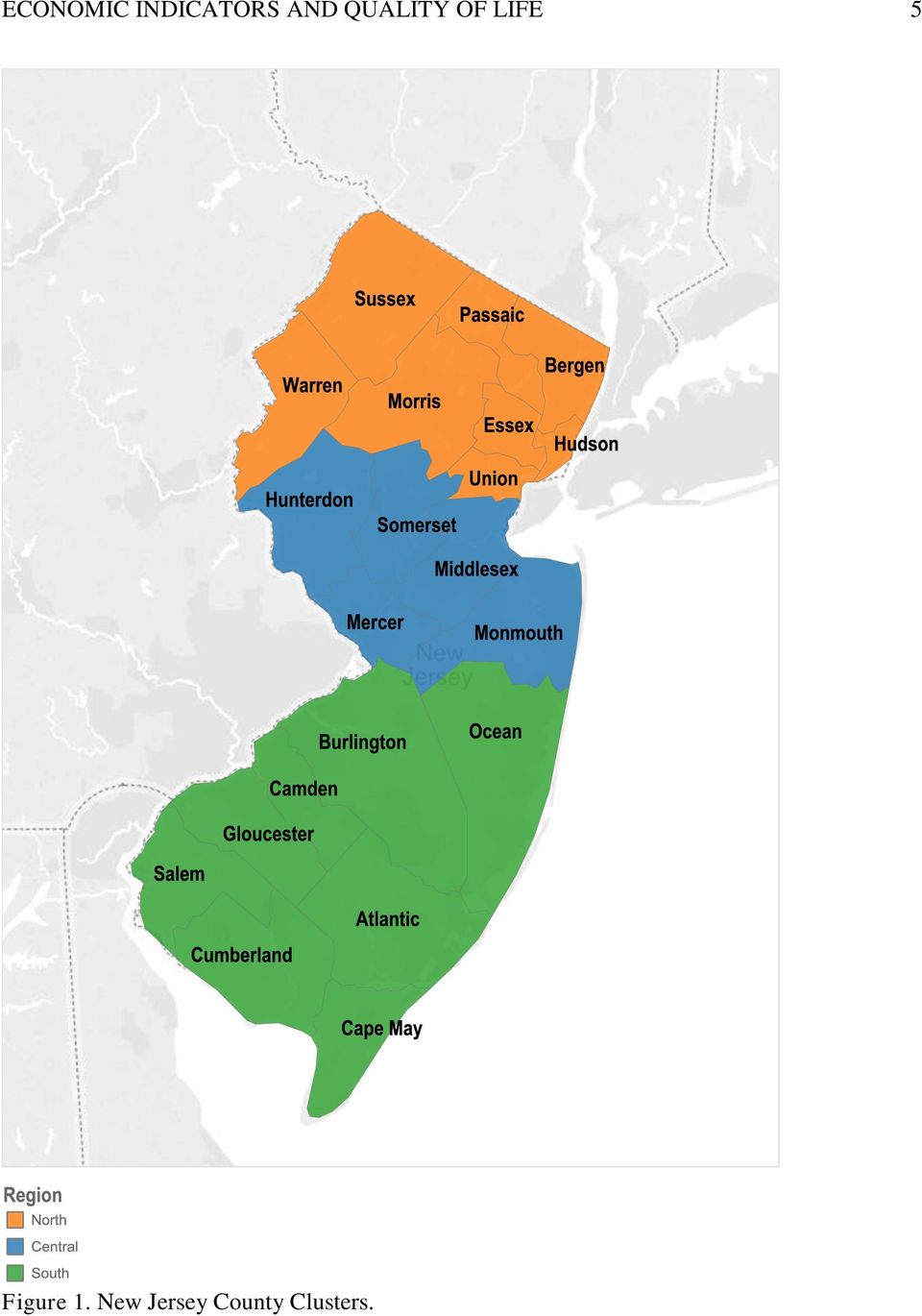
2 ECONOMIC INDICATORS AND QUALITY OF LIFE 2 Economic Indicators and Quality of Life in Southern New Jersey Even though economic inequality has been growing in Western nations since the 1970s, the Great Recession of has inspired frequent and increasingly urgent debates about income, wages, and wealth in the United States. Recent analyses of economic inequality leave little doubt that since the Carter administration, there has been an upward shift in the distribution of resources and concentration of power and wealth (Picketty & Goldhammer 2014; Stiglitz 2012; Noah 2008). When compared with other states, New Jersey is quite affluent and enjoyed the third highest median household income after Maryland and Alaska in With a median household income of $70,000, New Jersey soars above the U.S. average of $52,000. New Jersey is also home to two counties which currently rank in the top ten for county-level median household incomes in the United States (Van Riper 2014). And, it is home to several counties with some of the worst income mobility trends for children in the Northeastern U.S. (Aisch, Buth, Bloch, Cox, & Quealy 2015). In addition to discourse regarding concentrated wealth and the ninety-nine percent, important post-recession debates about inequality have also brought greater attention to place and differences between and within states, counties and communities. In the state of New Jersey, there is a considerable amount of income and wealth inequality within North and Central Jersey counties with large cities like Newark, Paterson and Jersey City. There is also significant income inequality between the Northern, Central and Southern New Jersey counties. The William J. Hughes Center for Public Policy ( Hughes Center ) and the Stockton University Polling Institute define the Central, North and Southern geographic regions by county in Table 1 and Figure 1 maps the county clusters.

3 ECONOMIC INDICATORS AND QUALITY OF LIFE 3 Historically, there has been a tendency to treat the uneven distribution of incomes, wages and wealth between the Northern, Central and Southern New Jersey counties as a natural outcome associated with labor markets and place. The more affluent counties in the North and Central regions of the state are attached to the New York metro s higher-wage, higher-skill knowledge and financial occupational sectors. Similarly, the Southern counties are linked with the Philadelphia metro and Southern Jersey shore; South Jersey residents logically have lower incomes because the dominant employment sectors in this region are low-skill, low-wage agriculture, gaming and tourism. 1 There is mounting evidence illustrating that incomes, wages, and wealth are highly correlated with quality of life which includes education access and attainment, safe neighborhoods, economic mobility, regional development, rates of civic engagement as well as concentrated affluence, poverty and individual life outcomes. As a recent New York Times web feature made plain: Where Income is Higher, Life Spans Are Longer (Lowrey 2014). When comparing New Jersey s twenty-one counties, six of the eight Southern New Jersey counties rank in the bottom ten for median household income, percentage of households living in poverty, rates of unemployment, educational attainment levels, and health outcomes. Considering the relationship between these indicators, life outcomes and prospects for development, these rankings should give Southern New Jersey policy makers pause. This exploratory research is concerned with ranking and visualizing differences between New Jersey counties and understanding why the variables cited are important indicators of quality of life in Southern New Jersey. The paper is divided into two parts. In the first section, 1 The Philadelphia-metro is formally defined by the Census Bureau as the Philadelphia-Camden- Wilmington (PA-NJ-DE) metropolitan statistical area and includes the South Jersey counties of Salem, Gloucester, Camden and Burlington.

4 ECONOMIC INDICATORS AND QUALITY OF LIFE 4 the key variables noted above are described, ranked and mapped to illustrate county-level differences throughout the state. Because the Hughes Center mission is, in part, to serve as a catalyst for research on public policy and economic issues facing Southern New Jersey, the second section offers profiles for the South Jersey counties with more context including countylevel demographics and details about the population, education attainment and household income trends (Hughes Center for Public Policy, William J. n.d.). We also incorporate the most recent health outcomes rankings from the Robert Wood Johnson Foundation as well as the New Jersey Department of Labor occupational sector projections for each of the Southern counties. The conclusion summarizes this exploratory project s findings and future Hughes Center programming and research related to economic inequality. Table 1 County Clusters County Bergen Essex Hudson Morris Passaic Sussex Union Warren Hunterdon Mercer Middlesex Monmouth Somerset Atlantic Burlington Camden Cape May Cumberland Gloucester Ocean Salem Region North North North North North North North North Central Central Central Central Central South South South South South South South South

5 ECONOMIC INDICATORS AND QUALITY OF LIFE 5 Figure 1. New Jersey County Clusters.
6 ECONOMIC INDICATORS AND QUALITY OF LIFE 6 Economic Indicators and County-Level Data Visualization Measuring Inequality There are many ways to measure economic inequality between and within the counties and regions of the state of New Jersey (Desilva 2013). For example, the New Jersey Department of Labor and Workforce Development produces reports like the Data for Decision Making Series (2014) which uses county-level data to make projections about occupational sectors. Another long-term research project conducted by the Legal Services of New Jersey Poverty Research Institute (2013) seeks to better understand inequality, cost of living and the economic strain many New Jersey families endure. There are also projects like Stockton University s The South Jersey Economic Review (2014), an electronic publication produced by Dr. Oliver Cooke that trains a critical lens on labor, development and the region s economic futures. These research projects illustrate the importance and utility of data-driven research and analysis. Some of the most popular (and valuable) public policy research published today begins with the collection and analysis of data because such projects help researchers and policy makers recognize patterns and relationships in particular geographies and among specific constituencies. Fostering insight about social and economic conditions, data collection and analysis can also confirm suspicions, lessen bias, and provide evidence to support policy initiatives and recommendations. This exploratory project considers economic variables at the New Jersey county-level that are regularly used by social scientists to gauge quality of life in particular places. Looking at key indicators including median household income, unemployment, rates of poverty and educational attainment at the county-level will help the Hughes Center and others

7 ECONOMIC INDICATORS AND QUALITY OF LIFE 7 concerned with the future of the Southern counties recognize patterns of inequality that are detrimental to the welfare, quality of life and future of many South Jersey children and families. 2 Economic Indicators Median Household Income. Median household income includes the income of the householder(s) and others in a given residence age fifteen years and above. The American Community Survey explains that this measure: divides the income distribution into two equal parts: one-half of the cases falling below the median income and one-half above the median (quickfacts.census.gov). 3 In New Jersey, the median household income in 2013 was roughly $70,000 and the range of median household incomes at the county-level was between $105,000 and $49,000. In a pattern that will be repeated as we observe each economic indicator, in Table 2 six of the eight Southern New Jersey counties rank in the bottom ten of the median household income rankings. Atlantic, Camden, Cape May, Cumberland, Ocean and Salem counties had median household incomes ranging between approximately $49,000 and $60,000 in 2013, well below the state average. Among all the counties, Cumberland County had the lowest median household income ($48,700) while the Central counties of Hunterdon and Somerset boast some of the highest county-level median incomes in the United States. Figure 2 illustrates the median household income distribution. The 2013 median household income for Hunterdon County was $105,950 and, according to Forbes it was the sixth richest county in the United States in Interactive maps can be found at: c/economicindicatorsandqualityoflifeinsouthernnj?:embed=y&:showtabs=y&:display_count=yes 3 As the Missouri Census Data Center explains, median household income is perhaps the most widely used measure of income in the census. The preference for a median household measure over the per capita measure is due to the fact that per capita does not take into account economies of scale involved when people share a household.

8 ECONOMIC INDICATORS AND QUALITY OF LIFE 8 (Van Riper 2014). The tenth wealthiest county in 2014 was Somerset where the median household income was $98,401 in 2013, close to thirty thousand dollars higher than New Jersey s average ($70,324) and approaching twice the national average of $52,176 (Van Riper 2014). The two Southern counties that rank in the upper half of the county-level median household income distribution are Burlington and Gloucester. These counties recorded median household incomes just above the New Jersey state average ($73,000 and $77,000) according to the American Community Survey 3 Year Estimates ( ). As noted in the introduction, social science demonstrates that higher incomes are associated with an array of quality of life factors ranging from intergenerational wealth and concentrated poverty to educational attainment and civic engagement.

9 ECONOMIC INDICATORS AND QUALITY OF LIFE 9 Table 2 Median Household Income COUNTY REGION RANK MEDIAN HOUSEHOLD INCOME Hunterdon Central 1 $105,950 Somerset Central 2 $ 98,401 Morris North 3 $ 96,438 Sussex North 4 $ 87,342 Monmouth Central 5 $ 82,962 Bergen North 6 $ 82,650 Middlesex Central 7 $ 77,729 Burlington South 8 $ 76,998 Gloucester South 9 $ 73,259 Mercer Central 10 $ 71,471 Warren North 11 $ 67,909 Union North 12 $ 65,872 Ocean South 13 $ 60,156 Camden South 14 $ 59,778 Salem South 15 $ 59,202 Passaic North 16 $ 58,057 Hudson North 17 $ 57,378 Cape May South 18 $ 57,168 Essex North 19 $ 52,762 Atlantic South 20 $ 52,646 Cumberland South 21 $ 48,694 New Jersey $ 70,324 United States $ 52,176 Note: Data from the American Community Survey 3 Year Estimates,
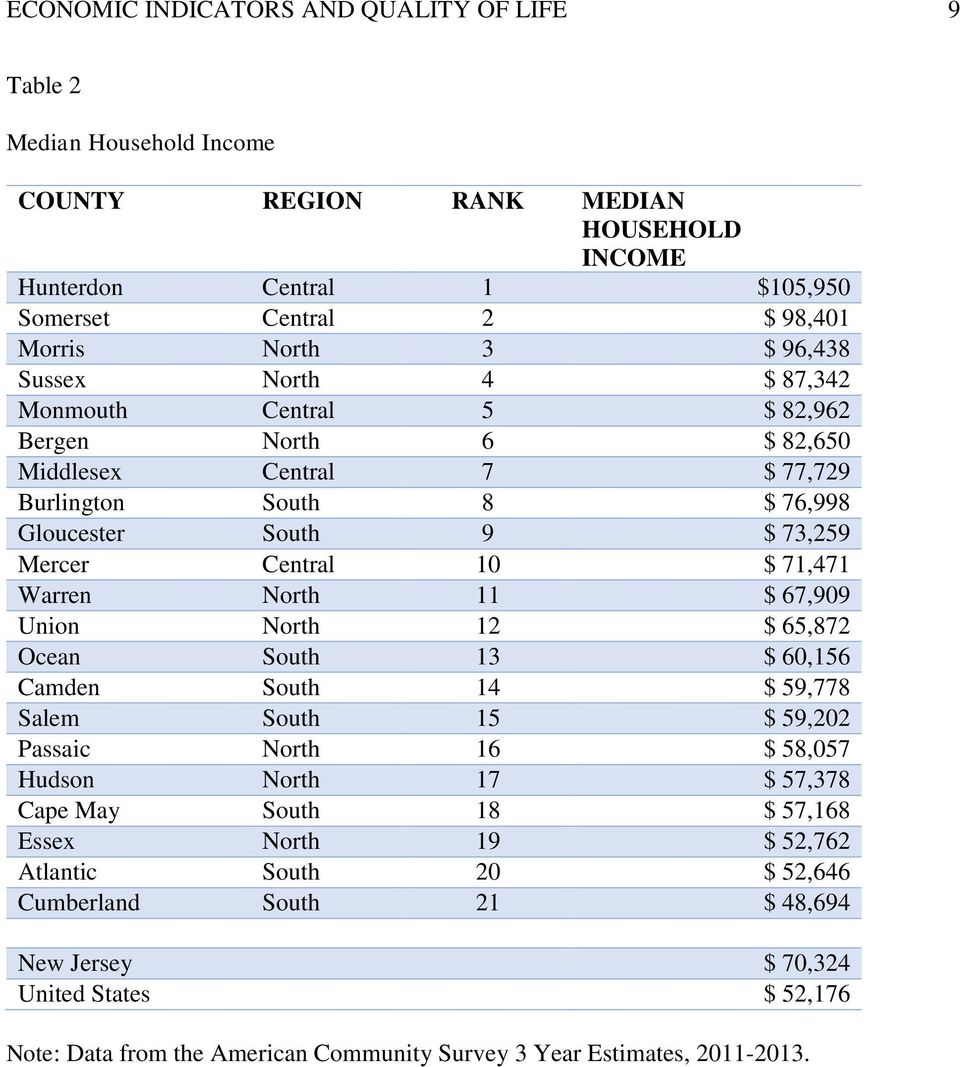
10 ECONOMIC INDICATORS AND QUALITY OF LIFE 10 Figure 2. Median household income, New Jersey counties.

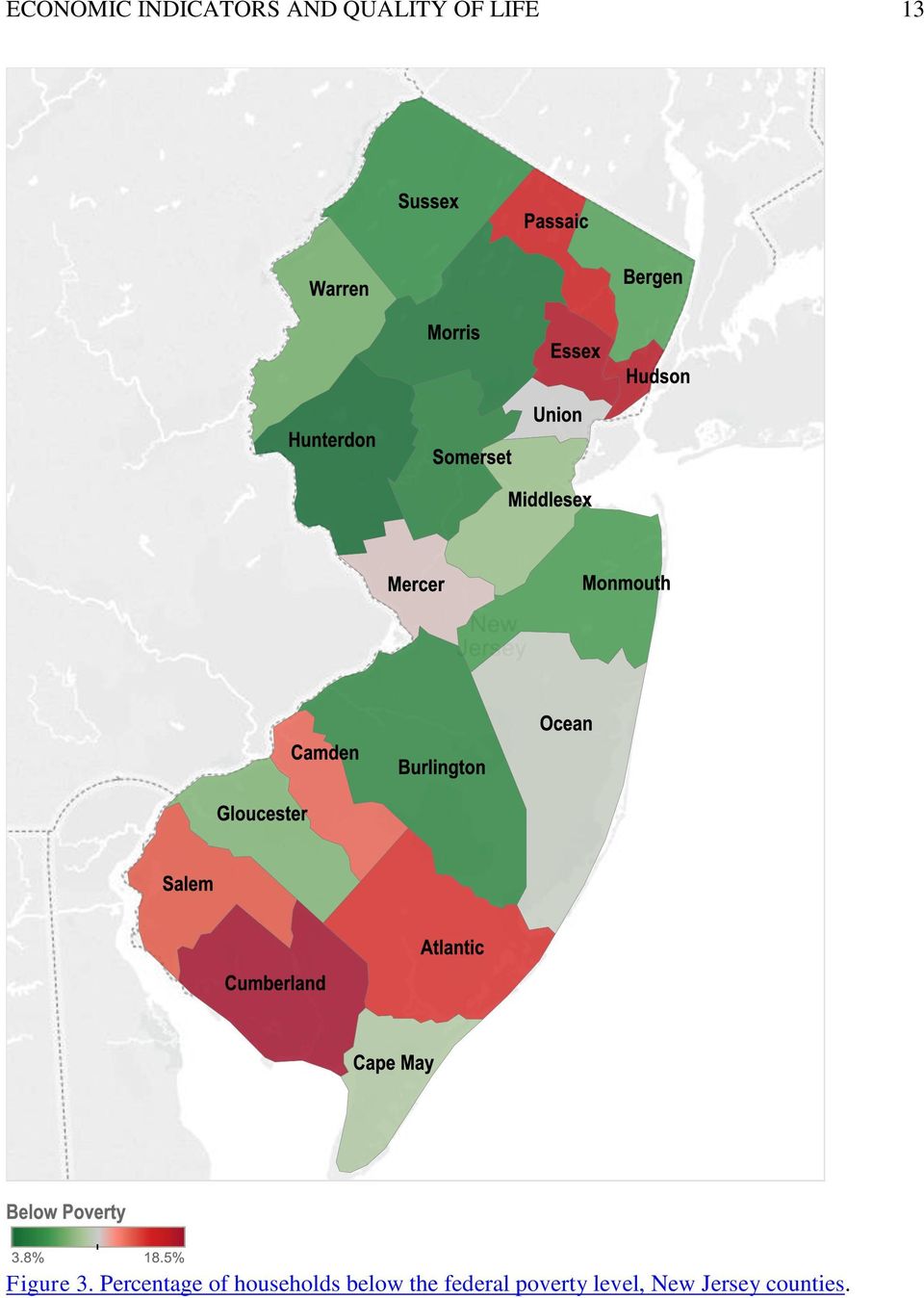
11 ECONOMIC INDICATORS AND QUALITY OF LIFE 11 Poverty Status. Another important income measure calculated by the Census Bureau each year is the federal poverty level. The American Community Survey defines the poverty threshold as a set dollar value that varies by family composition but not geography or the cost of living in a particular place. Cost of living adjustments are made annually based on the Consumer Price Index to create national poverty threshold figures (quickfacts.census.gov). In this report, poverty refers to households living below the poverty threshold in The percentage of households living below the federal poverty threshold in the state of New Jersey was 10.9% while the United States average was 15.9% in As Table 3 clarifies, Atlantic, Camden, Cape May, Cumberland, Ocean, and Salem are ranked among the bottom ten for poverty status among the twenty-one New Jersey counties. These six Southern counties have some of the highest rates of poverty in the state of New Jersey including 18.5% in Cumberland County, 15% in Atlantic County and 14% in both Camden and Salem counties. Gloucester and Burlington once again prove exceptions to patterns of economic hardship among the Southern counties with rates of poverty status at 8.6% and 5.8% respectively. As suggested in the median household income section, low income households face an array of burdens related to lower quality of life and life outcomes. Figure 3 maps the rate of poverty by county and the South-county profiles will further illustrate that high concentrations of poverty are related to limited job prospects, low educational attainment and poor health outcomes.
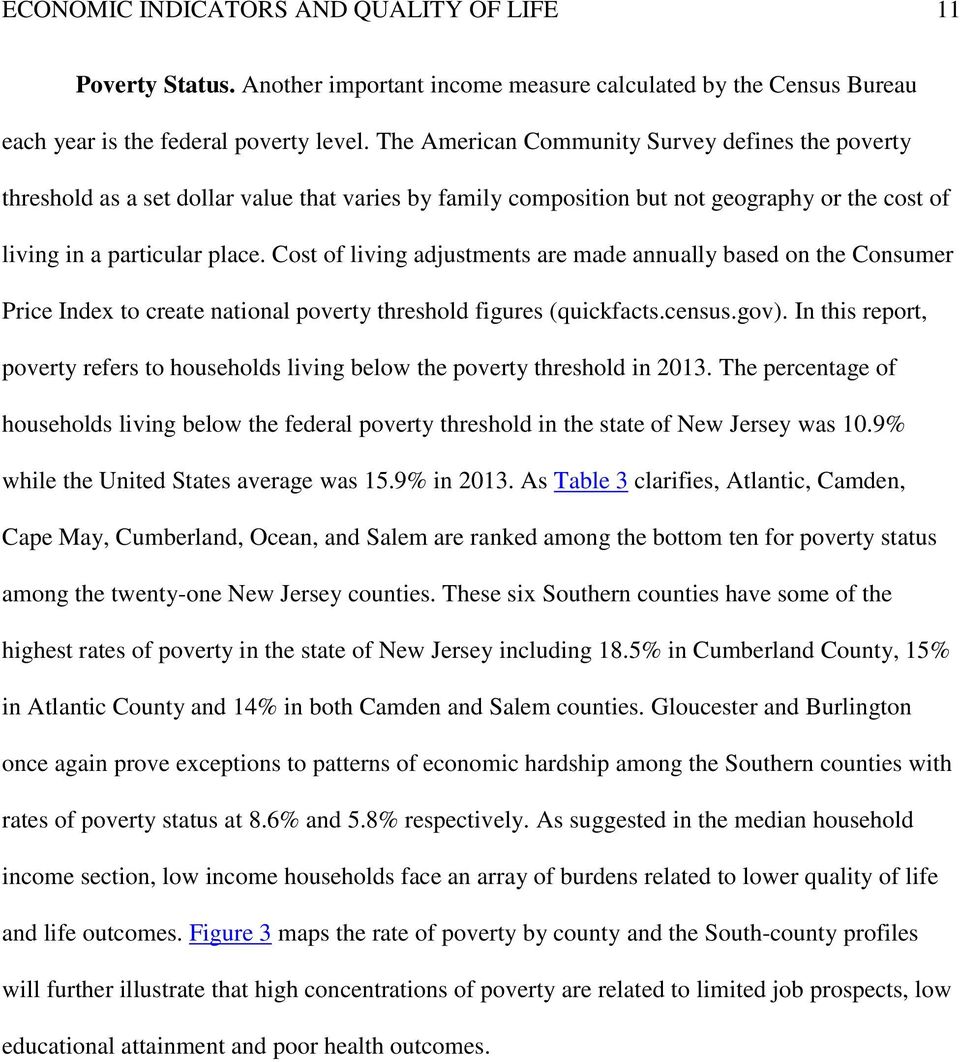
12 ECONOMIC INDICATORS AND QUALITY OF LIFE 12 Table 3 Poverty Status COUNTY REGION RANK PERCENT BELOW POVERTY LEVEL Cumberland South % Essex North % Hudson North % Passaic North % Atlantic South % Salem South % Camden South % Mercer Central % Union North % Ocean South % Cape May South % Middlesex Central % Gloucester South % Warren North % Bergen North % Monmouth Central % Sussex North % Burlington South % Somerset Central % Morris North % Hunterdon Central % New Jersey 10.9% United States 15.9% Note: Data from the American Community Survey 3 Year Estimates,

13 ECONOMIC INDICATORS AND QUALITY OF LIFE 13 Figure 3. Percentage of households below the federal poverty level, New Jersey counties.
14 ECONOMIC INDICATORS AND QUALITY OF LIFE 14 Asset Limited, Income Constrained, Employed ( ALICE ). Some social scientists and policy makers believe the federal poverty threshold is not the best measure of household economic duress. In pursuit of a more meaningful measure, the United Way of Northern New Jersey project ALICE crafted what can be described as a measure of household vulnerability (Halpin 2012). According to the author, ALICE is a household with income above the [federal poverty level] but below a basic survival threshold [emphasis added] (Halpin 2012, 5). The ALICE income threshold goes beyond the federal measure by including the cost of basic necessities like housing, child care, food, transportation, and health care. Halpin argues that the high cost of living and concentrated affluence in some New Jersey counties conceals the reality that the top 20 percent of New Jersey s population earns almost half of all income earned in the state; the bottom 20 percent earns only 3 percent (Halpin 2012, 5). We know the working poor in the United States are economically vulnerable when hardship strikes a family; they are also less likely to benefit from intergenerational wealth transfers and more apt to have children with constrained economic mobility (Aisch, Buth, Bloch, Cox, & Quealy 2015). Based on the geographic trends we see, it is possible to argue that the low cost of living, low wages, and concentrated poverty in many of the South counties similarly masks deep inequalities between North, Central and South New Jersey. All of the Southern New Jersey counties except Camden are among the top ten in terms of percentage of households Halpin defines as asset limited, income constrained, employed (Halpin 2012). Table 4 features the complete ALICE rankings and Figure 4 maps the county level distribution of the measure.
15 ECONOMIC INDICATORS AND QUALITY OF LIFE 15 Table 4 Asset Limited, Income Constrained, Employed ( ALICE ) COUNTY REGION RANK (ALICE) 2010 HOUSEHOLDS LIVING IN POVERTY 2010 HOUSEHOLDS LIVING IN ALICE Union North 1 10% 18% Morris North 2 5% 18% Monmouth Central 3 7% 21% Middlesex Central 4 7% 21% Camden South 5 12% 22% Somerset Central 6 4% 23% Hunterdon Central 7 4% 23% Bergen North 8 8% 23% Warren North 9 8% 24% Mercer Central 10 11% 24% Hudson North 11 16% 25% Gloucester South 12 8% 25% Burlington South 13 5% 25% Essex North 14 17% 26% Atlantic South 15 12% 26% Sussex North 16 5% 27% Salem South 17 11% 29% Passaic North 18 15% 30% Cumberland South 19 15% 32% Ocean South 20 9% 33% Cape May South 21 10% 33% Note: The ALICE rankings, data and analysis are from Halpin, S. H. (2012). ALICE : Asset Limited, Income Constrained, Employed: A study of financial hardship in New Jersey. Cedar Knolls, NJ: United Way of Northern New Jersey.

16 ECONOMIC INDICATORS AND QUALITY OF LIFE 16 Figure 4. Percentage of households Asset Limited, Income Constrained, Employed, New Jersey counties. Data ranking and analysis conducted by Halpin 2012.

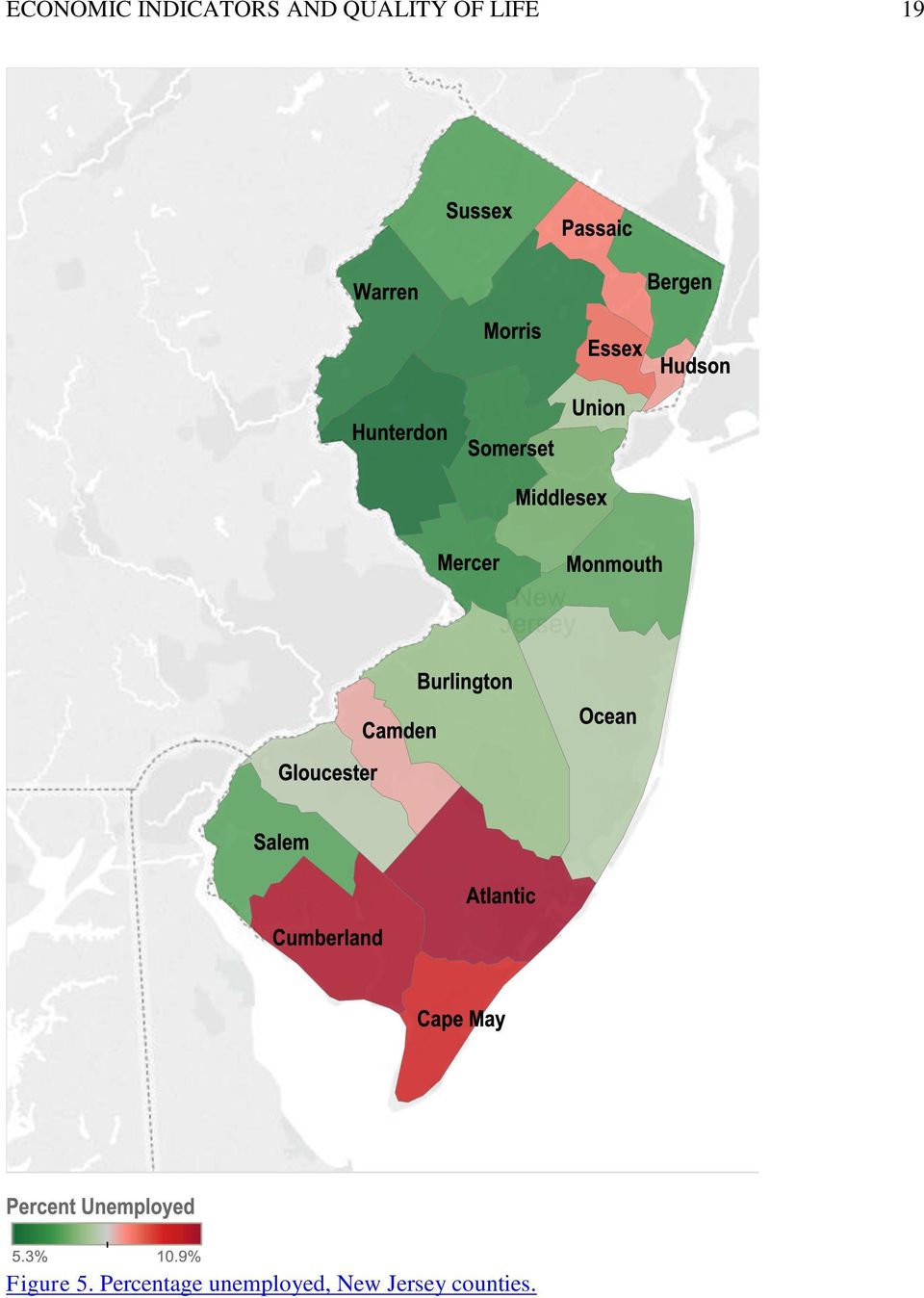
17 ECONOMIC INDICATORS AND QUALITY OF LIFE 17 Unemployment. The unemployment statistics cited in this paper are based on data collected through the U.S. Department of Labor s monthly Current Population Survey and ranked in Table 5. This data is collected from more than one hundred thousand American survey respondents each month to determine, among other variables, the extent of unemployment in the United States. According to the Bureau of Labor Statistics, an individual is unemployed if she/he is jobless, looking for a job, and available for work ( The Bureau reports that Atlantic, Burlington, Camden, Cape May, Cumberland, Gloucester, and Ocean rank among the counties with the highest rates of unemployment as of January Notably, the rate of unemployment for the state of New Jersey was 6.4% while the national average was a little lower at 5.8% for the same period. When comparing the county unemployment rates mapped in Figure 5, the percentage unemployed ranges between 5.3% and 10.9%. Hunterdon has the lowest unemployment rate (5.3%) followed by Morris (5.7%), Warren (5.8%) and Somerset (5.9%). The Southern counties of Cape May (9.9%), Cumberland (10.7%), and Atlantic (10.9%) have the highest rates of unemployment in the state. Salem appears to be an outlier in this category with only 6.7% unemployment on record in January It is very possible that like many Americans, a considerable number of New Jersey residents are no longer calculated as unemployed because they have stopped seeking employment. While unemployment is certainly correlated with rates of poverty and low incomes, it also shares an increasingly predictive relationship with educational attainment.
18 ECONOMIC INDICATORS AND QUALITY OF LIFE 18 Table 5 Unemployment Status COUNTY REGION RANK PERCENTAGE UNEMPLOYED Hunterdon Central 1 5.3% Morris North 2 5.7% Warren North 3 5.8% Somerset Central 4 5.9% Mercer Central 5 6.2% Bergen North 6 6.5% Sussex North 7 6.6% Salem South 8 6.7% Monmouth Central 9 6.8% Middlesex Central % Burlington South % Union North % Ocean South % Gloucester South % Camden South % Hudson North % Passaic North % Essex North % Cape May South % Cumberland South % Atlantic South % New Jersey 6.4% United States 5.8% Note: County level data source is U.S. Department of Labor. (2014). Labor force data by county, not seasonally adjusted, October 2013-November Washington, D.C.: Bureau of Labor Statistics. 7 January State level data is from U.S. Department of Labor. (2014). Unemployment rates for states, monthly rankings, seasonally adjusted. Washington, D.C.: Bureau of Labor Statistics. 7 January U.S. data source is U.S. Department of Labor. (2015). United States Labor force statistics from the Current Population Survey. Washington, D.C.: Bureau of Labor Statistics. 7 January 2015.

19 ECONOMIC INDICATORS AND QUALITY OF LIFE 19 Figure 5. Percentage unemployed, New Jersey counties.
20 ECONOMIC INDICATORS AND QUALITY OF LIFE 20 Educational Attainment. The American Community Survey captures the highest level of education completed by American adults. In this paper, educational attainment is reported for adults age 25 and older unless other populations and/or age groups are referenced in the narrative. The report emphasizes: (1) the percentage of adults age 25 and older who earned a high school diploma or higher level of education attainment; (2) the percentage of adults age 25 and older who reported earning a bachelor s degree or higher level of education attainment; and, (3) the highest educational attainment levels reported categorically by adults age 25 and older ( High School Diploma and Higher Educational Attainment. The first variable we consider is the percentage of adults who reported attaining a high school diploma or higher education. In Table 6, among the New Jersey counties, the percentages range from a high of 95% in Hunterdon County to a low of 78% in Cumberland County. For the sake of perspective, the New Jersey state average is 88.3%, slightly higher than the United States average of 86.3%. As occurs with the other indicators in this paper, Figure 6 illustrates a persistent geographic pattern as six Southern counties are in the bottom of the rankings for this measure. Of the two remaining Southern counties, Gloucester ranks 8 th with 91.3% and Burlington ranks 6 th with 92.1%.

21 ECONOMIC INDICATORS AND QUALITY OF LIFE 21 Table 6 Percentage High School Graduate or Higher COUNTY REGION RANK PERCENT HS GRAD OR HIGHER Hunterdon Central % Sussex North % Somerset Central % Morris North % Monmouth Central % Burlington South % Bergen North % Gloucester South % Warren North % Ocean South % Cape May South % Middlesex Central % Mercer Central % Camden South % Salem South % Union North % Essex North % Atlantic South % Hudson North % Passaic North % Cumberland South % United States 86.3% New Jersey 88.3% Note: U.S. Census Bureau. (2013). Educational attainment (S1501), American Community Survey, 3-Year Survey [Data File]. Retrieved from Percent high school graduate or higher (includes equivalency) for the population 25 years and over.
22 ECONOMIC INDICATORS AND QUALITY OF LIFE 22 Figure 6. Percentage high school graduate and higher, New Jersey counties.
23 ECONOMIC INDICATORS AND QUALITY OF LIFE 23 Bachelor s Degree or Higher Educational Attainment. While the percentage of adults age twenty-five and older who reported earning a bachelor s degree or higher in the United States was 29% in 2013, in New Jersey, the state average is even higher at 36%. When looking at county-level data, there are considerable differences for this measure between North, South and Central Jersey. While the disparities between New Jersey counties for high school graduate and higher attainment is relatively small, see Table 7 as the range for the percentage of residents reporting they d earned a bachelor s degree or higher in 2013 included a low of 15% and a high of 51% at the county-level. As we have seen with the other economic indicators, most of the Southern New Jersey counties have poor rankings for this measure. Seven of eight South Jersey counties Atlantic, Camden, Cape May, Cumberland, Gloucester, Ocean and Salem counties are ranked in the bottom ten for bachelor degree plus attainment when compared with the other New Jersey counties. The percentage of Southern county residents reporting a bachelor s degree or higher range from a low of 14.7% in Cumberland County to a high of 35% in Burlington County. Conversely, Figure 7 highlights the geographic pattern of the Northern and Central counties of Somerset (51.4%), Morris (49.9%), Hunterdon (47.6%) and Bergen (46.7%) boasting education attainment levels well above New Jersey and United States averages. Notably, the relationship between labor force attachment, earnings and educational attainment has only grown in significance since the Great Recession (Carnevale and Rose 2015). Reflecting this new economic climate, the Pew Research Center for Social and Demographic Trends recently tallied stark income disparities among millennials between the ages of 25 and 32 (Taylor, Fry & Oates 2014). Pew researchers calculate that millennials holding a bachelor s degree or higher earn a median income of $45,500 while the average millennial high school
24 ECONOMIC INDICATORS AND QUALITY OF LIFE 24 graduate earns a median income of $28,000. With regard to labor attachment, recent college graduates also have considerably lower rates of unemployment of 3.8% compared with the millennial American high school graduate rate of 12.2% unemployment in March 2013 (Taylor, Fry & Oates 2014). Further, 21.8% of high school graduates were living in poverty in 2013 compared with only 5.8% of millennial college graduates (Taylor, Fry & Oates 2014). Without making claims about causation or weighting the effects of migration patterns and within-county disparities, when we look at the linear relationship between the percentage of bachelor s degree plus earners in New Jersey compared with median household incomes at the county-level in Figure 8, there is a positive relationship between the two variables.
25 ECONOMIC INDICATORS AND QUALITY OF LIFE 25 Table 7 Percentage Bachelor s Degree or Higher COUNTY REGION RANK PERCENT BACHELOR'S OR HIGHER Somerset Central % Morris North % Hunterdon Central % Bergen North % Monmouth Central % Middlesex Central % Mercer Central % Hudson North % Burlington South % Sussex North % Essex North % Union North % Cape May South % Warren North % Camden South % Gloucester South % Ocean South % Passaic North % Atlantic South % Salem South % Cumberland South % United States 29.1% New Jersey 36.1% Note: U.S. Census Bureau. (2013). Educational attainment (S1501), American Community Survey, 3-Year Survey [Data File]. Retrieved from Percent bachelor s degree or higher for the population 25 years and over.
26 ECONOMIC INDICATORS AND QUALITY OF LIFE 26 Figure 7. Percentage Bachelor s degree and higher, New Jersey counties.
27 ECONOMIC INDICATORS AND QUALITY OF LIFE 27 Figure 8. This chart illustrates the relationship between two variables: the percentage of individuals earning a bachelor s degree or higher and median household incomes for each of the New Jersey counties.
28 ECONOMIC INDICATORS AND QUALITY OF LIFE 28 Southern New Jersey County Snapshots In this section, we take a look at individual Southern New Jersey county demographics, population statistics and detailed educational attainment data. In addition to the key economic variables previously addressed, this section of the report includes several additional data points that help flesh out quality of life in Southern New Jersey counties. Additional Variables Race, Ethnicity and National Origin. Similar to the Decennial Census, the American Community Survey asks survey respondents about their racial and ethnic identity in addition to questions about citizenship and national origin. In this report, the racial categories were defined by the 2010 Decennial Census and include: white; black or African American; American Indian and Alaska Native; Asian; Native Hawaiian and Other Pacific Islander; and, Two or more races. The Census Bureau notes percentages for the various categories add up to 100 percent, and should not be combined with the percent Hispanic ( Ethnicity. In addition to the racial categories noted, the American Community Survey includes a narrow set of questions related to Hispanic or Latino ethnicity and that data can be associated with or distinguished from racial categories. For example, it is possible for a respondent to be white and Hispanic or Latino ( Data regarding Hispanic or Latino origin is not included in this project. In this paper, data regarding origins is limited to identifying the percentage of foreign born residents by county.
29 ECONOMIC INDICATORS AND QUALITY OF LIFE 29 Median Age: The Census Bureau defines median age as: The age which divides the population into two numerically equal groups; that is, half the people are younger than this age and half are older ( Real Cost of Living ( RCL ). Similar to Halpin 2012, researchers at the Poverty Research Institute use a methodology designed to measure income adequacy called the Selfsufficiency Standard to calculate the cost of living in each New Jersey county. (Poverty Research Institute 2013, 3). The researchers explain that the cost of living in New Jersey is among the highest in the nation which means that middle- and lower-income New Jersey families are especially vulnerable because they are most likely to have fewer or no reserves, to have fewer or no other places to turn, and to spend all or nearly all of their income on the most basic necessities, especially housing (Poverty Research Institute 2013, 8). Like Halpin s ALICE measure (2012), the cost of transportation, housing, healthcare and childcare define the RCL measure. County Profiles Atlantic County. Atlantic, Camden and Cumberland have the most racially and ethnically diverse populations among the Southern New Jersey counties. Sixty-nine percent of Atlantic County residents identified as white, nearly 18% black or African American, and close to 9% as Asian American in Approximately 16% of Atlantic County residents were born outside of the United States while 18% of individuals surveyed reported Hispanic or Latino ethnicity. Notably, Atlantic and Cumberland counties are also ranked in the bottom five for each of the primary indicators this report explores including income, poverty, unemployment status and educational attainment. In addition to the indicators explored in the first section of this paper, the Robert Wood Johnson Foundation ( RWJF ) ranks Atlantic County 20 th among the
30 ECONOMIC INDICATORS AND QUALITY OF LIFE 30 twenty-one New Jersey counties for health outcomes (County Health Rankings 2015). The study found that Atlantic County residents have some of the lowest health ratings in the state for indicators including clinical care, socioeconomics, health behaviors and health outcomes including life expectancy (County Health Rankings 2015). The 2013 median household income for Atlantic County residents was $52,646 while the real cost of living calculation by the Poverty Research Institute (2013) was $51,395. Thirteen percent of residents live in rural communities and 17% are uninsured (County Health Rankings 2015). The high percentage of residents living below both the federal poverty measure (15.2%) and ALICE threshold (26%) (Halpin 2012) speaks to the economic vulnerability of Atlantic County residents. In 2013, the average income for the top 20% of Atlantic County residents was 4.8 times the average income of the bottom 20% (County Health Rankings 2015). As of January 2015, the unemployment rate for Atlantic County was 10.9% compared with the New Jersey state unemployment rate of 6.4%. According to the New Jersey Department of Labor, the dominant labor sectors in the county are accommodation and food services; retail trade; health care and social assistance; construction; administrative and support and waste management and remediation services; and, construction (New Jersey Department of Labor 2014). The largest employment sectors in the county are (1) leisure and hospitality; (2) trade, transportation, and utilities; and, (3) education and health services (New Jersey Department of Labor 2014). Atlantic County is projected to see an increase of 3,850 jobs (2.8% growth) between 2012 and For the sake of comparison, the rate of increase for the state of New Jersey during the same period is 7.5% (New Jersey Department of Labor 2014). While the percentage of New Jersey adults age twenty-five and older reportedly attaining a bachelor s degree or higher is 36.1% and the U.S. average is 29%, Atlantic County lags behind. In 2013,
31 ECONOMIC INDICATORS AND QUALITY OF LIFE 31 high school diploma, GED or higher educational attainment percentages for adults reached 84%; however, only 24.4% of residents reported earning a bachelor s degree or higher. Many of the new jobs projected for the county are in sectors where a high percentage of opportunities are limited to low-skill, low-educated workers (New Jersey Department of Labor 2014). Burlington County. Out of the eight South Jersey counties, Gloucester and Burlington have the highest rankings in all of the economic indicators explored in this report. The 2013 median household income for Burlington County was $76,998 compared with the New Jersey average of $70,324. As far as within-county inequality is concerned, in 2013, the average income for the top 20% of Burlington County residents was 3.8 times the average income of the bottom 20% (County Health Rankings 2015). The real cost of living calculated by the Poverty Research Institute (2013) was roughly $70,000 and nearly seven (6.7%) percent of Burlington County residents live in a rural community (County Health Rankings 2015). Even though the percentage of Burlington County residents living below the poverty level is only 5.8%, incomes are higher than average, and the unemployment rate was 7.4%, the percentage of Burlington households living below the ALICE threshold totaled 25% (Halpin 2012). The county also ranks eleventh out of the twenty-one counties for health outcomes in the most recent RWJF County Health Rankings (2015). According to American Community Survey data, 7% of Burlington County residents in all racial categories identified as ethnically Hispanic or Latino. Close to 6% of county residents are Asian American, 18% African American or black and the majority of the population (76%) are white. In 2012, ten percent of Burlington County residents reported they were born outside the United States. Nearly all Burlington County residents (92%) have earned a high school diploma, GED or higher;
32 ECONOMIC INDICATORS AND QUALITY OF LIFE 32 similarly, close to 35% of Burlington County residents have attained a bachelor s degree or higher including 12% who reported earning a professional or graduate degree. According the New Jersey Department of Labor, Burlington County is projected to see a 6.7% increase in jobs (+ 13,700) between 2012 and 2022 (New Jersey Department of Labor 2014). The dominant Burlington County industrial sectors include: retail trade; administrative and support and waste management and remediation services; health care and social assistance; accommodation and food services; and, finance and insurance (New Jersey Department of Labor 2014). The largest employment sectors include: (1) trade, transportation, and utilities; (2) professional and business services; (3) education and health services; and, (4) financial activities (New Jersey Department of Labor 2014). Camden County. The median household income for Camden County was very close to $60,000 in While the Poverty Research Institute (2013) calculated the cost of living for this county as roughly $58,966, the percentage of households living under the ALICE threshold was 22% (Halpin 2012). Approximately 13.7% of Camden County households were living below the poverty threshold in 2013 and ranks 19 th in the RWJF County Health Rankings for The county ranks low in terms of health outcomes, health behaviors and a high rate of violent crime 4 (County Health Rankings 2015). Between 2012 and 2022, it is projected that Camden County will see a job increase of 5.6% or 11,250 jobs (New Jersey Department of Labor 2014). Dominant industrial sectors in the county are: healthcare and social assistance; retail trade, administrative and support and waste management and remediation services; accommodation and food service; and, professional, scientific and technical services (New Jersey Department of Labor 2014). Primary employment sectors (most numerous jobs) are: (1) education and health 4 Violent crime is measured by the number of violent offenses per one hundred thousand residents (County Health Rankings 2015).
33 ECONOMIC INDICATORS AND QUALITY OF LIFE 33 services; (2) trade, transportation, and utilities; and, (3) professional and business services (New Jersey Department of Labor 2014). The unemployment rate for Camden County (8.4%) was above both the New Jersey and United States averages as of January Camden, Atlantic, and Cumberland have the most racially and ethnically diverse populations among the Southern New Jersey counties. Twenty-two percent of Camden County residents are black or African American, 6% are Asian, and 66% reported they were white in Regardless of racial category, 15% of residents identified Hispanic or Latino ethnicity and among the entire county s population, 10% reported they were born outside the United States. With regard to educational attainment, 87.5% of residents have earned a high school diploma, GED or higher and 29% of adults age 25 and older have earned a bachelor s degree or higher. As far as within-county inequality is concerned, in 2013, the average income for the top 20% of Camden County residents was 5.0 times the average income of the bottom 20% (County Health Rankings 2015). Cape May County. With regard to racial categories, 93% of Cape May residents are white, 6% reported they were black or African American, and 1.3% Asian American in Only 4.8% of the population was born outside the United States while 6.7% of residents of all races claimed Hispanic or Latino ethnicity. Notably, 23% of Cape May County s 96,000 residents are 65 years of age and over; and, the median age is A significant number of Cape May County residents (17.5%) lived in rural communities in 2013 (County Health Rankings 2015). As for within-county income inequality, the average income for the top 20% of Cape May County residents was 4.4 times the average income of the bottom 20% in 2013 (County Health Rankings 2015). The dominant labor sectors of Cape May County include: accommodation/food service; retail trade; healthcare and social assistance; arts, entertainment and recreation; and,
34 ECONOMIC INDICATORS AND QUALITY OF LIFE 34 construction (New Jersey Department of Labor 2014). The major employment sectors include: (1) leisure and hospitality; (2) trade, transportation, and utilities; and, (3) education and health services (New Jersey Department of Labor 2014). Between 2012 and 2022, the New Jersey Department of Labor (2014) projects limited job growth of 3.3% or an increase of 1,350 jobs. The 2013 median household income for Cape May was $57,168 while the real cost of living calculated in 2011 dollars averaged $58,134 (Poverty Research Institute 2013). According to American Community Survey data, 10% of Cape May County households were living below the federal poverty threshold in 2013 and a large number (33%) were calculated living below the ALICE threshold in 2010 (Halpin 2012). A high percentage of Cape May County adults (31%) have attained a bachelor s or higher degree; and, 10.6% of those hold a professional or graduate degree. Similarly, nearly 90% of county residents reported earning a high school degree, GED or higher level of schooling. Based on multiple indicators, the Robert Wood Johnson Foundation ranks Cape May County fifteenth out of twenty-one counties for health outcomes. Contributing to the poor health ranking are higher than average rates of premature death, poor health behaviors, and below average social and environmental factors (County Health Rankings 2015). Cumberland County. Cumberland is the poorest county in the state of New Jersey. With a population totaling 157,658 in 2013, the median age of Cumberland County residents was 36. While only 2% of residents identified as Asian American, 23% of Cumberland County citizens are African American or black and 64% are white. Seven percent of the population identified as Hispanic or Latino of any race while close to 10% reported they were born outside the United States. Cumberland County experienced the lowest median household income of all New Jersey counties with $48,694 in 2013 and, notably the real cost of living calculated in 2011 dollars averaged $60,415 (Poverty Research Center 2013). Close to 19% of Cumberland County
35 ECONOMIC INDICATORS AND QUALITY OF LIFE 35 residents live below the federal poverty level and according to Halpin (2012), 32% of households lived below the ALICE threshold. With the second highest unemployment rate (10.7% in January 2015) among all New Jersey counties, only 77.7% of Cumberland County residents have earned a high school diploma, GED or higher. As well, this county has the lowest percentage of residents attaining a bachelor s degree or higher at 14.7%. In the 2015 RWJF County Health Rankings, Cumberland County is ranked 21 st among the twenty-one New Jersey counties (County Health Rankings 2015). Twenty-three percent of residents live in rural communities and, as far as within-county inequality is concerned, in 2013, the average income for the top 20% of Cumberland County residents was 5.0 times the average income of the bottom 20% (County Health Rankings 2015). The county s dismal health ranking is attributed to poor health outcomes, behaviors, clinical care, and socioeconomics (County Health Rankings 2015). The most dominant labor sectors in Cumberland County are: health care and social assistance; manufacturing; retail trade; accommodation and food service; and, administrative and support and waste management, remediation services (New Jersey Department of Labor 2014). The top three employers in Cumberland County include (1) trade, transportation and utilities; (2) education and health care; and, (3) manufacturing (New Jersey Department of Labor 2014). As far as growth is concerned, Cumberland County will see an increase in jobs between 2012 and 2022 particularly in the health care and social service sector. The New Jersey Department of Labor projects the county will gain 4.9% or 2,850 new jobs (New Jersey Department of Labor 2014). Gloucester County. In Gloucester County, 84% of residents identify as white, close to 12% as black or African American and 3% as Asian American. Only 5% of Gloucester County
36 ECONOMIC INDICATORS AND QUALITY OF LIFE 36 residents reported Hispanic or Latino ethnicity; and, 5% of residents reported being born outside of the United States. Eight percent of Gloucester County residents lived in rural communities in 2013 and the median household income was approximately $73,000 (County Health Rankings 2015). As far as within-county inequality is concerned, the average income for the top 20% of Gloucester County residents was 4.1 times the average income of the bottom 20% in 2013 (County Health Rankings 2015). According to the Poverty Research Institute s analysis (2013), the real cost of living in Gloucester County was $61,700 in Similarly, is it estimated that a quarter of Gloucester County households lived below the ALICE threshold and should therefore considered economically vulnerable (Halpin 2012). The rate of poverty in the county is 8.6% while the unemployment rate is higher than both the New Jersey and United States averages at 7.8% as of January Gloucester was ranked by RWJF sixteenth out of twenty-one counties for health outcomes (County Health Rankings 2015). Ninety one percent of adults age 25 and older hold a high school diploma, GED or higher and close to 29% reported attaining a bachelor s degree or higher. The dominant labor sectors in Gloucester County include: retail trade; health care and social assistance; accommodation and food services; construction; and administrative and support and waste management and remediation services (New Jersey Department of Labor 2014). The greatest number of jobs are in the industry sectors: (1) trade, transportation and utilities; (2) education and health services; (3) leisure and hospitality; and, (4) professional and business services (New Jersey Department of Labor 2014). Between 2012 and 2022, it is projected that Gloucester County will gain 6,700 jobs, a 6.7% increase (New Jersey Department of Labor 2014).
37 ECONOMIC INDICATORS AND QUALITY OF LIFE 37 Ocean County. Similar to Cape May County, a considerable percentage of Ocean County s 581,000 residents (21.4%) are 65 years of age and over and the majority of the population (93.2%) of the population is white. Only 2.3% of Ocean County residents identified as Asian American while another 4% identified as black or African American. Likewise, 8.7% of residents of all races claimed Hispanic or Latino ethnicity. Eight percent of the population reported they were born outside the United States. Ocean County is ranked eighth among the twenty-one New Jersey counties for health outcomes by the Robert Wood Johnson Foundation (County Health Rankings 2015). This represents the highest ranking for that survey among the South Jersey counties. In 2013, the median household income for Ocean was $60,156; notably, the Poverty Research Institute s (2013) average cost of living calculation was considerably higher at $69,857. The percentage of households living below the federal poverty measure in Ocean County was 10.8% in Similar to other Southern New Jersey counties, the percentage of households living below the ALICE threshold is 33%, nearly three times the percentage living in poverty (Halpin 2012). As of January 2015, Ocean County s unemployment rate was 7.7% or, a little more than one percentage point higher than the New Jersey state average of 6.4%. Close to 90% of Ocean County residents age 25 and older reported they have earned a high school diploma, GED or higher. Twenty six percent of Ocean County residents have attained a bachelor s degree or higher. The key industry sectors of Ocean County are: health care and social assistance; retail trade; accommodations and food service; construction; and administrative and support and waste management and remediation services (New Jersey Department of Labor 2014). The sectors with the highest levels of employment in Ocean County include: (1) education and health services;
38 ECONOMIC INDICATORS AND QUALITY OF LIFE 38 trade, transportation, and utilities; and, (3) leisure and hospitality (New Jersey Department of Labor 2014). Employment projections for Ocean County between 2012 and 2022 exceed the 7.5% rate of growth anticipated by the state of New Jersey. The New Jersey Department of Labor (2014) projects a 9.2% job increase or approximately 14,350 jobs. It is anticipated that the majority of these new jobs will be in the health care and social services sectors. Salem County. While 7% of Salem County residents claimed they are ethnically Hispanic or Latino in 2013, 4% of the population reported they were born outside the United States. Eighty two percent of Salem County residents are white, 15% are African American or black, and approximately 1% are Asian American. In 2013, the median household income was $59,202 and it is estimated that 29% of Salem County households were living below the ALICE threshold (Halpin 2012). Fifteen percent of households were living below the federal poverty level in 2013 and the unemployment rate was 6.7% as of January 2015, close to the New Jersey average of 6.4%. According to the American Community Survey, there is a relatively low rate of postsecondary educational attainment as 86% of Salem County residents have obtained a high school diploma, GED or higher but only 20.5% of county residents have earned a bachelor s degree or higher. The smallest of the Southern counties with a population of 65,651, approximately 16% of Salem County residents are 65 years of age or older. Forty-five percent (45.3%) of this county s residents live in rural communities and, within-county inequality is high as the average income for the top 20% of Salem County residents was 4.9 times the average income of the bottom 20% (County Health Rankings 2015). Salem County residents experience high rates of poor health behaviors, weaker clinical care and lower life expectancy. The rate of premature deaths is improving but still above national and state averages (County Health Rankings 2015). Among the twenty-one New Jersey counties,
39 ECONOMIC INDICATORS AND QUALITY OF LIFE 39 Salem County is ranked 18 th for the 2015 RWJF health outcomes (County Health Rankings 2015). The dominant labor sectors in Salem County include: health care and social assistance; retail trade; transportation and warehousing; accommodation and food services; and construction (New Jersey Department of Labor 2014). The most jobs are located in sectors including: (1) trade, transportation and utilities; (2) manufacturing; and, (3) professional and business services (New Jersey Department of Labor 2014). It is projected that Salem County will see a 5.2% gain (1,100 jobs) between 2012 and 2022 (New Jersey Department of Labor 2014). Conclusion As stated in the introduction, the purpose of this paper was to gather, rank and visualize data to gain a better understanding of differences between the North, Central and South New Jersey counties. This data allows us to consider how the Southern counties rank in terms of common indicators used to gauge quality of life including median household income, rates of unemployment and poverty and educational attainment. Summing up a new study on human development in the United States, Richard Florida reminds us that, America s economic divide registers not just in what we can afford to buy, but in the education we have the opportunity to attain and most basically, in how much time we have to live (Florida 2015). In addition to compilations of current socioeconomic data, this project highlights geographically concentrated inequality that may be detrimental to the long term welfare and quality of life of many South Jersey children and families. The importance of place in social science research reveals that beyond historic patterns of racial and ethnic segregation, affluence and poverty in the U.S. also tend to be concentrated
40 ECONOMIC INDICATORS AND QUALITY OF LIFE 40 geographically (Reardon & Bischoff, 2011; Bell, Rubin, PolicyLink & California Endowment, 2007; Briggs, 2005). Briggs (2005) argues that the geography of opportunity in the United States dictates that access to good schools, fruitful employment opportunities, higher incomes, safe housing, and health outcomes are too often determined by where one lives. In the state of New Jersey, while the stark poverty of residents living in cities like Newark and Trenton tends to be segregated, it is nonetheless more visible than the poverty and limited employment opportunities experienced by many residents living in New Jersey s rural, suburban and exurban communities. In part, sprawl makes South Jersey s economic inequality less conspicuous even though the data collected in this paper illustrates that six of the eight Southern counties experience some of the highest rates of poverty and unemployment, have the lowest median incomes and achieve some of the lowest educational attainment and health rankings among the twenty-one counties in the state. The low levels of educational attainment in Southern New Jersey should be particularly alarming to anyone concerned about South Jersey s future. In addition to economic vulnerability, higher rates of unemployment and poverty, educational attainment is also predictive of civic participation, health outcomes and life span. Importantly, low educational attainment is not only predictive of an individual s personal economic futures but can also over-determine the economic futures of particular geographies. As Oliver Cooke explains in the South Jersey Economic Review about regional development and the future of the Atlantic City metro, there is some evidence that suggests that this metric an area population s educational attainment may be the most important factor in driving metropolitan economic success (Cooke 2014, 5). The economic inequality, regional development and policy challenges facing Southern New Jersey will require more than discourse on political will and community engagement. In their study
41 ECONOMIC INDICATORS AND QUALITY OF LIFE 41 about the suburbanization of poverty, Kneebone and Berube (2014) explain that lack of population density in places like the rural, suburban and exurban communities of Southern New Jersey means that services and resources for the poor and vulnerable tend to be fragmented. Policy interventions to alleviate present hardship and improve the futures of South Jersey residents in urban, suburban and rural communities will require deliberate place-based measures and non-partisan collaboration among policy-makers throughout the South Jersey counties. Future Research A testament to the institutional mission of giving voice to Southern New Jersey, The Hughes Center is participating in Stockton University s Economic Inequality Initiative and looks forward to expanding the exploratory research in this report by launching several projects exploring the relationship between civic health and economic inequality. Civic health is measured not only by voter registration rates, voter turnout and political engagement; it also concerns how attached, trusting and engaged individuals feel in their respective families, neighborhoods, institutions, geographic and political communities. This fall, Dr. David Carr will lead a project based on Dr. Suzanne Mettler s study The Submerged State: How Invisible Government Policies Undermine American Democracy, to explore knowledge and feelings about government social benefits. Working with the Stockton Polling Institute, the Hughes Center also plans to conduct a state-wide poll regarding inequality and civic engagement to learn more about the lived experience of New Jersey residents. And, building upon this paper, we plan to collect and visualize data at the census tract level for economic indicators in Atlantic County. The Hughes Center on-going civic engagement programming and upcoming research on civic health and economic inequality will contribute toward the important and difficult work involved with creating and expanding policy interventions to disrupt patterns of inequality in South Jersey.
42 ECONOMIC INDICATORS AND QUALITY OF LIFE 42 References Aisch, G., Buth, E., Bloch, M., Cox, A., & Quealy, K. The Best and Worst Areas to Grow Up: How Your Area Compares. The New York Times. Bell, J. E., Rubin, V., PolicyLink (Organization), & California Endowment. (2007). Why place matters: building a movement for healthy communities. Oakland, CA: PolicyLink. Carnevale, A., & Rose, S. (2015). The economy goes to college: The hidden promise of higher education in the post-industrial service economy. Washington, D.C.: Georgetown University Center on Education and the Workforce, McCourt School of Public Policy. Comey, J., Narducci, C., & Taian, P.A. (2010) State of Washington, D.C. s neighborhoods Washington, D.C.: The Urban Institute. Cooke, O.D. (2014). The diversification premium. The South Jersey Economic Review, 7, 2, 1-7. Briggs, X. N. de Souza (2005). The geography of opportunity: Race and housing choice in metropolitan America. Washington D.C: Brookings Institution Press. Desilva, D. (2013). The many ways to measure economic inequality. Washington, D.C.: Pew Research Center. Florida, R. (2015). The geography of well-being. The Atlantic CityLab. Grawe, N. (2008). Wealth and Economic Mobility. Washington, D.C.: The Urban Institute and the Pew Charitable Trusts Economic Mobility Project. Halpin, S. H. (2012). ALICE: Asset Limited, Income Constrained, Employed: A study of financial hardship in New Jersey. Cedar Knolls, NJ: United Way of Northern New Jersey. Hughes Center for Public Policy, William J. (n.d.). Mission Statement. Galloway, NJ: The Richard Stockton College of New Jersey. Kahn, C., Kingsley, T., & Taylor, G. (2012). National Neighborhood Indicators Partnership (NNIP) Shared Indicators System Framework. Washington, D.C.: The Urban Institute. Kneebone, E., & Berube, A. (2013). Confronting suburban poverty in America. Washington, D.C.: Brookings Institution Press. Lowrey, A. (2014). Income gap, meet the longevity map. New York Times. and Metropolitan Philadelphia Indicators Project. (2010). Where we stand: Community indicators for metropolitan Philadelphia Philadelphia: Temple University. Metropolitan Philadelphia Indicators Project. (2008). Rating the region s quality of life. Philadelphia: Temple University. Missouri Census Data Center. (n.d.) Measures of income in the census.
43 ECONOMIC INDICATORS AND QUALITY OF LIFE 43 New Jersey Department of Labor and Workforce Development. Data for decision making series: Key industries in New Jersey s counties. Trenton: Bureau of Labor Market Information. Noah, T. (2012). The great divergence: America s growing inequality crisis and what we can do about it. New York: Bloomsbury. The Pew Charitable Trusts. (2014). Philadelphia: The state of the city, a 2014 update. Philadelphia: The Pew Charitable Trusts Philadelphia Research Initiative. Picketty, T., & Goldhammer, A. (2014). Capital in the twenty-first century. Cambridge, MA: The Belknap Press of Harvard University Press. Poverty Research Institute. (2013). The real cost of living in New Jersey: What it takes to make basic needs and avoid deprivation. Edison, NJ: Legal Services of New Jersey. Reardon, S. F., & Bischoff, K. (January 01, 2011). Income inequality and income segregation. American Journal of Sociology, 116, 4, Robert Wood Johnson Foundation, & the University of Wisconsin Population Health Institute, School of Medicine and Public Health. (2015). County Health Rankings. Steele, A. (2015). Camden gains Promise Zone status to leverage federal aid. The Philadelphia Inquirer _Camden_gains Promise_Zone status_to_leverage_federal_aid.html Stiglitz, J. (2012). The price of inequality: how today s divided society endangers our future. New York: W.W. Norton & Company. Taylor, P., Fry, R., & Oates, R. (2014). The rising cost of not going to college. Washington, D.C.: Pew Research Center. U.S. Census Bureau. (2013). Educational attainment (S1501), American Community Survey, 3-Year Survey [Data File]. Retrieved from U.S. Census Bureau. (2013). Median household income in the past 12 months (in 2013 inflation adjusted dollars) (B1501), American Community Survey, 3-Year Survey [Data File]. Retrieved from U.S. Census Bureau. (2013). Poverty status in the past 12 months (S1701), American Community Survey, 3-Year Survey [Data File]. Retrieved from U.S. Census Bureau. (2012). Demographic Characteristics, American Community Survey, 5-Year Survey [Data File]. Retrieved from U.S. Department of Labor. (2015). Labor force data by county, not seasonally adjusted, October 2013-November Washington, D.C.: Bureau of Labor Statistics. Retrieved from U.S. Department of Labor. (2015). Unemployment rates for states, monthly rankings, seasonally adjusted. Washington, D.C.: Bureau of Labor Statistics. Retrieved from U.S. Department of Labor. (2015). United States Labor force statistics from the Current Population Survey. Washington, D.C.: Bureau of Labor Statistics. Retrieved from
44 ECONOMIC INDICATORS AND QUALITY OF LIFE 44 Van Riper, T. (2014). America s Richest Counties Forbes. /sites/tomvanriper/2014/04/01/americas-richest-counties-2014/ Correspondence concerning this paper should be addressed to [email protected]
45 ECONOMIC INDICATORS AND QUALITY OF LIFE 45 Table 8 Atlantic County POPULATION Total Population 275,339 Median Age 40.4 Under 5 years 6.1% 18 years and over 77.3% 21 years and over 73.1% 62 years and over 18.6% 65 years and over 14.9% RACE, ETHNICITY& ORIGINS White 69% Black or African American 17.5% American Indian and Alaska Native 1.2% Asian 8.8% Native Hawaiian and Other Pacific Islander 0.1% Some Other Race 7% Hispanic or Latino of any race 17.8% Foreign Born 16.2% INCOME AND COST OF LIVING Median Household Income $52,646 Real Cost of Living $51,395 Percentage Below Poverty Level 15.2% Percentage ALICE 26% Percentage Unemployed 10.9% EDUCATIONAL ATTAINMENT Population 25 years and over 186,693 Less than 9 th grade 6.6% 9 th to 12 th grade, no diploma 9.8% High School graduate (includes equivalency) 32.8% Some college, no degree 19.9% Associates degree 6.5% Bachelor s degree 16.1% Graduate or professional degree 8.3% Percent high school graduate or higher 83.6% Percent bachelor s degree or higher 24.4% Note: Population, race, ethnicity, median household income, poverty, and educational attainment data from the American Community Survey 3 Year Estimates, Foreign born data source is the American Community Survey 5 Year Estimates, The Real Cost of Living in New Jersey analysis by the Poverty Research Institute, Legal Services of New Jersey, Asset Limited, Income Constrained, Employed ( ALICE ) data, ranking and analysis by Halpin Unemployment data from the Bureau of Labor Statistics, Local Area Unemployment Statistics, 7 January 2015.
46 ECONOMIC INDICATORS AND QUALITY OF LIFE 46 Table 9 Burlington County POPULATION Total Population 451,071 Median Age 40.9 Under 5 years 5.6% 18 years and over 77.5% 21 years and over 73.9% 62 years and over 18% 65 years and over 14.7% RACE, ETHNICITY & ORIGINS White 75.9% Black or African American 18.1% American Indian and Alaska Native 0.9% Asian 5.6% Native Hawaiian and Other Pacific Islander 0.2% Some Other Race 3.2% Hispanic or Latino of any race 7.1% Foreign Born 9.5% INCOME AND COST OF LIVING Median Household Income $76,998 Real Cost of Living $70,224 Percentage Below Poverty Level 5.8% Percentage ALICE 25% Percentage Unemployed 7.4% EDUCATIONAL ATTAINMENT Population 25 years and over 310,702 Less than 9 th grade 2.6% 9 th to 12 th grade, no diploma 5.4% High School graduate (includes equivalency) 30.3% Some college, no degree 19.2% Associates degree 7.7% Bachelor s degree 22.6% Graduate or professional degree 12.2% Percent high school graduate or higher 92.1% Percent bachelor s degree or higher 34.8% Note: Population, race, ethnicity, median household income, poverty, and educational attainment data from the American Community Survey 3 Year Estimates, Foreign born data source is the American Community Survey 5 Year Estimates, The Real Cost of Living in New Jersey analysis by the Poverty Research Institute, Legal Services of New Jersey, Asset Limited, Income Constrained, Employed ( ALICE ) data, ranking and analysis by Halpin Unemployment data from the Bureau of Labor Statistics, Local Area Unemployment Statistics, 7 January 2015.
47 ECONOMIC INDICATORS AND QUALITY OF LIFE 47 Table 10 Camden County POPULATION Total Population 513,404 Median Age 38.2 Under 5 years 6.40% 18 years and over 76.2% 21 years and over 72.3% 62 years and over 16.8% 65 years and over 13.5% RACE, ETHNICITY & ORIGINS White 65.9% Black or African American 21.6% American Indian and Alaska Native 1% Asian 6.1% Native Hawaiian and Other Pacific Islander 0.1% Some Other Race 8.9% Hispanic or Latino of any race 15.1% Foreign Born 10.4% INCOME AND COST OF LIVING Median Household Income $59,778 Real Cost of Living $58,966 Percentage Below Poverty Level 13.7% Percentage ALICE 22% Percentage Unemployed 8.4% EDUCATIONAL ATTAINMENT Population 25 years and over 345,316 Less than 9 th grade 4.8% 9 th to 12 th grade, no diploma 7.7% High School graduate (includes equivalency) 31.6% Some college, no degree 19.3% Associates degree 7.5% Bachelor s degree 18.8% Graduate or professional degree 10.4% Percent high school graduate or higher 87.5% Percent bachelor s degree or higher 29.2% Note: Population, race, ethnicity, median household income, poverty, and educational attainment data from the American Community Survey 3 Year Estimates, Foreign born data source is the American Community Survey 5 Year Estimates, The Real Cost of Living in New Jersey analysis by the Poverty Research Institute, Legal Services of New Jersey, Asset Limited, Income Constrained, Employed ( ALICE ) data, ranking and analysis by Halpin Unemployment data from the Bureau of Labor Statistics, Local Area Unemployment Statistics, 7 January 2015.
48 ECONOMIC INDICATORS AND QUALITY OF LIFE 48 Table 11 Cape May County POPULATION Total Population 96,305 Median Age 48.1 Under 5 years 4.7% 18 years and over 81.7% 21 years and over 77.7% 62 years and over 27.5% 65 years and over 22.7% RACE, ETHNICITY & ORIGINS White 92.6% Black or African American 5.6% American Indian and Alaska Native 0.9% Asian 1.3% Native Hawaiian and Other Pacific Islander N Some Other Race 1.7% Hispanic or Latino of any race 6.7% Foreign Born 4.8% INCOME AND COST OF LIVING Median Household Income $57,168 Real Cost of Living $58,134 Percentage Below Poverty Level 10% Percentage ALICE 33% Percentage Unemployed 9.9% EDUCATIONAL ATTAINMENT Population 25 years and over 70,965 Less than 9 th grade 3% 9 th to 12 th grade, no diploma 7.2% High School graduate (includes equivalency) 34.4% Some college, no degree 17.4% Associates degree 6.9% Bachelor s degree 20.4% Graduate or professional degree 10.6% Percent high school graduate or higher 89.7% Percent bachelor s degree or higher 31% Note: Population, race, ethnicity, median household income, poverty, and educational attainment data from the American Community Survey 3 Year Estimates, Foreign born data source is the American Community Survey 5 Year Estimates, The Real Cost of Living in New Jersey analysis by the Poverty Research Institute, Legal Services of New Jersey, Asset Limited, Income Constrained, Employed ( ALICE ) data, ranking and analysis by Halpin Unemployment data from the Bureau of Labor Statistics, Local Area Unemployment Statistics, 7 January An 'N' entry in the estimate and margin of error columns [Native Hawaiian] indicates that data for this geographic area cannot be displayed because the number of sample cases is too small (American Community Survey, 3 Year Estimates, ).
49 ECONOMIC INDICATORS AND QUALITY OF LIFE 49 Table 12 Cumberland County POPULATION Total Population 157,658 Median Age 36.7 Under 5 years 6.9% 18 years and over 76.2% 21 years and over 72.7% 62 years and over 16.2% 65 years and over 13% RACE, ETHNICITY & ORIGINS White 64% Black or African American 23.1% American Indian and Alaska Native 2.1% Asian 1.7% Native Hawaiian and Other Pacific Islander.2% Some Other Race 13.1% Hispanic or Latino of any race 6.7% Foreign Born 10.3% INCOME AND COST OF LIVING Median Household Income $48,694 Real Cost of Living $60,415 Percentage Below Poverty Level 18.5% Percentage ALICE 32% Percentage Unemployed 10.7% EDUCATIONAL ATTAINMENT Population 25 years and over 105,480 Less than 9 th grade 9.3% 9 th to 12 th grade, no diploma 13% High School graduate (includes equivalency) 39.8% Some college, no degree 17.5% Associates degree 5.7% Bachelor s degree 10.6% Graduate or professional degree 4.1% Percent high school graduate or higher 77.7% Percent bachelor s degree or higher 14.7% Note: Population, race, ethnicity, median household income, poverty, and educational attainment data from the American Community Survey 3 Year Estimates, Foreign born data source is the American Community Survey 5 Year Estimates, The Real Cost of Living in New Jersey analysis by the Poverty Research Institute, Legal Services of New Jersey, Asset Limited, Income Constrained, Employed ( ALICE ) data, ranking and analysis by Halpin Unemployment data from the Bureau of Labor Statistics, Local Area Unemployment Statistics, 7 January 2015.
50 ECONOMIC INDICATORS AND QUALITY OF LIFE 50 Table 13 Gloucester County POPULATION Total Population 289,837 Median Age 39.3 Under 5 years 5.8% 18 years and over 76.4% 21 years and over 72.2% 62 years and over 16.7% 65 years and over 13.2% RACE, ETHNICITY & ORIGINS White 84.1% Black or African American 11.6% American Indian and Alaska Native 0.9% Asian 3.4% Native Hawaiian and Other Pacific Islander 0.1% Some Other Race 2.5% Hispanic or Latino of any race 5.2% Foreign Born 5.1% INCOME AND COST OF LIVING Median Household Income $73,259 Real Cost of Living $61,700 Percentage Below Poverty Level 8.6% Percentage ALICE 25% Percentage Unemployed 7.8% EDUCATIONAL ATTAINMENT Population 25 years and over 194,429 Less than 9 th grade 2.5% 9 th to 12 th grade, no diploma 6.2% High School graduate (includes equivalency) 34.8% Some college, no degree 19.6% Associates degree 8.4% Bachelor s degree 19.7% Graduate or professional degree 8.9% Percent high school graduate or higher 91.3% Percent bachelor s degree or higher 28.5% Note: Population, race, ethnicity, median household income, poverty, and educational attainment data from the American Community Survey 3 Year Estimates, Foreign born data source is the American Community Survey 5 Year Estimates, The Real Cost of Living in New Jersey analysis by the Poverty Research Institute, Legal Services of New Jersey, Asset Limited, Income Constrained, Employed ( ALICE ) data, ranking and analysis by Halpin Unemployment data from the Bureau of Labor Statistics, Local Area Unemployment Statistics, 7 January 2015.
51 ECONOMIC INDICATORS AND QUALITY OF LIFE 51 Table 14 Ocean County POPULATION Total Population 581,223 Median Age 42.8 Under 5 years 6.8% 18 years and over 76.5% 21 years and over 73.3% 62 years and over 25.2% 65 years and over 21.4% RACE, ETHNICITY & ORIGINS White 93.2% Black or African American 3.7% American Indian and Alaska Native 0.7% Asian 2.3% Native Hawaiian and Other Pacific Islander 0% Some Other Race 1.8% Hispanic or Latino of any race 8.7% Foreign Born 7.9% INCOME AND COST OF LIVING Median Household Income $60,156 Real Cost of Living $69,857 Percentage Below Poverty Level 10.8% Percentage ALICE 33% Percentage Unemployed 7.7% EDUCATIONAL ATTAINMENT Population 25 years and over 400,975 Less than 9 th grade 3.5% 9 th to 12 th grade, no diploma 6.6% High School graduate (includes equivalency) 37.3% Some college, no degree 19.7% Associates degree 6.9% Bachelor s degree 17.3% Graduate or professional degree 8.6% Percent high school graduate or higher 89.8% Percent bachelor s degree or higher 25.9% Note: Population, race, ethnicity, median household income, poverty, and educational attainment data from the American Community Survey 3 Year Estimates, Foreign born data source is the American Community Survey 5 Year Estimates, The Real Cost of Living in New Jersey analysis by the Poverty Research Institute, Legal Services of New Jersey, Asset Limited, Income Constrained, Employed ( ALICE ) data, ranking and analysis by Halpin Unemployment data from the Bureau of Labor Statistics, Local Area Unemployment Statistics, 7 January 2015.
52 ECONOMIC INDICATORS AND QUALITY OF LIFE 52 Table 15 Salem County POPULATION Total Population 65,651 Median Age 41.6% Under 5 years 5.9% 18 years and over 77.2% 21 years and over 73.2% 62 years and over 20% 65 years and over 15.9% RACE, ETHNICITY & ORIGINS White 81.7% Black or African American 15.4% American Indian and Alaska Native 0.8% Asian 1.3% Native Hawaiian and Other Pacific Islander N Some Other Race 3% Hispanic or Latino of any race 7.4% Foreign Born 4% INCOME AND COST OF LIVING Median Household Income $59,202 Real Cost of Living $52,184 Percentage Below Poverty Level 14.1% Percentage ALICE 29% Percentage Unemployed 6.7% EDUCATIONAL ATTAINMENT Population 25 years and over 45,168 Less than 9 th grade 5.1% 9 th to 12 th grade, no diploma 8.7% High School graduate (includes equivalency) 38.6% Some college, no degree 18.6% Associates degree 8.4% Bachelor s degree 14.5% Graduate or professional degree 6.0% Percent high school graduate or higher 86.2% Percent bachelor s degree or higher 20.5% Note: Population, race, ethnicity, median household income, poverty, and educational attainment data from the American Community Survey 3 Year Estimates, Foreign born data source is the American Community Survey 5 Year Estimates, The Real Cost of Living in New Jersey analysis by the Poverty Research Institute, Legal Services of New Jersey, Asset Limited, Income Constrained, Employed ( ALICE ) data, ranking and analysis by Halpin Unemployment data from the Bureau of Labor Statistics, Local Area Unemployment Statistics, 7 January An 'N' entry in the estimate and margin of error columns [foreign born] indicates that data for this geographic area cannot be displayed because the number of sample cases is too small (American Community Survey, 5 Year Estimates, ).
53 IN BRIEF Mission The William J. Hughes Center for Public Policy continues to expand its civic engagement mission and serves as a catalyst for research on public policy and economic issues. The Hughes Center focuses on the importance of civility in government as a way to bridge partisan differences and make government work. The Hughes Center promotes the civic life of our community through engagement, education and research. The Center is named for William J. Hughes, whose distinguished career includes service in the U.S. House of Representatives, Ambassador to Panama and teaching as a Distinguished Visiting Professor at the university. Symposia, Lectures and Panel Discussions The Center sponsors candidate lectures, panel discussions, and symposia. In November 2013, the Hughes Center and the Stockton School of Health Sciences brought together 600 citizens, students and health care professionals to discuss the Affordable Care Act. Some of our distinguished speakers included: former New Jersey Governors Brendan T. Byrne, Thomas H. Kean, James J. Florio, and Christine Todd Whitman; former New Mexico Governor and U.N. Ambassador Bill Richardson; New Jersey Supreme Court Chief Justice Stuart Rabner; then - E.P.A. Administrator Lisa Jackson, then-u.s. Attorney Chris Christie, National Advisory Board member Ruth Katz of the Aspen Institute; and, Nelson Johnson, author of three important New Jersey books: Boardwalk Empire, The Northside, and Battleground New Jersey. Survey Research The Stockton Polling Institute, part of the Hughes Center, conducts independent public opinion polling on elections and issues of importance across the state and the region. The Polling Institute relies on a student-based interview team, providing students with a first-hand opportunity to learn about public opinion and policymaking. It conducts about a dozen polls each year for the public, faculty, private clients, and the university. Research The Hughes Center conducts its own research and partners with the college s distinguished faculty on public policy research. Major research projects include: Understanding the United States Constitution and the Supreme Court: A Survey of New Jerseyans Professors Linda Wharton and James Avery Economic Opportunity and Quality of Life in Southern New Jersey Report Researcher Kelly Sloane Assessing the Impact of Civic Engagement Programs at Stockton University - Professors Sonia Gonsalves and Ramya Vijaya. New Jersey State Legislature: A Demographic Profile John Froonjian, Senior Research Associate Higher Education Strategic Information and Governance (HESIG) The Hughes Center includes the Higher Education Strategic Information and Governance (HESIG) project, which examines affordability and value of a college degree. HESIG has worked with the Stockton Polling Institute to produce three important studies. The most recent survey, under the direction of Dr. Darryl Greer, was commissioned by the Office of the Secretary of New Jersey Higher Education regarding student views of academic advising and career counseling.
54 Legislator-in-Residence The Legislator-in-Residence program brings state legislators to the Stockton campus, allowing students to learn about state issues important to our region and introducing lawmakers to what makes Stockton so distinctive. Past participants include Senate President Steve Sweeney, General Assembly Speaker Sheila Oliver, Majority Leader Louis Greenwald, State Senators Chris Connors and Jim Whelan, and Assembly members David Wolfe, Brian Rumpf, and DiAnne Gove. Congress-to-Campus Congress to Campus brings together former Members of Congress to visit colleges and universities to promote civic engagement with students, faculty and staff. Visiting Stockton from October 12-14, 2014 were Robert Clement, a Democrat who represented Tennessee s 5th District from , and Louis Frey, a Republican who served Florida s 9th District from , and Florida s 5th district from Candidate Debates Since the earliest years of the Hughes Center, we have sponsored debates for candidates for federal and state candidates. This year we will offer debate forums in legislative districts 1 and 2. Debates in previous years have been held on the main campus in Galloway, at Dante Hall in Atlantic City and live streamed on the Internet. Civic Education with icivics The icivics program, started by former U.S. Supreme Court Justice Sandra Day O Connor, provides civics teachers with interactive learning games that promote the understanding of civics. The goal of icivics at Stockton is to train social studies teachers to use these Web-based activities in their classrooms. A Verizon Foundation grant is funding the cost of instruction, instructors, training sessions, and assessment study. Washington Internship Program Scholarships The Hughes Center provides scholarships for two students each year for the Washington Internship Program. The Hughes Center scholarship program was established in 2011 with funds raised through the Center's Civility in Government and Politics awards dinner, and has since awarded $7,000 to seven deserving students. Scholarships are meant to help defray costs for students who are interning through the Washington Internship Program. Hughes Center Honors The Hughes Center Honors recognize individuals (business, labor, community, governmental, alumni and student leaders) for professional excellence and a commitment to public service, civility and bipartisanship which reflects the life and career of William J. Hughes. Distinguished Lifetime Achievement Awards were given to former Governor Brendan T. Byrne in 2013, and to former Governor Thomas H. Kean in American Democracy Project The Hughes Center is active in the Political Engagement Project through the American Democracy Project sponsored by the American Association of State Colleges and Universities ( A Stockton delegation will be presenting at their annual conference in June 2015 and is involved in the ADP Economic Inequality Initiative. Connecting The Hughes Center communicates through its website ( a public policy blog (blogs.stockton.edu/policyhues), newsletters, s, Twitter and Facebook.
55 STEERING COMMITTEE Dr. Edward H. Salmon, Chairman Ambassador William J. Hughes Steve Batzer Mark L. Blum Yvonne Bonitto-Doggett Hon. Fred Butler Edward Graham Dr. Anne Harlan Ronald Johnson Vincent Maione Hon. Frank Minor Hon. Steven P. Perskie Charles Pessagno David Tilton Richard Tolson Michael Tuosto William Varley Jennifer Young Dr. Harvey Kesselman, Acting President Dr. Susan Davenport, Interim Provost & Executive Vice President Dr. David L. Carr, Professor, Political Science Dr. Tina Zappile, Assistant Professor, Political Science Sara Toscano, Student Representative Angelo Bechara, Student Senate Government Affairs Committee Chair Sharon Schulman, CEO, External Affairs and Institutional Research Daniel J. Douglas, Director
56 NATIONAL ADVISORY BOARD Dean Luke Bierman Hon. Bill Bradley Hon. Brendan T. Byrne Hon. Robert DelTufo Hon. Mickey Edwards Ms. Kristen Grimm Ms. Ruth J. Katz Hon. Virginia A. Long Hon. Bill Richardson Hon. Lindsay Thomas Hon. John E. Wallace, Jr. Hon. Christine Todd Whitman
57 FOUNDING ENDOWMENTS Mr. & Mrs. Stephen Chazen Mr. & Mrs. William J. Hughes and Family South Jersey Industries New Jersey American Water Company Atlantic City Electric Company Mr. & Mrs. Steve Batzer Exelon Corp. Public Service Enterprise Group Salmon Ventures Limited Thomas H. Heist Family Tribhuvan & Nandita Singh Verizon
New Jersey Kids Count 2014 The State of Our Children
 New Jersey Kids Count 2014 The State of Our Children April 24, 2014 Advocates for Children of New Jersey 35 Halsey Street Newark, NJ 07102 973.643.3876 Advocates for Children of New Jersey 2014 What is
New Jersey Kids Count 2015 Bergen County Profile
 New Jersey Kids Count 2015 Bergen County Profile The county profiles present the most recent data for each indicator. For historical data, please see the New Jersey Kids Count County Pocket Guides, which
NJ Elder Economic Security Index 2012 Update
 NJ Elder Economic Security Index 2012 Update NJ Foundation for Aging Grace Egan, Executive Director [email protected] Melissa Chalker, Program Manager [email protected] 609-421-0206
Section Nine POLICE EMPLOYEE DATA
 Section Nine POLICE EMPLOYEE DATA 175 STATE OF NEW JERSEY FULL TIME POLICE EMPLOYEES 1999 Department Municipal Police County Police Universities and Colleges State Police Other State Agencies 1998 19,437
An Equity Profile of the Kansas City Region. Summary. Overview. The Equity Indicators Framework. central to the region s economic success now and
 An Equity Profile of the Kansas City Region PolicyLink and PERE An Equity Profile of the Kansas City Region Summary Overview Across the country, regional planning organizations, community organizations
Changes in Self-Employment: 2010 to 2011
 Changes in Self-Employment: 2010 to 2011 American Community Survey Briefs By China Layne Issued January 2013 ACSBR/11-21 INTRODUCTION From December 2007 to June 2009, the United States experienced an economic
HEALTH INSURANCE COVERAGE STATUS. 2009-2013 American Community Survey 5-Year Estimates
 S2701 HEALTH INSURANCE COVERAGE STATUS 2009-2013 American Community Survey 5-Year Estimates Supporting documentation on code lists, subject definitions, data accuracy, and statistical testing can be found
Demographic Profile of Wichita Unemployment Insurance Beneficiaries Q2 2014
 Demographic Profile of Wichita Unemployment Insurance Beneficiaries Q2 2014 The Bureau of Labor Statistics defines an unemployed person as one 16 years and older having no employment and having made specific
THE PROFESSIONAL AND TECHNICAL WORKFORCE
 Fact Sheet 2013 THE PROFESSIONAL AND TECHNICAL WORKFORCE Introduction The professional and technical workforce is defined to include all workers in the U.S. Bureau of Labor Statistics (BLS) category management,
A Portrait of Seattle s Low-Income Working Population
 A Portrait of Seattle s Low-Income Working Population December 2011 Support provided by the City of Seattle Office of Economic Development 1 INTRODUCTION The Great Recession, now over two years gone, has
Women, Wages and Work A report prepared by the UNC Charlotte Urban Institute for the Women s Summit April 11, 2011
 A report prepared by the UNC Charlotte Urban Institute for the Women s Summit April 11, 2011 A report prepared for the Women s Summit by the UNC Charlotte Urban Institute 1 Table of Contents Table of Contents...
Demographic Profile of Wichita Unemployment Insurance Beneficiaries Q3 2015
 Demographic Profile of Wichita Unemployment Insurance Beneficiaries Q3 2015 The Bureau of Labor Statistics defines an unemployed person as one 16 years and older having no employment and having made specific
Census Profile: New Jersey s Asian American Population
 Census Profile: New Jersey s Asian American Population Asian American Federation of New York Census Information Center Introduction Using data from the 1990 and 2000 U.S. censuses, this profile outlines
New Jersey State Legislature: A Demographic Profile
 New Jersey State Legislature: A Demographic Profile September 2015 John Froonjian, Senior Research Associate Daniel Rockefeller, Graduate Assistant William J. Hughes Center for Public Policy Stockton University
Who is making ends meet in the Portland region?
 Who is making ends meet in the Portland region? A profile of poverty and self-sufficiency among greater Portland families CC image courtesy of Holly Hayes on Flickr June 2015 Jamin Kimmell, M.U.R.P. Sheila
Demographic and Economic Profile. North Carolina. Updated June 2006
 Demographic and Economic Profile North Carolina Updated June 2006 Metro and Nonmetro Counties in North Carolina Based on the most recent listing of core based statistical areas by the Office of Management
OPPORTUNITY IN AMERICA 2011-2015
 OPPORTUNITY IN AMERICA 2011-2015 5 YEARS OF THE OPPORTUNITY INDEX TABLE OF CONTENTS 03 04-05 06-07 08 09 10-25 FIVE-YEAR LANDSCAPE PATHS OF OPPORTUNITY STATE RANKINGS NATIONAL TRENDS INDEX INDICATORS INDEX
The goal is to transform data into information, and information into insight. Carly Fiorina
 DEMOGRAPHICS & DATA The goal is to transform data into information, and information into insight. Carly Fiorina 11 MILWAUKEE CITYWIDE POLICY PLAN This chapter presents data and trends in the city s population
Summary of Employment, Demographics, and Commuting Patterns for Marion County, Florida
 FLORIDA DEPARTMENT OF ECONOMIC OPPORTUNITY, BUREAU OF LABOR MARKET STATISTICS Summary of Employment, Demographics, and Commuting Patterns for Marion County, Florida March 2015 Contents Labor Shed Analysis...
New Jersey Recent Demographic Trend And Availability of Economic and Demographic Data. 2014 New Jersey Planning Conference January 23, 2014
 New Jersey Recent Demographic Trend And Availability of Economic and Demographic Data 2014 New Jersey Planning Conference January 23, 2014 1 New Jersey has 8,899,339 residents, as of July 1, 2013. The
Our COmmunity work in new jersey
 Our COmmunity work in new jersey Our Community Work in New Jersey Our giving is inspired by Our Credo responsibility to the communities in which we live and work. Our primary focus is on making life-changing,
New Jersey Practical Nursing Education Programs 2008
 New Jersey Practical Nursing Education Programs 2008 Results of the 2008 Survey of New Jersey Nursing Education Programs Introduction New Jersey has both public Practical Nurse Education Programs and others
REGIONAL SNAPSHOT. SET FOREVER Region, Louisiana
 REGIONAL SNAPSHOT SET FOREVER Region, Louisiana Table of contents 01 Overview 04 Labor force 02 Demography 05 Industry and occupation 03 Human capital 01 overview SET FOREVER Region, LA What is a regional
Moving Beyond the Gap
 Moving Beyond the Gap Racial Disparities in September 2014 Central Corridor St. Paul Hopkins Blake Rd Corridor Eastside St. Paul South Minneapolis September 2014 Overview This report is part of a larger
Demographic and Economic Profile. Mississippi. Updated May 2006
 Demographic and Economic Profile Mississippi Updated May 2006 Metro and Nonmetro Counties in Mississippi Based on the most recent listing of core based statistical areas by the Office of Management and
Race Matters. Household Asset Poverty by Race in North Carolina. Child Poverty by County
 Race Matters Children of color are more likely to grow up in both income poverty and asset poverty. This double burden creates a difficult barrier for children to overcome. As adults, children of color
Demographic and Labor Market Profile of the city of Detroit - Michigan
 Demographic and Labor Market Profile of the city of Detroit - Michigan Leonidas Murembya, PhD Regional Coordinator [email protected] www.michigan.gov/lmi 517-241-6574 State of Michigan Department
UNITED STATES DEPARTMENT OF LABOR COMMUNITY AUDIT FOR THE SOUTHERN NEW JERSEY HOSPITALITY INDUSTRY
 UNITED STATES DEPARTMENT OF LABOR COMMUNITY AUDIT FOR THE SOUTHERN NEW JERSEY HOSPITALITY INDUSTRY Conducted by: Richard C. Perniciaro, Ph.D. Director In cooperation with: UNITED STATES DEPARTMENT OF LABOR
Lloyd Potter is the Texas State Demographer and the Director of the Texas State Data Center based at the University of Texas at San Antonio.
 Lloyd Potter is the Texas State Demographer and the Director of the Texas State Data Center based at the University of Texas at San Antonio. 1 2 Texas population in 2014 was just under 27 million and was
UNION COUNTY COLLEGE ACADEMIC PROGRAM REVIEW. Criminal Justice Associate in Arts Degree
 UNION COUNTY COLLEGE ACADEMIC PROGRAM REVIEW I. Program Objectives Criminal Justice Associate in Arts Degree The Criminal Justice Program is designed to develop law enforcement professionals, other criminal
Referral Process for DDD Regional Clinical Services & Family Support
 Referral Process for DDD Regional Clinical Services & Family Support COUNTY REGIONAL PSYCHOLOGIST REGIONAL NURSE REGIONAL BEHAVIORIST FAMILY SUPPORT ATLANTIC BERGEN William Peto 973-977-2111 [email protected]
Suggested Citation: Institute for Research on Higher Education. (2016). College Affordability Diagnosis: Florida. Philadelphia, PA: Institute for
 FLORIDA Suggested Citation: Institute for Research on Higher Education. (2016). College Affordability Diagnosis: Florida. Philadelphia, PA: Institute for Research on Higher Education, Graduate School of
Community Information Book Update October 2005. Social and Demographic Characteristics
 Community Information Book Update October 2005 Public Health Department Social and Demographic Characteristics The latest figures from Census 2000 show that 36,334 people lived in San Antonio, an increase
Rural America At A Glance
 United States Department of Agriculture Rural America At A Glance 2014 Edition Overview While the U.S. economy is now in its sixth year of recovery from the Great Recession of 2007-09, its performance
The Impact of Health Insurance Coverage on Health Disparities in the United States
 Human Development Report Office OCCASIONAL PAPER The Impact of Health Insurance Coverage on Health Disparities in the United States Rowland, Diane and Catherine Hoffman. 2005. 2005/34 Inequality and health
PUBLIC POLICY BRIEFING KEYS
 KEY PUBLICATIONS: ACCESS TO HEALTH CARE PUBLIC POLICY BRIEFING KEYS Prepared by Health Access, www.health-access.org California Pan-Ethnic Health Network, and www.cpehn.org Western Center on Law & Poverty
SELECTED POPULATION PROFILE IN THE UNITED STATES. 2013 American Community Survey 1-Year Estimates
 S0201 SELECTED POPULATION PROFILE IN THE UNITED STATES 2013 American Community Survey 1-Year Estimates Supporting documentation on code lists, subject definitions, data accuracy, and statistical testing
USUAL WEEKLY EARNINGS OF WAGE AND SALARY WORKERS FIRST QUARTER 2015
 For release 10:00 a.m. (EDT) Tuesday, April 21, USDL-15-0688 Technical information: (202) 691-6378 [email protected] www.bls.gov/cps Media contact: (202) 691-5902 [email protected] USUAL WEEKLY EARNINGS
Mayor East Orange, New Jersey. Executive Director NJHMFA. 44 City Hall Plaza East Orange, NJ 07019 TEL: 973-266-5411 www.eastorange-nj.
 Mission: The Live Where You Work Homebuyer Program builds strong communities and promotes sustainable land use by encouraging people to live close to their places of employment. live where you work - EAST
A Geographic Profile of. Chicago Lawn, Gage Park, West Elsdon and West Lawn. Neighborhoods Served by. The Southwest Organizing Project
 A Geographic Profile of Chicago Lawn, Gage Park, West Elsdon and West Lawn Neighborhoods Served by The Southwest Organizing Project The Southwest Organizing Project (SWOP) is a broad based community organization
Summary of Census Data Indicator Number Percentage People living below 100% of the poverty line
 OCCORD Policy Brief: Earnings, Poverty and Income in Orange County Analysis of Regional Data from the US Census Bureau 2007 American Community Survey August 26, 2008 I. Summary Summary of Census Data Indicator
Social Trends Health Outcomes
 Social Trends Health Outcomes Minnesota Council on Foundations Health Briefing May 10, 2011 Paul Mattessich, Ph.D. Wilder Research Minnesota Compass Working to change the equation From: Good intentions
City of Philadelphia - Need and Social Services. Susan Kretsge, Deputy Mayor
 City of Philadelphia - Need and Social Services Susan Kretsge, Deputy Mayor Philadelphia 5 th largest city in the United States Located in the NE corridor of the US between New York City and Washington,
Health Disparities in New Orleans
 Health Disparities in New Orleans New Orleans is a city facing significant health challenges. New Orleans' health-related challenges include a high rate of obesity, a high rate of people without health
New Mexico. Comparison Profile prepared by the New Mexico Economic Development Department State Data Center. Page 1 of 5
 DEMOGRAPHICS Population estimates, July 1, 2014 2,085,572 Population, percent change - April 1, 2010 to July 1, 2014 1.4% Population estimates, July 1, 2013 2,085,287 Population, percent change - April
SUPERIOR COURT OF NEW JERSEY CHANCERY DIVISION COUNTY PROBATE PART. [Caption: See Rule 4:83-3 for Probate Part Actions] CIVIL ACTION
![SUPERIOR COURT OF NEW JERSEY CHANCERY DIVISION COUNTY PROBATE PART. [Caption: See Rule 4:83-3 for Probate Part Actions] CIVIL ACTION](/thumbs/18/860525.jpg "SUPERIOR COURT OF NEW JERSEY CHANCERY DIVISION COUNTY PROBATE PART. [Caption: See Rule 4:83-3 for Probate Part Actions] CIVIL ACTION") SUPERIOR COURT OF NEW JERSEY CHANCERY DIVISION COUNTY PROBATE PART [Caption: See Rule 4:83-3 for Probate Part Actions] IN THE MATTER OF Docket No.: CIVIL ACTION ORDER TO SHOW CAUSE SUMMARY ACTION THIS
SUPERIOR COURT OF NEW JERSEY CHANCERY DIVISION COUNTY PROBATE PART [Caption: See Rule 4:83-3 for Probate Part Actions] IN THE MATTER OF Docket No.: CIVIL ACTION ORDER TO SHOW CAUSE SUMMARY ACTION THIS
Demographic and Labor Market Profile: Detroit City
 April 2015 Prepared by: State of Department of Technology, Management, and Budget Demographic and Labor Market Profile: City State of Department of Technology, Management, and Budget Bureau of Labor Market
Demographics of Atlanta, Georgia:
 Demographics of Atlanta, Georgia: A Visual Analysis of the 2000 and 2010 Census Data 36-315 Final Project Rachel Cohen, Kathryn McKeough, Minnar Xie & David Zimmerman Ethnicities of Atlanta Figure 1: From
Projections of the Size and Composition of the U.S. Population: 2014 to 2060 Population Estimates and Projections
 Projections of the Size and Composition of the U.S. Population: to Population Estimates and Projections Current Population Reports By Sandra L. Colby and Jennifer M. Ortman Issued March 15 P25-1143 INTRODUCTION
Demography. Focus on the three contributors to population change: Fertility, mortality, and migration
 1 Formal Demography Demography Focus on the three contributors to population change: Fertility, mortality, and migration Social Demography Focus on relationship between social, economic, and demographic
Profile of Rural Health Insurance Coverage
 Profile of Rural Health Insurance Coverage A Chartbook R H R C Rural Health Research & Policy Centers Funded by the Federal Office of Rural Health Policy www.ruralhealthresearch.org UNIVERSITY OF SOUTHERN
ETS s Addressing Achievement Gaps Symposium. Black Male Teens: Moving to Success in the High School Years. A Statistical Profile
 ETS s Addressing Achievement Gaps Symposium Black Male Teens: Moving to Success in the High School Years A Statistical Profile ETS s Addressing Achievement Gaps Symposium Black Male Teens: Moving to Success
Comparison Profile prepared by the New Mexico Economic Development Department State Data Center. Page 1 of 5
 Comparing New Mexico to Colorado DEMOGRAPHICS Colorado New Mexico Population estimates, July 1, 2014 5,355,866 2,085,572 Population, percent change - April 1, 2010 to July 1, 2014 1.4% 1.4% Population
Get to Know AMERIHEALTH NEW JERSEY
 Get to Know AMERIHEALTH NEW JERSEY Why AM ER I H EA LT H NEW JERS EY? We re focused solely on the state of New Jersey. We live here. We work here. And we re involved in the communities here. This gives
Voter Turnout by Income 2012
 American democracy is challenged by large gaps in voter turnout by income, age, and other factors. Closing these gaps will require a sustained effort to understand and address the numerous and different
Some College, No Degree
 Some College, No Degree A look at those who left college early December 2015 Lexi Shankster Contents Introduction... 3 Summary of Findings:... 3 How much College without a?... 4 Race and Ethnicity... 4
Selected Socio-Economic Data. Baker County, Florida
 Selected Socio-Economic Data African American and White, Not Hispanic www.fairvote2020.org www.fairdata2000.com 5-Feb-12 C03002. HISPANIC OR LATINO ORIGIN BY RACE - Universe: TOTAL POPULATION Population
Who lives in New Orleans and the metro area now? Based on 2012 U.S. Census Bureau data
 Who lives in New Orleans and the metro area now? Based on 2012 U.S. Census Bureau data Vicki Mack and Elaine Ortiz, Greater New Orleans Community Data Center September 26, 2013 This brief examines 2012
Regional Health Assessment. for Greater Kansas City
 2015 Regional Health Assessment for Greater Kansas City Prepared for the REACH Healthcare Foundation by the Mid-America Regional Council www.reachhealth.org 913-432-4196 www.marc.org 816-474-4240 Dean
Who Would be Affected by an Increase in Seattle s Minimum Wage? Report for the City of Seattle, Income Inequality Advisory Committee March 21, 2014
 Who Would be Affected by an Increase in Seattle s Minimum Wage? Report for the City of Seattle, Income Inequality Advisory Committee March 21, 2014 Prof. Marieka M. Klawitter Prof. Mark C. Long Prof. Robert
NEW JERSEY STATE MODEL PROCEDURES FOR INTERNAL COMPLAINTS ALLEGING DISCRIMINATION IN THE WORKPLACE
 NEW JERSEY STATE MODEL PROCEDURES FOR INTERNAL COMPLAINTS ALLEGING DISCRIMINATION IN THE WORKPLACE Each State department, commission, State college or university, agency and authority (hereafter referred
Overview of Services
 New Jersey Department of Human Services Division of Developmental Disabilities Overview of Services Clarke Bruno Acting Commissioner Division of Developmental Disabilities The New Jersey Department of
Educational Attainment of the Population 25 Years and Over, by Selected Characteristics: 2011
 of Eastern Oklahoma The U.S. Census Bureau created CICs to help make census information available to the public as a tool for better planning and action. Educational Attainment of the Population 25 Years
Your Guide to Health Insurance Learn how to choose the best health plan
 Your Guide to Health Insurance Learn how to choose the best health plan Why AmeriHealth New Jersey AmeriHealth New Jersey is the only health insurer focused solely on the state of New Jersey. We live here.
Technical Report 1: Regional Demographic Profile
 Technical Report 1: Regional Demographic Profile Compiled by the Piedmont Triad Regional Council January, 2013 Triad Tomorrow Figure 1. Piedmont Triad Region CONTEXT The Piedmont Triad region consists
The NAIS Demographic Center 2013 Local Area Reports
 Page 1 of 9 The NAIS Demographic Center 2013 Local Area Reports CBSA : Los Angeles-Long Beach-Anaheim, CA Local Area Reports summarize key demographic changes for a specific geographic region, suggest
Summary. Abbas P. Grammy 1 Professor of Economics California State University, Bakersfield
 The State of the Economy: Kern County, California Summary Abbas P. Grammy 1 Professor of Economics California State University, Bakersfield Kern County households follow national trends. They turned less
Account Balance. Adding/ Removing/Updating Users and their Privileges. Index of FAQ Topics
 Index of FAQ Topics Account Balance Adding/ Removing/Updating Users and their Privileges Transaction Inquiries Changing the Administrator of the account Closing an Account Contact Information - Support
Home Computers and Internet Use in the United States: August 2000
 Home Computers and Internet Use in the United States: August 2000 Special Studies Issued September 2001 P23-207 Defining computer and Internet access All individuals living in a household in which the
Volume 25 No. 01 February 2015. Nursing Facilities, Assisted Living Providers and Managed Care Organizations (MCOs) For Action
 State of New Jersey Department of Human Services Division of Medical Assistance & Health Services Volume 25 No. 01 February 2015 TO: SUBJECT: EFFECTIVE: Nursing Facilities, Assisted Living Providers and
Educational Attainment. Five Key Data Releases From the U.S. Census Bureau
 Educational Attainment Five Key Data Releases From the U.S. Census Bureau 100% 90% 80% 70% Educational Attainment of the Population 25 Years and Older: 2011 30 percent 1% 2% 8% 19% Doctorate degree Professional
Educational Attainment in the United States: 2003
 Educational Attainment in the United States: 2003 Population Characteristics Issued June 2004 P20-550 The population in the United States is becoming more educated, but significant differences in educational
New Jersey Department of Labor and Workforce Development LWD nj.gov/labor. Division of Vocational Rehabilitation Services DVRS
 New Jersey Department of Labor and Workforce Development LWD nj.gov/labor Division of Vocational Rehabilitation Services DVRS MISSION STATEMENT It is the mission of the New Jersey Division of Vocational