
Mobile Payment in India - Operative Guidelines for Banks
|
|
|
- Julia Nash
- 10 years ago
- Views:
Transcription
1 Mobile Payment in India - Operative Guidelines for Banks 1. Introduction 1.1 With the rapid growth in the number of mobile phone subscribers in India (about 261 million as at the end of March 2008 and growing at about 8 million a month), banks have been exploring the feasibility of using mobile phones as an alternative channel of delivery of banking services. A few banks have started offering information based services like balance enquiry, stop payment instruction of cheques, record of last five transactions, location of nearest ATM/branch etc. Acceptance of transfer of funds instruction for credit to beneficiaries of same/or another bank in favor of pre-registered beneficiaries have also commenced in a few banks. Considering that the technology is relatively new and due care needs to be taken on security of financial transactions, there has been an urgent need for a set of operating guidelines that can be adopted by banks. 1.2 For the purpose of these Guidelines, mobile payments is defined as information exchange between a bank and its customers for financial transactions through the use of mobile phones. Mobile payment involves debit/credit to a customer s account s on the basis of funds transfer instruction received over the mobile phones. 1.3 Providing the framework for enabling mobile payments services to banking customers would generally involve the collaboration of banks, mobile payments service providers and mobile network operators (MNOs). The service can also be provided as a proximity payment system, where the transactions are independent of the MNOs. In mobile payment systems, the banks provide the basic service framework, ensure compliance to KYC/AML norms, creates a risk management and mitigation framework, and ensures settlement of funds. The mobile payments service providers are intermediaries for providing the technology framework for the implementation of the mobile payments services. The mobile network operators provide the telecom infrastructure and connectivity to the customers. Their role is limited to providing the SMS/WAP/GPRS/USSD/NFC GSM or CDMA voice and data services connectivity and in hosting the certain technology solutions like USSD. In a Non-MNO based systems, proximity or contactless channels like IRDA, RFID, Optical, NFC, etc. are used for communication between POS and the mobile phone of the customer.

2 1.4 As a first step towards building a mobile payment framework in India, these guidelines are meant only for banking customers within the same bank and across the banks. It would be the responsibility of the banks offering mobile payment service to ensure compliance to these guidelines. 1.5 A brief description of the regulatory framework for mobile payments in a few countries is given at Annex I. 2. Regulatory & Supervisory Issues 2.1 Only such banks which are licensed and supervised in India and have a physical presence in India will be permitted to offer mobile payment services to residents of India. 2.2 The services should be restricted to only to bank accounts/ credit card accounts in India which are KYC/AML compliant. 2.3 Only Indian Rupee based services should be provided. 2.4 Banks may use the services of Business Correspondents for extending this facility, to their customers. The guidelines with regard to use of business correspondent would be as per the RBI circular on Business correspondents issued from time to time. 2.5 The guidelines issued by RBI on Risks and Controls in Computers and Telecommunications vide circular DBS.CO.ITC.BC. 10/ / dated 4th February 1998 will equally apply to Mobile payments, since Mobile devices used for this purpose have embedded computing and communication capabilities. 2.6 The RBI guidelines on Know Your Customer (KYC) and Anti Money Laundering (AML) as prescribed by RBI from time to time would be would be applicable to customers opting for mobile based banking service. 3. Registration of customers for mobile service 3.1 Banks should offer mobile based banking service only to their own customers.

3 3.2 Banks should have a system of registration before commencing mobile based payment service to a customer. 3.3 There can be two levels of mobile based banking service - the first or basic level in the nature of information like balance enquiry, SMS alert for credit or debit, status of last five transactions, and many other information providing services and the second or standard level in the nature of financial transactions such as payments, transfers and stop payments. The risk associated with the basic level of information services is much less compared to the standard level of actual payment services. Prior registration of the customers would be necessary irrespective of the type of service requested. For the standard level service one time registration should be done through a signed document. 4 Technology and Security Standards 4.1 The technology used for mobile payments must be secure and should ensure confidentiality, integrity, authenticity and non-repudiability. An illustrative, but not exhaustive framework is given at Annex-II. 4.2 The Information Security Policy of the banks may be suitably updated and enforced to take care of the security controls required specially for mobile phone based delivery channel. 5. Inter-operability 5.1 When a bank offers mobile payments service, it may be ensured that customers having mobile phones of any network operator should be in a position to request for service. Restriction, if any, to the customers of particular mobile operator(s) may be only during the pilot phase. 5.2 To ensure inter-operability between banks and between their mobile payments service providers, it is recommended that banks may adopt the message formats being developed by Mobile Payments Forum of India (MPFI). Message formats such as ISO 8583, which is already being used by banks for switching of ATM transactions, may be suitably adapted for communication between switches where the source and destination are credit card/ debit cards/pre-paid cards.

4 5.3 The long term goal of mobile payment framework in India would be to enable funds transfer from account in one bank to any other account in the same or any other bank on a real time basis irrespective of mobile network a customer has subscribed to. This would require inter-operability between mobile payments service providers and banks and development of a host of message formats. Banks may keep this objective while developing solution or entering into arrangements with mobile payments solution providers. 6. Clearing and Settlement for inter-bank funds transfer transactions 6.1 For inter-bank funds transfer transactions, banks can either have bilateral or multilateral arrangements. 6.2 To meet the long term objective of a nation-wide mobile payment framework in India as indicated at para 5.3 above, a robust clearing and settlement infrastructure operating on a 24x7 basis would be necessary. Pending creation of such an infrastructure on a national basis, banks may enter in to multilateral arrangement and create Mobile Switches / Inter-bank Payment Gateways with expressed permission from RBI. 7. Customer Complaints and Grievance Redressal Mechanism 7.1 The customer /consumer protection issues assume a special significance in view of the fact that the delivery of banking services through mobile phones is relatively new. Some of the key issues in this regard and the legal aspects pertaining to them are given at Annex-III. 8. Need for Board level approval 8.1 Banks should get the Mobile payments scheme approved by their respective boards / Local board (for foreign banks) before offering it to their customers. The Board approval must document the extent of Operational and Fraud risk assumed by the bank and the bank s processes and policies designed to mitigate such risk. 8.2 banks who have already started offering mobile payment service may review the position and comply to these guidelines within a period of three months from issuance of these guidelines.

5 List of Abbreviations AML CDMA GPRS GSM IDS IRDA ISO IVR KYC MNO mpin MPFI NFC OTP PCI-DSS PIN RFID SIM SMS USSD WAP Anti Money Laundering Code Division Multiple Access General Packet Radio Service Global System for Mobile Intruder Detection System Infrared Data Association International Standards Organization ( Some times also written as International Organization for Standardization) Integrated Voice Response Know Your Customer Mobile Network Operator Mobile Personal Identification Number Mobile Payment Forum of India Near Field communication. One Time Password Payment Card Industry Data Security Standard Personal Identification Number Radio Frequency Identification Subscriber Identity Module Short Messaging Service Unstructured Supplementary Service Data Wireless Application Protocol

6 Annex-I International Experience There is very little material available on the regulatory frame work for mobile payments by central banks. Although there are a number of research articles available, they refer to the practices available rather than regulatory guidelines. Efforts to collect specific regulatory guidelines, from a few countries where person to person remittance through mobile channel has been implemented, have not been a success. Mobile payment framework in most countries is covered under the General Electronic Banking Guidelines. However, on the website of Consultative Group for Assisting the Poor(CGAP), there are several discussion papers on mobile payments. Examples of Kenya, Philippines, South Africa and Tanzania have been described in great detail. In these countries, cash-in and cash-out for the purpose of remittance is permitted to be done by the distributors of mobile companies. State Bank of Pakistan has also placed a 'Draft policy paper on Regulatory Framework for Mobile Payments in Pakistan' on their website for public comments.

7 Annex- II Technology and Security Standards The security controls/guidelines mentioned in this document are not exhaustive. The guidelines should be applied in a way that is appropriate to the risk associated with services provided by the bank through the mobile platform, the devices used, the delivery channels used (SMS, USSD, WAP, WEB, SIM tool kit based, Smart phone application based, IVR, IRDA, RFID, NFC, voice, etc) and the system which processes the mobile transactions and enables the interaction between the customers, merchants, banks and other participants. 2. The mobile payments could get offered through various mobile network operator based channels (SMS, USSD, WAP, WEB, SIM tool kit, Smart phone application based, IVR, voice, etc) and non MNO based proximity or contactless channels (IRDA, RFID, Optical, NFC, etc) and these various mobile channels offer various degrees of security and interaction capability. While the objective of the RBI is to have a fully functional digital certificate based inquiry/transaction capabilities to ensure the authenticity and non-repudiability, given the complexities involved in getting this through all the channels and given the need for enabling mobile payments to facilitate financial inclusion objectives, it is suggested that the banks evaluate each of these channels in terms of security and risks involved and offer appropriate services and transactions. Banks are also advised to provide appropriate risk mitigation measures like transaction limit (per transaction, daily, weekly, monthly), transaction velocity limit, fraud checks, AML checks etc. per channel depending on the nature of the security features, risk perception by the bank offering the services and interaction capabilities. 3. It is suggested that the banks issue a new mobile pin (mpin). To facilitate the mobile payments mpin may be issued and authenticated by the bank or by a mobile payment application service provider appointed by the bank. Banks and the various service providers involved in the m-banking should comply with the following security principles and practices with respect to mpin : a) Implement a minimum of 4 digit customer mpin (6 digit mpin may be the desirable goal) b) Protect the mpin using end to end encryption c) Do not allow the mpin to be in clear text anywhere in the network or the system d) Authenticate the mpin in tamper-resistant hardware such as HSM

8 (hardware security modules) e) Store the PIN in a secure environment f) In case of offline authentication, the banks should ensure that a proper process is put in place to positively identify the customer the first time when the service is being enabled. An offline PIN may be used as the authentication parameter with security levels being as strong as in the case of online authentication. The bank may choose to issue its own offline PIN or adopt a customer-defined PIN. g) A second factor of authentication may be built-in for additional security and as such the second factor can be of the choosing of the bank 4. All transactions that affect an account (those that result in to an account being debited or credited, including scheduling of such activity, stop payments, etc) should be allowed only after authentication of the mobile number and the mpin associated with it in case of MNO based payment service. In case of Non-MNO based mobile proximity payment, specific static or dynamic identifier should be used as second factor authentication along with mpin.. Two factor authentication may be adopted even for transactions of information nature such as balance enquiry, mini statements, registered payee details., 5. Proper system of verification of the mobile phone number should be implemented, wherever possible. This is to guard against spoofing of the phone numbers as mobile phones would be used as the second factor authentication. It may also be suggested but not mandatory, that either card number or OTP (one time passwords) be used as the second factor authentication rather than the phone number. 6. Proper level of encryption should be implemented for communicating from the mobile handset to the bank s server or the server of the mobile payments service provider, if any. Proper security levels should be maintained for transmission of information between the bank and the mobile payments service provider. The following guidelines with respect to network and system security should be adhered to: a) Use strong encryption for protecting the sensitive and confidential information of bank and customers in transit b) Implement application level encryption over network and transport layer encryption wherever possible. c) Establish proper firewalls, intruder detection systems ( IDS), data file and system integrity checking, surveillance and incident

9 response procedures and containment procedures. d) Conduct periodic risk management analysis, security vulnerability assessment of the application and network etc at least once in a year. e) Maintain proper and full documentation of security practices, guidelines, methods and procedures used in mobile payments and payment systems and keep them up to date based on the periodic risk management, analysis and vulnerability assessment carried out. f) Implement appropriate physical security measures to protect the system gateways, network equipments, servers, host computers, and other hardware/software used from unauthorized access and tampering. The Data Centre of the Bank and Service Providers should have proper wired and wireless data network protection mechanisms. 7. The dependence of banks on mobile payments service providers may place knowledge of bank systems and customers in a public domain. Mobile payment system may also make the banks dependent on small firms ( i.e mobile payment service providers) with high employee turnover. It is therefore imperative that sensitive customer data, and security and integrity of transactions are protected. It is necessary that the mobile payments servers at the bank s end or at the mobile payments service provider s end, if any, should be certified appropriately, say through a PCI DSS certification or in compliance with each participant banks security guidelines. In addition, banks should conduct regular information security audits on the mobile payments systems to ensure complete security. Further, if a mobile payments service provider aggregates and processes transaction, including verification of mpins, additional security measures such as a Hardware Security Module (HSM) must be deployed over and above link encryption to ensure that mpin data is protected adequately. 8. It is recommended that for channels such as WAP and WEB which do not contain the phone number as identity, a separate login ID and password be provided as distinct from the internet banking either by bank or the payment service provider. It is recommended that Internet Banking login ids and passwords may not be allowed to be used through the mobile phones. Allowing Internet banking login id and password usage on the mobile phone may compromise their usage on the Internet banking channel. This restriction may be communicated to the customers while offering mobile payments service. However, Internet Banking login ids and passwords can allowed to be used through the mobile phones provided a) https connectivity through GPRS is used and b) end to end encryption of the password and customer sensitive information happens.

10 9. Plain text SMS is the simplest form of communication through mobile phones, but is vulnerable to tampering. As long as there is a second level of check on the details of the transaction so as to guard against data tampering this mode of communication can be used for financial messages of micro payment transactions (say about rupees One thousand five hundred) and repetitive utility bill payment transactions (say not exceeding rupees two thousand five hundred).

11 Customer Protection Issues Annex-III Considering the legal position prevalent, there is an obligation on the part of banks not only to establish the identity but also to make enquiries about integrity and reputation of the prospective customer. Therefore, even though request for opening a savings / current account can be accepted over Mobile Telecommunication, these should be opened only after proper introduction and physical verification of the identity of the customer using prevalent KYC norms. 2. From a legal perspective, security procedure adopted by banks for authenticating users needs to be recognized by law as a substitute for signature. In India, the Information Technology Act, 2000, provides for a particular technology as a means of authenticating electronic record. Any other method used by banks for authentication should be recognized as a source of legal risk. Customers must be made aware of the said legal risk prior to sign up. 3. Under the present regime there is an obligation on banks to maintain secrecy and confidentiality of customers accounts. In the mobile payments scenario, the risk of banks not meeting the above obligation is high on account of several factors. Despite all reasonable precautions, banks may be exposed to enhanced risk of liability to customers on account of breach of secrecy, denial of service etc., because of hacking/ other technological failures. The banks should, therefore, institute adequate risk control measures to manage such risks. 4. As in an Internet banking scenario, in the mobile payments scenario too, there is very limited or no stop-payment privileges for mobile payments transactions since it becomes impossible for the banks to stop payment in spite of receipt of stop payment instruction as the transactions are completely instantaneous and are incapable of being reversed. Hence, banks offering mobile payments should clearly notify the customers the timeframe and the circumstances in which any stop-payment instructions could be accepted. 5. The Consumer Protection Act, 1986 defines the rights of consumers in India and is applicable to banking services as well. Currently, the rights and liabilities of customers availing of mobile payments services are being determined by bilateral agreements between the banks and customers. Considering the banking practice and rights enjoyed by customers in traditional banking, banks liability to the customers on account of unauthorized transfer through hacking, denial of service on account of technological failure etc. needs to be assessed and banks providing Mobile payments should consider insuring themselves against such risks, as is the case with Internet Banking.

12 6. Bilateral contracts between the payee and payee s bank, the participating banks and service provider and the banks themselves will form the legal basis for mobile transactions. The rights and obligations of each party must be clearly defined and should be valid in a court of law. It is likely that there will be two sets of contracts; one would be a commercial contract between service providers and the second, a contract between the customer and the bank, to provide a particular service/ s. At all time, legal obligations of each party must be made clear through these contracts. 7. Banks must make mandatory disclosures of risks, responsibilities and liabilities of the customers in doing business through Mobile phone, through a disclosure template on their websites and/or through printed material. 8. The existing mechanism for handling customer complaints / grievances may be used for mobile payment transactions as well. However, the technology is relatively new, banks offering mobile payment service should set up a help desk and make the details of the help desk and escalation procedure for lodging the complaints, if any public on their websites. Such details should also be made available to the customer at the time of sign up. 9. In cases where the customer files a complaint with the bank disputing a transaction, it would be the responsibility of the service providing bank, to address the customer grievance. Banks may formulate chargeback procedures for addressing such customer grievances. 10. Banks may also consider covering the risks arising out of fraudulent/disputed transactions through appropriate insurance schemes. 11. The jurisdiction of legal settlement would be within India.

RESERVE BANK OF MALAWI GUIDELINES FOR MOBILE PAYMENT SYSTEMS
 RESERVE BANK OF MALAWI GUIDELINES FOR MOBILE PAYMENT SYSTEMS March 2011 2 Table of Contents ACRONYMS... 4 DEFINITIONS... 5 1.0 Introduction... 6 2.0 Mandate... 6 3.0 Objective... 6 4.0 Scope... 6 5.0 Application
CanMobile. CanMobile is mobile banking service provided by Canara Bank. It helps you to do following banking transactions:
 CanMobile Frequently Asked Questions 1. What is CanMobile? CanMobile is mobile banking service provided by Canara Bank. It helps you to do following banking transactions: Balance Enquiry of accounts enabled
Mobile phone based business models. Sundar Murthi CAB
 Mobile phone based business models Sundar Murthi CAB Session Plan Overview of mobile business Mobiles for banking Guidelines for mobile banking Technologies for mobile banking Mobile banking solutions
CUSTOMER EDUCATION ON MOBILE BANKING
 CUSTOMER EDUCATION ON MOBILE BANKING Project Trainee: Purushottam Vishnu Bhandare MBA-Banking Technology Pondicherry University Guide: Dr. V. N. Sastry Professor IDRBT, Hyderabad Institute of Development
Ingenious Systems. Evolute System's. Mobile Payment. Initiative
 Ingenious Systems Evolute System's Mobile Payment Initiative The Mobile Payment Concept A mobile payment is any payment where a mobile device is used to initiate, authorize and confirm an exchange of financial
BOM/BSD 30/February 2013 BANK OF MAURITIUS. Guideline on Mobile Banking and Mobile Payment Systems
 BOM/BSD 30/February 2013 BANK OF MAURITIUS Guideline on Mobile Banking and Mobile Payment Systems February 2013 Revised May 2015 Table of Contents Page 1 Introduction...2 2 Authority...2 3 Scope of Application...2
MOBILE MONEY SERVICES PRODUCT GUIDE
 MOBILE MONEY SERVICES PRODUCT GUIDE ARTICLE 1 - ACCOUNT TYPES Easy Pay Account Easy Pay Accounts are semi-closed prepaid accounts, the funds in respect of which can be used only for Bill Payment Transactions
BANK OF UGANDA MOBILE MONEY GUIDELINES, 2013 ARRANGEMENT OF PARAGRAPHS
 BANK OF UGANDA MOBILE MONEY GUIDELINES, 2013 ARRANGEMENT OF PARAGRAPHS PART I PRELIMINARY 1. Citation and Commencement... 2 2. Background... 2 3. Objectives... 3 4. Application... 3 5. Interpretation...
ASIAN LAW AND ECONOMICS ASSOCATION 3 RD ANNUAL CONFERENCE
 LAW GOVERNING ELECTRONIC BANKING: FAVOURING ECONOMIC GROWTH- THE INDIAN SCENARIO Paper presented by: B. Gopalakrishnan Senior Vice President (Law), UTI Bank Limited INTRODUCTION The face of the banking
Mobile Wallet Platform. Next generation mobile wallet solution
 Mobile Wallet Platform Next generation mobile wallet solution Introduction to mwallet / Mobile Wallet Mobile Wallet Account is just like a Bank Account User s money lies with the Mobile Wallet Operator
PCI DSS FAQ. The twelve requirements of the PCI DSS are defined as follows:
 What is PCI DSS? PCI DSS is an acronym for Payment Card Industry Data Security Standards. PCI DSS is a global initiative intent on securing credit and banking transactions by merchants & service providers
ETSI TR 102 071 V1.2.1 (2002-10)
 TR 102 071 V1.2.1 (2002-10) Technical Report Mobile Commerce (M-COMM); Requirements for Payment Methods for Mobile Commerce 2 TR 102 071 V1.2.1 (2002-10) Reference RTR/M-COMM-007 Keywords commerce, mobile,
FAQ on EMV Chip Debit Card and Online Usage
 FAQ on EMV Chip Debit Card and Online Usage Security enhancement on HSBC India Debit Card A Secure Debit Card HSBC India Debit Cards are more secure and enabled with the Chip and PIN technology? You can
REGULATIONS FOR THE SECURITY OF INTERNET BANKING
 REGULATIONS FOR THE SECURITY OF INTERNET BANKING PAYMENT SYSTEMS DEPARTMENT STATE BANK OF PAKISTAN Table of Contents PREFACE... 3 DEFINITIONS... 4 1. SCOPE OF THE REGULATIONS... 6 2. INTERNET BANKING SECURITY
mobile payment acceptance Solutions Visa security best practices version 3.0
 mobile payment acceptance Visa security best practices version 3.0 Visa Security Best Practices for, Version 3.0 Since Visa s first release of this best practices document in 2011, we have seen a rapid
Security enhancement on HSBC India Debit Card
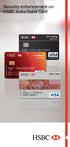 Security enhancement on HSBC India Debit Card A Secure Debit Card HSBC India Debit Cards are more secure and enabled with the Chip and PIN technology. In addition to this you can restrict usage of the
Banking Supervision Policy Statement No.18. Agent Banking Guideline
 Banking Supervision Policy Statement No.18 Agent Banking Guideline NOTICE TO COMMERCIAL BANKS LICENSED UNDER THE BANKING ACT 1995 PART I: PRELIMINARY 1. Introduction 1.1. This Notice, issued under section
Aadhaar. Security Policy & Framework for UIDAI Authentication. Version 1.0. Unique Identification Authority of India (UIDAI)
 Aadhaar Security Policy & Framework for UIDAI Authentication Version 1.0 Unique Identification Authority of India (UIDAI) Table of Contents ACRONYMS AND TERMS... 3 1. INTRODUCTION... 4 2. SECURITY CONSIDERATION...
Failure to follow the following procedures may subject the state to significant losses, including:
 SUBJECT: Policy and Procedures PAGE: 1 of 5 INTRODUCTION During fiscal year 2014, State of Wisconsin agencies accepted approximately 6 million credit/debit card payments through the following payment channels:
Mobile Office Security Requirements for the Mobile Office
 Mobile Office Security Requirements for the Mobile Office [email protected] Alcatel SEL AG 20./21.06.2001 Overview Security Concepts in Mobile Networks Applications in Mobile Networks Mobile Terminal used
Electronic Payment Schemes Guidelines
 BANK OF TANZANIA Electronic Payment Schemes Guidelines Bank of Tanzania May 2007 Bank of Tanzania- Electronic Payment Schemes and Products Guidleness page 1 Bank of Tanzania, 10 Mirambo Street, Dar es
How To Control Credit Card And Debit Card Payments In Wisconsin
 BACKGROUND State of Wisconsin agencies accepted more than 6 million credit/debit card payments annually through the following payment channels: Point of Sale (State agency location) Point of Sale (Retail-agent
UMobile service currently has the following features:
 Bank in your pocket - UMOBILE 1. OVERVIEW: UMOBILE- a milestone in banking field- provides the customers a secure and convenient means of banking and commerce from anywhere anytime. Customers can check
Technology Solutions for Financial Inclusion-Indian Models
 Technology Solutions for Financial Inclusion-Indian Models Hello, I am Dr.Deepankar Roy. I am with the National Institute of Bank Management, Pune, India. Information and Communication Technology (ICT)
POV on Draft Guidelines on Managing Risks and Code of Conduct in Outsourcing of Financial Services by NBFCs
 POV on Draft Guidelines on Managing Risks and Code of Conduct in Outsourcing of Financial Services by NBFCs April 2015 For private circulation only Draft Guidelines on Managing Risks and Code of Conduct
Unified Payment Platform Payment Pos Server Fraud Detection Server Reconciliation Server Autobill Server e-point Server Mobile Payment Server
 Unified Payment Platform Payment Pos Server Detection Server Reconciliation Server Autobill Server e-point Server Mobile Payment Server Securing Payment & Beyond Infinitium E-Payment is a Unified Payment
Miami University. Payment Card Data Security Policy
 Miami University Payment Card Data Security Policy IT Policy IT Standard IT Guideline IT Procedure IT Informative Issued by: IT Services SCOPE: This policy covers all units within Miami University that
PRADHAN MANTRI JAN-DHAN YOJANA (PMJDY) Frequently Asked Questions (FAQs)
 PRADHAN MANTRI JAN-DHAN YOJANA (PMJDY) Frequently Asked Questions (FAQs) Q. 1. What is Pradhan Mantri Jan-Dhan Yojana? Ans. Pradhan Mantri Jan-Dhan Yojana (PMJDY) is National Mission for Financial Inclusion
m Commerce Working Group
 m-powering Development Initiative Advisory Board second meeting Geneva, 23 rd of May 2014 m Commerce Working Group M-Commerce structure 2 Definitions Mobile Device m-commerce MFS m-marketing m-banking
SBI Freedom. for each service provider.
 SBI Freedom What is SBI FreedoM? SBI FreedoM is a Mobile Banking Service provided by the Bank. It helps you to do following banking transactions: Balance Enquiry of accounts enabled for Mobile Banking
EMV and Small Merchants:
 September 2014 EMV and Small Merchants: What you need to know Mike English Executive Director, Product Development Heartland Payment Systems 2014 Heartland Payment Systems, Inc. All trademarks, service
This policy applies to all GPC units that process, transmit, or handle cardholder information in a physical or electronic format.
 Policy Number: 339 Policy Title: Credit Card Processing Policy, Procedure, & Standards Review Date: 07-23-15 Approval Date: 07-27-15 POLICY: All individuals involved in handling credit and debit card transactions
TERMS AND CONDITIONS FOR THE ICICI BANK INDIAN RUPEE TRAVEL CARD
 TERMS AND CONDITIONS FOR THE ICICI BANK INDIAN RUPEE TRAVEL CARD The following terms and conditions ( Terms and Conditions ) apply to the ICICI Bank Travel Card facility provided by ICICI Bank. For your
PRADHAN MANTRI JAN-DHAN YOJANA (PMJDY) - Frequently Asked Questions (FAQs)
 PRADHAN MANTRI JAN-DHAN YOJANA (PMJDY) - Frequently Asked Questions (FAQs) Q. 1. What is Pradhan Mantri Jan-Dhan Yojana? Ans. Pradhan Mantri Jan-Dhan Yojana (PMJDY) is National Mission for Financial Inclusion
A Rackspace White Paper Spring 2010
 Achieving PCI DSS Compliance with A White Paper Spring 2010 Summary The Payment Card Industry Data Security Standard (PCI DSS) is a global information security standard defined by the Payment Card Industry
State Bank FreedoM: Frequently Asked Questions
 State Bank FreedoM: Frequently Asked Questions GENERAL CATEGORY What is State Bank Freedom? State Bank Freedom is Mobile Banking Service provided by State Bank Group. It helps you to do following banking
BANKS AADHAAR ENABLED PAYMENT SYSTEM
 FREQUENTLY ASKED QUESTIONS BY BANKS FOR AADHAAR ENABLED PAYMENT SYSTEM Page 1 1. What is AEPS? AEPS is a new payment service offered by the National Payments Corporation of India to banks, financial institutions
Frequently Asked Questions (FAQ) on HSBC Chip Credit Cards
 Frequently Asked Questions (FAQ) on HSBC Chip Credit Cards Cards issued by The HongKong and Shanghai Banking Corporation Limited, India (HSBC) 1. What is EMV Chip Card? EMV (Europay MasterCard Visa) is
IBX Business Network Platform Information Security Controls. 2015-02- 20 Document Classification [Public]
![IBX Business Network Platform Information Security Controls. 2015-02- 20 Document Classification [Public]](/thumbs/26/7758795.jpg "IBX Business Network Platform Information Security Controls. 2015-02- 20 Document Classification [Public]") IBX Business Network Platform Information Security Controls 2015-02- 20 Document Classification [Public] Table of Contents 1. General 2 2. Physical Security 2 3. Network Access Control 2 4. Operating System
IBX Business Network Platform Information Security Controls 2015-02- 20 Document Classification [Public] Table of Contents 1. General 2 2. Physical Security 2 3. Network Access Control 2 4. Operating System
Mobile Payments Primer
 Mobile Payments Primer February 13 th, 2014 Outline 1 Definitions 2 Introduction to Mobile Payments 3 Near Field Communication and Payment Methods 4 Non-NFC Payment Methods 4 Security 5 Mobile Payments
IMPS Merchant Payments For Banks and Merchants. Version 1.0
 IMPS Merchant Payments For Banks and Merchants Version 1.0 June, 2012 Contents 1. What is IMPS merchant payments service?...5 2. What are the pre-requisites for availing the service?...5 3. How does it
A Websense Research Brief Prevent Data Loss and Comply with Payment Card Industry Data Security Standards
 A Websense Research Brief Prevent Loss and Comply with Payment Card Industry Security Standards Prevent Loss and Comply with Payment Card Industry Security Standards Standards for Credit Card Security
Authentication Scenarios India. Ramachandran
 Authentication Scenarios India Ramachandran India 1.2 billion residents -640,000 villages -~800 million mobile, ~200-300 mn migrant workers Authentication Scenarios Government e-praman authentication framework
CREDIT CARD PROCESSING POLICY AND PROCEDURES
 CREDIT CARD PROCESSING POLICY AND PROCEDURES Note: For purposes of this document, debit cards are treated the same as credit cards. Any reference to credit cards includes credit and debit card transactions.
Enhancing Payment Card Security New Measures to be Phased in from 2 nd Quarter 2010 to 1 st Quarter 2011
 Enhancing Payment Card Security New Measures to be Phased in from 2 nd Quarter 2010 to 1 st Quarter 2011 On 5 th March 2010, The Association of Banks in Singapore announced key measures to adopt a holistic
SAFE SYSTEM: SECURE APPLICATIONS FOR FINANCIAL ENVIRONMENTS USING MOBILE PHONES
 SAFE SYSTEM: SECURE APPLICATIONS FOR FINANCIAL ENVIRONMENTS USING MOBILE PHONES Sead Muftic 1, Feng Zhang 1 1Department of Computer and System Sciences, Royal Institute of Technology, Stockholm, Sweden
FAQ Credit Card (PIN & PAY)
 FAQ Credit Card (PIN & PAY) Communication 1. When would communication go out to customers on the implementation? We are in the midst of preparing notification/letter to Cardhoder on the implementation
Draft Guidelines on Outsourcing of activities by Insurance Companies
 November 8, 2010 To All Insurers Draft Guidelines on Outsourcing of activities by Insurance Companies Reference: 1. INV/CIR/031/2004-05 dated 27 th July, 2004 2. INV/CIR/058/2004-05 dated 28 th December,
State Bank freedom: GENERAL CATEGORY
 State Bank freedom: GENERAL CATEGORY What is State Bank freedom? State Bank freedom is a Mobile Banking Service provided by the Bank. It helps you to do following banking transactions: Balance Enquiry
Mobile Banking - Funds Transfer through IMPS Version 1.0. Alternate Delivery Channels (ADC), IT Service Department
 Mobile Banking - Funds Transfer through IMPS Version 1.0 1 Features of Mobile Banking 2 Availability of Service Application WAP SMS USSD 3 Immediate Payment Service (IMPS) Immediate Payment Service (IMPS)
PCI and EMV Compliance Checkup
 PCI and EMV Compliance Checkup ATM Security Jim Pettitt Director, ATM Security Diebold Incorporated Agenda ATM threats today Top of mind risk PCI Impact on Security U.S. EMV Migration Conclusions / recommendations
CREDIT CARD MERCHANT PROCEDURES MANUAL. Effective Date: 5/25/2011
 CREDIT CARD MERCHANT PROCEDURES MANUAL Effective Date: 5/25/2011 Updated: May 25, 2011 TABLE OF CONTENTS Introduction... 1 Third-Party Vendors... 1 Merchant Account Set-up... 2 Personnel Requirements...
Customer s FAQs For Immediate Payment Service
 Customer s FAQs For Immediate Payment Service April, 2013 Customer s FAQs on IMPS Customer s FAQs (Version 1.0) 1. What is IMPS? Immediate Payment Service (IMPS) is a service introduced by NPCI empowering
ensure prompt restart of critical applications and business activities in a timely manner following an emergency or disaster
 Security Standards Symantec shall maintain administrative, technical, and physical safeguards for the Symantec Network designed to (i) protect the security and integrity of the Symantec Network, and (ii)
8/17/2010. Over 90% of all compromised merchants are PCI level 4 (small) merchants or merchants with less than 1 million transactions per year
 Over 90% of all compromised merchants are PCI level 4 (small) merchants or merchants with less than 1 million transactions per year Over 80% of compromised systems were card present or in-person transactions
Innovation in payments an overview
 Innovation in payments an overview Surveying the Scene In developed countries, payments networks are mostly fit for purpose. However, concerns are emerging of persistently high costs and chip and security
University of Liverpool
 University of Liverpool Card Payment Policy Reference Number Title Version Number 1.0 Document Status Document Classification FIN-001 Card Payment Policy Active Public Effective Date 03 June 2014 Review
Electronic Trading Information Template
 Electronic Trading Information Template Preface This Electronic Trading Information Template (the "Template") has been created through the collaborative efforts of the professional associations listed
Implementation Guide
 Implementation Guide PayLINK Implementation Guide Version 2.1.252 Released September 17, 2013 Copyright 2011-2013, BridgePay Network Solutions, Inc. All rights reserved. The information contained herein
PCI Data Security and Classification Standards Summary
 PCI Data Security and Classification Standards Summary Data security should be a key component of all system policies and practices related to payment acceptance and transaction processing. As customers
FFIEC CONSUMER GUIDANCE
 FFIEC CONSUMER GUIDANCE Important Facts About Your Account Authentication Online Banking & Multi-factor authentication and layered security are helping assure safe Internet transactions for banks and their
HIPAA Security Considerations for Broadband Fixed Wireless Access Systems White Paper
 HIPAA Security Considerations for Broadband Fixed Wireless Access Systems White Paper Rev 1.0 HIPAA Security Considerations for Broadband Fixed Wireless Access Systems This white paper will investigate
BASIC SAVING BANK DEPOSIT ACCOUNT (PNB ZERO BAL ANCE ACCOUNT)
 Scheme Details BASIC SAVING BANK DEPOSIT ACCOUNT (PNB ZERO BAL ANCE ACCOUNT) 1. Eligibility: The Saving Fund account may be opened by an INDIVIDUAL singly or jointly, minors of the age of 10 years and
Read this first. Copyright
 Next Generation Banking system Cloud Banking Brochure Mobile Banking Service Provider Read this first Thank you for your interest in MBSP (Mobile Banking Service provider) Cloud Core Banking products.
M-Wallet: An SMS based payment system
 M-Wallet: An SMS based payment system Nitika Rai*, Anurag Ashok**, Janhvi Chakraborty**, Prajakta Arolker**, Saumeel Gajera** *(Associate Professor, Department of Information Technology, St. Francis Institute
Key Steps to Meeting PCI DSS 2.0 Requirements Using Sensitive Data Discovery and Masking
 Key Steps to Meeting PCI DSS 2.0 Requirements Using Sensitive Data Discovery and Masking SUMMARY The Payment Card Industry Data Security Standard (PCI DSS) defines 12 high-level security requirements directed
Mobile Banking Service
 Mobile Banking Service Features Enquiry of balance in account(s) Mini Statement last five transactions Transfer of Funds to accounts with SBI & other Banks IMPS- Mobile to Mobile Transfer, Mobile to Account
www.inew-cs.com VAS Systems System Integration Consulting 2005 I-New communicative solutions GmbH
 about MAMBA What is MAMBA? I-NEW Communicative Solutions delivers a mobile assisted micro broker application called MAMBA allowing service providers and distributors to let their end customers transfer
Net Banking is like having access to branch at any time and being able to get a lot of the services that you get in a branch at your PC.
 How is Net Banking of use to me? Net Banking is like having access to branch at any time and being able to get a lot of the services that you get in a branch at your PC. With YES BANK Net Banking you can
Sumitomo Mitsui Banking Corporation Citizen charter. Version: 02
 Sumitomo Mitsui Banking Corporation Citizen charter Version: 02 Table of Contents Table of Contents 1. Introduction...1 2. Common practice followed by us...2 3. Fair banking practices...3 4. Common areas
An Introduction to HIPAA and how it relates to docstar
 Disclaimer An Introduction to HIPAA and how it relates to docstar This document is provided by docstar to our partners and customers in an attempt to answer some of the questions and clear up some of the
Frequently Asked Questions
 PCI Compliance Frequently Asked Questions Table of Content GENERAL INFORMATION... 2 PAYMENT CARD INDUSTRY DATA SECURITY STANDARD (PCI DSS)...2 Are all merchants and service providers required to comply
6-8065 Payment Card Industry Compliance
 0 0 0 Yosemite Community College District Policies and Administrative Procedures No. -0 Policy -0 Payment Card Industry Compliance Yosemite Community College District will comply with the Payment Card
Section 3.9 PCI DSS Information Security Policy Issued: June 2016 Replaces: January 2015
 Section 3.9 PCI DSS Information Security Policy Issued: June 2016 Replaces: January 2015 I. PURPOSE The purpose of this policy is to establish guidelines for processing charges on Payment Cards to protect
What Merchants Need to Know About EMV
 Effective November 1, 2014 1. What is EMV? EMV is the global standard for card present payment processing technology and it s coming to the U.S. EMV uses an embedded chip in the card that holds all the
BALTIMORE CITY COMMUNITY COLLEGE INFORMATION TECHNOLOGY SECURITY PLAN
 BALTIMORE CITY COMMUNITY COLLEGE INFORMATION TECHNOLOGY SECURITY PLAN FEBRUARY 2011 TABLE OF CONTENTS PURPOSE... 4 SCOPE... 4 INTRODUCTION... 4 SECTION 1: IT Security Policy... 5 SECTION 2: Risk Management
Guidelines for setting up of and operating the Trade Receivables Discounting System (TReDS)
 Guidelines for setting up of and operating the Trade Receivables Discounting System (TReDS) Micro, Small and Medium Enterprises (MSMEs), despite the important role played by them in the economic fabric
How To Secure Your Store Data With Fortinet
 Securing Wireless Networks for PCI Compliance Using Fortinet s Secure WLAN Solution to Meet Regulatory Requirements Introduction In the wake of many well-documented data breaches, standards such as the
Zimbabwe. Online Banking User s Guide
 User s Guide Dear Customer, Thank you for choosing our services and welcome to the world of next generation financial services. Standard Chartered allows you to perform banking with a click of a button
Information about this New Guide
 Information about this New Guide New Guide This PayPass POS Host/Payment Software Implementation Guide, dated September 2007, is an entirely new guide. Contents This guide helps point-of-sale (POS) host/payment
NZD 1.0000 GBP 0.3842. Telegraphic Transfers (New Zealand)
 NZD 1.0000 GBP 0.3842 Telegraphic Transfers (New Zealand) Product Disclosure Statement Issued 1 July 2009 1 VND 11107.55 USD 1.00 NZD 1.0000 EUR 0.4550 Contents. Product Disclosure Statement. Introduction
Sumitomo Mitsui Banking Corporation Customer Compensation Policy. Version: 02
 Sumitomo Mitsui Banking Corporation Customer Compensation Policy Version: 02 Table of Contents Table of Contents 1. Introduction...1 2. Unauthorized/Erroneous Debit...2 3. NACH debits/other debits to Accounts...3
EMV and Restaurants: What you need to know. Mike English. October 2014. Executive Director, Product Development Heartland Payment Systems
 October 2014 EMV and Restaurants: What you need to know Mike English Executive Director, Product Development Heartland Payment Systems 2014 Heartland Payment Systems, Inc. All trademarks, service marks
Frequently Asked Questions (FAQs) IDBI Bank PayApt
 A. About PayApt Frequently Asked Questions (FAQs) IDBI Bank PayApt Q1. What is IDBI Bank PayApt? IDBI Bank PayApt is a mobile payment solution accessible from your Android smartphone that enables you to
NewNet Communication Technologies Foundations for Network Innovation Secure Transactions
 NewNet Communication Technologies Foundations for Network Innovation Secure Transactions Phone +1 224-795-5200 1455 W. Shure Dr. Arlington Heights, IL 60004 WWW.NEWNET.COM SOLUTIONS GUIDE CONTENTS TraxcomSecure
Best Practices for the Use of RF-Enabled Technology in Identity Management. January 2007. Developed by: Smart Card Alliance Identity Council
 Best Practices for the Use of RF-Enabled Technology in Identity Management January 2007 Developed by: Smart Card Alliance Identity Council Best Practices for the Use of RF-Enabled Technology in Identity
www.trustvesta.com VESTA CORPORATION WHITEPAPER Payment Card Industry Data Security Standards (PCI DSS) and Mobile Operators: Trends and Implications
 www.trustvesta.com VESTA CORPORATION WHITEPAPER Payment Card Industry Data Security Standards (PCI DSS) and Mobile Operators: Trends and Implications About this paper There have been numerous data breaches
Mobile MasterCard PayPass Testing and Approval Guide. December 2009 - Version 2.0
 Mobile MasterCard PayPass Testing and Approval Guide December 2009 - Version 2.0 Proprietary Rights Trademarks The information contained in this document is proprietary and confidential to MasterCard International
Security Control Standard
 Security Standard The security and risk management baseline for the lottery sector worldwide Updated by the WLA Security and Risk Management Committee V1.0, November 2006 The WLA Security Standard is the
UNL PAYMENT CARD POLICY AND PROCEDURES. Table of Contents
 UNL PAYMENT CARD POLICY AND PROCEDURES Table of Contents Payment Card Merchant Security Standards Policy and Procedures... 2 Introduction... 4 Payment Card Industry Data Security Standard... 4 Definitions...
UCO Mobile Banking Introduction, Terms & Conditions, Facility
 UCO Mobile Banking Introduction, Terms & Conditions, Facility 1. Introduction to Uco M-Banking UCO mbanking is a mobile banking solution that allows you to access your account using a mobile device. It
A Whitepaper by Vesta Corporation. Payment Card Industry Data Security Standards (PCI DSS) and Mobile Operators: Trends and Implications
 A Whitepaper by Vesta Corporation Payment Card Industry Data Security Standards (PCI DSS) and Mobile Operators: Trends and Implications About This Paper There have been numerous data breaches both announced
EMV and Chip Cards Key Information On What This Is, How It Works and What It Means
 EMV and Chip Cards Key Information On What This Is, How It Works and What It Means Document Purpose This document is intended to provide information about the concepts behind and the processes involved
Terms and Conditions for Mobile Banking Services
 Terms and Conditions for Mobile Banking Services 1. These terms and conditions along with the application made by the customer for Mobile Banking Service (MBS) as accepted by the Bank shall form the contract
What is SBL mconnect (Mobile Banking)? Why should I apply for it?
 What is SBL mconnect (Mobile Banking)? Why should I apply for it? SBL mconnect is a service that enables banking anywhere anytime, through your mobile phone. Enjoy banking at your fingertips with instant
SFC ELECTRONIC TRADING REGIME
 SFC ELECTRONIC TRADING REGIME CompliancePlus 2013 Year End Training 18 December 2013 Limited 801, Two Exchange Square, 8 Connaught Place, Central, Hong Kong Tel: (852) 3487 6903 www.complianceplus.hk Disclaimer
FNB Tanzania Cellphone Banking for Individuals Terms and Conditions
 FNB Tanzania Cellphone Banking for Individuals Terms and Conditions Cellphone Banking for Individuals Terms and Conditions Version 1.2: Feb 2011 1 These Terms and Conditions (Rules) apply to the registration