
HomeChoice HomeChoice PRO
|
|
|
- Barbra Baldwin
- 10 years ago
- Views:
Transcription
1 HomeChoice HomeChoice PRO APD Systems Patient At-Home Guide Creating a Better World of Care for Renal Patients PATIENT GUIDE COVERS_Update indd 1 12/11/2009 2:26:51 PM

2 The HomeChoice and HomeChoice PRO APD Systems Patient At-Home Guide Document Number October 2, 2009

3 Baxter, HomeChoice, UltraBag, MiniCap, FlexiCap, OptiChoice, Dianeal, and Extraneal are trademarks of Baxter International Inc. Copyright 2009 Baxter Healthcare Corporation. All rights reserved. HomeChoice APD Systems Patient At-Home Guide October 2,

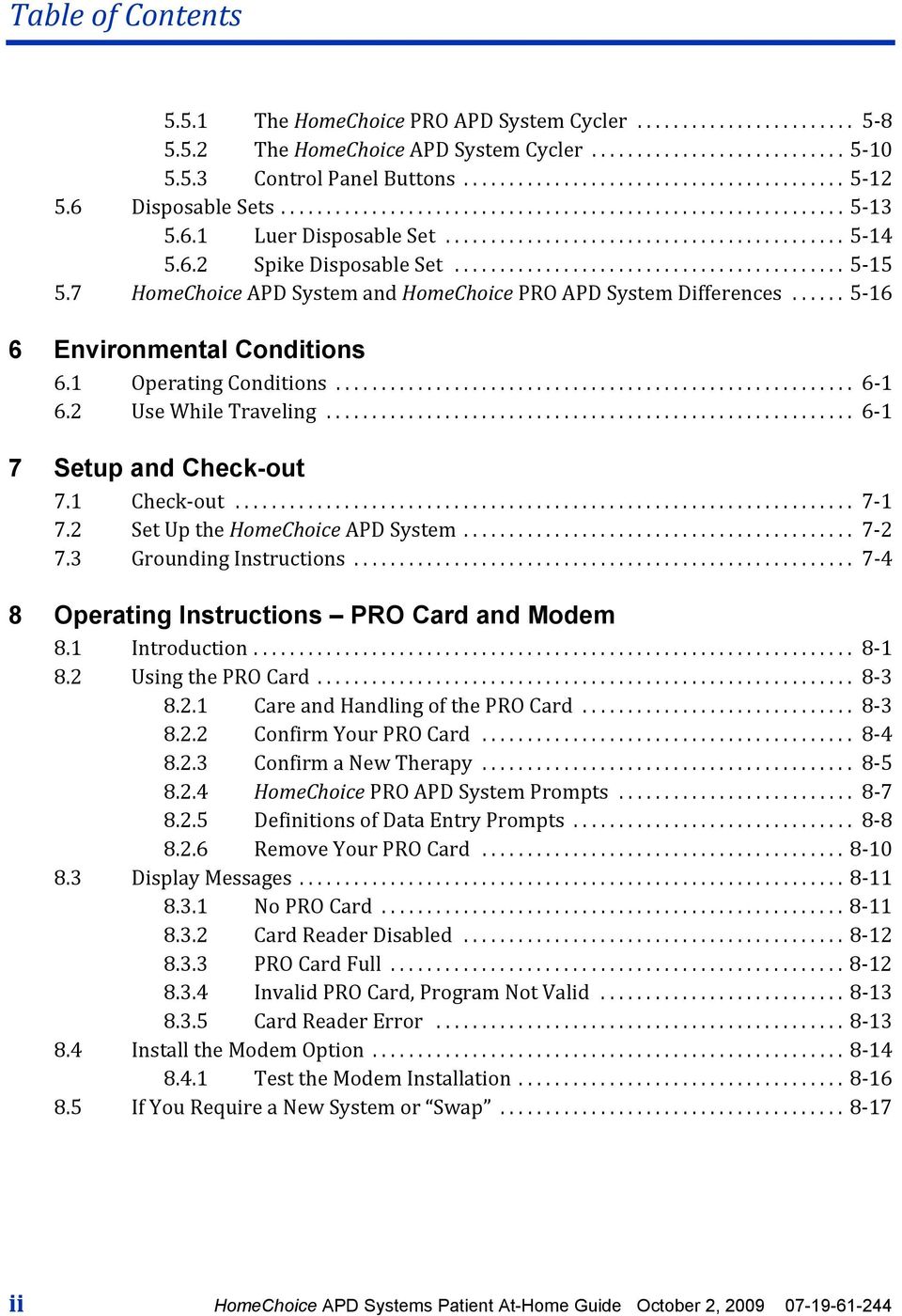
4 Table of Contents 1 Glossary 1.1 Terms Used in This Guide Symbols Used on the HomeChoice and HomeChoice PRO APD Systems User Assistance Information 2.1 Personal and Cycler Information Numbers to Call for Assistance Warnings and Cautions 3.1 Side Effects and Contraindications Warnings Treatment Treatment - Overfill / IIPV Supplies General Supplies Solutions Supplies Disposable Set General Cautions Battery Precautions Indications for Use 4.1 About This Guide Description 5.1 Introduction to HomeChoice APD Systems Introduction to Peritoneal Dialysis Continuous Ambulatory Peritoneal Dialysis (CAPD) Automated Peritoneal Dialysis (APD) HomeChoice APD Systems Functions Fluid Pathways: Drain, Fill, and Dwell Fluid Flow During Power Failure Situations When Fluid Lines are Not Controlled HomeChoice APD Systems Features HomeChoice APD Systems Description October 2, 2009 HomeChoice APD Systems Patient At-Home Guide i

5 Table of Contents The HomeChoice PRO APD System Cycler The HomeChoice APD System Cycler Control Panel Buttons Disposable Sets Luer Disposable Set Spike Disposable Set HomeChoice APD System and HomeChoice PRO APD System Differences Environmental Conditions 6.1 Operating Conditions Use While Traveling Setup and Check-out 7.1 Check-out Set Up the HomeChoice APD System Grounding Instructions Operating Instructions PRO Card and Modem 8.1 Introduction Using the PRO Card Care and Handling of the PRO Card Confirm Your PRO Card Confirm a New Therapy HomeChoice PRO APD System Prompts Definitions of Data Entry Prompts Remove Your PRO Card Display Messages No PRO Card Card Reader Disabled PRO Card Full Invalid PRO Card, Program Not Valid Card Reader Error Install the Modem Option Test the Modem Installation If You Require a New System or Swap ii HomeChoice APD Systems Patient At-Home Guide October 2,
6 Table of Contents 9 Operating Instructions Change Program 9.1 Introduction About Your System s Settings Nurse s Settings The Nurse s Menu If You Receive a New System or Swap Manual Programming Basic Steps for Manual Programming Therapy Type Standard Mode (Standard Fill Mode) CCPD/IPD Therapy Settings CCPD/IPD Calculated Settings Hi-Dose CCPD Therapy Settings Hi-Dose CCPD Calculated Settings Tidal Therapy Settings Tidal Calculated Settings Hi-Dose Tidal Therapy Settings Hi-Dose Tidal Calculated Settings Low Fill Mode CCPD/IPD Therapy Settings CCPD/IPD Calculated Settings Hi-Dose CCPD Therapy Settings Hi-Dose CCPD Calculated Settings Tidal Therapy Settings Tidal Calculated Settings Hi-Dose Tidal Therapy Settings Hi-Dose Tidal Calculated Settings Operating Instructions Make Adjustments 10.1 Make Adjustments Menu Changing Settings Option Settings Adjust Brightness Adjust Loudness Auto Dim Set Clock Set Date I-Drain Time I-Drain Alarm October 2, 2009 HomeChoice APD Systems Patient At-Home Guide iii

7 Table of Contents Comfort Control Last Manual Drain UF Target and Alarm Operating Instructions Prepare for Therapy 11.1 Gather Your Supplies Prepare Your Solution Bags Turn On Your HomeChoice APD System Menu Options at Startup Load the Disposable Set Attach the Drain Option Connect the Solution Bags Prime the Disposable Set Reprime the Patient Line Connect Yourself to the Disposable Set Operating Instructions Perform Therapy 12.1 Initial Drain Menu Options During Initial Drain Fill Menu Options During Fill Dwell Phase Menu Options During Dwell Drain Phase Menu Options During Drain Pause Therapy Menu Options When STOP is Pressed Hi-Dose Therapy Day Dwell Options Perform a Hi-Dose Day Exchange Disconnect Yourself During Hi-Dose Dwell Reconnect and Continue Treatment Operating Instructions End Therapy 13.1 Ending Your Therapy Disconnect Yourself Shut Down Menu Options During End of Therapy iv HomeChoice APD Systems Patient At-Home Guide October 2,

8 Table of Contents 14 Operating Instructions Effluent Sampling 14.1 Introduction Take an Effluent Sample Cleaning 15.1 Introduction Cleaning the Cycler Preparing the Cycler for Return to Baxter Maintenance 17 Storage 17.1 Cycler Battery Dialysis Solution and Disposables Troubleshooting 18.1 List of Alarms and Procedures Correcting Alarms Types of Alarms Alarms Check Lines Check Lines and Bags Check Therapy Setting Value Phase Not Finished Load a New Set Low Ultrafiltration (UF) Low Drain Volume Slow Flow Rate Machine Tilted Warming Solution Caution: Negative UF Check Your Position Reload the Set Caution: Positive UF Verify I-Drain System Errors 2240 or System Error nnnn October 2, 2009 HomeChoice APD Systems Patient At-Home Guide v

9 Table of Contents Temp Stabilizing Bypass Procedures Bypass Initial Drain Bypass Low Drain Volume Alarm During Initial Drain Bypass Drain Phase Bypass Drain Not Finished Alarm Bypass Low Drain Volume Alarm Bypass Caution: Negative UF Alarm Check Supply Line Alarm During Replenish Manual Drain Procedure End Therapy Early Procedure Reprime Patient Line Procedure Increased Intraperitoneal Volume (IIPV) Power Failure Emergency Disconnect Procedure Disconnect from the System Return to Therapy After an Emergency Disconnect Technical Data 19.1 Physical Specifications Electrical Power Requirements Extension Cords System Performance Environmental Requirements Battery Backup Electromagnetic Compatibility Solution Temperature Protective System Audible Alarm Silence Period Range of Sound Pressure Levels Maximum Pressures Used to Transfer Solution To and From the Patient Protective System Preventing Air Infusion Protective System Preventing IIPV Drain Logic Options Standard Fill Mode Drain Logic Low Fill Mode Drain Logic Replenish Logic Scheduled Replenish Unscheduled Replenish Determining Maximum Fill Volume vi HomeChoice APD Systems Patient At-Home Guide October 2,

10 Table of Contents Determining Initial Drain Alarm Volume Settings Determining Tidal Total UF and Last Manual Drain UF Target Volume Settings Quick Reference 20.1 Prepare for Therapy Perform a Hi-Dose Therapy End Therapy Index October 2, 2009 HomeChoice APD Systems Patient At-Home Guide vii

11 Table of Contents viii HomeChoice APD Systems Patient At-Home Guide October 2,

12 Section 1 1. Glossary Glossary

13 Glossary 1.1 Terms Used in This Guide # of Day Exchanges The number of CAPD manual exchanges performed using an UltraBag system. If no manual exchanges are performed on a given day, enter a zero (0). The maximum number of manual exchanges allowed is five (5). Abdomen The area of your body that includes your stomach. Abdominal Fullness A patient s feeling of fullness, sometimes referred to as overfill or overfull. This feeling can come from Increased Intraperitoneal Volume (IIPV), or can come from eating a large meal, constipation, or abdominal masses. See also IPV and IIPV. Air Infusion Air in the patient line delivered to the peritoneal cavity. Air infusion can cause pain in the abdomen and/or shoulder. An incomplete prime can cause air infusion. Aseptic Technique The practice of cleanliness in handling items associated with your therapy. It means you should put on a face mask and thoroughly wash and dry your hands every time you connect or disconnect October 2, 2009 HomeChoice APD Systems Patient At-Home Guide 1-1

14 1. Glossary Automated Peritoneal Dialysis (APD) APD is any form of peritoneal dialysis that is performed by a mechanical device, known as a cycler. Treatment settings are programmed on the cycler and are performed automatically, generally while you sleep. Before you go to sleep, you attach the tubing and solution bags to the cycler. You then connect the tubing to your transfer set attached to your catheter. The cycler then performs the peritoneal dialysis by automatically delivering the prescribed Fills, Dwells, and Drains of each therapy cycle throughout the night. Blood Pressure, Diastolic The lowest number of your daily blood pressure (mmhg) when your heart relaxes. Blood Pressure, Systolic The highest number of your daily blood pressure (mmhg) when your heart pumps blood. Bypass An option you can select to go on to the next therapy phase if the therapy or an alarm has been stopped. Some therapy or alarm conditions can not be bypassed. Cassette The clear rectangular plastic piece of the disposable set that is inserted behind the door of the HomeChoice/HomeChoice PRO APD System. Catheter (PD Catheter) In peritoneal dialysis, a catheter is used to deliver dialysis solution into the peritoneal cavity and drain it out. Contamination The presence of foreign material that makes a substance impure or harmful. 1-2 HomeChoice APD Systems Patient At-Home Guide October 2,

15 1. Glossary Continuous Ambulatory Peritoneal Dialysis (CAPD) With CAPD, the blood is being cleaned continuously, both day and night. The dialysis solution passes from a plastic bag through the catheter and into the peritoneal cavity. The solution stays in the peritoneal cavity with the transfer set closed. After several hours, the solution is drained into a disposable bag. Then the peritoneal cavity is refilled with fresh solution through the catheter to begin the cleaning process again. This is a manual type of peritoneal dialysis (PD) and does not use a cycler. Continuous Cycling Peritoneal Dialysis (CCPD) CCPD is a form of APD. It is a continuous therapy in which a cycler performs exchanges while you sleep. Dialysis solution can be left in the peritoneal cavity during the daytime, or it can be completely drained before ending the treatment (referred to as Nocturnal Intermittent Peritoneal Dialysis, or NIPD). Cycle (Exchange) In peritoneal dialysis, a cycle consists of three phases: a Fill phase, a Dwell phase, and a Drain phase. Every APD therapy contains one or more cycles. Cycler A mechanical device that performs peritoneal dialysis solution exchanges in regular cycles. Your HomeChoice/HomeChoice PRO APD System device is a cycler. Day Fills The amount of solution the system delivers to your peritoneal cavity for a daytime exchange. During the Dwell phase of a daytime exchange, you can disconnect from the system and have the freedom to conduct your normal daytime activities. The daytime exchanges are a part of Hi-Dose therapy. See also Hi-Dose CCPD/Hi-Dose Tidal. Day Fill Volume The volume of solution for each daytime exchange. This volume is based on your prescription October 2, 2009 HomeChoice APD Systems Patient At-Home Guide 1-3

16 1. Glossary Dextrose A form of sugar that is an ingredient in most of the solutions used for peritoneal dialysis. The dextrose draws extra fluid from the body into the dialysis solution. Dialysis The process of cleaning waste from the blood artificially. This job is normally done by the kidneys. If the kidneys fail, the blood must be artificially cleaned with special equipment. The two major forms of dialysis are hemodialysis and peritoneal dialysis. See also Peritoneal Dialysis (PD). Dialysis Solution A special liquid used in both hemodialysis and peritoneal dialysis to clean the blood. Dialysis solution contains dextrose (a sugar) and other compounds similar to those in the body. Disconnect Cap A povidone-iodine solution-filled cap that is placed over the connectors on the transfer set or the connector on the patient line of the disposable set. FlexiCap and MiniCap are disconnect caps. Disposable Set The organizer and attached tubing lines that connect a patient to the solution and drain bags. The disposable set is used to deliver dialysis solution to the peritoneal cavity during therapy. The disposable set is used only once. Drain/Full Drain The removal of the dialysis solution from your peritoneal cavity. Depending on the time of day and type of therapy, the amount of fluid drained may be a complete Drain or a partial Drain (Tidal therapy). The volume of fluid is measured in milliliters (ml). One liter is equal to 1000 milliliters. Drain Bag The optional bag into which fluid from your peritoneal cavity drains. 1-4 HomeChoice APD Systems Patient At-Home Guide October 2,

17 1. Glossary Drain Line Extension An optional extension line that attaches to the drain line of the disposable set. This extra length allows you to drain into a shower, tub, or toilet. Drain Volume The volume of a Drain after a Dwell cycle. Dry Weight Your weight after a dialysis session when all of the extra fluid in your body has been removed. Dwell and Dwell Time The amount of time the fluid remains in your body during each cycle. Dwell Time or Dwell is part of the therapy cycle. Effluent The used dialysis solution drained from the body as part of an exchange. End-Stage Kidney Disease (ESKD) Kidney failure. Requires dialysis or a kidney transplant. End-Stage Renal Disease (ESRD) Kidney failure. Requires dialysis or a kidney transplant. Exchange The draining of used dialysis solution from the abdomen, followed by refilling with a fresh bag of solution. Face Mask A mask covering the mouth and nose. A face mask is used to prevent bacteria from contaminating the sterile components of the disposable set, lines, and solution bags. Fill Volume The volume of fluid to be delivered to your peritoneal cavity during each cycle. The appropriate volume of fluid is determined by your physician October 2, 2009 HomeChoice APD Systems Patient At-Home Guide 1-5

18 1. Glossary First Fill The first Fill cycle of your therapy following an Initial Drain (I-Drain). Fluid Overload Too much fluid in the body. This is caused by more fluid going into your body than is coming out. Fluid overload can be dangerous to your heart. Flush The process by which the system pumps a small amount of dialysis solution from the supply bags to the drain line after the supply line connections have been made. This helps reduce infection from supply line contamination. Hi-Dose CCPD / Hi-Dose Tidal The goal of Hi-Dose therapy is to provide a 24-hour therapy that combines conventional nighttime therapies, such as CCPD or Tidal, with additional daytime exchanges. This may help improve the outcome of your dialysis treatment. During the Dwell phase of each Hi-Dose exchange, you can disconnect from the system and have the freedom to conduct your normal daytime activities. Hypothermia A body temperature that is too far below normal. Increased Intraperitoneal Volume (IIPV) This condition is when there is more fluid in your abdomen than was prescribed. This condition is sometimes called overfill. IIPV could result in a feeling of abdominal discomfort, serious injury, or death. See 18.8, Increased Intraperitoneal Volume (IIPV), on page Initial Drain (I-Drain) The Drain that occurs at the beginning of each therapy, before the first regular Fill. I-Drain Volume The volume of an Initial Drain. 1-6 HomeChoice APD Systems Patient At-Home Guide October 2,

19 1. Glossary Intermittent Peritoneal Dialysis (IPD) A form of peritoneal dialysis in which dialysis sessions take place two to four times a week, 12 to 20 hours per session. The dialysis solution is drained completely at the end of the session and the peritoneal cavity remains empty between the sessions. Intraperitoneal Volume (IPV) The amount of fluid in the peritoneal cavity at a given point in time. Last Fill Concentration This is the concentration strength of dialysis solution used for the Last Fill. The Last Fill dialysis solution concentration may be different from the heater bag and supply bag concentration. Last Fill Volume The Last Fill of solution that is delivered at the end of your therapy and left in the peritoneal cavity during the day. This is also referred to as a Wet Day. Low Fill Mode This mode is available only to patients whose Fill volumes are less than 1000 ml. These patients typically weigh less than 44 lbs (20 kg). In Low Fill Mode, the Drain logic has lower alarm limits for Slow Flow and No Flow. A Minimum Drain Time must be set, in addition to a Minimum Drain Volume. The Negative UF alarm and a Positive UF alarm can be set when in this mode. Low Fill Mode must be used with the Low Recirculation Volume Set. Low Recirculation Volume APD Set with Cassette (Low Recirculation Volume Set) A disposable set with a 7.5-foot (2.9-meter) patient line made with a smaller inside diameter tubing than the other lines in the set. This reduces the fluid flow to patients using Low Fill Mode. The internal recirculation volume of this set is 17 ml. Nite (Night) Therapy Time The total amount of time for the nighttime portion of Hi-Dose therapy. This time is fixed and begins as soon as you complete your daytime exchanges October 2, 2009 HomeChoice APD Systems Patient At-Home Guide 1-7

20 1. Glossary Night Concentration 1 This is the concentration of the primary solution bag placed on the heater pan. Night Concentration 2 This concentration is for the supply solutions that may be different from the heater bag solution. No Flow This occurs when there is no measurable flow rate of solution. No Flow can reduce the Dwell Time and decrease the amount of effective dialysis time. This can be caused by a kink or closed clamp on one or more of the lines or by an empty bag. Occluder The occluder clamps the solution lines if a power failure occurs or when the system is off. This prevents any solution from being delivered to the patient. The occluder is located inside the door on the front of the cycler. Organizer The blue plastic piece that holds the tubing lines and connectors of the disposable set during preparation for therapy. The organizer hooks onto the door of the cycler. Overfill A feeling of fullness in the abdomen. This feeling can come from IIPV, or can come from eating a large meal, constipation, or abdominal masses. See also Abdominal Fullness, Intraperitoneal Volume (IPV), and Increased Intraperitoneal Volume (IIPV). Patient Line Extension An optional extension line that attaches to the patient line of the disposable set. This extra length allows you to be up to an additional 12 feet (3.7 meters) away from your system during therapy. Peritoneal Cavity The space around your internal organs inside the lower abdomen. 1-8 HomeChoice APD Systems Patient At-Home Guide October 2,

21 1. Glossary Peritoneal Dialysis (PD) A form of dialysis that uses the lining of your abdomen, called the peritoneal membrane, as a filter to remove waste products from your body. A tube known as a catheter is surgically placed through the wall of your abdomen. Dialysis solution flows from a bag through the catheter and into the peritoneal cavity. Waste products and excess fluids from your body pass from the blood through the peritoneal membrane and into the dialysis solution. The dialysis solution, now filled with waste, is then drained from the peritoneal cavity. This cycle may be performed multiple times. Peritoneal dialysis can be performed with or without a mechanical device. See also Automated Peritoneal Dialysis (APD). Peritoneal Membrane The layer of tissue that lines your abdominal cavity. A membrane can act as a filter, allowing some particles to pass from one part of the body to another while not allowing others to pass. The peritoneal membrane is used as a filter during peritoneal dialysis. Peritonitis Inflammation of the peritoneal membrane, usually caused by infection. Phase A part of a cycle or an exchange. Each exchange is divided into three phases: a Fill phase, a Dwell phase, and a Drain phase. Positional Drainer A patient who may increase Drain Volume by changing his/her position, or who drains best in one position. Priming To prepare for therapy, priming is the process the system uses to fill all tubing lines of the disposable set with solution. Priming removes air from the system October 2, 2009 HomeChoice APD Systems Patient At-Home Guide 1-9
22 1. Glossary PRO Card The small electronic card that stores information about your treatment sessions and your system settings. This is used only with a HomeChoice PRO APD System. Pushback A small amount of fluid is pushed back from the cycler to the patient. This verifies that the patient line is not occluded when a Drain ends due to No Flow. The next Fill begins at this volume. Recovered I-Drain Volume The amount of solution that did not drain during Initial Drain. This amount was drained by doing a Manual Drain during first Fill or early in the Dwell phase of the first cycle. This amount is not part of your ultrafiltration (UF) for this therapy. Slow Flow This occurs when the flow rate of solution is very slow. Slow Flow can reduce the Dwell Time and decrease the amount of effective dialysis therapy. This can be caused by a partial kink or closed clamp on one or more of the lines or by an empty bag. Solution Bags Bags that contain the prescribed dialysis solution for your therapy. When attaching these solution bags to your cycler and disposable set, make sure you are using the correct solution. Standard Fill Mode The Standard Fill operating mode is typically prescribed for patients with Fill volumes over 1000 ml. The Drain cycle Slow Flow alarm/move on threshold is 50 ml/minute and the Drain cycle No Flow alarm/move on threshold is 12 ml/minute. System The HomeChoice and HomeChoice PRO APD Systems include the cycler, disposable set, solution bags, drain lines, and Patient At-Home Guide. The HomeChoice PRO APD System also includes the PRO Card HomeChoice APD Systems Patient At-Home Guide October 2,
23 1. Glossary Tidal Peritoneal Dialysis (TPD) Tidal dialysis is a form of APD where only a portion of the solution in your peritoneal cavity is drained and filled each cycle. Tidal Volume The volume of solution filled during each Tidal cycle. Tidal Volume Percentage The Tidal Volume expressed as a percent (%) of the Fill Volume. Total UF Total UF (ultrafiltration) is the sum of the UF for all of your cycles. The Initial Drain and your Last Fill Volume are not included in your Total UF. Total Volume The Total Volume of dialysis solution for the entire course of therapy, including the Last Fill Volume. Transfer Set Tubing that connects the patient line on the disposable set or UltraBag set to the catheter. Ultrafiltration (UF) UF is the additional fluid removed from your body as part of your dialysis therapy. It is the difference between the total amount of fluid filled and the amount of fluid drained. Universal Precautions Universal precautions refers to the practice, in medicine, of avoiding contact with patients bodily fluids, by means of wearing nonporous articles such as medical gloves, goggles, and face shields. Uremia The condition in which a person gets sick from wastes (toxins) that build up in the blood. Someone who has uremia may experience nausea, weakness, weight loss, memory problems, and/or trouble sleeping October 2, 2009 HomeChoice APD Systems Patient At-Home Guide 1-11
24 1. Glossary 1.2 Symbols Used on the HomeChoice and HomeChoice PRO APD Systems Alternating current Type B applied part Date of manufacture SN Serial number Fuse Replace only with same type and rating Recovery / Recyclable IPX1 Crossed-out wheeled bin: Do not dispose of this product as unsorted municipal waste. Collect this product separately. Use collection and return systems available to you. Bar below bin: Product brought to market after August 13, Ingress protection: Not protected against ingress of solid foreign objects. Protected against ingress of vertical dripping water. Contains rechargeable battery 1-12 HomeChoice APD Systems Patient At-Home Guide October 2,
25 1. Glossary NONSPILLABLE BATTERY Nonspillable lead-acid battery is recyclable Pb R Canadian Standards Association Meets applicable requirements for the U.S. and Canada. C US Manufacturer: Baxter Healthcare Corporation Renal Division McGaw Park, IL U.S.A. Baxter Healthcare SA 8010 Zurich Switzerland Mains Power (Off) / Mains Power (On) Fragile 95 Humidity limitation for transport and storage 10 Keep dry October 2, 2009 HomeChoice APD Systems Patient At-Home Guide 1-13
26 1. Glossary Stacking limit; do not stack more than 5 high 5 54 C Temperature limitation for transport and storage -32 C This way up ATTENTION: Consult accompanying documents. Read all instructions before using HomeChoice APD Systems Patient At-Home Guide October 2,
27 Section 2 2. User Assistance Information User Assistance Information
28 User Assistance Information This information is important. Keep this information available at all times. 2.1 Personal and Cycler Information Name: Patient ID Number: Cycler Serial Number: Cycler Model Number: 2.2 Numbers to Call for Assistance For Baxter Technical Assistance contact: Dialysis Center: Name: Phone: Times Available: 24-HOUR TECHNICAL ASSISTANCE October 2, 2009 HomeChoice APD Systems Patient At-Home Guide 2-1
29 2. User Assistance Information Other Important Information: 2-2 HomeChoice APD Systems Patient At-Home Guide October 2,
30 Section 3 Warnings and Cautions 3. Warnings and Cautions
31 Warnings and Cautions 3.1 Side Effects and Contraindications Baxter s HomeChoice and HomeChoice PRO APD Systems are not designed, sold, or intended for use except as indicated. See Section 4, Indications for Use. Baxter s HomeChoice and HomeChoice PRO APD Systems are not intended to be a substitute for monitoring the patient s overall condition by trained and qualified personnel. 3.2 Warnings WARNING Warnings are related to things that can cause harm to you. READ ALL INSTRUCTIONS BEFORE USING THIS CYCLER! Treatment Use aseptic technique to reduce the chance of infection: When you connect yourself to the cycler When you disconnect yourself from the cycler Any time you handle fluid lines and solution bags Contaminating any part of the fluid path can result in peritonitis. Peritonitis is an inflammation of the peritoneal membrane, usually caused by infection October 2, 2009 HomeChoice APD Systems Patient At-Home Guide 3-1
32 3. Warnings and Cautions Caregivers should use universal precautions when handling effluent dialysis solution or contaminated disposables. Failure to use universal precautions can result in infection or injury to the caregiver. All therapies using the HomeChoice/HomeChoice PRO APD System must be prescribed and performed under the responsibility of a physician who is familiar and well-informed about peritoneal dialysis. Improper use of the HomeChoice APD System can result in serious patient injury or death. Do not change the settings for your therapy unless directed by your physician or nurse. Using incorrect settings can cause symptoms and signs of uremia, including fluid overload. Contact your dialysis center if: You did not complete your treatment You skipped your prescribed Last Fill Other conditions occur, as instructed by your dialysis center Too many incomplete or skipped treatments can cause reduced Dwell or Therapy Time. This can lead to symptoms and signs of end-stage renal disease (ESRD), including fluid overload. Always look at your patient line after priming to make sure there is no air in the line. An incomplete prime can cause air infusion. Air infusion can cause abdominal and/or shoulder pain. Conditions that can cause poor catheter drainage include: Constipation Fibrin accumulation due to a peritonitis infection Blockage of the catheter lumen or drainage holes with fibrin, blood clots, or intestines Kinking of the catheter Movement of the catheter to the upper portion of the peritoneal cavity 3-2 HomeChoice APD Systems Patient At-Home Guide October 2,
33 3. Warnings and Cautions Treatment - Overfill / IIPV Overfilling or not draining enough can result in excess fluid in the abdomen, also known as Increased Intraperitoneal Volume (IIPV). While some people may not exhibit symptoms, most commonly observed symptoms include: Feeling full, bloated, or overfull Abdominal pain or discomfort Expanded or tense abdomen Vomiting or spitting-up Difficulties feeding Localized swelling around the PD catheter exit site, belly button, groin region, or genital area Leakage of fluid from the PD catheter exit site Difficulty breathing A child complaining of a "funny feeling" in the abdomen A child crying Unexpected increase in blood pressure IIPV can occur because of one or more of the following reasons: Low Fill Mode is not programmed for patients whose fill volumes are less than 1000 ml. These patients typically weigh less than 44 lbs (20 kg). The Negative UF Limit should not be raised above 50% and the Minimum Drain Volume % should not be lowered below 85% (the default values). The Initial Drain Alarm is programmed too low. The system may move on to the first Fill before you are completely drained if: Your last therapy left you with more than your normal Last Fill Volume You did not perform a manual drain A slow flow condition occurs before you are completely drained Temporarily increase your I-Drain Alarm setting or perform a Manual Drain to make sure that your Initial Drain is complete. The patient line length is greater than 12 feet (3.6 meters) and Initial Drain Alarm is set below 30 ml. This can cause your Initial Drain to end early October 2, 2009 HomeChoice APD Systems Patient At-Home Guide 3-3
34 3. Warnings and Cautions The Minimum Drain Volume % is programmed too low. This can cause your Drain cycles to end early. Day Fill Volume, Night Fill Volume, or Last Fill Volume is programmed too high. This can cause you to be overfilled if the volume is not appropriate for your body's size. For Tidal therapies, Total UF volume is programmed too low. This can cause a gradual buildup of UF volume during the therapy. Last Manual Drain is programmed to No, or the UF Target for the Last Manual Drain is programmed too low. This can cause an incomplete last Drain. Stop and Go are pressed during Tidal dwells over multiple dwell cycles. This can reduce the volumetric accuracy of the device over the course of successive Tidal Dwell cycles. After a power failure during Prime, the Go button is pressed to start therapy without closing all clamps first. This can cause a free flow of fluid from one bag to another and/or to the patient during the time when LOAD THE SET is displayed. The door is opened during an alarm or System Error without closing all clamps first. This can cause a free flow of fluid from one bag to another and/or to the patient. The transfer set is connected to the patient line before CONNECT YOURSELF appears on the display screen. This can cause air to be delivered to your peritoneal cavity, which can cause IIPV if you had fluid in your peritoneal cavity prior to the Initial Drain. At the start of Fill 1, the patient line clamp is opened after a Check Patient Line alarm or Check Your Position alarm appears on the display screen without first initiating a manual drain. This can cause air to be delivered to your peritoneal cavity, which can cause IIPV if you had fluid in your peritoneal cavity prior to the Initial Drain. Go is pressed at the end of therapy before all clamps are closed when CLOSE ALL CLAMPS appears on the display screen. This can cause a free flow of fluid from one bag to another and/or to the patient. 3-4 HomeChoice APD Systems Patient At-Home Guide October 2,
35 3. Warnings and Cautions The door is opened at the end of therapy before all clamps are closed. This can cause a free flow of fluid from one bag to another and/or to the patient. Any Drain phase is bypassed, including Initial Drain, Day Drain, or Night Drain. This can cause the system to deliver a full Fill in addition to any fluid left in the peritoneal cavity. DRAIN NOT FINISHED, LOW UF, LOW DRAIN VOLUME, or CAUTION: NEGATIVE UF alarms are bypassed. This can cause the system to deliver a full Fill in addition to any fluid left in the peritoneal cavity. A Manual Drain performed during Fill is stopped or bypassed. This can cause the system to deliver a full Fill in addition to any fluid left in the peritoneal cavity. IIPV could result in a feeling of abdominal discomfort, serious injury, or death. IF IIPV IS SUSPECTED, PLEASE DO THE FOLLOWING: 1. Press STOP immediately, then press and initiate a Manual Drain. The Manual Drain procedure is located on the next page. See 18.8, Increased Intraperitoneal Volume (IIPV), on page if IIPV is suspected. 2. Once the fluid is completely drained from the abdomen, call your nephrologist. 3. Call your nephrologist immediately if you have ANY complaints or symptoms of IIPV including those listed above. 4. For assistance in performing the above steps, call the Baxter Customer Service line which is available 24 hours a day, 7 days a week at Prompt If you are unable to reach your dialysis center, nephrologist, or the Baxter Customer Service Line, and you or the patient are experiencing symptoms of IIPV, call 911 immediately or go to the nearest Emergency Room October 2, 2009 HomeChoice APD Systems Patient At-Home Guide 3-5
36 3. Warnings and Cautions Steps to perform a Manual Drain The current FILL phase appears on the display screen. 1. Press STOP. 2. Press. 3. Press. Display screen FILL 3 OF 5 STOPPED: FILL VOLUME: BYPASS FILL ML 4. Press. 5. Press. 6. Press. CHANGE PROGRAM MAKE ADJUSTMENTS MANUAL DRAIN 7. Press ENTER. The display screen shows the Drain volume. The system continues to drain until flow is no longer detected. 8. Press GO to return to therapy. 9. Reinitiate a Manual Drain if it is stopped during Fill. DRAINING: ML Supplies General Use only Baxter Healthcare Corporation accessories, solutions, disposable sets, and supplies with your HomeChoice/HomeChoice PRO APD System. Baxter can not ensure that the dialysis products of other manufacturers, when connected with Baxter s products, will function in a safe and satisfactory manner. 3-6 HomeChoice APD Systems Patient At-Home Guide October 2,
37 3. Warnings and Cautions Make sure that you are able to complete all of your treatments as prescribed by your physician: Order your supplies on time Keep extra supplies on hand Keep supplies for a manual exchange available If your cycler can not begin or complete your treatment, or your APD supplies are not available, perform a manual exchange as instructed by your dialysis center. Too many incomplete or skipped treatments can cause reduced Dwell or Therapy Time. This can lead to symptoms and signs of end-stage renal disease (ESRD), including fluid overload Supplies Solutions Add medication to the solution only as prescribed by a physician. Failure to follow proper instructions can result in contamination. Adding the wrong dosage of medication can make your condition worse. Check each solution bag to ensure: The solution is clear The solution matches the prescribed type The dextrose concentration is correct The volume of solution in the bag is correct The expiration date has not passed The pull ring and medication port are in place There are no leaks If any problems are found, discard the bag and get a fresh dialysis solution supply bag. Using wrong or damaged bags can result in inadequate therapy or contamination of the fluid lines. Contamination of any portion of the fluid or fluid path can result in peritonitis October 2, 2009 HomeChoice APD Systems Patient At-Home Guide 3-7
38 3. Warnings and Cautions The solution bag must be placed properly on the heater pan. Place the edge of the bag against the bag stops on the right side of the heater pan. Be sure that the bag completely covers the silver heater sensor button. If the solution bag is not placed properly, overheated or underheated dialysis fluid can be delivered. Place the solution bags on a flat, stable surface. To prevent bags from falling, do not stack bags on top of each other. Falling bags can result in a disconnect or leak. Possible contamination of the fluid or fluid pathways can result if a fluid leak occurs. Contamination of any portion of the fluid or fluid path can result in peritonitis. For storage and preparation of the dialysis solution, follow the labeling instructions that come with the solution. Failure to follow the solution labeling instructions can lead to insufficient therapy or patient injury. Do not use the dialysis solution if you think you may be allergic to any component of the solution. Check the labeling provided with your solution for details to reduce the potential of an allergic reaction. Make sure the solution bag placed on the heater pan is big enough to hold the largest programmed Fill Volume plus a replenish buffer of at least 500 ml. Use of a smaller solution bag on the heater pan can cause the heater bag to be filled in excess of its designed volume. These bags heat slower and can burst. Do not replace empty solution bags or reconnect disconnected solution bags during your therapy. Possible contamination of the fluid or fluid pathways can result. Contamination of any portion of the fluid or fluid path can result in peritonitis. If a bag becomes disconnected during your therapy, follow the instructions in 18.6, End Therapy Early Procedure, on page Notify your dialysis center. 3-8 HomeChoice APD Systems Patient At-Home Guide October 2,
39 3. Warnings and Cautions When attaching your solution bags to your system and disposable set: Make sure the solution bags are connected to the proper lines on the organizer. If the solution bag connected to the line with the RED clamp is not placed on the heater pan, room temperature solution can be delivered. Room temperature solution is cooler than body temperature. If a patient is unconscious or asleep and therapy continues for many hours, hypothermia can develop. Make sure you use the correct dialysis solution. If the concentration or type of solution is different from your prescription, you may not receive the dialysis therapy you need. This may lead to an increase or decrease in the amount of fluid ultrafiltrated during the therapy. When performing a Tidal therapy, your intraperitoneal volume can increase or decrease if the volume ultrafiltrated does not equal the programmed Total UF. Make sure to connect enough bags of the right volume to deliver your prescribed Fill Volume. Multiple incomplete or skipped treatments can cause reduced Dwell or Therapy Time. This can lead to symptoms and signs of end-stage renal disease (ESRD), including fluid overload. Discard the disposable set and all solution bags at the end of therapy. Possible contamination of the fluid or fluid pathways can result if disposables are reused. Contamination of any portion of the fluid or fluid path can result in peritonitis October 2, 2009 HomeChoice APD Systems Patient At-Home Guide 3-9
40 3. Warnings and Cautions Supplies Disposable Set Do not apply alcohol, hydrogen peroxide, or antiseptic containing alcohol to the disposable set or to the cassette interface inside the door of the cycler. Using these products can cause the cassette to develop cracks. Using damaged sets can result in contamination of the fluid or fluid pathways. Contamination of any portion of the fluid or fluid path can result in peritonitis. Do not use the disposable set more than once. Discard after each use. Reusing the disposable set can increase the risk of contamination, which can result in peritonitis. Be sure to use the correct disposable set for your prescribed therapy. Using the wrong disposable set can result in an inadequate therapy. Check all disposable set connections for a secure fit before beginning your therapy. Make sure all clamps on unused fluid lines are closed securely. Contamination of any portion of the fluid path can result in peritonitis. Before loading the disposable set, inspect the cassette and tubing for damage. Using damaged sets can result in contamination of the fluid or fluid pathways. Contamination of any portion of the fluid or fluid path can result in peritonitis. Inspect the flexible surfaces of the cassette for obvious signs of damage, including cuts, tears, or punctures. Ensure the tip protectors on the ends of the tubing are on and unbroken. If damage is found, obtain a new disposable set and repeat the inspection procedure. Tubing indentations can be present on disposable sets due to the flexible and supple nature of the tubing. Slight tubing indentations are cosmetic and should have no impact on the functionality of the product HomeChoice APD Systems Patient At-Home Guide October 2,
41 3. Warnings and Cautions General Leave an air gap (space) between the end of the drain line and any fluid in the drain or container when using a drain line extension. This prevents non-sterile fluid from flowing backwards up the drain line. Non-sterile fluid can contaminate the fluid path resulting in peritonitis. Verify the operation of the display screen before starting your therapy. If the display screen is not working correctly, it can display an inaccurate number. This can lead to insufficient therapy or patient injury. Verify the operation of the audible alarm. If the audible alarm is not working, you will not be notified of an alarm situation. This can lead to insufficient therapy or patient injury. The modem must be Class II and approved to IEC/EN, CSA/UL with a TNV-1 circuit (accessible circuit is limited to 60Vrms). Using an unapproved modem may increase the risk of electrical shock. Do not open the HomeChoice/HomeChoice PRO APD System cycler. Electrical circuitry inside can pose a shock hazard. Unplug the HomeChoice/HomeChoice PRO APD System power cord from the wall outlet, or other AC power source, before cleaning the system. Failure to do so can cause an electric shock. Do not use external heating sources, such as a microwave, to warm solution bags. This can result in overheated solution delivered into your peritoneal cavity. Dialysis solution should only be heated by the HomeChoice/HomeChoice PRO APD System. Do not attempt to operate the system in an explosive atmosphere (i.e., when gas is present). This is an explosion hazard and can cause personal injury and damage to equipment. Do not operate this product where the following are in use: Aerosol spray products Flammable anesthetic agents Nitrous oxide Oxygen-enriched environment (for example, oxygen tent) Operating this device in these environments can cause an explosion or fire October 2, 2009 HomeChoice APD Systems Patient At-Home Guide 3-11
42 3. Warnings and Cautions Do not use this product outdoors. Outdoor use can increase the risk of shock or damage the device. Do not use electrical nerve stimulation pain management devices while performing your dialysis therapy. Some of these devices, when used at the same time as the HomeChoice/HomeChoice PRO APD Systems, have been shown to cause damage to the system and to the cassette. Baxter can not ensure that the systems function in a safe and satisfactory manner when the system is damaged. Damage to the cassette can lead to air infusion into the peritoneal cavity. Air infusion can cause mild to moderate abdominal pain. Do not connect any devices to the HomeChoice/HomeChoice PRO APD System other than those specified by Baxter as part of the system. Baxter can not ensure that the dialysis products of other manufacturers, when connected with Baxter s products, function in a safe and satisfactory manner. The HomeChoice/HomeChoice PRO APD System should not be used near other equipment. However, if it is necessary to use the cycler close to other equipment, the cycler should be observed to verify normal operation. Do not turn on or use hand-held personal communications devices, such as mobile two-way radios or cellular phones, near the cycler. Use of these types of devices can cause the cycler to malfunction. However, cordless phones up to 2.5 GHz are permitted. Follow the recommended separation distance chart, Table 19-4 on page 19-8 in Section 19, Technical Data, if a hand-held device must be used. Do not operate this product if it: Has a damaged cord or plug Is not working properly Has been dropped or damaged Has been dropped into water Baxter can not ensure that a cycler will function in a safe and satisfactory manner under these conditions HomeChoice APD Systems Patient At-Home Guide October 2,
43 3. Warnings and Cautions Return the product to Baxter Technical Assistance for examination and repair if damage occurs. Contact Technical Assistance at the number listed in 2.2, Numbers to Call for Assistance, on page 2-1. Baxter Technical Assistance is available 24 hours a day for HomeChoice/HomeChoice PRO APD System users. To reduce the risk of burns, electrocution, fire, or injury to persons: Close supervision is necessary when this product is used by, on, or near children or those unable to care for themselves. Use this product only for its intended use as described in this guide. Do not use attachments, products, or supplies not recommended by Baxter. Keep the power cord away from heated surfaces. Do not use while bathing. Do not place or store product where it can fall or be pulled into a tub or sink. Do not place in or drop into water or other liquid. Do not reach for the system if it has fallen into water. Unplug it right away October 2, 2009 HomeChoice APD Systems Patient At-Home Guide 3-13
44 3. Warnings and Cautions 3.3 Cautions CAUTION Cautions are related to things that can damage the HomeChoice and HomeChoice PRO APD Systems. The cycler you are using may be the property of Baxter Healthcare Corporation. Improper care or use may result in additional expense. Wipe up any spills right away. This reduces the chance of moisture entering the system and causing a malfunction. This also reduces the chance of bacteria contamination or an unsanitary condition. To prevent the cycler from falling, place it on a sturdy, stable nightstand or table large enough to hold the cycler and the solution bags. Falling can damage the cycler or cause personal injury. If an extension cord is used, make sure the ampere rating of the HomeChoice/HomeChoice PRO APD System does not exceed the extension cord ampere rating. Use only heavy-duty extension cords rated at 1200 watts (10 amp for 110V systems). Use only extension cords less than 12 feet (3.5 meters) in length. The extension cord must have the third grounding wire that mates with the grounding plug on the HomeChoice/HomeChoice PRO APD System power cord. Failure to follow this advice can result in excessive heating or fire. Do not attempt to service the HomeChoice/HomeChoice PRO APD System yourself. Doing so can result in fire, burns, electrocution, or other personal injury. For servicing, contact Technical Assistance at the number listed in 2.2, Numbers to Call for Assistance, on page 2-1. Baxter Technical Assistance is available 24 hours a day for HomeChoice/HomeChoice PRO APD System users. A service manual for this product is not available HomeChoice APD Systems Patient At-Home Guide October 2,
45 3. Warnings and Cautions Do not use chemical cleaning agents or aerosol spray cleaners. These products might damage the plastics or surface finishes. Use a small amount of mild soap and water on a damp cloth to wipe the exterior of the system. Because the system uses a disposable set, it does not need to be sterilized or disinfected between uses. For product disposal (according to WEEE 2002/96/EC or other applicable regulations), please do the following: For more information on return, recovery, or recycling of this product, please contact Baxter Technical Assistance at the number listed in 2.2, Numbers to Call for Assistance, on page 2-1. Baxter Technical Assistance is available 24 hours a day for HomeChoice and HomeChoice PRO APD Systems users. Return this product to your dialysis center or to Baxter by calling Baxter Technical Assistance. Do not dispose of this product as unsorted municipal waste. Use the collection and return systems available to you. Follow your local guidelines for disposal of dialysis waste materials. Failure to follow disposal instructions can result in groundwater contamination or a fine October 2, 2009 HomeChoice APD Systems Patient At-Home Guide 3-15
46 3. Warnings and Cautions 3.4 Battery Precautions The HomeChoice/HomeChoice PRO APD System contains both a lead-acid and a lithium battery. The lead-acid battery is automatically checked and recharged during the HomeChoice/HomeChoice PRO APD System operation. The batteries require no periodic maintenance. There is danger of explosion if either battery, located within the HomeChoice/HomeChoice PRO APD System, is incorrectly replaced. In case replacement of either battery is needed, contact technical assistance at the number listed in 2.2, Numbers to Call for Assistance, on page 2-1. Baxter Technical Assistance is available 24 hours a day for HomeChoice/HomeChoice PRO APD System users. Pb Contains lead-acid and lithium batteries. Must be recycled or disposed of properly HomeChoice APD Systems Patient At-Home Guide October 2,
47 Section 4 Indications for Use 4. Indications for Use
48 Indications for Use Baxter s HomeChoice and HomeChoice PRO APD Systems are intended for automatic control of dialysis solution exchanges in the treatment of pediatric and adult renal failure patients undergoing peritoneal dialysis. WARNING Read all warnings, cautions and instructions carefully before use. (Refer to Section 3, Warnings and Cautions.) Improper use of the HomeChoice APD System can result in serious patient injury or death. CAUTION: Federal (U.S.A.) Law restricts this device to sale by or on order of a physician. 4.1 About This Guide This Patient At-Home Guide provides instructions necessary for the proper operation of the HomeChoice and HomeChoice PRO APD Systems (the system ). This guide is meant to be used with and after your training on the system. It does not provide instructions for the prescription or administration of peritoneal dialysis. This guide contains examples that show typical therapy values. The values for your therapy may vary October 2, 2009 HomeChoice APD Systems Patient At-Home Guide 4-1
49 4. Indications for Use 4-2 HomeChoice APD Systems Patient At-Home Guide October 2,
50 Section 5 Description 5. Description
51 Description This section describes the functions, components, and features of the HomeChoice and HomeChoice PRO APD Systems (the system ) and the basics of Peritoneal Dialysis (PD). You should learn the names of the system components, where they are located, and how they function before beginning to use the procedures in this guide. 5.1 Introduction to HomeChoice APD Systems Baxter's HomeChoice and HomeChoice PRO APD Systems are designed to provide Automated Peritoneal Dialysis (APD) therapy for pediatric and adult renal patients. Their Fill volumes can range from 60 ml to 3000 ml. HomeChoice and HomeChoice PRO APD Systems are intended to be operated by: Home patients whose physicians have prescribed this system. Patients, or their caregivers, must have received adequate training to use the system. Clinicians who are using the system for patients under their care and under a prescription. Clinicians must have received adequate training to use the system. Since Drain and volume requirements vary among patients, both the HomeChoice and HomeChoice PRO APD Systems software have a choice of modes, either Standard Mode or Low Fill Mode. The dialysis center selects the Fill mode for the patient before therapy begins October 2, 2009 HomeChoice APD Systems Patient At-Home Guide 5-1
52 5. Description 5.2 Introduction to Peritoneal Dialysis Peritoneal Dialysis (PD) is a procedure that cleans and filters the blood. Peritoneal dialysis rids the body of unwanted waste and excess fluid, helps to control blood pressure, and maintains the proper balance of chemicals such as potassium, sodium, and bicarbonate in the body. This process of cleansing the blood uses the body s own peritoneal membrane as a filter. See Figure Peritoneal Cavity 2. Catheter The basic steps of PD are the following: 3. Peritoneal Membrane Figure 5-1. Peritoneal Cavity 1. Peritoneal dialysis usually begins with an initial drain to remove existing fluid from the peritoneal cavity. 2. The peritoneal cavity is filled with fresh dialysis solution. Solution enters through a catheter that has been surgically placed through the wall of the abdomen and into the peritoneal cavity. 5-2 HomeChoice APD Systems Patient At-Home Guide October 2,
53 5. Description 3. The solution is allowed to remain (dwell) in the cavity for a period of time. During this time, waste products pass from the bloodstream through the peritoneal membrane and into the dialysis solution. 4. The used dialysis solution containing waste products and excess fluids, called effluent, is then drained from the peritoneal cavity. 5. The peritoneal cavity is then refilled with fresh solution to remain (dwell) for another period of time. The draining of used dialysis solution from the abdomen, followed by refilling with a fresh bag of solution, is known as a dialysis exchange Continuous Ambulatory Peritoneal Dialysis (CAPD) With CAPD, the blood is always being cleaned. Dialysis exchanges are done manually three to five times a day. This type of peritoneal dialysis does not use an automatic cycler. This method can be used to continue your treatments if you are unable to use your cycler; for example, during a power failure. Dialysis solution flows by gravity from a plastic bag through the catheter and into the peritoneal cavity. The solution stays in the peritoneal cavity with the transfer set closed. Dwell periods typically last four to six hours during the daytime, and up to eight hours overnight. After the Dwell period, the used solution is drained into a disposable bag. Then the peritoneal cavity is refilled with fresh solution to begin the cleaning process again Automated Peritoneal Dialysis (APD) All peritoneal dialysis techniques that use a cycler to perform exchanges are referred to as Automated Peritoneal Dialysis (APD). APD exchanges are usually referred to as cycles. Each cycle consists of three (3) phases: Fill phase Dwell phase Drain phase October 2, 2009 HomeChoice APD Systems Patient At-Home Guide 5-3
54 5. Description Treatment settings, such as the amount of solution to be infused and the length of time the solution remains in the peritoneal cavity, are programmed on the cycler. The cycler then automatically performs the treatment. In APD, the treatment settings can be modified to meet the needs of each patient. There are four (4) types of APD therapy: Continuous Cycling Peritoneal Dialysis/Intermittent Peritoneal Dialysis (CCPD/IPD) Tidal Peritoneal Dialysis (TPD) Hi-Dose Continuous Cycling Peritoneal Dialysis (Hi-Dose CCPD) Hi-Dose Tidal Peritoneal Dialysis (Hi-Dose TPD) See Section 1, Glossary for definitions of each of these therapies. 5.3 HomeChoice APD Systems Functions The HomeChoice and HomeChoice PRO APD Systems perform peritoneal dialysis by directing the flow of fluid between the solution bags, the cassette, your peritoneal cavity, and your drain option. Once you have connected all solution bags and your drain option, and have connected yourself to the disposable set, you have created a fluid circuit. The system manages your PD by the following methods: With the cassette loaded in the cycler, the system is able to draw fluid into the cassette chambers by opening and closing the correct combination of valves on the cassette. The system measures the fluid in the cassette chambers. It then opens and closes the required valves on the cassette to move fluid to the correct destination. This allows the system to deliver the programmed Fill Volume to your peritoneal cavity with high accuracy. The measurements taken during the Drain cycle allow the system to calculate how much ultrafiltrate (UF) was removed from your peritoneal cavity during each Drain cycle. These values are stored in the system so that you can view them at the end of your therapy. 5-4 HomeChoice APD Systems Patient At-Home Guide October 2,
55 5. Description Fluid Pathways: Drain, Fill, and Dwell Fluid pathways change during the therapy. They are pictured below for the three (3) main phases of therapy. 1. DRAIN During the Drain phase, the system pulls fluid from your peritoneal cavity to the disposable cassette where it is measured. The fluid is then sent to the drain option. This process is repeated until the system determines you are empty. The system calculates the UF volume for each Drain cycle. 2. FILL During the Fill phase, the system pulls fluid from the heater bag to the disposable cassette where it is measured. The fluid is then delivered to your peritoneal cavity. This process is repeated until the programmed Fill Volume has been delivered to your peritoneal cavity October 2, 2009 HomeChoice APD Systems Patient At-Home Guide 5-5
56 5. Description 3. DWELL During the Dwell phase, the system pulls fluid from the supply bags to the disposable cassette where it is measured. This fluid is then delivered to the heater bag to replenish the solution that was used during the previous Fill phase. This is done to warm the fluid in the heater bag to prepare for the next Fill phase Fluid Flow During Power Failure If there is a power failure, all valves on the cassette close so there is no fluid flow. Valves remain closed as long as the door remains locked. See 18.9, Power Failure, on page for complete instructions Situations When Fluid Lines are Not Controlled There are three (3) situations during the use of the system when the fluid lines are not clamped by the internal occluder (behind the door of the cycler) or not closed by the valves in the cassette. All lines should be clamped when any of the following situations take place: When the door is open. During treatment setup when LOAD THE SET appears on the display screen. At the end of treatment when REMOVE THE SET appears on the display screen. During these three situations, the system does not have control of the valves and fluid pathways. Therefore, solution can move freely between pathways. This can result in an increased intraperitoneal volume (IIPV) situation. 5-6 HomeChoice APD Systems Patient At-Home Guide October 2,
57 5. Description 5.4 HomeChoice APD Systems Features Features of the HomeChoice/HomeChoice PRO APD System cycler include: The controls: an On/Off switch, and buttons for GO, STOP, ENTER, up arrow ( ), and down arrow ( ). Prompts and directions lead you step-by-step through each setting, assuring you that each setting is correct. Audible alarms and signals alert you to check the display screen. The cassette, with attached fluid lines, fits into the system only one way so you always insert it correctly. Connections are color coded. Settings are changed or adjusted by following the prompts on the display screen and pressing the appropriate button. In the event that there is a problem, an alarm sounds and a message appears on the screen. Most situations can be corrected. If you can not correct the problem, call the phone number located in Section 2, User Assistance Information, for assistance October 2, 2009 HomeChoice APD Systems Patient At-Home Guide 5-7
58 5. Description 5.5 HomeChoice APD Systems Description There are two models of Baxter HomeChoice APD System cyclers described in this guide: HomeChoice PRO APD System cycler HomeChoice APD System cycler The HomeChoice PRO APD System Cycler GO STOP ENTER Heater Pan 6. Door 2. Silver Heater Sensor Button 7. Handle (shown in 3. Bag Stops locked position) 4. Serial Number 8. Control Panel 5. Occluder (behind Door) 9. PRO Card Port Figure 5-2. Front and Top of the HomeChoice PRO APD System Cycler 5-8 HomeChoice APD Systems Patient At-Home Guide October 2,
59 5. Description Power Entry 4. Power Cord 2. J1 Service Port 5. On/Off Switch 3. J2 Modem Port Figure 5-3. HomeChoice PRO APD System Back Panel Display Screen 4. STOP Button 2. Control Panel 5. ENTER Button 3. GO Button 6. UP/DOWN Buttons Figure 5-4. HomeChoice PRO APD System Display Screen and Control Panel October 2, 2009 HomeChoice APD Systems Patient At-Home Guide 5-9
60 5. Description The HomeChoice APD System Cycler GO STOP ENTER 5 1. Heater Pan 6. Door 2. Silver Heater Sensor Button 7. Handle (shown in 3. Bag Stops locked position) 4. Serial Number 8. Control Panel 5. Occluder (behind Door) 8 Figure 5-5. Front and Top of the HomeChoice APD System Cycler HomeChoice APD Systems Patient At-Home Guide October 2,
61 5. Description Power Entry 3. Power Cord 2. Service Ports 4. On/Off Switch Figure 5-6. HomeChoice APD System Back Panel 1 2 GO STOP ENTER Display Screen 4. STOP Button 2. Control Panel 5. ENTER Button 3. GO Button 6. UP/DOWN Buttons Figure 5-7. HomeChoice APD System Display Screen and Control Panel October 2, 2009 HomeChoice APD Systems Patient At-Home Guide 5-11
62 5. Description Control Panel Buttons The general functions of the control panel buttons are described below. GO Button GO STOP Button STOP (Green) ENTER Button ENTER Up/Down Buttons Press the GO button to: Start or continue therapy Continue therapy after an alarm sounds Continue therapy after a daytime Dwell (Red) Press the STOP button to: Return to the previous menu Cancel a setting change Stop therapy Mute to silence an audible alarm (Blue) Press the ENTER button to: View a secondary menu Edit a setting Accept an edited setting Move to the next field when editing the date or time (Blue) Press the up and down buttons to navigate menu items HomeChoice APD Systems Patient At-Home Guide October 2,
63 5. Description 5.6 Disposable Sets Disposable sets have one of two types of connections: Luer Spike The following disposable sets are available with either connection type: Automated PD Set with Cassette 4 Prong Integrated APD Set Low Recirculation Volume APD Set with Cassette Your dialysis center determines which type of disposable set and connection you use. Figure 5-8 and Figure 5-9 show a 4-prong Luer disposable set. Figure 5-10 and Figure 5-11 show a 4-prong spike disposable set. Your disposable set may look different. The instructions in this manual apply to all disposable sets approved for use with the HomeChoice and HomeChoice PRO APD Systems. For instructions specific to the type of set you are using, refer to the package insert for your disposable set October 2, 2009 HomeChoice APD Systems Patient At-Home Guide 5-13
64 5. Description Luer Disposable Set Organizer 3. Cassette 2. Effluent Sampling Site 4. Lines Figure 5-8. Luer 4-Prong Disposable Set Patient Line 4. Heater Line (Red Clamp) 2. Final Line (Blue Clamp) 5. Drain Line 3. Supply Lines (White Clamps) 6. Luer Connectors Figure 5-9. Luer 4-Prong Lines and Connectors 5-14 HomeChoice APD Systems Patient At-Home Guide October 2,
65 5. Description Spike Disposable Set Organizer 3. Cassette 2. Effluent Sampling Site 4. Lines Figure Spike 4-Prong Disposable Set Patient Line 4. Heater Line (Red Clamp) 2. Final Line (Blue Clamp) 5. Drain Line 3. Supply Lines (White Clamps) 6. Spike Connectors Figure Spike 4-Prong Lines and Connectors October 2, 2009 HomeChoice APD Systems Patient At-Home Guide 5-15
66 5. Description 5.7 HomeChoice APD System and HomeChoice PRO APD System Differences The HomeChoice APD System and HomeChoice PRO APD System are the same in operation, except for the PRO Card feature. The PRO Card feature stores prescription and therapy data. The data can be transferred between your cycler and your clinician. The two systems use the same disposable sets and solutions. They perform the same therapies the same way. Section 8, Operating Instructions PRO Card and Modem, of this guide describes the PRO Card and modem features of the HomeChoice PRO APD System. All other sections apply to both the HomeChoice APD System and the HomeChoice PRO APD System. Illustrations shown in the rest of this guide are of the HomeChoice PRO APD System; however, the instructions apply to both systems HomeChoice APD Systems Patient At-Home Guide October 2,
67 Section 6 6. Environmental Conditions Environmental Conditions
68 Environmental Conditions 6.1 Operating Conditions The HomeChoice and HomeChoice PRO APD Systems are designed for use in these conditions: Temperature between 59 F to 96.8 F (15 C to 36 C) Humidity between 15% and 85% Altitude of 1,100 ft to +10,000 ft ( 340 m to +3,050 m) 6.2 Use While Traveling The system is designed to be portable and to allow you to travel. To be sure that your therapies continue smoothly, contact your dialysis center about the following: When you will not be taking your supplies with you, arrange with your dialysis center well in advance of your trip. Your solution and disposable sets can be delivered to you at your destination. If you are traveling out of the region where you live, inquire about any emergency contact information that you will need. If you are traveling to another country, the solution bag connection method may be different. Your dialysis center can provide you with information about any differences in supplies and connection methods. Some regions of the world use different voltage levels, frequencies, and plug shapes. Ask your dialysis center about the use of approved plug adaptors. Also ask about step-up or step-down isolation transformers with a minimum rating of 500 watts (continuous). Use an isolation transformer in countries with the same voltage as the U.S. if there is any doubt about the proper grounding of an electrical outlet October 2, 2009 HomeChoice APD Systems Patient At-Home Guide 6-1
69 6. Environmental Conditions To avoid any interruption in your therapy during long trips, obtain the needed supplies for at least a full day s manual exchanges (CAPD). Perform manual exchanges if your cycler is lost or damaged in transit, or your supplies do not arrive on time. 6-2 HomeChoice APD Systems Patient At-Home Guide October 2,
70 Section 7 7. Setup and Check-out Setup and Check-out
71 Setup and Check-out Setup and check-out refers to installing the HomeChoice APD System or HomeChoice PRO APD System (the system ) in your home. 7.1 Check-out 1. Check the cycler for external damage. See 5.5, HomeChoice APD Systems Description, on page 5-8 for a description of the system and its components. 2. Verify that a power cord was included in the box. 3. If you see any damage on the cycler or the cord is missing, contact Baxter Technical Assistance. See 2.2, Numbers to Call for Assistance, on page October 2, 2009 HomeChoice APD Systems Patient At-Home Guide 7-1
72 7. Setup and Check-out 7.2 Set Up the HomeChoice APD System Place the HomeChoice/HomeChoice PRO APD System cycler on a stable, clean, flat surface (table or nightstand) in a well-lighted area. The table should be large enough to hold the cycler and all of the solution bags. Make sure a three-prong grounded outlet is nearby. See 7.3, Grounding Instructions, on page 7-4 for warnings concerning the three-prong outlet. Be sure the cycler is placed at the same height as you when you are lying in bed. To decrease the flow rate during Drain, raise the cycler by approximately 6inches (15cm). To increase the flow rate during Drain, lower the cycler by approximately 6inches (15cm). 7-2 HomeChoice APD Systems Patient At-Home Guide October 2,
73 7. Setup and Check-out WARNING Do not place the cycler more than 12 inches (30 cm) higher or lower than you when you are lying in bed. Placing the cycler more than 12 inches (30 cm) above your position can produce higher than normal flow rates during Fill and lower than normal flow rates during Drain. This can cause pain or discomfort during Fill and extend the duration of the Drain phase. This can result in a loss in Dwell Time or an increase in LOW DRAIN VOLUME alarms. Placing the cycler more than 12 inches (30 cm) below your position can produce higher than normal negative pressure during Drain if the peritoneal membrane is in contact with the catheter. This can cause pain, discomfort or, in extreme cases, peritoneal membrane damage. WARNING Place the solution bags on a flat, stable surface. To prevent bags from falling, do not stack bags on top of each other. Falling bags can result in a disconnect or leak. Possible contamination of the fluid or fluid pathways can result if a fluid leak occurs. Contamination of any portion of the fluid or fluid path can result in peritonitis. WARNING The HomeChoice/HomeChoice PRO APD System should not be used next to, or stacked with, other electrical equipment. Such equipment may cause the cycler to operate incorrectly. However, if it is necessary to use the cycler close to other equipment, the cycler should be monitored to verify normal operation October 2, 2009 HomeChoice APD Systems Patient At-Home Guide 7-3
74 7. Setup and Check-out 7.3 Grounding Instructions This product must be grounded. In the event of an electrical short circuit, grounding reduces the risk of electric shock by providing an escape wire for the electric current. This product is equipped with a cord that has a grounding wire with a grounding plug. The plug must be inserted into an outlet that is properly installed with a verified ground. Please contact your dialysis center for any questions concerning the outlet. WARNING If you do not understand these grounding instructions, contact a qualified service person. Improper use of the grounding plug can result in a risk of electric shock. WARNING If you can not insert the power cord plug into the wall outlet, do not alter the plug. Contact an electrician to modify or replace the wall outlet. When the HomeChoice/HomeChoice PRO APD System is used on a 120V circuit, make sure that the plug is as shown at right Grounding Pin 2. Grounded Outlet Box 7-4 HomeChoice APD Systems Patient At-Home Guide October 2,
75 Section 8 Operating Instructions PRO Card and Modem 8. PRO Card and Modem
76 Operating Instructions PRO Card and Modem 8.1 Introduction NOTE: If your dialysis center does not use the PRO Card feature, skip this section and continue with Section 9, Operating Instructions Change Program. The PRO Card feature can only be used with the HomeChoice PRO APD System. Your HomeChoice PRO APD System has a computerized data transfer feature the PRO Card. During your initial training, your dialysis nurse or physician showed you a small electronic data card that fits into your system. The PRO Card holds treatment information and is used by your dialysis center to automatically set up your therapy. The PRO Card also records information about each treatment. The PRO Card holds at least two months of treatment information. This feature provides information to your dialysis center to help improve your therapy. You might also use a modem and a phone line to transfer PRO Card information to the dialysis center. See 8.4, Install the Modem Option, on page October 2, 2009 HomeChoice APD Systems Patient At-Home Guide 8-1
77 8. Operating Instructions PRO Card and Modem 2 GO STOP 1 1. PRO Card Port 2. Indicator Light Figure 8-1. PRO Card Port Power Entry 4. Power Cord 2. J1 Service Port 5. On/Off Switch 3. J2 Modem Port Figure 8-2. HomeChoice PRO APD System Back Panel 8-2 HomeChoice APD Systems Patient At-Home Guide October 2,
78 8. Operating Instructions PRO Card and Modem 8.2 Using the PRO Card At the time of your initial training, your physician gave you a PRO Card. The PRO Card contains your personal therapy settings prescribed for you by your physician. Just insert your PRO Card into your HomeChoice PRO APD System. Treatment results from your therapy are recorded to the PRO Card. This data provides your physician with important information about your therapy. NOTE: The PRO Card must remain in the HomeChoice PRO APD System until you bring it with you to your next dialysis center visit Care and Handling of the PRO Card The PRO Card is compact and durable. It is designed to be carried to and from your dialysis center visits. It must remain inserted in the HomeChoice PRO APD System at all other times. Please follow these guidelines for handling your PRO Card: Make sure that the main power switch of the HomeChoice PRO APD System is OFF before you insert or remove the PRO Card. Do not use excessive force when you insert or remove the PRO Card from the port. The PRO Card slides easily into the PRO Card port. Do not insert anything other than your PRO Card into the PRO Card port. Do not bend the PRO Card. Always store the PRO Card in its case to transport it. Keep the PRO Card away from magnets October 2, 2009 HomeChoice APD Systems Patient At-Home Guide 8-3
79 8. Operating Instructions PRO Card and Modem Confirm Your PRO Card When you return from a visit to your dialysis center with a new or reprogrammed PRO Card, you must verify that you have the correct card. The following steps help you to confirm your name and patient ID. Steps to confirm your PRO Card 1. With the cycler power OFF, insert the PRO Card into the PRO Card port. Display screen 2. Turn on the HomeChoice PRO APD System. Wait until the CONFIRM CARD message appears. 3. Press ENTER. Your name appears. 4. Press ENTER. Your patient identification number appears. 5. Press ENTER. CONFIRM CARD (YOUR NAME) (YOUR ID#) 8-4 HomeChoice APD Systems Patient At-Home Guide October 2,
80 8. Operating Instructions PRO Card and Modem Confirm a New Therapy CONFIRM NEW PROGRAM appears if the therapy settings on your PRO Card have changed. Press ENTER if the setting is correct. The steps below show an example of a CCPD/IPD therapy. The steps taken to confirm HI-DOSE CCPD/IPD, TIDAL, or HI-DOSE TIDAL therapies are similar. Only the settings that changed appear. NOTE: Press STOP if a displayed item is not correct. PROGRAM REJECTED appears. Keep the PRO Card in the device to collect treatment information. You must report this to your dialysis center and verify your therapy settings manually before proceeding with treatment. Press GO to proceed to PRESS GO TO START. Steps to confirm a New Therapy CCPD/IPD example CONFIRM NEW PROGRAM appears if the therapy settings on your PRO Card have changed. Display screen CONFIRM NEW PROGRAM 1. Press ENTER. 2. Press ENTER. THERAPY: TOTAL VOL: CCPD/IPD ML 3. Press ENTER. THERAPY TIME: HH:MM 4. Press ENTER. FILL VOL: ML NOTE: Your Fill Volume in milliliters (ml) should normally not exceed the values shown in Table 19-7 on page Contact your dialysis center to confirm your Fill Volume if it exceeds the volume listed. 5. Press ENTER. LAST FILL VOL: ML October 2, 2009 HomeChoice APD Systems Patient At-Home Guide 8-5
81 8. Operating Instructions PRO Card and Modem Steps to confirm a New Therapy CCPD/IPD example (Continued) 6. Press ENTER. Skip this step if the LAST FILL VOLUME = 0 7. Press ENTER. Display screen DEXTROSE: MIN DRAIN VOL: % 8. Press ENTER. (This setting appears in Low Fill Mode only.) MODE: LOW FILL 9. Press ENTER. (This setting appears in Low Fill Mode only.) NEG UF LIMIT: % 10. Press ENTER. (This setting appears in Low Fill Mode only.) POS UF LIMIT: OFF% 11. Press ENTER. PLEASE WAIT... HomeChoice PRO APD System then calculates and briefly displays CYCLES and DWELL TIME. PROGRAM ACCEPTED then appears. CYCLES: DWELL TIME: HH:MM PROGRAM ACCEPTED PRESS GO TO START appears when all information is confirmed, accepted, and saved by the HomeChoice PRO APD System. The HomeChoice PRO APD System is then ready for you to begin your therapy. See Section 11, Operating Instructions Prepare for Therapy. NOTE: If you make manual programming changes on your system after you confirm the program on your PRO Card, those changes are saved in a swap file on your PRO Card. The changes are also written in your treatment file. The cycler uses these new settings for your treatment. The original prescription remains unchanged on your PRO Card. 8-6 HomeChoice APD Systems Patient At-Home Guide October 2,
82 8. Operating Instructions PRO Card and Modem HomeChoice PRO APD System Prompts The HomeChoice PRO APD System records information needed by your physician, such as your weight, blood pressure, and day or manual exchanges. The system displays daily messages to prompt you to enter this information. Three buttons are used to enter data: ENTER, (up arrow), and (down arrow). The data entry menu only appears when you turn on the HomeChoice PRO APD System. Shown below are the basic steps for entering data in the entry prompts. The setting shown for each entry is zero (0) until you enter your data. Basic steps for entering data 1. Press ENTER when the data entry prompt appears. The zero setting is replaced with the previous day s data. The digits blink. Display screen WEIGHT: 000.0LB (Digits blink) 2. Press and to adjust the setting. WEIGHT: 160.0LB 3. Press ENTER to save the setting. WEIGHT: 160.0LB The digits stop blinking. (Blinking stops) 4. Press to display the next data entry prompt. BLOOD PRES: 000/ Continue entering data for each of the prompts by repeating Steps 2 through Press STOP when all data is entered or to exit the data entry menu. PRESS GO TO START appears. Data that was entered is saved on the PRO Card along with data from the upcoming treatment. PRESS GO TO START NOTE: To return to the HomeChoice PRO APD System data entry prompts, the system must be turned OFF and then back ON before the therapy begins October 2, 2009 HomeChoice APD Systems Patient At-Home Guide 8-7
83 8. Operating Instructions PRO Card and Modem Definitions of Data Entry Prompts Table 8-1 and Table 8-2 list all the prompts available on the HomeChoice PRO APD System. See Basic steps for entering data on page 8-7. NOTE: Only those prompts selected by your dialysis nurse appear on your cycler. Table 8-1. Definitions of Data Entry Prompts Prompt Weight Blood Pressure Night Concentration 1 Night Concentration 2 Last Fill Concentration Display and Definition WEIGHT: 0.0LB Your daily weight to the tenths place. BLOOD PRES: 000/000 The systolic and diastolic numbers of your daily blood pressure. NIGHT CONC. 1: 0.00 This is the concentration of the primary solution bag placed on the heater pan. Available concentrations are: 4.25%, 2.5%, and 1.5%. NIGHT CONC. 2: 0.00 The second night concentration is for the supply solutions that may be different from the heater bag solution. Available concentrations are: 4.25%, 2.5%, and 1.5%. LAST FILL CONC: 0.00 The Last Fill Concentration is for the last solution bag. The Last Fill Concentration may be different from the heater bag and other supply bag concentrations. Available concentrations are: Dianeal 4.25%, 2.5%, 1.5%, and Extraneal. 8-8 HomeChoice APD Systems Patient At-Home Guide October 2,
84 8. Operating Instructions PRO Card and Modem Table 8-2. Definitions of Manual Daytime Exchanges Prompts Prompt # of Day Exchanges Display and Definition The number of CAPD manual exchanges performed using an UltraBag system. If no manual exchanges were performed on a given day, a 0 (zero) is entered. The following data items are repeated for each manual exchange. The n is a number from one to five to indicate the manual exchange for the data entered. Exchange Time n Day Drain n Day Fill n Day Concentration n # OF DAY EXCHANGES: EXCH TIME n: 00:00AM This is the time of day (AM/PM format) that the nth manual exchange was performed. DAY DRAIN n: 0000ML This is the volume of solution that the patient drained during the nth manual exchange. This volume must be measured and entered in ml. DAY FILL n: 0000ML This is the nth manual exchange Fill Volume in ml. DAY CONC. n: 0.00 This is the concentration of the nth manual exchange solution October 2, 2009 HomeChoice APD Systems Patient At-Home Guide 8-9
85 8. Operating Instructions PRO Card and Modem Remove Your PRO Card NOTE: The PRO Card must remain in the HomeChoice PRO APD System until your next visit to your dialysis center. When you visit your doctor or dialysis center, you are usually asked to bring the PRO Card with you. Follow the steps below to remove your PRO Card. Steps to remove your PRO Card 1. Turn off the HomeChoice PRO APD System. 2. Slide the PRO Card gently out of the slot. NOTE: Do not bend the PRO Card. 3. Place the PRO Card in its case HomeChoice APD Systems Patient At-Home Guide October 2,
86 8. Operating Instructions PRO Card and Modem 8.3 Display Messages The PRO Card port has an indicator light located on the control panel directly above the port. See Figure 8-1 on page 8-2. This light can be green or yellow. Green means the card is fully inserted and working. Yellow means there is a problem with the PRO Card or card reader inside the cycler. If there is a problem with the PRO Card or the card reader, the following messages can appear No PRO Card Display Message: NO PRO CARD Indicator Light: Cause: Flashing Yellow The PRO Card is not inserted when you turn on the device, or at the end of your therapy. To Correct: 1. Turn the power switch OFF. 2. Insert the PRO Card and turn the power switch ON. The indicator light turns Green if the PRO Card is inserted correctly. OR 1. If you can not correct the problem, press GO to continue. No therapy information is recorded to the PRO Card. You must report this to your dialysis center October 2, 2009 HomeChoice APD Systems Patient At-Home Guide 8-11
87 8. Operating Instructions PRO Card and Modem Card Reader Disabled Display Message: CARD READER DISABLED Indicator Light: Cause: Off Your dialysis center disabled the PRO Card functions on your HomeChoice PRO APD System. To Correct: 1. Call your dialysis center to verify that your PRO Card is disabled. 2. Press GO to proceed to PRESS GO TO START PRO Card Full Display Message: PRO CARD FULL Indicator Light: Cause: Yellow The PRO Card is full of treatment information not read by your dialysis center. To Correct: 1. Bring your PRO Card to your dialysis center. OR 1. Press GO to continue. Information for your next treatment is recorded. However, the oldest treatment record is deleted to make room for the latest treatment HomeChoice APD Systems Patient At-Home Guide October 2,
88 8. Operating Instructions PRO Card and Modem Invalid PRO Card, Program Not Valid Display Message: INVALID PRO CARD PROGRAM NOT VALID Indicator Light: Cause: Yellow The system found a problem with the PRO Card. The card may be blank, corrupted, or damaged. To Correct: 1. Call your dialysis center to obtain a new card. 2. Press GO to proceed to PRESS GO TO START. The program on your system is not changed. You must verify your therapy settings manually with your dialysis center before you proceed with treatment. Future treatment information can be lost if this is not corrected Card Reader Error Display Message: CARD READER ERROR Indicator Light: Cause: Yellow The system found a problem with the card reader inside the HomeChoice PRO APD System. To Correct: 1. Call Baxter Technical Assistance. See 2.2, Numbers to Call for Assistance, on page Press GO to proceed with your treatment. Future treatment information can be lost if the problem is not corrected October 2, 2009 HomeChoice APD Systems Patient At-Home Guide 8-13
89 8. Operating Instructions PRO Card and Modem 8.4 Install the Modem Option In addition to the PRO Card, your HomeChoice PRO APD System can also transfer therapy information via a phone line using a modem. If your dialysis center uses this option, you are given a modem to install with your HomeChoice PRO APD System. Read the instructions that were provided with your modem for modem operation. NOTE: The modem must be Class II and approved to IEC/EN, CSA/UL with a TNV-1 circuit (accessible circuit is limited to 60Vrms). NOTE: Maintenance of the external modem must only be performed by qualified Baxter Service personnel. See 2.2, Numbers to Call for Assistance, on page 2-1. NOTE: The modem must be located at least 5 feet (1.5 meters) away from the patient. Follow the steps below to install your modem. Steps to install your modem 1. Unpack the modem Power Adapter 4. Telephone Line 2. Data Cable with Double Connector for 3. Modem Wall Jack HomeChoice APD Systems Patient At-Home Guide October 2,
90 8. Operating Instructions PRO Card and Modem Steps to install your modem (Continued) 2. Plug the data cable into the J2 Port, as shown. 3. Unplug the telephone line from the wall jack. 4. Plug the double connector into the wall jack. 5. Plug the telephone line and modem line into the double connector. 6. Plug the modem power adapter into the wall outlet. OEM October 2, 2009 HomeChoice APD Systems Patient At-Home Guide 8-15
91 8. Operating Instructions PRO Card and Modem Steps to install your modem (Continued) 7. Turn modem power on Test the Modem Installation After you install the modem, call your dialysis center to let them know you are ready to test your modem connection. If possible, use a different phone line to call the dialysis center, such as a cell phone. A transfer of therapy information is initiated by the dialysis center. The center will then request that you put the HomeChoice PRO APD System in the MODEM CONNECT mode. Follow the steps below to test your modem connection. Steps to test your modem connection 1. Be sure the modem is installed properly and the modem power is turned on. 2. Turn on the HomeChoice PRO APD System. 3. Press until you see MODEM CONNECT. NOTE: MODEM CONNECT can not occur while your therapy is in progress. 4. Press ENTER. Display screen PRESS GO TO START MODEM CONNECT CONNECTING HomeChoice APD Systems Patient At-Home Guide October 2,
92 8. Operating Instructions PRO Card and Modem Steps to test your modem connection (Continued) 5. Hang up the telephone, if necessary, and allow the dialysis center to call back with their modem. The HomeChoice PRO APD System automatically answers. An error message, MODEM ERROR n appears if a problem occurs. Call Baxter Technical Service and report the Modem Error number. See 2.2, Numbers to Call for Assistance, on page 2-1. Display screen TRANSFERRING... MODEM ERROR n If an urgent need occurs to use the phone during the transfer, press STOP. The transfer stops immediately and the telephone can be used. 6. When the transfer is complete, your telephone is available for use. You do not need to unplug the phone line. PRESS GO TO START 8.5 If You Require a New System or Swap If your HomeChoice PRO APD System must be returned (or swapped) for service, remove the PRO Card from the old cycler. Insert the PRO Card into the new cycler and turn on the power. When the display prompts you to CONFIRM CARD, follow the procedures in 8.2.2, Confirm Your PRO Card, on page 8-4 and 8.2.3, Confirm a New Therapy, on page 8-5. When the card is confirmed, the new system is updated to match the therapy settings on your old system, including any manual changes you made. NOTE: If you used a modem with your old system, detach the cable from your old system and plug it into the new system. See 8.4, Install the Modem Option, on page 8-14 for instructions October 2, 2009 HomeChoice APD Systems Patient At-Home Guide 8-17
93 8. Operating Instructions PRO Card and Modem 8-18 HomeChoice APD Systems Patient At-Home Guide October 2,
94 Section 9 Operating Instructions Change Program 9. Change Program
95 Operating Instructions Change Program 9.1 Introduction CHANGE PROGRAM This section contains information about reviewing and changing your prescribed treatment and system settings. This can be done at the CHANGE PROGRAM prompt. Even if you have a PRO Card, you still need to learn how to manually change the settings on your HomeChoice PRO APD System. To program your system with your PRO Card, see Section 8, Operating Instructions PRO Card and Modem. 9.2 About Your System s Settings Your physician prescribes your treatment and system settings. You view your prescription settings and other system settings on the display screen. Even though you may not have to change your settings, you may be asked for their values by your nurse or your physician Nurse s Settings There are some settings available only to your dialysis nurse. Your dialysis nurse should refer to the HomeChoice APD Systems Trainer s Guide for information on programming those settings October 2, 2009 HomeChoice APD Systems Patient At-Home Guide 9-1
96 9. Operating Instructions Change Program 9.3 The Nurse s Menu NURSE'S MENU The NURSE S MENU allows your nurse to tailor the therapy to meet your special needs. Your dialysis nurse completes the information below to record the data programmed in the Nurse s Menu. Please keep this information available. Instructions: Please have your dialysis nurse check the appropriate box below. The Nurse s Menu has not been changed and the factory default settings are being used. The Nurse s Menu has been adjusted for this patient s special needs. This system is programmed as recorded in Table 9-1. Table 9-1. Setting Mode Nurse s Menu Settings Description MODE: STANDARD or (default setting) MODE: LOW FILL Minimum Drain Volume Minimum Drain Time Negative Ultrafiltration (UF) Limit MIN DRAIN VOL: % MIN DRAIN TIME: Low Fill Mode only. NEG UF LIMIT: % Low Fill Mode only. (hh:mm) 9-2 HomeChoice APD Systems Patient At-Home Guide October 2,
97 9. Operating Instructions Change Program Table 9-1. Nurse s Menu Settings (Continued) Setting Positive Ultrafiltration (UF) Limit Smart Dwells Heater Bag Empty Tidal Full Drains Language Flush Program Locked Description POS UF LIMIT: Low Fill Mode only. SMART DWELLS: HEATER BAG EMPTY: TIDAL FULL DRNS: Tidal Mode only. LANGUAGE: FLUSH: PROGRAM LOCKED: ML YES or NO YES or NO YES or NO YES or NO YES or NO 9.4 If You Receive a New System or Swap If your system must be returned for service, call your dialysis center, and then call Baxter Technical Assistance for instructions. See 2.2, Numbers to Call for Assistance, on page 2-1. In most regions, when a replacement cycler ( swap ) is delivered by Baxter, it is not programmed with your therapy settings. Your dialysis center is responsible for knowing and entering your therapy settings October 2, 2009 HomeChoice APD Systems Patient At-Home Guide 9-3
98 9. Operating Instructions Change Program 9.5 Manual Programming To manually program your HomeChoice APD System or HomeChoice PRO APD System (the system ), press (down arrow) before you press GO to start your therapy. You can also review or change your settings during your therapy by pressing. WARNING Do not change the settings for your therapy unless directed by your physician. Using incorrect settings can cause patient injury Basic Steps for Manual Programming Three buttons are used to manually review or change your therapy settings: ENTER, (up arrow), and (down arrow). Your dialysis center determines if you can change your therapy settings. If you are not allowed to change your settings, the display screen will say REVIEW PROGRAM instead of CHANGE PROGRAM. See 9.6, Therapy Type, on page 9-8, 9.7, Standard Mode (Standard Fill Mode), on page 9-9, and 9.8, Low Fill Mode, on page 9-34 for definitions and the allowable ranges for the available setting options. If you are allowed to change your settings, follow the instructions in Basic steps to change settings. NOTE: The values used in the following steps are examples and not intended as recommended values. 9-4 HomeChoice APD Systems Patient At-Home Guide October 2,
99 9. Operating Instructions Change Program Basic steps to change settings 1. Press to change or review settings (before you press GO to start your therapy). Display screen PRESS GO TO START OR Press during your therapy. 2. Press ENTER to access the CHANGE PROGRAM menu. CHANGE PROGRAM THERAPY is the first setting that appears. 3. If you do not want to change this setting, press to see TOTAL VOL (Total Volume). THERAPY: TOTAL VOL: CCPD/IPD 15000ML 4. Press ENTER to change the setting, if needed. TOTAL VOL: 15000ML (The option or value blinks) 5. Press and to change the value. TOTAL VOL: 14000ML 6. Press ENTER to save the new value. 7. Press to display THERAPY TIME. NITE THER TIME (Night Therapy Time) appears for Hi-Dose therapies. 8. Make changes, if needed, by following Steps 4 6. TOTAL VOL: 14000ML (Blinking stops) THERAPY TIME: 8:00 NITE THER TIME: 8:00 9. Press to display FILL VOL (Fill Volume). NITE FILL VOL (Night Fill Volume) appears for Hi-Dose therapies. 10. Make changes, if needed, by following Steps 4 6. FILL VOL: NITE FILL VOL: ML ML October 2, 2009 HomeChoice APD Systems Patient At-Home Guide 9-5
100 9. Operating Instructions Change Program Basic steps to change settings (Continued) 11. Press to display LAST FILL VOL (Last Fill Volume). 12. Make changes, if needed, by following Steps Press to display DEXTROSE. This setting only appears if you use Last Fill. 14. Make changes, if needed, by following Steps Press to display # OF DAY FILLS. This setting only appears for Hi-Dose therapies. 16. Make changes, if needed, by following Steps Press to display DAY FILL VOL (Day Fill Volume). This setting only appears for Hi-Dose therapies. 18. Make changes, if needed, by following Steps 4 6. Display screen LAST FILL VOL: DEXTROSE: # OF DAY FILLS: DAY FILL VOL: ML SAME ML 19. Press to display TIDAL VOL (Tidal Volume). This setting only appears for Tidal therapies. 20. Make changes, if needed, by following Steps 4 6. TIDAL VOL: % 21. Press to display TOTAL UF. This setting only appears for Tidal therapies. 22. Make changes, if needed, by following Steps Press STOP when the option or value is not blinking to exit Change Program. TOTAL UF: ML 9-6 HomeChoice APD Systems Patient At-Home Guide October 2,
101 9. Operating Instructions Change Program Basic steps to change settings (Continued) Display screen NOTE: The following prompts appear if you do not change the value for Last Fill Volume: The system calculates the number of cycles. CYCLES appears briefly on the display screen. Then the system calculates the Dwell Time. DWELL TIME appears briefly on the display screen. In Tidal therapies, the system also calculates: TIDAL VOLUME UF (ultrafiltration) PER CYCLE CYCLES: DWELL TIME: TIDAL VOLUME: UF PER CYCLE: HH:MM ML 24. PRESS GO TO START appears on the display screen after the calculated settings. You are now ready to press GO to begin the setup for your therapy. OR PRESS GO TO START If you do change the value for Last Fill Volume: CHECK I-DRAIN VOLUME appears on the display screen. 25. Press STOP. The I-DRAIN (Initial Drain) ALARM submenu from the Make Adjustments menu is shown. This allows you to update the I-Drain Alarm setting to be consistent with the new Last Fill Volume. See , I-Drain Alarm, on page CHECK I-DRAIN VOLUME I-DRAIN ALARM: 60ML (The value blinks) October 2, 2009 HomeChoice APD Systems Patient At-Home Guide 9-7
102 9. Operating Instructions Change Program 9.6 Therapy Type The first setting on the Change Program menu is THERAPY type. There are four Therapy types available, as shown in Table 9-2. Table 9-2. Therapy Type Options Therapy Type CCPD/IPD Hi-Dose CCPD Display THERAPY: CCPD/IPD THERAPY:HI-DOSE CCPD (default setting) Tidal THERAPY: TIDAL Hi-Dose Tidal THERAPY:HI-DOSE TIDL See Terms Used in This Guide in Section 1, Glossary, for the definitions of APD, CCPD, IPD, Tidal, Hi-Dose CCPD, and Hi-Dose Tidal. 9-8 HomeChoice APD Systems Patient At-Home Guide October 2,
103 9. Operating Instructions Change Program 9.7 Standard Mode (Standard Fill Mode) The following sections define the therapy settings for Standard Fill Mode. For Low Fill Mode settings, see 9.8, Low Fill Mode, on page CCPD/IPD Therapy Settings THERAPY: CCPD/IPD Table 9-3 shows the settings programmed for CCPD/IPD therapy in the Standard Fill Mode. Table 9-3. CCPD/IPD Settings Standard Fill Mode Setting Total Volume Therapy Time Description TOTAL VOL: ML Total Volume of solution used for the therapy. Includes the total Fill Volume for all cycles and the Last Fill Volume. Minimum setting is 200 ml Maximum setting is ml Default setting is 200 ml Setting increments: 50 in the 200 to 2000 ml range 100 in the 2000 to 5000 ml range 500 in the 5000 to ml range THERAPY TIME: HH:MM Total time for the nighttime portion of therapy. This time is fixed and begins with Initial Drain. Minimum setting is 10 minutes Maximum setting is 48 hours Default setting is 10 minutes Setting increment is 10 minutes October 2, 2009 HomeChoice APD Systems Patient At-Home Guide 9-9
104 9. Operating Instructions Change Program Table 9-3. Setting CCPD/IPD Settings Standard Fill Mode (Continued) Description WARNING Your Fill Volume in milliliters (ml) should normally not exceed the values shown in Table 19-7 on page Contact your dialysis center to confirm your Fill Volume if it exceeds this volume. Exceeding this volume can result in an increased intraperitoneal volume (IIPV) situation. IIPV could result in a feeling of abdominal discomfort, serious injury, or death. See page for IIPV symptoms or if IIPV is suspected. Additional care should be taken to monitor for IIPV symptoms for those patients not able to communicate essential information to their caregiver during treatment. Fill Volume FILL VOL: ML Volume of solution for each nighttime cycle based on your prescription. Minimum setting is 100 ml Maximum setting is 3000 ml Default setting is 250 ml Setting increments: 10 in the 100 to 500 ml range 50 in the 500 to 1000 ml range 100 in the 1000 to 3000 ml range 9-10 HomeChoice APD Systems Patient At-Home Guide October 2,
105 9. Operating Instructions Change Program Table 9-3. Setting Last Fill Volume Dextrose CCPD/IPD Settings Standard Fill Mode (Continued) Description LAST FILL VOL: Last Fill Volume delivered at the end of the therapy and left in the peritoneal cavity during the day. Also called Wet Day. Minimum setting is 0 or 100 ml Maximum setting is 3000 ml Default setting is 0 ml Setting increments: 10 in the 100 to 500 ml range 50 in the 500 to 1000 ml range 100 in the 1000 to 3000 ml range DEXTROSE: or ML SAME (default setting) DEXTROSE: DIFFERENT The Last Fill Volume can be the same dextrose concentration as the other Fills or it can be different. This setting does not appear if LAST FILL VOL = 0. This setting only appears if you use Last Fill October 2, 2009 HomeChoice APD Systems Patient At-Home Guide 9-11
106 9. Operating Instructions Change Program CCPD/IPD Calculated Settings HomeChoice/HomeChoice PRO APD System calculates the number of night cycles and the Dwell Time. The calculated values are shown on the display screen when you press STOP after you have completed reviewing your therapy settings. Table 9-4. Setting Cycles Dwell Time Definitions for CCPD/IPD Calculated Settings Description Total number of cycles at night, not including the Last Fill. This parameter is calculated by the system. Calculated amount of time the dialysis solution remains in the peritoneal cavity during each cycle. The system may automatically adjust the Dwell Time based on your actual flow rates during Fill and Drain, if your clinician chooses this option HomeChoice APD Systems Patient At-Home Guide October 2,
107 9. Operating Instructions Change Program Hi-Dose CCPD Therapy Settings THERAPY:HI-DOSE CCPD Table 9-5 shows the settings programmed for Hi-Dose CCPD therapy in the Standard Fill Mode. Table 9-5. Hi-Dose CCPD Settings Standard Fill Mode Setting Total Volume # of Day Fills Description TOTAL VOL: Total Volume of solution used for the therapy. Includes the total Day Fill Volume and Night Fill Volume for all cycles, and the Last Fill Volume. Minimum setting is 200 ml Maximum setting is ml Default setting is 200 ml Setting increments: 50 in the 200 to 2000 ml range 100 in the 2000 to 5000 ml range 500 in the 5000 to ml range # OF DAY FILLS: ML Number of daytime exchanges. This setting only appears for a Hi-Dose therapy. Minimum setting is 0 Maximum setting is 9 Default setting is 0 Setting increment is October 2, 2009 HomeChoice APD Systems Patient At-Home Guide 9-13
108 9. Operating Instructions Change Program Table 9-5. Setting Hi-Dose CCPD Settings Standard Fill Mode (Continued) Description WARNING Your Day Fill Volume in milliliters (ml) should normally not exceed the values shown in Table 19-7 on page Contact your dialysis center to confirm your Day Fill Volume if it exceeds this volume. Exceeding this volume can result in an increased intraperitoneal volume (IIPV) situation. IIPV could result in a feeling of abdominal discomfort, serious injury, or death. See page for IIPV symptoms or if IIPV is suspected. Additional care should be taken to monitor for IIPV symptoms for those patients not able to communicate essential information to their caregiver during treatment. Day Fill Volume DAY FILL VOL: ML Volume of solution for each daytime exchange, based on your prescription. This setting only appears for a Hi-Dose therapy. Minimum setting is 100 ml Maximum setting is 3000 ml Default setting is 250 ml Setting increments: 10 in the 100 to 500 ml range 50 in the 500 to 1000 ml range 100 in the 1000 to 3000 ml range NOTE: Day Fill Volume may be a different volume from the Night Fill Volume HomeChoice APD Systems Patient At-Home Guide October 2,
109 9. Operating Instructions Change Program Table 9-5. Setting Hi-Dose CCPD Settings Standard Fill Mode (Continued) Description Night Therapy Time NITE THER TIME:HH:MM Total time for the nighttime portion of therapy. This time is fixed and begins as soon as you complete daytime exchanges. Minimum setting is 10 minutes Maximum setting is 48 hours Default setting is 10 minutes Setting increment is 10 minutes WARNING Your Night Fill Volume in milliliters (ml) should normally not exceed the values shown in Table 19-7 on page Contact your dialysis center to confirm your Night Fill Volume if it exceeds this volume. Exceeding this volume can result in an increased intraperitoneal volume (IIPV) situation. IIPV could result in a feeling of abdominal discomfort, serious injury, or death. See page for IIPV symptoms or if IIPV is suspected. Additional care should be taken to monitor for IIPV symptoms for those patients not able to communicate essential information to their caregiver during treatment. Night Fill Volume NITE FILL VOL: ML Volume of solution for each nighttime cycle based on your prescription. Minimum setting is 100 ml Maximum setting is 3000 ml Default setting is 250 ml Setting increments: 10 in the 100 to 500 ml range 50 in the 500 to 1000 ml range 100 in the 1000 to 3000 ml range October 2, 2009 HomeChoice APD Systems Patient At-Home Guide 9-15
110 9. Operating Instructions Change Program Table 9-5. Setting Last Fill Volume Dextrose Hi-Dose CCPD Settings Standard Fill Mode (Continued) Description LAST FILL VOL: Last Fill Volume delivered at the end of the therapy and left in the peritoneal cavity during the day. Also called Wet Day. Minimum setting is 0 or 100 ml Maximum setting is 3000 ml Default setting is 0 ml Setting increments: 10 in the 100 to 500 ml range 50 in the 500 to 1000 ml range 100 in the 1000 to 3000 ml range DEXTROSE: or ML SAME (default setting) DEXTROSE: DIFFERENT The Last Fill Volume can be the same dextrose concentration as the other Fills or it can be different. This setting does not appear if LAST FILL VOL = 0. This setting only appears if you use Last Fill HomeChoice APD Systems Patient At-Home Guide October 2,
111 9. Operating Instructions Change Program Hi-Dose CCPD Calculated Settings HomeChoice/HomeChoice PRO APD System calculates the number of night cycles and the Dwell Time. The calculated values are shown on the display screen when you press STOP after you have completed reviewing your therapy settings. Table 9-6. Settings Cycles Dwell Time Definitions for Hi-Dose CCPD Calculated Settings Description Total number of cycles at night, not including the Last Fill. This parameter is calculated by the system. Calculated amount of time the dialysis solution remains in the peritoneal cavity during each cycle. The system may automatically adjust the Dwell Time based on your actual flow rates during Fill and Drain, if your clinician chooses this option October 2, 2009 HomeChoice APD Systems Patient At-Home Guide 9-17
112 9. Operating Instructions Change Program Tidal Therapy Settings THERAPY: TIDAL With Tidal therapy, only a portion of the solution in your peritoneal cavity is drained and replaced with new solution during each therapy cycle. WARNING Pressing the STOP and GO buttons during successive Tidal Dwell cycles can lead to a gradual increase in intraperitoneal volume (IPV). An increased intraperitoneal volume (IIPV) situation can result for patients with a low Fill Volume and a high number of cycles. IIPV could result in a feeling of abdominal discomfort, serious injury, or death. See page for IIPV symptoms or if IIPV is suspected. Additional care should be taken to monitor for IIPV symptoms for those patients not able to communicate essential information to their caregiver during treatment. NOTE: Changing from CCPD to Tidal mode will automatically reset the Tidal Volume % and Total UF to the default settings (5% and 0 ml respectively). If your cycler is programmed with these default settings, contact your clinician to verify that they are correct for you. NOTE: The Tidal Volume (Fill Volume x Tidal Volume %) must be at least 95 ml or a CHECK TIDAL VOL PCT alarm will occur. See , Check Therapy Setting Value, on page NOTE: Prescription settings can not be adjusted during a Tidal therapy. Table 9-7, on the following page, shows the settings programmed for Tidal therapy in the Standard Fill Mode HomeChoice APD Systems Patient At-Home Guide October 2,
113 9. Operating Instructions Change Program Table 9-7. Setting Total Volume Therapy Time Tidal Settings Standard Fill Mode Description TOTAL VOL: ML Total Volume of solution used for the therapy. Includes the total Fill Volume for all cycles and the Last Fill Volume. Minimum setting is 200 ml Maximum setting is ml Default setting is 200 ml Setting increments: 50 in the 200 to 2000 ml range 100 in the 2000 to 5000 ml range 500 in the 5000 to ml range THERAPY TIME: HH:MM Total time for the nighttime portion of the therapy. This time begins with Initial Drain. Minimum setting is 10 minutes Maximum setting is 48 hours Default setting is 10 minutes Setting increment is 10 minutes October 2, 2009 HomeChoice APD Systems Patient At-Home Guide 9-19
114 9. Operating Instructions Change Program Table 9-7. Setting Tidal Settings Standard Fill Mode (Continued) Description WARNING Your Fill Volume in milliliters (ml) should normally not exceed the values shown in Table 19-7 on page Contact your dialysis center to confirm your Fill Volume if it exceeds this volume. Exceeding this volume can result in an increased intraperitoneal volume (IIPV) situation. IIPV could result in a feeling of abdominal discomfort, serious injury, or death. See page for IIPV symptoms or if IIPV is suspected. Additional care should be taken to monitor for IIPV symptoms for those patients not able to communicate essential information to their caregiver during treatment. Fill Volume FILL VOL: ML Volume of solution used for each cycle based on your prescription. Tidal Volume % Minimum setting is 100 ml Maximum setting is 3000 ml Default setting is 250 ml Setting increments: 10 in the 100 to 500 ml range 50 in the 500 to 1000 ml range 100 in the 1000 to 3000 ml range TIDAL VOL: % Volume of fluid drained and refilled during each cycle. This is expressed as a percentage of the initial Fill Volume. Minimum setting is 5% Maximum setting is 95% Default setting is 5% Setting increment is 5% NOTE: When the Therapy type is changed from CCPD to Tidal, the Tidal Volume % reverts to the default setting of 5% HomeChoice APD Systems Patient At-Home Guide October 2,
115 9. Operating Instructions Change Program Table 9-7. Setting Tidal Settings Standard Fill Mode (Continued) Description WARNING A Total UF volume set too low can result in a gradual buildup of UF volume during the therapy. This can result in an increased intraperitoneal volume (IIPV) situation. IIPV could result in a feeling of abdominal discomfort, serious injury, or death. See page for IIPV symptoms or if IIPV is suspected. Additional care should be taken to monitor for IIPV symptoms for those patients not able to communicate essential information to their caregiver during treatment. Total UF TOTAL UF: ML Total ultrafiltration (UF) expected for the therapy. The system calculates the UF Per Cycle. The UF Per Cycle plus the Tidal Volume is the amount of solution drained during each Tidal Drain. Minimum setting is 0 ml Maximum setting is ml Default setting is 0 ml Setting increments: 10 in the 0 to 1000 ml range 100 in the 1000 to ml range NOTES: When the Therapy type is changed from CCPD to Tidal, the Total UF reverts to the default setting of zero (0). A Total UF volume set too high can result in an increased number of LOW DRAIN VOLUME alarms. NOTES continued on next page October 2, 2009 HomeChoice APD Systems Patient At-Home Guide 9-21
116 9. Operating Instructions Change Program Table 9-7. Setting Last Fill Volume Tidal Settings Standard Fill Mode (Continued) Description NOTES: (Continued) Seventy percent (70%) of your normal Night UF is a good starting point for determining your optimum Total UF. For help in converting 70% of your expected total therapy UF into a value that can be programmed as your Total UF for your Tidal therapy, see 19.17, Determining Tidal Total UF and Last Manual Drain UF Target Volume Settings, on page If you use a solution for your Tidal therapy that is different from the solution used in your previous therapy, you may need to adjust your Total UF based on the concentration of the new solution. Contact your dialysis center for recommendations regarding setting your Total UF in this situation. LAST FILL VOL: ML Last Fill Volume delivered at the end of therapy and left in the peritoneal cavity during the day. Also called Wet Day. Minimum setting is 0 or 100 ml Maximum setting is 3000 ml Default setting is 0 ml Setting increments: 10 in the 100 to 500 ml range 50 in the 500 to 1000 ml range 100 in the 1000 to 3000 ml range 9-22 HomeChoice APD Systems Patient At-Home Guide October 2,
117 9. Operating Instructions Change Program Table 9-7. Setting Dextrose Tidal Settings Standard Fill Mode (Continued) Description DEXTROSE: SAME (default setting) or DEXTROSE: DIFFERENT Full Drains Every The Last Fill Volume can be the same dextrose concentration as the other Fills or it can be different. This setting does not appear if LAST FILL VOL = 0. This setting only appears if you use Last Fill. FULL DRAINS EVERY: The frequency of Full Drains during Tidal therapy. Only appears if MODE: STANDARD and TIDL FULL DRNS: YES is set in the Nurse s Menu. Minimum setting is 1 Maximum setting is 99 Default setting is 1 Setting increment is October 2, 2009 HomeChoice APD Systems Patient At-Home Guide 9-23
118 9. Operating Instructions Change Program Tidal Calculated Settings The HomeChoice/HomeChoice PRO APD System calculates the number of night cycles and the Dwell Time. For a Tidal therapy, the system also calculates Tidal Volume and ultrafiltration (UF) per cycle. The calculated values are shown on the display screen when you press STOP after you have completed reviewing your therapy settings. Table 9-8. Definitions for Tidal Calculated Settings Setting Cycles Dwell Time Description Total number of cycles at night, not including the Last Fill. This parameter is calculated by the system. Calculated amount of time the dialysis solution remains in the peritoneal cavity during each cycle. The system may automatically adjust the Dwell Time based on your actual flow rates during Fill and Drain, if your clinician chooses this option. Tidal Volume Actual Tidal Volume calculated based on the Tidal Volume % programmed and the Fill Volume. UF Per Cycle Estimated UF Per Cycle based on Total UF programmed and number of cycles calculated HomeChoice APD Systems Patient At-Home Guide October 2,
119 9. Operating Instructions Change Program Hi-Dose Tidal Therapy Settings THERAPY:HI-DOSE TIDL With Tidal therapy, only a portion of the solution in your peritoneal cavity is drained and replaced with new solution during each therapy cycle. WARNING Pressing the STOP and GO buttons during successive Tidal Dwell cycles can lead to a gradual increase in intraperitoneal volume (IPV). An increased intraperitoneal volume (IIPV) situation can result for patients with a low Fill Volume and a high number of cycles. IIPV could result in a feeling of abdominal discomfort, serious injury, or death. See page for IIPV symptoms or if IIPV is suspected. Additional care should be taken to monitor for IIPV symptoms for those patients not able to communicate essential information to their caregiver during treatment. NOTE: Changing from CCPD to Tidal mode will automatically reset the Tidal Volume % and Total UF to the default settings (5% and 0 ml respectively). If your cycler is programmed with these default settings, contact your clinician to verify that they are correct for you. NOTE: The Tidal Volume (Fill Volume x Tidal Volume %) must be at least 95 ml or a CHECK TIDAL VOL PCT alarm will occur. See , Check Therapy Setting Value, on page NOTE: Prescription settings can not be adjusted during a Tidal therapy. Table 9-9 shows the settings programmed for Hi-Dose Tidal therapy in the Standard Fill Mode October 2, 2009 HomeChoice APD Systems Patient At-Home Guide 9-25
120 9. Operating Instructions Change Program Table 9-9. Hi-Dose Tidal Settings Standard Fill Mode Setting Total Volume # of Day Fills Description TOTAL VOL: Total Volume of solution used for the therapy. Includes the total Day Fill Volume and Night Fill Volume for all cycles, and the Last Fill Volume. Minimum setting is 200 ml Maximum setting is ml Default setting is 200 ml Setting increments: 50 in the 200 to 2000 ml range 100 in the 2000 to 5000 ml range 500 in the 5000 to ml range # OF DAY FILLS: ML Number of daytime exchanges. This setting only appears for a Hi-Dose therapy. Minimum setting is 0 Maximum setting is 9 Default setting is 0 Setting increment is HomeChoice APD Systems Patient At-Home Guide October 2,
121 9. Operating Instructions Change Program Table 9-9. Setting Hi-Dose Tidal Settings Standard Fill Mode (Continued) Description WARNING Your Day Fill Volume in milliliters (ml) should normally not exceed the values shown in Table 19-7 on page Contact your dialysis center to confirm your Day Fill Volume if it exceeds this volume. Exceeding this volume can result in an increased intraperitoneal volume (IIPV) situation. IIPV could result in a feeling of abdominal discomfort, serious injury, or death. See page for IIPV symptoms or if IIPV is suspected. Additional care should be taken to monitor for IIPV symptoms for those patients not able to communicate essential information to their caregiver during treatment. Day Fill Volume DAY FILL VOL: ML Volume of solution for each daytime exchange, based on your prescription. This setting only appears for a Hi-Dose therapy. Minimum setting is 100 ml Maximum setting is 3000 ml Default setting is 250 ml Setting increments: 10 in the 100 to 500 ml range 50 in the 500 to 1000 ml range 100 in the 1000 to 3000 ml range Night Therapy Time NITE THER TIME:HH:MM Total time for the nighttime portion of the therapy. This time will begin as soon as you start the last Drain of the daytime exchange. Minimum setting is 10 minutes Maximum setting is 48 hours Default setting is 10 minutes Setting increment is 10 minutes October 2, 2009 HomeChoice APD Systems Patient At-Home Guide 9-27
122 9. Operating Instructions Change Program Table 9-9. Setting Hi-Dose Tidal Settings Standard Fill Mode (Continued) Description WARNING Your Night Fill Volume in milliliters (ml) should normally not exceed the values shown in Table 19-7 on page Contact your dialysis center to confirm your Night Fill Volume if it exceeds this volume. Exceeding this volume can result in an increased intraperitoneal volume (IIPV) situation. IIPV could result in a feeling of abdominal discomfort, serious injury, or death. See page for IIPV symptoms or if IIPV is suspected. Additional care should be taken to monitor for IIPV symptoms for those patients not able to communicate essential information to their caregiver during treatment. Night Fill Volume NITE FILL VOL: ML Volume of solution used for each cycle based on your prescription. Minimum setting is 100 ml Maximum setting is 3000 ml Default setting is 250 ml Setting increments: 10 in the 100 to 500 ml range 50 in the 500 to 1000 ml range 100 in the 1000 to 3000 ml range 9-28 HomeChoice APD Systems Patient At-Home Guide October 2,
123 9. Operating Instructions Change Program Table 9-9. Setting Night Tidal Volume % Hi-Dose Tidal Settings Standard Fill Mode (Continued) Description NITE TIDAL VOL: % Volume of fluid drained and refilled during each cycle. This is expressed as a percentage of the initial Fill Volume. Minimum setting is 5% Maximum setting is 95% Default setting is 5% Setting increment is 5% NOTE: When the Therapy type is changed from CCPD to Tidal, the Night Tidal Volume % reverts to the default setting of 5% October 2, 2009 HomeChoice APD Systems Patient At-Home Guide 9-29
124 9. Operating Instructions Change Program Table 9-9. Setting Hi-Dose Tidal Settings Standard Fill Mode (Continued) Description WARNING A Total UF volume set too low can result in a gradual buildup of UF volume during the therapy. This can result in an increased intraperitoneal volume (IIPV) situation. IIPV could result in a feeling of abdominal discomfort, serious injury, or death. See page for IIPV symptoms or if IIPV is suspected. Additional care should be taken to monitor for IIPV symptoms for those patients not able to communicate essential information to their caregiver during treatment. Night UF NITE UF: ML Total ultrafiltration (UF) expected for the therapy. The system calculates the UF Per Cycle. The UF Per Cycle plus the Tidal Volume is the amount of solution drained during each Tidal Drain. Minimum setting is 0 ml Maximum setting is ml Default setting is 0 ml Setting increments: 10 in the 0 to 1000 ml range 100 in the 1000 to ml range NOTES: When the Therapy type is changed from CCPD to Tidal, the Night UF reverts to the default setting of zero (0). A Total UF volume set too high can result in an increased number of LOW DRAIN VOLUME alarms. NOTES continued on next page HomeChoice APD Systems Patient At-Home Guide October 2,
125 9. Operating Instructions Change Program Table 9-9. Setting Last Fill Volume Hi-Dose Tidal Settings Standard Fill Mode (Continued) Description NOTES: (Continued) Seventy percent (70%) of your normal Night UF is a good starting point for determining your optimum Total UF. For help in converting 70% of your expected total therapy UF into a value that can be programmed as your Total UF for your Tidal therapy, see 19.17, Determining Tidal Total UF and Last Manual Drain UF Target Volume Settings, on page If you use a solution for your Tidal therapy that is different from the solution used in your previous therapy, you may need to adjust your Total UF based on the concentration of the new solution. Contact your dialysis center for recommendations regarding setting your Total UF in this situation. LAST FILL VOL: ML Last Fill Volume delivered at the end of therapy and left in the peritoneal cavity during the day. Also called Wet Day. Minimum setting is 0 or 100 ml Maximum setting is 3000 ml Default setting is 0 ml Setting increments: 10 in the 100 to 500 ml range 50 in the 500 to 1000 ml range 100 in the 1000 to 3000 ml range October 2, 2009 HomeChoice APD Systems Patient At-Home Guide 9-31
126 9. Operating Instructions Change Program Table 9-9. Hi-Dose Tidal Settings Standard Fill Mode (Continued) Setting Description Dextrose DEXTROSE: SAME (default setting) or DEXTROSE: DIFFERENT The Last Fill Volume can be the same dextrose concentration as the other Fills or it can be different. This setting does not appear if LAST FILL VOL = 0. This setting only appears if you use Last Fill. Full Drains Every FULL DRAINS EVERY: The frequency of Full Drains during Tidal therapy. Only appears if MODE: STANDARD and TIDL FULL DRNS: YES is set in the Nurse s Menu. Minimum setting is 1 Maximum setting is 99 Default setting is 1 Setting increment is HomeChoice APD Systems Patient At-Home Guide October 2,
127 9. Operating Instructions Change Program Hi-Dose Tidal Calculated Settings The HomeChoice/HomeChoice PRO APD System calculates the number of night cycles and the Dwell Time. For a Tidal therapy, the system also calculates Tidal Volume and ultrafiltration (UF) per cycle. The calculated values are shown on the display screen when you press STOP after you have completed reviewing your therapy settings. Table Definitions for Hi-Dose Tidal Calculated Settings Setting Cycles Dwell Time Description Total number of cycles at night, not including the Last Fill. This parameter is calculated by the system. Calculated amount of time the dialysis solution remains in the peritoneal cavity during each cycle. The system may automatically adjust the Dwell Time based on your actual flow rates during Fill and Drain, if your clinician chooses this option. Tidal Volume Actual Tidal Volume calculated based on the Tidal Volume % programmed and the Night Fill Volume. UF Per Cycle Estimated UF Per Cycle based on Total UF programmed and number of cycles calculated October 2, 2009 HomeChoice APD Systems Patient At-Home Guide 9-33
128 9. Operating Instructions Change Program 9.8 Low Fill Mode The following sections describe the therapy settings for Low Fill Mode. For Standard Fill Mode settings, see 9.7, Standard Mode (Standard Fill Mode), on page 9-9. WARNING Patients whose Fill volumes are less than 1000 ml may normally drain slowly. These patients typically weigh less than 44 lbs (20 kg). Use of the Low Fill Mode minimizes the incidence of LOW DRAIN VOLUME and CAUTION: NEGATIVE UF alarms. These alarms can not be bypassed to prevent an increased intraperitoneal volume (IIPV) situation in Low Fill Mode. The Negative UF Limit should not be raised above 50% and the Minimum Drain Volume % should not be lowered below 85%, (the default values). It is required that the Low Recirculation Volume Set be used with Low Fill Mode procedures. IIPV could result in a feeling of abdominal discomfort, serious injury, or death. See page for IIPV symptoms or if IIPV is suspected. Additional care should be taken to monitor for IIPV symptoms for those patients not able to communicate essential information to their caregiver during treatment HomeChoice APD Systems Patient At-Home Guide October 2,
129 9. Operating Instructions Change Program CCPD/IPD Therapy Settings THERAPY: CCPD/IPD (Low Fill Mode) Table 9-11 shows the settings programmed for CCPD/IPD therapy in the Low Fill Mode. Table CCPD/IPD Settings Low Fill Mode Setting Total Volume Therapy Time Description TOTAL VOL: ML Total Volume of solution used for the therapy. Includes the total Fill Volume for all cycles and the Last Fill Volume. Minimum setting is 200 ml Maximum setting is ml Default setting is 200 ml Setting increments: 50 in the 200 to 2000 ml range 100 in the 2000 to ml range 500 in the to ml range THERAPY TIME: HH:MM Total time for the nighttime portion of therapy. This time is fixed and starts with the Initial Drain. Minimum setting is 10 minutes Maximum setting is 48 hours Default setting is 10 minutes Setting increment is 10 minutes October 2, 2009 HomeChoice APD Systems Patient At-Home Guide 9-35
130 9. Operating Instructions Change Program Table CCPD/IPD Settings Low Fill Mode (Continued) Setting Description WARNING Your Fill Volume in milliliters (ml) should normally not exceed the values shown in Table 19-7 on page Contact your dialysis center to confirm your Fill Volume if it exceeds this volume. Exceeding this volume can result in an increased intraperitoneal volume (IIPV) situation. IIPV could result in a feeling of abdominal discomfort, serious injury, or death. See page for IIPV symptoms or if IIPV is suspected. Additional care should be taken to monitor for IIPV symptoms for those patients not able to communicate essential information to their caregiver during treatment. Fill Volume FILL VOL: ML Volume of solution for each nighttime cycle based on your prescription. Minimum setting is 60 ml Maximum setting is 1000 ml Default setting is 250 ml Setting increments: 1 in the 60 to 100 ml range 10 in the 100 to 500 ml range 50 in the 500 to 1000 ml range 9-36 HomeChoice APD Systems Patient At-Home Guide October 2,
131 9. Operating Instructions Change Program Table CCPD/IPD Settings Low Fill Mode (Continued) Setting Last Fill Volume Dextrose Description LAST FILL VOL: Last Fill Volume delivered at the end of the therapy and left in the peritoneal cavity during the day. Also called Wet Day. Minimum setting is 0 or 60 ml Maximum setting is 1000 ml Default setting is 0 ml Setting increments: 1 in the 60 to 100 ml range 10 in the 100 to 500 ml range 50 in the 500 to 1000 ml range DEXTROSE: or ML SAME (default setting) DEXTROSE: DIFFERENT The Last Fill Volume can be the same dextrose concentration as the other Fills or it can be different. This setting does not appear if LAST FILL VOL = 0. This setting only appears if you use Last Fill October 2, 2009 HomeChoice APD Systems Patient At-Home Guide 9-37
132 9. Operating Instructions Change Program CCPD/IPD Calculated Settings HomeChoice/HomeChoice PRO APD System calculates the number of night cycles and the Dwell Time. The calculated values are shown on the display screen when you press STOP after you have completed reviewing your therapy settings. Table Definitions for CCPD/IPD Calculated Settings Setting Cycles Dwell Time Description Total number of cycles at night, not including the Last Fill. This parameter is calculated by the system. Calculated amount of time the dialysis solution remains in the peritoneal cavity during each cycle. The system may automatically adjust the Dwell Time based on your actual flow rates during Fill and Drain, if your clinician chooses this option HomeChoice APD Systems Patient At-Home Guide October 2,
133 9. Operating Instructions Change Program Hi-Dose CCPD Therapy Settings THERAPY:HI-DOSE CCPD (Low Fill Mode) WARNING Patients whose Fill volumes are less than 1000 ml may normally drain slowly. These patients typically weigh less than 44 lbs (20 kg). Use of the Low Fill Mode minimizes the incidence of LOW DRAIN VOLUME and CAUTION: NEGATIVE UF alarms. These alarms can not be bypassed to prevent an increased intraperitoneal volume (IIPV) situation in Low Fill Mode. The Negative UF Limit should not be raised above 50% and the Minimum Drain Volume % should not be lowered below 85%, (the default values). It is required that the Low Recirculation Volume Set be used with Low Fill Mode procedures. IIPV could result in a feeling of abdominal discomfort, serious injury, or death. See page for IIPV symptoms or if IIPV is suspected. Additional care should be taken to monitor for IIPV symptoms for those patients not able to communicate essential information to their caregiver during treatment. Table 9-13 shows the settings programmed for Hi-Dose CCPD therapy in the Low Fill Mode October 2, 2009 HomeChoice APD Systems Patient At-Home Guide 9-39
134 9. Operating Instructions Change Program Table Hi-Dose CCPD Settings Low Fill Mode Setting Total Volume # of Day Fills Description TOTAL VOL: Total Volume of solution used for the therapy. Includes the total Day Fill Volume and Night Fill Volume for all cycles, and the Last Fill Volume. Minimum setting is 200 ml Maximum setting is ml Default setting is 200 ml Setting increments: 50 in the 200 to 2000 ml range 100 in the 2000 to ml range 500 in the to ml range # OF DAY FILLS: ML Number of daytime exchanges. This setting only appears for a Hi-Dose therapy. Minimum setting is 0 Maximum setting is 9 Default setting is 0 Setting increment is HomeChoice APD Systems Patient At-Home Guide October 2,
135 9. Operating Instructions Change Program Table Hi-Dose CCPD Settings Low Fill Mode (Continued) Setting Description WARNING Your Day Fill Volume in milliliters (ml) should normally not exceed the values shown in Table 19-7 on page Contact your dialysis center to confirm your Day Fill Volume if it exceeds this volume. Exceeding this volume can result in an increased intraperitoneal volume (IIPV) situation. IIPV could result in a feeling of abdominal discomfort, serious injury, or death. See page for IIPV symptoms or if IIPV is suspected. Additional care should be taken to monitor for IIPV symptoms for those patients not able to communicate essential information to their caregiver during treatment. Day Fill Volume Night Therapy Time DAY FILL VOL: ML Volume of solution for each daytime exchange, based on your prescription. This setting only appears for a Hi-Dose therapy. Minimum setting is 60 ml Maximum setting is 1000 ml Default setting is 250 ml Setting increments: 1 in the 60 to 100 ml range 10 in the 100 to 500 ml range 50 in the 500 to 1000 ml range NITE THER TIME:HH:MM Total time for the nighttime portion of therapy. This time is fixed and begins as soon as you complete daytime exchanges. Minimum setting is 10 minutes Maximum setting is 48 hours Default setting is 10 minutes Setting increment is 10 minutes October 2, 2009 HomeChoice APD Systems Patient At-Home Guide 9-41
136 9. Operating Instructions Change Program Table Hi-Dose CCPD Settings Low Fill Mode (Continued) Setting Description WARNING Your Night Fill Volume in milliliters (ml) should normally not exceed the values shown in Table 19-7 on page Contact your dialysis center to confirm your Night Fill Volume if it exceeds this volume. Exceeding this volume can result in an increased intraperitoneal volume (IIPV) situation. IIPV could result in a feeling of abdominal discomfort, serious injury, or death. See page for IIPV symptoms or if IIPV is suspected. Additional care should be taken to monitor for IIPV symptoms for those patients not able to communicate essential information to their caregiver during treatment. Night Fill Volume NITE FILL VOL: ML Volume of solution for each nighttime cycle based on your prescription. Minimum setting is 60 ml Maximum setting is 1000 ml Default setting is 250 ml Setting increments: 1 in the 60 to 100 ml range 10 in the 100 to 500 ml range 50 in the 500 to 1000 ml range 9-42 HomeChoice APD Systems Patient At-Home Guide October 2,
137 9. Operating Instructions Change Program Table Hi-Dose CCPD Settings Low Fill Mode (Continued) Setting Last Fill Volume Dextrose Description LAST FILL VOL: Last Fill Volume delivered at the end of the therapy and left in the peritoneal cavity during the day. Also called Wet Day. Minimum setting is 0 or 60 ml Maximum setting is 1000 ml Default setting is 0 ml Setting increments: 1 in the 60 to 100 ml range 10 in the 100 to 500 ml range 50 in the 500 to 1000 ml range DEXTROSE: or ML SAME (default setting) DEXTROSE: DIFFERENT The Last Fill Volume can be the same dextrose concentration as the other Fills or it can be different. This setting does not appear if LAST FILL VOL = 0. This setting only appears if you use Last Fill October 2, 2009 HomeChoice APD Systems Patient At-Home Guide 9-43
138 9. Operating Instructions Change Program Hi-Dose CCPD Calculated Settings HomeChoice/HomeChoice PRO APD System calculates the number of night cycles and the Dwell Time. The calculated values are shown on the display screen when you press STOP after you have completed reviewing your therapy settings. Table Definitions for Hi-Dose CCPD Calculated Settings Setting Cycles Dwell Time Description Total number of cycles at night, not including the Last Fill. This parameter is calculated by the system. Calculated amount of time the dialysis solution remains in the peritoneal cavity during each cycle. The system may automatically adjust the Dwell Time based on your actual flow rates during Fill and Drain, if your clinician chooses this option HomeChoice APD Systems Patient At-Home Guide October 2,
139 9. Operating Instructions Change Program Tidal Therapy Settings THERAPY: TIDAL (Low Fill Mode) With Tidal therapy, only a portion of the solution in your peritoneal cavity is drained and replaced with new solution during each therapy cycle. WARNING Pressing the STOP and GO buttons during successive Tidal Dwell cycles can lead to a gradual increase in intraperitoneal volume (IPV). An increased intraperitoneal volume (IIPV) situation can result for patients with a low Fill Volume and a high number of cycles. IIPV could result in a feeling of abdominal discomfort, serious injury, or death. See page for IIPV symptoms or if IIPV is suspected. Additional care should be taken to monitor for IIPV symptoms for those patients not able to communicate essential information to their caregiver during treatment October 2, 2009 HomeChoice APD Systems Patient At-Home Guide 9-45
140 9. Operating Instructions Change Program WARNING Patients whose Fill volumes are less than 1000 ml may normally drain slowly. These patients typically weigh less than 44 lbs (20 kg). Use of the Low Fill Mode minimizes the incidence of LOW DRAIN VOLUME and CAUTION: NEGATIVE UF alarms. These alarms can not be bypassed to prevent an increased intraperitoneal volume (IIPV) situation in Low Fill Mode. The Negative UF Limit should not be raised above 50% and the Minimum Drain Volume % should not be lowered below 85%, (the default values). It is required that the Low Recirculation Volume Set be used with Low Fill Mode procedures. IIPV could result in a feeling of abdominal discomfort, serious injury, or death. See page for IIPV symptoms or if IIPV is suspected. Additional care should be taken to monitor for IIPV symptoms for those patients not able to communicate essential information to their caregiver during treatment. NOTE: The Tidal Volume (Fill Volume x Tidal Volume %) must be at least 95 ml or a CHECK TIDAL VOL PCT alarm will occur. See , Check Therapy Setting Value, on page NOTE: Prescription settings can not be adjusted during a Tidal therapy. Table 9-15 shows the settings programmed for Tidal therapy in the Low Fill Mode HomeChoice APD Systems Patient At-Home Guide October 2,
141 9. Operating Instructions Change Program Table Tidal Settings Low Fill Mode Setting Total Volume Therapy Time Description TOTAL VOL: ML Total Volume of solution used for the therapy. Includes the total Fill Volume for all cycles and the Last Fill Volume. Minimum setting is 200 ml Maximum setting is ml Default setting is 200 ml Setting increments: 50 in the 200 to 2000 ml range 100 in the 2000 to ml range 500 in the to ml range THERAPY TIME: HH:MM Total time for the nighttime portion of therapy. This time begins with Initial Drain. Minimum setting is 10 minutes Maximum setting is 48 hours Default setting is 10 minutes Setting increment is 10 minutes October 2, 2009 HomeChoice APD Systems Patient At-Home Guide 9-47
142 9. Operating Instructions Change Program Table Tidal Settings Low Fill Mode (Continued) Setting Description WARNING Your Fill Volume in milliliters (ml) should normally not exceed the values shown in Table 19-7 on page Contact your dialysis center to confirm your Fill Volume if it exceeds this volume. Exceeding this volume can result in an increased intraperitoneal volume (IIPV) situation. IIPV could result in a feeling of abdominal discomfort, serious injury, or death. See page for IIPV symptoms or if IIPV is suspected. Additional care should be taken to monitor for IIPV symptoms for those patients not able to communicate essential information to their caregiver during treatment. Fill Volume FILL VOL: ML Volume of solution used for each cycle based on your prescription. Minimum setting is 60 ml Maximum setting is 1000 ml Default setting is 250 ml Setting increments: 1 in the 60 to 100 ml range 10 in the 100 to 500 ml range 50 in the 500 to 1000 ml range 9-48 HomeChoice APD Systems Patient At-Home Guide October 2,
143 9. Operating Instructions Change Program Table Tidal Settings Low Fill Mode (Continued) Setting Tidal Volume % Description TIDAL VOL: % Volume of fluid drained and refilled during each cycle. This is expressed as a percentage of the initial Fill Volume. Minimum setting is 5% Maximum setting is 95% Default setting is 5% Setting increment is 5% NOTE: When the Therapy type is changed from CCPD to Tidal, the Tidal Volume % reverts to the default setting of 5% October 2, 2009 HomeChoice APD Systems Patient At-Home Guide 9-49
144 9. Operating Instructions Change Program Table Tidal Settings Low Fill Mode (Continued) Setting Description WARNING A Total UF volume set too low can result in a gradual buildup of UF volume during the therapy. This can result in an increased intraperitoneal volume (IIPV) situation. IIPV could result in a feeling of abdominal discomfort, serious injury, or death. See page for IIPV symptoms or if IIPV is suspected. Additional care should be taken to monitor for IIPV symptoms for those patients not able to communicate essential information to their caregiver during treatment. Total UF TOTAL UF: ML Total ultrafiltration (UF) expected for the therapy. The system calculates the UF Per Cycle. The UF Per Cycle plus the Tidal Volume is the amount of solution drained during each Tidal Drain. Minimum setting is 0 ml Maximum setting is ml Default setting is 0 ml Setting increments: 10 in the 0 to 1000 ml range 100 in the 1000 to ml range NOTES: When the Therapy type is changed from CCPD to Tidal, the Total UF reverts to the default setting of zero (0). A Total UF volume set too high can result in an increased number of LOW DRAIN VOLUME alarms. (NOTES continued on following page.) 9-50 HomeChoice APD Systems Patient At-Home Guide October 2,
145 9. Operating Instructions Change Program Table Tidal Settings Low Fill Mode (Continued) Setting Last Fill Volume Description NOTES: (Continued) Seventy percent (70%) of your normal Night UF is a good starting point for determining your optimum Total UF. For help in converting 70% of your expected total therapy UF into a value that can be programmed as your Total UF for your Tidal therapy, see 19.17, Determining Tidal Total UF and Last Manual Drain UF Target Volume Settings, on page If you use a solution for your Tidal therapy that is different from the solution used in your previous therapy, you may need to adjust your Total UF based on the concentration of the new solution. Contact your dialysis center for recommendations regarding setting your Total UF in this situation. LAST FILL VOL: ML Last Fill Volume delivered at the end of therapy and left in the peritoneal cavity during the day. Also called Wet Day. Minimum setting is 0 or 60 ml Maximum setting is 1000 ml Default setting is 0 ml Setting increments: 1 in the 60 to 100 ml range 10 in the 100 to 500 ml range 50 in the 500 to 1000 ml range October 2, 2009 HomeChoice APD Systems Patient At-Home Guide 9-51
146 9. Operating Instructions Change Program Table Tidal Settings Low Fill Mode (Continued) Setting Description Dextrose DEXTROSE: SAME (default setting) or DEXTROSE: DIFFERENT The Last Fill Volume can be the same dextrose concentration as the other Fills or it can be different. This setting does not appear if LAST FILL VOL = 0. This setting only appears if you use Last Fill. Full Drains Every FULL DRAINS EVERY: This setting appears when the therapy type is set to Tidal, and Tidal Full Drains is enabled in the Nurse s Menu by your nurse. Minimum setting is 1 Maximum setting is 99 Default setting is 1 Setting increment is 1 NOTE: The Full Drains Every setting always defaults to 1 when Tidal Full Drains is enabled. This must be changed in the Therapy menu to prevent full drains every cycle. NOTE: Use this setting to get a full Drain mid-therapy when you have a large number of Tidal cycles. This reduces over- (or under-) fills due to under- (or over-) estimating the Total UF for the Tidal therapy HomeChoice APD Systems Patient At-Home Guide October 2,
147 9. Operating Instructions Change Program Tidal Calculated Settings HomeChoice/HomeChoice PRO APD System calculates the number of night cycles and the Dwell Time. For a Tidal therapy, the system also calculates Tidal Volume and ultrafiltration (UF) per cycle. The calculated values are shown on the display screen when you press STOP after you have completed reviewing your therapy settings. Table Definitions for Tidal Calculated Settings Setting Cycles Dwell Time Description Total number of cycles at night, not including the Last Fill. This parameter is calculated by the system. Calculated amount of time the dialysis solution remains in the peritoneal cavity during each cycle. The system may automatically adjust the Dwell Time based on your actual flow rates during Fill and Drain, if your clinician chooses this option. Tidal Volume Actual Tidal Volume calculated based on the Tidal Volume % programmed and the Fill Volume. UF Per Cycle Estimated UF Per Cycle based on Total UF programmed and number of cycles calculated October 2, 2009 HomeChoice APD Systems Patient At-Home Guide 9-53
148 9. Operating Instructions Change Program Hi-Dose Tidal Therapy Settings THERAPY:HI-DOSE TIDL (Low Fill Mode) With Tidal therapy, only a portion of the solution in your peritoneal cavity is drained and replaced with new solution during each therapy cycle. WARNING Pressing the STOP and GO buttons during successive Tidal Dwell cycles can lead to a gradual increase in intraperitoneal volume (IPV). An increased intraperitoneal volume (IIPV) situation can result for patients with a low Fill Volume and a high number of cycles. IIPV could result in a feeling of abdominal discomfort, serious injury, or death. See page for IIPV symptoms or if IIPV is suspected. Additional care should be taken to monitor for IIPV symptoms for those patients not able to communicate essential information to their caregiver during treatment HomeChoice APD Systems Patient At-Home Guide October 2,
149 9. Operating Instructions Change Program WARNING Patients whose Fill volumes are less than 1000 ml may normally drain slowly. These patients typically weigh less than 44 lbs (20 kg). Use of the Low Fill Mode minimizes the incidence of LOW DRAIN VOLUME and CAUTION: NEGATIVE UF alarms. These alarms can not be bypassed to prevent an increased intraperitoneal volume (IIPV) situation in Low Fill Mode. The Negative UF Limit should not be raised above 50% and the Minimum Drain Volume % should not be lowered below 85%, (the default values). It is required that the Low Recirculation Volume Set be used with Low Fill Mode procedures. IIPV could result in a feeling of abdominal discomfort, serious injury, or death. See page for IIPV symptoms or if IIPV is suspected. Additional care should be taken to monitor for IIPV symptoms for those patients not able to communicate essential information to their caregiver during treatment. NOTE: The Tidal Volume (Fill Volume x Tidal Volume %) must be at least 95 ml or a CHECK TIDAL VOL PCT alarm will occur. See , Check Therapy Setting Value, on page NOTE: Prescription settings can not be adjusted during a Tidal therapy. Table 9-17 shows the settings programmed for Hi-Dose Tidal therapy in the Low Fill Mode October 2, 2009 HomeChoice APD Systems Patient At-Home Guide 9-55
150 9. Operating Instructions Change Program Table Hi-Dose Tidal Settings Low Fill Mode Setting Total Volume # of Day Fills Description TOTAL VOL: Total Volume of solution used for the therapy. Includes the total Day Fill Volume and Night Fill Volume for all cycles, and the Last Fill Volume. Minimum setting is 200 ml Maximum setting is ml Default setting is 200 ml Setting increments: 50 in the 200 to 2000 ml range 100 in the 2000 to ml range 500 in the to ml range # OF DAY FILLS: ML Number of daytime exchanges. This setting only appears for a Hi-Dose therapy. Minimum setting is 0 Maximum setting is 9 Default setting is 0 Setting increment is HomeChoice APD Systems Patient At-Home Guide October 2,
151 9. Operating Instructions Change Program Table Hi-Dose Tidal Settings Low Fill Mode (Continued) Setting Description WARNING Your Day Fill Volume in milliliters (ml) should normally not exceed the values shown in Table 19-7 on page Contact your dialysis center to confirm your Day Fill Volume if it exceeds this volume. Exceeding this volume can result in an increased intraperitoneal volume (IIPV) situation. IIPV could result in a feeling of abdominal discomfort, serious injury, or death. See page for IIPV symptoms or if IIPV is suspected. Additional care should be taken to monitor for IIPV symptoms for those patients not able to communicate essential information to their caregiver during treatment. Day Fill Volume DAY FILL VOL: ML Volume of solution for each daytime exchange. This parameter appears only when the Number of Day Fills has been set to greater than zero (0). Night Therapy Time Minimum setting is 60 ml Maximum setting is 1000 ml Default setting is 250 ml Setting increments: 1 in the 60 to 100 ml range 10 in the 100 to 500 ml range 50 in the 500 to 1000 ml range NITE THER TIME:HH:MM Total time for the nighttime portion of therapy. This time begins as soon as you start the last Drain of the daytime exchange. Minimum setting is 10 minutes Maximum setting is 48 hours Default setting is 10 minutes Setting increment is 10 minutes October 2, 2009 HomeChoice APD Systems Patient At-Home Guide 9-57
152 9. Operating Instructions Change Program Table Hi-Dose Tidal Settings Low Fill Mode (Continued) Setting WARNING Your Night Fill Volume in milliliters (ml) should normally not exceed the values shown in Table 19-7 on page Contact your dialysis center to confirm your Night Fill Volume if it exceeds this volume. Exceeding this volume can result in an increased intraperitoneal volume (IIPV) situation. IIPV could result in a feeling of abdominal discomfort, serious injury, or death. See page for IIPV symptoms or if IIPV is suspected. Additional care should be taken to monitor for IIPV symptoms for those patients not able to communicate essential information to their caregiver during treatment. Night Fill Volume Night Tidal Volume % Description NITE FILL VOL: Volume of solution used for each cycle based on your prescription. Minimum setting is 60 ml Maximum setting is 1000 ml Default setting is 250 ml Setting increments: 1 in the 60 to 100 ml range 10 in the 100 to 500 ml range 50 in the 500 to 1000 ml range Volume of fluid drained and refilled during each cycle. This is expressed as a percentage of the initial Fill Volume. Minimum setting is 5% Maximum setting is 95% Default setting is 5% Setting increment is 5% NOTE: When the Therapy type is changed from CCPD to Tidal, the Night Tidal Volume % reverts to the default setting of 5%. ML NITE TIDAL VOL: % 9-58 HomeChoice APD Systems Patient At-Home Guide October 2,
153 9. Operating Instructions Change Program Table Hi-Dose Tidal Settings Low Fill Mode (Continued) Setting Description WARNING A Total UF volume set too low can result in a gradual buildup of UF volume during the therapy. This can result in an increased intraperitoneal volume (IIPV) situation. IIPV could result in a feeling of abdominal discomfort, serious injury, or death. See page for IIPV symptoms or if IIPV is suspected. Additional care should be taken to monitor for IIPV symptoms for those patients not able to communicate essential information to their caregiver during treatment. Night UF NITE UF: ML Total ultrafiltration (UF) expected for the therapy. The system calculates the UF Per Cycle. The UF Per Cycle plus the Tidal Volume is the amount of solution drained during each Tidal Drain. Minimum setting is 0 ml Maximum setting is ml Default setting is 0 ml Setting increments: 10 in the 0 to 1000 ml range 100 in the 1000 to ml range NOTES: When the Therapy type is changed from CCPD to Tidal, the Night UF reverts to the default setting of zero (0). A Total UF volume set too high can result in an increased number of LOW DRAIN VOLUME alarms. (NOTES continued on following page.) October 2, 2009 HomeChoice APD Systems Patient At-Home Guide 9-59
154 9. Operating Instructions Change Program Table Hi-Dose Tidal Settings Low Fill Mode (Continued) Setting Last Fill Volume Description NOTES: (Continued) Seventy percent (70%) of your normal Night UF is a good starting point for determining your optimum Total UF. For help in converting 70% of your expected total therapy UF into a value that can be programmed as your Total UF for your Tidal therapy, see 19.17, Determining Tidal Total UF and Last Manual Drain UF Target Volume Settings, on page If you use a solution for your Tidal therapy that is different from the solution used in your previous therapy, you may need to adjust your Total UF based on the concentration of the new solution. Contact your dialysis center for recommendations regarding setting your Total UF in this situation. LAST FILL VOL: ML Last Fill Volume delivered at the end of therapy and left in the peritoneal cavity during the day. Also called Wet Day. Minimum setting is 0 or 60 ml Maximum setting is 1000 ml Default setting is 0 ml Setting increments: 1 in the 60 to 100 ml range 10 in the 100 to 500 ml range 50 in the 500 to 1000 ml range 9-60 HomeChoice APD Systems Patient At-Home Guide October 2,
155 9. Operating Instructions Change Program Table Hi-Dose Tidal Settings Low Fill Mode (Continued) Setting Description Dextrose DEXTROSE: SAME (default setting) or DEXTROSE: DIFFERENT Full Drains Every The Last Fill Volume can be the same dextrose concentration as the other Fills or it can be different. This setting does not appear if LAST FILL VOL = 0. This setting only appears if you use Last Fill. FULL DRAINS EVERY: This setting appears when the therapy type is set to Tidal, and Tidal Full Drains is enabled in the Nurse s Menu by your nurse. Minimum setting is 1 Maximum setting is 99 Default setting is 1 Setting increment is 1 NOTE: The Full Drains Every setting always defaults to 1 when Tidal Full Drains is enabled. This must be changed in the Therapy menu to prevent full Drains every cycle. NOTE: Use this setting to get a full Drain mid-therapy when you have a large number of Tidal cycles. This reduces over- (or under-) fills due to under- (or over-) estimating the Total UF for the Tidal therapy October 2, 2009 HomeChoice APD Systems Patient At-Home Guide 9-61
156 9. Operating Instructions Change Program Hi-Dose Tidal Calculated Settings The HomeChoice/HomeChoice PRO APD System calculates the number of night cycles and the Dwell Time. For a Tidal therapy, the system also calculates Tidal Volume and ultrafiltration (UF) per cycle. The calculated values are shown on the display screen when you press STOP after you have completed reviewing your therapy settings. Table Definitions for Hi-Dose Tidal Calculated Settings Setting Cycles Dwell Time Description Total number of cycles at night, not including the Last Fill. This parameter is calculated by the system. Calculated amount of time the dialysis solution remains in the peritoneal cavity during each cycle. The system may automatically adjust the Dwell Time based on your actual flow rates during Fill and Drain, if your clinician chooses this option. Tidal Volume Actual Tidal Volume calculated based on the Tidal Volume % programmed and the Night Fill Volume. UF Per Cycle Estimated UF Per Cycle based on Total UF programmed and number of cycles calculated HomeChoice APD Systems Patient At-Home Guide October 2,
157 Section 10 Operating Instructions Make Adjustments 10. Make Adjustments
158 Operating Instructions Make Adjustments 10.1 Make Adjustments Menu MAKE ADJUSTMENTS The following options are available from the MAKE ADJUSTMENTS menu. Adjust Brightness Adjust Loudness Auto Dim Set Clock Set Date I-Drain Time (Low Fill Mode only) I-Drain Alarm Comfort Control Last Manual Drain UF Target and Alarm Changing Settings The settings for these options can be changed by your dialysis nurse or physician using your PRO Card, or you can adjust them manually. These settings are not part of your prescription. They do not have to be reviewed or changed every treatment October 2, 2009 HomeChoice APD Systems Patient At-Home Guide 10-1
159 10. Operating Instructions Make Adjustments Follow the basic steps below to make adjustments to your settings. Basic steps to Make Adjustments 1. Before you press GO to start your therapy, press. CHANGE PROGRAM appears on the display screen. 2. Press again. MAKE ADJUSTMENTS appears. 3. Press ENTER to access the Make Adjustments menu. ADJUST BRIGHTNESS appears. 4. If you do not want to change this setting, press to see the next option. 5. Press ENTER to select the setting you want to change. Display screen PRESS GO TO START CHANGE PROGRAM MAKE ADJUSTMENTS ADJUST BRIGHTNESS ADJUST LOUDNESS ADJUST LOUDNESS (The option or value blinks) 6. Press and to change the option or value. 7. Press ENTER to save the option or value. ADJUST LOUDNESS (Blinking stops) 8. Press to display the next option. 9. Continue to review or change settings by repeating Steps 4 through Press STOP to exit Make Adjustments. The system saves the settings until you change them again. PRESS GO TO START 10-2 HomeChoice APD Systems Patient At-Home Guide October 2,
160 10. Operating Instructions Make Adjustments 10.2 Option Settings Adjust Brightness Follow the steps below to adjust the brightness of the display screen. Steps to Adjust Brightness 1. Press ENTER to access the MAKE ADJUSTMENTS menu. 2. ADJUST BRIGHTNESS is the first option. Display screen MAKE ADJUSTMENTS ADJUST BRIGHTNESS 3. Press ENTER. PLEASE ADJUST NOW The display screen blinks. (The display screen blinks) 4. Press or. The brightness of the display screen will change as you press or. PLEASE ADJUST NOW 5. Press ENTER to save the new brightness level. ADJUST BRIGHTNESS The display screen stops blinking. (Blinking stops) 6. Press to display the next option. OR 7. If you do not want to make any other adjustments, press STOP to exit Make Adjustments. ADJUST LOUDNESS PRESS GO TO START October 2, 2009 HomeChoice APD Systems Patient At-Home Guide 10-3
161 10. Operating Instructions Make Adjustments Adjust Loudness Follow the steps below to adjust the loudness of the beeps and alarms. Steps to Adjust Loudness 1. Press ENTER to access the MAKE ADJUSTMENTS menu. 2. Press until ADJUST LOUDNESS appears. Display screen MAKE ADJUSTMENTS ADJUST LOUDNESS 3. Press ENTER. PLEASE ADJUST NOW The display screen blinks. (The display screen blinks) 4. Press or. The loudness of the beep will change as you press or. PLEASE ADJUST NOW 5. Press ENTER to save the new loudness level. ADJUST LOUDNESS The display screen stops blinking. (Blinking stops) 6. Press to display the next option. OR 7. If you do not want to make any other adjustments, press STOP to exit Make Adjustments. AUTO DIM: PRESS GO TO START NO 10-4 HomeChoice APD Systems Patient At-Home Guide October 2,
162 10. Operating Instructions Make Adjustments Auto Dim If AUTO DIM is set to YES, the display screen turns off during your therapy if no buttons are pressed for five (5) minutes. A single dot will move from left to right across the screen. The display screen will turn back on if an alarm occurs or if a button is pressed. The default setting is AUTO DIM: NO. NOTE: AUTO DIM will not operate when the display screen is showing the current time or estimated treatment end time. Follow the steps below to change the Auto Dim option. Steps to set Auto Dim 1. Press ENTER to access the MAKE ADJUSTMENTS menu. Display screen MAKE ADJUSTMENTS 2. Press until AUTO DIM appears. AUTO DIM: NO 3. Press ENTER. AUTO DIM: NO The YES or NO blinks. (YES or NO blinks) 4. Press or to change the setting. AUTO DIM: YES 5. Press ENTER to save the new setting. AUTO DIM: The blinking stops. (Blinking stops) YES 6. Press to display the next option. OR 7. If you do not want to make any other adjustments, press STOP to exit Make Adjustments. SET CLOCK: 7:10 AM PRESS GO TO START October 2, 2009 HomeChoice APD Systems Patient At-Home Guide 10-5
163 10. Operating Instructions Make Adjustments Set Clock Follow the steps below to adjust the hour and minutes of the clock. NOTE: The time can not be changed during therapy. Steps to set the Clock 1. Press ENTER to access the MAKE ADJUSTMENTS menu. Display screen MAKE ADJUSTMENTS 2. Press until SET CLOCK appears. SET CLOCK: 7:10 AM 3. Press ENTER. SET CLOCK: 7:10 AM The hour digits blink. (The hour blinks) 4. Press or to change the hour. SET CLOCK: 8:10 AM 5. Press ENTER to save the hour. SET CLOCK: 8:10 AM The minute digits then blink. (The minutes blink) 6. Press or to change the minutes. SET CLOCK: 8:30 AM 7. Press ENTER to save the minutes. SET CLOCK: 8:30 AM AM/PM then blinks. (AM / PM blinks) 8. Press or to change AM/PM. SET CLOCK: 8:30 PM 9. Press ENTER to save the new time. SET CLOCK: 8:30 PM The blinking stops. (Blinking stops) 10. Press to display the next option. OR 11. If you do not want to make any other adjustments, press STOP to exit Make Adjustments. SET DATE: 8 JAN 2000 PRESS GO TO START 10-6 HomeChoice APD Systems Patient At-Home Guide October 2,
164 10. Operating Instructions Make Adjustments Set Date Follow the steps below to change the day, month, or year. NOTE: The date can not be changed during therapy. Steps to set the Date 1. Press ENTER to access the MAKE ADJUSTMENTS menu. 2. Press until SET DATE appears. Display screen MAKE ADJUSTMENTS SET DATE: 8 JAN Press ENTER. SET DATE: 8 JAN 2008 The day digits blink. (The day blinks) 4. Press or to change the day. SET DATE: 9 JAN Press ENTER to save the new day. SET DATE: 9 JAN 2008 The month then blinks. (The month blinks) 6. Press or to change the month. SET DATE: 9 FEB Press ENTER to save the new month. SET DATE: 9 FEB 2008 The year then blinks. (The year blinks) 8. Press or to change the year. SET DATE: 9 FEB Press ENTER to save the new date. SET DATE: 9 FEB 2009 The blinking stops. (Blinking stops) 10. Press to display the next option. OR 11. If you do not want to make any other adjustments, press STOP to exit Make Adjustments. I-DRAIN TIME: 10:22 PRESS GO TO START October 2, 2009 HomeChoice APD Systems Patient At-Home Guide 10-7
165 10. Operating Instructions Make Adjustments I-Drain Time NOTE: Initial Drain Time (I-DRAIN TIME) appears in Low Fill Mode only. Review or adjust the I-DRAIN TIME setting if you change your Last Fill Volume or if you perform a CAPD exchange during the day. Steps to set the I-Drain Time 1. Press ENTER to access the MAKE ADJUSTMENTS menu. 2. Press until I-DRAIN TIME appears. Display screen MAKE ADJUSTMENTS I-DRAIN TIME: 0:22 3. Press ENTER. The digits blink. (The digits blink) 4. Press or to change the minutes. 30 minutes is the maximum time you can set. 5. Press ENTER to save the Initial Drain Time. I-DRAIN TIME: 0:22 I-DRAIN TIME: 0:25 I-DRAIN TIME: 0:25 The blinking stops. (Blinking stops) 6. Press to display the next option. OR 7. If you do not want to make any other adjustments, press STOP to exit Make Adjustments. I-DRAIN ALARM:1400ML PRESS GO TO START 10-8 HomeChoice APD Systems Patient At-Home Guide October 2,
166 10. Operating Instructions Make Adjustments I-Drain Alarm The Initial Drain Alarm (I-DRAIN ALARM) volume is used to determine the minimum amount of Drain Volume expected during your Initial Drain. WARNING Too low an I-Drain Alarm volume can result in an incomplete Initial Drain followed by a full Fill. This can result in an increased intraperitoneal volume (IIPV) situation. See Table 10-1 on page for the recommended starting points when determining your optimum I-Drain Alarm volume. IIPV could result in a feeling of abdominal discomfort, serious injury, or death. See page for IIPV symptoms or if IIPV is suspected. Additional care should be taken to monitor for IIPV symptoms for those patients not able to communicate essential information to their caregiver during treatment October 2, 2009 HomeChoice APD Systems Patient At-Home Guide 10-9
167 10. Operating Instructions Make Adjustments WARNING Patients whose Fill volumes are less than 1000 ml may normally drain slowly. These patients typically weigh less than 44 lbs (20 kg). Use of the Low Fill Mode minimizes the incidence of LOW DRAIN VOLUME and CAUTION: NEGATIVE UF alarms. These alarms can not be bypassed to prevent an increased intraperitoneal volume (IIPV) situation in Low Fill Mode. The Negative UF Limit should not be raised above 50% and the Minimum Drain Volume % should not be lowered below 85%, (the default values). It is required that the Low Recirculation Volume Set be used with Low Fill Mode procedures. IIPV could result in a feeling of abdominal discomfort, serious injury, or death. See page for IIPV symptoms or if IIPV is suspected. Additional care should be taken to monitor for IIPV symptoms for those patients not able to communicate essential information to their caregiver during treatment. Too high an I-Drain Alarm volume can result in an increased number of LOW DRAIN VOLUME alarms. If the volume of fluid drained is less than the expected volume, a LOW DRAIN VOLUME alarm sounds. When Slow Flow or No Flow conditions occur during the Initial Drain, the I-Drain Alarm volume is used to determine whether the system alarms or moves on to the Fill cycle. Review or adjust the I-Drain Alarm setting if you change your Last Fill Volume or if you perform a CAPD exchange during the day. Refer to Table 10-1 on page for the recommended settings based on a percentage of the Last Fill Volume HomeChoice APD Systems Patient At-Home Guide October 2,
168 10. Operating Instructions Make Adjustments Table Recommended Starting Point for I-Drain Alarm Setting Last Fill Solution Last Fill Dwell Time % of Last Fill Volume Dianeal 8 to 16 hours 70%* Dianeal 2 to 4 hours 85%* Extraneal 8 to 16 hours 95%* * The settings for these percentages are calculated for you in Table 19-8 on page in 19.16, Determining Initial Drain Alarm Volume Settings. NOTE: If the I-DRAIN ALARM is set to OFF, the HomeChoice APD System moves on to Fill when a No Flow condition occurs. Baxter recommends that this setting not be used since there is no Minimum Drain Volume requirement. A LOW DRAIN VOLUME alarm is posted if the flow rate is below 50 ml/min for 10 minutes. Subsequent alarms are posted every 5 minutes. The I-DRAIN: OFF option is not available in the Low Fill Mode. NOTE: For Dry Day patients, set the I-Drain Alarm to 0 ml, or a very small volume. If your patient line is greater than 12 feet (3.6 meters) in length, set the I-Drain Alarm to at least 30 ml. Check with your dialysis center for the correct number to set. Setting the I-Drain Alarm to NO in the Standard Fill Mode will activate a No Flow or Slow Flow alarm October 2, 2009 HomeChoice APD Systems Patient At-Home Guide 10-11
169 10. Operating Instructions Make Adjustments Steps to set the I-Drain Alarm 1. Press ENTER to access the MAKE ADJUSTMENTS menu. 2. Press until I-DRAIN ALARM appears. Display screen MAKE ADJUSTMENTS I-DRAIN ALARM:1400ML 3. Press ENTER. I-DRAIN ALARM:1400ML The volume digits blink. (The volume blinks) 4. Press or to change the setting. 5. Press ENTER to save the new Initial Drain Alarm volume. The blinking stops. 6. Press to display the next option. OR 7. If you do not want to make any other adjustments, press STOP to exit Make Adjustments. I-DRAIN ALARM:1800ML I-DRAIN ALARM:1800ML (Blinking stops) COMFORT CONTROL: 36 PRESS GO TO START HomeChoice APD Systems Patient At-Home Guide October 2,
170 10. Operating Instructions Make Adjustments Comfort Control Follow the steps below to adjust the temperature of the heater bag. The range is from 35 C to 37 C. The default setting is 36 C. Steps to adjust the temperature 1. Press ENTER to access the MAKE ADJUSTMENTS menu. 2. Press until COMFORT CONTROL appears. Display screen MAKE ADJUSTMENTS COMFORT CONTROL: Press ENTER. COMFORT CONTROL: 36 The temperature digits blink. (The temperature blinks) 4. Press or to change the temperature. COMFORT CONTROL: Press ENTER to save the new temperature. COMFORT CONTROL: 37 The blinking stops. (Blinking stops) 6. Press to display the next option. OR 7. If you do not want to make any other adjustments, press STOP to exit Make Adjustments. LAST MANUAL DRAIN: N PRESS GO TO START October 2, 2009 HomeChoice APD Systems Patient At-Home Guide 10-13
171 10. Operating Instructions Make Adjustments Last Manual Drain Baxter recommends YES be selected for the LAST MANUAL DRAIN option. A good starting point for setting your Target UF is 70% of your expected Total UF. If the UF is less than the Target UF at the end of the last Drain of the therapy, the system stops and a LOW UF alarm appears on the display screen. Occasionally, the location of the catheter tip can be in a less-than-optimal position. This can lead to an incomplete Drain of the dialysis solution when lying down. With the Last Manual Drain option, you may want to change position before the Last Fill is performed by the system. NOTE: If a LAST MANUAL DRAIN is set to YES, a UF Target and a UF Alarm must be set. See , UF Target and Alarm, on page Follow the steps below to set Last Manual Drain. Steps to set Last Manual Drain 1. Press ENTER to access the MAKE ADJUSTMENTS menu. 2. Press until LAST MANUAL DRAIN appears. Display screen MAKE ADJUSTMENTS LAST MANUAL DRAIN: N 3. Press ENTER. LAST MANUAL DRAIN: N The N (NO) or Y (YES) blinks. (N or Y blinks) 4. Press or to change the setting. LAST MANUAL DRAIN: Y 5. Press ENTER to save the new setting. LAST MANUAL DRAIN: Y The Y or N stops blinking. (Blinking stops) 6. If LAST MANUAL DRAIN is set to YES, press. UF TARGET appears. OR UF TARGET: 0ML 7. If LAST MANUAL DRAIN is set to NO, press STOP to exit Make Adjustments. PRESS GO TO START HomeChoice APD Systems Patient At-Home Guide October 2,
172 10. Operating Instructions Make Adjustments UF Target and Alarm This option only appears on the Make Adjustments menu if Last Manual Drain is set to YES. WARNING Setting your UF Target too low can cause an incomplete last Drain, leaving fluid in your peritoneal cavity. This can result in an increased intraperitoneal volume (IIPV) situation during your next Fill. IIPV could result in a feeling of abdominal discomfort, serious injury, or death. See page for IIPV symptoms or if IIPV is suspected. Additional care should be taken to monitor for IIPV symptoms for those patients not able to communicate essential information to their caregiver during treatment. The UF TARGET allows you to set a minimum amount of UF that must be drained before the Last Manual Drain option is enabled. Seventy percent (70%) of your expected UF is a good starting point for setting your UF Target. For help in converting 70% of your expected total therapy UF into a value that can be programmed as your Total UF for your Tidal therapy, see 19.17, Determining Tidal Total UF and Last Manual Drain UF Target Volume Settings, on page If the accumulated UF for the therapy (including nighttime UF and Hi-Dose UF) is below the UF Target at the end of the last regular Drain, the therapy stops and a LOW UF alarm occurs October 2, 2009 HomeChoice APD Systems Patient At-Home Guide 10-15
173 10. Operating Instructions Make Adjustments The ALARM must be programmed YES or NO. If ALARM: YES is set, and the UF TARGET is not met, the HomeChoice/HomeChoice PRO APD System beeps continuously. A LOW UF alarm appears on the display screen. If ALARM: NO is set, and the UF TARGET is not met, only the LOW UF alarm appears on the display screen. The system will not beep. It will wait for you to wake up and finish draining. At that time, you can change your position and initiate a Manual Drain. Steps to set UF Target If LAST MANUAL DRAIN is set to YES: Display screen LAST MANUAL DRAIN: Y 1. Press to display the UF TARGET screen. UF TARGET: 0ML 2. Press ENTER. UF TARGET: 0ML The volume digits blink. (The volume blinks) 3. Press or to change the setting. UF TARGET: 1200ML 4. Press ENTER to save the new setting. UF TARGET: 1200ML The blinking stops. (Blinking stops) 5. Press to display the ALARM option. ALARM: NO 6. Press ENTER. ALARM: NO The NO or YES blinks. (NO or YES blinks) 7. Press or to select YES or NO. ALARM: YES 8. Press ENTER to save the new setting. ALARM: The blinking stops. (Blinking stops) YES 9. If you do not want to make any other adjustments, press STOP to exit Make Adjustments. PRESS GO TO START HomeChoice APD Systems Patient At-Home Guide October 2,
174 Section Prepare for Therapy Operating Instructions Prepare for Therapy
175 Operating Instructions Prepare for Therapy 11.1 Gather Your Supplies Gather all the supplies necessary for your dialysis treatment Solution Bags 2. Disposable Set (Luer shown) Standard set for Fill volumes above 1000 ml Low Recirculation Volume set for Fill volumes at or below 1000 ml 3. Drain Bag or Drain Line Extension 4. Disconnect Cap(s) 5. Face Mask(s) 6. Patient Line Extension, if needed Figure Supplies October 2, 2009 HomeChoice APD Systems Patient At-Home Guide 11-1
176 11. Operating Instructions Prepare for Therapy WARNING Do not use a Patient Line Extension with the Low Recirculation Set. Using an extension with this set increases the recirculation volume and reduces therapy effectiveness. WARNING Do not extend the patient line beyond 34 feet (10.4 meters) for the standard set. Extending the patient line beyond this length increases the recirculation volume and reduces therapy effectiveness. WARNING Do not use a Patient Line Extension Set if tip protectors are not in place. If the tip protectors are not secure, possible contamination of the fluid or fluid pathways can result. Contamination of any portion of the fluid or fluid path can result in peritonitis. WARNING If the solution is not clear, do not use and discard the bag. Follow the labeling instructions supplied with the dialysis solution for storage and preparation. Failure to follow the solution labeling instructions can lead to insufficient therapy or adverse clinical reaction HomeChoice APD Systems Patient At-Home Guide October 2,
177 11. Operating Instructions Prepare for Therapy 11.2 Prepare Your Solution Bags WARNING Follow aseptic technique taught by your dialysis center when handling lines and solution bags to reduce the possibility of infection. Always put on a face mask and wash and dry (or disinfect) your hands thoroughly. WARNING If any problems are found while preparing the solution bags, DO NOT USE THE SOLUTION SUPPLY BAG. DISCARD THE BAG and get a fresh dialysis solution supply bag. Using wrong or damaged bags can result in inadequate therapy or contamination of the fluid lines. Contamination of any portion of the fluid or fluid path can result in peritonitis. Contact Baxter or your dialysis center to report any problems with the bags. See 2.2, Numbers to Call for Assistance, on page 2-1. WARNING The solution bag must be positioned properly on the heater pan. The edge of the bag should be placed against the bag stops on the right side of the heater pan. Be sure that the bag completely covers the silver heater sensor button. Failure to properly position the solution bag can result in the delivery of overheated or underheated dialysis fluid. WARNING DO NOT use external heating sources (i.e., microwave oven) to warm solution bags. This can result in overheated solution delivered into your peritoneal cavity October 2, 2009 HomeChoice APD Systems Patient At-Home Guide 11-3
178 11. Operating Instructions Prepare for Therapy For your comfort, and to avoid alarms during priming: If you perform your treatment or if you store your supplies in an area colder than 15 C/59 F, turn on the HomeChoice/HomeChoice PRO APD System and place your bag on the heater pan 30 to 60 minutes prior to starting setup. In addition, place the cassette on top of heater bag to help warm it. Follow the steps below to prepare your solution bags. Steps to prepare solution bags 1. Check each solution bag. Remove the overpouch (protective wrapping) and check the following: The solution is clear The solution matches the prescribed type The dextrose concentration is correct The volume of solution in the bag is correct The expiration date has not passed The pull ring and medication port are in place Ensure there are no leaks by: Wiping condensation from the bag and ensuring bag port is separated from bag surface Squeezing the bag Inspecting all seal areas, port areas, and front/back surfaces for leaks Your clinician may have taught you to check solution bags for SEAL: Strength Expiration Date Amount Leaks 11-4 HomeChoice APD Systems Patient At-Home Guide October 2,
179 11. Operating Instructions Prepare for Therapy Steps to prepare solution bags (Continued) 2. Place one bag on the heater pan. a. Place the edge of the bag against the bag stops on the right side of the heater pan. b. Make sure that the bag completely covers the silver heater sensor button. NOTE: This bag remains on the heater pan throughout the treatment. GO STOP ENTER b a 11.3 Turn On Your HomeChoice APD System NOTE: Please read Section 3, Warnings and Cautions, before you turn on your HomeChoice or HomeChoice PRO APD System (the system ). Follow the steps below to turn on your system. Steps to turn on the system 1. Plug the power cord into the back of the cycler. 2. Plug the other end of the power cord into a grounded electrical outlet. NOTE: Be sure to unplug the power cord before you move the cycler. NOTE: If your physician is using the PRO Card option, make sure that the PRO Card is in the system before you turn it on. See Section 8, Operating Instructions PRO Card and Modem, for information regarding the PRO Card October 2, 2009 HomeChoice APD Systems Patient At-Home Guide 11-5
180 11. Operating Instructions Prepare for Therapy Steps to turn on the system (Continued) 3. Press the On/Off Switch to the ON position ( I ). The On/Off Switch is located on the back of the cycler, next to the power cord. 4. After turning on the system, make sure you hear the beep that verifies that the audible alarm is working. 5. Observe that all of the characters on the display screen have all pixels ON (not blinking) for several seconds. Pixels are the small dots that form the displayed letters and numbers. 6. Next, observe that all of the characters have all pixels (display dots) OFF for several seconds. NOTE: If the display performs differently than stated in Steps 4, 5, and 6, contact Baxter Technical Assistance. NOTE: If your dialysis center is using the HomeChoice PRO APD System prompts option, the prompts will appear at this time. See Section 8, Operating Instructions PRO Card and Modem for information about this option. 7. The current operating mode (STANDARD MODE or LOW FILL MODE) appears for a few seconds. When the system is ready, PRESS GO TO START appears. STANDARD MODE ON PRESS GO TO START NOTE: If you have received a new system, or swap, or your prescription has changed, verify the therapy settings are correct, as directed by your dialysis nurse. See Section 9, Operating Instructions Change Program, for instructions on verifying your therapy settings HomeChoice APD Systems Patient At-Home Guide October 2,
181 11. Operating Instructions Prepare for Therapy 11.4 Menu Options at Startup Prior to starting a therapy you can review your therapy settings, last therapy results, and other information. Table 11-1 lists the options you can select before you press GO to start your dialysis treatment. 1. Press to view each option. 2. Press ENTER to select an option. 3. Press STOP to return to the previous menu. Table Options Available at Startup Option Start Setup Description PRESS GO TO START Shows that the system is ready for you to begin preparing for your treatment. Change Program OR Review Program Make Adjustments CHANGE PROGRAM Press ENTER to change your therapy settings. Press STOP to return to the previous menu. REVIEW PROGRAM REVIEW PROGRAM appears if the program is locked. See Section 9, Operating Instructions Change Program for instructions. MAKE ADJUSTMENTS Press ENTER to change or review system settings. Press STOP to return to the previous menu. See Section 10, Operating Instructions Make Adjustments, for instructions October 2, 2009 HomeChoice APD Systems Patient At-Home Guide 11-7
182 11. Operating Instructions Prepare for Therapy Table Options Available at Startup (Continued) Option Initial Drain Volume Last Manual Drain Last Ultrafiltration Average Dwell Time Alarm Log Description I-DRAIN VOL: Shows the volume from the Initial Drain of your last treatment. LAST M-DRAIN: Only appears if you drained some fluid using the Manual Drain option after a Last Fill. Shows the amount of solution drained. LAST UF: 65ML 60ML 350ML Amount of ultrafiltrate removed during the last treatment. Press ENTER to review cycle-by-cycle information. Press STOP to return to the previous menu. If this value is lower than usual, or negative, temporarily increase your I-Drain Alarm setting when Verify I-Drain is displayed prior to the start of the Initial Drain. This ensures a complete Initial Drain. See , I-Drain Alarm, on page AVG DWELL TIME: 1:34 Average actual Dwell Time per cycle for the last treatment. Press ENTER to review cycle-by-cycle information. Press STOP to return to the previous menu. ALARM LOG Press ENTER to review the last 20 alarms. Press STOP to return to the previous menu. LOG IS EMPTY appears if no alarms occurred HomeChoice APD Systems Patient At-Home Guide October 2,
183 11. Operating Instructions Prepare for Therapy Table Options Available at Startup (Continued) Option Therapy Log Modem Connect Current Time Software Version Description THERAPY LOG Press ENTER to review information about the 5 or 6 most recently performed treatments. It does not include the treatment in process. Press STOP to return to the previous menu. MODEM CONNECT Press ENTER to begin a modem data transfer. See 8.4, Install the Modem Option, on page 8-14 for details. 9:30 PM Shows the current time. See , Set Clock, on page 10-6 if you need to change the time. SOFTWARE VER: Shows the software version of the HomeChoice/HomeChoice PRO APD System. NOTE: The software version that appears on your system may differ from this example October 2, 2009 HomeChoice APD Systems Patient At-Home Guide 11-9
184 11. Operating Instructions Prepare for Therapy 11.5 Load the Disposable Set WARNING Connect yourself only when CONNECT YOURSELF appears on the display screen. Connecting yourself before CONNECT YOURSELF appears can cause air to be delivered to your peritoneal cavity. This can result in shoulder and abdominal pain. This can also result in an increased intraperitoneal volume (IIPV) situation if you had fluid in your peritoneal cavity prior to the Initial Drain. IIPV could result in a feeling of abdominal discomfort, serious injury, or death. See page for IIPV symptoms or if IIPV is suspected. Additional care should be taken to monitor for IIPV symptoms for those patients not able to communicate essential information to their caregiver during treatment HomeChoice APD Systems Patient At-Home Guide October 2,
185 11. Operating Instructions Prepare for Therapy WARNING Before loading the disposable set, inspect the cassette and tubing for damage. Using damaged sets can result in contamination of the fluid or fluid pathways. Contamination of any portion of the fluid or fluid path can result in peritonitis. Inspect the flexible surfaces of the cassette for obvious signs of damage, including cuts, tears, or punctures. Ensure the tip protectors on the ends of the tubing are on and unbroken. If damage is found, obtain a new disposable set and repeat inspection procedure. Tubing indentations can be present on disposable sets due to the supple nature of the tubing. Slight tubing indentations are cosmetic in nature and should have no impact on the functionality of the product. Follow the steps below to load the disposable set. Steps to load the disposable set 1. Prepare the disposable set. Open the packaging and remove the disposable set. Close all clamps. 3-prong set has 5 clamps 4-prong set has 6 clamps October 2, 2009 HomeChoice APD Systems Patient At-Home Guide 11-11
186 11. Operating Instructions Prepare for Therapy Steps to load the disposable set (Continued) 2. Prepare drain option. For Drain Bag close the clamp on the line with the blue pull ring. For Drain Line Extension leave the line clamp open. 3. If you are using a Patient Line Extension Set, open the package and place it on a clean surface. 4. Press GO when you are ready to begin. LOAD THE SET appears. LOAD THE SET NOTE: LOW FILL MODE IS OFF appears if your Fill Volume is less than 1000 ml and you are not using the Low Fill Mode. If this occurs, call your dialysis center to see if your treatment should be performed in the Low Fill Mode. Otherwise, if you are sure the Fill Volume and therapy mode settings are correct, press GO again to see LOAD THE SET. 5. Push up the handle on the front of the cycler to unlock and open the door. NOTE: The door must be opened within 2 minutes (30 seconds for Low Fill Mode). If you do not open the door within that time, press STOP and GO again to retract the occluder for an additional 2 minutes (30 seconds for Low Fill Mode). GO STOP ENTER HomeChoice APD Systems Patient At-Home Guide October 2,
187 11. Operating Instructions Prepare for Therapy Steps to load the disposable set (Continued) 6. Load the cassette. The cassette only fits in one way, with the lines leading to the right of the cycler. Insert the cassette bottom edge first, then press in the top. Pull the lines back toward the rear to lock the cassette into the cycler. NOTE: Connect yourself only when CONNECT YOURSELF appears on the display screen. 7. Press down the handle to close and lock the door. NOTE: Do not open the door until ending therapy. GO STOP ENTER 8. Place the organizer: a. Place the long slot of the organizer over the hook at the top of the door. b. Snap the lower slot of the organizer over the post at the front of the door. c. Make sure the end of the patient line is correctly positioned in the organizer as shown. NOTE: Connect yourself only when CONNECT YOURSELF appears on the display screen. c a b October 2, 2009 HomeChoice APD Systems Patient At-Home Guide 11-13
188 11. Operating Instructions Prepare for Therapy 11.6 Attach the Drain Option WARNING When a drain line extension is used instead of a drain bag, you must leave an air gap (space) between the end of the drain line and any fluid in the drain or container. This prevents non-sterile fluid from flowing backwards up the drain line. Non-sterile fluid can contaminate the fluid path resulting in peritonitis. Follow the steps below to attach your drain option. Steps to attach a drain option 1. Attach your drain option: Drain Line Extension remove tip protectors from both ends of drain. OR 15L Drain Bag close clamp on short tube to prevent leakage. NOTE: If you use more than one drain bag, use a drain manifold to connect the bags. 2. Open all clamps in the drain lines. 3. Press GO. The display screen changes to SELF TESTING. When the self-test is complete, CONNECT BAGS appears. SELF TESTING... CONNECT BAGS HomeChoice APD Systems Patient At-Home Guide October 2,
189 11. Operating Instructions Prepare for Therapy 11.7 Connect the Solution Bags NOTE: Connect yourself only when CONNECT YOURSELF appears on the display screen. WARNING If the solution bag on the heater pan does not cover the heater button on the right end of the heater, delivery of overheated solution can result. In some circumstances, this can cause injury to the patient. Additional care should be taken when positioning small solution bags on the heater pan. WARNING If you use a Last Fill with a different solution, the line with the BLUE clamp must be connected to the Last Fill solution bag. If the solution concentration is incorrect or the wrong solution is connected to the Last Fill line, UF alarms can occur during therapy because the wrong solution can generate too much or not enough ultrafiltrate volume. If you discover that your therapy was performed with an incorrect solution, or an incorrect solution was connected to the Last Fill (BLUE clamp) line, contact your dialysis center. WARNING Follow aseptic technique taught by your dialysis center when handling lines and solution bags to reduce the possibility of infection. Always put on a face mask and wash and dry (or disinfect) your hands thoroughly October 2, 2009 HomeChoice APD Systems Patient At-Home Guide 11-15
190 11. Operating Instructions Prepare for Therapy Follow the steps below to connect your solution bags. NOTE: Connect yourself only when CONNECT YOURSELF appears on the display screen. Steps to connect solution bags 1. Put on face mask and wash and dry (or disinfect) your hands thoroughly. WARNING Do not use a Patient Line Extension with the Low Recirculation Set. Using an extension with this set increases the recirculation volume and reduces therapy effectiveness. WARNING Do not extend the patient line beyond 34 feet (10.4 meters) for the standard set. Extending the patient line beyond this length increases the recirculation volume and reduces therapy effectiveness. 2. If you are using a patient extension line, connect it to the patient line. 3. Remove the line with the RED clamp HomeChoice APD Systems Patient At-Home Guide October 2,
191 11. Operating Instructions Prepare for Therapy Steps to connect solution bags (Continued) 4. Connect the line to the heater bag as you have been taught by your dialysis trainer. 5. Repeat for all the solution bags necessary for your treatment. The lines with white clamps are for additional solution bags. 6. Leave any unused lines in the organizer with clamps closed. 7. Review your connections to make sure that: b d GO STOP ENTER a c a. The line with the RED clamp is connected to the solution bag on the heater pan. b. The solution bag on the heater pan covers the heater button on the right end of the heater. c. The line with the BLUE clamp must be connected to the Last Fill solution bag if you use a Last Fill with a different solution. d. You have connected enough bags of the right size to deliver your prescribed volume October 2, 2009 HomeChoice APD Systems Patient At-Home Guide 11-17
192 11. Operating Instructions Prepare for Therapy 11.8 Prime the Disposable Set Follow the steps below to prime your disposable set. Steps to prime the disposable set 1. Open clamps only on lines connected to solution bags. 2. Open the clamp on the patient line. 3. Make sure the end of the patient line and/or extension line is correctly positioned in the organizer. NOTE: Do NOT connect yourself until CONNECT YOURSELF appears on the display screen. WARNING Failure to open the clamp on the patient line after connecting the solution bags will prevent the patient line from being primed. This can cause air to be delivered to you during FILL 1. If CONNECT YOURSELF appears on the display screen and you find the clamp is still closed, do NOT connect yourself. Instead, open the clamp and reprime the patient line. (See , Reprime the Patient Line, on page ) If you have already connected yourself and find the clamp is still closed, start a Manual Drain before you open the clamp. The Manual Drain procedure is located in 18.5, Manual Drain Procedure, on page HomeChoice APD Systems Patient At-Home Guide October 2,
193 11. Operating Instructions Prepare for Therapy Steps to prime the disposable set (Continued) WARNING If your patient line is greater than 12 feet (3.6 meters) in length, and your Initial Drain Alarm is set to less than 30 ml, the Initial Drain can end early and result in an increased intraperitoneal volume (IIPV) situation. IIPV could result in a feeling of abdominal discomfort, serious injury, or death. See page for IIPV symptoms or if IIPV is suspected. Additional care should be taken to monitor for IIPV symptoms for those patients not able to communicate essential information to their caregiver during treatment. WARNING Do not use a Patient Line Extension with the Low Recirculation Set. Using an extension with this set increases the recirculation volume and reduces therapy effectiveness. WARNING Do not extend the patient line beyond 34 feet (10.4 meters) for the standard set. Extending the patient line beyond this length: Increases the recirculation volume which can result in reduced therapy effectiveness. Impacts priming which can result in air infusion. Air infusion can cause abdominal and/or shoulder pain. 4. Press GO. CONNECT BAGS STOP ENTER October 2, 2009 HomeChoice APD Systems Patient At-Home Guide 11-19
194 11. Operating Instructions Prepare for Therapy Steps to prime the disposable set (Continued) PRIMING... appears. The display screen alternates between CONNECT YOURSELF and CHECK PATIENT LINE. PRIMING... CONNECT YOURSELF CHECK PATIENT LINE 5. Verify that the patient line is properly primed. 6. Before you wash your hands and connect yourself: a. Make sure fluid is present near the connector at the end of the patient line. b. Make sure the patient line clamp is open. b a HomeChoice APD Systems Patient At-Home Guide October 2,
195 11. Operating Instructions Prepare for Therapy WARNING CHECK FLUID LEVEL IN PATIENT LINE BEFORE CONNECTING Do not connect to your patient line unless the fluid level is at or near the connector at the end of the disposable set patient line. Connecting when air is present will result in sterile air being delivered during the first Fill if there was no Initial Drain. Air introduced into your peritoneal cavity can cause shoulder or abdominal pain. To ensure proper priming: Verify that the white clamp on the patient line is open. Verify that the end of the patient line, or the end of the Patient Extension Line when an extension is used, is placed in the left slot in the blue organizer. Before connecting yourself: Verify that the fluid level is at or near the connector at the end of the disposable set patient line. If the fluid level is not near the connector, reprime the patient line. Press the STOP then button to access the REPRIME PATIENT LINE screen. Verify that the patient line is properly primed. See , Reprime the Patient Line, on page There is no need to load a new set. NOTE: If a Low Recirculation Volume set is not primed properly, and the Fill Volume is less than 100 ml, a LOW DRAIN VOLUME alarm can occur. Improper priming in these conditions can also contribute to negative UF alarms later in the therapy October 2, 2009 HomeChoice APD Systems Patient At-Home Guide 11-21
196 11. Operating Instructions Prepare for Therapy IF THE POWER IS INTERRUPTED DURING PRIME: To restart Priming after a power failure during prime: 1. Press GO to restart the treatment. 2. Press GO again when LOAD THE SET appears. 3. Open the bag clamps when CONNECT BAGS appears. 4. Make sure all clamps on the patient line and connected lines are open. WARNING If a disposable set is already present in the system after a power failure, CLOSE ALL CLAMPS before you press GO to start your therapy. This prevents flow of fluid from one bag to another and/or to the patient during the time when LOAD THE SET is displayed. Uncontrolled gravity flow of fluid can result in an increased intraperitoneal volume (IIPV) situation. IIPV could result in a feeling of abdominal discomfort, serious injury, or death. See page for IIPV symptoms or if IIPV is suspected. Additional care should be taken to monitor for IIPV symptoms for those patients not able to communicate essential information to their caregiver during treatment HomeChoice APD Systems Patient At-Home Guide October 2,
197 11. Operating Instructions Prepare for Therapy Reprime the Patient Line If the fluid level is not at or near the connector at the end of the patient line, follow the steps below to reprime the patient line. Steps to reprime the patient line 1. Press STOP when the display screen alternates between CONNECT YOURSELF and CHECK PATIENT LINE. 2. Press until REPRIME PATIENT LINE appears. 3. Press ENTER. 4. Verify that the patient line is properly primed: a. Make sure fluid is present near the connector at the end of the patient line. The display screen alternates between CONNECT YOURSELF and CHECK PATIENT LINE. CONNECT YOURSELF CHECK PATIENT LINE REPRIME PATIENT LINE a 5. Repeat Steps 1 through 4 until the patient line is primed October 2, 2009 HomeChoice APD Systems Patient At-Home Guide 11-23
198 11. Operating Instructions Prepare for Therapy 11.9 Connect Yourself to the Disposable Set WARNING Follow aseptic technique taught by your dialysis center when handling lines and solution bags to reduce the possibility of infection. Always put on a face mask and wash and dry (or disinfect) your hands thoroughly. Follow the steps below to connect yourself to the system. Steps to connect yourself 1. Get your transfer set ready. Make the transfer set accessible, but do not remove the cap until after you have washed your hands. 2. Prepare the room for treatment as instructed by your dialysis center. 3. Put on a face mask and wash and dry (or disinfect) your hands thoroughly HomeChoice APD Systems Patient At-Home Guide October 2,
199 11. Operating Instructions Prepare for Therapy Steps to connect yourself (Continued) 4. Remove the patient line from the organizer. 5. Connect the transfer set to the patient line. a. Remove pull ring from patient line connector. b. Remove cap from transfer set, and immediately connect to the patient line connector. 6. Open the transfer set. 7. Press GO to start your treatment. Treatment begins with an INITIAL DRAIN. INITIAL DRAIN 8. Continue with Section 12, Operating Instructions Perform Therapy. STOP ENTER October 2, 2009 HomeChoice APD Systems Patient At-Home Guide 11-25
200 11. Operating Instructions Prepare for Therapy HomeChoice APD Systems Patient At-Home Guide October 2,
201 Section Perform Therapy Operating Instructions Perform Therapy
202 Operating Instructions Perform Therapy Be sure you have followed all instructions in Section 11, Operating Instructions Prepare for Therapy, before proceeding with this section Initial Drain Your treatment always begins with INITIAL DRAIN. During each Drain phase, used dialysis solution (effluent) containing waste products and excess fluids, is drained from the peritoneal cavity. NOTE: Change position if the Drain stops and you believe that you are not empty. Fluid may have pocketed near your catheter and changing positions can assist draining. WARNING Do not replace empty solution bags or reconnect disconnected solution bags during your therapy. If a bag becomes disconnected during your therapy, follow the End Therapy Early procedure. (See 18.6, End Therapy Early Procedure, on page ) Discard the disposable set and all solution bags at the end of therapy. Possible contamination of the fluid or fluid pathways can result if disposables are reused. Contamination of any portion of the fluid or fluid path can result in peritonitis October 2, 2009 HomeChoice APD Systems Patient At-Home Guide 12-1
203 12. Operating Instructions Perform Therapy WARNING Bypassing an Initial Drain when there is still fluid left in the peritoneal cavity can result in an increased intraperitoneal volume (IIPV) situation later in your therapy. Change your position or sit up to aid draining completely during the Initial Drain. IIPV could result in a feeling of abdominal discomfort, serious injury, or death. If any patient, or patient caregiver, suspects the patient has IIPV during a treatment, press STOP immediately, then press and initiate a Manual Drain. The Manual Drain procedure is located in 18.5, Manual Drain Procedure, on page See 18.8, Increased Intraperitoneal Volume (IIPV), on page if IIPV is suspected. Additional care should be taken to monitor for IIPV symptoms for those patients not able to communicate essential information to their caregiver during treatment. WARNING Inspect the initial drained effluent for clarity. If effluent is cloudy, call your dialysis center. Cloudy effluent may be a sign of peritonitis. If your previous therapy ended early for any reason, or if you performed an off-cycler exchange, you can be left with more fluid in your peritoneal cavity than normal. If this occurs, your Initial Drain Alarm (I-DRAIN ALARM) setting may be too low. To minimize the potential for an increased intraperitoneal volume (IIPV) situation, do one of the following: If a VERIFY I-DRAIN: ML prompt appears, press STOP and press or to increase your I-DRAIN ALARM setting to at least 70% of your current expected peritoneal volume for this therapy only. OR 12-2 HomeChoice APD Systems Patient At-Home Guide October 2,
204 12. Operating Instructions Perform Therapy If a VERIFY I-DRAIN prompt does not appear, press STOP and to MANUAL DRAIN. Press ENTER to initiate a Manual Drain. The system will return to STOPPED: DRAIN when the Manual Drain ends. You can repeat the Manual Drain any number of times without an audible alarm. Resuming the Drain can result in an audible alarm. If your I-DRAIN ALARM setting is OFF or zero (0) because you normally have a dry day, Baxter recommends it be set to a value greater than zero (0). If your patient line is greater than 12 feet (3.6 meters) in length, set the I-Drain Alarm to at least 30 ml. This increases the chance that your peritoneal cavity is completely emptied during Initial Drain. Refer to , I-Drain Alarm, on page 10-9 to permanently change your I-Drain Alarm setting. The system will assume that you are empty at the end of the Initial Drain. If you are not empty, the fluid in your peritoneal cavity can contribute to IIPV. If you need to end your therapy after the Initial Drain begins, you must follow the instructions in 18.6, End Therapy Early Procedure, on page October 2, 2009 HomeChoice APD Systems Patient At-Home Guide 12-3
205 12. Operating Instructions Perform Therapy Menu Options During Initial Drain INITIAL DRAIN Table 12-1 lists the options you can select during INITIAL DRAIN. 1. Press to view each option. 2. Press ENTER to select an option. 3. Press STOP to return to the previous menu. Table Options Available During Initial Drain Option Drain Volume Review Program Current Time Description DRAIN VOLUME: 60ML Initial Drain Volume updated every few seconds. REVIEW PROGRAM Allows you to review the programmed therapy. 9:05 PM Current time. Therapy End Time FINISH AT 6:52 AM Estimated time when treatment will end HomeChoice APD Systems Patient At-Home Guide October 2,
206 12. Operating Instructions Perform Therapy 12.2 Fill WARNING IIPV could result in a feeling of abdominal discomfort, serious injury, or death. If any patient, or patient caregiver, suspects the patient has IIPV during a treatment, press STOP immediately, then press and initiate a Manual Drain. The Manual Drain procedure is located in 18.5, Manual Drain Procedure, on page See 18.8, Increased Intraperitoneal Volume (IIPV), on page if IIPV is suspected. Additional care should be taken to monitor for IIPV symptoms for those patients not able to communicate essential information to their caregiver during treatment. After the Initial Drain, the first FILL begins. The cycler pulls dialysis solution from the heater bag and delivers it to your peritoneal cavity. The Fill phase begins the cycle Menu Options During Fill FILL X OF X Table 12-2 lists the options you can select during the FILL phase. 1. Press to view each option. 2. Press ENTER to select an option. 3. Press STOP to return to the previous menu October 2, 2009 HomeChoice APD Systems Patient At-Home Guide 12-5
207 12. Operating Instructions Perform Therapy Table Options Available During Fill Option Fill Volume Initial Drain Volume Total Ultrafiltration Average Dwell Time Review Program Current Time Therapy End Time Description FILL VOLUME: Fill Volume delivered. This is updated every few seconds. I-DRAIN VOL: Volume from Initial Drain of the current treatment. TOTAL UF: The total therapy UF, updated after each Drain is completed. Press ENTER to review cycle-by-cycle information. Press STOP to return to the previous menu. Average actual Dwell Time for your treatment. Press ENTER to review cycle-by-cycle information. Press STOP to return to the previous menu. Allows you to review the programmed therapy. Current time. 60ML 65ML 252ML AVG DWELL TIME: 1:32 REVIEW PROGRAM 11:25 PM FINISH AT 6:52 AM Estimated time when treatment will end HomeChoice APD Systems Patient At-Home Guide October 2,
208 12. Operating Instructions Perform Therapy 12.3 Dwell Phase After the first Fill, the first DWELL phase begins. During the Dwell phase, waste products and excess fluids pass from the bloodstream through the peritoneal membrane and into the dialysis solution. It is during the Dwell phase that the cycler pulls fluid from the supply bags to replenish the heater bag and warm the solution for the next Fill phase Menu Options During Dwell DWELL X OF X Table 12-3 lists the options you can select during the DWELL phase. 1. Press to view each option. 2. Press ENTER to select an option. 3. Press STOP to return to the previous menu October 2, 2009 HomeChoice APD Systems Patient At-Home Guide 12-7
209 12. Operating Instructions Perform Therapy Table Options Available During Dwell Option Dwell Time Left Initial Drain Volume Total Ultrafiltration Average Dwell Time Review Program Current Time Therapy End Time Description DWELL TIME LEFT 0:52 Dwell Time left in the current cycle. I-DRAIN VOL: Volume from Initial Drain of the current treatment. TOTAL UF: The total therapy UF, updated after each Drain is completed. Press ENTER to review cycle-by-cycle information. Press STOP to return to the previous menu. Average actual Dwell Time for your treatment. Press ENTER to review cycle-by-cycle information. Press STOP to return to the previous menu. Allows you to review the programmed therapy. Current time. 65ML 252ML AVG DWELL TIME: 1:32 REVIEW PROGRAM 12:01 PM FINISH AT 6:52 AM Estimated time when treatment will end HomeChoice APD Systems Patient At-Home Guide October 2,
210 12. Operating Instructions Perform Therapy 12.4 Drain Phase WARNING Bypassing the Drain phase can leave fluid in the peritoneal cavity and result in an increased intraperitoneal volume (IIPV) situation. IIPV could result in a feeling of abdominal discomfort, serious injury, or death. If any patient, or patient caregiver, suspects the patient has IIPV during a treatment, press STOP immediately, then press and initiate a Manual Drain. The Manual Drain procedure is located in 18.5, Manual Drain Procedure, on page See 18.8, Increased Intraperitoneal Volume (IIPV), on page if IIPV is suspected. Additional care should be taken to monitor for IIPV symptoms for those patients not able to communicate essential information to their caregiver during treatment. The DRAIN phase completes the cycle Menu Options During Drain DRAIN X OF X Table 12-4 lists the options you can select during the DRAIN phase. 1. Press to view each option. 2. Press ENTER to select an option. 3. Press STOP to return to the previous menu October 2, 2009 HomeChoice APD Systems Patient At-Home Guide 12-9
211 12. Operating Instructions Perform Therapy Table Options Available During Drain Option Drain Volume Initial Drain Volume Total Ultrafiltration Average Dwell Time Review Program Current Time Therapy End Time Description DRAIN VOLUME: Drain Volume updated every few seconds. I-DRAIN VOL: Volume from Initial Drain of the current treatment. TOTAL UF: The total therapy UF, updated after each Drain is completed. Press ENTER to review cycle-by-cycle information. Press STOP to return to the previous menu. Average actual Dwell Time for your treatment. Press ENTER to review cycle-by-cycle information. Press STOP to return to the previous menu. Allows you to review the programmed therapy. Current time. 60ML 65ML 252ML AVG DWELL TIME: 1:32 REVIEW PROGRAM 1:45 PM FINISH AT 6:52 AM Estimated time when treatment will end HomeChoice APD Systems Patient At-Home Guide October 2,
212 12. Operating Instructions Perform Therapy 12.5 Pause Therapy Press STOP to pause your therapy. STOPPED and the current phase appears on your display screen Menu Options When STOP is Pressed STOPPED: FILL This sample screen shows that STOP was pressed during the Fill phase. Table 12-5 lists the options you can select when you press STOP. 1. Press to view each option. 2. Press ENTER to select an option. 3. Press GO to continue your therapy October 2, 2009 HomeChoice APD Systems Patient At-Home Guide 12-11
213 12. Operating Instructions Perform Therapy Table Options Available When STOP is Pressed Option Fill Volume Bypass Change Program OR Review Program Make Adjustments Manual Drain Alarm Log Software Version Description FILL VOLUME: Shows the status of the current phase. BYPASS Press ENTER to select. See 18.4, Bypass Procedures, on page for instructions. CHANGE PROGRAM Press ENTER to change your therapy settings. REVIEW PROGRAM 60ML REVIEW PROGRAM appears if the program is locked. See Section 9, Operating Instructions Change Program for instructions. MAKE ADJUSTMENTS If you want to adjust system settings. See Section 10, Operating Instructions Make Adjustments for instructions. MANUAL DRAIN Press ENTER to select. ALARM LOG Press ENTER to review the 20 most recent alarms. Press STOP to return to the previous menu. SOFTWARE VER: Displays the software version. The software version on your system may differ from this example HomeChoice APD Systems Patient At-Home Guide October 2,
214 12. Operating Instructions Perform Therapy 12.6 Hi-Dose Therapy This therapy allows you to combine your regular nighttime therapies, such as CCPD or Tidal, with additional daytime exchanges. This may help improve the quality of your dialysis treatment. Key features of Hi-Dose therapy include: Daytime exchanges. These additional exchanges may help to improve the quality of your dialysis treatment. Flexible length daytime Dwells based on your needs and daytime schedule. During the Dwell phase of a daytime exchange, you can disconnect from the system and have the freedom to conduct your normal daytime activities. Use of a disconnect cap such as the FlexiCap or MiniCap disconnect caps between Hi-Dose exchanges. Different daytime and nighttime Fill volumes. Flexibility for up to nine (9) Hi-Dose exchanges. The number of Hi-Dose exchanges is pre-programmed and fixed. System setup and start of therapy takes place at the time of the first Hi-Dose exchange October 2, 2009 HomeChoice APD Systems Patient At-Home Guide 12-13
215 12. Operating Instructions Perform Therapy WARNING Bypassing an Initial Drain when there is still fluid left in the peritoneal cavity can result in an increased intraperitoneal volume (IIPV) situation later in your therapy. Change your position or sit up to aid draining completely during the Initial Drain. IIPV could result in a feeling of abdominal discomfort, serious injury, or death. If any patient, or patient caregiver, suspects the patient has IIPV during a treatment, press STOP immediately, then press and initiate a Manual Drain. The Manual Drain procedure is located in 18.5, Manual Drain Procedure, on page See 18.8, Increased Intraperitoneal Volume (IIPV), on page if IIPV is suspected. Additional care should be taken to monitor for IIPV symptoms for those patients not able to communicate essential information to their caregiver during treatment. WARNING Bypassing the Day Drain phase can leave fluid in the peritoneal cavity and result in an increased intraperitoneal volume (IIPV) situation. IIPV could result in a feeling of abdominal discomfort, serious injury, or death. If any patient, or patient caregiver, suspects the patient has IIPV during a treatment, press STOP immediately, then press and initiate a Manual Drain. The Manual Drain procedure is located in 18.5, Manual Drain Procedure, on page See 18.8, Increased Intraperitoneal Volume (IIPV), on page if IIPV is suspected. Additional care should be taken to monitor for IIPV symptoms for those patients not able to communicate essential information to their caregiver during treatment HomeChoice APD Systems Patient At-Home Guide October 2,
216 12. Operating Instructions Perform Therapy Day Dwell Options DAY DWELL X OF X Table 12-6 lists the options you can select during the DAY DWELL phase in Hi-Dose Therapy. 1. Press to view each option. 2. Press ENTER to select an option. 3. Press STOP to return to the previous menu. Table Options Available During Day Dwell Option Day Dwell Time Continue Therapy Connect Yourself Initial Drain Volume Total Ultrafiltration Description DAY DWELL TIME: 0:31 The amount of time elapsed during the daytime Dwell. PRESS GO TO CONTINUE CONNECT YOURSELF Press GO twice to drain the Day Fill and perform the next cycle. I-DRAIN VOL: Volume from Initial Drain. TOTAL UF: 65ML 252ML The total therapy UF, updated after each Drain is completed. Press ENTER to review cycle-by-cycle information. Press STOP to return to the previous menu October 2, 2009 HomeChoice APD Systems Patient At-Home Guide 12-15
217 12. Operating Instructions Perform Therapy Table Options Available During Day Dwell (Continued) Option Average Dwell Time Review Program Current Time Description AVG DWELL TIME: O:OO Average actual Dwell Time only reflects the average of the nighttime cycles. During daytime cycles, 0:00 appears. Press ENTER to review cycle-by-cycle information. Press STOP to return to the previous menu. REVIEW PROGRAM Allows you to review the programmed treatment. 6:10 PM Current time Perform a Hi-Dose Day Exchange NOTE: If you bypass a Hi-Dose daytime exchange, the solution volume from that exchange will be added to the available nighttime therapy volume. Follow the steps below to perform daytime exchange. Steps to perform a daytime exchange Hi-Dose therapy begins when INITIAL DRAIN is complete. 1. DAY FILL begins automatically when INITIAL DRAIN is complete. Display screen INITIAL DRAIN DAY FILL 1 OF HomeChoice APD Systems Patient At-Home Guide October 2,
218 12. Operating Instructions Perform Therapy Steps to perform a daytime exchange (Continued) Display screen 2. When DAY FILL 1 is complete, DAY DWELL 1 begins. DAY DWELL 1 OF 1 During Day Dwell, you can disconnect from the cycler. See , Disconnect Yourself During Hi-Dose Dwell, on page Press to display elapsed DAY DWELL TIME in hours and minutes. DAY DWELL TIME: 4:00 4. Reconnect yourself when the appropriate Dwell Time is reached. See , Reconnect and Continue Treatment, on page NOTE: Do not press or GO during the last Day Dwell until you are ready to begin your nighttime treatment. 5. Press GO. The system automatically begins DAY DRAIN 1. If this is the last Day Dwell, INITIAL DRAIN will begin. 6. When DAY DRAIN 1 is complete, the nighttime therapy begins with FILL 1. OR If more than one Hi-Dose exchange is programmed, the next DAY FILL begins. DAY DRAIN 1 OF 1 or INITIAL DRAIN FILL 1 OF 4 or DAY FILL 2 OF October 2, 2009 HomeChoice APD Systems Patient At-Home Guide 12-17
219 12. Operating Instructions Perform Therapy Disconnect Yourself During Hi-Dose Dwell Follow the steps below if you choose to disconnect yourself during Hi-Dose Dwell. Steps to disconnect during Hi-Dose Dwell 1. Close your transfer set. 2. Close the clamp on the patient line. WARNING Follow aseptic technique taught by your dialysis center when handling lines and solution bags to reduce the possibility of infection. Always put on a face mask and wash and dry (or disinfect) your hands thoroughly. 3. Put on a face mask and disinfect your hands thoroughly HomeChoice APD Systems Patient At-Home Guide October 2,
220 12. Operating Instructions Perform Therapy Steps to disconnect during Hi-Dose Dwell 4. Open and remove new MiniCap and FlexiCap disconnect caps from the package. 5. Disconnect the transfer set from the patient line of the disposable set. 6. Place the patient line back on the organizer. 7. Immediately place the MiniCap disconnect cap on the transfer set. Tighten the MiniCap until fully secured. 8. Attach the new FlexiCap disconnect cap to the patient line connector in the organizer. Tighten the FlexiCap disconnect cap until fully secured. 9. You may now leave the system October 2, 2009 HomeChoice APD Systems Patient At-Home Guide 12-19
221 12. Operating Instructions Perform Therapy Reconnect and Continue Treatment Follow the steps below to reconnect yourself and continue therapy. Steps to reconnect and continue treatment 1. During the Dwell phase, press to display elapsed DAY DWELL TIME in hours and minutes. DAY DWELL TIME: 4:00 2. When the appropriate Dwell Time is reached, prepare the room for reconnect. NOTE: Do not press or GO during the last Day Dwell until you are ready to begin your night treatment. 3. Press. 4. Press GO. The system reminds you to connect yourself. PRESS GO TO CONTINUE CONNECT YOURSELF WARNING Follow aseptic technique taught by your dialysis center when handling lines and solution bags to reduce the possibility of infection. Always put on a face mask and wash and dry (or disinfect) your hands thoroughly. 5. Put on a face mask and wash and dry hands thoroughly. 6. Remove the FlexiCap disconnect cap from the patient line connector HomeChoice APD Systems Patient At-Home Guide October 2,
222 12. Operating Instructions Perform Therapy Steps to reconnect and continue treatment (Continued) 7. Remove the MiniCap disconnect cap from the transfer set connector. 8. Immediately connect the patient line connector to the transfer set. 9. Open the patient line clamp. 10. Open the transfer set. 11. Press GO. The system automatically begins DAY DRAIN Discard the used MiniCap disconnect cap and FlexiCap disconnect cap. DAY DRAIN 1 OF October 2, 2009 HomeChoice APD Systems Patient At-Home Guide 12-21
223 12. Operating Instructions Perform Therapy HomeChoice APD Systems Patient At-Home Guide October 2,
224 Section 13 Operating Instructions End Therapy 13. End Therapy
225 Operating Instructions End Therapy 13.1 Ending Your Therapy When the last phase of your treatment cycle is complete, the HomeChoice APD System or HomeChoice PRO APD System indicates that the therapy is complete. WARNING Notify your dialysis center if you had an incomplete treatment, skipped the prescribed Last Fill, or in other situations as instructed by your clinician. Multiple incomplete or skipped treatments can cause reduced Dwell or Therapy Time. This can lead to symptoms and signs of end-stage renal disease (ESRD), including fluid overload. WARNING Follow aseptic technique taught by your dialysis center when handling lines and solution bags to reduce the possibility of infection. Always put on a face mask and wash and dry (or disinfect) your hands thoroughly October 2, 2009 HomeChoice APD Systems Patient At-Home Guide 13-1
226 13. Operating Instructions End Therapy Follow the steps below to end your therapy and disconnect from the system. Steps to end your therapy 1. END OF THERAPY appears. 2. Press to view the end of therapy summary information. 3. Record your I-DRAIN VOLUME. The amount shown is the total Initial Drain Volume from the current therapy. 4. Press. LAST M-DRAIN appears only if LAST MANUAL DRAIN was set to YES. The amount shown is the volume of solution drained during the Last Manual Drain. 5. Press. The amount shown is the TOTAL UF for the therapy. Display screen END OF THERAPY I-DRAIN VOL: LAST M-DRAIN: TOTAL UF: ML ML ML NOTE: A low, or negative, Total UF at the end of a therapy may indicate your last Drain was incomplete and too much fluid may still remain in your peritoneal cavity. Make sure the Last Manual Drain option is set to ON, and a UF Target set with a value that equals around 70% of your expected UF. For help in converting 70% of your expected total therapy UF into a value that can be programmed as your Total UF for your Tidal therapy, see 19.17, Determining Tidal Total UF and Last Manual Drain UF Target Volume Settings, on page See also , Last Manual Drain, on page Press ENTER to access cycle-by-cycle UF information starting with the last cycle. Press STOP to return to the previous menu. CYCLE 5 UF: ML 13-2 HomeChoice APD Systems Patient At-Home Guide October 2,
227 13. Operating Instructions End Therapy Steps to end your therapy (Continued) Display screen WARNING A consistently high UF in the last cycle may indicate that UF is accumulating in your peritoneal cavity during the course of your therapy. For a CCPD therapy, your Minimum Drain Volume percent may be programmed too low. For a Tidal therapy, your expected Total UF may be programmed too low. Either of these conditions can result in an increased intraperitoneal volume (IIPV) situation. Using a higher than normal dextrose concentration in combination with either of these conditions can further increase the risk of an IIPV situation. IIPV can result in a feeling of abdominal discomfort, serious injury, or death. If any patient, or patient caregiver, suspects the patient has IIPV during a treatment, press STOP immediately, then press and initiate a Manual Drain. The Manual Drain procedure is located in 18.5, Manual Drain Procedure, on page See 18.8, Increased Intraperitoneal Volume (IIPV), on page if IIPV is suspected. Additional care should be taken to monitor for IIPV symptoms those patients not able to communicate essential information to their caregiver during treatment. 7. Press to continue accessing cycle UF values. You can view up to 29 cycles. CYCLE 4 UF: ML 8. Press. The average actual Dwell Time for the therapy is shown. To review cycle-by-cycle information, press ENTER. Press STOP to return to END OF THERAPY. AVG DWELL TIME:HH:MM October 2, 2009 HomeChoice APD Systems Patient At-Home Guide 13-3
228 13. Operating Instructions End Therapy Steps to end your therapy (Continued) 9. Press. The amount of Dwell Time LOST or ADDED is based on the estimated Dwell Time calculated at the beginning of therapy. If the Lost Dwell is 30 minutes or longer, and you have not viewed this information, the system will beep and display the Lost Dwell Time. Display screen LOST DWELL: ADDED DWELL: HH:MM HH:MM 10. Press. Press ENTER to select MANUAL DRAIN. 11. Press. Press ENTER to review the 20 most recent alarms. Press STOP to return to the previous menu. 12. Press STOP after you review and record your end of therapy summary. 13. Press GO. CLOSE ALL CLAMPS appears. MANUAL DRAIN ALARM LOG END OF THERAPY CLOSE ALL CLAMPS 13-4 HomeChoice APD Systems Patient At-Home Guide October 2,
229 13. Operating Instructions End Therapy Steps to end your therapy (Continued) Display screen WARNING Do not press GO again until you have CLOSED ALL CLAMPS. This prevents the flow of fluid from one bag to another and/or to the patient during the time when DISCONNECT YOURSELF appears. This flow of fluid could result in an increased intraperitoneal volume (IIPV) situation. IIPV can result in a feeling of abdominal discomfort, serious injury, or death. If any patient, or patient caregiver, suspects the patient has IIPV during a treatment, press STOP immediately, then press and initiate a Manual Drain. The Manual Drain procedure is located in 18.5, Manual Drain Procedure, on page See 18.8, Increased Intraperitoneal Volume (IIPV), on page if IIPV is suspected. Additional care should be taken to monitor for IIPV symptoms those patients not able to communicate essential information to their caregiver during treatment. 14. Close the transfer set. 15. Close patient clamp on disposable set. 16. CLOSE ALL CLAMPS and disconnect yourself as instructed in the steps in 13.2, Disconnect Yourself, on page Do NOT press GO again until AFTER you have disconnected October 2, 2009 HomeChoice APD Systems Patient At-Home Guide 13-5
230 13. Operating Instructions End Therapy 13.2 Disconnect Yourself WARNING Follow aseptic technique taught by your dialysis center when handling lines and solution bags to reduce the possibility of infection. Always put on a face mask and wash and dry (or disinfect) your hands thoroughly. Steps to disconnect yourself 1. Put on a face mask and disinfect your hands thoroughly. 2. Open and remove new MiniCap disconnect cap from the package HomeChoice APD Systems Patient At-Home Guide October 2,
231 13. Operating Instructions End Therapy Steps to disconnect yourself (Continued) 3. Disconnect the transfer set from the patient line of the disposable set. 4. Place the patient line back on the organizer. 5. Immediately place the MiniCap disconnect cap on the transfer set. 6. Tighten the MiniCap until fully secured. WARNING Do NOT press GO again until AFTER you have disconnected! Touching any unsterile surface before completing your disconnect increases your risk of infection October 2, 2009 HomeChoice APD Systems Patient At-Home Guide 13-7
232 13. Operating Instructions End Therapy 13.3 Shut Down WARNING Discard the disposable set and all solution bags at the end of therapy. Possible contamination of the fluid or fluid pathways could result if disposables are reused. Contamination of any portion of the fluid or fluid path may result in peritonitis. WARNING Do not open the door until you have CLOSED ALL CLAMPS. This prevents the flow of fluid from one bag to another, and/or to the patient. Uncontrolled gravity flow of fluid can result in an increased intraperitoneal volume (IIPV) situation. IIPV can result in a feeling of abdominal discomfort, serious injury, or death. If any patient, or patient caregiver, suspects the patient has IIPV during a treatment, press STOP immediately, then press and initiate a Manual Drain. The Manual Drain procedure is located in 18.5, Manual Drain Procedure, on page See 18.8, Increased Intraperitoneal Volume (IIPV), on page if IIPV is suspected. Additional care should be taken to monitor for IIPV symptoms those patients not able to communicate essential information to their caregiver during treatment HomeChoice APD Systems Patient At-Home Guide October 2,
233 13. Operating Instructions End Therapy Steps to shut down the cycler NOTE: Close all clamps and disconnect yourself by following the steps in 13.2, Disconnect Yourself, on page 13-6 before continuing. 1. Press GO. The display alternates between CLOSE ALL CLAMPS and DISCONNECT YOURSELF. CLOSE ALL CLAMPS DISCONNECT YOURSELF The occluder (behind door) retracts for 2 minutes (30 seconds for Low Fill Mode) to allow removal of the cassette. 2. Lift the latch up to unlock and open door. 3. If the occluder closes before you open the door, press STOP and then GO. The occluder retracts again for a short time. GO STOP ENTER 4. Remove and discard the disposable set and solution bags. Follow your local guidelines for disposal of dialysis waste materials. GO STOP ENTER October 2, 2009 HomeChoice APD Systems Patient At-Home Guide 13-9
234 13. Operating Instructions End Therapy Steps to shut down the cycler (Continued) 5. Press GO. TURN ME OFF appears. 6. Press the On/Off switch to the OFF position. TURN ME OFF Menu Options During End of Therapy END OF THERAPY Table 13-1 lists the options you can select during END OF THERAPY. 1. Press to view each option. 2. Press ENTER to select an option. 3. Press STOP to return to the previous menu HomeChoice APD Systems Patient At-Home Guide October 2,
235 13. Operating Instructions End Therapy Table End of Therapy Options Option Initial Drain Volume Description I-DRAIN VOL: 65ML Volume from Initial Drain of the current therapy. Last M-Drain LAST M-DRAIN: 60ML Only appears if you drained some fluid using the Manual Drain option before a Last Fill. Shows the amount of solution drained. Total Ultrafiltration Average Dwell Time TOTAL UF: 150ML The total amount of UF for the entire night s therapy. Press ENTER to review cycle-by-cycle information. Press STOP to exit cycle-by-cycle information. NOTE: A lower than usual or negative Total UF at the end of a therapy may indicate that your last Drain was incomplete. The Last Manual Drain option should be turned ON and a UF Target programmed with a value that equals around 70% of your expected UF. For help in converting 70% of your expected total therapy UF into a value that can be programmed as your Total UF for your Tidal therapy, see 19.17, Determining Tidal Total UF and Last Manual Drain UF Target Volume Settings, on page See also , Last Manual Drain, on page AVG DWELL TIME: 1:32 Average actual Dwell Time for your therapy. Press ENTER to review cycle-by-cycle information. Press STOP to exit cycle-by-cycle information October 2, 2009 HomeChoice APD Systems Patient At-Home Guide 13-11
236 13. Operating Instructions End Therapy Table End of Therapy Options (Continued) Option Lost Dwell Description LOST DWELL: 1:05 or ADDED DWELL: 1:05 Displays amount of Dwell Time lost or added, based on estimated Dwell Time calculated at the beginning of therapy. This message displays automatically if Lost Dwell is 30 minutes or greater and you have not viewed this information. Manual Drain MANUAL DRAIN Press ENTER to select. Alarm Log ALARM LOG Press ENTER to review the 20 most recent alarms. Press STOP to return to the previous menu HomeChoice APD Systems Patient At-Home Guide October 2,
237 Section 14 Operating Instructions Effluent Sampling 14. Effluent Sampling
238 Operating Instructions Effluent Sampling 14.1 Introduction An effluent sample is a small amount of solution that has been drained from the peritoneal cavity during your regular drain. Your dialysis nurse will tell you how often you should take a sample Drain Line 2. Effluent Sampling Site 3. Effluent Sample Bag Figure Disposable Set October 2, 2009 HomeChoice APD Systems Patient At-Home Guide 14-1
239 14. Operating Instructions Effluent Sampling WARNING Follow aseptic technique taught by your dialysis center when handling lines and solution bags to reduce the possibility of infection. Always put on a face mask and wash and dry (or disinfect) your hands thoroughly Take an Effluent Sample Follow the steps below to take an effluent sample. Steps to take an effluent sample 1. Put on a face mask and wash and dry your hands thoroughly. 2. Open the effluent sample bag packaging. 3. Close the clamp on the effluent sample bag HomeChoice APD Systems Patient At-Home Guide October 2,
240 14. Operating Instructions Effluent Sampling Steps to take an effluent sample (Continued) 4. Prepare the sampling site. Make sure the clamp is closed on the sampling line. 5. Remove the cap from the effluent sample bag. Save the cap to recap the connectors. 6. Remove the cap from the sampling site. Save the cap to recap the connectors October 2, 2009 HomeChoice APD Systems Patient At-Home Guide 14-3
241 14. Operating Instructions Effluent Sampling Steps to take an effluent sample (Continued) 7. Connect the effluent sample bag and position the bag below the level of the drain line. 8. After draining for 2 or 3 minutes, open the clamps. 9. When the effluent sample bag is full, close both clamps HomeChoice APD Systems Patient At-Home Guide October 2,
242 14. Operating Instructions Effluent Sampling Steps to take an effluent sample (Continued) 10. Disconnect the effluent sample bag from the drain line and recap the connectors. NOTE: Follow your dialysis nurse s instructions for handling the effluent sample October 2, 2009 HomeChoice APD Systems Patient At-Home Guide 14-5
243 14. Operating Instructions Effluent Sampling 14-6 HomeChoice APD Systems Patient At-Home Guide October 2,
244 Section 15 Cleaning 15. Cleaning
245 Cleaning 15.1 Introduction WARNING Do not open the HomeChoice/HomeChoice PRO APD System cycler. Electrical circuitry inside may pose a shock hazard. WARNING Do not apply alcohol, hydrogen peroxide, or antiseptic containing alcohol to the disposable set or to the cassette interface inside the door of the cycler. Using these products can cause the cassette to develop cracks. CAUTION Do not use chemical cleaning agents or aerosol spray cleaners. These products might damage the plastics or surface finishes. NOTE: The cycler does not need to be sterilized or disinfected between uses. The HomeChoice/HomeChoice PRO APD System uses a disposable set that provides a sterile fluid pathway October 2, 2009 HomeChoice APD Systems Patient At-Home Guide 15-1
246 15. Cleaning 15.2 Cleaning the Cycler WARNING Unplug the HomeChoice/HomeChoice PRO APD System power cord from the wall outlet, or other AC power source, before cleaning the system. Failure to do so can cause an electric shock. The surface of the cycler should only be cleaned using mild soap and water. Follow the steps below to clean your cycler. Steps to clean the cycler 1. Turn the cycler off. 2. Unplug the cycler from the power source. 3. Use a small amount of mild soap and water to wipe the exterior. Do not apply alcohol, hydrogen peroxide, or antiseptic containing alcohol to the disposable set or to the cassette interface inside the door of the cycler. 4. Wipe up any solution spills as soon as possible. Any residue may be cleaned with a mixture of mild soap and water HomeChoice APD Systems Patient At-Home Guide October 2,
247 15. Cleaning 15.3 Preparing the Cycler for Return to Baxter IMPORTANT Return this cycler to your dialysis center or to Baxter by calling Baxter Technical Assistance. Before you return the HomeChoice APD System cycler to Baxter, follow the steps below: Steps to prepare the cycler for return 1. Put on protective rubber gloves and an apron. 2. Mix a sanitizing solution of 1 gallon (3.8 liters) water and 16 oz or 2 cups (0.5 liter) household bleach. 3. Wipe all outer surfaces of the cycler with a sponge dampened with the sanitizing solution. Be careful not to apply too much solution. 4. Use a clean cloth or paper towels to wipe any excess moisture from the surface. If you have any questions or have difficulty with this procedure, contact Baxter Technical Assistance at the number listed in 2.2, Numbers to Call for Assistance, on page October 2, 2009 HomeChoice APD Systems Patient At-Home Guide 15-3
248 15. Cleaning 15-4 HomeChoice APD Systems Patient At-Home Guide October 2,
249 Section Maintenance Maintenance
250 Maintenance A regular maintenance schedule is not needed. The HomeChoice/HomeChoice PRO APD System monitors itself. It will notify you if service is needed. The battery pack is automatically checked and recharged during operation. The battery does not need regular maintenance October 2, 2009 HomeChoice APD Systems Patient At-Home Guide 16-1
251 16. Maintenance 16-2 HomeChoice APD Systems Patient At-Home Guide October 2,
252 Section Storage Storage
253 Storage 17.1 Cycler The HomeChoice/HomeChoice PRO APD System should be stored in the following conditions: Temperature between 25 F to 130 F ( 34 C to 54 C) Humidity between 10% and 95% Altitude 1,100 ft to +18,000 ft ( 340 m to +5,500 m) 17.2 Battery If the cycler is not used for more than 12 months, the battery pack must be removed. This must be done by a qualified Baxter service representative. See 2.2, Numbers to Call for Assistance, on page Dialysis Solution and Disposables Follow the instructions on the label supplied with the dialysis solution and disposables for storage and preparation. Failure to follow the solution and disposable label instructions may lead to insufficient therapy or adverse clinical reaction October 2, 2009 HomeChoice APD Systems Patient At-Home Guide 17-1
254 17. Storage 17-2 HomeChoice APD Systems Patient At-Home Guide October 2,
255 Section 18 Troubleshooting 18. Troubleshooting
256 Troubleshooting This section contains information about alarms, and also contains special procedures related to alarm situations. NOTE: Alarms pertaining to the PRO Card are described in 8.3, Display Messages, on page List of Alarms and Procedures The following is an alphabetical list of alarm messages and special procedures contained in this section: Alarm Messages Page Caution: Negative UF Caution: Positive UF Check Drain Line Check Final Line Check Heater Line Check Lines and Bags Check Patient Line Check Supply Line Check Therapy Time Check Tidal Volume % Check Total UF October 2, 2009 HomeChoice APD Systems Patient At-Home Guide 18-1
257 18. Troubleshooting Alarm Messages Page Check Total Volume Check Your Position Drain Not Finished Fill Not Finished Load a New Set Load New Set & Bags Low UF Low Drain Volume Machine Tilted Refill Not Finished Reload the Set Slow Flow Drain Slow Flow Heater Slow Flow Patient Slow Flow Supply System Errors 2240 or System Error nnnn Temp Stabilizing Verify I-Drain Warming Solution HomeChoice APD Systems Patient At-Home Guide October 2,
258 18. Troubleshooting Special Procedures Page Bypass Procedures Emergency Disconnect Procedure End Therapy Early Procedure Increased Intraperitoneal Volume (IIPV) Manual Drain Procedure Power Failure Reprime Patient Line Procedure Correcting Alarms During therapy, the HomeChoice/HomeChoice PRO APD System (the system ) continually checks that the therapy is working properly. It also monitors the internal system. Whenever the system finds an issue, it will: Sound an alarm Stop moving solution, in some circumstances Display the type of alarm Record the issue on the PRO Card, if applicable October 2, 2009 HomeChoice APD Systems Patient At-Home Guide 18-3
259 18. Troubleshooting Types of Alarms There are three (3) types of alarm messages that can occur during therapy: Auto Restart These alarms can be corrected by reading the display screen and checking for the problem explained in the alarm message. You do not need to press any buttons to correct these alarms. The alarms beep 3 times, then the system continues therapy. If the alarm continues, the system beeps 6 times then continues therapy. After an Auto Restart Alarm occurs twice, the alarm becomes a Manual Restart Alarm. Manual Restart These alarms must be corrected by following the instructions in 18.3, Alarms. The alarms beep continuously until you press STOP. Press STOP, correct the problem, then press GO to continue your therapy. System Error These alarms are caused by problems inside the system. Contact Baxter for assistance when these occur. Baxter Technical Assistance is available 24 hours a day for HomeChoice/HomeChoice PRO APD System users. Call the number located in 2.2, Numbers to Call for Assistance, on page HomeChoice APD Systems Patient At-Home Guide October 2,
260 18. Troubleshooting 18.3 Alarms Check Lines WARNING Do not replace empty solution bags or reconnect disconnected solution bags during your therapy. Possible contamination of the fluid or fluid pathways can result if disposables are reused. Contamination of any portion of the fluid or fluid path can result in peritonitis. If a bag becomes disconnected during your therapy, follow the End Therapy Early procedure. Discard the disposable set and all solution bags at the end of therapy. (See 18.6, End Therapy Early Procedure, on page ) CHECK LINE Display Message: CHECK DRAIN LINE CHECK PATIENT LINE CHECK FINAL LINE CHECK SUPPLY LINE CHECK HEATER LINE Cause 1: This is an Auto Restart Alarm. The line referenced on the display screen is blocked due to: Kinks Closed clamps Fibrin blockage Disconnected solution bags Empty solution bags October 2, 2009 HomeChoice APD Systems Patient At-Home Guide 18-5
261 18. Troubleshooting CHECK LINE (Continued) To Correct Cause 1: 1. Check the line referenced on the display screen for: Kinks Closed clamps Fibrin blockage Disconnected solution bags Empty solution bags 2. Correct the issue you found. You do not need to press any buttons. OR If the alarm becomes a Manual Restart Alarm: 1. Press STOP to mute the alarm. 2. Check the line referenced on the display screen for: Kinks Closed clamps Fibrin blockage Disconnected solution bags Empty solution bags 3. Correct the issue you found, if possible. OR If the issue is not corrected, contact your dialysis center. 4. Press GO to return to the therapy HomeChoice APD Systems Patient At-Home Guide October 2,
262 18. Troubleshooting CHECK LINE (Continued) Cause 2: CHECK PATIENT LINE appears at start of FILL 1 in Standard Mode only. The clamp on the patient line was not opened after connecting the solution bags or after you were connected. This prevented priming of the patient line and caused the Initial Drain to end with little or no fluid drained. If this alarm occurs, do NOT open the clamp. WARNING Opening the clamp, at this point, can cause air to be delivered to your peritoneal cavity. This can result in shoulder and abdominal pain. This can also result in an increased intraperitoneal volume (IIPV) situation if you had fluid in your peritoneal cavity prior to the Initial Drain. IIPV can result in a feeling of abdominal discomfort, serious injury, or death. If any patient, or patient caregiver, suspects the patient has IIPV during a treatment, press STOP immediately, then press and initiate a Manual Drain. The Manual Drain procedure is located in 18.5, Manual Drain Procedure, on page See 18.8, Increased Intraperitoneal Volume (IIPV), on page if IIPV is suspected. Additional care should be taken to monitor for IIPV symptoms for those patients not able to communicate essential information to their caregiver during treatment October 2, 2009 HomeChoice APD Systems Patient At-Home Guide 18-7
263 18. Troubleshooting CHECK LINE (Continued) To Correct Cause 2: Cause 3: To Correct Cause 3: If you suspect this is the cause: 1. Press STOP. 2. Press until you see MANUAL DRAIN. 3. Press ENTER to initiate a Manual Drain. Then open the clamp on the patient line. Do not open the clamp until after you press ENTER. 4. When the Manual Drain ends, STOPPED: FILL appears. 5. Press GO to resume Fill. CHECK HEATER LINE appears at start of FILL 1 only. The pump chambers are not able to fill from the heater or empty to the drain completely. Blocked heater or drain line. 1. Check heater line. 2. Check drain line. NOTE: Even though CHECK HEATER LINE appears on the display screen, it is possible that the cause is a blocked drain line HomeChoice APD Systems Patient At-Home Guide October 2,
264 18. Troubleshooting Check Lines and Bags WARNING Do not replace empty solution bags or reconnect disconnected solution bags during your therapy. Possible contamination of the fluid or fluid pathways can result if disposables are reused. Contamination of any portion of the fluid or fluid path can result in peritonitis. If a bag becomes disconnected during your therapy, follow the End Therapy Early procedure. Discard the disposable set and all solution bags at the end of therapy. (See 18.6, End Therapy Early Procedure, on page ) CHECK LINES AND BAGS Display Message: Cause: CHECK LINES AND BAGS One or more of the lines are blocked or solution bags are empty. This is a Manual Restart Alarm. To Correct: 1. Press STOP to mute the alarm. 2. Check all lines and bags for: Kinks Closed clamps Fibrin blockage Disconnected solution bags Empty solution bags 3. Correct the issue you found. 4. Press GO to return to the therapy October 2, 2009 HomeChoice APD Systems Patient At-Home Guide 18-9
265 18. Troubleshooting Check Therapy Setting Value Check value Display Message: CHECK THERAPY TIME CHECK TIDAL VOL PCT Cause: CHECK TOTAL UF CHECK TOTAL VOLUME The value of the programmed therapy setting is not valid. If you are using a HomeChoice/HomeChoice PRO APD System for the first time, this alarm occurs to remind you to program your therapy. This is a Manual Restart Alarm. To Correct: 1. Press STOP to mute the alarm. The display screen automatically returns to the incorrect setting and flashes the value you need to change. 2. Change the value or other values. 3. Press STOP to exit Change Program HomeChoice APD Systems Patient At-Home Guide October 2,
266 18. Troubleshooting Phase Not Finished WARNING Bypassing the Drain phase can leave fluid in the peritoneal cavity and result in an increased intraperitoneal volume (IIPV) situation. IIPV can result in a feeling of abdominal discomfort, serious injury, or death. If any patient, or patient caregiver, suspects the patient has IIPV during a treatment, press STOP immediately, then press and initiate a Manual Drain. The Manual Drain procedure is located in 18.5, Manual Drain Procedure, on page See 18.8, Increased Intraperitoneal Volume (IIPV), on page if IIPV is suspected. Additional care should be taken to monitor for IIPV symptoms for those patients not able to communicate essential information to their caregiver during treatment. NOT FINISHED Display Message: DRAIN NOT FINISHED FILL NOT FINISHED REFILL NOT FINISHED Cause: You have tried to bypass an alarm or phase and you have not completed the phase. This is a Manual Restart Alarm October 2, 2009 HomeChoice APD Systems Patient At-Home Guide 18-11
267 18. Troubleshooting NOT FINISHED (Continued) To Correct: 1. Press STOP to mute the alarm. 2. Check with your dialysis center to learn when it is safe to bypass. See 18.4, Bypass Procedures, on page If you are sure that you want to bypass the alarm or phase, press until the display screen shows BYPASS. 4. Press ENTER to select BYPASS. You have bypassed the alarm or phase and moved to the next phase in your therapy Load a New Set LOAD A NEW SET Display Message: LOAD A NEW SET LOAD NEW SET & BAGS Cause: The disposable set has failed testing during setup. This is a Manual Restart Alarm. To Correct: 1. Press STOP to mute the alarm. 2. Remove and discard the disposable set, and solution bags if necessary. 3. Get a new disposable set, and new solution bags if needed. 4. Load the cassette. 5. Press GO and follow the setup instructions on the display screen HomeChoice APD Systems Patient At-Home Guide October 2,
268 18. Troubleshooting Low Ultrafiltration (UF) WARNING Bypassing a LOW UF alarm can leave fluid in the peritoneal cavity and result in an increased intraperitoneal volume (IIPV) situation. IIPV can result in a feeling of abdominal discomfort, serious injury, or death. If any patient, or patient caregiver, suspects the patient has IIPV during a treatment, press STOP immediately, then press and initiate a Manual Drain. The Manual Drain procedure is located in 18.5, Manual Drain Procedure, on page See 18.8, Increased Intraperitoneal Volume (IIPV), on page if IIPV is suspected. Additional care should be taken to monitor for IIPV symptoms for those patients not able to communicate essential information to their caregiver during treatment. LOW UF Display Message: Cause: LOW UF The UF Target was not met. This setting is programmed as a part of the Last Manual Drain feature. When ALARM: YES is set, this is an audible Manual Restart Alarm. When ALARM: NO is set, this is a silent Manual Restart Alarm with a display message only October 2, 2009 HomeChoice APD Systems Patient At-Home Guide 18-13
269 18. Troubleshooting LOW UF (Continued) To Correct: 1. Press STOP to mute the alarm. 2. Press GO to continue draining automatically. OR 3. Press to: View Manual Drain information. Check with your dialysis center to learn when it is safe to bypass. To bypass the alarm, see Steps to bypass LOW UF alarm, below. Initiate a Manual Drain. Steps to bypass LOW UF alarm Display screen LOW UF 1. Press STOP. 2. Press. 3. Check DRAIN VOLUME. 4. Press. An incomplete Initial Drain is not reflected in your UF. 5. Press. The volume shown is the TOTAL UF from the current Drain. 6. Press. DRAIN N OF N alternates with LOW UF DRAIN VOLUME: I-DRAIN VOL: TOTAL UF: BYPASS ML ML ML HomeChoice APD Systems Patient At-Home Guide October 2,
270 18. Troubleshooting Steps to bypass LOW UF alarm (Continued) 7. Press ENTER to bypass. Display screen END OF THERAPY END OF THERAPY or LAST FILL appears. or LAST FILL Low Drain Volume WARNING Bypassing a LOW DRAIN VOLUME alarm can leave fluid in the peritoneal cavity and result in an increased intraperitoneal volume (IIPV) situation. IIPV can result in a feeling of abdominal discomfort, serious injury, or death. If any patient, or patient caregiver, suspects the patient has IIPV during a treatment, press STOP immediately, then press and initiate a Manual Drain. The Manual Drain procedure is located in 18.5, Manual Drain Procedure, on page See 18.8, Increased Intraperitoneal Volume (IIPV), on page if IIPV is suspected. Additional care should be taken to monitor for IIPV symptoms for those patients not able to communicate essential information to their caregiver during treatment October 2, 2009 HomeChoice APD Systems Patient At-Home Guide 18-15
271 18. Troubleshooting LOW DRAIN VOLUME Display Message: LOW DRAIN VOLUME Cause: A Slow Flow, No Flow, or air and fluid condition occurred before the programmed Minimum Drain Volume % (or Initial Drain Volume) completed. A No Flow condition occurred before the Low Fill Mode Minimum Drain Time completed. This is an Auto Restart Alarm. To Correct: 1. Change your position to try to drain more fluid. 2. Check for kinks in your patient line. 3. Correct the problem you found. You do not need to press any buttons. OR If the alarm becomes a Manual Restart Alarm: 1. Press STOP to mute the alarm. 2. Change your position or lower the cycler by six (6) inches. 3. Press GO to return to your therapy. If the alarm continues during your therapy, or if the alarm occurs regularly over multiple therapies: 1. Follow the steps below to check your Drain Volume. 2. Contact your dialysis center to learn when it is safe to bypass. See , Bypass Low Drain Volume Alarm, on page HomeChoice APD Systems Patient At-Home Guide October 2,
272 18. Troubleshooting WARNING Bypassing a LOW DRAIN VOLUME alarm can leave fluid in the peritoneal cavity and result in an increased intraperitoneal volume (IIPV) situation. IIPV can result in a feeling of abdominal discomfort, serious injury, or death. If any patient, or patient caregiver, suspects the patient has IIPV during a treatment, press STOP immediately, then press and initiate a Manual Drain. The Manual Drain procedure is located in 18.5, Manual Drain Procedure, on page See 18.8, Increased Intraperitoneal Volume (IIPV), on page if IIPV is suspected. Additional care should be taken to monitor for IIPV symptoms for those patients not able to communicate essential information to their caregiver during treatment. Steps to check the Drain Volume LOW DRAIN VOLUME appears on the screen. Display screen LOW DRAIN VOLUME 1. Press. 2. Check DRAIN VOLUME. 3. Press. An incomplete Initial Drain causes fluid to remain in your peritoneal cavity. This can cause the actual UF to be lower than the Total UF displayed. 4. Press. The volume shown is the TOTAL UF from the previous Drain. 5. Press. DRAIN VOLUME: I-DRAIN VOL: TOTAL UF: BYPASS ML ML ML October 2, 2009 HomeChoice APD Systems Patient At-Home Guide 18-17
273 18. Troubleshooting Steps to check the Drain Volume (Continued) Display screen NOTE: Resume the Drain or select MANUAL DRAIN unless you have absorbed a lot of fluid. Resuming the Drain can result in an audible alarm. Using Manual Drain repeatedly does not generate an audible alarm. 6. Select one of the following options: a. Press GO to return to Drain if you do not want to bypass. OR This is the recommended option. a. Press until MANUAL DRAIN appears. b. Press ENTER. OR a. Press ENTER to bypass only if your clinician instructs you to do so. Contact your dialysis center to learn when it is safe to bypass. You have bypassed the LOW DRAIN VOLUME alarm. The next FILL begins. DRAIN 2 OF 5 DRAINING: MANUAL DRAIN FILL 3 OF 5 ML NOTE: Do NOT bypass if you have a Negative UF, if your current Drain Volume is lower than usual, if your abdomen feels full, or if you think you are full. NOTE: By selecting BYPASS, you indicate that you are empty. The system considers your volume zero (0) and delivers your entire prescribed Fill Volume. NOTE: If your Drain Volume is less than your prescribed Fill Volume, the difference is subtracted from the previous Drain Total UF to obtain your current UF HomeChoice APD Systems Patient At-Home Guide October 2,
274 18. Troubleshooting Slow Flow Rate SLOW FLOW Display Message: SLOW FLOW DRAIN SLOW FLOW HEATER SLOW FLOW PATIENT SLOW FLOW SUPPLY Cause: Flow rate is very slow. A slow flow rate can reduce the Dwell Time and decrease the amount of effective dialysis time. There can be a partial kink on the specified line. This is an Auto Restart Alarm. To Correct: 1. Check the line shown in the display for: Kinks Closed clamps Fibrin blockage Disconnected solution bags Empty solution bags 2. Correct the problem you found. You do not need to press any buttons. OR If the alarm becomes a Manual Restart Alarm: 1. Press STOP to mute the alarm. 2. Check the line shown in the display for: Kinks Closed clamps Fibrin blockage Disconnected solution bags Empty solution bags 3. Correct the problem you found. 4. Press GO to return to the therapy October 2, 2009 HomeChoice APD Systems Patient At-Home Guide 18-19
275 18. Troubleshooting Machine Tilted MACHINE TILTED Display Message: MACHINE TILTED Cause: The cycler is tilted. If this alarm occurs during therapy, it is a Auto Restart Alarm. To Correct: 1. Make sure that the system is on a flat surface and is not tilted. OR If the alarm becomes a Manual Restart Alarm or occurs at PRESS GO TO START: 1. Press STOP to mute the alarm. 2. Place the cycler on a flat, even surface. 3. Press GO to return to the therapy HomeChoice APD Systems Patient At-Home Guide October 2,
276 18. Troubleshooting Warming Solution WARMING SOLUTION Display Message: Cause: To Correct: WARMING SOLUTION The temperature of the fluid in the heater bag as measured by the cycler is below 33 C. Fluid delivery is not allowed at this time. The message continues to appear while the fluid in the heater bag is being heated. The message clears 5 (five) minutes after the heater bag temperature reaches 33 C. The message can also appear for an extended period if the heater bag is not in full contact with the heater plate during normal operation. If the alarm becomes a WARMING TIMEOUT alarm after 45 minutes: 1. Press STOP to mute the alarm. 2. Press GO to gain another 45 minutes to heat the solution. 3. Press the heater bag down against the heater plate to improve the heating rate. A SYSTEM ERROR appears if the heating system fails October 2, 2009 HomeChoice APD Systems Patient At-Home Guide 18-21
277 18. Troubleshooting Caution: Negative UF WARNING Bypassing a CAUTION: NEGATIVE UF alarm can leave fluid in the peritoneal cavity and result in an increased intraperitoneal volume (IIPV) situation. IIPV can result in a feeling of abdominal discomfort, serious injury, or death. If any patient, or patient caregiver, suspects the patient has IIPV during a treatment, press STOP immediately, then press and initiate a Manual Drain. The Manual Drain procedure is located in 18.5, Manual Drain Procedure, on page See 18.8, Increased Intraperitoneal Volume (IIPV), on page if IIPV is suspected. Additional care should be taken to monitor for IIPV symptoms for those patients not able to communicate essential information to their caregiver during treatment. CAUTION: NEGATIVE UF Display Message: Cause: CAUTION: NEGATIVE UF You have retained more than the allowable percentage of the programmed Fill Volume in either the current cycle or over the course of several cycles. The allowable percentage in Standard Fill Mode is 50%. In Low Fill Mode, it is adjustable from 20% to 60%. This is a Manual Restart Alarm HomeChoice APD Systems Patient At-Home Guide October 2,
278 18. Troubleshooting CAUTION: NEGATIVE UF (Continued) To Correct: 1. Press STOP to mute the alarm. 2. Follow the steps below to check Total UF. 3. Change your position. 4. Press GO to return to the therapy. Contact your dialysis center if this alarm continues. Do not bypass this alarm except on your dialysis center s advice. This alarm can be bypassed only once. See 18.4, Bypass Procedures, on page Steps to check Total UF 1. Press STOP. Display screen CAUTION: NEGATIVE UF 2. Press. 3. Press. DRAIN VOLUME: I-DRAIN VOL: 60ML 500ML 4. Press. 5. Check your TOTAL UF. 6. Select one of the following options: a. Press GO to return to Drain if you do not want to bypass. This is the recommended option. TOTAL UF: DRAIN 2 OF 5-500ML NOTE: Unless you have absorbed a lot of fluid, resume the Drain or select MANUAL DRAIN. Using Manual Drain repeatedly does not generate an audible alarm October 2, 2009 HomeChoice APD Systems Patient At-Home Guide 18-23
279 18. Troubleshooting Steps to check Total UF (Continued) OR a. Press until MANUAL DRAIN appears. b. Press ENTER. OR a. Press ENTER to bypass the alarm. CAUTION: NEGATIVE UF appears briefly, then the next FILL begins. Display screen MANUAL DRAIN DRAINING: ML CAUTION: NEGATIVE UF FILL 3 OF 5 NOTE: By selecting BYPASS, you indicate that you are empty. The system considers your volume zero (0) and delivers your entire prescribed Fill Volume Check Your Position CHECK YOUR POSITION Message Display: Cause 1: To Correct Cause 1: CHECK YOUR POSITION Your position is more than one foot (12 inches) above the cycler. This is an Auto Restart Alarm. 1. Check the position of the system. 2. If the system is too low, raise it by at least six (6) inches. You do not need to press any buttons. OR HomeChoice APD Systems Patient At-Home Guide October 2,
280 18. Troubleshooting CHECK YOUR POSITION (Continued) If the alarm becomes a Manual Restart Alarm: 1. Press STOP to mute the alarm. 2. Place the cycler on a surface that is approximately level with you. 3. Press GO to return to the therapy. Cause 2: (Start of FILL 1 in Standard Mode only) The clamp on the patient line was not opened after connecting the solution bags and after you were connected. This prevented priming of the patient line and caused the Initial Drain to end with little or no fluid drained. If this alarm occurs, do NOT open the clamp. WARNING Opening the clamp, at this point, can cause air to be delivered to your peritoneal cavity. This can result in shoulder and abdominal pain. This can also result in an increased intraperitoneal volume (IIPV) situation if you had fluid in your peritoneal cavity prior to the Initial Drain. IIPV can result in a feeling of abdominal discomfort, serious injury, or death. If any patient, or patient caregiver, suspects the patient has IIPV during a treatment, press STOP immediately, then press and initiate a Manual Drain. The Manual Drain procedure is located in 18.5, Manual Drain Procedure, on page See 18.8, Increased Intraperitoneal Volume (IIPV), on page if IIPV is suspected. Additional care should be taken to monitor for IIPV symptoms for those patients not able to communicate essential information to their caregiver during treatment October 2, 2009 HomeChoice APD Systems Patient At-Home Guide 18-25
281 18. Troubleshooting CHECK YOUR POSITION (Continued) To Correct Cause 2: If you suspect this is the cause: 1. Press STOP. 2. Press until you see MANUAL DRAIN. 3. Press ENTER to initiate a Manual Drain. Then open the clamp on the patient line. Do not open the clamp until after you press ENTER. 4. When the Manual Drain ends, STOPPED: FILL appears. 5. Press GO to resume Fill Reload the Set WARNING Do not open the door until you have CLOSED ALL CLAMPS. This prevents the flow of fluid from one bag to another, and/or to the patient. Uncontrolled gravity flow of fluid can result in an increased intraperitoneal volume (IIPV) situation. IIPV can result in a feeling of abdominal discomfort, serious injury, or death. If any patient, or patient caregiver, suspects the patient has IIPV during a treatment, press STOP immediately, then press and initiate a Manual Drain. The Manual Drain procedure is located in 18.5, Manual Drain Procedure, on page See 18.8, Increased Intraperitoneal Volume (IIPV), on page if IIPV is suspected. Additional care should be taken to monitor for IIPV symptoms for those patients not able to communicate essential information to their caregiver during treatment HomeChoice APD Systems Patient At-Home Guide October 2,
282 18. Troubleshooting RELOAD THE SET Display Message: RELOAD THE SET Cause: The cassette is loaded incorrectly or there is a problem with the system. See Table 18-1 on page for possible causes. This is a Manual Restart Alarm. To Correct: 1. Press STOP to mute the alarm. 2. CLOSE ALL CLAMPS. 3. Open the door. 4. Remove the cassette. 5. Lift the cassette to drain fluid, if it is full. 6. Reload the cassette. 7. Hold tubing where it exits the cassette holder on your right and push back while you close the door. 8. Open the clamps. 9. Press GO. 10. Press GO again when the display screen shows CONNECT BAGS. The priming procedure begins October 2, 2009 HomeChoice APD Systems Patient At-Home Guide 18-27
283 18. Troubleshooting Table Possible Causes for Reload the Set Alarms Reload Set Number Possible Cause 143, 163, The occluder is unable to pinch off flow due to: Cold solution Cassette tubing overlapping or touching where it exits the door , 156, 157 Clamped or kinked line NOTE: Placing the heater bag and cassette on the heater pan prior to the start of therapy can often prevent this alarm. WARNING To prevent delivery of non-sterile air to your peritoneal cavity, load a new set and bags if RELOAD SET: 201 occurs and fluid flows from the patient line. Non-sterile air in the peritoneal cavity can cause peritonitis. Air in the peritoneal cavity can cause abdominal and/or shoulder pain. 201 Pneumatic leak between cassette and membrane gasket due to incorrect loading Debris on outside of cassette Hole in cassette sheeting NOTE: Load a new set and bags if RELOAD SET: 201 occurs and fluid flows from the patient line. NOTE: Always check cassette for debris, slits, tears, or punctures before use. 200, 202, 203 Pneumatic leak between cassette and membrane gasket due to incorrect loading Debris on outside of cassette Hole in cassette sheeting NOTE: Always check cassette for debris, slits, tears, or punctures before use. All others Incorrect loading of set or issue with cassette HomeChoice APD Systems Patient At-Home Guide October 2,
284 18. Troubleshooting Caution: Positive UF CAUTION: POSITIVE UF Message Display: CAUTION: POSITIVE UF Cause: Low Fill Mode only. You have removed more than the allowable ultrafiltrate volume in either the current cycle or over the course of several cycles. The allowable volume can be set between 0 (zero) and 5000 ml. This is a Manual Restart Alarm. To Correct: 1. Press STOP to mute the alarm. 2. Press until BYPASS appears. 3. Press ENTER to choose BYPASS. You have bypassed the alarm and treatment resumes. Notify your dialysis center if the alarm continues. Ultrafiltration (UF) may be set too high, or the alarm setting may be too low October 2, 2009 HomeChoice APD Systems Patient At-Home Guide 18-29
285 18. Troubleshooting Verify I-Drain VERIFY IDRAIN Message Display: VERIFY IDRAIN: OFF Cause 1: To Correct Cause 1: The I-DRAIN ALARM setting is OFF. 1. Press the power switch OFF and ON again. 2. Set the I-DRAIN ALARM to a value other than OFF. See , I-Drain Alarm, on page NOTE: You have permanently changed the Initial Drain Alarm setting for this therapy and all future therapy sessions. Cause 2: To Correct Cause 2: The I-Drain Alarm setting is lower than expected. 1. Press STOP and the setting blinks. 2. Press or to temporarily change the minimum I-Drain Alarm setting. 3. Press ENTER to accept the value. 4. Press GO to resume Initial Drain. NOTE: You have temporarily changed the Initial Drain Alarm setting for this treatment session. To permanently change the I-Drain Alarm, see , I-Drain Alarm, on page HomeChoice APD Systems Patient At-Home Guide October 2,
286 18. Troubleshooting System Errors 2240 or 2267 WARNING Do not attempt to reuse any disposable supplies. Possible contamination of the fluid or fluid pathways can result if disposables are reused. Contamination of any portion of the fluid or fluid path can result in peritonitis. WARNING Do not open the door until you have CLOSED ALL CLAMPS. This prevents the flow of fluid from one bag to another, and/or to the patient. Uncontrolled gravity flow of fluid can result in an increased intraperitoneal volume (IIPV) situation. IIPV can result in a feeling of abdominal discomfort, serious injury, or death. If any patient, or patient caregiver, suspects the patient has IIPV during a treatment, press STOP immediately, then press and initiate a Manual Drain. The Manual Drain procedure is located in 18.5, Manual Drain Procedure, on page See 18.8, Increased Intraperitoneal Volume (IIPV), on page if IIPV is suspected. Additional care should be taken to monitor for IIPV symptoms for those patients not able to communicate essential information to their caregiver during treatment October 2, 2009 HomeChoice APD Systems Patient At-Home Guide 18-31
287 18. Troubleshooting SYSTEM ERROR 2240 or 2267 Message Display: SYSTEM ERROR 2240 SYSTEM ERROR 2267 Cause: The system detected air in the disposable tubing set and solution bag, and diverted flow to drain. SYSTEM ERROR 2240 and SYSTEM ERROR 2267 can be caused by one or more of the following: Leaks Disconnected disposable tubing Loose connections Fluid level not at or near the patient connector after completing the prime cycle (incomplete prime) Unclamped, unused supply lines (if the tip protector has been disrupted) Use of Dummy Tummy during training To Correct: 1. Press STOP to mute the alarm. 2. Write down the System Error number and treatment phase (Fill, Drain, or Dwell) that appears on the display screen. 3. Turn the power switch OFF and ON to end therapy. SYSTEM ERROR 2367 appears. 4. Press the power switch OFF and ON again. PRESS GO TO START appears. 5. Close all clamps. 6. Discard the disposable set and solution bags. 7. Notify your dialysis nurse. NOTE: If you need help to correct the alarm, contact Baxter Technical Assistance at the number listed in 2.2, Numbers to Call for Assistance, on page HomeChoice APD Systems Patient At-Home Guide October 2,
288 18. Troubleshooting SYSTEM ERROR 2240 or 2267 (Continued) 8. Complete your treatment with a manual exchange. OR 9. Set up the cycler with new supplies. A device swap is not necessary System Error nnnn WARNING Do not open the door until you have CLOSED ALL CLAMPS. This prevents the flow of fluid from one bag to another, and/or to the patient. Uncontrolled gravity flow of fluid can result in an increased intraperitoneal volume (IIPV) situation. IIPV can result in a feeling of abdominal discomfort, serious injury, or death. If any patient, or patient caregiver, suspects the patient has IIPV during a treatment, press STOP immediately, then press and initiate a Manual Drain. The Manual Drain procedure is located in 18.5, Manual Drain Procedure, on page See 18.8, Increased Intraperitoneal Volume (IIPV), on page if IIPV is suspected. Additional care should be taken to monitor for IIPV symptoms for those patients not able to communicate essential information to their caregiver during treatment October 2, 2009 HomeChoice APD Systems Patient At-Home Guide 18-33
289 18. Troubleshooting SYSTEM ERROR nnnn Message Display: SYSTEM ERROR nnnn Cause: A problem occurred inside the system in the current cycle or over several cycles. To Correct: 1. Press STOP to mute the alarm. 2. Write down the System Error number and therapy phase that appears on the display screen. 3. For instructions and assistance, contact Baxter Technical Assistance at the number listed in 2.2, Numbers to Call for Assistance, on page Follow the instructions from Baxter Technical Assistance. Your next steps will vary, as shown in Table Table Steps to Correct System Error Alarms System Error Steps to Correct 2042, 2044, 2046 If this alarm occurs before you are connected, treat as a Reload Set Alarm , Load a New Set, on page Otherwise treat as a System Error to 2071, 2098, 2265 Close all clamps. Press the power switch Off and On to end the therapy. 2240, 2267, 2367 See , System Errors 2240 or 2267, on page for these alarms. All others One of the following: Continue the therapy End the therapy early Bypass a phase Perform a Manual Drain The HomeChoice APD System usually recovers from the System Error. Device swaps are necessary only if the System Error repeats with different disposables HomeChoice APD Systems Patient At-Home Guide October 2,
290 18. Troubleshooting Temp Stabilizing TEMP STABILIZING Message Display: TEMP STABILIZING Cause: The temperature of the fluid in the heater bag measured by the cycler is above 40 C. Fluid delivery is not allowed at this time. The room temperature combined with the heat from the system (even with the bag heater off) is raising the solution bag temperature too high to deliver safe fluids to you. To Correct: 1. Press the power switch OFF. 2. Allow the system to cool for 10 to 20 minutes. Bags containing less fluid cool in less time. 3. Press the power switch ON. POWER RESTORED appears on the display screen. 4. Press STOP. 5. Press GO. Therapy automatically resumes if the fluid temperature falls below 40 C. If the TEMP STABILIZING message continues to appear: 1. Press the power switch OFF. 2. Wait another 20 minutes. 3. Repeat Steps 3 through 5 above October 2, 2009 HomeChoice APD Systems Patient At-Home Guide 18-35
291 18. Troubleshooting TEMP STABILIZING (Continued) NOTE: The system provides a display alarm only. There is no audible alarm. To avoid recurrence of this alarm for future therapies, reduce the room temperature by: Relocating the cycler, if it is in direct sunlight Opening windows in the room Turning on a window fan and directing the flow toward the cycler Turning on an air conditioner, if one is available The use of an empty heater bag, or a heater bag that is close in volume to the programmed Fill Volume, can also reduce the chance for this alarm because a replenish occurs before each Fill. NOTE: Close windows and turn off fans before connecting or disconnecting yourself HomeChoice APD Systems Patient At-Home Guide October 2,
292 18. Troubleshooting 18.4 Bypass Procedures Bypass Initial Drain Follow the steps below to bypass an INITIAL DRAIN. Contact your dialysis center to learn when it is safe to bypass. WARNING Bypassing an Initial Drain when there is still fluid left in the peritoneal cavity can result in an increased intraperitoneal volume (IIPV) situation later in your therapy. Change your position or sit up to aid draining completely during the Initial Drain. IIPV can result in a feeling of abdominal discomfort, serious injury, or death. If any patient, or patient caregiver, suspects the patient has IIPV during a treatment, press STOP immediately, then press and initiate a Manual Drain. The Manual Drain procedure is located in 18.5, Manual Drain Procedure, on page See 18.8, Increased Intraperitoneal Volume (IIPV), on page if IIPV is suspected. Additional care should be taken to monitor for IIPV symptoms for those patients not able to communicate essential information to their caregiver during treatment. Steps to bypass Initial Drain INTIAL DRAIN appears on the display screen. 1. Press STOP. 2. Press. Display screen INITIAL DRAIN STOPPED: DRAIN DRAIN VOLUME: ML October 2, 2009 HomeChoice APD Systems Patient At-Home Guide 18-37
293 18. Troubleshooting Steps to bypass Initial Drain (Continued) 3. Press. 4. Select one of the following options: a. Press GO to return to INITIAL DRAIN if you do not want to bypass. This is the recommended option. Display screen BYPASS INITIAL DRAIN NOTE: Unless you have absorbed a lot of fluid, resume the Drain or select MANUAL DRAIN. Using Manual Drain repeatedly does not generate an audible alarm. NOTE: The Manual Drain can facilitate obtaining a complete Initial Drain. If a Manual Drain ends due to Slow/No Flow, the system will revert to STOPPED: DRAIN without alarming. OR a. Press until MANUAL DRAIN appears. b. Press ENTER. OR a. Press ENTER. OR Initial Drain is bypassed and the first FILL begins. MANUAL DRAIN DRAINING: FILL 1 OF 5 ML An alarm sounds if less than your Initial Drain Alarm limit has been drained. See , Bypass Drain Not Finished Alarm, on page DRAIN NOT FINISHED alternates with INITIAL DRAIN HomeChoice APD Systems Patient At-Home Guide October 2,
294 18. Troubleshooting Bypass Low Drain Volume Alarm During Initial Drain Follow the steps below to bypass a LOW DRAIN VOLUME alarm during an Initial Drain. Contact your dialysis center to learn when it is safe to bypass. WARNING Bypassing a LOW DRAIN VOLUME alarm during Initial Drain when there is still fluid left in the peritoneal cavity can result in an increased intraperitoneal volume (IIPV) situation later in your therapy. Change your position or sit up to aid draining completely during the Initial Drain. IIPV can result in a feeling of abdominal discomfort, serious injury, or death. If any patient, or patient caregiver, suspects the patient has IIPV during a treatment, press STOP immediately, then press and initiate a Manual Drain. The Manual Drain procedure is located in 18.5, Manual Drain Procedure, on page See 18.8, Increased Intraperitoneal Volume (IIPV), on page if IIPV is suspected. Additional care should be taken to monitor for IIPV symptoms for those patients not able to communicate essential information to their caregiver during treatment. Steps to bypass Low Drain Volume alarm during I-Drain LOW DRAIN VOLUME appears on the display screen. 1. Press STOP. Display screen LOW DRAIN VOLUME LOW DRAIN VOLUME alternates with INITIAL DRAIN October 2, 2009 HomeChoice APD Systems Patient At-Home Guide 18-39
295 18. Troubleshooting Steps to bypass Low Drain Volume alarm during I-Drain (Continued) 2. Press. The DRAIN VOLUME appears. 3. Press. Initial Drain is not included in TOTAL UF. 4. Press. 5. Select one of the following options: a. Press until MANUAL DRAIN appears. OR This is the recommended option. Press ENTER. a. Press GO to return to Drain if you do not want to bypass. Display screen DRAIN VOLUME: TOTAL UF: BYPASS MANUAL DRAIN DRAINING: DRAINING: ML ML ML ML NOTE: When a Manual Drain ends due to low or No Flow conditions, LOW DRAIN VOLUME alternates with INITIAL DRAIN on the display screen. LOW DRAIN VOLUME alternates with INITIAL DRAIN OR a. Press ENTER to bypass the I-Drain Alarm. The next FILL begins. FILL 1 OF X NOTE: By selecting BYPASS, you indicate that you are empty. The system considers your volume zero (0) and delivers your entire prescribed Fill Volume HomeChoice APD Systems Patient At-Home Guide October 2,
296 18. Troubleshooting Steps to bypass Low Drain Volume alarm during I-Drain (Continued) 6. Change your position and resume Initial Drain as often as necessary. Using Manual Drain repeatedly does not generate an audible alarm. 7. Press from the alarm stopped state to see the total Initial Drain Volume (I-DRAIN VOL). Display screen DRAIN VOLUME: I-DRAIN VOL: ML ML Bypass Drain Phase WARNING Bypassing a Drain phase can leave fluid in the peritoneal cavity and result in an increased intraperitoneal volume (IIPV) situation. IIPV can result in a feeling of abdominal discomfort, serious injury, or death. If any patient, or patient caregiver, suspects the patient has IIPV during a treatment, press STOP immediately, then press and initiate a Manual Drain. The Manual Drain procedure is located in 18.5, Manual Drain Procedure, on page See 18.8, Increased Intraperitoneal Volume (IIPV), on page if IIPV is suspected. Additional care should be taken to monitor for IIPV symptoms for those patients not able to communicate essential information to their caregiver during treatment. Follow the next steps to bypass a non-initial Drain phase. Contact your dialysis center to learn when it is safe to bypass October 2, 2009 HomeChoice APD Systems Patient At-Home Guide 18-41
297 18. Troubleshooting Steps to bypass a Drain phase DRAIN phase number appears on the display screen. 1. Press STOP. 2. Press. The DRAIN VOLUME is shown. 3. Press. The Initial Drain Volume (I-DRAIN VOL) is shown. 4. Press. The TOTAL UF at the end of your previous Drain is shown. 5. Press. Display screen DRAIN 2 OF 5 STOPPED: DRAIN VOLUME: I-DRAIN VOL: TOTAL UF: BYPASS DRAIN ML ML ML 6. Press ENTER. The next FILL will begin. It will be a full Fill if no alarm occurred. OR If the volume drained is less than your Minimum Drain Volume, a DRAIN NOT FINISHED alarm appears if you try to bypass. See , Bypass Drain Not Finished Alarm, on page OR A CAUTION: NEGATIVE UF alarm may appear. See , Caution: Negative UF, on page and , Bypass Caution: Negative UF Alarm, on page FILL 3 OF 5 DRAIN NOT FINISHED CAUTION: NEGATIVE UF HomeChoice APD Systems Patient At-Home Guide October 2,
298 18. Troubleshooting Bypass Drain Not Finished Alarm WARNING Bypassing a DRAIN NOT FINISHED alarm can leave fluid in the peritoneal cavity and result in an increased intraperitoneal volume (IIPV) situation. IIPV can result in a feeling of abdominal discomfort, serious injury, or death. If any patient, or patient caregiver, suspects the patient has IIPV during a treatment, press STOP immediately, then press and initiate a Manual Drain. The Manual Drain procedure is located in 18.5, Manual Drain Procedure, on page See 18.8, Increased Intraperitoneal Volume (IIPV), on page if IIPV is suspected. Additional care should be taken to monitor for IIPV symptoms for those patients not able to communicate essential information to their caregiver during treatment. Follow the next steps to bypass a DRAIN NOT FINISHED alarm. Contact your dialysis center to learn when it is safe to bypass October 2, 2009 HomeChoice APD Systems Patient At-Home Guide 18-43
299 18. Troubleshooting Steps to bypass Drain Not Finished alarm The DRAIN NOT FINISHED alarm appears when you try to bypass and your current Drain Volume is less than the Minimum Drain Volume. 1. Press STOP to silence the alarm. Display screen DRAIN NOT FINISHED 2. Press. The volume drained is subtracted from your Fill Volume. Your next Fill is reduced by this difference. If this alarm occurs during Initial Drain, DRAIN VOLUME: ML does not appear. 3. Press. The Initial Drain Volume (I-DRAIN VOL) from the current therapy is shown. 4. Press. The TOTAL UF from the end of the previous Drain is shown. 5. Press. 6. Press ENTER to bypass the DRAIN NOT FINISHED alarm. The next FILL begins. The volume of fluid that was not drained is subtracted from the Fill Volume for this phase. DRAIN VOLUME: I-DRAIN VOL: TOTAL UF: BYPASS FILL 3 OF 5 ML ML ML HomeChoice APD Systems Patient At-Home Guide October 2,
300 18. Troubleshooting Bypass Low Drain Volume Alarm WARNING Bypassing a LOW DRAIN VOLUME alarm can leave fluid in the peritoneal cavity and result in an increased intraperitoneal volume (IIPV) situation. IIPV can result in a feeling of abdominal discomfort, serious injury, or death. If any patient, or patient caregiver, suspects the patient has IIPV during a treatment, press STOP immediately, then press and initiate a Manual Drain. The Manual Drain procedure is located in 18.5, Manual Drain Procedure, on page See 18.8, Increased Intraperitoneal Volume (IIPV), on page if IIPV is suspected. Additional care should be taken to monitor for IIPV symptoms for those patients not able to communicate essential information to their caregiver during treatment. A LOW DRAIN VOLUME alarm occurs to let you know that your Drain flow rates indicate that you are empty, but have not achieved your Minimum Drain Volume. Follow the steps below to bypass a LOW DRAIN VOLUME alarm. Contact your dialysis center to learn when it is safe to bypass. Steps to bypass Low Drain Volume alarm LOW DRAIN VOLUME appears on the display screen. 1. Press STOP to silence the alarm. Display screen LOW DRAIN VOLUME LOW DRAIN VOLUME alternates with DRAIN 2 OF October 2, 2009 HomeChoice APD Systems Patient At-Home Guide 18-45
301 18. Troubleshooting Steps to bypass Low Drain Volume alarm (Continued) 2. Press. The DRAIN VOLUME is shown. 3. Press. The Initial Drain Volume (I-DRAIN VOL) from the current therapy is shown. 4. Press. The TOTAL UF from the end of the previous Drain is shown. Display screen DRAIN VOLUME: I-DRAIN VOL: TOTAL UF: ML ML ML WARNING Bypassing a LOW DRAIN VOLUME alarm when the Total UF at the end of the last cycle is lower than normal for this point in the therapy can result in an increased intraperitoneal volume (IIPV) situation. A negative UF value can result in a greater potential for IIPV. Press GO to resume Drain. IIPV can result in a feeling of abdominal discomfort, serious injury, or death. If any patient, or patient caregiver, suspects the patient has IIPV during a treatment, press STOP immediately, then press and initiate a Manual Drain. The Manual Drain procedure is located in 18.5, Manual Drain Procedure, on page See 18.8, Increased Intraperitoneal Volume (IIPV), on page if IIPV is suspected. Additional care should be taken to monitor for IIPV symptoms for those patients not able to communicate essential information to their caregiver during treatment HomeChoice APD Systems Patient At-Home Guide October 2,
302 18. Troubleshooting Steps to bypass Low Drain Volume alarm (Continued) 5. Press. Bypassing confirms that you are empty and that you want the next Fill delivery to equal your prescribed Fill Volume. You will achieve negative UF if you bypass the Low Drain Alarm and your Drain Volume is less than your Fill Volume. Your UF decreases by the amount your Drain is short of your prescribed Fill Volume. 6. Press GO to return to Drain. This is the recommended option. Display screen BYPASS DRAIN 2 OF 5 OR Press ENTER to bypass. The next FILL begins. Your full Fill Volume is delivered. If you pressed ENTER and the increase in negative UF exceeds your Negative UF Limit, a CAUTION: NEGATIVE UF alarm occurs. See , Bypass Caution: Negative UF Alarm, on page a. Press STOP to silence the alarm. b. Press GO to resume DRAIN. FILL 3 OF 5 CAUTION: NEGATIVE UF CAUTION: NEGATIVE UF alternates with DRAIN 2 OF 5 DRAIN 2 OF 5 NOTE: Change your position after you resume Drain. Occasionally, the location of the catheter tip can be in a less-than-optimal position. Changing your position may resolve the low Drain flow issue October 2, 2009 HomeChoice APD Systems Patient At-Home Guide 18-47
303 18. Troubleshooting Steps to bypass Low Drain Volume alarm (Continued) Display screen NOTE: If LOW DRAIN VOLUME alarms continue to occur after you resume Drain, and it is necessary to bypass the Drain (for example, to reverse the flow in the catheter to correct a fibrin blockage issue): Press STOP to silence a LOW DRAIN VOLUME alarm. Press GO to resume Drain. Press STOP to stop the Drain (when no alarm is present). Bypass the Drain phase. See , Bypass Drain Phase, on page A DRAIN NOT FINISHED alarm occurs if you have not met your minimum Drain Volume when bypassing a Drain phase. If a DRAIN NOT FINISHED alarm occurs, your next Fill will be reduced by the amount that your Drain Volume was less than your prescribed Fill Volume. If you do not encounter a DRAIN NOT FINISHED alarm, your next Fill Volume will equal your prescribed Fill Volume HomeChoice APD Systems Patient At-Home Guide October 2,
304 18. Troubleshooting Bypass Caution: Negative UF Alarm WARNING Bypassing a CAUTION: NEGATIVE UF alarm can leave fluid in the peritoneal cavity and result in an increased intraperitoneal volume (IIPV) situation. IIPV can result in a feeling of abdominal discomfort, serious injury, or death. If any patient, or patient caregiver, suspects the patient has IIPV during a treatment, press STOP immediately, then press and initiate a Manual Drain. The Manual Drain procedure is located in 18.5, Manual Drain Procedure, on page See 18.8, Increased Intraperitoneal Volume (IIPV), on page if IIPV is suspected. Additional care should be taken to monitor for IIPV symptoms for those patients not able to communicate essential information to their caregiver during treatment. NOTE: Do not bypass this alarm except on your dialysis center s advice. NOTE: This alarm can be bypassed only once. Follow the next steps if you are sure it is safe to bypass a CAUTION: NEGATIVE UF alarm. Contact your dialysis center to learn when it is safe to bypass October 2, 2009 HomeChoice APD Systems Patient At-Home Guide 18-49
305 18. Troubleshooting Steps to bypass Caution: Negative UF alarm CAUTION: NEGATIVE UF appears on the display screen. 1. Press STOP to silence the alarm. The CAUTION: NEGATIVE UF alarm alternates with the current DRAIN phase. Display screen CAUTION: NEGATIVE UF CAUTION: NEGATIVE UF alternates with DRAIN 2 OF 5 NOTE: The default value for the Negative UF alarm is 50% of your prescribed Fill Volume. NOTE: The Negative UF alarm limit can be programmed at 20% to 60% in the Low Fill Mode. 2. Press. DRAIN VOLUME: ML NOTE: The amount that your Drain Volume is short of your prescribed Fill Volume is subtracted from the previous Drain Total UF (see below) to obtain your current UF that resulted in the Negative UF alarm. 3. Press. The Initial Drain Volume (I-DRAIN VOL) from the current therapy is shown. 4. Press. The TOTAL UF from the end of the previous Drain is shown. 5. Press. I-DRAIN VOL: TOTAL UF: BYPASS ML ML NOTE: Unless you have absorbed a lot of fluid, resume the Drain or select MANUAL DRAIN. Using Manual Drain repeatedly does not generate an audible alarm HomeChoice APD Systems Patient At-Home Guide October 2,
306 18. Troubleshooting Steps to bypass Caution: Negative UF alarm (Continued) 6. Press ENTER to bypass. Display screen CAUTION: NEGATIVE UF alternates with DRAIN 2 OF 5 NOTE: Change your position to assist draining. Fluid may have pocketed near your catheter. 7. Press GO to resume DRAIN. DRAIN 2 OF 5 OR a. Press until MANUAL DRAIN appears. b. Press ENTER. OR a. Press ENTER to bypass. The next FILL begins. NOTE: By selecting BYPASS, you indicate that you are empty. The system considers your volume zero (0) and delivers your entire prescribed Fill Volume. MANUAL DRAIN DRAINING: FILL 3 OF 5 ML NOTE: Bypassing a CAUTION: NEGATIVE UF alarm will temporarily increase your Minimum Drain Volume percentage to 100% of your prescribed Fill Volume. If your Drain Volume percentage is greater than 100%, it stays the same. Additional bypassing is allowed only if this Minimum Drain Volume has been met. Your Minimum Drain Volume percentage will remain at 100% until your UF falls below the Negative UF alarm limit (default value is 50%) October 2, 2009 HomeChoice APD Systems Patient At-Home Guide 18-51
307 18. Troubleshooting Check Supply Line Alarm During Replenish An alarm is posted when there is insufficient fluid to complete an unscheduled replenish. This alarm can not be bypassed. To return to Fill, follow the steps below. Steps to return to Fill Display screen CHECK SUPPLY LINE 1. Press STOP. 2. Press GO. 3. Press STOP. 4. Press. 5. Press ENTER. 6. Press STOP. 7. Press. 8. Press ENTER. CHECK SUPPLY LINE alternates with REFILLING THE HEATER PLEASE WAIT... appears briefly, then REFILLING THE HEATER STOPPED: REFILLING BYPASS PLEASE WAIT... appears briefly, then REFILL NOT FINISHED REFILL NOT FINISHED BYPASS FILL N OF N HomeChoice APD Systems Patient At-Home Guide October 2,
308 18. Troubleshooting 18.5 Manual Drain Procedure WARNING Do not STOP or BYPASS a Manual Drain during Fill. An increased intraperitoneal volume (IIPV) situation can result. IIPV can result in a feeling of abdominal discomfort, serious injury, or death. If any patient, or patient caregiver, suspects the patient has IIPV during a treatment, follow the Manual Drain procedure below. See 18.8, Increased Intraperitoneal Volume (IIPV), on page for more information. Additional care should be taken to monitor for IIPV symptoms for those patients not able to communicate essential information to their caregiver during treatment. Steps to perform a Manual Drain The current FILL phase appears on the display screen. 1. Press STOP. 2. Press. 3. Press. Display screen FILL 3 OF 5 STOPPED: FILL VOLUME: BYPASS FILL ML 4. Press. 5. Press. 6. Press. CHANGE PROGRAM MAKE ADJUSTMENTS MANUAL DRAIN October 2, 2009 HomeChoice APD Systems Patient At-Home Guide 18-53
309 18. Troubleshooting Steps to perform a Manual Drain (Continued) 7. Press ENTER. The display screen shows the Drain volume. The system continues to drain until flow is no longer detected. 8. Press GO to return to therapy. 9. Reinitiate a Manual Drain if it is stopped during Fill. Display screen DRAINING: ML The amount of fluid drained is recorded in the following ways: If the Manual Drain occurs after the patient received a Last Fill, the amount drained is recorded as LAST M-DRAIN: ML and is shown in the menu at the beginning of your next therapy. See 11.4, Menu Options at Startup, on page Fluid drained during all other Manual Drains is included as part of the Total UF for the therapy HomeChoice APD Systems Patient At-Home Guide October 2,
310 18. Troubleshooting 18.6 End Therapy Early Procedure Follow the steps below to end your therapy early. NOTE: If you end your therapy early for any reason, you can be left with more fluid in your peritoneal cavity than normal. If this occurs, your Initial Drain Alarm (I-DRAIN ALARM) setting may be too low. To minimize the potential for an increased intraperitoneal volume (IIPV) situation, do one of the following at the beginning of your next therapy: If a VERIFY I-DRAIN: ML prompt appears, press STOP and press or to increase your I-DRAIN ALARM setting to at least 70% of your current expected peritoneal volume for this therapy only. OR If a VERIFY I-DRAIN prompt does not appear, press STOP and to MANUAL DRAIN. Press ENTER to initiate a Manual Drain. The system will return to STOPPED: DRAIN when the Manual Drain ends. You can repeat the Manual Drain any number of times without an audible alarm. Resuming the Drain can result in an audible alarm. Steps to end therapy early 1. Press the power switch OFF. 2. Press the power switch ON. The alarm sounds. 3. Press STOP. Display screen PLEASE WAIT... POWER RESTORED POWER RESTORED October 2, 2009 HomeChoice APD Systems Patient At-Home Guide 18-55
311 18. Troubleshooting Steps to end therapy early (Continued) 4. Press. Display screen FILL VOL: 60ML or DWELL TIME LEFT 1:05 or DRAIN VOLUME: 60ML 5. Press. Volume from Initial Drain of the current therapy is shown. 6. Press. TOTAL UF is updated after each Drain is completed. 7. Press ENTER to review cycle-by-cycle information. Press STOP to return to the previous menu. I-DRAIN VOL: TOTAL UF: 65ML 150ML 8. Press. Average actual Dwell Time for your therapy. 9. Press ENTER to review cycle-by-cycle information. Press STOP to return to the previous menu. 10. Press. END THE THERAPY appears. 11. Press ENTER. Proceed with the End Therapy procedure. See Section 13, Operating Instructions End Therapy. AVG DWELL TIME: 1:32 END THE THERAPY CLOSE ALL CLAMPS HomeChoice APD Systems Patient At-Home Guide October 2,
312 18. Troubleshooting 18.7 Reprime Patient Line Procedure If the fluid level is not at or near the connector at the end of the patient line, follow the steps below to reprime the patient line. Steps to reprime the patient line 1. Press STOP when the display screen alternates between CONNECT YOURSELF and CHECK PATIENT LINE. 2. Press until REPRIME PATIENT LINE appears. 3. Press ENTER. 4. Verify that the patient line is properly primed: a. Make sure fluid is present near the connector at the end of the patient line. Display screen CONNECT YOURSELF alternates with CHECK PATIENT LINE REPRIME PATIENT LINE a The display screen alternates between CONNECT YOURSELF and CHECK PATIENT LINE. 5. Repeat Steps 1 through 4 until the patient line is primed October 2, 2009 HomeChoice APD Systems Patient At-Home Guide 18-57
313 18. Troubleshooting 18.8 Increased Intraperitoneal Volume (IIPV) Overfilling or not draining enough can result in excess fluid in the abdomen, also known as Increased Intraperitoneal Volume (IIPV). While some people may not exhibit symptoms, most commonly observed symptoms include: Feeling full, bloated, or overfull Abdominal pain or discomfort Expanded or tense abdomen Vomiting or spitting-up Difficulties feeding Localized swelling around the PD catheter exit site, belly button, groin region, or genital area Leakage of fluid from the PD catheter exit site Difficulty breathing A child complaining of a "funny feeling" in the abdomen A child crying Unexpected increase in blood pressure IIPV can occur because of one or more of the following reasons: Low Fill Mode is not programmed for patients whose fill volumes are less than 1000 ml. These patients typically weigh less than 44 lbs (20 kg). The Negative UF Limit should not be raised above 50% and the Minimum Drain Volume % should not be lowered below 85% (the default values). The Initial Drain Alarm is programmed too low. The system may move on to the first Fill before you are completely drained if: Your last therapy left you with more than your normal Last Fill Volume You did not perform a manual drain A slow flow condition occurs before you are completely drained Temporarily increase your I-Drain Alarm setting or perform a Manual Drain to make sure that your Initial Drain is complete. The patient line length is greater than 12 feet (3.6 meters) and Initial Drain Alarm is set below 30 ml. This can cause your Initial Drain to end early HomeChoice APD Systems Patient At-Home Guide October 2,
314 18. Troubleshooting The Minimum Drain Volume % is programmed too low. This can cause your Drain cycles to end early. Day Fill Volume, Night Fill Volume, or Last Fill Volume is programmed too high. This can cause you to be overfilled if the volume is not appropriate for your body's size. For Tidal therapies, Total UF volume is programmed too low. This can cause a gradual buildup of UF volume during the therapy. Last Manual Drain is programmed to No, or the UF Target for the Last Manual Drain is programmed too low. This can cause an incomplete last Drain. Stop and Go are pressed during Tidal dwells over multiple dwell cycles. This can reduce the volumetric accuracy of the device over the course of successive Tidal Dwell cycles. After a power failure during Prime, the Go button is pressed to start therapy without closing all clamps first. This can cause a free flow of fluid from one bag to another and/or to the patient during the time when LOAD THE SET is displayed. The door is opened during an alarm or System Error without closing all clamps first. This can cause a free flow of fluid from one bag to another and/or to the patient. The transfer set is connected to the patient line before CONNECT YOURSELF appears on the display screen. This can cause air to be delivered to your peritoneal cavity, which can cause IIPV if you had fluid in your peritoneal cavity prior to the Initial Drain. At the start of Fill 1, the patient line clamp is opened after a Check Patient Line alarm or Check Your Position alarm appears on the display screen without first initiating a manual drain. This can cause air to be delivered to your peritoneal cavity, which can cause IIPV if you had fluid in your peritoneal cavity prior to the Initial Drain. Go is pressed at the end of therapy before all clamps are closed when CLOSE ALL CLAMPS appears on the display screen. This can cause a free flow of fluid from one bag to another and/or to the patient October 2, 2009 HomeChoice APD Systems Patient At-Home Guide 18-59
315 18. Troubleshooting The door is opened at the end of therapy before all clamps are closed. This can cause a free flow of fluid from one bag to another and/or to the patient. Any Drain phase is bypassed, including Initial Drain, Day Drain, or Night Drain. This can cause the system to deliver a full Fill in addition to any fluid left in the peritoneal cavity. DRAIN NOT FINISHED, LOW UF, LOW DRAIN VOLUME, or CAUTION: NEGATIVE UF alarms are bypassed. This can cause the system to deliver a full Fill in addition to any fluid left in the peritoneal cavity. A Manual Drain performed during Fill is stopped or bypassed. This can cause the system to deliver a full Fill in addition to any fluid left in the peritoneal cavity. IIPV could result in a feeling of abdominal discomfort, serious injury, or death. NOTE: Additional care should be taken to monitor for IIPV symptoms for those patients not able to communicate essential information to the caregiver during treatment. IF IIPV IS SUSPECTED, PLEASE DO THE FOLLOWING: 1. Press STOP immediately, then press and initiate a Manual Drain. The Manual Drain procedure is located on the next page. 2. Once the fluid is completely drained from the abdomen, call your nephrologist. 3. Call your nephrologist immediately if you have ANY complaints or symptoms of IIPV including those listed above. 4. For assistance in performing the above steps, call the Baxter Customer Service line which is available 24 hours a day, 7 days a week at Prompt If you are unable to reach your dialysis center, nephrologist, or the Baxter Customer Service Line, and you or the patient are experiencing symptoms of IIPV, call 911 immediately or go to the nearest Emergency Room HomeChoice APD Systems Patient At-Home Guide October 2,
316 18. Troubleshooting Steps to perform a Manual Drain The current FILL phase appears on the display screen. 1. Press STOP. 2. Press. 3. Press. Display screen FILL 3 OF 5 STOPPED: FILL VOLUME: BYPASS FILL ML 4. Press. 5. Press. 6. Press. CHANGE PROGRAM MAKE ADJUSTMENTS MANUAL DRAIN 7. Press ENTER. The display screen shows the Drain volume. The system continues to drain until flow is no longer detected. 8. Press GO to return to therapy. 9. Reinitiate a Manual Drain if it is stopped during Fill. DRAINING: ML October 2, 2009 HomeChoice APD Systems Patient At-Home Guide 18-61
317 18. Troubleshooting 18.9 Power Failure When a power failure occurs (or if the power switch is turned OFF) during setup, the system closes the occluder and the display screen turns off. When the power is restored, the system returns to PRESS GO TO START. WARNING If a disposable set is already present in the system after a power failure, CLOSE ALL CLAMPS before you press GO to start your therapy. This prevents flow of fluid from one bag to another and/or to the patient during the time when LOAD THE SET is displayed. Uncontrolled gravity flow of fluid can result in a patient receiving an increased intraperitoneal volume (IIPV) situation. IIPV can result in a feeling of abdominal discomfort, serious injury, or death. If any patient, or patient caregiver, suspects the patient has IIPV during a treatment, press STOP immediately, then press and initiate a Manual Drain. The Manual Drain procedure is located in 18.5, Manual Drain Procedure, on page See 18.8, Increased Intraperitoneal Volume (IIPV), on page if IIPV is suspected. Additional care should be taken to monitor for IIPV symptoms for those patients not able to communicate essential information to their caregiver during treatment. When a power failure occurs any time during or after Initial Drain, the system stops your therapy and the display screen turns off. To retrieve any therapy information during a power failure, the display can be activated by pressing any button HomeChoice APD Systems Patient At-Home Guide October 2,
318 18. Troubleshooting Table 18-3 lists the options you can view during a loss of power. 1. Press any button to activate the display. 2. Press STOP to silence the alarm. 3. Press to view each option. NOTE: If no button is pressed for two (2) minutes, the display turns off. Press any button to activate the display again. Table Options Available During a Power Failure Option Power Failure Alarm and Current Therapy Phase Current Status Description POWER FAILURE alternates with FILL 3 OF 5 FILL VOL: ML or DWELL TIME LEFTHH:MM or DRAIN VOL: ML Initial Drain Volume Total UF INITIAL DRAIN: TOTAL UF: ML ML Average Dwell Time End The Therapy AVG DWELL TIME:HH:MM END THE THERAPY To end the therapy, press ENTER October 2, 2009 HomeChoice APD Systems Patient At-Home Guide 18-63
319 18. Troubleshooting If the power is restored within 30 minutes: The system automatically resumes therapy without any alarms. During the first 30 minutes of a power failure, press any key to retrieve therapy information. Press STOP and GO to start therapy after power is restored. If the power is not restored within 30 minutes: An alarm occurs after 30 minutes without power. Press STOP to mute the alarm. Press to retrieve therapy information. If power is restored within approximately two hours: The therapy can be restarted. An alarm occurs again when power is restored. Press STOP and GO to restart therapy. If power is not restored within two hours: You must end your therapy. See 18.6, End Therapy Early Procedure, on page Restart your therapy from the beginning, if needed HomeChoice APD Systems Patient At-Home Guide October 2,
320 18. Troubleshooting Emergency Disconnect Procedure WARNING This procedure is intended for emergency disconnection for short periods of time only. Extended time away from the system during therapy can result in Lost Dwell Time. If Lost Dwell is 30 minutes or greater, a Lost Dwell message appears when therapy is completed. WARNING Follow aseptic technique taught by your dialysis center when handling lines and solution bags to reduce the possibility of infection. Always put on a face mask and wash and dry (or disinfect) your hands thoroughly October 2, 2009 HomeChoice APD Systems Patient At-Home Guide 18-65
321 18. Troubleshooting Disconnect from the System Steps to disconnect from the system 1. Press STOP. The specific therapy phase and STOPPED appear on the display screen when STOP is pressed. If treatment is stopped during the Dwell phase, the system continues to count down the Dwell Time to zero (0). 2. Close the clamp on the patient line and close your transfer set. 3. Using aseptic technique, prepare to disconnect: a. Open a new FlexiCap disconnect cap and a new MiniCap disconnect cap. b. Disconnect the transfer set from the patient line. c. Place the patient line back in the organizer. d. Cap off the transfer set with a new MiniCap disconnect cap and tighten until fully secured. e. Remove the patient line connector from the organizer and attach the new FlexiCap disconnect cap to the patient line connector. f. Tighten the FlexiCap disconnect cap until it is fully secured. g. Place the capped patient line connector back in the organizer. 4. You can now leave the HomeChoice APD System. NOTE: After 30 minutes, the system sounds an alarm. If you do not plan to return to therapy, follow the End Therapy Early procedure. See 18.6, End Therapy Early Procedure, on page HomeChoice APD Systems Patient At-Home Guide October 2,
322 18. Troubleshooting Return to Therapy After an Emergency Disconnect WARNING Follow aseptic technique taught by your dialysis center when handling lines and solution bags to reduce the possibility of infection. Always put on a face mask and wash and dry (or disinfect) your hands thoroughly. Steps to return to therapy 1. Using aseptic technique, prepare to connect: a. Remove the FlexiCap disconnect cap from the patient line connector. b. Remove the MiniCap disconnect cap from the transfer set connector. c. Remove the patient line connector from the organizer. d. Connect the patient line connector to the transfer set. e. Open the clamp on the patient line. f. Open your transfer set. g. Press GO. h. Discard the used MiniCap disconnect cap and FlexiCap disconnect cap. 2. Your therapy continues October 2, 2009 HomeChoice APD Systems Patient At-Home Guide 18-67
323 18. Troubleshooting HomeChoice APD Systems Patient At-Home Guide October 2,
324 Section 19 Technical Data 19. Technical Data
325 Technical Data The specifications in this section apply to the Baxter HomeChoice and HomeChoice PRO APD Systems Physical Specifications U.S. Standard Metric Height: 7.0 in 17.8 cm Width: 19.5 in 49.5 cm Depth: 15.7 in 39.9 cm Weight: 27 lbs 12.3 kg 19.2 Electrical Power Requirements Product codes: Voltage range: 115 VAC ±10% Frequency range: Fuses: Mode of operation: Degree of protection against electrical shock: Type of protection against electrical shock: Power consumption: Degree of protection against ingress of water: 5C4471, 5C4471R, 5C8310, 5C8310R 50/60 Hz F 5.0A 125V Continuous Type B Applied Part Class I equipment Maximum: 600 VA (600 watts) Average: 100 VA (100 watts) Meets the requirements of IEC (Clause 44.3) Line voltage disturbances or improper grounding can adversely affect operation of the HomeChoice and HomeChoice PRO APD Systems. Variations in line voltage amplitude should be less than ±10 percent of nominal voltage. The duration of any voltage disturbance should be less than 5 milliseconds October 2, 2009 HomeChoice APD Systems Patient At-Home Guide 19-1
326 19. Technical Data Extension Cords The use of extension cords is not recommended since they reduce the available voltage. Only heavy-duty extension cords rated for at least 1200 watts (10 120V) that are no longer than 12 feet should be used. The extension cord must have the grounding wire that mates with the grounding plug on the HomeChoice/HomeChoice PRO APD System power cord System Performance Volumetric Accuracy Fill & Drain Targeting: U.S. Standard Standard Mode: +5/ 20 ml Low Fill Mode: +5/ 10 ml Metric Standard Mode: +5/ 20 ml Low Fill Mode: +5/ 10 ml Volume Reported: Greater of 2% or ±10 ml Greater of 2% or ±10 ml Display Precision Volumetric: 1mL 1mL Fluid Temperature Control (37 C setpoint typical) Normal Ambient: Cold Ambient: Hot Ambient: 93.2 F to F 91.4 F to 98.6 F 95 F to 104 F 34 C to 38 C 33 C to 37 C 35 C to 40 C Temperature Measurement Range: 41 F to 122 F 5 C to 50 C Temperature Accuracy: ± 3.6 F ± 2 C Fluid Temperature Control Setpoint: 95, 96.8, 98.6 F 35, 36, 37 C 19.4 Environmental Requirements U.S. Standard Metric Operating Temperature Limits: 59 F to 96.8 F 15 C to 36 C Operating Humidity: 15% to 85% Noncondensing Operating Atmospheric Pressure Range: 10.2 psia to 15.3 psia 70 kpa to 106 kpa Storage Temperature Limits: 25 F to 130 F 32 C to 54 C Storage Humidity: 10% to 95% Noncondensing Storage Atmospheric Pressure Range: 7.3 psia to 15.3 psia 50 kpa to 106 kpa Atmosphere: Non-flammable, non-explosive, non-aerosolized with normal oxygen concentrations. Equipment not suitable for use in the presence of a flammable anesthetic mixture with air or with oxygen or nitrous oxide HomeChoice APD Systems Patient At-Home Guide October 2,
327 19. Technical Data 19.5 Battery Backup When power failure occurs during therapy, the HomeChoice/HomeChoice PRO APD System stops the therapy and the display screen turns off. However, the display powers up each time a key is pushed during the first 30 minutes of a power failure. If power is restored within two hours, the therapy can be restarted from where it left off. If the power is not restored within two hours, the therapy is not allowed to continue Electromagnetic Compatibility ONLY DEVICES MARKED WITH THIS SYMBOL ARE R COMPLIANT TO THE IEC STANDARD C US The HomeChoice/HomeChoice PRO APD System, as with all medical electrical equipment, needs special precautions regarding EMC (electromagnetic compatibility), and the following information must be followed when installing and putting the system into service. Because the intensity of electromagnetic energy is greatest near the source of a transmitting antenna, portable and mobile RF communications equipment can affect medical electrical equipment. The HomeChoice/HomeChoice PRO APD System has been designed to withstand the effects of EMI (electromagnetic interference) and meets the most current EMC standards that apply to the cycler. However, extremely high levels of electromagnetic energy (above the levels of IEC ) may still produce interference. To reduce the risk of EMI, follow these recommendations: Do not turn on or use hand-held personal communications devices, such as mobile two-way radios or cellular phones, near the cycler. If these devices need to be used, follow the recommended separation distance as shown in the following tables October 2, 2009 HomeChoice APD Systems Patient At-Home Guide 19-3
328 19. Technical Data In the case of unexplained EMI, consider the locations of nearby transmitters, such as radio or TV stations. You may have to move the cycler or place shield material between the transmitter and the cycler. Be aware that modifying the cycler or adding accessories or components not specifically authorized by Baxter may make the cycler more susceptible to interference from radio waves. The following cables and accessories have been approved for use with the HomeChoice/HomeChoice PRO APD System, and comply with current EMC standards: Detachable power cord Modem cable WARNING When servicing the cycler, use only replacement components, cables and accessories authorized by Baxter and be sure to replace all shields, covers, screws, and gaskets in their exact locations. Failure to do so may result in increased emissions or decreased immunity of the cycler. WARNING The HomeChoice/HomeChoice PRO APD System should not be used next to, or stacked with, other electrical equipment. Such equipment may cause the cycler to operate incorrectly. However, if it is necessary to use the cycler close to other equipment, the cycler should be monitored to verify normal operation HomeChoice APD Systems Patient At-Home Guide October 2,
329 19. Technical Data Table Guidance and Manufacturer s Declaration Electromagnetic Emissions The HomeChoice/HomeChoice PRO APD System is intended for use in the electromagnetic environment specified below. The user of the system should assure that it is used in such an environment. Emissions Test Compliance Electromagnetic Environment Guidance RF emissions CISPR 11 Group 1 The HomeChoice/HomeChoice PRO APD System uses RF energy only for its internal function. Therefore, its RF emissions are very low and are not likely to cause any interference in nearby electronic equipment. RF emissions CISPR 11 Class B The HomeChoice/HomeChoice PRO APD System is suitable for use in all establishments, including domestic establishments and those Harmonic emissions IEC Voltage fluctuations/flicker emissions IEC Class A Complies directly connected to the public low-voltage power supply network that supplies buildings used for domestic purposes October 2, 2009 HomeChoice APD Systems Patient At-Home Guide 19-5
330 19. Technical Data Table Guidance and Manufacturer s Declaration Electromagnetic Immunity The HomeChoice/HomeChoice PRO APD System is intended for use in the electromagnetic environment specified below. The user of the system should assure that it is used in such an environment. Immunity Test IEC Test Level Compliance Level Electromagnetic Environment Guidance Electrostatic Discharge (ESD) IEC Electrical fast transient/burst IEC Surge IEC Voltage dips, short interruptions and voltage variations on power supply input lines IEC Power frequency (50/60 Hz) magnetic field IEC ±6 kv contact ±8 kv air ±2 kv for power supply lines ±1 kv for input/output lines ±1 kv differential mode ±2 kv common mode <5% U T (>95% dip in U T ) for 0.5 cycles 40% U T (60% dip in U T ) for 5 cycles 70% U T (30% dip in U T ) for 25 cycles <5% U T (>95% dip in U T ) for 5 seconds ±6 kv contact ±8 kv air ±2 kv for power supply lines ±1 kv for input/output lines ±1 kv differential mode ±2 kv common mode <5% U T (>95% dip in U T ) for 0.5 cycles 40% U T (60% dip in U T ) for 5 cycles 70% U T (30% dip in U T ) for 25 cycles <5% U T (>95% dip in U T ) for 5 seconds Floors should be wood, concrete, or ceramic tile. If floors are covered with synthetic material, the relative humidity should be at least 30%. Mains power quality should be that of a typical public low-voltage power supply network that supplies hospitals or buildings used for commercial or domestic purposes. Mains power quality should be that of a typical public low-voltage power supply network that supplies hospitals or buildings used for commercial or domestic purposes. Mains power quality should be that of a typical public low-voltage power supply network that supplies hospitals or buildings used for commercial or domestic purposes. If the user of the system requires continued operation during power mains interruptions, it is recommended that the system be powered from an uninterruptible power supply. 3 A/m 3 A/m Power frequency magnetic fields should be at levels characteristic of a typical public low-voltage power supply network that supplies hospitals or buildings used for commercial or domestic purposes. NOTE: U T is the a.c. mains voltage prior to application of the test level HomeChoice APD Systems Patient At-Home Guide October 2,
331 19. Technical Data Table Guidance and Manufacturer s Declaration Electromagnetic Immunity The HomeChoice/HomeChoice PRO APD System is intended for use in the electromagnetic environment specified below. The user of the system should assure that it is used in such an environment. Immunity Test IEC Test Level Compliance Level Electromagnetic Environment Guidance Conducted RF IEC Radiated RF IEC Vrms 150 khz to 80 MHz 3V/m 80 MHz to 2.5 GHz 3V 3V/m Portable and mobile RF communications equipment should be used no closer to any part of the HomeChoice/HomeChoice PRO APD System, including cables, than the recommended separation distance calculated from the equation applicable to the frequency of the transmitter. Recommended separation distance: d = [3.5 / 3] P d = [3.5 / 3] P 80 MHz to 800 MHz d = [7 / 3] P 800MHz to 2.5GHz where P is the maximum output power rating of the transmitter in watts (W) according to the transmitter manufacturer, and d is the recommended separation distance in meters (m). Field strengths from fixed RF transmitters, as determined by an electromagnetic site survey a, should be less than the compliance level in each frequency range. b Interference may occur in the vicinity of equipment marked with the following symbol: NOTES: At 80 MHz and 800 MHz, the higher frequency applies. These guidelines may not apply in all situations. Electromagnetic propagation is affected by absorption and reflection from structures, objects, and people. a. Field strengths from fixed transmitters, such as base stations for radio (cellular/cordless) telephones and land mobile radios, amateur radio, AM and FM radio broadcast, and TV broadcast can not be predicted theoretically with accuracy. To assess the electromagnetic environment due to fixed RF transmitters, an electromagnetic site survey should be considered. If the measured field strength in the location in which the system is used exceeds the applicable RF compliance level above, the system should be observed to verify normal operation. If abnormal performance is observed, additional measures may be necessary, such as reorienting or relocating the system. b. Over the frequency range 150 khz to 80 MHz, field strengths should be less than 3V/m October 2, 2009 HomeChoice APD Systems Patient At-Home Guide 19-7
332 19. Technical Data Table Recommended separation distance between portable and mobile RF communications equipment and the HomeChoice APD System for equipment and systems that are not life-supporting The HomeChoice/HomeChoice PRO APD System is intended for use in an electromagnetic environment in which radiated RF disturbances are controlled. The user of the system can help prevent electromagnetic interference by maintaining a minimum distance between portable and mobile RF communications equipment (transmitters) and the system as recommended below, according to the maximum output power of the communications equipment. Rated maximum output power of transmitter W Separation distance according to frequency of transmitter m 150 khz to 80 MHz 80 MHz to 800 MHz 800 MHz to 2.5 GHz d = [3.5 / 3] P d = [3.5 / 3] P d = [7 / 3] P For transmitters rated at a maximum output power not listed above, the recommended separation distance d in meters (m) can be estimated using the equation applicable to the frequency of the transmitter, where P is the maximum output power rating of the transmitter in watts (W) according to the transmitter manufacturer. NOTES: At 80 MHz and 800 MHz, the higher frequency applies. These guidelines may not apply in all situations. Electromagnetic propagation is affected by absorption and reflection from structures, objects and people HomeChoice APD Systems Patient At-Home Guide October 2,
333 19. Technical Data 19.7 Solution Temperature Protective System Overheated solution is prevented from reaching the patient by the solution temperature protective system that uses a microprocessor, temperature sensor, and cutoff switch that are independent of the temperature control system. The protective system temperature sensing is accurate to ±2 C. The HomeChoice/ HomeChoice PRO APD System sounds a system alarm within 5 seconds of sensing an overheated condition Audible Alarm Silence Period If the user presses the STOP button to silence an alarm and does not take action to clear the alarm, the HomeChoice/HomeChoice PRO APD System will reactivate the alarm in 30 minutes Range of Sound Pressure Levels The HomeChoice/HomeChoice PRO APD System audible alarm can be set to produce sound pressure levels within the range of 65 dba to 75 dba at 1 meter. System alarms are always at maximum volume Maximum Pressures Used to Transfer Solution To and From the Patient The HomeChoice/HomeChoice PRO APD System limits the pressure used to pump the solution to and from the patient to a maximum positive pressure of +10 kpa (+75 mmhg) (+1.5 psig) and a maximum negative pressure of 10 kpa ( 75 mmhg) ( 1.5 psig) October 2, 2009 HomeChoice APD Systems Patient At-Home Guide 19-9
334 19. Technical Data Protective System Preventing Air Infusion The HomeChoice/HomeChoice PRO APD System is capable of detecting air in the vertically oriented pumping chambers. If air volumes exceeding 3 cc are detected, the air is pumped out of the top of the chamber to the drain line. Air volumes that are smaller than this are physically unable to exit the bottom of the chamber to the Fill line. This method is effective in preventing air from being pumped into the patient, as long as the cassette is undamaged and the patient line is primed with fluid at the beginning of the therapy. Refer to 11.5, Load the Disposable Set, on page for information on inspecting the cassette for damage. The disposable set patient line is primed manually using the weight of the fluid in the heater bag. The patient line is correctly primed when the fluid level is at or near the connector at the end of the patient line. The system can not detect whether the patient line is correctly primed. Refer to , Reprime the Patient Line, on page for information on verifying proper priming Protective System Preventing IIPV The HomeChoice/HomeChoice PRO APD System uses two independent fluid measurement systems to monitor Fill and Drain volumes. These two systems must agree within 0.1% or a system error will result. In case of a power failure or when the system is off, the occluder prevents any solution from being delivered to the patient. The volume measuring system is accurate to the greater of ±2% or ±10 ml. If any patient, or patient caregiver, suspects the patient has an increased intraperitoneal volume (IIPV) situation during a therapy, press STOP immediately, then press and initiate a Manual Drain. The Manual Drain procedure is located in 18.5, Manual Drain Procedure, on page See 18.8, Increased Intraperitoneal Volume (IIPV), on page for more information HomeChoice APD Systems Patient At-Home Guide October 2,
335 19. Technical Data Drain Logic Options Standard Fill Mode Drain Logic The HomeChoice/HomeChoice PRO APD System drains until the system encounters Slow Flow from the patient line for a period of time, or a single pump stroke of No Flow from the patient line. If Slow Flow persists for a preset period of time, the system looks at the Minimum Drain Volume to determine what to do next. If the Minimum Drain Volume has not been met, a 3-beep auto restart LOW DRAIN VOLUME alarm is posted. If this alarm repeats, it is promoted first to a 6-beep auto restart alarm, and then a continuous beep alarm that requires operator intervention. If the Minimum Drain Volume has been met, the system will set the patient volume to zero (0) and move on to the Fill phase. If No Flow occurs, the system checks to see if the No Flow condition also applies to flow to the patient. If the No Flow condition applies to both outflow and inflow, a CHECK PATIENT LINE alarm occurs. If the pushback flows normally toward the patient, the system looks at the Minimum Drain Volume to determine what to do next. If the Minimum Drain Volume has not been met, a 3-beep auto restart LOW DRAIN VOLUME alarm occurs. If this alarm repeats, it is promoted first to a 6-beep auto restart alarm, and then a continuous beep alarm that requires operator intervention. If the Minimum Drain Volume has been met, the system will set the patient volume to zero (0) and move on to the fill phase. The Minimum Initial Drain Volume setting is made in the Make Adjustments menu. The Minimum Drain Volume percent setting is made in the Nurse s Menu. The Drain Volume percent is multiplied by the Day Fill Volume for day drains and the Night Fill Volume for night drains October 2, 2009 HomeChoice APD Systems Patient At-Home Guide 19-11
336 19. Technical Data Low Fill Mode Drain Logic The Low Fill Mode Drain Logic is similar to the Standard Fill Mode Drain Logic. The thresholds for Slow Flow and No Flow are lower because Low Fill Mode patients typically drain slower. The Low Fill Mode also has an Initial Drain Time (I-DRAIN TIME) setting in the Make Adjustments menu. There is a Minimum Drain Time (MIN DRAIN TIME) setting for Day and Night Drains in the Nurse s Menu. The Minimum Drain Volume and the Minimum Drain Time settings must both be met for the system to advance to the Fill phase when Slow Flow or No Flow occurs. Some LOW DRAIN VOLUME alarms that could occur due to Slow Flow or No Flow are suppressed if the Minimum Drain Time is not met. Table 19-5 compares the Standard Fill Mode Drain Logic with the Low Fill Mode Drain Logic. Table Drain Logic Options FLOW CONDITION VOLUME OF FLUID DRAINED when Flow Condition Occurs Standard Fill Mode Drain Logic Slow Flow Below 50 ml/min No Flow* Below 12 ml/min Low Fill Mode Drain Logic Slow Flow Below 15 ml/min No Flow* Below 3 ml/min Minimum Drain Volume HAS NOT been reached LOW DRAIN VOLUME alarm will sound. LOW DRAIN VOLUME alarm will sound. Minimum Drain Volume HAS NOT been reached If Minimum Drain Time has not elapsed, no alarm will sound. If Minimum Drain Time has elapsed, LOW DRAIN VOLUME alarm will sound. LOW DRAIN VOLUME alarm will sound. Minimum Drain Volume HAS been reached Automatically moves on to Fill mode with 100% of Fill Volume being delivered. Automatically moves on to Fill mode with 100% of Fill Volume being delivered. Minimum Drain Volume HAS been reached If Minimum Drain Time has elapsed, moves on to Fill mode with 100% of Fill Volume being delivered. If Minimum Drain Time has not elapsed, the Drain will continue with no alarm, unless 100% of the Fill Volume has been drained, in which case it moves on to Fill mode. If Minimum Drain Time has elapsed, moves on to Fill mode with 100% of Fill Volume being delivered. * A single pump stroke volume of fluid is pushed back to the patient when a Drain ends due to No Flow to verify that the patient line is not occluded. The next Fill begins at this volume HomeChoice APD Systems Patient At-Home Guide October 2,
337 19. Technical Data The Low Fill Mode logic will continue to drain without alarming for lower flow rates when compared to the Standard Fill Mode logic. It also has a Minimum Drain Time setting that must be met along with the Minimum Drain Volume before the system can move on to Fill. The Low Fill Mode is restricted to Fill volumes of 60 ml to 1000 ml. This mode is suitable for patients with small Fill volumes who may normally drain slowly. It is required that the Low Recirculation Volume Set be used with Low Fill Mode procedures. The Standard Fill Mode Drain Logic can be used for patient volumes ranging from 100 ml to 3000 ml. It has higher Slow Flow alarm thresholds than the Low Fill Mode Replenish Logic Scheduled Replenish The system uses the first part of each cycle s Dwell Time to transfer solution from the supply bags to the heater bag. This replaces the solution used during the previous Fill. This is a scheduled replenish because it is a planned function of the system. The system does not alarm for a scheduled replenish if the fluid flow slows or stops. The system stops replenishing if LAST FILL DEXTROSE is set to DIFFERENT when the supply bags (lines with white clamps) run empty. The system alarms REFILL NOT FINISHED if you try to bypass Dwell before replenish has finished. The system tries to draw fluid from the Last Fill bag line (line with BLUE clamp) when the supply bags run empty and the LAST FILL DEXTROSE is set to SAME. The system never draws fluid from the supply bag line (lines with WHITE clamps) and Last Fill bag line (line with BLUE clamp) at the same time October 2, 2009 HomeChoice APD Systems Patient At-Home Guide 19-13
338 19. Technical Data Unscheduled Replenish If the heater bag empties before the end of the Fill phase, the system will usually, but not always, transfer solution from the supply bags to the heater bag in order to complete the Fill phase. This is an unscheduled replenish because the heater bag ran dry unexpectedly during Fill. An unscheduled replenish is performed if the Fill Volume delivered to the patient when the heater bag empties is less than the volumes shown in the Table 19-6 on page If the delivered Fill Volume is greater than the amounts shown in the table, the system considers the Fill complete and transitions from the Fill phase to the Dwell phase. Table Unscheduled Replenish Logic Fill Descriptions Day Fill 1 Day Fill 2 and up Fill 1 of n Fill 2 thru n-1 Fill n Last Fill Unscheduled Replenish Volume Delivered < 90% of Fill Volume Volume Delivered < 100% of Fill Volume Volume Delivered < 90% of Fill Volume Volume Delivered < 100% of Fill Volume Volume Delivered < 75% of Fill Volume Volume Delivered < 75% of Fill Volume NOTE: An alarm is posted when there is insufficient fluid to complete an unscheduled replenish. This alarm can not be bypassed. To return to Fill, see , Check Supply Line Alarm During Replenish, on page Determining Maximum Fill Volume Table 19-7 on page allows you to determine the highest Fill Volume that should be programmed for a given dry weight. This information allows you to verify that the entered Fill Volume is not accidentally programmed too high for you or a caregiver s patient. In fact, most patients require a Fill Volume that is much lower than the values listed in this table HomeChoice APD Systems Patient At-Home Guide October 2,
339 19. Technical Data To use Table 19-7, find the row with your weight in pounds (or kilograms) and read across to find the corresponding Fill Volume Limit. EXAMPLE: If dry weight is 120 pounds, the Fill Volume Limit is 2500 ml. If your weight is between the values listed in two adjacent rows, choose the row with lower weight and read across to find the corresponding Fill Volume Limit. EXAMPLE: If dry weight is 137 pounds, the Fill Volume Limit for 135 pounds is 2800 ml. Use a Fill Volume Limit of 3000 ml if your weight is 145 pounds or greater. Table Determining Maximum Fill Volume Pounds (lbs) Weight Fill Volume Limit Weight Fill Volume Limit Kilograms (kg) Milliliters (ml) Pounds (lbs) Kilograms (kg) Milliliters (ml) continued from first column or more continued in next column 66 or more October 2, 2009 HomeChoice APD Systems Patient At-Home Guide 19-15
340 19. Technical Data Determining Initial Drain Alarm Volume Settings Table 19-8 on page allows you to determine the Initial Drain Alarm (I-DRAIN ALARM) volume setting based on different percentages of the Last Fill Volume. To use Table 19-8, identify the row with your Last Fill Volume (ml) and read across to the column with the desired percentage (%) to find the corresponding Initial Drain Alarm volume setting. EXAMPLE: If your Last Fill Volume is 2000 ml and you desire a limit that is 85% of the Last Fill Volume, your Initial Drain Alarm volume setting is 1700 ml. If your Last Fill Volume is between the values listed in two adjacent rows, choose the row with lower Last Fill Volume and read across to find the corresponding Initial Drain Alarm volume setting. EXAMPLE: If your Last Fill Volume is 550 ml and you desire a limit that is 85% of the Last Fill Volume, your Initial Drain Alarm volume setting is 430 ml HomeChoice APD Systems Patient At-Home Guide October 2,
341 19. Technical Data Table Initial Drain Alarm Volume Based on % of Last Fill Volume Last Fill Volume (ml) 70% 75% 80% 85% 90% 95% Last Fill Volume (ml) 70% 75% 80% 85% 90% 95% continued from first column continued in next column October 2, 2009 HomeChoice APD Systems Patient At-Home Guide 19-17
342 19. Technical Data Determining Tidal Total UF and Last Manual Drain UF Target Volume Settings Table 19-9 on page allows you to determine the: Total UF volume setting for a Tidal therapy, or UF Target volume setting for the Last Manual Drain based on different percentages of the estimated Total UF volume. To use Table 19-9, identify the row with your expected Total UF volume and read across to the column with the desired Total UF volume percentage (%) to find the recommended Total UF volume setting. EXAMPLE 1: If your expected Total UF volume for the therapy is 1300 ml and you desire to program your Tidal Total UF volume at 70%, use a Total UF volume setting of 910 ml. If your expected Total UF volume is between the values listed in two adjacent rows, choose the row with the lower Total UF volume and read across to find the corresponding UF Target volume setting. EXAMPLE 2: If your expected Total UF volume for the therapy is 1300 ml and you desire to program your Total UF volume for the Last Manual Drain at 70%, your UF Target volume setting is 900 ml HomeChoice APD Systems Patient At-Home Guide October 2,
343 19. Technical Data Table Tidal Total UF and Last Manual Drain UF Target Volume Settings based upon % of Expected Total UF Volume Tidal TOTAL UF Volume Settings (ml) Last Manual Drain UF TARGET Volume Settings (ml) Expected Total UF (ml) 70% 75% 80% 85% 90% 95% 70% 75% 80% 85% 90% 95% October 2, 2009 HomeChoice APD Systems Patient At-Home Guide 19-19
344 19. Technical Data Table Tidal Total UF and Last Manual Drain UF Target Volume Settings based upon % of Expected Total UF Volume (Continued) Tidal TOTAL UF Volume Settings (ml) Last Manual Drain UF TARGET Volume Settings (ml) Expected Total UF (ml) 70% 75% 80% 85% 90% 95% 70% 75% 80% 85% 90% 95% HomeChoice APD Systems Patient At-Home Guide October 2,
345 Section 20 Quick Reference 20. Quick Reference
346 Quick Reference This section is intended to guide you through common procedures. It should not replace the complete operating instructions contained in the other sections of this guide. Read the entire manual before operating the HomeChoice APD System or HomeChoice PRO APD System. Following is a list of the topics covered in this section: Topic Page Prepare for Therapy 20-2 Perform a Hi-Dose Therapy End Therapy October 2, 2009 HomeChoice APD Systems Patient At-Home Guide 20-1
347 20. Quick Reference 20.1 Prepare for Therapy 1. Gather your supplies. 1 Solution Bags 2 Drain Option 3 Disposable Set 4 Disconnect Cap(s) 5 Face Mask(s) Patient Line Extension, if needed (not pictured) Check solution bags for SEAL: Strength Expiration Date Amount Leaks 20-2 HomeChoice APD Systems Patient At-Home Guide October 2,
348 20. Quick Reference WARNING The solution bag must be positioned properly on the heater pan, covering the silver heater sensor button. Failure to properly position the solution bag can result in overheated or underheated dialysis fluid. WARNING DO NOT use external heating sources (i.e., microwave oven) to warm solution bags. This can result in overheated solution delivered into your peritoneal cavity. 2. Place a solution bag on the heater pan. 3. Turn on the cycler. Press the On/Off switch to the ON position. Observe that the characters on the display screen turn on and then off for several seconds. The current mode (STANDARD MODE or LOW FILL MODE) appears for a few seconds. When the system is ready, PRESS GO TO START appears October 2, 2009 HomeChoice APD Systems Patient At-Home Guide 20-3
349 20. Quick Reference WARNING Before loading the disposable set, inspect the cassette and tubing for damage. Using a damaged set can result in contamination of the fluid which can result in peritonitis. 4. Prepare the disposable set. Open the packaging by grasping the top and pulling down in opposite directions. Close all clamps on the disposable set. 5. Prepare your drain option. For Drain Bag: close the clamp on the line with the blue pull ring. For Drain Line Extension: leave the line clamp open. When a drain line extension is used instead of a drain bag, you must leave a space between the end of the drain line and any fluid in the drain or container HomeChoice APD Systems Patient At-Home Guide October 2,
350 20. Quick Reference WARNING If a disposable set is already present in the cycler, CLOSE ALL CLAMPS before you press GO. This prevents fluid from flowing from one bag to another, or to the patient, when LOAD THE SET appears. The uncontrolled gravity flow of fluid can result in an increased intraperitoneal volume (IIPV) situation. 6. Press GO when you are ready to begin. LOAD THE SET appears. 7. Open the door. Push the handle up to unlock and open the door October 2, 2009 HomeChoice APD Systems Patient At-Home Guide 20-5
351 20. Quick Reference 8. Load the cassette. The cassette only fits one way, with the lines leading to the right of the cycler. Press the handle down to close and lock the door. 9. Place the organizer. Place the long slot of the organizer over the hook at the top of the door HomeChoice APD Systems Patient At-Home Guide October 2,
352 20. Quick Reference 10. Prepare your drain option. Drain Bag: close clamp on the short tube to prevent leakage. Drain Line Extension: remove tip protectors from both ends of drain. 11. Attach your drain option. 12. Open all drain clamps. 13. Press GO. SELF TESTING appears on the display screen. When the self-test is complete, CONNECT BAGS appears on the display screen October 2, 2009 HomeChoice APD Systems Patient At-Home Guide 20-7
353 20. Quick Reference WARNING Follow aseptic technique taught by your dialysis center when handling lines and solution bags to reduce the possibility of infection. 14. Put on face mask and wash and dry your hands thoroughly. 15. Connect bags. Connect the line with the RED clamp to the heater bag. Connect the line with the BLUE clamp to the Last Fill bag. Connect the lines with the white clamps to additional solution bags, if needed HomeChoice APD Systems Patient At-Home Guide October 2,
354 20. Quick Reference 16. Check connections and open clamps. Open clamps only on lines connected to solution bags. Make sure the patient line is in the left slot of the organizer. Open the clamp on the patient line. WARNING Failure to open the clamp on the patient line after connecting the solution bags will prevent the patient line from being primed. This can cause air to be delivered to you during FILL Press GO to begin priming October 2, 2009 HomeChoice APD Systems Patient At-Home Guide 20-9
355 20. Quick Reference 18. Priming complete. When priming is complete, the display screen alternates between CONNECT YOURSELF and CHECK PATIENT LINE. WARNING Verify that the fluid level is at or near the connector at the end of the disposable set patient line. Connecting when air is present can result in sterile air being delivered, which can cause shoulder or abdominal pain. 19. Get your transfer set ready. Make sure your transfer set is available but do not remove the cap until after you have washed your hands HomeChoice APD Systems Patient At-Home Guide October 2,
356 20. Quick Reference 20. Put on face mask and wash and dry your hands thoroughly. 21. Connect yourself. Remove the MiniCap from the transfer set. Connect the transfer set to the patient line by removing the pull ring and attaching the transfer set. Open the transfer set October 2, 2009 HomeChoice APD Systems Patient At-Home Guide 20-11
357 20. Quick Reference 22. Press GO. Treatment begins with INITIAL DRAIN. If you perform a Hi-Dose therapy, skip to 20.2, Perform a Hi-Dose Therapy. If you are not performing a Hi-Dose therapy, skip to 20.3, End Therapy, on page HomeChoice APD Systems Patient At-Home Guide October 2,
358 20. Quick Reference 20.2 Perform a Hi-Dose Therapy 1. Hi-Dose therapy begins when INITIAL DRAIN is complete. 2. DAY FILL begins automatically when INITIAL DRAIN is complete October 2, 2009 HomeChoice APD Systems Patient At-Home Guide 20-13
359 20. Quick Reference 3. During DAY DWELL, you may choose to disconnect yourself from the cycler. 4. If you choose to disconnect yourself: Close the transfer set. Clamp the patient line. Disconnect the transfer set from the patient line. Connect a MiniCap disconnect cap to the transfer set (shown). Connect a FlexiCap disconnect cap to the patient line HomeChoice APD Systems Patient At-Home Guide October 2,
360 20. Quick Reference 5. Press to display the elapsed Dwell Time in hours and minutes. 6. When you are ready to continue your therapy, press until the display reads PRESS GO TO CONTINUE October 2, 2009 HomeChoice APD Systems Patient At-Home Guide 20-15
361 20. Quick Reference 7. Press GO and the system prompts you to CONNECT YOURSELF. 8. Put on face mask and wash and dry your hands thoroughly HomeChoice APD Systems Patient At-Home Guide October 2,
362 20. Quick Reference 9. Connect yourself. Remove the MiniCap disconnect cap from the transfer set. Remove the FlexiCap disconnect cap from the patient line. Connect the transfer set to the patient line. Open the transfer set. Open the patient line clamp. 10. Press GO and the system automatically begins DAY DRAIN October 2, 2009 HomeChoice APD Systems Patient At-Home Guide 20-17
363 20. Quick Reference 11. When DAY DRAIN 1 is complete, the nighttime therapy begins with FILL 1. OR If more than one Hi-Dose exchange is programmed, the next DAY FILL begins HomeChoice APD Systems Patient At-Home Guide October 2,
364 20. Quick Reference 20.3 End Therapy 1. The HomeChoice APD System tells you when your therapy is complete. 2. Press to view the end of therapy summary information. 3. Write the following on your treatment record, if required: Initial Drain Total UF Average Dwell Time Other data as instructed by your dialysis nurse October 2, 2009 HomeChoice APD Systems Patient At-Home Guide 20-19
365 20. Quick Reference 4. Press GO. CLOSE ALL CLAMPS appears on the display screen. 5. Close all clamps! 6. Put on face mask and wash and dry your hands thoroughly HomeChoice APD Systems Patient At-Home Guide October 2,
366 20. Quick Reference 7. Open a new MiniCap disconnect cap. 8. Disconnect the transfer set from the patient line. 9. Connect a MiniCap disconnect cap to the transfer set October 2, 2009 HomeChoice APD Systems Patient At-Home Guide 20-21
367 20. Quick Reference 10. Press GO. DISCONNECT YOURSELF appears on the display screen. 11. Open the door. 12. Remove and discard the disposable set. 13. Press GO. TURN ME OFF appears on the display screen. 14. Press the On/Off switch to the OFF position HomeChoice APD Systems Patient At-Home Guide October 2,
368 Index Index
369 Index A Abdomen 1-1, 5-2 Abdominal fullness 1-1 Added dwell Adjust brightness 10-3 Adjust loudness 10-4 Aerosols 3-11, 3-15, 15-1, 19-2 Air infusion 1-1, 3-2, 11-19, Alarm caution negative UF caution positive UF check drain line 18-5 check final line 18-5 check heater line 18-5 check lines and bags 18-9 check patient line 18-5 check supply line 18-5 check therapy time check Tidal Vol PCT check total UF check total volume check your position drain not finished fill not finished load a new set load new set & bags low drain volume low UF machine tilted refill not finished reload the set slow flow drain slow flow heater slow flow patient slow flow supply system error system error system error temp stabilizing verify idrain warming solution Alarm log 11-8, 12-12, Alarms auto restart 18-4 correcting 18-3 list of 18-1 manual restart 18-4 system error 18-4 types of 18-4 Alcohol 3-10, 15-1 Altitude operating 6-1 storage 17-1 APD 1-2 Aseptic technique 1-1, 3-1 Atmosphere 19-2 Audible alarm 3-11, 5-7, 11-6, 12-3, 19-9 Auto dim 10-5 Auto restart alarm 18-4 Automated Peritoneal Dialysis (APD) 1-2, 5-1, 5-3 Average dwell time 11-8, 12-6, 12-8, 12-10, 12-16, B Back panel HomeChoice 5-11 HomeChoice PRO 5-9, 8-2 Bag stops 5-8, 5-10 Batteries 3-16, 16-1 Battery backup 19-3 Blood pressure 8-8 diastolic 1-2 systolic 1-2 Brightness 10-3 Button October 2, 2009 HomeChoice APD Systems Patient At-Home Guide I-1
370 Index ENTER 5-9, 5-12 GO 5-9, 5-12 silver heater sensor 5-8, 5-10 STOP 5-9, 5-12 Up/Down 5-9, 5-12 Bypass 1-2, Bypass procedure caution negative UF alarm drain not finished alarm drain phase initial drain initial drain alarm low drain volume alarm C Calculated settings cycles 9-7 dwell time 9-7 tidal volume 9-7 UF per cycle 9-7 CAPD 1-3 Card reader disabled 8-12 Card reader error 8-13 Cassette 1-2, 3-10, 5-4, 5-7, 5-14, 5-15, Catheter 1-2, 5-2 poor drainage 3-2 Cautions 3-14 CCPD 1-3 hi-dose 1-6 CCPD/IPD 5-4, 9-35 Cellular phones 3-12 Change program 9-4, 10-2, 11-7, # of day fills 9-6 day fill volume 9-6 dextrose 9-6 fill volume 9-5 last fill volume 9-6 nite fill volume 9-5 nite therapy time 9-5 therapy 9-5 therapy time 9-5 tidal volume 9-6 total UF 9-6 total volume 9-5 Changing settings 8-7, 9-5 Check I-Drain volume 9-7 Clamp blue 5-14, 5-15, red 3-9, 5-14, 5-15, 11-16, white 5-14, 5-15 Cleaning 15-1 agents 3-15, 15-1 Clinicians 5-1 Comfort control Concentration day 8-9 last fill 8-8 night 1-8, 8-8 Confirm card 8-4 Confirm new program 8-5 Connect solution bags Connect yourself 11-24, Connectors Luer 5-14 Spike 5-15 Contamination 1-2 Continue therapy Continuous Ambulatory Peritoneal Dialysis (CAPD) 1-3, 5-3 Continuous Cycling Peritoneal Dialysis (CCPD) 1-3, 5-4 Contraindications 3-1 Control panel 5-7, 5-8, 5-9, 5-10, 5-11 HomeChoice 5-11 HomeChoice PRO 5-9 Correcting alarms 18-3 Current time 11-9, 12-4, 12-6, 12-8, 12-10, Cycle 1-3 Cycler 1-3 HomeChoice 5-10 HomeChoice PRO 5-8 Cycler placement 7-2, 7-3 Cycles 9-7, 9-12, 9-24, 9-38, 9-53 D Data entry 8-7, 9-4, 10-2 Day concentration 8-9 I-2 HomeChoice APD Systems Patient At-Home Guide October 2,
371 Index Day drain 8-9 Day dwell Day dwell time Day exchanges 1-1, 8-9, 12-13, Day fill n 8-9 Day fill volume 1-3, 9-14, 9-27, 9-41, 9-57 Day fills 1-3, 9-13, 9-26, 9-40, 9-56 Description 5-1 Dextrose 1-4, 3-7, 9-11, 9-16, 9-23, 9-32, 9-37, 9-43, 9-52, 9-61, 11-4 Dialysis 1-4 Dialysis solution 1-4 Dianeal Disconnect cap 1-4, 11-1, 12-19, 13-6 Disconnect yourself 12-18, 13-6 Display precision 19-2 Display screen 5-9, 5-11, 11-6 HomeChoice 5-11 HomeChoice PRO 5-9 Display screen test 11-6 Disposable set 1-4, 3-10, 5-13, 11-1, 11-10, 11-11, 13-9, 14-1 Luer 5-13, 5-14 Spike 5-13, 5-15 Disposal 1-12, 3-15 Door 5-6, 5-8, 5-10, 11-12, 13-9 Drain 1-4, 12-9 bag 1-4, 11-1, 11-12, decrease flow rate 7-2 extension line 1-5, 3-11 full 1-4 increase flow rate 7-2 initial 1-6 initial drain volume 1-6 line 5-14, 5-15 line extension logic manual 12-12, phase 5-5 volume 1-5 Drain line extension 1-5, 3-11, 11-1, Drain logic Drain option 5-4, 11-12, L drain bag drain line extension Drain volume 12-4, Dry weight Dwell 1-5, 12-7 added lost phase 5-6 time 1-5, 12-6, 12-10, Dwell time 9-12, 9-24, 9-38, 9-53 Dwell time left 12-8 E Effluent 1-5, 14-1 Effluent sample bag 14-1 Effluent sampling 5-14, 5-15, 14-1 Electrical power requirements 19-1 Electrical shock 19-1 Electromagnetic compatibility 19-3 End therapy 13-1 End therapy early End-stage kidney disease (ESKD) 1-5 End-stage renal disease (ESRD) 1-5, 3-2, 3-7, 13-1 ENTER button 5-12 Entering data 8-7 Environmental requirements 19-2 Equipment, other 3-12 ESKD 1-5 ESRD 1-5 Exchange 1-3, 1-5 Exchange time 8-9 Expiration date 3-7 Explosion hazard 3-11 Extension cords 3-14, 19-2 External heating sources 3-11, 11-3 Extraneal F Face mask 1-5, 11-1 Features 5-7 Fill 12-5 first 1-6 last October 2, 2009 HomeChoice APD Systems Patient At-Home Guide I-3
372 Index low phase 5-5 replenish logic volume 1-5 Fill volume 9-10, 12-6, 12-12, Fill volume limit Final line 5-14, 5-15 Fluid circuit 5-4 Fluid line 5-6 Fluid overload 1-6, 3-2, 13-1 Fluid pathways 5-5 Fluid temperature control 19-2 Flush 1-6, 9-3 Frequency range 19-1 Front view HomeChoice 5-10 HomeChoice PRO 5-8 Full drains every 9-23, 9-32, 9-52, 9-61 Fuse 19-1 G GO button 5-12 Grounding 7-2, 11-5, 19-2 instructions 7-4 H Handle 5-8, 5-10 Heater 11-3 bag 11-5 line 5-14, 5-15 pan 3-8, 5-8, 5-10 sensor button 3-8, 5-10 Heater bag empty 9-3 Heater bag position 11-3, 11-5 Heater sensor button 5-8, 5-10 Hi-Dose CCPD 1-3, 1-6, 5-4, 9-13, 9-39 Hi-dose dwell Hi-Dose therapy 12-13, Hi-Dose Tidal 1-3, 1-6, 5-4, 9-25, 9-54 Home patients 5-1 Humidity operating 6-1, 19-2 storage 17-1, 19-2 Hydrogen peroxide 3-10, 15-1 Hypothermia 1-6, 3-9 I I-Drain 1-6 I-Drain alarm 9-7, 10-9, 12-2 setting I-Drain volume 1-6 recovered 1-10 Increased Intraperitoneal Volume (IIPV) 1-1, 1-6, 5-6, 12-2, 18-53, 18-58, Initial drain 1-6, 12-1, 12-4 Initial drain alarm Initial drain alarm volume settings Initial drain volume 11-8, 12-6, 12-8, 12-10, 12-15, Intermittent Peritoneal Dialysis (IPD) 1-7, 5-4 Intraperitoneal Volume (IPV) 1-7, 1-8 Invalid PRO card 8-13 IPD 1-7 IPV 1-6, 1-7 Isolation transformer 6-1 J J1-Service port 5-9, 8-2 J2-Modem port 5-9, 8-2 L Language 9-3 Last fill concentration 1-7 volume 1-7, 9-11 Last fill concentration 1-7, 8-8, 9-11, 9-16, 9-23, 9-32, 9-37, 9-43, 9-52, 9-61 Last fill volume Last manual drain 10-14, 11-8 Last M-Drain Last UF 11-8 Lines 5-14, 5-15 List of alarms 18-1 Load cassette 11-10, I-4 HomeChoice APD Systems Patient At-Home Guide October 2,
373 Index Log alarm 11-8 therapy 11-9 Lost dwell Low drain volume Low fill mode 1-7, 9-2, 9-34, Low recirculation volume set 1-7 M Maintenance 16-1 Make adjustments 10-1, 11-7, Manual drain 12-12, 13-12, Manual restart alarm 18-4 Maximum fill volume Maximum pressures 19-9 Medication port 3-7 Minimum drain time 9-2 Minimum drain volume 9-2, Mode low fill 1-7, 9-2, 9-34, operation 19-1 standard fill 1-10, 9-2, 9-9 Modem 3-11, 8-14 testing 8-16 Modem connect 11-9 Modem connect mode 8-16 Mute 5-12 N Negative UF limit 9-2 Nerve stimulation devices 3-12 Night concentration 1-8, 8-8 Night fill volume 9-28 Night therapy time 9-15, 9-27, 9-41, 9-57 Night Tidal volume percent 9-29, 9-58 Night UF 9-30, 9-59 Nite 1-7 Nite (night) therapy time 1-7 Nitrous oxide 3-11, 19-2 No flow 1-8, No PRO card 8-11 Number of day exchanges 8-9 Number of day fills 9-13, 9-26, 9-40, 9-56 Nurse s menu 9-2 Nurse s settings 9-1 O Occluder 1-8, 5-6, 5-8, 5-10, 11-12, 13-9, On/Off switch 5-9, 5-11, 8-2, 11-6 Operating altitude 6-1 atmospheric pressure 19-2 conditions 6-1 humidity 6-1, 19-2 temperature 6-1, 19-2 Organizer 1-8, 5-14, 5-15, Outdoor use 3-12 Overfill 1-1, 1-8 Overheated solution 3-11, 11-3 Oxygen 3-11, 19-2 P Patient line 3-2, 5-14, 5-15 Patient line extension 1-8, 11-1, Pause therapy PD 1-9 Perform therapy 12-1 Peritoneal cavity 1-8, 5-2 membrane 1-9, 5-2 Peritoneal Dialysis (PD) 1-9, 5-2 Peritonitis 1-9 Phase 1-9, 5-5 Phones cellular 3-12 cordless 3-12 Physical specifications 19-1 Physician order 4-1 Pixels 11-6 Positional drainer 1-9 Positive UF limit 9-3 Power consumption 19-1 entry 5-9, 5-11, 8-2 failure 5-6, October 2, 2009 HomeChoice APD Systems Patient At-Home Guide I-5
374 Index Power cord 3-11, 5-9, 5-11, 7-1, 7-4, 8-2, 11-5, 19-2 Prepare for therapy 11-1 Prescription settings 9-1 Press go to start 11-7 Prime patient line Priming 1-9, PRO Card 1-10, 5-16, 8-1, 11-5 care 8-3 confirm card 8-4 handling 8-3 indicator light 8-2, 8-11 inserting 8-4 messages 8-11 port 5-8, 8-2 prompts 8-7 removing 8-10 PRO card full 8-12 Product code 19-1 Program locked 9-3 Program not valid 8-13 Programming 8-7, 9-1, 9-4 Protective system preventing air infusion preventing IIPV solution temperature 19-9 Pull ring 3-7 Pushback 1-10, R Reconnect yourself Recovered I-drain volume 1-10 Renal patients 5-1 Replacement cycler 9-3 Replenish scheduled unscheduled Replenish logic Reprime patient line 11-23, Return cycler to Baxter 15-3 Returning the cycler 3-15 Review program 11-7, 12-4, 12-6, 12-8, 12-10, Review settings 11-7 S Sanitizing solution 15-3 Scheduled replenish Serial number 5-8, 5-10 Service 2-1, 3-14, 9-3, 16-1, 19-4 Service ports 5-11 Settings 9-1 Setup 7-1 Shock hazard 3-11 Shut down 13-8, 13-9 Side effects 3-1 Slow flow 1-10, Smart dwells 9-3 Software version 11-9, Solution bags 1-10, 3-8, 11-1, 11-3, 11-4, attaching 3-9 damaged 11-3 placement 7-3 prepare 11-4 Sound pressure levels 19-9 Standard fill mode 1-10, 9-2, 9-9 Start setup 11-7 Starting your cycler 11-5 Startup options 11-7 Steps to change settings 9-5 Steps to enter data 8-7 STOP button 5-12 Stop therapy Storage altitude 17-1 atmospheric pressure range 19-2 battery 17-1 cycler 17-1 disposables 17-1 humidity 17-1, 19-2 solution 17-1 temperature 17-1, 19-2 Supplies 3-6, 11-1, 11-4 Supply line 5-14, 5-15 Swap 9-3 Symbol alternating current 1-12 Canadian Standards Association 1-13 I-6 HomeChoice APD Systems Patient At-Home Guide October 2,
375 Index crossed-out wheeled bin 1-12 date of manufacture 1-12 fuse 1-12 ingress protection 1-12 mains power 1-13 manufacturer 1-13 rechargeable battery 1-12 recyclable 1-12 serial number 1-12 type B 1-12 Symbols 1-12 System 1-10 performance 19-2 System error 18-31, System error alarm 18-4 System settings 9-1 T Temperature accuracy 19-2 adjusting fluid control 19-2 measurement 19-2 operating 6-1, 19-2 storage 17-1, 19-2 Therapy 11-1, 12-1 Therapy end time 12-4, 12-6, 12-8, Therapy log 11-9 Therapy settings 9-1 Therapy time 9-9, 9-19, 9-35, 9-47 Therapy type 9-8 CCPD/IPD 9-8, 9-9, 9-35 Hi-Dose CCPD 9-8, 9-13, 9-39 Hi-Dose Tidal 9-8, 9-25, 9-54 Tidal 9-8, 9-18, 9-45 Tidal 9-18, 9-45 Hi-Dose 1-6 Tidal full drains 9-3 Tidal Peritoneal Dialysis (TPD) 1-11, 5-4 Tidal volume 1-11, 9-24, 9-53 Tidal volume percentage 1-11, 9-20, 9-49 Tip protectors 3-10 Total UF 1-11, 9-21, 9-50, 12-6, 12-8, 12-10, 12-15, Total volume 1-11, 9-9 TPD 1-11 Training 4-1, 8-1 Transfer set 11-25, 12-19, 13-5 Traveling 6-1 Troubleshooting 18-1 Tubing indentations 3-10 Turn me off Types of alarms 18-4 U UF 1-11, 5-4, 9-2, 9-7 UF per cycle 9-24, 9-33, 9-53, 9-62 UF target UF target alarm Ultrafiltration (UF) 1-11 Universal precautions 1-11, 3-2 Unscheduled replenish Up/Down button 5-12 Uremia 1-11 V Valves 5-6 Verify I-Drain 12-2, 12-3 Verify patient line primed 11-20, 11-21, 11-23, Voltage range 19-1 Volume day fill 1-3, 9-14, 9-27, 9-41, 9-57 drain 1-5, 12-4, fill 1-5, 9-10, 9-20, 9-36, 9-48, initial drain 1-6, 12-6, 12-8 intraperitoneal 1-7 last fill 9-11, 9-16, 9-22, 9-31, 9-37, 9-43, 9-51, 9-60 night fill 9-15, 9-28, 9-42, 9-58 night Tidal 9-29, 9-58 recovered I-Drain 1-10 Tidal 1-11, 9-20, 9-33, 9-49, 9-53, 9-62 total 1-11, 9-9, 9-13, 9-19, 9-26, 9-35, 9-40, 9-47, 9-56 Volumetric accuracy October 2, 2009 HomeChoice APD Systems Patient At-Home Guide I-7
376 Index W Warnings 3-1, 4-1 Waste 1-12 WEEE 2002/96/EC 3-15 Weight 8-8 I-8 HomeChoice APD Systems Patient At-Home Guide October 2,
377 24-hour Technical Assistance is available for the HomeChoice and HomeChoice PRO APD Systems at October 2, 2009 Software version: Baxter Healthcare Corporation Renal Division McGaw Park, IL U.S.A , press 4
Software version 10.4. HOMECHOICE HOMECHOICE PRO APD Systems. Software version 10.4. Patient At-Home Guide
 Software version 10.4 HOMECHOICE HOMECHOICE PRO APD Systems Software version 10.4 Patient At-Home Guide The HOMECHOICE and HOMECHOICE PRO APD Systems Patient At-Home Guide 07-19-63-293 July 28, 2010 Baxter,
Module 3 Training for the HomeChoice SmartCare (version 10.4) Software. Participant s Workbook
 Module 3 Training for the HomeChoice SmartCare (version 10.4) Software Participant s Table of Contents Learning Objectives...2 Topics Covered in this Module...3 Chapter 1: Software Update Overview...4
Your Guide to Peritoneal Dialysis Module 3: Doing Peritoneal Dialysis at Home
 Your Guide to Peritoneal Dialysis Module 3: 6.0959 in Preparing to do PD One of the most important things about PD is to keep the dialysis area and anything that comes in contact with the PD equipment
PATIENT GUIDE. Care and Maintenance Drainage Frequency: Max. Drainage Volume: Dressing Option: Clinician s Signature: Every drainage Weekly
 PATIENT GUIDE Care and Maintenance Drainage Frequency: Max. Drainage Volume: Dressing Option: Every drainage Weekly Clinician s Signature: ACCESS SYSTEMS Pleural Space Insertion Site Cuff Exit Site Catheter
PICCs and Midline Catheters
 Patient Education PICCs and Midline Catheters Patient s guide to PICC (peripherally inserted central catheter) and midline catheters What are PICCs and midline catheters used for? Any medicine given over
PATIENT GUIDE. Care and Maintenance Drainage Frequency: Max. Drainage Volume: Dressing Option: Clinician s Signature: Every drainage Weekly
 PATIENT GUIDE Care and Maintenance Drainage Frequency: Max. Drainage Volume: Dressing Option: Every drainage Weekly Clinician s Signature: ACCESS SYSTEMS Pleural Space Insertion Site Cuff Exit Site Catheter
Caring for a Tenckhoff Catheter
 Caring for a Tenckhoff Catheter UHN A Patient s Guide What is a Pleural Effusion? There is a small space between the outside of your lung and the chest wall (ribs). This space is called the pleural space.
Meaco 30L and Meaco 40L dehumidifier instruction manual
 Meaco 30L and Meaco 40L dehumidifier instruction manual Please read this instruction manual before using the dehumidifier and keep safe for future reference SAFETY INSTRUCTIONS PLEASE READ ALL INSTRUCTIONS
Dehumidifier Users manual. For Models: DH45S DH65S
 Dehumidifier Users manual For Models: DH45S DH65S 950-0062-revD Jan. 9 2007 FORWARD The appearance of the units that you purchase might be slightly different from the ones described in the Manual, but
MICA HEATER INSTRUCTION MANUAL Model No: UHM-786 230V 50Hz 2200W
 MICA HEATER INSTRUCTION MANUAL Model No: UHM-786 230V 50Hz 2200W Safety Precautions To reduce the risk of personal injury or damage to property, basic safety precautions must be observed including the
SALTER AIRE Plus COMPRESSOR Model 8350 / 8352 / 8353. Instruction Manual. Page 1 of 9
 SALTER AIRE Plus COMPRESSOR Model 8350 / 8352 / 8353 Instruction Manual Page 1 of 9 TABLE OF CONTENTS Introduction...3 Important Safeguards..3 System Components...5 Setup and Operation...5 Setup...5 Operation....6
Portable Air Conditioner
 Portable Air Conditioner Owner's Manual Model:3 in 1 12,000 Btu/h Series 3 Please read this owner s manual carefully before operation and retain it for future reference. CONTENTS 1. SUMMARY...1 2. PORTABLE
Ultrasonic support removal tank
 Ultrasonic support removal tank User guide and safety manual See inside for use and safety information. The Ultrasonic support removal tank automatically removes PLA support material from a printed ABS
Section 6: Your Hemodialysis Catheter
 Section 6: Your Hemodialysis Catheter What you should know about your dialysis catheter How to change your catheter TEGO connectors Starting dialysis using a catheter End of dialysis using a catheter Changing
Going home with a urinary cathether
 Going home with a urinary cathether A patient s guide 1 Your doctor has advised that you require a urinary catheter so that urine can be drained from your bladder. This leaflet provides advice to help
Medications or therapeutic solutions may be injected directly into the bloodstream
 Intravenous Therapy Medications or therapeutic solutions may be injected directly into the bloodstream for immediate circulation and use by the body. State practice acts designate which health care professionals
User Guide Nokia Portable Wireless Charging Plate DC-50
 User Guide Nokia Portable Wireless Charging Plate DC-50 Issue 1.1 EN User Guide Nokia Portable Wireless Charging Plate DC-50 Contents For your safety 3 About your accessory 4 Keys and parts 5 Top up your
X-Plain Foley Catheter Male Reference Summary
 X-Plain Foley Catheter Male Reference Summary Introduction A Foley catheter is a tube that is put through the urinary opening and into your bladder to drain urine. Your doctor may have placed or may ask
Looking after your urinary catheter at home
 Looking after your urinary catheter at home Information for patients and carers Useful contacts to keep: Name and title of community nurse Single point of access (SPA) for community nursing 24 hour service
Wine Cooler with Thermo-Electric Cooling & Heating Technology
 Wine Cooler with Thermo-Electric Cooling & Heating Technology Model number: WC-0888H (8-bottles capacity) Instruction Manual Please read carefully and follow all safety rules and operating instructions.
aseries A13B Mini Bullet Camera User Manual
 aseries A13B Mini Bullet Camera User Manual Thank you for purchasing our product. If there are any questions, or requests, please do not hesitate to contact the dealer. This manual applies to the MicroView
Use and Care Manual. Model CPA12KH AIR CONDITIONER
 Use and Care Manual Model CPA12KH AIR CONDITIONER Introduction Thank you for choosing this air conditioner to provide you and your family with all of the "Home Comfort" requirements for your home, cottage
USER INSTRUCTIONS FOR 10 LITRE PORTABLE DEHUMIDIFIER MODEL NO. DHMD102
 USER INSTRUCTIONS FOR 10 LITRE PORTABLE DEHUMIDIFIER MODEL NO. DHMD102 THANK YOU FOR CHOOSING YOUR NEW DEHUMIDIFIER. BEFORE USING THE UNIT READ THESE INSTRUCTIONS FULLY AND RETAIN THEM FOR FUTURE REFERENCE
PATIENT GUIDE. Understand and care for your peripherally inserted central venous catheter (PICC). MEDICAL
 PATIENT GUIDE Understand and care for your peripherally inserted central venous catheter (PICC). MEDICAL Introduction The following information is presented as a guideline for your reference. The best
IMPORTANT INSTRUCTIONS & OPERATING MANUAL. Houston 50 Inch Electric Wall Mounted Fireplace Black / White
 IMPORTANT INSTRUCTIONS & OPERATING MANUAL Houston 50 Inch Electric Wall Mounted Fireplace Black / White Model Number:MFE5050BK Model Number:MFE5050WH Read these instructions carefully before attempting
Caring for Your PleurX Pleural Catheter
 Caring for Your PleurX Pleural Catheter A PleurX Pleural Catheter has been placed in your chest through a small incision in your skin into the pleural space (see picture below). This allows you to drain
All About Your Peripherally Inserted Central Catheter (PICC)
 All About Your Peripherally Inserted Central Catheter (PICC) General Information Intravenous (IV) therapy is the delivery of fluid directly into a vein. An intravenous catheter is a hollow tube that is
X-Plain Subclavian Inserted Central Catheter (SICC Line) Reference Summary
 X-Plain Subclavian Inserted Central Catheter (SICC Line) Reference Summary Introduction A Subclavian Inserted Central Catheter, or subclavian line, is a long thin hollow tube inserted in a vein under the
Portable Air Conditioner. OWNER S MANUAL Read these instructions before use. Model: MF08CESWW. Voltage rating: 115V~60Hz Power rating : 800W
 MODE ALARM Portable Air Conditioner OWNER S MANUAL Read these instructions before use 8 Model: MF08CESWW Voltage rating: 115V~60Hz Power rating : 800W Customer Support : 1-800-474-2147 For product inquiries
You will be having surgery to remove a tumour(s) from your liver.
 Liver surgery You will be having surgery to remove a tumour(s) from your liver. This handout will help you learn about the surgery, how to prepare for surgery and your care after surgery. Surgery can be
Understanding Treatment Options for Renal Therapy
 Understanding Treatment Options for Renal Therapy Kidney failure happens to many different people for many different reasons 1 What causes kidney failure? Diabetes Chronic infection High blood pressure
FOR THE FOLLOWING MODELS: EE-8075W EE-8075O EE-8075R EE-8075BK
 FIREPLACE HEATER FOR THE FOLLOWING MODELS: EE-8075W EE-8075O EE-8075R EE-8075BK If you have any questions about the operation of your fireplace heater, please contact Crane Customer Care. Toll Free: 888-599-0992
CONGESTIVE HEART FAILURE PATIENT TEACHING
 CONGESTIVE HEART FAILURE PATIENT TEACHING What is Heart Failure? Congestive Heart Failure occurs when the heart loses its ability to pump enough blood to meet the body s needs. Because the heart is not
Use & Care. of your Iron. All about the TA B L E O F C O N T E N T S. USA and Canada 1-888-845-7330
 All about the Use & Care of your Iron Important Safeguards... 2 Iron Safety Instructions... 3 Parts and Features...4 TA B L E O F C O N T E N T S Using Your Iron...6 Cleaning and Maintenance... 8 Warranty...9
Instruction Manual. Window Wiper AFW900. (Read carefully before use)
 Instruction Manual Window Wiper AFW900 (Read carefully before use) When using electrical appliances, basic precautions should always be followed, including the fact READ ALL INSTRUCTIONS IN THIS MANUAL
Portable Air Conditioner. OWNER S MANUAL Read these instructions before use. Model: MN12CES / MN10CESWW
 Portable Air Conditioner OWNER S MANUAL Read these instructions before use 8 Model: MN12CES / MN10CESWW Voltage rating: 120V~60Hz Power rating : 1100W (MN12CES) Power rating : 900W (MN10CESWW) Customer
How To Use A Power Supply Unit (Upu)
 BRAVER UPS (Uninterruptible Power System) User s Manual Safety CAUTION! This UPS utilizes voltages that may be hazardous. Do not attempt to disassemble the unit. The unit contains no user replaceable parts.
Information for patients and nurses
 Information for patients and nurses Rocket IPC Pleural Catheter Indwelling Catheter Rocket Indwelling Pleural Catheter (IPC) Contents Contact Information...03 What s in the Rocket Dressing Pack and Bottle
System One Heated Humidifier USER MANUAL
 System One Heated Humidifier USER MANUAL 2011 Koninklijke Philips Electronics N.V. All rights reserved. Table of Contents Intended Use... 2 Warnings... 2 Cautions... 2 Contraindications... 3 Symbol Key...
Patient Information Guide Morpheus CT Peripherally Inserted Central Catheter
 Patient Information Guide Morpheus CT Peripherally Inserted Central Catheter IC 192 Rev C A measure of flexibility and strength. Table of Contents 1. Introduction 2. What is the Morpheus CT PICC? 3. What
Portable Air Conditioner. OWNER S MANUAL Read these instructions before use. Model: MM14CCS. Voltage rating: 115V~60Hz Power rating : 1400W
 Portable Air Conditioner OWNER S MANUAL Read these instructions before use Model: MM14CCS Customer Support : 1-800-474-2147 Voltage rating: 115V~60Hz Power rating : 1400W For product inquiries or support
Are any artificial parts used in the ACE Malone surgery?
 ACE Malone (Antegrade Continence Enema) What is the ACE Malone? The Antegrade Continence Enema (ACE) is a type of surgery designed for the child who has chronic bowel problems with bouts of constipation,
NewAir AC-10100E / AC-10100H Portable Air Conditioner Owner s Manual PLEASE READ AND SAVE THESE INSTRUCTIONS
 NewAir AC-10100E / AC-10100H Portable Air Conditioner Owner s Manual PLEASE READ AND SAVE THESE INSTRUCTIONS ELECTRICAL SAFETY This appliance is for indoor use only. Always turn off the unit and unplug
Installation Instructions for Alarm Module Kit A043F059
 Instruction Sheet 07-2013 Installation Instructions for Alarm Module Kit A043F059 1 Introduction The information contained within is based on information available at the time of going to print. In line
BARD MEDICAL DIVISION UROLOGICAL DRAINAGE. Foley Catheter Care & Maintenance. Patient Education Guide
 BARD MEDICAL DIVISION Foley Catheter Care & Maintenance Patient Education Guide WHAT IS A FOLEY CATHETER? Because of your medical problem, your body is having trouble completely emptying your bladder of
Name of Equipment Silver King Model SKMCD1P/C1. This equipment chapter is to be inserted in the appropriate section of the Equipment Manual.
 Name of Equipment Silver King Model SKMCD1P/C1 This equipment chapter is to be inserted in the appropriate section of the Equipment Manual. Manufactured exclusively for McDonald s By Silver King Refrigeration,
Spinal Cord and Bladder Management Male: Intermittent Catheter
 Spinal Cord and Bladder Management Male: Intermittent Catheter The 5 parts of the urinary system work together to get rid of waste and make urine. Urine is made in your kidneys and travels down 2 thin
3 WATT LED SPOTLIGHT Model No. SLM - 3801
 3 WATT LED SPOTLIGHT Model No. SLM - 3801 OWNER'S MANUAL Customer Service Tel: 1-800-268-3319 Superex Canada Ltd, Toronto,M2H 3B8 Made in China Table of Contents A). Important Safety Instructions B). Charging
Owner s Manual. Not suitable for mobile applications. Important Safety Instructions 2. Quick Installation 3. Basic Operation 4. Storage & Service 7
 Register online today for a chance to win a FREE Tripp Lite product! www.tripplite.com/warranty Owner s Manual Internet Office & BC Personal UPS Systems Not suitable for mobile applications. Important
C. difficile Infections
 C. difficile Infections Introduction C. difficile is a type of bacteria that can cause diarrhea and infection of the colon. This bacterium is more likely to infect patients at hospitals and other healthcare
IMPORTANT SAFETY RULES TO FOLLOW
 WARNING FLOOR & CARPET CLEANER Any piece of equipment can be dangerous if not operated properly. YOU are responsible for the safe operation of this equipment. The operator must carefully read and follow
User Guide. BlackBerry Remote Stereo Gateway
 User Guide BlackBerry Remote Stereo Gateway MAT-17698-001 PRINTSPEC-021 SWD-324580-0416090732-001 Contents Basics...3 About the BlackBerry Remote Stereo Gateway...3 Components...4 LED notification...5
online version Understanding Indwelling Urinary Catheters and Drainage Systems Useful information When to call for help
 When to call for help This will depend on the individual situation, but usually help should be sought if any of the following occurs: 1. The catheter does not start to drain, despite trying the problem
FUTURE CALL PICTURE CARE PHONE MODEL: FC-1007 USER MANUAL
 FUTURE CALL PICTURE CARE PHONE MODEL: FC-1007 USER MANUAL Please follow instructions for repairing if any otherwise do not alter or repair any parts of device except specified. IMPORTANT SAFETY INSTRUCTIONS
the Soft Top Breville Customer Service Center www.breville.com Instruction Book - Livret d instructions
 Breville Customer Service Center the Soft Top Instruction Book - Livret d instructions US Customers Mail: Breville USA 19400 S. Western Ave Torrance CA CA 90501-1119 Phone: Customer Service 1 (866) BREVILLE
USER S MANUAL. Duct Type Series. Free Joint Multi Air Conditioner (Cooling and Heating) FUEA Series E S F I P D G DB98-29565A(1) ENGLISH ESPAÑOL
 USER S MANUAL Duct Type Series MH MH FEEA Series FUEA Series ENGLISH ESPAÑOL PORTUGUÊS E HNIKA DEUTSCH ITALIANO FRANÇAIS Free Joint Multi Air Conditioner (Cooling and Heating) E S F I P D G DB98-29565A(1)
CappController Pipette Controller. Operation Manual Version: 1.2. www.capp.dk
 CappController Pipette Controller Operation Manual Version: 1.2 www.capp.dk skal vises her. Table of Content 1. Safety Precautions... 1 2. General Description... 2 3. Getting Started... 4 3.1. Recharging
USER INSTRUCTIONS FOR GET PORTABLE 12k BTU AIR CONDITIONER MODEL No. GPACU12HR
 USER INSTRUCTIONS FOR GET PORTABLE 12k BTU AIR CONDITIONER MODEL No. GPACU12HR CONTENTS Introduction Safety Notes Identification of parts Installation instructions Operation instructions Maintenance Troubleshooting
A Guide to Help You Manage Your Catheter and Drainage Bags
 A Guide to Help You Manage Your Catheter and Drainage Bags A catheter can make a difference to your health and quality of life. We understand that it can be a big adjustment for you. This information will
Wireless Phone Jack System
 926 Manual V2.0(1J9643) 6/10/99 1:39 PM Page 1 RC926 Wireless Phone Jack System (Digital Satellite System # D916) The Wireless Phone Jack System works with most telephone line devices, such as: Answering
Split Type Room Air Conditioner. KSWM units
 OWNER S MANUAL Split Type Room Air Conditioner KSWM units Please read the operating instructions and safety precautions carefully and thoroughly before installing and operating your room air conditioner.
Operating instructions in the back. www.blackanddecker.co.uk PD1020L
 Operating instructions in the back www.blackanddecker.co.uk PD1020L 2 ENGLISH (Original instructions) Intended use Your Black & Decker Dustbuster handheld vacuum cleaner has been designed for vacuum cleaning
OWNER S MANUAL DRAINVAC ATOMIK PRINTED APRIL 4-2011
 OWNER S MANUAL th DRAINVAC ATOMIK PRINTED APRIL 4-2011 INTRODUCTION We take this opportunity to express our gratitude and extend our congratulations for your decision to purchase a Drainvac product. A
3053 Electrical Safety Training Program Course Outline
 3053 Electrical Safety Training Program Course Outline The following outline summarizes the major points of information presented in the program. The outline can be used to review the program before conducting
User s Manual AURORA 1.2K/2.2K
 User s Manual AURORA 1.2K/2.2K Uninterruptible Power System Safety CAUTION This UPS utilizes voltages that may be hazardous. Do not attempt to disassemble the unit. The unit contains no user serviceable
Big Button Plus 20200
 Big Button Plus 20200 Congratulations on your selection of the Big Button Plus 20200 from Northwestern Bell Phones. This quality telephone, like all Genuine BELL products, has been designed to give you
AXIRON (AXE-e-RON) CIII
 Medication Guide 1 AXIRON (AXE-e-RON) CIII (testosterone) topical solution Read this Medication Guide before you start using AXIRON and each time you get a refill. There may be new information. This information
ReadyNet Easy Jack 2 Voice/Data and Data Only Owner s Manual PX-211d and PX-211v
 ReadyNet Easy Jack 2 Voice/Data and Data Only Owner s Manual PX-211d and PX-211v Phonex Broadband Corporation dba ReadyNet 6952 High Tech Drive Midvale, Utah 84047 801.566.0100 Phone 801.566.0880 Fax www.readynetsolutions.com
OPERATOR S MANUAL 18 VOLT, 1 HOUR CHARGER
 OPERATOR S MANUAL 18 VOLT, 1 HOUR CHARGER P110 Your battery charger has been engineered and manufactured to Ryobi s high standard for dependability, ease of operation, and operator safety. When properly
Percutaneous Nephrostomy. Care of your Nephrostomy. Department of Urology
 Percutaneous Nephrostomy Care of your Nephrostomy Department of Urology You may encounter some problems at home but these are usually easily overcome. Listed below are some questions patients commonly
The PRISMAFLEX System. Making possible personal.
 The PRISMAFLEX System Making possible personal. TPE on the PRISMAFLEX System The PRISMAFLEX System can help you meet the demands of multiple therapies with a versatile platform that can be customized to
Instruction manual. Please read All Directions before Using Your BabyBlue
 Blue Light Treatment for Treatment Of Mild to Moderate Acne Instruction manual Please read All Directions before Using Your BabyBlue WARRANTY INFORMATION Your BabyBlue is warranted free from defect in
THE PRISMAFLEX SYSTEM
 THE PRISMAFLEX SYSTEM The Prismaflex Control Unit is intended for: Continuous Renal Replacement Therapy (CRRT) for patients weighing 20 kilograms or more with acute renal failure and/or fluid overload.
Patient Manual. Oxygen Concentrator
 Patient Manual Oxygen Concentrator TABLE OF CONTENTS AirSep NewLife Elite Oxygen Concentrator Why Your Physician Prescribed Oxygen 2 What Is an Oxygen Concentrator? 2 Important Safety Rules 4 How to Operate
Policies & Procedures. ID Number: 1118
 Policies & Procedures Title: INTRAVENOUS AND/OR PERIPHERAL SALINE LOCK INSERTION AND MAINTENANCE ID Number: 1118 Authorization [X] SHR Nursing Practice Committee Source: Nursing Date Revised: September
Air Conditioner Water Heater - A Product of HotSpot Energy LLC
 Air Conditioner Water Heater - A Product of HotSpot Energy LLC PLEASE READ THIS BEFORE YOU INSTALL THE UNIT 1. This air conditioner must be installed and/or repaired by a qualified technician. If you perform
ENTERALITE INFINITY PUMP Instructions for use
 ENTERALITE INFINITY PUMP Instructions for use Key points: 1. Wash your hands with antibacterial soap before handling your feeding tube and supplies. 2. If you have more than one catheter (example: feeding
Going Home with a Urinary Catheter
 Going Home with a Urinary Catheter Doctor: Phone Number: About Your Catheter A urinary catheter is a small tube that goes through your urethra and into your bladder. This tube then drains the urine made
Dialysis. Two Kinds of Dialysis Peritoneal dialysis (PD) blood is cleaned inside the body.
 Dialysis Dialysis and how it works Dialysis is the medical term for removing the wastes and extra fluid from you blood that your kidneys can no longer remove themselves. Dialysis gets rid of extra fluid
Nokia Bluetooth Headset BH-110 User Guide
 Nokia Bluetooth Headset BH-110 User Guide Issue 1.0 2 Introduction About your headset With the Nokia Bluetooth BH-110 headset, you can handle calls hands-free, even when you are using two phones at the
PAR Tablet 10 Quick Start Guide
 ParTech, Inc. 8383 Seneca Turnpike New Hartford, NY 13413 p.800.458.6898 www.partech.com PAR Tablet 10 Quick Start Guide PN 770505503 This material has been created in order to accommodate a wide range
SWIMMING POOL HEAT PUMP
 SWIMMING POOL HEAT PUMP Installation & User Manual Model HP40B HP50B HP65B Hayward Pool Products Canada, Inc. T: 1-888-238-7665 www.haywardpool.ca CONTENT I. Application 4 II. Features 4 III. Technical
To maintain a port of entry to venous flow when all available peripheral ports have failed.
 I. Purpose: To maintain a port of entry to venous flow when all available peripheral ports have failed. II. General Comments: Since its development, these catheters have been used with increasing frequency
PLEASE READ ALL INSTRUCTIONS BEFORE USE AND SAVE A COPY FOR FUTURE REFERENCE!
 PLEASE READ ALL INSTRUCTIONS BEFORE USE AND SAVE A COPY FOR FUTURE REFERENCE! 1. Read all instructions carefully before using the machine. 2. Do not touch hot surfaces. Use handles or knobs. The lid and
Jarv Nmotion BTHL-201 Bluetooth Stereo Earbuds Users Guide
 Jarv Nmotion BTHL-201 Bluetooth Stereo Earbuds Users Guide Features: Bluetooth wireless technology Comfortable lightweight in-ear design with detachable sports ear hooks for added support High Definition
Safety FIRST: Infection Prevention Tips
 Reading Hospital Safety FIRST: Infection Prevention Tips Reading Hospital is committed to providing high quality care to our patients. Your healthcare team does many things to help prevent infections.
What Is. Norovirus? Learning how to control the spread of norovirus. Web Sites
 Web Sites Centers for Disease Control and Prevention (CDC) http://www.cdc.gov/norovirus/index.html Your Local Health Department http://www.azdhs.gov/diro/lhliaison/countymap.htm What Is Ocument dn Norovirus?
GENANO 4500 MEDICAL AIR PURIFICATION DEVICE
 GENANO AIR PURIFICATION TECHNOLOGY GENANO 4500 MEDICAL AIR PURIFICATION DEVICE OPERATING INSTRUCTION 1 GENANO LTD Kimmeltie 3 FI- 02110 Espoo, Finland Tel + 358 9 7743 870 Fax + 358 9 7533 130 www.genano.fi
PICC & Midline Catheters Patient Information Guide
 PICC & Midline Catheters Patient Information Guide medcompnet.com 1 table of contents Introduction 4 What is a PICC or Midline Catheter? 4 How is the PICC or Midline Catheter Inserted? 6 Catheter Care
Oxford Kidney Unit Peritoneal Dialysis (PD) catheter insertion Information for patients
 Oxford University Hospitals NHS Trust Oxford Kidney Unit Peritoneal Dialysis (PD) catheter insertion Information for patients Why do I need a PD catheter? A PD catheter is required so that you can perform
Please read this owner s Manual carefully before operating the unit. - Cooling - Heating - Dehumidifying - Fan
 Please read this owner s Manual carefully before operating the unit. - Cooling - Heating - Dehumidifying - Fan TABLE OF CONTENTS INTRODUCTION 2 IMPORTANT SAFEGUARDS...2 PACKAGE CONTAINS..2 NAMES OF PARTS.3
Excision of Vaginal Mesh
 What is excision of vaginal mesh? This procedure is done to remove mesh from the vagina. When is this surgery used? If mesh has eroded into the vagina, bladder, urethra, or bowel If there is pain associated
Carpet Washer. vax.co.uk VRS5W. Vax Careline: (UK) 0844 412 8455 (ROI) 1-800 928 308. Vax model number: Version 1.0
 VRS5W Powermax User Guide V1.0.qxd:V1.0 23/7/10 15:35 Page 1 Vax Careline: (UK) 0844 412 8455 (ROI) 1-800 928 308 Carpet Washer Vax model number: VRS5W instruction manual Version 1.0 Please read carefully
Peripherally Inserted Central Catheter (PICC) for Outpatient
 Peripherally Inserted Central Catheter (PICC) for Outpatient Introduction A Peripherally Inserted Central Catheter, or PICC line, is a thin, long, soft plastic tube inserted into a vein of the arm. It
car + boat Box Contents x2 x2 22350_DC16_CAR_BOAT_OPSMAN.indd 1 29/7/08 15:27:01
 car + boat Box Contents x x 350_DC6_CAR_BOAT_OPSMAN.indd 9/7/08 5:7:0 SAVE THESE INSTRUCTIONS THIS APPLIANCE IS INTENDED FOR HOUSEHOLD USE ONLY IMPORTANT SAFETY INSTRUCTIONS READ ALL INSTRUCTIONS BEFORE
Cytotoxic and Biotherapies Credentialing Programme Module 6
 Cytotoxic and Biotherapies Credentialing Programme Module 6 1. Safe Handling and Administration of Cytotoxic and Biotherapies 2. Waste and Spill Management At the completion of this module the RN will
Pump Therapy MADE FOR YOU. Pump User Guide
 Pump User Guide Pump Therapy MADE FOR YOU Dear ACCU-CHEK Spirit insulin pump owner, Thank you for choosing the ACCU-CHEK Spirit insulin pump. This guide will help you to get the most from your ACCU-CHEK
Sterile ReadyToProcess Hollow Fiber Cartridges Instructions for Use
 GE Healthcare Instructions 28-9226-84 AD ReadyToProcess Sterile ReadyToProcess Hollow Fiber Cartridges Instructions for Use 1 Introduction... 1 2 Inspect the Cartridge... 1 3 General Description... 2 4
Peritoneal Dialysis: What You Need to Know
 Peritoneal Dialysis: What You Need to Know What is peritoneal dialysis? Peritoneal dialysis (PD) is a treatment for people who have kidney failure. Kidney failure is stage five of chronic kidney disease