
Chicago Executive Airport Economic Impact Study Table of Contents
|
|
|
- Eileen Miller
- 10 years ago
- Views:
Transcription
1

2 2007 Page i Table of Contents Chapter 1 - Economic Impact Methodology Study Overview Airport Activities Impact Analysis Direct Impacts Indirect Impacts Multiplier and Total Impacts Report Outline Chapter 2 - Demographic & Economic Trends Population Employment Income Gross State Product Chapter 3 - Chicago Executive Airport Economic Impacts Direct Impacts Indirect Impacts Multiplier and Total Impacts Chapter 4 - Airport-Related Tax Impacts Income Taxes Personal Property Taxes and Registration Fees Business Taxes Total Taxes Chapter 5 - Business User Impacts and Other Benefits Aviation-Dependent Industries Typical Value-Added Impacts Previous Study Business User Surveys Chicago Executive Airport Business User Survey Business Aviation at Chicago Executive Airport Other Qualitative Benefits Business User Impacts and Other User Benefits Summary Appendix

3 2007 Page ii Exhibits No. Title Page 1-1 Airport Location Based Aircraft and Aircraft Operations by Airport Economic Impact Types Airport Tenants and Through-the-Fence-Operators Components of Economic Impact Types Economic Impact Types and Measures Historical Population Trends, Forecasted Population Trends Industry Employment, Industrial Location Quotient Based on Employment, Industry Average Earnings, Mean Household Income Illinois Gross State Product by Industry Economic Impact Summary Direct Economic Impacts Indirect General Aviation Visitor Impacts Impact Breakdown by Measure and Type Real Property Tax Assessed Value and Amount Paid Business Taxes by Type Total Taxes by Type Business Location Factors and GA Business Use Business User Survey Firm Characteristics Qualitative Activity Benefits...5-6

4 2007 Page 1-1 Chapter 1 - Economic Impact Methodology The economic impact of the Chicago Executive Airport is calculated using a methodology that evolved over the past two decades and is nationally recognized as the standard for conducting economic impact studies of airports. The methodology is consistent with that advocated by the Federal Aviation Administration (FAA), and explicitly follows the FAA-suggested procedures. 1 The study also uses the IMPLAN input/output model with multipliers specific to the Cook and Lake County, Illinois. The study methodology is an "impact" approach rather than a "transportation benefits" approach. Therefore, the study does not explore the efficiencies, the productivity, or the travel benefits from, air travel. Rather, it measures the importance of the airport as an industry, in terms of the employment and earnings it generates, and the locally produced goods and services which it consumes. All impacts are expressed in annual terms, with all impact calculations based on the latest year for which data are available (generally for the year 2007). 1.1 Study Overview Chicago Executive Airport serves the general and business aviation sector. With approximately 300 based aircraft and over 100,000 aircraft operations annually, Chicago Executive is the third busiest airport in the Chicago area, after O'Hare International and Midway. Originally a modest grass strip created by an early aviation enthusiast, the airport was known as Gauthier's Flying Field in the early 1920 s. In the 1928, the field was renamed Pal-Waukee, after the two highways that formed its southern and eastern boarders. The airport was purchased in 1953 by George Priester who expanded the facility until it was purchased by the Village of Wheeling and the City of Prospect Heights with FAA and State funding in Renamed Chicago Executive Airport in 2006, to more accurately reflect its regional importance, the facility now covers over 400 acres and is a key building block and powerful economic engine for both communities as well as the surrounding area. This study was sponsored by the Chicago Executive Airport with the purpose of developing an unbiased, thorough quantification of the airport s economic impact on the airport s service region. To do so, the airport operator and tenants were surveyed regarding number of people employed and typical annual operating expenditures. Further, corporate users were identified to understand nature and magnitude of major corporate users who depend on the airport. The airport location is shown on the map in Exhibit 1-1. Lastly, this report also provides estimates of state and local tax collections associated with airport activity. 1 Estimating the Regional Economic Significance of Airports, Federal Aviation Administration, Washington, DC, 1992.

5 2007 Page 1-2 Exhibit 1-1 Airport Location Source: Airport Activities Chicago Executive Airport is a major general aviation airport catering to the corporate aviation user. In doing so, the airport alleviates the demand for corporate activity at O Hare International by providing quick, efficient airside and groundside access. The associated 112,911 annual aircraft operations and the 294 based aircraft are presented by type in Exhibit 1-2. Exhibit 1-2 Based Aircraft and Aircraft Operations 2007 Aircraft Operations Based Aircraft Type Number Type Number Air Taxi 12,126 Single Engine 192 Itinerant 75,336 Multi-Engine 45 G.A. Local 25,410 Jet 52 Military 39 Helicopter 5 Total Operations 112,911 Total Aircraft 294 Source: Chicago Executive Airport

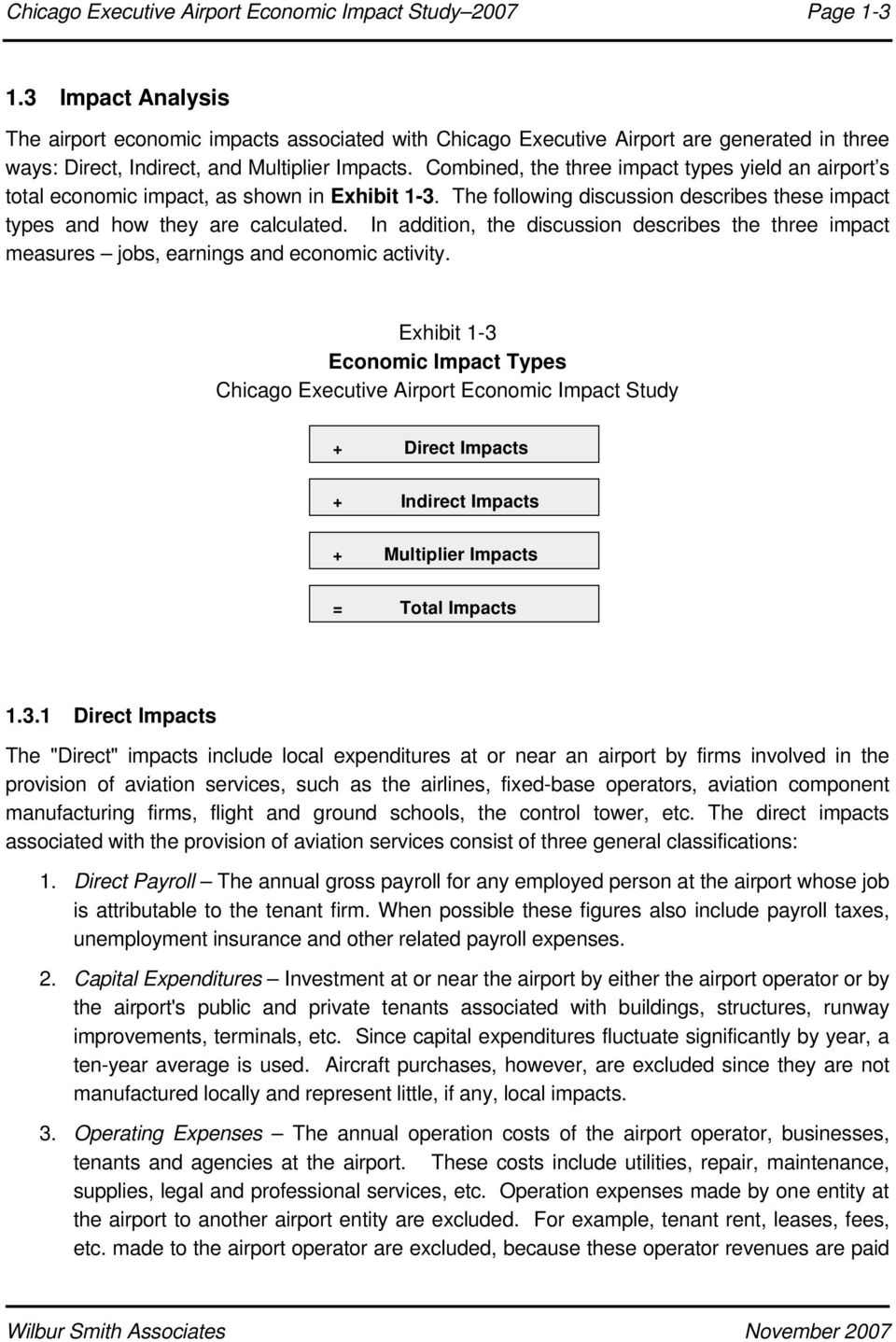
6 2007 Page Impact Analysis The airport economic impacts associated with Chicago Executive Airport are generated in three ways: Direct, Indirect, and Multiplier Impacts. Combined, the three impact types yield an airport s total economic impact, as shown in Exhibit 1-3. The following discussion describes these impact types and how they are calculated. In addition, the discussion describes the three impact measures jobs, earnings and economic activity. Exhibit 1-3 Economic Impact Types + Direct Impacts + + Indirect Impacts Multiplier Impacts = Total Impacts Direct Impacts The "Direct" impacts include local expenditures at or near an airport by firms involved in the provision of aviation services, such as the airlines, fixed-base operators, aviation component manufacturing firms, flight and ground schools, the control tower, etc. The direct impacts associated with the provision of aviation services consist of three general classifications: 1. Direct Payroll The annual gross payroll for any employed person at the airport whose job is attributable to the tenant firm. When possible these figures also include payroll taxes, unemployment insurance and other related payroll expenses. 2. Capital Expenditures Investment at or near the airport by either the airport operator or by the airport's public and private tenants associated with buildings, structures, runway improvements, terminals, etc. Since capital expenditures fluctuate significantly by year, a ten-year average is used. Aircraft purchases, however, are excluded since they are not manufactured locally and represent little, if any, local impacts. 3. Operating Expenses The annual operation costs of the airport operator, businesses, tenants and agencies at the airport. These costs include utilities, repair, maintenance, supplies, legal and professional services, etc. Operation expenses made by one entity at the airport to another airport entity are excluded. For example, tenant rent, leases, fees, etc. made to the airport operator are excluded, because these operator revenues are paid
7 2007 Page 1-4 out to operator employees and other operator expenses. To include such expenditures under both the tenant and the airport operator would be to double-count the expenditures. Calculation of the "direct" impacts comprises a four-step process: 1. Airport Operator Data Request Background information from the Airport was obtained regarding capital expenditures, aircraft operations, etc. In addition, a tenant listing both on-airport and through-the-fence operation was obtained including contact name, address and phone number. Airport operator information concerning jobs, revenues and expenditures also was obtained, as was financial operating data included information regarding revenues, expenses, and rents, fees and taxes paid by airport tenants. 2. Airport Surveys With the information provided by the Airport, a list was developed of airport tenants. Surveys were developed and either mailed out or distributed in person to all tenants and related firms. The surveys requested information on employment, operations, revenue, and expenditures. A copy of the survey form and letter of introduction is presented in the Appendix. 3. Airport Visits The Consultant also visited the Airport, interviewing the airport operator and tenants. Previously collected information was verified and missing information was collected. This provided insight into the Airport's overall operation, layout, and the economic roles, which the various entities play. 4. Direct Impact Calculations The collected data was verified to check reasonableness, e.g., payroll per employed person, etc. In doing so, the impacts were compared to benchmarks established through other airport impact studies. Tenant List A list of all aviation-related tenants and through-the-fence operators evaluated in the analysis is presented in Exhibit 1-4. All of the on-airport aviation tenants responded to the survey or were interviewed, as did all but three of the through-the-fence aviation-oriented businesses. Conversely, corporate operators are often reluctant to participate in impact surveys. At Chicago Executive this was also witnessed to some degree, especially from smaller operators. However, the larger operators were quite responsive and helpful in gaining insight to the relative size and nature of non-responding corporate tenants and general airport impacts. Airport data on jet and piston aircraft by corporate operator also provided another useful tool used to estimate the impact of non-responding corporate operators. Combined, the different perspectives of the major corporate operators and the airport management representatives, combined with the extensive airport data provided a sound basis for generating a comprehensive understanding of the direct impacts associated with firms located at the airport as well as the indirect visitor impacts associated with airport operations.

8 2007 Page 1-5 Exhibit 1-4 Airport Tenants and Through-the-Fence-Operators Aviaton Corporate On-Airport Tenants Chicago Executive Airport Gov't C.F. Industries FAA (Control Tower) Gov't Maranatha Ministries U.S. Customs Gov't Newberg Signature Flight Support FBO Potomac Atlantic Aviation FBO Lake Capital Northern Illinois Flight Center Air Taxi PAS-Keller Systems Preister Aviation Air Taxi Klein Tools Windy City Flyers Air Taxi/Training Woodhill American Flyers Training CED Boram Aviation Training Allmetal Palwaukee Flyers Training SG III Chicago Executive Srv. Center Maint Indeck/IPOII North American Jet Maint. Maint/Air Taxi EJM Duncan Aviation Maint DS Advisors Landmark Aviation Maint Alpha Mike Aviation Hertz Car J&S Aviation Flight World Limited Flying Club MMA Investments Paragon Flying Club Flying Club McLennan Companies 20 Other Atlantic Aviation Off-Airport Firms and Through-the-Fence Operators Great Bear Aviation Air Taxi Alberto Culver Propeller Service, Inc. Maint Allstate Avis Car Duchossois Enterprise Car Henry Crown (Including HSBC) T.C. Becks Catering JCG Aviation Georgies Catering McClean Fogg 94th Aero Squadron Restaurant Motorola Phil oung Redleaf Management Indirect Impacts "Indirect" impacts reflect expenditures made by airport users in the impact area. These typically consist of expenditures by visitors at hotels, restaurants, etc. General aviation visitor expenditures were calculated in a manner consistent with the methodology advocated by the Aircraft Owners and Pilot Association (AOPA). The methodology estimates the number of visitors arriving at the airport and multiplies the number of visitors by an estimated average expenditure rate per visitor. Visitors are defined as persons who reside in places external to the airport's region of impact who arrive via Chicago Executive Airport. The average expenditure per visitor (e.g., lodging, food, retail etc.), persons per party and average length of stay, were compiled from a transient pilot survey, discussions with airport management, corporate tenants, fixed-base-operators and from

9 2007 Page 1-6 previous studies. The Airport provided information on registered aircraft operations as well as insight on the estimated share of itinerant and air taxi aircraft operations conducted by local residents versus regional visitors Multiplier and Total Impacts The primary direct and indirect economic impacts represent increases in final demand in the airport impact areas. Such final demand increases, however, do not represent the total economic impact value attributable to an airport. Rather, a secondary or multiplier impact also occurs. The components of these three impact types are shown in Exhibit 1-5. The secondary multiplier effect is measured using IMPLAN 2 multiplier coefficients for the primary impact areas, (i.e., Cook and Lake Counties). These multipliers are based on the U.S. Regional Input/Output tables, as developed by the U.S. Department of Commerce, Bureau of Economic Analysis. Exhibit 1-5 Components of Economic Impact Types Aircraft Services Airport Mgmt & Oper. Air Taxi/Charter Car Rental Agencies Corporate Flight Ops. Fixed-base Operator Government Oper. Other Tenants/Users DIRECT IMPACTS INDIRECT IMPACTS General Aviation Visitors Corporate Aviation Visitors MULTIPLIER IMPACTS Intermediate Suppliers Induced Expenditures TOTAL IMPACTS Economic Activity Earnings Jobs 2 The Minnesota Implan Group s Regional Input Output Modeling System (IMPLAN)

10 2007 Page 1-7 Multipliers trace money flows through a regional economy. The longer money circulates in the region, the better-off the region is and the higher the multiplier. The multiplier exemplifies, through supplier expenditures and the respending of earnings, that many people and businesses benefit, even those who do not use or directly serve the airports. For example, if an airline employee earns $100 at the airport, and uses it to buy $100 worth of groceries, he is better off by $100 because he has $100 worth of groceries, and the local grocer is better off because he has the $100. The grocer then pays his employees, the delivery truck operator, etc. all of whom then are slightly better off due to the airport. The multiplier traces this flow of funds until the money ultimately leaks to places outside the impact area, or reaches the source of its raw material. Therefore, the larger and more developed the impact area, the longer the money remains in the regional economy, resulting in a higher average multiplier. Secondary Multiplier Model To estimate the multipliers, The Minnesota Implan Group s Regional Input-Output Modeling System (IMPLAN) is used. Final demand expenditures (i.e., primary direct and indirect impact values) are categorized into industrial codes and applied to a variety of different multiplier classifications, depending on the nature of the final demand activities. The size of the multipliers varies depending on the study area s size (population) and economic base. Typically, the larger and more developed the impact area, the longer the money re-circulates in the regional economy, resulting in a higher multiplier. For this study, multipliers for the Illinois Counties of Cook and Lake are used. Three Measures of "Economic Impact" The IMPLAN model provides three measures of the total economic impact attributable to the airports: Economic Activity (Output), Earnings (Payroll), and Jobs. The total impacts include the aviation sector itself (i.e. the "direct and indirect impacts"), as well as the "multiplier effect" of the aviation sector. The impacts are estimated for the ear All three indicators of economic impact are useful, however the monetary measures should not be added together, as explained below: Economic Activity The value of the aviation primary expenditures (aviation or airport service), plus the secondary multiplier effect (the sum of all of the intermediate goods and services needed to provide aviation services, plus the induced impacts of increased household consumption). Total economic activity equals the sum of intermediate demand, consumption demand, government demand, investment demand, and net export demand. Because Economic Activity includes intermediate demand it should not be compared to Gross State Product. Earnings The primary and secondary wages and salaries, other labor income and proprietors income paid to all employed persons that deliver final demand output and services. Earnings Impacts are part of Economic Activity, so they should not be added to the Economic Activity impact. Jobs The number of employees who provide aviation service or manufacture aircraft, plus the aviation-oriented share of those that are employed in sectors that support the air passenger (hotels, restaurants, etc.), plus those employed in the industries included in the

11 2007 Page 1-8 multiplier effect impacts. Jobs are expressed in terms of annual full-time-equivalents (FTEs), where two part-time jobs are represented as one full-time job. These three impact "measures" and the three impact "types" explained earlier are inter-related. Specifically. the economic activity, earnings and job impact measures comprise direct, indirect, and multiplier impact types. The interaction of the three impact measures and their three impact types are presented below in Exhibit 1-6. The total economic activity, earnings and jobs impact measures presented in Chapter 3 comprises these three impact types. Exhibit 1-6 Economic Impact Types and Measures Impact Measures Economic Activity Earnings Jobs Direct Impacts Indirect Impacts Multiplier Impacts T o t a l I m p a c t s Impact Types 1.4 Report Outline Background demographics and economic trends for the Illinois are first summarized in Chapter 2. The Chicago Executive Airport economic impacts are described in Chapter 3. Chapter 4 summarizes the local and state-related tax impacts associated with the Airport. Lastly, Chapter 5 addresses the nature and magnitude of the businesses that depend on the airport for transportation.

12 2007 Page 2-1 Chapter 2 - Demographic & Economic Trends Various industries in the State of Illinois, and specifically within the greater Chicago area, are dependent on air transportation for the sustainability of current operations and for expanding market access to customers, suppliers, and business collaborations. Air transportation enables industries and specific companies to become and remain competitive in an economic environment that persistently compels an increasingly quicker and more efficient exchange of goods, services, and ideas. This section summarizes recent trends in population, current employment, and household income levels. This data provides the context from which to compare the airport economic impact findings presented in the subsequent sections. 2.1 Population Cook County is, by far, the largest populated county in the State of Illinois and the second largest populated county in the United States, next only to Los Angeles County, California. In fact, with nearly 5.3 million people in 2006, Cook County has a population greater than the population of 31 states. 3 Chicago is located within the entirety of Cook County and contributes to the large population. However, Cook County population declined slightly (3.7%) from about 5.49 million in 1970 to 5.29 million in 2006, as shown in Exhibit 2-1. Conversely, Lake County, Illinois, which is located between the borders of Cook County and the State of Wisconsin, nearly doubled over the same historical time period, growing from about 382,000 to 713,000 people. Exhibit 2-1 Historical Population Trends (1970 to 2006) Population ear Change Geography Study Area Cook County 5,493,766 5,253,628 5,105,067 5,376,741 5,288, % Lake County 382, , , , , % Subtotal 5,876,404 5,694,016 5,621,485 6,021,097 6,001, % State of Illinois 11,110,285 11,427,409 11,430,602 12,419,293 12,831, % Source: 1990 Census of Population and Housing, Population and Housing Unit Counts, and 2000 Census Between 2000 and 2030, population in the Cook-Lake County study area is expected to grow, in nearly 14% while the State of Illinois is expected to grow at almost 22%, as shown in Exhibit 2-2. Lake County is expected to grow more quickly than Cook County and Illinois, due lack of physical room for expansion due to high population density. 3 US Census Bureau: Annual Estimates of the Population for the United States, Regions, and States and for Puerto Rico: April 1, 2000 to July 1, 2006

13 2007 Page 2-2 Exhibit 2-2 Forecasted Population Trends (1970 to 2006) Population ear Change Geography Study Area Cook County 5,386,673 5,472,429 5,707,832 5,990,243 11% Lake County 645, , , ,024 35% Subtotal 6,032,176 6,235,347 6,528,082 6,863,267 14% State of Illinois 12,440,846 13,279,091 14,316,487 15,138,849 22% Source: Illinois Dept. of Commerce and Economic Opportunity; Business Assistance, Facts & Figures, Population Projections 2.2 Employment The study area employed 2.5 million in year 2006, half of all private sector employees in the State of Illinois, as shown in Exhibit 2-3. Major study area industries include health care and social assistance, manufacturing, and retail trade. Industry Concentration Location quotient is a measure of the relative industrial concentration of a specific geographic or economic region in comparison to a broader base geographic or economic region. It is calculated as the ratio of a specific industry s share of the local economy to the respective industry s share of the base economy typically calculated by the number of persons employed in the specified industry to total employment within the economy. An industry with a location quotient less than 1 has a share of the local economy proportionally smaller to the same industry share in the base economy, indicating that the local economy is a net importer of the goods and services of that industry from the base economy. An industry with a location quotient greater than 1 has a share of the local economy proportionally larger than the same industry share in the base economy. A location quotient greater than one indicates that the local production of an industry generally exceeds the local demand for the goods and services of that industry (given the assumption that the demand for the goods and services of that industry in proportion to the entire economy are the same at both the local and base geographic area) allowing the excess production to be exported to the geographic or economic base area.

14 2007 Page 2-3 Exhibit 2-3 Industry Employment (2006) Study Area State of Industry Cook Lake Subtotal Illinois Total Private Sector 2,224, ,669 2,513,719 5,021,458 Agriculture, Forestry, Fishing & Hunting 553 na ,877 Mining 919 na ,156 Construction 96,864 17, , ,318 Manufacturing 245,100 50, , ,877 Wholesale Trade 115,911 21, , ,803 Retail Trade 239,224 42, , ,426 Transportation & Warehousing 117,557 4, , ,684 Utilities 4, ,578 23,080 Information 59,172 4,520 63, ,638 Finance & Insurance 171,131 17, , ,484 Real Estate & Rental & Leasing 48,102 4,043 52,145 85,076 Professional, Scientific & Technical Services 201,035 21, , ,157 Management of Companies & Enterprises 46,966 7,725 54,690 94,776 Administrative & Waste Services 186,100 25, , ,551 Educational Services 70,905 5,699 76, ,220 Health Care & Social Assistance 290,062 26, , ,840 Arts, Entertainment & Recreation 34,979 7,568 42,547 83,071 Accommodations & Food Services 196,626 21, , ,708 Other Services 94,829 8, , ,729 Unclassified 3, ,196 6,988 Source: Illinois Department of Employment Security: LMI Source, Quarterly Census of Employment and Wages (ES 202) Exhibit 2-4 depicts the industrial location quotient for the study area and is sorted by decreasing industrial concentrations. Service industries are heavily concentrated in the study area as educational services, professional, scientific, and technical services, financial and insurance services, information services, other services, and administrative and waste services all have location quotients greater than 1, at 1.33, 1.24, 1.20, 1.09, 1.05, and 1.05, respectively. Real estate, company management, transportation and warehousing, and arts, entertainment, and recreation industries are also concentrated industries in the study area relative to Illinois. Those three industries that are very ill concentrated in the two counties study area are the utilities, mining, and agricultural, forestry, and fishing industries.

15 2007 Page 2-4 Exhibit 2-4 Industrial Location Quotient based on Employment (2006) Study Area Industry Cook Lake Subtotal Educational Services Professional, Scientific & Technical Services Real Estate & Rental & Leasing Unclassified Finance & Insurance Management of Companies & Enterprises Transportation & Warehousing Information Other Services Administrative & Waste Services Arts, Entertainment & Recreation Health Care & Social Assistance Accommodations & Food Services Retail Trade Wholesale Trade Manufacturing Construction Utilities Mining 0.20 na 0.18 Agriculture, Forestry, Fishing & Hunting 0.08 na 0.07 Source: Illinois Dept. of Employment Security: LMI Source, Quarterly Census of Employment and Wages (ES 202) Unemployment Rate The annual average adjusted unemployment rates for the United States was 4.6% in Illinois unemployment rate of 4.5% is just slightly below the national rate. Lake County s unemployment rate of 4.2% is below both the national and state unemployment rates, and Cook County s at 4.7% is slightly higher. Weighted more heavily by greater employment in Cook County than Lake County, the two counties study area exhibited a 4.6% rate, equal to the national rate and slightly higher than the state rate. 2.3 Income Average earnings, by industry in year 2006, are higher within the two county study area than in the State of Illinois as a whole for all industries with the exception of farming, see Exhibit 2-5. Total average earnings across all industries are just over $60,500 and $51,100, respectively.

16 2007 Page 2-5 Exhibit 2-5 Industry Average Earnings (2006$) Study Area State of Industry Cook Lake Subtotal Illinois Total Average Earnings $60,500 $60,700 $60,500 $51,900 Farm 11,300 15,900 13,700 16,300 Agricultural Services, Other 26,900 33,300 29,100 25,500 Mining 107,400 65,700 98,200 78,000 Construction 74,200 60,700 72,100 61,700 Manufacturing 85,900 98,300 87,800 76,800 Transport, Comm. And Public Utilities 68,600 66,900 68,500 65,900 Wholesale Trade 78, ,600 83,100 73,100 Retail Trade 27,600 32,400 28,300 24,800 Finance, Insurance, and Real Estate 83,700 65,700 81,700 64,800 Services 53,500 49,000 53,000 46,300 Federal Civilian Govt 93,800 86,000 92,900 89,700 Federal Military Govt 43,600 66,100 58,000 57,300 State and Local Govt 61,900 56,300 61,300 53,900 Source: Woods & Poole Economics, Inc., 2006 Illinois exhibits higher mean household income than the nation, at about $97,000 and $90,000, respectively. Cook and Lake Counties both have higher mean household income than the State at almost $106,000 and $149,000, respectively, with a combined mean household income of $110.5 thousand, see Exhibit 2-6. Exhibit 2-6 Mean Household Income (2006) Geography 2006 Cook County $105,728 Lake County $148,897 Counties Sum $110,504 Illinois $97,056 United States $90,285 Source: Woods & Poole Economics, Inc., Woods & Poole Economics, Inc. Washington D.C. Copyright Woods & Poole does not guarantee the accuracy of this data. The use of this data and the conclusions drawn from it are solely the responsibility of Wilbur Smith Associates, Inc.

17 2007 Page Gross State Product Real Gross State Product (GSP) in Illinois is shown by industry in Exhibit 2-7. Between 1999 and 2006, overall GSP grew by 12% with the largest growth occurring in the retail trade and information sectors, 28.8% and 28.5%, respectively. Transportation and warehousing was the third largest growth sector, at 24.1%. Exhibit 2-7 Illinois Gross State Product by Industry (Million 2000$) Industry Change Total GSP 452, , , , , , , , % Ag., Frstry., Fish., Hunt. 1,545 2,090 2,038 2,516 2,889 3,663 1,897 1, % Mining 1,226 1,151 1,149 1,063 1, % Utilities 9,808 10,428 9,679 10,073 10,361 10,375 10,591 10, % Construction 20,472 20,685 20,621 20,603 20,094 19,281 19,314 19, % Manufacturing 66,420 68,990 64,983 64,633 65,551 70,718 70,599 72, % Wholesale trade 33,192 33,419 35,291 35,254 35,472 35,559 36,033 36, % Retail trade 25,704 27,445 29,367 29,769 30,499 31,021 32,073 33, % Trans. & Warehousing 16,476 17,149 17,014 17,204 17,159 18,764 19,328 20, % Information 18,728 17,822 18,811 18,942 19,027 21,141 22,898 24, % Finance &Insurance 43,429 45,362 45,469 44,072 46,816 47,269 45,352 47, % Real Estate 55,229 57,341 58,550 58,843 58,111 59,926 61,090 65, % Prof. & Tech. Serv. 36,761 38,587 38,479 37,503 37,990 40,313 42,858 44, % Management 10,751 9,571 9,649 10,650 10,900 11,670 11,386 11, % Admin. & Waste Serv. 14,952 13,930 13,163 12,920 13,925 14,149 14,730 15, % Educational Services 3,976 4,019 3,995 4,007 4,198 4,286 4,342 4, % Health Care & Social Assis. 25,973 26,775 27,461 28,056 29,049 29,592 30,547 31, % Arts, Entertnmnt, & Rec. 3,858 3,854 4,013 4,291 4,328 4,277 4,273 4, % Accom. & Food Serv. 10,203 10,436 10,149 10,024 10,306 10,719 10,994 11, % Other Services 11,244 11,102 10,744 10,921 11,053 10,883 10,718 10, % Government 43,056 44,037 44,432 44,947 50,455 44,577 44,201 44, % Source: Bureau of Economic Analysis, U.S. Chamber of Commerce: Regional Economic Accounts

18 2007 Page 3-1 Chapter 3 - Chicago Executive Airport Economic Impacts The detailed analysis of aviation at Chicago Executive Airport indicates the combined annual economic impacts of the airport s operation, visitors and multiplier impacts totals over $330.8 million in economic activity, of which $124.2 million is paid in earnings to 2,426 jobs. These impacts result from the direct provision of aviation services, the indirect use of aviation services, and the multiplier effect of subsequent transactions in the Chicago land area economy. The impact flow is summarized in Exhibit 3-1 and is detailed in the ensuing chapter. Exhibit 3-1 Economic Impact Summary Direct Impacts $128,075,700 Indirect Impacts $17,673,700 Multiplier Impacts $185,026,800 Economic Activity Earnings Jobs Total Impacts $330,776,200 $124,223,800 2, Direct Impacts The 73 firms and agencies located at the airport that provide aviation services and equipment generate $128.1 million in direct aviation related impacts. These at-airport direct impacts are presented by impact component and expense type in Exhibit 3-2. A major share (26%) of these expenditures is paid in the form of earnings, $33.3 million, to the 547 full-time equivalent (FTE) jobs. The capital expenses of $19.3 million comprise (15%) and the operations expenses account for $75.4 million (59%).

19 2007 Page 3-2 Exhibit 3-2 Direct Economic Impacts Jobs Expenses Full Part Total FEQ Payroll Capital Operations Total Airport Firms Government $2,950,600 $16,299,600 $1,225,600 $20,475,800 Aviation Services ,039,600 2,027,100 20,334,500 32,401,200 Corporate ,585, ,200 25,078,400 35,241,300 Sub total $22,575,900 $18,903,900 $46,638,500 $88,118,300 Through-the-Fence Corporate $8,271,400 $361,800 $26,531,700 $35,164,900 Aviation Services ,927,100 43,700 1,663,400 3,634,200 Others ,700 34, ,200 1,158,300 Subtotal $10,740,200 $439,900 $28,777,300 $39,957,400 Total $33,316,100 $19,343,800 $75,415,800 $128,075,700 Source: Wilbur Smith Associates Location of Impacts Breakdown of expenses by location suggest that 71% of the FTE jobs (386) and 69% of the expenditures ($88.1 million) occur on airport property, versus 29% of the FTE jobs (161) and 31% of the expenditures ($40.0 million) arise from through-the-fence operations. Business Type Expenditure Impacts Impact breakdown between payroll, capital and operation expenses varies by business type. The vast majority of capital expenses are incurred by airport operations, namely the Chicago Executive Airport who finance various landside and airside infrastructure improvement projects required to accommodate the aviation training and corporate demand. In addition, the FAA has a notable presence on the airport. Combined with U.S. Customs, government operations account for 16% ($20.5 million), of the direct airport-related expenditures. Comparatively, the 48 corporate operations identified in the study account for 55% ($70.4 million), of the airport expenses a large share of which reflects fuel costs. The extensive flight training, fixed-base-operators, flight clubs and other general aviation related service firms account for 28% ($36.0 million) of the airport-related direct expenditure impacts. Lastly, car rental, catering and the restaurant account for the remaining impacts ($1.2 million). Jobs Impacts An estimated total of 567 people work at the airport on either a full or part-time basis. Of these, a vast majority (518, 95%) are employed on a full-time basis versus the remaining (49, 5%) employed on a part-time basis. Combined, an estimated 547 FTE jobs occur at Chicago Executive Airport. The majority of these FTE jobs (286, 52%) work for aviation service related firms. Corporate aviation firms employ 201 (37%) FTE jobs, while government firms account for 31 jobs (6%) and other jobs account for 30 FTE jobs (5%). Payroll Expenses Payroll to people who work at the Airport and typically live in the region totals $33.3 million annually. This payroll goes to the estimated 567 people who work at the airport (547 FTE jobs). Many of these jobs are high paying, with the average FTE employee

20 2007 Page 3-3 earning an annual salary of $60,900. However, average payrolls range significantly between business type and firm. Government employees, which includes many traffic controllers as well as other airport operation services, generate the highest average payroll of $95,200, Corporate operations, which employee pilots, mechanics and other support services ($88,800). The airport service-related firms average $41,900. Capital Expenses The $19.3 million in capital impacts (see Exhibit 3.2) comprise capital investments made in which the recipient of the expenditures typically is located in the region. Capital investment represents physical improvements to airport facilities, either public or private. However, capital expenditures on aircraft are excluded because the recipient, the aircraft manufacturer, is located outside of the study region. Funds may come from private sources such as leaseholders, government agencies such as the airport operator, or through aid grants from the Federal Aviation Administration (FAA), or the State of Illinois. The largest share of capital impacts typically originate from the airport operator who manages the airport, and finances airside and landside improvements. Total airport operator capital costs evaluated in this study comprise an annual average of the capital costs over the past ten years and those programmed over the next five years, inclusive of the matching state and federal contributions. The annual average estimation approach better reflects the typical annual impact that large capital investment projects have on the local community. For example, actual airside and landslide improvements averaged $8.5 million over the last 10 years ( ), the vast majority attributable to the $46.5 million allocated in This spike in capital expenditures is expected to continue with an annual average of $24.1 million in programmed expenditures between 2008 to Operation Expenses Operation expenses include expenditures for local utilities, operations, parts and supplies, services, aviation fuel, and other local purchases. All of these are of economic value to the Chicago Executive Airport service area totaling an estimated $75.4 million. It is recognized that a significant portion of the airport operation expenses is made by one airport business to another at-airport business. 3.2 Indirect Impacts The estimated $17.7 million in total indirect impacts at Chicago Executive Airport include visitor impacts associated with air taxi, corporate and personal aircraft operations. Each visitor type demonstrates different travel patterns regarding percent visitors, percent staying overnight and expenditures per day, etc. Based on these differences, a composite of the visitor impact estimation is diagramed in Exhibit 3-3.

21 2007 Page 3-4 Exhibit 3-3 Indirect General Aviation Visitor Impacts General Aviation Operations Total Takeoffs 43,731 Itinerant & Air Taxi Operations 87,462 Visitor Landings 18,434 Total Landings 43,731 Resident Landings 25,297 Average People Per Aircraft 3.3 Total General Aviation Visitors 61,026 Indirect Impacts Day Only Visitors 22,292 (37%) Average Daily Visitor Expenditures $28 Overnight Visitors 36,614 (63%) Average Length of Stay 2.0 days Average Daily Visitor Expenditures $233 Day Only Visitor Expenditures $637,000 Overnight Visitor Expenditures $17,036,700 Total GA Visitor Impacts $17,673,700
22 2007 Page 3-5 The general aviation visitor impact estimates were derived from a transient pilot survey, discussions with airport management, corporate tenants, fixed-base-operators and from previous studies. Of the 87,462 itinerant and air-taxi annual operations (in 2006) at Chicago Executive Airport, there were a total of 43,731 landings (one aircraft operation equals one take-off or one landing), with an estimated 18,434 (42%) visitor landings. Assuming an average of 3.3 people per aircraft, the visitor landings translate into a total of 61,026 annual General Aviation visitors in Many of these General Aviation visitors (22,292 or 37%) involve people who stay in the region for less than an entire day. These visitors fly into Chicago-land area, conduct business and depart the same day. The other 36,614 General Aviation visitors (63%) are people who stay in the region overnight. It is estimated that the average length of stay of the General Aviation visitor at Chicago Executive Airport is 2.0 days, with an average daily expenditure of $233 per day. Combined, the regional visitor expenditures (food, lodging, entertainment, etc.) made by passengers and pilots who arrive at Chicago Executive Airport via general aviation aircraft total $17.7 million annually. 3.3 Multiplier and Total Impacts The direct and indirect economic impacts represent final demand increases in the airport impact area. Such final demand increases, however, do not represent the total economic impact value attributable for the Chicago Executive Airport. Rather, a multiplier effect also exists from the respending of these final demand expenditures through the local economy. As shown at the beginning of this Chapter (see Exhibit 3-1), an aviation-related multiplier impact of $185.0 million is generated from the combined direct and indirect impacts. In total, the aviation related impacts are $330.8 million in economic activity, with $124.2 million in earnings paid to the 2,426 jobs. These direct, indirect and multiplier impact types are presented by impact measure (i.e., output, income and jobs) in Exhibit 3-4. Exhibit 3-4 Impact Breakdown by Measure and Type Impacts Output Income Output Income Jobs per Job Per Job Direct $128,075,700 $33,316, $234,100 $60,900 Indirect 17,673,700 6,999, $59,600 $23,600 Multiplier 185,026,800 83,907,800 1,583 $116,900 $53,000 Total $330,776,200 $124,223,800 2,426 $136,300 $51,200 Source: Wilbur Smith Associates use of IMPLAN The typical direct at-airport job is high paying. Impact comparison suggests that every direct job generates an estimated $234,100 in output with an average salary of $60,900. Comparatively, every indirect job typically pays much less ($23,600).
23 2007 Page 4-1 Chapter 4 - Airport-Related Tax Impacts The following tax analysis addresses the taxes paid by businesses, property taxes paid by airport firms, as well as the income taxes paid by the 2,426 people employed directly or indirectly by the airport. Combined, the State and Cook County collect a total of $17.4 million in taxes annually that is directly or indirectly attributable to Chicago Executive Airport. The income, property and business related tax components are presented below. 4.1 Income Taxes While the marginal tax rate in Illinois is 3% on income earned in Illinois, tax refunds, exemptions and other factors result in an effective state income tax that is significantly less. Specifically, comparison of state income tax receipts in F 2003 ($7.4 billion) 5 to that of total personal income ($355.7 billion) 6 yield an effective state income tax rate of 2.08%. This effective tax rate of 2.08% is applied to the $124.3 million in airport-related income, suggesting a net income tax contribution of $2.6 million paid to State coffers. This state income tax benefit includes the income associated with jobs both at the airport as well as the indirect and multiplier jobs that occur off-airport. 4.2 Personal Property Taxes and Registration Fees Personal property taxes are paid by airport tenants on buildings and structures, but not on aircraft. These taxes are discussed be Aircraft Taxes and Fees Personal property taxes are not assessed on either personal or commercial aircraft in the State of Illinois. Aviation aircraft, though not taxed as personal property, is subject to registration fees. A flat rate $20 registration fee is imposed on all aviation aircraft that is valid for a two year term. Aviation aircraft registration is conducted through the Illinois Department of Transportation, Division of Aeronautics. With based aircraft at Chicago Executive, an estimated $2,940 in registration fees are collected annually by the State. Exclusion of aircraft property taxes and the imposition of the very low, marginal registration fee helps ensure that aviation is competitively priced compared to other states. Real Property Taxes Individuals and commercial entities, though not required to pay personal property taxes, are obliged to pay taxes on real property. Real property is classified as land or permanent infrastructure improvements which include buildings, paving projects, drainage systems, fences, landscaping, etc. Airport leaseholders are obliged to pay real property taxes if 5 Illinois Department of Revenue, 6 Illinois Department of Revenue, 7 KPWK, Chicago Executive Airport. Airport Operational Statistics. airnav.com
24 2007 Page 4-2 leasing from a tax exempt property owner 8, as in the case of the hangar tenants at Chicago Executive. As seen in Exhibit 4-1, in 2006, the total assessed real property value at Chicago Executive was $6,089,800 and the actual real property taxes paid was $1,310,100. From 2003 to 2005, the assessed real property value and the actual real property tax paid more than doubled, and in 2006, only slightly decreasing from the previous year. Exhibit 4-1: Real Property Tax Assessed Value and Paid Amount ear Assessed Value Paid by Lessees ,283, , ,304, , ,311, , ,321, , ,311, , ,085, , ,875, , ,917, , ,917, , ,648, , ,562, , ,405,355 1,055, ,248,517 1,377, ,089,811 1,310,076 Source: Palwaukee Municipal Airport 2006 Comprehensive Annual Financial Report, p.36 and 2005/2006 Real Estate Taxes Assessments 1 Actual data unavailable, interpolated from years 2003 and 2005 In addition to this Airport information, through the fence operators also pay similar property taxes. Property tax survey information collected from the through the fence operators suggest an additional $1.3 million is collected by Cook County. (Note that property tax estimates derived from the survey of airport tenants yielded property estimates of $1.4 million just slightly higher than the actual values reported in the CAFR.) In total, the airport tenants and through-thefence-operators collect an estimated $2.7 million annually in local county property taxes. 4.3 Business Taxes The IMPLAN model also provides an estimate of the taxes paid by businesses associated with normal operations, including sales taxes, excise taxes, fees, and licenses. Indirect business taxes are considered a portion of the value added aspect of total output. These tax impact estimates exclude income taxes and the property taxes paid by at-airport businesses. In total, 8 The Illinois Property Tax System: A Guide to the Local Property Tax Cycle. Illinois Department of Revenue. page 6.
25 2007 Page 4-3 an estimated $12,151,800 in business taxes is paid by firms who are directly or indirectly related to airport activity, as shown in Exhibit 4-2. The on profits or income. Exhibit 4-2 Business Taxes by Type Type Amount Direct $4,884,700 Indirect 1,333,800 Multiplier 5,933,300 Total $12,151, Total Taxes A total of $17.4 million in annual taxes were identified as affiliated with airport operations. These include the property taxes paid by airport tenants, income taxes associated with individuals who work both on and off the airport, and business taxes paid by firms directly or indirectly affected by airport operations. Exhibit 4-3 Business Taxes by Type Type Amount At-Airport Real Property Tax $2,700,100 Income Tax 2,583,900 Business Taxes 12,151,800 Total $17,435,700
26 2007 Page 5-1 Chapter 5 - Business User Impacts and Other Benefits As regional business markets become more national and even global in scale, airports are increasingly seen as prerequisites for local economic development. However, insufficient transportation systems can seriously impede actual economic development. As time constraints and dependability become increasingly important, the role of air transport for both goods and personnel continues to increase. Further, the commercial air transportation system struggles to accommodate demand as airline load factors continue to reach new highs. 9 Given this paradigm, corporations increasingly use the more direct, dependable and controllable flight options that general aviation transport provides in moving key personnel and essential freight. This is especially evident in the Chicago area where O Hare International Airport, one of the busiest in the world, is continually plagued by flight delays and/or cancellations due to congestion and severe weather. While the preceding economic impact analysis evaluated the jobs, income and output associated with the businesses that provide air transport, it did not address the value of air transport to the businesses that depend on Chicago Executive Airport. This user impact is vital to the Chicago area economy. However, no definitive manner exists to measure the value of the airport to the major business users. Nonetheless, the value is real and is addressed below. This section begins with an overview of the National Business Aviation Association (NBAA) and General Aviation Manufactures Association (GAMA) perspective, followed by a summary of typical business user surveys. A quantitative perspective is then provided through an estimate of employment levels at the businesses who have corporate aircraft based at Chicago Executive. The chapter concludes with qualitative description of the qualitative benefits of how the Airport s activities affect the community s quality of life. 5.1 Aviation-Dependent Industries Many of the nation's leading employers that use general aviation as a business tool are members of the NBAA. The NBAA s Business Aviation Fact Book 2004 indicates that approximately 75% of all businesses included in the Fortune 500 operate general aviation aircraft. Moreover, 92 of the Fortune 100 companies operate general aviation aircraft. A detailed analysis conducted for NBAA in 2004 also indicated that among the Fortune 500 there were more than twice as many companies operating general aviation aircraft as non-operators. Business use of general aviation aircraft at Chicago Executive Airport ranges from small singleengine aircraft rental to multiple aircraft corporate fleets supported by dedicated flight crews and 9 The ATA Factbook 2007 reports seat load factors (occupied percent of commercial aircraft seats) of 77.6% in 2005 and 79.2% in While these factors fluctuate monthly, the general annual trend continues to rise.
27 2007 Page 5-2 mechanics. The use of general aviation aircraft enables employers to efficiently transport personnel and air cargo. Businesses use general aviation aircraft to link multiple office locations and to reach existing and potential customers. Small to mid-size company use of business aircraft escalated through the dramatic emergence of various chartering, leasing, time-sharing, interchange agreements, partnerships, and management contracts. Fractional ownership arrangements have also experienced recent rapid growth. The NBAA estimated that between 2000 and 2004 the number of companies and individuals indicating fractional ownership increased 62%, from 3,834 to 6,217. Similar general aviation usage trends were observed at Chicago Executive Airport. Regardless of who owns the aircraft or what type of aircraft is flown, businesses increasingly choose to use general aviation because it provides safe, efficient, flexible, and reliable transport. Of all the benefits provided to business by general aviation, flexibility is the highest ranked factor by all businesses using general aviation aircraft. Many reasons exist for why businesses use general aviation in their day-to-day operation; NBAA identified the following seven key factors: 1. Employee time savings 2. Increased productivity 3. Minimization of non-business hours away from home 4. Assurance of industrial security 5. Maximization of personal safety and peace of mind 6. More control of business travel scheduling 7. Better facilitation of the entrepreneurial spirit The use of general aviation as a business tool adds to productivity and to the bottom line. According to an NBAA survey of key Forbes and Fortune 500 companies, those businesses that use general aviation aircraft routinely and significantly outperform businesses that do not. Performance indicators such as annual sales, number of employees, value of assets, and annual income are significantly higher for employers using general aviation aircraft. 5.2 Typical Value-Added Impacts Considering the number and variety of businesses in the Chicago area, it is impossible to quantify the value-added benefit that area businesses derive from using the Chicago Executive Airport. It is possible, however, to obtain perspective on the importance of aviation to the business community through surveys. Surveys of businesses in industries that typically use aviation (i.e., manufacturing, transportation, telecommunications, engineering/consulting, and utility sectors) are often conducted as part of larger State Aviation System Plans to assess their dependence on aviation.
28 2007 Page Previous Study Business User Surveys Business user surveys have been conducted over many years for several studies. While each study yields differences, some general trends emerge. For this reason, recent survey results for other studies were collected and reviewed. A summary of the Location Factor Ranking and General Aviation Business Use for the last six major statewide studies is summarized below Location Factor Ranking The off-airport business user survey asked respondents to rank the importance of 14 various factors considered in relocation or expansion decisions. Overall, the availability of an airport with scheduled commercial airline service ranked between 4 th and 6 th, while proximity to general aviation facilities ranked between 7 th and 10 th, as shown below in Exhibit 5-1. Highway access, as one might expect, ranked 1 st in all six studies, followed by labor supply and trained workforce. Exhibit 5-1 Business Location Factors and GA Business Use Missouri South Carolina Nebraska Ohio Texas Arkansas Location Factor Ranking Academic or cultural centers Commercial service airport General aviation airport Highway access Historic location Labor supply availability Natural Resources Rail transportation facilities Raw Materials Supplier proximity Tax incentives Trained workforce availability Urban business district Water Transportation Facilities General Aviation Business Use Own, lease, charter aircraft 15% 19% 18% 24% 24% 29% Supplier and/or customer use 35% 40% 32% 35% 28% 33% Source: Wilbur Smith Associates, Statewide Studies Business Use of General Aviation Services Survey results also indicate that many businesses depend on general aviation airports on a daily basis. Without access to general aviation, businesses indicated a need to cut employment or possibly relocate to other states. Of the responding businesses in each study 15% to 29% either own (outright or fractionally), lease or charter aircraft on a regular basis. Further, an even greater share of their customers and/or suppliers (e.g., 32% to 40%) rely on general aviation aircraft.
29 2007 Page Chicago Executive Airport Business User Survey The targeted sectors represent those with greater propensities to use scheduled commercial airline service and general aviation in their location/expansion decisions. For this study, a survey mailing list was developed based on a random sampling of five hundred business establishments within a ten-mile radius of the Airport, with a minimum revenue threshold of $1 million and a minimum employment threshold of 50 employees. A breakdown of surveyed firm sales volume, employment levels and industry SIC codes is shown in Exhibit 5-2. Exhibit 5-2 Business User Survey Firm Characteristics Sales Volume Employee Size SIC Code Range Firms % Range Firms % Range Firms % $10M-$20M % % % $20M-$50M % % % $50M-$100M % % % $100M-$500M % % % $500M-$1B % % % $1B % % 80, % Total % Total % Total % Unfortunately, the response rate was disappointing. Of the 500 firms surveyed only 15 responded. Given the poor response rate, it was not possible to draw any meaningful conclusions from the local business user survey. 5.3 Business Aviation at Chicago Executive Airport Identification of the airport users, by aircraft operations, was obtained from the IFR (Instrument Flight Rule) records at the Airport. IFR records identify the tag registration of the aircraft and the commercial owner of the aircraft for each operation. Chicago Executive Airport initially identified over 3,500 different businesses, operating throughout the country, with over 46,000 annual operations and almost 5,500 aircraft. To determine the economic implications of airport users within the study area, the data was filtered and narrowed to identify locally based firms that regularly use the Airport. Of the over 3,500 businesses identified as airport business users, the list was narrowed to those physically located in the State of Illinois (approximately 14,200), and then further narrowed to only those within the greater Chicago metropolitan area (3,500). Further, firms with less than twenty annual airport operations annually were considered as intermittent users and not significantly dependent on the Chicago Executive Airport. Lastly, firms that provide air taxi, training and other strictly aviation-oriented services were also filtered (since their impacts are typically addressed under the preceding impact analysis). The at-airport recognizance and tenant interviews also helped identify non-business users.
30 2007 Page 5-5 Given these filters, 51 locally based firms were identified that use the Airport regularly (i.e., at least twice per month) for business purposes. These 51 firms operate about 5,500 flights annually with 117 aircraft. On average, this suggests that each of the 51 firms had two aircraft (2.3 aircraft per firm) and operated each aircraft once per week (47 operations per year). Employment and annual sales revenues figures were obtained where available and estimated where unavailable for those identified airport users to estimate employment and sales volumes for study area firms that regularly rely on the airport. 10 The direct effect of these 51 firms on the local Chicago area economy is an estimated 12,600 jobs and $1.3 billion in sales. 5.4 Other Qualitative Benefits Lastly, qualitative benefits arise from regular airport activities that improve people s quality of life. While it is difficult to place a dollar value on such impacts, these activities benefit local residents, business and visitors in a variety of ways. These include health, welfare and safety benefits that arise form medical flights, police patrol, traffic reporting, educational opportunities, economic development marketing, etc. The airport management survey conducted as part of this study identified specific examples of qualitative benefits supported at Chicago Executive Airport, and is summarized in Exhibit 5-3. While this matrix is not all-encompassing, it does provide an overview of the diversity of benefits that the Airport supports, beyond the creation of jobs, payroll, and output. In addition to both recreational and corporate/business activity, very frequent activities include career training/flight instruction, search & rescue (CAP), and medical transport (both emergency and physician). In addition, law enforcement, traffic/news reporting and essential air cargo just-in-time (JIT) operations are frequently conducted at Chicago Executive Airport. 10 Data obtained from both Dunn and Bradstreet and InfoUSA databases. Estimates for firms lacking data were calculated based on the average employees or annual sales revenue per aircraft operation.
31 2007 Page 5-6 Exhibit 5-3 Qualitative Activity Benefits Activity Frequency Recreational flying Corporate/business activity Aerial inspections (pipeline, electric. etc.) Air cargo Gateway for recreational visitors Police/law enforcement Prisoner transport Military exercises/training Career training/flight instruction Search & rescue/civil Air Patrol Environmental patrol (i.e. wildlife) Emergency medical evacuation Physician/Medical Transportation Medical shipments/patient transfer Aerial photography/surveying Real estate tours Traffic/news reporting Air shows Food service Very Frequent Frequent Infrequent Source: Wilbur Smith Survey of Airport Management 5.5 Business User Impacts and Other User Benefits Summary Today s global economy increasingly requires the safe, efficient, and timely transport of key personnel and essential freight. Flexibility, efficiency and reliability associated with general aviation business service continues to attract business aviation users as load factors, weather delays and congestion increase at commercial service airports. In the Chicago area, the Chicago Executive Airport has become a vital transport node for over 50 local firms. These businesses employ over 12,600 people and generate $1.3 billion in annual sales. Lastly, the medical transport, police patrol, traffic reporting, etc. provide health, welfare and safety benefits to the region.
32 2007 Appendix Appendix Exhibits A B C D Chicago Executive Airport Management Survey Chicago Executive Airport Tenant Survey Chicago Executive Airport Business Survey Chicago Executive Airport Transient Pilot Survey
33 AIRPORT MANAGEMENT SURVE Contact: Name Phone Number EMPLOMENT 1. During 2006, how many full-time and part-time employees were employed by the Airport Operator? Full-time employees: FT Part-time employees: PT EXPENDITURES 2. Please estimate the total annual wages and benefits paid to all employees shown in Question Total Wages/Benefits: $ 3. Please estimate the total annual taxes paid by the Airport in Property taxes: $ Other Non-Federal taxes: $ 4. Please estimate past and future capital improvements in the following years (include AIP, Federal, State and local funds/grants) per the below table: Programmed Historical Airport Capital Expenditures by Source Airport Operator State Federal Total
34 REVENUE 5. For 2006, please provide the following for your airport: Estimated annual operating profit / (loss): $ Annual operating funds provided by your airport s sponsor: $ 6. Does the airport own and lease hangars? es No If so, please provide average monthly lease rates: Monthly T-Hangar Rental Rates: $ Monthly Conventional Hangar Rental Rates: $ 7. Does the airport owner/sponsor collect a fuel flowage fee? es No If so, please provide the following: Fuel flowage rate for jet fuel: Annual gallons sold: Fuel flowage rate for 100LL: Annual gallons sold: 8. Does your airport collect landing fees? es No If so, how much did the Airport collect in landing fees from general aviation aircraft in 2005? $ AIRPORT ACTIVIT 9. Please provide aircraft operation data for 2006 (annual landings and takeoffs) by type: Local Air Taxi Itinerant Total 10. Please estimate (by percentage) the distribution of your annual operations for trip purpose. Business Only % Pleasure/Personal Only % Business/Personal Mix % Recreational % Training % Other % 11. Does your airport have regular activity by air cargo/air freight carrier? es No If so, please list the firms:
35 12. Please review tenant list below and those firms identified in previous study. Please check those firms still at the airport (on- and off-property) as well as the thru-the-fence-operators: 2004 Study Current Original Tenant List Chicago Airport Authority American Flyers Atlantic Aviation Chicago Flight Training Crosscom Duncan Aviation Flight World Limited Hertz Corporation North American Jet Palwaukee Service Center Priester Charter Signature Flight Support Other Firms Identified in Previous Study The Flight Center Windy City Flyers Chicago Flight Training CF Industries (?) Helinet Rubin Consulting US Customs LJ Ventures Klein Tools General Aviaiton Services Nrthrn IL Flight Center Woodhill Motorola Willis Stein & Partners Dean Witter Allstate Alberto Culver MacLean-Fogg Household Finance Duchossios Industries Airways Flight Other Aviation-Oriented Firms Currently At/Next to Airport Thru- Fence? Airport Total
36 13. What activities occur at your airport? (Check all that apply). Activity Never Infrequently Frequently Recreational flying Agricultural spraying Corporate/business activity Aerial inspections (pipeline, electric. etc.) Air cargo Gateway for recreational visitors Police/law enforcement Prisoner transport Military exercises/training Career training/flight instruction Search & rescue/civil Air Patrol Environmental patrol (i.e. wildlife) Emergency medical evacuation Physician/Medical Transportation Medical shipments/patient transfer Forest firefighting Aerial photography/surveying Real estate tours Aerial advertising/banner towing Traffic/news reporting Air shows Location of community facilities (parks, fire station, meeting rooms) Skydiving Gliders/soaring Food service Other (specify) Very Frequently Thank ou!
37 AIRPORT TENANT SURVE Business Name: Contact: Name Phone Number 1. What area of aviation activity applies to your business at the airport? (Check ALL that apply.) Concession FBO Corporate Flight Department Government/Airport Management/Owner Air Freight/Cargo Carrier Aerial Applicator EMPLOMENT Rental Car Air Taxi/Charter Operator Aircraft Maintenance Flight Instruction Non-Aviation Business Other (please specify) 2. During 2005, how many full-time and part-time employees were employed by your business at the Airport? 2005 Full-time employees: FT 2005 Part-time employees: PT EXPENDITURES 3. Please estimate the total annual wages and benefits paid to all employees shown in Question Total Wages/Benefits: $ 4. Please estimate the total annual taxes paid by your business in Property taxes in 2005: $ Non-Federal taxes paid in 2005: $ 5. Please estimate how much your business spent for capital improvements in the following years: 2002: $ 2003: $ 2004: $ 2005: $ 6. Omitting the expenditure categories above (i.e., payroll, taxes, and capital improvements) please estimate how much your business spent for all other operating expenses in Operating Expense: $ PLEASE CONTINUE ON THE REVERSE SIDE
38 GROSS SALES 7. What were your business total gross sales at the airport in 2005? 2005 Gross Sales: $ 8. Aircraft and Fuel Sales: If your business sells aircraft, how many aircraft did you sell during 2004? What was the approximate value of these planes? $ How many aircraft did you sell during 2005? What was the approximate value of these planes? $ If your business sells fuel, how many gallons of jet fuel did you sell in 2005? How many gallons of 100LL fuel did you sell in 2005? 9. Please comment on any additional economic benefits or services that your business provides to the local community. Please complete and return this survey within 10 days of receiving it. If you have any questions regarding this survey, please contact Mr. Matthew Preisler of Wilbur Smith Associates at or [email protected]. ou may also return the survey via FAX at THANK OU FOR COMPLETING THIS SURVE. PLEASE FOLD SO THE PREPAID RETURN POSTAGE ADDRESS IS SHOWING. NO POSTAGE NECESSAR IF MAILED IN THE UNITED STATES BUSINESS REPL MAIL FIRST-CLASS MAIL PERMIT NO CINCINNATI POSTAGE WILL BE PAID B ADDRESSEE Wilbur Smith Associates 6600 Clough Pike Cincinnati, OH Staple or Tape Here
39 BUSINESS SURVE Company Name: Street Address: City: State: Zip: Business product or service: Number of Employees in Chicago Area: Full Time Part Time 2005 Estimated annual Gross Sales (Chicago Area only): $ 2005 Estimated Annual Payroll (Chicago Area only): $ SCHEDULED COMMERCIAL AIRLINE SERVICE 1. Please estimate the total number of airline trips per year taken by your company s Chicago Area employees: Annual Trips 2. If you answered Question 1, what percent of airline trips are: Percent International travel Percent Domestic travel 3. Please estimate the percentage of your business activity that depends on the availability of Commercial Service Airports: % General Aviation Airports: % 4. Do any of your clients or vendors use commercial air transportation to visit your local business site? es Estimated Air Trips/ear? No From where? (Please list the top 3 locations): 1) 2) 3) GENERAL AVIATION SERVICES 5. Do any of your clients or vendors use general aviation to visit your local business site? es Estimated Air Trips/ear? No From where? (Please list the top 3 locations): 1) 2) 3) 6. Does your company: es No Own general aviation aircraft? Use general aviation charters or air taxis? Lease a general aviation aircraft? Have fractional ownership in an aircraft? PLEASE CONTINUE ON THE REVERSE SIDE
40 AIR CARGO SERVICES 7. What type of air cargo service does your business use (check all that apply): None Documents less than 2 pounds Parcels 2 to 70 pounds Freight greater than 70 pounds 8. If your company were considering expansion or relocation, how important would the following factors be to your decision-making process? CATEGOR NOT IMPORTANT VER IMPORTANT Convenient highway access A commercial service airport A general aviation airport Water transportation facilities Available trained labor supply Rail transportation facilities An urban business district Raw materials Natural resources Academic or cultural centers Tax incentives Proximity of suppliers Historic location of business Please complete and return this survey within 10 days of receiving it. If you have any questions regarding this survey, please contact Mr. Matthew Preisler of Wilbur Smith Associates at or [email protected]. ou may also return the survey via FAX at THANK OU FOR COMPLETING THIS SURVE. PLEASE FOLD SO THE PREPAID RETURN POSTAGE ADDRESS IS SHOWING. NO POSTAGE NECESSAR IF MAILED IN THE UNITED STATES BUSINESS REPL MAIL FIRST-CLASS MAIL PERMIT NO CINCINNATI POSTAGE WILL BE PAID B ADDRESSEE Wilbur Smith Associates 6600 Clough Pike Cincinnati, OH Staple or Tape Here
41 TRANSIENT PILOT SURVE This survey, sponsored by the Chicago Executive Airport, will be used to help measure the positive economic benefits of daily aircraft operations at the Airport. Please take a few moments to complete the survey and drop it in the mail (pre-paid postage is on the back of the survey). Thank you for your time. 1. Please indicate the number of travelers, including the pilot, in your aircraft today: 2. Please indicate the type of aircraft you are operating today: Make: Model Did you file an IFR Flight Plan today? es No 3. Please indicate the purpose of your trip today (please check one box): Business Fuel/Maintenance Flight Training Recreation Other (please specify) 4. How long was your visit to Chicago Executive Airport/Chicago Area? Day only How many hours? Overnight How many days? Hours Days 5. Please estimate expenditures for this trip: Hotel/Lodging: $ Food & Beverage: $ Rental Car/Taxi/Limo : $ Retail/Entertainment: $ Aircraft services (fuel, etc): $ Other: $ Total: $ 6. How many people, including you, accounted for these expenditures? 7. Where is your aircraft based? Airport Name City State
42 PLEASE CONTINUE ON THE REVERSE SIDE 8. In the last 12 months, approximately how many trips by general aviation aircraft did you make to Chicago Executive Airport: Business: Pleasure: Training: 9. Please provide us with any comments that you may have regarding the ways in which Chicago Executive Airport airports benefit your business: Please complete and return this survey within 10 days of receiving it. If you have any questions regarding this survey, please contact Mr. Matthew Preisler of Wilbur Smith Associates at or ou may also return the survey via FAX at THANK OU FOR COMPLETING THIS SURVE. PLEASE FOLD SO THE PREPAID RETURN POSTAGE ADDRESS IS SHOWING. NO POSTAGE NECESSAR IF MAILED IN THE UNITED STATES BUSINESS REPL MAIL FIRST-CLASS MAIL PERMIT NO CINCINNATI POSTAGE WILL BE PAID B ADDRESSEE Wilbur Smith Associates 6600 Clough Pike Cincinnati, OH Staple or Tape Here
43
Economic Impact of The Charleston International Airport Complex
 Economic Impact of The Charleston International Airport Complex Conducted by: Center for Business Research Charleston Metro Chamber of Commerce PO Box 975, Charleston SC 940 January 05 Economic Impact
The Economic Impact of Commercial Airports in 2010
 The Economic Impact of Commercial Airports in 2010 January 2012 Prepared for: Airports Council International North America Prepared by: CDM Smith 8805 Governor s Hill Drive Cincinnati, Ohio 45249 Table
The Economic Impact of the New Hospital on the Economy of Drumright, Creek County, Oklahoma
 The Economic Impact of the New Hospital on the Economy of Drumright, Creek County, Oklahoma Drumright Creek County Oklahoma Cooperative Extension Service Oklahoma Office of Rural Health Rural Health Policy
KING COLLEGE SCHOOL OF BUSINESS KING COLLEGE REGIONAL ECONOMIC STUDIES (KCRES) KCRES PAPER NO. 4, May 2012
 KING COLLEGE SCHOOL OF BUSINESS KING COLLEGE REGIONAL ECONOMIC STUDIES (KCRES) KCRES PAPER NO. 4, May 2012 Economic Impact Multipliers for the Coalfield Region of Southwestern Virginia The Coalfield Region
The Economic Impact of Tourism in Maryland
 The Economic Impact of Tourism in Maryland Tourism Satellite Account Calendar Year 2012 December 2013 Important definitions 1. Tourism Industry: Measures the value of traveler activity within tourism characteristic
COLUMBUS REGIONAL AIRPORT AUTHORITY. Economic Impact Study Update. Executive Summary
 COLUMBUS REGIONAL AIRPORT AUTHORITY Economic Impact Study Update Executive Summary November 2012 INTRODUCTION Hearing a plane overhead is an everyday occurrence. But how many people stop to think that
Regional Economic Impact Analysis
 Section III: Applying Knowledge Regional Economic Impact Analysis Summary In this activity, teachers present a lecture related to assessing regional economic impacts and students use this knowledge to
MASTER PLAN PREPARATION
 Located in the East Valley of the Phoenix Metropolitan Area, Phoenix-Mesa Gateway Airport is a former military airfield that has successfully made the transition to a full service commercial passenger
Changes in Self-Employment: 2010 to 2011
 Changes in Self-Employment: 2010 to 2011 American Community Survey Briefs By China Layne Issued January 2013 ACSBR/11-21 INTRODUCTION From December 2007 to June 2009, the United States experienced an economic
HOSPITAL INDUSTRY IN SOUTHERN CALIFORNIA ECONOMIC IMPACT ANALYSIS. Los Angeles County Economic Development Corporation
 HOSPITAL INDUSTRY IN SOUTHERN CALIFORNIA ECONOMIC IMPACT ANALYSIS Los Angeles County Economic Development Corporation Christine Cooper, Ph.D. Myasnik Poghosyan Shannon Sedgwick January 2012 This report
Greenville Downtown Airport Aviation & Non-Aviation Parcels Available Greenville, South Carolina
 7 Parcels for Lease 2.5-18 Acres The Greenville Downtown Airport. It s where aviation business lands. The information contained herein has been given to us by the owner of the property or other sources
ECONOMIC IMPACT OF THE SAN ANTONIO AIRPORT SYSTEM
 GRA, Incorporated Economic Counsel to the Transportation Industry ECONOMIC IMPACT OF THE SAN ANTONIO AIRPORT SYSTEM Home Office: 115 West Avenue Suite 201 Jenkintown, PA 19046 215-884-7500 215-884-1385
NOV 2015. The ECONOMIC VALUE of IDAHO PUBLIC COLLEGES & UNIVERSITIES. Main Report. Analysis of the Economic Impact & Return on Investment of Education
 NOV 2015 The ECONOMIC VALUE of IDAHO PUBLIC COLLEGES & UNIVERSITIES Main Report Analysis of the Economic Impact & Return on Investment of Education 1 CONTENTS 4 ACKNOWLEDGMENTS 5 EXECUTIVE SUMMARY 5 Economic
WATSONVILLE MUNICIPAL AIRPORT MASTER PLAN CITY OF WATSONVILLE, SANTA CRUZ COUNTY, CALIFORNIA CHAPTER 3. AVIATION FORECASTS REVISED APRIL 2010
 WATSONVILLE MUNICIPAL AIRPORT MASTER PLAN CITY OF WATSONVILLE, SANTA CRUZ COUNTY, CALIFORNIA CHAPTER 3. AVIATION FORECASTS REVISED APRIL 2010 TABLE OF CONTENTS WATSONVILLE MUNICIPAL AIRPORT MASTER PLAN
Tourism s. 1997 98 to 2011 12. Tourism s. Economy
 Tourism s Contribution to the Australian Economy 1997 98 to 2011 12 Tourism s Contribution to the Australian Economy Authors: Jai Kookana and Tien Duc Pham ISBN 978-1-922106-91-9 (PDF) 978-1-922106-92-6
Transportation Infrastructure Investment Prioritization: Responding to Regional and National Trends and Demands Jeremy Sage
 FREIGHT POLICY TRANSPORTATION INSTITUTE Transportation Infrastructure Investment Prioritization: Responding to Regional and National Trends and Demands Jeremy Sage Motivation Why do we (and should we)
The Economic Impact of AAMC-Member Medical Schools and Teaching Hospitals
 The Economic Impact of AAMC-Member Medical Schools and Teaching Hospitals Conducted for the AAMC by Tripp Umbach September 2009 Association of American Medical Colleges For additional information about
COMMERCIAL AND GENERAL AVIATION
 Existing Facilities Daytona Beach International Airport is served by a number of airside and landside facilities. The airport has three asphalt runways: Runway 7L/25R (10,500 feet long by 150 feet wide),
National Heavy Duty Truck Transportation Efficiency Macroeconomic Impact Analysis
 National Heavy Duty Truck Transportation Efficiency Macroeconomic Impact Analysis Prepared for the: Union of Concerned Scientists 2397 Shattuck Ave., Suite 203 Berkeley, CA 94704 Prepared by: Marshall
Flickr: Randy Pertiet. Baltimore s Inner Harbor: Economic Impact, Importance, and Opportunities for Investment October 31, 2013
 Flickr: Randy Pertiet Baltimore s Inner Harbor: Economic Impact, Importance, and Opportunities for Investment October 31, 2013 Executive Summary: Baltimore s Inner Harbor drives substantial economic and
THE PROJECTED ECONOMIC AND FISCAL IMPACTS OF A TENNESSEE HISTORIC REHABILITATION INVESTMENT INCENTIVE
 THE PROJECTED ECONOMIC AND FISCAL IMPACTS OF A TENNESSEE HISTORIC REHABILITATION INVESTMENT INCENTIVE February 2014 Prepared by: Economic Impact Group, LLC. Copyright 2014 Economic Impact Group, LLC. EXECUTIVE
The Economic Impact of Tourism in Ohio. May 2011
 The Economic Impact of Tourism in Ohio May 2011 Key themes for 2010 The Ohio visitor economy rebounded in 2010, recovering about 70% of the losses experienced during the recession Visitor volumes expanded
The Economic Impact of Tourism in New York. 2010 Calendar Year Catskills Focus
 The Economic Impact of Tourism in New York 2010 Calendar Year Catskills Focus Key themes in 2010 The New York State visitor economy rebounded in 2010, recovering 94% of the losses experienced during the
10 Aviation Element. 10.1 Introduction. 10.1.1 Purpose of Chapter
 10 Aviation Element 10.1 Introduction 10.1.1 Purpose of Chapter This chapter provides the aviation element of the RFATS 2035 Long Range Transportation Plan. It describes the existing conditions and trends
Casino Industry - Factors, Effects and Taxes
 Economic Impact of the US Gaming Industry September 2014 Methods Analysis includes: Commercial casinos Native American casinos Card rooms (California, Florida, Minnesota, Washington) Analysis excludes:
Transportation & Logistics Industry Cluster Profile I Fond du Lac County, WI
 & Logistics Summary The and Logistics industry cluster encompasses 105 establishments and employs 1,711 people in direct cluster jobs in Fond du Lac County. The average annual wage for direct cluster jobs
The Economic Benefits of Oil and Natural Gas Production: An Analysis of Effects on the United States and Major Energy Producing States
 August 2014 The Economic Benefits of Oil and Natural Gas Production: An Analysis of Effects on the United States and Major Energy Producing States THE PERRYMAN GROUP 510 N. Valley Mills Dr. Suite 300 Waco,
The Economic Impact of Tourism in New York. 2010 Calendar Year Central New York Focus
 The Economic Impact of Tourism in New York 2010 Calendar Year Central New York Focus Key themes in 2010 The New York State visitor economy rebounded in 2010, recovering 94% of the losses experienced during
Contribution of S ESOPs to participants retirement security
 Contribution of S ESOPs to participants retirement security Prepared for the Employee-Owned S Corporations of America March 2015 Executive summary Since 1998, S corporations have been permitted to maintain
The Economic Impact of Technical College System of Georgia Institutions on their Service Delivery Areas Economies in FY 2012
 The Economic Impact of Technical College System of Georgia Institutions on their Service Delivery Areas Economies in FY 2012 January 2014 A Study Commissioned by The Technical College System of Georgia
Washington State Department of Transportation Aviation Division
 Table 5. Estimated Airport Operations Economic Impacts by Industry (Percent of ) Northwest Region Industry IMPLAN Sector Compensation Agriculture 1 0.4% 0.1% 0.3% Mining 28 0.0% 0.0% 0.0% Construction
The Economic Impact of Texas State University
 The Economic Impact of Texas State University James P. LeSage 1 Fields Endowed Chair for Urban and Regional Economics McCoy College of Business Administration Department of Finance and Economics Texas
Effective Federal Income Tax Rates Faced By Small Businesses in the United States
 Effective Federal Income Tax Rates Faced By Small Businesses in the United States by Quantria Strategies, LLC Cheverly, MD 20785 for Under contract number SBAHQ-07-Q-0012 Release Date: April 2009 This
Q UANTITATIVE E CONOMICS & S TATISTICS AUGUST 25, 2005. Virginia Taxes Paid by Manufacturers
 Q UANTITATIVE E CONOMICS & S TATISTICS AUGUST 25, 2005 Virginia Taxes Paid by Manufacturers $16 $14 $12 $10 $8 $6 $12.5 $12.2 $10.7 $10.8 $4 $2 $0 19992000200120022003 Introduction This study provides
The Shares of Indiana Taxes Paid by Businesses and Individuals: An Update for 2006
 The s of Indiana Taxes Paid by es and Individuals: An Update for 2006 Larry DeBoer Department of Agricultural Economics Purdue University October 2007 Summary The s of Indiana Taxes Paid by es and Individuals:
Prepared. for: Motion. Picture. Prepared HR&A. Advisors, 99
 Economic and Fiscal Impacts of the New York State Film Production Tax Credit Prepared for: Motion Picture Association of America (MPAA) December 3, 2012 Prepared by: HR&A Advisors, Inc. 99 Hudson St, Third
Air Transport and Aerospace Education - Synergies and Differences Antonín KAZDA, Air Transport Department, University of Žilina
 WORKSHOP ON EDUCATION AND TRAINING NEEDS FOR AVIATION ENGINEERS AND RESEARCHERS IN EUROPE; SEPTEMBER 23, 2015; Brussels Air Transport and Aerospace Education - Synergies and Differences Antonín KAZDA,
The Contributions of the Film & Video Production Industries to Oregon s Economy in 2005
 The Contributions of the Film & Video Production Industries to Oregon s Economy in 2005 An Economic Impact Analysis for the Oregon Film & Video Office ECONOMICS FINANCE PLANNING 888 SW Fifth Avenue Suite
In order to maintain its position as a global economic leader and
 A Report from the California Business Roundtable and the Campaign for College Opportunity E X E C U T I V E S U M M A RY Embargoed until 10am PST April 26th 2006 Keeping California s Edge The Growing Demand
Nevada enacts Commerce Tax effective July 1, 2015
 from State and Local Tax Services Nevada enacts Commerce Tax effective July 1, 2015 June 10, 2015 In brief Signed on June 10, 2015, and effective July 1, 2015, S.B. 483 imposes an annual commerce tax on
1999 Results for All Sectors in the Southern and Eastern Region and in the Border, Midlands and Western Region
 1999 Results for All Sectors in the Southern and Eastern Region and in the Border, Midlands and Western Region Table 25 Principal Aggregates for Motor, Retail and Wholesale sectors in the Eastern and
The Economic Impact of Health Services on the Economy of Sumter County, Alabama
 The Economic Impact of Health Services on the Economy of Sumter County, Alabama Hospitals Nursing Homes Physicians, Dentists, Etc. Pharmacies Other Services Prepared by: National Center for Rural Health
Estimating the Effects of Spending
 Economic Impacts of Protecting Rivers, Trails, and Greenway Corridors Estimating the Effects of Spending Contents Page Direct, Indirect, and Induced Effects 6-3 Multipliers 6-5 Economic Impact Models 6-7
Workforce Trends In and Occupational Forecasts For Northern Virginia, 2010-2020
 Workforce Trends In and Occupational Forecasts For Northern Virginia, - Prepared for The Northern Virginia Community College and The Fairfax County Chamber of Commerce by Stephen S. Fuller, PhD and Ellen
MEASURING ECONOMIC IMPACTS OF PROJECTS AND PROGRAMS
 Economic Development Research Group April 1997 MEASURING ECONOMIC IMPACTS OF PROJECTS AND PROGRAMS GLEN WEISBROD, ECONOMIC DEVELOPMENT RESEARCH GROUP BURTON WEISBROD, ECONOMICS DEPT., NORTHWESTERN UNIV.
Nonfatal Workplace Injuries and Illnesses in Maryland for 2010
 Nonfatal Workplace Injuries and Illnesses in Maryland for 2010 Nearly 74 thousand nonfatal work-related injuries and illnesses were reported by Maryland s public and private sector workplaces during 2010
OCALA INTERNATIONAL AIRPORT MINIMUM STANDARDS FOR COMMERCIAL AERONAUTICAL ACTIVITIES
 OCALA INTERNATIONAL AIRPORT MINIMUM STANDARDS FOR COMMERCIAL AERONAUTICAL ACTIVITIES Revised June, 2012 1 OCALA INTERNATIONAL AIRPORT MINIMUM STANDARDS FOR COMMERCIAL AERONAUTICAL ACTIVITIES TABLE OF CONTENTS
Fort McPherson. Atlanta, GA MSA. Drivers of Economic Growth February 2014. Prepared By: chmuraecon.com
 Fort McPherson Atlanta, GA MSA Drivers of Economic Growth February 2014 Diversified and fast-growing economies are more stable and are less sensitive to external economic shocks. This report examines recent
The Economic Impact of Fire Damage on Wyoming s Economy from a Business Perspective
 The Economic Impact of Fire Damage on Wyoming s Economy from a Business Perspective A Regional Economic Models, Inc. (REMI) Policy Insight Analysis Prepared by Amy Bittner and Justin Ballard August 18,
There are 6 base years in China GDP estimation history. The base year of 1952-1956
 Improvement in Real GDP Estimation by Production Approach Zhang Dongyou 1. Summarize As GDP estimation at current price, production approach for China GDP estimation at constant price which based on National
THE ECONOMIC IMPACTS OF THE PORTS OF LOUISIANA AND THE MARITIME INDUSTRY
 THE ECONOMIC IMPACTS OF THE PORTS OF LOUISIANA AND THE MARITIME INDUSTRY Prepared by: TIMOTHY P. RYAN UNIVERSITY OF NEW ORLEANS February, 2001 EXECUTIVE SUMMARY The ports of Louisiana and the maritime
Page Intentionally Left Blank
 Page Intentionally Left Blank Division Description The Airports Division, part of the Real Estate Assets Department (READ), is responsible for operating two general aviation airports, Montgomery Field
Public Relations Agencies in Los Angeles County
 Los Angeles County Economic Development Corporation in Los Angeles County 444 S. Flower Street, 34 th Floor Los Angeles, CA 90071 (888) 4-LAEDC-1 www.laedc.org Gregory Freeman and Christine Cooper, Ph.D.
Impacts of Government Jobs in Lake County Oregon
 Impacts of Government Jobs in Lake County Oregon April 2011 Prepared by Betty Riley, Executive Director South Central Oregon Economic Development District Annual Average Pay Based on Oregon Labor Market
REGIONAL QUARTERLY REPORT
 April 2015 1 REGIONAL QUARTERLY REPORT State Personal Income and More... In this report... Fourth-quarter 2014 state personal income statistics, page 1 Acknowledgments, page 3 Annual state personal income
recovery: Projections of Jobs and Education Requirements Through 2020 June 2013
 recovery: Projections of Jobs and Requirements Through June 2013 Projections of Jobs and Requirements Through This report projects education requirements linked to forecasted job growth by state and the
Economic Impact of Proposed Tax and Spending Reductions in Kansas Final Report Prepared by: John D. Wong, J.D., Ph.D.
 Economic Impact of Proposed Tax and Spending Reductions in Kansas Final Report Prepared by: John D. Wong, J.D., Ph.D. For Kansas Economic Progress Council 212 SW 8th Avenue, Suite 200 Topeka, KS 66612
Aviation Infrastructure Costs
 MIT Global Airline Industry Program Industry Advisory Board/Airline Industry Consortium Joint Meeting October 25, 2007 Prof. Joakim Karlsson (Daniel Webster College) Prof. Amedeo R. Odoni (MIT) Ms. Megan
Toronto Employment Survey 2014
 This bulletin summarizes the highlights of the 2014 City of Toronto annual Survey, marking its 32 nd consecutive year. This information resource presents a picture of change in Toronto s economy throughout
An Economic Impact Analysis.
 Briefing August 2013 Making Dollars and Sense of Canada s Mutual Fund Industry An Economic Impact Analysis. At a Glance Canada s mutual fund industry directly created $5.8 billion in real GDP in 2012 on
Eli Lilly. and Company. in Indiana
 Economic Eli Lilly Impact of and Company in Indiana The Economic Impact of Eli Lilly and Company on the State of Indiana and the Indianapolis-Carmel Metropolitan Statistical Area June 2009 Prepared by
City of Beverly. Impact ECONOMIC STUDY. conducted for ENDICOTT RESEARCH CENTER ENDICOTT COLLEGE BEVERLY, MASSACHUSETTS
 City of Beverly Impact ECONOMIC STUDY conducted for by ENDICOTT RESEARCH CENTER ENDICOTT COLLEGE BEVERLY, MASSACHUSETTS City of Beverly Impact ECONOMIC STUDY conducted for CONTENTS Executive Summary.............................
Sitka Charter Fishing Visitor Profile and Impact Analysis Alaska Travelers Survey
 Sitka Charter Fishing Visitor Profile and Impact Analysis Alaska Travelers Survey PREPARED FOR: Sitka Charter Boat Operators Association January 2005 Sitka Charter Fishing Visitor Profile and Impact Analysis
VII. DIRECT, INDIRECT, AND INDUCED ECONOMIC IMPACTS OF UC SAN DIEGO
 VII. DIRECT, INDIRECT, AND INDUCED ECONOMIC IMPACTS OF UC SAN DIEGO THE CONCEPT OF INDIRECT AND INDUCED ECONOMIC IMPACTS The impact of UC San Diego on the local, regional, and state economies is greater
These data were developed in cooperation with, and partially funded by, the Office of Advocacy of the U.S. Small Business Administration (SBA)
 Introduction Statistics of U.S. Businesses (SUSB) is an annual series that provides national and subnational data on the distribution of economic data by enterprise size and industry. SUSB covers most
2009-10 STATE AND LOCAL GOVERNMENT TAX AND REVENUE RANKINGS. By Jacek Cianciara
 2009-10 STATE AND LOCAL GOVERNMENT TAX AND REVENUE RANKINGS By Jacek Cianciara Wisconsin Department of Revenue Division of Research and Policy December 12, 2012 TABLE OF CONTENTS Key Findings 3 Introduction
II. WAGE AND SALARY DISBURSEMENTS
 II. WAGE AND SALARY DISBURSEMENTS Wage and salary disbursements consist of the monetary remuneration of employees (including the salaries of corporate officers, commissions, tips, bonuses, and severance
Affordable Electricity: Rural America s Economic Lifeline
 July 27, 2015 Affordable Electricity: Rural America s Economic Lifeline Summary Affordable electricity is essential to economic growth in rural America. Public policies, programs and other factors that
An Economic Impact Analysis of Entergy Operations in Mississippi
 An Economic Impact Analysis of Entergy Operations in Mississippi 2012 Prepared by Table of Contents Introduction......3 Scope of Study....3 Method of Estimation.. 4 Company Overview..... 5 Economic Impact
On March 11, 2010, President Barack
 U.S. Department of Commerce International Trade Administration Introduction Exports Support American Jobs Updated measure will quantify progress as global economy recovers. On March 11, 21, President Barack
Saskatchewan Small Business Profile 2015
 Saskatchewan Small Business Profile 2015 October 2015 Ministry of the Economy Performance and Strategic Initiatives Division economy.gov.sk.ca Table of Contents INTRODUCTION... 1 KEY FACTS... 3 1. SMALL
2003 Annual Survey of Government Employment Methodology
 2003 Annual Survey of Government Employment Methodology The U.S. Census Bureau sponsors and conducts this annual survey of state and local governments as authorized by Title 13, United States Code, Section
NORTH TEXAS REGIONAL AIRPORT FACT SHEET. Approximately 60 miles north of Dallas, between Sherman and Denison, Texas
 NORTH TEXAS REGIONAL AIRPORT FACT SHEET CONTACT: Mike Shahan, Airport Director 903-786-2904 [email protected] or Bill Retz, Project Manager 484-343-4040 [email protected] LOCATION: AIRPORT: Approximately
Industry Sector Analysis
 Industry Sector Analysis Growth, Core, and Competitive-Advantage Industries Southeast Michigan Macomb, Monroe, Oakland, St. Clair and Wayne Counties A Regional Profile Prepared by: Michigan Department
Business and Technology Incubator Economic Impact Analysis
 Missouri University of Science and Technology Business and Technology Incubator Economic Impact Analysis Prepared by: The Office of Technology Transfer and Economic Development May 19, 2009 2009 Table
Economic and Rate Impact Analysis of Clean Energy Development in North Carolina 2015 Update
 February 2015 Economic and Rate Impact Analysis of Clean Energy Development in North Carolina 2015 Update Prepared for North Carolina Sustainable Energy Association 4800 Six Forks Rd Suite 300 Raleigh,
Economic Impact of Redeveloping The World Trade Center Site: New York City, New York State, And the New York-New Jersey Area
 Economic Impact of Redeveloping The World Trade Center Site: New York City, New York State, And the New York-New Jersey Area Appleseed October 30, 2003 Executive Summary The redevelopment of the World