
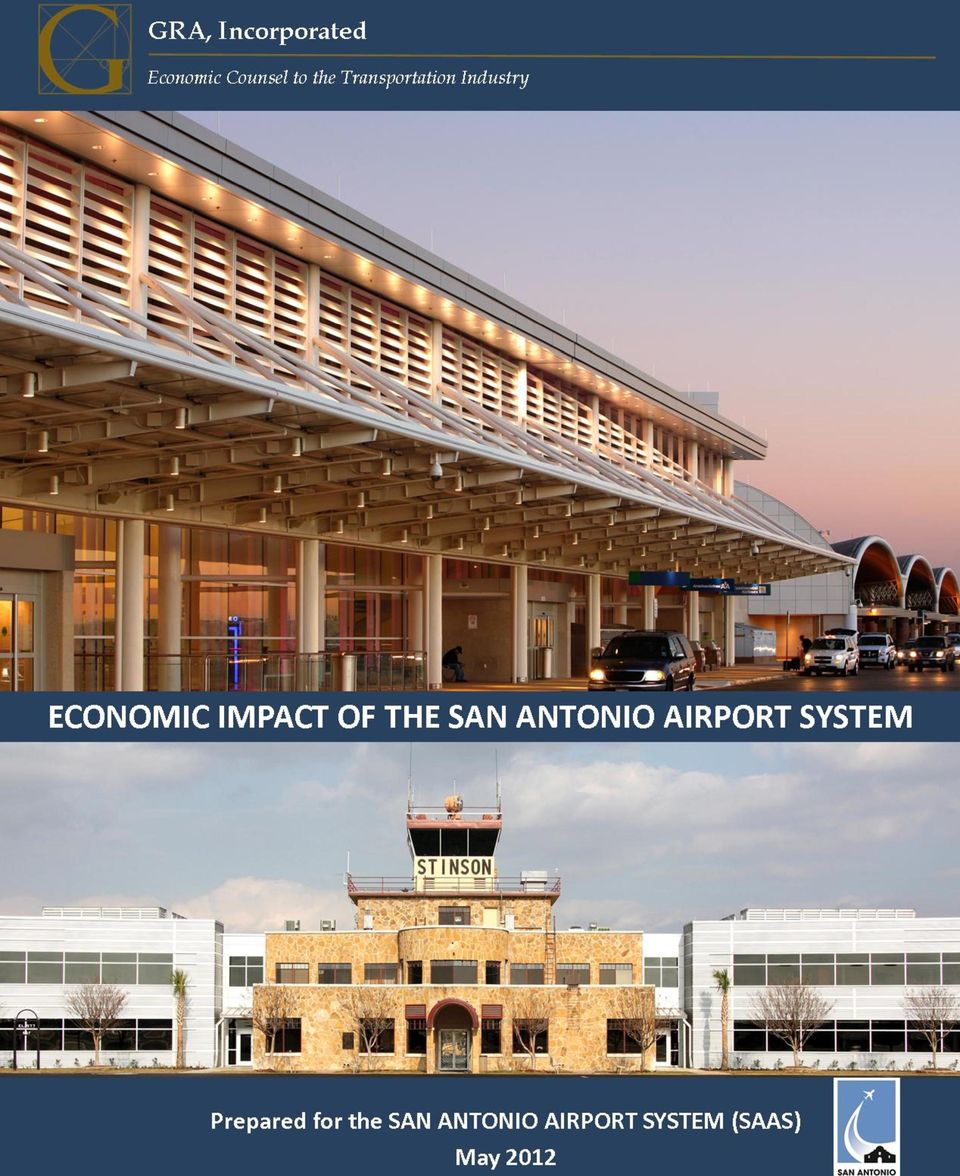
ECONOMIC IMPACT OF THE SAN ANTONIO AIRPORT SYSTEM
|
|
|
- Lauren Goodman
- 10 years ago
- Views:
Transcription
1 GRA, Incorporated Economic Counsel to the Transportation Industry ECONOMIC IMPACT OF THE SAN ANTONIO AIRPORT SYSTEM Home Office: 115 West Avenue Suite 201 Jenkintown, PA
2

3 Table of Contents Introduction... 1 Summary of Economic Impacts... 4 Summary of Direct Impacts... 6 Summary of Indirect Impacts... 8 Economic Impact Methodology and Results... 9 Introduction... 9 Summary of Study Methodology Economic Impact of San Antonio Air Transportation and Airport-Related Industries (Direct Impacts) Identification of Industry and Other Contacts Industry-Based Survey Direct Employment Estimates Direct Earnings and Output Effects Visitor Expenditure Impacts (Indirect Impacts) Commercial Airline Visitors General Aviation Mexican Visitors to San Antonio Overnight Crew Spending Overall Visitor Spending Capital Improvement Programs Tax Impacts Induced Impacts of Air Transportation and Airport-Related Industries: An Example 24 Ten Year Forecast of San Antonio Airport System Economic Impacts Attachment A: Economic Impacts of San Antonio International Airport... A-1 A.1 Background and Role of the Airport... A-1 A.2 Summary of Total Economic Impact... A-2 A.3 Direct Impacts... A-3 A.4 Indirect Impacts... A-4 A.5 Annual Impacts from Capital Improvement Programs... A-4 Attachment B: The Economic Impacts of Stinson Municipal Airport... B-1 GRA, Incorporated i May 30, 2012

4 B.1 Background and Role of the Airport... B-1 B.2 Summary of Total Economic Impacts... B-2 B.3 Direct Impacts... B-3 B.4 Indirect Impacts... B-3 B.5 Impacts from Capital Improvement Programs... B-4 Appendix Data Tables... Appendix-1 GRA, Incorporated ii May 30, 2012
5 List of Figures Figure 1: Economic Impact Overview... 3 Figure 2: Total SAAS Economic Impact by Type of Output... 5 Figure 3: Total Economic Impact of Output, by Airport... 6 Figure 4: Direct Impacts by Sector... 7 Figure 5: Indirect Impacts by Sector... 8 Figure 6: Direct Employment by Airport and Sector Figure 7: Summary of SAT Commercial Passenger Departures, Connections and Visitors (2011) Figure 8: San Antonio Area Visitor Spending by Type of Expenditure Figure 9: Types of Visitor Spending by Visitor Type Figure 10: CIP Impact Methodology Figure 11: Breakdown of Local Tax Impacts by Airport and Tax Source Figure A- 1: SAT and Medium-Sized Hub Flights Indexed to Figure A- 2: The Economic Impact of San Antonio International Airport... 2 Figure B- 1: SSF and National General Aviation Flights, Indexed to Figure B- 2: The Economic Impact of Stinson Municipal Airport... 2 List of Tables Table 1: Total Economic Impact of San Antonio Airport System Airports... 4 Table 2: Total Economic Impacts by San Antonio Airport... 5 Table 3: Direct Economic Impact of SAAS Airports... 7 Table 4: Direct Impacts by Airport... 8 Table 5: Indirect Economic Impacts of San Antonio Airports, by Airport... 8 Table 6: Spending for Overnight Air Crew Accommodation Table 7: Total Impacts of San Antonio Visitor Expenditures, by Airport Table 8: RIMS Categories Table 9: Average Yearly Total, Direct and Induced Impacts from CIP Expenditures Table 10: Average Yearly Total Impacts from CIP Expenditures by Airport Table 11: State and Local Taxes Generated by San Antonio Airport System Economic Activity. 23 Table 12: Induced Economic Impacts by Airport Table 13: Ten Year Projection of the San Antonio Airport System Economic Impacts Table A- 1: The Total Economic Impacts of San Antonio International Airport... A-2 Table A- 2: The Direct Economic Impacts of San Antonio International Airport... A-3 Table A- 3: The Indirect Economic Effects of San Antonio International Airport... A-4 Table A- 4: Average Yearly Impacts from Capital Expenditures at San Antonio International Airport A-4 GRA, Incorporated iii May 30, 2012

6 Table B- 1: The Total Economic Impacts of Stinson Municipal Airport... B-2 Table B- 2: The Direct Economic Impacts of Stinson Municipal Airport... B-3 Table B- 3: The Indirect Economic Effects of Stinson Municipal Airport... B-4 Table B- 4: Average Yearly Impacts from Capital Expenditures at Stinson Municipal Airport B-4 Appendix Table 1: Average Visitor Spending... Appendix-1 Appendix Table 2: San Antonio Airport System Economic Impact Summary... Appendix-3 Appendix Table 3: Airport Impact Industries... Appendix-4 Appendix Table 4: Average Tax of the San Antonio Region... Appendix-5 Appendix Table 5: Tax Impacts of the San Antonio Airport System... Appendix-6 Appendix Table 6: Total Average Yearly Impacts from CIP Expenditures by Sector Appendix-7 Appendix Table 7: Average Yearly Impacts from CIP Expenditures by Airport Appendix-7 Appendix Table 8: Total Average Yearly Impacts from CIP Expenditures at San Antonio International Airport Appendix-8 Appendix Table 9: Total Average Yearly Impacts from CIP Expenditures at Stinson Appendix-8 GRA, Incorporated iv May 30, 2012

7 Introduction The San Antonio Airport System (SAAS) is operated by the Aviation Department of the City of San Antonio, Texas. The department manages one commercial service airport, San Antonio International Airport, and one general aviation airport, Stinson Municipal Airport. San Antonio International Airport is classified as a medium hub airport by the Federal Aviation Administration (FAA). 1 Stinson Municipal Airport is the nation s second oldest general aviation airport in continuous operation. The following sections describe the San Antonio Airport System and the region that is served by the two airports that make up the system. San Antonio is the United States seventh largest city, with a population of 1.33 million. Based on 2011 population projections, the San Antonio-New Braunfels MSA, with a population of 2.2 million 2 is the twenty-fourth largest metropolitan area in the United States. Additionally, the San Antonio MSA is the third largest MSA in Texas, after the Dallas-Fort Worth-Arlington MSA and the Houston-Baytown MSA. San Antonio is both a regional center of commerce and a vibrant tourist destination. Its airports enable people and goods to move within the Southwest United States, across the nation, and throughout the world. Information, education and health services, trade and transport and the leisure and hospitality industries are linchpins of the San Antonio regional economy. The San Antonio-New Braunfels MSA is home to the headquarters of six companies on the Fortune 1000 list: Valero Energy Group, Tesoro Petroleum Corp., CC Media Holdings (Clear Channel), USAA, NuStar Energy, and Rush Enterprises. The City of San Antonio is also a cultural hub for the region and for convention and leisure visitors, with an active riverfront development, the San Antonio RiverWalk, 3 which provides recreation and entertainment to visitors and residents alike. A significant portion of the long distance visitors to the San Antonio region choose to travel there by air. These travel needs are served at San Antonio International Airport, which provides commercial passenger, general aviation and cargo services. During 2011, San Antonio International Airport (SAT) supported approximately 4 million enplanements. 4 SAT is used by numerous U.S. and international passenger and cargo airlines, and is also served by several nonscheduled charter operators. With Dallas Love Field and Houston Hobby Airport, San Antonio International was part of Southwest Airlines original 1971 Texas Triangle. Stinson Municipal Airport (SSF), is classified by the FAA as a general aviation reliever airport, 5 and does not have scheduled commercial service. The majority of traffic at SSF is corporate and recreational aviation users, along with users from the Civil Air Patrol, law enforcement, medical and news-gathering communities. 1 A medium hub handles 0.25% to 1.0% of passenger boardings in the nation. 2 United States Census Bureau FAA Terminal Area Forecast, at aspm.faa.gov/main/taf.asp, and SAAS December 2011 traffic report at 5 Airports designated by the FAA as reliever airports are customarily large general-aviation airports located in metropolitan areas that serve small aircraft traffic to preserve capacity for larger aircraft at hub airports in the region. GRA, Incorporated 1 May 30, 2012

8 San Antonio has historically been a hub for military training and logistics, especially for the U.S. Air Force. This military presence remains an important part of San Antonio life, and the city is referred to as Military City USA. While most military aviation activity takes place at the two active Air Force bases, Lackland Air Force Base and Randolph Air Force Base, some military fueling and other activity takes place at San Antonio International about three percent of operations and at Stinson Municipal about five percent of operations. The sections that follow report the economic impacts of these two airports. Detailed estimates of the impacts for each of the two airports and for SAAS overall have been developed. These impacts come from the production of aviation and related services at the airports and from the business operations of airport-dependent entities in the San Antonio region. These are treated as direct economic impacts of San Antonio s airports. For example, spending on concessions by passengers at SAT waiting for their flight s departure would be captured as a direct economic impact. Visitors to the San Antonio area using the airports also spend on accommodations, dining, transportation, and entertainment within the local economy. These expenditures are termed indirect economic impacts of the airport. The earnings associated with direct impacts and the spending represented by the indirect impacts is spent within the region, and earnings derived from this spending are then re-spent. The extent of the induced economic impacts represented by this circulation of spending throughout the San Antonio region was estimated using the RIMS II model of input-output relationships within the regional economy. Developed and maintained by the Bureau of Economic Analysis (BEA) of the U.S. Department of Commerce, the RIMS II system is a standard tool in the calculation of total economic impacts within a region. 6 The data and categories of economic activity used to estimate these are presented below. Figure 1 depicts the relationships among these economic impact categories as well as the economic sectors that contribute to them in an airport environment. The study reports three measures of economic impacts: employment, earnings, and output. For each of these, the total impact includes direct, indirect, and induced components. The SAAS Economic Impact Study also reports the impacts of the airport system s capital programs, an estimate of the taxes generated by airport activity, as well as a ten year forecast for future economic activity associated with the SAAS airports. 6 RIMS-II multipliers are calculated by the Bureau of Economic Analysis, and show how changes in local demand affect total gross output, value added, earnings, and employment in the region. The RIMS II system of multipliers for employment levels, earnings, and economic activity or output are adjusted for spending that goes outside of (or leaks from ) the San Antonio region during rounds of spending, and how much of the induced income and employment remains in the local economy after all rounds of spending. GRA, Incorporated 2 May 30, 2012


9 Figure 1: Economic Impact Overview In the body of the report, we present the results of the calculation and analysis of the economic impacts of the San Antonio Airport System airports for the San Antonio regional economy. (Note that minor discrepancies in column or row totals within tables may occur due to rounding.) We also describe the methodology used in calculating direct impacts, visitor expenditure impacts, induced impacts, capital improvement program impacts, as well as the taxes generated from San Antonio Airport System airport economic activities. The main report concludes with an example of the calculation of induced economic impacts and a ten year projection of system economic impacts. Following the main report, two attachments examine economic impacts of San Antonio International Airport and Stinson Municipal Airport individually. The final section is an Appendix containing tables reporting our data, methodology and results in greater detail. GRA, Incorporated 3 May 30, 2012

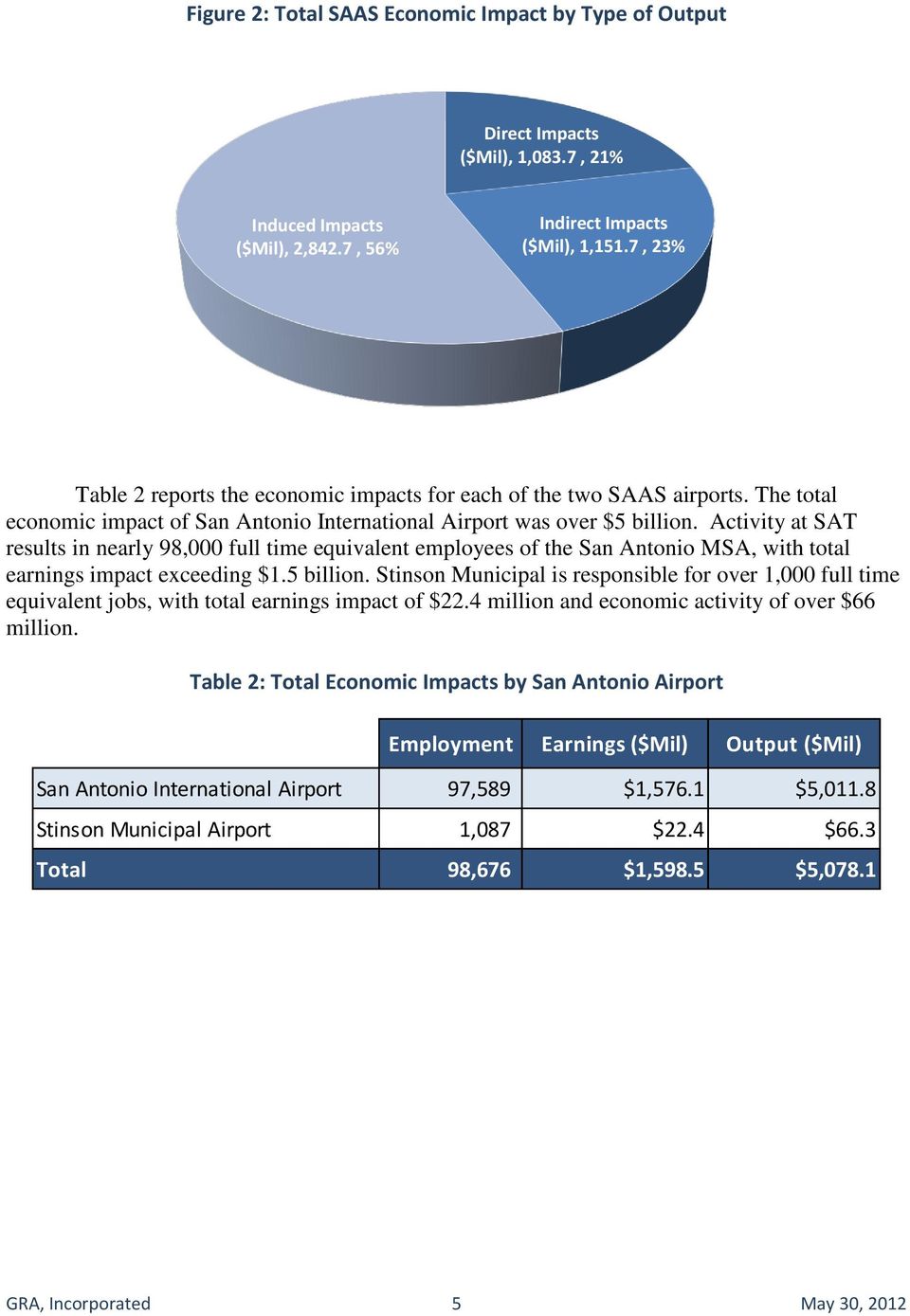
10 Summary of Economic Impacts The total economic impact in 2011 of the San Antonio Airport System was nearly $5.1 billion within the San Antonio regional economy. This is the combined economic impact of San Antonio International Airport, and Stinson Municipal Airport. This total is comprised of direct ($1.1 billion), indirect ($1.2 billion) and induced ($2.8 billion) economic output impacts of the airports and their related entities. Direct impacts come from the production of passenger, cargo, government and private air transportation and airport services and include the impacts of average annual capital expenditures (which is a function based upon the San Antonio Airport System Capital Improvement Plan). Indirect impacts represent spending in the local economy by air visitors, spending which becomes revenue for San Antonio businesses and earnings for their employees and proprietors. Induced impacts come from the spending and re-spending by recipients of income received as part of the direct and indirect impacts. As shown in Table 1, the two San Antonio Airport System airports are responsible for over 98,000 full time equivalent jobs, generating $1.6 billion in employee and proprietor earnings. Direct, indirect and induced employment impacts exceed 6,000, 15,000 and 77,000 full time equivalent jobs, respectively. Employment associated with the San Antonio Airport System generates earnings of over $290 million in direct earnings, $279 million in indirect earnings and over $1.0 billion in induced earnings for workers and proprietors. Table 1: Total Economic Impact of San Antonio Airport System Airports Employment Earnings Output Direct Impacts 6,053 $290.9 $1,083.7 Indirect Impacts 15,233 $279.4 $1,151.7 Induced Impacts 77,390 $1,028.3 $2,842.7 Total 98,676 $1,598.5 $5,078.1 Figure 2 shows graphically the shares of direct, indirect and induced output, also reported in Table 1. Output is the economic impact measure that reflects the regional economic activity associated with spending by firms, organizations and individuals (including employees) in a particular setting. Output is often referred to as economic activity. For example, the direct output measure represents the economic activity and transactions involved in the production of on-airport services for all users of the airport system. The direct and indirect output impacts, which represent the first rounds of spending within the region, account for about 46 percent of the total and induced output impacts, which represent all further rounds of spending, account for the other 54 percent. GRA, Incorporated 4 May 30, 2012

11 Figure 2: Total SAAS Economic Impact by Type of Output Direct Impacts, 1,083.7, 21% Induced Impacts, 2,842.7, 56% Indirect Impacts, 1,151.7, 23% Table 2 reports the economic impacts for each of the two SAAS airports. The total economic impact of San Antonio International Airport was over $5 billion. Activity at SAT results in nearly 98,000 full time equivalent employees of the San Antonio MSA, with total earnings impact exceeding $1.5 billion. Stinson Municipal is responsible for over 1,000 full time equivalent jobs, with total earnings impact of $22.4 million and economic activity of over $66 million. Table 2: Total Economic Impacts by San Antonio Airport Employment Earnings Output San Antonio International Airport 97,589 $1,576.1 $5,011.8 Stinson Municipal Airport 1,087 $22.4 $66.3 Total 98,676 $1,598.5 $5,078.1 GRA, Incorporated 5 May 30, 2012
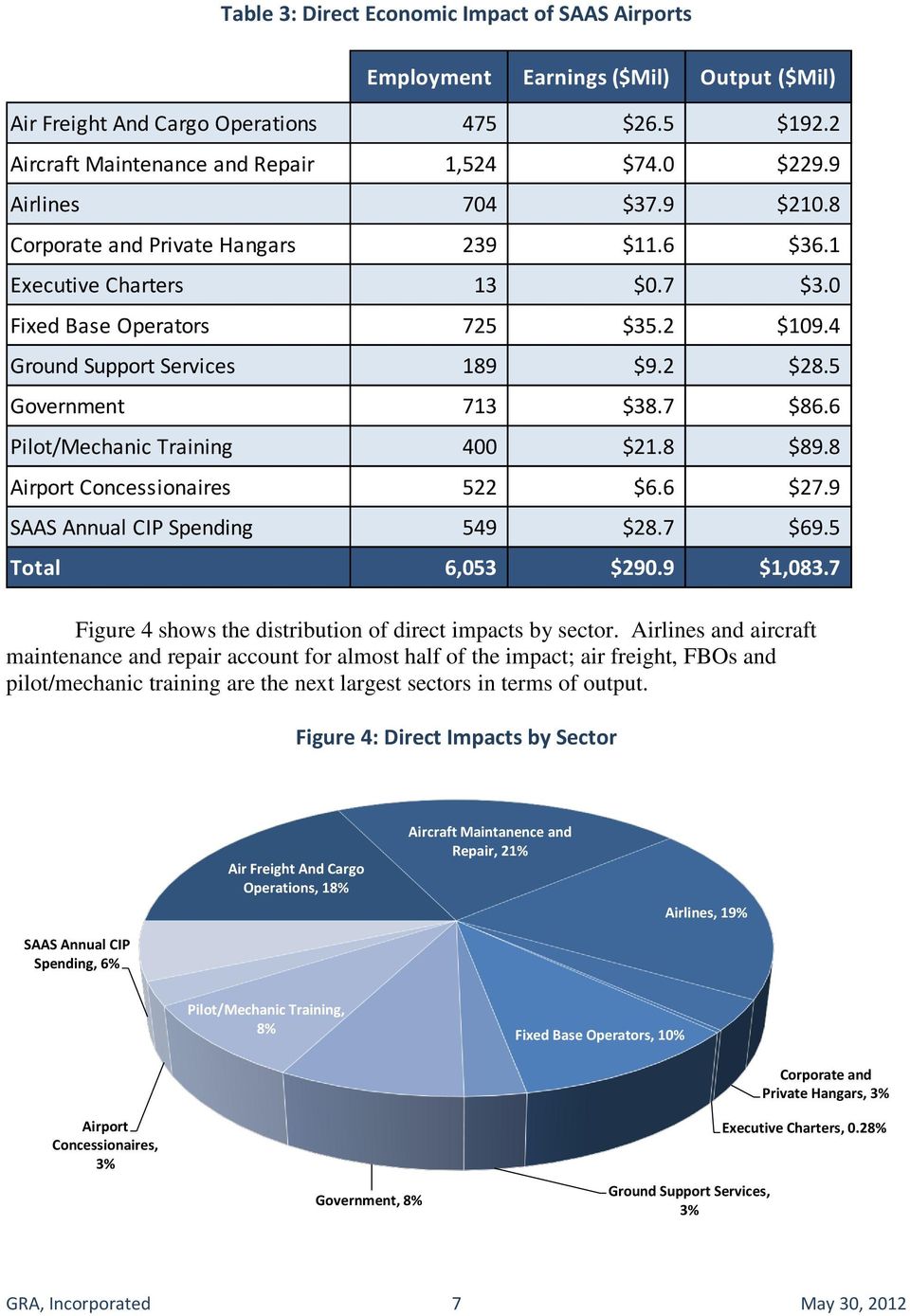
12 As Figure 3 indicates, SAT accounts for nearly 99 percent of the SAAS impact, while SSF accounts for one percent. Figure 3: Total Economic Impact of Output, by Airport Stinson Municipal, $66.3, 1% San Antonio International, $5,011.8, 99% Summary of Direct Impacts Table 3 shows that the direct output impacts exceed $1 billion for the San Antonio Airport System airports. The direct employment impact exceeds 6,000 jobs and direct earnings from these jobs exceed $291 million. A significant share of the output, earnings and employment impacts can be attributed to aircraft maintenance and repair and airlines, which together generate over $ 440 million and $71 million in output and earnings respectively, and together employ over 2,200 people. Air freight and cargo operations provided the next highest output level, followed by fixed base operators (FBOs), which produce $192.2 million and $109.4 million in output, respectively. Direct impacts also include the effects of SAAS Capital Improvement Plan (CIP) spending. GRA, Incorporated 6 May 30, 2012

13 Table 3: Direct Economic Impact of SAAS Airports Employment Earnings Output Air Freight And Cargo Operations 475 $26.5 $192.2 Aircraft Maintenance and Repair 1,524 $74.0 $229.9 Airlines 704 $37.9 $210.8 Corporate and Private Hangars 239 $11.6 $36.1 Executive Charters 13 $0.7 $3.0 Fixed Base Operators 725 $35.2 $109.4 Ground Support Services 189 $9.2 $28.5 Government 713 $38.7 $86.6 Pilot/Mechanic Training 400 $21.8 $89.8 Airport Concessionaires 522 $6.6 $27.9 SAAS Annual CIP Spending 549 $28.7 $69.5 Total 6,053 $290.9 $1,083.7 Figure 4 shows the distribution of direct impacts by sector. Airlines and aircraft maintenance and repair account for almost half of the impact; air freight, FBOs and pilot/mechanic training are the next largest sectors in terms of output. Figure 4: Direct Impacts by Sector Air Freight And Cargo Operations, 18% Aircraft Maintanence and Repair, 21% Airlines, 19% SAAS Annual CIP Spending, 6% Pilot/Mechanic Training, 8% Fixed Base Operators, 10% Airport Concessionaires, 3% Government, 8% Ground Support Services, 3% Corporate and Private Hangars, 3% Executive Charters, 0.28% GRA, Incorporated 7 May 30, 2012
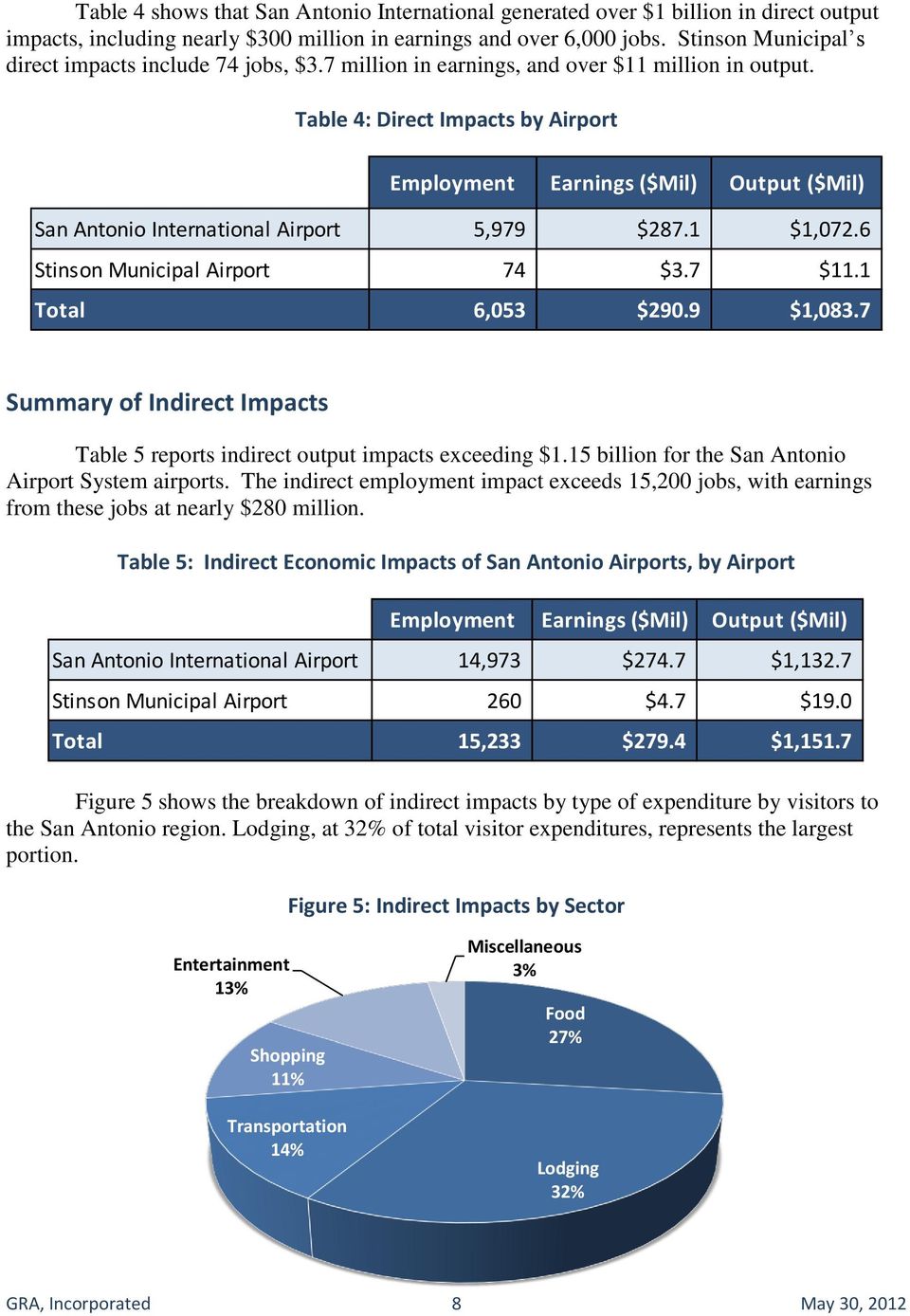
14 Table 4 shows that San Antonio International generated over $1 billion in direct output impacts, including nearly $300 million in earnings and over 6,000 jobs. Stinson Municipal s direct impacts include 74 jobs, $3.7 million in earnings, and over $11 million in output. Table 4: Direct Impacts by Airport Employment Earnings Output San Antonio International Airport 5,979 $287.1 $1,072.6 Stinson Municipal Airport 74 $3.7 $11.1 Total 6,053 $290.9 $1,083.7 Summary of Indirect Impacts Table 5 reports indirect output impacts exceeding $1.15 billion for the San Antonio Airport System airports. The indirect employment impact exceeds 15,200 jobs, with earnings from these jobs at nearly $280 million. Table 5: Indirect Economic Impacts of San Antonio Airports, by Airport Employment Earnings Output San Antonio International Airport 14,973 $274.7 $1,132.7 Stinson Municipal Airport 260 $4.7 $19.0 Total 15,233 $279.4 $1,151.7 Figure 5 shows the breakdown of indirect impacts by type of expenditure by visitors to the San Antonio region. Lodging, at 32% of total visitor expenditures, represents the largest portion. Figure 5: Indirect Impacts by Sector Entertainment 13% Shopping 11% Transportation 14% Miscellaneous 3% Food 27% Lodging 32% GRA, Incorporated 8 May 30, 2012
15 Economic Impact Methodology and Results Introduction Airports have a significant role in regional economies through their contribution to business activities that rely on passenger air transportation availability and quality, while acting as centers of business in their own right. The airports of the San Antonio Airport System are no exception, enabling both domestic and international travel for local residents and visitors to the San Antonio region by connecting the region to the international air transportation network. The system s airports, in conjunction with surface freight and logistics providers, also facilitate the trade of time sensitive goods using air cargo. Commercial aviation provides an important productivity tool for businesses in the form of high-speed, direct transportation. As with any large enterprise, economic activity at SAAS also generates valuable economic impacts through its ripple effects throughout the region. SAAS contributes to the regional economy through the spending of those who produce air transportation and the airport services that support it, through airport construction and development, and through the expenditures of air visitors. These economic impacts can be separated into direct, indirect, and induced economic impacts, which are described below. Direct Impacts are those generated by air transportation and other uses of the airports that occur at the airports. These impacts are measured by the employment, earnings, and the output associated with the following industries and entities: Commercial airlines and air charter operations (both passenger and cargo) Airport concessionaires which provide air passengers with goods and services Passenger ground transportation providers (including parking) 7 Airport and aircraft service providers Air cargo services providers General aviation (non-commercial) aircraft operators (e.g., flight schools) Government agencies supporting airport use Direct impacts also include expenditures made as airport capital investments, which are measured by the budget allocated for such projects. Although capital budgets are usually reported for multi-year periods, the spending for these activities will be expressed as an annual impact so it can be consistently added to the other direct impacts, which are associated with a specific year. Indirect Impacts are calculated by estimating the expenditures of business and leisure air travelers who visit the San Antonio area. Visitor spending supports employment, earnings, and output for numerous industries in the San Antonio region, including: Traveler accommodations (hotels, motels, etc.) 7 This report adjusts visitor spending on ground transportation so that it does not double count airport-related ground transportation with that reported in the passenger spending. GRA, Incorporated 9 May 30, 2012

16 Food (restaurants, bars, etc.) Transportation Shopping Entertainment Other purchases of goods and services Spending in the region associated with direct and indirect impacts become earnings for other economic actors in the San Antonio area. Induced Impacts represent the economic effects of the spending and re-spending of these earnings as they cycle through the San Antonio regional economy as earnings and expenditures. These induced impacts are estimated using the RIMS II multipliers derived from an Input-Output model of the eight-county San Antonio-New Braunfels Metropolitan Statistical Area developed by the Bureau of Economic Analysis of the U.S. Department of Commerce (BEA). 8 The following sections describe the methodology and results associated with each of the aforementioned impact categories. Summary of Study Methodology Economic impact studies are conducted to estimate the contribution that a facility, organization or sector makes within a region s economy. For airports and airport systems, economic impact analyses typically focus on the impacts of economic activities that result from passenger and cargo transportation by commercial airlines, or non-commercial (general aviation) activity, from visitor spending represented by the local expenditures by air passengers, from the capital investments made at the airports, and from the regional tax impacts generated by these airport economic activities. Industries that contribute to the direct impacts of air transportation and airport operations are those that support passenger or cargo transportation (including their subcontractors). In this analysis, GRA estimated direct impacts of industries that directly receive revenues from air passengers or cargo shipments, provide support activities for airlines, aircraft operators and airports, and government and non-commercial entities that support or facilitate the safety and security of airport activities. For firms or organizations operating at an airport, the number of employees, total employee and proprietor earnings, and the total annual sales or budget of the entity make up its contribution to the direct impact of the airport. These data were collected primarily through a web-based survey of companies identified through the SAAS airport tenant directory. In addition, the San Antonio Airport System provided other tenant and airport user records, in 8 The Bureau of Economic Analysis (BEA) calculates the RIMS-II multipliers for specific geographical regions in order to allow for the estimation of economic impacts due to economic activities within a specific region. This input-output model uses detailed industry sectors to appropriately allocate economic impacts to their proper areas. For the purposes of our study, the San Antonio-New Braunfels Metropolitan Statistical Area was used. GRA, Incorporated 10 May 30, 2012

17 particular, airport badge counts from the recent past, organized by tenant or airport organization. The survey results were supplemented by these other databases, which provided employment figures, earnings figures, and/or total sales and budget levels. In some cases, estimates were made based upon economic data from the Bureau of Labor Statistics 9 and the Economic Census of the United States 10 and data provided by the San Antonio Airport System. These data primarily involved activity-level measurements and company size measurements. The San Antonio Airport System also provided data on airport concessions and the budgets for airportrelated services such as the San Antonio Airport System operating budget. The indirect visitor spending impacts were estimated using passenger statistics from San Antonio International Airport and Stinson Municipal Airport, such as the distribution of origindestination passengers and connecting passengers, tourism data provided by the San Antonio Convention and Visitors Bureau, 11 as well as other data provided by the San Antonio Chamber of Commerce. 12 Data on the proportion of air passengers that are not San Antonio area residents was developed by GRA using Department of Transportation Db1b ticket sample data. Local air visitors were estimated using DOT air carrier statistics and general aviation operations statistics for the two San Antonio Airport System airports. Average visitor expenditures were estimated using the San Antonio area tourism data, which allowed the separation of visitors by trip purpose it was found, for example, that on average, business passengers tend to spend more time in the San Antonio region than do leisure visitors. Using these sources, GRA allocated traveler spending to various travel-related industries (e.g., Lodging ). These categorized expenditures were used to represent the gross sales of the various industries, and, subsequently, earnings and employment were estimated using industry statistics from numerous sources, such as the Department of Labor and the U.S. Economic Census. The study does not incorporate airline ticket sales; because fares paid do not represent economic activity directly affecting the San Antonio region. The study instead measures the spending by airlines and aircraft operators at SAAS airports to produce air transportation services in the region. Induced impacts were developed from the direct and indirect impact estimates using industry-specific BEA RIMS-II multipliers for the 8-county San Antonio-New Braunfels Metropolitan Statistical Area, which were acquired for the study from the BEA. The estimated economic impacts are based on the calendar year 2010 airport activity levels. The regional industrial input-output statistics used by the BEA to develop the inputoutput economic relationships expressed in the RIMS II multiplier are based on 2007 data, which is the most recent available from the Department of Commerce for this purpose GRA, Incorporated 11 May 30, 2012

18 Economic Impact of San Antonio Air Transportation and Airport-Related Industries (Direct Impacts) Air transportation provides rapid long distance travel for leisure and business travelers. It also allows high-value, time-sensitive cargo to be more readily available over great distances, which permits supply chains to become more spread out and locationally efficient. Commercial air transportation services at San Antonio International Airport are provided by both scheduled and charter airlines, with support from other industries such as local ground transportation, passenger and cargo processing, airport operations, and airport concessions. Other airport system users, at both San Antonio International and Stinson Municipal, include public and private non-commercial aircraft operators, flight schools, general aviation pilots and passengers, and firms related to the aviation industry, such as fixed base operators serving general aviation. GRA used the following steps to estimate the direct impacts of air transportation and related industries at San Antonio Airport System airports: Identify the industries operating at or dependent on airport services Identify the companies and organizations in these industries Survey these companies for employment, earnings, and budget/output levels 13 Develop total direct employment statistics and compare employment levels to San Antonio Airport System badging databases Estimate missing data for partial or missing responses to the survey and follow-up efforts Estimate direct economic impact categories based upon BEA RIMS-II multipliers Identification of Industry and Other Contacts The following industries were identified as having direct impacts in the region based on commercial aircraft activities at San Antonio Airport System airports. Airlines serving San Antonio Air freight and cargo operations Aircraft maintenance and repair Corporate and private hangars Executive charters Fixed based operators Ground support services Other contractors/service providers and government Pilot/mechanic training San Antonio airport concessionaires 13 Surveys were conducted using contacts with links to online survey tools. Follow-up contacts were made using both and telephone, as well as through efforts conducted by SAAS. GRA, Incorporated 12 May 30, 2012

19 For the above categories, GRA identified individual companies or entities for each of the two airports based upon the following sources, and using industrial classifications where available: San Antonio Airport System badging database San Antonio Airport System telephone directory Airport stakeholder lists and other contacts Other contacts as revealed through interviews with San Antonio Airport System staff and with other airport stakeholder organizations A total of 102 survey contacts were identified for the San Antonio Airport System airports from these sources. GRA relied on a specific point of contact for each stakeholder. Industry-Based Survey The GRA team constructed industry-specific surveys to determine employment, earnings, and overall sales/budget information for every contact. These were developed in draft form, and tested and modified as necessary. The surveys were distributed through the use of a web-based platform, and the survey respondents responded online. The data requested included both full and part time employees, total wages and earnings paid to employees, and total revenue figures. GRA attained a response rate of approximately 33 percent. While the response rates were incomplete (although higher than many similar survey efforts), respondents provided sufficient data for reliable estimates to be developed for the airport community, using both survey data and supplemental data obtained from the San Antonio Airport System and other sources. Direct Employment Estimates Total employment for the aforementioned entities was estimated from the survey results, secondary data, San Antonio Airport System contacts, and the San Antonio Airport System badging database. At times, it was necessary to make adjustments or estimations to the employment figures to account for discrepancies or missing data. The following adjustments were made: Entities that did not complete or submit the survey at San Antonio International Airport had their employment measures estimated using the San Antonio badging database. Entities that did not complete or submit the survey at Stinson Municipal Airport had their employment measures estimated using Bureau of Labor Statistics and other data. Employment for taxi and limousine transportation was projected based upon the San Antonio Airport System counts for taxi permits. The estimated direct employment impacts for air transportation and related industries total over 5,500 full time equivalent jobs, including 5,441 at San Antonio International Airport, and 63 at Stinson Municipal Airport. We found that airlines accounted for 12 percent of total direct jobs at San Antonio International. GRA, Incorporated 13 May 30, 2012

20 Figure 6, shows the distribution of direct employment for each of the two airports. As can been seen, SAT accounts for nearly all of the direct employment within the San Antonio Airport System, with approximately 99 percent of total direct jobs, while Stinson Municipal Airport accounted for approximately one percent of total direct jobs. The figure can be read as starting with SAT airline employment, at 12 percent of direct employment, and proceeding clockwise around to the one percent of employment at Stinson Airport. Figure 6: Direct Employment by Airport and Sector 9% 1% 12% Airlines, SAT 8% 8% Air Freight and Cargo, SAT Aircraft Maintanence and Repair, SAT 12% 25% Corporate and Private Hangars and Executive Charters, SAT Ground Support Services, FBO's, and Pilot Training, SAT Other Contractors, Service Providers, and Government, SAT Concessions, SAT Average Annual CIP, SAT SSF - All Employment, SSF 21% 4% Direct Earnings and Output Effects Direct earnings and output impacts were estimated for both airports based upon survey data and government statistics for industries in the San Antonio-New Braunfels Metropolitan Statistical Area. GRA used the following processes: The impacted entities were categorized using the North American Industrial Code System (NAICS). Surveys were sent to all points of contact seeking data for employment, employee earnings, and output. If there was no response to a survey, average employee wages were estimated using the 2007 Economic Census for the specific NAICS-code, and then multiplied by the total number of employees (from the San Antonio Airport System badging database and other data) to generate a total wage bill. GRA, Incorporated 14 May 30, 2012

21 Using the 2007 Economic Census, GRA obtained the Total Revenue Size of Establishment value for each NAICS code. GRA then calculated the Economic Census s ratio of Total Revenue Size of Establishment to Total Employee Size of Establishment. Using this ratio, GRA was able to estimate total output for each entity. Using the U.S. Bureau of Economic Analysis Regional Economic Data, GRA was able to develop a total earnings measure for each point of contact. 14 Data are reported in aggregate by NAICS code; data for individual business or other entities (other than SAAS itself) is not reported individually Visitor Expenditure Impacts (Indirect Impacts) The number of air visitors to San Antonio was estimated for both commercial and general aviation flight services. For commercial aviation, the share of arriving passengers who indicated they resided outside of the region on the San Antonio Airport System survey was the basis for estimating air visitors using San Antonio International Airport. We divided these passengers into business and leisure travelers. Using results from the ExPact 2004 Convention Expenditure & Impact Study by Destination Marketing Association International (DMAI), 15 we then estimated visitor spending using the methodology discussed below. Commercial Airline Visitors Visitors travel to the San Antonio region for a variety of reasons. The SACVB data and past industry data and trends indicates that among travelers using commercial aviation, leisure passengers comprise approximately 67 percent, while business passengers comprise approximately 33 percent of passengers. Air transportation provides a valuable means of connecting distant city pairs and thereby enabling fast-paced business transactions and consultations or leisurely family trips. San Antonio Airport System s commercial airport, San Antonio International Airport, is essential for bringing tourist, business, and other visitors to the San Antonio region. For visitors traveling to the region by air, the indirect impact of visitor expenditures on the local economy was measured based upon passenger characteristics and spending patterns for air visitors. The methodology is summarized below: Passenger statistics were used to estimate the total number of commercial passengers passing through the San Antonio International Airport. GRA was able to estimate the total number of origin/destination passengers and connecting passengers through San Antonio International Airport. GRA also was able to adjust for traveling San Antonio residents using San Antonio International. The passengers were then separated by trip purpose business or leisure. 14 Earnings include the sum of all wages and salary disbursements, supplements to wages and salaries, and proprietor s income. 15 ExPact 2004: Convention Expenditure & Impact Study: San Antonio. Destination Marketing Association International (formerly International Association of Convention & Visitor Bureaus), 2004 (rev. 2005). GRA, Incorporated 15 May 30, 2012

22 All sectors of visitor spending (Food, Room, Transportation, Shopping, Entertainment, and Miscellaneous) were then derived from the SACVB and DMAI visitor profile databases. Business passengers tend to have slightly longer trip durations than leisure passengers to the San Antonio region, averaging 3.68 and 3.23 days, respectively. Business passengers also tend to have higher average spending levels than leisure passengers during their visits to the San Antonio region. This is particularly true in the area of lodging, where the average expenditures of business passengers are four times those of leisure passengers. Some of these differences can be attributed to the fact that leisure passengers often stay with friends and family when they travel to a region, while business passengers typically require a hotel and other types of services and accommodations. In contrast, expenditures on entertainment by leisure passengers are nearly double those of their business counterparts. Figure 7 summarizes the decomposition of San Antonio International enplaned passengers into connecting passengers and business and leisure visitors to San Antonio in GRA started with figures for total enplanements (which would be departing passengers), to focus on trips rather than total annual passengers, which counts both arriving and departing passengers. 16 For a more complete view of visitor spending parameters and calculations, please see Appendix Table 1. Figure 7: Summary of SAT Commercial Passenger Departures, Connections and Visitors (2011) 16 Based on U.S. Department of Transportation (DOT) passenger data, in FY2011 there were 8,186,555 arriving and departing passengers at SAT. Half of these, or 4,093,278, are estimated to be departing passengers. Based on DOT ticket sample data, in FY percent, or 507,566, of these passengers were connecting passengers. The remaining departing passengers are assumed to equally represent San Antonio area residents departing to commence a trip and visitors to San Antonio departing after completing a trip to the area. There are 1,792,856 passengers estimated for each group. It is difficult to specify what proportion of these visitors to San Antonio are business travelers or leisure travelers. In this analysis it is assumed that 33 percent or 591,642 passengers are business travelers and the remaining 67 percent, or 1,201,213 passengers, are leisure passengers. GRA, Incorporated 16 May 30, 2012
23 General Aviation GRA used the same visitor spending data from the San Antonio Convention and Visitors Bureau for calculating expenditures by general aviation passengers. General aviation passenger counts were derived from GRA analysis of FAA Enhanced Traffic Management System (ETMS) data for SAT and SSF. These data report all IFR flights arriving at or departing from SAAS airports. GRA then augmented this data with data on other general aviation activity from the FAA Terminal Area Forecast (TAF), 17 which provides an annual count of total general aviation traffic. GRA then used total GA traffic counts, combined with average seats per aircraft and GA aircraft load factor to estimate total GA passengers. A similar approach to that used for business passengers using commercial aviation was then followed to calculate the per-passenger impact of business passengers using general aviation. Visitors to the San Antonio region using GA aircraft for their travel would not have been included in the Convention and Visitors Bureau survey. Because of this, the length of stay for GA visitors was derived using ETMS data related to aircraft itineraries. GRA examined the arrival and departure times for each visit by non-military general aviation aircraft. To be included in the dataset, it was required that aircraft have a length of stay of over six hours, and a length of stay of not more than 10 days. It was assumed that the passengers of an aircraft with a length of stay of less than 6 hours would not truly engage in visitor spending. Additionally, a length of stay greater than 10 days was assumed to represent a San Antonio airport based aircraft in the dataset, and not an aircraft visiting the San Antonio region. Finally, the per day average spending for business visitors was multiplied by the number of days spent in the San Antonio region to arrive at total general aviation visitor spending. Detailed estimates of general aviation visitor spending are shown in Appendix Table 1. Mexican Visitors to San Antonio The San Antonio region is unique in that it attracts a large number of international general aviation visitors from Mexico who visit for the purpose of shopping and other personal spending and purposes. To better estimate these visitors, GRA examined ETMS data for general aviation traffic to San Antonio International, and identified all aircraft that were registered in Mexico. The numbers of seats on the aircraft were first examined, and using a fifty percent load factor, the number of Mexican general aviation visitors was estimated to be 21,312, representing roughly 37 percent of general aviation visitors. Next, using data from the San Antonio Convention and Visitor s Bureau Mexican Visitor s Profile, average spending was calculated using the same method as for general aviation passengers. Mexican GA visitor spending supports 159 jobs, nearly $3 million in earnings, and $17.5 million in economic output. This represents 55 percent of the indirect economic output associated with GA travelers to San Antonio. This large percentage is directly attributable to the fact that Mexican visitors to San Antonio spend, on average, $ per night on shopping, nearly three times the total expenditures of all other general aviation visitors. It is important to note, however, that based on aircraft utilization, Mexican visitors to the San Antonio region spend considerably less time in 17 GRA, Incorporated 17 May 30, 2012
24 San Antonio than their other general aviation counterparts spending roughly 0.84 days on the ground on average, compared to 1.33 days for all GA visitors. (This figure was calculated using a similar methodology to that used for the length of stay of general aviation passengers.) The visitor spending contributed by Mexican visitors to San Antonio is included within the total visitor spending figures. It makes up an important share of the visitor spending that occurs during their stay, one worthy of special mention as a growing component in the San Antonio tourism market as well as for the San Antonio retail sales sector. Overnight Crew Spending With the complex scheduling and crew travel itineraries involved in today s air transportation system, aircrews customarily stay overnight in cities where they are not based. This is no exception in San Antonio, and these crew accommodation activities create a unique type of visitor spending by airlines. To calculate these values, GRA used the methodology described below: The Official Airline Guide (OAG) was used to estimate the total number of flights that result in an overnight crew stay in San Antonio. For each overnight stay, it was assumed that the Flight Crew was comprised of two pilots and the cabin crew was comprised of three flight attendants. GRA used the FAA Part 117 Rule: Flight Crew Member Duty and Rest Requirements (Nov. 2011) 18 to estimate the average hourly per diem rate for passenger carriers ($1.94) and the average nightly hotel reimbursement rate ($69.00). It was assumed that the overnight crews were reimbursed with eight hours at the per diem rate. Total indirect spending for overnight crews was then calculated, with the results shown in Table 6. Table 6: Spending for Overnight Air Crew Accommodation Employment Earnings Output Direct Impacts Indirect Impacts 32 $0.7 $3.5 Induced Impacts 48 $1.5 $3.9 Total 80 $2.3 $ Regulatory Impact Analysis: Flightcrew Member Duty and Rest Requirements; Part 117 Final Rule; FAA Office of Aviation Policy and Plans, November 18, GRA, Incorporated 18 May 30, 2012
25 Overall Visitor Spending Overall annual visitor expenditure impacts for all passengers were estimated using the RIMS-II multipliers for the San Antonio travel/tourism and related sectors. Table 7 shows the total impacts (indirect and induced) of visitor spending by travelers using the San Antonio Airport System airports, which includes those using commercial aviation, general aviation (including personal spending by international visitors to San Antonio who arrive on GA aircraft), but does not include the modest impact of overnight flight crew expenditures. The spending produces a total output impact of nearly $2.4 billion. Overall visitor spending supports a total employment impact of over 26,000 jobs with earnings in excess of $230 million. Table 7: Total Impacts of San Antonio Visitor Expenditures, by Airport Employment Earnings Output San Antonio International Airport 25,774 $718.0 $2,345.7 Stinson Municipal Airport 422 $12.0 $39.2 Total 26,196 $730.0 $2,384.9 Figure 8 shows the distribution of spending for all visitors using the two SAAS airports. This includes both commercial and general aviation visitors. Figure 8: San Antonio Area Visitor Spending by Type of Expenditure Entertainment 13% Shopping 11% Transportation 14% Miscellaneous 3% Food 27% Lodging 32% Figure 9 shows characteristics of visitor spending for commercial aviation and general aviation visitors to the region. GA passengers include both business travelers and leisure travelers from Mexico. GRA, Incorporated 19 May 30, 2012

26 Figure 9: Types of Visitor Spending by Visitor Type Miscellaneous Commercial Aviation Visitor Spending 3% Entertainment 13% Shopping 11% Food 27% General Aviation Visitor Spending Entertainment 3% Shopping 26% Food 24% Miscellaneous 0% Transportation 14% Lodging 32% Transportation 10% Lodging 37% Capital Improvement Programs Major commercial airports require large investments for improvements to infrastructure, facilities, and airport related equipment. Each year, airports undertake various capital improvement programs (CIPs) such as runway improvements, facility rehabilitations and terminal expansions. These CIPs, in turn, employ people in the fields of construction, engineering, architecture and consulting. Investments in airport design and construction have a major impact on the local economy and are necessary to include in the estimation of an airport s regional economic impact. Figure 10 details the methodology for calculations the impacts from capital improvement programs: Figure 10: CIP Impact Methodology GRA, Incorporated 20 May 30, 2012
27 SAAS provided annual CIP expenditures for the years 2012 through The expenditures were broken out by airport (SAT and SSF) and by type of project (construction, management, planning and consulting and IT and multi-media telecommunications). Data for each sector were averaged over the six year period to smooth out any peak or trough in construction-related activity. Impacts were estimated using BEA guidance on estimating impacts based on the change in final demand. Total impacts were estimated using BEA RIMS II final demand multipliers. 19 Direct impacts were estimated using the RIMS II direct multipliers. 20 Induced impacts were calculated by taking the difference between total and direct impacts. The resulting total, direct and induced impacts report the CIP-related impacts each year over the period. The RIMS categories used are detailed in Table 8. Table 8: RIMS Categories Description Construction Consulting Management IT Related Telecommunications RIMS Categories for CIP Impacts Construction Professional, Scientific and Technical Services Professional, Scientific and Technical Services Internet and Other Information Services Internet and Other Information Services Project types often overlap. For example, reconstruction of a taxiway mainly involves construction, but also involves some design and management. To account for this, we assign 80 percent of the cost of a project to that project s main category, while 20 percent of the cost goes towards a supplemental category. Since the BEA has different multipliers for different sectors of the economy, this method allows us to arrive at a more accurate estimate of impacts. For construction projects, this means that 80 percent of the cost of the project goes towards construction, while 20 percent goes towards professional, scientific and technical services. For management and consulting projects that involve some construction, 80 percent of the cost goes 19 For total output, the RIMS multipliers represent the total dollar change for each additional dollar of output delivered to final demand by the industry corresponding to the entry. For total earnings, the RIMS multipliers represent the total dollar change in earnings of households employed by all industries for each additional dollar of output delivered to final demand by the industry corresponding to the entry. For total employment, the RIMS multipliers represent the total change in the number of jobs that occurs in all industries for each additional one million dollars of output delivered to final demand by the industry corresponding to the entry. 20 For direct earnings, the RIMS multipliers represent the total dollar change in earnings of households employed by all industries for each additional dollar of earnings paid directly to households employed by the industry for each industry corresponding to the entry. For direct employment, the RIMS multipliers represent the total change in the number of jobs in all industries for each additional job in the industry corresponding to the entry. GRA, Incorporated 21 May 30, 2012
28 towards professional, scientific and technical services, while 20 percent goes towards construction. For IT related projects, 80 percent of the cost goes towards internet and other information services while 20 percent goes towards professional, scientific and technical services. A summary of the impacts from capital improvement programs is described below. For a more detailed look at these impacts, see Appendix tables 6-9. Table 9 shows the average yearly total, direct and induced impacts for each airport over the six year period. 21 San Antonio Airport System airports combine to produce $153.3 million in total output per year over the period. Direct output for the combined airports is $69.5 million per year over the six year period and induced output for the two airports is $83.8 million per year over the same period. Table 9: Average Yearly Total, Direct and Induced Impacts from CIP Expenditures Direct Impacts Induced Impacts Total Impacts San Antonio International Airport $67.9 $82.0 $149.9 Stinson Municipal Airport $1.6 $1.8 $3.4 Total $69.5 $83.8 $153.3 Table 10 details the average yearly total (i.e., not broken out by sector) impacts for each of the SAAS airports. Overall, investments in CIPs are estimated to produce $153.3 million in output, $53.4 million in earnings and generate 1,185 jobs each year over the period. San Antonio International clearly produces the largest impacts at $150 million, since it includes major CIP investments such as runway and taxiway reconstructions. Investments in CIPs at Stinson are estimated to generate $3.4 million in output, $1.2 million in earnings and 25 direct and induced jobs each year over the six year period. CIP impacts broken out by sector and by airport are detailed in Appendix tables 6-9. Table 10: Average Yearly Total Impacts from CIP Expenditures by Airport Employment Earnings Output San Antonio International Airport 1,160 $52.2 $149.9 Stinson Municipal Airport 25 $1.2 $3.4 Total 1,185 $53.4 $ Some CIP impacts may already be reflected in the total impacts; however, because of the size of the CIP impacts relative to the total impacts, removal of the already-included impacts would have negligible effect. Note that because there are no visitor expenditures associated with CIP impacts, there are no CIP indirect impacts. GRA, Incorporated 22 May 30, 2012
29 Tax Impacts GRA, Incorporated projected the one-year tax impacts associated with the economic activities at the San Antonio Airport System as part of the San Antonio Airport System Economic Impact Study. The methodology is as follows: GRA examined each of the eight counties in the San Antonio-New Braunfels Metropolitan Statistical Area, and calculated the average tax that is collected by the county. This figure includes the average special purpose district taxes, state sales taxes, county sales taxes, average city taxes, and transit tax. Texas sales taxes and hotel taxes were treated separately. Using an average weighted by the population of each underlying county in the MSA, the average tax among all eight counties was calculated. For each category of visitor spending (e.g., dining, hotel, etc.), taxes were calculated on the indirect spending generated at each airport. Expenditures in the hotel sector had the additional hotel tax added. Again, using visitor spending, taxes were calculated on the total earnings generated at each airport. These were then scaled to 75% percent of their original value to account non-taxable products and various tax incentives that occur in the San Antonio Region and State of Texas. Next, on airport taxes were calculated for each airport, which included total earnings in the aircraft maintenance and repair, fixed base operator, pilot training, and concessions categories. These tax values were also scaled to 75%. The Texas state unemployment insurance taxes were calculated for each airport. Since our study relied on full-time equivalents (FTE s) each with an income greater than the maximum portion of income taxed by unemployment insurance tax, we used a fixed value of tax for each employee. The visitor spending sales taxes, on-airport sales taxes, and unemployment insurance taxes were summed to yield the total tax impacts per year at each airport. The total tax impacts for both airports are shown in Table 11: Table 11: State and Local Taxes Generated by San Antonio Airport System Economic Activity State Taxes Generated Local Taxes Generated Total Taxes Generated San Antonio International Airport $150.4 $71.7 $222.1 Stinson Municipal Airport $3.2 $1.5 $4.7 Total $153.6 $73.1 $226.8 Figure 11, displays the breakdown of tax revenues from economic activities associated with the San Antonio Airport System by their representative categories. For a more detailed examination of these tax impacts, see the Appendix, Table 5. GRA, Incorporated 23 May 30, 2012

30 Figure 11: Breakdown of Local Tax Impacts by Airport and Tax Source SAT On-Airport Total Earnings 12% SSF Total Earnings 2% Induced Earnings Arising from SAT Visitor Spending 21% SAT Visitor Spending 65% Induced Impacts of Air Transportation and Airport-Related Industries: An Example Direct impacts generate additional impacts throughout the local economy, through purchases from local businesses. Induced impacts measure these purchases, and are estimated using multipliers developed for the San Antonio metropolitan area by the Bureau of Economic Analysis. The multipliers are applied to the direct output of each industry sector, and consequently produce total impacts from which induced impacts are calculated. We will use the airline sector at San Antonio International Airport to illustrate the calculation of induced impacts (see Appendix Table 2). The airline sector at SAT contributes 704 jobs, $37,871,197 in earnings, and $210,819,353 in output or economic activity to the direct economic impacts of the San Antonio Airport System. These values were estimated using the survey and estimation procedures described in the direct economic impacts section. Using the RIMS-II direct impact multipliers, we are able to derive the total economic effects of the sector. First, we use the final demand output multiplier for air transportation of , and multiply this value by the total direct output, $210,819,353. This calculation results in $510,983,948 in total economic impacts for the sector. Using the earnings RIMS-II multiplier of for air transportation, we find that the total regional earnings associated with the industry are $111,665,425. Total employment is calculated in a similar fashion, using the employment multiplier of , to yield a total employment of 7,232 jobs. GRA, Incorporated 24 May 30, 2012
31 Now that we have calculated total impacts, we are able to solve for induced economic impacts. First, note that (1) Total Impacts = Direct Impacts + Indirect Impacts + Induced Impacts. The airline industry, however, does not have an indirect impact sector, which can therefore be set to zero. Therefore, equation (1) can be rewritten to solve for induced impacts: (2) Induced Impacts =Total Impacts Direct Impacts. Using this method, we calculated the induced impacts of the airline sector. The induced impacts are $300,164,595 in output ($510,983,948 - $210,819,353), $73,794,227 in earnings ($111,665,424 - $37,871,197), and 6,528 jobs (7, ). Table 12 shows the induced impacts on regional employment, earnings, and output for each airport. These represent impacts in the San Antonio region as a whole, as the regional earnings and output from the direct and indirect impacts are re-spent throughout the region. The induced economic output impact at San Antonio International Airport totaled over $2.8 billion, and the induced earnings impact totaled over $1 billion, generating nearly 77,000 jobs. The induced output impact of Stinson Municipal Airport totaled approximately $36 million, while generating $14.0 million in induced earnings, and 577 induced jobs for the region. Table 12: Induced Economic Impacts by Airport Employment Earnings Output San Antonio International Airport 76,637 $1,014.3 $2,806.5 Stinson Muncipal Airport 753 $14.0 $36.2 Total 77,390 $1,028.3 $2,842.7 Ten Year Forecast of San Antonio Airport System Economic Impacts GRA, Incorporated developed a ten-year projection of the economic impacts of the San Antonio Airport System. Forecasts of economic impacts of an airport or airport system must account for two somewhat opposing factors that play out in future years. The first of these is the growth in aviation activity that is expected to occur for the airport, growth that will naturally accompany economic and population growth in San Antonio and the San Antonio region. Because the dollar value of the airport system's economic impact in the region is directly tied to the level of aviation activity that occurs at the airport, as the region grows, so too does the level of regional economic activity associated with the airport. GRA, Incorporated 25 May 30, 2012
32 The growth of economic impacts in tandem with broader economic and population growth is tempered, however, by another economic factor, the increasing productivity or efficiency with which a skilled and effective airport administration and workforce will produce the services it provides for airport users. A more productive airport system is able to produce a given amount of aviation services at lower cost. This desirable process of increasing efficiency one that citizens expect from their government and one that consumers value in the goods and services they buy means that in future years, the required amount of aviation services is provided at lower cost that is, with a smaller economic impact than it would have been if no productivity improvements had occurred. Thus, while we project that the economic impacts of the San Antonio Airport System will increase over time as the local economy and population grows and the airport system is called upon to serve a larger and wealthier community that makes use of more flights, we also project that this increase in economic impacts will be tempered by the airport system's ability to provide these valuable services at lower unit costs. San Antonio residents and aviation system stakeholders gain both by having a larger, more active airport system that can meet their future needs and by having a system that can meet those needs at lower unit cost through improved productivity. We have assumed annual productivity gains in the airport system of one-half percent (0.5%), a value consistent with industry history, with the varied industries and services that make up the airport system s activity, and broad productivity trends in the economy. The FAA Terminal Area Forecasts (TAF) provides a well-established projected growth path for over 3,000 airports in the U.S. using historical data and past trends. The air carrier activity growth path reported by the TAF for SAT include a slight decline in traffic in 2012, reflecting the recession plaguing the national economy, followed by annual growth rates between 2.4% and 3% in 2013 through 2016, and then an annual growth rate of 2.33% at SAT for commercial traffic through General aviation activity is projected to grow by 0.4% annually at SAT, and at an annual rate of 1.10% at SSF. The TAF Forecast of SAT activity is consistent with the consultant-developed forecasts reported for SAT in its recent Master Plan, which is presented in the AECOM document, Vision 2050: A Flight Plan for San Antonio s Future. 22 Based on these aviation activity forecasts and anticipated productivity gains, San Antonio International Airport is projected to experience continued growth through 2021, after an initial decline between the fiscal years, ultimately achieving a total economic impact over $5.3 billion in 2021 in inflation-adjusted terms, while contributing to over 99,000 jobs and $1.6 billion in payroll. Much of the growth at San Antonio International Airport is projected to be a result of commercial air service, while general aviation grows at a more moderate rate. Stinson Municipal Airport economic impacts are projected to grow more slowly, supporting 1,076 total jobs by 2021, with $64 million in output and $22 million in earnings. Table 13 depicts the results of GRA s ten-year forecast of the economic impacts of the San Antonio Airport System. 22 Technical Report, Chapter 3: Aviation Demand Forecast, at GRA, Incorporated 26 May 30, 2012
33 Table 13: Ten Year Projection of the San Antonio Airport System Economic Impacts Direct Impacts Indirect Impacts Induced Impacts Total Impacts San Antonio International Airport Stinson Municipal Airport San Antonio Airport System Commercial General Aviation Total Commercial General Aviation = TOTAL Total Year Employment Earnings Output Employment Earnings Output Employment Earnings Output N/A Employment Earnings Output Employment Earnings Output ,209 $154.1 $ ,770 $133.0 $ ,979 $287.1 $1, $3.7 $11.1 6,053 $290.9 $1, ,112 $149.4 $ ,771 $124.9 $ ,883 $274.4 $1, $3.6 $10.7 5,953 $278.0 $1, ,186 $152.3 $ ,772 $124.8 $ ,958 $277.1 $1, $3.6 $10.7 6,029 $280.7 $1, ,274 $155.7 $ ,773 $124.8 $ ,047 $280.5 $1, $3.6 $10.8 6,118 $284.1 $1, ,372 $159.6 $ ,774 $124.7 $ ,145 $284.3 $1, $3.6 $10.9 6,217 $287.9 $1, ,459 $162.9 $ ,775 $124.6 $ ,233 $287.5 $1, $3.7 $10.9 6,306 $291.2 $1, ,539 $165.9 $ ,776 $124.5 $ ,315 $290.4 $1, $3.7 $11.0 6,388 $294.1 $1, ,622 $168.9 $ ,777 $124.5 $ ,398 $293.4 $1, $3.7 $11.1 6,472 $297.1 $1, ,706 $172.0 $ ,778 $124.4 $ ,484 $296.4 $1, $3.7 $11.1 6,557 $300.1 $1, ,792 $175.1 $ ,779 $124.3 $ ,571 $299.4 $1, $3.8 $11.2 6,645 $303.2 $1, ,880 $178.3 $ ,780 $124.2 $ ,660 $302.6 $1, $3.8 $11.3 6,735 $306.3 $1,141.5 San Antonio International Airport Stinson Municipal Airport San Antonio Airport System Commercial General Aviation Total Commercial General Aviation = TOTAL Total Year Employment Earnings Output Employment Earnings Output Employment Earnings Output N/A Employment Earnings Output Employment Earnings Output ,224 $261.0 $1, $13.7 $ ,973 $274.7 $1, $4.7 $ ,233 $279.4 $1, ,793 $253.0 $1, $12.9 $ ,496 $265.9 $1, $4.5 $ ,746 $270.4 $1, ,052 $257.8 $1, $12.9 $ ,755 $270.7 $1, $4.5 $ ,006 $275.2 $1, ,371 $263.6 $1, $12.9 $ ,073 $276.5 $1, $4.5 $ ,325 $281.1 $1, ,727 $270.2 $1, $12.9 $ ,429 $283.0 $1, $4.6 $ ,683 $287.6 $1, ,033 $275.8 $1, $12.9 $ ,735 $288.7 $1, $4.6 $ ,990 $293.3 $1, ,308 $280.8 $1, $12.9 $ ,009 $293.7 $1, $4.6 $ ,266 $298.3 $1, ,588 $286.0 $1, $12.9 $ ,289 $298.8 $1, $4.6 $ ,547 $303.5 $1, ,873 $291.2 $1, $12.8 $ ,573 $304.0 $1, $4.7 $ ,833 $308.7 $1, ,163 $296.5 $1, $12.8 $ ,863 $309.4 $1, $4.7 $ ,125 $314.1 $1, ,459 $301.9 $1, $12.8 $ ,158 $314.8 $1, $4.7 $ ,421 $319.5 $1,317.2 San Antonio International Airport Stinson Municipal Airport San Antonio Airport System Commercial General Aviation Total Commercial General Aviation = TOTAL Total Year Employment Earnings Output Employment Earnings Output Employment Earnings Output N/A Employment Earnings Output Employment Earnings Output ,646 $710.0 $1, ,991 $304.3 $ ,637 $1,014.3 $2, $14.0 $ ,390 $1,028.3 $2, ,020 $688.5 $1, ,593 $285.8 $ ,613 $974.2 $2, $13.5 $ ,336 $987.7 $2, ,996 $701.4 $1, ,580 $285.6 $ ,576 $987.0 $2, $13.5 $ ,303 $1,000.5 $2, ,198 $717.3 $1, ,566 $285.4 $ ,764 $1,002.7 $2, $13.6 $ ,496 $1,016.3 $2, ,541 $735.1 $2, ,553 $285.3 $ ,094 $1,020.3 $2, $13.7 $ ,831 $1,034.0 $2, ,697 $750.4 $2, ,540 $285.1 $ ,237 $1,035.5 $2, $13.8 $ ,978 $1,049.2 $2, ,734 $764.1 $2, ,527 $284.9 $ ,261 $1,049.0 $2, $13.8 $ ,006 $1,062.9 $2, ,790 $778.1 $2, ,513 $284.7 $ ,303 $1,062.8 $2, $13.9 $ ,052 $1,076.7 $2, ,864 $792.3 $2, ,500 $284.5 $ ,364 $1,076.8 $2, $14.0 $ ,118 $1,090.9 $3, ,959 $806.8 $2, ,487 $284.4 $ ,445 $1,091.2 $3, $14.1 $ ,204 $1,105.3 $3, ,073 $821.5 $2, ,473 $284.2 $ ,547 $1,105.7 $3, $14.2 $ ,310 $1,119.9 $3,096.2 San Antonio International Airport Stinson Municipal Airport San Antonio Airport System Commercial General Aviation Total Commercial General Aviation = TOTAL Total Year Employment Earnings Output Employment Earnings Output Employment Earnings Output N/A Employment Earnings Output Employment Earnings Output ,080 $1,125.1 $3, ,510 $451.0 $1, ,589 $1,576.1 $5, ,087 $22.4 $ ,676 $1,598.5 $5, ,925 $1,091.0 $3, ,067 $423.6 $1, ,991 $1,514.6 $4, ,045 $21.5 $ ,036 $1,536.1 $4, ,234 $1,111.4 $3, ,054 $423.3 $1, ,288 $1,534.8 $4, ,050 $21.6 $ ,337 $1,556.4 $4, ,843 $1,136.6 $3, ,041 $423.1 $1, ,884 $1,559.7 $4, ,056 $21.8 $ ,940 $1,581.5 $5, ,640 $1,164.8 $3, ,029 $422.8 $1, ,668 $1,587.6 $5, ,062 $21.9 $ ,731 $1,609.5 $5, ,189 $1,189.1 $3, ,016 $422.6 $1, ,205 $1,611.6 $5, ,069 $22.0 $ ,274 $1,633.6 $5, ,581 $1,210.8 $3, ,003 $422.3 $1, ,584 $1,633.1 $5, ,075 $22.2 $ ,660 $1,655.3 $5, ,999 $1,232.9 $3, ,990 $422.0 $1, ,990 $1,655.0 $5, ,082 $22.3 $ ,071 $1,677.3 $5, ,443 $1,255.5 $4, ,978 $421.8 $1, ,421 $1,677.3 $5, ,088 $22.4 $ ,509 $1,699.7 $5, ,914 $1,278.4 $4, ,965 $421.5 $1, ,879 $1,699.9 $5, ,095 $22.6 $ ,974 $1,722.5 $5, ,413 $1,301.8 $4, ,952 $421.3 $1, ,365 $1,723.1 $5, ,101 $22.7 $ ,466 $1,745.8 $5,554.9 GRA, Incorporated 27 May 30, 2012
34 Attachment A: Economic Impacts of San Antonio International Airport A.1 Background and Role of the Airport San Antonio International Airport (SAT), founded in 1941, is San Antonio s largest airport serving the metro area. Located eight miles from downtown San Antonio, SAT is situated on 2,600 acres of land and contains two terminals, two all-weather runways and one general aviation runway utilized by scheduled aircraft passenger carriers, cargo carriers, commuter carriers, and general aviation pilots. The two terminals offer passengers a variety of goods and services, including over twenty restaurants and shops to choose from, ATMs, computer plug-in areas and a chapel. SAT enplanes approximately 4 million passengers per year. It is classified as a mediumsized hub, and services 31 destinations. SAT had growing operations since 2005, when most other mid-sized hubs were experiencing a decline in operations. In 2008, SAT, like many other airports experienced a reduction in traffic. The reduction at SAT, when compared to other similarly sized hubs, was much less, as graphically represented by Figure A-1 a chart that indexes traffic at SAT in 2000 to all other similarly sized airports through Figure A- 1: SAT and Medium-Sized Hub Flights Indexed to 2000 GRA, Incorporated A-1 May 30, 2012
35 As of January 2012, SAT had non-stop service to 31 cities: 28 in the United States and 3 in Mexico. Southwest Airlines (WN), the largest carrier at the airport, provided service to 13 cities (of which 11 were unique service by Southwest at the airport), and accounted for 42 percent of all weekly seats at SAT. SAT was also one of the three airports originally served by Southwest Airlines. A.2 Summary of Total Economic Impact Table A-1 displays a summary of the economic impact of SAT on the San Antonio economy. In 2011, SAT supported 97,589 jobs representing $1.6 billion in personal income, and $5.0 billion in output for the San Antonio regional economy. Table A- 1: The Total Economic Impacts of San Antonio International Airport Employment Earnings Output Direct Impacts 5,979 $287.1 $1,072.6 Indirect Impacts 14,973 $274.7 $1,132.7 Induced Impacts 76,637 $1,014.3 $2,806.5 Total Impacts 97,589 $1,576.1 $5,011.8 Figure A- 2: The Economic Impact of San Antonio International Airport Induced Output (Mil) $2,807 (56%) Direct Output $1,073 (21%) Indirect Output (Mil) $1,133 (23%) As discussed in previous sections, there are three different types of impacts. Direct impacts are generated from the use of the airport and related services. Indirect impacts result from the local spending of visitors to the area that arrived via SAT. The induced impacts are the impacts that GRA, Incorporated A-2 May 30, 2012
36 are the result of the multiplier effect that occurs in the local economy as businesses and individuals spend money that is generated by direct and indirect impacts. The total impact is the impact that is equal to the sum of the direct, indirect, and induced impacts. Local payrolls were also affected by SAT. Of the $1.6 billion in earnings generated by SAT, $287 million (18 percent) was generated by direct economic impacts. $274.7 million (17 percent) was generated by indirect impacts, and induced impacts constituted $1.0 billion (65 percent) of the total economic payroll impacts. The total output impacts to the San Antonio area in 2011 totaled $5.0 billion. Of this total, direct impacts contributed $1.07 billion (21 percent), while indirect and induced impacts contributed $1.13 billion (23) percent) and $2.81 billion (56 percent), respectively. A.3 Direct Impacts Table A-2 expands upon Table A-1, and displays the distribution of SAT s direct impact to different areas within the transportation industry. It shows that business activities of transportation activities at SAT provided the San Antonio regional economy with $1.1 billion in direct output, $287.1 million in direct earnings, and 5,979 direct jobs. Table A- 2: The Direct Economic Impacts of San Antonio International Airport Employment Earnings Output Air Freight And Cargo Operations 475 $26.5 $192.2 Aircraft Maintenance and Repair 1,524 $74.0 $229.9 Airlines Serving San Antonio 704 $37.9 $210.8 Corporate and Private Hangars 236 $11.5 $35.6 Executive Charters 5 $0.3 $1.8 Fixed Base Operators 715 $34.7 $107.9 Ground Support Services 189 $9.2 $28.5 Government and Other Services 699 $38.1 $84.5 Pilot/Mechanic Training 377 $20.7 $86.3 San Antonio Airport Concessionaires 517 $6.4 $27.2 SAT -- CIP 538 $28.0 $67.9 Total 5,979 $287.1 $1,072.6 Aircraft maintenance and repair comprised the largest proportion in the SAT direct impacts sector, and contributed slightly more than airlines and air freight and cargo categories. GRA, Incorporated A-3 May 30, 2012
37 Aircraft maintenance and repair contributed 25 percent of total direct employment, 26 percent of total direct earnings, and 21 percent of total direct output at SAT. Airlines were the second largest category. Airlines serving San Antonio represented 12 percent of total direct employment, 13 percent of total direct earnings, and 20 percent of total direct output at SAT. A.4 Indirect Impacts Table A-3 shows the impact of visitors who came to the San Antonio region via SAT on the local economy. In 2011, approximately 3.6 million visitors came to the San Antonio region and traveled via SAT, as shown in Figure 7. These visitors spent an average of $ in local purchases in addition to their airfare. The indirect impacts from visitor spending at SAT totaled $1.1 billion in output, representing $274 million in earnings, and 14,973 jobs. Table A-3 includes the effects of spending for overnight flight crew accommodations. Table A- 3: The Indirect Economic Impacts of San Antonio International Airport Employment Earnings Output Food 7,101 $91.8 $320.0 Room 4,890 $106.7 $412.6 Transportation 999 $26.8 $153.8 Shopping 833 $17.0 $139.5 Entertainment 1,091 $30.8 $100.0 Miscellaneous 58 $1.7 $6.8 Total 14,973 $274.7 $1,132.7 A.5 Annual Impacts from Capital Improvement Programs Capital Improvements at San Antonio International produces 88 percent of the total capital improvement program output impact over the period, averaging $149.8 million in total output impact per year. CIP-related earnings average $52.2 million per year over the six year period and CIP-related jobs average 1,161 per year over the six year period. Table A- 4: Average Yearly Impacts from Capital Expenditures at San Antonio International Airport Employment Earnings Output Direct Impacts 538 $28.0 $67.9 Indirect Impacts 0 $0.0 $0.0 Induced Impacts 623 $24.2 $82.0 Total Impacts 1,161 $52.2 $149.9 GRA, Incorporated A-4 May 30, 2012
38 Attachment B: The Economic Impacts of Stinson Municipal Airport B.1 Background and Role of the Airport Stinson Municipal Airport (SSF) is the second oldest general aviation airport in continuous operation in the United States, and the primary reliever for general aviation traffic in San Antonio. The airport is located 6 miles south of downtown San Antonio's central business district and cultural attractions like the River Walk. The airport is home to the Texas Air Museum, which, since 1999, has been dedicated to telling the story of Texas and San Antonio's vital role in the development of military air power. It also pays tribute to aviation pioneers, technical achievements in the realm of aviation, and above all, pays homage to those who gave their lives to defend freedom. SSF primarily serves the general aviation market. Figure B-1 shows the annual activity trends at SSF along with national trends for total general aviation operations (includes both VFR and IFR operations). Relative to 2000 levels, Stinson s activity dropped slightly below the national average in the middle of the last decade. However, SSF has fared much better than the national average, specifically in the last few years of the last decade, where marked growth was seen between 2006 and It is important to note that the 2008 mark also signified a largescale decline in the industry as a whole, as shown previously in the analysis of SAT traffic. Figure B- 1: SSF and National General Aviation Flights, Indexed to SSF and National GA Operations Indexed to SSF National GRA, Incorporated B-1 May 30, 2012
39 B.2 Summary of Total Economic Impacts Table B-1 summarizes the total economic impact of SSF on the San Antonio regional economy. In 2011, SSF created 1,087 local jobs, generating $21.2 million in earnings, and $66.3 million in output. Table B- 1: The Total Economic Impacts of Stinson Municipal Airport Employment Earnings Output Direct Impacts 74 $3.7 $11.1 Indirect Impacts 260 $4.7 $19.0 Induced Impacts 753 $14.0 $36.2 Total Impacts 1,087 $22.4 $66.3 Figure B- 2: The Economic Impact of Stinson Municipal Airport Direct Output $11.1 (17%) Induced Output $36.2 (55%) Indirect Output $19.0 (29%) SSF s direct impacts accounted for 17 percent ($11.1 million) of the total economic impact of the airport. The indirect and induced impacts accounted for 29 percent ($19.0 million) and 55 percent ($36.2 million) of the total economic impact of the airport, respectively. GRA, Incorporated B-2 May 30, 2012
40 B.3 Direct Impacts Table B-2 shows the direct impact of the transportation-related industries at SSF on the San Antonio regional economy. These industries created 74 jobs, yielding nearly $4 million in earnings, and over $11 million in output. Table B- 2: The Direct Economic Impacts of Stinson Municipal Airport Employment Earnings Output Air Freight And Cargo Operations Aircraft Maintenance and Repair Airlines Serving San Antonio Corporate and Private Hangars 3 $0.1 $0.5 Executive Charters 8 $0.4 $1.2 Fixed Base Operators 10 $0.5 $1.5 Ground Support Services Government and Other Services 14 $0.7 $2.1 Pilot/Mechanic Training 23 $1.1 $3.5 Concessions 5 $0.2 $0.8 CIP -- SSF 11 $0.7 $1.6 Total 74 $3.7 $11.1 B.4 Indirect Impacts Table B-3 shows the impact of visitors who came to the San Antonio region via SSF on the local economy. In 2011, over 38,000 visitors came to the San Antonio region and traveled via SSF. Domestic visitors spent an average of $ in local purchases in addition to their airfare, while international visitors spent approximately $ The indirect impacts from visitor spending at SSF totaled $19 million in output, representing $4.7 million in earnings, and 260 jobs. GRA, Incorporated B-3 May 30, 2012
41 Table B- 3: The Indirect Economic Impacts of Stinson Municipal Airport Employment Earnings Output Food 122 $1.6 $5.5 Room 107 $2.3 $9.0 Transportation 12 $0.3 $1.9 Shopping 12 $0.3 $2.1 Entertainment 7 $0.2 $0.6 Misc. 0 $0.0 $0.0 Total 260 $4.7 $19.0 B.5 Impacts from Capital Improvement Programs Capital Improvements at Stinson are responsible for 12 percent of the total SAAS CIP output impact over the period, averaging $3.4 million per year. CIP-related earnings average $1.2 million per year over the period and employment averages 25 people per year over the six year period. Table B- 4: Average Yearly Impacts from Capital Expenditures at Stinson Municipal Airport Employment Earnings Output Direct Impacts 11 $0.7 $1.6 Indirect Impacts 0 $0.0 $0.0 Induced Impacts 14 $0.5 $1.8 Total Impacts 25 $1.2 $3.4 GRA, Incorporated B-4 May 30, 2012
42 Appendix Data Tables Appendix Table 1: Average Visitor Spending Visitors to the San Antonio Region via Air SAT SSF Business Leisure Business Leisure Number of Passengers Average Visitor Spending Average Length of Stay Commercial 591,642 1,201, General Aviation 58,873-38,675 - Average Visitor Spending per Day SAT SSF Business Leisure Business Leisure Food $81.62 $34.83 $ Room $ $28.38 $ Transportation $27.91 $23.22 $ Shopping $30.73 $15.48 $ Entertainment $8.89 $20.64 $ Misc. $0.20 $6.45 $ Total $ $ $ $0.00 Average Length of Stay SAT SSF Business Leisure Business Leisure Commercial General Aviation Average Visitor Spending per Trip GRA, Incorporated Appendix-1 May 30, 2012
43 Average Visitor Spending Total Visitor Spending General Aviation Commercial General Aviation Commercial Appendix Table 1: Average Visitor Spending (continued) Average Visitor Spending per Trip SAT SSF Business Leisure Business Leisure Food $ $ $ Room $ $91.67 $ Transportation $ $75.00 $ Shopping $ $50.00 $ Entertainment $32.72 $66.67 $ Misc. $0.74 $20.83 $ Total $1, $ $ Food $ $ Room $ $ Transportation $ $ Shopping $ $ Entertainment $ $ Misc. $ $ Total $ $ Total Visitor Spending SAT SSF Business Leisure Business Leisure Food $177,706,637 $135,137, Room $290,509,637 $110,112, Transportation $60,766,874 $90,091, Shopping $66,906,701 $60,061, Entertainment $19,355,697 $80,081, Misc. $435,449 $25,025, Total $615,680,994 $500,509, Food $6,390,935 - $3,156,654 - Room $10,447,714 - $5,160,405 - Transportation $2,185,383 - $1,079,419 - Shopping $2,406,192 - $1,188,483 - Entertainment $696,097 - $343,821 - Misc. $15,660 - $7,735 - Total $22,141,982 - $10,936,517 - GRA, Incorporated Appendix-2 May 30, 2012
44 Appendix Table 2: San Antonio Airport System Economic Impact Summary SAT SSF Total Jobs Direct Indirect Induced Earnings Output Jobs Earnings Output ($mil) Jobs Earnings Output Jobs Earnings Air Freight and Cargo Operators 475 $27 $ ,405 $52 $285 4,880 $27 $477 Aircraft Maintanence and Repair 1,524 $74 $ ,132 $144 $341 15,656 $74 $571 Airlines 704 $38 $ ,528 $74 $300 7,232 $38 $511 Corporate and Private Hangars 236 $11 $ ,188 $22 $51 2,424 $11 $86 Executive Charters 5 $0 $ $1 $3 51 $0 $4 Fixed Base Operators 715 $35 $ ,630 $68 $154 7,345 $35 $261 Ground Support Services 189 $9 $ ,294 $31 $56 1,483 $9 $85 Government and Other 699 $38 $ ,423 $98 $159 16,122 $38 $243 Pilot/Mechanic Training 377 $21 $ ,839 $39 $112 7,216 $21 $199 Airport Concessionaires 517 $6 $ ,599 $15 $39 8,116 $6 67 Visitor Spending ,973 $275 $1,133 10,881 $446 $1,220 25,854 $0 2,353 Average Yearly Construction 538 $28 $ $24 $82 1,161 $52 $150 Total 5,979 $287 $ 1,073 14,973 $275 $1,133 76,589 $1,013 $2,803 97,541 $311 $5,008 Air Freight and Cargo Operators Aircraft Maintanence and Repair Airlines Corporate and Private Hangars 3 $0.1 $ $0.3 $ $1 Executive Charters 8 $0.4 $ $0.8 $2 82 $1 $3 Fixed Base Operators 10 $0.5 $ $0.9 $2 103 $1 $4 Ground Support Services Other Contractors/Service Providers 14 $0.7 $ $1 $3 144 $2 $5 Pilot/Mechanic Training 23 $1 $ $2 $5 236 $3 $9 Airport Concessionaires 5 $ $0.7 $1 44 $1 $2 Visitor Spending $5 $ $7 $ $12 $39 Average Yearly Construction 11 $1 $ $1 $2 25 $1 $3 Total 74 $4 $ $5 $ $14 $36 1,087 $22 $66 Air Freight and Cargo Operators 475 $27 $ ,405 $52 $285 4,880 $78 $477 Aircraft Maintanence and Repair 1,524 $74 $ ,132 $144 $341 15,656 $218 $571 Airlines 704 $38 $ ,528 $74 $300 7,232 $112 $511 Corporate and Private Hangars 239 $12 $ ,216 $23 $51 2,455 $34 $87 Executive Charters 13 $1 $ $1 $4 134 $2 $7 Fixed Base Operators 725 $35 $ ,723 $69 $156 7,448 $104 $265 Ground Support Services 189 $9 $ ,294 $31 $56 1,483 $40 $85 Other Contractors/Service Providers 713 $39 $ ,553 $100 $162 16,266 $138 $248 Pilot/Mechanic Training 400 $22 $ ,052 $41 $118 7,452 $63 $207 Airport Concessionaires 522 $ ,638 $15 $41 8,160 $22 $68 Total 6,052 $291 $1,084 15,233 $279 $ 1,152 77,342 $1,027 $2,839 98,627 $1,597 $5,074 Total Output GRA, Incorporated Appendix-3 May 30, 2012
45 Appendix Table 3: Airport Impact Industries User/Service Provider Category/Type NAICS Industry RIMS Industry Air Freight And Cargo Operations Aircraft Maintenance and Repair Airlines Serving San Antonio Corporate and Private Hangars Executive Charters Fixed Base Operators Ground Support Services Other Nonscheduled Air Transportation Air Transportation Scheduled Freight Air Transportation Air Transportation Other Support Activities, Air Transport Air Transportation Scheduled Passenger Air Transportation Air Transportation Other Support Activities, Air Transport Air Transportation Nonscheduled Air Passenger Chartering Air Transportation Other Support Activities, Air Transport Air Transportation Other Support Activities, Air Transport A0 Food, beverage, and tobacco product manufacturing Other Contractors/Service Providers Pilot/Mechanic Training Rental Car Companies Other Airport Operations Administrative and support services Other Support Activities, Air Transport Air Transportation Other Nonscheduled Air Transportation B00 Educational Services Passenger Car Rental 485A00 Transit and ground passenger transportation Airport Concessionaires Limited-Service Restaurants Food Services and Drinking Places Appliances & Electronics Stores 4A0000 Retail Trade Commercial Banking 52A A00 Federal Reserve Banks, Credit intermediation, and related services Advertising Agencies A0 Professional, scientific, and technical services Other General Merchandise Stores 4A0000 Retail Trade Other Support Activities, Air Transport 4A0000 Retail Trade Food Service Contractors A0 Food, Beverage, and Tobacco Product Manufacturing Convenience Stores 4A0000 Retail Trade Full-Service Restaurants Food Services and Drinking Places GRA, Incorporated Appendix-4 May 30, 2012
46 County Population Appendix Table 4: Average Tax of the San Antonio Region Population Weight Value Average Taxes by Counties in San Antonio MSA State Sales Tax County Tax Average City Tax Average SPD Tax Transit Tax Total Tax Bexar 1,714, % 0.00% 1.08% 0.06% 0.31% 7.69% Atascosa 44, % 0.50% 0.41% 0.00% 0.00% 7.16% Bandera 20, % 0.50% 0.25% 0.00% 0.00% 7.00% Comal 108, % 0.50% 0.53% 0.50% 0.00% 7.78% Guadalupe 131, % 0.50% 0.70% 0.00% 0.00% 7.45% Kendall 33, % 0.50% 0.38% 0.00% 0.00% 7.13% Medina 46, % 0.50% 0.61% 0.00% 0.00% 7.36% Wilson 42, % 0.00% 1.65% 0.10% 0.00% 8.00% Weighted Average Tax for Entire MSA Weighted Average Tax, San Antonio MSA 7.65% GRA, Incorporated Appendix-5 May 30, 2012
47 Appendix Table 5: Tax Impacts of the San Antonio Airport System Visitor Spending Visitor Spending, Induced Earnings On-Airport Impacts, Total Earnings Tax Impacts of San Antonio International Airport Subject to Tax State Sales Tax City/Local Sales Tax Other Tax City Other Tax County Total Tax Tax Revenue Food $ 319,323, % 1.40% 0.00% 0.00% 7.65% $ 24,442,406 Room $ 409,689, % 1.40% 9.00% 1.75% 18.40% $ 75,400,973 Transportation $ 153,796, % 1.40% 0.00% 0.00% 7.65% $ 11,772,282 Shopping $ 139,482, % 1.40% 0.00% 0.00% 7.65% $ 10,676,581 Entertainment $ 100,041, % 1.40% 0.00% 0.00% 7.65% $ 7,657,603 Misc. $ 6,812, % 1.40% 0.00% 0.00% 7.65% $ 521,428 Subtotal $ 1,129,144,916 $ 130,471,272 Food $ 201,940, % 1.40% 0.00% 0.00% 7.65% $ 11,593,033 Room $ 248,025, % 1.40% 9.00% 1.75% 18.40% $ 14,238,734 TOTAL LOCAL TAXES GENERATED, SAAS Transportation $ 107,642, % 1.40% 0.00% 0.00% 7.65% $ 6,179,565 SAT $ 71,689,669 Shopping $ 89,282, % 1.40% 0.00% 0.00% 7.65% $ 5,125,559 SSF $ 1,455,544 Entertainment $ 66,707, % 1.40% 0.00% 0.00% 7.65% $ 3,829,567 Total $ 73,145,213 Misc. $ 4,408, % 1.40% 0.00% 0.00% 7.65% $ 253,101 Subtotal $ 718,007,179 $ 41,219,560 TOTAL STATE TAXES GENERATED, SAAS Aircraft Maintanence and Repair $ 218,084, % 1.40% $ 12,519,841 SAT $ 150,427,007 Fixed Base Operators $ 102,316, % 1.40% $ 5,873,810 SSF $ 3,209,659 Pilot Training $ 59,733, % 1.40% $ 3,429,218 Total $ 153,636,667 San Antonio Concessions $ 21,162, % 1.40% $ 1,214,930 Subtotal $ 401,297,481 $ 23,037,800 Texas State Unemployment $ 27,388,044 TOTAL TAXES GENERATED, SAAS Total $ 222,116,676 SAT $ 222,116,676 SSF $ 4,665,203 Tax Impacts of Stinson Municipal Airport Total $ 226,781,879 Subject to Tax State Sales Tax City/ Local Sales Tax Other Tax City Other Tax County Total Tax Tax Revenue Food $ 5,492, % 1.40% 0.00% 0.00% 7.65% $ 1,292,704 Room $ 8,979, % 1.40% 9.00% 1.75% 18.40% $ 1,652,554 Transportation $ 1,878, % 1.40% 0.00% 0.00% 7.65% $ 143,765 Visitor Shopping $ 2,067, % 1.40% 0.00% 0.00% 7.65% $ 158,291 Spending Entertainment $ 598, % 1.40% 0.00% 0.00% 7.65% $ 45,793 Misc. $ 13, % 1.40% 0.00% 0.00% 7.65% $ 1,030 Subtotal $ 19,029,539 $ 3,294,136 Visitor Spending, Induced Earnings & On-Airport Impacts, Total Earnings $ 1,215,564 Texas State Unemployment $ 155,503 Total $ 4,665,203 Visitor Spending, Induced Earnings, and On-Airport Impacts, Total Earnings are scaled to 75% as indicated in the methodology portion of the report GRA, Incorporated Appendix-6 May 30, 2012
48 Appendix Table 6: Total Average Yearly Impacts from CIP Expenditures by Sector Employment Earnings Output Employment Earnings Output Employment Earnings Construction 686 $28.5 $ $14.6 $ $13.9 $47.4 Professional, Scientific and Technical Services Internet and Other Information Services Total Impacts Direct Impacts Induced Impacts Output 470 $23.4 $ $13.3 $ $10.1 $ $1.5 $ $0.8 $ $0.7 $2.5 Appendix Table 7: Average Yearly Impacts from CIP Expenditures by Airport Employment Total Impacts Direct Impacts Induced Impacts Earnings Output Employment Earnings Output Employment Earnings San Antonio International Airport 1,161 $52.2 $ $28.0 $ $24.2 $82.0 Stinson Municipal Airport 25 $1.2 $ $0.7 $ $0.5 $1.8 Total 1,185 $53.4 $ $28.7 $ $24.8 $83.8 Output GRA, Incorporated Appendix-7 May 30, 2012
49 Appendix Table 8: Total Average Yearly Impacts from CIP Expenditures at San Antonio International Airport Employment Earnings Output Employment Earnings Output Employment Earnings Construction 681 $28.3 $ $14.5 $ $13.8 $47.1 Professional, Scientific and Technical Services Internet and Other Information Services Total Impacts Direct Impacts Induced Impacts Output 454 $22.6 $ $12.8 $ $9.7 $ $1.3 $4.4 9 $0.7 $ $0.6 $2.2 Total 1,161 $52.2 $ $28.0 $ $24.2 $82.0 Appendix Table 9: Total Average Yearly Impacts from CIP Expenditures at Stinson Municipal Airport Employment Earnings Output Employment Earnings Output Employment Earnings Construction 4 $0.2 $0.6 2 $0.1 $0.3 2 $0.1 $0.3 Professional, Scientific and Technical Services Internet and Other Information Services Total Impacts Direct Impacts Induced Impacts Output 17 $0.8 $2.2 7 $0.5 $1.0 9 $0.4 $1.2 4 $0.2 $0.7 1 $0.1 $0.3 3 $0.1 $0.3 Total 25 $1.2 $ $0.7 $ $0.5 $1.8 GRA, Incorporated Appendix-8 May 30, 2012
The Economic Impact of Commercial Airports in 2010
 The Economic Impact of Commercial Airports in 2010 January 2012 Prepared for: Airports Council International North America Prepared by: CDM Smith 8805 Governor s Hill Drive Cincinnati, Ohio 45249 Table
Economic Impact of The Charleston International Airport Complex
 Economic Impact of The Charleston International Airport Complex Conducted by: Center for Business Research Charleston Metro Chamber of Commerce PO Box 975, Charleston SC 940 January 05 Economic Impact
MASTER PLAN PREPARATION
 Located in the East Valley of the Phoenix Metropolitan Area, Phoenix-Mesa Gateway Airport is a former military airfield that has successfully made the transition to a full service commercial passenger
Airport and Aviation Funding Programs
 Chapter 7 Airport and Aviation Funding Programs Airports and aviation projects across the nation benefit from many funding sources including the federal, state, and local units of government. Some improvement
WATSONVILLE MUNICIPAL AIRPORT MASTER PLAN CITY OF WATSONVILLE, SANTA CRUZ COUNTY, CALIFORNIA CHAPTER 3. AVIATION FORECASTS REVISED APRIL 2010
 WATSONVILLE MUNICIPAL AIRPORT MASTER PLAN CITY OF WATSONVILLE, SANTA CRUZ COUNTY, CALIFORNIA CHAPTER 3. AVIATION FORECASTS REVISED APRIL 2010 TABLE OF CONTENTS WATSONVILLE MUNICIPAL AIRPORT MASTER PLAN
billion paid to private sector workers during 2012. Focus on Meeting and Convention Segment. The convention and
 Executive Summary Applied Analysis was retained by the Las Vegas Convention and Visitors Authority (the LVCVA ) to review and analyze the economic impacts associated with its various operations and southern
Economic Multipliers and Mega-Event Analysis
 Economic Multipliers and Mega-Event Analysis Victor A. Matheson June 2004 COLLEGE OF THE HOLY CROSS, DEPARTMENT OF ECONOMICS FACULTY RESEARCH SERIES, WORKING PAPER NO. 04-02 * Department of Economics College
The Economic Impact of Tourism in Ohio. May 2011
 The Economic Impact of Tourism in Ohio May 2011 Key themes for 2010 The Ohio visitor economy rebounded in 2010, recovering about 70% of the losses experienced during the recession Visitor volumes expanded
ECONOMIC IMPACT TOOL: SENSITIVITY ANALYSIS Cherokee Hills National Scenic Byway CASE STUDY AMERICA S BYWAYS RESOURCE CENTER AUGUST 16, 2012
 AMERICA S BYWAYS RESOURCE CENTER ECONOMIC IMPACT TOOL: SENSITIVITY ANALYSIS Cherokee Hills National Scenic Byway CASE STUDY AUGUST 16, 2012 [email protected] www.udot.utah.gov/mountainview CONTENTS
COLUMBUS REGIONAL AIRPORT AUTHORITY. Economic Impact Study Update. Executive Summary
 COLUMBUS REGIONAL AIRPORT AUTHORITY Economic Impact Study Update Executive Summary November 2012 INTRODUCTION Hearing a plane overhead is an everyday occurrence. But how many people stop to think that
10 Aviation Element. 10.1 Introduction. 10.1.1 Purpose of Chapter
 10 Aviation Element 10.1 Introduction 10.1.1 Purpose of Chapter This chapter provides the aviation element of the RFATS 2035 Long Range Transportation Plan. It describes the existing conditions and trends
The Economic Impact of Texas State University
 The Economic Impact of Texas State University James P. LeSage 1 Fields Endowed Chair for Urban and Regional Economics McCoy College of Business Administration Department of Finance and Economics Texas
The Miami-Dade County Airport System
 Economic Impact The Miami-Dade County Airport System Miami-Dade Aviation Department Executive Summary In 2008, an update to the 2006 Economic Impact Study commissioned by the Miami-Dade Aviation Department
Aviation Infrastructure Costs
 MIT Global Airline Industry Program Industry Advisory Board/Airline Industry Consortium Joint Meeting October 25, 2007 Prof. Joakim Karlsson (Daniel Webster College) Prof. Amedeo R. Odoni (MIT) Ms. Megan
The Economic Impact of Tourism in Maryland
 The Economic Impact of Tourism in Maryland Tourism Satellite Account Calendar Year 2012 December 2013 Important definitions 1. Tourism Industry: Measures the value of traveler activity within tourism characteristic
Casino Industry - Factors, Effects and Taxes
 Economic Impact of the US Gaming Industry September 2014 Methods Analysis includes: Commercial casinos Native American casinos Card rooms (California, Florida, Minnesota, Washington) Analysis excludes:
THE ECONOMIC IMPACTS OF THE PORTS OF LOUISIANA AND THE MARITIME INDUSTRY
 THE ECONOMIC IMPACTS OF THE PORTS OF LOUISIANA AND THE MARITIME INDUSTRY Prepared by: TIMOTHY P. RYAN UNIVERSITY OF NEW ORLEANS February, 2001 EXECUTIVE SUMMARY The ports of Louisiana and the maritime
2006 Report Card for Pennsylvania s Infrastructure
 AVIATION C- 2006 Report Card for Pennsylvania s Infrastructure Philadelphia International Airport (PHL) is currently one of the fastest growing airports in the world. It is also one of the most delay-prone
Denver Performing Arts Complex Economic Impact Analysis. Final Report
 Denver Performing Arts Complex Economic Analysis Final Report Final Report November 3, 2014 Denver Performing Arts Complex Economic Analysis Prepared for Arts & Venues 144 W. Colfax Avenue Denver, CO 80202
COMMERCIAL AND GENERAL AVIATION
 Existing Facilities Daytona Beach International Airport is served by a number of airside and landside facilities. The airport has three asphalt runways: Runway 7L/25R (10,500 feet long by 150 feet wide),
Glossary of Hospitality/Tourism Terms
 Glossary of Hospitality/Tourism Terms ABA - American Bus Association; comprised of bus companies, operators and owners Attendance Building - Marketing and promotional programs designed to increase attendance
Estimating the Effects of Spending
 Economic Impacts of Protecting Rivers, Trails, and Greenway Corridors Estimating the Effects of Spending Contents Page Direct, Indirect, and Induced Effects 6-3 Multipliers 6-5 Economic Impact Models 6-7
The Economic Impacts of Angelo State University
 The Economic Impacts of Angelo State University Prepared by: Bradley T. Ewing, Ph.D. Rawls Professor of Operations Management Texas Tech University Rawls College of Business (806) 742-3939 [email protected]
VII. DIRECT, INDIRECT, AND INDUCED ECONOMIC IMPACTS OF UC SAN DIEGO
 VII. DIRECT, INDIRECT, AND INDUCED ECONOMIC IMPACTS OF UC SAN DIEGO THE CONCEPT OF INDIRECT AND INDUCED ECONOMIC IMPACTS The impact of UC San Diego on the local, regional, and state economies is greater
Current and Forecast Demand
 Existing Facilities A new terminal opened in September 2005 at the Southwest Florida International Airport (RSW), replacing the 17-gate original terminal that opened in 1983. The $438 million Midfield
A REPORT OF THE ECONOMIC IMPACT OF ABC CORPORATION IN AUSTIN, TEXAS
 A REPORT OF THE ECONOMIC IMPACT OF ABC CORPORATION IN AUSTIN, TEXAS Prepared for: XYZ Economic Development Corporation 123 Oak Street Austin, TX 78701 March 5, 2009 Economic Consulting, Research & Analysis
Economic Impact of Trade & Consumer Shows
 Economic Impact of Trade & Consumer Shows R ESEARCH C ONDUCTED BY M ARION J OPPE, P H.D. HS CHRIS C HOI, P H.D. D ONGKOO YUN, P H.D. ON BEHALF OF TOURISM TORONTO IN PARTNERSHIP WITH INTERNATIONAL CENTRE,
The Economic Impact of Tourism in New York. 2010 Calendar Year Catskills Focus
 The Economic Impact of Tourism in New York 2010 Calendar Year Catskills Focus Key themes in 2010 The New York State visitor economy rebounded in 2010, recovering 94% of the losses experienced during the
KING COLLEGE SCHOOL OF BUSINESS KING COLLEGE REGIONAL ECONOMIC STUDIES (KCRES) KCRES PAPER NO. 4, May 2012
 KING COLLEGE SCHOOL OF BUSINESS KING COLLEGE REGIONAL ECONOMIC STUDIES (KCRES) KCRES PAPER NO. 4, May 2012 Economic Impact Multipliers for the Coalfield Region of Southwestern Virginia The Coalfield Region
Existing Facilities. Current and Forecast Demand
 Existing Facilities JIA is served by a number of airside and landside facilities. There are two runways that serve the airport in an open V configuration. The Annual Service Volume (ASV) of the runway
The Economic Impact of Tourism in New York. 2010 Calendar Year Central New York Focus
 The Economic Impact of Tourism in New York 2010 Calendar Year Central New York Focus Key themes in 2010 The New York State visitor economy rebounded in 2010, recovering 94% of the losses experienced during
a GAO-07-885 GAO Report to the Subcommittee on Aviation, Committee on Transportation and Infrastructure, House of Representatives
 GAO United States Government Accountability Office Report to the Subcommittee on Aviation, Committee on Transportation and Infrastructure, House of Representatives June 2007 AIRPORT FINANCE Observations
TRAVEL POLICY FOR THE U.S. SCIENCE SUPPORT PROGRAM (USSSP) OFFICE
 TRAVEL POLICY FOR THE U.S. SCIENCE SUPPORT PROGRAM (USSSP) OFFICE Table of Contents TRAVEL AUTHORIZATION 2 AIR TRANSPORTATION GENERAL 2 EXPEDITION-RELATED TRAVEL 3 AIR CARRIER SELECTION 3 SATURDAY NIGHT
Economic Impact of Redeveloping The World Trade Center Site: New York City, New York State, And the New York-New Jersey Area
 Economic Impact of Redeveloping The World Trade Center Site: New York City, New York State, And the New York-New Jersey Area Appleseed October 30, 2003 Executive Summary The redevelopment of the World
Business and Technology Incubator Economic Impact Analysis
 Missouri University of Science and Technology Business and Technology Incubator Economic Impact Analysis Prepared by: The Office of Technology Transfer and Economic Development May 19, 2009 2009 Table
Section 2 Offshore outsourcing trends in the US and Japan and their impact on employment
 Section 2 Offshore outsourcing trends in the US and Japan and their impact on employment 1. Overview of outsourcing According to the results of a survey conducted by a private research institute,
Economic and Fiscal Impacts of the New Mexico Film Production Tax Credit
 Economic and Fiscal Impacts of the New Mexico Film Production Tax Credit Prepared for the New Mexico State Film Office and State Investment Council January 2009 Executive Summary New Mexico has provided
1.2 Some of the figures included in this publication may be provisional only and may be revised in later issues.
 FOREWORD 1 CONTENT 1.1 UK Airports (Including Channel Islands and Isle of Man) - Monthly Statements of Movements, Passengers and Cargo is prepared by the Civil Aviation Authority with the co-operation
Broward County. Aviation Industry. 2015 Edition. Source: Florida Department of Economic Opportunity, Bureau of Labor Market Statistics
 L a b o r M a r k e t I n d u s t r y P r o f i l e Broward County Aviation Industry 2015 Edition Source: Florida Department of Economic Opportunity, Bureau of Labor Market Statistics Florida has a rich
Regional Economic Impact Analysis
 Section III: Applying Knowledge Regional Economic Impact Analysis Summary In this activity, teachers present a lecture related to assessing regional economic impacts and students use this knowledge to
The Economic Impact of Technical College System of Georgia Institutions on their Service Delivery Areas Economies in FY 2012
 The Economic Impact of Technical College System of Georgia Institutions on their Service Delivery Areas Economies in FY 2012 January 2014 A Study Commissioned by The Technical College System of Georgia
May 2015. The economic impact of the UK Maritime Services Sector: Business Services
 May 2015 The economic impact of the UK Maritime Services Sector: Business Services Contents 1 Executive summary... 2 2 Introduction... 4 2.1 The channels of economic impact... 4 2.2 Report structure...
THE PROJECTED ECONOMIC AND FISCAL IMPACTS OF A TENNESSEE HISTORIC REHABILITATION INVESTMENT INCENTIVE
 THE PROJECTED ECONOMIC AND FISCAL IMPACTS OF A TENNESSEE HISTORIC REHABILITATION INVESTMENT INCENTIVE February 2014 Prepared by: Economic Impact Group, LLC. Copyright 2014 Economic Impact Group, LLC. EXECUTIVE
Transportation & Logistics Industry Cluster Profile I Fond du Lac County, WI
 & Logistics Summary The and Logistics industry cluster encompasses 105 establishments and employs 1,711 people in direct cluster jobs in Fond du Lac County. The average annual wage for direct cluster jobs
The UK Tourism Satellite Account (UK- TSA) for 2012. Tourism Direct Gross Value Added (GVA) was 57.3 billion in 2012.
 Statistical Bulletin The UK Tourism Satellite Account (UK- TSA) for 2012 Coverage: UK Date: 26 June 2015 Geographical Area: UK Theme: People and Places Theme: Economy Main Figures Tourism Direct Gross
The Economic Impact Of Minnesota s State Colleges And Universities. An Update
 The Economic Impact Of Minnesota s State Colleges And Universities An Update a report prepared for MnSCU August, 2002 Anton, Lubov & Associates, Inc. 15 South Fifth Street, Suite 765 Minneapolis, Minnesota
Page Intentionally Left Blank
 Page Intentionally Left Blank Division Description The Airports Division, part of the Real Estate Assets Department (READ), is responsible for operating two general aviation airports, Montgomery Field
Charter Services. Frequently Asked Questions
 Charter Services Frequently Asked Questions What advantages does chartering a private airplane have over traveling with the commercial airlines? Chartering a private aircraft provides you with numerous
Washington State Department of Transportation Aviation Division
 Table 5. Estimated Airport Operations Economic Impacts by Industry (Percent of ) Northwest Region Industry IMPLAN Sector Compensation Agriculture 1 0.4% 0.1% 0.3% Mining 28 0.0% 0.0% 0.0% Construction
San Antonio, Texas. Summary. Housing Market Area. Market Details. Economy. Rental Market. Sales Market
 COMPREHENSIVE HOUSING MARKET ANALYSIS San Antonio, Texas U.S. Department of Housing and Urban Development Office of Policy Development and Research As of October 1, 2008 Summary Housing Market Area Kerr
Reimbursement of Travel and Lodging Expenses
 Reimbursement of Travel and Lodging Expenses A. Travel and Lodging Reimbursement Policies 1. The following students are eligible to receive reimbursement for travel and lodging expenses incurred when attending
Business Continuity Planning for Airports
 FTI Consulting Airport Risk Management Duane Lohn, Managing Director Business Continuity Planning for Airports January 15, 2015 Airport Business Continuity Planning is Critical Disruptions create a cascading
Travel Policy Philosophy Purpose Scope Guidelines Auditing and Internal Control
 Travel Policy Philosophy Travel and entertainment related expenses will be paid by the Association if they are deemed to be reasonable, appropriately documented, properly authorized and within the guidelines
NOV 2015. The ECONOMIC VALUE of IDAHO PUBLIC COLLEGES & UNIVERSITIES. Main Report. Analysis of the Economic Impact & Return on Investment of Education
 NOV 2015 The ECONOMIC VALUE of IDAHO PUBLIC COLLEGES & UNIVERSITIES Main Report Analysis of the Economic Impact & Return on Investment of Education 1 CONTENTS 4 ACKNOWLEDGMENTS 5 EXECUTIVE SUMMARY 5 Economic
The Economic Impact of Golf In South Carolina
 The Economic Impact of Golf In South Carolina By Dudley Jackson Research Director South Carolina Department of Parks, Recreation and Tourism For South Carolina Golf Course Owners Association April 2012
Aviation Market Stimulus Program
 ATTACHMENT A City and County of San Francisco Airport Commission Aviation Market Stimulus Program C:\Documents and Settings\AWong\My Documents\_to_be_move_3\Attachment A - Final - Aviation Market Stimulus
LAN and TAM Airlines invest more than US$100 million in technology to improve passenger experience
 LAN and TAM Airlines invest more than US$100 million in technology to improve passenger experience The airlines introduced eight technology products and solutions to optimize service quality, improve passenger
The Contributions of the Film & Video Production Industries to Oregon s Economy in 2005
 The Contributions of the Film & Video Production Industries to Oregon s Economy in 2005 An Economic Impact Analysis for the Oregon Film & Video Office ECONOMICS FINANCE PLANNING 888 SW Fifth Avenue Suite
Corporate Travel Policy. Proposed January 30, 2010
 Corporate Travel Policy Proposed January 30, 2010 TABLE OF CONTENTS Statement of Purpose... 1 JRC-DMS Travel Policies... 1 Responsibilities and Enforcement... 1 Travel Arrangements... 2 Air Travel... 2
COMMERCIAL AND GENERAL AVIATION
 Existing Facilities Melbourne International Airport is served by three runways and a number of airside and landside facilities. The runways include Runway 05/23 (3,001 feet long by 75 feet wide), Runway
Air Transport and Aerospace Education - Synergies and Differences Antonín KAZDA, Air Transport Department, University of Žilina
 WORKSHOP ON EDUCATION AND TRAINING NEEDS FOR AVIATION ENGINEERS AND RESEARCHERS IN EUROPE; SEPTEMBER 23, 2015; Brussels Air Transport and Aerospace Education - Synergies and Differences Antonín KAZDA,
TRAVEL AND EXPENSE REIMBURSEMENT POLICY
 TRAVEL AND EXPENSE REIMBURSEMENT POLICY POLICY The Santa Margarita Water District ( District ) takes its stewardship over the use of the District s limited public resources seriously. The District s public
Tourism: jobs and growth The economic contribution of the tourism economy in the UK
 Tourism: jobs and growth The economic contribution of the tourism economy in the UK November 2013 Contents The Tourism Economy: contributing to UK growth 1 Tourism: Benefitting all of Britain 2 Executive
Reimbursement of Employee Expenses:
 Reimbursement of Employee Expenses: TRAVEL REGULATIONS... 3-1 PARTICIPATION IN PROFESSIONAL AND CIVIC ORGANIZATIONS... 3-8 USE OF PERSONAL VEHICLES TO TRANSPORT SERVICE RECIPIENTS... 3-9 REIMBURSEMENT
TRIAL JUDGE TRAVEL REIMBURSEMENT POLICIES Revision 11/1/2013
 TRIAL JUDGE TRAVEL REIMBURSEMENT POLICIES Revision 11/1/2013 GENERAL Receipts... 1 Reimbursable Events... 1 Travel Vouchers... 1 Unallowable Travel Expenses... 2 IN-STATE TRAVEL Meals... 2 Meal Tips...
Economic and Rate Impact Analysis of Clean Energy Development in North Carolina 2015 Update
 February 2015 Economic and Rate Impact Analysis of Clean Energy Development in North Carolina 2015 Update Prepared for North Carolina Sustainable Energy Association 4800 Six Forks Rd Suite 300 Raleigh,
Updating the International Standard Classification of Occupations (ISCO) Draft ISCO-08 Group Definitions: Occupations in Tourism and Hospitality
 International Labour Organization Organisation internationale du Travail Organización Internacional del Trabajo Updating the International Standard Classification of Occupations (ISCO) Draft ISCO-08 Group
The Economic Impact of San Francisco Hotels. an analysis prepared by the
 The Economic Impact of San Francisco Hotels an analysis prepared by the 2013 The Economic Impact of San Francisco Hotels an analysis prepared for the 323 Geary Street, Suite 405, San Francisco, CA 94102
II. WAGE AND SALARY DISBURSEMENTS
 II. WAGE AND SALARY DISBURSEMENTS Wage and salary disbursements consist of the monetary remuneration of employees (including the salaries of corporate officers, commissions, tips, bonuses, and severance
Downtown Los Angeles Streetcar Economic Analysis
 Downtown Los Angeles Streetcar Economic Analysis Executive Briefing Prepared for: Los Angeles Streetcar, Inc. 550 S. Hope Street, Ste. 2300 Los Angeles, CA 90071 Prepared by: AECOM 515 S. Flower Street,
ECONOMIC IMPORTANCE OF CLUBS IN THE RAIFFEISEN SUPER LEAGUE 2013/14 FINAL REPORT REALISED BY SUPPORTED BY ON BEHALF OF
 ECONOMIC IMPORTANCE OF CLUBS IN THE RAIFFEISEN SUPER LEAGUE 2013/14 FINAL REPORT REALISED BY SUPPORTED BY ON BEHALF OF EDITORIAL 3 The Raiffeisen Super League consists of myriad companies in Switzerland,
BUSINESS TRAVEL POLICY
 BUSINESS TRAVEL POLICY POLICY STATEMENT Medica pays for travel-related costs when there is a clear business need for such travel. Travel outside of Medica s service area or involving overnight stays must
A Guide To BEA s. Services Surveys
 A Guide To BEA s Services Surveys A Guide To BEA s Services Surveys Acknowledgments Damon C. Battaglia and John A. Sondheimer of the Balance of Payments Division prepared this Guide. Technical expertise
Strategic Business Plan
 Williams Gateway Airport Authority Strategic Business Plan Fiscal Years 2011-2015 Adopted May 24, 2010 by the Phoenix-Mesa Gateway Airport Authority Board of Directors Page 2 TABLE OF CONTENTS Purpose...4
Nate Smith Executive Vice President DFW International Airport DALLAS/FORT WORTH INTERNATIONAL AIRPORT
 Nate Smith Executive Vice President DFW International Airport DALLAS/FORT WORTH INTERNATIONAL AIRPORT DFW Airport: Connecting the World In four decades of existence, DFW has grown into a global super
THE ECONOMIC IMPACT OF BICYCLING IN COLORADO. Summary of Findings
 THE ECONOMIC IMPACT OF BICYCLING IN COLORADO Summary of Findings Total economic benefit from bicycling in Colorado is over $1 billion annually Manufacturing Total annual revenue $763 million 513 FTEs -
PURPOSE The mission of the Rotary International Travel Service (RITS) is to provide safe, cost-effective travel services to Rotary funded travelers.
 ROTARY INTERNATIONAL VOLUNTEER TRAVEL AND EXPENSE REPORTING POLICY JULY 2013 PURPOSE The mission of the Rotary International Travel Service (RITS) is to provide safe, cost-effective travel services to
Economic Impact Analysis of School Facility Construction
 Wright State University CORE Scholar Economic Development Center for Urban and Public Affairs 2010 Economic Impact Analysis of School Facility Construction Wright State University, Center for Urban and