
Energy Dissipation Properties of Infilled RC Frames Retrofitted with CFRP *
|
|
|
- Brook White
- 9 years ago
- Views:
Transcription
1 Energy Dissipation Properties of Infilled RC Frames Retrofitted with CFRP * Principal Investigator: Assist. Prof. Dr. E. Yuksel, Istanbul Technical University, Istanbul. Ph.D. Student: H. Ozkaynak, Istanbul Technical University, Istanbul. Research Collaborators Assoc. Prof. Dr. C. Yalcin, Bogazici University, Istanbul. Prof. Dr. O. Buyukozturk, Massachusetts Institute of Technology, Cambridge, MA, U.S.A. Dr. A.A. Dindar, Istanbul Kultur University, Istanbul. Introduction Research Sponsored by The Scientific and Technological Research Council of Turkey Project Number: 106M050 Retrofitting and strengthening of existing reinforced concrete (RC) structures against earthquake effects has become a subject of focus during the last decade. Devastating earthquakes which occurs in recent years have shown that non-engineered concrete frames are particularly vulnerable to seismic action and are a major cause of loss of lives. Vulnerability of the existing low-rise structures with infilled RC frames which are not well designed and/or which lack construction quality has motivated us to initiate this research project. The main objective of this study is to determine the best energy dissipative retrofitting technique for an effective strengthening of the infilled RC frames by the use of Carbon Fiber Reinforced Polymers sheets. Infill walls in RC frames are essential stiffness, strength and damping sources and they increase the energy dissipation capacities of the overall structure. For this study, CFRP strips where applied to the infilled frames to convert the frame structure into a load resisting composite system with increased stiffness and strength capacities, and especially improved damping and energy dissipation properties. Alternative retrofitting schemes, namely diamond cross braced and cross braced configurations, have been evaluated in order to preserve the weak beam column joint region while keeping the integrity of the system. Methodology To investigate the beneficial effects of Carbon Fiber Reinforced Polymers on the seismic response of infilled RC frames, a comprehensive experimental schedule has been carried out in Structural and Earthquake Engineering Laboratory of Istanbul Technical University twenty two-1/3 scaled infilled RC 2D frames were tested both using the testing techniques of quasistatic and pseudo-dynamic. The lateral force representing ground motion was applied to the specimen in its own plane. Two separate inertia forces corresponding to the masses exerted on higher and lower stories of a mid-rise RC building were used in the pseudo dynamic tests and also two different drift based cyclic loading pattern were used in quasi-static tests. The test set-up is seen in Fig. 1. * Note: In this online article, we summarize the recently completed work which is expected to constitute a part of the Ph.D. thesis of H. Ozkaynak. Publications from this work are currently pending; any information used from this article should be properly referenced
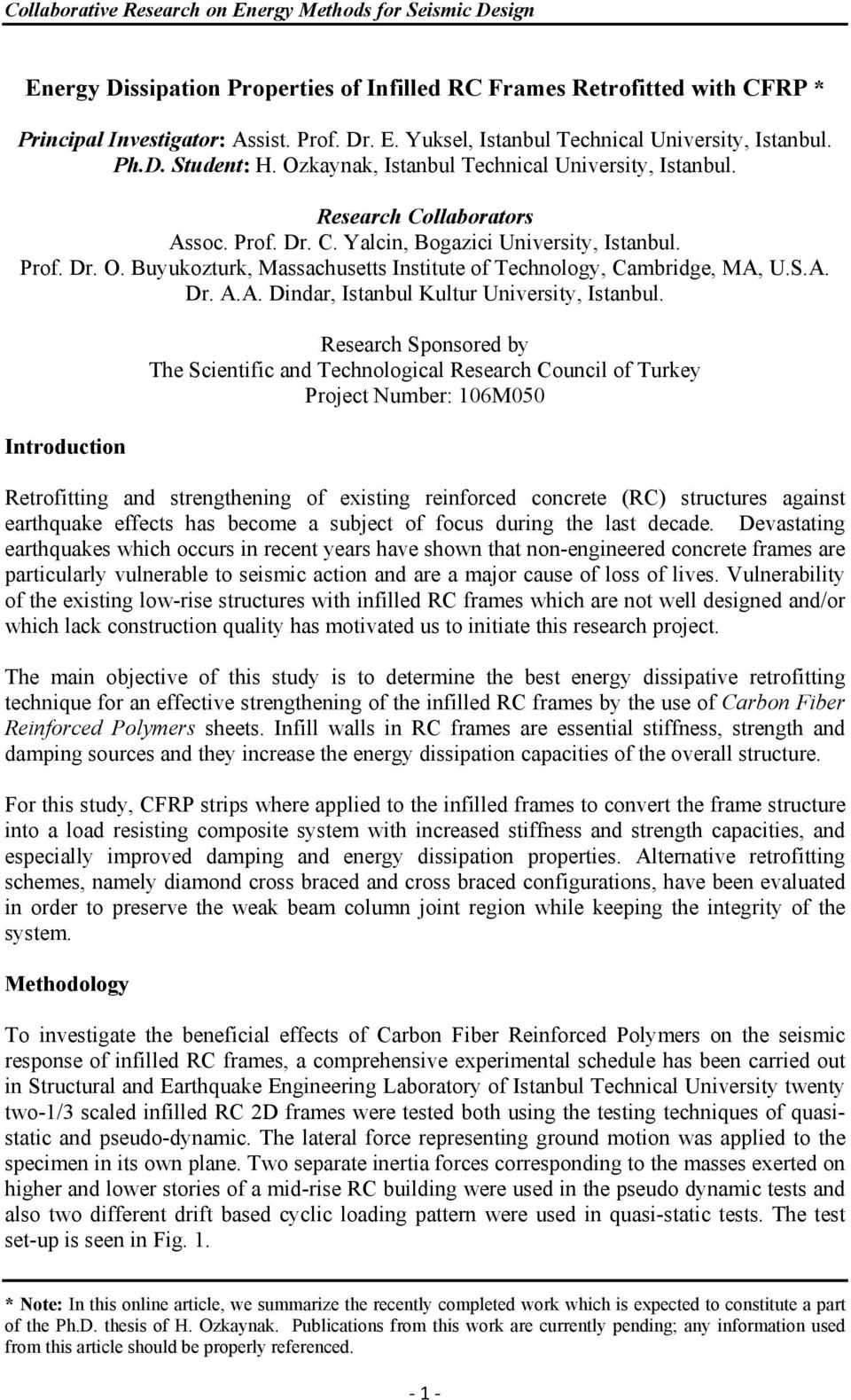
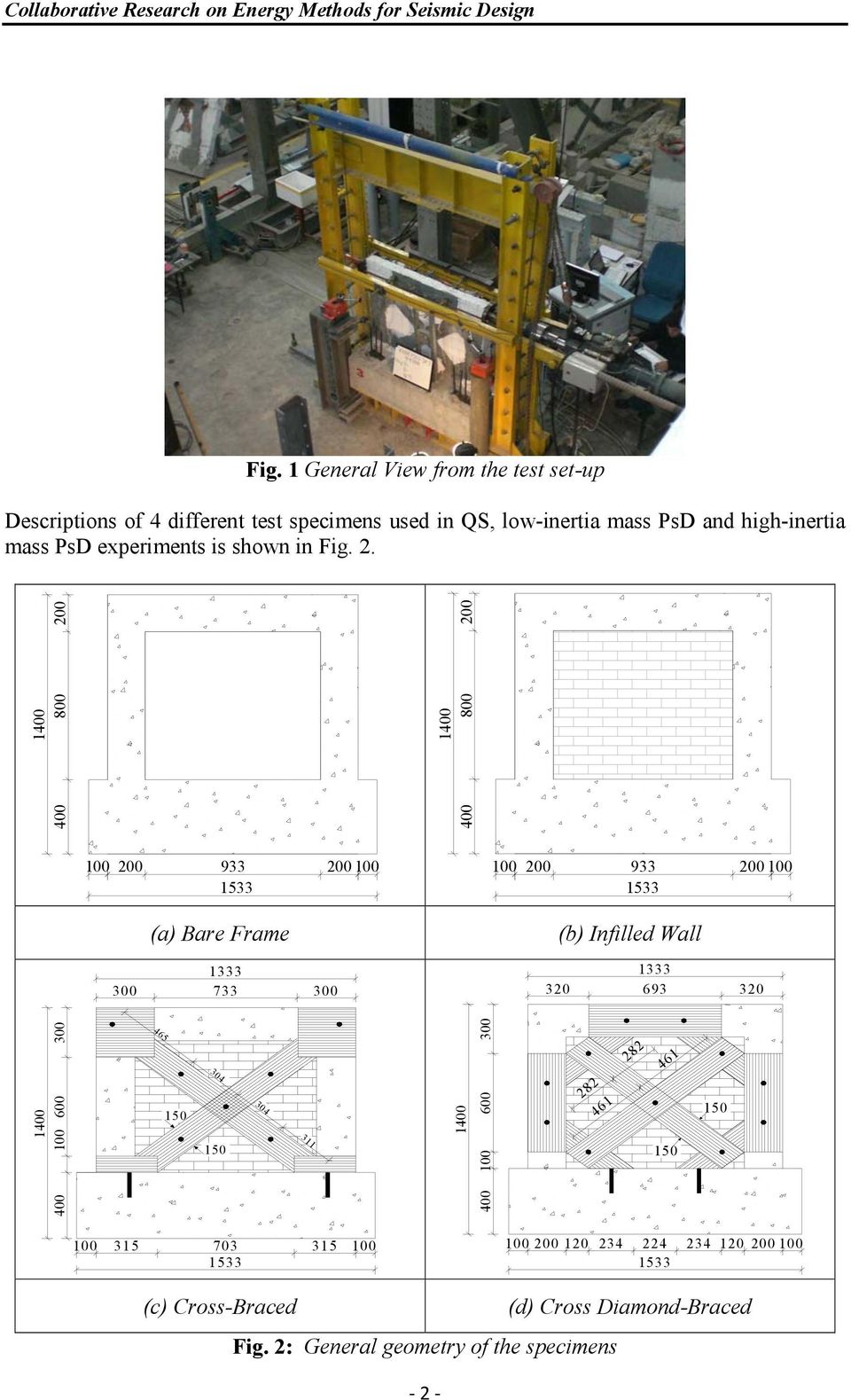
2 Fig. 1 General View from the test set-up Descriptions of 4 different test specimens used in QS, low-inertia mass PsD and high-inertia mass PsD experiments is shown in Fig (a) Bare Frame (b) Infilled Wall (c) Cross-Braced (d) Cross Diamond-Braced Fig. 2: General geometry of the specimens - 2 -
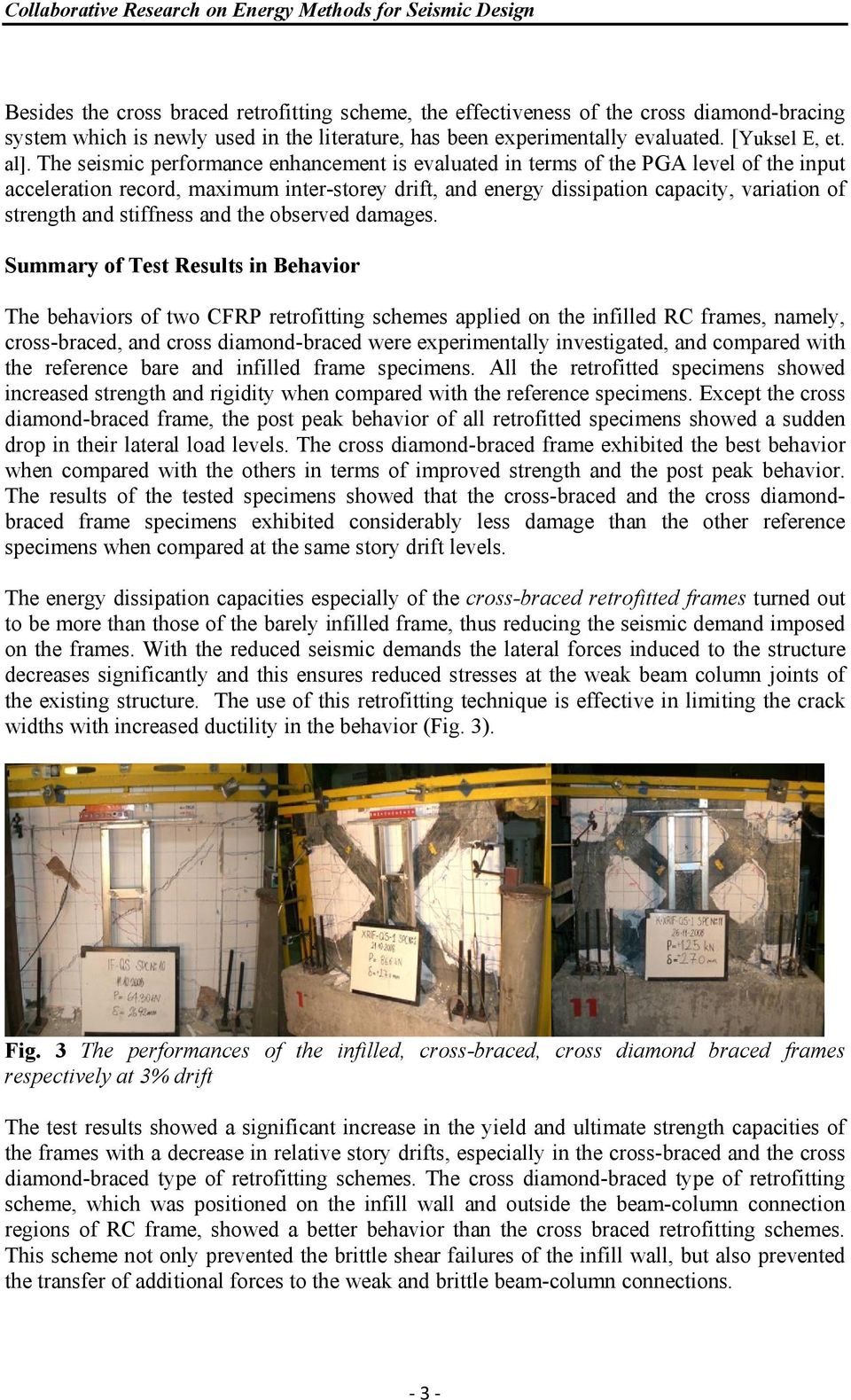
3 Besides the cross braced retrofitting scheme, the effectiveness of the cross diamond-bracing system which is newly used in the literature, has been experimentally evaluated. [Yuksel E, et. al]. The seismic performance enhancement is evaluated in terms of the PGA level of the input acceleration record, maximum inter-storey drift, and energy dissipation capacity, variation of strength and stiffness and the observed damages. Summary of Test Results in Behavior The behaviors of two CFRP retrofitting schemes applied on the infilled RC frames, namely, cross-braced, and cross diamond-braced were experimentally investigated, and compared with the reference bare and infilled frame specimens. All the retrofitted specimens showed increased strength and rigidity when compared with the reference specimens. Except the cross diamond-braced frame, the post peak behavior of all retrofitted specimens showed a sudden drop in their lateral load levels. The cross diamond-braced frame exhibited the best behavior when compared with the others in terms of improved strength and the post peak behavior. The results of the tested specimens showed that the cross-braced and the cross diamondbraced frame specimens exhibited considerably less damage than the other reference specimens when compared at the same story drift levels. The energy dissipation capacities especially of the cross-braced retrofitted frames turned out to be more than those of the barely infilled frame, thus reducing the seismic demand imposed on the frames. With the reduced seismic demands the lateral forces induced to the structure decreases significantly and this ensures reduced stresses at the weak beam column joints of the existing structure. The use of this retrofitting technique is effective in limiting the crack widths with increased ductility in the behavior (Fig. 3). Fig. 3 The performances of the infilled, cross-braced, cross diamond braced frames respectively at 3% drift The test results showed a significant increase in the yield and ultimate strength capacities of the frames with a decrease in relative story drifts, especially in the cross-braced and the cross diamond-braced type of retrofitting schemes. The cross diamond-braced type of retrofitting scheme, which was positioned on the infill wall and outside the beam-column connection regions of RC frame, showed a better behavior than the cross braced retrofitting schemes. This scheme not only prevented the brittle shear failures of the infill wall, but also prevented the transfer of additional forces to the weak and brittle beam-column connections
4 PGA CRACK PATTERN STRAINING ACTION 0.40 g d1'=1.2 k2'=1.2 e1'=1.2 j1>3.5 a1'=0.1 c1'=0.1 l2'>3.5 j1'=0.1 n2'=0.1 f1'=0.1 b1'>3.0 g1'=0.1 m2'=0.4 h1'=4.0 a1>> n2=0.3 o2=0.2 k1'<=0.1 d1=0.4 m2>> h1=0.8 j2>3.5 b1=0.6 i2=0.4 e1<=0.1 c1=1.0 f1=0.8 g1>> PUSH PULL b3'= g e3'=2.0 d3'=3.0 b3=1.4 a1'=0.1 c3'=0.2 c3=0.2 a1=2.0 PUSH PULL Fig. 4 Damage Propogations comparison between barely infilled and diamond-cross bracing strengthening technique. Test Results with Various Parameters Load-displacement relationships For each specimen type, the force-displacement envelope obtained from QS testing are drawn with the maximum restoring force and its corresponding displacement couples are displayed for various inertial mass conditions and PGA levels as seen in Fig. 5. (a) Bare frame (b) Infilled frame - 4 -
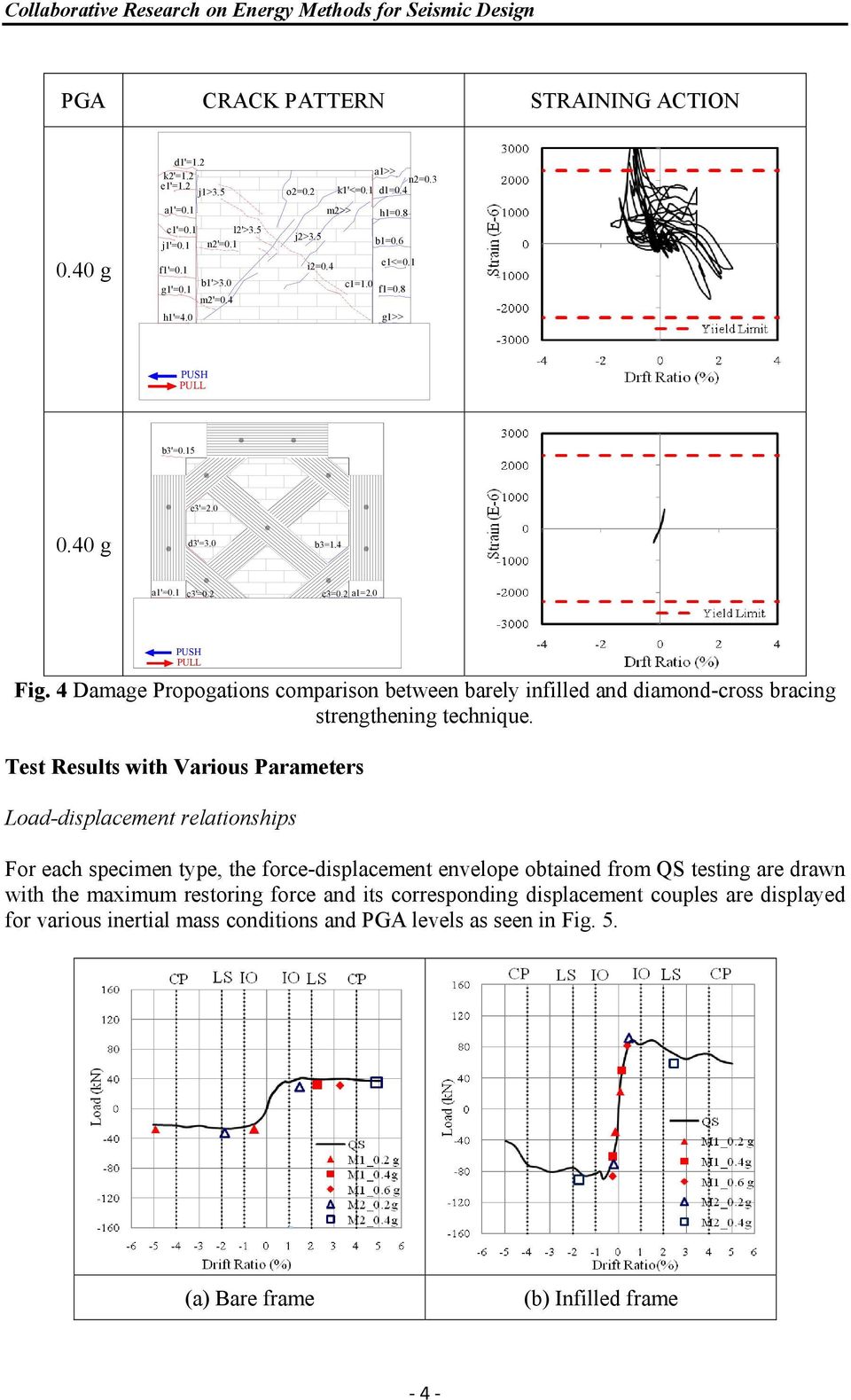
5 (c) Cross-Braced frame (d) Cross Diamond-Braced frame Fig. 5 Restoring force-lateral top displacements including drift-based performance limits according to FEMA356 The chosen loading pattern for QS testing and its corresponding response turned out to be comparable with the response obtained by the PsD testing. A significant increase in strength from 40 kn to 150 kn was determined in the retrofitted specimens, especially in cross diamond-braced retrofitting scheme, when compared to the results of bare and infilled wall specimens. Another important observation was that the scattered coordinates of maximum restoring force and its corresponding displacement couples in bare frame specimen were concentrated within the ascending branch of response curve and in Immediate Occupancy region in the retrofitted specimens. Here, the cross diamond-braced retrofitting scheme behaved better than the cross braced retrofitting scheme and survived PGA=0.6g intensity level with M2 condition. Stiffness For each specimen type, the stiffness envelope which defined as the slope of the line drawn at peak to peak response coordinates, are drawn with the maximum restoring force and corresponding displacement couples of PsD tests for various inertial mass conditions and PGA levels as shown in Fig. 6. (a) Bare frame (b) Infilled frame - 5 -

6 (c) Cross-Braced frame (d) Cross Diamond-Braced frame Fig. 6 Restoring force-lateral top displacement envelopes The stiffness values calculated for QS and PsD tests are consistent with each other. Also the observed stiffness values calculated for retrofitted specimens are well above the nonretrofitted ones. It was observed that the stiffness values corresponding to various PGA levels and mass conditions accumulated within the IO region for retrofitted specimens whereas these coordinates are scattered in bare and infilled frame specimens. This indicates the effectiveness of retrofitted specimens in terms of improved stiffness. Energy dissipation capacity The values of the cumulative energy dissipation were calculated as the enclosed area of hysteretic restoring force etc. The energy dissipation capacity of the retrofitted specimens increased significantly when compared with the non-retrofitted specimens as given in Fig. 7. Cross-braced retrofitted frame dissipated 4.6 times more energy than the bare frame. For the diamond cross-braced retrofitted frame this value was increased to 5.2. When the retrofitted frames are compared with the infilled frame, the priors dissipated 1.7 times more than the latter. (a) Bare frame (b) Infilled frame - 6 -

7 (c) Cross-Braced frame (d) Cross Diamond-Braced frame Fig. 7: Restoring force-lateral top displacement envelopes As seen in Fig. 7, although the dissipated energy values obtained from QS and PsD tests are close to each other and follow a similar trend, it was observed that the PsD energy values are slightly over the QS energy values. During testing, for the same level of drift, more damage was observed in PsD tests than QS tests. This may also explain less energy dissipation in QS tests given that damage and energy dissipation is directly proportional to each other. Also, the higher number of zero crossing in the loading pattern of PsD test might result more accumulated energy dissipation and thus more damage than that of QS test. The infilled frames with or without retrofitting, regardless of the PGA levels, had no effect on the overall performance in low mass inertia condition (M1). However, in higher mass condition (M2) the significance of retrofitting is apparent and from bare frame to retrofitted frames the cumulative energy couples move towards lesser dissipated energy levels indicating gained higher stiffness and strength. Concluding Remarks: 1. The maximum restoring forces and their corresponding drifts that were obtained from PsD tests showed a close behavior pattern, regardless of the level of inertial masses, compared with QS tests. 2. Although general behavior of any specimen could be obtained in QS test using a common drift-based loading protocol, it is not possible to predict the restoring force levels corresponding to PGA levels. However, in PsD tests, the maximum strengths for low (M 1 ) and high (M 2 ) inertial masses were observed at PGA=0.6g and 0.4g, respectively. 3. Only the flexural cracks for M 1 case on columns at the end of the PGA=0.6g PsD test were observed, while for M 2 case, in addition to flexural cracks, separation of wall from the frame as well as diagonal cracks on the wall were observed at the end of the PGA=0.4g PsD test. This shows the effect of inertial masses on the damage magnitude. Even though similar damages were observed during the QS tests, it is not possible to determine which level of PGA s created these damages. 4. When both test methods are compared for the same drift ratios, relatively more damage were observed during PsD tests compared with QS tests. On the other hand, in PsD tests, similar damages were observed for different inertial mass cases. It may be concluded that - 7 -

8 since the number of the reverse cycles in the PsD loading is greater than that of QS loading caused more damages in PsD tests. 5. The cumulative energy dissipation is found to be comparatively less in QS tests for the varying drift ratios due to the greater number of reverse cycles used in PsD tests. 6. Another outcome of this study was that the results from the different loading patterns in stiffness and energy dissipation values were similar to each other. Energy terms may be overestimated with the PsD results. This may lead to the conclusion that the QS loading pattern is appropriate. This aspect should be further studied. 7. The observed initial stiffness and critical damping ratios had a good convergence in both low and high mass inertia mass conditions. Also, there is an increase in the critical damping ratios in the infilled and retrofitted infilled frames. 8. From the PsD results in damage it is seen that for the same drift ratios PsD type loading may result in more damage in primary and secondary elements
Miss S. S. Nibhorkar 1 1 M. E (Structure) Scholar,
 Volume, Special Issue, ICSTSD Behaviour of Steel Bracing as a Global Retrofitting Technique Miss S. S. Nibhorkar M. E (Structure) Scholar, Civil Engineering Department, G. H. Raisoni College of Engineering
SEISMIC RETROFITTING OF STRUCTURES
 SEISMIC RETROFITTING OF STRUCTURES RANJITH DISSANAYAKE DEPT. OF CIVIL ENGINEERING, FACULTY OF ENGINEERING, UNIVERSITY OF PERADENIYA, SRI LANKA ABSTRACT Many existing reinforced concrete structures in present
Methods for Seismic Retrofitting of Structures
 Methods for Seismic Retrofitting of Structures Retrofitting of existing structures with insufficient seismic resistance accounts for a major portion of the total cost of hazard mitigation. Thus, it is
PERFORMANCE BASED SEISMIC EVALUATION AND RETROFITTING OF UNSYMMETRICAL MEDIUM RISE BUILDINGS- A CASE STUDY
 Paper No. 682 PERFORMANCE BASED SEISMIC EVALUATION AND RETROFITTING OF UNSYMMETRICAL MEDIUM RISE BUILDINGS- A CASE STUDY Jimmy Chandra, Pennung Warnitchai, Deepak Rayamajhi, Naveed Anwar and Shuaib Ahmad
Seismic Risk Evaluation of a Building Stock and Retrofit Prioritization
 Seismic Risk Evaluation of a Building Stock and Retrofit Prioritization Seismic risk assessment of large building stocks can be conducted at various s depending on the objectives, size of the building
bi directional loading). Prototype ten story
 NEESR SG: Behavior, Analysis and Design of Complex Wall Systems The laboratory testing presented here was conducted as part of a larger effort that employed laboratory testing and numerical simulation
SEISMIC RETROFITTING OF EARTHQUAKE-DAMAGED CONCRETE COLUMNS BY LATERAL PRE-TENSIONING OF FRP BELTS. K. Nasrollahzadeh Nesheli 1 and K.
 Proceedings of the 8 th U.S. National Conference on Earthquake Engineering April 18-22, 26, San Francisco, California, USA Paper No. 841 SEISMIC RETROFITTING OF EARTHQUAKE-DAMAGED CONCRETE COLUMNS BY LATERAL
Current Status of Seismic Retrofitting Technology
 CONTENTS Current Status of Seismic Retrofitting Technology Damages of Past Earthquakes Seismic Diagnosis Method Building Control Section Urban Building Division Bureau of Urban Development, TMG Seismic
SEISMIC DESIGN. Various building codes consider the following categories for the analysis and design for earthquake loading:
 SEISMIC DESIGN Various building codes consider the following categories for the analysis and design for earthquake loading: 1. Seismic Performance Category (SPC), varies from A to E, depending on how the
Control of Seismic Drift Demand for Reinforced Concrete Buildings with Weak First Stories
 Earthquake Yoshimura: Engineering Control and of Engineering Seismic Drift Seismology Demand for Reinforced Concrete Buildings with Weak First Stories 7 Volume 4, Number, September 3, pp. 7 3 Control of
Seismic Risk Prioritization of RC Public Buildings
 Seismic Risk Prioritization of RC Public Buildings In Turkey H. Sucuoğlu & A. Yakut Middle East Technical University, Ankara, Turkey J. Kubin & A. Özmen Prota Inc, Ankara, Turkey SUMMARY Over the past
Prepared For San Francisco Community College District 33 Gough Street San Francisco, California 94103. Prepared By
 Project Structural Conditions Survey and Seismic Vulnerability Assessment For SFCC Civic Center Campus 750 Eddy Street San Francisco, California 94109 Prepared For San Francisco Community College District
ASSESSMENT AND RETROFITTING OF EXISTING RC BUILDINGS IN VIETNAM IN TERMS OF EARTHQUAKE RESISTANCES
 GEM-SEA Workshop on Seismic Vulnerability of Buildings Nanyang Technological University, Singapore 1 st July 2013 ASSESSMENT AND RETROFITTING OF EXISTING RC BUILDINGS IN VIETNAM IN TERMS OF EARTHQUAKE
SEISMIC RETROFITTING TECHNIQUE USING CARBON FIBERS FOR REINFORCED CONCRETE BUILDINGS
 Fracture Mechanics of Concrete Structures Proceedings FRAMCOS-3 AEDIFICA TIO Publishers, D-79104 Freiburg, Germany SEISMIC RETROFITTING TECHNIQUE USING CARBON FIBERS FOR REINFORCED CONCRETE BUILDINGS H.
SEISMIC CAPACITY OF EXISTING RC SCHOOL BUILDINGS IN OTA CITY, TOKYO, JAPAN
 SEISMIC CAPACITY OF EXISTING RC SCHOOL BUILDINGS IN OTA CITY, TOKYO, JAPAN Toshio OHBA, Shigeru TAKADA, Yoshiaki NAKANO, Hideo KIMURA 4, Yoshimasa OWADA 5 And Tsuneo OKADA 6 SUMMARY The 995 Hyogoken-nambu
SEISMIC ANALYSIS AND RETROFITTING OF R.C.C STRUCTURE
 International Journal of Advanced Research in Biology Engineering Science and Technology (IJARBEST) Vol., Issue, April 1 SEISMIC ANALYSIS AND RETROFITTING OF R.C.C STRUCTURE M.R.NAVANEETHA KRISHNAN 1,
In-situ Load Testing to Evaluate New Repair Techniques
 In-situ Load Testing to Evaluate New Repair Techniques W.J. Gold 1 and A. Nanni 2 1 Assistant Research Engineer, Univ. of Missouri Rolla, Dept. of Civil Engineering 2 V&M Jones Professor, Univ. of Missouri
Seismic performance evaluation of an existing school building in Turkey
 CHALLENGE JOURNAL OF STRUCTURAL MECHANICS 1 (4) (2015) 161 167 Seismic performance evaluation of an existing school building in Turkey Hüseyin Bilgin * Department of Civil Engineering, Epoka University,
SEISMIC ANALYSIS OF RC FRAMED STRUCTURES RETROFITTED WITH STEEL BRACES
 SEISMIC ANALYSIS OF RC FRAMED STRUCTURES RETROFITTED WITH STEEL BRACES Ciro FAELLA Full Professor University of Salerno Via Ponte don Melillo, 8484 Fisciano (SA), Italy [email protected] Carmine LIMA Research
Comparison of Seismic Performance of D-region of Existing RC Structures Designed with Different Recommendations
 Comparison of Seismic Performance of D-region of Existing RC Structures Designed with Different Recommendations Balthasar Novák 1, K.Ramanjaneyulu 2, Constanze Roehm 3 and Saptarshi Sasmal 4 1 Professor,
Hybrid simulation evaluation of the suspended zipper braced frame
 Hybrid simulation evaluation of the suspended zipper braced frame Tony Yang Post-doctoral scholar University of California, Berkeley Acknowledgements: Andreas Schellenberg, Bozidar Stojadinovic, Jack Moehle
REVISION OF GUIDELINE FOR POST- EARTHQUAKE DAMAGE EVALUATION OF RC BUILDINGS IN JAPAN
 10NCEE Tenth U.S. National Conference on Earthquake Engineering Frontiers of Earthquake Engineering July 21-25, 2014 Anchorage, Alaska REVISION OF GUIDELINE FOR POST- EARTHQUAKE DAMAGE EVALUATION OF RC
TECHNICAL NOTE. Design of Diagonal Strap Bracing Lateral Force Resisting Systems for the 2006 IBC. On Cold-Formed Steel Construction INTRODUCTION
 TECHNICAL NOTE On Cold-Formed Steel Construction 1201 15th Street, NW, Suite 320 W ashington, DC 20005 (202) 785-2022 $5.00 Design of Diagonal Strap Bracing Lateral Force Resisting Systems for the 2006
Objective To conduct Charpy V-notch impact test and determine the ductile-brittle transition temperature of steels.
 IMPACT TESTING Objective To conduct Charpy V-notch impact test and determine the ductile-brittle transition temperature of steels. Equipment Coolants Standard Charpy V-Notched Test specimens Impact tester
Advanced Retrofitting Methods and Techniques for RC Building: State of an Art
 Advanced Retrofitting Methods and Techniques for RC Building: State of an Art Miss. Swati Sanjay Nibhorkar * M. E (Structure) Scholar, Civil Engineering Department, G. H. Raisoni College of Engg and Management,
Rigid and Braced Frames
 Rigid Frames Rigid and raced Frames Rigid frames are identified b the lack of pinned joints within the frame. The joints are rigid and resist rotation. The ma be supported b pins or fied supports. The
Specification for Structures to be Built in Disaster Areas
 Ministry of Public Works and Settlement Government of Republic of Turkey Specification for Structures to be Built in Disaster Areas PART III - EARTHQUAKE DISASTER PREVENTION (Chapter 5 through Chapter
SEISMIC UPGRADE OF OAK STREET BRIDGE WITH GFRP
 13 th World Conference on Earthquake Engineering Vancouver, B.C., Canada August 1-6, 2004 Paper No. 3279 SEISMIC UPGRADE OF OAK STREET BRIDGE WITH GFRP Yuming DING 1, Bruce HAMERSLEY 2 SUMMARY Vancouver
THE EFFECT OF STIRRUPS AND HOOKED STEEL FIBERS INSTEAD ON MOMENT-ROTATION CAPACITY OF BEAM-COLUMN CONNECTIONS
 THE EFFECT OF STIRRUPS AND HOOKED STEEL FIBERS INSTEAD ON MOMENT-ROTATION CAPACITY OF BEAM-COLUMN CONNECTIONS Assist. Prof. Dr. S. KamilAkın 1, Assist. Prof. Dr. Nail Kara 1, 1 Department of Civil Engineering,
NUMERICAL ANALYSIS OF THE SEISMIC PERFORMANCE OF STEEL FRAMES INFILLED WITH COMPOSITE PANELS
 1NCEE Tenth U.S. National Conference on Earthquake Engineering Frontiers of Earthquake Engineering July 21-25, 214 Anchorage, Alaska NUMERICAL ANALYSIS OF THE SEISMIC PERFORMANCE OF STEEL FRAMES INFILLED
Optimum proportions for the design of suspension bridge
 Journal of Civil Engineering (IEB), 34 (1) (26) 1-14 Optimum proportions for the design of suspension bridge Tanvir Manzur and Alamgir Habib Department of Civil Engineering Bangladesh University of Engineering
Seismic Retrofit of Existing Buildings: Innovative Alternatives
 Seismic Retrofit of Existing Buildings: Innovative Alternatives Moe Cheung and Simon Foo Public Works & Government Services Canada Hull, Quebec, Canada Jacques Granadino Public Works & Government Services
Modern Codes for Design of Concrete Concrete Structures Presentation Outline
 Modern Codes for Design of Concrete Structures James K. Wight F.E. Richart, Jr. Professor of Civil Eng. University of Michigan Presentation Outline Current Codes Where did they come from? What is their
1.054/1.541 Mechanics and Design of Concrete Structures (3-0-9) Outline 1 Introduction / Design Criteria for Reinforced Concrete Structures
 Prof. Oral Buyukozturk Massachusetts Institute of Technology Outline 1 1.054/1.541 Mechanics and Design of Concrete Structures (3-0-9) Outline 1 Introduction / Design Criteria for Reinforced Concrete Structures
Requirements for the Use of PRESSS Moment-Resisting Frame Systems
 Requirements for the Use of PRESSS Moment-Resisting Frame Systems Neil M. Hawkins, Ph.D. Professor Emeritus Department of Civil Engineering University of Illinois at Urbana-Champaign Urbana, Illinois S.
Behaviour of Prefabricated Timber Wall Elements Under Static and Cyclic Loading
 Behaviour of Prefabricated Timber Wall Elements Under Static and Cyclic Loading Patrick Schädle, Hans Joachim Blaß Lehrstuhl für Ingenieurholzbau und Baukonstruktionen Universität Karlsruhe, Germany 1
4B-2. 2. The stiffness of the floor and roof diaphragms. 3. The relative flexural and shear stiffness of the shear walls and of connections.
 Shear Walls Buildings that use shear walls as the lateral force-resisting system can be designed to provide a safe, serviceable, and economical solution for wind and earthquake resistance. Shear walls
Nonlinear numerical analysis of SRC-RC transfer columns based on OpenSEES
 3rd International Conference on Material, Mechanical and Manufacturing Engineering (IC3ME 2015) Nonlinear numerical analysis of SRC-RC transfer columns based on OpenSEES Hao Gu 1 a * Yun ZOU 1 Ming Chen
Nonlinear Structural Analysis For Seismic Design
 NIST GCR 10-917-5 NEHRP Seismic Design Technical Brief No. 4 Nonlinear Structural Analysis For Seismic Design A Guide for Practicing Engineers Gregory G. Deierlein Andrei M. Reinhorn Michael R. Willford
Numerical modelling of shear connection between concrete slab and sheeting deck
 7th fib International PhD Symposium in Civil Engineering 2008 September 10-13, Universität Stuttgart, Germany Numerical modelling of shear connection between concrete slab and sheeting deck Noémi Seres
APE T CFRP Aslan 500
 Carbon Fiber Reinforced Polymer (CFRP) Tape is used for structural strengthening of concrete, masonry or timber elements using the technique known as Near Surface Mount or NSM strengthening. Use of CFRP
Rehabilitation of Unreinforced Brick Masonry Walls Using Composites
 Rehabilitation of Unreinforced Brick Masonry Walls Using Composites Mohamed AbdelMonem ElGawady, Pierino Lestuzzi, Marc Badoux Swiss Federal Institute of Technology at Lausanne EPFL, Switzerland Introduction
Structural Retrofitting For Earthquake Resistance
 Structural Retrofitting For Earthquake Resistance Ruben Boroschek WHO Disaster Mitigation in Health Facilities University of Chile [email protected] www.hospitalseguro.cl The following paper is part
Stress Strain Relationships
 Stress Strain Relationships Tensile Testing One basic ingredient in the study of the mechanics of deformable bodies is the resistive properties of materials. These properties relate the stresses to the
SEISMIC DESIGN OF MULTI-STORY BUILDINGS WITH METALLIC STRUCTURAL FUSES. R. Vargas 1 and M. Bruneau 2 ABSTRACT
 Proceedings of the 8 th U.S. National Conference on Earthquake Engineering April 18-22, 26, San Francisco, California, USA Paper No. 28 SEISMIC DESIGN OF MULTI-STORY BUILDINGS WITH METALLIC STRUCTURAL
Chapter 3 DESIGN AND CONSTRUCTION FEATURES IMPORTANT TO SEISMIC PERFORMANCE
 Chapter 3 DESIGN AND CONSTRUCTION FEATURES IMPORTANT TO SEISMIC PERFORMANCE To satisfy the performance goals of the NEHRP Recommended Seismic Provisions, a number of characteristics are important to the
EVALUATION OF SEISMIC RESPONSE - FACULTY OF LAND RECLAMATION AND ENVIRONMENTAL ENGINEERING -BUCHAREST
 EVALUATION OF SEISMIC RESPONSE - FACULTY OF LAND RECLAMATION AND ENVIRONMENTAL ENGINEERING -BUCHAREST Abstract Camelia SLAVE University of Agronomic Sciences and Veterinary Medicine of Bucharest, 59 Marasti
Seismic Retrofit of Reinforced Concrete Beam- Column T-Joints in Bridge Piers with FRP Composite Jackets
 SP-258 1 Seismic Retrofit of Reinforced Concrete Beam- Column T-Joints in Bridge Piers with FRP Composite Jackets by C.P. Pantelides and J. Gergely Synopsis: The research described encompasses laboratory
Seismic Isolation Retrofitting of Japanese Wooden Buildings
 Seismic Isolation Retrofitting of Japanese Wooden Buildings Summary Junko Suga Building Design Department Takenaka Corporation, Osaka Main Office Osaka, Japan Hiroyuki Ueda Building Design Department Takenaka
SEISMIC DESIGN OF HIGHWAY BRIDGES
 Journal of Japan Association for Earthquake Engineering, Vol.4, No.3 (Special Issue), 2004 SEISMIC DESIGN OF HIGHWAY BRIDGES Kazuhiko KAWASHIMA 1 and Shigeki UNJOH 2 1 Member of JAEE, Professor, Department
Expected Performance Rating System
 Expected Performance Rating System In researching seismic rating systems to determine how to best classify the facilities within the Portland Public School system, we searched out what was used by other
FRP Repair Methods for Unreinforced Masonry Buildings Subject to Cyclic Loading
 SP-230 17 FRP Repair Methods for Unreinforced Masonry Buildings Subject to Cyclic Loading by P.B. Foster, J. Gergely, D.T. Young, W.M. McGinley, and A. Corzo Synopsis: Unreinforced masonry building specimens
Rehabilitation of a 1985 Steel Moment- Frame Building
 Rehabilitation of a 1985 Steel Moment- Frame Building Gregg Haskell, a) M.EERI A 1985 steel moment frame is seismically upgraded using passive energy dissipation, without adding stiffness to the system.
Fracture and strain rate behavior of airplane fuselage materials under blast loading
 EPJ Web of Conferences 6, 6 42017 (2010) DOI:10.1051/epjconf/20100642017 Owned by the authors, published by EDP Sciences, 2010 Fracture and strain rate behavior of airplane fuselage materials under blast
SLAB DESIGN. Introduction ACI318 Code provides two design procedures for slab systems:
 Reading Assignment SLAB DESIGN Chapter 9 of Text and, Chapter 13 of ACI318-02 Introduction ACI318 Code provides two design procedures for slab systems: 13.6.1 Direct Design Method (DDM) For slab systems
DEVELOPMENT OF A NEW TEST FOR DETERMINATION OF TENSILE STRENGTH OF CONCRETE BLOCKS
 1 th Canadian Masonry Symposium Vancouver, British Columbia, June -5, 013 DEVELOPMENT OF A NEW TEST FOR DETERMINATION OF TENSILE STRENGTH OF CONCRETE BLOCKS Vladimir G. Haach 1, Graça Vasconcelos and Paulo
REPAIR AND RETROFIT OF BRIDGES DAMAGED BY THE 2010 CHILE MAULE EARTHQUAKE
 Proceedings of the International Symposium on Engineering Lessons Learned from the 2011 Great East Japan Earthquake, March 1-4, 2012, Tokyo, Japan REPAIR AND RETROFIT OF BRIDGES DAMAGED BY THE 2010 CHILE
SEISMIC RETROFITTING OF REINFORCED CONCRETE BUILDINGS USING TRADITIONAL AND INNOVATIVE TECHNIQUES
 ISET Journal of Earthquake Technology, Paper No. 454, Vol. 42, No. 2-3, June-September 25, pp. 21-46 SEISMIC RETROFITTING OF REINFORCED CONCRETE BUILDINGS USING TRADITIONAL AND INNOVATIVE TECHNIQUES Giuseppe
DISASTER RESISTANCE EARTHQUAKES AND STRUCTURES
 DISASTER RESISTANCE EARTHQUAKES AND STRUCTURES EARTHQUAKES Origin of earthquakes The earth was a single land about two hundred million years ago. This land split progressively over a long period of time
Aseismic retrofitting of unreinforced masonry walls using FRP
 Composites: Part B 37 (26) 148 162 www.elsevier.com/locate/compositesb Aseismic retrofitting of unreinforced masonry walls using FRP Mohamed A. ElGawady*, Pierino Lestuzzi, Marc Badoux Swiss Federal Institute
Seismic Assessment and Retrofitting of Structures: Eurocode8 Part3 and the Greek Code on Seismic Structural Interventions
 Working Group 7: Earthquake Resistant Structures Geneva, 25 September 2015 Seismic Assessment and Retrofitting of Structures: Eurocode8 Part3 and the Greek Code on Seismic Structural Interventions Prof.
Steel joists and joist girders are
 THE STEEL CONFERENCE Hints on Using Joists Efficiently By Tim Holtermann, S.E., P.E.; Drew Potts, P.E.; Bob Sellers, P.E.; and Walt Worthley, P.E. Proper coordination between structural engineers and joist
CE591 Lecture 8: Shear Walls
 CE591 Lecture 8: Shear Walls Introduction History, examples Benefits Disadvantages Plate Girder Analogy Behavior of Special Plate Shear Walls (SPSW) Design of SPSW Important considerations Special Plate
Seismic retrofitting on structures in urban areas
 Disaster Management and Human Health Risk II 161 Seismic retrofitting on structures in urban areas A. K. Desai Applied Mechanics Department, S V National Institute of Technology, Surat, India Abstract
SEISMIC DESIGN PROVISIONS FOR PRECAST CONCRETE STRUCTURES. S.K. Ghosh, Ph. D. President S.K. Ghosh Associates Inc. Northbrook, IL BACKGROUND
 SEISMIC DESIGN PROVISIONS FOR PRECAST CONCRETE STRUCTURES S.K. Ghosh, Ph. D. President S.K. Ghosh Associates Inc. Northbrook, IL BACKGROUND Until recently, precast concrete structures could be built in
A Case Study Comparing Two Approaches for Applying Area Loads: Tributary Area Loads vs Shell Pressure Loads
 1 A Case Study Comparing Two Approaches for Applying Area Loads: Tributary Area Loads vs Shell Pressure Loads By Dr. Siriwut Sasibut (Application Engineer) S-FRAME Software Inc. #1158 13351 Commerce Parkway
Introduction to Solid Modeling Using SolidWorks 2012 SolidWorks Simulation Tutorial Page 1
 Introduction to Solid Modeling Using SolidWorks 2012 SolidWorks Simulation Tutorial Page 1 In this tutorial, we will use the SolidWorks Simulation finite element analysis (FEA) program to analyze the response
EARTHQUAKE DISASTER MITIGATION USING INNOVATIVE RETROFITTING METHOD
 J. SE Asian Appl. Geol., Sep Dec 2010, Vol. 2(3), pp. 225 231 EARTHQUAKE DISASTER MITIGATION USING INNOVATIVE RETROFITTING METHOD Eric Augustus J. Tingatinga 1 and Hideji Kawakami 2 1 Institute of Civil
Technical Notes 3B - Brick Masonry Section Properties May 1993
 Technical Notes 3B - Brick Masonry Section Properties May 1993 Abstract: This Technical Notes is a design aid for the Building Code Requirements for Masonry Structures (ACI 530/ASCE 5/TMS 402-92) and Specifications
What is Seismic Retrofitting?
 What is Seismic Retrofitting? SEISMIC RETROFITTING A Seismic Retrofit provides existing structures with more resistance to seismic activity due to earthquakes. In buildings, this process typically includes
CE591 Fall 2013 Lecture 26: Moment Connections
 CE591 Fall 2013 Lecture 26: Moment Connections Explain basic design procedure for moment (FR) connections Explain considerations for connections in momentresisting frames for seismic demands Describe problems
Seismic Retrofit for Reinforced Concrete Building Structures
 Seismic Retrofit for Reinforced Concrete Building Structures Consequence-Based Engineering (CBE) Institute Final Report Jong-Wha Bai Texas A&M University Mid-America Earthquake Center CM-4: Structure Retrofit
Seismically retrofitting reinforced concrete moment resisting frames by using expanded metal panels
 Faculté des Sciences Appliquées Département d'architecture, Géologie, Environnement et Constructions Secteur Ingénierie Structurale Seismically retrofitting reinforced concrete moment resisting frames
Tensile Testing Laboratory
 Tensile Testing Laboratory By Stephan Favilla 0723668 ME 354 AC Date of Lab Report Submission: February 11 th 2010 Date of Lab Exercise: January 28 th 2010 1 Executive Summary Tensile tests are fundamental
Chapter. Earthquake Damage: Types, Process, Categories
 3 Chapter Earthquake Damage: Types, Process, Categories Earthquakes leave behind a trail of damage and destruction. People s lives are affected by the loss of loved ones, destruction of property, economic
A Decade of Performance of FRP-Repaired Concrete Structures
 A Decade of Performance of FRP-Repaired Concrete Structures Shamim A. Sheikh and S. Mukhtar Homam Department of Civil Engineering University of Toronto Toronto, Canada ABSTRACT During the last ten years,
Abaqus Technology Brief. Automobile Roof Crush Analysis with Abaqus
 Abaqus Technology Brief Automobile Roof Crush Analysis with Abaqus TB-06-RCA-1 Revised: April 2007. Summary The National Highway Traffic Safety Administration (NHTSA) mandates the use of certain test procedures
The Original Carbon Fiber Reinforced Polymer System
 Infrastructure The Original Carbon Fiber Reinforced Polymer System Phone: 52.292.39 Toll Free: 866.38.269 Fax: 52.48.5274 282 E. Fort Lowell Rd. Tucson, AZ 8576 www.dowaksausa.com Test results are supported
ASSESSMENT AND PROPOSED STRUCTURAL REPAIR STRATEGIES FOR BRIDGE PIERS IN TAIWAN DAMAGED BY THE JI-JI EARTHQUAKE ABSTRACT
 ASSESSMENT AND PROPOSED STRUCTURAL REPAIR STRATEGIES FOR BRIDGE PIERS IN TAIWAN DAMAGED BY THE JI-JI EARTHQUAKE Pei-Chang Huang 1, Graduate Research Assistant / MS Candidate Yao T. Hsu 2, Ph.D., PE, Associate
Earthquakes and Data Centers
 7x24 Exchange Fall Symposium September 11, 2013 Hilton Bellevue Andrew W. Taylor, Ph.D., S.E., FACI Earthquake Hazards 2 September 11, 2013 1 Cascadia Earthquake Sources Figure Credit: Craig Weaver, Pacific
Structural Axial, Shear and Bending Moments
 Structural Axial, Shear and Bending Moments Positive Internal Forces Acting Recall from mechanics of materials that the internal forces P (generic axial), V (shear) and M (moment) represent resultants
CRACK DETECTION METHODS USING RADIO FREQUENCY IDENTIFICATION AND ELECTRICALLY CONDUCTIVE MATERIALS
 CRACK DETECTION METHODS USING RADIO FREQUENCY IDENTIFICATION AND ELECTRICALLY CONDUCTIVE MATERIALS Koichi Morita 1 and Kazuya Noguchi 2 1 Senior Research Engineer, Building Research Institute, Tsukuba,
Analysis and Repair of an Earthquake-Damaged High-rise Building in Santiago, Chile
 Analysis and Repair of an Earthquake-Damaged High-rise Building in Santiago, Chile J. Sherstobitoff Ausenco Sandwell, Vancouver, Canada P. Cajiao AMEC, Vancouver, Canada P. Adebar University of British
TRAVELING WAVE EFFECTS ON NONLINEAR SEISMIC BEHAVIOR OF CONCRETE GRAVITY DAMS
 TRAVELING WAVE EFFECTS ON NONLINEAR SEISMIC BEHAVIOR OF CONCRETE GRAVITY DAMS H. Mirzabozorg 1, M. R. Kianoush 2 and M. Varmazyari 3 1,3 Assistant Professor and Graduate Student respectively, Department
SEISMIC RETROFIT DESIGN CRITERIA
 SEISMIC RETROFIT DESIGN CRITERIA British Columbia Ministry of Transportation June 30, 2005 Prepared by: Recommended by: Approved by: Don Kennedy, P.Eng., Associated Engineering (BC) Sharlie Huffman, P.
Performance of Existing Reinforced Concrete Columns under Bidirectional Shear & Axial Loading
 Performance of Existing Reinforced Concrete Columns under Bidirectional Shear & Axial Loading Laura M. Flores University of California, San Diego REU Institution: University of California, Berkeley REU
Lab for Deflection and Moment of Inertia
 Deflection and Moment of Inertia Subject Area(s) Associated Unit Lesson Title Physics Wind Effects on Model Building Lab for Deflection and Moment of Inertia Grade Level (11-12) Part # 2 of 3 Lesson #
In this study analytical investigation of effect of retrofit application using carbon fiber (CFRP) on seismic behavior of a monumental building at
 EFFECT OF CFRP RETROFIT RETROFITTING TING APPLICATION ON SEISMIC BEHAVIOR OF HISTORIC MONUMENTAL BUI BUILD LDIING NGS S AT CAPPADOCIA REGI REGION OF TURKEY Baki OZTURK T. SENTURK and C. C. YILMAZ NIGDE