
Flying RNAV (GNSS) Approaches in Private and General Aviation Aircraft CAP 773
|
|
|
- Lorin Cummings
- 9 years ago
- Views:
Transcription
1 Flying RNAV (GNSS) Approaches in Private and General Aviation Aircraft CAP 773
2 Published by the Civil Aviation Authority, 2014 Civil Aviation Authority, Aviation House, Gatwick Airport South, West Sussex, RH6 0YR. You can copy and use this text but please ensure you always use the most up to date version and use it in context so as not to be misleading, and credit the CAA. First published Enquiries regarding the content of this publication should be addressed to: The latest version of this document is available in electronic format at where you may also register for notification of amendments.

3 Part 1: Introduction to PBN and RNAV approach operations Contents Contents 1 Part 1: Introduction to PBN and RNAV approach operations Introduction Background Basic GPS More recent developments References Acronym Glossary 8 Part 2: Performance-Based Navigation (PBN) What is PBN? The PBN manual (ICAO doc 9613) PBN in the UK Terminology Benefits from PBN What PBN can offer Introduction to approach applications LNAV (Lateral Navigation) LP (Localiser Performance) LNAV/VNAV (Lateral Navigation / Vertical Navigation) LPV (Localiser Performance with Vertical Guidance) 14 RNP Approach Model 15 Part 3: Technical information, requirements & recommendations Human factors Data Entry and Familiarity with the System Automation Induced Complacency Training and licensing Practice instrument approaches 18 December 2014 Page 1

4 Part 1: Introduction to PBN and RNAV approach operations Instructors GPS equipment Receiver Standard General System Integrity & RAIM Selective availability (SA) Installation Certification Existing Installations Basic Area Navigation (B-RNAV) & Precision Area Navigation (P-RNAV) Approval System settings and display parameters Selection of approach procedures Published Procedures Display Scaling Horizontal Alarm Limit (HAL) Overlay Approaches Vertical Navigation Aeronautical database checks User waypoints Air traffic considerations The RNAV approach chart Flight planning Route planning NOTAMs & NANUs SBAS NOTAMs Availability of Alternate Aerodrome 31 Part 4: Pilots guide to flying RNAV (GNSS) approaches in general aviation aircraft Pre-flight planning & checks Approach selection Overlay approaches Integrity, accuracy & RAIM prediction 32 December 2014 Page 2

5 Part 1: Introduction to PBN and RNAV approach operations Using SBAS Receiver Software Aeronautical Database Other Equipment Functional Check on Start-up System Settings and Display Parameters Use of autopilot Making the approach Terrain awareness and terrain displays Baro-aided receivers Setting the display Gross error crosschecks Adjustment to ETA Setup for the missed approach Activating, arming or enabling the approach Radar vectors & ATC procedures Spatial orientation & situation awareness Final approach Monitoring the final descent D approaches D approaches Missed approach procedures Abnormal procedures 42 Part 5: Instructors guide Introduction Organising the training Instructors Training facilities Flight Training 45 Appendix 1: Recommended syllabus of training for RNAV (GNSS) approach operations 47 Appendix 2: RNAV (GNSS) Approach checklist 54 December 2014 Page 3

6 Part 1: Introduction to PBN and RNAV approach operations Appendix 3: ATC operational procedures and RTF phraseology 58 Appendix 4: Sample RNAV (GNSS) approach chart 60 Appendix 5: GPS Technical Information - Extract from CASA CAAP 179A-1(1) 61 December 2014 Page 4

7 Part 1: Introduction to PBN and RNAV approach operations Part 1: Introduction to PBN and RNAV approach operations 1.1 Introduction Global Navigation Satellite Systems (GNSS) have changed the face of navigation dramatically in recent years, in that they can give an accurate and instant readout of position almost anywhere in the world. At the time of writing, the most familiar GNSS system is the US Department of Defense Global Positioning System (GPS), and this document is based on the use of GPS aviation receivers. GPS has already brought the opportunity for accurate Area Navigation (RNAV) within the budget of most aircraft operators. The development of GNSS based instrument approaches has now also brought the requisite technology for RNAV approach operations to light and private aircraft. RNAV brings with it many new techniques. As with any new technology, there is a natural transition from the experience and knowledge of the old, to the techniques of the new. During this time, the opportunities for error and misunderstanding are great and, for a time at least, the new technology is likely to represent an increased risk of error before the benefits of the system s greater accuracy can be realised. This document contains information on training and operational use of GPS for the flying of RNAV (GNSS) Approaches.. Whilst, for the purposes of background, some information is given on the concept of Performance-Based Navigation (PBN) and RNAV, this document focuses mainly on the application, training and operational use of RNAV approach operations. This document is intended as a guide to pilots and instructors of privately operated, non-complex general aviation aircraft but much of the information may also be of use to other operators in the preparation of their own PBN training and operations programmes. Further guidance on the wider use of GPS for VFR navigation in light aircraft is available from the CAA in Safety Sense Leaflet 25 which may be printed or downloaded free of charge from the CAA website at December 2014 Page 5

8 Part 1: Introduction to PBN and RNAV approach operations 1.2 Background IFR operations depend upon a variety of navigation aids and techniques. A combination of these effectively provides the monitor and crosscheck necessary to capture both technical and human error. Where a single technical facility becomes the primary steering reference (primary reference), in instrument meteorological conditions (IMC), situational awareness and some form of crosscheck become critical to flight safety. 1.3 Basic GPS For the basic GPS signal in space, whilst there are monitors of the signal available to the aircraft, it is still possible for the satellites to give erroneous information and for receivers to display it. Once an anomaly has been detected, without access to or reception of the correcting (differential) signals, it can take up to several hours for the error to be removed or corrected by the GPS system itself. The GNSS receiver manufacturers have, therefore, developed systems, internal to some of their aircraft receivers, known as aircraft-based augmentation systems (ABAS), most of which now include some sort of integrity monitor such as Receiver Autonomous Integrity Monitor (RAIM) - see paragraph below. The GPS constellation and the ground stations are controlled from Colorado, in the United States. The system has demonstrated exceptional reliability, but like all systems, it has suffered technical and human failure. The satellite clocks are critical to the integrity of the system and are subject to regular intervention. Furthermore, the designs for receivers vary; particularly in the software that manages the satellite data for navigation. It is for these reasons that GPS must be used with knowledge and caution when used as the primary steering reference, for flight critical applications, such as instrument approach. 1.4 More recent developments Satellite Based Augmentation System (SBAS) SBAS augments the core satellite constellation by providing ranging, integrity and correction information via geostationary satellites. This system comprises a network of ground reference stations that observe the satellites signals, and master stations that process this observed data and generate SBAS messages for uplink to the geostationary satellites which, in turn, broadcast the SBAS message to the users. Within Europe the SBAS is provided by the European Geostationary Navigation Overlay Service (EGNOS). Many receivers are now available with a Vertical Navigation (VNAV) function using SBAS services. Other SBAS services provided or under development in other regions of the world include: Wide Area Augmentation System (WAAS)* in the USA. Multi-functional Satellite Augmentation System (MSAS) in Japan GPS Aided Geo Augmented Navigation (GAGAN) in India December 2014 Page 6

9 Part 1: Introduction to PBN and RNAV approach operations System for Differential Corrections and Monitoring (SDCM) in Russia *The term WAAS also tends to be used in a wider generic reference to SBAS services elsewhere in the world. These services are expected to be interoperable, meaning the receivers should interpret whichever signal(s) they see providing an apparently seamless operation from one area of coverage to another. Further information on the status and performance of GPS may be obtained from References ICAO PBN Manual (Doc 9613) EASA AMC 20-27A EASA AMC EASA Opinion Number 01/2005 on The acceptance of navigation database suppliers dated 14th January 2005 TSO / ETSO C129A, C145A() and C146A() FAA AC () EASA AMC 20-5 EASA Part FCL CAA CAP 804 FAA AC CAA Safety Sense Leaflet 25 Note: Appendix 5 is an extract from Australian Civil Aviation Safety Authority (CASA) Civil Aviation Advisory Publication CAAP 179A-(1) and is reproduced with the kind permission of CASA December 2014 Page 7

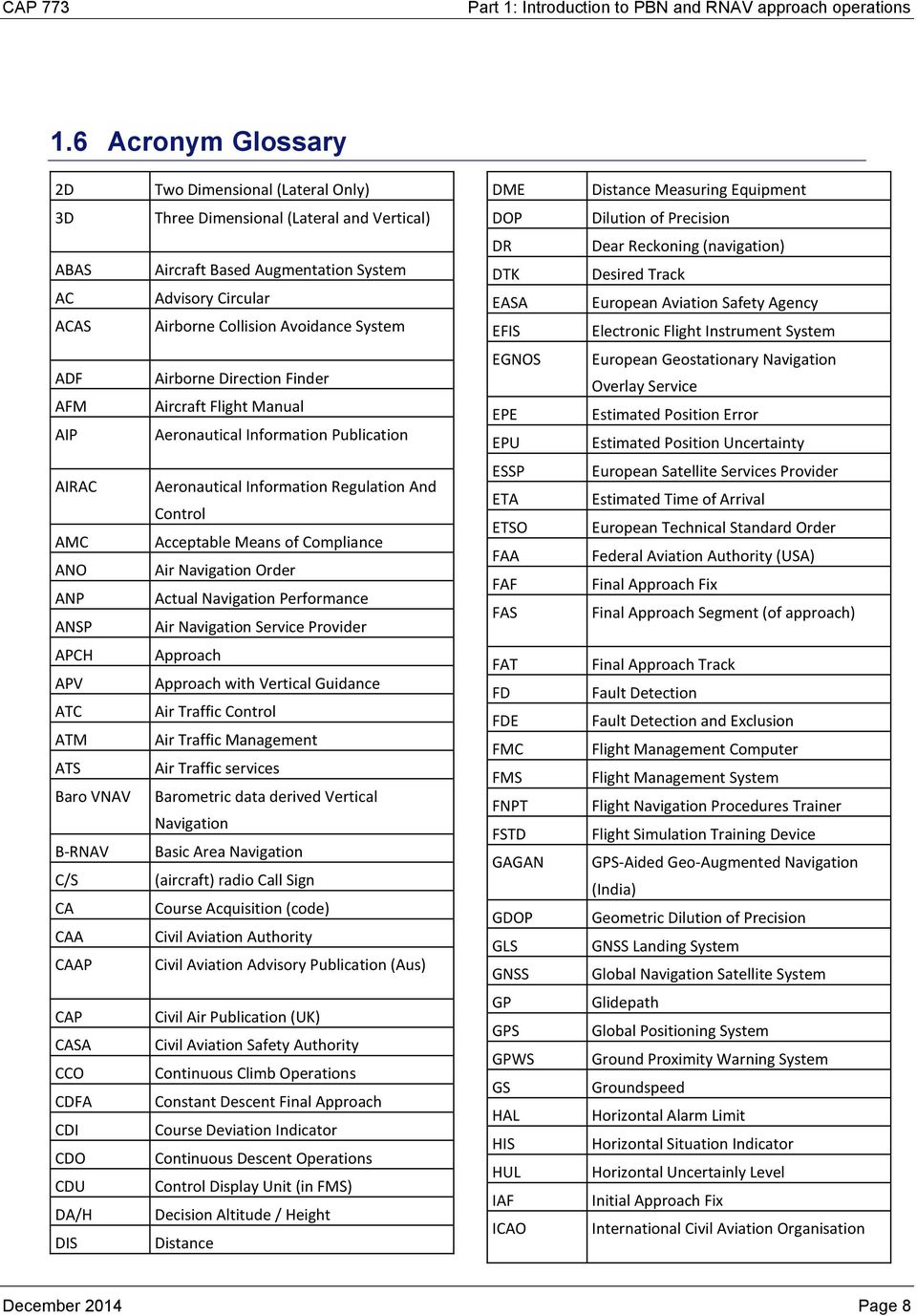
10 Part 1: Introduction to PBN and RNAV approach operations 1.6 Acronym Glossary 2D Two Dimensional (Lateral Only) DME Distance Measuring Equipment 3D Three Dimensional (Lateral and Vertical) DOP Dilution of Precision ABAS AC ACAS Aircraft Based Augmentation System Advisory Circular Airborne Collision Avoidance System DR DTK EASA EFIS Dear Reckoning (navigation) Desired Track European Aviation Safety Agency Electronic Flight Instrument System ADF AFM AIP Airborne Direction Finder Aircraft Flight Manual Aeronautical Information Publication EGNOS EPE EPU European Geostationary Navigation Overlay Service Estimated Position Error Estimated Position Uncertainty AIRAC AMC ANO ANP ANSP Aeronautical Information Regulation And Control Acceptable Means of Compliance Air Navigation Order Actual Navigation Performance Air Navigation Service Provider ESSP ETA ETSO FAA FAF FAS European Satellite Services Provider Estimated Time of Arrival European Technical Standard Order Federal Aviation Authority (USA) Final Approach Fix Final Approach Segment (of approach) APCH APV ATC ATM ATS Baro VNAV B-RNAV C/S CA CAA CAAP Approach Approach with Vertical Guidance Air Traffic Control Air Traffic Management Air Traffic services Barometric data derived Vertical Navigation Basic Area Navigation (aircraft) radio Call Sign Course Acquisition (code) Civil Aviation Authority Civil Aviation Advisory Publication (Aus) FAT FD FDE FMC FMS FNPT FSTD GAGAN GDOP GLS GNSS Final Approach Track Fault Detection Fault Detection and Exclusion Flight Management Computer Flight Management System Flight Navigation Procedures Trainer Flight Simulation Training Device GPS-Aided Geo-Augmented Navigation (India) Geometric Dilution of Precision GNSS Landing System Global Navigation Satellite System CAP CASA CCO CDFA CDI CDO CDU DA/H DIS Civil Air Publication (UK) Civil Aviation Safety Authority Continuous Climb Operations Constant Descent Final Approach Course Deviation Indicator Continuous Descent Operations Control Display Unit (in FMS) Decision Altitude / Height Distance GP GPS GPWS GS HAL HIS HUL IAF ICAO Glidepath Global Positioning System Ground Proximity Warning System Groundspeed Horizontal Alarm Limit Horizontal Situation Indicator Horizontal Uncertainly Level Initial Approach Fix International Civil Aviation Organisation December 2014 Page 8
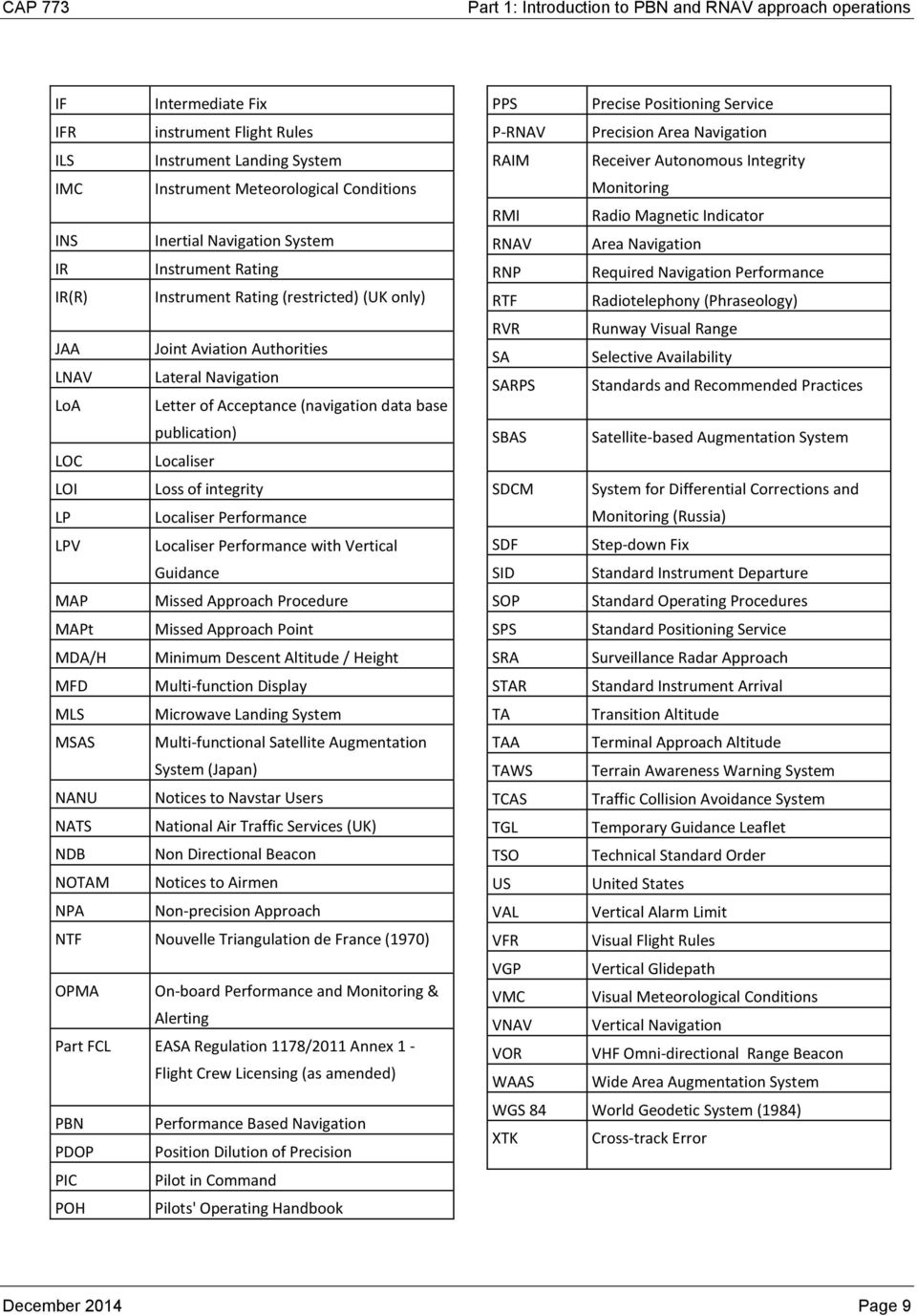
11 Part 1: Introduction to PBN and RNAV approach operations IF Intermediate Fix IFR instrument Flight Rules ILS Instrument Landing System IMC Instrument Meteorological Conditions INS Inertial Navigation System IR Instrument Rating IR(R) Instrument Rating (restricted) (UK only) JAA Joint Aviation Authorities LNAV Lateral Navigation LoA Letter of Acceptance (navigation data base publication) LOC Localiser LOI Loss of integrity LP Localiser Performance LPV Localiser Performance with Vertical Guidance MAP Missed Approach Procedure MAPt Missed Approach Point MDA/H Minimum Descent Altitude / Height MFD Multi-function Display MLS Microwave Landing System MSAS Multi-functional Satellite Augmentation System (Japan) NANU Notices to Navstar Users NATS National Air Traffic Services (UK) NDB Non Directional Beacon NOTAM Notices to Airmen NPA Non-precision Approach NTF Nouvelle Triangulation de France (1970) OPMA On-board Performance and Monitoring & Alerting Part FCL EASA Regulation 1178/2011 Annex 1 - Flight Crew Licensing (as amended) PBN Performance Based Navigation PDOP Position Dilution of Precision PIC Pilot in Command POH Pilots' Operating Handbook PPS P-RNAV RAIM RMI RNAV RNP RTF RVR SA SARPS SBAS SDCM SDF SID SOP SPS SRA STAR TA TAA TAWS TCAS TGL TSO US VAL VFR VGP VMC VNAV VOR WAAS Precise Positioning Service Precision Area Navigation Receiver Autonomous Integrity Monitoring Radio Magnetic Indicator Area Navigation Required Navigation Performance Radiotelephony (Phraseology) Runway Visual Range Selective Availability Standards and Recommended Practices Satellite-based Augmentation System System for Differential Corrections and Monitoring (Russia) Step-down Fix Standard Instrument Departure Standard Operating Procedures Standard Positioning Service Surveillance Radar Approach Standard Instrument Arrival Transition Altitude Terminal Approach Altitude Terrain Awareness Warning System Traffic Collision Avoidance System Temporary Guidance Leaflet Technical Standard Order United States Vertical Alarm Limit Visual Flight Rules Vertical Glidepath Visual Meteorological Conditions Vertical Navigation VHF Omni-directional Range Beacon Wide Area Augmentation System WGS 84 World Geodetic System (1984) XTK Cross-track Error December 2014 Page 9
12 Part 2: Performance-Based Navigation (PBN) Part 2: Performance-Based Navigation (PBN) 2.1 What is PBN? PBN aims to ensure global standardisation of RNAV and RNP specifications and to limit the proliferation of navigation specifications in use world-wide. It is a new concept based on the use of RNAV systems. Significantly, it is a move from a limited statement of required performance accuracy to the following: The International Civil Aviation Organisation (ICAO) PBN Manual (Doc 9613) definition is: Area navigation based on performance requirements for aircraft operating along an Air Traffic Services (ATS) route, on an instrument approach procedure or in a designated airspace. Where: Airborne performance requirements are expressed in navigation specifications in terms of accuracy, integrity, continuity and functionality needed for the proposed operation in the context of a particular airspace concept. Within the airspace concept, the availability of GNSS Signal-In-Space or that of some other applicable navigation infrastructure has to be considered in order to enable the navigation application. PBN is then described through means of RNAV and RNP applications with respective RNAV and RNP operations. PBN is one of several enablers of an airspace concept. The others are Communications, ATS Surveillance and Air Traffic Management (ATM). The PBN Concept is comprised of three components: The Navigation Specification, the Navaid Infrastructure and the Navigation Application. The Navigation Specification prescribes the performance requirements in terms of accuracy, integrity, continuity for proposed operations in a particular Airspace. The Navigation Specification also describes how these performance requirements are to be achieved i.e., which navigation functionalities are required to achieve the prescribed performance. Associated with the navigation specification are requirements related to pilot knowledge and training and operational approval. A Navigation Specification is either a Required Navigation Performance (RNP) specification or an RNAV specification. An RNP specification includes a requirement for On board Performance Monitoring and Alerting (OPMA) where the receiver provides an alert to the flight crew if the navigation position is in error, while an RNAV specification does not. The Navaid Infrastructure relates to ground- or space-based navigation aids that are called up in each Navigation Specification. The availability of the navaid infrastructure has to be considered in order to enable the navigation application. December 2014 Page 10

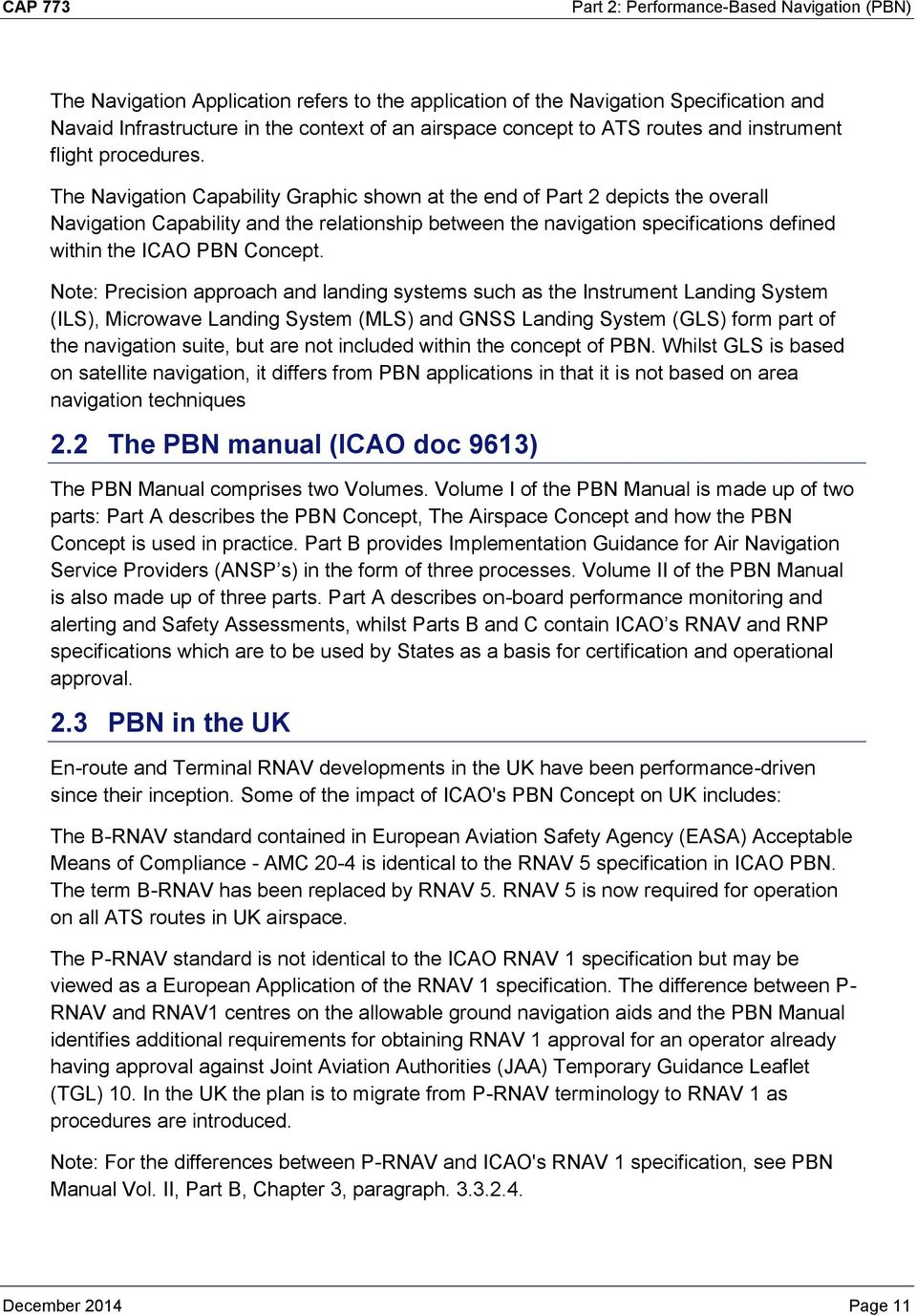
13 Part 2: Performance-Based Navigation (PBN) The Navigation Application refers to the application of the Navigation Specification and Navaid Infrastructure in the context of an airspace concept to ATS routes and instrument flight procedures. The Navigation Capability Graphic shown at the end of Part 2 depicts the overall Navigation Capability and the relationship between the navigation specifications defined within the ICAO PBN Concept. Note: Precision approach and landing systems such as the Instrument Landing System (ILS), Microwave Landing System (MLS) and GNSS Landing System (GLS) form part of the navigation suite, but are not included within the concept of PBN. Whilst GLS is based on satellite navigation, it differs from PBN applications in that it is not based on area navigation techniques 2.2 The PBN manual (ICAO doc 9613) The PBN Manual comprises two Volumes. Volume I of the PBN Manual is made up of two parts: Part A describes the PBN Concept, The Airspace Concept and how the PBN Concept is used in practice. Part B provides Implementation Guidance for Air Navigation Service Providers (ANSP s) in the form of three processes. Volume II of the PBN Manual is also made up of three parts. Part A describes on-board performance monitoring and alerting and Safety Assessments, whilst Parts B and C contain ICAO s RNAV and RNP specifications which are to be used by States as a basis for certification and operational approval. 2.3 PBN in the UK En-route and Terminal RNAV developments in the UK have been performance-driven since their inception. Some of the impact of ICAO's PBN Concept on UK includes: The B-RNAV standard contained in European Aviation Safety Agency (EASA) Acceptable Means of Compliance - AMC 20-4 is identical to the RNAV 5 specification in ICAO PBN. The term B-RNAV has been replaced by RNAV 5. RNAV 5 is now required for operation on all ATS routes in UK airspace. The P-RNAV standard is not identical to the ICAO RNAV 1 specification but may be viewed as a European Application of the RNAV 1 specification. The difference between P- RNAV and RNAV1 centres on the allowable ground navigation aids and the PBN Manual identifies additional requirements for obtaining RNAV 1 approval for an operator already having approval against Joint Aviation Authorities (JAA) Temporary Guidance Leaflet (TGL) 10. In the UK the plan is to migrate from P-RNAV terminology to RNAV 1 as procedures are introduced. Note: For the differences between P-RNAV and ICAO's RNAV 1 specification, see PBN Manual Vol. II, Part B, Chapter 3, paragraph December 2014 Page 11
14 Part 2: Performance-Based Navigation (PBN) Approach operations in the UK are already RNP Approach compliant. All future UK navigation developments will be aligned with ICAO's PBN Strategy 2.4 Terminology Approach applications based on GNSS are classified RNP Approach (RNP APCH) in accordance with the PBN concept and include existing RNAV(GNSS) approach procedures designed with a straight segment. The flight deck displays and charting will likely retain the RNAV (GNSS) label for some time and until standardisation can be achieved, pilots should expect to use the terms RNP APCH and RNAV (GNSS) interchangeably. This document therefore uses both terms interchangeably. 2.5 Benefits from PBN The principal benefit derived from PBN is the transition to a total RNAV environment. This will lead to flight efficiency and allow optimisation of the airspace including reduced holding containment areas. Without the constraints of navigating via fixed, ground-based aids, the airspace designer has a powerful tool in terms of positioning of routes and instrument flight procedures in relation to areas of congestion or population density. Of concern to the industry is the potential cost from proliferation of regional and State navigation specifications. PBN brings about a more disciplined approach through a limited set of specifications which are globally applied. The aircraft and equipment manufacturers therefore have greater certainty in their market place and can anticipate a tangible return on their capital investment in the aircraft s performance capability. From an aircraft operator perspective, certain carriers have long claimed that their fleet capability far exceeded anything the airspace could offer by way of capacity and environmental benefits. So with the modern air transport aircraft having this enhanced performance and functionality, PBN starts to harness that aircraft capability. For those with less well equipped aircraft, pressure to upgrade or be faced with exclusion from certain routes or procedures, has to be applied as an incentive rather than as a threat to their business. 2.6 What PBN can offer Predictable and repeatable path trajectories moving to a systemised environment with designed interactions; Closer spaced routes; Curved path transitions; Greater tactical flexibility through parallel offsets; and Higher integrity from RNP which brings greater assurance to the safety equation and reduces flight crew workload. December 2014 Page 12
15 Part 2: Performance-Based Navigation (PBN) From an airspace and airports perspective the envisaged benefits of PBN include: Increase in capacity in controlled airspace; Greater access to airports, especially for General Aviation (GA) aircraft which have traditionally been limited to higher operating minima due to their basic equipment; Improvement in safety through onboard monitoring and performance alerting to the flight crew; and Reduction in the effects that flights have on the environment from more efficient routes, more accurate path keeping for noise abatement and, in conjunction with other airspace initiatives such as increased Transition Altitude (TA), the increased use of Continuous Climb Operations (CCO) and Continuous Descent Operations (CDO). Increase in capacity in controlled airspace; From an ATM service provider perspective the envisaged benefits of PBN include: Reduced service cost through reduced navigational infrastructure, increased systemisation and increased controller productivity; Improvement in safety through the introduction of flight path monitoring tools and alerting to controllers; and Improvement in the quality of the service to meet new airspace-user requirements. The navigation infrastructure is a key element in PBN and the transition to an RNAV environment is linked to a move towards a space-based navigation environment (GNSS) and a move away from dependence on traditional ground-based navigation infrastructure such as VOR and NDB facilities. This in turn will allow rationalisation of infrastructure leading to savings from capital investment; maintenance and spectrum utilisation with commensurate savings passed onto the operators through reduced navigation services charges and a requirement to carry less equipment. 2.7 Introduction to approach applications Approach Applications which are classified as RNP Approach (APCH) in accordance with ICAO Doc 9613 Performance Based Navigation (PBN) Manual (and ICAO state Letter SP 65/4-10/53) give access to minima (on an instrument approach procedure) designated as: LNAV (Lateral Navigation) This is a Non-Precision or 2D Approach with Lateral only navigation guidance provided by GNSS and an Aircraft Based Augmentation System (ABAS). Receiver Autonomous Integrity Monitoring (RAIM) is a form of ABAS. Lateral guidance is linear with accuracy to within +/- 0.3 NM parallel to either side of the final approach track. December 2014 Page 13

16 Part 2: Performance-Based Navigation (PBN) LP (Localiser Performance) This is a Non-Precision or 2D Approach with Lateral only navigation guidance provided by GNSS and SBAS. The EGNOS is a form of SBAS in Europe. The lateral guidance is angular with increasing sensitivity as the aircraft continues along the final approach track; much like a localiser indication LNAV/VNAV (Lateral Navigation / Vertical Navigation) This is a 3D Approach Procedure with Vertical Guidance (APV). The lateral navigation guidance is provided by GPS and Aircraft Based Augmentation Systems (ABAS) such as RAIM in the same way as for LNAV. The vertical guidance is provided by a Barometric Altimeter. This type of approach is commonly known as APV/Baro VNAV. Lateral guidance is normally linear with accuracy to within +/- 0.3 NM parallel to either side of the final approach track. Some aircraft systems may provide angular guidance, however, and pilots should be aware of the display format of their system. Vertical guidance derived from the barometric data in the Flight Management System (FMS) is based on normal altimetry and any displacement from the indicated glidepath represents the same altitude error throughout the final approach. This is fundamentally different from the angular indications such as on an ILS glidepath. WARNING! At the time of writing this document (Autumn 2014), the use of SBAS to provide augmentation for the VNAV element of a notified LNAV/VNAV approach is not permitted in the UK. Notwithstanding any certification for RNAV VNAV approach operations using SBAS, aircraft which are not certified for the use of barometric VNAV data are currently precluded from flying approach operations to LNAV/VNAV minima. These aircraft are not authorised to continue RNAV approach operations below the published LNAV-only minima LPV (Localiser Performance with Vertical Guidance) This is an Approach Procedure with Vertical Guidance (APV). The Lateral and Vertical guidance is provided by GPS and SBAS. Lateral and vertical guidance are angular with increasing sensitivity as the aircraft progresses down the final approach track; much like an ILS indication. NOTE: The instrument approach procedures associated with RNP APCH are entitled RNAV (GNSS) to reflect that GNSS is the primary navigation system. With the inherent onboard performance monitoring and alerting provided by GNSS, the navigation specification qualifies as RNP, however these procedures pre-date PBN, so the chart name has remained as RNAV. December 2014 Page 14

17 Part 2: Performance-Based Navigation (PBN) RNP Approach Model NOTE: APV (Approach with Vertical Guidance) is defined in ICAO Doc 8168 as: An instrument procedure which utilizes lateral and vertical guidance but does not meet the requirements established for precision approach and landing operations. December 2014 Page 15

18 Part 2: Performance-Based Navigation (PBN) Navigation Capability Graphic December 2014 Page 16

19 Part 3: Technical information, requirements & recommendations Part 3: Technical information, requirements & recommendations 3.1 Human factors Data Entry and Familiarity with the System All systems using RNAV principles must compute the aircraft s position velocity and time, in order that steering and other information towards a future position can be presented to the aircraft crew. This is accomplished either by the crew manually entering the coordinates of the next position, or by the automatic extraction of these co-ordinates from a database. Experience of RNAV systems, and Flight FMS in general, has identified the pitfalls of waypoint entry error at the receiver as well as inaccuracies and errors in the database itself. Extensive research by the UK CAA, and experience by other States, has shown that human error, often the result of a lack of familiarity with the airborne equipment, represents the major hazard in operations using RNAV systems. Therefore, it is imperative that pilots understand their system thoroughly and are able to determine whether it is safe to proceed. This requires robust procedures, which check for possible errors in the computer database, monitor continued performance of the RNAV systems and enable pilots to identify and avoid not only their own mistakes but also errors in the information presented to them Automation Induced Complacency Whilst the GPS is an excellent system, it is neither error free nor totally dependable. However, GPS has an excellent record and the continued experience of using such a highly accurate navigation system can lead tan impression of infallibility. Monitoring of the system for gross errors becomes tedious; as the system appears to do it all for you and the temptation simply to trust the system regardless, becomes powerful. This can result in a form of complacency that leaves the pilot more vulnerable to error and to failure or inaccuracy of the system for whatever reason. A GPS receiver with RAIM provides some integrity monitoring of position which apparently reduces the requirement for cross checking. However, it cannot alert the pilot to other flight technical or data error. The pilot(s) must continue to monitor data entry, system management, progress against intended flight-path and steering performance against a Course Deviation Indicator (CDI) or Flight Director/Autopilot. December 2014 Page 17

20 Part 3: Technical information, requirements & recommendations Training and licensing The advent of RNAV approach operations presents new opportunities for human error at a critical phase of flight. The programming skills required of the crew, and the errors and failure modes of approach-enabled RNAV systems (such as GPS), are different from those associated with the established network of ground-based approach aids. Pilots using any type of GNSS equipment must ensure that they are familiar with and competent in operating that type of equipment, before using it in flight The wider aviation community generally now accepts that thorough training of pilots in the procedures required for use of these systems is paramount. Flying an instrument approach procedure in IMC in the UK requires the pilot to hold either an Instrument Rating (IR) or an IMC Rating or IR(R) (Instrument rating (Restricted). The syllabus of training for these ratings should already include all types of Non-precision Approach (NPA), including Surveillance Radar Approach (SRA), Localiser (LOC) only, VOR and NDB, with and without DME. When operating under Visual Flight Rules (VFR), all pilots are recommended to obtain training from an appropriately experienced or qualified instructor (see below) before using any RNAV system, including GPS. For IFR operations, public and commercial air transport operators are required by the operating regulations and, in the UK, Schedule 9 to the Air Navigation Order (ANO) 2009 to ensure that their pilots have been tested as to their proficiency in using instrument approach-to-land systems of the type in use at the aerodrome of intended landing and any alternate aerodrome. Private operators are strongly advised to follow suit and engage in a structured training programme before attempting to fly any RNAV approach procedure, including GNSS approaches, and when operating any RNAV system. UK Flying schools and training organisations are encouraged to develop differences training for RNAV (GNSS) approaches and include this in any IMC or Instrument Rating syllabus as soon as practical. Detailed guidance on training structure and techniques, together with suggested syllabus content is contained in the INSTRUCTORS GUIDE in Part 5 of this document Practice instrument approaches Pilots are reminded of the requirements of the Rules of the Air Regulations. In the case of practice approaches in Visual Meteorological Conditions (VMC), Rule 24 of the 2007 Rules requires not only that the appropriate air traffic control unit be informed beforehand, but that a competent observer must be carried. Rule 23 requires that if the pilot is flying in simulated instrument flight conditions, a safety pilot must be carried with access to dual controls and adequate vision. December 2014 Page 18

21 Part 3: Technical information, requirements & recommendations Instructors Instructors carrying out this training must hold a recognised, current instructor certificate and be qualified to teach for the IR or IMC rating (IR(R) in an EASA licence) in accordance with Part FCL, and be entitled to act as Pilot in Command (PIC) on the aircraft during any flight instruction. The Instructors Guide in Part 5 of this document is intended as an aide-memoire for Instructors. The Guide should not be considered in isolation and instructors should themselves be trained in the use of the particular system on which they are teaching. Instructors should be familiar with all available technical and training material available for the system, including manuals, training and demonstration programmes, CD s, DVD s and simulators etc. Use of these facilities in student training courses is strongly encouraged. 3.2 GPS equipment Receiver Standard General The additional accuracy required on approach requires additional logic and functionality (to that required for en-route navigation) suitable for navigation through the initial, intermediate, final and missed approach phases of an instrument approach. The occasions when these additional criteria can be met may be fewer, giving rise to lower GPS availability. Not all receivers are configured to meet the criteria for RNAV(GNSS) approach operations (giving the impression of good availability) as they may be configured only to meet the requirements for en-route accuracy. Approach operations with lateral guidance (LNAV) only To fly a non-precision RNAV(GNSS) approach, to LNAV only minima, all GNSS receivers and equipment must be manufactured in accordance with at least Technical/European Technical Standard Order (TSO/ETSO) C129a Class A1, TSO/ETSO 145a or TSO/ETSO 146a. These receivers must be correctly installed in the aircraft (see 3.3 below). Approach operations with lateral and vertical guidance using APV Baro-VNAV GNSS stand-alone navigation systems If the RNAV installation is based on GNSS stand-alone system, the equipment shall be approved in accordance with TSO-C129a/ETSO-C129a Class A1 or ETSO-C146()/TSO- C146() Class Gamma, operational class 1, 2 or 3. Multi-sensor navigation systems If the RNAV installation is based on GNSS sensor equipment used in a multi-sensor system (e.g. FMS), the GNSS sensor shall be approved in accordance with TSO-C129( )/ ETSO-C129( ) Class B1, C1, B3, C3 or ETSO-C145( )/TSO-C145( ) class Beta, operational class 1, 2 or 3. December 2014 Page 19
22 Part 3: Technical information, requirements & recommendations Multi-sensor systems using GNSS should be approved in accordance with AC20-138C or TSO-C115c/ETSO-C115c, as well as having been demonstrated for RNP capability. December 2014 Page 20
23 Part 3: Technical information, requirements & recommendations Note 1: For GNSS receiver approved in accordance with ETSO-C129()/TSO-C129(), capability for satellite Fault Detection and Exclusion (FDE) is recommended, to improve Continuity of function. Altimeter sensor requirement for APV Baro-VNAV operation In addition to requirements for the GNSS receiver systems above, the RNAV equipment that automatically determines aircraft position in the vertical plane should use inputs from equipment that can include: a) ETSO-C106/TSO-C106, Air Data Computer; or b) Air data system, ARINC 706, Mark 5 Air Data System, ARINC 738 (Air Data and Inertial Reference System); or c) Barometric altimeter system compliant with DO-88 Altimetry and/or ED-26 MPS for Airborne Altitude Measurements and Coding Systems ; or d) Type certified integrated systems providing an Air Data System capability comparable to item (b). For further information on airworthiness criteria for approach operations with APV Baro- VNAV see ED 2013/026R of 12/09/ AMC 20-27A Approach operations with lateral and vertical guidance using LPV with SBAS GNSS SBAS Stand-alone Navigation system GNSS SBAS stand-alone equipment should be approved in accordance with ETSO-C146c Class Gamma, operational class 3. Note: Equipment approved to ETSO-C145/146 could be eligible for: Integrated navigation system incorporating a GNSS SBAS sensor The equipment should incorporate a GNSS SBAS sensor approved in accordance with ETSO-C145c Class Beta, operational class 3. For further information on airworthiness criteria for LPV approach operations using SBAS see Annex ii to ED 2012/014R of 17/09/ AMC Note 2: GNSS receivers approved in accordance with ETSO-145/TSO-C145a or ETSO- C146/TSO-C146a (DO 229C) and used outside SBAS coverage area may trigger inappropriate Loss of Integrity (LOI) warning. DO229D paragraph provides a correct satellite selection scheme requirement to address this issue. Although most of the ETSO-C145/TSO-C145a or ETSO-146/TSO-C146a approved receivers comply with this satellite selection scheme, a confirmatory statement from the equipment manufacturer is still necessary. It should be noted that such confirmatory statement is not necessary for equipment compliant with TSO-C145b or TSO-C146b. December 2014 Page 21
24 Part 3: Technical information, requirements & recommendations None of the available hand-held receivers are approved for Instrument Flight Rules (IFR) or approach operations System Integrity & RAIM In the context of GPS, integrity is the system s own ability to identify when it may be unreliable for navigation and to provide timely and appropriate warning to the user. There always remains, of course, the possibility of a false alarm and a failure of the monitor itself, to provide such an alarm. Without RAIM, however, the pilot has no assurance as to the accuracy of the GPS position. Herein lies the essential difference between an RNAV and an RNP navigation specification. An RNAV specification requires no on-board augmentation of the navigation solution whereas RNP specification does. All the RNAV (GNSS) approach procedures published in the UK are compliant with the PBN Navigation Specification. RAIM is a form of augmentation that enables a GPS system to be RNP compliant. At present, three methods exist in airborne equipment, to provide this integrity information: 1. Receiver Autonomous Integrity Monitor (RAIM) RAIM is a mandatory part of the software function of the ETSO C129 () and 145/6 () standard receivers detailed at above. The RAIM function is intended to provide integrity by detecting the failure of a GPS satellite (Fault Detection (FD) RAIM). Some systems (including those meeting the (E)TSO 145/6 standard) provide subsequent exclusion of the faulty satellite, allowing the possibility of continued navigation following a satellite anomaly or failure FDE RAIM). For a GNSS receiver approved in accordance with E/TSO-C129(), FDE RAIM is recommended to improve continuity of function as, with FD RAIM only, a faulty satellite remains in the navigation computation and integrity will be lost.. 2. That given by an integrated navigation system using other navigation sensors (such as Inertial Navigation Systems (INS), VOR / DME) in addition to GPS. 3. That given by an SBAS sensor which provides correction information via geostationary satellites. This system comprises a network of ground reference stations that observe satellites signals, and master stations that process observed data and generate SBAS messages for uplink to the geostationary satellites, which broadcast the SBAS message to the users SBAS is a mandatory part of the software function of the ETSO C146 (c) standard receivers detailed at above. Within Europe the SBAS facility is the European Geostationary Navigation Overlay Service (EGNOS), owned by the European Commission and managed and run by the European Satellite Services Provider (ESSP). ESSP December 2014 Page 22
25 Part 3: Technical information, requirements & recommendations is a company owned by the European ANSP s, including The UK s National Air Traffic Services (NATS). In an airborne receiver, three satellites are needed for a two-dimensional fix and four for a three-dimensional fix. The elevation above the horizon (mask angle) and the geometry of the satellites positions, relative to the receiver must meet certain alignment criteria before they are included in the navigation solution and the system accuracy can be achieved. One additional satellite is required to perform the FD RAIM function and a further (sixth satellite) is required for FDE RAIM. Where a GPS receiver uses barometric altitude to augment the RAIM function (so-called baro-aided) the number of satellites needed to perform the RAIM function may be reduced by one. If barometric altitude input is used to contribute to the RAIM function itself, loss of this altitude information should be indicated to the pilot by the RNAV system Selective availability (SA) A technique used by the US Department of Defense to inhibit the accuracy of the GPS to all but approved users. An artificial error can be introduced to degrade the system accuracy but in 2000 this was set to zero by Presidential decree. Some of the older receivers were hard wired for SA and assume it still applies. This inhibits the fault detection capability of the receiver s RAIM function and reduces the availability for approach operations. Information on the status of any particular receiver should be available from the manufacturers. 3.3 Installation All hand-held and many existing aircraft installations do not meet the requirements for approach operations and their use is not authorised for any RNAV operations, including approach. Pilots must ensure that the equipment and its installation in the particular aircraft to be flown meet the airworthiness requirements for the intended flight. To fly GNSS RNAV approach operations, all GNSS receivers and equipment must be not only meet the airworthiness certification standards referred to in 3.2 above but they must also be installed in the aircraft in accordance with the standards set out in EASA AMC 20-27A or AMC as applicable to the approach applications of the intended operations. Operators in any doubt over these requirements should seek the advice of the approved installer or an appropriately licensed engineer. NOTE 3: Caution: The development of the RNAV and RNP airspace environment with the evolving PBN requirements will lead to progressive changes in the carriage requirements within some UK airspace. The development of technology will undoubtedly keep pace with this evolution but operators are advised that many of the currently available GPS receivers may not meet all the future carriage requirements of the developing airspace environment. December 2014 Page 23
26 Part 3: Technical information, requirements & recommendations Certification There are many installations of GPS equipment in light aircraft that appear, from the cockpit, to meet the required standard. Many of these receivers have been built to the necessary standard but unless the installation itself has been approved for RNAV (GNSS) approach operations, and the correct approval documentation is complete, the equipment shall be considered unsuitable for RNAV (GNSS) approach operations. All approved installations must have the appropriate certification for RNAV (GNSS) Approach Operations entered in the Aircraft Flight Manual (AFM), Pilots Operating Handbook (POH) or equivalent document. Only those receivers installed in the aircraft as specified at 3.3 above will be approved for RNAV (GNSS) or PBN approach operations Existing Installations Those installations that meet the requirements of 3.3 above but that are not certified in the AFM/POH as meeting the requirements are not permitted to be used for RNAV approach operations but may be the subject of an application to EASA (for changes to an aircraft s type certificated standard) via EASA Form 31 or 32. For further information visit: The CAA recognises existing installation approvals made in accordance with FAA AC () or the EASA AMC s. For new or modified aircraft, the AFM or the POH, whichever is applicable, should provide at least the following information: a) A statement which identifies the equipment and aircraft build or modification standard certificated for RNAV (GNSS) Approach Operations (or RNP APCH Operation). b) Appropriate amendments or supplements to cover RNAV (GNSS) approach operation will need to be provided for the following sections of the Flight Manual, or the Pilot s Operating Handbook, whichever is applicable: Limitations Normal Procedures Abnormal and Emergency Procedures This limited set assumes that a detailed description of the installed system and related operating instructions and procedures are available in other operating or training manuals. This means there should be specific reference within these sections of the appropriate manual detailing any limitations or procedures that are specific to RNAV (GNSS) approach operations in the particular aircraft. December 2014 Page 24
27 Part 3: Technical information, requirements & recommendations Before flying any RNAV (GNSS) approach, the pilot must ensure that the GPS installation in the aircraft is correctly approved for RNAV (GNSS) approach operations in accordance with the above standard. This approval must be certificated in the aircraft s individual AFM/POH or equivalent document Basic Area Navigation (B-RNAV) & Precision Area Navigation (P- RNAV) Approval Some GPS installations have been certified as meeting the B-RNAV or RNAV 5 requirements under IFR. If a system has been so approved, this will be stated in a supplement to the AFM or equivalent document. However, a system which meets the B- RNAV certification (en-route) requirements is only required to be accurate to within +/- 5 nautical miles for 95% of the flight time). This is clearly inadequate for approach operations and B-RNAV or RNAV 5 certification does NOT include certification for RNAV operations in either terminal areas (including Standard Instrument Departures (SID s) and Standard Instrument Arrivals (STAR s) and P-RNAV operations) or on approach. Additionally, a system that meets the P-RNAV or RNAV 1 certification (flying in the terminal area on RNAV SID s and STAR s and runway transitions) is required to be accurate to within +/- 1 nautical mile for 95% of the flight time. This still does not meet the required navigation performance for use in approach operations. In seeking an installation approval for a GNSS Receiver, the operator is advised to seek approval for all types of operation likely to be considered and not just for approach operations. 3.4 System settings and display parameters RNAV and Electronic Flight Instrument Systems (EFIS) displays and installations have many functions and the display of information may be presented in a number of different ways. This can lead not only to confusion but the absence or inaccuracy of important information at a critical stage of flight and, potentially, flight critical error. All aircraft owners and operators (especially training organisations, private aircraft rental operators and ownership groups) are strongly advised to develop their own Standard Operating Procedures (SOP) for the settings and display parameters of their system(s). This includes defining the data to be displayed in each field, including both the units of display and the units of other system functions. Some systems offer a series of user profiles that control these parameters by way of a pre-set menu. These profiles should be used with extreme caution, as these menu settings are not normally protected in any way. Pilots must be able to check these settings when using such user profiles. These SOP should be made available in writing to all pilots of the particular aircraft. In any event, the appropriate displays should be selected so that at least the following information can be monitored during approach: December 2014 Page 25
28 Part 3: Technical information, requirements & recommendations The waypoint identifier to which navigation is being given The GPS computed desired track (DTK) Aircraft lateral offset relative to the DTK (Cross-track Error or XTK) (and vertical position relative to glidepath for 3D approach operations) This should be available on the pilot s main CDI/HSI Groundspeed (GS) Distance to next waypoint (DIS) Absence of RAIM or (Loss Of Integrity) LOI alert. All pilots, especially of rented or group owned aircraft, must check that the system settings and display parameters are correctly set before every flight. After flight, and before shutting down the system, pilots are responsible for ensuring that the system settings remain in accordance with the operator s SOP before leaving the aircraft for use by another pilot. 3.5 Selection of approach procedures Published Procedures RNAV (GNSS) approaches, in UK registered aircraft, must be in accordance only with published approach procedures that are current and coded into the proprietary aeronautical database of the GPS receiver, and are unalterable by the pilot. This engages a series of safety precautions that may not otherwise be in place: Display Scaling Activating a published and coded RNAV (GNSS) approach from the aeronautical database should enable the CDI or Horizontal Situation Indicator (HSI) to change display scale automatically during the approach. The display should automatically become more sensitive when transitioning from the en-route phase of flight, through the intermediate or terminal phase, to be at its most sensitive on the Final Approach Sector (FAS) inside the Final Approach Fix (FAF). Unless a published and coded approach is armed and active in the receiver, the HSI/CDI scaling and any VNAV path indicator will not change automatically, providing inadequate sensitivity both laterally and vertically for the approach to be flown safely Horizontal Alarm Limit (HAL) Unless a published and coded approach is armed and active in the receiver, the receiver s RAIM function will not transition to an approach mode (even if the CDI scaling is changed manually) and this can allow a position error of up to 2 nautical miles before any alarm is given, potentially placing the aircraft dangerously out of position without any indication of error. December 2014 Page 26
29 Part 3: Technical information, requirements & recommendations Flying one s own user-defined procedure for approach, even if CDI scaling is changed manually, is potentially dangerous and should never be attempted Overlay Approaches An overlay approach is one that allows pilots to use GPS equipment to fly existing, conventional instrument approach procedures. However, many of these overlays may not accurately reflect the correct approach procedure and may even represent a different speed category of aircraft. The normal equipment for that approach must always be used as the primary reference and not the GPS - otherwise any disparity between the displays and the potential for mistakes are just as likely to diminish the safety margins on approach as enhance them. For example: VOR and NDB approaches to beacons actually on the destination aerodrome usually provide a FAS path or track which is not aligned with the main runway centre-line. Even on a direct approach to a particular runway, pilots should not necessarily expect to be on the extended centreline of the runway. The terrestrial approach procedure may include DME ranges from the threshold, missed approach point or some other reference, such as the beacon. The GPS may give distance guidance to a different point, such as the runway threshold or the Aerodrome Reference Point. Pilots should be aware of any differences in the distance information given to stepdown fixes and/or the MAP, as this has the potential for catastrophic error Vertical Navigation At the time of publication (Autumn 1014), RNAV (GNSS) approaches with vertical guidance provided by the GPS+SBAS (APV or LPV) are limited in the UK. There are a number of approaches published with LNAV/VNAV minima shown on the chart. Approach to the LNAV/VNAV minima may only be flown using a BARO-VNAV installation approved in accordance with EASA AMC 20-27A. Aircraft fitted with a GNSS navigation system using SBAS for vertical navigation and approved in accordance with AMC ARE NOT authorised to fly these approaches to the published LNAV/VNAV minima. At the time of writing the use of SBAS for vertical navigation on approach is only permitted where the approach is designated with defined LPV minima. The body responsible for the approach (normally the airport authority or approach sponsor) is required to meet a number of additional requirements in order to provide information about the availability and integrity of the approach for use with the EGNOS SBAS signal. Without these additional measures, the availability, integrity and accuracy of the vertical guidance cannot be assured. On an RNAV (GNSS) approach, other than a notified LPV approach using SBAS, the primary vertical reference must, therefore, be the aircraft pressure altimeter at all times and not the GPS derived vertical guidance. December 2014 Page 27
30 Part 3: Technical information, requirements & recommendations 3.6 Aeronautical database checks All navigation database suppliers must hold a Type 2 Letter of Acceptance (LoA) or equivalent, issued for the GNSS equipment in accordance with EASA Opinion Number 01/2005 on The acceptance of navigation database suppliers dated 14th January 2005, or equivalent; e.g., Federal Aviation Authority (FAA) Advisory Circular (AC) In an attempt to eliminate critical errors, the minimum check on the integrity of an approach procedure should be made by the pilot (or aircraft operator) and include at least a check of the co-ordinates (Lat. & Long.) of the FAF and the track and distance to the Missed Approach Point (MAPt). For approaches with vertical guidance, pilots should check the correct altitude at the Final Approach Fix (FAF) and the descent gradient. The definition of the flight path between the Intermediate Fix (IF) and the Missed Approach Point (MAPt) shall not be modified by the flight-crew in any circumstances. The database itself must also be the current issue and in date. GPS and EGNOS use the World Geodetic System 1984 (WGS 84) as their Earth model and most instrument approach procedure charts are now produced using this datum. In some receivers, the geodetic system reference can be changed between WGS 84 and other systems (such as European Datum 1950 or Nouvelle Triangulation de France 1970 (NTF). Whilst these references may be accurate for limited areas of the Earth, there may be a disparity of several hundred metres between the positions of coordinates in one datum, when compared with the positions at the same coordinates in WGS 84. Pilots must be able to check this setting in their receiver, and be able to restore WGS 84 where it has been changed. Some receivers will not reset this geodetic reference when resetting factory defaults and pilots must be able to check / change this setting manually. Pilots must also be familiar with the display format of the position. Although the database reference may be WGS 84, the format of the position display may be changed in some receivers between degrees, minutes and seconds (eg; N 53º21 51 ) and degrees with minutes to two decimal places (eg; N 53º21.85 ). 3.7 User waypoints For navigation under IFR, manual entry of co-ordinates creating user-defined waypoints should be used only for en-route navigation above safety altitude. For operations in IMC, below safety altitude (including P-RNAV Operations and RNAV Approaches) the use of user waypoints, and modification of the published procedure using temporary waypoints or fixes not provided in the database, is potentially hazardous and should never be attempted. The manual entry of coordinates into the RNAV system by the flight crew is not permitted for RNAV operations within the terminal area and should never be done below safe altitude in any location. December 2014 Page 28
31 Part 3: Technical information, requirements & recommendations 3.8 Air traffic considerations Whilst the expected approach may be loaded into the flight plan at any time, in systems where a separate activation of the approach is required, pilots should not activate the approach in the system until they have obtained a clearance to fly it. A last minute amended clearance or change to the runway in use may require some degree of reprogramming at a time of already high cockpit workload and it may not be possible to reactivate the approach correctly if it has already been started. Cancelling the approach mode, once the aircraft is established on the FAS should result in the HSI/CDI reverting immediately to 1 nm sensitivity at full-scale deflection. Pilots should be capable of reverting to alternative navigational information should the clearance change at the last minute or not be forthcoming. Tracking to a waypoint or position not included in the approach profile contained in the GPS database may lead to incorrect approach-mode activation and waypoint sequencing. Some receivers allow selection of the approach by way of vectors to the FAS and pilots should be familiar with the selection and activation of the approach using vectors to the FAS by Air Traffic Control (ATC). For more detailed guidance on this issue, see paragraph 4.11 below. 3.9 The RNAV approach chart For reference, a sample RNAV (GNSS) approach chart appears at Appendix 4. The design and chart presentation of the RNAV approach differs from other approaches such as ILS, NDB and VOR. The RNAV approach presentation typically includes a choice of more than one Initial Approach Fix (IAF), often many miles from the destination. The intervening sections of intermediate approach, delineated by a series of waypoints, replace the familiar teardrop or reversal approach procedures from the overhead and lead directly to the FAF. The RNAV procedure is performed, therefore, by descending or stepping down between each of these waypoints in turn, as opposed to flying a turning let-down pattern from overhead the aerodrome. A significant difference, therefore, is one of distance display: Distance information to the next waypoint is presented to the pilots, instead of to a DME station that may be near the runway. As a result of this, distance to the runway is not always immediately apparent, causing the pilots to lose awareness of the descent profile previously determined by comparison of the aircraft s level with the distance to touchdown. This means the pilots must be fully aware of the correct level to maintain to the next waypoint not just against an overall distance to run. This will require familiarity with all waypoint names and almost certainly require frequent reference to the approach chart. Pilots should never fly an RNAV procedure without the appropriate chart immediately to hand in the cockpit. December 2014 Page 29
32 Part 3: Technical information, requirements & recommendations Terminal Approach Altitudes (TAA) may be shown on the chart presentations of RNAV approaches and appear as sectors of an incomplete circle, like slices of cake (see sample chart at Appendix 4). On an RNAV approach chart TAA s normally take the place of Minimum Sector Altitudes when approaching a particular waypoint from within (usually) 25 NM. One TAA sector will typically be shown centred on each Initial Approach Fix (IAF). Since the approach will, by its very nature, be flown through the most convenient IAF, depending on the aircraft s inbound track, only the TAA applicable to that IAF is relevant for the occasion of that particular approach Flight planning Route planning When using GPS or FMS, pilots are recommended to plan each flight and prepare a chart and log in the normal way. Doing this first and then entering the route information from the log, directly into the receiver as a Flight Plan, achieves three things; 1. The route information is created visually on a chart, helping to eliminate any gross error. 2. There is a back up should the GPS information become unreliable or unavailable in flight. 3. All tracks and distances (not just those displayed for the current/active segment or leg) are immediately available without recourse to changing the display. 4. Pilots are more likely to be aware of the terrain over which they intend to fly, and can calculate safe altitudes more easily (many GPS navigation databases do not consider terrain). Further detailed guidance on the use of GPS, including flight planning and en-route techniques, is available from the CAA in Safety Sense Leaflet 25 which may be printed or downloaded free of charge from the CAA website at NOTAMs & NANUs Pilots should take account of any NOTAMs and operator s briefing material that could adversely affect the intended flight. NOTAMS should give details of any known, local jamming or interference and the availability of required navigation aids, both en-route and at the destination, or any alternate airport. Pilots should also take account of any Notices to Navstar Users (NANU s) from the United States (US) Coastguard Navigation Center website at: December 2014 Page 30
33 Part 3: Technical information, requirements & recommendations This site gives details of the status of the constellation and scheduled maintenance, interruptions and anomalies that could adversely affect the availability or accuracy of the GPS information. WARNING: Like the RAIM prediction services, the NANU service is unable to predict short notice outages and failures. There have also been instances where the actual disruptions to the signal have varied from the information contained in the NANU publications SBAS NOTAMs SBAS NOTAM generation is the responsibility of the national ANSP. At the time of writing (August 2014) the provision of SBAS NOTAM data in the UK is given only to airports providing LPV approach. NOTE 4: The use of SBAS equipment to fly an LNAV/VNAV (ie Baro VNAV ) approach procedure means inaccurate GPS data could be used without notification to either the pilot or the controller resulting in potentially catastrophic inaccuracy. WARNING: The current status of the SBAS NOTAM provision should provide at least 72 hours notice of scheduled outages. The promulgation by EGNOS NOTAM of errors and unscheduled outages of both GPS and EGNOS signals may be subject to delays of up to 16 hours before notification is received at the airport. This service level for the provision of SBAS NOTAM data is expected to remain without improvement at least until Availability of Alternate Aerodrome In the event that either the GPS or the EGNOS signal is not available at the destination, by the nature of the system, and its susceptibility to interference, there exists the possibility that it will also be unavailable over a wide area. Therefore it is probable that the signal will also be unavailable at a nearby diversion aerodrome. Notwithstanding any normal operational requirements for the identification of an alternate aerodrome, where a RNAV approach is to be flown in conditions where a visual approach will not be possible; pilots should always ensure that either; a) A different type of approach system is available at the destination, not dependent on GPS data and for which the weather is forecast to be suitable to enable a landing to be made from that approach, or; b) There is at least one alternate destination within range, where a different type of approach system is available, which is not dependent on GPS data and for which the weather is forecast to be suitable to enable a landing to be made from that approach. December 2014 Page 31
34 Part 4: Pilots guide to flying RNAV (GNSS) approaches in general aviation aircraft Part 4: Pilots guide to flying RNAV (GNSS) approaches in general aviation aircraft The previous Part 3 contains important information and guidance on the function, requirements and recommendations for the use of GNSS for RNAV approach operations. Pilots should be familiar with the contents of Part 3 and not read this Part in isolation. 4.1 Pre-flight planning & checks For information on flight planning and selection of alternate aerodromes see 3.10 above. Pilots should not plan to use a GNSS (RNAV) procedure, and therefore not consider the approach during the selection of aerodromes for the intended flight, if any of the following verifications cannot be made: Approach selection The intended approach procedure must be published and identified as a PBN or RNAV Approach (e.g.: RNAV(GNSS) RWY 27 ) see Introduction to Approach Applications at paragraph 2.6 the approach minima available must clearly be identified as LNAV (or LNAV Only); LNAV/VNAV, LP and/or LPV Overlay approaches Other types of approach may be overlaid by the GPS database, however, many of these overlays do not accurately reflect the correct approach procedure and may even represent a different speed category of aircraft. The normal equipment for that approach must always be used as the primary reference Integrity, accuracy & RAIM prediction Before the availability of Wide Area Augmentation Systems (WAAS) (such as the EGNOS SBAS signal in Europe) flight crew were required to perform a check on the availability of the RAIM function for the GPS signal prior to flight when planning to use a GPS receiver certified in accordance with TSO/ETSO C129 for any RNAV (GNSS) approach. Even today, when using these C129 standard receivers, during the pre-flight planning phase, the availability of RAIM (or equivalent monitor) at the destination must be verified as closely as possible before departure, and in any event, not more than 24 hours before takeoff. (RAIM should be confirmed as available from 15 min before Estimated Time of Arrival (ETA) until 15 min after ETA). December 2014 Page 32
35 Part 4: Pilots guide to flying RNAV (GNSS) approaches in general aviation aircraft This may be established either by an internal function of the receiver See Note 5 or an air navigation service provider may offer an approved RAIM availability service to users (for example: See Note 6 ) Note 5: Receiver-based RAIM prediction programmes are not able to predict short notice outages and failures, and will not take account of scheduled disruptions to the satellite signals. Consequently, a receiver-based RAIM prediction may appear sound when the actual availability proves insufficient to provide the RAIM function. RAIM predictions also do not normally take account of terrain above the horizon. Where terrain interrupts the view of a satellite from the receiver as the aircraft descends on approach, availability may be affected. Note 6: Research has shown that such independently available RAIM prediction tools may not have the latest accurate availability data and are also unable to predict short notice outages and failures. A RAIM prediction from these service providers is also not guaranteed Using SBAS With SBAS receivers certified in accordance with TSO/ETSO C146 a RAIM check is no longer required unless the SBAS signal either fails or is lost for any reason. In the event of loss of the SBAS signal, pilots must meet the RAIM check requirements of the simpler C129 standard receivers; the receiver will not do it for you without the SBAS signal. The SBAS receiver monitors the integrity and accuracy of the position both vertically and horizontally. The HAL and the Vertical Alarm Limit (VAL) are adjusted automatically according to the phase of flight and the integrity of the position is monitored against both of these, continuously, all the time the SBAS signal is available. In the event of loss of the SBAS signal, different receivers will display different messages. In any event, if the HAL for the current phase of flight is exceeded, a loss of integrity message will be displayed. NOTE: LP is not a failure reversion or downgrade for LPV. Should the SBAS signal be lost, augmentation for both LPV and LP are lost. It may be possible to continue with LNAV only but this is reliant on the availability of RAIM. When flying an approach with vertical guidance, the HAL is reduced to 50m or less (as opposed to 0.3 nm (556 m) when flying LNAV only approach). Should the integrity of the signal exceed either the HAL or the VAL during approach, a message will be displayed. In the event that the requisite 0.3 nm for LNAV remains available, however, the approach may be downgraded to LNAV minima. In this event, continuing the approach relies on reversion to the RAIM function within the receiver and a timely adjustment to using the LNAV minima by the flight crew. For this reason it is advisable to do a RAIM check before departure, even when planning for LPV. December 2014 Page 33
36 Part 4: Pilots guide to flying RNAV (GNSS) approaches in general aviation aircraft Unless the aircraft is equipped with a BARO-aided receiver, the RAIM check must be of the Non Baro-aided availability published. Whenever an RNAV approach is planned, a suitable alternative approach or alternate aerodrome should be available (see above Availability of Alternate Aerodrome ) Receiver Software Pilots must ensure that the GPS navigation computer is using the correct and current version of the manufacturer s software Aeronautical Database The pilot should ensure that approaches that are to be used for the intended flight (including those at alternate aerodromes) are not prohibited by a company instruction or NOTAM and selectable from a valid aeronautical navigation database (current AIRAC cycle) that has been verified by the appropriate process of the supplier (see 3.6 above) Other Equipment For missed approach procedures based on conventional means (VOR, NDB, DME) the appropriate airborne equipment required to fly this procedure must be installed in the aircraft and operational. Also, the associated ground-based navigation facilities must be operational. NOTAMs should provide this information Functional Check on Start-up. The pilot should confirm the status of the system and correct operation before flight. Most systems provide an automated system check on initial start-up. This check should be monitored as it runs for correct operation of the system and associated display and instrument function System Settings and Display Parameters Pilots must ensure that the system settings are correct, before flight (see also 3.4 above). This may require adherence to any standard procedures as determined by the aircraft operator and should include at least the following: Checks on the CDI scaling, alarms, airspace and altitude buffers, any map display settings and orientation. Verification of or changes to heading and track display (magnetic, true etc ) Verification of or changes to map datum (WGS84) Verification of or changes to the units of measure of distance, speed, altitude, barometric pressure and position format. December 2014 Page 34
37 Part 4: Pilots guide to flying RNAV (GNSS) approaches in general aviation aircraft Verification or changes to the navigation displays including setting of the fields to give correct indication of distance to next waypoint, speed, time, desired track and cross-track error. Verification of or changes to the date and time format. Verification of or changes to other units of measure such as fuel quantity and temperature. Once the system is operating correctly, the RAIM prediction should be confirmed, if not completed by this stage. It is recommended that the expected RNAV (GNSS) approach at the destination be added to the receiver system flight plan or route. Pilots should also be aware of how to add an approach procedure to the current flight plan or route, and how to change to a different procedure for the destination, should it become necessary to make these changes whilst en-route. As a further crosscheck at this stage, the pilot could check the expected approach procedures as extracted by the system (e.g. FMS Control Display Unit (CDU) flight plan page) and presented graphically on the moving map, where possible, in order to confirm the correct loading and apparent accuracy of the procedure content. Where an RNAV SID is to be flown using an autopilot set to NAV mode, the HSI/CDI will need to be set to the primary navigation source (possibly GPS) shortly after take-off. Pilots are urged to ensure that any local radio navigation aids are also tuned and displayed to verify aircraft position and confirm accuracy of the RNAV display. 4.2 Use of autopilot When using any autopilot or flight director function, pilots must observe the limitations on the use of the autopilot in that mode, as detailed in the AFM supplement or equivalent document, particularly with reference to minimum level of operation above terrain. Pilots must be familiar with the procedures for disconnecting the autopilot at any time and, in any event, at the appropriate point on the approach. 4.3 Making the approach Further assurance as to the GPS accuracy can be obtained by using the receiver s own functions to check the status of the satellite constellation. The receiver may also display information on the navigation status of the receiver itself (eg 3D Navigation ) as well as the number of satellites in view, their signal strength, Estimated Position Error (EPE) of the system, Dilution of Precision (DOP) (See Note 7) and Horizontal Uncertainty Level (HUL) appropriate for the phase of flight. Note 7: DOP is an estimate of the inaccuracy of the position based on the relative geometry of the satellites in view. The solution is presented on a scale of 1-10 and without any more detailed guidance from the receiver manufacturer, if the system displays DOP as December 2014 Page 35
38 Part 4: Pilots guide to flying RNAV (GNSS) approaches in general aviation aircraft more than 5.0, the GPS should not be used for navigation at all. Before reaching the IAF, the flight crew should verify that the correct procedure has been loaded into the receiver s route or flight plan. A comparison with the approach chart should be made including the following: a) The waypoint sequence. b) Reasonableness of the tracks and distances of the approach legs, accuracy of the inbound course and mileage of the FAS. c) Verify from the charts, map display or CDU, which waypoints are fly-by and which are fly-over. d) Check any map display to ensure the track lines actually fly-over or fly-by the respective waypoints in the procedure. By the time the aircraft reaches the IAF the pilot should have completed the above and been cleared for the approach. Also, the approach must have been activated in the receiver at least by this time. See 4.10 below. 4.4 Terrain awareness and terrain displays Some systems provide terrain information on a Multi Function Display (MFD). However, some of these rely on the altimeter setting in the receiver unit (regardless of the pilot s pressure altimeter setting) and unless the system s own barometric setting is correctly set, the aircraft height above terrain shown in the display may be incorrect. Even those systems linked to an altitude encoder or air data computer, may reference the primary pressure altimeter setting for terrain displays. In these systems, unless the pilot s primary altimeter is set to local QNH, these displays may contain significant height errors, critical to terrain separation. Pilots should not rely on these displays for terrain separation, without considerable detailed knowledge of the system function. Conventional pressure altimetry, and the current local topographical chart, should always be used as the primary terrain references. 4.5 Baro-aided receivers For RNAV/GNSS systems with RAIM using barometric-altitude information (so called baroaided) where this information is not transmitted automatically to the RNAV system by an air data computer or altitude encoder, the crew should enter manually the proper altimeter setting at least by the IAF or 30 NM from the airport., whichever comes first. These systems use the barometric input to increase the availability of the RAIM function only and must never be used in APV BARO-VNAV operations. December 2014 Page 36
39 Part 4: Pilots guide to flying RNAV (GNSS) approaches in general aviation aircraft For APV BARO-VNAV operation, the crew must confirm the correct altimeter setting. The procedure must only be flown with: a) a current local altimeter setting source available; and b) the QNH/QFE, as appropriate, set on the aircraft s altimeters. Procedures using a remote (regional) altimeter setting source cannot support APV BARO- VNAV approach. For APV BARO-VNAV operation, pilots are responsible for any necessary cold temperature compensations to all published minimum altitudes/heights. This includes: a) the altitudes/heights for the initial and intermediate segment(s); b) the Decision Altitude/Height (DA/H); and c) subsequent missed approach altitudes/heights. When the descent profile is based on barometric altimetry as opposed to GPS data, with aerodrome temperature below ISA, actual aircraft altitude on the glidepath is lower than the design procedure glideslope. For this reason, and to contain this error within safe limits, the lowest temperature in which the approach may be flown safely should be stated on the approach chart. APV BARO-VNAV procedures are not permitted when the aerodrome temperature is below the promulgated minimum aerodrome temperature for the procedure, unless the RNAV system is equipped with approved cold temperature compensation for the final approach. 4.6 Setting the display At approximately 30 nm from the destination the system should transition from en-route to an intermediate or terminal mode and the HSI/CDI scaling should change gradually from the en-route setting (full scale deflection at 5nm cross track error) to the terminal setting (full scale deflection at 1nm cross track error). By this point, the pilot s HSI/CDI should be confirmed as selected to GPS/FMS information display (as opposed to VOR/LOC) and, where necessitated by analogue or manual systems, be aligned correctly to display the track of the current or next leg. Approaching the IAF, the pilot must confirm that the approach has been activated in the receiver. This may not be automatic and, in many stand-alone systems, may require positive action by the pilot at this time. 4.7 Gross error crosschecks All the RNAV (GNSS) approach procedures published in the UK are compliant with the PBN Navigation Specification. This means the OPMA and RAIM functions in the receiver will provide an alert to the flight crew if the navigation position is in error (e.g., if the GPS position may be in error from an Horizontal Alarm Limit being exceeded). This does not account for any error associated with inaccurate pilot tracking or steering (Flight Technical December 2014 Page 37
40 Part 4: Pilots guide to flying RNAV (GNSS) approaches in general aviation aircraft Error (FTE)) however, but does cover the integrity of basic position information coming from the receiver. All RNP procedures assume that the aircraft has this monitoring facility (For more information on equipment requirements and specifications see Part 3). Whilst a manual cross check between raw radio aids and an RNP approach-approved GPS installation is not a requirement, Pilots should, by this stage of the flight, have a good overview of the accuracy of the FMS / RNAV display. When working correctly, the accuracy of GPS will often expose the operational error of the local radio aids. When comparing GPS position with data from these radio aids, errors of up to 5º may be normal in a VOR display, and DME may only be accurate to about half a mile. DME indicates slant range but GPS displays horizontal range, giving rise to a further small discrepancy, which increases as you approach the DME station overhead. 4.8 Adjustment to ETA When using a ETSO C 129a Class A1 receiver or when SBAS is not available, if en-route ETA becomes significantly different from the ETA used during the pre-flight planning for RAIM (or equivalent) availability check, a new check by the crew is necessary (and advisable in preparation for any RNAV approach). However, it should be noted that this check is processed automatically 2 NM before the FAF by the C129a class receivers. In the event of any warning of unavailability or alarm/failure within the RAIM function, the pilot should discontinue or go around from the approach. 4.9 Setup for the missed approach Before commencing the approach, pilots should tune and identify any navigation aids that may be required for the Missed Approach Procedure (MAP). Where the MAP is based on terrestrial navigation aids only such as NDB, in the event that the necessary radio aids are not available, pilots should not commence the approach Activating, arming or enabling the approach Before reaching the IAF the pilot should activate or enable the selected approach and pilots must be familiar with how to do this in their receiver. Failure to activate the approach correctly, or in time, will result in inaccurate or misleading information being displayed to the pilot see (Display Scaling) Radar vectors & ATC procedures The manual entry of co-ordinates into the RNAV/GNSS system by the flight crew for operation should not be performed anywhere within the terminal area and never below MSA. Route modifications may take the form of radar headings or clearances to route direct to any waypoint and pilots should be capable of reacting in a timely fashion. Pilots must be familiar with the procedures to activate any particular leg and how to use any direct to routeing function for any waypoint in the flight plan, route or approach procedure. Pilots December 2014 Page 38
41 Part 4: Pilots guide to flying RNAV (GNSS) approaches in general aviation aircraft should also be capable of re-activating a previous leg or waypoint in the event of returning to a previous waypoint. Some receivers allow selection of the approach by way of vectors to the Final Approach course and pilots should be familiar with the selection and activation of the approach using vectors by ATC to the final track. A clearance direct to the FAF, however, is not acceptable. Modifying the procedure to intercept the final approach course prior to the FAF is acceptable for radar vectored arrivals or at other times with ATC approval. However, vectors to a waypoint not included in the approach profile contained in the GPS database may lead to incorrect approach-mode activation and waypoint sequencing. When faced with such a clearance, pilots are advised to request vectors to a procedure waypoint prior to the FAF instead. Some receivers will allow re-selection and activation of a different approach at this point and pilots must be capable of changing the selected approach (eg; from a procedural to the vectored approach on the same runway) should ATC insist on changing a procedural clearance to radar vectors or vice versa. Some receivers will not transition easily between the full procedure and the vectored approach. Unless the pilot is fully conversant with the technique to switch procedure quickly, or transition directly to a successive waypoint in the procedure, it is recommended that pilots self positioning for the procedural approach through an IAF, should not then accept vectors to any point other than the Initial Approach Fix (IAF) instead electing to hold at the IAF, or outside the approach area completely, until a further clearance for the approach is given. For more information on ATC procedures and RTF phraseology see Appendix Spatial orientation & situation awareness During RNAV operations the presentation of distance to the next waypoint automatically, instead of to a selected navigation aid, cross-track error displayed as a distance instead of an angle and the absence of some errors such as slant-range and scalloping, all contribute to a significant change in the navigation environment and some of the familiar rules of thumb no longer apply. Most importantly, and unlike many conventional instrument approaches, distance information is not necessarily displayed to the aerodrome or runway during an RNAV approach. This means the distance display may repeatedly count to zero and then jump to a higher figure at the passage of each successive waypoint and the cues for the next stage of the approach such as step descents or turns may be less obvious to the flight crew. It is critical to the safety of the flight, therefore, that pilots anticipate the passage of each successive waypoint in the procedure. This requires continuous monitoring of the aircraft position against the approach chart, and checking that the receiver is sequencing correctly to the next leg of the procedure. December 2014 Page 39
42 Part 4: Pilots guide to flying RNAV (GNSS) approaches in general aviation aircraft Pilots must be fully familiar with the vertical profile of the approach to be flown (including the Missed Approach Procedure) together with the names and geography of each of the waypoints throughout the sequence. Until reaching the FAF, distance to the next waypoint should be displayed but overall distance to the destination or runway threshold may not be apparent. This causes the pilots easily to lose awareness of position along the associated descent profile, previously determined by comparison of a continually eroding distance to destination against the aircraft s level. Pilots may not always, therefore, rely on distance indication to monitor the descent and must determine the correct level to fly by reference to each successive waypoint name instead. This will require familiarity with all waypoint names and almost certainly require repeated reference to the approach chart. For reference, a sample RNAV (GNSS) approach chart appears at Appendix 4. When flying an RNAV procedure, pilots must always have the appropriate chart immediately to hand in the cockpit. When flying a T or Y shaped RNAV procedure, the transition of the intermediate fix will normally require a turn onto the final approach track. Most systems will display a message reminding the pilot of the next track and that a turn is required but the pilot must retain satisfactory spatial orientation and, in many display systems, adjust the HSI/CDI alignment manually and in time to turn onto the next track Final approach The final approach course should be intercepted no later than the FAF in order that the aircraft is correctly established on the final approach before starting the descent (to ensure terrain and obstacle clearance). At least 2 NM before the FAF, the crew should check that the approach has been correctly activated in the receiver and that any approach mode annunciator (or equivalent) is active. If the approach procedure is not correctly activated, the display may not be accurate, the sensitivity may not be correct and the safety protection limits of the system itself will not be correctly set. The instrument display and any system message page should also be checked, prior to reaching the FAF, to ensure that there are no warnings, messages or instrument flags prohibiting the continued approach. Flight progress should be monitored for plausibility using XTE display, CDU, glidepath and map indications, for the track-keeping and vertical assessments, as applicable to the approach being flown. Where a multi sensor FMC/FMS is used, the Estimated Position Error/Uncertainty (EPE/EPU) or Actual Navigation Performance (ANP) as appropriate should be monitored to determine the navigational accuracy. If any doubt exists about the navigational accuracy, the procedure should be discontinued. December 2014 Page 40
43 Part 4: Pilots guide to flying RNAV (GNSS) approaches in general aviation aircraft 4.14 Monitoring the final descent D approaches Some procedures, particularly 2D approaches, contain additional level restrictions in the final descent, before reaching the (M)DA/H, known as Step-Down Fixes (SDF). These limitations, when present in the final descent between the FAF and the MAPt, represent absolute minimum heights above terrain (or other restrictions) and are included in the procedure design as an additional safety measure. Some RNAV equipment displays present these restrictions as additional waypoints in the database and the correct distance to the runway is then replaced with the shorter distance to the next SDF. This removes the simple distance comparator that normally enables the pilot to calculate a stable descent profile to the runway, using altitude (or height) against distance to threshold. Before passing the step-down fix the distance displayed is the shorter distance to the step-down fix and not the threshold. The incorrect assumption that this shorter displayed distance is now to the runway (and not, as it actually is, to the SDF), might easily lead the pilot to descend below the approach profile and into the under-shoot area. This is a significant difference from the technique normally used on an NPA with distance guidance such as on an LOC/DME approach and full familiarity with the equipment display and the descent profile is critical at this stage of flight. The Constant Descent Final Approach (CDFA) The published minimum heights associated with step-down fixes are sometimes well below a stable, continuous descent profile. Whilst the initial and intermediate approach will be a series of descents between waypoints, no longer is it considered best practice to fly the final descent in a succession of level steps. Instead, pilots must be fully familiar with the procedure presentation in their own equipment (and on the chart) and should be able to follow the advisory vertical profile by way of a stable and continuous descent to MDA/H at the MAP without destabilising the approach with a level segment. On the final descent, pilots should endeavour to maintain aircraft altitude within +/- 75 of the advisory CDFA descent profile published on the chart and not below the level of any SDF until the aircraft has passed it D approaches Where a VGP is displayed on a 3D approach (either LNAV/VNAV or LPV) pilots should endeavour to maintain a steady and stable descent within a half scale deviation of both the glidepath indication and the final approach track in the same way as for an ILS Missed approach procedures GNSS systems are more susceptible to interference and jamming than the terrestrial approach aids. Before commencing an RNAV (GNSS) missed approach, a MAP should be possible without reference to GPS derived navigation so that, in the event of a loss of GPS accuracy or loss of integrity during the approach, a safe return to above Minimum December 2014 Page 41
44 Part 4: Pilots guide to flying RNAV (GNSS) approaches in general aviation aircraft Sector Altitude can be made. This may be possible by dead reckoning (DR) navigation but where this is not possible and the MAP requires reference to terrestrial navigation aids, these must be available, tuned and correctly identified before passing the IAF and remain available throughout the approach. Reasons for a missed approach are many and if GPS information remains available for the MAP, the pilot must be able to sequence the system correctly past the MAPt, in order to follow the published MAP correctly. The receiver may not do this automatically and pilots should be fully competent in the necessary selection routines required by their own equipment, in order to transition to the MAP and preserve accurate navigation throughout. Some systems will transition to a suspense mode and may not give any guidance as to the correct MAP until a further selection is made by the crew. Often these systems will give an indication straight ahead during suspense mode and not take account of any lateral deviations of the MAP necessary to avoid terrain or obstacles in a climb straightahead. When GPS navigation is NOT available for the MAP, it may be necessary to re-set the display function of the HSI/CDI to disengage GPS information and regain VOR/LOC display. Pilots must be fully conversant with these navigation display selections in order safely to follow the MAP Abnormal procedures When using receivers certified to ETSO C129 (a) (LNAV Only, without SBAS), as the aircraft approaches the FAF, the receiver should automatically perform a final RAIM (or RAIM (FD)) prediction for the approach. These receivers will not enter the approach mode if this RAIM prediction is negative. If this happens, the approach should be discontinued. However, this RAIM check assumes availability of the full constellation and will not take account of scheduled interruptions or failures. This can lead to a successful RAIM prediction at this point when the RAIM function itself is not available. If RAIM is lost after passing the FAF the equipment should continue to provide navigation, where possible for five minutes, before giving a RAIM loss indication and this should be enough to complete the approach. Should RAIM detect an out of tolerance situation, an immediate warning will be given and a missed approach should be initiated immediately. When using receivers certified to ETSO C146 (LNAV & LNAV/VNAV with SBAS) the SBAS signal may continue to augment the position solution and enable the approach to be continued with fewer GPS satellites than is necessary for the RAIM algorithms required by a C129 standard receiver. For further guidance on the use of SBAS and RAIM see above USING SBAS. With either specification of receiver, the approach should always be discontinued: If the receiver fails to engage the correct approach mode or; In case of Loss Of Integrity (LOI) monitoring (see USING SBAS at above) or; December 2014 Page 42
45 Part 4: Pilots guide to flying RNAV (GNSS) approaches in general aviation aircraft On LPV if loss of vertical guidance is indicated even if lateral guidance is displayed. NOTE: Reversion to LNAV minima may be possible with some systems and pilots must be familiar with this option and the associated display messages. If in doubt the approach must be discontinued. Whenever the HSI/CDI indication (or GP indication where applicable) exceeds half scale displacement or; If a RAIM (or equivalent) warning is activated or; With a C129 standard receiver if RAIM (or equivalent) function is not available and annunciated before passing the FAF. In the event of communications failure, the flight crew should continue in accordance with published lost communication procedures. The flight crew should react to ACAS/TCAS and GPWS/TAWS warnings in accordance with approved procedures. The flight crew should notify ATC of any problem with the RNAV/GNSS system that results in the loss of the approach capability using the RTF phraseology detailed in Appendix 3. December 2014 Page 43
46 Part 5: Instructors guide Part 5: Instructors guide 5.1 Introduction This part of the document contains guidance on the organisation and structure of training. This includes recommendations on training techniques, safety considerations and suggested syllabus content. It is intended as an aide-memoire for Instructors teaching RNAV instrument approaches using GPS receivers that meet the airworthiness standards of ETSO C129 and 145/6. The Guide should not be considered in isolation and instructors should themselves be trained in the use of the particular system they are teaching on. Instructors should be familiar with all available technical and training material available for the system, including manuals, training and demonstration programmes, CD s, DVD s and simulators etc. Use of these facilities in student training courses is strongly encouraged. The training should cover general information and procedures applicable to all types of GNSS equipment as well as the particular operating procedures for a specific type of receiver and aircraft installation. Pilots going on to use other types of GNSS equipment must ensure that they are familiar with and competent in operating that type of equipment, before using it in operations. It is recommended that such familiarisation be undertaken with the further supervision of an instructor experienced in the use of the new type of equipment. For ease of reference to parts 1-4 of this document: Part 1 is an introduction to GPS and RNAV approach operations Part 2 contains an overview of PBN, some of the terminology, specification and infrastructure together with current RNAV approach applications. Part 3 contains important information and guidance on the function, requirements and recommendations for the use of GNSS for RNAV approach operations. Part 4 is intended as a practical guide to RNAV approach operations with GPS. Appendix 1 contains suggested training syllabus content. Appendix 2 contains an operational checklist intended to assist in the development of operators own checklists for their particular aircraft. Appendix 3 contains detailed guidance on ATC operational procedures and RTF phraseology. Appendix 4 contains a sample RNAV (GNSS) approach chart from the UK AIP. December 2014 Page 44
47 Part 5: Instructors guide Appendix 5 of this document contains technical information on the function and performance of GPS and is reproduced with the kind permission of CASA. The CAA publishes basic guidance on the use of GPS in Safety Sense Leaflet 25. Instructors should be familiar with the information in this document and are free to use it to help develop and support their own training material. 5.2 Organising the training Instructors Instructors carrying out training must hold a current instructor certificate and be qualified to teach for the IR or IMC rating (Instrument Rating (Restricted) on a UK-issued EASA licence) in accordance with EASA Part FCL subpart J and CAP 804 as applicable Training facilities Classroom facilities should be available throughout the training, which should include theoretical knowledge instruction, flight briefing and flight training. The use of full flight simulators, Flight Navigation Procedures Trainers (FNPT s), Part Task Trainers and Basic Training Devices is actively encouraged, as is the use of computer based training programmes Flight Training Any flight training in the use of these systems must be executed with extreme caution. Live flight training, whether in an aircraft or Flight Simulation Training Device (FSTD), is desirable in most circumstances however, where FSTD(s) cannot be used or are not available, actual flights must form an integral part of the training. Students should be cautioned over the complexity of the system and the distractions it can cause. These systems are very beguiling and programming the display and accessing the information available is likely to engage the trainee inside the cockpit to an excessive degree in the early stages. Attention to lookout and other safety related in-flight tasks is likely to be significantly diminished and instructors are urged to pay particular attention to airmanship issues, such as lookout, utilisation of airspace and fuel and engine management, during training flights. It is important not to overload the student with too much information at the outset. Training flights should each have a clear objective. Teaching the basics and instilling a desire in the student to learn the finer points over time, may be more effective than detailed comprehensive instruction in the functionality of the whole system in a single lesson. Covering the full functionality of such a system and its use in flight is best achieved through a structured approach to a defined syllabus of training and exercises, presented over a series of lessons. Each exercise should be clearly identified from the syllabus and December 2014 Page 45
48 Part 5: Instructors guide have a definite objective, and completion standards. The associated airmanship aspects should be briefed before every flight. Research has shown that in-flight practice of these approaches provides a considerable learning advantage and much of the necessary situation awareness. Students are most likely to gain valuable awareness of the necessary process from watching a demonstration and should be allowed to practice at least three approaches, initially in VMC, and to the satisfaction of their instructor before training is considered complete. December 2014 Page 46
49 Appendix 1: Recommended syllabus of training for RNAV (GNSS) approach operations Appendix 1: Recommended syllabus of training for RNAV (GNSS) approach operations Reference material The range of differences between systems is such that generic requirements for training cannot easily be set. The primary reference for any training should be the manufacturers manuals and guidance material, used together with this guide. It is the responsibility of the instructor and the training organisation to ensure that such training includes all relevant aspects of the particular system, its installation and use, taking into account the experience and qualification of the pilot undergoing training. The purpose of this guide is to provide training organisations and instructors with the basis to formulate their own syllabus for the provision of training in the use of GPS and should not be used as a syllabus in itself. Principles of PBN and RNAV approach Principles and benefits of PBN Definitions and PBN terminology Differing RNAV approach applications and equipment to be used RNAV approach design criteria and operating minima 2D approach operations including LNAV and LP 3D approach operations including LNAV/VNAV (BARO VNAV) and LPV Principles of GPS System components Space, control & user Basic system function Satellite signal and pseudo random code Number of satellites, their orbit and operational coverage Integrity, availability and continuity SBAS system components, principles and function (EGNOS in Europe)Minimum number of satellites for navigation Receiver function, pseudo ranges and determination of position Use of WGS 84 coordinate system Receiver Autonomous Integrity Monitoring (RAIM) including baro-aided. December 2014 Page 47
50 Appendix 1: Recommended syllabus of training for RNAV (GNSS) approach operations Errors of the signal and accuracy of the system position: Ephemeris Clock Receiver Atmospheric / Ionospheric Multipath PDOP / GDOP (see Appendix 5) Dynamic Masking Susceptibility to interference Comparison of horizontal and vertical accuracy Tracking accuracy and collision avoidance Receiver software function and currency Aeronautical database function including updates, checks and potential for error Alarm limits and receiver mode activation Accuracy and availability in En-route, Terminal and Approach modes. Loss of integrity and degraded signal - including loss of VNAV data. System installation & limitations Performance limitations of various equipment types Handheld units Installed units (E)TSO C129 /145 / 146 FD & FDE RAIM Components of the installation including antennae and instrumentation Integration of GPS information with FMS / HSI / RMI / CDI as appropriate System interface with autopilot/flight director as appropriate System integration with flight management system if equipped System warnings, cautions, alerts and messages Flight manual supplement - authorised use and limitations Approval and certification of installation for use in; December 2014 Page 48
51 Appendix 1: Recommended syllabus of training for RNAV (GNSS) approach operations VFR navigation IFR en-route navigation (aircraft s PBN and RNAV approval status) RNAV approach operations approval status including LNAV & VNAV Human factors Database errors & checking Data entry errors & cross or double-checking routines System familiarity and programming Approach procedure familiarity Spatial orientation Automation Induced Complacency System monitoring Reference to approach charts Use of checklists The need for initial and recurrency training Published and operator-specific aerodrome competency requirements Pre-flight preparation Use of conventional navigation charts and planning as primary reference Web-based RAIM Predictions NOTAMS (including SBAS NOTAMS) and NANUS Powering up the system and self test function Display test monitoring Acquisition of satellites and preparation for navigation Checking aeronautical database currency and area of operational coverage Checking receiver software currency Cross check of current displayed position System settings and display parameters see Note 5 Assessment of system status and signal reception RAIM function use of receiver-based prediction facility December 2014 Page 49
52 Appendix 1: Recommended syllabus of training for RNAV (GNSS) approach operations Navigation functions: Data-base waypoint checking User defined waypoints Entering and storing Routes or Flight Plans Checking and selecting of stored flight plan routes Data entry errors and correction Modifying existing routes / flight plans for use Checking and selection of departure and arrival routes (SIDs and STARs) Adding SIDs, STARS and instrument approaches to selected flight plan route. Checking and selection of published instrument approach procedures see Note 9 Checking accuracy of instrument approach data Checking of correct loading and reasonableness of approach procedure Using map displays as a data entry crosscheck. Data retrieval, display and other available functions Any MEL restriction must also be observed. Note 8: Aircraft owners and operators (especially training organisations, private aircraft rental operators and ownership groups) must be encouraged to develop their own SOP for the settings and display parameters of their system(s). This includes defining the data to be displayed in each field, including the units of both the display and other system functions. Some systems offer a series of user profiles that control these parameters by way of a pre-set menu. These profiles should be used with extreme caution as these menu settings are not normally protected in any way. Pilots must be able to check these settings and change them where necessary - when using such user profiles. Instructors should assist in the development process of an operator s own SOP and ensure that any training they provide is strictly in accordance the resulting procedures. These SOP should be made available in writing to all pilots of the particular aircraft. Note 9: Published Instrument Approach Procedures It should be stressed during training that only published instrument approach procedures, selected from the receiver s own valid aeronautical database (current AIRAC cycle) and unalterable by the pilot, may be used in making an instrument approach. Pilots must ensure that the procedure is not prohibited by company instruction or NOTAM Demonstrations of user-defined approaches must not be made to pilots at any time. December 2014 Page 50
53 Appendix 1: Recommended syllabus of training for RNAV (GNSS) approach operations In flight Confirmation of position and cross checks using; Terrestrial radio navigation aids Visual navigation techniques Monitoring system performance; Satellite availability Signal strength EPE DOP HUL Navigation mode / performance System message display; Systems Caution Messages System Warning Messages En-Route Navigation; Activating stored flight plan route Modifying active route or flight plan including adding and removing listed waypoints Deviation from flight plan route Activating selected flight plan legs Routing directly to any waypoint in the flight plan Diverting to alternate aerodromes en-route Other use of Direct to, Nearest and other navigation functions Maintaining a lookout Vertical accuracy and use of VNAV function. Selecting and flying RNAV SID s and STAR s Use of GPS/FMS overlay and display of raw navigation aids data Integration of SIDs, Routes and STAR s in the Flight Plan December 2014 Page 51
54 Appendix 1: Recommended syllabus of training for RNAV (GNSS) approach operations Holding procedures Flying the approach Selecting instrument approaches from the database Routing directly to the IAF and IF Vectors to Final Approach Track (FAT) and to the FAF RTF phraseology Use of check-lists in the air Approach mode activation and indication Monitoring of HSI/CDI display scaling Monitoring of approach progress and vertical profile Transition to visual flight at minima Missed approach procedures with and without GPS navigation Preparing for landing Pilots must prepare and configure the aircraft for landing in accordance with the aircraft checklist. Whilst learning the new techniques of RNAV approaches it is recommended that pilots slow their aircraft to approach speed, earlier than they would normally, in order to give time to assimilate the new RNAV approach environment. General Action in the event of; Loss of Navigation Loss of or unavailability of RAIM function Loss of SBAS signal (where applicable) Loss of VNAV capability and reversion to LNAV minima when possible Disparity between GPS and conventional nav-aids. Other messages and warnings during the approach Reverting to alternative navigation techniques. Overlays & Monitored Approaches Training, testing and currency of pilots engaged in RNAV approach operations see Note 10 December 2014 Page 52
55 Appendix 1: Recommended syllabus of training for RNAV (GNSS) approach operations Note 10: Where the aircraft is suitably equipped, flight tests for the issue and revalidation/renewal of an IMC and Instrument Rating may include en-route navigation utilising RNAV and a RNAV (GNSS) approach, whenever a published approach is available. For more information see Skill tests and proficiency checks below Skill tests and proficiency checks At the time of writing, the use of 3D RNAV approach for IR revalidation or renewal does not qualify for either the non-precision approach or the precision approach requirements of PART FCL Appendix 7 (IR skill test) or Appendix 9 (proficiency check (PC)). Examiners may include an RNAV approach of the type frequently flown by the applicant, but the proficiency check must, however, include an ILS and a non-precision approach (NPA). The NPA requirement may, however, be met by the inclusion of an RNAV approach using LNAV minima WITHOUT A GLIDEPATH DISPLAY. This does not override any requirement for normal or conventional radio navigation and tracking skills to be demonstrated on the particular flight test. Further guidance to Flight Examiners conducting PC in single pilot aircraft is available Flight Examiners Handbook and Guidance Document 14. Note 11: Training organisations are advised to amend their syllabus of training for the IMC and the Instrument Rating, to include RNAV operations for en-route area navigation under IFR and RNAV approach operations wherever practical. December 2014 Page 53
56 Appendix 2: RNAV (GNSS) Approach checklist Appendix 2: RNAV (GNSS) Approach checklist The following checklist is provided as an aide memoire for those pilots intending to perform an RNAV (GNSS) approach at their destination and should not be considered an exhaustive preparation. It is expected that pilots will use this as a model for the development of their own checklist. The usual outbrief practice of checking one s health, licence and aircraft documents, weather, NOTAMS and aircraft serviceability, must be followed as must all the normal, abnormal and emergency checklists for the aircraft to be operated. Flight planning Confirm approach published as RNAV (GNSS) Approach Identify alternate approach facility or alternate aerodrome Check weather suitability Perform RAIM prediction Check NOTAMS (including SBAS NOTAMS) & NANUS Other Equipment - Check NOTAMS for availability of other navaids. Pre-flight checks Check receiver software version current Check aeronautical database version current Perform functional check on start-up. Monitor auto-test function, confirm status of system and navigation availability. Check system settings and display parameters (as applicable to receiver type) Set CDI scaling to automatic, Check setting of alarms, airspace and altitude buffers, Check Map display settings, de-clutter and map orientation. Check heading and track display (magnetic, true etc ) Check map datum to WGS84 Check the units of measure of distance, speed, altitude, barometric pressure and position format. Select display to show, at least: December 2014 Page 54
57 Appendix 2: RNAV (GNSS) Approach checklist Desired Track (DTK) Groundspeed (GS) Distance to next waypoint (DIS) Check date and time format. Check setting of other units of measure such as fuel quantity Enter Flight Plan or Route Add expected approach to Flight Plan or Route using Name or SBAS channel number (where applicable) Review loaded approach procedure for reasonableness and accuracy against published approach plate or chart Before reaching IAF Within 30 nm of destination: Confirm revised ETA within RAIM Prediction Window Check status of system and satellite coverage Check navigation mode, EPE, DOP or HUL where applicable Obtain Clearance for Approach Re-check loaded procedure for: Waypoint sequence. Reasonableness of the tracks and distances, Accuracy of the inbound course and length of final segment. Identify any fly-over waypoints Check presentation of procedure on any map display Check/Set HSI / CDI navigation source to FMS/GPS Check display mode & CDI Scaling (1nm or terminal ) Complete approach brief including minima and MAP Set FMS/GPS system altimeter setting to destination QNH (baro-aided receivers) Approaching the IAF Re-check/Set HSI / CDI Navigation Source to FMS/GPS Check Approach correctly activated in receiver December 2014 Page 55
58 Appendix 2: RNAV (GNSS) Approach checklist Set and identify terrestrial navaids as required Check next Track, Distance and Level from approach chart Complete aircraft approach checks as applicable to type Descend in accordance with the procedure (if applicable) At the IAF Set HSI/CDI to next track and turn aircraft when advised by receiver Descend in accordance with procedure (if applicable) At the IF Set HSI/CDI to final or next approach track and turn aircraft when advised by receiver Descend in accordance with procedure (if applicable) Approaching the FAF Complete aircraft landing checks as applicable to type Check altimeters set and crosschecked Check correct approach mode annunciator as applicable to approach type Check CDI Scaling correctly adjusted to final approach setting Check system messages and flags clear Cross-check final track on approach chart Review minima (Step-down, MDA/H and RVR/visibility) Review MAP Final descent Monitor lateral deviation on HSI / CDI For APV Monitor vertical (glidepath) deviation on display For LNAV only Monitor CDFA descent profile using altimeter against vertical profile on chart Missed approach Go-around in accordance with normal aircraft procedures December 2014 Page 56
59 Appendix 2: RNAV (GNSS) Approach checklist If RNAV information is lost or a loss of integrity (or RAIM) message or warning is visible: Re-set HSI/CDI navigation source to VOR/LOC Continue with published MAP or as directed by ATC Inform ATC that RNAV navigation has been lost (see Appendix 3 for radiolephony (RTF) phraseology). If RNAV information is still available: Ensure display has not entered a suspense mode at the MAPt. If necessary, unsuspend receiver to enable correct MAP in the display Continue with RNAV (GNSS) MAP or as directed by ATC Monitor any terrestrial navaids available during the MAP phase. December 2014 Page 57
60 Appendix 3: ATC operational procedures and RTF phraseology Appendix 3: ATC operational procedures and RTF phraseology ATC operational procedures RNAV (GNSS) approaches will be handled by Air Traffic Service Units (ATSU) in the same way as other NPAs. RNAV (GNSS) procedures are pilot-interpreted NPA. Standard air traffic control procedures for sequencing and separating aircraft will apply at all times during RNAV approaches. Standard IFR separation criteria will be provided for all IFR traffic. Pilots shall request clearance to fly the procedure. Clearance to fly the procedure permits the pilot to fly in accordance with the published procedure, following the descent profile. The approach commences at the Initial IAF. Pilots may request vectors, where these are available, for the IAF or may elect to self-position. Aircraft should normally be cleared to an IAF. Controllers should not issue, and pilots should not accept, vectors to any point inside the FAF at any time. When necessary for operational or traffic reasons, aircraft may be vectored to a point on the final approach track no later than the FAF. Aircraft to be vectored to the final approach track in this way must be informed of this requirement as soon as possible. Once an approach has commenced, the aircraft should be allowed to self-position for the approach. Vectors should not then be given unless safety is at risk. The RTF phraseology to be used when flying a RNAV (GNSS) approach is detailed below. For more detailed information see CAP 413 chapter 6. RTF phraseology Pilots should request clearance to fly the procedure using the phraseology: (Aircraft c/s), request RNAV approach, via (IAF Designator), runway xx Where traffic conditions permit, air traffic controllers shall clear the pilot to follow the procedure using the following phraseology: (Aircraft c/s), cleared RNAV approach, runway xx, (report at [IAF designator]) December 2014 Page 58
61 Appendix 3: ATC operational procedures and RTF phraseology For traffic sequencing and to aid situational awareness, air traffic controllers may request the pilot to report when established on final approach track or to report at any other relevant point in the procedure. For example: (Aircraft c/s), report established on final approach track (Aircraft c/s), report 2 miles from final approach fix Air Traffic Controllers shall instruct the pilot to report at the FAF, using the phraseology: (Aircraft c/s), report final approach fix After reaching the FAF, the pilot will continue to fly the procedure towards the next waypoint, normally the runway threshold. At the appropriate time, the pilot will either continue with the air traffic clearance received or will execute the MAP. When Air Traffic Control is aware of problems with the GNSS system, the following phraseology shall be used: (Aircraft c/s), GNSS reported unreliable OR (Aircraft c/s), GNSS may not be available due to interference in the vicinity of (location) (radius) [between (levels)] OR In the area of (description) [between (levels)] (Aircraft c/s), GNSS unavailable for (specify operation) [from (time) to (time) (or until further notice]) Following a RAIM alert, pilots shall inform the controller of the event and subsequent intentions. (Aircraft c/s) Unable RNAV (due to [reason eg Loss of RAIM or RAIM alert]) (plus intentions) (Aircraft c/s) Loss of RAIM or RAIM alert (plus intentions). Loss of Communications In the event of communications failure, the pilot should continue with the RNAV (GNSS) procedure in accordance with published loss of communication procedures as detailed in UK AIP ENR section 1.1. December 2014 Page 59
62 Appendix 4: Sample RNAV (GNSS) approach chart Appendix 4: Sample RNAV (GNSS) approach chart For illustration purposes only not to be used for navigation December 2014 Page 60
63 Appendix 5: GPS Technical Information - Extract from CASA CAAP 179A-1(1) Appendix 5: GPS Technical Information - Extract from CASA CAAP 179A-1(1) The following text is an extract from the Australian Civil Aviation Advisory Publication CAAP 179A -1(1) (MARCH 2006) and is reproduced with the kind permission of the Australian Government Civil Aviation Safety Authority (CASA). Letters in italics indicate where the text has been changed or updated and aligned with European and/ or UK current standards. GPS is a United States Government system operated by the Department of Defense. The two levels of service provided are known as the Standard Positioning Service (SPS) and the Precise Positioning Service PPS). SPS is available to all users and provides horizontal positioning accuracy in the order of 25 metres in the horizontal plane and 43 meters in the vertical plane, each with a probability of 95 percent. PPS is more accurate than SPS, but available only to US military and a limited number of other authorised users. GPS consists of three distinct functional elements: the space element, the ground-based control element and the aircraft-based user element. The space element consists of 24 or more satellites in six orbital planes (with four or more in each plane) located approximately 11,000 miles above The Earth. The exact number of satellites operating at any one particular time varies depending on the number of satellite outages and operational spares in orbit. For current status of the GPS constellation see These are circular orbits at 55º to Earth s polar axis. Unlike the geostationary EGNOS satellites, the GPS satellites are not in geostationary orbit. The ground-based control element consists of a network of GPS monitoring and control stations that ensure the accuracy of satellite positions and their clocks. The aircraft-based user element consists of the GPS antennae and satellite receiver-processors on board the aircraft that provide positioning, velocity and precise timing information to the pilot. GPS operation is based on the concept of ranging and triangulation from a group of satellites, which act as precise reference points. Each satellite broadcasts a pseudorandom code called a Course Acquisition (CA) code, which contains orbit information about the entire constellation ( almanac ), detail of the individual satellite s position ( ephemeris ), the GPS system time and the health and accuracy of the transmitted data. The GPS receiver matches each satellite s CA code with an identical copy of the code contained in the receiver s database. By shifting its copy of the satellite s code, in a matching process, and by comparing this shift with its internal clock, the receiver can calculate how long it took the signal to travel from the satellite to the receiver. The distance derived from this method of computing distance is called a pseudo-range December 2014 Page 61
64 Appendix 5: GPS Technical Information - Extract from CASA CAAP 179A-1(1) because it is not a direct measure of distance, but a measurement based on time. Pseudo-range is subject to several error sources, including atmospheric delays and multipath errors. The GPS receiver mathematically determines its position using the calculated pseudorange and position information supplied by the satellite. At least four satellites are required to produce a three-dimensional position (latitude, longitude and altitude) and time solution. The receiver computes navigational values, such as distance and bearing to a waypoint or groundspeed, by using the aircraft s known latitude/longitude and referencing these to a database. The system is unaffected by weather and provides a worldwide common grid referencing system based on the Earth-fixed coordinate system. For its Earth model, GPS uses the World Geodetic System of 1984 (WGS84) datum. Performance The GPS performance may be measured in a number of ways. While accuracy is the most obvious quality of a navigation system, other measures such as data integrity, continuity of service, system availability and vulnerability to interference are also important attributes. Accuracy Accuracy is the measure of the precision of the navigation solution. ICAO Standards and Recommended Practices (SARPS) specify the accuracy requirements for various phases of flight. Current technology can use the GNSS constellations to meet IFR accuracy requirements for oceanic and domestic en-route use as well as terminal area and nonprecision approaches. Precision approaches will require some form of GNSS augmentation to overcome the the known limitations of the constellation systems. The most common causes of reduced accuracy are: Ephemeris Although the satellite orbits are extremely stable and predictable, some perturbations do exist. These are caused by gravitational effects of the Earth and Moon and the pressure of solar radiation. Clock Timing errors due to inaccuracies in both the satellite and receiver clocks, as well as relativity effects, can result in position errors of up to two metres. Receiver Due to the low signal strength of GNSS transmissions, the receiver s pseudorandom noise codes are at a lower level than the receiver ambient noise. This results in a fuzzy correlation of the receiver code to the satellite code, and produces some uncertainty in the relationship of one code to another. The position error that results form this effect is about one metre. December 2014 Page 62
65 Appendix 5: GPS Technical Information - Extract from CASA CAAP 179A-1(1) Ionosphere One of the most significant errors in the pseudo-range measurements results from the passage of the satellite signal through the Earth s ionosphere, which varies depending on the time of day, solar activity and a range of other factors. Ionospheric delays can be predicted and an average correction applied to the GPS position, although there will still be some minor error introduced by this phenomenon. Multipath An error in the pseudo-range measurement results from the reflection and refraction of the satellite signal by objects and ground near the receiver. This is known as Multipath error. Ghosting of television pictures is an example of Multipath effect. Because GNSS is a three-dimensional navigation system, the errors do not all lie along a line and therefore should not be added algebraically. Total system range error is calculated by the root-sum-square method, where the total is the square root of the sum of the squares of the individual errors. Dilution of Precision Geometric Dilution of Precision (GDOP) is an effect that degrades the accuracy of a position fix, due to the number and relative geometry of satellites in view at the time of calculation. The value given is the factor by which the system range errors are multiplied to give a total system error. Integrity Position Dilution of Precision (PDOP) is a subset of GDOP that effect latitude, longitude and altitude. Many GPS receivers are able to provide an estimate of PDOP. Integrity is the ability of the system to provide timely warnings to the user when the equipment is unreliable for navigation purposes. The concept of integrity includes a failure to alarm and a false alarm. In Europe, conventional ground-based navigation aids incorporate monitoring equipment at the ground site. Should the equipment detect an out-of-tolerance condition, the transmitter is shut down, and the user alerted by a means of a flag or loss of aural identification. GNSS integrity relates to the trust that can be placed in the correctness of the information supplied by the total system. This includes the ability of the system to notify the pilot if a satellite is radiating erroneous signals. Individual GNSS satellites are not continuously monitored, and several hours can elapse between the onset of a failure and the detection and correction of that failure. Without some additional integrity monitoring, a clock or ephemeris error, for example, can have a significant effect on any navigation system using that satellite. Receiver Autonomous integrity monitoring (RAIM) is the most common form of integrity monitoring and is December 2014 Page 63
66 Appendix 5: GPS Technical Information - Extract from CASA CAAP 179A-1(1) discussed (in this document at above). Many GPS receivers do not monitor integrity and will continue to display a navigation solution based on erroneous data. Availability Availability may be defined as the percentage of time the services of a navigation system are accessible. It is a function of both the physical characteristics of the environment and the technical capabilities of the transmitter facilities. GNSS availability is the system s capacity to provide the number of satellites required for position fixing within the specified coverage area. At least three satellites need to be in view to determine a two-dimensional (2D) position, while four are required to establish an accurate 3D position. Selective Availability (SA) was a technique used by the US Department of Defense to limit the accuracy of GPS to other than approved users. It was achieved by artificially degrading the accuracy or dithering the satellite clock, or broadcasting less accurate ephemeris parameters. With growing reliance upon GPS in civil applications, SA was discontinued by Presidential decree in Many early GPS receivers were hard-wired for SA in the expectation that civil use would always need to assume that SA was active. For receivers that cannot take advantage of SA being discontinued, average RAIM (Fault Detection) availability (is slightly less than for receivers that can take advantage of SA having been discontinued.) Continuity Continuity of service is the ability of the total navigation system to continue to perform its function during the intended operation. Continuity is critical whenever reliance on a particular system is high, such as during an instrument approach procedure. Although the GPS constellation has been declared fully operational, the possibility exists that unserviceability will occur and reduce the number of healthy satellites in view to less than the operational requirement. Vulnerability Vulnerability is a qualitative measure of the susceptibility of a navigation system to both unintentional and deliberate interference. All navigation systems have vulnerabilities and the effect of thunderstorms on an ADF receiver is a well known example. The issue of GNSS vulnerability has become prominent because of early proposals to replace multiple terrestrial navigation systems with a single source (GPS). A variety of mitigation strategies are being used to address the vulnerability risks of transitioning to a GNSS-dependent navigation infrastructure. These include advances in receiver and antenna design, augmentation systems, alternative constellations, multiple frequencies, integrated GNSS/INS receivers, retention of a core terrestrial navaid network and careful management of the radiofrequency spectrum. December 2014 Page 64
CAR/SAM STRATEGY FOR THE EVOLUTION OF AIR NAVIGATION SYSTEMS
 CNS/ATM/SG/1 Appendix C to the Report on Agenda Item 4 4C-1 APPENDIX C CAR/SAM STRATEGY FOR THE EVOLUTION OF AIR NAVIGATION SYSTEMS First Edition Rev 2.0 TABLE OF CONTENTS Page 1. INTRODUCTION... 2 1.1
Area Navigation (RNAV)/Wide Area Augmentation System (WAAS) Instrument Approach Procedures (IAP s) and the New Charting Format.
 PURPOSE. Area Navigation (RNAV)/Wide Area Augmentation System (WAAS) Instrument Approach Procedures (IAP s) and the New Charting Format. [REVISED 1/5/00] Instrument procedures in the first half of the
A. Amendments to AMC/GM to Part-FCL
 Anne I to ED Decision 2016/008/R Acceptable Means of Compliance and Guidance Material to Part-FCL (PBN) and Part-ARA (PBN, ARA.MED) A. Amendments to AMC/GM to Part-FCL 1. A new GM2 FCL.010 is inserted
EPN, seminar AFIS, september 2013 Instrument approach procedures, PBN, GNSS
 EPN, seminar AFIS, september 2013 Instrument approach procedures, PBN, GNSS By Frédéric BOISARD, AFIS-O at Cholet LFOU Thanks to Mrs Morgane BARDIEUX (DGAC DSAC/O) and to Mrs Corinne BOUSQUET (DGAC - DSNA/DTI)
OPERATIONS CIRCULAR. OC NO 2 OF 2014 Date: 1 st May 2014. Continuous Descent Final Approach (CDFA) 1. PURPOSE
 GOVERNMENT OF INDIA CIVIL AVIATION DEPARTMENT DIRECTOR GENERAL OF CIVIL AVIATION OC NO 2 OF 2014 Date: 1 st May 2014 OPERATIONS CIRCULAR Subject: Continuous Descent Final Approach (CDFA) 1. PURPOSE This
ILS Replacement. ACI World Safety Seminar. 18 19 November 2008 Kempinski Hotel Beijing Lufthansa Centre
 ILS Replacement Xiaosong Xiao, PhD Tetra Tech, Inc. Orlando, USA Contents: Ground-Based Navigation ILS Approach GNSS/SBAS Approach Comparisons between ILS and GNSS Example: Cost Analysis Between LAAS and
LOG OF REVISIONS Revision Page FAA Date of Number Number(s) Description Approved Approval A All Initial Release K.
 LOG OF REVISIONS Revision Page FAA Date of Number Number(s) Description Approved Approval A All Initial Release K. Campbell* 4/4/00 B 5, 10 Remove SKYWATCH and add GTX 330 TIS G. Baker* 11/21/02 C All
Doc 9849 AN/457. Approved by the Secretary General and published under his authority. First Edition 2005. International Civil Aviation Organization
 Doc 9849 AN/457 Global Navigation Satellite System (GNSS) Manual Approved by the Secretary General and published under his authority First Edition 2005 International Civil Aviation Organization AMENDMENTS
LONDON SOUTHEND AIRPORT AIRSPACE CHANGE PROPOSAL. Executive Summary and About the Consultation Documents and Document Contents
 LONDON SOUTHEND AIRPORT AIRSPACE CHANGE PROPOSAL Introduction of Standard Instrument Departure Procedures to Routes in the London Terminal Control Area Sponsor Consultation 2016 Executive Summary and About
ADVISORY CIRCULAR AC 08-007
 CIVIL AVIATION AUTHORITY OF THE PHILIPPINES ADVISORY CIRCULAR AC 08-007 APPLICATION & PROCESS: PERFORMANCE BASED NAVIGATION SECTION 1 POLICY AND GENERAL INFORMATION 1.1 PURPOSE The purpose of this advisory
Performance-based Navigation and Data Quality
 ICAO APAC AAITF/8 Performance-based Navigation and Data Quality A Commercial Data Supplier View Bill Kellogg International Relations May 6-10, 2013 Ulaanbaatar, Mongolia Jeppesen Proprietary - Copyright
Título ponencia: Helicopter IFP. Point-in-Space (PinS)
 Título ponencia: Helicopter IFP. Point-in-Space (PinS) Organizado por: Index Introduction Helicopter IFP A/C Certification requirements GNSS Certified rotorcrafts Most relevant projects in Europe Introduction
SYSTEM GLOBAL NAVIGATION SATELLITE SYSTEM LANDING TECHNOLOGY/PRODUCT DEVELOPMENT
 GLOBAL NAVIGATION SATELLITE SYSTEM LANDING SYSTEM The aviation industry is developing a new positioning and landing system based on the Global Navigation Satellite System (GNSS). The GNSS landing system
International Civil Aviation Organization South American Regional Office
 SAM/IG/3 WP/18 08/04/09 International Civil Aviation Organization South American Regional Office THIRD WORKSHOP/MEETING OF THE SAM IMPLEMENTATION GROUP (SAM/IG/3) REGIONAL PROJECT RLA/06/901 Lima, Peru,
GOVERNMENT OF INDIA OFFICE OF THE DIRECTOR GENERAL OF CIVIL AVIATION TECHNICAL CENTRE, OPP. SAFDARJUNG AIRPORT, NEW DELHI - 110003
 GOVERNMENT OF INDIA OFFICE OF THE DIRECTOR GENERAL OF CIVIL AVIATION TECHNICAL CENTRE, OPP. SAFDARJUNG AIRPORT, NEW DELHI - 110003 CIVIL AVIATION REQUIREMENT SECTION 8 - AIRCRAFT OPERATIONS SERIES 'S',
Título ponencia: RNP APCH Implementation
 Título ponencia: RNP APCH Implementation Organizado por: Index Introduction RNP APCH implementation process PBN Europe plans Introduction RNP APCH Without vertical guidance With vertical guidance LNAV
Understanding Compliance with Automatic Dependent Surveillance Broadcast (ADS-B) Out
 Understanding Compliance with Automatic Dependent Surveillance Broadcast (ADS-B) Out White Paper Doc No.: WHTP-2013-14-05 Revised, October 2014 Safely guiding pilots and their passengers worldwide for
ICAO-ENAC PBN PROCEDURE DESIGN COURSE
 ICAO-ENAC PBN PROCEDURE DESIGN COURSE REFERENCE AND TITLE Performance Based Navigation Concept : Procedure design course for PBN applications: RNAV1 SID and STAR, RNP APCH (Non Precision Approach and APV
IMPLEMENTATION OF PERFORMANCE BASED NAVIGATION (PBN)
 REPUBLIC OF CYPRUS MINISTRY OF COMMUNICATIONS AND WORKS CHARTING, OBSTACLES AND PROCEDURES UNIT DEPARTMENT OF CIVIL AVIATION NICOSIA 1429 IMPLEMENTATION OF PERFORMANCE BASED NAVIGATION (PBN) ROADMAP FOR
OPERATING MINIMA FOR AEROPLANES AND HELICOPTER OPERATIONS PURPOSE REFERENCE 4.0 DEFINITION
 ORDER TCAA-O-OPS034A March 2013 OPERATING MINIMA FOR AEROPLANES AND HELICOPTER OPERATIONS PURPOSE 1. This Order gives guidance to the Authority s Operations Inspector on the procedures for approval of
PBN Aeronautical Charts and Procedure Design
 PBN Aeronautical Charts and Procedure Design Raúl A. Martínez Díaz RO/AIM [email protected] ICAO NACC 05 May 2015 Topics 1. AIS/AIM 2. Data flow 3. ICAO PBN Documents 4. Procedures design 5. PBN Aeronautical
Area Navigation (RNAV) and Required Navigation Performance (RNP)
 Area Navigation (RNAV) and Required Navigation Performance (RNP) Program Overview Presented to: CDA Workshop By: Bruce Tarbert RNAV and RNP Group Date: January 19,2006 Roadmap for Performance-Based Navigation
12 AERO Second-Quarter 2003 April CAPT. RAY CRAIG 737 CHIEF PILOT FLIGHT OPERATIONS BOEING COMMERCIAL AIRPLANES
 CAPT. RAY CRAIG 737 CHIEF PILOT FLIGHT OPERATIONS BOEING COMMERCIAL AIRPLANES DREW HOUCK ASSOCIATE TECHNICAL FELLOW FLIGHT DECK DISPLAYS BOEING COMMERCIAL AIRPLANES ROLAN SHOMBER ASSOCIATE TECHNICAL FELLOW
ASIA/PACIFIC REGIONAL PERFORMANCE-BASED NAVIGATION IMPLEMENTATION PLAN
 INTERNATIONAL CIVIL AVIATION ORGANIZATION ASIA AND PACIFIC OFFICE ASIA/PACIFIC REGIONAL PERFORMANCE-BASED NAVIGATION IMPLEMENTATION PLAN VERSION 3.0 September 2011 1 RECORD OF AMENDMENT Version Activity
INTEGRITY AND CONTINUITY ANALYSIS OCTOBER TO DECEMBER 2013 QUARTERLY REPORT FROM GPS. Integrity and Continuity Analysis 08/01/14 08/01/14 08/01/14
 INTEGRITY AND CONTINUITY ANALYSIS FROM GPS OCTOBER TO DECEMBER 2013 QUARTERLY REPORT Prepared by: M Pattinson (NSL) 08/01/14 Checked by: L Banfield (NSL) 08/01/14 Approved by: M Dumville (NSL) 08/01/14
FLIGHT TRAINING (AEROPLANE) BASED ON JAR FCL - PPL(A) FLIGHT INSTRUCTION Syllabus
 FLIGHT TRAINING (AEROPLANE) BASED ON JAR FCL - PPL(A) FLIGHT INSTRUCTION Syllabus for MARSPOLAR, DUBAI UAE Exercise 1 Familiarisation with the aeroplane characteristics of the aeroplane cockpit layout
Ref.: AN 13/2.5-09/45 19 June 2009
 International Civil Aviation Organization Organisation de l aviation civile internationale Organización de Aviación Civil Internacional Международная организация гражданской авиации Tel.: +1 (514) 954-6711
Direct Approach Consulting Inc.
 Direct Approach Consulting Inc. Flight Procedure Design Your best approach for: safety operational efficiency maximizing revenue Direct Approach Direct Approach is a Canadian based company providing instrument
Block 0: Capabilities within our Grasp
 Block 0: Capabilities within our Grasp 1 ICAO Block Upgrades Assumptions and Constraints Current ATM infrastructure and procedures will not support forecasted traffic growth Implementation of major ATM
GENERAL INFORMATION ON GNSS AUGMENTATION SYSTEMS
 GENERAL INFORMATION ON GNSS AUGMENTATION SYSTEMS 1. INTRODUCTION Navigation technologies with precision approach and landing systems, for civilian and military purposes, enable aircrafts to perform their
09 FLIGHT MANAGEMENT, NAVIGATION
 Course overview N E X T G E N E R A T I O N Airplane General Air Systems Warning Systems, Communications, Ice & Rain Protection Electrical Engines, APU, Fuel System Hydraulics, Flight Controls, Landing
HUNGARY. HungaroControl Pte. Ltd. Co. Hungarian Air Navigation Services Aeronautical Information Service H-1675 Budapest, POB 80
 HUNGARY Phone:+361 293 4354 Fax:+361 293 4239 AFS:LHBPYNYN Email:[email protected] URL:www.hungarocontrol.hu HungaroControl Pte. Ltd. Co. Hungarian Air Navigation Services Aeronautical Information
CNS/ATM SYSTEMS IN INDIA
 CNS/ATM SYSTEMS IN INDIA Presentation at ICG02 4 th Sept-7 th Sept 2007, Bangalore M.IRULAPPAN General Manager (GNSS) Over Indian Airspace (AAI) provides Air navigation services (ANS) infrastructure Air
INTERNATIONAL CIVIL AVIATION ORGANIZATION GUIDE FOR GROUND BASED AUGMENTATION SYSTEM IMPLEMENTATION
 INTERNATIONAL CIVIL AVIATION ORGANIZATION GUIDE FOR GROUND BASED AUGMENTATION SYSTEM IMPLEMENTATION May 2013 -2- Foreword The Ground Based Augmentation System (GBAS) is being developed and implemented
C-130 Fleet CNS/ATM Solutions
 C-130 Fleet CNS/ATM Solutions Steve Knoblock Lockheed Martin Flight Operations [email protected] 770-351-6353 INFORMATION CONTAINED IN THIS BRIEFING IS FOR REFERENCE PURPOSES ONLY AND DOES NOT
WHICH AIR TRAFFIC CONTROLLER TO CONTACT
 WHICH AIR TRAFFIC CONTROLLER TO CONTACT 1. Introduction This article is written in order to explain to all beginners in the IVAO network the basics for any pilot to contact the correct air traffic controller.
Manual of All-Weather Operations
 Doc 9365 AN/910 Manual of All-Weather Operations Approved by the Secretary General and published under his authority Third Edition 2013 International Civil Aviation Organization Doc 9365 AN/910 Manual
Michael Harrison Aviation Management Associates Alternative PNT Public Meeting Stanford University August 10-11. Federal Aviation Administration
 Michael Harrison Aviation Management Associates Alternative PNT Public Meeting Stanford University Suspending Current Belief Current practices for air traffic control, procedures and separation will not
Flight Operations Briefing Notes
 Flight Operations Briefing Notes A/THR Autothrottle or Autothrust system AAL Above Airport Level AC U.S. FAA Advisory Circular ACAS Airborne Collision Avoidance System (see also TCAS) ACP Audio Control
Avionics requirements for civil aircraft Edition 30/10/2013
 Avionics requirements for civil aircraft Edition 30/10/2013 Civil aircraft Communication requirements Domain Programme Area VHF Com 8.33 KHZ Equipment The probability of the loss of voice communication
CREDIT REPORT FOR PILOT LICENCES OBTAINED DURING MILITARY SERVICE. (according to Article 10 of Commission Regulation (EU) No 1178/2011)
 CREDIT REPORT FOR PILOT LICENCES OBTAINED DURING MILITARY SERVICE (according to Article 10 of Commission Regulation (EU) No 1178/2011) 3 Contents Introduction... 6 1 National requirements for military
FAA-S-8081-4E U.S. Department (with Changes 1, 2, 3, 4, & 5) of Transportation Federal Aviation Administration
 FAAS80814E U.S. Department (with Changes 1, 2, 3, 4, & 5) of Transportation Federal Aviation Administration Instrument Rating Practical Test Standards for Airplane, Helicopter, and Powered Lift January
INSTRUMENT RATING Practical Test Standards
 U.S. Department of Transportation Federal Aviation Administration FAA-S-8081-4E w/ changes 1, 2, 3, & 4 INSTRUMENT RATING Practical Test Standards for AIRPLANE, HELICOPTER, and POWERED LIFT January 2010
NORWAY AIP AIRAC SUP 14/15 EFF 20 AUG 2015. TEL:...(+47) 815 30 550 E-mail:[email protected]
 TEL:(+47) 815 30 550 E-mail:aim@avinorno NORWAY AERONAUTICAL INFORMATION MANAGEMENT PO BOX 150 NO-2061 GARDERMOEN AIP AIRAC SUP 14/15 EFF 20 AUG 2015 Publication date: 09 JUL 2015 14 ENTO - NYE INNFLYGINGSPROSEDYRER
ADS-B is intended to transform air traffic control by providing more accurate and reliable tracking of airplanes in flight and on the ground.
 ADS-B is intended to transform air traffic control by providing more accurate and reliable tracking of airplanes in flight and on the ground. New Air Traffic Surveillance Technology Air traffic service
AVIATION INVESTIGATION REPORT A02P0004 OPERATING IRREGULARITY
 AVIATION INVESTIGATION REPORT A02P0004 OPERATING IRREGULARITY NAV CANADA COMMUNICATIONS EQUIPMENT FAILURE VANCOUVER AREA CONTROL CENTRE 04 JANUARY 2002 The Transportation Safety Board of Canada (TSB) investigated
a Brief Background DEFINITION
 GNSS FOR AVIATION a Brief Background ANC informal briefing DEFINITION GNSS: A worldwide position and time determination ti system that t includes one or more satellite constellations, aircraft receivers
GAGAN-FOP/PMR-05. Indian SBAS System - GAGAN
 GAGAN-FOP/PMR-05 Indian SBAS System - GAGAN GAGAN GPS Aided GEO Augmented Navigation (GAGAN) is India s regional Satellite Based Augmentation System (SBAS) India is working towards attaining APV 1 capability
Performance Based Navigation (PBN)
 Ministry of Transport, Public Works and Water Management Performance Based Navigation (PBN) ROADMAP for the Kingdom of the Netherlands 2010-2020 Ministry of Transport, Public Works and Water Management
Flight Safety Foundation. Approach-and-landing Accident Reduction. Tool Kit. FSF ALAR Briefing Note 7.2 Constant-angle Nonprecision Approach
 Flight Safety Foundation Approach-and-landing Accident Reduction Tool Kit FSF ALAR Briefing Note 7.2 Constant-angle Nonprecision Approach Planning and conducting a nonprecision approach are challenging
Appendice 1 al Regolamento ENAC ATSEP Basic training Shared
 Regolamento ENAC ATSEP Appendici Pag. 1 Appendice 1 al Regolamento ENAC ATSEP Basic training Shared Subject 1: INDUCTION TOPIC 1 BASIND Induction Sub-topic 1.1 BASIND Training and Assessment Overview Sub-topic
AIP GEN 3.4-1 GREECE 19 SEP 2013 GEN 3.4 COMMUNICATION SERVICES (COM)
 AIP GEN 3.4-1 GREECE 19 SEP 2013 GEN 3.4 COMMUNICATION SERVICES (COM) 3.4.1 Responsible service 3.4.1.1 The Hellenic Civil Aviation Authority is responsible for the provision of aeronautical telecommunication
FAA Familiarization Briefing
 FAA Familiarization Briefing Presented by: Kathryn Vernon Presented to: Regional Administrator Northwest Mountain Region Oregon Congressional Staff Presented on: March 13, 2015 FAA Statistics National
Quality Assurance Manual for Flight Procedure Design
 Doc 9906 AN/472 Quality Assurance Manual for Flight Procedure Design Volume 2 Flight Procedure Designer Training (Development of a Flight Procedure Designer Training Programme) Approved by the Secretary
Chapter 15. Airports Authority of India Manual of Air Traffic Services Part 1 15.1 EMERGENCY PROCEDURES
 Chapter 15 15.1 EMERGENCY PROCEDURES 15.1.1 General 15.1.1.1 The various circumstances surrounding each emergency situation preclude the establishment of exact detailed procedures to be followed. The procedures
GSA: EGNOS Flight Event, 6-7 May, Toulouse
 GSA: EGNOS Flight Event, 6-7 May, Toulouse Text: Pavel Valenta, Foto: Pavel Valenta, GSA I have persuaded myself several times, that Toulouse is the capital city of aviation in Europe. Right here innovator
Annex to Decision 2013/008/R
 Annex to Decision 2013/008/R Annex to Decision 2012/007/R of the Executive Director of the Agency of 19 April 2012, on Acceptable means of compliance and guidance material to Commission Regulation (EU)
CAAP 89W-1(0) Guidelines on provision of obstacle information for take-off flight planning purposes
 Civil Aviation Advisory Publication This publication is only advisory. It gives the preferred method for complying with the Civil Aviation Regulations (CAR 1988). It is not the only method, but experience
AIRSPACE EXPLAINED. Separation of Traffic
 AIRSPACE EXPLAINED Airspace is an area of aeronautical knowledge that is commonly poorly demonstrated on airman practical tests. Even when airman applicants demonstrate knowledge of the airspace system
NAMIBIAN RADIO LICENSE VALIDATION
 NAMIBIAN RADIO LICENSE VALIDATION Introduction This procedure is provided as a guide for applicants wishing to complete a Namibian Radio license validation, a requirement of a Namibian Pilot License Validation.
Competency based Instrument Rating CB-IR(A)
 Send to: [email protected] or Luftfartstilsynet Postboks 243 81 BODØ Norway Approved application and report form for the Competency based IR(A) (CB-IR) Skill test, according to EASA Part FCL, Appendix
Airspace. Chapter 14. Introduction
 Chapter 14 Airspace Introduction The two categories of airspace are: regulatory and nonregulatory. Within these two categories there are four types: controlled, uncontrolled, special use, and other airspace.
Quality Assurance Manual for Flight Procedure Design
 Doc 9906 AN/472 Quality Assurance Manual for Flight Procedure Design Volume 1 Flight Procedure Design Quality Assurance System Approved by the Secretary General and published under his authority First
Automatic Dependent Surveillance Broadcast (ADS-B)
 Automatic Dependent Surveillance Broadcast () Surveillance development for Air Traffic Management As air traffic is predicted to increase steadily over the coming years, there is a clear need to ensure
Required Navigation Performance Authorization Required (RNP AR) Procedure Design Manual
 Doc 9905 AN/471 Required Navigation Performance Authorization Required (RNP AR) Procedure Design Manual Approved by the Secretary General and published under his authority First Edition 2009 International
AVIATION TRAINING ACADEMY
 ATNS ATA Private Bag X 1 Bonaero Park South Africa 1622 Tel nr: +27(11) 961-0100; Fax nr: +27(11) 392-3868; Website: www.atns.co.za. AVIATION TRAINING ACADEMY AERODROME FLIGHT INFORMATION SERVICE COURSE
Procedures related event Melbourne Airport, VIC
 ATSB TRANSPORT SAFETY INVESTIGATION REPORT Aviation Occurrence Investigation AO-2007-055 Preliminary Procedures related event Melbourne Airport, VIC 4 November 2007 HS-TJW Boeing Company 777-2D7 ATSB
1. PURPOSE...3 2. RELATED REGULATIONS AND DOCUMENTS...3 3. DEFINITIONS...6 4. BACKGROUND...9 5. DISCUSSION...11 6. SYSTEM DESCRIPTION...
 Subject: Installation of Terrain Awareness and Warning System (TAWS) Approved for Part 23 Airplanes Date: 6/14/00 Initiated By: ACE-100 AC No: 23-18 Change: 1. PURPOSE....3 2. RELATED REGULATIONS AND DOCUMENTS....3
MOS Part 171 Aeronautical Telecommunication and Radio Navigation Services
 MOS Part 171 Aeronautical Telecommunication and Radio Navigation VERSION 1.1: MARCH 2003 UNCONTROLLED VERSION MOS Part 171 Aeronautical This is a CASA policy manual. It contains specifications (standards)
Notes for the Guidance of Examiners and Applicants for the Instrument Rating Skill Test and the En Route Instrument Rating Skill Test (Aeroplanes)
 Safety and Airspace Regulation Group Flight Crew Standards Standards Document 1, Version 09 Notes for the Guidance of Examiners and Applicants for the Instrument Rating Skill Test and the En Route Instrument
MANUAL ON SIMULTANEOUS OPERATIONS ON PARALLEL OR NEAR-PARALLEL INSTRUMENT RUNWAYS (SOIR)
 Appendix APPENDIX DRAFT MANUAL ON SIMULTANEOUS OPERATIONS ON PARALLEL OR NEAR-PARALLEL INSTRUMENT RUNWAYS (SOIR) FIRST EDITION - 2004 Appendix A-2 FOREWORD In 1980 the Air Navigation Commission reviewed
and Implementing Rules for Air Operations of Community Operators F. Cross Reference Tables
 European Aviation Safety Agency 30 Jan 2009 NOTICE OF PROPOSED AMENDMENT (NPA) NO 2009 02F DRAFT OPINIONS OF THE EUROPEAN AVIATION SAFETY AGENCY, FOR A COMMISSION REGULATION establishing the implementing
Development and Validation of Procedures. ICAO PBN Seminar Development and Validation of Procedures
 Development and Validation of Procedures 1 Overview From Procedure design to Database -The steps needed to ensure RNAV systems follow the procedure correctly Learning Objectives The translation of procedure
www.ibac.org IBAC Bulletin B00-2 Pacific Implementation of RVSM and RNP 10/50NM Lateral
 www.ibac.org IBAC Bulletin B00-2 Subject: Pacific Implementation of RVSM and RNP 10/50NM Lateral Previous notification had been made regarding implementation of RVSM and RNP in the Pacific Region. This
White Paper Mode S and the European Mandates
 White Paper Mode S and the European Mandates The Elementary Surveillance Mandate Mode S and the European Mandate Page 1 of 7 Honeywell For several years, the International Civil Aviation Organization (ICAO)
Título ponencia: GBAS Concept
 Título ponencia: Organizado por: Index Introduction GBAS Overview GBAS CAT-I Services GBAS Implementation Introduction Subject These slides presents a brief introduction to the Ground Based Augmentation
With all of the new hype the
 T E C H N O L O G Y All About MODE S TRANSPONDERS B Y T O N Y B A I L E Y Air Traffic Control Radio Beacon System (ATCRBS) With all of the new hype the past few months concerning Elementary Surveillance
CIVIL AVIATION REQUIREMENTS SECTION 9 AIR SPACE AND AIR TRAFFIC MANAGEMENT SERIES 'D' PART VI
 GOVERNMENT OF INDIA OFFICE OF DIRECTOR GENERAL OF CIVIL AVIATION TECHNICAL CENTRE, OPP SAFDARJANG AIRPORT, NEW DELHI CIVIL AVIATION REQUIREMENTS SECTION 9 AIR SPACE AND AIR TRAFFIC MANAGEMENT SERIES 'D'
Federal Aviation Administration ADS- B Installation Guidance
 ADS- B Installation Guidance Presented by: Don Walker Presented to: Aircraft Electronics Association Date: February 2011 Outline Approval Policy AC 20-165 Overview The ADS-B System Testing AFM & ICAW Technical
EUROCONTROL Guidelines for Cold Temperature Corrections by ATS
 Guidelines Cold Temperature Corrections by ATS EUROCONTROL Guidelines for Cold Temperature Corrections by ATS DOCUMENT IDENTIFIER : EUROCONTROL-GUID- Edition Number : 1.0 Edition Date : 24.10.2014 Status
Garmin GNC 300XL Pilot s Quick Reference Guide ---------------------------------------------------------------
 Garmin GNC 300XL Pilot s Quick Reference Guide --------------------------------------------------------------- CURSOR/ DATA ENTRY Cursor control: The cursor key is used to activate the cursor in the comm
Air Operator Certificate Requirements
 Air Operator Certificate Requirements Issue 3, Revision 24 28 June 2013 Publication of the Civil Aviation Authority of Singapore Singapore Changi Airport P.O.Box 1, Singapore 918141 Copies of this document
The Rebirth of Aviation and Air Transportation in Ohio
 The Rebirth of Aviation and Air Transportation in Ohio On the implementation of the NextGen Air Traffic Management System to enhance air transportation safety, capacity, and environmental sustainability
SESAR Air Traffic Management Modernization. Honeywell Aerospace Advanced Technology June 2014
 SESAR Air Traffic Management Modernization Honeywell Aerospace Advanced Technology June 2014 Honeywell in NextGen and SESAR Honeywell active in multiple FAA NextGen projects ADS-B Surface Indicating and
Methods and Operational Procedures
 FROM NONPRECISION APPROACHES TO PRECISION-LIKE APPROACHES: Methods and Operational Procedures BY CAPT. ETIENNE TARNOWSKI Introduction The methods and operational procedures that have been defined by airframe
Communication, Navigation, Surveillance (CNS) engineers and executives of Airports Authority of India
 Communication, Navigation, Surveillance (CNS) engineers and executives of Airports Authority of India CNS Officers Guild 1 Airports Authority of India (AAI) is entrusted with responsibility of providing
A forum to discuss Global Navigation Satellite Systems (GNSS) to benefit people around the world
 A forum to discuss Global Navigation Satellite Systems (GNSS) to benefit people around the world The International Committee on Global Navigation Satellite Systems (ICG) The United Nations General Assembly
2014 NIFA CRM Contestant Briefing Guide San Diego, California
 2014 NIFA CRM Contestant Briefing Guide San Diego, California Region 2 SAFECON 2014 November 12 15 This document supports the 2014 NIFA Collegiate Cockpit Resource Management Simulation and is not for
JEPPESEN AIRLINE CHART SERIES JEPPESEN AIRLINE CHART SERIES
 JEPPESEN AIRLINE CHART SERIES FEATURES Extensive global chart library To-scale approach chart depiction of Minimum Sector Altitude (MSA) displayed in the plan view and heading for increased situational
ALAMEDA DO AEROPORTO Caixa Postal, 227 - Maputo REGULATIONS NEW FORMAT FLIGHT PLAN
 AERONAUTICAL INFORMATION CIRCULAR MOÇAMBIQUE INSTITUTO DE AVIAÇÃO CIVIL DE MOÇAMBIQUE DIRECÇÃO DOS SERVIÇOS DE NAVEGAÇÃO AÉREA AERONAUTICAL INFORMATION SERVICE Tel: (258) 21-465416 Fax: (258) 21-465415
GOVERNMENT OF INDIA OFFICE OF THE DIRECTOR GENERAL OF CIVIL AVIATION OPP. SAFDARJUNG AIRPORT, NEW DELHI 110 003
 GOVERNMENT OF INDIA OFFICE OF THE DIRECTOR GENERAL OF CIVIL AVIATION OPP. SAFDARJUNG AIRPORT, NEW DELHI 110 003 CIVIL AVIATION REQUIREMENT SECTION 8 AIRCRAFT OPERATIONS SERIES C PART I Issue I, Dated 13
ANI Procedure Design Training Program and Concept
 ANI Procedure Design Training Program and Concept All ANI Procedure Design/PANS-OPS courses cope with ICAO document 9906 "Quality Assurance Manual For Flight Procedure Design", vol. II "Flight Procedure
Airspace classification change
 Airspace classification change With effect from 06 March 2014 the airspace classification and configuration of the Channel Islands Airspace will be changed: The Channel Islands Control Zone (CTR) will
18.0 Flying Training Authorisation on an AOC
 18.1 Introduction Flying training, is a commercial purpose as defined by CAR 206(1)(a)(vi), and it is required by s27(9) of the Act to be conducted under the authorisation of an AOC. CAR 206(1)(a)(vi)
MSAS current status. Japan Civil Aviation Bureau S TSAT A ATELLITE-BASED S UGMENTATION. MTSAT Satellite-based Augmentation System
 MSAS current status Japan Civil Aviation Bureau Civil Aviation Bureau Ministry of Land, Infrastructure and Transport 1 Contents Overview of MSAS MSAS Status Process for MSAS Commissioning Results of OT&E
BEFORE YOU GET STARTED
 is a small highly professional flight training organisation operating from the at Albion Park just 15 mins South of Wollongong City. is the Premier Flight Training Organisation on the NSW South Coast.
Instrument Pilot Rating Course (ASEL) Training Syllabus FAR Part 61
 Instrument Pilot Rating Course (ASEL) Training Syllabus FAR Part 61 Property of Tech Aviation Flight School. Reproduction of this manual in full or part is strictly prohibited by law. Distribution or use
Australian Enhanced Flight Tracking Evaluation Performance Report. August 2015
 Australian Enhanced Flight Tracking Evaluation Performance Report August 2015 Contents 1.0 Executive Summary... 1 2.0 Background... 3 3.0 Evaluation Outline and Objectives... 5 3.1 Concept of Operations...
Evolution in Regional Aircraft Avionics
 Evolution in Regional Aircraft Avionics November, 2008 Agenda Evolution in Requirements from Takeoff to Touchdown Flight Deck Evolution Overview Communication Navigation Surveillance Displays and Situational
S TEC. List of Effective Pages. Record of Revisions
 List of Effective Pages * Asterisk indicates pages changed, added, or deleted by current revision. Retain this record in front of handbook. Upon receipt of a Record of Revisions revision, insert changes