
AMAZING REPTILES. Sea. Turtles. by Nancy Furstinger. Core Library
|
|
|
- Joanna Armstrong
- 9 years ago
- Views:
Transcription
1 AMAZING REPTILES Sea Turtles by Nancy Furstinger Core Library

2

3 Sea Turtles by Nancy Furstinger AMAZING REPTILES Content Consultant Michael Frick Teaching Lab Specialist University of Florida Core Library An Imprint of Abdo Publishing

4 Published by Abdo Publishing, a division of ABDO, PO Box , Minneapolis, Minnesota Copyright 2015 by Abdo Consulting Group, Inc. International copyrights reserved in all countries. No part of this book may be reproduced in any form without written permission from the publisher. Core Library is a trademark and logo of Abdo Publishing. Printed in the United States of America, North Mankato, Minnesota Cover Photo: Epic Stock Media/Shutterstock Images Interior Photos: Epic Stock Media/Shutterstock Images, 1; Brian J. Skerry/National Geographic Image Collection/Glow Images, 4; Cigdem Sean Cooper/Shutterstock Images, 7, 43; NHPA/SuperStock, 8; Richard Whitcombe/Shutterstock Images, 10; Shutterstock Images, 11, 31; David Fleetham/VWPics/Newscom, 12; Michael Krabs/Glow Images, 15; Olivier Blaise/Zumapress.com/Newscom, 17; Kjersti Joergensen/Shutterstock Images, 19; Andrey Nekrasov/VW Pics/SuperStock, 20; Mark A. Johnson/ Corbis/Glow Images, 23, 45; Salvador Serrano/Shutterstock Images, 25; NaturePL/SuperStock, 26; Sergey Popov V/Shutterstock Images, 28; Red Line Editorial, 33; Minden Pictures/SuperStock, 34; Matthias Graben/Glow Images, 37; Tyrone Turner/National Geographic Image Collection/Glow Images, 39 Editor: Mirella Miller Series Designer: Becky Daum Library of Congress Control Number: Cataloging-in-Publication Data Furstinger, Nancy. Sea turtles / Nancy Furstinger. p. cm. -- (Amazing reptiles) Includes bibliographical references and index. ISBN Sea turtles--juvenile literature. I. Title /8--dc

5 CONTENTS CHAPTER ONE The Remarkable Sea Turtle... 4 CHAPTER TWO Amazing Life Cycles...12 CHAPTER THREE Cold-Blooded Reptiles CHAPTER FOUR Tropical Waters CHAPTER FIVE Many Risks Fast Facts...42 Stop and Think...44 Glossary Learn More...47 Index...48 About the Author...48

6

7 CHAPTER ONE The Remarkable Sea Turtle A leatherback sea turtle glides through the warm waters of the Gulf of Mexico. The giant reptile spots a jellyfish near the surface of the water. The jellyfish s deadly tentacles trail behind its body, ready to sting predators or prey. But the hungry leatherback is not afraid. It uses its powerful flippers to steer through the water toward the jellyfish. After quickly reaching its prey, the leatherback opens Leatherbacks are the largest of the sea turtle breeds. These turtles need to eat twice their body weight per day. 5

8 its scissors-like jaws and chomps into the jellyfish. Long spines inside the leatherback s mouth spear the slippery prey. The jellyfish struggles and waves its tentacles, trying to sting the leatherback. It is no use. Thick skin protects the leatherback. The turtle uses its strong throat muscles to swallow the jellyfish. After finishing its prey, the Sea Turtles vs. Land Turtles Sea turtles live in most saltwater oceans around the world. Tortoises are also found around the world. Tortoises rarely go in the water. They walk around on legs. Sea turtles swim using flippers. Female sea turtles nest in the same regions where they were born. Tortoises have small home ranges, so many may return to the nest site where they were born. leatherback swims away in search of its next meal. Sea Turtle Species The leatherback is one of seven sea turtle species in the world. The others include the flatback, green, hawksbill, Kemp s ridley, loggerhead, and olive ridley sea turtles. These reptiles vary in size, color, appearance, and 6

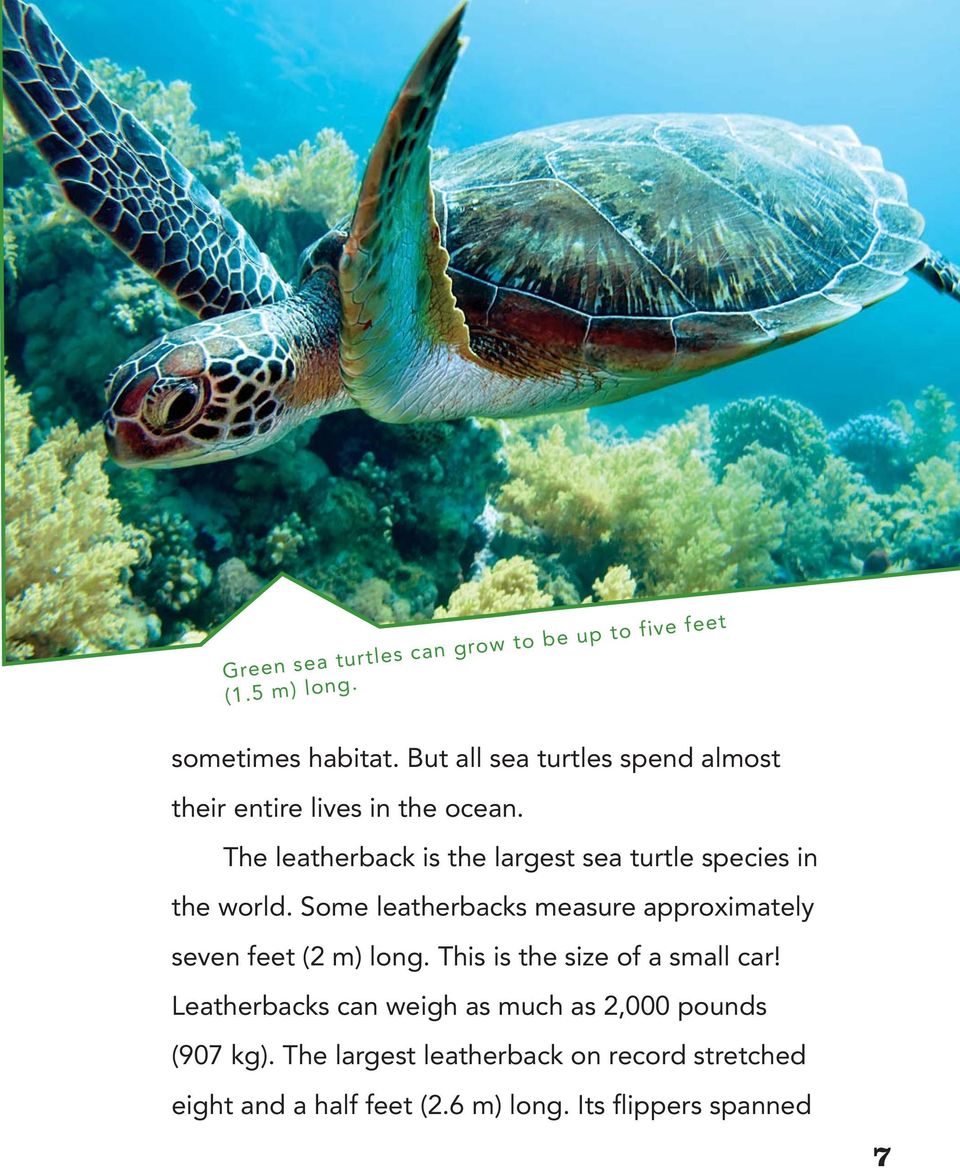
9 Green sea turtles can grow to be up to five feet (1.5 m) long. sometimes habitat. But all sea turtles spend almost their entire lives in the ocean. The leatherback is the largest sea turtle species in the world. Some leatherbacks measure approximately seven feet (2 m) long. This is the size of a small car! Leatherbacks can weigh as much as 2,000 pounds (907 kg). The largest leatherback on record stretched eight and a half feet (2.6 m) long. Its flippers spanned 7
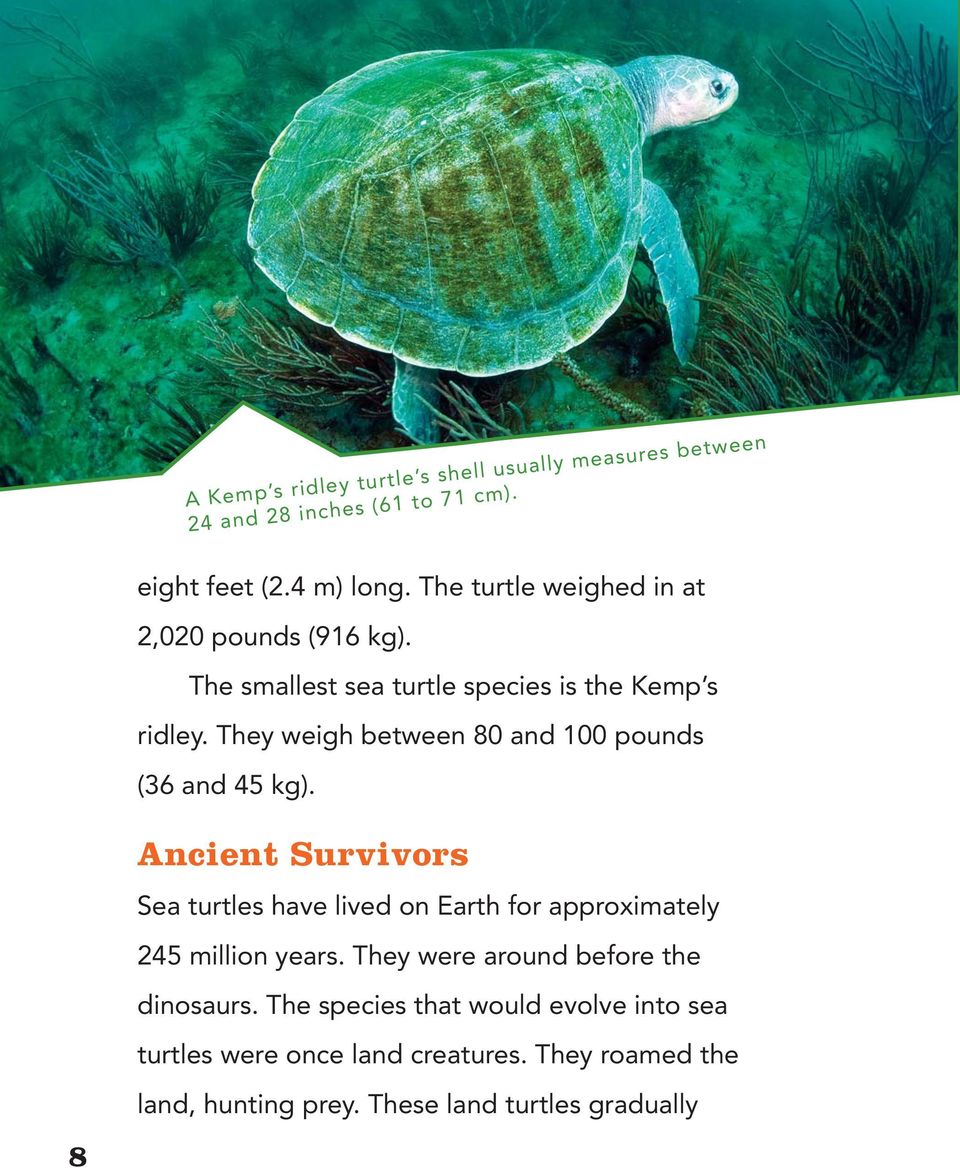
10 A Kemp s ridley turtle s shell usually measures between 24 and 28 inches (61 to 71 cm). eight feet (2.4 m) long. The turtle weighed in at 2,020 pounds (916 kg). The smallest sea turtle species is the Kemp s ridley. They weigh between 80 and 100 pounds (36 and 45 kg). 8 Ancient Survivors Sea turtles have lived on Earth for approximately 245 million years. They were around before the dinosaurs. The species that would evolve into sea turtles were once land creatures. They roamed the land, hunting prey. These land turtles gradually
11 evolved to live in water, where they could find prey more easily. Sea turtles continue to lay their eggs on land, however. Similar Features Sea turtles still have some of the same features as their early ancestors. Flippers and a shell are two of these features. Early sea turtles developed flippers that helped them move through the water. A sea turtle s front flippers are broad and flat. Back flippers act like rudders and help a turtle steer through the water. Most sea turtles have two hard shells. The shells are flat and streamlined. This lets the turtles glide quickly through the water. Giant Slurper In 2013 scientists in Morocco discovered the remains of a giant sea turtle that lived approximately 67 million years ago. The turtle had a large skull and a tube-like snout. Scientists think this turtle used suction feeding to adapt from living on land to spending most of its life in water. It used its long snout like a straw. This prehistoric creature sucked down prey such as jellyfish. The top shell is called the 9

12 A sea turtle s front flippers act like arms and allow it to swim fast. carapace. It is made of bones. The carapace protects sea turtles backs. Tough plates called scutes cover the carapace. Sea turtles also have a bottom shell, called the plastron. It protects their internal organs. The leatherback is the only sea turtle that does not have a hard shell. Thick leather covers its back instead. This leather runs in rubbery ridges down the turtle s body. 10

13 Carapace Scute Flipper Beak Flipper Plastron Flippers Sea Turtle Body Parts Chapter One discusses many sea turtle body parts. This diagram shows some of the physical characteristics of a sea turtle. How might some of these parts help a sea turtle eat prey? How might other body parts protect a sea turtle from predators? The seven species of sea turtles have a range of colors. The leatherback is dark gray or black. Flatback, olive ridley, and Kemp s ridley turtles have greenishgray shells. The loggerhead has a reddish-brown shell. The hawksbill has a patterned shell of brown and red. The green sea turtle does not have a green shell. Instead, it is brown or olive-colored. 11

14

15 CHAPTER TWO Amazing Life Cycles Scientists are not sure how long sea turtles live in the wild. It is not easy to determine the age of these reptiles. Scientists are still studying their life spans. They think some sea turtles could live up to 150 years. This would make them one of the longestliving animals on Earth. It is rare to see two sea turtles together outside of mating season. 13

16 14 Finding a Mate Most sea turtles prefer to live alone. However, males and females come together during mating season. Mating season ranges from March through October, depending on the species. Sea turtles begin mating at different ages. Some species become parents for the first time at ten years old. Others wait to mate until they are 50 years old! Weeping Mother Turtles Female sea turtles appear to be crying tears as they crawl ashore to nest. They are not really crying but shedding saltwater. A special gland near the eyes rids the turtle s body of extra salt from drinking ocean water. This sticky stream of tears helps keep the turtle s eyes free of sand while she digs her nest. Male sea turtles court females. They become jealous if another male competes for a female s attention. Males will even fight one another for a female. The males bite one another on the flippers and tail. Even so, some females mate with more than one male during mating season.

17 A female green sea turtle digs a nest in the sand with her back flippers. Building a Nest Female sea turtles must come ashore to bury their eggs. They return to the same region where they hatched to dig their nests. Six of the sea turtle species dig their nests at night. Kemp s ridley females dig their nests during the day. 15

18 When a female is finished digging, she places her tail over the nest opening and lays her eggs. A female will lay a clutch, or group, of 70 to 190 eggs, depending on her species. The eggs are approximately the size of golf balls. They are soft and slippery, so they do not break when they land in the nest. The female covers her eggs with sand and moves back to the ocean. She will return within 12 to 14 days to lay her next clutch. Sea turtles can nest two to four times each season. Built-In GPS How does a female sea turtle find the region in which she was born? Scientists believe female turtles use Earth s magnetic fields to plot their courses. This guides them hundreds or thousands of miles to the right regions. Smelling certain odors carried by ocean currents also helps guide the turtles. Loggerhead females nest up to five times each season. After nesting many times in one season, female sea turtles wait two to three years before nesting again. Five species of sea turtles nest alone. But the olive and Kemp s 16

19 This small Costa Rican beach is flooded with olive ridley sea turtles each year. ridley sea turtles arrive at the beach in large groups. Their arrival is called an arribada. This is the Spanish term for arrival. The biggest known arribada took place on a Costa Rican beach in Approximately 500,000 olive ridley females streamed ashore! 17

20 Baby Sea Turtles Sea turtle eggs incubate for 50 to 60 days. If the temperature of the nest is warm, most of the turtles will be females. A cool nest will yield mostly males. The hatchlings break open their shells using a sharp egg tooth. The egg tooth is on the end of the hatchlings snouts. Then the babies dig upward through the sand together. This may take a few days. The hatchlings leave their nests at night. They look like their parents but measure only one to two inches (3 to 5 cm) long. The hatchlings search for a bright horizon, usually the moon and stars reflecting off the water. The turtles race to the ocean. As they scramble across the sand, baby turtles must dodge predators such as birds and crab. Once in the ocean, they need to escape hungry fish that prey on turtles. 18

21 Only 1 out of 1,000 hatchlings will live to become an adult sea turtle. EXPLORE ONLINE The focus in Chapter Two is the life cycle of sea turtles. It also touches on several dangers hatchlings face. The website below discusses how scientists help threatened sea turtles nests. As you know, every source is different. How is the information given in the website different from the information given in this chapter? How is it the same? What new information can you learn from this website? Turtle Eggs 19
22
23 CHAPTER THREE Cold-Blooded Reptiles Sea turtles are cold-blooded, which means they cannot control their body temperatures. They take on the temperature of their surroundings instead. Swimming in warm water keeps turtles from getting too cold. Leatherbacks are so large and dark-colored that they are able to absorb much of their heat from the sun. They store this energy in fat Sea turtles must swim to the water s surface to breathe air into their lungs. 21
24 tissue. Leatherbacks in the Caribbean Sea sometimes overheat and swim deeper to cool down. Swimming and Diving Sea turtles are strong swimmers. These reptiles are also excellent divers. Leatherbacks can dive to depths of 3,900 feet (1,189 m) to hunt for jellyfish. They breathe air through their lungs. Sea turtles can also hold their breath for long periods. Green sea turtles can stay underwater for up to five hours. Their heart rate slows when they do this. They can go up to nine minutes between heartbeats! Staying Safe Sea turtles have dry, scaly skin. Their skin has special coloration that protects them from predators. Scientists call this coloration countershading. A sea turtle s top shell is darker than its bottom shell. The top shell is usually swirled with colors and patterns to blend in with sea plants. A tiger shark swimming near the water s surface would not see the turtle. The 22
25 Green sea turtles can move at speeds of up to 1.5 miles (2.2 km) per hour. dark top shell blends in with the deep ocean water. Predators swimming below a sea turtle will not see the turtle either. The light bottom shell blends in with the bright sky above. These features also keep a turtle hidden from its potential prey. Unlike land turtles, sea turtles cannot pull their heads and flippers into their shells for protection. 23
26 Sharp Senses Sea turtles have strong senses. Their sense of smell is especially powerful. Sea turtles pull in water through their noses and push it out through their mouths. This helps turtles sniff out food and predators. Sea turtles can also see clearly underwater. They are nearsighted out of water, however. Sea turtles have good hearing. Their ears are inside of their heads. They use them to hear low-pitched sounds. They can also pick up sound vibrations. Sea turtles can sense touch on their flippers and their shells. Diet A sea turtle hunts using its toothless jaws. The jaws end in a beak. This beak lets the turtle grab, snip, or crush food depending on its diet. Sea turtles hunt for food during the day. Most young turtles eat plankton or other small, floating animals. Adult turtles eat a combination of sea plants and fish. They also snack on fish eggs. The seven species of sea turtles have different diets. Leatherbacks hunt jellyfish. At night they feed in the upper waters, where jellyfish gather. When the 24
27 A hawksbill sea turtle breaks coral apart with its beak. sun rises, leatherbacks must dive as the jellyfish move deeper. Some species dive all the way down to the ocean floor to find hard-shelled prey. Hawksbills eat coral and squid. Loggerheads crush snails and clams. Olive ridleys eat crab and shrimp. Kemp s ridleys enjoy blue crab. 25
28 A green sea turtle eats plants and algae off the bottom of the ocean floor. Cleaning Stations In Hawaii green sea turtles swim up to cleaning stations. These are like underwater car washes for turtles. A crew of yellow tang fish nibbles algae off the turtles shells until they are clean. The fish also eat harmful pests that have taken a ride on the turtles shells. Both species benefit from these cleanings. The fish get a healthy snack. And the turtles leave with smoother shells, making it easier to swim. Other species graze in shallow water and in coral reefs. Flatback sea turtles feed on sea cucumbers and squid. Green sea turtles eat mostly sea grasses. Their saw-like beaks let them cut these plants. These turtles are like underwater lawn mowers! 26
29 STRAIGHT TO THE SOURCE All sea turtles are specially adapted to catch their favorite prey. Biologist Blair Witherington describes how the Kemp s ridley sea turtle is a small but mighty force when it comes to hunting blue crab: The largest Kemp s ridley is just small enough for a strong person to pick one up and carry it. But in doing so, one might find oneself slapped, bitten, and generally regretful for the attempt. Although Kemp s ridley is small relative to the other sea turtles, their scrappy nature makes them seem comparatively substantial. Kemp s ridleys are fast and mean. Certainly, having to deal with a face full of darting, slashing blue crab during every meal would favor those both nimble and determined. Source: Blair Witherington. Sea Turtles: An Extraordinary Natural History of Some Uncommon Turtles. Minneapolis: Voyageur Press, Print Back It Up Blair Witherington is using evidence to support a point. Write a paragraph describing the point Witherington is making. Then write down two or three pieces of evidence Witherington uses to make the point. 27
30
31 CHAPTER FOUR Tropical Waters Sea turtles live in oceans around the world. Most of these habitats have tropical or temperate waters. Most species live and hunt for food in the waters that border beaches. Sea turtles live in bays, lagoons, and coral reefs. These coastal waters contain a rich mix of sea plants and prey. The leatherback sea turtle is an exception to this rule. These turtles also hunt for prey in cold Sea turtles survive in saltwater habitats around the world. 29
32 waters. Their size and a layer of fat help leatherbacks conserve body heat. They have the broadest range of any reptile. Their range in the Atlantic Ocean is as far north as Canada and Norway. To the south, their range extends to the tip of South America. Leatherbacks can also be found in the warmer waters of the Atlantic, Migrations Near and Far Most sea turtles migrate long distances between their feeding grounds and the beaches where they nest. Leatherbacks have the longest migration routes. Some swim more than 3,000 miles (4,828 km) between their nesting and feeding grounds! Flatbacks, on the other hand, only migrate between 134 to 807 miles (216 to 1,299 km) around the northern coast of Australia. Pacific, and Indian oceans, as well as in the Mediterranean Sea. Green sea turtles live in the warm waters of the Atlantic, Pacific, and Indian oceans. Unlike other sea turtle species, some green turtles visit land for more than just nesting. They crawl up onto beaches to sunbathe. 30
33 A green sea turtle sunbathes on a beach in Hawaii. Hawksbills prefer the same warm coastal waters as green turtles. They hunt in coral reefs, where sponges are plentiful. The small population of Kemp s ridley turtles lives mostly in the Gulf of Mexico. They also range along the Atlantic Ocean from Cape Cod, Massachusetts, 31
34 Tracking Sea Turtles In the past, scientists used numbered tags placed on turtles front flippers to track them. People who saw turtles would read the tags and send letters to the scientists. But this method only offered information about where the turtles nested. And people could only see the tags when the turtles were on land. Now scientists glue radio transmitters to the shells of the turtles they are trying to track. These transmitters track migration routes. They deliver location data to satellites. The satellites then send the information to the scientists. down to Florida. These turtles stay in shallow waters where they can feast on crab. Olive ridley turtles live in the tropics. They live in the southern Atlantic, Pacific, and Indian oceans. They prefer the open ocean to the coastline. Of all the sea turtle species, loggerheads are present in the greatest quantity in US waters. They have a huge range in both the Atlantic and Pacific oceans. Loggerhead turtles also live in the Indian Ocean. 32
35 Sea turtles range Sea Turtles Range Almost all sea turtles live in warm ocean waters. This map shows where all seven species of sea turtles live. Why are these habitats best suited for sea turtles? Write a few sentences about what makes these habitats ideal for sea turtles feeding and nesting habits. They travel from coastal waters out to sea in search of food. Flatbacks have the smallest range of all the sea turtles. They stick to tropical waters between Australia and New Guinea. They do not migrate across the open ocean like other species. 33
36
37 CHAPTER FIVE Many Risks Six of the seven sea turtle species are in danger of extinction. Only the flatback sea turtle is not at risk. The Kemp s ridley is the most endangered sea turtle. Only approximately 1,000 nesting females exist worldwide. Along with the hawksbill, leatherback turtles are critically endangered. The loggerhead and green sea turtle are also endangered species. The hawksbill sea turtle is a critically endangered species. 35
38 Sea turtles face threats before they even hatch. Predators such as raccoons dig up and feast on turtle eggs. Hatchlings deal with even more dangers as they race to the ocean. Fish and pelicans gobble baby turtles that reach the ocean. Tiger sharks and saltwater crocodiles prey One Flipper One unlucky green sea turtle named Allison lost three flippers to a shark. But Allison s luck changed when Sea Turtle, Inc., rescued her. This conservation group brought Allison to their rehabilitation center. At first she could only swim in circles with her one remaining flipper. Then an intern designed a special jacket for Allison. The jacket has a large flipper on the top. Now Allison can swim with other rescued turtles! upon turtles as they grow. Human-Made Threats Humans are the biggest threat to sea turtles. Laws protect sea turtles in most countries. But poachers continue to collect eggs from turtle nests. They also hunt turtles for their body parts. Their meat is turned into turtle steaks. The skin from olive ridley 36
39 Turtle egg collectors wait on a Costa Rican beach for female turtles to arrive and lay their eggs. turtles is sold for leather. Hawksbill shells are carved into jewelry. Some sea turtles are caught by accident. Fishing nets meant to capture fish entangle turtles. The turtles often drown, unable to reach the surface to breathe. Human activities also endanger sea turtles. Offroad vehicles sometimes disturb turtle nests. In the 37
40 water, boats can collide with turtles. Their propellers injure turtles swimming near the surface. Pollution is also deadly for sea turtles. Garbage on the shore and in the water can kill turtles. Leatherbacks mistake balloons and plastic bags for jellyfish and eat them. Toxic chemicals dumped by factories can end up in the ocean. Light pollution from car lights or beachfront houses causes nesting sea turtles and hatchlings to become confused. They head toward these artificial lights instead of the ocean. Habitat loss is another problem. People build resorts and docks on the beaches where sea turtles nest. This leaves less room for turtles to dig their nests. Protecting Sea Turtles Conservation groups are working to make sure sea turtles survive in the wild. They help scientists gather turtle eggs and relocate them to safer beaches. Other eggs are hatched in hatcheries. The hatchlings are released immediately upon hatching. 38
41 Toxins from oil spills in the ocean can kill sea turtles. Countries around the world are protecting the places where sea turtles nest. During nesting season, many hotels, shops, and restaurants near beaches turn off their lights. This allows nesting female sea turtles to find the ocean after laying their eggs. Tourists travel to Costa Rica and other regions to observe sea turtles in the wild. Local guides bring small groups to the beach. Visitors watch nesting turtles. Some return in seven to eight weeks to watch 39
42 the hatchlings race to the sea. This kind of travel is called ecotourism. These tourists bring money into the regions they visit. Ecotourism can convince local people to protect sea turtles instead of harvesting them. It is not too late to save sea turtles. None of the seven species have disappeared yet. Humans must protect sea turtles habitats and nesting grounds. Then these ancient reptiles will continue to survive in the wild for years to come! FURTHER EVIDENCE Chapter Five gives information about threats to sea turtles. What was one of the chapter s main points? What are some pieces of evidence in the chapter that support this main point? Check out the website at the link below. Find some information on this website that supports the main point in this chapter. Write a few sentences explaining how the information from the website supports the chapter s main point. Turtles in Trouble 40
43 STRAIGHT TO THE SOURCE Christopher Columbus landed on the Caribbean island of Las Tortugas, part of the Cayman Islands, in May It seemed overloaded with sea turtles. Marine biologist James Spotila explains how the turtle population has changed since then: When Christopher Columbus first saw the Cayman Islands he was steering his ship through a sea of turtles. His son Ferdinand wrote, We sighted two very small low islands full of turtles (as was all the sea thereabouts, so that it seemed to be full of little rocks); that is why these islands were called Las Tortugas. The turtle population appeared to be inexhaustible to the generations of hunters supplying meat to passing ships. A few centuries later, however, the turtles of Las Tortugas were gone. Source: James Spotila. Sea Turtles: A Complete Guide to Their Biology, Behavior, and Conservation. Baltimore: John Hopkins University Press, Print. 73. Changing Minds Take a position on turtle fishing in the Cayman Islands. Imagine your best friend has the opposite opinion. Write a paper trying to change your friend s mind. Make sure you explain your opinion and your reasons for it. Include facts and details that support your reasons. 41
44 FAST FACTS Common Name: Sea turtle Scientific Names: Dermochelyidae (leatherbacks) and Chelonioidea Average Size: Two to seven feet (1 to 2 m) long, depending on species Average Weight: 80 to 2,000 pounds (36 to 907 kg), depending on species Color: Dark gray, black, greenish-gray, reddish-brown, brown, olive, and cream Average Life Span: Up to 100 years in the wild Diet: Plankton, fish, fish eggs, sponges, hard-shelled sea creatures, squid, jellyfish, and sea grasses Habitat: Saltwater oceans Predators: Humans, raccoons, crab, vultures, fish, pelicans, tiger sharks, and crocodiles 42
45 Did You Know? Young hawksbill, loggerhead, and green sea turtles cannot dive to deep ocean waters, so they live among floating sea plants. Sea turtles shells are covered in plates so tough that most sharks cannot bite through them. Sea turtles have special glands that remove salt from the saltwater they take in. 43
46 STOP AND THINK Say What? Learning about sea turtles can mean learning a lot of new vocabulary. Find five new words in this book that you ve never seen or heard before. Use a dictionary to find out what they mean. Using your own ideas, write down the meaning of each word. Then use each word in a sentence. Another View There are many different sources of information about sea turtles. As you know, every source is different. Ask a librarian or another adult to help you find a reliable source about sea turtles. Write a short essay comparing and contrasting the new source s point of view with the ideas in this book. How are the sources similar? How are the sources different? Why do you think they are similar or different? 44
47 Why Do I Care? This book discusses why it is important to keep sea turtle species from becoming extinct. Even if you don t live near sea turtles, why should you care about protecting them? Write down two or three reasons humans should care about sea turtle populations. Surprise Me Learning about sea turtles can be interesting and exciting. Think about what you learned from this book. Can you name two or three facts about sea turtles that you found surprising? Write a short paragraph about each fact. Why did you find these facts surprising? 45
48 GLOSSARY carapace the top shell of a turtle cold-blooded unable to regulate body temperature without an outside source, such as the sun plankton tiny animals and plants that float near the surface of the sea plastron the bottom shell of a turtle ecotourism environmentally responsible travel to natural areas endangered threatened with extinction poachers people who catch wild animals illegally extinction the death of all members of a species scutes tough plates covering a turtle s shell 46
49 LEARN MORE Books Marsh, Laura. Sea Turtles. Washington, DC: National Geographic Children s Books, Molnar, Michael. Green Sea Turtles. Mankato, MN: Smart Apple Media, Swinbrune, Stephen. Turtle Tide: The Ways of Sea Turtles. Honesdale, PA: Boyds Mills Press, Websites To learn more about Amazing Reptiles, visit booklinks.abdopublishing.com. These links are routinely monitored and updated to provide the most current information available. Visit for free additional tools for teachers and students. 47
50 INDEX carapace, 10, 11, conservation, 36, countershading, diet, eggs, 9, 14 16, 18 19, 36, endangered species, 35 flatback sea turtles, 6, 11, 26, 30, 33, 35 flippers, 5, 6, 7, 9, 11, 14, 23, 24, 32, 36 green sea turtles, 6, 11, 22, 26, 30, 35, 36 habitats, 7, 29 33, 40 hatchlings, 18 19, 36, 38, 40 hawksbill sea turtles, 6, 11, 25, 31, 35, 37 hunting, 22, 24, 27, 29, 31 jaws, 6, 24 Kemp s ridley sea turtles, 6, 8, 11, 15 17, 25, 27, 31, 35 leatherback sea turtles, 5 7, 10 11, 21 22, 24 25, 29 30, 35, 38 life span, 13 loggerhead sea turtles, 6, 11, 16, 25, 32 33, 35 mating, 14 migration routes, 30, 32, 33 nests, 6, 14 19, 30 33, olive ridley sea turtles, 6, 11, 16 17, 25, 32, plastron, 10, 11 poachers, 36 predators, 11, 18, 22 23, 24, 36 range, scutes, 10, 11 senses, 24 size, 7 8 threats, ABOUT THE AUTHOR Nancy Furstinger is the author of more than 100 books. She has worked as an editor at children s book publishing houses. She rescues painted and snapping turtles that wander along the road in her lakeside community. 48
Sea Turtles of Maryland
 Sea Turtles of Maryland Green Sea Turtle Hawksbill Sea Turtle Kemp's Ridley Sea Turtle Leatherback Sea Turtle Loggerhead Sea Turtle Olive Ridley Sea Turtle To report a sea turtle sighting, stranding or
An Introduction to the Sea Turtles of Virginia. Amber Knowles CBNERR-VA July 22, 2008
 An Introduction to the Sea Turtles of Virginia Amber Knowles CBNERR-VA July 22, 2008 Overview Introduction to species of sea turtles Focus on Loggerhead and Kemp s ridley sea turtles Importance of the
Elementary School Sea Turtle Lesson Plan Developed by Cathy Payne
 Elementary School Sea Turtle Lesson Plan Developed by Cathy Payne Background: Elementary school-aged children are very drawn to stories, both fiction and nonfiction, about sea turtles, but there are limited
Animals and Adaptation
 Animals and Adaptation From: http://www.learninghaven.com/science/articles/animals_and_adaptation.htm In order for animals to survive, they need to be able to adapt. In this lesson we will look at the
World Oceans Day at ZSL Whipsnade Zoo
 World Oceans Day at ZSL Whipsnade Zoo Teachers notes KS 1 & KS 2 This booklet will help you to focus your self guided trail on ocean animals, looking at the adaptations of the species and focusing in on
Turtle Coloring 7/9/07 2:34 PM Page 1 C M Y CM MY CY CMY K. Sea Turtle. Coloring & Activity Book. Monitoring & Protection Project.
 Turtle Coloring 7/9/07 2:34 PM Page 1 Sea Turtle Coloring & Activity Book Developed by the Conservancy of Southwest Florida in partnership with LaPlaya Beach Resort Monitoring & Protection Project Turtle
SEA CHANGE: GULF ISLANDS NATIONAL SEASHORE. Sea Turtles Hurdles. Objectives: Grade Level: 4th-8th grade Activity Time: Two, 45-minute lessons
 Grade Level: 4th-8th grade Activity Time: Two, 45-minute lessons Subject Area: Biology Life Sciences Day 1 Discuss sea turtles found in the Gulf of Mexico, to include natural versus human dangers. Day
These pages build on Units 2B & C and introduce predator-prey relationships and food chains.
 Unit 4B Habitats Teaching Notes These pages build on Units 2B & C and introduce predator-prey relationships and food chains. Curriculum, resource and other links Sc1 & Sc2 Resources Associated with this
The Facts About Right Whales
 The Facts About Right Whales Where have all the right whales gone? Hunters killed almost all the North Atlantic right whales by the early 20th century. It has been against the law to hunt them for more
Fry Phrases Set 1. TeacherHelpForParents.com help for all areas of your child s education
 Set 1 The people Write it down By the water Who will make it? You and I What will they do? He called me. We had their dog. What did they say? When would you go? No way A number of people One or two How
Name Class Date. Adapting to the Environment Adaptations and Survival
 CHAPTER 3 4 SECTIN Adapting to the Environment Adaptations and Survival EFRE YU READ After you read this section, you should be able to answer these questions: What adaptations help animals survive? What
When Is an Elephant Not an Elephant? When It's a Seal, Of Course! By Mikki Sadil
 Everyone knows that elephants have trunks. But did you know there is a kind of seal that also has a trunk? This is the elephant seal, which gets its name from the extra large proboscis, or nose, on the
A Swim Through the Sea A B Sea Crinkleroots Guide to Knowing Animal Habitats
 HABITAT - Children ages 5-8 The Magic School Bus Hops Home: A Book About Animal Habitats by Patricia Relf, Scholastic Trade, 1995 ISBN: 0590484133 Ms. Frizzle is up to her adventurous ways of teaching
Walking the beach in South West Florida where I live. I would see yellow marker stakes
 Turtle Talks Zander Srodes Walking the beach in South West Florida where I live. I would see yellow marker stakes in the sand that notified beach goers that Loggerhead and Green turtles had nested on the
ENDANGERED AND THREATENED
 ENDANGERED AND THREATENED Understand how species in the Sonoran Desert Region may become endangered or threatened and what is being done to protect them. ARIZONA SCIENCE STANDARDS SC03-S4C3-03&04, SC08-S1C3-07,
The concepts developed in this standard include the following: Oceans cover about 70% of the surface of the Earth.
 Name Date Grade 5 SOL 5.6 Review Oceans Made by SOLpass - www.solpass.org [email protected] Reproduction is permitted for SOLpass subscribers only. The concepts developed in this standard include
Talking About Penguins by Guy Belleranti
 Talking About Penguins Penguins are one of the world s most interesting birds. They waddle when they walk, and have flippers instead of wings. The bones in a penguin s flippers are heavier and more solid
Can You Tell a 'Gator From a Croc? by Guy Belleranti
 Can You Tell a 'Gator From a Croc? Look closely at the reptiles pictured below. Can you tell which one is the crocodile and which is the alligator? Many people confuse crocodiles and alligators, and it's
PUSD High Frequency Word List
 PUSD High Frequency Word List For Reading and Spelling Grades K-5 High Frequency or instant words are important because: 1. You can t read a sentence or a paragraph without knowing at least the most common.
Disney Worldwide Conservation Fund Allows Teachers to Broaden Awareness of the Plight of the Diamondback Terrapin
 Disney Worldwide Conservation Fund Allows Teachers to Broaden Awareness of the Plight of the Diamondback Terrapin Maggie Dugan: Upper Township Elementary School Jane Krajewski: Quinton Township School
Frog Scavenger Hunt Activity
 Frog Scavenger Hunt Activity Materials: Frog questions worksheet (pages 2-3) 18 frog fact cards (pages 4-8) Scissors and scotch tape Preparation: Print the frog fact cards and cut them apart. Make copies
Lesson Overview. Biodiversity. Lesson Overview. 6.3 Biodiversity
 Lesson Overview 6.3 6.3 Objectives Define biodiversity and explain its value. Identify current threats to biodiversity. Describe how biodiversity can be preserved. THINK ABOUT IT From multicolored coral
Dear Teachers: Welcome to dynamic science
 Educator s Resource Guide GRADES 6 8 Dear Teachers: Welcome to dynamic science activities inspired by the IMAX film. These materials, created by Scholastic Inc., IMAX Corporation, and Warner Bros. Pictures,
Structures of animals
 Structures of animals Name: All animals have been designed with different parts, which we call structures, that make up their bodies. Each of these structures is important as it is used to perform a specific
Bird Scavenger Hunt Activity
 Bird Scavenger Hunt Activity Materials: Bird questions worksheet (pages 2-3) 18 Bird fact cards (pages 4-8) Tape and scissors Preparation: Print the fact cards on card stock or brightly-colored paper and
Introducing SEA LIFE centre Children s Activity Packs
 Introducing SEA LIFE centre Children s Activity Packs Great news, you re visiting a SEA LIFE centre and we ll do everything possible to make sure you have a wonderful day out. Whether you are a Scout,
Behaviour. Age 6-11 years. Contents
 SEA LIFE for schools Behaviour Age 6-11 years Self-guided learning This guide provides you with information linked to key displays throughout SEA LIFE Loch Lomond which can be used to explore the key behaviour
Right Whale. The Kids Times: Volume II, Issue 6. NOAA s National Marine Fisheries Service, Office of Protected Resources
 NOAA s National Marine Fisheries Service, Office of Protected Resources The Kids Times: Volume II, Issue 6 Right Whale Right whales have no dorsal fin on their backs. How did the right whale get its name?
WEATHER, CLIMATE AND ADAPTATIONS OF ANIMALS TO CLIMATE
 7 WEATHER, CLIMATE AND ADAPTATIONS OF ANIMALS TO CLIMATE TEXTBOOK QUESTIONS AND ANSWERS Q.1. Why weather changes so frequently? Ans. All changes in the weather are caused by the sun. The movement of the
Mini Dinosaurs. Grades K 1 2. Compiled by
 Mini Dinosaurs Grades K 1 2 Compiled by Leanne M. Burrow, Extension educator, 4 H/ Youth development, Purdue University Cooperative Extension Service Henry County Resources and References Exploring 4 H,
Jennifer Wong The Karen Beasley Sea Turtle Rescue and Rehabilitation Center
 Website Research The sea turtle rescue center is run by Karen Beasley and are committed to the conservation and protection of the all species of sea turtles. The center rescues. Rehabilitates, and releases
Reptiles and Amphibians by Guy Belleranti
 Name: Take a look at the four animals pictures below. Do you know which ones are reptiles and which ones are amphibians? The chameleon is an unusual lizard that can change the color of its scaly body.
Grade Level Content Expectations addressed: Activities: Schedule of Field Trip Activities at the Detroit Zoo 8:15 am Board Bus at School
 Title: Comparing and Contrasting Ecosystem Biodiversity Submitted by: Tracy Ortiz Email: [email protected] School: Coffey K-8 Educational Learning Community Date: May 12, 2010 Target Grade: 6 Duration:
English Language Arts Book 3
 English Language Arts Grade 6 Sample Test 2005 Name TIPS FOR TAKING THE SAMPLE TEST Here are some suggestions to help you do your best: Be sure to read carefully all the directions in the test book. Plan
Supported by. A seven part series exploring the fantastic world of science.
 Supported by A seven part series exploring the fantastic world of science. Find out about the different types of teeth in your mouth. Milk Teeth As a child you have 20 milk teeth. Your first tooth appears
Wetlands by Leslie Cargile
 Name: by Leslie Cargile What do the bogs in Ireland, the marshes in South Carolina, and the swamps of Louisiana have in common? If you said they re all wetlands, you d be right! are any land that is flooded
AMERICAN MUSEUM OF NATURAL HISTORY SCAVENGER HUNT
 AMERICAN MUSEUM OF NATURAL HISTORY SCAVENGER HUNT Begin on the 4 th floor. Take the stairs since they are faster than the elevators. Look but do not touch while in the museum. Keep your voices low but
Name. A Walk in the Desert
 Grade 4 Unit 5 Week 1 Selection Test Name A Fill in the bubble next to the best answer. A Walk in the Desert 1. A desert gets little rain and has a very dry climate. Climate is. A. a kind of desert cactus
Task 3 Reading into Writing: Endangered Animals
 At a glance Level: ISE II Task 3 Reading into Writing: Endangered Animals Focus: Task 3 Reading into writing Aims: To read information about endangered animals, to answer questions about the information
Pond Vocabulary Words and Meanings
 Pond Vocabulary Words and Meanings Adapt: to adjust to a use or situation Aquatic: from or in the water Bacteria: tiny organisms, too small to be seen with the naked eye Carnivore: an animal that eats
A Most Colorful Mammal by Guy Belleranti
 Name: In the tropical rainforests of western Africa lives a mammal with a most colorful face and rump. This mammal is the mandrill, the world's largest monkey. The skin on a male mandrill's face has a
Wildlife for the Workforce Part II:
 Wildlife for the Workforce Part II: Turtles and Tortoises, Snakes, Bees, and Exotic Animals Sarasota County Parks and Recreation Turtles and Tortoises Common cooter Green sea turtle Gopher tortoise Terrapin
Region of Georgia : Mountains
 Region of Georgia : Mountains Northern most region of GA Cold weather in the winter Brasstown Bald is the highest point in Georgia Lots of creeks and streams High above sea level Poor soil for farming
Phonics. High Frequency Words P.008. Objective The student will read high frequency words.
 P.008 Jumping Words Objective The student will read high frequency words. Materials High frequency words (P.HFW.005 - P.HFW.064) Choose target words. Checkerboard and checkers (Activity Master P.008.AM1a
7.1 How and why are some eco-systems threatened with destruction?
 Topic 7: Oceans on the Edge 7.1 How and why are some eco-systems threatened with destruction? How are human activities degrading and destroying marine ecosystems on a global scale? Mangrove removal- over
giganotosaurus Michael P. Goecke
 giganotosaurus Michael P. Goecke Giganotosaurus A Buddy Book by Michael P. Goecke VISIT US AT www.abdopublishing.com Published by ABDO Publishing Company, 4940 Viking Drive, Edina, Minnesota 55435. Copyright
Dinosaur Time-line. What other animals lived then? How long ago did the dinosaurs live? Did dinosaurs live at the same time as people?
 Dinosaur Time-line How long ago did the dinosaurs live? The Age of Dinosaurs began nearly 250 million years ago, but the first true dinosaurs appeared closer to 220 million years ago. Some dinosaurs evolved
Coral Reefs Lecture Notes
 Coral Reefs Lecture Notes (Topic 10D) page 1 Coral Reefs Lecture Notes Corals Polyps & Zooxanthellae Coral Polyps Are coral polyps algae or animals? Description (What do coral polyps look like? Make a
www.irishseedsavers.ie Natural surface water on earth includes lakes, ponds, streams, rivers, estuaries, seas and oceans.
 www.irishseedsavers.ie POND LIFE FACT SHEET Natural surface water on earth includes lakes, ponds, streams, rivers, estuaries, seas and oceans. A pond is a small body of fresh water shallow enough for sunlight
4THE UNIVERSITY OF THE STATE OF NEW YORK
 4THE UNIVERSITY OF THE STATE OF NEW YORK GRADE 4 ELEMENTARY-LEVEL SCIENCE TEST WRITTEN TEST JUNE 6, 2011 Student Name School Name Print your name and the name of your school on the lines above. The test
Lesson 6: Fisheries Management in the Open Ocean. Open Ocean
 !!! Open Ocean Concepts How does fishing equipment affect the amount of fish and bycatch caught in a fishery? How can we change the way we fish to use the ocean better? Standards Addressed HCPS 5. & 5.2
Grade 5 Standard 5 Unit Test Heredity. 1. In what way will a kitten always be like its parents? The kitten will...
 Grade 5 Standard 5 Unit Test Heredity Multiple Choice 1. In what way will a kitten always be like its parents? The kitten will... A. be the same color. B. learn the same things. C. have the same body structures.
Life processes. All animals have to carry out seven life processes. These are: 2. Respiration taking in one gas and getting rid of another
 Food chains Life processes All animals have to carry out seven life processes. These are: 1. Movement being able to move its body 2. Respiration taking in one gas and getting rid of another 3. Reproduction
Name That Adaptation. Background: Link to the Plan Read Section 5 (Whooping Crane Ecology and Biology) in the Management Plan
 Summary Students will explore structural, physiological, and behavioral adaptations of whooping cranes. Objectives: Students will be able to: Define an adaptation Describe several whooping crane adaptations
Symbiotic Beachfront Design: Sharing Southeast Florida s Coast with Sea Turtles
 Symbiotic Beachfront Design: Sharing Southeast Florida s Coast with Sea Turtles High Energy Beach Profile Groomed Beach Profile Loggerhead, Caretta caretta Green, Chelonia mydas Leatherback, Dermochelys
Exhibit Inquiry. Rainforest. Aug 11
 Exhibit Inquiry Exhibit Inquiry Have students look for the following exhibits related to living things during their visit to the Ontario Science Centre: Where to go: (Level 6) What it's about: Tropical
Gandoca Project. Black Beach and Cahuita Projects. Nesting 2006
 Sea Turtles & Talamanca Sea turtles are migratory reptiles that grow slowly, needing more than 10 years to reach sexual maturity. They face very high levels of mortality during their early years. Sea turtles
... Date Starting your search in the Rainforest if it s open, keep an eye out for:
 Museum-Wide Reptiles include turtles, lizards, snakes, crocodiles, and all of their relatives. There are over 9,000 different kinds of reptiles with amazing adaptations that help them find food and protect
Volcanoes and More: A Visit to Two National Parks in Hawaii
 VOA Special English is a daily news and information service for English learners. Read the story and then do the activities at the end. MP3s of stories can be found at voaspecialenglish.com Volcanoes and
Activity 1 Exploring Animal Diets and Sizes
 Activity 1 Exploring Animal Diets and Sizes Objective & Overview: Using measurement and books, students will gain a better understanding of animal size, diversity, and diet through the fun study of wildlife.
Adapted from Stone Girl Bone Girl by Laurence Anholt, Francis Lincoln Children s Book
 1. Mary Anning Adapted from Stone Girl Bone Girl by Laurence Anholt, Francis Lincoln Children s Book This is the true story of Mary Anning, who lived 200 years ago. Mary was born in 1799 and was one of
The Polar Climate Zones
 The Polar Climate Zones How cold is it in the polar climate? Polar areas are the coldest of all the major climate zones The Sun is hardly ever high enough in the sky to cause the plentiful ice to melt,
Wild About... Frogs and Frogspawn
 a Wild About... Rutland County Council Nature notes Frogs belong to a group of animals called amphibians, which also includes newts and toads. Amphibians live both on land and in water. Water is needed
Satellite Pursuit: Tracking Marine Mammals
 : Tracking Marine Mammals Material adapted from: Monterey Bay Research Institute, EARTH: Satellite Tracking OPB NOVA Teachers: Ocean Animal Emergency Teach Engineering: Marine Animal Tracking Introduction:
http://video.nationalgeographic.com/video/oceans narrated by sylvia earle/oceans overview 71% is covered by the Earth's Ocean
 Chapter 13 Exploring the Oceans Section 1 Earth's Ocean List the major divisions of the global ocean. Describe the history of Earth's oceans Identify the properties of ocean water. Describe the interactions
The Take-Apart Human Body
 The Take-Apart Human Body As any teacher knows, children are naturally curious about their bodies. Their questions are endless, and present a tremendous educational opportunity: How do my ears work? Where
Unit 3L.4: Body Parts and Functions
 Unit 3L.4: Organs in the Human body Keeping Healthy The Skeleton Science skills: Classification Observing Making models Data collection By the end of this unit you should: Compare the structure of humans
2. What kind of energy is stored in food? A. chemical energy B. heat energy C. kinetic energy D. light energy
 Assessment Bank Matter and Energy in Living Things SC.8.L.18.4 1. What is energy? A. anything that takes up space B. anything that has mass C. the ability to conduct current D. the ability to do work 2.
Is That a Frog or Toad?
 Name: _ Is That a Frog or Toad? by Guy Belleranti What's the first thing you think of when you see or hear the words frog and toad? Loud "ribbits" or "croaking" calls? Tadpoles swimming in a pond? Long-legged
God, the Great Creator
 Pre-Session Warm Up God, the Great Creator (Genesis 1: 2:3) Today we re going to start a new series of lessons all about God s attributes. An attribute is a character trait or quality about someone. For
SEMESTER AT SEA COURSE SYLLABUS University of Virginia, Academic Sponsor
 Voyage: Fall 2015 Discipline: Biology Course Title: Introduction to Marine Biology Division: Lower Division Faculty Name: Dr Christine Dudgeon Credit Hours: 3; Contact Hours: 38 Pre-requisites: SEMESTER
Reading On The Move. Being a Word Detective Word Attack and Context Clues
 Reading On The Move Being a Word Detective Word Attack and Context Clues As you read, you will come across some words you do not know. These words are called unknown words. It is important to learn the
ECOSYSTEM RESPONSES. reflect
 reflect There is a saying, No man is an island, which means that people need one another in order to survive. Everyone on Earth is interconnected in some way. This is not only true of human beings, but
Silent, Nighttime Hunters By Guy Belleranti
 By Guy Belleranti Owls are raptors, or birds of prey. They are carnivores who quickly and silently swoop down on their prey from above. Most raptors such as eagles, hawks and falcons are day hunters. They
Using Light Sticks to Predict the Effects of Changing Temperature on the Light Emitted by Fireflies
 Name: LUMINESCENCE It s Cool Light! Class: Visual Quantum Mechanics ACTIVITY 8 Using Light Sticks to Predict the Effects of Changing Temperature on the Light Emitted by Fireflies Goal We will investigate
Bony Fish Anatomy Worksheet
 Educational Material Bony Fish Anatomy Worksheet Teacher Information This activity is designed to be team-taught by the classroom and art teacher. Use this guide in conjunction with fish-related art to
Invasive Reptiles and Amphibians of Florida!
 1 Invasive Reptiles and Amphibians of Florida! 2 Created by: Thompson Antony Lauren Diaz Sean McKnight Alana Palau JoAnna Platzer Illustrated by Lauren Diaz Invasive Ecology of Reptiles and Amphibians
California Treasures High-Frequency Words Scope and Sequence K-3
 California Treasures High-Frequency Words Scope and Sequence K-3 Words were selected using the following established frequency lists: (1) Dolch 220 (2) Fry 100 (3) American Heritage Top 150 Words in English
WAVE Foundation. Introduction. How to Use This Guide
 WAVE Foundation The WAVE Foundation, a nonprofit 501(c)3 organization, is an independent, educational foundation at the Newport Aquarium, created to further the Aquarium s efforts in educating communities
family games Taking the kids swimming is a great way of making sure they re moving around and having fun. And to help you get them into
 swim family games Taking the kids swimming is a great way of making sure they re moving around and having fun. And to help you get them into the pool, we ve come up with loads of great swimming games to
MARCH OF THE PENGUINS
 MARCH OF THE PENGUINS S C I E N C E M O V I E N I G H T The Academic Support Center @ Daytona State College (Science 127 Page 1 of 33) The Academic Support Center @ Daytona State College (Science 127 Page
Worksheet A Environmental Problems
 Worksheet A Environmental Problems Vocabulary Can you talk about Environmental issues in English? With a partner, try to explain the terms in the diagram below. Why are the words divided into two groups
Investigating Adaptations
 Investigating Adaptations 4 th Grade Duration Pre-Visit: 40 minutes Museum Visit: 60 minutes Post Visit: 50 minutes Concepts Adaptations reveal what organisms need in their environment to survive. Location
Lesson 3: Fish Life Cycle
 Lesson 3: Fish Life Cycle Activity: Diagram fish life cycle. Grade level: 4-8 Subjects: Science, social studies Setting: Classroom Duration: 50 minutes Key Terms: Fry, life cycle, life history, spawn,
Grade 8 English Language Arts 59B Reading and Responding Lesson 23
 GRADE 8 English Language Arts Reading and Responding: Lesson 23 Read aloud to the students the material that is printed in boldface type inside the boxes. Information in regular type inside the boxes and
Fry s Sight Word Phrases
 The people Write it down By the water Who will make it? You and I What will they do? He called me. We had their dog. What did they say? When would you go? No way A number of people One or two How long
A Method of Population Estimation: Mark & Recapture
 Biology 103 A Method of Population Estimation: Mark & Recapture Objectives: 1. Learn one method used by wildlife biologists to estimate population size of wild animals. 2. Learn how sampling size effects
Introduction and Pretest
 Introduction and Pretest PREPARATION It s recommended that the students complete the five proofreading lessons in the Writer s Guide before beginning this unit. The pretest in this introduction to the
GCSE BITESIZE Examinations
 GCSE BITESIZE Examinations General Certificate of Secondary Education AQA SCIENCE A BLY1B Unit Biology B1b (Evolution and Environment) AQA BIOLOGY Unit Biology B1b (Evolution and Environment) FOUNDATION
Animals of the Desert
 Animals of the Desert (NatureScope Discovering Deserts page 26-27) Third Grade Core: Standard 2 Objective 2 Describe the interactions between living and nonliving things in a small environment. Teach a
Meet the Nonfiction Main Idea Challenge
 Meet the Nonfiction Main Idea Challenge What s the challenge? Students often give the topic or a fact as the main idea when they have read nonfiction. What students need to do to meet the MAIN IDEA requirement
A Year in Antarctica. Features of This Text. Focus for Instruction
 TM Celebration Press Reading DRA2 Level 38 Guided Reading Level P Genre: Nonfiction Narrative Reading Skill: A Year in Antarctica By Anita Ganeri What happens when a team of scientists sets out to spend
UNIT TWO TURTLE BIOLOGY
 UNIT TWO TURTLE BIOLOGY 43 44 Science Expectations met in this unit: UNIT TWO: TURTLE BIOLOGY Activity Number: Activity Name Strand Grade 2 Growth and Changes in Animals Grade 4 Habitats and 5: Camouflage
WEE SING AND LEARN DINOSAURS (Song lyrics)
 WEE SING AND LEARN DINOSAURS (Song lyrics) DINOSAURS Dinosaurs, dinosaurs, Dinosaurs, dinosaurs, Dinosaurs, dinosaurs, Oh, millions and millions of years ago, dinosaurs roamed the earth. VERSE Some dinosaurs
Junior Veterinarians School-Age Summer Camp 2014 Monday s Lesson Plan: Marine Animals
 Junior Veterinarians School-Age Summer Camp 2014 Monday s Lesson Plan: Marine Animals TIME 6:00-9:00 9:00-9:45 ACTIVITY EARLY DROP- OFF: Students will play games and puzzles relating to the day s theme
www.nationalgeographic.com/education
 Crittercam Classroom Companion Related Materials from National Geographic Crittercam http://www.nationalgeographic.com/crittercam/ What do wild animals do when we're not around? Find out with National
Kino, Juana and Coyotito
 1 Kino, Juana and Coyotito K ino woke up early in the morning. The stars were still shining in the sky. The cockerels were beginning to crow 1 and the pigs were looking for something to eat. Outside the