
CHAPTER 3 ADJUSTING THE ACCOUNTS SUMMARY OF QUESTIONS BY STUDY OBJECTIVES AND BLOOM S TAXONOMY. Multiple Choice Questions
|
|
|
- Dwayne Walton
- 10 years ago
- Views:
Transcription
1 sg st a CHAPTER 3 ADJUSTING THE ACCOUNTS SUMMARY OF QUESTIONS BY STUDY OBJECTIVES AND BLOOM S TAXONOMY Item SO BT Item SO BT Item SO BT Item SO BT Item SO BT True-False Statements 1. 1 C 9. 2 C C K 2. 1 K K K K 3. 1 K C C K 4. 1 C K C a C 5. 1 K K C a C 6. 2 C K K a C 7. 2 K C K sg K 8. 2 K K C sg K Multiple Choice Questions sg K sg K sg K sg K sg,a C K AP AN AN AP K AP AN AP K K K K AN K C C K AN K K C C AP C K K C AP a C C C AN AP a C C C K C a AN C C AN C a AN K C C AN a AN K K K AN a AN K C K C sg C K K K C st K K K K AN st K C K C AN sg K C K C AN st K C K K C sg AP C K C AN sg AP C C AN AN st K C K AN AN sg AP K AN AN AP st K C C AN C sg K C C AN AN C K AN AP AP K AP AP This question also appears in the Study Guide. This question also appears in a self-test at the student companion website. This question covers a topic in an appendix to the chapter.

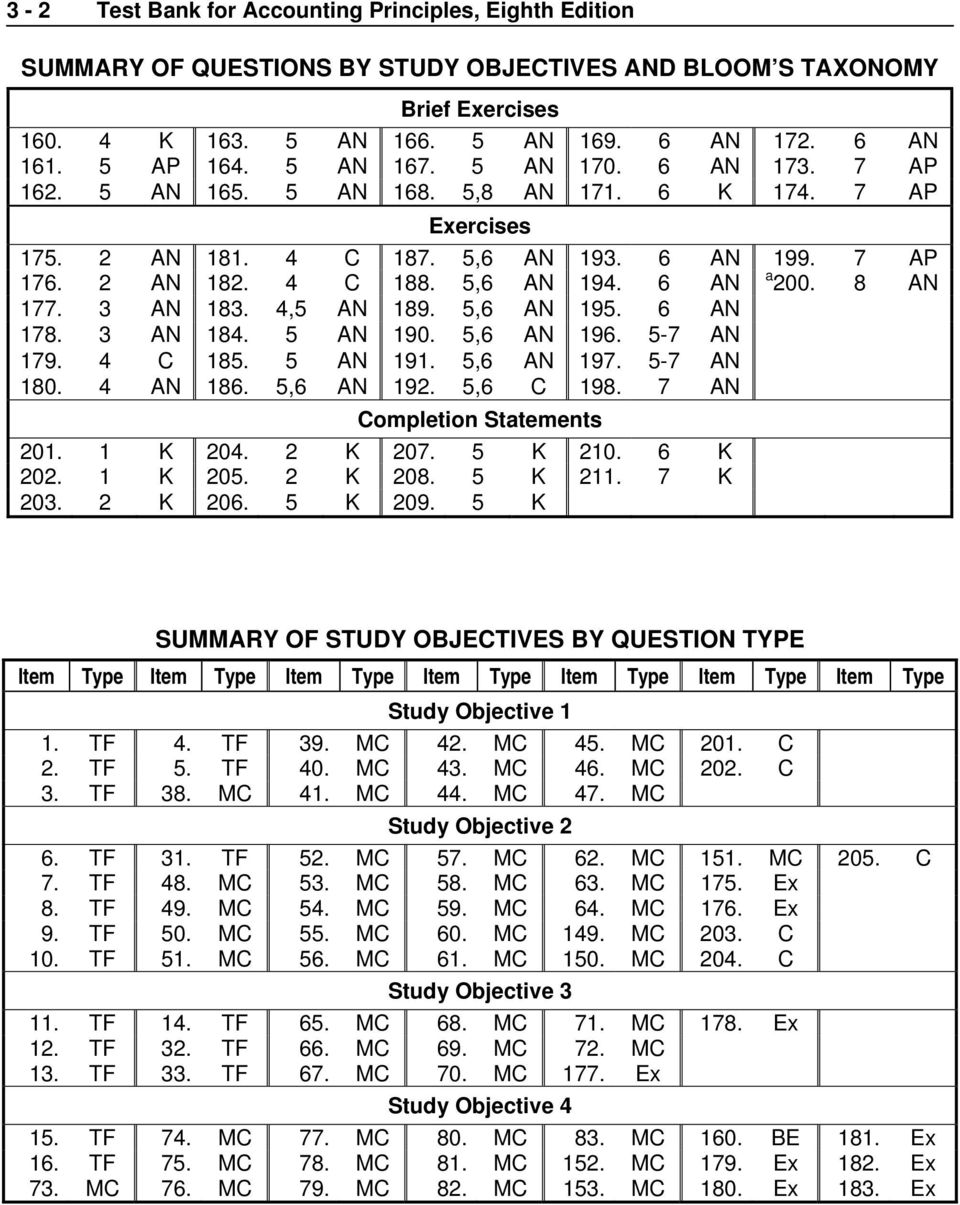
2 3-2 Test Bank for Accounting Principles, Eighth Edition SUMMARY OF QUESTIONS BY STUDY OBJECTIVES AND BLOOM S TAXONOMY Brief Exercises K AN AN AN AN AP AN AN AN AP AN AN ,8 AN K AP Exercises AN C ,6 AN AN AP AN C ,6 AN AN a AN AN ,5 AN ,6 AN AN AN AN ,6 AN AN C AN ,6 AN AN AN ,6 AN ,6 C AN Completion Statements K K K K K K K K K K K SUMMARY OF STUDY OBJECTIVES BY QUESTION TYPE Item Type Item Type Item Type Item Type Item Type Item Type Item Type Study Objective 1 1. TF 4. TF 39. MC 42. MC 45. MC 201. C 2. TF 5. TF 40. MC 43. MC 46. MC 202. C 3. TF 38. MC 41. MC 44. MC 47. MC Study Objective 2 6. TF 31. TF 52. MC 57. MC 62. MC 151. MC 205. C 7. TF 48. MC 53. MC 58. MC 63. MC 175. Ex 8. TF 49. MC 54. MC 59. MC 64. MC 176. Ex 9. TF 50. MC 55. MC 60. MC 149. MC 203. C 10. TF 51. MC 56. MC 61. MC 150. MC 204. C Study Objective TF 14. TF 65. MC 68. MC 71. MC 178. Ex 12. TF 32. TF 66. MC 69. MC 72. MC 13. TF 33. TF 67. MC 70. MC 177. Ex Study Objective TF 74. MC 77. MC 80. MC 83. MC 160. BE 181. Ex 16. TF 75. MC 78. MC 81. MC 152. MC 179. Ex 182. Ex 73. MC 76. MC 79. MC 82. MC 153. MC 180. Ex 183. Ex
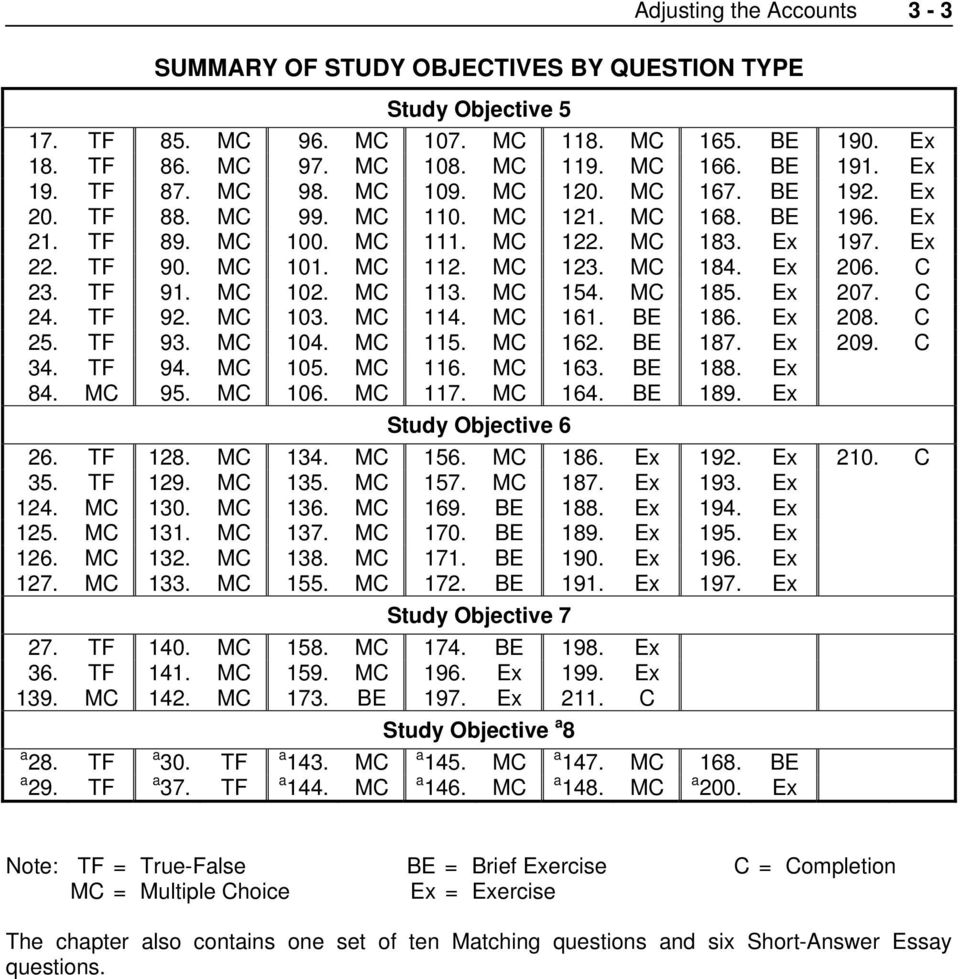
3 Adjusting the Accounts 3-3 SUMMARY OF STUDY OBJECTIVES BY QUESTION TYPE Study Objective TF 85. MC 96. MC 107. MC 118. MC 165. BE 190. Ex 18. TF 86. MC 97. MC 108. MC 119. MC 166. BE 191. Ex 19. TF 87. MC 98. MC 109. MC 120. MC 167. BE 192. Ex 20. TF 88. MC 99. MC 110. MC 121. MC 168. BE 196. Ex 21. TF 89. MC 100. MC 111. MC 122. MC 183. Ex 197. Ex 22. TF 90. MC 101. MC 112. MC 123. MC 184. Ex 206. C 23. TF 91. MC 102. MC 113. MC 154. MC 185. Ex 207. C 24. TF 92. MC 103. MC 114. MC 161. BE 186. Ex 208. C 25. TF 93. MC 104. MC 115. MC 162. BE 187. Ex 209. C 34. TF 94. MC 105. MC 116. MC 163. BE 188. Ex 84. MC 95. MC 106. MC 117. MC 164. BE 189. Ex Study Objective TF 128. MC 134. MC 156. MC 186. Ex 192. Ex 210. C 35. TF 129. MC 135. MC 157. MC 187. Ex 193. Ex 124. MC 130. MC 136. MC 169. BE 188. Ex 194. Ex 125. MC 131. MC 137. MC 170. BE 189. Ex 195. Ex 126. MC 132. MC 138. MC 171. BE 190. Ex 196. Ex 127. MC 133. MC 155. MC 172. BE 191. Ex 197. Ex Study Objective TF 140. MC 158. MC 174. BE 198. Ex 36. TF 141. MC 159. MC 196. Ex 199. Ex 139. MC 142. MC 173. BE 197. Ex 211. C a 28. a 29. TF TF a 30. a 37. TF TF a 143. a 144. Study Objective a 8 MC a 145. MC a 147. MC 168. BE MC a 146. MC a 148. MC a 200. Ex Note: TF = True-False BE = Brief Exercise C = Completion MC = Multiple Choice Ex = Exercise The chapter also contains one set of ten Matching questions and six Short-Answer Essay questions.
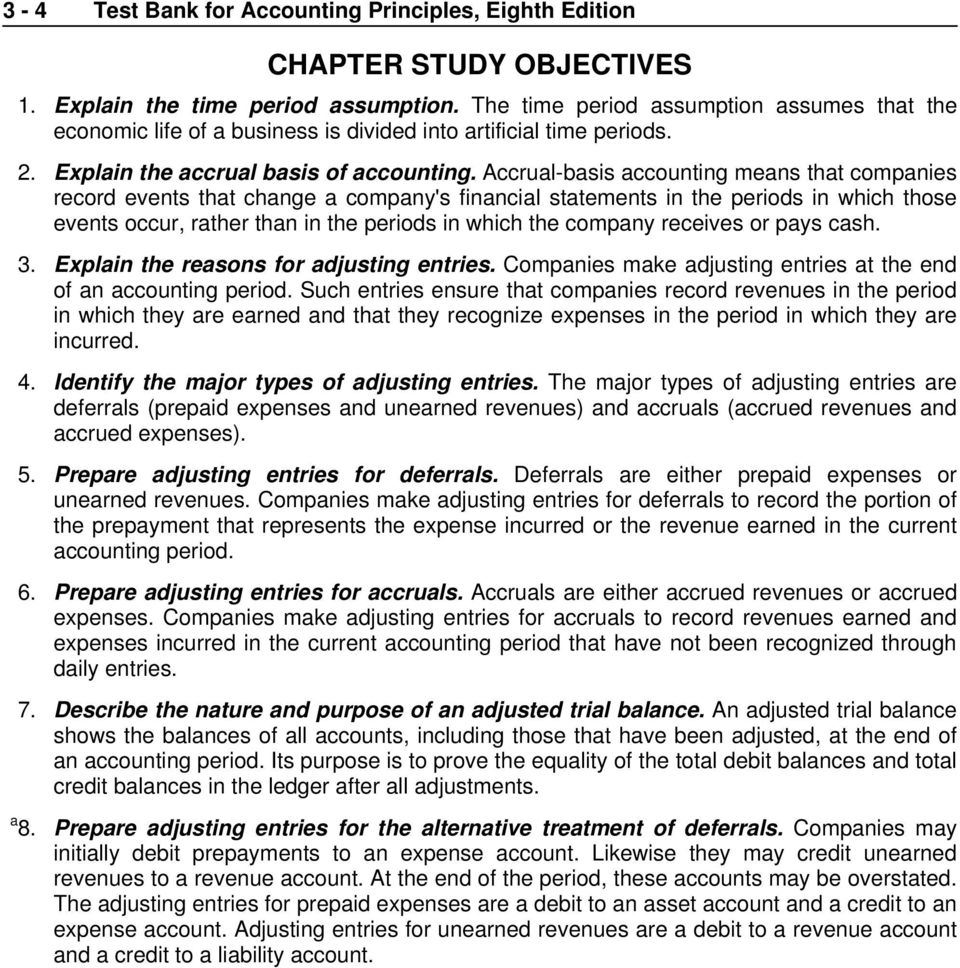
4 3-4 Test Bank for Accounting Principles, Eighth Edition CHAPTER STUDY OBJECTIVES 1. Explain the time period assumption. The time period assumption assumes that the economic life of a business is divided into artificial time periods. 2. Explain the accrual basis of accounting. Accrual-basis accounting means that companies record events that change a company's financial statements in the periods in which those events occur, rather than in the periods in which the company receives or pays cash. 3. Explain the reasons for adjusting entries. Companies make adjusting entries at the end of an accounting period. Such entries ensure that companies record revenues in the period in which they are earned and that they recognize expenses in the period in which they are incurred. 4. Identify the major types of adjusting entries. The major types of adjusting entries are deferrals (prepaid expenses and unearned revenues) and accruals (accrued revenues and accrued expenses). 5. Prepare adjusting entries for deferrals. Deferrals are either prepaid expenses or unearned revenues. Companies make adjusting entries for deferrals to record the portion of the prepayment that represents the expense incurred or the revenue earned in the current accounting period. 6. Prepare adjusting entries for accruals. Accruals are either accrued revenues or accrued expenses. Companies make adjusting entries for accruals to record revenues earned and expenses incurred in the current accounting period that have not been recognized through daily entries. 7. Describe the nature and purpose of an adjusted trial balance. An adjusted trial balance shows the balances of all accounts, including those that have been adjusted, at the end of an accounting period. Its purpose is to prove the equality of the total debit balances and total credit balances in the ledger after all adjustments. a 8. Prepare adjusting entries for the alternative treatment of deferrals. Companies may initially debit prepayments to an expense account. Likewise they may credit unearned revenues to a revenue account. At the end of the period, these accounts may be overstated. The adjusting entries for prepaid expenses are a debit to an asset account and a credit to an expense account. Adjusting entries for unearned revenues are a debit to a revenue account and a credit to a liability account.
5 TRUE-FALSE STATEMENTS 1. Many business transactions affect more than one time period. Adjusting the Accounts The time period assumption states that the economic life of a business entity can be divided into artificial time periods. 3. The time period assumption is often referred to as the matching principle. 4. A company's calendar year and fiscal year are always the same. 5. Accounting time periods that are one year in length are referred to as interim periods. 6. Income will always be greater under the cash basis of accounting than under the accrual basis of accounting. 7. The cash basis of accounting is not in accordance with generally accepted accounting principles. 8. The matching principle requires that efforts be matched with accomplishments. 9. Expense recognition is tied to revenue recognition. 10. The revenue recognition principle dictates that revenue be recognized in the accounting period in which cash is received. 11. Adjusting entries are not necessary if the trial balance debit and credit columns balances are equal. 12. An adjusting entry always involves two balance sheet accounts. 13. Adjusting entries are often made because some business events are not recorded as they occur. 14. Adjusting entries are recorded in the general journal but are not posted to the accounts in the general ledger. 15. Revenue received before it is earned and expenses paid before being used or consumed are both initially recorded as liabilities. 16. Accrued revenues are revenues which have been received but not yet earned. 17. The book value of a depreciable asset is always equal to its market value because depreciation is a valuation technique. 18. Accumulated Depreciation is a liability account and has a credit normal account balance. 19. A liability revenue account relationship exists with an unearned rent revenue adjusting entry. 20. The balances of the Depreciation Expense and the Accumulated Depreciation accounts should always be the same.

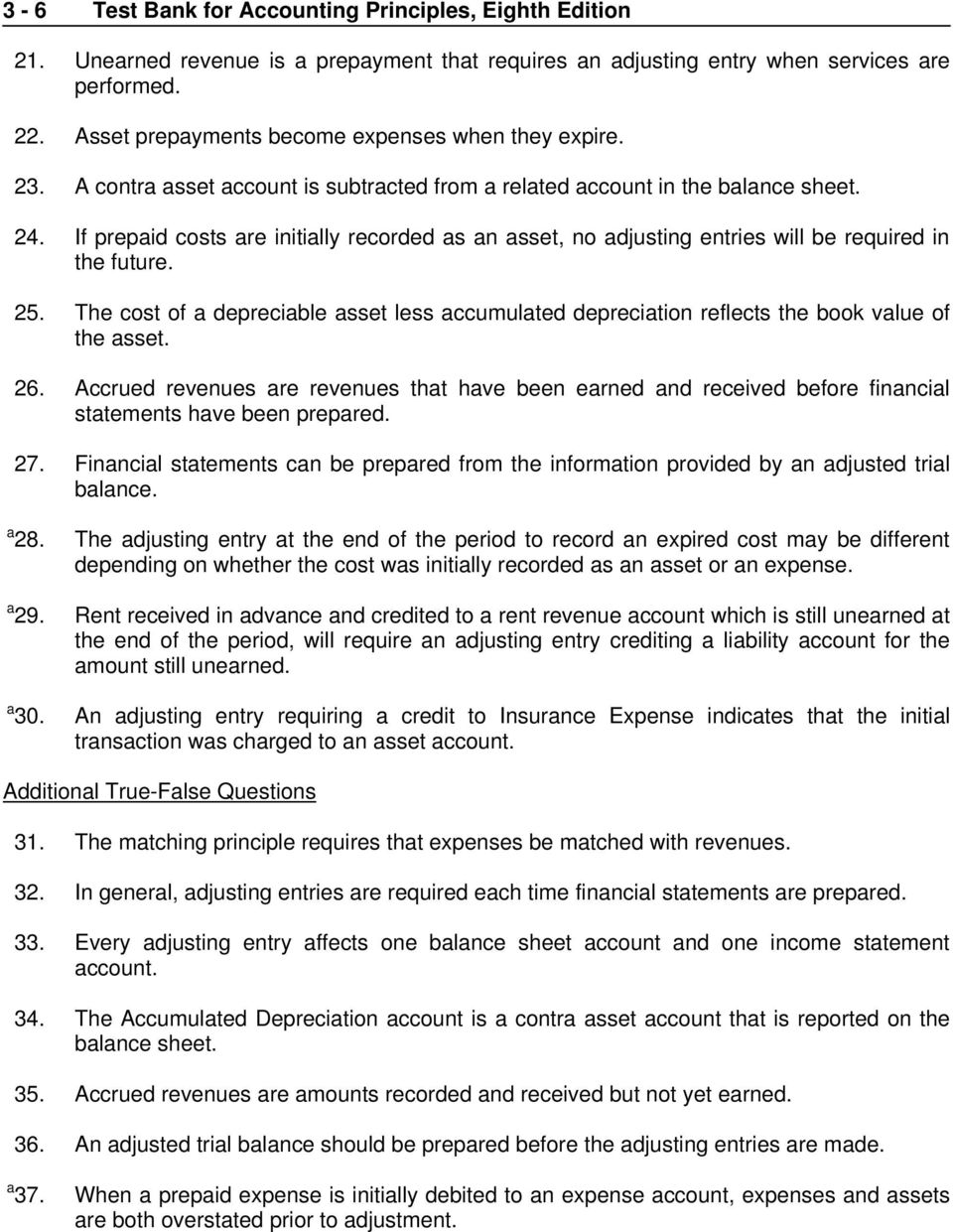
6 3-6 Test Bank for Accounting Principles, Eighth Edition 21. Unearned revenue is a prepayment that requires an adjusting entry when services are performed. 22. Asset prepayments become expenses when they expire. 23. A contra asset account is subtracted from a related account in the balance sheet. 24. If prepaid costs are initially recorded as an asset, no adjusting entries will be required in the future. 25. The cost of a depreciable asset less accumulated depreciation reflects the book value of the asset. 26. Accrued revenues are revenues that have been earned and received before financial statements have been prepared. 27. Financial statements can be prepared from the information provided by an adjusted trial balance. a 28. a 29. a 30. The adjusting entry at the end of the period to record an expired cost may be different depending on whether the cost was initially recorded as an asset or an expense. Rent received in advance and credited to a rent revenue account which is still unearned at the end of the period, will require an adjusting entry crediting a liability account for the amount still unearned. An adjusting entry requiring a credit to Insurance Expense indicates that the initial transaction was charged to an asset account. Additional True-False Questions 31. The matching principle requires that expenses be matched with revenues. 32. In general, adjusting entries are required each time financial statements are prepared. 33. Every adjusting entry affects one balance sheet account and one income statement account. 34. The Accumulated Depreciation account is a contra asset account that is reported on the balance sheet. 35. Accrued revenues are amounts recorded and received but not yet earned. 36. An adjusted trial balance should be prepared before the adjusting entries are made. a 37. When a prepaid expense is initially debited to an expense account, expenses and assets are both overstated prior to adjustment.
7 Adjusting the Accounts 3-7 Answers to True-False Statements Item Ans. Item Ans. Item Ans. Item Ans. Item Ans. Item Ans. Item Ans. 1. T 7. T 13. T 19. T 25. T 31. T a 37. F 2. T 8. T 14. F 20. F 26. F 32. T 3. F 9. T 15. F 21. T 27. T 33. T 4. F 10. F 16. F 22. T a 28. T 34. T 5. F 11. F 17. F 23. T a 29. T 35. F 6. F 12. F 18. F 24. F a 30. F 36. F MULTIPLE CHOICE QUESTIONS 38. Monthly and quarterly time periods are called a. calender periods. b. fiscal periods. c. interim periods. d. quarterly periods. 39. The time period assumption states that a. a transaction can only affect one period of time. b. estimates should not be made if a transaction affects more than one time period. c. adjustments to the enterprise's accounts can only be made in the time period when the business terminates its operations. d. the economic life of a business can be divided into artificial time periods. 40. An accounting time period that is one year in length, but does not begin on January 1, is referred to as a. a fiscal year. b. an interim period. c. the time period assumption. d. a reporting period. 41. Adjustments would not be necessary if financial statements were prepared to reflect net income from a. monthly operations. b. fiscal year operations. c. interim operations. d. lifetime operations. 42. Management usually desires financial statements and the IRS requires all businesses to file tax returns. a. annual, annual b. monthly, annual c. quarterly, monthly d. monthly, monthly 43. The time period assumption is also referred to as the a. calendar assumption. b. cyclicity assumption. c. periodicity assumption. d. fiscal assumption.

8 3-8 Test Bank for Accounting Principles, Eighth Edition 44. In general, the shorter the time period, the difficulty of making the proper adjustments to accounts a. is increased. b. is decreased. c. is unaffected. d. depends on if there is a profit or loss. 45. Which of the following is not a common time period chosen by businesses as their accounting period? a. Daily b. Monthly c. Quarterly d. Annually 46. Which of the following time periods would not be referred to as an interim period? a. Monthly b. Quarterly c. Semi-annually d. Annually 47. The fiscal year of a business is usually determined by a. the IRS. b. a lottery. c. the business. d. the SEC. 48. Which of the following are in accordance with generally accepted accounting principles? a. Accrual basis accounting b. Cash basis accounting c. Both accrual basis and cash basis accounting d. Neither accrual basis nor cash basis accounting 49. The revenue recognition principle dictates that revenue should be recognized in the accounting records a. when cash is received. b. when it is earned. c. at the end of the month. d. in the period that income taxes are paid. 50. In a service-type business, revenue is considered earned a. at the end of the month. b. at the end of the year. c. when the service is performed. d. when cash is received. 51. The matching principle matches a. customers with businesses. b. expenses with revenues. c. assets with liabilities. d. creditors with businesses.

9 Adjusting the Accounts Ken's Tune-up Shop follows the revenue recognition principle. Ken services a car on July 31. The customer picks up the vehicle on August 1 and mails the payment to Ken on August 5. Ken receives the check in the mail on August 6. When should Ken show that the revenue was earned? a. July 31 b. August 1 c. August 5 d. August A company spends $10 million dollars for an office building. Over what period should the cost be written off? a. When the $10 million is expended in cash b. All in the first year c. Over the useful life of the building d. After $10 million in revenue is earned 54. The matching principle states that expenses should be matched with revenues. Another way of stating the principle is to say that a. assets should be matched with liabilities. b. efforts should be matched with accomplishments. c. owner withdrawals should be matched with owner contributions. d. cash payments should be matched with cash receipts. 55. A dress shop makes a large sale for $1,000 on November 30. The customer is sent a statement on December 5 and a check is received on December 10. The dress shop follows GAAP and applies the revenue recognition principle. When is the $1,000 considered to be earned? a. December 5 b. December 10 c. November 30 d. December A furniture factory's employees work overtime to finish an order that is sold on February 28. The office sends a statement to the customer in early March and payment is received by mid-march. The overtime wages should be expensed in a. February. b. March. c. the period when the workers receive their checks. d. either in February or March depending on when the pay period ends. 57. Expenses sometimes make their contribution to revenue in a different period than when the expense is paid. When wages are incurred in one period and paid in the next period, this often leads to which account appearing on the balance sheet at the end of the time period? a. Due from Employees b. Due to Employer c. Wages Payable d. Wages Expense

10 3-10 Test Bank for Accounting Principles, Eighth Edition 58. Under accrual-basis accounting a. cash must be received before revenue is recognized. b. net income is calculated by matching cash outflows against cash inflows. c. events that change a company's financial statements are recognized in the period they occur rather than in the period in which cash is paid or received. d. the ledger accounts must be adjusted to reflect a cash basis of accounting before financial statements are prepared under generally accepted accounting principles. 59. Adjusting entries are required a. yearly. b. quarterly. c. monthly. d. every time financial statements are prepared. 60. Which is not an application of revenue recognition? a. Recording revenue as an adjusting entry on the last day of the accounting period. b. Accepting cash from an established customer for services to be performed over the next three months. c. Billing customers on June 30 for services completed during June. d. Receiving cash for services performed. 61. Which statement is correct? a. As long as a company consistently uses the cash basis of accounting, generally accepted accounting principles allow its use. b. The use of the cash basis of accounting violates both the revenue recognition and matching principles. c. The cash basis of accounting is objective because no one can be certain of the amount of revenue until the cash is received. d. As long as management is ethical, there are no problems with using the cash basis of accounting. 62. The following is selected information from J Corporation for the fiscal year ending October 31, Cash received from customers $300,000 Revenue earned 350,000 Cash paid for expenses 170,000 Cash paid for computers on November 1, 2007 that will be used for 3 years (annual depreciation is $16,000) 48,000 Expenses incurred, not including any depreciation 200,000 Proceeds from a bank loan, part of which was used to pay for the computers 100,000 Based on the accrual basis of accounting, what is J Corporation s net income for the year ending October 31, 2008? a. $114,000 b. $134,000 c. $82,000 d. $150,000

11 Adjusting the Accounts 3-11 Use the following information for questions Sheepskin Company had the following transactions during Sales of $4,500 on account Collected $2,000 for services to be performed in 2009 Paid $625 cash in salaries Purchased airline tickets for $250 in December for a trip to take place in What is Sheepskin s 2008 net income using accrual accounting? a. $3,875 b. $5,875 c. $5,625 d. $3, What is Sheepskin s 2008 net income using cash basis accounting? a. $5,875 b. $1,375 c. $5,625 d. $1, Adjusting entries are required a. because some costs expire with the passage of time and have not yet been journalized. b. when the company's profits are below the budget. c. when expenses are recorded in the period in which they are incurred. d. when revenues are recorded in the period in which they are earned. 66. A small company may be able to justify using a cash basis of accounting if they have a. sales under $1,000,000. b. no accountants on staff. c. few receivables and payables. d. all sales and purchases on account. 67. Which one of the following is not a justification for adjusting entries? a. Adjusting entries are necessary to ensure that revenue recognition principles are followed. b. Adjusting entries are necessary to ensure that the matching principle is followed. c. Adjusting entries are necessary to enable financial statements to be in conformity with GAAP. d. Adjusting entries are necessary to bring the general ledger accounts in line with the budget. 68. An adjusting entry a. affects two balance sheet accounts. b. affects two income statement accounts. c. affects a balance sheet account and an income statement account. d. is always a compound entry.

12 3-12 Test Bank for Accounting Principles, Eighth Edition 69. The preparation of adjusting entries is a. straight forward because the accounts that need adjustment will be out of balance. b. often an involved process requiring the skills of a professional. c. only required for accounts that do not have a normal balance. d. optional when financial statements are prepared. 70. If a resource has been consumed but a bill has not been received at the end of the accounting period, then a. an expense should be recorded when the bill is received. b. an expense should be recorded when the cash is paid out. c. an adjusting entry should be made recognizing the expense. d. it is optional whether to record the expense before the bill is received. 71. Accounts often need to be adjusted because a. there are never enough accounts to record all the transactions. b. many transactions affect more than one time period. c. there are always errors made in recording transactions. d. management can't decide what they want to report. 72. Adjusting entries are a. not necessary if the accounting system is operating properly. b. usually required before financial statements are prepared. c. made whenever management desires to change an account balance. d. made to balance sheet accounts only. 73. Expenses incurred but not yet paid or recorded are called a. prepaid expenses. b. accrued expenses. c. interim expenses. d. unearned expenses. 74. A law firm received $2,000 cash for legal services to be rendered in the future. The full amount was credited to the liability account Unearned Legal Fees. If the legal services have been rendered at the end of the accounting period and no adjusting entry is made, this would cause a. expenses to be overstated. b. net income to be overstated. c. liabilities to be understated. d. revenues to be understated. 75. Adjusting entries can be classified as a. postponements and advances. b. accruals and prepayments. c. prepayments and postponements. d. accruals and advances. 76. Accrued revenues are a. received and recorded as liabilities before they are earned. b. earned and recorded as liabilities before they are received. c. earned but not yet received or recorded. d. earned and already received and recorded.
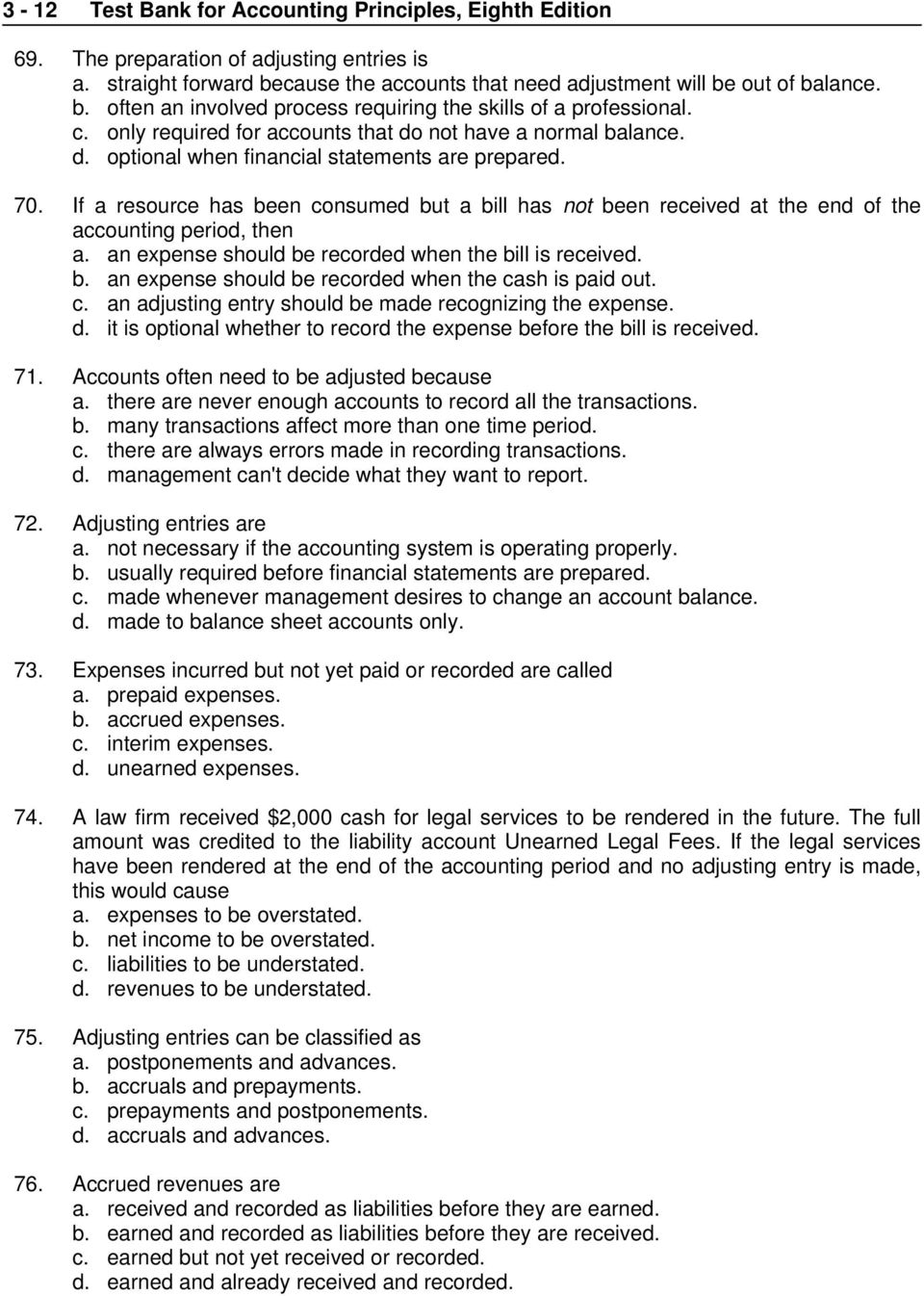
13 Adjusting the Accounts Prepaid expenses are a. paid and recorded in an asset account before they are used or consumed. b. paid and recorded in an asset account after they are used or consumed. c. incurred but not yet paid or recorded. d. incurred and already paid or recorded. 78. Accrued expenses are a. paid and recorded in an asset account before they are used or consumed. b. paid and recorded in an asset account after they are used or consumed. c. incurred but not yet paid or recorded. d. incurred and already paid or recorded. 79. Unearned revenues are a. received and recorded as liabilities before they are earned. b. earned and recorded as liabilities before they are received. c. earned but not yet received or recorded. d. earned and already received and recorded. 80. A liability revenue relationship exists with a. prepaid expense adjusting entries. b. accrued expense adjusting entries. c. unearned revenue adjusting entries. d. accrued revenue adjusting entries. 81. Which of the following reflect the balances of prepayment accounts prior to adjustment? a. Balance sheet accounts are understated and income statement accounts are understated. b. Balance sheet accounts are overstated and income statement accounts are overstated. c. Balance sheet accounts are overstated and income statement accounts are understated. d. Balance sheet accounts are understated and income statement accounts are overstated. 82. An asset expense relationship exists with a. liability accounts. b. revenue accounts. c. prepaid expense adjusting entries. d. accrued expense adjusting entries. 83. Quirk Company purchased office supplies costing $6,000 and debited Office Supplies for the full amount. At the end of the accounting period, a physical count of office supplies revealed $2,400 still on hand. The appropriate adjusting journal entry to be made at the end of the period would be a. Debit Office Supplies Expense, $2,400; Credit Office Supplies, $2,400. b. Debit Office Supplies, $3,600; Credit Office Supplies Expense, $3,600. c. Debit Office Supplies Expense, $3,600; Credit Office Supplies, $3,600. d. Debit Office Supplies, $2,400; Credit Office Supplies Expense, $2, If an adjustment is needed for unearned revenues, the a. liability and related revenue are overstated before adjustment. b. liability and related revenue are understated before adjustment. c. liability is overstated and the related revenue is understated before adjustment. d. liability is understated and the related revenue is overstated before adjustment.

14 3-14 Test Bank for Accounting Principles, Eighth Edition 85. If an adjustment is needed for prepaid expenses, the a. asset and related expense are overstated before adjustment. b. asset and related expense are understated before adjustment. c. asset is understated and the related expense is overstated before adjustment. d. asset is overstated and the related expense is understated before adjustment. 86. Depreciation expense for a period is computed by taking the a. original cost of an asset accumulated depreciation. b. depreciable cost depreciation rate. c. cost of the asset useful life. d. market value of the asset useful life. 87. Accumulated Depreciation is a. an expense account. b. an owner's equity account. c. a liability account. d. a contra asset account. 88. Hardy Company purchased a computer for $4,800 on December 1. It is estimated that annual depreciation on the computer will be $960. If financial statements are to be prepared on December 31, the company should make the following adjusting entry: a. Debit Depreciation Expense, $960; Credit Accumulated Depreciation, $960. b. Debit Depreciation Expense, $80; Credit Accumulated Depreciation, $80. c. Debit Depreciation Expense, $3,840; Credit Accumulated Depreciation, $3,840. d. Debit Office Equipment, $4,800; Credit Accumulated Depreciation, $4, Baden Realty Company received a check for $18,000 on July 1 which represents a 6 month advance payment of rent on a building it rents to a client. Unearned Rent was credited for the full $18,000. Financial statements will be prepared on July 31. Baden Realty should make the following adjusting entry on July 31: a. Debit Unearned Rent, $3,000; Credit Rental Revenue, $3,000. b. Debit Rental Revenue, $3,000; Credit Unearned Rent, $3,000. c. Debit Unearned Rent, $18,000; Credit Rental Revenue, $18,000. d. Debit Cash, $18,000; Credit Rental Revenue, $18, As prepaid expenses expire with the passage of time, the correct adjusting entry will be a a. debit to an asset account and a credit to an expense account. b. debit to an expense account and a credit to an asset account. c. debit to an asset account and a credit to an asset account. d. debit to an expense account and a credit to an expense account. 91. A company usually determines the amount of supplies used during a period by a. adding the supplies on hand to the balance of the Supplies account. b. summing the amount of supplies purchased during the period. c. taking the difference between the supplies purchased and the supplies paid for during the period. d. taking the difference between the balance of the Supplies account and the cost of supplies on hand.

15 Adjusting the Accounts If a company fails to make an adjusting entry to record supplies expense, then a. owner's equity will be understated. b. expense will be understated. c. assets will be understated. d. net income will be understated. 93. If a company fails to adjust a Prepaid Rent account for rent that has expired, what effect will this have on that month's financial statements? a. Failure to make an adjustment does not affect the financial statements. b. Expenses will be overstated and net income and owner's equity will be understated. c. Assets will be overstated and net income and owner's equity will be understated. d. Assets will be overstated and net income and owner's equity will be overstated. 94. At December 31, 2008, before any year-end adjustments, Karr Company's Insurance Expense account had a balance of $1,450 and its Prepaid Insurance account had a balance of $3,800. It was determined that $3,000 of the Prepaid Insurance had expired. The adjusted balance for Insurance Expense for the year would be a. $3,000. b. $1,450. c. $4,450. d. $2, Depreciation is the process of a. valuing an asset at its fair market value. b. increasing the value of an asset over its useful life in a rational and systematic manner. c. allocating the cost of an asset to expense over its useful life in a rational and systematic manner. d. writing down an asset to its real value each accounting period. 96. A new accountant working for Metcalf Company records $800 Depreciation Expense on store equipment as follows: Dr. Depreciation Expense Cr. Cash The effect of this entry is to a. adjust the accounts to their proper amounts on December 31. b. understate total assets on the balance sheet as of December 31. c. overstate the book value of the depreciable assets at December 31. d. understate the book value of the depreciable assets as of December From an accounting standpoint, the acquisition of productive facilities can be thought of as a long-term a. accrual of expense. b. accrual of revenue. c. accrual of unearned revenue. d. prepayment for services. 98. In computing depreciation, the number of years of useful life of the asset is a. known with certainty. b. an estimate. c. always fixed at 5 years. d. always fixed at 3 years.
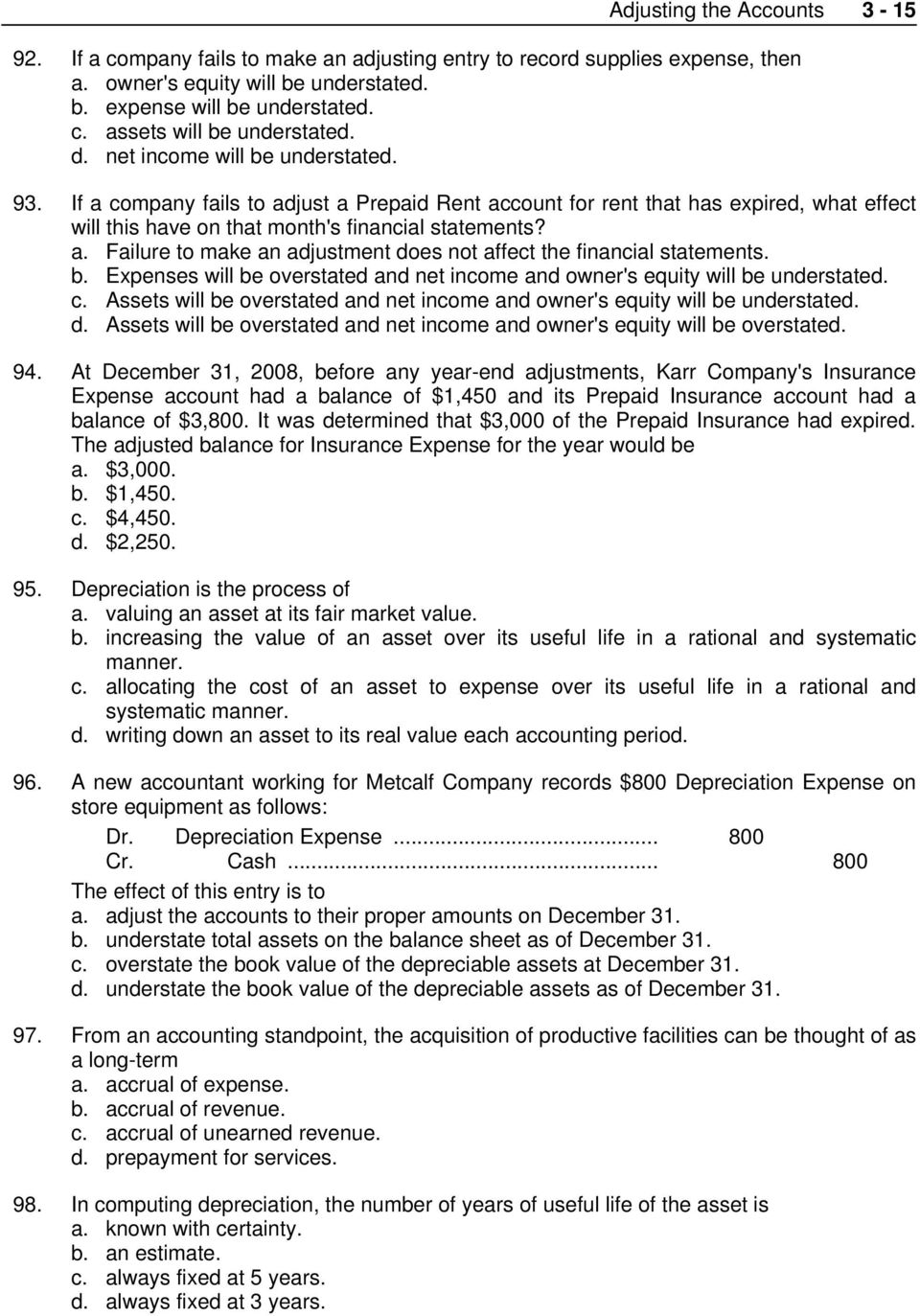
16 3-16 Test Bank for Accounting Principles, Eighth Edition 99. An accumulated depreciation account a. is a contra-liability account. b. increases on the debit side. c. is offset against total assets on the balance sheet. d. has a normal credit balance The difference between the cost of a depreciable asset and its related accumulated depreciation is referred to as the a. market value of the asset. b. blue book value of the asset. c. book value of the asset. d. depreciated difference of the asset If a business has several types of long-term assets such as equipment, buildings, and trucks, a. there should be only one accumulated depreciation account. b. there should be separate accumulated depreciation accounts for each type of asset. c. all the long-term asset accounts will be recorded in one general ledger account. d. there won't be a need for an accumulated depreciation account Which of the following would not result in unearned revenue? a. Rent collected in advance from tenants b. Services performed on account c. Sale of season tickets to football games d. Sale of two-year magazine subscriptions 103. If business pays rent in advance and debits a Prepaid Rent account, the company receiving the rent payment will credit a. cash. b. prepaid rent. c. unearned rent revenue. d. accrued rent revenue Unearned revenue is classified as a. an asset account. b. a revenue account. c. a contra-revenue account. d. a liability If a business has received cash in advance of services performed and credits a liability account, the adjusting entry needed after the services are performed will be a. debit Unearned Revenue and credit Cash. b. debit Unearned Revenue and credit Service Revenue. c. debit Unearned Revenue and credit Prepaid Expense. d. debit Unearned Revenue and credit Accounts Receivable.
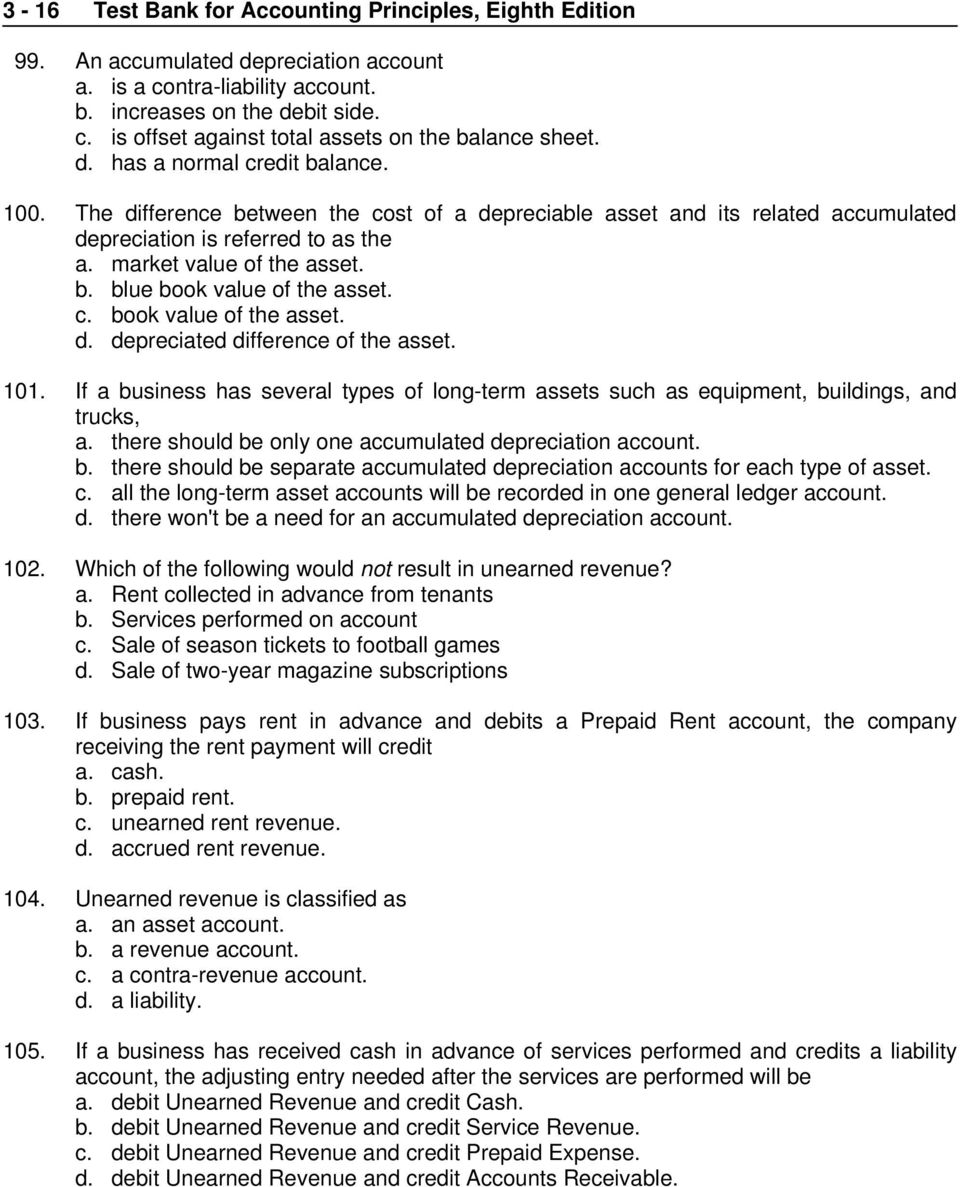
17 Adjusting the Accounts White Laundry Company purchased $6,500 worth of laundry supplies on June 2 and recorded the purchase as an asset. On June 30, an inventory of the laundry supplies indicated only $2,000 on hand. The adjusting entry that should be made by the company on June 30 is a. Debit Laundry Supplies Expense, $2,000; Credit Laundry Supplies, $2,000. b. Debit Laundry Supplies, $2,000; Credit Laundry Supplies Expense, $2,000. c. Debit Laundry Supplies, $4,500; Credit Laundry Supplies Expense, $4,500. d. Debit Laundry Supplies Expense, $4,500; Credit Laundry Supplies, $4, On July 1, Dexter Shoe Store paid $8,000 to Ace Realty for 4 months rent beginning July 1. Prepaid Rent was debited for the full amount. If financial statements are prepared on July 31, the adjusting entry to be made by Dexter Shoe Store is a. Debit Rent Expense, $8,000; Credit Prepaid Rent, $2,000. b. Debit Prepaid Rent, $2,000; Credit Rent Expense, $2,000. c. Debit Rent Expense, $2,000; Credit Prepaid Rent, $2,000. d. Debit Rent Expense, $8,000; Credit Prepaid Rent, $8, Southeastern Louisiana University sold season tickets for the 2008 football season for $160,000. A total of 8 games will be played during September, October and November. In September, three games were played. The adjusting journal entry at September 30 a. is not required. No adjusting entries will be made until the end of the season in November. b. will include a debit to Cash and a credit to Ticket Revenue for $40,000. c. will include a debit to Unearned Ticket Revenue and a credit to Ticket Revenue for $60,000. d. will include a debit to Ticket Revenue and a credit to Unearned Ticket Revenue for $53, Southeastern Louisiana University sold season tickets for the 2008 football season for $160,000. A total of 8 games will be played during September, October and November. In September, two games were played. In October, three games were played. The balance in Unearned Revenue at October 31 is a. $0. b. $40,000. c. $60,000. d. $100, Southeastern Louisiana University sold season tickets for the 2008 football season for $160,000. A total of 8 games will be played during September, October and November. Assuming all the games are played, the Unearned Revenue balance that will be reported on the December 31 balance sheet will be a. $0. b. $60,000. c. $100,000. d. $160, At March 1, 2008, Candy Inc. had supplies on hand of $500. During the month, Candy purchased supplies of $1,200 and used supplies of $1,500. The March 31 adjusting journal entry should include a a. debit to the supplies account for $1,500. b. credit to the supplies account for $500. c. debit to the supplies account for $1,200. d. credit to the supplies account for $1,500.
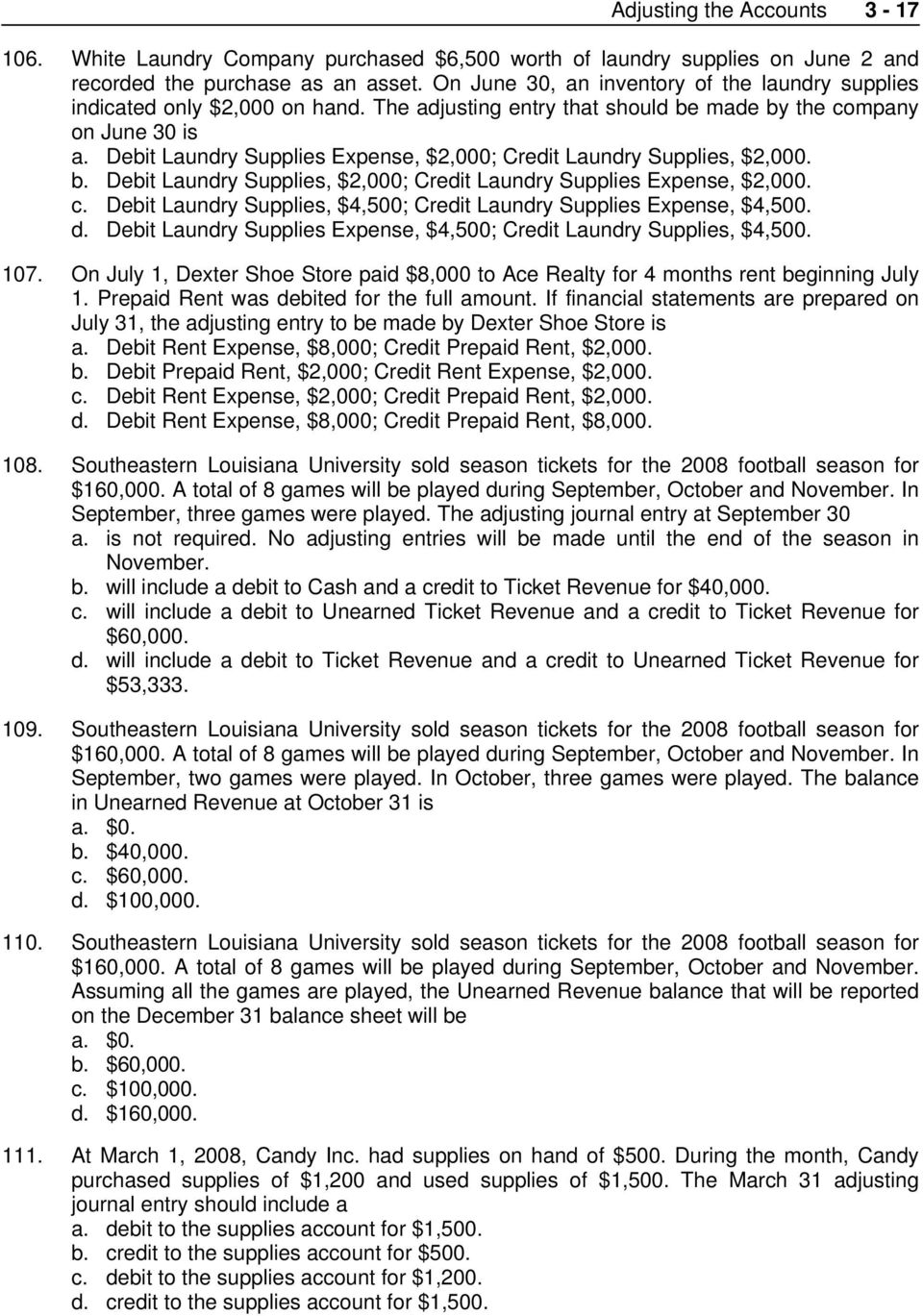
18 3-18 Test Bank for Accounting Principles, Eighth Edition 112. Dorting Company purchased a computer system for $3,600 on January 1, The company expects to use the computer system for 3 years. It has no salvage value. Monthly depreciation expense on the asset is a. $0. b. $100. c. $1,200. d. $3, Maple Tree Inc. purchased a 12-month insurance policy on March 1, 2008 for $900. At March 31, 2008, the adjusting journal entry to record expiration of this asset will include a a. debit to Prepaid Insurance and a credit to Cash for $900. b. debit to Prepaid Insurance and a credit to Insurance Expense for $100. c. debit to Insurance Expense and a credit to Prepaid Insurance for $75 d. debit to Insurance Expense and a credit to Cash for $ Ogletree Enterprises purchased an 18-month insurance policy on May 31, 2008 for $3,600. The December 31, 2008 balance sheet would report Prepaid Insurance of a. $0 because Prepaid Insurance is reported on the Income Statement. b. $1,400. c. $2,200. d. $3, At March 1, J.C. Retro Inc. reported a balance in Supplies of $200. During March, the company purchased supplies for $750 and consumed supplies of $800. If no adjusting entry is made for supplies a. owner s equity will be overstated by $800. b. expenses will be understated by $750. c. assets will be understated by $150. d. net income will be understated by $ FMI Inc. pays its rent of $120,000 annually on January 1. If the February 28 monthly adjusting entry for prepaid rent is omitted, which of the following will be true? a. Failure to make the adjustment does not affect the February financial statements. b. Expenses will be overstated by $10,000 and net income and owner s equity will be understated by $10,000. c. Assets will be overstated by $20,000 and net income and owner s equity will be understated by $20,000. d. Assets will be overstated by $10,000 and net income and owner s equity will be overstated by $10, On January 1, 2007, P.T. Oracle Company purchased a computer system for $3,240. The company expects to use the system for 3 years. The asset has no salvage value. The book value of the system at December 31, 2008 is a. $0. b. $1,080. c. $2,160. d. $3,240.

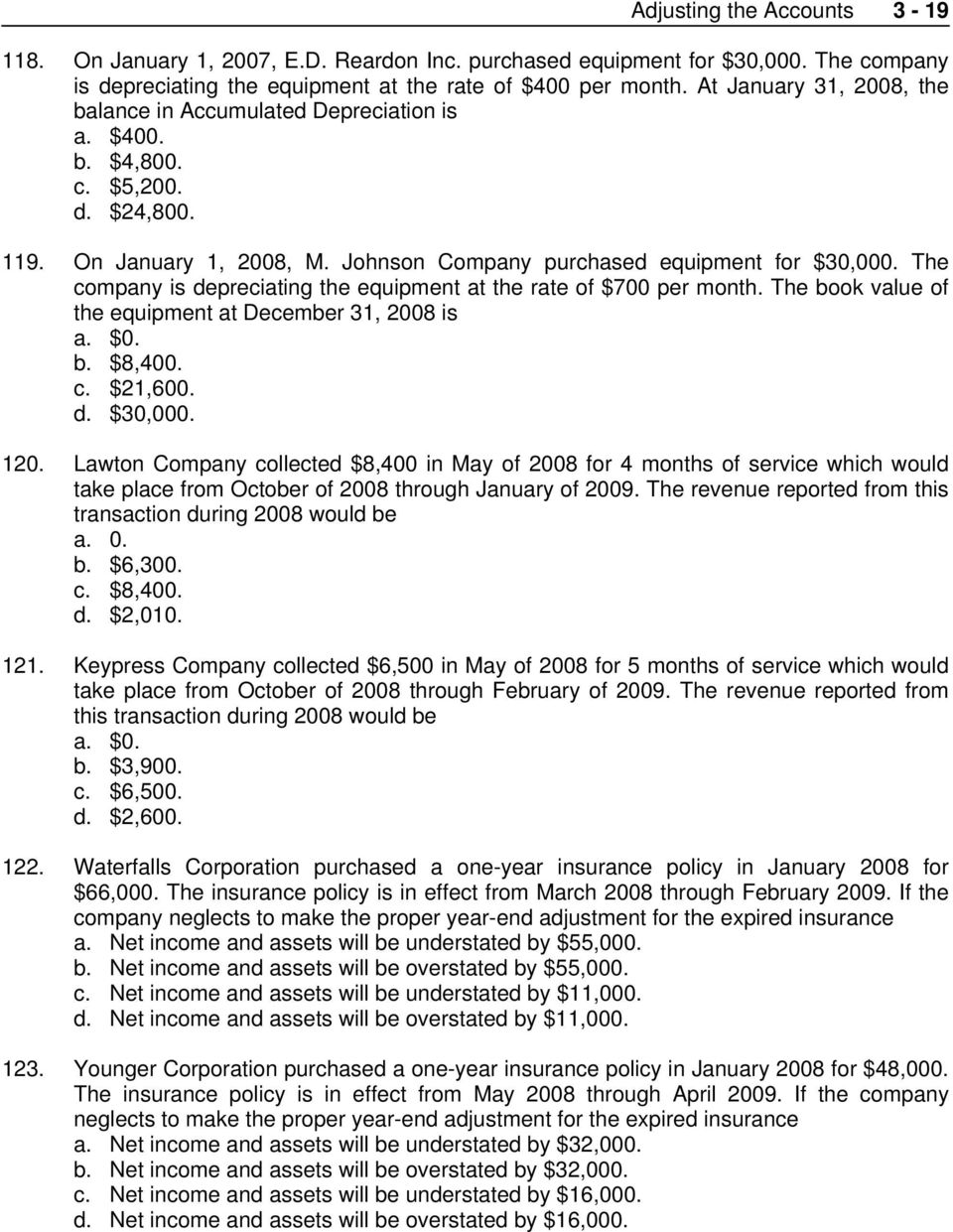
19 Adjusting the Accounts On January 1, 2007, E.D. Reardon Inc. purchased equipment for $30,000. The company is depreciating the equipment at the rate of $400 per month. At January 31, 2008, the balance in Accumulated Depreciation is a. $400. b. $4,800. c. $5,200. d. $24, On January 1, 2008, M. Johnson Company purchased equipment for $30,000. The company is depreciating the equipment at the rate of $700 per month. The book value of the equipment at December 31, 2008 is a. $0. b. $8,400. c. $21,600. d. $30, Lawton Company collected $8,400 in May of 2008 for 4 months of service which would take place from October of 2008 through January of The revenue reported from this transaction during 2008 would be a. 0. b. $6,300. c. $8,400. d. $2, Keypress Company collected $6,500 in May of 2008 for 5 months of service which would take place from October of 2008 through February of The revenue reported from this transaction during 2008 would be a. $0. b. $3,900. c. $6,500. d. $2, Waterfalls Corporation purchased a one-year insurance policy in January 2008 for $66,000. The insurance policy is in effect from March 2008 through February If the company neglects to make the proper year-end adjustment for the expired insurance a. Net income and assets will be understated by $55,000. b. Net income and assets will be overstated by $55,000. c. Net income and assets will be understated by $11,000. d. Net income and assets will be overstated by $11, Younger Corporation purchased a one-year insurance policy in January 2008 for $48,000. The insurance policy is in effect from May 2008 through April If the company neglects to make the proper year-end adjustment for the expired insurance a. Net income and assets will be understated by $32,000. b. Net income and assets will be overstated by $32,000. c. Net income and assets will be understated by $16,000. d. Net income and assets will be overstated by $16,000.
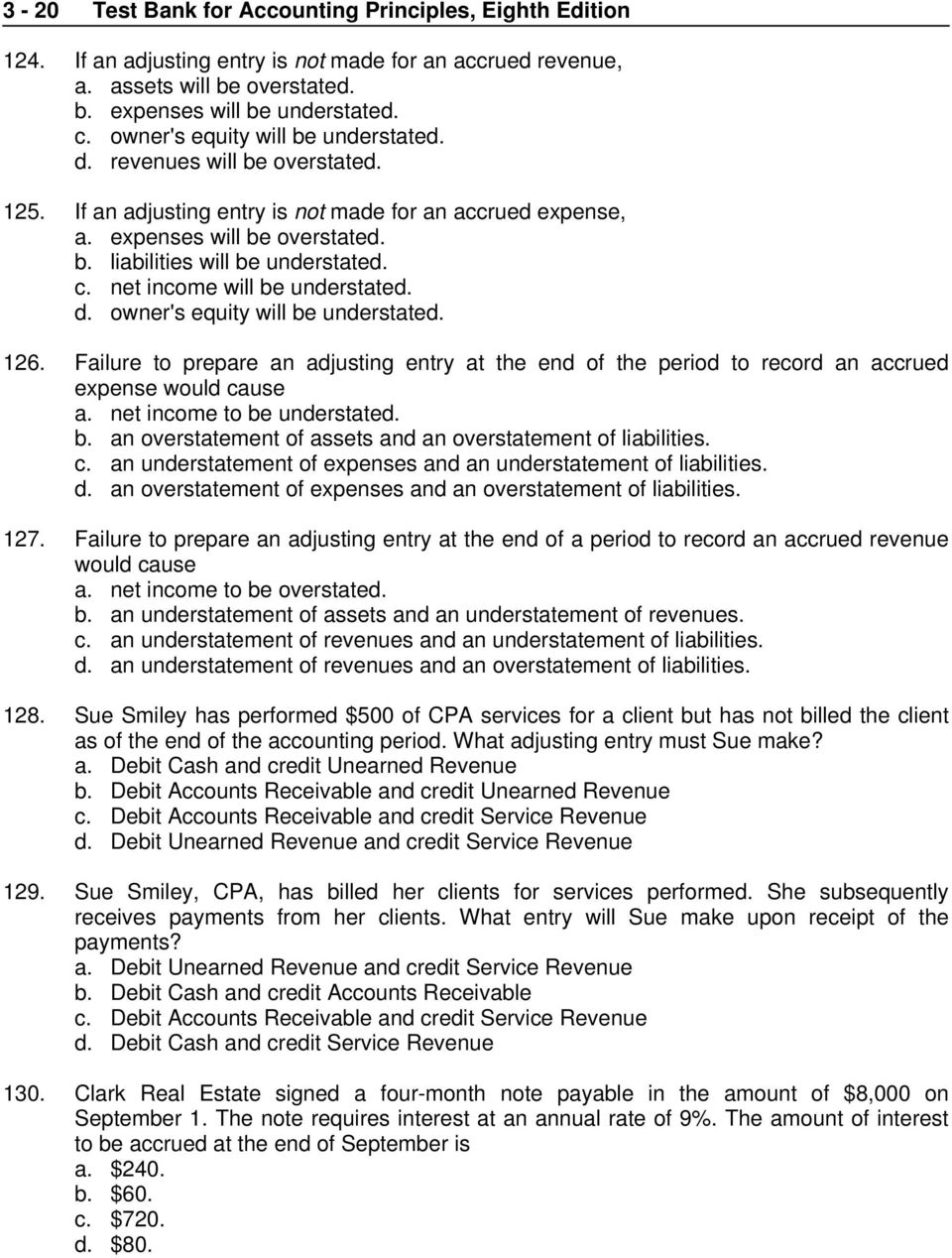
20 3-20 Test Bank for Accounting Principles, Eighth Edition 124. If an adjusting entry is not made for an accrued revenue, a. assets will be overstated. b. expenses will be understated. c. owner's equity will be understated. d. revenues will be overstated If an adjusting entry is not made for an accrued expense, a. expenses will be overstated. b. liabilities will be understated. c. net income will be understated. d. owner's equity will be understated Failure to prepare an adjusting entry at the end of the period to record an accrued expense would cause a. net income to be understated. b. an overstatement of assets and an overstatement of liabilities. c. an understatement of expenses and an understatement of liabilities. d. an overstatement of expenses and an overstatement of liabilities Failure to prepare an adjusting entry at the end of a period to record an accrued revenue would cause a. net income to be overstated. b. an understatement of assets and an understatement of revenues. c. an understatement of revenues and an understatement of liabilities. d. an understatement of revenues and an overstatement of liabilities Sue Smiley has performed $500 of CPA services for a client but has not billed the client as of the end of the accounting period. What adjusting entry must Sue make? a. Debit Cash and credit Unearned Revenue b. Debit Accounts Receivable and credit Unearned Revenue c. Debit Accounts Receivable and credit Service Revenue d. Debit Unearned Revenue and credit Service Revenue 129. Sue Smiley, CPA, has billed her clients for services performed. She subsequently receives payments from her clients. What entry will Sue make upon receipt of the payments? a. Debit Unearned Revenue and credit Service Revenue b. Debit Cash and credit Accounts Receivable c. Debit Accounts Receivable and credit Service Revenue d. Debit Cash and credit Service Revenue 130. Clark Real Estate signed a four-month note payable in the amount of $8,000 on September 1. The note requires interest at an annual rate of 9%. The amount of interest to be accrued at the end of September is a. $240. b. $60. c. $720. d. $80.
21 Adjusting the Accounts A gift shop signs a three-month note payable to help finance increases in inventory for the Christmas shopping season. The note is signed on November 1 in the amount of $50,000 with annual interest of 12%. What is the adjusting entry to be made on December 31 for the interest expense accrued to that date, if no entries have been made previously for the interest? a. Interest Expense... 1,000 Interest Payable... 1,000 b. Interest Expense... 1,500 Interest Payable... 1,500 c. Interest Expense... 1,000 Cash... 1,000 d. Interest Expense... 1,000 Note Payable... 1, Trent Tables paid employee wages on and through Friday, January 26, and the next payroll will be paid in February. There are three more working days in January (29 31). Employees work 5 days a week and the company pays $900 a day in wages. What will be the adjusting entry to accrue wages expense at the end of January? a. Wages Expense Wages Payable b. Wages Expense... 4,500 Wages Payable... 4,500 c. Wages Expense... 2,700 Wages Payable... 2,700 d. No adjusting entry is required A company shows a balance in Salaries Payable of $40,000 at the end of the month. The next payroll amounting to $45,000 is to be paid in the following month. What will be the journal entry to record the payment of salaries? a. Salaries Expense... 45,000 Salaries Payable... 45,000 b. Salaries Expense... 45,000 Cash... 45,000 c. Salaries Expense... 5,000 Cash... 5,000 d. Salaries Expense... 5,000 Salaries Payable... 40,000 Cash... 45, The accounts of a business before an adjusting entry is made to record an accrued revenue reflect an a. understated liability and an overstated owner's capital. b. overstated asset and an understated revenue. c. understated expense and an overstated revenue. d. understated asset and an understated revenue Carter Guitar Company borrowed $12,000 from the bank signing a 9%, 3-month note on September 1. Principal and interest are payable to the bank on December 1. If the company prepares monthly financial statements, the adjusting entry that the company should make for interest on September 30, would be
22 3-22 Test Bank for Accounting Principles, Eighth Edition a. Debit Interest Expense, $1,080; Credit Interest Payable, $1,080. b. Debit Interest Expense, $90; Credit Interest Payable, $90. c. Debit Note Payable, $1,080; Credit Cash, $1,080. d. Debit Cash, $270; Credit Interest Payable, $ Manning Corporation issued a one-year, 9%, $200,000 note on April 30, Interest expense for the year ended December 31, 2008 was a. $18,000. b. $13,500. c. $12,000. d. $10, Blue Corporation issued a one-year, 12%, $200,000 note on August 31, Interest expense for the year ended December 31, 2008 was a. $24,000. b. $10,000. c. $8,000. d. $6, Employees at B Corporation are paid $5,000 cash every Friday for working Monday through Friday. The calendar year accounting period ends on Wednesday, December 31. How much salary expense should be recorded two days later on January 2? a. $5,000 b. $3,000 c. None, matching requires the weekly salary to be accrued on December 31. d. $2, Can financial statements be prepared directly from the adjusted trial balance? a. They cannot. The general ledger must be used. b. Yes, adjusting entries have been recorded in the general journal and posted to the ledger accounts. c. No, the adjusted trial balance merely proves the equality of the total debit and total credit balances in the ledger after adjustments are posted. It has no other purpose. d. They can because that is the only reason that an adjusted trial balance is prepared The adjusted trial balance is prepared a. after financial statements are prepared. b. before the trial balance. c. to prove the equality of total assets and total liabilities. d. after adjusting entries have been journalized and posted An adjusted trial balance a. is prepared after the financial statements are completed. b. proves the equality of the total debit balances and total credit balances of ledger accounts after all adjustments have been made. c. is a required financial statement under generally accepted accounting principles. d. cannot be used to prepare financial statements.
23 Adjusting the Accounts Which of the statements below is not true? a. An adjusted trial balance should show ledger account balances. b. An adjusted trial balance can be used to prepare financial statements. c. An adjusted trial balance proves the mathematical equality of debits and credits in the ledger. d. An adjusted trial balance is prepared before all transactions have been journalized. a 143. Al is a barber who does his own accounting for his shop. When he buys supplies he routinely debits Supplies Expense. Al purchased $1,500 of supplies in January and his inventory at the end of January shows $400 of supplies remaining. What adjusting entry should Al make on January 31? a. Supplies Expense Supplies b. Supplies Expense... 1,500 Cash... 1,500 c. Supplies Supplies Expense d. Supplies Expense... 1,100 Supplies... 1,100 a 144. Alternative adjusting entries do not apply to a. accrued revenues and accrued expenses. b. prepaid expenses. c. unearned revenues. d. prepaid expenses and unearned revenues. a 145. Jim is a lawyer who requires that his clients pay him in advance of legal services rendered. Jim routinely credits Legal Service Revenue when his clients pay him in advance. In June Jim collected $12,000 in advance fees and completed 75% of the work related to these fees. What adjusting entry is required by Jim's firm at the end of June? a. Unearned Revenue... 9,000 Legal Service Revenue... 9,000 b. Unearned Revenue... 3,000 Legal Service Revenue... 3,000 c. Cash... 12,000 Legal Service Revenue... 12,000 d. Legal Service Revenue... 3,000 Unearned Revenue... 3,000 a 146. If prepaid expenses are initially recorded in expense accounts and have not all been used at the end of the accounting period, then failure to make an adjusting entry will cause a. assets to be understated. b. assets to be overstated. c. expenses to be understated. d. contra-expenses to be overstated. a 147. If unearned revenues are initially recorded in revenue accounts and have not all been earned at the end of the accounting period, then failure to make an adjusting entry will cause a. liabilities to be overstated. b. revenues to be understated. c. revenues to be overstated. d. accounts receivable to be overstated.
24 3-24 Test Bank for Accounting Principles, Eighth Edition a 148. On January 2, 2008, Federal Savings and Loan purchased a general liability insurance policy for $2,400 for coverage for the calendar year. The entire $2,400 was charged to Insurance Expense on January 2, If the firm prepares monthly financial statements, the proper adjusting entry on January 31, 2008, will be: a. Insurance Expense... 2,200 Prepaid Insurance... 2,200 b. Prepaid Insurance... 2,200 Insurance Expense... 2,200 c. Insurance Expense Prepaid Insurance d. Prepaid Insurance Insurance Expense Additional Multiple Choice Questions 149. Which of the following statements concerning accrual-basis accounting is incorrect? a. Accrual-basis accounting follows the revenue recognition principle. b. Accrual-basis accounting is the method required by generally accepted accounting principles. c. Accrual-basis accounting recognizes expenses when they are paid. d. Accrual-basis accounting follows the matching principle The revenue recognition principle dictates that revenue be recognized in the accounting period a. before it is earned. b. after it is earned. c. in which it is earned. d. in which it is collected An expense is recorded under the cash basis only when a. services are performed. b. it is earned. c. cash is paid. d. it is incurred For prepaid expense adjusting entries a. an expense liability account relationship exists. b. prior to adjustment, expenses are overstated and assets are understated. c. the adjusting entry results in a debit to an expense account and a credit to an asset account. d. none of these Expenses paid and recorded as assets before they are used are called a. accrued expenses. b. interim expenses. c. prepaid expenses. d. unearned expenses.
25 Adjusting the Accounts Demaet Cruise Lines purchased a five-year insurance policy for its ships on April 1, 2008 for $100,000. Assuming that April 1 is the effective date of the policy, the adjusting entry on December 31, 2008 is a. Prepaid Insurance... 15,000 Insurance Expense... 15,000 b. Insurance Expense... 15,000 Prepaid Insurance... 15,000 c. Insurance Expense... 20,000 Prepaid Insurance... 20,000 d. Insurance Expense... 5,000 Prepaid Insurance... 5, Gardner Company purchased a truck from Kutner Co. by issuing a 6-month, 8% note payable for $60,000 on November 1. On December 31, the accrued expense adjusting entry is a. No entry is required. b. Interest Expense... 4,800 Interest Payable... 4,800 c. Interest Expense... 9,600 Interest Payable... 9,600 d. Interest Expense Interest Payable If the adjusting entry for depreciation is not made, a. assets will be understated. b. owner's equity will be understated. c. net income will be understated. d. expenses will be understated Cathy Cline, an employee of Welker Company, will not receive her paycheck until April 2. Based on services performed from March 15 to March 30, her salary was $900. The adjusting entry for Welker Company on March 31 is a. Salaries Expense Salaries Payable b. No entry is required. c. Salaries Expense Cash d. Salaries Payable Cash Which of the following statements related to the adjusted trial balance is incorrect? a. It shows the balances of all accounts at the end of the accounting period. b. It is prepared before adjusting entries have been made. c. It proves the equality of the total debit balances and the total credit balances in the ledger. d. Financial statements can be prepared directly from the adjusted trial balance Financial statements are prepared directly from the a. general journal. b. ledger. c. trial balance. d. adjusted trial balance.
26 3-26 Test Bank for Accounting Principles, Eighth Edition Answers to Multiple Choice Questions Item Ans. Item Ans. Item Ans. Item Ans. Item Ans. Item Ans. Item Ans. 38. c 56. a 74. d 92. b 110. a 128. c a 146. a 39. d 57. c 75. b 93. d 111. d 129. b a 147. c 40. a 58. c 76. c 94. c 112. b 130. b a 148. b 41. d 59. d 77. a 95. c 113. c 131. a 149. c 42. b 60. b 78. c 96. c 114. c 132. c 150. c 43. c 61. b 79. a 97. d 115. a 133. d 151. c 44. a 62. b 80. c 98. b 116. d 134. d 152. c 45. a 63. a 81. c 99. d 117. b 135. b 153. c 46. d 64. d 82. c 100. c 118. c 136. c 154. b 47. c 65. a 83. c 101. b 119. c 137. c 155. d 48. a 66. c 84. c 102. b 120. b 138. d 156. d 49. b 67. d 85. d 103. c 121. b 139. b 157. a 50. c 68. c 86. c 104. d 122. b 140. d 158. b 51. b 69. b 87. d 105. b 123. b 141. b 159. d 52. a 70. c 88. b 106. d 124. c 142. d 53. c 71. b 89. a 107. c 125. b a 143. c 54. b 72. b 90. b 108. c 126. c a 144. a 55. c 73. b 91. d 109. c 127. b a 145. d BRIEF EXERCISES BE 160 State whether each situation is a prepaid expense (PE), unearned revenue (UR), accrued revenue (AR) or an accrued expense (AE). 1. Unrecorded interest on savings bonds is $ Property taxes that have been incurred but that have not yet been paid or recorded amount to $ Legal fees of $1,000 were collected in advance. By year end 60 percent were still unearned. 4. Prepaid insurance had a $500 balance prior to adjustment. By year end, 40 percent was still unexpired. Solution AR 2. AE 3. UR 4. PE (3 min.)
27 Adjusting the Accounts 3-27 BE 161 Prepare adjusting entries for the following transactions. Omit explanations. 1. Depreciation on equipment is $800 for the accounting period. 2. There was no beginning balance of supplies and purchased $500 of office supplies during the period. At the end of the period $80 of supplies were on hand. 3. Prepaid rent had a $1,000 normal balance prior to adjustment. By year end $600 was unexpired. Solution 161 (6 min.) 1. Depreciation Expense Accumulated Depreciation Equipment Supplies Expense Supplies ($500 $80) 3. Rent Expense Prepaid Rent ($1,000 $600) BE 162 On June 1, during its first month of operations, Eggemeister Enterprises purchased supplies for $3,500 and debited the supplies account for that amount. At January 30, an inventory of supplies showed $1,200 of supplies on hand. What adjusting journal entry should be made for June? Solution 162 (3 min.) Supplies Expense... 2,300 Supplies... 2,300 Be. 163 On January 1, Biddle & Biddle, CPAs received a $9,000 cash retainer for legal services to be rendered ratably over the next 3 months. The full amount was credited to the liability account Unearned Revenue. Assuming that the revenue is earned ratably over the 3-month period, what adjusting journal entry should be made at January 31? Solution 163 (3 min.) Unearned Revenue... 3,000 Fees Earned... 3,000
28 3-28 Test Bank for Accounting Principles, Eighth Edition BE 164 On February 1, Acts Tax Service received a $2,000 cash retainer for tax preparation services to be rendered ratably over the next 4 months. The full amount was credited to the liability account Unearned Revenue. Assuming that the revenue is earned ratably over the 4-month period, what balance would be reported on the February 28 balance sheet for Unearned Revenue? Solution 164 (5 min.) Revenue earned monthly = $2,000/ 4 months = $500 per month Feb 28 balance in Unearned Revenue = $2,000 - $500 revenue earned in February = $1,500 BE 165 Hans Albert Enterprises purchased computer equipment on May 1, 2008 for $4,500. The company expects to use the equipment for 3 years. It has no salvage value. 1. What adjusting journal entry should the company make at the end of each month if monthly financials are prepared (annual depreciation is $1,500)? 2. What is the book value of the equipment at May 31, 2008? Solution 165 (5 min.) 1. Depreciation Expense Accumulated Depreciation Cost $4,500 Accumulated Depreciation 125 Book value $4,375 BE 166 Hampton International purchased software on October 1, 2008 for $10,800. The company expects to use the software for 3 years. It has no salvage value. 1. What adjusting journal entry should the company make at the end of each month if monthly financials are prepared? (annual depreciation is $3,600) 2. What balance will be reported on the December 31, 2008 balance sheet for Accumulated Depreciation? Solution 166 (5 min.) 1. Depreciation Expense Accumulated Depreciation Balance in Accumulated Depreciation at December 31, 2008: 3 months $300 per month = $900
29 Adjusting the Accounts 3-29 BE 167 Better Publications. sold annual subscriptions to their magazine for $24,000 in December, The magazine is published monthly. The new subscribers received their first magazine in January, What adjusting entry should be made in January if the subscriptions were originally recorded as a liability? 2. What amount will be reported on the January 2008 balance sheet for Unearned Revenue? Solution 167 (5 min.) 1. Unearned Revenue... 2,000 Subscription Revenue... 2, Unearned Revenue at January 31: $24,000 $2,000 = $22,000 BE 168 On January 1, 2008, J.C. Cohen Company purchased a general liability insurance policy for $3,600 to provide coverage for the calendar year. 1. If the company recorded the policy as an asset when purchased, what is the monthly adjusting journal entry that should be recorded at January 31, 2008? *2. If the company expensed the cost of the policy on January 1, 2008, what is the monthly adjusting entry that should be recorded at January 31, 2008? Solution 168 (5 min.) 1. Insurance Expense Prepaid Insurance *2. Prepaid Insurance... 3,300 Insurance Expense... 3,300 BE 169 Identify the impact on the balance sheet if the following information is not used to adjust the accounts. 1. Supplies consumed totalled $3, Interest accrues on notes payable at the rate of $200 per month. 3. Insurance of $450 expired during the month. 4. Plant and equipment are depreciated at the rate of $1,200 per month.
30 3-30 Test Bank for Accounting Principles, Eighth Edition Solution 169 (5 min.) 1. Assets overstated and Owner s Equity overstated by $3, Liabilities understated and Owner s Equity overstated by $ Assets overstated and Owner s Equity overstated by $ Assets overstated and Owner s Equity overstated by $1,200. BE 170 Determine the impact on the balance sheet accounts if the following information is not used to adjust the accounts of Lake Castle Company for the month of January, Round answers to the nearest dollar. 1. The company rents extra office space to Franz, CPAs. Franz pays the $12,000 rent annually on January The company has an outstanding loan to its President in the amount of $100,000. The loan accrues interest at the annual rate of 4%. Principal and interest are due January 1, The company completed work on a project during January that was not yet billed to the client. The client will be charged $2,500. Solution 170 (5 min.) 1. Liabilities overstated and Owner s Equity understated by $1, Assets understated and Owner s Equity understated by $ Assets understated and Owner s Equity understated by $2,500. BE 171 For each of the following oversights, state whether total assets will be understated (U), overstated (O), or no affect (NA). 1. Failure to record revenue earned but not yet received. 2. Failure to record expired prepaid rent. 3. Failure to record accrued interest on the bank savings account. 4. Failure to record depreciation. 5. Failure to record accrued wages. 6. Failure to recognize the earned portion of unearned revenues. Solution U 2. O 3. U 4. O 5. NA 6. NA (5 min.)
31 Adjusting the Accounts 3-31 BE 172 River Ridge Music School borrowed $20,000 from the bank signing a 10%, 6-month note on November 1. Principal and interest are payable to the bank on May 1. If the company prepares monthly financial statements, what adjusting entry should the company make at November 30 with regard to the note (round answer to the nearest dollar)? Solution 172 (3 min.) Interest Expense ($20,000 10% 1/12) Interest Payable BE 173 The adjusted trial balance of Ninety-Six Inc. on December 31, 2008 includes the following accounts: Accumulated Depreciation, $6,000; Depreciation Expense, $2,000; Note Payable $7,500; Interest Expense $150; Utilities Expense, $300; Rent Expense, $500; Service Revenue, $19,600; Salaries Expense, $4,000; Supplies, $200; Supplies Expense, $1,200; Wages Payable, $600. Prepare an income statement for the month of December. Solution 173 (10 min.) Ninety-Six Inc. Income Statement For the Month Ended December 31, 2008 Service Revenue $19,600 Expenses: Depreciation expense $2,000 Interest expense 150 Utilities expense 300 Rent expense 500 Salaries expense 4,000 Supplies expense 1,200 8,150 Net Income $11,450 BE 174 The adjusted trial balance of Jesper Company at December 31,2008 includes the following accounts: L. Jesper, Capital $12,600; L. Jesper, Drawing $6,000; Service Revenue $35,000; Salaries Expense $13,000; Insurance Expense $2,000; Rent Expense $3,500; Supplies Expense $500; and Depreciation Expense $1,000. Prepare an owner s equity statement for the year.
32 3-32 Test Bank for Accounting Principles, Eighth Edition Solution 174 (5 min.) JESPER CORPORATION Owner s Equity Statement For the Year Ended December 31, 2008 L. Jesper, Capital, January 1 $12,600 Plus: Net Income 15,000 27,600 Less: Drawings 6,000 L. Jesper, Capital, December 31 $21,600 EXERCISES Ex. 175 The balance sheets of Cole Company include the following: 12/31/08 12/31/07 Interest Receivable $6,300 $ -0- Supplies 5,000 3,000 Wages Payable 3,600 3,800 Unearned Revenue -0-4,000 The income statement for 2008 shows the following: Interest Revenue $18,400 Service Revenue 72,700 Supplies Expense 8,700 Wages Expense 39,000 Instructions Calculate the following for 2008: 1. Cash received for interest. 2. Cash paid for supplies. 3. Cash paid for wages. 4. Cash received for revenue. Solution 175 (15 min.) 1. Cash received for interest = $12,100 Interest Revenue $18,400 Less: Interest Receivable 6,300 Cash Received $12, Cash paid for supplies = $10,700 Supplies Expense $8,700 Less: Supplies (2007) 3,000 5,700 Add: Supplies (2008) 5,000 Cash Paid $10,700
33 Adjusting the Accounts 3-33 Solution 175 (cont.) 3. Cash paid for wages = $39,200 Wages Expense $39,000 Add: Wages Payable (2007) 3,800 42,800 Less: Wages Payable (2008) 3,600 Cash Paid $39, Cash received for revenue = $68,700 Service Revenue $72,700 Less: Unearned Revenue (2007) 4,000 Cash Received $68,700 Ex. 176 Linder Company prepared the following income statement using the cash basis of accounting: LINDER COMPANY Income Statement, Cash Basis For the Year Ended December 31, 2008 Service revenue (does not include $20,000 of services rendered on account because the collection will not be until 2009)... $370,000 Expenses (does not include $20,000 of expenses on account because payment will not be made until 2009) ,000 Net income... $150,000 Additional data: 1. Depreciation on a company automobile for the year amounted to $6,000. This amount is not included in the expenses above. 2. On January 1, 2008, paid for a two-year insurance policy on the automobile amounting to $1,800. This amount is included in the expenses above. Instructions (a) Recast the above income statement on the accrual basis in conformity with generally accepted accounting principles. Show computations and explain each change. (b) Explain which basis (cash or accrual) provides a better measure of income. Solution 176 (15 min.) (a) LINDER COMPANY Income Statement For the Year Ended December 31, 2008 Service revenue... $390,000 Expenses ,100 Net income... $144,900
34 3-34 Test Bank for Accounting Principles, Eighth Edition Solution 176 (cont.) Service revenue should include the $20,000 for services performed on account. The accrual basis states that revenue is reflected in the period when the service is performed. ($370,000 + $20,000 = $390,000). Expenses should include the $20,000 for expenses incurred but not yet paid. The accrual basis states that expenses should be reflected in the period when incurred. Expenses also should only include half of the $1,800 insurance premium since $900 applies to The other $900 is an asset and should be reflected on the balance sheet as prepaid insurance. The $6,000 of depreciation for the automobile is included as an expense in ($220,000 + $20,000 $900 + $6,000 = $245,100). (b) The accrual basis of accounting provides a better measure of income than the cash basis. The accrual basis is required under generally accepted accounting principles and recognizes revenues when earned and expenses when incurred. Revenues and expenses recognized under the accrual basis are related to the economic environment in which they occur and thus allow trends to be more meaningfully interpreted. The cash basis often fails to recognize revenue in the period when earned and expenses when incurred. Additionally, expenses are not matched with revenues when earned; therefore, the matching principle is violated. Ex. 177 Before month-end adjustments are made, the February 28 trial balance of Al's Enterprise contains revenue of $9,000 and expenses of $4,400. Adjustments are necessary for the following items: Depreciation for February is $1,800. Revenue earned but not yet billed is $2,300. Accrued interest expense is $700. Revenue collected in advance that is now earned is $3,500. Portion of prepaid insurance expired during February is $400. Instructions Calculate the correct net income for Al's Income Statement for February. Solution 177 (5 min.) Net Income before Adjustments ($9,000 4,400) $ 4,600 Add: Unearned Revenues $3,500 Accrued Revenues 2,300 5,800 10,400 Subtract: Depreciation Expense 1,800 Interest Expense 700 Insurance Expense 400 2,900 Net Income after Adjustments $ 7,500
35 Adjusting the Accounts 3-35 Ex. 178 On December 31, 2008, Gomez Company prepared an income statement and balance sheet and failed to take into account three adjusting entries. The incorrect income statement showed net income of $40,000. The balance sheet showed total assets, $120,000; total liabilities, $45,000; and owner's equity, $75,000. The data for the three adjusting entries were: (1) Depreciation of $9,000 was not recorded on equipment. (2) Wages amounting to $8,000 for the last two days in December were not paid and not recorded. The next payroll will be in January. (3) Rent of $14,000 was paid for two months in advance on December 1. The entire amount was debited to Rent Expense when paid. Instructions Complete the following tabulation to correct the financial statement amounts shown (indicate deductions with parentheses): Item Net Income Total Assets Total Liabilities Owner s Equity Incorrect balances $ 40,000 $120,000 $ 45,000 $ 75,000 Effects of: Depreciation Wages Rent Correct Balances Solution 178 (5 min.) Item Net Income Total Assets Total Liabilities Owner s Equity Incorrect balances $40,000 $120,000 $45,000 $75,000 Effects of: Depreciation (9,000) (9,000) (9,000) Wages (8,000) 8,000 (8,000) Rent 7,000 7,000 7,000 Correct Balances $30,000 $118,000 $53,000 $65,000 Ex. 179 Indicate (a) the type of adjustment (prepaid expense, unearned revenue, accrued revenue, or accrued expense), and (b) the accounts before adjustment (overstated or understated) for each of the following: 1. Supplies of $200 have been used. 2. Salaries of $600 are unpaid. 3. Rent received in advance totaling $300 has been earned. 4. Services provided but not recorded total $500.
36 3-36 Test Bank for Accounting Principles, Eighth Edition Solution 179 (7 min.) (a) Type of Adjustment (b) Accounts before Adjustment 1. Prepaid Expense Assets Overstated Expenses Understated 2. Accrued Expense Expenses Understated Liabilities Understated 3. Unearned Revenue Liabilities Overstated Revenues Understated 4. Accrued Revenue Assets Understated Revenues Understated Ex. 180 Ellis Company accumulates the following adjustment data at December Revenue of $900 collected in advance has been earned. 2. Salaries of $600 are unpaid. 3. Prepaid rent totaling $450 has expired. 4. Supplies of $550 have been used. 5. Revenue earned but unbilled total $ Utility expenses of $200 are unpaid. 7. Interest of $250 has accrued on a note payable. Instructions (a) For each of the above items indicate: 1. The type of adjustment (prepaid expense, unearned revenue, accrued revenue, or accrued expense). 2. The account relationship (asset/liability, liability/revenue, etc.). 3. The status of account balances before adjustment (understatement or overstatement). 4. The adjusting entry. (b) Assume net income before the adjustments listed above was $14,500. What is the adjusted net income? Prepare your answer in the tabular form presented below. Account Balances Before Adjustment Type of Account (Understatement Adjustment Relationship or Overstatement) Adjusting Entry
37 Adjusting the Accounts 3-37 Solution 180 (20 min.) (a) Account Balances Before Adjustment Income Effect Type of Account (Understatement Increase Adjustment Relationship or Overstatement) Adjusting Entry (Decrease) 1. Unearned revenue. L/R Liab. O Unearned Revenue Rev. U Service Revenue Accrued expense. E/L Exp. U Salary Expense Liab. U Salaries Payable (600) 3. Prepaid expense. E/A Exp. U Rent Expense Asset O Prepaid Rent (450) 4. Prepaid expense. E/A Exp. U Supplies Expense Asset O Supplies (550) 5. Accrued revenue. A/R Asset U Accounts Receivable Rev. U Service Revenue Accrued expense. E/L Exp. U Utilities Expense Liab. U Accounts Payable (200) 7. Accrued expense. E/L Exp. U Interest Expense Liab. U Interest Payable (250) Codes: A = Asset R = Revenue L = Liability O = Overstatement E = Expense U = Understatement (b) Net income before adjustments... $14,500 Add: Unearned revenue (1)... $900 Accrued revenue (5) ,650 16,150 Less: Accrued salaries (2) Prepaid rent expired (3) Supplies used (4) Accrued utilities (6) Accrued interest (7) ,050 Adjusted net income... $14,100
38 3-38 Test Bank for Accounting Principles, Eighth Edition Ex. 181 The adjusted trial balance of the Nance Company includes the following balance sheet accounts that frequently require adjustment. For each account, indicate (a) the type of adjusting entry (prepaid expenses, unearned revenues, accrued revenues, or accrued expenses) and (b) the related account in the adjusting entry. (a) (b) Balance Sheet Account Type of Adjusting Entry Related Account 1. Supplies 2. Accounts Receivable 3. Prepaid Insurance 4. Accumulated Depreciation Equipment 5. Interest Payable 6. Salaries Payable 7. Unearned Revenue Solution 181 (15 min.) (a) (b) Balance Sheet Account Type of Adjusting Entry Related Account 1. Supplies Prepaid Expense Supplies Expense 2. Accounts Receivable Accrued Revenue Service Revenue 3. Prepaid Insurance Prepaid Expense Insurance Expense 4. Accumulated Depreciation Equipment Prepaid Expense Depreciation Expense 5. Interest Payable Accrued Expense Interest Expense 6. Salaries Payable Accrued Expense Salaries Expense 7. Unearned Revenue Unearned Revenues Service Revenue Ex. 182 Match the statements below with the appropriate terms by entering the appropriate letter code in the spaces provided. TERMS: A. Prepaid Expenses B. Unearned Revenues C. Accrued Revenues D. Accrued Expenses STATEMENTS: 1. A revenue not yet earned; collected in advance. 2. Office supplies on hand that will be used in the next period.
39 Adjusting the Accounts 3-39 Ex. 182 (cont.) 3. Interest revenue collected; not yet earned. 4. Rent not yet collected; already earned. 5. An expense incurred; not yet paid or recorded. 6. A revenue earned; not yet collected or recorded. 7. An expense not yet incurred; paid in advance. 8. Interest expense incurred; not yet paid. Solution 182 (5 min.) 1. B 5. D 2. A 6. C 3. B 7. A 4. C 8. D Ex. 183 The Astros, a semi-professional baseball team, prepare financial statements on a monthly basis. Their season begins in April, but in March the team engaged in the following transactions: (a) Paid $120,000 to Wichita City as advance rent for use of Wichita City Stadium for the six month period April 1 through September 30. (b) Collected $250,000 cash from sales of season tickets for the team's 20 home games. This amount was credited to Unearned Ticket Revenue. During the month of April, the Astros played four home games and five road games. Instructions Prepare the adjusting entries required at April 30 for the transactions above. Solution 183 (5 min.) (a) Rent Expense... 20,000 Prepaid Rent... 20,000 ($120,000 6 = $20,000) (b) Unearned Ticket Revenue... 50,000 Ticket Revenue... 50,000 ($250, = $12,500; $12,500 4 = $50,000)
40 3-40 Test Bank for Accounting Principles, Eighth Edition Ex. 184 On July 1, 2008, Sheeley Company pays $8,000 to its insurance company for a 2-year insurance policy. Instructions Prepare the necessary journal entries for Sheeley on July 1 and December 31. Solution 184 (5 min.) July 1 Prepaid Insurance... 8,000 Cash... 8,000 Dec. 31 Insurance Expense... 2,000 Prepaid Insurance ($8,000 6/24)... 2,000 Ex. 185 On July 1, 2008, Anderson Insurance Company received $10,000 from a client for a 2-year insurance policy. Instructions Prepare the necessary journal entries for Anderson on July 1 and December 31. Solution 185 (5 min.) July 1 Cash... 10,000 Unearned Insurance Revenue... 10,000 Dec. 31 Unearned Insurance Revenue... 2,500 Insurance Revenue ($10,000 6/24)... 2,500 Ex. 186 Dane Coat Company purchased equipment on June 1 for $81,000, paying $18,000 cash and signing a 12%, 2-month note for the remaining balance. The equipment is expected to depreciate $18,000 each year. Dane Coat Company prepares monthly financial statements. Instructions (a) Prepare the general journal entry to record the acquisition of the equipment on June lst. (b) Prepare any adjusting journal entries that should be made on June 30th. (c) Show how the equipment will be reflected on Dane Coat Company's balance sheet on June 30th.
41 Adjusting the Accounts 3-41 Solution 186 (10 min.) (a) June 1 Equipment... 81,000 Cash... 18,000 Notes Payable... 63,000 (To record acquisition of equipment and signing of a 2-month, 12% note) (b) June 30 Depreciation Expense... 1,500 Accumulated Depreciation Equipment... 1,500 (To record monthly depreciation) $18, = $1,500/month 30 Interest Expense Interest Payable (To accrue interest on notes payable) $63,000 12% 1/12 = $630 (c) Assets Equipment $81,000 Less: Accumulated Depreciation Equipment 1,500 $79,500 Ex. 187 Welch Company prepares monthly financial statements. Below are listed some selected accounts and their balances in the September 30 trial balance before any adjustments have been made for the month of September. WELCH COMPANY Trial Balance (Selected Accounts) September 30, 2008 Debit Credit Office Supplies... $ 2,700 Prepaid Insurance... 4,200 Office Equipment... 16,200 Accumulated Depreciation Office Equipment... $1,000 Unearned Rent Revenue... 1,200 (Note: Debit column does not equal credit column because this is a partial listing of selected account balances) An analysis of the account balances by the company's accountant provided the following additional information: 1. A physical count of office supplies revealed $1,000 on hand on September A two-year life insurance policy was purchased on June 1 for $4, Office equipment depreciated $6,000 per year. 4. The amount of rent received in advance that remains unearned at September 30 is $500. Instructions Using the above additional information, prepare the adjusting entries that should be made by Welch Company on September 30.
42 3-42 Test Bank for Accounting Principles, Eighth Edition Solution 187 (10 min.) 1. Office Supplies Expense... 1,700 Office Supplies... 1,700 (To record the amount of office supplies used) 2. Insurance Expense Prepaid Insurance (To record insurance expired $4,800 24) 3. Depreciation Expense Accumulated Depreciation Office Equipment (To record monthly depreciation $6,000 12) 4. Unearned Rent Revenue Rent Revenue (To record rent revenue earned) Ex. 188 Prepare the required end-of-period adjusting entries for each independent case listed below. Case 1 Starr Company began the year with a $3,000 balance in the Office Supplies account. During the year, $8,500 worth of additional office supplies were purchased. A physical count of office supplies on hand at the end of the year revealed that $6,400 worth of office supplies had been used during the year. No adjusting entry has been made until year end. Case 2 Eaton Company has a calendar year-end accounting period. On July 1, the company purchased office equipment for $30,000. It is estimated that the office equipment will depreciate $500 each month. No adjusting entry has been made until year end. Case 3 Ward Realty is in the business of renting several apartment buildings and prepares monthly financial statements. It has been determined that 3 tenants in $700 per month apartments and one tenant in the $1,000 per month apartment had not paid their August rent as of August 31st. Solution 188 (10 min.) Case 1 December 31 Office Supplies Expense... 6,400 Office Supplies... 6,400 (To record office supplies used during the year) Case 2 December 31 Depreciation Expense... 3,000 Accumulated Depreciation Office Equipment... 3,000 (To record depreciation expense for six months) $500 6 months = $3,000 Depreciation
43 Adjusting the Accounts 3-43 Solution 188 (cont.) Case 3 August 31 Rent Receivable... 3,100 Rent Revenue... 3,100 (To accrue rent earned but not yet received) Ex. 189 Moran Insurance Agency prepares monthly financial statements. Presented below is an income statement for the month of June that is correct on the basis of information considered. MORAN INSURANCE AGENCY Income Statement For the Month Ended June 30 Revenues Premium Commission Revenue... $35,000 Expenses Salary expense... $6,000 Advertising expense Rent expense... 4,200 Depreciation expense... 2,800 Total expenses... 13,800 Net income... $21,200 Additional Data: When the income statement was prepared, the company accountant neglected to take into consideration the following information: 1. A utility bill for $2,000 was received on the last day of the month for electric and gas service for the month of June. 2. A company insurance salesman sold a life insurance policy to a client for a premium of $35,000. The agency billed the client for the policy and is entitled to a commission of 20%. 3. Supplies on hand at the beginning of the month were $3,000. The agency purchased additional supplies during the month for $3,500 in cash and $2,200 of supplies were on hand at June The agency purchased a new car at the beginning of the month for $19,200 cash. The car will depreciate $4,800 per year. 5. Salaries owed to employees at the end of the month total $5,300. The salaries will be paid on July 5. Instructions Prepare a correct income statement.
44 3-44 Test Bank for Accounting Principles, Eighth Edition Solution 189 (15 min.) MORAN INSURANCE AGENCY Income Statement For the Month Ended June 30 Revenues Premium Commission Revenue ($35,000 + $7,000)... $42,000 Expenses Salary expense ($6,000 + $5,300)... $11,300 Supplies expense ($0 + $4,300)... 4,300 Rent expense... 4,200 Depreciation expense ($2,800 + $400)... 3,200 Utilities expense ($0 + $2,000)... 2,000 Advertising expense Total expenses... 25,800 Net income... $16,200 Ex. 190 One part of eight adjusting entries is given below. Instructions Indicate the account title for the other part of each entry. 1. Unearned Revenue is debited. 2. Prepaid Rent is credited. 3. Accounts Receivable is debited. 4. Depreciation Expense is debited. 5. Utilities Expense is debited. 6. Interest Payable is credited. 7. Service Revenue is credited (give two possible debit accounts). 8. Interest Receivable is debited. Solution 190 (5 min.) 1. Service Revenue 5. Utilities Payable 2. Rent Expense 6. Interest Expense 3. Service Revenue 7. Accounts Receivable or Unearned Revenue 4. Accumulated Depreciation 8. Interest Revenue Ex. 191 For each of the following accounts, indicate (a) the type of adjusting entry (prepaid expense, accrued revenue, etc.) and (b) the related account in the adjusting entry. 1. Depreciation Expense 2. Salaries Payable 3. Service Revenue 4. Supplies 5. Unearned Revenue
45 Adjusting the Accounts 3-45 Solution 191 (5 min.) Account Type of Entry Related Account 1. Depreciation Expense Prepaid expense Accum. Depreciation 2. Salaries Payable Accrued expense Salaries Expense 3. Service Revenue Accrued revenue Accounts Receivable 4. Supplies Prepaid expense Supplies Expense 5. Unearned Revenue Unearned revenue Service Revenue Ex. 192 Prepare the necessary adjusting entry for each of the following: 1. Services provided but unrecorded totaled $ Accrued salaries at year-end are $1, Depreciation for the year is $600. Solution 192 (5 min.) 1. Accounts Receivable Service Revenue Salaries Expense... 1,000 Salaries Payable... 1, Depreciation Expense Accumulated Depreciation Ex. 193 The following ledger accounts are used by the Ottawa Greyhound Park: Accounts Receivable Prepaid Printing Prepaid Rent Unearned Admissions Revenue Printing Expense Rent Expense Admissions Revenue Concessions Revenue Instructions For each of the following transactions below, prepare the journal entry (if one is required) to record the initial transaction and then prepare the adjusting entry, if any, required on September 30, the end of the fiscal year. (a) On September 1, paid rent on the track facility for three months, $180,000.
46 3-46 Test Bank for Accounting Principles, Eighth Edition Ex. 193 (cont.) (b) On September 1, sold season tickets for admission to the racetrack. The racing season is year-round with 25 racing days each month. Season ticket sales totaled $840,000. (c) On September 1, borrowed $300,000 from First National Bank by issuing a 9% note payable due in three months. (d) On September 5, schedules for 20 racing days in September, 25 racing days in October, and 15 racing days in November were printed for $2,400. (e) The accountant for the concessions company reported that gross receipts for September were $140,000. Ten percent is due to Ottawa and will be remitted by October 10. Solution 193 (15 min.) (a) Journal Entry Prepaid Rent ,000 Cash ,000 Adjusting Entry Rent Expense... 60,000 Prepaid Rent... 60,000 (b) Journal Entry Cash ,000 Unearned Admissions Revenue ,000 Adjusting Entry Unearned Admissions Revenue... 70,000 Admissions Revenue... 70,000 ($840, = $70,000) (c) Journal Entry Cash ,000 Note Payable ,000 Adjusting Entry Interest Expense... 2,250 Interest Payable... 2,250 ($300, = $2,250) (d) Journal Entry Prepaid Printing... 2,400 Cash... 2,400 Adjusting Entry Printing Expense Prepaid Printing ($2, = $800) (e) Journal Entry None Adjusting Entry Accounts Receivable... 14,000 Concessions Revenue... 14,000
47 Adjusting the Accounts 3-47 Ex. 194 Fielder Company has an accounting fiscal year which ends on June 30. The company also has a policy of paying the weekly payroll on Friday. Payroll records indicate the following salary costs were incurred. Date Amount Monday June 28 $3,000 Tuesday June 29 3,800 Wednesday June 30 2,800 Thursday July 1 3,000 Friday July 2 2,400 Instructions (a) Prepare any necessary adjusting journal entries that should be made at year end on June 30. (b) Prepare the journal entry to record the payment of the weekly payroll on July 2. Solution 194 (10 min.) (a) June 30 Salaries Expense... 9,600 Salaries Payable... 9,600 (To accrue salaries incurred but not yet paid) (b) July 2 Salaries Payable... 9,600 Salaries Expense... 5,400 Cash... 15,000 (To record payment of July 2 payroll) Ex. 195 On Friday of each week, Noble Company pays its factory personnel weekly wages amounting to $40,000 for a five-day work week. Instructions (a) Prepare the necessary adjusting entry at year end, assuming December 31 falls on Wednesday. (b) Prepare the journal entry for payment of the week's wages on the payday which is Friday, January 2 of the next year. Solution 195 (5 min.) (a) Dec. 31 Wages Expense... 24,000 Wages Payable... 24,000 (b) Jan. 2 Wages Payable... 24,000 Wages Expense... 16,000 Cash... 40,000
48 3-48 Test Bank for Accounting Principles, Eighth Edition Ex. 196 Presented below is the Trial Balance and Adjusted Trial Balance for Kimberly Company on December 31. KIMBERLY COMPANY Trial Balance December 31 Before Adjustment After Adjustment Dr. Cr. Dr. Cr. Cash $ 2,000 $ 2,000 Accounts Receivable 2,800 3,700 Prepaid Rent 2,100 1,500 Supplies 1, Automobile equipment 18,000 18,000 Accumulated depreciation Automobile equipment $ 1,300 $ 1,500 Accounts Payable 2,700 3,000 Notes Payable 10,000 10,000 Interest Payable 120 Salaries Payable 800 Unearned Revenue 4,460 4,060 Kimberly, Capital 7,200 7,200 Kimberly, Drawings 3,200 3,200 Service Revenue 8,000 9,300 Salaries Expense 2,060 2,860 Utilities Expense 1,800 2,100 Rent Expense 500 1,100 Supplies Expense 500 Depreciation Expense Automobile Equipment 200 Interest Expense 120 Totals $33,660 $33,660 $35,980 $35,980 Instructions Prepare in journal form, with explanations, the adjusting entries that explain the changes in the balances from the trial balance to the adjusted trial balance. Solution 196 (15 min.) Accounts Receivable Service Revenue (To record revenue earned but not yet received) Rent Expense Prepaid Rent (To record expiration of prepaid rent) Supplies Expense Supplies (To record supplies used)
49 Adjusting the Accounts 3-49 Solution 196 (cont.) Depreciation Expense Automobile Equipment Accumulated Depreciation Automobile Equipment (To record depreciation expense) Salaries Expense Salaries Payable (To record salaries owed, not yet paid) Interest Expense Interest Payable (To record accrued interest payable) Unearned Revenue Service Revenue (To record revenue earned) Utilities Expense Accounts Payable (To record receipt of utility bill) Ex. 197 Compute the net income for 2008 based on the following amounts presented on the adjusted trial balance of Pryor Company. Accumulated Depreciation $20,000 Depreciation Expense 10,000 Salaries Expense 15,000 Service Revenue 40,000 Unearned Revenue 8,000 Solution 197 (5 min.) Service Revenue $40,000 Depreciation Expense $10,000 Salaries Expense 15,000 25,000 Net Income $15,000
50 3-50 Test Bank for Accounting Principles, Eighth Edition Ex. 198 The Boulder Petting Zoo operates a drive through tourist attraction in Colorado. The company adjusts its accounts at the end of each month. The selected accounts appearing below reflect balances after adjusting entries were prepared on April 30. The adjusted trial balance shows the following: Prepaid Rent $10,000 Fencing 30,000 Accumulated Depreciation Fencing 5,500 Unearned Ticket Revenue 400 Other data: 1. Three months' rent had been prepaid on April The fencing is being depreciated at $6,000 per year. 3. The unearned ticket revenue represents tickets sold for future zoo visits. The tickets were sold at $4.00 each on April 1. During April, twenty of the tickets were used by customers. Instructions (a) Calculate the following: 1. Monthly rent expense. 2. The age of the fencing in months. 3. The number of tickets sold on April 1. (b) Prepare the adjusting entries that were made by the Boulder Petting Zoo on April 30. Solution 198 (15 min.) (a) 1. $5,000. The $10,000 balance on the adjusted trial balance reflects two months remaining on the prepaid lease. This indicates that the monthly lease is $5, The fencing is 11 months old. By dividing annual depreciation ($6,000) by 12, the monthly depreciation expense is $500. The accumulated depreciation account shows $5,500 which means that depreciation has been taken for 11 months tickets were originally sold. Twenty tickets were used in April at $4.00 each. The adjusted trial balance shows a balance of $400 indicating that 100 tickets are still outstanding. By adding the 20 used in April to the 100 still remaining to be used, 120 tickets must have been sold on April 1. (b) 1. Rent Expense... 5,000 Prepaid Rent... 5, Depreciation Expense Accumulated Depreciation Fencing Unearned Ticket Revenue Ticket Revenue (20 $4 = $80)
51 Adjusting the Accounts 3-51 Ex. 199 The adjusted trial balance of Pool Financial Planners appears below. Using the information from the adjusted trial balance, you are to prepare for the month ending December 31: 1. an income statement. 2. an owner's equity statement. 3. a balance sheet. POOL FINANCIAL PLANNERS Adjusted Trial Balance December 31, 2008 Debit Credit Cash... $ 5,400 Accounts Receivable... 2,200 Office Supplies... 1,800 Office Equipment... 15,000 Accumulated Depreciation Office Equipment... $ 4,000 Accounts Payable... 3,300 Unearned Revenue... 6,000 Pool, Capital... 14,400 Pool, Drawing... 2,500 Service Revenue... 4,200 Office Supplies Expense Depreciation Expense... 2,500 Rent Expense... 1,900 $31,900 $31,900 Solution 199 (20 min.) 1. POOL FINANCIAL PLANNERS Income Statement For the Month Ended December 31, 2008 Revenues Service Revenue... $ 4,200 Expenses Depreciation expense... $2,500 Rent expense... 1,900 Office supplies expense Total expenses... 5,000 Net loss... $ (800) 2. POOL FINANCIAL PLANNERS Owner's Equity Statement For the Month Ended December 31, 2008 Pool, Capital, December 1... $14,400 Less: Net loss... $ 800 Drawings... 2,500 3,300 Pool, Capital, December $11,100
52 3-52 Test Bank for Accounting Principles, Eighth Edition Solution 199 (cont.) 3. POOL FINANCIAL PLANNERS Balance Sheet December 31, 2008 Assets Cash... $ 5,400 Accounts receivable... 2,200 Office supplies... 1,800 Office equipment... $15,000 Less: Accumulated depreciation office equipment... 4,000 11,000 Total assets... $20,400 Liabilities and Owner's Equity Liabilities Accounts payable... $3,300 Unearned revenue... 6,000 Total liabilities... $ 9,300 Owner's Equity Pool, Capital... 11,100 Total liabilities and owner's equity... $20,400 a Ex Flynn Company prepares monthly financial statements. On July 1, the Office Supplies account had a balance of $3,000. During July, additional office supplies were purchased for $3,800 and that amount was debited to Office Supplies Expense. On July 31, a physical count of office supplies revealed that there was $2,400 on hand. Prepare the adjusting journal entry that Flynn Company should make on July Reese Rental Agency prepares monthly financial statements. On September 1, a check for $7,200 was received from a tenant for six months rent. The full amount was credited to Rent Revenue. Prepare the adjusting entry the company should make on September 30. a Solution 200 (5 min.) 1. July 31 Office Supplies Expense Office Supplies (To record supplies used) 2. Sept. 30 Rent Revenue... 6,000 Unearned Rent... 6,000 (To record unearned rent)
53 COMPLETION STATEMENTS Adjusting the Accounts The assumption divides the economic life of a business into artificial time periods An accounting period that is one year in length is referred to as a year The principle gives accountants guidance as to when revenue is to be recorded In a service company, revenue is earned when the service is The matching principle attempts to match with Expenses paid and recorded in an asset account before they are used or consumed are called. Revenue received and recorded as a liability before it is earned is referred to as Failure to adjust a prepaid expense account for the amount expired will cause to be understated and to be overstated Depreciation is a allocation process rather than a process of Depreciation expense for a period is an rather than a factual measurement of cost that has expired An adjusting entry recording accrued salaries for a period indicates that Salaries Expense has been but has not yet been or recorded An adjusted trial balance proves the of the total debit and credit balances after all entries have been made. Answers to Completion Statements 201. time period 207. expenses, assets 202. fiscal 208. cost, valuation 203. revenue recognition 209. estimate 204. performed 210. incurred, paid 205. expenses, revenues 211. equality, adjusting 206. prepaid expenses, unearned revenue
54 3-54 Test Bank for Accounting Principles, Eighth Edition MATCHING 212. Match the items below by entering the appropriate code letter in the space provided. A. Time period assumption F. Accrued revenues B. Fiscal year G. Depreciation C. Revenue recognition principle H. Accumulated depreciation D. Prepaid expenses I. Accrued expenses E. Matching principle J. Book value 1. A twelve month accounting period 2. Expenses paid before they are incurred 3. Cost less accumulated depreciation 4. Divides the economic life of a business into artificial time periods 5. Efforts are related to accomplishments 6. A contra asset account 7. Recognition of revenue when it is recorded when earned 8. Revenues earned but not yet received 9. Expenses incurred but not yet paid 10. A cost allocation process Answers to Matching 1. B 6. H 2. D 7. C 3. J 8. F 4. A 9. I 5. E 10. G
55 SHORT-ANSWER ESSAY QUESTIONS Adjusting the Accounts 3-55 S-A E 213 The income statement is an important financial statement used by individuals who are interested in the operations of a business enterprise. Explain how the time period assumption and the revenue recognition and matching principles provide guidance to accountants in preparing an income statement. Solution 213 The time period assumption divides the economic life of an accounting entity, such as a business enterprise, into arbitrary time periods. The revenue recognition and matching principles are the basic rules for allocating revenues and expenses to these arbitrary time periods under accrualbasis accounting. The revenue recognition principle dictates the time period to which revenue is to be allocated and recognized; that is, on which income statement the revenue is to be reported. The matching principle dictates the time period to which costs are allocated and recognized as expenses; that is, on which income statement the expenses are to be reported and matched against revenues in the determination of net income. S-A E 214 In developing an accounting information system, it is important to establish procedures whereby all transactions that affect the components of the accounting equation are recorded. Why then, is it often necessary to adjust the accounts before financial statements are prepared even in a properly designed accounting system? Identify the major types of adjustments that are frequently made and give a specific example of each. Solution 214 Account balances must be adjusted before financial statements are prepared, even in a properly designed accounting system, because (1) some of the recorded transactions have been recognized prematurely and (2) some effects on components of the accounting equation have not been recorded. Prepayments and deferrals are types of adjustments of recorded transactions that must be allocated to future periods as well as the current period. Examples of deferral-type adjustments are: prepaid rent, prepaid insurance, and unearned revenue. Accruals are adjustments of unrecorded transactions that must be recognized in the current period. Examples of accrual-type adjustments are: salaries and wages payable, interest payable, and interest receivable. S-A E 215 You are visiting with a friend, Mark Adams, who wants to start a new business. During discussions on forming the business, Mark makes this statement: Our business will have accounts receivable and accounts payable. It will also acquire a substantial amount of computers and equipment. Will it be acceptable to use the cash basis of accounting? Prepare a response for Mark.
56 3-56 Test Bank for Accounting Principles, Eighth Edition Solution 215 Considering the proper basis of accounting to use is an important decision that should be addressed before the business is started. Thus, this is an excellent time to look at the differences between the cash and accrual basis of accounting. When the cash basis is used, revenue is recorded when cash is received and expenses are recorded when cash is paid. This is not an objective approach in determining net income because the receipt and payment of cash does not reflect the efforts and accomplishments of the business. Also, accounts receivable, accounts payable and depreciation are not recognized in the accounting records. The use of the accrual basis of accounting overcomes these problems. Revenue is recorded when it is earned and expenses are recorded when they are incurred. This represents an objective way of matching efforts and accomplishments of the accounting period. In addition, accounts receivable and accounts payable are recorded and their balances are shown on the balance sheet. The business has access to these balances during the accounting period and can make important decisions about them. Since the business has computers, it is important to record a portion of their costs each accounting period. This process is called depreciation. Instead of showing the cost as an expense when the computers are purchased (cash basis), the cost is allocated to the accounting periods in which the computers are used (accrual basis). This makes net income more meaningful because it reflects a matching of the expense to the period in which revenues were earned. The cost of the computers, less the accumulation of depreciation that has been taken, is shown as an asset on the balance sheet. Thus, the user can see that these assets are available for future use. Also, generally accepted accounting principles require the use of the accrual basis of accounting. It will be better to use the accrual basis of accounting. S-A E 216 The long-term liability section of A Company s Balance Sheet includes the following accounts: Notes Payable $100,000 Mortgage Payable 250,000 Salaries Payable 75,000 Accumulated Depreciation 125,000 Total Long-Term Liabilities $550,000 A Company is an established company and does not experience any financial difficulties or have any cash flow problems. Discuss at least two items that are questionable as long-term liabilities. Solution 216 Salaries Payable should not be reported as a long-term liability. This represents the amounts owed to employees. If the company does not have any financial difficulties or cash flow problems, the salaries should be paid within one year. Accumulated Depreciation is a contra asset account. The balance is subtracted from the cost of the related asset in the Property, Plant, and Equipment section of the balance sheet.
57 Adjusting the Accounts 3-57 Solution 216 (cont.) Are all of the notes payable actually long-term (due after one year)? If not, the portion due within one year should be reported as a current liability instead. S-A E 217 (Ethics) Marsh and Linton is a manufacturing company that specializes in writing instruments. The past year was a difficult one for the company, as it sought to retain its share in a market in which the largest competitors were also rapid innovators. Marsh and Linton introduced a new product late in the year, even though testing was not complete. It was a pen designed with two cartridges: one supplying ink and the other correction fluid. A person could then switch easily between writing and correcting errors. It was priced fairly high, and was never heavily advertised. Even so, the Correct-O-Pen, as the product was named, was an overwhelming success. The success of the product has Fran Henley, the manager of the New Products division, worried, however. She was concerned that quality problems would begin occurring, since the longevity of the pen and stability of the correction fluid formulation had not been tested. She did not want sales personnel to get the bonuses that appeared to be indicated, since they might aggressively promote a product that would fail in use. She preferred to complete testing of the pen first, so that more confidence could be placed in the results. Top management, however, declined the tests. Ms. Henley then instructed you, the accountant, not to prorate payroll taxes or rent expense for the rest of the year, but to show them as current expenses in total. In this way, the new product would appear to be only slightly profitable. Required: 1. Describe the alternatives that you as an accountant would have in this situation. 2. Indicate which alternative is best. Solution 217 The choices include: 1. Follow the manager's instructions. 2. Explain to the manager why you cannot follow her instructions. 3. Report the manager's actions to her superior. 4. Resign. There are probably other alternatives as well. Students should be able to come up with at least #1 and #2. Of the choices, #1 is unethical because it will cause the financial statements to be misleading. #3 and #4 are rather drastic measures that do not seem to be indicated, at least not yet. #2, therefore, is the best choice.
58 3-58 Test Bank for Accounting Principles, Eighth Edition S-A E 218 (Communication) A new sales representative, Joel Goode, has just received his copy of the month-end financial reports. He is puzzled by the term "unearned revenue." He left the following message for you on the company's bulletin board system: What is this??? Creative Accounting, or what??? Line item 12 on year-to-date financials shows over $25Gs in Unearned Revenue!!! Come on, guys! Either we earned it, or we didn't... Right??! Is this how you guys lower our commissions? Reply to j.goode@sbd Required: Write a response to send to Joel. Solution 218 Since the answer is being prepared for a "bulletin board" type system, it can be in informal language and can respond in kind to the humor. However, proper grammar and spelling are essential, as is the message about what unearned revenue really is. A proposed message follows: Joel What a pleasant surprise to hear from you! Maybe you can teach those other guys in your department something about living in the present! Do you know some of them still write me notes on paper??? Unbelievable, right??! Now to your question. Your unearned revenue is the sales you made that us smart guys in accounting didn't figure you had earned, so we just took it away from you! Might as well save the company some dough for our own bonuses, right?? Seriously, Joel unearned revenue is the result of your getting customers of the kind we like they pay in advance! When they pay before we can even get their products made or shipped, we can't count the money they pay us as revenue. What we actually have is a liability an obligation to make and ship products. So that's how we (smart guys) in accounting count it as a liability. You happened to have about 25% of your sales that fit in that category. When production can catch up with orders, you'll get credit for the sales. You will receive your commissions the same month the company records the revenue as earned. (Take heart It'll seem like Christmas all over again.) Thanks again for actually using the system. Talk to me again sometime... Reply to mking@sbd
1. If the assets owned by a business total $100,000 and liabilities total $70,000, stockholders' equity totals $30,000.
 Rallis Page 1 Name: _ Date: 1. If the assets owned by a business total $100,000 and liabilities total $70,000, stockholders' equity totals $30,000. A) True B) False 2. If total liabilities decreased by
CHAPTER 3 ADJUSTING THE ACCOUNTS
 CHAPTER 3 ADJUSTING THE ACCOUNTS TIME PERIOD ASSUMPTION The time period (or periodicity) assumption assumes that the economic life of a business can be divided into artificial time periods generally a
> DO IT! Chapter 3 Adjusting the Accounts. Timing Concepts. Adjusting Entries for Deferrals D-12. Solution
 Chapter 3 Adjusting the Accounts Timing Concepts Review the glossary terms. Study carefully the revenue recognition principle, the expense recognition principle, and the time period assumption. Several
Chapter 5 Accrual Adjustments and Financial Statement Preparation. Revenue recognition Matching expenses to revenues Expenses related to periods
 Chapter 5 Accrual Adjustments and Financial Statement Preparation Revenue recognition Matching expenses to revenues Expenses related to periods 1 The Measurement of Income major function of accounting
CHAPTER 4 COMPLETING THE ACCOUNTING CYCLE SUMMARY OF QUESTIONS BY STUDY OBJECTIVES AND BLOOM S TAXONOMY. True-False Statements
 CHAPTER 4 COMPLETING THE ACCOUNTING CYCLE SUMMARY OF QUESTIONS BY STUDY OBJECTIVES AND BLOOM S TAXONOMY Item SO BT Item SO BT Item SO BT Item SO BT Item SO BT True-False Statements 1. 1 K 9. 2 K 17. 4
Time Period Assumption
 ILLUSTRATION 3-1 GUIDELINES TO REPORT REVENUE AND EXPENSES Time Period Assumption Economic life of business can be divided into artificial time periods Revenue Recognition Principle Revenue recognized
The Adjusting Process
 Chapter 03.qxd 5/21/08 7:07 PM Page 99 C H A P T E R 3 AP Photo/Jeff Kravitz Fo r Sa le The Adjusting Process M A R V E L D E N T E R T A I N M E N T, N ot o you subscribe to any magazines? Most of us
EXERCISES. Does not normally require adjustment. Normally requires adjustment (AE).
 EXERCISES Ex. 3 1 1. Prepaid expense 2. Accrued revenue 3. Unearned revenue 4. Accrued expense 5. Unearned revenue 6. Prepaid expense 7. Accrued expense 8. Accrued expense Ex. 3 2 Account Accounts Receivable...
CHAPTER 4 Accrual Accounting Concepts Study Objectives
 CHAPTER 4 Accrual Accounting Concepts Study Objectives Explain the revenue recognition principle and the matching principle. Differentiate between the cash basis and the accrual basis of accounting. Explain
CHAPTER 3 THE ADJUSTING PROCESS
 1. a. Under cash-basis accounting, revenues are reported in the period in which cash is received and expenses are reported in the period in which cash is paid. b. Under accrual-basis accounting, revenues
How To Account For Revenue Under Accrual Accounting
 BAT 4M: Chapter 3 ANSWERS TO QUESTIONS 01. (a) Under the time period assumption, an accountant is required to determine the relevance of each business transaction to specific accounting periods, and its
CHAPTER 2 THE RECORDING PROCESS SUMMARY OF QUESTIONS BY STUDY OBJECTIVES AND BLOOM S TAXONOMY. True-False Statements. Multiple Choice Questions
 CHAPTER 2 THE RECORDING PROCESS sg st SUMMARY OF QUESTIONS BY STUDY OBJECTIVES AND BLOOM S TAXONOMY Item SO BT Item SO BT Item SO BT Item SO BT Item SO BT True-False Statements 1. 1 K 9. 2 K 17. 3 K 25.
The Matching Concept and the Adjusting Process
 The Matching Concept and the Adjusting Process o b j e c t i v e s After studying this chapter, you should be able to: 4 Explain how the matching concept relates to the accrual basis of accounting. Explain
a. $ 65,000. b. $ 80,000. c. $130,000. d. $145,000.
 注 意 1. 本 試 題 卷 共 50 題, 總 分 100 分 第 01-15 題, 每 題 1.75 分, 合 計 26.25 分 ; 第 16-35 題, 每 題 2 分, 合 計 40 分 ; 第 36-50 題, 每 題 2.25 分, 合 計 33.75 答 錯 不 倒 扣 2. 請 將 答 案 按 試 題 題 號, 依 序 填 入 答 案 卡 1.FastForward had cash
Dr. M. D. Chase BA 201 Examination 1J
 Dr. M. D. Chase BA 201 Examination 1J Instructions: 1. Place your Name, Code Number of the Examination and the Examination Number on your Scantron form. Failure to follow these instructions will result
Exam 1 chapters 1-4 Needles 10ed
 Exam 1 chapters 1-4 Needles 10ed Multiple Choice Identify the choice that best completes the statement or answers the question. 1. Which of the following is the most appropriate definition of accounting?
Accrual vs Deferral Accrual vs Cash Basis
 1 - Accrual vs Deferral Accrual vs Cash Basis - understanding debits and credits a transaction either increases or decreases the balance of accounts. increases and decreases in accounts are based on the
Module 3: Adjusting the accounts, preparing the statements, and completing the accounting cycle
 Course Schedule Course Modules Review and Practice Exam Preparation Resources Module 3: Adjusting the accounts, preparing the statements, and completing the accounting cycle Overview In Module 2 you studied
Accounting 300A-10A The Operating Cycle: Worksheet/Closing Entries Page 1
 Accounting 3A-1A The Operating Cycle: Worksheet/Closing Entries Page 1 THE WORKSHEET and CLOSING ENTRIES I. Review of Key Concepts and Terms: A. The purpose of the worksheet 1. To show that the accounts
SMART TOUCH LEARNING Balance Sheet May 31, 2013 $ 4,800. $ 48,700 Accounts receivable 2,600. 900 Inventory 30,500. 100 Supplies.
 3 The Adjusting Process Are these balances correctly showing everything the company OWNS? SMART TOUCH LEARNING ance Sheet May 31, 2013 Are these balances correctly showing everything the company OWES?
Vol. 1, Chapter 3 - Accounting Adjustments
 Vol. 1, Chapter 3 - Accounting Adjustments Problem 1 1. ($20,000 2,000) 48 = $375 per month 2. Jan. 31 Depreciation Expense $375 Accumulated Depreciation Van $375 To record depreciation expense for January
Adjusting the Accounts
 2794T_c03_094-143.qxd 6/5/08 5:54 PM Page 94 TEAM-B 108:JWCL039:Ch03: Chapter 3 Adjusting the Accounts STUDY OBJECTIVES The Navigator After studying this chapter, you should be Scan Study Objectives able
Accounting Cycle. Matching Principle
 CHAPTER 3 Accounting Cycle Analyze and record the transactions Post the transactions and prepare trial balance Adjust the accounts and prepare trial balance Prepare the financial statements Close the accounts
Module 3: Adjusting the accounts, preparing the statements, and completing the accounting cycle
 Page 1 of 27 Module 3: Adjusting the accounts, preparing the statements, and completing the accounting cycle Overview In Module 2 you studied the fundamental steps in recording accounting information by
THE ACCOUNTING INFORMATION SYSTEM
 CHAPTER 3 THE ACCOUNTING INFORMATION SYSTEM OVERVIEW Accounting information must be accumulated and summarized before it can be communicated and analysed. In this chapter, we will discuss the steps involved
CHAPTER 5 ACCOUNTING FOR MERCHANDISING OPERATIONS SUMMARY OF QUESTIONS BY STUDY OBJECTIVES AND BLOOM S TAXONOMY. True-False Statements
 sg st a CHAPTER 5 ACCOUNTING FOR MERCHANDISING OPERATIONS SUMMARY OF QUESTIONS BY STUDY OBJECTIVES AND BLOOM S TAXONOMY Item SO BT Item SO BT Item SO BT Item SO BT Item SO BT True-False Statements 1. 1
CHAPTER 3: PREPARING FINANCIAL STATEMENTS
 CHAPTER 3: PREPARING FINANCIAL STATEMENTS I. TIMING AND REPORTING A. The Accounting Period Time period assumption an organization s activities can be divided into specific time periods. Examples: a month,
ACCRUAL ACCOUNTING CONCEPTS
 c04accrualaccountingconcepts.qxd 8/3/10 1:50 PM Page 162 chapter 4 ACCRUAL ACCOUNTING CONCEPTS 162 the navigator Scan Study Objectives Read Feature Story Scan Preview Read Text and Answer Do it! p. 175
ACCRUAL ACCOUNTING CONCEPTS
 CHAPTER 4 ACCRUAL ACCOUNTING CONCEPTS Summary of Learning Objectives SMH 1 Explain the revenue recognition principle and the 6 Describe the nature and purpose of the adjusted trial expense recognition
Accounting Skills Assessment Practice Exam Page 1 of 10
 NAU ACCOUNTING SKILLS ASSESSMENT PRACTICE EXAM & KEY 1. A company received cash and issued common stock. What was the effect on the accounting equation? Assets Liabilities Stockholders Equity A. + NE +
In the event of a tie, the score on the last ten questions will be used as a tie-breaker.
 NEW YORK STATE ASSOCIATION FUTURE BUSINESS LEADERS OF AMERICA SPRING DISTRICT MEETING ACCOUNTING II 2010 TEST DIRECTIONS 1. Complete the information requested on the answer sheet. PRINT your name on the
PART 1. BASIC CONCEPTS AND ACCOUNTING MODEL
 CHAPTER 1 PART 1. BASIC CONCEPTS AND ACCOUNTING MODEL OBJECTIVES The objectives of this part are: To introduce a definition of accounting, the need for accounting information, and the various accounting
Accounting for Changes and Errors
 CHAPTER Accounting for Changes and Errors OBJECTIVES After careful study of this chapter, you will be able to: 1. Identify the types of accounting changes. 2. Explain the methods of disclosing an accounting
Accrual Accounting Process: Part II
 Accrual Accounting Process: Part II 15.511 Corporate Accounting Summer 2003 Professor S.P. Kothari Sloan School of Management Massachusetts Institute of Technology June 14, 2003 1 Agenda for Today Continue
ACCT1115. Review Package - Midterm SOLUTION Fall 2013
 ACCT1115 Review Package - Midterm SOLUTION Fall 2013 Part I Multiple Choice 1) How should you record the purchase of an expensive automobile? a) Decrease cash, increase assets b) Decrease cash, increase
The Accounting Process
 GAAP LITERATURE The Accounting Process Chapter 3 TRADITIONAL: Original pronouncements, issued by the FASB. SEPT. 2009 CHANGE: Codification issued by the FASB. DIFFERENCE: Codification is listed by topic
CHAPTER 3 Solutions MEASURING BUSINESS INCOME
 CHAPTER 3 Solutions MEASURING BUSINESS INCOME Chapter 3, SE 1. 1. 2. 3. 4. c b d a Chapter 3, SE 2. Dec. 31 Insurance Expense 800 Prepaid Insurance To record insurance expired during the year $460 + $1,040
Adjusting Accounts and Preparing Financial Statements
 wil79549_ch03_0090-0133 07/30/2008 5:36 pm Page 90 pinnacle 201:MHBR055:mhwiL19:wiL19ch03: A Look Back Chapter 2 explained the analysis and recording of transactions. We showed how to apply and interpret
A = L + OE. Transaction 1 Assets = Liabilitites + Owners equity + 1,000,000 Cash + 1,000,000 Common stock
 FINANCIAL STATEMENT ANALYSIS Henry Jarva Aalto University, Spring 2015 Student name: EXERCISE 1. Provide journal entries for Transactions 5 8, Adjusting Entries 2 7, and prepare Exhibit 1. 2. Calculate
Information System. CHAPTER The Accounting. eeded: A Reliable Information System LEARNING OBJECTIVES
 8658d_c03.qxd 11/4/02 11:11 AM Page 61 mac62 mac62:1st Shift: 3 CHAPTER The Accounting Information System eeded: A Reliable Information System N Maintaining a set of accounting records is not optional.
Module 6 Intro to Adjusting Entries
 Module 6 Intro to Adjusting Entries Entries required at the end of each accounting period to recognize on accrual basis: Revenues earned for the period Expenses that match the revenue earned And to report
Periodicity Assumption... Time Period Assumption... Chapter 4 Accrual Accounting Concepts
 Financial Accounting: Tools for Business Decision Making, 4th Ed. CHAPTER 4 Kimmel, Weygandt, Kieso Chapter 4 Accrual Accounting Concepts KEY THINGS WE LL DO: Refresh and expand Ch.3 concepts. Differentiate
CHAPTER 6 INVENTORIES SUMMARY OF QUESTIONS BY STUDY OBJECTIVES AND BLOOM S TAXONOMY. True-False Statements. Multiple Choice Questions
 CHAPTER 6 INVENTORIES SUMMARY OF QUESTIONS BY STUDY OBJECTIVES AND BLOOM S TAXONOMY Item SO BT Item SO BT Item SO BT Item SO BT Item SO BT True-False Statements 1. 1 C 8. 2 C 15. 3 K 2. 1 C 9. 2 C 16.
Accounting II Second Semester Final
 Name: Class: Date: Accounting II Second Semester Final Multiple Choice Identify the letter of the choice that best completes the statement or answers the question. 1. Profit is the difference between:
CHAPTER 2 REVIEW OF THE ACCOUNTING PROCESS. Lecture Outline
 CHAPTER 2 REVIEW OF THE ACCOUNTING PROCESS Overview Chapter 1 explained that the primary means of conveying financial information to investors, creditors, and other external users is through financial
How To Calculate A Trial Balance For A Company
 THE BASIC MODEL The accounting information system is designed to collect and organize data into information that is useful for stakeholders. The Accounting Equation The basic accounting equation is what
PART A: TRUE/FALSE (1 point each):
 CHABOT COLLEGE General Accounting (BUS-7) Dmitriy Kalyagin PART A: TRUE/FALSE (1 point each): EXAM #4 (Chapters 10, 12, 13) 1. Employees who are exempt from the FLSA are entitled for overtime pay for hours
CHAPTER 3. BE3-2 Advertising. Dec. 31 Advertising Supplies Expense 7200 Advertising Supplies 7200 to adjust. BE3-3 Bere Co.
 CHAPTER 3 BE3-2 Advertising Advertising Supplies Supplies Expense 8700 7200 7200 1500 7200 Dec. Advertising Supplies Expense 7200 Advertising Supplies 7200 BE3-3 Bere Co. Prepaid Insurance Insurance Expense
How To Adjust For The Year End
 ACCOUNTING 30S WORKSHEET ON ADJUSTING ENTRIES Put on your thinking caps and sharpen your pencils boys and girls it's time to practice with adjusting entries! 1. Give in general journal form the year-end
CHAPTER 4. Adjusting the accounts and preparing financial statements CONTENTS
 CHAPTER 4 Adjusting the accounts and preparing financial statements CONTENTS Demonstration problem 4.1 Adjusting entries and corrections 4.2 Adjusting centries and effect on financial statements 4.3 Adjusting
CHAPTER 12 ACCRUALS, DEFERRALS, AND THE WORKSHEET
 CHAPTER 12 ACCRUALS, DEFERRALS, AND THE WORKSHEET Chapter Opener: Thinking Critically Students may assess that an unexpected decline in sales would mean surplus inventory which would have to be reduced
Accruals and prepayments
 Accruals and prepayments Introduction These are adjustments which need to be carried out before the financial statements can be produced. The adjustments are necessary as accounts are prepared in accordance
UNIVERSITY OF WATERLOO School of Accounting and Finance
 UNIVERSITY OF WATERLOO School of Accounting and Finance AFM 101 Professor Shari Mann Professor Donna Psutka Professor Mindy Wolfe Mid-Term Examination Fall 2010 Date and Time: October 21, 2010, 6:30 8:00pm
UNIVERSITY OF WATERLOO School of Accounting and Finance
 UNIVERSITY OF WATERLOO School of Accounting and Finance AFM 101 Professor Duane Kennedy Mid-Term Examination Fall 2008 Date and Time: October 16, 2008, 7:15 8:45pm Pages: 16, including cover Name: Student
CHAPTER 3 The Accounting Information System
 CHAPTER 3 The Accounting Information System 3-1 LECTURE OUTLINE Chapter 3 provides a review of accounting procedures throughout the accounting cycle. Depending on time constraints and students accounting
EXERCISES. The cash from operating activities detail is provided as follows for class discussion:
 EXERCISES Ex. 14 1 There were net additions, such as depreciation and amortization of intangible assets of $389 million, to the net loss reported on the income statement to convert the net loss from the
Chapter 6 Statement of Cash Flows
 Chapter 6 Statement of Cash Flows The Statement of Cash Flows describes the cash inflows and outflows for the firm based upon three categories of activities. Operating Activities: Generally include transactions
Chapter 1. Introduction to Accounting and Business
 1 Chapter 1 Introduction to Accounting and Business Learning Objective 1 Describe the nature of a business, the role of accounting, and ethics in business. Nature of Business and Accounting A business
Accrual Accounting Process
 Accrual Accounting Process 15.501 Accounting Spring 2004 Professor S. Roychowdhury Sloan School of Management Massachusetts Institute of Technology Feb 17/18, 2004 1 An accountant s functions include Classifying
Accumulated Depreciation Equipment
 Chapter 4 Completing the Accounting Cycle > DO IT! Worksheet Balance sheet: Extend assets to debit column. Extend liabilities to credit column. Extend contra assets to credit column. Extend drawings account
CHAPTER 5 THE ACCOUNTING CYCLE: REPORTING FINANCIAL RESULTS
 CHAPTER 5 THE ACCOUNTING CYCLE: REPORTING FINANCIAL RESULTS OVERVIEW OF BRIEF EXERCISES, EXERCISES, PROBLEMS AND CRITICAL THINKING CASES Brief Exercises Topic Learning Objectives Skills B. Ex. 5.1 B. Ex.
Midterm Fall 2012 Solution
 Midterm Fall 2012 Solution Instructions: 1) Answers for the multiple-choice questions must be recorded on the UW answer card. All other questions must be answered in the space provided on the examination
Accrual accounting ACCRUAL VERSUS CASH BASIS OF ACCOUNTING. ACCRUAL VERSUS CASH BASIS OF ACCOUNTING continued. Chapter 3
 Chapter 3 Accrual accounting concepts PowerPoint presentation by Anne Abraham University of Wollongong 2009 John Wiley & Sons Australia, Ltd ACCRUAL VERSUS CASH BASIS OF ACCOUNTING Accrual-based accounting
CHAPTER 22. Accounting Changes and Error Analysis 4, 6, 7, 8, 9, 12, 13, 15
 CHAPTER 22 Accounting Changes and Error Analysis ASSIGNMENT CLASSIFICATION TABLE (BY TOPIC) Topics 1. Differences between change in principle, change in estimate, change in entity, errors. Questions 4,
Chapter 4 Adjustments, Financial Statements, and the Quality of Earnings
 Chapter 4 Adjustments, Financial Statements, and the Quality of Earnings ANSWERS TO QUESTIONS 1. Adjusting entries are made at the end of the accounting period to record all revenues and expenses that
How To Account For A Company
 Institution: Great Bay Community College Course: Introduction to Accounting and Financial Reporting I, ACCT 113 Required Text: Fundamentals of Accounting Principles, Latest edition; Larson Packet Contents:
Statement of Cash Flows
 HOSP 2110 (Management Acct) Learning Centre Statement of Cash Flows The Statement of Cash Flows (or cash flow statement) is one of the main financial statements used by investors. It shows the cash generated
Statement of Cash Flow
 Management Accounting 337 Statement of Cash Flow Cash is obviously an important asset to all, both individually and in business. A shortage or lack of cash may mean an inability to purchase needed inventory
Accounting 500 4A Balance Sheet Page 1
 Accounting 500 4A Balance Sheet Page 1 I. PURPOSE A. The Balance Sheet shows the financial position of the company at a specific point in time (a date) 1. This differs from the Income Statement which measures
Most economic transactions involve two unrelated entities, although
 139-210.ch04rev.qxd 12/2/03 2:57 PM Page 139 CHAPTER4 INTERCOMPANY TRANSACTIONS LEARNING OBJECTIVES After reading this chapter, you should be able to: Understand the different types of intercompany transactions
FINANCIAL ACCOUNTING
 FINANCIAL ACCOUNTING FORMATION 2 EXAMINATION - AUGUST 2012 NOTES: You are required to answer Question 1. You are also required to answer any three out of Questions 2 to 5. (If you provide answers to all
University of Rio Grande Fall 2010
 University of Rio Grande Fall 2010 Financial Management (Fin 20403) Practice Questions for Midterm 1 Answers the questions. (Or Identify the letter of the choice that best completes the statement if there
Adjusting the Accounts
 HOSP 1210 (Financial Acct) Learning Centre Adjusting the Accounts Anytime we prepare financial statements or reach the end of an accounting period, there are account adjustments that need to be made to
Accounting for Accruals and Deferrals
 CHAPTER 2 Accounting for Accruals and Deferrals LEARNING OBJECTIVES After you have mastered the material in this chapter, you will be able to: SECTION 1: SHOW HOW ACCRUALS AFFECT FINANCIAL STATEMENTS LO
Accounting 101 you don t have to be an accountant to run MYOB Your Daily Lives Cash vs. Accrual Accounting
 MYOB US, Inc. April 2002 Accounting 101 Like all small business owners, you went into business with a dream: to sell your unique product or services and make a living for you, your family, and your employees.
b. Do not recognize revenue until steel is shipped. c. Do not recognize revenue until next year after the games are played.
 CHAPTER FOUR SE4-2 Revenue recognition a. Recognize revenue from car sales for 12,000. Notes receivable $12,000 Sales revenue $12,000 b. Do not recognize revenue until steel is shipped. c. Do not recognize
ACCOUNTING 105 CONCEPTS REVIEW
 ACCOUNTING 105 CONCEPTS REVIEW A note from the tutors: This handout is designed to help you review important information as you study for your cumulative final exam. While it does cover many important
MIDTERM EXAMINATION. [email protected]. Fall 2009
 MIDTERM EXAMINATION [email protected] Fall 2009 FIN621- Financial Statement Analysis Asslam O Alikum FIN621- Financial Statement Analysis (Session 3) solved by Afaaq n Shani Bhai with reference n numerical
國 立 體 育 學 院 九 十 六 學 年 度 學 士 班 轉 學 考 試 試 題
 國 立 體 育 學 院 九 十 六 學 年 度 學 士 班 轉 學 考 試 試 題 會 計 學 ( 本 試 題 共 8 頁 ) 注 意 :1 答 案 一 律 寫 在 答 案 卷 上, 否 則 不 予 計 分 2 請 核 對 試 卷 准 考 證 號 碼 與 座 位 號 碼 三 者 是 否 相 符 3 試 卷 彌 封 處 不 得 汚 損 破 壞 4 行 動 電 話 或 呼 叫 器 等 通 訊 器 材 不
The Work Sheet and the Closing Process
 C H A P T E R 4 The Work Sheet and the Closing Process A systematic approach is essential for efficient and accurate processing of large amounts of information. Whether work sheets are on paper or computerized,
1. A set of procedures for controlling cash payments by preparing and approving vouchers before payments are made is known as a voucher system.
 Accounting II True/False Indicate whether the sentence or statement is true or false. 1. A set of procedures for controlling cash payments by preparing and approving vouchers before payments are made is
The Measurement of the Business Income. 1 by recording revenues when earned and expenses when incurred. 2 by adjusting accounts
 Recap from Week 3 The Measurement of the Business Income The primary objective of accounting is measuring the net income of the businesses according to the generally accepted accounting principles. Net
Accrual Accounting and the Financial Statements
 Accrual Accounting and the Financial Statements 3 LEARNING OBJECTIVES SPOTLIGHT Le Château has been selling fashion apparel, footwear, and accessories in Canada for over 50 years. What started as a single,
Self-test Comprehensive Problems II 综 合 自 测 题 II
 Self-test Comprehensive Problems II 综 合 自 测 题 II Part One (30%) 1. Give the Chinese/English of the following terms: (5%) subsidiary ledger 统 制 账 户 purchase requisition 现 金 溢 缺 petty cash fund 永 续 盘 存 制
3 Accrual Accounting & Income
 29366_10_ch3_p125-196 12/12/07 5:50 PM Page 125 3 Accrual Accounting & Income SPOTLIGHT STARBUCKS CORPORATION Starbucks has changed coffee from a breakfast drink to an experience. The corporation began
Student Solutions Manual to Accompany. Introduction to Financial Accounting. David Annand. Based on International Financial Reporting Standards
 Student Solutions Manual to Accompany Introduction to Financial Accounting Based on International Financial Reporting Standards David Annand Copyright 2014 David Annand Published by David Annand 4910C
CHAPTER 4 THE ACCOUNTING CYCLE: ACCRUALS AND DEFERRALS
 CHAPTER 4 THE ACCOUNTING CYCLE: ACCRUALS AND DEFERRALS OVERVIEW OF BRIEF EXERCISES, EXERCISES, PROBLEMS, AND CRITICAL THINKING CASES Brief Exercises B. Ex. 4.1 B. Ex. 4.2 B. Ex. 4.3 B. Ex. 4.4 Topic Deferred
Section 3 ACCRUED EXPENSES (ACCRUED LIABILITIES)
 Section 3 ACCRUED EXPENSES (ACCRUED LIABILITIES) Introduction Accrued expenses are expenses that have been incurred, but not yet paid for. To put it another way, an accrued expense is paid after being
The worksheet for Hancock Company shows the following in the financial statement
 Chapter 4 Do it! Susan Elbe is preparing a worksheet. Explain to Susan how she should extend the following adjusted trial balance accounts to the financial statement columns of the worksheet. Cash Accumulated
Assessment Schedule 2013 Accounting: Prepare financial information for an entity that operates accounting subsystems (91176)
 NCEA Level 2 Accounting (91176) 2013 Page 1 of 7 Assessment Schedule 2013 Accounting: Prepare financial information for an entity that operates accounting subsystems (91176) Evidence Part A Question One
Study Guide - Final Exam Accounting I
 Study Guide - Final Exam Accounting I True/False Indicate whether the sentence or statement is true or false. 1. Entries in a sales journal affect account balances in both the accounts receivable ledger
CHAPTER II GENERAL LEDGER ACCOUNTS
 CHAPTER II GENERAL LEDGER ACCOUNTS A general ledger is basic to an accounting system. The General Ledger of a fund is a summary record containing the balance of assets, liabilities, deferred revenues,
Accounting Norms and Principles January 7, 2003
 1 Accounting Norms and Principles January 7, 2003 The purpose of an accounting system is to provide credit union management with complete and accurate financial information that can be used to operate
Understanding Financial Statements. For Your Business
 Understanding Financial Statements For Your Business Disclaimer The information provided is for informational purposes only, does not constitute legal advice or create an attorney-client relationship,
Gold Run Snowmobile. Adjusting Entries and Closing Entries For The Quarter Ended December 31. Final Project Evaluation. 5 th Edition.
 Gold Run Snowmobile 5 th Edition Adjusting Entries and Closing Entries For The Quarter Ended December 31 and the Final Project Evaluation Page 1 ADJUSTING ENTRIES FOR THE QUARTER Using a copy of the December
Equity The remainder is the shareholders claim on the assets-equity. It is often referred to as residual equity.
 ACT 1600 Fundamental of Financial Accounting Chapter 1 The Basic Accounting Equation Asset = Liabilities + Equity Asset Assets are resources a business owns. The common characteristic possessed by all