
1.1 Inclusive land use planning to ensure equitable land rights
|
|
|
- Rudolf Collins
- 9 years ago
- Views:
Transcription
1 1 LAND In order to report efficiently on the objectives outlined in Chapter 3, they have been clustered into logical groupings and structured into, as outlined below and discussed accordingly in the sections that follow: Inclusive land use planning to ensure equitable land rights - Planning and development of land resources involving all land stakeholders, including indigenous and landless population; strengthened role of land administration systems so as to guarantee land use rights and legal security of tenure (Chapter IV, 40(h)). 1.1 Inclusive land use planning to ensure equitable land rights Progress Land productivity is intricately linked to social, political and environmental issues and for this reason South Africa has implemented an integrated approach to sustainable land management. This is being implemented through a number of different programmes aimed at both resource management and socio economic development. The Constitution of the Republic of South Africa, Act No. 108 of 1996, places a duty on government to ensure equitable land distribution among South Africans, thereby addressing the injustices and consequences of the racially segregated 1913 Land Act. The land and agricultural reform process promises to increase equity and job creation amongst South Africans, stimulating economic and social development. As a result of the legacy of inequitable land distribution in South Africa, during the first decade of democracy and ongoing, there has been a strong focus on land reform delivered through restitution, tenure and redistribution. Considerable progress has been made in terms of putting legislation, policy, systems and procedures in place for land reform which is being implemented through three programs; namely restitution, tenure and redistribution. Tenure Reform: The tenure reform programme seeks to validate and to harmonise forms of land ownership that evolved during colonialism and apartheid. It is an attempt to redress the dual system of land tenure in which whites owned land as private property as opposed to communal land allocation among blacks. The majority of rural blacks lived and still live on communal land, registered as the property of the State under the erstwhile South African Development trust. Restitution: Land restitution forms the second pillar of the land reform programme. It aims to provide redress to victims of racial land dispossession and thus contribute to equitable redistribution of land in the country. The imbalances in land ownership were created by the apartheid policies and legislation of forced removals such as the infamous Natives Land Act,

2 1913 (Act No. 39 of 1913). The nature of restitution is determined by three broad categories of the effects of land dispossession - namely, dispossession leading to landlessness, inadequate compensation for the value of the property, erosion of human dignity and hardships that cannot be measured in financial or material terms. Some communities, such as the Makuleke of the Kruger National Park, gained land rights in protected conservation areas through the restitution process and are developing tourism development strategies. Redistribution: Land redistribution was conceived as a means of opening up the productive land for residential and agricultural development. The national government set itself a target of redistributing 30% of the country s commercial agricultural land (about 24 million hectares) by The initial targets were ambitious and key changes have occurred, thereby improving land delivery year by year. The following describes the development in each area. During the period between 1995 and 1999 only 41 of claims were settled under the Restitution of Land Rights Act (No. 22 of 1994). This slow settlement of claims was attributed to the compulsory resolution of all land claims within the Land Claims Court. An amendment of the Restitution Act in 1999 gave powers to the Minister to accept the outcome of the negotiations process and settle the land claims through section 42D of the Act. This led to an exponential increase in the number of claims settled from 41 in 1999 to in The tenure programme has been the slowest and most difficult aspect of the South African land and agrarian reform programme to date. This is due to the complications that exist in the former homeland and communal area where communities and individuals reside on state land, and therefore have no security of tenure. The promulgation of the Communal Land Rights Act No 11 of 2004 (CLARA) on 14 July 2004, has assisted in the transfer of communal land (currently held by the state) to communities and individuals who reside on and have rights to that land. It is anticipated that this programme will provide security of tenure to just under 20 million people (DLA & DoA; 2005). In 2001 the land redistribution program was improved making it more flexible, decentralised and broadening its target group to include emerging farmers. The redistribution programme includes three components, namely: Agricultural Development to make land available for agricultural purposes; Settlement- to provide people with land for settlement purposes; and Non-agricultural enterprises- to provide people with land for non-agricultural purposes such as eco-tourism projects.

3 The flagship program of redistribution has been the Land Redistribution and Agricultural Development sub-programme (LRAD); aimed at firstly transferring land to specific individuals and groups, and secondly improving peoples access to municipal and tribal land, primarily for grazing purposes. LRAD promotes: Black people (African, Coloured and Indians) increased access to agricultural land; A relief to congestion occurring in overcrowded former homeland areas; Improved nutrition and incomes for the rural poor; A way to address the legacy of past racial and gender discrimination; Structural change over the long term; Stimulate growth from agriculture; Stronger linkages between farm and off-farm income generating activities; Opportunities for young people who remain in rural areas; Beneficiaries to improve their economic and social well being More productive use of communal land; and Environmental sustainability of land and other natural resources. It is evident that this programme is strongly geared towards achieving the JPOI targets and commitments. Three case studies in this regard are included in Box 4.

4 Box 4: Land reform case studies KwaZulu Natal: The Qedusizi/Besters initiative has established a bottom-up area-based land reform and enterprise development program in an area primarily engaged in beef production. The key stakeholders, the Department of Land Affairs (DLA), the Besters Farmers Association (BFA), and their farm workers have collaborated in identifying land and people to be settled and working with them to negotiate both the purchase of the land and establishing and implementing the resettlement model through the LRAD sub-programme. 199 muzis (extended family households) 1, representing 993 adult beneficiaries, a population of roughly 2,500 people in total, have acquired ownership of 14 farms (14728 ha in total). Mpumalanga The Noanesi community of Mbombela received their 296ha which has potential for a bush camp/ conference centre; Eastern Cape: Mkambati land claims falls under the Integrated Sustainable Rural development Programme (ISRDP) node of the O.R. Oliver Tambo District Municipality. The project restored ha to the seven villages that make up the Mkambati Land Trust. The total cost of the project was R44.5 million. The restitution award is a combination of physical restoration, rights to a nature reserve and an eco-tourism project, and monetary compensation; and The Mosely project which is an LRAD farm situated in Barberton has 41 beneficiaries and the farm is 68 hectares in size. A Half a hectare greenhouse has been built. There are three boreholes operating in the farm from the previous owner. In 2006, the Department initiated the Proactive Land Acquisition Strategy (PLAS) to contribute to the higher path of growth, employment and equity. The approach is primarily pro-poor and its main advantages are: Accelerate the land redistribution process; Ensure that the DLA can acquire land in the nodal areas and in the identified agricultural corridors and other areas of high agricultural potential to meet the objectives of ASGISA; Improve the identification and selection of beneficiaries and the planning of land on which people would be settled; and Ensure maximum productive use of land acquired. More than 100 farms have been purchased for labour tenants, evicted farm workers and for some commercial farming purposes through this strategy since May A Panel of Experts on Foreign Ownership of Land (PEFOL) was commissioned by the Minister of Agriculture and Land Affairs in 2004 to assist Government in understanding the extent of ownership of land in the country by citizens and foreigners, the legal and policy 1 A plot of land (kraal) including a number of separate but related extended family households common throughout Zulu settled land. The head of the muzi controls access to resources and manages social relations.

5 landscape, the policies and legislative framework in selected representative foreign countries on the matter; and to point to possible policy, regulatory and legal reforms for consideration by the Government.. The report was subsequently approved by cabinet but implementation of the recommendations has been delayed pending further research into the options in its findings. In response to the limited progress made with regard to increasing access to land, the Department of Land Affairs has further proposed the implementation of an integrated approach to land management. Incorporated into this approach would be: Area Based Plans are proposed as the fundamental tool for the integration and alignment of land reform with the strategic priorities of the provinces, municipalities and other sectors. The Area Based Plans will be an integral part of the IDP, and will serve as a catalyst for land related developments at a Municipal level. The development of appropriate information systems (including land indicators, Geographic Information Systems (GIS) etc.) Capacity development initiatives; Participation of previously marginalised groups into decision-making; and The consideration of the impacts of climate change on land resources. On land use planning, the country is working hard to address the apartheid spatial inequalities, improve land use decision making processes and provide technical support to Municipalities. To this end the Land Use Management Bill (LUMB) has been developed, which is intended to, amongst others, rationalise existing laws and systems which are inefficient and provide directive principles (equality, efficiency, etc) and enhance co-ordination, commitment of resources, implementation and monitoring. Some aspects of the Bill are currently being piloted in Northern Cape and Limpopo Provinces. The registration of title deeds plays a major role in supporting the implementation of land reform, housing and other development initiatives in the country. When there is a problem in the deeds registration environment, there are adverse effects in the overall economy. Land registration information supplied from the Deeds Registration System database plays a vital role during the preliminary investigative stages of any land delivery initiative. There are nine Deeds Registration offices in the country; a project for the digital registration and documentation of title deeds is currently being worked on. The country is also providing national mapping, aerial photography and other imagery, integrated spatial reference frameworks and other geo-spatial information in support of the national

6 infrastructure and sustainable development, in compliance with the Land Survey Act, 1997 (Act No. 8 of 1997). Furthermore, to provide professional and technical services in support of land reform and other public services. The provision of accurate, up to date and accessible maps and other geo-spatial information, imagery and an integrated spatial reference framework is very critical to enhance planning and monitoring of land reform, national infrastructure and sustainable development, nationally and regionally Challenges and opportunities Significant progress has been made in South Africa with regard to land tenure issues in improving land productivity, while lesser progress has been made in terms of reducing the impacts of land degradation. As a possible consequence of the land tenure focus, limited progress has been made in: Putting in place stronger partnerships specifically with organs of civil society to accelerate the pace of land delivery to the land reform beneficiaries; Escalating land prices make it difficult for the beneficiaries of the land redistribution programme to acquire land on the open market. In addition, the willing buyer-willing seller principle is also problematic as the state becomes the only buyer in the market, which affects its bargaining power. The new regulatory measures (policy for land ceilings and land tax) will address this problem by empowering the state to intervene in the land market on behalf of landless and resourceless persons; Promoting women s equal access to and full participation in land decision-making; affecting new land rights and access to land and development opportunities; The outstanding restitution claims can be categorised as rural claims and by implication mostly claims for restoration of rights in land. The nature of these claims are complex due to the number of role players involved, and claims are targeted at highly productive, capital intensive farms. Restoration of rights in land also require proper consideration of the sustainability of the projects in terms of post settlement support and sustainable development; Planning and development of land resources and the development and use of land-use indicators and related monitoring systems. Information systems and the use of GIS for integrated planning and management of land resources. Implications of climate change on land resources. Promoting women s equal access to and full participation in land decision-making; gender mainstreaming of all land policies and strategies.

7 The Department of Land Affairs has worked closely with the Department of Agriculture, both at the national level as well as the provincial level, in the development of the Land and Agrarian Reform Programme (LARP). This programme provides a new Framework for delivery and collaboration to accelerate the rate and sustainability of transformation through aligned and joint action by all involved stakeholders. It creates delivery paradigm for agricultural and other support services based on a One-Stop Shop concept of centres located close to farming and rural beneficiaries. LARP is project number 7 of the 24 Apex of Priorities of government, which priorities are aimed at fast tracking delivery towards the realisation of the Millennium development Goals (MDGs). The objectives of LARP include the following: a) Redistribute 5 million hectares of white-owned agricultural land to new agricultural producers b) Increase Black entrepreneurs in the agribusiness industry by 10 %. c) Provide universal access to agricultural support services to the target groups. d) Increase agricultural production by 10-15% for the target groups, under the LETSEMA- ILIMA Campaign 2. e) Increase agricultural trade by 10-15% for the target groups. By redistributing land, increasing tenure security and black entrepreneurship, improving access to support services, and increasing production and trade, LARP will directly contribute to the overall goals of the Agricultural Sector Plan, namely participation, global competitiveness and sustainability, and the objects and aims of White Paper on South African Land Policy. 2 This campaign aims to bring about an increase in production by unlocking the potential of currently dead land and other assets, in particular in communal areas.

8 Table 1: Challenges and opportunities for land reform in South Africa Land programme Challenges Restitution Capital to ensure sustainable development Institutional problems and governance at the level of community property institutions Exorbitant land prices, which makes land reform costly and unaffordable Frivolous claims/ misrepresentations and community disputes Ensure sustainable settlement of land and an integrated approach Lack of business experience and post settlement support Redistribution Exorbitant land prices Failure of the Willing-buyer willing seller policy Limited use of expropriation as a mechanism for land acquisition because it is a lengthy and tedious process; Reform of land markets to create a level playing field for small and large scale farmers; Limited private sector involvement Land tenure Implementing the scale of the CLARA programme; harmonisation of tenure legislation such as the Extension of Tenure Security Act, Prevention of Illegal Evictions and Occupation Act and the Labour Tenants Act; Gender inequalities; State-owned forests; Mineral rights ownership. Land degradation is a possible unintended consequence of the land reform process. Communal farmers are different to commercial farmers as they use animals for other functions such as ritual slaughter, bridal payments etc. For this reason higher densities exist on communal land resulting in increased degradation of land. These issues have been dealt with in Section 4.4 and 5.1. The Department has worked closely with member states to establish a SADC Land Reform Facility; which seeks to coordinate and facilitate support for formulation of land and agrarian reform policy and legislation with special reference to resource mobilization and policy support, capacity building, research and information and communication. Some of the examples of areas of cooperation include the following; strengthen customary land boards/committees; strengthen lands registration/formalization systems; expansion of land surveying capacities; design proactive land reform (land acquisition); design post-settlement support systems; land use plans (regional, district and village); and strengthen national land (reform) administration. Some short term projects will include; establish comprehensive land institutions directory; establish land experts database; SRSLRTSF website/specialized databases; annual consultative land conference;

9 programme and project implementation design documents (land policy, information, training); sharing existing available information; support implementation of submitted projects; design research agenda and call for proposals and; finalize detailed phased (5 year) plan.

COPYRIGHT. Terms of Reference. for Coordination, Delivery, Monitoring and Evaluation of Sectoral Funded Training Programmes
 Terms of Reference for Coordination, Delivery, Monitoring and Evaluation of Sectoral Funded Training Programmes Terms of Reference for Coordination, Delivery, Monitoring and Evaluation of Sectoral Funded
The citizens manual. How to lodge a land claim
 The citizens manual How to lodge a land claim Restitution of Land Rights Act, 1994 (Act No. 22 of 1994), as amended in 2014 Reversing the legacy of the 1913 Natives Land Act This brochure is for claimants
GRANTS AND SERVICES OF THE LAND REFORM PROGRAMME (Version 7)
 GRANTS AND SERVICES OF THE LAND REFORM PROGRAMME (Version 7) 1. INTRODUCTION The Department of Land Affairs offers the following grants and services in support of the Land Reform Programme. To varying
2. SETTLEMENT AND PRODUCTION LAND ACQUISITION GRANT POLICY FRAMEWORK
 2. SETTLEMENT AND PRODUCTION LAND ACQUISITION GRANT POLICY FRAMEWORK Policy overview 1. Introduction The Settlement and Production Land Acquisition Grant (SPLAG) is a grant to provide for both settlement
VOLUNTARY GUIDELINES ON THE GOVERNANCE OF TENURE. At a glance
 VOLUNTARY GUIDELINES ON THE GOVERNANCE OF TENURE At a glance VOLUNTARY GUIDELINES ON THE GOVERNANCE OF TENURE At a glance FOOD AND AGRICULTURE ORGANIZATION OF THE UNITED NATIONS Rome, 2012 The designations
Emerging Farmer Support Services
 Emerging Farmer Support Services In order to make a success of his/her new farming venture, an emerging farmer requires the following support structures: a) Access to land and related resources like water;
Public works. Introduction
 8 Public works Introduction Public works encompasses engineering, construction and related activities carried out by government for the benefit of citizens. This includes the acquisition, leasing, maintenance
2014-2019 HUMAN SETTLEMENTS PRIORITIES (MTSF)
 2014-2019 HUMAN SETTLEMENTS PRIORITIES (MTSF) PRESENTATION OVERVIEW A vision and mission for human settlements Transforming human settlements and National Space Identified sub-outcomes to achieve the expected
SPEECH BY MINISTER OF WATER AND ENVIRONMENTAL AFFAIRS, MS EDNA MOLEWA, AT THE DBSA KNOWLEDGE WEEK SESSION, MIDRAND
 SPEECH BY MINISTER OF WATER AND ENVIRONMENTAL AFFAIRS, MS EDNA MOLEWA, AT THE DBSA KNOWLEDGE WEEK SESSION, MIDRAND 14 October 2011 Programme Director Chairperson of the DBSA Board Distinguished guests
land affairs A N N U A L R E P O R T 1 A P R I L 2 0 0 8-3 1 M A R C H 2 0 0 9
 land affairs A N N U A L R E P O R T A P R I L 0 0 8 3 M A R C H 0 0 9 Submission of Annual Report to the Executive Authority I have the honour of submitting the 008/009 Annual Report of the Department
Introduction. Introduction. The intergovernmental system
 1 Introduction Introduction The evolution of a stable and well-functioning intergovernmental fiscal system has been one of the notable successes of South Africa s first decade of democracy. In 1994, South
5. Industrial and sector strategies
 5. Industrial and sector strategies 5.1 Issues identified by the Accelerated and Shared Growth Initiative for South Africa (AsgiSA) Industrial policy has three core aims, namely: creation and smaller enterprises.
GHANA S LAND ADMINISTRATION PROJECT: ACCOMPLISHMENTS, IMPACT, AND THE WAY AHEAD. W. ODAME LARBI (PhD, FGhIS) CHIEF EXECUTIVE OFFICER LANDS COMMISSION
 GHANA S LAND ADMINISTRATION PROJECT: ACCOMPLISHMENTS, IMPACT, AND THE WAY AHEAD W. ODAME LARBI (PhD, FGhIS) CHIEF EXECUTIVE OFFICER LANDS COMMISSION PRESENTATION OUTLINE Background The National Land Policy
The vision of the Department of Safety and Security is: A safe and secure environment for the people in KwaZulu-Natal.
 VOTE 9 Safety and Security To be appropriated by Vote R16 355 000 Statutory amount Nil Total R16 355 000 Responsible MEC Minister of Safety and Security 1 Administrating department Department of Safety
Gender inequalities in South African society
 Volume One - Number Six - August 2001 Gender inequalities in South African society South Africa's national policy framework for women's empowerment and gender equality, which was drafted by the national
Guiding principles on security of tenure for the urban poor
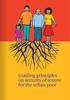 Guiding principles on security of tenure for the urban poor Security of tenure is understood as a set of relationships with respect to housing and land, established through statutory or customary law or
Performance Standard 8:
 Overview of Performance Standards on Environmental and Social Sustainability 1. IFC s Sustainability Framework articulates the Corporation s strategic commitment to sustainable development, and is an integral
Draft Resolution on Science, technology and innovation for development
 Draft Resolution on Science, technology and innovation for development The Economic and Social Council, Recognizing the role of the Commission on Science and Technology for Development as the United Nations
Section 8 Funding Options and Support Services
 Resources are not unlimited and it is therefore extremely important that the resources be spent on the most important projects. Prioritising projects makes implementation easier as it is possible to start
LEGAL SERVICES SECTOR CHARTER DECEMBER 2007 G E N E R A L C O U N C I L O F T H E B A R O F S O U T H A F R I C A FORWORD 2 PREAMBLE 3
 T A B L E O F C O N T E N T S FORWORD 2 BLACK LAWYERS ASSOCIATION PREAMBLE 3 LEGAL SERVICES SECTOR CHARTER DECEMBER 2007 CHAPTER 1: INTRODUCTION 4 1.1 OBJECTIVES 4 1.2 SCOPE AND STAKEHOLDERS 5 CHAPTER
PROMOTION AND PROTECTION OF INVESTMENT BILL
 REPUBLIC OF SOUTH AFRICA PROMOTION AND PROTECTION OF INVESTMENT BILL (As introduced in the National Assembly (proposed section 75); explanatory summary of Bill published in Government Gazette No. 39009
DEPARTMENT OF FORESTRY DRAFT REVISED NATIONAL FOREST POLICY OF MALAWI
 DEPARTMENT OF FORESTRY DRAFT REVISED NATIONAL FOREST POLICY OF MALAWI July, 2013 1. Foreword 2. Preface 3. Introduction 4. Policy linkages 5. Broad Policy Direction 6. Policy Priority Areas Provides the
HUMAN SETTLEMENT COUNTRY PROFILE SOUTH AFRICA
 HUMAN SETTLEMENT COUNTRY PROFILE SOUTH AFRICA Decision-Making Programmes and Projects Status A. Providing Adequate Shelter for All B. Improving Human Settlement Management C. Promoting Sustainable Land-Use
Catalysing the Participation of Women-Owned Businesses in Intra- EAC Trade through Evidence-based Policies and Programmes
 Catalysing the Participation of Women-Owned Businesses in Intra- EAC Trade through Evidence-based Policies and Programmes INSPIRE. EMPOWER. DEVELOP a. Introduction Equal access to economic opportunities
in the 11 th National Economic and Social Development Plan, 2012-2016
 Challenges and Human Rights Based Approach Development in the 11 th National Economic and Social Development Plan, 2012-2016 Chirapun Gullaprawit Director of Social Development Strategy and Planning Office
AGRI MEGA PARK, BREDARSDORP, OVERBERG DISCTRICT, WESTERN CAPE
 MINISTER S SPEAKING NOTES AGRI MEGA WEEK FOR INTERNATIONAL FOOD SECURITY AGRI MEGA PARK, BREDARSDORP, OVERBERG DISCTRICT, WESTERN CAPE 17 SEPTEMBER 2015 Program Director Honourable Mayor, Richard Mitchell
Policy recommendations on urban strategic planning
 Policy recommendations on urban strategic planning They are conceived as key orientations to ensure local government s access to strategic planning and concerns different actors represented by the following
DEPARTMENT OF PERFORMANCE MONITORING AND EVALUATION IN THE PRESIDENCY
 The Presidency Department of Performance Monitoring and Evaluation DEPARTMENT OF PERFORMANCE MONITORING AND EVALUATION IN THE PRESIDENCY Version: 060112 Date of presentation: 17 January 2012 Establishment
The role of Agricultural cooperatives in accessing input and output markets An overview of experiences of SRFCF, SNNPR, Ethiopia
 The role of Agricultural cooperatives in accessing input and output markets An overview of experiences of SRFCF, SNNPR, Ethiopia By Yehulashet A.Argaw Managing director, Southern Region Farmers Cooperative
HOUSING AND LAND RIGHTS NETWORK H a b i t a t I n t e r n a t i o n a l C o a l i t i o n
 HOUSING AND LAND RIGHTS NETWORK H a b i t a t I n t e r n a t i o n a l C o a l i t i o n National Habitat III Parallel-reporting Tool Evaluation of Habitat II Implementation Following the commitments
Profiling agricultural science teachers and other teaching profesionals at FET and HET Institutions
 Profiling agricultural science teachers and other teaching profesionals at FET and HET Institutions MARCH 2008 TABLE OF CONTENTS EXECUTIVE SUMMARY 4 STUDY AIM 4 1.1 METHODOLOGY 4 1.2 KEY FINDINGS AND CONCLUSION
REDD+ Inspiring Practices
 WWF Forest and Climate Programme FACTSHEET 2013 snapshot What» Community involvement in participatory land-use mapping as the basis for land-use management planning, conservation of natural resources and
It is important to understand child poverty as multidimensional. Income poverty in South Africa. Annie Leatt (Children s Institute)
 Income poverty in South Africa Annie Leatt (Children s Institute) It is important to understand child poverty as multidimensional and more than just a lack of income. Nevertheless, this essay specifically
NATIONAL TREASURY STRATEGIC PLAN 2011/14
 NATIONAL TREASURY STRATEGIC PLAN 2011/14 PRESENTATION TO PARLIAMENTARY FINANCE COMMITTEES Presenter: Lungisa Fuzile Director General, National Treasury 31 May 2011 TREASURY AIMS AND OBJECTIVES Chapter
Rwanda. Strategy for Sweden s development cooperation with 2015 2019 MFA
 MINISTRY FOR FOREIGN AFFAIRS, SWEDEN UTRIKESDEPARTEMENTET Strategy for Sweden s development cooperation with Rwanda 2015 2019 MFA 103 39 Stockholm Telephone: +46 8 405 10 00, Web site: www.ud.se Cover:
Settlement and Implementation Support (SIS) Strategy for Land and Agrarian Reform in South Africa Chapter 4
 Chapter 4 51 Chapter 4 Learning from experience An overview of the evidence Reviewing Restitution, LRAD and Commonage from a SIS perspective 52 Both researchers and policy makers would do well to remember
national treasury National Treasury estimates of national expenditure Women, Children and People with Disabilities vote 8
 vote 8 Women, Children and People with Disabilities National Treasury estimates of national expenditure national treasury Department: National Treasury REPUBLIC OF SOUTH AFRICA Estimates of National Expenditure
CONCEPT NOTE. High-Level Thematic Debate
 CONCEPT NOTE High-Level Thematic Debate Advancing Gender Equality and Empowerment of Women and Girls for a Transformative Post-2015 Development Agenda 6 March 2015 Introduction The UN and the international
Service Alberta BUSINESS PLAN 2009-12 ACCOUNTABILITY STATEMENT THE MINISTRY
 Service Alberta BUSINESS PLAN 2009-12 ACCOUNTABILITY STATEMENT The business plan for the three years commencing April 1, 2009 was prepared under my direction in accordance with the Government Accountability
Rural Development in South Africa: The role of Agriculture
 The Presidency Department of Performance Monitoring and Evaluation Rural Development in South Africa: The role of Agriculture Tsakani Ngomane, PhD AGRISETA ANNUAL SEMINAR Kempton Park, South Africa 21
The National Development Plan 2030: Implications for Project Managers. 16 September 2013 Dr. Bridgette Gasa
 The National Development Plan 2030: Implications for Project Managers 16 September 2013 Dr. Bridgette Gasa NATIONAL DEVELOPMENT PLAN 2030 Our future - make it work Implications of the NDP for Project Managers
Regional Agenda. World Economic Forum on Africa Meeting Overview
 Regional Agenda World Economic Forum on Africa Meeting Overview Kigali, Rwanda 11-13 May 2016 Connecting Africa s Resources through Digital Transformation Africa s positive economic outlook is under pressure
PR 5: Land Acquisition, Involuntary Resettlement and Economic Displacement
 34 Environmental and Social Policy PR 5: Land Acquisition, Involuntary Resettlement and Economic Displacement Introduction 1. Involuntary resettlement refers both to physical displacement (relocation or
FINAL EVALUATION VIE/029. Technical Assistance towards Programme Support, Developing Business with the Rural Poor in Cao Bang
 FINAL EVALUATION VIE/029 Technical Assistance towards Programme Support, Developing Business with the Rural Poor in Cao Bang PROJECT SUMMARY DATA Country Long Project Title Short Project Title LuxDev Code
PERFORMANCE AND PRIORITIES MARCH 2003
 PERFORMANCE AND PRIORITIES MARCH 2003 AGENDA FOR TODAY Background The Mandate Approach and Philosophy Strategy MTEF allocation since 2000 Resource Allocation Partnerships NDA Competency Challenges 2003/04
JOZINI LOCAL MUNICIPALITY INTEGRATED DEVELOPMENT PLAN REVIEW 2008/2009 EXECUTIVE SUMMARY
 JOZINI LOCAL MUNICIPALITY INTEGRATED DEVELOPMENT PLAN REVIEW 2008/2009 EXECUTIVE SUMMARY EXECUTIVE SUMMARY INTEGRATED DEVELOPMENT PLAN (IDP) INTRODUCTION Chapter 5 of the Municipal Systems Act No. 32 of
Hong Kong Declaration on Sustainable Development for Cities
 Hong Kong Declaration on Sustainable Development for Cities 1. We, the representatives of national and local governments, community groups, the scientific community, professional institutions, business,
SECTOR ASSESSMENT (SUMMARY): PUBLIC RESOURCE MANAGEMENT. 1. Public Resource Management Sector Issues and Opportunities
 Country Partnership Strategy: SRI, 2012 2016 SECTOR ASSESSMENT (SUMMARY): PUBLIC RESOURCE MANAGEMENT 1. Public Resource Management Sector Issues and Opportunities 1. The problems in Sri Lanka are multifaceted
Unilever Sustainable Palm Oil Sourcing Policy 2016
 Unilever Sustainable Palm Oil Sourcing Policy 2016 Unilever uses palm oil in food products as well as in a range of home and personal care products. Palm oil is a nutritious, versatile raw material, and
Guidelines for Gender Sensitive Programming Prepared by Brigitte Leduc and Farid Ahmad
 Guidelines for Gender Sensitive Programming Prepared by Brigitte Leduc and Farid Ahmad November 2009 What is a Gender-Sensitive Programming Process? Gender is a critical factor that determines an individual
Addressing the social impact of mining activities on communities for sustainability
 Addressing the social impact of mining activities on communities for sustainability John-Mark Kilian, Director Umsizi Sustainable Social Solutions (Pty) Ltd, [email protected] It is very important
LESS FORMAL TOWNSHIP ESTABLISHMENT ACT 113 OF 1991
 LESS FORMAL TOWNSHIP ESTABLISHMENT ACT 113 OF 1991 [ASSENTED TO 27 JUNE 1991] [DATE OF COMMENCEMENT: 1 SEPTEMBER 1991] (English text signed by the State President) as amended by Proclamation R159 of 1994
National Report to the Fourth Session of the United Nations Forum on Forests CYPRUS JANUARY 2004
 National Report to the Fourth Session of the United Nations Forum on Forests CYPRUS JANUARY 2004 Format for national reporting to UNFF4, 8 August 2003 1 I. Key Contacts Head of Forestry in Cyprus: Name:
ANNEX 7.1 Guide to Land Acquisition and Compensation (GLAC) LAND ACQUISITION
 ANNEX 7.1 Guide to Land Acquisition and Compensation (GLAC) LAND ACQUISITION Overview Expropriation is a legal way to enable the government or a public legal entity to use immovable assets owned by natural
Transform Training and Support for Resource Management Programme
 bbbbbbbbb Department of Environmental Affairs and Tourism (DEAT) Deutsche Gesellschaft für Technische Zusammenarbeit (GTZ) GmbH Transform Training and Support for Resource Management Programme A COOPERATION
STRATEGIC PLAN 2011-2014
 STRATEGIC PLAN 2011-2014 DEPARTMENT OF RURAL DEVELOPMENT & LAND REFORM rural development & land reform Department: Rural Development and Land Reform REPUBLIC OF SOUTH AFRICA CONTENTS Minister s foreword
OVERVIEW OF THE ASBESTOS RELIEF TRUST & KGALAGADI RELIEF TRUST
 OVERVIEW OF THE ASBESTOS RELIEF TRUST & KGALAGADI RELIEF TRUST OUTCOMES OF THE NATIONAL ASBESTOS CONFERENCE 2008 Presentation to Portfolio Committee on Mineral Resources 9 May 2012 1 BACKGROUND Asbestos
7. LESSONS LEARNT FROM CBNRM PROGRAMMES IN THE REGION
 7. LESSONS LEARNT FROM CBNRM PROGRAMMES IN THE REGION The CBNRM programmes described here: CAMPFIRE (Communal Areas Management Programme for Indigenous Resources) in Zimbabwe and CBNRM in Namibia are more
SOCIAL HOUSING IN SOUTH AFRICA
 SOCIAL HOUSING IN SOUTH AFRICA BY: JOHN HOPKINS MEng.Man, CMCIH; MIAHS CEO - The Southern African Housing Foundation REVIEW OF SOUTH AFRICA S HOUSING POLICY 1. HISTORICAL BACKGROUND The formulation of
Underlying Factors for Gender Inequality in African Agriculture
 Underlying Factors for Gender Inequality in African Agriculture Gender perspectives in research for development (R4D), Annual Conference North-South Centre, ETH Zurich, Tuesday, June 12, 2012 Chinwe Ifejika
Berlin Recommendations for the Cities of Tomorrow
 Berlin Recommendations for the Cities of Tomorrow Berlin, 2 June 2016 The German Habitat Forum took place in Berlin on 1-2 June 2016 and brought together more than 1000 attendees from 74 countries. The
EBRD Performance Requirement 7
 EBRD Performance Requirement 7 Indigenous Peoples Introduction 1. This Performance Requirement (PR) recognises that projects can create opportunities for Indigenous Peoples to participate in and benefit
THE XVI GLOBAL CHILD NUTRITION FORUM ON SCHOOL FEEDING COMMUNIQUÉ
 THE XVI GLOBAL CHILD NUTRITION FORUM ON SCHOOL FEEDING COMMUNIQUÉ Post 2015 Agenda: Role of Nutrition in Sustainable School Feeding Programmes linked to Local Agriculture South Africa from 29 September
Banjul Declaration on the Strategies for Accelerating the Implementation of the Dakar and Beijing Platforms for Action
 Distr.: GENERAL UNITED NATIONS ECONOMIC COMMISSION FOR AFRICA E/ECA/ARCW/8/11 15 December 2009 Original: ENGLISH Eighth Africa Regional Conference on Women (Beijing + 15) 19 20 November 2009 Banjul, The
cultural planning definitions
 cultural planning definitions Battlefield House Museum and Park - Hamilton Civic Museums 1. cultural planning definitions 22 lm Festivals Craft Festivals ural Festivals Arts Festivals ounty Fairs m Programs
Enabling poor rural people to overcome poverty in Honduras
 IFAD/F. Mattioli Enabling poor rural people to overcome poverty in Honduras Rural poverty in Honduras The Republic of Honduras is the second-poorest country in Central America. It is a lower middle-income
How To Be Sustainable With Tourism
 QUÉBEC DECLARATION ON ECOTOURISM In the framework of the UN International Year of Ecotourism, 2002, under the aegis of the United Nations Environment Programme (UNEP) and the World Tourism Organization
ACCOUNTING OFFICERS CHIEF FINANCIAL OFFICERS HEADS OF PROCUREMENT GUIDELINE FOR BID COMMITTEE MEMBERS
 ACCOUNTING OFFICERS CHIEF FINANCIAL OFFICERS HEADS OF PROCUREMENT GUIDELINE FOR BID COMMITTEE MEMBERS Supply Chain Management Office Practice Note Number SCM-03 of 2005 1 Context The Public Finance Management
SYLLABUS FOR RECRUITMENT TEST FOR THE POST OF ASSISTANT TOWN PLANNER (GROUP-A) IN TOWN & COUNTRY PLANNING DEPARTMENT, HARYANA
 SYLLABUS FOR RECRUITMENT TEST FOR THE POST OF ASSISTANT TOWN PLANNER (GROUP-A) IN TOWN & COUNTRY PLANNING DEPARTMENT, HARYANA 1. MATERIALS AND PRINCIPLES OF CONSTRUCTION:- Site Development and Layouts,
Leasing Agricultural Land in Sierra Leone. Information for Investors March 2010
 Leasing Agricultural Land in Sierra Leone Information for Investors March 2010 Introduction In most countries in the world, including in developed markets, securing land for large projects is a time-consuming
Progress The EU programme for employment and social solidarity 2007-2013
 Progress The EU programme for employment and social solidarity 2007-2013 Ensuring the Community can play its part to support Member States commitments to create more and better jobs and offer equal opportunities
Annual Performance Plan 2013-2014
 Annual Performance Plan 2013-2014 LIST OF ACRONYMS APP Annual Performance Plan NDP National Development Plan CFO Chief Financial Officer OSD Occupation-Specific Dispensation CRDP Comprehensive Rural
the sale of mercury to natives. According to Ofosu-Mensah the law was passed by the colonial
 Index of Laws Mining Laws The Mercury Ordinance, 1933 The Mercury Ordinance was proclaimed by the government of the Gold Coast colony, banning the sale of mercury to natives. According to Ofosu-Mensah
Annex 8: SDG Indicator Mapping
 Annex 8 SDG Indicator Mapping 1. Annex 8 responds to Executive Board decision below, regarding the refinement of indicators and targets of the Strategic Plan Integrated Results and Resources Framework
UNICEF in South Africa
 UNICEF in South Africa A message from the Representative 47,900,000 people live in South Africa 20,200,000 are children 294,000 children are HIV-positive 1 in 17 children die before their fifth birthday
ECONOMIC DEVELOPMENT AND POVERTY REDUCTION STRATEGY II
 ECONOMIC DEVELOPMENT AND POVERTY REDUCTION STRATEGY II Abridged version MAY 2013 shaping our development ECONOMIC DEVELOPMENT AND POVERTY REDUCTION STRATEGY II (EDPRS 2) 2013-2018 Abridged Version May
PROPOSAL FOR FREE WIFI TO THE DEPARTMENT OF TRADE AND INDUSTRY
 PROPOSAL FOR FREE WIFI TO THE DEPARTMENT OF TRADE AND INDUSTRY Free WiFi For Africa NPC, trading as Project Isizwe NPO Registration 133-371 NPO 156 DORP STREET, STELLENBOSCH, 7600, SOUTH AFRICA TABLE OF
How To Understand And Understand The History Of Change In South Africa
 UNIVERSITY OF THE WESTERN CAPE MODULE DESCRIPTOR: NEW MODULES Version Name of new module Theoretical and Comparative Approaches to Governance, Public Administration and Public Management Rationale for
United Nations Guidelines for. Consumer Protection
 Department of Economic and Social Affairs United Nations Guidelines for Consumer Protection (as expanded in 1999) UNITED NATIONS New York, 2003 United Nations guidelines for consumer protection (as expanded
VIETNAM FORUM ON LIFELONG LEARNING: BUILDING A LEARNING SOCIETY. ILO Director Ms. Rie Vejs-Kjeldgaard Hanoi, 6-8 December 2010
 VIETNAM FORUM ON LIFELONG LEARNING: BUILDING A LEARNING SOCIETY ILO Director Ms. Rie Vejs-Kjeldgaard Hanoi, 6-8 December 2010 Deputy Prime Minister Nguyen Thien Nhan, cum Chairman of the National Steering
Chapter 2: Bill of Rights CHAPTER 2
 CHAPTER 2 BILL OF RIGHTS Rights 7. (1) This Bill of Rights is a cornerstone of democracy in South Africa. It enshrines the rights of all people in our country and affirms the democratic values of human
Voluntary Guidelines on the. Responsible. of Land, Fisheries and Forests in the Context of National Food Security
 Voluntary Guidelines on the Responsible Governance of Tenure of Land, Fisheries and Forests in the Context of National Food Security VOLUNTARY GUIDELINES ON THE Responsible Governance of Tenure OF LAND,
PROVINCIAL ADMINISTRATION: EASTERN CAPE DEPARTMENT OF SAFETY AND LIAISON
 ANNEXURE P PROVINCIAL ADMINISTRATION: EASTERN CAPE DEPARTMENT OF SAFETY AND LIAISON It is the Department s intention to promote equity through the filling of posts, according to set Employment Equity targets.
SCIENCE, TECHNOLOGY AND INNOVATION FOR THE TRANSFORMATION OF AFRICAN ECONOMIES
 SCIENCE, TECHNOLOGY AND INNOVATION FOR THE TRANSFORMATION OF AFRICAN ECONOMIES SESSION I: ELEMENTS OF AN EFFECTIVE AND BALANCED INTELLECTUAL PROPERTY (IP) SYSTEM TO ENABLE INNOVATION The session discussed
WASH FUTURES. Call for abstracts. www.wash2016.com. Australian WASH. Water, Sanitation & Hygiene Conference 2016
 FUTURES Water, Sanitation & Hygiene Conference 2016 www.wash2016.com Call for abstracts Futures: Pathways to universal and sustained water, sanitation and hygiene The future of action on water, sanitation
United Nations Working Group of Experts on People of African Descent Tuesday 31 March 2015 Item 6: Panel on Development and People of African Descent
 United Nations Working Group of Experts on People of African Descent Tuesday 31 March 2015 Item 6: Panel on Development and People of African Descent Lisa Wong Senior Officer Non-discrimination Chair,
SMEs Development in the Devolved Governance System
 Policy Brief SMEs Development in the Devolved Governance System Policy Options for Institutional and Regulatory Reforms in Kenya No. 1/2013 David Ong olo & Samson Odhiambo Small and Medium Enterprises
Save the Children. Protecting Children in Zambia from Violence, Abuse, Neglect and Exploitation
 Protecting Children in Zambia from Violence, Abuse, Neglect and Exploitation Baseline 2010: National Child Protection System in Zambia What is a National Child Protection System and why do we need it?
Section 2 - LED Policy and Legislative Framework
 Section 2 - LED Policy and Legislative Framework 2.1 Introduction Guidelines for the implementation of Local Economic Development Strategies have been presented by the various spheres of government. Legislation
Regulations for the Resettlement Process Resulting from Economic Activities. Decree 31/2012 of 8 August
 Regulations for the Resettlement Process Resulting from Economic Activities Decree 31/2012 of 8 August REPUBLIC OF MOZAMBIQUE COUNCIL OF MINISTERS ----------- Decree 31/2012 of 8 August The growing demand
GLOBAL ALLIANCE FOR CLIMATE-SMART AGRICULTURE (GACSA)
 GLOBAL ALLIANCE FOR CLIMATE-SMART AGRICULTURE (GACSA) FRAMEWORK DOCUMENT Version 01 :: 1 September 2014 I Vision 1. In today s world there is enough food produced for all to be well-fed, but one person
10721/16 GSC/lt 1 DGB 2B
 Council of the European Union Brussels, 28 June 2016 (OR. en) 10721/16 OUTCOME OF PROCEEDINGS From: General Secretariat of the Council On: 28 June 2016 To: Delegations No. prev. doc.: 10320/16 REV 1 Subject:
The Eastern Cape The Free State Gauteng KwaZulu-Natal Limpopo Mpumalanga The Northern Cape North West The Western Cape
 Geography and climate The nine provinces of South Africa South Africa has nine provinces, each with its own legislature, premier and executive council - and distinctive landscape, population, economy and