
OPERATORS & SAFETY. Model 1932E2 2032E2 2632E2 2646E2 3246E2. June 25, 2004 CORPORATE OFFICE
|
|
|
- Logan O’Brien’
- 9 years ago
- Views:
Transcription
1 OPERATORS & SAFETY Model 1932E2 2032E2 2632E2 2646E2 3246E June 25, 2004 CORPORATE OFFICE JLG INDUSTRIES, INC. 1 JLG Drive McConnellsburg, PA USA Telephone: (717) Fax: (717)

2 JLG Industries (Australia) P.O. Box Bolwarra Road Port Macquarie N.S.W Australia Phone: (61) Fax: (61) JLG Industries (UK) Unit 12, Southside Bredbury Park Industrial Estate Bredbury Stockport SK6 2sP England Phone: (44) Fax: (44) JLG Deutschland GmbH Max Planck Strasse 21 D Ritterhude/lhlpohl Bei Bremen Germany Phone: (49) Fax: (49) JLG Industries (Italia) Via Po Pregnana Milanese - MI Italy Phone: (39) Fax: (39) JLG Latino Americana Ltda. Rua Eng. Carlos Stevenson, 80-Suite Campinas-SP Brazil Phone: (55) Fax: (55) JLG Europe B.V. Jupiterstraat HJ Foofddorp The Netherlands Phone: (31) Fax: (31) JLG Industries (Norge AS) Sofeimyrveien 12 N-1412 Sofienyr Norway Phone: (47) Fax: (47) JLG Polska UI. Krolewska Warsawa Poland Phone: (48) Fax: (48) JLG Industries (Europe) Kilmartin Place, Tannochside Park Uddingston G71 5PH Scotland Phone: (44) Fax: (44) JLG Industries (Pty) Ltd. Unit 1, 24 Industrial Complex Herman Street Meadowdale Germiston South Africa Phone: (27) Fax: (27) Plataformas Elevadoras JLG Iberica, S.L. Trapadella, 2 P.I. Castellbisbal Sur 08755Castellbisbal Spain Phone: (34) Fax: (34) JLG Industries (Sweden) Enkopingsvagen 150 Box 704 SE Jarfalla Sweden Phone: (46) Fax: (46)

3 FOREWORD FOREWORD This manual is a very important tool! Keep it with the machine at all times. The purpose of this manual is to provide owners, users, operators, lessors, and lessees with the precautions and operating procedures essential for the safe and proper machine operation for its intended purpose. Due to continuous product improvements, JLG Industries, Inc. reserves the right to make specification changes without prior notification. Contact JLG Industries, Inc. for updated information JLG Lift a

4 FOREWORD SAFETY ALERT SYMBOLS AND SAFETY SIGNAL WORDS This is the Safety Alert Symbol. It is used to alert you to the potential personal injury hazards. Obey all safety messages that follow this symbol to avoid possible injury or death INDICATES AN IMMINENTLY HAZARDOUS SITUATION WHICH, IF NOT AVOIDED, WILL RESULT IN SERIOUS INJURY OR DEATH. ON THE MACHINE THIS WILL HAVE A RED BACKGROUND. INDICATES A POTENTIALITY HAZARDOUS SITUATION WHICH, IF NOT AVOIDED, COULD RESULT IN SERIOUS INJURY OR DEATH. ON THE MACHINE THIS WILL HAVE AN ORANGE BACKGROUND. INDICATES A POTENTIALITY HAZARDOUS SITUATION WHICH IF NOT AVOIDED, MAY RESULT IN MINOR OR MODERATE INJURY. IT MAY ALSO BE USED TO ALERT AGAINST UNSAFE PRACTICES. ON THE MACHINE THIS WILL HAVE A YELLOW BACKGROUND. IMPORTANT INDICATES PROCEDURES ESSENTIAL FOR SAFE OPERATION AND WHICH, IF NOT FOLLOWED, MAY RESULT IN A MACHINE MAL- FUNCTIONED DAMAGE. ON THE MACHINE THIS WILL HAVE A GREEN BACKGROUND. b JLG Lift

5 FOREWORD THIS PRODUCT MUST COMPLY WITH ALL SAFETY RELATED BULLETINS. CONTACT JLG INDUSTRIES, INC. OR THE LOCAL AUTHO- RIZED JLG REPRESENTATIVE FOR INFORMATION REGARDING SAFETY-RELATED BULLETINS WHICH MAY HAVE BEEN ISSUED FOR THIS PRODUCT. MODIFICATION OR ALTERATION OF AN AERIAL WORK PLATFORM SHALL BE MADE ONLY WITH WRITTEN PERMISSION FROM THE MANUFACTURER IMPORTANT JLG INDUSTRIES, INC. SENDS SAFETY RELATED BULLETINS TO THE OWNER OF RECORD OF THIS MACHINE. CONTACT JLG INDUS- TRIES, INC. TO ENSURE THAT THE CURRENT OWNER RECORDS ARE UPDATED AND ACCURATE. IMPORTANT JLG INDUSTRIES, INC. MUST BE NOTIFIED IMMEDIATELY IN ALL INSTANCES WHERE JLG PRODUCTS HAVE BEEN INVOLVED IN AN ACCIDENT INVOLVING BODILY INJURY OR DEATH OF PERSONNEL OR WHEN SUBSTANTIAL DAMAGE HAS OCCURRED TO PERSONAL FOR : Accident Reporting Product Safety Publications Current Owner Updates Questions Regarding Product Safety Standards and Regulations Compliance Information Questions Regarding Special Product Applications Questions Regarding Product Modifications CONTACT : Product Safety and Reliability Department JLG Industries, Inc. 1 JLG Drive McConnellsburg, PA In USA: Toll Free: 877-JLG-SAFE Outside USA: [email protected] JLG Lift c

6 FOREWORD REVISION LOG Original Issue - February, 1998 Revised - May, 1998 Revised - February, 1999 Revised - November 2, 1999 Revised - July 21, 2000 Revised - November 16, 2001 Revised - January 15, 2002 Revised - June 16, 2003 Revised - June 25, 2004 d JLG Lift

7 TABLE OF CONTENTS SUBJECT - SECTION, PARAGRAPH TABLE OF CONTENTS PAGE NO. SECTION - FOREWORD SECTION 1 - SAFETY PRECAUTIONS 1.1 General Pre-operation Operation Towing, Lifting, and Hauling Additional Hazards / Safety SECTION SECTION SECTION SECTION SECTION 2 - USER RESPONSIBILITIES, MACHINE PREPARATION, AND INSPECTION 2.1 Personnel Training Preparation, Inspection, and Maintenance USER RESPONSIBILITIES AND MACHINE CONTROL 3.1 General Personnel Training Operating Characteristics and Limitations Controls and Indicators for Non Proportional Control Controls and Indicators for Proportional Control MACHINE OPERATION 4.1 Description General Motor Operation Raising and Lowering (Lifting) Platform Extension Steering Traveling (Driving) Parking and Stowing Platform Loading Safety Prop Tie Down and Lifting EMERGENCY PROCEDURES 5.1 General Emergency Towing Procedures Emergency Controls and Their Locations Emergency Operation Incident Notification INSPECTION AND REPAIR LOG JLG Lift i

8 TABLE OF CONTENTS (Continued) LIST OF FIGURES FIGURE NO. TITLE PAGE NO Daily Walk-Around Inspection E2/2632E2/2646E2/3246E2 (Sheet 1 of 2) Daily Walk-Around Inspection E2/2632E2/2646E2/3246E2 (Sheet 2 of 2) Daily Walk-Around Inspection E2 (Sheet 1 of 2) Daily Walk-Around Inspection E2 (Sheet 2 of 2) Ground Control Station Platform Control Station - Non Proportional Control Platform Control Station - Proportional Control Decal Location (1932E2) Decal Location E2/2632E2/2646E Decal Location E Grade and Sideslope Lift and Tie Down Lifting Chart LIST OF TABLES TABLE NO. TITLE PAGE NO. 1-1 Minimum Safe Approach Distances (M.S.A.D.) Inspection and Maintenance Table Maximum Cutout Height Tilt Decal Location Legend E Decal Location Legend E2 (Continued) Decal Location Legend E2/2632E2/2646E Decal Location Legend E2/2632E22646E2 (Continued) Decal Location Legend E Decal Location Legend E2 (Continued) Operating Specifications (CE and Australian) High Drive Cutout Platform Capacity Inspection and Repair Log ii JLG Lift

9 SECTION 1 - SAFETY PRECAUTIONS SECTION 1. SAFETY PRECAUTIONS 1.1 GENERAL This section outlines the necessary precautions for proper and safe machine usage and maintenance. In order to promote proper machine usage, it is mandatory that a daily routine is established based on the content of this manual. A maintenance program, using the information provided in this manual and the Service and Maintenance Manual, must also be established by a qualified person and must be followed to ensure that the machine is safe to operate. The owner/user/operator/lessor/lessee of the machine should not accept operating responsibility until this manual has been read, training is accomplished, and operation of the machine has been completed under the supervision of an experienced and qualified operator. These sections contain the responsibilities of the owner, user, operator, lessor, and lessee concerning safety, training, inspection, maintenance, application, and operation. If there are any questions with regard to safety, training, inspection, maintenance, application, and operation, please contact JLG Industries, Inc. ( JLG ). FAILURE TO COMPLY WITH THE SAFETY PRECAUTIONS LISTED IN THIS MANUAL COULD RESULT IN MACHINE DAMAGE, PROP- ERTY DAMAGE, PERSONAL INJURY OR DEATH. 1.2 PRE-OPERATION Operator Training and Knowledge The Operators and Safety Manual must be read in its entirety before operating the machine. For clarification, questions, or additional information regarding any portions of this manual, contact JLG Industries, Inc. An operator must not accept operating responsibilities until adequate training has been given by competent and authorized persons. Allow only those authorized and qualified personnel to operate the machine who have demonstrated that they understand the safe and proper operation and maintenance of the unit. Read, understand, and obey all DANGERS, WARN- INGS, CAUTIONS, and operating instructions on the machine and in this manual. Ensure that the machine is to be used in a manner which is within the scope of its intended application as determined by JLG. All operating personnel must be familiar with the emergency controls and emergency operation of the machine as specified in this manual. Read, understand, and obey all applicable employer, local, and governmental regulations as they pertain to your utilization and application of the machine. Workplace Inspection Precautions to avoid all hazards in the work area must be taken by the user before operation of the machine. Do not operate or raise the platform from a position on trucks, trailers, railway cars, floating vessels, scaffolds or other equipment unless the application is approved in writing by JLG. Before operation, check work area for overhead hazards such as electric lines, bridge cranes, and other potential overhead obstructions. Check floor surfaces for holes, bumps, drop-offs, obstructions, debris, concealed holes, and other potential hazards. Check the work area for hazardous locations. Do not operate the machine in hazardous environments unless approved for that purpose by JLG. Ensure that the ground conditions are adequate to support the maximum tire load indicated on the tire load decals located on the chassis adjacent to each wheel. Do not operate the machine when wind conditions exceed 28 mph (12.5 m/s). This machine can be operated in nominal ambient temperatures of 0 o F to 104 o F (-20 o C to 40 o C). Consult JLG to optimize operation outside of this temperature range. Machine Inspection Do not operate this machine until the inspections and functional checks have been performed as specified in Section 2 of this manual JLG Lift 1-1

10 SECTION 1 - SAFETY PRECAUTIONS Do not operate this machine until it has been serviced and maintained according to the maintenance and inspection requirements as specified in the machine s Service and Maintenance Manual. Ensure all safety devices are operating properly. Modification of these devices is a safety violation. MODIFICATION OR ALTERATION OF AN AERIAL WORK PLAT- FORM SHALL BE MADE ONLY WITH PRIOR WRITTEN PERMIS- SION FROM THE MANUFACTURER Do not operate any machine on which the safety or instruction placards or decals are missing or illegible. Check the machine for modifications to original components. Ensure that any modifications have been approved by JLG. Avoid accumulation of debris on platform deck. Keep mud, oil, grease, and other slippery substances from footwear and platform deck. When two or more persons are in the platform, the operator shall be responsible for all machine operations. Always ensure that power tools are properly stowed and never left hanging by their cord from the platform work area. Do not assist a stuck or disabled machine by pushing or pulling except by pulling at the chassis tie-down lugs. Stow scissor arm assembly and shut off all power before leaving machine. Trip and Fall Hazards JLG Industries, Inc. recommends that all persons in the platform wear a full body harness with a lanyard attached to an authorized lanyard anchorage point while operating this machine. For further information regarding fall protection requirements on JLG products, contact JLG Industries, Inc. 1.3 OPERATION General Do not use the machine for any purpose other than positioning personnel, their tools, and equipment. Before operation, the user must be familiar with the machine capabilities and operating characteristics of all functions. Never operate a malfunctioning machine. If a malfunction occurs, shut down the machine. Remove the unit from service and notify the proper authorities. Do not remove, modify, or disable any safety devices. Never slam a control switch or lever through neutral to an opposite direction. Always return switch to neutral and stop before moving the switch to the next function. Operate controls with slow and even pressure. Hydraulic cylinders should never be left at end of travel (fully extended or fully retracted) before shutdown or for long periods of time. Always bump control in opposite direction slightly when function reaches end of travel. This applies both to machines in operation or in the stowed position. Do not allow personnel to tamper with or operate the machine from the ground with personnel in the platform, except in an emergency. Do not carry materials directly on platform railing unless approved by JLG. Prior to operation, ensure all gates are fastened and secured in their proper position. Identify the designated lanyard anchorage point(s) at the platform and securely attach the lanyard. Attach only one (1) lanyard per lanyard anchorage point. Keep both feet firmly positioned on the platform floor at all times. Never position ladders, boxes, steps, planks, or similar items on unit to provide additional reach for any purpose. Never use the scissor arm assembly to gain access to or leave the platform. 1-2 JLG Lift

11 SECTION 1 - SAFETY PRECAUTIONS Use extreme caution when entering or leaving platform. Ensure that the scissor arm assembly is fully lowered. Face the machine when entering or leaving the platform. Always maintain three point contact with the machine, using two hands and one foot or two feet and one hand at all times during entry and exit. Platform-to-structure transfers at elevated positions are discouraged. Where transfer is necessary, enter/exit through the gate only with the platform within 1 foot (0.3m) of a safe and secure structure. 100% tie-off is also required in this situation utilizing two lanyards. One lanyard must be attached to the platform with the second lanyard attached to the structure. The lanyard connected to the platform must not be disconnected until such time the transfer to the structure is safe and complete. Keep oil, mud, and slippery substances cleaned from footwear and the platform floor. Electrocution Hazards This machine is not insulated and does not provide protection from contact with an electrically charged conductor. Table 1-1.Minimum Safe Approach Distances (M.S.A.D.) Voltage Range (Phase to Phase) MINIMUM SAFE APPROACH DISTANCE in Feet (Meters) 0 to 300V AVOID CONTACT Over 300V to 50 KV 10 (3) Over 50KV to 200 KV 15 (5) Over 200 KV to 350 KV 20 (6) Over 350 KV to 500 KV 25 (8) Over 500 KV to 750 KV 35 (11) Over 750 KV to 1000 KV 45 (14) NOTE: This requirement shall apply except where employer, local or governmental regulations are more stringent. Maintain a clearance of at least 10 ft. (3m) between any part of the machine and its occupants, their tools, and their equipment from any electrical line or apparatus carrying up to 50,000 volts. One foot additional clearance is required for every additional 30,000 volts or less. DO NOT MANEUVER MACHINE OR PERSONNEL INSIDE PROHIB- ITED ZONE (MSAD). ASSUME ALL ELECTRICAL PARTS AND WIR- ING ARE ENERGIZED UNLESS KNOWN OTHERWISE. Tipping Hazards Ensure that the ground conditions are adequate to support the maximum tire load indicated on the tire load decals located on the chassis adjacent to each wheel. Do not travel on unsupported surfaces. The user should be familiar with the driving surface before driving. Do not exceed the allowable sideslope and grade while driving. Maintain safe clearance from electrical lines, apparatus, or any energized (exposed or insulated) parts in accordance with the Minimum Safe Approach Distance (MSAD) as specified in Table 1-1. Allow for machine movement and electrical line swaying. Do not elevate platform or drive with platform elevated while on or near a sloping, uneven, or soft surface. Ensure machine is positioned on a firm, level and uniformly supported surface before elevating platform or driving with the platform in the elevated position JLG Lift 1-3

12 SECTION 1 - SAFETY PRECAUTIONS Before driving on floors, bridges, trucks, and other surfaces, check allowable capacity of the surfaces. Never exceed the maximum work load as specified on the platform. Distribute loads evenly on platform floor. Keep all loads within the confines of the platform, unless authorized by JLG. Keep the chassis of the machine a minimum of 2 ft. (0.6m) from holes, bumps, drop-offs, obstructions, debris, concealed holes, and other potential hazards at the ground level. Never attempt to use the machine as a crane. Do not tie-off machine to any adjacent structure. Never attach wire, cable, or any similar items to platform. Do not operate the machine when wind conditions exceed 28 mph (12.5 m/s).unless otherwise specified on machine or accessory. Do not cover the platform sides or carry large surfacearea items in the platform when operating outdoors. The addition of such items increases the exposed wind area of the machine. Do not increase the platform size with unauthorized deck extensions or attachments. If scissor arm assembly or platform is caught so that one or more wheels are off the ground, all persons must be removed before attempting to free the machine. Use cranes, forklift trucks, or other appropriate equipment to stabilize machine and remove personnel. Crushing and Collision Hazards Approved head gear must be worn by all operating and ground personnel. Keep hands and limbs out of the scissor arm assembly during operation. Watch for obstructions around machine and overhead when driving. Check clearances above, on sides, and bottom of platform when lifting or lowering platform.. Keep non-operating personnel at least 6 ft. (1.8m) away from machine during all driving operations. Under all travel conditions, the operator must limit travel speed according to conditions of ground surface, congestion, visibility, slope, location of personnel, and other factors causing hazards of collision or injury to personnel. Be aware of stopping distances in all drive speeds. When driving in high speed, switch to low speed before stopping. Travel grades in low speed only. Do not use high speed drive in restricted or close quarters or when driving in reverse. Exercise extreme caution at all times to prevent obstacles from striking or interfering with operating controls and persons in the platform. Ensure that operators of other overhead and floor level machines are aware of the aerial work platform s presence. Disconnect power to overhead cranes. Barricade floor area if necessary. Avoid operating over ground personnel. Warn personnel not to work, stand, or walk under a raised platform. Position barricades on floor as necessary. 1.4 TOWING, LIFTING, AND HAULING Never allow personnel in platform while towing, lifting, or hauling. This machine should not be towed, except in the event of emergency, malfunction, power failure, or loading/ unloading. Refer to Section 6 for emergency towing procedures. Ensure platform is fully retracted and completely empty of tools prior to towing, lifting or hauling. When lifting machine with a forklift, position forks only at designated areas of the machine. Lift with a forklift of adequate capacity. Refer to Section 4 for lifting information. During operation, keep all body parts inside platform railing. Always post a lookout when driving in areas where vision is obstructed. 1.5 ADDITIONAL HAZARDS / SAFETY Do not use machine as a ground for welding. When performing welding or metal cutting operations, precautions must be taken to protect the chassis from direct exposure to weld and metal cutting spatter. Do not refuel the machine with the engine running (where applicable). Battery fluid is highly corrosive. Avoid contact with skin and clothing at all times. Charge batteries only in a well ventilated area. 1-4 JLG Lift

13 SECTION 2 - USER RESPONSIBILITIES, MACHINE PREPARATION, AND INSPECTION SECTION 2. USER RESPONSIBILITIES, MACHINE PREPARATION, AND INSPECTION 2.1 PERSONNEL TRAINING The aerial platform is a personnel handling device; so it is necessary that it be operated and maintained only by trained personnel. Persons under the influence of drugs or alcohol or who are subject to seizures, dizziness or loss of physical control must not operate this machine. Operator Training Operator training must cover: 1. Use and limitations of the controls in the platform and at the ground, emergency controls and safety systems. 2. Control labels, instructions, and warnings on the machine. 3. Rules of the employer and government regulations. 4. Use of approved fall protection device. 5. Enough knowledge of the mechanical operation of the machine to recognize a malfunction or potential malfunction. 6. The safest means to operate the machine where overhead obstructions, other moving equipment, and obstacles, depressions, holes, drop-offs. 7. Means to avoid the hazards of unprotected electrical conductors. 8. Specific job requirements or machine application. Training Supervision Training must be done under the supervision of a qualified person in an open area free of obstructions until the trainee has developed the ability to safely control and operate the machine. Operator Responsibility The operator must be instructed that he/she has the responsibility and authority to shut down the machine in case of a malfunction or other unsafe condition of either the machine or the job site. NOTE: The Manufacturer or Distributor will provide qualified people for training assistance with the first unit(s) delivered and from that time forward as requested by the user or his/her personnel JLG Lift 2-1

14 SECTION 2 - USER RESPONSIBILITIES, MACHINE PREPARATION, AND INSPECTION 2.2 PREPARATION, INSPECTION, AND MAINTENANCE The following table covers the periodic machine inspections and maintenance recommended by JLG Industries, Inc. Consult local regulations for further requirements for aerial work platforms. The frequency of inspections and Table 2-1.Inspection and Maintenance Table Type Frequency Primary Responsibility Pre-Start Inspection Pre-Delivery Inspection (See Note) Frequent Inspection Annual Machine Inspection Preventative Maintenance Before using each day; or whenever there s an Operator change. Before each sale, lease, or rental delivery. In service for 3 months or 150 hours, whichever comes first; or Out of service for a period of more than 3 months; or Purchased used. Annually, no later than 13 months from the date of prior inspection. At intervals as specified in the Service and Maintenance Manual. maintenance must be increased as necessary when the machine is used in a harsh or hostile environment, if the machine is used with increased frequency, or if the machine is used in a severe manner. Service Qualification Reference User or Operator User or Operator Operator and Safety Manual Owner, Dealer, or User Owner, Dealer, or User Owner, Dealer, or User Owner, Dealer, or User Qualified JLG Mechanic Qualified JLG Mechanic Factory-Certified Service Technician* Qualified JLG Mechanic Service and Maintenance Manual and applicable JLG inspection form Service and Maintenance Manual and applicable JLG inspection form Service and Maintenance Manual and applicable JLG inspection form Service and Maintenance Manual NOTE: Inspection forms are available from JLG. Use the Service and Maintenance Manual to perform inspections. * JLG Industries, Inc. recognizes a Factory-Certified Service Technician as a person who has successfully completed the JLG Service Training School for the specific JLG product model. 2-2 JLG Lift

15 SECTION 2 - USER RESPONSIBILITIES, MACHINE PREPARATION, AND INSPECTION Pre-Start Inspection The Pre-Start Inspection should include each of the following: 1. Cleanliness Check all surfaces for leakage (oil, fuel, or battery fluid) or foreign objects. Report any leakage to the proper maintenance personnel. 2. Decals and Placards Check all for cleanliness and legibility. Make sure none of the decals and placards are missing. Make sure all illegible decals and placards are cleaned or replaced. 3. Operators and Safety Manuals Make sure a copy of the Operator and Safety Manual, EMI Safety Manual (Domestic only), and ANSI Manual of Responsibilities (Domestic only) is enclosed in the weather resistant storage container. 4. Walk-Around Inspection Refer to Figures 1 and Battery Charge as required. 6. Fuel (Combustion Engine Powered Machines) Add the proper fuel as necessary. 7. Hydraulic Oil Check the hydraulic oil level. Ensure hydraulic oil is added as required. 8. Function Check Once the Walk-Around Inspection is complete, perform a functional check of all systems in an area free of overhead and ground level obstructions. Refer to Section 4 for more specific instructions. Function Check Perform the Function Check as follows: 1. From the ground control panel with no load in the platform: a. Check that all guards protecting the switches or locks are in place; b. Operate all functions and check all limiting and cut-out switches; See Table 2-2, Maximum Cutout Height c. Check auxiliary power (or manual descent); d. Ensure that all machine functions are disabled when the Emergency Stop Button is activated. Model Table 2-2. Maximum Cutout Height High Drive Cutout (Maximum Height) Drive Cutout 1932E2 2.6 m N/A 2032E2 2.1 m N/A 2632E2 (Australian Only) 2.9 m N/A 2632E2/2646E2 2.6 m N/A 3246E2 2.8 m N/A 2. From the platform control console: IF THE MACHINE DOES NOT OPERATE PROPERLY, TURN OFF THE MACHINE IMMEDIATELY! REPORT THE PROBLEM TO THE PROPER MAINTENANCE PERSONNEL. DO NOT OPERATE THE MACHINE UNTIL IT IS DECLARED SAFE FOR OPERATION. a. Ensure that the control console is firmly secured in the proper location; b. Check that all guards protecting the switches or locks are in place; c. Operate all functions and check all limiting and cut-out switches; d. Ensure that all machine functions are disabled when the Emergency Stop Button is pushed in. 3. With the platform in the transport (stowed) position: a. Drive the machine on a grade, not to exceed the rated gradeability, and stop to ensure the brakes hold; Check the tilt sensor alarm to ensure proper operation JLG Lift 2-3

16 SECTION 2 - USER RESPONSIBILITIES, MACHINE PREPARATION, AND INSPECTION Figure 2-1. Daily Walk-Around Inspection E2/2632E2/2646E2/3246E2 (Sheet 1 of 2). 2-4 JLG Lift

17 SECTION 2 - USER RESPONSIBILITIES, MACHINE PREPARATION, AND INSPECTION GENERAL Begin the Walk-Around Inspection at Item 1, as noted on the diagram. Continue Left (counterclockwise viewed from top) checking each item in sequence for the conditions listed in the following checklist. TO AVOID POSSIBLE INJURY, BE SURE MACHINE POWER IS OFF DURING WALK-AROUND INSPECTION. DO NOT OVERLOOK VISUAL INSPECTION OF CHASSIS UNDER- SIDE. CHECKING THIS AREA OFTEN RESULTS IN DISCOVERY OF CONDITIONS WHICH COULD CAUSE EXTENSIVE MACHINE DAMAGE. NOTE: On each item, make sure there are no loose or missing parts, that they are securely fastened, and that no visible damage exists in addition to any other criteria mentioned. 1. Platform Control Console - Placard secure and legible, control lever and switches return to neutral, control lever lock and emergency stop switch function properly, manual in storage box. 2. Spindle, Tie Rod and Steer Linkage (left front) - See Note 3. Safety Prop - See Note 4. Sizzor Arms and Sliding Wear Pads - See Note 5. Wheel and Tire Assembly, Left Front - See Note 6. Drive Cutout Switch - See Note 7. Compartment Cover and Latches - See Note 8. Ground Controls - Placard secure and legible, control switches return to neutral position, emergency stop switch functions properly. Control markings legible. 9. Hydraulic Reservoir - Recommended hydraulic fluid level on level indicator on tank. Breather cap secure and working. 10. Hydraulic Filter - See Note 11. Hydraulic Pump/Motor - See Note 12. Pothole Protection System - See Note 13. Hourmeter - See Note 14. Wire Installation - See Note 15. Control Valve Installation - No unsupported wires or hoses; no damaged or broken wires. 16. Wheel and Tire Assembly, Left Rear - See Note 17. Drive Motor, Left Rear - See Note 18. Sizzor Arms and Sliding Wear Pads - See Note 19. Handle for Manual Descent (2646E2/3246E2) - See Note 20. Manual Descent Pump (2632E2/2646E2/3246E2) - See Note 21. Manual Descent - See Note 22. Brake Cylinder - See Note 23. Ladder - See Note 24. Sizzor Arms and Sliding Wear Pads - See Note 25. Drive Motor, Right Rear - See Note 26. Wheel and Tire Assembly, Right Rear - See Note 27. Lift Cylinder - See Note 28. Tilt Switch - See Note 29. Battery Compartment - Proper electrolyte level. 30. Pothole Protection System - See Note 31. Battery Charger - See Note 32. Compartment Cover and Latches - See Note 33. Wheel and Tire Assembly, Right Front - See Note 34. Platform/Handrail Installation (Not Shown) - See Note 35. Sizzor Arms and Sliding Wear Pads - See Note Figure 2-1. Daily Walk-Around Inspection E2/2632E2/2646E2/3246E2 (Sheet 2 of 2) JLG Lift 2-5

18 SECTION 2 - USER RESPONSIBILITIES, MACHINE PREPARATION, AND INSPECTION Figure 2-2. Daily Walk-Around Inspection E2 (Sheet 1 of 2). 2-6 JLG Lift
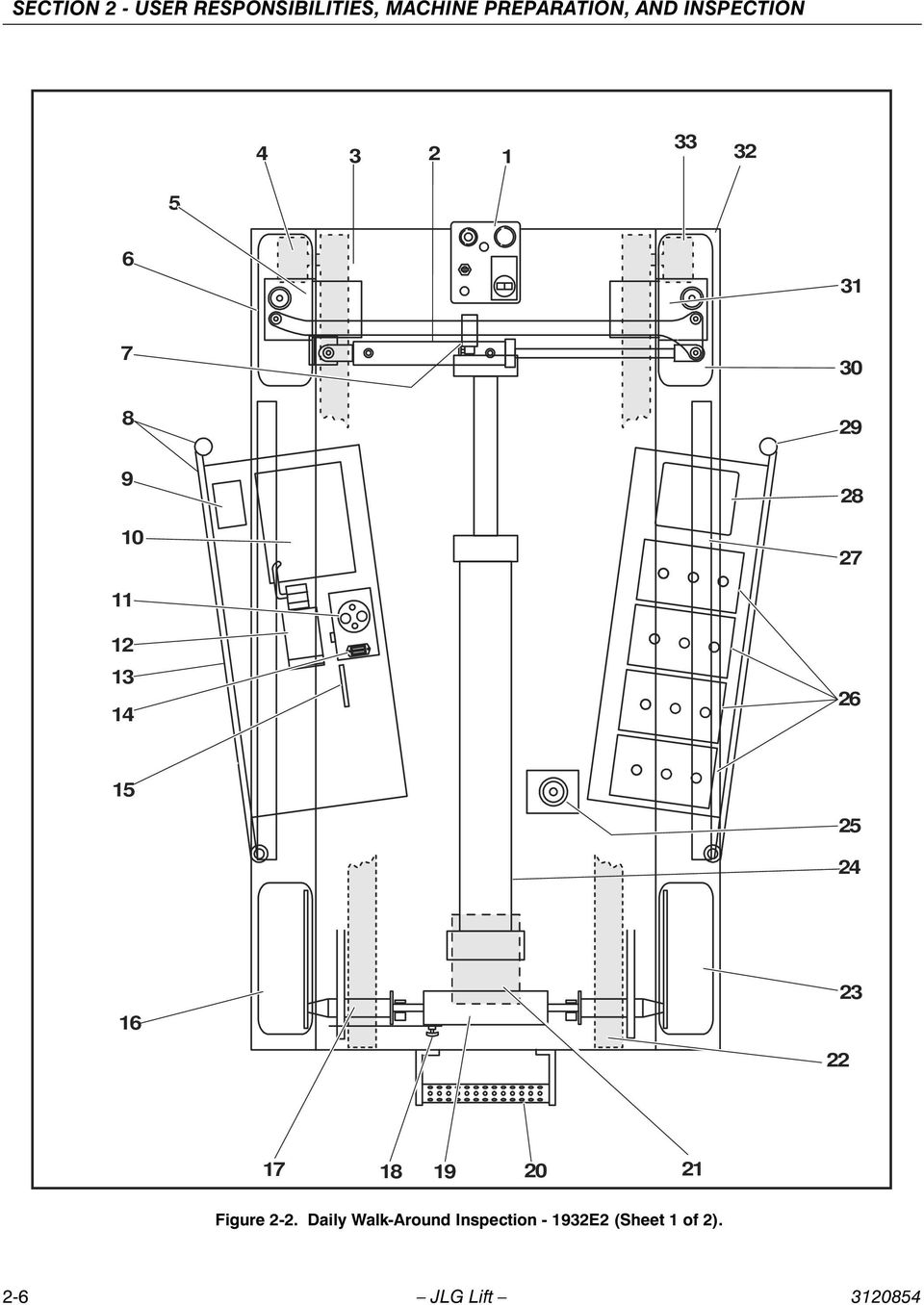
19 SECTION 2 - USER RESPONSIBILITIES, MACHINE PREPARATION, AND INSPECTION GENERAL Begin the Walk-Around Inspection at Item 1, as noted on the diagram. Continue Left (counterclockwise viewed from top) checking each item in sequence for the conditions listed in the following checklist. TO AVOID POSSIBLE INJURY, BE SURE MACHINE POWER IS OFF DURING WALK-AROUND INSPECTION. DO NOT OVERLOOK VISUAL INSPECTION OF CHASSIS UNDER- SIDE. CHECKING THIS AREA OFTEN RESULTS IN DISCOVERY OF CONDITIONS WHICH COULD CAUSE EXTENSIVE MACHINE DAMAGE. NOTE: On each item, make sure there are no loose or missing parts, that they are securely fastened, and that no visible damage exists in addition to any other criteria mentioned. 1. Platform Control Console - Placard secure and legible, control lever and switches return to neutral, control lever lock and emergency stop switch function properly, manual in storage box. 2. Spindle, Tie Rod and Steer Linkage (left front) - See Note 3. Safety Prop - See Note 4. Sizzor Arms and Sliding Wear Pads - See Note 5. Drive Motor, Left Front - See Note 6. Wheel and Tire Assembly, Left Front - See Note 7. Drive Cutout Switch - See Note 8. Compartment Cover and Latches - See Note 9. Ground Controls - Placard secure and legible, control switches return to neutral position, emergency stop switch functions properly. Control markings legible. 10. Hydraulic Reservoir - Recommended hydraulic fluid level on level indicator on tank. Breather cap secure and working. 11. Hydraulic Filter - See Note 12. Hydraulic Pump/Motor - See Note 13. Pothole Protection System - See Note 14. Hourmeter - See Note 15. Wire Installation - See Note 16. Wheel and Tire Assembly, Left Rear - See Note 17. Sizzor Arms and Sliding Wear Pads - See Note 18. Manual Descent - See Note 19. Brake Cylinder - See Note 20. Ladder - See Note 21. Control Valve Installation - No unsupported wires or hoses; no damaged or broken wires. 22. Sizzor Arms and Sliding Wear Pads - See Note 23. Wheel and Tire Assembly, Right Rear - See Note 24. Lift Cylinder - See Note 25. Tilt Switch - See Note 26. Battery Compartment - Proper electrolyte level 27. Pothole Protection System - See Note 28. Battery Charger - See Note 29. Compartment Cover and Latches - See Note 30. Wheel and Tire Assembly, Right Front - See Note 31. Drive Motor, Right Rear - See Note 32. Platform/Handrail Installation (Not Shown) - See Note 33. Sizzor Arms and Sliding Wear Pads - See Note Figure 2-2. Daily Walk-Around Inspection E2 (Sheet 2 of 2) JLG Lift 2-7

20 SECTION 2 - USER RESPONSIBILITIES, MACHINE PREPARATION, AND INSPECTION This page left blank intentionally. 2-8 JLG Lift

21 SECTION 3 - USER RESPONSIBILITIES AND MACHINE CONTROL SECTION 3. USER RESPONSIBILITIES AND MACHINE CONTROL 3.1 GENERAL SINCE THE MANUFACTURER HAS NO DIRECT CONTROL OVER MACHINE APPLICATION AND OPERATION, CONFORMANCE WITH GOOD SAFETY PRACTICES IN THESE AREAS IS THE RESPONSI- BILITY OF THE USER AND HIS OPERATING PERSONNEL. This section provides the necessary information needed to understand control functions. Included in this section are the operating characteristics and limitations, and functions and purposes of controls and indicators. It is important that the user read and understand the proper procedures before operating the machine. These procedures will aid in obtaining optimum service life and safe operation. 3.2 PERSONNEL TRAINING The scissor lift is a personnel handling device; therefore, it is essential that it be operated and maintained only by authorized and qualified personnel who have demonstrated that they understand the proper use and maintenance of the machine. It is important that all personnel who are assigned to and responsible for the operation and maintenance of the machine undergo a thorough training program and check out period in order to become familiar with the characteristics prior to operating the machine. Persons under the influence of drugs or alcohol or who are subject to seizures, dizziness or loss of physical control must not be permitted to operate the machine. Operator Training Operator training must include instruction in the following: 1. Use and limitations of the platform controls, ground controls, emergency controls and safety systems. 2. Knowledge and understanding of this manual and of the control markings, instructions and warnings on the machine itself. 3. Knowledge and understanding of all safety work rules of the employer and of Federal, State and Local Statutes, including training in the recognition and avoidance of potential hazards in the work place; with particular attention to the work to be performed. 4. Proper use of all required personnel safety equipment. 5. Sufficient knowledge of the mechanical operation of the machine to recognize a malfunction or potential malfunction. 6. The safest means to operate near overhead obstructions, other moving equipment, obstacles, depressions, holes, dropoffs, etc. on the supporting surface. 7. Means to avoid the hazards of unprotected electrical conductors. 8. Any other requirements of a specific job or machine application. Training Supervision Training must be done under the supervision of a qualified operator or supervisor in an open area free of obstructions until the trainee has developed the ability to safely control a scissor lift in congested work locations. Operator Responsibility The operator must be instructed that he has the responsibility and authority to shut down the machine in case of a malfunction or other unsafe condition of either the machine or the job site and to request further information from his supervisor or JLG Distributor before proceeding. NOTE: Manufacturer or Distributor will provide qualified persons for training assistance with first unit(s) delivered and thereafter as requested by user or his personnel. 3.3 OPERATING CHARACTERISTICS AND LIMITATIONS General A thorough knowledge of the operating characteristics and limitations of the machine is always the first requirement for any user, regardless of user s experience with similar types of equipment. Placards Important points to remember during operation are provided at the control stations by DANGER, WARNING, CAUTION, IMPORTANT and INSTRUCTION placards. This information is placed at various locations for the express purpose of alerting personnel of potential hazards constituted by the operating characteristics and load limitations of the machine. See foreword for definitions of the above placards JLG Lift 3-1
22 SECTION 3 - USER RESPONSIBILITIES AND MACHINE CONTROL Capacities Raising platform with or without any load in platform, is based on the following criteria: 1. Machine is positioned on a smooth, firm and level surface. 2. Load is within manufacturer s rated capacity. 3. All machine systems are functioning properly. Stability This machine, as originally manufactured by JLG and operated within its rated capacity on a smooth, firm and level supporting surface, provides a stable aerial platform for all platform positions. The battery charger is located in the right side battery door. The charger is a 20 Amp, SCR-style charger equipped with a manual switch that allows the operator to select Volt input or Volt input. A rocker switch circuit breaker is included to reset the charger in the event of a loss of power. LED s on the front panel of the charger indicate the status of charger operation (Charge Complete, 80% Charge, Incomplete Charge, Charger On, Abnormal Cycle) Ground Control Station DO NOT OPERATE FROM GROUND CONTROL STATION WITH PERSONNEL IN THE PLATFORM EXCEPT IN AN EMERGENCY. 3.4 CONTROLS AND INDICATORS FOR NON PROPORTIONAL CONTROL Battery Charger NOTE: If batteries are run down to under 6 volts, the supplied battery charger will not pick up the charge. PERFORM AS MANY PRE-OPERATIONAL CHECKS AND INSPEC- TIONS FROM THE GROUND CONTROL STATION AS POSSIBLE. REFER TO SECTION 2 FOR PRE-OPERATIONAL CHECKS AND INSPECTIONS.. Figure 3-1. Ground Control Station 3-2 JLG Lift
23 SECTION 3 - USER RESPONSIBILITIES AND MACHINE CONTROL 1. Power Selector Switch A three position, key-operated power selector switch supplies operating power to the platform or ground controls, as selected. When positioned to platform, the switch provides power to the emergency stop switch at the platform controls. When positioned to ground, the switch provides power to the emergency stop switch at the ground controls. With the power selector switch in the center off position, power is shut off to both platform and ground controls. NOTE: With the power selector switch in the off position, the key can be removed in order to avoid unauthorized use of the machine. Low speed is the default speed for all functions when the platform is fully lowered. When the platform is elevated, all functions operate in creep speed only. 2. Emergency Stop Switch A two-position, red, mushroom-shaped emergency stop switch, when positioned to on (pulled out) with the power selector switch positioned to ground, furnishes operating power to the ground control station. In addition, the switch can be used to turn off power to the function controls in the event of an emergency. Power is turned on by pulling the switch out (on), and is turned off by pushing the switch in (off). 3. Lift Switch A three-position, momentary-contact switch provides raising and lowering of the platform when positioned to up or down. 4. Circuit Breaker A push button reset 15 Amp circuit breaker, located behind the pump/motor in the left side door, returns interrupted power to the machine functions when depressed. 5. Hourmeter The machine may be equipped with an hourmeter to indicate the number of hours the machine has been operated. The hourmeter operates when a machine function is operating or when key switch and emergency stop switch are on. Platform Control Station 1. Emergency Stop Switch A two-position, red, mushroom-shaped emergency stop switch functions to provide power to the platform control station and also to turn off power to the platform function controls in the event of an emergency. With the power selector switch positioned to platform, power is turned on by pulling the switch out (on), and is turned off by pushing the switch in (off). 2. Enable Switch The enable switch is located on the left side of the platform control box. This switch must be depressed and held before and during actuation of the lift function and for the duration of lift. The enable switch works in conjunction with the lift switch. 3. Drive The joystick is used to drive the machine forward and reverse. To drive, the red trigger on the front of the joystick must be depressed and held. Then the joystick must be pushed forward for forward travel or pulled backward for reverse travel. The adjustment between low and high speed is determined by the joystick travel. When motor is first activated you are in low speed, high speed is achieved by moving the joystick to the complete forward position. NOTE: When the machine is raised, and a door is opened, the machine will not drive. The drive system may make an occasional cavitation noise when driving with steer wheels turned all the way in one direction or while going down hill. This noise is a byproduct of the drive system. 4. Lift The lift switch, when used in conjunction with the enable switch, will raise or lower the machine. Lift is activated by pressing and holding the enable and moving the lift switch forward (lift up) or backward (lift down). DO NOT LIFT DOWN WITHOUT COMPLETELY RETRACTING THE PLATFORM EXTENSION. 5. Steer Switch The thumb-operated steer switch, located on top of the joystick controller, activates the steer wheels in the direction the switch is moved (left or right). DO NOT USE HIGH DRIVE SPEED WHEN DRIVING IN CLOSE QUARTERS OR WHEN DRIVING IN REVERSE. 6. Drive Speed Select Switch The speed select switch is a toggle switch which allows you to select high or low speed. NOTE: The High Drive Speed switch will cut-out when the platform is raised above the stowed position, returning drive speed to low until the platform is lowered completely JLG Lift 3-3
24 SECTION 3 - USER RESPONSIBILITIES AND MACHINE CONTROL Figure 3-2. Platform Control Station - Non Proportional Control DO NOT OPERATE MACHINE IF HIGH DRIVE SPEED OPERATES WHEN PLATFORM IS RAISED ABOVE THE STOWED POSITION. NOTE: The machine is equipped with a Pothole Protection System which lowers automatically when the platform is raised. The Pothole Protection System will also lower when either of the doors are opened, but only on the side of the opened door and this will not provide tip over protection. If the Pothole Protection System does not fully lower, the DRIVE function is cut out until the platform is completely lowered. 7. Tilt Alarm Warning Horn.(If Equipped) The Tilt Alarm Warning is activated by the Tilt Alarm Switch when the chassis is on a slope. See Figure 3-1, Tilt, for degree of tilt per model. IF TILT ALARM IS ON WHEN PLATFORM IS RAISED, LOWER PLATFORM COMPLETELY, THEN REPOSITION MACHINE SO THAT IT IS LEVEL BEFORE RAISING PLATFORM. 8. Tilt Alarm Warning Light. (If Equipped) A red warning light on the control box panel will illuminate when the chassis is on a slope. See Figure 3-1, Tilt, for degree of tilt per model 9. Horn. (If Equipped) This push button switch, when activated, permits the operator to warn jobsite personnel when the machine is operating in the area. 10. Battery Discharge Indicator The battery discharge indicator is a gauge that provides a visual indication of the condition of the batteries. Table 3-1. Tilt 1932E2/2032E2 2632E2/2646E2/3246E2 1.5 Degrees 2 Degrees 3-4 JLG Lift
25 SECTION 3 - USER RESPONSIBILITIES AND MACHINE CONTROL Figure 3-3. Platform Control Station - Proportional Control 3.5 CONTROLS AND INDICATORS FOR PROPORTIONAL CONTROL The machine is equipped with control panels that use symbols instead of words to indicate control functions. Refer to Symbols figure for these symbols and their corresponding functions. JLG SMART System The machine is controlled by the JLG SMART System, a 24 volt, multiplex motor controller which works in conjunction with a joystick and several switches to operate all machine functions. Special operating characteristics of the JLG SMART System are noted where applicable. Special attention should be paid to these operating characteristics, as they may be somewhat different from those on previous JLG machines. IT IS A GOOD PRACTICE TO AVOID PRESSURE-WASHING ELEC- TRICAL/ELECTRONIC COMPONENTS. SHOULD PRESSURE- WASHING BE UTILIZED TO WASH AREAS CONTAINING ELECTRI- CAL/ELECTRONIC COMPONENTS, JLG INDUSTRIES, INC. REC- OMMENDS A MAXIMUM PRESSURE OF 750 PSI (52 BAR) AT A MINIMUM DISTANCE OF 12 INCHES (30.5 CM) AWAY FROM THESE COMPONENTS. IF ELECTRICAL/ELECTRONIC COMPONENTS ARE SPRAYED, SPRAYING MUST NOT BE DIRECT AND BE FOR BRIEF TIME PERIODS TO AVOID HEAVY SATURATION. Ground Control Station NOTE: Refer to the Ground Control Station for Non Proportional Control machines JLG Lift 3-5
26 SECTION 3 - USER RESPONSIBILITIES AND MACHINE CONTROL Platform Control Station 1. Emergency Stop Switch - A two-position, red, mushroom-shaped emergency stop switch functions to provide power to the platform control station and also to turn off power to the platform function controls in the event of an emergency. With the power selector switch positioned to platform, power is turned on by pulling the switch out (on), and is turned off by pushing the switch in (off). Turning the emergency stop switch off and then on again will reset the smart system if a system fault has occurred and the machine has shut down. 2. Membrane Switch Panel - The function switches at the platform control station are an integral part of a membrane switch panel, which contains switches for drive, high drive, lift, powered deck extension (if equipped), and posi-trac, plus a red tilt indicator light (if equipped). The drive, lift and powered deck extension function switches have a small green light indicator beside them which is illuminated when that function is active. The function switch light indicators will flash once or twice, then go out, when the platform emergency stop switch is turned on. If the light indicators fail to flash or if they fail to stop flashing, re-cycle the emergency stop switch. To activate the drive, lift, and powered deck functions, press the applicable function switch, then activate the joystick within three seconds to operate the function. If the joystick is not activated within three seconds, power is turned off to the function switch and the switch must be pressed again. The posi-trac and high drive functions are used in conjunction with the drive function. Do not try to operate the drive, lift, and powered deck extension functions simultaneously. If the drive, lift, and powered deck extension functions are selected simultaneously, no function will operate. If this occurs, pause, then press only one of the function switches to activate the function. Refer to the following paragraphs for more information about the function switches. 3. Controller (Joystick) - The joystick controls three functions: speed, direction, and powered deck extension (if equipped). The joystick is used in conjunction with the trigger switch and controls the drive, high drive, lift, and powered deck extension switches to control speed and direction for the selected function. The drive, high drive and posi-trac functions may be operated simultaneously, but the drive, lift, and powered deck extension functions must be operated independently of each other. If the drive, lift, and powered deck extension functions are selected simultaneously, no function will operate. If this occurs, pause, then press only one of the function switches to activate the function. To operate the joystick, squeeze the red trigger switch, then position the joystick to forward or reverse, as desired 5. Steer Switch - The thumb-operated steer switch, located on top of the joystick, works in conjunction with the trigger switch and activates the steer wheels in the direction the switch is moved (left or right). 6. Drive Switch - The drive switch, when used in conjunction with the joystick, provides for driving the machine in forward or reverse. Drive is activated by pressing the drive switch, in conjunction with the trigger switch, and moving the joystick forward (forward) or backward (reverse). Drive speed is determined by the distance the joystick is moved forward or backward. Increased drive speed is possible when the high drive speed switch is pressed either simultaneously with the drive switch or while operating the drive function. The drive switch is part of the enable circuit, which provides power to the joystick and the drive function for 3 seconds when the drive switch is pressed. If the joystick is not activated within 3 seconds, the drive switch must be pressed again before activating the joystick. When the joystick is returned to the center off position, the operator has 3 seconds to re-activate the joystick or select another function before power is removed by the enable circuit. In addition, the posi-trac switch can be engaged while operating the drive function to give a more evenly distributed oil flow to each drive motor. Do not try to operate the drive, lift, and powered deck extension functions simultaneously. If the drive, lift, and powered deck extension functions are selected simultaneously, no function will operate. If this occurs, pause, then press only one of the function switches to activate the function NOTE: The machine is equipped with a Pothole Protection System which lowers automatically when the platform is raised. If the Pothole Protection System does not fully lower, the DRIVE function is cut out until the platform is completely lowered. 3-6 JLG Lift
27 SECTION 3 - USER RESPONSIBILITIES AND MACHINE CONTROL 7. High Drive Speed Switch - The high drive speed switch, when used in conjunction with the joystick being operated in the drive mode, provides additional oil flow to the drive circuit for increased travel speed. To operate high drive, depress the high drive speed switch either simultaneously with the drive switch or while operating the drive function. DO NOT USE HIGH DRIVE SPEED WHEN DRIVING IN CLOSE QUARTERS OR WHEN DRIVING IN REVERSE. IF HIGH DRIVE IS SELECTED WHEN OIL TEMPERA- TURE IS VERY COLD (BELOW 4 C 40 F.) HIGH DRIVE WILL NOT ENGAGE IMMEDIATELY. AS OIL WARMS (ABOVE 4 C 40 F.) IF HIGH DRIVE IS SELECTED, IT WILL ENGAGE AUTOMATICALLY WHILE DRIVING. NOTE: The High Drive Speed switch will cut-out when the platform is raised above the stowed position, returning drive speed to low until the platform is lowered completely. DO NOT OPERATE MACHINE IF HIGH DRIVE SPEED OPERATES WHEN PLATFORM IS RAISED ABOVE THE STOWED POSITION. 8. Lift Switch - The lift switch, when used in conjunction with the joystick, provides for raising and lowering the platform. Lift is activated by pressing the lift switch and moving the joystick forward (lift up) or backward (lift down). Lift up speed is determined by the distance the joystick is moved forward. Lift down speed is non-adjustable, and lift down is attained by moving the joystick fully backward. The lift switch is part of the enable circuit, which provides power to the joystick and the lift function for 3 seconds when the lift switch is pressed. If the joystick is not activated within 3 seconds, the lift switch must be pressed again before activating the joystick. When the joystick is returned to the center off position, the operator has 3 seconds to re-activate the joystick or select another function before power is removed by the enable circuit. Do not try to operate the drive, lift, and powered deck extension functions simultaneously. If the drive, lift, and powered deck extension functions are selected simultaneously, no function will operate. If this occurs, pause, then press only one of the function switches to activate the function. DO NOT ATTEMPT TO OPERATE THE LIFT AND DRIVE FUNC- TIONS AT THE SAME TIME; NO FUNCTION WILL OPERATE AND IT WILL BE NECESSARY TO RE-SELECT A SINGLE FUNCTION. WHEN OPERATING LIFT DOWN MOVE THE JOYSTICK TO THE FULL DOWN (FULLY BACKWARD) POSITION. 9. Positive Traction (Posi-Trac) Switch - This switch, when pressed, activates a solenoid on the main control valve, forcing oil through a flow divider in the drive circuit, maintaining hydraulic oil flow to both drive motors for improved traction. The positive traction (Posi-trac) switch activates the positive traction solenoid for a preset time when the positive traction (Posi-trac) switch is pressed. Positive traction is automatically de-activated after the preset time is out. This function will only operate when the drive function is activated. 10. Tilt Alarm Warning Horn (If Equipped) - The Tilt Alarm Warning Horn is activated by the Tilt Alarm Switch when the chassis is on a slope. (See Figure 3-1, Tilt for the appropriate degree of tilt). When the machine is equipped with a powered deck extension, the horn is activated when the deck extension is being extended or retracted. IF TILT ALARM IS ON WHEN PLATFORM IS RAISED, LOWER PLATFORM COMPLETELY, THEN REPOSITION MACHINE SO THAT IT IS LEVEL BEFORE RAISING PLATFORM. 11. Tilt Alarm Warning Light (Red) (If Equipped) - A warning light on the membrane switch panel that illuminates when the chassis is on a severe slope (See Figure 3-1, Tilt for the appropriate degree of tilt). 12. Horn (If Equipped) - This push-button switch, when activated, permits the operator to warn jobsite personnel when the machine is operating in the area. 13. Battery Discharge Indicator (If Equipped) - The battery discharge indicator is a gauge that provides a visual indication of the condition of the batteries. DO NOT LIFT DOWN WITHOUT COMPLETELY RETRACTING THE PLATFORM EXTENSION JLG Lift 3-7
28 SECTION 3 - USER RESPONSIBILITIES AND MACHINE CONTROL Figure 3-4. Decal Location (1932E2) 3-8 JLG Lift
29 SECTION 3 - USER RESPONSIBILITIES AND MACHINE CONTROL Item # 1532E2/ 1932E2 Ansi Australian Table 3-2. Decal Location Legend E2 China/ English Dutch French French/ English German Italian Japan N/A N/A N/A N/A N/A (1532E2) (1932E2) N/A (1532E2) (1932E2) (1532E2) (1932E2) N/A (1532E2) (1932E2) (1532E2) (1932E2) (1532E2) (1932E2) N/A (1532E2) (1932E2) N/A (1532E2) (1932E2) (1532E2) (1932E2) N/A N/A N/A N/A N/A N/A 12 N/A N/A N/A N/A N/A N/A N/A N/A N/A N/A N/A (1532E2) (1932E2) 19 N/A N/A N/A (1532E2) (1932E2) (1532E2) (1932E2) JLG Lift 3-9
30 SECTION 3 - USER RESPONSIBILITIES AND MACHINE CONTROL Table 3-3. Decal Location Legend E2 (continued) Item # 1532E2/ Korean Brazil Spanish Latin CE/English 1932E N/A N/A N/A (1532E2) (1932E2) (1532E2) (1932E2) N/A (1532E2) (1932E2) (1532E2) (1932E2) (1532E2) (1932E2) 11 N/A N/A N/A 12 N/A N/A N/A N/A N/A JLG Lift
31 SECTION 3 - USER RESPONSIBILITIES AND MACHINE CONTROL Figure 3-5. Decal Location E2/2632E2/2646E JLG Lift 3-11
32 SECTION 3 - USER RESPONSIBILITIES AND MACHINE CONTROL Item # 2032E2 2632E2 2646E2 Ansi Australian Table 3-4. Decal Location Legend E2/2632E2/2646E2 China/ English Dutch CSA/French Spanish German Italian Japan N/A N/A N/A N/A N/A N/A N/A N/A N/A N/A N/A N/A N/A N/A N/A (2032E2/ 2646E2) (2632E2 only) (2632E2 only) (2632E2 only) (2632E2 only) (2632E2 only) (2632E2 only) (2632E2 only) (2632E2 only) (2632E2 only) N/A (2032E2 only) (2032E2 only) (2032E2 only) (2032E2 only) (2032E2 only) (2032E2 only) (2032E2 only) (2032E2 only) (2032E2 only) N/A N/A N/A N/A N/A N/A N/A N/A N/A N/A JLG Lift
33 SECTION 3 - USER RESPONSIBILITIES AND MACHINE CONTROL Item # 2032E2 2632E2 2646E2 Table 3-5. Decal Location Legend E2/2632E22646E2 (continued) Latin CE/English CE/French Brazil Korean N/A N/A N/A N/A N/A N/A (2632E2 only) (2632E2 only) (2632E2 only) (2632E2 only) (2632E2 only) (2032E2 only) (2032E2 only) (2032E2 only) (2032E2 only) (2032E2 only) N/A N/A N/A N/A JLG Lift 3-13
34 SECTION 3 - USER RESPONSIBILITIES AND MACHINE CONTROL Figure 3-6. Decal Location E JLG Lift
35 SECTION 3 - USER RESPONSIBILITIES AND MACHINE CONTROL Table 3-6. Decal Location Legend E2 Item # 3246E2 Ansi Latin Japan CSA/French CE/Spanish CE/English CE/French German Italian N/A N/A N/A N/A N/A N/A N/A N/A N/A N/A N/A N/A N/A N/A N/A N/A N/A N/A N/A N/A N/A N/A N/A N/A N/A N/A N/A N/A N/A N/A N/A N/A N/A N/A N/A N/A 25 N/A N/A N/A N/A N/A N/A N/A N/A N/A N/A N/A N/A N/A N/A N/A N/A N/A N/A N/A JLG Lift 3-15
36 SECTION 3 - USER RESPONSIBILITIES AND MACHINE CONTROL Table 3-7. Decal Location Legend E2 (continued) Item # 3246E2 Australian Brazil Korean China Dutch N/A N/A N/A N/A N/A N/A N/A 22 N/A N/A 23 N/A N/A 24 N/A N/A N/A N/A N/A N/A N/A N/A N/A N/A N/A N/A N/A N/A N/A JLG Lift
37 SECTION 4 - MACHINE OPERATION SECTION 4. MACHINE OPERATION 4.1 DESCRIPTION This machine is a self-propelled hydraulic lift equipped with a work platform on an elevating scissor mechanism. Vibrations emitted by these machines are not hazardous to an operator in the work platform. The equivalent continuous A-Weighted sound pressure level at the work platform is less than 70 db(a). The primary operator control station is in the platform. From this control station, the operator can drive and steer the machine in both forward and reverse directions. The machine has a Ground Control Station which will override the Platform Control Station. Ground Controls operate lift and lower and are to be used in an emergency to lower the platform to the ground should the operator in the platform be unable to do so. Ground Control is also to be used in Pre-Start Inspection. Maximum Work Load (Capacity) Extension Only: Maximum Occupants Table 4-1. Operating Specifications (CE and Australian) MODEL 1932E2 2032E2 2632E2 (Aust Only) 2646E2 3246E2 230 kg 120 kg 2 persons + 70 kg 340 kg 120 kg 2 persons kg 230 kg 120 kg 2 persons + 70 kg 340 kg 120 kg 2 persons kg 320 kg 120 kg 2 persons kg Extension Only 1 person + 40kg 1 person + 40kg 1 person + 40kg 1 person + 40kg 1 person + 40kg Maximum Travel Grade (Gradeability) 20% / % / 14 20% / % / 14 25% / 14 Maximum Travel Grade (Sideslope) Maximum Platform Height 5.8 m 6.1 m 7.9 m 7.9 m 9.75 m Maximum Tire Load Reference Decal on Machine Maximum Travel Speed 4.0 kmh 4.2 kmh 3.6 kmh 3.6 kmh 3.6 kmh Maximum Allowable Wind Speed (CE) 12.5 m/s 12.5 m/s N/A 12.5 m/s 12.5 m/s Maximum Allowable Wind Speed (Aust) 8 m/s 8 m/s 8 m/s 8 m/s 8 m/s Maximum Manual Force 450 N 500 N 450N 500 N 465 N Inside Turning Radius 0.5 m 1.0 m 1.0 m 1.0 m 1.1 m Maximum Hydraulic System Pressure 207 Bar Electrical System Voltage 24 Volt Gross Machine Weight (Platform 1360 kg 2091 kg 2415 kg 2086 kg 2804kg Empty) JLG Lift 4-1
38 SECTION 4 - MACHINE OPERATION 4.2 GENERAL This section provides the necessary information needed to operate the machine. Included in this section are the procedures for starting, stopping, traveling, steering, parking, platform loading and transporting the machine. It is important that the user read and understand the proper procedures before operating the machine. 4.3 MOTOR OPERATION Power Selector Switch The power selector switch functions to direct battery power to the desired control station. With the switch in the ground position, battery power is supplied to the emergency stop switch at the ground control station. When the switch is in the platform position, battery power is supplied to the emergency stop switch at the platform control station. The power selector switch should be in the off position when recharging the batteries and/or parking the machine overnight. Emergency Stop Switch This switch, when in the on (out) position, provides battery power to the ground controls or platform controls, as applicable. In addition, the switch can be used to turn off power (push the switch in) to the function controls in the event of an emergency. Motor Activation With the power selector switch in the appropriate position (platform or ground) and the applicable emergency stop switch in the on position and a function switch or controller is operated and held, the motor becomes activated and operates the desired function. When operating from the ground controls, the power selector switch must be held in the ground position while the function is being operated. When operating the platform controls, the lift switch must be used in conjunction with the enable switch, to drive the lever must be depressed in conjunction with the joystick travel. 4.4 RAISING AND LOWERING (LIFTING) DO NOT RAISE PLATFORM EXCEPT ON A HARD, LEVEL SUR- FACE FREE OF OBSTRUCTIONS AND HOLES. NOTE: The lift switch will not operate if the red trigger switch on the joystick is depressed. Raising 1. If the machine is shut down, place the power selector switch to the desired position (platform or ground). 2. Position the applicable emergency stop switch to the on position. 3. If operating from the ground controls, position the lift switch to up and hold until desired elevation is achieved. If operating from the platform controls, press and hold the enable switch, move the lift switch forward (up) and hold until desired elevation is reached. The lift switch works in conjunction with the enable switch. Lowering ENSURE SCISSOR ARM AREA IS FREE OF PERSONNEL PRIOR TO LOWERING PLATFORM. If operating from the ground controls, position the lift switch to down and hold until desired elevation is achieved or until platform is fully lowered. If operating from the platform controls, press the enable switch and push the lift switch backward (down) and hold until desired elevation is reached or until platform is fully lowered. The lift switch works in conjunction with the enable switch. DO NOT LIFT DOWN WITHOUT COMPLETELY RETRACTING THE PLATFORM EXTENSION. IF A MOTOR MALFUNCTION NECESSITATES UNSCHEDULED SHUTDOWN, DETERMINE AND CORRECT CAUSE BEFORE RESUMING ANY OPERATION. ALWAYS POSITION POWER SELECTOR AND EMERGENCY STOP SWITCHES TO THE OFF POSITION WHEN MACHINE IS NOT IN USE. 4-2 JLG Lift
39 SECTION 4 - MACHINE OPERATION 4.5 PLATFORM EXTENSION Manual Platform Extension The machine is equipped with a mechanically extendible deck, which adds 0.9 m (3 ft.) to the front of the platform, giving the operator better access to worksites. To extend the deck, pull pins, attached to lanyards, located at both sides at the front of the platform extension, extend platform extension and replace pins in holes. Do not drive machine unless platform extension is properly pinned. To retract the deck, remove pins pull platform extension back in and install pins back into holes. Do not drive machine unless platform extension is properly pinned. Maximum capacity of the deck extension is 120 kg (250 lb) - 1 person. Table 4-2. High Drive Cutout Model High Drive Cutout (Maximum Height) 1932E2 104 in (2.6 m) 2032E2 84 in (2.1 m) 2632E2 114 in (2.9 m) (Australian Only) 2632E2/2646E2 102 in (2.6 m) 3246E2 112 in (2.8 m) DO NOT DRIVE WITH PLATFORM RAISED EXCEPT ON A SMOOTH, FIRM AND LEVEL SURFACE FREE OF OBSTRUCTIONS AND HOLES. 4.6 STEERING To steer the machine, the thumb operated steer control switch on the joystick is positioned to the right for traveling right, or to the left for traveling left. When released, the switch will return to the center-off position and the wheels will remain in the previously selected position. To return the wheels to the straightened position, the switch must be activated in the opposite direction until the wheels are centered. 4.7 TRAVELING (DRIVING) NOTE: High drive is cut out when the platform is raised above the preset heights listed in Figure 4-2, High Drive Cutout: TO AVOID LOSS OF TRAVEL CONTROL OR UPSET ON GRADES AND SIDESLOPES, DO NOT DRIVE MACHINE ON GRADES OR SIDESLOPES EXCEEDING THOSE SPECIFIED FOR THE MACHINE. TRAVEL GRADES IN LOW DRIVE SPEED ONLY. USE EXTREME CAUTION WHEN DRIVING IN REVERSE AND AT ALL TIMES WHEN DRIVING WITH PLATFORM ELEVATED AND ESPECIALLY WHEN DRIVING WITH ANY PART OF MACHINE WITHIN 1.8 METERS (6 FT) OF AN OBSTRUCTION. TO GO BACK DOWN THE GRADE, IF TRAVELING FORWARD UP THE GRADE, BUMP THE CONTROL HANDLE FORWARD SLIGHTLY TO ENSURE THE BRAKES ARE RELEASED BEFORE DESCENDING THE GRADE. Figure 4-1. Grade and Sideslope JLG Lift 4-3
40 SECTION 4 - MACHINE OPERATION MAKE SURE DECK EXTENSION IS LOCKED IN PLACE BEFORE DRIVING MACHINE. NOTE: The machine is equipped with a Pothole Protection System which lowers automatically when the platform is raised or a door is opened. If the pothole protection does not fully lower, the drive function is cut out until the platform is completely lowered. NOTE: When the machine is raised, and a door is opened, the machine will not drive. Traveling Forward 1. Place power selector switch at ground control station to platform. 2. Position emergency stop switch at platform control station to on position. 3. Using the speed select switch, select low or high speed. 4.8 PARKING AND STOWING NOTE: When parking battery-powered units overnight, batteries should be charged in accordance with instructions in Section 2 to ensure readiness for the following workday. Park and stow machine as follows: 1. Drive machine to a reasonably well-protected and well-ventilated area. 2. Ensure platform is fully lowered. 3. Position emergency stop switch to off position. 4. If necessary, cover the instruction placards, caution and warning decals so that they will be protected from hostile environment. 5. Chock at least two wheels when parking machine for an extended period of time. 6. Turn switch to off and remove key to disable machine from unauthorized use. 4. Squeeze controller (joystick), depressing red trigger on front of joystick, and move joystick forward for duration of travel. For additional drive speed, push the joystick completely forward, this will run the machine in high drive. WHEN TRAVELING A GRADE, MAXIMUM TRACTION IS OBTAINED BY TRAVELING IN REVERSE ON 1932E2. REVERSE TRAVEL SHOULD BE USED WHEN LOADING ON A TRUCK OR WHEN ADE- QUATE TRACTION IS NOT ACHIEVED BY TRAVELING FORWARD. Traveling in Reverse 5. Position power selector switch at ground control station to platform. 6. Position emergency stop switch at platform control station to on position. 7. Squeeze joystick, depressing red trigger on front of joystick, and move joystick backward (reverse) for duration of travel. For additional drive speed pull joystick completely back, this will run the machine in high drive. When driving in reverse only use low speed. MAKE SURE DECK EXTENSION IS PINNED IN PLACE BEFORE DRIVING MACHINE. 4-4 JLG Lift
41 SECTION 4 - MACHINE OPERATION 4.9 PLATFORM LOADING The platform maximum rated load capacity is shown on a placard located on the platform and the manufactures nameplate located at the front of the machine and is based upon the following criteria. 1. Machine is positioned on a smooth, firm and level surface TIE DOWN AND LIFTING When transporting the machine, the platform extension must be fully retracted and the platform fully lowered in the stowed mode with the machine securely tied down to the truck or trailer deck. There are tie down eyes located at all four corners of the machine to secure the machine for shipping. Refer to Figure 4-2., Lift and Tie Down for specific tie down instructions. 2. All braking devices are engaged. 3. Maximum platform capacity for each model in its standard configuration is as follows: Table 4-3. Platform Capacity Model 1932E2 2032E2 2632E2 2646E2 (Australian Only) 3246E2 Capacity 230 kg 340 kg 230 kg 340 kg 320 kg Figure 4-2. Lift and Tie Down (Front and Rear Typical) 4. Maximum capacity of the manual platform extension is 120 kg - 1 person. NOTE: The weight in the platform should be uniformly distributed in the platform. The total combined weight of personal, tools and supplies must not exceed the above figures SAFETY PROP THE SAFETY PROP MUST BE USED WHENEVER MAINTENANCE PERFORMED ON THE MACHINE REQUIRES THE SCISSOR ARMS TO BE RAISED. To engage the safety prop, raise the platform, then remove the prop from the prop bracket until it hangs vertically. Lower the platform until the safety prop rests on the point provided on the arm. Maintenance can now begin. To store the safety prop, raise the platform so that the prop can be rotated counterclockwise until it rests on the bracket provided on the scissor arms JLG Lift 4-5
42 SECTION 4 - MACHINE OPERATION Lifting If it becomes necessary to lift the machine, it is possible to lift the machine with a forklift. On 2032E2/2632E2/2646E2 and 3246E2 forklift pockets are provided at the front and rear of the machine. The 1932E2 can only be lifted from the rear forklift pockets. It is very important that the forklift operator use only the designated lifting areas to lift the machine. NOTE: Do not lift the machine from the sides. Forklifts, cranes, or other lifting devices must be capable of handling the following weights: Model 1932E2 2032E2 2632E2 (Australian Only) GVW CE Specifications (Approximate) 1360 kg 2091 kg 2415 kg 2646E2 3246E kg 2804 kg TOWING It is not recommended that this machine be towed, except in the event of an emergency such as a machine malfunction or a total machine power failure. Refer to Section 6 for emergency towing procedures. FRONT X REAR LEFT Z RIGHT MODEL 1932E E2 2646E2 FRONT AXLE (kg.) REAR AXLE (kg.) GVW kg) WHEELBASE (cm) X (cm.) Z (cm.) E E Figure 4-3. Lifting Chart 4-6 JLG Lift
43 SECTION 5 - EMERGENCY PROCEDURES SECTION 5. EMERGENCY PROCEDURES 5.1 GENERAL This section provides information on the procedures to be followed and on the systems and controls to be used in the event an emergency situation is encountered during machine operation. Prior to operation of the machine and periodically thereafter, the entire operating manual, including this section, should be reviewed by all personnel whose responsibilities include any work or contact with the machine. 5.2 EMERGENCY TOWING PROCEDURES Although towing the machine is prohibited, provisions for moving the machine, in case of a malfunction, power failure, or for loading on a truck, have been incorporated. The following procedures are to be used ONLY for emergency movement to a suitable maintenance area or to load the machine on a truck. These procedures are also found on a decal affixed to the frame at the rear of the machine. 1. Chock the wheels securely. 2. Turn the black knob on the main control valve counterclockwise all the way out to disengage the drive motors. 3. Using a 19mm wrench, release the parking brake by moving the brake cams to the horizontal position. 4. Using suitable equipment for assistance, remove the chocks, and move the machine to an appropriate maintenance area or onto the truck. After moving the machine, complete the following procedures: 1. Position the machine on a firm, level surface. 2. Chock the wheels securely. 3. Using a 19mm wrench, engage the parking brake by moving the brake cams to the vertical position. 4. Turn the black knob on the main control valve clockwise all the way in to engage the drive motors. 5. Remove the chocks from the wheels. 5.3 EMERGENCY CONTROLS AND THEIR LOCATIONS Emergency Stop Switch These large red buttons, one located at the Ground Control Station and one at the Platform Control Station, will immediately stop the machine when depressed. CHECK MACHINE DAILY TO MAKE SURE EMERGENCY STOP BUTTON IS IN PLACE AND THAT GROUND CONTROL INSTRUC- TIONS ARE IN PLACE AND LEGIBLE. Power Selector Switch The key-operated power select switch, located at the Ground Control Station, can also be used to shut down the machine in an emergency situation. To shut off machine power, turn the power select switch to the center off (O) position. Ground Control Station The Ground Control Station is located on the left side of the machine frame. The controls on this panel provide the means for overriding the platform controls and for controlling the platform lift up and down functions from the ground. Place the power select switch in the ground position and operate the lift switch to lift up or down JLG Lift 5-1
44 SECTION 5 - EMERGENCY PROCEDURES Manual Descent In the event of total power failure, the manual descent valve is used to lower the platform using gravity. The manual descent control is located at the rear behind the ladder. 1932E2/2032E2/2632E2 - These are all equipped with a manual descent handle which opens the valve spool and lowers the platform. 2646E2/3246E2 equipped with a manual descent lever - Pushing the manual descent lever opens the valve spool and lowers the platform. 2646E2/3246E2 equipped with a manual descentpump - Operate as follows: 1. Turn knob (clockwise) on lowering valve until fully closed 2. Install handle, and pump until holding valve opens and desired descent speed is attained. 3. When platform is fully lowered, turn knob on lowering valve (counterclockwise) to reopen valve and return handle to stowed position. 5.4 EMERGENCY OPERATION Use of Ground Controls 3. Cranes, forklift trucks or other equipment which may be available are to be used to remove platform occupants and stabilize motion of the machine in case machine controls are inadequate or malfunction when used. Platform Caught Overhead If the platform becomes jammed or snagged in overhead structures or equipment, do not continue operation of the machine from either the platform or the ground until the operator and all personnel are safely moved to a secure location. Only then should an attempt be made to free the platform using any necessary equipment and personnel. Do not operate controls to cause one or more wheels to leave the ground. Righting of Tipped Machine A forktruck of suitable capacity or equivalent equipment should be placed under the elevated side of the chassis, with a crane or other suitable lifting equipment used to lift the platform while the chassis is lowered by the forklift or other equipment. Post-Incident Inspection Following any accident, thoroughly inspect the machine and test all functions first from the ground controls, then from the platform controls. Do not lift above 3 meters until you are certain that all damage has been repaired, if required, and that all controls are operating correctly. KNOW HOW TO USE THE GROUND CONTROLS IN AN EMER- GENCY SITUATION. Ground personnel must be thoroughly familiar with the machine operating characteristics and the ground control functions. Training should include operation of the machine, review and understanding of this section and hands-on operation of the controls in simulated emergencies. Operator Unable to Control Machine 5.5 INCIDENT NOTIFICATION It is imperative that JLG Industries, Inc. be notified immediately of any incident involving a JLG product. Even if no injury or property damage is evident, the Product Safety and Reliability Department at the factory should be contacted by telephone and provided with all necessary details. It should be noted that failure to notify the Manufacturer of an incident involving a JLG Industries product within 48 hours of such an occurrence may void any warranty consideration on that particular machine. IF THE PLATFORM OPERATOR IS PINNED, TRAPPED OR UNABLE TO OPERATE OR CONTROL THE MACHINE. 1. Operate the machine from ground controls ONLY with the assistance of other personnel and equipment (cranes, overhead hoists, etc.) as may be required to safely remove the danger or emergency condition. 2. Other qualified personnel on the platform may use the platform controls. DO NOT CONTINUE OPERA- TION IF CONTROLS DO NOT FUNCTION NOR- MALLY. 5-2 JLG Lift
45 SECTION 6 - INSPECTION AND REPAIR LOG SECTION 6. INSPECTION AND REPAIR LOG Table 6-1.Inspection and Repair Log Date Comments JLG LIft 6-1
46 SECTION 6 - INSPECTION AND REPAIR LOG Table 6-1.Inspection and Repair Log Date Comments 6-2 JLG Lift
OPERATOR S MANUAL WARNING
 ELECTRIC PALLET TRUCK E30 SERIES OPERATOR S MANUAL WARNING DO NOT INSTALL, OPERATE OR SERVICE THIS PRODUCT UNLESS YOU HAVE READ AND FULLY UNDERSTAND THE ENTIRE CONTENTS OF THIS MANUAL. FAILURE TO DO SO
Section 14. Forklift Safety Contents 14.1 Operator Safety
 Section 14. Forklift Safety Contents 14.1 Operator Safety... 14-1 14.2 Inspection and Maintenance... 14-2 14.3 Handling the Load... 14-3 14.4 Fueling Liquefied Petroleum (LP) Gas Forklifts... 14-3 14.5
Aerial/Scissor Lift Program. Environmental Health & Safety Office
 Aerial/Scissor Lift Program Environmental Health & Safety Office August 2013 Revised 08/2013 - Rev 4.0 Table of Contents INTRODUCTION... 1 PURPOSE... 1 SCOPE... 1 RESPONSIBILITIES... 1 DEFINITIONS:...
Operation and Safety Manual
 Operation and Safety Manual Original Instructions - Keep this manual with the machine at all times. Boom Lift Models 600A 600AJ ANSI 3121204 August 25, 2010 ADE Identification All 600A and 600AJ machines
Operator s Manual. with Maintenance Information
 Before serial number Z34N-2101 and Z34-1735: Incorrect operation can result from use of this manual on machines that have not been updated according to Genie Campaign Bulletin 070001. Death or Serious
Sport Ice Elektro 124
 Sport Ice Elektro 124 Operation Manual 2007/4 V2.1 Introduction The Sport Ice Elektro 124 is an ice resurfacing machine designed to be used on small ice surfaces. The machine has been designed to produce
Working Copy WP 05-WH1401. Revision 4. 6-Ton Electric Forklifts 74-H-010B. Technical Procedure EFFECTIVE DATE: 01/04/06. John Guy APPROVED FOR USE
 WP 05-WH1401 Revision 4 6-Ton Electric Forklifts 74-H-010B Technical Procedure EFFECTIVE DATE: 01/04/06 John Guy APPROVED FOR USE WP 05-WH1401 Rev. 4 Page 2 of 10 TABLE OF CONTENTS INTRODUCTION... 3 REFERENCES...
Aerial Platform and Scissor Lift Policy
 Aerial Platform and Scissor Lift Policy Contents I. Introduction... 3 II. Scope... 3 III. Responsibilities... 3 IV. Training Program... 9 V. Inspections... 111 VI. Maintenance... 133 VII. Standard Procedures...
Videos for Safety Meetings
 Videos for Safety Meetings 2474 2005, ERI Safety Videos OPERATING ELECTRIC PALLET JACKS SAFELY This easy-to-use Leader s Guide is provided to assist in conducting a successful presentation. Featured are:
Aerial Platform and Scissor Lift Policy
 Aerial Platform and Scissor Lift Policy Contents I. Introduction... 3 II. Scope... 3 III. Responsibilities... 3 IV. Training Program... 9 V. Inspections... 11 VI. Maintenance... 13 VII. Standard Procedures...
Drew University Powered Industrial Truck Program Policy Draft 04/12
 PURPOSE To establish procedures and guidelines to ensure that all powered industrial trucks (PITs) are maintained and operated in a safe manner and that only approved PITs are operated by trained and authorized
Operation of Fork Lift Trucks Procedure
 Reference: 3.22 Edition Date: 10 Feb 2011 Page 1 of 8 Operation of Fork Lift Trucks Procedure 1. PURPOSE The purpose of this Procedure is to define the rules for the safe operation of Forklift trucks within
Powered Industrial Truck Safety Program
 Powered Industrial Truck Safety Program TABLE OF CONTENTS Forklift Safety Program 1.0 Overview... 3 2.0 Policy.....3 3.0 Requirements 3 4.0 Purpose. 3 5.0 Scope......4 6.0 Forklift Procedures 4 6.0 Responsibilities.....6
Ensure that the operator is properly trained and certified to operate the equipment in the material handling application at hand
 Wheel Loaders Definition: A wheel loader consists of an articulated main frame that supports a front end attachment, and a cab and engine compartment with transmission at the rear end. Wheel loader, by
FJ2. 2 Ton Trolley Floor Jack Assembly & Operating Instructions
 FJ2 2 Ton Trolley Floor Jack Assembly & Operating Instructions READ ALL INSTRUCTIONS AND WARNINGS BEFORE USING THIS PRODUCT. This manual provides important information on proper operation & maintenance.
Appendix 6145-T1 Forklift Use Practices
 Appendix 6145-T1 Operators must perform a preoperational inspection of the forklifts and attachments in accordance with the equipment operating manual. They will immediately report any equipment deficiencies
Safety Manual For Overhead Crane Operators
 Safety Manual For Overhead Crane Operators Contents Forward ---------------------------------------------------------------1 Qualifications---------------------------------------------------------1 Certification
PUMP MAINTENANCE SCHEDULE AND CHECKLISTS
 PUMP MAINTENANCE SCHEDULE AND CHECKLISTS Providing a maintenance schedule defined specifically by run hours or yardage pumped serves only as a general guideline given the large amount of variables a unit
15GAL STEEL OIL DRAIN WITH 110V PUMP
 15GAL STEEL OIL DRAIN WITH 110V PUMP OWNER S MANUAL WARNING: Read carefully and understand all ASSEMBLY AND OPERATION INSTRUCTIONS before operating. Failure to follow the safety rules and other basic safety
Class 5 to 7 Truck and Bus Hydraulic Brake System
 Class 5 to 7 Truck and Bus Hydraulic Brake System Diagnostic Guide 1st Edition * 5+0 Important Service tes The information in this publication was current at the time of printing. The information presented
3047 FORKLIFT OPERATOR TRAINING
 3047 FORKLIFT OPERATOR TRAINING Leader s Guide MCMXCVIII, ERI PRODUCTIONS INC. FORKLIFT OPERATOR TRAINING This easy-to-use Leader s Guide is provided to assist in conducting a successful presentation.
Mobile (Truck) Cranes
 Mobile (Truck) Cranes Definition: A truck or mobile crane consists of an upper carriage with front end attachment such as a box or lattice type boom and optional jib (boom extension). The upper carriage
FORKLIFT SAFETY TIPS
 December, 2013 Forklifts are extremely useful workplace vehicles, as long as they are used safely and appropriately by operators who are appropriately trained and competent to use them. Forklifts can be
MATERIAL HANDLING PROGRAM (Section 10)
 MATERIAL HANDLING PROGRAM (Section 10) OVERVIEW (WMI Facility) (1) Only certified personnel will operate powered industrial lifts. (2) Training will be provided to those who require to be certified or
Mini Pallet Jack OWNER S MANUAL
 Mini Pallet Jack OWNER S MANUAL WARNING: Read carefully and understand all ASSEMBLY AND OPERATION INSTRUCTIONS before operating. Failure to follow the safety rules and other basic safety precautions may
EXCAVATOR SAFETY TRAINING
 EXCAVATOR SAFETY TRAINING INSPECTION CHECKLIST INSPECTION AREA INSPECTION RESULTS Sat. Unsat. N/A Comments Carrier & Car Body Rotation system Tracks Rollers Frame, welds, bolts Drive system Upper Structure
Operator s Manual with Maintenance Information. First Edition Eighth Printing Part No. 37168
 Operator s Manual with Maintenance Information First Edition Eighth Printing Part No. 37168 Operator s Manual First Edition Eighth Printing Important Read, understand and obey these safety rules and operating
Instructions For SF 6 Refill Kit
 S&C Vista Underground Distribution Switchgear UnderCover, Vault-Mounted, and Pad-Mounted Styles Instructions For SF 6 Refill Kit TABLE OF CONTENTS Section Page Section Page INTRODUCTION..................................
The University of Texas at Austin. Lift Safety Plan
 The University of Texas at Austin Lift Safety Plan August 2012 President s Environmental Health and Safety Statement of Commitment The University of Texas at Austin is committed to protecting the health
TURN TABLES 1.5 TON CAPACITY / 2 PC. Model 45742
 TURN TABLES 1.5 TON CAPACITY / 2 PC. Model 45742 OPERATING INFORMATION 3491 Mission Oaks Blvd., Camarillo, CA 93011 Visit our Web site at http://www.harborfreight.com Copyright 2001 by Harbor Freight Tools.
V1504 Vertical Platform Lift OWNER S MANUAL
 V1504 Vertical Platform Lift OWNER S MANUAL (To Be Retained by Owner After Installation by Authorized Savaria Dealer) Part No. 000692 01-m03-2016 2 IMPORTANT Ensure that only an authorized Savaria Dealer
Electronic Brake Controller Hayes Brake Controller Company ENERGIZE III P/N # 81741B or ENERGIZE XPC P/N #81745 OPERATION MANUAL
 Electronic Brake Controller Hayes Brake Controller Company ENERGIZE III P/N # 81741B or ENERGIZE XPC P/N #81745 OPERATION MANUAL ENERGIZE III is for trailers with 2 or 4 electric brakes and vehicles with
Independent Contractor Policy
 Independent Contractor Policy This Policy has been implemented to prevent accidents and personal injuries. It is not intended to be entirely inclusive. It is the responsibility of the Independent Contractor
National- Spencer Inc.
 9-27-2010 National- Spencer Inc. 19.2V HEAVY DUTY GREASE GUN PRODUCT SPECIFICATION Charger Input Power 110 VAC Battery Output Power 19.2V Battery Capacity 1500 MAH Battery Pack Charge Time 1 Hour Maximum
Installation Instructions for Alarm Module Kit A043F059
 Instruction Sheet 07-2013 Installation Instructions for Alarm Module Kit A043F059 1 Introduction The information contained within is based on information available at the time of going to print. In line
MODELS TOUCAN 1100. English. U.S.A. JLG Industries, Inc. 1 JLG Drive McConnellsburg PA 17233-9533 Tel : (171) 485-5161 Fax : (717) 485-6417
 MODELS TOUCAN 1100 U.S.A. JLG Industries, Inc. 1 JLG Drive McConnellsburg PA 17233-9533 Tel : (171) 485-5161 Fax : (717) 485-6417 C.E. JLG Industries, Kilmartin Place, Tannochside Park Uddingston, Scotland
This material was produced under grant number SH-17792-08-60-F-48 Occupational Safety and Health Administration, U.S. Department of Labor.
 Big Four Construction Hazards: Fall Hazards This material was produced under grant number SH-17792-08-60-F-48 Occupational Safety and Health Administration, U.S. Department of Labor. It does not necessarily
V1504 Vertical Platform Lift OWNER S MANUAL
 V1504 Vertical Platform Lift OWNER S MANUAL (To Be Retained by Owner After Installation by Authorized Savaria Dealer) Part No. 000692 03-m12-2013 2 IMPORTANT Ensure that only an authorized Savaria Dealer
CONSTRUCTION SAFETY. NOTE: Barriers, guards, and warning signs are required to ensure safety against existing hazards.
 CONSTRUCTION SAFETY Introduction The following sections provide general guidelines and procedures for construction safety. This chapter covers the following topics: TOPIC PAGE General Construction Guidelines
OPERATOR S INSTRUCTION MANUAL
 POWER JACK MATERIAL MOVER OPERATOR S INSTRUCTION MANUAL WARNING: Serious injury may result if this product is misused. The manufacturer provides the following instructions for use and care of this equipment
HYDRAULIC TABLE CART 500-LB.
 HYDRAULIC TABLE CART 500-LB. OWNER S MANUAL WARNING: Read carefully and understand all MACHINE ADJUSTMENT AND OPERATION INSTRUCTIONS before operating. Failure to follow the safety rules and other basic
Xerox Nuvera Production System and Xerox igen Digital Production Press
 January 2015 702P01084 Xerox Nuvera Production System and Xerox igen Digital Production Press Xerox Nuvera 100/120/144/157 EA Production System Xerox Nuvera 100/120/144 MX Production System Xerox Nuvera
ZAPPY 3 OWNER S MANUAL. Read this manual completely before riding your Electric ZAPPY 3.
 ZAPPY 3 OWNER S MANUAL Read this manual completely before riding your Electric ZAPPY 3. TECHNICAL INFORMATION Model No. : ZAPPY 3 Product size Type of motor Motor power Battery type Battery Charger Charging
Operation Guide. Operation Guide. Winnebago Hydraulic Leveling Systems by Kwikee. Introduction. Table of Content WARNINGS
 Operation Guide 05/07 Kwikee #1422192 Rev. 0F Table of Content Page Introduction 1 Safety Information 1 Operation 2 Control Panel 3 Manual Leveling 3 Automatic Leveling 3 Remote Operation 4 Stabilizing
FORKLIFT SAFETY BASICS & OPERATOR S DAILY CHECKLIST
 GUIDE TO FORKLIFT SAFETY BASICS & OPERATOR S DAILY CHECKLIST PROVIDED BY 1 Emilcott Over 25 Years Of Environmental, Health and Safety Professional Consulting Experience Find out how Emilcott can help your
Tool Box Talk. Forklift Operations
 Tool Box Talk Forklift Operations Treat them with respect 40k for H40, 62k for H70 Mercedes CL, Jaguar Daimler or XKR, Porsche Carrera 4S 40k, same price as H40 treat them the same! 62k, same price as
Union County Public Schools. Facilities Department. Electrical. Safe Work Practices
 1 Union County Public Schools Facilities Department Electrical Safe Work Practices 2 Purpose In accordance with OSHA Standards 1910.331-335, safety-related work practices shall be used by Union County
Safety and Environmental Information for External Companies Koehler Oberkirch
 and al and at Work 1. Delivery, Notice, Signature After receiving the following information sheets, the team leader from every external company is required to read through them, explain them to their employees,
Mobile Equipment Safety
 Mobile Equipment Safety PLANNING THE JOB Hazard Assessment DO YOU HAVE THE RIGHT EQUIPMENT? ARE THERE HAZARDS TO BE AVOIDED? IS THE GROUND AREA STRONG ENOUGH TO SUPPORT THE EQUIPMENT? ARE THERE ANY UNUSUAL
SAFETY STAND DOWN Focus Four Hazards
 SAFETY STAND DOWN Focus Four Hazards This information is to help you organize your Stand Down. This is a suggested agenda for the onsite supervision. Please review prior to facilitating the material. Summary
7. PRINCIPAL STEPS 8. POTENTIAL HAZARDS 9. RECOMMENDED CONTROLS
 ACTIVITY HAZARD ANALYSIS (AHA) 1. Contract Number: 2. Contractor Name: 3. Date prepared: 4. Title/Activity Performed: FIXED SCAFFOLDING 5. Location: 6. Estimated Date of Completion: 7. PRINCIPAL STEPS
LOCKOUT/TAGOUT PROGRAM ENERGY CONTROL PLAN
 LOCKOUT/TAGOUT PROGRAM ENERGY CONTROL PLAN March 2003 (Revised) St. Louis Community College Table of Contents Section # Title Page # 1 Purpose 1 2 Applicability 2 3 Program Overview 3 4 Energy Control
Portable Air Conditioner
 Portable Air Conditioner Owner's Manual Model:3 in 1 12,000 Btu/h Series 3 Please read this owner s manual carefully before operation and retain it for future reference. CONTENTS 1. SUMMARY...1 2. PORTABLE
TECHNICAL BULLETIN. Meritor WABCO Cab Leveling Valves and Chassis Leveling Valves. How the Cab Leveling and Chassis Leveling Valves Work
 Revised 02-00 TECHNICAL BULLETIN Meritor WABCO Cab Leveling Valves and Chassis Leveling Valves This technical bulletin covers both cab and chassis leveling valves manufactured by Meritor WABCO. While the
Control of Hazardous Energy (Lockout / Tagout)
 WAUKESHA COUNTY TECHNICAL COLLEGE Control of Hazardous Energy (Lockout / Tagout) Release Date: March 26, 2012 Revision Date: March 26, 2012 Revision Level: 1 TABLE OF CONTENTS Purpose... 1 Scope... 1 Responsibilities...
Oil and Coolant Circulating Heating System. Model - OCSM
 Oil and Coolant Circulating Heating System Model - OCSM Installation & Operation Manual 216280-000 REV 2 Identifying Your System The HOTSTART heating system is designed to heat fluids for use in marine
STANDARD PRACTICE INSTRUCTION
 STANDARD PRACTICE INSTRUCTION DATE: SUBJECT: Crane Safety Program REGULATORY STANDARD: OSHA 29 CFR 1910.179 Overhead and Gantry Cranes OSHA 29 CFR 1926.550 Cranes and Derricks OSHA 29 CFR 1903.1 (The General
Forklifts, Battery Charging and Material Handling
 Forklifts, Battery Charging and Material Handling 1. Identification of Workplace Hazard Forklift operations are relatively hazardous activities and, in relatively low-hazard commercial workplaces, may
Keys... 2-2 Master, submaster and valet key... 2-2 Key number... 2-2. Door locks... 2-3 Power door locking switches... 2-5
 Doors and locks Keys........................................................................... 2-2 Master, submaster and valet key..................................... 2-2 Key number...............................................................
SELF-STEERING AXLE TABLE OF CONTENTS
 SELF-STEERING AXLE TABLE OF CONTENTS Section 1 - Introduction Section 2 - Pre-Installation Check List Section 3 - Ride Height Adjustments Section 4 - Suspension Mount Section 5 - Axle Mount Section 6 -
Electrical Schematic - Generators N M L K J I H G F E D C B A. Part No. 62401 Genie S-100 & S-105 & S-120 & S-125 6-20
 First Edition First Printing Section 6 Schematics Electrical Schematic - Generators N M L K J I H G F E D C B A 1 2 3 4 5 6 7 8 Part No. 62401 Genie S-100 & S-105 & S-120 & S-125 6-20 First Edition First
123 Industrial Loop Road Paynesville, MN 56362 Phone: 1-800-864-1649 www.master-mfg.com MASTER MANUFACTURING MASTER GARDNER
 123 Industrial Loop Road Paynesville, MN 56362 Phone: 1-800-864-1649 www.master-mfg.com MASTER MANUFACTURING MASTER GARDNER Part Number PCD E3 009B MM Rev 1 Nov. 2010 INTRODUCTION The purpose of this manual
Forklift Safety Program Rev 1
 Forklift Safety Program Rev 1 This Forklift Safety Program is hereby approved: Signature Date Revised: 12/12 Page 1 of 11 POWERED INDUSTRIAL TRUCKS Forklift Safety Program 1.0 PURPOSE To provide safe practices
SECTION G2: CABLE PROCESSOR MODULE MAINTENANCE
 SECTION G2: CABLE PROCESSOR MODULE MAINTENANCE Cable Processor Module overview WARNING! When tipping the Cable Processor Module back, (after removing the toggle arm pin), use extreme caution not to drop
MODEL T-4 TRENCHER. Operators Manual
 DO NOT THROW AWAY IMPORTANT MANUAL MODEL TRENCHER Operators Manual P.O.BOX 290 San Bernardino, CA. 92402 Phone (909) 478-5700 (800) 922-4680 Fax (909) 478-5710 E-mail: [email protected] www.groundhoginc.com
BERMAD Fire Protection
 400E-2M/700E-2M IOM Bermad Electrically Controlled Deluge Valve with EasyLock Manual Reset Model: 400E-2M/700E-2M INSTALLATION OPERATION MAINTENANCE Application Engineering BERMAD 400E-2M/700E-2M Bermad
DIAMOND Retractable Rodding Robot Model SPRAYROD-R
 2004-12-21 2 1 (23) DIAMOND Retractable Rodding Robot Model SPRAYROD-R 2004-12-21 2 2 (23) Table of contents 1 TECHNICAL DESCRIPTION...4 1.1 MAIN DETAILS...5 1.2 COMPONENTS DESCRIPTION...5 1.2.1 Pneumatic
IMPLEMENTING THE NEW ELECTRICAL SAFETY REQUIREMENTS
 IMPLEMENTING THE NEW ELECTRICAL SAFETY REQUIREMENTS Paul A Zoubek, CSP, CIH Occupational Services, Inc. San Diego, CA 619-861 861-0612 [email protected] OCCUPATIONAL SERVICES, INC. BACKGROUND Update Update
Topics of the Presentation
 Drill Rig Safety Topics of the Presentation Personnel safety and monitoring PPE Health (Drugs and Alcohol) Drill Rig operation Safe set up procedures Safe operation of machine Safety related accidents
IMPORTANT SAFETY RULES TO FOLLOW
 WARNING FLOOR & CARPET CLEANER Any piece of equipment can be dangerous if not operated properly. YOU are responsible for the safe operation of this equipment. The operator must carefully read and follow
Owner s Manual & Safety Instructions
 Owner s Manual & Safety Instructions Save This Manual Keep this manual for the safety warnings and precautions, assembly, operating, inspection, maintenance and cleaning procedures. Write the product s
Forklift Carts and Dollies
 Forklift Carts and Dollies AgSafe Safe Work Procedure PACKAGING/SHIPPING AREA Accident Prevention Tips All employees should be instructed in PROPER LIFTING TECHNIQUES. Consider the ergonomics of each situation
26 3213.13 Diesel Engine Driven Generators Page 1 of 6
 Last Update: December 8, 2014 A. Description of System Consultant s Handbook Page 1 of 6 1. Provide a diesel engine driven electric generating unit, factory assembled, tested and certified to operate at
ARCO Electric Products Installation and Maintenance Manual Low Voltage Automatic Power Factor Correction Capacitor Systems 2013
 ARCO Electric Products Installation and Maintenance Manual Low Voltage Automatic Power Factor Correction Capacitor Systems 2013 READ CAREFULLY These instructions are intended to cover good practices in
Model: 400E-2M. Bermad Electrically Controlled Deluge Valve with Easy Lock Manual Reset. Installation Operation Maintenance. Application Engineering
 Model: 400E-2M Bermad Electrically Controlled Deluge Valve with Easy Lock Manual Reset Installation Operation Maintenance Application Engineering BERMAD 1. Safety First BERMAD believes that the safety
Fire Apparatus Operator Aircraft Rescue and Fire Fighting
 Fire Apparatus Operator Aircraft Rescue and Fire Fighting Skill Sheet Package Based on NFPA 1002: Standard on Fire Apparatus Driver/ Operator Professional Qualifications, 2014 Edition. Alabama Fire College
HYDRAULIC LIFT TABLE CART 2200-LB.
 HYDRAULIC LIFT TABLE CART 2200-LB. OWNER S MANUAL WARNING: Read carefully and understand all MACHINE ADJUSTMENT AND OPERATION INSTRUCTIONS before operating. Failure to follow the safety rules and other
Electronically Controlled Air Suspension (ECAS) for Trucks
 $2.50 Electronically Controlled Air Suspension (ECAS) for Trucks Maintenance Manual No. 36 Issued 7-99 ECAS System for 6 x 2 and 6 x 4 Vehicles with Rear Air Suspensions Service Notes Service Notes This
Medium voltage VCP-W MR2 (integral racking)
 Supersedes March 2013 Contents Description Page Notices and warnings...................... 2 Introduction.............................. 3 Breaker pan configurations.................. 3 Inspection/maintenance.....................
TEMPORARY EMPLOYEES SAFETY PROCEDURES
 TEMPORARY EMPLOYEES SAFETY PROCEDURES Temporary Agencies will ensure that any temporary employee sent to work at Modern will have received and understand the General Safety Rules. GENERAL SAFETY RULES
160 ATJ 180 ATJ. 16,25 m (160 ATJ) 17,65 m (180 ATJ) 9,10 m (160 ATJ) 10,60 m (180 ATJ)
 160 ATJ 180 ATJ 160 ATJ 180 ATJ MANITOU, the world leader in materials handling, has the ability to accompany you on all types of terrain. The 160 and 180ATJ models have been developed to respond to all
SAFETY AND ENVIRONMENTAL INFORMATION FOR EXTERNAL COMPANIES. Koehler Kehl
 1. Delivery, Notice, Signature After receiving the following information sheets, the team leader from every external company is required to read through them, explain them to their employees, and after
Risk and Hazard Management
 Risk and Hazard Management Models Z34/22 Safe 227 Maximum 10.4 Maximum 12.4 Z40/23 Working 227 Platform 12.2 Working 14.2 Z45/25 Load (kg) 227 Drive 13.7 Height (m) 15.7 Z51/30 227 Height (m) 15.5 17.5
Compressed Gas Cylinder Program
 Department of Environmental Health & Safety Procedures Compressed Gas Cylinder Program March 2010 Compressed Gas Cylinder Program Page 1 of 8 Table of Contents I. Introduction II. III. IV. Policy Scope
Tractor Safety Program
 Southwestern University Safety Office Tractor Safety Program A guide to safe tractor use and maintenance Program Contents Review of Safety Hazards Safety Guide / Orientation / Daily Checklist Safety Quiz
working surface can be a potential fall hazard.
 OSHA s Focus Four Mitigating Jobsite Hazards By Pete Rice, CSP, CIH, REHS Construction is among the most dangerous industries in the country. In 2010, data from the Bureau of Labor Statistics (BLS) indicate
Electrical Wiring Methods, Components and Equipment for General Use. Approved for Public Release; Further Dissemination Unlimited
 Electrical Wiring Methods, Components and Equipment for General Use Approved for Public Release; Further Dissemination Unlimited At the completion of this unit you shall be able to: 1. Utilize section
RISK & HAZARD MANAGEMENT
 & HAZARD MANAGEMENT JLG Machine 1930ES Rated 230 Max. Drive 5.72 Max. Height (m) 5.72 Type 2030ES Capacity (kg) 360 Height(m) 6.10 6.10 2630ES 230 7.75 7.75 2646ES 450 7.92 7.92 3246ES 320 9.68 9.68 INTRODUCTION/SCOPE
Supersedes: 10/15/09 (Rev. 5) Preparer: Owner: Approver: Team Member, Occupational Safety/Industrial Hygiene CoE
 Procedure No.: BC032.001 Page: 1of 12 Preparer: Owner: Approver: Team Member, Occupational Safety/Industrial Hygiene CoE Manager, Occupational Safety/Industrial Hygiene CoE Sr. Vice President, Ecology
CR-SERIES CARPET POLES INSTRUCTION MANUAL
 VESTIL MANUFACTURING CORP. 2999 North Wayne Street, P.O. Box 507, Angola, IN 46703 Telephone: (260) 665-7586 -or- Toll Free (800) 348-0868 Fax: (260) 665-339 www.vestilmfg.com e-mail: [email protected]
Walking and Working Surface Checklist:
 Walking and Working Surfaces Purpose: This information is presented to improve the level of safety in our operations, and to inform you that we will comply with the OSHA Standard 29 CFR 1910.23. Responsibility:
BERMAD Fire Protection
 Model: 400E-2M BERMAD Electrically Controlled Deluge Valve with Easy Lock Manual Reset Installation Operation Maintenance Safety First BERMAD believes that the safety of personnel working with and around
BWC Division of Safety and Hygiene
 BWC Division of Safety and Hygiene A SAMPLE LOCKOUT/TAGOUT PROCEDURE A good Lockout/Tagout Procedure, at a minimum, should contain the following elements: 1. All maintenance personnel shall be provided
301.7D. Mini Hydraulic Excavator
 301.7D Mini Hydraulic Excavator Engine Weights Gross Power (ISO 14396) 17.9 kw 24.3 hp Operating Weight with Canopy 1610 kg 3,550 lb Net Power 13.2 kw 17.7 hp Operating Weight with Cab 1720 kg 3,792 lb
12 Volt 30 Amp Digital Solar Charge Controller
 12 Volt 30 Amp Digital Solar Charge Controller User s Manual WARNING Read carefully and understand all INSTRUCTIONS before operating. Failure to follow the safety rules and other basic safety precautions
Page85. Lock-out Tag-out Plan
 Page85 Lock-out Tag-out Plan Page86 Lock-out / Tag-Out Plan Table of Contents 1. Policy 2. Purpose 3. Scope 4. General Procedures 5. Application of Control Procedure 6. Release from Control Procedure 7.
CDS TROUBLESHOOTING SECTION I. VACUUM. 1.0. Weak vacuum at wand. Gauge reads normal (10hg to 14hg)
 CDS TROUBLESHOOTING SECTION I. VACUUM 1.0. Weak vacuum at wand. Gauge reads normal (10hg to 14hg) 1.1. Clogged hoses or wand tube. Disconnect hoses and carefully check for an obstruction. 1.2. Excessive
WEEKLY SAFETY MEETING
 Safety Meeting Contents Meeting Notice Leaders Guide Employee Handout Employee Quiz Meeting Sign-In Sheet Employee Puzzle PRIOR TO THE WEEKLY MEETING: - Post the meeting notice by the timeclock - Read
1000-LB. TRAILER JACK OWNER S MANUAL
 1000-LB. TRAILER JACK OWNER S MANUAL WARNING: Read carefully and understand all INSTRUCTIONS before operating. Failure to follow the safety rules and other basic safety precautions may result in serious