
Dorset Early Years Team. Children learning English as an additional language (EAL)
|
|
|
- Roxanne Burke
- 9 years ago
- Views:
Transcription
1 Children learning English as an additional language (EAL) Many children in early years settings will have a home language other than English. Practitioners should value this linguistic diversity and provide opportunities for children to develop and use their home language in their play and learning. These children will be at many stages of learning English as an additional language. Some children are bilingual from birth, because their families have talked to them in more than one language. Some children will be acquiring English as an additional language. As with their first language, this needs to be learnt in a context, through practical meaningful experiences and interaction with others. These children may spend a long time listening before they speak English, and will often be able to understand much of what they hear, particularly where communication through gesture, sign, facial expression and using visual support is encouraged. Learning opportunities should be planned to help children to develop their English, and support should be provided to help them to take part in other activities by, for example Building on children s experiences of language at home and in the wider community by providing a range of opportunities to use their home language(s), so that their developing use of English and other languages support one another; Providing a range of opportunities for children to engage in speaking and listening activities in English with peers and adults; Ensuring that all children have opportunities to recognise and show respect for each child s home language: Providing a bilingual support, in particular to extend vocabulary and support children s developing understanding: Providing a variety of writing in the children s home languages as well as English, including books, notices and labels; Providing opportunities for children to hear their home languages as well as English, for example through use of audio and video materials. Early Years Foundation Stage Consultation Framework P18 Short Articles include Early stages of learning English Establishing good home/setting links How a child might feel when entering a new setting Thoughts on settling a child speaking EAL Cultural differences Practical activities to support children speaking EAL Survival language Early language topics NALDIC research summary of the Early stages of learning English Websites and links to other sites

2 Helping a Child who has English as an additional language If a child who speaks English as an additional language joins your setting, you will want to make the child and family feel as welcome as possible. The information in this pack has been written by the Ethnic Minority Achievement Service (EMAS) and the Early Years Consultant Team and should give you some useful advice and information on how to help the child settle in your group successfully. Obviously over time it is hoped that the child will be able to use English as readily as their first language, especially when starting mainstream education. This can be accomplished by ensuring that the child has the opportunity to play and mix and communicate with other children, whereupon they will learn at their own pace, and gradually increase their confidence. The acquisition of an additional language does not normally follow a set pattern, but some rough guidance is given below. The Early stages of Learning English 1. In many cases a silent period, possibly combined with use of gestures and some home language 2. Echoing of words or short phrases e.g. you offer a biscuit, and say would you like to take a biscuit? the child may echo the question and reply biscuit or take a biscuit 3. Formulaic Language language with meaning mummy come soon, my turn 4. Joining in with refrains in stories and songs, learnt by copying other children 5. Use of intonation and using basic question words 6. Development of independent phrases, such as wants, dislikes etc 7. Extended phrases, using verbs, adjectives and nouns 8. Leading eventually to longer sentences and oral competence, although some minor irregularities may still occur

3 Establishing Good Home and Pre School Links If possible have a home meeting with the parents prior to the child commencing Pre- School, find out The child s correct name and pronunciation The child s first language Try and find out the words in the home language for survival language Family background brothers/sisters etc Religion and diet Child s likes and dislikes Complete registration form if parents also have English as an additional language, ask if the EY consultant Team for support in finding a translator to help Make sure that parents know The opening times and days their child will be attending Fees and charges and if their child is eligible for the nursery grant What types of drinks and snacks will be provided What type of activities that the group undertakes Emphasise the importance of maintaining the home language. Encourage parental participation don t be shy to make contact with parents who don t speak English.
4 How a Child may feel You will very likely feel apprehensive at taking on a new child in your group, especially if you feel you may not be able to communicate readily with them here is a reminder of how the child may be feeling! I m worried; everyone else knows what to do I m lonely I can t join in with the others I ve never been to preschool before I m shy, I don t want to talk in case everyone laughs at me I m tired all this new language I can t follow it at all I m confused, am I allowed to play with everything? What should I do next? I m bored I did a lot more before Everyone ignores me How can I help? I m angry I miss my grandma and my friends Try pairing the child with another that you know to be friendly and caring Check pronunciation of the name, make sure everyone can say it Don t expect or insist on speech too early, listening time is vital for the child to tune into the new language Use non verbal cues and materials Be careful of misinterpreting facial expressions, gestures, body contact and personal space, which varies from culture to culture Sit the child with others you know to be supportive and understand the task they are doing learning is often by imitation Show the child pre-school routines with simple accompanying language greeting, name of helpers, toilet, drinks etc

5 Thoughts on Settling a New Child Naming. Check pronunciation of child s name. Make sure everyone tries to say it correctly. Grouping. Seat child with supportive pupils of similar ability, who understand the work. Speaking. Don t insist on speech too early. Listening time is important for the child to tune in to new language. Surviving. Show classroom routines. Introduce basic language, eg. Greetings, names of staff, toilet, coat, drink. Snack yes/no, please/ thank you. Buddying. Pair with a responsible, caring articulate child who will be act as a guide, friend and role model. Communicating. Use nonverbal clues and materials. Be careful about gestures, body contact and personal space due to cultural differences.

6 Cultural Differences Some children will avoid any physical contact for cultural reasons. For example, Muslim women and girls do not shake hands. In Nepal, the head is considered sacred and even small children should not be touched on the head. Some children may not want to eat with other pupils because they are only used to eating with members of their own family. Some children may seem aggressive in the playground or may show other behavioural patterns. This is sometimes because their English is limited and their only form of communication with their peers is non-verbal. Some children may appear tired or uninterested due to environmental adjustments, stress or limited English skills. Look at me when I am talking to you Some Children will not answer unless they know the answer an incorrect answer or a guess may mean losing face. Some children may nod their head to acknowledge you but this does not necessarily mean that they understand you. Some children will avoid eye contact with teachers in some cultures this may be a mark of respect and does not indicate that they are not listening. Some children may feel recorded written work is the most important part of their work and may pay little attention to oral based activities. Some children may be uneasy at the more liberal approach to foundation stage activities in this country. When they are used to a more formal teaching/ learning style, they need to learn how to work co-operatively and the boundaries of behaviour expected in the setting.
7 Practical Activities Listening Corner Try and provide a listening corner, which will help the child reinforce their language acquisition by listening to tapes and stories, either individually or in a small group. You could also play short videos if you have the equipment. Play games such as a sound lotto to reinforce listening skills or you could make the simple listening game below; Matching Pairs/ table games This game is played in the way as traditional visual matching pairs, but instead of using pictures you use sounds. Take an even number of empty film canisters and fill them two at a time with a variety of small objects that will make different sounds such as small bells, peas, gravel or rice. The mix the canisters on the table in a pattern and play in the usual way. This game will also help children who have speech and language delay develop listening skills. Other types of table games that will help are sequencing games, matching games and jigsaws. Physical play To help with acquisition of verbs and activity words, try using physical play, in games such as Simon Says (run, walk, sit, fast, slow) or games like North, South, East and West, where children are directed to run to different corners of the room, these could be given any name, which could be illustrated with pictures (cow, pig, sheep, dog etc). Books for bilingual pupils Books for the beginner bilingual pupil should computer. Provide structural repetitive language Stimulate speech and discussion Act as first readers Be culturally appropriate Form part of normal routines/activitiy sites. Involve parents if possible ICT Teach child how to use a 1. Use programs which develop language skills. 2. Use web sites with vocabulary/ sound files. 3. Research on-line translation

8 Useful activities Sequencing pictures such as Labelling Collaborative learning Involve pupil in shared activities 1. Problem solving. 2. Surveys 3. Investigate activities 4. Sharing information 5. Predicting results Songs and Stories Use repetitive refrains and story lines, rhymes and songs Use pictures/photos and big books as a resource Provide concrete visual support where possible, e.g. puppets, soft toys, small world toys, magnet board story props and role play items Encourage retelling of stories, using gesture, body language and tone of voice Use books and music from other cultures including that of pupil(s) in class Use dual language books to support/value child s home language Use games which Involve taking turns Introduce new vocabulary Introduce new concepts Encourage social language Provide motivation to listen and speak Above all, make sure that bilinguals are involved at all times in setting activities.
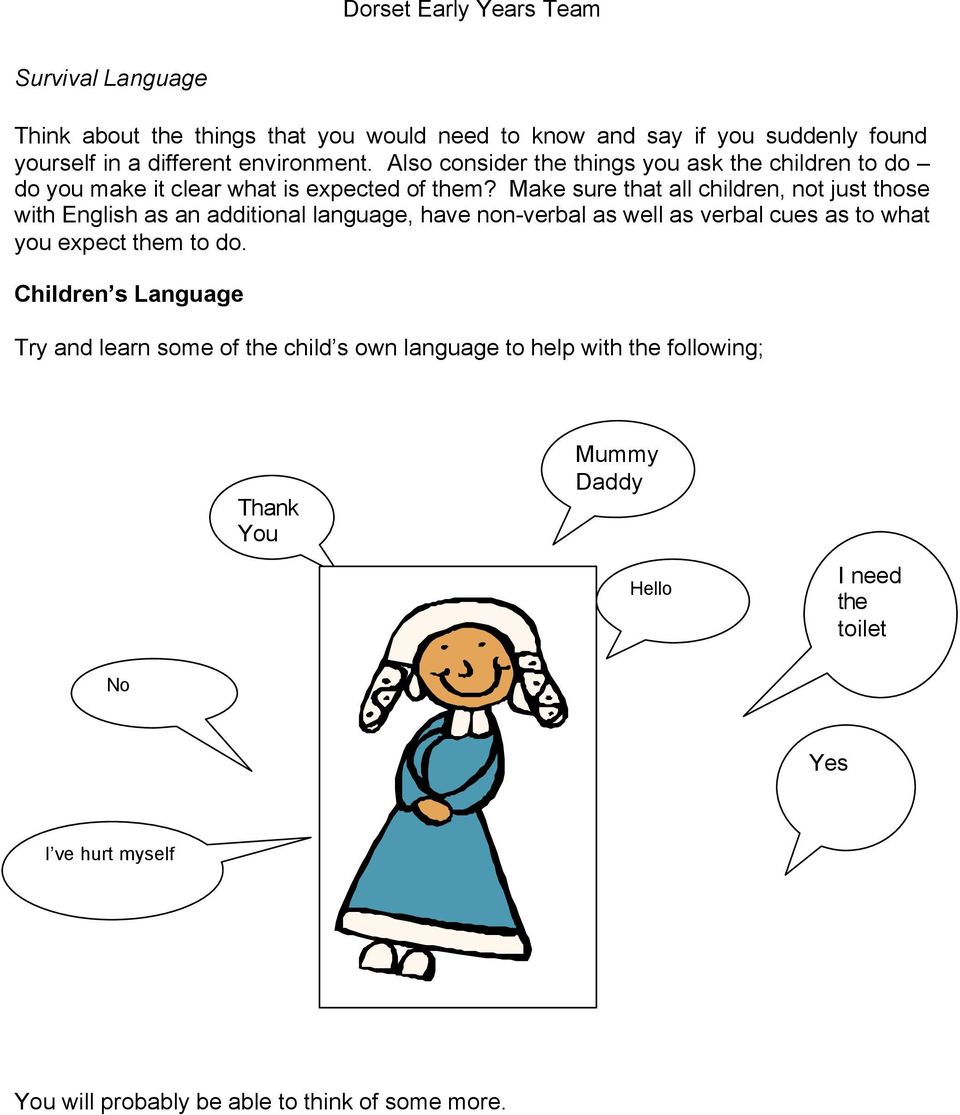
9 Survival Language Think about the things that you would need to know and say if you suddenly found yourself in a different environment. Also consider the things you ask the children to do do you make it clear what is expected of them? Make sure that all children, not just those with English as an additional language, have non-verbal as well as verbal cues as to what you expect them to do. Children s Language Try and learn some of the child s own language to help with the following; Thank You Mummy Daddy Hello I need the toilet No Yes I ve hurt myself You will probably be able to think of some more.
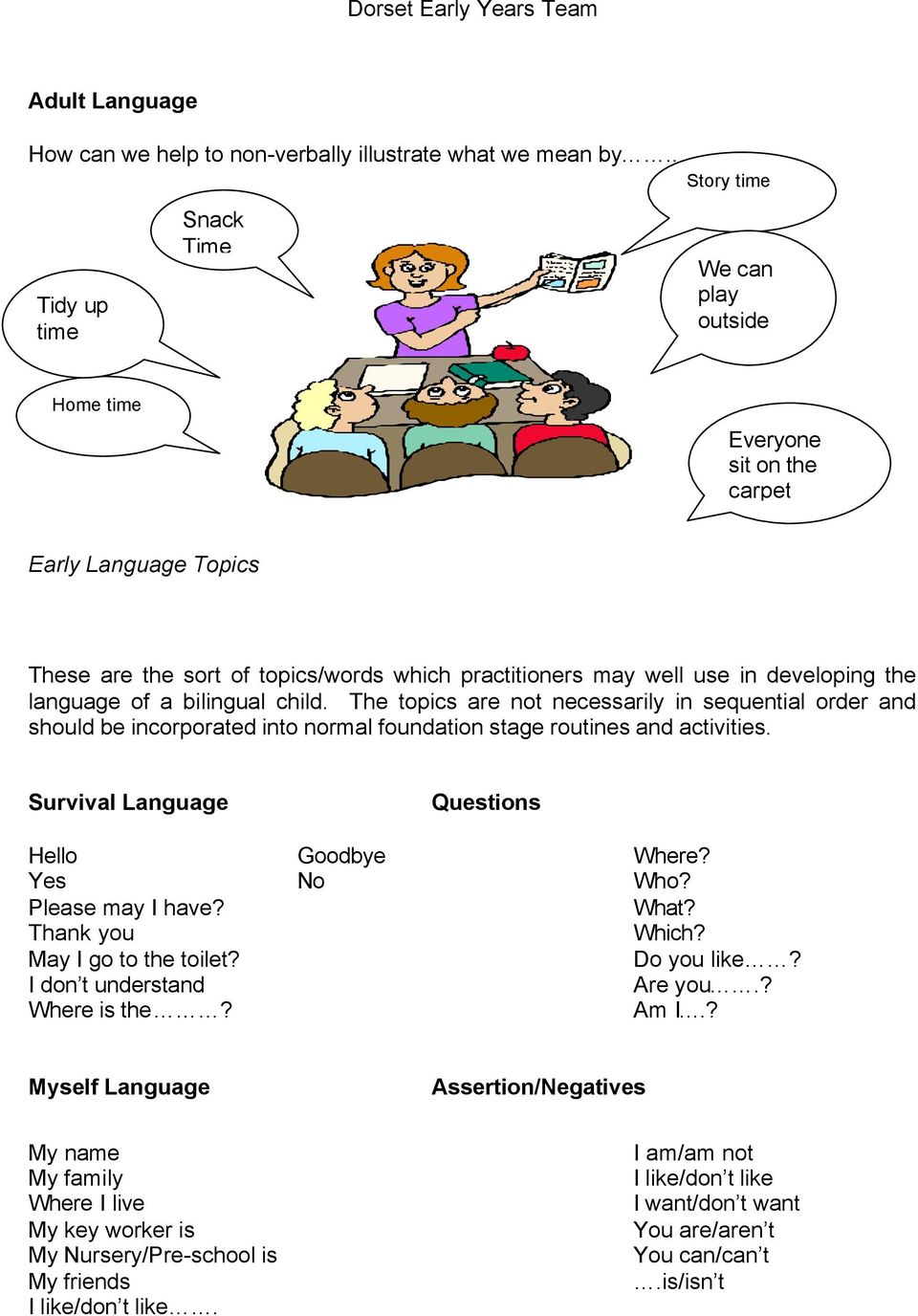
10 Adult Language How can we help to non-verbally illustrate what we mean by.. Tidy up time Snack Time Story time We can play outside Home time Everyone sit on the carpet Early Language Topics These are the sort of topics/words which practitioners may well use in developing the language of a bilingual child. The topics are not necessarily in sequential order and should be incorporated into normal foundation stage routines and activities. Survival Language Questions Hello Goodbye Where? Yes No Who? Please may I have? What? Thank you Which? May I go to the toilet? Do you like? I don t understand Are you.? Where is the? Am I.? Myself Language Assertion/Negatives My name My family Where I live My key worker is My Nursery/Pre-school is My friends I like/don t like. I am/am not I like/don t like I want/don t want You are/aren t You can/can t.is/isn t
11 Action Verbs Run, Walk, Sit, Stand, Eat, Drink Look, Jump, Throw, Catch, Listen (Can introduce use of I/you) Everyday nouns In Setting Door, Window, Chair, Table, Toilet, Outside, Inside, Book, Snack (time), Story (time) Outside Setting Road, House, Car, Crossing, Lights

12 The Early Stages of Learning English: Research This outline of the development of young children s learning of English as an additional language has been prepared by NALDIC to inform judgements made by educators in assessment contexts. It draws on research findings. The process should be seen as cumulative and there will be variations in the rate of development according to environmental, personal and social factors. Many bilingual children who are at an early stage in their learning of English go through a silent period when they first enter an unfamiliar early years setting. This can last for up to six months or longer. This is not a passive stage. During this time, children will be watching, actively listening, and exploring their environment to understand new experiences and to develop new meanings. They will be trying to relate previous knowledge to new contexts. It is important that children should not feel pressurised to speak until they feel confident enough to do so. However, it is essential that adults continue to talk to the children, to pick up their non-verbal responses. To support the child s understanding of meaning, and to involve them in activities, these strategies will help children to internalise the language they hear and to develop a sense of the patterns, meanings and range of language functions in their new, unfamiliar environment. During this time, children may begin to use non-verbal gestures as a response to a question or to indicate a need. Understanding is in advance of spoken language. Many children may begin to echo single words and some short phrases used by adults and peers. All attempts at speech should be encouraged and praised. There will be a development of formulaic language ( chunks of social speech) e.g. Mummy come soon, My turn. Children may begin to join in with story refrains and repetitions and songs. Chunking will continue, but children will increasingly begin to use one-word utterances (frequently nouns) which will perform a range of language functions (e.g. questioning, responding, and naming). Children will then begin to generate their own telegraphic sentences, using two or three word utterances. Function words are likely to be omitted, the main concern being the communication of meaning. Non-verbal gestures will often accompany speech. Holistic phrases (a development of chunking ) will continue during this stage. Children will begin to use extended phrases or simple sentences, which contain surface developmental errors in the use of plurals, tenses, personal pronouns, function words and articles. Again the emphasis is on the communication of meaning. Increasingly children will develop more control in their use of functional language. However, surface errors in the use of tenses, word endings and plurals, will continue for some time until children understand the use of different grammatical
13 structures in the target language, which may be very different from the home language.

Understanding the stages of learning for children with English as an Additional Language. Guidance compiled by EMAS
 Understanding the stages of learning for children with English as an Additional Language Guidance compiled by EMAS 2 Introduction Practitioners who are new to working with children and families who speak
English as an Additional Language Working with Beginners at KS1 and KS2
 Gloucestershire Race Equality and Diversity Service English as an Additional Language Working with Beginners at KS1 and KS2 An information booklet for teachers of newly arrived pupils with little or no
Portage Guide Birth to Six Preschool Indicator 7 Child Outcomes Crosswalk. Outcome 2 Acquisition & Use of Knowledge & Skills
 Portage Guide Birth to Six Preschool Indicator 7 Child Outcomes Crosswalk NPG Domains Outcome 1 Positive Social Emotional Skills Outcome 2 Acquisition & Use of Knowledge & Skills Outcome 3 Appropriate
GESE Initial steps. Guide for teachers, Grades 1 3. GESE Grade 1 Introduction
 GESE Initial steps Guide for teachers, Grades 1 3 GESE Grade 1 Introduction cover photos: left and right Martin Dalton, middle Speak! Learning Centre Contents Contents What is Trinity College London?...3
Advice for Class Teachers. Moderating pupils reading at P 4 NC Level 1
 Advice for Class Teachers Moderating pupils reading at P 4 NC Level 1 Exemplars of writing at P Scales and into National Curriculum levels. The purpose of this document is to provide guidance for class
DynEd International, Inc.
 General Description: Proficiency Level: Course Description: Computer-based Tools: Teacher Tools: Assessment: Teacher Materials: is a multimedia course for beginning through advanced-level students of spoken
Preschool Development Assessment
 Preschool Development Assessment Child s Name: DOB: Completed by: Date began: This document may be copied for classroom use only. Not to be sold or used on any other website. Property of www.re-teach.com.
How Can Teachers Teach Listening?
 3 How Can Teachers Teach Listening? The research findings discussed in the previous chapter have several important implications for teachers. Although many aspects of the traditional listening classroom
Modern foreign languages
 Modern foreign languages Programme of study for key stage 3 and attainment targets (This is an extract from The National Curriculum 2007) Crown copyright 2007 Qualifications and Curriculum Authority 2007
ELPS TELPAS. Proficiency Level Descriptors
 ELPS TELPAS Proficiency Level Descriptors Permission to copy the ELPS TELPAS Proficiency Level Descriptors is hereby extended to Texas school officials and their agents for their exclusive use in determining
Contents. A Word About This Guide... 3. Why Is It Important for My Child to Read?... 4. How Will My Child Learn to Read?... 4
 Contents A Word About This Guide............................... 3 Why Is It Important for My Child to Read?................ 4 How Will My Child Learn to Read?....................... 4 How Can I Help My
How to teach listening 2012
 How to teach listening skills "Great speakers are not born, they re trained." - Dale Carnegie (1921) Intended Learning Outcomes (ILOs) To enhance deeper understanding of the process of listening as a communicative
English (Literacy) Reading Target Ideas. P Scale 4
 P Scale 4 Pupils listen and respond to familiar rhymes and stories Begin to remember one or two repeated words e.g. names of people or objects, or key words in a repetitive phrase, in a familiar text when
ENGLISH AS AN ADDITIONAL LANGUAGE (EAL) COMPANION TO AusVELS
 ENGLISH AS AN ADDITIONAL LANGUAGE (EAL) COMPANION TO AusVELS For implementation in 2013 Contents English as an Additional Language... 3 Introduction... 3 Structure of the EAL Companion... 4 A Stages Lower
Speaking and Listening Materials
 Speaking and Listening Materials The speaking and listening materials consist of a teacher s handbook, a book of teaching objectives and classroom activities, a pack of leaflets and posters and a video
The. Languages Ladder. Steps to Success. The
 The Languages Ladder Steps to Success The What is it? The development of a national recognition scheme for languages the Languages Ladder is one of three overarching aims of the National Languages Strategy.
Alphabetic Knowledge / Exploring with Letters
 Alphabetic Knowledge / Exploring with Letters Reading Goal 67: demonstrate awareness of the alphabetic principle Reads books with repetitive sounds and/or pronounces words deliberately and slowly when
Our Lady of Lourdes Catholic Nursery & Primary School. Modern Foreign Language Policy
 Our Lady of Lourdes Catholic Nursery & Primary School Modern Foreign Language Policy September 2014 Review Date: September 2016 INTRODUCTION This subject policy is one in a series that makes up the Whole
Learning Center System. Preschool Resource Guide. Muriel Wong
 Learning Center System Preschool Resource Guide Muriel Wong TABLE OF CONTENTS Overview and purpose 3 Page Supporting Children s Learning 4 Daily Routine 8 The Classroom Environment 10 Learning Centers
ST. PETER S CHURCH OF ENGLAND (VOLUNTARY AIDED) PRIMARY SCHOOL SOUTH WEALD. Modern Foreign Language Policy
 ST. PETER S CHURCH OF ENGLAND (VOLUNTARY AIDED) PRIMARY SCHOOL SOUTH WEALD Modern Foreign Language Policy January 2013 ST PETER S MODERN FOREIGN LANGUAGE (MFL) POLICY RATIONALE In the knowledge society
Ohio Early Learning and Development Standards Domain: Language and Literacy Development
 Ohio Early Learning and Development Standards Domain: Language and Literacy Development Strand: Listening and Speaking Topic: Receptive Language and Comprehension Infants Young Toddlers (Birth - 8 months)
A Guide for Using Big Books in the Classroom
 Why Big Books? A Guide for Using Big Books in the Classroom There s something spectacular about Big Book versions of good children s books. Neither adults nor children can resist the urge to touch and
Language Development and Learning: Strategies for supporting pupils learning through English as an additional language (Secondary)
 12 CHECKLIST FOR PLANNING 1. Do the bilingual pupils understand the learning intention? 2. Do I know their prior knowledge of this topic? 3. Do I know what English language skills they have and need to
Grade 1 LA. 1. 1. 1. 1. Subject Grade Strand Standard Benchmark. Florida K-12 Reading and Language Arts Standards 27
 Grade 1 LA. 1. 1. 1. 1 Subject Grade Strand Standard Benchmark Florida K-12 Reading and Language Arts Standards 27 Grade 1: Reading Process Concepts of Print Standard: The student demonstrates knowledge
Form: Filled in table. Method: Peer assessment. Tool: Checklist. Form: Completed table. Method: Peer assessment. Tool: Checklist
 Lesson Plan English First Additional Language Grade 5 Content in context: Text from other Learning Area - Whether Los and ASs Learning Activities Details of Assessment Barriers to Learning LO 1 Listening
INTRODUCTION TEACHING TIPS. THE NURSERY CLASS Purpose
 INTRODUCTION THE NURSERY CLASS Purpose Letter to Parents The purpose of the nursery class is to help children learn the restored gospel of Jesus Christ and live it. The nursery class should help the children
ALBUQUERQUE PUBLIC SCHOOLS
 ALBUQUERQUE PUBLIC SCHOOLS Speech and Language Initial Evaluation Name: Larry Language School: ABC Elementary Date of Birth: 8-15-1999 Student #: 123456 Age: 8-8 Grade:6 Gender: male Referral Date: 4-18-2008
Guided Reading with Emergent Readers by Jeanne Clidas, Ph.D.
 Bebop Books Guided Reading with Emergent Readers by Jeanne Clidas, Ph.D. What Is Guided Reading? Guided reading involves a small group of children thinking, talking, and reading through a new text with
CHILD S NAME INSERT CHILD S PHOTO HERE
 RECORD OF F DEVELOPMENT T A AND N PROGRESS AT KINDERGARTEN RT LEVEL CHILD S NAME INSERT CHILD S PHOTO HERE GUIDELINES for Kindergarten Assistants: Every Kindergarten Assistant (KGA) must know if each child
Second Language Acquisition Stages Stephen Krashen (1986) Silent and Receptive Stage
 Second Language Acquisition Stages Stephen Krashen (1986) Silent and Receptive Stage do not verbally respond to communication in the second language although there is receptive processing. should be actively
Link: University of Canberra http://www.canberra.edu.au/studyskills/learning/oralpres.html#preparing
 6. Voice, speech and body language: The way you speak, the way you act and the way you move around can be very important to succeed in your presentation. Here you will find some useful advices and links
What Can Help Improve Social Interaction and Development?
 What Can Help Improve Social Interaction and Development? Supporting social interaction is an important piece of the student s educational plan, as increasing social interaction and competency are vital
English lesson plans for Grade 1
 English lesson plans for Grade 1 Lessons in this section 1.1 Vocabulary, listening and speaking: parts of the body and can 26 1.2 Vocabulary, listening and speaking: colours and parts of the body 29 1.3
How to become a successful language learner
 How to become a successful language learner By Alison Fenner English and German Co-ordinator, Institution Wide Language Programme Introduction Your success in learning a language depends on you! You may
Grade 1. Ontario Provincial Curriculum-based Expectations Guideline Walking with Miskwaadesi and Walking with A`nó:wara By Subject/Strand
 Grade 1 Ontario Provincial Curriculum-based Expectations Guideline Walking with Miskwaadesi and Walking with A`nó:wara By Subject/Strand Turtle Island Conservation Ontario Teacher Resource Bundle 1 The
Talk To Your Baby Quiz
 Talk To Your Baby Quiz 1. When should you start talking to babies? a) From the moment they are born b) After six weeks c) When they smile at you 2. When does the majority of brain development occur in
Language Development and Deaf Children
 Language Development and Deaf Children What is the difference between speech and language? Language is the words, structures, thoughts and concepts we have in our minds. Speech is one way in which we communicate
Subject: Spanish as a Foreign Language, Middle School Program
 Subject: Spanish as a Foreign Language, Middle School Program Overview: The Spanish as a Foreign Language Program at BNS focuses on the development of communication and comprehension skills. The Middle
English. Teaching Objectives and Learning Outcomes
 English Teaching Objectives and Directorate for Quality and Standards in Education Curriculum Management and elearning Department Malta 2012 FORM 1 - English Unit code and title Objective 1 7.1 The way
Part 5. Dinosaur School Notes to Teachers. 1. Introduction. 2. Iguanodon Unit: How to be Successful in School
 Part 5 Dinosaur School Notes to Teachers 1. Introduction 2. Iguanodon Unit: How to be Successful in School 3 & 4. Triceratops Unit: Detecting, Understanding and Talking About Feelings 5. Stegosaurus Unit:
Literacy across learning Principles and practice
 Literacy across learning Principles and practice Language and literacy are of personal, social and economic importance. Our ability to use language lies at the centre of the development and expression
SUGGESTIONS FOR WORKING WITH STUDENTS WITH AUTISM SPECTRUM DISORDERS (ASD) Provided for Information and sharing only
 SUGGESTIONS FOR WORKING WITH STUDENTS WITH AUTISM SPECTRUM DISORDERS (ASD) Provided for Information and sharing only 1. I have attached an informational handout about autism spectrum disorders and the
Sentence Blocks. Sentence Focus Activity. Contents
 Sentence Focus Activity Sentence Blocks Contents Instructions 2.1 Activity Template (Blank) 2.7 Sentence Blocks Q & A 2.8 Sentence Blocks Six Great Tips for Students 2.9 Designed specifically for the Talk
Sing, Spell, Read & Write
 Sing, Spell, Read & Write Correlated to Head Start DOMAIN: LANGUAGE DEVELOPMENT Element: Listening & Understanding Demonstrates increasing ability to attend to and understand conversations, stories, songs,
Teaching Strategies GOLD Objectives for Development & Learning: Birth Through Kindergarten
 Assessment Alignment of Teaching Strategies GOLD Objectives for Development & Learning: Birth Through Kindergarten with Alignment of the School Readiness Goals for Infants and in Head Start and Early Head
Sample Behavior Intervention Plan for Child With Attention Deficit Disorder and Conduct Problems
 Sample Behavior Intervention Plan for Child With Attention Deficit Disorder and Conduct Problems for Developed by: Date: This behavior intervention plan has been created to support the goals and objectives
Teaching and Educational Development Institute. Presentation skills for teachers
 Presentation skills for teachers Presentation skills for teachers Your success as a teacher is largely determined by your ability and skill in communicating your message. We have all experienced teachers
End of Reception Report: July 2013
 End of Reception Report: July 2013 Name: Date: Communication and Language Listening and attention Understanding Speaking Child A is able to listen to instructions and follow them accurately, including
Chapter 4 COMMUNICATION SKILLS. The difference between verbal and nonverbal communication. The difference between hearing and listening
 Chapter 4 COMMUNICATION SKILLS What You Will Learn The difference between verbal and nonverbal communication The difference between hearing and listening Factors that promote effective communication Barriers
Purpose: To acquire language and the ability to communicate successfully with others
 Purpose: To acquire language and the ability to communicate successfully with others The language development and communication domain involves the development of the ability to use language to communicate
MFL Policy 2014. Policy confirmed by the Governing Body of Our Lady Immaculate Roman Catholic Primary School on: Date: 23.9.14
 MFL Policy 2014 Policy confirmed by the Governing Body of Our Lady Immaculate Roman Catholic Primary School on: Date: 23.9.14 Signature: (Chair of Governors) To be reviewed on: Rationale for Teaching Languages
Early Years Foundation Stage Framework 2012 An overview with recommendations for music-making
 Early Years Foundation Stage Framework 2012 An overview with recommendations for music-making Commissioned by Sound Connections in June 2012 from Linda Bance (MA Music Ed) for the London Early Years Music
Create stories, songs, plays, and rhymes in play activities. Act out familiar stories, songs, rhymes, plays in play activities
 PRESCHOOL Language Arts Literacy Expectation 1 Children listen and respond to environmental sounds, directions, and conversations. NJCCC K-12 Standard 3.4 Listening Strand A: Active Listening Strand B:
Letters and Sounds, Phase 1, Aspect 2 General Sound Discrimination Instrumental Sounds Tuning into Sounds
 Tuning into Sounds Main Purpose: To experience and develop awareness of sounds made with instruments and noise makers. Organise an area so that the children sit facing a screen. Ensure there one set of
MFL skills map. Year 3 Year 4 Year 5 Year 6 Develop understanding of the sounds of Individual letters and groups of letters (phonics).
 listen attentively to spoken language and show understanding by joining in and responding explore the patterns and sounds of language through songs and rhymes and link the spelling, sound and meaning of
ADHD: Information for Teachers and Parents
 Educational Psychology Service What is ADHD? ADHD: Information for Teachers and Parents All children may experience attention difficulties at one time or another. This can be more noticeable if a child
Inspection report for early years provision. Unique Reference Number
 Inspection report for early years provision Unique Reference Number Inspection date Inspector 300001 23 January 2007 Yvonne Victoria Facey Type of inspection Type of care Childcare Childminding ABOUT THIS
PROGRAM PREPAREDNESS CHECKLIST: Serving Dual Language Learners and Their Families
 It is essential that all Head Start and Early Head Start (EHS) programs have systems, policies, and procedures in place to meet the needs of children and families who speak languages other than English.
Helping your child with Reading
 Helping your child with Reading Some ways that you can support. Getting Started Sharing books - We teach phonics to help our children learn to read and write and in order to do this successfully they need
COMPUTER TECHNOLOGY IN TEACHING READING
 Лю Пэн COMPUTER TECHNOLOGY IN TEACHING READING Effective Elementary Reading Program Effective approach must contain the following five components: 1. Phonemic awareness instruction to help children learn
Assessment in Modern Foreign Languages in the Primary School
 Expert Subject Advisory Group Modern Foreign Languages Assessment in Modern Foreign Languages in the Primary School The National Curriculum statutory requirement from September 2014 asks Key Stage Two
Jack s Dyslexia Index indicates he has dyslexic difficulties that are mild in extent.
 Dyslexia Portfolio Report for Jack Jones Assessed by Sue Thompson on 05/08/2009 Report for parents When a child is identified as dyslexic, additional support will be needed from both school and home to
Reading. Language and Literacy in the Foundation Stage
 Acknowledgements The Early Years Literacy Interboard Group wishes to record its thanks to the following schools for their willing co-operation in the production of this resource. Ballysillan Primary, Belfast;
How do the principles of adult learning apply to English language learners?
 Beginning to Work with Adult English Language Learners: Some Considerations MaryAnn Cunningham Florez and Miriam Burt National Center for ESL Literacy Education (NCLE) October 2001 This article discusses
Behavior Impedes Learning
 Behavior Impedes Learning ARSD 24:05:27:01.02. (1) In the case of a student whose behavior impedes his or her learning or that of others, consider the use of positive behavioral interventions and supports
5 Free Techniques for Better English Pronunciation
 5 Free Techniques for Better English Pronunciation Enhancing Communication Skills Enhancing Performance Judy Ravin, President The Accent Reduction Institute, LLC 410 N. 4th Ave. Ann Arbor, MI. 48104 734-665-2915
Twinkle Stars Nursery School
 Twinkle Stars Nursery School Wembley Football Club, Vale Farm, Watford Road, WEMBLEY, Middlesex, HA0 3HG Inspection date Previous inspection date 07/05/2014 Not Applicable The quality and standards of
ENGLISH FILE Elementary
 Karen Ludlow New ENGLISH FILE Elementary and the Common European Framework of Reference 2 INTRODUCTION What is this booklet for? The aim of this booklet is to give a clear and simple introduction to the
3. A variety of materials are available so that children of all skill levels have something to play with.
 The Incredible Years BEST PRACTICES INVENTORY-R* DATE / / CLASSROOM ARRANGEMENT 1. The classroom has clearly defined and well-equipped learning centers. The number of children allowed in a center is limited
stress, intonation and pauses and pronounce English sounds correctly. (b) To speak accurately to the listener(s) about one s thoughts and feelings,
 Section 9 Foreign Languages I. OVERALL OBJECTIVE To develop students basic communication abilities such as listening, speaking, reading and writing, deepening their understanding of language and culture
The USPI Physician and Care Provider s Guide to Effective Communication
 The USPI Physician and Care Provider s Guide to Effective Communication KNOW HOW PATIENTS WILL EVALUATE PROVIDER SKILLS The Clinician and Group CAHPS - Consumer Assessment of Healthcare Providers and Systems
Thai Language Self Assessment
 The following are can do statements in four skills: Listening, Speaking, Reading and Writing. Put a in front of each description that applies to your current Thai proficiency (.i.e. what you can do with
1 WARMER Complete the sentences using your own words. Use a dictionary to help you. Girls are. Boys are.
 1 WARMER Complete the sentences using your own words. Use a dictionary to help you. Girls are. Boys are. 2 WHAT DOES IT MEAN? Write the words next to their meanings. These words will help you understand
Fun Learning Activities for Mentors and Tutors
 Fun Learning Activities for Mentors and Tutors Mentors can best support children s academic development by having fun learning activities prepared to engage in if the child needs a change in academic/tutoring
Inspection report for early years provision. Unique Reference Number 300100 Inspection date 04 April 2006
 Inspection report for early years provision Unique Reference Number 300100 Inspection date 04 April 2006 Inspector Jill Lee Type of inspection Type of care Childcare Childminding ABOUT THIS INSPECTION
Developing Communication Skills in Learning for Life and Work
 Key Stage 3 Developing Communication Skills in Learning for Life and Work 1 Communication is central to the whole curriculum. Children should be able to communicate in order to express themselves socially,
Learning Style Inventory
 Learning Style Inventory To better understand how you prefer to learn and process information, place a check in the appropriate space after each statement below, then use the scoring directions at the
KINDGERGARTEN. Listen to a story for a particular reason
 KINDGERGARTEN READING FOUNDATIONAL SKILLS Print Concepts Follow words from left to right in a text Follow words from top to bottom in a text Know when to turn the page in a book Show spaces between words
Unit/Lesson Planning Guide: Key Questions to Consider While Planning
 Unit/Lesson Planning Guide: Key Questions to Consider While Planning Following is a guide to unit and lesson planning; it is based on approaches to unit and lesson planning introduced in TE 401 and used
Nottingham Women's Centre Daycare
 Nottingham Women's Centre Daycare Nottingham Womens Centre, 30 Chaucer Street, NOTTINGHAM, Nottinghamshire, NG1 5LP Inspection date Previous inspection date 12/11/2013 11/12/2009 The quality and standards
Parent Education Activities
 PART III: PARENT EDUCATION Parent education sessions need to be planned and should follow a similar sequence each time. The suggested sequence is listed here and is explained later in this article. Also,
To download the script for the listening go to: http://www.teachingenglish.org.uk/sites/teacheng/files/learning-stylesaudioscript.
 Learning styles Topic: Idioms Aims: - To apply listening skills to an audio extract of non-native speakers - To raise awareness of personal learning styles - To provide concrete learning aids to enable
Lesson Plan for Note Taking
 Lesson Plan for Note Taking Goals: To prepare students to take pertinent notes form lecture, books and activities. Expose students to different styles of note-taking. Give students an opportunity to practice
Reading Strategies by Level. Early Emergent Readers
 The charts below were created as a common language for teachers and students in the Wallingford Public Schools in kindergarten through eighth grade. The level of the chart selected for use in the classroom
GUESSING BY LOOKING AT CLUES >> see it
 Activity 1: Until now, you ve been asked to check the box beside the statements that represent main ideas found in the video. Now that you re an expert at identifying main ideas (thanks to the Spotlight
Llansanffraid Church in Wales Primary School. Information and Communication Technology (ICT) Policy
 Llansanffraid Church in Wales Primary School Information and Communication Technology (ICT) Policy ICT is changing the lives of everyone. Through teaching children the skills to use ICT we equip them to
Module 9. Building Communication Skills
 Module 9 Building Communication Skills Essential Ideas to Convey To apply a facilitative approach to supervision, supervisors have to approach the people they manage in a different way, by using certain
Linked sounds Listening for spelling of names and phone numbers. Writing a list of names and phone numbers Work book pg 1-6
 TOPICS: Alphabet; greetings, names and titles of address; numbers and phone numbers PG 2-7 introduce themselves friends, say hello goodbye; ask for names and phone numbers Possessive adjectives my, your,
CHARACTERISTICS FOR STUDENTS WITH: LIMITED ENGLISH PROFICIENCY (LEP)
 CHARACTERISTICS FOR STUDENTS WITH: LIMITED ENGLISH PROFICIENCY (LEP) Research has shown that students acquire a second language in the same way that they acquire the first language. It is an exploratory
Expressive Objective: Realize the importance of using polite expressions in showing respect when communicating with others
 QUARTER 4 - WEEK 1 Theme: My School and Friends TARGET SKILLS : At the end of the lesson the students should be able to: Expressive Objective: Realize the importance of using polite expressions in showing
Knowledge and Understanding of the World. Early Learning Goals. National Curriculum. (learning objectives) (level 1 descriptors)
 Knowledge and Understanding of the World Knowledge and Understanding of the world Science K&U4 Ask questions about why things happened and how things work To talk about what they see To make recordings
How to Take Running Records
 Running Records are taken to: guide teaching match readers to appropriate texts document growth overtime note strategies used group and regroup children for instruction How to Take Running Records (adapted
Goals for Preschool aged Children: (Compiled from several State Guidelines) Compilation by Narcissa Summerfield Language Community Goals
 Goals for Preschool aged Children: (Compiled from several State Guidelines) Compilation by Narcissa Summerfield Language Community Goals Interact appropriately in groups (taking turns talking or playing
Baby Signing. Babies are born with an inherent body language that is common to all cultures.
 Baby Signing Babies are born with an inherent body language that is common to all cultures. Long before the emergence of speech, babies spontaneously communicate with their parents using gestures and sounds
Helping your child with Non-verbal Learning Disability
 Helping your child with Non-verbal Learning Disability What is non-verbal learning disability? Non-verbal learning disability (NVLD) is a term used to describe a pattern of strengths and weaknesses in
Building Blocks: Effective Practices for Including Young Children with Disabilities in Community Based Programs
 Building Blocks: Effective Practices for Including Young Children with Disabilities in Community Based Programs Cassandra Cerros Jaime Martin Gail Joseph Head Start Center for Inclusion University of Washington
Guidance on assessing the attainment of young children with Special Educational Needs in the Early Years Foundation Stage (EYFS).
 Guidance on assessing the attainment of young children with Special Educational Needs in the Early Years Foundation Stage (EYFS). Meeting the individual needs of all children lies at the heart of the EYFS
Talking and Listening. Language and Literacy in the Foundation Stage
 Acknowledgements The Early Years Literacy Interboard Group wishes to record its thanks to the following schools for their willing co-operation in the production of this resource. Ballysillan Primary, Belfast;
English Language Proficiency Standards: At A Glance February 19, 2014
 English Language Proficiency Standards: At A Glance February 19, 2014 These English Language Proficiency (ELP) Standards were collaboratively developed with CCSSO, West Ed, Stanford University Understanding