
Revised Technical Specifications for the Solvency II valuation and Solvency Capital Requirements calculations (Part I)
|
|
|
- Mavis Hines
- 9 years ago
- Views:
Transcription
1 EIOPA-DOC-12/ December 2012 Revised Technical Specifications for the Solvency II valuation and Solvency Capital Requirements calculations (Part I) This technical specification is a working document proposed by EIOPA to be used by insurance and reinsurance undertakings participating in any quantitative assessment to be undertaken until new update is available. As there are essential parts of the valuation framework still under political discussions, i.e. the discount rates for the technical provisions calculations, this document is not intended to be a complete set of technical specifications for the Solvency 2 balance sheet valuation nor for the Solvency Capital Requirements calculations. Howsoever these essential parts are not included at this stage but will follow in due course. Not even when the specification of discount rates for TP calculations are finally added, the resulting technical specifications should be seen as a complete implementation of the Solvency II framework, since for the purpose of feasibility of testing exercises, shortcuts and ad hoc simplifications have been included. In particular, relevant parts of the SCR calculation such as internal models section, undertaking specific parameters section and within the group section: the combination method, the treatment of Participations, Ring Fenced funds and internal model for group calculation have been deliberately not included in the current technical specifications, as these were not considered by EIOPA as providing key information for the purposes of the quantitative tests that may be launched in the coming months. However, this should not be interpreted as an EIOPA speculation on its inclusion in the final Solvency II framework. This technical specification is inspired by the knowledge that EIOPA has on the current status of the negotiations on Omnibus 2 Directive, the working documents on 1

2 implementing measures and its own work in the development of Technical Standards and Guidelines. EIOPA plans to incorporate the relevant elements of the technical provisions valuation, once the outcome of the OMDII negotiations is stabilised. 2

3 Table of content SECTION 1 VALUATION... 7 V.1. Assets and Other Liabilities... 7 V.1.1. Valuation approach... 7 V.2. Technical Provisions V.2.1. Segmentation V.2.2. Best estimate V Methodology for the calculation of the best estimate V Assumptions underlying the calculation of the best estimate V Recoverables V.2.3. Calculation of technical provisions as a whole V.2.4. Risk margin V.2.5. Proportionality V Possible simplifications for life insurance V Possible simplifications for non-life insurance V Possible simplifications for reinsurance recoverables SECTION 2 SCR STANDARD FORMULA SCR.1. Overall structure of the SCR SCR.1.1. SCR General remarks SCR.1.2. SCR Calculation Structure SCR.2. Loss absorbing capacity of technical provisions and deferred taxes SCR.2.1. Definition of future discretionary benefits SCR.2.2. Gross and net SCR calculations SCR.2.3. Calculation of the adjustment for loss absorbency of technical provisions and deferred taxes SCR.3. SCR Operational risk SCR.4. SCR Intangible asset risk module SCR.5. SCR market risk module SCR.5.1. Introduction SCR.5.2. Scenario-based calculations SCR.5.3. Look-through approach SCR.5.4. Mkt int interest rate risk SCR.5.5. Mkt eq equity risk SCR.5.6. Mkt prop property risk SCR.5.7. Mkt fx currency risk SCR.5.8. Mkt sp spread risk

4 SCR.5.9. Mkt conc market risk concentrations SCR Treatment of risks associated to SPV notes held by an undertaking SCR.6. SCR Counterparty risk module SCR.6.1. Introduction SCR.6.2. Calculation of capital requirement for type 1 exposures SCR.6.3. Loss-given-default for risk mitigating contracts SCR.6.4. Loss-given-default for type 1 exposures other than risk mitigating contracts SCR.6.5. Calculation of capital requirement for type 2 exposures SCR.6.6. Treatment of risk mitigation techniques SCR.6.7. Simplifications for risk mitigating effects and risk adjusted values of risk mitigating contracts SCR.7. SCR Life underwriting risk module SCR.7.1. Structure of the life underwriting risk module SCR.7.2. Life mort mortality risk SCR.7.3. Life long longevity risk SCR.7.4. Life dis disability-morbidity risk SCR.7.5. Life lapse lapse risk SCR.7.6. Life exp expense risk SCR.7.7. Life rev revision risk SCR.7.8. Life CAT catastrophe risk sub-module SCR.8. Health underwriting risk SCR.8.1. Structure of the health underwriting risk module SCR.8.2. SLT Health (Similar to Life Techniques) underwriting risk sub-module SCR.8.3. Non-SLT Health (Not Similar to Life Techniques) underwriting risk sub-module 209 SCR.8.4. Health risk equalization systems SCR.8.5. Health catastrophe risk sub-module SCR.9. Non-life underwriting risk SCR.9.1. SCR nl non-life underwriting risk module SCR.9.2. NL pr Non-life premium & reserve risk SCR.9.3. NL Lapse Lapse risk SCR.9.4. Non life CAT risk sub - module SCR.10. Ring- fenced funds SCR.11. Financial Risk mitigation SCR Scope SCR Conditions for using financial risk mitigation techniques SCR Basis Risk

5 SCR Shared financial risk mitigation SCR Rolling and dynamic hedging SCR Credit quality of the counterparty SCR Credit derivatives SCR Collateral SCR Segregation of assets SCR.12. Insurance risk mitigation SCR Scope SCR Conditions for using insurance risk mitigation techniques SCR Basis Risk SCR Credit quality of the counterparty SCR.13. Simplifications applicable on ceding undertakings to captive reinsurers SCR.14. Solo treatment of participations SCR Introduction SCR Characteristics of a participation SCR Valuation SCR Treatment of participations in financial and credit institutions in the calculation of Own Funds SCR Treatment of participations in the calculation of the Solvency Capital Requirement with an internal model SECTION 3 Minimum Capital Requirement MCR.1. Introduction MCR.2. Overall MCR calculation MCR.3. Linear formula component for non-life insurance or reinsurance obligations MCR.4. Linear formula component for life insurance or reinsurance obligations MCR.5. Linear formula component for composite insurance undertakings SECTION 4 OWN FUNDS OF.1. Introduction OF.2. Classification of own funds into tiers and list of capital items OF.2.1. Unrestricted Tier 1 List of own-funds items OF.2.2. Unrestricted Tier 1 Basic Own-Funds Criteria for classification OF.2.3. Restricted Tier 1 Basic own-funds OF.2.4. Tier 2 Basic own-funds OF.2.5. Tier 3 Basic own-funds OF.2.6. Tier 2 Ancillary own-funds OF.2.7. Tier 3 Ancillary own-funds SECTION 5 GROUPS

6 G.1. Introduction G.1.1. Calculation of the group solvency: description of the methods G.1.2 Scope G.1.3. Availability of group own funds G.1.4.Quantitative Assessment assumptions for the treatment of third country related insurance undertakings and third country groups G.2. Accounting consolidation-based method G.2.1. Group technical provisions G.2.2. Determination of consolidated data for the calculation of group solvency according to method G.2.3. Consolidated group SCR G.2.4. Additional guidance for the calculation of the consolidated group SCR G.2.5. Minimum consolidated group SCR G.2.6. Consolidated group own funds G.3. Deduction and aggregation method G.3.1. Aggregated group SCR G.3.2. Aggregated group own funds

7 SECTION 1 VALUATION V.1. V.1.1. V.1. V.2. Assets and Other Liabilities Valuation approach The primary objective for valuation as set out in Article 75 of Directive 2009/138/EC requires an economic, market-consistent approach to the valuation of assets and liabilities. According to the risk-based approach of Solvency II, when valuing balance sheet items on an economic basis, undertakings need to consider the risks that arise from a particular balance sheet item, using assumptions that market participants would use in valuing the asset or the liability. According to this approach, insurance and reinsurance undertakings value assets and liabilities as follows: i. Assets should be valued at the amount for which they could be exchanged between knowledgeable willing parties in an arm's length transaction; ii. Liabilities should be valued at the amount for which they could be transferred, or settled, between knowledgeable willing parties in an arm's length transaction. When valuing liabilities under point (ii) no adjustment to take account of the own credit standing of the insurance or reinsurance undertaking shall be made. V.3. Valuation of all assets and liabilities, other than technical provisions, should be carried out, unless otherwise stated in conformity with international accounting standards as endorsed by the European Commission in accordance with Regulation (EC) No 1606/2002. If those standards allow for more than one valuation method, only valuation methods that are consistent with Article 75 of Directive 2009/138/EC can be used. In most cases those international accounting standards, herein referred to as IFRSs, are considered to provide valuation consistent with principles of Solvency II. Also, the IFRSs accounting bases, such as the definitions of assets and liabilities as well as the recognition and derecognition criteria, are applicable, unless otherwise stated. IFRSs also refer to a few basic presumptions, which are also applicable: The going concern assumption. Individual assets and liabilities are valued separately. The application of materiality, whereby the omissions or misstatements of items are material if they could, individually or collectively, influence the economic decisions that users make on the basis of the Solvency II balance sheet. Materiality depends on the size and nature of the omission or misstatement judged in the surrounding circumstances. The size or nature of the item, or a combination of both, could be the determining factor. V.4. IFRSs do not always require an economic valuation as envisaged by Article 75 of Directive 2009/138/EC. For those cases, subsection V.1.4. provides specific guidance for the application of IFRSs. 7

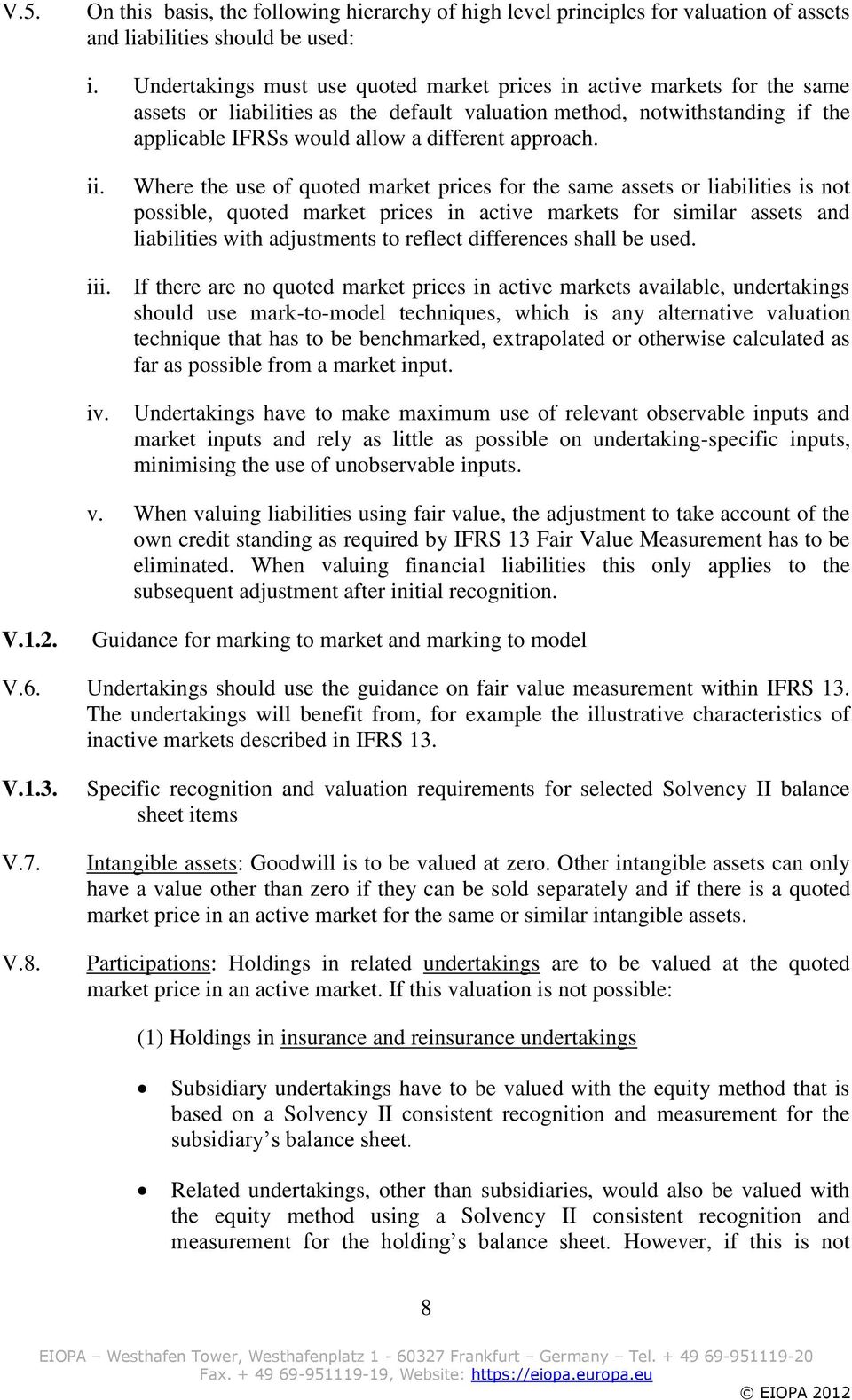
8 V.5. On this basis, the following hierarchy of high level principles for valuation of assets and liabilities should be used: i. Undertakings must use quoted market prices in active markets for the same assets or liabilities as the default valuation method, notwithstanding if the applicable IFRSs would allow a different approach. ii. Where the use of quoted market prices for the same assets or liabilities is not possible, quoted market prices in active markets for similar assets and liabilities with adjustments to reflect differences shall be used. iii. If there are no quoted market prices in active markets available, undertakings should use mark-to-model techniques, which is any alternative valuation technique that has to be benchmarked, extrapolated or otherwise calculated as far as possible from a market input. iv. Undertakings have to make maximum use of relevant observable inputs and market inputs and rely as little as possible on undertaking-specific inputs, minimising the use of unobservable inputs. v. When valuing liabilities using fair value, the adjustment to take account of the own credit standing as required by IFRS 13 Fair Value Measurement has to be eliminated. When valuing financial liabilities this only applies to the subsequent adjustment after initial recognition. V.1.2. Guidance for marking to market and marking to model V.6. Undertakings should use the guidance on fair value measurement within IFRS 13. The undertakings will benefit from, for example the illustrative characteristics of inactive markets described in IFRS 13. V.1.3. V.7. V.8. Specific recognition and valuation requirements for selected Solvency II balance sheet items Intangible assets: Goodwill is to be valued at zero. Other intangible assets can only have a value other than zero if they can be sold separately and if there is a quoted market price in an active market for the same or similar intangible assets. Participations: Holdings in related undertakings are to be valued at the quoted market price in an active market. If this valuation is not possible: (1) Holdings in insurance and reinsurance undertakings Subsidiary undertakings have to be valued with the equity method that is based on a Solvency II consistent recognition and measurement for the subsidiary s balance sheet. Related undertakings, other than subsidiaries, would also be valued with the equity method using a Solvency II consistent recognition and measurement for the holding s balance sheet. However, if this is not 8
9 possible, an alternative valuation method in accordance with the requirements in V1.1. and V1.2 should be used. (2) Holdings in undertakings other than insurance and reinsurance undertakings Holdings in undertakings other than insurance and reinsurance undertakings have to be valued with the equity method that is based on a Solvency II consistent recognition and measurement for the subsidiary s balance sheet. If that is not practicable, the equity method would be applied to the related undertaking s balance sheet following IFRSs as endorsed by the European Commission with the amendment that goodwill and other intangible assets would need to be deducted. If this is not possible for related undertakings, other than subsidiaries, an alternative valuation method in accordance with the requirements in V1.1. and V1.2 should be used. V.9. V.10. Contingent liabilities: For Solvency II purposes, contingent liabilities have to be recognised as liabilities. The valuation of the liability follows the measurement as required in IAS 37 Provisions, contingent liabilities and contingent assets, with the use of the basic risk-free interest rate term structure. Deferred Taxes: Insurance and reinsurance undertakings shall recognise and value deferred taxes in relation to all assets and liabilities that are recognised for solvency or tax purposes in conformity with international accounting standards, as endorsed by the Commission in accordance with Regulation (EC) No 1606/2002. Notwithstanding paragraph 1, insurance and reinsurance undertakings shall value deferred taxes, other than deferred tax assets arising from the carryforward of unused tax credits and the carryforward of unused tax losses, on the basis of the difference between the values ascribed to assets and liabilities recognised and valued in accordance with Articles 75 to 86 of Directive 2009/138/EC and the values ascribed to assets and liabilities as recognised and valued for tax purposes. In the case of deferred tax assets the insurance and reinsurance undertaking shall be able to demonstrate to the supervisory authority that it is probable that future taxable profit will be available against which the deferred tax asset can be utilised, taking into account any legal or regulatory requirements on the time limits relating to the carryforward of unused tax losses or the carryforward of unused tax credits. V.1.4. Consistency of IFSRs with Article 75 9

10 IFRS Summary of IFRS treatment: Measurement principles or options consistent with Article 75 of Directive 2009/138/EC? Fully consistent Consistent option With adjustments Applicable? Other comments IAS 1 Presentation of financial statements IAS 1 sets overall requirements for the presentation of financial statements, guidelines for their structure and minimum requirements for their content. no IAS 1 does not prescribe valuation methodologies for balance sheet items. IAS 2 Inventories IAS 2 prescribes the accounting treatment for inventories. Following IAS 2, inventories shall be measured at the lower of cost and net realisable value (IAS 2.9). Net realisable value refers to the net amount that an entity expects to realise from the sale of inventory in the ordinary course of business while fair value reflects the amount for which the same inventory could be exchanged between knowledgeable and willing buyers and sellers in the marketplace. As the net realisable value is an entity-specific value, may not equal fair value less costs to sell (IAS 2.7). Net realisable value is a consistent option. Adjustment may be needed where estimated cost are material. yes Undertakings shall apply the IAS 2 net realisable value for inventories if the estimated cost of completion and the estimated costs necessary to make the sale are not material. Solvency II framework: In many cases the estimated cost of completion and the estimated costs necessary to make the sale are not material. This means the net realisable value is option consistent with Article 75 of Directive 2009/138/EC if the estimated costs of completion and the estimated costs necessary to make the sales are not material.

11 IFRS Summary of IFRS treatment: Measurement principles or options consistent with Article 75 of Directive 2009/138/EC? Fully consistent Consistent option With adjustments Applicable? Other comments IAS 7 Statement of cash flows IAS 7 requires disclosures about historical changes in cash and cash equivalents of an entity by means of a statement of cash flows. no IAS 7 does not prescribe valuation methodologies for balance sheet items. IAS 8 Accounting policies, changes in accounting estimates and errors IAS 8 specifies criteria for selecting and changing accounting policies, together with the accounting treatment and disclosure of changes in accounting policies, changes in accounting estimates and corrections of errors. no IAS 8 does not prescribe valuation methodologies for balance sheet items. IAS 10 Events after the Reporting Period IAS 10 prescribes when an entity should adjust its financial statements for events after the reporting period and the complementing disclosure requirements. no IAS 10 does not prescribe valuation methodologies for balance sheet items. IAS 11 Construction Contracts IAS 11 describes the accounting treatment of revenue and costs associated with construction contracts in the financial statements of contractors. no Business not relevant for insurers.

12 IFRS Summary of IFRS treatment: Measurement principles or options consistent with Article 75 of Directive 2009/138/EC? Fully consistent Consistent option With adjustments Applicable? Other comments IAS 12 Income taxes IAS 12 prescribes the accounting treatment for income taxes. Current tax liabilities or assets for the current and prior periods shall be measured at the amount expected to be paid to or recovered from the taxation authorities, using the tax rates that have been enacted or substantively enacted by the end of the reporting period (IAS 12.46). Deferred tax liabilities and assets shall be measured at the tax rates that are expected to apply to the period when the asset is realised or the liability is settled, based on tax rates that have been enacted or substantively enacted by the end of the reporting period (IAS 12.47). Consistent measurement principles for current taxes. Consistent measurement principles for deferred taxes calculated based on the temporary difference between Solvency II values and the tax values. yes Deferred tax liabilities (assets) correspond to the amounts of income taxes payable (recoverable) in future periods in respect of taxable temporary differences (deductible temporary differences, carry forward of unused tax losses and unused tax credit) (IAS 12.5). Solvency II framework: For deferred tax liabilities (assets) Solvency II establishes a different concept of temporary differences, being the deferred taxes for Solvency II purposes, other than deferred tax assets arising from the carry forward of unused tax credits and the carry forward of unused tax losses, calculated on the basis of the difference between the values
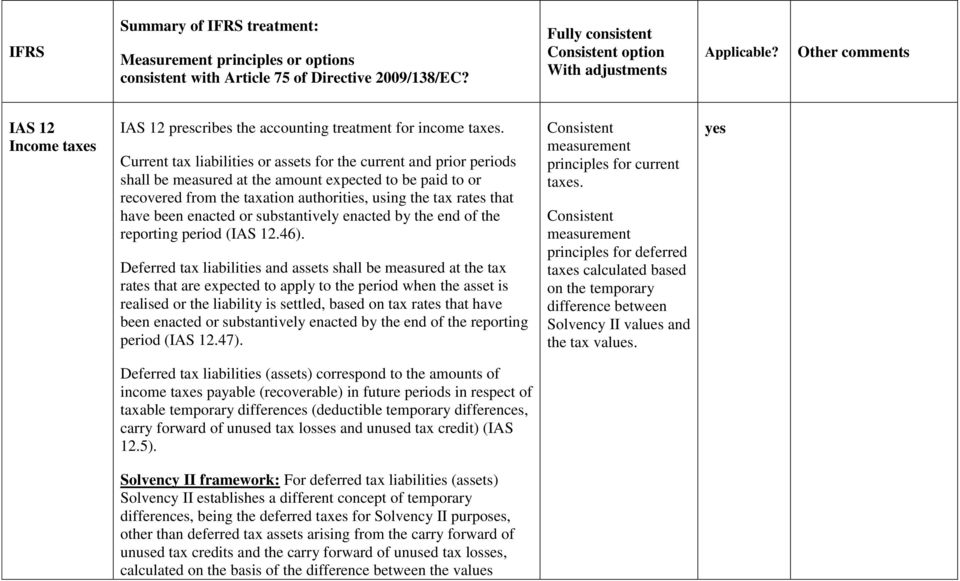
13 IFRS Summary of IFRS treatment: Measurement principles or options consistent with Article 75 of Directive 2009/138/EC? Fully consistent Consistent option With adjustments Applicable? Other comments ascribed to assets and liabilities recognised and valued in accordance with Article 75 to 86 of Directive 2009/138/EC and the values ascribed to assets and liabilities as recognised and valued for tax purposes; instead of the differences between the carrying amount of an asset or liability in the statement of financial position and its tax base. IAS 16 Property, plant and equipment IAS 16 prescribes the accounting treatment for property, plant and equipment. After initial recognition an entity shall choose either the cost model in paragraph 30 or the revaluation model in paragraph 31 as its accounting policy and shall apply that policy to an entire class of property, plant and equipment (IAS 16.29). Cost model: After recognition as an asset, an item of property, plant and equipment shall be carried at its cost less any accumulated depreciation and any accumulated impairment losses (IAS 16.30) Revaluation model: After recognition as an asset, an item of property, plant and equipment whose fair value can be measured reliably shall be carried at a revalued amount, being its fair value at the date of the revaluation less any subsequent accumulated depreciation and subsequent accumulated impairment losses. Revaluations shall be made with sufficient regularity to ensure Revaluation model is a consistent option. yes Undertakings shall apply the fair value model and the revaluation model of IAS 40 and IAS 16 respectively when valuing property, including investment property, plant and equipment. The cost model permitted by IAS 40 or IAS 16, whereby investment property and property, plant and equipment is valued at cost less depreciation and impairment shall not be applied.

14 IFRS Summary of IFRS treatment: Measurement principles or options consistent with Article 75 of Directive 2009/138/EC? Fully consistent Consistent option With adjustments Applicable? Other comments that the carrying amount does not differ materially from that which would be determined using fair value at the end of the reporting period (IAS 16.31). Solvency II framework: The revaluation model is an option consistent with Article 75 of Directive 2009/138/EC. IAS 17 Leases IAS 17 prescribes, for lessees and lessors, the appropriate accounting policies and disclosure to apply in relation to leases. Finance leases Lessees: At the commencement of the lease term, lessees shall recognise finance leases as assets and liabilities in their statements of financial position at amounts equal to the fair value of the leased property or, if lower, the present value of the minimum lease payments, each determined at the inception of the lease. The discount rate to be used in calculating the present value of the minimum lease payments is the interest rate implicit in the lease, if this is practicable to determine; if not, the lessee s incremental borrowing rate shall be used. Any initial direct costs of the lessee are added to the amount recognised as an asset (IAS 17.20). Consistent measurement principles for operating leases, and, lessors in finance leases. Adjustments needed for lessees in finance leases. yes Undertakings shall value assets and liabilities in a lease arrangement in accordance with IAS 17, applied as follows: undertakings which are lessees in a finance lease, shall value lease assets and liabilities at fair value. Undertakings shall not make subsequent adjustments to take account of the own credit standing of the undertaking. After initial recognition, a finance lease gives rise to depreciation expense for depreciable assets as well as finance expense for
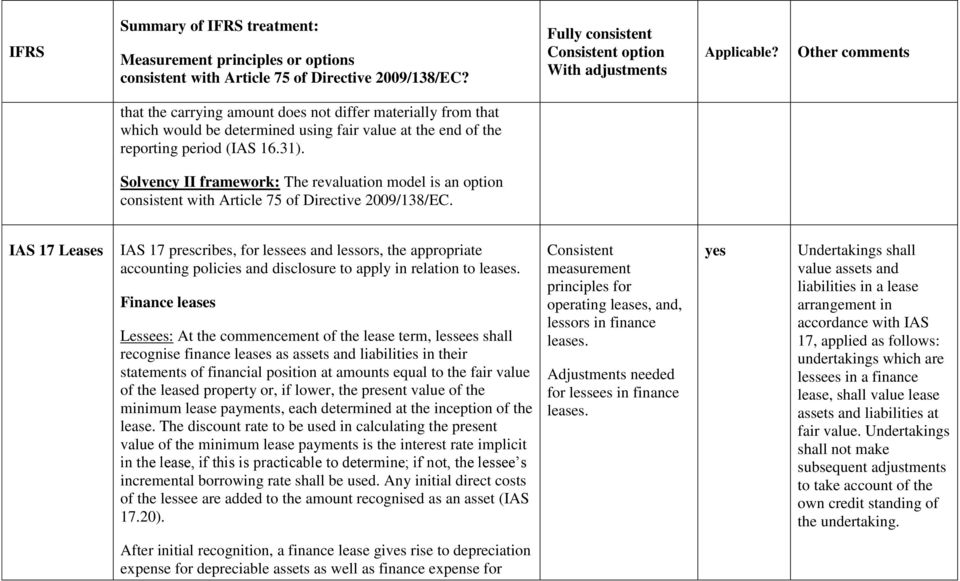
15 IFRS Summary of IFRS treatment: Measurement principles or options consistent with Article 75 of Directive 2009/138/EC? Fully consistent Consistent option With adjustments Applicable? Other comments each accounting period (IAS 17.28). Minimum lease payments shall be apportioned between the finance charge and the reduction of the outstanding liability. The finance charge shall be allocated to each period during the lease term so as to produce a constant periodic rate of interest on the remaining balance of the liability (IAS 17.25). Lessors: Lessors shall recognise assets held under a finance lease in their statements of financial position and present them as a receivable at an amount equal to the net investment in the lease (IAS 17.36). Under a finance lease substantially all the risks and rewards incidental to legal ownership are transferred by the lessor, and thus the lease payment receivable is treated by the lessor as repayment of principal and finance income to reimburse and reward the lessor for its investment and services (IAS 17.37). Operating leases Lessees: Lease payments under an operating lease shall be recognised as an expense on a straight-line basis over the lease term unless another systematic basis is more representative of the time pattern of the user s benefit (IAS 17.33). Lessors: Lessors shall present assets subject to operating leases in their statements of financial position according to the nature of
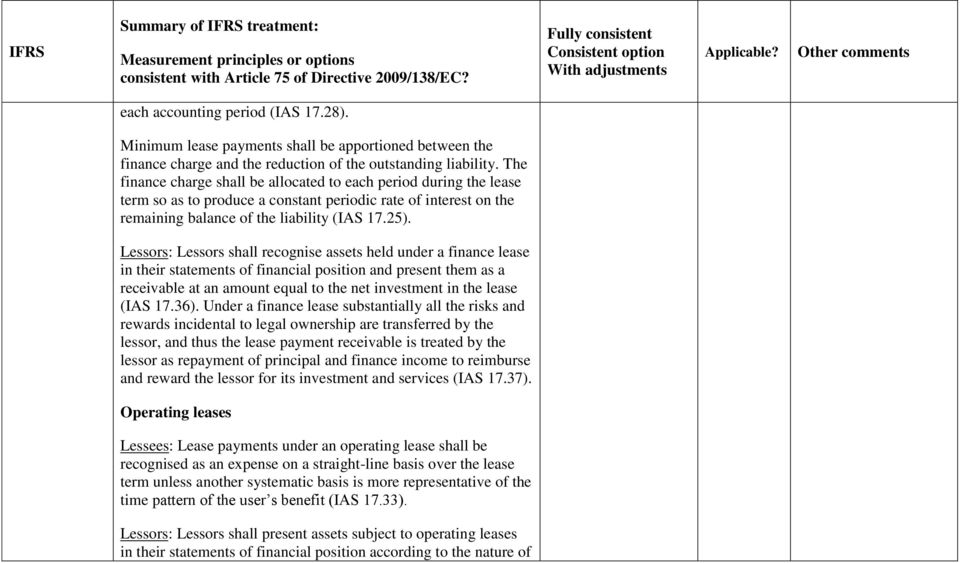
16 IFRS Summary of IFRS treatment: Measurement principles or options consistent with Article 75 of Directive 2009/138/EC? Fully consistent Consistent option With adjustments Applicable? Other comments the asset (IAS 17.49). Solvency II framework: Lessees in finance leases have to fair value all lease assets For lessors in finance leases, the receivable measured at an amount equal to the net investment in the lease, with the income allocation based on the pattern reflecting a constant periodic return on the lessor s net investment in the finance lease is considered to be consistent with Article 75 of Directive 2009/138/EC. Operating leases measurement principles are considered to be consistent with Article 75 of Directive 2009/138/EC, having in mind that the lease items in the lessors balance sheet are valued according to the general valuation principles applicable for those assets and liabilities. IAS 18 Revenue IAS 18 prescribes the accounting for revenue arising from the following transactions and events: (a) the sale of goods; (b) the rendering of services; and (c) the use by others of entity assets yielding interest, royalties and dividends. no IAS 18 does not prescribe valuation methodologies for balance sheet items

17 IFRS Summary of IFRS treatment: Measurement principles or options consistent with Article 75 of Directive 2009/138/EC? Fully consistent Consistent option With adjustments Applicable? Other comments IAS 19 (REVISED 2011) Employee benefits IAS 19 (REVISED 2011) prescribes the accounting and disclosure for employee benefits, except those to which IFRS 2 Share-based Payment applies. Short-term employee benefits yes For the purposes of quantitative assessment, undertakings shall apply IAS 19 (REVISED 2011). When an employee has rendered service to an entity during an accounting period, the entity shall recognise the undiscounted amount of short-term employee benefits expected to be paid in exchange for that service: (a) as a liability (accrued expense), after deducting any amount already paid. If the amount already paid exceeds the undiscounted amount of the benefits, an entity shall recognise that excess as an asset (prepaid expense) to the extent that the prepayment will lead to, for example, a reduction in future payments or a cash refund; and (b) as an expense, unless another Standard requires or permits the inclusion of the benefits in the cost of an asset (see, for example, IAS 2 Inventories and IAS 16 Property, Plant and Equipment) (IAS 19 (REVISED 2011). 10). Post-employment benefits: defined contribution plans When an employee has rendered service to an entity during a
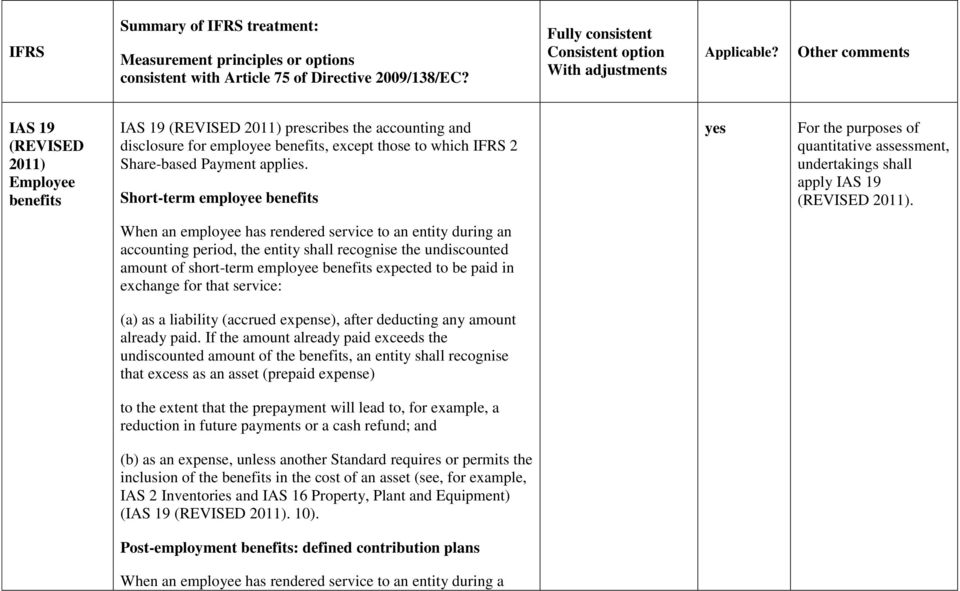
18 IFRS Summary of IFRS treatment: Measurement principles or options consistent with Article 75 of Directive 2009/138/EC? Fully consistent Consistent option With adjustments Applicable? Other comments period, the entity shall recognise the contribution payable to a defined contribution plan in exchange for that service: (a) as a liability (accrued expense), after deducting any contribution already paid. If the contribution already paid exceeds the contribution due for service before the end of the reporting period, an entity shall recognise that excess as an asset (prepaid expense) to the extent that the prepayment will lead to, for example, a reduction in future payments or a cash refund; and (b) as an expense, unless another Standard requires or permits the inclusion of the contribution in the cost of an asset (see, for example, IAS 2 and IAS 16) (IAS 19 (REVISED 2011).44). Where contributions to a defined contribution plan do not fall due wholly within twelve months after the end of the period in which the employees render the related service, they shall be discounted using the discount rate specified in paragraph 78 (IAS 19 (REVISED 2011).45). See paragraph 78 on the discount interest rate below. Post-employment benefits: defined benefit plans Accounting by an entity for defined benefit plans involves the following steps: (a) using actuarial techniques to make a reliable estimate of the
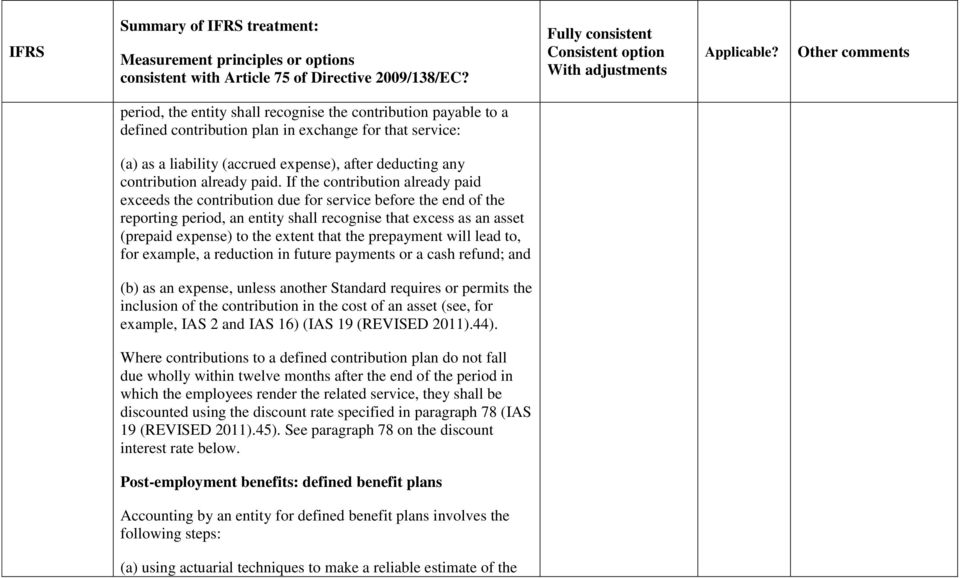
19 IFRS Summary of IFRS treatment: Measurement principles or options consistent with Article 75 of Directive 2009/138/EC? Fully consistent Consistent option With adjustments Applicable? Other comments amount of benefit that employees have earned in return for their service in the current and prior periods. This requires an entity to determine how much benefit is attributable to the current and prior periods (see paragraphs 67 71) and to make estimates (actuarial assumptions) about demographic variables (such as employee turnover and mortality) and financial variables (such as future increases in salaries and medical costs) that will influence the cost of the benefit (see paragraphs 72 91); (b) discounting that benefit using the Projected Unit Credit Method in order to determine the present value of the defined benefit obligation and the current service cost (see paragraphs 64 66); (c) determining the fair value of any plan assets (see paragraphs ); (d) determining the total amount of actuarial gains and losses and the amount of those actuarial gains and losses to be recognised (see paragraphs 92 95); (e) where a plan has been introduced or changed, determining the resulting past service cost (see paragraphs ); and (f) where a plan has been curtailed or settled, determining the resulting gain or loss (see paragraphs ). (IAS 19
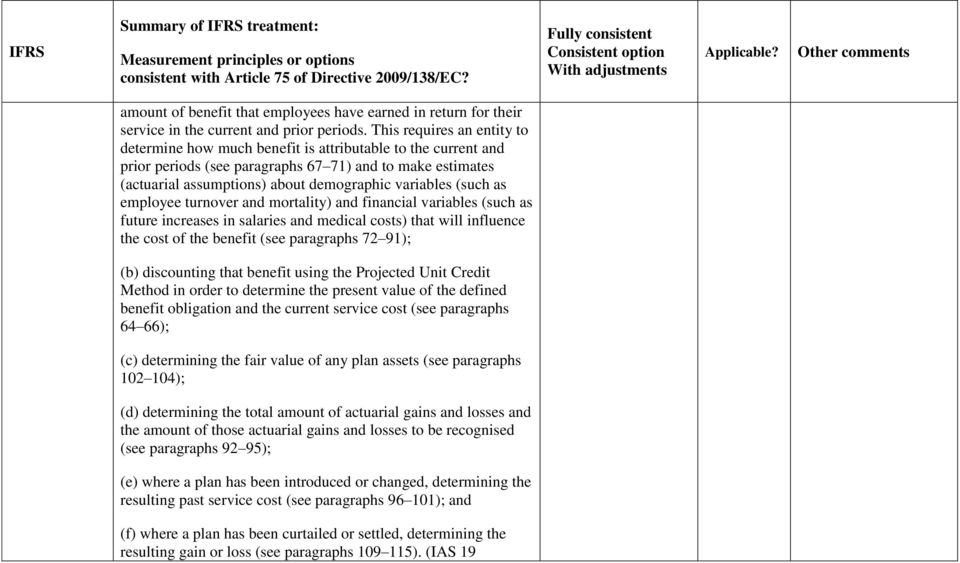
20 IFRS Summary of IFRS treatment: Measurement principles or options consistent with Article 75 of Directive 2009/138/EC? Fully consistent Consistent option With adjustments Applicable? Other comments (REVISED 2011).50). The rate used to discount post-employment benefit obligations (both funded and unfunded) shall be determined by reference to market yields at the end of the reporting period on high quality corporate bonds. In countries where there is no deep market in such bonds, the market yields (at the end of the reporting period) on government bonds shall be used. The currency and term of the corporate bonds or government bonds shall be consistent with the currency and estimated term of the post-employment benefit obligations (IAS 19 (REVISED 2011).78). Other long-term employee benefits This Standard requires a simplified (when compared with postemployment benefits) method of accounting for other long-term employee benefits. The amount recognised as a liability for other long-term employee benefits shall be the net total of the following amounts: (a) the present value of the defined benefit obligation at the end of the reporting period (see paragraph 64); (b) minus the fair value at the end of the reporting period of plan assets (if any) out of which the obligations are to be settled directly (see paragraphs ). In measuring the liability, an entity shall apply paragraphs 49

21 IFRS Summary of IFRS treatment: Measurement principles or options consistent with Article 75 of Directive 2009/138/EC? Fully consistent Consistent option With adjustments Applicable? Other comments 91, excluding paragraphs 54 and 61. An entity shall apply paragraph 104A in recognising and measuring any reimbursement right (IAS 19 (REVISED 2011).128). Termination benefits An entity shall recognise termination benefits as a liability and an expense when, and only when, the entity is demonstrably committed to either: (a) terminate the employment of an employee or group of employees before the normal retirement date; or (b) provide termination benefits as a result of an offer made in order to encourage voluntary redundancy (IAS 19 (REVISED 2011).133). Where termination benefits fall due more than 12 months after the reporting period, they shall be discounted using the discount rate specified in paragraph 78 (IAS 19 (REVISED 2011).139). In the case of an offer made to encourage voluntary redundancy, the measurement of termination benefits shall be based on the number of employees expected to accept the offer (IAS 19 (REVISED 2011).140). IAS 20 Accounting for government IAS 20 shall be applied in accounting for, and in the disclosure of, government grants and in the disclosure of other forms of government assistance. Fair value for monetary and monetary government grants is consistent yes
22 IFRS Summary of IFRS treatment: Measurement principles or options consistent with Article 75 of Directive 2009/138/EC? Fully consistent Consistent option With adjustments Applicable? Other comments grants and disclosure of governance assistance Government grants shall be recognised in profit or loss on a systematic basis over the periods in which the entity recognises as expenses the related costs for which the grants are intended to compensate (IAS 20.12). with Art. 75. A government grant may take the form of a transfer of a nonmonetary asset, such as land or other resources, for the use of the entity. In these circumstances it is usual to assess the fair value of the non-monetary asset and to account for both grant and asset at that fair value. An alternative course that is sometimes followed is to record both asset and grant at a nominal amount. (IAS 20.23). Solvency II framework: Where government grants take the form of a transfer of a non-monetary asset, that asset shall be measured at fair value. IAS 21 The effects of changes in foreign exchange rates IAS 21 prescribes how to include foreign currency transactions and foreign operations in the financial statements of an entity and how to translate financial statements into a presentation currency. Exchange differences arising on the settlement of monetary items or on translating monetary items at rates different from those at which they were translated on initial recognition during the period or in previous financial statements shall be recognised in profit or loss in the period in which they arise, except as Translation in reporting currency is consistent with Article 75 of Directive 2009/138/EC. yes
23 IFRS Summary of IFRS treatment: Measurement principles or options consistent with Article 75 of Directive 2009/138/EC? Fully consistent Consistent option With adjustments Applicable? Other comments described in paragraph 32 (IAS 21.28). In the financial statements that include the foreign operation and the reporting entity (eg consolidated financial statements when the foreign operation is a subsidiary), such exchange differences shall be recognised initially in other comprehensive income and reclassified from equity to profit or loss on disposal of the net investment in accordance with paragraph 48 (IAS 21.32). IAS 23 Borrowing costs IAS 23 prescribes the accounting for borrowing costs. An entity shall capitalise borrowing costs that are directly attributable to the acquisition, construction or production of a qualifying asset as part of the cost of that asset. An entity shall recognise other borrowing costs as an expense in the period in which it incurs them (IAS 23.8). no IAS 23 does not prescribe valuation methodologies relevant for Solvency II balance sheet items. Solvency II framework: Fair value approach, which is used according to Solvency II, prevents the application of IAS 23, which refers to a cost approach. IAS 24 Related party disclosures IAS 24 requires disclosures about related parties and the reporting entity s transaction with related parties. no IAS 24 does not prescribe valuation methodologies for balance sheet items.
24 IFRS Summary of IFRS treatment: Measurement principles or options consistent with Article 75 of Directive 2009/138/EC? Fully consistent Consistent option With adjustments Applicable? Other comments IAS 26 Accounting and reporting by retirement benefits plans IAS 26 shall be applied in the financial statements of retirement benefit plans where such financial statements are prepared. no Out of scope. IAS 27 Separate Financial Statements IAS 27 prescribes the accounting and disclosure requirements for investments in subsidiaries, joint ventures and associates when an entity prepares separate financial statements. no Out of scope. IAS 28 Investments in Associates and Joint Ventures IAS 28 prescribes the accounting for investments in associates and to set out the requirements for the application of the equity method when accounting for investments in associates and joint ventures. Associates are accounted for using the equity method. Applicable equity method measurement principles. yes Limited application to the equity method. The equity method is a method of accounting whereby the investment is initially recognised at cost and adjusted thereafter for the post-acquisition change in the investor s share of the investee s net assets. The investor s profit or loss includes its share of the investee s profit or loss and the investor s other comprehensive income includes its share of the investee s other
25 IFRS Summary of IFRS treatment: Measurement principles or options consistent with Article 75 of Directive 2009/138/EC? Fully consistent Consistent option With adjustments Applicable? Other comments comprehensive income. The investor s share of the profit or loss of the investee is recognised in the investor s profit or loss. Distributions received from an investee reduce the carrying amount of the investment. Adjustments to the carrying amount may also be necessary for a change in the investor s proportionate interest in the investee arising from changes in the investee s other comprehensive income. Such changes include those arising from the revaluation of property, plant and equipment and from foreign exchange translation differences. The investor s share of those changes is recognised in other comprehensive income of the investor (see IAS 1 Presentation of Financial Statements (as revised in 2007)). (IAS 28.11). The entity s financial statements shall be prepared using uniform accounting policies for like transactions and events in similar circumstances (IAS 28.26). If an associate or joint venture uses accounting policies other than those of the entity for like transactions and events in similar circumstances, adjustments shall be made to conform the associate s or joint venture s accounting policies to those of the entity when the associate s financial statements are used by the entity in applying the equity method (IAS 28.36). Solvency II framework: When calculating the excess of assets over liabilities for related undertakings, other than related insurance and reinsurance undertakings, the participating undertaking shall value the related undertaking's assets and
26 IFRS Summary of IFRS treatment: Measurement principles or options consistent with Article 75 of Directive 2009/138/EC? Fully consistent Consistent option With adjustments Applicable? Other comments liabilities in accordance with the equity method as prescribed in international accounting standards, as endorsed by the Commission in accordance with Regulation (EC) No 1606/2002, where valuation in accordance with Articles 75 to 86 of Directive 2009/138/EC is not practicable. In such cases the value of goodwill and other intangible assets valued at zero shall be deducted from the value of the related undertaking. IAS 29 Financial Reporting in Hyperinflatio nary Economies IAS 29 shall be applied to the financial statements, including the consolidated financial statements, of any entity whose functional currency is the currency of a hyperinflationary economy. no IAS 29 does not prescribe valuation methodologies relevant for Solvency II balance sheet items. IAS 32 Financial instruments: Presentation IAS 32 establishes principles for presenting financial instruments as liabilities or equity and for offsetting financial assets and financial liabilities. It applies to the classification of financial instruments, from the perspective of the issuer, into financial assets, financial liabilities and equity instruments; the classification of related interest, dividends, losses and gains; and the circumstances in which financial assets and financial liabilities should be offset. no IAS 32 does not prescribe valuation methodologies for balance sheet items.
27 IFRS Summary of IFRS treatment: Measurement principles or options consistent with Article 75 of Directive 2009/138/EC? Fully consistent Consistent option With adjustments Applicable? Other comments IAS 33 Earnings per share IAS 33 prescribes principles for the determination and presentation of earnings per share. no IAS 33 does not prescribe valuation methodologies for balance sheet items. IAS 34 Interim financial reporting IAS 34 prescribes the minimum content of an interim financial report and to prescribe the principles for recognition and measurement in complete or condensed financial statements for an interim period. no IAS 34 does not prescribe valuation methodologies for balance sheet items. IAS 36 Impairment of Assets IAS 36 prescribes the procedures that an entity applies to ensure that its assets are carried at no more than their recoverable amount. An asset is carried at more than its recoverable amount if its carrying amount exceeds the amount to be recovered through use or sale of the asset. If this is the case, the asset is described as impaired and the Standard requires the entity to recognise an impairment loss. The Standard also specifies when an entity should reverse an impairment loss and prescribes disclosures. no IAS 36 does not prescribe valuation methodologies relevant for Solvency II balance sheet items. IAS 37 Provisions, contingent IAS 37 establishes the recognition criteria and measurement applied to provisions, contingent liabilities and contingent assets as well as information to be disclosed. Consistent measurement principles for yes Contingent liabilities are to be recognised.
28 IFRS Summary of IFRS treatment: Measurement principles or options consistent with Article 75 of Directive 2009/138/EC? Fully consistent Consistent option With adjustments Applicable? Other comments liabilities and contingent assets Provisions A provision is a liability of uncertain timing or amount (IAS ). The amount recognised as a provision shall be the best estimate of the expenditure required to settle the present obligation at the end of the reporting period (IAS 37.36). Provisions. The best estimate of the expenditure required to settle the present obligation is the amount that an entity would rationally pay to settle the obligation at the end of the reporting period or to transfer it to a third party at that time. It will often be impossible or prohibitively expensive to settle or transfer an obligation at the end of the reporting period. However, the estimate of the amount that an entity would rationally pay to settle or transfer the obligation gives the best estimate of the expenditure required to settle the present obligation at the end of the reporting period (IAS 37.37) Where a single obligation is being measured, the individual most likely outcome may be the best estimate of the liability. However, even in such a case, the entity considers other possible outcomes. Where other possible outcomes are either mostly higher or mostly lower than the most likely outcome, the best estimate will be a higher or lower amount. For example, if an entity has to rectify a serious fault in a major plant that it has constructed for a customer, the individual most likely outcome may be for the repair to succeed at the first attempt at a cost of
29 IFRS Summary of IFRS treatment: Measurement principles or options consistent with Article 75 of Directive 2009/138/EC? Fully consistent Consistent option With adjustments Applicable? Other comments 1,000, but a provision for a larger amount is made if there is a significant chance that further attempts will be necessary (IAS 37.40). Uncertainties surrounding the amount to be recognised as a provision are dealt with by various means according to the circumstances. Where the provision being measured involves a large population of items, the obligation is estimated by weighting all possible outcomes by their associated probabilities. The name for this statistical method of estimation is 'expected value'. The provision will therefore be different depending on whether the probability of a loss of a given amount is, for example, 60 per cent or 90 per cent. Where there is a continuous range of possible outcomes, and each point in that range is as likely as any other, the mid-point of the range is used (IAS 37.39). The risks and uncertainties that inevitably surround many events and circumstances shall be taken into account in reaching the best estimate of a provision. (IAS 37.42) The discount rate (or rates) shall be a pre-tax rate (or rates) that reflect(s) current market assessments of the time value of money and the risks specific to the liability. The discount rate(s) shall not reflect risks for which future cash flow estimates have been adjusted (IAS 37.47).
30 IFRS Summary of IFRS treatment: Measurement principles or options consistent with Article 75 of Directive 2009/138/EC? Fully consistent Consistent option With adjustments Applicable? Other comments Contingent liabilities and contingent assets A contingent liability is: (a) a possible obligation that arises from past events and whose existence will be confirmed only by the occurrence or non-occurrence of one or more uncertain future events not wholly within the control of the entity; or (b) a present obligation that arises from past events but is not recognised because: (i) it is not probable that an outflow of resources embodying economic benefits will be required to settle the obligation; or (ii) the amount of the obligation cannot be measured with sufficient reliability (IAS 37.10). A contingent asset is a possible asset that arises from past events and whose existence will be confirmed only by the occurrence or non-occurrence of one or more uncertain future events not wholly within the control of the entity. Solvency II framework: Provision s measurement principles are considered to be consistent with Article 75 of Directive 2009/138/EC. Contingent liabilities are recognised under Solvency II and valued based on the expected present value of future cash-flows required to settle the contingent liability over the lifetime of that contingent liability, using the basic risk-free interest rate term structure.
31 IFRS Summary of IFRS treatment: Measurement principles or options consistent with Article 75 of Directive 2009/138/EC? Fully consistent Consistent option With adjustments Applicable? Other comments IAS 38 Intangible assets IAS 38 prescribes the accounting treatment for intangible assets that are not dealt with specifically in another Standard. This Standard requires an entity to recognise an intangible asset if, and only if, specified criteria are met. The Standard also specifies how to measure the carrying amount of intangible assets and requires specified disclosures about intangible assets. Revaluation model is a consistent option. yes Goodwill is valued at zero. An entity shall choose either the cost model in paragraph 74 or the revaluation model in paragraph 75 as its accounting policy. If an intangible asset is accounted for using the revaluation model, all the other assets in its class shall also be accounted for using the same model, unless there is no active market for those assets (IAS ). Cost model: After initial recognition, an intangible asset shall be carried at its cost less any accumulated amortisation and any accumulated impairment losses (IAS ) Revaluation model: After initial recognition, an intangible asset shall be carried at a revalued amount, being its fair value at the date of the revaluation less any subsequent accumulated amortisation and any subsequent accumulated impairment losses. For the purpose of revaluations: under this Standard, fair value shall be determined by reference to an active market. Revaluations shall be made with such regularity that at the end of the reporting period the carrying amount of the asset does not
32 IFRS Summary of IFRS treatment: Measurement principles or options consistent with Article 75 of Directive 2009/138/EC? Fully consistent Consistent option With adjustments Applicable? Other comments differ materially from its fair value (IAS 38.75). Solvency II framework: The revaluation model is an option consistent with Article 75 of Directive 2009/138/EC for the intangible items recognised in the Solvency II balance sheet. Intangible assets, other than goodwill, are recognised in the Solvency II balance sheet at a value other than zero only if they can be sold separately and the insurance and reinsurance undertaking can demonstrate that there is a value for the same or similar assets that has been derived from quoted market prices in active markets. Bespoke computer software tailored to the needs of the undertaking and off the shelf software licences that cannot be sold to another user shall be valued at zero. IAS 39 Financial Instruments: Recognition and Measurement IAS 39 establishes principles for recognising and measuring financial assets, financial liabilities and some contracts to buy or sell non-financial items. For the purpose of measuring a financial asset after initial recognition, this Standard classifies financial assets into the following four categories defined in paragraph 9: (a) financial assets at fair value through profit or loss; Fair value measurement principles applied to financial assets are consistent. In case of financial liabilities adjustment might be needed if the yes The fair value measurement is applicable. However, there shall be no subsequent adjustment to take account of the change in own credit standing of the insurance or
33 IFRS Summary of IFRS treatment: Measurement principles or options consistent with Article 75 of Directive 2009/138/EC? Fully consistent Consistent option With adjustments Applicable? Other comments (b) (c) (d) held-to-maturity investments; loans and receivables; and available-for-sale financial assets. IFRS fair value includes changes in own credit standing in subsequent periods. reinsurance undertaking after initial recognition. These categories apply to measurement and profit or loss recognition under this Standard. The entity may use other descriptors for these categories or other categorisations when presenting information in the financial statements. The entity shall disclose in the notes the information required by IFRS 7 (IAS 39.45). After initial recognition, an entity shall measure financial assets, including derivatives that are assets, at their fair values, without any deduction for transaction costs it may incur on sale or other disposal, except for the following financial assets: (a) loans and receivables as defined in paragraph 9, which shall be measured at amortised cost using the effective interest method; (b) held-to-maturity investments as defined in paragraph 9, which shall be measured at amortised cost using the effective interest method; and (c) investments in equity instruments that do not have a quoted market price in an active market and whose fair value cannot be reliably measured and derivatives that are linked to and
34 IFRS Summary of IFRS treatment: Measurement principles or options consistent with Article 75 of Directive 2009/138/EC? Fully consistent Consistent option With adjustments Applicable? Other comments must be settled by delivery of such unquoted equity instruments, which shall be measured at cost (see Appendix A paragraphs AG80 and AG81). Financial assets that are designated as hedged items are subject to measurement under the hedge accounting requirements in paragraphs All financial assets except those measured at fair value through profit or loss are subject to review for impairment in accordance with paragraphs and Appendix A paragraphs AG84-AG93 (IAS 39.46). After initial recognition, an entity shall measure all financial liabilities at amortised cost using the effective interest method, except for: (a) financial liabilities at fair value through profit or loss. Such liabilities, including derivatives that are liabilities, shall be measured at fair value except for a derivative liability that is linked to and must be settled by delivery of an unquoted equity instrument whose fair value cannot be reliably measured, which shall be measured at cost. (b) financial liabilities that arise when a transfer of a financial asset does not qualify for derecognition or when the continuing involvement approach applies. Paragraphs 29 and 31 apply to the measurement of such financial liabilities. (c) financial guarantee contracts as defined in paragraph 9. After initial recognition, an issuer of such a contract shall (unless
35 IFRS Summary of IFRS treatment: Measurement principles or options consistent with Article 75 of Directive 2009/138/EC? Fully consistent Consistent option With adjustments Applicable? Other comments paragraph 47(a) or (b) applies) measure it at the higher of: (i) the amount determined in accordance with IAS 37; and (ii) the amount initially recognised (see paragraph 43) less, when appropriate, cumulative amortisation recognised in accordance with IAS 18. (d) commitments to provide a loan at a below-market interest rate. After initial recognition, an issuer of such a commitment shall (unless paragraph 47(a) applies) measure it at the higher of: (i) the amount determined in accordance with IAS 37; and (ii) the amount initially recognised (see paragraph 43) less, when appropriate, cumulative amortisation recognised in accordance with IAS 18. Financial liabilities that are designated as hedged items are subject to the hedge accounting requirements in paragraphs (IAS 40.47). Solvency II framework: Fair value measurement principles are considered to be consistent with article 75 of Directive 2009/138/EC, except for subsequent adjustments to take account of the change in own credit standing of the insurance or reinsurance undertaking after initial recognition in the measurement of financial liabilities.
36 IFRS Summary of IFRS treatment: Measurement principles or options consistent with Article 75 of Directive 2009/138/EC? Fully consistent Consistent option With adjustments Applicable? Other comments IAS 40 Investment property IAS 40 prescribes the accounting treatment for investment property and related disclosure requirements. With the exceptions noted in paragraphs 32A and 34, an entity shall choose as its accounting policy either the fair value model in paragraphs or the cost model in paragraph 56 and shall apply that policy to all of its investment property (IAS 40.30). Fair value model is a consistent option. yes Cost model: After initial recognition, an entity that chooses the cost model shall measure all of its investment properties in accordance with IAS 16 s requirements for that model, other than those that meet the criteria to be classified as held for sale ( ) in accordance with IFRS 5 (IAS 40.56). Fair value model: After initial recognition, an entity that chooses the fair value model shall measure all of its investment property at fair value ( ) (IAS 40.33). When a property interest held by a lessee under an operating lease is classified as an investment property under paragraph 6, paragraph 30 is not elective; the fair value model shall be applied (IAS 40.34). Solvency II framework: The fair value model is an option consistent with Article 75 of Directive 2009/138/EC.
37 IFRS Summary of IFRS treatment: Measurement principles or options consistent with Article 75 of Directive 2009/138/EC? Fully consistent Consistent option With adjustments Applicable? Other comments IAS 41 Agriculture IAS 41 prescribes the accounting treatment and disclosures related to agricultural activity. Biological assets A biological asset shall be measured on initial recognition and at the end of each reporting period at its fair value less costs to sell, except for the case described in paragraph 30 where the fair value cannot be measured reliably (IAS 41.12). Agricultural produce harvested Fair value less costs to sell is a consistent option where estimated cost to sell are not material. yes Undertakings shall apply IAS 41 for biological assets if the estimated costs to sell are not material. If the estimated costs to sell are material, the undertaking shall adjust the value by including these costs. Agricultural produce harvested from an entity s biological assets shall be measured at its fair value less costs to sell at the point of harvest. Such measurement is the cost at that date when applying IAS 2 Inventories or another applicable Standard (IAS 41.13). Solvency II framework: Fair value less costs to sell is an option consistent with Article 75 of Directive 2009/138/EC if the estimated costs to sell are not material. IFRS 1 Firsttime adoption of International Financial Reporting IFRS 1 applies when an entity first adopts International Financial Reporting Standards (IFRSs) in its annual financial statements. no Out of scope.
38 IFRS Summary of IFRS treatment: Measurement principles or options consistent with Article 75 of Directive 2009/138/EC? Fully consistent Consistent option With adjustments Applicable? Other comments Standards IFRS 2 Sharebased payments IFRS 2 specifies the financial reporting by an entity when it carries out a share-based payment transaction. An entity shall recognise the goods or services received or acquired in a share-based payment transaction when it obtains the goods or as the services are received. The entity shall recognise a corresponding increase in equity if the goods or services were received in an equity-settled share-based payment transaction or a liability if the goods or services were acquired in a cash-settled share-based payment transaction (IFRS 2.7). Consistent measurement principles yes When the goods or services received or acquired in a share-based payment transaction do not qualify for recognition as assets, they shall be recognised as expenses (IFRS 2.8). Equity-settled share-based payment transactions For equity-settled share-based payment transactions, the entity shall measure the goods or services received, and the corresponding increase in equity, directly, at the fair value of the goods or services received, unless that fair value cannot be estimated reliably. If the entity cannot estimate reliably the fair value of the goods or services received, the entity shall measure their value, and the corresponding increase in equity, indirectly,
39 IFRS Summary of IFRS treatment: Measurement principles or options consistent with Article 75 of Directive 2009/138/EC? Fully consistent Consistent option With adjustments Applicable? Other comments by reference to the fair value of the equity instruments granted (IFRS 2.10). To apply the requirements of paragraph 10 to transactions with employees and others providing similar services, the entity shall measure the fair value of the services received by reference to the fair value of the equity instruments granted, because typically it is not possible to estimate reliably the fair value of the services received, as explained in paragraph 12. The fair value of those equity instruments shall be measured at grant date. (IFRS 2.11). To apply the requirements of paragraph 10 to transactions with parties other than employees, there shall be a rebuttable presumption that the fair value of the goods or services received can be estimated reliably. That fair value shall be measured at the date the entity obtains the goods or the counterparty renders service. In rare cases, if the entity rebuts this presumption because it cannot estimate reliably the fair value of the goods or services received, the entity shall measure the goods or services received, and the corresponding increase in equity, indirectly, by reference to the fair value of the equity instruments granted, measured at the date the entity obtains the goods or the counterparty renders service (IFRS 2.13). If the identifiable consideration received is less than the fair value of the equity instruments granted or the liability incurred, the unidentifiable goods or services are measured by reference to
40 IFRS Summary of IFRS treatment: Measurement principles or options consistent with Article 75 of Directive 2009/138/EC? Fully consistent Consistent option With adjustments Applicable? Other comments the difference between the fair value of the equity instruments granted (or liability incurred) and the fair value of the goods or services received at grant date (based on IFRS 2.13A). Cash-settled share-based payment transactions For cash-settled share-based payment transactions, the entity shall measure the goods or services acquired and the liability incurred at the fair value of the liability. Until the liability is settled, the entity shall remeasure the fair value of the liability at the end of each reporting period and at the date of settlement, with any changes in fair value recognised in profit or loss for the period (IFRS 2.30). In some cases, the entity or the other party may choose whether the transaction is settled in cash or by issuing equity instruments. The accounting treatment depends on whether the entity or the counterparty has the choice. Solvency II framework: IFRS 2 measurement principles are considered to be consistent with Article 75 of Directive 2009/138/EC. IFRS 3 Business combinations IFRS 3 establishes principles and requirements for how the acquirer: (a) recognises and measures in its financial statements the identifiable assets acquired, the liabilities assumed and any no Out of scope.
41 IFRS Summary of IFRS treatment: Measurement principles or options consistent with Article 75 of Directive 2009/138/EC? Fully consistent Consistent option With adjustments Applicable? Other comments non-controlling interest in the acquiree; (b) recognises and measures the goodwill acquired in the business combination or a gain from a bargain purchase; and (c) determines what information to disclose to enable users of the financial statements to evaluate the nature and financial effects of the business combination. IFRS 3 deals with business combinations. Subsequent (to the acquisition) measurement of acquired assets and liabilities follow the applicable IFRS of those items depending on their nature. Solvency II framework: Goodwill is valued at zero at the Solvency II balance sheet. All items shall be valued in accordance with Solvency II valuation methodologies. IFRS 4 Insurance contracts IFRS 4 specifies the financial reporting for insurance contracts by any entity that issues such contracts (described in this IFRS as an insurer) until the Board completes the second phase of its project on insurance contracts. no Out of scope. Solvency II framework: Solvency II establishes specific measurement principles for insurance liabilities IFRS 5 Noncurrent assets IFRS 5 specifies the accounting for assets held for sale, and the presentation and disclosure of discontinued operations. Measurement principles not no
42 IFRS Summary of IFRS treatment: Measurement principles or options consistent with Article 75 of Directive 2009/138/EC? Fully consistent Consistent option With adjustments Applicable? Other comments held for sale and discontinued operations An entity shall measure a non-current asset (or disposal group) classified as held for sale at the lower of its carrying amount and fair value less costs to sell (IFRS 5.15). An entity shall measure a non-current asset (or disposal group) classified as held for distribution to owners at the lower of its carrying amount and fair value less costs to distribute (IFRS 5.15A). consistent. Immediately before the initial classification of the asset (or disposal group) as held for sale, the carrying amounts of the asset (or all the assets and liabilities in the group) shall be measured in accordance with applicable IFRSs (IFRS 5.18). On subsequent remeasurement of a disposal group, the carrying amounts of any assets and liabilities that are not within the scope of the measurement requirements of this IFRS, but are included in a disposal group classified as held for sale, shall be remeasured in accordance with applicable IFRSs before the fair value less costs to sell of the disposal group is remeasured (IFRS 5.19). Solvency II framework: In Solvency II, there is no distinction based on the use of the assets. The non- current assets held for sale and discontinued operations shall be measured in accordance with the relevant Solvency II valuation methodologies.
43 IFRS Summary of IFRS treatment: Measurement principles or options consistent with Article 75 of Directive 2009/138/EC? Fully consistent Consistent option With adjustments Applicable? Other comments IFRS 6 Exploration for and evaluation of mineral resources IFRS 6 specifies the financial reporting for the exploration for and evaluation of mineral resources. no Business not relevant for insurers. IFRS 7 Financial instruments: Disclosures IFRS 7 specifies disclosure for financial instruments. no IFRS 7 does not prescribe valuation methodologies for balance sheet items. IFRS 8 Operating Segments IFRS 8 requires disclosure of information about an entity s operating segments, its products and services, the geographical areas in which it operates, and its major customers. no IFRS 8 does not prescribe valuation methodologies for balance sheet items. IFRS 9 Financial Instruments Not applicable as not yet endorsed by the Commission. no IFRS 10 Consolidated IFRS 10 establishes principles for the presentation and preparation of consolidated financial statements when an entity no Out of scope.
44 IFRS Summary of IFRS treatment: Measurement principles or options consistent with Article 75 of Directive 2009/138/EC? Fully consistent Consistent option With adjustments Applicable? Other comments Financial Statements controls one or more other entities. IFRS 11 Joint Arrangements IFRS 11 establishes principles for the financial reporting by entities that have an interest in arrangements that are controlled jointly (ie joint arrangements). This IFRS defines joint control and requires an entity that is a party to a joint arrangement to determine the type of joint arrangement in which it is involved by assessing its rights and obligations and to account for those rights and obligations in accordance with that type of joint arrangement. Applicable only for the requirement to use the equity method. no Out of scope. See IAS 28 for the equity method. Solvency II framework: see IAS 28 for the application of the equity method. IFRS 12 Disclosure of Interests in Other Entities IFRS 12 requires an entity to disclose information that enables users of its financial statements to evaluate: the nature of, and risks associated with, its interests in other entities; and the effects of those interests on its financial position, financial performance and cash flows. no IFRS 12 does not prescribe valuation methodologies for balance sheet items. IFRS 13 Fair IFRS 13 defines fair value and sets out in a single IFRS a yes
45 IFRS Summary of IFRS treatment: Measurement principles or options consistent with Article 75 of Directive 2009/138/EC? Fully consistent Consistent option With adjustments Applicable? Other comments Value Measurement framework for measuring fair value Solvency II framework: IFRS 13 is consistent with Art. 75 except for the requirement to reflect the effect of an entity s own credit.
46 V.2. Technical Provisions Introduction TP.1.1. The reporting date to be used by all participants should be TP.1.2. Solvency II requires undertakings to set up technical provisions which correspond to the current amount undertakings would have to pay if they were to transfer their (re)insurance obligations immediately to another undertaking. The value of technical provisions should be equal to the sum of a best estimate (see subsection V.2.2) and a risk margin (see subsection V.2.5). However, under certain conditions that relate to the replicability of the cash flows underlying the (re)insurance obligations, best estimate and risk margin should not be valued separately but technical provisions should be calculated as a whole (see subsection V.2.4). TP.1.3. Undertakings should segment their (re)insurance obligations into homogeneous risk groups, and as a minimum by line of business, when calculating technical provisions. Subsection V.2.1 specifies the segmentation of the obligations for the Quantitative Assessment. TP.1.4. The best estimate should be calculated gross, without deduction of the amounts recoverable from reinsurance contracts and SPVs. Those amounts should be calculated separately. The valuation of recoverables is set out in subsection V TP.1.5. The calculation of the technical provisions should take account of the time value of money by using the relevant risk-free interest rate term structure. Subsection V.2.3 specifies the relevant risk-free interest rate term structure. TP.1.6. The actuarial and statistical methods to calculate technical provisions should be proportionate to the nature, scale and complexity of the risks supported by the undertaking. Guidance on the application of the proportionality principle and the specification of simplified methods can be found in subsection V.2.6. Simplified methods for the calculation of the risk margin are included in subsection V.2.5. V.2.1. Segmentation General principles TP.1.7. Insurance and reinsurance obligations should be segmented as a minimum by line of business (LoB) in order to calculate technical provisions. TP.1.8. The purpose of segmentation of (re)insurance obligations is to achieve an accurate valuation of technical provisions. For example, in order to ensure that appropriate assumptions are used, it is important that the assumptions are based on homogenous data to avoid introducing distortions which might arise from combining dissimilar business. Therefore, business is usually managed in more granular homogeneous risk groups than the proposed minimum segmentation by lines of business where it allows for a more accurate valuation of technical provisions. 46
47 TP.1.9. Undertakings in different Member States and even undertakings in the same Member State offer insurance products covering different sets of risks. Therefore it is appropriate for each undertaking to define the homogenous risk group and the level of granularity most appropriate for their business and in the manner needed to derive appropriate assumptions for the calculation of the best estimate. TP (Re)insurance obligations should be allocated to the line of business that best reflects the nature of the risks relating to the obligation. In particular, the principle of substance over form should be followed for the allocation. In other words, the segmentation should reflect the nature of the risks underlying the contract (substance), rather than the legal form of the contract (form). TP The segmentation into lines of business distinguishes between life and non-life insurance obligations. This distinction does not coincide with the legal distinction between life and non-life insurance activities or the legal distinction between life and non-life insurance contracts. Instead, the distinction between life and non-life insurance obligations should be based on the nature of the underlying risk: Insurance obligations of business that is pursued on a similar technical basis to that of life insurance should be considered as life insurance obligations, even if they are non-life insurance from a legal perspective. Insurance obligations of business that is not pursued on a similar technical basis to that of life insurance should be considered as non-life insurance obligations, even if they are life insurance from a legal perspective. TP In particular, annuities stemming from non-life insurance contracts (for example for motor vehicle liability insurance) are life insurance obligations. TP The segmentation should be applied to both components of the technical provisions (best estimate and risk margin). It should also be applied where technical provisions are calculated as a whole. Segmentation of non-life insurance and reinsurance obligations TP Non-life insurance obligations should be segmented into the following 12 lines of business: Medical expenses insurance This line of business includes obligations which cover the provision of preventive or curative medical treatment or care including medical treatment or care due to illness, accident, disability and infirmity, or financial compensation for such treatment or care, where the underlying business is not pursued on a similar technical basis to that of life insurance, other than obligations considered as workers' compensation insurance; Income protection insurance This line of business includes obligations which cover financial compensation in consequence of illness, accident, disability or infirmity where the underlying business is not pursued on a similar technical basis to that of life insurance, other than obligations considered as medical expenses or workers' compensation insurance; Workers compensation insurance 47
48 This line of business includes health insurance obligations which relate to accidents at work, industrial injury and occupational diseases and where the underlying business is not pursued on a similar technical basis to that of life insurance covering: the provision of preventive or curative medical treatment or care relating to accident at work, industrial injury or occupational diseases; or financial compensation for such treatment; or financial compensation for accident at work, industrial injury or occupational diseases; Motor vehicle liability insurance This line of business includes obligations which cover all liabilities arising out of the use of motor vehicles operating on land (including carrier s liability); Other motor insurance This line of business includes obligations which cover all damage to or loss of land vehicles, (including railway rolling stock); Marine, aviation and transport insurance This line of business includes obligations which cover all damage or loss to river, canal, lake and sea vessels, aircraft, and damage to or loss of goods in transit or baggage irrespective of the form of transport. This line of business also includes all liabilities arising out of use of aircraft, ships, vessels or boats on the sea, lakes, rivers or canals (including carrier s liability). Fire and other damage to property insurance This line of business includes obligations which cover all damage to or loss of property other than motor, marine aviation and transport due to fire, explosion, natural forces including storm, hail or frost, nuclear energy, land subsidence and any event such as theft; General liability insurance This line of business includes obligations which cover all liabilities other than those included in motor vehicle liability and marine, aviation and transport; Credit and suretyship insurance This line of business includes obligations which cover insolvency, export credit, instalment credit, mortgages, agricultural credit and direct and indirect suretyship; Legal expenses insurance This line of business includes obligations which cover legal expenses and cost of litigation; Assistance insurance This line of business includes obligations which cover assistance for persons who get into difficulties while travelling, while away from home or while away from their habitual residence; Miscellaneous financial loss insurance This line of business includes obligations which cover employment risk, insufficiency of income, bad weather, loss of benefits, continuing general expenses, unforeseen trading expenses, loss of market value, loss of rent or revenue, indirect trading losses other than those mentioned before, other financial loss (not-trading) as well as any 48
49 other risk of non-life insurance business not covered by the lines of business already mentioned. TP Obligations relating to accepted proportional reinsurance should be segmented into 12 lines of business in the same way as non-life insurance obligations are segmented. TP Obligations relating to accepted non-proportional reinsurance in non-life should be segmented into 4 lines of business as follows: Health: non-proportional reinsurance obligations relating to insurance obligations included in the following lines: medical expenses, income protection and workers compensation. Property: non-proportional reinsurance obligations relating to insurance obligations included in the following lines: other motor insurance, fire and other damage to property, credit and suretyship, legal expenses, assistance, miscellaneous financial loss. Casualty: non-proportional reinsurance obligations relating to insurance obligations included in the following lines: motor vehicle liability and general liability. Marine, aviation and transport: non-proportional reinsurance obligations relating to insurance obligations included in the line marine, aviation and transport insurance Segmentation of life insurance and reinsurance obligations TP Life insurance obligations should be segmented into 6 lines of business. Health insurance Health insurance obligations where the underlying business is pursued on a similar technical basis to that of life insurance, other than those included in the following line of business Annuities stemming from non-life insurance contracts and relating to health insurance obligations. Life insurance with profit participation Insurance obligations with profit participation other than those obligations included in the annuities stemming from non-life insurance contracts. Index-linked and unit-linked insurance Insurance obligations with index-linked and unit-linked benefits other than those included in the annuities stemming from non-life insurance. Other life insurance obligations other than obligations included in any of the other life lines of business. Annuities stemming from non-life insurance contracts and relating to health insurance obligations (annuities stemming from non-life contracts and NSLT health insurance). Annuities stemming from non-life insurance contracts and relating to insurance obligations other than health insurance obligations TP Obligations relating to accepted reinsurance in life should be segmented into 2 lines of business as follows: 49
50 Health reinsurance Reinsurance obligations which relate to the obligations included in lines of business health insurance and Annuities stemming from non-life insurance contracts and relating to health insurance obligations. Life reinsurance Reinsurance obligations which relate to the obligations included in lines of business Life Insurance with profit participation, Index-linked and unit-linked insurance, Other life insurance and Annuities stemming from non-life insurance contracts and relating to insurance obligations other than health insurance obligations. TP There could be circumstances where, for a particular line of business in the segment "life insurance with profit participation" (participating business), the insurance liabilities can, from the outset, not be calculated in isolation from those of the rest of the business. For example, an undertaking may have management rules such that bonus rates on one line of business can be reduced to recoup guaranteed costs on another line of business and/or where bonus rates depend on the overall solvency position of the undertaking. However, even in this case undertakings should assign a technical provision to each line of business in a practicable manner. Health insurance obligations TP Health insurance covers one or both of the following: the provision of preventive or curative medical treatment or care including medical treatment or care due to illness, accident, disability and infirmity, or financial compensation for such treatment or care; financial compensation in consequence of illness, accident, disability or infirmity. TP In relation to their technical nature two types of health insurance can be distinguished: Health insurance which is pursued on a similar technical basis to that of life insurance (SLT Health); or Health insurance which is not pursued on a similar technical basis to that of life insurance (Non-SLT Health). TP Health insurance obligations pursued on a similar technical basis to that of life insurance (SLT Health) are the health insurance obligations for which it is appropriate to use life insurance techniques for the calculation of the best estimate. Health insurance obligations should be assigned to life insurance lines of business where such obligations are exposed to biometrical risks (i.e. mortality, longevity or disability/morbidity) and where the common techniques used to assess such obligations explicitly take into consideration the behaviour of the variables underlying these risks. Where insurance or reinsurance health obligations are calculated according to the conditions set out in Article 206 of Directive 2009/138/EPC they should be assigned to SLT health insurance lines of business. TP SLT health insurance obligations should be allocated to one of the four following lines of business for life insurance obligations defined in subsection V.2.1: 50
51 Insurance contracts with profit participation where the main risk driver is disability/morbidity risk Index-linked and unit-linked life insurance contracts where the main risk driver is disability/morbidity risk Other insurance contracts where the main risk driver is disability/morbidity risk Annuities stemming from non-life contracts. TP With regard to the line of business for annuities stemming from non-life contracts or health insurance includes only annuities stemming from Non-SLT health contracts (for example workers' compensation and income protection insurance). Insurance or reinsurance obligations that, although stemming from Non-Life or NSLT health insurance, and originally segmented into Non-Life or NSLT health lines of business, as a result of the trigger of an event are pursued on a similar technical basis to that of life insurance, should be assigned to the relevant life lines of business as soon as there is sufficient information to assess those obligations using life techniques. TP Non-SLT health obligations should be allocated to one of the three following lines of business for non-life insurance obligations: Medical expense Income protection Workers' compensation TP The definition of health insurance applied in the Quantitative Assessment may not coincide with national definitions of health insurance used for authorisation or accounting purposes. Annex C includes further guidance on the definition of health insurance. TP The granularity of the segmentation of insurance or reinsurance obligations should allow for an adequate reflection of the nature of the risks. For the purpose of calculation of the technical provisions, the segmentation should consider the policyholder s right to profit participation, options and guarantees embedded in the contracts and the relevant risk drivers of the obligations. Unbundling of insurance and reinsurance contracts TP Where a contract includes life and non-life (re)insurance obligations, it should be unbundled into its life and non-life parts. TP Where a contract covers risks across the different lines of business for non-life (re)insurance obligations, these contracts should be unbundled into the appropriate lines of business. TP A contract covering life insurance risks should always be unbundled according to the following lines of business SLT Life insurance with profit participation Index-linked and unit-linked life insurance Other life insurance 51
52 TP Where a contract gives rise to SLT health insurance obligations, it should be unbundled into a health part and a non-health part where it is technically feasible and where both parts are material. Notwithstanding the above, unbundling may not be required where only one of the risks covered by a contract is material. In this case, the contract may be allocated according to the main risk. V.2.2. V Best estimate Methodology for the calculation of the best estimate Appropriate methodologies for the calculation of the best estimate TP.2.1. The best estimate should correspond to the probability weighted average of future cash-flows taking account of the time value of money. TP.2.2. Therefore, the best estimate calculation should allow for the uncertainty in the future cash-flows. The calculation should consider the variability of the cash flows in order to ensure that the best estimate represents the mean of the distribution of cash flow values. Allowance for uncertainty does not suggest that additional margins should be included within the best estimate. TP.2.3. The best estimate is the average of the outcomes of all possible scenarios, weighted according to their respective probabilities. Although, in principle, all possible scenarios should be considered, it may not be necessary, or even possible, to explicitly incorporate all possible scenarios in the valuation of the liability, nor to develop explicit probability distributions in all cases, depending on the type of risks involved and the materiality of the expected financial effect of the scenarios under consideration. Moreover, it is sometimes possible to implicitly allow for all possible scenarios, for example in closed form solutions in life insurance or the chain-ladder technique in non-life insurance. TP.2.4. Cash-flow characteristics that should, in principle and where relevant, be taken into consideration in the application of the valuation technique include the following: a) Uncertainty in the timing, frequency and severity of claim events. b) Uncertainty in claims amounts, including uncertainty in claims inflation, and in the period needed to settle and pay claims. c) Uncertainty in the amount of expenses. d) Uncertainty in the expected future developments that will have a material impact on the cash in- and out-flows required to settle the insurance and reinsurance obligations thereof (e.g. the value of an index/market values used to determine claim amounts). For this purpose future developments shall include demographic, legal, medical, technological, social, environmental and economic developments including inflation. e) Uncertainty in policyholder behaviour. 52
53 f) Path dependency, where the cash-flows depend not only on circumstances such as economic conditions on the cash-flow date, but also on those circumstances at previous dates. A cash-flow having no path dependency can be valued by, for example, using an assumed value of the equity market at a future point in time. However, a cashflow with path-dependency would need additional assumptions as to how the level of the equity market evolved (the equity market's path) over time in order to be valued. g) Interdependency between two or more causes of uncertainty. Some risk-drivers may be heavily influenced by or even determined by several other risk-drivers (interdependence). For example, a fall in market values may influence the (re)insurance undertaking s exercise of discretion in future participation, which in turn affects policyholder behaviour. Another example would be a change in the legal environment or the onset of a recession which could increase the frequency or severity of non-life claims. TP.2.5. Undertakings should use actuarial and statistical techniques for the calculation of the best estimate which appropriately reflect the risks that affect the cash-flows. This may include simulation methods, deterministic techniques and analytical techniques. Examples for these techniques can be found in Annex B. TP.2.6. For certain life insurance liabilities, in particular the future discretionary benefits relating to participating contracts or other contracts with embedded options and guarantees, simulation may lead to a more appropriate and robust valuation of the best estimate liability. TP.2.7. For the estimation of non-life best estimate liabilities as well as life insurance liabilities that do not need simulation techniques, deterministic and analytical techniques can be more appropriate. Cash-flow projections TP.2.8. The best estimate should be calculated gross, without deduction of the amounts recoverable from reinsurance contracts and special purpose vehicles. Recoverables from reinsurance and Special Purpose Vehicles should be calculated separately. In the case of co-insurance the cash-flows of each co-insurer should be calculated as their proportion of the expected cash-flows without deduction of the amounts recoverable from reinsurance and special purpose vehicles. TP.2.9. Cash-flow projections should reflect expected realistic future demographic, legal, medical, technological, social or economic developments. TP Appropriate assumptions for future inflation should be built into the cash-flow projection. Care should be taken to identify the type of inflation to which particular cash-flows are exposed (i.e. consumer price index, salary inflation). TP The cash-flow projections, in particular for health insurance business, should take account of claims inflation and any premium adjustment clauses. It may be assumed that the effects of claims inflation and premium adjustment clauses cancel each other out in the cash flow projection, provided this approach undervalues neither the best 53
54 estimate, nor the risk involved with the higher cash flows after claims inflation and premium adjustment. Recognition and derecognition of (re)insurance contracts for solvency purposes TP The calculation of the best estimate should only include future cash-flows associated with obligations within the boundary of the contract. TP A reinsurance or insurance obligation should be initially recognised by insurance or reinsurance undertakings at whichever is the earlier of the date the undertaking becomes a party to the contract that gives rise to the obligation or the date the insurance or reinsurance cover begins.. TP A contract should be derecognised as an existing contract only when the obligation specified in the contract is extinguished, discharged or cancelled or expires. The boundary of an existing (re)insurance contract TP The definition of the contract boundary should be applied in particular to decide whether options to renew the contract, to extend the insurance coverage to another person, to extend the insurance period, to increase the insurance cover or to establish additional insurance cover gives rise to a new contract or belongs to the existing contract. Where the option belongs to the existing contract the provisions for policyholder options should be taken into account. TP For the purpose of determining which insurance or reinsurance obligations arise in relation to an insurance or reinsurance contract, the boundaries of the contract shall be defined in the following manner: (a) (b) (c) (i) (ii) where the insurance or reinsurance undertaking has at a future date: (iii) (i) (ii) a unilateral right to terminate the contract, a unilateral right to reject premiums payable under the contract, or a unilateral right to amend the premiums or the benefits payable under the contract in such a way that the premiums fully reflect the risks, any obligations which relate to insurance or reinsurance cover which might be provided by the undertaking after that date do not belong to the contract, unless the undertaking can compel the policy holder to pay the premium for those obligations; where the insurance or reinsurance undertaking has a unilateral right as referred to in point (a) that relates only to a part of the contract, the same principle as defined in point (a) shall be applied to this part; notwithstanding points (a) and (b), where an insurance or reinsurance contract: does not provide compensation for a specified uncertain event that adversely affects the insured person, does not include a financial guarantee of benefits, any obligations that do not relate to premiums which have already been paid do not belong to the contract, unless the undertaking can compel the policy holder to pay the future premium; 54
55 (d) (e) notwithstanding points (a) and (b), where an insurance or reinsurance contract can be unbundled into two parts and where one of these parts meets the requirements set out in points (c)(i) and (ii), any obligations that do not relate to the premiums of that part and which have already been paid do not belong to the contract, unless the undertaking can compel the policy holder to pay future premium of that part; all other obligations relating to the contract, including obligations relating to unilateral rights of the insurance or reinsurance undertaking to renew or extend the scope of the contract and obligations that relate to paid premiums, belong to the contract. TP Where an insurance or reinsurance undertaking has the unilateral right to amend the premiums or benefits of a portfolio of insurance or reinsurance obligations in such a way that the premiums of the portfolio fully reflect the risks covered by the portfolio, the undertaking's unilateral right to amend the premiums or benefits of those obligations shall be regarded as complying with the condition set out in paragraph TP.2.16(a). TP Premiums shall be regarded as fully reflecting the risks covered by a portfolio of insurance or reinsurance obligations, only where there is no scenario under which the amount of the benefits and expenses payable under the portfolio exceeds the amount of the premiums payable under the portfolio; TP Notwithstanding paragraph TP.2.17, in the case of life insurance obligations where an individual risk assessment of the obligations relating to the insured person of the contract is carried out at the inception of the contract and that assessment cannot be repeated before amending the premiums or benefits, the assessment of whether the premiums fully reflect the risk in accordance with the condition set out in paragraph 1(a) shall be made at the level of the contract. TP For the purpose of points (a) and (b) of paragraph TP.2.16, restrictions of the unilateral right and limitations of the extent by which premiums and benefits can be amended that have no discernible effect on the economics of the contract, shall be ignored. TP For the purpose of points (c) and (d) of paragraph TP.2.16, coverage of events and guarantees that have no discernible effect on the economics of the contract, shall be ignored. TP Annex D includes several examples that illustrate the application of the definition of the contract boundary. Time horizon TP The projection horizon used in the calculation of best estimate should cover the full lifetime of all the cash in- and out-flows required to settle the obligations related to existing insurance and reinsurance contracts on the date of the valuation, unless an accurate valuation can be achieved otherwise. TP The determination of the lifetime of insurance and reinsurance obligations should be based on up-to-date and credible information and realistic assumptions about when the 55
56 existing insurance and reinsurance obligations will be discharged or cancelled or expired. Gross cash in-flows TP To determine the best estimate the following non-exhaustive list of cash in-flows should be included: Future premiums; and Receivables for salvage and subrogation. TP The cash in-flows should not take into account investment returns (i.e. interests earned, dividends ). Gross cash out-flows TP The cash out-flows could be divided between benefits to the policyholders or beneficiaries, expenses that will be incurred in servicing insurance and reinsurance obligations, and other cash-flow items such as taxation payments which are charged to policyholders. Benefits TP The benefit cash out-flows (non-exhaustive list) should include: Claims payments Maturity benefits Death benefits Disability benefits Surrender benefits Annuity payments Profit sharing bonuses Expenses TP In determining the best estimate, the undertaking should take into account all cashflows arising from expenses that will be incurred in servicing all recognised insurance and reinsurance obligations over the lifetime thereof. This should include (nonexhaustive list): Administrative expenses Investment management expenses Claims management expenses / handling expenses TP Expenses that are pertinent to the valuation of technical provisions would usually include both allocated and overhead expenses. Allocated expenses are those expenses which could be directly assignable to the source of expense that will be incurred in servicing insurance and reinsurance obligations. Overhead expenses 56
57 comprise all other expenses which the undertaking incurs in servicing insurance and reinsurance obligations. TP Overhead expenses include, for example, expenses which are related to general management and service departments which are not directly involved in new business or policy maintenance activities and which are insensitive to either the volume of new business or the level of in-force business. The allocation of overhead expenses to homogeneous risk groups or the premium provisions and the provisions for claims outstanding shall be done in a realistic and objective manner and on a consistent basis over time. The same requirements shall apply to the allocation of overhead expenses to existing and future business. TP Administrative expenses are expenses which are connected with policy administration including expenses in respect of reinsurance contracts and special purpose vehicles. Some administrative expenses relate directly to insurance contract or contract activity (e.g. maintenance cost) such as cost of premium billing, cost of sending regular information to policyholders and cost of handling policy changes (e.g. conversions and reinstatements). Other administrative expenses relate directly to insurance contracts or contract activity but are a result of activities that cover more than one policy such as salaries of staff responsible for policy administration. TP Investment management expenses are usually not allocated on a policy by policy basis but at the level of a portfolio of insurance contracts. Investment management expenses could include expenses of recordkeeping of the investments portfolio, salaries of staff responsible for investment, remunerations of external advisers, expenses connected with investment trading activity (i.e. buying and selling of the portfolio securities) and in some cases also remuneration for custodial services. Investment management expenses have to be based on a portfolio of assets appropriate to cover their portfolio of obligations. In case the future discretionary benefits depend on the assets held by the undertaking and for unit-linked contracts the undertaking should ensure that the future investment management expenses allow for the expected changes to the future aforementioned portfolio of assets. In particular, a dynamic expense allowance should be used to reflect a dynamic asset strategy. TP Usually investment management expenses differ regarding different assets classes. To ensure that investment management expenses will properly reflect the characteristics of the portfolio, investment management expenses in relation to different assets will be based on existing and predicted future split of assets. TP Investment management expenses are considered as cash out-flow in the calculation of the best estimate since discounting is made with a yield curve gross of investment expenses. TP Claims management expenses are expenses that will be incurred in processing and resolving claims, including legal and adjuster s fees and internal costs of processing claims payments. Some of these expenses could be assignable to individual claim (e.g. legal and adjuster s fees), others are a result of activities that cover more than one claim (e.g. salaries of staff of claims handling department). TP Acquisition expenses include expenses which can be identified at the level of individual insurance contract and have been incurred because the undertaking has 57
58 issued that particular contract. These are commission costs, costs of selling, underwriting and initiating an insurance contract that has been issued. TP Overhead expenses include salaries to general managers, auditing costs and regular day-to-day costs i.e. electricity bill, rent for accommodations, IT costs. These overhead expenses also include expenses related to the development of new insurance and reinsurance business, advertising insurance products, improvement of the internal processes such as investment in system required to support insurance and reinsurance business (e.g. buying new IT system and developing new software). TP Expenses connected with activities which are not linked with servicing insurance and reinsurance obligations are not taken into account when calculating technical provisions. Such expenses could be for example company pension scheme deficits, holding companies operational expenses connected with expenses linked to entities which are not insurance or reinsurance undertakings. TP Undertakings should value and take into account charges for embedded options in the valuation of the technical provisions where possible. For life insurance contracts with embedded options it is rather common that for the cost of the embedded option only a minor charge is made up front and that the remainder is due in an extended period of time. This does not necessarily have to be the total time until maturity and is in general not necessary fixed or known exactly in advance. Charges from embedded options are taken into account in the best estimate valuation of technical provisions and they are kept separately from expense loadings. For example a surrender charge could possibly be seen as a charge to offset the uncollected charges in average, but could also be seen as a way to force the policyholder to continue the contract and hence it would not directly be related to the cost of embedded options. TP To the extent that future premiums from existing insurance and reinsurance contracts are taken into account in the valuation of the best estimate, expenses relating to these future premiums should be taken into consideration. TP Undertaking should consider their own analysis of expenses and any relevant data from external sources such as average industry or market data. Undertakings should assess the availability of market data on expenses by considering the representativeness of the market data relative to the portfolio and the credibility and reliability of the data. TP Where average market information is used, consideration needs to be given as to the representativeness of the data used to form that average. For example, market information is not deemed to be sufficiently representative where the market information has material dispersion in representativeness of the portfolios whose data have been used to calculate such market information. The assessment of credibility considers the volume of data underlying the market information. TP Assumptions with respect to future expenses arising from commitments made on or prior to the date of valuation have to be appropriate and take into account the type of expenses involved. Undertakings should ensure that expense assumptions allow for future changes in expenses and such an allowance for inflation is consistent with the economic assumptions made. Future expense cash flows are usually assumed to vary with assumed rates of general level of expense inflation in a reasonable manner. TP Relevant market data needs to be used to determine expense assumptions which include an allowance for future cost increase. The correlation between inflation rates 58
59 and interest rates are taken into account. An undertaking needs to ensure that the allowance for inflation is consistent with the economic assumptions made, which could be achieved if the probabilities for each inflation scenario are consistent with probabilities implied by market interest rates. Furthermore, expense inflation must be consistent with the types of expenses being considered (e.g. different levels of inflation would be expected regarding office space rents, salaries of different types of staff, IT systems, medical expenses, etc.). TP Any assumptions about the expected cost reduction should be realistic, objective and based on verifiable data and information. TP For the assessment of the future expenses, undertakings should take into account all the expenses that are directly related to the on-going administration of obligations related to existing insurance and reinsurance contracts, together with a share of the relevant overhead expenses. The share of overheads should be assessed on the basis that the undertaking continues to write further new business. Overhead expenses have to be apportioned between existing and future business based on recent analyses of the operations of the business and the identification of appropriate expense drivers and relevant expense apportionment ratios. Cash flow projections should include, as cash out-flows, the recurrent overheads attributable to the existing business at the calculation date of the best estimate. TP In order to determine which expenses best reflect the characteristics of the underlying portfolio and to ensure that the technical provisions are calculated in a prudent, reliable and objective manner, insurance and reinsurance undertakings should consider the appropriateness of both market consistent expenses and undertaking specific expenses. If sufficiently reliable, market consistent expenses are not available participants should use undertaking-specific information to determine expenses that will be incurred in servicing insurance and reinsurance obligations provided that the undertaking-specific information is assessed to be appropriate. TP Expenses, that are determined by contracts between the undertaking and third parties have to be taken into account based on the terms of the contract. In particular, commissions arising from insurance contracts have to be considered based on the terms of the contracts between the undertakings and the sales persons, and expenses in respect of reinsurance are taken into account based on the contracts between the undertaking and its reinsurers. Tax payments TP In determining the best estimate, undertakings should take into account taxation payments which are charged to policyholders. Only those taxation payments which are settled by the undertaking need to be taken into account. A gross calculation of the amounts due to policyholders suffices where tax payments are settled by the policyholders; TP Different taxation regimes exist across Member States giving rise to a broad variety of tax rules in relation to insurance contracts. The assessment of the expected cash-flows underlying the technical provisions should take into account any taxation payments 59
60 which are charged to policyholders, or which would be required to be made by the undertaking to settle the insurance obligations. All other tax payments should be taken into account under other balance sheet items. TP The following tax payments should be included in the best estimate: transaction-based taxes (such as premium taxes, value added taxes and goods and services taxes) and levies (such as fire service levies and guarantee fund assessments) that arise directly from existing insurance contracts, or that can be attributed to the contracts on a reasonable and consistent basis. Contributions which were already included in companies expense assumptions (i.e. levies paid by insurance companies to industry protection schemes) should not be included. TP The allowance for tax payments in the best estimate should be consistent with the amount and timing of the taxable profits and losses that are expected to be incurred in the future. In cases where changes to taxation requirements are substantially enacted, the pending adjustments should be reflected. TP Homogeneous risk groups of life insurance obligations The cash-flow projections used in the calculation of best estimates for life insurance obligations shall be made separately for each policy. Where the separate calculation for each policy would be an undue burden on the insurance or reinsurance undertaking, it may carry out the projection by grouping policies, provided that the grouping complies with the following requirements: (1) There are no significant differences in the nature and complexity of the risks underlying the policies that belong to the same group; (2) the grouping of policies does not misrepresent the risk underlying the policies and does not misstate their expenses; (3) the grouping of policies is likely to give approximately the same results for the best estimate calculation as a calculation on a per policy basis, in particular in relation to financial guarantees and contractual options included in the policies. TP In certain specific circumstances, the best estimate element of technical provisions may be negative (e.g. for some individual contracts). This is acceptable and undertakings should not set to zero the value of the best estimate with respect to those individual contracts. TP No implicit or explicit surrender value floor should be assumed for the amount of the market consistent value of liabilities for a contract. This means that if the sum of a best estimate and a risk margin of a contract is lower than the surrender value of that contract there is no need to increase the value of insurance liabilities to the surrender value of the contract. Non-life insurance obligations TP The valuation of the best estimate for provisions for claims outstanding and for premium provisions should be carried out separately.with respect to the best estimate for premium provisions, the cash-flow projections relate to claim events occurring after the valuation date and during the remaining in-force period (coverage period) of the policies held by the undertaking (existing policies). The cash-flow projections should comprise all future claim payments and claims administration expenses arising 60
61 from these events, cash-flows arising from the ongoing administration of the in-force policies and expected future premiums stemming from existing policies. TP The best estimate of premium provisions from existing insurance and reinsurance contracts should be given as the expected present value of future in- and out-going cash-flows, being a combination of, inter alia: cash-flows from future premiums; cash-flows resulting from future claims events; cash-flows arising from allocated and unallocated claims administration expenses; cash-flows arising from ongoing administration of the in-force policies. There is no need for the listed items to be calculated separately. TP With regard to premium provisions, the cash in-flows could exceed the cash out-flows leading to a negative best estimate. This is acceptable and undertakings are not required to set to zero the value of the best estimate. The valuation should take account of the time value of money where risks in the remaining period would give rise to claims settlements into the future. TP Additionally, the valuation of premium provisions should take account of future policyholder behaviour such as likelihood of policy lapse during the remaining period. TP With respect to the best estimate for provisions for claims outstanding, the cash-flow projections relate to claim events having occurred before or at the valuation date whether the claims arising from these events have been reported or not (i.e. all incurred but not settled claims). The cash-flow projections should comprise all future claim payments as well as claims administration expenses arising from these events. TP Where non-life insurance policies give rise to the payment of annuities, the approach laid down in the following subsection on substance over form should be followed. Consistent with this, for premium provisions, its assessment should include an appropriate calculation of annuity obligations if a material amount of incurred claims is expected to give rise to the payment of annuities. Principle of substance over form TP When discussing valuation techniques for calculating technical provisions, it is common to refer to a distinction between a valuation based on life techniques and a valuation based on non-life techniques. The distinctions between life and non-life techniques are aimed towards the nature of the liabilities (substance), which may not necessarily match the legal form (form) of the contract that originated the liability. The choice between life or non-life actuarial methodologies should be based on the nature of the liabilities being valued and from the identification of risks which materially affect the underlying cash-flows. This is the essence of the principle of substance over form. TP Traditional life actuarial techniques to calculate the best estimate can be described as techniques that are based on discounted cash-flow models, generally applied on a policy-by-policy basis, which take into account in an explicit manner risk factors such as mortality, survival and changes in the health status of the insured person(s). 61
62 TP On the other hand, traditional non-life actuarial techniques include a number of different approaches. For example some of the most common being: Methodologies based on the projection of run-off triangles, usually constructed on an aggregate basis; Frequency/severity models, where the number of claims and the severity of each claim is assessed separately; Methodologies based on the estimation of the expected loss ratio or other relevant ratios; Combinations of the previous methodologies; TP There is one key difference between life and non-life actuarial methodologies: life actuarial methodologies consider explicitly the probabilities of death, survival, disability and/or morbidity of the insured persons as key parameters in the model, while non-life actuarial methodologies do not. TP The choice between life or non-life actuarial methodologies should be based on the nature of the liabilities valued and on the identification of risks which materially affect the underlying cash-flows. TP In practice, in the majority of cases the form will correspond to the substance. However, for example for certain supplementary covers included in life contracts (e.g. accident) may be better suited for an estimation based on non-life actuarial methodologies. TP The following provides additional guidance for the treatment of annuities arising in non-life insurance. The application of the principle of substance over form implies that such liabilities should be valued using methodologies usually applicable to the valuation of life technical provisions, Specifically, guidance is provided in relation to: the recognition and segmentation of insurance obligations for the purpose of calculating technical provisions (i.e. the allocation of obligations to the individual lines of business); the valuation of technical provisions for such annuities; and possible methods for the valuation of technical provisions for the remaining non-life obligations TP The treatment proposed in these specifications for annuities should be extended to other types of liabilities stemming from non-life and health insurance whose nature is deemed similar to life liabilities (such as life assistance benefits), taking into consideration the principle mentioned in the previous paragraph. Allocation to the individual lines of business TP Where non-life and Non-SLT health insurance policies give rise to the payment of annuities such liabilities should be valued using techniques commonly used to value life insurance obligations. Such liabilities should be assigned to the lines of business for annuities stemming from non-life contracts. Valuation of annuities arising from non-life and Non-SLT health insurance contracts 62
63 TP Undertakings should value the technical provisions related to such annuities separately from the technical provisions related to the remaining non-life and health obligations. They should apply appropriate life insurance valuation techniques. The valuation should be consistent with the valuation of life insurance annuities with comparable technical features. Valuation of the remaining non-life and health insurance obligations TP The remaining obligations in the undertaking s non-life and Non-SLT health business (which are similar in nature to non-life insurance obligations) have to be valued separately from the relevant block of annuities. TP Where provisions for claims outstanding according to national accounting rules are compared to provisions for claims outstanding as calculated above, it should be taken into account that the latter do not include the annuity obligations. TP Undertakings may use, where appropriate, one of the following approaches to determine the best estimate of claims provisions for the remaining non-life or health obligations in a given non-life or Non-SLT health insurance line of business where annuities are valued separately. Separate calculation of non-life liabilities TP Under this approach, the run-off triangle which is used as a basis for the determination of the technical provisions should not include any cash-flows relating to the annuities. An additional estimate of the amount of annuities not yet reported and for reported but not yet agreed annuities needs to be added. Allowance of agreed annuities as single lump-sum payments in the run-off triangle TP This approach also foresees a separate calculation of the best estimate, where the split is between annuities in payment and the remaining obligations. TP Under this approach, the run-off triangle which is used as a basis for the determination of the technical provisions of the remaining non-life or health obligations in a line of business does not include any cash-flows relating to the annuities in payment. This means that claims payments for annuities in payment are excluded from the run-off triangle. TP However, payments on claims before annuitisation 2 and payments at the time of annuitisation remain included in the run-off triangle. At the time of annuitisation, the best estimate of the annuity (valued separately according to life principles) is shown as a single lump-sum payment in the run-off triangle, calculated as at the date of the annuitisation. Where proportionate, approximations of the lump sums could be used. TP Where the analysis is based on run-off triangles of incurred claims, the lump sum payment should reduce the case reserves at the date of annuitisation. TP On basis of run-off triangles adjusted as described above, the participant may apply an appropriate actuarial reserving method to derive a best estimate of the claims provision of the portfolio. Due to the construction of the run-off triangle, this best 2 The term annuitisation denotes the point in time where the undertaking becomes obligated to pay the annuity. 63
64 estimate would not include the best estimate related to the annuities in payment which would be valued separately using life principles (i.e. there would be no double counting in relation to the separate life insurance valuation), but it includes a best estimate for not yet reported and for reported but not yet agreed annuities. Expert judgement TP Insurance and reinsurance undertakings shall choose assumptions based on the expertise of persons with relevant knowledge, experience and understanding of the risks inherent in the insurance or reinsurance business thereof (expert judgment). In certain circumstances expert judgement may be necessary when calculating the best estimate, among other: in selecting the data to use, correcting its errors and deciding the treatment of outliers or extreme events, in adjusting the data to reflect current or future conditions, and adjusting external data to reflect the undertaking s features or the characteristics of the relevant portfolio, in selecting the time period of the data in selecting realistic assumptions in selecting the valuation technique or choosing the most appropriate alternatives existing in each methodology in incorporating appropriately to the calculations the environment under which the undertakings have to run its business. TP In the case of non-life insurance and non-life reinsurance obligations, participants should allocate the expenses into homogenous risk groups, as a minimum by line of business according to the segmentation of their obligations used in the calculation of technical provisions. Undertakings should allocate the expenses of non-life insurance and reinsurance obligations to premium provisions and to provisions for claims outstanding. Obligations in different currencies TP The probability-weighted average cash-flows should take into account the time value of money. The time value of money of future cash-flows in different currencies is calculated using risk-free term structure for relevant currency. Therefore the best estimate should be calculated separately for obligations of different currencies. Valuation of options and guarantees embedded in insurance contracts TP When calculating the best estimate, insurance and reinsurance undertakings shall identify and take into account: 1. all financial guarantees and contractual options included in their insurance and reinsurance policies; 64
65 2. all factors which may materially affect the likelihood that policy holders will exercise contractual options or the value of the option or guarantee. Definition of contractual options and financial guarantees TP A contractual option is defined as a right to change the benefits 3, to be taken at the choice of its holder (generally the policyholder), on terms that are established in advance. Thus, in order to trigger an option, a deliberate decision of its holder is necessary. TP Some (non-exhaustive) examples of contractual options which are pre-determined in contract and do not require again the consent of the parties to renew or modify the contract include the following: Surrender value option, where the policyholder has the right to fully or partially surrender the policy and receive a pre-defined lump sum amount; Paid-up policy option, where the policyholder has the right to stop paying premiums and change the policy to a paid-up status; Annuity conversion option, where the policyholder has the right to convert a lump survival benefit into an annuity at a pre-defined minimum rate of conversion; Policy conversion option, where the policyholder has the right to convert from one policy to another at pre-specific terms and conditions; Extended coverage option, where the policyholder has the right to extend the coverage period at the expiry of the original contract without producing further evidence of health. TP A financial guarantee is present when there is the possibility to pass losses to the undertaking or to receive additional benefits 4 as a result of the evolution of financial variables (solely or in conjunction with non-financial variables) (e.g. investment return of the underlying asset portfolio, performance of indices, etc.). In the case of guarantees, the trigger is generally automatic (the mechanism would be set in the policy s terms and conditions) and thus not dependent on a deliberate decision of the policyholder / beneficiary. In financial terms, a guarantee is linked to option valuation. TP The following is a non-exhaustive list of examples of common financial guarantees embedded in life insurance contracts: Guaranteed invested capital; Guaranteed minimum investment return; Profit sharing. TP There are also non-financial guarantees, where the benefits provided would be driven by the evolution of non-financial variables, such as reinstatement premiums in reinsurance, experience adjustments to future premiums following a favourable underwriting history (e.g. guaranteed no-claims discount). Where these guarantees are 3 This should be interpreted as also including the potential for reduction of the level of premiums that would be charged in the future. 4 This should be interpreted as also including the potential for reduction of the level of premiums that would be charged in the future. 65
66 material, the calculation of technical provisions should also take into account their value. Valuation requirements TP For each type of contractual option insurers are required to identify the risk drivers which have the potential to materially affect (directly or indirectly) the frequency of option take-up rates considering a sufficiently large range of scenarios, including adverse ones. TP The best estimate of contractual options and financial guarantees must capture the uncertainty of cash-flows, taking into account the likelihood and severity of outcomes from multiple scenarios combining the relevant risk drivers. TP The best estimate of contractual options and financial guarantees should reflect both the intrinsic value and the time value. TP The best estimate of contractual options and financial guarantees may be valued by using one or more of the following methodologies: a stochastic approach using for instance a market-consistent asset model (includes both closed form and stochastic simulation approaches); a series of deterministic projections with attributed probabilities; and a deterministic valuation based on expected cash-flows in cases where this delivers a market-consistent valuation of the technical provision, including the cost of options and guarantees. TP For the purposes of valuing the best estimate of contractual options and financial guarantees, a stochastic simulation approach would consist of an appropriate marketconsistent asset model for projections of asset prices and returns (such as equity prices, fixed interest rate and property returns), together with a dynamic model incorporating the corresponding value of liabilities (incorporating the stochastic nature of any relevant non-financial risk drivers) and the impact of any foreseeable actions to be taken by management. TP For the purposes of the deterministic approach, a range of scenarios or outcomes appropriate to both valuing the options or guarantees and the underlying asset mix, together with the associated probability of occurrence should be set. These probabilities of occurrence should be weighted towards adverse scenarios to reflect market pricing for risk. The series of deterministic projections should be numerous enough to capture a wide range of possible out-comes (and, in particular, it should include very adverse yet possible scenarios) and take into account the probability of each outcome's likelihood (which may, in practice, need to incorporate judgement). The costs will be understated if only relatively benign or limited economic scenarios are considered. TP When the valuation of the best estimate of contractual options and financial guarantees is not being done on a policy-by-policy basis, the segmentation considered should not distort the valuation of technical provisions by, for example, forming groups containing policies which are "in the money" and policies which are "out of the money". 66
67 TP Regarding contractual options, the assumptions on policyholder behaviour should be appropriately founded in statistical and empirical evidence, to the extent that it is deemed representative of the future expected behaviour. However, when assessing the experience of policyholders behaviour appropriate attention based on expert judgements should be given to the fact that when an option is out of or barely in the money, the behaviour of policyholders should not be considered to be a reliable indication of likely policyholders behaviour when the options are heavily in-themoney. TP Appropriate consideration should also be given to an increasing future awareness of policy options as well as policyholders possible reactions to a changed financial position of an undertaking. In general, policyholders behaviour should not be assumed to be independent of financial markets, a firm s treatment of customers or publicly available information unless proper evidence to support the assumption can be observed. TP Where material, non-financial guarantees should be treated like financial guarantees. Valuation of future discretionary benefits TP In calculating the best estimate, undertakings should take into account future discretionary benefits which are expected to be made, whether or not those payments are contractually guaranteed. Undertakings should not take into account payments that relate to surplus funds which possess the characteristics of Tier 1 basic own funds. Surplus funds are accumulated profits which have not been made available for distribution to policyholders and beneficiaries. (Cf. Article 91 of the Solvency II Framework Directive.) TP When undertakings calculate the best estimate of technical provisions, the value of future discretionary benefits should be calculated separately. TP Future discretionary benefits means benefits of insurance or reinsurance contracts which have one of the following characteristics: the benefits are legally or contractually based on one or several of the following results: the performance of a specified pool of contracts or a specified type of contract or a single contract; realised or unrealised investment return on a specified pool of assets held by the insurance or reinsurance undertaking; the profit or loss of the insurance or reinsurance undertaking or fund that issues the contract that gives rise to the benefits; the benefits are based on a declaration of the insurance or reinsurance undertaking and the timing or the amount of the benefits is at its discretion. TP Index-linked and unit-linked benefits should not be considered as discretionary benefits. TP The distribution of future discretionary benefits is a management action and assumptions about it should be objective, realistic and verifiable. In particular 67
68 assumptions about the distribution of future discretionary benefits should take the relevant and material characteristics of the mechanism for their distribution into account. TP Some examples of characteristics of mechanisms for distributing discretionary benefits are the following. Undertakings should consider whether they are relevant and material for the valuation of future discretionary benefits and take them into account accordingly, applying the principle of proportionality. What constitutes a homogenous group of policyholders and what are the key drivers for the grouping? How is a profit divided between owners of the undertaking and the policyholders and furthermore between different policyholders? How is a deficit divided between owners of the undertaking and the policyholders and furthermore between different policyholders? How will the mechanism for discretionary benefits be affected by a large profit or loss? How will policyholders be affected by profits and losses from other activities? What is the target return level set by the firm s owners on their invested capital? What are the key drivers affecting the level of discretionary benefits? What is an expected level (inclusive of any distribution of excess capital, unrealised gains etc.) of discretionary benefits? How are the discretionary benefits made available for policyholders and what are the key drivers affecting for example the split between reversionary and terminal discretionary benefits, conditionality, changes in smoothing practice, level of discretionary by the undertaking, etc. How will the experience from current and previous years affect the level of discretionary benefits? When is an undertaking's solvency position so weak that declaring discretionary benefits is considered by the undertaking to jeopardize a shareholder s or/and policyholders interest? What other restrictions are in place for determining the level of discretionary benefits? What is an undertaking's investment strategy? What is the asset mix driving the investment return? What is the smoothing mechanism if used and what is the interplay with a large profit or loss? 68
69 What kind of restrictions are in place in smoothing extra benefits? Under what circumstances would one expect significant changes in the crediting mechanism for discretionary benefits? To what extent is the crediting mechanism for discretionary benefits sensitive to policyholders actions? TP Where the future discretionary benefits depend on the assets held by the undertaking, the calculation of the best estimate should be based on the current assets held by the undertaking. Future changes of the asset allocation should be taken into account according to the requirements on future management actions. TP The assumptions on the future returns of these assets, valued according to the subsection V.1, should be consistent with the relevant risk-free interest term structure for the Quantitative Assessment. Where a risk neutral approach for the valuation is used, the set of assumptions on returns of future investments underlying the valuation of discretionary benefits should be consistent with the principle that they should not exceed the level given by the forward rates derived from the risk-free interest rates. V Assumptions underlying the calculation of the best estimate Assumptions consistent with information provided by financial markets TP Assumptions consistent with information about or provided by financial markets include (non-exhaustive list): - relevant risk-free interest rate term structure, - currency exchange rates, - market inflation rates (consumer price index or sector inflation) and - economic scenario files (ESF). TP When undertakings derive assumptions on future financial market parameters or scenarios, they should be able to demonstrate that the choice of the assumptions is appropriate and consistent with the valuation principles set out in subsection V.1; TP Where the undertaking uses a model to produce future projections of market parameters (market consistent asset model, e.g. an economic scenario file), such model should comply with the following requirements: i. it generates asset prices that are consistent with deep, liquid and transparent financial markets 5 ; ii. it assumes no arbitrage opportunity; TP The following principles should be taken into account in determining the appropriate calibration of a market consistent asset model: a) The asset model should be calibrated to reflect the nature and term of the liabilities, in particular of those liabilities giving rise to significant guarantee and option costs. 5 See section V.2.4 on technical provisions as a whole for a definition of "deep, liquid and transparent" 69
70 b) The asset model should be calibrated to the current risk-free term structure used to discount the cash flows. c) The asset model should be calibrated to a properly calibrated volatility measure 6. TP In principle, the calibration process should use market prices only from financial markets that are deep, liquid and transparent. If the derivation of a parameter is not possible by means of prices from deep, liquid and transparent markets, other market prices may be used. In this case, particular attention should be paid to any distortions of the market prices. Corrections for the distortions should be made in a deliberate, objective and reliable manner. TP A financial market is deep, liquid and transparent, if it meets the requirements specified in the subsection of these specifications regarding circumstances in which technical provisions should be calculated as a whole. TP The calibration of the above mentioned assets models may also be based on adequate actuarial and statistical analysis of economic variables provided they produce market consistent results. For example: a) To inform the appropriate correlations between different asset returns. b) To determine probabilities of transitions between credit quality steps and default of corporate bonds. c) To determine property volatilities. As there is virtually no market in property derivatives, it is difficult to derive property implied volatility. Thus the volatility of a property index may often be used instead of property implied volatility. Assumptions consistent with generally available data on insurance and reinsurance technical risks TP Generally available data refers to a combination of: Internal data External data sources such as industry or market data. TP Internal data refers to all data which is available from internal sources. Internal data may be either: Undertaking-specific data: Portfolio-specific data: TP All relevant available data whether external or internal data, should be taken into account in order to arrive at the assumption which best reflects the characteristics of the underlying insurance portfolio. In the case of using external data, only that which the undertaking can reasonably be expected to have access too should be considered. The extent to which internal data is taken into account should be based on: 70
71 The availability, quality and relevance of external data. The amount and quality of internal data. TP Where insurance and reinsurance undertakings use data from an external source, they should derive assumptions on underwriting risks that are based on that data according to the following requirements: (a) undertakings are able to demonstrate that the sole use of data which are available from an internal source are not more suitable than external data; and (b) the origin of the data and assumptions or methodologies used to process them is known to the undertaking and the undertaking is able to demonstrate that these assumptions and methodologies appropriately reflect the characteristics of the portfolio. Policyholders behaviour TP Undertakings are required to identify policyholders behaviour. TP Any assumptions made by insurance and reinsurance undertakings with respect to the likelihood that policyholders will exercise contractual options, including lapses and surrenders, should be realistic and based on current and credible information. The assumptions should take account, either explicitly or implicitly, of the impact that future changes in financial and non-financial conditions may have on the exercise of those options. TP Assumptions about the likelihood that policy holders will exercise contractual options should be based on analysis of past policyholder behaviour. The analysis should take into account the following: (a) how beneficial the exercise of the options was or would have been to the policyholders under past circumstances (whether the option is out of or barely in the money or is in the money), (b) the influence of past economic conditions, (c) the impact of past management actions, (d) where relevant, how past projections compared to the actual outcome, (e) any other circumstances that are likely to influence a decision whether to exercise the option. TP The likelihood that policyholders will exercise contractual options, including lapses and surrenders, should not be assumed to be independent of the elements mentioned in points (a) to (e) in the previous paragraph, unless proper evidence to support such an assumption can be observed or where the impact would not be material. TP In general policyholders behaviour should not be assumed to be independent of financial markets, of undertaking s treatment of customers or publicly available information unless proper evidence to support the assumption can be observed. TP Policyholder options to surrender are often dependent on financial markets and undertaking-specific information, in particular the financial position of the undertaking. 71
72 TP Policyholders option to lapse and also in certain cases to surrender are mainly dependent on the change of policyholders status such as the ability to further pay the premium, employment, divorce, etc. Management actions TP The methods and techniques for the estimation of future cash-flows, and hence the assessment of the provisions for insurance liabilities, should take account of potential future actions by the management of the undertaking. TP As examples, the following should be considered: - changes in asset allocation, as management of gains/losses for different asset classes in order to gain the target segregated fund return; management of cash balance and equity backing ratio with the aim of maintaining a defined target asset mix in the projection period; management of liquidity according to the asset mix and duration strategy; actions to maintain a stable allocation of the portfolio assets in term of duration and product type, actions for the dynamic rebalancing of the assets portfolio according to movements in liabilities and changes in market conditions; - changes in bonus rates or product changes, for example on policies with profit participation to mitigate market risks; - changes in expense charge, for example related to guarantee charge, or related to an increased charging on unit-linked or index-linked business; TP The assumptions on future management actions used in the calculation of the technical provisions should be determined in an objective manner. TP Assumed future management actions should be realistic and consistent with the insurance or reinsurance undertaking s current business practice and business strategy unless there is sufficient current evidence that the undertaking will change its practices. TP Assumed future management actions should be consistent with each other. TP Insurance and reinsurance undertakings should not assume that future management actions would be taken that would be contrary to their obligations towards policyholders and beneficiaries or to legal provisions applicable to the insurance and reinsurance undertakings. The assumed future management actions should take account of any public indications by the insurance or reinsurance undertaking as to the actions that it would expect to take, or not take in the circumstances being considered. TP Assumptions about future management actions should take account of the time needed to implement the management actions and any expenses caused by them. TP Insurance and reinsurance undertakings should be able to verify that assumptions about future management actions are realistic through a comparison of assumed future management actions with management actions actually taken previously by the insurance or reinsurance undertaking. V Recoverables Recoverables from reinsurance contracts and special purpose vehicles 72
73 TP The best estimate should be calculated gross, without deduction of amounts recoverable from reinsurance contracts and special purpose vehicles. Those amounts should be calculated separately TP The calculation by insurance and reinsurance undertakings of amounts recoverable from reinsurance contracts and special purpose vehicles should follow the same principles and methodology as presented in this section for the calculation of other parts of the technical provisions. TP There is no need however to calculate a risk margin for amounts recoverable from reinsurance contracts and special purpose vehicles because the single net calculation of the risk margin should be performed, rather than two separate calculations (i.e. one for the risk margin of the technical provisions and one for the risk margin of recoverables from reinsurance contracts and special purpose vehicles). Where undertakings calculate a risk margin using an internal model, they can either perform one single net calculation or two separate calculations. TP When calculating amounts recoverable from reinsurance contracts and special purpose vehicles, insurance and reinsurance undertakings should take account of the time difference between recoveries and direct payments. Where for certain types of reinsurance and special purpose vehicles, the timing of recoveries and that for direct payments of undertaking markedly diverge, this should be taken into account in the projection of cash-flows. Where such timing is sufficiently similar to that for direct payments, the undertaking should have the possibility of using the timing of direct payments. TP The result from that calculation should be adjusted to take account of expected losses due to default of the counterparty. That adjustment should be calculated separately and should be based on an assessment of the probability of default of the counterparty, whether this arises from insolvency, dispute or another reason, and the average loss resulting there from (loss-given-default). TP The amounts recoverable from special purpose vehicles, the amounts recoverable from finite reinsurance 7 contracts and the amounts recoverable from other reinsurance contracts should each be calculated separately. The amounts recoverable from a special purpose vehicle should not exceed the value of the assets recoverable from this special purpose vehicle that the insurance or reinsurance undertaking would be able to receive. TP For the purpose of calculating the amounts recoverable from reinsurance contracts and special purpose vehicles, the cash-flows should only include payments in relation to compensation of insurance events and unsettled insurance claims. Payments in relation to other events or settled insurance claims should not be accounted as amounts recoverable from reinsurance contracts and special purpose vehicles. Where a deposit has been made for the mentioned cash-flows, the amounts recoverable should be adjusted accordingly to avoid a double counting of the assets and liabilities relating to the deposit. TP Debtors and creditors that relate to settled claims of policyholders or beneficiaries should not be included in the recoverable. 7 as referred to in Article 210 of the Solvency 2 Framework Directive (Directive 2009/138/EC) 73
74 TP The best estimate of amounts recoverable from reinsurance contracts and special purpose vehicles for non-life insurance obligations should be calculated separately for premium provisions and provisions for claims outstanding: (a) the cash-flows relating to provisions for claims outstanding should include the compensation payments relating to the claims accounted for in the gross provisions for claims outstanding of the insurance or reinsurance undertaking ceding risks; (b) the cash-flows relating to premium provisions should include all other payments. TP If payments from the special purpose vehicles to the insurance or reinsurance undertaking do not directly depend on the claims against the insurance or reinsurance undertaking ceding risks (for example if payments are made according to certain external indicators, such as an earthquake index or general population mortality), the amounts recoverable from these special purpose vehicles for future claims should only be taken into account to the extent it is possible for the structural mismatch between claims and amounts recoverable (basis risk) to be measured in a prudent, reliable and objective manner and where the underlying risks are adequately reflected in the calculation of the Solvency Capital Requirement. TP A compensation for past and future policyholder claims should only be taken into account to the extent it can be verified in a deliberate, reliable and objective manner. TP Expenses which the undertaking incurs in relation to the management and administration of reinsurance and special purpose vehicle contracts should be allowed for in the best estimate, calculated gross, without deduction of the amounts recoverable from reinsurance contracts and special purpose vehicles. But no allowance for expenses relate to the internal processes should be made in the recoverables. Counterparty default adjustment Definition of the adjustment TP The result from the calculation of the previous section should be adjusted to take account of expected losses due to default of the counterparty. That adjustment should be calculated separately and should be based on an assessment of the probability of default of the counterparty, whether this arises from insolvency, dispute or another reason, and the average loss resulting there from (loss-given-default). TP The adjustment should be calculated as the expected present value of the change in cash-flows underlying the amounts recoverable from that counterparty, resulting from a default of the counterparty at a certain point in time and after allowing for the effect of any additional risk mitigating instrument. TP This calculation should take into account possible default events over the lifetime of the rights arising from the corresponding reinsurance contract or special purpose vehicle and the dependence on time of the probability of default. TP For example, let the recoverables towards a counterparty correspond to deterministic payments of C 1, C 2, C 3 in one, two and three years respectively. Let PD t be the probability that the counterparty defaults during year t. Furthermore, we assume that 74
75 the counterparty will only be able to make 40% of the further payments in case of default (i.e. its recovery rate is 40%). For the sake of simplicity, this example does not consider the time value of money. (However, its allowance, would not change the fundamental conclusions of the example) Then the losses-given-default are as follows: Default during year Loss-given-default 1-60% (C 1 + C 2 + C 3 ) 2-60% (C 2 + C 3 ) 3-60% C 3 For instance, in year two the value of the recoverables is equal to C 2 + C 3. If the counterparty defaults in year two the value of the recoverables changes from C 2 + C 3 to 40% (C 2 + C 3 ). As 60% of the recoveries are lost, the loss-given-default is -60% (C 2 + C 3 ). TP The adjustment for counterparty default in this example is the following sum: Adj CD = PD 1 (-60% (C 1 + C 2 + C 3 )) + PD 2 (-60% (C 2 + C 3 )) + PD 3 (-60% C 3 ). TP This calculation should be carried out separately by counterparty and each line of business, and in non-life insurance for premium provisions and provisions for claims outstanding. Probability of default (PD) TP The probability of default of special purpose vehicles should be calculated according to the average credit quality step of assets held by the special purpose vehicle, unless there is a reliable basis for an alternative calculation. TP The determination of the adjustment for counterparty default should take into account possible default events during the whole run-off period of the recoverables. TP In particular, if the run-off period of the recoverables is longer than one year, then it is not sufficient to multiply the expected loss in case of immediate default of the counterparty with the probability of default over the following year in order to determine the adjustment. In the above example, this approach would lead to an adjustment of PD 1 (-60% (C 1 + C 2 + C 3 )). TP Such an approach is not appropriate because it ignores the risk that the counterparty may after surviving the first year default at a later stage during the run-off of the recoverables. TP The assessment of the probability of default and the loss-given-default of the counterparty should be based upon current, reliable and credible information. Among 75
76 the possible sources of information are: credit spreads, credit quality steps, judgements, information relating to the supervisory solvency assessment, and the financial reporting of the counterparty. The applied methods should guarantee market consistency. The undertaking should not rely on information of a third party without assessing that the information is current, reliable and credible. TP In particular, the assessment of the probability of default should be based on methods that guarantee the market consistency of the estimates of PD. TP Some criteria to assess the reliability of the information might be, e.g., neutrality, prudency and completeness in all material aspects. TP The undertaking may consider for this purpose methods generally accepted and applied in financial markets (i.e., based on CDS markets), provided the financial information used in the calculations is sufficiently reliable and relevant for the purposes of the adjustment of the recoverables from reinsurance. TP In the case of reinsurance recoverables from a SPV, when the undertaking has no reliable source to estimate its probability of default, (i.e. there is a lack of credit quality step) the following rules should apply: SPV authorised under EU regulations: the probability of default should be calculated according to the average rating of assets and derivatives held by the SPV in guarantee of the recoverable. Other SPV where they are recognised as equivalent to those authorised under CP36: Same treatment as in the case referred above. Other SPV: They should be considered as unrated. TP Where possible in a reliable, objective and prudent manner, point-in-time estimates of the probability of default should be used for the calculation of the adjustment. In this case, the assessment should take the possible time-dependence of the probability of default into account. If point-in-time estimates are not possible to calculate in a reliable, objective and prudent manner or their application would not be proportionate, through-the-cycle estimates of the probability of default might be used. TP A usual assumption about probabilities of default is that they are not constant over time. In this regard it is possible to distinguish between point-in-time estimates which try to determine the current default probability and through-the-cycle estimates which try to determine a long-time average of the default probability. TP In many cases only through-the-cycle estimates may be available. For example, the credit quality steps of rating agencies are usually based on through-the-cycle assessments. Moreover, the sophisticated analysis of the time dependence of the probability of default may be disproportionate in most cases. Hence, through-the-cycle estimates might be used if point-in-time estimates cannot be derived in a reliable, objective and prudent manner or their application would not be in line with the proportionality principle. If through-the-cycle estimates are applied, it can usually be assumed that the probability of default does not change during the run-off of the recoverables. TP The assessment of the probability of default should take into account the fact that the cumulative probability increases with the time horizon of the assessment. 76
77 TP For example, the probability that the counterparty defaults during the next two years is higher than the probability of default during the next year. TP Often, only the probability of default estimate PD during the following year is known. For example, if this probability is expected to be constant over time, then the probability PD t that the counterparty defaults during year t can be calculated as PD t = PD (1 PD) t-1. TP This does not preclude the use of simplifications where the effect of them is not material at this aspect (see item D below). Recovery rate (RR) TP The recovery rate is the share of the debts that the counterparty will still be able to honour in case of default TP If no reliable estimate of the recovery rate of a counterparty is available, no rate higher than 50% should be used. TP The degree of judgement that can be used in the estimation of the recovery rate should be restricted, especially where owing to a low number of defaults, little empirical data about this figure in relation to reinsurers is available, and hence, estimations of recovery rates are unlikely to be reliable. TP The average loss resulting from a default of a counterparty should include an estimation of the credit risk of any risk-mitigating instruments that the counterparty provided to the insurance or reinsurance undertaking ceding risks to the counterparty 8. TP However, undertakings should consider the adjustment for the expected default losses of these mitigating instruments, i.e. the credit risk of the instruments as well as any other risk connected to them should also be allowed for. This allowance may be omitted where the impact is not material. To assess this materiality it is necessary to take into account the relevant features, such as the period of effect of the risk mitigating instrument. Simplification TP Undertakings may calculate the adjustment for expected losses due to default of the counterparty, referred to in Article 81 of Directive 2009/138/EC, for a specific counterparty and homogeneous risk group to be equal as follows: Adj CD where : PD max0.5 Durmod BErec; 0 1 PD (a) PD denotes the probability of default of that counterparty during the following 12 months; 8 See Section SCR11 on financial risk mitigation. 77
78 (b) Durmod denotes the modified duration of the amounts recoverable from reinsurance contracts with that counterparty in relation to that homogeneous risk group; (c) BErec denotes the amounts recoverable from reinsurance contracts with that counterparty in relation to that homogeneous risk group. 78
79 V.2.3. Calculation of technical provisions as a whole General approach TP.4.1. Where future cash flows associated with insurance or reinsurance obligations can be replicated reliably using financial instruments for which a reliable market value is observable, the value of technical provisions associated with those future cash flows should be determined on the basis of the market value of those financial instruments. In this case, separate calculations of the best estimate and the risk margin should not be required. TP.4.2. For the purpose of determining the circumstances where some or all future cash flows associated with insurance or reinsurance obligations can be replicated reliably using financial instruments for which a reliable market value is observable, undertakings should assess whether all the criteria set out in both the following two paragraphs are met. In this case, the value of technical provisions associated with those future cashflows should be equal to the market value of the financial instruments used in the replication. TP.4.3. The cash-flows of the financial instruments used in the replications should replicate the uncertainty in amount and timing of the cash-flows associated with the insurance or reinsurance obligations, in relation to the risks underlying the cash-flows associated with the insurance and reinsurance obligations in all possible scenarios) (i.e. the cashflows of the financial instruments must not provide only the same expected amount as the cash-flows associated with insurance or reinsurance obligations, but also the same patterns of variability). TP.4.4. To be used in the replications, the financial instruments should be traded in active markets, as defined in international accounting as endorsed by the Commission in accordance with Regulation (EC) N 1606/2002, which also meet all of the following criteria: (a) a large number of assets can be transacted without significantly affecting the price of the financial instruments used in the replications (deep), (b) assets can be easily bought and sold without causing a significant movement in the price (liquid), (c) current trade and price information are normally readily available to the public, in particular to the undertakings (transparent). TP.4.5. Where under the same contract a number of future cash-flows exist, which meet all the conditions mentioned above, in order to calculate the technical provision as a whole and other future cash-flows which do not meet some of those conditions, both sets of cash-flows should be unbundled. For the first set of cash-flows, no separate calculation of the best estimate and the risk margin should be required but a separate calculation should be required for the second set of cash-flows. If the proposed unbundling is not feasible, for instance when there is significant interdependency between the two sets of cash flows, separate calculations of the best estimate and the risk margin should be required for the whole contract. 79
80 Concrete applications TP.4.6. The main case where insurance or reinsurance obligations can be replicated reliably using financial instruments for which a reliable market value is observable is where the benefit cash-flows of the insurance or reinsurance obligation, according to the clauses of the contract, consist in the delivery of a portfolio of financial instruments for which a reliable market value is observable or are based only on the market value of the portfolio at the time that the benefit is paid. TP.4.7. Residually, there could be very limited other cases where cash-flows of (re)insurance obligations can be replicated reliably. An example of such cases could be where there is a fixed benefit and the policyholder cannot lapse the contract. TP.4.8. On the contrary, undertakings should not consider future cash-flows associated with insurance or reinsurance obligations to be reliably replicated if: (a) (b) (c) Examples One or several features of the future cash-flow, inter alia its expected value, its volatility or any other feature, depend on risks whose specific pattern in the undertaking cannot be found in instruments actively traded in financial markets; Current trade and price information are not normally readily available to the public, due to the fact that one or several features of the future cash-flow depend to any extent on the development of factors specific to the undertakings, such as expenses or acquisition costs; or one or more features of the future cash-flow depend on the development of factors external to the undertaking for which there are no financial instruments for which reliable market values are observable. Example Have requirements in Article 77(4), second paragraph, of the Level 1 text been met? The insurance undertaking shall pay the market value of an equity portfolio or shall deliver an equity portfolio (matching an index or not) at the payment date. Yes, but only under one condition: a reliable market value for every asset within the portfolio is observable. However there are, for example, fixed expense cash-flows associated with this contract which shall be excluded because they depend on the development of magnitudes internal to the undertaking. Technical provisions shall be calculated: as a whole (if the condition is met). This also applies when the contract pays the market value of the units at the earlier of maturity, death or surrender. Best Estimate + Risk Margin (if not and for the expense cash-flows) 80
81 Term-assurance contracts and withprofits contracts. No: In these cases the expected value, the volatility and other features of the future cash-flows associated with insurance obligations depend on the biometric development as well as on the behaviour of the policyholder. Best Estimate + Risk Margin Pure Unit-linked contract (without any additional guarantees) 9 The insurance undertaking shall pay the market value of an OTC derivative or portfolio or shall deliver an OTC derivative or portfolio at the payment date. YES: regarding to the number of units guaranteed, and No: expense cash-flows associated with the fact that the contract will be managed till it ends. No: Per definition, it is not possible to find a reliable market value for an OTC derivative. For the calculation of the technical provision, these two aspects of the contract must be unbundled: As a whole; Best Estimate + Risk Margin (only for the expenses) 10 Best Estimate + Risk Margin. Considering the method for replication, the following examples present some cases and the corresponding treatment: An insurance undertaking investing in assets replicating his future cash-flows provided by a third No: This case introduces counterparty and concentration risks with regard to the issuer of the replicating asset. Best Estimate + Risk Margin 9 According to the CEA-Groupe Consultatif Solvency II Glossary, a unit-linked contract is «a contract, under which benefits are determined based on the fair value of units of a mutual fund. The benefit reflects the fair value of a specific number of units, which is either contractually determined as a fixed number, or derived from other events under the contract, e.g. premium payments associated with a specific additional number of units based on the fair value of the units at the time of premium payment.» 10 The annual expense loading is generally fixed in percentage of the value of technical provisions at a certain date. The amount guaranteed to the policyholder is the market value of a number of units reduced by the expense loading. The loading is generally at such a level that it covers more than the expenses incurred, thus including future profits. The best estimate of such an obligation would be negative. However, in a stress situation, the market value of the unit can fall so low that the expense loading is no longer sufficient to cover the expenses incurred. Therefore, a capital requirement and a risk margin need to be calculated. 81
82 party (e.g. investment bank). An insurance undertaking signs a contract with a reinsurer to replicate his future cash-flows. An insurance undertaking investing in assets replicating his future cash-flows according to a dynamic hedging strategy. No: a reinsurance contract is not a financial instrument. No: the use of a dynamic hedging strategy implies that the cash-flows of the financial instruments do not always provide the same expected amount as the cash-flows associated with insurance or reinsurance obligations and the same patterns of variability. Best Estimate + Risk Margin Best Estimate + Risk Margin TP.5.1. Where under the same contract a number of future cash-flows exist which meet all the conditions mentioned before in order to calculate the technical provision as whole and other future cash-flows which do not meet some of those conditions, insurance and reinsurance undertakings should unbundle both sets of cash-flows. For the first set of cash-flows, no separate calculation of the best estimate and the risk margin should be required but undertakings should be required to carry on a separate calculation for the second set of cash-flows. If the proposed unbundling is not feasible, in particular when there is significant interdependency between the two sets of cash flows, undertakings should be required to carry on separate calculations of the best estimate and the risk margin for the whole contract. V.2.4. Risk margin TP.5.2. This chapter covers the following aspects of the risk margin calculation: The definition of the risk margin and the general methodology for its calculation The Cost-of-Capital rate to be applied in the risk margin calculations The level of granularity regarding the risk margin calculations Simplifications that may be applied in the risk margin calculations The definition of the risk margin and the general methodology for its calculation TP.5.3. Usually, technical provisions consist of the best estimate and the risk margin. (For the calculation of technical provisions as a whole see subsection V.2.4) The risk margin is a part of technical provisions in order to ensure that the value of technical provisions is equivalent to the amount that insurance and reinsurance undertakings would be expected to require in order to take over and meet the insurance and reinsurance obligations. TP.5.4. The risk margin should be calculated by determining the cost of providing an amount of eligible own funds equal to the SCR necessary to support the insurance and 82
83 reinsurance obligations over the lifetime thereof. The rate used in the determination of the cost of providing that amount of eligible own funds is called Cost-of-Capital rate. TP.5.5. The calculation of the risk margin is based on the following transfer scenario: the whole portfolio of insurance and reinsurance obligations of the insurance or reinsurance undertaking that calculates the risk margin (original undertaking) is taken over by another insurance or reinsurance undertaking (reference undertaking); the transfer of insurance and reinsurance obligations includes any reinsurance contracts and arrangements with special purpose vehicles relating to these obligations; the reference undertaking does not have any insurance or reinsurance obligations and any own funds before the transfer takes place; after the transfer the reference undertaking raises eligible own funds equal to the SCR necessary to support the insurance and reinsurance obligations over the lifetime thereof; after the transfer the reference undertaking has assets to cover its SCR and the technical provisions net of the amounts recoverable from reinsurance contracts and special purpose vehicles; the assets should be considered to be selected in such a way that they minimize the SCR for market risk that the reference undertaking is exposed to; the SCR of the reference undertaking captures underwriting risk with respect to the transferred business; where it is material, the residual market risk referred to above, other than interest rate risk; credit risk with respect to reinsurance contracts, arrangements with special purpose vehicles, intermediaries, policyholders and any other material exposures which are closely related to the insurance and reinsurance obligations; operational risk; the loss-absorbing capacity of technical provisions in the reference undertaking corresponds for each risk to the loss-absorbing capacity of technical provisions in the original undertaking; there is no loss-absorbing capacity of deferred taxes for the reference undertaking; without prejudice to the transfer scenario, the reference undertakings will adopt future management actions that are consistent with the assumed future management actions of the original undertaking. TP.5.6. The SCR necessary to support the insurance and reinsurance obligations over the lifetime thereof should be equal to the SCR of the reference undertaking in the scenario set out above. TP.5.7. As the original undertaking transfers its whole portfolio to the reference undertaking, the SCR of the reference undertaking, and consequently the risk margin, reflects the 83
84 level of diversification of the original undertaking. In particular, it takes into account the diversification between lines of business. TP.5.8. The calculation of the risk margin should be based on the assumption that the reference undertaking at time t = 0 (when the transfer takes place) will capitalise itself to the required level of eligible own funds, i.e. EOF RU (0) = SCR RU (0), where EOF RU (0) SCR RU (0) = the amount of eligible own funds raised by the reference undertaking at time t = 0 (when the transfer takes place); and = the SCR at time t = 0 as calculated for the reference undertaking. The cost of providing this amount of eligible own funds equals the Cost-of-Capital rate times the amount. TP.5.9. The assessment referred to in the previous paragraph applies to the eligible own funds to be provided by the reference undertaking in all future years. TP The transfer of (re)insurance obligations is assumed to take place immediately. Hence, the method for calculating the overall risk margin (CoCM) can in general terms be expressed in the following manner: CoCM = CoC t 0 EOF RU (t)/(1+r t+1 ) t+1 = CoC t 0 SCR RU (t)/(1+r t+1 ) t+1, where CoCM = the risk margin, SCR RU (t) = the SCR for year t as calculated for the reference undertaking, r t = the basic risk-free rate for maturity t; and CoC = the Cost-of-Capital rate. TP The rationale for the discount factors used in the above formula can be found in Technical Specification (II). TP The general rules for calculating the risk margin referred to above apply to all undertakings irrespective of whether the calculation of the SCR of the (original) undertaking is based on the standard formula or an internal model. TP Undertakings that calculate the SCR only with the standard formula should calculate the risk margin based on the standard formula SCR. TP Undertakings that calculate the SCR both with the internal model and the standard formula should calculate the risk margin based on the internal model SCR. TP If the undertaking calculates its SCR by using the standard formula, all SCRs to be used in the risk margin calculation (i.e. all SCR RU (t) for t 0) should in principle be calculated as follows: SCR RU (t) = BSCR RU (t) + SCR RU,op (t) + Adj RU (t), where 84
85 BSCR RU (t) = the Basic SCR for year t as calculated for the reference undertaking, SCR RU,op (t) = the partial SCR regarding operational risk for year t as calculated for the reference undertaking; and Adj RU (t) = the adjustment for the loss absorbing capacity of technical provisions for year t as calculated for the reference undertaking. TP It should be ensured that the assumptions made regarding loss absorbing capacity of technical provisions to be taken into account in the SCR-calculations are consistent with the assumptions made for the overall portfolio of the original undertaking (i.e. the undertaking participating in the Quantitative Assessment exercise). TP The Basic SCRs (BSCR RU (t) for all t 0) should be calculated by using the relevant SCR-modules and sub-modules. TP With respect to market risk only the residual market risk other than interest rate should be taken into account in the risk margin. Undertakings should follow a practicable approach when they assess the residual market risk. It only needs to be taken into account where it is material. For non-life insurance obligations and short-term and mid-term life insurance obligations the residual market risk can be considered to be nil. For long-term life insurance there might be an unavoidable interest rate risk. It is not likely to be material if the duration of the undertaking's whole portfolio does not exceed the duration of risk-free financial instruments available in financial markets for the currencies of the portfolio. The assessment whether the residual market risk is significant should take into account that it usually decreases over the lifetime of the portfolio. TP With respect to counterparty default risk only the risk for ceded reinsurance should be taken into account in the risk margin. TP With respect to non-life insurance the risk margin should be attached to the overall best estimate. No split of the risk margin between premiums provisions and provisions for claims outstanding should be made. TP The calculation of the risk margin should be carried out on a best effort basis. The Cost-of-Capital rate TP The Cost-of-Capital rate is the annual rate to be applied to the capital requirement in each period. Because the assets covering the capital requirement themselves are assumed to be held in marketable securities, this rate does not account for the total return but merely for the spread over and above the risk free rate. TP The Cost-of-Capital rate has been calibrated in a manner that is consistent with the assumptions made for the reference undertaking. In practice this means that the Costof-Capital rate should be consistent with the capitalisation of the reference undertaking that corresponds to the SCR. The Cost-of-Capital rate does not depend on the actual solvency position of the original undertaking. TP The risk margin should guarantee that sufficient technical provisions for a transfer are available in all scenarios. Hence, the Cost-of-Capital rate has to be a long-term average rate, reflecting both periods of stability and periods of stress. TP The Cost-of-Capital rate that should be used in the Quantitative Assessment is 6%. 85
86 Level of granularity in the risk margin calculations TP The risk margin should be calculated per line of business. A straight forward way to determine the margin per line of business is as follows: First, the risk margin is calculated for the whole business of the undertaking, allowing for diversification between lines of business. In a second step the margin is allocated to the lines of business. TP The risk margin for the whole portfolio of insurance and reinsurance obligations shall be equal to the following: RM CoC t0 SCR( t) 1 r( t 1) t 1 where: (a) CoC denotes the Cost-of-Capital rate; (b) the sum covers all integers including zero; (c) SCR(t) denotes the Solvency Capital Requirement of the reference undertaking after t years; (d) r(t+1) denotes the relevant basic risk-free interest rate for the maturity of t+1 years. TP The basic risk-free interest rate r(t+1) shall be chosen in accordance with the currency used for the financial statements of the insurance and reinsurance undertaking. TP Where insurance and reinsurance undertakings calculate their Solvency Capital Requirement using an approved internal model and determine that the model is appropriate to calculate the Solvency Capital Requirement for each point in time over the lifetime of the insurance and reinsurance obligations, undertakings shall use the internal model to calculate the amounts SCR(t) of the reference undertaking. TP Insurance and reinsurance undertakings shall allocate the risk margin for the whole portfolio of insurance and reinsurance obligations to the relevant lines of business. The allocation shall adequately reflect the contributions of the lines of business to the Solvency Capital Requirement of the reference undertaking over the lifetime of the whole portfolio of insurance and reinsurance obligations. TP The risk margin per line of business should take the diversification between lines of business into account. Consequently, the sum of the risk margin per line of business should be equal to the risk margin for the whole business. The allocation of the risk margin to the lines of business should be done according to the contribution of the lines of business to the overall SCR during the lifetime of the business. TP The contribution of a line of business can be analysed by calculating the SCR under the assumption that the undertaking's other business does not exist. Where the relative sizes of the SCRs per line of business do not materially change over the lifetime of the business, undertakings may apply the following simplified approach for the allocation: 86
87 COCM where lob SCRRU, lob(0) COCM, SCR (0) lob RU, lob COCM lob = risk margin allocated to line of business lob SCR RU,lob (0) = SCR of the reference undertaking for line of business lob at t=0 COCM = risk margin for the whole business Where a line of business consists of obligations where the technical provisions are calculated as a whole, the formula should assign a zero risk margin to this line of business. Because SCR RU,lob (0) of this line of business should be zero. Simplifications for the calculation of the risk margin of the whole business TP If a full projection of all future SCRs is necessary in order to capture the participating undertaking s risk profile the undertaking is expected to carry out these calculations. TP Participating undertakings should consider whether or not it would be appropriate to apply a simplified valuation technique for the risk margin. As an integral part of this assessment, the undertakings should consider what kind of simplified methods method would be most appropriate for the business. The chosen method should be proportionate to the nature, scale and complexity of the risks of the business in question. TP When an undertaking has decided to use a simplified method, it should consider whether the method could be used for the projections of the overall SCR or if the relevant (sub-)risks should be projected separately. In this context, the undertaking should also consider whether it should carry out the simplified projections of future SCRs individually for each future year or if it is possible to calculate all future SCRs in one step. A hierarchy of simplifications TP Based on the general principles and criteria referred to above, the following hierarchy should be used as a decision basis regarding the choice of (non-simplified an simplified) methods for projecting future SCRs: 1. Make a full calculation of all future SCRs without using simplifications. 2. Approximate the individual risks or sub-risks within some or all modules and sub-modules to be used for the calculation of future SCRs. 3. Approximate the whole SCR for each future year, e.g. by using a proportional approach. 4. Estimate all future SCRs at once, e.g. by using an approximation based on the duration approach. 5. Approximate the risk margin by calculating it as a percentage of the best estimate. 87
88 TP In this hierarchy the calculations are getting simpler step by step. TP When choosing the calculation method, it is not required that the complexity of the calculations should go beyond what is necessary in order to capture the material characteristics of the undertaking s risk profile. TP The distinction between the levels in the hierarchy sketched above is not always clear-cut. This is e.g. the case for the distinction between the simplifications on level 2 and level 3. An example may be a proportional method (based on the development of the best estimate technical provisions) applied for an individual module or submodule relevant for the calculation of future SCRs for the reference undertaking. Such simplifications can be seen as belonging to either level 2 or level 3. Specific simplifications TP The simplifications referred to in this subsection are described in the context of the standard formula. The application of simplifications for cases where the SCR is calculated with internal models should follow the general approach proposed in this paper with an appropriate case-by-case assessment. TP With respect to the simplifications allowing for all future SCRs to be estimated at once (the duration approach), it will be natural to combine the calculations of the Basic SCR and the SCR related to operational risk. TP Accordingly, in order to simplify the projections to be made if level 3 of the hierarchy is applied, a practical solution could be to allow projections of the future SCRs in one step, instead of making separate projections for the basic SCR, the capital charge for operational risk and the loss absorbing capacity of technical provisions, respectively. TP The simplifications allowed for when calculating the SCR should in general carry over to the calculation of the risk margin. Simplifications for individual modules and sub-modules (level 2 of the hierarchy) TP A more sophisticated approach to the simplifications would be to focus on the individual modules or sub-modules in order to approximate the individual risks and/or sub-risks covered by the relevant modules. TP In practise, this would require that the participating undertaking look closer at the risks and sub-risks being relevant for the following modules: underwriting risk (life, health and non-life, respectively), counterparty default risk with respect to ceded reinsurance and SPVs, and residual market risk, in order to investigate to what extent the calculations could be simplified or approximated. TP In the following paragraphs some proposals for such simplifications are put forward and the main aspects of the simplifications are briefly explained. Life underwriting risk 88
89 TP The simplifications allowed for the SCR-calculations in respect of mortality, longevity, disability risk, expense risk, revision risk and catastrophe risk carry over to the Cost-of-Capital calculations.. Health Underwriting Risk TP The simplifications applied in the life underwriting module can in general be applied also in the sub-module for SLT health underwriting risk, i.e. for health insurance obligations pursued on a similar basis as life insurance. However, some adjustment should be made regarding revision risk (inflation risk should be included), while no simplifications are proposed for health catastrophe risk. TP With respect to the sub-module for Non-SLT health underwriting risk, the simplifications introduced for the non-life underwriting risk (if any) should be used. Non-life Underwriting Risk TP Within the context of simplifications for individual modules and sub-modules, there seems to be no obvious manner in which the formula (per se) applied for calculating the capital charges for premium and reserve risk can be simplified. TP However, the calculation of the future SCRs related to premium and reserve risk will be somewhat simplified due to the fact that renewals and future business are not taken into account: If the premium volume in year t is small compared to the reserve volume, then the premium volume for year t can be set to 0. An example may be business comprising no multiple-year contracts, where the premium volume can be set to 0 for all future years t where t 1. If the premium volume is zero, then the capital charge for non-life underwriting can be approximated by the formula: 3 σ (res,mod) PCO Net (t), where σ (res,mod) represents the aggregated standard deviation for reserve risk and PCO Net (t) the best estimate provision for claims outstanding net of reinsurance in year t. TP As a further simplification it can be assumed that the undertaking-specific estimate of the standard deviation for premium risk and reserve risk remain unchanged throughout the years. TP Also the underwriting risk charge for catastrophe risk should be taken into account only with respect to the insurance contracts that exist at t = 0. Counterparty Default Risk TP The counterparty default risk charge with respect to reinsurance ceded can be calculated directly from the definition for each segment and each year. If the exposure to the default of the reinsurers does not vary considerably throughout the development years, the risk charge can be approximated by applying reinsurers share of best estimates to the level of risk charge that is observed in year 0. 89
90 TP According to the standard formula counterparty default risk for reinsurance ceded is assessed for the whole portfolio instead of separate segments. If the risk of default in a segment is deemed to be similar to the total default risk or if the default risk in a segment is of negligible importance then the risk charge can be arrived at by applying reinsurers share of best estimates to the level of the total capital charge for reinsurers default risk in year 0. Residual Market Risk TP The calculation method sketched may also be applied in the context of a proportional method (level 3 of the hierarchy) or a duration method (level 4 of the hierarchy) given that the necessary adjustments are made in the relevant formulas TP The calculation needs to be carried separately for each currency. TP It is noted that in cases where the longest duration of the risk-free financial instruments is low compared to the modified duration of the insurance liabilities, the residual market risk may have a huge impact on the overall risk margin. In such cases the participating undertaking needs to replace the approximation described in the previous paragraphs with a more accurate simplification, e.g. by taking into account the fact that the best estimate (of technical provisions) to be applied in the calculation of residual market risk in general will decrease over time. Moreover, the calculations may be carried out in a manner that reflects the risk-reducing effect of technical provisions (e.g. future bonuses). Simplifications for the overall SCR for each future year (level 3 of the hierarchy) TP Simplifications classified as belonging to level 3 of the hierarchical structure sketched in these specifications are based on an assumption that the future SCRs are proportional to the best estimate technical provisions for the relevant year the proportionality factor being the ratio of the present SCR to the present best estimate technical provisions (as calculated by the reference undertaking). TP According to (a representative example of) the proportional method, the reference undertaking s SCR year t is fixed in the following manner: SCR RU (t) = (SCR RU (0)/BE Net (0)) BE Net (t), t = 1, 2, 3,, where SCR RU (0) = the SCR as calculated at time t = 0 for the reference undertaking s portfolio of (re)insurance obligations; BE Net (0) = the best estimate technical provisions net of reinsurance as assessed at time t = 0 for the undertaking s portfolio of (re)insurance obligations; and BE Net (t) = the best estimate technical provisions net of reinsurance as assessed at time t for the undertaking s portfolio of (re)insurance obligations. 90
91 TP This simplification takes into account the maturity and the run-off pattern of the obligations net of reinsurance. However, the assumptions on which the risk profile linked to the obligations is considered unchanged over the years, are indicatively the following: the composition of the sub-risks in underwriting risk is the same (all underwriting risks), the average credit standing of reinsurers and SPVs is the same (counterparty default risk), the residual market risk in relation to the net best estimate is the same (market risk), the proportion of reinsurers' and SPVs' share of the obligations is the same (operational risk), the loss absorbing capacity of the technical provisions in relation to the net best estimate is the same (adjustment). TP An undertaking that intends to use this simplification, should consider to what extent the assumptions referred to above are fulfilled. If some or all of these assumptions do not hold, the undertaking should carry out a qualitative assessment of how material the deviation from the assumptions is. If the impact of the deviation is not material compared to the risk margin as a whole, then the simplification can be used. Otherwise the undertaking is encouraged to use a more sophisticated calculation or method. TP The undertaking may also be able to apply the simplification in a piecewise manner across the years. For instance, if the business can be split into sub-lines having different maturities, then the whole run-off period of the obligations could be divided into periods of consecutive years where a proportional calculation method could be used. TP When using the simplification described in the previous paragraphs some considerations should be given also regarding the manner in which the best estimate technical provisions net of reinsurance has been calculated. In this context it should be noted that even if the applied gross-to-net techniques may lead to a reasonable figure for the best estimate net of reinsurance (BE Net (t)) as compared to the best estimate gross of reinsurance (BE Gross (t)) at time t = 0, this does not necessarily mean that all future estimates of the best estimate net of reinsurance will be equally reliable. In such cases the simplified method sketched above may be biased. TP With respect to operational risk it should be noticed that the capital charge for this risk at t = 0 is basically a function of the best estimate technical provisions gross of reinsurance and earned premiums gross of reinsurance, as well as annual expenses (for unit-linked business only). As a consequence it should be assessed to what extent the simplification based on the proportional method which assumes that the SCRs for the operational risk develop pari passu with the best estimate technical provisions net of reinsurance may introduce a bias in the risk margin calculations. 91
92 TP A similar comment concerns the scenario-based adjustments for the loss absorbing capacity of technical provisions to be taken into account when projecting the future SCRs, since it is likely to be (very) difficult to develop reliable scenarios to be applied to these projections. Accordingly, it may in practise be difficult to find other workable solutions than allowing also this component to develop in line with the best estimate technical provisions net of reinsurance. The participating undertaking should, however, make some assessments of the potential bias caused by this simplification. TP A simplification as the one sketched in the previous paragraphs may be applied also at a more granular level, i.e. for individual modules and/or sub-modules. However, it should be noted that the number of calculations to be carried out will in general be proportional with the number of modules and/or sub-modules for which this simplification is applied. Moreover, it should be considered whether a more granular calculation as indicated above will lead to a more accurate estimate of the future SCRs to be used in the calculation of the risk margin. Estimation of all future SCRs at once (level 4 of the hierarchy) TP A representative example of a simplification belonging to level 4 of the hierarchical structure is using the modified duration of the liabilities in order to calculate the present and all future SCRs in one single step: CoCM = (CoC/(1+r 1 )) Dur mod (0) SCR RU (0), where SCR RU (0) = the SCR as calculated at time t = 0 for the reference undertaking s portfolio of (re)insurance obligations; Dur mod (0) = the modified duration of reference undertaking s (re)insurance obligations net of reinsurance at t = 0; and CoC = the Cost-of-Capital rate. TP This simplification takes into account the maturity and the run-off pattern of the obligations net of reinsurance. However, it is based on the following simplified assumptions: the composition and the proportions of the risks and sub-risks do not change over the years (basic SCR), the average credit standing of reinsurers and SPVs remains the same over the years (counterparty default risk), the modified duration is the same for obligations net and gross of reinsurance (operational risk, counterparty default risk), the residual market risk in relation to the net best estimate remains the same over the years (market risk), the loss absorbing capacity of the technical provisions in relation to the net best estimate remains the same over the years (adjustment). 92
93 TP An undertaking that intends to use this simplification should consider to what extend the assumptions referred to above are fulfilled. If some or all of these assumptions do not hold, the undertaking should carry out a qualitative assessment of how material the deviation from the assumptions is. If the impact of the deviation is not material compared to the risk margin as a whole, then the simplification can be used. Otherwise the undertaking should either adjust the formula appropriately or is encouraged to use a more sophisticated calculation. TP Where SCR RU (0) includes material sub-risks that will not exist over the whole lifetime of the portfolio, for example non-life premium risk for unexpired contracts or residual market risk, the calculation can often be improved by excluding these sub-risks from SCR RU (0) for the above calculation; calculating the contribution of these sub-risks to the risk margin separately; and aggregating the results (where practicable allowing for diversification). A simple method based on percentages of the best estimate (level 5 of the hierarchy) TP According to this simplification the risk margin (CoCM) should be calculated as a percentage of the best estimate technical provisions net of reinsurance (at t = 0), that is CoCM = α lob BE Net (0), where BE Net (0 ) = the best estimate technical provisions net of reinsurance as assessed at time t = 0 for the undertaking s portfolio of (re)insurance obligations; and α lob = a fixed percentage for the given line of business. TP When deciding on the percentage to be used for a given line of business, the undertaking should take into account that this percentage is likely to increase if the modified duration of the insurance liabilities or some other measure of the runoff pattern of these liabilities - increases. TP Undertakings should give due consideration to the very simplistic nature of this approach, it should be used only where it has been demonstrated that none of the more sophisticated risk margin approaches in the above hierarchy can be applied. TP When undertakings rely on this method for the calculation of the risk margin, they will need to justify and document the rationale for the percentages used by line of business. This justification and rationale should consider any specific characteristics of the portfolios being assessed. Undertakings should not use this method when negative best estimate values exist. V.2.5. Introduction Proportionality 93
94 TP.6.1. This subsection aims at providing an assessment on the way proportionality should be approached in the context of a valuation of technical provisions, to ensure that actuarial and statistical methodologies applied are proportionate to the nature, scale and complexity of the underlying risks. Requirements for application of proportionality principle Selection of valuation methodology TP.6.2. Insurance and reinsurance undertakings shall use methods to calculate technical provisions which are proportionate to the nature, scale and complexity of the risks underlying their insurance and reinsurance obligations. TP.6.3. In determining whether a method of calculating technical provisions is proportionate, insurance and reinsurance undertakings shall carry out an assessment which includes: a. an evaluation of the nature, scale and complexity of the risks underlying their insurance and reinsurance obligations; b. an evaluation in qualitative or quantitative terms of the error introduced in the results of the method due to any deviation between the following: i. the assumptions underlying the method in relation to the risks; ii. the results of the assessment referred to in point (a). TP.6.4. The assessment referred to in point (a) in paragraph TP.6.3 above shall include all risks which affect the amount, timing or value of the cash in- and out-flows required to settle the insurance and reinsurance obligations over their lifetime. For the purpose of the calculation of the risk margin, the assessment shall include all risks as referred to in TP.5.5 over the lifetime of the underlying insurance and reinsurance obligations. The assessment shall be restricted to the risks that are relevant to that part of the calculation of technical provisions to which the method is applied. TP.6.5. A method shall not be considered to be proportionate to the nature, scale and complexity of the risks if the error referred to in point (b) of paragraph TP.6.3 above is material, unless: a. no other method with a smaller error is available and the method is not likely to result in an underestimation of the amount of technical provisions; or b. the method leads to an amount of technical provisions of the insurance or reinsurance undertaking higher than the amount that would result from using a proportionate method; and the method does not lead to an underestimation of the risk inherent in the insurance and reinsurance obligations that it is applied to. TP The error referred to in point (b) of paragraph TP.6.3 above shall be considered to be material if it leads to a misstatement of technical provisions or their components that could influence the decisions-making or judgement of the intended user of the information relating to the value of technical provisions. TP.6.7. The principle of proportionality requires that the (re)insurance undertaking should be allowed to choose and apply a valuation method which is: suitable to achieve the objective of deriving a market-consistent valuation according to the Solvency II principles (compatible with the Solvency II valuation principles); but not more sophisticated than is needed in order to reach this objective (proportionate to the nature, scale and complexity of the risks). 94
95 TP.6.8. This does however not mean that an application of the principle of proportionality is restricted to small and medium-sized undertakings, nor does it mean that size is the only relevant factor when the principle is considered. Instead, the individual risk profile should be the primary guide in assessing the need to apply the proportionality principle. Role of simplified methods in the valuation framework TP.6.9. The principle of proportionality applies generally when a valuation methodology is chosen, allowing (re)insurance undertakings the flexibility to select a technique which is proportionate to the nature, scale and complexity of the underlying risks: Assessment of proportionality in the valuation of technical provisions Choice of method Range of valuation techniques : Deterministic, analytic or simulation Nature, scale and complexity of risks Proportionality assessment a two step process TP It would be appropriate for such an assessment to include the following three steps: Step 1: Assess the nature, scale and complexity of underlying risks; Step 2: Check whether valuation methodology is proportionate to risks as assessed in step 1, having regard to the degree of model error resulting from its application; Step 3: Back test and validate the assessments carried out in steps 1 and 2. TP However due to the restricted time frame Step 3 is omitted for the purpose of the quantitative assessment exercise. Step 1: Assess the nature, scale and complexity of risks TP In this step, (re)insurance undertakings should assess the nature, scale and complexity of the risks underlying the insurance obligations. This is intended to provide a basis for checking the appropriateness of specific valuation methods carried out in step two and should serve as a guide to identify where simplified methods are likely to be appropriate. Which risks? TP The scope of risks which should be included in the analysis will depend on the purpose and context of the assessment. For the purpose of calculating technical provisions, the assessment should include all risks which materially affect (directly 95
96 or indirectly) the amount or timing of cash flows required to settle the insurance and reinsurance obligations arising from the insurance contracts in the portfolio to be valued. Whereas this will generally include all insured risks, it may also include others such as inflation. Nature and complexity TP Nature and complexity of risks are closely related and, for the purposes of an assessment of proportionality, could best be characterised together. Indeed, complexity could be seen as an integral part of the nature of risks, which is a broader concept. 11 TP In mathematical terms, the nature of the risks underlying the insurance contracts could be described by the probability distribution of the future cash flows arising from the contracts. This encompasses the following characteristics: the degree of homogeneity of the risks; the variety of different sub-risks or risk components of which the risk is comprised; the way in which these sub-risks are interrelated with one another; the level of certainty, i.e. the extent to which future cash flows can be predicted; 12 the nature of the occurrence or crystallisation of the risk in terms of frequency and severity; the type of the development of claims payments over time; the extent of potential policyholder loss, especially in the tail of the claims distribution. The type of business from which the risks originate, i.e. direct business or reinsurance business. The degree of dependency between different risk types, including the tail of the risk distribution; and The risk mitigation instruments applied, if any, and their impact on the underlying risk profile. TP The first three bullet points in the previous paragraph are in particular related to the complexity of risks generated by the contracts, which in general terms can be described as the quality of being intricate (i.e. of being entwined in such a way that it is difficult to separate them) and compounded (i.e. comprising a number of different sub-risks or characteristics). TP For example, in non-life insurance travel insurance business typically has relatively stable and narrow ranges for expected future claims, so would tend to be rather predictable. In contrast, credit insurance business would often be fat tailed, i.e. there would be the risk of occasional large (outlier) losses occurring, leading to a I.e. whether or not a risk is complex can be seen as a property of the risk which is part of its nature. Note that this only refers to the randomness (volatility) of the future cash flows. Uncertainty which is related to the measurement of the risk (model error and parameter error) is not an intrinsic property of the risk, but dependent on the valuation methodology applied, and will be considered in step 2 of the proportionality assessment process. 96
97 higher degree of complexity and uncertainty of the risks. Another example in nonlife insurance is catastrophe (re)insurance covering losses from hurricanes where there is very considerable uncertainty over expected losses, i.e. how many hurricanes occur, how severe they are and whether they hit heavily insured areas. TP In life insurance, the nature and complexity of the risks would for example be impacted by the financial options and guarantees embedded into the contracts (such as surrender or other take-up options), particularly those with profit participation features. TP Undertakings should also seek to identify factors which would indicate the presence of more complex and/or less predictable risks. This would be the case, for example, where: the cash-flows are highly path dependent; or there are significant non-linear inter-dependencies between several drivers of uncertainty; or the cash-flows are materially affected by the potential future management actions; or risks have a significant asymmetric impact on the value of the cash-flows, in particular if contracts include material embedded options and guarantees; or the value of options and guarantees is affected by the policyholder behaviour assumed in the model; or undertakings use a complex risk mitigation instrument, for example a complex non-proportional reinsurance structure; or a variety of covers of different nature are bundled in the contracts; or the terms of the contracts are complex (e.g. in terms of franchises, participations, or the in- and exclusion criteria of cover). TP The degree of complexity and/or uncertainty of the risks are associated with the level of calculation sophistication and/or level of expertise needed to carry out the valuation. In general, the more complex the risk, the more difficult it will be to model and predict the future cash flows required to settle the obligations arising from the insured portfolio. For example, where losses are the result of interaction of a larger number of different factors, the degree of complexity of the modelling would also be expected to increase. Scale TP Assigning a scale introduces a distinction between small and large risks. Undertakings may use a measurement of scale to identify sub-risks where the use of simplified methods would likely be appropriate, provided this is also commensurate with the nature and complexity of the risks. TP For example, where undertakings assess that the impact of inflation risk on the overall risk profile of the portfolio is small, they may consider that an explicit recognition of inflation scenarios would not be necessary. A scale criterion may also be used, for example, where the portfolio to be measured is segmented into different sub-portfolios. In such a case, the relative scale of the individual sub-portfolios in relation to the overall portfolio could be considered. 97
98 Complexity/Predictability TP Related to this, a measurement of scale may also be used to introduce a distinction between material and non-material risks. Introducing materiality in this context would provide some undertaking-specific threshold or cut-off point below which it would be regarded as justifiable to use simplifications for certain risks. TP Undertakings should use an interpretation of scale which is best suited to the specific circumstances of the undertaking and to the risk profile of its portfolio. Nevertheless the assessment of scale should lead to an objective and reliable assessment. To measure the scale of risks, further than introducing an absolute quantification of the risks, undertakings will also need to establish a benchmark or reference volume which leads to a relative rather than an absolute assessment. In this way, risks may be considered small or large relative to the established benchmark. Such a benchmark may be defined, for example, in terms of a volume measure such as premiums or technical provisions that serves as an approximation for the risk exposure. Combination of the three indicators and overall assessment TP The three indicators - nature, scale and complexity - are strongly interrelated, and in assessing the risks the focus should be on the combination of all three factors. This overall assessment of proportionality would ideally be more qualitative than quantitative, and cannot be reduced to a simple formulaic aggregation of isolated assessments of each of the indicators. TP In terms of nature and complexity, the assessment should seek to identify the main qualities and characteristics of the risks, and should lead to an evaluation of the degree of their complexity and predictability. In combination with the scale criterion, undertakings may use such an assessment as a filter to decide whether the use of simplified methods would be likely to be appropriate. For this purpose, it may be helpful to broadly categorise the risks according to the two dimensions scale and complexity/predictability : Scale of risks TP An assessment of nature, scale and complexity may thus provide a useful basis for the second step of the proportionality process where it is decided whether a specific valuation methodology would be proportionate to the underlying risks. Step 2: Assessment of the model error TP For the best estimate, this means that a given valuation technique should be seen as proportionate if the resulting estimate is not expected to diverge materially from the true best estimate which is given by the mean of the underlying risk distribution, i.e. if the model error implied by the measurement is immaterial. More generally, a 98
99 given valuation technique for the technical provision should be regarded as proportionate if the resulting estimate is not expected to diverge materially from the current transfer value. TP Where in the valuation process several valuation methods turn out to be proportionate, undertakings would be expected to select and apply the method which is most appropriate in relation to the underlying risks. Materiality in the context of a valuation of technical provisions TP In order to clarify the meaning of materiality undertakings will use the definition of materiality used in International Accounting Standards (IAS) 13 : Information is material if its omission or misstatement could influence the economic decisions of users taken on the basis of the financial statements. Materiality depends on the size of the item or error judged in the particular circumstances of its omission or misstatement. Thus, materiality provides a threshold or cut-off point rather than being a primary qualitative characteristic which information must have if it is to be useful. TP When determining how to address materiality, undertakings should have regard to the purpose of the work and its intended users. For a valuation of technical provisions and more generally for a qualitative or quantitative assessment of risk for solvency purposes this should include the supervisory authority. Undertakings may adjust their assessment of materiality to the particular situation of a quantitative assessment exercise which usually requires a lower degree of accuracy than financial and supervisory reporting. TP In ensuring the most appropriate level of granularity in the assessment of materiality, for the purposes of the calculation of the technical provisions, the following should be taken into account: a. There are different levels at which the assessment could be carried out, namely the individual homogeneous risk groups, the individual lines of business or the business of the insurer as a whole. b. A risk which could be immaterial with regard to the business of the insurer as a whole may still have a significant impact within a smaller segment. c. Technical provisions should not be analysed in isolation but any effect on own funds and thus on the total balance sheet as well as SCR should be taken into account in the assessment. Assessment of the estimation uncertainty in the valuation TP Due to the uncertainty of future events, any modelling of future cash flows (implicitly or explicitly contained in the valuation methodology) wil necessary be imperfect, leading to a certain degree of inaccuracy and imprecision in the measurement (or model error). Regardless of what methods should be applied for the valuation of technical provisions, it is important that an assessment of their appropriateness should in general include an assessment of the error implicit to the 13 Materiality is defined in the glossary of the International Accounting Standards Board s Framework for the Preparation and Presentation of Financial Statements 99
100 calculations. Where simplified approaches are used to value technical provisions, this could potentially introduce additional uncertainty because they are generally based on some kind of simplifying assumptions regarding the risks which are modelled (e.g. independency of some risks, proportionality between different riskfactors, neglecting future development ) TP Undertakings are not required to specify the precise amount of the error, which could be in practice not easy to achieve. Hence undertakings are not required to recalculate the value of its technical provisions using a more complex method in order to demonstrate that the difference between the result of the chosen method and the result of a more complex method is immaterial. Instead, it is sufficient if there is reasonable assurance that the error implied by the application of the chosen method (and hence the difference between those two amounts) is immaterial. The particular situation of a Quantitative assessment exercise which usually requires a lower degree of accuracy than financial and supervisory reporting may be taken into account in the assessment. TP Such an assessment of the error may be carried out by expert judgement or by more sophisticated approaches, for example: Sensitivity analysis in the framework of the applied model: this means to vary the parameters and/or the data thereby observing the range where a best estimate might be located. Comparison with the results of other methods: applying different methods gives insight in potential model errors. These methods would not necessarily need to be more complex. Descriptive statistics: in some cases the applied model allows the derivation of descriptive statistics on the estimation error contained in the estimation. 14 Such information may assist in quantitatively describing the sources of uncertainty. Back-testing: comparing the results of the estimation against experience may help to identify systemic deviations which are due to deficiencies in the modelling. Quantitative assessment scenario as benchmark. Approach in cases where error is expected to be material TP Where the intended use of a valuation technique is expected to lead to a material degree of error, undertakings should, where feasible, apply a more appropriate valuation method within the alternative available.. TP Where it is unavoidable for undertakings to use a valuation method which leads to a material error, the undertaking should document this and consider the implications with regard to the reliability of the valuation and their overall solvency position. 14 Of course, this would not include the uncertainty arising from a misspecification of the model itself. 100
101 TP In particular, undertakings should assess whether material level of error is adequately addressed in the determination of the SCR and the setting of the risk margin in the technical provision. TP Where the use of a valuation technique results in a material increase in the level of uncertainty associated with the best estimate liability, undertakings should include a degree of caution in the judgements needed in setting the assumptions and parameters underlying the best estimate valuation. However, this exercise of caution should not lead to a deliberate overstatement of the best estimate provision. To avoid a double-counting of risks, the valuation of the best estimate should be free of bias and should not contain any additional margin of prudence. V Possible simplifications for life insurance Biometric risk factors TP Biometric risk factors are underwriting risks covering any of the risks related to human life conditions, e.g.: mortality/longevity rate, morbidity rate, disability rate. TP The list of possible simplifications for obtaining biometric risk factors, which does not include all simplifications allowed and which could be used in combination, includes: neglect the expected future changes in biometrical risk factors 15 ; assume that biometric risk factors are independent from any other variable (i.e. mortality is independent of future changes of morbidity status of policyholder); use cohort or period data to analyze biometric risk factors; apply current tables in use adjusted by a suitable multiplier function. The construction of reliable mortality, morbidity/ disability tables and the modelling of trends could be based on current (industry standard or other) tables in use, adjusted by a suitable multiplier function. Industry-wide and other public data and forecasts should provide useful benchmarks for suitable multiplier functions. Surrender option TP Besides the rational or irrational behaviour of policyholders, the experience of surrenders tends to suggest that rational reasons for movements in surrender rates are: quality of sales advice and whether any misselling may occur, leading to earlier surrenders in excess of later surrenders; 15 For example, this simplification could be applied to short term contracts. 101
102 the economic cycle affecting policyholders ability to pay further premiums; the personal circumstances of policyholders and whether they can afford premiums. TP A non-exhaustive list of possible simplifications for modelling surrender rates, which could be used in combination, includes: assume that surrenders occur independently of financial/ economic factors; assume that surrenders occur independently of biometric factors; assume independency in relation to management actions; assume that surrenders occur independently of the undertaking specific information; use a table of surrender rates that are differentiated by factors such as age, time since policy inception, product type,...; model the surrender as a hazard process either with a non-constant or constant intensity. TP Some of these simplifications convert the hazard process in a deterministic function which implies independency between the surrender time and the evaluation of economic factors, which is obviously not a realistic assumption since policyholder behaviour is not static and is expected to vary as a result of changing economic environment. TP Other possible surrender models 16 where the surrender rate SR t for a policy at time t also depend on economic variables include the following: FVt Lemay s model SRt a b GV Arctangent model SR t t a b arctan( m n) t Parabolic model SR t a b sign 2 ( t ) t SR t a b sign 2 ( t ) t Exponential model SR a b e t CRt m MR where a, b, m, n, are coefficients, Δ t denotes underlying (possible time dependent) base laps rate, FV denotes the fund/account value of the policy, GV denotes the guaranteed value of the policy, equals reference market rate less crediting rate less surrender charge, CR denotes the credit rate, MR denotes the reference market rate and sign(x) = 1 if x 0 and sign(x) = 1 if x < 0. t SR a b e t CRt m MR t TP The evaluation of the surrender model should be ongoing and take into account developments in the modeling of surrenders. 16 Models giving surrender rates above 100 % are not relevant. 102
103 TP Even after a model has been selected there is a great challenge to estimate the parameters. The policyholder behavior may change over time and the current observed surrender pattern could be a poor prediction of future behavior. TP For with profit contracts the surrender option and the minimum guarantees are clearly dependent. Furthermore, management actions will also have a significant impact on the surrender options that might not be easily captured in a closed formula. Financial options and guarantees Investment guarantees TP The non-exhaustive list of possible simplifications for calculating the values of investment guarantees includes: assume non-path dependency in relation to management actions, regular premiums, cost deductions (e.g., management charges,...); use representative deterministic assumptions of the possible outcomes for determining the intrinsic values of extra benefits; assume deterministic scenarios for future premiums (when applicable), mortality rates, expenses, surrender rates,...; apply formulaic simplified approach for the time values if they are not considered to be material. Other options and guarantees TP The possible simplifications for other options and guarantees are: ignore options and guarantees which are not material; group, for instance, guaranteed expense charge and/or guaranteed mortality charge with investment guarantee and approximate them as one single investment guarantee; use the process outlined in the previous paragraph in the absence of other valuation approaches, if appropriate. Distribution of future discretionary benefits TP Possible simplifications for determining the future bonuses may include, where appropriate: assume that economic conditions will follow a certain pattern, not necessarily stochastic, appropriately assessed; assume that the business mix of undertakings portfolios will follow a certain pattern, not necessarily stochastic, appropriately assessed. TP The undertakings could use all or some of the simplifications proposed in the previous paragraph to determine amounts of future discretionary bonuses, or approximate the amount of available extra benefits for distribution to policyholders as the difference (or appropriate percentage of the difference) between the value of the assets currently held to back insurance liabilities of these contracts and the technical provisions for these contracts, without taking into account future discretionary bonuses. 103
104 TP The possible simplification for distribution of extra benefits to a particular line of business (to each policy) is to assume a constant distribution rate of extra benefits. Expenses and other charges A) Expenses TP The possible simplification for expenses is to use an assumption built on simple models, using information from current and past expense loadings, to project future expense loadings, including inflation. B) Other charges TP The possible simplification for other charges is to assume that: other charges are a constant share of extra benefits; or a constant charge (in relative terms) from the policy fund. Other issues TP Having in mind the wide range of assumptions and features taken into account to calculate life insurance best estimates, there are other areas not mentioned previously where it might be possible to find methods meeting the requirements set out in these specifications to apply simplifications. TP As an example, other possible simplification is to assume that: the projection period is one year and that cash-flows to/from the policyholders occur either at the end of the year or in the middle of the year. TP Another possible simplification for the payments of premiums which also include lapses and premium waivers (e.g. premium waivers in case of disability of the insured person) is to assume that future premiums are paid independently of the financial markets and undertakings specific information. If lapses and premium waivers could not be treated as independent of financial markets or undertaking specific parameters, than lapses should be valued with similar techniques as those for surrender options or investment guarantees. TP As a further example, possible simplifications in relation to fund/account value projections (which is important for valuing financial options and guarantees) are to: group assets with similar features/use representative assets or indexes; assume independency between assets, for instance, between equity rate of return and interest rate. V Possible simplifications for non-life insurance 104
105 TP Simplifications proposed in these specifications will only be applicable under the framework contained above to define the proportionality principle regarding technical provisions Outstanding reported claim provision. First simplification TP Description. This simplification applies to the calculation of the best estimate of reported claims by means of considering the number of claims reported and the average cost thereof. Therefore it is a simplification applicable when it does not deliver material model error in the estimate of frequency and severity of claims, and its combination. This simplification can be used to calculate outstanding claims provision and provision for incurred but not reported claims as a whole, adding to N i the IBNR claims calculated as N t. TP Calculation. The calculation is rather straightforward: where: Ni Ai Pi N i = number of claims reported, incurred in year i A i = average cost of claims closed in year i P i = payments for claims incurred in year i N i and P i are known, while A i is determined using the average cost of claims closed in the year i, independently of the accident year, multiplying that amount by a factor to take into account future inflation and discounting. TP Criteria for application. Additionally to the general requirements set out in these specifications, the above method is an allowable simplification when the size of claims incurred in a year has a small variance, or the number of claims incurred in a year is big enough to allow the average cost to be representative. TP These two conditions are unlikely to exist in case of claims that have a medium or long term of settlement since the claim is reported. TP It should be noted that this method does not seem appropriate in situations where only few development years or occurrence years (for example less than 4) are available. In these cases, it is likely that the claims which are still open are the more complex ones, with higher average of expected ultimate loss. Especially for reinsurance business, this simplification is not applicable, as the necessary data are not available. Outstanding reported claim provision. Second simplification n i TP In circumstances where (e.g. due to the nature or size of the portfolio) a lack of data for the valuation of technical provisions is unavoidable for the undertaking, insurers may have to use appropriate approximations, including case by case approaches. In such cases, further judgmental adjustments or assumptions to the data may often need to be applied in order to allow the valuation to be performed using such approximations in line with the principle of proportionality. TP Description. This method consists in the simple sum of estimates of each claim reported at the date of reference of the valuation. The allowance of a simplified method based on a case-by-case approach should be assessed carefully, according 105
106 to the features of the claims portfolio and the undertaking internal structure and capabilities. TP Scope. Further to the general requirements set out in these specifications, the undertaking should develop written documentation on: procedures applicable to assess the initial valuation of a claim when hardly anything is known about its features. Valuation must be based on the experience on the average cost of claims with similar features; the method to include inflation, discounting and direct expenses; the frequency of the valuations review, which must be at least quarterly; the procedure to take into account the changes in both entity specific, legal, social, or economic environmental factors; the requirements in order to consider the claim to be closed. TP Calculation. This method should start estimating each individual provision for a single claim upon up-to-date and credible information and realistic assumptions. Furthermore: this estimate should take account of future inflation according to a reliable forecast of the time-pattern of the payments; the future inflation rates should be market consistent and suitable for each line of business and for the portfolio of the undertaking; individual valuations should be revised as information is improved; furthermore, where back testing evidences a systematic bias in the valuation, this should be offset with an appropriate adjustment, according to the experience gained with claims settlement in previous years and the expected future deviations; undertakings should complete the valuation resulting from this method with an IBNR and an ULAE provision. TP Criteria for application. Further to the general requirements set out in these specifications, this method is an allowable simplification in the case of small portfolios where the undertaking has sufficient information, but the number of claims is too small to test patterns of regularity. TP This method is also allowable, although as an approximation, in case of (a) highseverity-low-frequency claims, and (b) new (re)insurance company or new line of business, although only temporarily until achieving sufficient information to apply standard methods. However, where the lack of information is expected to be permanent (e.g. the case of tail risks with a very slow process of collecting claims information), the undertaking would be required to complement the data available by making extra efforts to look for relevant external information to allow the understanding of the underlying risks and to use extensively adequate expert opinion and judgements. Documentation is also a key aspect in this subject (see these specifications regarding data quality). Incurred but not reported claims provision. First simplification TP Description. This simplification applies to the calculation of the best estimate of incurred but not reported claims (IBNR) by means of an estimation of the number of 106
107 claims that would be expected to be declared in the followings years and the cost thereof. TP Calculation. The final estimate of this technical provision is derived from the following expression, where just for illustrative purposes a three-year period of observation has been considered (the adaptation of the formula for longer series is immediate): where: and IBNR reserve year t = C t x N t, C t = average cost of IBNR claims, after taking into account inflation and discounting. This cost should be based on the historical average cost of claims reported in the relevant accident year. Since a part of the overall cost of claims comes from provisions, a correction for the possible bias should be applied. Nt = Rt * Av, being AV = [ (N t-1 / p 1 ) + (N t-2 / p 2 ) + N t-3 ] / [ R t-1+r t-2+r t-3 ] Furthermore, in these expressions: N t-i = number of claims incurred but not reported at the end of the year t-i, independently of the accident year (to assess the number of IBNR claims all the information known by the undertaking till the end of the year t should be included). p 1 = percentage of IBNR claims at the end of year t-3 that have been reported during the year t-2 p 2 = percentage of IBNR claims at the end of year t-3 that have been reported during the years t-2 and t-1 R t = claims reported in year t, independently of accident year. R t-i = claims reported in year t-i, independently of accident year. TP This method should be based on an appropriate number of years where reliable data are available, so as to achieve a reliable and robust calculation. The more years of experience available the better quality of the mean obtained. Obviously, this method only applies where the incurred and reported claims provision has been valued without considering IBNR, for example it has been assessed using some of the aforementioned simplifications. Annex F provides a numerical example of this method. Incurred but not reported claims provision. Second simplification TP Description. This simplification should apply only when it is not possible to apply reliably the first simplification. In this simplification, the best estimate of incurred but not reported claims (IBNR) is estimated as a percentage of the provision for reported outstanding claims. 107
108 TP Calculation. This simplification is based on the following formula: where: Provision IBNR LOB = factor LOB_U * PCO_reported LOB, PCO_reported LOB = provision for reported claims outstanding factor LOB_U = factor specific for each LOB and undertaking. TP Criteria for application. Further to the general requirements set out to use simplifications, this method may be applied only where it is not possible to apply reliably the first simplification due to an insufficient number of years of experience. Obviously, this method only applies where the incurred and reported claims provision has been valued without considering IBNR, for example it has been assessed using some of the aforementioned simplifications. Simplification for claims settlement expenses TP Description. This simplification estimates the provision for claims settlement expenses as a percentage of the claims provision. TP Calculation. This simplification is based on the following formula, applied to each line of business: where: Provision for ULAE = R * [ IBNR + a * PCO_reported ] R = Simple average of R i (e.g. over the last two exercises), and R i = Expenses / (gross claims + subrogations). IBNR = provision for IBNR PCO_reported = provision for reported claims outstanding a = Percentage of claim provisions (set as 50 per cent) TP Criteria for application. Further to the general requirements set out in these specifications, this method is an allowable simplification when expenses can reasonable be supposed proportional to provisions as a whole, this proportion is stable in time and the expenses distribute uniformly over the lifetime of the claims portfolio as a whole. Simplification for premium provision TP The simplification to derive the best estimate for premium provision is based on an estimate of the combined ratio in the line of business in question. The following input information is required: estimate of the combined ratio (CR) for the line of business during the run-off period of the premium provision; present value of future premiums for the underlying obligations (as to the extent to which future premiums fall within the contract boundaries); volume measure for unearned premiums; it relates to business that has incepted at the valuation date and represents the premiums for this incepted business less the premiums that have already been earned against these contracts (determined on a pro rata temporis basis). The best estimate is derived from the input data as follows: 108
109 BE = CR * VM+ (CR-1) * PVFP + AER * PVFP Where: BE = best estimate of premium provision CR = estimate of combined ratio for line of business on a gross of acquisition cost basis i.e. CR = (claims + claim related expenses) / (earned premiums gross of acquisition expenses) VM = volume measure for unearned premium. It relates to business that has incepted at the valuation date and represents the premiums for this incepted business less the premium that has already been earned against these contracts. This measure should be calculated gross of acquisition expenses PVFP = present value of future premiums (discounted using the prescribed term structure of risk-free interest rates) gross of commission AER = Estimate of acquisition expenses ratio for line of business The combined ratio for an accident year (= occurrence year) is defined as the ratio of expenses and incurred claims in a given line of business or homogenous group of risks over earned premiums. The earned premiums should exclude prior year adjustment. The expenses should be those attributable to the premiums earned other than claims expenses. Incurred claims should exclude the run-off result, that is they should be the total for losses occurring in year y of the claims paid (including claims expenses) during the year and the provisions established at the end of the year. Alternatively, if it is more practicable, the combined ratio for an accident year may be considered to be the sum of the expense ratio and the claims ratio. The expense ratio is the ratio of expenses (other than claims expenses) to written premiums, and the expenses are those attributable to the written premiums. The claims ratio for an accident year in a given line of business or homogenous group of risks should be determined as the ratio of the ultimate loss of incurred claims over earned premiums. V Possible simplifications for reinsurance recoverables Life reinsurance TP For the calculation of the probability-weighted average cash-flows of the recoverables or net payments to the policyholder the same simplifications as for the calculation of best estimate of life insurance policies could be applied. TP The result from the calculation should be adjusted to take account of the expected losses due to the default of the counterparty. Non-life reinsurance TP The approaches considered represent Gross-to-Net techniques, meaning that it is presupposed that an estimate of the technical provisions gross of reinsurance (compatible with the Solvency II valuation principles) is already available. Following such techniques the value of reinsurance recoverables is derived in a subsequent step as the excess of the gross over the net estimate. TP Finally, it should be noted that where this subsection addresses the issue of recoverables (and corresponding net valuations), this is restricted to recoverables from reinsurance contracts, and does not include consideration of recoverables from SPVs. 109
110 TP From a practical perspective it is understood that Solvency II does not prevent methods of calculation including simplifications whereby the technical provisions net of reinsurance are estimated in a first step, while an estimate of the reinsurance recoverables is fixed as a residual (i.e. as the difference between the estimated technical provisions gross and net of reinsurance, respectively). Accordingly, this approach has been chosen in the following discussion of the Grossto-Net techniques that may be applied in the context of non-life insurance. Gross-to-net techniques TP A detailed analysis of the gross-to-net techniques can be found in the Report on Proxies elaborated by CEIOPS/Groupe Consultatif Coordination Group 17 as well as the gross-to-net techniques which were tested (based on the recommendations contained in this report) in the QIS4 exercise. This description of gross-to-net techniques has been included purely for informational purposes. Analysis TP This subsection includes the general high-level criteria to be followed by an (re)insurance undertaking applying gross-to-net techniques to guarantee its compatibility with the Solvency II framework. Compatibility of Gross-to-Net Calculations with Solvency II TP The technical gross-to-net methods considered in this subsection are designed to calculate the value of net technical provisions in a direct manner, by converting best estimates of technical provisions gross of reinsurance to best estimates of technical provisions net of reinsurance. The value of the reinsurance recoverables is then given as the excess of the gross over the net valuation: Reinsurance recoverables = gross provisions net provisions TP An application of gross-to-net valuation techniques and more broadly of any methods to derive the best estimate of technical provisions net of reinsurance may be integrated into the Solvency II Framework by using a three-step approach as follows: Step 1: Derive the best estimate of technical provisions net of reinsurance. Step 2: Determine reinsurance recoverables as the difference between the best estimate values gross and netof reinsurance, respectively. Step 3: Assess whether this valuation of reinsurance recoverables is compatible with Solvency II. Step 1:Derivation of technical provisions net of reinsurance TP The starting point for this step is a valuation of technical provisions gross of reinsurance. For non-life insurance obligations, the value of gross technical provisions would generally be split into the following components per homogeneous group of risk or (as a minimum) lines of business: 17 CEIOPS/Groupe Consultatif Coordination Group: Report on Proxies, July 2008, 110
111 PP Gross = the best estimate of premium provisions gross of reinsurance; PCO Gross = the best estimate of claims provisions gross of reinsurance; and RM = the risk margin. TP From this, a valuation of the best estimate technical provisions net of reinsurance within a given homogeneous risk group or line of business may be derived by applying Gross-to-Net techniques to the best estimates components referred to above. 18 TP The technical provisions net of reinsurance in the given homogeneous risk group or line of business would then exhibit the same components as the gross provisions, i.e.: PP Net = the best estimate of premium provisions net of reinsurance; PCO Net = the best estimate of claims provisions net of reinsurance; and RM = the risk margin. Step 2:Determination of reinsurance recoverables as difference between gross and net valuations TP On basis of the results of step 1, the reinsurance recoverables (RR) per homogenous risk groups (or lines of business) may be calculated as follows (using the notation as introduced above): RR = (PP Gross PP Net ) + (PCO Gross PCO Net ) TP Note that implicitly this calculation assumes that the value of reinsurance recoverables does not need to be decomposed into best estimate and risk margin components. Moreover, it needs to be assessed whether the value of the reinsurance recoverables (RR) as calculated above need to be adjusted due to (expected) counterparty defaults. Step 3: Assessment of compatibility of reinsurance recoverables with Solvency II TP In this step, it would need to be assessed whether the determination of the reinsurance recoverables in step 2 is consistent with Solvency II. TP In particular, this would require an analysis as to whether the issues referred to in the second and third paragraph of Article 81 of the Solvency II Framework Directive, i.e. the time difference between direct payments and recoveries and the expected losses due to counterparty risks, were taken into account. TP To achieve consistency with the required adjustment related to expected losses due to counterparty defaults, it would generally be necessary to integrate an analogous adjustment into the determination of net of reinsurance valuation components in step 1. Such an adjustment would need to be treated separately and would not be covered by one of the gross-to-net techniques discussed in this subsection. The Scope of Gross-to-Net Techniques TP Non-life insurance undertakings would be expected to use of Gross-to-Net methods in a flexible way, by applying them to either premium provisions or provisions for claims outstanding or to a subset of lines of business or accident (underwriting) 18 Alternatively, the best estimates net of reinsurance may also be derived directly, e.g. on basis of triangles with net of reinsurance claims data. 111
112 years, having regard to e.g. the complexity of their reinsurance programmes, the availability of relevant data, the importance (significance) of the sub-portfolios in question or by using other relevant criteria. TP An undertaking would typically use a simplified Gross-to-Net technique, for example, when: the undertaking has not directly estimated the net best estimate; the undertaking has used a case by case approach for estimating the gross best estimate; the undertaking cannot ensure the appropriateness, completeness and accuracy of the data; the underlying reinsurance programme has changed. Degree of Detail and Corresponding Principles/Criteria TP It seems unlikely that a Gross-to-Net simplified technique being applied to the overall portfolio of a non-life insurance undertaking would provide reliable and reasonably accurate approximations of the best estimate of technical provisions net of reinsurance. 19 Accordingly, non-life insurance undertakings should, in general, carry out the Gross-to-Net calculations at a sufficiently granular level. In order to achieve this level of granularity a suitable starting point would be: to distinguish between homogenous risk groups or, as a minimum, lines of business; to distinguish between the premium provisions and provisions for claims outstanding (for a given homogenous risk group or line of business); and with respect to the provisions for claims outstanding, to distinguish between the accident years not finally developed and if the necessary data is available and of sufficient quality to distinguish further between provisions for RBNS-claims and IBNR-claims, respectively. TP A further refinement that may need to be applied when stipulating the Gross-to- Net techniques would be to take into account the type of reinsurance cover and especially the relevant (i.e. most important) characteristics of this cover. TP When applying such refinements, the following general considerations should be made: whereas increasing the granularity of Gross-to-Net techniques will generally lead to a more risk-sensitive measurement, it will also increase their complexity, potentially leading to additional implementation costs for undertakings. Therefore, following the principle of proportionality, a more granular approach should only be chosen where this is necessary regarding the nature, scale and complexity of the underlying risks (and in particular the corresponding reinsurance program); for certain kinds of reinsurance covers (e.g. in cases where the cover extends across several lines of business, so that it is difficult to allocate the effect of the reinsurance risk mitigation to individual lines of business or even homogeneous 19 A possible exception may be a monoline insurer that has kept its reinsurance programme unchanged over time. 112
113 groups of risk, or where the cover is only with respect to certain perils of a LOB), increasing the granularity of Gross-to-Net techniques as described below will not suffice to derive an adequate determination of provisions net of reinsurance. In such cases, individual approaches tailored to the specific reinsurance cover in question would need to be used; as an alternative to Gross-to-Net calculations, it may be contemplated to use a direct calculation of net provisions based on triangular claims data on a net basis. However, it should be noted that such a technique would generally require adjustments of the underlying data triangle in order to take into account changes in the reinsurance program over time, and therefore would generally be rather resource intensive. Also, an application of such direct techniques may not yield a better quality valuation than an application of more granular Gross-to-Net techniques as discussed below. Distinguishing between premium provisions and provisions for claims outstanding TP For both the premium provisions and the provisions for claims outstanding it is assumed at the outset that the Gross-to-Net methods should be stipulated for the individual lines of business. Premium provisions TP With respect to the premium provisions, the relationship between the provisions on a gross basis (PPGross,k), the provisions on a net basis (PPNet,k) and the Grossto-Net factor (GNk(ck)) for line of business (or homogeneous risk group) no. k can be represented in a somewhat simplified manner as follows: 20 PP Net,k = GN k (c k ) PP Gross,k, where c k is a parameter-vector representing the relevant characteristics of the reinsurance programme covering the CBNI claims related to line of business no. k at the balance sheet day. TP For lines of business where premiums, claims and technical provisions are related to the underwriting year (and not the accident year), the distinction between premium provisions and provisions for claims outstanding is not clear-cut. In these cases the technical provisions related to the last underwriting year comprise both premiums provisions and provisions for claims outstanding 21 and the distinction between Gross-to-Net techniques for the two kinds of technical provisions makes no sense. Provisions for claims outstanding TP With respect to the provisions for claims outstanding, separate Gross-to-Net techniques should be stipulated for each accident year not finally developed (for a given line of business (or homogenous risk group)). Accordingly, the relationship between the provisions on a gross basis (PCO Gross,k,i ), the provisions on a net basis (PCO Net,k,i ) and the Gross-to-Net factor (GN k,i (c,k,i )) for line of business (or For the sake of simplicity it is assumed that the Gross-to-Net techniques in question can be represented by a multiplicative factor to be applied on the gross provisions. If the line of business in question contains multiyear contracts this will be the case for several of the latest underwriting years. 113
114 homogeneous risk group) no. k and accident year no. i, can be represented in a somewhat simplified manner as follows: PCO Net,k,i = GN k,i (c k,i ) PCO Gross,k,i, where c k,i is a parameter-vector representing the relevant characteristics of the reinsurance programme for this combination of line of business and accident year. TP A rationale for introducing separate techniques for the individual development years or groups of development years may be that claims reported and settled at an early stage (after the end of the relevant accident year) in general have a claims distribution that differs from the distribution of claims reported and/or settled at a later stage. Accordingly, the impact of a given reinsurance programme (i.e. the ratio between expected claims payments on a net basis and expected claims on a gross basis) will differ between development years or groups of development years. TP A rationale for introducing separate techniques for RBNS-claims and IBNRclaims may be that insurance undertakings in general will have more information regarding the RBNS-claims and should accordingly be able to stipulate the Gross-to- Net technique to be applied on the gross best estimate for RBNS-provisions in a more accurate manner. On the other hand the Gross-to-Net technique to be applied on the gross best estimate for IBNR-provisions is then likely to be stipulated in a less precise manner, especially if more sophisticated techniques are not available. TP Finally, a rationale for making a split between large claims and small claims may be that the uncertainties related to expected claim amounts on a net basis for claims classified as large may in some (important) cases be small or even negligible compared to the uncertainties related to the corresponding claim amounts on a gross basis. However, this supposition depends (at least partially) on the thresholds for separation of large and small claims being fixed for the individual lines of business. 114
115 SECTION 2 SCR STANDARD FORMULA SCR.1. Overall structure of the SCR SCR.1.1. SCR General remarks Overview SCR.1.1. The calculation of the Solvency Capital Requirement (SCR) according to the standard formula is divided into modules as follows: SCR Adj BSCR Op Market Health Default Life Non-life Intang Interest rate SLT Health CAT Non-SLT Health Mortality Premium Reserve Equity Property Spread Mortality Longevity Disability Morbidity Premium Reserve Lapse Longevity Disability Morbidity Lapse Lapse CAT Currency Concentration Countercyclical premium Lapse Expenses Revision Expenses Revision CAT = included in the adjustment for the lossabsorbing capacity of technical provisions under the modular approach The SCR sub-module for Counter-cyclical premium risk should be disregarded for the qualitative assessment. 115
116 SCR.1.2. For each module and sub-module, the specifications are split into the following subsections: Description: this defines the scope of the module, and gives a definition of the relevant sub-risk; Input: this lists the input data requirements; Output: this describes the output data generated by the module; Calculation: this sets out how the output is derived from the input; Simplification: this sets out how the calculation can be simplified under certain conditions. (This subsection is only included where simplified calculations are envisaged.) Technical provisions in the SCR standard formula calculations SCR.1.3. For the purposes of the SCR standard formula calculation, technical provisions should be valued in accordance with the specifications laid out in the section on valuation. To avoid circularity in the calculation, any reference to technical provisions within the calculations for the individual SCR modules is to be understood to exclude the risk margin. Scope of underwriting risk modules SCR.1.4. The SCR standard formula includes three modules for underwriting risk: the life, the health and the non-life underwriting risk module. The scope of the modules is defined as follows: The life underwriting risk module captures the risk of life (re)insurance obligations other than health (re)insurance obligations. The health underwriting risk module captures the risk of health (re)insurance obligations. The non-life underwriting risk module captures the risk of non-life (re)insurance obligations other than health (re)insurance obligations. For the purpose of this distinction the definition of life, health and non-life insurance obligations set out in subsection V.2.1 on segmentation applies. In particular, annuities stemming from non-life insurance contracts are either in the scope of the health underwriting module (if the underlying contract is Non-SLT health insurance) or in the scope of the life insurance contract (if the underlying contract is not Non-SLT health insurance). Scenario-based calculations 116
117 SCR.1.5. For several sub-modules the calculation of the capital requirement is scenariobased: The capital requirement is determined as the impact of a specified scenario on the level of Basic Own Funds(BOF). SCR.1.6. The level of Basic Own Funds is defined as the difference between assets and liabilities. As explained above, the liabilities should not include the risk margin of technical provisions. Furthermore, the liabilities should not include subordinated liabilities. 22 The change of BOF resulting from the scenario is referred to as BOF. BOF is defined to be positive where the scenario results in a loss of BOF. SCR.1.7. The scenario should be interpreted in the following manner: The recalculation of technical provisions to determine the change in BOF should allow for any relevant adverse changes in option take-up behaviour of policyholders under the scenario. Where risk mitigation techniques meet the requirements set out in subsections SCR.12 and SCR.13, their risk-mitigating effect should be taken into account in the analysis of the scenario. Where the scenario results in an increase of BOF, and therefore does not reflect a risk for the undertaking, this should not lead to a "negative capital requirement". The corresponding capital requirement in such a situation is nil. SCR.1.8. Future management actions should be taken into account in the scenario calculations in the following manner: Calibration To the extent that the scenario stress under consideration is considered to be an instantaneous stress, no management actions may be assumed to occur during the stress. However it may be necessary to reassess the value of the technical provisions after the stress. Assumptions about future management actions may be taken into account at this stage. The approach taken for the recalculation of the best estimate to assess the impact of the stress should be consistent with the approach taken in the initial valuation of the best estimate. Any assumptions regarding future management actions for the assessment of the standard formula SCR should be objective, realistic and verifiable. Guidance on these requirements can be found in subsection V.2.2. SCR.1.9. The SCR should correspond to the Value-at-Risk of the basic own funds of an insurance or reinsurance undertaking subject to a confidence level of 99.5% over a one-year period. The parameters and assumptions used for the calculation of the SCR reflect this calibration objective. 22 BOF = assets liabilites whereby subordinated liabilities are excluded from liabilities. (Cf. Article 101(3) of the Solvency II Framework Directive where it is specified that the SCR corresponds to the Value-at-Risk of basic own funds.) 117
118 SCR To ensure that the different modules of the standard formula are calibrated in a consistent manner, this calibration objective applies to each individual risk module. SCR For the aggregation of the individual risk modules to an overall SCR, linear correlation techniques are applied. The setting of the correlation coefficients is intended to reflect potential dependencies in the tail of the distributions, as well as the stability of any correlation assumptions under stress conditions. Treatment of new business in the standard formula SCR The SCR should cover the risk of existing business as well as the new business expected to be written over the following 12 months. SCR In the standard formula, new non-life insurance and Non-SLT health insurance business is taken into account in the premium risk part of the premium and reserve risk sub-modules. The volume measure for this risk component is based on the expected premiums earned and written during the following twelve months. The sub-modules thereby allow for unexpected losses stemming from this business. However, the standard formula does not take into account the expected profit or loss of this business. SCR For life insurance and SLT health insurance the calculation of underwriting risk in the standard formula is based on scenarios. The scenarios consist of an instantaneous stress that occurs at the valuation date and the capital requirements are the immediate loss of basic own funds resulting from the stresses. The scenarios do not take into account the changes in assets and liabilities over the 12 months following the scenario stresses. Therefore these capital requirements do not take into account the expected profit or loss of the business written during the following 12 months. Proportionality and simplifications SCR The principle of proportionality is intended to support the consistent application of the principles-based solvency requirements to all insurers. SCR In principle, Solvency II provides a range of methods to calculate the SCR which allows undertakings to choose a method that is proportionate to the nature, scale and complexity of the risk that are measured: full internal model standard formula and partial internal model standard formula with undertaking-specific parameters (not to be considered for the qualitative assessment) standard formula simplification SCR In the Quantitative Assessment, undertakings may apply to several parts of the standard formula calculation specified simplifications, provided that the simplified calculation is proportionate to the nature, scale and complexity of the risks. 118
119 SCR In assessing whether a simplified calculation could be considered proportionate to the underlying risks, the insurer should have regard to the following steps: Step 1: Assessment of nature, scale and complexity SCR The insurer should assess the nature, scale and complexity of the risks. This is intended to provide a basis for checking the appropriateness of specific simplifications carried out in the subsequent step. Step 2: Assessment of the model error SCR In this step the insurer should assess whether a specific simplification can be regarded as proportionate to the nature, scale and complexity of the risks analysed in the first step. SCR Where simplified approaches are used to calculate the SCR, this could introduce additional estimation uncertainty (or model error). The higher the estimation uncertainty, the more difficult it will be for the insurer to rely on the estimation and to ensure that it is suitable to achieve the calibration objective of the SCR. SCR Therefore the insurer should assess the model error that results from the use of a given simplification, having regard to the nature, scale and complexity of the underlying risks. The simplification should be regarded as proportionate if the model error is expected to be non-material. SCR Undertaking are not required to quantify the degree of model error in quantitative terms, or to re-calculate the value of the capital requirement using a more accurate method in order to demonstrate that the difference between the result of the chosen method and the result of a more accurate method is immaterial. Instead, it is sufficient if there is reasonable assurance that the model error included in the simplification is immaterial. The particular situation of a quantitative assessment exercise which usually requires a lower degree of accuracy than financial and supervisory reporting may be taken into account in the assessment. SCR.1.2. SCR Calculation Structure Overall SCR calculation Description SCR Input SCR The SCR is the end result of the standard formula calculation. The following input information is required: 119
120 Output BSCR = Basic Solvency Capital Requirement SCR op = The capital requirement for operational risk Adj = Adjustment for the risk absorbing effect of technical provisions and deferred taxes SCR This module delivers the following output information: Calculation SCR = The overall standard formula capital requirement SCR The SCR is determined as follows: SCR = BSCR + Adj +SCR Op Description SCR The Basic Solvency Capital Requirement (BSCR) is the Solvency Capital Requirement before any adjustments, combining capital requirements for six major risk categories. Input SCR The following input information is required: SCR mkt = Capital requirement for market risk SCR def = Capital requirement for counterparty default risk SCR life = Capital requirement for life underwriting risk SCR nl SCR health SCR intangibles Capital requirement for non-life underwriting risk Capital requirement for health underwriting risk Capital requirement for intangible assets risk Output SCR The module delivers the following output: BSCR = Basic Solvency Capital Requirement Calculation 120
121 SCR The BSCR is determined as follows: BSCR ij Corr SCR SCR ij i j SCR intangibles where Corr i,j = the entries of the correlation matrix Corr SCR i, SCR j = Capital requirements for the individual SCR risks according to the rows and columns of the correlation matrix Corr. SCR intangible s with SCR.4 = the capital requirement for intangible asset risk calculated in accordance SCR The factor Corr i,j denotes the item set out in row i and in column j of the following correlation matrix Corr: i j Market Default Life Health Non-life Market 1 Default Life Health Non-life
122 SCR.2. Loss absorbing capacity of technical provisions and deferred taxes SCR.2.1. Definition of future discretionary benefits SCR.2.1. For the definition of future discretionary benefits see subsection V.2.2. SCR.2.2. Gross and net SCR calculations SCR.2.2. The solvency capital requirement for each risk should be derived under a gross and a net calculation. SCR.2.3. The gross calculation should be used to determine the Basic Solvency Capital Requirement and in the calculation of the adjustment for the loss-absorbing capacity of technical provisions. In the calculation of the adjustment, the result of the gross calculation is used to prevent double counting of risk mitigating effects in the modular approach. Moreover it is an additional source of information about the risk profile of the undertaking. The gross calculation does not reflect all aspects of the economic reality as it ignores the risk-mitigating effect of future discretionary benefits. SCR.2.4. When calculating the gross Basic Solvency Capital Requirement insurance and reinsurance undertakings should base the calculation on the following requirements: the value of cash flows related to future discretionary benefits remains unchanged under the relevant scenario, where the relevant scenario affects the risk free interest rate term structure (especially the stress on the interest rate level) only the cash flows relating to guaranteed benefits should be rediscounted. The cash flows relating to future discretionary benefits should be discounted using the risk free interest rate term structure. SCR.2.5. The net calculation of the solvency capital requirement should be defined as follows: The insurer is able to vary its assumptions on future bonus rates in response to the shock being tested, based on reasonable expectations and having regard to realistic management actions. The value of future discretionary benefits included in technical provisions should account for the impact of the relevant stress on future profits and the management actions to be taken with respect to the assignment and the distribution of future discretionary benefits under the relevant scenario. Undertakings should allow for any stresses to the interest rate level, including any changes to the risk free interest rate term structure used for discounting cash flows relating to future discretionary benefits. Where an undertaking makes assumptions on the variation of future bonus rates in response to a stress, the extent of the variation should appropriately allow for the nature and the scale of the underlying stress. 122
123 Undertakings should reflect within the relevant management actions: any legal, regulatory or contractual requirements on the assignment and the distribution of future discretionary benefits the undertakings current best practice in the course of the assignment and the distribution of future discretionary benefits. The undertakings should base such management actions on the assumption that the calculation of the loss-absorbing capacity of technical provisions is performed on a level of granularity that allows for all materially relevant legal, regulatory or contractual requirements on the assignment and the distribution of future discretionary benefits to be accounted for. A variation of the level of future discretionary benefits in stressed situations should allow for the restrictions set by those management actions. SCR.2.6. The calculation of the gross Basic Solvency Capital Requirement within a (sub-) module can also be based on the net Basis Solvency Capital Requirement. For this purpose undertakings should carry out the following steps: i. Calculate a stressed Solvency II balance sheet under the scenario in the (sub-) module concerned. ii. Determine the difference between the best estimate value of the technical provisions relating only to future discretionary benefits derived from the unstressed balance sheet that was used to calculate own funds and the corresponding value of future discretionary benefits from the stressed Solvency II balance sheet. iii. Add this difference to the net Basic Solvency Capital Requirement. SCR.2.3. Calculation of the adjustment for loss absorbency of technical provisions and deferred taxes SCR.2.7. The adjustment for the loss-absorbency of technical provisions and deferred taxes reflects the potential compensation of unexpected losses through a decrease in technical provisions or deferred taxes. In relation to technical provisions the adjustment takes account of the risk mitigating effect provided by future discretionary benefits to the extent undertakings can establish that a reduction in such benefits may be used to cover unexpected losses when they arrive. SCR.2.8. For the Quantitative Assessment a modular approach for the calculation of the adjustment for the loss-absorbency of technical provisions and deferred taxes should be used. SCR.2.9. The adjustment for loss absorbency of technical provisions and deferred taxes is split into two parts as follows: Adj = Adj TP + Adj DT where Adj TP = adjustment for loss absorbency of technical provisions 123
124 Adj DT = adjustment for loss absorbency of deferred taxes SCR The adjustment for loss absorbency of technical provisions and deferred taxes should not be positive. Adjustment for loss absorbency of technical provisions SCR The solvency capital requirement for each risk should be calculated both gross and net of the loss absorbency of technical provisions. SCR The Basic Solvency Capital Requirement (BSCR) should be calculated by aggregating the gross capital requirements (for example Mkt int ) using the relevant correlation matrices. SCR The net Basic Solvency Capital Requirement (nbscr) should be calculated by aggregating the net capital requirements (for example nmkt int ) using again the relevant correlation matrices. SCR The adjustment to the Basic SCR for the loss-absorbing capacity of technical provisions should then be determined by comparing BSCR with nbscr. The absolute amount of the adjustment should not exceed the total value of the technical provisions without risk margin in relation to future discretionary benefits: Adj TP = max(min(bscr nbscr; FDB);0) SCR The adjustment for loss-absorbing capacity of technical provisions should account for risk mitigating effects in relation the following risks: market risk life underwriting risk health SLT underwriting risk health CAT risk counterparty default risk This shall be done on the basis of assumptions on future management actions that comply with section on Management Actions in V For all other risks the gross capital requirement and the net capital requirement coincide. Instead of the capital requirement for counterparty default risk on type 1 exposures referred to in section SCR.6 Counterparty Default risk the calculation of the net Basic Solvency Capital Requirement shall be based on the capital requirement that is equal to the loss in basic own funds that would result from an instantaneous loss, due to default events relating to type 1 exposures, of the amount of the capital requirement for counterparty default risk on type 1 exposures referred to in section SCR.6 Counterparty Default risk. 124
125 Where insurance and reinsurance undertakings uses a simplified calculation for a specific capital requirement module, the undertakings shall base the calculation on the capital requirement that is equal to the loss in basic own funds that would result from an instantaneous loss due to the risk that the capital requirement module captures. SCR If an undertaking wishes to simplify the process for a risk that is in the scope of the modular approach particularly in cases where the risk absorbing effect is not expected to be material it may assume the calculation including the loss-absorbing effects of technical provisions is equal to the calculation excluding the lossabsorbing effects of technical provisions (i.e., it may put nmkt int = Mkt int ). Adjustment for loss absorbency of deferred taxes SCR The adjustment for the loss-absorbing capacity of deferred taxes should be equal to the change in the value of deferred taxes of undertakings that would result from an instantaneous loss of an amount that is equal to the following amount: SCRshock = BSCR + Adj TP + SCR Op where BSCR is the Basic SCR, Adj TP is the adjustment for the loss-absorbing capacity of technical provisions and SCR Op denotes the capital requirement for operational risk. SCR For the purpose of this calculation, the value of deferred taxes should be calculated as set out in the section on valuation. Where a loss of SCRshock would result in the setting up of deferred tax assets, insurance and reinsurance undertakings should take into account the magnitude of the loss and its impact on the undertaking's financial situation when assessing whether it is probable that future taxable profit will be available against which the deferred tax asset can be utilized in accordance with the section on valuation. SCR For the purpose of this calculation, a decrease in deferred tax liabilities or an increase in deferred tax assets should result in a negative adjustment for the lossabsorbing capacity of deferred taxes. SCR Where the calculation of the adjustment results in a positive change of deferred taxes, the adjustment shall be nil. SCR Undertakings should calculate the adjustment for deferred taxes in accordance with the valuation principles as set out in the section on valuation. Those principles require the calculation of the adjustment for the loss-absorbency capacity of notional deferred taxes by stressing the Solvency II balance sheet and determining the consequences on the undertaking s tax figures. The notional deferred taxes should then be calculated on the basis of temporary differences between the stressed Solvency II values and the corresponding figures for tax purposes. Following the principles set out in the section on valuation, notional deferred taxes should be recognized in relation to all assets and liabilities that are recognized either for Solvency or tax purposes. Items not recognized for Solvency or tax purposes should be valued at zero. 125
126 SCR If undertakings do not set up a stressed Solvency II balance sheet, supervisory authorities should allow a calculation with methods based on average tax rates, if undertakings demonstrate that this approach avoids material misstatement of the adjustment. SCR Undertakings should ensure that the calculation of the loss-absorbing capacity of notional deferred taxes is performed at a level of granularity that reflects all material relevant regulations of all applicable tax regimes. SCR Where it is necessary to allocate the loss SCRshock to its causes in order to calculate the adjustment for the loss-absorbing capacity of deferred taxes, undertakings should allocate the loss to the risks that are captured by the Basic Solvency Capital Requirement and the capital requirement for operational risk. The allocation should be consistent with the contribution of the modules and sub-modules of the standard formula to the Basic SCR. The level of granularity of loss-allocation should be sufficient to allow for all material relevant regulations of applicable tax regimes to be taken into account. Adjustment for loss absorbency of notional deferred taxes: Recognition SCR Undertakings should recognize notional deferred tax assets conditional on their temporary nature. The recognition should be based on the extent to which offsetting is permitted according to the relevant tax regimes, which may include offset against past tax liabilities, or current or likely future tax liabilities. SCR Where an approach based on average tax rates is employed, undertakings should ensure that deferred tax liabilities in the unstressed Solvency II balance sheet are not double counted for the purpose of recognition. They can either support recognition of deferred tax assets in the unstressed Solvency II balance sheet, or notional deferred tax assets in the SCR calculation, but not both. Hence, the recognition of notional deferred tax assets cannot be supported by deferred tax liabilities which are already supporting the recognition of deferred tax assets in the balance sheet for valuation purposes. SCR These restrictions should be implicit if a stressed Solvency II balance sheet is set up. The recognition of notional deferred tax assets in a stressed Solvency II balance sheet should follow the principles set out in the section on Valuation of assets and liabilities other than TP. SCR If the recognition of notional deferred tax assets is supported by future profit assessments, the notional deferred tax asset recognized to the extent that it is probable that the entity will have sufficient taxable profit available after it suffered the instantaneous loss. SCR Appropriate techniques should be employed to assess the temporary nature of the notional deferred tax asset and the timing of future taxable profits. The assessment should be undertaken in accordance with the section on valuation of assets and liabilities other than TP. Projections should take into account the prospects of the undertaking after suffering the instantaneous loss. 126
127 SCR Where an approach based on average tax rates is employed, undertakings should take care that notional deferred tax assets arising from the instantaneous loss cannot be supported by future taxable profits already supporting the recognition of deferred tax assets for valuation purposes. SCR To avoid double counting, future profits for the recognition of deferred tax assets in the Solvency II balance sheet should be deducted from the post-stress projections of future profits. Only the remaining amount may be recognized to demonstrate eligibility of the notional deferred tax asset. 127
128 SCR.3. SCR Operational risk Description SCR.3.1. Operational risk is the risk of loss arising from inadequate or failed internal processes, or from personnel and systems, or from external events. Operational risk should include legal risks, and exclude risks arising from strategic decisions, as well as reputation risks. The operational risk module is designed to address operational risks to the extent that these have not been explicitly covered in other risk modules. SCR.3.2. For the purpose of this section, reference to technical provisions is to be understood as technical provisions excluding the risk margin, to avoid circularity issues and shall be calculated without deduction of recoverables from reinsurance contracts and special purpose vehicles. Input SCR.3.3. The inputs for this module are: pearn life = Earned premium during the 12 months prior to the previous 12 months for life insurance obligations, without deducting premium ceded to reinsurance pearn life-ul = Earned premium during the 12 months prior to the previous 12 months for life insurance obligations where the investment risk is borne by the policyholders, without deducting premium ceded to reinsurance pearn nonlife Earn life Earn life-ul Earn nl TP life = Earned premium during the 12 months prior to the previous 12 months for non-life insurance obligations, without deducting premium ceded to reinsurance = Earned premium during the previous 12 months for life insurance obligations, without deducting premium ceded to reinsurance = Earned premium during the previous 12 months for life insurance obligations where the investment risk is borne by the policyholders without deducting premium ceded to reinsurance = Earned premium during the previous 12 months for non-life insurance obligations, without deducting premiums ceded to reinsurance = Life insurance obligations. For the purpose of this calculation, technical provisions should not include the risk margin, should be without deduction of recoverables from reinsurance contracts and special purpose vehicles 128
129 TP life-ul TP nl = Life insurance obligations for life insurance obligations where the investment risk is borne by the policyholders. For the purpose of this calculation, technical provisions should not include the risk margin, should be without deduction of recoverables from reinsurance contracts and special purpose vehicles = Total non-life insurance obligations excluding obligations under non-life contracts which are similar to life obligations, including annuities. For the purpose of this calculation, technical provisions should not include the risk margin and should be without deduction of recoverables from reinsurance contracts and special purpose vehicles Exp ul = Amount of annual expenses incurred during the previous 12 months in respect life insurance where the investment risk is borne by the policyholders. BSCR = Basic SCR SCR.3.4. In all the aforementioned input, life insurance and non-life insurance obligations should be defined in the same way as that set out in subsection V.2.1 on segmentation. Output SCR.3.5. This module delivers the following output information: SCR Op = Capital requirement for operational risk Calculation SCR.3.6. The capital requirement for operational risk is determined as follows: SCR Op 0.3 BSCR; Op 0. Exp ul min 25 where Op = Basic operational risk charge for all business other than life insurance where the investment risk is borne by the policyholders is determined as follows: where Op = max (Op premiums ; Op provisions ) Op premiums = 0.04 ( Earn life Earn life-ul ) Earn non-life + 129
130 max (0, 0.04 ( Earn life 1.2 pearn life ( Earn life-ul 1.2 pearn life-ul ))) + max (0, 0.03 Earn non-life 1.2 pearn non-life ) and: Op provisions = max (0, TP life TP life-ul ) max (0, TP non-life ) 130
131 SCR.4. SCR Intangible asset risk module Description SCR.4.1. Where intangible assets are recognised according to the specifications set out in subsection V.1 (see table in subsection V.1.4), the risks inherent to these items should be considered in the calculation of the SCR. SCR.4.2. Intangible assets are exposed to two risks: Market risks, as for other balance sheet items, derived from the decrease of prices in the active market, and also from unexpected lack of liquidity of the relevant active market, that may result in an additional impact on prices, even impeding any transaction. Internal risks, inherent to the specific nature of these elements (e.g. linked to either failures or unfavourable deviations in the process of finalization of the intangible asset, or any other features in such a manner that future benefits are no longer expected from the intangible asset or its amount is reduced; risks linked to the commercialization of the intangible asset, triggered by a deterioration of the public image of the undertaking). Input SCR.4.3. The input for this module is: IA = value of intangible assets according to subsection V.1 Output SCR.4.4. The output for this module is the capital requirement for intangible assets, denoted as SCR intangible Calculation SCR intangible = 0.8 IA 131
132 SCR.5. SCR market risk module SCR.5.1. Introduction Description SCR.5.1. Market risk arises from the level or volatility of market prices of financial instruments. Exposure to market risk is measured by the impact of movements in the level of financial variables such as stock prices, interest rates, real estate prices and exchange rates. SCR.5.2. Undertakings should calculate the capital requirement for market risk separately: The effect of all market and counterparty risk scenarios should be properly reflected in the post-shock value of employees benefits. For this purpose, the nature of the benefits themselves, and, where relevant, the nature of all contractual arrangements with an IORP or another insurance or reinsurance undertaking for the provision of these benefits, should be taken into account. If an investment is subject to additional funding calls in the event of losses being incurred, these should be taken into account in the market risk calculations. Input SCR.5.3. The following input information is required 23 : Mkt int Up = Capital requirement for interest rate risk for the up shock Mkt int Down = Capital requirement for interest rate risk for the down shock Mkt int = Capital requirement for interest rate risk Mkt eq = Capital requirement for equity risk Mkt prop = Capital requirement for property risk Mkt sp = Capital requirement for spread risk Mkt conc = Capital requirement for risk concentrations Mkt fx = Capital requirement for currency risk Mkt ccp = Capital requirement for counter-cyclical premium risk nmkt int Up = Capital requirement for interest rate risk for the up shock 23 Where for all subrisks the first seven capital requirements Mkt are not including the potential loss absorbing capacity of technical provisions. 132
133 including the loss absorbing capacity of technical provisions nmkt int Down = Capital requirement for interest rate risk for the down shock including the loss absorbing capacity of technical provisions nmkt int = Capital requirement for interest rate risk including the loss absorbing capacity of technical provisions nmkt prop = Capital requirement for property risk including the loss absorbing capacity of technical provisions nmkt sp = Capital requirement for spread risk including the loss-absorbing capacity of technical provisions nmkt conc = Capital requirement for concentration risk including the lossabsorbing capacity of technical provisions nmkt fx = Capital requirement for currency risk including the lossabsorbing capacity of technical provisions nmkt eq = Capital requirement for equity risk including the loss-absorbing capacity of technical provisions nmkt ccp = Capital requirement for counter-cyclical premium risk including the loss-absorbing capacity of technical provisions Output SCR.5.4. The module delivers the following output: SCR mkt = Capital requirement for market risk nscr mkt = Capital requirement for market risk including the loss-absorbing capacity of technical provisions Calculation SCR.5.5. The market sub-risks should be combined to an overall capital requirement SCR mkt for market risk using a correlation matrix as follows: SCR mkt CorrMktr, where rxc c Mkt r Mkt c CorrMkt = the entries of the correlation matrix CorrMkt Mkt r,, Mkt,c = Capital requirements for the individual market risks under the interest rate stress according to the rows and columns of the correlation matrix CorrMkt 133
134 and the correlation matrix CorrMkt is defined as: CorrMkt Interest Equity Property Spread Currency Concentration Countercyclical premium Interest 1 Equity A 1 Property A Spread A Currency Concentration Countercyclical premium SCR.5.6. The factor A shall be equal to 0 when the capital requirement for interest rate risk as determined in paragraph SCR 5.25, below, is derived from the capital requirement for the risk of an increase in the interest rate term structure including the loss absorbing capacity of technical provision. Otherwise, the factor A shall be equal to 0.5. SCR.5.7. The capital requirement for nscr mkt is determined as follows: nscr mkt CorrMktr, rxc c nmkt r nmkt c SCR.5.2. Scenario-based calculations SCR.5.8. The calculations of capital requirements in the market risk module are based on specified scenarios. General guidance about the interpretation of the scenarios can be found in subsection SCR.1.1. SCR.5.3. Look-through approach SCR.5.9. In order to properly assess the market risk inherent in collective investment funds, it will be necessary to examine their economic substance. Wherever possible, this should be achieved by applying a look-through approach in order to assess the risks applying to the assets underlying the investment vehicle. Each of the underlying assets would then be subjected to the relevant sub-modules. 134
135 SCR The same look-through approach should also be applied for other indirect exposures, such as investments in entities functioning primarily as holding entities for underlying assets, except for participations in related undertakings. The lookthrough approach should not be applied to investments in listed equity, tradable securities or other financial instruments based on repackaged loans. SCR Where a number of iterations of the look-through approach is required (e.g. where an investment fund is invested in other investment funds), the number of iterations should be sufficient to ensure that all material market risk is captured. SCR The above recommendations should be applied to both passively and actively managed funds. SCR Where a collective investment scheme is not sufficiently transparent to allow a reasonable allocation of the investments, reference should be made to the investment mandate of the scheme. It should be assumed that the scheme invests in accordance with its mandate in such a manner as to produce the maximum overall capital requirement. For example, it should be assumed that the scheme invests assets in each credit quality step, starting at the lowest category permitted by the mandate, to the maximum extent. If a scheme may invest in a range of assets exposed to the risks assessed under this module, then it should be assumed that the proportion of assets in each exposure category is such that the overall capital requirement is maximised. If the management of the assets representing the employees benefits liabilities has been outsourced, but the insurance undertaking, acting as a sponsor, is liable for any loss of value of these assets, then the outsourcing arrangement should be lookedthrough for the calculation of the market risk capital charge. SCR As a third choice to the look-through and mandate-based methods, undertakings should consider the collective investment scheme as an equity type 2 stress. This option should only be considered for indirect market risk exposures which are not material relative to the total assets of the undertaking, and for holding entities with debt-to-equity ratio under 0.5. SCR.5.4. Mkt int interest rate risk Description SCR Interest rate risk exists for all assets and liabilities for which the net asset value is sensitive to changes in the term structure of interest rates or interest rate volatility. This applies to both real and nominal term structures. The changes to the interest rate term structure in the interest rate risk sub-module should be applied to all interest rate sensitive assets and liabilities of the undertaking, whether valued by mark-to-model or mark-to-market techniques. SCR This may involve deriving a mark-to-model valuation that is consistent with the mark-to-market valuation. The impact of the change in the interest rate term structure can then be applied to the mark-to-model valuation. Where this is done, 135
136 undertakings should assume that the interest rate stresses are applied to the basic risk-free rate only; any spread in excess of the risk-free return should remain unchanged in the stressed scenarios. Direct property investments, equity investments, and investments in related undertakings within the meaning of Article 212(1)(b) and 212(2) of Directive 2009/138/EC should not be considered to be interest sensitive. SCR Assets sensitive to interest rate movements will include fixed-income investments, financing instruments (for example loan capital), policy loans, interest rate derivatives and any insurance assets. SCR Consideration should be given to the fact that callable bonds and other types of interest rate structures may not be called by the issuer in the event that spreads widen or interest rates increase. This may have an impact on the duration of the asset. SCR SCR A repo-seller, having agreed to repurchase collateral at a future date, should take account of any risk associated with the collateral even though he isn t presently holding it. A repo-lender should take account of any concentration, interest, spread or counterparty risk associated with the items exchanged for the collateral, taking into account the credit risk of the repo-seller. The discounted value of future cash-flows, in particular in the valuation of technical provisions, will be sensitive to a change in the rate at which those cash-flows are discounted. Input Output Mkt int Up The following input information is required: BOF = Net value of assets minus liabilities The module delivers the following output: = Capital requirement for interest rate risk after upward shocks Mkt int Down = Capital requirement for interest rate risk after downward shocks Mkt int = Capital requirement for interest rate risk nmkt int Up = Capital requirement for interest rate risk after upward shock including the loss absorbing capacity of technical 136
137 provisions nmkt int Down = Capital requirement for interest rate risk after downward shock including the loss absorbing capacity of technical provisions nmkt int = Capital requirement for interest rate risk including the loss absorbing capacity of technical provisions. Calculation SCR The capital requirement for interest rate risk is determined as the result of two pre-defined scenarios: Up Mkt int = ΔBOF up Mkt Down int = ΔBOF down where ΔBOF up and ΔBOF down are the changes in the net value of asset and liabilities due to re-valuing all interest rate sensitive items using altered term structures upward and downward. The stress causing the revaluations is instantaneous. SCR Where an undertaking is exposed to interest rate movements in more than one currency, the capital requirement for interest rate risk should be calculated based on the larger of the two capital requirements for interest rate risk after a downward and after an upward shock. SCR The altered term structures are derived by multiplying the current interest rate curve by (1+s up ) and (1+s down ), where both the upward stress s up (t) and the downward stress s down (t) for individual maturities t are specified as follows: Maturity t (years) relative change s up (t) relative change s down (t) % -75% % -75% 1 70% -75% 2 70% -65% 3 64% -56% 4 59% -50% 5 55% -46% 6 52% -42% 7 49% -39% 8 47% -36% 9 44% -33% 10 42% -31% 11 39% -30% 137
138 12 37% -29% 13 35% -28% 14 34% -28% 15 33% -27% 16 31% -28% 17 30% -28% 18 29% -28% 19 27% -29% 20 26% -29% 90 20% -20% For example, the stressed 15-year interest rate R 1 (15) in the upward stress scenario is determined as where R 0 (15) is the 15-year interest rate based on the current term structure. For maturities not specified above, the value of the shock shall be linearly interpolated. Note that for maturities greater than 90 years a stress of +20% / -20% should be maintained. SCR Irrespective of the above stress factors, the absolute change of interest rates in the upward and downward scenario should at least be one percentage point. Where the unstressed rate is lower than 1%, the shocked rate in the downward scenario should be assumed to be 0%. SCR The interest rate scenarios should be calculated under the condition that the scenario does not change the value of future discretionary benefits in technical provisions. SCR Additionally, the result of the scenarios should be determined under the condition that the value of future discretionary benefits can change and that undertaking is able to vary its assumptions in future bonus rates in response to the shock being tested. SCR The capital requirement for interest rate risk is derived from the type of shock that gives rise to the highest capital requirement including the loss absorbing capacity of technical provisions: If nmkt int Up > nmkt int Down then nmkt int = max(nmkt in Up,0) and Mkt int = max(mkt int Up,0) Down Down If nmkt int nmkt int max(mkt Down int,0). R1 ( 15) R0 (15) (1 0.33) then nmkt int = max(nmkt int Down,0) and Mkt int = SCR.5.5. Mkt eq equity risk Description 138
139 SCR Equity risk arises from the level or volatility of market prices for equities. Exposure to equity risk refers to all assets and liabilities whose value is sensitive to changes in equity prices. SCR For the calculation of the risk capital requirement, hedging and risk transfer mechanisms should be taken into account according to the principles of subsection SCR.11. However, as a general rule, hedging instruments should only be allowed with the average protection level over the next year unless they are part of a rolling hedging program that meets the requirements set out in subsection SCR For example, where an equity option not part of such a rolling hedge program provides protection for the next six months, as a simplification, undertakings should assume that the option only covers half of the current exposure. Where insurance or reinsurance undertakings hold short positions in equity (including put options), these should only be netted off against long equity positions for the purposes of determining the equity risk charge only if the short position meets the requirements to be considered as an acceptable risk mitigation technique for the purposes of the calculation of the SCR with the standard formula. SCR Any other short equity exposure should be ignored when calculating the equity stress in the equity risk sub-module of the standard formula. The residual short equity exposure should not be considered to increase in value after application of the downward shock to equity values. Input SCR The following input information is required: BOF = The net value of assets minus liabilities SCR Output The module delivers the following output: Mkt eq = Capital requirement for equity risk nmkt eq = Capital requirement for equity risk including the loss absorbing capacity of technical provisions Calculation SCR Undertakings should calculate the capital requirement for equity risk separately: (a) for assets and liabilities referred to in point (i) of paragraph 1 of Article 304 of Directive 2009/138/EC, (b) for other assets and liabilities. The capital requirement for equity risk should be calculated as the sum of the capital requirement corresponding respectively to point (a) and (b). 139
140 For the purpose of the Quantitative Assessment, the application of point (a) is set out below 24. SCR For the determination of the capital requirement for equity risk, the following split is considered: Type 1 equities are equities listed in regulated markets in countries which are members of the EEA or the OECD. Type 2 equities shall comprise equities listed in stock exchanges in countries which are not members of the EEA or OECD, equities which are not listed, private equities, hedge funds, commodities and other alternative investments. They shall also comprise all investments other than those covered in the interest rate risk sub-module, the property risk sub-module or the spread risk sub-module, including the assets that are subjected to equity risk where a look-through approach was not possible. Type 2 equities SCR The calculation is carried out as follows: In a first step, for each category i a capital requirement is determined as the result of a pre-defined stress scenario for category i as follows: Mkt max NAV equity shock ;0 eq, i i SCR where Mkteq i max( BOF equity shock ;0, i ) equity shock i = Prescribed fall in the value of equities in the category i Mkt eq,i = Capital requirement for equity risk with respect to category i, and where the equity shock scenarios for the individual categories are specified as follows: Type 1 Type 2 equity shock i 32% 42% SCR The base levels of the two stresses are 39% and 49%. Note that the stresses above takes account of a symmetric adjustment of -7% which is calibrated based on the MSCI Europe equity index denominated in local currency. 24 See "Special reference to assets and liabilities referred to in point (i) of paragraph 1 of Article 304 of Directive 2009/138/EC (duration-based approach)" max equity shock ;0 Mkt max NAV equity shock ;0 Mkt NAV eq, i i 140 eq, i i
141 SCR The capital requirement Mkt eq,i is determined as the immediate effect on the net value of asset and liabilities expected in the event of an immediate decrease of equity shock i in value of equities belonging to category i taking account of all the participant's individual direct and indirect exposures to equity prices. SCR For the determination of this capital requirement, all equities and equity type exposures have to be taken into account, including private equity as well as certain types of alternative investments. SCR The treatment of equity investments in a participation as set out in subsection SCR is as follows: - For strategic participations as set out in subsection SCR the equity shock is 22%, whether listed in regulated markets in the countries which are members of the EEA or the OECD (Type 1 equity) or not (Type 2 equity). - For all other participations the equity shock set out in SCR applies. SCR Alternative investments should cover all types of equity type risk like hedge funds, derivatives, managed futures, investments in SPVs etc., which can not be allocated to spread risk or classical equity type risk, either directly, or through a look through test. SCR The equity exposure of mutual funds should be allocated on a look-through basis as specified for collective investments funds in the subsection SCR.5.4. SCR In a second step, the capital requirement for equity risk is derived by combining the capital requirements for the individual categories using a correlation matrix as follows: MKT eq rxc CorrIndex rxc Mkt r Mkt c where CorrIndex rxc = The entries of the correlation matrix CorrIndex Mkt r, Mkt c = Capital requirements for equity risk per individual category according to the rows and columns of correlation matrix CorrIndex and where the correlation matrix CorrIndex is defined as: CorrIndex Type 1 Type 2 Type 1 1 Type
142 SCR The equity scenarios should be calculated under the condition that the scenario does not change the value of future discretionary benefits in technical provisions. SCR Additionally, the result of the scenarios should be determined under the condition that the value of future discretionary benefits can change and that undertaking is able to vary its assumptions in future bonus rates in response to the shock being tested. The resulting capital requirement is nmkt eq. Special reference to assets and liabilities referred to in point (i) of paragraph 1 of Article 304 of Directive 2009/138/EC (duration-based approach) SCR (a) (b) For life insurance undertakings providing: occupational-retirement-provision business in accordance with Article 4 of Directive 2003/41/EC, or retirement benefits paid by reference to reaching, or the expectation of reaching, retirement where the premiums paid for those benefits have a tax deduction which is authorised to policyholders in accordance with the national legislation of the Member State that has authorised the undertaking; and where (i) (ii) all assets and liabilities corresponding to this business are ring-fenced, managed and organised separately from the other activities of the insurance undertakings, without any possibility of transfer, and the activities of the undertaking related to points a) and b), in relation to which the approach referred to in this paragraph is applied, are carried out only in the Member State where the undertaking has been authorised, and (iii) the average duration of the liabilities corresponding to this business held by the undertaking exceeds an average of 12 years, the equity risk capital requirement Mkt eq,i, LEV is 22% on the assets and liabilities corresponding to these business 25. The duration of a future cash-flow should be calculated using the same interest rate curve as in valuating technical provisions. The average duration mentioned in Article 304 (1)(b)(iii) of Directive 2009/138/EC should be interpreted as the duration of the total cash-flow of the liabilities. Undertakings may use duration instead of modified duration where the difference is not material. 25 For quantitative assessment purposes, it is assumed that Member States authorize this specific treatment and that the undertakings receive supervisory approval (see Article 304 of the Solvency II Framework Directive (Directive 2009/138/EC). 142
143 SCR.5.6. Mkt prop property risk Description SCR Property risk arises as a result of sensitivity of assets, liabilities and financial investments to the level or volatility of market prices of property. SCR The following investments should be treated as property and their risks considered accordingly in the property risk sub-module: land, buildings and immovable-property rights; property investment for the own use of the insurance undertaking. SCR Otherwise, the following investments should be treated as equity and their risks considered accordingly in the equity risk sub-module: an investment in a company engaged in real estate management, or direct or indirect participations in real estate companies that generate periodic income or which are otherwise intended for investment purposes, or an investment in a company engaged in real estate project development or similar activities, or an investment in a company which took out loans from institutions outside the scope of the insurance group in order to leverage its investments in properties. SCR Collective real estate investment vehicles should be treated like other collective investment vehicles with a look-through approach. SCR SCR Input Output The following input information is required: BOF = Net value of assets minus liabilities The module delivers the following output: Mkt prop = Capital requirement for property risk 26 nmkt prop = Capital requirement for property risk including the loss absorbing capacity of technical provisions Calculation SCR The capital requirement for property risk is determined as the result of a predefined scenario: Mkt prop max NAV property shock ;0 shock i;0) 26 Not including the potential loss absorbing capacity of technical provisions. 143
144 SCR The property shock is the immediate effect on the net value of asset and liabilities expected in the event of an instantaneous decrease of 25 % in the value of investments in real estate, taking account of all the participant's individual direct and indirect exposures to property prices. The property shock takes account of the specific investment policy including e.g. hedging arrangements, gearing etc. SCR The property scenario should be calculated under the condition that the scenario does not change the value of future discretionary benefits in technical provisions. SCR Additionally, the result of the scenario should be determined under the condition that the value of future discretionary benefits can change and that undertaking is able to vary its assumptions in future bonus rates in response to the shock being tested. The resulting capital requirement is nmkt prop. SCR.5.7. Mkt fx currency risk Description SCR Currency risk arises from changes in the level or volatility of currency exchange rates. SCR Undertakings may be exposed to currency risk arising from various sources, including their investment portfolios, as well as assets, liabilities and investments in related undertakings. The design of the currency risk sub-module is intended to take into account currency risk for an undertaking arising from all possible sources. SCR The local currency is the currency in which the undertaking prepares its financial statements. All other currencies are referred to as foreign currencies. A foreign currency is relevant for the scenario calculations if the amount of basic own funds depends on the exchange rate between the foreign currency and the local currency. SCR Note that for each relevant foreign currency C, the currency position should include any investment in foreign instruments where the currency risk is not hedged. This is because the stresses for interest rate, equity, spread and property risks have not been designed to incorporate currency risk. SCR Investments in type 1 equities and type 2 equities referred to in SCR.5.30 which are listed shall be assumed to be sensitive to the currency of its main listing. Type 2 equities which are non-listed shall be assumed to be sensitive to the currency of the country in which the issuer has its main operations. Property shall be assumed to be sensitive to the currency of the country in which it is located. SCR Input Output The following input information is required: BOF = Net value of assets minus liabilities 144
145 SCR Calculation The module delivers the following output: Mkt fx = Capital requirement for currency risk nmkt fx = Capital requirement for currency risk including the loss absorbing capacity of technical provisions SCR The capital requirement for currency risk is determined as the result of two pre-defined scenarios: Mkt Up fx, C max( BOF fxupward shock i;0) Mkt Down fx, C max( BOF fxdownward shock i;0) SCR The scenario fxupward shock is an instantaneous rise in the value of 25% of the currency C against the local currency. The scenario fxdownward shock is an instantaneous fall of 25% in the value of the currency C against the local currency. SCR All of the participant's individual currency positions and its investment policy (e.g. hedging arrangements, gearing etc.) should be taken into account. Additionally, the result of the scenarios should be determined under the condition that the value of future discretionary benefits can change and that undertaking is able to vary its assumptions in future bonus rates in response to the shock being tested. The up Down resulting capital requirements are nmkt fx, C and nmkt fx, C. Special reference to currencies pegged to the euro SCR The size of the shocks for certain non euro but pegged currencies takes into account a reduction factor and are as follows: Danish krone (DKK) against EUR = ±2.39% Bulgarian lev (BGN) against EUR = ±1.04% Latvian lats (LVL) against EUR = ±2,64% Lithuanian litas (LTL) against EUR = ±0,26% Reduced shock factors shall also apply between two currencies pegged to the euro (transitivity of shock factors). In this case, the reduced shock factor for each pair of currencies pegged to the euro shall be: 5.09% when the local and foreign currencies are the DKK and the LVL 2.66% when the local and foreign currencies are the DKK and the LTL 3.45% when the local and foreign currencies are the DKK and the BGN 2.91% when the local and foreign currencies are the LVL and the LTL 3.70% when the local and foreign currencies are the LVL and the BGN 1.3% when the local and foreign currencies are the LTL and the BGN 145
146 SCR The currency scenarios should be calculated under the condition that the scenario does not change the value of future discretionary benefits in technical provisions. SCR For each currency, the capital requirement nmkt fx,c should be determined as the maximum of the values nmkt Up fx,c and nmkt Down fx,c. The total capital requirement nmkt fx will be the sum over all currencies of nmkt fx,c. SCR For each currency, Mkt fx,c should be equal to Mkt Up up fx,c if nmkt fx,c = nmkt fx,c and otherwise equal to Mkt Down fx,c. The total capital requirement Mkt fx will be the sum over all currencies of Mkt fx,c. SCR.5.8. Mkt sp spread risk Description SCR Spread risk results from the sensitivity of the value of assets, liabilities and financial instruments to changes in the level or in the volatility of credit spreads over the risk-free interest rate term structure. SCR The spread risk module applies in particular to the following classes of bonds: Investment grade corporate bonds High yields corporate bonds Subordinated debt Hybrid debt. Consideration should be given to the fact that callable bonds and other types of interest rate structures may not be called by the issuer in the event that spreads widen or interest rates increase. This may have an impact on the duration of the asset. A repo-seller, having agreed to repurchase collateral at a future date, should take account of any risk associated with the collateral even though he isn t presently holding it. A repo-lender should take account of any concentration, interest, spread or counterparty risk associated with the items exchanged for the collateral, taking into account the credit risk of the repo-seller. SCR Furthermore, the spread risk module is applicable to all types of asset-backed securities as well as to all the tranches of structured credit products such collateralised debt obligations. This class of securities includes transactions of schemes whereby the credit risk associated with an exposure or pool of exposures is tranched, having the following characteristics: payments in the transaction or scheme are dependent upon the performance of the exposure or pool of exposures; and 146
147 the subordination of tranches determines the distribution of losses during the ongoing life of the transaction or scheme. SCR For collateralised debt obligations it will be important to take into account the nature of the risks associated with the collateral assets. For example, in the case of a CDO-squared, the credit quality step should take into account the risks associated with the CDO tranches held as collateral, i.e. the extent of their leveraging and the risks associated with the collateral assets of these CDO tranches. SCR The spread risk sub-module will further cover in particular credit derivatives, for example (but not limited to) credit default swaps, total return swaps and credit linked notes that are not held as part of a recognised risk mitigation policy. A protection buyer in a total return swap arrangement should consider the arrangement a risk mitigation technique in accordance with SCR.11. to SCR.12. Any fixed leg of the contract should be subject to spread and interest rate risk. A protection seller in a total return swap arrangement should take into account any market and counterparty risk associated with the items underlying the swap. SCR In relation to credit derivatives, only the credit risk which is transferred by the derivative is covered in the spread risk sub-module. SCR Instruments sensitive to changes in credit spreads may also give rise to other risks, which should be treated accordingly in the appropriate modules. For example, the counterparty default risk associated with the counterparty of a risk-mitigating transaction should be addressed in the counterparty default risk module, rather than in the spread risk sub-module. SCR The spread risk sub-module also covers the credit risk of other credit risky investments including in particular: participating interests debt securities issued by, and loans to, affiliated undertakings and undertakings with which an insurance undertaking is linked by virtue of a participating interest debt securities and other fixed-income securities participation in investment pools deposits with credit institutions SCR The design for the sub-module implies that credit spread risk hedging programmes can still be taken into account when calculating the capital requirement for this risk type. This enables undertakings to gain appropriate recognition of, and allowance for, their hedging instruments subject to proper treatment of the risks inherent in the hedging programmes. Input SCR The following input information is required: 147
148 MV i rating i duration i = = = the value of the credit risk exposure i for corporate bonds, the external credit quality step of credit risk exposure i for corporate bonds, the duration of credit risk exposure i SCR In cases where several credit quality steps are available for a given credit exposure, the second-best credit quality step should be applied. Output SCR The module delivers the following output: Mkt sp = Capital requirement for spread risk nmkt sp = Capital requirement for spread risk including the loss absorbing capacity of technical provisions Calculation SCR The capital requirement for spread risk is determined as follows: where: bonds Mkt sp rpl Mkt sp cd Mkt sp Mkt sp Mkt bonds sp Mkt rpl sp Mkt cd sp = the capital requirement for spread risk of bonds and loans other than residential mortgage loans fulfilling the criteria as set out in SCR.6.42 = the capital requirement for spread risk of tradable securities or other financial instruments based on repackaged loans which are offered by way of securitisation within the meaning of Art.4(36) of Directive 2006/48/EC = the capital requirement for spread risk on credit derivatives Spread risk on bonds and loans other than residential mortgage loans SCR The capital requirement for spread risk of bonds and loans other than residential mortgage loans is determined as the result of a pre-defined scenario : Mkt bonds sp max( BOF spread shock on bonds ;0) 148
149 SCR The spread risk shock on bonds and loans other than non-residential mortgage loans is the immediate effect on the net value of asset and liabilities expected in the event of an instantaneous decrease of values in bonds and loans other than nonresidential mortgage loans due to the widening of their credit spreads: i MV F i up rating i where: F up (rating i ) = a function of the credit quality step of the credit risk exposure which is calibrated to deliver a shock consistent with VaR 99.5% following a widening of credit spreads SCR To determine the spread risk capital requirement for bonds and loans other than residential mortgage loans, the following factors F up should be used: Spread risk factors for bonds credit quality step Unrated duration i (years) up to %. duration i 1.1 %. duration i 1.4 %. duration i 2.5 %. duration i 4.5 %. duration i 7.5 %. duration i 7.5 %. duration i 3.0 %. duration i More than 5 and up to % %.( duration i - 5) 5.50% %.( duration i - 5) 7% %.( duration i - 5) 12.50% %.( duration i -5) 22.50% %.( duration i -5) 37.50% %.( duration i -5) 37.50% %.( duration i -5) 15.0%+1.68%.( duration i -5) More than 10 and up to % %.( duration i - 10) 8.40% %.( duration i - 10) 10.50% %.( duration i - 10) 20% + 1 %.( duration i -10) 35.05% %.( duration i -10) 58.50% %.( duration i -10) 58.50% %.( duration i -10) 23.40%+1.16%.( duration i -10) 149
150 More than 15 and up to % %.( duration i - 15) 10.90% %.( duration i - 15) 13% %.( duration i - 15) 25% + 1 %.( duration i -15) 44.05% %.( duration i -15) 61% %.( duration i -15) 61% %.( duration i -15) 29.2% %.( duration i -15) More than % %.( duration i - 20) 13.40% %.( duration i - 20) 15.50% %.( duration i - 20) 30% %.( duration i -20) 46.55% %.( duration i -20) 63.50% %.( duration i -20) 63.50% %.( duration i -20) 35% %.( duration i -20) Maximum modified duration SCR The factors F up are applied to assess the impact of a widening of spreads on the value of bonds. For example, for a AAA-rated bond with a duration of 5 years a loss in value of 4,5% would be assumed under the widening of spreads scenario. SCR The shock factors of function F up will be multiplied with the modified duration of a bond. For variable interest rate bonds, the modified duration used in the calculation should be equivalent to a fixed income bond with coupon payments equal to the forward interest rate. If the modified duration is less than 1 year, it should be treated as 1 year. SCR For unrated bonds, the issuer credit quality could be used as a proxy if the unrated bond does not inhibit any specificities which detriment credit quality, e.g. subordination. SCR For exposures to bonds issued by (re-) insurance undertakings that do not meet their MCR, the following shock factors shall apply: duration i (years) up to 5 risk factor FUP i 7.5 %. duration i More than 5 and up to % %.( duration i -5) More than 10 and up to % %.( duration i -10) More than 15 and up to 20 61% %.( duration i -15) More than % %.( duration i -20) 150
151 Maximum modified duration 73 years Special reference to mortgage covered bonds and public sector covered bonds SCR In order to provide mortgage covered bonds and public sector covered bonds with a treatment in spread risk sub-module according their specific risk features, the risk factor F up should be applied according to the table below, subject to the following requirements being met: the asset has a AAA or AA credit quality the covered bond meets the requirements defined in Article 22(4) of the UCITS directive 85/611/EEC Credit quality Step Duration i 0 1 (years) up to 5 0.7%. duration i 0.9%. duration i More than 5 and up to % %.( duration i -5) 4.50% %.( duration i -5) Maximum modified duration Special reference to exposures to governments, central banks, multilateral development banks and international organisations SCR No capital requirement should apply for the purposes of this sub-module to borrowings by or demonstrably guaranteed by national government of an EEA state, issued in the currency of the government, or issued by a multilateral development bank as listed in Annex P, Part 1, Number 4 of the Capital Requirements Directive 151
152 (2006/48/EC) or issued by an international organisation listed in Annex P, Part 1, Number 5 of the Capital Requirements Directive (2006/48/EC) or issued by the European Central Bank. SCR To determine the spread risk capital requirement for exposures to governments or central banks denominated and funded in the domestic currency, other than those mentioned in the previous paragraph, the following factors F up should be used: Spread risk factors for exposures to non-eea governments and central banks denominated and funded in the domestic currency credit quality step Duration i (years) up to 5 0% 0% 1.1 %. duration i 1.4 %. duration i 2.5 %. duration i 4.5 %. duration i 4.5 %. duration i More than 5 and up to 10 0% 0% 5.50% %.( duration i -5) 7% %.( duration i -5) 12.50%+ 1.50%.( duration i -5) 22.50% %.( duration i -5) 22.50% %.( duration i -5) More than 10 and up to 15 0% 0% 8.40% %.( duration i - 10) 10.50% %.( duration i - 10) 20% + 1 %.( duration i - 10) 35.05% %.( duration i -10) 35.05% %.( duration i - 10) More than 15 and up to 20 0% 0% 10.90% %.( duration i - 15) 13% %.( duration i - 15) 25% + 1 %.( duration i - 15) 44.05% %.( duration i -15) 44.05% %.( duration i - 15) More than 20 0% 0% 13.40% %.( duration i - 20) 15.50% %.( duration i - 20) 30% %.( duration i - 20) 46.55% %.( duration i -20) 46.55% %.( duration i - 20) Maximum modified duration n.a. n.a SCR In order to allow an analysis of the impact of these provisions, undertakings should disclose their exposures to government and central banks. 152
153 Spread risk on repackaged loan products SCR The capital requirement for spread risk of repackaged products 27 is determined as the result of the pre-defined scenario: Mkt rpl, direct max( BOF direct spread shock on structured products ; 0 ) SCR The direct spread shock on structured products is the immediate effect on the net asset value expected in the event of the following instantaneous decrease of values in structured products due to the widening of their credit spreads: where: 'up MVi duration i F (rating i ) i up F (rating i ) = a function of the credit quality step of the credit risk exposure which is calibrated to deliver a shock consistent with VaR 99.5% following a widening of credit spreads SCR To determine the spread risk capital requirement for structured products, the up following factors F should be used: Credit quality step Spread risk factors for structured products other than resecuritisation exposures (direct spread shock) Risk factor F up i Maximum modified duration (years) 7% 16% 19% 20% 82 % 100% 100% Credit quality step Spread risk factors for structured products which are resecuritisation exposures (direct spread shock) Risk factor 33% 40% 51% 91% 100% 100% 100% 27 When Solvency 2 is in place, if the originator or sponsor of a structure credit product issued after 1 January 2011 or where underlying exposures are added or substituted after 31 December 2014 does not comply with the 5% net retention rate foreseen in the CRD (2006/48/EC), the capital requirement for the product should be 100%, regardless of the seniority of the position. For the purposes of ASSESSMENT, such specific treatment should not be applied. Undertakings are however required to fill the relevant questions in the questionnaire. 153
154 up F i Maximum modified duration (years) SCR For repackaged loans for which a credit quality step is not available shall be up assigned a risk factor F of 100% and a maximum modified duration of 1 year. Spread risk on credit derivatives SCR For credit derivatives a scenario-based approach is followed. Credit derivatives encompass credit default swaps (CDS), total return swaps (TRS), and credit linked notes (CLN), where: the undertaking does not hold the underlying instrument or another exposure where the basis risk between that exposure and the underlying instrument is immaterial in all possible scenarios; or the credit derivative is not part of the undertaking s risk mitigation policy. SCR The capital requirement for spread risk of credit derivatives is determined as the result of two pre-defined scenario : Mkt cd sp, upward max( BOF upward spread shock on credit derivatives;0) Mkt cd sp, downward max( BOF downward spread shock on credit derivatives;0) SCR The upward (respectively downward) spread risk shock on credit derivatives is the immediate effect on the net value of asset and liabilities, after netting with offsetting corporate bond exposures, expected in the event of an instantaneous widening (respectively decrease) of the credit spreads of credit derivatives of the following magnitude: Spread risk factors for credit derivatives Credit quality step Widening of the spreads (in absolute terms) Decrease of the spreads (in relative terms) bp -75% bp -75% 154
155 bp -75% bp -75% bp -75% bp -75% bp -75% Unrated +500 bp -75% SCR The capital requirement for spread risk on credit derivatives derived from the type of shock that gives rise to the highest capital requirement including the loss absorbing capacity of technical provisions: cd cd cd cd cd cd If nmkt sp, upward > nmkt sp, downward then Mkt sp = Mkt sp, upward and nmkt sp = nmkt sp, upward. cd cd cd cd cd cd If nmkt sp, upward nmkt sp, downward then Mkt sp = Mkt sp, downward and nmkt sp nmkt sp = nmkt,. cd sp downward Simplified calculations for the spread risk on bonds and loans other than residential mortgage loans SCR The following simplification may be used provided: a. The simplification is proportionate to the nature, scale and complexity of the risks that the undertaking faces. b. The standard calculation of the spread risk sub-module is an undue burden for the undertaking. SCR The simplification is defined as follows: Mkt bonds bonds bonds up sp MV % MVi F ( rating i ) i duration i Liab ul where: MVbonds = Total market value of bond and loan portfolio 155
156 %Mv i bonds = Proportion of bond and loans portfolio at Credit quality step i up F = Defined as in the standard calculation duration i = Average duration of bond and loan portfolio at Credit quality step i, weighted with the market value of the bonds and where ΔLiab ul is the overall impact on the liability side for policies where the policyholders bear the investment risk with embedded options and guarantees of the stressed scenario, with a minimum value of 0 (sign convention: positive sign means losses). The stressed scenario is defined as a drop in value on the assets by up MV. % MV F ( rating ) duration i i i i where up F spread shock factors are defined as: Credit quality step Unrated Capital charge 0.9% 1.1% 1.4% 2.5% 4.5% 7.5% 7.5% 3.0% Maximum modified duration (years) SCR.5.9. Mkt conc market risk concentrations Description SCR The scope of the concentration risk sub-module extends to assets considered in the equity, spread risk and property risk sub-modules, and excludes assets covered by the counterparty default risk module in order to avoid any overlap between both elements of the standard calculation of the SCR. SCR As an example, risks derived from concentration in cash held at a bank are captured in the counterparty default risk module, while risks corresponding to concentration in other bank assets should be reflected in the concentration risk submodule. SCR An appropriate assessment of concentration risks needs to consider both the direct and indirect exposures derived from the investments included in the scope of this sub-module. SCR For the sake of simplicity and consistency, the definition of market risk concentrations regarding financial investments is restricted to the risk regarding the accumulation of exposures with the same counterparty. It does not include other types of concentrations (e.g. geographical area, industry sector, etc.). 156
157 SCR According to an economic approach, exposures which belong to the same group as defined in Article 212 of the Solvency II Framework Directive or to the same financial conglomerate as defined in Article 2(14) of the Financial Conglomerate Directive (2002/87/EC) should not be treated as independent exposures. The legal entities of the group or the conglomerate considered in the calculation of own funds should be treated as one exposure in the calculation of the capital requirement. Input SCR Risk exposures in assets need to be grouped according to the counterparties involved. E i = Exposure at default to counterparty i Assets xl = Total amount of assets considered in this sub-module. rating i = External credit quality of the counterparty i SCR Where an undertaking has more than one exposure to a counterparty then E i is the aggregate of those exposures at default. Rating i should be a weighted rating determined as the rating corresponding to a credit quality step, calculated as: credit quality step = rounded average of the ratings of the individual exposures to that counterparty, weighted by the net exposure at default in respect of that exposure to that counterparty For the purpose of this calculation, credit quality steps 1A and 1B should be assigned a value of 0 and 1 respectively. SCR The exposure at default to an individual counterparty i should comprise assets covered by the concentration risk sub-module, including hybrid instruments, e.g. junior debt, mezzanine CDO tranches. SCR Exposures via investment funds or such entities whose activity is mainly the holding and management of an undertaking s own investment need to be considered on a look-through basis. The same holds for CDO tranches and similar investments embedded in structured products. The concentration risk module should not be applied at the level of an investment fund but at the level of each sub-counterparty, after aggregation of exposures to each sub-counterparty at the portfolio level. If the underlying single name exposures of the investment fund cannot be determined, the concentration risk should be applied at the level of the investment fund. Output SCR The module delivers the following outputs: Mkt conc = Total capital requirement concentration risk submodule 157
158 Calculation SCR The calculation is performed in three steps: (a) excess exposure, (b) risk concentration capital requirement per name, (c) aggregation. SCR The excess exposure is calculated as: Ei XSi max 0; Assets where the concentration threshold CT, depending on the credit quality step of counterparty i, is set as follows: xl CT, credit quality step Concentration threshold (CT) 0 3% 1 3% 2 3% 3 1.5% 4 1.5% 5 1.5% 6 or unrated 1.5% and where Assets xl is the total amount of assets considered in the concentration risk sub-module should not include: 1. assets held in respect of life insurance contracts where the investment risk is fully borne by the policy holders; 2. exposures an insurance or reinsurance undertaking has to a counterparty which belongs to the same group as the insurance or reinsurance undertaking, provided that the following conditions are met: (i) (ii) (iii) (iv) the counterparty is an insurance or reinsurance undertaking, an insurance holding company, a mixed financial holding company or an ancillary services undertaking which is subject to prudential requirements; the counterparty is fully consolidated in the same consolidation scope as the undertaking; the counterparty is subject to the same risk evaluation, measurement and control procedures as the undertaking; the counterparty is established in the Union; 158
159 (v) there is no current or foreseen material practical or legal impediment to the prompt transfer of own funds or repayment of liabilities from the counterparty to the undertaking; 3. the value of the participations as defined in Article 92(2) of Directive 2009/138/EC in financial and credit institutions that are deducted from own funds; 4. assets covered in the counterparty default risk module. SCR The risk concentration capital requirement per name i is calculated as the result of a pre-defined scenario: Conc i =BOF concentration shock The concentration risk shock on a name 'i' is the immediate effect on the net value of asset and liabilities expected in the event of an instantaneous decrease of values of XS i g i * Assets xl in the concentrated exposure where the parameter g, depending on the credit quality step of the counterparty, is determined as follows: Credit quality step Unrated Risk factor g i 12 % 12 % 21 % 27 % 73 % 73 % 73 % 73% SCR For counterparties without credit quality steps that meet the following requirements, a. are (re)insurance undertakings, b. meet their MCR, c. the Solvency ratios are determined according to the requirements set out in these specifications (Solvency II ratios), d. the Solvency ratios are determined consistently to the scenario under consideration. the parameter gi, depending on the solvency ratio is determined as follows Solvency ratio 196% 175% 122% 100% 95% Risk factor gi 12 % 21 % 27 % 64,5 % 73 % 159
160 SCR Where the eligible amount of own funds of a (re)insurance undertaking to cover the SCR falls in between the eligible amount values specified above, the value of the risk factor gi for market risk concentration shall be linearly interpolated from the eligible amount (solvency ratio) and risk factor values specified in the table right above. SCR For other unrated counterparties, the parameter gi should be SCR The capital requirement for concentration risk is determined assuming no correlation among the requirements for each counterparty i. SCR This sub-module (as for the whole of the market risk module) is in the scope of the approach for the loss absorbency of technical provisions Special reference to mortgage covered bonds and public sector covered bonds SCR In order to provide mortgage covered bonds and public sector covered bonds with a treatment in concentration risk sub-module according their specific risk features, the concentration threshold CT should be 15% when the following requirements are met: 2 Mkt conc Conc i i the asset has a AAA or AA credit quality or better the covered bond meets the requirements defined in Article 22(4) of the UCITS Directive 85/611/EEC Special reference to unrated credit institutions and financial institutions SCR Single name exposures for which a credit assessment by a nominated ECAI is not available, which are credit institutions and financial institutions within the meaning of Article 4(1) and (5) of Directive 2006/48/EC and which meet the requirements of Directive 2006/48/EC shall be assigned a risk factor g i for market risk concentration of 64.5 %. Concentration risk capital in case of properties SCR Undertakings should identify the exposures in a single property higher than 10 per cent of total assets (concentration threshold) considered in this sub-module according to paragraphs above (subsection description). SCR For this purpose the undertaking should take into account both properties directly owned and those indirectly owned (i.e. funds of properties), and both ownership and any other real exposure (mortgages or any other legal right regarding properties). SCR Properties located in the same building or sufficiently nearby should be considered a single property. 160
161 SCR The risk concentration capital requirement per property i is calculated as the result of a pre-defined scenario: Conc i =BOF concentration shock The concentration risk shock on a property 'i' is the immediate effect on the net value of asset and liabilities expected in the event of an instantaneous decrease of values of 0.12 XS i in the concentrated exposure. Special reference to exposures to governments, central banks, multilateral development banks and international organisations a. No capital requirement should apply for the purposes of this sub-module to borrowings by or demonstrably guaranteed by national government of an EEA state, issued in the currency of the government, or issued by a multilateral development bank as listed in Annex P, Part 1, Number 4 of the Capital Requirements Directive (2006/48/EC) or issued by an international organisation listed in Annex P, Part 1, Number 5 of the Capital Requirements Directive (2006/48/EC) or issued by the European Central Bank. The zero risk charge referred to in this paragraph only applies to debt exposures to the named organisations, and doesn t extend to investments in entities which are owned by one of the named organisations. SCR To determine the concentration risk capital requirement for exposures to governments or central banks denominated and funded in the domestic currency, other than those mentioned in the previous paragraph, the following parameters g* should be used: Concentration risk factors for exposures to non-eea governments and central banks denominated and funded in the domestic currency Credit quality step Unrated Risk factor g i 0 % 0 % 12% 21% 27% 73 % 73 % 73% Special reference to exposures to bank deposits SCR Bank deposits considered in the concentration risk sub-module 28 can be exempted to the extent their full value is covered by a government guarantee scheme in the EEA area, the guarantee is applicable unconditionally to the undertaking and provided there is no double-counting of such guarantee with any other element of the SCR calculation. Special reference to participations 28 Risks derived from concentration in cash held at a bank are captured in the counterparty default risk module and are therefore not subject to the spread risk sub-module.. 161
162 SCR No capital requirement should apply for the purposes of this sub-module to exposures of undertakings to a counterparty which belongs to the same group as defined in Article 212 of Directive 2009/138/EC, provided that the following conditions are met: the counterparty is an insurance or reinsurance undertaking or a financial holding company, asset management company or ancillary services undertaking subject to appropriate prudential requirements; the counterparty is included in the same consolidation as the undertaking on a full basis; there is no current or foreseen material practical or legal impediment to the prompt transfer of own funds or repayment of liabilities from the counterparty to the undertaking.; SCR Treatment of risks associated to SPV notes held by an undertaking SCR SPV notes should be treated as follows: 1) SPV notes having mostly the features of fixed-income bonds, authorized, where the SPV is defined as in point (26) of Article 13 of Directive 2009/138/EC 29 and meet the requirements set out in Article 211 of Directive 2009/138/EC and has credit quality step 3 or better: Their risks should be considered in the spread risk, interest rate risk and concentration submodules according its credit quality step. 2) Others SPV notes, including those having significant features of equities (i.e. equity tranche notes): Their risks should be considered in the equity risk submodule. For this purpose the SPV notes should be considered as non-traded equities, unless they are traded actively in a financial market. SCR.6. SCR Counterparty risk module SCR.6.1. Introduction Description SCR.6.1. The counterparty default risk module should reflect possible losses due to unexpected default, or deterioration in the credit standing, of the counterparties and debtors of undertakings over the forthcoming twelve months. The scope of the counterparty default risk module includes risk-mitigating contracts, such as reinsurance arrangements, securitisations and derivatives, and receivables from 29 "special purpose vehicle" means any undertaking, whether incorporated or not, other than an existing insurance or reinsurance undertaking, which assumes risks from insurance or reinsurance undertakings and which fully funds its exposure to such risks through the proceeds of a debt issuance or any other financing mechanism where the repayment rights of the providers of such debt or financing mechanism are subordinated to the reinsurance obligations of such an undertaking 162
163 intermediaries, as well as any other credit exposures which are not covered in the spread risk sub-module. SCR.6.2. For each counterparty, the counterparty default risk module should take account of the overall counterparty risk exposure of the undertaking concerned to that counterparty, irrespective of the legal form of its contractual obligations to that undertaking. SCR.6.3. A differentiation of two kinds of exposures, in the following denoted by type 1 and type 2 exposures, and a different treatment according to their characteristics has to be applied. SCR.6.4. The class of type 1 exposures covers the exposures which may not be diversified and where the counterparty is likely to be rated. The class should consist of exposures in relation to a) Risk-mitigation contracts including reinsurance arrangements, insurance securitisations and derivatives; b) Cash at bank; c) Deposits with ceding undertakings, where the number of single name exposures does not exceed 15; d) Commitments received by an insurance or reinsurance undertaking which have been called up but are unpaid, where the number of single name exposures does not exceed 15, including called up but unpaid ordinary share capital and preference shares, called up but unpaid legally binding commitments to subscribe and pay for subordinated liabilities, called up but unpaid initial funds, members' contributions or the equivalent basic ownfund item for mutual and mutual-type undertakings, called up but unpaid guarantees, called up but unpaid letters of credit, called up but unpaid claims which mutual or mutual-type associations may have against their members by way of a call for supplementary contributions; e) Legally binding commitments which the undertaking has provided or arranged and which may create payment obligations depending on the credit standing or default on a counterparty including guarantees, letters of credit, letters of comfort which the undertaking has provided. SCR.6.5. For determining the number of independent counterparties, counterparties which belong to the same group as defined in Article 212 of the Solvency II Framework Directive or to the same financial conglomerate as defined in Article 2(14) of the Financial Conglomerate Directive (2002/87/EC) should not be treated as independent counterparties. SCR.6.6. The class of type 2 exposures covers the exposures which are usually diversified and where the counterparty is likely to be unrated. The class of type 2 exposure should consist of all exposures which are not covered in the spread risk module, are in the scope of the counterparty default risk module and are not of type 1, in particular: a) Receivables from intermediaries; 163
164 b) Policy holder debtors; c) mortgage loans; d) Deposits with ceding undertakings, where the number of single name exposures exceeds 15; e) Commitments received by an insurance or reinsurance undertaking which have been called up but are unpaid as referred to in paragraph 2(d), where the number of single name exposures exceeds 15. SCR.6.7. Undertakings may, at their discretion, consider all exposures referred to in points (d) and (e) of SCR.6.6 as type 1 exposures, regardless of the number of single name exposures. SCR.6.8. Where a letter of credit, a guarantee or an equivalent risk mitigation technique has been provided to fully secure an exposure and this risk mitigation technique meets the requirements of section SCR11.2, then the provider of that letter of credit, guarantee or equivalent risk mitigation technique may be considered as the counterparty on the secured exposure for the purpose of assessing the number of single name exposures. SCR.6.9. The following credit risks shall not be covered in the counterparty default risk module: (a) (b) (c) (d) the credit risk transferred by a credit derivative; the credit risk on debt issuance by special purpose vehicles, whether as defined in Article 13(26) of Directive 2009/138/EC or not; the underwriting risk of credit and surety ship insurance or reinsurance the credit risk on mortgage loans which do not meet the requirements for mortgage loans (see Art.105 (6) of Directive 2009/138/EC39). SCR Investment guarantees on insurance contracts provided to policy holders by a third party and for which the insurance or reinsurance undertaking would be liable should the third party default shall be treated as derivatives in the counterparty default risk module. Input SCR The following input information is required in relation to type 1 exposures: Recoverables i = Best estimate recoverables from the reinsurance contract (or SPV) i plus any other debtors arising out of the reinsurance arrangement or SPV securitisation MarketValue i = The market value of the derivative i in accordance with Article 75 of Directive 2009/138/EC 164
165 Collateral i = Risk-adjusted value of collateral in relation to the reinsurance arrangement or SPV securitisation i or in relation to derivative i Guarantee i = Nominal value of the guarantee, letter of credit, letter of comfort or similar commitment i MVGuarantee i = The value of the guarantee, letter of credit, letter of comfort or similar commitment i in accordance with Article 75 of Directive 2009/138/EC hyp SCR without SCR Rating i = Solvency ratio i SCR Output = The (hypothetical) capital requirement for underwriting and market risk under the condition that the risk mitigating effect of the reinsurance arrangement, SPV or derivative of a particular counterparty is not taken into account in its calculation. These values are only determined for the purpose of the counterparty default risk module The capital requirements for underwriting risk = and market risk without any amendments. These are the requirements as defined in the sections on underwriting risks and market risk. They are available as soon as the calculations of the particular modules have been made Credit quality step of counterparty in relation reinsurance, SPV, derivative, guarantee, letter of credit, letter of comfort or similar commitment i The ratio of the eligible amount of own funds to cover the Solvency Capital Requirement The module delivers the following output: SCR def = Capital requirement for counterparty default risk nscr def = Capital requirement for counterparty default risk including the risk absorbing capacity of technical provisions Calculation SCR The capital requirements for type 1 and type 2 exposures should be calculated separately. A low diversification effect should be allowed in the aggregation of the requirements as follows: SCR def SCR 1.5 SCR SCR SCR 2 2 def, 1 def,1 def,2 def,2, where 165
166 SCR def = Capital requirement for counterparty default risk SCR def,1 = Capital requirement for counterparty default risk of type 1 exposures SCR def,2 = Capital requirement for counterparty default risk of type 2 exposures SCR Additionally, undertakings should determine the capital requirement for counterparty default risk including the risk absorbing capacity of technical provisions nscr def as the loss in net asset value resulting from a counterparty default loss of the amount SCR def. The result of the scenario should be determined under the condition that the value of future discretionary benefits can change and that undertakings are able to vary its assumptions in future bonus rates in response to the shock being tested. SCR.6.2. Calculation of capital requirement for type 1 exposures SCR The main inputs of the counterparty default risk module are the estimated lossgiven-default (LGD) of an exposure and the probability of default (PD) of the counterparty. Given probabilities of default and losses-given-default (LGD) of the counterparties in the portfolio of type 1 exposures, the capital requirement for type 1 exposures is calculated as follows: SCR def, 1 V 7.05% LGDi 3 V, if i 5 V, if 7.05% LGDi V 20% i LGDi if, 20% LGDi V i i i LGD where the sum is taken over all independent counterparties with type 1 exposures and LGD i = Loss-given-default for type 1 exposure of counterparty i V = Variance of the loss distribution of the type 1 exposures V= Standard deviation of the loss distribution of the type 1 exposures SCR The variance of the loss distribution of type 1 exposures shall be equal to the sum of V inter and V intra. i SCR V inter shall be equal to the following: V inter ( j, k ) PDk (1 PDk ) PD j (1 PD j ) TLGD 1.25 ( PD PD ) PD PD k j k j j TLGD k where: (a) the sum covers all possible combinations (j,k) of different probabilities of default on single name exposures; (b) TLGD j and TLGD k denote the sum of losses -given- default on type 1 exposures from counterparties bearing a probability of default PDj and PDk respectively. 166
167 SCR V intra shall be equal to the following: V intra j 1.5 PD j (1 PD 2.5 PD j j ) PD j LGD 2 i where: (a) the first sum covers all different probabilities of default on single name exposures (b) the second sum covers all single name exposures that have a probability of default equal to PD j. (b) LGD i denotes the loss-given-default on the single name exposure i. SCR The PD i denotes the probability of default, regarding a credit exposure i for which a credit assessment by a nominated ECAI is available. For the Quantitative Assessment this should be set as follows: the Quantitative Assessment Credit quality step Probability of default p i PD i % 0.01 % 0.05% 0.24% 1.20% % % SCR In cases where more than one credit quality steps is available for a counterparty, the second-highest credit quality step should be used. Counterparties without a credit quality step SCR For counterparties without credit quality steps that meet the following requirements, a. are (re)insurance undertakings, b. meet their MCR, c. the Solvency ratios are determined according to the requirements set out in these specifications (Solvency II ratios), d. the Solvency ratios are determined consistently to the scenario under consideration. the Probability of default (PD), depending on the solvency ratio is determined as follows 167
168 Solvency ratio 196% 175% 150% 125% 122% 100% 95% 75% PD i 0.01% 0.05% 0.1% 0.2% 0.24% 0.5% 1.2% % SCR SCR SCR Where the solvency ratio falls in between the solvency ratios specified above, the value of the probability of default shall be linearly interpolated from the closest solvency ratios and probabilities of default specified in the table above. For solvency ratios lower than 75 %, the probability of default shall be %. For solvency ratios higher than 196 %, the probability of default shall be 0.01 % For unrated counterparties that are insurance or reinsurance undertakings and that do not meet their MCR, the probability of default should be 4.175%. The probability of default for unrated banks compliant with the Capital Requirements Directive (2006/48/EC) should be 0.5 %. SCR For other unrated counterparties, the probability of default should be 4.175%. Counterparties which belong to the same group SCR If an undertaking has more than several counterparty which are not independent (for example because they belong to one group) then it is necessary to assign a probability of default to the whole set of dependent counterparties. This overall probability of default should be average probability of the counterparties weighted with the corresponding losses given-default. Banks SCR For unrated counterparties that are credit institutions and financial institutions within the meaning of Article 4(1) and (5) of Directive 2006/48/EC and which meet the requirements of Directive 2006/48/EC the probability of default shall be equal to 0.5 %. SCR.6.3. Loss-given-default for risk mitigating contracts SCR The LGD of an exposure is conceptually defined to be the loss of basic own funds which the insurer would incur if the counterparty defaulted. SCR In case of default, typically a part of the exposure can still be collected. In order to allow for the potential recovery of the counterparty, the LGD is amended by a factor (1 RR) where RR denotes the recovery rate of the counterparty. The recovery rate may be different for reinsurance arrangements and securitisations on one hand and for derivatives on the other hand. SCR For a reinsurance arrangement or securitisation i, the loss-given-default LGD i should be calculated as follows: 168
169 LGD i 50% Recov erables RM Collateral ;0, max i re, i i where Recoverables i = Best estimate recoverables from the reinsurance contract (or SPV) i plus any other debtors arising out of the reinsurance arrangement or SPV securitisation RM re,i = Risk mitigating effect on underwriting risk of the reinsurance arrangement or SPV securitisation i Collateral i = Risk-adjusted value of collateral in relation to the reinsurance arrangement or SPV securitisation i. SCR The best estimate of the Recoverables i might be netted with liabilities towards the same legal entity to the extent they could be set off in case of the default of the legal entity.however, if a reinsurance counterparty has tied up an amount for collateralisation commitments (both on and off balance sheet, including commitments) greater than 60% of the assets on its balance sheet, the loss-given-default LGD i should be calculated as follows: SCR LGD i 90% Recov erables RM Collateral ;0, max i re, i i where Recoverables i = Best estimate recoverables from the reinsurance contract (or SPV) i plus any other debtors arising out of the reinsurance arrangement or SPV securitisation RM re,i = Risk mitigating effect on underwriting risk of the reinsurance arrangement or SPV securitisation i Collateral i = Risk-adjusted value of collateral in relation to the reinsurance arrangement or SPV securitisation i. SCR For a derivative i, the loss-given-de f ault LGD i should be calculated as follows: 90% MarketValue RM Collateral ;0, LGDi max i fin, i i where MarketValue i = Value of the derivative i in accordance with Article 75 of Directive 2009/138/EC. RM fin,i = Ris k mitigating effect on market risk of the derivative i Collateral i = Risk-adjusted value of collateral in relation to the derivative i. 169
170 The best estimate of the Recoverables i might be netted with liabilities towards the same legal entity to the extent they could be set off in case of the default of the legal entity. SCR For a mortgage loan i, the loss-given-default LGD i should be calculated as follows: where LGD max( Loan i i 80% Mortgage ;0) Loan i = Value of the mortgage loan i in accordance with Article 75 of Directive 2009/138/EC, Mortgage i = Risk-adjusted value of the mortgage in relation to the mortgage loan i, i Calculation of the Risk-adjusted value of mortgage SCR The risk-adjusted value of mortgage shall be equal to the difference between the value of the residential property held as mortgage, valued in accordance with SCR.6.31, and the adjustment for market risk, as referred to in SCR SCR The value of the residential property held as mortgage shall be the market value reduced as appropriate to reflect the results of the monitoring required under Article 174ter(9) and (10) and to take account of any prior claims on the property. The external, independent valuation of the property shall be the same or less than the market value calculated in accordance with Article 75 of Directive 2009/138/EC. SCR The adjustment for market risk referred to in paragraphs 1 is the difference between the following capital requirements: (a) (b) the hypothetical capital requirement for market risk of the insurance or reinsurance undertaking that would apply if the residential property held as mortgage were not included in the calculation; and the hypothetical capital requirement for market risk of the insurance or reinsurance undertaking that would apply if the residential property held as mortgage were included in the calculation. SCR For the purpose of paragraph 2, the currency risk of the residential property held as mortgage shall be calculated by comparing the currency of the residential property against the currency of the corresponding loan. Calculation of the risk mitigating effect SCR The risk mitigating effects RM re,i and RM fin,i are defined as the difference between the following two capital requirements: 170
171 The (hypothetical) capital requirement for underwriting and market risk under the condition that the risk mitigating effect of the reinsurance arrangement, SPV or derivative of a particular counterparty is not taken into account in its hyp SCR calculation ( ). These values are only determined for the purpose of the counterparty default risk module. The capital requirements for underwriting risk and market risk without any without amendments ( SCR ). These are the requirements as defined in the sections on underwriting risks and market risk. They are available as soon as the calculations of the particular modules have been made. SCR The hypothetical capital requirement in relation to counterparty (i) is determined by a recalculation of the modules which are affected by the risk mitigating contracts with that counterparty. This should be done for life reinsurance and for derivatives as follows: The scenario outcome should be reassessed assuming that the risk-mitigating contract with counterparty (i) will not provide any compensation for the losses incurred under the scenario. SCR In particular, if a module of the SCR did not allow for the risk mitigating effect of the risk-mitigating contract with counterparty (i) in the calculation of the capital requirement without any amendments, the two capital requirements coincide and RM re,i and RM fin,i are zero. SCR Where a risk mitigation instrument transfers both underwriting risk and market risk, the risk mitigating effect should be given by the aggregation between the riskmitigating effect in relation to underwriting risk and the risk-mitigating effect in relation to market risk. SCR For non-life reinsurance, the following method should be applied. If the reinsurance treaties with a counterparty affect only one non-life line of business, then hyp without hyp without the difference SCRnl SCRnl SCRnl SCRnl should be approximated by the following term: hyp without 2 hyp without 2 NLcat NLcat 3 prem,lob Plob Plob 3 res,lob 9 hyp without prem,lob Plob Plob res,lob recoverabl es recoverables 2 where NL hyp cat NL hyp Plob P business without cat without lob = Counterparty s share of CAT losses = Reinsurance premium of the counterparty in the affected line of 171
172 recoverables = Reinsurance recoverables in relation to the counterparty in the affected line of business σ (prem,lob) = Standard deviation for premium risk in the affected line of business as used in the premium and reserve risk sub-module σ (res,lob) = Standard deviation for reserve risk in the affected line of business as used in the premium and reserve risk sub-module SCR If the reinsurance treaties with a counterparty affect more than one non-life line of business, the terms defined above for each line of business can be summed up hyp without to determine an approximation for SCRnl SCRnl. Where a risk mitigation instrument transfers both underwriting risk and market risk, the risk mitigating effect should be given by the aggregation (assuming a correlation factor of 0.25) between the risk-mitigating effect in relation to underwriting risk and the risk-mitigating effect in relation to market risk. SCR.6.4. Loss-given-default for type 1 exposures other than risk mitigating contracts SCR For cash at bank, deposits with ceding institutions and unpaid but called up capital or for receivables from intermediaries or policyholder debtors the loss-givendefault should be the value of the corresponding asset in accordance with Article 75 of Directive 2009/138/EC. SCR For guarantees, letters of credit, letters of comfort and other commitment which depend on the credit standing of a counterparty the loss-given default should be the difference between their nominal value and their value in accordance with Article 75 of Directive 2009/138/EC. SCR If in relation to a counterparty more than one type 1 exposures exist, then the loss-given-default for this counterparty should be the sum of the losses-given-default of the single exposures assignment. SCR.6.5. Calculation of capital requirement for type 2 exposures SCR The capital requirement for counterparty default risk of type 2 exposures is determined as the result of a pre-defined scenario: SCR def,2 = BOF type 2 counterparty default shock SCR The capital requirement for counterparty default risk on type 2 exposures shall be equal to the loss in the basic own funds that would result from an instantaneous decrease in value of type 2 exposures. by the following amount: where: 15 90% LGD receivables 3 months % i LGD i (a) LGD receivables>3months denote the total losses-given-default on all receivables from intermediaries which have been due for more than three months 172
173 (b) the sum is taken on all type 2 exposures other than receivables from intermediaries which have been due for more than three months; (c) LGD i denotes the loss-given-default on the type2 exposure i. Additional information on mortgage loans treated as type 2 exposures SCR Retail loans secured by mortgages on residential property (mortgage loans) shall be treated as type 2 exposures under the counterparty default risk provided the following requirements are met: (1) The exposure shall be either to a natural person or persons or to a small or medium sized enterprise. (2) The exposure shall be one of a significant number of exposures with similar characteristics such that the risks associated with such lending are substantially reduced. (3) The total amount owed to the insurance or reinsurance undertaking and, where relevant, to all related undertakings within the meaning of Article 212(1)(b) and 212(2) of Directive 2009/138/EC, including any exposure in default, by the counterparty or other connected third party, shall not, to the knowledge of the insurance or reinsurance undertaking, exceed EUR 1 million. The insurance or reinsurance undertaking shall take reasonable steps to acquire this knowledge. (4) The residential property is or shall be occupied or let by the owner. (5) The value of the property does not materially depend upon the credit quality of the borrower. (6) The risk of the borrower does not materially depend upon the performance of the underlying property, but on the underlying capacity of the borrower to repay the debt from other sources, and as a consequence, the repayment of the facility does not materially depend on any cash flow generated by the underlying property serving as collateral. For those other sources, the insurance or reinsurance undertaking shall determine maximum loan-to-income ratio as part of their lending policy and obtain suitable evidence of the relevant income when granting the loan. (7) The following requirements on legal certainty shall be met: (a) (b) (c) a mortgage or charge is enforceable in all jurisdictions which are relevant at the time of the conclusion of the credit agreement and shall be properly filed on a timely basis; all legal requirements for establishing the pledge have been fulfilled; the protection agreement and the legal process underpinning it enable the insurance or reinsurance undertaking to realise the value of the protection within a reasonable timeframe. SCR.6.6. Treatment of risk mitigation techniques SCR The counterparty default risk module should take into account techniques to mitigate default risk like collaterals or netting of receivables with liabilities. Allowance should be made as follows: 173
174 Collaterals SCR If a collateral meets the two following requirements: a. The legal mechanism by which collateral is pledged or transferred should ensure that the undertaking has the right to liquidate or take legal possession of the collateral, in a timely manner, in case of any default event related to the counterparty ("the counterparty requirement"); b. Where applicable, the legal mechanism by which collateral is pledged or transferred should ensure that the undertaking has the right to liquidate or take possession of the collateral, in a timely manner, in case of any default event related to a third party custodian holding the collateral ("the custodian requirement"), then the loss-given-default (in case of a type 1 exposure) or the value of the exposure (in case of a type 2 exposure) may be reduced by the risk-adjusted value of the collateral. The risk-adjusted value of the collateral should be calculated as follows: Collateral where MarketValue Collateral = Market value of the collateral assets MktRisk Collateral = Adjustment for market risk. SCR If the collateral is held by or deposited with a third party custodian and the collateral only meets the counterparty requirement, then the risk-adjusted value of the collateral should be calculated as follows: Collateral where 100% 90% MarketValue Collateral MktRisk Collateral MarketValue Collateral MktRisk Collateral MarketValue Collateral = Market value of the collateral assets MktRisk Collateral = Adjustment for market risk. SCR The adjustment for market risk is the difference between the following capital requirements: a. the hypothetical capital requirement for market risk of the insurance and reinsurance undertaking that would apply if the assets held as collateral are not included in the calculation; and b. the hypothetical capital requirement for market risk of the insurance and reinsurance undertaking that would apply if the assets held as collateral are included in the calculation. SCR If a collateral does not meet the "counterparty requirement", then it should not be taken into account as a risk mitigant.,, 174
175 SCR For the calculation of the adjustment for market risk, the reduction of the market value of the collateral according to the equity, property, credit spread and currency risk sub-module should be determined and aggregated according to the correlation matrix of the market risk module. SCR For the calculation of the currency risk sub-module, the currency of the collateral is compared to the currency of the secured credit exposure. If the collateral assets are bank deposits which are not subject to the credit spread risk, the adjustment should be increased by the capital requirement for counterparty default risk of the deposits. Segregated assets SCR Where, and to the extent that, the liabilities of the counterparty are covered by strictly segregated assets under arrangements which meet the requirements set out in section SCR.11 on financial risk mitigation techniques, the segregated assets should be treated like collaterals in the calculation of the counterparty default risk module. Letters of credit SCR If a letter of credit is provided to secure a credit exposure and the arrangement meets the requirement defined in section SCR.11 on financial risk mitigation techniques, then the counterparty of the credit exposure can be replaced by the provider of the letter of credit in the calculation of the counterparty default risk module. This replacement affects the probability of default that is taken into account in the calculation as well as the assessment whether the counterparty is independent from other counterparties. SCR A letter of credit should not be taken into account in the calculation of the counterparty default risk module if it is classified as ancillary own funds. Netting SCR The loss-given-default (in case of a type 1 exposure) or the value of the exposure (in case of a type 2 exposure) may be netted with liabilities towards the same legal entity to the extent they could be set off in case of default of the legal entity. The general requirement defined in sections SCR.11 and SCR.12 should be met in relation to netting if it is taken into account in the calculation. In particular, if the legal situation in relation to netting is unclear, then no netting should be taken into account. No netting should be allowed for if the liabilities are expected to be met before the credit exposure is cleared. SCR.6.7. Simplifications for risk mitigating effects and risk adjusted values of risk mitigating contracts Simplifications for the calculation of loss given default for risk-mitigating contracts (type 1 exposure) SCR Undertakings may use simplified calculations for the risk-mitigating effect on underwriting and market risks of a reinsurance arrangement, securitisation or 175
176 derivative. These simplifications should only be used if the following conditions are met: there are no indications that the simplification significantly misestimates the risk mitigating effect. the result of the sophisticated calculation is not easily available. In this case the simplifications may be calculated as the difference between the following capital requirements: a) the sum of the hypothetical capital requirement for the sub-modules of underwriting and market risk of the insurance or reinsurance undertaking affected by the risk-mitigating instrument, if the reinsurance arrangement, securitisation or derivative did not exist; b) the sum of the capital requirements for the sub-modules of underwriting and market risk of the insurance or reinsurance undertaking affected by the risk-mitigating instrument. SCR Simplified calculation of the risk mitigating effect for reinsurance arrangements or securitisation: (1) The risk-mitigating effect on underwriting risk of a reinsurance arrangement or securitisation i may be calculated as follows: RM re, all where Recoverables Recoverables i all a) RM re,all denotes the risk mitigating effect on underwriting risk of the reinsurance arrangements and securitisations for all counterparties calculated in accordance with paragraph 2, b) Recoverable si denotes the best estimate of amounts recoverable from the reinsurance arrangement or securitisation and the corresponding debtors for counterparty i and Recoverables all denotes the best estimate of amounts recoverable from the reinsurance arrangements and securitisations and the corresponding debtors for all counterparties. (2) The risk mitigating effect on underwriting risk of the reinsurance arrangements and securitisations for all counterparties referred to in paragraph 1 is the difference between the following capital requirements: a) the hypothetical capital requirement for underwriting of the insurance or reinsurance undertaking if none of the reinsurance arrangements and securitisations exist; b) the capital requirements for underwriting risk of the insurance or reinsurance undertaking. 176
177 SCR The risk-mitigating effect on underwriting risk j of a proportional reinsurance arrangement from counterparty i may be calculated as follows: Recov erabels i BE Recov erables where all SCR j a) BE denotes the best estimate of obligations gross of the amounts recoverable, b) Recoverable si denotes the best estimate of amounts recoverable from the reinsurance arrangement and the corresponding debtors for counterparty i, c) Recoverables all denotes the best estimate of amounts recoverable from the reinsurance arrangements and the corresponding debtors for all counterparties d) SCR j denotes the capital requirements for underwriting risk j of the insurance or reinsurance undertaking. SCR A simplified calculation can be used for the risk adjusted value of collateral to take into account the economic effect of the collateral. If it is proportionate to the nature, scale and complexity of the risks inherent in the collateral arrangement that meets both the counterparty and the custodian requirements a simplification as follows can be applied: Collateral 85 % MarketValue Collateral Where the collateral is held by or deposited with a third party custodian and the collateral only meets the counterparty requirement, a simplification as follows can be applied: Collateral 75 % MarketValue Collateral 177
178 SCR.7. SCR Life underwriting risk module SCR.7.1. Structure of the life underwriting risk module SCR.7.1. This module covers the risk arising from the underwriting of life insurance, associated with both the perils covered and the processes followed in the conduct of the business. SCR.7.2. The scope of the life underwriting risk module includes all the life insurance and reinsurance obligations as defined in the subsection V.2.1 on segmentation with the exception of SLT health insurance obligations. In particular, annuities stemming from non-life insurance contracts are in the scope of the module unless the contract was classified as health insurance. SCR.7.3. The calculations of capital requirements in the life underwriting risk module are based on specified scenarios. General guidance about the interpretation of the scenarios can be found in subsection SCR.1.1. Description SCR.7.4. The life underwriting risk module consists of seven sub-modules for mortality risk, longevity risk, disability/morbidity risk, lapse risk, expense risk, revision risk and catastrophe risk. Input SCR.7.5. The following input information is required: Life rev = Capital requirement for revision risk Life mort = Capital requirement for mortality risk Life long = Capital requirement for longevity risk Life dis = Capital requirement for disability risk Life lapse = Capital requirement for lapse risk Life exp = Capital requirement for expense risk Life CAT = Capital requirement for catastrophe risk nlife mort = Capital requirement for mortality risk including the lossabsorbing capacity of technical provisions nlife long = Capital requirement for longevity risk including the lossabsorbing capacity of technical provisions nlife dis = Capital requirement for disability risk including the lossabsorbing capacity of technical provisions 178
179 nlife lapse = Capital requirement for lapse risk including the lossabsorbing capacity of technical provisions nlife exp = Capital requirement for expense risk including the lossabsorbing capacity of technical provisions nlife CAT = Capital requirement for catastrophe risk including the lossabsorbing capacity of technical provisions Output SCR.7.6. The module delivers the following output: SCR Life nscr Life Calculation = Capital requirement for life underwriting risk = Capital requirement for life underwriting risk including the loss absorbing capacity of technical provisions SCR.7.7. The capital requirement for life risk is derived by combining the capital requirements for the life sub-risks using a correlation matrix as follows: where SCR life CorrLife r, c Life rxc Life CorrLife r,c = The entries of the correlation matrix CorrLife Life r, Life c = Capital requirements for individual life sub-risks according to the rows and columns of correlation matrix CorrLife and where the correlation matrix CorrLife is defined as follows: r c Mortality Longevity Disability Lapse Expenses Revision CAT Mortality 1 Longevity Disability Lapse Expenses Revision CAT
180 SCR.7.8. The net capital requirement for life risk is determined as follows: where nlife rev is defined to be equal to Life rev SCR.7.2. Life mort mortality risk Description nscr life CorrLife r, c nlife rxc r nlife SCR.7.9. Mortality risk is the risk of loss, or of adverse change in the value of insurance liabilities, resulting from changes in the level, trend, or volatility of mortality rates, where an increase in the mortality rate leads to an increase in the value of insurance liabilities. c SCR The increase in mortality rates shall only apply to those insurance policies for which an increase in mortality rates leads to an increase in technical provisions without the risk margin, taking into account the following 1. multiple insurance policies in respect of the same insured person may be treated as if they were one insurance policy; 2. where the calculation of technical provisions is based on groups of policies, the identification of the policies for which technical provisions increase under an increase of mortality rates may also be based on those groups of policies instead of single policies, provided that it would give approximately the same result. With regard to reinsurance policies, the identification of the policies for which technical provisions increase under an increase of mortality rates shall apply to the underlying insurance policies only and shall be carried out in accordance with SCR SCR The capital requirement should be equal to the loss in basic own funds of insurance and reinsurance undertakings that would result from an instantaneous permanent increase in the mortality rates used for the calculation of technical provisions. SCR Where (re)insurance obligations provide benefits both in case of death and survival and the death and survival benefits are contingent on the life of the same insured person, these obligations do not need to be unbundled. For these contracts the mortality scenario can be applied fully allowing for the netting effect provided by the natural hedge between the death benefits component and the survival benefits component (note that a floor of zero applies at the level of contract if the net result of the scenario is favourable to the (re)insurer). 180
181 Input SCR Output No specific input data is required for this module. SCR Calculation The module delivers the following output: Life mort = Capital requirement for mortality risk nlife mort = Capital requirement for mortality risk including the lossabsorbing capacity of technical provisions SCR The capital requirement for mortality risk is defined as the result of a mortality scenario defined as follows: Life mort BOF mortshock where ΔBOF = Change in the value of basic own funds (not including changes in the risk margin of technical provisions) mortshock = An instantaneous permanent increase of 15% in mortality rates used for the calculation of technical provisions. SCR The mortality scenario should be calculated under the condition that the scenario does not change the value of future discretionary benefits in technical provisions. SCR Additionally, the result of the scenario should be determined under the condition that the value of future discretionary benefits can change and that undertaking is able to vary its assumptions in future bonus rates in response to the shock being tested. The resulting capital requirement is nlife mort. Simplification SCR The simplification may be used provided the following conditions are met: The simplification is proportionate to the nature, scale and complexity of the risks that the undertaking faces. The standard calculation of the mortality risk sub-module is an undue burden for the undertaking. SCR The capital requirement for mortality risk according to the simplified calculation is as follows: 181
182 SCR mortality 0.15 CAR q 1 n 0,5 k10,5 1 q i k k where, with respect to insurance and reinsurance policies with a positive capital at risk; CAR denotes the total positive capital at risk, meaning the sum, in relation to each contract, of the higher of zero and the difference between the following amounts: (i) the sum of: - the amount that the insurance or reinsurance undertaking would currently pay in the event of the death of the persons insured under the contract after deduction of the amounts recoverable from reinsurance contracts and special purpose vehicles; and - the expected present value of amounts not covered in the previous indent that the undertaking would pay in the future in the event of the immediate death of the persons insured under the contract after deduction of the amounts recoverable from reinsurance contracts and special purpose vehicles; (ii) the best estimate of the corresponding obligations after deduction of the amounts recoverable form reinsurance contracts and special purpose vehicles; q is an undertaking-specific expected average death rate over the next year (weighted by the sum assured), n denotes the modified duration in years of payments payable on death included in the best estimate i k denotes the annualized spot rate for maturity k of the relevant risk-free term structure SCR.7.3. Life long longevity risk Description SCR The longevity risk is associated with the risk of loss, or of adverse change in the value of insurance liabilities, resulting from changes in the level, trend, or volatility of mortality rates, where a decrease in the mortality rate leads to an increase in the value of insurance liabilities. 182
183 The decrease in mortality rates shall only apply to those insurance policies for which a decrease in mortality rates leads to an increase in technical provisions without the risk margin, taking into account the following: (a) (b) multiple insurance policies in respect of the same insured person may be treated as if they were one insurance policy; where the calculation of technical provisions is based on groups of policies, the identification of the policies for which technical provisions increase under a decrease of mortality rates may also be based on those groups of policies instead of single policies, provided that it would give approximately the same result. With regard to reinsurance obligations, the identification of the policies for which technical provisions increase under a decrease of mortality rates shall apply to the underlying insurance policies only and shall be carried out in accordance with SCR SCR The capital requirement should be equal to the loss in basic own funds of insurance and reinsurance undertakings that would result from an instantaneous permanent decrease in the mortality rates used for the calculation of technical provisions. SCR Where (re)insurance obligations provide benefits both in case of death and survival and the death and survival benefits are contingent on the life of the same insured person(s), these obligations do not need to be unbundled. For these contracts the longevity scenario can be applied fully allowing for the netting effect provided by the natural hedge between the death benefits component and the survival benefits component (note that a floor of zero applies at the level of contract if the net result of the scenario is favourable to the (re)insurer). Input SCR Output No specific input data is required for this module. SCR The module delivers the following output: Life long = Capital requirement for longevity risk nlife long = Capital requirement for longevity risk including the lossabsorbing capacity of technical provisions Calculation SCR The capital requirement for longevity risk is defined as a result of a longevity scenario as follows: Life long BOF longevityshock 183
184 where ΔNBOF = Change in the value of basic own funds (not including changes in the risk margin of technical provisions) longevityshock = An instantaneous permanent decrease of 20% in mortality rates used for the calculation of technical provisions SCR The longevity scenario should be calculated under the condition that the scenario does not change the value of future discretionary benefits in technical provisions. SCR Additionally, the result of the scenario should be determined under the condition that the value of future discretionary benefits can change and that undertaking is able to vary its assumptions in future bonus rates in response to the shock being tested. The resulting capital requirement is nlife long. Simplification SCR The simplification may be used provided the following conditions are met: The simplification is proportionate to the nature, scale and complexity of the risks that the undertaking faces. The standard calculation of the longevity risk sub-module is an undue burden for the undertaking. SCR The capital requirement for longevity risk according to the simplified calculation can be taken as the following: SCR longevity 0.2 q n 1.1 n1 / 2 BE with respect to the policies contingent on longevity risk; where, long BElong is the best estimate for contracts subject to longevity risk, q denotes an undertaking-specific expected average death rate over the next year (weighted by the sum assured), n denotes the modified duration in years of the payments to beneficiaries included in the best estimate SCR.7.4. Life dis disability-morbidity risk Description 184
185 SCR Disability-morbidity risk is the risk of loss, or of adverse changes in the value of insurance liabilities, resulting from changes in the level, trend or volatility of disability and morbidity rates. SCR It is applicable for (re)insurance obligations contingent on a definition of disability. However it can be expected that the majority of (re)insurance obligations for which disability-morbidity risk is applicable will be covered by the health module rather than by the life underwriting module. This sub-module of the life underwriting risk module is therefore likely to be applicable only in cases where it is not appropriate to unbundle contracts. SCR The (re)insurance obligations may be structured such that, upon the diagnosis of a disease or the policyholder being unable to work as a result of sickness or disability, recurring payments are triggered. These payments may continue until the expiry of some defined period of time or until either the recovery or death of the policyholder. In the latter case, the (re)insurance undertaking is also exposed to the risk that the policyholders receives the payments for longer than anticipated i.e. that claim termination rates are lower than anticipated (recovery risk). Input SCR Output No specific input data is required for this module. SCR The module delivers the following output: Life dis = Capital requirement for disability risk nlife dis = Capital requirement for disability risk including the loss-absorbing capacity of technical provisions Calculation SCR The capital requirement for disability risk is defined as the result of a disability scenario as follows: Life dis BOF disshock where ΔNBOF = Change in the value of basic own funds (not including changes in the risk margin of technical provisions) Disshock = A combination of the following instantaneous changes applied to each policy where the payment of benefits (either lump sum or multiple payments) is contingent on disability risk: An increase of 35% in disability and morbidity which are used in the calculations of technical provisions to reflect the disability and morbidity experience in the following 12 months; 185
186 An increase of 25% in disability and morbidity which are used in the calculations of technical provisions to reflect the disability and morbidity experience after the following 12 months; a decrease of 20% in morbidity/disability recovery rates used in the calculation of technical provisions in respect of the following 12 months and for all years thereafter. SCR The disability-morbidity scenario should be calculated under the condition that the scenario does not change the value of future discretionary benefits in technical provisions. SCR Additionally, the result of the scenario should be determined under the condition that the value of future discretionary benefits can change and that undertaking is able to vary its assumptions in future bonus rates in response to the shock being tested. The resulting capital requirement is nlife dis. Simplification SCR The simplification may be used provided the following conditions are met: The simplification is proportionate to the nature, scale and complexity of the risks that the undertaking faces. The standard calculation of the disability-morbidity risk sub-module is an undue burden for the undertaking. SCR The capital requirement for disability-morbidity risk according to the simplified calculation is as follows: SCR disability morbidity 0.35CAR1 d ( n ( n )/2 1)/2 ( n 1) CAR t n BE dis 2 d 2 where; CAR denotes the total capital at risk, meaning the sum, in relation to each contract, of the higher of zero and the difference between the following amounts: (i) the sum of: - the amount that the insurance or reinsurance undertaking would currently pay in the event of the death or disability of the persons insured under the contract after deduction of the amounts recoverable from reinsurance contracts and special purpose vehicles; and - the expected present value of amounts not covered in the previous indent that the undertaking would pay in the future in the event of the immediate death or disability of the persons insured under the contract after 1 186
187 deduction of the amounts recoverable from reinsurance contracts and special purpose vehicles; (ii) the best estimate of the corresponding obligations after deduction of the amounts recoverable form reinsurance contracts and special purpose vehicles; CAR2 denotes the total capital at risk as defined in letter (a) after 12 months; d 1 denotes the expected average disability-morbidity rate during the following 12 months respectively weighted by the sum insured; d 2 denotes the expected average disability-morbidity rate in the 12 months after the following 12 months weighted by the sum insured; n denotes the modified duration of the payments on disabilitymorbidity included in the best estimate; t denotes the expected termination rates during the following 12 months; BEdisdenotes the best estimate of obligations subject to disability-morbidity risk. SCR.7.5. Life lapse lapse risk Description Lapse risk is the risk of loss or adverse change in liabilities due to a change in the expected exercise rates of policyholder options. The relevant options are all legal or contractual policy holder rights to fully or partly terminate, surrender, decrease, restrict or suspend insurance cover or permit the insurance policy to lapse. Where a right allows the full or partial establishment, renewal, increase, extension or resumption of insurance or reinsurance cover, the change in the option exercise rate shall be applied to the rate that the right is not exercised. In relation to reinsurance contracts the relevant policyholder options shall cover: (a) (b) (c) the rights of the policyholders of the reinsurance contracts; the rights of the policyholders of the insurance contracts underlying the reinsurance contracts; where the reinsurance contracts covers insurance or reinsurance contracts that will be written in the future, the right of the potential policy holders not to conclude those insurance or reinsurance contracts. SCR In the following, the term lapse is used to denote all these policyholder options. Input SCR Output No specific input data is required for this module. SCR The module delivers the following output: Life lapse = Capital requirement for lapse risk nlife lapse = Capital requirement for lapse risk including the loss-absorbing 187
188 capacity of technical provisions Calculation SCR If, The capital requirement for lapse risk should be calculated as follows: max( nlapse down ; nlapse up ; nlapse mass ) nlapse down then Lapse Lapsedown and nlapse nlapsedown ; otherwise, if max( nlapse down ; nlapse up ; nlapse then Lapse Lapseup and nlapse nlapseup ; otherwise, mass ) nlapse Lapse Lapsemass and nlapse nlapsemass. up where Life lapse = Capital requirement for lapse risk Lapse down = Capital requirement for the risk of a permanent decrease of the rates of lapsation Lapse up = Capital requirement for the risk of a permanent increase of the rates of lapsation Lapse mass = Capital requirement for the risk of a mass lapse event nlife lapse = Capital requirement for lapse risk including the loss-absorbing capacity of technical provisions nlapse down = Capital requirement for the risk of a permanent decrease of the rates of lapsation, including the loss-absorbing capacity of technical provisions nlapse up = Capital requirement for the risk of a permanent increase of the rates of lapsation, including the loss-absorbing capacity of technical provisions nlapse mass = Capital requirement for the risk of a mass lapse event, including the loss-absorbing capacity of technical provisions SCR Capital requirements for the three sub-risks should be calculated based on a policy-by-policy comparison of surrender value and best estimate provision. The surrender strain of a policy is defined as the difference between the amount currently payable on surrender and the best estimate provision held. The amount payable on surrender should be calculated net of any amounts recoverable from policyholders or agents e.g. net of any surrender charge that may be applied under the terms of the contract. In this context, the term surrender should refer to all kind of policy terminations irrespective of their name in the terms and conditions of the policy. In particular, the surrender value may be zero if no compensation is paid on termination. SCR The capital requirement for the risk of a permanent decrease of the rates of lapsation should be calculated as follows: 188
189 Lapse down BOF lapseshock down, where BOF = Change in the value of basic own funds (not including changes in the risk margin of technical provisions) lapseshock down = Instantaneous permanent decrease of 50% in the assumed option exercise rates of the relevant options in all future years. However, the resulting increased option exercise rates, following the application of the instantaneous permanent increase of 50 %, shall not be deemed to exceed 100 %. The increase in option exercise rates shall only apply to those relevant options for which the exercise of the option would result in an increase of technical provisions without the risk margin. SCR The capital requirement for the risk of a permanent increase of the rates of lapsation should be calculated as follows: SCR Lapse up BOF lapseshock up, where BOF = Change in the value of basic own funds (not including changes in the risk margin of technical provisions) lapseshock up = Instantaneous permanent increase of 50% in the assumed option exercise rates of the relevant options in all future years. However, the resulting decreased option exercise rates (expressed as percentages), following the application of the instantaneous permanent decrease of 50 %, shall not be deemed to decrease by more than 20 percentage points. The decrease in option exercise rates shall only apply to those relevant options for which the exercise of the option would result in a decrease of technical provisions without the risk margin. (R) R up R down where Therefore, the shocked exercise rate should be restricted as follows: min(150% R;100%) and ( R) max(50% R; R 20%), R up = shocked exercise rate in lapseshock up R down = shocked exercise rate in lapseshock down R = exercise rate before shock 189
190 SCR The capital requirement for the risk of a mass lapse event Lapse mass should be calculated as follows: Lapse mass BOF lapseshock mass, where BOF = Change in the value of basic own funds (not including changes in the risk margin of technical provisions) lapseshock mass = The combination of the following instantaneous changes: the discontinuance of 40% of the insurance policies other than those falling whitin insurance policies with a positive surrender strain for nonretail business. the discontinuance of 70% of the insurance policies with a positive surrender strain for nonretail business. where reinsurance contracts cover insurance or reinsurance contracts that will be written in the future, the decrease of 40 % of the number of those future insurance or reinsurance contracts used in the calculation of technical provisions SCR 'discontinuance' means surrender, lapse without value, making a contract paidup, automatic non-forfeiture provisions or exercising other discontinuity options or not exercising continuity options. SCR Non-retail business is defined as management of group pension funds, comprising the management of investments, and in particular the assets representing the reserves of bodies that effect payments on death or survival or in the event of discontinuance or curtailment of activity (Article 2(3)(b)(iii) of the Solvency II Framework Directive 2009/138/EC); or the operations referred to in the first bullet point where they are accompanied by insurance covering either conservation of capital or payment of a minimum interest (Article 2(3)(b)(iii) and (iv) of the Solvency II Framework Directive 2009/138/EC) which meet the following additional condition: the policyholder is either not a natural person; or 190
191 a natural person acting for the benefit of the beneficiaries under those policies, but excluding policies in respect of which there is a family relationship between that natural person and the beneficiaries, and policies effected for private estate planning or inheritance purposes in circumstances where the number of beneficiaries under the policy does not exceed 20. SCR The lapse scenarios should be calculated under the condition that the scenario does not change the value of future discretionary benefits in technical provisions. SCR Additionally, the result of the scenarios should be determined under the condition that the value of future discretionary benefits can change and that undertaking is able to vary its assumptions in future bonus rates in response to the shock being tested. The resulting capital requirement is nlife lapse. SCR Notwithstanding the requirement to use the larger of capital requirements as described in paragraph SCR7.45, where the largest of these capital requirements and the largest of the corresponding capital requirements calculated in accordance with section SCR.2 on the Adjustment for the Loss Absorbency capacity of Technical provisions and Deferred taxes are not based on the same scenario, the capital requirement for lapse risk shall be the capital requirement referred to in paragraph SCR 7.45 for which the underlying scenario results in the largest corresponding capital requirement calculated in accordance with SCR.2 on the Adjustment for the Loss Absorbency capacity of Technical provisions and Deferred taxes. Simplifications Calculation on policy-by-policy basis SCR If it is proportionate to the nature, scale and complexity of the risk, the comparison of surrender value and best estimate provision for the determination of the surrender strain might be made on the level of homogeneous risk groups instead of a policy-by-policy basis. A calculation on the level of homogeneous risk groups should be considered to be proportionate if the homogeneous risk groups appropriately distinguish between policies of different lapse risk; the result of a policy-by-policy calculation would not differ materially from a calculation on homogeneous risk groups; and a policy-by-policy calculation would be an undue burden compared to a calculation on homogeneous risk groups which meet the two criteria above. Factor-based formula for scenario effect SCR A simplified calculation of Lapse and Lapse may be made if the following conditions are met: 191 down up
192 The simplified calculation is proportionate to nature, scale and complexity of the risk. The quantification of the scenario effect defined above would be an undue burden. SCR Lapse and Lapse where l down; l up n down; n up S down; S up The simplified calculations are defined as follows: down up 50% 50% l l up down n up n S down up S, down = estimate of the average rate of lapsation of the policies with a negative/positive surrender strain, subject to a minimum rate of lapsation of 40% in case of negative surrender strain and a minimum of 67% in case of positive surrender strain = average period (in years), weighted by surrender strains, over which the policy with a negative/positive surrender strain runs off = sum of negative/positive surrender strains SCR.7.6. Life exp expense risk Description SCR Expense risk arises from the variation in the expenses incurred in servicing insurance and reinsurance contracts. Input SCR Output No specific input data is required for this module. SCR The module delivers the following output: Life exp = Capital requirement for expense risk nlife exp = Capital requirement for expense risk including the lossabsorbing capacity of technical provisions Calculation SCR where: The capital requirement for expense risk is determined as follows: Life exp BOF expshock ΔBOF = Change in the value of basic own funds (not including changes in the risk margin of technical provisions) 192
193 expshock = A combination of the following instantaneous permanent changes: an increase of 10 % in the amount of expenses taken into account in the calculation of technical provisions; an increase of 1 percentage point to the expense inflation rate (expressed as a percentage) used for the calculation of technical provisions. SCR An expense payment should not be included in the scenario, if its amount is already fixed at the valuation date (for instance agreed payments of acquisition provisions). For policies with adjustable expense loadings the analysis of the scenario should take into account realistic management actions in relation to the loadings. With regard to reinsurance obligations, insurance and reinsurance undertakings shall apply these changes to their own expenses and, where relevant, to the expenses of the ceding undertakings. SCR The expense scenario should be calculated under the condition that the scenario does not change the value of future discretionary benefits in technical provisions. SCR Additionally, the result of the scenario should be determined under the condition that the value of future discretionary benefits can change and that undertaking is able to vary its assumptions in future bonus rates in response to the shock being tested. The resulting capital requirement is nlife exp. Simplification SCR The simplification may be used provided the following conditions are met: The simplification is proportionate to the nature, scale and complexity of the risks that the undertaking faces. The standard calculation of the expense risk sub-module is an undue burden for the undertaking. SCR The simplification capital requirement for expense risk calculated with the simplified calculation should be equal to the following: where: Life exp n 1 1 i i 1 n 0.1 EI n EI 1 i 0.01 i (a) EI denotes the amount of expenses incurred in servicing life insurance or reinsurance obligations other than health insurance and reinsurance obligations during the last year; 193
194 (b) n denotes the modified duration in years of the cash-flows included in the best estimate of those obligations; (c) i denotes the weighted average inflation rate included in the calculation of the best estimate of those obligations, weighted by the present value of expenses included in the calculation of the best estimate for servicing existing life obligations. SCR.7.7. Life rev revision risk Description SCR Revision risk is the risk of loss, or of adverse change in the value of insurance and reinsurance liabilities, resulting from fluctuations in the level, trend, or volatility of revision rates applied to annuities, due to changes in the legal environment or in the state of health of the person insured. SCR This risk module should be applied only to annuities where the benefits payable under the underlying insurance policies could increase as a result of changes in the legal environment or in the state of health of the person insured. SCR This includes annuities arising from non-life claims (excluding annuities arising from health obligations which are treated in the health SLT module) where the amount of the annuity may be revised during the next year for the reasons mentioned above. Input SCR Output No specific input data is required for this module. SCR The module delivers the following output: Life rev = Capital requirement for revision risk Calculation SCR The capital requirement for revision risk is determined as follows: Life rev BOF revshock where: ΔBOF = Change in the net value of assets minus liabilities revshock = An instantaneous permanent increase of 3% in the annual amount payable for annuities exposed to revision risk. The impact should be assessed considering the remaining run-off period of the 194
195 annuities. SCR.7.8. Life CAT catastrophe risk sub-module Description SCR The life catastrophe sub-module is restricted to (re)insurance obligations which are contingent on mortality, i.e. where an increase in mortality leads to an increase in technical provisions and is defined taking into account the following: 1. multiple insurance policies in respect of the same insured person may be treated as if they were one insurance policy; 2. where the calculation of technical provisions is based on groups of policies as referred to in TP.2.54, the identification of the policies for which technical provisions increase under an increase of mortality rates may also be based on those groups of policies instead of single policies, provided that it would give approximately the same result; With regard to reinsurance policies, the identification of the policies for which technical provisions increase under an increase of mortality rates shall apply to the underlying insurance policies only and shall be carried out in accordance with SCR SCR Catastrophe risk stems from extreme or irregular events whose effects are not sufficiently captured in the other life underwriting risk sub-modules. Examples could be a pandemic event or a nuclear explosion. SCR Catastrophe risk is mainly associated with products (such as term assurance, critical illness or endowment policies) in which a company guarantees to make a single or recurring & periodic series of payments when a policyholder dies. Input SCR Output No specific input data is required for this module. SCR The module delivers the following output: Life CAT = Capital requirement for life catastrophe risk nlife CAT = Capital requirement for catastrophe risk including the lossabsorbing capacity of technical provisions Calculation SCR The capital requirement for life catastrophe risk component is defined as follows: Life CAT BOF life CAT shock where: 195
196 ΔBOF = Change in the value of basic own funds (not including changes in the risk margin of technical provisions) life CAT shock = Instantaneous increase of 0.15 percentage points to the mortality rates (expressed as percentages) which are used in the calculation of technical provisions to reflect the mortality experience in the following 12 months. SCR The life catastrophe scenario should be calculated under the condition that the scenario does not change the value of future discretionary benefits in technical provisions. SCR Additionally, the result of the scenario should be determined under the condition that the value of future discretionary benefits can change and that undertaking is able to vary its assumptions in future bonus rates in response to the shock being tested. The resulting capital requirement is nlife CAT. Simplification SCR The simplification may be used provided the following conditions are met: The simplification is proportionate to the nature, scale and complexity of the risks that the undertaking faces. The standard calculation of the catastrophe risk sub-module is an undue burden for the undertaking. SCR The following formula may be used as a simplification for the Life catastrophe risk sub-module: Life CAT CAR i where: i (a) the sum includes all policies with a positive capital at risk; and (b) CAR i denotes the capital at risk of the policy i, meaning the higher of zero and the difference between the following amounts: (i) the sum of: - the amount that the insurance or reinsurance undertaking would currently pay in the event of the death of the persons insured under the contract after deduction of the amounts recoverable from reinsurance contracts and special purpose vehicles; and - the expected present value of amounts not covered in the previous indent that the undertaking would pay in the future in the event of the immediate death of the 196
197 persons insured under the contract after deduction of the amounts recoverable from reinsurance contracts and special purpose vehicles; (ii) the best estimate of the corresponding obligations after deduction of the amounts recoverable form reinsurance contracts and special purpose vehicles; SCR.8. Health underwriting risk SCR.8.1. Structure of the health underwriting risk module Description SCR.8.1. The health underwriting risk module reflects the risk arising from health insurance and reinsurance obligations, in relation to the perils covered and the processes used in the conduct of business. SCR.8.2. The definition of health insurance and reinsurance obligations is set out in subsection V.2.1 on segmentation. Health (re)insurance obligations can be split according to their technical nature into Health insurance obligations pursued on a similar technical basis to that of life insurance (SLT Health); and Health insurance obligations not pursued on a similar technical basis to that of life insurance (Non-SLT Health). SCR.8.3. The health underwriting risk module consists of the following sub-modules: the SLT Health underwriting risk sub-module; the Non-SLT Health underwriting risk sub-module; the health catastrophe risk sub-module. 197
198 SCR Health Health SLT Health CAT Health Non SLT Mortality risk Longevity risk Premium & reserve risk Lapse Expense risk Disability - morbidity risk Revision risk = included in the adjustment for the loss-absorbing capacity of technical provisions under the modular approach. SLT = Similar to Life insurance Technics Non-SLT = Not Similar to Life insurance Technics Lapse risk Input: SCR.8.4. The following input information is required: Health = Capital requirement for SLT health underwriting risk SLT Health = Capital requirement for Non-SLT health underwriting risk NonSLT nhealth = Capital requirement for SLT health underwriting risk including SLT the loss-absorbing capacity of technical provisions Health CAT nhealth CAT = = Capital requirement for health catastrophe risk Capital requirement for health catastrophe risk including the loss-absorbing capacity of technical provisions risk Output: SCR.8.5. The risk module delivers the following output: 198
199 SCR = Capital requirement for health underwriting risk Health nscr = Capital requirement for health underwriting risk including Health the loss-absorbing capacity of technical provisions Calculation: SCR.8.6. The capital requirement for health underwriting risk is derived by combining the capital requirements for the health sub-modules using a correlation matrix as follows: SCR Health rxc CorrHealth rxc Health r Health c where: CorrHealth = Entries of the matrix CorrHealth rxc Health r, Health c = The capital requirements for individual health underwriting sub-modules according to the rows and columns of correlation matrix CorrHealth and where the correlation matrixcorrhealth is defined as follows: CorrHealth Health Health CAT SLT Health NonSLT Health NonSLT Health Non SLT Health NonSLT Health 1 SLT Health NonSLT Health CAT SCR.8.7. The capital requirement nscr Health is determined as follows: nscr Health rxc CorrHealth rxc nhealth r nhealth c SCR.8.2. SLT Health (Similar to Life Techniques) underwriting risk sub-module Description 199
200 SCR.8.8. SLT Health underwriting risk arises from the underwriting of health (re)insurance obligations, pursued on a similar technical basis to life insurance, and is associated with both the perils covered and processes used in the conduct of the business. SCR.8.9. This sub-module includes annuities arising from Non-SLT health contracts like workers compensation contracts or accident contracts or health reinsurance contracts related to the previous two types of contracts. SCR The calculations of capital requirements in the SLT health underwriting risk module are based on specified scenarios. General guidance about the interpretation of the scenarios can be found in subsection SCR.1.1. Input: SCR The following input information is required: SLT Health = Capital requirement for SLT Health mortality risk mortality SLT Health = Capital requirement for SLT Health longevity risk longevity SLT Health = Capital requirement for SLT Health disability and disability/ morbidity morbidity risk SLT Health expense = Capital requirement for SLT Health expense risk SLT Health = Capital requirement for SLT Health revision risk revision SLT Health = Capital requirement for SLT Health lapse risk lapse SLT nhealth = Capital requirement for SLT Health mortality risk mortality including the loss-absorbing capacity of technical provisions SLT nhealth = Capital requirement for SLT Health longevity risk longevity including the loss-absorbing capacity of technical provisions SLT nhealth = Capital requirement for SLT Health disability and disability/ morbidity morbidity risk including the loss-absorbing capacity of technical provisions SLT nhealth expense = Capital requirement for SLT Health expense risk including the loss-absorbing capacity of technical provisions SLT nhealth = Capital requirement for SLT Health revision risk revision including the loss-absorbing capacity of technical provisions SLT nhealth = Capital requirement for SLT Health lapse risk including lapse the loss-absorbing capacity of technical provisions Output: SCR The sub-module delivers the following output: 200
201 Health = Capital requirement for health (re)insurance obligations SLT pursued on a similar technical basis to that of life insurance nhealth = Capital requirement for health (re)insurance obligations SLT pursued on a similar technical basis to that of life insurance including the loss-absorbing capacity of technical provisions Calculation: SCR The capital requirement for SLT Health underwriting risk is derived by combining the capital requirements for the SLT Health sub-modules using a correlation matrix as follows: where: Health SLT rxc CorrHealth SLT rxc Health SLT r Health SLT SLT CorrHealth = Entries of the matrix CorrHealth rxc SLT Health r, = The capital requirements for individual health underwriting sub-modules according to the rows and SLT columns of correlation matrix CorrHealth and where the correlation matrix CorrHealth SLT SLT c is defined as follows: Mortality Longevity Disability/ morbidity Lapse Expense Revision Mortality 1 Longevity Disability/ morbidity Lapse Expense Revision SCR The capital requirement nhealth SLT is determined as follows: nhealth SLT rxc CorrHealth SLT rxc nhealth SLT r nhealth SLT c SLT Health mortality risk 201
202 Description: SCR The SLT Health mortality risk covers the risk of loss, or of adverse change in the value of (re)insurance liabilities, resulting from changes in the level, trend, or volatility of mortality rates, where an increase in the mortality rate leads to an increase in the value of (re)insurance liabilities without the risk margin taking into account the following: 1. multiple insurance policies in respect of the same insured person may be treated as if they were one insurance policy; 2. where the calculation of technical provisions is based on groups of policies as referred to in TP.2.53, the identification of the policies for which technical provisions increase under an increase of mortality rates may also be based on those groups of policies instead of single policies, provided that it would give approximately the same result. With regard to reinsurance obligations, the identification of the policies for which technical provisions increase under an increase of mortality rates shall apply to the underlying insurance policies only and shall be carried out in accordance with SCR SCR The SLT Health mortality sub-module aims at capturing the increase in general mortality that negatively affects the obligations of the undertaking. For the health products concerned by this risk, mortality risk relates to the general mortality probabilities used in the calculation of the technical provisions. Even if the health product does not insure death risk, there may be a significant mortality risk because the valuation includes profit at inception: if the policyholder dies early he/she will not pay future premiums and the profit of the insurer will be lower than allowed for in the technical provisions. For SLT health (re)insurance this can be a relevant effect. SCR The risk module delivers the following output: SLT Health = Capital requirement for SLT Health mortality risk mortality SLT nhealth = Capital requirement for SLT Health mortality risk mortality including the loss-absorbing capacity of technical provisions SLT SLT SCR The calculation of Health and mortality nhealth is made in the same way as mortality in the mortality risk sub-module of the life underwriting risk module, including the proposed simplification. SLT Health longevity risk Description: SCR The SLT Health longevity risk covers the risk of loss, or of adverse change in the value of (re)insurance liabilities, resulting from the changes in the level, trend, or volatility of mortality rates, where a decrease in the mortality rate leads to an 202
203 increase in the value of (re)insurance liabilities without risk margin taking into account the following: 1. multiple insurance policies in respect of the same insured person may be treated as if they were one insurance policy; 2. where the calculation of technical provisions is based on groups of policies as referred to in TP.2.53, the identification of the policies for which technical provisions increase under an decrease of mortality rates may also be based on those groups of policies instead of single policies, provided that it would give approximately the same result. With regard to reinsurance obligations, the identification of the policies for which technical provisions increase under an decrease of mortality rates shall apply to the underlying insurance policies only and shall be carried out in accordance with SCR SCR The risk module delivers the following output: SLT Health = Capital requirement for SLT Health longevity risk longevity SLT nhealth = Capital requirement for SLT Health longevity risk longevity including the loss-absorbing capacity of technical provisions SLT SLT SCR The calculation of Health and longevity nhealth is made in the same way as longevity in the longevity risk sub-module of the life underwriting risk module, including the proposed simplification. SLT Health disability/morbidity risk Description: SCR The SLT Health disability/morbidity risk covers the risk of loss, or of adverse change in the value of (re)insurance liabilities, resulting from changes in the level, trend or volatility of the frequency or the initial severity of the claims, due to changes: In the disability, sickness and morbidity rates In medical inflation SCR The disability/morbidity risk sub-module is based on a distinction between medical expense insurance and income protection insurance: Medical expense insurance obligations are obligations which cover the provision of preventive or curative medical treatment or care including medical treatment or care due to illness, accident, disability and infirmity, or financial compensation for such treatment or care. 203
204 Income protection insurance obligations are obligations which cover financial compensation in consequence of illness, accident, disability or infirmity other than obligations considered as medical expenses insurance obligations. SCR These terms are defined in similar way as in Non-SLT health insurance, but with the difference that no separate segment for workers compensation insurance is established. SLT health insurance obligations which cover workers compensation need to be assigned according to their nature to either medical expense insurance or income protection insurance. SCR Medical expense reinsurance and income protection reinsurance are defined as reinsurance relating to medical expense insurance and income protection insurance respectively. With regard to reinsurance obligations, insurance and reinsurance undertakings shall apply these changes to their own expenses and, where relevant, to the expenses of the ceding undertakings. SCR The following input information are required: SLT Health medical SLT Health income SLT nhealth medical SLT nhealth income = Capital requirement for disability/morbidity risk for medical expense (re)insurance = Capital requirement for disability/morbidity risk for income protection (re)insurance = Capital requirement for disability/morbidity risk for medical expense (re)insurance including the lossabsorbing capacity of technical provisions = Capital requirement for disability/morbidity risk for income protection (re)insurance including the lossabsorbing capacity of technical provisions SCR The risk module delivers the following output: Health / SLT disability morbidity nhealth / SLT disability morbidity = Capital requirement for SLT Health disability and morbidity risk = Capital requirement for SLT Health disability and morbidity risk including the loss-absorbing capacity of technical provisions SCR The capital requirement for SLT Health disability/morbidity risk is determined as follows: Health nhealth SLT disability/ morbidity SLT disability/ morbidity Health SLT medical nhealth SLT medical Health SLT income nhealth SLT income SLT Health disability/morbidity risk for medical expense (re)insurance 204
205 SCR For medical expense (re)insurance, the determination of the disability/morbidity capital requirement cannot be based on disability or morbidity probabilities. A large part of the risk in medical expense (re)insurance is independent from the actual health status of insured person. For example, it may be very expensive to find out whether the insured person is ill or to prevent the insured person from becoming ill these expenses are usually covered by the health policy. If an insured person is ill, the resulting expenses significantly depend on the individual case. It can also happen that an insured person is ill but does not generate significant medical expenses. SCR Moreover, technically the business is not based on disability /morbidity probabilities but on expected annual medical expenses. Input SCR The calculation is scenario-based. Input information is the effect of two specified scenarios on the loss in basic own funds of insurance and reinsurance undertakings. Output SCR The sub-module delivers the following output SLT Health medical SLT nhealth medical Calculation = Capital requirement for disability/morbidity risk for medical expense (re)insurance = Capital requirement for disability/morbidity risk for medical expense (re)insurance including the loss-absorbing effect of technical provisions SCR The capital requirement is computed by analysing the scenarios shock up and shock down defined as follows: Scenario Permanent change of the inflation rate of medical payments Permanent change in the amount of medical expenses shock up +1% +5% shock down 1% 5% SCR The scenario shock down needs only to be analysed for policies that include a premium adjustment mechanism which foresees an increase of premiums if claims are higher than expected and a decrease of premiums if claims are lower than expected. Otherwise, undertakings should assume that the result of the scenario shock down is zero. SCR In a first step, capital requirements for increase and decrease of claims are calculated: 205
206 Health, = BOF shock up SLT medical up Health, = BOF shock down SLT medical down nhealth, = BOF shock up SLT medical up nhealth, = BOF shock down SLT medical down SCR ΔBOF is the loss in basic own funds of insurance and reinsurance undertakings under the scenario. The scenario is assumed to occur immediately after the valuation date. In the first two scenarios, the calculation is made under the condition that the assumptions on future bonus rates remain unchanged before and after the shocks. The last two calculations are made under the condition that the assumptions on future bonus rates may be changed in response to the shock. Moreover, the revaluation should allow for any relevant adverse changes in policyholders behaviour (option take-up) in this scenario. SCR The relevant scenario (up and down) is the most adverse scenario taking into account the loss-absorbing capacity of technical provisions: nhealth SLT medical SLT SLT max( nhealth medical, up; nhealth medical, down ) Health SLT medical SLT Health medical, up SLT Health medical, down SLT max( Health medical, up; Health SLT medical, down ) if if if nhealth nhealth nhealth SLT medical, up SLT medical, up SLT medical, up nhealth nhealth nhealth SLT medical, down SLT medical, down SLT medical, down SLT Health disability/morbidity risk for income protection (re)insurance SCR For income protection (re)insurance, the determination of the capital requirement for disability/morbidity risk is based on disability or morbidity probabilities. Considering that the risk in income protection (re)insurance depends on the health status of the insured person, the SLT Health disability/morbidity risk for income protection (re)insurance should be treated in the same way as disability/morbidity risk in the Life underwriting risk module. SCR The risk module delivers the following output: SLT Health income SLT nhealth income = Capital requirement for disability/morbidity risk for income protection (re)insurance = Capital requirement for disability/morbidity risk for income protection (re)insurance including the lossabsorbing capacity of technical provisions 206
207 SLT SLT SCR The calculation of Health income and nhealth income is made in the same way as set out for the disability-morbidity risk sub-module of the life underwriting risk module, including the proposed simplification. SLT Health expense risk SCR The SLT Health expense risk covers the risk of loss, or of adverse change in the value of (re)insurance liabilities, resulting from changes in the level, trend, or volatility of the expenses incurred in servicing insurance or reinsurance contracts. Expense risk arises if the expenses anticipated when pricing a guarantee are insufficient to cover the actual costs accruing in the following year. All expenses incurred have to be taken into account. SCR The risk module delivers the following output: SLT Health expense = Capital requirement for SLT Health expense risk SLT nhealth expense = Capital requirement for SLT Health expense risk including the loss-absorbing capacity of technical provisions SLT SCR The calculation of Health expense and SLT nhealth expense is computed as in the life expense risk sub-module of the life underwriting risk module, including the proposed simplifications. SCR Simplification The same simplification as in the Life expense risk sub-module (SCR.7.65) may be used provided the same conditions are met: The simplification is proportionate to the nature, scale and complexity of the risks that the undertaking faces. The standard calculation of the catastrophe risk sub-module is an undue burden for the undertaking. The capital requirement for medical expense disability-morbidity risk calculated with the simplified calculation should be equal to the following: SCR medical exp ense n 1 1 i i 1 n 0.05 EI n EI 1 i 0.01 i where: (a) EI denotes the amount of expenses incurred in servicing life insurance or reinsurance obligations other than health insurance and reinsurance obligations during the last year; 207
208 (b) n denotes the modified duration in years of the cash-flows included in the best estimate of those obligations; (c) i denotes the weighted average inflation rate included in the calculation of the best estimate of those obligations, weighted by the present value of expenses included in the calculation of the best estimate for servicing existing life obligations. SLT Health revision risk SCR The SLT Health revision risk covers the risk of loss, or of adverse change in the value of annuity (re)insurance liabilities resulting from fluctuations in the level, trend, or volatility of the revision rates applied to benefits, due to changes in: inflation the legal environment (or court decision); only future changes approved or strongly foreseeable at the calculation date under the principle of constant legal environment, or the state of health of the person insured (sick to sicker, partially disabled to fully disabled, temporarily disabled to permanently disabled). SCR The SLT Health revision risk sub-module applies in particular to annuities arising from Non-SLT health insurance. SCR The risk module delivers the following output: SLT Health = Capital requirement for SLT Health revision risk revision SLT nhealth = Capital requirement for SLT Health revision risk revision including the loss-absorbing capacity of technical provisions SLT SLT SCR The calculation of Health revision and nhealth revision is made in the same way as in the revision risk sub-module of the life underwriting risk module, but with a stress of 4% instead of 3%. SLT Health lapse risk Description: SCR The SLT Health lapse risk covers the risk of loss, or of adverse change in the value of (re)insurance liabilities, resulting from changes in the level or volatility of the rates of policy lapses, terminations, renewals and surrenders. SCR The risk module delivers the following output: SLT Health = Capital requirement for SLT Health lapse risk lapse 208
209 SLT nhealth = Capital requirement for SLT Health lapse risk including lapse the loss-absorbing capacity of technical provisions The calculation of SLT Health and nhealth is computed in the same way as in the SLT lapse lapse risk sub-module of the life underwriting risk module and subject to the same provisions on policyholder options, but with the following change: Lapseshock mass = The combination of the following instantaneous changes: lapse the discontinuance of 40 % of the insurance policies for which discontinuance would result in an increase of technical provisions without the risk margin; where reinsurance contract covers insurance or reinsurance contracts that will be written in the future, the decrease of 40 % of the number of those future insurance or reinsurance contracts used in the calculation of the technical provisions. SCR.8.3. Non-SLT Health (Not Similar to Life Techniques) underwriting risk submodule Description SCR Non-SLT Health underwriting risk arises from the underwriting of health (re)insurance obligations, not pursued on a similar technical basis to that of life insurance, following from both the perils covered and processes used in the conduct of business. Non-SLT Health underwriting risk also includes the risk resulting from uncertainty included in assumptions about exercise of policyholder options like renewal or termination options. SCR The Non-SLT Health underwriting risk sub-module takes account of the uncertainty in the results of undertakings related to existing insurance and reinsurance obligations as well as to the new business expected to be written over the following 12 months. SCR The Non-SLT Health underwriting risk sub-module does not include the risk relation to extreme or exceptional events. This risk is captured in the health catastrophe sub-module Input SCR The following input information is required: NonSLT Health pr = Capital requirement for Non-SLT Health premium and reserve risk 209
210 NonSLT Health lapse = Capital requirement for Non-SLT Health lapse risk Output SCR The risk module delivers the following output: Health = Capital requirement for Health (re)insurance obligations NonSLT not pursued on a similar technical basis to that of life insurance Calculation SCR The capital requirement for non-life underwriting risk is derived by combining the capital requirements for the non-life sub-risks using a correlation matrix as follows: Health NonSLT NonSLT 2 NonSLT Health Health 2 pr lapse Non SLT Health premium & reserve risk SCR This module combines a treatment for the two main sources of underwriting risk, premium risk and reserve risk. SCR Premium risk results from fluctuations in the timing, frequency and severity of insured events. Premium risk relates to policies to be written (including renewals) during the period, and to unexpired risks on existing contracts. Premium risk includes the risk that premium provisions turn out to be insufficient to compensate claims or need to be increased. SCR Premium risk also includes the risk resulting from the volatility of expense payments. Expense risk can be quite material for some lines of business and should therefore be fully reflected in the module calculations. Expense risk is implicitly included as part of the premium risk. SCR Reserve risk results from fluctuations in the timing and amount of claim settlements. Input SCR In order to carry out the non-life premium and reserve risk calculation, undertakings need to determine the following: PCO s = Best estimate for claims outstanding for each segment. This amount should be less the amounts recoverable from reinsurance and special purpose vehicles P s = Estimate of the premiums to be earned by the insurance or reinsurance undertaking for each segment during the following 12 months 210
211 P (last,s) = The premiums earned by the insurance or reinsurance undertaking for each segment during the last 12 months FP (existing,s) = The expected present value of premiums to be earned by the insurance or reinsurance undertaking for each segment after the following 12 months for existing contracts FP (future,s) = The expected present value of premiums to be earned by the insurance and reinsurance undertaking for each segment for contracts where the initial recognition date falls in the following 12 months but excluding the premiums to be earned during the 12 months after the valuation date SCR Undertakings may not calculate P (last,s), provided that the following conditions are met: (a) (b) (c) the administrative, management or supervisory body of the undertaking has decided that its earned premiums in the segment during the following 12 months will not exceed P s ; the undertaking has established effective control mechanisms to ensure that the limits on earned premiums referred to in point (a) will be met; the insurance or reinsurance undertaking has informed its supervisory authority about the decision referred to in point (a) and the reasons for it. SCR Premiums shall be net, after deduction of premiums for reinsurance contracts. However, the following premiums for reinsurance contracts shall not be deducted: (a) (b) premiums that cannot be taken into account in the calculation of amounts recoverable from reinsurance contracts and Special Purpose Vehicles premiums for reinsurance contracts that do not meet the requirements as risk mitigation technique SCR Best estimate for the provision for claims outstanding of a particular segment shall be deducted of the amounts recoverable from reinsurance contracts and special purpose vehicles, provided that the reinsurance contracts or special purpose vehicles meet the requirements as risk mitigation techniques and the volume measure shall not be a negative amount. SCR The module delivers the following output: NonSLT Health pr = Capital requirement for Non-SLT Health premium and reserve risk Calculation 211
212 SCR The capital requirement for the combined premium risk and reserve risk is determined as follows: where NonSLT Health Premium &Reserve 3 NonSLTHealth VNonSLTHealth V = Volume measure (for Non-SLT Health (re)insurance NonSLTHealth obligations) = Combined standard deviation (for Non-SLT Health NonSLTHealth (re)insurance obligations) of the reserve and premium risk standard deviation SCR The volume measure V NonSLTHealth and the standard deviation NonSLTHealth for the Non-SLT Health (re)insurance obligations are determined in 2 steps as follows: in a first step, for each segment standard deviations and volume measures for both premium risk and reserve risk are determined; in a second step, the standard deviations and volume measures for the premium risk and the reserve risk are aggregated to derive an overall volume measure V NonSLTHealth and an overall standard deviation NonSLTHealth. Step 1: Volume measures and standard deviations per segement SCR The premium and reserve risk sub-module is based on similar segmentation into segments used for the calculation of technical provisions. However, an insurance line of business and the corresponding line of business for proportional reinsurance are merged into segments, based on the assumption that the risk profile of both lines of business is similar. SCR For each segement, the volume measures and standard deviations for premium and reserve risk are denoted as follows: V (prem,s) = The volume measure for premium risk V (res,s) = The volume measure for reserve risk σ (prem,s) = Standard deviation for premium risk σ (res,s) = Standard deviation for reserve risk SCR The volume measure for premium risk in the segment is determined as follows: V (prem,s) = max(p s ;P (last,s) ) + FP (existing,s) + FP (future,s) If the undertaking has met the following conditions, 212
213 (a) the administrative, management or supervisory body of the insurance or reinsurance undertaking has decided that its earned premiums for each segment during the following 12 months will not exceed P s ; (b) (c) the insurance or reinsurance undertaking has established effective control mechanisms to ensure that the limits on earned premiums referred to in point (a) will be met; the insurance or reinsurance undertaking has informed its supervisory authority about the decision referred to in point (a) and the reasons for it. The undertaking may calculate the volume measure for premium risk for each segment in accordance with the following formula: V (prem,s) = P s + FP (existing,s) + FP (future,s) SCR are The standard deviation for premium risk gross of reinsurance for each segment Segment Standard deviation for premium risk Medical expense insurance and proportional reinsurance Income protection insurance and proportional reinsurance Workers compensation insurance and proportional reinsurance Non-proportional health reinsurance (gross of reinsurance) 5% 9% 8% 17% SCR The standard deviation of a segment shall be equal to the product of the gross standard deviation for each segment set out in the table above and the adjustment factor for non-proportional reinsurance, NP s, which allows undertakings to take into account the risk-mitigating effect of particular per risk excess of loss reinsurance. Nevertheless, for all segments set out in the table above the adjustment factor for non-proportional reinsurance shall be equal to 1. SCR The volume measure for reserve risk for each segment is determined as follows: 213
214 V ( res, s) PCO s res res res Vlob PCOlob Vlob PCOlob Vlob PCOlob SCR The standard deviation for reserve risk net of reinsurance for each segment are: LoB Standard deviation for reserve risk (net of reinsurance) Medical expense 5% Income protection 14% Workers compensation Non-proportional health reinsurance SCR.9.1. The standard deviation for premium and reserve risk in the individual segment is defined by aggregating the standard deviations for both subrisks using the following formula: s % 20% 2 prem, sv prem, s prem, s res, sv prem, sv res, s res, sv res, s V V prem, s res, s Step 2: Overall volume measures and standard deviations SCR The volume measure VNonSLTHealthis determined as follows: Where Where, V s V NonSLTHeal th V s V V DIV 25 prem, s res, s DIV s j prem, j, s res, j, s 2 V prem, j, s V res, j, s j V where the index j denotes the geographical segments as set out in Annex L and V (prem,j,l,s) and V (res,j,s) denote the volume measures as defined above but taking into account only insurance and reinsurance obligations where the underlying risk is situated in the geographical segment j. s V DIVs b should be set to 1 for segment Non-proportional health reinsurance. 2 s 2
215 SCR Undertakings may choose to allocate all of their business in a line of business to the main geographical segment in order to simplify the calculation. Therefore, by default, DIVs b should be set to 1. SCR The overall standard deviation NonSLTHealthis determined as follows: NonSLTHealth rxc CorrLob rxc NonSLT r V V r r c r V c where r, c = All indices of the form (LoB) rxc CorrLob = Entries of the correlation matrix NonSLT CorrLob NonSLT r, c = Standard deviation for the individual segment, as defined in step 1 V r, V c = Volume measures for the individual segment, as defined in step 1 SCR The correlation matrix CorrLob NonSLT between segment is defined as follows: CorrLob Medical NonSLT expense Income protection Workers compensation NP health reinsurance Medical expense 1 Income protection Workers compensation NP health reinsurance Output Non SLT Health Lapse risk SCR The capital requirement for lapse risk should be equal to the loss in basic own funds of undertakings that would result from the combination of two shocks: 215
216 SCR NonSLT Health lapse BOF ( lapseshock 1, lapseshock ), 2 where NonSLT Health lapse = Capital requirement for lapse risk BOF = Change in the value of basic own funds (not including changes in the risk margin of technical provisions) lapseshock 1 = Discontinuance of 40 % of the insurance policies for which discontinuance would result in an increase of technical provisions without the risk margin. lapseshock 2 = Decrease of 40 % of the number of future insurance or reinsurance contracts used in the calculation of technical provisions associated to reinsurance contracts cover insurance or reinsurance contracts to be written in the future. SCR lapseshock 1 and lapseshock 2 shall apply uniformly to all insurance and reinsurance contracts concerned. In relation to reinsurance contracts lapseshock 1 shall apply to the underlying insurance contracts. SCR For the purpose of determining the loss in basic own funds of the insurance or reinsurance undertaking under lapseshock 1, the undertaking shall base the stress on the type of discontinuance which most negatively affects the basic own funds of the undertaking on a per policy basis. 216
217 SCR.8.4. Health risk equalization systems SCR In some health insurance markets undertakings participate in risk equalisation systems which mitigate the premium and reserve risk of Non-SLT health insurance. Under particular conditions the risk-mitigating effect of risk equalisation systems can be taken into account in the Quantitative Assessment standard formula. In this case the standard deviations for premium and reserve risk can be fully or partially be replaced by standard deviation which are specific for the risk equalisation system. SCR Health risk equalisation system (HRES) means arrangements under national legislation to share claims payments of non-life health insurance obligations among insurance undertakings and which comply with the following requirements: (a) (b) (c) (d) The mechanism for the sharing of claims is transparent and fully specified in advance of the annual period that it applies to; The mechanism for the sharing of claims, the number of insurance undertakings that participate in the HRES and the risk characteristics of the business subject to the HRES ensure that for each undertaking participating in the HRES the volatility of annual losses of the business subject to the HRES is significantly reduced by means of the HRES; The health insurance subject to the HRES is compulsory and serves as a partial or complete alternative to health cover provided by the statutory social security system; In case of default of insurance undertakings participating in the HRES, one or several governments guarantee to fully meet the policyholder claims of the insurance business that is subject to the HRES. SCR EIOPA may for the purposes of the Quantitative Assessment determine standard deviations for non-life health premium and reserve risk for the lines of business medical expense insurance, income protection insurance and workers compensation insurance for business that is subject to a HRES provided that the following conditions are met: (a) (b) (c) the standard deviations are determined separately for each of the lines of business which are subject to the HRES; the standard deviation for premium risk is an estimate of the representative standard deviation of an insurance undertaking's combined ratio, being the ratio of the following annual amounts: the sum of the amounts of payments, including the relating expenses, and technical provisions set up for claims incurred during the year for the business subject to the HRES, including any amendments due to the HRES; the earned premium of the year for the business subject to the HRES; the standard deviation for reserve risk is an estimate of the representative standard deviation of an insurance undertaking's run-off ratio, being the ratio of the following annual amounts: the run-off result for the business subject to the HRES, including any amendments due to the HRES; the run-off result is the difference between 217
218 (d) (e) (f) (g) (h) the best estimate provision for claims outstanding (including incurred but not reported claims) at the beginning of the year and the best estimate provision for claims outstanding for the same claims at the end of the year; best estimate provision for claims outstanding (including incurred but not reported claims) at the beginning of the year for the business subject to the HRES; the determination of the standard deviation is based on adequate, applicable and relevant actuarial and statistical techniques; the determination of the standard deviation is based on complete, accurate and appropriate data that is directly relevant for the business subject to the HRES and reflects the diversification at the level of the insurance undertaking; the determination of the standard deviation is based on current and credible information and realistic assumptions; the determination of the standard deviation also takes into account any risks which are not mitigated by the HRES, in particular expense risk and risks which are not reflected in the health catastrophe risk sub-module and that could affect a larger number of insurance undertakings subject to the HRES at the same time; notwithstanding points (a) to (g), the standard deviation of a segment is not lower than one third of the standard deviation specified in subsection SCR.8.3. SCR Where EIOPA has determined a standard deviation for non-life health insurance premium risk for business subject to a HRES in accordance with the criteria set out above, undertakings should use this standard deviation instead of the standard deviation of the segment specified in subsection SCR.8.3 for the calculation of Non-SLT health premium and reserve risk sub-module. SCR Where not all their business in a line of business lob is subject to the HRES, but only a part of it, undertakings should use a premium risk standard deviation for the calculation of Non-SLT health premium and reserve risk sub-module that is equal to the following: V ( prem, lob, nhres ) 1 V ( prem, lob, HRES ) ( prem, lob) where V (prem,lob,nhres) denotes the volume measure for Non-SLT health premium risk of business in line of business lob that is not subject to the HRES, V (prem,lob,hres) denotes the volume measure for Non-SLT health premium risk of business in line of business lob that is subject to the HRES, σ (prem,lob) denotes the standard deviation for Non-SLT health premium risk as specified in subsection SCR.8.3 and σ (prem,lob,hres) denotes the standard deviation for non-life health insurance premium risk of line of business lob for business subject to the HRES. V (prem,lob,nhres) and V (prem,lob,hres) should be calculated in the same way as the volume measure for Non-SLT health premium risk of segment lob, but taking into account only the insurance and reinsurance obligations not subject and subject to the HRES respectively. With regard to the standard deviation for reserve risk the same approach should be followed. 218 V ( prem, lob, nhres ) ( prem, lob, HRES ) V ( prem, lob, HRES )
219 SCR.8.5. Health catastrophe risk sub-module Description SCR The health catastrophe risk capital requirement covers the risk of loss, or of adverse change in the value of insurance liabilities, resulting from the significant uncertainty of pricing and provisioning assumptions related to outbreaks of major epidemics, as well as the unusual accumulation of risks under such extreme circumstances. SCR This module is based on the guidance and advice of the EIOPA Catastrophe Task force. A description of their work has been published on the EIOPA website under Final guidance on the calibration and application of catastrophe standardised scenarios for the standard formula SCR. SCR The health catastrophe risk sub-module under the standard formula should be calculated using standardised scenarios. SCR The standardised scenarios for health catastrophes considered in the Quantitative Assessment are: SCR Mass accident Concentration scenario Pandemic scenario It should be noted that: Scenarios are applicable to worldwide exposures. Geographical boundaries are recognised where necessary. Scenarios should be provided gross of reinsurance and gross of all other mitigation instruments (for example national pool arrangements). Undertakings should take into account reinsurance and other mitigation instruments to estimate their net loss as specified below. Scenarios have not been provided by line of business nor segmented between Non-SLT and SLT. The scenarios are for health in general allowing for the respective risks affecting SLT and Non-SLT. The scenarios also apply to proportional reinsurance. SCR The above selection was based on the likelihood of such events occurring being extreme or exceptional and therefore giving rise to losses, or adverse changes in the value of insurance and reinsurance liabilities. SCR The health catastrophe risk sub-module does currently not capture the health catastrophe risk of all exposures. Circumstances in which the standardised scenarios may not be appropriate are: Where an undertaking accepts non-proportional reinsurance of some or all of the products included in the health catastrophe scenarios. 219
220 Where undertakings have exposures which are not captured by the health catastrophe scenarios. The following input information is required: SCR ma = Capital requirement of the mass accident risk sub-module SCR ac = Capital requirement of the accident concentration risk sub-module SCR p = Capital requirement of the pandemic risk sub-module SCR (a) (b) (c) Output Undertakings shall apply: the mass accident risk sub-module to health insurance and reinsurance obligations other than workers compensation insurance and reinsurance obligations; the accident concentration risk sub-module to workers compensation insurance and reinsurance obligations and to group income protection insurance and reinsurance obligations; the pandemic risk sub-module to health insurance and reinsurance obligations other than workers' compensation insurance and reinsurance obligations. SCR The risk module delivers the following output: SCR = Capital requirement for Health catastrophe risk submodule healthcat Calculation SCR The result will be the square root of the sum of the capital requirements for the three scenarios above. It is assumed all three are independent: SCR healthcat SCR 2 ma SCR 2 ac SCR 2 p Health Mass Accident risk SCR Health Mass Accident risk aims to capture the risk of having lots of people in one place at one time and a catastrophic event affecting such location and people. SCR The following input information is required: E (e,s) = Total value of benefits payable by insurance and reinsurance 220
221 undertakings for event type e in country s. SCR The risk module delivers the following output: Output SCR The risk module delivers the following output: SCR ma = Capital requirement for the mass accident risk submodule Calculation SCR The capital requirement for the mass accident risk sub-module shall be equal to the following: 2 SCR ma SCR( ma s, s) Where the sum includes all countries set out in Annex M and SCR (ma,s) denotes the capital requirement for mass accident risk of country s. SCR For all countries set out in Annex M, the capital requirement for mass accident risk of a particular country s shall be equal to the loss in basic own funds of insurance and reinsurance undertakings that would result from an instantaneous loss of an amount that, without deduction of the amounts recoverable from reinsurance contracts and special purpose vehicles is calculated as follows: where L ( ma, s) rs xe E( e, s) e r s = Ratio of persons affected by the mass accident in country s; x e = Ratio of persons which will be affected by event type e as the result of the accident and the sum includes the event types e defined as followed and x e is given by the percentages set out in the table below: Event type e x e Death caused by an accident 10 % Permanent disability caused by an 1.5 % accident Disability that lasts 10 years caused by 5 % an accident 221
222 Disability that lasts 12 months caused by 13.5 % an accident Medical treatment caused by an accident 30 % The list of countries referred as s and the corresponding r s are given in Annex M. SCR For all event types e and all countries set out in Annex M, the sum insured of an insurance or reinsurance undertaking for a particular event type e in a particular country s shall be equal to the following: E ( e, s) SI( e, i) i where the sum includes all insured persons i of the undertaking who are insured against event type e and are inhabitants of country s and SI (e,i) denotes the value of the benefits payable by the undertaking for the insured person i in case of event type e. SCR The value of the benefits shall be the sum insured or where the insurance contract provides for recurring benefit payments the best estimate of the benefit payments in case of event type e. Where the benefits of an insurance contract depend on the nature or extent of any injury resulting from event e, the calculation of the value of the benefits shall be based on the maximum benefits obtainable under the contract which are consistent with the event. For medical expense insurance and reinsurance obligations the value of the benefits shall be based on an estimate of the average amounts paid in case of event e, assuming the insured person is disabled for the duration specified and taking into account the specific guarantees the obligations include. Accident concentration risk SCR Accident concentration risk aims to capture the risk of having concentrated exposures, the largest of which is being affected by a disaster. For example: a disaster within densely populated office blocks in a financial hub. SCR The following input information is required: C c = The largest accident risk concentration of insurance and reinsurance undertakings in country c; x e = Ratio of persons which will receive benefits of event type e as a result of the accident; N e = Number of insured persons of the insurance or reinsurance undertaking which are insured against event type e and which belong to the largest accident risk concentration of the insurance or reinsurance undertaking in country c; SI (e,i) = Value of the benefits payable by the insurance or reinsurance undertaking for the insured person i in case of event type e. Output 222
223 SCR The risk module delivers the following output: SCR ac = Capital requirement for the accident concentration risk sub-module Calculation SCR The capital requirement for the accident concentration risk sub-module shall be equal to the following: Where the sum includes all countries c set out in Annex M. SCR For all countries the capital requirement for accident concentration risk of country c shall be equal to the loss in basic own funds of insurance and reinsurance undertakings that would result from an instantaneous loss of an amount that, without deduction of the amounts recoverable from reinsurance contracts and special purpose vehicles, is calculated as follows: where the sum includes the event types e set out in Annex M; SCR For all countries, the largest accident risk concentration of an insurance or reinsurance undertaking in a country c shall be equal to the largest number of persons for which the following conditions are met: (a) (b) 2 SCR ac SCR( ac, c c) L ( ac, c) Cc xe CE( e, c) e the insurance or reinsurance undertaking has a workers' compensation insurance or reinsurance obligation or an group income protection insurance or reinsurance obligation in relation to each of the persons; the obligations in relation to each of the persons cover at least one of the events set out in Annex M; (c) the persons are working in the same building which is situated in country c. SCR For all event types and countries, the average sum insured of an insurance or reinsurance undertakings for event type e for the largest accident risk concentration in country c,, CE ( e, c) CE( e, c), shall be equal to the following: CE ( e, c) 1 N N e e i1 SI ( e, i) where the sum the sum includes all the insured persons of the insurance or reinsurance undertaking which are insured against event type e and which belong to the largest accident risk concentration of the insurance or reinsurance undertaking in country c. 223
224 SCR The value of the benefits shall be the sum insured or where the insurance contract provides for recurring benefit payments the best estimate of the benefit payments in case of event type e. Where the benefits of an insurance contract depend on the nature or extent of any injury resulting from event e, the calculation of the value of the benefits shall be based on the maximum benefits obtainable under the contract which are consistent with the event. For medical expense insurance and reinsurance obligations the value of the benefits shall be based on an estimate of the average amounts paid in case of event e, assuming the insured person is disabled for the duration specified and taking into account the specific guarantees the obligations include. Pandemic risk SCR Pandemic risk aims to capture the risk that there could be a pandemic that results in non lethal claims, e.g. where victims infected are unlikely to recover and could lead to a large disability claim SCR SCR It will impact the following products: disability income (both long and short term). products covering permanent and total disability either as a stand alone benefit or as part of another product, such as a stand alone critical illness product. Medical expenses insurance The following input information is required: E = Income protection pandemic exposure of insurance and reinsurance undertakings; N c = Number of insured persons of insurance and reinsurance undertakings which are inhabitants of country c and are covered by medical expense insurance or reinsurance obligations, other than workers' compensation insurance or reinsurance obligations, that cover medical expenses resulting from an infectious disease; CH (h,c) = Best estimate of the amounts payable by insurance and reinsurance undertakings for an insured person in country c in relation to medical expense insurance or reinsurance obligations, other than workers' compensation insurance or reinsurance obligations, for healthcare utilisation h in the event of a pandemic. Output SCR The risk module delivers the following output: SCR p = Capital requirement for the pandemic risk submodule Calculation 224
225 SCR The capital requirement for the pandemic risk sub-module shall be equal to the loss in basic own funds of insurance and reinsurance undertakings that would result from an instantaneous loss of an amount that, without deduction of the amounts recoverable from reinsurance contracts and special purpose vehicles, is calculated as follows: L E 0. 4 p N c c M where the sum includes all countries c. c SCR The income protection pandemic exposure of an insurance or reinsurance undertaking shall be equal to the following: E E i i where the sum includes all insured persons i covered by the income protection insurance or reinsurance obligations other than workers' compensation insurance or reinsurance obligations and E i denotes the value of the benefits payable by the insurance or reinsurance undertaking, for the insured person i in case of a permanent work disability caused by an infectious disease. The value of the benefits shall be the sum insured or where the contract provides for recurring benefit payments the best estimate of the benefit payments assuming that the insured person is permanently disabled and will not recover. SCR For all countries, the expected average amount payable by insurance or reinsurance undertakings per insured person of a particular country c in case of a pandemic shall be equal to the following: where M c H h CH ( h, c) h H h = Ratio of persons with clinical symptoms which will utilise healthcare of type h and the sum includes the types of healthcare utilisation h set out as follows. Healthcare utilisation type h H h Hospitalisation 1 % Consultation with a medical practitioner 20 % No formal medical care sought 79 % 225
226 SCR.9. Non-life underwriting risk SCR.9.1. Description SCR nl non-life underwriting risk module SCR.9.2. Non-life underwriting risk is the risk arising from non-life insurance obligations, in relation to the perils covered and the processes used in the conduct of business. SCR.9.3. Non-life underwriting risk also includes the risk resulting from uncertainty included in assumptions about exercise of policyholder options like renewal or termination options. SCR.9.4. The non-life underwriting risk module takes account of the uncertainty in the results of undertakings related to existing insurance and reinsurance obligations as well as to the new business expected to be written over the following 12 months. SCR.9.5. The non-life underwriting risk module consists of the following sub-modules: Input the non-life premium and reserve risk sub-module the non-life lapse risk sub-module the non-life catastrophe risk sub-module SCR.9.6. The following input information is required: NL pr = Capital requirement for non-life premium and reserve risk NL lapse = Capital requirement for non-life lapse risk NL CAT = Capital requirement for non-life catastrophe risk Output SCR.9.7. The module delivers the following output: SCR nl = Capital requirement for non-life underwriting risk Calculation SCR.9.8. The capital requirement for non-life underwriting risk is derived by combining the capital requirements for the non-life sub-risks using a correlation matrix as follows: where SCR nl CorrNLr, c NL r NL c CorrNL r,c NL r, NL c = The entries of the correlation matrix CorrNL = Capital requirements for individual non-life underwriting sub-risks according to the rows and columns of correlation 226
227 matrix CorrNL and where the correlation matrix CorrNL is defined as: CorrNL NL pr NL lapse NL CAT NL pr 1 NL lapse 0 1 NL CAT SCR.9.2. Description NL pr Non-life premium & reserve risk SCR.9.9. This module combines a treatment for the two main sources of underwriting risk, premium risk and reserve risk. SCR Premium risk results from fluctuations in the timing, frequency and severity of insured events. Premium risk relates to policies to be written (including renewals) during the period, and to unexpired risks on existing contracts. Premium risk includes the risk that premium provisions turn out to be insufficient to compensate claims or need to be increased. SCR Premium risk also includes the risk resulting from the volatility of expense payments. Expense risk can be quite material for some segments and should therefore be fully reflected in the module calculations. Expense risk is implicitly included as part of the premium risk. SCR Reserve risk results from fluctuations in the timing and amount of claim settlements. Input SCR In order to carry out the non-life premium and reserve risk calculation, undertakings need to determine the following: PCO s = Best estimate for claims outstanding for each segment. This amount should be less the amount recoverable from reinsurance contracts and special purpose vehicles. P s = Estimate of the premiums to be earned by the insurance or reinsurance undertaking for each segment during the following 12 months P = The premiums earned by the insurance or reinsurance ( last, s) undertaking for each segment during the last 12 months FP = The expected present value of premiums to be earned by ( existing, s) 227
228 the insurance or reinsurance undertaking for each segment after the following 12 months for existing contracts FP = The expected present value of premiums to be earned by ( future, s) the insurance and reinsurance undertaking for each segment for contracts where the initial recognition date falls in the following 12 months but excluding the premiums to be earned during the 12 months after the valuation date Undertakings may not calculate P (last,s), provided that the following conditions are met: (a) (b) (c) SCR the administrative, management or supervisory body of the undertaking has decided that its earned premiums in the segment during the following 12 months will not exceed P s ; the undertaking has established effective control mechanisms to ensure that the limits on earned premiums referred to in point (a) will be met; the insurance or reinsurance undertaking has informed its supervisory authority about the decision referred to in point (a) and the reasons for it. Premiums shall be net, after deduction of premiums for reinsurance contracts. However, the following premiums for reinsurance contracts shall not be deducted: a) premiums that cannot be taken into account in the calculation of amounts recoverable from reinsurance contracts and Special Purpose Vehicles b) premiums for reinsurance contracts that do not meet the requirements as risk mitigation techniques Best estimate for the provision for claims outstanding of a particular segment shall be deducted of the amounts recoverable from reinsurance contracts and Special Purpose Vehicles, provided that the reinsurance contracts or special purpose vehicles meet the requirements as risk mitigation techniques in SCR.12. and the volume measure shall not be a negative amount. Calculation SCR The premium and reserve risk capital requirement delivers the following output information: NL pr = Capital requirement for premium and reserve risk SCR The capital requirement for the combined premium risk and reserve risk is determined as follows: NL pr 3 V 228
229 where V = Volume measure Σ = Combined standard deviation for non-life premium and reserve risk SCR The volume measure V and the combined standard deviation σ for the overall non-life insurance portfolio are determined in two steps as follows: For each individual segmentlob, the standard deviations and volume measures for both premium risk and reserve risk are determined; The standard deviations and volume measures for the premium risk and the reserve risk in the individual segmentslobs are aggregated to derive an overall volume measure V and a combined standard deviation σ. The calculations needed to perform these two steps are set out below. Step 1: Volume measures and standard deviations per segment SCR The premium and reserve risk sub-module is based on the same segmentation into lines of business used for the calculation of technical provisions. However, an insurance line of business and the corresponding line of business for proportional reinsurance are merged, based on the assumption that the risk profile of both lines of business is similar. The lines of business for NSLT health insurance and reinsurance are covered in the health underwriting risk module. SCR The following numbering of segments LoBs applies for the calculation: Segment 1 Motor vehicle liability insurance and proportional reinsurance 2 Other motor insurance and proportional reinsurance 3 Marine, aviation and transport insurance and proportional reinsurance 4 Fire and other damage to property insurance and proportional reinsurance 5 General liability insurance and proportional reinsurance 6 Credit and suretyship insurance and proportional reinsurance 7 Legal expenses insurance and proportional reinsurance 8 Assistance and its proportional reinsurance 9 Miscellaneous financial loss insurance and proportional reinsurance 10 Non-proportional casualty reinsurance 229
230 11 Non-proportional marine, aviation and transport reinsurance 12 Non-proportional property reinsurance SCR For each segment LoB, the volume measures and standard deviations for premium and reserve risk are denoted as follows: V (prem,s) = The volume measure for premium risk V (res,s) = The volume measure for reserve risk σ (prem,s) = standard deviation for premium risk σ (res,s) = standard deviation for reserve risk SCR The volume measure for premium risk in the individual segment is determined as follows: V (prem,s) = max(p s ;P (last,s) ) + FP (existing,s) + FP (future,s) SCR If the undertaking has met the following conditions, (a) the administrative, management or supervisory body of the insurance or reinsurance undertaking has decided that its earned premiums for each LoB during the following 12 months will not exceed P lob ; (b) (c) the insurance or reinsurance undertaking has established effective control mechanisms to ensure that the limits on earned premiums referred to in point (a) will be met; the insurance or reinsurance undertaking has informed its supervisory authority about the decision referred to in point (a) and the reasons for it. The undertaking may calculate the volume measure for premium risk for each segment LoB in accordance with the following formula: V (prem,s) = P s + FP (existing,s) + FP (future,s) SCR are: The standard deviation for premium risk gross of reinsurance for each segment Segment 1. Motor vehicle liability insurance and proportional reinsurance Standard deviation for premium risk (gross of reinsurance) 10% NP lob 2. Other motor insurance 8% NP lob 230
231 and proportional reinsurance 3. MAT insurance and proportional reinsurance 4. Fire insurance and proportional reinsurance 5. 3rd-party liability insurance and proportional reinsurance 6. Credit insurance and proportional reinsurance 7. Legal expenses insurance and proportional reinsurance 8. Assistance insurance and proportional reinsurance 9. Miscellaneous insurance and proportional reinsurance 15% NP lob 8% NP lob 14% NP lob 12% NP lob 7% NP lob 9% NP lob 13% NP lob 10. Np reins (cas) 17% 11. Np reins (MAT) 17% 12. Np reins (prop) 17% SCR The standard deviation of a segment shall be equal to the product of the gross standard deviation for each segment set out in the table above and the adjustment factor for non-proportional reinsurance, NP lob, which allows undertakings to take into account the risk-mitigating effect of particular per risk excess of loss reinsurance. Nevertheless, for all segments set out in the table above the adjustment factor for non-proportional reinsurance shall be equal to 1. SCR For segments 1, 4 and 5 set out in the SCR.9.19 the adjustment factor for nonproportional reinsurance shall be equal to 80 %. For all other (non-life) segments set out in the table above the adjustment factor for non-proportional reinsurance shall be equal to 100 %. SCR The volume measure for reserve risk for each individual segment is determined as follows: V ( res, s) PCO s SCR The standard deviation for reserve risk net of reinsurance for each segment are: LoB t 231 standard deviation for reserve risk (net of reinsurance)
232 Motor vehicle liabilityinsurance and proportional reinsurance Other motor insurance and proportional reinsurance MATinsurance and proportional reinsurance 11% Fire insurance and proportional reinsurance 10% 3rd-party liabilityinsurance and proportional reinsurance 9% 8% 11% Creditinsurance and proportional reinsurance 19% Legal expensesinsurance and proportional reinsurance Assistanceinsurance and proportional reinsurance Miscellaneousinsurance and proportional reinsurance 12% 20% 20% Np reins (cas) 20% Np reins (MAT) 20% Np reins (prop) 20% SCR No further adjustments are needed to these results. SCR The standard deviation for premium and reserve risk in the individual segment is defined by aggregating the standard deviations for both subrisks using the following formula SCR s 2 prem, sv prem, s prem, s res, sv prem, sv res, s res, sv res, s V V prem, s res, s 2 Step 2: Overall volume measures and standard deviations SCR The overall standard deviation σ is determined as follows: nl 1 V nl s, t CorrS ( s, t) V s s V t t where s,t = All indices of the form (segment) 232
233 CorrS s,t = The entries of the correlation matrix CorrS V s, V t = Volume measures for premium and reserve risk of segments s and t respectively σ s, σ t = standard deviations for non-life premium and reserve risk of segments s and t respectively SCR The overall volume measure for each segment, V s is obtained as follows: SCR V s V V DIV 25 prem, s res, s s where DIV s j V prem, j, s res, j, s 2 V prem, j, s V res, j, s j V 2 where the index j denotes the geographical segments as set out in Annex L and V (prem,j,s)l and V (res,j,s) denote the volume measures as defined above but taking into account only insurance and reinsurance obligations where the underlying risk is situated in the geographical segment j. SCR Furthermore, DIV s should be set to 1 for segments 6, 10, 11 and 12 set out in SCR Undertakings may choose to allocate all of their business in a segment to the main geographical segment in order to simplify the calculation. Therefore, by default, DIV s should be set to 1. SCR The correlation matrix CorrS is defined as follows: CorrS : Motor vehicle liability 2: Other motor 0,5 1 3: MAT 0,5 0,25 1 4: Fire 0,25 0,25 0,25 1 5: 3rd party liability 0,5 0,25 0,25 0, : Credit 0,25 0,25 0,25 0,25 0,
234 7: Legal exp. 0,5 0,5 0,25 0,25 0,5 0,5 1 8: Assistance 0,25 0,5 0,5 0,5 0,25 0,25 0,25 1 9: Miscellaneous. 0,5 0,5 0,5 0,5 0,5 0,5 0,5 0,5 1 10:Np reins. (property) 11:Np reins. (casualty) 0,25 0,25 0,25 0,25 0,5 0,5 0,5 0,25 0,25 1 0,25 0,25 0,5 0,5 0,25 0,25 0,25 0,25 0,5 0, :Np reins. (MAT) 0,25 0,25 0,25 0,5 0,25 0,25 0,25 0,5 0,25 0,25 0,25 1 Output SCR This module delivers the following output information: NL pr = Capital requirement for premium and reserve risk SCR.9.3. NL Lapse Lapse risk SCR The capital requirement for lapse risk should be equal to the loss in basic own funds of undertakings that would result from the combination of two shocks: NonSLT Health lapse where NonSLT Health lapse BOF ( lapseshock 1, lapseshock ), 2 = Capital requirement for lapse risk BOF = Change in the value of basic own funds (not including changes in the risk margin of technical provisions) lapseshock 1 = Discontinuance of 40 % of the insurance policies for which discontinuance would result in an increase of technical provisions without the risk margin. lapseshock 2 = Decrease of 40 % of the number of future insurance or reinsurance contracts used in the calculation of technical provisions associated to reinsurance contracts cover insurance or reinsurance contracts to be written in the future. SCR lapseshock 1 and lapseshock 2 shall apply uniformly to all insurance and reinsurance contracts concerned. In relation to reinsurance contracts lapseshock 1 shall apply to the underlying insurance contracts. SCR For the purpose of determining the loss in basic own funds of the insurance or reinsurance undertaking under lapseshock 1, the undertaking shall base the stress on the type of discontinuance which most negatively affects the basic own funds of the undertaking on a per policy basis. 234
235 SCR.9.4. Non life CAT risk sub - module Description SCR Under the non-life underwriting risk module, catastrophe risk is defined in the Solvency II Framework Directive (Directive 2009/138/EC) as: the risk of loss, or of adverse change in the value of insurance liabilities, resulting from significant uncertainty of pricing and provisioning assumptions related to extreme or exceptional events. SCR CAT risks stem from extreme or irregular events that are not sufficiently captured by the capital requirements for premium and reserve risk. The catastrophe risk capital requirement has to be calibrated at the 99.5% VaR (annual view). SCR (a) (b) (c) (d) The CAT risk sub-module shall consist of the following sub-modules: the natural catastrophe risk sub-module; the sub-module for catastrophe risk of non-proportional property reinsurance; the man-made catastrophe risk sub-module; the sub-module for other non-life catastrophe risk. Input SCR The following input information is required: SCR natcat = Capital requirement for natural catastrophe risk SCR npproperty = Capital requirement for the catastrophe risk of nonproportional property reinsurance SCR mmcat = Capital requirement for man-made catastrophe risk SCR CATother = Capital requirement for other non-life catastrophe risk Output SCR = Capital requirement for non-life catastrophe risk nlcat Calculation SCR nlcat SCR SCR SCR SCR natcat npproperty mmcat CATother Natural catastrophe risk 235
236 Description SCR The natural catastrophe risk sub-module shall consist of the following submodules: (a) (b) (c) (d) (e) the windstorm risk sub-module; the earthquake risk sub-module; the flood risk sub-module; the hail risk sub-module; the subsidence risk sub-module. SCR The capital requirement for natural catastrophe risk shall be equal to the following: SCR natcat SCR i where the sum includes all possible combinations sub-modules set out in paragraph 1 and SCR i denotes the capital requirement for risk sub-module i. Windstorm risk Input i 2 SCR The following input information is required: SI (property,r,i) = Sum insured by the insurance or reinsurance undertaking for lines of business 7 and 19 as set out in Annex K in relation to contracts that cover windstorm risk and where the risk is situated in windstorm zone i of region r SI (onshore-property,r,i) = Sum insured by the insurance or reinsurance undertaking for lines of business 6 and 18 as set out in Annex K in relation to contracts that cover onshore property damage by windstorm and where the risk is situated in windstorm zone i of region r WSI (windstorm,r,i) = Weighted sums insured for windstorm risk in windstorm zones i of region r P windstorm = Estimate of the premiums to be earned by insurance and reinsurance undertakings for each contract that covers the obligations referred to in SCR.9.59 during the following 12 months; for this purpose premiums shall be gross, without deduction of premiums for reinsurance contracts Calculation 236
237 SCR The capital requirement for windstorm risk shall be equal to the following: SCR windstorm ( r, s) CorrWS SCR SCR SCR 2 ( r, s) ( windstormr, ) ( windstorms, ) ( windstorm, other) where: (a) N; the sum includes all possible combinations (r,s) of the regions set out in Annex (b) CorrWS (r,s) denotes the correlation coefficient for windstorm risk for region r and region s as set out in Annex N; (c) SCR (windstorm,r) and SCR (windstorm,s) denote the capital requirements for windstorm risk in region r and s respectively; (d) SCR (windstorm,other) denotes the capital requirement for windstorm risk in regions other than those set out in Annex O. SCR For all regions set out in Annex N the capital requirement for windstorm risk in a particular region r shall be the larger of the following two capital requirements the capital requirement for windstorm risk in region r according to scenario A and the capital requirement for windstorm risk in region r according to scenario B: SCR ( windstorm, r) max SCR( windstormr,, A) ; SCR 237 ( windstormr,, B) SCR For all regions set out in Annex N the capital requirement for windstorm risk in a particular region r according to scenario A shall be equal to the loss in basic own funds of insurance and reinsurance undertakings that would result from an instantaneous loss of an amount that, without deduction of the amounts recoverable from reinsurance contracts and special purpose vehicles, is equal to a sequence of events: SCR (windstorm,a,r) where BOF wind( A, r) BOF = Change in the value of basic own funds wind A, = Instantaneous loss of an amount that, r without deduction of the amounts recoverable from reinsurance contracts and special purpose vehicles, is equal to 100 % of the specified windstorm loss in region r followed by a loss of an amount
238 that, without deduction of the amounts recoverable from reinsurance contracts and special purpose vehicles, is equal to 20 % of the specified windstorm loss in region r. SCR For all regions set out in Annex N the capital requirement for windstorm risk in a particular region r according to scenario B shall be equal to the loss in basic own funds of insurance and reinsurance undertakings that would result from a sequence of events: SCR (windstorm,b,r) where BOF = Change in the value of basic own funds wind B. = Instantaneous loss of an amount that, r without deduction of the amounts recoverable from reinsurance contracts and special purpose vehicles, is equal to 80 % of the specified windstorm loss in region r followed by a loss of an amount that, without deduction of the amounts recoverable from reinsurance contracts and special purpose vehicles, is equal to 40 % of the specified windstorm loss in region r. SCR Undertakings shall base the calculation of the capital requirement on the following assumptions: (a) the two consecutive events referred in SCR.9.49 and SCR.9.50 are independent; (b) undertakings do not enter into new insurance risk mitigation techniques between the two events. SCR Where current reinsurance contracts allow for reinstatements, insurance and reinsurance undertakings shall take into account future management actions in relation to the reinstatements between the first and the second event. The assumptions about future management actions should be realistic, objective and verifiable. SCR For all regions set out in Annex N, the specified windstorm loss in a particular region r shall be equal to the following amount: L ( windstorm, r) where: Q BOF ( windstormr, ) wind( B, r) ( i, j) Corr ( windstormr,, i, j) WSI ( windstormr,, i) WSI ( windstormr,, j) 238
239 (a) (b) (c) (d) Q (windstorm,r) denotes the windstorm risk factor for region r as set out in Annex N; the sum includes all possible combinations of windstorm zones (i,j); Corr (windstorm,r,i,j) denotes the correlation coefficient for windstorm risk in windstorm zones i and j of region r; WSI (windstorm,r,i) and WSI (windstorm,r,j) denote the weighted sums insured for windstorm risk in windstorm zones i and j of region r. SCR For all regions set out in Annex N and all windstorm zones the weighted sum insured for windstorm risk in a particular windstorm zone i of a particular region r shall be equal to the following: WSI where: W SI ( windstorm, r, i) ( windstormr,, i) ( windstormr,, i) (a) W (windstorm,r,i) denotes the risk weight for windstorm risk in windstorm zone i of region r; (b) SI (windstorm,r,i) denotes the sum insured for windstorm risk in windstorm zone i of region r. SCR For all regions set out in Annex N and all windstorm zones, the sum insured for windstorm risk in a particular windstorm zone i of a particular region r shall be equal to the following: SI SI SI ( windstorm, r, i) ( propertyr,, i) ( onshore propertyr,, i) SCR For all regions set out in Annex N, the windstorm zones of a particular region referred to in point (b) of paragraph 5 shall be made up of geographical divisions of that region which are sufficiently homogeneous in relation to the windstorm risk that the insurance and reinsurance undertakings are exposed to in relation to that region. Together the zones shall comprise the whole region. The zones shall be mutually exclusive of one another. Where the region itself is sufficiently homogeneous in relation to windstorm risk, that region shall be the windstorm zone. SCR For all regions set out in Annex N and all windstorm zones of those regions, the risk weight for windstorm risk W(windstorm,r,i) in a particular windstorm zone i of a particular region r referred to in paragraph 6 shall be specified in such a way that the product of W(windstorm,r,i) and the windstorm risk factor Q(windstorm,r) for region r corresponds to the annual loss caused by windstorm in zone i of region r in relation to line of business 7 as set out in Annex K, expressed as a portion of the sum insured for line of business 7 in relation to contracts that cover windstorm risk, and calibrated using a Value-at-Risk measure with a 99.5 % confidence level. SCR For all regions set out in Annex N and all combinations (i,j) of two windstorm zones of one of those regions, the correlation coefficient Corr(windstorm,r,i,j) for windstorm risk in particular windstorm zones i and j of a particular region r shall be 239
240 (a) selected from one of the following figures: 0, 0.25, 0.5, 0.75 or 1. The correlation coefficient shall be selected in such a way that: the correlation coefficient reflects the dependency between windstorm risk in zone i and j, taking into account any non-linearity of the dependence; (b) it results in a specified windstorm loss L (windstorm,r) that corresponds to the annual loss caused by windstorm in region r in relation to line of business 7 as set out in Annex K, expressed as a portion of the sum insured for line of business 7 in relation to contracts that cover windstorm risk, and calibrated using a Value-at-Risk measure with a 99.5 % confidence level. SCR The capital requirement for windstorm risk in regions other than those set out in Annex O shall be equal to the loss in basic own funds of insurance and reinsurance undertakings that would result from an instantaneous loss in relation to each insurance and reinsurance contract that covers one or both of the following insurance or reinsurance obligations: (a) obligations of lines of business 7 or 19 as set out in Annex K that cover windstorm risk and where the risk is not situated in one of the regions set out in Annex O; (b) obligations of lines of business 6 or 18 as set out in Annex K n relation to onshore property damage by windstorm and where the risk is not situated in one of the regions set out in Annex O. SCR The amount of the instantaneous loss, without deduction of the amounts recoverable from reinsurance contracts and special purpose vehicles, referred to in SCR.9.59 shall be equal to the following amount: L ( windstorm, other) 0.5 DIVwindstorm 0. Pwindstorm where DIV windstorm is calculated in accordance with SCR.9.33, but based on the premiums in relation to the obligations referred to in SCR.9.59 and restricted to the regions 5 to 18 set out in Annex L; Earthquake risk Input SCR The following input information is required: SI (property,r,i) = Sum insured of the insurance or reinsurance undertaking for lines of business 7 and 19 as set out in Annex K in relation to contracts that cover earthquake risk and where the risk is situated in earthquake zone i of region r SI (onshore-property,r,i) = Sum insured of the insurance or reinsurance undertaking for lines of business 6 and 18 as set out in Annex K in relation to contracts that cover onshore property damage by earthquake and where the risk is situated in 240
241 earthquake zone i of region r WSI (earthquake,r,i) = Weighted sums insured for earthquake risk in earthquake zones i of region r P earthquake = Estimate of the premiums to be earned by insurance and reinsurance undertakings for each contract that covers the obligations referred to in SCR.9.68 during the following 12 months; for this purpose premiums shall be gross, without deduction of premiums for reinsurance contracts SCR The capital requirement for earthquake risk shall be equal to the following SCR where: earthquake ( r, s) CorrEQ SCR SCR SCR 2 ( r, s) ( earthquaker, ) ( earthquakes, ) ( earthquake, other) (a) P; the sum includes all possible combinations (r,s) of the regions set out in Annex (b) CorrEQ (r,s) denotes the correlation coefficient for earthquake risk for region r and region s as set out in Annex P; (c) SCR (earthquake,r) and SCR (earthquake,s) denote the capital requirements for earthquake risk in region r and s respectively; (d) SCR (earthquake,other) denotes the capital requirement for earthquake risk in regions other than those set out in Annex O. SCR For all regions set out in Annex P, the capital requirement for earthquake risk in a particular region r shall be equal to the loss in basic own funds of insurance and reinsurance undertakings that would result from an instantaneous loss of an amount that, without deduction of the amounts recoverable from reinsurance contracts and special purpose vehicles, is equal to: SCR BOF (earthquake, r) ( earthquake, r) L, L ( earthquake, r) Q ( earthquaker, ) ( i, j) Corr ( earthquaker,, i, j) WSI ( earthquaker,, i) WSI ( earthquaker,, j) where: (a) (b) (c) Q (earthquake,r) denotes the earthquake risk factor for region r as set out in Annex P; the sum includes all possible combinations of earthquake zones (i,j); Corr (earthquake,r,i,j) denotes the correlation coefficient for earthquake risk in earthquake zones i and j of region r; 241
242 (d) WSI (earthquake,r,i) and WSI (earthquake,r,j) denote the weighted sums insured for earthquake risk in earthquake zones i and j of region r. SCR For all regions set out in Annex P and all earthquake zones, the weighted sum insured for earthquake risk in a particular earthquake zone i of a particular region r shall be equal to the following: WSI where: W SI ( earthquake, r, i) ( earthquaker,, i) ( earthquaker,, i) (a) W (earthquake,r,i) denotes the risk weight for earthquake risk in earthquake zone i of region r; (b) SI (earthquake,r,i) denotes the sum insured for earthquake risk in earthquake zone i of region r. 1. For all regions set out in Annex P and all earthquake zones, the sum insured for earthquake risk in a particular earthquake zone i of a particular region r shall be equal to the following: SI SI SI ( earthquake, r, i) ( propertyr,, i) ( onshore propertyr,, i) SCR For all regions set out in Annex P, the earthquake zones of a particular region referred to in point (b) of paragraph 2 shall be made up of geographical divisions of the region which are sufficiently homogeneous in relation to the earthquake risk that the insurance and reinsurance undertakings are exposed to in relation to the region. Together the zones shall comprise the whole region. The zones shall be mutually exclusive of one another. Where the region itself is sufficiently homogeneous in relation to earthquake risk, that region shall be the earthquake zone. SCR For all regions set out in Annex P and all earthquake zones of those regions, the risk weight for earthquake risk W(earthquake,r,i) in a particular earthquake zone i of a particular region r referred to in paragraph 3 shall be specified in such a way that the product of W(earthquake,r,i) and the earthquake risk factor Q(earthquake,r) for region r corresponds to the annual loss caused by earthquake in zone i of region r in relation to line of business 7 as set out in Annex K, expressed as a portion of the sum insured for line of business 7 in relation to contracts that cover earthquake risk, and calibrated using a Value-at-Risk measure with a 99.5 % confidence level. SCR For all regions set out in Annex P and all combinations (i,j) of two earthquake zones of one of those regions, the correlation coefficient Corr(earthquake,r,i,j) for earthquake risk in particular earthquake zones i and j of a particular region r shall be selected from one of the following figures: 0, 0.25, 0.5, 0.75 or 1. The correlation coefficient shall be selected in such a way that: (a) the correlation coefficient reflects the dependency between earthquake risk in zone i and j, taking into account any non-linearity of the dependence; (b) it results in a specified earthquake loss L (earthquake,r) that corresponds to the annual loss caused by earthquake in region r in relation to line of business 7 as 242
243 set out in Annex K, expressed as a portion of the sum insured for line of business 7 in relation to contracts that cover earthquake risk, and calibrated using a Value-at-Risk measure with a 99.5 % confidence level. SCR The capital requirement for earthquake risk in regions other than those set out in Annex O shall be equal to the loss in basic own funds of insurance and reinsurance undertakings that would result from an instantaneous loss in relation to each insurance and reinsurance contract that covers one or both of the following insurance or reinsurance obligations: (a) obligations of lines of business 7 or 19 as set out in Annex K that cover earthquake risk, where the risk is not situated in one of the regions set out in Annex O; (b) obligations of lines of business 6 or 18 as set out in Annex K in relation to onshore property damage by earthquake, where the risk is not situated in one of the regions set out in Annex O. SCR The amount of the instantaneous loss, without deduction of the amounts recoverable from reinsurance contracts and special purpose vehicles, referred to in SCR.9.68 shall be equal to the following amount: L Flood risk ( earthquake, other) 0.5 DIVearthquake 0. Pearthquake where DIV earthquake is calculated in accordance with SCR.9.33Annex H, but based on the premiums in relation to the obligations referred to in SCR.9.68 and restricted to the regions 5 to 18 set out in Annex L; Input SCR The following input information is required: SI (property,r,i) = Sum insured by the insurance or reinsurance undertaking for lines of business 7 and 19 as set out in Annex K in relation to contracts that cover flood risk, where the risk is situated in flood zone i of region r SI (onshore-property,r,i) = Sum insured by the insurance or reinsurance undertaking for lines of business 6 and 18 as set out in Annex K in relation to contracts that cover onshore property damage by flood and where the risk is situated in flood zone i of region r SI (motor,r,i) = Sum insured by the insurance or reinsurance undertaking for lines of business 5 and 17 as set out in Annex K in relation to contracts that cover flood risk, where the risk is situated in flood zone i of region r WSI (flood,r,i) = Weighted sums insured for flood risk in flood zones i of 243
244 region r P flood = Estimate of the premiums to be earned by the insurance or reinsurance undertaking for each contract that covers the obligations referred to in SCR.9.83 during the following 12 months; for this purpose, premiums shall be gross, without deduction of premiums for reinsurance contracts Calculation SCR The capital requirement for flood risk shall be equal to the following : SCR flood ( r, s) CorrFL SCR SCR SCR 2 ( r, s) ( flood, r) ( flood, s) ( flood, other) where: (a) Q; the sum includes all possible combinations (r,s) of the regions set out in Annex (b) CorrFL (r,s) denotes the correlation coefficient for flood risk for region r and region s as set out in Annex Q; (c) SCR (flood,r) and SCR (flood,s) denote the capital requirements for flood risk in region r and s respectively; (d) SCR (flood,other) denotes the capital requirement for flood risk in regions other than those set out in Annex O. SCR For all regions set out in Annex Q, the capital requirement for flood risk in a particular region r shall be the larger of the capital requirement for flood risk in region r according to scenario A and the capital requirement for flood risk in region r according to scenario B: SCR ( flood, r) max SCR( flood, r, A) ; SCR 244 ( flood, r, B) SCR For all regions set out in Annex Q, the capital requirement for flood risk in a particular region r according to scenario A shall be equal to the loss in basic own funds of insurance and reinsurance undertakings that would result from a sequence of events: SCR (flood,r,a) BOF flood( A, r) BOF flood( A, r) where BOF = Change in the value of basic own funds flood = Instantaneous loss of an amount that, ( A, r) without deduction of the amounts recoverable from reinsurance contracts
245 and special purpose vehicles, is equal to 65 % of the specified flood loss in region r followed by a loss of an amount that, without deduction of the amounts recoverable from reinsurance contracts and special purpose vehicles, is equal to 45 % of the specified flood loss in region r. SCR For all regions set out in Annex Q, the capital requirement for flood risk in a particular region r according to scenario B shall be equal to the loss in basic own funds of insurance and reinsurance undertakings that would result from a sequence of events: SCR (flood,r,b) where BOF = Change in the value of basic own funds flood = Instantaneous loss of an amount that, ( B, r) without deduction of the amounts recoverable from reinsurance contracts and special purpose vehicles, is equal to 100 % of the specified flood loss in region r followed by a loss of an amount that, without deduction of the amounts recoverable from reinsurance contracts and special purpose vehicles, is equal to 10 % of the specified flood loss in region r. SCR Undertakings shall base the calculation of the capital requirement on the following assumptions: (a) the two consecutive events referred in SCR.9.73 and SCR.9.74 are independent; (b) undertakings do not enter into new insurance risk mitigation techniques between the two events. SCR Where current reinsurance contracts allow for reinstatements, insurance and reinsurance undertakings shall take into account future management actions in relation to the reinstatements between the first and the second event. The assumptions about future management actions should be realistic, objective and verifiable. SCR For all regions set out in Annex Q, the specified flood loss in a particular region r shall be equal to the following amount: L ( flood, r) Q BOF ( flood, r) flood( B, r) ( i, j) Corr ( flood, r, i, j) WSI 245 ( flood, r, i) WSI ( flood, r, j)
246 where: (a) Q (flood,r) denotes the flood risk factor for region r as set out in Annex Q; (b) (c) (d) the sum includes all possible combinations of flood zones (i,j); Corr (flood,r,i,j) denotes the correlation coefficient for flood risk in flood zones i and j of region r; WSI (flood,r,i) and WSI (flood,r,j) denote the weighted sums insured for flood risk in flood zones i and j of region r. SCR For all regions set out in Annex Q and all flood zones, the weighted sum insured for flood risk in a particular flood zone i of a particular region r shall be equal to the following: WSI where: W SI ( flood, r, i) ( flood, r, i) ( flood, r, i) (a) W (flood,r,i) denotes the risk weight for flood risk in flood zone i of region r; (b) SI (flood,r,i) denotes the sum insured for flood risk in flood zone i of region r. SCR For all regions set out in Annex Q and all flood zones, the sum insured for a particular flood zone i of a particular region r shall be equal to the following: SI ( flood, r, i) SI ( propertyr,, i) SI ( onshore propertyr,, i) 1. 5 SI ( motor, r, t) SCR For all regions set out in Annex Q, the flood zones of a particular region referred to in point (b) of paragraph 5 shall be made up of geographical divisions of the region which are sufficiently homogeneous in relation to the flood risk that the insurance and reinsurance undertakings are exposed to in relation to the region. Together the zones shall comprise the whole region. The zones shall be mutually exclusive of one another. Where the region itself is sufficiently homogeneous in relation to flood risk, that region shall be the flood zone. SCR For all regions set out in Annex Q and all flood zones of those regions, the risk weight for flood risk W(flood,r,i) in a particular flood zone i of a particular region r referred to in paragraph 6 shall be specified in such a way that the product of W(flood,r,i) and the flood risk factor Q(flood,r) for region r corresponds to the annual loss caused by flood in zone i of region r in relation to line of business 7 as set out in Annex K, expressed as a portion of the sum insured for line of business 7 in relation to contracts that cover flood risk, and calibrated using a Value-at-Risk measure with a 99.5 % confidence level. SCR For all regions set out in Annex Q and all combinations (i,j) of two flood zones of one of those regions, the correlation coefficient Corr(flood,r,i,j) for flood risk in particular flood zones i and j of a particular region r shall be selected from one of the following figures: 0, 0.25, 0.5, 0.75 or 1. The correlation coefficient shall be selected in such a way that: 246
247 (a) (b) it reflects the dependency between flood risk in zones i and j, taking into account any non-linearity of the dependence; it results in a specified flood loss L (flood,r) that corresponds to the annual loss caused by flood in region r in relation to line of business 7 as set out in Annex K, expressed as a portion of the sum insured for line of business 7 in relation to contracts that cover flood risk, and calibrated using a Value-at-Risk measure with a 99.5 % confidence level. SCR The capital requirement for flood risk in regions other than those set out in Annex O, shall be equal to the loss in basic own funds of insurance and reinsurance undertakings that would result from an instantaneous loss in relation to each insurance and reinsurance contract that covers one or more of the following insurance or reinsurance obligations: (a) obligations of lines of business 7 or 19 as set out in Annex K that cover flood risk, where the risk is not situated in one of the regions set out in Annex O; (b) (c) obligations of lines of business 6 or 18 as set out in Annex K in relation to onshore property damage by flood, where the risk is not situated in one of the regions set out in Annex O; obligations of lines of business 5 or 17 as set out in Annex K that cover flood risk, where the risk is not situated in one of the regions set out in Annex O. SCR The amount of the instantaneous loss, without deduction of the amounts recoverable from reinsurance contracts and special purpose vehicles, referred to in SCR.9.83 shall be equal to the following amount: Hail risk L ( flood, other) 0.5 DIV flood 0. Pflood where DIV flood is calculated in accordance with SCR.9.33, but based on the premiums in relation to the obligations referred to in SCR.9.83 and restricted to the regions 5 to 18 set out in Annex L. Input SCR The following input information is required: SI (property,r,i) = Sum insured by the insurance or reinsurance undertaking for lines of business 7 and 19 as set out in Annex K in relation to contracts that cover hail risk, where the risk is situated in hail zone i of region r SI (onshore-property,r,i) = Sum insured by the insurance or reinsurance undertaking for lines of business 6 and 18 as set out in Annex K in relation to contracts that cover onshore property damage by hail risk, where the risk is situated in hail zone i of region r 247
248 SI (motor,r,i) = Sum insured by the insurance or reinsurance undertaking for insurance or reinsurance obligations for lines of business 5 and 17 as set out in Annex K in relation to contracts that cover hail risk, where the risk is situated in hail zone i of region r WSI (hail,r,i) = Weighted sums insured for hail risk in hail zones i and j of region r P hail = Estimate of the premiums to be earned by the insurance or reinsurance undertaking for each contract that covers the obligations referred to in SCR.9.98 during the following 12 months; for this purpose premiums shall be gross, without deduction of premiums for reinsurance contracts Calculation SCR The capital requirement for hail risk shall be equal to the following: SCR hail ( r, s) CorrHL SCR SCR SCR 2 ( r, s) ( hail, r) ( hail, s) ( hail, other) where: (a) R; the sum includes all possible combinations (r,s) of the regions set out in Annex (b) CorrHL (r,s) denotes the correlation coefficient for hail risk for region r and region s as set out in Annex R; (c) SCR (hail,r) and SCR (hail,s) denote the capital requirements for hail risk in regions r and s respectively; (d) SCR (hail,other) denotes the capital requirement for hail risk in regions other than those set out in Annex O. SCR For all regions set out in Annex R, the capital requirement for hail risk in a particular region r shall be the larger of the capital requirement for hail risk in region r according to scenario A and the capital requirement for hail risk in region r according to scenario B: SCR ( hail, r) max SCR( hail, r, A) ; SCR 248 ( hail, r, B) SCR For all regions set out in Annex R, the capital requirement for hail risk in a particular region r according to scenario A shall be equal to the loss in basic own funds of insurance and reinsurance undertakings that would result from a sequence of events:
249 SCR (hail,a,r) where BOF = Change in the value of basic own funds hail = Instantaneous loss of an amount that, ( A, r) without deduction of the amounts recoverable from reinsurance contracts and special purpose vehicles, is equal to 70 % of the specified hail loss in region r followed by a loss of an amount that, without deduction of the amounts recoverable from reinsurance contracts and special purpose vehicles, is equal to 50 % of the specified hail loss in region r. SCR For all regions set out in Annex R, the capital requirement for hail risk in a particular region r according to scenario B shall be equal to the loss in basic own funds of insurance and reinsurance undertakings that would result from a sequence of events: SCR (hail,a,r) where BOF BOF hail( A, r) hail( B, r) BOF = Change in the value of basic own funds hail = Instantaneous loss of an amount that, ( B, r) without deduction of the amounts recoverable from reinsurance contracts and special purpose vehicles, is equal to 100 % of the specified hail loss in region r followed by a loss of an amount that, without deduction of the amounts recoverable from reinsurance contracts and special purpose vehicles, is equal to 20 % of the specified hail loss in region r SCR Undertakings shall base the calculation of the capital requirement on the following assumptions: (a) the two consecutive events referred in SCR.9.76 and SCR.9.77 are independent; (b) undertakings do not enter into new insurance risk mitigation techniques between the two events. SCR Where current reinsurance contracts allow for reinstatements, insurance and reinsurance undertakings shall take into account future management actions in relation to the reinstatements between the first and the second event. The assumptions about future management actions should be realistic, objective and verifiable. 249
250 SCR For all regions set out in Annex R, the specified hail loss in a particular region r shall be equal to the following amount: L ( hail, r) Q ( hail, r) ( i, j) Corr ( hail, r, i, j) WSI ( hail, r, i) WSI ( hail, r, j) where: (a) Q (hail,r) denotes the hail risk factor for region r as set out in Annex R; (b) (c) (d) the sum includes all possible combinations of hail zones (i,j); Corr (hail,r,i,j) denotes the correlation coefficient for hail risk in hail zones i and j of region r; WSI (hail,r,i) and WSI (hail,r,j) denote the weighted sums insured for hail risk in hail zones i and j of region r. SCR For all regions set out in Annex R and all hail zones, the weighted sum insured for hail risk in a particular hail zone i of a particular region r shall be equal to the following: WSI where: W SI ( hail, r, i) ( hail, r, i) ( hail, r, i) (a) W (hail,r,i) denotes the risk weight for hail risk in hail zone i of region r; (b) SI (hail,r,i) denotes the sum insured for hail risk in hail zone i of region r. SCR For all regions set out in Annex R and all hail zones, the sum insured for hail risk in a particular hail zone i of a particular region r shall be equal to the following: SI ( hail, r, i) SI( propertyr,, i) SI( onshore propertyr,, i) 5 SI( motor, r, t) SCR For all regions set out in Annex R, the hail zones of a particular region referred to in point (b) of paragraph 5 shall be made up of geographical divisions of the region which are sufficiently homogeneous in relation to the hail risk that the insurance and reinsurance undertakings are exposed to in relation to the region. Together the zones shall comprise the whole region. The zones shall be mutually exclusive of one another. Where the region itself is sufficiently homogeneous in relation to hail risk, that region shall be the hail zone. SCR For all regions set out in Annex R and all hail zones of those regions, the risk weight for hail risk W(hail,r,i) in a particular hail zone i of a particular region r referred to in paragraph 6 shall be specified in such a way that the product of W(hail,r,i) and the hail risk factor Q(hail,r) for region r correspond to the annual loss caused by hail in zone i of region r in relation to line of business 7 as set out in Annex K, expressed as a portion of the sum insured for line of business 7 in relation to contracts that cover hail risk, and calibrated using a Value-at-Risk measure with a 99.5 % confidence level. 250
251 SCR For all regions set out in Annex R and all combinations (i,j) of two hail zones of one of those regions, the correlation coefficient Corr(hail,r,i,j) for hail risk in particular hail zones i and j of a particular region r shall be selected from one of the following figures: 0, 0.25, 0.5, 0.75 or 1. The correlation coefficient shall be selected in such a way that: (a) it reflects the dependency between hail risk in zone i and j, taking into account any non-linearity of the dependence; (b) it results in a specified hail loss L (hail,r) that corresponds to the annual loss caused by hail in region r in relation to line of business 7 as set out in Annex K, expressed as a portion of the sum insured for line of business 7 in relation to contracts that cover hail risk, and calibrated using a Value-at-Risk measure with a 99.5 % confidence level. SCR The capital requirement for hail risk in regions other than those set out in Annex O, shall be equal to the loss in basic own funds of insurance and reinsurance undertakings that would result from an instantaneous loss in relation to each insurance and reinsurance contract that covers one or more of the following insurance or reinsurance obligations: (a) obligations of lines of business 7 or 19 as set out in Annex K that cover hail risk, where the risk is not situated in one of the regions set out in Annex O; (b) (c) obligations of lines of business 6 or 18 as set out in Annex K in relation to onshore property damage by hail, where the risk is not situated in one of the regions set out in Annex O; obligations of lines of business 5 or 17 as set out in Annex K that cover hail risk, where the risk is not situated in one of the regions set out in Annex O. SCR The amount of the instantaneous loss, without deduction of the amounts recoverable from reinsurance contracts and special purpose vehicles, referred to in SCR.9.98 shall be equal to the following amount: L ( hail, other) Subsidence risk 0.5 DIVhail 0. Phail where DIV hail is calculated in accordance with SCR.9.33, but based on the premiums in relation to the obligations referred to in SCR.9.98 and restricted to the regions 5 to 18 set out in Annex L. Input SCR The following input information is required: SI (subsidence,i) = Sum insured by the insurance or reinsurance undertaking for lines of business 7 and 19 as set out in Annex L in relation to contracts that cover subsidence risk of residential buildings in subsidence zone i. 251
252 WSI (subsidence,i) = Weighted sum insured for subsidence risk in subsidence zone i Calculation SCR The capital requirement for subsidence risk shall be equal to the loss in basic own funds of insurance and reinsurance undertakings that would result from an instantaneous loss of an amount that, without deduction of the amounts recoverable from reinsurance contracts and special purpose vehicles, is equal to the following amount: L subsidence where: (a) (b) ( i, j) Corr ( subsidencei,, j) WSI ( subsidencei, ) WSI ( subsidence, j) the sum includes all possible combinations of subsidence zones (i,j); Corr (subsidence,i,j) denotes the correlation coefficient for subsidence risk in subsidence zones i and j; (c) WSI (subsidence,i) and WSI (subsidence,j) denote the weighted sums insured for subsidence risk in subsidence zones i and j. SCR For all subsidence zones the weighted sum insured for subsidence risk in a particular subsidence zone i shall be equal to the following: WSI where: W SI ( subsidence, i) ( subsidencei, ) ( subsidence, i) (a) W (subsidence,i) denotes the risk weight for subsidence risk in subsidence zone i; (b) SI (subsidence,i) denotes the sum insured of the insurance or reinsurance undertaking for lines of business 7 and 19 as set out in Annex K in relation to contracts that cover subsidence risk of residential buildings in subsidence zone i. SCR The subsidence zones referred to in point (a) of SCR shall be made up of geographical divisions of the territory of the French Republic which are sufficiently homogeneous in relation to the subsidence risk that the insurance and reinsurance undertakings are exposed to in relation to the territory. Together the zones shall comprise the whole territory. The zones shall be mutually exclusive of one another. Where the territory of the French Republic itself is sufficiently homogeneous in relation to subsidence risk, that region shall be the subsidence zone. SCR For all subsidence zones, the risk weight for subsidence risk W (subsidence,i) in a particular subsidence zone i referred to in SCR shall be specified in such a 252
253 way that the product of W (subsidence,i) and the subsidence risk factor corresponds to the annual loss caused by subsidence in zone i in relation to line of business 7 and 19 as set out in Annex K, expressed as a portion of the sum insured for line of business 7 and 19 in relation to contracts that cover subsidence risk, and calibrated using a Value-at-Risk measure with a 99.5 % confidence level. SCR For all combinations (i,j) of two subsidence zones, the correlation coefficient Corr (subsidence,i,j) for subsidence risk in particular subsidence zones i and j shall be selected from one of the following figures: 0, 0.25, 0.5, 0.75 or 1. The correlation coefficient shall be selected in such a way that: (a) (b) the correlation coefficient reflects the dependency between subsidence risk in zone i and j, taking into account any non-linearity of the dependence; it results in a specified subsidence loss L subsidence that corresponds to the annual loss caused by subsidence in relation to line of business 7 and 19 as set out in Annex K, expressed as a portion of the sum insured for line of business 7 and 19 in relation to contracts that cover subsidence risk, and calibrated using a Value-at-Risk measure with a 99.5 % confidence level. Catastrophe risk of non-proportional property reinsurance Input SCR The following input information is required: P NPproperty = Estimate of the premiums to be earned by the insurance or reinsurance undertaking for each contract that covers the reinsurance obligations of line of business 28 as set out in Annex K other than non-proportional reinsurance obligations relating to insurance obligations included in lines of business 9 as set out in Annex K; for this purpose premiums shall be gross, without deduction of premiums for reinsurance contracts SCR The capital requirement for catastrophe risk of non-proportional property reinsurance shall be equal to an instantaneous loss in relation to each reinsurance contract that covers reinsurance obligations of line of business 28 as set out in Annex K SCR other than non-proportional reinsurance obligations relating to insurance obligations included in lines of business 9 as set out in Annex K: SCR (NPproperty) BOF L, npproperty, L npproperty 0.5 DIVnpproperty 0. Pnpproperty where DIV npproperty is calculated in accordance with SCR.9.33, but based on the premiums earned by the insurance and reinsurance undertaking in line of business 28 as set out in Annex K, other than non-proportional reinsurance obligations relating to 253
254 insurance obligations included in lines of business 9 as set out in Annex K, and restricted to the regions 5 to 18 set out in Annex L. Man-made catastrophe risk SCR Description Motor Fire Marine Aviation Liability Man-Made Catastrophes: extreme or exceptional events arising from: Credit & Suretyship Input SCR The following input information is required: CAT Motor = Catastrophe capital requirement for Motor vehicle liability submodule CAT Marine = Catastrophe capital requirement for Marine risk sub-module CAT Aviation Catastrophe capital requirement for Aviation risk sub-module CAT Fire = Catastrophe capital requirement for Fire risk sub-module CAT Liability = Catastrophe capital requirement for Liability risk sub-module CAT Credit = Catastrophe capital requirement for Credit and Suretyship risk sub-module Output SCR = Capital requirements for man-made catastrophe risk sub-module mmcat Calculation SCR The capital requirement for the man-made catastrophe risk shall be equal to the following: SCR mmcat SCR i i 2 where the sum includes all sub-modules set out in paragraph 1 and SCR i denotes the capital requirements for sub-module i. 254
255 Motor vehicle liability risk Input SCR The following input information is required: N a = Number of vehicles insured by the insurance or reinsurance undertaking in lines of business 4 and 16 as set out in Annex K with a deemed policy limit above euro N b = Number of vehicles insured by the insurance or reinsurance undertaking in lines of business 4 and 16 as set out in Annex K with a deemed policy limit below or equal to euro Output SCR = Capital requirements for Motor vehicle liability risk sub-module motorcat Calculation SCR The capital requirement for the man-made catastrophe risk shall be equal to the following the loss in basic own funds of insurance and reinsurance undertakings that would result from an instantaneous loss of an amount that, without deduction of the amounts recoverable from reinsurance contracts and special purpose vehicles is equal to: L motor max ; SCR motorcat N a 0.05 N b 0.95min N ; SCR The number of motor vehicles covered by the proportional reinsurance obligations of the insurance or reinsurance undertaking shall be weighted by the relative share of the undertaking's obligations in respect of the sum insured of the motor vehicles. SCR The deemed policy limit referred to in paragraph 1 shall be the overall limit of the motor vehicle liability insurance policy or, where no such overall limit is specified in the terms and conditions of the policy, the sum of the limits for damage to property and for personal injury. Where the policy limit is specified as a maximum per victim, the deemed policy limit shall be based on the assumption of ten victims. Marine risk Input BOF L motor b SCR The following input information is required: SI (hull,t) = Sum insured by the insurance or reinsurance undertaking for marine hull insurance and reinsurance in 255
256 relation to tanker t SI (liab,t) = Sum insured by the insurance or reinsurance undertaking for marine liability insurance and reinsurance in relation to tanker t SI (pollution,t) = Sum insured by the insurance or reinsurance undertaking for oil pollution insurance and reinsurance in relation to tanker t SI p = Output Accumulated sum insured by the insurance or reinsurance undertaking for the following insurance and reinsurance obligations in relation to platform p: obligations to compensate for property damage; obligations to compensate for the expenses for the removal of wreckage; obligations to compensate for loss of production income; obligations to compensate for the expenses for capping of the well or making the well secure; liability insurance and reinsurance obligations. SCR = Capital requirements for Marine risk sub-module marine Calculation SCR The capital requirement for marine risk shall be equal to the following: SCR marine SCR 2 tanker SCR 2 platform where SCR tanker is the capital requirement for the risk of a tanker collision and SCR platform is the capital requirement for the risk of a platform explosion. SCR The capital requirement for the risk of a tanker collision shall be equal to the loss in basic own funds of insurance and reinsurance undertakings that would result from an instantaneous loss of an amount that, without deduction of the amounts recoverable from reinsurance contracts and special purpose vehicles, is equal to: L tanker SCR tanker max SI t ( hull, t) BOF L tan ker SI ( liab, t) SI ( pollution, t) 256
257 where the maximum relates to all oil and gas tankers insured by the insurance or reinsurance undertaking in respect of tanker collision in lines of business 6, 18 and 27 as set out in Annex K. SCR The capital requirement for the risk of a platform explosion shall be equal to the loss in basic own funds of insurance and reinsurance undertakings that would result from an instantaneous loss of an amount that, without deduction of the amounts recoverable from reinsurance contracts and special purpose vehicles, is equal to the following: L platform p max SI p where the maximum relates to all oil and gas offshore platforms insured by the insurance or reinsurance undertaking in respect of platform explosion in lines of business 6, 18 and 27 as set out in Annex K. Aviation risk Input SCR The following input information is required: SI a = Sum insured by the insurance or reinsurance undertaking for aviation hull insurance and reinsurance and aviation liability insurance and reinsurance in relation to aircraft a SCR Output SCR = Capital requirements for Aviation risk sub-module aviation Calculation SCR The capital requirement for aviation risk shall be equal to the loss in basic own funds of insurance and reinsurance undertakings that would result from an instantaneous loss of an amount that, without deduction of the amounts recoverable from reinsurance contracts and special purpose vehicles, is equal to: Fire risk SCR aviation L aviation max where the maximum relates to all aircrafts insured by the insurance or reinsurance undertaking in lines of business 6, 18 and 27 as set out in Annex K. Input BOF a SI a L aviation SCR The following input information is required: 257
258 SI a = Largest fire risk concentration of the undertaking (set of buildings with the largest sum insured that meets the following conditions: the undertaking has insurance or reinsurance obligations in lines of business 7 and 19 as set out in Annex K, in relation to each building which cover damage due to fire or explosion, including as a result of terrorist attacks. all buildings are partly or fully located within a radius of 200 meters). SCR Output SCR = Capital requirements for Fire risk sub-module aviation Calculation SCR The capital requirement for fire risk shall be equal to the loss in basic own funds of insurance and reinsurance undertakings that would result from an instantaneous loss of an amount that, without deduction of the amounts recoverable from reinsurance contracts and special purpose vehicles, is equal to: SCR aviation BOF L fire, L fire = SI a SCR The set of buildings may be covered by one or several insurance or reinsurance contracts. Liability risk Input SCR The following input information is required: P (liability,i) = (a) Premiums earned by the insurance or reinsurance undertaking during the last 12 months in relation to insurance and reinsurance obligations in liability risk group i; for this purpose premiums shall be gross, without deduction of premiums for reinsurance contracts Lim (i,1) = Largest liability limit of indemnity provided by the insurance or reinsurance undertaking in liability risk group i SCR Output 258
259 SCR = Capital requirements for Liability risk sub-module liability Calculation SCR The capital requirement for liability risk shall be equal to: (a) (b) (c) SCR where: liability ( i, j) Corr ( liability, i, j) SCR ( liability, i) SCR ( liability, j) the sum includes all possible combinations of liability risk groups (i,j); Corr (liability,i,j) denotes the correlation coefficient for liability risk of liability risk groups i and j; SCR (liability,i) denotes the capital requirement for liability risk of liability risk group i. SCR Liability risk groups are defined as follows: (1) Professional malpractice liability insurance obligations; liability insurance obligations included in line of business 8 as set out in Annex K which cover liabilities arising out of professional practice in relation to clients and patients; (2) Employers liability insurance obligations: liability insurance obligations included in line of business 8 as set out in Annex K which cover liabilities of employers arising out of death, illness, accident, disability or infirmity of an employee in the course of the employment; (3) Directors and officers insurance obligations: liability insurance obligations included in line of business 8 as set out in Annex K which cover liabilities of directors and officers of a company, arising out of the management of that company, or losses of the company itself to the extent it indemnifies its directors and officers in relation to such liabilities. (4) Personal liability insurance obligations: liability insurance obligations included in line of business 8 as set out in Annex K which cover liabilities of natural persons in their capacity of private householders. SCR Liability risk correlation coefficients are given in the matrix below, where the headings of the rows and columns denote the numbers of the liability risk groups as defined in SCR.9.126: j i
260 SCR For all liability risk groups set out in SCR the capital requirement for liability risk of a particular liability risk group i shall be equal to the loss in basic own funds of insurance and reinsurance undertakings that would result from an instantaneous loss of an amount that, without deduction of the amounts recoverable from reinsurance contracts and special purpose vehicles, is equal to: SCR (liability,i) L BOF f L( liability, i) P ( liability, i) ( liabilityi, ) ( liability, i) Where f (liability,i) denotes the risk factor for liability risk group i as set out below: I Liability risk group i f (liability,i) 1 Professional malpractice liability insurance and proportional reinsurance obligations other than professional malpractice liability insurance and reinsurance for self-employed craftspersons or artisans 2 Employers liability insurance and proportional reinsurance obligations 3 Directors and officers liability insurance and proportional reinsurance obligations 4 Liability insurance and reinsurance obligations included in lines of business 8 and 20 as set out in Annex K, other than obligations included in liability risk groups 1 to 3 and other than personal liability insurance and proportional reinsurance and other than professional malpractice liability insurance and reinsurance for self-employed craftspersons or artisans 5 Non-proportional reinsurance of obligations relating to insurance obligations included in line of business 8 as set out in Annex K 100 % 160 % 160 % 100 % 210 % SCR The calculation of the loss in basic own funds shall be based on the following assumptions: (a) the loss of liability risk group i is caused by ni claims, where ni is equal to the lowest integer that exceeds the following amount: 260
261 (b) (c) f P ( liability, i) ( liability, i) 1.15 Lim( i,1) Credit and Suretyship risk Input where undertaking provides unlimited cover in liability risk group i, the number of claims n i is equal to 1; the losses caused by the n i claims are representative for the business of the insurance or reinsurance undertaking in liability risk group i and sum up to the loss of liability risk group i. SCR The following input information is required: SI default = Two largest credit insurance exposures P recession = Premiums earned by the insurance or reinsurance undertaking during the last 12 months in lines of business 9 and 21 Output SCR = Capital requirements for Credit and Suretyship risk sub-module credit Calculation SCR The capital requirement for credit and suretyship risk shall be equal to the following: SCR credit SCR 2 default SCR 2 recession where SCR default is the capital requirement for the risk of a large credit default and SCR recession is the capital requirement for recession risk. SCR The capital requirement for the risk of a large credit default shall be equal to the loss in basic own funds of insurance and reinsurance undertakings that would result from an instantaneous default of the two largest credit insurance exposures of an insurance or reinsurance undertaking: SCR default where BOF L default BOF = Change in the value of basic own funds L = Assumption that the loss-given-default, default without deduction of the amounts recoverable from reinsurance contracts and special purpose vehicles, of each 261
262 credit insurance exposure is 10 % of the sum insured in relation to the exposure SCR The determination of the two largest credit insurance exposures of the insurance or reinsurance undertaking referred to in paragraph 2 shall be based on a comparison of the net loss-given-default of the credit insurance exposures, being the loss-given-default after deduction of the amounts recoverable from reinsurance contracts and special purpose vehicles. SCR The capital requirement for recession risk shall be equal to: SCR BOF recession L recession where BOF = Change in the value of basic own funds L = Instantaneous loss of an amount that, recession without deduction of the amounts recoverable from reinsurance contracts and special purpose vehicles, is equal to [100 %] of the premiums earned by the insurance or reinsurance undertaking during the last 12 months in lines of business 9 and 21 Other non-life catastrophe risk Input SCR The following input information is required: P i = Estimate of the gross premium, without deduction of the amounts recoverable from reinsurance contracts, expected to be earned by the insurance or reinsurance undertaking during the following 12 months in relation to the groups of insurance and reinsurance obligations SCR Output SCR other = Capital requirements for other non-life catastrophe risk submodule Calculation SCR The capital requirement for other non-life catastrophe risk shall be equal to: SCR other BOF L, other, L other c P c P c P c P c P5 262
263 where c 1, c 2, c 3, c 4 and c 5 denote the risk factors for the groups of insurance and reinsurance obligations 1 to 5 set out below: i Group of insurance and reinsurance obligations i Risk factor c i 1 Insurance and reinsurance obligations included in lines of business 6 and 18 as set out in Annex K other than marine insurance and reinsurance and aviation insurance and reinsurance 2 Reinsurance obligations included in line of business 27 as set out in Annex K other than marine reinsurance and aviation reinsurance 3 Insurance and reinsurance obligations included in lines of business 12 and 24 as set out in Annex K, other than extended warranty insurance and reinsurance obligations provided that the portfolio of these obligations is highly diversified and these obligation do not cover the costs of product recalls 4 Reinsurance obligations included in line of business 26 as set out in Annex K other than general liability reinsurance 5 Non-proportional reinsurance obligations relating to insurance obligations included in lines of business 9 as set out in Annex K 100 % 250 % 40 % 250 % 250 % SCR For the purpose of group 3, 'extended warranty insurance obligation' means insurance obligations which cover the cost of repair or replacement in the event of a breakdown of a consumer good used by the individuals in a private capacity and which may also provide additional cover against eventualities such as accidental damage, loss or theft and assistance in setting up, maintaining and operating the good. 263
264 SCR.10. Ring- fenced funds SCR Introduction SCR This chapter deals with the treatment of ring-fenced funds for the purposes of the Quantitative Assessment. It sets out the circumstances under which an adjustment has to be made to the own funds due to the existence of a ring-fenced fund and any consequential impact on the calculation of the Solvency Capital Requirement. It also sets out the approach for making these adjustments. SCR The undertaking has to perform the following steps in order to determine any adjustment to own funds in respect of ring-fenced funds: (a) (b) (c) (d) (e) SCR SCR The undertaking has to assess whether any own fund items have a reduced capacity fully to absorb losses on a going concern basis due to their lack of transferability within the undertaking as described in subsection SCR The undertaking has to identify all assets and liabilities and own funds subject to the arrangement giving rise to a ring-fenced fund in accordance with subsection SCR The undertaking has to calculate the notional Solvency Capital Requirement of a ring-fenced fund in accordance with subsection SCR and subsection SCR for the standard formula and subsection SCR and subsection SCR for an internal model calculation. The undertaking has to carry out these calculations before making any adjustment to own funds as set out in subsection SCR to avoid any circularity in the calculation. The undertaking has to compare the amount of the restricted own-fund items within the ring-fenced fund with the notional Solvency Capital Requirement of the ring-fenced fund, as described in subsection SCR The undertaking has to calculate the Solvency Capital Requirement of the undertaking as a whole in accordance with subsection SCR for the standard formula and section SCR for an internal model calculation. The undertaking has to carry out these calculations before making any adjustment to own funds as set out in section SCR to avoid any circularity in the calculation. Materiality Where a ring-fenced fund is not material, the undertaking may, as an alternative to the approach set out in subsection SCR.10.8., exclude the total amount of restricted own-fund items from the amount of own-fund items eligible to cover the Solvency Capital Requirement and the amount of basic own-fund items eligible to cover the Minimum Capital Requirement. In this case the undertaking does not have to calculate a notional Solvency Capital Requirement. The materiality of a ring-fenced fund is assessed by reference to: 264
265 (i) (ii) (iii) (iv) (v) (vi) the nature of the risks arising from or covered by the ring-fenced fund the amount of restricted own funds within the ring-fenced fund and the volatility of those amounts over time the proportion of the undertaking s total assets it represents, alone or combined with other ring-fenced funds the proportion of the undertaking s capital requirement it represents, alone or combined with other ring-fenced funds the nature of the assets and liabilities within the ring-fenced fund whether a separate notional Solvency Capital Requirement should be required in any event owing to its likely impact on the calculation of the Solvency Capital Requirement of the undertaking as a whole under the standard formula SCR Any ring-fenced fund which arises through the operation of EU law is always regarded as material. SCR Identification of a ring-fenced fund SCR.10.5 A ring-fenced fund arises as a result of the restriction on a going concern basis of own funds items so that they can only be used to cover losses: (i) on a defined portion of the undertaking s insurance contracts, (ii) in respect of certain policyholders or beneficiaries, or (iii) arising from particular risks. SCR The undertaking has to identify the nature of any such restrictions affecting assets and own funds within its business and the liabilities in respect of the contracts, policyholders or risks for which such assets and own funds can be used. The assets and liabilities and own funds identified by this process constitute the ringfenced fund. The existence of a restriction on assets in relation to liabilities which would lead to restricted own funds is the defining characteristic of a ring-fenced fund. SCR Profit participation is not a defining characteristic of a ring-fenced fund but may be present as part of the arrangements. Ring-fenced funds may arise where profit participation forms part of the arrangement and also in the absence of profit participation. SCR While the ring-fenced assets and liabilities should form an identifiable unit in the same manner as though the ring-fenced fund were a separate undertaking, it is not necessary that these items are managed together as a separate unit or form a separate sub-fund for a ring-fenced fund to arise. SCR Where proceeds of or returns on the assets in the ring-fenced fund are also subject to the ring-fenced fund arrangement, they should be traceable at any given time, i.e. the items need to be identifiable as covered by or subject to the arrangement giving rise to a ring-fenced fund. 265
266 SCR Restrictions on assets giving rise to a ring-fenced fund might require arrangements for separate management to be put in place but this is not the defining characteristic. SCR Annex S lists arrangements and products that are generally outside the scope of ring-fenced funds. SCR Restrictions which give rise to a ring-fenced fund can arise in a number of ways, including by virtue of: (1) contractual terms in a policy or that apply to a number of policies (2) a separate legal arrangement that applies in addition to the terms of a policy (3) provisions in the articles of association or statutes of the undertaking (4) national legislation or regulations in respect of product design or the conduct of the relationship between undertakings and their policyholders: ring-fenced funds would arise where, as a result of legal provisions protecting the general good in a Member State, an insurance or reinsurance undertaking must apply particular assets only for the purposes of a particular part of its business (5) provisions of EU law, whether transposed or directly applicable (6) arrangements specified by order of a court or other competent authority which require separation of or restrictions on assets or own funds in order to protect one or more groups of policyholders SCR As a minimum, the undertaking has to compare arrangements within its business with the following types of ring-fenced funds as part of its identification of characteristics and restrictions giving rise to ring-fenced funds: (i) With-profits: This falls within the type of arrangements outlined in SCR (i) and (iv). A fund of assets and liabilities in respect of profit participation ("with profits") business that is only available to cover losses arising in respect of particular policyholders or in relation to particular risks and where the following key features exist: a. Policyholders within the ring-fenced fund have distinct rights relative to other business written by the insurer. b. There are restrictions on the use of assets, and the return on such assets, within this fund to meet liabilities or losses arising outside the fund. c. An excess of assets over liabilities is generally maintained within the fund and this excess is restricted own funds since its use is subject to the restrictions referred to above. d. There is generally profit participation within the ring-fenced fund whereby policyholders receive a minimum proportion of the profits generated in the fund which are distributed through additional benefits or lower premium, and, if relevant, shareholders may then receive the balance of such profits. 266
267 (ii) Legally binding arrangement or trust created for the benefit of policyholders. This could fall within SCR (i) or (ii), where, within or separate to the policy documentation, an agreement calls for certain proceeds or assets to be placed in trust or subject to a legally binding arrangement or charge for the benefit of the specified policyholders. (iii) Provisions in the articles of association or statutes of the undertaking: The ringfenced fund would reflect the restrictions on particular assets or own funds as specified in the articles of association or statutes of the undertaking. (iv) National legislation: This covers the situation where a ring-fenced fund would arise to reflect the effect of restrictions or arrangements specified in national law. (v) EU law: This will include arrangements falling within the scope of the Solvency II framework: In the following cases the effect of various conditions which must be satisfied in order to qualify for the particular approach means that a ring-fenced fund arises: a. Article 304 of Directive 2009/138/EC: in relation to the provision of occupational retirement benefit business and retirement benefits paid by reference to reaching retirement 30 but having regard to the fact that Article 304 permits diversification effects being recognised provided that the interests of policyholders and beneficiaries in other member states are safeguarded.; b. c. in relation to the use of a matching adjustment; d. Subsection SCR.8.4.: in relation to the treatment of certain health risk equalisation systems under the Health Underwriting Risk Module. SCR Examples for types of arrangement that give rise to ring-fenced funds according to national and EU legislation are provided in Annex T. SCR Identification of assets and liabilities in a ring-fenced fund SCR The assets in a ring-fenced fund are those arising from the investment of premiums received by the undertaking in relation to the policies which comprise the ring-fenced fund along with any other payments into and/or assets provided to the fund. Under different arrangements, the assets might comprise specific assets or a pool of assets identified in the contractual arrangements giving rise to the ring-fenced fund. 30 Retirement benefits paid by reference to reaching, or the expectation of reaching, retirement where the premiums paid for those benefits have a tax deduction which is authorised to policyholders in accordance with the national legislation of the Member State that has authorised the undertaking: Directive 2009/138/EC, Article 304 (1) (b). 267
268 SCR The liabilities in a ring-fenced fund comprise those liabilities attributable to the policies or risks covered by the ring-fenced fund. This includes the technical provisions including any future discretionary benefits which the undertaking expects to pay. The undertaking has to attribute liabilities to the ring-fenced fund only where honouring such liabilities would entail an appropriate and permitted use of the restricted assets or own funds. SCR The methodology and assumptions applied in deriving the technical provisions, including future discretionary benefits, for the purposes of the ring-fenced fund calculations have to be the same as those used in respect of the same obligations in the calculation of technical provisions overall. SCR Calculation of notional Solvency Capital Requirements SCR Where ring-fenced funds exist, a notional Solvency Capital Requirement has to be calculated for each ring-fenced fund, as well as for the remaining part of the undertaking, in the same manner as if those ring-fenced funds and the remaining part of the undertaking were separate undertakings. SCR Where multiple ring-fenced funds within an undertaking exhibit similar characteristics, the calculation methodology applied to one ring-fenced fund may also be applied to any similar ring-fenced fund, provided the methodology produces sufficiently accurate results for all of the similar ring-fenced funds. SCR Calculation of notional Solvency Capital Requirements with the Standard Formula SCR The notional Solvency Capital Requirement of a ring-fenced fund is derived by applying the Standard Formula Solvency Capital Requirement calculation to those assets and liabilities within the ring-fenced fund as if it were a separate undertaking. SCR Where the calculation of the capital requirement for a risk module or sub-module of the Basic Solvency Capital Requirement is based on the impact of a scenario on the basic own funds of the undertaking, the impact of the scenario on the basic own funds at the level of the ring-fenced fund and the remaining part of the undertaking has to be calculated. The basic own funds at the level of the ringfenced fund are those restricted own fund items that meet the definition of basic own funds set out in Article 88 of Directive 2009/138/EC for that ring-fenced fund. SCR Where profit participation arrangements exist in the ring-fenced fund, the following additional requirements shall apply: a. Notwithstanding SCR.1.7., where the scenario-based calculation referred to in SCR would result in an increase in the basic own funds at the level of the ring-fenced fund, the estimated change in those basic own funds is adjusted to reflect the existence of profit participation arrangements in the ring-fenced fund. In this case, the adjustment to the change in the basic own funds of the ring-fenced fund is the amount by which technical provisions 268
269 would increase due to the expected future distribution to policy holders or beneficiaries of that ring-fenced fund. b. Where the scenario-based calculation referred to in SCR would result in a decrease in the basic own funds at the level of the ring-fenced fund, the estimated change in those basic own funds for the calculation of the net Basic Solvency Capital Requirement, as referred to in SCR.2.14., is adjusted to reflect the reduction in future discretionary benefits payable to policy holders or beneficiaries of that ring-fenced fund provided the requirements in TP TP and TP TP and TP TP are met. The adjustment is limited by the amount of future discretionary benefits within the ring-fenced fund. SCR Notwithstanding SCR , the notional Solvency Capital Requirement for each ring-fenced fund is calculated using the scenario-based calculations under which basic own funds for the undertaking as a whole are most negatively affected. SCR For the purpose of determining the scenario under which basic own funds are most negatively affected for the undertaking as a whole, the undertaking has first to calculate the sum of the results of the impacts of the scenarios on the basic own funds at the level of each ring-fenced fund, in accordance with SCR and SCR The totals at the level of each ring-fenced fund are then added to one another and to the results of the impact of the scenarios on the basic own funds in the remaining part of the insurance or reinsurance undertaking. SCR In the case of bidirectional scenarios, if the worst case scenario produces a negative result for a particular capital charge, after taking into account any potential increase of liabilities due to profit participation mechanisms, and would therefore result in an increase in basic own funds within the fund then that charge is set to zero. SCR The capital requirement at the level of each ring-fenced fund is calculated net of the mitigating effect of future discretionary benefits. Where profit participation exists, the assumptions on the variation of future bonus rates have to be realistic and to have due regard to the impact of the shock at the level of the ring-fenced fund and to any contractual, legal or statutory requirements governing the profit participation mechanism. The relevant downward adjustment of the notional Solvency Capital Requirement for the loss-absorbing capacity of technical provisions is not to exceed, in relation to a particular ring-fenced fund, the amount of future discretionary benefits within that fund. SCR The notional Solvency Capital Requirement includes a capital requirement for operational risk as well as any relevant adjustments for the loss-absorbing capacity of technical provisions and deferred taxes. SCR The notional Solvency Capital Requirement for each ring-fenced fund is determined by aggregating the capital requirements under the scenario referred to in SCR for each sub-module and risk module of the Basic Solvency Capital Requirement using the procedure for aggregation of the standard formula prescribed by Articles 104 of Directive 2009/138/EC. Diversification of risks within the ringfenced fund is therefore permitted. 269
270 SCR Calculation of notional Solvency Capital Requirements with an internal model SCR The calculation of the notional Solvency Capital Requirement of a ring-fenced fund with the internal model has to be consistent with the calculation of the Solvency Capital Requirement for the undertaking as a whole. In particular, (i) (ii) the risk mitigation techniques and future management actions taken into account to calculate the notional Solvency Capital Requirement of the ringfenced fund have to be consistent with the risk mitigation techniques and future management actions taken into account to calculate the Solvency Capital Requirement for the undertaking as a whole, and with SCR the methodology and assumptions applied in calculating the notional Solvency Capital Requirement for the purposes of the ring-fenced fund have to be the same as those used in respect of the same assets, liabilities and risks in the calculation of the Solvency Capital Requirement for the undertaking as a whole. SCR Adjustments for ring-fenced funds SCR This section outlines the adjustment to own funds for ring-fenced funds. An example for these adjustments when the Standard Formula is used is provided in Annex U. SCR An adjustment to the reconciliation reserve in accordance with OF.7. (iv) is required for restricted own-fund items in a ring-fenced fund. SCR Without prejudice to the requirement set out in OF.7. that foreseeable dividends and distributions are excluded from the reconciliation reserve, the restricted ownfund items in a ring-fenced fund do not include the value of future transfers attributable to shareholders. SCR The undertaking has to adjust the reconciliation reserve in accordance with OF.7. (iv) to reflect the existence of ring-fenced funds by comparing the amount of the restricted own-fund items within the ring-fenced fund against: a. the notional Solvency Capital Requirement for that ring-fenced fund, calculated in accordance with the standard formula, or b. where the undertaking's Solvency Capital Requirement is calculated using an internal model, a notional Solvency Capital Requirement using that internal model, as if the undertaking pursued only the business included in the ringfenced fund. SCR For each ring-fenced fund where the restricted own-fund items exceed the notional Solvency Capital Requirement for that ring-fenced fund, the amount of restricted own-fund items in excess of the notional Solvency Capital Requirement is excluded from the amount of own-fund items eligible to cover the Solvency 270
271 Capital Requirement and the amount of basic own-fund items eligible to cover the Minimum Capital Requirement. SCR If the amount of own funds within a ring-fenced fund is equal to or less than the notional Solvency Capital Requirement of the ring-fenced fund, no adjustment to own funds is made. In this case, all of the own funds within the ring-fenced fund are available to meet the Solvency Capital Requirement and the Minimum Capital Requirement. SCR Calculation of the Solvency Capital Requirement for the undertaking as a whole with the Standard Formula SCR The Solvency Capital Requirement for the undertaking as a whole is the sum of the notional Solvency Capital Requirements for each ring-fenced fund and the notional Solvency Capital Requirement for the rest of the undertaking. SCR No diversification benefits among ring-fenced funds and/or between ring-fenced funds and the rest of the undertaking are reflected in the calculation other than in respect of ring-fenced funds under Article 304 of Directive 2009/138/EC and where conditions specified in that Article are met. SCR Any negative notional Solvency Capital Requirements is set to zero before being aggregated with any positive notional Solvency Capital Requirements of ringfenced funds and the rest of the undertaking. SCR Calculation of the Solvency Capital Requirement for the undertaking as a whole with the internal model SCR The system used for measuring diversification effects has to take into account any material restrictions of diversification which arise from the existence of ringfenced funds. 271
272 SCR.11. SCR Financial Risk mitigation Scope SCR This subsection covers financial risk mitigation techniques. For the purposes of the Quantitative Assessment, financial risk mitigation techniques include the purchase or issuance of financial instruments (such as financial derivatives) which transfer risk to the financial markets. SCR The use of special purpose vehicles and reinsurance to mitigate underwriting risks are not considered to be financial risk mitigation techniques and are covered in subsection SCR.12. SCR The following are examples of financial risk mitigation techniques covered by this subsection: Put options bought to cover the risk of falls in assets, Protection bought through credit derivatives or collateral to cover the risk of failure or downgrade in the credit quality of certain exposures, Currency swaps and forwards to cover currency risk in relation to assets or liabilities, Swaptions acquired to cover variable/fixed risks. SCR The allowance of the above financial risk mitigation techniques is subject to the requirements in this subsection and the principles in Annex I being met. SCR Financial risk mitigation techniques do not include the risk mitigating effect provided by discretionary profit participation. Processes and controls that an undertaking has in place to manage the investment risk are also excluded. This does not preclude the allowance for future management actions in the calculation of technical provisions subject to the requirements in section V.2. SCR Conditions for using financial risk mitigation techniques SCR The risk mitigation technique must be legally effective and enforceable in all relevant jurisdictions and there must be an effective transfer of risk to a third party. SCR Undertakings should have a direct claim on the protection provider and there should be an explicit reference to specific exposures or a pool of exposures, so that the extent of the cover is clearly defined and incontrovertible. SCR The calculation of the SCR using the standard formula should allow for the effects of financial risk mitigation techniques through a reduction in requirements commensurate with the extent of risk mitigation and an appropriate treatment of any corresponding risks embedded in the use of financial risk mitigation techniques. These two effects should be separated. SCR There should be no double counting of mitigation effects. 272
273 SCR Undertakings should not in their use of financial risk mitigation techniques anticipate the shocks considered in the SCR calculation. The SCR is intended to capture unexpected risks. SCR The calculation should be made on the basis of assets and liabilities existing at the date of reference of the solvency assessment. SCR With the exception of rolling hedging programmes see subsection SCR.11.5., risk mitigation techniques (for example financial stop-loss processes) not in place at the date of reference of the solvency assessment should not be allowed to reduce the calculation of the SCR with the standard formula. SCR Basis Risk SCR Where the underlying assets or references of the financial mitigation instrument do not perfectly match the exposures of the undertaking, the financial risk mitigation technique should only be allowed in the calculation of the SCR with the standard formula if the undertaking can demonstrate that the basis risk is not material compared to the mitigation effect. The assessment of whether basis risk is material should refer to the behaviour of both exposures under the scenario considered in the relevant risk module or sub-module of the Solvency Capital Requirement, keeping in mind that such scenarios represent an event aimed to achieve the confidence level set out in Article 101(3) of Directive 2009/138/EC. In addition, the assessment shall allow at least for: i. The degree of symmetry among both exposures; ii. Any non-linear dependencies under the relevant scenario; iii. Any relevant asymmetry of the behaviours in case of bi-directional scenarios; iv. The levels of diversification of each respective exposure; v. Any relevant risks not captured explicitly in the standard formula; vi. The whole payout distribution applying to the risk-mitigation technique. SCR Where the assessment set out in paragraph (1) results in a lack of sufficient evidence that the change in value of the exposure covered by the risk-mitigation technique will mirror at least 90 per cent of the change in value of the risk exposure of the insurance or reinsurance undertaking, insurance and reinsurance undertakings shall consider that the risk-mitigation technique has a material basis risk. SCR Notwithstanding paragraphs (1) and (2), insurance and reinsurance undertakings shall in any case consider a risk-mitigation technique to have material basis risk where the risk-mitigation technique is not listed in regulated markets in countries which are members of the EEA or the OECD, and does not meet the requirements set out in the Community regarding risk-mitigation techniques for 273
274 OTC derivatives not cleared by a CCP under the Regulation on OTC derivatives, CCPs and Trade Repositories [EMIR]. SCR Shared financial risk mitigation SCR Shared financial risk mitigation techniques which provide simultaneous protection to various parties and where the activation of one of them means the loss of protection (totally or partially) for the rest of parties should not be treated as a financial risk mitigation technique in the Quantitative Assessment. SCR Rolling and dynamic hedging SCR Where a risk mitigation technique covers just a part of the next twelve months it should only be allowed with the average protection level over the next year (i.e. pro rata temporis). For example, where an equity option provides protection for the next six months, undertakings should assume that the option only provides half of the risk mitigating effect that it does if the shock takes place immediately. Where the exposure to the risk that is being hedged will cease before the end of the next year with objective certainty, the same principle should be applied but in relation to the full term of the exposure. SCR Where a risk mitigation technique covers only a part of the next twelve months, but a rolling hedge programme exists, this should be permitted as a risk mitigation technique if the following conditions are met: a. There is written policy for the replacement of the risk-mitigation technique; b. The risk that the hedge can not be rolled over due to an absence of liquidity in the market is not material (no material liquidity risk); c. The costs of renewing the same hedge over a one year period as well as the risk of replacement costs increasing are reflected in the SCR calculation by reducing the level of protection of the hedge; d. Any additional counterparty risk that arises from the rolling over of the hedge is reflected in the SCR. e. The replacement of the risk-mitigation technique is not conditional on any future event, which is outside of the control of the insurance or reinsurance undertaking. Where the replacement of the risk-mitigation technique is conditional on any future event, that is within the control of the insurance or reinsurance undertaking, then the conditions should be clearly documented in the written policy referred to in point (a). SCR Dynamic hedging should not be treated as a risk mitigation technique. 274
275 SCR Credit quality of the counterparty SCR For the quantitative assessment purposes, only financial protection provided by counterparties with a credit quality step equal or equivalent to at least 3 should be allowed in the assessment of the SCR. For unrated counterparties, the undertaking should be able to demonstrate that the counterparty meets at least the standard of company with credit quality step of 3. SCR In the event of default, insolvency or bankruptcy of the provider of the financial risk mitigation instrument or other credit events set out in the transaction document the financial risk mitigation instrument should be capable of liquidation in a timely manner or retention. SCR If the financial risk mitigation technique is collateralized, the assessment of the credit quality of the protection should consider the collateral if the requirements set out in subsection SCR.11.8 are met and the risks arising from the collateral are appropriately captured in the SCR (i.e. the counterparty default risk module for standard formula users). SCR Credit derivatives SCR The reduction of the SCR based on the mitigation of credit exposures by using credit derivatives should only be allowed where undertakings have in force generally applied procedures for this purpose and consider generally admitted criteria. Requirements set out in other financial sectors for the same mitigation techniques may be considered as generally applied procedures and admitted criteria. SCR In order for a credit derivative contract to be recognised, the credit events specified by the contracting parties must at least cover: Failure to pay the amounts due under the terms of the underlying obligation that are in effect at the time of such failure (with a grace period that is closely in line with the grace period in the underlying obligation); Bankruptcy, insolvency or inability of the obligor to pay its debts, or its failure or admission in writing of its inability generally to pay its debts as they fall due, and analogous events; and Restructuring of the underlying obligation, involving forgiveness or postponement of principal, interest or fees that results in a credit loss event. SCR A mismatch between the underlying obligation and the reference obligation under the credit derivative or between the underlying obligation and the obligation used for purposes of determining whether a credit event has occurred is permissible only if the following conditions are met: the reference obligation or the obligation used for the purposes of determining whether a credit event has occurred, as the case may be, ranks pari passu with or is junior to the underlying obligation; and the underlying obligation and the reference obligation or the obligation used for the purposes of determining whether a credit event has occurred, as the case 275
276 may be, share the same obligor (i.e. the same legal entity) and there are in place legally enforceable cross-default or cross-acceleration clauses. SCR SCR Collateral 'collateral arrangements' means arrangements under which either: (a) a collateral provider transfers full ownership of the collateral to the collateral taker for the purpose of securing or otherwise covering the performance of a relevant obligation; or (b) a collateral provider provides collateral by way of security in favour of, or to, a collateral taker, and the legal ownership of the collateral remains with the collateral provider or a custodian when the security right is established; SCR In the calculation of the Basic Solvency Capital Requirement, collateral arrangements shall only be recognised where, in addition to the requirements in Articles SCRRM1 and SCRRM2, the following criteria are met: (a) the insurance or reinsurance undertaking transferring the risk shall have the right to liquidate or retain, in a timely manner, the collateral in the event of a default, insolvency or bankruptcy or other credit event of the counterparty; (b) there is sufficient certainty as to the protection achieved by the collateral because either: (i) it is of sufficient credit quality, is of sufficient liquidity and is sufficiently stable in value, or (ii) it is guaranteed by a counterparty, other than a counterparty referred to in Article CO6(7) and (10) who has been assigned a risk factor for spread risk of 0 %; (c) there is no material positive correlation between the credit quality of the counterparty and the value of the collateral; (d) the collateral is not securities issued by the counterparty or a related undertaking of that counterparty; SCR Segregation of assets SCR Where the liabilities of the counterparty are covered by strictly segregated assets under arrangements that ensure the same degree of protection as collateral arrangements then the segregated assets should be treated as if they were collateral with an independent custodian. 276
277 SCR The segregated assets should be held with a deposit-taking institution with a credit quality step equal or equivalent to at least 3. SCR The segregated assets should be individually identifiable and should only be changed subject to the consent of the insurance or reinsurance undertaking. SCR The insurance or reinsurance undertaking should have a right in rem on the segregated assets and the right to directly obtain ownership of the assets without any restriction, delay or impediment in the event of the default, insolvency or bankruptcy of the counterparty or other credit event set out in the transaction documentation. SCR.12. SCR Insurance risk mitigation Scope SCR This subsection covers insurance risk mitigation techniques. For the purposes of the Quantitative Assessment, insurance risk mitigation techniques include the use of reinsurance contracts or special purpose vehicles to transfer underwriting risks. SCR Conditions for using insurance risk mitigation techniques SCR The risk mitigation technique must be legally effective and enforceable in all relevant jurisdictions and there must be an effective transfer of risk to a third party. SCR The mere fact that the probability of a significant variation in either the amount or timing of payments by the reinsurer is remote does not by itself mean that the reinsurer has not assumed risk. SCR The calculation of the SCR using the standard formula should allow for the effects of insurance risk mitigation techniques through a reduction in requirements commensurate with the extent of risk mitigation and an appropriate treatment of any corresponding risks embedded in the use of insurance risk mitigation techniques. These two effects should be separated. SCR SCR There should be no double counting of mitigation effects. In the case of reinsurance contracts the counterparty shall be: i. An insurance or reinsurance undertaking which complies with the Solvency Capital Requirement; ii. A third-country insurance or reinsurance undertaking, situated in a country whose solvency regime is deemed equivalent to that laid down in Directive 2009/138/EC in accordance with Article 172 of Directive 2009/138/EC and which complies with the solvency requirements of that third-country; or iii. A third country insurance or reinsurance undertaking, which is not situated in a country whose solvency regime is deemed equivalent to that laid down in Directive 2009/138/EC in accordance with Article 172 of Directive 2009/138/EC with a credit quality which has been 277
278 assigned to credit quality step 3 or better in accordance with Subsections RECAI and UECAI. SCR Finite reinsurance, as defined in Article 210(3) of Directive 2009/138/EC, or similar arrangements, where the lack of effective risk transfer is comparable to that of finite reinsurance, shall not be deemed to meet the requirements to be admissible as risk-mitgiating techniques and shall not be recognised in the calculation of the Basic Solvency Capital Requirement. SCR The allowance of insurance risk mitigation techniques is subject to the requirements in this subsection and the principles in Annex I being met. SCR Basis Risk SCR When an insurance risk mitigation technique includes basis risk (for example as might happen where payments are made according to external indicators rather than directly related to losses) the insurance risk mitigation instruments are only permissible in the calculation of the SCR with the standard formula if the undertaking can demonstrate that the basis risk is not material compared to the mitigation effect. SCR Before allowing for an insurance risk-mitigation technique in the calculation of the Solvency Capital Requirement with the standard formula, insurance and reinsurance undertakings shall identify whether reinsurance or SPV arrangements have differences, either in terms or in conditions, compared to the insurance policies the undertaking has actually written. SCR Undertakings shall consider the risk-mitigation technique to have material basis risk where: a) The differences resulting from the assessment mentioned in paragraph (1) have or may have an actual or potential material impact on the outcome of the risks of the undertaking covered by such arrangement, or b) The exposure covered by the financial risk-mitigation technique is expressed in a currency different than the risk exposure actually held by the undertaking, unless the currencies involved are pegged with a maximum variation of 5 per cent. SCR Credit quality of the counterparty SCR For the purposes of the quantitative assessment, providers of insurance risk mitigation should meet the following requirements: Reinsurance entities should meet their current capital requirements or have a credit quality step equal or equivalent to at least 3. EEA SPVs that are currently authorised should meet the requirements set out in the national law of the Member States in which they are authorised 278
279 Non-EEA SPVs should fully fund their exposure to the risks assumed from the undertaking through the proceeds of a debt issuance or other financing mechanism and the repayments rights of the providers of such debt or financing mechanism should be subordinated to the reinsurance obligations of the undertaking SCR The assessment of the above should be based on the latest available information, which should be no more than 12 months old. SCR Notwithstanding the above, to the extent that collateral, meeting the requirements in subsection SCR.11.8 has been provided, the reinsurance should be recognised up to the amount of the collateral. SCR Risk mitigation may be used to mitigate the credit risk arising from reinsurance counterparties, subject to the requirements in subsection SCR.12 being met. 279
280 SCR.13. Simplifications applicable on ceding undertakings to captive reinsurers SCR counterparty risk / recoverables towards a captive SCR If an explicit, legally effective and enforceable guarantee by the captive owner for the liabilities of the captive exists, then the credit quality step of the guarantor instead of the captive may be used in the calculation of the SCR counterparty default risk module for the ceding undertaking and in the calculation of the adjustment for expected losses due to counterparty default for the recoverables towards the captive. Cut-through liability clauses SCR Captives ceding undertakings may consider the probability of default of the retroceding undertakings of a captive if a legally effective and enforceable cutthrough-liability clause exists or a similar binding agreement, for the amounts involved in the transactions with the captive. These amounts can be adjusted accordingly in the counterparty default risk module calculation of the ceding undertaking. SCR.14. Solo treatment of participations SCR Introduction SCR.14.1 The intention of this section is to provide an overview of the treatment of participations in each area of these technical specifications. SCR Once a participation has been identified in accordance with subsection SCR.14.2., the treatment of equity investments in that related undertaking, valued in accordance with subsection SCR.14.3., and of any other own-fund items, held in that related undertaking by the participating undertaking is provided in Annex V. The subsections SCR to SCR provide additional guidance. SCR Characteristics of a participation SCR A participation is constituted by share ownership or by the exertion of a dominant or significant influence over another undertaking. The following paragraphs describe how both types of participation can be identified. SCR The identification is based on an assessment from a solo perspective. 280
281 SCR Participations by virtue of share ownership SCR When identifying a participation based on share ownership, directly or by way of control, the participating undertaking has to identify (i) its percentage holding of voting rights and whether this represents at least 20% of the potential related undertaking s voting rights and (ii) its percentage holding of all classes of share capital issued by the related undertaking and whether this represents at least 20% of the potential related undertaking s issued share capital. Where the participating undertaking s holding represents at least 20% in either case its investment should be treated as a participation. SCR Where the participation is in an insurance or reinsurance undertaking subject to Solvency II, the assessments under SCR (i) relate to paid-in ordinary share capital referred to in OF.4. (i) and under SCR (ii), to paid-in ordinary share capital referred to in OF.4. (i) and paid-in preference shares. SCR influence Participations by virtue of the exertion of dominant or significant SCR When identifying a participation pursuant to Article 212 (2) of Directive 2009/138/EC on the basis that the participating undertaking can exert a dominant or significant influence over another undertaking, the following factors have to be considered: (i) (ii) (iii) (iv) (v) (vi) (vii) current shareholdings and potential increases due to the holding of options, warrants or similar instruments representation on the administrative, management or supervisory board of the potential related undertaking involvement in policy-making processes, including decision making about dividends or other distributions material transactions between the participating undertaking and potential related undertaking interchange of managerial personnel provision of essential technical information membership of a mutual undertaking where that membership is sufficiently large to be non-homogeneous when compared to that of other members SCR Participations in financial and credit institutions SCR.14.8.Undertakings should treat a related undertaking as a financial and credit institution, where it is an institution listed or described in accordance with Article 4(1) and (5) of Directive 2006/48/EC or Article 4(1) of Directive 2004/39/EC. Any institution which performs the functions or carries out the business described pursuant to those Articles should be treated as a financial and credit institution notwithstanding that it may not 281
282 (i) (ii) be subject to the Directives, either because it is a third country undertaking or otherwise out of scope. SCR Any participation in a financial and credit institution held indirectly is treated in the same way as a directly held participation in a financial and credit institution. SCR Strategic participations SCR An equity investment is of a strategic nature if the following criteria are met: The value of the equity investment is likely to be materially less volatile for the following 12 months than the value of other equities over the same period as a result of both the nature of the investment and the influence exercised by the participating undertaking in the related undertaking. the nature of the investment is strategic, taking into account all relevant factors, including: (a) (b) (c) the existence of a clear decisive strategy to continue holding the participation for long period the consistency of the strategy referred to in point (a) with the main policies guiding or limiting the actions of the undertaking the participating undertaking s ability to continue holding the participation in the related undertaking (d) the existence of a durable link (e) SCR where the insurance or reinsurance participating company is part of a group, the consistency of such strategy with the main policies guiding or limiting the actions of the group Valuation SCR The valuation of participations for the purposes of the Quantitative Assessment is set out in V.8. SCR Treatment of participations, other than in financial and credit institutions, in the calculation of the Solvency Capital Requirement with the Standard Formula SCR The calculation of the Solvency Capital Requirement in accordance with the standard formula for participations in undertakings other than financial and credit institutions, does not require the aggregation of the investment in own funds items in respect of each participation. The equity risk charge relevant to the investment in ordinary or preference share capital of the related undertakings is determined independently from the application of the relevant risk charges (e.g. interest, spread, concentration, currency) to any investment in subordinated liabilities of the related undertaking, which is treated as a bond. SCR When applying the standard formula to the equity and subordinated liability components of a participation, the undertaking has to: (i) apply the interest and spread risk sub-modules set out in subsection SCR.5.5. and SCR.5.9. relevant to bonds to holdings of subordinated liabilities 282
283 (ii) (iii) apply the relevant equity risk charges to equity holdings as set out in subsection SCR.5.6. apply additional market risk sub-modules, such as currency, as appropriate SCR Treatment of participations in financial and credit institutions in the calculation of Own Funds SCR When calculating the value of a participation, in order to assess whether the deductions set out in SCR or SCR apply, the undertaking has to consider holdings of both equity and any other own-fund items held in the related undertaking by the participating undertaking. SCR The deductions and other treatments in respect of financial and credit institutions are set out in Annex V. SCR The basic own funds have to be reduced by the full value of each participation in a financial and credit institution that exceeds 10% of items listed in OF.4. SCR The basic own funds have to be reduced by the part of the aggregate value of all participations in financial and credit institutions, other than participations dealt with under SCR , that exceeds 10% of items listed in points OF.4. SCR In calculating the 10% of items listed in OF.4. the amount of own-funds items before any deduction set out in SCR or SCR is used. SCR Notwithstanding SCR and SCR , there is no deduction for strategic participations which are included in the calculation of the group solvency on the basis of method 1 as described in subsection G.1.1. SCR Deductions according to SCR are applied on a pro-rata basis to all participations referred to in that paragraph. SCR Deductions included in paragraphs SCR and SCR are made from the corresponding tier in which the participation has increased the own funds of the related undertaking as follows: (i) holdings of Common Equity Tier 1 items of financial and credit institutions have to be deducted from the items listed in OF.4. (ii) holdings of Additional Tier 1 instruments of financial and credit institutions have to be deducted from the items listed in OF.39. (iii) holdings of Tier 2 instruments of financial and credit institutions have to be deducted from the items listed in OF.40. SCR Where the items to be deducted are not classified into tiers, all deductions are made from the amount of items listed in OF.4. SCR Where the amount of the deduction exceeds the amount from which it is required to be deducted in accordance with SCR , the excess is deducted from higher quality items until the deduction is made in full. 283
284 SCR In the calculation of the Solvency Capital Requirements amounts not deducted should be treated in accordance with subsection when an internal model is used and section SCR.5. when the standard formula is applied. SCR Treatment of participations in the calculation of the Solvency Capital Requirement with an internal model SCR The requirements set out in subsection SCR apply to firms using internal models in so far as any reduction of own funds set out in subsection SCR for holdings in financial and credit institutions has to be made. The treatment of holdings in financial and credit institutions not deducted in whole or part has to ensure that the requirements set out in Article 103 (3) of Directive 2009/138/EC are met. 284
285 SECTION 3 Minimum Capital Requirement MCR.1. Introduction MCR.1 This section provides instructions for calculating the Minimum Capital Requirement (MCR) of the undertaking. The calculation of the MCR combines a linear formula with a floor of 25% and a cap of 45% of the SCR (whether calculated using the standard formula or an internal model). The MCR is subject to an absolute floor, expressed in euros, depending on the nature of the undertaking. MCR.2 For composite undertakings, the notional non-life and life MCR are also calculated. Input MCR.2. Overall MCR calculation MCR.3 The following input information is required: MCR NL = the linear formula component for non-life insurance or reinsurance obligations MCR L = the linear formula component for life insurance or reinsurance obligations SCR = AMCR = the SCR of the undertaking the absolute floor of the MCR, as defined in Article 129(1)d of the Solvency II Framework Directive, and clarified further below. MCR.4 Where an undertaking provides information both on its SCR calculated using the standard formula and its SCR calculated using a full or partial internal model, the MCR should be calculated twice, first using the SCR standard formula and second using the internal model SCR. MCR.5 The segmentation approach for the purposes of determining the linear formula components for life and non-life insurance and reinsurance obligations should follow the same approach as that set out in subsection V.2.1 (Segmentation). Health insurance obligations should therefore be split into health insurance or reinsurance obligations which are pursued on a similar technical to that of life insurance and health insurance or reinsurance obligations which are not pursued on a similar technical basis to that of life insurance. MCR.6 For the purpose of the Quantitative Assessment, the capital add-on, which is required (if relevant) to be included in the calculation of the MCR corridor, is considered to be zero for all undertakings. MCR.7 The values of the absolute floor AMCR are: (i) EUR for non-life insurance undertakings, including captive insurance undertakings, save in the case where all or some of the risks included 285
286 (ii) (iii) (iv) (v) in one of the classes 10 to 15 listed in Part A of Annex K 31 are covered, in which case it should be no less than EUR , EUR for life insurance undertakings, including captive insurance undertakings, EUR for reinsurance undertakings, except in the case of captive reinsurance undertakings, in which case the Minimum Capital Requirement should be no less than EUR , the sum of the amounts set out in points (i) and (ii) for insurance undertakings as referred to in Article 73(5) of the Solvency II Framework Directive (Directive 2009/138/EC also known as old composite undertakings). the sum of amounts set out in points (i) and (ii) for insurance undertakings as referred to in Article 73(2) of the Solvency II Framework Directive (Directive 2009/138/EC also known as new composite undertakings). Output MCR.8 The calculation delivers the following output: MCR the Minimum Capital Requirement of the undertaking MCR.9 The following intermediate outputs are also calculated: Calculation MCR.10 MCR Where: MCR.11 MCR.12 MCR linear = the linear formula, whose calculation is further detailed below. MCR combined = the combined MCR of the undertaking, i.e. the linear formula result subject to a floor of 25% and a cap of 45% of the SCR (without taking into account the absolute floor) linear MCR The linear Minimum Capital Requirement shall be equal to the following: MCR MCR (a) (b) ( linear, nl ) ( linear, l) MCR(Linear,nl) denotes the linear formula component for non-life insurance and reinsurance obligations; MCR(Linear,l) denotes the linear formula component for life insurance and reinsurance obligations. The combined MCR of the undertaking is calculated as follows: combined MCR ; 0.25SCR; 0. SCR min max 45 linear The MCR of the undertaking should be calculated as follows: 31 Motor vehicle liability; Aircraft liability; Liability for ships (sea, lake and river and canal vessels); General liability; Credit; Suretyship 286
287 MCR max MCR combined; AMCR Input MCR.3. Linear formula component for non-life insurance or reinsurance obligations MCR.13 The linear formula component for non-life insurance and reinsurance obligations shall be equal to the following: Where: (c) (d) (e) MCR ( linear, nl ) s s TP( nl, s) P the sum covers all segments set out in MCR14; TP(nl,s) denotes the technical provisions without a risk margin for nonlife insurance and reinsurance obligations in the segment s after deduction of the amounts recoverable from reinsurance contracts and special purpose vehicles, with a floor equal to zero; P s denotes the premiums written for insurance and reinsurance obligations in the segment s during the last 12 months, after deduction of premiums for reinsurance contracts, with a floor equal to zero. s s The segmentation of lines of business for the above formula and the calibration of the factors α j and β j is the following: A.1 j Line of business α j β j Medical expense insurance and proportional reinsurance [4,7] % [4,7] % A.2 Income protection insurance and proportional reinsurance [13,1] % [8,5] % A.3 Workers' compensation insurance and proportional reinsurance [10,7] % [7,5] % A.4 Motor vehicle liability insurance and proportional reinsurance A.5 Other motor insurance and proportional reinsurance A.6 Marine, aviation and transport insurance and proportional reinsurance 287 [8,5] % [7,5] % [10,3] % [9,4] % [7,5] % [14] %
288 A.7 Fire and other damage to property insurance and proportional reinsurance A.8 General liability insurance and proportional reinsurance A.9 Credit and suretyship insurance and proportional reinsurance A.10 Legal expenses insurance and proportional reinsurance A.11 Assistance and its proportional reinsurance A.12 Miscellaneous financial loss insurance and proportional reinsurance A.13 Non-proportional casualty reinsurance A.14 Non-proportional marine, aviation and transport reinsurance A.15 Non-proportional property reinsurance [9,4] % [10,3] % [17,7] % [11,3] % [18,6] % [18,6] % [18,6] % [18,6 % [18,6] % [7,5] % [13,1] % [11,3] % [6,6] % [8,5 % [12,2] % [15,9] % [15,9] % [15,9] % A.16 Non-proportional health reinsurance [18,6] % [15,9] % Input MCR.4. Linear formula component for life insurance or reinsurance obligations TP (life,1) the technical provisions without a risk margin in relation to guaranteed benefits for life insurance obligations with profit participation, after deduction of the amounts recoverable from reinsurance contracts and special purpose vehicles, with a floor equal to zero, and technical provisions without a risk margin for reinsurance obligations where the underlying life insurance obligations include profit participation, after deduction of the amounts recoverable from reinsurance contracts and special purpose vehicles, with a floor equal to zero; TP (life,2) = the technical provisions without a risk margin in relation to future discretionary benefits for life insurance obligations with profit participation, after deduction of the amounts recoverable from reinsurance contracts and 288
289 special purpose vehicles, with a floor equal to zero; TP the (life,3) = technical provisions without a risk margin for index-linked and unit-linked life insurance obligations and reinsurance obligations relating to such insurance obligations, after deduction of the amounts recoverable from reinsurance contracts and special purpose vehicles, with a floor equal to zero; TP the (life,4) = technical provisions without a risk margin for all other life insurance and reinsurance obligations, after deduction of the amounts recoverable from reinsurance contracts and special purpose vehicles, with a floor equal to zero; CAR = the total capital at risk, being the sum, in relation to each contract that give rise to life insurance or reinsurance obligations, of the capital at risk of the contracts. MCR.14 The following input information is required: Output MCR.15 Calculation The calculation delivers the following output: MCR L = the linear formula component for life insurance or reinsurance obligations The linear formula component MCR L for life insurance or reinsurance obligations is calculated by the following function: MCR linear,l = [0.037].TP (life,1) [0.052].TP (life,2) + [0.007].TP (life,3) + [0.021].TP (life,4) + [0.007].CAR MCR.16 Technical provisions after deduction of the amounts recoverable from reinsurance contracts and special purpose vehicles referred to in points (a) to (d) of paragraph MCR. 21, shall be taken to exclude deduction of the following amounts: (a) amounts recoverable from reinsurance contracts or special purpose vehicles that cannot be taken into account in accordance with paragraphs 4 and 6 of Article TP22; (b) amounts recoverable from reinsurance contracts or special purpose vehicles that do not meet the requirements set out in Articles SCRRM1 to SCRRM7 or TSIM
290 MCR.5. Linear formula component for composite insurance undertakings MCR.17 The notional life Minimum Capital Requirement and the notional non-life Minimum Capital Requirement as referred to in Article 74(2) of Directive 2009/138/EC shall be calculated in accordance with the approach set out in MCR.20 to MCR.35. MCR.18 The notional non-life Minimum Capital Requirement shall be equal to the NMCR nl max NMCR ( combined, nl) ; AMCR nl following: where: (a) NMCR ( combined, nl) denotes the notional combined non-life Minimum Capital Requirement; (b) AMCR nl denotes the absolute floor prescribed in Article 129(1)(d)(i) of Directive 2009/138/EC and in Article MCR7. MCR.19 The notional combined non-life Minimum Capital Requirement shall be equal to the following: NMCR where: ( combined, nl) NMCR ;0.25 NSCR Addon ;0. NSCR Addon 45 min max ( linear, nl) (a) NMCR ( linear, nl) denotes the notional linear Minimum Capital Requirement for non-life insurance or reinsurance activity; nl nl nl nl (b) (c) NSCR nl denotes the notional Solvency Capital Requirement for non-life insurance or reinsurance activity; Addon nl denotes the part of the capital add-ons, set by the supervisory authority in accordance with Article 37 of Directive 2009/138/EC, which has been apportioned by that supervisory authority to the non-life insurance or reinsurance activity of the insurance or reinsurance undertaking; MCR.20 The notional linear Minimum Capital Requirement for non-life insurance or reinsurance activity shall be equal to the following: where: (a) (b) NMCR MCR MCR ( linear, nl) ( nl, nl) ( l, nl) MCR (nl,nl) denotes the linear formula component for non-life insurance and reinsurance obligations relating to non-life insurance or reinsurance activity; MCR (l,nl) denotes the linear formula component for life insurance and reinsurance obligations relating to non-life insurance or reinsurance activity. MCR.21 MCR (nl,nl) and MCR (l,nl) shall be calculated in the same way as MCR (linear,nl) and MCR (linear,l) as referred to in Article MCR2, respectively, but the technical provisions or premiums written used in the calculation shall only relate to the insurance and reinsurance obligations of non-life insurance or reinsurance activity in accordance with Annex H of Directive 2009/138/EC. 290
291 MCR.22 The notional Solvency Capital Requirement for non-life insurance or reinsurance activity shall be equal to the following: where: (a) NSCR nl NMCR( linear, nl) NMCR NMCR ( linear, nl) ( linear, l) SCR SCR denotes the Solvency Capital Requirement calculated in accordance with Chapter VI, Section 4, Subsections 2 or 3 of Directive 2009/138/EC, which shall for the purpose of this Article exclude any capital add-on imposed in accordance with Article 37 of Directive 2009/138/EC; (b) NMCR (linear,nl) denotes the notional linear non-life Minimum Capital Requirement for non-life insurance or reinsurance activity; (c) NMCR (linear,l) denotes the notional linear Minimum Capital Requirement for life insurance or reinsurance activity. MCR.23 The notional life Minimum Capital Requirement shall be equal to the following: where: l NMCR ; AMCR max NMCR ( combined, l ) (a) NMCR ( combined, l) denotes the notional combined life Minimum Capital Requirement; l (b) AMCR l denotes the absolute floor prescribed in Article 129(1)(d)(ii) of Directive 2009/138/EC. MCR.24 The notional combined life Minimum Capital Requirement shall be equal to the following: NMCR ( combined, l) NMCR ;0.25NSCR Addon ;0. NSCR Addon 45 min max ( linear, l) l l l l where: (a) NMCR ( linear, l) denotes the notional linear Minimum Capital Requirement for life insurance or reinsurance activity; (b) (c) NSCR l denotes the notional Solvency Capital Requirement for life insurance or reinsurance activity; Addon l denotes the part of the capital add-ons, set by the supervisory authority in accordance with Article 37 of Directive 2009/138/EC, which has been apportioned by that supervisory authority to the life insurance or reinsurance activity of the insurance or reinsurance undertaking. 291
292 MCR.25 The notional linear Minimum Capital Requirement for life insurance or reinsurance activity shall be equal to the following: where: (a) (b) NMCR MCR MCR ( linear, l) ( nl, l) ( l, l) MCR (nl,l) denotes the linear formula component for non-life insurance and reinsurance obligations relating to life insurance or reinsurance activity; MCR (l,l) denotes the linear formula component for life insurance and reinsurance obligations relating to life insurance or reinsurance activity. MCR.26 MCR (nl,l) and MCR (l,l) shall be calculated in the same way as MCR (linear,nl) and MCR (linear,l) as referred to in Article MCR2, respectively, but the technical provisions or premiums written used in the calculation shall only relate to the insurance and reinsurance obligations of life insurance or reinsurance activity in accordance with Annex HI of Directive 2009/138/EC. MCR.27 The notional Solvency Capital Requirement for life insurance or reinsurance activity shall be equal to the following: (a) where: NMCR( linear, l) NSCRl NMCR NMCR ( linear, nl) ( linear, l) SCR SCR denotes the Solvency Capital Requirement calculated in accordance with Chapter VI, Section 4, Subsections 2 or 3 of Directive 2009/138/EC, which shall for the purpose of this Article exclude any capital add-on imposed in accordance with Article 37 of Directive 2009/138/EC; (b) NMCR (linear,nl) denotes the notional linear non-life Minimum Capital Requirement for non-life insurance or reinsurance activity; (c) NMCR (linear,l) denotes the notional linear Minimum Capital Requirement for life insurance or reinsurance activity. SECTION 4 OWN FUNDS OF.1. Introduction OF.1. This section provides specifications for the classification and eligibility of own funds. OF.2. The Quantitative Assessment will operate on the basis of applying Solvency II to all existing items of own funds. Full criteria are specified for Tier 1 items which 292
293 are unrestricted. For the purpose of the Assessment a simplified approach has been adopted for Restricted Tier 1 and Tier 2 items. The criteria for these items are included on the basis of a transitional provisions approach reflecting current treatment under the Solvency I directives. This is because the Quantitative Assessment does not need to distinguish between own fund items that might be subject to transitional provisions in the future and those which might not. For the same reason the section on Tier 3 basic own fund items does not include criteria for any item other than an amount representing net deferred tax assets. Definitions instrument means a security relating to an own fund item. Repayment or redemption means the repurchase or buyback of any own-fund item or any other arrangement that has the same economic effect. This includes share buybacks, tender operations, repurchase plans and repayment of principal at maturity for dated items as well as repayment or redemption following the exercise of an issuer call option. share premium account means a separate account or reserve to which share premiums are transferred in accordance with national legislation. share premium means the amount between the value received at issuance and the nominal value of the share at issuance. OF.2. Classification of own funds into tiers and list of capital items OF.3. The following paragraphs set out the potential own funds items considered for Quantitative Assessment purposes and the criteria for classification. OF.2.1. Unrestricted Tier 1 List of own-funds items OF.4. The part of excess of assets over liabilities, valued in accordance with Article 75 and Section 2 of Chapter VI of Directive 2009/138/EC and section 1 of this specification, comprising the following basic own-funds items is classified as unrestricted Tier 1 provided that they meet the criteria set out in subsection OF.2.2.: (i) (ii) (iii) (iv) paid-in ordinary share capital and the related share premium account paid-in initial funds, members' contributions or the equivalent basic own-fund item for mutual and mutual-type undertakings a reconciliation reserve surplus funds that fall under Article 91(2) of Directive 2009/138/EC 293
294 Paid-in ordinary share capital OF.5. Paid-in ordinary share capital can be identified by the following properties: (i) (ii) Shares are issued directly by the undertaking with the prior approval of the shareholders of the undertaking or, where permitted under national legislation, the undertaking s management body. The shares entitle their owners to a claim on the residual assets of the insurance or reinsurance undertaking in the event of its winding-up that is proportionate to the amount of such instruments issued and is not fixed or subject to a cap. OF.6. Where an undertaking describes more than one class of share as ordinary share capital: (i) The criteria for classification as ordinary share capital are applied to each class separately. (ii) A class of ordinary shares is only classified as ordinary share capital provided that it meets all relevant criteria, in particular those specified in OF.28.-OF.31. (iii) Differences between classes which provide for one class to rank ahead of another or which create any preference as to distributions have to be identified and only the class which ranks after all other claims and has no preferential rights is classified as ordinary share capital. (iv) Classes ranking ahead of the most subordinated class or which have other preferential features which do not satisfy the criteria for ordinary share capital are classified as preference shares provided they meet all relevant criteria for that item. Reconciliation reserve OF.7. The reconciliation reserve referred to in OF.4. (iii) equals the total excess of assets over liabilities reduced by: (i) (ii) (iii) (iv) the amount of own shares held by the insurance and reinsurance undertaking the foreseeable dividends and distributions the basic own-fund items included in OF.4. (i), (ii) and (iv), OF.39., OF.40. and OF.41. the restricted own-fund items that exceed the notional Solvency Capital Requirement in the case of ring-fenced funds determined in accordance with section SCR.10. OF.8. The reconciliation reserve includes the amount of the excess of assets over liabilities that corresponds to the expected profit included in future premiums, to the extent that this is not already included in OF.7. (iii). OF.9. The determination of whether, and to what extent, the reconciliation reserve meets the criteria for classification as unrestricted Tier 1 does not assess the permanent availability and subordination of the assets and liabilities that are included in computing the excess of assets over liabilities or the underlying items in the undertakings' financial statements. 294
295 OF.10. Own shares held by the undertaking include direct and indirect holdings. OF.11. A dividend or distribution is foreseeable at the latest when it is declared or approved by the administrative, management or supervisory body of the insurance or reinsurance undertaking and the other persons who effectively run the undertaking, regardless of any requirement for formal approval at the annual general meeting. OF.12. Where a participating undertaking holds a participation in another undertaking which has a foreseeable dividend, the participating undertaking makes no reduction to its reconciliation reserve for that foreseeable dividend. OF.2.2. Unrestricted Tier 1 Basic Own-Funds Criteria for classification OF.13. The criteria for classification as unrestricted Tier 1 are as follows: Subordination OF.14. In the case of an item referred to in OF.4. (i) and (ii), the basic own-fund item ranks after all other claims in the event of winding-up proceedings regarding the insurance or reinsurance undertaking. Absence of features causing or accelerating insolvency OF.15. The basic own-fund item does not include features which may cause the insolvency of the insurance or reinsurance undertaking or may accelerate the process of the undertaking becoming insolvent. OF.16. This criterion is fulfilled if the following requirements are met: (i) (ii) (iii) The holder of the instrument is not in a position to petition for the insolvency of the issuer in the event of distributions not being made. The item is not treated as a liability for a determination that the liabilities of an undertaking exceed its assets, where such a determination constitutes a test of insolvency under applicable national legislation. The holder of the instrument is not, as a result of a distribution being cancelled, granted any ability to cause full or partial payment of the amount invested, or to demand penalties or any other compensation payments that could result in a decrease of own funds. Immediate availability to absorb losses OF.17. The basic own-fund item is immediately available to absorb losses. OF.18. This criterion is fulfilled only if the basic own-fund item is paid in and there are no conditions or contingences in respect of its ability to absorb losses. Loss absorbency at non-compliance with SCR and absence of hindrances to recapitalisation OF.19. The basic own-fund item absorbs losses at least once there is non-compliance with the Solvency Capital Requirement, or with the Minimum Capital Requirement in the event that non-compliance with the Minimum Capital Requirement occurs before noncompliance with the Solvency Capital Requirement, and does not hinder the recapitalisation of the insurance or reinsurance undertaking. 295
296 Maturity OF.20. In the case of an item referred to in OF.4. (i) and (ii), the basic own-fund item is undated or, where the insurance or reinsurance undertaking has a fixed maturity, is of the same maturity as the undertaking. OF.21. The basic own-fund item fulfils the criterion provided that it is not repayable except in a winding-up, setting aside repayment or redemption or other means of reducing own funds in a manner that is allowable under national legislation. OF.22. The exchange or conversion of a basic own-fund item into another Tier 1 basic ownfund item or the repayment or redemption of a Tier 1 own-fund item out of the proceeds of a new basic own-fund item of at least the same quality is not deemed to be a repayment or redemption. The exchange, conversion, repayment or redemption is subject to the approval of the supervisory authority. Discretion on repayment or redemption and absence of incentives to redeem OF.23. The basic own-fund item, in the case of an item referred to in OF.4. (i) and (ii), is only repayable or redeemable at the option of the insurance or reinsurance undertaking and does not include any incentives to repay or redeem that item. OF.24. Incentives to redeem are features included in basic own-fund items that increase the likelihood that an insurance or reinsurance undertaking will repay or redeem that basic own-fund item where it has the option to do so. The repayment or redemption of the basic own-fund item is subject to prior supervisory approval. Suspension of repayment or redemption in case of non-compliance with the SCR OF.25. The basic own-fund item, in the case of an item referred to in OF.4. (i) and (ii), provides for the suspension of repayment or redemption of that item in the event that there is non-compliance with the Solvency Capital Requirement or repayment or redemption would lead to such non-compliance until the undertaking complies with the Solvency Capital Requirement and the repayment or redemption would not lead to non-compliance with the Solvency Capital Requirement. Cancellation of distributions in case of non-compliance with the SCR OF.26. The basic own-fund item, in the case of an item referred to in OF.4. (i) and (ii), allows for the distributions in relation to that item to be cancelled, either under the legal or contractual arrangements governing the item or under national legislation, in the event that there is non-compliance with the Solvency Capital Requirement or the distribution would lead to such non-compliance until the undertaking complies with the Solvency Capital Requirement and the distribution would not lead to non-compliance with the Solvency Capital Requirement. OF.27. Undertakings may deem the criterion to be met on the basis that changes to national legislation or the legal or contractual arrangements will be made prior to the coming into force of Solvency II. Full discretion over distributions OF.28. Notwithstanding OF.26.-OF.27., in the case of an item referred to in OF.4. (i) and (ii), the insurance or reinsurance undertaking has full flexibility over the distributions on the basic own-fund item; OF.29. Full flexibility over the distributions means that: 296
297 (i) (ii) (iii) (iv) (v) (vi) (vii) there are no preferential distributions and where relevant, the terms of the contractual arrangement governing the own-fund item do not provide preferential rights to the payment of distributions. distributions are paid out of distributable items. the level of distributions is not legally or contractually pre-defined. there is no obligation for an insurance or reinsurance undertaking to make distributions. non payment of distributions does not constitute an event of default of the insurance or reinsurance undertaking. The level of distributions is not in any way tied or linked to the amount paid in at issuance and is not subject to a cap and there is no preference as to distribution of income or capital which would lead to it being legally or contractually pre-defined. The terms of the contractual arrangement governing the own-fund item do not require a distribution to be made in the event of a distribution being made on any other instrument issued by the undertaking. OF.30. Distributable items consist of retained earnings, including profit for the year ended prior to the year of distribution, and distributable reserves as defined under national legislation or the statutes of the undertaking. Retained earnings are the portion of net income which is retained by an undertaking that is not immediately distributed to shareholders as dividends. The undertaking has to deduct any interim net loss for the current financial year from retained earnings in arriving at distributable items. OF.31. The amount of distributable items is determined on the basis of the individual accounts of the undertaking and not on the basis of consolidated accounts. If national legislation imposes a further restriction on an undertaking s distributable items by reference to consolidated accounts, this has also to be included in the determination of the undertaking s distributable items. The terms of the contractual arrangement governing the own-fund item do not require a distribution to be made in the event of a distribution being made on any other instrument issued by the undertaking. Absence of encumbrances OF.32. The basic own-fund item is free from encumbrances and is not connected with any other transaction, which when considered with the basic own-fund item, could result in that basic own-fund item not satisfying the requirements set out in Article 94(1) of Directive 2009/138/EC. OF.33. The assessment as to whether an own-funds item is encumbered has to be made on the basis of the economic effect of the encumbrance taken together with the item, applying the principle of substance over form. OF.34. Encumbrances include, but are not limited to: (i) (ii) (iii) (iv) rights of set off restrictions charges or guarantees holding of own funds items of the undertaking 297
298 (v) the effect of a transaction or a group of connected transactions which have the same effect as any of (i) to (iv) above (vi) the effect of a transaction or a group of connected transactions which otherwise undermine an item s ability to meet the criteria for classification as an own funds item OF.35. An encumbrance arising from a transaction or group of transactions which is equivalent to the holding of own shares includes the case where an undertaking holds its own Tier 1, Tier 2 or Tier 3 items. OF.36. Where the encumbrance is equivalent to the holding of own shares, the undertaking has to reduce the reconciliation reserve by the amount of the encumbered item. OF.37. If an item is encumbered to the extent that it no longer satisfies the criteria for classification, the item is not classified as own funds. OF.38. If an item is encumbered but taking into account the effect of the encumbrance it may meet the criteria for a lower tier of own funds, the item is classified on the basis of the combined characteristics of the item and the encumbrance. OF.2.3. Restricted Tier 1 Basic own-funds OF.39. A basic own-fund item that could be used to meet the available solvency margin up to at least 50 % of the solvency margin according to the laws, regulations and administrative provisions which are adopted pursuant to Article 16(3) of Directive 73/239/EEC, Article 1 of Directive 2002/13/EC, Article 27(3) of Directive 2002/83/EC and Article 36(3) of Directive 2005/68/EC and does not fulfil the criteria for unrestricted Tier 1 is classified as restricted Tier 1. OF.2.4. Tier 2 Basic own-funds OF.40. A basic own-fund item that could be used to meet the available solvency margin up to 25 % of the solvency margin according to the laws, regulations and administrative provisions which are adopted pursuant to Article 16(3) of Directive 73/239/EEC, Article 1 of Directive 2002/13/EC, Article 27(3) of Directive 2002/83/EC and Article 36(3) of Directive 2005/68/EC and is not classified as unrestricted or restricted Tier 1 is classified as Tier 2. OF.2.5. Tier 3 Basic own-funds OF.41. The part excess of assets over liabilities, valued in accordance with Article 75 and Section 2 of Chapter VI of Directive 2009/138/EC, comprising an amount equal to the value of net deferred tax assets is classified as Tier 3 basic own-fund provided the following criteria are met: (i) (ii) The basic own-fund item does not include features which may cause the insolvency of the insurance or reinsurance undertaking or may accelerate the process of the undertaking becoming insolvent. The basic own-fund item is free from encumbrances and is not connected with any other transaction, which when considered with the subordinated liability, could undermine the features that the item is required to possess in accordance with OF
299 OF.42. If the undertaking thinks that any other item would qualify as Tier 3 basic own funds under Solvency II it can provide the amount together with an explanation why the item should be treated as Tier 3 basic own funds. These would have to be items that are not already covered by the grandfathering provisions in OF.39. and OF.40. OF.2.6. Tier 2 Ancillary own-funds OF.43. Ancillary own funds are items of capital other than basic own-funds which can be called up to absorb losses. They can comprise the following items to the extent they are not basic own-funds items: (i) Unpaid share capital or initial fund that has not been called up; (ii) Letters of credit or guarantees; (iii) Any other legally binding commitments received by insurance and reinsurance undertakings. OF.44. Ancillary own funds are subject to prior supervisory approval. The inclusion of an item into ancillary own funds for the purposes of the LTGA is not to be considered as a pre-approval of the item. OF.45. For the purposes of the LTGA, the following ancillary own fund items which are currently used to meet solvency requirements under Solvency I may be classified as Tier 2 ancillary own funds at the amounts at which they are currently recognised or approved: (i) Letters of credit and guarantees which are held in trust for the benefit of insurance creditors by an independent trustee and provided by credit institutions authorised in accordance with Directive 2006/48/EC. (ii) Any future claims which mutual or mutual-type associations of ship owners with variable contributions solely insuring risks to ships (sea, lake and river and canal vessels), liability for ships (sea, lake and river and canal vessels) and the legal expenses and costs of litigation, that may have against their members by way of a call for supplementary contributions, within the next 12 months. (iii) Any future claims which mutuals or mutual-type associations with variable contributions may have against their members, within the following 12 months, that does not fall under (ii) above and which are currently eligible to meet solvency requirements under the Solvency I regime. OF.46. If any other item is currently eligible to meet solvency requirements and could constitute ancillary own funds under Solvency II then it may for the purpose of the LTGA exercise also be classified as Tier 2 ancillary own funds provided that it represents own fund items which, if called up and paid in, would be classified in Tier 1. Otherwise the item may be classified as Tier 3 ancillary own funds. 299
300 OF.47. Details are to be provided regarding the arrangements in OF.46. together with an explanation as to why this item should be treated as ancillary own funds, subject to supervisory approval, once Solvency II is in force. OF.48. Items or arrangements which currently exist but which do not count towards the available solvency margin may in the future be approved as Tier 2 ancillary own funds. These are not included in own funds for LTGA purposes but details regarding these arrangements including the amount together with an explanation why this item should be treated as Tier 2 ancillary own funds, subject to supervisory approval, once Solvency II is in force may be provided. OF.2.7. Tier 3 Ancillary own-funds OF.49. For the purpose of the LTGA existing arrangements currently eligible to meet solvency requirements which would constitute ancillary own funds under Solvency II, but which would not be eligible as Tier 2 ancillary own funds because that item would not be classified in Tier 1 if it were called up and paid in may be classified as Tier 3 ancillary own funds. OF.50. Items or arrangements which currently exist but which do not count towards the available solvency margin may in the future be approved as Tier 3 ancillary own funds. These are not included in own funds for LTGA purposes but details regarding these arrangements including the amount together with an explanation why this item should be treated as Tier 3 ancillary own funds, subject to supervisory approval, once Solvency II is in force may be provided. OF.3. Eligibility of own funds Eligibility and limits applicable to Tiers 1, 2 and 3 OF.51. To meet the Solvency Capital Requirement: (i) (ii) the proportion of Tier 1 items must be at least 50% of the SCR; the amount of Tier 3 items must be less than 15% of the SCR. OF.52. Tier 2 items are eligible for covering the Solvency Capital Requirement as long as their amount is less than 50% of the SCR subject to the provision that the amount of eligible Tier 2 items plus the amount of eligible Tier 3 items is less than 50% of the SCR. OF.53. Tier 3 items are eligible for covering the SCR as long as their amount is less than 15% of the SCR subject to the provision that the amount of eligible Tier 2 items plus the amount of eligible Tier 3 items is less than 50% of the SCR. OF.54. To meet the Minimum Capital Requirement only Tier 1 items and Tier 2 basic own funds items are eligible. At least 80% of the MCR has to be met by Tier 1 items. Tier 2 items are eligible as long as their amount is not greater than 20 % of the MCR. Tier 3 basic own fund items and ancillary own funds items are not eligible for covering the MCR. 300
301 OF.55. Undertakings should note that for composites a notional MCR applies in respect of each of the life and non-life activities of an undertaking and that the basic own funds covering each of these must be identified. OF.56. All unrestricted Tier 1 items are eligible to cover the SCR and the MCR. Within the limits above, restricted Tier 1 items have to be less than 20% of total Tier 1 own funds. Restricted Tier 1 items in excess of the 20% limit are available as Tier 2 basic own funds. OF.57. An insurance or reinsurance undertaking may include in a lower tier of own-funds an item which would have been eligible to be included in a higher tier of own-funds which exceeded the limits for the higher tier item. Where an own-funds item is included in a tier of own-funds that item may not at the same time be included in another tier. 301
302 SECTION 5 GROUPS G.1. Introduction G.1.1. Calculation of the group solvency: description of the methods G.1. G.2. G.3. Groups participating in the Quantitative Assessment should calculate their group Solvency Capital Requirement and their group own funds according to the Accounting Consolidation-based method ( Method 1: default method) The Deduction & Aggregation method (Method 2) or a combination of methods is possible when: a) the amount and quality of information available in relation to a related undertaking are not sufficient for it to be subject to method 1; b) where a group internal model as referred to in Article 231 of Directive 2009/138/EC, is used for the calculation of the group Solvency Capital Requirement, a related undertaking is not covered by that group internal model; for this purpose, the group supervisor shall consider whether the risks that are not captured in the group internal model are material in relation to the overall risk profile of the group; c) the use of method 1 in relation to a related undertaking would be overly burdensome and the nature, scale and complexity of the risks of the group are such that the use of method 2 in relation to a related undertaking or several related undertakings does not materially affect the results of the group solvency calculation. For the Quantitative Assessment, groups that want to use the deduction and aggregation method or a combination of methods should discuss it with the group supervisors. Any final decision is relevant only for the purpose of the quantitative assessment and it is not a final decision on the choice of the calculation for Solvency II. G.1.2 Scope G.4. Calculations should be carried out at the level of the ultimate EEA participating insurance undertaking or insurance holding company (i.e. the EEA entity which normally issues consolidated accounts) and encompass the group as defined in Article 212(1)(c) Solvency II Framework Directive (Directive 2009/138/EC). In general, the scope of the group for the Quantitative Assessment should be the same as for its consolidated accounts unless the lead/group supervisor already requires adjustments to that scope pursuant to Article 3.3 of the Insurance Group Directive (IGD) (i.e. exclusion from group supervision of a non-eea undertaking if there are legal impediments to the transfer of the necessary information or if the inclusion of an undertaking - both EEA and non-eea - would be of negligible interest, inappropriate or misleading). For a solvency assessment, participations in entities that are excluded from the scope of the group supervision according to Article 3.3 of the IGD should be deducted from the own funds for the group solvency. 302
303 G.5. All parts of the group necessary to ensure a proper understanding of the group and the potential sources of risks within the group have to be included within the scope of group for the purpose of properly assessing group solvency. G.1.3. Availability of group own funds G.6. G.7. In order to assess group solvency, it is necessary to determine the amount of group own funds which are eligible to cover the group SCR. This assessment has to be made after the elimination of double use of eligible own funds among the different insurance or reinsurance undertakings taken into account in the calculation and for both calculation methods (default or D&A). The assessment needs, in particular, to consider the availability of the own funds of each entity within the scope of group solvency. This means that own funds that can not be made both fungible (i.e. absence of dedication to a certain purpose) and transferable (i.e. absence of significant obstacles to moving assets from one entity of the group to another) for the group within a maximum of 9 months can not be considered effectively available at group level. G.1.4.Quantitative Assessment assumptions for the treatment of third country related insurance undertakings and third country groups G.8. The Solvency II Framework Directive (Directive 2009/138/EC) provides for specific treatments for non-eea insurance activities in the following cases: i. EEA groups that have a related (re)insurance third country undertaking; ii. iii. non-eea groups that have a related (re)insurance undertaking in the EEA; reinsurance activities of non-eea undertakings that reinsure EEA undertakings or groups. G.9. These three scenarios are subject to an equivalence assessment as laid out in the Solvency II Framework Directive (Directive 2009/138/EC). However, the equivalence assessments and any decisions thereof will not be available for the purposes of Quantitative Assessment. Following paragraphs give guidance on the required treatments. a. EEA groups that have a related third country (re)insurance undertaking G.10. For the Quantitative Assessment and only when using the deduction and aggregation method for the inclusion of third country (re)insurance undertakings, groups can calculate the MCR, SCR and OF of the related third country insurance and reinsurance undertaking using local rules in respect of those related undertakings in: - third country assessed by EIOPA to date - third country in the transitional list 303
304 third country for which a project on mutual understanding and cooperation are ongoing b. Non-EEA headquartered groups that have an EEA subgroup G.11. Where a group which has its head office in a third country has a sub-group in the EEA, the group should calculate its group solvency using the Solvency II rules at the level of the EEA subgroup. G.12. The group calculations should be performed at the level of the ultimate participating undertaking in the Community. Where more than one subgroup exists within the Community, groups should undertake a group calculation for each subgroup. G.13. Participating groups from Switzerland should follow full Swiss regulatory requirements (i.e. Swiss Solvency Test). c. Reinsurance activities of non-eea undertakings that reinsure EEA undertakings or groups G.14. As regards risk mitigation provided by third country reinsurers, this should for the purposes of the Quantitative Assessment be considered if it were risk mitigation provided by EEA reinsurers when doing the calculations either with the standard formula or an internal model. G.2. G.2.1. Accounting consolidation-based method Group technical provisions G.15. The group best estimate of insurance liabilities should be the sum of solo best estimate of insurance liabilities with only the elimination of the part of the best estimate resulting from internally reinsured activities in order to avoid double counting of commitments as in the consolidated accounts. G.16. The risk margin of technical provisions for a group should be equal to the sum of the following: (a) (b) the risk margin of the participating insurance or reinsurance undertaking; the proportional share of the participating undertaking in the risk margin of the related insurance or reinsurance undertakings. G.2.2. Determination of consolidated data for the calculation of group solvency according to method 1 G.17. This subsection describes how groups should determine the consolidated data for the calculation of the group solvency according to the accounting consolidation-based method. G.18. Groups should calculate the consolidated data as follows: 304
305 a) full consolidation of data of all the insurance or reinsurance undertakings, third-country insurance or reinsurance undertakings, insurance holding companies and ancillary services undertakings which are subsidiaries of the parent undertaking; b) full consolidation of data of special purpose vehicles, other than special purpose vehicles defined in Article 13(26) of Directive 2009/138/EC and which either comply with the requirements set out in Article 211 of that Directive or are regulated by a third country supervisory authority and comply with requirements equivalent to those set out in Article 211(2) of Directive 2009/138/EC; c) [proportional consolidation] of data of the insurance or reinsurance undertakings, thirdcountry insurance or reinsurance undertakings, insurance holding companies, and ancillary services undertakings managed by an undertaking included in point a) above together with one or more undertakings not included in point a) above, where those undertakings' responsibility is limited to the share of the capital they hold; d) on the basis of the adjusted equity method, data of all holdings in related insurance or reinsurance undertakings, third-country insurance or reinsurance undertakings, insurance holding companies, which are not subsidiaries of the parent undertaking and which are not considered under points (a) and (c) above. G.19. Consolidated group own funds should be net of any intra-group transactions. G.20. For Quantitative Assessment, participations in related undertakings which are credit institutions, investment firms and financial institutions, institutions for occupational retirement provision within the meaning of Directive 2003/41/EC and non-regulated undertakings carrying out financial activities should be excluded from the calculation of group solvency. If the banking activities are non-material to the group they can be included for simplicity. Participations in entities outside the financial sector (both dominant and significant influence) should be consolidated through the equity method, this means that the relevant capital requirements (inter alia equity risk capital requirement and the concentration risk capital requirement) are to be calculated on the value of that participation on the basis of the provisions set out in the section SCR.5. G.2.3. Consolidated group SCR G.21. Groups should calculate the consolidated group solvency capital requirement as the sum of: a) the solvency capital requirement of related undertakings included using full [or proportional] consolidation referred to in letter a) to c) of par. G.18 together with other related undertakings referred to paragraph G.21 (SCR diversified ); b) the proportional share of related insurance or reinsurance undertakings and insurance holding companies which are not subsidiary undertakings. Also for related insurance undertakings in third countries, which are not subsidiaries, the solo solvency capital requirement solely for the purpose of the group solvency calculation should be calculated as they were insurance and reinsurance undertakings in the Community. 305
306 G.2.4. Additional guidance for the calculation of the consolidated group SCR a. Adjustment for the loss-absorbing capacity of technical provisions G.22. The adjustment for the loss-absorbing capacity of technical provision should be applied to the (fully and proportionally) consolidated data of the group accounts (not when using the D&A method). G.23. The group s net calculation should be derived on sub-modular level based on the following formula: netscr group submod ule grossscr group sub mod ule solo solo where grossscr solo submod ule netscr solo sub mod ule solo FDB min(1; solo grossscr netscr - solo represents the percentage used for the establishment of the consolidated accounts, -FDBsolo represents the total amount of FDB in the solo calculation, solo solo netscr - sub mod ule grossscr and sub mod ule should be determined taking into account the relevant scenario on group level as explained in the following paragraph, solo solo - grossscr solo and netscr netscr represent the aggregated sub mod ule and solo grossscr sub mod ule for each solo undertaking by using the relevant correlation matrices. G.24. When determining the loss-absorbing capacity of technical provisions at sub-module level, the participating (re)insurance undertaking or insurance holding company should consider the actual loss-absorbency of technical provisions of each solo (re)insurance undertaking that is consolidated. G.25. In particular, where the standard formula requires the choice between alternative scenarios, in order to derive the loss-absorbing capacity of technical provisions in the sub-modules of the group calculation, the scenario relevant for the group should be taken into account for each solo (re) insurance undertaking that is consolidated. A solo solo netscr recalculation of the sub mod ule grossscr and sub mod ule should thus be possible. G.26. The limitation of the loss-absorbing effect of future profit participation to the amount of Future Discretionary Benefits (FDB) on balance sheet applies to both the lossabsorbing effect at the group level and at the solo level. The value of FDB on group level should correspond to the part of FDB relating to the consolidated data of the group account. solo ) 306
307 G.27. The adjustment for loss-absorbency of technical provisions at group level should not exceed the sum of solo adjustments for loss absorbency of technical provisions of the fully consolidated (re)insurance undertakings. G.28. Alternatively to the calculation proposed in G25, when there is a reasonable level of homogeneity among future discretionary benefits of the participating and (re)insurance undertakings that are consolidated within the group, the participating (re)insurance undertaking or insurance holding company should calculate the Loss Absorbing Capacity of technical provisions at group level according to the following formula: Adj group TP SCR SCR solo diversified solo solo solo Adj solo TP where: solo Adj TP - is the solo adjustment for the loss absorbing capacity of technical provision of each controlled (re)insurance entity - solo represents the percentage used for the establishment of the consolidated accounts; - the ratio diversified SCR solo SCR solo represents the proportional adjustment due to the diver diversified SCR sification effects at group level and, in particular, is the SCR for the fully consolidated undertakings calculated in accordance to paragraph G.2.3 and SCRsolo is the solvency capital requirement of each controlled (re)insurance entity. G.29. A reasonable level of homogeneity among future discretionary benefits of the participating and controlled (re)insurance entities within the group can be assessed in relation to the type of profit sharing mechanism of the portfolios (i.e. considering the type of financial guarantees) and in relation to the underlying types of assets held by the participating and controlled (re)insurance entities. For the purpose of assessing the level of homogeneity, the geographical localization of the group may be a relevant information (i.e. national or cross border groups). b. Adjustment for the loss-absorbing capacity of deferred tax liabilities and assets G.30. The adjustment for the loss-absorbing capacity of deferred taxes should be applied to the (fully and proportionally) consolidated data of the group accounts (not when using the D&A method). G.31. The participating (re)insurance undertaking or insurance holding company should calculate the adjustment for the loss absorbing capacity of deferred taxes according to the following formula: 307
308 Adj where group DT SCR SCR solo diversified solo solo solo Adj solo DT solo represents the percentage used for the establishment of the consolidated accounts, solo Adj DT is the solo adjustment for the loss-absorbing effect of deferred taxes, solo SCR is the solo SCR after the adjustment for technical provisions and before the adjustment for deferred taxes, and diversified SCR is the SCR for the fully consolidated undertakings calculated in accordance to paragraph G.2.3. G.2.5. Minimum consolidated group SCR a. General considerations G.32. When using the default method and the combination of methods for the consolidate part (not when using the D&A method) a minimum consolidated group SCR is applied and is equal to the sum of the of the following: a) the MCR of the participating insurance and reinsurance undertaking or the notional MCR of the insurance holding company b) the proportional share of the MCR of the related insurance undertakings. and intermediate insurance holding company. G.33. The solo MCR of the insurance and reinsurance undertaking used for the calculation of the minimum consolidated group SCR n should be the MCR determined after applying the corridor referred to in Article 129(3) of the Solvency II Framework Directive or after applying the absolute floor referred to in Article 129(1) (d) of the Solvency II Framework Directive (see section of these technical specifications on the MCR). G.34. The calculation b) above should consider the proportional share of the related undertaking that is included in the consolidated accounts. Therefore, when the proportional share used in the consolidated accounts is 100% for a related undertaking, the proportional share should be 100 %. G.35. The floor SCR so calculated only applies to SCR diversified. 308
309 b. Guidance for the calculation of the equivalent of the MCR for the insurance holding companies and for the non- third country insurance and reinsurance undertakings G.36. The notional MCR for the insurance holding companies should be 35% of their notional SCR, where 35% is the percentage in the middle of the corridor prescribed in Article 129(1) (d) of the Solvency II Framework Directive. G.37. The solo MCR for third country insurance and reinsurance undertakings should be the local capital requirement under which the authorisation will be withdrawn in the third country by the local supervisor. G.2.6. Consolidated group own funds G.38. When applying the default methos, eligible own funds at group level should be assessed as follows: 1. group own funds are calculated on the basis of the consolidated data defined in paragraphs G.18.to G.21. net of any intra-group transactions; 2. group own funds are classified into tiers; 3. available group own funds are calculated net of group adjustments relevant at group level (i.e. non available own funds should be deducted); 4. eligible own funds are subject to the same tiering limits that apply at solo level in order to qualify to cover the group solvency capital requirement and the minimum consolidated group solvency capital requirement. G.39. Groups should deduct the part of own funds of related undertakings that is not available for covering the group solvency capital requirement from the relevant own funds item of the consolidated group own funds and the relevant tier. Contribution of non available own funds of the related undertakings to group own funds (Minority interests are treated separately) G.40. In addition to surplus funds and any subscribed but not paid-up capital, ancillary own funds, preference shares, subordinated mutual members account, subordinated liabilities, net deferred tax assets should also be considered as not effectively available to cover the SCR of the participating insurance undertaking for which the group solvency is calculated. Such non-available own funds may cover the group SCR only in so far as they are eligible to cover the SCR of the related undertaking. G.41. For each related undertaking, the global amount of solo non-available own funds should be considered available for covering the group SCR up to the contribution of solo SCR to group SCR. G.42. In order to assess the contribution of solo SCR to group SCR from entity j Contr j included in the calculation of SCR diversified (the entities for which diversification is recognised see paragraph G.21.), the following proxy should be used: 309
310 Contrj SCR SCRj SCR i diversified solo i where: - SCR j is the solo SCR of the undertaking j - SCR diversified = SCR calculated in accordance to par. G SCR i solo is the solo SCR of the parent undertaking and each insurance and reinsurance undertaking and intermediate insurance holding company that is included in the calculation of the SCR diversified - the ratio is the proportional adjustment due to the recognition of diversification effects at group level. G.43. For undertakings using an internal model the attribution of diversification can be carried out using the internal model. Minority interests G.44. Any minority interests in the available own funds (calculated after the deduction of non available own funds) exceeding the contribution of an insurance or reinsurance subsidiary to the group SCR, should be considered as non available for covering the group SCR. G.45. The contribution of the insurance or reinsurance subsidiary to the group SCR should be calculated in accordance to the proxy in paragraph G.42. G.3. Deduction and aggregation method G.46. This section details the application of the deduction and aggregation (D&A) method for calculating group solvency. Under this method, rather than applying the standard formula to the consolidated accounts, group solvency is assessed through the sum of the solo solvency capital requirements and own funds of the participating undertaking and of the proportional share of its related undertakings. G.47. This should include non-eea insurance undertakings as well as insurance holding companies. G.48. For the quantitative assessment, other financial sector should not be included in the calculation of the group solvency (same assumption when using the method 1). G.49. When using the deduction and aggregation method for the inclusion of third country (re)insurance undertakings groups may use the local rules for the countries indicated in paragraph G
311 G.50. The treatment of participations in particular types of entities at solo level will be reflected in the aggregated group SCR. For participations in non-financial entities, the equity risk charge as described on section SCR.5 in the solo SCR of the participating entity should be applied to ensure a consistent approach with the accounting consolidation method. Any risks arising from non-financial entities (which will have neither an SCR nor notional SCR) should be assessed in the context of group-specific risks. G.3.1. Aggregated group SCR G.51. The aggregated group SCR is the sum of the following: the SCR of the participating insurance or reinsurance undertaking or the insurance holding; the proportional share of the SCR of the related insurance or reinsurance undertakings or intermediate insurance holding company. G.3.2. Aggregated group own funds G.52. The aggregated group eligible own funds are the sum of the following: the own funds eligible for the SCR of the participating insurance or reinsurance undertaking and insurance holding company; the proportional share of the participating insurance or reinsurance undertaking in the own funds eligible for the SCR of the related undertakings and intermediate insurance holding companies. G.53. Own funds should be calculated net of any intra-group transactions and net of the adjustments related to non-available own funds. 311
Note 2 SIGNIFICANT ACCOUNTING
 Note 2 SIGNIFICANT ACCOUNTING POLICIES BASIS FOR THE PREPARATION OF THE FINANCIAL STATEMENTS The consolidated financial statements have been prepared in accordance with International Financial Reporting
Solvency 2 Preparatory Phase. Comparison with LTGA specifications. June 2014
 Solvency 2 Preparatory Phase Comparison with LTGA specifications June 2014 Summary This document presents: An analysis of the main changes between the Technical Specifications of the Long Term Guarantee
Acal plc. Accounting policies March 2006
 Acal plc Accounting policies March 2006 Basis of preparation The consolidated financial statements of Acal plc and all its subsidiaries have been prepared in accordance with International Financial Reporting
G8 Education Limited ABN: 95 123 828 553. Accounting Policies
 G8 Education Limited ABN: 95 123 828 553 Accounting Policies Table of Contents Note 1: Summary of significant accounting policies... 3 (a) Basis of preparation... 3 (b) Principles of consolidation... 3
ACCOUNTING POLICIES. for the year ended 30 June 2014
 ACCOUNTING POLICIES REPORTING ENTITIES City Lodge Hotels Limited (the company) is a company domiciled in South Africa. The group financial statements of the company as at and comprise the company and its
Summary of Significant Accounting Policies FOR THE FINANCIAL YEAR ENDED 31 MARCH 2014
 46 Unless otherwise stated, the following accounting policies have been applied consistently in dealing with items which are considered material in relation to the financial statements. The Company and
International Accounting Standard 12 Income Taxes
 EC staff consolidated version as of 21 June 2012, EN IAS 12 FOR INFORMATION PURPOSES ONLY International Accounting Standard 12 Income Taxes Objective The objective of this Standard is to prescribe the
International Accounting Standard 12 Income Taxes. Objective. Scope. Definitions IAS 12
 International Accounting Standard 12 Income Taxes Objective The objective of this Standard is to prescribe the accounting treatment for income taxes. The principal issue in accounting for income taxes
The consolidated financial statements of
 Our 2014 financial statements The consolidated financial statements of plc and its subsidiaries (the Group) for the year ended 31 December 2014 have been prepared in accordance with International Financial
Principal Accounting Policies
 1. Basis of Preparation The accounts have been prepared in accordance with Hong Kong Financial Reporting Standards ( HKFRS ). The accounts have been prepared under the historical cost convention as modified
SAMPLE MANUFACTURING COMPANY LIMITED CONSOLIDATED FINANCIAL STATEMENTS. Year ended December 31, 2011
 SAMPLE MANUFACTURING COMPANY LIMITED CONSOLIDATED FINANCIAL STATEMENTS Year ended SAMPLE MANUFACTURING COMPANY LIMITED CONSOLIDATED FINANCIAL STATEMENTS For the year ended The information contained in
SIGNIFICANT GROUP ACCOUNTING POLICIES
 SIGNIFICANT GROUP ACCOUNTING POLICIES Basis of consolidation Subsidiaries Subsidiaries are all entities over which the Group has the sole right to exercise control over the operations and govern the financial
Summary of Certain Differences between SFRS and US GAAP
 Summary of Certain Differences between and SUMMARY OF CERTAIN DIFFERENCES BETWEEN AND The combined financial statements and the pro forma consolidated financial information of our Group included in this
Volex Group plc. Transition to International Financial Reporting Standards Supporting document for 2 October 2005 Interim Statement. 1.
 Volex Group plc Transition to International Financial Reporting Standards Supporting document for 2 October 2005 Interim Statement 1. Introduction The consolidated financial statements of Volex Group plc
EXPLANATORY NOTES. 1. Summary of accounting policies
 1. Summary of accounting policies Reporting Entity Taranaki Regional Council is a regional local authority governed by the Local Government Act 2002. The Taranaki Regional Council group (TRC) consists
Indian Accounting Standard (Ind AS) 12. Income Taxes
 Indian Accounting Standard (Ind AS) 12 Contents Income Taxes Paragraphs Objective Scope 1 4 Definitions 5 11 Tax base 7 11 Recognition of current tax liabilities and current tax assets 12 14 Recognition
Consolidated financial statements
 Summary of significant accounting policies Basis of preparation DSM s consolidated financial statements have been prepared in accordance with International Financial Reporting Standards (IFRS) as adopted
MATRIX IT LTD. AND ITS SUBSIDIARIES CONSOLIDATED FINANCIAL STATEMENTS
 CONSOLIDATED FINANCIAL STATEMENTS AS OF DECEMBER 31, 2013 CONSOLIDATED FINANCIAL STATEMENTS AS OF DECEMBER 31, 2013 NIS IN THOUSANDS INDEX Page Auditors' Reports 2-4 Consolidated Statements of Financial
Important note: This document is a working document of the Commission services for discussion. It does not purport to represent or pre-judge the
 DRAFT Technical specifications for QIS 5 Important note: This document is a working document of the Commission services for discussion. It does not purport to represent or pre-judge the formal proposals
The statements are presented in pounds sterling and have been prepared under IFRS using the historical cost convention.
 Note 1 to the financial information Basis of accounting ITE Group Plc is a UK listed company and together with its subsidiary operations is hereafter referred to as the Company. The Company is required
NEPAL ACCOUNTING STANDARDS ON BUSINESS COMBINATIONS
 NAS 21 NEPAL ACCOUNTING STANDARDS ON BUSINESS COMBINATIONS CONTENTS Paragraphs OBJECTIVE 1 SCOPE 2-14 Identifying a business combination 5-10 Business combinations involving entities under common control
Significant Accounting Policies
 Apart from the accounting policies presented within the corresponding notes to the financial statements, other significant accounting policies are set out below. These policies have been consistently applied
NAS 09 NEPAL ACCOUNTING STANDARDS ON INCOME TAXES
 NAS 09 NEPAL ACCOUNTING STANDARDS ON INCOME TAXES CONTENTS Paragraphs OBJECTIVE SCOPE 1-4 DEFINITIONS 5-11 Tax Base 7-11 RECOGNITION OF CURRENT TAX LIABILITIES AND CURRENT TAX ASSETS 12-14 RECOGNITION
Transition to International Financial Reporting Standards
 Transition to International Financial Reporting Standards Topps Tiles Plc In accordance with IFRS 1, First-time adoption of International Financial Reporting Standards ( IFRS ), Topps Tiles Plc, ( Topps
Rabobank Group. Consolidated Financial Statements 2005. prepared in accordance with International Financial Reporting Standards
 Rabobank Group Consolidated Financial Statements 2005 prepared in accordance with International Financial Reporting Standards Rabobank Group Consolidated Financial Statements 2005 This publication, the
SAMPLE MANUFACTURING COMPANY LIMITED CONSOLIDATED FINANCIAL STATEMENTS. Year ended December 31, 2012
 SAMPLE MANUFACTURING COMPANY LIMITED CONSOLIDATED FINANCIAL STATEMENTS Year ended SAMPLE MANUFACTURING COMPANY LIMITED CONSOLIDATED FINANCIAL STATEMENTS For the year ended The information contained in
ILLUSTRATIVE FINANCIAL STATEMENTS YEAR ENDED 31 DECEMBER 2013 International Financial Reporting Standards
 ILLUSTRATIVE FINANCIAL STATEMENTS YEAR ENDED 31 DECEMBER 2013 International Financial Reporting Standards 2 A Layout (International) Group Ltd Annual report and financial statements For the year ended
Residual carrying amounts and expected useful lives are reviewed at each reporting date and adjusted if necessary.
 87 Accounting Policies Intangible assets a) Goodwill Goodwill represents the excess of the cost of an acquisition over the fair value of identifiable net assets and liabilities of the acquired company
ACCOUNTING POLICY 1.1 FINANCIAL REPORTING. Policy Statement. Definitions. Area covered. This Policy is University-wide.
 POLICY Area covered ACCOUNTING POLICY This Policy is University-wide Approval date 5 May 2016 Policy Statement Intent Scope Effective date 5 May 2016 Next review date 5 May 2019 To establish decisions,
Income Taxes STATUTORY BOARD SB-FRS 12 FINANCIAL REPORTING STANDARD
 STATUTORY BOARD SB-FRS 12 FINANCIAL REPORTING STANDARD Income Taxes This version of the Statutory Board Financial Reporting Standard does not include amendments that are effective for annual periods beginning
NOTES TO THE FINANCIAL STATEMENTS
 NOTES TO THE FINANCIAL STATEMENTS 1 SIGNIFICANT ACCOUNTING POLICIES (a) Statement of compliance These financial statements have been prepared in accordance with all applicable Hong Kong Financial Reporting
Sri Lanka Accounting Standard LKAS 12. Income Taxes
 Sri Lanka Accounting Standard LKAS 12 Income Taxes CONTENTS paragraphs SRI LANKA ACCOUNTING STANDARD-LKAS 12 INCOME TAXES OBJECTIVE SCOPE 1 4 DEFINITIONS 5 11 Tax base 7 11 RECOGNITION OF CURRENT TAX LIABILITIES
International Accounting Standard 36 Impairment of Assets
 International Accounting Standard 36 Impairment of Assets Objective 1 The objective of this Standard is to prescribe the procedures that an entity applies to ensure that its assets are carried at no more
NOTES TO THE CONSOLIDATED FINANCIAL STATEMENTS
 1 GENERAL INFORMATION COSCO Pacific Limited (the Company ) and its subsidiaries (collectively the Group ) are principally engaged in the businesses of managing and operating container terminals, container
RELIANCE INDUSTRIES (MIDDLE EAST) DMCC 1. Reliance Industries (Middle East) DMCC Reports and Financial Statements for the year ended 31 December 2014
 RELIANCE INDUSTRIES (MIDDLE EAST) DMCC 1 Reliance Industries (Middle East) DMCC Reports and Financial Statements for the year ended 31 December 2014 2 RELIANCE INDUSTRIES (MIDDLE EAST) DMCC Independent
Consolidated Financial Statements Notes to the Consolidated Financial Statements for Fiscal Year 2014
 171 The most important exchange rates applied in the consolidated financial statements developed as follows in relation to the euro: Currency Average rate Closing rate Country 1 EUR = 2014 2013 2014 2013
Preliminary Final report
 Appendix 4E Rule 4.3A Preliminary Final report AMCOR LIMITED ABN 62 000 017 372 1. Details of the reporting period and the previous corresponding period Reporting Period: Year Ended Previous Corresponding
Summary of significant accounting policies
 1 (14) Summary of significant accounting policies The principal accounting policies applied in the preparation of Neste's consolidated financial statements are set out below. These policies have been consistently
What science can do. AstraZeneca Annual Report and Form 20-F Information 2014
 What science can do Financial Statements Group Accounting Policies Basis of accounting and preparation of financial information The Consolidated Financial Statements have been prepared under the historical
International Accounting Standard 40 Investment Property
 International Accounting Standard 40 Investment Property Objective 1 The objective of this Standard is to prescribe the accounting treatment for investment property and related disclosure requirements.
Accounting and reporting by charities EXPOSURE DRAFT
 10. Balance sheet Introduction 10.1. All charities preparing accruals accounts must prepare a balance sheet at the end of each reporting period which gives a true and fair view of their financial position.
[7] Accounting policies
![[7] Accounting policies](/thumbs/39/20265557.jpg "[7] Accounting policies") 121 [7] Accounting policies The Group financial statements have been prepared under the historical cost convention, with the exception of derivative financial instruments, available-for-sale financial
121 [7] Accounting policies The Group financial statements have been prepared under the historical cost convention, with the exception of derivative financial instruments, available-for-sale financial
2 This Standard shall be applied by all entities that are investors with joint control of, or significant influence over, an investee.
 International Accounting Standard 28 Investments in Associates and Joint Ventures Objective 1 The objective of this Standard is to prescribe the accounting for investments in associates and to set out
Abbey plc ( Abbey or the Company ) Interim Statement for the six months ended 31 October 2007
 Abbey plc ( Abbey or the Company ) Interim Statement for the six months ended 31 October 2007 The Board of Abbey plc reports a profit before taxation of 18.20m which compares with a profit of 22.57m for
STATEMENT OF COMPLIANCE AND BASIS OF MEASUREMENT
 Accounting policies REPORTING ENTITY The Waikato Regional Council is a territorial local authority governed by the Local Government Act 2002, and is domiciled in New Zealand. The main purpose of prospective
Foreign Currency Translation
 Statement of Accounting Standards Foreign Currency Translation Prepared by the Accounting Standards Board and the Public Sector Accounting Standards Board of the Australian Accounting Research Foundation
 Consolidated statement of total comprehensive income For the Years Ended 31 December 2013 and 2012 2013 2012 Note w 000 w 000 Revenue 4 71,514 46,007 Cost of sales 5 (31,273) (21,926) Gross profit 40,241
ANNUAL FINANCIAL RESULTS
 ANNUAL FINANCIAL RESULTS Directors Statement The directors of Air New Zealand Limited are pleased to present to shareholders the Annual Report* and financial statements for Air New Zealand and its controlled
International Financial Reporting Standard 7 Financial Instruments: Disclosures
 EC staff consolidated version as of 21 June 2012, EN EU IFRS 7 FOR INFORMATION PURPOSES ONLY International Financial Reporting Standard 7 Financial Instruments: Disclosures Objective 1 The objective of
NOTES TO THE FINANCIAL STATEMENTS For the financial year ended 31 March 2012
 For the financial year ended 31 March These notes form an integral part of and should be read in conjunction with the accompanying financial statements. 1. GENERAL The Company, Singapore Telecommunications
International Accounting Standard 19 Employee Benefits. Objective. Scope IAS 19
 International Accounting Standard 19 Employee Benefits Objective 1 The objective of this Standard is to prescribe the accounting and disclosure for employee benefits. The Standard requires an entity to
IFrS. Disclosure checklist. July 2011. kpmg.com/ifrs
 IFrS Disclosure checklist July 2011 kpmg.com/ifrs Contents What s new? 1 1. General presentation 2 1.1 Presentation of financial statements 2 1.2 Changes in equity 12 1.3 Statement of cash flows 13 1.4
Notes to the Consolidated Financial Statements
 1. General The Company is a public limited company incorporated in Hong Kong and its shares are listed on The Stock Exchange of Hong Kong Limited (the Stock Exchange ). The address of the registered office
Income statements. Earnings per share: Basic and diluted earnings per share 10 13.46 10.76 2012 $000 2012 $000 2013 $000 2013 $000.
 46 Financial statements Income statements For the year ended 30 June Notes Income Airfield income 81,573 77,299 81,573 77,299 Passenger services charge 120,242 83,081 120,242 83,081 Terminal services charge
Accounting policies. General information. Comparatives for 2011. Summary of significant accounting policies. Changes in accounting policies
 Accounting policies General information This document constitutes the Annual Report and Financial Statements in accordance with UK Listing Rules requirements and the Annual Report on Form 20-F in accordance
Consolidated Financial Statements
 Consolidated Financial Statements Consolidated Income Statement for the year ended 30 June Consolidated Financial Statements Notes $'000 $'000 Revenue from continuing operations 437,459 336,460 Employee
THE YARMOUTH MUTUAL FIRE INSURANCE COMPANY Financial Statements For the year ended December 31, 2014
 Financial Statements For the year ended Financial Statements For the year ended Table of Contents Page Independent Auditor's Report 2 Statement of Financial Position 3 Statement of Comprehensive Income
NOTES TO THE ANNUAL FINANCIAL STATEMENTSNOTE
 NOTES TO THE ANNUAL FINANCIAL STATEMENTSNOTE Notes to the ANNUAL FINANCIAL STATEMENTS 19 1. SUMMARY OF SIGNIFICANT ACCOUNTING POLICIES The principal accounting policies adopted in the preparation of these
Sri Lanka Accounting Standard-LKAS 19. Employee Benefits
 Sri Lanka Accounting Standard-LKAS 19 Employee Benefits CONTENTS paragraphs SRI LANKA ACCOUNTING STANDARD-LKAS 19 EMPLOYEE BENEFITS OBJECTIVE SCOPE 1 6 DEFINITIONS 7 SHORT-TERM EMPLOYEE BENEFITS 8 23 Recognition
(Amounts in millions of Canadian dollars except for per share amounts and where otherwise stated. All amounts stated in US dollars are in millions.
 Notes to the Consolidated Financial Statements (Amounts in millions of Canadian dollars except for per share amounts and where otherwise stated. All amounts stated in US dollars are in millions.) 1. Significant
In addition, Outokumpu has adopted the following amended standards as of January 1, 2009:
 1. Corporate information Outokumpu Oyj is a Finnish public limited liability company organised under the laws of Finland and domiciled in Espoo. The parent company, Outokumpu Oyj, has been listed on the
International Accounting Standard 39 Financial Instruments: Recognition and Measurement
 EC staff consolidated version as of 18 February 2011 FOR INFORMATION PURPOSES ONLY International Accounting Standard 39 Financial Instruments: Recognition and Measurement Objective 1 The objective of this
International Accounting Standard 1 Presentation of Financial Statements
 IAS 1 Presentation of Financial Statements International Accounting Standard 1 Presentation of Financial Statements Objective 1 This Standard prescribes the basis for presentation of general purpose financial
STATEMENT BY THE BOARD
 Financial Statements 1 FINANCIAL STATEMENTS STATEMENT BY THE BOARD In our opinion, (a) the accompanying consolidated financial statements of Info-communications Development Authority of Singapore (the
Historical cost is generally based on the fair value of the consideration given in exchange for goods and services.
 Overview business review sustainability and governance performance financials additional information 123 ANNUAL REPORT For the financial year ended 31 March These notes form an integral part of and should
International Accounting Standard 19 Employee Benefits
 International Accounting Standard 19 Employee Benefits Objective The objective of this Standard is to prescribe the accounting and disclosure for employee benefits. The Standard requires an entity to recognise:
Solvency Assessment and Management
 Solvency Assessment and Management Third South African Quantitative Impact Study (SA QIS3) Technical Specifications 1 CONTACT DETAILS Physical Address: Riverwalk Office Park, Block B 41 Matroosberg Road
STATUTORY BOARD FINANCIAL REPORTING STANDARD SB-FRS 34. Interim Financial Reporting Illustrative Examples
 STATUTORY BOARD FINANCIAL REPORTING STANDARD SB-FRS 34 Interim Financial Reporting Illustrative Examples CONTENTS A Illustration of periods required to be presented B Examples of applying the recognition
The acquisition method of accounting is used to account for business combinations by the group.
 ABN 79 114 456 781 Summary of Significant Accounting Policies Basis of Preparation Huon produce general purpose financial statements which are been prepared in accordance with the Corporations Act 2001,
POLICY MANUAL. Financial Management Significant Accounting Policies (July 2015)
 POLICY 1. Objective To adopt Full Accrual Accounting and all other applicable Accounting Standards. 2. Local Government Reference Local Government Act 1995 Local Government (Financial Management) Regulations
IPSAS 25 EMPLOYEE BENEFITS
 IPSAS 25 EMPLOYEE BENEFITS Acknowledgment This International Public Sector Accounting Standard (IPSAS) is drawn primarily from International Accounting Standard (IAS) 19, Employee Benefits published by
Indian Accounting Standard (Ind AS) 7 Statement of Cash Flows
 Contents Indian Accounting Standard (Ind AS) 7 Statement of Cash Flows Paragraphs OBJECTIVE SCOPE 1 3 BENEFITS OF CASH FLOW INFORMATION 4 5 DEFINITIONS 6 9 Cash and cash equivalents 7 9 PRESENTATION OF
Investment Property. Indian Accounting Standard (Ind AS) 40. Investment Property
 Investment Property Indian Accounting Standard (Ind AS) 40 Investment Property Contents Paragraphs OBJECTIVE 1 SCOPE 2 4 DEFINITIONS 5 15 RECOGNITION 16 19 MEASUREMENT AT RECOGNITION 20-29 MEASUREMENT
Indian Accounting Standard (Ind AS) 40 Investment Property
 Indian Accounting Standard (Ind AS) 40 Investment Property Contents Paragraphs OBJECTIVE 1 SCOPE 2 4 DEFINITIONS 5 15 RECOGNITION 16 19 MEASUREMENT AT RECOGNITION 20-29 MEASUREMENT AFTER RECOGNITION 30-56
Example Consolidated Financial Statements. International Financial Reporting Standards (IFRS) Illustrative Corporation Group 31 December 2010
 Example Consolidated Financial Statements International Financial Reporting Standards (IFRS) Illustrative Corporation Group 1 Introduction 2010 The preparation of financial statements in accordance with
Investments in Associates and Joint Ventures
 International Accounting Standard 28 Investments in Associates and Joint Ventures In April 2001 the International Accounting Standards Board (IASB) adopted IAS 28 Accounting for Investments in Associates,
462 IBN18 (MAURITIUS) LIMITED. IBN18 (Mauritius) Limited
 462 IBN18 (MAURITIUS) LIMITED IBN18 (Mauritius) Limited IBN18 (MAURITIUS) LIMITED 463 Independent Auditors Report Independent Auditors Report to the member of IBN18 (Mauritius) Limited Report on the Financial
IFRS. Disclosure checklist. August 2012. kpmg.com/ifrs
 IFRS Disclosure checklist August 2012 kpmg.com/ifrs Contents About this publication 1 What s new? 2 The Checklist 3 1. General presentation 3 1.1 Presentation of financial statements 3 1.2 Changes in equity
Ahold Annual Report 2012 73 Ahold at a glance Our strategy Our performance Governance Financials Investors
 Ahold Annual Report 73 Ahold at a glance Our strategy Our performance Governance Financials Investors Consolidated income statement Consolidated statement of comprehensive income Consolidated balance sheet
SSAP 24 STATEMENT OF STANDARD ACCOUNTING PRACTICE 24 ACCOUNTING FOR INVESTMENTS IN SECURITIES
 SSAP 24 STATEMENT OF STANDARD ACCOUNTING PRACTICE 24 ACCOUNTING FOR INVESTMENTS IN SECURITIES (Issued April 1999) The standards, which have been set in bold italic type, should be read in the context of
CONSOLIDATED INCOME STATEMENT for the year ended 31st December
 CONSOLIDATED INCOME STATEMENT for the year ended 31st December HK$ million Notes 2012 2011 Group turnover 5 4,105 3,493 Share of turnover of jointly controlled entities 5 1,644 1,532 5,749 5,025 Group
HKAS 12 Revised May November 2014. Hong Kong Accounting Standard 12. Income Taxes
 HKAS 12 Revised May November 2014 Hong Kong Accounting Standard 12 Income Taxes HKAS 12 COPYRIGHT Copyright 2014 Hong Kong Institute of Certified Public Accountants This Hong Kong Financial Reporting Standard
International Accounting Standard 7 Statement of cash flows *
 International Accounting Standard 7 Statement of cash flows * Objective Information about the cash flows of an entity is useful in providing users of financial statements with a basis to assess the ability
NOTES TO THE COMPANY FINANCIAL STATEMENTS
 FINANCIAL S 78 79 80 81 82 CONSOLIDATED INCOME CONSOLIDATED OF COMPREHENSIVE INCOME CONSOLIDATED OF FINANCIAL POSITION CONSOLIDATED OF CONSOLIDATED OF CHANGES IN EQUITY 83 NOTES TO THE CONSOLIDATED FINANCIAL
KOREAN AIR LINES CO., LTD. AND SUBSIDIARIES. Consolidated Financial Statements
 Consolidated Financial Statements December 31, 2015 (With Independent Auditors Report Thereon) Contents Page Independent Auditors Report 1 Consolidated Statements of Financial Position 3 Consolidated Statements
IFRS Illustrative Consolidated Financial Statements 2014
 IFRS Illustrative Consolidated Financial Statements 2014 1 PKF International Limited administers a network of legally independent member firms which carry on separate businesses under the PKF Name. PKF
NEPAL ACCOUNTING STANDARDS ON CASH FLOW STATEMENTS
 NAS 03 NEPAL ACCOUNTING STANDARDS ON CASH FLOW STATEMENTS CONTENTS Paragraphs OBJECTIVE SCOPE 1-3 BENEFITS OF CASH FLOWS INFORMATION 4-5 DEFINITIONS 6-9 Cash and cash equivalents 7-9 PRESENTATION OF A
1. Accounting policies for consolidated financial statements
 1 1. Accounting policies for consolidated financial statements Corporate information The Sanoma Group comprises three reporting segments: Media, News and Learning. The Media segment consists of four strategic
Professional Level Essentials Module, Paper P2 (INT)
 Answers Professional Level Essentials Module, Paper P2 (INT) Corporate Reporting (International) June 2012 Answers 1 (a) Robby Consolidated Statement of Financial Position at 31 May 2012 Assets Non-current
Diploma in International Financial Reporting Standards (IFRSs)
 Chartered Accountants Ireland Diploma in International Financial Reporting Standards (IFRSs) Objective This Diploma is designed to provide qualified Chartered Accountants with the opportunity to enhance
Sri Lanka Accounting Standard -LKAS 40. Investment Property
 Sri Lanka Accounting Standard -LKAS 40 Investment Property -1088- 85-1089- 4 This Standard does not apply to: biological assets related to agricultural activity (seelkas 41 Agriculture); and mineral rights
International Financial Reporting Standards (IFRS)
 FACT SHEET September 2011 IAS 12 Income Taxes (This fact sheet is based on the standard as at 1 January 2011.) Important note: This fact sheet is based on the requirements of the International Financial
Reporting under IFRSs. Example consolidated financial statements 2013 and guidance notes
 Reporting under IFRSs Example consolidated financial statements 2013 and guidance notes Important Disclaimer: This document has been developed as an information resource. It is intended as a guide only
An Overview. September 2011
 An Overview September 2011 September 2011 Insights into IFRS: An overview 1 INSIGHTS INTO IFRS: AN OVERVIEW Insights into IFRS: An overview brings together all of the individual overview sections from
How To Account For Property, Plant And Equipment
 International Accounting Standard 16 Property, Plant and Equipment Objective 1 The objective of this Standard is to prescribe the accounting treatment for property, plant and equipment so that users of
VASSETI (UK) PLC CONSOLIDATED FINANCIAL STATEMENTS FOR THE SIX MONTHS ENDED 30 JUNE 2013
 CONSOLIDATED FINANCIAL STATEMENTS FOR THE SIX MONTHS ENDED 30 JUNE 2013 INTERIM MANAGEMENT REPORT (UNAUDITED) FOR THE 6 MONTHS ENDED 30 JUNE 2013 1. Key Risks and uncertainties Risks and uncertainties
Consolidated financial statements
 Rexam Annual Report 83 Consolidated financial statements Consolidated financial statements: Independent auditors report to the members of Rexam PLC 84 Consolidated income statement 87 Consolidated statement
International Accounting Standard 17 Leases
 International Accounting Standard 17 Leases Objective 1 The objective of this Standard is to prescribe, for lessees and lessors, the appropriate accounting policies and disclosure to apply in relation
International Financial Reporting Standard 3 Business Combinations
 International Financial Reporting Standard 3 Business Combinations Objective 1 The objective of this IFRS is to improve the relevance, reliability and comparability of the information that a reporting