
ph Test #1: Scaling Common Liquids (From a series of 5)
|
|
|
- Lisa Price
- 9 years ago
- Views:
Transcription
1 ph ph Test #1: Scaling Common Liquids (From a series of 5) Adapted from: Acid Tests in Environmental Education in the Schools. Braus, Judy and David Wood. Peace Corps, Grade Level: basic Duration: 20 minutes Setting: lab or classroom Summary: Students test the ph of different solutions and make their own ph scale. Objectives: Students will be able to identify acidic and basic substances, as well as have a concept of the ph ranges of substances. Related Module Resources: ph Test #2, #3, #4, #5 Activ. ph, Plants and Fish Activity ph People Activity HANBOOK: p FIELD MANUAL: p ph Information/Fact Sheet Vocabulary: ph, neutral, acidic, basic Materials (Included in Module): ph measuring device ph paper, meter [A-1-MB1] or Hach ph kit (kit will take longer)[a-4] small, clear plastic cups (pre labeled with blank labels available) [C-1] certain liquid solutions: vinegars, lemon juice, lemonade, bleach, ammonia, distilled water, spring water, sodas, seltzer [C-1] baking soda (add ¼ tsp to 2/3 cup water), antacids [C-1] Interactive ph Scale Poster [B-top] Additional Materials (NOT Included in Module): certain liquid solutions: creek/pond/ground/tap water, sodas, coffee, milk, orange juice, cleaning agents, others ACADEMIC STANDARDS (ENVIRONMENT AND ECOLOGY) 7 th Grade 4.1.B Understand the role of the watershed. - Explain factors that affect water quality and flow through a watershed 12 th Grade 4.1.C Analyze the parameters of a watershed. - Interpret physical, chemical and biological data as a means of assessing the environmental quality of a watershed BACKGROUND: The ph of water is very important to water quality because it controls the types and rates of many chemical reactions in water, and aquatic organisms have a specific ph range in which they can live. Water (H 2 O) contains both hydrogen ions (H + ) and hydroxyl ions (OH - ), and other solutions also contain free hydrogen ions within them. A ph test measures the concentration of free hydrogen ions, which will indicate whether a solution is acidic or basic. Specifically, ph is equal to the negative log of the hydrogen ion concentration (ph = -log 10 [H + ]). The numerical value does not have a unit (like mg/l) per se, but must be listed alongside the term ph. The values for ph are arranged on a scale from 0 to 14. A ph of 7 indicates the solution is neutral and the concentration of H + is equal to the concentration of OH -. Pure distilled water is considered neutral. Values of ph less than 7 are considered acidic (more H + are present, less OH - ). Values of ph greater than 7 are considered basic (less H + are present, more OH - ). Because ph is determined based upon a log scale as indicated above, each unit change in ph indicates a ten-fold difference in the concentration of hydrogen ions. For example, lake water at ph 5 is ten times more concentrated with H + than water at ph 6. If the lake was ph 4, it is 100 times more acidic (more H + ) than a lake at ph 6.

2 Water is not the only solution/substance that registers a ph value. Other liquids found in laboratories but even in your own home have ph levels some being acidic and some being basic. A ph value can even be assigned to things that are not in liquid form such as soil or some powders. Gardeners often measure soil ph to help decide what to plant or what needs to be added to the soil for things to grow. OVERVIEW: Students test the ph of a variety of common solutions to determine whether they are acidic or basic and then rank them on a ph scale. The ph can be tested using a few different methods. PROCEDURE: 1. Discuss the background information with the students. Warn them about lab safety for this experiment. 2. From the stock containers supplied in the module, place ¾ inch sample of each liquid in appropriately labeled clear, small plastic cup. Make sure they are properly labeled so that the students can record their data accurately. **Make sure that the students do not get solutions near their eyes or mouth** 3. Demonstrate to the students how to use the ph measuring device(s) they will be working with. Operate the device(s) as described in the instructions provided in the Instruction Sheets Section of the Module Resource Guide. Keep in mind that the ph device that you choose to use may alter the amount of time the activity takes (for example, the Hach ph kit method takes longer) and the accuracy of the results (ph meters are most accurate). 4. Ask the students to predict the ph of the solutions they will be testing and to rank the solutions from most acidic (lowest ph) to most basic (higher ph) (See the Data Sheet at the end of this activity). 5. Allow the students to test the ph of the different substances and record it on the Data Sheet at the end of this activity. Have them use the instruction sheets to ensure proper usage of the equipment. Instruct them to RINSE BETWEEN EACH SAMPLE TESTED with distilled or deionized water or results will be compromised. 6. When they are finished testing all of the solutions, have them list the liquids in order from most acidic to least acidic on the back of their Data Sheet. An excellent way to display this information for the entire class to see is to use the Interactive ph Scale Poster (enclosed in the module [B-top]). 7. CLEAN UP NOTE: Do not put liquid sample back in the stock bottles. Discard. DISCUSSION: Compare the results obtained by different students. (Although some methods of testing ph may result in different ph values for the same items, the relative placement on the ph scale should be similar.) Compare the results to the phs listed at the end of the activity:

3 Were students surprised at any of the results? Which solutions tested were closest to being neutral (ph =7). Distilled water, sometimes streams. Why are some of the liquids students tested yielding results that are not similar to results listed above? It is easy to contaminate samples, samples can be diluted with rinsing or accidentally mixed, ph meters can be slightly inaccurate or they may need to be calibrated more often, maybe brands of liquids differ. Without showing them the ph answers listed, can the students figure out what ph their stomach (gastric) acids would be based on some of their results. They may realize that if they drink lemonade and it doesn t hurt, their stomach acids must be stronger. EVALUATION: Explain the meaning of the following words: basic, acidic, neutral. Explain the relationship between common solutions on a ph scale. EXTENSIONS AND MODIFICATIONS: Students can perform other ph test activities. You may especially want to do Acid Test #2 because it uses all the same solutions you already have out. Students can use different ph measuring methods to determine which is the most precise (gives values that are most consistent) and/or accurate (closest to the actual value). Have students make their own ph scale posters based on their data. They can cut out and glue the labels of household products to a poster. Encourage them to make their posters artistic. Have students research the ph tolerances of various types of aquatic life and indicate them on the interactive ph scale poster [B-top]. Have students work in groups doing a number of the different ph Test activities at different stations. NOTES (TEACHERS, PLEASE WRITE ANY COMMENTS ABOUT THIS ACTIVITY BELOW): Activity Version: October 2001

4 COMMON LIQUIDS / SOLUTIONS AND THEIR ph Gastric juices ph about 1 (You will not test this) Battery acid ph about 1 (You will not test this) Lemon juice ph about 2 Lemonade ph about 2 Acid Mine Drainage ph between 2-5 Vinegar ph about 3 Cola / Sodas ph between Tomato Juice ph about 4 Acid rain ph between Normal rain ph about 5.6 Saliva ph about 6.5 (You May Not Want To Test This) Distilled water ph about 7 Northwest PA streams ph usually between Human Tears / Blood ph about 7.5 (Do Not Test This) Egg White ph about 8 Sea Water ph about 8 Baking soda in water ph between 8-9 Ammonia ph about 11 Bleach ph about 12

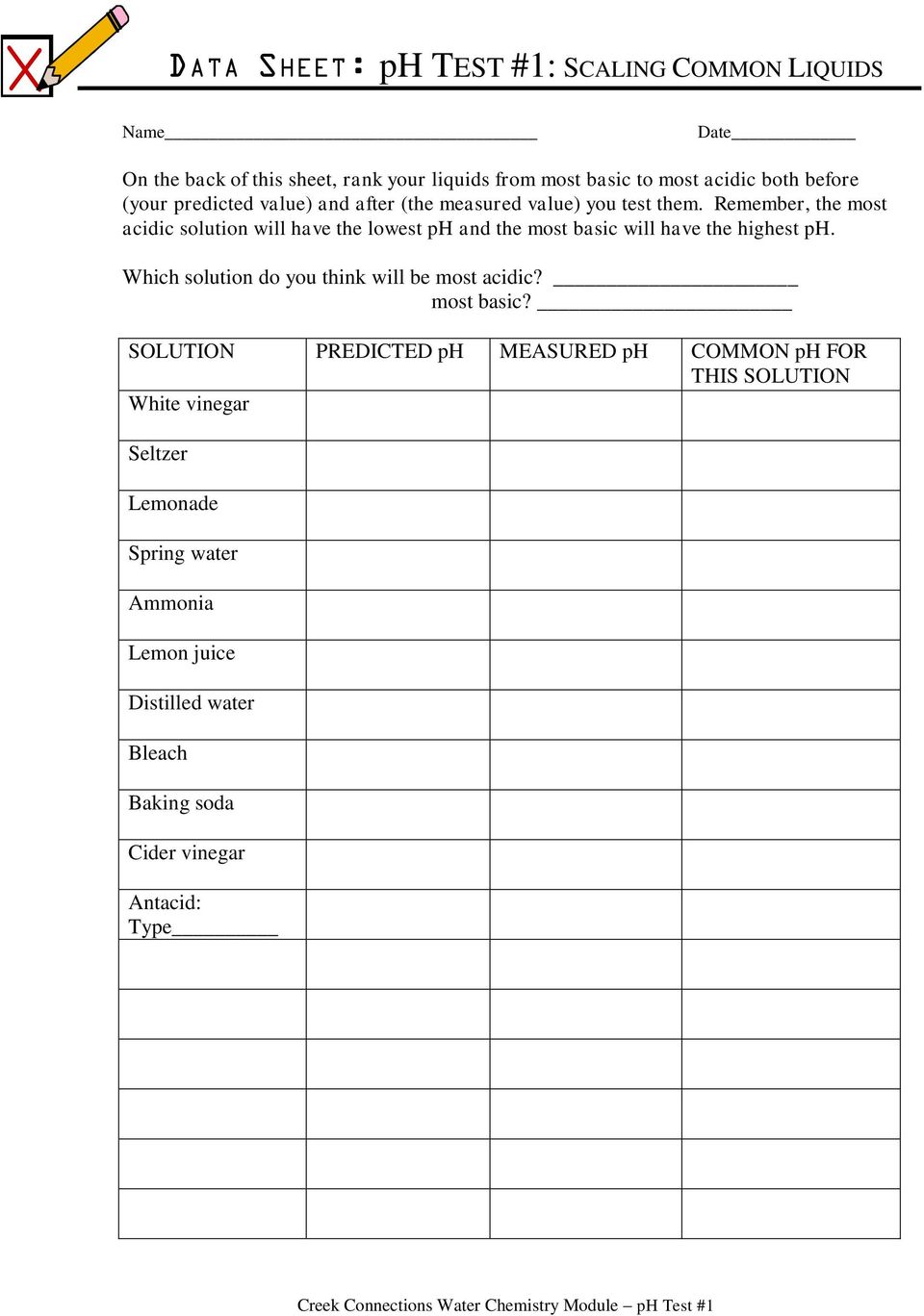
5 DATA SHEET: ph TEST #1: SCALING COMMON LIQUIDS Name Date On the back of this sheet, rank your liquids from most basic to most acidic both before (your predicted value) and after (the measured value) you test them. Remember, the most acidic solution will have the lowest ph and the most basic will have the highest ph. Which solution do you think will be most acidic? most basic? SOLUTION PREDICTED ph MEASURED ph COMMON ph FOR THIS SOLUTION White vinegar Seltzer Lemonade Spring water Ammonia Lemon juice Distilled water Bleach Baking soda Cider vinegar Antacid: Type
6 Rank your liquids: DATA SHEET FOR ph TEST #1 (Side 2) Most basic Predicted ranking order Measured ranking order Neutral Most acidic

Hardness Comparisons
 Hardness Comparisons Hardness Adapted from: An original Creek Connections activity. Creek Connections, Box 10, Allegheny College, Meadville, Pennsylvania 16335. Grade Level: all Duration: 50 minutes Setting:
The Acid Test Grade Nine
 Ohio Standards Connection: Physical Sciences Benchmark B Explain how atoms react with each other to form other substances and how molecules react with each other or other atoms to form even different substances.
Acids, Bases, and ph
 CHAPTER 9 1 SECTION Acids, Bases, and Salts Acids, Bases, and ph KEY IDEAS As you read this section, keep these questions in mind: What properties do acids have? What properties do bases have? How can
Wherever chemical solutions are involved, ph matters. Some
 47 Acids, Bases, and the ph Scale r e a d i n g Wherever chemical solutions are involved, ph matters. Some important chemical reactions, such as those involved in corrosion of iron or digestion of food,
Lesson Plan: How Do We Know What is Healthy Water?
 Lesson Plan: How Do We Know What is Healthy Water? Estimated Time: 1-3 days ph /Chlorine / Hardness State Standards taught and addressed Grade 8: Standards Taught (and evaluated at end of lesson) Science
Acids and Bases: Cabbage Juice ph Indicator
 Acids and Bases: Cabbage Juice ph Indicator Student Advanced Version Acids and bases are found in a variety of everyday items, including food and drink, medicine, and cleaning products. In this lab, we
EXPERIMENT 20: Determination of ph of Common Substances
 Materials: ph paper and color chart (ph range 3 to 12) or ph meter distilled water white vinegar household ammonia (or baking soda) spot plate test or 3 small test tubes stirring rod solutions / fruits
ph Measurements of Common Substances
 Chem 100 Section Experiment 10 Name Partner s Name Introduction ph Measurements of Common Substances The concentration of an acid or base is frequently expressed as ph. Historically, ph stands for the
Syllabus OC18 Use litmus or a universal indicator to test a variety of solutions, and classify these as acidic, basic or neutral
 Chemistry: 9. Acids and Bases Please remember to photocopy 4 pages onto one sheet by going A3 A4 and using back to back on the photocopier Syllabus OC18 Use litmus or a universal indicator to test a variety
Neutralizing an Acid and a Base
 Balancing Act Teacher Information Objectives In this activity, students neutralize a base with an acid. Students determine the point of neutralization of an acid mixed with a base while they: Recognize
Properties of Acids and Bases
 Lab 22 Properties of Acids and Bases TN Standard 4.2: The student will investigate the characteristics of acids and bases. Have you ever brushed your teeth and then drank a glass of orange juice? What
Return to Lab Menu. Acids and Bases in Your House
 Return to Lab Menu Acids and Bases in Your House OBJECTIVES Isolate a natural acid-base indicator. Determine the acid-base properties of common household solutions. INTRODUCTION Acids and bases are among
ACIDS AND BASES SAFETY PRECAUTIONS
 ACIDS AND BASES Mild acids and bases are used in cooking (their reaction makes biscuits and bread rise). Acids such as those in our stomachs eat away at food or digest it. Strong acids and bases are used
LOGARITHMS AND THE ph SCALE
 NAME: DATE: LOGARITHMS AND THE ph SCALE A scientific application of Logarithms is the ph scale which is used to measure the concentration of H + ions in an acidic or basic solution. ph is equal to the
VANDERBILT STUDENT VOLUNTEERS FOR SCIENCE. Acids and Bases. Fall 2012
 VANDERBILT STUDENT VOLUNTEERS FOR SCIENCE Acids and Bases Fall 2012 GOAL: To introduce students to acids and bases. MATERIALS 3 10oz clear plastic cups 1 4 oz. bottle white vinegar - labeled Acid 1 4 oz.
Name. Lab 3: ENZYMES. In this lab, you ll investigate some of the properties of enzymes.
 Name Lab 3: ENZYMES In this lab, you ll investigate some of the properties of enzymes. So what are enzymes? Enzymes are large protein molecules (macromolecules) They catalyze or speed up chemical reactions
Household Acids and Bases
 Household Acids and Bases GRADE LEVEL INDICATORS Experiment Demonstrate that the ph scale (0-14) is used to measure acidity and classify substances or solutions as acidic, basic, or neutral. 21 Develop
Urban Ecology: Watersheds and Aquatic Ecology A BIOBUGS program
 NAME: Urban Ecology: Watersheds and Aquatic Ecology A BIOBUGS program Objective: To describe the health of the Muddy River in the Fens wetlands system of Boston by examining abiotic and biotic parameters.
Acids and Bases. AND a widemouth container of the following solids:
 Acids and Bases GOAL To introduce students to acids and bases. MATERIALS: 3 10oz clear plastic cups 1 4 oz. bottle white vinegar - labeled Acid 1 4 oz. bottle of water - labeled Water 1 4 oz. bottle of
ANSWER KEY. Acids, Bases, and Solutions. Chapter Project Worksheet 1 1. Answers will vary. Sample: cherries, blueberries,
 Chapter Project Worksheet 1 1. Answers will vary. Sample: cherries, blueberries, and grass 2. Answers will vary. Sample: Cut 5 g of cherries into small pieces and place in blender. Blend for two minutes,
Nomenclature and Household Items
 Nomenclature and Household Items NAME: DATE: PERIOD: Background: Many household items contain chemicals that are commonly used in everyday life. Some chemicals are edible while other compounds would be
Introduction. ph = log [H + ]
![Introduction. ph = log [H + ]](/thumbs/40/21282159.jpg "Introduction. ph = log [H + ]") Visualizing ph 2010, 1992 by David A. Katz. All rights reserved. Permission granted for classroom use. All reproductions must include original copyright. David A. Katz Chemist, Educator, Science Communicator,
Visualizing ph 2010, 1992 by David A. Katz. All rights reserved. Permission granted for classroom use. All reproductions must include original copyright. David A. Katz Chemist, Educator, Science Communicator,
Chem 100 Lab Experiment #9 - ACID/BASE INDICATORS
 Lab #9 Chem 100 Lab Experiment #9 - ACID/BASE INDICATORS Name: Purpose: In this laboratory we will investigate how indicators can be used to test for the presence of acids or bases in a number of common
CHM 130LL: ph, Buffers, and Indicators
 CHM 130LL: ph, Buffers, and Indicators Many substances can be classified as acidic or basic. Acidic substances contain hydrogen ions, H +, while basic substances contain hydroxide ions, OH. The relative
A PRIMER ON ph. A Presentation for ASTA Conference September 30-October 1, 2008
 A PRIMER ON ph A Presentation for ASTA Conference September 30-October 1, 2008 Rebecca Richardson Martha Gothard Director Science Specialist Regional In-Service Education Center AMSTI University of Montevallo
EXPERIMENT 4 Acid Strength
 EXPERIMENT 4 Acid Strength Introduction Many common substances are either acids or bases. Some acids, like stomach acid are necessary for our health, while others, like sulfuric acid are dangerous and
Q1: What is the ph Scale? Q6: As acids become more acidic, their ph values
 Q1: What is the ph Scale? Q6: As acids become more acidic, their ph values increase or decrease? Q2: The range of values of the ph scale is: Q7: As bases become more alkaline, their ph values increase
Acid 7 Base. 1. Describe two things hydrochloric acid does in your body system. 2. What does sodium hydrogencarbonate do in your body system?
 Acids and Bases acid: a compound that, when dissolved in water, forms a solution with a ph less than 7 base: a compound that, when dissolved in water, forms a solution with a ph greater than 7 ph: the
Household Acids and Bases
 Household Acids and Bases Computer 28 Many common household solutions contain acids and bases. Acid-base indicators, such as litmus and red cabbage juice, turn different colors in acidic and basic solutions.
Elements of Chemistry Acids and Bases Teacher s Guide
 Teacher s Guide oneone oee Grade Level: 9 12 Curriculum Focus: Physical Science Lesson Duration: Two class periods Program Description Explore the chemistry of acids and bases to see how fundamental they
Lesson 4: What Makes Water Healthy?
 Lesson 4: What Makes Water Healthy? Activity: Students make observations and measurements of several water samples. This activity helps students think about different ways to determine water quality. Grade
Experiment 16-Acids, Bases and ph
 Definitions acid-an ionic compound that releases or reacts with water to form hydrogen ion (H + ) in aqueous solution. They taste sour and turn litmus red. Acids react with certain metals such as zinc,
Of Cabbages and Kings
 Of Cabbages and Kings Learning Objectives: Students will learn about indicators, acids, bases, and the ph scale. GRADE LEVEL K 8 SCIENCE TOPICS Physical Properties Techniques Chemical Reactions PROCESS
Acids, Bases and Salts
 Acids, Bases and Salts 2 HAPTER Tips and Tricks Acids are sour in taste and bases are bitter in taste. Indicators are chemical substances which give different colours in acidic and basic solutions. If
Acids & Bases Around the House Use a ph indicator to find acids and bases
 Use a ph indicator to find acids and bases Description: Visitors predict whether various household solutions are acids or bases, and test their hypotheses using a universal ph indicator. Then, visitors
WORKSHEET: ph and Water 23 Lab Instructor: Lab Day & Time: Student name(s): drain cleaner flat soda pop window cleaner ammonia.
 WORKSHEET: ph and Water 23 Lab Instructor: Lab Day & Time: Student name(s): DATA AND ANALYSIS ph Substance ph Value Substance ph Value Substance ph Value pure water apple juice dish soap sugar water beer
6.8 Measuring the Acidity of Solutions Page 160
 6.8 Measuring the Acidity of Solutions Page 160 PRESCRIBED LEARNING OUTCOMES measure substances and solutions according to ph, solubility, and concentration KNOWLEDGE ph is the measure of the tendency
Experiment 9: Acids and Bases Adapted from: Chemistry, Experimental Foundations, 4th Ed. Laboratory Manual, by Merrill, Parry & Bassow.
 Chem 121 Lab Clark College Experiment 9: Acids and Bases Adapted from: Chemistry, Experimental Foundations, 4th Ed. Laboratory Manual, by Merrill, Parry & Bassow. Content Goals: Increase understanding
ENVIRONMENTAL MANAGEMENT: CLEAN WATER RESEARCH AS RELATED TO ACID MINE DRAINAGE
 ENVIRONMENTAL MANAGEMENT: CLEAN WATER RESEARCH AS RELATED TO ACID MINE DRAINAGE LESSON PLAN CREATED BY: Todd Mills (Grades 9 12) Lois Morris (Grades 6-8) Terry Rostcheck (Grades 6 8) Susan Tegi (Grades
Final Assessment: Acids and Bases and the ph scale
 Final Assessment: Acids and Bases and the ph scale In order to construct acid-base indicators using organic substances, it is first necessary to understand terms and concepts related to the ph scale. According
Dissolving of sodium hydroxide generates heat. Take care in handling the dilution container.
 TITRATION: STANDARDIZATION OF A BASE AND ANALYSIS OF STOMACH ANTACID TABLETS 2009, 1996, 1973 by David A. Katz. All rights reserved. Reproduction permitted for education use provided original copyright
ACIDS, BASES AND SALTS
 Acids are those chemical substances which have a sour taste. Bases are those chemical substances which have a bitter taste. A salt is an ionic compound which dissociates to yield a positive ion other than
CLEANING WATER. Student Section
 National Aeronautics and Space Administration CLEANING WATER Student Section Student Name This lesson challenges you to create and test a water filtration system. During this lesson, you will design and
Leavener Lineup. Getting started. How do we use chemical reactions in the kitchen? Hands-on experiment. Year levels 4 5. Curriculum Links.
 rise and Shine: what Makes Bread Rise? Lesson 2 Leavener Lineup Year levels 4 5 Curriculum Links Science Science knowledge helps people to understand the effect of their actions (Yr 4, ACSHE062). Solids,
Chemistry 101. Chemistry Experiments for the Home Acidity Determination Using Indicators
 Chemistry 101 Chemistry Experiments for the Home Acidity Determination Using Indicators I. Objective: To determine the acidity of a variety of common substances by the use of indicators. To prepare your
Lesson Plan 16 Cool Chemistry - DIY ph Indicator
 Lesson Plan 16 Cool Chemistry - DIY ph Indicator Brief description Red cabbage juice is a natural ph indicator making this classic activity one of the most popular chemistry experiments for children. The
1. What do you think is the definition of an acid? Of a base?
 Concepts of ph Why? The level of acidity or basicity affects many important biological and environmental processes: enzymes function effectively only in narrowly defined ranges of ph; blood ph in part
PART I: PREPARATION OF SOLUTIONS AND STANDARDIZATION OF A BASE
 TITRATION: STANDARDIZATION OF A BASE AND ANALYSIS OF STOMACH ANTACID TABLETS 2009, 1996, 1973 by David A. Katz. All rights reserved. Reproduction permitted for education use provided original copyright
Acids, Bases, and Indicators Colorful Chemistry
 Cool Chemistry Show Activity 7 Acids, Bases, and Indicators Colorful Chemistry GOALS In this activity you will: Identify common household acids and bases. Identify characteristic properties of acids and
Kool Demo for Acid-Base Reactions
 Kool Demo for Acid-Base Reactions Kool Demo for Acid-Base Reactions Adapted from : http://www.stevespanglerscience.com/lab/experiments/color-changing-milk-of-magnesia Materials: Red cabbage juice indicator
ph Measurement and Control
 ph Measurement and Control Tech Tip #14 1997 I. The Need for ph II. ph System Requirements III. ph Electrode Conditioning Procedures IV. How the electrode works V. Identifying the Electrode Components
Review and apply Investigation 5. Let s review Pages 311-312
 Review and apply Investigation 5 Let s review Pages 311-312 1. After you tested all the known powders with all the test liquids, describe what you did to identify the unknown powder. Students should have
What does pka tell you?
 ph and pka What does pka tell you? pka tells you if a given molecule is going to either give a proton to water at a certain ph, or remove a proton A pka of 2 for substance X means that at a ph of 2, X
5 ACIDS, BASES AND SALTS
 5 ACIDS, BASES AND SALTS TEXTBOOK QUESTIONS AND ANSWERS Q.1. Taste the following substances and enter the result in the following table : Substance Taste (Sour / bitter / any other) Lemon juice Orange
Chemical Weathering Lab. 4th grade PSI
 Chemical Weathering Lab 4th grade PSI Teacher s Notes: Having students conduct Mohs Hardness Test requires a lot of preparation. Rock samples and the materials used to test them need to be collected and
Chapter 17. How are acids different from bases? Acid Physical properties. Base. Explaining the difference in properties of acids and bases
 Chapter 17 Acids and Bases How are acids different from bases? Acid Physical properties Base Physical properties Tastes sour Tastes bitter Feels slippery or slimy Chemical properties Chemical properties
This rain is known as acid rain.
 Rain is very important for life. All living things need water to live, even people. Rain brings us the water we need. But in many places in the world even where you live, rain has become a menace. Because
Acids & Bases: Using Purple Cabbage as a ph indicator. Grade 9 Activity Plan
 Acids & Bases: Using Purple Cabbage as a ph indicator Grade 9 Activity Plan 1 Acids, Bases & Purple Cabbage Objectives: 1. To demonstrate the basic physical and chemical properties of acids and bases.
the importance of ph in water purification the importance of ph in water purification Water Purification Systems UK
 the importance of ph in water purification Water Purification Systems UK What is ph? The ph scale has been in use for over a century, ever since it was first defined in 1909 by the Danish chemist, Søren
Letter to the Student... 5 Test-Taking Checklist... 6 Next Generation Sunshine State Standards Correlation Chart... 7
 Table of Contents Letter to the Student..................................... 5 Test-Taking Checklist.................................... 6 Next Generation Sunshine State Standards Correlation Chart...
Overview Students explore ph with an emphasis on soil ph. This activity uses soils and vinegar solutions.
 Activity: Acid to A1ka1ine Grades 4-8 Overview Students explore ph with an emphasis on soil ph. This activity uses soils and vinegar solutions. Background One of the significant factors in growing successful
Designing An Experiment Using Baking Soda and Vinegar
 Designing An Experiment Using Baking Soda and Vinegar Introduction: Kinetics is the study of chemical reaction rates. It is the study of how fast different chemicals react with one another to form new
CHAPTER 16: ACIDS AND BASES
 CHAPTER 16: ACIDS AND BASES Active Learning: 4, 6, 14; End-of-Chapter Problems: 2-25, 27-58, 66-68, 70, 75-77, 83, 90-91, 93-104 Chapter 15 End-of-Chapter Problems: 69-74, 125, 129, 133 16.1 ACIDS AND
Physical and Chemical Changes
 Physical and Chemical Changes Jana Barrow West Point Jr. High 2775 W 550 N 801-402-8100 West Point, UT 84015 [email protected] Eighth Grade Integrated Science Standard I: Students will understand the
ph units constitute a scale which allows scientists to determine the acid or base content of a substance or solution. The ph 0
 ACID-BASE TITRATION LAB PH 2.PALM INTRODUCTION Acids and bases represent a major class of chemical substances. We encounter them every day as we eat, clean our homes and ourselves, and perform many other
Balance Your ph for Better Health!
 Balance Your ph for Better Health! About Better Health Lab, Inc. Universal Wellness Group, Inc. Balance Your ph for Better Health! Mission To fulfill the need to improve world health and everyday way of
Science of Life Explorations
 Science of Life Explorations Student Scientists: Make Your Bed Activity #2 Study Soil While we are still talking about soil, let s check three other soil properties that will affect your garden: compaction
Environmental Water Testing: Surface Water, Groundwater, Hard Water, Wastewater, & Seawater
 Document: AND Sol Env 08 2013 Environmental Water Testing: Surface Water, Groundwater, Hard Water, Wastewater, & Seawater Matrix specific sample preparation and testing methods for environmental waters
SNEAK PEAK inside ACTIVITY. ADVANCE PREPARATION see next page for more details Dilute alcohol with water Set out plastic cups, etc.
 Reaction: Yes or No? Learning Objectives: Students will list and identify three characteristics of chemical reactions. GRADE LEVEL 3 8 SCIENCE TOPICS Solutions and Mixtures Chemical Reactions PROCESS SKILLS
Acidity in the Soil. Unit. Year levels 5 6. About this activity. Demonstrating ph levels in substances. Curriculum Links. Science
 Unit Year levels 5 6 Acidity in the Soil growth and survival of living things are The affected by the physical conditions of their environment (ACSSU094). Scientific knowledge is used to inform personal
Chemistry Unit Test Review
 SNC 2DI Chemistry Unit Test Review Note: this review sheet only covers the second half of our chemistry unit. You should use our mid-unit test review sheet to recall concepts from the first half of the
Questions for Discussion. Introduction. What is ph? Neutralization
 Questions for Discussion Why do leaves change color in autumn? What are acids and bases? How does red cabbage fit in? How are all these things related? Introduction The questions above may not seem related,
III. BACKGROUND KNOWLEDGE
 Chemical Bonds and Reactions (Water) Grade Level: 7 (Applied Technology) Presented by: James Rubright, Three Oaks Middle School, Fort Myers, Florida Length of Unit: Ten Daily Lessons and Activities I.
Sketch the model representation of the first step in the dissociation of water. H 2. O (l) H + (aq) + OH- (aq) + H 2. OH - (aq) + H 3 O+ (aq)
 Lesson Objectives Students will: Create a physical representation of the autoionization of water using the water kit. Describe and produce a physical representation of the dissociation of a strong acid
Lesson 5: Water Conductivity and Total Dissolved Solids Water Quality Sampling
 Lesson 5: Water Conductivity and Total Dissolved Solids Water Quality Sampling Time Frame: Two 45-50 minute class periods Grade Level: 8 th 12 th Grade Overview: There are a wide variety of inorganic substances
Chapter 2. The Chemistry of Life Worksheets
 Chapter 2 The Chemistry of Life Worksheets (Opening image courtesy of David Iberri, http://en.wikipedia.org/wiki/file:camkii.png, and under the Creative Commons license CC-BY-SA 3.0.) Lesson 2.1: Matter
Chapter 6. Solution, Acids and Bases
 Chapter 6 Solution, Acids and Bases Mixtures Two or more substances Heterogeneous- different from place to place Types of heterogeneous mixtures Suspensions- Large particles that eventually settle out
How To Understand And Understand The Effects Of Pollution And Water Quality
 Lesson 2. Pollution and Water Quality Keywords: pollutants, water pollution, point source, non-point source, urban pollution, agricultural pollution, atmospheric pollution, smog, nutrient pollution, eutrophication,
Chemistry 52. Reacts with active metals to produce hydrogen gas. Have a slippery, soapy feeling. React with carbonates to produce CO 2
 ACID AND BASE STRENGTH Experiment #2 PURPOSE: 1. To distinguish between acids, bases and neutral substances, by observing their effect on some common indicators. 2. To distinguish between strong and weak
Return to Lab Menu. Stoichiometry Exploring the Reaction between Baking Soda and Vinegar
 Return to Lab Menu Stoichiometry Exploring the Reaction between Baking Soda and Vinegar Objectives -to observe and measure mass loss in a gas forming reaction -to calculate CO 2 loss and correlate to a
Direct ISE Method Method 8359 10 to 1000 mg/l Na + Sodium ISE
 Sodium DOC316.53.01240 Direct ISE Method Method 8359 10 to 1000 mg/l Na + Sodium ISE Scope and application: For drinking water and process water. Test preparation Instrument-specific information This procedure
Color, True and Apparent
 Color, True and Apparent DOC316.53.01037 Platinum-Cobalt Standard Method 1, 2, 3 Method 8025 15 to 500 color units Scope and application: For water, wastewater and seawater; equivalent to NCASI method
Color, True and Apparent
 Color, True and Apparent DOC316.53.01037 Platinum-Cobalt Standard Method 1, 2, 3 Method 8025 15 to 500 color units 5 to 500 color units (low range technique) Scope and application: For water, wastewater
WHAT S NEW, CO? Thanks for the opportunity to work with your students. Our goal is to teach developmentally TEACHER S GUIDE
 TEACHER S GUIDE WHAT S NEW, CO? GET TO KNOW A CHEMICAL REACTION 2 Thanks for the opportunity to work with your students. Our goal is to teach developmentally appropriate chemistry concepts that support
Teacher Demo: Turning Water into Wine into Milk into Beer
 SNC2D/2P Chemical Reactions/Chemical Reactions and their Practical Applications Teacher Demo: Turning Water into Wine into Milk into Beer Topics evidence of chemical change types of chemical reactions
WHAT IS THE SCIENTIFIC METHOD?
 WHAT IS THE SCIENTIFIC METHOD? A lesson to introduce the application of the Scientific Method to High School Chemistry Students Karen Balbierer CCMR RET I August 15, 2003 Lesson Plan Summary Lesson Subject:
Properties of Acids and Bases
 Properties of Acids and Bases (Adapted from Flinn Scientific Acid Base Test Kit I #AP4567) Introduction Battery acid, stomach acid, acid rain just a few acids in our everyday life! What does it mean when
You may have heard the word acid used in your everyday life. List some things that this word was describing when you heard it.
 Textbook pages 158 to 175 What are acids and bases, and how do they react? Before You Read Topic 2.4 Summary You may have heard the word acid used in your everyday life. List some things that this word
Homework 1. Q1a). Describe how you could test the ph of a solution and obtain its ph value.
 Homework 1 Q1a). Describe how you could test the ph of a solution and obtain its ph value. b) What colours do acids turn universal indicator? c) What range of ph values can be shown by acids? d) What colours
Chapter 3: Water and Life
 Name Period Chapter 3: Water and Life Concept 3.1 Polar covalent bonds in water result in hydrogen bonding 1. Study the water molecules at the right. On the central molecule, label oxygen (O) and hydrogen
EXPERIMENT 10: TITRATION AND STANDARDIZATION
 EXPERIMENT 10: TITRATION AND STANDARDIZATION PURPOSE To determine the molarity of a NaOH solution by titrating it with a standard HCl solution. To determine the molarity of acetic acid in vinegar using
Biopharmaceuticals and Biotechnology Unit 2 Student Handout. DNA Biotechnology and Enzymes
 DNA Biotechnology and Enzymes 35 Background Unit 2~ Lesson 1 The Biotechnology Industry Biotechnology is a process (or a technology) that is used to create products like medicines by using micro-organisms,
MULTIPLE CHOICE. Choose the one alternative that best completes the statement or answers the question.
 CHE 1400 - Spring 2015 - Chapter 7 Homework 7 MULTIPLE CHOICE. Choose the one alternative that best completes the statement or answers the question. 1)According to Arrhenius, an acid and a base will react
The Relationship between ph and Deionized Water
 The Relationship between ph and Deionized Water The basics of ph The topic of ph and water has been well documented over the years; however, there is still much confusion about its significance in high
Dry Ice Color Show Dry Ice Demonstrations
 elearning 2009 Introduction Dry Ice Color Show Dry Ice Demonstrations Publication No. 95016 Add a small piece of solid carbon dioxide to a colored indicator solution and watch as the solution immediately
BiT Stream Study - Guided Observations:
 BiT Stream Study - Guided Observations: Streams are the pathways that transport water through a watershed. They are also critical to the healthy functioning of the watershed and the myriad of habitats
Both drink mixes contain similar basic ingredients, as listed in Table 1. Ascorbic acid (vitamin C) Ascorbic acid (vitamin C)
 MAKE YOUR OWN ORANGE DRINK AN EXPERIMENT IN DETERMINING HOW ADDITIVES AFFECT OUR FOOD 2000, 1999, 1996 by David A. Katz. All rights reserved. Reproduction permitted for education use provided original
Describing Acids and Bases
 Section 3 Describing Acids and Bases 3 Describing Acids and Bases Objectives After this lesson, students will be able to L.3.3.1 Name the properties of acids and bases. L.3.3.2 Identify where acids and
LZV585 (B) The 1-cm path is aligned with the arrow on the adapter. 5940506
 Chlorine, Total DOC316.53.01029 USEPA DPD Method 1 Method 10070 0.1 to 10.0 mg/l Cl 2 (HR) Powder Pillows Scope and application: For testing higher levels of total chlorine (free and combined) in drinking