
QUALITY ASSURANCE OF HARVESTED HORTICULTURAL PERISHABLES
|
|
|
- Tyrone Kelley Cunningham
- 9 years ago
- Views:
Transcription
1 QUALITY ASSURANCE OF HARVESTED HORTICULTURAL PERISHABLES A.A. Kader Department of Pomology, University of California, Davis, CA 95616, USA Keywords: inspection, quality assurance, quality control, standardization Abstract An effective quality assurance (QA) system throughout the handling steps between harvest and retail display is essential to provide a consistently good-quality supply of fresh horticultural crops to the consumers and to protect the reputation of a given marketing label. QA starts with the selection of the genotype and its proper time to harvest for the best appearance, textural, flavor (taste and aroma), and nutritional (including phytonutrients) quality. Careful harvesting and handling are required to minimize physical injuries. Each postharvest handling step has the potential to either maintain or reduce quality and in a few cases (such as ripening of climacteric fruits) improve eating quality. The availability of low-cost microcomputers and solid-state imaging systems have resulted in increased use of computer-aided video inspection to sort many products into two or more quality grades before marketing. Objective and nondestructive methods of differentiating horticultural perishables on the basis of their flavor and nutritional quality are being tested and will become excellent QA tools as they become more reliable and efficient. Safety assurance can be part of QA and its focus is on minimizing chemical and microbial contamination during production, harvesting, and postharvest handling of intact and fresh-cut fruits and vegetables. Future research and development efforts should focus on developing better methods of monitoring quality and safety attributes of fresh produce as part of a QA system. 1. Quality attributes Quality of fresh produce includes appearance (size, shape, color, gloss, and freedom from defects and decay), texture (firmness, crispness, juiciness, mealiness, and toughness, depending on the commodity), flavor (sweetness, sourness (acidity), astringency, aroma, and off-flavors), and nutritive value (vitamins, minerals, dietary fiber, phytonutrients). The relative importance of each quality component depends on the commodity and the individual s interest (Kader, 1992). Most postharvest researchers, producers, and handlers are product-oriented in that quality is described by specific attributes of the product itself, such as sugar content, color, or firmness. In contrast, consumers, marketers, and economists are more likely to be consumer-oriented in that quality is described by consumer wants and needs (Shewfelt, 1999). Although consumers purchase fresh produce based on appearance and textural quality, their repeat purchases depend upon their satisfaction with flavor (taste and aroma). They are also interested in the health-promoting attributes and nutritional quality of fresh fruits and vegetables (Kader, 1988). Several attempts have been made to develop portable instruments with sensors that detect volatile production by fruits as a way to detect maturity and quality. Other strategies include the removal of a very small amount of fruit tissue and measurement of total sugars or soluble solids content. Near-infrared detectors have great potential for nondestructive estimation of sugar content in fruits (Abbott, 1999). Until such methods become widely available, we will continue to depend on destructive techniques, such as soluble solids determination by a refractometer and titratable acidity measurement by titration, to evaluate flavor quality of fruits. Table 1 summarizes the proposed minimum Proc. 4 th. Int. Conf. On Postharvest Eds. R. Ben-Arie & S. Philosoph-Hadas Acta Hort. 553, ISHS
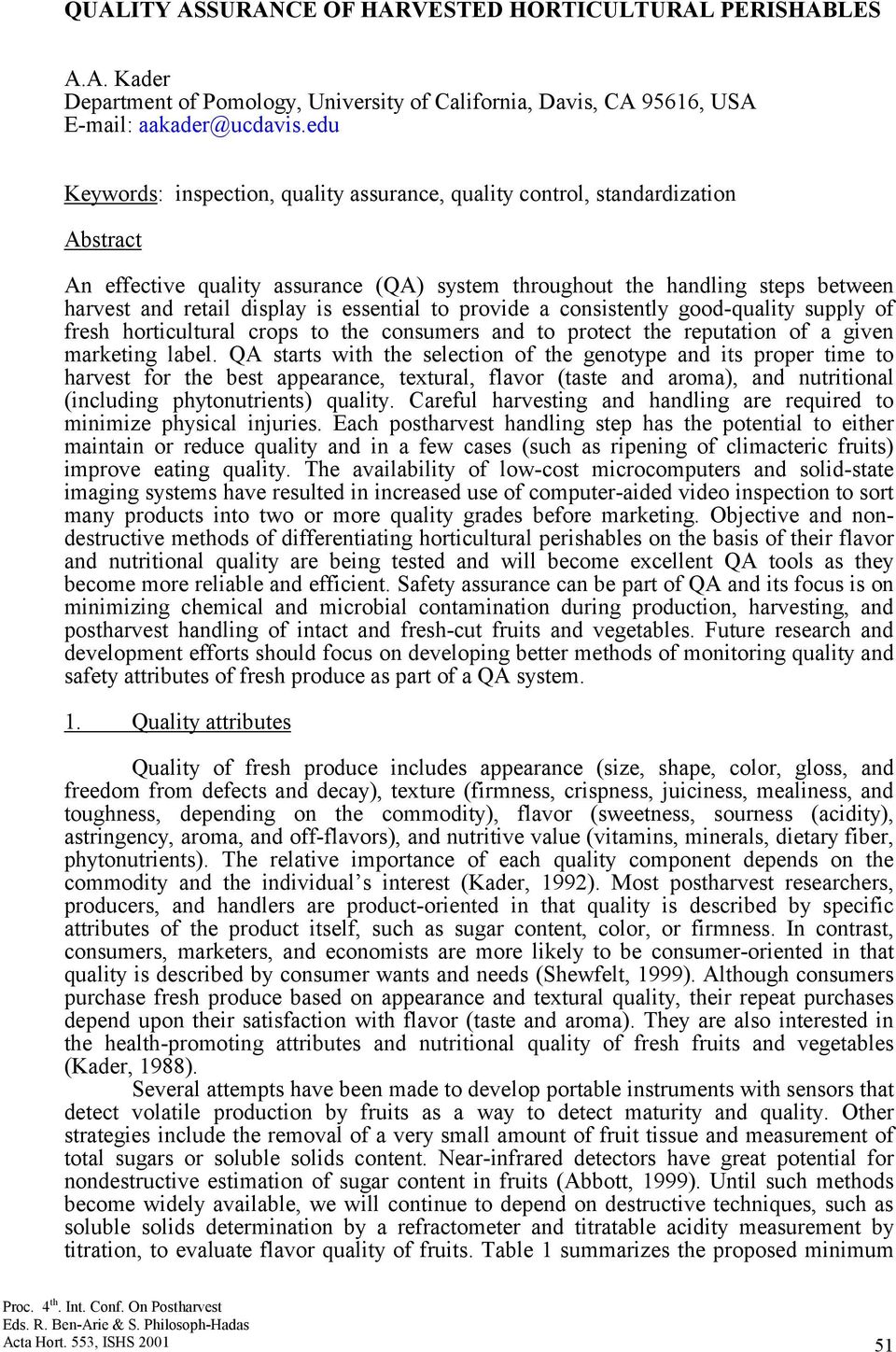
2 soluble solids content and maximum titratable acidity for acceptable flavor quality of fruits. These values will not guarantee the optimum flavor quality for each consumer but it assures a minimum acceptability level for the majority of consumers. Additional research will likely result in a few changes in the values shown in Table 1. Use of these indices in a quality assurance program must be coupled with tolerances of deviation from the proposed averages because of the large variation among cultivars, production areas and seasons, maturity at harvest and ripeness stage at the time of evaluation. 2. Quality control and assurance Quality control (QC) is the process of maintaining an acceptable quality level to the consumer. Quality assurance (QA) is the system whose purpose is to assure that the overall QC job is being done effectively (Hubbard, 1999). QA and QC are often used interchangeably to cover the planning, development, and implementation of inspection and testing techniques; they take time and a lot of training. A successful QA/QC system cannot be flexible, but it must be subject to constant review and improvement as conditions change (Hubbard, 1999). Many attempts are currently being made to automate the separation of a given commodity into various grades and the elimination of defective units. The availability of low-cost microcomputers and solid-state imaging systems has made computer-aided video inspection on the packing line a practical reality. Solid-state video camera or light reflectance systems are used for detection of external defects, and x-ray or light transmittance systems are used for detecting internal defects (Abbott et al, 1997; NRAES, 1997). Further development of these and other systems to provide greater reliability and efficiency will be very helpful in quality control efforts. An effective quality control and assurance system throughout the handling steps between harvest and retail display (Table 2) is required to provide a consistently goodquality supply of fresh horticultural crops to the consumers and to protect the reputation of a given marketing label. Quality control starts in the field with the selection of the proper time to harvest for maximum quality. Careful harvesting is essential to minimize physical injuries and maintain quality. Each subsequent step after harvest has the potential to either maintain or reduce quality; few postharvest procedures can improve the quality of individual units of the commodity (Cavalieri, 1999; Kader, 1988; Kader, 1992; Shewfelt et al., 1993). Exposure of a commodity to temperatures, relative humidities, and/or concentrations of oxygen, carbon dioxide, and ethylene outside its optimum ranges will accelerate loss of all quality attributes. The loss of flavor and nutritional quality of fresh intact or cut fruits and vegetables occurs at a faster rate than the loss of textural and appearance quality. Thus, QC/QA programs should be based on all quality attributes and not only on appearance factors as often is the case. More research is needed to identify the reasons for the faster loss of flavor than appearance quality and to develop new strategies for extending postharvest-life based on flavor to match that based on appearance. 3. Standardization and inspection of fresh produce Grade standards identify the degrees of quality in a commodity that are the basis of its usability and value. Such standards, if enforced properly, are essential tools of quality assurance during marketing and provide a common language for trade among growers, handlers, processors, and receivers at terminal markets. Some production areas like California, USA enforce minimum standards concerning produce quality, maturity, container, marking, size and packing requirements. This provides orderly marketing and equity in the marketplace and protects consumers from inedible and poor quality produce. The California Department of Food and Agriculture is also responsible for enforcing provisions of laws governing the sale of foods labeled as organic. The U.S. standards for fresh fruit and vegetable grades are voluntary, except when 52

3 required by industry marketing orders, by the buyer, or for export marketing. The USDA, Agricultural Marketing Service is responsible for developing, amending, and implementing grade standards (for more information access the following website: Inspection is done either on a continuous basis (where one or more inspectors are assigned to a packinghouse to make frequent quality checks of the commodity along the packing lines), or on a sample basis (where representative samples of a prescribed number of boxes out of a given lot are randomly selected and inspected to determine whether the product meets the grade specification for which it is packed). When inspection is completed, certificates are issued by the inspector on the basis of applicable official standards. To ensure uniformity of inspection: (1) inspectors are trained to apply the standards, (2) visual aids (color charts, models, diagrams, photographs and the like) are used whenever possible, (3) objective methods for determining quality and maturity are used whenever feasible and practical, and (4) good working environments with proper lighting are provided. Recently, the Fresh Products Branch of the USDA s Agricultural Marketing Service equipped inspectors with digital cameras and enhanced computer technology for taking and transmitting images of produce or containers. AMS is offering the images to applicants over the Internet as an additional resource in its fresh fruits and vegetables inspection service. Inspectors also use the imaging to confer with produce quality experts working in USDA s headquarters in Washington, D.C. The imaging provides a quick, visual confirmation of product appearance and defects, damage from shifted loads, brands and container markings, and container condition. It can facilitate ecommerce (buying and selling produce via the Internet) and help the produce industry quickly resolve disputes over the quality or condition of shipments. International standards for fruits and vegetables were introduced by the Organization for Economic Cooperation and Development beginning in 1961, and now there are standards for about 40 commodities. Each includes three quality classes with appropriate tolerances: Extra class = superior quality (equivalent to U.S. Fancy ); Class I = good quality (equivalent to U.S. No. 1 ); and Class II = marketable quality (equivalent to U.S. No. 2 ). Class I covers the bulk of produce entering into international trade. These standards or their equivalents are mandatory in the European Union countries for imported and exported fruits and vegetables. References Abbott, J.A., Quality measurement of fruits and vegetables. Postharvest Biol. Technol., 15: Abbott, J.A., R. Lu, B.L. Upchurch, and R. Stroshine, Technologies for nondestructive quality evaluation of fruits and vegetables. Hort. Rev., 20: Cavalieri, R.P. (ed.), Fresh fruits and vegetable: quality and food safety. Postharvest Biol. Technol. 15: (Proceedings of Beltsville Symposium XXIII, May 1998). Hubbard, M.R., Choosing a quality control system. Technomic Publ. Co., Lancaster, PA, pp Kader, A.A., Influence of preharvest and postharvest environment on nutritional composition of fruits and vegetables, In: B. Quebedeaux and F.A. Bliss (eds.). Horticulture and human health, contributions of fruits and vegetables. Prentice-Hall, Englewood Cliffs, NJ, pp Kader, A.A. (ed.), Postharvest Technology of Horticultural Crops. Second edition, Univ. Calif., Div. of Agr. and Nat. Resources, Publ. 3311, pp Kader, A.A., Fruit maturity, ripening, and quality relationships. Acta Hort., 485: Northeast Regoinal Agricultural Engineering Service, Sensors for nondestructive testing measuring the quality of fresh fruits and vegetables. International Conference Proceedings, NRAES 97, NRAES, Ithaca, NY, pp

4 Shewfelt, R.L., What is quality? Postharvest Biol. Technol., 15: Shewfelt, R.L. and S.E. Prussia (eds.), Postharvest handling: A systems approach. Academic Press, San Diego, pp Useful Websites Tables 1. Proposed minimum soluble solids content (SSC) and maximum titratable acidity (TA) for acceptable flavor quality of fruits (Kader, 1999). Fruit Minimum SSC% Maximum TA% Apple (depending on cultivar) Apricot Blueberry Cherry (depending on cultivar) Grape (depending on cultivar) or SSC/TA ratio of 20+ Grapefruit SSC/TA ratio of 6+ Kiwifruit Mandarin SSC/TA ratio of 8+ Mango (depending on cultivar) Muskmelons Nectarine Orange SSC/TA ratio of 8+ Papaya Peach Pear Persimmon Pineapple Plum Pomegranate Raspberry Strawberry Watermelon
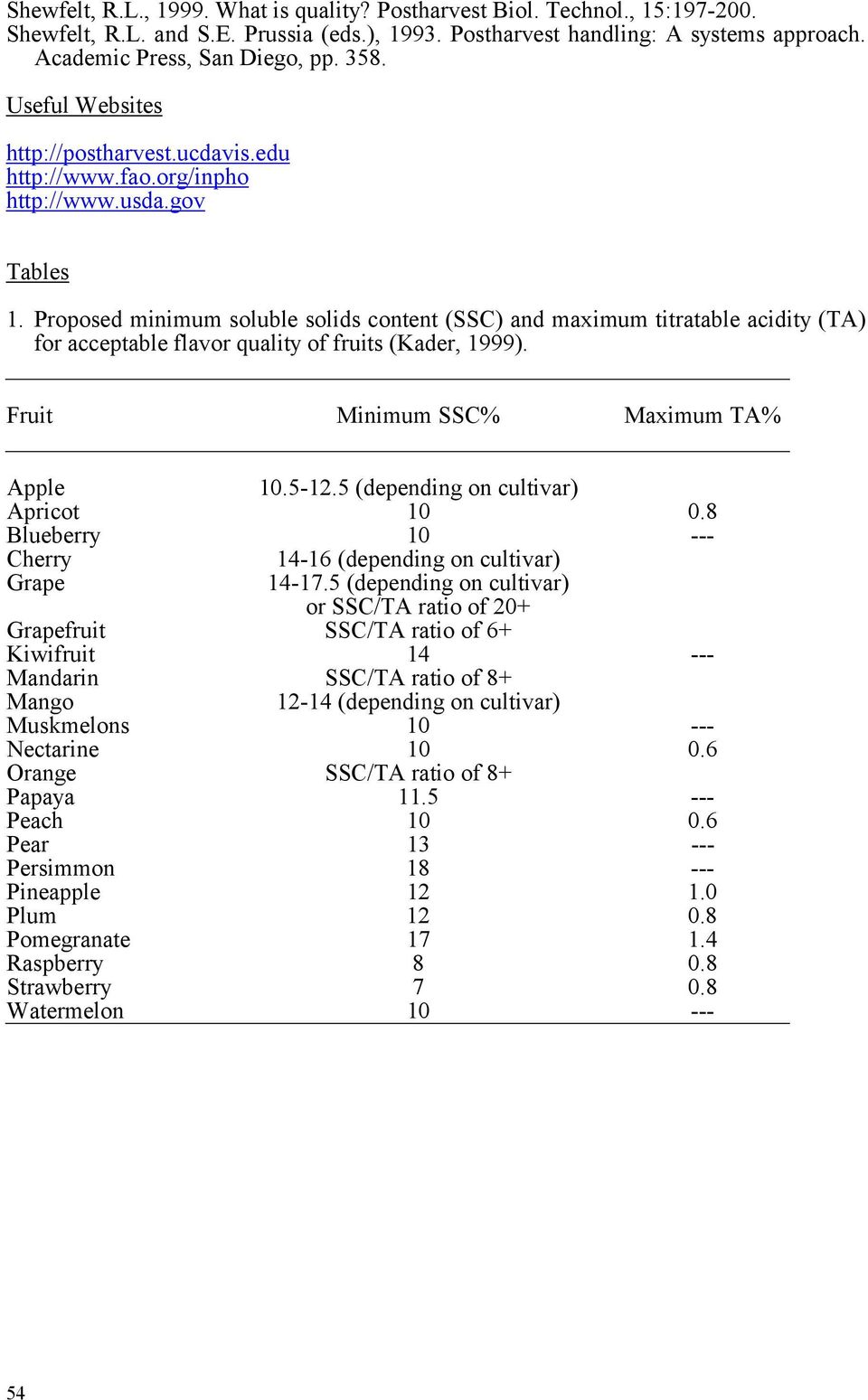
5 2. Quality assurance procedures during handling of horticultural perishables. Handling Steps Quality Assurance Procedures Harvesting Packinghouse Operations Transportation Handling at Destination Training workers on proper maturity and quality selection, careful handling, and protecting produce from sun exposure. Checking product maturity, quality, and temperature upon arrival. Implementing an effective sanitation program to reduce microbial load. Checking packaging materials and shipping containers to ensure they meet specifications. Training workers on proper grading by quality (defects, color, size), packing, and other packinghouse operations. Inspecting a random sample of the packed product to ensure that it meets grade specification. Monitoring product temperature to assure completion of the cooling process. Maintaining effective communications with quality inspectors and receivers to correct any deficiencies as soon as they are identified. Inspecting all transport vehicles before loading for functionality and cleanliness. Training workers on proper loading and placement of temperature-recording devices in each load. Keeping records of all shipments as part of the traceback system. Checking product quality upon receipt and moving it quickly to the appropriate storage area. Shipping product from distribution center to retail markets without delay and on a first in/first out basis unless its condition necessitates a different order. 55

Controlled Atmosphere Storage Adel A. Kader Kader is with the Department of Pomology, University of California, Davis, CA. He is now retired.
 Controlled Atmosphere Storage Adel A. Kader Kader is with the Department of Pomology, University of California, Davis, CA. He is now retired. Introduction Controlled atmosphere (CA) storage involves maintaining
Orange Fruit Processing
 Orange Fruit Processing Luis Cisneros-Zevallos, Ph.D. Department of Horticultural Sciences Texas A&M University Commercially Important Orange Varieties Valencia - most widely grown, late maturing, good
Automatic Fresh Air Management for Fruit & Vegetables. Dr. Patrick E. Brecht Dr. Jeffrey K. Brecht May 2, 2001
 Commodities, Inc 4733 Bodega Avenue, Petaluma, CA 94952 Phone (707) 775-3100 Fax (707) 775-3232 Automatic Fresh Air Management for Fruit & Vegetables Dr. Patrick E. Brecht Dr. Jeffrey K. Brecht May 2,
(Adopted April 25, 2003, Amended May 22, 2009)
 DRC GOOD ARRIVAL GUIDELINES (Adopted April 25, 2003, Amended May 22, 2009) Section 16 of the DRC Trading Standards policy on grade and condition standards for commodities stipulates: With regard to grade
How To Precondition D'Anjou Pears
 PRE-CONDITIONING D'ANJOU PEARS IN TRANSIT DURING EARLY MARKETING SEASON Paul M. Chen Mid-Columbia Agricultural Research and Extension Center Oregon State University 3005 Experiment Station Drive Hood River,
Scaling Up For Regional Markets Grading Standards and Wholesale Glossary of Terms
 Scaling Up For Regional Markets Grading Standards and Wholesale Glossary of Terms Wholesale food markets often use terms and phrases unique to the industry. To understand a market report, communicate with
Table 9 Page 12 Q13. Which of the following produce items have you purchased FRESH (NOT frozen, canned or dried) in the past 12 months?
 Banner 1 Table 1 Page 1 Q5. What is your household income? Table 2 Page 2 Q6. What is your marital status? Table 3 Page 3 Q7. How many dependent children do you have? Table 4 Page 4 Q8. In which state
ANTIOXIDANT USE IN APPLE AND PEAR STORAGE
 ANTIOXIDANT USE IN APPLE AND PEAR STORAGE PART 3 STORAGE SCALD AND 1-METHLYCYCLOPROPENE (1-MCP) Gabriela Calvo, M.Sc. INTA EEA Alto Valle June 2010 [email protected] This article is the last part
A guide for handling for cabbage, carrot, hot pepper, lettuce, sweet potato and tomato. Food and Agriculture Organization of the United Nations
 A guide for handling for cabbage, carrot, hot pepper, lettuce, sweet potato and tomato Food and Agriculture Organization of the United Nations A guide for handling for cabbage 1. HARVESTING Harvesting
KIWIFRUIT, NEW FRUIT IN WESTERN CULTURE.
 KIWIFRUIT, NEW FRUIT IN WESTERN CULTURE. Mr. Carlos Cruzat President Chilean Kiwifruit Committee Cesena Italia, September 24, 2013 WHAT TYPE OF FRUIT? It has much more nutritional qualities than other
How To Know If A Pink Lady Apple Browning
 The Flesh Browning Disorder of Pink Lady Apples Hannah James 1 and Jenny Jobling 2 1 Department of Horticulture, Cornell University, Ithaca, NY 2 Applied Horticultural Research, Sydney, NSW, Australia
NUTRITION EDUCATION CARDS AND HOSPITALITY TRAINING FOR SCHOOL NUTRITION SERVICES STAFF
 SWEET RED PEPPERS All red peppers start out green, then turn red. Red peppers have calcium for healthy bones. WINTER SQUASH Squash has Vitamin A for healthy eyes. Orange vegetables help you have healthy
25 Lowest Carb Fruits
 25 Lowest Carb Fruits It's not always easy to compare apples to oranges when it comes to Fruits and vegetables come in all shapes and sizes, and while it might seem like one is a lower-carb choice than
Improving the Flavor of Fruit Products with Acidulants
 BARTEK Improving the Flavor of Fruit Products with Acidulants by Daniel Sortwell, NutriQuim, S.A. de C.V. and Anne Woo, Bartek Ingredients, Inc. Expotecnoalimentaria 96, March 28, 1996 Mexico City, Mexico
Postharvest Management of Commercial Horticultural Crops STORAGE CONDITIONS FRUITS & VEGETABLES
 Postharvest Management of Commercial Horticultural Crops STORAGE CONDITIONS FRUITS & VEGETABLES By Karen L. B. Gast Once a crop is harvested, it is almost impossible to improve its quality. Losses of horticultural
LARGE GROUP PRESENTATION: PRESENTER S NOTES
 LARGE GROUP PRESENTATION: PRESENTER S NOTES Introduce yourself. Welcome! We are so glad you are here to learn about fruits and vegetables. Icebreaker Handout: Fruit or Vegetable: Parts of Many Words Read
The California Fresh Produce Industry and Marketing Trends
 The California Fresh Produce Industry and Marketing Trends DR. ROBERTA COOK Dept. of Agricultural and Resource Economics University of California Davis For Labor, Water and California Agriculture in 2014
GARDEN FACTS. When are apples ripe?
 A3743-E GARDEN FACTS U n i v e r s i t y o f W i s c o n s i n E x t e n s i o n When are apples ripe? Teryl R. Roper DIFFERENT APPLE CULTIVARS RIPEN over a long season. In Wisconsin, apples ripen from
Fiber. What is fiber? Fiber is a part of plant food. There are two types of fiber:
 Fiber An important part of a healthy diet is eating fiber-rich foods. This handout will explain what fiber is, where it s found, and how to increase the amount of fiber in your diet. What is fiber? Fiber
Eat more fruits and vegetables
 week 2 itinerary: GET N YOUR FRUITS AND VEGGIES! Eat more fruits and vegetables One of the best ways to improve your diet, get healthy, and begin to lose weight is by eating more fruits and vegetables!
Fibe. Fiber and water work together in bowel regulation. Be sure to drink eight to ten (8 ounce) glasses of
 r Fibe An important part of a healthy diet is eating a variety of fiber-rich foods, including whole-grain breads and cereals, fruits and vegetables, beans and nuts. Fiber is an important part of your diet.
FIRMNESS DETERMINATION USING COMPUTER MACHINE VISION SYSTEM
 TEKA Kom. Mot. Energ. Roln. OL PAN, 7, 7A, 92 99 FIRMNESS DETERMINATION USING COMPUTER MACHINE VISION SYSTEM Czesław Puchalski *, Józef Gorzelany *, Grzegorz Zaguła *, Gerald Brusewitz ** * Department
Pineapples. Ian Hewett Horticultural Marketing Inspectorate United Kingdom. Version - October 2011
 Pineapples Ian Hewett Horticultural Marketing Inspectorate United Kingdom Version - October 2011 1 Definition Of Produce This Standard applies to pineapples of varieties (cultivars) grown from Ananascomosus(L).
Analysis of the EU fruit and vegetables sector
 26 September 2014 Analysis of the EU fruit and vegetables sector EU and to Russia (2011-2013) Recent market s and measures taken to address market disruptions following the Russian import ban EU and to
Republic of Turkey Ministry of Economy, 2014 0
 Republic of Turkey Ministry of Economy, 2014 0 FRESH FRUITS AND VEGETABLES PRODUCTION Vegetal production is the leading sector of Turkish agriculture, and vegetal perishables constitute the backbone of
2009, National Food Service Management Institute, The University of Mississippi
 Preparing Fruits National Food Service Management Institute The University of Mississippi 2nd Edition ET80-09 2009 This project has been funded at least in part with Federal funds from the U.S. Department
Free distribution of fruit and vegetables
 Free distribution of fruit and vegetables European Commission DG for Agriculture and Rural Development Unit C.2 Olive Oil and Horticultural Products Annual meeting with Charitable Organisations 15 July
Ch. 57 MILK AND DAIRY PRODUCTS 7 CHAPTER 57. MILK AND DAIRY PRODUCTS GENERAL PROVISIONS
 Ch. 57 MILK AND DAIRY PRODUCTS 7 CHAPTER 57. MILK AND DAIRY PRODUCTS GENERAL PROVISIONS Subchap. Sec. A. MILK AND DAIRY PRODUCTS DEFINITIONS AND STANDARDS... 57.1 B. LABELING... 57.41 C. OTHER DAIRY PRODUCTS...
Production Guide for Storage of Organic Fruits and Vegetables
 2012 Production Guide for Storage of Organic Fruits and Vegetables NYS IPM Publication No. 10 New York State Department of Agriculture & Markets Integrated Pest Management 2012 Production Guide for Storage
R.M. Beaudry, Horticulture E-mail: [email protected] Department: Horticulture Mail Address: A288 Plant and Soil Sci. Bldg
 Toward Optimizing CA Storage of Honeycrisp Apples: Minimizing Prestorage Conditioning Time and Temperature (Originally published in the October 2014 NY Fruit Quarterly) R.M. Beaudry, Horticulture E-mail:
CONTROLLED ATMOSPHERE STORAGE OF APPLES AND PEARS DECEMBER 2001
 CONTROLLED ATMOSPHERE STORAGE OF APPLES AND PEARS DECEMBER 2001 Eugene Kupferman Washington State University Tree Fruit Research and Extension Center 1100 North Western Ave. Wenatchee WA 98801 [email protected]
AGRICULTURAL ALTERNATIVES
 AGRICULTURAL ALTERNATIVES Fruit and Vegetable Marketing for Small-scale and Part-time Growers Marketing is important to all farm enterprises, regardless of size. Some farmers, such as cash grain farmers
4. Causes and prevention of food losses and waste
 10 4. Causes and prevention of food losses and waste Food is wasted throughout the FSC, from initial agricultural production down to final household consumption. In medium- and high-income countries food
HANDLING OF FRESH FRUITS, VEGETABLES AND ROOT CROPS -A TRAINING MANUAL- FOR GRENADA TCP/GRN/2901. Agricultural Marketing Improvement.
 HANDLING OF FRESH FRUITS, VEGETABLES AND ROOT CROPS -A TRAINING MANUAL- FOR GRENADA TCP/GRN/2901 Agricultural Marketing Improvement Prepared By Gaetano Paltrinieri Senior Food Technology and Agro-industries
PROCEDURE FOR FRESH APPLE AND PEAR EXPORTS FROM SOUTH AFRICA TO MEXICO. Responsibility: Service Manager: Special Shipments Name: Initial:
 Page 1 of 10 Rev: 0 1. Reference 1.1 This procedure refers to the cold treatment of fruit flies and Eastern fruit moth in apples and pears, as prescribed by the Secretariat of Agriculture, Cattle and Rural
Extending Shelf Life and Preserving Quality in Fresh Fruit & Vegetable Storage and Transport. Product Performance and Market Benefits
 Extending Shelf Life and Preserving Quality in Fresh Fruit & Vegetable Storage and Transport Product Performance and Market Benefits Primaira s Bluezone technology preserves fresh fruit and vegetable (FF&V)
Preventing rapid ripening of Pink Lady and Fuji apples
 Preventing rapid ripening of Pink Lady and Fuji apples By Jenny Jobling The Australian apple industry is one of Australia s major horticultural industries, valued around $36 million in 2 and the Australian
ABCs OF WINE TASTING Worksheet
 Class 1: Module 1 1. The winemaking equation is: Grapes + Yeast = A. (The first letter of the answer is provided) 2. As grapes ripen on the vine, the amount of sugar contained in each berry increases /
Postharvest Sample Questions
 What is the physical principle that allows mechanical refrigeration systems to remove heat from the storage environment? Draw or describe the basic components of a compression refrigeration system (=the
Produce Safety Best Practices Guide for Retailers
 Produce Safety Best Practices Guide for Retailers January 2014 Introduction Food safety is the number one priority of both the produce industry and the retail food industry. Produce safety has brought
Health Benefits of Fruit Dancing For The Dream Health Tip
 Health Benefits of Fruit Dancing For The Dream Health Tip Fruits are "juicy foods" that are made up of at least 75 percent water. But all that water doesn't crowd out their vitamins, minerals, antioxidants,
Post-Harvest Handling of Orange
 Post-Harvest Handling of Orange Önder KABAS Bat Akdeniz Agricultural Research Institute, 07070 Antalya, Turkey Abstract Worldwide postharvest fruit and vegetables losses are as high as 30 to 40% and even
Instructor s Manual. National Food Service Management Institute The University of Mississippi
 Instructor s Manual National Food Service Management Institute The University of Mississippi Instructor s Manual Project Coordinator Allyson Russell, CBAS, MBA Executive Director Katie Wilson, PhD, SNS
Know Your Farmer, Know Your Food (KYF2) Regional Food Hub Subcommittee
 Know Your Farmer, Know Your Food (KYF2) Regional Food Hub Subcommittee Presentation Overview Regional Food Hubs Definition & Core Components Two Food Hub Examples (Urban and Rural) Lessons Learned So Far
Fit With Fiber Graphing Cereal
 Fit With Fiber Graphing Cereal Objective Students will graph information about breakfast, breakfast cereal and nutrition. Background Fiber is present in all plants that are eaten for food, including fruits,
Effect of ethrel in aqueous solution and ethylene released from ethrel on guava fruit ripening
 AGRICULTURE AND BIOLOGY JOURNAL OF NORTH AMERICA ISSN Print: 2151-7517, ISSN Online: 2151-7525 2010, ScienceHuβ, http://www.scihub.org/abjna Effect of ethrel in aqueous solution and ethylene released from
Management and Visualization of Pesticide Residue Data on Agricultural Commodities Using TIBCO Spotfire Software
 APPLICATION NOTE Integrated Analytics Author: Kathryn Kuhr PerkinElmer, Inc. Shelton, CT PerkinElmer is the exclusive global distributor of the TIBCO Spotfire platform for certain scientific and clinical
Asian Journal of Food and Agro-Industry ISSN 1906-3040 Available online at www.ajofai.info
 As. J. Food Ag-Ind. 2008, 1(03), 184-196 Asian Journal of Food and Agro-Industry ISSN 1906-3040 Available online at www.ajofai.info Research Article Effect of packaging materials on some nutritional qualities
Company Headquarters Hapag-Lloyd AG Keep Cool Regional Head Offices Europe: Hapag-Lloyd AG America: Hapag-Lloyd (America) Inc.
 Keep Cool We Care Fresher at the destination Our reefer containers provide environmentally friendly technology, reliable temperatures as low as 35 C/ 31 F and a variety of precise controlling alternatives
Prof. Dr. M. Hakan ÖZER
 Prof. Dr. M. Hakan ÖZER Tél : +90 224 294 14 75 Fax : +90 442 90 98 E-mail : [email protected] Adresse : Université Uludag Faculté d Agriculture, Département d'horticulture Bursa, Turquie Activités de
Effect of Reduced O 2 and Increased CO 2 (Controlled Atmosphere Storage) on the Ripening and Quality of Ethylene Treated Banana Fruit
 INTERNATIONAL JOURNAL OF AGRICULTURE & BIOLOGY 1560 8530/2001/03 4 486 490 http://www.ijab.org Effect of Reduced O 2 and Increased CO 2 (Controlled Atmosphere Storage) on the Ripening and Quality of Ethylene
InnoVeg. Horticulture Australia Limited. Front cover CASE STUDY. Direct Sales and Food Safety
 InnoVeg Horticulture Australia Limited Front cover CASE STUDY Direct Sales and Food Safety Content Introduction 02 Direct sales 02 Pros and cons 03 Why does food safety matter and how do we manage it?
PRIMUSLABS.COM FACILITY QUALITY ASSURANCE SYSTEMS AUDIT MODULE v06.01
 PL.c v06.01 QA Audit Compliance Criteria Page 1 of 13 PRIMUSLABS.COM FACILITY QUALITY ASSURANCE SYSTEMS AUDIT MODULE v06.01 SECTION 1: QUALITY ASSURANCE FACILITY TOUR General Food Quality 1.1.1 Is there
Pakistan Journal of Life and Social Sciences. Pak. j. life soc. sci. (2008), 6(2): 80-85. Rawalpindi, Pakistan
 Pak. j. life soc. sci. (2008), 6(2): 80-85 Post-Harvest Technologies and Marketing Channel in Tomato Production in Danna Katchely, Azad Jammu Kashmir Tahir Zahoor Chohan and Sarfraz Ahmad 1 Pakistan Agricultural
Agricultural Marketing. Direct Marketing Strategies and Opportunities. Commodity or Niche? MARKETS DEFINED
 Direct Marketing Strategies and Opportunities Mykel Taylor Assistant Professor Dept. of Agricultural Economics NCKS Commercial Enterprises Conference February 25, 2012 Agricultural Marketing Commodity
Nutrition Education Competencies Aligned with the California Health Education Content Standards
 Nutrition Education Competencies Aligned with the California Health Education Content Standards Center for Nutrition in Schools Department of Nutrition University of California, Davis Project funded by
UNITED NATIONS ECONOMIC COMMISSION FOR EUROPE. UNECE STANDARD FFV-46 concerning the marketing and commercial quality control of KIWIFRUIT
 UNITED NATIONS ECONOMIC COMMISSION FOR EUROPE UNECE STANDARD FFV-46 concerning the marketing and commercial quality control of KIWIFRUIT 2008 EDITION UNITED NATIONS New York, Geneva 2008 Page 2 NOTE The
9.1 OBJECTIVE... 9-1 9.2 SCOPE... 9-1 9.3 REQUIRED FORMS AND REFERENCES... 9-1. 9.3.1 Forms... 9-1. 9.3.2 References... 9-1
 9.1 OBJECTIVE.................................................................. 9-1 9.2 SCOPE..................................................................... 9-1 9.3 REQUIRED FORMS AND REFERENCES..........................................
Graphing Cereal. www.agclassroom.org/ok. Skills: Science and Math P.A.S.S. Objective: Students gather and graph information about favorite.
 Fit With Fiber Graphing Cereal Skills: Science and Math Objective: Students gather and graph information about favorite breakfast cereals. Background Fiber is present in all plants that are eaten for food,
Fresh Connections: China
 Fresh Connections: China China Market Overview Mabel Zhuang, PMA China Consultant M.Z. Marketing Communications March 20, 2014 Overview 1. Background 2. Production 3. Trade & Distribution 4. Trends Background:
Department of Food Science Food Processing FSE98(10-99)
 Department of Food Science Food Processing FSE98(10-99) Choosing and Using a Copacker John E. Rushing, Ph.D. What is a copacker? Copackers manufacture and package foods for other companies to sell. These
Fresh Meat Processing. Objective
 Fresh Meat Processing Objective To show how carcasses and wholesale meat cuts are processed to provide us with a wide variety of retail meat products 1 Problem: We have a cooler of beef, what do we do
Non-destructive Detection of Browning of the Inner Scales of Onions using Near-Infrared Spectroscopy
 野 49菜 茶 業 研 究 所 研 究 報 告 13 : 49 ~ 53 (2014) 49 Non-destructive Detection of Browning of the Inner Scales of Onions using Near-Infrared Spectroscopy Hidekazu Ito and Susumu Morimoto * (Accepted; October
Classification Appeal Decision Under Section 5112 of Title 5, United States Code
 U.S. Office of Personnel Management Office of Merit Systems Oversight and Effectiveness Classification Appeals and FLSA Programs Washington Oversight Division 1900 E Street, N.W. Washington, D.C. 20415
Fresh Fruit Exports from the Philippines:
 Fresh Fruit Exports from the Philippines: The Lapanday Foods Opportunities By: Francisco X. Lorenzo 8-10 September 2010 Hong Kong, China Human Resource and Shared Services Outline 1. The major fresh products
Presented by: Brett Hickson
 Ministry of Agriculture and Rural Development Plant Protection and Inspection Services (PPIS) STATE OF ISRAEL Presented by: Brett Hickson June 2006 SLOVAK REPUBLIC, Mojmirovce (ITC) The degree of the ripeness
FAIRTRADE LABELLING ORGANIZATIONS INTERNATIONAL FOR. Small Producers Organizations. Current version: 11.12.2009. Superseded previous versions:
 FAIRTRADE LABELLING ORGANIZATIONS INTERNATIONAL FAIRTRADE STANDARDS FOR Fresh Fruit (except Bananas) FOR Small Producers Organizations Current version: 11.12.2009 Superseded previous versions: 01.12.2009
Composition of Grapes
 Composition of Grapes By Murli Dharmadhikari Grapes are the most important raw material for making wine. A good understanding of grape composition is essential to understanding the process of winemaking
Types of Packs There are several ways to pack fruits for freezing: syrup pack, sugar pack, dry pack or unsweetened pack.
 Freezing is one of the easiest, most convenient and least time-consuming ways to prepare foods at home. Freezing does not sterilize food; the extreme cold simply retards growth of microorganisms and slows
A Brief Review of the Crop Insurance Program in Korea
 A Brief Review of the Crop Insurance Program in Korea About the Crop Insurance Program Dohan Song, Ph.D. Director of Financial Research Unit NongHyup Economic Research Institute Seoul, Korea In Korea,
Extension Viticulture Program
 Extension Viticulture Program Bernd Maier Extension Viticulture Specialist 575 642 6553 [email protected] viticulture.nmsu.edu Cooperative Extension Service Subjects of Engagement Supporting agents with
Transpiration and Respiration of Fruits and Vegetables
 Transpiration and Respiration of Fruits and Vegetables Bryan R. Becker, Ph.D., P.E. and Brian A. Fricke 1 ABSTRACT Transpiration is the process by which fresh fruits and vegetables lose moisture. This
Horticultural Marketing Inspection. European Union Marketing Standards for Fresh Horticultural Produce A Guide for Retailers
 Horticultural Marketing Inspection European Union Marketing Standards for Fresh Horticultural Produce A Guide for Retailers Introduction to the Retail Requirements The European Union (EU) marketing standards
Gas sensors for greenhouse measurements
 HTG 2020 Fresh Valley Installation Dr. Martin Paplewski Gas sensors for greenhouse measurements Agenda 1. Applications for Gas sensors Which gases should be measured? Which sensor technology should be
Tunisian deglet noor dates ripening, processing and storage
 Tunisian deglet noor dates ripening, processing and storage Najeh D., Taher T., Kacem B. in Gerasopoulos D. (ed.). Post-harvest losses of perishable horticultural products in the Mediterranean region Chania
EC 691 January 1996 HACCP AND MICROBREWERIES PRACTICAL GUIDELINES OF FOOD SAFETY FOR MICROBREWERIES, BREWPUBS AND THE BEER INDUSTRY
 EC 691 January 1996 HACCP AND MICROBREWERIES PRACTICAL GUIDELINES OF FOOD SAFETY FOR MICROBREWERIES, BREWPUBS AND THE BEER INDUSTRY TABLE OF CONTENTS I. Purpose of this publication... 3 II. Introduction...
Food Science & Chef School
 Food Science & Chef School I. Introduction Lesson 1: Introduction to Food Science Learn about the course sections Learn why cooking skills are important Lesson 2: Food Science & Chef School Projects Learn
Design of Cold Storage Structure For Thousand Tonne Potatoes
 International Journal of Agriculture and Food Science Technology. ISSN 2249-3050 Volume 5, Number 3 (2014), pp. 171-178 Research India Publications http://www.ripublication.com Design of Cold Storage Structure
Export Handbooks. The United states market. Guide to Identify the Primary Official Requirements to Import Fresh and Processed Agricultural Products
 AGRIBUSINESS SERIES Export Handbooks The United states market Guide to Identify the Primary Official Requirements to Import Fresh and Processed Agricultural Products Inter-American Program for the Promotion
Extending Shelf Life and Preserving Quality in FF&V Shipping and Storage. Product Performance and Market Benefits
 Extending Shelf Life and Preserving Quality in FF&V Shipping and Storage Product Performance and Market Benefits Primaira s technology preserves fresh fruit and vegetable quality and extends shelf life
Comparison of Sugar Content in Bottled 100% Fruit Juice versus Extracted Juice of Fresh Fruit
 Food and Nutrition Sciences, 2012, 3, 1509-1513 http://dx.doi.org/10.4236/fns.2012.311196 Published Online November 2012 (http://www.scirp.org/journal/fns) 1 Comparison of Sugar Content in Bottled 100%
Nutritional Glossary. Index of Contents
 Nutritional Glossary This glossary provides nutrition information about the nutrients commonly found in fruits, vegetables, and other plant foods Each glossary definition has a long and a short version.
Analysis of through-chain pricing of food products (Summary version) Freshlogic 24 August 2012
 Analysis of through-chain pricing of food products (Summary version) Freshlogic August 0 Introduction Objective This document has been prepared by Freshlogic as an internal briefing paper for Coles on
Computer Vision for Quality Control in Latin American Food Industry, A Case Study
 Computer Vision for Quality Control in Latin American Food Industry, A Case Study J.M. Aguilera A1, A. Cipriano A1, M. Eraña A2, I. Lillo A1, D. Mery A1, and A. Soto A1 e-mail: [jmaguile,aciprian,dmery,asoto,]@ing.puc.cl
G U I D E. Packaging Fresh Fruit and Vegetables
 G U I D E Packaging Fresh Fruit and Vegetables Danish Technological Institute Packaging and Transport 2008 Contents Introduction... 3 Use of Packaging... 3 Optimum Storage of Fruit and Vegetables... 4
Guidance for Industry
 Guidance for Industry Questions and Answers Regarding Registration of Food Facilities (Edition 2) Final Guidance Comments and suggestions regarding this document may be submitted at any time. Submit comments
7 Answers to end-of-chapter questions
 7 Answers to end-of-chapter questions Multiple choice questions 1 B 2 B 3 A 4 B 5 A 6 D 7 C 8 C 9 B 10 B Structured questions 11 a i Maintenance of a constant internal environment within set limits i Concentration
Grading, Packaging and Handling
 Grading, Packaging and Handling of Fresh Produce Patrick Byers Regional Horticulture Specialist University of Missouri Extension Southwest Region 417-881-8909 [email protected] Presentation Outline