
Blaenavon Heritage Voluntary Controlled Primary School
|
|
|
- Ilene Harrell
- 9 years ago
- Views:
Transcription
1 Blaenavon Heritage Voluntary Controlled Primary School ICT Policy 2014/15 BHVCPS Author: Mrs C Crew Date written: January 2014 Review: January 2014 Ratified: COG: Page 1

2 Introduction Purpose: Information and communication technology is becoming an ever-more important part of our daily lives, whether at home or at play. It has the potential to transform education, by bringing exciting new resources from around the world right into the classroom and enhancing the experience of teaching and learning for both pupils and teachers alike. There is already a growing body of evidence that access to information and communication technology can provide a real educational advantage. Source: Rosemary Butler, NA Secretary for Education and Children. Information Technology (IT) is a common requirement for all subjects with the exception of PE. IT is also a key skill along with communication skills and mathematical skills. Information Technology (IT) comprises the knowledge, skills and understanding needed to employ information and communication technologies appropriately. Information and communication technologies (ICT) are the computing and communications facilities and features that support teaching and learning. The focus is on the subject being taught or studies and skills being applied within a variety of contexts, rather than developing pupils specific skills. Contained in this document is our policy regarding the delivery of IT skills and the subsequent implementation of an ICT entitlement to every pupil. This entitlement has been shaped by the Foundation Phase and national curriculum programmes of study for IT and by every other national curriculum subject. More explicitly, the IT orders require that In Foundation Phase, pupils should be taught to become familiar with Information and Communication Technology (ICT) hardware and software. They learn to use ICT confidently and purposefully to achieve specific outcomes. They start to use ICT to develop their ideas and record their creative work. At Key Stage 2, pupils should be given opportunities to build on the knowledge, understanding and skills acquired in Foundation Phase. They should be taught to use a greater range of Information and Communication Technology (ICT) tools and information, sources and media appropriate to their work. They amend their work and present it with some thought to its audience. They assess the value of ICT in their working practices. Page 1
3 Aim(s): To develop pupil s ICT skills, knowledge, understanding and capability through focused IT skills lessons whilst providing opportunities for pupils to apply and consolidate their ICT capability across all curriculum areas. To keep pace with educational developments in ICT and have a commitment to teachers having the necessary tools and training to do their jobs effectively. To use ICT to allow innovative and creative opportunities across the age range that motivates and energise curriculum projects. To maintain efficient performance of IT equipment through robust and clear technical support that will ensure minimal disruption to teaching. To allow children to appreciate the relevance of ICT in our society and that they see it as an essential tool for learning, communication, finding information and for controlling and understanding their environment. To use ICT to improve quality of work, raise self esteem, confidence and motivation for learning. The improvement of the physical environment, resources and teaching and learning will be matched by the raised attainment of the children. Wider school aims/ethos: At BHVC Primary School we believe that ICT is changing the lives of everyone. Our vision aims to equip children to participate in a rapidly-changing world where work and leisure activities are increasingly transformed by technology. We enable them to find, explore, analyse, exchange and present information. We also focus on developing the skills necessary for children to be able to use information in a discriminating and effective way. ICT skills are a major factor in enabling children to be confident, creative and independent learners. We actively promote and utilise safe ICT opportunities that challenge and extend all educational needs across the primary age range. ICT opportunities are offered equally and are fully inclusive to all children. Procedures and practice The Foundation Phase The Framework for Children s Learning for 3 to 7- year-olds in Wales states that: ICT should be holistic and integral across the curriculum. Children s ICT skills, knowledge and understanding should be developed through a range of experiences that involve them Page 2
4 (i) finding and developing information and ideas, (ii) creating and presenting information and ideas. Children s progression in ICT capability should be observed with an understanding of child development and the stages children move through. Children should be given opportunities to develop their skills using a wide range of equipment and software. Key Stage 2 The programme of study for ICT, as set out in the National Curriculum 2008, is set out into two study units which are as follows: 1. Create and Communicate Information Pupils should be given opportunities to: create and communicate information in the form of text, images and sound, using a range of ICT hardware and software create a range of presentations combining a variety of information and media, e.g. a poster combining text and graphics, a multimedia presentation share and exchange information safely through electronic means, e.g. use of , virtual learning environments Find and analyse information Pupils should be given opportunities to: discuss the purpose of their tasks, the intended audiences and the resources needed find information from a variety of sources for a defined purpose select suitable information and make simple judgements about sources of information produce and use databases to ask and answer questions, e.g. search, sort and graph produce and use models and/or simulations to ask and answer questions, e.g. use a spreadsheet to calculate and graph sales in a shop investigate the effect of changing variables in models and/or simulations to ask and answer what if? type questions. Roles and responsibilities Governors: All governors are interested in the development of ICT to promote high quality teaching and learning in the school. A governor is nominated to be responsible for monitoring and evaluating the impact and value of ICT on children s learning. They liaise with the subject leader and report back to the governing body with their findings annually. Page 3

5 Headteacher: The role of the Head teacher is to support the overall aims and visions of the ICT provision within the school. This is achieved through identified training, support and financing. They encourage initiative and embrace the potential that ICT has to provide an exciting and fulfilling environment for all learners. Head of department: The subject leader is responsible for providing professional leadership and management of ICT within the school. They will monitor standards to ensure high quality teaching, effective use of resources and improved standards of learning and achievement. This may include observation of lessons and scrutiny of the pupils' work. They will collect, analyse and distribute, where applicable, information relating to the subject to the relevant people. Teachers: It is the responsibility of each class teacher to ensure that their class are taught all elements of the ICT curriculum as set out in the Scheme of Work for ICT for their year group. Pupils: It is the responsibility of each pupil to ensure that they follow the acceptable use policy and treat all ICT equipment appropriately. Aspects Equal opportunities: At BHVC Primary School we teach ICT to all children, whatever their ability, age, gender or race. ICT forms part of our school curriculum policy to provide a broad and balanced education for all children. We provide learning opportunities that are matched to the specific needs of children with learning difficulties. In some instances the use of ICT has a considerable impact on the quality of work that children produce; it increases their confidence and motivation and allows access to parts of the curriculum to which the children would otherwise not have had. When planning work in ICT, we take into account the targets in the children s Page 4

6 Individual Education Plans (IEPs). Gifted and Talented children are taken into account the class teacher undertakes ICT planning. Health and safety: The school follows the advice and guidelines set out by the Health and Safety Executive, relating to the safe use of the internet, computers, projectors and interactive whiteboards. The school has a policy on E-Safety contained within this ICT policy. Rules of use are on display anywhere from where children can access the internet. The children understand these rules and they know that they are expected to follow them. Should a child break these rules they will be denied internet access for a period of time after which the situation will be reviewed. It is the responsibility of individual teachers to look after all equipment in their classroom. Pupils should be shown how to operate them appropriately. All computers should be safely stored, cared for and correctly switched off at the end of each day. It is important that any problem be reported immediately to the subject leader. If there is any fear of an electrical fault, the equipment must be switched off immediately and all plugs removed safely from the class by an adult. Sockets and plugs must be checked during the annual LEA Inspection. All equipment must be available for this and display the appropriate sticker. Computers must be kept away from sources of water; such as water trays, wet play areas or sinks. Planning: BHVC Primary School uses the Torfaen Scheme of Work which has been adjusted for the needs of the Cornerstone Curriculum, the school and it s resources. Curriculum planning maps the skills and requirements of The Framework for Children s Learning for 3 to 7- year-olds and of the National Curriculum through end of Phase/Key Stage level descriptors supported by the Scheme of Work and skills ladder guidelines. The topics studied in ICT are planned to build upon prior learning. While we offer opportunities for children of all abilities to develop their skills and knowledge in each unit, we also build planned progression into the scheme of work, so that the children are increasingly challenged as they move up through the school. We recognise that progression in ICT involves four main aspects:- the progressive development of pupils skills, knowledge and understanding breadth of ICT applications increased complexity of contexts in which ICT is applied the growing independence of the pupil in their learning. Page 5
7 While planning colleagues should consider whether pupils are:- Developing skills, knowledge and understanding (i.e. discreet ICT skills lessons) Using ICT to enrich and extend learning in another area of the curriculum (e.g using a specific web search to research a topic in another subject) Developing or using existing ICT skills whilst working in a different curriculum context (e.g. reinforcing word processing skills or spreadsheet skills when working on a project) Differentiation Differentiation is achieved both through differentiated activities and through differentiation of intended outcomes. Pupils who are progressing rapidly are encouraged to extend their ICT experiences either through use of more challenging software, or simply an alternative software package to provide depth of experience, or by extending the task which has been set. Teaching: Within school there is a range of teaching styles that vary according to age, phase, and needs of learners. Teaching aims to equip children with the skills necessary to become independent and skilful users of technology. ICT skills are taught when appropriate to enable pupils to apply them for a real purpose in other subjects. For example, children might research a history topic or investigate a particular issue on the Internet. Children who are learning about aspects of science might use sensor equipment or a digital microscope to collect data or make detailed observations. We encourage the children to explore ways in which the use of ICT can improve their results, for example, how a piece of writing can be edited or how the presentation of a piece of work can be improved by moving text about, etc. The school has Interactive Whiteboards in all classes to encourage the use of ICT throughout the curriculum, embedding its use in all aspects of daily teaching and learning. We recognise that all classes have children with widely differing ICT abilities. This is especially true when some children have access to ICT equipment at home, while others do not. At BHVC Primary School we use a variety of approaches to deliver learning opportunities through ICT. These include: Whole class situations Group work with the teacher or teaching assistants around the computer Individual work after whole class lesson, under supervision from teacher Peer support Page 6

8 Pupils are given the opportunity to work individually, in pairs and in groups. The teacher will organise groupings to ensure that all children achieve their full potential. Resources: At BHVC Primary School we have 1:1 laptops in Years 4-6. In foundation phase all classes have access to shared laptops (8 per class). All computers around the school are networked and have Internet access. Software resources are loaded onto computers by technicians in compliance with our Local Authority Agreement. There are interactive Whiteboards in every classroom which are used daily. Each class has 6 I pads which are used to support all areas of the curriculum. A full list of other resources, both hardware and software can be seen in Appendix A of this document. Assessment: Formative assessment is carried out informally by teachers in the course of their teaching. Records will be kept for the work undertaken, particularly the ICT activities identified for this purpose. ICT levels are recorded annually and targets are set for the following year. Self assessment sheets are used throughout KS2 in the form of skills ladders. The school has a computerised end of year report. Monitoring and evaluation: The monitoring of the standards of the children s work and of the quality of teaching in ICT is the responsibility of the ICT subject leader. The ICT subject leader is also responsible for supporting colleagues in the teaching of ICT, for keeping informed about current developments in the subject and for providing a strategic lead and direction for the subject in the school. The ICT subject leader gives the head teacher an annual evaluation report in which s/he evaluates the strengths and weaknesses in the subject and indicates areas for further improvement. The ICT subject leader has speciallyallocated time for carrying out the vital task of reviewing samples of the children s work and for visiting classes to observe the teaching of ICT. Other documents and appendices: BHVC PRIMARY SCHOOL ICT ACCEPTABLE USE POLICY Whilst exciting and beneficial both in and out of the context of education, much ICT, particularly web-based resources, are not consistently policed. All users need to be aware of the range of risks associated with the use of these Internet technologies. At BHVC Primary School, we understand the responsibility to educate our pupils on E-Safety issues; teaching them the appropriate behaviours and critical thinking skills to enable them to remain both safe and legal when using the internet and related technologies, in and beyond the context of the classroom. Page 7

9 Everybody in the school has a shared responsibility to secure any sensitive information used in their day to day professional duties and even staff not directly involved in data handling should be made aware of the risks and threats and how to minimise them. Both this policy and the Acceptable Use Agreement (for all staff, governors, visitors and pupils) are inclusive of both fixed and mobile internet; technologies provided by the school (such as PCs, laptops, personal digital assistants (PDAs), tablets, webcams, whiteboards, voting systems, digital video equipment, etc); and technologies owned by pupils and staff, but brought onto school premises (such as laptops, mobile phones, camera phones, PDAs and portable media players, etc). Page 8


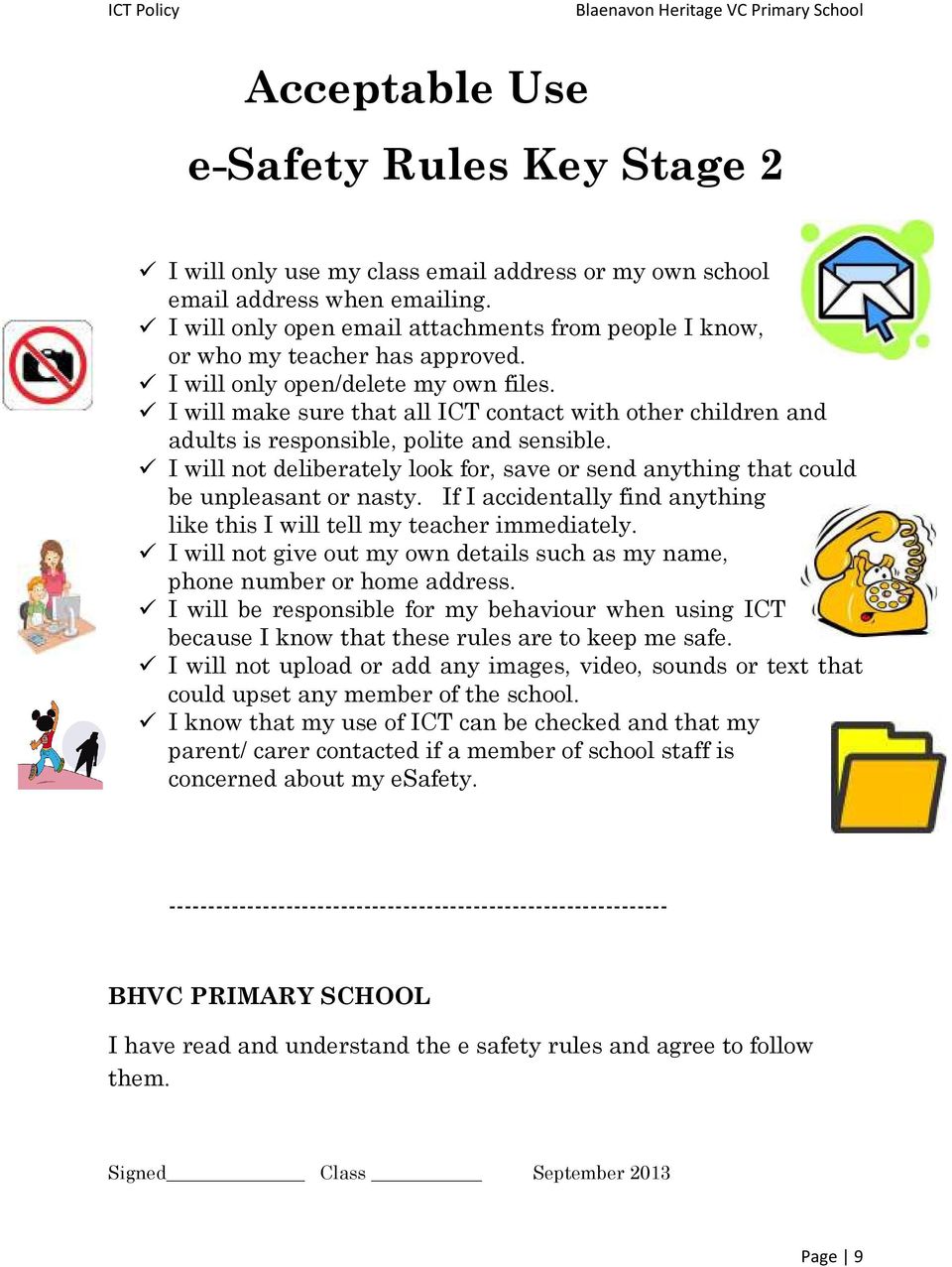
10 Acceptable Use e-safety Rules Key Stage 2 I will only use my class address or my own school address when ing. I will only open attachments from people I know, or who my teacher has approved. I will only open/delete my own files. I will make sure that all ICT contact with other children and adults is responsible, polite and sensible. I will not deliberately look for, save or send anything that could be unpleasant or nasty. If I accidentally find anything like this I will tell my teacher immediately. I will not give out my own details such as my name, phone number or home address. I will be responsible for my behaviour when using ICT because I know that these rules are to keep me safe. I will not upload or add any images, video, sounds or text that could upset any member of the school. I know that my use of ICT can be checked and that my parent/ carer contacted if a member of school staff is concerned about my esafety BHVC PRIMARY SCHOOL I have read and understand the e safety rules and agree to follow them. Signed Class September 2013 Page 9
11 e-safety Rules Foundation Phase Never give out your name, age, address or phone number. Never send photographs of yourself. Never agree to meet a stranger. Only open and delete your own files. Only send and open s with a teacher s help. Tell an adult if you see something you don t like BHVC PRIMARY SCHOOL I have read and understand the e safety rules and agree to follow them. Signed Class September 2013 Page 10

12 Appendix A Along with the computers the school has the following resources: Hardware Colour printers Digital cameras Flip Cam video recorders Calculators Data loggers Visualisers Interactive Whiteboards VTrons Laptop computers Microphones Beebots ipads ipods Dance Mat Fit Wall Software 2simple Software Packages, Easy Teach plus a range of software supplied and supported by the LEA CD-ROMs; Internet; Interactive Whiteboard software. Appendix B BHVC Primary School Website The BHVC Primary School website has been remodelled in 2013 to provide improved communication to parents and the wider community. The website is very important to the school, giving up-to-date information about the general running of the school, children s learning and achievements and providing educational support to pupils and parents. Through an ongoing arrangement with a third party the school is able to provide an attractive, up-to-date tool for the whole school community. The school is responsible for maintaining and ensuring the accuracy of all school related pages on the site, including regularly updating pupil s contributions to the site. Governor approval date: Next review date: Page 11
Llansanffraid Church in Wales Primary School. Information and Communication Technology (ICT) Policy
 Llansanffraid Church in Wales Primary School Information and Communication Technology (ICT) Policy ICT is changing the lives of everyone. Through teaching children the skills to use ICT we equip them to
Cheadle Primary School Computing and ICT Policy
 Introduction The use of information and communication technology is an integral part of the national curriculum and is a key skill for everyday life. computers, tablets, programmable robots, digital and
Information Technology Policy
 Information Technology Policy Introduction The Nature of ICT Information Technology is concerned with storing, processing and presenting information by electronic means. Pupils need to use ICT in schools
The Coppice Primary School Computing & ICT Policy
 The Coppice Primary School Computing & ICT Policy 1 School Vision: Happy, confident and successful learners that are well prepared for life 2 Purpose: 2.1 This policy reflects the school values and philosophy
EASTINGTON PRIMARY SCHOOL
 EASTINGTON PRIMARY SCHOOL ICT POLICY January 2011 Reviewed annually Reference: E safety policy, Safeguarding policy ICT POLICY Eastington Primary Mission Statement Eastington Primary School is a vibrant,
KINETON GREEN PRIMARY SCHOOL MATHEMATICS POLICY FEBRUARY 2015
 KINETON GREEN PRIMARY SCHOOL MATHEMATICS POLICY FEBRUARY 2015 Review Date: February 2018 Contents 1 Introduction... 2 2 The Aims of Mathematics... 2 3 Entitlement... 3 4 Implementation... 3 5 Organisation
St Michael s Primary School. ICT School Policy Data Protection and E Safety
 St Michael s Primary School ICT School Policy Data Protection and E Safety FGB 2013 St. Michael s C.E. Primary School Policy Information Communication Technology This policy document sets out St Michael's
ST. PATRICK'S CATHOLIC PRIMARY SCHOOL. Policy on Music
 ST. PATRICK'S CATHOLIC PRIMARY SCHOOL Policy on Music 1 Aims and objectives 1.1 Music is a unique way of communicating that can inspire and motivate children. It is a vehicle for personal expression, and
THE REDWAY SCHOOL. This policy was written in line with the whole school Learning and Teaching Policy and Target Setting Policy.
 THE REDWAY SCHOOL Policy: Assessment, Recording and Reporting Date of Policy: September 2009 Reviewed each September Date of Current Policy: September 2015 Member of staff responsible: Ruth Sylvester Introduction
4. The Importance of Internet Use in the Primary Curriculum
 Policy Contents 1. Introduction 2. Disability 3. Writing and Reviewing the e-safety Policy 4. The Importance of Internet Use in the Primary Curriculum 5. The Benefits of Using the Internet in Education
Maths Non-negotiables
 Maths Non-negotiables Arithmetic must be taught on a daily basis. Its focus should be developing mental strategies fluency. Times tables should be a key mental maths focus in year 3 4. The new curriculum
St Joseph s Catholic Primary School
 St Joseph s Catholic Primary School CRC Article 29(goals of education) Education must develop every child s personality, talents and abilities to the full. It must encourage the child s respect for human
MICKLEM PRIMARY SCHOOL MUSIC
 MICKLEM PRIMARY SCHOOL MUSIC Responsible Committee Curriculum Date Ratified April 2014 Next review April 2017 Signed on behalf of the Governing Body P Fuggle Print name Mr P Fuggle 1 INTRODUCTION Micklem
Mathematics Policy. Mathematics Policy
 Mathematics Policy 1. Aims 1.1 Mathematics teaches children to make sense of the world around them through developing their ability to calculate, reason and solve problems. It enables children to understand
Policy Document Planning, Assessment, Recording and Reporting September 2010
 Policy Document Planning, Assessment, Recording and Reporting September 2010 PLANNING, ASSESSMENT, RECORDING AND REPORTING POLICY 1 INTRODUCTION Planning, assessment, recording and reporting are an integral
St.Dennis CP School. Modern Foreign Languages (MFL) Policy February 2013
 St.Dennis CP School Modern Foreign Languages (MFL) Policy February 2013 Policy confirmed by the Governing Body of St Dennis CP School on: Date: Signature: To be reviewed on: 1 Rationale for Teaching Languages
How To Teach Maths At Maple Primary School
 1 MAPLE SCHOOL MATHS POLICY Updated June 2015 by Rachel de la Croix (Maths Co-ordinator) School Vision A high-quality mathematics education provides a foundation for understanding the world, the ability
Modern Foreign Languages (MFL)
 Modern Foreign Languages (MFL) Fordcombe C.E. Primary School Reviewed & Approved by the Full Governing Body: Jan 2013 Next Review due Jan 2016 Signed:. Name (print) Mrs Sarah Finch Position: Chair of Governors
Resource document for school governors and schools. Summary of Special Educational Needs (SEN) Code of Practice for Wales
 Resource document for school governors and schools Summary of Special Educational Needs (SEN) Code of Practice for Wales Teifion Rees SEN Governor Cwrt Sart Comprehensive School April 2004 1 Acknowledgements
Assessment, Recording and Reporting Policy
 St Peter s CE (VA) Infants School Assessment, Recording and Reporting Policy Philosophy Assessment is essential for the promotion of effective learning and teaching. It enables the teacher to deliver an
Assessment Policy. Date of next review: September 2016
 Assessment Policy 2015 Policy Review Details This policy will be reviewed by the governing body on an annual basis Date of Issue: September 2015 Governor Signature Date of next review: September 2016 Headteacher
Development / Monitoring / Review of this Policy. Schedule for Development / Monitoring / Review
 Blakeley Heath Primary School E-Safety Policy Development / Monitoring / Review of this Policy This e-safety policy has been developed by a working group made up of: Headteacher Coordinator Staff including
Assessment, Recording and Reporting Policy. Introduction
 Assessment, Recording and Reporting Policy Introduction Assessment is essential for the promotion of effective learning and teaching. It enables the teacher to deliver an appropriate curriculum and provides
St Bernadette s Catholic Primary School. E-Safety Policy
 St Bernadette s Catholic Primary School E-Safety Policy St Bernadette s Catholic Primary School - e-safety policy Our Vision St Bernadette s Catholic Primary School embrace the positive impact and educational
Roles and Responsibilities The following section outlines the e-safety roles and responsibilities of individuals and groups within Heath Farm School:
 Introduction This e-safety policy was approved by the School Senior Leadership Team: January2015 The implementation of this e-safety policy will be monitored by the: E-Safety Coordinator, Senior Leadership
Roseberry Primary and Nursery School. Maths Policy
 Roseberry Primary and Nursery School Maths Policy October 2015 Purpose The purpose of this policy is to ensure that all staff are able to implement the teaching of maths to a high standard in order for
MFL Policy 2014. Policy confirmed by the Governing Body of Our Lady Immaculate Roman Catholic Primary School on: Date: 23.9.14
 MFL Policy 2014 Policy confirmed by the Governing Body of Our Lady Immaculate Roman Catholic Primary School on: Date: 23.9.14 Signature: (Chair of Governors) To be reviewed on: Rationale for Teaching Languages
Modern Foreign Languages (MFL) Policy 2013
 Modern Foreign Languages (MFL) Policy 2013 Revised by: Head, staff & governors: Date: Dec 2013 Next Review: December 2016 or sooner if regulations / circumstances change 1 Rationale for Teaching Languages
ST. NICHOLAS SCHOOL PLANNING, ASSESSMENT, RECORDING, REPORTING AND CELEBRATION POLICY
 ST. NICHOLAS SCHOOL PLANNING, ASSESSMENT, RECORDING, REPORTING AND CELEBRATION POLICY INTRODUCTION This policy was drawn up by the Senior Management Team after full consultation with the staff, and using
Abbey College Cambridge
 S c h o o l r e p o r t Abbey College Cambridge 17 Station Road, Cambridge, CB1 2JB Inspection dates 28 30 January 2014 Overall effectiveness 1 Pupils achievement 1 Pupils behaviour and personal development
Mathematics Policy Bordesley Green Primary
 Aims Mathematics Policy Bordesley Green Primary The national curriculum and EYFS for mathematics aims to ensure that all pupils: Become fluent in the fundamentals of mathematics, including the varied and
King Charles C of E Primary School. Homework
 King Charles C of E Primary School Homework Agreed at Summer Term Meeting 2012 To be reviewed Summer Term 2014 Signed.. Chair of Governors Page 1 of 5 1 Introduction 1.1 Homework is anything children do
FREDERICK BREMER SCHOOL E SAFETY POLICY 2015-6. Date of Issue: June 2015 Ratified: For review:
 FREDERICK BREMER SCHOOL E SAFETY POLICY 2015-6 Date of Issue: June 2015 Ratified: For review: Index Contents Page Number Introduction 3 Aim of the policy 3 Roles and Responsibilities 4 Frederick Bremer
Health and wellbeing Principles and practice
 Health and wellbeing Principles and practice Curriculum for Excellence has an important role to play in promoting the health and wellbeing of children and young people and of all of those in the educational
ST. PETER S CHURCH OF ENGLAND (VOLUNTARY AIDED) PRIMARY SCHOOL SOUTH WEALD. Modern Foreign Language Policy
 ST. PETER S CHURCH OF ENGLAND (VOLUNTARY AIDED) PRIMARY SCHOOL SOUTH WEALD Modern Foreign Language Policy January 2013 ST PETER S MODERN FOREIGN LANGUAGE (MFL) POLICY RATIONALE In the knowledge society
Mathematics. Introduction
 Mathematics Introduction Numeracy is a core subject within the National Curriculum. This policy outlines the purpose, nature and management of the mathematics taught and learned in our school. Mathematics
Sneyd Green Primary School Mathematics Policy Together we make a difference.
 Sneyd Green Primary School Mathematics Policy Together we make a difference. Leader name - Mr J.Hyder Date 04/12/14 Aims and objectives Mathematics teaches us how to make sense of the world around us through
Social Networking Policy
 Feltonfleet School Social Networking Policy Introduction Objectives This policy sets out Feltonfleet School s policy on social networking. New technologies are an integral part of our lives and are powerful
GREAT WALTHAM C of E PRIMARY SCHOOL
 GREAT WALTHAM C of E PRIMARY SCHOOL CHILD PROTECTION POLICY JULY 2015 Approved by Staff July 2015 Adopted by Governors of the FGB Committee July 2015 Recommended Review Date July 2016 1 KEY CONTACTS WITHIN
The Priory School. THE PRIORY SCHOOL A Specialist Sports College Tintagel Road, Orpington Kent BR5 4LG
 The Priory School Headteachers: Chief Executive Officer: Ms Gill Lamb MA Mr Nick Ware MA Mr Neil Miller BA The Priory Academy Trust Tintagel Road Orpington Kent BR5 4LG Email: [email protected]
Acceptable Use of ICT Policy. Staff Policy
 Acceptable Use of ICT Policy Staff Policy Contents INTRODUCTION 3 1. ACCESS 3 2. E-SAFETY 4 3. COMPUTER SECURITY 4 4. INAPPROPRIATE BEHAVIOUR 5 5. MONITORING 6 6. BEST PRACTICE 6 7. DATA PROTECTION 7 8.
Policy statement: Assessment, recording and reporting achievement.
 Policy statement: Assessment, recording and reporting achievement. In partnership with the home and the local community, the school has a responsibility to fulfil the demands of the national curriculum
Prettygate Junior School. Assessment, Recording and Reporting Policy. Date: Summer 2015 Review: Summer 2018
 Prettygate Junior School Assessment, Recording and Reporting Policy Date: Summer 2015 Review: Summer 2018 Vision Ensuring a safe, welcoming environment where everyone is valued Providing experiences to
Much Birch Primary School
 Much Birch Primary School Co-ordinator : Linda Willimont Updated November 2013 Next review date September 2015 1 2 Mathematics Policy Person Responsible:- Mrs Willimont Date Policy discussed and agreed
Simon Langton Grammar School for Boys E-Safety Policy
 Background to the Policy Simon Langton Grammar School for Boys E-Safety Policy The E Safety Policy and its implementation will be reviewed annually. Our E Safety Policy has been written by the school,
Archbishop Beck Catholic Sports College
 Archbishop Beck Catholic Sports College E Safety Policy Ratified: May 2014 Ratified by: Governors Staffing Committee Review: May 2017-1 - - 2 - 1. Development/Monitoring/Review of this Policy This e-safety
Vernon Park Primary School. Teaching and Learning Policy
 Vernon Park Primary School Teaching and Learning Policy The school s approach to teaching and learning is based upon the school vision: At Vernon Park Primary School we aim to provide all children, parents,
Higher level teaching assistant. Professional standards for higher level teaching assistants
 Higher level teaching assistant Professional standards for higher level teaching assistants Foreword Schools are changing. Headteachers and teachers know that the school workforce needs to be able to
Salary The postholder will be paid on the appropriate point of the pay scale with the addition of the TLR 2B.
 JOB DESCRIPTION ASSISTANT CURRICULUM LEADER FOR SCIENCE (TLR 2B) Salary The postholder will be paid on the appropriate point of the pay scale with the addition of the TLR 2B. Line of Responsibility The
Key Stage 3 National Strategy
 Key Stage 3 National Strategy Guidance Curriculum, Examination & Assessment Framework for teaching ICT capability: Years 7, 8 and 9 Management summary Headteachers, governors & heads of ICT departments
Senior Leadership Team and Class Teacher Job Description & Person Specification
 Senior Leadership Team and Class Teacher Job Description & Person Specification SCHOOL Queen Eleanor s C of E Junior School TITLE Senior Leadership Team & Class Teacher JOB PURPOSE As part of the Leadership
In LIFE SKILLS it is intended to promote learning through the following aims :
 Subject Policy for: LIFE SKILLS In LIFE SKILLS it is intended to promote learning through the following aims : PROVIDING OPPORTUNITES FOR PUPILS WHICH ARE TAILORED TO THEIR NEEDS PROVIDING PUPILS WITH
CITY OF YORK SAFEGUARDING CHILDREN BOARD GUIDANCE. The use of photographic images of children in schools
 CITY OF YORK SAFEGUARDING CHILDREN BOARD GUIDANCE The use of photographic images of children in schools Published 2004 Revised October 2013 Using Images of Children: photographs, videos, websites and webcams
Giffards Primary School
 Giffards Primary School Learning Environment and Display Policy Agreed by Governors April 2011 Next Review Date April 2014 1 Giffards primary School Learning Environment and Display Policy This policy
John of Rolleston Primary School
 John of Rolleston Primary School E-Safety Policy February 2014 Contents 1 Introduction... 2 2 Aims... 2 3 Roles and Responsibilities... 2 3.1 Governors... 2 3.2 The Headteacher... 2 3.3 The Senior Leadership
The Role of the Science Subject Leader. The role of the subject leader is crucial if schools are to raise standards and
 The Role of the Science Subject Leader The role of the subject leader is crucial if schools are to raise standards and support teachers and children. The pack contains details and information to help subject
BEAUFORT and LANGLEY SCHOOL ASSESSMENT RECORDING AND REPORTING
 BEAUFORT and LANGLEY SCHOOL ASSESSMENT RECORDING AND REPORTING Policy date: January 2013 Review date: November 2016 ASSESSMENT RECORDING AND REPORTING Assessment is about measuring achievement and attainment,
Related Policies & Documents. Reference Material. 1. Introduction. 2. Roles & Responsibilities
 Category Security Document Name e-safety Procedures Accountable Body Brantridge School Governing Body Reference SY.P2.02 Date Ratified Version 2.1 Last Update March 2015 Related Policies & Documents Document
GRANGE TECHNOLOGY COLLEGE ANTI-BULLYING POLICY
 GRANGE TECHNOLOGY COLLEGE ANTI-BULLYING POLICY Approved: 4 September 2014 Review Date: Page 1 of 7 GRANGE TECHNOLOGY COLLEGE ANTI-BULLYING POLICY Introduction Schools have a duty of care for pupils and
Greenleaf Primary School Inspection report
 Greenleaf Primary School Inspection report Unique Reference Number Local Authority Inspection number Inspection dates Reporting inspector 03054 Waltham Forest 308204 78 November 2007 Andrew Matthews This
Mathematics Policy. Michael Sobell Sinai School
 Mathematics Policy 2014 Mathematics Policy Section 1: Introduction Mathematics is a creative and highly inter-connected discipline that has been developed over centuries, providing the solution to some
ESSEX PRIMARY SCHOOL INFORMATION AND COMMUNICATION TECHNOLOGY (ICT) POLICY
 ESSEX PRIMARY SCHOOL INFORMATION AND COMMUNICATION TECHNOLOGY (ICT) POLICY Reviewed June 2013 Next Review due June 2016 INFORMATION and COMMUNICATION TECHNOLOGY (ICT) Aims ICT is an integral part of our
Hurworth School Assessment, Recording and Reporting Policy
 Hurworth School Assessment, Recording and Reporting Policy Accepted by: Board of Directors May 2010 Leadership Team Lead Reviewer: Assistant Head Teacher (Raising Achievement) Review Cycle: 2 Years Last
Ryburn Valley High School
 Ryburn Valley High School Assessment, Recording & Reporting Policy Date of Issue: February 2015 Strive to Excel Page 1 Contents Page Introduction Rationale 3 Aims and Objectives 3 Definitions 4 Development
BYOD program at St Julian s School
 BYOD program at St Julian s School Introduction St Julian s school currently runs a Bring Your Own Device (BYOD) program for all students in Years 10-13. This program requires that all students must bring
THE QUEEN S SCHOOL Assessment Policy
 The Queen s Church of England Primary School Encouraging every child to reach their full potential, nurtured and supported in a Christian community which lives by the values of Love, Compassion and Respect.
Information and communication technology (ICT) skills audit for returning teachers
 Information and communication technology (ICT) skills audit for returning teachers Please rate your ICT skills using the following values: 1 I have no knowledge at all of this area of ICT 2 I have a small
HAYDON BRIDGE HIGH SCHOOL ASSESSMENT, RECORDING & REPORTING POLICY
 HAYDON BRIDGE HIGH SCHOOL ASSESSMENT, RECORDING & REPORTING POLICY Haydon Bridge High School is committed to being a fully accessible and inclusive organisation, welcoming and respecting the diversity
Additional Educational Needs and Inclusion Policy and Procedures
 Additional Educational Needs and Inclusion Policy and Procedures Date of issue: February 2013 Review date: February 2014 This policy was discussed, agreed and formally accepted on 5 February 2013 by the
Generic grade descriptors and supplementary subjectspecific guidance for inspectors on making judgements during visits to schools
 Religious education Generic grade descriptors and supplementary subjectspecific guidance for inspectors on making judgements during visits to schools Inspectors visit 150 schools each year to inform Ofsted
Brookburn Primary School. Policy for Music
 Brookburn Primary School Policy for Music POLICY FOR MUSIC Document Purpose This document reflects the values and philosophy of Brookburn Primary School in relation to the teaching and learning of Music.
E- Safety and Digital Photography - College ICT
 Penrice Academy E-SAFETY POLICY Adopted by the Governing Body on June 2013 Review date: June 2015 Scope of the Policy This policy applies to all members of the College community (including staff, students,
Witton Middle School
 Witton Middle School e-safety Policy This e-safety Policy has been put together using guidance from the Worcestershire Local Authority (LA) and is based on the guidance provided by Becta. Our Vision Witton
Teacher Notes Introduction
 Teacher Notes Introduction Why ICT 4 Life? Wouldn t it be great to have classes of enthusiastic, ICT-capable learners, performing and progressing well? Of course, we see fantastic examples of good practice
Acceptable Use of ICT Policy. Learner School Policy
 Acceptable Use of ICT Policy Learner School Policy Contents INTRODUCTION 3 1. ACCESS 3 2. E-SAFETY 3 3. COMPUTER SECURITY 4 4. INAPPROPRIATE BEHAVIOUR 4 5. MONITORING 5 6. SOCIAL NETWORKING 5 7. LEGAL
ROLES AND RESPONSIBILITIES The roles and responsibilities expected of teachers at each classification level are specified in the Victorian Government
 ROLES AND RESPONSIBILITIES The roles and responsibilities expected of teachers at each classification level are specified in the Victorian Government Schools Agreement 2004: Leading teacher Leading teachers
JOB DESCRIPTION FOR EARLY YEARS FOUNDATION STAGE CO-ORDINATOR Postholder: Post Title: PRIMARY TEACHER + TLR 2.1 Grade: MPS + TLR 2.
 JOB DESCRIPTION FOR EARLY YEARS FOUNDATION STAGE CO-ORDINATOR Postholder: Post Title: PRIMARY TEACHER + TLR 2.1 Grade: MPS + TLR 2.1 School: HUGH MYDDELTON PRIMARY Department: EDUCATION This job description
Damers First School Teaching & Learning Policy
 Damers First School Teaching & Learning Policy DAMERS FIRST SCHOOL HAPPY CHILDREN & HIGH QUALITY OHANA! In our family NO ONE GETS LEFT BEHIND Because we believe CHILDREN ARE OUR FUTURE. TEACH THEM WELL
360 Degree Safe Cymru SELF REVIEW TOOL
 360 Degree Safe Cymru SELF REVIEW TOOL UPDATED OCTOBER 2014 The South West Grid for Learning Trust, Belvedere House, Woodwater Park, Pynes Hill, Exeter, EX2 5WS. Tel: 0845 601 3203 Email: [email protected]
Job Title: Lead Practitioner Science KS4. Position Overview
 Job Title: Lead Practitioner Science KS4 Salary: L3 L7 Position Overview Responsible to: Director of Science. Teacher of Science Key purposes: a) To carry out the professional duties of a teacher as described
Halfway Houses Primary School
 School report Halfway Houses Primary School Southdown Road, Sheerness, Kent, ME12 3BE Inspection dates 30 April 1 May 2013 Overall effectiveness Previous inspection: Satisfactory 3 This inspection: Requires
Literacy across learning Principles and practice
 Literacy across learning Principles and practice Language and literacy are of personal, social and economic importance. Our ability to use language lies at the centre of the development and expression
ARK Oval Primary Academy
 ARK Oval Primary Academy 98 Cherry Orchard Road, Croydon CR0 6BA Inspection dates 5 6 December 2012 Overall effectiveness Previous inspection: Not previously inspected This inspection: Good 2 Achievement
TUNBRIDGE WELLS GIRLS GRAMMAR SCHOOL Adopted: March 2015 Review: March 2016
 TUNBRIDGE WELLS GIRLS GRAMMAR SCHOOL Adopted: March 2015 Review: March 2016 SPECIAL EDUCATIONAL NEEDS AND DISABILITY (SEND) POLICY RATIONALE This policy document is a statement of the aims, principles
PEDMORE TECHNOLOGY COLLEGE & COMMUNITY SCHOOL
 PEDMORE TECHNOLOGY COLLEGE & COMMUNITY SCHOOL ASSESSMENT, RECORDING, REPORTING, MARKING & TARGET SETTING POLICY July 2006 Updated October 2008 Reviewed January 2009 Updated May 2010 Updated September 2010
TEACHING AND LEARNING STRATEGY
 Seevic College TEACHING AND LEARNING STRATEGY Key values Respect Responsibility Results February 2013 Version 1.2 - February 2013 Page 1 1.0 INTRODUCTION At Seevic College every student matters. To achieve
JOB DESCRIPTION. Head of Learning and Standards. Salary grade: Management Scale 2 + 1
 JOB DESCRIPTION Job Title: Responsible to: Head of Learning and Standards Director of Faculty Salary grade: Management Scale 2 + 1 Hours per week: 21.6 hours per week Main Purpose of the Role 1. To manage
Skills across the curriculum. Developing communication
 across the curriculum Developing communication Developing communication Schools should provide opportunities, where appropriate, for learners to develop and apply communication across the curriculum through
Pentrepoeth Primary School
 Pentrepoeth Primary School A.R.R. Policy Assessment, Recording and Reporting School Copy Assessment, Recording and Reporting Introduction This policy document is a statement of the aims, principles and
St Vincent s Catholic Primary School e-safety Policy
 St Vincent s Catholic Primary School e-safety Policy Policy e-safety Policy Date January 2015 Date of review January 2016 Signed Chair of Governors Signed Headteacher Effective Practice in e-safety E-safety
Woolgrove School. Early Years Foundation Stage Policy.
 Equal opportunities lie at the heart of all that we do at Woolgrove. We are committed to ensuring that every member of the school community, whatever their position, race, gender, disability or religion
Churnet View Middle School Displays
 Churnet View Middle School Displays Following meetings where the importance of visual learning has been discussed we have, as an English department, made a conscious effort to use more interesting, interactive
Hillpark Secondary School
 Hillpark Secondary School Contents 1 Rationale 2 Aims of Policy (Definition of ICT) 3 Purposes of ICT at Hillpark 4 Role of staff: Uses of ICT in Hillpark Skills development for staff Role of Principal