
Since its introduction almost 20
|
|
|
- Cleopatra Goodwin
- 9 years ago
- Views:
Transcription
1 Guidelines for safe negative-pressure wound therapy Rule of thumb: Assess twice, dress once By Ron Rock MSN, RN, ACNS-BC Since its introduction almost 20 years ago, negative-pressure wound therapy (NPWT) has become a leading technology in the care and management of acute, chronic, dehisced, traumatic wounds; pressure ulcers; diabetic ulcers; orthopedic trauma; skin flaps; and grafts. NPWT applies controlled suction to a wound using a suction pump that delivers intermittent, continuous, or variable negative pressure evenly through a wound filler (foam or gauze). Drainage tubing adheres to an occlusive transparent dressing; drainage is removed through the tubing into a collection canister. NWPT increases local vascularity and oxygenation of the wound bed and reduces edema by removing wound fluid, exudate, and bacteria. Every day, countless healthcare providers apply NPWT devices during patient care. More than 25 FDA Class II approved NPWT devices are available commercially. If used safely in conjunction with a comprehensive wound treatment program, NPWT supports wound healing. But improper use may cause harm to patients. (See Risk factors and contraindications for NPWT.) Lawsuits involving NPWT are increasing. The chance of error rises when inexperienced caregivers use NPWT. Simply applying an NPWT dressing without critically thinking your way through the process or understanding contraindications for and potential complications of NPWT may put your patients at risk and increase your exposure to litigation. Proper patient selection, appropriate dressing material, correct device settings, frequent patient monitoring, and closely managed care help minimize risks. So before you flip the switch to initiate NPWT, read on to learn how you can use NPWT safely. Understand the equipment and its use Consult your facility s NPWT protocols, policies, and procedures. If your facility lacks these, consult the device manufacturer s guidelines and review NPWT indications, contraindications, and how to recognize and manage potential complications. Ideally, facilities should establish training programs to evaluate clinicians Wound Care Advisor March/April 2014 Volume 3, Number

2 Risk factors and contraindications for NPWT Since 2007, the Food and Drug Administration (FDA) has received 12 reports of death and 174 reports of injury related directly to negative-pressure wound therapy (NPWT). The deaths occurred in patients homes and long-term care facilities. The most serious complications were bleeding and infection. Patients taking anticoagulants and those who had vascular grafts or infected wounds were most at risk. In 32 of the injuries, dressings had adhered to tissue and foam was embedded or retained in the wound; most of these patients had to be readmitted for surgical removal of foam, management of dehisced wounds, and antibiotic therapy. Infection from the original wound or retained foam was reported in 27 additional injury cases. These reports compelled the FDA in 2011 to recommend that clinicians use extreme care when prescribing NPWT. The agency stressed that clinicians should know that NPWT is contraindicated for specific wound types and should thoroughly consider all patient risk factors before prescribing it. Once NPWT has been applied, clinicians must assess and monitor the patient in an appropriate setting. Monitoring frequency depends on the patient s condition, wound status, wound location, and comorbidities. Most importantly, clinicians must be vigilant in checking for potentially life-threatening complications and be prepared to respond appropriately. The Pennsylvania Patient Safety Authority reported 419 adverse events linked to NPWT between January 2008 and December Assessment and monitoring deficiencies accounted for nearly half; delayed or incorrect dressing application accounted for another 21%. Contraindications Contraindications for NPWT include: inadequately debrided wounds necrotic tissue with eschar untreated osteomyelitis cancer in the wound untreated coagulopathy nonenteric and unexplored fistulas exposed vital organs. Patient risk factors Factors that increase the risk of harm from NPWT include: increased risk for bleeding and hemorrhage anticoagulant or platelet aggregation inhibitor therapy friable or infected blood vessels spinal cord injury enteric fistulas. View: FDA information on NPWT adverse events skills. Enhanced training should include comprehension of training materials, troubleshooting, and correct operation of the device, as shown by return demonstration of the specific NPWT device used in the facility. Assess the patient thoroughly The prescribing provider is responsible for ensuring patients are assessed thoroughly to confirm they re appropriate NPWT candidates. Aspects to consider include comorbidities, contraindicated wound types, high-risk conditions, bleeding disorders, nutritional status, medications that prolong bleeding, and relevant laboratory values. The pain management plan also should be evaluated and addressed. Assess the order Before NPWT begins, make sure you have a proper written order. The order should specify: wound filling material (foam or gauze dressing and any wound adjunct, such as a protective nonadherent, petrolatum, or silver dressing) negative pressure setting (from -20 to -200 mm Hg) therapy setting (continuous, intermittent, or variable) frequency of dressing changes. Follow all parts of the order as prescribed. Otherwise, you may be held responsible if a complication arises for example, if you apply a nonadherent 30 March/April 2014 Volume 3, Number 2 Wound Care Advisor

3 Assessing with DIM To assess your patient s wound, use the acronym DIM Debridement, Infection and Inflammation control, and Moisture balance. Debridement. This procedure reestablishes a viable wound base with a functional extracellular matrix. Necrotic or devitalized tissue harbors bacteria and cells, which impede wound healing. It also prevents NPWT from being distributed equally across the wound bed, which reduces NPWT efficacy and prevents effective exudate removal. In wound beds with more than 20% nonviable tissue consider debridement (surgical, mechanical, enzymatic, chemical, or autolytic) before initial NPWT application. The debridement method will vary depending on the patient s condition. Infection and inflammation control. Infection and inflammation delay wound healing. Antimicrobial (silver) dressings are effective in localized infections and inflamed wounds due to their anti-inflammatory effects. Wound debridement also reduces bacterial burden, including biofilm. NPWT then can remove surface wound fluid containing contaminants. Moisture balance. Moisture balance allows cells within the wound to function effectively. If the wound is too moist, wound edges may become macerated, turning white. On the other hand, too little moisture may inhibit cellular growth and promote eschar formation. NPWT helps preserve a moist environment and reduces edema, contributing to improved tissue perfusion. Incremental increases or decreases in negative pressure may be needed to ensure a moist wound environment. dressing when none is ordered and this dressing becomes retained, requiring surgery for removal; or if you set a default pressure when none is ordered and the patient suffers severe bleeding or fistula formation as a result. Assess the wound If you know what your patient s wound needs, you can take proactive measures. What is the wound telling you? With adept assessment, you can become a wound whisperer a clinician who understands wound-healing dynamics and can interpret what the wound is saying. This allows you to see the wound as a whole rather than just maintaining it as a hole. If the wound tells you it s too wet, take steps to absorb fluid or consider increasing negative pressure, as ordered. If it s telling you it s dry, consider decreasing negative pressure, as ordered. If the wound bed remains dry, you might want to take a NPWT time out. Apply a moisture dressing for several days and assess the patient s hydration status before restarting NPWT. If the wound says it s moist, maintain the negative pressure. If it tells you it s infected, treat the infection. If it tells you it s dirty, debride it. If it says it s malnourished, feed it. The DIM approach To establish a baseline evaluation, develop a systematic approach for assessing the wound before NPWT. This will help optimize wound-bed preparation, enhance NPWT efficacy, and prevent delayed wound healing. (See Assessing with DIM.) Take a time-out Before you apply the NPWT dressing, be a STAR Stop, Think, Act, and Review your action. This time-out allows you to critically think your way through the application process and consider potential consequences of your actions. Ongoing patient assessment and monitoring Follow these guidelines to help ensure safe and effective NPWT: Wound Care Advisor March/April 2014 Volume 3, Number

4 Follow the device manufacturer s instructions and your facility s NPWT protocol, policy, and procedures. Identify and eliminate factors that can impede wound healing (poor nutritional status, limited oxygen supply, poor circulation, diabetes, smoking, obesity, foreign bodies, infection, and low blood counts). Evaluate the patient s nutritional status to ensure protein stores are adequate for healing. Assess and manage the patient s pain accordingly. Protect the periwound from direct contact with foam or gauze. Prevent stretching or pulling of the transparent drape to secure the seal and avoid shear trauma to surrounding tissue. Don t overpack the wound too tightly with foam. Compressing the foam prevents negative pressure from reaching the wound bed. Prevent stripping of fragile skin by minimizing shear forces from repetitive or forceful removal of transparent drapes. Use protective barriers, such as multiple layers of nonadherent or petrolatum gauze, to protect sutured blood vessels or organs near areas being treated with NPWT. Don t overpack the wound too tightly with foam. Compressing the foam prevents negative pressure from reaching the wound bed, causing exudate to accumulate. Position drainage tubing to avoid bony prominences, skinfolds, creases, and weight-bearing surfaces. Otherwise, a drainage tubing related pressure wound may develop. Bridge posterior wounds to the lateral or anterior surface to minimize drainage tubing related pressure wounds to the surrounding tissue. Count and document all pieces of foam, gauze, or adjunctive materials on the outer dressing and in the medical record, to help prevent retention of materials in the wound. Ensure the foam is collapsed and the NPWT device is maintaining the prescribed therapy and pressure at the time of initial patient assessment and when rounding. Address and resolve alarm issues. If you can t resolve these issues and the device needs to be turned off, don t let it stay off more than 2 hours. While the device is off, apply a moist-to-dry dressing. With a heavily colonized or infected wound, consider changing the dressing every 12 to 24 hours. Monitor the patient frequently for signs and symptoms of complications. Evaluate patient comprehension of teaching A proactive approach to education can ease the patient s anxiety about NPWT. Unfamiliar sounds and alarms may heighten anxiety and cause unwarranted concerns, so inform patients in advance that the device may make noise and cause some discomfort. An educated and empowered patient can participate actively in treatment. Improved communication may enhance outcomes and help identify errors in technique before they cause complications. Be prepared to answer patients questions, which may include: Am I using the device correctly? How long will I have to use it? 32 March/April 2014 Volume 3, Number 2 Wound Care Advisor

5 What serious complications could occur? What should I do if a complication occurs? Whom should I contact? How do I recognize bleeding? How do I recognize a serious infection? How do I tell if the wound s condition is worsening? Do I need to stop taking aspirin or other medicines that affect my bleeding system or platelet function? What are the possible risks of stopping or avoiding these medicines? Can you give me written patient instructions or tell me where I can find them? View: Patient Education Be a STAR To avoid patient harm and potential litigation, be a STAR and a wound whisperer. If you re in doubt about potential complications of NPWT or how to assess and monitor patients, stop the therapy and seek expert guidance. Listen to the wound and assess your patient. This may take a little time, but remember monitoring NPWT, the wound, and the patient is an ongoing process. You can t rush it. Sometimes, to go fast, you need to go slowly. Access more information about NPWT. Selected references Agency for Healthcare Research and Quality. Technology Assessment: Negative Pressure Wound Therapy Devices. Original: May 26, 2009; corrected November 12, Available online at: research/findings/ta/negative-pressure-woundtherapy/negative-pressure-wound-therapy.pdf. Daeschlein G. Antimicrobial and antiseptic strategies in wound management. Int Wound J. 2013; 10(Suppl 1):9-14. Food and Drug Administration. Guidance for Industry and FDA Staff Class II Special Controls Guidance Document: Non-powered Suction Apparatus Device Intended for Negative Pressure Wound n Therapy. November 10, Available at: Guidance/GuidanceDocuments/ucm htm. Food and Drug Administration. FDA Preliminary Public Health Notification: Serious Complications Associated with Negative Pressure Wound Therapy Systems. November 13, Available at: PublicHealthNotifications/ucm htm. Accessed January 30, FDA Safety Communication: UPDATE on Serious Complications Associated with Negative Pressure Wound Therapy Systems. February 24, Available at: / AlertsandNotices/ucm htm. Accessed January 30, Fife CE, Yankowsky KW, Ayello EA, et al. Legal issues in the care of pressure ulcer patients: key concepts for healthcare providers a consensus paper from the International Expert Wound Care Advisory Panel. Adv Skin Wound Care. 2010;23(11): Improving the Safety of Negative-Pressure Wound Therapy. Pa Patient Saf Advis. 2011;8(1): Available at: ADVISORIES/AdvisoryLibrary/2011/mar8(1)/Pages/ 18.aspx. Accessed January 29, Krasner D. Why is litigation related to negative pressure wound therapy (NPWT) on the rise? Wound Source. Posted November 11, Available at: Lansdown AB. A pharmacological and toxicological profile of silver as an antimicrobial agent in medical devices. Adv Pharmacol Sci. 2010; Article ID Available at: journals/aps/2010/910686/ Lipsky BA, Hoey C. Topical antimicrobial therapy for treating chronic wounds. Clin Infect Dis. 2009; 49(10): Sibbald RG, Goodman L, Woo KY, et al. Special considerations in wound bed preparation 2011: An update. Adv Skin Wound Care. 2011;24(9): Sibbald RG, Woo KY, Ayello EA. Clinical Practice Report Card: A Survey of Wound Care Practices in the U.S.A. Ostomy Wound Manage. April 2009 Suppl: Ron Rock is the nurse manager and clinical nurse specialist for the WOC nursing team in the Digestive Disease Institute of the Cleveland Clinic in Cleveland, Ohio. Wound Care Advisor March/April 2014 Volume 3, Number

Wound Care: The Basics
 Wound Care: The Basics Suzann Williams-Rosenthal, RN, MSN, WOC, GNP Norma Branham, RN, MSN, WOC, GNP University of Virginia May, 2010 What Type of Wound is it? How long has it been there? Acute-generally
Standard Operating Procedure Template
 Standard Operating Procedure Template Title of Standard Operation Procedure: Topical Negative Pressure (TNP) Reference Number: Version No: 1 Issue Date: May 2012 Review Date: August 2015 Purpose and Background
Vacuum-assisted closure (VAC) is a noninvasive, active, closed
 P r o c e d u r e s P r o W O U N D C R E / S U R G E R y Peer Reviewed THE ESSENTIL WOUND CRE SERIES Vacuum-ssisted Wound Closure This is the third installment of The Essential Wound Care Series, which
Policies & Procedures. Title: I.D. Number: 1160
 Policies & Procedures Title: NEGATIVE PRESSURE WOUND THERAPY (NPWT) I.D. Number: 1160 Authorization: [X] SHR Nursing Practice Committee Source: Nursing Date Revised: March, 2010 Date Effective: November,
Cutimed PROTECT Medical skin protection. Protect Preserve Prevent
 PROTECT Medical skin protection Protect Preserve Prevent PROTECT Ordering information PROTECT is available in foam applicators and spray bottle PROTECT REF No. Size Unit of Measure HCPCS Spray 7265300
Improving the Safety of Negative-Pressure Wound Therapy
 REVIEWS & ANALYSES Improving the Safety of Negative-Pressure Wound Therapy ABSTRACT Negative-pressure wound therapy (NPWT) is a noninvasive therapy that uses negative pressure to treat acute and chronic
Managing cavity wounds Journal of Community Nursing March 1998 Author: Rosemary Pudner
 Managing cavity wounds Journal of Community Nursing March 1998 Author: Rosemary Pudner It has been seen in recent years, that an increasing number of patients are being discharged early into the community,
Introduction. What does PICO do? How does PICO work?
 Patient Information Introduction This patient handbook will provide you with important information while you are receiving negative pressure wound therapy (NPWT) from Smith & Nephew s PICO system. The
TAKING CARE OF WOUNDS KEY FIGURE:
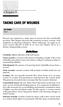 Chapter 9 TAKING CARE OF WOUNDS KEY FIGURE: Gauze Wound care represents a major area of concern for the rural health provider. This chapter discusses the treatment of open wounds, with emphasis on dressing
Negative Pressure Wound Therapy (VAC Therapy) Guidelines
 Negative Pressure Wound Therapy (VAC Therapy) Guidelines This is a living document and will be updated as required March 2013 Negative Pressure Wound Therapy Negative Pressure Wound Therapy (NPWT), also
Summary of Recommendations
 Summary of Recommendations *LEVEL OF EVIDENCE Practice Recommendations Assessment 1.1 Conduct a history and focused physical assessment. IV 1.2 Conduct a psychosocial assessment to determine the client
Wound Classification Name That Wound Sheridan, WY June 8 th 2013
 Initial Wound Care Consult Sheridan, WY June 8 th, 2013 History Physical Examination Detailed examination of the wound Photographs Cultures Procedures TCOM ABI Debridement Management Decisions A Detailed
COMPLIANCE WITH THIS DOCUMENT IS MANDATORY
 COVER SHEET NAME OF DOCUMENT TYPE OF DOCUMENT Policy DOCUMENT NUMBER DATE OF PUBLICATION August 2011 RISK RATING Medium Risk LEVEL OF EVIDENCE REVIEW DATE August 2014 FORMER REFERENCE(S) EXECUTIVE SPONSOR
Pressure Ulcers Risk Management and Treatment
 Pressure Ulcers Risk Management and Treatment Objectives State reasons why individuals initiate lawsuits. Define strategies to reduce the risk of litigation. Determine appropriate treatment for the patient.
PROCEDURE FOR THE APPLICATION OF GAUZE BASED NEGATIVE PRESSURE WOUND THERAPY (NPWT)
 PROCEDURE FOR THE APPLICATION OF GAUZE BASED NEGATIVE PRESSURE WOUND THERAPY (NPWT) First Issued Feb 2010 Issue Version Two Purpose of Issue/Description of Change To promote safe and effective care when
COMPLIANCE WITH THIS DOCUMENT IS MANDATORY
 COVER SHEET NAME OF DOCUMENT Wound Wound Assessment and Management TYPE OF DOCUMENT Procedure DOCUMENT NUMBER SESLHDPR/297 DATE OF PUBLICATION April 2014 RISK RATING Medium LEVEL OF EVIDENCE N/A REVIEW
CLINICAL GUIDELINES A REFERENCE SOURCE FOR CLINICIANS
 CLINICAL GUIDELINES A REFERENCE SOURCE FOR CLINICIANS This copy supercedes any previous revision. For revision level and contact information, refer to back cover of these guidelines. These guidelines
Introduction to Wound Management
 EWMA Educational Development Programme Curriculum Development Project Education Module: Introduction to Wound Management Latest revision: October 2012 ABOUT THE EWMA EDUCATIONAL DEVELOPMENT PROGRAMME The
Wound and Skin Assessment. Mary Carvalho RN, BSN, MBA Clinical Coordinator Johnson Creek Wound and Edema Center
 Wound and Skin Assessment Mary Carvalho RN, BSN, MBA Clinical Coordinator Johnson Creek Wound and Edema Center Skin The largest Organ Weighs between 6 and 8 pounds Covers over 20 square feet Thickness
NEGATIVE PRESSURE WOUND THERAPY
 DISCLAIMER: These guidelines were prepared jointly by the Surgical Critical Care and Medical Critical Care Services at Orlando Regional Medical Center. They are intended to serve as a general statement
What dressing for what wound. Prudence Lennox National Clinical Leader Healthcare Rehabilitation Ltd
 What dressing for what wound Prudence Lennox National Clinical Leader Healthcare Rehabilitation Ltd Wound assessment Accurate wound assessment is a prerequisite to planning appropriate care & should adopt
THERAPEUTIC USE OF HEAT AND COLD
 THERAPEUTIC USE OF HEAT AND COLD INTRODUCTION Heat and cold are simple and very effective therapeutic tools. They can be used locally or over the whole body, and the proper application of heat and cold
Silicone pressure-reducing pads for the prevention and treatment of pressure ulcers
 S46 Product focus Silicone pressure-reducing pads for the prevention and treatment of pressure ulcers Abstract Pressure ulcers, a key quality of care indicator, cause emotional distress to the patient,
Vacuum-Assisted Wound Closure ISSN: 0002-936X American Journal of Nursing
 Vacuum-Assisted Wound Closure ISSN: 0002-936X American Journal of Nursing Author(s): Chua Patel, Christy T. MS, RN; Kinsey, Gail C. MS, RN, CNS; Koperski-Moen, Kelley J. ADN, RN; Bungum, Lisa D. BSN, RN
History of Negative Pressure Wound Therapy (NPWT) NPWT Applicable to Multiple Types of Wound
 History of Negative Pressure Wound Therapy (NPWT) Cheng Siu Wah Winnie, NC Stoma & Wound Care Unit Department of Surgery, QEH Starting in the 1970s numerous articles appeared in the Russian literature
CHAPTER V CONCLUSION AND RECOMMENDATIONS. findings are presented, implications for nursing practice and education are discussed,
 CHAPTER V CONCLUSION AND RECOMMENDATIONS In this chapter, a summary of the findings and conclusion drawn from the findings are presented, implications for nursing practice and education are discussed,
CCME CNE Course Announcement
 CCME CNE Course Announcement Activity Title: NoCVA Pressure Ulcer Webinar The Carolinas Center for Medical Excellence (CCME) is accredited as an approved provider of continuing nursing education by North
Critically evaluate the organization of diabetic foot ulcer services and interdisciplinary team working
 Rationale of Module Accurate nursing assessment is the key to effective diabetic foot ulcer prevention, treatment and management. A comprehensive assessment identifies ulcer aetiology and the factors which
How many hours a day do you need to use the therapy? Introduction. How long will it take to improve your wound? What does PICO do? Will it be painful?
 Patient Information Introduction This patient handbook will provide you with important information while you are receiving negative pressure wound therapy (NPWT) from Smith & Nephew s PICO system. The
Wound Healing. Healing is a matter of time, but it is sometimes also a matter of opportunity. Hippocrates
 C HAPTER 9 Wound Healing Healing is a matter of time, but it is sometimes also a matter of opportunity. Hippocrates As the above quote suggests, conduct regular and systematic wound assessments, and seize
Quality standard Published: 11 June 2015 nice.org.uk/guidance/qs89
 Pressure ulcers Quality standard Published: 11 June 2015 nice.org.uk/guidance/qs89 NICE 2015. All rights reserved. Contents Introduction... 6 Why this quality standard is needed... 6 How this quality standard
Opticell Wound Dressings. Powerful Yet Gentle Moisture Management
 Wound Dressings Powerful Yet Gentle Moisture Management 1 Exclusive Forzagel TM Technology s unique gelling attributes are the result of Forzagel technology. When moistened, the absorbent fibers of the
PRESSURE ULCER GUIDELINES FOR TOPICAL TREATMENT
 PRESSURE ULCER GUIDELINES FOR TOPICAL TREATMENT The following are suggested guidelines for treatment of pressure ulcers using products from Swiss-American Products, Inc. and are intended to supplement
Chapter 11. Everting skin edges
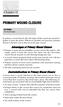 Chapter 11 PRIMARY WOUND CLOSURE KEY FIGURE: Everting skin edges In primary wound closure, the skin edges of the wound are sutured together to close the defect. Whenever possible and practical, primary
Inservice: Wound Care and Dressings. Friday, June 26, 2009. A. Closed Wounds tissue is injured but skin is not BROKEN
 f Inservice: Wound Care and Dressings Friday, June 26, 2009 WOUNDS: Are injuries of the skin and underlying subcutaneous tissues and muscles (Nursing Manual by Lippincott) Are disruptions in the integrity
Pressure Ulcers: Facility Assessment Checklists
 Pressure Ulcers: Facility Assessment Checklists This is a series of self-assessment checklists for nursing home staff to use to assess processes related to managing pressure ulcers in the facility, in
ABThera Open Abdomen Negative Pressure Therapy for Active Abdominal Therapy. Case Series
 ABThera Open Abdomen Negative Pressure Therapy for Active Abdominal Therapy Case Series Summary of Cases: USER EXPERIENCE The ABThera OA NPT system was found by surgeons to be a convenient and effective
APPLICATION OF DRY DRESSING
 G-100 APPLICATION OF DRY DRESSING PURPOSE To aid in the management of a wound with minimal drainage. To protect the wound from injury, prevent introduction of bacteria, reduce discomfort, and assist with
PROCEDURE- SPECIFIC INFORMATION FOR PATIENTS
 The British Association of Urological Surgeons 35-43 Lincoln s Inn Fields London WC2A 3PE Phone: Fax: Website: E- mail: +44 (0)20 7869 6950 +44 (0)20 7404 5048 www.baus.org.uk [email protected] PROCEDURE-
Blood Transfusion. There are three types of blood cells: Red blood cells. White blood cells. Platelets.
 Blood Transfusion Introduction Blood transfusions can save lives. Every second, someone in the world needs a blood transfusion. Blood transfusions can replace the blood lost from a serious injury or surgery.
The true cost of wounds. And how to reduce it
 The true cost of wounds And how to reduce it Wounds are a growing challenge Wounds have been called the silent epidemic. In a typical hospital setting today, between 25% and 40% of beds will be occupied
3M Steri-Strip S Surgical Skin Closure. Commonly Asked Questions
 3M Steri-Strip S Surgical Skin Closure Commonly Asked Questions What are the indications for use of 3M Steri-Strip S Surgical Skin Closure? Steri-Strip S Surgical Skin Closures are indicated as a primary
Objectives. Why is this important? 5/1/2012. By: Rhonda Trexler, BS RN COS-C CCP
 By: Rhonda Trexler, BS RN COS-C CCP Objectives Verbalize the ability to determine if a surgical wound exists when documenting in OASIS-C Describe would healing phases related to wounds healing by primary
Simplicity through innovation
 RENASYS Soft Port Simplicity through innovation The new RENASYS Soft Port from Smith & Nephew represents a revolutionary advancement in Negative Pressure Wound Therapy (NPWT). This innovative Soft Port
OASIS-C Integument Assessment: Not for Wimps! Part I: Pressure Ulcers
 OASIS-C Integument Assessment: Not for Wimps! Part I: Pressure Ulcers Presented by: Rhonda Will, RN, BS, COS-C, HCS-D Assistant Director, OASIS Competency Institute 243 King Street, Suite 246 Northampton,
MANAGING ANEMIA. When You Have Kidney Disease or Kidney Failure. www.kidney.org
 MANAGING ANEMIA When You Have Kidney Disease or Kidney Failure www.kidney.org About the Information in this Booklet Did you know that the National Kidney Foundation (NKF) offers guidelines and commentaries
Individualized Care Plans Fully Developed
 Appendix Individualized Care Plans Fully Developed A Refer to Chapter 1 The Nursing Process: A Synopsis, p. 32: Two Individualized Care Plans Fully Developed; Care Plan 1 for Mr. John Walters, Care Plan
Nursing college, Second stage Microbiology Dr.Nada Khazal K. Hendi L14: Hospital acquired infection, nosocomial infection
 L14: Hospital acquired infection, nosocomial infection Definition A hospital acquired infection, also called a nosocomial infection, is an infection that first appears between 48 hours and four days after
WOUND MANAGEMENT PROTOCOLS WOUND CLEANSING: REMOVING WOUND DEBRIS FROM WOUND BASE
 WOUND MANAGEMENT PROTOCOLS PURPOSE: Provide nursing personnel with simple guidance regarding appropriate dressing selection in the absence of wound specialist expertise Identify appropriate interventions
PROCEDURE- SPECIFIC INFORMATION FOR PATIENTS
 The British Association of Urological Surgeons 35-43 Lincoln s Inn Fields London WC2A 3PE Phone: Fax: Website: E- mail: +44 (0)20 7869 6950 +44 (0)20 7404 5048 www.baus.org.uk [email protected] PROCEDURE-
West Penn Burn Center. First Class Burn Care for Adults and Children. West Penn Burn Center
 Allegheny Health Network West Penn Burn Center First Class Burn Care for Adults and Children West Penn Burn Center 4800 Friendship Avenue Pittsburgh, PA 15224 412.578.5273 www.westpennburncenter.com AHN.org
* This policy is under review and is being updated. A revised policy will be added shortly * February 2009. Clinical Development Forum
 * This policy is under review and is being updated. A revised policy will be added shortly * Document Title: PCT Document Ref No.: Local Document Ref No.: Date of Approval: Approved by: Guidance for the
FUNCTIONS OF THE SKIN
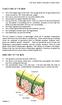 FUNCTIONS OF THE SKIN Skin is the largest organ of the body. The average adult has 18 square feet of skin which account for 16% of the total body weight. Skin acts as a physical barrier for you to the
Benefit Criteria to Change for Hyperbaric Oxygen Therapy for the CSHCN Services Program Effective November 1, 2012
 Benefit Criteria to Change for Hyperbaric Oxygen Therapy for the CSHCN Services Program Effective November 1, 2012 Information posted September 14, 2012 Effective for dates of service on or after November
Wound Healing Community Outreach Service
 Wound Healing Community Outreach Service Wound Management Education Plan January 2012 December 2012 Author: Michelle Gibb Nurse Practitioner Wound Management Wound Healing Community Outreach Service Institute
Adult CCRN/CCRN E/CCRN K Certification Review Course: Integumentary and Musculoskeletal
 Adult CCRN/CCRN E/CCRN K Certification Review Course: Integumentary and Musculoskeletal Carol Rauen RN BC, MS, PCCN, CCRN, CEN Integumentary IV infiltration Pressure ulcers Wounds Infectious Surgical Trauma
What should I expect before the procedure?
 The British Association of Urological Surgeons 35-43 Lincoln s Inn Fields London WC2A 3PE Phone: Fax: Website: E- mail: +44 (0)20 7869 6950 +44 (0)20 7404 5048 www.baus.org.uk [email protected] PROCEDURE-
Working together to prevent pressure ulcers (prevention and pressure-relieving devices)
 Working together to prevent pressure ulcers (prevention and pressure-relieving devices) Understanding NICE guidance information for people at risk of pressure ulcers, their carers, and the public Draft
Lymph Node Dissection for Penile Cancer
 Lymph Node Dissection for Penile Cancer Exceptional healthcare, personally delivered Removal of Lymph Nodes Why are the Lymph Nodes so important when I have penile cancer? Lymph nodes are small bean shaped
the Role of Patricia Turner BSN, RN, CWCN, CWS
 Understanding the Role of Outpatient Wound Centers Patricia Turner BSN, RN, CWCN, CWS Outpatient wound centers are somewhat of a specialty unto themselves within the world of wound care. The focus of the
A Pocket Guide. Application and Cutting Guide
 A Pocket Guide Application and Cutting Guide Developed by Pia Carlsen, RN, Denmark Jacqui Fletcher, Principal Lecturer, MSc BSc (Hons) PG Dip (ED) RN ILT, UK Maria Mousley, AHP, Consultant Podiatrist,
CHAPTER 15 SCLEROTHERAPY FOR VENOUS DISEASE
 Introduction CHAPTER 15 SCLEROTHERAPY FOR VENOUS DISEASE Original authors: Niren Angle, John J. Bergan, Joshua I. Greenberg, and J. Leonel Villavicencio Abstracted by Teresa L. Carman New technology has
Y O U R S U R G E O N S. choice of. implants F O R Y O U R S U R G E R Y
 Y O U R S U R G E O N S choice of implants F O R Y O U R S U R G E R Y Y O U R S U R G E O N S choice of implants F O R Y O U R S U R G E R Y Your Surgeon Has Chosen the C 2 a-taper Acetabular System The
USING ADAPTIC TOUCH Non-Adhering Silicone Dressing: CASE STUDIES
 INTERNATIONAL CASE STUDIES USING ADAPTIC TOUCH Non-Adhering Silicone Dressing: CASE STUDIES CASE STUDIES SERIES 2013 This document has been jointly developed by Wounds International and Systagenix with
Adhesives Dedicated to Better Wound Care
 Adhesives Dedicated to Better Wound Care Medical Design Joyce Laird Mon, 2014-09-08 11:50 ConvaTec strives to make life better for both short- and long-term patients. ConvaTec is a giant in the medical
PowerLight LED Light Therapy. The FUTURE of corrective skin
 PowerLight LED Light Therapy The FUTURE of corrective skin care TODAY LED facial treatments Effective when used with correct protocols Non thermal stimulation of collagen Increases circulation and lymphatic
Quality Measures for Long-stay Residents Percent of residents whose need for help with daily activities has increased.
 Quality Measures for Long-stay Residents Percent of residents whose need for help with daily activities has increased. This graph shows the percent of residents whose need for help doing basic daily tasks
The compatibility of INTRASITE Gel and ACTICOAT : An In-Vivo and In-Vitro assessment
 *smith&nephew The compatibility of INTRASITE Gel and ACTICOAT : An In-Vivo and In-Vitro assessment 1 Trade Marks of Smith & Nephew An In-Vivo and In-Vitro assessment of the compatibility of ACTICOAT and
Before Surgery You will likely be asked to see your family physician or an internal medicine doctor for a thorough medical evaluation.
 Anterior Hip Replacement - Before and After Surgery Your Hip Evaluation An orthopaedic surgeon specializes in problems affecting bones and joints. The surgeon will ask you many questions about your hip
Understand nurse aide skills needed to promote skin integrity.
 Unit B Resident Care Skills Essential Standard NA5.00 Understand nurse aide s role in providing residents hygiene, grooming, and skin care. Indicator Understand nurse aide skills needed to promote skin
Post-surgical V.A.C. VeraFlo Therapy with Prontosan Instillation on Inpatient Infected Wounds * COLLECTION OF CASE STUDIES
 COLLECTION OF CASE STUDIES Post-surgical V.A.C. VeraFlo Therapy with Prontosan Instillation on Inpatient Infected Wounds * *All patients were treated with systemic antibiotics Post-surgical V.A.C. VeraFlo
RGN JOY LAUDE WATFORD GENERAL HOSPITAL, ENGLAND
 RGN JOY LAUDE WATFORD GENERAL HOSPITAL, ENGLAND Monitor patient on the ward to detect trends in vital signs and to manage accordingly To recognise deteriorating trends and request relevant medical/out
Basal Cell Carcinoma Affecting the Eye Your Treatment Explained
 Basal Cell Carcinoma Affecting the Eye Your Treatment Explained Patient Information Introduction This booklet is designed to give you information about having a Basal Cell Carcinoma near your eye and the
Refer to Coaptite Injectable Implant Instructions for Use provided with product for complete instructions for use.
 Questions for my Doctor Refer to Coaptite Injectable Implant Instructions for Use provided with product for complete instructions for use. INDICATIONS: Coaptite Injectable Implant is indicated for soft
Anyone who has difficulty moving can get a pressure sore. But you are more likely to get one if you:
 Patient information from the BMJ Group Pressure sores Anyone can get a pressure sore if they sit or lie still for too long without moving. People who are old or very ill are most likely to get them. Careful
Management of Burns. The burns patient has the same priorities as all other trauma patients.
 Management of Burns The burns patient has the same priorities as all other trauma patients. Assess: - Airway - Breathing: beware of inhalation and rapid airway compromise - Circulation: fluid replacement
Use of a Pressure Ulcer Protocol: Benefits and Recommendations
 Use of a Pressure Ulcer Protocol: Benefits and Recommendations Elizabeth L. Enriquez RN,BSN,MPH,CWOCN Wound Care Specialist/Infection Control Morningiside House 1000 Pellham Parkway, Bronx, NY 10461 Wound
X-Plain Perforated Ear Drum Reference Summary
 X-Plain Perforated Ear Drum Reference Summary Introduction Perforated eardrum is a common condition. The eardrum is a thin layer of tissue at the end of the ear canal inside the ear. Eardrum perforations
Orthopaedic Spine Center. Anterior Cervical Discectomy and Fusion (ACDF) Normal Discs
 Orthopaedic Spine Center Graham Calvert MD James Woodall MD PhD Anterior Cervical Discectomy and Fusion (ACDF) Normal Discs The cervical spine consists of the bony vertebrae, discs, nerves and other structures.
Hemodialysis Access: What You Need to Know
 Hemodialysis Access: What You Need to Know Hemodialysis Access: What You Need To Know Whether you already get hemodialysis treatment, or you will need to start dialysis soon, this booklet will help you
Tuberculosis: FAQs. What is the difference between latent TB infection and TB disease?
 Tuberculosis: FAQs What is TB disease? Tuberculosis (TB) is a disease caused by bacteria (germs) that are spread from person to person through the air. TB usually affects the lungs, but it can also affect
Avastin (Bevacizumab) Intravitreal Injection
 Avastin (Bevacizumab) Intravitreal Injection This handout describes how Avastin may be used to treat wet age related macular degeneration (AMD) or macular edema due to retinal vascular disease such as
PATIENT TEACHING GUIDE: Wound Care Handbook
 PATIENT TEACHING GUIDE: Wound Care Handbook PATIENT TEACHING GUIDE: WOUND CARE Design by Mariscal Design, Illustrations by Lysa Hawke. The Wound Care Self Care Guide was written and prepared by: Barbara
Neglected Wound/Poor Wound Care
 Chapter 18 CHRONIC WOUNDS KEY FIGURES: Open wound Wound covered with skin graft Chronic wounds are open wounds that for some reason simply will not heal. They may be present for months or even years. Often,
X-Plain Varicose Veins Reference Summary
 X-Plain Varicose Veins Reference Summary Introduction Varicose veins are very common, in both women and men. Varicose veins can be painful and unattractive. Vein doctors use non-invasive ultrasound imaging
Inflammation and Healing. Review of Normal Defenses. Review of Normal Capillary Exchange. BIO 375 Pathophysiology
 Inflammation and Healing BIO 375 Pathophysiology Review of Normal Defenses Review of Normal Capillary Exchange 1 Inflammation Inflammation is a biochemical and cellular process that occurs in vascularized
Development of a Next- Generation Antimicrobial Wound Dressing- Results Count
 Development of a Next- Generation Antimicrobial Wound Dressing- Results Count Phil Bowler, MPhil, FIBMS Science & Technology, ConvaTec 24 th November 2015 /TM all trade marks are the property of their
Caring for a Hemovac Drain
 Caring for a Hemovac Drain 269 12. Raise side rail. Lower bed height and adjust head of bed to a comfortable position. 13. Remove additional PPE, if used. Perform hand hygiene. These promote patient safety.
7/30/2012. Increased incidence of chronic diseases due
 Dianne Rudolph, DNP, GNP bc, CWOCN Discuss management of wound care in older adults with focus on lower extremity ulcers Identify key aspects of prevention Explain basic principles of wound management
LOSS OF BLADDER CONTROL IS TREATABLE TAKE CONTROL AND RESTORE YOUR LIFESTYLE
 LOSS OF BLADDER CONTROL IS TREATABLE TAKE CONTROL AND RESTORE YOUR LIFESTYLE TALKING ABOUT STRESS INCONTINENCE (SUI) Millions of women suffer from stress incontinence (SUI). This condition results in accidental
Femoral artery bypass graft (Including femoral crossover graft)
 Femoral artery bypass graft (Including femoral crossover graft) Why do I need the operation? You have a blockage or narrowing of the arteries supplying blood to your leg. This reduces the blood flow to
The Use of MEDIHONEY for Wound Management in Oncology
 The Use of MEDIHONEY for Wound Management in Oncology Presenter: Patrice M. Dillow, MSN, APRN, CWOCN Cancer Treatment Centers of America Midwestern Regional Medical Center A Magnet Hospital This presentation
Blood Transfusion. Red Blood Cells White Blood Cells Platelets
 Blood Transfusion Introduction Blood transfusions are very common. Each year, almost 5 million Americans need a blood transfusion. Blood transfusions are given to replace blood lost during surgery or serious
Urinary Diversion: Ileovesicostomy/Ileal Loop/Colon Loop
 Urinary Diversion: Ileovesicostomy/Ileal Loop/Colon Loop Why do I need this surgery? A urinary diversion is a surgical procedure that is performed to allow urine to safely pass from the kidneys into a
INFORMED CONSENT - CARPAL TUNNEL RELEASE
 . Purchasers of the Patient Consultation Resource Book are given a limited license to modify documents contained herein and reproduce the modified version for use in the Purchaser's own practice only.
Microcyn Technology. Life-Altering Advance in Tissue Care
 Microcyn Technology Life-Altering Advance in Tissue Care The patented Microcyn Technology mimics the same oxychlorine composition as that manufactured by neutrophils in the body s immune system. Neutrophils
7/11/2011. Pressure Ulcers. Moisture-NOT Pressure. Wounds NOT Caused by Pressure
 Assessment and Documentation of Pressure Ulcers Jeri Ann Lundgren, RN, BSN, PHN, CWS, CWCN Pathway Health Services July 19, 2011 Training Objectives Describe etiologies of pressure ulcers Discuss how to
Patient Guide. Important information for patients starting therapy with LEMTRADA (alemtuzumab)
 Patient Guide Important information for patients starting therapy with LEMTRADA (alemtuzumab) This medicinal product is subject to additional monitoring. This will allow quick identification of new safety