
All in the Family: Creating Parametric Components in Autodesk Revit
|
|
|
- Duane Jacob Garrett
- 9 years ago
- Views:
Transcription
1 All in the Family: Creating Parametric Components in Autodesk Revit Matt Dillon D C CADD AB2100 The key to mastering Autodesk Revit Architecture, Autodesk Revit MEP, or Autodesk Revit Structure software is the ability to create intelligent, parametric families for your content libraries. It's not as easy as simply building a 3D model. This class will show you how to use the modeling tools in the Revit Family Editor, as well as the process of creating intelligent parameters to properly control family dimensions, behavior, and visibility. Additionally, you will learn how to make sure that your families "play nice" with other elements in your model. Learning Objectives At the end of this class, you will be able to: Determine the correct family template on which to base custom content Use parameters and constraints to control geometry Use the modeling tools found in the Family Editor Work with nested families About the Speaker Having been a registered architect with over 20 years of experience in Autodesk architectural applications, Matt has worked with AutoCAD Architecture since its initial release and Revit Architecture since its purchase by Autodesk. Matt is an Autodesk Certified Instructor at an Autodesk Authorized Training Center. In addition to assisting customers in implementing Autodesk Revit platform products, he has also consulted with Autodesk development staff in product design and usability for AutoCAD Architecture. He co-authored "Autodesk Architectural Desktop 2007 An Advanced Implementation Guide (Second Edition)". In 2010, Matt was one of the recipients of Autodesk's "Distinguished Speaker Award" in 2010 and has consistently been a highly-rated instructor at Autodesk University since he began presenting in [email protected]
2 Conceptual Overview Families are the heart of the internal data structure of Autodesk Revit. Every object, whether it is a geometric component, an annotation component, a View or any other component in Revit, is part of a Family. Families come in three flavors : System Families are managed by Revit, and cannot be created or deleted. They typically are not shared between Projects. Views, dimensions, text, etc. all belong to System families, as do geometric objects such as ducts and pipes (anything that would be assembled on the job site). Component Families (the focus of this class) can be created and customized, and can be stored in an external library to be loaded into your Revit project on an as needed basis. Examples of Component Families are equipment, fixtures, devices and fittings, as well as custom annotation tags and callouts. When considering geometry, Component Families are objects that might be ordered out of a catalog and installed or placed on the job site. In-Place Families represent one-off items; custom geometry that is not meant to be re-used or shared between projects. One of the strengths of component families is that they can be controlled by parameters, which allow for a great deal of flexibility. For example a table family can be created to have several sizes, all based on parameters that can be set by the user, allowing for a single family definition to accommodate several different kinds of tables. Parameters can control more than just sizes and distances, however. They can control materials, visibility states and non-graphical information (such as catalog number, voltage, cost, etc.). Revit Component Families are a unique file type, with an extension of RFA. To create a family, you begin a new file by selecting File->New->Family from the Revit application menu. After selecting the appropriate family template, you ll be placed in the Revit Family Editor. The Family Editor looks just like the normal Revit interface, except that it has a different set of ribbons that include all of the tools that you will need to create your family. Component Family Creation Process While each family will vary in complexity and features, the basic process to create a component family will be the same: 1. Select the family template. This is the most important part of creating a family. The template will determine not only the category (and therefore the available default parameters) of the family, but also how it will behave and interact with other Revit components. 2. Plan the major parameters. Parameters are what control any variable values (sizes, materials, informational elements, etc. of the family). In addition to deciding what the parameters need to be, you will also need to consider whether they will need to be used in schedules or tags, and whether they will be type or instance parameters. 3. Create and constrain model geometry. This will entail laying out critical reference planes and constraining geometry with parameters. We will look at this more closely in the Modeling Tools and Methods and Parameters and Constraints sections of this paper. 2
3 4. Assign Object Subcategories if necessary. This will allow you to have independent control of the component in visibility graphics overrides, object styles and material assignments. If necessary, you can create new subcategories within your Revit Family. 5. Set visibility rules. Some geometry may not be appropriate in all views or detail levels. Using the visibility tools in Revit families, you can control when each component in the family will be visible. 6. Create Family Types. Many component families contain multiple type definitions. An example of family types is found with Door families. The door size is defined by type definitions. Family types make it easy to change multiple parameters simply by selecting an overall type definition. NOTE: In-Place families and Component families are created in the same fashion, using the same process. The only difference is that In-Place families are created in the context of your project and cannot be shared between projects (stored in a library), while Component families are independent files that are loaded into projects when needed. As a general rule, you should only create in-place families when you are truly dealing with a unique "one-off" object. Having multiple instances of the same in-place family in a project has a much higher impact on performance than creating the same object as a component family and having multiple instances of it in your project. Understanding Family Templates As stated previously, the most important step in creating a component family is to choose the family template. The template will determine not only which object category the component will be a part of, but also how the family will act when it comes in contact with other components. In some cases you will also need to determine whether a family will be hosted or not, and if so, what type of object will serve as the host. For example, if you are creating a toilet fixture, you can choose from the non-hosted Plumbing Fixture.rft template or the hosted Plumbing Fixture wall based.rft template. If your fixture is a wall-mounted toilet, then you would choose the wallbased template, meaning that the family can only be placed on a wall. Another example of hosted families are light fixtures. A ceiling-hosted light fixture can only be inserted on a ceiling object. Hosted components will be attached to their hosts, following them wherever the host goes. You should consider carefully which template to use. Once you ve chosen the template and begun your family, you cannot change it. There are templates provided for virtually every object type, and in some cases multiple templates are provided for a single object type to accommodate a variety of behaviors (see Figure 1). 3
4 Figure 1: There are several templates provided that will determine not only what the object category will be, but also how the family will behave when placed in a project. Note that there are six family templates provided for lights alone. There will be times when you can t find an appropriate template or when one of the provided templates doesn t quite fit the bill. For example, you may be creating a mechanical equipment family to be hosted in a linked model. You can only host to faces in a linked model, not walls or ceilings. If there is not a face-based template for the specific family type that you re trying to create you can use a Generic Model template instead (in this case the Generic Model face based.rft template). As soon as you are in the Family Editor, select Family Category and Parameters from the Home ribbon and set the family to the correct category (see Figure 2). 4
5 Figure 2: When using a Generic Model family template, it is important to set the Family Category and Parameters. Working With Parameters and Constraints Parameters are at the heart of a successful Revit Family. While you don t have to make a family parametric, doing so will allow for a single family to be flexible enough to address issues that otherwise may take multiple families to handle. For example, by creating a parameter to control the height of a wall-mounted toilet, you can accommodate both an ADA-compliant toilet s dimensions with those of a standard toilet with a single family definition. In addition to controlling the dimensions of an object, parameters can control visibility and materials, as well as a host of other types of data, including user-defined text properties for scheduling and annotation. Parameters are typically created in the Family Types Editor (see Figure 3). The Family Types Editor actually has three purposes: 1. Create, manage and modify parameters. 2. Create, manage and modify family types (more on this later) 3. Flex the family (test parameter values against the model geometry). 5
6 Figure 3: The Family Types Editor. Note: You can also create a parameter on the fly by modifying a dimension and choosing to add a new parameter from the Label box on the options toolbar. This will create the parameter and link it to the selected dimension at the same time. When creating a parameter, there are several items that you need to consider carefully: Will the parameter need to be reported in a schedule or will it need to be part of an intelligent annotation tag? If so, it will need to be a shared parameter. Shared parameters are stored in an external text file so that they can be accessible to multiple projects (you can edit the shared parameter file from within the Revit Family Editor). What type of parameter is it? Length parameters are applied to dimensions. Material parameters can control the material assigned to a piece of model geometry. Yes/No parameters will provide a checkbox ( on/off ) type of parameter, etc. The parameter type is crucial to the behavior of the parameter. The parameter discipline will control what types of units are available for the parameter. In the case of an architectural application, virtually all of your parameters could very well be of the Common discipline (comprising of units for length, volume, area, etc.), however if you are an MEP engineer, you will need to choose HVAC, Electric, Plumbing, etc. to gain access to unit types for airflow, velocity, friction, voltage, etc. Will the parameter be type-based or instance-based? In other words, will the parameter actually define a new type within the family or will it be able to be edited on an element-by-element basis? Note: Revit 2011 introduced a new kind of parameter. Instance-based parameters can also be reporting parameters. While outside the scope of this introductory tutorial, this type of parameter provides powerful new capabilities. You should research and experiment with these once you have become more comfortable with the basics of creating custom component families. 6
7 Figure 4: Consider carefully the properties of the parameters that you create. Guidelines for Geometric Parameters and Constraints When using parameters and constraints to control physical geometry, there are some simple but definite do s and donts: When applying a dimension parameter always dimension to reference planes. Never, under any circumstances, should you dimension to an actual piece of geometry or a sketch line if you are going to use a parameter to control the dimension. Doing so will result in a Constraints not satisfied error message. After assigning parameter dimensions to your reference planes, you can constrain (lock) the sketch geometry to the reference planes. The dimension parameter will actually control the position of the reference planes, which will in turn control the position of the model geometry. When using an equality constraint to make geometry symmetrical about a center line while allowing it to grow or shrink about the centerline with an overall parametric constraint, create the reference planes with the desired symmetry before applying the equality constraint. This will remove any possible ambiguities from the equality constraint and will ensure proper behavior when the family is flexed later on. (See Figure 5). Figure 5: Controlling equality constraint behavior. 7
8 Flex the family often. Each time you apply a new geometric constraint you should test it by flexing the family. It is much easier to fix a problem with conflicting constraints if you know within one or two parameters where the problem may lie. If you wait until you have created and applied four or five parameters before you flex the family and then you have an error, you have a lot more possible conflicts to investigate. Modeling Tools and Process Revit modeling tools can be divided into two main groups: Helpers and Methods. A Helper is geometry that in and of itself does not make up the model in the family, but instead can be used to generate the actual model geometry. Typical helpers in Revit Families are: Reference Planes These can be used to constrain Revit Geometry (we ll explore this in just a bit). Reference Planes can also be used as Work Planes. Work Planes Every component of 3D geometry in a Revit Family is based to some extent on a 2D sketch. The Work Plane is the actual plane that the sketch is created on. Work Planes can be generated from existing faces on 3D geometry, lines that were already drawn using another plane, or from Reference Planes. Note: When a Reference Plane to be used as a Work Plane, you can name it in its element properties, then use the Name option from the Work Plane dialog box to select it. (See Figure 6). Figure 6: When using Reference Planes as Work Planes, you can name them first, to allow them to be selected by name. A Method is a technique used to create model geometry. In Revit there are only five Methods used, and the resulting geometry is either a solid or a void (a void will remove geometry from an 8
9 existing solid). The five methods used will be the same, whether you are modeling a solid or a void, and whether you are creating an In-Place Family or a Component Family: Extrusion Comprised of a 2D Sketch Profile that is extruded in the Z axis of the Work Plane that the sketch was created in. Blend Consists of a 2D Sketch Profile for the bottom of the shape and a 2D Sketch Profile for the top. The actual 3D shape is extrapolated from the bottom shape, the top shape, and the blend depth. Revolve Created from a 2D Sketch Profile that is revolved around an axis. The revolved shape can be revolved through a complete circle or any fraction of a circle. Sweep Created from a 2D Sketch Profile that is driven along a 2D Sketch Path. The Sketch Path must exist in a single plane. Swept Blend Created from two 2D Sketch Profiles, one at each end of a 2D Sketch Path. The resulting shape will be interpolated along the path between the two profiles. Like the Sweep Path, the Sketch Path must exist in a single plane. Figure 7: The five methods for creating solid or void geometry in Revit. 9
10 3D Model Component Creation Process A common mistake that users make when creating families is to begin modeling 3D geometry before the up front work is done. In the case of a parametric family especially, the actual modeling of extrusions, revolves, blends and sweeps is a small part of the overall process. First, take care to plan, define and test the parameters that you are going to use to control the geometry. Only after you have confirmed that all of the underlying rules and constraints are working and properly configured should you actually create the model geometry. Combining the modeling tools provided by Revit and the parametric tools and constraints, a typical process for modeling a 3D family object will include the following steps: 1. Define all Reference Planes needed to define the geometry in three dimensions. Consider providing names for any that may need to be used as Work Planes in the future. 2. Constrain the Reference Planes with dimensions and parameters. 3. Flex the Family to test the behavior of the Reference Planes against the parameters and constraints. 4. Begin the creation of the Solid or Void geometry using either an extrusion, revolve, blend, sweep or swept blend. 5. Check and set the Work Plane for the sketch geometry. It is important to do this first, if for no other reason than to ensure that you re drawing the sketch where you think you are (see Figure 8). Note that you can also set the current Work Plane at any time by selecting the Work Plane tool on the Home ribbon, and you can display the current Work Plane using the Work Plane Display toggle on the ribbon or using the Work Plane Viewer as well (see Figure 8). Figure 8: Setting the current Work Plane and toggling display. 10
11 6. Create the sketch geometry. Lock the geometry to your reference planes. 7. Set the object s properties. Specific properties that you are interested in include the depth (in the case of an extrusion or blend), the material of the object, visibility and sub-category (if necessary). You can also set the properties after the object has been created and you have exited sketch mode. It is also important to note that you can link properties to parameters. For example, if you have created a Yes/No parameter, that parameter can be used to control the Visibility property of the object (see Figure 9). Figure 9: Object properties in families can be linked to parameters of the appropriate type. 8. Finish the Sketch, which will complete the object and apply the 3D properties to the 2D Sketch geometry. 9. Flex the Family, testing both the dimensional constraints and parameters again as well as any parameters that you linked to object properties. If there are any errors, you can either edit the sketch or modify any parameter-based properties to resolve the issue before going on to the next geometric component. Working with Nested Families There will frequently be cases where a component used in a family will also be needed in other families. For example, if you wanted to show doorknobs in a 3D Fine Detail view of your custom door families, that same door knob may show up in several different family files. Rather than model it in each and every door family, you can simply model it once as its own family, then add it as a component in all of the door families in which it is needed. Note: In the example above, consider how you would start the doorknob family. You would not use the Door.rft template file, because then the doorknob would want to be hosted by a wall. Instead, you would use the Generic Model face based.rft family template, then use the Family Category and Parameters tool to establish it as a part of the Door category. This way, it will be the correct category but will be hosted by the face of the door panel instead of being hosted by a wall. 11
12 When you create a family that will be nested in another family, you need to consider two things: Does it need to be scheduled separately from the host family or as an integral part of it? If separate, then it needs to be specified as Shared in the Family Category and Parameters box of the nested family (see Figure 10). If it does not need to be scheduled separately, leave this box blank. Figure 10: Specifying a family as "Shared". In the above example, the "Generic Model" template was used to create a window family that will be nested as a part of a larger window assembly. It is specified as "Shared" so that it will schedule as a separate component than the larger assembly. Parameters, when created in a family become properties when that family is placed in a project (either type or instance-based, depending upon how you created the parameter). The same thing happens when you insert a family into another family. In the host family, what were parameters are now properties. When a family is inserted into a project, properties that were accessible in the family editor are no longer accessible in the project. So, if you insert a family with parameters into another family, then you insert that host family into a project, the parameters of the nested family are not available for editing. You can resolve this by creating parameters in the host family and linking those parameters to the properties you need to be editable in the downstream project. (See Figure 11) 12
13 Figure 11: Nested parameters. At the top of the image, the material for the seat and back of the chair is assigned to a material parameter. In the bottom half of the image, the chair has been nested into a table family. The material properties of the chair components are now no longer accessible, however the parameters that they were mapped to in the original family are now properties. In order to make these editable in the project that this family is ultimately going to be used in, these properties would again need to be assigned to parameters in the current family. 13
Collaborating Across Disciplines with Revit Architecture, MEP, and Structure
 Collaborating Across Disciplines with Revit Architecture, MEP, and Structure David Cohn AB104-3 Are you ready to take the next step and use building information modeling to share data across the entire
ATS Revit Family Creation Standards July 23 rd, 2012 Plumbing Fixtures: Faucets Version 1.0
 This document outlines the design standard Allied Technical Services uses in the creation of Revit families. This edition will feature faucets, more specifically, bathroom and kitchen faucets. It is important
Revit MEP. Autodesk Navisworks
 What is BIM? Autodesk BIM is an intelligent model-based process that helps owners and service providers achieve business results by enabling more accurate, accessible, and actionable insight throughout
Pro/ENGINEER Wildfire 4.0 Basic Design
 Introduction Datum features are non-solid features used during the construction of other features. The most common datum features include planes, axes, coordinate systems, and curves. Datum features do
Exercise 9-6 Creating a Window Family
 Exercise 9-6 Creating a Window Family Estimated Time: File: 10 minutes ex8-5, generic model wall based.rft This exercise reinforces the following skills: Standard Component Families Templates We want to
Creating Steel Fabrication Friendly Families and Schedules with Autodesk Revit Structure
 Creating Steel Fabrication Friendly Families and Schedules with Autodesk Revit Structure Tina Bos Herold Engineering Limited SE3048-L Once you have mastered the day-to-day use of Autodesk Revit Structure,
Session 25 Revit MEP Tips and Tricks
 Session 25 Revit MEP Tips and Tricks Page 1 of 17 Sometimes it's the little things which make all the difference. I thought I would share some nifty tricks that can help make Revit MEP go down a little
84 part video tutorial training course. The course is 100% free with no catches or exclusions. You don
 Please Note: If you're new to Revit, you may be interested in my " Beginner's Guide to Revit Architecture " 84 part video tutorial training course. The course is 100% free with no catches or exclusions.
AutoCAD Architecture 2012 UK Content Tools
 AutoCAD Architecture 2012 UK Content Tools Contents Contents... 1 Installation... 2 Loading the utilities... 2 Utilities Overview... 3 Menu and Toolbar... 3 Content Generation... 3 Content Publishing...
Autodesk Revit LEARNING PATH BUILDING DESIGN SUITE
 Autodesk Revit LEARNING PATH FUNDAMENTALS Duration: 3 days Cost: R5 500 (excl VAT) Revit MEP Duration: 3 days Cost: R5 500 (excl VAT) Revit Structure Duration: 3 days Cost: R5 500 (excl VAT) REVIT ADVANCED
Effective Collaboration
 AUTODESK BUILDING SOLUTIONS Effective Collaboration Exporting Revit Architecture Models as ACIS Solids for Use in AutoCAD MEP The intent of this paper is to explain a process by which architects using
Raising the Roof Creating Roofs in Revit David Cohn
 David Cohn AB322-1 Roofs are one of the most complex architectural elements to model, but with Revit you can create just about any type of roof. This class will explore the best methods for creating various
Autodesk Revit Architecture 2011 Professional Massmodeling Rendering Video Tutorial
 Autodesk Revit Architecture 2011 Professional Massmodeling Rendering Video Tutorial Instructor Handout Created by: Marvi Basha, Klaus Hyden und Philipp Müller Autodesk Student Experts TU Graz September
Modeling Tools Objectives. Sweeps and Lofts. Loft Feature
 Modeling Tools Objectives When you complete this module, you will be able to recognize the more advanced modeling tools in Solid Edge as well as the tools that require more input than typical Solid Edge
Steady Flow: Laminar and Turbulent in an S-Bend
 STAR-CCM+ User Guide 6663 Steady Flow: Laminar and Turbulent in an S-Bend This tutorial demonstrates the flow of an incompressible gas through an s-bend of constant diameter (2 cm), for both laminar and
Effective Collaboration using Revit Structure and AutoCAD MEP
 REVIT STRUCTURE Effective Collaboration using Revit Structure and AutoCAD MEP This white paper explains how structural engineers using Revit Structure software and mechanical/electrical/plumbing (MEP)
Introduction to Autodesk Inventor for F1 in Schools
 F1 in Schools race car Introduction to Autodesk Inventor for F1 in Schools In this course you will be introduced to Autodesk Inventor, which is the centerpiece of Autodesk s Digital Prototyping strategy
Creating 2D Drawings from 3D AutoCAD Models
 Creating 2D Drawings from 3D AutoCAD Models David Piggott CrWare, LP GD205-2P This class explores the various techniques in creating 2D part and assembly drawings from 3D AutoCAD models. As part of the
TABLE OF CONTENTS. INTRODUCTION... 5 Advance Concrete... 5 Where to find information?... 6 INSTALLATION... 7 STARTING ADVANCE CONCRETE...
 Starting Guide TABLE OF CONTENTS INTRODUCTION... 5 Advance Concrete... 5 Where to find information?... 6 INSTALLATION... 7 STARTING ADVANCE CONCRETE... 7 ADVANCE CONCRETE USER INTERFACE... 7 Other important
Introduction to Autodesk Inventor for F1 in Schools
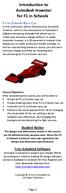 Introduction to Autodesk Inventor for F1 in Schools F1 in Schools Race Car In this course you will be introduced to Autodesk Inventor, which is the centerpiece of Autodesk s digital prototyping strategy
Building Information Modeling for MEP Engineering. Revit MEP 2008
 Building Information Modeling for MEP Engineering Revit MEP 2008 Design Intuitively with Tools That Work the Way Engineers Think Revit MEP software is an intuitive design tool that works the way engineers
SOET 352: Advanced REVIT and Building Information Modeling (BIM) Management
 STATE UNIVERSITY OF NEW YORK COLLEGE OF TECHNOLOGY CANTON, NEW YORK COURSE OUTLINE SOET 352: Advanced REVIT and Building Information Modeling (BIM) Management Prepared By: Robert F. Burnett CANINO SCHOOL
After completing this tutorial, you will be able to: Use the new 3D Modeling tools in AutoCAD 2007 for basic Lofting.
 TUTORIAL 3 Lofted Solid Learning Objectives After completing this tutorial, you will be able to: Use the new 3D Modeling tools in AutoCAD 2007 for basic Lofting. Required Competencies Before starting this
Understand the Sketcher workbench of CATIA V5.
 Chapter 1 Drawing Sketches in Learning Objectives the Sketcher Workbench-I After completing this chapter you will be able to: Understand the Sketcher workbench of CATIA V5. Start a new file in the Part
What s New in Autodesk Revit 2014
 Building Design Suite 2014 What s New in Revit 2014 * Revit 2014 software is only available as part of the Building Design Suite 2014 Premium and Ultimate Editions. New & Enhanced Features Platform & For
This Skill Builder demonstrates how to define and place sketched symbols in drawings.
 Sketched Symbols This Skill Builder demonstrates how to define and place sketched symbols in drawings. A sketched symbol is a user-defined symbol. You create sketched symbols in the sketch environment
CATIA Wireframe & Surfaces TABLE OF CONTENTS
 TABLE OF CONTENTS Introduction... 1 Wireframe & Surfaces... 2 Pull Down Menus... 3 Edit... 3 Insert... 4 Tools... 6 Generative Shape Design Workbench... 7 Bottom Toolbar... 9 Tools... 9 Analysis... 10
The use of BIM in plumbing projects creates deeper project knowledge, delivers a more robust product, and can reduce total project costs.
 BIM for plumbing design The use of BIM in plumbing projects creates deeper project knowledge, delivers a more robust product, and can reduce total project costs. BY JUNCHENG (JAMES) YANG, PE, CPD, LEED
SolidWorks Implementation Guides. Sketching Concepts
 SolidWorks Implementation Guides Sketching Concepts Sketching in SolidWorks is the basis for creating features. Features are the basis for creating parts, which can be put together into assemblies. Sketch
Chapter 1. Creating Sketches in. the Sketch Mode-I. Evaluation chapter. Logon to www.cadcim.com for more details. Learning Objectives
 Chapter 1 Creating Sketches in Learning Objectives the Sketch Mode-I After completing this chapter you will be able to: Use various tools to create a geometry. Dimension a sketch. Apply constraints to
5. Tutorial. Starting FlashCut CNC
 FlashCut CNC Section 5 Tutorial 259 5. Tutorial Starting FlashCut CNC To start FlashCut CNC, click on the Start button, select Programs, select FlashCut CNC 4, then select the FlashCut CNC 4 icon. A dialog
Hybrid 2D/3D design The right tool for the right job at the right time
 Siemens PLM Software Hybrid 2D/3D design The right tool for the right job at the right time White Paper Incorporating the benefits of 2D and 3D design technologies into a single effective design approach,
How SolidWorks Speeds Consumer Product Design
 white paper How SolidWorks Speeds Consumer Product Design inspiration SUMMARY SolidWorks Premium bridges the gap between industrial design and engineering by providing powerful surfacing capabilities,
DWG TrueConnect: Making These Autodesk Inventor Tools Work for You
 DWG TrueConnect: Making These Autodesk Inventor Tools Work for You Walt Jaquith Simplex Manufacturing MA301-5L With the new release of Autodesk Inventor, Autodesk has introduced a set of tools called DWG
Conceptual Design and Analysis in Autodesk Revit Architecture 2011
 AUTODESK REVIT ARCHITECTURE 2011 Conceptual Design and Analysis in Autodesk Revit Architecture 2011 In this white paper, CASE Design, a design technology consultancy based in New York City, describes how
CATIA Drafting TABLE OF CONTENTS
 TABLE OF CONTENTS Introduction...1 Drafting...2 Drawing Screen...3 Pull-down Menus...4 File...4 Edit...5 View...6 Insert...7 Tools...8 Drafting Workbench...9 Views and Sheets...9 Dimensions and Annotations...10
Certified Instructors & Curriculum
 Our Promise. TPM is dedicated to provide the most extensive and high-quality training programs to help you maximize your investment. Although the investment in time and money may seem substantial, it will
A lot of people use the terms Bill of Materials and Parts List interchangeably. However, in Inventor 10 they are two different but related things.
 BOM 101 Bill of Materials and Parts Lists A lot of people use the terms Bill of Materials and Parts List interchangeably. However, in Inventor 10 they are two different but related things. Bill of Materials
AutoCAD Civil 3D 2010 ESSENTIALS
 AutoCAD Civil 3D 2010 ESSENTIALS SDC PUBLICATIONS Schroff Development Corporation www.schroff.com Better Textbooks. Lower Prices. Visit our website to learn more about this and other books: AutoCAD Civil
Introduction to CATIA V5
 Introduction to CATIA V5 Release 16 (A Hands-On Tutorial Approach) Kirstie Plantenberg University of Detroit Mercy SDC PUBLICATIONS Schroff Development Corporation www.schroff.com www.schroff-europe.com
SolidWorks Tutorial 3 MAGNETIC BLOCK
 SolidWorks Tutorial 3 MAGNETIC BLOCK Magnetic Block In this exercise you will make a magnetic block. To do so, you will create a few parts, which you will assemble. You will learn the following new applications
Creating Smart Models From Scan Data
 Rapidform Tech Tip Creating Smart Models From Scan Data Related Product Version Rapidform XOR3 Goal To create a smart model from scan data. A smart model is a parametric model that uses parameters intelligently
Managing CAD Standards with AutoCAD
 Managing CAD Standards with AutoCAD Craig P. Black - Fox Valley Technical College GD215-2 This class is for the CAD manager and the CAD operator looking for consistency among drawing files. We ll examine
Learning Autodesk. Modeling, Analysis and Animation SDC. Randy H. Shih. Better Textbooks. Lower Prices. PUBLICATIONS www.sdcpublications.
 Learning Autodesk Inventor 2012 Modeling, Analysis and Animation Randy H. Shih SDC Better Textbooks. Lower Prices. PUBLICATIONS www.sdcpublications.com Schroff Development Corporation Learning Autodesk
Kitchen and Bath Design Tutorial
 Adding Cabinets Chapter 5: Kitchen and Bath Design Tutorial This tutorial continues where the Materials Tutorial left off. You should save this tutorial using a new name to archive your previous work.
Suggested Application Options Settings for Autodesk Inventor
 Suggested Application Options Settings for Autodesk Inventor TEL: 0165 666 24 14 [email protected] PLEASE NOTE, THIS IS ONLY A GUIDE ANY QUESTIONS AT ALL PLEASE RING The following are suggested application
Wireframe and Surface
 Wireframe and Surface Preface What's New Getting Started Basic Tasks Workbench Description Glossary Index Dassault Systèmes 1994-99. All rights reserved. Preface CATIA Version 5 Wireframe and Surface allows
The Shorten AutoCAD the road solution for mechanical, electrical, to done. and plumbing engineering. AutoCAD AutoCAD.
 The Shorten AutoCAD the road solution for mechanical, electrical, to done. and plumbing engineering. AutoCAD AutoCAD Civil 3D MEP 2009 More Productivity, Same Skills Michigan-based Peter Basso Associates
Multi-user Collaboration with Autodesk Revit Worksharing
 AUTODESK REVIT WHITE PAPER Multi-user Collaboration with Autodesk Revit Worksharing Contents Contents... 1 Autodesk Revit Worksharing... 2 Starting Your First Multi-user Project... 2 Autodesk Revit Worksets...
SOLIDWORKS: SKETCH RELATIONS
 Sketch Feature: The shape or topology of the initial sketch or model is important, but exact geometry and dimensions of the initial sketched shapes are NOT. It recommended to work in the following order:
CATIA Electrical Harness Design TABLE OF CONTENTS
 TABLE OF CONTENTS Introduction...1 Electrical Harness Design...2 Electrical Harness Assembly Workbench...4 Bottom Toolbar...5 Measure...5 Electrical Harness Design...7 Defining Geometric Bundles...7 Installing
IES <Virtual Environment> Tutorial. ModelIT (Version 6.0)
 IES Tutorial ModelIT (Version 6.0) 1 Introduction: ModelIT Tutorial This document shows you how to use ModelIT, IES s 3D building geometry modelling tool. The tutorial is intended
PARAMETRIC MODELING. David Rosen. December 1997. By carefully laying-out datums and geometry, then constraining them with dimensions and constraints,
 1 of 5 11/18/2004 6:24 PM PARAMETRIC MODELING David Rosen December 1997 The term parametric modeling denotes the use of parameters to control the dimensions and shape of CAD models. Think of a rubber CAD
Autodesk Fusion 360 Badge Guide: Design an F1 in Schools Trophy
 Autodesk Fusion 360 Badge Guide: Design an F1 in Schools Trophy Abstract: Gain basic understanding of creating 3D models in Fusion 360 by designing an F1 in Schools trophy. This badge may be claimed by
CATIA Tubing and Piping TABLE OF CONTENTS
 TABLE OF CONTENTS Introduction...1 Manual Format...2 Tubing and Piping design...3 Log on/off procedures for Windows...4 To log on...4 To logoff...8 Pull-down Menus...9 Edit...9 Insert...12 Tools...13 Analyze...16
Transition to 3D Fabrication Workflows
 Autodesk Autodesk Fabrication Solutions Transition to 3D Fabrication Workflows Autodesk is committed to the use of Building Information Modeling (BIM) to drive integrated and connected data across the
Content Author's Reference and Cookbook
 Sitecore CMS 6.5 Content Author's Reference and Cookbook Rev. 110621 Sitecore CMS 6.5 Content Author's Reference and Cookbook A Conceptual Overview and Practical Guide to Using Sitecore Table of Contents
AutoCAD Structural Detailing 2011. Getting Started with AutoCAD Structural Detailing, Reinforcement module
 AutoCAD Structural Detailing 2011 Getting Started with AutoCAD Structural Detailing, Reinforcement module 2010 Autodesk, Inc. All Rights Reserved. Except as otherwise permitted by Autodesk, Inc., this
MET 306 Activity 6. Using Pro/MFG Milling Operations Creo 2.0. Machining a Mast Step
 Using Pro/MFG Milling Operations Creo 2.0 Machining a Mast Step If the Trim option is grayed out when trimming the mill volume, Save (making sure the.asm file is going to the correct subdirectory), Exit
Road Rehabilitation and Reconstruction Using AutoCAD Civil 3D
 Road Rehabilitation and Reconstruction Using AutoCAD Civil 3D Contents Introduction... 3 Introduction to Corridor Targets... 3 Surface Targets... 4 Width and Offset Targets... 5 Elevation or Slope Targets...
Kitchen and Bath Design Tutorial
 Adding Cabinets Kitchen and Bath Design Tutorial This tutorial continues where the Interior Design Tutorial left off. You should save this tutorial using a new name to archive your previous work. The tools
Kentico CMS 7.0 User s Guide. User s Guide. Kentico CMS 7.0. 1 www.kentico.com
 User s Guide Kentico CMS 7.0 1 www.kentico.com Table of Contents Introduction... 4 Kentico CMS overview... 4 Signing in... 4 User interface overview... 6 Managing my profile... 8 Changing my e-mail and
CATIA: Navigating the CATIA V5 environment. D. CHABLAT / S. CARO [email protected]
 CATIA: Navigating the CATIA V5 environment D. CHABLAT / S. CARO [email protected] Standard Screen Layout 5 4 6 7 1 2 3 8 9 10 11 12 13 14 15 D. Chablat / S. Caro -- Institut de Recherche
AECOsim Building Designer Quick Start Guide
 AECOsim Building Designer Quick Start Guide Chapter M01 Mechanical 2012 Bentley Systems, Incorporated www.bentley.com/aecosim Table of Contents Mechanical...3 Mechanical Builidng Designer Features... 3
Solid Edge structural frames and weldments
 Solid Edge structural frames and weldments White Paper Intelligent, process-specific applications that speed time to manufacturing. White Paper Solid Edge structural frames and weldments 2 Contents Solid
Getting Started Guide
 3D Architect Home Designer Getting Started Guide Produced and published in the UK by Eleco Software Limited 2014 Eleco plc. All rights reserved. The software and hardware names and labels used in this
Creating trouble-free numbering in Microsoft Word
 Creating trouble-free numbering in Microsoft Word This note shows you how to create trouble-free chapter, section and paragraph numbering, as well as bulleted and numbered lists that look the way you want
Using the Coordination Monitoring Feature in Revit Structure to Manage Projects Across Disciplines
 Using the Coordination Monitoring Feature in Revit Structure to Manage Projects Across Disciplines John Herridge, AIA Autodesk, Inc. SE204-1 Intended for existing Revit users, this session explores the
Building Information Modeling with Autodesk Revit Building. Student Workbook
 Building Information Modeling with Autodesk Revit Building Student Workbook Contents Introduction 4 Unit 1 7 Theory: CAD Versus BIM... 7 Autodesk Revit Building: Introduction, Interface, and Sketching...
Making 3D Threads in Feature Based Solid Modelers
 Making 3D Threads in Feature Based Solid Modelers THREAD BASICS Making true geometric threads in feature-based solid modelers is a fairly straightforward process and can be handled using several different
SolidWorks. SolidWorks Teacher Guide. and Student Courseware
 SolidWorks SolidWorks Teacher Guide and Student Courseware SolidWorks Corporation Outside the U.S.: +1-978-371-5011 300 Baker Avenue Fax: +1-978-371-7303 Concord, Massachusetts 01742 USA Email: [email protected]
Chapter 9. Editing Features. Learning Objectives
 Chapter 9 Editing Features Learning Objectives After completing this chapter, you will be able to: Edit features. Edit sketches of the sketch based features. Edit the sketch plane of the sketch based features.
Sheet Metal Design: Beyond Bends and Flanges
 11/30/2005-8:00 am - 9:30 am Room:Pelican 1 (Swan) Walt Disney World Swan and Dolphin Resort Orlando, Florida Sheet Metal Design: Beyond Bends and Flanges Anthony B. Rodriguez - KETIV Technologies MA31-2
The number of parameters required for authoring an ipart depends on the type of the part you are publishing.
 Publishing and Styles In This Exercise This Skill Builder demonstrates how to create a tube and pipe ipart, publish it into a custom Tube & Pipe Library, create a style using published parts, and then
Kitchen and Bath Design Tutorial
 Chapter 5: Kitchen and Bath Design Tutorial This tutorial continues where the Materials Tutorial left off. You should save this tutorial using a new name to archive your previous work. The tools and techniques
Learning Autodesk. Modeling, Analysis and Animation SDC. Randy H. Shih. Better Textbooks. Lower Prices. PUBLICATIONS www.sdcpublications.
 Learning Autodesk Inventor 2012 Modeling, Analysis and Animation Randy H. Shih SDC Better Textbooks. Lower Prices. PUBLICATIONS www.sdcpublications.com Schroff Development Corporation Visit the following
Interior Design Tutorial
 Chapter 4: Interior Design Tutorial In the Interior Design Tutorial, we ll pick up where we left off in the House Design Tutorial. The shell and basic structure of our plan is complete, but a lot of interior
Creating Drawings in Pro/ENGINEER
 6 Creating Drawings in Pro/ENGINEER This chapter shows you how to bring the cell phone models and the assembly you ve created into the Pro/ENGINEER Drawing mode to create a drawing. A mechanical drawing
SketchUp Instructions
 SketchUp Instructions Every architect needs to know how to use SketchUp! SketchUp is free from Google just Google it and download to your computer. You can do just about anything with it, but it is especially
Parametric Modeling: The New CAD Paradigm for Mechanical Designs Randy Shih
 Parametric Modeling: The New CAD Paradigm for Mechanical Designs Randy Shih There is a new kid on the block in the arena of mechanical CAD technology, and that new kid has already formed a new paradigm
Layouts, Plotting, Printing
 Layouts, Plotting, Printing Sacramento City College Engineering Design Technology Layouts, Plotting, Printing 1 Objectives Print and plot a drawing. Set up layouts using title blocks and viewports. Create
Autodesk Revit Architecture 2013 Fundamentals
 Autodesk Revit Architecture 2013 Fundamentals Supplemental Files SDC P U B L I C AT I O N S Schroff Development Corporation Better Textbooks. Lower Prices. www.sdcpublications.com Tutorial files on enclosed
Pro/ENGINEER Wildfire 5.0 Introduction to Surface Modeling
 Introduction Several advanced surface types are available as listed below. Variable Section Sweep Boundary Blend Section to Surfaces Blend Surface to Surface Blend A surface is created by sweeping a single
Modeling Curved Surfaces
 Modeling Cylindrical and Curved Theory Views of Cylinders Contour Lines Extruded Surfaces Revolved Surfaces & Cutouts Profile Shape Axis of Revolution Swept Surfaces & Cutouts Profile Shape Path Curves
Parametric modeling in AutoCAD By Neil C. Katz Skidmore, Owings & Merrill LLP October 11, 2008
 Parametric modeling in AutoCAD By Neil C. Katz Skidmore, Owings & Merrill LLP October 11, 2008 A version of this article appeared in AECbytes in 2007. Building information modeling and parametric modeling
Essay 5 Tutorial for a Three-Dimensional Heat Conduction Problem Using ANSYS Workbench
 Essay 5 Tutorial for a Three-Dimensional Heat Conduction Problem Using ANSYS Workbench 5.1 Introduction The problem selected to illustrate the use of ANSYS software for a three-dimensional steadystate
An introduction to 3D draughting & solid modelling using AutoCAD
 An introduction to 3D draughting & solid modelling using AutoCAD Faculty of Technology University of Plymouth Drake Circus Plymouth PL4 8AA These notes are to be used in conjunction with the AutoCAD software
CATIA for Design and Engineering. Version 5 Releases 14 & 15. David S. Kelley. Central Michigan University SDC
 CATIA for Design and Engineering ersion 5 Releases 4 & 5 David S. Kelley Central Michigan University SDC PUBLICATIONS Schroff Development Corporation www.schroff.com www.schroff-europe.com TUTORIAL Extruded
Hypercosm. Studio. www.hypercosm.com
 Hypercosm Studio www.hypercosm.com Hypercosm Studio Guide 3 Revision: November 2005 Copyright 2005 Hypercosm LLC All rights reserved. Hypercosm, OMAR, Hypercosm 3D Player, and Hypercosm Studio are trademarks
Autodesk Certification Exam Guide AutoCAD 2010
 Autodesk Certification Exam Guide AutoCAD 2010 Preparation Guide for AutoCAD 2010 Certified Associate and AutoCAD 2010 Certified Professional Certification Exams. This guide is intended as a resource in
Weld Design. CATIA V5 Training Foils. Weld Design. Copyright DASSAULT SYSTEMES 1. Instructor Notes:
 CATIA V5 Training Foils Weld Design Version 5 Release 19 January 2009 EDU_CAT_EN_WD1_FI_V5R19 1 About this course Objectives of the course Upon completion of this course you will be able to: - Weld parts,
Roof Tutorial. Chapter 3:
 Chapter 3: Roof Tutorial The majority of Roof Tutorial describes some common roof styles that can be created using settings in the Wall Specification dialog and can be completed independent of the other
Chapter 1 What's New in Inventor 2013... 1
 Contents Chapter 1 What's New in Inventor 2013................... 1 User Interface................................ 1 Help Experience........................... 1 Welcome screen............................
Datum > Curve KIM,ME,NIU
 Datum > Curve Intersect First create at least one quilt on the surface of the model. Feature > Surface (> New) > Copy (do not use offset that creates a surface off the solid surface even with zero offset)
Introduction to SketchUp
 Introduction to SketchUp This guide is handy to read if you need some basic knowledge to get started using SketchUp. You will see how to download and install Sketchup, and learn how to use your mouse (and
SECTION 5: Finalizing Your Workbook
 SECTION 5: Finalizing Your Workbook In this section you will learn how to: Protect a workbook Protect a sheet Protect Excel files Unlock cells Use the document inspector Use the compatibility checker Mark
Part Design. Page 1 1997 2001 DASSAULT SYSTEMES. IBM Product Lifecycle Management Solutions / Dassault Systemes
 Part Design Page 1 Tutorial Objectives Description This tutorial is an introduction to Part Design. Message This tutorial illustrates how CATIA can Design precise 3D mechanical parts with an intuitive
drawings_how_to?? Arch 172: Building Construction 1 Fall 2013
 drawings_how_to?? Arch 172: Building Construction 1 Fall 2013 Danger!!! The following images are being used as examples of DRAWING METHOD ONLY. Do NOT copy the details. They have been drawn from everywhere
Microsoft Excel 2010 Charts and Graphs
 Microsoft Excel 2010 Charts and Graphs Email: [email protected] Web Page: http://training.health.ufl.edu Microsoft Excel 2010: Charts and Graphs 2.0 hours Topics include data groupings; creating